CHAPTER I. WHY BODMILCAR, THE TYRIAN SAILOR, HATES HANNO, THE SIDONIAN SCRIBE.
THE ADVENTURES OF CAPTAIN MAGO
I am
Captain Mago, and Hiram,[1] King of Tyre, was well
aware that my experience as a sailor was very great. It
was in the third year of his reign that he summoned me
to his presence from Sidon,[2] the city of fishermen, and the
metropolis of the Phœnicians. He had already been told
of my long voyages; how I had visited Malta; how I had
traded to Bozrah,[3] the city founded by the Sidonians, but
now called Carthada[4] by the Tyrians; and how I had
reached the remote Gades in the land of Tarshish.[5]
The star of Sidon was now on the wane. The ships of
Tyre were fast occupying the sea, and her caravans were
covering the land. A monarchy had been established
by the Tyrians, and their king, with the suffects[6] as his
coadjutors, was holding sway over all the other cities
of Phœnicia. The fortunes of Tyre were thus in the
ascendant: sailors and merchants from Sidon, Gebal,
Arvad and Byblos were continually enlisting themselves
in the service of her powerful corporations.
When I had made my obeisance to King Hiram, he
informed me that his friend and ally, David, King of the
Jews, was collecting materials for the erection of a temple
to his god Adonai (or our Lord) in the city of Jerusalem,
and that he was desirous of making his own royal contribution
to assist him. Accordingly he submitted to me
that at his expense I should fit out a sufficient fleet, and
should undertake a voyage to Tarshish, in order to procure
a supply of silver, and any other rare or valuable commodity
which that land could yield, to provide embellishment
for the sumptuous edifice.
Anxious as I was already to revisit Tarshish and the
lands of the West, I entered most eagerly into the proposal
of the King, assuring him that I should require no longer
time for preparation than what was absolutely necessary to
equip the ships and collect the crews.
It was still two months before the Feast of Spring, an
annual festival that marked the re-opening of navigation.
This was an interval sufficient for my purpose, for as the
King directed me to call first at Joppa, and to proceed
thence to Jerusalem to receive King David's instructions,
I had no need for the present to concern myself about
anything further than my ships and sailors, knowing that
I could safely trust to the fertile and martial land of Judæa
to provide me with provisions and soldiers.
The King was highly gratified at my ready acquiescence
in his proposition. He instructed his treasurer to hand
over to me at once a thousand silver shekels[7] to meet
preliminary expenses, and gave orders to the authorities
at the arsenal to allow me to select whatever wood, hemp,
or copper I might require.
I took my leave of the King and rejoined Hanno my
scribe and Himilco my pilot, the latter of whom had been
my constant associate on my previous voyages. They were
sitting on the side-bench at the great gate of the palace,
and had been impatiently awaiting my return, mutually
speculating upon the reason that had induced the King to
send for us from Sidon, and naturally conjecturing that it
must relate to some future enterprise and adventure. At
the first glimpse of my excited countenance, revealing my
delight, Hanno exclaimed:
"Welcome back, master; surely the King has granted
you some eager longing of your heart!"
"True; and what do you suppose it is?" I asked.
"Perhaps a new ship to replace the one you lost in the
Great Syrtes; and perhaps a good freight into the bargain.
No son of Sidon could covet more than this."
"Yes, Hanno; this, and more beside," I answered. "But
our good fortune at once demands our vows; let us hasten
to the temple of Ashtoreth,[8] and there let us render our
thanks to the goddess, and sue for her protection and her
favour to guard our vessels as we sail to Joppa. To Joppa
we go; and onwards thence to Tarshish!"
"Tarshish!" echoed the voice of Himilco, with a cry of
ecstasy; and as he spoke he raised up his sole remaining
eye towards the skies; he had lost the other in a naval
fight. "Tarshish," he said again: "O ye gods, that rule
the destinies of ships! ye stars,[9] that so oft have fixed my
gaze in my weary watch on deck! here I offer to you six
shekels on the spot; 'tis all my means allow. But take
me to Tarshish, and vouchsafe that I may come across the
villain whose lance took out my eye, so that I may make
him feel the point of my Chalcidian sword below his ribs,
and I vow that I will offer you in sacrifice an ox, a noble
ox, finer than Apis, the god of the idiot Egyptians."
Hanno was less demonstrative. "For my part," he said,
"I shall be satisfied if I can barter enough of the vile wine of
Judæa, and the cheap ware of Sidon, to get a good return
of pure white silver. I shall only be too pleased to build
myself a mansion upon the sea-shore where I can enjoy
my pleasure-boat as it glides along with its purple sails,
and so to pass my days in ease and luxury."
"Remember, however," I replied, "that before you can
get your lordly mansion, we shall again and again have to
sleep under the open sky of the cheerless West; and before
you arrive at all your luxury, you will have to put up
with many a coarse and meagre meal."
"All the more pleasant will be the retrospect," rejoined
Hanno; "and when we come to recline upon our
costly couches it will be a double joy to dwell upon
our adventures, and relate them to our listening guests."
Conversation of this character engaged us till we
reached the cypress-grove, from which the temple of
Ashtoreth upreared its silver-plated roof. The setting
sun was all aglow, and cast its slanting rays upon the
fabric, illuminating alike the heavy gilding and the
radiant colours of the supporting pillars. Flocks of
consecrated doves fluttered in the sacred grove, alighting
ever and again upon the gilded rods that connected one
pillar with another. Groups of girls were frequently met,
dressed in white, embroidered with purple and silver,
either hastening, pomegranates in their hands, to make a
votive offering at the shrine, or sauntering leisurely in the
sacred gardens. Ever and again, as the temple-doors
were opened, there was caught the distant melody of
the sistra, flutes, and tambourines, upon which the priests
and priestesses were celebrating the honour of their
goddess. Such were the sounds, the modulated measures
of the music mingled with the soft cooings of the doves
and the joyous laughter of the heedless maidens, that
combined to make a mysterious murmur that could not
fail to impress the minds of such as us, rough mariners
unaccustomed to anything more harmonious than the
groanings of the waves, the creaking of our ships, and
the howling of the wind.
I went with Himilco to consult the tariff of the
sacrifices, which was exhibited, engraven on a tablet and
affixed to the feet of a huge marble dove at the right-hand
entrance to the precincts of the temple. As my own
offering, I selected some fruit and cakes, the value of which
did not exceed a shekel, and was just turning back to call
Hanno, when I encountered a man in a dirty and threadbare
sailor's coat, who was hurrying along, muttering bitter
curses as he went.
"Help me, Baal Chamaim, Lord of the heavens!" I
involuntarily exclaimed; "is not this Bodmilcar, the
Tyrian?"
The man paused, and recognised me in a moment; and
we exchanged the warmest greetings.
Bodmilcar, whom I had thus unexpectedly met, had been
one of my oldest associates. Many a time, alike in expeditions
of war and commerce, he had commanded a vessel
by my side. He was likewise already acquainted with
Himilco, who consequently shared my surprise and regret
at meeting him in so miserable a plight.
"What ill fate has brought you to this?" was my impatient
inquiry. "At Tyre you used to be the owner
of a couple of gaouls[10] and four good galleys; what has
happened? What has brought it about that you should
be here in nothing better than a ragged kitonet?"[11]
"Moloch's[12] heaviest curses be upon the Chaldeans!"
ejaculated Bodmilcar. "May their cock-head Nergal[13]
torture and burn and roast them all! My story is soon
told. I had a cargo of slaves. A finer cargo was never
under weigh. The hold of my Tyrian gaoul carried
Caucasian men as strong as oxen, and Grecian girls as
lissome as reeds; there were Syrians who could cook, or
play, or dress the hair; there were peasants from Judæa
who could train the vine or cultivate the field. Their value
was untold."
"And tell me, friend Bodmilcar," I inquired, "where are
they now? Did they not yield you the countless shekels
on which you reckoned?"
"Now! where are they now?" shrieked out the excited
man; "they are every one upon their way to some cursed
city of the Chaldeans, on the other side of Rehoboth. Instead
of shekels I have got plenty of kicks and plenty
of bruises, of which I shall carry the marks on my body
for a long time to come. The naval suffect gave me a
few zeraas,[14] just to relieve my distress, and had it not
been for that, I should not have had a morsel of bread
to keep life in me. It is now three days since I arrived in
Tyre, and to get here I have been continually walking, till
my feet are so swollen I can hardly move."
"You mean you have walked here?" said Himilco,
compassionately. "But surely you might have found a
boat of some sort to bring you?"
"Boat!" growled Bodmilcar, almost angrily; "when did
boats begin to journey overland? Did I not tell you I
came from Rehoboth in the land of those cursed Chaldeans?
But hear me out, and you will sympathise with my misfortune.
I started first of all along the coast, buying slaves
from the Philistines, and corn and oil from the Jews. I
went across to Greece, and made some profitable dealings
there. I chanced upon a few wretched little Ionian barques,
and secured some plunder so. Then I conceived the
project of going through the straits, and I succeeded
beyond my hopes in getting iron, and, what is more, in
getting slaves from Caucasus. My fortune was made. I
was proceeding home, when just as we neared the Phasis,
on the Chalybean coast, some alien gods—for sure I am
that neither Melkarth nor Moloch would so have dealt
with a Tyrian sailor—some alien gods, I say, sent down a
frightful storm. With the utmost peril I contrived to save
my crew and all my human cargo; but the bulk of my
goods was gone, and my poor vessels were shattered
hopelessly. There was but one resource; I had no alternative
but to convey my salvage in the best way I
could across Armenia and Chaldea by land, consoling
myself with the expectation of finding a market for the
slaves along the road. But once again the gods were
cruelly adverse. We were attacked by a troop of Chaldeans;
fifty armed men could not protect a gang of four
hundred slaves, who, miserable wretches as they were,
could not be induced by blows or prayers to lift up a hand
in their own defence. The result was that we were very
soon overpowered, and that, together with all my party, I
was made a prisoner. The Chaldeans proposed to sell us
to the King of Nineveh, and I had the pleasure of finding
myself part and parcel of my own cargo."
"But, anyhow, here you are. How did you contrive to
get out of your dilemma?" I asked my old comrade.
Bodmilcar raised the skirt of his patched and greasy
kitonet, and displayed a long knife with an ivory handle
hanging from his belt.
"They forgot to search me," he said, "and omitted to
bind me. The very first night on which there was no
moonlight I was entertaining a couple of rascals who had
charge of me, by telling them wonderful tales about Libyan
serpents, and about the men of Tarshish who had mouths
in the middle of their chests, and eyes at the tips of their
fingers; openmouthed, they were lost in amazement at the
lies I was pouring into their ears, and were entirely off their
guard. I seized my opportunity; and having first thrust
my knife into the belly of one of them, I cut the throat of
the other and made my escape. I took to my heels, and,
Moloch be praised! the rascals failed to find a trace of me.
But now that I am here, the gods only know what is to
become of me. If I fail to get service as a pilot, I must
enter as a common sailor in some Tyrian ship."
"No need of that, Bodmilcar," I exclaimed; "you have
made your appearance just at a lucky moment. All praise to
Ashtoreth! you are just the man I want. I have a commission
from the King to fit out ships for Tarshish; I am
captain of the expedition, and here at once I can appoint
you my second in command. My pilot is Himilco; and
here is Hanno, my scribe; we are on our way to the temple
of the goddess, and are going in her presence to draw up
the covenants."
"Joy, joy, dear Mago!" ejaculated Bodmilcar; "may the
gods be gracious to you, and repay your goodness! I shall
not regret my disaster at the hands of the Chaldeans, if it
ends in a voyage to Tarshish with you. Only let Melkarth
vouchsafe us a good ship, and with Himilco to guide our
course, we cannot fail to prosper, even though our voyage
be to the remotest confines of the world."
Hanno, who meanwhile had joined us, took out from his
girdle some ink and some reeds, with a little stone to
sharpen them, and having seated himself upon the temple
steps, proceeded to draw up the articles which appointed
me admiral of the expedition, Bodmilcar vice-admiral, and
Himilco pilot-in-chief. Himilco and myself both affixed
our seals to the document, and Bodmilcar was proceeding
to do so likewise, feeling mechanically for his seal, which he
remembered afterwards that the Chaldeans had stolen. I
gave him twenty shekels to buy another, and to provide
him with a new outfit of clothes. Then, with Himilco, I
proceeded to make my oblation of fruits and cakes to
Ashtoreth; and in the highest spirits we made our way
to the harbour, where our light vessel, the Gadita, was
awaiting us.
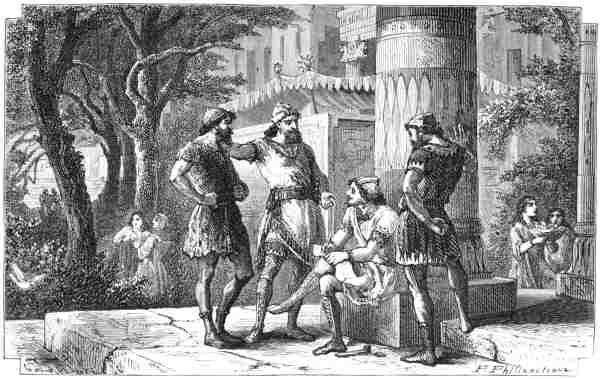

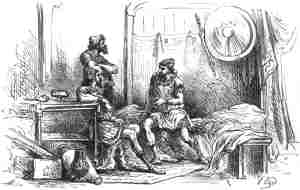
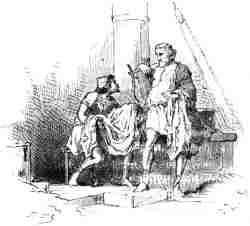
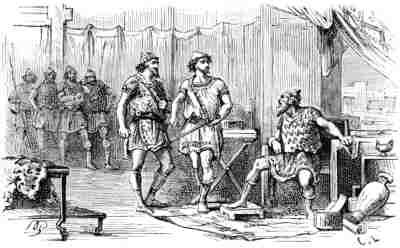
HANNO PROCEEDED TO DRAW UP THE ARTICLES.
To face page 8.
Early next morning we set vigorously to work. I drew
out the plans of my vessels upon papyrus sheets. My own
Gadita was to be kept as a light vessel; but I resolved to
have a large gaoul constructed as a transport to carry the
merchandise, and two barques to act as tenders to the gaoul,
which would draw too much water to approach very near
the shore. As an escorting convoy I chose two large
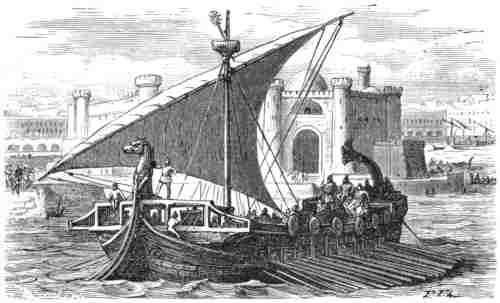
double-decked galleys,[15] manned by fifty oarsmen, similar
to those recently invented at Sidon. At this period, the
Tyrians had three of these galleys in port; they were very
rapid in their course, and drew very little water; they were
armed with strong beaks at the prow; were worked both
by oars and sails, and were adapted either for war or
commerce.
I determined to use cedar for the keel and sides of my
vessel, and oak from Bashan, in Judæa, for the masts and
yards. I discarded the ancient method of making my sails
of Galilean reeds or papyrus-fibre, preferring to have them
woven out of our excellent Phœnician hemp, which the
people of Arvad and Tyre are skilful in twisting into a
very substantial texture. It was of the same material
that I resolved to make my ropes.
As I was going through the arsenal, and wondering at
the accumulated mass of copper, I espied a little store
of the beautiful white tin obtained from the Celts in the
distant islands of the far north-west. Previously to my own
voyage those islands had been all but unknown, and I
believe that I may say that my own investigation of them
has conferred as great a benefit upon the Phœnicians as
they had reaped two hundred years before by the discovery
of the silver mines of Tarshish.
The sight of the copper determined me upon carrying
out a plan which I had for some time been contemplating.
It occurred to me that if the keel and flanks under water
were protected with copper in the same way as the prows
had hitherto been, the solidity of the vessel would be greatly
increased, and the wood would be far less liable to decay.
Accordingly, I made up my mind to protect the prows of
the galleys with a hard alloy of copper and tin, and to
sheathe the keels and flanks of all the four vessels with
plates of wrought copper. The copper of Cyprus I rejected
as being too soft and spongy for my purpose, and that
of Libanus as far too brittle; but the firm yet ductile
Cilician metal suited me admirably, and Khelesh-baal,
the renowned Tyrian founder, set to work at once to forge
me some large sheets, three cubits[16] long by two wide.
The King had placed 200 workmen at my disposal; and,
in order that I might better superintend their operations, I
took a lodging with my three friends in a house at the
corner of the Street of Caulkers, just opposite the arsenal,
and there from my window upon the fourth floor I could well
overlook the men working in the docks below. I directed
Hanno to make out a list of the goods we should require
for barter, and he and Himilco chiefly busied themselves in
collecting the things together; whilst Bodmilcar, with two
of my sailors, kept perambulating the neighbourhood of the
harbour, succeeding tolerably well in securing recruits for
my crew from amongst the seamen who were loitering about
the quays, with tilted hats, looking out for employment.
On the first day of the month Nisan,[17] just four weeks
after I had undertaken my commission, I returned home for
my evening meal, and found my companions in hot dispute.
"How now!" I cried, on entering the room; "what's this?
What is the meaning of this angry contention?"
"I am telling Bodmilcar," said Hanno, "that he has
about as much brains as a bullock, and about as much
elegance as a Bactrian camel."
"And am I to endure this insolence from a young stripling?"
cried Bodmilcar, angrily; "am I to put up with it
from a fresh-water lubber, who will cry like a baby at the
first gust of wind, and implore us to put him on shore
again? He has lived among women and scribblers till he
has no more pluck in him than a garden-tortoise."
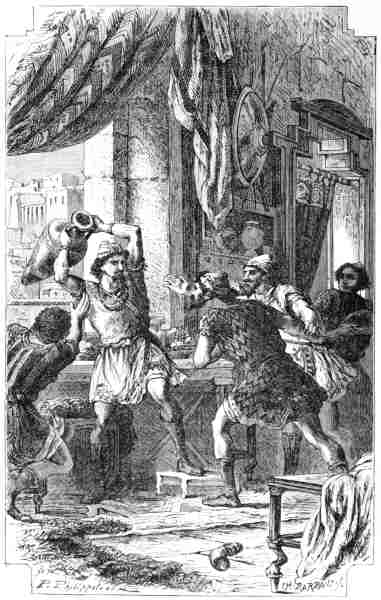
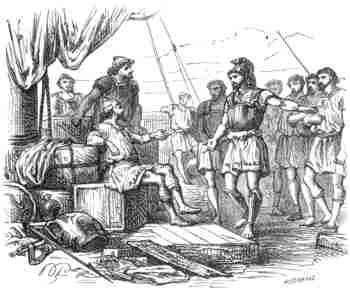
HANNO CAUGHT UP A LARGE PITCHER.
To face page 11.
"I confess," rejoined Hanno, sarcastically, "that I have
not had your experience; I have not had the advantage of
being pounced upon by the Chaldeans, or of being thrashed
by my own slaves. But let me say, I am twenty, and that
I hope the first time you find me funking the sea, you
will pitch me overboard like an old sandal. Anyhow, I
have had a voyage as far as Chittim;[18] I have been amongst
the Ionians, and can speak their language ten times better
than any one among you."
"Talk to me about the Ionians," shouted Bodmilcar in a
fury, "and I will break every bone in your precious skin."
And, as he spoke, he laid his hand upon his knife; but
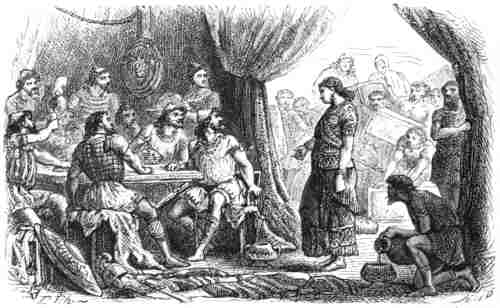
Hanno, without flinching for a moment, caught up a large
pitcher that was standing on the table.
"Steady, steady!" interposed Himilco, "or you will be
spilling all the nectar;"[19] and whilst I laid a firm grasp upon
Bodmilcar's arm, he rescued the pitcher, and deposited it
safely in the corner of the room.
Then addressing myself to the two excited combatants,
I said: "Now then, I cannot permit this altercation; you are
both under my orders, and you must both submit; conduct
yourselves amicably, or it shall be the worse for him that
disturbs the peace. But what is the meaning of this
chatter about the Ionians?"
Hanno held out his hand to me, in token of submission,
expressed his regret for having given offence to Bodmilcar,
and assured me that he had only spoken in jest.
"You see now," I said to Bodmilcar, "Hanno is not
your subordinate, and you are bound to treat him as your
equal. However, what is it that he has said to offend you
so grievously?"
Bodmilcar seemed abashed; he stood twirling his beard,
and without raising his eyes, said:
"Amongst the slaves that the Chaldeans captured, there
was one Ionian girl that I thought to make my wife. I
spoke of her to Hanno, but he only jeered me; he told me
that the girl had gone off with the Chaldeans of her own
accord, merely to get out of reach of me; and his provocation
made me angry."
"Nay, nay," said Hanno: "I did not want to make him
angry; it was a thoughtless joke; he was somewhat old, I
said, for so young a bride, and Ionian girls generally like
the perfume of flowers and the fragrance of sweet spices
better than the smell of tar."
"It was wrong of you," I said, as sternly as I could,
though I really felt inclined to laugh.
To my suggestion that they should make up their
quarrel with mutual pledges over a cup of wine, Hanno
eagerly responded, "With all my heart, and Ashtoreth
give me my deserts if ever wilfully I offend his grey hairs
again;" but Bodmilcar took the proffered hand coldly, and
with evident constraint.
Seeing that all immediate peril of a smash was over,
Himilco brought forward his pitcher again from its place
of safety. I heard nothing more of the disagreement; but
I could not help noticing that Bodmilcar was never again
the same in his demeanour towards Hanno, and that he
did not speak to him any more than he could avoid.
About a week later, as I was in the arsenal for the
purpose of selecting the ropes for the rigging, Himilco
came running to me to inform me that one of the King's
servants had arrived with a message that was to be delivered
to myself. I went to meet the messenger. He was a tall
Syrian eunuch with frizzled hair and painted face, arrayed
in a long embroidered robe, and wearing large gold earrings
after the fashion of his country. He held a long cane
surmounted by a golden pomegranate, and spoke with a
languid lisp.
"Are you Captain Mago, the King's naval officer?" he
asked, as he eyed me from head to foot.
Receiving my reply, he continued: "I am Hazael, of
the royal household; here on my finger you may see the
signet which empowers me to exercise my authority.
The purpose of my visit is to inspect the vessels you are
building; but specially my object is to give instructions
that proper accommodation shall be provided for myself,
and for a slave that I have to conduct from my master to
Pharaoh, King of Egypt. Two proper berths must be prepared;
and the King's orders are that you are to remit us
to Egypt after you have visited Jerusalem."
"As to your directions about berths," I replied, utterly
astonished at his cool effrontery, "you must permit me
to remind you that on board ship the captain, with his
pilot under him, invariably allots the place for every
passenger."
"Be it so," rejoined the eunuch; "yet it is imperative
that separate apartments, tapestried and carpeted suitably,
should be provided for myself and for the royal slave. Impossible
for us to live in contact with the rough and tarry
seamen."
I felt a strong inclination to let Hazael experience
how he relished lying full length upon a heap of rubbish
that was close at hand; but I controlled my indignation
and said:
"I will contrive something. I will either make a partition
in a corner of the hold, or put up a cabin of planks upon
the deck; but whatever is done must not interfere with the
working of the ship. When I have made the provision in
space, I leave you to fit and furnish as you please; but
mark you this, your curtains and carpets will be ruined
in the first tempest that we get. However, that is your
concern, not mine."
"Each of the cabins," complacently continued the eunuch,
"must be twelve cubits by six; there must be six benches
of sandal-wood and ivory; the bedsteads must be inlaid;
the windows must be framed and fitted perfectly."
"Fitted!" I rejoined: "have I not told you already
that you may furnish and adorn the cabins as you will:
their size, their position must rest with me: in such matters
my authority is supreme. You may tell your royal master
from me that adequate accommodation shall be provided,
but that with my arrangements no one is at liberty to
interfere."
The eunuch looked aghast at my temerity; but he
seemed somehow to comprehend that I was not to be
trifled with. He muttered a few words to the effect that
I had better see that everything was duly done, and without
a word or gesture of leave-taking, turned on his heel and
sauntered leisurely away. I watched him for a moment,
and turning to Himilco, who had been near enough to
overhear the conversation, I said:
"Unless I reckon badly, that fellow will give us some
trouble before we have done with him."
"Ah, no; I'll take care of that," said Himilco. "Sooner
than the painted hound should interfere with us too much,
I'd have a rope to his heels, and he should dangle, head in
the water, all the way from Joppa to Tarshish. 'Tis not
for us to permit ourselves to be treated like dogs."
"No," said I; "but maybe, all will go well; Moloch
will be our guardian; and once at sea we shall not fail to
secure the protection of our Ashtoreth. To tell you the
truth, I am really far more apprehensive about Hanno's
pranks with Bodmilcar."
"We must hope for the best," replied Himilco. "Bodmilcar
will be on board the gaoul, and we will contrive for
Hanno to come with us in one of the galleys."
"True," I assented; "it is indispensable that they should
be separated. But with regard to this eunuch's requirements;
I hardly see whether it will be better to provide
the cabins in the gaoul, as being the more roomy, or to
have them under my own supervision. Plague upon the
slave and eunuch both!"
At that moment Hanno come up, with his roll of
papyrus in his hand, and caught the tenor of our conversation.
"A slave and an eunuch to go!" he exclaimed. "Surely
the charge of them ought to fall to my lot. Such duties
ever belong to a scribe. Besides, I have made some progress
in the studies of a magician; and better even than
a magician I could humour their fancies, and understand
their likes and dislikes."
I expressed my opinion that they would have enough of
magicians in Egypt whither they were going, and resolved
that I would keep them under my own eye.
"There's an end then to all my pretty scheme of teaching
them calligraphy, rhetoric, and what not," said Hanno,
smiling. "I must fall back, I see, upon my own accounts."
He unfolded his roll, and submitted to me his reckoning
of the amount that would be requisite to pay our sailors
and our oarsmen, at the same time handing me his statement
of the sums that had already been expended in the
purchase of the goods for barter.
The outlay far exceeded the golden talent, the thousand
shekels, which the King had advanced. He had, however,
commissioned me to spare no expense, and had promised
to meet all reasonable demands, so that I felt no uneasiness,
but sent Hanno straight to the palace to exhibit the
accounts and to ask for a further grant. The request was
most generously met.
Meanwhile, Himilco and I continued to employ ourselves
in having planks of fir from Senir[20] fitted to the flanks of
our vessels, and in rigging our heavy masts of oak with
yard-arms of cedar.
Our work progressed to our entire satisfaction. The
Gadita was repaired and entirely refitted; the figure-head,
an immense horse, was illuminated with dazzling enamel
eyes; the sides of the vessel were painted red upon a black
ground; and twelve shields of bronze, each glowing in the
centre with a polished copper boss, were hung outside.
After everything had been completed, I obtained permission
for the Gadita to be conducted with great ceremony,
to the music of trumpets and cymbals, into the basin of the
harbour. For the occasion the naval suffect lent me a large
purple sail, reserved expressly for state festivities; twelve
armed sailors, lance in hand, stood behind the shields of
bronze; and twenty-two oarsmen, plying their oars in
regular cadence, made the ship glide swiftly through the
water. Gisgo, the helmsman, from his station in the stern,
deftly wielded the tiller, according to the directions of
Himilco, whose place was at the prow. Bodmilcar, Hanno,
and myself were upon the poop. We were all of us in state
attire, and were conscious of a keen enjoyment of the admiring
gaze of the crowds of sailors who thronged, not only
the adjacent quays, but the terraces of the arsenal and of
the admiralty palace, and watched our manœuvres. The
naval suffect was himself one of the spectators; he was
seated at the grand entrance of the palace, just above the
flight of steps that led down to his official wharf. So
pleased he was with the appearance of the Gadita, that he
invited all the officers to sup with him in the evening, and
sent a sheep, a large jar of wine, two baskets of bread, a
supply of figs and raisins, and twelve cheeses, for the
entertainment of our sailors.
Arrived at the palace, we passed up the narrow staircases
and dim corridors of the eastern tower, and found ourselves
in a large round room with a lofty dome, from the centre
of which there hung a polished copper lamp. The suffect
paid us many compliments; and, on learning that we should
be ready for our outfit within ten days, he gave me permission
to go next morning and to choose whatever arms
would be requisite for the expedition.
After our entertainment we embarked from the suffect's
private wharf, intending to return, all of us, to our own
quarters on shore; but all at once Bodmilcar declared
himself so enamoured of the Gadita, that he resolved to
sleep alone on board. As our boat was silently threading
its way along the canal that intersected the mainland,
cutting off an island by its course, Hanno commenced
singing in a foreign language. My attention was arrested,
and I asked him what language it was. He replied that
it was Ionian, and expressed his surprise that I did not
understand it.
"No," I answered; "it is strange to me. I have sailed
but rarely along those coasts. But haven't you done with
the Ionians yet?"
"Oh, Bodmilcar is not here to get in a rage, and we have
not got the slave amongst us to be affected by any songs
of mine."
"The slave!" I exclaimed with wonder. "I did not
imagine that the slave would care for your songs. Is she
an Ionian?"
Hanno laughed, and made me no answer; but after a
while he yielded to my persuasion, and made me acquainted
with all he knew.
"Hazael the eunuch," he said, "is a chattering fool.
When I went to the palace I saw him, and wormed out of
him that the slave in question had been brought from some
Chaldean merchants, and that she had been originally
carried away from her own country by a Tyrian pirate, so
that the whole truth was not hard to guess."
"Not a word of this," I said; "not a word to Bodmilcar.
More than ever it makes me resolve to have both eunuch
and slave on board my own galley; otherwise I foresee there
will be no end of mischief. Neither you nor Himilco must
breathe a syllable until we have seen our unwelcome
passengers securely landed at their destination."
Each promised faithfully to preserve the strictest reticence:
Hanno, for his part, vehemently asseverating that
if a word upon the matter should escape him, he would
forthwith cut off his tongue, and devote himself to Horus,
the Egyptian god of silence.
As we now reached our lodging, the conversation dropped,
and for the next few days we were far too much engaged in
active duties to think any further of what had transpired.
I gave my own personal superintendence to the weaving
of all the sails, which were made strictly after the directions
prescribed by the goddess Tannat.[21] I saw that my ropes
were well twisted and thoroughly tarred; and I arranged
the benches for my oarsmen with such compactness that
there was only an interval of a hand's breadth between the
seat of the rower on the upper tier and the head of the man
in the tier below.
To give extra strength to the masts and yards, I had
them bound at regular distances with bands of ox-hide, and
finally I had the entire hulls plated with sheets of copper,
fastened together with bolts of bronze.
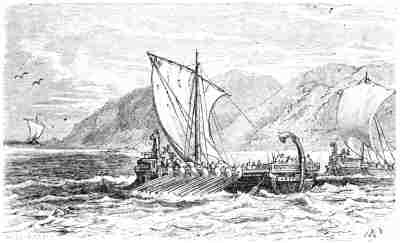
Never had prouder ships been launched upon the Great
Sea.[22]
CHAPTER II. THE SACRIFICE TO ASHTORETH.
Two
days before the great spring festival which celebrated
the re-opening of navigation, and which was observed as a
national holiday, our ships were ready in the stocks, and in
the course of three hours were launched without difficulty.
The two galleys were each seventy-two ordinary cubits
(or sixty-two sacred cubits) long by seventeen wide. The
gaoul, with its keel of one solid piece of cedar, was sixty-seven
cubits in length by twenty in width; it had three
decks and, as I have said, two tiers of rowers; the decks
were four cubits apart, and were raised fore and aft, so as
to make the elevation sixteen cubits above the water, whilst
in the centre it did not exceed twelve cubits. The galleys,
when carrying their full burden, and the double line of oarsmen,
stood each eight cubits above the water-line. Each
contained space enough to take 150 sailors and 50 rowers;
but hitherto I had only engaged 200 seamen, expecting
that I should be able to enlist the services of 100 soldiers
and archers who would be willing to take a share of the
working of the vessel. The number of the crew of the
gaoul was complete; the Gadita had likewise her full complement
of thirty-seven men, and the barques their crews of
eight. These two small craft were to be kept constantly
in tow, and would consequently be in no need of a pilot;
but each of the larger vessels was provided with two pilots,
one at the prow, one at the stern, Himilco being pilot-in-chief.
At the top of every mast, there was a look-out
place, constructed of fir-wood from Senir, for the purpose
of sheltering the man on watch. The apertures for the
oars were arranged at equal distances along the sides; and
all the vessels, after they had been caulked and tarred,
were made to correspond with the Gadita by being painted
black with red lines. Hanno had drawn up a document
for each of the captains, containing the names of the
respective crews, and a complete list of every piece of spare
rigging on board, with a register of the place where every
article was stored. All the arms, the bedding, the cooking-utensils,
the water-barrels, had their positions carefully
recorded, and in the crew's quarters between decks, each
seaman and rower had his berth distinctly marked with his
own name. The cabin under the raised deck at the stern
was reserved for the use of the captain and pilots, whilst
that under the prow was set apart for the officers of the
crew, and the captains of the men-at-arms. On all the
vessels the arrangements were identical, with the exception
that at the stern of the galley which I had chosen for
myself I had ordered a boarded cabin to be erected,
divided into two compartments by a partition, and lighted
by two small windows, for the especial use of the eunuch
and the King's slave under his charge.
Hanno was extremely interested in the selection of good
and appropriate names for the ships. At his wish, the
gaoul, which was under the command of Bodmilcar, and
numbered a large proportion of Tyrians amongst its crew,
was named after Melkarth, the god of Tyre. One of the
galleys was named the Dagon, being placed under the
protection of the Philistine god of fish; whilst the one on
which we ourselves were about to embark was dedicated to
the Sidonian goddess Ashtoreth, to whom we were personally
bound by an especial reverence. Associated with
these divinities, of course it was out of all character that the
Gadita should retain her previous name; accordingly, at
Himilco's request, and in consideration that she was to sail
at the head of the squadron, we gave her the designation of
the Cabiros. Bodachmon, the high priest of Ashtoreth,
undertook to present us with images of the various deities
to be kept on board the ships which were severally
dedicated to them.
Bodmilcar was assigned the command of the Melkarth,
and her attendant barques; Hasdrubal, a Sidonian, was
appointed to the charge of the Dagon; and the Cabiros was
confided to the care of Hamilcar, another Sidonian, a bold
and experienced seaman.
On board the Ashtoreth, my flag-ship, I took for my
personal staff Hanno as scribe, Himilco as head pilot, and
Hannibal of Arvad (whom I knew to be a strong, brave
man) as commander of my men-at-arms.
Fore and aft of each of the ships Hannibal placed two
machines of his own invention for hurling stones and darts,
and called "scorpions;" thus, with the exception of the
Cabiros, which being small could only carry two, every
vessel was provided with four of these powerful engines.
We worked hard throughout the greater part of the
night and all the following morning in packing and stowing
the freight of our little fleet as it lay in the inner basin of
the trade harbour, and the Cabiros joined us to receive her
portion of the cargo and provisions. Towards the middle
of the day we found time for rest and refreshment. Anticipating
our departure on the morrow, several of us met for a
frugal meal in a tent that had been erected for our accommodation
on one of the quays. The three captains, the
commander of my men-at-arms, the chief pilot, and myself,
had just seated ourselves at the table, when the curtain that
covered the entrance was drawn aside by one of the sailors,
and Hazael the eunuch was announced.
Hazael entered with his usual lazy saunter; behind him
was a train of six slaves carrying baskets, boxes, and
bundles, and accompanied by a workman with a hammer
and a variety of tools. Outside, mounted on white asses,
were two women, one of them closely veiled; the face of
the other was uncovered, and by her red skull-cap with
its gold band and dependent white veil, as well as by
her frizzled hair and prominent features, I recognised her
at once as a daughter of Israel.
"We have come," said the eunuch, without pretence of
courteous salutation, "to take possession of our berths, and
to stow away our baggage."
Hanno started to his feet. I laid my hand upon his
arm, and asked him what he was about to do.
"To stow away the baggage for them," he replied;
adding, "unless, captain, you forbid me."
"Better for you," I continued, "to remain where you are;
I have other business for you to do. This falls best to
Himilco's duty. Go, Himilco," I said, turning to the pilot,
"go and assist Hazael to arrange his property and see to
the accommodation of the women."
Himilco emptied his glass, and, not without a longing
glance towards the jar of wine round which we were sitting,
left the tent. Hanno, who had fallen back to his seat with
an assumed air of indifference, now asked:
"And what is the business for which you want me?"
"You must go," I answered, "to the temple of Ashtoreth
to prepare for our sacrifice to-morrow: you must procure
us some birds to take with us on board our ships; in
stormy weather they will show us which way lies the land:
you must find the naval suffect, and deliver him a list of all
the crews, and a catalogue of all the cargoes; most of all,
you must wait upon the royal treasurer and furnish him
with an abstract of all accounts. Is not all this enough for
you to do?"
"No time, I see, then, for me to lose," said Hanno,
with impetuous eagerness; and snatching up his papyrus
roll, he ran hastily away. It was my impression, as I
caught sight of him through the half-opened curtain
of the tent, that he turned, not in the direction of the
temple, but towards the harbour-basin; however, when
he came back in the evening all his commissions had been
fully and faithfully executed, and I thought no more of
the matter.
On his return he was accompanied by one of the officials
of the temple, carrying on his head some large bird-cages
made of palm-wicker. Hanno himself held a smaller cage,
containing four pigeons of a rarer sort, a beautiful shot
plumage glittering gaily on their breasts.
"If these birds don't bring us good luck," he said, "I am
sure no others will; they come straight from the temple of
Ashtoreth, and were handed over to me by the priestess
herself, who made me promise that they should be prized
according to their worth."
Each of the captains selected his proper share of the
birds, with the exception of Bodmilcar, who contemptuously
refused.
"Don't the birds suit you?" said Hanno; "what's the
matter with them?"
"I want no pigeons," retorted Bodmilcar; "ravens are
the birds for me, and I have taken enough of them on
board already."
Hanno turned his back; but Himilco, who had witnessed
what was passing, remarked:
"Fortunate for the passengers that they will not be on
board the Melkarth. Far more congenial, I should think,
the cooing of doves than the croaking of ravens, to the ears
of an Ionian!"
"Ionian!" ejaculated Bodmilcar, turning pale, "is the
slave an Ionian?"
In an instant I gave Himilco a sharp dig below the
ribs to recall him to his senses, and as quickly he clapped
his finger on his forehead, pretending to recollect himself:
"No, no; not an Ionian; I mean a Lydian." And turning
round to me he asked me whether he was right.
I made a sort of a gesture which I hoped would satisfy
Bodmilcar, but he was manifestly still agitated; he made
no further remark, but shortly afterwards quitted the room,
mumbling unintelligibly as he went. As soon as his back
was fairly turned, Hanno, who had been seated quietly
arranging his papyrus leaves, rose from his seat, and
advancing towards the door, made a low and solemn bow,
a proceeding on his part that caused Himilco to burst
into a roar of laughter.
"Our friend Bodmilcar," remarked Hannibal, "seems to
be rather a morose sort of gentleman."
"Nothing of the sort, I assure you," said Hanno,
satirically; "I hardly know a man of a brighter and more
genial temperament; however, I confess that we may
thank our stars that we have not to sail in the same ship
with him."
Hannibal smiled, in token of assent.
Time to retire for the night had now arrived. We indulged
in a parting glass, in recognition of our mutual
hopes for the successful issue of the enterprise before us,
and with no little emotion, parted to seek the repose which
should prepare us for the ceremonial of the morrow.
Early in the morning I repaired to the arsenal, but not
too soon to find the crews assembled each round its own
captain. Hannibal had been successful in collecting
together all the archers and the men-at-arms. Every
captain was attended by his own trumpeter, in a scarlet
tunic, the trumpeter of the military captain being distinguished
by the magnitude of his trumpet, which was
double the size of the others.
With effective precision Hannibal had arranged his
soldiers in their ranks. The first rank was composed of
twenty archers in white tunics, their heads covered with
white linen caps, which were encircled by a band of
leather studded with nails, and of which the ends hung
down behind. They all wore scarlet waistbands, in which
were inserted ivory-handled broadswords; their quivers
were attached to a belt of ox-hide, that passed over the
shoulder, and was ornamented with a profusion of copper
studs. In his hand every one carried his long Chaldean
bow, the upper extremity of which was carved to represent
a goose's head. Next behind the archers were two ranks
of armed men, twenty in each rank: they wore cuirasses
composed of small plates of polished copper, and had
helmets of the same material. Their tunics were scarlet,
and hung below the cuirasses; on the left of their belts was
a strong Chalcidian sword, and on the right an ivory-hilted
dagger; one hand carried a large circular shield, ornamented
in the centre with a deep-red copper figure of the sun; the
other hand bore a lance, furnished with a long sharp point
of bronze.
Hannibal stood at the head of his troop. He wore a
Lydian helmet, surmounted with a silver crest, which was
further adorned with a scarlet plume. The image of the
sun in the middle of his shield was likewise silver, and
around that was a circle of the eleven planets. His sword-handle
was carved into the figure of a lion, the lion's head
forming the guard. Like all the rest of the company he
commanded, his feet and legs were protected by leather
greaves or gaiters, laced up the front, and turned upwards
at the point in the Jewish fashion. He no sooner saw me
approaching than he unsheathed his sword, and his
trumpeter sounded three blasts, an example which was
followed by the other trumpeters, all blowing in unison,
after which the captains and pilots advanced and made me
a general salute.
Our seamen were provided with neither belts, shields, nor
helmets, but carried large cutlasses below their kitonets;
they wore pointed caps that covered the nape of the
neck, similar to those that are constantly seen at Sidon.
Hannibal proposed that they should be drawn up and
drilled like the soldiers, but I did not acquiesce in his
suggestion; I preferred allowing them to rove about at
their pleasure, knowing that they could be drilled far better
on board ship, after they had been regularly assigned their
proper place and duties.
Hanno and Himilco, who had gone by my directions to
see that everything was in readiness for the sacrificial rites,
now joined us. They were accompanied by two men, each
leading a superb bullock covered with purple housings, and
with their horns decorated by fillets of embroidery, to which
were attached little bells, which tinkled as they moved.
Close in their rear followed my slave, carrying on his head
a large basket of pomegranates, covered with a napkin
embroidered with silver.
After he had stationed our four trumpeters in couples
behind his own, Hannibal gave me to understand that he
was only waiting for me to give the signal to march. No
sooner had I signified my permission, than he shouted out
the word of command, and the archers and men-at-arms
doubled file and faced about with an alertness that elicited
universal commendation. The trumpeters led the way with
a flourish that was well-nigh deafening; the archers followed
two and two; then came Hannibal at the head of his
warriors, all shouldering their lances. My own place was
the next; and I marched on, supported by Hanno and
Himilco, and immediately followed by my slave and the
two men who were in charge of the oxen devoted as
victims for the altar; whilst behind us were the four
troops of sailors, not marching in any special order, but
each headed by its own captain and pilots. This irregular
company brought up the rear.
The thoroughfares along which we passed were decorated
gaily. In honour of the great yearly festival of Melkarth,
which attracted the mass of all the surrounding population,
they were profusely hung with coloured canvas of many a
hue, and floating streamers of linen, dyed with the richest
shades of purple, orange, green, and vermilion were interspersed
amongst waving branches of palms and massy
boughs of cedar. Each separate window was a separate
centre of display. The people, in holiday attire, were
wending their way in crowds in the direction of the island
upon which stands the temple of Melkarth, but they stood
aside in every portico to allow us to proceed; they were
eager in their inquiries as to the meaning and purpose
of our formal progress through the streets; and when they
understood that we were marching to the shrine of the
goddess Ashtoreth to make our sacrifice, and to intreat
her favour upon an expedition to Tarshish which we were
about to make, they rent the air with their boisterous
acclamations. Men expressed their wonder at the concourse
of our sailors and the quality of our oxen; women
admired our attire and the carriage of our officers, being
especially lavish in their praise of Hanno; the children
ran after the procession, attracted equally by the glittering
crest in Hannibal's helmet, by the glowing red of the
trumpeters' tunics, and the swelling notes of their martial
music. Every one was unanimous in declaring that never
before had so magnificent a retinue left a Phœnician city
on a distant enterprise.
As we passed along beneath the sycamines in front of
the King's palace, the vast concourse that had assembled
in readiness for the royal procession parted asunder to
allow us room to pass, and the King's trumpeter and
musicians, who were stationed at the gateway, broke out into
strains of welcome. A messenger was observed hurrying
down from the palace, and it was soon known that he came
with orders for us to halt. Hannibal immediately made
his men face about; the sailors, as it were involuntarily,
turned towards the palace, and I myself, with Hanno and
Himilco, advanced in the direction of the window at which
the King is accustomed to show himself to his people, and
which is easily distinguishable from the others by the
gilding and tapestried hangings with which it is decorated.
Meanwhile our trumpeters had taken up the strains of the
royal march in concert with the King's musicians, and
the melody was re-echoed by various bands in other
quarters of the palace-yard.
Only a short time elapsed before the King presented
himself at the window. An attendant, gorgeously attired,
held over the King's head a purple canopy embroidered
with gold and richly jewelled; behind him could be seen
the glittering helmets and cuirasses of his body-guard.
Without a word of preface, he called me forth by name;
and having prostrated myself to the earth in deep obeisance,
in another moment I was standing with folded arms
before him awaiting his commands.
He spoke to this effect:
"Mago! content I am with the preparation you have
made. Well pleased I am with the way in which you
have collected your seamen and equipped your warriors
in behalf of my friend, my royal ally, King David. You
quit these realms for the distant shores of Tarshish. May
our guardian gods protect you! Hazael will deliver you
the letters signed by my own hand, which you are to
present to the various sovereigns who are my allies; to him
I have further intrusted the papyrus roll on which my
instructions are inscribed. Onwards now, fulfil your oblations
to your goddess Ashtoreth. I go to render my
sacrifice to our great Melkarth; but when I have discharged
my vows, my purpose is to be myself a witness
of your departure, and you shall not fail to have still
further tokens of my favour."
Again I prostrated myself before the King, who then
retired, leaving me to proceed upon my way, still heralded
by the trumpets and greeted by the continuous acclamations
of the people. We had hardly turned away, when
the great gate of the palace was thrown open, and, headed
by a band composed of trumpets, sistra, tambourines, and
flutes, there issued the grand procession on its way to
the island upon which rose the columns of the temple of
Melkarth, the supreme deity of Tyre.
We had hardly reached the limit of the royal court-yard,
when Bodmilcar, who had quickened his pace to overtake
me, came to my side and said mysteriously,
"Melkarth is a great god!"
"Assuredly!" I said, but did not in the least comprehend
his meaning.
"A great god is Melkarth of the Tyrians," he repeated.
"Melkarth requires greater sacrifices than Ashtoreth: his
sacrifices are large as Moloch's; and they are going to
offer him some children to-day."
I assented, yet still failed to see his purpose; but after
a little hesitation, he said:
"Might it be permitted me to take my Tyrians and to
join the worship of our own Melkarth?"
The discovery of his intention vexed me exceedingly;
it was mortifying to myself to see the number of my own
retinue diminished, or to allow the dignity of our own observances
to Ashtoreth to be curtailed; but I felt that
I had no alternative than to comply with his request to
make his sacrifice to the god of his peculiar veneration.
Reluctantly I gave him my assent, and when we reached
the steep street that led up to the elevated groves of
"Baaltis-Ashtoreth,"[23] I saw that, instead of continuing
with us, he dropped out of our line and joined himself
with about thirty of our sailors to a procession that was
conducting a chariot, resplendent with gold, and surmounted
by a canopy ornamented with plumes of ostrich-feathers.
This chariot was conveying the children that
were to be offered as the victims of the sacrifice. To
welcome the addition to the throng, the shouts of the
populace and the clang of the cymbals burst forth with
redoubled vehemence.
"How I hate that sacrificing of children!" said Hanno
to me.
"Yes;" I concurred, "but if Moloch and Melkarth
demand it, what can be said?"
"With all due reverence for Moloch and Melkarth," he
continued, "I cannot but rejoice that Ashtoreth of Sidon
makes no such request."
We had now turned into the pathway through the grove
that winds up to the temple of Baaltis. By far the
greater proportion of the temple-officials were absent,
having gone to join the general celebration of the city in
honour of Melkarth; only six priests and four priestesses
remained. Seen through the hazy glow of the rising sun,
the grove and temple looked surprisingly lovely, and one
could hardly help being conscious of some feeling of regret
at having to leave such charming scenes. But amidst all
the fascination of the prospect, I realised how a perpetual
residence in such an abode would make a man effeminate,
and unfit him for peril and adventure; and proudly I
recalled the recollection that apart from the enterprise of
her sons, Phœnicia could have known no luxury: it was her
commerce that had brought her wealth; and had it not been
for their bold and undaunted navigation, the people might
have seen their shores the prey of invading kings.
Hanno had manifestly been under a like influence, and
had been following a kindred train of thought.
"Yes," he said, as if uttering aloud the conclusion of
his own reflections; "yes, even if Pharaoh, Melek-David,[24]
the Chaldeans and Assyrians all were to concentrate their
hosts and fall on us Phœnicians, we could betake ourselves
to our ships and brave them on the seas. Aye, though
they should drive us out from our own domain, build ships,
and encounter us upon the ocean where the supremacy has
hitherto all of late been ours, yet we have Chittim, Utica,
Carthage, Tarshish to fall back upon; the whole world is
ours!"
"True," I replied; "in a sense, the world is ours: but it
is nothing except our own undaunted perseverance that
has made it so. We have had no kings to lead us on to
vanquish neighbouring states; we have had no generals to
gain us victories and acquire us power; but depending only
on our native resources, trusting simply to our own courage,
and relying on the good protection of our gods, we have
traversed regions that were unexplored, and discovered
wealth that was unknown. And now, none dares to assail
us; we command the respect of all. None too proud to
ask our aid, none too independent to own our service.
Who procures Melek-David his choicest timber, his silver
and gold? Who provides Pharaoh with balm, his jewels,
his copper and his tin? From whom does the Assyrian
seek his purple and glass, his ivory and embroidery? Who
is the great purveyor of every luxury for every prince and
magnate of the world? A Tyrian may well be proud
when he claims all this for the mariners of Sidon and the
merchant-princes of Phœnicia."
Stirred to emotion by my enthusiasm, Himilco took up
the strain: "Yes; great and deservedly great is Tyre's
renown. May her spirit of adventure never flag! For my
part, give me but the favour of Cabiros for my guiding star,
and I would not exchange my peaked sea-cap and ragged
kitonet for the tiara sparkling with its fleur-de-lys,[25] and the
mantle gorgeous with embroidered work that grace the
King of Nineveh!"
Whilst we were thus indulging the spirit of our national
pride, the priests within had been lighting the altar-fires
and preparing the sacrificial basins, some of which they
filled with water, leaving the rest empty. Hannibal had
drawn up his men in order upon the temple-steps, making
an imposing array: he had just put them in the form of a
crescent, of which the archers in double file at the top were
the extremities, the centre being made by the men-at-arms,
four deep, and below, an avenue was left for the progress
of myself and my companions, the oxen being conducted
into the temple by an entrance at the back.
On our approach, our trumpeters gave a loud flourish,
which was answered by the flutes and instruments within.
The high priest advanced towards us and, in sonorous
tones, exclaimed:
"Let Mago, the Sidonian, the son of Maherbaal, now
draw near. Commander of the expedition, he comes to
present himself before the goddess. Let him now approach,
and all his followers attend him!"
Obedient to the summons, I ascended the steps, followed
immediately by my slaves; Hanno and Hannibal were on
my right hand; Hasdrubal, Hamilcar and Himilco on my
left; behind us was the general throng of sailors and of oarsmen.
At a sign from Hannibal, the soldiers shouldered their
bows and lances, and having faced about, entered the temple
by the two side doors, and completely lined the edifice.
An official proclaimed silence. "Order!" he shouted;
"Mago, son of Maherbaal, makes an offering for his people."
It was the work of but a short time to bring in the oxen,
and have them slain and quartered, and while this was
being done my slave distributed amongst us the pomegranates
he had brought. The high priest with much
formality presented me with the shoulder of one of the
victims, upon which, according to rule, I laid a purse containing
six shekels of coined money. The officiating priest
accepted the offering, and while he was proclaiming my
liberality aloud, the sacerdotal scribe was inscribing the
names of myself and my captains, together with the
amount of my donation, in the temple register. The chief
priest then took the breasts of the victims and placed them
upon the altar, whence the smoke ascended high towards
the round window in the dome. The black stone at Sidon
is the true goddess, but here at Tyre, Ashtoreth is merely
represented by a statue. Standing with his face towards
this, the priest made his invocation and chanted some
prayers to music, which gradually died away into perfect
silence.
During the time that these ceremonies were proceeding,
the remaining portions of the oxen were being steeped in
the lavers, after which they were thrown into great caldrons,
part to be boiled over the chafing-dishes in the temple-kitchen,
and part to be cooked in the open air of the sacred
groves. The sailors lent their ready assistance in kindling
the fires and superintending the boilers.
The chief priest next handed me one of the bullock's
breasts. I raised it on high with both hands before the
goddess, and delivered it back to the priest, who turned it
round three times, as if solemnly dedicating it to the deity
on my behalf. Hanno went through a corresponding ceremony
with the other breast, which was turned round seven
times in behalf of us all.
I had given the scribe five shekels to provide us with
bread for the entertainment, and in the name of the
captains, pilots, and sailors, Hamilcar gave him eight shekels,
a part to provide us with wine, a part as a free tribute to
the goddess. He entered the several sums upon the
registers, and the officiating priest again made a public
announcement of our liberality. One after another we
prostrated ourselves before the image of the goddess, the
high priest made a short final invocation, and full of joy we
withdrew from the temple to the adjacent grove. At a sign
from Hannibal, the soldiers, who had stood mute and
motionless throughout the ceremony, fell out of their ranks,
and rushing in wild confusion, mingled with the sailors to
assist them in preparing the banquet.
I took my seat at the foot of a noble cypress, and Hanno,
Hannibal, and Gisgo, placed themselves as my supporters
on either hand, Himilco charging himself with the duty of
superintending the filling of a large earthenware vase with
wine. My slave arranged the drinking-cups by placing
mine (which had a lion's head at its mouth) in the centre,
and disposing those of the captains in order round it.
Hannibal's cup was of plated copper, with a stem and two
handles, and embossed with flowers and bunches of grapes.
Having done this, the slave went away, and returned
ushering in two soldiers, who carried a huge caldron;
they let the caldron down heavily on the ground, their
cuirasses rattling again with their exertion. The lid of the
caldron was at once removed; a large basket of bread had
been handed round preparatory to the repast, and each
man having brought out the wooden knife and spoon that
he carried at his waist, the whole of us set ourselves to
enjoy an abundant meal.
When the wine-cups had been distributed and charged, I
rose from my seat, and raising my cup on high, drank to
the health and welfare of the whole assembly.
"A goodly draught is this!" said Hannibal, when he
had drained his cup to the very dregs; "it is the wine of
my own city Arvad; it gives life and strength to those
that drink it; hence Arvad's wide renown for wits and
warriors."
"And Arvad's warriors," I said, turning to the captain,
"deserve their fame. By-the-by, have your wide wanderings
by sea and land ever taken you into Judæa before?
Thither it is, you know, that we first direct our course."
"Truly, yes;" replied Hannibal, with his mouth full;
"this very sword that I am wearing, and this purple
shoulder-belt, were presents from Joab, the general and
cousin of the King. I commanded twenty archers under
him at the battle of Gebah, when the Philistines were
defeated at the mulberry groves. Nor was that the only
time. I was garrisoned for a year or more at Hamath,
with the troops of Nahari, Joab's armour-bearer, one of
David's thirty-seven mighty men. It was on returning
thence that I had the command of the soldiers on board
the ship of our friend Hasdrubal here, at the time when the
galleys of Sidon were sent to engage the Cilician fleet."
"Aye, I have heard of that expedition," said Himilco;
"at that time we were far away at Gades."
"And we," broke in Hamilcar, "were in the service of
Pharaoh, sailing along the coast of Ethiopia, beyond the
Sea of Reeds.[26] What splendid shells were there, containing
precious pearls! and one great fish there was that could
swallow a man entire!"
At this moment one of the young priestesses approached
our party, and handed Hanno a small packet, carefully
wrapped in linen.
"This," she said to him, "is the image of Baaltis. Over
it I have burnt the costliest perfumes; I have anointed it
with the rarest ointments; I have laid it before the goddess,
who has graciously accepted it. To you, Sidonian, I now
entrust it, and may it bring good fortune to yourself and
all who share your enterprise."
The high priest came in person to deliver us the other
images of the gods, that of Melkarth alone excepted, which
Bodmilcar himself was to convey from the temple to which
he had separately gone.
The priestess offered to accompany us to our ships, that
she might sprinkle the images on board before we took our
departure.
Himilco craved permission to carry the image of the
Cabiros down to the quay before resigning it to the keeping
of the captain.
"How about your vow of twenty shekels and a bullock that
you made to the Cabiri?" I asked him, as we rose to go.
"That will have to wait," he answered, "till I have come
across that Tarshish rascal who deprived me of my eye.
The patient gods, I have no doubt, will give me credit, and
not require me to pay at once, or in advance."
Meantime Hanno had been uncovering his image of
Ashtoreth, and was standing holding it in both hands and
gazing at it with the profoundest admiration. It was an
alabaster figure, with a necklace of three rows of gold beads
and a pointed cap, beneath which flowed ample masses of
wavy hair.
"I, too," said Hanno, "have made a vow to my goddess,
but she has promised to abide my time, and to tarry till my
expectations and my longings are fulfilled;" and as he
spoke, he stooped and kissed the face of the image. I know
not whether it was imagination on my part, but I certainly
thought the cypresses around gave a soft yet perceptible
rustle in response to his words. Perhaps the priestess
observed it also, for she smiled on me, and laid her hand
on Hanno's shoulder.
"But now, Captain Mago," she cried, "let us start. The
time for embarkation is at hand, and the goddess pronounces
that it is a favourable hour. Come, let us proceed!"
"To your ships, men; to your ships!" I shouted; and
turning for a moment towards the temple, said, "Farewell,
Baaltis, Queen of Heaven: to-night thou shalt behold us on
the waters of the Great Sea!"
Hannibal, who had resumed his helmet, made a signal
to the trumpeters to summon the soldiers and sailors.
Hanno and the priestess came on one side of me; Himilco,
carrying the image of his god, took his place on the other,
and in the same order in which it had come, our cortége
wended its way along the decorated streets down towards
the port. The roads adjacent to the harbour and all
the quays were so densely thronged, that it was only with
considerable difficulty that we could force our way along.
Every nation seemed to make its contribution to the crowd:
besides the native Phœnicians, there were Syrians in their
fringed and bordered robes; Chaldeans with their frizzled
beards; and Jews in their short tunics and long gaiters, with
panther-skins thrown across their shoulders. Again, there
were Lydians with bands around their foreheads; Egyptians,
some with shorn heads, and some with enormous
wigs; Chalybeans, wild in aspect, and half naked; and
men of Caucasus, gigantic in size and strength. Many a
far distant land had sent its sons to our Phœnician cities
as the headquarters and the home of industry and commerce;
Arabs and Midianites were here looking with
astonishment at the height of the houses, and bewildered at
the multitude of the population; whilst the Scythians of
Thogarma, their legs strap-bound, moved with heavy
strides, and looked around amazed, perplexed at the absence
alike of horses and of chariots from the narrow streets.
The air was filled with songs and shouts of many a
different tongue; the people jostled one another in their
eagerness to catch a sight of whatever company came last
in view. Every band of musicians enlisted its own
admirers; every troop of priests attracted the closest
scrutiny. Every regiment with its painted shield excited
a perpetual interest; and as our own procession, with
its trumpeters and soldiers and promiscuous groups of
sailors, could not fail to draw a large and curious concourse,
it was in the midst of a veritable whirl that we passed the
arsenal and made our way to the reserved quay, where
our ships, poops inward to the shore, had been left under
the care of a few sailors.
Bodmilcar and the eunuch had arrived before us, and
were standing in eager conversation on the gangway that
led to the poop of the Melkarth. As soon as they
observed us, they stopped abruptly, and Bodmilcar whistled
for his sailors, whilst the eunuch advanced to meet me.
"Is all your baggage duly stowed on board?" I asked
Hazael.
"It is," he answered; "but it disappoints me much
that our berths have not been made upon this larger
ship; here we might have far more space and comfort:
however, it matters little; at the first point we touch we
can make a change. Bodmilcar thinks it will be best
we should."
"It cannot be," I said; "the King's slave has been
entrusted to myself, and under my supervision she must
be. The Melkarth is a transport, and the captain of a
transport has no concern with passengers. I must hear no
more of this. Do I understand aright that you have
letters for me from the King?"
Without one word in reply, the eunuch handed me a box
of sandal-wood, which I opened, and found it to contain
several sheets of papyrus, on which were written various
instructions to myself.
I was about to give orders to my trumpeter to proclaim
silence, but before the words were out of my mouth,
Bodmilcar rushed forward and threw himself into my
arms.
"I have been sacrificing to Melkarth," he exclaimed;
"I have paid my vows to my god, and I must unburden
my conscience. I wish to ask pardon of any and of all to
whom I have shown insolence or ill-temper."
Without hesitation, Hanno offered him his hand, assuring
him that he fully forgave everything that had happened in
the past, and that, forgetting all previous quarrels, for the
future he would show him all proper deference, and yield
to his authority. Pleased with this open reconciliation, I
expressed my satisfaction that we were able thus to set
out with so universal a spirit of harmony and of concord.
In the meanwhile the captains had severally collected
their crews, and Hannibal had told off his men-at-arms,
reserving ten archers and ten soldiers for our own ship.
The priestess then, with the accustomed solemnities, presented
each vessel with the image of its own peculiar
divinity.
Before we started, our host, with whom we had been
sojourning, accompanied by his wife and son, forced his way
through the guards that had been keeping the inclosure,
and came in haste to me.
"Mago, dear friend," he said, "I could not suffer you to go
without seeing you once more. Here are cakes, and here
is a basket of dried grapes; but, most of all, here are two
goat-skins of genuine nectar. Accept them from me in
token of my good-will. Farewell, and the gods grant you
a prosperous voyage!"
"Farewell, honest pilot," said my host's wife to Himilco;
"for you I have brought this goat-skin of Byblos, because I
know there is no wine you like so well."
"Thanks, good hostess, many thanks," replied Himilco;
"to me there is no wine that can compare with the rich
and luxurious produce of Phœnicia. I shall not forget
your bounty, and if only our star shall favour us, and the
Cabiros shall safely bring us home again, I promise to
bring you such a gift as shall make the Tyrian women die
with envy."
The son, a youth of about sixteen, was devotedly
attached to Hanno, and only with the greatest difficulty
could be dissuaded from accompanying him upon his voyage.
As a farewell gift, he had brought his friend a large packet
of the choicest reeds for writing; and the two parted with
mutual expressions of affection.
Amongst those present there was yet another whom I
regarded with the profoundest reverence, and whose knowledge
was accounted as little short of divine. This was
an aged priest, named Sanchoniathon,[27] the historian and
chronicler of past events; although no traveller himself,
he had acquired the fullest information concerning well-nigh
every country of the world.
Addressing himself to me, he said: "Mago, my son,
Hanno your scribe has undertaken to transmit to me, in
writing, an account of whatever he may see rare or wonderful
in the far-off lands to which you go; his genius seems
bright and quick, but his youth renders him wild and
unstable as a kid. Is it too much to ask of you that you
will urge him on to keep his word?"
"To gratify you, my father," said Hanno, "I will do all
I can to control the caprices and irregularities of my youth.
My own indebtedness to you is great. I trust that I may
not forget the lessons you have taught me; and if I can
render any aid in enabling you to keep the Phœnicians informed
of the wonders of the world, I shall be ready to
show myself a pupil worthy of my master."
The aged Sanchoniathon then gave us his blessing. He
had scarcely concluded his benediction when the priestess
of Ashtoreth came by, returning from the ships. As she
passed Hanno I distinctly heard her say in an undertone:
"She is as good as she is beautiful!"
"Hush!" he murmured; "I must forget her! Happy
Pharaoh!"
Everything being reported ready, I ordered the trumpeters
to sound the signal for departure, and we proceeded to
embark. The first man to step on board was old Gisgo,
the pilot of the Cabiros, commonly known as Gisgo the
Celt, and perhaps still more frequently spoken of as Gisgo
the Earless. He had been eight times on a voyage to the
Rhone, and the story went that on one of his visits there he
had married a Celtic wife, with yellow hair, who was still
awaiting him in her native forests; on another occasion he
had been taken prisoner by the Siculians, who had cut off
both his ears. Having mounted the poop, the old man
waved his cap and shouted cheerily:
"Mariners, mariners all! quick and ready! quick on
board! rulers of the ocean! sons of Ashtoreth! listen to
your captain's call. Tyrians and Sidonians! To sea! to
sea! and long live Captain Mago!"
The men all hastened to their several ships, and as soon
as I had taken my station on the raised bench of the poop
of the Ashtoreth, my standard was hoisted as the signal of
departure, the gangways were removed, the boathooks were
driven vigorously towards the facing of the quay, and we
were on our way.
The Cabiros, with its twenty-two oarsmen, took the lead;
next came the Ashtoreth; the Dagon towed the Melkarth,
which was too large to hoist a sail in port. Our little
squadron floated on past the numerous ships that lined
the quays, making its way through crowds of boats that
darted to and fro, conveying the countless visitors to the
island where the feast of Melkarth was still in course of
celebration. Our trumpeters continued to blow, our oars
rose and fell in regular cadence, and the voices of thousands
of spectators kept up a perpetual acclamation.
From my own position I could overlook the decks of all
the other vessels. Hanno was at my side, and Himilco
stood at the bow giving his orders to the helmsman. Hannibal
had made his warriors hang their shields over the
ship's sides; every one had betaken himself to his proper
post, Hazael the eunuch being no exception, as he had
retired to the privacy of his own cabin.
Passing the mouth of the trade-harbour, with its two
watch-towers, we entered the canal that led to the island;
it was covered with boats decorated with holiday-trappings;
above it rose the palace of the naval suffect, its terraces all
decked with coloured hangings, and thronged with a motley
crowd. Beyond again, in the centre of the island, I could
see the dome of the temple of Melkarth, the blue smoke of
the sacrifices rising high above its ochred roof. I could even
hear the uproarious clanging of the cymbals and the other
instruments within.
The royal galley, escorted by the galley of the naval
suffect, came forth to meet us. On the poop of the royal
vessel was a raised platform, which shone as if it were a
mass of solid metal, being covered entirely with cloth of
gold and silver. The oars were faced with ivory; the sails
were embroidered with silver thread, with representations
of Melkarth, Moloch, and Ashtoreth, the large hyacinth-coloured
sail in the middle being worked with green to
imitate waves, from which rose the figure of Ashtoreth
protecting the fish from the fury of Dagon. A full band of
musicians was playing at the bows, and, on deck, a number
of graceful women, wearing state tiaras and triple necklaces,
performed upon gaily painted tambourines, and waved light
rods adorned with little bells and tassels of pale green
and purple. At the stern sat King Hiram. He wore a
Phœnician cap, his beard was frizzled in the Syrian fashion,
and he had two gold bracelets on each arm. His throne
was of gold and enamel; the back of it was carved into the
image of a ship, and the arms were representations of
dolphins. In attendance, standing with folded arms, were
his scribe and the keeper of the seals; behind him stood
two officers, one of them holding the purple canopy of state,
fringed with gold, the other carrying the royal standard,
which bore, worked in silver on a hyacinth-coloured ground,
representations of the sun and the planets, with the crescent
moon above. The suffects were on board the Admiralty
galley, surrounded by guards in Lydian helmets, whose
silver shields and cuirasses glittered brightly in the sun.
At sight of the royal cortége I ordered my men to ship
their oars and to bring our vessels to a standstill. A
corresponding order was given to the royal ships, and it
was but the work of a few minutes for the slaves to throw
the ebony gangway across, and to cover it with a brilliant
carpet. King Hiram rose from his seat and stepped on
board, and I had the honour of conducting him all over my
vessel, and of showing him the double deck, the stowage of
the cargo, and the great earthen reservoirs of water. He
went, unaccompanied, to visit the berth that had been
provided for the slave, and before leaving, presented me,
through his treasurer, with two talents of silver. When he
had returned to his throne, the temporary passage was
withdrawn, and at a signal from me, our hundred and
twenty-two oars cleft the water without a splash. The
trumpets sounded; soldiers, sailors, rowers, raised a tremendous
cheer, and from my place I shouted aloud:
"Farewell, my King! Tyre and Phœnicia, farewell! And
now, children of Ashtoreth, my crew, forwards, forwards!"
Quickly the squadron made its way past the two towers
that guarded the military harbour, and on which perpetual
watch was kept. I cast one look back at the canal with
its swarm of gala-boats; at the quays still thronged with
the motley crowd; at the city, rising like a vast white
amphitheatre intersected by the threading of its narrow,
crooked streets; at the mass of the yellow temple of Melkarth;
at the great Admiralty Palace, above which were
the glittering walls of the temple of Baaltis; and, last of
all, at the heights of Libanus beyond, standing out green
and black against the background of the sky. I turned
away to give my attention to the ships that were dashing
the snowy foam from their prows. The Cabiros was riding
the waves like a dolphin; the Melkarth, now no longer in
tow, and the Dagon were crowded with sail.
A favourable wind bore us onwards to the south-west,
so that I gave orders that the galleys should hoist their
sails, and that half the rowers should ship their oars and
take an interval of rest. I sat down and gazed upon the
broad and glittering ocean.
We were now fairly on our way to Tarshish.
CHAPTER III. CHAMAI RECOGNISED BY THE ATTENDANT OF THE SLAVE.
In
order to clear the White Cape in the south-west, I took
an oblique course across the bay, on the north of which
stands the city of Tyre. From White Cape[28] I should sight
the distant promontory of Mount Carmel, and avoiding
the deep waters of the bay to the north of this point, I
should double it and coast along direct to Joppa.
The Cabiros was quite capable of making 1300 stadia[29] in
twenty-four hours; but the gaoul, which was always in ordinary
weather worked by sails and was now heavily laden,
could not attain that speed; neither could the galleys. I
succeeded in accomplishing a rate of 1000 stadia in the
twenty-four hours, so that in about three hours after our
departure we had rounded White Cape, and holding on by
a south-west course, by nightfall had lost sight of land. Towards
midnight Himilco roused me with the announcement
that we were off Mount Carmel. I could just discern its bluff
peak standing out in the moonlight, and gave instructions
that our course should be changed to the south; at the
same time I took the precaution to signal to the Melkarth
to clew up her sail and use her oars, because we were again
approaching the shore. A brisk breeze in the morning
brought us in sight of the low, level coast of Palestine,
and before noon we recognised Joppa by its elevated
towers and surrounding groves of palms and wild fig-trees.
After passing the mouth of a river which empties itself
about forty stadia north of the port, the Cabiros neared the
shore, while the Melkarth and the two galleys, owing to
the shallowness of the water, were brought to anchor at
about a stadium and a half away.
The harbour of Joppa is insignificant, and has neither
basins nor piers; scattered about the beach are a few
cabins and dilapidated hovels, in the midst of which rises
the small fortress of rubble built by King David when he
opened traffic with the Phœnicians, and made Joppa the
port whither the firs and cedars hewn down in Lebanon
were brought on floats. A large Phœnician barque, and
a miserable Egyptian craft, with a goose as its figure-head,
were stranded in the mud below the beach, and on the
beach itself were a few wretched boats belonging to the
Jewish fishermen.
Taking Hanno and Hannibal with me, I went on shore
in one of my small boats, for the purpose of paying a visit
to the governor in command of the little garrison that
occupied the fortress. Before, however, we had gone far,
we saw the governor himself coming to meet us, followed
by about fifteen men armed with swords, lances, and square
shields. They wore linen girdles, fastened at the side by
a strap, which was finished off at the end with a cut and
polished flint. Their heads were bare, but their hair was
arranged in a lot of little tresses; upon their feet and legs
were long laced gaiters, and a panther's skin, according
to Jewish habit, was thrown across their shoulders. The
captain alone was distinguished by a cuirass, which was
of copper, and badly made. As soon as I was within a
few paces of him I stopped and made him my salute, a
courtesy which he acknowledged, giving me to understand
that he was already aware I came as an envoy from King
Hiram.
"Peace be with you!" he said. "Having been informed
of your arrival, I have come to offer you the escort to
Jerusalem which you require. But now, I beg you, come
to the fortress and partake of what hospitality we have
it in our power to give."
We were pleased at our reception, and followed our host
to the vaulted gate of the tower that overhung the fortress.
He conducted us to a lofty chamber overlooking the sea,
and made his servants spread a carpet over the floor, that
was but roughly paved. The walls of the room were of the
coarsest rubble and perfectly bare, the entire building being
of the most meagre construction. Water, bread, dried figs,
and cheese was the simple fare that was set before us, to
which, however, there was added some very palatable wine,
which the Jews, since their conquest of Syria, had been
able to procure from Helbon.
While the repast was being prepared we interchanged
mutual inquiries about ourselves and our respective kings,
but the meal was no sooner ready than the Jewish commandant
set us the example of eating by cramming his
mouth chockfull of cheese.
Presently, as he observed me throwing glances round the
room, he said:
"Ah, yes, you are thinking that we have not your
Phœnician skill in building! We lack your taste and
finish. But, remember, we have not your wealth nor your
materials. However, you must recollect that this is only
a poor straggling village; patience! and you shall see our
populous cities, as well as our fertile country, before you
reach Jerusalem."
"The land of Judah," said Hannibal, "is not unknown
to me. I have traversed it already, and can bear witness
to its richness and fertility; truly it is a land of olives,
dates, and corn and wine. And not only are you husbandmen,
you are proud of being warriors. Every nation has
its own pursuit. We men of Tyre and Sidon for the most
part are sailors full of ardour, and merchants full of enterprise:
but yet I think we may boast of our warriors, too:
Arvad, for instance, need not be ashamed of the generals
she can show."
"True enough," rejoined the other, as his eye rested with
involuntary admiration on Hannibal's arms and cuirass,
"and no doubt Phœnician soldiers are well equipped."
"I can tell you," said Hannibal, "something that may
perhaps surprise you. In spite of your keeping no standing
army, and of your never admitting strangers into your
service, I have myself served under your king. It happened
in this way: when I was very young I was taken to the
town of Cana, in the heritage of the sons of Asher; I grew
up as a child of the tribe, and eventually, at the regular
age, I was enlisted into your army."
The Jewish captain was delighted; he rose and embraced
Hannibal, and in token of their friendship they partook of
a cup of wine, which was afterwards passed on to Hanno
and myself. "I belong," he said, "to the tribe of Judah,
through whose inheritance we shall have to pass as we go
to Jerusalem. The King is maintaining some troops at his
own expense, and I am one of the captains of twenty. My
mission here is to await your arrival; the requisite horses and
asses are provided for your journey, and you may start whenever
it suits your wishes; this very evening, if you choose."
"Impossible to-night," I answered; "I cannot be absent
from the ships until I have returned and made all things
ready. To-morrow, however, I shall be prepared."
As there seemed time at our disposal, he inquired whether
he might not be permitted to visit our ships, suggesting
that as we were Phœnicians, we might probably have commodities
to offer that they might be glad to purchase.
I explained that being in the royal service we were not
carrying any goods for commercial transactions, but had
only such articles on board as we hoped to barter for the
provisions that we might require on our way.
"In that case," he said, "I may perchance further your
designs; we have flocks of goats, and we have balm and
olives in abundance. I will serve you in any way I can.
I am Chamai, the son of Rehaiah; my father is well known
throughout the country."
I acquiesced in his wish of visiting our ships, and he
followed me down after a very short interval.
During my absence the sailors had been displaying on
the beach the few articles that they had brought for their
own private benefit, and were driving a briskish trade with
the fishermen and shepherds that had gathered round them.
On board the Melkarth some of the barter-goods were
already unpacked, and Hanno was not long in drawing up
a list of such things as I was ready to part with, and such
as I was anxious to procure in exchange. The additions
to my store of which I was in especial need were ten
measures of grain, two measures of oil, a barrel of olives,
half a measure of balm, six baskets of dried figs, six baskets
of dates, and fifty cheeses; and I further instructed Bodmilcar,
who superintended the exchanges, to purchase some
sheep and kids, in order that our men should be adequately
supplied with fresh meat until our arrival in Egypt. Other
supplies would be requisite; but for these I reckoned upon
the generosity of King David, and upon what I should be
able to buy at Jerusalem.
Chamai expressed his great delight at the order and
arrangement of our ships; and as almost everything presented
some feature of novelty to him, he could hardly find
words to describe his admiration. The discipline of the
crews and the completeness of the rigging seemed equally
to fill him with surprise. He accepted my invitation to
remain to supper; and as we were all seated on the poop
of the Ashtoreth, he gave a deep sigh, and exclaimed:
"How glorious your long voyages are! How glorious
to be able to obtain the wealth that the Great Sea can
give! Here, in our mountains, we are as ignorant as goats.
From time to time we may plunder a few villages, but our
chiefs always get the lion's share of the prey, which, after
all, is meagre enough compared with what you gain by
commerce."
I reminded him how that there was something more
to charm an adventurer on the seas than merely getting
wealth; there was the advantage of seeing the wonders of
the world.
"Ah, yes," he assented. "I have heard your Phœnician
merchants tell of enormous serpents, and of fishes fifty
cubits long. I have listened to their tales of valleys full
of precious stones, and mines with inexhaustible stores of
silver and of gold. I know, too, that they relate wonderful
stories about giants, and about mountains that belch forth
fire and smoke."
"No doubt," I said, "you must allow a little for exaggeration
in travellers' tales; but beyond a question there
are strange sights for travellers to see."
"And do you not," he asked, "occasionally have to fight?
I have had some experience in fighting; I have slain
Moabites and Philistines with my own hand. I could fight
again; and if you are likely to have any more fighting I
should like to go with you. Could you not take me?"
Hannibal laid his hand upon Chamai's shoulder, and said:
"Look here, captain. If you are in earnest, perhaps that
might be done. I want forty recruits as archers. Would
it be in your power to get them for us?"
"Yes, yes!" he cried eagerly, adding his accustomed
oath, "in the name of El, the Lord of hosts."
"Get them then," I said; "and if they are forty sturdy
fellows, fit for soldiers, you shall have the command of
them, under Hannibal." I further delighted him by promising
him a new cuirass, and a Chalybean dagger with an
ivory handle.
"Long live the King!" he cried, in an ecstasy of joy;
and Hannibal rubbed his hands with glee at the prospect
of so successfully recruiting the number of his troops,
saying that now they might face the world and conquer
kingdoms.
"Whatever kingdoms I conquer," broke in Hanno, "I
shall sell forthwith, subjects and all; I shall put them up
to auction to the highest bidder, and shall purchase my
palace with the proceeds. You, Himilco, shall be appointed
cup-bearer. 'When the goat is gardener, the goat-skins are
taken care of;' you know the proverb."
"But instead of talking about your feast," said Himilco,
drily, "we may as well proceed to enjoy our own;" and he
moved towards the table on which the supper had now
been laid.
We had hardly commenced our repast, when a sailor
came from Bodmilcar to announce that he had completed
all his purchases. I inquired why the captain himself
did not come to join our party. The man said that he
could give no other reason than that he believed Bodmilcar
had invited the eunuch to supper with him on board the
Melkarth.
Hanno turned pale.
"That rascally eunuch, I fear, is manœuvring some
mischief," I said, when the sailor had left us; "however,
let us hope that the women are not in the plot."
Hanno was on the point of hurrying off immediately to
the cabin, when the door opened, and the waiting-maid
made her appearance, followed by her mistress, closely
veiled.
"Never fear, captain," said the maid, smiling; "the hawk
may fly, but the doves do not follow."
"Did he tell you to follow him?" I asked angrily.
"He did not insist upon it," replied the girl; "and we
preferred remaining here; we had no taste for taking up
our quarters on that big black ship."
I told her that she had only done right, and that I
should reprimand Hazael most severely if he made the
slightest attempt at removing them from my immediate
supervision. She then made a request, to which I willingly
acceded, that they might enjoy a stroll in the fresh air
upon the deck; but before she turned away, Chamai, who
had hitherto been engrossed in some military discussion
with Hannibal, caught sight of her face, and suddenly
starting to his feet, exclaimed:
"Abigail, you here!"
"Chamai, is it you?" she answered; and in an instant
they were grasping each other's hands; and gazing in each
other's eyes, they wept aloud.
As soon as Chamai had recovered his composure, he
asked her by what strange chance it happened that she
was on board a Phœnician vessel.
"Did you not know," she asked in return, "that the
Philistines came down on Guedor, our native village, and
carried me off to Askelon, and afterwards sold me to the
Tyrians?"
"No," he said; "all this is new to me. I was away in
the north, fighting against the King of Zobah, and since
that time, have not been home."
It did not take Abigail long to regain all her wonted
cheerfulness and vivacity; and she went on to tell how she
had been purchased by the King of Tyre, and was now on
her way to Egypt in attendance upon the Ionian lady,
whom King Hiram had bought at the same time as herself,
and whom he was now sending as a present to Pharaoh.
Chamai, in his turn, informed her that he was to be
allowed to accompany us in our expedition, but was loud
in expressing his regret that the voyage to Egypt would be
so quickly over; he could have wished, he said, that it would
take as long as his forefathers' wandering in the wilderness.
Touched by the incident of this mutual recognition, I
invited the girl to sit down for a little while amongst us;
and requested Hanno, who was acquainted with the Ionian
dialect, to ask the lady to do the same. With a graceful
obeisance, she took her seat on a cushion that was placed
for her.
The evening meal proceeded pleasantly enough. Abigail
and Chamai entertained us with the story of their
attachment, relating how in the days of their early childhood
they had tended goats together in their native pastures.
I could not refrain from expressing my sorrow that they had
met to be parted again so soon.
"But perhaps," said Abigail, "Pharaoh will not want to
keep me; of such as I am, King Pharaoh must have
thousands. My mistress here is sent for him; but me,
surely, he will send back again."
Chamai clenched his strong fists, and gave an appealing
look at me; but I could give him no further consolation
than by remarking that it was very probable the company
of the waiting-woman was only required for the lady during
the voyage.
"Apart from that," said Hannibal, "she would be
lonely and desolate enough. Little is the trouble that the
eunuch Hazael puts himself to for the sake of entertaining
her."
Meanwhile, Hanno and the Ionian lady had entered into
a conversation so close, and apparently so confidential, that
it gave me a feeling of uneasiness; and in order to interrupt
it, I took the opportunity, while the wine-cups were being
replenished, of asking Hanno whether, as he had a reputation
for playing the psaltery, he could not persuade the
lady to allow him to accompany her while she sung one of
the songs of her country. She had some slight acquaintance
with Phœnician, and answered for herself that she
should have much pleasure in singing as I wished.
Hanno fetched his psaltery, and as soon as it was tuned,
the captive damsel turned back her veil and revealed a
countenance of peculiar beauty. She was dressed as a
Phœnician, in a purple robe embroidered with silver,
and wore a necklace composed of three rows of gold
beads and gold ornaments of elaborate design. Her head
was bare, and her hair was arranged in the fashion of her
own country, turned back from the forehead and secured in
the middle. We sat in silence, as though riveted by a
spectacle of surpassing beauty.
THE IONIAN COMMENCED ONE OF THE SONGS OF HER NATIVE LAND.
To face page 52.
As soon as my slave had attached the earthenware lamps
to the supports that were ready for them in the ship's side,
the Ionian, in a rich harmonious voice, commenced one
of the songs of her native land. I cannot profess to be
familiar with the Ionic tongue, but in the course of my
wanderings I had gained sufficient acquaintance with it to
be aware that the verses which she sung were in celebration
of the wars made long, long ago by her countrymen, the
Achæans, against Priam and the city of Troy. Ever and
again, as her voice rose in thrilling sweetness, Chamai's
eyes could be noticed flashing with emotion, and Hannibal's
fingers seemed to be feeling for the hilt of his sword; and
even those who could not comprehend the meaning of the
words were all enraptured by the melody of the song and
the bewitching loveliness of the singer. When she had
finished, she rose and retired with a step stately as that
with which Ashtoreth might move along the floods.
Immediately after she had gone, Hanno moved to the
ship's side, where he stood for a considerable time gazing
moodily into the water. I missed his merry voice from
our party, and going up to him asked him what was the
matter.
"Nothing but what will soon pass away," he replied.
"Take my advice," I said, "and let nothing be told
Bodmilcar about what has transpired this evening. I
neither trust him nor the eunuch."
"Let Bodmilcar do as he pleases," replied Hanno,
quickly. "For my part, I shall abide by the promise I
have made. What I want now is to get to Tarshish, and
to find adventures to divert me. I think I shall be a good
sailor yet, captain;" and his tone brightened as he spoke.
I shook him heartily by the hand. Somehow or other I
felt myself every day to be drawn closer to the youth.
When I rejoined the others I found Chamai on the point
of returning to shore.
"Good-night, Chamai," said I; "we meet again in the
morning."
"Good-night, captain; good-night all;" and as soon as
he was in the boat he shouted, "Good-night, Abigail, my
charming dove!"
"Good-night, my pretty lamb!" responded Abigail,
saucily, as she looked forth from the interior of her cabin.
At this very moment the eunuch arrived. "The fellow
has good lungs," he sneered, as he passed; "but I question
whether King Pharaoh would be best pleased to know that
his slaves had been displayed to all the world."
"No, nor if he should learn that they have been entertained
by a ship's captain and his scribe," put in Bodmilcar,
contemptuously kicking aside Hanno's psaltery, which had
been accidentally left upon the cushion that had been
occupied by the Ionian.
"Your proceedings displease me;" I began, in a tone of
reproof; but Bodmilcar interrupted me by saying sharply:
"Hazael has the King's authority for placing the slaves
wherever he thinks best."
This was too exasperating. It was intolerable that a
Syrian eunuch, himself a mere slave, should presume to set
up his authority over me, a free man and a captain of a
Sidonian fleet, and I stared steadily at Bodmilcar, as if he
could hardly be aware of what he said; but he only
returned my gaze with a look of defiance.
He proceeded in a haughty tone: "This Ionian damsel
was once mine, but she was stolen from me by men
who sold her to the King. The King sends her to
King Pharaoh as a present, and I shall do my duty to
the King by preventing his present from falling into the
hands of your scribe."
I answered firmly: "In all these matters I alone am
judge. On these vessels my authority in all things is
supreme, and woe to any one who questions it."
"Well spoken!" cried Hannibal. "Discipline and
obedience for ever!"
"I shall do this, then," he began, with a voice half-choked
with rage; but I took him up coolly and decisively:
"You will do what I order; you will go back to your
ship and look after your sailors. I shall be away five
days."
He retreated slowly towards the boat, muttering threats
and oaths as he went, but to these I did not pay the
slightest heed.
When he was gone, Hazael said: "And now I shall go
and chastise that girl."
I laid my hand upon his shoulder to deter him; but he
shook himself free, and was about to open the cabin-door,
when the powerful grasp of Hannibal was upon him, so
that he was twisted completely round.
"How?—how now?" he stammered out, looking first at
me and then at Hannibal, who still retained a firm hold
upon him. I folded my arms and looked steadily at him.
"Listen!" I said; "listen to me. The rule of a
Phœnician ship is this: whoever defies the captain's orders
is tied to a rope from the yard-arm and dipped three
times in the water. Do you understand me?"
Quivering with fear, the eunuch only bowed his head in
assent.
"Remember it then," I added; "and remember, too,
another rule: when any one curses another he is fastened
tight to that mast and flogged; five-and-twenty lashes.
Do you understand?"
He bent his head again.
"And don't forget," I said, "that Abigail has a busy
tongue, and that I have sharp ears. Now, Hannibal, let
him go."
Hazael made his way to his cabin without a word. Hannibal
could not suppress his glee. He exclaimed: "Bravo!
captain! all right! no good doing things by halves; mutiny
in a ship is as bad as rebellion in a camp."
Early next morning I sent for Bodmilcar.
"Bodmilcar," said I, "you are an old Phœnician mariner
and ought to be trusted, but I am afraid the influence of
that eunuch has turned your head. He will not be long
with us; and when he takes his women ashore, I hope
you will be yourself again: but meanwhile you must give
me your word that you will not be promoting further
discord."
He attempted to deny that he had in any way fostered
discord, but I was not to be put off; I insisted upon the
promise being distinctly given, and when he had yielded
and made me the promise I required, I said to him:
"Now, attend to my instructions. You will remain here
in command of the vessels, while I am gone to Jerusalem.
Hanno and Hannibal will accompany me, but Hasdrubal,
Hamilcar and Himilco will remain with you, and you will
be under the protection of the soldiers. We will make it
our business to get provisions in the interior of the country,
so that you will have nothing to concern yourself about in
the way of purchases."
"And what becomes of the two women?" he inquired.
"That is my affair," I answered; "I shall see that they
are provided for on shore. But we are off at once; so look
to your duty. Farewell!"
I directed Hanno and Hannibal to get into the boat,
and ordered my slave, with two sailors carrying the baggage,
to accompany them. As Hanno passed Bodmilcar, I
noticed that the latter scowled and spat upon the ground.
Hanno merely shrugged his shoulders.
Before I took my own place in the boat, I saw the
women and the eunuch safely on board the other boat, and
told two sailors to go with them, and take on shore all that
they might require. Hazael tried to invent some pretext
for remaining behind; he would look after the baggage,
he said, but on hearing me cry out, "No, no," he embarked
without further remonstrance.
Everything being ready, I gave the word for starting,
and the two boats moved off. Bodmilcar stood upon the
poop watching us gloomily, whilst Himilco, who was by his
side, bade us good-bye with a friendly cheer.
A very few strokes of the oar brought us to land; Chamai
had been impatiently awaiting our arrival, and hastened to
assist Abigail from the boat. We made our way straight
to the village, which lies in a grove of wild fig-trees, about
two bowshots from the fortress, and is provided with a good
cistern. In front of the house that seemed by far the most
important in the place, there were tied two horses and about
a dozen asses. The horses were well caparisoned with
embroidered bridles, and had their heads decked out with
scarlet network, trimmed with little bells and parti-coloured
rosettes, their tails being tied up with scarlet bands. The
asses' manes and tails, according to a general custom, were
dyed with henna, and these animals, like the horses, were
all well harnessed.
"This," said Chamai, "is the house of Bichri; he is one
of the men that I propose getting to join you on your
voyage. He is young and strong, and skilful in the use
alike of his bow, his sword, and his shield. He has been a
vine-dresser on the mountains, and has learnt the art of
making wine."
Bichri himself at this moment came forward to give us
his greeting; he was accompanied by another man with a
young woman.
"This is Barzillai, one of my captains of ten," said
Chamai, introducing him to me; "and this is his wife,
Milcah; she is the sister of our friend Bichri here, and is
famous for the honey-cakes she makes."
Hannibal suggested that Barzillai and his wife should
join us on our expedition, but Chamai explained that
nothing would induce them to go to sea.
I next proceeded to make arrangements for lodging the
two women during my absence. I found that they could
either be accommodated in the tower, or that they could be
received into Bichri's house, where they would be near
enough to Barzillai to have the companionship of his wife,
and the protection of his men-at-arms. At first Chamai
was disposed to murmur when he learnt that Abigail was
not to accompany us to Jerusalem; but when he understood
that it was my wish that she and her mistress should remain
together where they were, he acquiesced without another
word of disapprobation. To Barzillai I give the strictest
injunctions to allow no one, except the eunuch, to see the
Ionian lady on any pretence whatever, and he struck his
hand upon the hilt of his sword as a guarantee that he
would be faithful to his trust.
"And where am I to lodge?" asked the eunuch.
"Wherever you may choose," I answered; "in Bichri's
house, if you like."
"In my house!" cried Bichri; "a Syrian of Zobah in my
house! No, no, captain, by your leave, I'd rather not. It
cannot be."
"Why not?" yelped out the eunuch; "are we Syrians
not as good as you?"
"No; Syrians are slaves: our King conquered you at
Zobah and Damascus both; you are fleas, dead dogs!"
"True," chimed in Chamai; "the Philistines of Gaza
and Askelon are foes worth conquering, but as to Syrians, I
could spit a dozen of them on my lance and carry them
across my shoulder."
"Ha, ha!" laughed Hannibal; "Chamai dearly loves a
joke; he will make good sport for us along our way."
To Barzillai's inquiries whether the women were ever to
be allowed to go out, I replied that Abigail, since she
belonged to the country, might occasionally take a walk in
company with Milcah, but that the Ionian must not be
allowed to leave the house until my return. They engaged
to make the lady's time pass agreeably, and Milcah undertook
to initiate her into the art of making cakes and other
delicacies.
Having thus satisfactorily made our preliminary arrangements,
we entered the house to partake of some refreshment
before our departure.
In order to ensure that the guard should be sufficiently
strong, Barzillai had offered to find quarters in the village
for fifteen of our men in addition to his own. Hannibal
accordingly sent to the ships for fifteen archers to come on
shore, and I took the opportunity of sending by the same
messenger to Hamilcar and those who were with him, to
inform them what I had done by way of putting an effectual
check upon any scheme that Bodmilcar and the eunuch
might concert between them.
The eunuch had declined joining our meal, and had
returned sulkily to the ships. Milcah conducted the Ionian
to her apartment, but soon reappeared, bringing a supply
of her renowned honey-cakes, three for every guest. So
engrossed, however, were Abigail and Chamai with each
other's society, that they forgot all about taking their own
shares, which Hannibal was nothing loath to eat for them.
Bichri went out first to see that the horses and asses
were in readiness, and we followed him as soon as we had
taken our leave of Barzillai and Milcah. The parting
between the young lovers, it need scarcely be said, was
somewhat protracted. Thoroughbred Sidonian as I was,
more accustomed to the rolling of a ship than the curvetings
of a steed, I declined mounting the high-spirited
horse which the Jew offered me, feeling that I should be
more at my ease upon a pacific steady-going ass. By my
directions Hanno had made a present to our host of a
piece of scarlet cloth; to his wife I had given a pair of
silver earrings, with which she was extremely delighted;
and we had distributed a number of earthenware dolls and
toys to the children who crawled about or clambered on
our knees. Chamai (who had donned his new cuirass and
bestowed his old one upon Barzillai), detained us by running
back a dozen times upon some frivolous pretext, which ill
disguised his real design of saying good-bye once more to
his sweetheart, but at last made up his mind to mount the
horse which Hanno, as well as myself, had refused to ride.
Hannibal had already mounted the other horse, and was
exhibiting his skill as an equestrian, by cantering about us.
Of the asses, four were laden with our baggage; Hanno,
the two sailors, and my own slave, got upon the others;
and Bichri, with his strong mountaineer's stride, marched
on ahead of the caravan to pioneer the way.
CHAPTER IV. KING DAVID.
After
crossing the fertile corn-fields of the low-lying
plains, thickly studded with groves of figs and dates, and
with clumps of the stunted trees which abound in Judæa,
expanding their parasol-like foliage, we began to ascend
the mountain by narrow pathways, bordered by forests
of terebinths, alternating with vineyards and plantations of
olives. This route, delightful in its shade, brought us to
the little town of Timnah, on the ridge of the hill, where
Chamai introduced us to a man who found us lodging, and
provided shelter for our beasts. Timnah is not only small,
but it is most irregularly built; it is encircled by an embattled
wall, with two gateways and twelve circular towers;
the houses are only of one storey, being detached, and
generally surrounded by gardens.
We were tormented by myriads of fleas, which appeared
to be especially remarkable for avidity. There were also
countless swarms of flies; and Hannibal, who had taken off
his cuirass in order that he might more effectually scratch
himself, remarked, with some show of reason, that he thought
the inhabitants of Judæa ought to implore Beelzebub, as
the god of flies, to relieve them of this plague of vermin.
On the following morning, after traversing several ravines,
and crossing several ridges of the hilly but well-cultivated
country, we came in sight of a deep valley, sterile and
deserted. The rocks that formed alike its bottom and its
sides were scattered over with human bones, that were
bleaching in the air. Towards the east some eminences
could be discerned, surmounted by a fort, whilst the valley
again sloped upwards towards the ridges that bounded it on
the south.
"This is the Valley of Giants," said Bichri, as he turned
over a skull with the end of a staff he carried.
"Well enough I know it," broke in Chamai. "When
I was young I was Benaiah's armour-bearer. Benaiah
was one of King David's mighty men, a captain of a
hundred; one snowy day he killed a lion in a pit; and
once in single fight he slew an Egyptian giant; and here
in this very vale of Rephaim, when I was serving under
him, we routed the Philistines so utterly, that the men of
Ashdod have been tributary to us ever since."
"And I, too, can recall it well," said Hannibal. "The
Philistines were up there to the right, designing to storm
the fortress in our front; half-way down the valley the
King encountered them and drove them to their heights
again. The heat of the battle was in the valley, but the
greatest carnage was on the flight up yonder ridge."
As we proceeded, Hannibal pointed out to us on the
further side of the valley the thirty stakes to which the
King had had the chiefs of the Philistines bound after
the battle; fragments of the skeletons were still attached
to them.
"Ours is a good King," exclaimed Chamai; "Absalom,
his son, rebelled against him, but I stood fast by David."
"And I, too," said Bichri; "and a battle followed in
which I killed Othniel, the son of Ziba: I sent a javelin
clean through his temples; this girdle of purple linen, which
I am wearing now, was his."
All along, as we proceeded, Chamai, Hannibal and Bichri
continued in this way to point out the sites, and to recall
the history of places and events to which any interest
attached. Whenever we passed a village or a town, the
inhabitants, recognising us as Phœnicians, came flocking
towards us with offerings of milk, dried grapes, figs, wine, or
other refreshment, but were always eager in their inquiries
whether we had any commodities of our own to sell. Bichri
invariably told them that if they wished to inspect our
merchandise, they must either come to Jerusalem, whither
we were going, or go down to Joppa, where we had left our
ships. Occasionally the goat-herds, who were in charge of
fine flocks upon the hill-sides, accosted us, but we bought
nothing of them except a couple of the excellent cheeses
of the country, for which we paid only a few zeraas. As
we were eating the cheeses under the shade of a terebinth,
some girls brought us cool water from a neighbouring
spring, and in acknowledgment of their attention, Hanno
gave them a number of glass beads, with which they
seemed highly delighted.
SHORTLY BEFORE SUNSET WE REACHED JERUSALEM.
To face page 63.
Shortly before sunset, on the evening of the second day
we reached Jerusalem, a city very strongly built upon a
steep and elevated plateau. The distant view of the city is
extremely striking; the soil on which it is built is undulating
and irregular, so as to produce an effect of the whole
place being literally studded with domes and terraces; the
whiteness of the walls, and the numerous roofs that are
imbedded in the foliage of the olive-yards that skirt the
walls, all combine to make up a picture that cannot fail
most favourably to impress the traveller with its beauty.
After crossing a road that was bounded on one side by
the torrent of Kedron, and which was lost to view as it
deflected towards the deserts, we had surmounted the last
of the olive-covered hills, and passed the last of the
ravines, and soon began ascending a paved street, wide
enough to admit three horsemen abreast, of which the
houses were of brick, their gardens being enclosed by low
clay walls. Night was coming on, and Chamai, who had
galloped on ahead (leaving us to the guidance of Bichri),
was now awaiting us at the gate of a large garden attached
to a handsome brick house of two storeys. This house was
the residence of Ira, one of the King's officers, to whom
the duty was specially entrusted of providing for the
entertainments of foreign ambassadors. Immediately on
our arrival, some slaves came to take charge of our beasts,
and to carry our baggage into the dwelling, where we were
first conducted into a long low room, and water was
brought us for our feet. It was not long before Ira himself
appeared to bid us welcome, and to offer us refreshment.
I informed him of my name and errand, and showed him
the letter I bore from King Hiram to King David. He
raised it to his head in token of his respect, and promised
to give his sovereign an immediate notice of my arrival.
When we had completed our repast, I began to prepare
my presents for King David. First of all I chose a hyacinth-coloured
under tunic, made of the finest Egyptian linen,
and a purple upper tunic embroidered round the neck and
sleeves with flowers, and bordered with silver fringe; to
these I added a girdle wrought in gold and silver, with a
lion's head in gold for a clasp, the eyes being of bright
enamel. This girdle was a most elaborate specimen of
Egyptian workmanship, being one of four that I had purchased
of a native artist, intending them for presents to
any monarchs to whose presence I might be admitted in
the course of my progress. Another gift that I selected
was a drinking-cup of silver with two handles; it was raised
upon a stem, and embossed with ornaments, worked in gold,
representing fruit and flowers. The whole of these I
deposited in a box of the sandal-wood of Ophir, curiously
inlaid with gold and mother-of-pearl. Remembering that
the King was not only fond of music, but was himself a skilful
performer, I further looked out for him a three-stringed
harp of sandal-wood, ornamented with coloured tufts, and
surmounted by the figure in solid gold of a bird with open
beak and outstretched wings. This instrument could not
be matched out of Phœnicia, and the wood of which it was
made, like that of the box, had been brought from Ophir.
I had procured the harp from Khelesh-baal, a Sidonian,
to whom it had been given by the Queen of Ophir as an
acknowledgment of his having designed some ships for her
which could brave the open sea.
Early next morning when Ira came to inform me that he
had announced my arrival to the King, he expressed his
astonishment at the presents which I showed him I was
about to make; he told me that they would be most acceptable
to the King, who was very desirous of seeing me.
About two hours afterwards some of the royal slaves
arrived, bringing a calf, some bread, several cheeses, a
basket of cakes and figs, a large jar of olives, and a still
larger jar of the good wine of Helbon; one of them,
saluting me as an ambassador from King Hiram, said:
"I am instructed by King David to conduct you and
your companions to the palace: come at once."
I gave the box containing the presents to my two sailors
to carry, and collected my people together. Hannibal
donned his helmet and cuirass, Hanno put his official inkhorn
in his girdle, and we lost no time in setting off.
Chamai and Bichri both accompanied us: they were in
high glee, the latter especially, as, although he was one of
David's subjects, he had never hitherto seen his King. On
our way he remarked:
"David wronged our tribe of Benjamin; but he made
amends by his kindness to Saul's kindred. He is truly
the glory of the tribes: I shall be rejoiced to see him; I
have never seen him yet."
"And after all," said Chamai, "he did not want to be hard
upon the tribe of Benjamin; it went against his heart.
Think, too, of his love for Jonathan, and of his marrying
Michal; and Jonathan and Michal were both Saul's children.
And how he avenged the death of Saul himself! He has
no ill-will against you children of Benjamin."
"He is a valiant King," said Hannibal; "and valiant, too,
is his general, his sister Zeruiah's son. He and Joab, both
are warriors worthy of their renown."
While this conversation had been going on, we had been
making our way through a succession of steep, narrow streets,
with houses, one or two storeys high, and gardens on either
hand. Seeing that we were ushered along by the royal
servants, easily recognised as these were by the purple
borders of their white garments, all the people saluted us
respectfully as we passed, an evidence of the high esteem in
which the King is held by his subjects.
We crossed a quarter of the city known by the name of
Millo, and came to a canal which runs out in the direction
of the open country, and which is overhung by an eminence
called Sion, the entire space between Sion and Millo being
occupied by houses recently erected at the King's own cost.
In the surrounding wall there still remained the breach
which had been opened by David, when he took the city
from the Jebusites. On the summit of Sion stands a
fortress, in the interior court of which the royal palace has
been built. Designed by Tyrian architects, this is three
storeys high, with a central dome, and is surrounded by
magnificent gardens, the edifice for the most part being
constructed of hewn stone and sandal-wood. On either
side of the gateway are two stately pillars of bronze, and
against the wall, to the right of one of these pillars, is
placed the seat where the King sits to administer justice;
the gallows for the execution of capital sentences being
close at hand. In the rear are other gardens, and the
buildings set apart for the women of the household.
Ira was at the palace-gate to meet us, and conducted us by
a winding staircase into a square apartment, well lighted, and
hung with tapestries figured with birds and flowers. At one
end was a raised sandal-wood dais, three steps above the
level of the floor; upon this stood the throne, which was
likewise of sandal-wood, but perfectly plain and unadorned
either with carving or gilding, a lion's skin stretched out at
its foot. On the right hand stood Joab, the King's general,
in helmet and cuirass; at a little distance behind was the
royal armour-bearer holding the King's sword, while his
lance rested against the wall; several officers were stationed
upon the steps; and in front four of the King's body-guard
of mighty men, with their swords drawn.
Seated upon the throne was the monarch himself, a man
of moderate stature and slight build, advanced in years,
but nevertheless retaining unimpaired every symptom
of agility and vigour. His straight, uncurled beard was
perfectly white, but his hair was dressed in the ordinary
fashion of his countrymen. His costume was very simple;
neither frontlet nor coronet adorned his brow; no bracelets
encircled his wrists; no rings were upon his toes; he wore a
plain white tunic with a purple border, and instead of the
high-heeled shoes usually worn by kings, he had on his
feet a pair of mountaineer's sandals. There was nothing
in his attire to distinguish him from ordinary men; only by
the penetrating glance of his clear blue eye could he be
marked out as one that was born to reign.
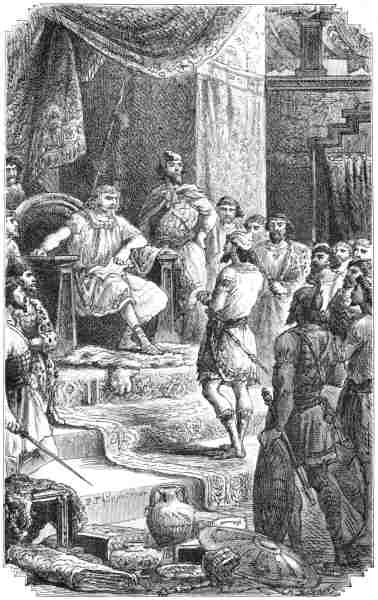
WAITING FOR THE KING TO SPEAK.
To face page 67.
My people having ranged themselves in a line behind
me, I stepped forward and prostrated myself at the foot of
the dais; then rising, I stood with folded hands, waiting
for the King to speak. He began by bidding me welcome,
and proceeded to ask whether our voyage hither had been
prosperous, and made numerous inquiries after the welfare
of the kings of Tyre and Sidon and their subjects.
Expressing his satisfaction at the tenor of my answers,
he called for King Hiram's letters to himself. I handed
the sealed papyrus to one of the officers, who presented it
open to the King. The King perused it deliberately, and
turning to me with a kindly smile, said:
"Mago, son of Maherbaal, I rejoice to see you. Who
are these that you bring with you?"
One by one, I introduced my companions.
The King expressed his approval at seeing Chamai and
Bichri amongst my followers, and said:
"I like my younger people to travel; it gives them
courage, as well as wisdom and experience. I am glad, too,
that your soldiers are under the command of Hannibal;
he is an able leader; I remember him well. And now," he
continued, "Jehoshaphat the recorder shall prepare you a
catalogue of the materials which I require you to procure
and I leave it to your own discretion to purchase, in addition,
whatever else you may meet with that is curious or
rare. It remains for me to inquire what are the supplies
you need before you start."
I explained that I was anxious that forty experienced
men should be added as recruits to Chamai's force, and
that a sufficient store of corn and wine and oil, and other
things that would not be the worse for keeping, might be
provided to maintain us on our voyage.
"Just and fair are your demands," replied the King.
"Joab shall choose you out forty men, whom Chamai and
Hannibal may command, and my treasurer shall hand you
over the money needed for their pay. Ira shall take you
to the storehouses, and you shall be at liberty to select
what stores you please; he will provide you also with asses
to convey them to the ships. You have only to say what
you require, and it is yours."
Again I prostrated myself before the King in token of
my gratitude, and requested him graciously to accept the
presents that I had been commissioned to deliver. He
seemed highly gratified, and inquired with the liveliest
interest about the history of each gift, as it was shown him;
he then rose, and bade us follow him into an adjoining
room, where wine was prepared for us. He insisted upon
drinking from the cup which I had just given him, and
when he had taken his seat again upon his throne, which
had been brought in after him, he honoured me still further
by asking me about the various countries I had visited.
His curiosity seemed wakened by my replies, and amongst
other things, he asked me whether peacocks and asses were
not found in the West. I informed him that they came
from Ophir, whither, subject to his permission, I contemplated
making a voyage upon my return.
"You are a dauntless man," he said, "to talk about a
second voyage before you have accomplished a first. I
admire your courage, and confess that Hiram has done well
in choosing you for this undertaking. I want now to show
you the site of the temple that it is in my heart to rear."
With a tread elastic as a young man's, the King conducted
us from the palace to an adjacent hill upon which
was a threshing-floor. The name of the hill was Moriah.
"I have just bought this threshing-floor and some oxen,
for fifty shekels of silver, of Araunah the Jebusite," he said;
adding, "to my mind, the spot is adapted equally for a
temple or for a fortress."
Hanno remarked, "I have heard it said that the King
has taken more fortresses than he has built, and that his
sword is the best stronghold of his people."
"You are a flatterer, scribe," said the King, smiling;
"nevertheless, I believe that bold hearts do more to defend
their country than any masses of piled-up stone."
"Then I am no flatterer," rejoined the scribe; "I do
but echo the King's own sentiments. Happy the people
whose pride and confidence are in their King!"
"If you use such silvery speech to women," replied the
King, "you must ultimately marry a princess."
Hanno coloured: the King laughed, and turning to me
said that I had an excellent scribe.
"Ah, my lord and King," said Hanno, "we are going
where eloquence can avail us nothing. The winds and
waves of the Great Sea will not listen to the smooth speech
of Canaan. The barbarians of the West will demand a
language of a rougher, sterner sort. Compliments will not
move the men of Tarshish."
The King was evidently much pleased with Hanno, and
told him that he should be gratified if he would bring him
back a written description of whatever he might see in
the course of his voyage; he further inquired whether he
had any of his own compositions with him. Upon this,
Hanno handed him a little scroll inscribed with some verses
he had written in praise of a lady. After the King, himself
a poet of the highest order, had admired the flow of the
lines, and commended the beauty of the handwriting, he
presented Hanno with a copy of some of his own poetry.
"There is another poetry," said Hanno, "of a severer
style, which the King has written in the valley of Rephaim,
and on many another battle-field: I fear he cannot give
us that."
In an instant David took the sword from his armour-bearer's
hand. "Here," he said, "is the pen that wrote it.
Take it; it may give you the power to write verses of the
character that, in the valley of the giants, I have made to
the honour of my God."
"The King's word is a prophecy," said Hanno, kissing
the blade; "be it my care that it comes to pass!"
We had now to take our leave of the kind and courteous
King, and I went with Ira direct to the storehouses, whilst
Hannibal, Chamai, and Bichri followed Joab.
The chief storehouse is a long brick building approached
by a paved pathway lined with sycamines; it is built in
the Phœnician style over a water-tank, and is flanked
by the stables for the royal chariots and the meadows for
the horses and other cattle. Hanno had prepared a list,
of which a duplicate copy was written for the King: the
items were a hundred measures of grain, fifty measures of
oil, fifty measures of wine, equal quantities of cheese, figs,
and dried grapes, and two thousand shekels of dry salt
meat: to these were added salt, beans, lentils, and dates,
Ira undertaking that asses, with drivers, should be ready
to convey them all to the ships on the following morning.
King David is renowned for generosity; and on our return
to Ira's house we found that several of the royal servants
had arrived before us, bringing various presents for us all.
For myself there was a shield, a lance, a dagger, and an
Egyptian battle-axe; for Hannibal, a sword and a mace
of Chaldean manufacture; for Bichri, a bow and quiver
and an archer's belt; while for Hanno there was another
sword, in addition to the one he had already received.
Towards evening Hannibal returned, bringing word that
he had completed his number of men; Jehoshaphat also
came to bring me the King's final letters of instruction.
On rising the next morning I found the street outside
the house crowded with asses and their drivers, the beasts
being laden with the heavy packs containing our supplies;
we had therefore nothing further to do than to take leave
of our host. I gave him two phials of royal perfume for
his wives, and without further delay we took our departure
for Joppa.
Our return journey was unmarked by any special incident.
From time to time Bichri gave us proof of his
dexterity by using his new bow to shoot partridges and
other birds while they were on the wing, and Hanno (with
his sword passed through his girdle in Jewish fashion) was
as gay as ever, beguiling the time with cheerful songs.
"Every one owns King David as a prophet," he repeated
more than once; "and as I have David's sword, I should
think I might conquer the world."
"I hope you do not intend to kill King Pharaoh," said
I, rather startled at his martial enthusiasm.
"Pshaw!" he replied; "my mistress is Ashtoreth, queen
of sea and sky! She can laugh to scorn Pharaoh and
Bodmilcar, both alike!"
Bichri interrupted us by bringing a partridge he had just
brought down. "Can you tell me, captain," he asked,
"whether there are any vines in Tarshish?"
"To the great regret of our Phœnician colonists," I
answered, "there are no vines at all."
"It may be a good thing then," he rejoined, "that I
have brought some cuttings with me. The climate is
warm, even as our own, and who can tell whether ere long
they shall not be producing wine as good as ours?"
"An excellent venture of yours, archer," I replied; "I
wish your foresight all success."
The tower of Joppa and the masts of our vessels were
hardly visible in the distance before we espied Abigail
advancing towards us. Chamai alighted from his horse,
and received her with a warm embrace.
"What news?" said I, hurrying forward.
Learning that all was well, I left the young people
together, and made my own way down immediately to the
beach. The first person that I saw was Barzillai, who
informed me that the eunuch had not been into the village
since my departure, and that no one had attempted to hold
any communication with the Ionian lady. Very shortly
afterwards, Hamilcar and all the rest, including Bodmilcar,
came to greet me on my return, and we proceeded at once
to embark the supplies that we had brought. I put all the
fresh recruits on board my own galley, thus making up my
full complement of 210 men; namely, 50 rowers, 70 sailors,
80 soldiers, and 10 officers.
While the drivers were assisting my own people to
unlade the asses, one of them, a man of gigantic size and
stature, stalked up to me, swinging his arms, and stood
looking at me with a fixed and steady gaze. His appearance
was remarkable; his short bull-neck was imbedded,
as it were, between his immense broad shoulders, and
he had long shaggy hair that hung close over his brow
and was met by a thick beard that grew almost up to
his eyes.
"Do you want me?" I asked.
In a stentorian voice he answered, "I am Jonah, of the
village of Eltekeh, in the tribe of Dan."
"Well, what of that?" I said.
"I want to go with you: I want to go where the wild
beasts are."
"But what for; what can you do if you get there?"
"I want to go," again he growled.
"But you can do nothing; what is the use of taking
you?"
"I want to go," he still persisted.
Puzzled in my mind, I asked him whether he could in
any way make himself of use on board a ship.
"I am strong," he said; "I am a descendant of
Samson; I can carry an ox upon my shoulders, and I
can blow a trumpet;" and as he spoke he struck himself
heavily in the chest.
Hannibal, who all this while had been scanning the man
with the eye of a connoisseur, observed: "I don't think we
shall find a cuirass big enough to fit the fellow; but he
looks as if he mightn't be a bad trumpeter;" and turning
towards him, he said: "Now look here, man; I have a
good trumpeter already; but if Captain Mago will allow
it, I should like to have a trumpet-match, and see which of
you can blow the best."
Of course I had no objection to allege, and Hannibal's
trumpeter was summoned to the spot. A huge clarion was
fetched from the stores and handed to Jonah, and thus
the rivals were brought face to face in the middle of a
circle of curious listeners.
"Blow away, my men," said Hannibal, "as hard as you
like!"
Both raised their instruments to their lips, and simultaneously
gave forth a series of strong, clear notes, which
waxed louder and louder, as the performers, with necks
outstretched and inflated cheeks, seemed to grow warm to
the work. After a considerable time, during which neither
appeared to have much superior power, the eyes of
Hannibal's trumpeter began to start painfully from their
sockets, and he showed symptoms of evident fatigue; whilst
Jonah, although the veins of his neck were swollen as large
as one's finger, continued to give forth notes that almost
split our ears, and which seemed still louder in contrast
to the enfeebled strain of his competitor. At last, when
full fifteen minutes had elapsed, Hannibal's herald gave
one prolonged and plaintive note, and sunk down upon
a stone, breathless and exhausted. Jonah, without exhibiting
any sign of distress, stood with his hand upon his
hip, and raising his trumpet high into the air, gave vent
to a loud triumphal flourish.
"Enough, enough!" we shouted one and all.
"Bring out the very largest scarlet tunic that we have
on board," said Hannibal; "the fellow has gained his
day."
"Then may I go?" asked Jonah.
Hannibal made him understand that I had given my
consent, and told him to put on the tunic. While he was
endeavouring to fasten the garment, which seemed ready
to burst out at every seam, Himilco walked round him, and
surveyed him with a puzzled air.
"I should like to see inside the rascal," he said; "I have
never heard such lungs."
"I am thirsty," roared the giant.
A great cup of wine was handed to him; he drained it
at a gulp.
"Do you call that a draught?" he asked. "I should
give as much to my little children; can't you let me drink
from a pitcher or a cask?"
Himilco refilled the cup, and handed it back to Jonah.
With an air of wonder, that almost amounted to terror, he
muttered to himself, "An extraordinary fellow, but it will
cost us something to keep him!"
When we had embarked all our goods, we took leave of
Barzillai and his wife. The Ionian bade a most affectionate
farewell to Milcah, who had treated her with the greatest
kindness and hospitality. Abigail was the last to leave
the shore, and when she did so, it was with a look, long
and lingering, towards her native mountains.
By the following evening we had rounded the point of
Pelusium, easily distinguished from the surrounding lowland
by its rising grove of palms. The sea was rough, and to
many on board the consequent sickness was very trying.
Towards noon next day we came in sight of the troubled
waters caused by the outflow of the Nile.
CHAPTER V. PHARAOH ARRIVES TOO LATE.
We
shortly hove in sight of what is known as the Tanitic
mouth of the Nile, beyond which, in the distance, could be
discerned the tall obelisks of the City of Tanis. The deposit
brought down by the river itself, combined with the
action of the wind and surf upon the two headlands of
the bay, has a perpetual tendency to block up this outlet
of the Nile; and when the Cabiros, which had been sent
on ahead to explore the bar, returned with the intelligence
that the water was too shallow to permit a safe passage
to the Melkarth, I determined to push on a little further to
the Mendezian mouth, which is considerably wider, and
which leads, moreover, direct to Memphis. Night was
coming on, so that I would not venture to stem the somewhat
rapid current of the river in the dark, but brought my
ships to anchor within a bowshot of the shore.
Hazael came to me and asked permission to pass the
night with his friend Bodmilcar. I was equally surprised
at his request, and at the submissive manner in which he
made it; but after ascertaining that the Ionian was in her
cabin, and that Abigail was with Chamai on deck, I allowed
him to go.
Remembering that we had arrived at a land of strangers,
with whom hitherto we had held no communication, I
doubled the watch, and gave Hannibal special directions
to keep a sharp look-out. The order in which our ships
were arranged was this: on the right, furthest to the south,
was the Cabiros; the Ashtoreth was moored to some piles
about half a bowshot behind; the Melkarth and the Dagon
were stationed on the opposite bank, where the water was
deeper. One of the small barques was with me, the other
with the Melkarth.
Anchored higher up the river were several Egyptian
vessels, and a considerable number was drawn up upon
the shore. I wondered why there should be so many at a
spot where there was no regular anchorage, but I subsequently
learnt that Pharaoh was about to send forth a
squadron for the purpose of putting down a revolt that had
broken out at Pelusium. Two officers, accompanied by a
troop of soldiers, some armed with battle-axes, and some
with bows, had already boarded my ship to inquire who
we were and what we wanted, and had retired satisfied
with my explanation. As the shades of night deepened,
we could observe the lights of two galleys cruising about in
the open channel, and shortly afterwards another Egyptian
came on board and ordered my own lights to be extinguished,
a direction which was instantly obeyed.
The night was intensely warm, and the scorching east
wind, laden with the sand of the desert, blew from time to
time in dry and unrefreshing gusts. The sky was overcast,
and although the night was not black it was so dark
that little could be distinguished except the gleam from
the fires of a large camp pitched on the right bank, and the
inconstant lights of the distant villages on either shore.
Close in front of us were still burning the torches of the two
galleys I have mentioned; but besides these, there was only
the occasional flicker from some little boat that moved
upon the stream.
Towards midnight, five or six hours after our anchoring,
I resigned my watch to Himilco, intending to take some
rest. On my way to my berth I cast my eye towards the
right bank, and through the gloom I could see indistinctly
that there was a crowd of vessels there; but
everything was silent, and I went below.
I had not been asleep for more than a half-an-hour when
I was roughly aroused by Himilco.
"We are adrift!" he exclaimed.
In an instant I was upon my feet, and rushed to examine
our moorings. They were cut asunder.
"All hands on deck! lights! light the lamps!" I cried
with all my might; and at the same time I noticed lights
appearing on the left, and heard a distant voice hailing the
Ashtoreth with the cry, "Our moorings have been cut, and
we are all adrift." I shouted in reply that they should
come over to us; it was only too evident that another of
our ships was in the same dilemma as ourselves.
Meantime my crew had come on deck, and had lighted
several signals. I ordered the rowers to their benches, and
made them backwater gently so as to keep us steady until
the other ship should join us. At the distance of about
four bowshots behind, I made out the Cabiros hoisting her
lights, and could hear the voices of the crew in great excitement.
Almost immediately there was a splash of oars,
and the Dagon came alongside of us. I shouted to
Hasdrubal, who was standing on board:
"Where's the Melkarth?"
Getting no satisfactory reply, I immediately ordered the
three ships on to the left bank. The Dagon went straight
across the river; I followed, taking an oblique course, and
the Cabiros, hastening ahead, went a little way south, and
then turned back due north, keeping as close as possible
to the shore.
During the time we were getting across, Hannibal had
just put all his men under arms, as it occasioned us much
surprise that while there was this commotion amongst ourselves
the Egyptians had made no sign nor sound; their
lights were out, and their cruisers no longer to be seen.
The Cabiros rejoined us, and reported that she had seen
nothing; nor even after we had descended the river a
couple of stadia was a single Egyptian vessel visible, and
it was not until we were within hearing of the roar of the
waves at the river's mouth that we almost ran against some
black mass that loomed through the darkness.
"Back to your moorings, Phœnicians! no leaving the
river at night!" shouted a voice, in Egyptian.
"We don't want, I can tell you," I replied, "to be
running away like a set of thieves. We have been cut
adrift, and one of our ships has disappeared."
"Then get fresh moorings," was the answer: "you must
wait till morning. By Pharaoh's orders, you cannot leave
to-night."
There was no help for it but to obey; and sending some
men on shore in the small boat with torches, we succeeded
in finding an anchorage. But scarcely had we settled in
our places, when our attention was arrested by a voice from
the middle of the river gasping out in Phœnician, "Help!
help!"
We put off a boat in the direction of the sound; the cry
was repeated still closer to us, and in a few minutes the
boat returned alongside, and one of my sailors, dripping
with water, was hoisted on to the deck of the Ashtoreth.
He was in a pitiable condition, his face all bleeding, and
his head gashed open in several places.
"Treason, treason! we are betrayed by Bodmilcar!" was
all he could utter, as he staggered and fell senseless on the
deck. I ordered him to be laid upon a piece of carpet,
whilst Abigail chafed his face with ointment, and Himilco
put some wine to his lips. I had ascertained quite enough
to put me on my guard, and consequently had our lights
extinguished, permitting only one lamp and one torch to
each ship: and I gave directions to the watch to keep a
keen look-out.
Meanwhile the poor fellow had recovered his consciousness,
and Hanno, Hannibal, Himilco, Chamai, and myself,
pressed round him to gather what he had to say. One
of our sailors supported his head to facilitate his power of
speech, and Abigail and the Ionian knelt beside him, with
the wine and ointment.
"I went this evening," began the man, "to visit a friend
of mine on board the Melkarth. You know the crew are
nearly all Tyrians. Bodmilcar has tampered with them
all. He has had an interview with Pharaoh's general, and
told him that you are spies in league with the insurgents
at Pelusium; he said, too, that you had a slave on board
your ship, whom he was bringing to Pharaoh, but who
had escaped. His people urged me to join the conspiracy,
and when I refused they all threatened to kill me. I
jumped overboard. An Egyptian boat pursued me. I
was twice struck on the head by an oar. I dived beneath
the water. I suppose they thought I had sunk; as they
gave up the pursuit. Orders have been given to seize us
all to-morrow. We are to be attacked in the morning, and
carried off to Pharaoh. I can tell no more."
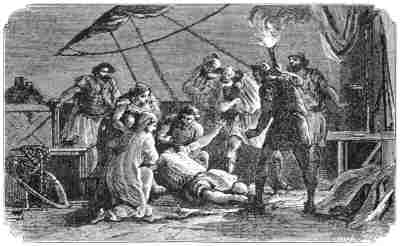
The exertion of telling all this had been too much for
the brave fellow, and he fainted away again. My first
impulse was to rush to my cabin for the King's letters, but
to my amazement they had all disappeared; they had
evidently been stolen during my absence at Jerusalem.
We were overwhelmed with consternation. Hanno was the
first to speak:
"All is plain enough," he said; "Bodmilcar is the thief.
Hazael, you know, has the King's signet ring; and the
rascals have opened the papers, altered their purport, and
closed them again with the royal seal. Bodmilcar has
carried them and presented them; he represents himself as
leader of the expedition, and denounces you as a traitor.
He gets believed: and what is the result? why, sure as
fate, we shall be made prisoners, and only too likely we
shall be put to death. Abigail, of course, will be sent to
Pharaoh."
"Not while I have a sword to defend her," said Chamai,
stamping with rage.
"Yes," continued Hanno, coolly; "no doubt Abigail
will be handed over to Pharaoh, and the fair Chryseis
will be awarded to Bodmilcar as a recompense for his
service."
Hanno groaned aloud, and Hannibal furiously twirled
his moustache.
"I have no doubt, Hanno," I said, "that all your conjectures
are right. But it's rather soon to despair. Perhaps
you haven't been with us old mariners long enough to learn
our seamen's song about the Egyptians?"
I began to whistle an air, and Himilco, with a merry
laugh, broke out with the gay refrain:
"The bull-head tribe, with all their skill,
Must catch the man they fain would kill."
The effect was instantaneous. My whole party almost
smothered me in their delight. Hanno threw himself at
my knees and grasped one of my hands; Abigail seized the
other, and covered it with kisses; Hannibal caught hold of
my cuirass on one side; Chamai lugged at me on the other.
Altogether, I was in a fair way of being strangled. The
Ionian, who partially comprehended my meaning, could
only express her gratitude by the bright glance of her soft
eyes.
As soon as I had extricated myself from the embraces of
the enthusiastic group, I pointed out to them a confused
mass of Egyptian boats, now just visible in the dawn.
"If there were only half-a-dozen of those fresh-water
tortoise-shells," said I, "our three ships could soon show
them the way to the bottom of the Nile; but there is such
a lot of them! Besides, they have forces on land, and
the river isn't wide enough for us to get out of their reach.
Bodmilcar, too, will lend them a helping hand, and he is an
old stager; his ship, it is true, is not much in fighting trim,
but it is manned with Tyrians. However, we mustn't give
up! Patience! Trust yourselves to me!"
"Yours we are to the death!" cried Hanno; while
Hannibal, with his teeth set, growled out, that if any one
disobeyed my orders it should be the worse for him.
Chamai, almost beside himself with excitement, clasped
Abigail in his arms, and vowed he would bring her the
head and spoils of the first foe he should meet, even if it
were Pharaoh himself.
Hamilcar and Hasdrubal, with his pilot Gisgo, now came
on board for my orders.
"I never trusted that Tyrian," said Hamilcar; "and I am
glad to have the chance of fighting it out with him; and my
men are as delighted as myself."
"Ha, ha! Himilco," laughed Gisgo the earless, "we shall
have some sport now."
"Yes, old Celt," replied Himilco, "we will teach the
rascals to swim."
I shook hands heartily with all three men, and they
returned to their ships. It was now broad daylight, and
casting my eye towards the river, I reconnoitred the
enemy's position. Below-stream the Egyptian galleys
were under way; opposite to us, on the left bank, were
about forty small boats, each manned with four rowers
and five soldiers, and a troop of nearly a hundred bowmen
were assembling hastily on the right-hand shore. Looking
up-stream, I could count as many as six galleys about two
stadia away; two large heavy ships, with hanging decks,
were sailing down the left bank; and mid-channel I
recognised the towering sides and rounded prow of the
Melkarth, her oars shipped, and her sails furled, being
towed by a low, open rowing-boat. The camp, of which
we had noticed the fires in the darkness, was much too
far off to be visible by daylight. The shore on either
side was perfectly flat and treeless, but covered with fields
of clover and of corn that was nearly ripe, as the harvest-time
was drawing nigh. On the left bank, about two
bowshots from the water, a steep dyke, surmounted by a
causeway, had been thrown up as a protection during the
annual inundation. Far away to the south, the white
buildings of a city could be distinguished; and in the north
could be seen the yellowish-whitey waters of the river bar,
with the broad green surface of the sea beyond.
We were hardly six stadia from the mouth of the river;
the strong east wind and the current were both in our
favour, and once out at sea we should have little to fear. I
determined, therefore, to make an attack upon the Egyptians
before the Melkarth could get ahead of us, for I knew that
once in front of us, her very bulk would be a formidable
obstacle to our retreat, and that she could overwhelm
us with a storm of missiles; while the superior height of
her deck would not only prevent our men from boarding
her, but, on the contrary, would give her men every facility
for boarding us.
My first manœuvre was to slip my moorings, and to
take up my position in the middle of the channel, so as to
be out of reach of the archers on the shore. The Dagon
had shifted her prow to the north, and lay half a bowshot
below me; the Cabiros was to my left, her prow southward.
The sails were all furled, the rowers were ordered
to backwater very gently so as to just keep the vessels in
their places, and each pilot took his stand by the side of
the helmsman. Hannibal posted his archers fore and aft,
and grouped his soldiers round the mast. Hanno and
I mounted the prow, and my trumpeter followed. The
gigantic Jonah remained with Hannibal; he could not be
persuaded either to put on a cuirass or to take a lance, but
stood, clarion in hand, watching all our preparations with a
curious eye.
The scorpions had already been supplied with missiles,
and each vessel was provided with a number of earthenware
pots filled with sulphur and pitch. We improvised,
also, a quantity of fire-ships, formed of small planks, into
which spikes were driven, to which were fastened well-greased
goat-skins charged with combustibles.
We had not long to wait. Very soon were heard the
shrill notes of the small Egyptian trumpets, and the decks
of the ships were seen manned with troops. I could
discern the smooth brown faces of the soldiers, and make
out that they were armed with battle-axes and large
triangular shields; and I could see that the archers, with
their legs bare, and poignards in their girdles, were ranged
along the sides of the ships. The rowers, more than half-naked
(clothed merely by a strip around their loins), plied
their paddles, according to their custom, standing. On
board the Melkarth, Bodmilcar was easily distinguished;
he was in a state of great excitement and activity, and
apparently giving some explanation to an Egyptian officer,
a man dressed in green and wearing a large wig, with his
face and arms painted with cinnabar, in accordance with
the common fashion of their men of rank.
The soldiers that manned the small boats were nearly as
slightly clad as the rowers; they carried poignards in their
girdles, and were armed with axes and staves pointed
at both ends, in the use of which the Egyptians are
notoriously skilful. Although all appeared in considerable
commotion, not one of the vessels made any attempt to
advance, and there seemed a general state of expectation.
The solution of all this was soon apparent. A large
boat was seen to detach itself from the general mass, and
make its way down-stream towards us. Eight rowers
stood paddling on the raised bow and stern; twelve
soldiers, with square plates of bronze strapped on their
breasts, and armed with lances, daggers, and short scimitars,
were in the middle; and amongst them was an Egyptian
officer of high rank. He was arrayed in two tunics of
striped gauze, crossed one over the other upon his breast;
a girdle ornamented with enamel plates was round his
waist, and a large gold and enamelled bird with outstretched
wings was suspended by a gold chain from his
neck. His head was covered with a tall cap, bearing an
enamel plate inscribed with the name of Pharaoh in
hieroglyphics; his beard was enclosed in a casing of red
cloth; and in his hand was a gilt battle-axe, elaborately
inlaid with figures of animals and other symbols. On one
side of this sumptuous personage was a closely-shorn
priest or scribe, habited entirely in white, and holding an
inkhorn and some papyrus in his hand; on the other,
in full Syrian armour, was our old friend Hazael. I could
not resist a smile as I caught sight of a pile of chains and
manacles lying in the boat.
On the Egyptian officer shouting that he wanted to
come on board and speak to me, I gave permission for his
boat to come alongside the Ashtoreth, and, followed by his
scribe and five of the soldiers, with the greatest arrogance
he stepped on deck. Hazael had the discretion to remain
behind, where he was. I received the magnate with all
courtesy, and saluted him after the fashion of his own
country, but instead of acknowledging it in any way, he
began with the most overbearing insolence to exclaim:
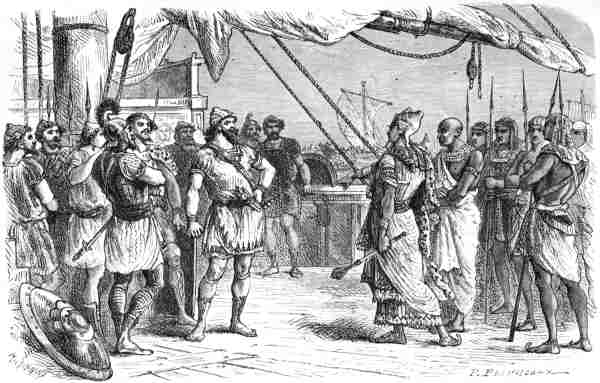
"DOWN, YOU PHŒNICIAN THIEVES!"
To face page 85.
"Down, down, you Phœnician thieves, and sue for
Pharaoh's mercy!"
Finding that such was the tone he took, I answered
sternly:
"No thieves are we, nor have we injured Pharaoh; so
far from imploring Pharaoh's mercy, we have a right to
demand Pharaoh's protection."
"Out upon your falsehoods!" retorted the enraged
Egyptian; "have you not this very night been attempting
your escape?"
"No," I said emphatically; "we were cut adrift. The
real thieves are amongst you. That rascal Bodmilcar and
that vile eunuch stole the royal letters that they brought to
you."
"Silence!" shouted the Egyptian in impetuous fury;
"too well we understand your frauds. Out with your
hands! the handcuffs are ready here, and you and the
slave that you have stolen must come along to Pharaoh.
Never fear but ample justice shall be done!"
The scribe was opening his inkhorn for the purpose
of taking down our names, when I burst out into a roar of
laughter.
"Do you take us for fools?" I said; "why on earth
should we leave our ships to go and hear a slanderous
catalogue of lies alleged against us? No, no, sire, we
remain where we are."
The Egyptian literally stamped with rage. "Villains!
pirates! thieves!" he cried; "every one of you shall die a
death of torment."
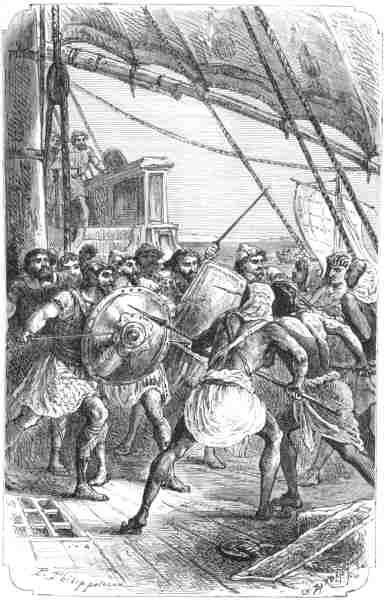
THE SOLDIERS RAPIDLY CROSSED THEIR LANCES.
To face page 86.
Throughout this interview I had taken care never for a
moment to lose sight of the fleet above-stream; and seeing
that the ships were now in motion, without paying the
least regard to the continued ravings of the grand official, I
ordered my trumpeter to sound an alarm. The Egyptian,
followed closely by his scribe, hurried towards his boat;
his soldiers, to cover his retreat, rapidly crossed their lances.
Chamai, Hannibal, and Hanno, mistaking the movement,
and supposing they were making an attack on me, fell
upon them with drawn swords; and the huge Jonah,
throwing down his trumpet, rushed into the fray, and
wresting a lance from one of the soldiers' hands, took him
by the shoulders and dashed his head twice or thrice
against the side of the ship. It is a popular belief that the
Egyptians are a hard-headed race, but I avow that this
fellow's skull cracked like a ripe water-melon.
Meanwhile, Hannibal had cut the throat of another of the
soldiers, and Chamai had plunged his sword into the body
of a third. I was struggling to wrench the lance from the
grasp of a fourth, when taking alarm at the number of
my men, he turned about, and following the example of
his sole remaining comrade, sprang overboard and swam
like a frog. But they were not to escape so easily; Bichri,
who was standing near the wale of the vessel, hit one of
them with an arrow, and the rowers stunned the other by
blows with their oars. Thus the whole five were entirely
disposed of; but the real conflict was yet to come.
As soon as the Egyptians were aware of the fray, one
of their galleys from the right bank drew rapidly towards
us, and the whole bevy of small boats that had gathered
round kept up a continuous flight of arrows, every one of
which, however, either stuck in the ship's side or went
whistling over our heads.
A single glance was sufficient to reveal to me the
enemy's tactics. Just as I had anticipated, the Melkarth
was being towed down the stream towards the right,
obviously with the design to pass us and get below, so as
to cut off our retreat. Their immediate design was to
divert our attention from this manœuvre, and for this
purpose two large ships were ordered to bear down upon
us, and a flotilla of small boats was sent to keep up a storm
of arrows. Hannibal immediately, by my directions, set
his catapults to work, and a volley of stones and pots full
of pitch and sulphur was discharged, right over the Cabiros,
on to the approaching vessels. I then ordered the Cabiros
and the Dagon to move simultaneously, right and left of
me, but in opposite directions: the Cabiros northwards towards
the galleys that were obstructing our way, the Dagon
straight down upon the boat that was towing the Melkarth.
I could see Bodmilcar upon the prow of the great gaoul,
wildly endeavouring to make the Egyptians understand
their danger, and urging the rowers to get their oars into
the water; but he was too late. Our movements had
taken them completely by surprise. The Dagon, cutting
her way full speed through the crowd of small boats,
crushed or capsized all that came in her course; the Ashtoreth,
liberated by the departure of the Cabiros, effectually
kept in check the ships that were trying to pass down
the stream; and the Cabiros, that had gone northward, by
sending out a number of fire-floats that drifted on in
advance, completely discomfited the two galleys that were
guarding the mouth of the river.
Our tactics were a perfect success. One of the Egyptian
ships was run into by the Ashtoreth with such violence
that it was cut asunder, and sank immediately; and the
other, harassed by the pots of combustibles, and alarmed at
the eddy caused by the foundering of its consort, purposely
ran aground. The Dagon, after staving in the towing-boat
like a piece of rotten wood, had returned to me; and as we
had the satisfaction of seeing Bodmilcar's crew cut their
tow-rope, we both turned our attention to the galley which
was retiring from the attack and falling back upon the
Melkarth. Simultaneously passing it quite close, one on
each side, we swept off both its tiers of oars, and hurling
down upon it a final shower of arrows, we filed off to join
the Cabiros, which was still engaged in discharging its
missiles and fire-floats at the other two galleys.
The contest had been sharp but short. In less than
an hour we had rendered the Melkarth incapable of
action; had sunk two Egyptian vessels; had sent a third
aground; and had crushed or capsized at least fifteen
small boats.
The surface of the water was covered with the débris,
and not a few men could be seen drifting along in the
current. Thrown into utter confusion by our unlooked-for
attack, the rest of the Egyptian vessels floundered about in
each others' way, and totally prevented the Melkarth from
obtaining another tug-boat. Finding, therefore, that those
need give me no concern, I gave my attention to the galleys
in front, and sent adrift a dozen or more fire-floats, which
the crew of the Cabiros sent down-stream with their boathooks.
The galleys gave way; and, feeling that there
was no immediate impediment, I proceeded towards them
calmly to the north, leaving our assailants confounded by
their disaster, and Bodmilcar raving furiously on the poop
of his helpless ship. Bichri lamented that he could not let
fly an arrow at him, but it was utterly useless, as we were
already too far away.
"A drawn battle!" said the brave archer, coming forward
from the stern.
"Yes," said I; "the rascal has had bad luck this morning;
but he will watch his opportunity. We haven't done with
each other yet."
"I hope not," said Hanno, vindictively.
Presently there was a movement among the Egyptian
ships, and three of them, having extricated themselves from
the maze of confusion, had commenced a pursuit of us,
accompanied by a number of little boats. At the same
moment I espied a troop of horsemen galloping along the
shore; and raising my eyes to the causeway on the top
of the dyke, I observed a cloud of dust, from the midst of
which broke ever and again the gleam of a row of bronze
and gilded chariots. There was no room for doubt;
evidently the King himself was approaching with the intention
of being a witness of our capture.
But the mighty Pharaoh had come too late!
Out of forty or fifty fire-ships which we had set afloat,
two at last had run foul of one of the galleys, which was
now in flames, and the terrified crew were fain to resort to
the usual naval manœuvre of the Egyptians, and run their
ship aground. The vessels that had started in pursuit of
us were still at least two stadia in our rear, so that we had
ample time to tackle with the single galley that remained
ahead to bar our progress.
"Board her! board her! Let us board her!" shouted
Hannibal, Hanno, and Chamai, with unanimous accord.
"We have no time, and she's not worth the trouble," I
replied; "we will sink her."
"Down she goes, then, like a stone," cried Himilco.
The Cabiros, without meeting with any resistance beyond
a few chance stones and straggling arrows, now slipped
quietly under the very prow of the galley, and with
unfurled sail was making off to sea. The Dagon was
about to follow her, but at a signal from me, Hasdrubal
bore down upon the galley's stern, whilst I simultaneously
drove straight against her flank, and between us we literally
cut her in two. Down sank the galley in a whirlpool of
foam; and our last obstacle being thus removed, we hoisted
our sails and rode out to sea, our trumpets sounding out a
flourish of victory.
Behind us rose a discordant howl of maledictions. We
were out of reach. It was utterly impossible for our
enemies in their little nut-shells of vessels to follow where
our victorious prows were now cleaving the foamy billows;
and when we were fairly out at sea, steering due west, I
could see, as I looked along the low flat coast, that the
Egyptian masts were quite motionless. It was evident,
therefore, that Bodmilcar had advised them to abandon
their pursuit.
Fifteen of our men were wounded, nearly all of them
slightly, and two had been killed; whilst the loss of the
enemy, including those slain by the archers, burnt by the
fire-ships, or drowned by the waters of their own sacred
Nile, must have been nearly three hundred.
It did not take long to repair whatever damage we had
sustained. Some broken oars on board the Ashtoreth, and
a few more on board the Dagon, were replaced from the
reserves; the decks were washed down, the stays strengthened,
some broken ropes spliced, and the arrows that had
lodged in the rigging and ship's sides removed. All our
wounded had been carried below; and the bodies of the
three Egyptians, having been stripped of any spoil of value,
were thrown overboard. The bodies of our own two men
were also committed to the waves with an invocation on
their behalf to Menath, Hokk, and Rhadamath, the judges
of the infernal regions[30]. In less than three hours everything
was as much in order as though nothing had happened.
Chryseis and Abigail, who had all along rendered what
assistance they could, were rejoicing in their freedom;
Hanno, whose nerve had never failed him, and Chamai
fully sharing in their delight.
I sent for Hasdrubal to come on board, that he might
join Himilco and myself in a council of war. When we
were alone together, I said:
"Listen to me. There is no shadow of doubt that we
shall be pursued. Ascending the eastern outlet of the
river, the Egyptians will come down by the western; they
may come either by the Canopic or Phanitic branch; and
at both Pharos and Canope there is no question but that
the King has ships in readiness. They can anticipate us
there; couriers by land can arrive by early morning; we,
with our utmost speed, could not arrive till long beyond
midday. Somewhere or other we must of necessity put in
to shore again; our supply of water is all but gone."
To Himilco's suggestion that we had wine enough to
meet our need, I vouchsafed no other reply than a shrug of
the shoulders, and continued:
"My intention was to take in a fresh supply this very
evening, but this skirmish has frustrated everything. Go
ashore we must; and this is the scheme that I propose;
we will re-enter the river by the Sebennitic mouth, which
is nearest to us now; they will never suspect us of venturing
on land so soon; probably they will not be there at
all; if they are, we must use main force; but water we
must have."
My companions approved my plan, but expressed their
anxiety as to what was to happen afterwards.
"I do not think," I said, "that because we have lost the
gaoul that we need at all contemplate abandoning our
expedition. Failing to find us at either Canope or Pharos,
the Egyptians will watch for us all along the coast; and at
last Bodmilcar, who knows our destination, will get reinforcements
from Pharaoh and will chase us right on to
Tarshish. Sooner or later we shall be pretty sure of falling
in with him; but for the present, at least, we can elude
him thoroughly. Here is my project. The wind is north-east
and favourable; by steering by the sun in the daytime,
and by keeping the Cabiros a little to our left at
night, I do not fear but that in five days at most we might
reach the shores of the great island, Crete."
Himilco and Hasdrubal stared at me in mingled admiration
and surprise.
"From Egypt to Crete! Across the open sea! An
unheard-of thing! Can it be possible?"
Such were the exclamations with which they heard my
proposition.
"Aye, harder things than that may be done," I continued;
"the wind isn't likely to change till next new
moon; but even should it change and we happen to miss
Crete, we shall only run upon the mainland, or on one of
the islands of the Archipelago. Thence we can get round
Cape Malea to Sicily, from Sicily to Carthage, from
Carthage direct to Tarshish. That's our course, now."
"By our goddess Ashtoreth, your scheme is beautiful!"
cried Hannibal; "and meanwhile the Egyptian rascals will
be floundering about the Syrtes."
"And rough enough they'll find them," said Himilco.
"I was well-nigh drowned there two years back; and let
us hope that Bodmilcar and his Tyrian sneaks, bad luck to
them! may come to grief. How I should like to hang
them all like a string of fishes, fastened by their gills!"
We were not long in reaching the little town of Sebennys.
The Cabiros was first sent ashore, and returned with the
tidings that all was quiet. I paid the customary dues to
the Egyptian governor of the place, and despatched a
number of our sailors to procure the requisite supply of
water; they took the opportunity of purchasing several
baskets of onions and some good fresh meat. Before the
end of the day we had turned our backs upon the land,
and were making our venturous way north-west.
"And now, for our dishes and platters," I cried; "I am
frightfully hungry."
We seated ourselves in the stern, and joined by Chryseis
and Abigail, we formed a large and merry group. The
sailors and soldiers all were served with a ration of wine
in honour of the morning's victory.
"I see we have changed our course," said Hanno; "are
we making for Crete?"
"Yes," I replied; and added that I supposed it was a
place already known to the fair Chryseis.
Chamai inquired whether it was not the same as Chittim.
"No, not the same," I answered; "this island is full of
mountains, upon which are goats with spreading horns like
those of Arabia; the people are famous for their skill as
archers."
"Bichri, then, may find his match," said Chamai. "But
to what nation do they belong?"
"They are Phrygians and Dorians," I told him; "fair,
tall men, with handsome faces and well-formed limbs; they
have built towns in which some of our Sidonian merchants
have recently settled, getting there by way of Chittim
and Rhodes. Chryseis speaks the same language as the
Dorians."
Chamai, ever full of interest in Chryseis, expressed his
pleasure at hearing that she was about to go amongst a
people kindred to herself, and was inquiring whether they
were a martial race, when Chryseis interposed, and with
Hanno's assistance explained that the Dorians, like the
Ionians of the Isles, and the Achaians on the mainland,
were renowned warriors, and that the fame of their conquests
had spread far and wide.
"How large, how vast the world must be!" exclaimed
Hannibal; "here is a people, famed in war, whose very name
I scarcely know. But is it not from Crete that we get our
Chalcidian swords?"
Smiling at his mistake, I made him understand that
Chalcidian swords were made of copper from the island
of Chalcis, and that the Phœnicians could not elsewhere
procure copper that would take so fine a temper.
Hannibal went on to ask Hanno to inquire of Chryseis
what were the military tactics of the Ionians, and how they
paid their soldiers.
"Do you expect us women to know such things as
these?" asked Abigail, with a merry laugh; "a woman
knows well enough that her countrymen can fight, and
she knows how to prize the spoils they bring her from the
battle-field; but what can she know of the art of war?"
Chryseis seemed amused at her maid's vivacity, and
proceeded to enumerate the most illustrious military leaders
of her land. I heard her name Achilles, and Ajax, and
a certain king called Agamemnon; and I understood her
to relate that two kings in her country, named Jason
and Ulysses, were renowned for the voyages they had
made.
"Voyages!" cried Himilco, scornfully; "I can guess what
their voyages were: creeping along and hugging the shore;
making perhaps a stadium a day; never looking at a star.
And then, what ships they had! I am glad I haven't to
trust myself in one of them from Sidon to Chittim."
Chryseis owned that, as to ships, she had never seen
anything in her own country that could be compared to
the ships of the Phœnicians, adding that she thought
that the mariners of Phœnicia must be true sea-gods.
"And you must be their goddess," said Hanno, with
enthusiasm.
"Ah, young man," yawned out Hannibal, "you should
put your fine speeches in Ionian; the lady does not
understand you."
The lady, however, bent her head gracefully, and raised
a laugh by saying in good Phœnician that she perfectly
understood what had passed.
"Trust a woman for understanding a compliment," was
Hannibal's remark.
"I should like to see the effect," said Himilco, "of one
of Hanno's pretty speeches upon Gisgo's wife; her Celtic
dialect is something like the croaking of Bodmilcar's
ravens."
It was now getting dark, and as he spoke, Himilco moved
off to his post upon the prow, and I took up my watch
upon the stern. All that night, and all the following day,
the wind freshened till it blew a gale; being all in our
favour, its violence caused me no alarm, but well-nigh all
on board, conscious of being far away from land, and
beholding nothing but sea and sky, were filled with terror;
and as the ship at one moment was carried high upon the
crests of the enormous waves, and at another was sunk
low in what seemed an unfathomable abyss, they became
almost paralysed with alarm; they lost their appetites
entirely, and were incessant in their invocations to their
gods. The gale next night increased to a hurricane, and
on the morning shifted to the south, driving us to the north
at the rate of 1800 stadia in a day.
Happily, although our ships were thus flying over the
sea, they kept well together. Towards evening the wind
dropped a little, and on the morning of the fourth day it
was comparatively calm; the sky was very clear, and, to
our vast delight, the man on watch at the top of the
mast announced that land was in sight. I joined Himilco
on the prow, and both of us could plainly distinguish in the
sunlight the peaks of some snow-capped mountains. By
the afternoon the view of land was plain to every one on
board, and before the stars had risen, we were skirting a
coast that seemed so rocky as to be inaccessible.
It was long past midnight before we could discover any
anchorage at all; at last we found a small exposed bay
where a river coursing along a bottom of white sand
entered the sea. Towards the east, masses of thick woods
could be made out, with snowy peaks of higher ridges
rising up behind them. The Cabiros was hauled up on
shore close to the river's mouth, and, the water in the bay
being found sufficiently deep, the two galleys were moored
to some of the great boulder-stones upon the beach. The
coast was quite desolate, and there was no sign of human
habitation.
CHAPTER VI. CRETE AND THE CRETANS.
No
sooner were the ships safely settled in their moorings,
than Himilco and I, who had both been up on watch
throughout the last four nights, retired to take the rest
that we so much needed, and, worn out by fatigue, I did
not wake until the sun was high above the horizon.
The shore was still quite deserted; the steep rocky
mountains appeared for the most part to rise perpendicularly
from the sea; and the little valley of the river
soon lost itself in a deep gorge, densely wooded with
myrtles and holm-oaks.
My first care was to send a squad of sailors on shore to
fill our barrels and goat-skins with a supply of fresh water;
I next ordered a guard of soldiers and archers to be landed
ready for any emergency; and then despatched Bichri,
accompanied by half a score of bowmen, up the gorge to
explore the mountains. There was abundance of wood
about, and I determined to light some fires and cook our
morning meal upon the strand. I likewise pitched a
couple of tents, in which I laid out some of our merchandise,
in case Bichri should fall in with any of the natives of the
island. Jonah made himself especially prominent by his
services on the occasion; he carried wood enough on his
back to load three ordinary men, and lifted a barrel of
water without any assistance, remarking that, if any one
would give him wine in it to drink, he would lift a barrel
twice the size.
About midday Bichri returned, tired with his wanderings,
but well pleased with his morning's work. He had come
across several of the natives on the mountains; they fled
at his approach, but being an experienced mountaineer he
had followed them from rock to rock, and had at length
succeeded in capturing one of them. The others had
pelted him with stones from a distance, but he had sustained
no injury, and, in accordance with the orders I had
given him, he had acted strictly on the defensive, and had
not in any way returned their violence. The prisoner that
he brought with him was a great strapping fellow, with
a quantity of glossy black hair and a skin as brown as a
Midianite's; his eyes were black and obliquely set; his
face wide, with projecting cheek-bones, and a pointed chin.
He had no other covering except the skin of a wild goat,
which was thrown over his shoulders and fastened round
his waist by a cord, and on his bare neck and arms were a
necklace and bracelets made of shells. A hatchet with
which he had defended himself had been wrested from him
by Bichri; it was made of a highly polished stone of a
greenish hue, and had a strong wooden handle.
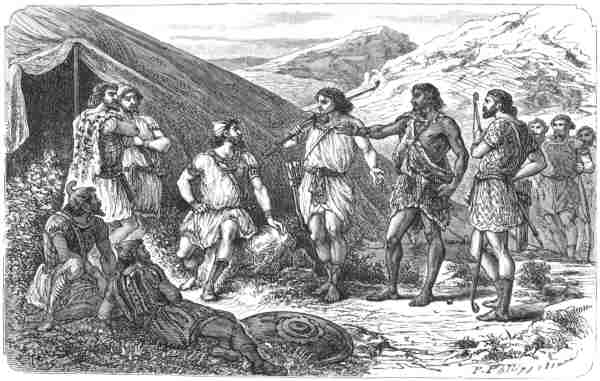
PLEASED WITH HIS MORNING'S WORK.
To face page 99.
As soon as the barbarian was brought to me he began
with many gesticulations to speak in a language of which I
did not understand a word. I restored him his hatchet,
made him a present of a piece of red cloth, and after
showing him the goods in the tent, gave him his liberty.
He bounded off towards the mountains and disappeared
among the trees.
Two hours afterwards he came back with several other
men, half-naked as himself, and armed with lances and
rudely-made bows. When within about a hundred paces
of us, they stopped and waved some boughs of myrtle. I
ordered my men to do the same, and then I advanced to
meet them, making Hanno accompany me, and display
some pieces of red cloth and strings of glass beads.
Gradually the savages gained courage and were induced to
approach, and at last to enter our tent. There was one
of them who seemed to be a sort of chief, and acted as
spokesman; he first pointed to the sky and ejaculated,
"Britomartis;" and then to the mountains, saying "Phalasarna,
Phalasarna." It was evidently not the first time he
had come in contact with Phœnicians, for as soon as he
caught sight of our ships he cried "Sidon! Sidon!" and
touching our tunics, he called them "kitons."
We gave him an old kitonet, and distributed a quantity
of glass beads amongst his followers, who brought us in
return a couple of wild goats, and some partridges, which
they called "hamalla."
Towards evening another of their number, an old man,
came to us; he wore a kitonet under his goat's skin and
had on an old pair of sandals. He could speak a little
Phœnician, and succeeded in making us understand that he
was of the race of the Cydonians, who had been the original
possessors of the island, until the Phrygians and the Leleges
had made war upon them and forced them to take refuge,
east and west, where the mountains were most inaccessible.
The whole of the coast, and the central highland, as well as
the fertile valleys of the north and south, were now occupied
by the conquerors, who had subsequently been joined
by a colony of Dorians, so that, altogether, the Cydonians
were being gradually exterminated. I now comprehended
how it was that I, who had always approached Crete from
the north by way of Caria and Rhodes, had never seen
any inhabitants except Dorians; whilst other Phœnician
captains who had landed on the eastern extremity of the
island—where they had discovered some insignificant
mines, and opened a small traffic in the ore—had always
transacted business with the Cydonians.
The old man likewise informed us that his people had
a town, up in the mountains, called Phalasarna; also that
their goddess was Britomartis, which in their language
signifies "the gentle virgin." He was delighted with the
wine which I gave him; and on receiving, as a present,
a couple of lance-heads and a necklace of enamelled
earthen beads, he promised to get us next day as much
fresh meat as we wanted.
Upon its growing dark, the barbarians retired to their
mountains. Hannibal took the precaution of doubling the
number of his sentinels, but we were quite undisturbed
throughout the night.
In the morning the Cydonians returned and brought
some goats. They are not in any way an agricultural
people, and consequently could not provide us with either
corn or vegetables, but they brought us a quantity both
of wild fruit and wild honey. I showed them a picture of
an ox, and tried to make them know that that was the
animal I wanted them to get me, but they explained that
they had none of their own upon the mountains, and
that such an animal had been quite unknown upon the
island until it was introduced by the Phrygians.
Pointing in the evening to the crescent moon, the barbarians
told me that it was Britomartis, their goddess of
the chase. Chryseis said she knew this goddess by the
name of Artemis, from which I drew the inference that
the Cydonians might have taught her worship to the
Dorians, who would have made her known to the Ionians.
The offerings that are accustomed to be made in her
honour are hinds and deer; and I have heard it said that
young men have been sacrificed as victims on her altar;
but this is mere tradition, and I do not pretend to state
it as a fact. I feel quite certain, for my own part, that
although this goddess is the moon, she is not identical
with our goddess Ashtoreth, otherwise she would not have
been content only to encourage them to hunt, but would
have taught them the science of navigation.
The Cydonians are also acquainted with the god of the
Phrygian tribes of the Curetes and the Corybantes, who
have a city called Cnossus in the island, where they have
built a temple. This god is a white bull, although sometimes
he is known to take the form of a man. The
Dorians affirm of him that he is the primitive god of the
country, but the Cydonians protest against this statement,
and maintain that he was imported hither by the Curetes.
I myself had never heard of the god. I cannot believe
that he is either the Apis of the Egyptians or our own
great Moloch. Chryseis asserts that she knows him by the
name of Zeus, and believes that once upon a time he crossed
the strait between the Black Sea and the Sea of Ionia,
carrying a fair maiden on his back. He is said to be a
fine and majestic creature, and the Phrygians of Crete
honour him with dances, howlings, and the music of tambourines:
his priests are of the tribe of the Corybantes,
the progeny of Corybis. It was mentioned by Chryseis
that a bull had once married a queen of the island, named
Pasiphae, by whom he had a strange offspring, half-man,
half-bull; but the monster was destroyed, she thought,
by some Dorian or Ionian King. I can hardly persuade
myself that this bull was Zeus; and I am rather inclined
to suspect that the whole story is a fable, depicting some
victory gained by the Ionians over the mixed Phrygian
tribes that had made good their settlement upon the
island.
I openly avowed my own conviction that this god was
not our own god Moloch. Moloch was far more powerful
than any god of the Ionians; he was much too mighty to
permit foreigners to triumph over his own people. It was
quite possible that the Phrygians had not honoured their
bull-god Zeus as they were bound, and he, in anger, had
abandoned them to their conquerors; but this was not like
Moloch; no, he was not Moloch.
"Gods! gods!" cried Chamai, who had overheard the
tenor of our talk; "who are all these gods? There is
one only God; and El is His thrice-holy name. Another
name He has, but that we are forbidden to pronounce.
In His sight Moloch, Zeus, Artemis, Melkarth, all are
nothing. Chemosh could not defend the Moabites against
our hosts; Dagon could not protect the Philistines of Gaza
and of Askelon; Nisroch could not lead the Syrians at
Zobah on to victory; Adrammelech was impotent to gain
a triumph at Damascus; and Baalim could not prevail in
behalf of the Amalekites. They all are nothing. It is
the Almighty El, the Lord of hosts, the Maker of the
heaven and the earth, that is the only God. He has
brought us out of Egypt; He has established us in our
goodly lands. He is the God invisible and true, the God
of vengeance and of power."
"However much I may confess," said Hannibal, interrupting
Chamai's earnest protest, "that your mighty El
may be the god of the mountains and the plains, it cannot
be denied that our Ashtoreth is the goddess of the ocean.
See what glorious victories she has gained for us Sidonians;
she has made us monarchs of the sea! For Moloch and
Melkarth I have no reverence whatever; but still I think
that Baal and the gods of Arvad should be honoured in
the countries they have favoured with their care."
"And don't forget our great Cabiri," put in Himilco;
"what would all our Tyrian pilots do without their
guidance and protection?"
"I know nothing about pilots," Chamai said; adding,
"for my part I shall be content to worship El, our Lord
Almighty, by land, by sea, and everywhere."
So ended the discussion; and every one having made
his invocation to his own special divinity, all retired to
rest.
There was little more to be gained from the Cydonians;
accordingly, on the following morning, having made a few
trifling purchases, I prepared to start. My own intention
was first to round the western limit of the island and to
steer full north; next, having sighted the two Cytheras, to
coast along the mainland till we reached the mouth of the
Achelous, where I hoped to replenish our supply of water,
and to transact some profitable business with the natives;
thence, passing between Zacynthus and Cephallenia, I
reckoned I could take our course between the mainland
and the island of the Siculi; once there, I would coast
along the north of it to Lilybœum, from which headland
the distance was only 380 stadia across to Carthage. Such
was my project; but whether any of the gods had been
incensed at our discussion the preceding night, or whether
they were disposed to put the capabilities of our vessels to
the test, certain it is that they had decreed that our course
should be very different.
The sky was dull and lowering, and Himilco drew my
attention to some lurid clouds that were gathering in the
south-west.
"No time to lose," I said; "unless we can get ahead of
the hurricane that is brewing down there, we shall run the
risk of being dashed on this rugged and unsheltered coast.
There is safe anchorage on the northern shore, and thither
with all speed we must betake ourselves before the storm
shall break."
The weather was unnaturally calm; but I knew the
necessity of urging the rowers to full speed, and the ships
made rapid progress to the west. In the course of twelve
hours I calculated we had made about 450 stadia, and had
got quite clear of the island; but by this time the sky had
become obscured with low heavy clouds, and there was no
room to doubt that the tempest was approaching. I continued
to keep well out to sea, and fortunate for us I did
so; for at nightfall, when we were, as I conjectured, about
150 stadia from the land, the storm overtook us in its
fullest fury. The hurricane blew from the south-west
and feeling satisfied that by abandoning ourselves to its
violence we should be carried nearly north between Crete
and the lesser Cythera, I ordered a sail to be hoisted, and
permitted the wind to drive us on before it.
Throughout that night we knew not where we were.
The rain poured down in torrents; wave followed wave in
quick succession, dashing masses of water on to our decks,
and our helmsmen had the utmost difficulty in controlling
the vessels so that they should not present their broadsides
to the squalls. The crash of the thunder was incessant, and
by the vivid glare of the lightning we could see where the
seething foam was rent asunder into black and yawning
chasms.
In spite of the heavy seas that they continually shipped,
our vessels, all three, bore up admirably. I made the
rowers and the soldiers set to work with scoops to bale out
the water, and under the supervision of Hannibal and the
oarsman in command, who spared neither fair words nor
hard blows to keep them to their task, they worked
away with a will.
In a voice loud enough to be heard above the roar of the
tempest, I shouted to Chamai that now was the time to
invoke his God. To Bichri's inquiries whether the danger
was really great, I answered that I had experienced worse
weather in the Syrtes, and had known worse peril on the
sea beyond the Straits of Gades, the swell out there being
very long; but here, though rough and strong, the sea was
short, and the ships seemed as though they might hold
their own.
Chryseis and Abigail were in their cabin locked in each
other's arms. Chamai and Bichri, although quite unaccustomed
to the sea, and scarcely able to maintain their
footing, kept up their spirits bravely, and to their very
utmost assisted the sailors in securing the rigging and
making fast the stowage; but nothing could exceed the
terror of the great hulking Jonah, who, in the most abject
state of alarm, threw himself down upon the floor of the
hold, where, like a big bundle, he was rolled about at every
pitch and lurching of the vessel.
"Oh, oh! why did I come?" he groaned, in the agonies
of despair; "why did I come? why did I leave the village
where I had plenty, and more than plenty? I shall be
drowned, drowned in the sea, and the fishes will eat me!
Oh, oh!"
"Out of the way, you great camel!" said Hannibal,
giving the poor wretch a tremendous kick in the ribs;
"you will be smashing something if you keep floundering
about in this way; you all but threw me down just now.
Here, some of you," he called to the sailors, "come and
lash this fool to the foot of the mast."
The unwieldy giant was rolled helplessly along, and
bound securely as Hannibal directed.
Going to the stern, I found Himilco doing his best to
instruct the helmsman. He informed me that he had
quite lost sight of the Dagon. Just as he spoke, an
enormous wave almost dashed the Cabiros against our
side, and a vivid flash of lightning revealed Hamilcar and
Gisgo gesticulating vehemently to their men.
"A fine beginning to our voyage!" shouted Gisgo, as he
passed us.
"Hold on, man; face it out! and we shall conquer in
the end," I screamed in reply.
To Hanno, who stood clinging to a rope, gazing out
upon the sea, I said:
"Keep up your courage, Hanno."
"I have courage enough for Chryseis and for myself as
well," he answered, cheerily; "but I confess," he added, "I
have never seen weather so bad as this."
At this moment we were startled by the voice of Himilco,
shouting vehemently:
"The sail! the sail! look to the sail!"
The sailors flew to the yard. We were all but capsized;
an immense wave had turned the ship's side to the wind,
and the sail was driven tight to the mast. A flash of
lightning, more dazzling than any that had gone before,
threw its vivid glare upon a great round vessel right in
front of us.
"The Melkarth! Bodmilcar!" cried Himilco and Hanno
the same instant.
A second flash. There was no mistake; beyond all
doubt there was the Melkarth, and Bodmilcar, standing
erect upon the poop, seemed to be controlling the very
winds and waves.
A third flash gleamed out amidst the continuous crashing
of the thunder, but it revealed nothing except the
raging waste of waters; the Melkarth had vanished in
the darkness.
"Khousor Phtah[31] is working away up there with his
hammer," said Himilco; "but let him hammer; he will not
harm us; we have the Cabiri on our side."
The next hour was a period of intense anxiety. As far
as I could judge the tempest was bearing us northwards,
but I had no means of knowing for certain whether it was
so. Every wave threatened to break upon the ship's side,
and the Cabiros, which was quite close to us, appeared
sometimes towering high above our heads, and at others
gulfed down far below our feet. I was standing with
Himilco and the two helmsmen over the stern cabin, when
a sea, heavier than any we had yet encountered, swept
clean across the deck. I clung to the ship's side, and when
I raised myself, half stunned and half blinded by the shock,
I found that Himilco and one of the helmsmen had disappeared.
Fortunately the helm had not been carried
away, and by exerting all my strength, I succeeded in
pushing the tiller round, and bringing the ship back into the
current of the waves; then confiding the helm to a seaman
who had just come up, I leaned over the side, and kept
shouting "Himilco! Himilco!"
Day was beginning to dawn, and in the glimmering
light I could just distinguish Chamai; he had cast himself
down before the cabin-door, and was imploring the God of
Israel to spare the lives of the two women, even though it
should please Him to destroy the lives of all beside.
Noticing the agitation of my voice, Hanno rushed towards
me, expressing his alarm that something must have happened
to our good pilot. I was telling him how much I
feared that he had been washed overboard, when a voice
reached me from behind:
"All right; I came down on my head;" and Himilco
emerged from the hold with a goat-skin in his hands.
His appearance was a great relief, the more so when he
explained that he was quite unhurt.
"The water carried me clean over the hatchway," he
said; "and by good luck my head struck against this
goat-skin in the hold. Strange to say the goat-skin hasn't
burst. Praise to the good Cabiri! they have been good
guardians. But what has become of Cadmus, who was at
the helm?"
I could only point mournfully to the sea. Himilco
seemed to comprehend, but he made no reply, and having
seated himself upon the poop, began to refresh himself with
the contents of the goat-skin he had found.
All of a sudden Bichri came towards me, and said he
should like to speak to me. He began:
"As I am no sailor, perhaps I ought to apologise for
giving an opinion, but my eyesight is very keen; and I am
certain that I can see mountains over there to the right of
the poop."
Himilco started to his feet; without relinquishing his
hold upon the skin of wine, with his single eye he steadily
scanned the horizon in the direction in which Bichri was
pointing. After a few moments, he said:
"The archer is right; my eye seldom deceives me; we
are to leeward of land."
Notwithstanding the incessant downpour of rain, I could
just see enough through the mist to discern that there
were mountains behind us to the right. Feeling sure that
we had been driving to the north, I had no doubt in my
own mind that the land we saw was some promontory on
the north coast of Crete; and so ultimately it proved.
Our first business now was to get clear of the whirlwind,
and to make for the shore. I signalled to this effect to the
Cabiros, and doubled the number of the rowers by making
a soldier as well as a sailor work at every oar. In the
next place I inspected the stowage, and was rejoiced to
find how little it had been displaced.
In a few hours the wind had almost dropped, and shortly
afterwards a ray of sunlight darting through the clouds, cast
an enlivening gleam upon our course.
"The Lord has saved us," said Chamai; "but I confess
I was horribly alarmed."
Himilco wrung out his drenched kitonet, and proposed
that, with my permission, he should give Bichri, who had
been the first to spy out the land, a draught of wine from
the skin which he still retained. I acknowledged that he
well deserved it.
The two women were now induced to come from their
cabin; although they were still somewhat tremulous
with their recent fright, they had a bright smile upon their
faces.
"Here they are," said Hanno, as he escorted them on
to the deck; "they are like the weather, half smiles, half
tears."
Chamai declared that he would rather contend with ten
armed men than with one angry sea; I told him, however,
that he had behaved admirably, considering it was his first
squall, but recommended him to be cautious for the future
how he spoke irreverently of the gods.
Emerging from the hold, helmet in one hand, cuirass in
the other, Hannibal came up to us, saying:
"I have had such sharp work all night in keeping those
beggarly rowers up to the mark, that I had no time to look
to my armour; I expected to find it battered to bits; but
thanks to your gods, Ashtoreth or any one you like, it is all
safe and sound. Happy to see you, ladies; I hope you
have recovered your fright, and regained your appetites. I
am hungry enough."
And as he caught sight of Himilco and Bichri, enjoying
themselves over the goat-skin, he hurried off to join them.
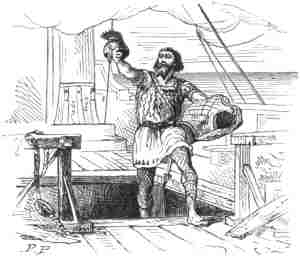
By the afternoon the sun had dispersed the clouds
entirely, and the deep blue waters shone brightly in
contrast with the verdant land from which we were distant
not more than thirty stadia. I sent the Cabiros on ahead
to find a suitable place for anchorage, where we might
rest and repair our damages. Whilst we were sitting on
the deck of the Ashtoreth, basking in the sunshine, and
taking a simple repast of dried figs, unleavened bread, and
raw onions, to our great delight we saw the Dagon coming
on behind us. She had lost her yard-arm with its sail
attached, but drifted along by the tempest, she had surmounted
all further perils. Happily we had a good store
of spare sails to replace what were lost. We came up
with the Cabiros as she was lying off the head of a high
promontory, waiting to announce that on the southern
slope of the headland there was a fine bay, into which a
river debouched from an open and fertile valley. All
three vessels accordingly rounded the point, and steering
to the south, along the coast, by nightfall had reached the
middle of the bay, whence the shore recedes considerably
to the east. Here the Dagon and the Ashtoreth were
brought to anchor, and the Cabiros was drawn up on shore.
The anchorage was very good, and the weather continued
beautiful; inland we could see lights gleaming from several
villages, and thus feeling secure, with light hearts, though
with weary bodies, we laid ourselves down to rest, and
slept soundly throughout the night.
CHAPTER VII. CHRYSEIS PREFERS HANNO TO A KING.
I lost
no time in setting our men to work to restore all
damages. The cargo had been too well packed to sustain
any material injury, and I had a selection from various
bales of merchandise carried out into a field and displayed
under the shade of a clump of trees. I took Jonah likewise
on shore, bidding him bring his trumpet. No sooner did
he feel the dry ground beneath his feet, than he began to
yell and to jump for joy.
"Out of reach here, of the jaws of Leviathan!" he
roared triumphantly. "Now I am safe. Here on dry land I
care not what monster I face; and the sooner the better!"
I put a check, in some degree, upon his excitement, by
ordering him to take his trumpet and to sound it as loud
as he could; and the noise he made had the effect not only
of summoning the residents of the neighbouring village,
but of collecting a considerable number of the shepherds
who were pasturing their flocks upon the adjacent hills.
Assured of our peaceful intentions, they all flocked to us
with perfect confidence, raising as they came the cry of
"Pheaces! Pheaces!" as an intimation to their companions
that some Phœnician merchants had arrived.
The people were all Dorians; tall, well-built men, with
fair complexions, straight noses, and dark curly hair
clustering over lofty foreheads. Nearly all of them came
quite unarmed. Some of them were attired in old kitonets,
evidently of Phœnician production; others wore a tasteless
imitation of the same, made of coarse cloth of their own
manufacture. For the most part they were bare-headed,
the exceptions being the few who wore a kind of flat hat
of plaited straw. There were some women of the party,
and these well-nigh all were much to be admired in
face and form; they were attired in long plain dresses,
almost as simple as sacks, with openings at the seams to
allow the head and arms to pass through; but these were
covered by short open bodices, coming just below the
waist, and becomingly slashed on either side. No jewellery
nor any ornament whatever was to be seen about their
persons.
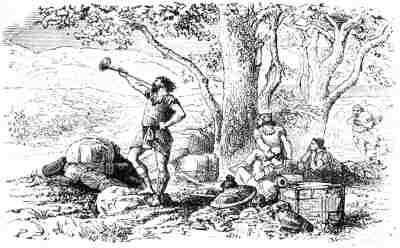
Before my visitors arrived, I took the precaution of
making an enclosure for my merchandise by driving some
strong upright stakes into the ground and running a rope
along from one to another, and told Hanno to make the
natives understand that they could not be allowed to pass
the rope. They readily understood him, and appeared to
be altogether very intelligent, although somewhat reserved
in their manner.
One of their number, who carried a long copper-headed
staff and wore a cloth band round his head, acted as
spokesman. He was evidently a sort of chief, and his
companions waited in silence while we listened to what he
said. The Dorians appear to be addicted to long speeches,
and the chief stepped forward, and scarcely raising his eyes,
made us a formal harangue. Hanno interpreted sufficiently
well to enable me thoroughly to comprehend the purport
of his speech. He began by bidding us welcome, and
proceeded to pay us a variety of compliments, addressing
us as demi-gods, calling us kinsmen of the tutelary deities
of our ships, and concluded by asking that he and his
people might be allowed to inspect the wonderful commodities
that we had brought from the divine city of
Sidon.
I was already aware that all the tribes that bear in
common the name of Hellenes are accustomed to regard
the Phœnicians as being of divine origin. The magnitude
of our ships, the length of our voyages, the mysterious
remoteness of our cities, all combine to confirm them in
their belief, and it was not for our advantage at present to
undeceive them; the time would come when they would
be brought into closer relationship with our colonies, and
they would find out by experience that we were ordinary
mortals like themselves. Meanwhile they regarded us as
superior beings, and listened with eager attention to whatever
tales we pleased to pour into their ears.
By my instructions, Hanno informed the chief that we
had brought with us many strange things from Caucasus,
the land of giants; from Cilicia, where the mountains are
the open mouths of the infernal world and spit out flames
of fire; from Sidon, the metropolis of the gods; from
Arabia, the land of the devout, where men live for three
centuries and more; and from Egypt, where there are
bull-gods, crocodiles, and serpents two stadia long. I made
him understand that if his people could bring us ox-hides,
Chalcidian copper, woven wool, or goats' horns, we, in
exchange, could give them coats, glass beads, perfumes,
nectar, or nearly anything they liked to ask for; and
without delay, he despatched a number of the men back to
the village, to procure such goods as we required.
"What awful lies!" said Chamai to me, aside, "didn't
you tell them that the Midianites are a devout race? And
didn't you say that the children of Ishmael live three
hundred years? And did I hear aright that you should
say there are gods in Egypt?"
I only smiled at this outburst of indignation; but
Himilco laughed aloud and said:
"Never mind, Chamai; there may be worse lies than
these; they will answer their purpose if they make these
folks good buyers."
The chief had offered to sell me some pilegech, or young
female slaves that he had captured in a recent raid upon
the mainland; but I declined to make any purchase of the
kind, knowing that there was no market for women-slaves
either in our Libyan colonies or in Tarshish. Our word
"pilegech" he pronounced pellex. The Dorians manifestly
have considerable difficulty in articulating our language; for
example, they say "kiton," for kitonet; "kephos," for koph,
and "kassiteros," for kastira. Sometimes, like other savage
nations, they fail to understand the true meaning of a
word, and pervert it altogether; for instance, when speaking
of the great sea beyond Gades, instead of calling it the
Sea of Og, they describe it as a river named "Oceanos," and
believe it to be a god.
The men that had been sent back by the chief soon
returned with a very fair supply of good copper, ox-hides,
and goats' horns, some of which were large enough to make
good bows. They likewise brought some very excellent
woollen cloth which they had themselves imported from
the mainland. For all their goods the prices they demanded
were singularly moderate.
It was now necessary, in order to find space and leisure
for repairing our ships, that the throng of buyers, which
seemed continually increasing, should be drawn away from
the neighbourhood of the beach. To effect this, I placed a
quantity of the merchandise under the charge of Hadlai,
one of the most trustworthy of the sailors, and sent him
into the interior of the island to dispose of what he could,
instructing him to be sure and return to us in eight-and-forty
hours, by which time I expected to complete
the repairs. Bichri volunteered to act as an escort; and
Jonah, with whose trumpet the Dorians seemed immensely
amused, was sent to summon the natives to the sale.
In the course of the day I sent eight of my men to cut
down an oak from the forest on the valley side, to make a
new yard for the Dagon. The Dorians permitted us to take
whatever wood we wanted without any charge, deeming it
a sufficient compensation to themselves to watch our carpentering,
and to listen to the wonderful tales of such of
our sailors as could speak anything of their language. They
were most attentive in bringing us firewood, water, and what
else we wanted; and whatever they may be in their bearing
to other nations, I can testify that to us Phœnicians they
were most courteous and considerate.
The Dorians plied Chryseis with countless questions
about the Pheakes, and made all kinds of inquiries about
their country, their cities and their king; and she, pleased
with the sound of a dialect kindred to her own, conversed
with them willingly, and made them stare with surprise, as
she recounted the glories of our temples, and the magnificence
of our palaces. They had no clear idea of what
Phœnicia really was, but imagined it to be an island,
evidently confounding it with our colony of Chittim, or
with our settlement at Chalcis, which was considerably
nearer to them. They almost seem to think Phœnicians
ubiquitous, for they give the name of Phœnicia to the coast
of Caria, where our merchants have established some marts.
This is really the country of the Carian Leleges, who,
together with the Phrygians, were the Dorians' predecessors
in the isle of Crete, and the first to drive the Cydonians to
the highlands. The Dorians assert that the Leleges and
Pelasgians preceded them on the mainland, and that many
of them still remain. I can readily understand that the
Carians, Æolians, and others, whom we drove from their
own coasts, succeeded in reaching Crete; for the Carians
were not ignorant of navigation, and at that part of the
Archipelago, where the sea is thickly studded with islands,
the voyage from the coast of Asia hither, even in small
boats, would be by no means difficult. It is a fact, too,
that the principal mountain in Crete is known by the
Pelasgo-Ionian name of Ida, the same as that borne by
the mountain in Æolia, opposite the island of Mitylene;
the evidence, therefore, is very strong that the Pelasgians
and Leleges, who were of the same race as the Carians,
Æolians, Lycians, and Dardanians, must have occupied
not only the entire coast from the Straits of Thrace down
to the regions opposite Rhodes, but likewise all the mainland
and islands between Thrace and Cape Malea. The Cydonians
must be a remnant of some still earlier inhabitants of
quite another race, driven back, first by the Pelasgians and
Leleges, and afterwards by the Dorians, Ionians, and those
others who are now advancing to establish themselves
alike upon the coast and in the islands. The accuracy of
this conclusion is borne out by the fact that our ancestors
were acquainted with the Pelasgians long before they knew
anything of Dorians and Ionians, and it is well known that
there are still in existence cities large and populous, though
badly built and weakly fortified, such as Plakir and Sculake
in the Propontis, some distance north of Dardania and the
isle of Tenedos.
I enter into all these details because I consider it part
of the duty of a Phœnician mariner to make himself
acquainted not only with the configuration of both land
and sea, the movements of the heavenly bodies, and the
laws of navigation and of commerce, but also with the
origin, language, religion, and habits of every nation with
whom he may be brought in contact; and my experience in
my naval life has taught me that although the knowledge
thus acquired is to be very cautiously revealed to strangers
and foreigners, yet it cannot be too freely disseminated
amongst one's own countrymen.
The Dorians acknowledge themselves to be a people
akin to the Ionians, and are, like them, a branch of the
great family known by the name of Hellenes, Ræci, or
Græci. These Hellenes, like the children of Israel, are
comprised of twelve peoples or tribes; the Thessalians,
the Bœotians, the Dorians, the Ionians, the Perrhebians,
the Magnetes, the Locrians, the Eteans, the Achæans, the
Phocians, the Dolopes, and the Malians. Their own
account of themselves is, that on reaching the south of
Thracia they settled in the district known as Hellopia,
of which they were still in possession, and whence they
spread themselves over the peninsula and the islands.
Hellopia is the country traversed by the River Achelous,
which empties itself into the channel that divides the island
of Cephallenia from the mainland. The two oldest cities
in Hellopia are Dodona and Delphi, which are both the
abodes of the chief gods. It is from the name of their city
that the Hellenes are sometimes called Dodonians, although
they are far more frequently referred to by us as the
Ionians, or sons of Ion or Javan. Amongst themselves,
however, they are invariably designated Hellenes, Graii, or
Græci.
All the Hellenic tribes recognise four special bonds of
fraternity: first, they are of one common origin; secondly,
they speak a common tongue; thirdly, they worship the
same gods, and in the same modes and places; and fourthly,
they cultivate a general uniformity in manners and disposition.
They all send representative chiefs or elders to
Dodona, and I presume to Delphi also, for the purpose of
settling any common difference; and there they take a
threefold oath, never to destroy any city that has ever
been admitted into covenant with them; never to intercept
the supply of water to any city of their fraternity, and
always to unite to punish those who should violate their
pledge.
Their principal god dwells at Dodona, and is named
Zeus. They believe him to be the same as the Zeus of the
Leleges and Pelasgians, whom the Curetes of Crete honour
with songs and dances. Like Baal Chamaim, he is the god
of the air and sky, and son of the heaven and the earth.
He it was who, in the form of a bull, carried off the
Phrygian goddess Europa to Crete; and on the south of
the island, in the valley of a little river, Lethe, the Dorians
have a city which I have never seen, but which they call
Hellotis, where there is a plane-tree, under which Zeus and
Europa are said to have reposed. Another town there is
in the island, named Cnossus, founded, I believe, by the
Phrygians, where Zeus has one of his places of abode.
Another deity, almost equally powerful, is Apollo, the
archer and soothsayer. He is known as the Pythian
prophet, and dwells at Delphi, where he is consulted about
future events. He is held in especial veneration by the
Dorians, whom he is said, under the form of a dolphin, to
have conducted across the seas. Probably he may be the
same as our Phœnician archer-god, Baal Chillekh, whom
we have ourselves taught the Hellenes to worship, and it
may be that because he taught them navigation, they
represent him as a dolphin.
The mysterious Hermes, the god of the hidden forces of
nature, is likewise an object of their high regard. It is not
unlikely that they learnt his worship from the Egyptians;
but whether it be so or not, it is quite certain that he has
been known amongst them from a very remote antiquity.
The Cydonians have made them acquainted with
Artemis, and we are ourselves leading them to the knowledge
of Ashtoreth or Astarte, whom they are gradually
learning to venerate above all their other divinities.
Of Beelzebub, Baal-Peor, El Adonai, Chemosh, or the
Cabiri, the Hellenes know nothing. They are absolutely
ignorant of the position of the Cabiri, and have no conception
of guiding their course in sailing by the seventh
Cabiros or Pole-star: to say the truth, they are very
cowardly sailors, rarely venturing to lose sight of the shore.
Their boats are large but very badly built, having no decks,
ill-contrived rigging, and very defective arrangements for
ballast; consequently they are equally unsteady whether
they are impelled by oars or worked by sails. The people
have little idea of distance; they are profoundly ignorant
of the shape of the country, and are at once deterred from
a voyage by the least stress of weather, or by the most
insignificant current.
The towns are built in places that are difficult of access,
and are rudely fortified with piles of uncemented stones.
The houses are made either of rough stone, or of bricks
that have been baked in the sun, and are very little better
than cabins. The people are not at all skilful in any
handicraft; and they can scarcely do more than manufacture
their copper lance-heads, hatchets, breast-plates,
and helmets, which, although very ill-formed, are covered
with ornaments. They have no cavalry and very few
archers, and rarely use swords in fighting; lances are their
favourite weapons, and these are used by their chiefs either
on foot or from the top of their chariots. In close combat
they employ a kind of poignard, which very frequently is
seen curved at the point into a kind of hook. By way of
pastime, Hannibal and Chamai occasionally made Hanno
practise with the sword, and on these occasions they would
be surrounded by a group of Dorians, who were struck with
wonder and admiration at the variety of the thrusts, passes,
and parries of the fencing, as exhibited in the different
practices of the Chaldeans, the Philistines, and the Israelites,
and the dexterity they all alike required.
The shields which they use are round, and made of ox-hide,
those of the chiefs being faced with copper and
ornamented with paintings. Before we left the island, the
Dorian king of Hellotis came to visit us, and for one of
our bucklers of wrought bronze offered me five-and-twenty
oxen; but I allowed him to have it for some agates, to
be used in making jewellery, and for an enormous pair of
boar's tusks which he had brought from the mainland, and
which now adorn the temple of Ashtoreth at Sidon.
On the third day after our arrival in the island, one of
the sailors, who had been struck by an arrow in the
Egyptian engagement, died, the wound having gangrened.
According to our national custom, I had all the ships hung
with black, and made inquiry of the natives for some
cavern in the neighbourhood where we could inter the
body. They showed me a cave in the mountain side about
thirty stadia distant, and were quite ready in any way to
assist me, as they are themselves very careful about the
burial of their dead; in fact, there is nothing of which they
entertain a greater dread than of being deprived of funeral
rites, and this is one great reason that deters them from
venturing out far to sea.
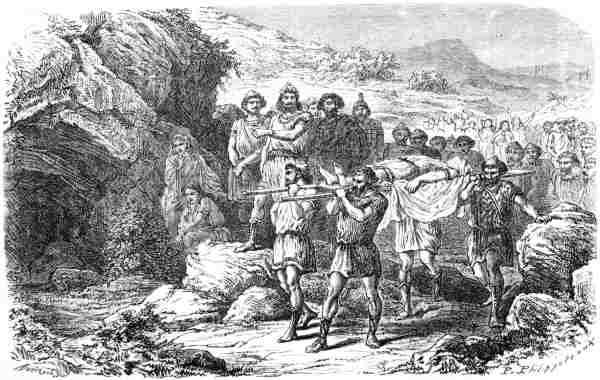
BORNE TO ITS RESTING-PLACE.
To face page 121.
After the corpse had been washed, it was borne to its
resting-place, a considerable crowd of Dorians following in
the rear, amongst them a large proportion of women, who
kept up loud cries of lamentation. The cave in which we
laid the body was very deep, but by no means lofty; in it
we left not only the body, but the planks and the two oars
which had formed the bier. When the opening had been
closed by piling up a heap of large and heavy stones,
Hanno, in a solemn voice, made an invocation to Menath,
Hokh, and Rhadamath, the judges of the souls in Cheol.
All these three gods of our nation are known to the
Dorians, who call them by the names of Minos, Eacus, and
Rhadamanthus. They believe that Minos, previous to his
appointment as a judge in the infernal regions, was a king
of Crete, and that, being a skilful navigator, he had sailed
as far as the mainland to the Ionians, who, by way of
tribute, gave him a number of boys and girls. With regard
to Rhadamanthus, they suppose that he was brought to the
island of Chalcis by the Phœnician demi-gods; but the truth
is, that they have made some strange confusion between
the god himself and the Sidonian sailors through whom
they had become acquainted with his existence. In the
same way, I believe, that Europa (the goddess who was
carried off by Zeus) and Ariadne (known first to one of the
demi-gods, and then to Dionysus, the god of rivers) are
nothing more than other names for Ashtoreth, surviving
from the period when the Phœnicians first imported wine
to their shores. From us, too, they have derived their
knowledge of Khousor Phtah, the god of the forge, whom
they call Phtos or Phaistos; and in short, whatever familiarity
they have either with literature, wine, or with the
use of metals, all seems to have been derived from the Sidonians.
As for our own knowledge, that (according to our
ancestors long, long ago) was obtained from the Egyptians,
and the Egyptians derived theirs from the still more ancient
Atlantes, who, when the Great Sea was still to the south
of Libya, came from lands in the West that have since
passed away, traversing Ethiopia in their course. How
true it is, that though nation may follow upon nation, the
gods are immortal!
The Dorian people gave us their word of honour that
the cavern in which we had buried our companion should
never be desecrated, and we returned to our ships, which
remained hung with black for the remainder of the day.
Towards evening Hadlai and his party made their appearance,
bringing a goodly supply of purchases. Jonah,
marching along with a consequential air, and encircled by
a crowd who had followed him down from the mountains
was carrying a calf upon his back.
"What are you going to do with that calf?" I asked.
"Eat it," he said; "I have earned it."
"How? by blowing your trumpet?"
"No; not by blowing my trumpet, but by wrestling:
they matched their strongest against me, and I levelled
them all; and so I won my calf. A capital country is
this! I will knock them over, every one, if only they
will give me a calf every time."
And, catching sight of the King of the Dorians, who had
come with a herd of oxen, he shouted to him:
"Yes, you too; give me a bullock, and I will knock you
down. Give me two, and I will break every bone in your
skin."
"Silence, fool!" I cried, hoping to bring him to his
senses. The King did not understand Phœnician, and
asked what the man was saying; but I did not think it
necessary to enlighten him.
Jonah continued muttering and grumbling to himself:
"Why should I not fight them, if they like it? If I were
to challenge a man of the tribe of Dan or Judah, I should
soon find a knife in my ribs! But here they like it, and
give me a calf. Fine country this!"
That evening the wind blew briskly from the north-north-west,
but not with violence enough to make us
hesitate about taking our departure next morning. The
Dorians were full of surprise at our determination to put to
sea, and owned that nothing would induce them to face the
peril of such a wind.
"Can it really be," asked one of the chiefs, "that you
intend to start upon your voyage with this gale in your
very teeth?"
Upon my assuring him that I had fully made up my
mind, he continued:
"And that, too, with the recollection so fresh of the
terrific storm in which you came? Truly, you are demi-gods
indeed!"
"Aye, yes," I said; "children of Ashtoreth we are; and
we rode the seas that night in a way that was worthy of
our fame!"
"And were not the Cabiri considerate for me?" interposed
Himilco; "the salt sea made me thirsty, and they
sent me a goat-skin full of luscious wine."
Without noticing him, the chief continued:
"Assuredly the Phœnician deities maintain a careful
watch to guard their children. I shall not soon forget how
I saw their mighty chariot roll above the waves to your
assistance."
It was now Himilco's turn to look astonished.
"Chariot upon the waters!" he exclaimed; "what was it
like?"
"It was high, and round, and parti-coloured, and had
great sea-monsters drawing it over the raging sea."
He spoke with a kind of awe; but it struck me that he
might perchance have seen Bodmilcar's gaoul, and that
the lightning's glare had given it the variegated effect
which he had noticed. I suggested this, in an undertone,
to Himilco, who only said:
"If Bodmilcar were the sea-god, I should like to have
the chance of getting into the sea-god's chariot and ringing
the sea-god's neck."
While we had been talking, I had observed Hamilcar and
several others closely scrutinising something that the waves
had cast upon the beach. Curious to see what was interesting
them, I joined them, and found some fragments of a ship.
"This is no Phœnician work," said Hamilcar, pointing to
a bolt still hanging to one of the planks.
"No," I agreed; "and from the thickness of the wood,
and from the bolts being driven in without wedges, I have
no doubt that it is an Egyptian craft that has been
wrecked."
"Look here!" cried Himilco; "here is proof positive;
the goose's neck from the prow!"
"It may be," I said, "that some Egyptians accompanied
Bodmilcar, and have come to grief in the tempest."
"I hope Bodmilcar has not shared their fate," said Gisgo;
"drowning is too good for him; I want him to have a stout
rope round his neck. And besides, the rascal has three-quarters
of our merchandise that I should like to get back."
"Rather too much to expect, I am afraid," I said; "however,
we must now embark. We are bound for Sicily
where perhaps you may recover your lost ears."
A grim smile passed over the old pilot's face.
"Until the wind changes," I observed, "we shall have to
keep on tacking;" and I moved towards the ships.
At this moment the Dorian King approached me with
the air of having something important to communicate; he
broke out abruptly:
"You are a Phœnician, a ruler of the sea: I am a
Dorian prince, a ruler of my people: so far we are equal.
These oxen, these horses, these chariots are all mine; from
my thirty villages I can summon twelve thousand men. I
am favoured of the gods. I am mighty."
I thought he surely was about to make some demand,
but a single glance satisfied me that he was not in a position
to exact anything by force; not only were Hanno, Chamai,
Bichri and Jonah still on shore, but Hannibal, too, was
close at hand, supported by forty of his men, while the
King was attended only by about a score and a half of
lancers. I made no reply, but waited for him to proceed.
"Ruler of the Phœnicians," he said, "I want you to sell
me your pilegech Chryseis: you have only to name your
own price for the Ionian, and that price is yours."
Hanno made a start forward, but I held him back.
"King of the Dorians!" I said, "Chryseis is not designed
for sale. However, she is free to answer for herself. To
us your kindness and courtesy have been great; and I am
ready to consent, in return, to give the maiden up to you.
But this one condition must be fixed; she must become
yours by her own free choice."
Hanno glanced eagerly at Chryseis, and imploringly at
me.
The King advanced to where the girl was standing, and
proffering his hand, said:
"Daughter of the Helli! kinswoman of our tribe! come
and be the Queen of the Dorians of Hellotis!"
She stood with her eyes fastened on the ground, but
made no reply.
"Zeus and Apollo guide your choice!" continued the
King, "and inspire your answer! Listen and consent. No
Dorian maid has ever yet made good her hold upon my
heart, although there is not one who would not be proud to
be the object of my choice. Honours and luxury await my
bride. She shall have slaves to surround her, and do her
weaving, and obey her slightest wish; her table shall be
spread with the choicest diet, the produce of three hundred
goats and fifty cows; and her home shall be full of all the
comforts that wealth can buy."
He waited for her to speak, but still she made no sign.
"My house," he went on to plead, "is a house of stone,
like the Egyptians', and stored up within it, Chryseis, there
are chests, in which are necklaces, and pearls, and golden
bodkins for your hair. All shall be yours, and you shall
be first and noblest of all the women in Crete."
Chryseis slowly raised her eyes from the ground, and
laying her hand upon Hanno's shoulder, in a firm, deliberate,
and yet gentle voice, said:
"Our holy Zeus has given me to Hanno, and with
Hanno I shall remain."
The Dorian, mortified and excited, literally stamped with
rage.
"What!" he cried, "prefer a Phœnician subject to a
king of the Hellenes?"
"A Sidonian scribe," said Hanno, "is the equal of any
king on earth. I own no superior except my captain and
the gods above."
"Though he were the lowliest sailor in the service,"
declared Chryseis, "my heart is his. His goddess
Ashtoreth has delivered me in the hour of peril, and Zeus,
my god, pronounces that I am his."
The Dorian could do no more: in vain he pointed to the
smiling meadows and the shady forests of the island, and
contrasted them with the abode upon the raging water of
an angry sea; Chryseis maintained that the water had
charms as many as the land. Unable to prevail with her,
he made a final appeal to me; but finding me firm in my
resolve to leave the girl unfettered in her choice, he gave a
growl of anger, and without turning his head, remounted
his chariot and drove rapidly away.
"Mine, henceforth," said Hanno to Chryseis, as he led
her to the ship. "You are as a priestess of Ashtoreth, the
guardian of us all!" and he drew her closer to his side.
The sail was soon hoisted, and the rowers settled to their
seats. Leaving the shore, we made long tacks to get to
windward, and in five hours had passed the northernmost
extremity of Crete. In the course of the night we were
coasting the rocky land upon the north of the lesser Cythera.
Two days' safe, though tedious, navigation brought us to
the mouth of the Achelous, a stream which from the colour
of its water is known to our sailors as the White River.
We passed between the fertile and indented shore of the
mainland, and the islands of Cythera, Zacynthus, and
Cephallenia. In these navigable waters, where land is
never out of sight, we perpetually came across Hellenic
vessels of every size, engaged in a brisk trade not only
in their own native productions, but also in the manufactures
of the Phœnicians.
The sea was calm when we reached the mouth of the
Achelous, but a fresh breeze sprung up from the north-east,
which was just what we wanted to carry us to the Sicilian
straits. It is usual, in order to break the length of the
sea-passage, to follow the Hellenic coast as far as the island
of Corcyra, but under the present favourable circumstances
this would have been merely to waste time. We had an
ample supply both of provisions and of fresh water; I therefore
quite abandoned all thought of visiting the metropolis of
the Hellenes, and determined to make with the wind across
the open sea direct for the southern point of Italy. As
we were passing along the channel that divides Cephallenia
from the little island of Ithaca we fell in with a Sidonian
galley and a couple of gaouls, and hailing them, we found
that they were on their way home from the mouth of the
Eridanus on the Iapygian Sea. Bodachmon, the captain of
the galley, proposed that we should lay-to off Ithaca, so
that we might send any commissions by him to Sidon. I
availed myself of his offer, and went at once on board one
of his gaouls. His cargo consisted of a small supply of
gold, both in dust and nuggets, but principally of rock-crystal,
which the people on the banks of the Eridanus
obtain from those who reside on the mountains near its
source. Bodachmon agreed to take some of my heavier
merchandise for a part of his light freight, and to do anything
he could to assist me after the loss we had sustained
of our own gaoul through Bodmilcar's treachery. His
indignation at Bodmilcar's conduct knew no bounds. Such
an act of faithlessness, he said, had never happened within
his experience; and he would take good care that not only
should it come to King Hiram's ears, but that Bodmilcar
should be denounced throughout Phœnicia, so that if the
traitor should attempt to land anywhere either in Phœnicia,
or in Chittim, or any other of her colonies, he should be
visited with the punishment he so justly merited.
"But now," said Bodachmon, "let us proceed to business.
What commodities have you to offer?"
I answered that I had just obtained goods in Crete, for
which he would be sure to find a ready market either in
Egypt or at home—copper, ox-hides, woollen cloth, and
enormous goats' horns; I told him, moreover, that if he
would visit Crete for himself, he would be able to purchase
any number of young female slaves at the most reasonable
rate.
He said that he thought he should act upon my advice,
and that he was sure we should be able to make exchanges
between ourselves which would satisfy us both. He proceeded
to inquire whether I could let him have any wine, as
his own supply had been exhausted six months ago, and
that in his intercourse with the Iapyges and Umbrians he
had had no opportunity of replenishing it.
Our own ships were well provisioned, and I was pleased
to have the opportunity of inviting him with his two mates
and pilots to come on board the Ashtoreth, and to partake
of our fresh meat, onions, dried figs, cheese and wine. They
all admired the completeness of our arrangements; and
Bodachmon made an inspection of the goods that I proposed
to barter, telling me that he should be able to pay
a good price, if I would accept his rock-crystal.
All of a sudden Bodachmon exclaimed: "By Ashtoreth!
I think I can give you a treat in return for your hospitality.
In Corcyra I took up one of the Hellenes, whom I promised
if I could that I would land in Crete. He is an old man and
nearly blind, but he seems to know the history of all the
world; neither Sanchoniathon, nor Elhanan the Israelite,
could know it better. He sings the exploits of his country's
gods and heroes, accompanying his singing on his lute; he
has no other means of paying his passage. You shall hear
him."
The venerable bard was sent for, and was soon conducted
on board. He had a dignified bearing, and commanded
an involuntary reverence. His long beard was
very white, and he carried in his hand a lute made of
tortoise-shell. His name was Homer.
Addressing us, he said:
"O Pheacians! ye sea-kings, who explore the marvels of
the earth! may the divine gods protect your ships! My
eyes are dim; no longer do I discern the meadows with
their pasturing herds, nor the warriors with their dazzling
armour; nay, scarce can I perceive the glorious beams of
day. But the Muses from their blest abode, beside the
Peneus, have endowed me with the gift of harmony and
song, so that wherever I may go, I celebrate the achievements
both of gods and men."
I handed the old man a cup of the choicest nectar, and,
with invigorated spirit, he began to sing his songs. To me
their meaning was barely intelligible; but Hanno, familiar
with the Hellenic tongue, was perfectly enraptured, and
made the venerable minstrel a present of his mantle, which
was woven of the finest wool of Helbon, and exquisitely
embroidered with flowers.
"Never have I heard anything to be compared with
this," exclaimed the scribe; "in spite of their ignorance
of trade and navigation, these people cannot be quite the
barbarians we supposed."
Hannibal, who had hitherto looked on in silence, now
observed:
"Once, when I was in the city of Our in Naharan, I
came across an extraordinary man, of whom this wandering
poet reminds me. He was an Egyptian, travelling about,
and singing songs to his own lute, just like Homer here,
but he was not so old, and the remarkable thing was that
he had an ape with him that used to mimic all the events
about which he sung. Now when Chryseis sings her
war-songs, it is pleasant to listen, although one does not
understand a word; her voice is itself a charm. But
this old minstrel's songs are dull; he ought, I think, to
have an ape with him, to act as an interpreter of what
he sings."
Hanno sneered contemptuously, and said:
"Hannibal is wonderfully clever. I should fancy he
could play the ape's part to perfection."
Not discerning the satire, Hannibal replied with the
greatest gravity:
"I don't know about my being more clever than any of
my people from Arvad; but I think that if I could understand
the old man's tongue, I could perform for him better
than an ape."
CHAPTER VIII. AN AFFAIR WITH THE PHOCIANS.
Having
entrusted Bodachmon with various commissions,
and especially with the duty of delivering a letter from
myself to King Hiram, I took my leave of him and his
companions. In the afternoon, the breeze being favourable,
we resumed our voyage to Italy. In order to pass
between the islands of Cephallenia and Leucas, it was
necessary to deviate somewhat to the north, after which we
should have to steer nearly due east for the south of the
great Iapygian gulf.
The Cabiros was about ten stadia ahead, and consequently
so far in advance that she was lost to sight as she
rounded the southern cape of Cephallenia; but she had
hardly disappeared beyond the headland, when it struck
me that I could hear her trumpet sounding signals of
distress. Having sounded an alarm, I put my men in
readiness for any emergency, and it was well I did so; for
when we had rounded the promontory far enough to get
her within view, we saw her not only surrounded by nearly
twenty large boats of the Hellenes, but the object towards
which some fifty other boats were making their way with
the greatest speed.
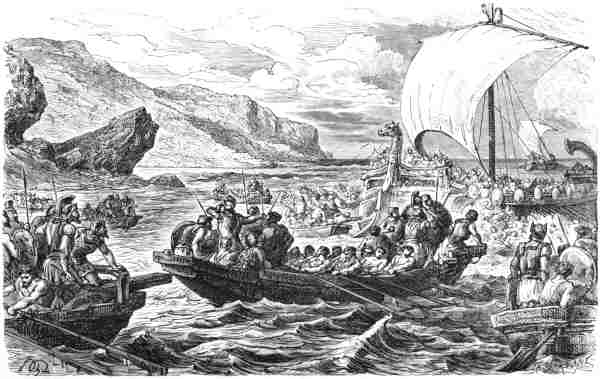
UNAWARES IN AN AMBUSH.
To face page 132.
The fact was, that while we had been coasting along
the east of the island the enemy had made their way
by the west, and thus the Cabiros, rounding the headland,
had found herself unawares in an ambush, which, with her
superior sailing power, it would have been quite easy to
escape if there had been any previous warning. As it was,
she was completely taken by surprise; and her tonnage
being too light to allow her to carry a copper beak for
attack, she could only avoid being boarded by the expedient
of rapidly making her way round and round in a
circle.
There was not a moment to be lost. The Dagon put on
all speed and made her way direct towards the promiscuous
cluster of boats that was coming up beyond, whilst I
hastened to secure the rescue of the imperilled Cabiros.
The antagonists with which the Dagon had to contend
did not appear to be of a very formidable character. A
very cursory glance at the unmartial appearance of most
of the crews, and at the cargoes, which consisted mainly
of agricultural produce and implements, made it evident
that we had come into collision with some convoy of
emigrants. Hannibal had manifestly come to the same
conclusion that there was nothing to cause him any alarm
for I noticed that after having given his men a sign that
there was no occasion to draw their bows, he made a
considerable sweep to leeward, and then dashed furiously in
upon the crowded craft.
But my more serious attention was demanded in another
quarter. The adversaries that I had to face were less
numerous, but far more formidable, being all armed men.
It was in vain that I hurried forward with all the speed at
my command; before I could get within two stadia of the
Cabiros she was already boarded, and the deck of the gallant
little ship was becoming the scene of a desperate struggle.
From the midst of a whirl of lances I could distinguish
Hamilcar, protecting himself with his shield in one hand,
and dealing tremendous blows with his sword in the other;
whilst Gisgo stood with his back supported by the top of
the poop, and had just raised the battle-axe with which he
had cloven the skull of one of his assailants. To prevent
us from rendering any assistance, five or six large boats
advanced towards us to obstruct our progress, and I could
hear the shrill voices of the warriors on board chanting
their exciting war-cry, "Io Pœan! Io Pœan!" A fine-built
man, who seemed to be chief in command, was
standing at the prow of the highest boat; he had a crested
helmet; his shield and greaves were faced with copper,
and he was brandishing his long lance like a maniac. I
was about to point him out to Bichri, but he, ever on the
alert, was already upon one knee with his arrow to his bow,
watching his opportunity, and no sooner were we within
range than the bowstring was up to his ear, the arrow
whizzed through the air, and the chief, throwing both
hands aloft, fell head foremost into the water.
"Now, men, now's your time!" I shouted; "down upon
the savages! Down upon them! Quick!"
With a tremendous spurt, the Ashtoreth dashed violently
into the boat, which sank instantly in an eddy of foam, our
magnificent success setting us at liberty to concentrate
our attention upon another boat which was harassing us
on the right.
In their eagerness to be ready to climb up into our ship
the crew of this boat had inconsiderately crowded altogether
to one side. Knowing the unscientific build of the Hellenic
boats, and how easily they are overturned when heavily
laden, I tacked round suddenly to the opposite side, and
putting on full speed, capsized it without the slightest
difficulty.
But the need, meanwhile, was becoming more and more
urgent that we should reach the Cabiros, although she was
holding out with a vigorous defence. I had to manœuvre
by taking a long semicircular sweep to get beyond the
reach of the boats around me, but the delay had its advantage
in giving Hannibal opportunity to arrange his men.
He very judiciously placed the archers in the stern, and
divided his remaining force into two companies; one of
them under his own leadership to be prepared to follow
him on to the deck of the Cabiros, the other to remain and
protect their own ship from being boarded.
About the Dagon I had little or no anxiety. I could see
that she was not only holding her own, but that by dashing
backwards and forwards amongst the medley of boats
around her, she was crushing or sinking all that she came
athwart, and by discharging volleys of arrows and pots of
combustibles, she succeeded in distressing the men on
board to such a degree that we could hear their howlings
of mingled rage and dismay.
Hannibal's instructions to his soldiers were very brief;
telling those whom he left behind that they were to obey
Chamai's orders, and that he trusted them to do their duty,
he turned to those under his own command, and said:
"Soldiers! the fight before you is a fight hand-to-hand;
no room for lances! Draw your swords, stand ready at the
prow!"
I gave orders to the rowers to pull steadily ahead; but
they had scarcely laid themselves out to their work, when
we fouled two of the boats which had detached themselves
from the others, and were endeavouring to get alongside
of us.
"Quick! to the engines!" I cried; "and, archers, draw
your bows!"
In an instant Bichri's men were at the scorpions, and
a perfect torrent of stones, arrows, and combustibles, fell
on either hand. Hannibal's men did not stir from their
attitude of readiness, and Chamai kept his detachment
grouped close around the mast, abiding the time for a
charge to be ordered. Bichri's party laid aside their bows,
and drew their knives and swords; and Jonah, laying his
trumpet on the deck, armed himself with the ponderous
handspike usually employed for heaving the anchor, and
which two ordinary men could scarcely carry.
"Come on, Dodanim!" he shouted; "if you can afford a
calf for a little shaking, perhaps you will pay better still if
I lay this rod across your shoulders. I should like a few
bullocks and a good skin of wine. I am quite ready to
begin pounding away, like Samson at the mill."
The time for action had come, and I gave the word of
command to push ahead, straight at the foe. A dash and
a crash! and cries of mingled wrath and consternation rose
from beneath our prow as it made its way in a vortex of
foam. We rushed past the first boat, leaving it hopelessly
far astern; we disabled a second that was designing an
attack upon our starboard, and we capsized a third that
was coming on our left; and when our men drew breath
after their paroxysm of exertion we were within half a
bowshot of the Cabiros. So close we were, that I could
see Hamilcar with his head all bleeding, and Gisgo, with
dishevelled hair, laying about him desperately with his
hatchet, whilst a dozen sailors who had retreated to the
stern, were making a vain effort to repel the invaders, who
continued to make their way on board.
"Help! Mago, help!" shouted Hamilcar, imploringly,
as he saw us drawing near.
"Cheer up, mate!" I replied; "we shall soon be with
you."
I made a rapid survey of our position, and having
instructed the helmsman to bear up hard to starboard, I
called to the oarsmen:
"Now, men, once again, a good strong pull with might
and main; then ship your oars, and we shall be right
alongside!"
So vehemently did they put forth their strength that our
prow was lifted high above the flood, and the impetus given
to our speed was so great that another of the opposing
boats was cut clean in two. In another minute we had
gained the side of the Cabiros. Hannibal seized a rope
and sprang upon the deck; and followed by his men was
quickly in the midst of the mortal struggle.
I had no time to watch the issue of their intrepid venture.
They had hardly left our deck when I was startled by the
urgent voice of Hanno:
"Look, captain! they have us now!"
And turning round I was face to face with a throng of
the Hellenes, who had not only brought their boats into
close quarters with the Ashtoreth, but had forced their way
on to her stern. Into the breast of the foremost man, who
was rushing towards me with uplifted lance, I thrust my
sword well-nigh to its hilt; and Hanno showed how well
he had profited by the fencing lessons he had had on
board; he parried a blow with his left hand, and almost in
the same instant felled an opponent by driving his weapon
into his shoulder with his right. Sometimes bending himself
down, sometimes rearing himself to his fullest height,
Chamai wielded his sword with the most extraordinary
dexterity: three men set upon him at once; one of them
soon reeled and fell heavily at his feet; a second, grasping
his sides in agony, was seen to stagger back amongst his
comrades; whilst the other, putting his head between his
hands, cowered down to the ground, the blood trickling
through his fingers.
Bichri also, single-handed, had to engage quite a little
group of antagonists. It seemed a desperate fray; but,
strange to tell, he got the better of them all, and retired
triumphant, his blood-stained sword in one hand, his dagger
in the other. Nor did good fortune fail Himilco; closely
pressed as he was by his adversary, he succeeded in catching
him by the throat, and, holding him back firmly
against the mast, he thrust his sword into his heart.
But for rendering effective service no one surpassed the
redoubtable Jonah. Such wholesale slaughter was never
seen. Skulls were fractured; limbs smashed; ribs broken
in; back-bones, breast-bones, collar-bones, shoulder-blades
contused, crushed, splintered, as the ponderous handspike,
swinging backwards, forwards, upwards, downwards, made
the very air reverberate.
"Room, I want! give me room!" roared the giant, as he
brandished his enormous weapon; "bring me bullocks,
sheep, calves, cakes, wine, anything, and I'll earn my
dinner honestly." And striking out more furiously than
ever he roared again, "Room, room! elbow-room, I say!"
Three or four of the Hellenes now made a simultaneous
attack upon myself. I succeeded in slashing the face of
one of them who had knocked my shield out of my hand
with his lance, but in a moment I felt myself grasped
round the throat by another, who forced me backward,
and was about to cut off my head with his scimitar, when
Hanno caught him by the wrist and plunged his sword
beneath his armpit. The two of them came down heavily
upon me, and we were all three rolling on the deck
together; a third man darted forward, and I could see the
gleam of a lance as it pointed to Hanno's breast, when
Chamai rushed to the rescue, and dealing a powerful blow,
sent the fellow staggering back. Hanno rose, and placing
his foot upon the dead man's neck found it taxed all his
strength to withdraw the sword with which he had slain
him. As I regained my footing, I caught sight of Chryseis
standing near her cabin-door; her hands were tightly
clasped, and her face was deadly pale, but she had not lost
her self-command. Abigail was close beside her; like a
true daughter of Judah, she had seized a sword which she
was pointing defiantly against a soldier who had lost his
lance, and who, as though scared at being challenged by a
woman, was cowering behind his shield.
Chamai's keen eye soon discerned what was passing,
and followed by Hanno, he rushed like a wild bull through
the crush, knocking down friends and foes alike, as he
made his way to the protection of the women.
Meanwhile Himilco and fifteen of the sailors, cutlass and
hatchet in hand, forced their way along and grouped themselves
close to me. Telling them that now was their
chance, I led them forwards and succeeded in effectually
clearing the whole fore-ship, the Hellenes stumbling over
ropes and rigging in their precipitous retreat. On reaching
the prow I turned, to make the reassuring discovery that
Hanno and Chamai had been equally successful in clearing
the stern, and that they were closing in towards Bichri
and his men at the mast, where they were engaged in
repelling a fresh contingent of the enemy. Above the
mass of heads and shields I could see Jonah's handspike
swinging to and fro, and above the confusion of cries and
yells I could hear his sonorous shout of defiance:
"Come on, Dodanim! I am your man. Let me earn
my dinner. Come on! Come on!"
With such determination did Bichri and his supporters
beat back the assailants, that ere long the middle deck was
as clear as prow and stern, and there rose a frantic cheer
of triumph. The Ashtoreth was free from her enemies.
The cry of success was followed by a shout of welcome
to the Dagon, which at that moment came dashing up at
a prodigious speed, sinking a boat as it approached, and
discharging a volley of arrows amongst the boats that still
persevered in hanging around us.
I now signalled to my helmsman to hold himself ready,
and sent my rowers down the hatchways to their oars;
they found some Hellenes skulking in the hold, but they
soon despatched them; and it was the work of only a few
minutes to get clear of the remnant of the attacking boats,
and to bring the Ashtoreth sharply round until she was in
a position on one side of the Cabiros corresponding with
that of the Dagon on the other. Hannibal had returned to
us, and gave us whatever assistance was in his power. Yet
another boat was sunk; and the crews of two more, overwhelmed
in terror, leaped overboard and swam after the
fugitives, who, under a shower of arrows, were making their
way off.
No longer called upon to act upon the defensive, we next
turned our attention to the main company of the convoys,
of which three already had been abandoned by their
crews and were drifting helplessly on the waves. As we
were steering towards them, I chanced to look astern, and
to my surprise I found that the boat we had in tow was
crowded with armed men, who had evidently got into it
with the design of boarding us, and had not been able
to make their escape with their comrades. I made Bichri
come on to the poop with a party of his bowmen, and he
succeeded in hitting one of the Hellenes in the shoulder
just as he was about to sever the tow-rope with his
scimitar.
"Lay down your arms!" I shouted in Ionian.
But the man was not daunted. He renewed his effort
to cut the rope asunder, an attempt in which he was foiled
by receiving a second arrow in his throat.
"Shall we shoot them all?" asked Bichri.
"No; wait a bit!" I said; "they look sturdy fellows,
and ought to fetch a good price at Carthage; we may as
well do an extra stroke of business."
Again I called to them to lay down their arms and to
surrender, but they made no sign of submission. One of
them hurled his lance at me, just grazing my shoulder; but
another, apparently convinced that the case was desperate,
jumped overboard, and as we were a long distance out at
sea, was probably drowned.
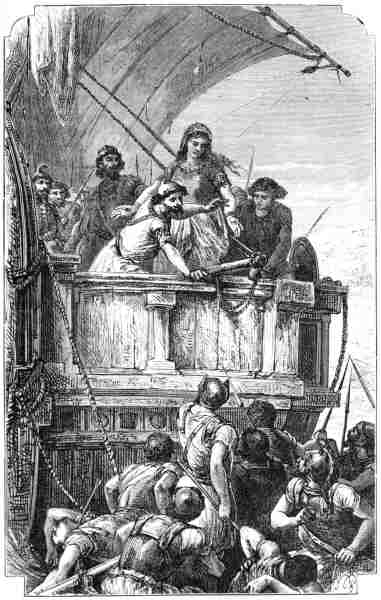
HANNO AND CHRYSEIS BESPEAK THEIR ATTENTION.
To face page 140.
Fifteen men still remained, and I made Hanno and
Chryseis bespeak their attention in their own language,
and thus succeeded in bringing them to terms. Hanno, by
my instruction, promised them that their lives should be
spared, and that they should be conveyed to a land where
they might earn good pay as soldiers of a king, and have
good treatment besides. After a while they yielded, and
laid down their arms, which were immediately hauled up
on deck; and then a rope was thrown down, and one by
one the men, crestfallen and agitated, climbed on board.
The remainder of our assailants were now flying in complete
disorder. Night was coming on, and to them a voyage
in the darkness was scarcely less terrible than a second
battle. Although some of the boats were quite uninjured,
we could see that several of them had sustained so much
damage that they could hardly make any progress, and
that more than one had been set on fire by the combustibles
discharged by the Dagon. From the distant shore we
could hear the lamentations of the women bewailing the
fate of the drowned and slain.
Hamilcar and Hasdrubal obtained my leave to go in
pursuit of the fugitives, and I told off thirty men under
Bichri and Chamai to go with them. While they were
absent I sent some men to take in tow the two boats that
had been abandoned by their crews, and found that they
contained a number of dead bodies, the whole of which I
had stripped and thrown into the sea. The two ships
returned very shortly, bringing three prizes and twenty-two
prisoners.
I deferred making any detailed examination of the spoils
until the morrow, and tired as we were, I should have
been glad of repose for myself and my men; but it was
absolutely necessary that we should at once wash the
decks, collect the scattered armour, and do something to
repair the disorder inevitable after so hard a conflict.
The corpses of the Hellenes who had been killed and
about twelve of the wounded were thrown overboard. Of
our own men, twenty-three had been wounded and eleven
killed; the bodies of these were wrapped in cloth and laid
side by side on the fore-deck, that they might be committed
to the sea in the morning, with the rites and
invocations of their religion.
As the Dagon had sustained less injury than any of our
ships, I had all the captives, including my own fifteen, sent
on board her and fastened securely in the hold.
Our losses were very serious. The Cabiros had eight
killed and ten wounded; the Dagon, three killed and
seven wounded; making, with the casualties on my own
ship, a total of twenty-three dead, and forty wounded.
Here was a melancholy proof that we had been matched
with no mean opponents; and to confess the truth, their
courage and energy were such, that if they had had any
practical notion of naval tactics, and if their boats had been
more manageable, and their weapons not so ill-adapted for
this character of warfare, our chances of success would have
been very small.
Both Hamilcar and Gisgo had sustained serious though
by no means dangerous wounds. Hanno had a gash
across his shoulder, Chamai a lance-cut in the arm, and
Himilco a large bruise on the head, but neither of the three
was incapacitated from going on with his accustomed
duty. Our senior seaman, Hadlai, was among the killed.
Jonah had five lance-wounds, which he regarded as mere
scratches; and after he had smeared himself all over with
ointment, he declared that the day's proceedings had not
only given him a tremendous appetite, but had made him
desperately thirsty.
It was impossible accurately to estimate the losses of
the Hellenes; but they must have amounted to several
hundred; thirty-six dead bodies had been found lying on
the deck of the Ashtoreth alone, and the Cabiros had
thrown overboard thirty-eight more.
We contrived to get some brief repose before morning,
but it was still quite early when under a fair east wind we
started again on our way to Italy. The eight prizes were
all taken in tow, and in order to make our progress more
easy I sent a few men into each of them, either to put up
a sail or to work them with oars.
Our ships were hung with black in honour of the
dead, and the usual invocations were made to the gods of
the departed. There were several bullocks amongst the
booty we had captured, and I ordered one of them to be
hoisted upon each vessel and slain for a sacrifice. On
board the Ashtoreth, Hanno recited the prescribed petitions
to the goddess, and after the slaughter of our beast, the fat
and a portion of the flesh were set apart to be smoked and
dried, the rest being allotted to the funeral feast. The
children of Israel, meanwhile, after their own fashion, were
sacrificing a sheep to their God, El-Adonai. As soon as
the sacrifices were finished, I made a distribution of wine;
but before this was allowed to be tasted, the trumpets were
sounded, and the bodies of the dead solemnly committed
to the deep. The black hangings were then removed; and
we gathered together for the general repast. Every one's
spirits revived under the influence of food and drink.
Weariness and wounds were soon forgotten, and the men,
one to the other, were cheerfully recounting their own experiences
of the fight.
"Hannibal," I said, "you, as captain of the guard, and
your men under you, have acquitted yourselves admirably
and, according to the covenants of the charter-party, you
are entitled to a share of the spoil."
"For my part," said Hannibal, "I am quite ready to give
up all further claim if I can only have a new set of armour;
my cuirass is terribly battered about, and my helmet has
lost both crest and plume. I have no doubt there is a good
suit of Lydian armour on board; let me have that and I
shall ask no more."
"With all my heart!" I answered: "and in addition I
shall give you a flask of fine Sareptan wine."
"Aye, a good thought!" said Himilco; "I, also, shall be
only too happy to dispose of my claim for three skins of
Berytos."
Chamai maintained that he must be entitled at least to
a bracelet and a pair of Syrian earrings. "Give them
to Abigail," he said, "and I will cry quits for my share."
"And now, sir scribe," I asked, turning to Hanno, "what
shall I do for you? There are sheep, oxen, armour, wines
at your command."
"By Ashtoreth!" he answered; "there is nothing I want.
Take my portion and distribute it amongst the wounded;
they need it more than I."
Struck by this generosity, Hannibal and Chamai shook
him heartily by the hand, and Chryseis showed her approval
by the most beaming of smiles.
One of the pilots came to me, as a deputation from the
crew, and requested that I would sell the whole booty in a
lump at the first opportunity, and let them have their shares
in money: meanwhile they hoped that I should not object
to make them an advance of what they might expect. The
fact was that the men knew that Phœnician coin was
current at Utica, Carthage and Gades, and reckoned upon
going ashore and enjoying themselves at all these ports.
I saw no reason for refusing the men what they wanted,
and accordingly instructed Hanno to draw up a list of all
the plunder, to every article of which I appended the price
in shekels which I was willing to pay for it. The priced
catalogue was affixed to the mast of each ship for the
sailors' inspection, and as it gave universal satisfaction, I
paid them the amount to which they were severally entitled
that very evening.
Chryseis and Abigail spent the night in administering to
the wants of the wounded.
Next morning, I sent for the prisoners. They had some
rations served out to them, and were brought from the
Dagon to the Ashtoreth, looking downhearted and full of
mistrust. I enlisted the services of Hanno as interpreter,
and having selected the most intelligent-looking of the
group, had him questioned as to his nationality and his
home.
"We are Hellenes," he said, "of the tribe of the Phocians.
We have no regular home, but we have been in the country
round Mount Parnassus. We left our haunts there at the
bidding of Apollo, who told us to depart, and to seek for
other settlements. With our wives and children we were
on our way to join our kinsmen, the Ionians, either in
Epirus or in Corcyra. We were hoping there to find a
happy and a settled residence."
Great tears stood in his eyes, and his companions in
adversity could not suppress their sobs. I assured him
that it was far from my wish to aggravate their misery,
and that I really pitied them in their misfortune, so that
they need not fear any harsh treatment at my hands.
"If we had been meeting you in regular warfare," he
continued, "we should have fought on to the very death,
and would have borne disaster and defeat without a murmur;
but now who shall blame us, if we weep for our
wives and dear ones perished in the waves?"
"But why, then, did you attack us?" I inquired.
"Listen, and you shall hear," he answered: "three
days ago, we fell in with a great Phœnician ship; it was
not alone, but was accompanied by several others. The
captain hailed us and asked us to sell him some provisions:
regarding the Phœnicians as all divine, we were all most
ready to oblige them; we sent them oxen, fruit and corn;
my own poor son and many others went besides; but no
sooner had they got the supplies on board, than the pirates
hoisted sail and made away. We had no remedy; there
was no hope of recovering our people or our property; our
boats cannot compete with yours in speed. In our fury we
swore that we would be avenged, and vowed we would
attack the first Phœnicians we should see. You were the
first. Now you know all."
"Bodmilcar! by all the gods!" ejaculated Himilco.
"It is Bodmilcar that has involved us in this trouble. To
him we owe the death of our brave Hadlai, and the loss
of all our men! Ten thousand curses on him! Moloch's
bitterest curse be on his head!"
Anxious to learn whether this suspicion was well founded,
I made inquiry as to what the Phœnician ship was like,
and not only ascertained that it was large and round and
high, but that the men on board were quite different to
the men upon the smaller boats, who had brown faces, and
wore dresses of another shape. These boats, too, carried
the figure of a goose's head at every prow.
"The Melkarth and the Egyptians beyond a doubt!" I
cried.
The Phocian looked astonished at my agitation.
I soon recovered my composure, and asked whether
there were any men amongst the captives upon whose
courage and discretion he could rely. He informed me
that his own brother was one, and that five of the others
were his cousins; he added, moreover, that the wife of one
of the cousins had been carried off on board the Phœnician
ship.
"Call them forward!" I said; and in a few minutes
six young men, all apparently strong and active, stood
before me.
"You would like to see your son again?"
"My son!" echoed the man. "Restore my son, and you
shall be counted divine indeed."
I informed him that the Phœnician who had borne him
off was my avowed and mortal enemy. "But serve me
with fidelity," I added, "and you may recover your son
even yet."
Turning to Hannibal, I ordered him to provide the seven
men with kitonets and arms, and to take them into his own
force; the remainder I sent to assist the rowers. It would
be easy, I knew, to dispose of them all at Utica or Carthage,
where there is a constant demand both for oarsmen and for
mercenaries.
The seven Phocians kissed my hands, and wept for joy;
the remainder went below with lighter hearts than they
had brought on board.
CHAPTER IX. THE LAND OF OXEN.
On
the third morning after the battle we sighted the
mountains of Italy,[32]
and having entered the gulf,[33] along
the north of which extends the Iapygian Peninsula, we soon
came to the mouth of a river that meandered along a fine
plain, in which the broad pastures were diversified by
groves of pines and oleanders. Inland, about a hundred
stadia from the shore, rose a range of grey mountains,
partially wooded, and crowned by a ridge of ragged peaks.
The anchorage was tolerably good, and as we required
fresh water and provender for the cattle, I determined to
lay to at once. I had all the animals sent on shore. This
was a work of some difficulty; Bichri with a few armed
men was put in charge of them, and he was to employ the
prisoners to drive them where they could find proper
pasturage; my intention in doing this was that the animals
should follow the ships along the coast as far as the Sicilian
Straits, where, unless I succeeded meanwhile in disposing of
them, they should be re-embarked.
"Not much chance of selling them here," said Himilco;
"we are in Vitalia, the land of oxen. If we could have
brought them some goats now, like those we let the Ionians
have, we might have found a market. Of cattle such as
these they have more than enough already."
"Probably so," I answered; "but first of all we must
find some inhabited spot amidst all this desolation; we
must try and meet with some of these Italians or Vitalians,
whichever they are called. There must be some Iapygians
here too in the south, as well as in the north. Do you
know the Iapygian dialect?"
Himilco said that, although he was not acquainted with
that dialect, he had some knowledge of the language of the
Vitalians, as well as of that which was spoken by the Opsci,
the Marsians, the Volscians, the Samnites, the Umbrians,
the Sabellians of the eastern coast, and the Latins of the
western. He mentioned also that Gisgo was tolerably
familiar with the tongue of the Rasennæ, away to the
north-west.
The spokesman of my seven Phocian prisoners now
approached me somewhat timidly, as if he had something
to ask. His name was Aminocles. He began by addressing
me:
"King of the Phœnicians!"
I stopped him and told him that my proper appellation
was not king but captain.
"Captain of the Phœnicians," he said; "will you please
to tell me what country we are in?"
"Italy," I answered; "Italy, the land of herds."
"But in what part of it?" he asked.
"In that part," I replied, "which is inhabited by various
tribes of Vitalians; south and north-east dwell the Iapygians;
far away to the north are the Rasennæ, who build
great cities, and have a king in the fertile vales beyond
the mountains."
"We know nothing of them," said Aminocles.
"Patience!" interposed Himilco; "perhaps we can
refresh his memory. Phocian, listen to me. Have you
ever heard of Opsci?"
"Of Opici? yes," he answered; "our ancestors have left
it upon record that long ages back, before we built Dodona,
nay, before we settled by the Achelous, while we still were
dwelling in the cold regions beyond Thrace, we were in
association with a people called the Opici. At that time
mainland and islands both were inhabited by Leleges,
Pelasgians, giants, dwarfs, and monsters; but the gods
slew them all and made way for us. If your Opsci are the
same as those Opici, I suppose I ought to have heard of
them before."
"It is of no use perplexing the man," I said; "you see
he does not understand you."
"Wait a bit," Himilco remonstrated; "perhaps I shall
succeed even yet. Tell me, Aminocles, did you ever hear
of Tyrsenians?"
"No," said the Phocian.
"Strange!" muttered Himilco to himself. "Again and
again I have heard the Hellenes speak of Vitalia, and call
the natives Tyrsenians or Tyrrhenians; I must try again.
Do you know the Siculians, the Cyclopes, the Lœstrigonians?"
he asked aloud.
The man's countenance changed in an instant.
"What! do you mean"—he exclaimed, in a voice
agitated with alarm—"that we have come to the land of
such people as those?"
"Aye, that we have," said Himilco, with a chuckle of
satisfaction; "this is the country of the Lœstrigonians;
and down there is the island of the Cyclopes, the Siculians,
and all the rest of them. We are going to pay them
a visit, when we have steered safely between Scylla and
Charybdis."
And he laughed outright when he heard Aminocles,
wringing his hands, groan out:
"Oh! better, better far to have perished in the fight
than to have come to this land of monsters. Oh!"
We all laughed. The ridiculousness of the fellow's terror
was irresistible.
"Silence, simpleton!" I said; "the Lœstrigonians will
not hurt you; we shall see plenty of them, but they
will not eat you up."
While I was speaking, my attention was directed by the
man on watch to a party of about fifty men, who were
advancing across the plain. Their attitude was far from
confident, and they halted on the edge of a wood, apparently
in indecision whether they would come on or
retreat. At length I took upon myself to encourage them
to come forward, and, according to my custom, went alone
towards them, making them every sign of good-will. Presently
two of them advanced to meet me. They were
stout, thick-set men, square-shouldered, and of middle
height; they had light complexions, thick beards, and
frizzly hair, that overhung low brows and wide faces.
Their legs and arms were quite bare, and their heads
uncovered, but they wore a kind of coarse woollen kitonet,
with another loose garment thrown crosswise over one
shoulder. They were all well armed, having two short
copper-headed lances and a poignard; most of them
carried knives or swords in their girdles, and about a
dozen had slings or bows.
One of the two who had come on in advance shouted in
Italian:
"Who are you? and what have you come for?"
Himilco, who had followed me, shouted back in the same
language that we were merchants who had come from distant
lands, and that we wanted to open a trade with them.
"But are you not Rasennæ? and is it not your design
to rob us our cattle?"
"Nothing of the sort," we answered; "we are Phœnicians
from the east. Come down to the shore, and you shall see
our merchandise."
Both the men retired to their comrades, and appeared
to deliberate; but very shortly they returned, and one of
them called out:
"You see these two trees on each side of me; these
must be our boundary."
And, driving his lance firmly into the ground midway
between them, he continued:
"If you advance one step beyond this lance, I take it
up, and we declare ourselves your foes."
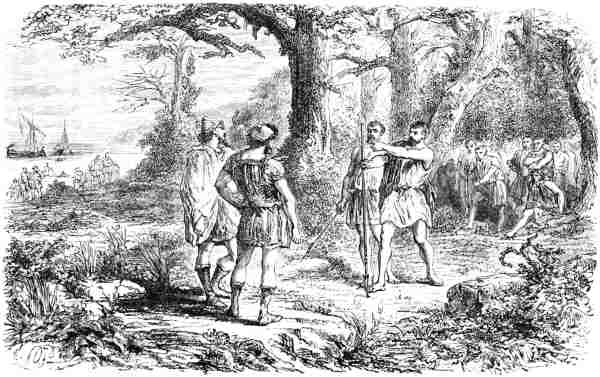
"IF YOU ADVANCE ONE STEP BEYOND THIS LANCE."
To face page 152.
Himilco repeated his assurance that we had no wish to
do them the slightest injury, and they came up close
to where we were. The leader told us that they were
Sabelline Samnites, and that they wanted to know what
payment we were going to make them for the pasturage
of our cattle. I made Himilco satisfy them that they
should have a proper remuneration.
It was now my turn to erect a barrier. This I did by
driving stakes into the earth, and stretching a cord across,
beyond which I made the Samnites understand that I
should not permit them to pass. They raised no objection
to my measure of precaution, but crowded up to inspect
our goods, their curiosity meanwhile extending to our
ships, ourselves, and our costume. They were rougher
in manners than the Hellenes, and more suspicious, and
I had some trouble in inducing them to negotiate with us
at all; but after a time I succeeded in securing their
confidence to a certain degree, and they informed me that
they were not an agricultural people, and had no cereals
nor vegetables to bring us, but could supply us with any
number of sheep and oxen. They subsequently brought
several half-wild pigs, which particularly attracted the attention
of Chamai and Bichri, neither of whom had seen
animals of the kind before. Not understanding the art of
making bread, the Samnites ordinarily eat a kind of pulp
called "masa;" but, as they had on previous visits of other
Phœnicians tasted some loaves, they were now very anxious
to be shown how to make them; they made a number of
inquiries likewise about our wine, but for this they did not
seem to care to the same extent as the Hellenes.
Next morning they came to us again in considerable
numbers. I had observed that during the night they
had lighted a good many beacon-fires over the land,
and naturally conjectured that they were signalling for a
gathering of their countrymen, and I accordingly doubled
my ordinary guard. I soon found, however, that there
was no cause for alarm, and that they had no hostile
intentions; on the contrary, they were quite content to
follow my injunctions that they should not approach our
boundary line in groups of more than fifty; they awaited
their turn with the utmost patience, and altogether were
far less noisy and demonstrative than we had found the
Dorians.
Amongst other things they brought a great quantity of
coral, which after rough weather is washed up on their
coasts, but which they also procure by diving from
frail rafts of their own construction; for although they
are very indifferent navigators, they are for the most part
excellent swimmers. The most expert coral-divers are the
Iapygians, those who dwell amongst the Samnites and the
Bretians, as well as the natives of Iapygia proper. Some
few of them were to be noticed amongst our Samnite
visitors; they were generally tall and wore no beards; they
had round heads and brown skins, being in many respects
very like the Cydonians: in their manners they were more
polished and in their conversation more communicative
than the other Italians. They seemed to me to bear a
marked resemblance to the Siculians; and I cannot help
thinking that the Iapygians, the Siculians, the Cydonians,
and the natives discovered by our forefathers in Malta, are
the aborigines of their respective countries. Afterwards,
from the coast of Asia came the Leleges and the Pelasgians
(tribes that bear a strong likeness to the Lydians, Lycians,
and Carians), and these settled in Dodanim and the isles,
being succeeded by the Hellenes and Italians, who came
southward from the confines of Thrace. Of the origin of
the Rasennæ I am perfectly ignorant: all I know is that
Phœnicians who have visited the mountains whence the
rock-crystal is obtained, and which lie north of the Eridanus,
at the head of the Iapygian Gulf, have reported
that they have fallen in with a people who call themselves
Rhœtians, and who speak a language in many respects
identical with that spoken by the Rasennæ.
Two days were spent in bartering my cumbersome booty
for coral, which could be compactly stored away. As the
captured boats were emptied, I had all but two of them
broken up. I reserved only the planking, which was sure
to be useful, and the masts, which might be of service
if we should require extra spars. After the spoil had
been all exchanged away, I commenced paying for what
I purchased with glass-beads, lance-heads, and sword-blades;
the last of these articles were so eagerly coveted,
that for four blades, worth about a shekel apiece, I obtained
at least four hundred shekels' worth of the finest
coral. When I expressed my surprise at the quantity of
coral in their possession, they explained that it was the
accumulation of a very long time, adding that they had
intended disposing of it at one of the emporiums which
the Phœnicians had established on the western coast, but
that our arrival had saved them the trouble of the journey.
They told me that they should have been glad if I could
supply them with goats, and stated that those which had
been brought over by our countrymen, and purchased by
the Marsians and Volscians, were rapidly spreading in the
mountains of the north.
The Samnites have no regular towns, but live in small
scattered hamlets, consisting generally of a few thatched
huts built of boughs of trees cemented with mud. They
have very little notion of agriculture, and the Latins of the
west coast (especially those of the valley of the Tiber) are
far superior husbandmen; the Latins, however, have a city
named Alba, occupying a secure position between a
mountain and a lake. Along the coast I know only of
a single sea-port, and that belongs to the Rasennæ, and is
named Populonia. These Rasennæ are no contemptible
sailors; that they were bold and unscrupulous pirates,
I had long known by hearsay, but here on the Samnite
coast I was destined to have a confirmation of the fact
from my own experience.
Having completed all the business that was practicable,
I was preparing to renew our voyage, when one of the
Samnites came running up to his associates, and shouted
something which appeared to throw them into a state of
great excitement.
"What ails the fellows?" said Himilco; "they seem
going mad. Is the cock-head Nergal at their heels?"
The commotion was soon explained.
"Pirates! Pirates!" shouted a number of the Samnites
in a breath. "Quick, Phœnicians, on your guard! The
Tyrrhenians are coming! They are rounding the point!
they will be on us directly! Away! Away to the
mountains!"
Without losing a minute, I made Jonah sound an alarm
and summon our men to their ships. Hannibal donned
his helmet and marshalled his men, including the seven
Phocians; the overlooker of the rowers, scourge in hand,
hurried the oarsmen to their benches, and in a short time
we were three stadia from the shore and ready for action.
Chamai congratulated himself that although his right arm
was disabled he was still capable of doing good execution
with his left.
"What new friends are we to have the pleasure of
seeing to-day?" asked Bichri, with a smile, as he fastened
on his quiver and strung his bow.
I told him that they were Tyrrhenians, or Rasennæ,
from the north-west of Italy, who traded a little, but did a
good deal more in the way of privateering along the coast;
and that, although I was not aware of their having ever
hitherto come into collision with Phœnicians, I had very
little doubt they carried freight enough to make it worth
our while to risk an engagement with them.
"Yes, they are new to me," said Hannibal; "and perhaps
we can give them some new lessons in the art of fighting;
they may like a taste of the Chaldean mace that King
David gave me."
Anxious to understand the true position of things, I
sent the Cabiros ahead to reconnoitre, ordering her to keep
as close as possible to the shore until she reached the
extremity of the headland, whence she could command
a view of the whole line of coast; she returned with the
intelligence that there were five ships, which seemed of
a long build, advancing leisurely towards us by making
short tacks to catch the wind, and that in about half an
hour they would be in sight.
Whilst I was pondering in my mind what line of action
I should follow, my eye fell upon the two boats of the
Hellenes which had been spared in the general demolition,
and it occurred to me that I could make them of
service.
"How about our soundings, Himilco?" I said.
"Ten cubits, and a rocky bottom," was the pilot's
prompt reply.
Gisgo was on board the Ashtoreth. He had come
to bring the report of the Cabiros.
"Tell me, Gisgo," I said, "how much water do those
Tyrrhenian privateers draw? Is it six cubits?"
"Aye, six at the very least; they look low upon the
water, but they sink very deep; it is their excessive weight
that keeps them from lurching."
"Very well; now go to those two boats, scuttle them,
and sink them there, right in front of my ship. There!"
I said, pointing with my hand.
Himilco and Gisgo chuckled again with delight as they
went to do as they were ordered, and in the course of
twenty minutes the boats were both sunk, and formed a
regular stockade about three cubits below the surface of
the water.
My next proceeding was to direct the Cabiros to lower
her sail, and to pretend to be dragging herself with difficulty
towards the headland, as though she had sustained
some serious injury. I then made the Dagon sheer off
about two stadia out to sea, ordering her to make her way
back to the Ashtoreth by short tacks, as if she were coming
to her assistance. Meanwhile I gave my ship the appearance
of being a disabled merchantman; I lowered my sail,
made my rowers struggle with their oars without propelling
the vessel, and told all my soldiers to slip their shields,
and to lie down flat upon the deck so as not to be seen.
"What's up now, Captain?" said Chamai raising his
head, with a merry grin.
I told him that I was giving a sprat to catch a mackerel;
and that if he would have patience I hoped he would
be satisfied with the haul.
It was a very short time now before the Rasennæ caught
sight of us. Immediately one of the five ships bore down
directly upon the Cabiros; two of them started off in
pursuit of the Dagon, which was still out to sea, and the
remaining two steered for the Ashtoreth, which, as though
perfectly helpless, exhibited no sign of resistance.
When they had come within a stadium of me I had
ample opportunity of examining the details of their boats
and equipments. Although the boats were long, they were
very ill-constructed; they had only a single deck, and
were each manned by thirty rowers; the stern was somewhat
raised, but the deck was almost level with the sea;
on the prow was painted a pair of huge red and white eyes
which seemed to stare fixedly at the waves. The men on
board were very tall; they had large heads, wide flat faces,
reddish complexions and thin beards; although their
limbs were muscular and well-developed, their gait was
very awkward. They were armed with ponderous lances,
hatchets, bucklers, and round helmets which had no crests;
whilst their legs were protected either by sandals or by
pointed gaiters. Most of them wore tunics of some dark
colour, which, though longer than our kitonets, were
shorter than those worn by the Syrians. On their arms
and throats was a profusion of bracelets and necklaces, and
their girdles, which were very wide, were ornamented with
plates of polished bronze. After looking at them steadily
for a time, Abigail declared that she would rather die than
fall into the hands of such revolting creatures.
Coming within hail, the Rasennæ began shouting furiously
at us, but we took no heed. Finding that their challenge
was unanswered, they sent one of their boats in front of me,
whilst the other passed round the stern intending to cut
me off from the shore; but they reckoned without their
host. The former boat dashed itself violently against the
stockade of concealed boats, and after two or three ineffectual
efforts to disengage herself, heeled over on her side,
and remained with her stern considerably sunk below
the sea.
My trumpet sounded, my oars dipped, my warriors
started to their feet, and a shout of triumph rang through
the air.
Thoroughly taken aback by our sudden revival, the other
boat endeavoured to tack about to get out of our way; but
so clumsily did she set about the manœuvre, that she only
succeeded in running her stern aground, and being thus
entirely at my mercy, I poured into her such a shower
of missiles as probably her commander and crew had
never before conceived possible.
"Here, Tyrrhenians, Rasennæ, or whatever you call
yourselves," shouted Hannibal, as he worked away at his
scorpions; "here is a heavenly shower of manna for you!
If these arrows and Cretan pebbles are not to your taste,
we can find you a nice little lot of spiked stakes."
Bichri, too, was quite in his element. With such an
immovable mark within bowshot, he selected his victims
just as he pleased, and was careful to choose those who
wore any article of apparel or any ornament that particularly
struck his fancy.
"Look at that fellow," I heard him say, "with the
necklace of gold beads inlaid with blue and enamelled
with white: I must have him; but I must hit him on the
head, or I shall be spoiling that charming bit of embroidery
he is wearing."
As our deck was several cubits higher than that of our
antagonists, their archers were comparatively powerless;
and in order to protect themselves under the incessant
discharge of our missiles, they took refuge in their hold.
Observing their retreat, Hannibal, Chamai and Bichri, with
a few followers, leaped down upon their deck; Jonah, in
his impetuous haste to go after them, came sprawling down
headlong with a tremendous thud, but rising rapidly to his
feet, caught hold of the heels of an unhappy Tyrrhenian
who had not had time to make his escape, twirled him
round and round in the air like a sling, and dashed out his
brains against the side of the vessel. Short work was made
with the few who still remained above board, and in a few
minutes more, our people, who had forced their way down
the hatchway, reappeared, bringing with them twenty men,
of whom, to my surprise I found that no less than eleven
were Phœnicians. Their costume and physiognomy revealed
this at a glance.
Free now to turn my attention from the shore to the
sea, I found that the Dagon had already sunk one of the
privateers, and in concert with the Cabiros was driving the
remaining two fast inland. I joined in the pursuit, and
after a short chase, one of the boats, overwhelmed by the
volleys of stones which we threw from our engines, found
all further resistance useless, and made signs of surrender.
The capture of this vessel cost us the lives of two of our
men, and while we were engaged in securing our prize, the
remaining boat took advantage of our occupation to effect
an escape.
We lost as little time as possible in making our way
back to the coast towards the prizes we had left there. We
were only just in time. The Samnites had been watching
the issue of the contest, and were hastening down from the
heights to pillage the abandoned vessels; but as I sent
some detachments of men to keep guard, they had for the
present to keep their distance, and to be content to bide
their time before they could enjoy the crumbs of the
expected feast.
Our first business now was to empty the boat that had
struck upon the sunken stockade; it had already nearly
two cubits of water in its hold, and was consequently liable
to sink at any moment. There were no prisoners to be
made here; during our engagement with the other vessels
some of the men had escaped in a small boat, and the rest
had swum to shore, but only to be captured by the Samnites.
The Cabiros and Dagon, however, had thirty-three
prisoners, making, with the nine I had myself taken, a total
of forty-two, who were first stripped of everything of any
value that was found belonging to them, and then distributed
amongst our three crews, who would be entitled to
dispose of them to our colonists on the coast of Libya,
where no doubt they would be in demand either for soldiers
or artisans.
The eleven Phœnicians were highly delighted at what
had befallen them; their capture was really a deliverance.
They told me that they had formed part of the crew of a
Sidonian gaoul which had been wrecked off the coast of
Sardinia, and that they had escaped in one of the small
boats. They had attempted to reach one of our settlements
in the island, but tempestuous weather had frustrated their
plan, and they had been carried out to sea, and finally
drifted to the mainland. They had next tried to make their
way northward to one of the Phœnician marts, established
on the coast; and it was more than a week ago since they
had fallen into the hands of the Rasennæ, who had sent
them to serve on board their privateers. All of them were
ragged, and more than half-starved; and their rejoicing
seemed unbounded, when I not only provided them with
clothes and food, but allowed them to enter my service on
an equal footing with the rest of my crews. Amongst them
was an experienced helmsman and a master mariner; so
that all our losses were to a great extent replaced, especially
as the whole of the wounded were in a fair way of recovery.
Stripping the dead, collecting the booty, conveying
it on board, and making lists of it all, occupied us till
the close of the day, and it was past sunset before we
were at liberty to avail ourselves of the wind, which was
quite favourable for our coasting along towards the Straits
of Sicily. We left the captured boats, and whatever plunder
was too heavy or too valueless to be worth carrying away,
to the Samnites, who, with shouts of joy, rushed forward to
take possession of their unexpected prize.
The evening meal was merry. Our successful negotiations,
our victorious skirmish, our release of our countrymen, our
valuable booty, were all topics of mutual congratulation.
Hannibal was loud in his praises of my stratagem of the
stockade.
"Ah! that's an old trick," said Himilco; "we once
played it off upon the Carians of Rhodes, and took eleven
of their ships and no end of plunder. Old Tarshish
mariners are adepts at schemes of that sort."
Chamai held up a pair of twisted bracelets, and a necklace
of a similar pattern, ornamented with a large flat crescent.
"Are these solid gold, captain?" he asked me.
"Aye, and of the finest sort," I answered; "it is the gold
they get from the Eridanus and the Rhone; you are to be
congratulated on your lucky prize."
"Not one man did I either kill or catch," said Hanno;
"and I suppose I shall have to be content with my share-and-share-alike
portion of the plunder; but I confess I
should be very pleased if I might have a vase which I discovered
amongst the captured goods; it is exquisitely
painted, and I have no doubt that these Rasennæ, ugly as
they are themselves, are highly-skilled as artists."
I told him that I saw no difficulty in yielding to his
wish, and requested him to submit to me his inventory of
the spoil. Casting my eye at it, I was not surprised to find
that the articles made of gold were considerably larger in
number than those made of silver. I knew that the Tyrrhenians
had little or no communication with Tarshish and
the other silver-producing countries, whilst they have free
access to the sands of the Eridanus, and that by the road
made by the Ligurian convicts they could cross the mountains
to the Rhone. There were a good many articles
of copper which came from Lower Vitalia, and amongst
them some figures, which were evidently images of
gods.
I sent for Gisgo to come on board and interrogate the
prisoners in their own language. In their peculiar muffled
accent they informed us that they had come from Populonia,
and were subjects of King Tarchnas, who ruled over twenty
Tyrrhenian cities. Populonia, they said, was their only
sea-port, and thence they always set sail upon their
cruises, their ships being manned with Ligurians as oarsmen
and sailors, whilst their fighting men were nearly all
Rasennæ. Two of their chiefs they mentioned as having
been killed in the fight, whose names were Vivenna and
Spurinna; Himilco gave it as his opinion that these names
were identical with the Vitalian Vibius and Spurius.
Upon being shown the copper images of the gods which
had been found amongst the plunder, the prisoners
recognised them at once, and told us the names. There
were Turms, the Hermes of the Hellenes; Turan, whom I
believed to be our Ashtoreth; Sethlans, the same as our
Khousor Phtah; Fouflouns the Dionysus of the Hellenes;
and another called Menvra, of whom I had never heard, but
whom Himilco declared to the Vitalian goddess Minerva.
The Tyrrhenians went on to say that they were allies
of the Latins and of the Opsci, or Occi, a name which in
our language signifies "workmen;" and that the semi-barbarous
Samnites, although of the same race and
speaking the same tongue as the Opsci, had committed
depredations against them on the river Volturnus, or "the
rolling stream;" and had likewise attacked the Latin settlement
of Novla, or "the new city." In defence of their
allies, the Rasennæ had declared war against the Samnites,
and were on their way to attack them when they encountered
us, and fell into our power. This was all the
information they had to give me, and I sent the men back
to the care of the crew, and we all retired to rest.
The day had hardly dawned when I rose, and looking a
little to the left, I could see behind us the light, the flames,
and the lurid smoke that issued from the crater of Mount
Etna. The two women and all the men, who had never
before seen such a spectacle, looked on, some in astonishment,
some in downright terror. Hannibal was as surprised
as anyone, and declared that except he knew to the contrary,
he should have taken it for the mouth of hell; adding,
that he thought it a great pity that all that mighty force
of fire could not be utilised; it would make a splendid
apparatus for reducing an obstinate city in a siege. To my
inquiry whether he had never seen the burning mountain in
Cilicia, he replied that, although he had passed several
times, it had never been his good fortune to be there at the
time of an eruption.
We passed sufficiently close to Etna to be able most
distinctly to hear its roar. The women, really alarmed,
betook themselves to their cabin. Hanno asked what was
the distance of the volcano from us.
"Sixty stadia at least," I answered; "you seem surprised
at our seeing it so plainly, but in the broad daylight
it will not be nearly so conspicuous, although it is very
lofty. My own reason for coming so close to it now is
that we may the more directly steer into the Straits of
Sicily."
Jonah, who at first had been terribly alarmed, did not
disguise his satisfaction that we were not going any closer
to the mountain. "All very well in the distance," he said;
"it is the kitchen of Nergal, the old cock, whose head is up
in the sky and his feet here on earth. Yes, it is his kitchen;
where he roasts his behemoths and leviathans; his smallest
platter is a good deal bigger than this deck. But the time
is coming when El-Adonai shall demolish him, and the
children of Israel shall feast upon him and his dainties!"
"Hold your tongue, you fool!" said Chamai. "None of
your idiot stories of Dan, and your fables of the drunken
Ephraimites!"
"Neither stories nor fables!" retorted Jonah; "have you
not a proof before your eyes that it is all true? What will
the people of Eltekeh say when I tell them I have seen
Nergal's kitchen?"
"Hush! I say! Shut up!" And as Chamai spoke, he
gave the giant a violent blow across his mouth with his
open hand.
"Humph!" he growled; "I must hold my tongue,
must I?"
We now made rapid headway towards the north, and as
we approached the strait, Himilco and his sailors amused
themselves by working up Aminocles and the other
Phocians to the highest pitch of terror.
"That is the mountain of the Cyclopes that you have
been looking at," he said to them; "now's your time to
look out sharp to the right and left, and you shall see
Scylla and Charybdis. You know who they are. They
are the ravenous monsters that swallow up whole ships and
all their crews. Listen! you can hear them roaring now;
they seem desperately hungry."
"I remember," said one of the sailors, "seeing Charybdis
suck in three gaouls and two galleys at one draught, just
as easily as I could drain a cup of wine."
"And would you believe," interposed the man who was
at the helm, "that I have seen the heads of Scylla shatter
a whole fleet with such violence that the admiral was
pitched clean over there into the jaws of the volcano?"
Himilco, of course, could not allow himself to be outdone
by the men, and proceeded to say:
"I have been nearer to Scylla than any of you. One
cloudy night I was at the prow, vainly endeavouring to
make out the Cabiri, when all at once I felt her foamy
mouth open gently, close behind me, and snap off my cap—lucky
it wasn't my head too—and before I could turn
round, Charybdis had swallowed a whole bottle of my best
Berytos and three whole cheeses!"
Jonah, who was looking on intensely interested, said:
"And what did you do, pilot? I know what I should
have done. I should have given her a good crack across
her muzzle."
"O, it was no good my saying anything to her; she
wouldn't have understood me; the only language she can
comprehend is that of the Lœstrigonians."
He could hardly speak for laughing; but Aminocles
cowered down upon the deck, and covered his head with
his loose tunic, the other six Phocians scampering off in
dismay to secrete themselves in the hold.
CHAPTER X. GISGO THE EARLESS RECOVERS HIS EARS.
Notwithstanding
the strong and rapid current which
bears down upon the promontory to the right, and which
has given rise to the marvellous stories with which sailors
delight to awaken the fears of the inexperienced, we passed
through the strait without the slightest difficulty; and so
well did I know the channel, and so manageable were our
ships, that we had no necessity to diminish our ordinary
speed. The coast on either hand was covered with fine
wooded hills, surmounted by jagged grey rocks, rising up
almost perpendicularly, like the battlements of a fortress;
there was good anchorage everywhere, and more especially
in the bay on the side of the island in the strait itself. I
did not, however, lay to, but hastened on with as much
speed as possible, in order that before nightfall I might
reach the roadstead in front of the promontory of Lilybœum,
to which our countrymen are accustomed to pay
periodical visits for the purpose of purchasing sulphur and
lava-stones. The Siculians have a few cabins on the
margin of the roadstead, and are on the whole less savage
than their countrymen in the south and west of the island,
more frequent intercourse with strangers having tended to
soften their manners; but the ever-increasing immigration
of the Latins is so continuously overwhelming their numbers,
that in my opinion they will before long have entirely
disappeared.
Rounding the cape, I steered due west along the shore
of the island, leaving the Æolian peaks to our right, and by
evening had reached the anchorage upon which I had
settled, and where I found good moorings about two bowshots
from the beach. I did not feel altogether sure of my
quarters, so that I would not land any of my merchandise
that night, and I resolved, moreover, to hold no communication
of any kind with the natives till the morning. Some
men came with torches to the water's edge and made signs
of friendly intentions, but I merely told them that they
might bring what sulphur, coral, or mother-of-pearl they
could on the next day; and finding that I was resolute in
my refusal to negotiate with them then, they went away.
They had not been gone very long, when Himilco
pointed out to me some shoals of tunny-fish within reach,
and asked permission to try and catch some. As it was
some time since our men had tasted fresh fish, I could not
refuse, but allowed him to make up a party of the most
experienced fishermen he could select. A lot of harpoons
and tridents were lowered into a boat, into which got Bichri
and two archers, carrying some lines to be attached to the
harpoons to haul up the fish that were hit. Jonah, ever on
the alert when food was in question, asked permission to
join the party, and was allowed to go under condition that
he brought his trumpet and some torches to attract the
fish. It had been ascertained that Aminocles was a skilful
hand at this pursuit; and as soon as he was satisfied that
there was no fear of his encountering any of the monsters
of which he had heard so much, he was induced to accompany
them.
"How was it," he said to Himilco, "that we escaped
Scylla and Charybdis so completely? I looked out once
or twice, but I saw nothing alarming."
"Neither did I," said Himilco, gravely. "The truth is,
the old monster does not show herself every day, or, maybe,
something scared her; perhaps Hannibal's red crest, or
perhaps Jonah's big trumpet. Anyhow, there's no accounting
for the freaks of these monsters."
"She was quite right in keeping out of my way," said
Jonah; "now I have seen Nergal's kitchen, I have courage
enough for anything."
Aminocles was still not quite easy in his mind, and with
reference to the volcanoes, asked whether we were quite
out of the reach of the flames.
"Out of reach!" repeated Himilco; "why, the flames
are six hundred stadia away from where you saw them;
you only saw the reflection in the clouds."
"Nergal's kitchens, all of them!" said Jonah; "plenty
of them! nice and hot! He can fry and he can bake!
He's a capital cook!"
The sailors were immensely amused at all this talk; and
when Himilco, with imperturbable seriousness, proceeded
to interpret Jonah's remarks to the credulous and timid
Aminocles, their laughter became perfectly uproarious.
The fishing was a great success. Several good hauls
were made; and before daylight the boat returned, and
the men retired to their well-earned rest.
In good time next morning the natives whom we had
seen the previous evening, came with a considerable increase
in their number, and one of them swam boldly out
from the shore, and was received on board the Ashtoreth.
He was a man that might be regarded as a fair type of
the Siculians; tall, with a low forehead, thin nose and
lips, beardless chin, and copper-coloured complexion. He
addressed us in the Latin tongue, and was eager to tell
us that the Latins were now in possession of the eastern
portion of the island, and were the bitterest enemies of
the Siculians. I replied that I was a Phœnician, and that
Italian Latins, or Italian Samnites, Umbrians, or Sabellians
were all the same to me; what I wanted was coral, sulphur,
and lava; and if the Siculians could bring me these, they
should have a liberal price in return. He replied:
"We are subjects of King Morgesh, who will only permit
us to transact business inland. Come with us to yonder
mountains; we have plenty of the commodities you want.
There we may make our exchanges."
The persistency with which he urged our going on
shore with our goods aroused my suspicions; but without
exhibiting any sign of mistrust I pretended to acquiesce
in his proposal, and at once proceeded to land my bales
of merchandise and sixty armed men, taking the precaution,
moreover, of placing all my archers on board the Cabiros,
which, with her machines ready for action, was moored
within a few cubits of the shore.
"What need to bring so many men?" asked the Siculian,
when we had landed; "we can carry your packages to the
mountains."
When I replied that I did not intend to go inland at
all, and that if they wanted to effect any bartering with
us they must bring their own merchandise down to the
beach, the man was evidently very much disconcerted,
and went away to consult his companions. While he was
absent, I availed myself of the opportunity of replenishing
all our water-casks from the copious brook that flowed into
the bay.
On the man's return, he was accompanied by two of his
colleagues.
"Do not be afraid of the fatigue of ascending the
mountain," they urged; "we will not only convey your
property, but we will carry all of you too, if you like.
Only come."
And with repeated solicitations, they assured me I
should be pleased with the bargains I should be able
to make.
I represented the impossibility of my yielding to their
wishes. It was my determination to set sail again that
very evening; consequently there was no leisure for us to
quit the shore. While I was talking, I made my people
unfold to the view of the savages some specimens of my
wares—glass beads and trinkets, bottles and bright caldrons,
and some parti-coloured stuffs. These proved too much for
their cupidity, and unable to stand out any longer, and
convinced of my inflexible purpose of remaining where I
was, they hurried off to fetch their own commodities.
Rough and brutal in their manners, they haggled over
every item; and whenever they saw anything that especially
attracted their fancy, they tried to snatch it from our
hands; or, if small enough, they would endeavour slyly to
pilfer it; but we kept a sharp look-out, and as fast as I
completed my purchases, I despatched them either to the
Dagon or to my own ship. The throng of the Siculians
gradually grew larger and larger, and in proportion as their
numbers increased, their demands became more and more
encroaching; so much so, that fearing some outbreak of
violence, I thought it prudent to send for Chamai, Bichri,
Himilco, and a score of men to supplement my body-guard.
All at once, Gisgo, who had been sitting quietly on the
beach watching the proceedings, started to his feet, and
touching Himilco's shoulder, drew his attention to a sudden
stir that had begun amongst the Siculians in the rear.
Following with my eye the direction of his finger, I perceived
in a moment that some king or chief was passing
through the throng, which was falling back to allow him a
passage. Before him was carried a number of rods, all
painted red, and ornamented with coral, mother-of-pearl,
and other glittering substances. From the end of the longest
of these rods dangled some ill-defined objects, which to
my unpractised eye looked like nothing so much as strings
of faded leaves. But Gisgo was better informed.
Pointing to the rods, and with a voice almost choked
with excitement, he said:
"Captain, there are my ears!"
"Your ears! What do you mean?"
"There, there! on that stick! strung together! I know
what they are well enough."
And he muttered to himself: "A man knows his own
ears."
It was all in vain that I strained my eyes to see which of
the shapeless and withered cartilages Gisgo maintained
were his: I could make out nothing to distinguish one pair
of ears from another.
"Never mind," said Gisgo; "I recognise them; and I
recognise something else; that chief is the blackguard who
cut them off."
The impropriator of my pilot's ears had now advanced to
me, and commenced negotiating in person. He sold me a
quantity of sulphur, and appeared to be conducting his
transaction in a friendly and equitable manner; but just as
I was about, as usual, to embark my purchase, he declared
that in addition to the stipulated price, he must have a
cuirass like Hannibal's. I told him peremptorily that he
could not have anything beyond the contract, whereupon
he caught hold of the cuirass that Hannibal was wearing,
and tried to drag it from him by main force. Hannibal,
however, was too strong for him, and repelled him with a
blow so violent that he stumbled and fell to the ground.
In a moment, doubtless at a preconcerted signal, we were
assailed by a shower of stones and lances. I was quite prepared;
my measures of defence had all been arranged, and
at a sign from me, the Cabiros set her catapults at work,
and discharged a volley of missiles over our head into the
throng of the enemy, whilst Hannibal and Chamai, each
with his own troop, charged right and left.
But Gisgo was beforehand with any of us. Before the
chief could regain his feet, the pilot rushed at him, and with
the help of Himilco (who drew his sword, and hurried to
his assistance) he had split open the chief's skull, and laid
two of his staff-bearers dead, or as good as dead, by his
side.
My fighting-men meanwhile succeeded in driving back
the foremost Siculians half a stadium from the water's edge,
and as soon as our boats were loaded and ready to start, I
sounded the signal for retreat. Finding themselves no
longer pursued, the Siculians faced about and followed us
back at a safe distance, trying to harass us by stones and
javelins; but I made my people embark a few at a time,
and when there were only about fifteen of us remaining,
just enough for one boat's load, I was congratulating myself
that we had been so little molested; but at that very
instant a large party of the Siculians made a dash towards
us, and if it had not been that the Cabiros skilfully protected
us by her engines, we must inevitably have fallen into their
hands. As it was, we all managed to embark; and
although they pursued us with hideous yells as far as they
could into the water, we got right away, the Cabiros
slipping her moorings and following us without sustaining
any injury.
One of our Phocians had been killed, and another seriously
wounded, and eight of our own people had received slight
cuts and contusions; but we had obtained fifteen hundred
shekels of coral, mother-of-pearl, and sulphur, so that on
the whole I considered we had come out of the affair
without much to regret. I rejoiced that my prudence and
resolution had spared us from falling into any ambush of
the treacherous foe.
Gisgo was in high spirits; he considered himself amply
avenged, and came on board the Ashtoreth to show me his
trophies; he brought two rods that he had captured, to each
of which he had affixed a pair of bleeding ears, freshly cut
from the skulls of his fallen adversaries. With regard to
his own ears, nothing could convince him but that he had
found them amongst the string of others, and the pair he
selected was ever afterwards preserved most carefully in his
leather purse.
During the night we passed through the group of the
Ægades, which lie off Lilybœum, and where the Phœnicians
have established a naval station. After hailing one of the
guard-ships, we directed our course south-west, hoping that
we might, with a calm sea and a light wind from the east,
succeed by the following afternoon in reaching the fine
bay which encloses, on the one hand, the roadstead of
Utica, the metropolis and arsenal of our Libyan settlements,
and on the other the harbour of Bozrah, its newly-built
rival.
Eager to catch sight of the first important place at which
they were to rest awhile, my people next morning were up
betimes. Hannibal was especially interested; he had long
wished to visit both Utica and Carthage, and asked me if
it were true that Carthage had formerly been called Bozrah,
and had not been known as Carthage for more than twenty
years.
I replied that his impression about Carthage was quite
correct; it had originally been Bozrah, which means "the
citadel;" but Utica had been in existence for more than a
century. He would find it a noble city; its Cothôn, or
war-port, contained sixty dry-docks, above each of which
was erected a magazine, and the whole place landwards
was rendered impregnable by a triple wall.
Before disembarking, I satisfied myself that my prisoners
were all in good condition, and after they had been well
washed I ordered them to be supplied with double rations.
The Rasennæ generally are very superstitious, and my
captives were no exceptions. My proceedings with regard
to them caused them much misgiving; they imagined that
the extra food and cleansing implied that their last hour
was come, and that they were about to be offered in
sacrifice to the gods. Every moment in the dim light of
the hold they fancied they could hear the winged Turms
coming to conduct their souls to the shades, and they even
went so far as to persuade themselves and each other that
they could make out the shrieks of the tortured who were
being scourged below. I was glad to relieve them of their
fears. When I made them aware that the object of my
preparations was to make them ready for sale in a fine
city, where they would be employed according to their
abilities; would be well fed and well clothed; and where, if
they conducted themselves meritoriously, they would have
a claim to the spoils of war, they were full of glee, and fell
to their double portions of meat with a double relish. One
only regret they acknowledged; they mourned their
removal from their Hestia, or hearth-goddess, but they
soon consoled themselves with the reflection that as the
gods are everywhere, they might fairly hope to find a
Hestia in their new country.
The Phocians had carried off the body of their comrade
who had been killed by the Siculians and had conveyed it
on board. I promised to try and procure them a piece of
ground where they might bury him according to their own
rites; and so gratified were they by my endeavour to meet
their wishes in this respect, that they declared they would
encounter any perils by sea now that they found it did not
deprive them of their rites of sepulture. Another circumstance
which had some little effect of reconciling them to
their position was that Himilco, although he had great
difficulty in bringing them to believe what he said, explained
to them that the Siculians, with whom they had
just had an engagement, were really the Lœstrigonians
that they had so much dreaded.
CHAPTER XI. OUR HEADS ARE IN PERIL.
When
I returned to the deck, the promontory of Utica
(or, as the point on the Libyan coast facing Sicily is sometimes
called, the Cape of Hermes) was clearly visible.
In honour of our arrival at so important a city we all
took extra pains in dressing ourselves. I put on my best
kitonet and my embroidered cap; and Hannibal donned
his plumed helmet, and wore a handsome tunic under his
cuirass.
We could ere long see not only the cape but the city
of Utica itself; and further south, at the other extremity of
the bay, a confused white mass, which unquestionably was
Carthage. Leaving this on our left, we steered due west
right into the bay, and having rounded the headland,
coasted for some miles along the low-lying shore that
continued all the way to the city, which seemed to rise
in gentle gradations from the deep blue waters to where the
"bozrah" formed its lofty crown. The red and brown
domes of the buildings and the battlements of the citadel
stood out in sharp relief against the azure sky; and the
masses of verdure all around the city formed a fitting background
for the dazzling whiteness of its lime-washed walls.
Having passed a number of imposing edifices on the
island, which is separated from the mainland by a canal
that forms the trade-harbour, we entered the war-port, in
the centre of which, high above the crowds of shipping,
rose the massive walls and towers of the Admiralty palace.
I found that there was room for my ships on the left-hand
quay, where I had them laid to, and then in company with
Hanno I got into a small boat and rowed across the harbour
to a jetty, wide and paved, that led from the Admiralty to
the mainland, and which, being in connection with all the
surrounding quays, is always thronged with passengers
going to and fro upon business at the Admiralty offices.
From the jetty we passed through a high vaulted gateway,
flanked on either side by a tower, into an outer court-yard.
Here the sentinels asked our names, and sent us on
through another lofty gateway, across a hall hung with red
and yellow tapestry into a long dark lobby, at the end of
which was a half-open gate leading into the large inner
court. We crossed this court, and entered another lobby
exactly like the one we had just quitted; and leaving this,
we found ourselves in a low square room with a vaulted
roof, whence we passed, by a side door, into a gloomy room
with a circular dome. We had, however, still farther to go:
after ascending three long and very narrow staircases we
entered an apartment with a lofty dome on the second floor
of one of the towers; but even yet we had not reached our
destination. We had now to descend a few steps and pass
along a corridor, from which we ascended another staircase,
and finally reached a spacious apartment, circular in shape,
well lighted by loop-holes in the wall, and having a handsome
vaulted ceiling.
I could observe that we had thus made our way to the
left-hand tower of the four which are ranged along the
north front of the palace, one at each end of the building,
and one at each side of the gateway, this one commanding
a view of the Admiral's private basin, beyond which I
could see my own vessels lying in the Cothôn.
The apartment was hung with strips of tapestry alternately
red and yellow, and the paved floor was covered
with mats. The guards who had ushered us all the way
from the outer court-yard remained standing at the door, and
having given us permission to enter, Hanno and I advanced
alone towards a window, where, seated in a chair of painted
wood, I recognised old Adonibal, the naval suffes, or suffect.
Nearly every one is aware that our Libyan cities are
subject to a government in many respects similar to that
which existed among the children of Israel before the time
of King Saul; that is, they are ruled by suffects, whose
office corresponds very nearly to that of the "judges." A
council, all eligible as suffects, are nominated by the people,
and these from their own number elect two (whom, however,
the people reserve to themselves the power of displacing),
one to be "naval suffect," entrusted with the control
of all maritime matters; the other, popularly called the
"sacred suffect," to have the superintendence of all inland
affairs. But it is not so generally known that for the last
ten years the Libyan suffects have been appointed without
any sanction either of the Kings of Tyre or Sidon. The
representatives are chosen independently, subject only to
the condition that no Tyrians are admitted to the office at
Utica, which is essentially a Sidonian colony, and no Sidonian
can be elected for Carthage, where it is the Tyrians
who have been rearing the new city around the ancient
Bozrah.
At the time of our visit, Adonibal, the son of Adoniram,
had been for eight years the naval suffect, and it was universally
acknowledged that he wielded his magistracy with
a resolute and steady hand. After many years of adventure
both by sea and land, he had settled at Utica, where
he had carried on his affairs, both in trade and warfare,
with great success. He had led the forces of the city
against the Libyans, had made incursions upon the coast of
Tarshish, and in a great measure had contributed to the
establishment of Massalia, the city of the Salians, at the
mouth of the Rhone, in the land of the Celts. In return
for his services, and as a proof of the confidence they had
in his judgment and experience, the people of Utica elected
him their naval suffect, and the way in which the city
and its dependencies prospered under his rule convinced
them that their choice could not have fallen on a better
man.
In the course of my many voyages I had at various
times been brought into contact with Adonibal, and although
I was quite aware that he had been a daring freebooter, I
knew him to be a brave sailor and a clever merchant. It
was therefore with much pleasure that I advanced towards
the chair in which the hale old man was seated. Although
he had a flowing white beard, his upper lip was shorn perfectly
smooth in the old Chittim fashion; he wore his
mariner's cap pressed closely over his ears; and his nose,
slightly redder than of yore, betokened that he had more
than a slight acquaintance with the luscious produce of
Helbon and Berytos.
I bowed, and congratulated him that I found him looking
so well.
"Ah!" he said, speaking in a sort of facetious way that
had become habitual to him, "here's Mago, the Sidonian,
the cutest captain that ever took cedar ship to Tarshish!
And who is this young man with you?"
I introduced Hanno as my scribe and fellow-townsman.
"And the brave fellows that were with you when you
came here before; how are they all?" continued Adonibal,
stroking his beard; "Himilco with his one eye, and Gisgo
who had lost his ears, how are they? And what has become
of the notable Gadita?"
Flattered by the accuracy with which he retained me and
my people in his memory, I replied that they were all well
and with me, and that he had only to turn his head to the
window and he would see all my ships in the harbour,
amongst them the Gadita, whose name had been altered to
the Cabiros.
The old man laughed significantly.
"I shall see your ships quite soon enough for your liking,"
he said; "I shall not lose much time in making my official
inspection of them. The Melkarth left here only three
days since."
"The Melkarth!" I exclaimed in astonishment.
Seeing my amazement he began to jeer me. "An old
stager like you! you surprise me very much by trusting
yourself here so soon after Bodmilcar."
"Bodmilcar!" I repeated; "surely you must be unaware
of how Bodmilcar has acted!"
"I am only aware of this," he said, his eye twinkling as
he spoke; "you and your scribe must lay down your swords
and be trotted off to the dungeons, and the rest of your
people will very soon be trotted after you."
I stood dumb with bewilderment; but Hanno, with whom
neither patience nor reticence were prevailing virtues, laid
his hand upon the hilt of his sword, and said:—
"This sword was given me by Melek David, and
whoever demands its surrender shall first know the feel of
its point in his bosom."
White with passion, the old man started to his feet. In
an instant a couple of guards had laid their hands upon the
shoulders of my impetuous scribe.
"Let him alone!" he bawled; "I can defend myself."
Then suddenly controlling his fury, he said very slowly,
addressing us both:
"Lay down your swords at once, or by Baal-Peor!
within a quarter of an hour your heads shall be swinging
from the highest battlement of this very tower!"
I knew that Adonibal was not a man to swear lightly by
his god, and I knew, moreover, that a few heads more or
less were a matter of no moment to him. Seeing, therefore,
that he was somewhat calmer, I summoned all my
courage, and said as firmly as I could:
"My lord suffect, you are bound to show justice to all
mariners alike; you would not, I am sure, commit a Sidonian
captain to the dungeons without giving him a fair
hearing."
He had recovered his equanimity sufficiently to resume
his bantering tone:
"They have gone for the handcuffs: they will soon be
back; but perhaps you will have time to tell me what you
want, while they are fetching them. And, really, I am
curious to know what defence you can possibly make for
your treachery to Bodmilcar, under whose command, as I
see by his letters, you were placed by King Hiram."
"I have but one question to ask," I said; "and if the
answer convicts me, why then you may behead me, hang
me, or crucify me, as you like. Have you any documents
bearing Bodmilcar's seal and signature?"
From a bag that was hanging beside him he drew out a
papyrus-roll, which he opened and laid before me.
"There," he said, "is Bodmilcar's deposition, written,
signed, and sealed by himself. That convicts you plainly
enough, I should think."
"Just the contrary," I replied calmly; "Bodmilcar is
caught in his own trap. Here is our charter-party." And
taking the deed from the hands of Hanno, I showed it to
the suffect.
"Yes," I continued, "that is the indenture which sets
forth the contract, and you need only glance at it to see
that Bodmilcar covenanted to sail under my command.
Why, the very seal with which he ratified his deposition
was bought with the few coins I gave him to rescue him
from starvation at Tyre! Let me ask you now, who is the
traitor?"
Adonibal perused the document carefully, and seemed
much distressed. In a few moments he rose and said:
"Mago, my friend, I have manifestly misjudged you.
Nothing could be more completely demonstrated than
Bodmilcar's faithlessness. Forgive me my too hasty conclusion.
I ought to have known that neither you nor your
brave companions could ever have been guilty of such
treachery."
He went on to say that he should be interested in hearing
our whole story, and that he should be only too ready
to do us justice. As I detailed the particulars of Bodmilcar's
conduct, he could hardly restrain his indignation.
"By Baal-Peor of Berytos!" he said, "if ever Bodmilcar
and his crew come within reach of my clutches, they shall
all be crucified within an hour."
He then addressed himself to Hanno:
"You, sir scribe, seem to have a spirit of your own, notwithstanding
your tender years."
"My lord," replied Hanno, "I should not have been so
presumptuous if Mago had not already told me how renowned
you were for discrimination and for justice. I felt
that there could be nothing to fear from one who knows so
well how to unmask the truth."
"You have a sharp fellow here, Mago," said Adonibal to
me, smiling as he spoke; "but, come now, we must all
drink wine together. I have much to tell about Bodmilcar,
and presently I shall hope to see as many of your people
as you please, seated at my own table."
Thanking him for his hospitable offer, I made Hanno
write down a list of my officers, which was delivered to one
of the guards. Wine, meanwhile, had been brought in, and
Adonibal himself handed us each an ivory goblet with a
rim of Tarshish silver. While we were drinking, he observed
that he took it for granted we had not come to
Utica empty-handed.
"I am quite aware," he said, "that the bulk of your
cargo is for King David; but I reckon that you are rather
too old a sailor not to be doing a little business on your
own account. What have you got to dispose of?"
I told him that I had brought some sulphur and lava-stones,
articles which always used to command a ready
sale in Libya.
"And so they do now," he said; "you will be sure to
get a good price for them. But what else have you?"
"Well, my lord suffect, you know I have been in three
little skirmishes off Ionia and Sicily. You must naturally
suppose I have managed to pick up a trifle or two."
"Ha! ha!" he laughed; "you are a genuine Sidonian.
Out with it, man!—how many have you got?"
"Sixty-one," I answered; "and fine sturdy fellows they
are—as fine a lot as one could wish to see. Perhaps the
council might like to purchase them. I would take any
reasonable sum, and should prefer selling them in bulk
rather than in separate parcels. I hope the republic may
be induced to take them off my hands."
"Good—good, my friend," said Adonibal; "it is worth
consideration. We have had some rough encounters lately
with the Libyans, and must replace our soldiers. Your
Hellenes may be a good investment. Under Phœnician
generals they often do very well in the forts, and if they
get killed, the loss is not very serious. I think I can
arrange to take the lot. I can put them with a batch of
Egyptians that I bought of Bodmilcar, and send them off
in divisions; some into garrison, some to the works, and
some to fell trees. The Egyptians are good hands at
building."
"Do I understand you aright?" I asked, "have you purchased
Egyptians from Bodmilcar? There seems no limit
to the scoundrel's treachery. Those Egyptians were lent
him by Pharaoh to go in pursuit of us. Some of their ships
were wrecked off Crete."
"He sold them to me, ships and all," said the Admiralty-lord.
"They made a pretty good howling at first; but a
day or two in the dungeons, and a little low diet, corrected
all that, and to-day they are as quiet as lambs."
I could not help smiling as I realised the adroitness with
which Bodmilcar had taken advantage of his allies.
"You may laugh;" said Adonibal, half-amused and half-vexed;
"the rascal has bamboozled the Egyptians, and
outwitted you, crafty old salt as you are. Perhaps it may
entertain you to learn that he has gone off with two of my
galleys and three hundred Phœnicians."
"Good Ashtoreth!" I exclaimed; "how has he managed
that?"
He emptied his wine-cup and went on:
"Three hundred criminals sentenced to transportation in
the mother-country had been landed here. My prisons
were already full, and I resolved at the first opportunity to
forward them to the mines at Tarshish. Bodmilcar arrived;
I gave him the commission. I lent him two galleys, and
furnished him with written credentials from myself. But
what did the knave do? the curse of Khousor Phtah be on
him! he saw that they were a sturdy set, gave them their
freedom, put arms in their hands, and enlisted them into
his service. And now they are ready to attack you with
my galleys as soon as you will give them a chance."
"No doubt," I said; "but never mind; I daresay we
shall be a match for them."
We were interrupted by the arrival of Hannibal and the
rest of my officers, who had received the suffect's invitation.
"Welcome, friends! welcome to you all!" he said; "I
ought to recognise some old faces. Aye, there's Hamilcar!
I remember him when he was a cabin-boy on board my ship.
And here, too, here's Himilco, learned in the stars! and if
my memory fails me not, no bad judge of a good cup of
Helbon. It is so still, Himilco?"
My pilot professed that he retained his taste both for the
astronomy and the wine.
"And you, Gisgo, did you ever find your ears again?"
"Aye, that I did," was the prompt reply; "and here they
are, safe in my purse. And not only my own, but those of
the brute who cut them off!" And to the amusement of the
suffect, Gisgo gave a graphic description of his splitting
the skull of the Siculian chief.
Adonibal had a kind word for all my men, and promised
that he would visit them on board their ships, at which he
said that he had been looking from his window, and had
already formed a favourable opinion of them.
Bread and meat were now laid before us; and while we
were sitting at table I asked Adonibal whether amongst
the Egyptians that Bodmilcar had sold him there were not
some Hellenes.
"Certainly," he said; "a dozen Phocians."
"A woman and a boy?"
"Yes; both a woman and a boy; but as I had no use
for them, Bodmilcar kept them; he had an eunuch to take
care of them."
"You saw the eunuch, then?"
"Yes; and a great lubberly Syrian he was."
"What did he talk about?"
"Why, he seemed to say nothing except to ask how he
could get from here to Tyre."
"Is he going back?"
"No; Bodmilcar has him, and I do not think he will let
him go in a hurry."
When we had finished our repast, some slaves appeared
with torches to attend us to our ships. We did not quit
the palace the same way as we had entered, but after
descending the staircase to the next lower floor of the
tower, we passed through a door into the sloping gallery of
what is called a "curtain;" into this the quarters of the
soldiers opened, the chambers themselves being built in the
thickness of the outer wall; we then passed into a vaulted
hall, whence a corridor brought us to the gate of the palace
adjacent to the Admiralty-basin. A private barque was
waiting to convey us to our ships, where we found the
sailors, who by my orders had not been allowed to leave
their posts, making all manner of plans for the next day.
The trumpets on the various vessels were soon heard
summoning the crews for the night, and the countless lights
in every direction testified to the crowded condition of the
harbour; over these, high and bright, were the lights in the
city, while in the east the flickerings from the loop-holes of
the Admiralty made the building look more sombre and
massive than ever.
In the morning I had everything put in readiness for the
admiral's promised visit, and before noon I saw his twelve-oar
issuing from his private quay. As soon as he had
mounted the deck of the Ashtoreth, he turned and glanced
impatiently towards the top of the palace.
"Idiots!" he muttered; "how long they are! when I
was young an order was executed in half the time."
He had not finished speaking before several men appeared
at the summit of one of the towers and fastened a score of
heads along the battlemented parapet.
"Right at last!" he said; "it ought to have been done a
quarter of an hour ago!"
Finding his equanimity restored, I proceeded to show
him my cargo, and had the captives brought forward for him
to see. Without any haggling (for Adonibal was really a
generous and large-hearted man) he agreed to pay a liberal
price, alike for the sulphur, the lava, and the slaves.
He next made a complete inspection of my ships, and
expressed himself much pleased with their construction
and arrangements. Eager to make amends for his rough
reception of us on our arrival, he promised me that I
should be allowed to put my ships into a dry dock, free
of dues, saying that this would give me an opportunity of
examining the copper sheathing. He then gave orders for
his purchases to be embarked, and for the slaves to be
properly guarded, adding that he himself was going across
the bay to settle some disputes that had arisen amongst
the Tyrians. He summoned his officers to accompany him
with their ropes and scourges, and said to me:
"Farewell, for the present, Mago; I see that your men
are all longing to get ashore. I was young myself once,
and I have not forgotten what it is to have some shekels
burning holes in your pocket."
He made a sign to his attendants, and preceded by his
scribe and officers, re-entered his boat and departed.
Having thus disposed so satisfactorily of my property,
I no longer delayed giving the men the permission that
they were anticipating, to go on shore; and with the exception
of the few who were of necessity told off to take
charge of the ships, they lost no time in availing themselves
of their liberty.
The Phocians had wrapped their dead comrade in a
winding-sheet, and proposed to carry him to a cemetery
of which one of my sailors had told them. Before they
started, I presented Aminocles, as a token of my appreciation
of his services, with a couple of silver shekels. He
stared at them, quite bewildered.
"Ah!" said I, "I forgot that you barbarians do not
know anything about coined money; but never mind—the
sailors who are going with you will show you what to do
with them. Trust them for that."
Accompanied by Hanno, Hannibal, Chamai, and Bichri,
and taking the two women. I landed on the principal
quay, Himilco and his friend Gisgo, with Hasdrubal and
Hamilcar, preferring to go in another direction. We all
had well-filled purses, and those who had never before seen
the famous city, were impatient to inspect its wonders.
Our first resort was to the temple of Ashtoreth. This
was at the basement of one of the forts that protect the
entrance to the harbour, and was at a very little distance
from the place where our ships were lying; and as neither
Bichri, Chamai, nor Abigail wished to make any offering
to the goddess, they waited for us upon the quay, entertained,
they said, in watching the numerous vessels going
in and out both of the Cothôn and of the trade-harbour,
of which the outer basin was visible from this point.
Being built in a fort, the construction of the temple is
necessarily very simple. Eight unornamented pillars support
the roof, and, like the walls, are stuccoed with yellow
ochre; at the further end was a recumbent figure of the
goddess, with a golden crescent on her head. From the
tariff of sacrifices which was posted up at the entrance I
made my own selection, paying the sum of five shekels;
and having made my offering, I obtained permission from
the governor of the fort, who was an old acquaintance, to
take my party on to the terrace upon the roof, whence there
was a fine view of the city. Chamai, Bichri, and Abigail
joined us there. Looking towards the sea, we had on our
left the Cothôn and the Admiralty palace, and on our right
the island which had been the original nucleus of the
colony, and the trade-harbour which separated it from the
mainland. Landwards rose the white buildings and terraces
of the city, threaded by dark winding streets, and studded
with domes painted red and brown, and culminating towards
the south in the massive citadel, the residence of the
sacred suffect. A double line of fortifications encircled the
whole city both by land and sea, and outside this a moat
and palisade, that followed the undulations of the soil,
formed a third advanced line of defence; beyond this
again stretched the country with its rich foliage and
yellow crops, amongst which lay imbedded the snow-white
terraces and brown domes of the country-houses,
farms, and cisterns.[34]
The Cothôn at Utica, although not to be compared
with the harbours at Tyre and Sidon, is still the finest
of any that have yet been constructed in our western
settlements, and is well adapted to the climate. It is 480
cubits, or nearly three-quarters of a stadium square, and is
capable of holding as many as four hundred ships of war;
a small dry basin is annexed to it, having a passage
flanked by two lofty columns, and leading into the great
harbour of the arsenal. On three sides it is bounded by
paved quays, twelve cubits wide, which are very little
above the level of the water; the fourth side being formed
by a strong mole. Behind the quays rises a wall of rubble-work
faced with Maltese stone, in which at regular intervals
are pierced the arched openings that form the
entrances to the dry docks. The dry docks, as I had
told Hannibal, are sixty in number; they are sixteen
cubits high, but as they are only forty cubits long by
twelve broad, they will only hold small vessels like the
Cabiros, larger ships being sent for repairs into the basin
in front of the arsenal. The docks are covered in by a
flat pavement which forms a second quay as wide as the
lower one; upon this, over the docks, and partitioned
symmetrically with them, stands the range of magazines
and storehouses, fourteen cubits high, of which the flat
roofs form a third terrace, which is on a level with the
city. The whole of these fine edifices are built upon
cisterns.
On the innermost side of the harbour the lowest quay
is broken in the middle by the jetty which maintains
the same level, and connects the quay with that of the
Admiralty; the shore end of it breaks the line of magazines,
and is a wide open space, generally thronged with
busy crowds; it terminates in a flight of paved steps that
leads up to the second and third terraces, from the uppermost
of which, through openings in the embattled wall that
encloses the whole, there is direct access into the city.
The entrance to the Cothôn is defended on one side by
the fortress containing the temple, and on the other by two
more forts connected by a curtain, and these form the
boundary of the mole. The channel, at the mouth, is
considerably encroached upon by the towing-quays, which
are so broad as only to allow a passage thirty cubits in
width. The outer basin of the arsenal is defended in a
similar manner by two forts, one of them being at the
other extremity of the mole; and other forts have been
erected, one at each end of the interior side of the Cothôn,
the lower storey of one of them being appropriated as
another temple. A solid embattled wall starts from the
mole, and after running round the arsenal and its outer
basin, joins the city wall at the left-hand fort, while a
corresponding wall, pierced by a lofty square opening,
flanked by loop-holes, separates the basin from the arsenal.
As a connoisseur in such matters, Hannibal pronounced the
whole to be wonderfully well devised, and expressed his
conviction that, protected as they were by their forts and
by the wall that was connected with the city wall, the
Cothôn and arsenal were capable of resisting the most
determined assault.
The mole itself is a remarkably fine structure. It is
built upon piles, and extends the whole length from the
arsenal-basin to the entrance; it is no less than twenty-four
cubits thick, and its massive substance of rubble is
pierced by slanting apertures or air-holes, the effect of
which is to rebut the waves and very materially to
diminish their shock. The noble work does great credit
to Adonibal, under whose supervision it was constructed.
The Admiralty palace in the centre is a handsome edifice,
consisting of a main building flanked by six circular towers
and four bastions. It is a large irregular parallelogram,
with one of the round towers at each exterior angle, and
having an open court in the middle, upon which open
all the apartments of the palace, and around which runs a
gallery on pillars, supporting two tiers of arches. The two
other round towers are on the sides of the gateway on the
north front of the palace, which opens on the naval suffect's
private landing-place; there is likewise a gateway on the
south front, which is protected by walls pierced with loop-holes
and built into the sides of the palace. It was through
this gateway that I had myself passed into the outer court-yard,
and from which I had been conducted up one of the
two interior towers, of which only the tops were visible
from the spot where we were now standing.
After leaving the temple, I conducted my party along the
quay to the open space at the end of the jetty, and then
mounting the steps, we passed through the arches in the enceinte
of the Cothôn, thus making our way towards the
city. We passed the baths, and taking a turning to the
left, wound our path upwards in the direction of the Bozrah;
there, at the base of the plateau on which the citadel is
built, is a large square, the common resort of the sailors;
under the shadow of the trees was a number of stalls for the
sale of food and drink; there was likewise music as well as
amusements of various kinds; and at the farther end was a
market for the disposal of wild animals, ivory, slaves, and
whatever else was the produce of the interior of Libya.
For many hours of the day the place is thronged by people
of every rank; and musicians, acrobats, men with monkeys,
dancers of both sexes, hawkers of caps and sandals, singers,
vendors of cakes, fruit, and cooling drinks, all press upon
the sailor fresh from his voyage, and endeavour to attract
for themselves a share of the shekels which he is sure to
have brought on shore. It had not been my intention
to come to this spot, but early association made me almost
involuntarily turn my steps in this direction.
Everybody seemed bent on pleasure, and it was not long
before I saw several groups of my own men laughing,
shouting, singing and pushing along in true sailor fashion,
jostling their neighbours, and buying wine and other drinks
from every hawker that they met.
Hannibal was breaking out into loud admiration of the
life and gaiety of the place, when Hanno drew his attention
to a row of heads that, by order of the sacred suffect, had
been ranged along the battlements above the gate of the
Bozrah. Hannibal paid but little heed to the ghastly sight,
scarcely turning his eyes to look, but proceeded to rhapsodise
over the difficulty of scaling such fortifications, and to expatiate
upon the impregnability of the position, until he was
recalled by an exclamation of surprise made simultaneously
by Bichri, Chamai, and the two women. A huge elephant
was being led past by some Libyans.
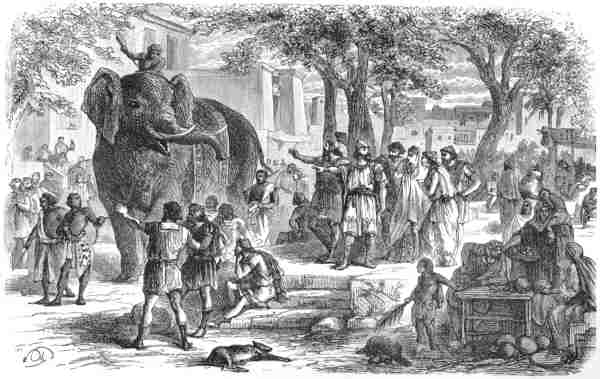
A HUGE ELEPHANT WAS BEING LED PAST.
To face page 191.
"What monster have we here?" cried Hannibal, equally
astonished.
"Heavens!" exclaimed Bichri; "how many arrows would
it take to slay such a brute as that?"
"It must be the Behemoth, of which we have heard so
much," said Chamai, gazing in amazement.
I explained to them that the animal which had so much
excited their wonder was an elephant; that the great teeth
projecting from its jaws were ivory; and that the rope-like
appendage to its head, which it wielded so adroitly, was its
trunk.
"What a line a herd of those creatures would make on
a field of battle!" said Hannibal, his thoughts turning as
usual to military tactics; "I cannot imagine how any infantry
could hold their ground against them; the only
thing would be to open their ranks, let the brutes pass
through, and then attack them from behind."
"You are not the first soldier, Hannibal," I answered,
"who has had the same idea. Some of these animals have
already been tamed, and trained to carry on their backs a
tower full of archers. They are brought from the banks of
the Upper Bagradas, and from the forests in the borders
of Tritonis, a lake in the interior of Libya."
Besides the elephant, we saw a hippopotamus, or river
horse, and a couple of rhinoceroses, with their big horns.
The whole of these were a portion of the tribute (consisting
of ivory, tame elephants, and other animals), which had
been imposed by the sacred suffect upon the subjugated
Libyans on the Bagradas, and which happened now to be
on its transit to the Bozrah.
A well-known voice, harsh and sonorous, at this instant
caught my ear, and turning round, I saw Jonah towering
head and shoulders above the crowd, and encircled by
a group of my sailors, all in roars of laughter.
"Now, at last," the trumpeter was saying, "I am where I
wanted to be! Now I am in the land of strange beasts!
This is the first animal I ever saw in my life with two tails,
one behind and one at the end of his nose! I wonder how
many onions it would take to season the carcase of such
a brute as that! I wonder, too, how long it would take a
fellow to eat it!"
Leaving the sailors to their diversions, we bent our steps
towards the market, where red-skinned Libyans, with
aquiline noses and long plaited hair, were being offered for
sale. Entering a tent where provisions of all kinds were
sold, I ordered some refreshments for myself and my party,
and a Syrian slave, who was serving instead of the owner,
brought us two guinea-fowls, some stewed beans and onions,
some olives, bread, and very fair Helbon wine. Hannibal
seated himself near the stove to feast his eyes upon the
wheat-and-honey cakes that were being fried upon the top.
We had not long been in the refreshment-booth before
Himilco and Gisgo made their appearance; they were
followed by a dancing-girl and three other girls, one
playing the flute, and two the tambourine. The dancing-girl
was one of the western Moors; she had a copper-coloured
complexion, and her hair twisted in coils like so
many serpents; her nails and eyebrows were dyed red;
her face was tattooed with three parallel stripes in regular
Mahouârin fashion; and on her wrists and ankles she wore
rattles that clanked again as she moved. The flute-player
was a native of Barbary, with a fair skin and light hair,
parted over a high, narrow forehead. Both girls were
dressed alike in gay skirts, open as high as the knees; in
their hair they had bodkins, of which the heads were
grotesque figures; their necklaces and girdles were of glass
and enamel; and their earrings were great crosses. The
tambourine-players were inconceivably ugly; one of them
appeared to belong to the Rasennæ, and the other had her
face so daubed with red and blue paint, and made such
hideous grimaces, that it was idle to speculate upon her
nationality.
Himilco was in high spirits; he came up to me and said
that he and Gisgo had been spending the morning in
going from tavern to tavern, and that they had engaged
the orchestra, which we now saw, to accompany them for
the day wherever they went, and to entertain them while
they regaled themselves.
"Poor girls!" said Abigail; "are they obliged to perform
for all the sailors alike?"
"No, indeed," I replied; "they take good care never to
perform unless they are well paid, and I suppose there is
not much hardship in that."
The Libyan had now commenced her performance. We
stayed for a few minutes watching her contortions, and then
left the tent.
The first person we met in the square was Hamilcar,
carrying a monkey.
"Hamilcar with a monkey!" cried Hannibal. "Where
did you get it? The very thing I want myself. I want to
teach it to fight."
"I should like to have a monkey," said Hanno; "I would
teach it to dance."
Bichri said he was sure he could make it learn the use of
the bow; and Chamai declared it would be capital fun
to teach it to make grimaces, and to mimic the mighty
Jonah.
On all hands it was agreed that we must have a monkey
on board the Ashtoreth.
Hamilcar told them that they would have to go down
towards the trade-harbour, through the square where the
rich merchant Hamoun resides; and at the corner of the
street which leads to the temple of Moloch they would
find a dealer who had a whole cargo to dispose of.
"You will have a choice there," he said; "there are apes
of all sorts, all sizes, and all colours. You may have them
brown, or red, or grey, or black, or green; with tails or without
tails; with long hair, short hair, or no hair; wild or
tame; only ask for what you want, and you will be sure to
get it."
On our way down towards the trade-harbour we met
Aminocles, quite drunk. He was being dragged along by
a couple of sailors, singing at the top of their voices. He
had learnt only too soon what was the use, or abuse, of the
silver shekels.
We had no trouble in finding the monkey-dealer's, and
Hanno, who had taken it upon himself to select the most
intelligent monkey he could see, chose one which appeared
to meet with general approval.
"And now what are we to call it?" said Hannibal, who
liked everything to have a name.
"Don't you think," said Hanno, "that it has a very
striking resemblance to old Gebal, the judge at Sidon?
Look at it now. Isn't it like him when he rolls his eyes
and scratches his poll, just before giving sentence?"
"Exactly!" said Hannibal, "the very facsimile! and
Judge Gebal he shall be called!"
We now made our way with our new purchase down to
the quay, whence a small boat carried us across the trade-harbour
to the opposite island, on which are built the handsome
residences of the more wealthy inhabitants of the
city; for during the last ten years many of the merchants
have amassed considerable fortunes, and abandoning sea-life,
have settled down in homes replete with luxury. We
walked to the extremity of the island, and after leaving
the two women at the noble bath-room at the top of the
wall above the small basin in which the pleasure-boats of
the rich inhabitants are kept, we betook ourselves to the
men's baths, and enjoyed the refreshment of a wash and a
shave. Rejoined by the women, we rowed across to the
nearest point of the Cothôn, and paid a visit to the signal-tower;
thence we went on foot to the magnificent gardens
that lie between the citadel and the lower town. Here I
showed my party the temple of Achmon, and took them to
see the public fountains, the constant resort of both sexes
for lounging and gossip.
Night coming on, we returned to the Ashtoreth, on which
the lamps were already lighted. Going on board, I found
the slave of the man who had entertained me during my
former visit to Utica waiting for me with an invitation
from his master to dine with him next day, and I sent
a message that we should be pleased to avail ourselves
of his hospitality. During our day's absence my cook had
prepared a sumptuous repast, which we all thoroughly
enjoyed.
The trumpets now sounded the signal for calling in the
sailors. They came dropping in two or three at a time,
all more or less tipsy, and some of them inclined to be
noisy; but so strong was their habit of submission to discipline,
that no sooner had they stepped on board than they
relapsed into their wonted silence, and retired quietly to
their berths. Himilco was among the last to return, and
to his credit I feel bound to record that he was quite able
to walk across the deck without any assistance from his
friend Gisgo.
CHAPTER XII. I CONSULT THE ORACLE.
I made
it my first business on the following morning to
go to the great market-place, near the trade-harbour and
the temple of Achmon. It is surrounded by lofty houses
upon an arcade, under which are the retail shops of the
tradespeople, their warehouses being in courts at the back.
In these shops every variety of Libyan merchandise was
exhibited for sale. There were hides, dressed and undressed;
stones prepared for engraving; Numidian copper;
lion-skins from Mount Atlas; thongs of hippopotamus-hide
from Lake Tritonis; elephants' tusks from the Macar;
corn from Zeugis and Byzatium, and wool from the land of
the Garamantines. I spent a considerable time in making
purchases of ivory, and procured a good supply at a very
fair price; and later in the day went with Hannibal and
Hamilcar to fulfil the engagement I had made on the
previous night. Hanno and Chamai preferred escorting
Chryseis and Abigail about the city; and Bichri went for
an evening's diversion with Gisgo, Hasdrubal, and Himilco.
Barca, our host, one of the richest shipowners in the
colony, had prepared us an elegant entertainment in a
handsome tent pitched upon the terrace of his house. As
soon as the meal was ended, wine was brought in, and musicians
and dancing-girls performed for our amusement; and
one of Barca's slaves, an old Libyan, who was well versed
in the songs and traditions of his people, repeated his tales
about the mystery and wonders of their origin.
According to his account, there had formerly, south of
Libya, been an extensive sea, which received the water of
several rivers, and to the south of which again lay the land
of the negroes, who had faces like monkeys. This sea was
the original Lake Tritonis, or Pallas, and the chain of lakes,
at the foot of the Atlas Mountains, extending from the
vicinity of Gades to Karth,[35] in Byzatium (now known to us
as the Tritons), are either marshes formed by the overflow
of two great rivers from the south, whose waters have been
diverted by Mount Atlas, or, when salt, are probably the
remains of the same great sea. There are then, he represented,
two mountainous ridges, the more southernly of
which outpours its streams as far as the Tritonis and Mount
Atlas, and the other sends its rivers, the Macar and the
Bagradas, into our own Great Sea. Further west, issuing
also from Mount Atlas, are other important rivers, which
lose themselves in the sands. These, however, long centuries
back, had an outlet into the inland branch of the
great Atlantic Ocean, which, at that remote period, was the
southern boundary of Libya, and extending eastwards
towards the confines of Egypt, ultimately joined the Syrtes.
Libya was thus a great peninsula, connected with the mainland
only by a narrow isthmus, now the Straits of Gades,
and enclosed on every other coast by water; on the north
and east by the Syrtes, by which it was separated from
Egypt; on the south by the inland sea that covered the
present sandy desert; and on the west by the ocean
itself.
But as time went on great changes were evolved. His
face beaming with intelligence as he spoke, the old man
told of mighty convulsions of the earth, and how they
changed the isthmus of Gades into a strait, and how the
waters were swept back by the shock, so that the whole
flood of the ocean rushed through to the Great Sea, and
the Great Sea receded and yielded to the upheaving of the
land.
I listened with increasing interest. I knew already
how the sea could overwhelm the land. I was also
aware how the Siculians maintain that long ages back a
neck of solid land had joined their country to the continent
of the Vitalians. Many times, too, I had heard
amongst Phœnicians how a deluge had detached the isle
of Chittim from the mainland. And now I was hearing
the wondrous tale of how the sea had retreated from the
south of Libya.
He went on to say that when the waters rolled away
they submerged an immense number of islands, leaving the
Fortunate Islands[36] (of which I shall have to speak hereafter)
as the sole representatives of what had previously been a
vast archipelago, that had made communication easy, even
in small boats, not only with the land of the Atlantides,
but with that other great country that lies still further to
the west. Now, however, that Atlantis has disappeared, all
intercourse has been dropped with that remote land, from
which both the red and white Libyans assert that they
originally came, and whence migrating eastwards they
founded cities as they advanced, became the first settlers
in Egypt, and spread far and wide the knowledge of
their gods, which were really the Dionysus and Minerva
of the Hellenes and Vitalians, and Zeus, known among
us Phœnicians as Baal-Hamon. According to their own
account (which is confirmed by the Hellenes), the Pelasgians,
under the leadership of Melkarth-Ouso, came
into Libya, but afterwards retreated to the east. Then
came the great convulsion when the land was upheaved
and the waters receded, and the earth subsided into its
present configuration; then, too, the Sidonians, protected
by their gods, began to assert their sovereignty on the sea,
and sending forth ships to every region of the world,
opened emporiums of commerce, discovered mines, founded
cities, taught the art of writing, and disseminated knowledge
of every kind.
More and more as the aged Libyan recited his ancient
legends had we become rapt in attention. Hannibal sat
with his eyes wide open, and from time to time gave vent
to ejaculations of astonishment; and I, though less surprised,
for I had already speculated very much on these
matters, was nevertheless deeply impressed with the clearness
with which they had been laid before us. I retired
that night with my brain agitated by excitement, and
dreamed that I was commanding a magnificent fleet, and
that we discovered the land beyond Atlantis; and when I
woke in the morning, I made a vow in my mind that no
sooner should my present expedition to Tarshish be completed,
than I would set out on a voyage of discovery to
the west.
We had been in Utica three days when Adonibal sent
me a message that he wished to speak to me. Without
loss of time I presented myself at the palace, and was
conducted to the apartment from which the admiral can at
once overlook the city, the harbour, and the sea. To his
enquiry how long it would be before I took my departure,
I replied that having taken in my cargo I hoped to sail
in two days.
"Here, then," he said, "are letters for the suffects of
Rusadir and Gades; and I intend to give you ten
seamen to supply the places of those you have lost. I
am sure there ought not to be any deficiency in your
numbers in the event of your coming into collision with
Bodmilcar."
I was proceeding to thank him for his liberality, but he
stopped me, and said that he should have to trouble me for
fifty shekels that I owed him.
I professed myself quite ready to pay anything that was
due, but said that I was very much amazed to learn that I
was in his debt.
"It is a mere trifle," said Adonibal, in his usual facetious
way; "it will not ruin you. I should not mention it at all,
only you know it is a matter of principle with a true
Phœnician to keep his accounts straight. The truth is, it is
a little fine. Some of your men have been half-killing a
couple of my Ligurians. The knaves are down in the
dungeon sleeping off the effects of their drinking-bout; but
just pay their fines, and I will give you an order for their
release, and, if you like, you may go yourself and fetch
them out."
"Ah," said I, laughing, "you wanted to show off the
efficiency of your police."
I could not help asking him whether the circumstance
did not remind him of the time when I was his helmsman,
and he had himself come to liberate me from the prison
in Chittim, where I had been locked up for smashing the
skull of the grand merchant from Seir.
"You mean when I was captain of the Achmon—and a
noble ship she was," said Adonibal. "Yes, to be sure—I
remember it perfectly: we were both of us younger
then than we are now. When I was a youngster I was
always getting into scrapes as often as I went on shore
with a purse-full of money; now I am only a poor hulk,
dismasted and stranded here on the shore. Such is life!
while we are young we entertain ourselves with breaking
each other's heads, and when we are old we busy ourselves
with cutting them off."
"But, seriously, how have my men been committing
themselves?" I asked.
"As far as I understand the matter," replied the suffect,
"they took it into their heads to play pranks with one of the
priests of Dionysos; they treated him to some wine, made
him perfectly tipsy, smeared his face all over with red
and blue paint, and then insisted upon making him dance.
Some of my Ligurian soldiers, seeing what was going on,
tried to protect the priest—an interference that your men
were not in the mood to allow. They had tripped up two of
the soldiers, when the Admiralty-guard came to the rescue,
and quietly walked off four of your drunken fellows to me.
I sent them to the dungeon, but I have not had them
flogged; I am generally as indulgent as possible in the
case of a sailor's spree. I am an admiral now, and old in
the service, but I do not forget that I was once a young
pilot."
The subterranean vaults to which I now descended were
very dark: most of them were used as armouries or storehouses,
but a few were set apart for prisons. The turnkey
opened the door of one of these, and by the light of his
torch I could distinguish Bichri and three of my sailors,
all looking very sheepish, and I had some difficulty in
repressing my inclination to laugh. However, I assumed
a serious air, gave them a severe reprimand, and sent them
out with a notice that they were not to quit their ships.
They did not wait for any second bidding to be off; the
Admiralty dungeons are no enviable quarters, and those
who find their way into them rarely leave except for the
cross or the gallows.
Returning to the quay, I passed along the subterranean
passage to the arsenal, and spent the remainder of the day
in directing the repairs of my ships. By the evening
everything was finished; and I was so gratified by the
rapidity with which the work had been done, that in my
good humour I not only forgave my four men who were in
disgrace, but allowed them, on promise of good behaviour,
to have another holiday on the following day.
For myself, I resolved to spend that day in an expedition
to a small temple of Baal-Hamon, a short distance
from the city, and to take with me no companion whatever
except my friend Barca's old Libyan slave.
This temple is situated in the gloomy recesses of a
forest; it is oblong in shape, and has neither door nor
window; its only external aperture is a hole in the roof to
allow an escape for the smoke of the sacrifices; and it is
entered by an underground passage, the mouth of which
is closed by a large stone concealed by the brushwood.
Three old and half-naked Libyans were waiting outside, and
after a brief consultation, in whispers, with the slave I had
brought with me, quietly raised the stone and pointed to
the orifice. I entered the passage, followed by the men,
and in a short time found myself in a small dim chamber,
in the further wall of which was a flat stone, which turned
on a hinge and formed a door, just affording room to pass,
and opening into a second chamber, that was at once
misty and red with the glare of two smoking lamps. Let
into the wall of this compartment was another flat stone
with a hole in its centre, which one of the men turned
slightly round upon its pivot, allowing me to peep into a
third chamber, which was a mere cell, containing a niche,
where a shapeless notched stone was deposited, which my
guide informed me was the god himself. In obedience to
the directions that were given me, I prostrated myself
three times before the deity, and remained waiting where
I was. After a time, a black sheep that I had brought
with me was conducted into the cell, and slaughtered
before the niche in such a way that its blood flowed into
a hollowed stone let into the ground to receive it. When
the sacrifice was finished, the stone was turned back,
shutting the god with his newly-slain victim into the inner
cell. I was told to apply my ear to the hole in the
stone, and to listen for the voice of the deity. The lamps
were then extinguished, and I was left in silence and in
total darkness.
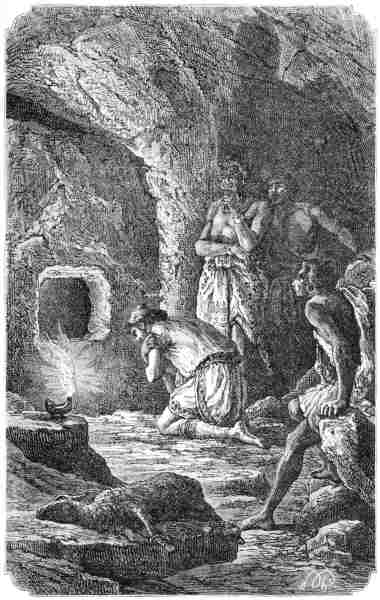
I PROSTRATED MYSELF THREE TIMES.
To face page 202.
Presently a deep muffled voice, that seemed to issue
from the abysses of the earth, came to my ear:
"Phœnician mariner, what wouldst thou ask of me?"
Awestruck, I could scarcely speak, but making an effort
to reply, I said:
"Oracle of Hamon! I would know whether it be possible
to sail westward beyond the Straits of Gades, and whether
there is land."
"There is land," the voice repeated.
"Is it to be found north, west, or south?" I inquired.
"There is land to the north, there is land to the west,
there is land to the south," the oracle replied.
Emboldened by the answers I obtained, I asked again:
"And the proper route—is it by the sacred promontory,
or must I sight the head of Gades?"
"Mortal!" the voice declared, "you ask more than it is
permitted mortal to know. Go; I tell no more."
The stone doorway turned on its hinge, and we groped
our way back through the gloom out into the open air.
I recompensed the attendants liberally, and returned to
the city—perplexed, it is true, but confirmed in my resolution
to explore the ocean and seek for land, far or near,
beyond the Straits of Gades.
In the course of our walk back, I inquired of my companion
whether there were many of these subterranean
temples in Zeugis and Byzatium. He told me that in the
interior there were several very much more elaborate, with
arches and domes, but they were not nearly so ancient; the
true temples of the Atlantides were all like the one which
we had just left. Some there were, indeed, that were still
more simple, consisting only of three stones, flat and unhewn,
of which two were placed upright on their ends,
and the third laid horizontally across them; others were
formed of stones arranged in a long covered avenue. Of
these, some were in the open air and some concealed under
mounds of earth, at the top of which several stones were
reared, while round the base circles of still larger stones
were grouped symmetrically. No doubt some of these
erections were not temples, but tombs, and were occasionally
found in such numbers as to cover a large extent of
ground, and were laid out in set figures, representing men,
serpents, eggs, and scorpions.
Such was the Libyan's account of his religious edifices.
When, however, I began to question him about their signification,
and why some were underground and some
above, and what was the design of their peculiar construction,
I could elicit nothing from him but that it was the
result of magic, of which his people had inherited the great
secret from their forefathers.
Early the following morning, with the suffect's permission,
I set to work to take in a supply of fresh water
from the fine cisterns on the quays. Each cistern is
divided into two compartments; one to collect the rain-water
in its turbid condition from the paved streets, the
other to receive the same water when it has undergone
the process of filtration; the two tanks being connected
by square-headed cocks turned by a wooden key. All
the private houses, as well as the public buildings, in the
towns, are provided with cisterns of a similar construction,
the country villages being supplied with water from open
tanks formed by two circular compartments, of which one
acts as a receptacle and the other as a reservoir.
Hannibal, who had been paying a visit to the ramparts,
returned highly gratified with what he had seen. He informed
me that all the forts were built upon cisterns, and
that the rubble-work of the walls was twenty-four cubits
thick at their base, and eighteen at their top; that the
soldiers' quarters were on the second and third storeys,
out of the reach of the battering rams, and built in the
thickness of the walls; also that about three-quarters of a
bowshot in advance of the inner line there was a wall half
the height, and outside this again a strong palisade, with a
moat and intrenchment. He thought, however, that his
eye had been keen enough to discover one weak point to
the right of the city, where the arsenal was overlooked
by an adjacent hill, and I concurred in his opinion that
another fort ought to be built upon the wall to cover any
attack from the eminence.
The sundial on the Admiralty palace marked the hour of
noon when, having made my roll-call, and satisfied myself
that my men were all on board, I went to take leave of
Adonibal. The aged suffect bade me a kind farewell, and
wished me a prosperous voyage. I lost no time in giving
the signal for departure, and as we left the harbour we
raised a hearty cheer for the admiral, who was watching us
from his balcony. Four other vessels, heavily freighted
and bound for Massalia, at the mouth of the Rhone, left
Utica immediately after us.
The distance from Utica to the Straits of Gades is 8800
stadia, and by fast vessels can be accomplished in about a
week. A strong west wind, however, had made the sea so
turbulent that all navigation was very difficult, and it was
not until after four days that we sighted the Cabiri (or the
Seven Capes), a point which is usually reached in two;
and even then, in order to clear the promontory, we were
obliged to make such long tacks that we quite lost sight
of land, and were carried far towards the north. But at
length, on the seventh day, I recognised the first great
cape[37]
on the mainland, south of the Pityusai Islands.
"Tarshish!" shouted Himilco, who had been so fully
occupied that he had scarcely spoken before. "Tarshish at
last!"
There was a rush to the deck; but so blinding were the
rain and the spray, that it was impossible to distinguish
anything on shore.
I had taken in enough water to last us for a fortnight,
and it was well that I had done so, for we found ourselves
experiencing the difficulty, not at all infrequent, of
approaching this dangerous coast, and had to continue to
make very long tacks.
After three days' perpetual struggle with the elements we
were still off the Libyan coast, but the wind then moderated,
and the rain gave place to sunshine. In the course of the
next night Himilco and I, whilst well-nigh every one was
asleep, recognised the tall perpendicular peaks of Calpe and
Abyla, and soon afterwards we passed under the wall of
rock that forms the southern limit of Tarshish; by the
morning we were within sight of the level tongue of land
south of the magnificent bay of Gades. All along the
headland rose the white domes and terraces of the town,
imbedded in luxuriant foliage; high above all was the
semaphore beside the temple of Ashtoreth. As we entered
the basin of what serves equally for trade-harbour and war-port,
our trumpets were sounded, and we saluted the town
with three ringing cheers.
We had reached our goal, and were in Tarshish at last.
CHAPTER XIII. THE SILVER MINES OF TARSHISH.
The
town of Gades, though not large, is neat and trimly
built, and in the well-kept gardens in the environs, pomegranates,
oranges, and lemons, which have all been introduced
by the Phœnicians, flourish in great abundance.
About the centre of the town, and in direct communication
with the harbour, is the market, the emporium not only for
the wedges of silver brought from the mines in the interior,
but for barrels of the salted murenæ that are caught on the
neighbouring shore; for Tarshish cats,[38] to be used in rabbit-hunting;
for iron, which is obtained in small quantities
from the north; and for the promiscuous curiosities in which
the strange and remote region abounds. The market-place
is surrounded by the offices of the rich merchants and
money-changers, who, as proprietors of the mines, were
ready to exchange their silver for copper, manufactured
articles, and fancy goods. I was not long in making my
way thither.
Having seen my ships properly moored in the places
assigned them at the quay, handed their pay to my seamen
and soldiers, and notified my arrival to the naval suffect, I
turned into the thoroughfare that leads to the town, and had
no difficulty in finding the office of Balshazzar, the rich
merchant with whom I had had many business transactions
during my previous visit. Balshazzar was dead, but Ziba,
his widow, was carrying on the business in partnership with
several other merchants. She received me very cordially,
and insisted that I should send for the two women, and for
my sub-captains and pilots, to come and take refreshment
at her house. She provided a handsome entertainment,
during which I had the opportunity of explaining to her
the object of my voyage, and of asking her advice as to the
best means of obtaining silver, either in lumps or ingots. I
found that, according to her statement, the current price of
silver was just then very low, so that I might hope to
purchase on favourable terms, either in the town, or by
going inland and bartering with the savages. Some large
mines, she informed me, had quite recently been discovered
on the River Bœtis,[39] about four days' march up the country,
and the only reason why they had not been opened and
worked was the scarcity of labour; the great bulk of the
population of the town being either merchants or mariners.
"We ought," she concluded, "to have plenty of soldiers
stationed here."
"Beyond a question," exclaimed Hannibal, warmly, "the
prosperity of a country is to be measured by the number of
soldiers it maintains."
Ziba's long residence in the colonies had rendered her
quite unaccustomed to the ideas and manners of military
men, and she looked at him in some amazement.
"Yes," she said, "we do require a large number of slaves,
soldiers, and transported felons here."
It was now Hannibal's turn to look amazed.
"Soldiers and felons! What do you mean? Do you
suppose that soldiers are to be associated with slaves and
malefactors?"
In explanation of her remark, she said that in order to
establish a firm footing in the silver-producing districts, she
thought that the merchants ought to club together, and either
buy or hire soldiers to drive back the native barbarians.
The prisoners they took ought to be sent to the mines, and
to these there should be added as many slaves as could
be bought, and any number of transported criminals who
would cost nothing but their keep.
Seeing that Hannibal was about to make some indignant
rejoinder, I interposed by asking her whether it was possible
to obtain slaves here, and whether the natives were hostile
or well-disposed.
"Not a slave will you find in the market," she said;
"they have been purchased as fast as they have been
brought to us. As to the savages, they have hitherto
been tolerably peaceable; but, aware of the value we set
upon their silver, they demand most exorbitant wages for
their labour."
"Peaceable you call them, do you?" broke in Himilco;
and pointing to the empty socket of his eye, said, "Yes;
perhaps if using their lances to scoop out people's eyes
is a proof of peaceableness, the Iberians of Tarshish are
supremely peaceable; but I confess I don't quite see it."
Ziba smiled. Although she was a thorough woman of
business, she had a keen appreciation of a joke.
"Yes, pilot," she replied; "I very well recollect your
misfortune when you were here before; indeed, it was I
myself who dressed your wounds with oil and rosemary.
But you may take my word for it that the tribes on the
Bœtis are far more anxious to take your goods than to do
you any bodily injury. In time, I have no doubt, they
will become perfectly submissive to our rule."
"And then," I exclaimed, "Tarshish, like Zeugis, will
be one of the brightest jewels in the crown of our glorious
Sidon."
And every one, as I spoke, filled and drained his wine-cup
to the honour of our noble city.
"But to return to business," said Ziba; "I think that
the best plan for you will be to come with me to the naval
suffect, who may probably suggest some plan by which
you can get labour to open some fresh mines. The Bœtis
is quite wide enough to allow your ships to ascend within
a day's march of the best districts, and your soldiers and
sailors ought to be quite enough to protect you from any
hostilities on the part of the Iberians."
I readily acquiesced in her proposal; and the widow,
having put on a veil, mounted a richly-caparisoned mule
led by two well-dressed slaves, and preceded by a running
footman carrying a long staff. She went in front, and we
all sallied forth after her to the Admiralty palace. The
suffect received us in the large hall, where he was seated in
his painted chair; and when I had explained the object of
my visit, he said:
"Had you come four days sooner, you might have
arranged to accompany a Tyrian merchant who passed
through this port on his way to the mines."
The suspicion flashed instantly on my mind, and I said:
"You mean Bodmilcar?"
"Yes," replied the suffect, "Bodmilcar; and a rare
rough-looking set he had with him. We are not generally
very particular in looking into the character of men who
go to the diggings, but I confess I never set eyes upon a
worse-looking lot. They looked like thieves and assassins."
"Just what they were," I said; "and their leader is no
better than themselves. You have only to read this, and
you will learn what he really is;" and I handed him
Adonibal's letter.
"By Ashtoreth!" he swore, "what a scoundrel the
fellow is!"
After pondering a few minutes, he continued:
"I will tell you what I can do. I will lend you fifty
armed men to help you to improve the villain off the face
of the earth. I would, if I could, lend you more, as I
know how advisable it is for expeditions into the interior
to be well guarded; all kinds of people are at work in the
mines, and nothing is easier for them than to conspire to
overpower a new comer. But I really cannot spare any
more. The time will come, I hope, when we shall have
reinforcements enough here to make our authority properly
felt in the mining districts."
Ziba now mentioned that she had made a contract with
one of the Iberian chiefs, named Aitz, by which he had
engaged to find porters and labourers to assist the twelve
hundred slaves which she had provided to excavate the
soil of a new mine; and having explained that she had
erected a fortress in which were stationed a hundred
soldiers, and put up a residence for an overseer of the
works, she said that she was perfectly willing to hand
over the contract to me under certain conditions. She
was ready to surrender her sole interest, to give me an
introduction to her overseer, and to allow me the protection
of her little garrison, if I would stipulate to pay
her a fifth part of the gross profits.
The suffect seemed to think that the proposal was
reasonable; but I demurred to the proportion of the
profits which she demanded, and insisted upon her accepting
a sixth instead of a fifth.
After a short debate, which ended in Ziba's yielding to
my terms, I made Hanno draw out two copies of the
agreement which we mutually signed, and then all adjourned
to the temple of Ashtoreth, where we offered a
sacrifice to the goddess, and made a vow to remain
faithful to the various covenants of the contract.
The time of the year was very favourable, and I was
anxious to lose no time in starting. Accordingly, four
days did not elapse after our arrival at Gades before our
ships were again on the sea, making way towards the
mouth of the Bœtis, which we reached after two days' easy
sailing.
Beyond the Straits of Gades the sea is subject to tides
which are even more considerable than those in the Jam
Souph, and it was necessary to wait until high-water before
we could pass the bar of the river. As soon, however, as
the bar was passable, the river presented a very animated
scene, and vessels of every description got into motion,
both ascending and descending the stream; Phœnician
craft, from the ponderous gaoul to the slim fishing-smack;
Iberian piroques, carrying their great brown or black sails
of woven bark; and the long Celtic coracles, composed of
hide. Of all these, none were empty; whatever provisions
are consumed in the mining regions have all to be brought
from Gades, and the same ships that convey the supplies
into the interior always return laden with the ore.
Having crossed the bar, as there was no wind and the
current was strong, I lowered my sails and rowed up
the river. The yellow waters of the river flow rapidly between
banks that are sometimes wooded and sometimes
barren flats. The country on both sides is mountainous
and wild, and only at long intervals are to be seen any
of the Iberian villages, which, consisting of hovels made of
mud and branches of trees, are most frequently nothing
more than roofs to holes which have been dug in the
ground. The miners' villages are very similar, the chief
difference being that the huts are higher and more commodious,
and in the centre of each community there is a
palisade enclosing a redoubt, or embattled fortress built of
brick.
"Not particularly lively here," said Hanno; "the getting
of silver seems rather a more dreary business than the
spending of it."
Hannibal remarked that all the villages seemed to
occupy positions that were naturally very strong, observing
that the Bœtis itself formed a good line of defence,
and that there might be a great deal of hard fighting in
such a country.
"I can answer for that," said Himilco; "I know that
these Tarshish barbarians would sooner pluck out a man's
eye than give him a cup of wine. Here come some of the
rascals. Look at them."
Every one looked where Himilco was pointing, and there,
walking, or rather shambling, along the bank were rather
more than a score of savage-looking creatures evidently
watching our ships. They were almost naked, their only
covering being a strip of woven bark around their loins,
and a sort of turban of the same material on their heads;
they had sunburnt skins, black hair, and small black
eyes, obliquely set; they were of moderate height, and appeared
to be extremely agile. But we observed that some
of them seemed to be quite of a distinct race, being very
tall and thin, with thick shaggy beards and very revolting
countenances. All were armed with long shields, and
carried either bludgeons, slings, or strong lances pointed
with flint or bone.
I shouted to them, but they made no sign, and continued
skulking along the bank.
"Bichri!" cried Himilco, to the archer, who was sitting
on the poop with Jonah, both of them playing with the
monkey, "Bichri, just put an arrow into one of those scaramouches,
will you? they pretend they cannot hear the
captain."
He started to his feet, and was in the act of raising his
bow, when I interposed:
"Leave them alone; time enough to attack them when
they attack us."
Bichri lowered his hand at once.
"Well then," he said, "I may as well go on amusing
myself with the monkey; what an entertaining brute it is!
he pulls my hair and scratches my face a bit; but I bear
it all because he's so clever."
"Aye, aye, go back to your plaything; he's about as
good-looking as the Iberians," said Hanno, laughing.
My brave young archer was not much more than eighteen
years of age, and in light-heartedness and love of frolic
was like a boy of twelve. The monkey, the only creature
on board more restless than himself, had taken his fancy
immensely, and they were continually vying with one
another in feats of agility, trying which could climb the
mast the faster, or which could swing the higher at the
end of a rope. Another of Judge Gebal's warm admirers
was Jonah. The giant seemed to have lost his concern
about the land of strange beasts, and to be engrossed with
the monkey, which he had admitted into his close friendship,
and whose antics he was always rewarding with the
choicest tit-bits on which he could lay hands. One of the
creature's great delights was to mount the trumpeter's
shoulder and clamber by his shaggy hair to the top of
his head, where from its elevated perch it would make
grimaces, scratch its pate, and grin and gnash its teeth
at every one. Bichri, Jonah, and the monkey, thus formed
an amicable trio, of which a little rough treatment all
round, and a few cuffs and scratches, did not mar the
general concord.
Towards evening by my orders we came to a standstill,
opposite a miners' village. The overseer came out from
his hut to speak to us. He was a coarse, ill-spoken man,
rarely opening his mouth without an oath. He was a
native of Arvad, and consequently an old acquaintance of
Hannibal's.
"By all the infernal gods!" he began, "this is a week of
visitors!"
"How so?" I asked.
"Confound me, if we hadn't another Tyrian here five
days ago! Bodmilcar was his name; and a rascally set of
scamps he brought. Drunken beasts they were; they
sacked some houses in the village here, and, by Khousor
Phtah! I vow they would have murdered us every one if
we had not pounced upon them pretty hard. I have seen
blackguards in my time, but never the like of those. And
if any one can succeed in swinging up Bodmilcar himself
at a rope's end, he will do the world a service."
"Where is he now?" I asked; "can you tell me that?
I have a score of my own to settle with him."
"By the gods! you will have some distance to go. He
has taken a swarm of Iberians with him into the interior.
You had better be careful how you meddle with them:
they are dangerous folks to touch; and they are a pretty
strong force altogether."
"Never mind their force," said Chamai; "numbers don't
matter; only let us get them within reach of our swords."
"All very fine for you, young fellow, to be so cocksure of
your game," replied the overseer; and turning to me, he
added, civilly enough: "But I see you are determined to
risk the consequences. Give me a drink of wine, and by
the gods! I will give you some hints that may be useful to
you. Silver is silver, you know."
"Yes, and wine is wine," muttered Himilco, always keenly
interested upon that topic.
I ordered a skin of good wine to be produced, that he
might drink while we talked over our scheme; but the overseer
had no wish to be outdone on the score of hospitality;
and accordingly he clapped his hands sharply, and when
the manager of his slaves appeared in answer to the
summons, he gave instructions for one of his finest calves
to be killed, and a feast to be laid out for us under an
adjacent clump of trees.
After we had given each other the latest news of
Phœnicia and Tarshish, the overseer said in his own
abrupt way:
"You seem brave enough; but I have a great respect for
numbers. Your wine is good stuff, and I like it. I am
glad to meet a fellow-townsman. Now, in return for the
wine, curse me if I don't do the best I can to help you."
After all, he had not much to tell. He informed us that
in the territory adjacent to that of Aitz, who had made his
compact with Ziba, there were some exceedingly rich veins
of silver; and that, although the Iberians in possession were
decidedly disposed to be hostile, they might readily be
bought over by some trumpery merchandise, or without
difficulty might be subdued by our arms.
"And how near to them can we take our ships?" I
asked.
"Within three days' march," he answered. "It is not so
much that the distance is great as that there are no roads;
and after the ships are left there is no further communication
with the river. You have to go through forests, and you
have to go on foot. No horses can go; no mules."
"Nice marching that!" said Hannibal, sententiously;
"and you say we have to take our own provisions?"
"As to that, I daresay you can get Ziba's overseer to
lend you some Iberians; they make capital beasts of
burden."
"Very good," said Himilco; "and I think I can undertake
to make them trot along at a good pace. Give me a
stick, and I will write a few words of their Iberian tongue
upon their backs in a way they will perhaps remember."
The overseer seemed to enjoy Himilco's spiteful jest, for
he laughed aloud. We emptied our wine-cups, and broke
up our meeting.
Betimes next morning we were again on our voyage up
the river, and in less than a day had reached Ziba's territory.
Her overseer, a native of Utica, lent me two hundred slaves
as porters and miners, and I divided them into gangs, which
I put under the supervision of my officers. The ships, with
just a sufficient portion of their crews, were left under the
charge of Hasdrubal; the Dagon and the Ashtoreth
descending the river for a short distance to get a better
anchorage; the Cabiros, as drawing less water, being left
under orders to cruise about, and to keep on collecting a
supply of provisions. We had been provided with a guide;
and everything being arranged, I set out upon my exploration
of the new territory.
We started across an extensive plateau, and having
traversed several woods and deep ravines, made our encampment
for the night. Very monotonous were the journeys of
the following days, over gloomy hills and across deep valleys,
and it was not until the middle of the fourth day after
leaving the banks of the Bœtis, that we caught sight of an
Iberian village. The people were all under arms when we
arrived, and inclined to take a defiant attitude, but a few
presents had the effect of conciliating the chiefs, and inducing
them to give us permission to encamp on a barren
knoll, about three stadia off their cluster of huts. Under
Hannibal's superintendence we surrounded the encampment
with a trench and a palisade, and in two days were ready
to commence our digging operations, in which we were
directed by an experienced man, who had been sent with us
for the purpose.
We were beginning an arduous task. For three long
months did our labours proceed without intermission. The
Iberians were always distrustful, but never committed any
overt act of hostility. Yet, thanks to the favour of Ashtoreth,
though our work was long, our success was great. Excavation
after excavation turned out prolific, and as the result
of our mining, I obtained no less than two thousand shekels
of silver. Some of this I refined on the spot, and retained
in my own keeping, the rest of the ore being periodically
despatched by hired slaves to the Ashtoreth, whence I
received back a written acknowledgment of each consignment
as it was delivered on board.
At length I felt it was time to re-organise my caravan to
return; and under the direction of an Iberian guide, over
whom a strict surveillance was kept, we set out upon our
way back to the ships, rejoicing to quit the desolation in
which we had been sojourning so long.
No sooner were our backs turned upon the encampment
than the Iberians rushed towards it, tore down the palisade,
and scrambled furiously for any article, however worthless,
that we happened to have left behind.
CHAPTER XIV. AN AMBUSCADE.
For
two days we continued our return march without any
interruption, and reached the base of the steep ascent that
leads to the plateau overlooking the river.
The mounting of this height was a matter of no little
difficulty. We had to climb like goats, clinging to rocks
and tufts of brushwood, trampling down branches and
dry grass, and hardly succeeded, after all, in following the
track which the head of the caravan had opened.
Suddenly, about half-way up the slope, the ground sank
abruptly, forming a deep ravine that had to be crossed
before continuing the ascent. We paused at its brink to
recover our breath. Behind us the long line of our sailors
and porters was slowly filing through the thicket; in front,
yawned the precipitous ravine itself; and opposite to us
rose the mountain-side, to its very summit a mass of
sombre woods; several eagles were wheeling round above
the chasm.
"A fine place for an ambush!" said Hannibal, wiping
the perspiration from his forehead, and little dreaming what
was in store for us.
Himilco took a draught from the goat-skin that he
carried at his side, and heaved a long-drawn sigh:
"Ah!" he said, "it was in just such a plaguy hole as
this that I lost my eye ten years ago. I hope the hand
that thrust the lance has been rotten long since."
My own experience of the dangers of the land of Tarshish
made me very cautious, and with the approval of my two
military subordinates, I despatched Hanno and Jonah to
the rear to call together the stragglers, and to collect any
that might have lost their way in the woods; Bichri and
his ten Benjamite archers, and Aminocles with his five
companion Phocians, I sent on in front to make their way
rapidly across the ravine, and to explore the forest on the
opposite side.
Jonah's trumpet was soon heard sounding its call, and
very shortly afterwards Bichri and Aminocles were seen
entering the wood beyond the hollow. Without suspecting
that there was any cause for alarm, I ordered the guide
(who was still being watched narrowly by my sailors) to
advance, and we began our descent. Some of us had
already reached the bottom, and the main body were
making their way as best they could down the troublesome
incline, when the guide came to a sudden halt. He
was about fifty paces ahead, just beginning to re-ascend the
hollow. As soon as he stopped, a whistle was distinctly
heard from the woods in front, and Himilco called out:
"Look out, captain—look out! there's mischief brewing."
I shouted with all my might to the guide to move on
more briskly, and the sailor who had been put in charge of
him was in the act of pushing him forward, when the
savage made a sudden dive, felled the sailor to the ground,
in two or three bounds cleared the intervening space, and
disappeared in the adjoining thicket.
"I told you so," said Himilco; "I knew well enough
that the Iberian scoundrels would be at their old games
again."
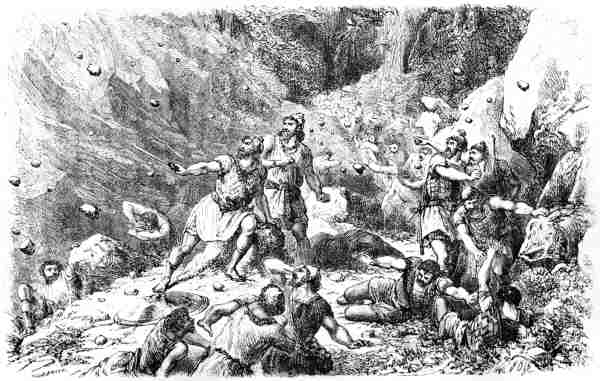
AN AVALANCHE OF STONES.
To face page 220.
While he spoke, Jonah's trumpet sounding an alarm told
only too plainly that the column was being attacked in the
rear, and in front a frightful chorus of yells and war-cries
was followed instantaneously by an avalanche of stones.
One of my poor sailors fell at my side with his skull
smashed, and all the native bearers who had entered the
ravine threw down their loads and fled precipitately.
"Form a line!" shouted Hannibal to his men; and in
spite of the storm of stones that was falling around him,
the intrepid leader mounted a projecting rock, and brandishing
his sword, vigorously rallied his force. A party of
sailors made a body-guard about the two women, and
Chamai, pale with rage and excitement, rushed with his
sword drawn to Hannibal's side.
"What do you think of this?" said Himilco to me,
pathetically, as he picked up a great stone that had fallen
within a hand's breadth of his side; "these Tarshish
almonds seem to be falling pretty thick."
And as if in answer to his words, a second storm yet
heavier than the first came pelting down amongst us, and
knocked over several of our men; but this time it came
from behind, from the quarter of the ravine that we had
just quitted, and showed us that we were assailed as much
in our rear as in front.
"O, if only we had some cavalry and some chariots,"
began Hannibal; "how easy to turn both flanks like the
Khetas[40]
did with the Assyrians.[41] We would send our
cavalry to the right, and our chariots to the left, and a
free passage for our own centre should soon be forced."
"But considering we have no cavalry and no chariots,"
I said, interrupting him, "we must defend ourselves how
we can."
Without taking any notice of what I had said, he was
proceeding to expatiate upon the advantages and disadvantages
of our position, when a huge stone struck his
helmet, knocking off the crest and battering in the headpiece,
and enforced upon him more effectually than I
had done the necessity of abandoning theory for practice.
For an instant he staggered with the shock, but quickly
recovering himself, he roared out:
"By Nergal! this won't do. Holy El-Adonai! this is
too much. They must pay the penalty for this. Archers!
quick! up the slopes! shoot every one who attempts to
enter the ravine!"
And turning to me, he cried:
"Captain, will you take your sailors back again up the
very path by which you came down, and sweep round to
those vagabonds who are harassing our rear?"
"Men of Judah," he continued, "follow Chamai. Chamai,
lead them yonder to the left. And now, my men, to the
right with me. Forward!"
"Forward to the left! long live the King!" shouted
Chamai at the full pitch of his lungs, as he obeyed orders,
and led off his company in the direction contrary to
Hannibal.
The archers under Hamilcar formed a circle round the
women and the baggage, and were a guard for the bottom
of the ravine; Himilco and Gisgo, with my party, regained
the ridge we had so recently quitted; and thus on every
side we presented a front to the enemy.
No sooner had we scaled the side of the ridge, than my
men, cutlass in hand, began to lay about them vigorously.
The half-naked men of Tarshish, armed only with clumsy
bludgeons or wooden-pointed lances, could make no stand
against our sharp weapons, and fell in numbers beneath
our blows; and although crowds of them disappeared
behind the thickets, we did not break our compact mass
to go in pursuit, but pushed on straight ahead. Concealed
and protected by the underwood, many of the foe continued
to follow us, and to hurl javelins at us from piles
that had been secreted ready for the purpose. When,
however, we came to any open patch, clear of trees, a
detachment of our men would make a dash into the brushwood
in the hope of capturing some of the stragglers; but
the savages were generally much too fleet of foot to allow
themselves to be caught, and only about fifteen altogether
were secured in this way. To these no quarter was given.
Although we had advanced two stadia, we found no
traces of Hanno and Jonah. I did not consider it advisable
to go further, and made my men halt and form a
circle round a large oak that stood alone in a little glade;
but Himilco, whose vengeance seemed insatiable, ventured on
for about another stadium, with Gisgo and fifteen sailors. It
was somewhat more than an hour before they returned. They
had caught and killed two of the Iberians, but what created
a far greater interest for us, they had found Hanno's writing-case
all covered with blood, lying in a copse with the dead
bodies of nine or ten of our adversaries, and the mutilated
corpse of one of our own sailors. The trampled soil, the
pools of blood, and the carcases of the savages strewn all
about rendered it only too probable that after a desperate
struggle the scribe and poor Jonah had succumbed to
numbers, and that they had not only been massacred, but
their bodies had been carried away.
It was with saddened hearts that we made our way back
to the spot where we had been first surprised, repelling our
enemies all along as they persisted in harassing us. As
soon as I reached the ridge, and had satisfied myself that
the women and the troop around them were all safe, I closed
in my ranks and told up my losses. Six of my men had
fallen. Meanwhile I was beginning to feel very uneasy
about both Hannibal and Chamai, but my anxiety was of
no long duration; they soon appeared together on the
opposite height of the chasm: Bichri, too, was with them,
and the troops were in good order. They had nearly forty
prisoners; and in the midst of the ranks I could see
Aminocles marching along with a child in his arms, whilst
amongst the captives I could distinguish a woman, two
men wearing kitonets, and another dressed in a long
Syrian robe. Hannibal was in front, and no sooner did he
catch sight of me than he waved his sword over his head
with a triumphant gesture, while Chamai, still more excited,
with his head bare and his forehead covered with blood,
began running rapidly towards me. I made pretence of
looking another way as he stopped to kiss Abigail in
passing, but in a minute or two he was at my side, his
countenance beaming with joy. All out of breath, he exclaimed:
"Close quarters! but we have pretty well done for them
now!"
Seeing the deep gash in his forehead and his blood-stained
sword, I observed that he bore evident traces of a
smartish tussle with the Iberians.
"Iberians!" he said, contemptuously; "who cares for
Iberians? No; it is our Tyrians that have done the mischief.
However, we have nabbed the scoundrel Hazael;
and Aminocles has recovered his boy; he was only just in
time to save the child's life."
"And Bodmilcar? what of him?" I asked, all excitement
at the information.
"Ah! we have just missed him," he said; "Hannibal got
near enough to slice him pretty sharply in the ribs, and if
it had not been for this unlucky wound of mine, we should
have had him here now; but his people contrived to rescue
him, and to carry him off to the wood."
Half-frantic with agitation, and impatient to exact vengeance
on my hated adversary, I forgot all about our
perilous position, my scattered ingots, and the fate of my
unfortunate scribe, and declared to Chamai that without
the loss of an hour we must go in pursuit, and get Bodmilcar
dead or alive. Across the ravine, off I started,
bidding who would to follow.
Himilco had shown Chryseis the writing-case, stained as
it was with blood, and a very few words had sufficed to
make her realise what were the fears we entertained upon
the scribe's behalf. She said nothing, but while Abigail
grasped her waist and wept tears of sympathy, she walked
steadily along, her hands tightly clenched, and giving no
other outward sign of emotion than a slight convulsive
movement of the shoulders. Chamai, whom I had omitted
to inform of the too likely fate of Hanno and Jonah, hurriedly
asked Himilco what had become of them, but the
pilot only answered by a significant shake of the head,
and by pointing to the woods behind.
As I drew near to Hannibal, he advanced rapidly to
greet me. He seemed in high spirits, and although he was
evidently affected by the intelligence we gave him about
Hanno, he endeavoured to disguise his feelings by saying
that we must all submit to the chances of war.
"But what's to be done next?" he added, quickly.
I told him that I was determined at all hazards to go in
pursuit of Bodmilcar, who must not be suffered to escape.
"Easier said than done," replied Hannibal. "Bodmilcar
not only had a large force of Phœnician criminals and deserters,
but when he attacked us he had a regular swarm of
savages, all armed either with clubs or javelins. At any
rate, he can keep his distance. I know not whether he is
alive or dead; but I know this, that the fellows have found
out that it is not to their advantage to tackle us in close
quarters. However, we are too few to surround them, and
to pursue them is only to expose ourselves to another
ambush."
"What is to be done, then?" I asked, gnashing my teeth
with vexation.
"You must get to the top of the hill before night," he
answered, decidedly; "you must reach the open plain; you
must not run the risk of another surprise. Once on the
plateau you are secure; you can rest your men and give
them food; they are knocked up. And you will have time
to interrogate your prisoners."
Chagrined as I was, I could not resist the conviction that
Hannibal's advice was judicious, and, however reluctantly,
gave up all thought of immediate pursuit. I directed that
the prisoners should be fastened together by a rope passed
round their necks, and that forty men should be told off
under Himilco for a guard, with orders to kill the first man
that showed the least sign of resistance.
"You may trust me for that," said the pilot, with a vindictive
grin; "they have only left me one eye, but that is
a sharp one."
When the captives had been securely bound, I had all
the packages and silver collected that had been left strewn
about by the runaway porters.
"There will be a double load for each of these scoundrels
to carry," I remarked; "I shall take good care not to trust
Iberians with my property again till I have seen them well
fettered."
The baggage was gathered without the occurrence of any
renewed attack, and Gisgo returned from the wood brandishing
a stout cudgel that he had cut from the bough of
an oak.
"Here's something to make them stir their legs a bit!"
he said, as he saw the men loaded with their burdens.
"Now then, get on, you brutes!" Himilco screamed in
Iberian; "and the first rogue that shirks his work is a dead
man!"
Placing the prisoners in the middle, we proceeded
cautiously to continue our ascent; and while we were
prosecuting our toilsome march, I asked Bichri to give me
full particulars about the encounter with Bodmilcar.
"As accurately as I can," he said, "I will. On leaving
you we advanced without obstruction some hundred paces
into the wood, when in a moment we found ourselves
with a host of Iberians in our front, and as many in our
rear, pelting us with stones and darts. We ran full speed
to a spot where the trees were not so thick, and planting
our backs against a projecting rock, we stood on our defence;
but almost directly afterwards we espied a troop of soldiers
dashing down towards us. They were Bodmilcar and his
miscreants. There seemed no hope for us: in a few minutes
we must have been overpowered; but, happily, Hannibal
and Chamai made their appearance, and a desperate fray
ensued. I saw Bodmilcar fall to the ground; Chamai had
all but secured him, when he was cut down by a cutlass,
and the Tyrians seized their opportunity to carry off their
chief, the barbarians covering their retreat, and hurling an
incessant shower of missiles. But we were rescued."
I had listened with eager attention to Bichri's story, and
as he came to a pause, I asked:
"But how about Hazael, and the woman and the
child?"
"Patience, and you shall hear," he said. "We resolved
to go in pursuit of our foe, who, we had no doubt, was
seriously wounded, and we had got into the thick of the
forest, when we came upon a pile of wood with a child lying
bound on the top of it. Fourteen or fifteen soldiers were
standing round, and Hazael, with a long knife in his hand
was on the very point of slaying the child, while two men
were forcibly dragging off a woman, who had evidently
thrown herself across its body. The very instant that
Aminocles caught sight of the victim, he shrieked aloud
'My son, my son!' and dashed like a madman into the
group; we all rushed after him, and Hazael, seeing that he
was in danger, made a lunge at the child with his knife and
took to his heels. However, I was too quick for him, and
soon had him back again. Meanwhile Aminocles and my
archers had made short work with the other men, and the
boy, who had fainted, was set free by cutting the cords that
fastened him, and was found to have sustained no very
serious injury. The woman, too, who had been endeavouring
to ward off the blow of the knife, was recognised by one of
the Phocians as the wife whom he had lost. Altogether,
considering we have captured the eunuch, saved the child,
and restored a man his wife, I do not know that we have
done a bad day's work."
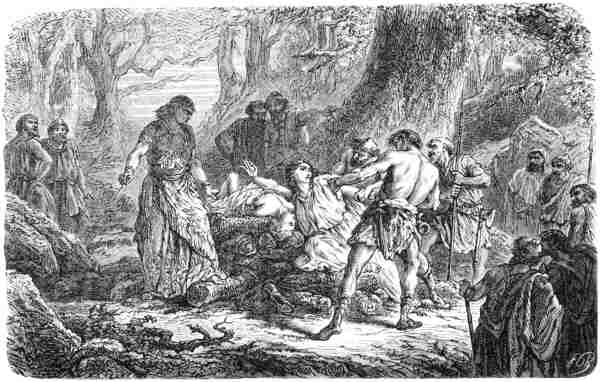
ON THE VERY POINT OF SLAYING THE CHILD.
To face page 228.
But changing his tone, Bichri added, mournfully:
"And yet how it saddens all to think about poor
Hanno and our big friend Jonah. I loved them both, poor
fellows! I wonder what has become of old Gebal. Is he
gone too?"
I said that I had very little doubt the monkey had been
on his usual perch upon the trumpeter's shoulder, and so
most probably had shared his fate. Bichri drew a long
sigh, which seemed to convey the impression that he was
almost as much concerned at the loss of the monkey as he
was moved by the fate of his comrades.
We had now reached the plateau. It was a dreary plain,
dotted at rare intervals with a few trees and tufts of thistles,
and as far as I could estimate, about twelve stadia from the
Bœtis. Our supply of fresh water being nearly exhausted,
we were obliged to be very frugal with it at our evening
meal; but as soon as this was finished, and Hannibal had
posted his sentinels and had all lights extinguished, I
summoned Hazael before me. I took my seat, supported
on either side by my officers and pilots, making Bichri,
Aminocles and his son, and the Phocian with his wife,
likewise be present.
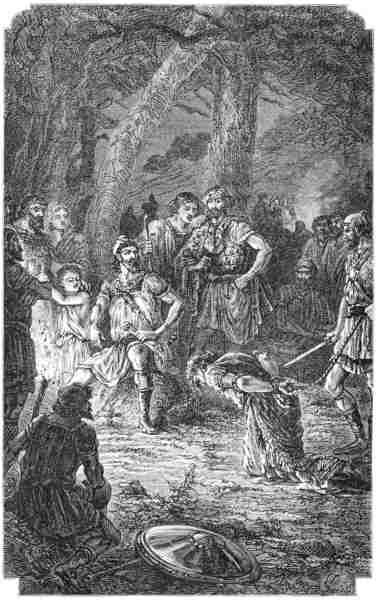
THE DESPICABLE SYRIAN.
To face page 229.
The prisoner was brought forward, pale and trembling;
his hands were tied behind his back, and his embroidered
robe was torn and soiled with dust and blood.
"You know me?" I roared out to him as he approached.
"Yes, my lord," he faltered out in a quivering voice,
without lifting his eyes from the ground.
"And you know your conduct towards me?" I roared
again.
The culprit made no answer.
"Do you suppose I took you with me that you should
plot against me in Egypt, at Utica, at Gades?"
He still gave no reply.
"What made you dare to try and kill that child?" I
said.
"I was under orders," he whined out; "Bodmilcar made
me. He wanted to sacrifice to Moloch to secure his favour.
I dared not disobey him; he has had me in his power all
along. It is not I, it is Bodmilcar that has wronged
you."
"O, that matters not," I answered. "Curses on Bodmilcar!
Would you save your life? One way, one only
way is open to you still."
The despicable Syrian prostrated himself till his face
was on the earth, and groaned out:
"Spare me! spare my life! ask what you will! trample
on my neck! make me your slave for ever! but spare my
life!"
Chamai, who was standing beside me with a bandage on
his forehead, turned his head away in disgust.
"Spare your life!" I repealed; "why, if I did my duty
I should make your life a sacrifice this very minute to
the souls of the brave heroes who have lost their lives
through you!" And after a pause, I said: "But, listen to
me! do what I require, and I will give you more than your
life; when we are back at Gades, I will give you your
liberty."
"O, I will do anything; but swear, swear that you will
spare my life!" implored the abject wretch, still grovelling
with his forehead in the dust.
"Yes, hearken!" I ejaculated. "By Ashtoreth! goddess
of heaven, I swear it!"
Relieved of his immediate terror, the pusillanimous
craven started to his feet, and in a tone quite brisk in contrast
with his previous whinings began to ask what it was
that I required him to do.
"You must first inform us of the strength of Bodmilcar's
force."
"One hundred and sixty Phœnicians. Six hundred or
perhaps seven hundred Iberians."
"You must next tell us the place of rendezvous he had
appointed, in case his attack should fail."
Hazael hesitated. Chamai said that if he revealed this,
he would deserve a score of hangings for his treachery.
Without noticing the interruption, I said again:
"You must tell us his place of rendezvous."
Again no answer.
"Except you tell, you shall be hanged this very minute."
And to show him that I was in earnest I called for a
rope. Himilco produced a strong cable-end that he always
wore round his waist under his kitonet. Hazael quivered
and turned pale.
"Stop, stop! don't hang me! I will tell!"
"Out with it, then; quick!"
"At the Wolf's knoll."
"So far, so good. But where is that?"
"In the wood, two stadia off."
"But which way?"
"Behind us; over there; there to the right."
"Well then, come and show us the way."
And weary as I was, almost worn out by fatigue, I could
not resist the desire to go upon the simplest chance of
meeting the adversary that I hated so bitterly. I called
out to my men that I wanted fifty volunteers to go with
me and hunt out Bodmilcar from his lurking place. Many
more than I had called answered to my appeal, eager to
offer their services, and I could only request Hannibal to
select those best fitted for the expedition, and bid the
others take good care of the women and the baggage, and
see that the captives were well secured.
Aminocles begged for permission to remain behind with his
little son, and asked that his countryman Demaretes might
likewise be allowed to stay with his newly-rescued wife;
he acknowledged that they were indebted to me for the
recovery of their dear ones, promised that they would fight
doubly hard another time, but pleaded that they might be
excused now. Of course I had no hesitation in yielding
to his request.
Before setting out I said, incidentally, that we might
perchance be fortunate enough to recover the bodies either
of Hanno or Jonah, or both. Chryseis rose instantly
to her feet, and, pale with agitation, placed herself at my
side. To my inquiry whither she was going, she replied in
a steady voice:
"To seek the body of my betrothed. If it be the will of
the gods, I will consign it to a tomb."
"Come, then, you shall," I said, deeply affected by her
sorrow, her resignation, and her courage; "and may Ashtoreth
protect us all!"
Hannibal gave the order to march. Bichri, ever indefatigable,
went to the head of the column, leading Hazael by the
cord which bound his wrists; Gisgo, with his hatchet on his
shoulder, kept close to the eunuch on the other side; and
Himilco, with his sword drawn, followed on behind. We
advanced in silence towards the woods, choosing such
hollows in the ground as the moonlight left in shadow,
and in a short time were within sight of the dark masses
of foliage that bounded the moonlit plain. Making our
way as stealthily as we could through the thickets, we came
to a mound near the edge of the steep that we had scaled
in the morning. It was an abrupt elevation of the soil,
and was described to us by Hazael as being the place
known as the Wolf's knoll, and which Bodmilcar had fixed
as the rally-point of his people. When we halted there
was not a light to be seen, not a sound to be heard, nothing
to break the gloom or the stillness of the forest.
"Before we give the signal for attack," said Hannibal,
under his breath, "we ought to know what they are
doing."
"I know my way," said the eunuch; "let me go and
look, that I may bring you word."
"Thanks," said Himilco; "you are very good—we will
not trouble you."
After this sarcastic rebuff to his very transparent pretext
for eluding us, Hazael was relapsing into his former silence,
when Bichri suggested that he should himself take the
eunuch and go and ascertain the actual position of affairs,
adding that if he made a movement to escape, he would
plunge his knife hilt-deep into his body.
Hannibal gave his consent, and the two disappeared in
the thicket, Bichri pushing on his prisoner before him. In
less than half an hour there was a crushing of the brushwood,
and they were before us again.
"What news?" we asked.
"The rascal has deceived us," said Bichri; "we went all
round the mound, not a man, however, was to be seen."
"No, no, no!" sobbed the eunuch; "I have not deceived
you. I swear I heard Bodmilcar say, 'Wolf's knoll.' Cut
out my tongue if I lie! I swear it."
"Stop your oaths, liar!" I exclaimed impatiently.
"Lucky for you I pledged you your life; but be on your
guard, or, by Ashtoreth, another time——"
"It may be," said Hannibal, "the villains have been
lurking about, and, having discovered your approach, have
decamped. The eunuch may have told the truth. Anyhow,
nothing can be done. I am dead-beat."
Himilco and Hamilcar both declared that they, too,
were quite knocked up, so that I determined to make our
way back, and seek the repose of which we were so much
in need.
CHAPTER XV. JUDGE GEBAL DISTINGUISHES HIMSELF.
On
arriving within a comparatively few paces of our encampment,
we were challenged by the sentinels, who were
keeping a sharp look-out. As soon as we had entered the
lines, Aminocles came running towards us with excited
gestures, and, hardly allowing me time to inquire what had
occurred, told me in broken Phœnician that during our
absence "the little man" had been and gone, and was now
in a clump of trees hard by.
For the moment I was puzzled; but Bichri, comprehending
more quickly what the man meant, exclaimed, "Gebal!
Judge Gebal!" and dashing off in the direction indicated,
began to whistle his accustomed call-note. In a few
minutes he returned, his countenance beaming with glee.
The monkey was seated on his shoulder, and greeted us
with hideous yells and grimaces. Ugly as the creature
was, I confess I was glad to have it again amongst us;
nearly every one came to look at it, and although it pulled
Hannibal's beard, scratched Himilco's face, and bit Gisgo's
nose, nothing was set down to spitefulness, but all was
taken in good part, until the beast tried to claw Chamai's
hand, upon which Chamai, never very patient either with
man or brute, struck it a violent blow which sent it howling
back to Bichri. As it sprang away it dropped something
that looked like the strap of a sandal. After picking it
up and examining it by the light of a torch, Chamai
exclaimed:
"By all that's good, there is something written here! it
is written in Phœnician."
I snatched the strap away from him in my eagerness,
and discerned in a moment that it was covered with
characters apparently traced in blood. Without waiting
to read it all, I cried out:
"Hanno is alive! old Gebal has brought us the news.
Hanno has written to us himself."
After I had deciphered the writing carefully, I said:
"Now, listen, my friends—this is what he says: 'We are
prisoners, alive and well: Jonah's trumpet saved us;
savages would not give us up to Bodmilcar; their chief
wanted a Phœnician trumpeter. Another chief wants a
trumpeter before he will give his daughter in marriage to
this chief. I am spared as well. We are to be sent off at
once to the northern chief. Keep up your spirits. We
will soon escape. Beware of Bodmilcar; he is laying an
ambush. He means to cut you off from the river.' There,
my men, that's what he says. We will hope to see him
yet."
As I ceased to read, Chryseis threw herself into Abigail's
arms, and wept for joy; Gisgo flung his cap into the air;
Himilco took a liberal draught from his goat-skin; and
Hannibal manifested his emotion by sneezing seven times
in succession. As for Bichri, he took the monkey in his
arms, and fairly hugged it, a piece of attention which
Gebal acknowledged by plucking out a handful of his
hair.
"O, Gebal, shame upon you! would you be pulling out
my hair when you know how much I love you? Brave old
Gebal! I was only congratulating you on distinguishing
yourself so well."
The others were all equally anxious to pet the creature,
and gave it quantities of almonds and raisins, which it took
without leaving its perch upon Bichri's shoulder.
"Come, come!" I said, "no time for this trifling.
Our water is gone; we must get to the river; we must be
beforehand with Bodmilcar. But there is one piece of
business that we must settle first. Bring Hazael here."
The eunuch was brought before me, and addressing him
very sternly, I said:
"Hazael, you have heard this letter. It proves you a
liar and a traitor. Your villainy has cost us much trouble;
there is no reprieve this time; you must be sent forthwith
to another tribunal. Menath, Hokk, and Rhadamath must
be your judges. You must die."
Flinging himself prostrate at my feet, the abject wretch
broke out into the most piteous supplications; he implored
for mercy, but I was inexorable. Two sailors raised him
to his feet, and Himilco having made a running noose in
his rope, slipped it round the Syrian's neck.
"Choose your own tree, my good man," said Himilco;
"for my part I should recommend a sturdy holm."
Hazael made no reply, but struggled so violently that he
had to be dragged forcibly along.
"Don't be a fool!" cried Gisgo. "What objection can
you have to be hanged? it will save your shoe-leather."
"Now then," said Himilco, as soon as they had placed
the eunuch under the tree, "haul away, tackle him up to
the standing-rigging; there! his navigation has come
to an end!"
And almost as he spoke, Hazael was dangling in the
moonlight.
"One traitor gone to his last account," I said.
"And the other, I hope, soon to follow," Hannibal replied.
Brief and scanty was our rest that night; and when in
the morning the sun rose in a cloudless sky, so unrefreshed
were we after our fighting and toiling, that it was with the
utmost difficulty that we could drag ourselves across the
hot and dusty plain. My own throat was parched, and my
stomach cramped with those terrible sensations known only
too well by those who have suffered the tortures of excessive
thirst. Himilco had drained his last drop of wine, and
went feebly along through lack of stimulant; Hannibal
removed his helmet, and carried it slung from his girdle;
and all were too worn and weary to utter a syllable as we
marched. Bichri was the only one of us who exhibited no
symptom of fatigue, his wiry frame being capable of unlimited
endurance.
About the middle of the afternoon a light mist, indicating
the course of the river, revived our flagging energies by
making us aware that fresh water was not far off. I took
Bichri and a number of men carrying gourds and goat-skins,
and hurried on to obtain, without loss of time, some drink
for my thirsty host; but when I had got within half a
stadium of the river-bank I was seized with such violent
pain and nausea that I could hardly stand. I persevered,
however, till we were hardly more than twenty paces from
the water's edge, when suddenly there was a rustling in the
bushes, and a score or more of lances came whizzing about
us, and we were startled by the shrill war-cry of the
Iberians. Surprised, but not intimidated by the attack, we
kept steadily on our way, and were close upon the river-bank,
when some thirty or forty savages emerged from the
rushes and confronted us with their lances, whilst as many
again, with hideous yells, ran to assail the flank of our main
body. Hannibal and Chamai soon dispersed their adversaries,
but I with my party in advance did not fare so
well, for notwithstanding that Bichri struck down more
than one of the foremost of the barbarians, they succeeded
in entirely surrounding us. One of the sailors had his arm
pierced by a javelin. Bichri had a cut in the calf of his
leg, and my own movements were completely paralysed by a
lance having got tightly fixed in my shield and shoulder-belt.
I confess I thought it was all up with us, but at the critical
moment the well-known sound of the Phœnician trumpet
broke upon us, followed by the animating cry, "Courage,
courage, we are here!" and a change passed upon the scene.
Like a flock of startled birds the savages were off in scared
retreat; an advancing troop, doubtless Bodmilcar's own,
wheeled rapidly about and took to flight; they had descried
Hasdrubal who, from the river-bank, was bringing up a
company to our rescue. Never did a friend receive a
warmer welcome. To my inquiry how it was that he had
arrived so opportunely, he told me he had been watching
the enemy's movements all the morning; they had been too
engrossed with their own schemes to observe him, but he
was so convinced they were designing mischief that he
lowered the mast of the Cabiros and brought her up to
the side-arm of the river, whence he had led his men
forward just in time to render us good service.
Thus happily relieved from the threatened peril, our force
hastened onwards to slake their thirst, and I think it was
for the first time in my life that I saw Himilco gulp down
(and that with evident satisfaction) a draught of pure water.
Another hour and we were descending the Bœtis, and
joyously recounting our adventures.
That night, which was spent on board the Cabiros, was a
night of well-earned rest. Next morning we started early
for the spot where the Dagon and the Ashtoreth had been
moored.
I gave my sailors five shekels apiece, and a triple ration
of wine, and conscious that they had been overworked, I
granted them twenty-four hours' release from labour before
finally recommencing our voyage. They spent their holiday
according to their own taste; they drank, they shouted,
they sang, they danced, and occasionally they diversified
their amusement by a little fighting; yet, notwithstanding
the obstreperousness of their proceedings, when evening
came they calmed down quietly enough to their ordinary
discipline.
The next day found us once more on the open sea,
and for myself I felt an indescribable satisfaction in again
looking upon its green and restless face, and in hearing
its waves plash against the sides of my ship.
In two days we had reached Gades, and I settled all the
business I had to transact with Ziba.
And now the time had come for me to announce to my
officers and crew a purpose that I had long been contemplating.
Accordingly I invited them all to an entertainment
in a tent at some public gardens beyond the
town, and when the repast was over I rose and told them
why I had gathered them together.
"My friends," I began, "our mission is accomplished.
King David's demands are met; King Hiram's orders are
fulfilled. King David's subjects are at liberty to return to
Palestine, and I have brought them here to bid them all
farewell."
Chamai started to his feet impatiently, and looking at me
with a keen and earnest scrutiny, asked what I meant.
"What I mean," I continued, "is soon told. I propose
to put all my silver on board the Dagon, and to place her
under the command of Hasdrubal. In the Dagon you, too,
can return. Hasdrubal shall have orders to land you and
Abigail and Hannibal, and whoever else may choose to
accompany you, at Joppa."
Upon hearing this, Hannibal, in a voice agitated with
emotion, called out:
"And you? What about yourself? And are not
Himilco, Hamilcar, and Gisgo to go back with us?"
"Not one of them," I answered; "we have other work
to do."
A blank silence fell upon them all. Hannibal gazed at
me in bewilderment, big tears gathering in his eyes;
Chamai broke his reverie by bringing his fist down so
violently upon a chair that it broke under the blow; and
after a space, Bichri began softly to whistle one of the
melodies of his tribe, his usual way of trying to exhibit
a contemptuous indifference.
Chamai was the first to speak.
"By our holy God! captain, I could never have believed
you capable of this," he blurted out.
"Yes, indeed, by all that's holy!" said Hannibal, finding
his voice, "what have we done that merits treatment of
this kind?"
"I am doing you no wrong," I answered; "friends we
have been hitherto; friends let us part. You can surely
ask no more than that I should remit you to your homes to
pass the rest of your lives in ease and affluence."
"But why not return yourself?" they asked.
"I have invited you here, to tell you why. It is the
resolve of myself and of the Sidonians that are with me
to make a voyage of discovery. I have set my heart on
finding out what lands there are, whether they be isles
or continents, lying to the north. I am determined, if I
can, to settle whether it be possible, by sailing round
Tarshish to the west, to reach the Celtic shores. These
are the problems that I seek to solve."
"And do you think," said Chamai, "that we shall be
content to enjoy our repose while you are braving all
the perils of the unknown sea? No, no; not quite so ungrateful
as that!"
"Desert our colours in the middle of the fight? nay,
that will never do," cried Hannibal: "return home, who
will; my post is with you, captain."
Chamai echoed his words, and Abigail averred her intention
of not being parted from her lover.
I was quite overcome by the attachment of my people,
and grasped them all in turns by the hand.
"The gods reward your courage and fidelity," I
exclaimed. "But surely some of you will wish to return?
Aminocles, what say you? do you not want to take your
son back to his home? And you, Chryseis, you will
hardly think of facing the perils of the untried sea?"
Aminocles replied that he could not desire his son to
have a better home than the society of warriors offered; and
Chryseis avowed that she was bound to me by a perpetual
debt of gratitude: I had liberated her from slavery, and it
might be, if she continued with me still, that her missing
lover would be restored to her.
Turning to Bichri, who was still whistling some national
air in a lackadaisical manner, I said to him:
"As yet, young man, we have not heard your decision.
Have you nothing to say?"
"Not much," he answered; "I planted a patch of
Ziba's land with a lot of vine-slips. I think I shall go
north with you, and look in here at Tarshish on my way
back, just to see how my plantation prospers."
"Well done, Bichri!" cried Himilco; "you have set a
young vineyard going, have you? You will have a long
generation of tipplers never ceasing to bless the day you
came to Gades. May the gods smile on you and your
vines!"
Bichri did not vouchsafe Himilco any answer, but went
on, as though talking to himself:
"With old Gebal, and little Dionysos, I think I can be
happy enough. I shall miss poor Jonah, though."
I had thus learnt to my great surprise that there was
not one of my companions who was disposed to leave me.
I took measures, therefore, for consigning the charge of my
cargo, including the silver, to a Sidonian captain who was
about returning home, and then, without loss of time, laid
in an ample store of provisions for my voyage over the
untraversed waters of the West.
On the morning of my departure I went to take my
leave of the naval suffect and of Ziba. As I passed along
the quay by the entrance of the harbour, I found a great
concourse of people gathered together for the purpose of
witnessing the erection of two great pillars, one of which
bore a figure of the sun, and the other a statue of our god
Melkarth. I was naturally curious to ascertain the meaning
of the columns, and was informed that they indicated the
limits of the habitable world, and that beyond them there
was nothing but ocean. But the response of the oracle was
still echoing in my memory: the world for me had wider
bounds, I smiled, and went my way with a hopeful heart.
CHAPTER XVI. PERILS OF THE OCEAN.
For
a whole week I followed the coast steadily to the
north, and having rounded a lofty promontory, bore
towards the east. In all my previous navigation I had
never experienced such difficult sailing, nor seen waves
more angry than those which dashed against the cliffs
that formed the shore. One headland there was which
took us little short of four days to double, and it was not
until we had been battling for more than a fortnight with
continual tempest that we found ourselves in calmer waters
and off a flat coast, of which, after the mountains had come
to their limit, the direction was again northwards. We
were all greatly fatigued.
Before we had proceeded much further we came to a
river with a mouth so wide that at first I imagined it to be
a gulf; the shores on either hand were wooded and undulating,
and the general aspect of the country was so
inviting that I determined to lay to, and had no difficulty
in finding excellent anchorage about half-way up the
estuary.
"By all that's good!" exclaimed Gisgo, "I recognise
those cabins. That's a Celtic village;" and he pointed to
a cluster of huts, with conical roofs made of thatched reeds,
and without more ado made four rowers pull him ashore in
a boat to pay a visit to his former acquaintances.
He was not mistaken. In half an hour our vessels were
surrounded by the ill-made coracles of the inquisitive Celts
some of whom were so eager to scrutinise us that they
swam out all the way from the shore; and our decks were
soon invaded by numbers of them, who, with loud laughter
and much gesticulating, began talking all at once in a
language which was anything but euphonious. They appeared
perfectly friendly, and were far less barbarous in
their manners than the people of Tarshish. They were
dressed in very short tunics, made of coarse material
woven by themselves, and their legs were covered with
trousers that came to the ankles; their faces were round,
and generally bore a good-humoured expression; their
eyes were bright, and for the most part blue; their hair
light brown, and occasionally quite flaxen. Some of them
had bronze weapons and jewellery, which had found their
way from Phœnicia along the Rhone by means of the
Salians; the majority of them, however, still retained
their wooden, stone, or bone implements, many of which
were very well made.
The Celts, as I learnt on visiting one of their villages
built upon piles in the water, are very expert fishermen.
I bought some gold dust of them in exchange for some of
my goods, which they seemed glad to obtain. They all
agreed in affirming that they had come from the north-east,
and had been established for nearly a century in
their present localities, whence they had driven out some
people resembling the Iberians and Ligurians; and they
said that in the regions behind them there were some
other tribes of Celts, whom they called Gauls and Cymri.
After leaving their "mas," as they termed their village,
I returned to the ships, and we resumed our northward
course. Eight days' moderate sailing brought us into a
labyrinth of rocky shoals and islands. On the mainland
we found some more Celts, who told us that the name of
the country was Ar-Mor, that is to say, "the land of the
sea;" and relying on their statement that north of their
own country there was a large island both rich and fertile,
I resolved to prosecute my voyage in that direction.
Two days later we were overtaken by a tremendous
tempest, and the sea being at the same time overhung by
a dense fog, which my people called "the lungs of the
ocean," we were tossed about by the foaming waves, and
seemed for several succeeding days to be wandering in the
gloomy realms of the dead. By the evening of the fifth
day we had lost all reckoning of our position, and were
drifting helplessly at the mercy of the wind and waves.
Towards midnight, overcome with fatigue, I was dozing at
the foot of the mast, when I was aroused by Himilco's
stentorian shout, "Breakers ahead!"
In an instant I was upon my feet, and at the helmsman's
side.
"Backwater!" I shouted, "and signal the other ships."
All hastened to light the torches and lamps; but it
was too late—a long cry of distress made us aware that
the Dagon had already stranded, and as I tacked about to
effect a retreat, I witnessed the heart-breaking spectacle
of the Cabiros completely heeled over, and lying in the
very midst of the breakers.
The Ashtoreth, although she was hitherto uninjured, was
environed by reefs which were level with the surface of the
water. The current was so strong that all my efforts to
get back to the channel by which we had entered were
unavailing, and after an hour's struggle I still found myself
near enough to hear the surf curling over the peaks of the
rocks. For nearly the twentieth time I gave the order to
tack, when a sudden and ominous crash revealed the
appalling fact that we had struck the shoal, and were
aground; and all through that pitch-black night we had
to endure the torture of believing that all our vessels were
irretrievably lost.
The wind dropped with the first streak of dawn, and
beyond the breakers I could distinguish that the sea was
calm, and that we were not much more than half a stadium
from the shore. Shipwrecked though we might be, our
lives were spared, and our situation was not altogether so
desperate as we had imagined. The Cabiros was safe, in
spite of her disaster, and had been hauled up on shore;
but the Dagon, it was only too evident, was in a very
critical position. I ordered all my men to abandon the
ships and make for land. Some of them hung back, unwilling
to leave me; Chamai being so reluctant to go that
he had to be sent ashore by main force, and Hamilcar,
Hasdrubal, Gisgo, and Himilco all pleading so earnestly
to remain with me that I was forced to consent. My own
resolution, of course, was to abide, while the planks held
together, with the ship that had carried us so far in safety.
As the day advanced the swell gradually abated, and the
pale-blue sky was broken by fleecy clouds; not far away
we could see the green shore, where our people were
standing on the water's edge waving signs of encouragement,
and very soon Bichri and Dionysos managed to
clamber over the rocks and to come aboard our vessel.
At low tide I made a careful examination of the keels,
and found that not only was the keel of the Ashtoreth
very little injured, but that her stern was wedged so tightly
between the two rocks that her position was secure; at the
same time she had not been jammed in so violently but
that I hoped a high tide might float her again. With the
Dagon, however, the case was unfortunately very different;
she had been dashed so hopelessly against the jutting crags
that she must inevitably go to pieces, and I lost no time in
beginning to unload her.
Our people had discovered a stream of fresh water, and a
neighbouring wood afforded fuel, so that the spot was very
favourable for a camp, the whole arrangement of which I
deputed to Hannibal, who immediately enclosed the site
with an intrenchment. Having completed the task of unloading
both ships, we took down the mast of the Ashtoreth,
and rescued from the Dagon as much planking and as many
fittings as we could, as well as the best part of her copper
sheathing. Lightened by the removal of her cargo and
rigging, the Ashtoreth, under the influence of a stiffish breeze,
was set afloat on the third day amidst general acclamation,
and so admirably was she managed by Himilco, that she
was soon brought to land, and laid high and dry upon
the shore.
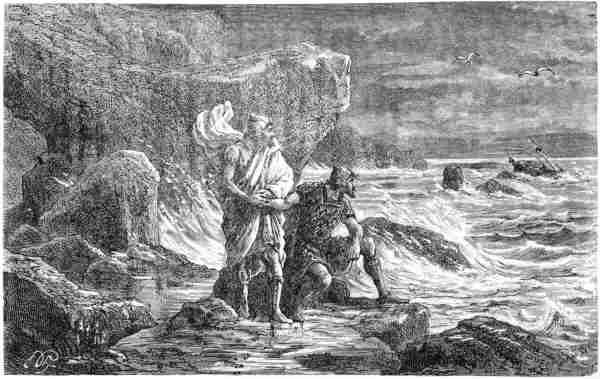
I DID WHAT I COULD TO CONSOLE HASDRUBAL.
To face page 247.
I did what I could to console Hasdrubal for the loss of
his ship, but he wept tears of bitter sorrow as he saw his
ill-fated Dagon break up before his eyes.
For some days we had seen no trace of any natives, and
were in want of provisions. I was preparing to send out
two boats on a fishing excursion, when we caught sight of a
long coracle rounding the point that sheltered our position.
It was made of hides stretched out upon a wooden frame,
and was paddled by four men, half-naked. On nearing us
they hesitated, but we made signs to them of our friendly
intentions, and they came on and landed. Gisgo, recognising
them as Celts, both by their physiognomy and general
aspect, began to address them in their own language, and
they answered him very volubly, making many gesticulations
all the time they were speaking. So delighted did they
profess themselves at meeting with people who understood
their tongue, that they insisted on kissing us; and notwithstanding
the smell of their long hair, which was reeking
with rancid grease, we were obliged to submit to their
embraces.
Gisgo told us that although they spoke a language similar
to that of the southern and central Celts, they were really
the Cymri, a kindred tribe from the north, where they
inhabited an island which they called Prydhayn; they
seemed restless and inquisitive, overwhelming us with all
manner of questions; they were tall and handsome, and
had pink and white complexions, eyes of azure blue,
and hair of the colour of ripe corn.
"Fine soldiers these fellows would make," said Hannibal;
"I should like to have a thousand of them to drill; I would
soon be more than a match for Bodmilcar."
To Bichri's remark that they seemed to have no bows,
Gisgo replied that he had seen them with bows occasionally,
but that their ordinary weapons were lances and hatchets,
of which the stone tips and blades were always sharp and
often beautifully made.
I had the men questioned as to whether they had any
previous knowledge of the Phœnicians. They said that
their kinsmen, the Cymri of the north, had often spoken of
strangers with dark skins and black hair, who came in large
ships and brought beautiful merchandise, but that they
themselves had never been thrown into contact with them.
I made them a number of presents, and much to Himilco's
annoyance (for he knew our supply was rapidly diminishing),
I gave them some wine. This exhilarated them very much
for a time, although their shouting and screaming ended in
some bickerings amongst themselves; to us, however, they
were civil, and in spite of a little roughness, we found their
manners so kind, that it was impossible to be in any way
alarmed at them. When they went away they promised to
return in the evening, and bring their whole population and
some goods in return for our presents, but we saw nothing
more of them until the next morning, when they came
followed by a whole retinue of men, women, and children,
but all of them quite empty-handed. Rushing into the
camp with great excitement, they overwhelmed us with
their embraces, and asked such countless questions that I
was quite bewildered; they insisted upon helping us to
arrange our camp, but introduced disorder wherever they
went: loud in their praises of what they saw, they were
scrupulously honest, and did not attempt to purloin the
smallest article, but their inquisitiveness and their meddling
rendered them a perpetual nuisance. They tried Hannibal's
temper sorely, by handling his cuirass and helmet; the
more he pushed them off the more they laughed and enjoyed
his annoyance. Chryseis and Abigail had a hard matter to
keep them from stripping them, in their curiosity to examine
their clothes. Judge Gebal did not fail to provide them
boundless amusement, and they roared with laughter as
Bichri and Dionysos made their mischievous little quadruped
show off his antics. Some of my people regretted that
we had lost the attraction of Jonah's trumpet, but there
was a sufficient variety of objects without that to give them
abundance of diversion.
Amidst all this, however, I did not suffer myself to
forget either of the two grand objects of my voyage, the
discovery of new lands and the acquisition of rare commodities;
and accordingly I took much pains to examine the
people about the situation and configuration, both of their
own islands and of the land we had just left. They seemed
a very intelligent race, and I found that they were adventurous,
frequently accomplishing long distances in their
canoes of hide. According to their information we were
now on the largest and most important of a group of twelve
small islands,[42] but that the great island Prydhayn was so
large that it took them no less than two months to circumnavigate
it in their canoes, from which I drew the inference
that it must be as large as Tarshish. I requested the men
to bring me whatever food they had for sale, and they never
failed subsequently in keeping me well supplied with fish
and venison. Seeing at once that they were not an agricultural
people, I made no demands for corn and vegetables;
but as some time afterwards a small quantity of barley and
some other edible grain arrived from Prydhayn, I conjectured
that some of the natives are beginning to have some
notion of husbandry.
I was much struck by the number of trinkets that the
Cymri wore about their persons; and observing that the
metal of which many of them were made was singularly
white, I was curious to know what it was and where it
could be procured. To my surprise, and I may add to my
delight, I was informed that the island on which we were
encamped yielded it in great abundance, and I lost no time
in investigating the veins of ore. Accompanied by a few
men, I set out upon a search which was rewarded by the
discovery that the entire island was one vast mine of tin.
A scheme suggested itself to my mind which I resolved
to carry out. With the wood obtained either here or from
the neighbouring large island, I determined to build a new
ship to replace the shattered Dagon; and during the time
that it was being constructed I purposed gathering such a
store of metal as would form a cargo far surpassing anything
of the kind which Phœnicia had witnessed before.
Every one around me most heartily approved of my
project.
In return for a few trifling knick-knacks, and for some
fragments of the old copper sheathing of the Dagon,
the natives willingly acquiesced in our working their mines,
and in letting us portions of their territory for as long
as we pleased to retain it; in fact, they seemed to wish
that we would settle permanently amongst them; they
volunteered their assistance in every way, and our camp
was quite over-stocked with the produce of their hunting
and fishing, whilst for the presents we made them they
were profuse in their expressions of pleasure and gratitude.
In spite of their restlessness, inquisitiveness, and
love of talking, I have no hesitation in pronouncing them
the most favourable specimens of savages we had hitherto
seen.
Our arrangements were soon made. Hamilcar, with
Bichri and twenty archers, started on board the Cabiros
to explore the islands and the coast of Prydhayn; Hasdrubal
and Gisgo undertook the supervision of the working
of the mines; I remained with Himilco in the camp to
devote myself to the construction of our new ship; and,
first of all, in order to protect our men against the rainy
and rigorous climate, I had some substantial huts erected,
as being more suitable than the tents. For Hannibal and
Chamai there was no definite employment, and they spent
most of their time in hunting and fishing, and in joining
in the sports of the islanders, whom they began to instruct
in military drill; and never had they found more
apt or devoted learners.
One day Hannibal and Chamai made their appearance
among us with their chins closely shorn, and no hair left
on the face except a moustache on the upper lip; they had
fraternised so far with the savages as to conform to their
fashion.
"You cut fine figures," I said, laughing; "go and paint
your faces, and you will make capital Cymri."
Hannibal tried by very elaborate reasoning to justify
his proceeding, alleging that one ought to conform to
national customs, and that as the warriors here had their
faces shorn, it was right that he as a warrior amongst warriors
should do the same.
"And Abigail," said Chamai, "thinks the change is very
becoming to me."
This argument being unanswerable, I had not another
word to say.
Days, weeks and months glided on whilst we continued
our active though somewhat monotonous labours.
When Hamilcar returned from his cruise, he informed us
that he had not only made his way along the west coast of
the great island, but that, still farther to the west, he had
discovered a somewhat smaller island which he had completely
circumnavigated; the natives, he said, called it
Erin, or "the green isle," from its remarkable verdure, and
I retained the name.
The winter came on, cold and drear. I have no power
to describe the consternation of those of our party who had
never before seen frost or snow; nothing but the sternest
necessity could induce them ever to leave their huts. The
poor monkey suffered excessively. Bichri and Dionysos
alone seemed unaffected by the fall of temperature; they
were always ready to join the young Cymri in games of
snowballing, and would glide along the frozen surface of
the water until their faces glowed again with the exertion.
Under Bichri's tuition the little Phocian boy was becoming
an adept in the use both of the sling and of the
bow; he seemed always delighted to be bringing back from
his hunting excursions fresh trophies of his skill.
The most hipped of all the party was Himilco; not that
the sturdy pilot had more dread than the rest of mists and
frosts, but because he was much disconcerted at the rapid
diminution in our stock of wine.
"Ah me!" he would sigh, as each goat-skin was drained;
"another gone! we shall have nothing but water with
which to greet the advent of spring. Ah, yes! it is time
we were back again in Phœnicia; it would do one good to
see the vines on the hill-side of Berytos."
In his forebodings Himilco found a genuine sympathiser
in Hannibal, who (although I should not like to say that
there was one amongst us who would not be sorry for all
our wine to be exhausted) was the only one who openly
shared the regret of our thirsty pilot.
At length the days grew longer and brighter, and the
sea, which had been almost always angry and restless,
settled down into something of a calm. Our new ship was
finished. We launched it on our feast of navigation, and
not only did the Cymri come to assist, but in honour of
the occasion their priests and priestesses stripped themselves
of their clothes, and stained their bodies with blue
and black paint. In the evening we had a banquet of fish,
venison, barley, and some of the esculents of the country.
We also finished the last drop of our wine.
"Let us drink to our prosperous return," said Himilco.
"It is much too soon to speak about that," I rejoined;
"our voyage as yet is far from its end."
Every one looked at me in bewilderment; it had never
occurred to them that we could be bound elsewhere than
for Sidon. Chamai asked whether we were going to have
a little further benefit of "the lungs of the sea."
"You are perfectly at liberty to go home," I answered
him. "This new ship has been built, and I am quite
prepared to let her return with her cargo and as many of
you as are no longer disposed to encounter the cold and
mists."
Chamai started to his feet, and said impulsively:
"Surely, captain, you did not suppose I was in earnest;
you cannot believe I was thinking of leaving you. I
profess I do not like this chill and dreary climate; but you
may rely on this, wherever you go, I shall go also."
I gave him my hand, assuring him that I had every
confidence in his fidelity, and then proceeded to explain
the motive that induced me to extend my voyage. I
showed them a fragment of a transparent yellow substance,
which appeared to be comparable to some of the jewels of
our own land. The Celt who had given it me called it
amber, and told me that thirty days' sailing to the east
would bring me to the shore of a large continent where it
was washed up in great abundance. Here truly was a gift
from Ashtoreth!
"And who knows," I continued, "whether the vast
ocean which is united to the Great Sea at the Straits of
Gades may not again be united to it in the east? Hitherto
we have learnt nothing about the northern shores of the
Black Sea, and who can tell whether we shall not be able
to return to Sidon by way of Caria and Chittim?"
The familiar sound of these names rekindled the courage
of my people, who one and all avowed their intention of
accompanying me eastwards to the amber-coast.
"Yes," said Himilco, "although the wine is all gone."
Our new vessel (which was called the Adonibal, after the
naval suffect at Utica) was well freighted with our cargo
of tin; like the other ships, she took in a good supply of
water and a quantity of dry salted meat, as well as some
grain and some of the sour native fruits.
After bidding farewell to the kindly-disposed Cymri,
who had contributed so much to our comfort during our
long sojourn among them, we put out to sea. The
islanders accompanied us for some distance in their canoes,
but we soon outstripped them and left them out of sight as
we doubled the western extremity of Prydhayn.
Six days' rough sailing brought us to the eastern
extremity of the island; thence steering due east I came
to a low flat coast, along which I continued to advance very
cautiously. This took us a week, at the end of which we
found ourselves in a wide estuary, on the far side of which
the coast resumed its northerly direction. In spite of the
violent wind and angry sea I persisted in following the coast
for yet five days more, seeking a passage towards the east,
holding no communication with the natives, although the
glow of the fires inland demonstrated that the country
was inhabited. But at last the state of our provisions and
the continuance of rough weather compelled us to abandon
all hope of discovering a passage, even if one existed,
which probably after all was not the case, and we turned
back, meeting on our way four large Cymrian canoes
coming back from the continent, where their crews had
been collecting amber. They assured us we should find
unlimited quantities on the eastern shore, and I was
preparing to proceed thitherwards when we were enveloped
in a fog so dense, that we were forced to lay to. We sent
some boats out to reconnoitre; these had some difficulty
in getting to the shore, but considerably more in getting
back again to the ships, although I had lighted a number
of torches and lamps as beacons.
When the fog lifted a little we made our way very
gradually until we came to what looked like land. This
was the amber country.
"Since there is nothing to be found at sea," I said, "let
us disembark."
But disembarkment was no easy matter. We had entered,
without knowing it, into what seemed to be the estuary of a
river; but we were literally imbedded in mire, and it was
next to impossible to define the boundary between the
muddy water and the slimy shore; in the gloomy atmosphere,
earth, air, sky, seemed all to be blended into one.
After four or five hours' toil the Ashtoreth was moored in a
small creek, and the other vessels were drawn up on what
was the nearest approach to dry land that the sodden sands
afforded. It took the rest of the day to dig a trench round
the ships, and to make a kind of encampment for ourselves;
the fog again became extremely dense, and the gloomy day
yielded only to a gloomier night.
Bichri, who with twenty men had started on a foraging
expedition, returned shivering with cold; he brought some
good faggots, which, though they were damp, were very
resinous, and burnt well. We lighted as many fires as we
could, and heedless of the volumes of smoke which they
emitted, we crouched closely around them as we cooked
our supper.
Chamai, who had wrapped himself tightly in his mantle,
was the first to break the depressing silence.
"Frightful, odious country!" he exclaimed, "can human
creatures exist in such a desolation as this? It is a place
for monsters, not for men!"
"It would just suit old Jonah, then," said Hannibal, with
a sigh; "it would cheer us up, too, if Hanno were here to
entertain us with a sprinkling of his wit."
"I do not think we need have much fear on their account,"
I said; "by this time, I should hope, they are pacing the
sunny streets of Sidon, or enjoying the fragrant heights of
Libanus."
"Yes; I daresay," Himilco assented; "and no doubt
they have plenty of good wine to drink; wine, rich as
nectar, from Helbon, Byblos, and Sarepta!"
"There now, enough of that," cried Hannibal; "cease
your talking, or you will be making me as much a wine-bibber
as yourself."
"Call me a wine-bibber?" groaned Hannibal, holding up
a goblet of turbid water; "do you think this is the kind of
stuff to get tipsy on?"
The dull mist grew more and more chilling, and every
one appeared quite benumbed. Gebal was wrapped up in
folds of woollen cloth, which Bichri had provided for him,
but was almost too paralysed to make a grimace. We
crouched down still closer to our fires, and obtained what
unrefreshing sleep we could.
The morning dawned, grey, and almost as gloomy as ever,
without one streak of sunlight. Red with anger was Chamai
as he exclaimed impatiently:
"I suppose the sun does not shine in these cursed
regions!"
"Oh yes!" replied Gisgo, "he does come now and then,
but he finds everything so confoundedly ugly, that he is
glad to get back again to the Great Sea, and to his own
dear Phœnicia."
Aminocles once again became subject to his nervous
fancies; he was sure that we must have entered Hades,
and implored us to lose no time in offering a sacrifice to
propitiate the gods of the lower world. Naturally enough
we ridiculed his fears, but it cannot be denied that the
influence of the climate is most depressing, and conducing
to hypochondria.
I urged upon my companions the importance of our
seeking communication if possible with the natives, and as
soon as we had taken our morning meal we arranged to set
out and explore the river. Bichri and twenty men went
forward as an advanced guard; I followed with Hannibal
and the main body of the fighting force; Hamilcar, with
about thirty more, brought up the rear. Hasdrubal and
fifty men were told off to keep guard over the ships and
encampment during our absence. Just as he was setting
out Bichri remarked that he wished he had Jonah with his
trumpet to attract the attention of the inhabitants, but I
bade him not to indulge just then in unavailing regrets.
After wading through such desperate quagmires that we
could hardly determine whether we were going by land or
by water, we arrived at some forests consisting of black firs,
and some other trees that were remarkable for their slimness
and scanty grey foliage. The soil everywhere was
marshy, and often broken by large pools. Although we did
not come across a human being, we observed many vestiges
which showed that the place was by no means untrodden
by the foot of man. In four places we passed some ruined
reed-huts, surrounded by piles of ashes, numbers of shells,
and some gnawed bones that bore the marks of fire. But
if men were wanting, animals abounded. At every turn we
noticed prints, large and small, of cloven hoofs, betokening
that we were traversing the haunt both of bullocks and
deer, some of the impressions being obviously those of very
enormous creatures. Bichri, who followed one of the tracks
for some distance into the wood, remarked that branches
had been broken off the trees by the animals' horns at so
great a height from the ground, that he was convinced it
had been done by a beast several hands taller than the
largest horse. On our way back to the camp we saw two
deer of a smaller species; Gisgo recognised them as the
same he had seen in the country of the Celts, who call
them renns or reindeer; they took to flight immediately
they caught sight of us, a circumstance that convinced me
that the inhabitants were accustomed to hunt them; Bichri
and Dionysos, however, not only contrived to get within
bowshot of them, but brought them both down, a great
boon to us all, as we were in much need of fresh meat.
The renns were about the size of a donkey; they had very
slender legs, large hoofs, thick grey hair, a white spot
upon their breasts, and large branching horns.
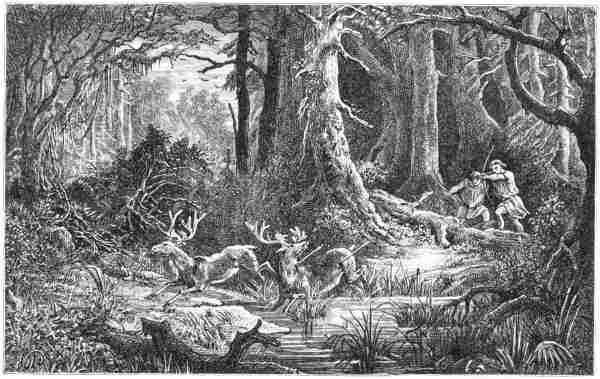
BICHRI AND DIONYSOS BROUGHT THEM BOTH DOWN.
To face page 258.
Next day I sent Hamilcar with two boats to cruise along
the coast, and taking nearly all the rest of my people and
thirty archers with me, went myself to make a more
thorough exploration of the country. We were met by
a herd of wild bulls. We attacked them as vigorously as
we could, but at the first touch of our arrows the brutes
charged down upon us so furiously that we were obliged
to take refuge behind the trees. One poor soldier who
could not succeed in getting out of the way was trampled
under the animals' feet, and another was tossed into the
air so violently that his back was broken by the fall. Three
of the bullocks were killed, and after being cut in pieces,
their flesh was conveyed to the camp.
On our way back Bichri wounded a gigantic stag, which
Chamai succeeded in killing by stabbing it just below the
shoulder-blade. It was of a kind which Gisgo said was not
often seen by the Celts, and he called it an elenn or eland.
Elenns are considerably larger than horses, and as a general
rule feed upon the lower branches of trees, their necks
being so short and rigid that unless they can graze upon
soft soil into which they can sink nearly to their knees,
they cannot get their heads down sufficiently low to reach
the grass; they have very formidable antlers, which do
not stand high, but branch out very wide on both sides;
their strength is enormous, and, unlike the rest of the deer
tribe, they do not exhibit terror when attacked, but boldly
front the hunter. They are consequently animals which it
is by no means prudent to assail in close quarters, as we
subsequently learnt by our own experience.
Hamilcar returned, bringing a fair supply of amber that
he had collected along the coast.
We remained in our quarters here for more than a
fortnight, spending our time in gathering amber, and
subsisting upon whatever renns, elenns, or wild bulls we
were able to kill.
The poor fellow who had been killed was buried where
he had fallen. Over his grave was placed a stone engraved
with his name and an invocation to the gods.
CHAPTER XVII. JONO, THE GOD OF THE SUOMI.
After
sixteen days' sojourn, finding the amber beginning
to run short, and the game getting very wild, I resolved to
proceed, and sailed eastwards for five days, until the lack
of provisions, no less than the desire of exploring, induced
me to enter the mouth of the great river we had previously
seen. The aspect of the place was scarcely more
inviting than where we had landed before, but we hauled
up our ships, and made an encampment as near to them
as we could.
On setting out next morning to explore, we had proceeded
but a little way before we came upon traces
proving beyond a question that human beings had been
in the neighbourhood quite recently. We entered nearly
a dozen of the conical huts that we came to, in one of
them finding a fire still burning, and in several of the
others a variety of arms and implements, consisting of
weapons made of polished stone, hatchets, and some copper
caldrons. Examining them with greater minuteness, we
ascertained that the huts had been abandoned in great
haste; not only were there fragments of partially-consumed
meat and fish, but one of the litters of reeds
covered with moss was still warm from being lately
occupied. I felt convinced that the natives must have
evacuated their tenements in alarm at our approach, and
suspecting that they were still lurking about, I ordered
some red cloth, some beads, some bracelets and necklaces,
and other things which I thought might attract their interest,
to be displayed in one of the most spacious of the
huts. I next made my people retire about three hundred
paces, and waited to see the result of my device.
Before long the savages returned, and seeing us stand
quietly, without any apparent wish to molest them, they
allowed themselves to be seen, and came nearer to us. I
took Gisgo and advanced to meet them; but when he
addressed them in the Celtic tongue, I found that they
did not understand a word he said, but replied in a
language that neither of us had ever heard before. Pointing
first to a neighbouring marsh, they cried, "Suom,
Suom," and then pointing to their own breasts, they said,
"Suomi, Suomi," from which I conjectured that they called
a marsh "suom," and that they were themselves "people
of the marshes." When they showed us their stone
weapons, they pointed to the north-east and said "Gothi;"
and what struck me as remarkable, they used the same
word when they spoke of their articles of Tibarenian
bronze. I had never before heard of a people of that
name, but could not help wondering whether these "Gothi"
could by any possibility be Caucasians.
I had seen many savages in my time, but I had
never seen savages so frightfully ugly as these; their
huge heads, flat faces, small eyes, enormous mouths, sallow
complexions, made up a physiognomy that was simply
hideous; their short, thin legs appeared scarcely able to
support their clumsy bodies. They made us understand
by their gestures that their friends the "Gothi" were
taller either than themselves or us.
Besides being ugly, their appearance was most sordid.
None of the ornaments so frequently worn by savage
tribes adorned them, but their bodies were scantily protected
by fragments of skins, and their weapons, for the
most part, were clumsy bludgeons, stone lances, and a kind
of harpoon tipped with bone. One alone wore a necklace
made of shells and pieces of uncut amber. He appeared
to be a sort of chieftain, and as a token of his good-will he
held out a wild bull's horn full of some yellowish fluid; I
was on the point of taking the horn into my hand, when
Himilco, ever ready to guzzle, raised it to his lips; but no
sooner had he tasted the contents than he dashed it to
the ground, and began spitting and spluttering with every
expression of disgust.
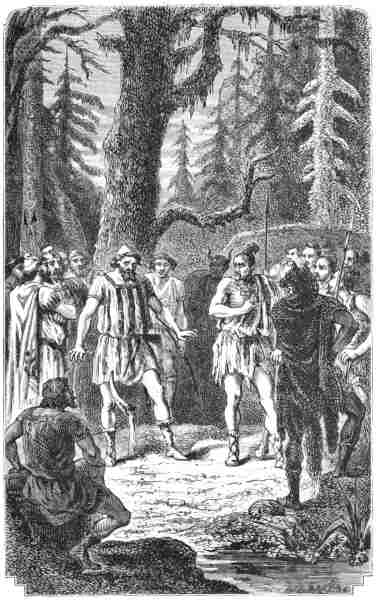
HE DASHED IT TO THE GROUND.
To face page 262.
"Ugh! the vile stuff!" he said, as soon as he could
speak; "it's nothing in the world but beastly fish-oil!
Ugh!"
We all roared with laughter; but the chief, highly offended
at the way in which we received his proferred attention,
assumed a threatening attitude, and in spite of my attempts
to pacify him, withdrew with his followers to the woods.
Poor Himilco looked very penitent when he saw the
mischief he had done.
"What a besotted idiot I am!" he exclaimed; "I
declare I deserve nothing less than to be swung up to the
nearest oak. But who was to know that what looked so
tempting was nothing but stinking oil?"
"Well, well," I said; "never mind, you will have better
luck another time. I don't fear but that we shall soon have
another opportunity of improving our acquaintance with
these barbarians."
As we proceeded up the river we met occasional groups
of the people, who were always full of gesticulations; they
snatched greedily at any gifts we offered them, but took
themselves off directly we attempted to open any negotiations.
A clearance in the wood made us suspect we were
approaching a larger settlement, and we soon came to a
large sheet of water, in the middle of which was an island
crowded with conical huts, that in the centre being much
higher than the rest. The island had been connected with
the land by a narrow causeway, which the natives made
us understand we were not to cross; but they were not
altogether indisposed to transact business with us, and
parted with some amber at a very low rate. But although
they attached so little value to their amber, it was far
otherwise with their weapons; we could not induce them
to part with one of their clumsy lances nor one of their
smallest bone hooks for any article that we could offer
them. They showed us various implements of polished
stone, and appeared to be desirous of getting more like
them, exhibiting some surprise that we had none to
exchange away. Bronze they had seen before, and they
were acquainted with the use of bows and arrows; they
pointed to the birds upon the trees, as an indication that
they wanted Bichri to shoot some; a desire on their part
which he was more than ready to gratify.
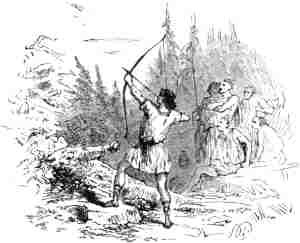
Not thinking it prudent to remain all night in our
present position, I gave orders for making our way back
to the ships, yielding, however, to the wish expressed by
several of the Suomi to accompany us; but so dark was
the night, and so bad were the roads, that we utterly
lost our way amidst the quagmires. We wandered about
till near daybreak, when six of us—Hannibal, Chamai,
Himilco, Bichri, one of the sailors, and myself—found
ourselves up to our waists in a swamp. After extricating
ourselves with much difficulty, we discovered that the rest
of our party was out of sight, and although we shouted
with all the strength of our lungs, we failed in making ourselves
heard. Terrible as our situation was, there was a
still greater dilemma in store. While we were anxiously
endeavouring to find some waymarks to guide us, we were all
at once surrounded by nearly two hundred of the savages,
all stoutly armed. Resistance would have been useless even
if it had been possible. The men had started, as if called
by an incantation, from the tufted brushwood around, and
before we could lay our hands upon our swords, they had
felled us to the ground and pinioned our arms, yelling and
dancing all the time. They did not allow us time to regain
our feet, but pounced down upon us. Two men seized
me by the arms, two by the feet, and a fifth, after taking
away my sword, my cap, and my shoulder-belt, came
dancing along behind, every now and then leaning close
over me to peer into my face. They had all evidently
tricked themselves out for their adventure; their hair was
dyed red, and their faces were tattooed blue and black
with war-paints.
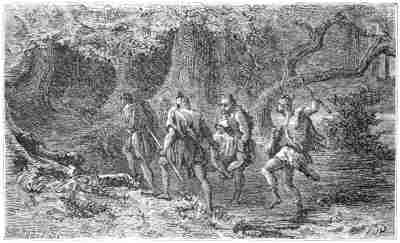
After about an hour we were made to cross the causeway
from which we had been repelled the day before, and
alternately pushed and pulled, we were thrust into one of
the huts. Hideous women and still more hideous children
followed us in groups until we reached our destination,
where a matting was fastened closely over the doorway,
and we were left upon the cold damp ground in complete
darkness, pillaged, bruised, and bound. There was the
sound of retreating footsteps, and soon the noisy yells
lapsed into perfect silence.
If we had been pinioned with rope we might perhaps
have contrived to extricate ourselves, but we had been tied
with a tough twist made of bark, which lacerated our wrists
every time we made an attempt to release them. Chamai
groaned aloud with agony.
"Who's groaning?" asked Hannibal, his voice being at
once recognised in the darkness.
"I cannot slip these cursed cords," said Chamai.
"No," said Himilco, "you might as well try to break a
ship's cable;" and remembering that he had not heard
either me or Bichri speak, he asked whether we were there.
Bichri replied:
"Here we are, both of us; and I only wish old Judge
Gebal was with us; he would have got us out of this
dilemma."
"What do you mean?" I said. "I don't understand
what good the monkey could do. Anyhow, we must
now help ourselves; and that doesn't seem a very easy
business."
"If Hamilcar and Hasdrubal do not come to our rescue,
I shall think them the vilest cowards on the face of the
earth," said Hannibal.
"Ah, you must not judge too hastily," I answered; "I
do not doubt but that they will do all in their power, but
it is only too likely they have been attacked, and are in the
same plight as ourselves. Besides, I hardly see how they
are to get across that causeway."
"No difficulty there," said the general, warming into
enthusiasm; "archers, right and left; fighting men in a
column, four abreast; sound your trumpets and——"
He stopped abruptly; the clang of a trumpet had caught
his ears.
"They come! they come!" cried Chamai, all excitement;
"The Lord of hosts be with them!"
Another blast.
Hannibal continued to expatiate very scientifically about
columns of four and columns of eight, and bewailed his
fate that he was not in command; Bichri, less calm, fancied
himself at the head of his troop.
The notes of the trumpet seemed more and more
distinct.
"I cannot make out that trumpet," said Himilco; "it
does not sound like one of ours."
"Whose else should it be?" replied Hannibal, testily.
"Savages do not blow trumpets."
The pilot now insisted that the sound did not come
across the water at all, but from the very centre of the huts.
"And yet," he said, "if it means an attack, I wonder
we do not hear the war-cry."
We were all bewildered, and no less so when we heard
three loud shouts rend the air, and the trumpet notes which
had been going on at intervals for a quarter of an hour
come to an end with a prolonged and thrilling flourish.
"I never knew but one pair of lungs that could make a
clarion ring out like that," said Himilco.
The name of Jonah rose simultaneously to the lips of us
all, and Bichri said he should like to see Gebal come in and
confirm our impression.
"Nonsense," I said, "why indulge these foolish fancies?
we must be practical. If we are rescued by our troops,
well and good; otherwise we shall either have to buy ourselves
off by a ransom or invent some ruse to escape."
The sailor who was with us, speaking now for the first
time, reminded us that there were several canoes moored to
the causeway, and Himilco recollected having noticed them.
This set us speculating whether we could devise any means
of getting at the canoes, and using them to facilitate our
escape. Hannibal declared that we should still be in the
clutches of the savages, even if we got to land; but Bichri
and Chamai maintained that once free they could take good
care of themselves.
I interrupted them to inquire whether any one amongst
them had a knife, but it proved, as might have been expected,
that the savages had not left us anything of the
sort.
"Then roll yourself over here, Bichri," I said, "and see
whether you cannot gnaw this twisted stuff off my hands."
"I have pretty good teeth," replied the youth, "and I
will try."
Silence fell upon us all as we listened to him shuffling
along the ground and panting with his exertions. I cannot
tell how long it was before I felt his warm breath upon my
hands, but it seemed to me at least half an hour. He
nibbled indefatigably at the cord, giving my flesh an
occasional grip in the process, until the material was reduced
to the substance of twine, when by a slight effort of
my own I burst it asunder, and I was free. An exclamation
of delight broke from my lips, and I was about to
liberate the others, when Himilco, who was lying across the
doorway, said:
"Hush! some one comes!"
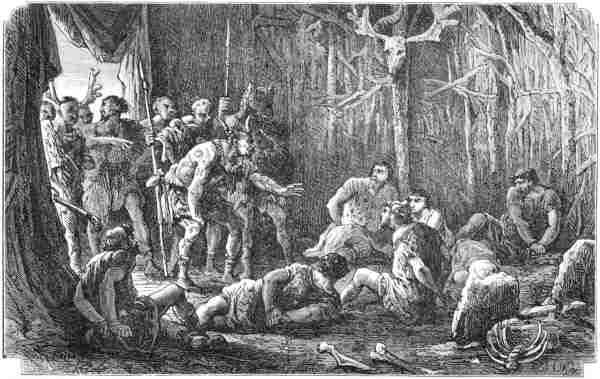
SEVERAL OF THE SAVAGES ENTERED THE HUT.
To face page 267.
In an instant I twisted the broken cord around my wrists,
but only just before a party of several of the savages
entered the hut. One of them having fastened back the
covering at the door, took a long pole and pushed up a
kind of trap that had closed the aperture at the top that
served the purpose of a chimney, and the gleams of light
afforded by these two openings allowed us to inspect our
place of confinement.
The hut was perfectly empty, without an article of furniture;
the walls were grimed with soot and smoke; upon
the clay floor three rude stones formed a kind of fire-place
which was filled with ashes and the refuse of some victuals.
A cold drizzling rain penetrated the hole in the roof, and
pattered down upon the ground below.
The men that had entered were elaborately covered with
their war-paint. One of them had the head and skin of a
bear drawn over his face like a mask, in the way that I
have seen done by the Assyrians; another wore upon his
shoulders the head and horns of an elk. A third, who
carried a stick in his hand, ushered the other two into the
middle of the hut, where they began dancing and making
the strangest of contortions, but all without uttering a
word. After this had gone on for some time, one of the
two, who wore a necklace made of the teeth of wild animals,
and who apparently was the chief, walked up to me, and
stood gazing in my face. I noticed that he had my own
sword in his hand. He began a long harangue of which
I could not understand a word, but observed that he repeatedly
said "Jono," and as often as he did so, all the
others gave a loud shout. When his oration came to an
end, the savage sprinkled us with some stinking liquor,
which he poured from a horn; and having in chorus muttered
some kind of refrain that ended in "Jono," they all quitted
the hut, fastening the doorway securely behind them.
"No chance of making terms with such brutes as these,"
I indignantly exclaimed, when we were again alone.
"Patience!" said Hannibal; "only let me get my hands
at liberty, and I'll guarantee to floor half-a-dozen of them,
unarmed as I am."
Himilco avowed that he was burning for a chance to
avenge himself for the filthy fish-oil; and Chamai protested
that though the brutes should be as countless as the palms
of Jericho or the fleas at Shechem, he would outwit them
yet, and find his way back to Abigail.
While they had been talking in this strain, I had disengaged
my hands, and very soon succeeded in freeing
Bichri, who assisted me in liberating all the rest. Once
again upon their feet, they stretched their stiff and weary
limbs, and Hannibal, Chamai, and Himilco each armed
themselves with one of the stones that formed the fire-place.
"Here's something that may smash a skull or two," said
Chamai, as he poised his stone aloft.
"Not altogether a military-looking weapon," was
Hannibal's remark, whilst he examined the cumbersome
missile; "but our forefathers have done good execution
with worse."
Picking up a few fragments of stone, Bichri was beginning
to lament that he had not a sling, when Himilco
in a moment produced the rope which he invariably wore,
and tore off a piece of the goat-skin that had carried his
wine, and with these materials the young archer was not
long in putting together a sling which he hoped might do
him good service.
Night closed in. It was still raining; the wind blew
furiously. Everything seemed to favour our escape.
"Now's your time, my men!" I said. "Make your
prayer to your gods, and we will be off at once."
It was agreed that if we should find more than one
sentinel, we should fight our way through and make for
the canoes, and that if we failed in that attempt, we should
take to the water, and swim to the far end of the causeway.
Our watch-word should be three raven-croaks.
"Now, invoke your gods," I repeated.
There was silence in the hut, and I noticed that Himilco
raised his single eye to the aperture in the roof, as though
looking for the Cabiri, but there was nothing to be seen
except the pitchy blackness of the night.
I was about to lead the way, when, on peering out, I not
only heard the sound of footsteps, but saw the glimmer of
a torch. My heart beat fast, and I made my companions
arrange themselves on either side of the doorway, so as to
guard the entrance. It seemed to me that there were
not more than one or two approaching. Chamai pressed
his back against the wall, ready to brain the first savage
that came within reach; but whoever they were that were
coming, it was evident that they were not hurrying themselves:
they paused in quiet conversation outside, and
at intervals we could again catch the mysterious word
"Jono."
"I wonder whether they are going to give us any more
of their beastly sprinkling," said Himilco.
"I have something here," muttered Hannibal, "that may
give them a sprinkling they don't expect."
Breaking the silence of the night, we now heard the
ringing notes of the trumpet, followed by yells and vociferations.
The clamour was obviously a signal, for at the
same moment the covering at the door was raised, and a
man carrying a torch entered the hut, and closed the
entrance behind him. But scarcely had he advanced a
step, when four strong arms arrested him. Chamai's hand
was across the intruder's mouth, effectually stopping any
outcry he might raise; I took possession of his torch; and
Himilco, having lifted the stone above his head, was about
to hurl it on his victim, when he let it fall to the ground,
and ejaculated:
"Merciful Cabiri!"
I raised the torch to the visitor's face, and in a moment
had thrown myself upon his neck. It was Hanno.
The sailor picked up the torch that I had dropped in
my excitement, and enabled Hanno in his turn to recognise
us.
We were speechless.
For some moments we could do nothing but grasp each
other's hands and embrace our long-lost friend.
Hanno himself was the first to speak.
"Don't strangle me quite. What a joyful surprise is this!"
"Out with a joke, Hanno!" cried Hannibal, "or I shall
never believe it's you!"
Hanno did not smile, but inquired anxiously about
Chryseis. Hearing from me that she was safe and well,
his eyes filled with tears, and he murmured:
"Ashtoreth be praised!"
A violent thumping outside brought us back to a sense
of our real position, and when the thumping was renewed
Hanno went to the door, and having addressed some one
with a few guttural words, which were received with a half-approving
grunt, he returned to us.
"And now," he said, his voice assuming its old tone of
vivacity, "perhaps you would like to know what brings
me here. I am come to conduct you to the grand temple
of the Suomi; and a fine structure you will see it is, built
of reeds and fish-bones in tip-top style. You are there to
be sacrificed to the great god Jono."
"So then Jono is a god, is he?" I said; "but if you are
his high priest I presume we need not give ourselves much
alarm."
Himilco said that if this Jono were the god of fish-oil
he most heartily wished that he might be sent some
hundred fathoms down below the sea.
"Gently, gently, good pilot!" said Hanno, with mock
solemnity; "you must not speak disparagingly of the great
divinity. I can, however, tell you one thing. Jono has no
more liking for fish-oil than you have yourself. No one
loves a draught of good wine better. And I may as well
tell you at once who he is. He is none other than our friend
Jonah of Eltekeh! our incomparable trumpeter, Jonah!"
"Ah! didn't I say," cried Himilco, "that no one but
Jonah could bring out such a flourish as that?"
Hanno went on to tell us that the people were already
assembled in the temple awaiting the arrival of ourselves,
their destined victims, and in reply to Chamai, who suggested
that we should rise up and attack them bodily, informed us
that there were more than three thousand of them, so that
any resistance on our part would not only be useless, but
must result in our immediate destruction.
"No;" he continued; "you have no alternative but
to trust yourselves implicitly to the influence of the mighty
Jono and of his high priest Hono, your humble servant.
My first proceeding will be to acquaint the assembly
that I have released you from your bonds, and that by
the agency of magic I have rendered you quite mild and
submissive."
"Allow me to interrupt you for a moment," I said; "but
I am intensely anxious to learn whether you know anything
of our comrades?"
"They are now on their way hither," replied Hanno;
"and the very object with which the Suomi propose to
sacrifice you is to propitiate their god, so that he may
vouchsafe them the victory."
Hannibal burst out enthusiastically:
"I knew our fellows would come to our defence; brave
souls they are! we'll conquer yet!"
"Not so fast," was the reply; "you must be content to
leave everything to me. I will send a message to Hamilcar
and Hasdrubal. See now; I have my writing materials
ready; I made myself a calamus from the marsh-reeds;
my ink is some of the Suomi war-paint; and for papyrus
I have a piece of deer-skin."
Hanno wrote and talked at once; and as soon as he had
finished he turned to us:
"Now then, follow me to the temple. You need be under
no apprehension yet. I will take care that the god shall
declare that he does not require your lives at present.
This will give some hours' respite. In the interval I shall
be able, I trust, to send my letter to our friends. Let us
go: but one more word of caution; you must be careful
above all things not to laugh at any of our proceedings."
"You will have to conjure pretty cleverly," I said, "if
you are going to conjure us out of this dilemma."
"Well, you know," he said with a smile, "I have had
some education in this line. I have learnt a bit of the craft
of a priest and a magician; though I acknowledge I did not
anticipate that I should have to practise under the present
circumstances."
Taking his torch, he led the way; and with downcast
eyes, and much to the amazement of some savages who
were waiting outside, we filed demurely after him.
The island which we proceeded to cross was considerably
larger than it had at first sight appeared. The huts were
arranged in irregular clusters, each group surrounded by its
own palisade. The road was very dark, and we had to ford
a number of pools of water, while the rain splashed heavily
down upon our bare heads. After winding through the
labyrinth of huts, we reached an open place in the heart of
the village, lighted with torches, and thronged with a crowd
of Suomi, armed and coloured with their paint. The central
hut into which we were conducted was much larger than
the others, and served the purpose of a temple; it was
circular, and had the appearance of a gigantic beehive.
The interior was lighted with torches, and with pans of oil,
furnished with flaming wicks, which had been made of bark;
it was crowded with the savages, and what with the fumes
of the torches, the vile odour of the burning oil, and the
stench of the grease with which the savages had smeared
their bodies, the atmosphere of the place was positively
sickening.
On first entering the assembly the mist was so thick, and
the confusion from the noise of the savages, who were
raving like maniacs, was so great, that I could not distinguish
the venerated deity; but as I gradually got
accustomed to the smoky glare and the boisterous hubbub,
I made out that there was a kind of dais or altar piled up
with every conceivable variety of natural products,—skins
of beasts, intestines of fishes, bladders of sea-calves,
feathers of birds—mounted upon which, daubed with blue
and crimson, and adorned with bulls' horns and sea-calves
tusks, was the god himself. Not a feature could I distinguish;
one only object seemed familiar; in one of his
crimson hands the god held the very trumpet which I had
purchased for twelve silver shekels of Khelesh-baal the
merchant of Tyre.
The savages did more than make room for us to pass;
they thrust us forward till we were close in front of the
altar-shrine. Hanno placed himself at the side of the god,
who, at a given signal, raised his trumpet to his mouth and
blew a deafening blast. A few words from Hanno made
the entire assembly, except ourselves, prostrate themselves
with their faces to the very ground, and thus left standing
conspicuously above the rest, the god could not fail to
recognise us.
No words of mine can describe Jonah's amazement.
Eyes, nose, and mouth, were all distended until the very
paint broke in scales upon his face. He was dumbfounded
for the time, and only after a long stare of astonishment,
exclaimed:
"Baal Chamaim! lord of the heavens!"
A sensation of terror thrilled through the prostrate worshippers.
The mighty Jono had spoken!
"Hold your tongue, you fool!" exclaimed Hannibal,
with sonorous solemnity, but in plain Phœnician. The god
started, and said no more.
The crowd of worshippers shivered with awe.
All at once a piercing shriek echoed through the temple.
A black-haired object, ill-defined, had made a tremendous
bound, and perching upon the head of the divinity himself,
began tearing his hair, scratching his face, and hugging
and caressing him with wild delight. The savages started
to their feet in consternation, and some of them fled at
once; but when they saw their god drop his trumpet and
take the apparition in his arms, and heard him say to it,
"Gebal, Gebal! dear little man! and have you found out
your poor old Jonah?" their terror knew no bounds, and
they rushed frantically out, leaving us absolutely by ourselves.
Chamai on one side gave the god a good dig in his ribs,
while Hanno on the other kicked him pretty sharply on the
leg, but neither of these attentions seemed to disconcert
him in the least; he came forward and said:
"Delighted to see you all, my friends; an unexpected
pleasure: you know I am a god now; what shall I order
for you to eat?"
"Back to your seat, jackanapes!" cried Hanno, severely,
"and don't speak another word until I give you leave."
For a moment Jonah's dignity seemed somewhat wounded,
and he hesitated about complying; but upon my promising
him a good skin of wine, he returned to his shrine without
further murmuring. Hanno re-arranged the trumpery
jewellery with which the god was bedecked, and Bichri
whistled the monkey back to his own shoulder.
"Here's a messenger," said Hanno, "that I think will
answer my purpose very well."
And turning to the creature, who was making the oddest
grimaces, he said:
"Now, Gebal, take this to Hamilcar, quick; and you
shall have some cake."
The monkey appeared perfectly to comprehend what
was wanted, snatched the piece of skin that was held out
to it, gnashed its teeth, and on three legs hopped rapidly
out of the temple. A buzz of mingled surprise and fright
made us aware that the animal had passed through the
crowd outside.
"So far, so good," said Hanno; "now for the next scene.
You must all prostrate yourselves to the ground before
Jonah. I am going to recall the Suomi."
Jonah was taken aback, and modestly remonstrated
against this humiliation on our part; but Chamai, by way
of enforcing obedience to Hanno's injunction of silence,
gave him a sharp blow across his mouth, and then came
and took up with the rest of us his posture of outward
reverence and awe.
Standing at the doorway in the character of Hono the
priest, Hanno encouraged the people to re-enter their temple.
Gradually the more courageous were induced to return,
and ultimately about fifty, still tremulous with their recent
alarm, were assembled in front of the shrine. Jono once
again made the building ring with a tremendous blast, and
Hanno delivered a brief oration, which seemed to have a
soothing effect. The Suomi quietly retired, and we could
hear them placing sentinels outside to prevent any one
from entering.
Finding that we were not likely to be disturbed again,
Hanno extinguished all the lights except two torches,
and led us into the darkest corner of the temple, whither
Jonah, after flinging off all his gew-gaws, was only too
delighted to follow us.
CHAPTER XVIII. JONAH WAXES AMBITIOUS.
"Where's
my wine?" was Jonah's first inquiry.
"Coming in good time," I answered; "but you must have
patience to wait, it may be a few months."
The giant looked aghast and stupified, until he was recalled
to himself by a friendly poke from Chamai.
"Glad to see you amongst us again, old tippler!"
"And I am glad too," he said; "but what am I to do
next?"
"Whatever else you do, you must obey Hanno," I said;
"he is trying to accomplish our escape to our ships."
What I informed him seemed to have the effect of
plunging him into a deep reverie; he knitted his forehead
till a layer of red paint peeled off, and at last roused himself
to ask if he should have to accompany us.
"Certainly," I replied; "unless you prefer remaining
with these barbarians."
"And with their revolting fish-oil," put in Himilco.
"But here I am a god," said the trumpeter, slowly, as if
pondering the matter. "On board ship, Chamai knocks me
about, and Hannibal kicks me, and every one calls me a
lubber: but here it is all different; instead of being thumped,
I may thump whom I please; I gave the god of the savages
in the north such a thrashing that he died an hour
afterwards. At home too, in Eltekeh, the little children
used to call me a blockhead, and the men used to make me
carry olive-baskets on my head and sacks of corn on my
back, and scant measure of wine did I ever get; but here,
I blow my trumpet, and in there comes no end of good
things, meat and venison and fish, more than I can eat.
It's no bad thing to be a god."
We all stared in amazement. He had never been known
to make such a long speech before, far less to arrive so logically
at any conclusion; at any rate, his deification had
expanded his ideas, and inspired him with a new ambition.
"So then," I said, "you do not mean to go back
with us."
He hesitated; but soon said that where Hanno went he
should go too.
Himilco began to jeer him:
"O! you mean that you like Suomi fish-oil better than
Helbon wine? and you prefer the chilly fogs of the
marshes to the olive-yards of Dan? and you like slices of
reindeer more than wheat and honey cakes?"
A tear stood trembling in the giant's eye.
"I think," he said, "I would rather go with you."
"And surely," added Hanno, "you would wish to go
back to Eltekeh; you must want to tell them all about the
leviathans, and the behemoths, and Nergal's kitchen, and
how you have been a god yourself."
"They wouldn't believe me!"
"And think," said Bichri, "we shall have old Gebal with
us to show the men of Dan!"
This last appeal was too much for Jonah, and fairly
bursting out into tears, he sobbed out:
"Yes, I must go; I must go with you and Gebal."
Hannibal laughed outright at what he called Jonah's
calf's tears, but declared that he was really very pleased to
have his trumpeter back again, and pulling out two silver
shekels from his purse, which he had contrived to retain, he
said:
"There, man, take these; they will pay somebody to
give you a good wash when you get on board."
Hanno now proceeded to explain his scheme. The
written message he had sent to Hamilcar was to the
effect that he should parley with the Suomi until he heard
the sound of Jonah's trumpet, and should then answer the
signal by his own trumpet.
"I shall pretend to the savages," he continued, "that
their god has ordered them to lead out their victims for
sacrifice, and if by this stratagem we can once get over the
causeway and within reach of our own people, everything
is easy."
Approving of his plan, I merely observed that there
might be some difficulty in knowing when our comrades
were holding their parley; but Hanno at once assured me
that the savages would not do anything without consulting
him as their priest, so that he should be fully informed of
everything that transpired.
We had now been twenty-four hours without food, and
were suffering from fatigue and hunger. Hannibal ventured
to ask whether some provisions were not to be had, and in
an instant Hanno went to the door and uttered a few
syllables that sounded something like the croaking of an
old crow.
"I have told them," he said, "that Jono wants something
to eat. They know what his appetite is; I daresay
they will bring enough for you all."
Very shortly there was a knocking at the entrance of the
temple; some savages had brought platters of boiled fish
and roast venison, and several large horns full of drink, the
whole of which Hanno took from their hands at the door
and passed on to us. Half-famished as we were, we made
short work with the dishes, the god appropriating as his
own modest share a fish half as large as a tunny, and a
reindeer-steak. Hanno joined us, and asked innumerable
questions all the time we were eating. Both he and Jonah
drank freely from the horns, which had been placed with
their small ends on the ground; but Himilco and Hannibal
could not conceal their disgust at seeing them swallow
what they supposed to be rancid oil. Hanno, however,
soon explained that the contents of the horns was a liquid
made of fermented barley and some vegetable juice, and
that it was the common beverage, not only of the Suomi
and Cymri, but of the Celts of the west, the Gothi of the
east, and the Germani of the south.
"I should not think of saying that it is in any way equal
to the juice of the grape," he said; "but it is really not
unpalatable; you may safely taste it."
Hannibal looked doubtful. Himilco said that he had
heard Gisgo speak of some preparation of the kind before,
and that he was not sure he had not himself tasted it
at the mouth of the Rhone; he raised one of the horns
cautiously to his lips, sipped, and said nothing.
We all in turn followed his example. Bichri pronounced
it very acid; Chamai declared it was detestably bitter; the
sailor and I both recognised it as very like what we had
tasted elsewhere.
"Not good for much!" said Hannibal, after he had
taken a good draught; "is it intoxicating?"
"Most assuredly it is," replied Hanno.
"The most villainous stuff I ever tasted," said Himilco,
the last to pass an opinion. "However, I think I will have
a little more."
And he drained another horn.
"Disgusting!" he sputtered out; but he seemed so
thoroughly to have reconciled himself to the flavour of
what he abused, that I was only fearful that he would take
more than was good for him.
By the time we had finished our refreshment, day was
beginning to dawn, and Hanno was summoned outside;
he returned almost immediately, ordered Jonah to sound
his trumpet, and bade us all be prepared to start.
Jonah went to the doorway and delivered a ringing
blast.
Himilco hastily emptied every one of the horns, protesting
all the while that it was odious stuff, sickening to
the palate, and almost as vile a drink as plain water.
In answer to Jonah's signal we soon heard the reverberation
of our Phœnician trumpets, and without loss of
time, Jonah and Hanno at our head, we marched out
of the temple. The crowd outside, regarding us with a
superstitious reverence, allowed us to pass freely through
them, and to proceed onwards without hindrance, so that
in the course of half-an-hour we were in the midst of our
friends, Hanno clasping Chryseis in his arms, Jonah
hugging Judge Gebal, and Chamai so engaged with
Abigail, that he did not notice how Hannibal, Himilco,
and Bichri had been mercilessly thrashing a group of the
nearest savages.
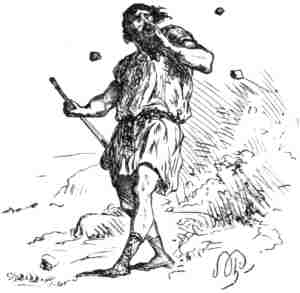
Our reception by our party had the immediate effect of
opening the eyes of the barbarians to the terrestrial nature
of their supposed god; and they no sooner became aware
how we had escaped their clutches than they began to
assail us with showers of stones and lances, so that our
retreat to the ships was a matter of considerable peril.
No one, however, was seriously injured; there were many
slight contusions, and Jonah's nose was ignominiously
bruised by a stone hurled at him by one of his late
worshippers.
Once safely on board, we made no delay in turning our
backs upon this inhospitable shore, and steering westwards,
made towards the island of Prydhayn.
With a calm sea and a favourable wind, our progress
was easy; and anxious to learn all that had befallen
Hanno and Jonah since we had lost them, we assembled
on the stern of the Ashtoreth expressly to hear their
story. Jonah, who had been well washed, insisted upon
being dressed in Phœnician costume, and took his seat,
with the monkey upon his shoulder, by the side of the
scribe, who proceeded to recount their adventures.
"It is now, you know, more than a year since the day
when we were caught in the ambush of the men of Tarshish.
When we were first captured our lives were in the
greatest jeopardy, for according to what we were told by
a Phœnician I met, we were at once to be handed over to
Bodmilcar, who was close at hand. Negotiations to this
effect were going on, when it transpired that one of the
Iberian chiefs had been so fascinated by Jonah's trumpet
that we were to be retained, and not given over to the
Tyrian, who was reported to be wounded. During this
respite I contrived, by means of a stick and some blood
from a wound of my own, to write a message for you on
my sandal-strap; I had no doubt that the instinct of
Gebal would take him back to Bichri, and accordingly I
resolved to make him my messenger."
"Yes; and your message came that night," I said.
"I conjectured so," he continued, "by the monkey not
returning. We were soon sent off towards the north,
under the guardianship of a troop of Iberians, who did not
by any means treat us badly, and after a toilsome journey
came to a region where the mountains were so high that
they were all covered with snow; they separated the land
of Tarshish from the land of the Celts, and were called the
Pyrenees. Here we were handed over to the chief of the
Guipuzcoa, for whom we were destined. These Guipuzcoa
are sometimes known as Bascons; they are a warlike
people, perpetually engaged in hostilities with the Aitzcoa,
or "men of the rocks," on the north-west, and with other
Iberians on the south. We remained for more than two
months before any opportunity of escape occurred; but at
last, during one of the forays, we were left behind in the
village, which was built upon piles at the mouth of a small
river. We got possession of a canoe, and having filled it
as far as we could with provisions, we ventured out to sea,
and contrived to reach the shores of the Celts, from whom,
in answer to many inquiries, I ascertained that some ships
had recently passed along their coast, and, from various
articles that they showed me, I had little doubt they were the
Ashtoreth, the Dagon, and the Cabiros. Making out from
the Celts that you had gone northwards, we left our canoe,
and took passage in one of their ships that was on the
point of sailing for Ar-Mor; but upon our arrival we found
the people engaged in war with the Cymri of the Island of
Prydhayn, so that we could not get transported there. For
two months I sojourned in various parts of the islands of
Ar-Mor, and picked up some knowledge of Celtic; but all
the time I was trying to devise some plan of following you
in the direction I felt sure you had taken. At length it
chanced that I found a tribe of Cymri who were not at war
with the people of Prydhayn, and embarked in one of their
boats; but a tremendous storm arose, and we were driven
far away to the east."
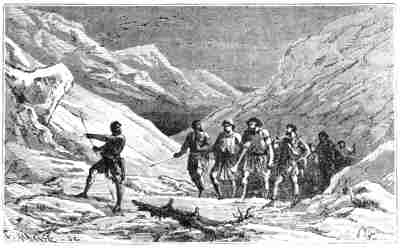
"Talk of storms," said Jonah, putting in his word; "was
not that a storm? I saw leviathans spouting water from
their noses as high as your mast, and we were tossed about
the waters like a log. For three days we had nothing
to eat or to drink."
"Jonah is right," continued Hanno; "the tempest was
really frightful, and we were dashed upon the muddy
swamps of the coast. The Cymri drowned themselves
in sheer desperation, and we, more dead than alive, existed
for more than a week upon roots and wild fruit from the
wood."
"And what did you find to drink?" asked Himilco.
"Nothing but muddy water."
The good pilot's sympathy was deeply moved, and he
said:
"Sorry drink that, as I know by experience."
After this interruption, Hanno went on:
"Jonah persisted in blowing his trumpet perpetually,
resolved if possible to attract attention, and at length
succeeded in making himself heard by a troop of Suomi
who were migrating eastwards in consequence of the
aggressions of the Cymri and the Germani, who were
appropriating territory after territory to themselves. Not
only did Jonah's enormous trumpet excite the wonder of
the Suomi, but I could observe at once that his huge and
imposing stature, and his abundant growth of shaggy hair
impressed this diminutive, smooth-faced people with superstitious
awe, a sentiment which I resolved to encourage, with
the object of turning it to our own advantage. We accompanied
them in their migration to their new settlement,
where we witnessed the erection of the village in which
you found us, and my representations prevailed so
completely that they recognised Jonah—Jono, as they called
him—as their presiding deity, regarding me as his high
priest. For some time, then, you see we have been in the
lap of luxury; but nothing has ever led me for a moment
to forget you or your ships, or to cease to long for the
Great Sea and our noble Sidon."
"And Sidon ere long you shall see!" said I, when he
had finished his narrative; "we are now on our way back;
it is impossible to penetrate farther, and we are homeward
bound."
"Sidon for ever! and long live the King!" shouted
Chamai; "we shall see the sun again."
"And get some wine!" cried Himilco, tossing his cap in
the air.
"And some new clothes!" chimed in Hannibal; "beggars
in rags are our soldiers now."
In the midst of the general hilarity Jonah sat silent and
full of thought.
"What ails you, trumpeter?" I asked; "cannot you
quite make up your mind to go back?"
"It is no good my going back," he half blubbered out;
"they will never believe me; they will only laugh when I
tell them I have been to Nergal's kitchen and seen behemoths
by dozens; and if I were to say I have been
worshipped for a god, and had dinners brought me every
day, big enough for a month, they will declare I'm stark
mad."
"Never mind, old fellow," said Chamai; "we'll back
you up; we will testify to the truth of your stories; and
what's more, you shall be presented to the King, and he
shall hear you blow your trumpet."
Overcome by Chamai's good-natured encouragement,
and his own prospective honours, he fairly burst into tears.
"Do you really mean it? and will the King see Gebal
too?"
"Aye, that he will; and we must teach old Gebal to
act the courtier, and to make a bow."
Hannibal declared that he thought Jonah ought to be
court-trumpeter, and to wear a scarlet tunic; and I
pledged myself to use any influence I could to secure him
the appointment, promising that if I succeeded I would
make him a present of his first uniform.
Jonah chuckled aloud with delight.
"And shall I wear a scarlet tunic? and shall I play
before the King? What will they say at Eltekeh? Happy
day that made me come to Tarshish! Long live the
King!"
With ejaculations such as these he withdrew to the
extreme limit of the prow, and relapsing into silence,
mused in solitude upon the dignity that awaited him.
From that day forward, Jonah was another man.
CHAPTER XIX. BODMILCAR AGAIN.
Some
easy sailing carried us past both the eastern and
western limits of Prydhayn and the Tin Islands, and
brought us off the rocky shores of the archipelago of
Ar-Mor, with its islands all perforated and undermined
by the action of the waves. Hanno recognised nearly
every locality.
"There," he said, pointing out one spot after another,
"there is the island where I learnt to croak my little bit of
Celtic; and that is the rock from which Jonah and I used
to fish with bone-hooks; and over there is the island where
the priestesses paint their faces blue and black for their
religious mysteries. Whilst we were with them they
wanted us to shave all our hair off our faces, with razors
made of shells."
"They gave the same advice," said Himilco, "on the
Tin Islands to Hannibal and Chamai, who came back to us
one day with their beards gone and their chins as smooth
as pebbles."
"I only wish," remarked Hannibal, "that they would do
for Bodmilcar what we did for ourselves; only instead of a
shell I should like to have a good sharp sword put across
his throat."
The mention of Bodmilcar's name led Hanno to inquire
whether we knew anything of him; and this led Hannibal
to tell him how on the day of the ambush he had given him
a thrust in his side, which had been, no doubt, severely
wounded, but his people had succeeded in carrying him off.
"Never mind," exclaimed Chamai; "we are sure to
have another chance."
"And then I trust," said Hanno, "it will fall to my lot
to deal with him after his deserts."
"Unless I am beforehand with an arrow from my good
bow," said a voice from the yard-arm high up in the air.
Bichri and Dionysos were up there, playing with the
monkey. Hanno laughed, and said that Bichri had been
associated so long with the monkey that he was becoming
a monkey himself, and was making Dionysos just as
volatile. Without leaving his perch Bichri asked:
"Why should I not teach the boy the use of his limbs?
and why should I not drill him to use a bow?"
"And why," added Hanno, "should you not teach him
to read?"
"How can I," he said, "when I have never learnt
myself? besides, reading will not help him to climb mountains,
hunt wild goats, or put an arrow in a mark."
"You may learn some day," rejoined the scribe, "that a
pen may be a surer and a sharper weapon than an arrow.
Would you and Dionysos like to learn to read?"
Startled by the suggestion, the archer caught hold of
a rope, and in an instant had slid down to Hanno's feet.
Dionysos followed. The monkey flew up to the mast-head.
"To learn to read, did you say?"
"Yes," replied Hanno. "Let us make a compact; you
shall teach me to shoot, and I will teach you both to
read."
"Agreed!" cried Bichri, enthusiastically; "and I'll warrant
that in a month you shall hit a mark no bigger than
my hand at the ship's length."
And so the days passed on. Hanno taught Bichri and
the young Phocian the alphabet. Himilco, as he piloted
the vessel, kept up a perpetual howling over his compulsory
abstinence; Chamai and Hannibal, when they were not
yawning in idle listlessness, were generally playing at
knuckle-bones; the two women gossipped contentedly in
their cabin; and Jonah confided to Judge Gebal his dreams
of future greatness.
In something more than six weeks we sighted the pillars
of Melkarth, and shortly afterwards entered the harbour of
Gades. The suffect, Ziba, and all our acquaintances had
imagined that we had long since been drowned, and were
loud in their congratulations on seeing us back again safe
and well, and were full of surprise when I exhibited my
magnificent cargo of tin and amber.
I inquired eagerly about Bodmilcar, but could only gather
from the suffect's account that fragments of what were supposed
to be his vessels had been picked up at the mouth of
the Illiturgis, but that nothing whatever had been seen
of his gaoul, so that the most probable conjecture I could
form was that the scoundrel had been massacred in the
interior of the country.
It cannot be denied that we had all been looking forward
with much impatience for the opportunity of obtaining
some decent food and drink. Himilco was really getting
exhausted with his subsistence for so many months on a
water diet; so that on reaching land I took the very earliest
chance of allowing my men to go ashore, where, doubtless,
they directed their steps only too quickly to the wine-shops.
Before Jonah left the ship I observed that he had
some shekels in his hand, and asked him if he would not
put them in his purse.
"No," he said; "they will never be quite safe until I have
changed them for wine, and put them into my inside."
Hanno, Chamai, and their sweethearts went with me to
dinner at Ziba's house; Bichri and Dionysos wandered
about the streets and gardens of the city; while Hannibal,
who said that now that we had come to a civilised country
he should wish his trumpeter to be a credit to his troop,
carried off Jonah to buy him a proper tunic.
We had given up two days to recreation when, returning
to the Ashtoreth, I met Himilco and Gisgo, both extremely
excited, in company with a Phœnician sailor who was a
stranger to me.
"Good news, captain!" shouted Himilco, as soon as he
was within hearing; "good news! tidings of Bodmilcar!"
"Tell me, quick!" I answered impatiently.
"Well, you must know," said Himilco, who was anything
but steady upon his legs, "we met this good man; he was
thirsty and we were thirsty, and I treated him to a cup at
a tavern, where he told us that he had escaped from Bodmilcar's
ship."
"Leave your plagued thirst," I said; "go on, tell me
what you know."
"Leave my thirst? no, no; it's my thirst will not leave
me."
"Curse you!" I said, half-frantic with irritation; "tell
me at once!"
"Give me time and I will tell you all that he told us in
the tavern."
"Where's Bodmilcar? you drunken fool!" I roared,
stamping with rage; and turning in despair to the sailor,
said: "Tell me, my good man, where have you come
from?"
"Come from?" echoed the irrepressible pilot; "why he
has come with us; he has come from where we have been
drinking."
My patience was exhausted, and I struck him a sharpish
blow across the mouth, a hint that he took that he had
better keep quiet.
According to what I could make out from the sailor's
version of things, he had come from an unfrequented bay
some 150 stadia to the south-east; that Bodmilcar had
been there, at first with one gaoul, the Melkarth, but afterwards
he had three galleys besides; that he had forced a
number of the natives of Tarshish into his service; and that
by some means he had collected a great body of criminals
and deserters. He had himself, he said, been kidnapped by
Bodmilcar, but had contrived to escape, and having made
his way on foot along the coast, was now going to make
his deposition before the naval suffect at Gades.
I inquired how long it was since he had run away from
Bodmilcar, and whether he knew anything of Bodmilcar's
movements. He replied that it was a week since he effected
his escape, and that he knew that it was the Tyrian's intention
to make for the country of the Rasennæ, and thence
to proceed to Ionia.
Telling the man that I was returning to Tyre, I offered
him a passage with me, if he liked, as one of my crew, to
which he agreed with apparent pleasure; he not only
assured me of his fidelity, but declared that nothing would
gratify him more than to be able to avenge himself upon
Bodmilcar.
On the third day after this, having thoroughly revictualled
the ships, we set sail with our hearts all elated at the prospect
of seeing our native shores. We sighted Calpe and
Abyla, but the wind having freshened, we were obliged to
beat to windward to enter the strait. Next evening I
noticed a large galley sailing in the direction opposite to
ourselves, and tried to hail her; but as the weather did
not permit us to get near, I made Himilco take half-a-dozen
sailors in one of the boats and row towards her; a circumstance
that struck me was the extreme readiness with which
the new sailor volunteered to take an oar.
The boat had not long pushed off before one of the crew
rushed up to me with consternation written in his face, and
exclaimed:
"Captain, we have sprung a leak!"
I lit a lamp, and in a minute was making my way down
into the hold. Two sailors and one of the helmsmen followed.
My heart sunk within me at what I saw. The
water had not only got into the hold, but it was already
knee-deep; worst of all, it was still rising rapidly. The
sea was rough, and the ship was labouring hard against the
wind. Unless the evil could be remedied, another quarter
of an hour would see us at the bottom. Almost beside
myself with agitation, I caught hold of a handspike and
plunged it wildly about in every direction; the ill-tidings
soon ran through the ship, and there was a general rush
towards the hold, but I drove every one back, and suffered
nobody to remain except the three men who had first come
down with me, and young Dionysos, who had slipped in
unobserved, and was paddling about in the water, which
was up to his shoulders.
In the midst of my frantic endeavours to ascertain the
position of the leak, my attention was arrested by voices
above speaking hurriedly in a tone that indicated alarm,
and I distinctly caught the names of Bodmilcar and the
Melkarth. Almost at the same moment the man standing
on the ladder to hold the lamp moved on one side to
allow by-way for some one who flew, rather than ran,
into the hold. The light was not so dim but that I recognised
Himilco, his head bare, his hair dishevelled, and
his cutlass in his hand. Before I had time to speak to
him a trumpet was sounding overhead, and Hannibal's
stentorian voice was shouting:
"Make ready the scorpions! Archers, to your ranks!"
"Good gods!" I exclaimed at last, "what does this
mean?"
"Soon told," said Himilco; "the man we took on board
was Bodmilcar's agent, bent on mischief. I have managed
to get my boat back, but the Melkarth and her galleys
will be upon us in a moment."
He had hardly time to finish speaking, when the commotion
above made it manifest that the struggle was
already beginning.
"Then we are lost," I cried, in absolute despair at our
twofold peril: "that infernal rascal has scuttled the ship."
Himilco groaned aloud in dismay.
A shrill cry of distress at this very moment rose from
Dionysos, calling for help:
"Save me! save me! I am in a hole; I am sinking!"
The lad's head had already disappeared, when Himilco,
sticking his cutlass into the ladder, and shouting that the
child had found the leak, made a dive and brought him
back half-fainting from the water, and delivered him to the
sailors, who carried him on deck. Not a moment was lost.
Carpenters and sailors were summoned to the task, and a
heavy wave making the ship lurch so that the leak was
actually seen, we put forth all our energies, and notwithstanding
the combat that was being waged above our
heads, succeeded—all praise to our gracious Ashtoreth!—in
temporarily stopping the hole.
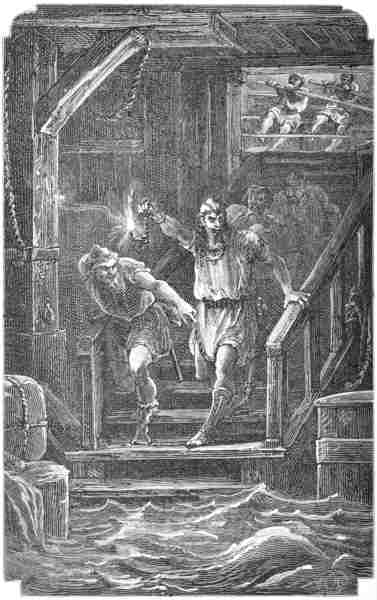
THE CHILD HAD FOUND THE LEAK.
To face page 293.
Meanwhile the clamour of the fighting had given place
to silence. On remounting the deck I found several dead
bodies, and pools of blood in various places; I saw that
the Adonibal and the Cabiros were lying alongside right
and left, but Bodmilcar's vessels had vanished in the
twilight.
Hannibal and Chamai were furious at their escape, and
could hardly find words strong enough to express their
contempt of a cowardice that had shirked a fair fight.
Hanno, with his bow still in his hand, avowed that
nothing else than the gathering gloom of night had saved
Bodmilcar; if he could have recognised him, he would
have been a dead man.
"When I was attacked in the boat," said Himilco, "I
recognised the villain who took my eye out of my head;
and if there had not been some thousand of them
peppering away at us all at once——"
"How many, do you say?" asked Hannibal, with a
smile.
"Well, then, I am sure there were six or eight; but
never mind, many or few, there was one man I knew only
too well, and while I was down there looking after that
leak, no one knows how my heart was burning for a chance
of getting him by the throat."
All this time the wind was rising, and after a while it
blew a hurricane. There was every cause for apprehension;
the leak was stopped so insufficiently that it might
break open again at any moment, and the waves were
playing with our ship like a ball.
There was no sleep that night. The men, in relays, had
to toil with all their might at scooping out the water; and
after that had been reduced below the level of the leakage,
it took more than five hours to strengthen and caulk the
fresh planking that had repaired the gap. All danger,
however, from that source was averted.
Daylight came, but the tempest was more violent than
ever. I hardly recollect so furious a wind; the pigeons that
I let loose were unable to withstand the hurricane, and
fluttered back helplessly on to the deck. All control over
the ship was lost, and there was no alternative but to
allow her to drift we knew not whither.
CHAPTER XX. THE WORLD UPSIDE DOWN.
For
eight days did the tempest rage, when, at the end of
that time, the wind dropped and the sky cleared, I found
that we were quite close to the shore, and off a headland
beyond which the coast stretched away indefinitely to the
south. Continuing our course in that direction, we came
in sight of a mountainous island, richly wooded and extremely
picturesque. The glowing sun and the genial
temperature reminded us of our beloved Phœnicia; and
so tempting was the aspect of the place, that I resolved
to disembark, not merely as a matter of pleasure, but to
look to the ships, which, after their strain, required some
examination.
We anchored in a charming bay, and were soon surrounded
by canoes full of savages, of whom the first
characteristic that I noticed was their low foreheads and
yet elongated skulls. To my surprise, they addressed us
in the Libyan tongue, and proved to be the true Garamantine
or red Libyans. We were the first Orientals they had
ever seen on their shores; but one of their old men stated
that he had been to Rusadir, and had seen Phœnicians
there. They received us very kindly, and told us that
their island was one of a group that was situated to the
west of Libya. Ignorant of navigation, they could give
me no information about distance; and all that I could
make out was that the coast of Libya extended far to the
south, and was inhabited by people of the same race as
themselves; and that still farther south there was a region
where the men were like animals, and perfectly black.
"That's a country worth seeing; I should like to catch a
black man," said Bichri.
The residents, I observed, wore bracelets, necklaces, and
earrings, which were, I found, made of gold; and in reply
to my inquiry whether the gold was found in the island,
they told me that they obtained it both in nuggets and
in dust from the Garamantines of the mainland, who collected
it by means of fleeces at the mouths of their
rivers.
The people did not attach any great value to their gold,
and were quite ready to barter it away very freely for
many things we had to offer them; for instance, for some
glass trinkets they gave me as much gold dust as I could
hold in the hollow of my hand, while for such things as
knives, lance-heads, or swords, they would give an equal
weight in gold. The delight of my people was unbounded,
and I had the utmost difficulty in preventing
them from bartering away all their weapons. Hannibal
sold his helmet, crest and all; and Jonah even parted with
his trumpet, boasting that he could now have one of pure
gold, with which to play before the King; but so enchanted
was he with the country, that if the inhabitants would have
accepted him for their god he would have been quite ready
to reside permanently amongst them.
I spent a fortnight in purchasing gold and repairing the
ships, and an interesting period we all found it. The
fertile soil was productive of some of the finest fruits I had
ever seen; one fruit in particular with a scaly covering was
very delicious. The valleys were full of orange-trees of
the growth of centuries, and the mountains were clothed
with magnificent woods, in which beautiful little birds
with yellow plumage were fluttering about, and singing
exquisitely. Bichri, who did not care about purchasing
more than just enough gold to ornament his belt and
quiver, spent several whole days in these woods with
Dionysos, and succeeded in catching some of the bright
little songsters, which he secured in a cage; but his trouble
was of little avail, as they all died upon their passage.
As for Judge Gebal, he manifested such a keen appreciation
of the charms of the scenery that we had to keep
him tied up to prevent his running away; but the time for
our departure necessarily arrived, and, after the repairs
were all completed, we reluctantly bade farewell to the
lovely archipelago, upon which I bestowed the name of
the Fortunate Islands.
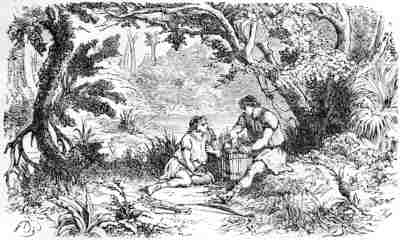
Once more at sea, I had no difficulty in determining my
course. All my party were eager to visit the wonderful
gold-countries, and Bichri persisted in saying that he
should like to catch sight of the black men; Himilco just
at first protested against going in a direction where wine
would not be forthcoming, but his objection was soon
overruled, and he was contented with our resolution to sail
southward. What caused us much bewilderment as we
advanced, was, that not only did the sun rise higher over
our heads, but the Cabiri descended lower towards the
horizon. Himilco complained that we were sailing out of
reach of the protection of the gods; I pondered the matter,
but kept my thoughts to myself.
After running some distance to the east, the coast
resumed its southerly direction; and then it was that the
sun, which day by day had gradually risen higher in the
heavens, stood vertically over our heads, and then began to
change its position, shining at last upon my left hand
instead of upon my right. Evening after evening, too,
brought into view constellations that were quite unknown
to us; and so great was the amazement of all on board,
that I resolved upon holding a general consultation of
officers and pilots, and the more intelligent of the sailors,
in order to discover a solution of the mystery.
Hamilcar gave it as his opinion that the gods must have
been making some alterations in the face of the heavens;
Hasdrubal suggested that perhaps we had passed the
bounds of our own world and entered upon another; whilst
Himilco avowed his suspicion that unless something of
that kind had occurred, the world must be round, and we
were on the other side of it. Absurd and outrageous
as Himilco's conjecture appeared to every one else, I
confess it chimed in to a certain degree with my own
speculations, and set me reflecting that if it were so it
must be the sun and the stars that were standing still, and
the world that was moving round them. But, after all,
Himilco was much more inclined to believe in a prodigy
than to entertain any of these fanciful theories.
Pressed with inquiries as to what I intended to do, I
announced my resolution of continuing my course to the
south; if ultimately the coast should incline to the west
(or what I presumed to be the west), I should return to the
Fortunate Islands; but if, as I anticipated, it turned to
the east, I should go on following it, under the expectation
of getting to the north at last, and reaching Egypt by
way of the Sea of Reeds. This scheme of circumnavigating
the entire land of Libya commended itself entirely to the
judgment of my pilots, but it quite baffled the comprehension
of Hannibal and all the landsmen.
When I spoke to Hannibal about arriving at Egypt, he
looked quite aghast, and exclaimed:
"Egypt! here are we sailing farther and farther away
from the Straits of Gades; and yet you talk about getting
this way to Egypt. Impossible!"
"Patience!" I said; "perhaps we may find you a short
cut even yet!"
He shook his head dubiously; and even Hanno observed
that the mysteries of navigation were very abstruse, and
that the studies which he had pursued at Sidon did not
enable him to solve these enigmas.
"Ah! you should have travelled more, young man,"
said Himilco; "and you should have learned to know the
stars."
"I should think this voyage is travelling enough for any
one," replied Hanno.
Chamai merely remarked that he was quite sure that
they might all rely with perfect confidence in my judgment.
And thus the consultation was brought to a close.
Many times did we approach the coast with the intention
of landing; but either it was utterly desolate, or it
was so crowded with black men, who yelled and assumed
such a threatening attitude, that we always postponed any
attempt to go ashore. One night in particular, as we were
passing under a promontory that I had named "the chariot
of the gods," the noises we heard seemed of so threatening
a character that I deemed it prudent to put out a little
further to sea; but at length our provisions began to run
short, and there was nothing to be done but to venture on
land. Bichri, patient and enduring as he ever was, complained
of living on salt fish; Jonah murmured that there
was short allowance for ourselves, and no fruit for Gebal;
and Hannibal regretted that we were losing our chance of
picking up gold. I was accordingly induced to lay to as
soon as I found a convenient opportunity.
Our anchorage was the estuary of a river apparently as
large as the Egyptian Nile; its banks were covered with
thick woods; numbers of crocodiles and hippopotamuses
were visible in the water by its shore; and great birds,
uttering shrill and piercing cries, whirled around above our
heads.
For four days we wandered about without finding any
sign of human being; we obtained, however, an abundance
of wild fruit, and shot several buffaloes and antelopes, of
which a great portion of the flesh was carried on board
and salted. On returning from one of the foraging excursions,
Bichri came running to me, looking utterly woe-begone;
he was followed by Dionysos, weeping bitterly,
and Jonah, gesticulating vehemently, and apparently as
much agitated as himself.
"What's the matter, Bichri?" I asked.
"Gebal has gone!" he exclaimed; "he has been carried
off by Bodmilcar's monkeys."
I burst out laughing. In his indignation he looked as if
he could have annihilated me.
"I am sure they were Bodmilcar's!" he insisted; "creatures
with long tails; they took him away; he never would
have gone with them of his own accord."
Nothing I could do served to calm him; he would not
be pacified until I allowed him to take some men and go
out again in search of his lost favourite; but in the evening
they all returned worn out with fatigue, only to announce,
as might have been expected, that their search had been
fruitless. There was no doubt the monkey had been
delighted to join the troop of his own tribe that was
gambolling in the woods. Bichri was very inadequately
consoled for his loss by bringing back a great black monster,
which, after he had wounded it, the men that were with
him, in spite of the huge brute's desperate defence, had
succeeded in despatching with their pikes. It certainly
was a most formidable-looking creature, and I subsequently
had it stuffed, and it may now be seen in the
temple of Ashtoreth in Sidon. Bichri told us that after it
had six or seven arrows in its body it snapped a pike-staff
in two as easily as if it had been a reed; upon which Hannibal
remarked that the strength that could break asunder
a pike-handle made of oak of Bashan must be prodigious.
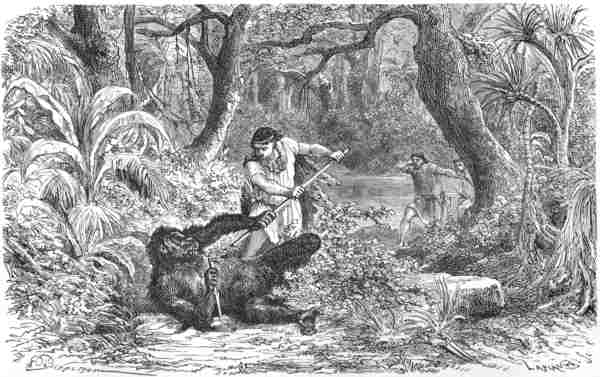
IT SNAPPED A PIKE STAFF IN TWO.
To face page 301.
We were obliged to depart without finding any vestige
of Gebal. After sailing on for about a fortnight, our supplies
again ran short, and as we were discussing what steps
we should take in consequence, Hannibal interrupted us
by shouting:
"A gaoul ahead!"
Every eye was bent in the direction to which we were
pointed, and sure enough there was a gaoul of Phœnician
build; but on farther scrutiny it was evident that it was
all dismantled, and drifting at the mercy of the waves.
"May be a ruse of Bodmilcar's," suggested Himilco.
Taking his hint, we approached very cautiously, and it
was not until we had thoroughly satisfied ourselves that
there was no one on board to answer our signals that we
ventured close alongside. It was perfectly deserted.
Gisgo said that he remembered having once abandoned
his ship off the Pityusai Islands, and that probably this
was a similar case; but he could not understand what
current could have borne the gaoul to this distant shore.
"Never mind where she comes from," I answered; "let
us hope she may prove a godsend."
Hannibal and Himilco, who went on board, brought back
the welcome intelligence that the hold was well freighted
with corn and wine, the whole of which we joyfully transferred
to our own vessels, leaving the empty hull again to
the wind and waves. In the evening I caused an offering
to be made to Ashtoreth in acknowledgment of her manifest
interference on our behalf.
Next day we hove in sight of a lofty promontory, the
top of which was as flat as a table. A strong gale was
springing up.
"Never mind the wind," cried Jonah. "What do I care
for the wind now? I've a purse full of gold; plenty to
eat; plenty to drink; and a red tunic before long.
Tempests be hanged! Long live the King!"
The gale for some days increased in violence, and all
attempts at steering were quite useless. When, after eight
days, the sea became calmer, I could make out that the
land was lying to our left. This was according to my
prognostications, and I followed the coast to the north
with renewed confidence, day by day becoming more and
more convinced that the sun was again rising in the
heavens; and one lovely night, about a fortnight afterwards,
Himilco suddenly seized my arm, and making
me point to the northern horizon, exclaimed in a voice
trembling with excitement:
"See, the Cabiri!"
"Yes; true enough; there are the Cabiri," I answered,
as full of delight as he was himself. "We have accomplished
an unheard-of thing," I added; "we have circumnavigated
Libya."
"And to-morrow," he said, "we shall have the sun once
more on our right; we are on our way to the Sea of
Reeds."
"Aye, to the Sea of Reeds! and to Sidon, our own
Sidon! Sidon the glorious, Sidon the incomparable!"
There was none to witness; the crew were sleeping in
their berths; and in the fervour of our enthusiasm we
threw ourselves into each other's arms.
A month later, as we were taking in fresh water at the
mouth of a river, we fell in with some black men, who bore
a marked resemblance to the Ethiopians, who are often
seen in Egypt. One of them could speak a little Egyptian;
he told me he had learnt it in Ethiopia, which is subject to
Pharaoh. His own country, he stated, was six months'
journey below the southernmost limit of Ethiopia; but he
could give no information whatever about its distance by
sea. These negroes called themselves Kouch, and having
never seen any Phœnicians, took us for Egyptians; but as
soon as we explained that so far from being subjects of
Pharaoh we were enemies of the Misraim, they welcomed
us as friends, and treated us with the utmost cordiality.
They had evidently a great abhorrence of the Egyptians
on account of the cruel ravages that had been committed
on their northern boundaries.
For the next three months we never found a favourable
wind to speed us on our way. We employed our time
in transacting business with the Kouch, and in making
hunting-expeditions into the interior of the country. In
the way of exchanges we procured gold, ivory, pearls, and
skins; and an immense success attended our hunting-excursions
in a region that was found to abound in
elephants, rhinoceros, and giraffes, as well as in smaller
game. There was not one of us who had not some trophy
of our good fortune or our skill to exhibit. Bichri killed a
lion, with the skin of which he made himself a mantle, and
even little Dionysos brought down a panther.
At length the opportunity for which we had watched so
eagerly arrived, and we set sail once more. Ten days
after our departure, while a stiffish breeze was blowing
from the north-east, I noticed not very far ahead of us
a large Phœnician gaoul, which appeared to have sustained
some damage, and to be drifting along under the
action of the wind. In answer to my signals, she gave me
to understand that she had lost some oars and her yard-arm,
and that she was in need of help. Always anxious
to render assistance to a vessel in distress, but yet fearful
of treachery I immediately ordered out my men, but
meanwhile instructed Hannibal to have the catapults in
readiness; and thus prepared, the Ashtoreth approached
the gaoul on one side, and the Adonibal on the other, the
Cabiros following in the rear.
There was no need for any apprehension on my part.
As soon as we were fairly within view of each other, the
captain, standing on the stern, raised his arms and shouted:
"By Baal Chamaim! it's Mago!"
"By Ashtoreth and all that's holy!" I exclaimed; "it is
my cousin Ethbaal!"
The recognition was a mutual pleasure; our ships were
soon alongside, and we were grasping each other's hands.
"How rejoiced I am to see you, Mago!" he repeated
over and over again; "Phœnicia has given you up in
despair; every one mourned you as lost. By Ashtoreth!
you must have been saved by a miracle!"
And he put his hands upon my shoulders and long and
keenly scrutinised my face.
"Tell me two things," I said; "where am I? and what
has brought you here?"
Ethbaal seemed full of surprise; but said:
"Come, come; you are laughing at me. You must know
well enough where you are."
I assured him that I was in earnest in what I said, and
repeated my assertion that I was by no means aware of
where I was; and when Himilco informed him that we had
come from a place where the Cabiri could not be seen at
all, and where the sun shone on the wrong side of us, he
looked as if he thought we had taken leave of our senses.
Nor did he appear to understand much better when
Himilco went on to expatiate upon having once drunk fish-oil,
and having had no wine for many months together.
"Mysterious!" muttered Ethbaal to himself; "here is
Mago, close to the entrance of the Sea of Reeds, only
six days' voyage from Ophir, and yet he comes from the
south, after sailing four years ago westward to Tarshish!
Strange!"
He pondered awhile, and then addressed himself to me:
"Yes; you are close to the Sea of Reeds."
I uttered an exclamation of delight, and turning to my
people cried triumphantly:
"Was I not right? Did I not tell you that we were
on our way to Egypt? Lucky we did not turn back
from the Fortunate Islands!"
Ethbaal appeared to be confirmed in his suspicion that I
must be mad, and declared his total ignorance of the
Fortunate Islands:
"I have never heard of them!"
"No, nor yet of the Tin Islands; nor yet of Prydhayn;
nor yet of the river of the Suomi; nor yet of the chariot
of the gods," exclaimed Himilco. "Compared with us you
are mere coasters, loafing about in cockle-shells."
Genuine Sidonian as he was, my cousin could not brook
any insinuation against his seamanship, and colouring
deeply at the slight which he conceived was offered to him,
he said in a tone of anger:
"Out upon your insolence! do you call a man a coaster
who has made the voyage to Ophir? do you call my gaoul
a cockle-shell? Are you mad, or are you drunk, you one-eyed
fool?"
Himilco, recalled to a sense of propriety, changed his
banter into cajolery:
"Now then, my dear fellow, you can do a great deal
better than bully me. Haven't you a little wine on board?
It would be a great boon to give us a skin; we haven't
tasted a drop this two months."
I interceded with Ethbaal, asking him to overlook what
might seem to be rudeness on the part of Himilco, and
assured him that our adventures had been so extraordinary
that he must really pardon a little bragging. He not only
took my mediation in a good spirit, but sent for a goat-skin
of wine, which he himself handed to Himilco, in token
of forgiveness. Saying that he should make an offering
with it to the Cabiri, the pilot emptied so large a share of
the contents down his throat that his companions began
to wonder when his draught was coming to an end, and
almost despaired of the wine lasting out till it should come
to their turn to partake of it.
"Glorious wine! wine of Arvad, Hannibal," he said,
smacking his lips as he removed the goat-skin from his
mouth, and passed it to the rest.
Gisgo and Hannibal clutched at the bottle together.
"Nay, nay, my friends," cried Ethbaal; "do not be
fighting for the wine. I have plenty more. My cargo is
all wine which I am carrying to Ophir."
"Could you not take me with you?" asked Himilco
eagerly; "my services are quite at your disposal."
CHAPTER XXI. THE QUEEN OF SHEBA.
As
soon as the wind dropped, we submitted ourselves to
Ethbaal's instructions as to the direction in which we
ought to steer, and taking his gaoul into tow, we proceeded
on our course to Ophir.
When evening came we found that by Ethbaal's orders
a true Phœnician banquet had been prepared on the stern
of the Ashtoreth: cheese, olives, figs, raisins, and a double
allowance of wine were served out to the men; and we
ourselves took our seats upon brilliant carpets that had
replaced the worn-out rags with which we had been so
long familiar, and for the first time for months, nay, years,
enjoyed the viands of Tyre and Sidon, and quaffed the
wines of Byblos and Arvad.
Our spirits rose to the occasion, and I should hesitate
to say how many times I filled and refilled my wine-cup
before I began to recount the adventures which Ethbaal
was anxious to hear.
My story lasted far on into the night.
When I had finished, Ethbaal, who had never flagged
for one moment in his attention, raised his hands to the
stars in the heavens above, and swore by all the gods that
my chronicle ought to be registered in letters of gold.
He went on to tell me that the cargo I had sent from
Gades and all my messages had been duly received at
Tyre; that everyone had come to the conclusion we must
all have been drowned in the ocean; and that nothing had
been heard about Bodmilcar, who, it was taken for granted,
had been punished for his treachery by the direct visitation
of the gods.
I offered Ethbaal a present of some very fine pearls; he
at first refused to take any acknowledgment at all of his
attention to us, but I induced him ultimately to accept the
gift. The damages to his gaoul were only to the rigging,
and did not affect the hull; and as we had taken it into
tow, there was nothing to cause us any anxiety, or to
prevent us from retiring to rest.
Next morning, in the course of conversation with Ethbaal,
Himilco asked:
"Have you had any fighting, captain, since you have
been out?"
"Fighting? no, why?" he replied.
"Because if you continue in our company you will soon
find that fighting is our destiny. We are always fighting;
if we are not fighting men,—and that we are doing pretty
frequently,—we are fighting the beasts of the earth; and if
we are not fighting beasts, we are fighting against wind
and waves. Go where we will we attract the fightings,
just like a headland attracts the storms. Fighting is
our luck; so I just warn you, you had better be on the
look-out."
Ethbaal laughed. He said he hoped that we had come
to the end of our adventures in that way, and that we
should have a prosperous voyage to Ophir; then turning
to me, he asked what I expected to procure at Ophir, as I
had already a large supply of gold, which was the commodity
ordinarily obtained there.
I reminded him that I had a much larger quantity of
amber than I really wanted, and that in return for a portion
of it I intended to lay in a stock of sandal-wood and
spices, peacocks and apes, and anything else that the
country could offer.
The Arabian coast was rocky, but we sailed along it
without difficulty for six days, at the end of which we
arrived at Havilah, the principal city of the kingdom of
Ophir and Sheba. Unlike the Phœnician seaports, it has
no quays, fortresses, nor arsenals, but it is well-sheltered,
and forms a commodious trade-harbour; the town rises
like an amphitheatre upon the surrounding heights, and
the white terraces, with their brown and red domes, broken
by clusters of palm-trees, stand out in pleasing contrast to
the deep-blue sky, while the domes of the temples are of
gilded bronze, and glitter with dazzling brightness in the
sunlight. Although the people are indifferent seamen, yet
it is to the sea that they owe their prosperity, their city
forming the mart between our own country and the distant
Indies.
The Queen herself takes a keen interest in all matters
connected with navigation, and her palace is situated close
to the sea-shore. It is built of cedar, and ornamented with
trellis-work and open balconies; the walls are all adorned
with paintings, inlaid with precious stones, or hung with
curtains of variegated stuffs.
I was very anxious to secure the Queen's favour, and to
make her an offering worthy of her acceptance. With
this object, I placed some of my finest pieces of amber in
a casket made of Tarshish silver, and carrying my gift
in my hand, I presented myself with Ethbaal and most of
my officers at the entrance of the palace, and sounded the
great drum by which it is the custom to demand admittance
to the royal presence.
Ordinarily the Queen occupies a tapestried tent that
overlooks the sea; she had consequently been aware of
our entrance into the harbour, and when we presented ourselves
at the gateway of the palace she gave immediate
orders that we should be conducted before her. We were
taken to her pavilion across a garden of surpassing beauty.
There were countless plants, wonderful alike in their blossoms
and their foliage, grouped in exquisite order around
sparkling fountains; there were sumptuous tents of every
hue pitched amongst the rare and graceful trees, to the
boughs of which monkeys were attached by golden
chains; Indian birds with gayest plumage fluttered overhead;
and peacocks, displaying their gorgeous tails, were
strutting along the avenues. Every thing we saw seemed
worthy of the stateliest empire in the world.
We prostrated ourselves before the Queen, who at once
bade us rise. She was young and very fascinating; and
although she was surrounded by ladies in waiting and
maids of honour, she was conspicuous among them all for
grace and beauty. Her attire, redolent of perfume, was
alike sumptuous and elegant; in her hair and round her
neck were jewels valuable enough not only to equip a
fleet, but to maintain it as well; a long robe, embroidered
in gold with figures of men, beasts, and birds, was thrown
over her, but opened to display the richness of the dress
below; her sleeves were loose to the elbows, and on
her wrists were bracelets that must have been all but
priceless.
We were dazzled into silence as we first gazed upon
her beauty and magnificence; but Hanno almost immediately
advanced, and ventured to recite some verses of
an Arab ode:
"Fairer than moons are thy beaming eyes,
Nay, they are radiant suns:
Forth from the bow of thine arched brow
Shoot the arrows that pierce man's heart:
Be it thy justice prevails far and wide,
The universe yields to thy charms.
What are thy favours? Say I not true?
Fetters they are that bind the soul;
What are thy fingers? What do I kiss?
Keys of a heavenly joy."
The language spoken in Ophir is very similar to our
own, and the Queen, who understands Phœnician well,
expressed herself as being highly gratified at Hanno's
courtier-like address. She then deigned to examine the
presents I had brought, and requested me to give her a
brief outline of my travels and adventures; then rising
from her seat, and bidding us follow her, she went out,
accompanied by her retinue, into the garden, and moving
with all the grace and dignity of a goddess, herself conducted
us to every point of interest in her paradise. Before
we took leave of her she desired me to visit her again on
the eve of our departure, that I might receive some instructions
that she wished to give me.
The same evening the munificent lady sent us a store
of provisions for our ships, and various presents for ourselves,
amongst which I should especially note several
embroidered robes for the women, and a scarlet tunic, a
hyacinth-coloured girdle, and a gold-embroidered shoulder-belt
for Hanno.
We remained a week at Havilah, making exchanges,
and inspecting all that was worth seeing in the place.
Representatives of nearly every nation seemed to be congregated
in the town; men from India and Taprobane,
from Ethiopia, and the mouth of the Euphrates. The
people of Sheba themselves bear a strong resemblance to
the Jews, Phœnicians, and Arabians, the principal difference
being that they are of smaller stature and darker
complexion. The queen, however, is remarkably fair.
The gold and the tin that we procured here, as well as
the peacocks, tortoise-shell, and ivory, are all imported
from India; but the spices, stuffs, and vases of opaque
glass, are brought through India from a still more distant
land, to which hitherto no one has ever sailed, and which
could not be reached in less than a two years' voyage.
On the day of my departure I presented myself again
before the Queen.
"I have to inform you, Captain Mago," she said, "that
the old King David who sent you to Tarshish died a year
and a half ago, and has been succeeded by his son
Solomon, of whose power, but especially of whose wisdom,
I hear a wonderful report. His dominions extend as far
as the Gulf of Elam on the Sea of Reeds, where he holds
the port of Ezion-Geber. I am eager to enter into a treaty
with him, and I commission you, on my behalf, to convey
to this august monarch a present that shall be worthy of
himself and me."
"Your will, O Queen, is my law," I replied, as I made
my obeisance.
"But first of all, captain," she continued, "tell me
whether you and your companions in toil are too worn out
with the fatigues that you have already endured to undertake
another voyage in my service. Information has
reached me that the King of Babylon, Assur, and Accad
is on his way, with a powerful army, to the mouth of the
Euphrates to put down an insurrection. No one so well as
yourself can fulfil what I desire. I want you, if you will,
to convey him some messages from me, and to be the
bearer of presents that I shall send."
I did not hesitate to comply; not only did I express
my willingness to go, but assured her that the voyage
would be neither difficult nor long.
"Go then, brave mariner," said the Queen, with a
beaming smile, "and I shall not fail to recompense you
royally."
I prostrated myself once again before her, and withdrew.
An hour later I had taken leave of Ethbaal, who was
returning to Sidon by way of Ezion-Geber and the canal
of Pharaoh, and, with all my people, I was embarking for
yet another voyage.
CHAPTER XXII. BELESYS FINDS BICHRI SOMEWHAT HEAVY.
It
did not take us much more than a month to sail to the
mouth of the Euphrates, although during the time we
made one sojourn with the Arabians, and another with the
fish-eating Gedrosians on the opposite coast.
On receiving the announcement from me of the aged
King David's death, Chamai and his fellow-countrymen
observed a week's mourning, fasted, rent their clothes,
and combed neither their hair nor their beards; but at
the end of the week they made plentiful ablutions, and
held a festival in honour of Solomon, the King's son and
successor.
It was early in the morning that we reached the river-mouth,
and having entered it, proceeded till we came to a
little town dedicated to the god Oannes. There is no
stone found in the country, and the place, like all the
other towns on the Euphrates, is built entirely of bricks,
the fortifications being circular walls constructed of bricks,
baked and unbaked, cemented with layers of bitumen. On
the right were the remains of vast forests, which, according
to the statements of the learned, were, three hundred
years ago, the haunts of the elephant. On the other side,
extending as far as the eye could reach, was a long stretch
of meadow-lands and corn-fields. Looking up the river,
we could count some hundreds of tents pitched among the
crops or sheltered by the forest, the fires of the encampment
sending up columns of smoke, and groups of horses
being picketed everywhere amongst them. A few boats
and two large ships of Phœnician build were moored to
the shore; but what struck us most of all was the swarms
of soldiers, many of them with swords drawn and lance in
hand, who were posted everywhere alike on the river-bank,
in the pastures, among the crops, and along the skirts of
the forest.
"The army of the Assyrians!" cried Himilco.
"The gods be praised!" said Hannibal, in an ecstasy of
delight; "now shall I set eyes upon something like an
army once again. See, how admirable their position! how
skilful their groupings! I must make the acquaintance of
their officers."
He was stopped short in his panegyric by the shouts of
a troop of horsemen who were galloping towards us, and
ordering us, in Chaldean, to bring our ships immediately
to a standstill, and to tell them who we were. From the
stern of my ship I answered the officer in command as
courteously as I could, and he, in reply, ordered me to
remain where I was whilst he reported my statement to
his superior. In about a quarter of an hour he returned
from the camp whither he had gone, and brought with
him a troop of cavalry, at the head of which rode a burly
fellow armed in a complete suit of mail, and carrying a
lance.
Hannibal again began to praise the order and accoutrements
of the troop and their leader to Chamai, who, while
admitting the superiority of Assyrian cavalry, contended
that the infantry of Judah was second to none; but before
they had finished their military discussion, the Chaldean
had halted just opposite our ships, and was calling out
that our principal officers must come ashore and state our
demands in the presence of Belesys, the King's commander-in-chief.
Hanno knew enough of Chaldean to remember that the
word "belesys" in that language signified "terrible," and
muttered that it was a formidable name for a man to have.
Taking the Queen of Sheba's letters, and followed by
eight sailors carrying her presents to the King, and escorted
by my own officers, I went on shore. The Chaldean
was tall and stout; he had a wide face, with a strong jaw
and great deep-set eyes; his beard was thick and frizzled
like the rest of his company, and his manners were extremely
coarse and insolent.
"Come, now, you sailor fellows, stir yourselves a little
briskly, will you?" he cried; "I'm not fond of walking my
horse."
He conducted us first of all through an enclosure filled
with war-chariots, and then past an encampment of infantry,
composed of Mesopotamians armed with maces
and spears, and in physiognomy bearing a striking likeness
to the people of Judæa. A little removed from us was
a regiment of Medes, the representatives of a nation recently
subjugated, but whose ancestors had given Nineveh
her line of kings. They were thick-set, and had round
heads, scanty beards, and obliquely-set eyes. Their fierce
expression of countenance attracted our notice, and armed
with their swords and short, strong bows, they must be
very formidable in battle. As we passed, we were near
enough to hear that they were making coarse jokes upon
us in their own tongue. A noisy band of half-naked Arabs
next caught our attention. These, with their camels,
always form part of the contingent of the King of Assyria,
and mingling with them I recognised some Midianite
slave-dealers and some Phœnician merchants, who act as
purveyors to the army, but make their chief profits by
purchasing slaves and plunder from the soldiers.
We proceeded to the cavalry encampment, and when we
were about in the middle of it, we were ordered to halt.
We found ourselves in front of a large circular tent made
of rich hangings, the entrance of which was guarded
by Kardook infantry carrying maces, and equipped with
breast-plates, greaves, crested helmets, and round shields.
This was the tent of Belesys, the terrible.
"Enter," said the officer who had been conducting us,
adding in a jeering tone: "I hope the general will give
you a handsome reception; perhaps he will put on a good
temper for the occasion."
He burst into a roar of laughter and galloped off.
"Stop!" cried Chamai, wrathfully; "is that the way
you speak to a Phœnician captain?"
But his words were wasted. The Chaldean was out of
hearing, far away.
The Kardook guards scrutinised us narrowly, and consulted
each other in an undertone. They appeared
especially attracted by the dress of Hanno, who had
arrayed himself in the costly presents of the Queen of
Sheba. Turning to him, one of them said:
"Are you captain?"
"No," replied Hanno, pointing to me; "there is our
captain."
The Kardooks stared in astonishment.
I was dressed in my ordinary naval attire; but as the
Assyrians always associate dignity of place with costliness
of apparel, they could only account for my appearance by
conjecturing that I was in disguise.
"You wish to see Belesys?" said the guard; and having
entered the tent, returned again immediately with permission
for us to be admitted.
The Assyrian commander-in-chief was at the farther extremity
of the tent, surrounded by a number of officers and
slaves, and was reclining, or rather lolling, upon a luxurious
couch; he was superbly dressed, but wore no armour.
Armed men stood on both sides of him, and two cup-bearers
were in attendance holding goblets of wine, of
which, however, he was in no need, as he was already very
drunk.
With the exception of Bichri, we all made a low bow on
entering the tent; but the young archer, who was not
always in a conciliating mood, did not feel disposed on
this occasion to exhibit any sign of courtesy.
Pushing aside one of the cup-bearers who was obstructing
his view, Belesys stared straight at us. He was a tall man,
with a great frizzled beard, thick lips, and a heavy jaw,
and his hair was glossy with perfumed ointment. A heavy
mace which lay by his side was surmounted by the figure
of a bull's head. As he gazed at us, he shook his head,
screwed up his eyes, and, indeed, distorted all his features;
while his attendants, as if to flatter him by imitation, did
precisely the same. We waited some time for him to
speak, and at last, in a tone that quite confirmed our
suspicion that he was intoxicated, he roared out:
"You see those two big fellows? and you see that
youngster with the bow? Take them, and give them five-and-twenty
lashes apiece; and then put them amongst my
archers. I don't dislike the look of them."
Utterly astounded, I held my tongue. Taking no notice
of Hanno's clenched fist and gleaming eye, he went on,
hiccupping as he spoke:
"That young man with the gold shoulder-belt, strip him
to the skin, and pack him off to the slaves. I don't care
for the other old scarecrows; do as you like with them;
there's an ugly one-eyed rascal among them; hang him or
behead him as you please, the sooner the better."
"What?" shrieked Himilco, in ungovernable rage;
"what? do you call me a one-eyed rascal? and our
captain, a Phœnician admiral, do you call him a scarecrow?
By all the gods!"——
Belesys burst into a roar of laughter, repeated his orders
that we should be put under arrest, and taking a cup from
the nearest cup-bearer, drained it at a gulp and flung it
back into the man's face.
"Handcuff them, I say!" he bawled again.
Several of his men approached to execute his bidding,
but I shook off the hands of the Chaldean who ventured
near me; Hannibal floored the man who was about to
assail him, by planting his fist heavily in the fellow's eyes
after the Cymri fashion in Prydhayn; Chamai, in genuine
Celtic style, knocked down another by butting at him with
his head in the middle of the stomach; but Bichri, the
most agile of us all, took a much more determined
measure. Bounding like a cat upon the couch, he fixed
his knee firmly upon the general's breast, and with one
hand caught hold of his beard, while with the other he held
the point of his knife close enough to his throat to be
felt.
"Capital, Bichri! well done!" shouted Hannibal, drawing
his sword.
"Keep your hold, Bichri, and long live the King!" cried
Chamai, following Hannibal's example.
Hanno and myself, resolved to act on the defensive,
also drew our swords; Himilco tripped up another of the
Chaldeans by one of those adroit turns of the hand with
which a sailor knows so well how to take a landsman by
surprise; and all my own sailors, seeing the aspect of
affairs, in a moment set down their packages and unsheathed
their cutlasses.
"Shall I cut his throat?" asked Bichri, coolly, appealing
to me.
"No; wait a little," I answered; "let me talk to him a
bit first."
Approaching near enough for him to hear me distinctly,
I said:
"Belesys, you have only to cry out or make the least
resistance, and in one instant that knife severs your head
from your body."
"Soldiers," I continued, turning myself to his guard,
"the moment you call for assistance or lift up your hands
to attack us, that moment, mark me, your general is a dead
man."
The proximity of Bichri's knife to the general's gullet
seemed to have a sobering influence upon him, and in
a voice very much subdued, he implored his soldiers and
slaves to keep perfectly quiet, and at his wish they retreated
to the sides of the tent.
Bichri began to whistle one of his Benjamite airs, and
deliberately brought up his other knee on to the general's
chest.
"You are stifling me, young man; let me breathe, let me
breathe."
"O nonsense, I know better than that," replied Bichri,
without stirring an inch; "I am a very light weight."
"Let me go," gasped Belesys. "Believe me, I was only
joking; let me free, and I will recompense you liberally."
"As to letting you free, that's not my concern; that
depends upon Captain Mago; no one but the captain gives
orders; you should sue to him."
At a hint from me that he should allow the Assyrian
room to breathe, Bichri removed his feet to the ground,
but without relaxing his hold upon his beard or lifting the
knife from his throat. Belesys was breathing heavily;
his face was pale; his forehead moist with a cold sweat;
there was no doubt about his being sober now; and he
piteously asked for our captain to speak to him. Without
waiting for me, Himilco began to jeer him.
"Ah! you would like to see the old scarecrow, would
you? and here am I, too, the one-eyed rascal; it is a long
way to come, all round Libya, to cut your throat, but it is
quite worth the trouble if it teaches you that you shouldn't
get drunk all by yourself."
And snatching the goblet from one of the cup-bearers
he drained it off, and pitched the empty cup at the nose of
the general.
"Gently," I said, and laid my hand upon the irascible
pilot. "Belesys is mistaken altogether; he did not understand
that we were conveying presents to his King."
The Assyrian gave so violent a start that his neck was
actually grazed by Bichri's knife. He was beginning to
bawl out something about his illustrious sovereign Belochus
II., when I admonished him that he had better
not speak so loud, a warning that Bichri enforced by
tightening his grasp upon his throat.
"I was but jesting; you should take a joke," he gasped.
"Only tell your young man to loose his hold upon my
throat, and I swear by the almighty Nisroch, I will not
hurt a hair of your heads. Can you not trust me now?"
"Not quite," I answered, smiling.
It was now my turn to assume the tone of irony, and
with mock reverence I turned to him and said:
"And now, most valiant Belesys, servant of the mighty
Belochus, will you condescend to do me the favour of
visiting our ships?"
"By all means. I am ready; I will come at once."
"We will take our time," I continued. "Just attend to
me: you must have, you know, every proper mark of
respect; on your way to the vessels you shall walk between
Hannibal and Chamai; they shall show their respect by
drawing their swords, and Bichri shall walk close behind
you; that will be another sign of respect: and when you
get on board you shall remain on board until I have had
an interview with the King. On board ship, you have
heard, it is the captain who gives orders."
"I think I understand your terms," he replied. "I am
to go with you; if I cry out you will murder me; and
when I am on your ship I am to be kept as a hostage."
"Precisely so," I said.
The incorrigible Himilco renewed his jeering, and asked
whether he could not produce a little more wine, but the
general made no reply, and closed his eyes as if he were
in deep thought. Bichri took his seat upon the breast of
his prisoner, who, in spite of the indignity he was receiving,
seemed to be so much struck with admiration for the young
man, that he promised to make his fortune if he would
enter his service.
"But get up, get up, I entreat you," he begged him, in
an imploring tone. "I assure you that you are a great deal
heavier than you seem to imagine."
Bichri made no answer, but whistled an air, and jolted
himself up and down upon his seat.
Himilco, meanwhile, filched a flask of wine from one of
the cup-bearers, whom he rewarded by some good hard
knocks, and then professed that he was enjoying himself
extremely.
"Come now, general," I said at length; "we can't spend
all day waiting here; we shall have some one coming in.
Is your mind made up?"
He made an ambiguous movement. Bichri frowned, and
jerked his knife.
"Yes, I will come," he said, abruptly. "After all, I was
in fault."
We now arranged our party as I had proposed. Assuming
all the appearance of respect, Hannibal and Chamai
placed themselves one on each side of Belesys, and Bichri,
still whistling gently to himself, followed alone behind. I
followed with Hanno and Himilco, and the sailors, taking
up their packages, brought up the rear.
As we passed along the ranks, the soldiers all prostrated
themselves in honour of their general, and I could scarcely
suppress a smile at their ignorance of the true state of
things. Belesys did not utter a word or make a sign, and
in half an hour's time he was on board the Ashtoreth, witnessing
the respectful salute with which my own people
always acknowledged my return.
"To your posts, men!" I cried, cheerily; "here is the
noble commander-in-chief of the Assyrian army; he does
us the honour to inspect our ships."
"And he intends," said Himilco, "to treat you to a
double ration of wine."
"Long live the King of Assyria! long live his illustrious
general!" rose in acclamation from a chorus of voices.
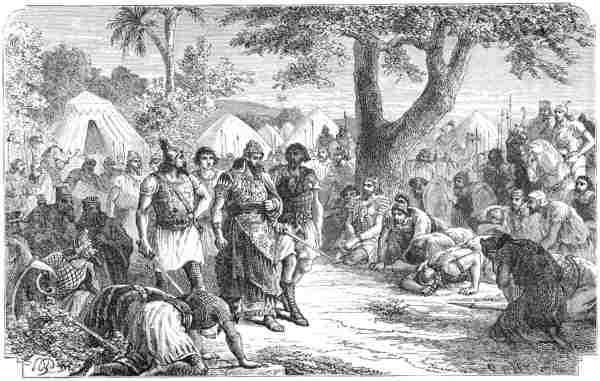
IN HONOR OF THEIR GENERAL.
To face page 322.
Belesys, who was still rather pale, smiled uneasily, but
with a forced hilarity professed himself ready not only
to give my brave men the double allowance of wine, but to
provide them with some sheep and oxen besides. Once
again a general cheer was raised, and Hannibal made him
a military salute. Chamai merely shrugged his shoulders
and Bichri could not help confiding to Dionysos that the
man before them was nothing but a drunken coward, who
ruled the 50,000 men under his command by blows and
lashes.
"They are not Hellenes, then," said the young Phocian,
proudly; "no Hellenes submit to blows!"
Belesys bit his lip; he had overheard what was said,
and it mortified him; he tried to conceal his annoyance,
and remarked to me that he had thought Phœnicians were
too much engrossed by commerce to have any concern in
the affairs of states. Hannibal was on the point of quoting
the case of Adonibal, the naval suffect of Utica, as an
instance to the contrary, when our attention was arrested
by the transit of a section of the Assyrian army from one
bank of the river to the other. The water was covered
with boats and with large rafts, on which were placed all
the war-chariots, and at the stern of every one of them was
a group of men holding the heads of the horses that were
swimming behind. The passage of the infantry was made
on inflated goat-skins. The utmost confusion prevailed;
several poor fellows were drowned, but that seemed a
matter of utter indifference to the officers that stood upon
the bank lashing the men with whips to make them
quicken their movements. At one place we observed that
a large bevy of prisoners was being conducted before an
official who was seated on a kind of open air tribunal, surrounded
by guards. Some town had evidently been lately
captured. All the gods, and a quantity of booty, were
first laid at the officer's feet, and then the prisoners—men,
women, and children—were brought before him. They were
a wretched, dejected set, many of the men fettered with
heavy bronze chains, and nearly all with their hands bound
behind their backs, the whole of them being compelled
to prostrate themselves in turn before the officer, who placed
his foot upon their necks. In a few cases a respite was
granted and life was spared; but as a general rule the
captives were forthwith hanged or beheaded in the presence
of their fellow-sufferers. I observed that out of the
number of miserable objects, four were selected and sent
off to be tied to stakes that were driven into the ground
on an adjacent eminence.
It was truly a heartrending spectacle. Chamai and
Hannibal had seen something of the kind before in the
course of the warfare in their own land; but to Aminocles
and his countrymen, with their Hellenic ideal of liberty,
the sight was intolerably shocking, and they were loud in
their asseverations that they would die before they would
incur the risk of any such utter degradation.
While we were looking on at this humiliating exhibition,
a messenger arrived from the King to ascertain the object
of my coming. I stated it as briefly as possible, and in
another hour the man came again to summon us into the
presence of Belochus. I took no one with me except
Hanno, and the sailors to carry the Queen's gifts. As we
walked along Hanno was silent, evidently preparing some
graceful compliment; but his painstaking in this way was
of no avail, as we were only permitted to view the splendour
of the Assyrian sovereign from a distance. At about
a hundred paces from the throne we were commanded to
halt, and prostrate ourselves to the ground.
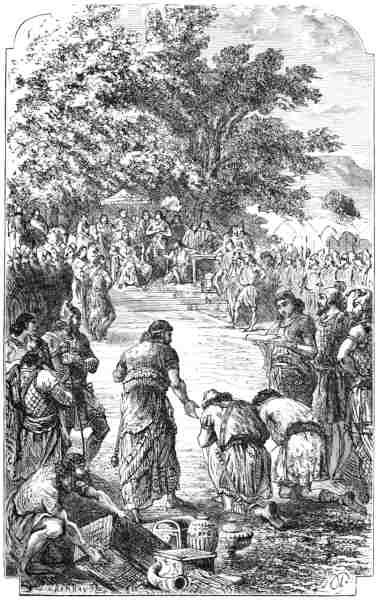
WE WERE COMMANDED TO HALT.
To face page 324.
Belochus II. was seated beneath a group of trees, surrounded
so closely by guards, cup-bearers, attendants with
fans and parasols, and slaves, with fly-whisks, that for a
long time I could see nothing of him except his tiara,
which was very dazzling, his robes, which were very elaborate,
and his unshod feet sparkling with gems. But at
last the mass of gorgeous pomp seemed to open, and
I could plainly distinguish the majestic countenance of
the King, encircled with long hair, and conspicuous with a
thick frizzled beard.
An avenue of soldiers was formed; some officers were
sent to receive whatever documents and presents we
had brought; we were bidden a second time to prostrate
ourselves to the earth, and were then escorted back to our
ships. I found Belesys very impatient to be released from
his imprisonment, and he looked much chagrined when I
told him that it was necessary for me to detain him
a while longer as a hostage for my own safety.
In about an hour afterwards some letters, enclosed in a
casket of gold, arrived from King Belochus for the Queen
of Sheba; the present for the Queen was accompanied by
a meagre gift of provisions and stuffs for myself and my
people.
My mission was now accomplished, and I prepared again
to set sail.
"You may go," I said to my prisoner; "let us part
friends."
Belesys gave a sigh of relief.
"I am glad you are a man of your word," he said.
I laughed heartily.
"Did you suppose I should keep you? What good
could you do me?"
"Revenge is sweet," he answered. "I feared you would
not let my injustice go unpunished."
"Ah, you mean that would have been your course."
Belesys smiled.
"The hand that cannot be cut off must be caressed," he
said.
I took good care that before he left he should see the
scorpions filled with missiles and put ready for action, and
then I dismissed him with the most punctilious observance
of outward respect.
Before quitting the ship he made another attempt to
induce Bichri to join his service, an honour which was
coolly and firmly declined.
CHAPTER XXIII. WE SETTLE OUR ACCOUNTS WITH BODMILCAR.
It
was quite late in the evening before we reached the bar
of the river, and as I was fearful of crossing it in the dark,
I gave orders to lay to for the night. A small Chaldean
camp was within sight, but I took every precaution to
guard against any act of treachery on the part of Belesys.
A number of booths made of branches of trees had been
erected on the shore, and some Phœnician dealers were
purchasing plunder from the soldiers, and supplying them
with wine in return. Himilco, Gisgo, and several others
expressed a great wish to go ashore, and although I knew
that they would only be drinking and bragging of their
adventures, I could not find it in my heart to refuse them.
I only stipulated that they should not go out of hearing.
A couple of hours later, being curious to know what
was going on in the little mart that looked so bright with
its many lamps, I took Bichri and Jonah, and rowed to
land. Just as I stepped on shore, I observed two galleys
pass down stream, as if about to anchor below us; they
were followed by a gaoul, which kept very close to the
opposite bank; but as the river was very wide, and it was
quite dusk, I could not distinguish its form. Knowing,
moreover, that there was a great deal of slave-trafficking
going on with the Assyrians, I did not give the circumstance
more than a casual attention.
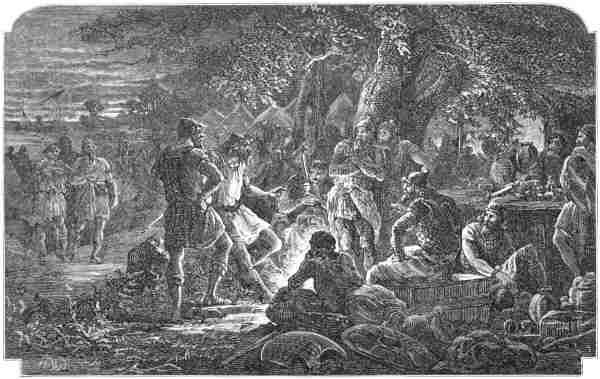
HIMILCO AND GISGO IN ANIMATED CONVERSATION WITH THE CHALDEAN SOLDIERS.
To face page 327.
I found Himilco and Gisgo in animated conversation
with the Chaldean soldiers, who evidently regarded all
their tales about enormous stags, stinking fish-oil, and the
sun shining on the wrong side, as mere romances, if not
downright lies. One of them avowed that no power on
earth would ever make him believe that any people could
accept Jonah for their god, a mere human being like themselves.
To this Bichri replied, somewhat contemptuously,
that he could not see but that Jonah was every whit as
good as Nisroch; and Gisgo added that he could believe
anything after seeing how the Assyrians allowed themselves
to be bullied by Belochus and his general Belesys.
Furious at the insults offered alike to his god and to his
rulers, the Chaldean threatened to break every bone in
Gisgo's skin; whereupon Gisgo replied that he was quite
ready to accept a challenge, and that he would fight it
out in any way he pleased; like the people of Prydhayn or
Ar-Mor, if he chose.
"You had better not be fighting with us," said Himilco;
"we conquer wherever we go; Sicilians, Garamantines,
Suomi, Germani, we have thrashed them all. We have
been to the river Illiturgis, and to the Pyrenees, and to
the Chariot of the Gods, and to the Fortunate Islands, where
we got as much gold as we liked. Everything succeeds
with us; and the best thing you can do is to leave us
alone."
The man looked aghast at the string of names which
Himilco repeated out so volubly, and, in a half-apologetic
tone, replied:
"You Sidonians are wonderful travellers. I am a Kardook,
and thought I had done something marvellous in
coming here from my far-off mountains. The world is
much larger than I reckoned."
Another Chaldean now put in his word, and said that
though he had not been to Tarshish, he had just seen a
man of Tarshish.
"Just seen one! where?" asked Himilco.
"In the royal camp. He was along with the Phœnician
captain who has taken service under King Belochus."
A thrill ran through me. In an instant I recollected
the gaoul and the two galleys, and the truth flashed upon
my mind.
"His name?" I cried. "Tell me his name, and I will
give you a shekel."
"Make it two, and I will tell you."
I threw him the money, which he picked up and put in
his purse. He was walking off, saying that he did not see
why he need tell me the captain's name now that he
was already paid. In my rage at the cool effrontery
of the rascal I was about to knock him down, when one of
the Phœnician dealers interposed:
"Never mind that fellow's nonsense, I will tell you what
you want. The captain's name is Bodmilcar; he is a
Tyrian."
The very sound of the name was enough. My men
caught it, and in an instant we were all on our way back
to the ships. Once on board, I held a consultation with
the officers, and put them in possession of the fact that
Bodmilcar was lying in wait a few cables' length below us;
that he was in connection with the army; and that it was
extremely likely that Belesys would attack us in the rear.
How melancholy would it be, I urged, if our enterprise,
hitherto so successful, should be marred by our hateful
foe at last!
Animated by a general enthusiasm, my people declared
that not a moment should be lost, the hour for action was
come, and the attack must be made at once.
Chamai and Hanno began to contend for the right to
kill Bodmilcar.
"Let me only get within reach of him!" cried Chamai.
"No, no," said Hanno, flushing with excitement; "he is
my rival, and by my hand must he fall."
"Don't be simpletons, young men!" I interposed; "there
is something better than wrangling for you to do now.
Look to your duties. We will make for the sea."
Using every possible caution, we proceeded towards the
river-mouth. The Ashtoreth took the middle of the channel,
with the Adonibal on her right, and the Cabiros on her left.
Every light had been extinguished, and it was with throbbing
pulses that the men on board stood, ready armed,
peering out into the darkness. Bichri had spread out his
arrows within reach upon the deck, and was crouching
down, his bow full strung; he was between Dionysos and
Jonah. The trumpeter was armed with a huge hatchet in
his girdle, and the little Phocian was provided with his bow
and arrow ready for immediate use. Himilco, holding his
cutlass and shield, took his post at the stern, directing the
helmsman; Hannibal and Chamai placed themselves at
the head of their own companies, and stood almost on
tiptoe in their eagerness to get the first glimpse of the enemy.
Before the hour of sunrise we could hear the rushing of
the water at the river-bar, and in the faint dawn could
make out Bodmilcar's three ships blockading our exit
The Melkarth was in the middle; the decks of all three
being perfectly thronged by men in helmets. The shore
was quite deserted.
"The stream is in our favour," I observed; "let us
commence action with the fire-ships."
A number of planks loaded with combustibles was soon
set afloat.
I did not wait long before ordering Jonah to sound the
signal for attack: it was answered promptly by a challenge
from the enemy; a volley of lances fell upon our deck;
we discharged another volley in reply; and the battle had
fairly commenced.
As I had myself superintended the construction of the
Melkarth, I was well aware that her flanks were far too
substantial to be injured by any blow from our prows; I
knew, moreover, that her height was so great that it gave
her an immense advantage in overwhelming us with missiles,
and rendered every thought of boarding her untenable.
But I also knew her weak points. I had myself
experienced that her enormous weight made her difficult
to move; and I resolved in my own mind that, if possible,
I would take advantage of this defect. After ascertaining
from Himilco, who knew enough of the channel to form a
reliable opinion, that the Melkarth drew too much water to
be able to move a cable's length to the right of where she
was, I ordered our boats to be laden with all the combustibles
they could carry. I next signalled to the Cabiros
to come alongside, and telling Himilco to follow me, I went
on board her, Hamilcar being left in charge of the Ashtoreth.
All this time the arrows from the enemy's ships
were falling fast about us, and Bodmilcar, evidently expecting
assistance from Belesys behind us, was fighting as
if sure of victory.
Gisgo joined Himilco at the helm of the Cabiros, and I
stood between them to give my orders. Never, I can confidently
say, was a vessel more skilfully piloted. After
taking the two boats in tow, and effectually setting light
to their cargo of combustibles, we bore straight down upon
the Melkarth; and when we were within half a bowshot,
we were descried by Bodmilcar, who began to jeer us.
"All hail, Mago! you are right welcome; there are some
old scores to settle between us,—that little affair in Egypt,
and that other matter in Tarshish, and that piece of business
in the Straits of Gades; we may as well wipe them all
off to-day. I hope to have the pleasure of seeing you
swing from that yard-arm before night. Most happy to
meet you now."
An arrow struck him as he finished speaking; he started
back.
"Hit! he's hit!" shouted Bichri, in a voice that rang out
high above the general tumult.
"No!" roared Bodmilcar, "my cuirass is arrow-proof."
"Let us see whether your ship is fire-proof!" I bellowed
in reply.
The Cabiros now dashed between the Melkarth and the
galley on her right, and in endeavouring to avoid us, the
gaoul became wedged between the burning boats. In
the midst of a shower of arrows, one of which wounded my
cheek, I cut asunder the towing-ropes; the flames broke
forth, and a long jet of smoke rose high into the air. Gisgo
was wounded in the thigh, and could not stand, but he continued
bravely to steer upon his knees. So rapidly had we
darted by, that the volley of missiles intended for our deck
went splashing and crashing down upon the water in our
wake; and as we retraced our course on the other side
just as rapidly, I called out to Bodmilcar that I meant
to serve his ship as I had served the Egyptian galley at
Tanis. Himilco, too, did not spare him some cutting jokes
upon his dilemma.
Having returned to my own ship, I ordered the Adonibal
and the Cabiros to make a joint attack with me upon one
of the two galleys, and then to get right ahead of the other.
We made the assault with the very utmost of our strength;
the galley made a desperate effort to escape us, but it was
too late; before she could move I had stove in one of her
sides, and driven her, by the violence of the shock, against
the Melkarth and the two burning boats. In the midst of
the smoke I could see that the Melkarth's men were frantically
making their way on board the Adonibal, which had
got between her and the other galley, and that the whole
of the six ships were thus brought together into a compact
mass, at one end of which the flames were raging furiously,
and at the other hatchets, swords, and cutlasses were being
wielded with relentless desperation.
"To the Adonibal!" I shouted; "board her! we shall
have them now!"
Simultaneously my own people and the crew of the
Cabiros made their way on to her deck. Bodmilcar was
already there. Hanno rushed towards him and cried:
"Now then, Bodmilcar, come on, and show yourself a
man for once!"
"Come on, young milksop! I am quite ready! As soon
as I have settled your business, I shall have time to attend
to the rest."
Their swords clashed as they closed in one upon the
other, but the throng around them was so dense that they
were quite lost to my view.
All at once Himilco, who had never left my side, made a
dash forward, and shouted:
"Ah! you monster, scoundrel, wretch, I have you now!"
He had recognised the man for whom he had been looking
for the last fourteen years, and had knocked him
down: the two were rolling together on the deck.
"Well done, Himilco! hold him tight!" said Bichri,
who was passing, his sword all covered with blood.
"The brute is biting my arm; cannot you help me?"
Bichri, quick as lightning, slipped a knife into the hand
of Himilco, who plunged it deep into his adversary's side:
he rolled back; the death-rattle was already in his throat.
"Revenge is sweet," sighed the pilot; "this death of a
dog is too good for you!"
Meanwhile Jonah, backed up courageously by Aminocles,
was performing feats of wonder with his cutlass; Hannibal
and Chamai, with their armour all battered in, were on the
prow, pushing man after man back overboard into the
water; Hamilcar was reported to be killed; Hasdrubal
was badly wounded, but still clinging to his helm; I went
to his assistance, and by our joint effort we succeeded in
bringing the ship round so as to be out of the reach of the
threatening flames; the Ashtoreth and Cabiros had sheered
off a little, and were waiting my summons to come again
alongside; and the other galley of the enemy, although it
escaped the fire, had gone adrift.
Such was the condition of affairs, when as I was rallying
my men for another onslaught, Hanno, his sword broken,
and his clothes all stained with blood, rushed to my side.
"He has escaped!" he gasped. "I have lost him in the
crowd."
"Patience!" I answered; "he is not far off."
I now resolved to fall back myself towards my two other
ships, and as soon as I saw the opportunity, I shouted to
my men:
"Back to the Ashtoreth!"
As we retreated, we left the prow of the Adonibal in
complete possession of Bodmilcar's troops, and then by
drawing up two lines of men made an avenue for our own
escape at the stern.
Bodmilcar, perfectly helpless, was thus left in a trap, on
board the Adonibal, which was exposed to the full fury of
our arrows and catapults; his own ship was burning like
a furnace; one of the galleys was sunk, and the other, as I
have said, had gone adrift.
For more than half an hour, Bodmilcar endured our projectiles;
but at length I came to the determination of again
facing him on board the Adonibal. We found him standing
on the bow, surrounded by a scanty remnant of hardly
more than thirty men. His face was covered with blood.
"Shall I shoot him?" asked Bichri.
"By no means," I answered, laying my hand upon the
archer's arm; "he must die a more ignominious death than
that."
Desperate, but short, was the last effort of the Tyrian's
body-guard. He was about to make a frantic rush upon
myself, when Jonah seized him with a powerful grasp.
"Here's your man, captain!"
Bodmilcar struggled to get free.
"Attempt to escape," said the trumpeter, "and I'll shake
the life out of your body!"
Foaming with suppressed rage, the captured man submitted
to his fate.
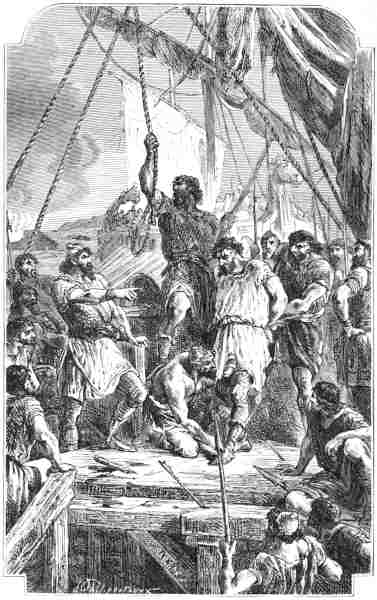
MY ACCOUNT WAS SETTLED WITH BODMILCAR.
To face page 335.
He was motionless and silent. Nothing could induce
him to open his lips; sullenly he heard my questions; obstinately
he refused to reply. He was tied to a rope's-end,
and was soon swinging at the end of the yard-arm of the
Adonibal.
My account was settled with Bodmilcar.
We were soon upon our homeward way.
After reporting our experiences to the Queen of Sheba,
we proceeded to Tyre along the canal of Pharaoh, stopping
only to pay our devoirs to King Solomon.
A triumphal reception awaited us. Throngs of our
countrymen assembled to welcome our return; and King
Hiram, in our honour, gave a sumptuous banquet, at
which he invited me publicly to narrate the history of our
protracted and adventurous voyage.
The King munificently gave me the three vessels which
I had brought safely home, and the people unanimously
elected me naval suffect at Sidon.
I appointed Hannibal captain of my men-at-arms, and
retained Himilco, Gisgo, and Hasdrubal in my service in
various posts of good emolument. The report of Hamilcar
being killed in action had proved too true.
I have little more to tell.
All Phœnicia knows how I superintended the floating of
the cedar-wood and all the materials which King Solomon
required for the magnificent temple he was rearing at Jerusalem.
Chamai is a captain in King Solomon's army, and
is invariably recognised with every token of respect when
he comes with Abigail, his wife, to visit me at the Admiralty
palace. Every one, too, knows Bichri, the rich
vine-dresser, who periodically comes to Sidon to sell his
barrels and skins of sparkling wine, always inviting
Himilco to the first taste of the produce of his vineyards;
whilst every year a vessel is sent with all due pomp to
Paphos to bring Hanno, the high priest of Ashtoreth, with
the lovely Chryseis, her priestess and his wife, to sacrifice
in the temple of their great metropolis. Dionysos, who
has become a distinguished instructor of his countrymen
in navigation, and Aminocles, his proud and aged father,
generally accompany them.
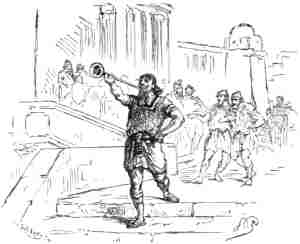
On these occasions the Cabiros, adorned with embroidered
hangings, puts out to sea in honour of my
guests, and brings them to my private quay, where they
are always hailed with acclamation as my former companions
in the discovery of the Cassiterides, the Amber-coast,
and the Fortunate Islands.
During the period of our festivities it is generally observed
that Himilco does not walk home particularly
straight, a circumstance that Bichri notifies by whistling
some Benjamite or Cymrian air; and when finally the
guests depart, Jonah is never missing, as he always insists
on preceding them to their ship with a magnificent flourish
of his trumpet.