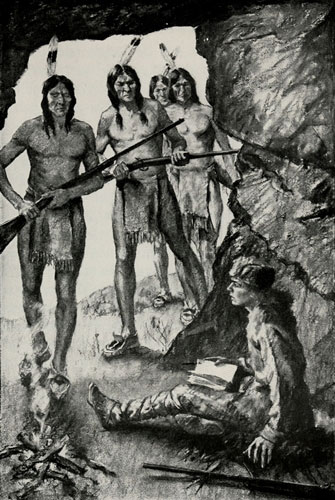
Crossing the Plains
In the early settlement of Kansas common-school advantages were denied us,
and to provide a means for educating the few boys and girls in the
neighborhood of my home, a subscription school was started in a small log
cabin that was built on the bank of a creek that ran near our house. My
mother took great interest in this school, and at her persuasion I
returned home and became enrolled as a pupil, where I made satisfactory
progress until, as the result of a quarrel with a schoolmate, I left the
town and started across the plains with one of Russell, Majors & Waddell’s
freight trains.
The trip proved a most enjoyable one to me, although no incidents worthy
of note occurred on the way. On my return from Fort Kearny I was paid off
the same as the rest of the employés. The remainder of the summer and fall
I spent in herding cattle and working for Russell, Majors & Waddell.
In May, 1857, I started for Salt Lake City with a herd of beef cattle, in
charge of Frank and Bill McCarthy, for General Albert Sidney Johnston’s
army, which was then being sent across the plains to fight the Mormons.
Nothing occurred to interrupt our journey until we reached Plum Creek, on
the South Platte River, thirty-five miles west of old Fort Kearny. We had
made a morning drive, and had camped for dinner. The wagon masters and a
majority of the men had gone to sleep under the mess wagons. The cattle
were being guarded by three men, and the cook was preparing dinner. No one
had any idea that Indians were anywhere near us. The first warning we had
that they were infesting that part of the country was the firing of shots
and the whoops and yells from a party of them, who, catching us napping,
gave us a most unwelcome surprise. All the men jumped to their feet and
seized their guns. They saw with astonishment the cattle running in every
direction, they having been stampeded by the Indians, who had shot and
killed the three men who were on day herd duty, and the redmen were now
charging down upon the rest of us.
The McCarthy boys, at the proper moment, gave orders to fire upon the
advancing enemy. The volley checked them, although they returned the
compliment, and shot one of our party through the leg. Frank McCarthy then
sang out, “Boys, make a break for the slough yonder, and we can then have
the bank for a breastwork.”
We made a run for the slough, which was only a short distance off, and
succeeded in safely reaching it, bringing with us the wounded man. The
bank proved to be a very effective breastwork, affording us good
protection. We had been there but a short time when Frank McCarthy, seeing
that the longer we were corralled the worse it would be for us, said,
“Well, boys, we’ll try to make our way back to Fort Kearny by wading in
the river and keeping the bank for a breastwork.”
We all agreed that this was the best plan, and we accordingly proceeded
down the river several miles in this way, managing to keep the Indians at
a safe distance with our guns, until the slough made a junction with the
main Platte River. From there down we found the river at times quite deep,
and in order to carry the wounded man along with us, we constructed a raft
of poles for his accommodation, and in this way he was transported.
Occasionally the water would be too deep for us to wade, and we were
obliged to put our weapons on the raft and swim. The Indians followed us
pretty closely, and were continually watching for an opportunity to get a
good range and give us a raking fire. Covering ourselves by keeping well
under the bank, we pushed ahead as rapidly as possible, and made pretty
good progress, the night finding us still on the way and our enemies yet
on our track.
I, being the youngest and smallest of the party, became somewhat tired,
and, without noticing it, I had fallen behind the others for some little
distance. It was about ten o’clock, and we were keeping very quiet and
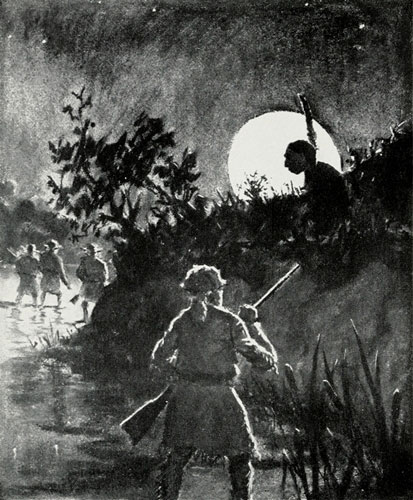
hugging close to the bank, when I happened to look up to the moonlit sky
and saw the plumed head of an Indian peeping over the bank. Instead of
hurrying ahead and alarming the men in a quiet way, I instantly aimed my
gun at his head and fired. The report rang out sharp and loud on the night
air, and was immediately followed by an Indian whoop, and the next moment
about six feet of dead Indian came tumbling into the river. I was not only
overcome with astonishment, but was badly scared, as I could hardly
realize what I had done. I expected to see the whole force of Indians come
down upon us. While I was standing thus bewildered, the men, who had heard
the shot and the war whoop, and had seen the Indian take a tumble, came
rushing back.
“Who fired that shot?” cried Frank McCarthy.
“I did,” replied I, rather proudly, as my confidence returned, and I saw
the men coming up.
“Yes, and little Billy has killed an Indian stone dead—too dead to skin,”
said one of the men, who had approached nearer than the rest, and had
almost stumbled upon the Indian. From that time forward I became a hero
and an Indian-killer. This was, of course, the first Indian I had ever
shot, and as I was not then more than eleven years of age, my exploit
created quite a sensation.
The other Indians, upon learning what had happened to their advance, fired
several shots without effect, but which hastened our retreat down the
river. We reached Fort Kearny just as the reveille was being sounded,
bringing the wounded man with us. After the peril through which we had
passed, it was a relief to feel that once more I was safe after such a
dangerous initiation.
Frank McCarthy immediately reported to the commanding officer and informed
him of all that had happened. The commandant at once ordered a company of
cavalry and one of infantry to proceed to Plum Creek on a forced march,
taking a howitzer with them—to endeavor to recapture the cattle from the
Indians.
The firm of Russell, Majors & Waddell had a division agent at Kearny, and
this agent mounted us on mules so that we could accompany the troops. On
reaching the place where the Indians had surprised us, we found the bodies
of the three men, whom they had killed and scalped and literally cut into
pieces. We of course buried the remains. We caught but few of the cattle,
most of them having been driven off and stampeded with the buffaloes,
there being numerous immense herds of the latter in that section of the
country at the time. The Indians’ trail was discovered running south
toward the Republican River, and the troops followed it to the head of
Plum Creek, and there abandoned it, returning to Fort Kearny without
having seen a single redskin.
The company’s agent, seeing that there was no further use for us in that
vicinity—as we had lost our cattle and mules—sent us back to Fort
Leavenworth. The company, it is proper to state, did not have to stand the
loss of the expedition, as the government held itself responsible for such
depredations by the Indians.
On the day that I got into Leavenworth, some time in July, I was
interviewed for the first time in my life by a newspaper reporter, and the
next morning I found my name in print as “the youngest Indian-slayer on
the plains.” I am candid enough to admit that I felt very much elated over
this notoriety. Again and again I read with eager interest the long and
sensational account of our adventure. My exploit was related in a very
graphic manner, and for a long time afterward I was considerable of a
hero.
In the following summer, Russell, Majors & Waddell entered upon a contract
with the government for General Albert Sidney Johnston’s army that was
sent against the Mormons. A large number of teams and teamsters were
required for the purpose, and as the route was considered a dangerous one,
men were not easily engaged for the service, though the pay was forty
dollars a month in gold. An old wagon master named Lew Simpson, one of the
best that ever commanded a bull train, was upon the point of starting with
about ten wagons for the company, direct for Salt Lake, and as he had
known me for some time as an ambitious youth, requested me to accompany
him as an extra hand. My duties would be light, and, in fact, I would have
nothing to do, unless some one of the drivers became sick, in which case I
would be required to take his place. But even more seductive than this
inducement was the promise that I should be provided with a mule of my own
to ride, and be subject to the orders of no one save Simpson himself.
As a matter of interest to the general reader, it may be well to give a
brief description of a freight train. The wagons used in those days by
Russell, Majors & Waddell were known as the “J. Murphy wagons,” made at
St. Louis especially for the plains business. They were very large and
very strongly built, being capable of carrying seven thousand pounds of
freight each. The wagon boxes were very commodious, being about as large
as the rooms of an ordinary house, and were covered with two heavy canvas
sheets to protect the merchandise from the rain. These wagons were
generally sent out from Leavenworth, each loaded with six thousand pounds
of freight, and each drawn by several yoke of oxen in charge of one
driver. A train consisted of twenty-five wagons, all in charge of one man,
who was known as the wagon master. The second man in command was the
assistant wagon master. Then came the “extra hand,” next the night herder,
and lastly the cavayard driver, whose duty it was to drive the loose and
lame cattle. There were thirty-one men all told in a train. The men did
their own cooking, being divided into messes of seven. One man cooked,
another brought wood and water, another stood guard, and so on, each
having some duty to perform while getting meals. All were heavily armed
with Colt’s pistols and Mississippi yagers, and every one always had his
weapons handy so as to be prepared for any emergency.
The wagon master, in the language of the plains, was called the
“bull-wagon boss”; the teamsters were known as “bull-whackers”; and the
whole train was denominated a “bull outfit.” Everything at that time was
called an “outfit.” The men of the plains were always full of a droll
humor and exciting stories of their own experiences, and many an hour I
spent in listening to the recitals of thrilling adventures and hairbreadth
escapes.
The trail to Salt Lake ran through Kansas northwestwardly, crossing the
Big Blue River, then over the Big and Little Sandy, coming into Nebraska
near the Big Sandy. The next stream of any importance was the Little Blue,
along which the trail ran for sixty miles, then crossed a range of sand
hills, and struck the Platte River ten miles below Fort Kearny; thence the
course lay up the South Platte to the old Ash Hollow Crossing; thence
eighteen miles across to the North Platte, near the mouth of the Blue
Water, where General Harney had his great battle in 1855 with the Sioux
and Cheyenne Indians. From this point the North Platte was followed,
passing Courthouse Rock, Chimney Rock, and Scott’s Bluffs, and then on to
Fort Laramie, where the Laramie River was crossed. Still following the
North Platte for some considerable distance, the trail crossed the river
at old Richard’s Bridge, and followed it up to the celebrated Red Buttes,
crossing the Willow Creeks to the Sweet Water, thence past the Cold
Springs, where, three feet under the sod, on the hottest day of summer,
ice can be found; thence to the Hot Springs and the Rocky Ridge, and
through the Rocky Mountains and Echo Canyon, and thence on to the great
Salt Lake Valley.
Nothing occurred on the trip to delay or give us any trouble whatever,
until the train struck the South Platte River. One day we camped on the
same ground where the Indians had surprised the cattle herd in charge of
the McCarthy brothers. It was with difficulty that we discovered any
traces of anybody ever having camped there before, the only landmark being
the single grave, now covered with grass, in which we had buried the three
men who had been killed. The country was alive with buffaloes, and having
a day of rare sport, we captured ten or twelve head of cattle, they being
a portion of the herd which had been stampeded by the Indians two months
before. The next day we pulled out of the camp, and the train was strung
out to a considerable length along the road which ran near the foot of the
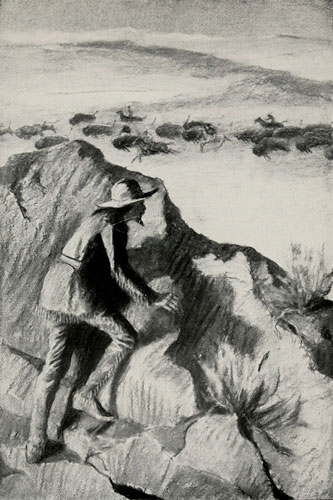
sand hills two miles from the river. Between the road and the river we saw
a large herd of buffaloes grazing quietly, they having been down to the
stream for a drink.
Just at this time we observed a party of returning Californians coming
from the West. They too noticed the buffalo herd, and in another moment
they were dashing down upon them, urging their steeds to the greatest
speed. The buffalo herd stampeded at once, and broke down the hills. So
hotly were they pursued by the hunters that about five hundred of them
rushed through our train pell-mell, frightening both men and oxen. Some of
the wagons were turned clear around, and many of the terrified oxen
attempted to run to the hills, with the heavy wagons attached to them.
Others turned around so short that they broke the wagon tongues off.
Nearly all the teams got entangled in their gearing, and became wild and
unruly, so that the perplexed drivers were unable to manage them.
The buffaloes, the cattle, and the drivers were soon running in every
direction, and the excitement upset nearly everybody and everything. Many
of the cattle broke their yokes and stampeded. One big buffalo bull became
entangled in one of the heavy wagon chains, and it is a fact that in his
desperate efforts to free himself he not only actually snapped the strong
chain in two, but broke the ox yoke to which it was attached, and the last
seen of him he was running toward the hills with it hanging from his
horns. A dozen other equally remarkable incidents happened during the
short time that the frantic buffaloes were playing havoc with our train,
and when they got through and left us our outfit was badly crippled and
scattered. This caused us to go into camp and spend a day in replacing the
broken tongues and repairing other damages, and gathering up our scattered
ox teams.
The next day we rolled out of camp, and proceeded on our way toward the
setting sun. Everything ran along smoothly with us from that point until
we came within about eighteen miles of Green River, in the Rocky
Mountains, where we camped at noon. At this place we had to drive our
cattle about a mile and a half to a creek to water them. Simpson, his
assistant George Wood, and myself, accompanied by the usual number of
guards, drove the cattle over to the creek, and while on our way back to
camp we suddenly observed a party of twenty horsemen rapidly approaching
us. We were not yet in view of our wagons, as a rise of ground intervened,
and therefore we could not signal the trainmen in case of any unexpected
danger befalling us. We had no suspicion, however, that we were about to
be trapped, as the strangers were white men. When they had come up to us,
one of the party, who evidently was the leader, rode out in front, and
said,
“How are you, Mr. Simpson?”
“You’ve got the best of me, sir,” said Simpson, who did not know him.
“Well, I rather think I have,” coolly replied the stranger, whose words
conveyed a double meaning, as we soon learned. We had all come to a halt
by this time, and the strange horsemen had surrounded us. They were all
armed with double-barreled shotguns, rifles, and revolvers. We also were
armed with revolvers, but we had no idea of danger, and these men, much to
our surprise, had “got the drop” on us, and had covered us with their
weapons, so that we were completely at their mercy. The whole movement of
corralling us was done so quietly and quickly that it was accomplished
before we knew it.
“I’ll trouble you for your six-shooters, gentlemen,” now said the leader.
“I’ll give ’em to you in a way you don’t want,” replied Simpson.
The next moment three guns were leveled at Simpson. “If you make a move
you are a dead man,” said the leader.
Simpson saw at a glance that he was taken at a great disadvantage, and
thinking it advisable not to risk the lives of the party by any rash act
on his part, he said, “I see now that you have the best of me; but who are
you, anyhow?”
“I am Joe Smith,” was the reply.
“What! the leader of the Danites?” asked Simpson.
“You are correct,” said Smith, for he it was.
“Yes,” said Simpson, “I know you now; you are a spying scoundrel.”
Simpson had good reason for calling him this, for only a short time before
this Joe Smith had visited our train in the disguise of a teamster, and
had remained with us two days. He suddenly disappeared, no one knowing
where he had gone or why he had come among us. But it was all explained to
us, now that he had returned with his Mormon Danites. After they had
disarmed us, Simpson asked,
“Well, Smith, what are you going to do with us?”
“Ride back with us and I’ll soon show you,” said Smith.
We had no idea of the surprise which awaited us. As we came upon the top
of the ridge from which we could view our camp, we were astonished to see
the remainder of the trainmen disarmed and stationed in a group, and
surrounded by another squad of Danites, while other Mormons were
searching our wagons for such articles as they wanted.
“How is this?” inquired Simpson. “How did you surprise my camp without a
struggle? I can’t understand it?”
“Easily enough,” said Smith. “Your men were all asleep under the wagons,
except the cooks, who saw us coming, and took us for returning
Californians or emigrants, and paid no attention to us until we rode up
and surrounded your train. With our arms covering the men, we woke them
up, and told them all they had to do was to walk out and drop their
pistols, which they saw was the best thing they could do under
circumstances over which they had no control, and you can just bet they
did it.”
“And what do you propose to do with us now?” asked Simpson.
“I intend to burn your train,” said he. “You are loaded with supplies and
ammunition for Sidney Johnston, and as I have no way to convey the stuff
to my own people, I’ll see that it does not reach the United States
troops.”
“Are you going to turn us adrift here?” asked Simpson, who was anxious to
learn what was to become of himself and his men.
“No; I am hardly as bad as that. I’ll give you enough provisions to last
you until you can reach Fort Bridger,” replied Smith. “And as soon as your
cooks can get the stuff out of the wagons you can start.”
“On foot?” was the laconic inquiry of Simpson.
“Yes, sir,” was the equally short reply.
“Smith, that’s too rough on us men. Put yourself in our place, and see how
you would like it,” said Simpson. “You can well afford to give us at least
one wagon and six yokes of oxen to convey us and our clothing and
provisions to Fort Bridger. You’re a brute if you don’t do this.”
“Well,” said Smith, after consulting a minute or two with some of his
company, “I’ll do that much for you.”
The cattle and the wagon were brought up according to his orders, and the
clothing and provisions were loaded on.
“Now you can go,” said Smith, after everything had been arranged.
“Joe Smith, I think you are a mean coward to set us afloat in a hostile
country without giving us our arms,” said Simpson, who had once before
asked for the weapons, and had had his request denied.
Smith, after further consultation with his comrades, said: “Simpson, you
are too brave a man to be turned adrift here without any means of defense.
You shall have your revolvers and guns.”
Our weapons were accordingly handed over to Simpson, and we at once
started for Fort Bridger, knowing that it would be useless to attempt the
recapture of the train.
When we had traveled about two miles we saw the smoke arising from our old
camp. The Mormons, after taking what goods they wanted and could carry
off, had set fire to the wagons, many of which were loaded with bacon,
lard, hardtack, and other provisions, which made a very hot, fierce fire,
and the smoke to roll up in dense clouds. Some of the wagons were loaded
with ammunition, and it was not long before loud explosions followed in
rapid succession. We waited and witnessed the burning of the train, and
then pushed on to Fort Bridger. Arriving at this post, we learned that two
other trains had been captured and destroyed in the same way by the
Mormons. This made seventy-five wagonloads, or four hundred and fifty
thousand pounds of supplies, mostly provisions, which never reached
General Johnston’s command, to which they had been consigned.
After reaching the fort, it being far in November, we decided to spend the
winter there, with about four hundred other employés of Russell, Majors &
Waddell, rather than attempt a return, which would have exposed us to many
dangers and the severity of the rapidly approaching winter. During this
period of hibernation, however, the larders of the commissary became so
depleted that we were placed on one-quarter rations, and at length, as a
final resort, the poor, dreadfully emaciated mules and oxen were killed to
afford sustenance for our famishing party.
Fort Bridger being located in a prairie, all fuel there used had to be
carried for a distance of nearly two miles, and after our mules and oxen
were butchered, we had no other recourse than to carry the wood on our
backs or haul it on sleds—a very tedious and laborious alternative.
Starvation was beginning to lurk about the post when spring approached,
and but for the timely arrival of a westward-bound train loaded with
provisions for Johnston’s army, some of our party must certainly have
fallen victims to deadly hunger.
The winter finally passed away, and early in the spring, as soon as we
could travel, the civil employés of the government, with the teamsters and
freighters, started for the Missouri River, the Johnston expedition having
been abandoned.
On the way up we stopped at Fort Laramie, and there met a supply train
bound westward. Of course we all had a square meal once more, consisting
of hardtack, bacon, coffee, and beans. I can honestly say that I thought
it was the best meal that I had ever eaten; at least I relished it more
than any other, and I think the rest of the party did the same.
On leaving Fort Laramie, Simpson was made brigadier wagon master, and was
put in charge of two large trains, with about four hundred extra men who
were bound for Fort Leavenworth. When we came to Ash Hollow, instead of
taking the usual trail over to the South Platte, Simpson concluded to
follow the North Platte down to its junction with the South Platte. The
two trains were traveling about fifteen miles apart, when one morning,
while Simpson was with the rear train, he told his assistant wagon master
George Wood and myself to saddle up our mules, as he wanted us to go with
him and overtake the head train.
We started off at about eleven o’clock, and had ridden about seven miles,
when, while we were on a big plateau back of Cedar Bluffs, we suddenly
discovered a band of Indians coming out of the head of the ravine half a
mile distant, and charging down upon us at full speed. I thought that our
end had come this time. Simpson, however, was equal to the occasion, for
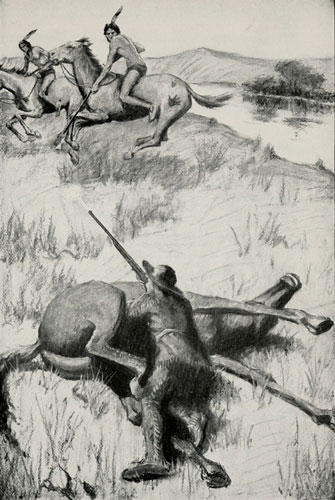
with wonderful promptness he jumped from his jaded mule, and in a trice
shot his own animal and ours also, and ordered us to assist him to jerk
their bodies into a triangle. This being quickly done, we got inside the
barricade of mule-flesh, and were prepared to receive the Indians. We were
each armed with a Mississippi yager and two revolvers, and as the Indians
came swooping down on our improvised fort, we opened fire with such good
effect that three fell dead at the first volley. This caused them to
retreat out of range, as with two exceptions they were armed with bows and
arrows, and therefore to approach near enough to do execution would expose
at least several of them to certain death. Seeing that they could not take
our little fortification or drive us from it, they circled around several
times, shooting their arrows at us. One of these struck George Wood in the
left shoulder, inflicting only a slight wound, however, and several lodged
in the bodies of the dead mules; otherwise they did us no harm. The
Indians finally galloped off to a safe distance, where our bullets could
not reach them, and seemed to be holding a council. This was a lucky move
for us, for it gave us an opportunity to reload our guns and pistols and
prepare for the next charge of the enemy. During the brief cessation of
hostilities Simpson extracted the arrow from Wood’s shoulder, and put an
immense quid of tobacco on the wound. Wood was then ready for business
again.
The Indians did not give us a very long rest, for with another desperate
charge, as if to ride over us, they came dashing toward the mule
barricade. We gave them a hot reception from our yagers and revolvers.
They could not stand or understand the rapidly repeating fire of the
revolver, and we checked them again. They circled around us once more, and
gave us a few parting shots as they rode off, leaving behind them another
dead Indian and a horse.
For two hours afterward they did not seem to be doing anything but holding
a council. We made good use of this time by digging up the ground inside
the barricade with our knives, and throwing the loose earth around and
over the mules, and we soon had a very respectable fortification. We were
not troubled any more that day, but during the night the cunning rascals
tried to burn us out by setting fire to the prairie. The buffalo grass
was so short that the fire did not trouble us much, but the smoke
concealed the Indians from our view, and they thought they could approach
to us without being seen. We were aware of this, and kept a sharp lookout,
being prepared all the time to receive them. They finally abandoned the
idea of surprising us.
Next morning, bright and early, they gave us one more grand charge, and
again we “stood them off.” They then rode away half a mile or so, and
formed a circle around us. Each man dismounted and sat down, as if to wait
and starve us out. They had evidently seen the advance train pass on the
morning of the previous day, and believed that we belonged to that outfit,
and were trying to overtake it. They had no idea that another train was on
its way after us.
Our hopes of escape from this unpleasant and perilous situation now
depended upon the arrival of the rear train, and when we saw that the
Indians were going to besiege us instead of renewing their attacks, we
felt rather confident of receiving timely assistance. We had expected that
the train would be along late in the afternoon of the previous day, and
as the morning wore away we were somewhat anxious and uneasy at its
nonarrival.
At last, about ten o’clock, we began to hear in the distance the loud and
sharp reports of the big bull-whips, which were handled with great
dexterity by the teamsters, and cracked like rifle shots. These were
welcome sounds to us, as were the notes of the bagpipes to the besieged
garrison at Lucknow when the re-enforcements were coming up, and the
pipers were heard playing “The Campbells are Coming.” In a few moments we
saw the head wagon coming slowly over the ridge which had concealed the
train from our view, and soon the whole outfit made its appearance. The
Indians observed the approaching train, and assembling in a group, they
held a short consultation. They then charged upon us once more, for the
last time, and as they turned and dashed away over the prairie, we sent
our farewell shots rattling after them. The teamsters, seeing the Indians
and hearing the shots, came rushing forward to our assistance, but by
that time the redskins had almost disappeared from view. The teamsters
eagerly asked us a hundred questions concerning our fight, admired our
fort, and praised our pluck. Simpson’s remarkable presence of mind in
planning the defense was the general topic of conversation among all the
men.
When the teams came up we obtained some water and bandages with which to
dress Wood’s wound, which had become quite inflamed and painful, and we
then put him into one of the wagons. Simpson and myself obtained a
remount, bade good-by to our dead mules which had served us so well, and
after collecting the ornaments and other plunder from the dead Indians, we
left their bodies and bones to bleach on the prairie. The train moved on
again, and we had no other adventures, except several exciting buffalo
hunts on the South Platte near Plum Creek.