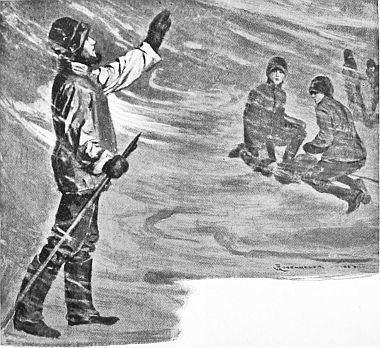
And Last: In Which Wind and Snow and Cold
Have Their Way and Death Lands on the
Floe. Billy Topsail Gives Himself to a Gust
of Wind, and Archie Armstrong Finds Peril
and Hardship Stern Teachers. Concerning,
also, a New Sloop, a Fore-an'-After and a
Tailor's Lay-Figure
BILL o' Burnt Bay did not lead a race for
the landing place. When he looked up, a
thick curtain of snow hid the flags. It
was then apparent to him that he and his men
must pass the night on the ice. In a blizzard
of such force and blinding density, no help
could reach them from the ship, even if she
managed to reach the place where the men were
to be taken aboard.
Nothing was visible but the space immediately
roundabout; and the wind had risen to such terrific
strength that sound could make small way
against it. Thus, neither lights nor signal guns
could be perceived—not though the ship should
beat her way to within one hundred yards of
where the group stood huddled. There was
nothing for it but to seek the shelter of an ice
hummock, and there await the passing of the
storm.
"B'ys," he said to the few men who had gathered
about him, and he shouted at the top of his
voice, for the wind whisked low-spoken words
away, "they's a hummock somewheres handy.
Leave us get t' the lee of it."
"No, no!" several men exclaimed. "Leave
us get on t' the rest o' the crew. 'Tis no use stayin'
here."
"The path is lost, men," Bill cried. "You'll
lose your way—you'll lose your lives!"
But they would not listen. They hurried forward,
and were soon swallowed up by the night
and snow. Bill o' Burnt Bay was left alone with
Billy and Archie and a man named Osmond,
who was a dull, heavy fellow.
"They's a hummock within a hundred yards
o' here," Bill shouted. "I marked it afore the
snow got thick. We must find it. 'Tis——"
"'Tis t' the left; 'tis over there," said Billy,
pointing to the left. "I marked it well."
"Ay 'tis somewheres t' the left. Our only
chance is t' find it. Now, listen well t' what I
says. We must spread out. I'll start off. Archie,
you follow me; keep sight o' me—keep just sight
o' me, an' no more; but don't lose me, b'y, for
your life. Osmond, you'll follow the b'y; an' be
sure you watch him well. Billy, b'y, you'll follow
Osmond. When we gets in line, we'll face
t' the left an' go for'ard. The first t' see the
hummock will signal the next man, an' he'll pass
the word."
The three nodded their heads to signify their
understanding of these directions.
"Osmond, don't lose sight o' this b'y," said
Bill, impressively, placing his hand on Archie's
shoulder. "D'you mind? Men," he went on,
"if one loses sight o' the others, 'tis all up with
us. Leave your pelt go. I'll take mine."
Shelter from that frosty wind was imperative
in Archie's case. He made no complaint, for it
was not in his nature to complain; but, strong to
endure as he was, and stout as his spirit was, the
cold, striking through the fur and wool about
him, was having its inevitable effect.
When Bill moved off, dragging his burden of
pelt, the boy calmly waited until the stalwart
figure had been reduced to an outline; then,
with heavy steps, but fixed purpose to acquit
himself like a man, he followed, keeping his
distance. Osmond came next. Young Billy had
the exposed position—a station of honour in
which he exulted—at the other end of the line.
Bill gave the signal, which was passed along
by Archie to Osmond and by him to Billy, and
they faced about and moved forward in the direction
in which the hummock lay.
Archie searched the gloom for the gray shape
of the hummock. It was a shelter—a mere relief.
But how despairingly he searched for a
sight of that formless heap of ice! Soon he began
to stumble painfully. Once he lost sight of
Bill o' Burnt Bay. Then he faltered, fell and
could not rise. It was the watchful Bill who
picked him up.
"What's this, b'y?" Bill asked, his voice
shaking.
"I fell down," Archie answered, sharply.
"That's all."
"I'll carry you, b'y," Bill began. "I'll carry
you, if——"
Archie roughly pushed the man away. Then
he stumbled forward, keeping his head up.
At that moment, Osmond, who was like a
shadow to the right, gave the signal. So Bill
knew that Billy, whom he could not see, had
chanced upon the hummock. He caught Archie
up in his arms, against the boy's protests and
struggles, and ran with him to Osmond, and
thence to Billy, all the time dragging his "tow."
When they reached the lee of the ice, Archie
lay quietly in Bill's arms. He was about to fall
asleep, as Bill perceived.
"Unlash the tow," Bill said, quickly, to Osmond,
"an' start a fire."
With the help of Billy, Osmond took a pelt
from the pack, and spread it on the ice.
"They's no wood," he said, stupidly.
"Take the cross-bar o' the tow line, dunderhead!"
cried Billy. "Here! Leave me do it."
While Billy released the slender bar of wood
from the end of the line, stuck it in the blubber
and prepared to set fire to it, Bill was dealing
with Archie's drowsiness. He shook the lad
with all his strength, slapped him, shook him
again, ran him hither and thither, and, at last,
roused him to a sense of peril. The boy fought
desperately to restore his circulation.
"'Tis ready t' light," Billy said to Bill.
"Leave me do it," Bill answered. "Keep
movin', b'y," he cautioned Archie. "Don't you
give up."
Give up? Not he! And Archie said so—mumbled
it scornfully to Bill, and repeated it
again and again to himself, until he was sick of
the monotony of the words, but could not stop
repeating them.
Neither Osmond nor Billy had matches, but
Bill had a box in his waistcoat pocket. He
shielded the contents from the wind and snow
while he took one match out. Then he closed
the box and handed it to Osmond to hold. It
was well that he did not return it to his own
pocket.
Archie was stumbling back and forth over the
twenty yards of sheltered space. He had a
great, shadowy realization of two duties: he
must keep in motion, and he must keep out of
the wind. All else had passed from his consciousness.
At every turn, however, he unwittingly
ventured further past the end of the
hummock.
Twice the wind, the full force of which he
could not resist, almost caught him. Then came
a time when he had to summon his whole
strength to tear himself from its clutch. He told
himself he must not again pass beyond the lee
of the ice. But, before he returned to that point,
he had forgotten the danger.
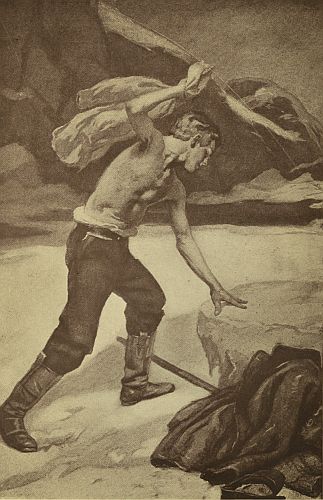
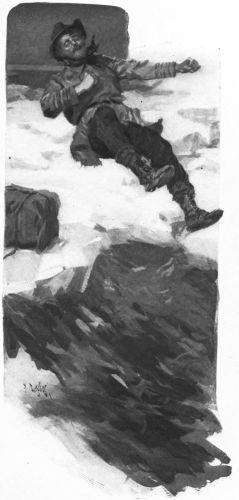
A mighty gust laid hold on him, carried him
off his feet, and swept him far out into the darkness.[8]
It chanced that Billy Topsail, who had
kept an eye on Archie, caught sight of him as
he fell.
"Archie!" the boy screamed.
"Archie?" cried Bill, looking up. "What——"
Archie had even then been carried out of sight.
Billy leaped to his feet and followed. He gave
himself to the same gust of wind, and, with
difficulty keeping himself upright, was carried
along with it. Bill grasped the situation in a
flash. He, too, leaped up, and ran into the
storm.
"Archie, b'y!" he cried. "Where is you?
Oh, where is you, lad?" It was the first time in
many years that heart's agony had wrung a cry
from old Bill o' Burnt Bay.
Billy Topsail was carried swiftly along by the
wind. It was clear to him that, should he diverge
from the path of the gust, not only would
he be unable to find the lost boy, but he himself
would be in hopeless case. The wind swept him
close upon Archie's track, but, as its force wasted,
ever more slowly. He soon tripped over an obstruction,
and plunged forward on his face. He
recovered, and crawled back. There he came
upon Archie, lying in a heap, half covered by a
drift of snow.
"B'y," Billy shouted, "is you dead?"
Archie opened his eyes. Billy Topsail looked
close, but could see no light of intelligence in
them. He shook the boy violently.
"Wake up!" he cried. "Wake up!"
"What?" Archie responded, faintly.
Billy lifted him to his feet, but there was no
strength in the lad's legs; he was limp as a
drunken man. But this exertion restored Billy
Topsail; he felt his own strength returning—a
strength which the arduous toil of the coast had
mightily developed.
"Stand up, b'y!" he shouted in Archie's ear.
"Put your arm on my shoulder. I'll help you
along."
"No," Archie muttered. But despite this protest
he was lifted up; then he said: "Give me
your hand. I'm all right."
Billy wasted no words. He locked his arms
about Archie's middle, lifted him, and staggered
forward against the wind.
The wind had fallen somewhat, and he made
some progress. But the burden was heavy, and
twice he fell. Then he heard Bill o' Burnt Bay's
voice, and he shouted a response, but the wind
carried the words away. He could hear Bill,
who was to windward, but Bill could not hear
him. So when the call came again, he marked
the location and staggered in that direction.
"Oh, Billy! Oh, Archie!"
The voice was nearer—and to the left. Billy
Topsail changed his course. The next cry came
from the right again. Was the wind deceiving
him? Or was Bill changing his place? Then
came a ringing cry near at hand.
"Bill!" screamed Billy Topsail.
"Here! Where is you?"
Bill's great body emerged from the darkness.
He cried out joyfully as he rushed forward, took
Archie from Billy's arms, and slung him over his
shoulder.
"Praise God!" he muttered tremulously, when
he felt life stirring in the small body.
He put his face close to Billy Topsail's and
looked steadily into the boy's eyes for an instant;
and no words were needed to say what he
meant.
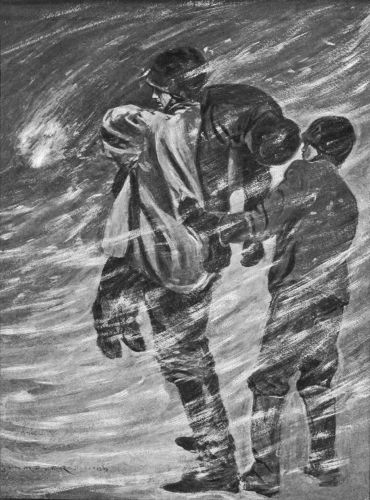
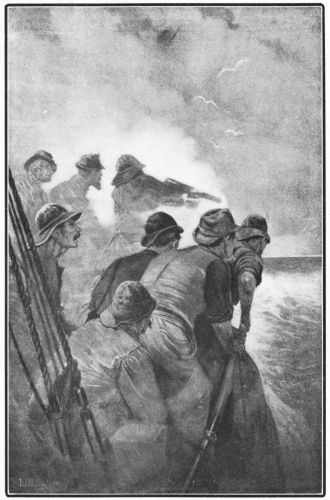
"WE'RE SAVED!" SAID BILL.
But where was the hummock? Bill looked
about.
"'Tis there," said Billy, pointing ahead.
Bill shook his head. His homing instinct, to
which he had trusted his life in many a fog and
night, told him otherwise. Reason entered into
his decision not at all; he merely waited until he
was persuaded that his face was turned in the
right direction. Then he started off unhesitatingly.
He had found the harbour entrance thus
in many a thick summer night when his fishing
punt rode a trackless sea.
"Take hold o' me jacket, b'y," he said to Billy.
"Mind you stick close by me."
For some time they wandered without seeing
any sign of the hummock. Bill's heart sank lower
and lower; for he knew that if they did not soon
find shelter, Archie would die in his arms. At last
Bill caught sight of a light—a dull, glowing light.
"Is that a fire?" he asked.
"'Tis the hummock!" Billy cried. "'Tis Osmond
with the fire goin'. 'Tis he! 'Tis he!"
"We're saved," said Bill.
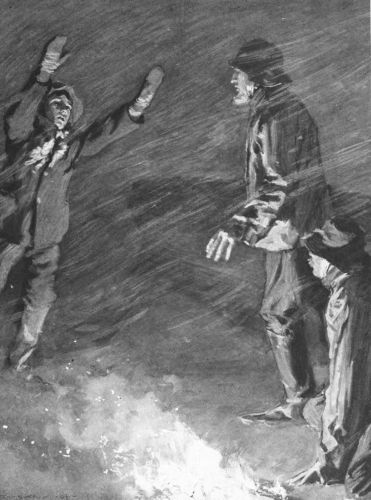
Once in the lee of the hummock, they roused
Archie from his stupor, and warmed him over the
fire, which Osmond, after many failures, had succeeded
in lighting. They broke the cross-piece
of the tow line in two, took another pelt from the
pack, and made two fires. The wood was like
the wick in a candle; it blazed in the blubber,
and was not consumed. Between the fires they
huddled together, with Archie in the middle.
Their bodies warmed the lad, and he slumbered
snugly, quietly, through the night. Billy Topsail,
more sturdy of body, if not of spirit, kept
awake, and had a part in the talk with which
each tried to cheer the others through the fearful,
dragging hours.
"'Tis the day," said Bill, at last, pointing to the
east.
The wind abated as the dawn advanced, and
the snow ceased to fall. Light crept over the
field, and men appeared from behind clumpers of
ice. Group signalled to group. All made their
way to the place where the ship had landed them,
a dozen men were already clustered—a gaunt,
haggard, frost-bitten crowd. The terrors of the
night still oppressed them, and, through weeks,
would haunt their dreams.
They counted their number. Fifty-nine living
men were there; and there was one dead body—that
of Tim Tuttle of Raggles Island, who had
strayed away from his fellows and been lost.
And thus they awaited the full break of day, while
eyes were strained into the departing night.
Where was the ship? Had she survived?
These were the questions they asked one another.
"What's that patch o' black?" Bill o' Burnt
Bay asked. "Due west, lads—a mile or more
off?"
"Sure, it looks like the ship," some of the men
agreed.
As the light increased, the storm passed on.
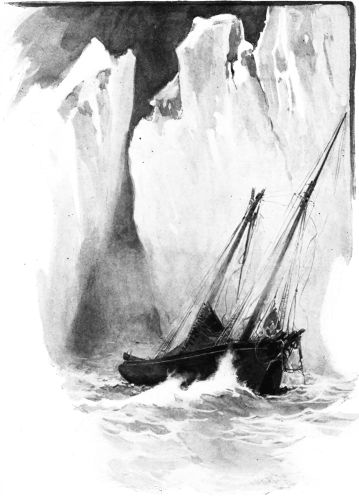
A burst of sunshine at last revealed the Dictator,
lying on the ice, listed far to port. The broken ice
in which she had been caught, they learned afterwards,
had been forced under her, and she had
been lifted out of danger when the fields that
nipped her came together.
When it is said that old Captain Hand welcomed
his crew with open arms, and embraced
Archie—the meanwhile searching through all
his pockets for a handkerchief, which he could
not find—there remains little to be told. He
was more haggard than the rescued men. What
depths his brave spirit sounded on that long
night are not to be described.
"Well, b'y," was what he said to Archie,
"you're back, is you?"
"Safe and sound, cap'n," the boy replied,
wearily, "and hungry."
"Send the cook for'ard with the scoff!"
roared the captain.
Before noon, all the men were safe aboard,
and the ice was breaking up. When the
Dictator settled softly into the water, at the
parting of the fields, the pelt was stowed away.
She had no difficulty in making the open sea;
and thence she set forth in search of other floes
and other seal packs.
The Dictator made Long Tom Harbour without
mishap. There it was made known that the name
of Billy Topsail of Ruddy Cove was "on the
books," and not a man grumbled because the
lad was to share with the rest. There, too, old
John Roth, to whom two "white coats" had
been promised, claimed the gift of Archie, and
was not disappointed. And there Archie said
good-bye to Billy for the time.
"I'll see you this summer," he said. "Don't
forget, Billy. I'll spend a week of vacation time
with you at Ruddy Cove."
"No," Billy replied. "You'll spend it at New
Bay. Sure, me name is on the books, an' I'm
goin' after lobsters with me own skiff in July."
"I'll go with you, if you'll take me," said
Archie. "And I can never, never forget that
you——"
"Sure," Billy Topsail interrupted, flushing,
"you'll go with me t' New Bay. An' times we'll
have of it!"
"Good-bye!"
"Good-bye, b'y!"
And so they parted on terms of perfect
equality.
That summer, Billy Topsail went to New Bay.
But it was not in a skiff; it was in a swift little
sloop, especially made to be sailed by a crew
of one. It came North, mysteriously, from
St. John's, to the wonder of all Green Bay; and
its name was Rescue. And a letter came North
for Bill o' Burnt Bay: which, when he read it,
stirred him to the profoundest depth of his
rugged old heart, for he roared in a most unmannerly
fashion that he'd "be busted if he'd
take a thing for standin' by such a lad!" In
reply to a second letter, however, Bill said he
would "be willin' t' take it on credit, if he'd be
'lowed t' pay for it as he could." So that is how
Bill o' Burnt Bay came to sail to the Labrador
in his own fore-and-after, when the fish were
running.
And, once, Sir Archibald Armstrong turned
to his son. "Well, my boy," he said, slowly,
"I've been wanting to ask you a question.
What do you think of your shipmates?"
"I think they're heroes, every one!" Archie
answered.
"Do you think you now know the difference
between a man and a tailor's lay-figure?"
"Oh, sir," Archie laughed, "I'll never forget
that!"
Billy Topsail had never needed to learn.
Transcriber's Notes:
Obvious punctuation errors were corrected
Page 49, "cost" changed to "coast" (a rocky sea-coast)
Page 142, "peninsular" changed to "peninsula" (bleak peninsula to the)
Page 216, "Landside" changed to "Landslide" (Landslide at Little Tickle)
Page 274, the anchor for the footnote after "raftin' ice" was added
to the text.
Page 328, "handkerckief" changed to "handkerchief" (pockets for a
handkerchief)