So the summer days passed and winter set in once more. Though more
satisfied, Foster-father felt still that safety depended on King
Humâyon's success or failure.
So, whenever one of the long files of camels tied together in a string,
head-and-tail, showed on the hill road above Kandahâr, he was off to the
halting-place outside the city to see what news it had collected in its
march from Hindustan; for caravans in those days were the postmen.
And sometimes he heard one thing, and sometimes another, but as often as
not he returned as he went, without any remedy but patience.
"Anyhow the child grows in stature and strength," Head-nurse would say,
"and our present lodging is better than our last!"
Which was true; for the old house of three stories which they now
inhabited was full of little rooms leading one out of the other like a
rabbit-warren. And if there was no furniture in them, so much the better
for the children's games of "I espy" and "Touch who Touch can."
For Bija and Mirak played such games with infinite zest. As Head-nurse
had foretold, the coming of his little sister had been an immense gain
to the Heir-to-Empire; not only in manners, but also in his outlook upon
life. For Princess Bakshee Bâni Begum was a very determined small
person, who did not in the least see why the elder sister of a boy
should give way to him in all things, simply because he was
Heir-to-Empire.
"I won't have it, Mirak," she would say with a stamp of her little foot;
"you shall not break my doll's head just because you want to."
So Prince Akbar, who was full of sound common sense, began to think she
had reason on her side; and this was of great advantage to him, for with
Head-nurse, and Foster-mother and the others, he stood a great chance of
being spoiled.
And after a time he became quite devoted to the prim little maid, who,
for all her primness in general, could be as wild as a hawk on occasion.
And out of that arose an incident which, unfortunately, turned Princess
Sultanum against the little lad and so endangered his safety. It came
about in this way. Prince Askurry's son Yakoob was, as has been said,
three years older than Akbar, a lanky, rather weedy lad-ling of nearly
six. Now Prince Askurry was himself a noted wrestler, and was determined
his son should be one also. So he had the boy carefully taught, and set
a good deal of store by the quickness of the little fellow in learning
the grips, and how to trip up an adversary. On high days and holidays,
indeed, Prince Askurry and his wife used often to amuse themselves by
seeing the discomfiture of other less experienced children who were set
up to compete with the young wrestler. Baby Akbar had been one of these,
and being so much younger, he had always gone down before Yakoob's
skill; but he had always taken his overthrow in good part, though
Head-nurse had felt as if she could not keep her fingers off the victor.
It was not fair, she would say afterwards, to match a baby of two with a
child of six, and then she would try to hug the vanquished
Heir-to-Empire and cover him with kisses; but Akbar, always independent,
resented this. "Akbar tumble him down some day," he would say
philosophically; and indeed there seemed every chance of it, for, mere
baby as he was, there was more promise of future strength in his little
finger than in Yakoob's whole body.
Now, as winter came on, the children were driven indoors for their play,
and Old Faithful at their earnest request, rigged up a swing in a large
empty room in the palace, and here Princess Bija would be swung like the
Seventy Maidens, until Prince Akbar wearied of swinging her; and knowing
that nothing would induce his elder sister to tumble down like the
princesses in the story, would say quite plaintively:
"Please, Bija, get down; I'm tired of being Rasâlu," when the little
maid would descend gracefully and they would play at something else.
But one day, just after the New Year, Prince Yakoob came to spend the
day with his cousins, and the children fell to acting the adventures of
Râjah Rasâlu; Yakoob, as the guest, playing the hero's part.
They got through several of them quite successfully, Princess Bija
making a spirited carpenter's lad and killing his dragon with great
vigour, while the Heir-to-Empire, disguising his deep baby voice in a
high squeak, doubled the parts of the seventy-nine maidens and the
cricket. So all went merry as a marriage bell until Rasâlu had to order
the giggling crew out of the swing.
Then, of course, Bija refused; whereupon Yakoob, a spoiled boy, cast
aside the tinsel-covered wooden sword, and whipped out from his belt a
toy dagger his father had given him that morning. It was not very sharp,
but very little cuts a taut rope, and one furious slash severed some of
the strands, the weight of the two children did the rest, and there they
were both on the marble floor!
And unfortunately the "pearl of pearls," Râjah Rasâlu's bride, did not
fall on top. She fell underneath the Heir-to-Empire, and the
Heir-to-Empire was heavy! So there was her poor little lip all cut and
her pretty little nose all bleeding. Then two Head-nurses rushed in,
and two Foster-mothers, and ever so many pairs of nursery attendants,
each taking the part of their respective nurslings, and there was a
terrible to-do, for, of course, one Head-nurse said it was the fault of
the other Head-nurse, and so on. In fact peace did not return until the
party separated and the offender, Prince Yakoob, was being joggetted
back to his mother by his excited attendants, while Princess Bija was
having her swollen nose soothed by cold water. She did not cry much, but
she was terribly indignant with every one, including her brother.
He couldn't have prevented his cousin from cutting the rope, of course,
but he might have made his cousin's nose bleed also! If she hadn't been
otherwise occupied she could have done it herself; she was quite sure
she could; or at any rate have done something quite as disagreeable!
She looked very fierce as she spoke, while Akbar listened with grieved
attention. In fact, what Bija would have done, had Head-nurse not had
her in her arms cossetting her, became quite a subject of conversation
between the two children, Bija sitting demurely threading beads and
inventing new methods of just punishment, and the Heir-to-Empire lolling
on the floor pretending to sharpen his tinfoil sword, and interposing
objections such as, "But you couldn't do that, Bija, you're not
strong enough," or "That wouldn't be fair, Bija, for he only hurt
you a little, you know." For Akbar was born with a sense of fair-play
and justice which never forsook him, because he always gave it fair
play.
So the idea of somehow getting the better of Yakoob became a fixed one
in the little lad's mind until an opportunity for action came to him.
It was about a month afterwards, on the "Festival of Record"; that is to
say, the day when good Mohammedans pray for guidance during the coming
year, and believe that God's Angel, accompanied by the spirits of their
dead ancestors, appears on earth to judge the record of the past year,
and write on the forehead of each man and woman and child what reward or
punishment is deserved in the next. In the evening, thousands of little
lamps are lit, so that there shall be no darkness anywhere, but all
things shall be made manifest, and when the little platters of sweets
and food are set out lest any of the spirits, who come to plead for
their descendants, should feel hungry, it is a very solemn affair; but
the day is generally spent in amusement.
So Princess Sultanum arranged an entertainment, and, as usual, there was
to be a bout of wrestling between her son and some little companions,
amongst them the Heir-to-Empire. Head-nurse was furious, of course. The
show was invented, she declared, to disgrace the Mighty-in-Pomp, the
Pole-star of the Universe, etc., etc.
Akbar himself took it very complacently and allowed himself to be
undressed and oiled all over, so as to make a grip very hard; for these
are the Indian customs. And a very sturdy specimen he looked as he stood
up and crossed his arms and then slapped himself with resounding slaps
before crossing them again; also after Indian fashion, for so much he
had learned of wrestling.
Then the signal was given, and Yakoob, as was his wont, began, in
imitation of grown-up wrestlers, to steal an advance on his adversary.
But Akbar would none of that. Whether, watching real wrestling, he had
noticed the method of attack he employed, or whether Roy had taught him,
or whether he got it out of his own head, does not matter; but the
little fellow rushed forward furiously and charging like a butting ram,
caught his cousin full in the stomach, then making a snatch at his ankle
tripped him up. So there in a second was Yakoob on his back, and Akbar,
breathless but triumphant, on top of him.
"Now you've tumbled down," remarked the Heir-to-Empire suavely, as,
astride his cousin's prostrate body, he paused for breath ere getting
up.
Of course, some people said it wasn't fair; but others admitted that
though not the polite style of wrestling, such a method was strictly
within the rules. All, however, admired the big, bold, strong little
Heir-to-Empire; all but his aunt and uncle; and the former bid
Head-nurse take away her young savage at once, while the latter's crafty
face, uneasy before, settled into a scowl.
But Head-nurse could hardly contain her joy, even when Foster-father
shook his wise old head and said he would not have had it happen for all
the wealth of the world, for of late, if he were not much mistaken,
things had been shaping ill for his young master, and that very morning
a secret messenger had come in from Kâbul. What it might portend who
could say; but it was bad fortune the child should lose favour at Court
to such slight purpose.
"Slight, indeed!" sniffed Head-nurse. "Is it not something to have shown
that woman that her brat cannot stand up before true Kingship?"
"I would it were so, woman," replied Foster-father, "but a child under
three with but two old men and two boys for protection cannot show much
fight."
Head-nurse tossed her head. "So we women are not to count—" she began;
but Baby Akbar had been listening seriously and now put in with his deep
childish voice, and a wise little shake of the head:
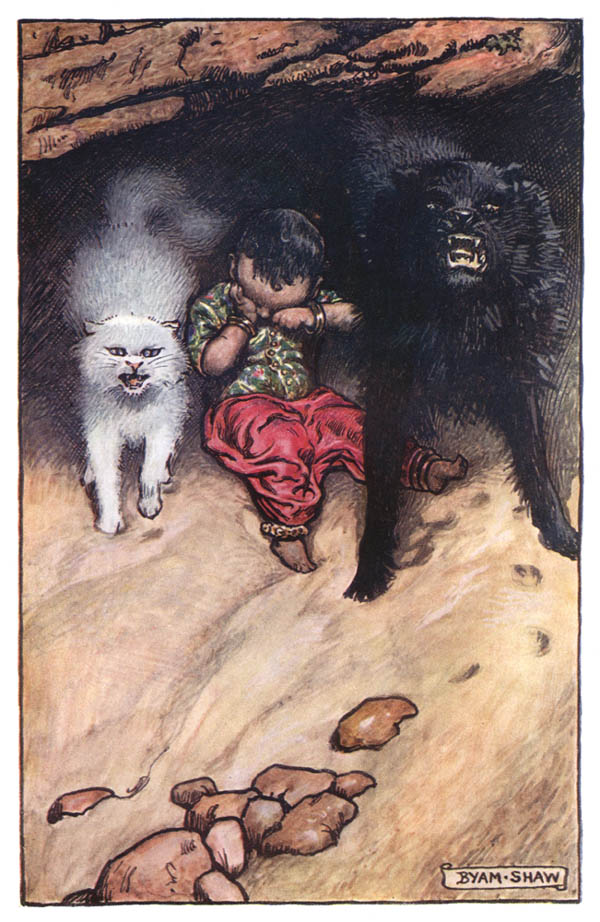
"And there's Tumbu and Down, too; they can bite and scratch beautifully
for me when they like."
Whereupon Foster-mother caught him up, and wept, and swore that Heaven
must and would protect such a heart's darling.
Perhaps it was this conversation which put the idea of getting help into
the children's heads, but after a time it was evident they had some plan
between them, for after watching the women light hundreds of little
lamps, and set out a quantity of tiny platters full of sweets, they
stole off by themselves to an empty room which was almost dark and began
to whisper.
"I think it had better be grand-dad," said the Heir-to-Empire gravely,
"'cos my father isn't dead yet, and they must be deaders, you know, if
they are really to help."
"And we'll take the little summer room at the very top of the house,
Mirak, so's we'll be able to stop him on his way down, 'case any one
else has got a platter for him," said Bija the practical. "Now, Mirak,
I'll fetch the sweets if you'll get some lamps. They won't be missed,
you know, if we take them betwixt and between."
After that there was much secret hurrying up and down stairs and secret
gurglings of delight as the preparations advanced.
"Oh, Mirak! Won't it be lovely? He's sure to come in when he sees it!"
said the little girl, clasping her hands. "And Old Faithful was saying
that Grand-dad Babar was as good as twenty other men in a fight, so
then you'll be quite safe."
But Mirak's face was solemn. "If Grand-dad doesn't know it's for him he
won't come in, and he won't eat the sweets either. It's greedy to eat
sweets as doesn't belong to you, and he wasn't greedy. Old Faithful
says he wasn't. He was a real King."
"Don't you think he might be greedy just to help you?" suggested Bija
mournfully; but after thinking a little she clapped her hands. "I have
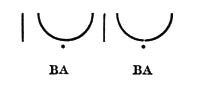
it, Mirak! If his name was on it that would do! I think I could write
'Ba-ba.' It's only the two first letters, you see, and I know them;
and you could prick yourself for some blood to write with, and I could
use my little finger as a pen. It's very, very tiddly wee."
It was, indeed! and Mirak sat large-eyed in admiration of his sister's
ingenuity, while she, mistress of the situation, did this and that until
even she was satisfied. And really the little arched and domed cupola
set in Eastern fashion on the roof, looked quite pretty with the little
glittering lights in a square on the white marble floor, and the platter
of sweets placed in the middle of the square, whereon in smeared red
letters showed this:
BA BA
"And now, Mirak!" chattered Bija, "we'll go down and go to bed like good
boys and girls, and then when the others are saying their prayers and
going to sleep we can come up again and sleep here."
"Won't it be very cold, Bija?" asked Mirak, whose little nose was half
frost-bitten already, for a cold wind was blowing off the snow hills.
"We will bring quilts," said the little lady with a superior air.
So, about an hour afterwards, after the children had been put to bed and
their elders had begun the serious work of watching and waiting and
dozing through the night, two little figures, well wrapped up in quilted
cotton gowns and dragging quilted cotton blankets behind them, stole up
the stairs to the roof of the house.
"I'm going to ask God to let him come," said Baby Akbar solemnly. So
they both touched the cold marble floor with their warm little foreheads
and said:
"Please Great God! Let our grand-dad Babar come and take care of us, and
be kind to us, and not let the Angel write nasty things on our foreheads
for this next year!"
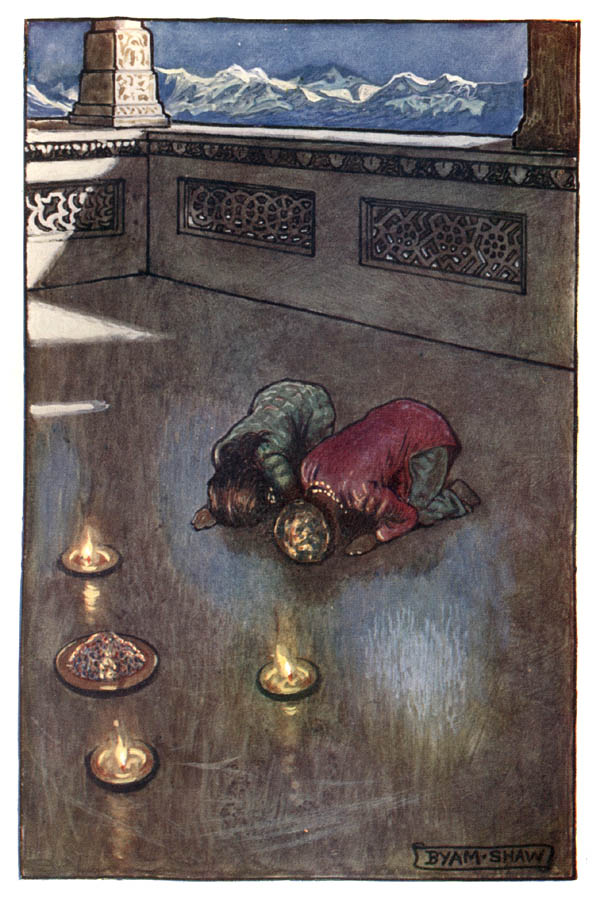
So they both touched the cold marble floor with their
warm little foreheads.
Then they cuddled themselves closely together in the blankets and were
soon fast asleep.
So fast asleep that even when, after the short hullaballoo which
followed on the discovery that they were not in their beds, they were
traced to the roof, they did not thoroughly wake up, but were carried
down again without knowing much about it.
"Shall I blow out the lights?" asked Roy, as Head-nurse prepared to
descend also.
Head-nurse looked round to Foster-father for his opinion.
"No!" he said shortly, "leave them! The children have asked some one to
eat those sweets. Let be! They may want all the help they can get."
So all the night long the little lamps twinkled and twinkled.
But when morning came there was not a sweet left!
"It must have been the rats," said Meroo, who, as cook, had gone up to
see what he could save. "I saw the tail of one disappearing."
But Foster-father said swiftly: "I would it were some other helper, for
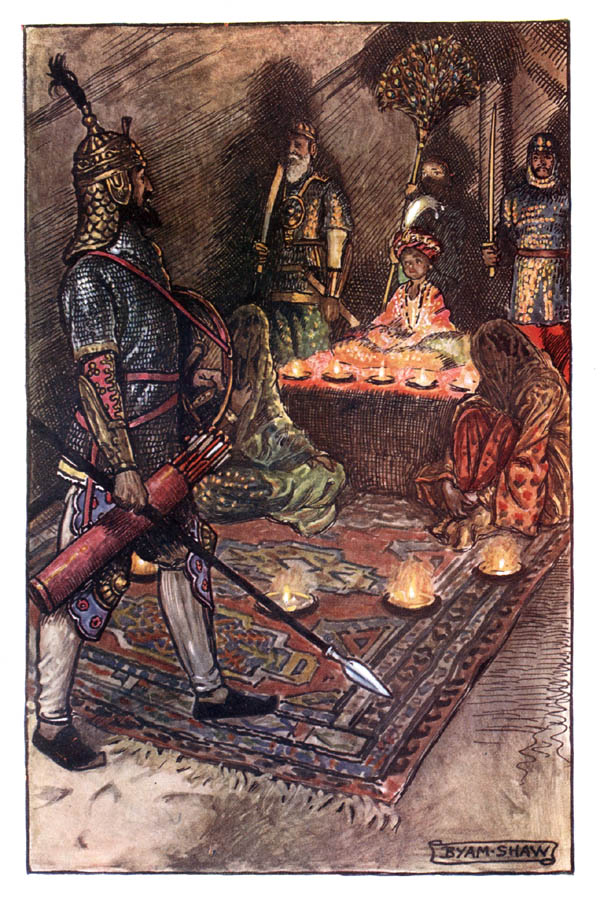
the time has come for help. Prince Askurry hath sent to say we start for
Kâbul and cruel brother Kumran at noon to-day!"