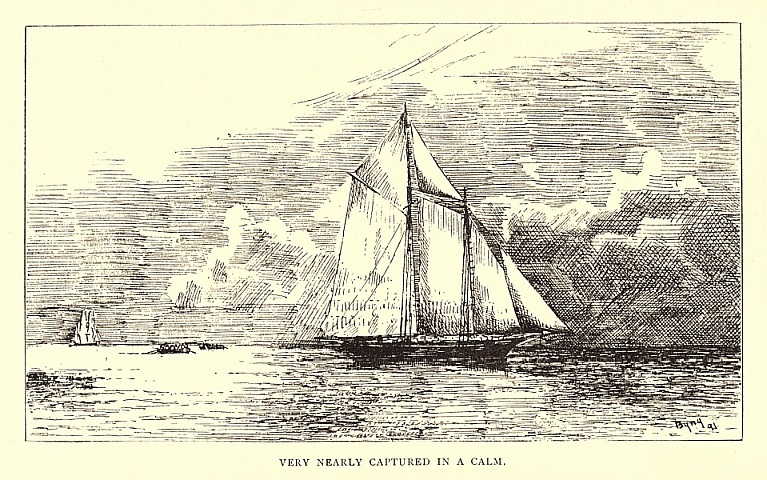
Outward trip—Going out without a passport—Sail in company with the
Mary Elizabeth—Passing close to a gunboat—The strictest silence
enjoined—A cock crowing nearly betrays us—Singular superstition
arising from the incident—Overtaken by a hurricane—More danger
from the seas than the enemies this trip—The Mary Elizabeth never
heard of—Dangerous crossing of the bar at Tampico.
About the 12th of September a good, steady breeze was
blowing from the eastward, which freshened up towards
evening. And the chance had come.
We were well to windward, as we intended to run out by
the south-west, or Swash Channel, as it was called. At the
place where we lay we could see plainly all the blockading fleet
and note their position.
Beyond the shoal which separated this channel from the sea,
and very near to the outer mouth of the channel, lay a
gunboat in what we considered a very bad position for us.
In passing out by this channel the first difficulty was to find
it, where it branched off the main channel. On entering it, it
led in a south-westerly direction, with from eight to nine feet
of water, with the land on the right, and on the left the shoal,
which considerably broke the sea and kept the channel
tolerably smooth.
At the western extremity of the shoal the channel opened
pretty suddenly into deep water, and very close to this mouth
lay the gunboat. On the inside, between the gunboat and the
shore, there seemed to be very little room to pass without
getting dangerously close to the breakers, but on the outside of
her there was a good wide space between her and the next
vessel, and through which we might pass; but that tempting
opening—which was the widest space in the whole fleet—might
only be a trap shown during the day, while some of the
cruisers which kept steam up and cruised about during the
day might take their place there after dark and be ready to
pounce upon any craft that might have been lured into an
attempt to pass through this wide gate. We, therefore,
determined to try the narrow path.
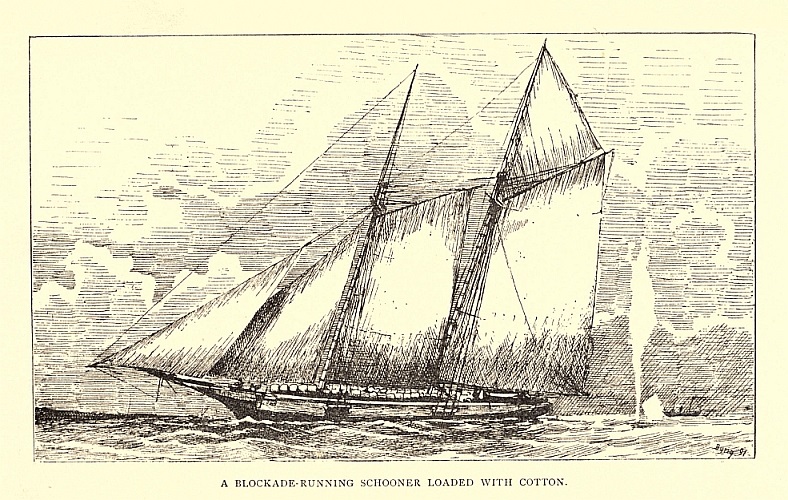
Everything was got ready, the large boat was hoisted on
board and lodged in a place reserved for it forward of the
main-hatchway. Inside of the boat was placed a large coop
or arrangement made for the poultry to roost upon, among
which was a fine cock, to which some of the men had taken a
great fancy, but which was soon afterwards sentenced to death
as a traitor. Into the dingey was stowed some small packages
of cotton, made up for the purpose, to shield the steersman
in case of shots from boats astern. Double reefs were
put in the mainsail and foresail, so that under low canvas we
would be shadowed by the dark loom of the land to leeward.
The wind kept increasing, and in the evening there was a
fine, steady breeze, and the night was dark.
About eight o'clock we raised anchor and proceeded down
the bay. We passed well to the eastward of the wreck of the
Westfield and the guard-boat, keeping the lead going, and
taking care to avoid observation from the Forts. After a little
difficulty we found the entrance to the Swash Channel, and got
into nine feet of water, with the land on the starboard side.
All well so far.
Along this channel we steered cautiously. No lights could
be used at the compass; but on entering the channel the
course was taken from a star and regulated by the lead.
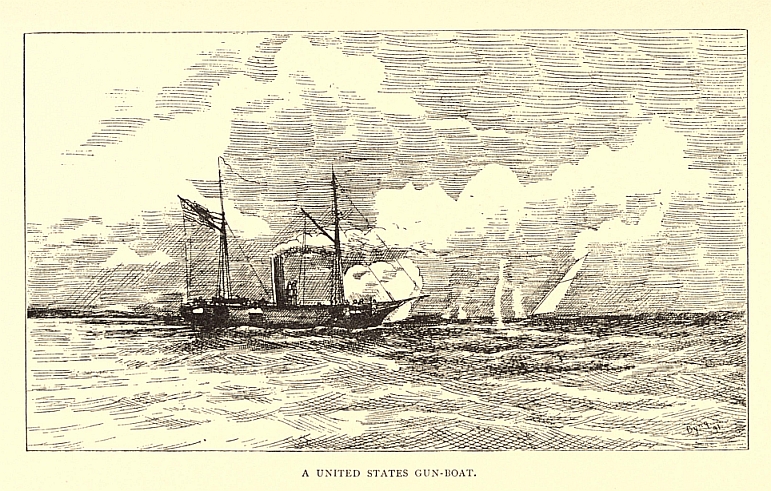
With my night-glass I looked out for the gunboat, and I
soon discovered her on the port bow, close on, and well in
shore she was, and there was very little room to pass between
her and the breakers. The wind, however, was a little north
of east, and there was not a great sea on, and the breakers did
not sound loud.
As we got towards the end of the shoal the swell from
seaward caused us to keep in the deepest water, and it was
evident that we must pass the gunboat very close. The night
was dark, and by the dark loom of the land beyond there was
not so much danger of us being observed; but the strictest
silence was demanded, and orders were passed in an undertone;
and I was uneasy at the noise made by the breaking of
the water from the bow of the vessel, which had now got past
the lee of the reef and into the swell of the open sea, which
was causing her to heave considerably.
We were just coming abreast of the gunboat, and every
breath was hushed, when "Cock-a-leery-lou!" rang out in a
loud and clear note from the hen-coop in the boat amidship.
"Confound that brute," I hissed out, in a rage; "twist its
neck."
The order was quickly executed; there was a momentary
flutter of wings, and poor chanticleer had given his last crow.
In a few minutes we had brought the gunboat on our
weather-quarter, and as there was considerable swell, and the
breakers close under our lee, we luffed up and stood off the
land a little.
We had not proceeded far when, looking with my night-glass,
I discovered another cruiser on the port bow much
larger than the one we had passed, evidently with steam up
and not at anchor, as she was not riding to the wind like the
others.
Hard up and ease off sheets, and we were off before the
wind heading towards the shore, expecting every moment to
be fired upon; but we soon lost her in the darkness, and had
just time to luff up and get sheets hauled in before we reached
the breakers, and we now stood a good distance to the
westward before we stood off the land again.
This latter vessel had, no doubt, come up after dark to
watch the wide gap we had observed before sunset between
the first and second vessels on the left wing of the blockading
fleet, and had we passed out through that gap she would most
likely have picked us up.
Since we had passed the Confederate guard-boat we had
seen nothing of the Mary Elizabeth, though she raised anchor
at the same time, and followed us down the bay; but as we
had heard no firing we concluded that she had got out all
right.
The object now was to get as far out to sea as possible before
daylight, and this was the all-important object of a sailing
vessel running the blockade on the outward trip. A steamer
could always depend upon making her distance, but if the
wind died away a sailing vessel was left helpless in the very
jaws of the enemy.
There was no doubt but the sleepy hours of the morning was
the best time to pass through the fleet, and were generally
taken advantage of on the inward trip when it could be
managed; but on the outward trip it was necessary to pass
out in the fore-part of the night, so as to get a good offing
before daylight.
The danger of capture was not so great from the vessels
which actually blocked the harbour as from those which cruised
round in the immediate vicinity; and a much greater number
of vessels were captured by the cruisers which cruised off the
coast and round about the blockaded ports than by the blockading
fleet. Therefore, the greater distance which could be
run from the port during the night, the greater the expanse of
the circle to police and the less chance of capture.
We were now favoured with a fine, strong breeze, and as
soon as we were satisfied that we were well clear of the
patrols, we luffed up and stood off the coast, took reefs out of
the mainsail and foresail, and set staysail and gaff-topsail.
This was the real cream of blockade running—the first
night on the outward trip, with a good cargo of the valuable
cotton; a rattling breeze, and every stitch of canvas the
vessel could stagger under, neither lights, look-out, or any
other precaution thought of, but dash recklessly on,[1] getting
further and further from the cruiser-infested coast and out to
the wide range of the open ocean, where the wide expanse
made cruisers few and far between.
The breeze kept steady, but I did not leave the deck till
4 a.m., when I calculated that we would be at least seventy
miles from the coast. I then turned in for a short nap, telling
the mate to scan the horizon well at daybreak, and call me if
anything was to be seen.
At daylight the mate called me in something like alarm,
saying that a large sailing vessel was on the weather-quarter,
bearing down upon us.
I jumped on deck and examined her with the glass, then,
laughing at the mate, asked him if he did not know the Mary
Elizabeth.
He said she had got very small in appearance from the time
he first saw her; but when first seen she looked as large as a
barque, and Fred had declared it to be the John Anderson,
which had chased us so hard on our last voyage.
I said the John Anderson was long off the station. The
reason she looked so large was the phenomenon of him having
seen her at daybreak directly between him and the rising sun.
She was about seven miles' distant, and as it got lighter it left
no doubt that it was the Mary Elizabeth, and I remembered
that she was exactly in the same position when we sailed
together last voyage.
I now remembered that Captain Shaeffer would know
nothing of the understanding made at Havana among blockade-running
captains; that if they sighted each other at sea they
should stand away from each other, so as to lessen the danger
of both being captured should one be sighted by a cruiser; and
I had forgotten to tell him of it.
The breeze still continued, but it had gone round a little to
the south of east. We had been steering throughout the night
about south to get away from the coast, but our course was
about south by west. So I changed our course to S.S.W., so
as to separate us from the Mary Elizabeth, but she followed
us on the same course. I then luffed up to south so that the
two vessels would meet, and signalled to speak. He either did
not see or understand the signal, or perhaps thought that I had
seen some danger to the westward and was steering away from
it, for he luffed up also. As I saw I could not make him
understand I kept away on our course, S. by W.
About this time Father Ryan, who I had not seen or noticed
since we left our anchorage, put his head out of the cabin-door.
Father Ryan, who was of Irish birth, proved to be of an
exceedingly good-natured and kind-hearted man. Since he
came on board he seemed to have ingratiated himself with the
crew. While in Galveston Bay he had gone in the boat with
them, fishing and gathering oysters—a kind of food of which
he was particularly fond. He was also very wishful to make
himself useful in assisting the men in any work they might be
doing, and was very desirous of learning how to splice or
make knots.
"Good morning, Father Ryan," said I, as he looked out.
"How have you passed the night? Have you been sea-sick?"
"Not a bit of it," said he; "I have been very comfortable,
thanks to you."
"When did you turn in?" said I. "I never saw you from
the time we raised anchor."
"I daresay not," said he; "you was too much engaged;
but I was on deck until you hoisted all the sails, and I heard
the vessel making the water fly; but you got out nicely. How
far will we be from Galveston now?"
"Well on to a hundred miles, I should say."
"Oh, that is surely good! What vessel is yon?"
"That is the Mary Elizabeth, that sailed along with us."
"Oh, indeed!" said he. "You are beating her."
"Not much; the two vessels are much on a par as to sailing."
"Well," said he, looking around, contemplatively, "is not
this wonderful! grand! beautiful! Captain, when you look
around on that great expanse of ocean, with these large, blue
waves with their white crests dazzling so beautifully in the
morning sun, does it not remind you of the grandeur and
purity of God's works?"
"It does, most truly, Father Ryan," said I, sympathetically,
for I had got so disgusted with the deceitful actions of
mankind that I felt happy at being again on the bosom of the
honest ocean.
"Great ocean!" he went on, moralizing, "man can change
the face of the land, he can build cities, harbours, railroads,
clear away forests, and make the desert blossom as the rose;
but the sea he cannot change; it remains the same yesterday,
to-day, and for ever."
I had just taken an altitude of the sun, and went below with
the sextant and slate, while Father Ryan made his way forward
to where the men were at breakfast, crawling over the cotton
bales on his hands and knees.
When I came on deck again, Hagan, who was at the wheel,
said to me—
"Captain, what do you think old George would have done
if he had been with us this trip? I swear he would never
have left Galveston with us."
"How so?"
"Why! with both a priest and a cat on board."
"Why, what harm is there in either?"
"Oh! none that I know of; but I know George would not
have gone with us."
"We could have given the vessel a list to port," said I,
"and that would have outbalanced priests and cats and
everything else with George; but these are old and foolish
superstitions."
"Oh, I know that," said he; "and I am sure I don't
believe in them; and I was going to say, what harm could
there be in any kind of man or beast being on board; but I am
not so sure of that now."
"Why so?"
"Why, what did you think of that cock last night trying to
give the alarm just as we were passing close to the Yankee
gunboat?"
"What is there supernatural in that?" said I. "It is a
very natural thing for a cock to crow when he is wakened out
of his sleep. I would have considered it more supernatural if
he had held his tongue till we were past the gunboat."
"It would have been better for him, any how; for natural
or not, I made short work of him."
"Was it you that killed him?" said I.
"It was; and just as he was flapping his wings to give
another crow."
"It is a pity you killed him," said I. "If you could have
thrown a bag or something of that kind over him it would have
stopped him."
"You cried out to twist his neck, and there was no time to
think over it."
Breakfast being ready, the cook had called Father Ryan,
and as there were no supercargoes now on board, only Father
Ryan, myself, and the mate sat down to breakfast.
"Captain," said Father Ryan, "I hear you have been
committing murther last night."
"How is that, Father Ryan?"
"Why, in killing that nice rooster."
"Well, yes; it was a pity; it was done on the spur of the
moment; but they might have heard him on the gunboat, and
that would have led to our capture."
"Oh, that it would!" said he. "It was such a loud crow;
but is it not a very strange thing that he should have given the
alarm just as we were passing the gunboat? Had it been the
usual time to crow, it would have been quite natural, but it
was not yet nine o'clock, and it is something unnatural for a
cock to crow at that hour."
"That is what I find strange about it," said the mate. "I
am not superstitious, but it does look strange; and it was a
very unusual time for a cock to crow, and just at the moment
he could betray us."
"That is what the crew are all saying," said Father Ryan.
"You told me, Captain, that your crew were not superstitious,
but they are all talking much about it, as ominous of bad luck
for the voyage; and they are a little downcast. Hagan
maintains that the devil had got on board in the form of a cock,
but that he had done for him, anyhow. I told them that they
should not indulge in those foolish superstitions, that all such
things just happened by chance in the ordinary course of things."
"Well," said I, laughing, "it is astonishing to see how
people can manufacture a mysterious affair out of the most
commonplace event. There is nothing more easily accounted
for than the cock crowing at the time it did. That it was not
the usual time for cocks to crow is true enough, but cocks will
crow at any time if they are awakened out of their sleep. Now
the fowls had all roosted and gone to sleep before we left our
anchorage, and you will remember when we got past the reef
and got into the open sea the heavy swell coming past the end
of the reef caused the vessel to make several heavy lurches?"
"Oh, I remember that," said Father Ryan. "I was standing
in the companion, and was nearly thrown down the cabin-stair."
"Well," continued I, "I was standing near the fore-rigging,
and heard the fluttering of the fowls in the boat as they were
thrown from their perches by the rolling of the vessel, and as
the rolling subsided a little, and just as we approached the
gunboat, the cock having got on to his perch again, naturally
began to crow."
"Oh, well, now that explains the whole matter entirely,"
said Father Ryan; "and I am so glad, and I will soon set the
men's minds at rest, for nothing could be more natural."
The mate now laughed, and said that accounted for it
exactly; and he seemed greatly relieved in his mind.
"Well now," continued Father Ryan, "does not that show
that many things which happen, and are thought mysterious
and supernatural and sometimes create superstition in the
minds of weak people, might be easily explained if the real
causes were known."
Breakfast being over, Father Ryan hastened to explain to
the crew the cause of the apparent mysterious affair, which he
succeeded in doing, as soon could be seen from their laughing
and bantering each other for having entertained serious
misgivings in the matter.
Throughout this day the breeze continued, but got gradually
lighter, and hauled more round to the southward, which
caused us to head more to the westward, but we saw nothing
the whole day except the Mary Elizabeth, which still kept in
sight, though luffing up and standing more to the southwards.
On the following day the wind was light, and nearly due
south. The Mary Elizabeth was not in sight, which I was
glad of, but we could only hold a course about S.W. by W.,
and as we could do no better, I thought of getting west, near
to the coast of Mexico. For although I knew that the current
from the south would be stronger against us there, yet I knew
that if once south of the Rio Grande we would be more out
of the way of cruisers on that coast.
For several days the winds were very light, and from the
south, and we made but slow progress, constantly keeping a
look-out from the mast-head for cruisers; but we only saw one,
which, being observed in time, all sails were taken down, and
she passed about ten miles to the northward without observing us.
At last we got south of latitude 25° and longitude 96°, and
we considered that we were now out of the most frequented
track of the cruisers, but still they might be met anywhere.
The wind was exceedingly light and baffling, varying about
a point to the east or west of south, while the current of the
Gulf Stream from the south was so strong that we could
scarcely hold the southing we had made.
For one or two days it seemed that we could not get out of
the spot we were in.
About the eighth day out we again sighted the Mary
Elizabeth. She was just in about her old position from
us—about eight miles to the eastward—and she seemed to be
pursuing the same tactics as ourselves.
The same day it fell dead calm, and about noon a large
circle was observed round the sun of a purple colour, which
some of the men declared indicated the approach of a heavy
gale, and that we might in a short time look out for a violent
norther. Anything would be a relief to this suspense, and a
norther would be welcomed if it did not come too severe.
As it was about dead calm, sails were taken down, and
every strop, hook, and cringle examined and made as secure
as possible. Flying jib and small sails stowed, and everything
about deck firmly lashed and made snug. Double reefs put in
mainsail and foresail, and single reef in jib, and sails hoisted
again, and we looked for the change in the weather.
We did not have long to wait. About 3 p.m. the sky
darkened all round, and by 4 p.m. it was fearfully dark, the
sky to the northward being black as ink. There was now no
mistake but that we were going to have a heavy gale, but
whether it was going to be a West India hurricane or a Texas
norther we did not know.
It was not just yet the season for the regular northers, but
there were often in those latitudes heavy gales about the
equinox which sometimes took the form of northers, and blew
with great violence, but they were generally of short duration,
and might be said to be something between the Texas norther
and the West India hurricane.
There could now be seen under the black cloud to the
northward what appeared to be snow hillocks on the horizon,
which soon spread out, and was coming towards us. This
of course was the sea lashed into a foam by the fury of the
wind, but still not a breath of wind had reached us, and the
vessel still rolled in a dead calm.
It soon came on, however, direct from the north, and first
a few drops of rain struck the vessel, and then the cold wind
which indicated, to all appearance at least, it was a norther.
It struck the vessel with such violence that I thought it
would have torn the masts out of her before she gathered
headway.
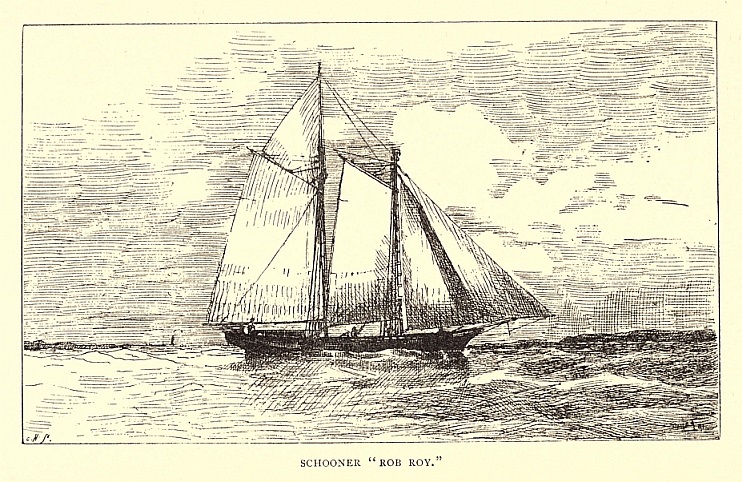
I was not sure how the Rob Roy would lay to under a
close-reefed foresail, and I determined, as the wind was fair
for us, to make the best of it, and scud before it.
The vessel was now rushing through the water at a great
rate, but when the full force of the gale came up it struck
her with such violence that it seemed as it would tumble her
stern overhead.
"Get the mainsail off her," I cried.
This was easier said than done. The sheet had been eased
off to run before the wind, and the belly of the sail was
pressing against the shrouds, and with the awful force of the
wind it was impossible to move it. To ease her in the
meantime the peak purchase was cast off, and the peak dropped.
This did ease her a little, but the gale kept increasing in
violence, and the mainsail must come off her.
To handle such a large sail in such a tempest was no easy
task, and as the boom was eased off it must be got aboard.
No strength could haul it in against the force of such wind;
the vessel must be rounded to.
"Hard down your helm!" was the word. The helm was
put hard down, but the peak having been dropped she would
not come up, but rushed along in the trough of the sea with
the full force of the hurricane on her beam. That she did not
lose her masts or capsize showed great strength and stability.
"Let go the jib halliards." This was done and the jib
hauled down. This had the desired effect, and she came up
into the wind. The fore sheet was hauled in, and she was
held up till the main sheet could be hauled in, the sail lowered
and stowed securely.
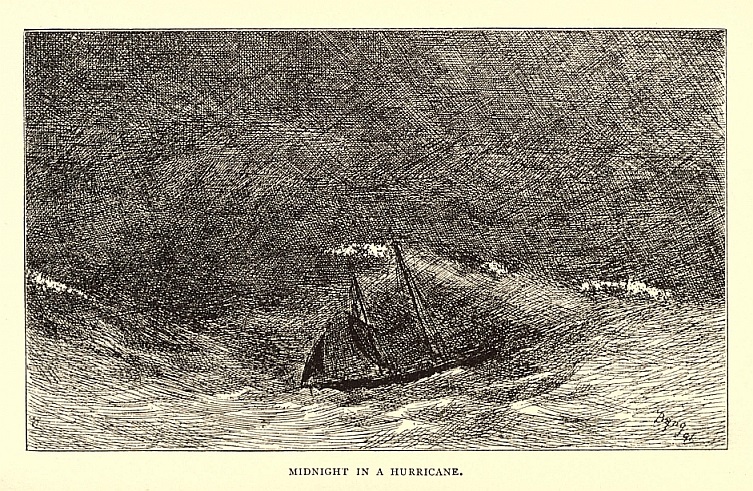
MIDNIGHT IN A HURRICANE.
The gale had now become terrific, and the wind being
directly against the current of the Gulf Stream, the waves
rose very fast and to a great height. While we had the
vessel thus rounded to, we thought to try if she would lay to
in the gale, but the seas having got to a great height, and
coming with great force, and the vessel having such a light
hold on the water, she was thrown back stern on with every
wave, causing her to fall heavily on her rudder, which I
feared might be carried away; we thought it best to scud
before the wind under a close reefed foresail.
The last reef was then put in the foresail, the jib tack
hauled to windward, and part of the jib run up. She payed
off quickly, and bounded off before the wind. The jib was
then taken down and cleared so as to be run up quickly in
case of necessity.
She now scudded along beautifully, but the wind increased
far beyond our imagination, and was something appalling, but
it did not vary a point in its direction. We steered about due
south; everything depended upon the steersman; to have
broached to would have been destruction.
The night was very dark, and the terrible roaring of the
wind and the hissing of the spray off the tops of the waves
seemed at times high over our heads. No one sought to sleep
that night; the men were gathered aft, where they stood in
silence with their eyes alternately upon the foresail and the
man at the helm. Sometimes the silence would be broken by
the expression—"Well, that is blowing pretty stiff."
Up till midnight all went well enough, but there was no
abatement of the gale; it was rather increasing, and the seas
were breaking more. Our only fears were for the foresail
splitting.
About 1 a.m. a tremendous sea caused the vessel to yaw a
little, and the foreboom jibed from starboard to port like the
shot of a cannon, and as she recovered herself it jibed back
again with the same force. This was dangerous work, as
each time it struck against the fore-shrouds, and might have
carried them away. I went with the mate to examine, but
found no harm done. The fore-sheet, which worked in a
traveller on deck, was taut as a bar, although the boom
was pressing hard against the shrouds. Thinking to ease
the boom off the shrouds a little, we got all hands to try a
pull on the fore-sheet, but such was the pressure of the wind
on the sail that we could not gain an inch. To have put a
back tackle on the boom to prevent it jibing would have been
madness. So the hauling part of the sheet was made fast to
the block at the traveller, and the boom allowed to have its
play, and every one warned to keep out from the sweep of the
boom, as one blow from it would have sent them beyond hail.
Shortly after this the boom jibed again with a loud report,
and as quickly jibed back again, but in jibing back the jaw
rope parted, and the boom unshipped from the mast, and lay
across ship, with one end pressing against the mast, and the
other against the fore-shrouds.
This was a bad state of things, but it was impossible to do
anything with it, as such was the force of the wind, and the
boom adrift and flying about, that it was dangerous to go
near it.
It was evident that we were going to lose the foresail, and
as our last resource we must try and get the jib upon her; but
just as the men were trying to get forward to loose the jib a
tremendous sea came rolling up astern, and a large body of
water, detached from the top of it by the fury of the wind, fell
on board right amidships, filling the large boat with water,
and causing the vessel to reel over almost on her beam ends.
She quickly recovered herself again, and singularly and
fortunately the sudden jerk started the foreboom from where it lay
pressing against the mast and shrouds, and shipped it back
into its place again. Lucky event!
"Well done, Rob Roy!" shouted the mate, as he seized a
short piece of rope used as a stopper and darted forward to
secure the boom in its place. I was quickly with him with
more hands, warning them to keep forward of the mast out of
the sweep of the boom. The rope was quickly passed round
the neck of the boom, and brought round the mast to hold it
in its place till a new jaw rope was got ready, when as many
of the purls as could be picked up were strung upon it, and it
was rove in its place, and the boom was all right again.
The vessel was now found to be staggering under the weight
of the large boat full of water on deck. This must be emptied
out; to bail it out would be dangerous work, as the boat was
just under the sweep of the fore-boom. The mate remembered
that there was a large plug in the boat, but the stopper was
in. We tried to get the stopper out, but there were difficulties
in the way. It could not be got at from the outside for the
deck-load, and the fowls having been all used up, the hen
coop had been broken up, and an empty water-cask placed
in the boat where it had been. This water-cask was right
over the stopper, and the foreboom was just above the
water-cask, so that it could not be moved.
The water-cask must be sacrificed. A hammer was got,
and the cask knocked to pieces, and the mate, to avoid a
stroke of the boom, sprawled along in the water, dived down
and withdrew the stopper, and the water rushed out, and very
soon the vessel was relieved of that unsteady top weight, and
she bounded on all right again.
The gale had now reached its height, but still blew steady
from the same point, and we began to imagine that it was
abating a little.
As daylight began to appear we observed a small slit in the
foresail, which, on being examined from the back or lee side
of the sail, was found to be one of the seams which was just
beginning to open. A piece of strong canvas was got, which,
with a bent needle, was stitched strongly over the back of the
place to help it a little.
When daylight broke clear the scene was truly grand. The
most experienced man on board had never seen such a sea,
but though the waves were tremendous high it could not be
called a dangerous cross chop of a sea. It was perfectly
regular, and if from our position in it we could not afford to
call it sublimely beautiful, we had at least to admit that it was
grand and awful.
It seemed like a succession of mountain ridges perfectly
straight and parallel to each other, rolling furiously in one
direction, and between each a level plain about an eighth of
a mile wide covered with white foam. This, I presume, was
caused by the violent gale blowing steady from one point
directly against the Gulf Stream.
About half-past seven the gale had somewhat abated, and
soon after the cook managed to have some breakfast ready.
Father Ryan, who had been on deck the greater part of the
night, was now gazing steadily upon the scene.
"What do you think of that gale, Father Ryan?" said I.
"Awful! truly awful," said he. "What kind of a gale do
you call that? Is that a hurricane?"
"It blows hard enough for one," said I, "although it is too
steady from one point for that. I think it is a sort of
equinoctial norther. What do you think of that sea?"
"Oh, that is terrible," said he. "I would not think it safe
for a small vessel like this."
"Many would think the same, and it is hard enough upon
her, but she is buoyant, and rises finely upon it, and has come
through it very well so far, and the worst is now past, for the
gale has about spent itself."
"Oh, yes," said he, "it is calming down now, but when I
looked out upon that awful sea this morning and thought of
the calm sea of yesterday, I said, 'Surely awful are the works
of the Almighty, and how suddenly He can send on the calmest
sea such a storm as will raise it into angry mountains, and yet
with the same hand He can guide safely through it a small,
helpless vessel like this.'"
I agreed with him, and said we ought to be grateful.
By 9 a.m. the gale had much abated, and the morning,
which up till now had been dark and cloudy, began to clear
up, and soon after the sun broke through, and I got an
observation, and assuming our latitude, found our longitude to be
about 97° 20', which placed us about thirty miles from the
coast of Mexico.
We now got more sail upon the vessel, and soon after we
observed that the northerly wind of the gale had entirely spent
itself, and we were into a light steady breeze from the
eastward, although there was still a heavy swell from the
northward. This indicated that the gale had not extended much
further south, and we were now into the usual weather again.
The danger from the seas being for the time past, the old
standing danger again cropped up, which was danger from the
enemy, and, as we were now getting near to Tampico, it was
exceedingly probable that some of their cruisers would be
hovering in the neighbourhood with the view of picking up
any blockade runner bound for that port. We, therefore, stood
more to the westward, intending to sight the land, and then
crawl down along the coast as we had done last trip.
We now began to wonder how it had fared with the Mary
Elizabeth, which must have caught the gale at the same time
with us. I knew that in point of management she would not
lack, as she had a master and crew well experienced in these
seas and in the management of this class of vessels. She
was better provided in that respect than the Rob Roy, but she
was a smaller vessel, and I knew that her sails were not of the
same strength. We looked in all directions from the masthead,
but could see nothing of her.
As we stood to the westward, we saw something that looked
like wreckage, but on steering towards it we found it to be
large trees floating, which appeared to have been quite recently
brought down some river, indicating that there had been heavy
rain and floods in the northern parts of Mexico.
I may here anticipate, and say that of the Mary Elizabeth
nothing was ever heard. Captain Shaeffer's brother
afterwards called upon me in Havana to get the last and only
information that he could ever obtain, and that was of her
being seen by us on the day before the gale, and I have no
doubt but that she foundered in that gale; and though she
was larger, a better sea-boat, better found, and better
managed than a great many of the craft which engaged in
that rough and reckless trade, it was, strange to say, the only
instance I ever knew of one of them being lost at sea. There
was no doubt, however, that the gale, so far as it extended,
was the heaviest which had been for some years.
We soon sighted the land, and at noon I got the latitude,
and found that we were about fifteen miles to the northward
of Tampico River, and we arrived off the mouth of the river
about 3 p.m.
We found anchored there two vessels, both schooners. One
of them was just such a vessel as the Sylvia, which we had
met here six months before, and, like her, was from St. John
with a cargo of lumber for Tampico. The other was a larger
vessel, but she seemed light, as in ballast, and was anchored
further out.
The former vessel we sailed up to and spoke. I cannot now
remember her name, but will call her the St. John, as she was
from that port. She had passed to the south of Cuba, and
came in from the eastward, and had experienced nothing of
the gale, but judged from the swell from the northward that
there had been a heavy gale in that direction. They drew
about six feet of water, and they wished to cross the bar and
go up to Tampico Town.
The pilot's boat had been off in the morning, but it was
impossible to take them over the bar at that time owing to the
very high sea caused by the heavy swell from the northward,
meeting in the channel the strong current of the Tampico
River, which was then very high owing to great floods in the
interior. The pilots had promised, however, to come out
again in the afternoon, when, if the swell had gone down a
little, they would be able to take them over.
As this bar at Tampico is of shifting quicksand, the channel
through it keeps constantly changing, and it is necessary for
the pilots to take soundings regularly—almost every day. It
is sometimes very crooked and difficult to pass through, and
if a vessel gets on to the shoal it is generally a total loss, and
if it should be rough weather it is often attended with the loss
of all hands, as no boat can live in the breakers. The entrance
to this channel from seaward was supposed at this time to be
about half a mile to the southward of where it was when we
were here six months before, but it was very difficult to define
the exact place.
As the pilots had promised to take over in the afternoon the
St. John, which drew six feet of water, I conceived they could
have no difficulty with the Rob Roy, which drew only four
feet nine inches. We, therefore, dropped anchor and signalled
for a pilot. After waiting about an hour there was no appearance
of any pilot-boat coming off, and the sky had suddenly
changed, and towards the north-east looked black and
threatening. This was alarming.
Any one who knows anything of Tampico Roads knows
what a dangerous place it is in a heavy north-easterly wind.
A very high sea sets in, and with such violence that no
amount of ground-tackling will hold the vessel; and I have
known large steamers with both anchors down and working
propellors at full speed scarcely able to hold against it and
keep off the breakers, while with a sailing vessel it is
impossible to claw off.
As soon as I saw this appearance of a change in the weather
I set about getting the anchor up to try and get out to sea,
and I saw the other vessels doing the same, but it was too
late. We had scarcely got sails set when it was down upon
us. We set every bit of canvas, and gave full centre-board to
see if we could weather the reefs to the southward, but we
soon saw that we could not clear them on that stretch, and
we tacked and stood to the northward as far as we could
reach for the breakers, and then stood back to try again to
weather the reefs to the southward; but to our dismay we
found that we had not gained an inch, and the sea was now
getting up and throwing us more to leeward, and we saw that
the other two vessels were not making any more of it than
ourselves.
This was something terrible to realize so suddenly and
unexpected. To leeward and on each side was the shoals
which hemmed us in, and on them the mountainous waves
broke with great fury; to windward was the threatening
clouds which betokened a heavy gale, and coming it was with
certainty, and not the slightest chance of a lull or change in
the wind, and night coming on. The gale did not come on
with such violence as on the previous day, but it mattered
little in the position we were in; it was sufficient to bring on
our destruction, and that with certainty and in a very short
time, and what would we not have given for the same sea
room we had last night, even with the gale in all its fury.
What to do I did not know. The men looked at me, but
no one spoke. I pointed to the deck-load of cotton.
"Men," said I, "the charge of every life is mine. Do
you think it would help us any to throw over that
deck-load? If you think so, we will throw it over at once."
"It will do no good," they cried out together; "it eases her
aloft and gives her a better hold on the water; and if at last
we go on the bar there is a chance of saving our lives by
clinging to bales of cotton."
"Then," said I, "we cannot claw off. The gale is
increasing, night is upon us, and, do our best, we will be in
these breakers before an hour. Now, I propose to make an
attempt to run the gauntlet. I have been observing with the
glass, and I fancy I see what I take to be the opening to the
channel, and I propose to make the attempt to cross the bar.
I know it is a desperate and dangerous undertaking, but it is
the only chance for our lives. What do you all say?"
"I say try it," said the mate; "it is our only chance."
The men all acquiesced, and said they were ready to obey.
One man then spoke up, and said: "I am ready to leave it
to your own judgment, Captain; but if you take my advice
when crossing you will steer through where you see the highest
seas and the bluest water."
"I believe you are right," I said, "and I intend to do so."
Father Ryan, who stood with an expression something
between composure and anxiety on his countenance, looked at
me seriously and said, "Try it, Captain, and may the hand
of God guide you."
For once at least in my life, I implored the aid of a
higher hand. I went to the cabin and took the chronometer
and cushioned it in one of the beds, as is usually done in
crossing bars, in case of a sudden touch on the ground
shaking it, and, going on deck, told the men that everything
now depended upon their coolness and prompt action.
The greatest difficulty in crossing a bar through a narrow
channel before a heavy sea was to keep the vessel straight in
the channel, and prevent her stern being swung round by the
heavy seas rolling up astern. In placing the men, the first
point to be determined was who was the best steersman.
This was accorded to Hagan. To the cook was assigned the
charge of the centre-board, the bar of which being near the
door of the galley he had been accustomed to work, and lower
or raise as required. The mate would take charge aft, with
another man at the peak purchase, and be ready to drop the
peak of the mainsail if a heavy sea rolling up astern swung
her stern round; while two men would be stationed at the
jib-sheet to haul to windward and make her pay off, and I would
take my station on the top of the cotton amidships, and with
my glass look out ahead for the best water, and direct with my
hand to the right or left the course to steer. The helmsman
would keep his eye on me and steer by the direction of my
hand. The mate would also be ready to assist the man at the
helm, or to take the helm in case of the steersman being
knocked down by a heavy sea coming over the stern. Father
Ryan wished to know where he could be of service. I directed
him to watch the companion doors, and keep them shut to
prevent a sea going down in the cabin.
The most important part was to find the proper entrance to
the channel; and we were now approaching the place which I
supposed to be the entrance, and as soon as it was under our
lee the gaff-topsail was taken in, but everything else was
carried full.
Every man now took his place, and I got upon the top of
the cotton with my glass and directed with my hand. As we
approached the place, it looked awful; the waves toppled up
like the walls of a fortress. Sheets were eased off, and under
a full pressure of canvas the vessel rushed at it. She plunged
violently, every spar and timber seemed to quiver. There
was evidently a strong current against her, while the
tremendous seas breaking on each side seemed above our heads.
Sometimes I thought we were completely locked in, but still
some higher and bluer waves gave indication of the deepest
water. Sometimes a tremendous sea would come rolling up
astern and throw her stern forward and bring her almost
broadside on across the channel; but the peak would be
quickly dropped and jib hauled to windward, and she payed
off again before another sea came, when the same thing was
repeated. We were nearly to the midst of it, but we were
not making fast progress owing to the strong current of the
river against us. This, however, made her steer better, and
convinced me that we were in the right channel; but I feared
that the shallowest and worst-defined part of it would be the
end next the shore, and often the flying spray blinded me and
dimmed the glass in my hand so that I had to keep wiping it
with my handkerchief. I could only see ahead when lifted on
the top of a huge wave, as, when that passed on, the mountain
of water shut off for a time the view forward.
I fancied that the water was getting shallower on each side,
the breakers worse, and the channel less defined. When
looking forward my eye caught the shore in the distance, and
I saw a Mexican flag—the pilot's flag—and I saw they were
waving directions. First inclined to the north, we altered
course to the north, then held up straight—steady; then
inclined to the south. We altered course to the south, then
up straight again—steady.
I had now some hopes. We continued on, and soon after
all in front seemed breakers, and I saw no appearance of a
channel or deep water; but the pilot's flag was held up steady
to come straight on. It looked fearful, but on we must go.
Several heavy broken waves came up, two of which came over
our stern. Another heavier one came up, and, nearly burying
us, carried us forward some distance, and when it passed she
touched the ground, but it was just lightly and for a moment.
She payed off again. Another heavy and broken wave
followed, and a violent gust of wind at the same time carried
us along through a mass of foam into the deep and smooth
water inside of the bar.
"Bound her to, haul down staysail and jib, and let go
anchor," said I.
This was soon done. The men stood round, but said
nothing. Father Ryan, whose hat had blown overboard, came
up to me bareheaded, drenched with salt-water, and with
tears in his eyes. He grasped me warmly by the hand, and
said seriously, "Captain, the finger of God was there."
"It was," I said; and I never said two words with more
sincerity in all my life. Of the many incidents in my somewhat
adventurous life I do not think that any made a greater
impression on me than the fortune of the last twenty-four
hours, and especially this last hour.
I now cast a look seaward to see what had become of the
other two vessels. One, the St. John, having followed us, was
within a hundred yards of us, and near the place where we
had touched the ground. She was stranded, and the sea was
breaking over her, and the men had taken to the rigging.
The other vessel was nowhere to be seen. I ordered the
men to get out the boat to see if we could in any way render
assistance to the crew of the St. John. I then went to the
cabin for a few minutes. I found that a good deal of water
had got down into the cabin, and some things were wet;
but what was that considering our providential deliverance.
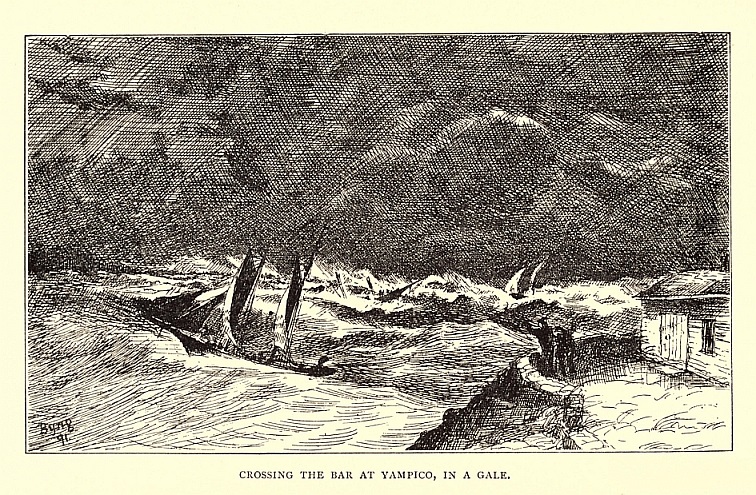
CROSSING THE BAR AT TAMPICO, IN A GALE.
When I returned on deck, the pilot's boat and the custom's
boat were alongside. I rated the pilots for not coming off in
the afternoon as they had promised to the St. John. They
said it was impossible for a boat to go off during the day.
When they went off in the morning there was some swell on
the bar which they thought would go down, but it increased
during the day, so that a boat could not cross the bar, and
they supposed that there must have been a heavy gale to the
northward. I said there had been a heavy gale, but it seemed
not to have reached as far south as Tampico.
I then asked if we could do anything for the crew of the
St. John. They said that no boat could get to her just then,
but there was a chance for both the vessel and crew, as she
was in past the worst part of the bar, but the larger schooner
was gone with all hands. She had struck near the outer end
of the channel and disappeared almost immediately. The
St. John had a very heavy deck-load of lumber, and if they
could get that off her she would float off as the tide was
making.
They then made signs to the St. John to throw off their
deck-load, but it was dangerous for the men to come down
from the rigging. The seas breaking over the vessel soon
washed away the greater part of the deck-load, and the vessel
floated and was driven further in, where she grounded again,
but she was so near to the edge of the smooth water that with
the help of the floating lumber and our boat and that of the
pilots, the men were all saved, although some of them were
badly bruised.
I offered to take them up to Tampico Town, but they
preferred to remain at the pilot station to see about getting
their vessel in over the bar, which they succeeded in doing
about two days afterwards. Of the larger schooner nothing
was ever seen, not a vestige of her could be discovered when
the weather moderated. It was supposed she had been to
Vera Cruz, where she had discharged her cargo and had come
to Tampico to load with dyewood.
By the time the crew of the St. John had been picked up it
was getting dark and blowing hard, and to seawards there was
every indication of a heavy gale, and we were certainly very
grateful that we had got safe inside of the bar. We took the
advantage of the fair wind to run up the river to Tampico
Town, which we were not long in accomplishing. The river
was very high, and we anchored in front of the town.
Father Ryan now asked leave to offer a short thanksgiving
for our safe arrival, which was appreciated.
As no one had slept since the previous day, and it had been
rather a trying twenty-four hours, I expected all hands would
now be glad to get a little rest, but for this they were not the
least inclined; there was the usual rejoicing at getting in.
They thought of the dangers now past; the gale howled overhead,
but they were now safe and snug in harbour, the voyage
successfully ended. Big pay and bonus to receive, they sung
and danced about, and said they thought the captain ought to
treat them to champagne.
I told them I thought they should have more solemn
thoughts, and express their inward gratitude to Heaven for
their safety and preservation, and remember the fate of the
poor men on the other vessels. They allowed all that, and
said they were truly grateful for their preservation, and now
that the danger was past they wished to drink my health and
give me credit for my able management of the vessel during
the trip.
There is a good deal in fair words, and it requires a pretty
strong-minded man to be always proof against them. The
men had certainly done their duty, and I acknowledged it to
them, and said I was willing to show my gratitude in any way
that would not be injurious to them; and, turning to Father
Ryan, I said, "What do you say, Father Ryan?"
The old man said he thought the men had done their duty
well, and if they would only do it as well in keeping within
moderation—which he thought he could answer they would—there
would be no harm in my giving them a small treat.
It was now past seven o'clock and dark, but there was
already some boats alongside—"Bummers"—one of which
had done business for us last voyage. I called the owner
of this boat and wrote to a respectable restaurant which I
knew, directing them to send off at once what would be
necessary for a good supper for all hands, with some good
champagne. In the meantime, the crew having got everything
made snug and got their wet clothes shifted, the boat came
alongside with the articles, and the men enjoyed themselves,
and they were as good as their word, and kept within
moderation. As I wished every man to get rest, I employed
two men from the shore, who had worked for us last voyage,
and who I could depend upon, to keep anchor watch, and
we all enjoyed a pleasant sleep that night.
Next morning, when the business of discharging and disposing
of the cargo recurred to me, it again brought back to
me unpleasant feelings which I had forgotten during the
excitement of the voyage. The dangers of the seas and enemies
were now overcome. Both were honest and to be respected;
but to think of the action of those who should have been my
friends, and for whom I was undergoing such dangers on this
small vessel, was an unpleasant reflection on the top of the
happy thoughts of our providential preservation.