ABRAHAM, a descendant of Shem, one of the sons of
Noah, was the father and founder of the great Israelitish, or Hebrew, nation.
God chose him from all the people living on the earth at that time, for this
purpose, promising that He would make his name great and that his descendants
should have for their own the land of Canaan, a country in Palestine lying
west of the river Jordan and the Dead Sea.
Abraham had a son named Isaac, who became the father of Jacob, and Jacob
was the father of twelve sons, among whom was Joseph, who was sold into
slavery by his brothers when but a boy. Joseph was taken to Egypt and in time
rose from a slave to be the governor of that country under Pharaoh, its
king.
Jacob, with his eleven sons and their families, settled in Egypt at the
invitation of Pharaoh, and after the death of their father his sons continued
to live there, and became prosperous. After the death of Joseph they increased
rapidly in numbers, and from shepherds and herders of flocks became masters of
various crafts and occupations. At this time they began to be called "The
Children of Israel."
They lived in towns and villages in the land of Goshen, on the eastern
border of Egypt, industrious and contented. The king who had been so friendly
to Joseph was now dead, and another Pharaoh ruled the land. He watched with
much distrust the growing wealth and greatness of the children of Israel and
determined to prevent any possible harm they might do him by making them work
for him instead of for themselves.
So Pharaoh began to treat the Israelites like slaves. Under the direction
of his officers he set them at work making bricks and then had them build two
cities to hold his treasures. From a prosperous people they were now reduced
to the condition of common laborers, working without pay day after day in the
burning heat of that country.
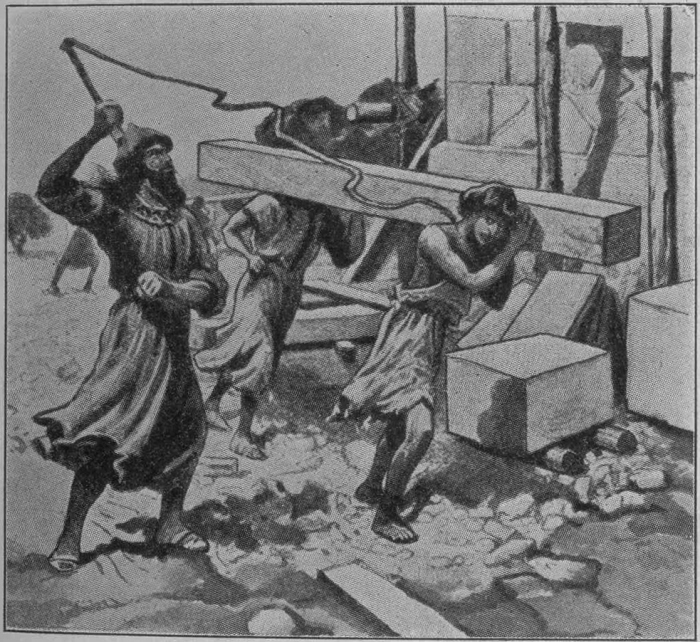
"WORKING WITHOUT PAY DAY AFTER DAY."
But in spite of their hardships the Israelites increased in numbers, and,
to further crush them, Pharaoh ordered that all their boys should be destroyed
as soon as they were born. But the people would not obey this order, and then
Pharaoh commanded that all boys should be flung into the Nile, the sacred
river of Egypt, immediately after their birth.
At this time a child was born among the Israelites whose life was to be one
of the most remarkable that history has recorded for us. His father's name was
Amram and his mother's Jochebed, and they belonged to the tribe of Levi, the
third son of Jacob. They had two older children, a son named Aaron and a
daughter named Miriam.
The mother of this little boy managed to keep him out of sight for three
months, and then she made a little boat of the water-reeds called papyrus,
fastening them together with clay and pitch. It was not much more than a
basket, but she put the baby into it and placed it among the rushes at the
edge of the river Nile, leaving her daughter Miriam to see what became of her
baby brother.
The Egyptians had many beliefs which appear very strange to us now. One of
them was that anything surrounded by papyrus would be safe from the crocodiles
which infested the river. Possibly Jochebed had some faith in this
superstition, for during the time when the Israelites were living contentedly
in the land of Goshen, many of them had fallen into the customs of the
Egyptians, worshipping Ra, the sun-god, Apis, the sacred calf, and others of
their national deities.
While Miriam was watching the little boat and its precious burden, the
daughter of Pharaoh, with her attendants, came to the river to bathe. She saw
the little boat floating among the rushes and ordered it to be brought to her.
As she looked down at the baby it cried, and, while she must have known that
it was the child of Israelitish parents, her heart went out to it in pity, and
she declared that she would bring it up as if it had been her own child.
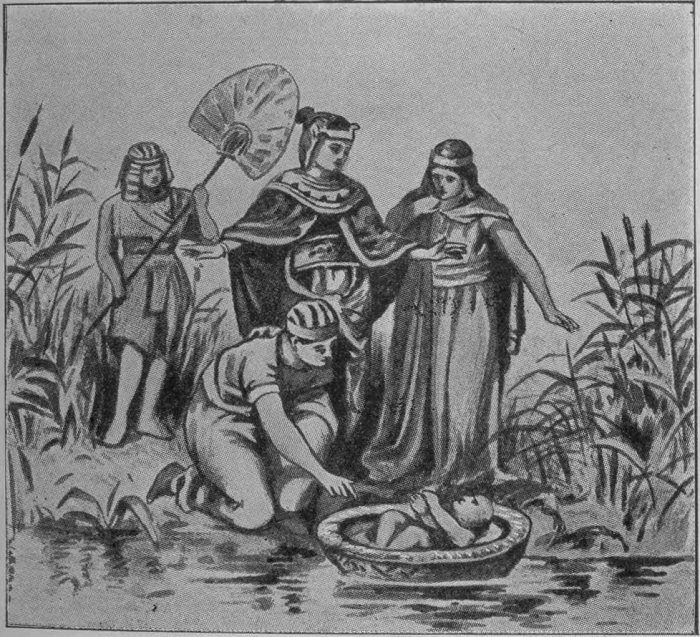
"IT WAS NOT MUCH MORE THAN A BASKET."
Miriam then came forward and asked if she might find a nurse for the child.
The princess sent her on this errand and the little girl hastened to bring her
mother. Then the princess gave the baby into the charge of its own mother, and
promised her that she should be paid for taking good care of the child.
When the baby had grown to be quite a boy the princess took him to her
palace and treated him as if he had been a son of her own. She named him
Moses, which means "drawn out," because she had taken him from the water.
Then the princess had him trained and taught as though he were really to be
a prince. He was instructed in all the wisdom of the Egyptians and became
learned and powerful. All the pleasures and honors of Pharaoh's court were
open to him, and from them he could have selected what pleased him most.
But the misery and degradation of his own people appealed to him more
strongly than the splendor and preferments of the Egyptian court. His spirit
was especially stirred one day when he saw an Egyptian overseer abusing an
Israelite in the fields where that oppressed people were still making
bricks.
In his anger at this sight he killed the Egyptian and buried the body in
the sand. The next day he interfered in another quarrel—this time
between two of his own people, but all he received for his efforts as
peacemaker was the knowledge that they knew he had killed the Egyptian the day
before.
For this reason, and also because Pharaoh suspected him of scheming to
deliver the Israelites from their bondage, Moses felt that his life was not
safe in Egypt, so he left the court and went to the land of Midian. He was
then forty years old.
One day when he was resting by the side of a well, the seven daughters of
Jethro, the chief and priest of Midian, came there to water their father's
sheep. Some shepherds, who also wanted to use the well, drove them away, but
Moses took the part of the maidens and watered their flocks for them.
When Jethro heard of this he invited Moses to be his shepherd and to live
in his house. Moses accepted the home offered him, and in time married
Zipporah, one of Jethro's daughters. They had two sons, one named Gershom, a
word which means "stranger," and Eliezer, or "God is my help."
For the next forty years Moses led the life of a shepherd in the land of
Midian, in gradual preparation for the great work he was to do later. He
certainly learned patience and must have become familiar with the country
through which he was to lead the children of Israel when the time of their
deliverance from Egypt came. During this time the afflictions of the
Israelites had been increased. Another Pharaoh ruled the land, but his reign
brought no relief to the nation toiling under cruel taskmasters.
One day Moses was feeding his flocks on a mountain called Horeb, when he
saw a bush of wild thorn, or acacia, apparently on fire. He looked more
closely but could see no smoke, neither were the leaves and twigs blackened or
consumed.
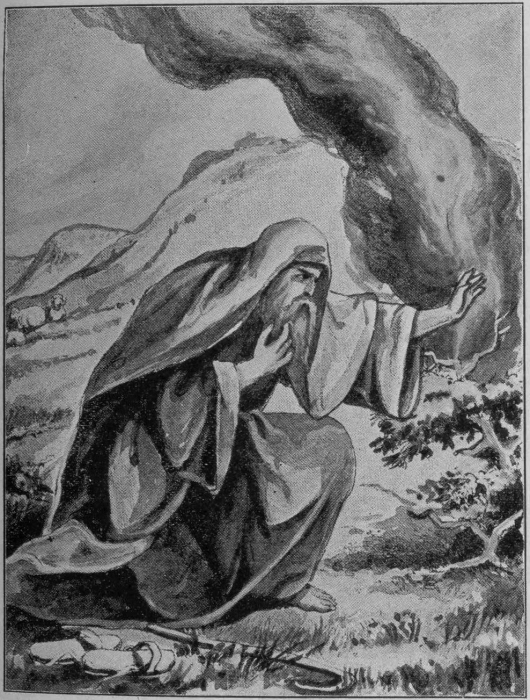
"A BUSH OF ACACIA APPARENTLY ON FIRE."
Then a Voice which seemed to come from the bush called, "Moses, Moses."
Understanding that it was the Voice of God, Moses answered, "Here am I." Then
God told him to come no nearer, and to take off his shoes and stand with bare
feet, for His presence made the spot holy ground.
Moses tremblingly obeyed and stood with covered face while God told him
that He had heard the cries and seen the affliction of the children of Israel,
and that He would set them free from their bondage in Egypt. He told Moses
that He had chosen him to be the deliverer of His people and their leader to
the land of Canaan, which He had promised to Abraham.
Moses felt unequal to this great undertaking and tried to excuse himself on
various grounds. He said that the Israelites would not listen to him unless he
could, by means of signs and wonders, convince them that he was the divinely
appointed leader, and he also said that he was not a ready speaker.
But God told him just what he had to do and that his brother Aaron should
be his spokesman. He bestowed upon him the power to do wonderful things and
promised His own protection and help. Moses could refuse no longer, and
accepted the divine commission. Then the Voice ceased, the vision of the
burning bush faded away, and Moses was alone again with his flocks.
When Moses returned to his home he told Jethro that he wished to go to
Egypt, and in the speech of those days Jethro replied, "Go in peace." So Moses
set out on his journey and on the way met his brother Aaron, whom God had sent
to meet him.
Then Moses related to Aaron all that God had said to him from the burning
bush, told him the part he was to take in God's plan, and showed him the rod
which he was to use in performing the wonderful things by which the Israelites
were to be convinced that he was their divinely appointed deliverer from the
land of Egypt. Then the two brothers went on their way together.
As soon as Moses and Aaron arrived in Egypt, they called the people
together and told them that God was going to deliver them from their bondage
and give them the land of Canaan. At first the Israelites were very thankful
for the message, but after the first failure of Moses to get Pharaoh's consent
to let them go they began to doubt it, especially as from that time the King
imposed harder tasks than ever upon them.
Then Moses and Aaron went a second time to Pharaoh. Aaron threw down his
rod and it became a serpent. The magicians of the court did the same thing,
and threw down their rods, which became serpents, but Aaron's rod swallowed
theirs. Then the King once more refused to let the people go.
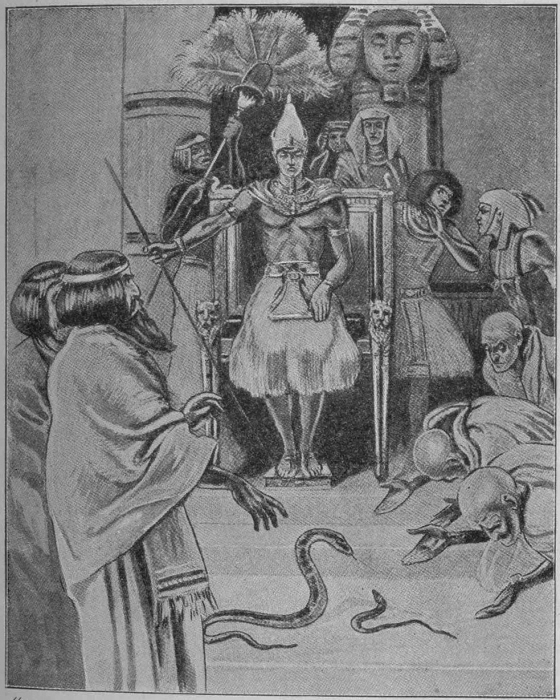
"AARON THREW DOWN HIS ROD AND IT BECAME A SERPENT."
Then, one after another, God sent terrible plagues upon the Egyptian people
to show Pharaoh that He was the one Living and True God and that the children
of Israel must be allowed to go to the land He had promised them.
The first of these plagues was the changing of the waters of the Nile into
blood. The Egyptians were a very cleanly people, paying great attention to
their bodies, and were generally dressed in white. They were accustomed to
bathe in the Nile, and its appearance at this time must have filled them with
loathing. But Pharaoh again refused to let the people go.
Then one after another eight more plagues were sent upon the land. They
were equally disgusting to such a people and gave them the greatest discomfort
possible, but, while Pharaoh relented from time to time, he persisted in his
refusal to let the children of Israel depart from his kingdom.
During all this time the land of Goshen, where the Israelites lived, was
exempt from these inflictions. Pharaoh must have known this and he must have
begun to understand that their God punished those who refused to do as He told
them, but he was obstinate and still refused his consent. It required another
and a more severe judgment before Pharaoh consented to let the children of
Israel go.
It was now the month of Nisan or Abib, which means the "month of green
ears," and in consequence of what occurred at that time Abib has ever since
been the first month of the Hebrew sacred year. By God's command the blood of
a lamb was to be sprinkled upon the sides and top of the doorway to every
Israelitish home. The lamb itself was to be roasted and eaten by the family,
who were to be dressed for a journey and ready to start on it at a moment's
notice.
At midnight the tenth and last judgment fell on the Egyptians. A wail of
anguish rose from every home in the land, for the first-born child in every
home lay dead. The angel of death had entered the palace of the King and the
hovel of his poorest subject alike, sparing only the homes where the blood-
sprinkled doorways told of God's protection.
Convinced at last that he could not successfully combat the God of the
Israelites, Pharaoh now begged Moses to hasten their departure, and the
Egyptian people were so anxious to have them out of the land that they gave
them jewels and clothing to induce them to go quickly.
So the whole Israelitish nation—some six hundred thousand men without
counting the women and children—set forth, on foot and in the night,
under the leadership of Moses, for the land of Canaan. With them they took the
coffin containing the embalmed body of Joseph, which had been carefully kept
in Egypt since his death. And God showed them the way they were to go by
having a cloud move before them in the daytime, and gave it the appearance of
fire at night.
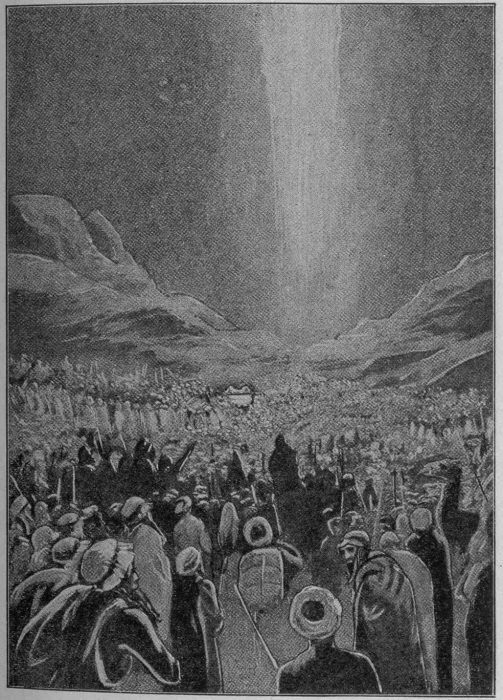
"THE APPEARANCE OF FIRE AT NIGHT."
The shortest way to the Promised Land, which lay along the eastern coast of
the Mediterranean Sea, led through the country of the Philistines, a warlike
people who afterwards became the inveterate enemies of the Israelites, but
with whom they were not now able to contend. So they traveled in a
southeasterly direction until they came to that part of the Red Sea which is
now called the Gulf of Suez.
Pharaoh in the meanwhile had recovered from his terror and remorse, and
with a mighty army was pursuing the Israelites, intending to take them back to
Egypt. He first came in sight of them encamped upon the African border of the
Gulf. When the Israelites knew that they were pursued they turned angrily upon
Moses and Aaron for taking them away from Egypt. But Moses told them to trust
God for He would not let Pharaoh overtake them.
Then Moses lifted his rod and stretched it out over the waters, and God
sent a strong east wind which forced them back and left a passage for the
wandering people to cross to the other shore. So on they marched in the fury
of the storm, while Pharaoh and his host were overwhelmed by the waters, which
rushed back again after the children of Israel had reached the further
side.
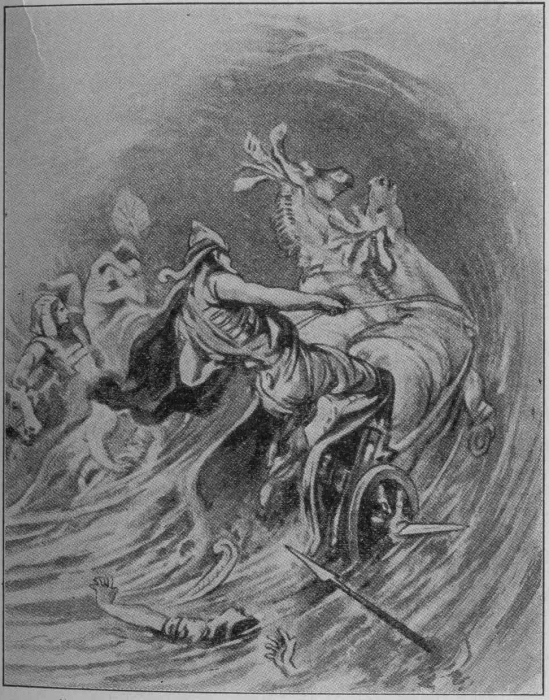
"PHARAOH AND HIS HOST WERE OVERWHELMED."
Then the Israelites broke out into songs of praise and thanksgiving to God,
who had so marvelously preserved them from Pharaoh's anger, led by Miriam, the
sister of Moses, the one who had watched him as a baby in his little papyrus
boat among the rushes on the bank of the Nile.
During the next three days of their journey no water was found. Then they
came to a well, but the water was not fit to drink. Again they found fault
with Moses, but he threw a tree which God showed him into the well and the
water at once became sweet and good.
Before long they were traveling in a desert country and their stock of food
gave out. As before, the Israelites accused Moses of having led them from
Egypt to die in the wilderness. But God sent them great flocks of quails, upon
which they fed, and covered the ground every morning with a curious substance,
round and white, which was good to eat. In wonder the Israelites exclaimed
"Man-hu?" which meant "What is it?" and so this mysterious food began to be
called manna.
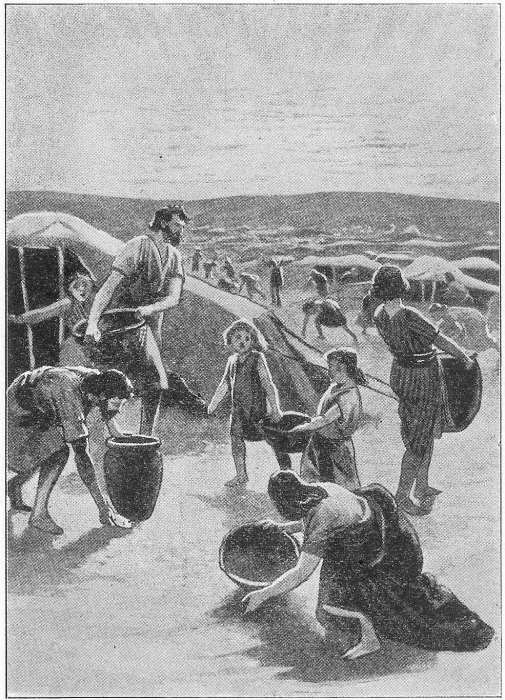
"COVERED THE GROUND WITH A CURIOUS SUBSTANCE."
Then they got out of the desert and camped at a place called Rephidim. But
here there was no water, and the people became so angry with Moses that they
were ready to kill him. Then God told Moses to strike one of the rocks with
his rod and water poured out in abundance.
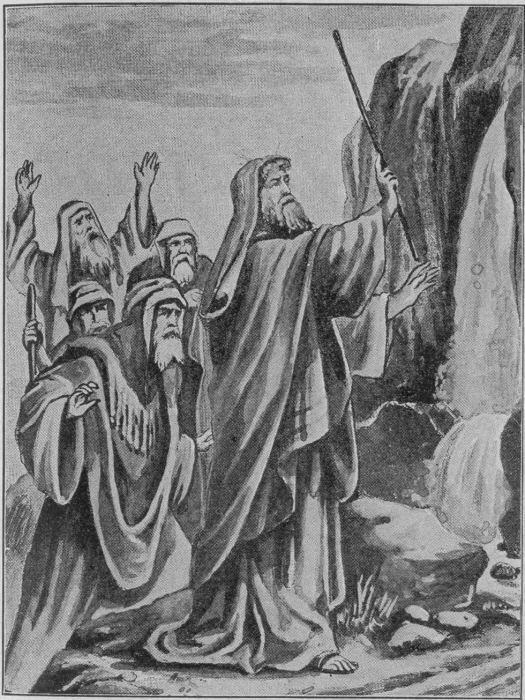
"WATER POURED OUT IN ABUNDANCE."
Then a new trouble came upon the wandering nation. A people called the
Amalekites attacked them, and for the first time since leaving Egypt they were
obliged to defend themselves by fighting.
Moses chose a young man named Joshua to be the leader of a selected band
and sent him to do battle for the children of Israel, while he held up his
hands in prayer to God to help His people. So long as Moses' hands were
uplifted Joshua was victorious, but when from weariness he let them fall then
the Amalekites prevailed. So Aaron on one side and Hur on the other supported
his weary arms and at sunset Joshua had won the battle.
Shortly after this Moses was visited by Jethro, his father-in-law, who
brought with him Moses' wife and two sons, who had remained with him in Midian
for safety. Moses welcomed them and told Jethro all the wonderful things God
had done for His people. Then Jethro said, "Now I know that the Lord is
greater than all gods."
From Rephidim the Israelites passed into the desert of Sinai and from the
top of Mount Sinai God gave Moses a message for them. Among clouds from which
lightning gleamed and thunder muttered, Moses was given the Ten Commandments,
which were to be kept by the Israelites and their children, and laws which
they were to observe.
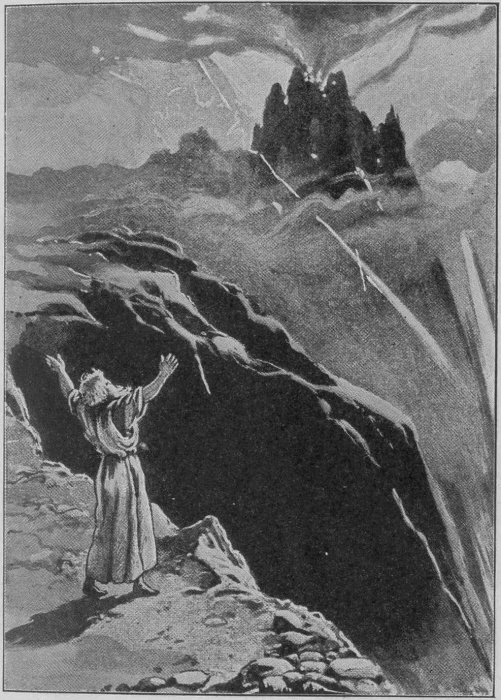
"AMONG CLOUDS FROM WHICH LIGHTNING GLEAMED."
A second time Moses was called to communion with God on Mount Sinai, and
Aaron, Nadab, Abihu, and seventy of the elders of the children of Israel were
permitted to accompany him a part of the way, while he and Joshua, the young
leader of the Israelites in their first battle, went on further.
After waiting for six days Moses went alone nearer to the top of the
mountain and staid there forty days and forty nights while God disclosed to
him His purposes regarding the children of Israel, and delivered into his
hands two tables or tablets of stone upon which He had graven the Ten
Commandments.
When Moses came down from Mount Sinai a strange sight met his eyes. In his
absence the fickle Israelites had persuaded Aaron to make them an idol such as
they had seen in Egypt and which they could worship. They had given Aaron
their jewels of gold and he had made of them a golden calf, to which they were
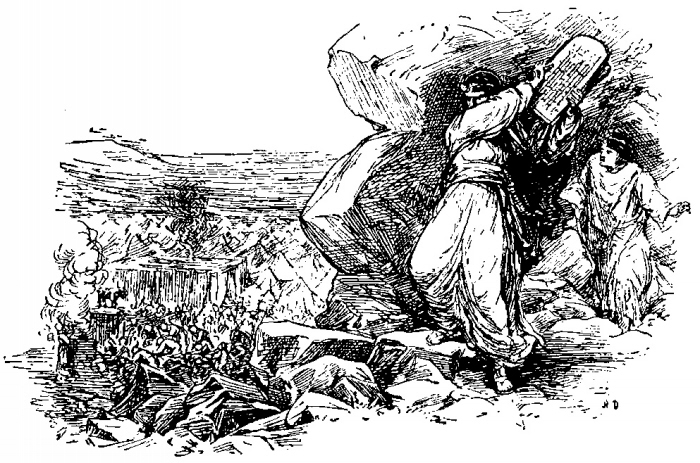
now bowing down and offering sacrifices. In his anger Moses cast the tablets
of stone from him and in their fall they were broken.
Then after reproaching Aaron for what he had done, Moses destroyed the
golden calf by fire and by grinding it to powder, and strewed the ashes and
powder upon water, which he made the Israelites drink.
Then he stood at the gate of the camp and called for all those who were on
the Lord's side to come and stand beside him. The children of Levi, the third
son of Jacob, answered this call, and Moses told them to go through the camp
and slay every man they met. This they did, and three thousand Israelites fell
at that time.
After this God told Moses to make two tablets of stone like those he had
broken, and with them come alone to Him on Mount Sinai, where He would engrave
upon them the words which were on the first tablets. Moses did this, and when
he came down from the mountain his face shone so that Aaron and the people
were afraid to speak to him until he had put a veil over it.
For more than a year the Israelites remained near Mount Sinai, and during
that time Moses told them, among other things which God had imparted to him,
how the Tabernacle was to be made, who its priests were to be, and how the
services were to be conducted. The people brought him all the material they
had that was suitable for those purposes, and skilful men built the beautiful
and costly Tabernacle, in which was placed the Ark of the Covenant, which they
were also instructed to make.
Aaron was appointed high priest and his four sons were made priests to
assist him in the services. The Sabbath or seventh day was to be strictly
kept, and various feasts and ceremonies were instituted. Particularly the
feast of the Passover was enjoined upon the Israelites to commemorate God's
mercy in passing over their homes when the first-born of the Egyptians were
slain.
Then the pillar of cloud, which, with the pillar of fire, had never ceased
to show the Israelites the way they were to go in their journeys, rested over
the Tabernacle, and at this sign that they were to resume their march to the
land of Canaan, the children of Israel marched forth once more and in time
came to Kadesh-barnea, near the borders of the promised land.
Then a man was chosen from each of the twelve tribes to see what the land
of Canaan was like and to find the best way of entering it. They were gone for
forty days, and when they returned their accounts differed. All agreed as to
the exceeding fruitfulness of the land, in proof of which they brought back a
bunch of grapes so large that it took two men to carry it. But only two
advised an immediate advance into the land. These were Joshua, the young
general, and a man named Caleb.
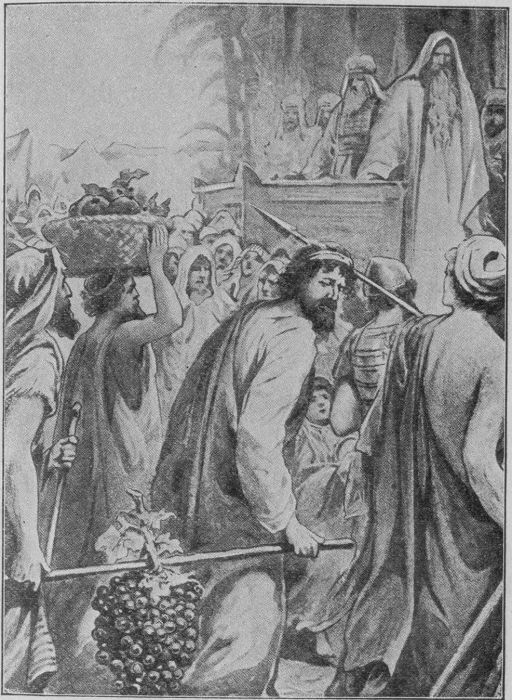
"A BUNCH OF GRAPES THAT TOOK TWO MEN TO CARRY
IT."
The ten remaining messengers frightened the people by their account of the
giants and warlike tribes they would have to encounter and the many dangers
that would have to be met, and the people, fickle as ever, believed these
reports and again reproached their faithful leader.
But their punishment was swift and severe. The ten messengers of evil died
on the spot, and God commanded Moses to tell the people that, for their
doubting and faultfinding, not one of them over twenty years old except Joshua
and Caleb should enter the land of Canaan. Their children might do so, but
they could never set foot in it. They were to wander in the desert until they
died.
After thirty-eight years the wandering nation, which during this time had
been fed with manna and so cared for by God that they were neither footsore,
neither did their clothes wear out, was again encamped at Kadesh-barnea. In
the interval great numbers of the people had died, and here Miriam, the sister
of Moses and of Aaron, died and was buried. Water was again scarce, and the
people, as formerly, heaped reproaches upon Moses and Aaron, who asked God
what to do.
God told them to speak to one of the rocks and it would produce water in
plenty. Instead of doing exactly what they were told, Moses and Aaron first
rebuked the people and then Moses struck the rock with his rod. An abundant
supply of water followed, but for this act of disobedience and this display of
irritation, both of the brothers were forbidden to enter the land of
Canaan.
Before long Aaron died at the age of one hundred and twenty-three years and
was buried in Mount Hor. After mourning him for thirty days, the people again
broke out into discontent and in punishment were bitten by venomous serpents,
which were sent among them for that purpose. Many died in this way, and then
the people turned to Moses, who prayed to God in their behalf. God told Moses
to make a serpent of brass and raise it upon a pole high above the heads of
the people, and every one who looked upon this serpent, although he had been
bitten, was healed at once.
At last the Israelites came within sight of their inheritance and Moses'
work was nearly done. He appointed Joshua to succeed him and lead the children
of Israel into the land of Canaan. Then he gathered the people together and
made them an affectionate farewell address. He wrote down for them all the
words of the laws which God had given him for them and gave them to the
priest.
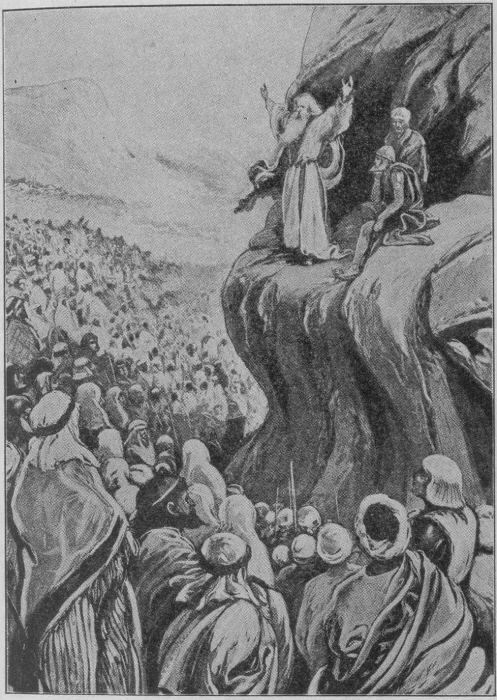
"MOSES MADE THEM A FAREWELL ADDRESS."
Then Moses went up from the plains of Moab onto a mountain from which he
could look over the land of Canaan, which he was not to enter, and there he
died. He was one hundred and twenty years old, yet we are told that his
eyesight was undimmed. Where he was buried no one knows. The Bible says, "The
Lord buried him in a valley in the land of Moab, over against Bethpeor."
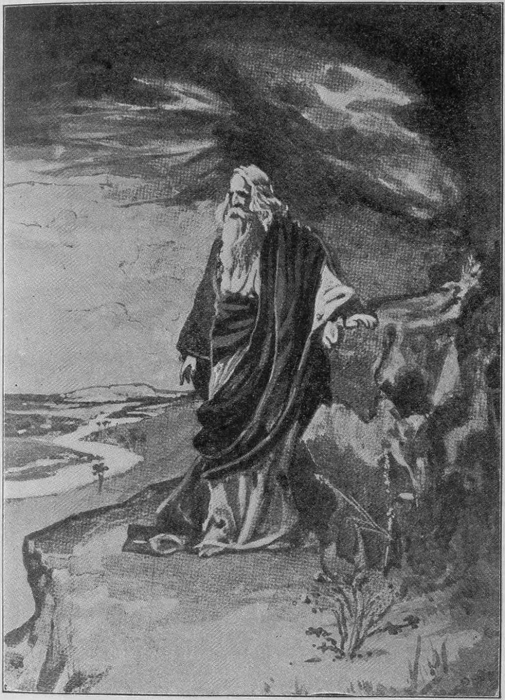
HE LOOKED OUT OVER THE LAND OF CANAAN.
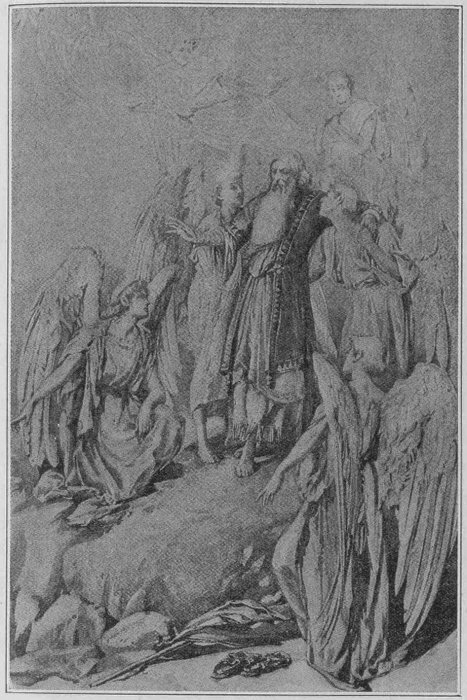
"AND
THERE HE DIED."