We are now going to relate an event, in
which our heroine had need of all the exertion
and fortitude which the education
she had received had so forcibly inculcated.
Her mother's grave was always an
object of attention to her; and though no
pompous monument adorned the place, or
flattering eulogy appeared on the simple
stone which stood at its head (her name,
and age, with the date of the year in
which she died, being all that was engraved
there), Anna regarded it with interest,
because it was all she had ever
known of her parent; and never passed it
without reflecting on her birth, and thinking
of her father; and it was on this very
spot she was destined to meet him, whom
she had so often wished to hear of, and
who for twenty years had made no inquiry
after her.
She was one autumnal evening walking
through the church-yard rather later than
usual, and alone; having left Betty, who
had come out with her, at her father's, to
assist in preparing her younger sister's
clothes, who was just then going out to
service for the first time; it was twilight,
and she stepped out of the path on perceiving
something near her mother's grave,
which she could not distinguish without
approaching nearer. As she advanced she
saw a man stooping down, as if to read
what was written on the stone, and which
the dimness of the evening scarcely allowed
him to see. His whole attention
was engrossed, and he did not hear her
footstep.
"Anna Eastwood," said he, "daughter
of William and Mary Campbell;—Ah! that
is her. But is there no other name? Is
there not another Anna Eastwood? Did I
not hasten the death of my child also?"
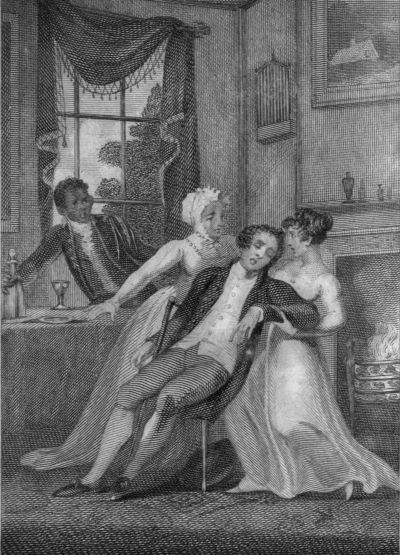
Anna heard no more, but overcome by
the suddenness of the discovery, uttered a
faint scream and fell senseless on the turf.
The man started from his reverie; and perceiving
by her white dress where she lay,
at that moment lost to all animation as the
dead by which she was surrounded; he
hastened to her relief, and raising her in
his arms, without the least idea how near
she was allied to him. He supported her
and himself against the tombstone, till
her faint breathings informed him she revived.
At this moment a labouring man
passed along the path; and Eastwood
called to him.
"Come here, my friend," said he, "and
assist this young lady."
"Gracious me!" exclaimed the man, on
perceiving who she was, "it is Miss Meridith!
How did she come here at this time
of the night? Is she very bad?" continued
he, on observing her tremble, and looking
wildly around.
"Don't you know me, Miss—poor
Thomas?—Don't be frightened, nobody
shall hurt you; did this man attempt it?"
"Oh, no," replied Anna, who had now
gained her recollection, and scarcely able
to refrain from declaring he was her father;
but reflecting on Mrs. Meridith's uneasiness
at her stay, she expressed a wish
to go home.
"Can you walk, Madam?" said the
stranger, gathering from her appearance,
and the manner in which the labourer regarded
her, that she was in a superior situation.
"Will you allow me to assist
you? I am a stranger here, or I would
offer to call some one, but perhaps this
man can procure you a conveyance?"
"I shan't leave her alone with a stranger,"
said Thomas; "who knows what you may
be?" ("Who, indeed!" thought Anna,
with a heavy sigh;) "or what you have
done to her? She a'n't used to be soon
frightened! Miss Meridith is none of your
timid-hearted young ladies."
"Indeed I am not," returned Anna; "I
am able to walk now, and if you will accompany
me to Rosewood, I will thank
you, Thomas."
"That I will, Miss," replied he, "I will
see you safe home; and be glad you be a
little more like yourself again."
"And will you not permit me, Madam,
to assist you?" repeated the stranger; "I
do not think you can walk without support."
"I would wish,—I should be obliged;"
returned Anna, in hurried accents, and her
agitation became again so great, that she
involuntarily rested on his arm to recover
herself.
"I fear I have greatly alarmed you,"
said he, "but I am sure it was unintentionally."—"I
hope that's true," thought
Thomas, who stood watching him as narrowly
as the twilight would permit.
"How far are we from this lady's home?"
asked the stranger.
"Oh not above a quarter of a mile,"
said Thomas, "if she could but walk."
"I can now," said Anna, "and I will
accept your offer, Sir." She then advanced,
leaning on her father's arm, her
heart beating all the way with an emotion
not to be expressed, and Thomas on the
other side of her.
Neither of them spoke a word, till, as
they entered the gate which led to the
house, they met Syphax coming out in
search of his young lady.
"O! my dear Miss," said he, "I am
glad you are come; we have been quite
uneasy at your staying so late."
Thomas was the only one who could
speak, so as to account for it, and his relation
was so unconnected, and so full of his
surprise at finding Miss Meridith in the
church-yard alone with a strange man,
that little could be learnt from it, except
that as he said he was determined not to
leave him with her again, or he would
have ran and called somebody; for which
he was rewarded with some good ale by
Syphax, and a handsome present from Mrs.
Meridith.
When they entered the hall, where the
lamp was already lighted, Anna and her
conductor first saw the faces of each other;
but without that emotion on his side which
it occasioned on her's. "And is this my father?"
she was ready to exclaim; but
checking herself, she desired Syphax to
shew him into the parlour; and begging
him to wait till she saw him again, she
ran, or rather flew up stairs into Mrs. Meridith's
apartment, who was anxiously
waiting her return; and without giving
her time to say a word, she threw her arms
about her neck, and exclaimed, "Oh!
Mamma, I have seen my father!"
For a moment Mrs. Meridith was apprehensive
that her senses were affected, but
when she saw the tears which accompanied
her declaration, and her pale, yet expressive
face, she could not disbelieve her;
but begging her to be composed, she placed
her on the sofa, and then shutting the door
of the room, she seated herself by her
side, and desired to hear more of what had
passed.
"This is an event," said she, "which
was not unlikely to happen, if your father
yet lived; but tell me where did you meet?
and are you sure it was him?" The calmness
with which Mrs. Meridith spoke, extended
itself in a little time to Anna, and
she related what had passed at her mother's
grave, with as much composure as
could be expected.
"Then he does not know you as his
daughter?" said Mrs. Meridith, "You had
great resolution not to discover yourself,
and I am glad of it. Is he now below?"
"Yes," replied Anna, "and what shall
I do? If he makes any inquiry in the village
he will soon find out who I am; and
then—"
"What then?" said Mrs. Meridith, "he
may be a reformed man, and what you
have already witnessed seems to promise
it; I will go and talk to him, and if by his
conversation I find him a different man
from what he once was, you may yet have
reason to rejoice in your father."
"And may not I go too?" asked Anna.
"If you can command your feelings to
hear the account he may give of himself,
without discovery, I have no objection,"
replied Mrs. Meridith.
"I think I can, after what has already
passed," said Anna: "pray let me go; I
will not say a word;" and they descended
to the parlour together.
The Stranger rose at their entrance;
while Anna shrunk behind her protectress.
His appearance was not uninteresting, and though a deep melancholy sat
upon his features, it might be seen he had
once been handsome; he looked older than
he really was, and his clothes and address
evinced him to be above a common person.
"Pray be seated, Sir," said Mrs. Meridith,
"I am come to thank you for your
assistance to Miss Meridith; I hope my
servant has not neglected to offer you some
refreshment," and she rang the bell. The
Stranger bowed, and declined taking any
thing; and hoped the young lady was quite
recovered.
Anna's lips moved, but her pale and agitated
countenance told him she was not.
When Syphax entered, he replenished the
fire, and placed something to eat and drink
on the table, but still the Stranger refused
it.
"Are you quite unknown in the village,
Sir?" asked Mrs. Meridith.
"At present I am, Madam; but I expect to meet—I have been acquainted"—here
he hesitated, and was again silent.
"You will think my questions very impertinent,
Sir," resumed Mrs. Meridith,
"if I do not tell you that I take your
name to be Eastwood."
"And is it possible any one can know
me?" exclaimed the man, and covering his
face with his hand: "Oh! do not say you
do; for I am truly ashamed of what I have
been."
"You are the person I took you for,"
replied Mrs. Meridith, looking affectionately
at Anna, whose tears flowed afresh;
"yet as much altered, perhaps, in mind as
in person."
"More, more, I hope, Madam," replied
he with emotion; "I am ashamed of what
I have been; but how could you know me?
I do not recollect any one like you."
"Perhaps not," replied she; "but I have
heard of you from Mr. Campbell."
"Oh! then you must despise and hate
me!" said he, again hiding his face. "But
indeed I am not what I was: and can you
tell me," added he, "who are alive of
that family? Is there any of my name
among them?" and he looked with eager
attention for her answer.
"None that I know of," replied Mrs.
Meridith; "the old farmer and his wife
are both dead; and their eldest son is married,
and has a large family."
"But are they all his own children?"
repeated the man with great earnestness;
"has he not one of mine?" His distress
was so great that Mrs. Meridith, forgetting
the caution she had given Anna, could not
help endeavouring to relieve it by replying—
"No, but I have;—that is her."
It was now Anna's turn to support her
father, for he sunk back motionless in the
chair, only uttering, "It is impossible!"
She flew towards him, and bathed his
face with her tears while she hung over
him with inexpressible pleasure and emotion.
When a little revived, he exclaimed,
"and have you been a mother to her, when,
through my inhumanity, she had lost her
own? Oh, what a merciful Providence
has watched over my child! when I, wretch
that I was, was totally unmindful of her!"
In this way he kept soliloquizing, while he
looked first at one and then the other, and
then repeated his thanks to the Almighty.
"But can my child forgive me?" continued
he, very impassionately.
"Do not ask it, my father!" said Anna,
then first venturing to throw her arms
around him, and calling him by that endearing
name; "do not ask it,—I am only
thankful that I am permitted to see you as
you are; I have now no other wish but
to evince my ardent gratitude to Mrs.
Meridith for all her kindness to me; you
must help me to do it, my father."
"And you, my child, must instruct me
how," said he; "for till very lately I have
been little used to any thing commendable.
Suffer me to embrace you, and receive a
father, who, though he has but little to offer
you, has an earnest desire to make you all
the recompense in his power for his former
conduct towards you."
Anna could only answer him with tears,
and while the whole party were thus engaged,
Mr. Campbell entered the room,
having heard part of Anna's adventure
from Thomas, who, on his return home,
reported it through the village, "how he
had met Miss Meridith in the church-yard
almost as dead as a stone, and a strange
man with her;" and he hastened up to
know the truth of it.
On his entrance, Anna looked at Mrs.
Meridith to announce her father, and then
at him, to observe if he recollected her
uncle: which he immediately did, and
turning away his face, he uttered, in a low
voice, "How richly have I deserved this
shame! Oh, how shall I bear it!" Mr.
Campbell's countenance was all astonishment
and anxiety.
"Pardon my intrusion, Madam," said he,
to Mrs. Meridith, "but hearing Anna was
ill, I came to see if it was so; I did not
know you had company."
"A stranger," replied Mrs. Meridith,
evidently much embarrassed.
"Him who was with Anna?" asked Mr.
Campbell, scarcely knowing what to think.
"Good Heavens! what can be the matter?"
"Oh, my father!" exclaimed Anna,
perceiving him almost sinking with shame
and confusion.
"Your father!" repeated Mr. Campbell
in amazement, "can it be him? is it Eastwood?"
"Oh, look not on me!" said the humiliated
man, "I know you must detest me!"
"Mr. Campbell can forgive," said Mrs.
Meridith, feeling much at his distress.
"Not me, not me," replied he, "I cannot
forgive myself."
The farmer stood in silent astonishment,
while Anna took his hand, and with an imploring
look said, "my father is not what
he was, my dear uncle, he is sensible of
his faults; can you desire more?"
"No, my child, I am not appointed his
judge, or his punisher; his crimes have
been their own punishment, I doubt not;"
here a sigh, or rather groan, from the
poor man, witnessed the truth of his remark.
"Let me then join your hands," said
Anna, with emotion, and drawing them
towards each other; "my dear uncle, you
have supplied the place of a father to me,
and now my father thanks you."
"On my knees I do!" said Eastwood;
"may your kindness meet with its due reward."
"And are you indeed an altered man?"
replied Campbell, overcome by his contrition,
"then to my heart I can receive
you; and let all that is past be forgotten."
"Unless my future conduct should remind
you of it," said Eastwood, "and
then banish me from your society for ever."
The rest of the evening was spent in
mutual inquiries, and Anna listened with
an agitated mind to the brief account her
father gave of his former life.