Had I the fabled herb
That brought to life the dead,
Whom would I dare disturb
In his eternal bed?
Great Grenville would I wake,
And with glad tidings make
The soul of mighty Drake
Lift an exulting head.
William Watson.
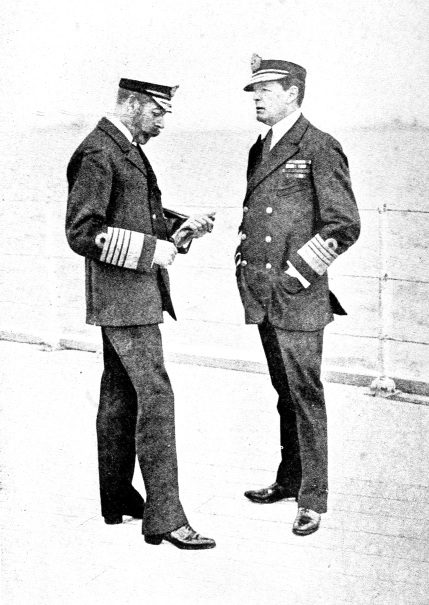
When King George returned from the visit
he paid to the Grand Fleet in June, 1917,
he sent a message to Admiral Sir David
Beatty, who had succeeded Sir John Jellicoe in the
command, in which he said that “never had the
British Navy stood higher in the estimation of friend
or foe.” His Majesty spoke of people who reason
and understand. But it is certainly true that the
work of the Sea Service during this unparalleled war
has never been properly appreciated by many of
those who have benefited by it most. The silent
Navy does its work unobserved. The record of its
heroism and the services it renders pass unobserved
by the multitude. Sometimes it emerges to strike a
blow, engage in a “scrap,” or, it may be, to fight
a battle, and then it retires into obscurity again. Its
achievements are forgotten. Only the bombardment
of a coast town or the torpedoing of a big ship, which
the Navy did not frustrate, is remembered. Such has
been the case in all the naval campaigns of the past.
Englishmen, who depend upon the Navy for their
security and the means of their life and livelihood,
as well as for their power of action against their
enemies, are but half conscious of what the Fleet is
doing for them. On this matter, British statesmen,
when they speak about the war, almost invariably
fail to enlighten them.
Who can wonder that people in the Allied countries
are still less able to realise that behind all the fighting
of their own armies lies the influence of sea-power,
exercised by the British Fleet and the fleets that
came one after another into co-operation with it?
Without this power of the sea there could have been
no hope of success in the war. As the King said,
the Navy defends British shores and commerce, and
secures for England and her Allies the ocean highways
of the world. The purpose of this book is to show
how these things are done.
On the first day of hostilities the British Navy
laid hold upon the road that would lead to victory.
There is no hyperbole in saying that the Grand
Fleet, in its northern anchorages, from the very
beginning, influenced the military situation throughout
the world, and made possible many of the operations
of the armies, which could neither have been
successfully initiated nor continued without it. But
in the early days of August, 1914, when, from the
war cloud which had overshadowed Europe, broke
forth the lurid horrors of the conflict, the situation
was extremely critical. What was required to be
done had to be done quickly and unhesitatingly, lest
the enemy should strike an unforeseen blow. Happily,
with faultless knowledge, the strategy of the emergency
was realised, and with unerring instinct and
sagacity it was applied. The foresight of great naval
administrators, and chiefly of Lord Fisher, who had
brought about the regeneration of the British Navy,
shaping it for modern conditions, was justified a
thousandfold.
Never was the need of exerting sea command more
urgent than at the outbreak of war. Everything
that Englishmen had won in all the centuries of the
storied past was involved in the quarrel. Only by
mastery of the sea could the country be made
secure. Its soil had never been trodden by an
invader since Norman William came in 1066. The
very food that was eaten and the things by which
the industries and commerce of the country existed
demanded control at sea. If the British Empire was
to be safe from aggression it must be safeguarded on
every sea. If England was to set armies in any
foreign field of operations, and to retain and maintain
them there, with the gigantic supplies they
would require; if she was to render help to her
Allies in men or munitions or anything else, whether
they came from England, or the United States, or
any other country, and were landed in France,
Russia, Italy, or Greece, or in Egypt, Mesopotamia,
or East or West Africa, for the defeat of the enemy,
that must be done by virtue of power at sea. Therefore,
in this war, as John Hollond, writing his Discourse
of the Navy in 1638, said of the wars of his
time, “the naval part is the thread that runs through
the whole wooft, the burden of the song, the scope of
the text.”
The moment when the First Fleet, as it was then
called, slipped away from its anchorage at Portland
on the morning of Wednesday, July 29th, 1914, will
yet be regarded as one of the decisive moments of
history. The initiative had been seized, and all real
initiative was thenceforward denied to the enemy.
The gauge of victory had been won. “Time is everything;
five minutes makes the difference between a
victory and a defeat,” said Nelson. “The advantage
and gain of time and place will be the only and
chief means for our good,” Drake had said before
him. By a fortunate circumstance, which should
have arrested the imagination as with a presage of
victory—a circumstance arranged five months before,
as the result of a series of most intricate preparations—time
and place were both on the British side.
The First, Second, and Third Fleets, and the
flotillas attached to them, had been mobilised as a
test operation, and inspected at Spithead by King
George, on July 20th. The First Fleet had returned
to Portland and the other fleets to their home ports,
where the surplus or “balance” crews of the Naval
Reserves were to be sent on shore. Then had come
the now famous order to “stand fast,” issued on
the night of Sunday, July 26th, which had stopped
the process of demobilisation. Dark clouds had
shadowed the international horizon. Austria-Hungary
had presented her ultimatum to Serbia. She declared
war on the 28th. The Second Fleet remained,
therefore, in proximity to its reserves of men, and the
men were ready to be re-embarked in the Third Fleet.
Few people realised at the time the immense significance
of the memorable eastward movement of the
squadrons from Portland Roads, or of the assembly
of those powerful forces at their northern strategic
anchorages. Those forces became the Grand Fleet,
that unexampled organisation of fighting force, under
command of that fine sea officer, Admiral Sir John
Jellicoe. War was declared by Great Britain on
August 4th. Successive steps of supreme importance
were taken, which, in very truth, saved the cause of
the Allies. Disaster and surprise attack were forestalled.
The Fleet, fully mobilised, and growing daily
in strength, was already exerting command of the
sea, and the safe transport of the Expeditionary Force
to France was assured. Co-operation with the
French Fleet was immediately established—its cruiser
squadron in the Channel and its battle squadrons in
the Mediterranean.
Fighting episodes were not delayed, but for many
months the operations of the Grand Fleet remained
shrouded as by a veil, lifted only on rare occasions.
Few people knew the tremendous anxieties and
responsibility of the British Commander-in-Chief.
His vast command of vessels of all classes and uses
had to be organised into a mighty fleet, complete in
every element—battle squadrons, battle-cruiser squadrons,
light-cruiser squadrons, flotillas and auxiliaries,
transports, hospital ships, and every ship and thing
that a fleet can require. A whole series of intricate
dispositions had to be made. Officers were to be
inspired with the ideas of the Commander-in-Chief and
the whole Fleet was to be so trained, under squadron
and flotilla commanders, that each would know on the
instant how he should act.
If Nelson, in 1789, spent many hours in explaining
to his “band of brothers” his plans for his attack at
the Nile, with fourteen sail-of-the-line, what must it
have been for Sir John Jellicoe to communicate to his
officers, and discuss with them, all his plans for every
emergency or call for the service of every squadron
and ship in his vast command? All this must be
realised now. And during the anxious early months
of the war, as the winter was drawing near, the great
anchorages were as yet unprotected, and safety from
hostile submarines could often only be found in rapid
steaming at sea. The mining campaign of the enemy
had also to be overcome. The anxieties were
enormous, and it was only the power of command, the
sea instinct, the deep understanding, the readiness to
act in moments of extraordinary responsibility, and
the resource and professional skill of the Commander-in-Chief
and his staff and officers in command, that
enabled the tremendous work to be accomplished.
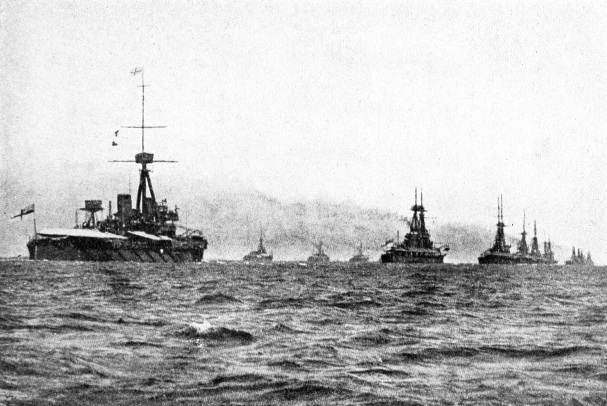
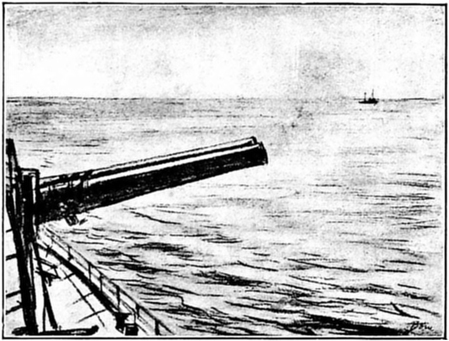
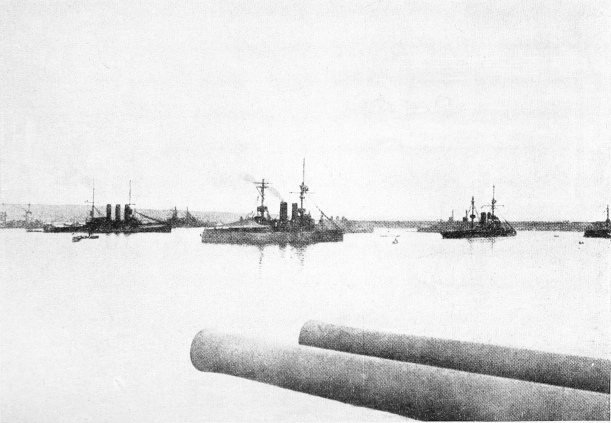
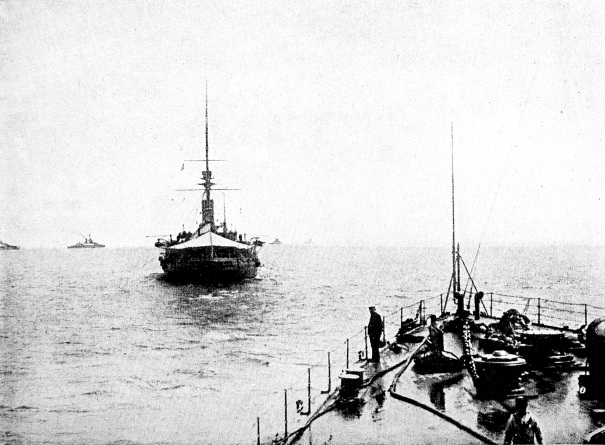
A BRITISH FLEET STEAMING IN LINE AHEAD
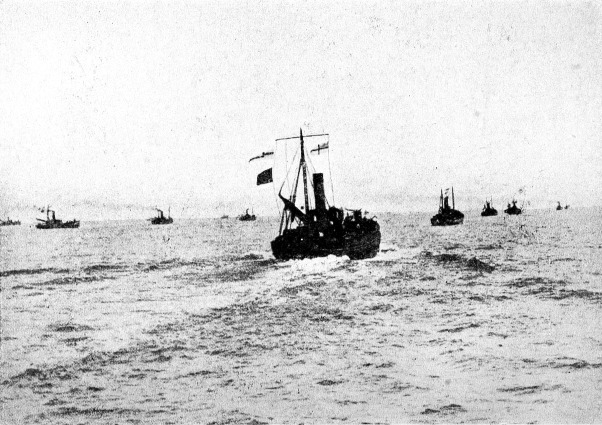
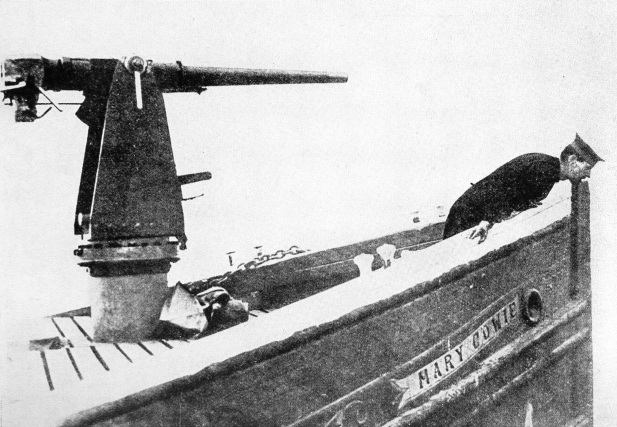
DRIFTERS WORKING AT SEA
While this was in progress other work of immense
significance had been going on. The Admiralty had
undertaken a gigantic task of supreme importance
with complete success. Great defensive preparations
were made in British waters, where all traffic was
regulated and controlled. The vast maritime resources
of the country were added to the naval
service. Two battleships building for Turkey, another
for Chile, and certain flotilla leaders and other craft
building in the country, were taken over. Officers
and men in abundance were ready. The magnificent
seafaring populations of the merchant marine and
the fisheries were drawn into the naval service, and
subsequently the whole mercantile marine was
brought under naval control, and for practical
purposes was embodied with the Navy. Officers and
men of these services showed splendid heroism in situations
of terror and responsibility never anticipated.
A wide network of patrols was brought into being;
the blockade was organised and strengthened; the
examination services were set on foot and perfected;
and the coast sectors of defence, with their flotillas,
were raised to a standard of high efficiency. Mine-sweepers
and net-drifters were at work. Every shipyard
in the country and a multitude of engineering
and ammunition works began to buzz with work for
the Navy and the mercantile marine. Provision was
made for dealing with the raiding cruisers and armed
merchantmen of the enemy.
At the time, the public knew little or nothing of
what was in progress. Imagination fails even now
to grasp the magnitude of what was achieved. The
naval share in the campaign was of baffling obscurity,
while the stage of the war on land became crowded
with fighting men, locked in a terrible conflict, which
at that time seemed to bode no good to the Allies.
After the brush in the Heligoland Bight on August
28th, 1914, the Fleet was lost to view. Not
at first, but slowly, did it become realised that
the prognostications of peace-time alarmists had
proved baseless. There had been no “bolt from
the blue,” as had been foretold; neither invasion,
nor raid, nor foray was attempted upon British shores,
and there was no anxiety about food. There was
always, with economy, enough to eat.
But popular confidence seemed for a time to be
unreasonably disturbed by a record of successive
alarming and generally unexplained incidents—the
escape of the Goeben and Breslau in the Mediterranean,
the sinking of the Aboukir, Cressy, Hogue,
Formidable, and other vessels, the depredations of
German raiding cruisers on the distant lines of our
trade, the bombardment of Hartlepool, Whitby, and
Scarborough, and other disquieting episodes. Strange
as it may seem, there were people who went about
asking, “What is the Fleet doing?” Was it not the
ancient inspiration of the Navy to seek out the
enemy and to capture or sink or burn his ships
wherever they were to be found? Yet there was no
battle. The German coast was not attacked. Allied
shipping to the value of millions of pounds
was being sunk. Why, then, was the Navy inactive?
When, later on, the submarine menace assumed
formidable proportions, alarm began again to seize
upon the newspapers, when there was justification
only for precaution.
The hidden truth was not comprehended. Victories
were expected when, owing to the coyness of
the enemy’s strategy, none were possible. The Seven
Years’ War—the most successful in British annals,
the turning-point in British history, the war in
which Horace Walpole asked each morning what
victory there was to record—began with the
disaster of Minorca, followed by the tragedy of
Byng. The central facts of naval history were
but little known. Yet the Navy was, and is, in
truth, all in all to the country, the Empire, and
the Allies.
Before we enter into the main purpose of this book,
in which we shall discover in several theatres of war
the real nature of sea-power, as well as the character
and momentous consequences of the antagonism which
grew up between England and Germany, we may
inquire what services could in reason have been
expected from the Navy in the great cataclysm which
was about to sweep with destruction over the nations.
It would not have been expected to fight a battle
every month or even every year, for battles are rare
events in naval history. It would not have been
expected to attack fortified coasts, though it might do
so on occasions, because ships are designed and built
to fight at sea. The Navy would not have been
expected to forestall every untoward incident. Fish
often slip through the net, as raiders have slipped
through our guard in this and other wars. Nor, in
these days of the stealthy submarine and the blind
death-dealing mine, could the Fleet have been
expected to remain immune from every misfortune.
No one could have expected the Navy to devise a
single conclusive defence against the attack of the
submarine, any more than it was asked to find an
infallible remedy for the effects of gunfire.
What we should have expected was that it would
make the sea again the protecting wall, as Shakespeare
says, of the British Isles,
Or as a moat defensive to a house
Against the envy of less happier lands.
We should have expected it to safeguard the incoming
of the supplies without which neither the people nor
their industries could exist—to be the panoply of all
trade and interests afloat, whether in the nature of
imports or exports. We should have expected it to
deny all external activity to the enemy at sea—we
might not have anticipated the advent of the submarine
as a pirate commerce-destroyer—to shut off
his sea-borne supplies, and to exert that noiseless
pressure on the vitals of the adversary of which
Admiral Mahan speaks—“that compulsion, whose
silence, when once noted, becomes to the observer
the most striking and awful mark of the working of
sea-power.” We should have expected the Navy to
become the support, in thrust and holding, of the
armies in the field—the shaft to their spearhead;
their flank and rearguard also. Inasmuch as the
war is world-wide, and we have powerful Allies, we
should have expected naval influence and pressure to
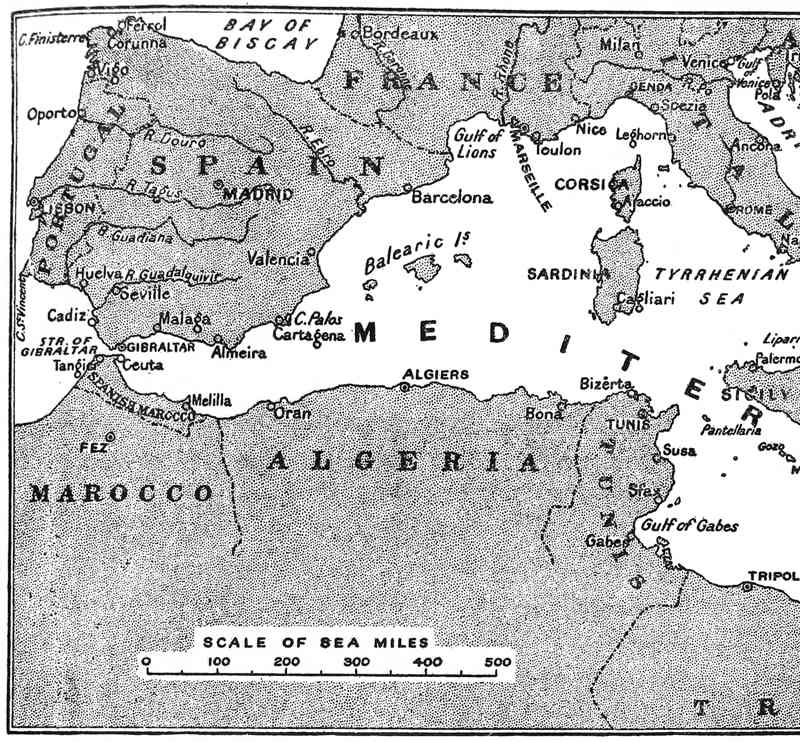
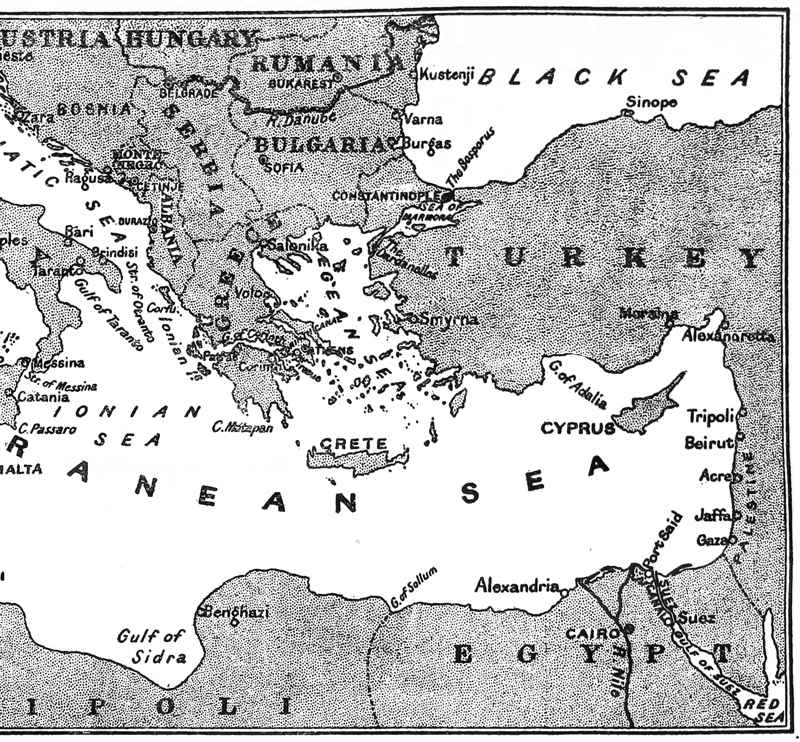
be manifested in the oceans, in the Mediterranean,
and, indeed, wherever the enemy is and the seas are.
Finally, we should have expected the Navy to be to
the British Empire what it has always been to the
Empire’s heart—its safeguard from injury and disruption,
and the bond that holds it together.
Each one of these functions has been executed by
in Navy with triumphant success in the war, and
history would show that it is executing them now as
the Sea Service has accomplished them in all the wars
of the past.