The cover image was created by the transcriber and is placed in the public domain.
BY
AGNES GRAINGER STEWART:
FAMOUS
·SCOTS·
·SERIES·
PUBLISHED BY
OLIPHANT ANDERSON
& FERRIER·EDINBVRGH
AND LONDON
The designs and ornaments of this
volume are by Mr Joseph Brown,
and the printing is from the press of
Messrs Turnbull & Spears, Edinburgh.
April 1901
PREFACE
5
As far back as I can remember there hung in my father’s
study two prints, the one a mezzotint of Professor James
Gregory, and the other, inferior as a picture, but most
beautiful in its subject, an engraving of William Pulteney
Alison.
In answer to nursery enquiries as to the stories belonging
to these two pictures, there had always perforce to be
some dark facts related in connection with Dr James
Gregory, but these were kept rather in the background,
and the impression we got of him came nearer to the
incidental portrait which Robert Louis Stevenson draws
of him in ‘Weir of Hermiston.’ With William Pulteney
Alison we could, as it were, shake hands, for the story
teller could here insert a piece of real history, of how,
long ago, this man had sat beside his crib watching over
him, holding him back from the arms of Death. We
watched with him as he sat there ministering to this sick
child, keeping alive the little flicker of life, keeping the
little restless body still. ‘If he moves, he will faint,’
Professor Alison had said. ‘If he faints, he will die.’
Across the gap of years other children held their breath
till the little patient fell asleep.
But the most interesting fact about Gregory and Alison
to us as children was that they had both been professors
of the Practice of Physic in Edinburgh University, and
6the little boy who had so nearly died now lectured in
the place of the physician who had saved his life.
This early acquaintance gave me a love for these
professors, and when I came to be asked to write a book
upon the Academic members of the old Scottish family
of Gregory, two of them at least were familiar as friends.
In the preparation of my book I have received much
kindness, and I should especially like to thank Mr Philip
Spencer Gregory, of Lincoln’s Inn, Barrister-at-Law, late
Fellow of King’s College, Cambridge, for the help which
he as a representative of the family was able to give me,
and also for his very interesting ‘Records of the Family of
Gregory.’ My thanks are also due to Professor Campbell
Fraser for personal introduction to sources of information,
to Mr Turner, Savilian Professor of Astronomy in the
University of Oxford, and to Mr Henry Johnstone of the
Edinburgh Academy and Mr R. S. Rait, Fellow of New
College, Oxford, who have read my proofs. I must also
record my debt of gratitude to the Editors for the great
kindness and courtesy they have shown to me.
‘The moon’s on the lake, and the mist’s on the brae,
And the clan has a name that is nameless by day.
Then gather, gather, gather Grigalach!’
The Macgregor’s Gathering—Scott.
The able Scots family of Gregorie can trace its descent
from the Macgregors of Roro, the younger branch of the
Glenlyon family. The name Gregorie,—which is the
Saxon form of M’Gregor—had, most fortunately for its
owners, been assumed before 1603, the darkest time in
the annals of that clan. The proscription which then
fell upon everyone bearing the name of M’Gregor could
not touch the Gregories; but the change of name, which
saved them from the penalties that fell so heavily upon
their Highland cousins could not and did not alter their
natures, and all the Gregories, with perhaps the single
exception of the Dean of Christ Church, were at heart
M’Gregors. Nothing that civilisation, education, wealth
and society could do to modify their disposition was
able entirely to obliterate in them the warlike character
of their Highland forefathers. We remember this, and
when in the nineteenth century we see a learned professor
10of the Practice of Physic beating his fellow-professor in
Edinburgh University quadrangle, we know that he was
not really James Gregory but James M’Gregor.
The claim of the Gregories to recognition in Scottish
biography does not rest on the outstanding genius of any
individual member of the family, so much as on the
number of great and brilliant men belonging to it, who
have, in their day, formed and educated generations of
the youth of Scotland. From the middle of the seventeenth
century to the middle of the nineteenth century,
with a gap of only a few years, some of the Gregorie connection
were professing either mathematics or medicine in
one or other of the Scottish universities. They were great
teachers, lucid, clear-sighted and advanced in their views,
and naturally leaders of men. Galton, in his book on
Hereditary Genius, in which he ‘endeavoured to speak
of none but the most illustrious names,’ cites the Gregories
as a striking example of hereditary scientific gifts. He
considers that the mathematical power came into the
family with Janet Anderson, who married the Rev. John
Gregorie, parish minister of Drumoak in the year 1621.
From these two are descended no less than fourteen
professors, and as there is no record of special power
in the Gregorie family till we come to the sons of
John Gregorie, it may be taken for granted that the
ability came from the Andersons, who were distinguished
in the foregoing generations.
Janet Anderson was the daughter of David Anderson of
Finzeach, in Aberdeenshire; a man who was possessed of
such universal talent that he was popularly called ‘Davie
do a’ thing.’ Two of his deeds come down to posterity;
the one, the building of St Nicholas steeple in Aberdeen,
11upon which he himself is said to have placed the weather-cock;
and the other, the removal of a great boulder, called
Knock Maitland, which lay in the entrance to Aberdeen
harbour and endangered the passage of every ship sailing
in or out. This he removed by placing chains under it at
low tide, and fastening them to a huge raft, which at high
tide lifted up the rock and carried it out to the open sea.
Janet Anderson’s near kinsman was the Professor of
Mathematics in the University of Paris, and she herself
was a great mathematician and is said to have taught her
sons. If that was the case, one at least of her pupils did
her great credit, for her younger son, James, lived to take
a foremost place among the mathematicians of his day,
and to be the inventor of the Gregorian Telescope.
In 1621, when the Rev. John Gregorie married Janet
Anderson, he was the minister of Drumoak, a remote
parish on the Dee, where in peaceful times he might have
fulfilled his quiet duties with little to disturb him. Towards
the end of the first half of the seventeenth century,
however, Scotland was in a ferment, and in a state of civil
and religious turmoil which made itself felt throughout the
land. In Aberdeenshire, both the clergy and the laity
were in sympathy rather with Laud and Prelacy than with
Henderson and Presbytery. This brought them into
violent collision with the party in power, and among the
rural clergy there were few names more distasteful to the
Covenanters than the name of John Gregorie. When
therefore in 1639, the government sent an army to coerce
refractory Aberdeenshire, he knew that he would receive no
toleration and fled, meaning to join the king at Newcastle.
The ship in which he tried to escape was boarded, and the
fugitives were made to return, and in the following year
12Gregorie’s fears were realised, for General Monro, who was
then stationed near Aberdeen on the outlook for rebels
from the Covenant—especially rich ones—remembered
the minister of Drumoak. Spalding tells us the pitiful
story.
‘Upone the second day of Junij, Mr Johne Gregorie,
minister at Dalmoak, wes brocht in to Munro be ane
pairtie of soldiouris. He wes takin out of his naikit bed
upone the nicht, and his hous pitifullie plunderit. He
wes cloislie keepit in Skipper Andersonis hous haveing
fyve muskiteris watching him day and nicht, sustenit
upone his awin expensis. None, no nocht his awin wyfe
could have privie conference of him, so straitlie wes he
watchit. At last he is fynit to pay generall Major Munro
1000 merkis for his outstanding agains the covenant and
syne gat libertie to go. Bot in the Generall Assemblie
holdin in July, he wes nevertheless simpliciter deprivit,
becaus he wold not subscryve the covenant; and when
all wes done he is forst to yield, cum in and subscryve, as
ye have hierafter.’
It was not till 1641 that, at St Andrews, the Laird of
Drum’s petition for his restoration had effect; when in
token of his reinstatement, Gregorie along with his rival,
Mr Andrew Cant, was chosen to preach at the visitation
of the Presbytery of Aberdeen. This fellowship with a
man, whose qualities have been embalmed in his name,
very nearly cost him the favour of the party to which he
now belonged. Here again is Spalding’s account, naïve
and full of the spirit of the time.
‘Upone Tuysday 6th September, Mr Johne Gregorie,
minister at Dulmoak at the visitatioun of the Kirk of New
Abirdene teichit most lernidlie upone the 4th verss of the
132nd chapdour to the Collosians, and reprehendit the order
of our Kirk and new brocht in poyntes. Mr Andrew
Cant, sitting besyde the reidar, as his use was, offendit at
this doctrein, quicklie cloissit the reidaris buke, and laid
down the glass befoir it wes run, thinking the minister
sould the sooner mak an end; bot he beheld and
preichit half ane hour longer nor the tyme. Sermon
endit the bretheren convenis to their visitatioun, quhair
Mr Andrew Cant impugnit this doctrein, desyring the said
Mr Johne to put the samen in wreit, who answerit, he
wold not only wreit bot print his preiching, if neid so
requirit, and baid be all what he had teichit as orthodox
doctrien. The bretheren hard all and had their owne
opiniouns, and but ony more censure they disolvit, sumwhat
perturbit with Cantis curiositie. Upone Thuirsday,
he raillit out in his sermon aganes the said Mr Johne
Gregorie’s doctrein, and on Sunday likwais. At last, be
mediatioun of the toune’s balleis at a coup of wyne, they
twa war satled with small credet to Cantis bussines.’
Though Gregorie was not censured by the whole body
of the clergy in 1642, as there seems little doubt Mr Cant
had intended, he was not absolutely free from anxiety.
No doubt life went smoothly enough with him at times, for
he amassed quite a large fortune. The estates of Kinairdy
and Netherdale were given to him on the insolvency
of the Crichtons in satisfaction of £3,800 which he had
lent to them; and his wife on her part had succeeded on
her father’s death to a portion of the estates of Finzeach.
The land brought its sorrow with it, and passed out of the
hands of the family again, but that was afterwards.
In 1649 John Gregorie was once more deposed, and
for the last time. The Synod recommended that he
14should be reinstated, but he did not long survive this
recommendation. He died in 1650, and was buried at
Drumoak.
Among the slaty monuments in the churchyard there
is none that bears the name of John Gregorie. Two
hundred and fifty years have obliterated what must once
have been written, and the Dee is gaining ground from
the graveyard at every time of spate. The old church
stands and the manse, which has been turned into a
farmhouse, but that is all.
There is a memorial of John Gregorie and his wife in a
mortification for the education and maintenance of ten
poor orphans ‘within the said Burgh’ of Aberdeen.
John Gregory left three sons, Alexander, who was
served heir to his father’s very considerable property
in 1651, David, known as David of Kinairdy, and
James, the great professor of astronomy. His two
daughters, Margaret and Janet, were both married, the
latter to Thomas Thomson of Faichfield.
Loving and generous, as no one who reads about
Alexander Gregorie can doubt that he was, he would
yet barely have been included in this book, if it had
not been for his terrible death, which made the family
estates fall into the hands of his younger brother.
Kinairdy and Netherdale, which had been allotted by
law to his father on the bankruptcy of the Crichtons,
were too much favoured by their former possessors to
be relinquished without disturbance into the hands of
their rightful owners. The Crichtons harried Alexander
Gregorie, and that so frequently, that he was obliged
at last in 1660 to seek the shelter of the law. James,
second Viscount Frendraught, took no notice of the
15summons to appear at court, and so was outlawed, but
this sentence was remitted upon his giving security (in
a bond of £40,000 Scots or £3,333, 6s. 8d. sterling)
to keep the peace and to appear before the Privy Council
to answer the charges made against him. Bonds such as
this succeeded each other, till the final outbreak which
occurred on the 7th of March 1664. Then with the
shed blood of Alexander Gregorie came peace, but at
what a cost. In the records of the Justiciary Court
there is a description of the murder, which somehow
belies its dusty origin, and sounds as if some old
Aberdeenshire gossip were telling the tale with real
enjoyment over her peat fire.
‘It is of veritie that the said James, Viscount of
Frendraught and the said James Crichtoun of Kinairdy,
and Frances Crichtoun his sone, having unjustlie conceaved
ane deidlie hatred and cruell malice against
umqle Mr Alexr Gregorie of Netherdeall and the said
Frances Crichtoun having upon the sevent day of March
last by-past rancountered with the said Mr Alexr Gregorie
at the hous of Mr Alexr Gairdine minister at Forge,
the said Frances treacherouslie inveited and desyred
the said Mr Alexr to goe alongs with him from the said
hous, which he fearing no harme did, and as they went
alongs the said Frances Crichtone without any provocatione
(of) foirthought, felony and precogitat malice drew
his sword and rane at the said umqle Mr Alexr Gregorie
thinking to have killed him at one thrust; but the said
umqle Mr Alexr, everting the stroak and closing with him,
not offering to doe him any prejudice at all, the said
James Duffus drew his sword and stroke at the said
umqle Mr Alexr whereat his horse running away and the
16said Frances mounting on his horse, he divers times ran
upon the said umqle Mr Alexr and wounded him in his
arme, whereupon the said umqle Mr Alexr yielded himself
prisoner to the said Frances and delivered to him his
sword being requyred be him sua to doe, hoping that
his honour would therrupon have obliged him to have
desisted from all furder trubling and assalting him, but
upon the contrair the said Frances baislie and treacherouslie
with the assistance of the said James Duffus his
servant persewed him more eagerlie than befoir, fyred
pistolls at him, gave him several wounds in his breast and
head to the effusione of his blood in great quantitie and
then caused him to mount up behind the said James
Duffus and caryed him to the hous of George Morisone
of Boignie, and putt him in ane chamber wherein the
said James Viscount of Frendraught was lodged and then
the said Frances Crichtone left him and upon the morne,
being the last day of March last by past, about thrie
hours in the morning, the said Frances Crichtone accompanied
with Walter Henry, gairdiner at Frendraught,
William Innes yr., George Mearns yr., Rob Tarres yr.,
James Howie, sone to Georg Howie in Tounslie, and the
said James Duffus all in armes cam to the said hous
of Boignie, where the said umqle Mr Alexr Gregorie was
lying bleeding in his wounds, they and the said James
Viscount of Frendraught and George Forbes his servant
efter many baise and opprobious threatenings uttered be
them against the said umqle Mr Alexr did most inhumanly
and barbarouslie dragg him out of his bed as he was
lying bleiding in his wounds, and that without cloak, hat,
or shoves, or bootts, and did cast him overthwart ane
hors, upon his breast, his head and armes hanging on the
17ane syd and his leggs on the other syd and so caryed him
away in ane cold and stormy morneing to George Yong’s
hous in Coanloch being ane obscure place and myles
distant from the said hous of Boignie where they keiped
him prisoner ... in his wounds be the space of threi
days, tanquam in privato carcere; and then, deserting and
leaving him, he was upon the threttein day of the said
month by the help of some friends caryed to the burgh of
Aberdeine, where he lay languishing of the said wounds and
the bad usage which he had receaved of the foir-named
persons, and then dyed of the samyne and sua was cruelly
and unnaturally killed and murdered be them; of which
murder under trust, at least slaughter committed upone
precogitat malice and forethought felony, as also of the
said usurpatione of His Majestie’s authority in takeing and
apprehending unwarrantably ane frie leidge, the foirsaids
persons and ilk ane of them, as also the said James
Crichtoune of Kinairdie by whose instigation and hunding
out the foirsaids crymes of slaughter upon foirthought
felony and precogitat malice and usurpation of His
Majestie’s authoritie were committed and are actors airt
and pairt, and the samyne being found be ane assize they
aught to be punyshed theirfor in their persons and goods
to the terour and example of utheris to commit the lyk
heirafter.’
Surely this was not a case for the King’s leniency; yet
because Francis Crichtone was a Roman Catholic, and
favoured by the Duke of York, a warrant came from
His Majesty for the suspension of the trial of Francis
Crichtone.
‘Compeired Mr George Mackenzie advocate, and produced
ane letter from His Majestie directed to the Justice
18General and Justice depute whereof the tenor follows,
Superscribed Charles R. Whereas we are informed that
Alexander Gregorie did not die of the wounds alleged to
have been given him by Frances Crichtone now prisoner
at Edinburgh, these are to require you to suspend that
criminal process against Frances Crichtone until we shall
hear further concerning that business from our Privy
Council at their next meeting in June, for which this shall
be your warrand. Given at our Court at Whitehall the
13th day of May 1664 and of our reign the 16th year by
His Majestie’s command.
‘Sic subitur Lauderdaill.
‘To our right trustie and right well-beloved cousin and
counselloure and to our trusty and well-beloved our Justice
General or Justice Depute.’
James Crichtone of Kinairdy and Viscount Frendraught
were acquitted at the trial, the assistants at the murder
were ‘put to His Majestie’s horn, and all their goods forfeit.’
As for Francis Crichtone, the principal in this
affair, having procured the postponement of his trial, he
escaped from the Tolbooth Prison; and after another
futile attempt on the part of the Gregories to secure a
trial, he obtained a pardon under the Great Seal in
1682.
CHAPTER II DAVID GREGORIE OF KINAIRDY, 1625–1720
19
‘Not skill alone of ear and eye
Was yours, but something more—a heart.’
—Echoes and After-thoughts.
David Gregorie, the second son of the Reverend John
Gregorie, was destined by his father for a commercial
career. Alexander, his elder brother, as we have seen,
was heir to the estates of Kinairdy and Netherdale, and
to a good deal of money: the young brother James was
so remarkable a mathematician that he was allowed to
follow his own bent and devote himself purely to mathematics.
But David, poor David, most unwilling to go,
was sent to Holland to learn to be a merchant, probably
to Campvere, the happy haven to which so many Scots
traders turned. Herrings and stockings—the great
Aberdeen exports of the day—how we can imagine David
Gregorie seeing to the unlading of such cargo as this,
with his heart and very likely his head far away in Scotland!
Anyhow he did not stay a day longer in Holland
than was necessary, for after his father’s death he returned
home and settled in Aberdeen in 1655. In the same
year he married Jean, daughter of Patrick Walker of
Orchiston, a great Episcopalian, and also a great
Tory.
20David Gregorie was only thirty, and the best of life was
still before him. He spent his time in just such a way as
attracted him. He studied medicine, mechanics, mathematics
and physics, read every interesting book within his
reach, and corresponded with scientific contemporaries
both in Scotland and out of it. His letters, full of
thoughts about the atmospheric laws, went to Edmé
Mariotte in his cell. He may have got some help from
them—certainly Gregorie was immensely interested in the
Frenchman’s discoveries.
His life was enriched by many delightful friendships,
but more than all by the affection shewn to him by his
brothers and expressed in so many practical ways. In
1660 Alexander settled the property of Over Aschalache
on David and his family, subject to the life-rent of old
Mrs Gregorie. It was a most kind arrangement, and
must have been a great help in providing for the growing
family. Three years later he was made librarian of King’s
College, and there he spent his time, reading and searching
and arranging in the dreamy way of an old world
librarian. But life, which is so fearfully unknown, held
in it for David Gregorie in 1664 that which was to alter
his whole career. By the tragic death of his brother, who
left no children, all the family estates passed to him, and
he became suddenly a rich man. He left Aberdeen, and
went to live in the mansion-house of Kinairdy, with which
his name is now always associated.
Few people pass through the remote parish of Marnoch,
which lies on the borders of Banffshire and Aberdeenshire,
but those who do are most certainly rewarded. The
Deveron, not so well known as the Dee, still keeps a
charm of loneliness for those who love her, and the
21burns are browner than in the southland. By such a
burn was Kinairdy built, on a little promontory where
the stream joins the Deveron. When I asked to see
Kinairdy, I was told ‘There’s nothing to see there,
only the old tower down by the river,’ but the old
tower was enough for me, and packed full of memories.
To this old house it was that David Gregorie took his
wife and children in 1664. We get occasional glimpses
of him as he passes about the country, at one time
laughed at by his neighbours for his total ignorance of
farming, while at another, in a case of illness, they would
eagerly wait for his coming, with a feeling as if life and
death were in his hands. Sometimes no doubt it was so,
and to rich and poor alike he would go, giving his advice
gratuitously for the love of doctoring, and because he was
benevolent.
This medical skill of his stood him in good stead on
one occasion, when a deputation of ministers called upon
him to answer for himself on the charge of being a wizard.
There were dread stories abroad concerning him, how, by
having sold his soul to the Devil, he was able to foretell
the weather (what a thing to sell your soul for in Scotland!)
how, after days of sunshine, he could predict rain
and sure enough the rain would come, and he might make
it go on raining for weeks through his intercourse with
the powers of darkness. Poor Gregorie, face to face with
his accusers, went through the little crowd of his children,
and brought in the familiar spirit, which was only a barometer,
tried to explain how it worked, asked them to
examine it (which I do not believe any of them would do),
and won them over to his side by his sheer lovableness.
After all, who was to doctor them with the skill of David
22Gregorie if he were burned for a wizard? So the kind
doctor was left to his home and his work. The ministers
did not understand his defence, but there was not one of
them who could not remember how, with some well-chosen
simple, he had healed one of their dear ones in the hour
of need.
As his sons and daughters grew up, Gregorie found it
more and more impossible to get the quiet which he so
much wanted for his work. His patients and his children
between them were taking up all his leisure. In these
circumstances he determined to rearrange his hours. He
retired early to bed, and rising about two in the morning,
worked for a few hours in the stillness of the night.
When that was over, he went to sleep till he felt rested.
If these nocturnal habits were known to the deputation
that waited upon him, there was some excuse for their
fears. What more alarming than the shadows in the
room! The midnight crucible and the sulphurous smell
were not there, but it must be admitted that the Laird
of Kinairdy loved the hours of darkness better than the
day.
David Gregorie had twenty-nine children. Fifteen of
them were the children of his first wife, and fourteen the
children of his second. Nine of them died as quite little
babies, but twenty grew to be older; and so, though everyone
says, that it was remarkable for Kinairdy to have
three sons professors of mathematics, it must be allowed
that he had a most unusual number of children to choose
from!
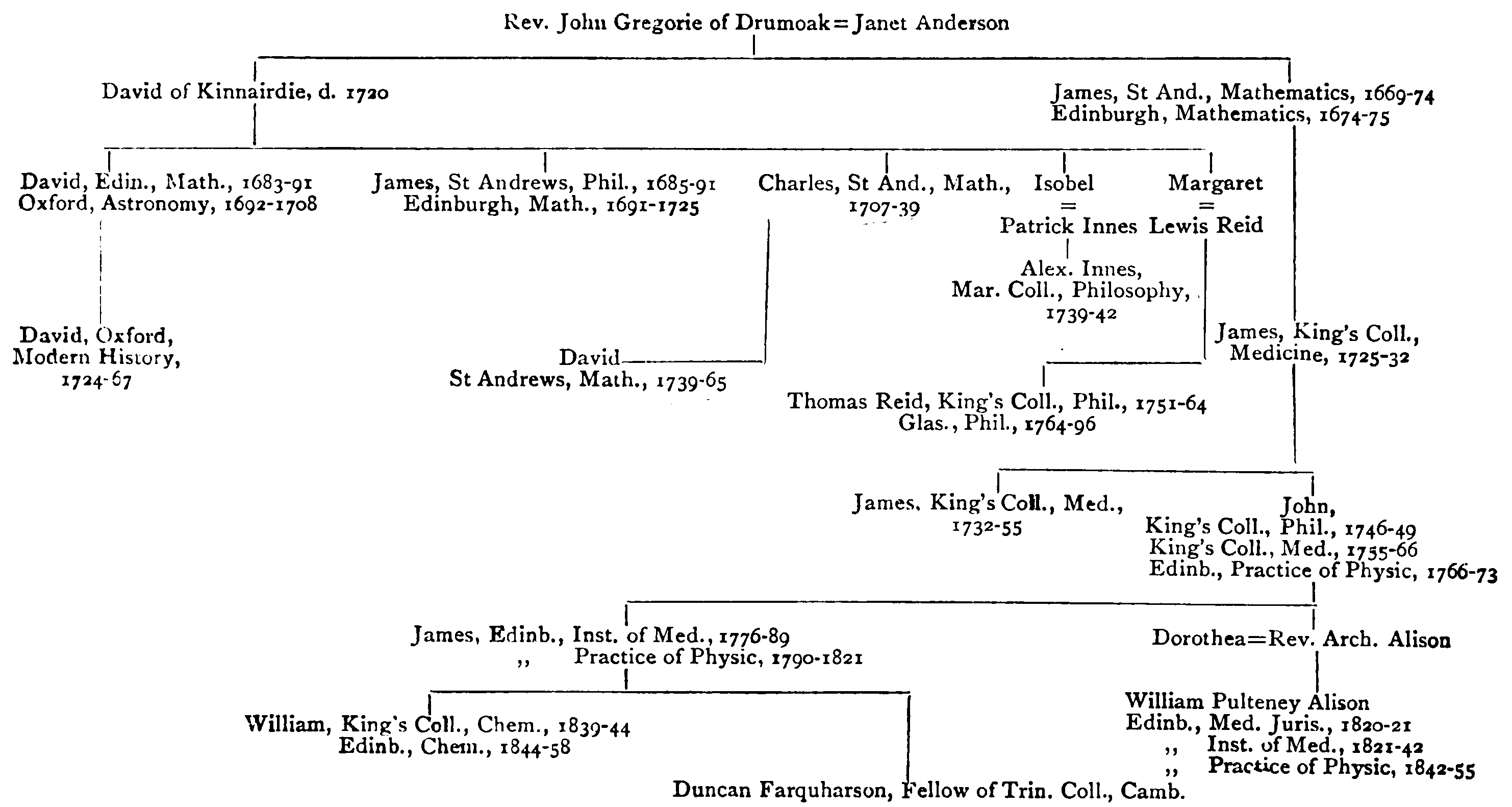
In the pedigree of the family of Gregorie in Mr Philip
Spencer Gregory’s book, from which the table of the professors
is for the most part taken, it is seen that David,
23Professor of Mathematics in Edinburgh, and later of
Astronomy in Oxford, Isabel, the grandmother of Professor
Innes of Aberdeen, and James, Professor of
Mathematics at St Andrews and Edinburgh, were the
children of the first marriage; while Margaret, the mother
of Thomas Reid, and Charles, Professor of Mathematics
in St Andrews, were of the second marriage.
Jean Walker was probably a cleverer woman than
Isabel Gordon, Gregorie’s second wife. In the first
place she converted her husband to Episcopacy and
Toryism, and secondly, her son David was much the
most brilliant of the Kinairdy children. To him it
was, when he was working as Savilian professor at
Oxford, that old Kinairdy confided a model of an
improved cannon, which in his enthusiasm to improve
the munitions of war, he had designed in his peaceful
home by the Deveron. His son, who thought it most
ingenious, showed it to Sir Isaac Newton, and the great
philosopher evidently agreed with him; but to invent
an instrument, the only object of which was to kill
better than any cannon in use, seemed to him a fearful
abuse of ingenuity. The horrors of Marlborough’s wars,
where men were slaughtered by the thousand, were they
not enough as it was? Who could deserve mercy from
his Maker if he were to bid god-speed to such a terrible
machine? Sir Isaac asked the professor to destroy the
model, which he did, and the little toy which may have
been a gatling gun, for aught we know, was broken in
pieces.
Old David Gregorie, who had been preparing to join
the allies in Flanders, to see his cannon in use, bore
his disappointment most sweetly. Perhaps Newton was
24right, he thought, for although he had meant to help his
fellow-countrymen, the invention would soon be known to
the enemy, and the Gregorie gun be levelled against his
compatriots.
There seems to be something almost pitiful about the
end of David Gregorie’s life. Kinairdy was made over
to his son, the Savilian professor at Oxford, the sweet
old house forsaken, the rooms in which such merry life
had been lived, deserted, and the flowers from which the
gentle herbalist had drawn so many healing virtues, left
to die. It would be best to think that he returned to
Aberdeen at the call of King’s College, which ‘Beautified
with bells within, without decked with a diadem,’ is said
to ring her sons back to her before they die. But there
were probably other reasons, and more potent ones.
His children had to be provided for, and his wife,
shrewd and not poetical (or else how could she have
been a Hanoverian?) thought of all that her brother,
the Provost of Aberdeen, had in his power, and she
knew he could do much and would do much for her
children, so they set up house once more in the old
town of Aberdeen.
In 1715 comes another turmoil, a flitting, almost a
flight across the North Sea to Holland, to be out of the
difficulties of conflicting hopes and fears, to be out of the
country, to take at least no part against the Stuarts,
whom we suspect Kinairdy of loving in his secret heart.
Likely enough they may have offered him bribes, and a
title in the coming kingdom, but there was another
counsellor nearer and dearer to him, and with her and
his children he sought the shelter of a foreign land.
Two or three years passed before they returned to
25Scotland. They were content to wait till the storm
was past. When they came back Gregorie’s life was
nearly over. He died in 1720, an old man of ninety-five.
‘And in his story still remains
A distant memory of life’s loss and gains,
A starlit picture of his joy and pains.’
A visit to his widow, who was Thomas Reid’s grandmother
was described by her grandson in after years in a
letter to James Gregory, Professor of Medicine in Edinburgh.
‘I found her,’ he says, ‘old and bedridden,
but I never saw a more ladylike woman. I was now and
then called into her room, when she sat upon her bed, or
entertained me to sweetmeats and grave advices. Her
daughters, who visited her, as well as one who lived with
her, treated her as if she had been of superior rank,
and indeed her appearance and manner commanded
respect. She and all her children were zealous presbyterians,
the first wife’s children were Tories and
Episcopalians.’
But to return to what interests us about David Gregorie
of Kinairdy, in connection with his many professorial sons
and other kindred, he was a great lover of science, and a
worker to whom all scientific matter came home to stay.
His mathematical and mechanical gifts, great as they were—and
we know he was far advanced in meteorological
studies—were not to be compared with the power which
he had, and which now appears for the first time in the
Gregorie family—the inborn gift of doctoring. He had
no training except what he gave himself, but he could no
more help being a physician, than his brother Professor
26James could help his incessant work at mathematics.
David and James Gregorie were the children of their
mother far more than of their father; who, good as he probably
was, is, we must confess, just a little dull. Yes,
Janet Anderson, you have lived again for us in your sons!
CHAPTER III JAMES GREGORIE, 1638–1675
27
‘He learned the art
In Padua far beyond the sea.’
—Scott, Lay 1, xi.
James Gregorie, the third son of the minister of
Drumoak, was certainly the cleverest member of that
family. He was so clever that no one had any time to
tell anything about him, except his achievements in pure
mathematics and in the science of optics; and indeed
from his earliest days his love for mathematics was such,
that his pretty mother unwilling to wait till her boy was
able to go to school taught him herself all she knew of
geometry, sending him away when the time came to the
Grammar School of Aberdeen already far ahead of his
class. He studied at Marischal College, and took his
degree (laureated is the pleasant Scottish word) along
with Gilbert Burnet, the readable if imaginative historian,
with whom likely enough he did not find much in common,
representing as they almost did fact and fancy.
Now their portraits hang side by side in the Picture
Gallery—Gregorie’s grey and grave and stern, with an
indication of what he was in the mathematical globe by
his side—Burnet’s less severe, satisfied with himself, and
a most prosperous portrait.
28After the graduation James Gregorie gave himself up to
his studies, and before he was twenty-four made his great
discovery of the Reflecting Telescope. It was not a chance
discovery, for indeed he only described, and never saw
put together, the telescope which bears his name. Anyone
can see them nowadays, for they are still used, and the
beautiful one set up by James Short in Edinburgh, is as
clear as the day it was made, and is not used now, only
because a commoner one can do the work which it did
for so many years in the Royal Observatory. To the
uninitiated it has a great merit, for things present themselves
through it as they appear to the naked eye, and not
upside down as is the case with most of the great
telescopes.
In 1663, his book entitled Optica Promota, which
contained a description of his telescope, was published
in London, and thither Gregorie went, hoping that by the
assistance of a practical workman he might realise his
ideal.
His book had been much read by mathematicians, and
amongst others by John Collins, the Secretary to the Royal
Society. We can picture then the mutual pleasure with
which these two men met. It was in an alehouse, where
possibly the jolly tavern keeper took the Aberdonian
through the fumes of his stuffy parlour, and presented
him to Master Collins as a likely friend for him; anyway,
this was the beginning of a life-long friendship,
and Collins, who had realised at once what a possibility
lay in the proposed reflecting telescope, determined to
have a glass made on the principles which Gregorie had
suggested in his book. With this object in view, he took
his new Scottish friend to the most skilled glass-grinder
29in London, but, alas! in vain. Mr Reeves could not
overcome the difficulty of obtaining conoidal reflectors,
but to the great mathematicians of that day, and it was
a day of giants, the discovery was magnificent, and from
the hands of astronomy’s master craftsman, the reflecting
telescope emerged in 1668 in a more beautiful form, as
Newton’s telescope.
Before Gregorie’s time, the telescopes in England were
many of them immensely long, going up even to three
hundred feet, and at this length they were hardly available
for scanning the heavens. The new reflector brought the
size down to six or nine feet, and the idea was so ingenious,
that it made Gregorie famous, and what was more, opened
the door for him to friendship with Newton and Collins,
to acknowledgment as an original worker by Huygens,
and awakened in the Father of the Catholic Church an
apprehension that one Gregorie, a Scot and a heretic,
might come to deserve the spiritual blight which he is
empowered to give in placing a book on the Index! It
was not so very long before, that Galileo—an earlier
maker of telescopes—had been accused by the learned
scribes and pharisees of his day, of magic. ‘Oh, my
dear Kepler,’ says Galileo to his brother astronomer in
one of his most amusing letters, ‘how I wish that we
could have one hearty laugh together! Here at Padua
is the principal professor of philosophy, whom I have
repeatedly and earnestly requested to look at the moon
and planets through my glass, which he pertinaciously
refuses to do. Why are you not here? What shouts of
laughter we should have at this glorious folly, and to hear
the professor of philosophy in Pisa labouring before the
Grand Duke with logical arguments, as with magical incantations,
30to charm the new planets out of the sky!’
It is well that Galileo laughed at this stage of his life;
when he fell into the hands of the Inquisition it became
no laughing matter, and even after he had renounced his
views, he was subjected to many griefs, and to a long
incarceration in an Italian prison.
In the fifty years which intervened between Galileo and
James Gregorie, Louis, the great monarch of France, had
taken science under his care, so the Inquisition was no
longer available as a means of preventing the spread of
original thought, and Gregorie, unsuspecting of the pope’s
attitude towards him, went to very Padua itself, and
stayed there for three years.
Padua, with its still colonnades and drowsy population,
is visited now, not in the eager search for learning, but
because of the pale frescoes with which Giotto had gifted
it long before Gregorie was there, but in the seventeenth
century, what other attractions drew men thither! Then
such men as Riccioli, Manfredi and De Angelis were
drawing the erudite from far and near to sit at their feet.
Such men as Manfredi and De Angelis, who were they?
Alas! they, the great mathematical champions of their
day, have passed into oblivion, and are only remembered
now, even in Padua, by the work of the masons who
carved their names on the walls of the University.
‘In thine halls the lamp of learning
Padua, now no more is burning;
Like a meteor, whose wild way
Is lost over the grave of day,
It gleams betrayed and to betray:
Once remotest nations came
To adore that sacred flame,
When it lit not many a hearth
On this cold and gloomy earth;
31Now new fires from Antique light
Spring beneath the wide world’s might:
But their spark lies dead in thee,
Trampled out by tyranny.’
As for Gregorie, he was at variance with Riccioli, De
Angelis and Manfredi, and though we have only negative
evidence, we hope that he was at one with the other great
teachers of his time in Italy. Optica Promota had been
much read on the Continent, and there the suggestion
which he made that the solar parallax might be determined
by the transit of Venus and Mercury had been
accepted, and till a few years ago it was the method employed
in finding out the distance of the sun. But after
all, the most beautiful piece of Gregorie’s work was his
telescope. ‘It consists of a parabolic concave speculum
with a hole in its centre, having near its focus a small
elliptic concave speculum. The image formed by the
large parabolic speculum is received by the small elliptical
one, and reflected through the aperture in the former
upon a lens which magnifies it.’
In Padua his work took a more purely mathematical
turn, and resulted in a book ‘pursuing a hint suggested
by his own thoughts,’ of which he had only a few copies
printed. It was entitled Vera Circuli et Hyperboles
Quadratura, and Montucla in writing of it says that the
title is misleading, and that the author does not claim,
except approximately, through his infinite converging series
to find the square of a circle or hyperbola. Collins,
to whom a copy was sent, read part of it before the
Royal Society. Lord Brouncker and Dr Wallis were
enthusiastic in its praise, and under such encouragement
Gregorie published it along with some fresh matter under
32the title of Geometriae Pars Universalis inservieus Quantitatum
Curvarum Transmutationi et Mensurae. The book
came out in Padua with the permission of the State of
Venice, and was a great success. Before its publication
the Royal Society showed their appreciation of it by making
Gregorie a Fellow.
This was in January 1668; in March he was still in
Padua, but in all the confusion of departure, and not long
after he returned to Scotland, and back to his much loved
Aberdeenshire, where happiness was awaiting him on all
sides. There was Kinairdy to visit with its many charms,
and there was Aberdeen, and at Elrick there was a cousin
who was after all, it is easy to guess, the end of his journey.
This was Mary Burnet, the widow of John Burnet,
who to his great joy consented to become his wife, and
was married to him in 1669.
The astronomer found love-making dreadfully time-consuming,
and vaguely regretted it. You see, it was apt
to interrupt his correspondence with Huygens and Halley,
with Newton and Collins, with Dr Wallis and Lord
Brouncker. Here is a pathetic letter from him written
in the early part of the year to one of his mathematical
correspondents—‘I have several things in my head as yet
only committed to memory, neither can I dispose of myself
to write them in order and method till I have my
mind free from other cares.’
His wife was only twenty-three, although this was her
second marriage, and even when after Mr Gregorie’s
death she married Mr Ædis, she was still young and
very beautiful. A rare piece of her work remains in the
tapestries which adorn the Magistrates’ Gallery in St
Nicholas Church in Aberdeen. Susannah and Jephtha’s
33daughter were her subjects, and there they are still,
looking out of their panels, from the midst of their
beautiful blue and green landscapes, with the rigid
uncertainty of tapestry portraits. Bailie Burnet would
have been proud if he could have foreseen what a
combination of ecclesiastical and civic honour was to
fall to his wife’s needlework.
Mrs Gregorie’s father, George Jameson the artist, drew
the pictures for her. Walpole called him the ‘Van Dyck
of Scotland,’ though it is difficult to know why, as there is
really no resemblance in their work, but at least Jameson
and Van Dyck were friends in Rubens’ studio, and the
kindly appreciation of his fellow-citizens has remembered
and repeated the phrase.
In 1670, James Gregorie was appointed to the Chair
of Mathematics in St Andrews, where he had a successful
if sometimes vexed life. His duties were to deliver
two lectures a week, and to answer any mathematical
questions that might be set before him. ‘I am now
much taken up,’ he writes in May, 1671, ‘and have been
so all this winter by-past, both with my public lectures,
which I have twice a week, and resolving doubts, which
some gentlemen and scholars propose to me. This I
must comply with, nevertheless that I am often troubled
with great impertinences, all persons here being ignorant
of these things to admiration. These things do so hinder
me, that I have but little time to spend on these studies
my genius leads me to.’
He lived near the beautiful cathedral and almost under
the shadow of St Regulus, and there his name is still remembered
in Gregorie’s Lane and Gregorie’s Place. He
worked in the long, many-windowed library, where the
34clock which he used is still at work, and where it has
been keeping time these two hundred years, since
Huygens, who invented the use of the pendulum in
clocks, and Gregorie himself were laid at rest.
Huygens and Gregorie had a long feud about his
Paduan book. Its faults as the Dutchman thought were
lack of ‘distinguished perspicuity’ and intricacy in its
invention. But Huygens must have lived to regret his
criticisms, however well founded they were, for with a
sudden burst of the M’Gregor spirit, Professor James
sent forth a volley of answers, his official statements
through the medium of the Philosophical Transactions,
and his unofficial through his many letters. Neither his
great opponent, nor his great opponent’s allies were
spared. ‘I am not yet so much a Christian as to help
those who hurt me. I do not know (neither do I desire
to know) who calleth in that preface, Hugenius his animadversions
of November 12th 1668, judicious, but I
would earnestly desire that he would particularize (if he
be not an ignorant) in what my answer, which is contradictory
to Hugenius his animadversions is faulty; for in
geometrical matters, if anything be judicious its contradictory
must be nonsense. I do not know what need
there was for an apology for inserting my answer, but to
compliment Hugenius, and violently (if it be possible) to
bear down the truth. I imagined such actions below the
meanest member of the Royal Society, however, I
hope I may have permission to call to an account
in print the penners of that Preface.’ The account
was never called for, because Newton in the meantime,
gave the simpler solution, which Gregorie had been
declaring an impossibility, but it must be remembered
35that Gregorie’s method although almost impossible to
any but the most clear mathematical mind, was easy to
him and was correct as far as it went. Can anyone
help loving Huygens, even though they know no more
of him than what is seen in his intercourse with
Gregorie? What graciousness and kindness was returned
in exchange for the thunderous treatment he received!
Sick, as he thought he was unto death, he suggested
Gregorie as a fit successor to him in the favour of Louis
XIV., and we find his father, who was secretary to the
Prince of Orange and a poet—the poet of the garden—similarly
occupied, trying to influence the great folk with
whom he came in contact to further Gregorie’s interests.
But in spite of the recommendation of the Académie des
Sciences, the Royal Society, and such friends as he had
at court, Gregorie never received any Royal patronage; the
want of which he took very calmly and with a great deal
of broad good sense, never having expected any other
result. ‘I have had sufficient experience in the uncertainty
of things of that nature before now, which
maketh me since I came to Scotland, how mean and
despicable so ever my condition be, to rest contented and
satisfy myself with that, that I am at home in a settled
condition by which I can live. I have known many
learned men far above me upon every account with whom
I would not change my condition.’
In 1669 Gregorie’s books were suppressed in Italy,
which came as a shock to him, and was all the more
grievous because it deprived him of many of his most interested
readers—and controversialists! Scotland, however,
supplied the deficiency wonderfully well. There was a
professor in Glasgow called George Sinclair, a mathematician,
36and a demonologist of great repute, who wrote
a book on Hydrostatics. It was quite clever, and may
have been more interesting to the general reader than
books on Hydrostatics usually are, because of an appendix
in which some strange things were included, amongst
others, A Short History of Coal and the Story of the
Devil of Glenluce. The humour of the combination was
too much for Gregorie, and under the name of Patrick
Mathers, Arch-Bedal to the University of St. Andrews,
he wrote an answer to the scientific part of the Hydrostatics,
which he called ‘The Great and New Art of
Weighing Vanity.’ Witty, scurrilous, easily written and
easily read, the book was a great source of merriment
both to Gregorie and his colleagues at St. Andrews, and
it raised a perfect hurricane in Glasgow. The very name
was an impertinent play on the title of his antagonist’s
former book Ars nova et Magna and the fact that
Professor Sinclair was no mean adversary added zest to
the battle, which continued many days. But Professor
Sinclair had prepared an ill reception for his work by the
edict which he had had printed and sent abroad to persuade
people to order copies of it:—
‘Forasmuch as there is a Book of Natural and Experimental
Philosophy in English, to be printed within these
four months, or thereabouts; wherein are contained many
excellent and new purposes: As first, Thirty Theorems,
the most part whereof were never so much as heard of
before:’ (Alas! poor professor what a beginning! And is
the ending any better!) ‘and an excellent way for knowing,
by the eye, the Sun or Moon’s motion in a second
of time, which is the 3600 part of an hour, and many
others of different kinds, useful and pleasant. These are
37therefore to give notice to all ingenious persons, who are
lovers of Learning, that if they shall be pleased to advance
Gedeon Shaw, Stationer at the foot of the Ladies Steps,
three pounds Scots, for defraying the present charges of
the said Book, they shall have from him, betwixt the date
hereof and April next to come, one of the Copies: And
for their further security in the interim the Author’s obligation
for performing the same.’
‘Which so exposed to my masters the vanity of that
confident man, that they were forced plainly to let him
know their mind,’ wrote the Arch-Bedal, and some of his
own sentiments were expressed in a letter which he afterwards
quoted in the Preface to his book The Great and
New Art ‘Sir,—I admire exceedingly the forwardness of
your humor (I will call it no worse) in your last to
——: he is a person not concerned in you or in your
books, neither will he ignorantly commend anything, as it
seems ye expected he should have done, when ye sent him
these papers. Ye might have known long ago that he had
no veneration for what ye had formerly published, for he
made no secret of his mind, when he was put to it. Ye
may mistake him, if ye think that any by-end will cause
him speak what he thinks not: nevertheless he delivered
your commission, and was willing to be unconcerned, expecting
their answer. They pressed him to know his
judgment of your last piece: he told ingenuously the
truth, that there was none of them had less esteem for it
than himself. He hopes you are so much a Christian, that ye
will not be offended with him for speaking what he thought
when he had a call to it; and yet albeit ye seem to favour
him more than others, he hath ground to look upon himself
as one of the sophistical rabble, for they only are such
38who condemn anything ye do, the rest of the University
continuing always learned persons. It is to no purpose
to apologize for themselves, ye take all for granted, which
ye have heard: I shall not put you to the pains of proving
it; yet it seems ye would hardly have believed it so
easily, had not your conscience told you, that they had
some reason for their judgement, which really was this
following: That they see nothing in your last piece, new
and great (albeit it be Ars nova et Magna) save errors and
nonsense; as your demonstrations of the pendulum, your
Nihil spatiale, your Gravitas circularis, and horizontalis,
your question “Whether or no a body may be condensed
in a point?” etc., too many to fill several letters: for ye
must not call experiments new inventions, otherwise ye
are making new inventions every day, neither must ye call
different explications new inventions, else the same thing
might be invented by almost every Writer. I admire how
ye question the R. Society; for I desire to know one
point of doctrine, which ye or they either pretend to,
concerning the weight of the air, the spring of it, or
anything else in your book, save mistakes, which was
not received by all mathematicians, and the most learned
of Philosophers many years before any of you put pen to
paper. Ye have been at much pains to prove that by experiment,
which all the learned already grant, and some
have demonstrat à priori from the principles of Geometry
and Staticks, and many à posteriori from experience if
sense may be called a demonstration: yet ye are the only
man who produceth the Ars Nova et Magna when all
others are out of fashion. But more to your commendation,
it seems ye do all these wonders by Magick; for ye
have the ordinair principles of none of these Sciences:
39Euclid is as much a stranger as reason in all your Books:
and for this Perque Mathematicos semper celebrabere
fastus! At last ye come to prove a new doctrine, which
before now was near 2000 years old, with thirty new
Theorems which must not be named because they are
of such a tender and delicat complexion that the very
naming of them will make them old. There are also
many other excellent things, which will be all new when
they were but printed yesterday. It is like some of these
dayes, we may have an Ars Nova et Magna, to prove
that a piece of lead is heavier than so much cork. I
know not wherefore ye undervalue any man, because he
hath not as great esteem for your notions as yourself:
Have not we as much freedom to speak our mind of you,
as ye have to write yours of the R. Society and the University
of Glasgow? The greatest hurt ye can do us, is
to make Dromo famulus one of our Principals. I
think it not strange that ye using only demonstrations
of sense, should admire the force of our imagination,
in affirming no method of Dyving so good as that of
Melgin. I am sure that the man Dyving for a
continual time, if he be not also of your invention,
must breath of the air; and this air must either be kept
close by itself, as in Melgin’s way, or communicat with
the air above. If the latter be your invention, I doubt
ye must also have some Chirurgical invention to apply to
your Dyver at his return, if he go to any great deepness:
If the former, it is the same with Melgin’s; and you cannot
neither any man else help it, but in circumstances
(which alters not the method) and perchance to little
purpose. As for Archimedes, I am sure he wanted no
necessary requisit to prove the weight of water in its own
40Element. I know not what else ye intend to prove:
Always I am as sure that he had two great requisits,
which ye want; to wit, Geometry and a sound head.
As to what ye write concerning the imperfection of
Sciences; the scientifical part of Geography is so perfected,
that there is nothing required for the projection,
description and situation of a place, which cannot be
done and demonstrat. The scientifical part of opticks
is so perfected, that nothing can be required for the
perfection of sight, which is not demonstrat, albeit men’s
hands cannot reach it; and these being the objects of the
fore-said Sciences, your authority shall not persuade me
that it is altogether improper to call them perfect. In
the Hydrostaticks, it were no hard matter to branch out
all the experiments that can be made into several Classes,
of which the event and reason might perfectly be deduced,
as consectaries (I speak not here of long deductions, as
ye seem to rant) to something already published: if it be
noticed but rudely (as ye, not understanding what niceties
of proportion means, must do) only considering Motion
and Rest: And I believe there is none ignorant of this
who understands what is written in this Science. Upon
this account writing to you, I might call it perfect, albeit
I know there are many things relating to the proportion
and acceleration of the motions of fluids, which are yet
unknown, and may perchance still be. Ye shal not
think that I speak of you without ground; (for in your
Ars Magna et Nova, ye bring in your great attempts for
a perpetual motion; all which a novice of eight days
standing in Hydrostaticks would laugh at). I do not
question that this age hath many advantages beyond
former ages; but I know not any of them, it is beholden
41to you for: only I admire your simplicity in this. Astronomers
seek always to have the greatest intervals betwixt
Observations, and ye talk that ye will give an excellent
way for observing the Sun or Moon’s motion for a second
of time; that is to say, as if it were a great matter that
there is but a second of time betwixt your Observations.
I wonder ye tell me the eye should be added; for the
invention had been much greater had that been away. I
do confess that a good History of Nature is absolutely
the most requisite thing for learning; but it is not like
that you are fit for that purpose, who so surely believe
the miracles of the West, as to put them in print; and
record the simple meridian altitudes of Comets, and that
only to halfs of degrees or little more as worth noticing.
However, if ye do this last part concerning Coal-sinks
well, and all the rest be but an Ars Magna et Nova,
ye may come to have the repute of being more fit to
be a Collier than a Scholar. Ye might have let alone the
precarious principles and imaginary worldes of Des Cartes,
until your new inventions had made them so: For I must
tell you Des Cartes valued the History of Nature, as much
as any experimental Philosopher ever did, and perfected
it more with judicious experiments, than ye will by all
appearance do in ten ages. Ye are exceedingly misinformed,
if ye have heard that any here have prejudice
or envy against you; for there is none here speaks of
you but with pity and commiseration: neither heard
I ever of any man who commended you for what he
understood. As for your Latin Sentences, if they be
not applied to yourself, I understand them not; for
here we are printing no books, we are not sending
tickets throughout the country to tell the wonders we
42can do: We are going about the imployments we are
called to, and strive to give a reason for what we say.
Where then are our Doli et fallaciae, tabulae et testes,
sapientia ad quam putamus nos pervenisse? etc. In
these things ye publish, ye know there is no Sophistry
but clear evidence: If ye had done such great matters
in Universale et ens rationis, ye might have had a
shift; but here ye must either particularize your inventions,
or otherwise demonstrat yourself derogatory
to the credit of the Nation: For what else is it to
confound R. Societies and Universities with Ars Magna
et Nova; and yet when ye were put to it in print, to
show your inventions, all ye could say was, that the
publisher should have reflected upon the wisdom of the
Creator, etc., so that the Poet said well of Democritus,
etc., of which I understand not the sense, except ye make
yourself the summus vir, and us all the Verveces. I
suppose this may be the great credit that ye say ye have
labored to gain to your nation; to wit to get us all the
honrable title of Wedders. No more at present, but
hoping this free and ingenuous Letter shal have a good
effect upon you (for I am half perswaded, that the flattery
of scorners and ignorants, hath brought you to this height
of imaginary learning) and that when ye come to yourself
ye will thank me for my pains.
I rest your humble servant.’
To this letter Professor Sinclair in his turn very pertinently
remarked, that they should not criticise his
book till they had seen it, and the St Andrews’
teachers were convinced. But unfortunately in the
address to the reader with which Professor Sinclair’s
43Hydrostaticks commences, he gave expression to his
wounded feelings.
‘When this Book was first committed to the press, I
sent an intimation thereof to some of my friends, for their
encouragement to it, a practice now common, and commendable
which hath not wanted a considerable success,
as witness the respect of many worthy persons, to whom
I am oblidged. But there is a generation, that rather
than they will encourage any new invention, set themselves
by all means to detract from it and the authors of it; so
grieved are they, that ought of this kind should fall into
the hands of any, but their own. And therefore if the
Author shall give but the title of New to his invention,
though never so deservedly, they fly presently in his
throat, like so many Wild-Catts, studying either to ridicule
his work altogether—a trade that usually, the person of
weakest abilities, and most empty heads, are better at,
than learned men; like those schollars, who being nimble
in putting tricks, and impostures upon their Condisciples,
were dolts, as to their lesson, or else fall upon it with
such snarling and carping as discover neither ingenuity,
nor ingeniousness, but a sore sickness called, Envy.’
Now, indeed, now was the Arch-Bedal justified, and so
in hot haste he wrote that stinging book, which purported
to be by Patrick Mathers (the Arch-Bedal to the University
of St Andrews), but was really by Gregorie, a fact
which its erudition must have made clear to Sinclair, even
before that kind person, the mutual friend, had confided
the fact to him.
The curious thing was that with all his desire
to heap ridicule upon his adversary, Gregorie only
44touched upon what would naturally now appear the
most vulnerable point, the passage about the Devil of
Glenluce.
In the meantime the clear air of St Andrews was daily
suggesting to him how desirable a place it was in which
to teach Astronomy. At night, when he walked over the
links, the stars were so clear above him, and the hills so
inconsiderable on the horizon, that he felt that nowhere
in Scotland was there a site more suitable for an observatory.
His idea was cordially agreed to by the
University, and sufficient money had been collected by
1673 to admit of the authorities commencing their
arrangements. Accordingly Gregorie was commissioned
to proceed to the selection of the instruments needed for
the carrying out of his plan.
‘Commission, University of St Andrews, to Mr James
Gregorie, Professor of Mathematics.
‘10th June 1673.
‘Be it knowen to all men be these presents, Us, Rector,
Principals, Doctors, and Professors of the University of
St Andrews, under subscribing: For as much as we have
formerly taken to our serious consideration the great detriment
and losse this ancient seminary hath been at in times
past, and doeth yet sustain by the want of such proper
and necessary instruments and utensils as may serve and
conduce for the better, more solemn and famous profession,
teaching and improving of Naturall Philosophy and
the mathematical sciences, and especially for making
such observation on the Heavens and other bodys of this
Universe (as easily may be by such helps, with the great
advantage of the pure air and other accommodation of
45this place) whereby we may be enabled to keep correspondence
with learned and inquisitive persones in solide
philosophy everywhere, for the forsaid effect: And having
purposed (to be forthcoming to our duty and the encouragement
of others) to set as effectually as may be
about this laudable and necessary work, for providing the
forsaids instruments of all kynds, ane observatory, and all
other accoutrements requisite for the improvement of the
forsaid sciences, the benefite, advantage and delight of
youth to be trained up here, the honour of the Kingdom,
the reputation of our benefactors, and the lustre and
splendour of the University: Did therefore commissionat
some of our number to make application unto all persons,
whom they knew to be encouragers of learning, and
patrons to the professors thereof, representing unto them
that we were instantly upon the effectuating of the forsaid
designe, And to that end to crave their affections and
such other encouragements for the said work as they
please to bestow; And to report to us their diligence
therein, with the names of our benefactors, to the effect
this University may record them, and endeavour to
make such respectfull resentments to them and their
posterity, as becomes: giving them power to do every
other thing proper and requisit in the said affair; They
being always answerable and accountable to us anent
the premises. And whereas this our laudable designe
hath already met with such considerable encouragement
from persons of all ranks, that we have ordered Mr James
Gregorie, professor of the Mathematical Sciences here to
goe to London, and there to provide so far as the money
already received from our Benefactors will reach, such
instruments and utensils as he with advice of other
46skilful persons shall judge most necessary and usefull for
the above mentioned design: Like as be these presents
we the under subscribers all with one consent constitute
the said Mr James our factor for the effect forsaid, Giving
and granting him our full power and ample commission
for transacting and buying the forsaid instruments in so
far as the money forsaid will extend, or as he shall be
further furnished by us upon what is to come upon our
letters and precepts for that effect: Obliging ourselves to
ratifye and approve what the said Mr James should doe
in this our commission directed to him by us during his
residence there, and to acquit and relieve him of all
prejudice he may incur and sustain in execution of this
our commission, or any other commission sent by us to
him during his residence there: And to take notice of
the fabric and form of the most competent observatorye
that ours here intended may be builded with all its
advantages: And also considering the intended work to
be of such moment and expenss, that we ar not able
to accomplish it with the contributions of these only
who have already listed themselves encouragers of it;
Therefore we also by these presents do nominat and
constitute the said Mr James Gregorie our factor and
special mandator for making application unto all whom
he knows to be favourers of learning for their concurrence
unto the advancement of the forsd work with full power
to do everything proper and requisit in this affair, as
others formerly employed therein have been impowered
by us to do, He being in like manner accountable to us
anent the premisses. As witness these presents, written
by William Sanders, one of our number, clerk for the
time, and subscrived with our hands in the University
47Hall, on the 10th day of June J. m. vjc. seventy three
years.
D. Will Comrie, Provost of St Marie’s Colledge
Ja. Rymer
Edw. Thomson
Ja. Strachane
Jo. Comrie
And. Bruce, Rector.
D. Geo. Weemss, Provost of the Old Colledge.
D. James Weemss, Principal of St Leonard’s Colledge.
Jo. Hay.
Alexr. Grant.
Alexr. Skene.
W. Sanders.’
Professor James Gregorie in his search for funds went
to Aberdeen, and there he achieved what was quite the
most wonderful success of his life—he got a church-door
collection in all the churches in Aberdeen to provide for
astronomical instruments at St Andrews. Rob Roy need
never have taken to the high hand, if he had a tongue
at all as persuasive as his great cousin!
Here are the Burgh Records for 15th October 1673.[1]
1. Ane collection to be at the Kirk Dores for the Observatorie at
Saint Andrews.
‘15th Oct. 1673.
‘The said day, Master Alexander Skene, ane of the
regents of Saint Andrewes signifying to the councell that
Master James Gregorie, professor of Mathematics ther,
that ther was ane considerable work intendit in that airt,
which before being brought to ane perfectione woulde
stand considerable moneyes and that severall incorporations
and Universities hade contribuit therto, and seeing
the said professor was ane town’s man heir, it was expectit
48by all concernit, and humblie desyrit be him, that this
burgh wold contribute to the furtherance of the said work:
All which the councell considering, finds it incumbent
upon them not to be wanting for advancement of the said
effair in so far as they are lyable, and therfor appoynts
ane collectione to be at the Kirk dores ... the nixt or
subsequent Lord’s day for the forsaid effect....’
Things were going very smoothly—success was absolutely
fawning upon Gregorie—he was getting money
as he wanted it, and the instruments he had bought were
entirely to his mind; but on his return from London,
where he had gone to fulfil his commission, he found
everything changed, and his colleagues, who had once
been so kindly to him, had ceased to regard him as their
friend. He was in the curious situation of being paid by
all three colleges, and that in itself would make his
position somewhat difficult, but this difficulty had always
existed. The real cause of dissension was that in his
absence the students had been making popular demonstrations
against some of the other teachers, and citing
his lectures as opposed to the theories propounded by
them. It was most uncomfortable for everybody, and
everyone in authority determined to make it most uncomfortable
of all for Gregorie. His salary was suspended,
the university servants were told to take no notice of his
orders, and the students were commanded not to attend
his lectures, for certainly the mathematics as taught by
him had turned their heads, they had shown distinct signs
of madness. The attitude of the professors was not
unlike that taken up by the country doctor, who when
asked to fill in a form, certifying one of his patients to be
49insane, put as evidence observed by himself, ‘he called me
a fool!’
In the midst of all the turmoil came a flattering
invitation to James Gregorie to become Professor of
Mathematics in Edinburgh University. After the treatment
he had received this was a most blessed chance
and with great joy he left St Andrews, and came to
Edinburgh.
The whole story was written to James Fraser, then
at Paris:—
‘Much honoured Sir,—I received some days ago
your very obliging letter, and not long after your arrival
at Paris I had another from you, to which the truth is
I was ashamed to answer, the affairs of the St Andrews
Observatory were in such a bad condition, the reason of
which was the prejudice the masters of the University did
take at the mathematics, because some of their scholars
finding their courses and dictates opposed by what they
had studied in the mathematics, did mock at their
masters, and deride some of them publicly. After this
the servants of the college got orders not to wait on me
or my observations, my salary was also kept back from
me, and scholars of most eminent rank were violently
kept from me, contrary to their own and their parents’
wills, the masters persuading them that their brains were
not able to endure it. These and many other discouragements
oblige me to accept of a call here to the College of
Edinburgh, where my salary is here double, and my encouragements
much greater.’
Gregorie left St Andrews somewhat under a cloud,
because, as we have good reason to suppose, he had been
50teaching Newton’s Philosophy before the Kingdom of Fife
was quite ready for it, and because, too, his students had
more ardour than wisdom in their minds. But in Edinburgh
he had a great reception. The hall where he gave
his inaugural address, in November 1674, was crowded,
and he was given perfect freedom in what he taught. In
his observatory he passed many happy hours, and often
at nights he would take his students to look through the
telescope at the stars, to find out belted Saturn and
Jupiter with his satellites, which was not such a nursery
affair then as it is now. These phenomena had only been
discovered fifty years before, for let us remember James
Gregorie lived in the days of Charles the Second, and just
missed by a few years being Samuel Rutherfurd’s fellow-citizen
in St Andrews.
The last scene in his life comes all too soon, and before
he had been a year in Edinburgh his place was vacant.
On an October evening while he was showing his students
the satellites of Jupiter, a sudden blindness came on, and
within a few days everything was over. He probably
died of Bright’s disease.
It seems to us on looking back, as if the active mind
had worked too quickly. Gregorie was only thirty-six,
but he had already done a full life’s work in science.
Mengoli, Newton, Huygens, and even Leibnitz (who
for some time claimed Gregorie’s series for his own)
have borne witness to his power. In truth there was
something in him that inclined great men to love him,
and his mathematics are so deep that it is only the
master minds who appreciate him. He was a mathematician
for mathematicians.
There are many of Gregorie’s letters still extant, and
51for the pure pleasure of reading one just as he wrote it,
this letter written to the Rev. Coline Campbell is inserted.
‘St Andrews, 1. Jan. 1673.
‘Sir,—I received your of the 23rd of December last,
and am glad to have the occasion to keep a correspondence
with such a knowing person as ye ar. I have
not had leasur at this time to satisfie you in your
probleme, being drawn away all this afternoon with
necessarie affairs: but with the nixt I shall doe my
endeavour for I expect not to mak the calculation considerablie
short, seing the nature of the question doeth
not suffice it. Our bedal his book against Mr Sinclair
is come out several weeks ago. No more at present, but
being in hast and hoping that ye will be pleased to
continue this new correspondence, I rest,
‘Your humble servant,
‘James Gregorie.
‘for Mr Coline Campbell.’
His widow and orphans were granted a pension by
Charles II. of £40 a year Scots in recognition of what
Gregorie had done in Scotland. No one could be found
suitable to succeed him in the Chair of Mathematics at
Edinburgh. The authorities waited eight years before
they made another appointment; and when the new
professor came, he was also a Gregorie, a nephew of the
late professor. His own son, too, held a chair, but that
was in Aberdeen, and he was a professor of medicine.
CHAPTER IV DAVID GREGORY, 1661–1708
52
‘Tycho Brahe was also one who used the sword, not to cut into
flesh and bone, but to build up a plainer way among all the stars of
heaven.’—Hans Andersen.
David Gregorie was the third son of his father and
name-father, the Laird of Kinairdy. He was born in
a house without the port in the Upper Kirkgate of
Aberdeen, where the tradition of his birth lingered, and
was indeed cherished many a year after the boy had grown
to manhood, and had left his grey birthplace for the richer
lands of the South.
The boy’s mother was, it may be remembered, Jean
Walker, one of the Orchiston family, and the child was
taught from his babyhood loyalty to the Stuarts and a
passionate adherence to the episcopal form of church
government and teaching, which he carried with him to
the grave.
His education he began at the Grammar School, of
which Robert Skene was the rector, and afterwards he
studied either at Marischal College or King’s College.
It was at the University of Edinburgh, however, where
his uncle had had such a brilliant if short career, that he
took his degree as Master of Arts in 1683. He was even
as a student a man whose life was commented upon.
People talked of his studiousness, of his joyful temper,
53and still more of his friendship with Dr Archibald Pitcairne,
whose time was coming to make the tongues of Edinburgh
wag. They really were wonderful friends. Pitcairne
studied everything from sheer love of learning. He was
educated in turn for the church, the law, and for medicine,
and besides this he made a great excursion into the
higher mathematics at the instigation of his friend. David
Gregorie, on the other hand, was a pure mathematician,
all else in his studies giving way to his love for his dear
‘Celestial Physicks.’ From his uncle, James, he had inherited
a great number of mathematical manuscripts, and
this inheritance was regarded by him with the deepest
veneration. Some day he would edit all these papers,
but meantime many happy hours were spent by these two
friends going over the manuscripts. For David Gregorie
there was moreover much to delight in, in every fresh
discovery that came from the hands of Sir Isaac Newton.
Soon he was as ardent an admirer of the philosopher as
ever his uncle had been. If he were made a professor,
Gregorie thought, he would admit none of the Cartesian
fallacies, and already his appointment to the Chair of
Mathematics was being discussed. At the age of twenty-two,
then, and actually before David Gregorie had got
his A.M. degree, he was appointed to this Chair in the
Edinburgh University, an office which had not been filled
up since his uncle’s death. Lectures had been given by
a student called John Young, but he was only acting as
mathematical tutor, filling the place temporarily, whereas
when Gregory was appointed it was as professor, with a
salary of £1000 (Scots).
In December he gave his inaugural address in Latin,
on an Analysis of Geometrical Progress. The lecture has
54been lost, but a volume of notes of his usual course of
teaching is preserved in the University Library, and its
range is very large. As has already been said, what
chiefly distinguished David Gregorie was his appreciation
of Newton’s ideas. It was his object to bring down the
Principia to the average level of mathematical minds, and
both he and his brother James, who held the corresponding
chair at St Andrews, were teaching Newton’s philosophy
before it was taught at Cambridge. ‘It was not
long,’ says Whiston, ‘before I with immense pains, but
no assistance, set myself with the utmost zeal to the study
of Sir Isaac Newton’s wonderful discoveries in his Philosophiæ
Naturalis Principia Mathematica, one or two of
which lectures I had heard him read in the publick
schools, though I understood them not at all at that time,
being indeed greatly excited thereto by a paper of Dr
Gregory’s when he was professor in Scotland; wherein he
had given the most prodigious commendations to that
work, as not only right in all things, but in a manner
the effect of a plainly divine genius, and had already
caused several of his scholars to keep acts, as we call
them, upon several branches of the Newtonian Philosophy,
while we at Cambridge, poor wretches, were
ignominiously studying the fictitious hypothesis of the
Cartesian.’
Voltaire wrote of Sir Isaac Newton, that when he died
he had not more than twenty followers in his own country;
and, even making allowance for the unfriendly eyes with
which the Frenchman regarded his contemporaries, there
was probably some truth in the statement. Whiston was
professor of mathematics at Cambridge, and writing from
that University, where of all places in the world Newton’s
55doctrines should have been earliest taught, it is curious
that he should have to acknowledge that he got his
inspiration from Scotland.
In 1684 Professor Gregorie produced his first work,
which was entitled Exercitatio Geometrica de Dimensione
Figurarum, sive Specimen Methodi Generalis [dimetiendi]
Quasvis Figuras. In it he makes much reference to the
speculations of his uncle, to whom he was at least partially
indebted for his materials, and there is little, if any,
original work. The book was not widely read, but it was
said to have given ‘a public proof of his competency to
discharge the duties of the important office to which he
had been appointed.’
David Gregorie was appointed in 1683 in the reign of
Charles II., but during his six years in the professoriate
many changes had come about. William and Mary were
on the throne, and not unnaturally it was considered necessary
by the new Government that steps should be taken
to ascertain the political opinion of those men to whom
was entrusted the instruction of the youth of the land.
At Edinburgh,
July iv., MDCXC.
‘The Rolls of Parliament called Act for Visitation of
Universities, Colledges & Schoolls.
‘Our Soveraigne Lord and Lady, the King and Queen’s
Majesties and the three Estates of Parliament considering
how necessarie it is for the advancement of Religion and
Learning and for the good of the Church and peace of
the Kingdom that the universities, colledges, and schoolls
be provided and served with pious, able and qualified professors,
principalls, regents, masters, and others bearing
56office therein well affected to their Majesties and the established
government of Church and State. Therefore their
Majesties with advyce of the said three Estates of Parliament,
doe statute, ordaine, and enact, that from this time forth, no
Professors, Principalls, Regents, Masters, or others bearing
office in any university, colledge, or schooll within this
Kingdome be either admitted or allowed to continue
in the exercise of their saids functions but such as doe
acknowledge and profess, and shall subscryve to the
confession of faith ratified and approven by this present
Parliament, and alsoe sweare and subscryve the oath
of allegiance to their Majesties; And withall shall be
found to bee of a pious, loyal and peaceable conversation,
and of good and sufficient literature and abilities
for their rexive Imployments, and submitting to the
government of the Church now settled by Law, and
albeit it be their Majesties undoubted right and prerogative
to name visitors and cause visite the forsaid
universities, colledges and schoolls, yet at this tyme
their Majesties are pleased to nominate and appoint
with advyce and consent forsaid the persons under
named, viz., The Duke of Hamilton, Earle of Argyle
et alii To meet and visite all universities, colledges and
schoolls within this Kingdom, and to take tryall of the
present Professors, Principalls, Regents, Masters and
others bearing office therein according to the qualifications
and rules above mentioned, and such as shall
be found to be erroneous, scandalous, negligent, insufficient,
or disaffected to their Majestie’s Government, or
who shall not subscryve the Confession of faith, sweare
and subscryve the oath of allegiance and submitt to
the government of the Church now settled by Law
57to purge out and remove. As alsoe to consider the
foundations of the saids Universities colledges and
schoolls, with the rents and revenues thereof, and how
the same have been administred and manadged and
to sett down such rules and methods for the good manadgement
thereof for hereafter. As likewise for ordering
the saids universities, colledges and schoolls, and the
professions and manner of teaching therein and all
things else relateng thereto as they shall thinke most
meet and convenient according to the foundations
thereof, and consistent with the present established
government of Church and State. And to the effect
that these presents may be more surely execute. Their
Majesties with advyce forsaid, doe farther Impower the
forsaids persons visitors or their quorum to appoint Committees
of such numbers of their own members as they
shall thinke fitt to visite the severall Universities and
Colledges within this Kingdom, with the Schoolls within
the bounds to be designed to them, and that according
to such instructions and injunctions as they shall thinke
fitt to give them; And to the effect that upon report made
be the said Committee to the aforsaid visitors or their
quorum they may proceede and conclude thereupon as
they shall see cause; And their Majesties appoints the
forsaids visitors to meet at Edinburgh upon the twenty
third day of July instant for the first dyet of their meeting
with power to them to adjourne and appoint their own
meetings to such dayes and places as for thereafter
they shall judge convenient; And this Commission to
endure ay and while their Majesties recall and discharge
the same.’
This large commission therefore which was appointed
58to deal with the universities and schools in Scotland, met
in Edinburgh in the Common Hall under the presidency
of the Lord Provost in July 1690.
The Principal, Alexander Monro, was tried first, and a
sentence of deprivation was passed upon him, as also
upon Dr Strachan, Professor of Divinity. When
Gregorie’s turn came, he like those who had gone
before was accused by men of whose names he was
kept in ignorance, whose statements he could but feel
were libellous, malicious and false. The lay portion
of the commission were inclined to favour him, and
when they enquired into his conduct as a teacher, he
was able to present an admirable report of his public
lessons for three years. At the same time he would not
subscribe to the Confession of Faith, and so it came
about that when he recommenced his lectures in the
ensuing month of December, he did not know whether
he was to continue in the possession of his chair, neither
were Dr Archibald Pitcairne nor Lord Tarbat, his constant
supporters in all this time of trial, able absolutely to reassure
him on the point. John Hill Burton, in his
chapter on the ecclesiastical settlements says that ‘Dr
Gregorie, the only truly great man among the Episcopalian
professors, was wisely spared.’ But for him the
suspense and anxiety were very tedious, and he was glad
when a prospect opened out before him of quitting the
university in which he had been subjected to so much
annoyance.
The opening occurred through the resignation of Dr
Bernard, Savilian Professor of Astronomy in the University
of Oxford, to whose chair Dr Gregorie thought he might
aspire. It was of the first importance that he should
59receive the support of Sir Isaac Newton in his application,
so he went at once to London to be introduced to him.
Sir Isaac was much pleased with him, and wrote him a
testimonial, dated London, July 1691.
‘Being desired by Mr David Gregorie, Mathematics
Professor of the Colledge in Edinburgh to testifie my
knowledge of him, and having known him by his printed
Mathematical performances, and by discoursing with
travellers from Scotland, and of late by conversing with
him, I do account him one of the most able and
judicious Mathematicians of his age now living. He
is very well skilled in analysis and geometry, both
new and old. He has been conversant in the best
writers about astronomy, and understands that science
very well. He is not only acquainted with books, but
his invention in Mathematical things is also good. He
has performed his duty at Edinburgh with credit, as I
hear, and advanced the Mathematicks. He is reputed the
greatest Mathematician in Scotland, and that deservedly,
so far as my knowledge reaches, for I esteem him an
ornament to his country, and upon these accounts do
recommend him to the duties of the Astronomy Professor
into the place in Oxford now vacant.—sic subscribitur.
Is. Newton, Math. Prof., Cantab.’
Nor did Sir Isaac’s kindness end here, for he wrote a
letter to Flamsteed, the Astronomer Royal, asking for his
influence in the appointment. Flamsteed responded with
great kindness, only mentioning the fact that if his old
friend Mr Caswell insisted on standing for the vacant
chair, he would be obliged to support him. In the end
of his letter, Sir Isaac, while mentioning his anxiety to
60have Flamsteed’s observations on Jupiter and Saturn
for the next twelve or fifteen years, adds: ‘If you and
I live not long enough, Mr Gregorie and Mr Halley are
young men,’ thus indicating that he thought them fit to
carry on his work.
Edmund Halley, who was the other candidate for
the professorship of astronomy, had from a scientific
point of view stronger claims to the appointment. To
him the world is indebted for the publication of
Newton’s Principia, which Halley undertook at his own
expense, seeing that the Royal Society made difficulties
about the money, and that Newton himself was too
poor, and possibly too much engrossed in his study, to
take the burden of it on his own shoulders. But
Halley was an infidel, and this disqualified him in the
eyes of the patrons of the chair. Sir Henry Savile had
left his professorships open to candidates of any Christian
Nation ‘if they were of good report and correct demeanour,
eminently skilled in mathematics, possessed of at least a
moderate knowledge of the Greek language, and if they
had attained the age of twenty-six years.’ He had left
the election in the hands of the Archbishop of Canterbury,
the Lord Chancellor, the Chancellor of the University,
the Bishop of London, the Principal Secretary
of State, the two Chief Justices, the Chief Baron of the
Exchequer and the Dean of Arches. With an electorate
composed of such men, Edmund Halley, holding the
views which he acknowledged at that time, had no chance
of election.
Whiston in his Memoir says that ‘Bishop Stillingfleet
was desired to recommend him at court, but hearing that
he was a sceptick, and a banterer of religion, he scrupled
61to be concerned, till his chaplain Mr Bentley should
talk with him about it, which he did. But Mr Halley
was so sincere in his infidelity, that he would not so much
as pretend to believe the Christian religion, though he
thereby was likely to lose a professorship.’
David Gregorie then (or Gregory, as he now began to
call himself), with the support of Sir Isaac Newton, and
because of Halley’s religious views, was appointed
professor.
He had entered at Balliol, was incorporated A.M. on
the 6th of February 1692, took the degree of M.D., and
was subsequently admitted to the chair.
In the previous year he had been made a Fellow of the
Royal Society, and it was not long before he began to
contribute to their volumes. He sent in a beautiful
solution of the Florentine problem, which Viviani had
sent as a challenge to British Mathematicians. His
work was masterly, and delighted geometers, and in
Oxford he found time to write much more than he had
in Scotland, where teaching had always had to come
first. He next wrote a defence of his uncle against the
Abbé Gallois, who accused him of plagiarising from
Roberval, and then followed his work on the properties
of the Catenaria or the curve made by a chain fixed at
both ends. In the course of this he was the first to
observe that, by inverting this curve, the legitimate form
of an arch is arrived at.
In 1695 David Gregory married Elizabeth, a daughter
of Mr Oliphant of Langton. His marriage is commemorated
in a Latin ode written by his friend Anthony
Alsop, a student of Christ Church, and published in his
works.
62Shortly after his marriage he brought out his great book,
Catoptricae et Dioptricae Sphericae Elementa, which turns
out for the comfort of the ignorant to be a great work on
looking-glasses and lenses.
The book came as a revelation to many men in that
day, for in it Gregory tried to simplify his subject, and to
make it clear to the many instead of to the few. He was
rewarded with praise, and his book was promised immortality.
How changed are things in the present day, when
to none of our writers will criticism promise celebrity exceeding
at the outside two generations. Keill blossomed
out into poetry: ‘It will last as long as the sun and moon
endure,’ and it is just possible that it may—in the
Bodleian Library!—only that was not what Keill
meant.[2]
2. John Keill, 1671–1721, was born in Edinburgh. Was Professor
of Astronomy at Oxford and an active member of the Royal Society.
He died of a ‘violent fever’ at Oxford on Thursday, August 31st
1721, a few days after entertaining ‘the Vice Chancellor and other
academic dignitaries at his house in Holywell Street with wine and
punch.’ He is buried in St Mary’s Church.
Comparatively unnoticed at the time was a suggestion
made in this book about mirrors and lenses with regard
to following Nature in the construction of a telescope.
It was almost certainly Pitcairne who had explained to
Gregory the strange mechanism of the human eye, and
how in Nature objects before they fall on the retina pass
through both the vitreous humour and the crystalline lens.
Gregory pointed out that Nature does nothing in vain,
and suggested that, in imitation of Nature, the object
glasses of telescopes might be composed of media of
different density, and that an instrument made on this
principle would probably produce much clearer vision than
63any then in use. After Dollond had brought out his
beautiful achromatic glasses the meaning of Gregory’s
suggestion became clear, but it is a curious fact that
neither James Gregorie, who invented the reflecting
telescope, nor David Gregory, who suggested the achromatic
telescope, should ever have seen the practical
result of their imaginations.
Life in Oxford for Gregory turned out, as is often the
case, to be rather different from his anticipations. He
had looked forward to years of studious peace; but the
reality, while it answered his expectation in giving him
much time for study, had surrounded him with men prepared
to be unfriendly towards him. ‘The Scotchman’
received much contumely in Oxford, possibly more than
would otherwise have been the case, because he was so
well known to the outside world. Some of Hearne’s Collections
have the full flavour of the sort of annoyance to
which he must have been subjected, an annoyance none
the less irritating to Gregory because the facts so generally
disagreed with the views expressed about him. Compare
the two following passages, which are evidently meant to
describe the same circumstance.
‘In 1702, David Gregory produced at Oxford his
most important treatise, Astronomiae Physicae et Geometricae
Elementa. In this were included several propositions
communicated by Newton, being results which
their author had not obtained at the time of the
publication of the first edition of the Principia, but
was anxious to bring before the public at once without
waiting for the second edition of his own work.’ * * *
‘It may here likewise be observed that men well skilled
in Mathematics scruple not to say that David Gregory
64has stole most of his astronomy from Isaac Newton,
whom he has mentioned with some little acknowledgment
but not so often as he should have done, which,
as ‘tis said, has put Sir Isaac on a new edition of his
Principia.’
How different these two stories are it is easy to see,
and although Sir Isaac never expressed the sentiments
assigned to him by Hearne, nor, it is likely enough,
would Gregory ever have this charge made directly to
him, yet it is impossible but that the Savilian professor
occasionally felt the sting of such mischief-making.
Gregory’s great ally was Dr Charlett, the Master of
University College, but besides him, he numbered
amongst his friends, Halley, who obtained the Savilian
Chair of Geometry, Dr Hudson, Dr Smalridge, Dr Wallis
and Dr Aldrich, between each of whom and Gregory,
Hearne seemed determined to make bad feeling. As
was quite natural, these men, working along the same
lines, had often to use each other’s materials, but Hearne
always represented Gregory as pirating the results of their
labour without acknowledgment. The statement of his
indebtedness, only given once, was petulantly regarded as
insufficient, and even inverted commas did not mollify
his wrath. In fact, Gregory committed the only sin
which Dickens says is unpardonable—he was successful—and
the commoner men in Oxford, who could not
regard anything Scottish without disapprobation, would
not forgive him. When Hearne took exception to ‘the
Scotchman’s Greek’ he was on safe ground and no one
regretted this more than did Professor Gregory himself,
who was held up for ridicule by Hearne because ‘men
took him for an oracle.’ When he commenced the
65publication of his edition of the ancient mathematicians,
he arranged with Dr Hudson that, while he himself would
be responsible for the mathematics, Hudson should see to
the correctness of the Greek. In this series too, Gregory
and Halley undertook an edition of the Conics of Apollonius,
but it was not completed till after Gregory’s death.
If Gregory was not universally appreciated at Oxford,
at the court he was in great favour, probably through the
influence of Bishop Burnet, who had been at college with
his uncle. He was appointed mathematical preceptor to
the Princess Anne’s son, the young Duke of Gloucester,
and here again, if we are to believe Hearne, the choice
of the court was received with universal disapprobation.
His honours, however, were only enjoyed in anticipation,
for the boy died before his duties as tutor had
commenced.
Gregory was now busy trying to compass some reformations
in the Oxford curriculum. He drew up a new
scheme for an under-graduate’s course of study, which
was sent by Dr Charlett for Mr Pepys’ approval. ‘I
send you enclosed a scheme of David Gregory’s not yet
in any other hand, with a desire that you would, with
the freedom of a man of honour and a scholar, examine,
correct, alter and improve it, as may make the design
most beneficial to youth (especially of the Nobility and
Gentry) and redound most to the honour of the University
and our Professors and the promotion of learning.’
Gregory’s plan was that the teaching should be given
in English, which was certainly a sensible proposal, that
the undergraduates should study some Euclid, trigonometry,
algebra, mechanics, catoptrics, and dioptrics,
astronomy, the theory of the planets and navigation.
66‘The teacher,’ he said, ‘should be always ready to gratify
the request of those who desire his instruction. If
possible, the students should have a printed book on
the subject; if not, the lecturer will take care timeously
to give those of the class proper notes to be written
by them. And lastly, if any students were found
hungering and thirsting, they were to be given regular
demonstrations of the operations of integers, or fractions,
vulgar or decimal—when they pleased.’ As to the proper
numbers for a class, Gregory said they should be not less
than ten and not more than twenty. The course here
touched on was described very fully in the paper sent to
Mr Pepys, and Mr Pepys’ answer is rather refreshing.
‘Reverend Sir, ... As little qualified as I truly am,
for offering aught upon a scheme digested with the
thoughtfulness and skill of its learned author, legible
in every line of it, the terms nevertheless wherein you
require my opinion and advice concerning it, joined
with the dignity of its subject and quality of the persons
for whom it is calculated, are so forcible, that I
cannot omit observing to you my missing two things....
First—Music—a science peculiarly productive of a
pleasure that no state of life, public or private, secular
or sacred, no difference of age or season, no temper of
mind, or condition of health exempt from present anguish,
nor, lastly, distinction of quality, render either improper,
untimely, or unentertaining.[3] My other want is what possibly
may be thought of less weight; but what nevertheless
holds no lower a place with me on this occasion
67(whether for ornament, delight, solid use, or ease of
carriage both at home and abroad), than any other
quality a gentleman can bear about him, though none
less thought on, or (which is more) of less difficulty
in the attaining ... I mean Perspective: not barely
as falling within the explication of vision, or serving only
to the laying down of objects of sight, but with the
improvement of it, to the enabling our honourable
student gracefully to finish and embellish the same,
with its just heightenings and shadowings, as far as
expressible in black and white; thereby when in foreign
travels to know how by his own skill to entertain himself
in taking the appearances of all he meets with, as
remarkable, whether of palaces or of other fabrics, ruins,
fortifications, ports, moles, or other public views.’
3. Mr Pepys, who, as we know from his Diary as well as from
Evelyn, was skilled in music, had thus an opportunity of expressing
his views on that subject.
Mr Pepys was slightly distressed at the suggestion that
English should take the place of Latin as the language
in which teaching was given, not because he did not think
it necessary, but he was afraid lest the honour of the
university should be affected by such a change. Whether
these proposals were carried into effect then is uncertain,
but the Savilian professor came into closer connection
with Mr Pepys during the few years that elapsed before
his death, being especially upon one occasion, made the
bearer of tender thanks from the university to Mr Pepys,
who had commissioned Sir Godfrey Kneller to paint Dr
Wallis’ portrait for the university. The drawing was done
in Dr Gregory’s house, where the reverend old man was
happy and at his ease, and the picture of him is pleasant.
In the list of the persons to whom rings and mourning
were presented on the occasion of Mr Pepys’ death and
funeral, Dr Gregory, Dr Wallis and Dr Charlett, are all
68inserted as recipients of the most expensive rings. Others
who received tokens of regard, though not such costly
ones, were Sir Cloudesly Shovel, and Sir George Rooke;
Mr William Penn was honoured with a 20s. ring.
In 1704 Sir Isaac Newton became President of the
Royal Society, amidst general content. Prince George of
Denmark was interested in astronomy, and only wanted
to be shewn how he could most wisely help this science
forward; and now thought Sir Isaac, if the prince gave
the money, there was no reason why Flamsteed’s laborious
and accurate observations of the heavens should not
be published, for the help of him and all like him, who
were studying what Gregory calls ‘the Celestial Physicks.’
He approached the Astronomer Royal, and after considerable
difficulty, persuaded him to draw up an estimate
of his observations, which was shewn to the prince.
Prince George’s decision was made very rapidly, for
though he was far from brilliant, (as Charles the Second
wittily said, ‘I have tried Prince George sober and I
have tried him drunk; and drunk or sober there is
nothing in him’), he had at least one great merit, that he
recognised his own limitations. Feeling that the papers
before him conveyed absolutely nothing to his uninstructed
mind, he appointed some members of the Royal Society
to act as referees and see that the publication of Flamsteed’s
Catalogue of the Constellations was carried out
correctly. As referees he nominated Sir Isaac, Dr Gregory,
Sir Christopher Wren, Dr Arbuthnot, and the Hon. F.
Robarts. Their work proved very laborious: Flamsteed
was a delicate, irritable man, and Greenwich in these old
coach days was a long way from London; but the referees
had made up their minds to carry the business through,
69and, as the dispensers of the prince’s bounty, and protectors
of public interest, they drew up articles binding
themselves as well as Flamsteed and the printer to perform
their relative obligations. So slow and fretful however
was the course of this joint effort, that neither the
princely benefactor nor Gregory, whom he had appointed
a referee, lived to see the work completed.
Gregory had, in 1702, dedicated his Book on the
Elements of Astronomy, to the prince, drawing a comparison
while he did it between Prince George of Denmark,
the patron of science, and that King of Denmark who had
so wisely given to the great Danish astronomer, Tycho
Brahe, the wonderful observatory of Uraniborg—the city
of the heavens.
The Preface of this book begins quaintly with a delicious
run of mixed metaphors—‘My Design in publishing this
Book, was, that the Celestial Physicks, which the most
sagacious Kepler had got the scent of, but the Prince of
Geometers, Sir Isaac Newton, brought to such a pitch as
surprises all the World, might by my Care and Pains in
illustrating them, become easier to such as are desirous
of being acquainted with Philosophy and Astronomy.’ In
this book there is a most curious mixture of history,
imagination, ideas of Newton’s, which the philosopher had
communicated to him, and observations. It was of course,
as was usual at that time, written in Latin, but Edmund
Stone translated it into English in 1726, and this was the
book which Samuel Johnson read with so much acceptance
in some of his dull days in the Island of Coll.
Gregory imagined the stars as they would appear to the
inhabitants of the satellites of Jupiter and Saturn, and
gave to his book that inexpressible charm of individuality,
70so often present in the Gregories’ writings, which makes
them draw portraits of themselves as they write their
books. In this treatise he elucidated the principles of
astronomy with all the wonderful improvements made
in his day, and Newton himself considered it a masterly
explanation in defence of his philosophy.
Every now and then Gregory would go to spend some
weeks with his friend at Cambridge. On one of these
visits it was that Sir Isaac had occasion to express his
views upon the superstitions of the day. He passed a
house opposite St John’s College, which was supposed to
be haunted, and round the doors was collected a crowd
not only of undergraduates but of Fellows, and some of
them Fellows of Trinity. Noticing that some of the
rabble were carrying arms, his anger burst out. ‘Oh, ye
fools,’ he said, ‘will ye never have any wit? Know ye
not that all such things are mere cheats and impostures?
Fie! fie! Go home, for shame.’
When Gregory arrived at Cambridge he was always full
of messages for Sir Isaac, and when he left, equally so
with messages from him. In this way he saw a good deal
of all the important mathematicians and astronomers then
living in Great Britain, and very likely it added to his
already considerable reputation. In 1705 he was elected
an Honorary Fellow of the Royal College of Physicians
of Edinburgh, and on the 4th of October he took his seat
at the Board. This was no doubt an honour obtained for
him by his friend Pitcairne, who was then examiner, but
Gregory could not spend much time away from England.
When the negotiations for the Union between Scotland
and England began, Gregory was appointed along with
Paterson, the founder of the Bank of England, to decide
71what equivalent was to be paid to Scotland for bearing
her share of the debt of England, which was of course
afterwards to be considered as the debt of Great Britain.
Amongst the many thorny questions which emerged in
the course of the deliberations about the Union, there was
none about which so many difficulties arose. Sir John
Clerk of Penicuik, who had so much to do with the
affairs of Scotland at that time, wrote his views upon the
criticisms of the general public on this matter.
‘Amongst all the articles of the Treaty of Union,’ he
says, ‘there has been none more talked of and less understood
than the 15th, concerning the Rise, Nature and
Management of the Equivalents.
‘Upon this subject those who desired to be thought
very wise, of deep understanding, and Great reach of
Thought, did vent themselves with a certain Air, as if they
pitied the Credulity and Ignorance of the Contrivors, and
so had Recourse to the ordinary Refuge of dull People,
who think they show their wit by laughing at what they
do not understand.’
Of such commentators Gregory no doubt had his share,
and the question was one which was of necessity unintelligible
to the ordinary mind, but those who were in
authority were absolutely satisfied with the manner in
which the work was done. It was a long task, and
involved many journeys, including one to Scotland, to set
things on a proper working basis. Of this prospect he
writes to Dr Charlett, the Master of University College.
‘London, 20 June, 1707.
Reverend Sir,—The occasion of giving you this
present trouble is to recommend to your civility My Lord
72Deskford and his Governour. He is son to the Earle of
Seafield, Lord Chancellor of Scotland. He is to stay two
or three months at Oxford. He has been regularly
educated at the University, and has past some time
beyond sea. You will find him a sober and grave young
Nobleman. You may depend upon it, that he is what
you and I wish all such as him in Church affairs and
all thereunto belonging. I know I need say no more.
‘Though Dr Arbuthnot gott a promise of the N.T.
from the Queen, He has not yet gott the book it self. It
was forgotten to be laid out before the Queen went to
Windsore.
‘Before I see you again, I am like to be sent by My
Lord Treasurer into Scotland, to see that the Mint there
be regulated upon the same foot with that of the Tower,
as to the Standart of the Silver and Gold, the Pieces of
Moneys, the Weights, the Rateing and Standarding, and
the formes and manner of keeping the Books of the Mint,
and I have been somewhat taken up with seeing and
informing myself of everything of this nature in the
Tower. I shall, I hope return before Michaelmass; but
if I should be 2 or 3 weeks after the beginning of
the Term, I hope you will excuse it, and every body
concern’d.
‘As for what you propose to be done with the
Mulctes, I am very clear for it, Sir Henry Savile’s and
Dr Wallis’s Armes will be very proper.
‘I hope to have an occasion to write to you again before
I part. I am with all respect and esteem,
‘Reverend Sir,
‘Your most oblidged and most humble servant,
‘D. Gregory.’
73When the Union really came, it was very unpopular in
Scotland and rather unpopular in England. Dr Arbuthnot
published in Edinburgh a pamphlet with the title A
sermon preached to the people at the Mercat Cross of
Edinburgh; on the subject of the Union. In it he
forcibly argued against the foolish prejudice of his own
country. He pointed out the intimate conjunction between
Pride, Poverty and Idleness (’this is a worse union
a great deal than that which we are to discourse of at
present’). ‘Better is he that laboureth,’ he said in
concluding, ‘and aboundeth in all things than he that
boasteth himself, and wanteth bread.’ The populace,
however, was by no means in the humour to be cajoled
by any man’s wit, and even Dr Arbuthnot, who, according
to Samuel Johnson, was the greatest writer of Queen
Anne’s reign, found himself unable to create anything
but ungraciousness.
Dr Arbuthnot was a very constant friend towards
Gregory, and the day was fast drawing near when the
professor should truly require his help. Symptoms of
serious illness appeared in 1708, and Dr Gregory was
advised to try the effect of the waters at Bath. He felt
himself that his journey would be in vain, and often tried
to prepare his wife for his being taken from her very
suddenly. There was much to disturb the quietness of
his mind, his children were ill in London, and he was
full of anxiety for them and yet unable to go to them.
After a wretched time at Bath, it was decided that he
should return to London, but at Maidenhead he became
so ill, that he could not be moved. Dr Arbuthnot, who
was sent for from Windsor, found him sinking, and on
the 10th of October 1708 he died.
74The news was sent to Oxford by this kind physician in
a letter to Dr Charlett, Gregory’s best friend.
‘Maidenhead, Greyhound Inn,
Tues. 3½ afternoon,
Oct. 10, 1708.
‘Dear Sir,—This gives you the bad news of the death
of our dear friend, Dr Gregory, who dy’d about one
a clock this afternoon, in this Inn on his way to
London from Bath. He sent to me last night to
Windsor; I found him in a resolution to go forward
to London this morning, from which I happily disswaded
[him] finding him in a dying condition. He has a child
his only daughter dead at London of the small pox, of
which neither he nor his wife knew anything off, for I
would not tell them; the rest of his family lye sick of the
same disease, so you may easily guess what a disconsolate
condition his poor widow must find herself in. She would
be glad to see you to advyce about his burying. My
present thought and advyce is to bury him at Oxford,
where he is known, amongst those who will shew a great
deal of respect to his memory, and it is allmost the same
distance from this place as London. Mrs Gregory begs
the favour to see you here if possible, being one of his
most intimate friends, whom he allwayes confided in. I
am in great grief and shall stay here as long as I can in
hopes of seeing you. If I am not here you will find his
brother-in-law, Dr Oliphant.
‘I am, Dear Sir,
‘Your most humble servant,
‘Jo. Arbuthnott.’
Dr Smalridge also wrote to him.
75‘Oct. 16th 1708.
‘Reverend Sir,—You had sooner heard from me, but
that my thoughts of late have been very much discompos’d
by Severall Melancholy Objects. On Friday ye last week
I lost a dear child, of whom I was extremely fond, and all
that knew Him excused me for being so. I find all ye
Philosophy I have, little enough to make me easie on this
sad Occasion. The Images do at present return thick
upon Me, but I hope in a little time to find ym less afflictive.
My wound would have been sooner heal’d had it
not been kept open by the Occasions I have had to give
Others yt comfort which I have wanted myself. On Tuesday
I went with Mrs Arbuthnot towards Brentford to meet
Dr Gregory and his Wife who were expected that day
from Maidenhead. My errand was to inform ym of the
death of their Girl, of whom they were extremely fond,
they left Her well when they went to ye Bath, and she died
on Friday was sennight. We met not ye coach We expected,
and when We returned, We found a letter was
sent from Mrs Gregory to her brother Dr Oliphant begging
yt he would come down to Maidenhead to ye Dr, who was
very ill. She came to Town on Thursday Night a very
disconsolate Widow. The Doctor died on Tuesday-morning
and was buried on Wednesday-Night at Maidenhead.
A messenger was despatched to Hambledon to
fetch you to Him, if you had been there. Mr Lesley
came from ye Bath with Him and assisted Him in his
sickness, and in extremis. Dr Arbuthnot from Windsor
came to Him. It seems He always told his Wife that
He should be but short-lived, and of late has often
desir’d Her to be prepared for his being taken from Her
very quickly. When his last Suit of Cloaths was made,
76He said He should not live to wear them out. When
He went out of Town, He did not expect to come home
again alive; and when He left ye Bath to return He
thought He should not be able to reach ye town. I am
told that He has left his Family in very good Circumstances.
I am afraid his tender con[cern] for ym was
prejudicial to his Health. He was an affectionate
Husband, a tender Father, an excellent Scholar, a man
of great Experience and Prudence, of good temper, of
sober and religious principles, and One whom those who
had the happiness to be acquainted with Him will much
miss. I visited ye Widow Yesterday, who bears her
Affliction with as much patience and resignation as can
be expected. I hope her Husband’s Friends will do what
they can to make her loss less insupportable.
‘I am, Sir
‘Your H. Servant
‘G. S.’
On her return to Oxford Mrs Gregory put up a
monument to her husband’s memory in the nave of St
Mary’s Church. After Professor Gregory’s death, Colin
Maclaurin published of Gregory’s work A Treatise on
Practical Geometry. The first edition was sold out
within a few years, and a second was called for, as this
book was in its day used as a text-book in all the
Scottish Universities.
Professor Gregory has been accused of spending too
little of his time in the observatory, and he was undoubtedly
greater as a mathematician than as an astronomer.
It was as a pure mathematician that he held
the high place which was his in the eighteenth century.
CHAPTER V DAVID GREGORY, 1696–1767
77
‘The picture of the ... Dean seems a true one.’
—W. M. Thackeray.
Of the four children who survived Professor David
Gregory, there was only one who inherited his taste for
learning. This was his name son David, the eldest of his
children. The son’s gifts were not those of his father;
he was poetical, artistic, a student of history, who never
wrote upon the subject, a man in fact who had more of a
woman’s cleverness than a man’s; and looking back on
him, his greatest power seems to have been that faculty,
which is not to be gained in any school—the monarchial
gift of leading. Everything which his hand touched was
blessed in his very touch, and through his life, as he
passed along his way, adorning different offices and positions
of growing importance, there was always some token
left behind him that David Gregory’s order-loving eye had
rested there—the gardens had fresh flowers, halls were
beautified by statues, libraries became more spacious, and
hospitals were renewed in the same spirit of devotion
which had long before inspired the gracious givers.
David Gregory was born in Oxford on the 14th of July
1696. He was educated at Westminster School, of which
he was a scholar, and there among the grey shadows of
78London this æsthetic little boy first learned the fascination
of history. There too he may have learned another
thing, his admiration for kings and queens, for he knew
that the school owed its foundation to the most picturesque
queen that has ever reigned over England, in
whose day by the mercy of providence, more even than
by the queen’s wisdom, England became the mistress of
the seas.
From Westminster he was elected to a studentship at
Christ Church, and in due course he took holy orders,
and became the Rector of Semly in Wiltshire. It was
not long, however, before he was back again in Oxford,
for George I. upon his foundation in 1723 of the professorship
of Modern History (with which at that time
the modern languages were associated) appointed David
Gregory to the chair. He was thus the first Professor of
Modern History at Oxford. Of his work as a lecturer
there is no record, but that he was thorough and painstaking
no one can doubt; for realising that the amount
of work was too large for one man to accomplish, he
introduced several foreigners as teachers of their own
language, and until such time as they were self-supporting
he provided for them out of his own salary. Fortunately
his chair was a lucrative one.
He took the degree of B.D. on March 13, 1731, and
that of D.D. on the 7th of July of the following year, and
four years later he was appointed Canon of Christ Church.
On undertaking this office he resigned his professorship.
While he was canon, it was one of his most congenial
tasks to superintend the restoration of the Great Hall,
and before it was completed, he presented busts of his
early patron George I. and of George II., who was then
79on the throne. The new library was also finished under
his care, and the interior, with its graceful pillars, its
delicately moulded roof and wide windows, was executed
entirely according to his taste, and under his personal
supervision. Little did he think as he guided the placing
of the volumes, how one day his own beautiful collection
of books would take its place there out of the reach of his
son’s creditors. If Dean Gregory had been alive in 1775,
the old library, which had been the monastic refectory,
would never have been mutilated, as it was, for the
accommodation of the Westminster students.
On the 18th of May, 1756, Dr Gregory succeeded
Dr Conybeare as Dean of Christ Church. He was in
appearance, as in charm and dignity of manner, well
suited for such an office. Kind, courtly and genial, it was
his pleasure as well as his duty to attend the functions of
the university, and in his day he was unsurpassed in
Oxford society. He was not very learned, but he was
a man of the world, and the Earl of Shelburne, who
thought it worth while to write some memories of the
sleepy Oxford, in which Dean Gregory took so important
a part, describes the dean as the kind soul that he was.
‘Dr Gregory succeeded Dr Conybeare and was very kind
to me, conversed familiarly and frequently with me, had
kept good company, was a gentleman though not a scholar,
and gave me notions of people and things, which were
afterwards useful to me.’ Such a characterisation might
have astonished the dean himself, who would have regretted
with mild wrath his kindness to this young malapert, and
would no doubt also have gone for the assurance of his
learning to those Latin hexameters, which he as a self-made
laureate had written at moments of public interest.
80One set was upon the death of George I. and the accession
of George II., while another poem touched on the death
of George II. and the accession of his grandson; they
were both considered very scholarly, but, at the best,
Oxford in Dean Gregory’s days was not so very learned.
Of all the heads of colleges, who are put into the guide
book to Oxford, used by the tourists of 1760, there is not
one, whose name is familiar, unless we count that of Dean
Gregory, who also might have passed into oblivion had it
not been for his greater father.
The next honour that came to Gregory was his appointment
as Prolocutor of the Lower House of Convocation,
and later, he became the Master of Sherborne Hospital
near Durham. ‘Christ’s Hospital in Sherburn,’ which had
originally been founded by Bishop Pudsey between 1181
and 1184, for the benefit of lepers, and had by degrees, as
leprosy died out, been turned into an asylum for the aged
poor. It had seen many changes, and had from time to
time been reformed as abuses came to light. In the reign
of Elizabeth, it was appointed that there should be thirty
brethren always living there, ‘except some there be sometimes
absent, by lack of chamber, the lodgings being few.’
When therefore Dr Gregory, who was Master from 1760
to 1767, came into power and built a beautiful stone
edifice, in which these almsfolk lived, it was a cause
of great discontent that he only built rooms for twenty
instead of thirty brethren. The Chronicler, however,
speaks of Master Gregory in high terms as ‘the best
of Masters,’ even if the conclusion be somewhat equivocal.
‘His benevolence,’ says he, ‘was diffusive and
general: Whilst Master of this Hospital, he did not
confine the poor old men, as heretofore to the literal
81allowance, which, good as it might have been when
anciently settled on them by their founder, was now
become a sad and scanty pittance; but so far as it
was in his power, made them enjoy the sense and spirit
of the benefaction. He demolished all the little wretched
huts in which they were huddled together before, and
erected a handsome commodious stone edifice, making
it to consist of twenty different apartments, that each of
the old men might have one entirely to himself, and
also constructed a large room, in the centre of the building,
for their common reception, and comfortably provided
it with every necessary accommodation; but it must
be remembered that all this was not at his own cost or
charge, for he cut down and sold a large wood at
Ebchester, belonging to the hospital, more than adequate
to the expense, and thereby put something into his own
pocket.’ What a curious conclusion to the praise of
Master Gregory, who, it must be remembered, is at the
beginning of the narration called ‘the best of Masters!’—to
accuse him of putting public charity money into
his pocket at the end! If we had to believe it, there
would once more be nothing for his character except
the extenuating circumstances of his connection with that
Highland worthy Rob Roy; but fortunately for the
memory of Dean Gregory, there is another biography of
him, published not so long after his death, in which it
is explicitly said that the dean erected the new buildings
at Christ’s Hospital at his own expense, and not out of
public money, so—
‘Let us never, never doubt,
What nobody is sure about.’
Dean Gregory married Lady Mary Grey, the youngest
82daughter of Henry Grey, Duke of Kent (whose title died
with him). She had much sorrow in her married life, as
all her sons turned out badly, and if the people of her
own day were as frank in their views about the dean and
his wife, as one writer was in the beginning of this century,
she must have felt her responsibility. ‘He had three
sons,’ says this nameless chronicler, ‘who being by their
mother connected with the English aristocracy, took to
horses and dogs, and soon died out.’ Probably it was in
his very gentleness that the kind old dean failed towards
his sons, for he had such a horror of distress, that he could
not bring it upon his children, however much they deserved
it. They were a great scandal, and were, too, if one comes
to think of it, the only failure in their father’s life. As a
parent he is highly extolled by an anonymous writer, and,
this in itself is touching enough, showing that his love
was of the sort that disappointment cannot kill, and that
in their very weakness he did not give them up. Possibly
life did teach him to mistrust his sons, for he left his
valuable library, in the event of none of his children following
a learned calling, to his nephew, Dr James Gregory
of Edinburgh. The will was badly worded, so that Professor
James Gregory’s claim had to be disregarded, but
the books were at all events not seized by his sons’ creditors,
and they remained in the custody of Christ Church,
and may now be found in the uppermost chamber of the
closely locked Wake archives.
David Gregory’s character was one which was much
considered and criticised. Some of his contemporaries
would allow him no good point, while others pronounced
eulogies on his every action. One such eulogy, written
with no great literary skill, was perhaps the work of an
83intimate acquaintance, stung into reply by the many attacks
upon the memory of his friend. Of his social character
this unknown biographer writes, ‘That cheerful, easy affability
for which he was so remarkably distinguished, gained
him the love and affection of all around him, which contributed
very considerably to his institutions taking root
so readily, and in so short a time flourishing so successfully:
abroad he conducted himself with that dignity which
his situation as governor of a great college necessarily required;
though, under his own roof, he stripped himself
of it all, and became, to everyone indiscriminately, the
easy and familiar companion: he conducted himself in
short, throughout, in such an admirable manner, that he
was not only loved and esteemed, but honoured and respected;
and as he was in his life most sincerely valued,
so was he in his death truly and universally lamented.’
There is no doubt that Gregory was a popular dean.
He was, like so many of the Deans of Christ Church, a
Westminster student, and his appointment, moreover, was
all the more acceptable because he came immediately
after Dr Conybeare, the only non-Christ-Church man
that has ever held that office.
In his days the whole university was rather unillumined,
and Christ Church was no exception. Lord Shelburne,
referring only to his own college, says it was very low,
and as a proof of his statement adds that ‘no one who
was there in my time has made much figure either as a
public man or man of letters.’ But Gregory did his work
well as far as in him lay; he died in 1767 at a ripe old
age, in much honour, in much affection, and now lies
buried beside his wife in Christ Church Cathedral.
CHAPTER VI JAMES GREGORIE, 1666–1742; CHARLES GREGORIE, 1681–1754; DAVID GREGORIE, 1712–1765
84
‘The City of the Scarlet Gown’—Andrew Lang.
At Kinairdy on the 29th of April 1666 a fifth son was
born to David Gregorie. This was James, of whom probably
because he was only one among many, there is no
individual record till his name occurs in the list of the
graduates in Arts in the Edinburgh University in May
1685. The likelihood is that his early education was
given him by his father, who, notwithstanding his work
as an amateur physician, found time to superintend the
studies of his children. Little is known of their college
friends, but Archibald Pitcairne, who afterwards became
the Professor of Medicine, first in Edinburgh and then in
Leyden, was constantly with them, and many happy
vacations spent at Kinairdy were made merrier by his
society.
Shortly after James Gregorie graduated, and when he
was certainly not more than twenty, he was appointed to
the Chair of Philosophy in St Andrews. In his teaching
he was able and thorough, if not brilliant. Like his
elder brother, he was much in advance of his age, and
like him too was giving expression to the Newtonian
Philosophy before it had been ‘as much as heard of’ in
85Cambridge. There is extant a thesis by this Professor
James Gregorie dedicated to Viscount Tarbat, in which
after a list of scholars, candidates for the degree of A.M.,
there follow twenty-five propositions, most of which are
a compendium of Newton’s Principia. The other three
relate to Logic, and the abuse of it in the Aristotelian
and Cartesian Philosophy. His definition of logic is
‘the art of making a proper use of things granted in
order to find what is sought,’ This was published in
1690.
Professor Gregorie occupied the Chair of Philosophy
at St Andrews until the Revolution, but then his love
for the discrowned king compelled him to resign. He
could not bring himself to take the oath of allegiance
to William and Mary, and thus for a few years he was
without any settled work. Happily for him, however,
David his elder brother was in 1692, by the influence of
Sir Isaac Newton, made Savilian Professor of Astronomy
at Oxford, thus leaving a vacancy in the Chair of Mathematics
at Edinburgh. He, too, had been somewhat
under a cloud because of his love for the Stuarts, and
although his greatness had prevented the party which was
in power from ejecting him from his post, yet his life had
been made sufficiently uncomfortable for him.
But now things were changed. Feeling was no longer
hot and bitter, and James succeeded to his chair in
1692, with a prospect of a long and quiet tenure of it.
At the time of his election the College revenues were
low, and he had to accept the chair on a diminished
salary of nine hundred merks, or £50 sterling, in
addition to the students’ fees. In the end Gregorie
certainly got his money’s worth out of the university,
86for he retired at fifty-nine, owing to age and infirmity,
and then lived for seventeen years, during which time
Colin Maclaurin, who had been made joint-professor
with him, got no salary. His case was indeed a piteous
one, and Sir Isaac Newton made him a yearly allowance
of £20, towards providing for him, ‘till Mr Gregorie’s
place became void.’ The entries in the Records of
Marischal College, Aberdeen, concerning Maclaurin’s
conduct there, or rather not there, are quaint.
‘December 23, 1724.—On consideration that M’Laurine
has been abroad and not attended to his charge for near
thir three years the Council appoint Mr Daniel Gordon, one
of the regents “who had formerly taught Mathematicks at
the University of St Andrews” to teach the class during
the current session.’
‘January 20, 1725.—M’Laurine having returned a
Committee is appointed to confer with him anent: 1st,
his going away without Liberty from the Counsell. 2nd,
His being so long absent from his charge.’
‘April 27, 1725.—M’Laurine appears before the
Council, expresses regret, and is reponed.’
‘January 12, 1726.—The Council, learning “by the
Publict News Prints” that M’Laurine has been admitted
conjunct professor with Mr James Gregorie in the University
of Edinburgh, declare his office vacant.’
It is a question whether there were not times when
Colin Maclaurin thought that the safe salary which he
would have enjoyed at Marischal College might have
been preferable to his Edinburgh post, notwithstanding
the greater intercourse which he now had with the world
of science, but if so, there was no turning back.
Professor Gregorie married on the 4th September
871698, Barbara, a daughter of Charles Oliphant of
Langton, and a sister of his brother David’s wife. A
great gloom was cast upon their home life by the early
death of one of his daughters. She had an unhappy
love affair, and is said to have died of a broken heart.
Whether this was so or not, her story furnished the subject
of Mallet’s ballad, ‘William and Margaret.’
‘Twas at the silent solemn hour,
When night and morning meet;
In glided Margaret’s grimly ghost,
And stood at William’s feet.
Her face was like an April morn,
Clad in a wintry cloud:
And clay cold was her lily hand
That held her sable shroud.
So shall the fairest face appear
When youth and years are flown,
Such is the robe that kings must wear
When death has reft their crown.
Her bloom was like the springing flower
That sips the silver dew,
The rose was budded in her cheek,
Just opening to the view.
But love had, like the canker worm,
Consumed her early prime:
The rose grew pale, and left her cheek;
She died before her time.
Awake, she cried, thy true love calls,
Come from her midnight grave;
Now let thy pity hear the maid
Thy love refused to save.
This is the dumb and dreary hour
When injured ghosts complain;
Now yawning graves give up their dead
To haunt the faithless swain.
88Bethink thee, William, of thy fault,
Thy pledge and broken oath;
And give me back my maiden vow,
And give me back my troth.
Why did you promise love to me
And not that promise keep?
Why did you swear mine eyes were bright
Yet leave those eyes to weep?
How could you say my face was fair
And yet that face forsake?
How could you win my virgin heart
Yet leave that heart to break?
Why did you say my lip was sweet
And made the scarlet pale?
And why did I, young witless maid,
Believe the flattering tale?
That face alas no more is fair,
These lips no longer red;
Dark are my eyes, now closed in death,
And every charm is fled.
The hungry worm my sister is;
This winding sheet I wear;
And cold and weary lasts our night
Till that last morn appear.
But hark the cock has warned me hence,
A long and last adieu!
Come see, false man, how low she lies
Who dy’d for love of you.
The lark sung loud, the morning smiled
With beams of rosy red:
Pale William shook in every limb
And raving left his bed.
He hyed him to the fatal place,
Where Margaret’s body lay;
And stretched him on the grass green turf
That wrapt her breathless clay.
89And thrice he called on Margaret’s name
And thrice he wept full sore,
Then laid his cheek to her cold grave
And word spake never more.’
The author of this poem was not only a M’Gregor, but
like the Gregories, a M’Gregor of Roro, and though he
had changed his name, as did so many members of that
unfortunate clan, the tradition was always kept up in his
family.
Charles Gregorie, a half brother of Professor James,
who was for a time Snell Exhibitioner at Balliol, was
created by Queen Anne in 1707 Professor of Mathematics
at St Andrews, which chair he held for thirty-two years
until such time as his son could be appointed in his stead.
He was quiet, studious, and able, but little is known of
him.
David Gregorie, who succeeded him, does not bear
quite so gentle a character, but he was a much abler man
and one who could make his personality felt wherever he
went.
After his own schooldays were over, he became tutor
to the sons of the Duke of Gordon with whom he was
connected through his grandmother. In this way he
passed several years of his life before he was appointed
to the Mathematical Chair. As a professor he was very
popular, and if he tried to extend his influence beyond
his class-room, he meant nothing but kindness. This was
not always understood. One of his students wrote an
autobiography, in which he described the ardour with
which Mr Gregorie insisted that he should attend the
services at the church—ardour for which Mr. Stockdale
was not grateful and to requite which he put the professor’s
90name into his ‘immortal’ autobiography as that
of a bigot, who had compelled him to attend the kirk.
Thomas Reid, when studying his cousin’s character and
especially his whiggery and Presbyterianism, so curiously
unlike the rest of his family, remembered that he, like
himself, was descended from the second wife of David
Gregorie of Kinairdy, and had inherited her principles
both in religion and politics.
There is another incident in his life more likely to recall
those of his connections who bore the name of M’Gregor,
and the record of it seems odd enough and old-world enough
in our eyes. The report is that of a lawsuit which the
professor had against Mr Wemyss of Lathockar. Gregorie,
it seems, who loved sport, was ‘hunting for partridges’
over the broad meadowlands of Leuchars. He was accompanied
by a man called Baird, who carried a second gun
for Professor Gregorie. Suddenly Mr Wemyss sprang
upon this man and seizing his gun refused to return
it. The professor was furious—Baird was carrying a
second gun for him, he was no common fowler, no
higgler from whom a gun could rightly be taken; but
Mr Wemyss was obdurate and went away with the gun,
and nine-tenths of the law in his favour. And now there
was no possible remedy but the courts, and in due course,
the matter came up before the Sheriff. Gregorie claimed
the restitution of his gun, and damages for the way in
which he had been treated. As regards his first request,
his claim was granted, but on the second point the
judgment was not so favourable for—is it possible?—there
was a doubt in the Sheriffs mind as to whether
Gregorie himself had a right to be shooting over the
grounds of Leuchars. It had ceased to be a question
91only concerning Baird, and in the end, the Professor of
Mathematics in St Andrew’s University was refused
damages on the ground that he himself was poaching![4]
The owner of Leuchars was a minor, and as one of his
tutors Professor Gregorie had never doubted his right to
shoot over the estate, but he went back to St Andrew’s
with new ideas on the limitations of his privilege.
4. Robert Fergusson the poet, wrote a poem in the Scots dialect, on
the death of this Professor David Gregorie.
His life ended in 1765, when he was only fifty-three.
He published one book, which was a Compendium of
Algebra—an excellent text-book, said Thomas Reid his
cousin, and then added a description of the professor
which if not very interesting is still a portrait, drawn from
life: ‘a well-bred, sensible gentleman, and much esteemed
as a laborious and excellent teacher.’
CHAPTER VII JAMES GREGORIE, 1674–1733 JAMES GREGORIE, 1707–1755
92
‘There’s an old University town
Between the Don and the Dee,
Looking over the grey sand dunes,
Looking out on the cold North Sea.’
—Dr W. C. Smith.
After her husband’s sudden death[5] Mrs James Gregorie
returned to Aberdeen. She did not wish to live in Edinburgh,
which was now so full of sad memories for her,
and in the streets of which she had not had time to
become more than a wayfarer. She had shared Professor
Gregorie’s brilliant popularity, but the round of gaiety
had brought them intimate acquaintances rather than
friends, and in her desolation her heart turned to the
home of her childhood, and back to the more kindly
north she took her three children, her two little girls and
James about whom this chapter is written. Thus it came
that this boy was brought up, like the generation before
him, at the Grammar School of Aberdeen.
It was a good school, and did much for its boys, beating
education into them if they would not have it otherwise, and
of such discipline little Gregorie, who was no exception to
the fiery family temper, no doubt had his share. He passed
from school to Aberdeen University and later to Edinburgh,
93but when he inclined to become a doctor, it was decided
that he should go abroad and get a French degree, an
arrangement to which he acceded with joy, and in 1696
at the age of twenty-two he set out for a time on the
continent. Once away from home, with no one to consider
but himself, he turned to what was really the centre
of greatest interest in Flanders—the camp of William III.
Merry were the days he passed there and full of excitement,
so that perhaps there was one person who was only
half glad when the Peace of Ryswick brought the war in
Flanders to an end.
But it was better for his work that he should go further
afield. On therefore he went, lingering first at Utrecht,
then at Paris before he reached Rheims, where he secured
his degree in September 1698. How much study Gregorie
put into these years it is impossible to ascertain. Medicine,
and more especially surgery, were pretty barbaric arts in
those days, but this student, it should be remembered, was
always a Gregorie, and could not but learn.
Just before he came back to England he spent a few
weeks in the French camp, and after this he accepted an
invitation to take a practice at Chelmsford, Essex. But
alas! James Gregorie found that he could not settle down
to a country life, and so to the regret of his patients he
took a hurried farewell of them, and went back to that
town from which his forbears had come—to the grey city
‘looking out on the cold North Sea.’
There is no place in the world to be compared with the
old mother city of Aberdeen for the love in which her
children hold her. Wherever they go she is still their
home, and from between her guardian rivers she watches
her sons as they go forth and is glad over their success.
94So it was in the past, so is it now, and so may it be while
the world lasts.
In the beginning of the eighteenth century Aberdeen
was by no means a dull place, and indeed Dr Gregorie,
one suspects, may sometimes have wished it to be duller,
as for example when Rob Roy during the brief time of his
success was raising recruits for the Jacobite cause amongst
his clansmen there. The Earl of Mar, into whose hands
the perfidy of Montrose had thrown Rob Roy, had requested
him to bring as many of his clansmen into the
Stuart camp as he could muster. While he was occupied
with this task, he lived with Dr Gregorie, for, however
much the physician may have deplored his connection with
that too notorious person, he could never afford to neglect
him; and the charm of the Gregorie household so fell
upon the big, warm-hearted outlaw, that in a burst of
kindness and enthusiasm he offered to take Dr Gregorie’s
little son and ‘mak a man o’ him.’[6] Rob Roy thought
him far too good to waste upon doctoring, and if the
sunny child had got his way, he would have followed the
cateran in that delicious life of adventure which he painted—a
life of hunting and fighting and success.
6. Scene imitated by Scott, in Bailie Nicol Jarvie’s offer to take
Rob’s sons James and Robert to apprentice.—Rob Roy, Ch. xxxiv.
But Dr Gregorie was much alarmed; he must not offend
his cousin, not only because he loved him, but because
they were all alike quick in anger, and a cold answer
might have been answered by yet colder steel. He could
not trouble him with the youth’s education, and he had
only been trained in the Lowlands, and was not at all
what a Highland boy of his years would be, said the
doctor, but all this depreciation only made Rob Roy the
95keener to be friendly; and at last when every other excuse
had failed, the doctor shook his head and confessed that
the child was too delicate and would not live through a
Highland winter. So, full of compassion one for another
the cousins parted, their roads ran far apart; Rob Roy
came to his end claymore in hand listening to the dirge
‘Cha till mi tuillidh’ (we return no more), while for the
doctor there was a career of steady success and a peaceful
ending in the sweet house in the middle of the herb
garden.
Rob Roy had said he would come back and fetch the
child when he was older and stronger, but likely enough
when the cousins met again the chieftain could not advise
any man to become his follower. Once again we see
them, Rob Roy walking arm in arm with his kinsman the
Professor of Medicine, down the Castle Street in Aberdeen,
when suddenly the drums beat to arms, and the soldiers
begin to issue from the barracks. ‘If these lads are
turning out, it is time for me to look after my safety,’
said Rob Roy, as he slowly shook hands, and turning
down one of the neighbouring closes was seen no more.
After telling this story, Sir Walter Scott added: ‘The
first of these anecdotes which brings the highest pitch of
civilization so closely in contact with the half savage state
of society, I have heard told by the late distinguished
Dr Gregory (James Gregory, Professor of Practice of
Physic in Edinburgh), and the members of his family
have had the kindness to collate the story with recollections
and family documents, and furnish the authentic
particulars. The second rests on the recollection of
an old man, who was present when Rob Roy took French
leave of his literary cousin on hearing the drums beat,
96and communicated the circumstance to Mr Alexander
Forbes, a connection of Dr Gregory by marriage.’
There is also a gossiping paragraph about this Dr
Gregorie, or rather about his house, in Orem’s description
of Old Aberdeen, written after he was made
Mediciner in King’s College, a post to which he was
appointed in 1725.
‘Dr Gregorie hath repaired his lodging belonging to
the college anno 1727; and hath built to it a toofall,
for giving it a better entry to the rooms than it had
formerly, in which toofall he hath a little room for a
study, and a little room below it beside the staircase.
He hath also repaired the garden dyke and hath begun
to enclose his glebe, a part wherof he hath enclosed with
a stone dyke, and planted it within the aforsaid year, and
hath enclosed the rest of his forsaid glebe this year 1728.’
The scene rises before us of the physician taking his interested
friend, the town clerk, over his house and grounds.
It sounds most attractive, both the front-hall and the study,
and certainly the visitor appreciated everything when he
took the trouble to write it down in his book. Gregorie
also improved the salmon-fishing in the Don by building
a stone rampart across the river which was called
‘Gregorie’s Dyke’ and can still be seen from the Bridge of
Don. In return for this, ‘a half-net’s fishing’ was granted
to him and his heirs for ever, and this has now devolved
upon a descendant of Dr James Gregorie.
When Gregorie was made mediciner he was no longer
young, but there was little in his new position to call for
energy; for, although the University of King’s College
of Aberdeen, had been the first to institute a Chair of
Medicine, the teaching of the subject was somewhat
97fitful. His predecessor Professor Urquhart had given
some ‘Publick Lessons’ on this subject, but no where
is it mentioned that either Dr James Gregorie or his son
followed his example. Their work consisted chiefly in
deciding which candidates were to be granted the M.D.
degree, and in taking a share in the university life. The
mediciner was not a regent and was thus saved the continuous
worry and supervision which fell to the lot of most
of the professors.
As for the giving of degrees it was almost entirely a personal
affair, and a doctor of medicine did not by any means
need to know much of his subject. If he were desirable
and willing to pay the fees, the mediciner had the right
to grant him a diploma; in some cases even the fee
was dispensed with. For example, there is the following
entry in the Records of the University and King’s
College.
‘8th September, 1701.
‘Mr George Cheyne allowed to be graduat doctor in
medicine gratis, because he’s not onely our owne country-man,
and at present not rich, but is recommended by the
ablest and most learned physitians in Edinburgh as one
of the best mathematicians in Europe; and for his skill
in medicine he hath given a sufficient indication of that
by his learned tractat de Febribus, which hath made him
famous abroad as well as at home; and he being just
now goeing to England upon invitation of some of the
members of the Royal Society.’
The affairs of King’s College left much to be desired
at this time. As early as 1709, there had been friction
between the professors and students, the latter of whom
98described their professors as ‘the useless, needless,
headless, defective, elective Masters of the K. Colledge of
Abd,’ and matters did not improve much in the intervening
years; for, when Professor James Gregorie’s son
was mediciner, things had come to such a pass that the
university had to make special and almost pathetic
efforts to secure students.
‘23rd October, 1738.
‘It being represented to the university, that the want
of an accomplished gentlewoman for teaching white and
coloured seam, was an occasion of several gentlemen’s
sons being kept from this college, their parents inclining
to send them, where they might have suitable
education for their daughters also; and that one Mrs
Cuthbert, now residing in this town, had given sufficient
proof of her capacity and diligence ... the university
judged it reasonable ... to advance her twelve pounds
Scots, out of the revenue belonging to the college for the
ensuing year.’ After this mention, Mrs Cuthbert passes
quite out of the University Records, so we do not know
whether the housewifely efforts of the authorities of the
university were successful.
James Gregorie as mediciner received a salary of 180
pounds Scots, 26 bolls bear, 18 bolls meal; and on his
resigning his chair on the 20th December 1732, his son
James was eo die appointed to fill the vacancy, to receive
in his turn this munificent salary, and to live in the
fascinating manse.
Dr Gregorie married first, Catherine, second daughter of
Sir John Forbes of Monymusk, but she died young; his
second wife was a daughter of Principal Chalmers (one of
99the family who founded the Aberdeen Journal), and we
can imagine a little joint influence on the part of the
Dean of Faculty and the Principal of King’s College
bringing about this desired election, for we never hear
that the third Professor James ever did anything to make
his name live. It was to be left to his stepbrother to
carry on the tradition of the family, but John Gregorie
was only a child when his father died.
Dr James Gregorie, the mediciner, died in January
1733.
In many ways he was among the least distinguished of
his family. He stands there in a misty crowd of the
educational magnates of a very far past time, surrounded
by the canonist, the civilist and other obsolete dignitaries,
and all he leaves is an impression of content and of diplomatic
gifts, which show themselves whenever he rises out
of obscurity. This diplomacy, which when it is used in
domestic affairs is called by the Scotch ‘canniness,’ was
passed on in the family along with the gout which came
from the Chalmerses, and the combination was curious.
Later on James Gregorie, the cousin of Rob Roy, was
recognised as the founder of the Aberdeen School of
Medicine.
His son, Professor James Gregorie, was professor from
1732 to 1755. He was delicate and irritable, and his
friends had a standing joke whenever he was cross, which
probably palled upon him after a certain time. ‘Ah,’
they would say, ‘this comes of not being educated by
Rob Roy.’ They, at least, thought this extremely witty.
Dr Gregorie married Helen Burnet, who was a connection
of his own, one of the Burnets of Elrick. They had
no children. He died on the 18th of November 1755.
CHAPTER VIII JOHN GREGORY, 1724–1773
100
‘The good-natured size of his person and set of his face, seem to
show that Philosophy is not the thing of toil and anguish it once was
to men.’—Robert W. Barbour.
From an Aberdeen education at the Grammar School to
begin with, and afterwards at King’s College, where he
learned his Latinity, John Gregory came to Edinburgh in
1742. He came with his mother to look after him, who,
poor soul, was haunted by the remembrance of his brother
George’s early death, and would hardly let John out of her
sight. Both of the boy’s guardians had agreed that for a
medical education he must attend Edinburgh University.
His brother, the mediciner in Aberdeen, never seems to
have suggested that he should stay there, where there was
really no systematic teaching of medicine, nor did his
grandfather, Principal Chalmers, the Principal of King’s
College.
To begin his study at Edinburgh, to continue it at
Leyden, was the best suggestion that they could offer
him, and it turned out excellently.
His professors in Edinburgh were Professor Monro,
(the first), who daily strove to make dry bones live, and
succeeded; Professor Sinclair, who expressed Boerhaave’s
teaching in his own very beautiful Latin; Dr Rutherford,
the grandfather of Sir Walter Scott, who taught
101the Practice of Physic, and Dr Alston, the strangeness of
whose prescriptions makes it possible for us to grasp what
an advance Cullen and Gregory accomplished in medicine.
These were very nearly the same professors as lectured
when Goldsmith attended the university some ten years
afterwards, and he did not think much of any of them,
except Professor Monro, to whom he gave his heart’s admiration.
‘This man,’ he wrote, ‘has brought the science he
teaches to as much perfection as it is capable of; ‘tis he,
I may venture to say, that draws hither such a number
of students from most parts of the world, even from
Russia.’
As for Professor Alston, he has left behind him the notes
of his lectures, and they are very curious, though not
laughable, for after all it was what everyone believed in
those days. ‘Earthworms, large and fat ones especially,
were dried and used in cases of jaundice and gout: the
juice of slaters passed through a muslin bag was recommended
for cancer, convulsions and headache.’ But, all
the same, think of John Gregory taking notes of such
teaching, sitting up late at night to write down how vipers
must be used for ague and small-pox, and picture his
watching the cure of the lady with a headache who
could be induced to drink the wood-lice-juice. No
wonder she was cured when you think what faith she
must have brought to her physician.
Though these notes from Alston’s lectures seem only
worthy of a medicine-man, there was yet throughout the
university an awakening spirit of life and of enquiry.
The Royal Medical Society, which Cullen had founded
in 1735, and which John Gregory attended in 1742, was
the scene of the most lively debates upon every subject
102in medicine and philosophy. Little was taken for granted,
and everything was questioned. In Gregory’s year its charm
was greatly enhanced by the presence of Mark Akenside,
who was a member, and the best company possible.
Amusing, poetical, his oratory drew many persons to the
Society. Robertson, the historian, came every night
when Akenside was going to speak, and the racy talk
was enjoyed by him almost as much as it was by the
speakers.
Gregory spent three years in Edinburgh at this time,
and then went to Leyden to study under Albinus, Gaubius,
and Van Royen. Albinus was an anatomist. His engravings
were much clearer than those procured by anyone
else at that time, but he was not a great lecturer, only
painstaking and observant. In Gaubius, however, the
university had a strong man, a vivid teacher, and an
original thinker, and if Gregory had needed inspiration,
he would have found it in his teaching.
To John Gregory Holland was delightful country
when contrasted with the cold east of Scotland, where
even the roads were almost impassable in bad weather.
In Holland he made his way along sunlit canals, through
villages gay with gardens, and when he reached Leyden
his enjoyment was complete.
Full of delight he went about the quiet squares of the university
town, along the banks of the old Rhine, and round
the path on the top of the wall. Everything was new,
and everything was foreign. He chose rooms for himself
at a well-known lodging on the Long Bridge. Mademoiselle
van der Tasse arranged her house especially for English-men.
It paid her better, and besides, the fat little French-woman
could talk English, and knew how to please, and
103her coffee was famous in the town. Gregory’s companions
in Leyden were Alexander Carlyle, afterwards minister of
Inveresk, Dr Nicholas Monckly, Charles Townshend, John
Wilkes, and a few Scotsmen. Some of them were studying
law, some divinity, and the others medicine. But alas
for the great fame of Albinus and Van Royen. ‘I asked
Gregory,’ wrote Alexander Carlyle, ‘why he did not attend
the lectures,’ which he answered by asking in his turn why
I did not attend the divinity professors. ‘Having heard
all they could say in a much better form at home, we went
but rarely, and for form’s sake only to hear the Dutchmen.’
So after all it was not the Professors of Leyden
that taught John Gregory so much. Albinus was no doubt
worthy, but in his portrait he looks a little dead, a little
like a mummy. He looks as if he had forgotten that
men were anything more than bones.
The students who most enlivened the university were
Charles Townshend and Wilkes, both of whom became
notorious in after life, Townshend as a statesman, and
Wilkes as Wilkes. On the first Sunday after Carlyle joined
the party at Leyden, Gregory took him out for a walk along
the Cingle, and introduced him to the English colony.
As Wilkes drew near the newcomer asked eagerly about
him. His face was so remarkable, not only for its ugliness,
but for its self-assurance and interest, that no one could
pass him without notice. Gregory’s answer was that ‘he
was the son of a London distiller or brewer, who wanted
to be a fine gentleman and man of taste, which he
could never be, for God and Nature had been against
him.’ And famous and popular as he afterwards became,
this estimate of him remained true, for he never succeeded
in becoming either a gentleman or a man of taste. What
104a clear insight Gregory had, and what a sharp tongue!
He carried things all his own way in Holland, but in
Edinburgh it was different; there his rapid way of expressing
his thoughts even about the things for which he cared
most deeply, was often put down to shallowness and
hypocrisy.
The conversation among these men was often brilliant,
but most of all at their students’ supper parties—these
Leyden suppers of red herring, eggs and salad. Gregory’s
great subjects were religion, and the equal, if not superior,
talents of women as compared with men. Everybody made
fun of him, for ‘he could hardly be persuaded to go to
church, and there were no women near whom he could
have wished to flatter;’ but he would not change his mind.
Nicholas Monckly was a great friend of Gregory’s, but
more because it brought him into notice than because of
any love. He saw that Gregory could be witty, so he
used to talk to him in private about subjects of interest,
and then bringing the same matter up for discussion at their
evening entertainments, would give out his friend’s opinions
as if they had been his own. Gregory was much amused
with this, and after a few evenings took Carlyle into his
confidence, whereupon these two played many pranks upon
poor Monckly, leading him out of his depth, or contradicting
him. The sport was given up, because the
victim was too unconscious of their satire, and when they
made their chaff plain, he would come into Gregory’s
bedroom, and complain even with tears. Wilkes, who
tried too, but with greater success, to be a leader among
the students, used to leave Leyden when he felt tired of
it, and spend a few days in Utrecht with ‘Immateriality
Baxter.’ These two men were really attached to one
105another, and what an ideal retreat it was to go to the
house of that quaint Scotsman, even though he was in
exile. King’s College in Aberdeen honoured John Gregory
in his absence by sending him the degree of M.D., and
thus distinguished, he turned his face again towards home.
He, along with Carlyle and Monckly, travelled via Helvoet,
Harwich, and London. In the boat they found a charming
companion in Violetti, who was on her way to fulfil an
engagement at the Haymarket Theatre, and to fame. She
became Mrs Garrick, and lived happily in her villa, near
London, till 1822, but except on the stage, Gregory never
saw her again.
Now there happened to John Gregory, what so seldom
befalls anyone, that he was put into the right place for him
without any effort on his part. When he returned to
Aberdeen he was offered the Chair of Philosophy, which
meant in those days that he should teach mathematics,
natural philosophy and moral philosophy, and be a
regent. His former study did not exactly lead to this,
and people must sometimes have asked of what use had
his apprenticeship to his doctor brother been to him if he
were to turn into a philosopher. But there was plenty of
time to be several things in the leisurely eighteenth century.
That was what John Gregory thought, so from 1747 to 1749
he was a Regent of Philosophy.
Although regents had been abolished both in Edinburgh
and Glasgow Universities before 1746, in Aberdeen they
were still retained, and from the statement quoted in Mr
Rait’s book on the Universities of Aberdeen, I take the
following paragraph, descriptive of the attitude of King’s
College in regard to this subject. ‘Every Professor of
Philosophy in this University is also tutor to those who
106study under him, has the whole direction of their studies,
the training of their minds, and the oversight of their
manners; and it seems to be generally agreed that it
must be detrimental to a student to change his tutor
every session ... and though it be allowed that a professor
who has only one branch of philosophy for his
province, may have more leisure to make improvements
in it for the benefit of the learned world, yet it does
not seem at all extravagant to suppose that a professor
ought to be sufficiently qualified to teach all that his
pupils can learn in philosophy in the course of three
sessions.’ So it was not only to teach, but to train the
minds, and ‘overlook’ the manners of his students, that
John Gregory was called. He was the only Gregory who
ever was a regent, and he came to his work with a clear
insight into students’ ways, being indeed hardly more than
a student himself. But the life must have been unattractive.
To quote from a letter dated September 4th,
1765, from Thomas Reid, who held the Chair of Philosophy
shortly after his cousin, which is full of much
interesting information as to what the work of a regent
was like:—‘The students here,’ he says, ‘have lately
been compelled to live within the College. We need
but look out at our windows to see when they rise and
when they go to bed. They are seen nine or ten times
throughout the day statedly, by one or other of the masters—at
public prayers, school hours, meals, in their rooms,
besides occasional visits which we can make with little
trouble to ourselves.’
‘They are shut up within walls at 9 at night. This
discipline hath indeed taken some pains and resolution,
as well as some expense, to establish it.’
107Along with this work in King’s College, John Gregory
engaged in general practice as a physician. He found
it very engrossing, much more so than the philosophical
teaching which he had to give, and he determined to
resign his regentship, and to go abroad for a few
months.
On his return he fell in love with the Hon. Elizabeth
Forbes, a daughter of William, Lord Forbes. She was a
beautiful girl, very clever, and she was besides an heiress,
and there is a story that her father did not at all approve
of the marriage. ‘What do you propose to keep her on?’
said he, and Gregory, getting angry, took his lancet out of
his pocket, and said, ‘on this.’ They were married in
1752. Their life was a singularly happy one, to use the
expression of their own day, ‘they mutually enjoyed a
high degree of felicity.’ For two years they were in
Aberdeen, and then Gregory got impatient of his small
practice, for there was only room there for one Dr Gregory,
and he made up his mind to seek his fortune in London.
This was a step which he was glad of all his days, for it
brought him into contact with so many interesting people.
‘In London,’ says Lord Woodhouselee, he was ‘already
known by reputation as a man of genius.’ How this could
be, seeing that he had done little to show his talents, it is
difficult to understand. Perhaps some one who knew him
in the old Leyden days had spread a report of his brilliancy,
or some Aberdonian may have named him as a coming
power. However it happened, the effect was most fortunate,
for not only was he recognised by the scientific world,
and made a Fellow of the Royal Society, but Sir George
Lyttelton and Mrs Montague, ‘that fascinating humbug,’
made friends with him, and whatever Mrs Montague
108was to other people, she was most sincerely kind to the
Gregories.
These were the days of Samuel Johnson, of Sir Joshua
Reynolds and his sister, of Miss Burney, of Garrick and
of Lyttelton, and it was to this society that Mrs Montague
introduced her new Scottish friends. It is true that there
were days when ‘Mrs Montague kept aloof from Johnson
like the west from the east,’ and when the sage said bitter
things about ‘Mrs Montague for a penny’; but there
were also the other days when they smiled upon one
another, when Johnson forgot that she had called Rasselas
a narcotic, and listened while Mrs Thrale compared her
conversation with that of Burke. Reynolds thought her
beauty classical. Miss Burney once called her the glory
of her sex, and all the world reading her essay on Shakespeare
believed that she had saved his fame from the
calumnies of Voltaire. Into this admiring circle Gregory
was admitted and was himself enjoyed and appreciated,
and it is possible that he might also in the end have
secured a practice if he had continued to live in the south.
But in 1756 his brother James died leaving a vacancy
in the Chair of Medicine in Aberdeen. To this chair
Gregory was appointed and half reluctantly he turned his
back upon London, and took up his new duties at King’s
College, He returned unchanged except for his broader
ideas and wider culture; and, although the rest of his life
was passed within the somewhat narrow limits of university
towns, he never became provincial.
Teaching was not one of his duties as mediciner. A
few years apprenticeship to any doctor sufficed for training,
and gave the students all the preparation they desired for
a degree. John Gregory and Dr Skene fretted against
109this, and in the hope of founding a Medical School opened
Lectures on Medicine. But the students did not attend.
It was an indignity to the university, keenly felt by these
professors, that an Aberdeen degree should be the laughing
stock of all the other universities; but without an Infirmary
it was impossible to teach the Practice of Physic, and the
attempt had to be given up for the time.
Then it was that Thomas Reid and Gregory planned
the Philosophical Society, which was nicknamed by the
people who did not belong to it ‘the Wise Club.’ It met
after five o’clock dinner at a queer little tavern called the
Red Lion Inn. A paper was read and its subject discussed.
There was wine on a side table, but no healths
were allowed to be drunk, and at an early hour the discussions
ended. Among the members were Gregory, Reid,
David Skene, Gerard, and Beattie the poet, who became
a great friend of Gregory’s. The evenings were merry and
the little parlour of the inn echoed to many a peal of
laughter. The commonest entry about Gregory is ‘discourse
not readie,’ which his cousin the philosopher, who
kept the minutes never failed to insert, and also for the
benefit of the Society the fine was always claimed by the
members present, and laughingly paid by the unready
professor. On these nights when no essay was read the
Society had to content itself with philosophic discussion,
the nature of which was arranged at the previous meeting.
There was for them always, however, one never
failing subject in David Hume’s Sceptical Speculation.
‘Your company, although we are all good Christians,
would be more acceptable than that of Athanasius,’ wrote
Reid in 1763 to his great opponent, and it was true. To
Gregory there were moreover fields for speculation on
110education, on what medicine had done for men, on the
distinction between Wit and Humour, on agriculture, and
in his two books which attained such popularity there are
chapters which do nothing more than follow out the ideas
which he uttered at the Philosophical Society. Many
books had their origin in this club. Gerard’s on Taste,
Beattie’s Essay on Truth, Campbell’s Treatise on Miracles,
and Philosophy of Rhetoric, and John Gregory’s Comparative
View of Man and the Animal World, all books
with a great name in their day, but Gregory’s for one
sadly uninteresting now, when his startling views upon
education have been universally accepted, and there
remains of what is unusual only pedantic comparison
and prosy sentiment. It is forgotten that John Gregory
was an innovator when he advocated keeping children
warm and when he refused to recognise the necessity
of the icy morning bath, which before his day was de
rigueur in every nursery. Long after his teaching days
were over there were still found homes where his broad
sensible views had not penetrated, and in the Memoirs of
a Highland Lady Miss Grant gives a terrible description
of her own early days (1806).
‘A large long tub stood in the kitchen-court, the ice
on the top of which had often to be broken before our
horrid plunge into it; we were brought down from the
very top of the house, four pair of stairs, with only a cotton
cloak over our night gowns, just to chill us completely
before the dreadful shock. How I screamed, begged,
prayed, entreated to be saved, half the tender-hearted
maids in tears beside me, all no use, Millar had her
orders. Nearly senseless, I have been taken to the house-keeper’s
room, which was always warm, to be dried, then
111we dressed, without any flannel, and in cotton frocks with
short sleeves and low necks. Revived by the fire, we
were enabled to endure the next bit of martyrdom, an
hour upon the low sofa, so many yards from the nursery
hearth, our books in our hands, while our cold breakfast
was preparing.’ What a changed life have the little folks
of to-day! But, ah me! this name of Gregory to childhood.
‘The evil that men do lives after them; the
good is oft interred with their bones ...’ the son’s
mixture made the name of Gregory abhorred in every
nursery, and all the father’s good deeds are forgotten.
On the 29th of September 1763 Dr Gregory’s wife
died. It was the greatest sorrow of his life, and afterwards
when high honours came to him in his profession,
and when the world praised him, he never ceased to
think with longing of the early joyous days of his love.
Elizabeth Gregory was very happy, and even in her
memory there is something tender and simple, something
to make one smile, and feel the better of it. Picture this
peer’s daughter, as she stood one afternoon, making impotent
appeals to her little boy (who was dressed in white
for a party,) to leave the herd of small ragamuffins whom
he was leading to a glorious mud-damming of the gutter.
Little James paid no attention to his mother—I doubt
whether he heard her—for the dam was breaking, hope
was almost gone, when with a shout of joy he remembered
that he himself was a solid body, and sitting down in the
breach, cried out in broad Scots to his admiring followers,
‘Mair dubs, laddies, mair dubs.’
Some years after his wife’s death Dr Gregory was invited
to go to Edinburgh. Professor Rutherford, who held the
chair of the Practice of Physic, wished to retire, but he
112would not resign his place to Cullen, whom he held a
heretic in medicine. So the old professor arranged that
John Gregory should be asked to come from Aberdeen, and
set up practice in Edinburgh. At another time Professor
Gregory would have hesitated, but in his distress and
despondency he thought of what a benefit it would be to
himself to leave the sad associations of Aberdeen and
allay his sorrows in the fulness of work which he knew
would await him. His university did not ask him to resign
his chair at King’s College, but in 1765 Sir Alexander
Gordon of Lesmore was appointed as joint-professor.
John Gregory settled in 15 St John’s Street, Edinburgh,
in 1764. His house was pleasantly situated on a hill, and
was almost next door to Lord Monboddo’s, between whom
and Gregory there presently sprang up a great intimacy.
Practice came fast to Gregory, but celebrity greater than
that which comes to a practitioner, however successful,
made his first year in Edinburgh a year of triumph. Only
a few months before, he had sent his manuscript of A
Comparative View of the State and Faculties of Man with
those of the Animal World to Lord Lyttelton, and now
the book had been published in London and received
with such an enthusiasm that even Gregory and his
patron were greatly astonished. London read the book,
Aberdeen read the book, and so did Edinburgh, and
Gregory was made at once a member of that literary
Edinburgh as he had in his youth been received by Mrs
Montague and her friends in London.
The matter was good and fresh at the time, but what
was most praised was the style. ‘If you wish to see the
natural style in the highest perfection, read the works of
the late Dr John Gregory.... But in particular his
113Comparative View, which in respect to natural ease and
unaffected elegant simplicity of style is not to be exceeded
in any language, and in as far as my reading has extended
has not been equalled by any other composition in English....
Gregory’s style may be compared to the acting
of Garrick; it is only by a retrospective view that its
superior excellence can be discovered.’
This is only one of the many laudatory reviews of the
book, and by no means the most flattering, and it says
a great deal for John Gregory’s sense that, in spite of this
lionising, he came so successfully through the difficulties
which crowded round him for the next few years.
Professor Rutherford watched with growing satisfaction
the success of the Aberdeen doctor, whom he regarded as
a protegé of his own. It was unfortunate for Gregory
that he stood as it were as a rival of Cullen, for whom he
had throughout life the profoundest regard. But nevertheless
this was the case.
In 1766 matters came to a climax in the appointment
of Gregory to the Chair of the Practice of Physic, made
vacant by the retirement of Professor Rutherford. There
was an immediate and furious outcry against this election,
which was known to be mostly due to family influence.
Gregory was a great man, and proved himself a brilliant
teacher, but at this time he was absolutely untried,
whereas Cullen had already made himself a name as one
of the greatest teachers of the day.
The gift of the chair was in the hands of the Town
Council, and to that body an address from the students of
medicine was sent after the death of Dr Whytt, Professor
of the Theory of Medicine, suggesting the advisability of
asking Professor Gregory to resign the Chair of the Practice
114of Physic, which he then held, and accept the less important
one of the Theory of Medicine, in order to make room
for Cullen in the Practical Chair.
‘We who make this application are students of medicine
in your University.... We are humbly of opinion that
the reputation of the University and Magistrates, the
good of the city, and our improvement will all in an
eminent manner, be consulted by engaging Dr Gregory
to relinquish the Professorship of the Practice for that
of the Theory of Medicine, by appointing Dr Cullen,
present Professor of Chemistry, to the practical chair,
and by electing Dr Black Professor of Chemistry.’ After
a dissertation on the qualifications of Dr Cullen, they
proceed. ‘Nor is this our opinion of Dr Cullen meant
in the least to detract from the merits of Dr Gregory.
On the contrary, a principal motive to our expressing
the sentiments we do on this occasion is the high opinion
we entertain of that gentleman’s capacity. By a late very
elegant and ingenious performance, by everybody attributed
to him, we imagine it is evident what advantages
the University must reap from lectures on the Theory
of Medicine, delivered by a thinker so just and original,
and so universally acquainted with human nature. With
pleasure too, we reflect, that his character is not less
respectable as a man, than as a Philosopher. We therefore
cannot suppose, that were the public emolument to
be obtained even at the expense of his private interest,
he would not rejoice to make the honourable sacrifice,
far less that he would, in the least hesitate to favour a
scheme for promoting the public utility, when his private
advantage is consistent with it.’
This can hardly have been pleasant reading for Gregory,
115and the whole proceeding was so entirely out of order that
the Town Council took no action in the matter. Meanwhile
Gregory was made First Physician to the King for
Scotland in the place of Dr Whytt. He lectured for
three years on the Practice of Physic, and then he and
Cullen agreed to give alternate lectures on the Theory and
Practice of Medicine. The university possessing three
such able teachers as Gregory, Cullen and Black, grew
more and more prosperous. It is impossible to go over
the records of these years without admiration for John
Gregory, who, amidst all the strife that waged around him
and around Cullen, has not left a record of any bitterness.
That he must have felt these annoyances is obvious, but
his worries were only Edinburgh worries, and outside he
knew that both he and Cullen were appreciated and
valued for their individual work. On his appointment
to the Edinburgh chair he had resigned his King’s
College professorship.
When Dr Gregory came to Edinburgh, he came with
his six children. Elizabeth, his youngest little girl, died
in 1771. His eldest son James was studying medicine,
the other boys were at work, and Dorothea and Anna
Margaretta, his elder daughters, were growing into more
charming companions for him with every day that passed.
They were tall, willowy girls, promising great beauty, and
full of sweetness. Dorothea, or Dolly as she was called,
was a god-daughter of Mrs Montague’s, and when that
lady came to stay with Dr Gregory, she was absolutely
fascinated by her godchild. Her visit was a great
pleasure to the Gregorys, to whom she was ever her
most charming self.
Edinburgh society did not take kindly to her, if we are
116to believe Dr Carlyle, and in fact he is rather bitter upon
the subject, calls her ‘a faded beauty,’ ‘a candidate for
glory,’ and says she might have been admired by the first
order of minds had she not been ‘greedy of more praise
than she was entitled to.’ Even he, however, acknowledged
her a wit, a critic, an author of some fame, possessing
some parts and knowledge, which is praise to a
certain point, though not to the point which Mrs Montague
would have desired! ‘Old Edinburgh was not a
climate for the success of impostures,’ writes the minister
of Inveresk, and then to support his judgment with a
little legal weight, he added, ‘Lord Kames, who was at
first catched with her Parnassian coquetry, said at last that
he thought she had as much learning as a well-educated
college lad here of sixteen.’ Alas, poor Mrs Montague!
and then, too, Dr Carlyle has unwittingly pointed out the
rock on which she struck—‘she despised the women’—and
by such obvious silliness did she not evoke her fate?
Gray the poet was also a visitor at the Gregorys’ and
Gregory was asked to meet anyone of interest who came
to the town. With Smollett, indeed, who lived in St John
Street for a winter, he could have little real friendship,
for the novelist had put Lord Lyttleton into Roderick
Random in anything but a kindly spirit, and the Gregories
were notoriously ‘Love me, love my dog’ people. He
lived on terms of close intimacy with Dr Robertson, Dr
Blair, David Hume, John Home, Lord Kames, Lord
Monboddo, and Lord Woodhouselee. He was a member
of the Poker Club, though he went there very seldom, because
of the way he was laughed at when he uttered his
favourite doctrine of the superiority of women over men.
This at least was the gossip of the time, but there is just
117a possibility that he thought his own company more
entertaining than the constant attendance at the Poker
from three in the afternoon till eight at night, and though
no one knew it, he was busy drawing up a book of advices
for his daughters against the time, which he felt could not
be very far off, when he would no longer be with them.
‘My Dear Girls—You had the misfortune to be deprived
of your Mother at a time of life when you were insensible
of your loss, and could receive little benefit either
from her instruction or her example. Before this comes to
your hands, you will likewise have lost your Father. I
have had many melancholy reflections on the forlorn and
helpless situation you must be in if it should please God
to remove me from you before you arrive at that period of
life, when you will be able to think and act for yourselves....
I have been supported under the gloom ... by a reliance
on the Goodness of that Providence which has
hitherto preserved you, and given me the most pleasing
prospect of the goodness of your dispositions, and by the
secret hope that your Mother’s virtues will entail a blessing
on her children.’
This was the spirit in which the book was written, and
though it is a type of book which has entirely passed
out of fashion, it is interesting to read it and remember
that in the days of our great-grandmothers it had its place
on every girl’s table.
Dr Gregory had a very observant way of watching girls,
he knew life, and his advice was shrewd and tender. In
the chapter on Conduct and Behaviour there are many
quaint observations as to what gifts are attractive in a
girl.
‘Wit,’ he says, ‘is the most dangerous talent you can
118possess, it must be guarded with great discretion and
good nature, otherwise it will create you many enemies’....
‘Be even cautious in displaying your good sense.
It will be thought you assume a superiority over the rest
of the company—But if you happen to have any learning,
keep it a profound secret, especially from the men’....
‘Beware of detraction, especially when your own sex are
concerned. You are generally accused of being particularly
addicted to this vice—I think unjustly—Men are
fully as guilty of it when their interests interfere. As
your interests more frequently clash, and as your feelings
are quicker than ours, your temptations to it are more
frequent. For this reason, be particularly tender of the
reputation of your own sex, especially when they happen
to rival you in our regards.’ Later on, there is a pathetic
feeling of how little he can foretell his daughters’ tastes.
‘I do not want to make you anything, I want to know what
Nature has made you, and to perfect you on her plan.’
A Father’s Legacy to his Daughter was intended only for
his own girls, and was not published till after Dr Gregory’s
death. During his time in Edinburgh he brought out
besides his Comparative View, Lectures on the Duties and
Qualifications of a Physician, which were his introductory
lectures, and Elements of the Practice of Physic, a first
volume of a text-book for his students which he did not
live to complete. He thought medicine required a more
comprehensive mind than any other profession, and often
brought much besides mere technical knowledge into his
lectures. As a speaker he was simple, natural and
vigorous. He lectured only from notes, ‘in a style
happily attempered,’ said one of his contemporaries,
‘between the formality of studied composition, and the
119ease of conversation.’ On one thing he insisted, that
every student should appreciate the limitations of medicine,
for only so could they learn to extend its borders.
During these years, too, he carried on a constant
correspondence with James Beattie, Professor of Moral
Philosophy in Aberdeen, and a poet. Both Beattie and
Thomas Reid, who held the corresponding chair in
Glasgow, were engaged in combating the teaching of
David Hume, which had become very fashionable, and
Gregory, though much attached to David Hume as a
man, feared him as a teacher, and dreaded the growth
of that scepticism which marked the time—a tendency
quite as bitterly lamented in England by Samuel
Johnson.
‘I am well convinced,’ Gregory wrote to Beattie in
a letter dated Edinburgh, 16th June 1767, ‘that the
great deference paid to our modern heathens has been
productive of the worst effects. Young people are impressed
with an idea of their being men of superior
abilities, whose genius has raised them above the vulgar
prejudices, and who have spirit enough to avow openly
their contempt of them. Atheism and Materialism are
the present fashion. If one speak with warmth of an infinitely
wise and good Being, who sustains and directs the
frame of nature, or expresses his steady belief of a future
state of existence, he gets hints of his having either a very
weak understanding, or of his being a very great hypocrite....
You are the best man I know to chastise these
people as they deserve, you have more Philosophy and
more wit than will be necessary for the purpose, though
you can never employ any of them in so good a cause.’
When Beattie’s answer to Hume was in manuscript, he
120sent it to Dr Gregory, who read it, and cordially approved
of it, but one result of this was that Gregory had to become
a partaker in the acrimony of Hume’s friends. His
advices as to an attractive style were somewhat curious,
‘You are well aware of the antipathy, which the present
race of readers have against all abstract reasoning, except
what is employed in defence of the fashionable principles;
but though they pretend to admire their metaphysical
champions, yet they never read them, nor if they did,
could they understand them. Among Mr Hume’s
numerous disciples, I do not know one who ever read
his Treatise on Human Nature. In order, therefore,
to be read, you must not be satisfied with reasoning with
justness and perspicuity; you must write with pathos,
with elegance, with spirit, and endeavour to warm the
imagination and touch the heart of those who are deaf to
the voice of reason. Whatever you write in the way of
criticism will be read, and, if my partiality to you does
not deceive me, be admired. Everything relating to the
‘Belles Lettres’ is read, or pretended to be read. What
has made Lord Kames’ Elements of Criticism so popular
in England, is his numerous illustrations and quotations
from Shakespeare.... This is a good political hint to you
in your capacity of an author.’
Gregory was also consulted about the sketch design of
Beattie’s Poem, The Minstrel, which he admired, and the
closing stanza written by his friend the poet, when he
heard of Gregory’s death, was supposed to be very beautiful
poetry. Cowper wrote in one of his letters to the
Rev. William Unwin, ‘If you have not his poem called
The Minstrel, and cannot borrow it, I must beg you to
buy it for me, for though I cannot afford to deal largely
121in so expensive a commodity as books, I must afford to
purchase at least the poetical works of Beattie.’
Gregory’s views of his friend’s high gifts then were
shared by Cowper. Gray also held him in high estimation,
and Mrs Siddons spent an afternoon with Beattie,
crying because they were so happy over poetry and
music, and some of the poetry must have been his own.
As for Beattie’s lines on Gregory, they are as much
calculated to draw smiles as tears from our eyes.
‘Adieu, ye lays that fancy’s flowers adorn,
The soft amusement of the vacant mind!
He sleeps in dust and all the Muses mourn,
He whom each virtue fired, each grace refined,
Friend, teacher, pattern, darling of mankind!
He sleeps in dust: and how should I pursue
My theme? To heart-consuming grief resigned,
Here on his recent grave I fix my view,
And pour my bitter tears. Ye flowery lays, adieu!
Art thou, my Gregory, for ever fled?
And am I left to unavailing woe?
When fortune’s storms assail this weary head,
Where cares long since have shed untimely snow,
Ah, now, for comfort whither shall I go?
No more thy soothing voice my anguish cheers,
Thy placid eyes with smiles no longer glow,
My hopes to cherish and allay my fears.
‘Tis meet that I should mourn, flow forth afresh my tears.’
Gregory wrote little upon religious subjects, except
some chapters in the Comparative View and in the
Father’s Legacy, but he spoke often of the things which
pertain to the Life Eternal. To him they were as really
present as the circumstances of every day.
His mind was deeply religious, but it was of that sort
that lives more by meditation than church-going. Though
122he was a Presbyterian himself, he had his younger children
brought up as Episcopalians, wishing them in everything
to be likened as much as possible to their mother.
One day in the beginning of February 1773, John
Gregory was talking to his son James about his health.
His son told him that he feared it was likely he would
soon have a bad attack of gout, a disease from which he
had been entirely free for three years. Professor Gregory,
who felt himself in full vigour, and who was in the
height of his work, was much vexed with this prognosis.
Gout was a dread enemy in his mother’s family, and he
always feared its visitations. He had suffered from it
more or less since he was eighteen, and the preface to
the Father’s Legacy indicates his anticipation of an early
death.
On the morning of the 10th he was found dead in bed.
His face was peaceful, everything was smooth and still,
showing that death had come gently. But the familiar
presence had passed away for ever from his home. It is
said that Gregory had a great fear of darkness, and that
after his wife’s death he used to have an old woman come
and sit by him to hold his hand till he fell asleep, and if
this is true, it is most strange. He was forty-nine when
he died.
John Gregory was succeeded in the chair by William
Cullen, who, when his time came, made room for James
Gregory, the fourth incumbent of the chair: a son of
Dorothea Gregory, William Pulteney Alison was the
sixth.
In appearance John Gregory was tall and strongly
built. His face in repose was kind, although too full
and heavy to look clever; even his eyes were dull.
123When he was talking there was a complete change.
Interest, life and expression transformed his features,
until one could hardly suppose him to be the same
man. The charm of his manner has never been gainsaid,
and like the beauty of his wife, it is mentioned in
every biography.
After her father died, Dorothea went to live with her
godmother, Mrs Montague, under whose care she spent
the rest of her unmarried life. She was made very happy,
and gave great pleasure wherever she went. She had
inherited, if not all her mother’s beauty, a great share of
it, and her nature was as sweet and strong as her father’s
and mother’s in one. When Sir William Pulteney, who
had been a friend of her father’s, heard of Dorothea’s
engagement to the Rev. Archibald Alison, he wanted to
satisfy himself that she was making a suitable marriage,
and with this object in view went himself to see if all the
good things that were said about the bridegroom were
true. He gives a pleasant description of the expedition.
‘Andrew Stuart and I accompanied Mr Alison to
Thrapston, and the marriage took place on the 19th, by a
license from the Archbishop of Canterbury. I conducted
them afterwards to their residence, and we left them next
morning after breakfast, as happy as it is possible for people
to be. Mr Alison was obliged to come round by London,
in order to take an oath at granting the license, and I was
glad of the opportunity which the journey afforded me of
making an acquaintance with him; for tho’ I had little
doubt that Miss Gregory had made a proper choice, yet I
wished to be perfectly satisfied, and the result is, that I
think neither you nor Mr Nairne have said a word too
much in his favour.’
124Dorothea Gregory’s two sons were William Pulteney
Alison, Professor of the Practice of Physic, and Sir
Archibald Alison, the historian. Her daughter Montague,
before her marriage with Colonel Gerard, was loved by
Thomas Campbell, the poet, and by Francis Jeffrey.
Anna, John Gregory’s second daughter, married John
Forbes, Esq. of Blackford, in Aberdeenshire. William
the second son went into the Church, and was appointed
one of the ‘six preachers’ in Canterbury Cathedral. Of
his sons one was a successful doctor in London, and
another, John, Governor of the Bahammas, was the father
of Mr Philip Spencer Gregory, who has already been
referred to in this book.
Dr Gregory changed the spelling of his name from
Gregorie to Gregory during his stay in London. Curiously
enough, the only other branch of the Gregories
who had up to that time emigrated to the south had
made the same alteration.
Professor John Gregory’s fame, while it may not have
extended as widely as that of his son, was yet far-reaching.
When Beattie had an interview with the king in 1773,
His Majesty made special enquiries about his First
Physician for Scotland. This was probably shortly after
the professor’s death.
His life published in 1800 along with sketches of Lord
Kames, David Hume, and Adam Smith, ends with these
words—
‘Upon the whole, whether he is considered as a man
of genius and of the world, or with regard to his conduct
in the line of his profession, few human characters will be
found to equal that of the late Dr John Gregory.’
CHAPTER IX JAMES GREGORY, 1753–1821
125
‘If in doubt, “lead with trumps,” is counsel so old
As never to fail with the game in a fixture;
And medical men, in their doubt, I am told,
Are safe when they lead with—Gregory’s Mixture!’
—Old Play.
It was in the middle of the session, 1772–73, that John
Gregory died, leaving as we know his work in full swing.
The university authorities were told, not of his illness,
but of his death, and they were greatly at a loss as to who
should continue the course of lectures which Professor
Gregory had commenced with so much vigour. In this
difficulty it was that James Gregory his son stepped forward;
although he was only a medical student, he offered
to deliver lectures on the Practice of Physic till the end
of the term, and this proposal was most gratefully accepted
by the university.
There is something which is perhaps not wholly unattractive
in the idea of being the professor as well as the
student; but at nineteen to lecture, and to lecture so well
as to receive in consequence the offer of a chair at twenty-three,
is a triumph which is rare indeed.
James Gregory was born in Aberdeen in 1753, and
even as a child his mind always seems to have been
keenly awake. He left the Grammar School of Aberdeen
when he was eleven, having learned all that was to be
126learned there, and entered King’s College at an age at
which clever boys now leave a preparatory school.
In the same year when his father removed to Edinburgh
James Gregory entered that university, and there
he spent the next years of his life. Later he went up to
Christ Church, Oxford, of which his cousin was then dean.
Oxford did not inspire him much, for indeed learning was
then at a very low level there, but he continued his work
at classics, and came to write Latin with fluency, Greek
when there was occasion, and both ‘with classical elegance,’
if we are to believe his admiring contemporaries.
It is probable that it was at Oxford that James Gregory
resolved to follow in his father’s footsteps, and become a
doctor. There were of course many inducements, and all
the influence of his family would be brought to bear on
that side; but beyond this may we not believe that visions
were given him of the golden fame that a hitherto unimagined
mixture would bring to the name of Gregory
unto all time? Whether the vision was vouchsafed to
him or not, he returned to Scotland and began his
medical studies in 1767.
It was a brilliant time in Edinburgh University. The
medical professoriate contained a number of remarkable
men. Cullen was there who had revolutionised medicine,
Alexander Monro ‘Secundus,’ the greatest of a great
family, Black who was acknowledged by Lavoisier as the
pioneer of modern chemistry, John Hope the botanist and
John Gregory. Under such teachers as these James made
rapid progress, and although there are no tales of medals
or prizes we cannot forget the instance of his medical
foresight when he predicted an attack of gout for his
127father, which attack came, to his sorrow, so soon and so
fatally after the prediction.
The Chair of the Practice of Physic was given to Cullen,
and young Gregory went to St George’s Hospital, London,
to gain a wider experience. He took his M.D. degree in
Edinburgh in 1774: his thesis entitled De morbis Coeli
Mutatione Medendis treats in detail Phthisis Pulmonalis,
Hypochondriasis, and Gout, and concludes by noticing the
advantage of change of air in the prolonging of human
life. Startlingly wide in subject as this thesis appears to
us, it was greatly admired for its style and minuteness,
and thus Gregory, quitting Edinburgh for a time of study
on the continent, left behind him a very favourable impression
both of his talent and hard-working research.
Leyden, Paris, and Italy formed matter for enchanting
letters which were the delight of his friends. Where are
those letters gone to? How pleasant would it be to live
through them a student’s life in these years. Whatever
James Gregory could be, he was never dull, and besides
in them we might have found the early tokens of that
fierce temper which is the only pity of his professional
career in Edinburgh.
There are two portraits of Gregory, or rather a portrait[7]
and a bust, which were said to be very like. A tall
man, large, ungainly, of a rare presence. A man having
authority impressed on every feature, radiant with affection
for his friends, intolerant of enemies, asking his own way
and getting his own way, loving, hating, thinking, speaking,
feeling, always with intensest ardour. Here was a man
128whom none of his associates could regard dispassionately;
they either loved him as a friend or hated him as an
enemy.
7. The portrait is by Raeburn, and there is also a miniature of the
professor by the same artist, which is in the possession of Mr Philip
Spencer Gregory.
Even in Edinburgh which was full of personalities, real
individuals, men who were above all things themselves,
Gregory stands out a great original. Lord Cockburn and
Sir Robert Christison were not inclined to agree with each
other on most subjects, yet about Gregory’s power there
is a refreshing unanimity in their opinions.
In June 1773 he was elected to the Chair of the
Institutes of Medicine. This chair had been practically
vacant for three years, during which time it was offered
over and over again to Alexander Monro Drummond,
whose chief merit seems to have been that he united
the names of the great teaching Monroes with that of
Drummond, perhaps the noblest citizen Edinburgh has
ever had. It has been suggested, however, that this was
only done to keep the appointment open for Gregory,
when he should have completed his studies, and certainly
when he returned, his election was unanimous. He
entered upon his duties with happy vigour. Teaching
was, as with every Gregory, his greatest gift, and the
classes grew steadily all the time he was professor. The
university never made greater progress than it did about
this time, the medical graduates rising in number from
about twenty in 1776 to one hundred and sixty in 1827.
In the teaching of his class Professor Gregory daily felt
the need for his students of a new book on the Theory of
Medicine, so he wrote the Conspectus Medicinae Theoreticae
which proved such a valuable handbook on the subject.
This book was most successful, it passed through many
editions, was translated into English and several other
129languages, was used sometimes as a medical book and
sometimes as a Latin text, for the Latin was as much
admired as the information which it imparted. Considering
the success of this volume, it is surprising that this
was James Gregory’s only medical publication: he alas
wrote many books afterwards, but with the exception of
some chapters on philology and some literary essays, he
wrote nothing but controversial works, prodigiously long,
violent, personal, and acrid; their only excuse that they
were never written for selfish ends and their only merit
that they were a source of infinite amusement to the
general public.
Gregory lived in his father’s old house, No. 15 Canongate,
and to this home he brought his first wife, the
gentle Galloway girl, called Mary Ross, whose companionship
was his, for such a short time in life’s journey. She
died in 1784. In the years following her death he resumed
his early classical studies, and it is a rather curious fact
that he wrote nearly all the Latin epitaphs or dedications
which were wanted for any purpose in Edinburgh from
this time till his death. Principal Shairp, referring to
Burns’ meeting with Gregory at Ochtertyre, describes how
the poet ‘was charmed with the conversation of that last
of the Scottish line of Latinists, which began with Buchanan
and ended with Gregory.’
In 1787, he published his essay on the Theory of
Moods and Verbs, and in 1792, Philosophical and Literary
Essays. He was a great student of words, loved epigram,
and spent much of his leisure in translating poetry. He
was also interested in metaphysics, but as his great maxim
was that in metaphysics there could be no discovery, his
writings on this subject do not appear to have added
130much to his fame. Throughout these years, too, he kept
up a constant correspondence with his cousin Thomas
Reid, and proved himself just the appreciative critic that
Reid required in the writing of his books. Dugald
Stewart and Gregory together revised the proofs of Reid’s
Essays on the Intellectual Powers, and to them this book
was dedicated.
‘I send you,’ writes Reid, ‘what I propose as the title
of my Essays, with an epistle which I hope you and
Mr Stewart will allow me to prefix to them. Whether
your name should go first on account of your doctor’s
degree, or Mr Stewart’s, I leave you to adjust between
yourselves. I know not how to express my obligations
to you both for the aid you have given me.’
Towards the end of 1790 it became apparent that
Cullen, the greatest doctor of his time was failing in strength,
and on his resigning the Chair of the Practice of Physic
the Town Council reappointed him in kindly recognition
of his great services to the university, but appointed
James Gregory to be joint-professor during his lifetime
with the sole right of survivorship. This comradeship
did not last long, for in the same year Cullen died.
To no less strong man could the task of succeeding
this veteran teacher, who had raised the reputation of
the Edinburgh School to such a height, have been wisely
entrusted.
As Professor of the Theory of Physic, Gregory had
shown remarkable gifts, but in his new subject his teaching
was superb. Sir Robert Christison in his autobiography,
says of him, ‘Equal in fluency as in choice of
language, he surpassed all lecturers I have ever heard.
His doctrines were set forth with great clearness and
131simplicity in the form of a commentary on Cullen’s First
Lines of the Practice of Physic. His measures for the
cure of disease were sharp and incisive. In acute diseases
there was no ‘médecine expectante’ for Gregory, he somehow
left us with the impression that we were to be masters
over nature in all such diseases, that they must of necessity
give way before the physician who is early enough and
bold enough in encountering them.’ He had a memory
so clear that he was never known to forget a case, and in
his lectures he made his students see not only the general
features of a disease, but an actual case of it which had
come under his care. He used stories and history, and
his own experience to vivify his lectures, and no doubt he
succeeded for he had seen many sides of life. He never
had time for more than two-thirds of his subject in one
course, but whatever he missed out he always discussed
fevers and inflammations. In much that he taught he
was in advance of his age. In observing how frequently
rheumatic fever tends to heart disease; in limiting the use
of blood-letting[8] at a time when it was becoming almost a
universal panacea with doctors, in urging a liberal dietary
in certain stages of consumption, and in the invention
and use of his mixture he showed that his views were in
advance of those held by most of his brother physicians.
Professor Gregory had an odd habit of wearing his cocked
hat while he lectured.
8. In whole classes of cases, however, Gregory was a decided
advocate of blood-letting.
It was in the summer of 1796 that dear old Thomas
Reid, who was becoming very frail, was induced to pay a
visit to St Andrew’s Square, to which Gregory had migrated.
His daughter, Mrs Carmichael, was anxious to have the
132opinion of Dr Gregory, as to whether there was anything
she could do to retard the bodily decay which increased
daily in her father. It was a happy time to them all.
Gregory delighted in the keenness of the old man’s mind.
As he was not fit for much exercise, he passed his time in
solving algebraical problems, and discussing abstruse subjects
with Dugald Stewart. Gregory was no doubt busy.
His practice increased daily, and besides this, he probably
spent a good deal of his time in the house of Mr M’Leod
of Geanies, the Sheriff of Ross-shire; to whose daughter,
Isabella, he was married on the 19th of October, just ten
days after Thomas Reid’s death.
Miss M’Leod was a very beautiful girl, both winning
and attractive, if Raeburn’s portrait of her is true to
life, and she made both a good wife and good mother.
Among Raeburn’s other portraits, and interesting to us
because they were the friends of the Gregories, are such
men as Dugald Stewart, Principal Robertson, Blair,
Home, Ferguson, Mackenzie, Francis Horner, and Jeffrey.
How much is it Raeburn, one wonders, who makes these
men and women so charming, for it is their looks and
what we know of their lives, far more than their writings,
that attract us. Principal Robertson, with all his sweetness
and dignity, has only written histories which are now
superseded. Jeffrey railed at Wordsworth. Blair’s sermons
are but a lingering tradition. The eloquence of
Dugald Stewart, which brought Melbourne, Lord John
Russell, and Palmerston to Edinburgh University, is now
forgotten. It is not by their books that we know these
men, it is because we love them when we see their portraits;
it is because Cockburn lets us know them in their
homes—it is because John Brown, who lived early enough to
133be in touch with those who remembered them, has written
about them lovingly and tenderly. They were delightful
men, but more delightful in their lives than in their books.
The witty criticisms of the Edinburgh Review have passed
away; they were for their day—but the remembrance of
Jeffrey’s pleasant after-intercourse with Wordsworth, the
kindliness with which Gregory welcomed all the young
Edinburgh reviewers into his house at a time when no
other Tories except the ‘man of feeling’ and Archibald
Alison would receive them, and the occasional permission
which Principal Robertson gave little Henry Cockburn to
feast off his cherry tree—these are memories which will
appeal to the kindly hearts of all time.
Then it is amusing to read Dr Gregory’s critical letter
to Burns, who must have required all his admiration for
the great doctor to bear patiently the numerous suggestions
which he showered upon him.
‘Edinburgh, 2nd June 1789.
‘Dear Sir,—I take the first leisure hour I could command,
to thank you for your letter and the copy of verses
enclosed in it. As there is real poetic merit, I mean both
fancy and tenderness, and some happy expressions, in
them, I think they well deserve that you should revise
them carefully and polish them to the utmost. This I
am sure you can do if you please, for you have great command
both of expression and of rhymes; and you may
judge, from the two last pieces of Mrs Hunter’s poetry that
I gave you, how much correctness and high polish enhance
the value of such compositions. As you desire it, I shall
with great freedom give you my most rigorous criticisms
on your verses. I wish you would give me another edition
134of them, much amended, and I will send it to Mrs
Hunter, who, I am sure, will have much pleasure in reading
it. Pray give me likewise for myself, and her too, a
copy (as much amended as you please) of the “Waterfowl
on Loch Turit.”
‘The “Wounded Hare” is a pretty good subject, but
the measure or stanza you have chosen for it is not a good
one: it does not flow well; and the rhyme of the fourth
line is almost lost by its distance from the first, and the
two interposed, close rhymes. If I were you I would put
it into a different stanza yet.
‘Stanza 1.—The execrations in the first two lines are
too strong or coarse, but they may pass. “Murder-aiming”
is a bad compound epithet and not very
intelligible. “Blood-stained” in Stanza III. line 4 has
the same fault: Bleeding bosom is infinitely better. You
have accustomed yourself to such epithets and have no
notion how stiff and quaint they appear to others and
how incongruous with poetic fancy and tender sentiments.
Suppose Pope had written “Why that bloodstained bosom
gored” how would you have liked it? Form is neither a
poetic nor a dignified nor a plain common word: it is a mere
sportsman’s word: unsuitable to pathetic or serious poetry.
“Mangled” is a coarse word. “Innocent,” in this
sense, is a nursery word; but both may pass.
‘Stanza 4. “Who will now provide that life a mother
only can bestow” will not do at all: it is not grammar—it
is not intelligible. Do you mean “provide for that life
which the mother had bestowed and used to provide for?”
There was a ridiculous slip of the pen, “Feeling” (I suppose)
for “Fellow,” in the title of your copy of the verses;
but even “fellow” would be wrong: it is but a colloquial
135and vulgar word, unsuitable to your sentiments. “Shot”
is improper too. On seeing a person (or a sportsman)
wound a hare: it is needless to add with what weapon;
but if you think otherwise, you should say with a fowling-piece.
Let me see you when you come to town, and I
will shew you some more of Mrs Hunter’s poems.’
Perhaps when Burns submitted his lines, ‘On seeing a
wounded hare limp by me, which a fellow had just shot
at,’ he hoped for as kindly a criticism as Dr Gregory had
given to Clarinda’s verses, which the poet had shown him
in December 1787; but if so, he was much disappointed.
‘Dr Gregory is a good man, but he crucifies me,’ wrote
Burns soon after; and again, ‘I believe in the iron justice
of Dr Gregory; but like the devils I believe and tremble.’
It was a curious friendship, but friendship it was. There
is an English translation of Cicero, which the physician
had given to Burns in Edinburgh in 1787, and on the
fly-leaf of this is written, ‘This book, a present from the
truly worthy and learned Dr Gregory, I shall preserve to
my latest hour as a mark of the gratitude, esteem and
veneration I bear the owner—so help me God.—Robert
Burns.’ Clarinda’s desire to make Gregory’s acquaintance
which is surely an indication of how much her Sylvander
admired him, finds utterance in a letter of 1787, ‘Pray is
Dr Gregory pious? I have heard so, I wish I knew him.’
It was at Lord Monboddo’s that Gregory first met Burns.
Besides the queer old judge, who was made a laughing
stock for saying that men originally had tails, there was his
charming daughter, the beautiful Miss Burnet, to whom
Gregory is said to have offered his heart and hand.
One of the stories that Lord Cockburn tells of Gregory
is in connection with Miss Sophia Johnston (generally
136known in the Edinburgh of that day as ‘Suphy’) one of
the Hilton family; about whom, because of her curious
upbringing, there were many odd stories. ‘When Suphy’s
day was visibly approaching, Dr Gregory prescribed abstinence
from animal food, and recommended “spoon-meat”
unless she wished to die. “Dee, doctor, odd, I’m
thinking they’ve forgotten an auld wife like me up yonder!”
However, when he came back next day, the doctor found
her at the spoon-meat, supping a haggis—she was remembered.’
Gregory lived now, as we know, in St Andrew Square,
having left the old home in the Canongate, but besides
this he bought a house called Canaan Lodge, which was
then at a sufficient distance from Edinburgh to be in the
real country. Walking towards this house he might often be
seen of an evening with his all too warlike stick over his
shoulder, possibly the very stick with which he smote his
brother physician Professor Hamilton within the sacred
precincts of the university. The story does not end here,
nor even at the Law Courts, where he was made to pay
£100 damages to the infuriated object of his attack, but
with Gregory, who as usual had the last word, and the
last laugh in the matter, and said as he paid his fine, that
he would willingly pay double for another chance.
‘A’ the country, far and near,
Hae heard Macgregor’s fame, lady.
He was a hedge about his friends,
A heckle to his foes, lady;
If any man did him gainsay,
He felt his deadly blows, lady.
It is really a pity, but no sketch of Professor James
Gregory could be adequate without mentioning some of
137the more important of his professional feuds. Take the
Infirmary for example, with which he was connected from
so early a date as 1777, and where he made one of the
most sweeping and necessary reforms that have ever taken
place in the management of that institution. He early
saw that it was neither for the good of the patients, nor
for the good of the students, that the physicians and
surgeons should attend the wards for only a month at a
time, and against this he set himself with all the zeal of
which he was capable. He disapproved the time-honoured
privilege enjoyed by every member of the Royal College
of Physicians, and every member of the Royal College of
Surgeons, to doctor the Infirmary patients; and getting
more and more enraged with the infatuation of his medical
brethren, he presented a memorial to the managers of the
Infirmary, expounding his views, that Infirmary appointments
should be made either for life, or at least for a
number of years, but unfortunately doing so in language,
of which the following paragraph is but one specimen:—
‘Let us suppose that in consequence of this memorial,
every individual member of the College of Surgeons shall
to his own share, make forty times more noise than Orlando
Furioso did at full moon when he was maddest, and shall
continue in that unparalleled state of uproar for twenty
years without ceasing. I can see no great harm in all that
noise, and no harm at all to any but those who make
it. Ninety-nine parts in the hundred of all that noise
would of course be bestowed on me, whom it would
not deprive of one hour’s natural sleep, and to whom it
would afford infinite amusement and gratification while I
am awake,’ etc.
Such bitter writing was not, however, solely on one side.
138On another occasion, by the consent of the Royal College
of Physicians, ‘A narrative of the conduct of Dr James
Gregory towards the Royal College of Physicians of Edinburgh’
was published, which opens with this ominous
paragraph, ‘It is with great pain, that the Royal College
of Physicians, not a numerous, but hitherto, they trust, a
very respectable society, find themselves compelled to
come before the public with a narrative of their internal
dissensions. The intemperate and injurious conduct of
one of their members however has now made this a matter
of necessity. Like other collections of individuals, they
have had their dissensions and disagreements, but till very
lately they were always conducted with the temper and the
language of gentlemen, and were begun and ended within
the walls of the College. Dr James Gregory has introduced
a new style and a new jurisdiction.’
There is not much to choose between in these samples
of professional controversy, but on the whole Gregory was
usually more right in his views, and more wrong in his
expression, than the other side. In spite of these quarrels
Gregory’s practice increased steadily. In 1818 his professional
income was £2723, and in the following year
£100 more, while in the same years he derived from his
professorship by way of fees, £1364 and £1200 respectively.
These figures represented a much larger sum in
1818 than they would in 1900, and give a substantial
proof of Gregory’s popularity.
A story told of Professor Gregory is peculiarly touching.
One day when he was giving out the tickets for his
class, he had to go into another room to fetch something.
When he came back he saw a student, who was waiting
for his ticket, take some money off his table and put it
139into his pocket. The Professor gave him his pass and
said nothing, but just as the lad was leaving the room, he
rose up and laying his hand on his shoulder said, ‘I saw
what you did, and I am so sorry. I know how great
must have been your need before you would take money.
Keep it, keep it,’ he added, seeing that the student meant
to give the stolen money back to him, ‘but for God’s sake,
never do it again.’
Sir Walter Scott has remembered also how Professor
Gregory on one occasion gave a very ready reply to a
learned member of the Scottish Bar. He was giving
evidence about a man, who in his opinion, was insane.
On a cross-examination, the professor was obliged to
admit that the person in question played an admirable
game of whist. The eminent counsel thought he had
made a point. ‘And do you seriously say, Doctor,’ he
added, ‘that a person having a superior capacity for a
game so difficult, and which requires in a pre-eminent
degree, memory, judgment, and combination, can be at
the same time deranged in his understanding?’ ‘I am
no card player,’ replied the doctor, ‘but I have read in
history that cards were invented for the amusement of an
insane king.’ Needless to say, he won his case!
In 1818 Gregory had a serious carriage accident, in
which his arm was broken, and from this shock he never
really recovered, though we still see him in the midst of
work. He was one of a deputation from the University
of Edinburgh to congratulate George IV. on his accession
to the throne, and while in London he received the honour
of a private audience of the king. During that visit his
thoughts went back often to his time of study in London,
and to all the prosperity that had come to him since. He
140had received almost every honour which his profession
could bring him. He had been President of the College
of Physicians. He was made king’s physician to George
III., and his commission had been most graciously renewed
(during this visit) by George IV. Innumerable societies
had bestowed their honorary membership upon him, and
many towns had given him the privilege of their freedom,
but he felt that his days were nearly over.
During the last year he had attacks of difficulty of
breathing, which made it impossible for him to lecture
after Christmas 1820. The end came in April. He
died of hydro-thorax at the age of sixty-eight.
Of Gregory’s eleven children only five survived him.
Two of them were in their turn to become teachers.
William, afterwards Professor of Chemistry in Aberdeen
and Edinburgh, and Duncan Farquharson, the Cambridge
mathematician.
There was not lacking one token of the love and
esteem in which the great professor was held. The voices
of his rivals were hushed. His friends mourned for him,
and the town where he had been such a familiar figure
arranged a public funeral for him. He lies buried in the
family vault in the Canongate Churchyard.
‘Vir priscae virtutis, per omnes vitae gradus et in
omni vitae officio probatissimae.’
CHAPTER X WILLIAM GREGORY, 1803–1858
141
‘Were it of hoot, or cold, or moyste, or drye,
And where they engendered and of what humour,
He was a verray parfit praktisour.’
—Chaucer, Prologue 420–422.
William Gregory was the last of this great academic
family to hold a chair in a Scottish University.
He was the fourth son of Professor James Gregory, and
having been brought up among the traditions of medicine,
he turned to the study of it instinctively, though the
necessity laid upon him was by no means the same as
that which had made his forefathers physicians in spite
of themselves. He had not gone far in his medical course
when he decided to be a chemist rather than a doctor.
The magic of Professor Hope’s experiments made at
least one convert and as he sat in the class-room observing
the strange effects of chemicals, he made up his
mind that if it were possible he would some day take the
teacher’s place. With rude implements he would spend
hours at home repeating the processes which he had
watched in the class, his mind all alive to the interest of
his subject, and his poor body much neglected. These
happy hours in his laboratory were dearly paid for by the
delicacy, which began to show itself about this time. The
noxious fumes of the chemicals acted as a slow poison,
142and from this stage of his life he had to struggle with ill
health, all his occupations being interrupted at times by
unconquerable pain.
He graduated M.D. in 1828, and then went abroad to
study chemistry in the famous schools of the continent.
At Giessen, the most important of these, he had the good
fortune to attract the attention of the great teacher, whose
work had made the university famous, and from this time
forward, Liebig was the friend and correspondent of
William Gregory.
During the years when Gregory was completing his
studies abroad, and teaching successively in Edinburgh,
Glasgow, and Dublin, King’s College, Aberdeen, was
going through considerable difficulties in connection with
the post of mediciner. In the days of John Gregory’s
tenure of that office, he had as we already know, made
efforts to improve the medical curriculum there, but
without success. A step in advance was made in 1801,
when it was determined that a candidate for the degree
of M.D. must ‘oblidge himself that he is not, nor will be
concerned in the sale of quack medicines of any description!’
and a further step was taken in 1817 by the
authorities insisting on a satisfactory account of the
‘classical, literary and scientifical education of the
candidate.’
Between 1824 and 1826, an attempt was made by the
Chancellor and Senatus to insist that the mediciner
should teach medicine, but Dr Bannerman, who then
held that office, would only consent to consider the
matter for a year, and after that time he let it rest.
In 1836, he was advised that if he would neither teach
nor appoint a substitute, a lecturer would be chosen,
143and paid out of his salary. This threat, however, was
never carried out, and he died in 1838, and it was to this
post of mediciner, made vacant by his death, that William
Gregory was appointed on February 19th, 1839.
Dr William Pulteney Alison, to whom the electors of
King’s College applied for suggestions as to a suitable
candidate, had curiously enough never mentioned the
name of his cousin, and it was only owing to the intervention
of Thomas Clark who held the Chair of Chemistry
in Marischal College that Gregory came to apply. After
giving him minute instructions as to the form which his
application must take, he added, ‘Don’t mention me no
more than the Devil.’ The name of this friend was therefore
kept out of sight, and Gregory was in due course
appointed to the vacant professorship. It was with great
joy that his advent was announced to the professors of
King’s College. Their difficulties in improving the
medical course, when the very mediciner would not teach
a class, had been insuperable, but now they felt a man of
influence was coming amongst them, who would be the
means of promoting the interests of their university, and
who would give the benefit of a hereditary power of
teaching to the students, whom they felt sure his great
name would attract to their midst.
While in Aberdeen William Gregory became intensely
interested in the welfare of King’s College, and busied
himself in trying to secure revenue from the government
to found new chairs, but in this he was unsuccessful.
He taught Materia Medica in a house fitted up for a
Medical School in Kingsland Place, and he had a good
class, but from the witticisms of the students as to the
effect of their professor’s preparation of muriate of morphia
144it is evident that William Gregory’s physical weakness
was growing upon him, and that it was only with the most
strenuous effort that he could get to his class at ten o’clock.
As his power of walking failed him, the professor found
much solace in music, and sweet snatches of melody
were carried across his old-fashioned garden to the ears of
passers-by. He played beautifully, and his wife, who was
a niece of Colonel Scott of Gala, added greatly to the
charms of their musical parties. It is said that they
were the first to shock the people of Aberdeen by playing
secular music on Sunday.
To the Aberdonians, however, he gave a more serious
cause for complaint—William Gregory was of a singularly
childlike and trustful disposition, and he was intensely
interested in the occult science of Spiritualism; the result
was that he became the patron of a most undesirable
throng of quasi-scientific humbugs, whose presence in
their midst they resented with extreme frankness. There
is a continual atmosphere of table-turning, mesmerism
and magnetic flames in the tales extant about him, and
though the narrators are tender about his memory, they
have perforce to take up the attitude of counsel for the
defence.
As a chemist, he undoubtedly came first in Scotland.
He invented processes for the more perfect preparation
of hydrochloric acid, muriate of morphia and oxyde of
silver, besides making important observations on many
other chemicals. He had an accurate command of
practical chemistry, a power of condensation and clear
expression, and a just perception of the value of discoveries,
which made his writings unsurpassed for the use of
students.
145In 1844 Dr William Gregory realised the dream of his
youth. After a sharp contest with Dr Lyon Playfair, he
was appointed to succeed Professor Hope in his chair in the
University of Edinburgh. ‘The chair was given to him,’
says Sir Alexander Grant, ‘under a new title, for the Town
Council now judiciously omitted “Medicine” from its province,
and elected Dr Gregory to be Professor of Chemistry.’
His health was much impaired, so much so, that people
even went the length of saying that he was physically unfit
for his new position, and it is at any rate true that his
finest teaching was given to his students in Aberdeen.
He was an able teacher, if at times erratic and absent-minded.
His class was always kept wide awake, for with
what alarms would not the professor bring back the straying
imaginations of his audience! ‘Gentlemen,’ he would
say, while with his long awkward fingers he lifted up the
tube of some chemical before them, ‘If this were to fall,
not one of you could reach the door alive;’ and then, considering
the matter over, he would place the tube carelessly
upon the edge of a plate, while the students near
the doorway filtered through it, and the others, hat in
hand, awaited the longed-for close of the lecture, feeling a
fresh tremor with every approach of Gregory’s loose fingers
to the fatal vial.
Good as his teaching was, the books which he wrote
while in Edinburgh were his most valuable contribution to
the Science of Chemistry. In the preface to the Outlines
of Chemistry, which was published in 1845, he sketched
the divisions which he intended to make in his subject
for the fuller elucidation of the facts, and, had his health
permitted him to carry out his plan, ‘the instruction from
his class would probably have been more complete than
146from any other scientific chair in Europe.’ At the request
of Liebig, he translated several of his more important
books into English, and in the preface to the Familiar
Letters on Chemistry, Liebig writes, ‘From his intimate
familiarity with chemical science, and especially with the
physiological subjects here treated, I am confident that
the task could not have been entrusted to better hands
than those of my friend Dr Gregory.’ Their friendship
lasted throughout life, and only a few days before Professor
Gregory’s death, he was propped up in his bed to
write a pamphlet supporting some new theories of Liebig,
which the German had just communicated to him.
Gregory’s appearance was most noticeable. He was of
great proportions, obese, slouching and loosely hung together.
In later years his body was a great burden to
him, but the mind kept the mastery.
He was, like his father, a keen student of language,
and would wile away many of the weary hours of forced
inaction by the study of foreign tongues. French and
German were to him as familiar as English. With a
microscope, too, he did beautiful work, and was in his
day, the greatest authority on the Diatomaceae. The
slides which he made of these microscopic water-plants
with their sculptured valves, were another resource of
his declining years. He presented valuable memoirs
on this subject to the Royal Society of Edinburgh, of
which he was a member.
Professor William Gregory died in Edinburgh in April
1858, and was honoured with a public funeral.
He was succeeded in the university by Dr Lyon Playfair
(afterwards Lord Playfair) who had contested the
chair unsuccessfully at the time of Gregory’s appointment.
147William Gregory was survived by an only son, who was
called after his father’s far-famed friend, James Liebig
Gregory.
Duncan Farquharson Gregory was considerably younger
than his brother the Professor of Chemistry, and was not
at all like him in personal appearance. His face was a
beautiful one, fine, pale, bearing on it already in this life
some of the light and joyousness that often mark out for
especial love those who are to pass quickly from this earth.
His hair, which was thick and curling, fell more about his
brow than is usual, and his eyes like dark lamps illuminated
his features.
When he was hardly more than a baby, his father used
fondly to predict distinction for him. ‘He had pleasure
in conversing with him as with an equal on subjects of
History and Geography,’ so Mr Ellis wrote, and this when
the boy was not more than six, for his father died before
he had left the nursery. He was a great inventor of games
for himself, and made an orrery with his busy little hands,
on which he would send the planets spinning round in
their orbits.
Till he was nine years old he was taught entirely by his
mother, who was quite as attractive to her children as she
had ever been in society, and for whom Duncan had
always a peculiar reverence and affection. He passed out
of her hands into the care of a tutor, and then was sent to
the Edinburgh Academy. From school he went abroad to
Geneva, where his mother and sisters were spending a
winter, and on his return he attended classes at the
University of Edinburgh. In mathematics he made
astonishing strides, under Professor Wallace, and those
who saw the master and pupil together in Cambridge
148in after days, said that the old man’s pride in his pupil’s
success never diminished.
In 1833 Mr Gregory’s name was entered at Trinity
College, Cambridge, and shortly afterwards he went to
reside there. He took with him a most unusual amount
of knowledge on almost all scientific subjects, in fact
many men said that it was the diffuseness of his learning
that prevented him from taking the first place in the
mathematical honours in that university; for when the
tripos came he was only fifth wrangler.
A few months after his arrival in Cambridge he agreed
to act as assistant to the Professor of Chemistry, and he
was one of the founders of the Chemical Society, and
occasionally gave very charming lectures in their rooms.
His other pursuits were botany, natural philosophy, and
astronomy, but his most serious study was of course
mathematics.
After taking his degree of B.A. in 1837, he felt himself
more at liberty to follow original speculation, and turned
his attention to the general theory of the combination of
symbols. His studies in this subject appeared from time
to time in the Cambridge Mathematical Journal, of which
Duncan Farquharson Gregory was editor, with only an
interval of a few months, from its first appearance till
shortly before his death.
Mr Gregory was in 1840 elected a Fellow of Trinity
College, and he took his M.A. degree in the following
year. In that year, too, he was appointed to fill the office
of moderator in the Mathematical Tripos. This position,
which is regarded as one of the most honourable of those
to which the younger members of the university may
aspire, was filled by him with great success.
149His most considerable book (though possibly less well
known than his lucid work on solid geometry), appeared
about this time. It is entitled Collection of Examples of
the Processes of the Differential and Integral Calculus, and
was thoughtful and original. At first his plan had been
to edit a second edition of a work with a similar title,
which twenty-five years before had come from the pens
of Herschel, Peacocke, and Babbage, but as he considered
this, he discovered what immense strides had
been made in the general aspect of mathematics. The
mathematical theories of heat, light, electricity, and magnetism
were all new, and they required a fresh treatment.
Thus he undertook the book which brought him so much
honour.
Gregory had an absolute passion for mathematics. ‘All
these things seem to me,’ he said once, while turning over
the pages of Fourier’s great work on heat, ‘to be a kind
of mathematical paradise,’ and the enjoyment comes out
all through his book.
He contested unsuccessfully with Professor Kelland the
Chair of Mathematics in the University of Edinburgh,
and in 1841 was offered the corresponding chair in
Toronto, which, however, he declined; and it was well
that he did so, for in the following year he had the first
attack of the illness which was to end fatally for him. In
the spring he left Cambridge never to return again.
Up to the last he had taken part in his college work,
and in spite of severe suffering had gone through the irksome
labour of examinations. Months of all but constant
pain followed, brightened only by short intervals of ease.
Whenever these occurred he turned to his old studies for
refreshment, and only a little while before his death he
150began a paper on the analogy between differential equations
and those in finite differences.
As the weeks passed, the watchful eyes of his sister
could see the gradual failing of his strength, and at five
o’clock on the morning of February 23rd, 1844, he passed
away in his sleep. He died at Canaan Lodge.
His sister, Miss Georgina Gregory, made a collection
of the poems written by her brothers. Some of Mr
Duncan Gregory’s verses would have made delightful
children’s poetry. One time when they had gone to the
English lakes together for change of air, they, as is not
an entirely unknown experience in that part of the world,
had to spend most of their time in the inn, and as a last
resource fell to writing doggerel.
‘The fields are one extensive bog,
The roads are just as bad;
I wish I were a little frog,
Then rain would make me glad.
But I am of the human race,
Which ever since the flood
Prefers a firm, dry resting-place
To wading in the mud.
But yet at last a little gleam
Of sunshine did appear,
And did most treacherously seem
As if the sky would clear.
And trusting to its specious face
To walk Georgina tried,
But soon returned in piteous case
To have her garments dried.’
He was a delightful brother and a delightful friend.
What he might have done as a mathematician had he but
151lived it is impossible to tell. As it is, a writer who has
discussed the hereditary qualities of the family, speaks of
the mathematical genius, which had lain dormant since
the time of James Gregorie as ‘blazing forth’ again in
Duncan Farquharson Gregory, and if this writer passes
over such talents as those of David Gregory, the Savilian
Professor at Oxford, he must have held the Fellow of
Trinity in great honour. Another authority on the family,
said that if Duncan Gregory were alive, which he might
quite well be as far as dates are concerned, he would
probably have been the most famous pure mathematician
of the day. And a still greater testimony is that of
Lord Kelvin, given at the Bristol meeting of the British
Association in 1898, where in a paper on ‘Graphic
Representations of the two Simplest Cases of a Single
Wave,’ he referred to Gregory’s work on this subject.
‘Gregory,’ he said, ‘died too soon,’ and as he turned
from the black-board on which he had been drawing
some diagrams, he added, ‘we cannot tell what we might
have known if Gregory had lived.’ His talent was appreciated
when he lived, but the qualities to which his
friends reverted with most tenderness were his unenvious
appreciation of other men’s work, his sweetness and joyfulness,
and the patience with which he bore his last long
illness.
CHAPTER XI RETROSPECT
152
‘Whatever he had in himself, he would fain have made out a
hereditary claim for.’—Lockhart, Life of Scott, ch. lxxxiv.
When Pennant on his famous tour through Scotland,
came to the dreary moorland below Craigroyston, he was
filled with special interest by the scene. Here, he was
told, was the cradle of the M’Gregors, a clan so devoid
of kindness, that they had been hunted down like wild
beasts, their name suppressed and their remnant dispersed
like Jews over the country. ‘And even now,’ he added,
‘their posterity are still said to be distinguished among
the clans in which they have incorporated themselves,
not only by the redness of their hair, but by their still
retaining the mischievous disposition of their ancestors.’
What then, would Pennant have said, could he have
known that from one descendant of a MacGregor would
arise a family, thirteen of whom would be mentioned in
the Encyclopædias of 1900? After all it should be
remembered that even Rob Roy’s literary tastes have
never been sufficiently appreciated, for his name is found
in the original list of the subscribers to Keith’s History
of the Affairs of Church and State in Scotland, published
in 1734!
The Gregories, then, were inclined to an academic life.
Their portraits appear oddly and unexpectedly in the
public buildings of this country, their names equally
153unexpectedly in many books; but their teaching which
was the greatest gift they had to offer to their fellowmen
can of course no longer be adequately appreciated. The
very greatness of a teacher, which leads him to speak
directly to the body of men before him with the needs,
the ignorance, the prejudices, and the fancies of their age,
makes his teaching unintelligible to any time but his own,
to a preceding age, if it were possible, darkness, to a
succeeding, platitude.
Going back to the beginning, how many times should
we wish to thank one or other of the Gregories for their
hard hitting at the shams and insincerities of their day!
The Rev. John Gregorie, the founder of the family, began
by withstanding Cant in the body, and overlooking the
upturned sand-glass which that divine had set for him,
taught his own views even though they were not accepted
by his self-complacent opponent as the ‘orthodox doctrein.’
He after all, uninteresting as he perhaps appeared to be,
is still the forerunner of the family greatness, and that
not only as their first father, but because he showed an
example of independence in opinion to his own children
and to theirs—when the time should come that their
grandfather’s history would be told them by the fire of
a winter’s night.
One of his sons, David of Kinairdy, possessed the first
barometer in Scotland, an innovation for which he nearly
paid with his life. Another, Professor James Gregorie
(the first), because he too rapidly realised the greatness
of Newton’s philosophy, and taught it, came under the
ban of his fellow-professors at St Andrews, and was glad
when the opportunity presented itself to receive the approbation
of a sister university, more ready for his teaching.
154He, too, invented the first reflecting telescope, through
which things are seen as they appear to one’s eyes, and
not upside down as had been the case with earlier telescopes.
This also in its way was a parable of what the
Gregories were to do in the world of science in making
things as plain as possible, so that the wayfaring men
though fools, might not err therein. David the son and
David the grandson both did most of their work at
Oxford, the first teaching mathematics, and endeavouring
to bring Newton’s Principia down to the level of
ordinary mathematicians, while the second, who was
Professor of Modern History and Modern Languages,
having been much abroad, arranged to have the assistance
of foreign teachers, whom he supported, not only
with his influence, but with his purse. There were other
mathematicians descended from David of Kinairdy, who,
it may be remembered, had three sons professors of mathematics
at one time, and of this branch of the family also
were Alexander Innes and Thomas Reid, both professors
of philosophy.
Reverting to the descendants of Professor James Gregorie—the
son, grandsons, great-grandson, and great-great-grandsons,
were founders or builders, all of them of medical
education in Scotland, each doing his own part for the
cause of medicine. James the son, called the third professor
of that name (for one of his mathematical cousins
was the second), was recognised and honoured as ‘the
founder’ of the Medical School at Aberdeen, though the
foundations indeed must lie very deep, for by no amount
of digging can traces of them be discovered. Professor
John the grandson (his half-brother, Professor James the
fourth, was inconsiderable), the fellow-worker with Cullen,
155accepted and taught that great doctor’s views, and with his
charming good-sense eradicated many of the more prejudicial
items of children’s upbringing. The great-grandson,
Professor James (the fifth), more than took his father’s
place as a teacher, and setting the medical world of
Edinburgh at defiance, made one of the most sweeping
reforms that has ever taken place in the history of clinical
teaching in that university. He was also one of the
great leaders in the volunteer movement. The great-great-grandsons,
Professor William Gregory and Professor
William Pulteney Alison, were professors both of them
in the Medical Faculty of the Edinburgh University, and
taught their subjects in the lucid and original way, which
was the gift of the whole family. Duncan Farquharson
Gregory was the only one of the descendants of James
Gregorie, the great contemporary of Newton, who followed
in his footsteps as a mathematician. He died in his
thirtieth year, but left behind him a brilliant record of
his life’s work, which is only sad because it was so short.
These Gregories, though they did not care for popularity,
or possibly because they did not care for popularity,
and never went out of their way to attain it, usually ended
by being on the winning side—that is to say, public
opinion often changed from being against them to being
with them. They had such a gift of laughing at the right
time, of passing over the bitterness of their adversaries,
and even exposing the partisanship of their allies. Take
the story which Sir Archibald Alison gives us in his autobiography,
of how a mathematical examination was once
rearranged for his benefit in the University of Edinburgh.
It was in the time of Professor Leslie, in the spring of
1808, that this examination in the class of mathematics
156took place. Archibald Alison had three very
able competitors. These were Borthwick of Crookston,
J. M’Pherson Macleod, and Mr Edward Irving. Young
Alison, nervous and excitable in face of the examination
paper, became suddenly destitute of ideas, and
could only solve two of the six problems which were
set. It was all the more distressing, because he knew
that, being by his mother a member of the great mathematical
family of Gregories, he was expected to come
out first. The wretched day came to an end at last,
and the boy went home in the evening literally shedding
tears of vexation. Immediately he was freed from the
anxiety of the lecture-room, he solved the problems rapidly
and clearly, in a way that annoyed and pleased him almost
equally. The professor, it seems, when he read the papers,
could not give the first prize to Alison on the strength of
his answers. He therefore decided that the work of that
day should not hold, and appointed a second date for
the trial. The next time the result was all that he and
Archibald Alison could have desired! This little episode
entertained Sir Archibald immensely, and is a curious
indication of the lengths to which their friends were prepared
to go for them, but while in many families, influence,
however acceptable it may be to themselves, is
anything but a good to the community, the influence
exerted for the Gregories was always rewarded by the
sensible, thorough, and often brilliant way in which they
carried on their work.
The members of the family, who took up the study of
medicine were great healers, but how large was their idea
of what that word meant! To cure the body or to fail in
curing it was one thing, but to get at the reasons of illness
157in the circumstances and troubles of the patient, to take
away the effect through taking away the cause, was ever
the Gregories’ way. They understood many an unspoken
heart history, and from their own strong natures gave both
strength and comfort to the sick. It is no wonder then
to see Burns clinging to the friendship of his great physician
for support and for love, knowing it was to be found
in ‘that man of iron justice, who was made without compassion
for a poor poetic sinner.’ Nor it must in truth
be added, was Dr Gregory any less severe with unpoetic
sinners. For there is a case recorded when a great aldermanic
magnate came to consult him from the west country,
expecting his case to be considered as one of grave importance
and significance. What was then his surprise, when
he was shortly but critically surveyed by the doctor, and
shown out of the consulting room with directions equivalent
to this: ‘Have nothing richer than roast mutton and rice
pudding for dinner for the next three months, and then
if you care to let me have the pleasure of seeing you
again, you will be a different man’—a transformation
which the doctor evidently thought very desirable!
One can see that life could never be smooth to such
a man. But at least the Gregories in all the struggles
of life, in the riots of tongues, were ever sure of love
and quiet by their own fireside. That came to them
because they were such great lovers, just as the difficulties
outside came from the same strong natures seeking their
own way too much. It has to be remembered in connection
with this that they were usually right, but that does
not make the contest any less bitter. If one could only
think of them as having had peaceful lives, as Thomas
Reid at least had, but it was always a struggle, if not
158a battle with them till the pale conqueror came to still
the hubbub for ever.
They were great men, no mere dreamers. They were
workers with busy minds, to whom life was ever too short
for the fulfilment of their plans, but death never came to
them before they had earned their rest.
All the great universities of this country who received
the teaching of the Gregories, have felt themselves
honoured by their service, and have adorned their annals
with their name.