Although the scope of this work does not include the very complex
problem involved in the working of a great mine, prospecting and the
simpler mining operations are so intimately connected that it would
not be desirable to make mention of the one and ignore the other,
because the prospector must perforce become a miner as soon as he
discovers mineral, even though his operations should not go beyond a
shallow trial shaft.
The simplest method of hoisting dirt or rock out of a shaft, after it
has become too deep for the sinker to throw the stuff out with a
spade, is by a bucket and windlass, which may be either single or
double, according to the power required. In northwestern Canada, where
the present gold excitement has attracted so many thousand pioneers,
the miners have hitherto been content with a windlass. For their
purpose it answers well, as they sink through gravel and not more than
thirty feet at the most before reaching the bed rock. The alluvial
flats in which the coarse gold of the upper Yukon has been discovered,
are composed of gravel that is invariably frozen, summer as well as
winter, and which requires to be thawed out before it can be worked
with a pick. Strangely enough, dynamite cannot be used, as the ground
is so elastic under the frost that the tamping simply blows out and
the required effect is not produced. This peculiar condition has led
the men, who are mining in that part of the continent, to adopt
methods very similar to those used in Siberia, where, also, the ground
is permanently frozen to a great depth. After scratching the surface
of the soil, and removing the deep moss that invariably covers it,
they light large fires over night and in the morning remove the few
inches of thawed soil underneath the ashes. By this painfully slow
method they eventually sink to the richer gravel, fifteen or twenty,
or even thirty, feet below the surface, though there are few shafts of
this depth on the Klondike and the other gold-bearing creeks about
which we have heard so much. When the bed rock is reached and the few
inches of decayed surface removed, the miner builds his fire against
the side of the shaft, placing some inclined logs over it as a roof,
and goes to bed. When he awakes next day several feet of the soil have
fallen down over the logs, and this he has to hoist. It is at this
stage that the windlass worked by his companion, or partner,
demonstrates its value. In a very short time all the gravel that the
fire has thawed out is hoisted to the surface, and added to the dump,
where it must remain until the warmth of summer shall have thawed the
streams and permitted sluicing.
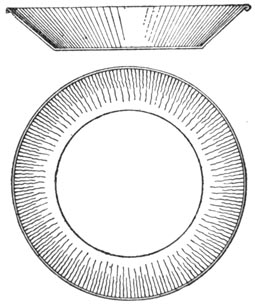
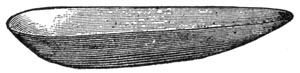
MINER'S GOLD PAN.
A sluice is really nothing more nor less than a trough, open at the
top, in which the gold is sorted from the lighter gravel and dirt by
running water. The grade varies according to the coarseness of the
gold. Very fine gold would be carried away by too swift a current,
while coarse gold will resist almost a torrent. The sluice is built in
joints, usually a dozen feet in length; the sides may be six inches or
a foot deep, and the width varies from one to two feet. There is no
rule in this matter, but owing to the extravagant price of lumber—as
much as a hundred and fifty dollars a thousand feet, board
measure—the tendency is to make the sluices very small and very
short, thereby saving nothing but the very coarsest gold. A properly
constructed sluice should be several hundred feet in length, and the
inclination should not be more than one foot in twelve, while it may,
in a case of fine gold, be advisable to diminish this inclination by
at least a fourth. Riffles, or cross-pieces, are placed across the
sluice at intervals of a few feet, and slats are placed lengthwise,
filling up the intervals between the riffles. Into the crevices and
interstices of these obstructions the heavy gold sinks by its own
weight, and every few days, or weeks, as the case may warrant, the
miner shuts off the water by closing the gate at the head of the
sluice, removes the slats and riffles, beginning at the joint nearest
the head and working towards the tail of the sluiceway, and collects
all the gold that has accumulated.
This is a very simple form of mining, but it is not the simplest. Much
gold has been recovered from the gravel in which nature has placed it
by the aid of the pan, a sheet iron dish modeled on the housewife's
bread pan.
Next to the pan the cradle is as little complicated as anything used
in the winning of gold.
After this comes the long tom, a considerable improvement upon the
cradle, but it necessitates more water and more men.
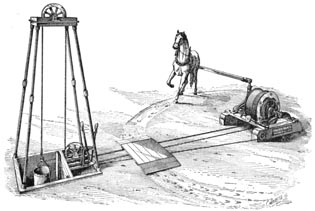
HORSE WHIM.
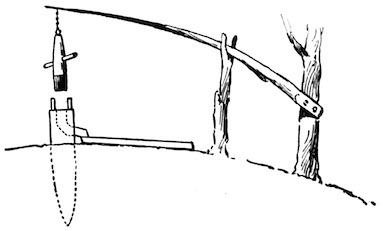
The horse whim is used in developing many a western prospect. The
windlass does not work well below forty feet, and where fuel and water
are to be had any sensible man will use steam power for deep mining,
but there is a gap between the windlass and the steam hoist which the
horse whim fills acceptably. To a depth of 300 feet a horse whim can
usually handle the rock and water. It is inexpensive, in the first
outlay, and costs but little to run. You can bring your bucket from a
shaft a hundred and fifty feet deep in two and a half minutes, and
with a seven hundred pound capacity in the bucket, in forty-five trips
you could raise fifteen tons a day. A shaft three hundred feet deep
would require four hours' steady work to bring to surface the same
amount. A fair speed with a one-horse whim from a three hundred foot
shaft is one hundred buckets per shift of ten hours, but the
prospector rarely has to figure on shafts of that depth. If the mine
turns out well it is likely to be in the hands of a powerful company
(of which he should be the principal shareholder) before the three
hundred foot level is reached. The weight of the horse whim is about
eight hundred pounds. It can be taken to pieces and packed anywhere
that a mule can travel; the heaviest piece will not weigh more than a
hundred pounds.
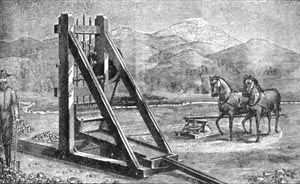
PROSPECTING MILL WITH HORSE POWER.
A small stamp mill, run by horse power, is a very favorite machine
with western men, where the ore is free milling. The mortar in which
the stamps work has copper plates amalgamated with mercury inside, and
copper tables with amalgamated plates over which the pulp passes after
oozing through a fine screen in front of the mortar. These little
mills are so constructed that they can be taken apart or put together
in an hour or two. They require but one horse power and will do good
clean work up to their capacity. The following are the specifications
of a good one:
| Total weight |
1,500 pounds. |
| Weight of heaviest piece |
350 pounds. |
| Weight of stamp |
100 pounds. |
| Drops per minute |
60 to 80. |
| Capacity per hour |
300 to 400 pounds. |
| Diameter of pulley |
30 inches. |
| Price, with horse power, |
about $350. |
A diamond drill is a most useful adjunct to exploration of a mine or
deposit. It is, essentially, a hollow drill which may be lengthened at
will, rotating rapidly and carrying a crown of "bort" or black
diamonds at its extremity, that eats into the strata very quickly.
Holes 3,000 feet deep have been driven by the diamond drill, but such
extensive investigations of the earth's crust are tremendously costly,
and may only be undertaken by governments or rich companies. For a
depth of 700 feet, however, the expense need not exceed $2,100. The
cost of the plant for drilling would be $3,500 more. Water is pumped
down the hollow center of the drill, to keep it cool. The great
advantage of the diamond over the percussion drill is that it permits
the saving of a core, so that the character of the rocks and minerals
passed through may be known. The diamond drill does better work in
hard strata than it does in soft. The rate, in limestone, may be about
two feet an hour, down to a depth of 200 feet.
A complete outfit for boring with the diamond drill includes a steam
engine and boiler, diamond crown, lining tubes, rods, and various
minor accessories.
Hydraulic mining is the cheapest known method of recovering gold. In
four years the North Bloomfield Mining Company of California worked
325,000,000 cubic yards, which yielded only 2.9 cents of gold per
cubic yard, and realized some profit. Very poor gravel will pay when
the conditions are good. Cheap water, grades of four inches in a
hundred, ample dumping room, big banks of light gravel, large areas of
deposits, labor at a dollar a day, and a clever superintendent, make a
combination that will yield a profit out of three-cent gravel.
Miners speak of "surface" and "deep" placers; of "hill claims;" of
"bench claims" on the old river terraces; of "gulch diggings;" of "bar
claims" on the sand bars of existing rivers; of "beach sands" or those
that in a few favored localities border the ocean. A "sluice" is a
long boxway to catch the gold; a "drift" is a tunnel into the
gold-bearing gravel; and hydraulic diggings are those in which water
under pressure is used to disintegrate the gravel.
A ground-sluice is a trench cut through the bed rock. The roughness of
the natural floor serves for riffles. Booming is a process requiring a
large accumulation of water in a reservoir, which may be discharged at
once, and carry all the material that has collected below the pass,
with one full tide, into the sluices. This practice is extremely
ancient; Pliny mentions it in his Natural History.
Deep mining may be divided into drifting and hydraulic mining. In the
former the metal is won by means of tunnels and drifts or horizontal
passageways along the length of the deposit. It is usually resorted to
in districts where a flow of lava has covered the gold-bearing gravel,
and made hydraulic mining impossible. It is followed in Alaska for
another reason, viz., because the constantly frozen ground will not
permit of the more remunerative method. The gravel is carried to the
mouth of the tunnel and there dumped to be washed in the sluices. When
"cemented" it must be broken up by stamps.
Rich deep placers may be worked by drifting, but whenever practicable
hydraulicing is to be preferred as giving better results. It yields
from four to six times the amount of gold that drifting does. Thorough
exploration should precede the expenditure of large sums in a
hydraulic plant. Even should the explorations result in finding barren
gravels the money will have been well spent in saving the cost of an
unproductive plant.
Black sand (magnetic iron) almost always accompanies gold, but this
alone is no sign that gold is present, as black sand may usually be
obtained by grinding and washing crystalline rocks.
Ditches and flumes of wood or metal are used to bring the water for
hydraulic mining from the region where it was impounded in a catch
basin, often a distance of many miles. It is said $100,000,000 have
been invested in ditches and flumes, mining and agricultural, in the
western states, and new flumes are being planned every month. Some of
them consist of wrought iron pipe carried over ravines by trestles 250
feet high.
In planning a ditch the miner must see to it that his water supply is
at a sufficient elevation to command the ground. The more pressure the
water works under the better. The supply should be continuous, or at
least be available during the whole working season. Ditches in regions
of deep snow should have a southern exposure. All streams crossed by
the ditch should be diverted into it, to counteract leakage and other
loss. Waste gates must be provided every half mile. Ditches are better
than flumes. Narrow, deep, and steep ditches are to be preferred in
mountainous regions, and the reverse in valleys with soft soil. Some
Californian ditches with a capacity of 80 cubic feet per second and
grades of 16 to 20 feet per mile have been built.
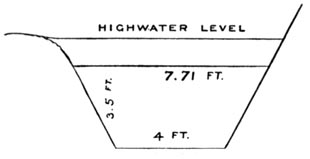
SECTION OF DITCH.
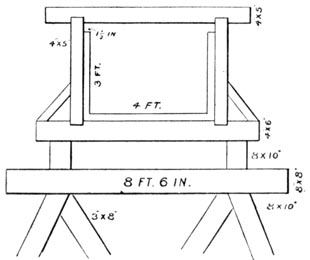
SECTION OF FLUME.
Sometimes the face of the country requires flumes; they may even be
hung along the face of a cliff. In shattered ground and where water is
scarce flumes are better than ditches. The grade for a flume is
usually 25 to 35 feet per mile and its capacity is smaller than that
of a ditch. Pine planking 2½ inches by 12 to 24 inches, and 12 feet
long, is the dimension stuff generally preferred. A flume 2 feet 6
inches square requires posts, caps, and sills of 3×4 inch; stringers
4×6 inch. Great care is needed at curves to avoid slack water and
splashing. The boxes must be shortened and the outer side wedged up
until the water flows as evenly as in the straight stretches. Should
anchor ice form the water must be shut off at once. The life of a
flume seldom exceeds a dozen years, whereas at the end of a similar
period a ditch would be carrying 10 per cent more water than at first,
owing to the sides and bottom having become consolidated.
Wrought iron pipes are employed largely in California to replace
ditches and flumes. When the pipe crosses a ravine it is known as
an inverted siphon. Piping is also used to convey water from the
"pressure box" to the "gates" and "nozzle." Wrought iron pipes have to
stand pressure varying from 34 pounds to 800 pounds to the square
inch. Air valves or blow-offs must be provided at intervals to allow
the escape of air from the pipe while filling, and to prevent a
collapse of the pipe after a break. A covering of coal-tar should be
given the pipe both inside and out. Cost varies from one dollar to two
dollars a running foot.
The pressure box ends the ditch and from it the water passes into the
supply pipe. The head of water is measured from this point. A box to
catch sand and gravel, with a side opening and sunk below the level of
the ditch, is called the "sand box."
One and a half inch plank is generally the material out of which the
pressure box is made. The depth of water in it is such that the mouth
of the pipe is always under water. A grating in front of the pipe
catches all rubbish. As no air must be allowed to get into the pipe
the water must be kept quiet and deep at the pipe-head; this is
insured by dividing the box into compartments, the first receiving the
water and discharging it through suitable openings into the second.
The water supply and the discharge should be equal. The water passes
down the feed pipe, iron gates distributing it to the discharge pipes.
Water must be turned on gradually, and the air valves must be open.
The piping terminates in a nozzle with knuckle-joint and lateral
movement. Nothing but the most secure bolting to heavy timber and the
heavy weighting of the last length of pipe should be relied upon to
keep the hydraulic giant in its place. Should it once begin bucking
every man within reach of the powerful column of water is in imminent
danger. The nozzle is directed by means of a larger deflecting nozzle,
which receives the impact of the water and causes the main nozzle to
swing right or left, up or down, as the case may demand.
A derrick capable of moving heavy boulders, and driven by water power,
is a necessity in all hydraulic mining. Masts 100 feet high and booms
90 feet long are sometimes used, the motive power coming from a "hurdy
gurdy" direct impact wheel. Experiments have shown that the bucket has
much to do with the power of the wheel. For instance, when the water
impinged against a flat bucket the efficiency of the wheel was less
than 45 per cent. of what it should have been in theory, whereas, with
the Pelton bucket, it rose to 82.6 per cent.
There is a great amount of so-called cement, or in other words
consolidated gravel, in all the northern placers, and in many
California deposits, as well. In the old Cariboo diggings on the upper
Frazer, strong companies are now pulverizing the ancient cements that
resisted all the efforts of the 59 miners with powder and stamp mill,
and are deriving large profits therefrom.
Black powder gives even better results than dynamite in gravel. The
usual allowance of powder is 20 pounds in weight for every 1,000 cubic
feet of ground to be moved. Make drifts T-shaped, and tamp the main
drift almost to the junction with the arms, which should be parallel
to the face it is required to dislodge.
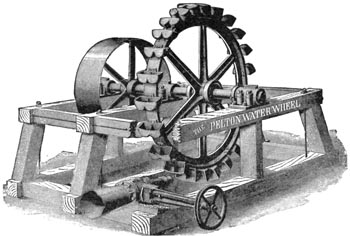
PELTON WATER WHEEL.
Sluices have their maximum discharge when set straight. Increased
grade may be given below any unavoidable curves with advantage, and
the outer side of the sluice must always be raised. Steps or "drops"
in the sluices help in the recovery of the gold. In general, a grade
of 6-6½ inches to the 12-foot box is found best; this is equal to a
4-4½ per cent. grade. Exceptional instances are on record, however,
where grades ran from 1½ per cent. to 8 per cent. In a 4 to 7 per
cent. grade the water in the sluice should be 10 inches deep at least.
The following table gives useful details:
| Sluice. |
Grade. |
Water. |
| 6 ft. × 36 in. |
4 to 5 p.c. |
2,000 to 3,500 m. in. |
| 4 ft. × 30 in. |
4 p.c. |
1,800 to 2,000 m. in. |
| 3 ft. × 30 in. |
1½ p.c. |
600 to 1,000 m. in. |
"The longer the better," is the sluice-builder's motto. The best
"riffles" are made of blocks of pine 8 to 13 inches deep, wedged into
the bottom of the sluices. They are laid in rows separated by a space
of an inch or an inch and a half. Riffle strips keep them in position,
these latter being laid crosswise on the bottom. When worn down to
five inches, the blocks should be replaced. This amount of wear will
probably require six months. Stone and longitudinal riffles running
lengthwise of the box are often preferred.
An undercurrent is a broad sluice set at a heavy grade below the level
of the main sluice. The fine stuff drops through a grating, while the
coarse gravel continues on down the sluice.
Refuse material from quartz, hydraulic or other mines is known as
tailings. Tailings are deposited on a dump, which in the case of a
hydraulic claim must be sufficiently spacious to receive the thousands
of yards of debris deposited on it each day. When available a narrow,
deep canyon, or a tunnel, may take the places of dumps.
Quicksilver is used in the sluices, 14 to 18 flasks being used every
fortnight in a long sluice. It is not placed in the last 300 or 400
feet.
In working, keep the face of the bank "square." Washing should be
carried on continuously. Watches must be set over the sluices, or gold
is likely to be missed. As an extra precaution, the sluices should be
run full of gravel before shutting off the water. There is no fixed
custom regulating "clean ups." Some managers do so every 20 days,
others run two or three months, others again clean up but once in a
season. In large operations, the first 2,000 feet of sluice are
cleaned up every fortnight; the remaining boxes once a year.
Sluices are cleaned from the head downward, the blocks being taken up
for that purpose. The amalgam of gold and quicksilver is collected in
sheet iron buckets. The final step is reached when the amalgam is
retorted and melted in a graphite crucible.
The principle of which the hydraulic miner takes advantage is the
great specific gravity of gold as compared with water and rock. To
illustrate this quality it may be noted that on a smooth surface
inclined at an angle of 1 in 48, subjected to a heavy stream of water,
95 per cent. of the fine gold in gravel does not travel three feet.
The loss of quicksilver fed into sluices will vary, even under good
management, from 11 per cent. to 25 per cent. of the amount fed to the
boxes.
Hydraulic mines under favorable conditions are very paying
investments. Gravel yielding 10 cents a cubic yard has been worked for
6 cents a cubic yard, at the rate of a million cubic yards a year. On
another large claim 600,000 cubic yards were worked for 6 cents a
cubic yard, yielding 13 cents a cubic yard.
River dredging is another form of gold winning that has been brought
to a great state of perfection in New Zealand. Although the dredge has
not yet acquired the importance in America that was expected, it is
successful on one or two western rivers, and as the subject becomes
better understood it is conceivable that American mining engineers
will be as successful in devising improved dredges as they have been
in all other branches of their profession.
In New Zealand the bucket dredge has proved more satisfactory than the
suction dredge, although a hasty conclusion would probably give the
latter the palm. At Bannack, Mont., the Bucyrus Company has several
dredges in successful operation. One is 102 feet long, 36 feet wide,
and draws 36 inches of water. It is very substantially made, and
weighs nearly 700,000 pounds. Before such a dredge is launched, a dam
is built across the gulch to impound sufficient water. As the gravel
is dredged and washed, it is dumped astern of the dredge, which, in
the case of a shallow creek, moves up to the excavation made by the
buckets. The boilers of this dredge are double, and together have 250
H.P. There are 36 buckets, and each one has a horizontal drag of
eight feet, a capacity of five cubic feet, and travels at the rate of
fourteen feet a minute. After treatment by trommels, or revolving
screens, coppers, and sluices, and finally by a centrifugal pump, the
now almost valueless gravel goes overboard again, leaving behind 98
per cent. of the gold it once held.
The traction dredge is really a land-mining machine, as it is adapted
for work on land nearly flat, where but little water is obtainable.
The machine travels on bogie tracks. A 50-H.P. boiler supplies the
water. A boom, 40 feet long, carries a shovel of 1.5 cubic yards'
capacity, and moves 70 cubic yards each hour.
Mr. John W. Gray, one of the best authorities, has recently written to
the Mining and Scientific Press of San Francisco a most interesting
description of the progress made in saving the gold from the streams
in New Zealand. He says, in part:
"After great effort, numerous trials, many failures and some large
losses, this system of gaining gold has been evolved from crude
beginnings into a systematic and satisfactory method of mining.
Dredging for gold is now attracting attention and bids fair to become
an established form of mining for that metal. In New Zealand, where
more work of this nature has been done than elsewhere, the evolution
of the industry has been the work of years. The rivers upon which
dredging operations are carried on are swift-flowing streams, subject
to frequent floods, having a considerable depth of gravel, with
boulders and runs of pay dirt interstratified. The conditions are,
therefore, not the best for economical and successful work, and it is
not surprising that many failures have occurred. The runs of gold are,
however, often extensive and rich, and operations carried on upon such
reaches have in a number of cases given satisfactory results.
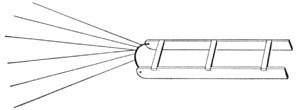
"The improved form of dredge is a double pontoon, with ladder and
chain-bucket arrangement between. Screens separate the coarse from the
fine material. Wide sluicing tables catch the gold, centrifugal pumps
supply the water, and waste material is handled by elevators. The
power is usually steam, although electricity is used in a few
instances, where conditions are favorable. The dredges vary in size
and capacity, but are now built of large size and great strength.
Twenty thousand dollars is the cost of a large dredge with all the
latest contrivances. Under favorable conditions, material has been
handled without loss that only yielded a grain of gold to the cubic
yard. The real cost in actual continued working is believed to be very
much in excess of that figure where average conditions exist.
"One dredge on the Clyde side of the Shotover, working to a depth of
twenty feet below water level, lifted 40 tons per hour when operating.
The profit on eleven dredges for the four weeks ending July 24, 1897,
was an average of $2,686 for each dredge.
"So far in this country (United States), with a few exceptions,
dredging operations for gold have not been financially successful.
From crude beginnings, however, the machines have been rapidly
improved and perfected, until now, in some localities, dredges
believed to be the most complete yet constructed are being put in
operation, and results are promised, not yet attained, in the way of
economical working and high percentage of saving. During the last few
years, a number of dredges have been operated in California, British
Columbia, Idaho, Montana and Colorado, but with poor success. Very few
prove themselves capable of paying their way. Some of the machines
were faulty within themselves, others were entirely unable to cope
with the swift currents and large boulders of the streams upon which
they were operated. This latter is said to have notably proved the
case with the dredges tried upon the Frazer and Ouesenelle rivers.
"Dredging operations on Grasshopper Creek, near Bannack, Mont., are
now carried on successfully upon a large scale. The upper Sacramento
river, in this state, has a dredge doing profitable work, and, in a
small way, dredging is successful upon the Kzamath. A dredge upon that
river, composed of two flat boats with a large steel scoop between, is
able to cut and hoist the gravel and soft bed rock, and to handle
boulders of from four to six tons' weight. The dredge is run day and
night, has a 25-H.P. engine, and requires three men for each shift.
In gravel 10 to 25 feet deep, 400 cubic yards can be handled every
twenty-four hours. Cost of dredge, $8,000.
"A large dredge of the chain-bucket variety is operating in Northern
Mexico, in a dry country, where there is little water. The actual
capacities of these machines are 60, 100 and 150 yards per hour.
"Perhaps the most interesting dredge yet brought to the notice of the
public is one lately built by the Risdon Iron Works, San Francisco,
and now operating upon the Yuba river, near Smartsville, Cal. It is of
the elevator, or chain-bucket, type, 96 feet long, composed of two
pontoons, separated by a space five feet in width, in which is
operated the ladder carrying the buckets. One man controls the dredge
by means of a power winch with six drums. Four drums carry lines from
the corners of the dredge to anchorages on shore—one a head-line and
one the ladder line. The machine is to dredge to a depth of 45 feet,
and is said to have a gross capacity of 93 cubic yards per hour. The
material discharges from the buckets into a revolving and perforated
screen. This segregates the large material, which is then conveyed
away by the tailings elevator. Water (3,000 gallons per minute) is
supplied to the revolving screen for washing and sluicing purposes by
a centrifugal pump, and the fine stuff falls through the holes in the
screen into a distributing box, from which it passes to a set of
gold-saving tables and thence to a flume. The tables are covered with
cocoa matting and expanded metal. The top tumbler of bucket-chain is
operated by a vertical compound condensing engine indicating 35 H.P.,
which also operates the pump. It is claimed for this dredge that in
any ground not deeper than 60 feet below water level or more than 20
feet above, and which contains boulders of not more than one ton
weight, the material can be handled at from 3 to 5 cents per cubic
yard. If the capacity of the machine is given without deduction for
water raised, imperfect filling and general delays, and the increase
in volume of the gravel when broken up in filling the buckets, the
actual working capacity would be less, and from these causes and the
losses from wear and tear, breakages and repairs, the cost of
operating would be increased. The cost of the dredge complete upon the
river is said to have been $25,000.
"In the evolution of the dredge into the elevator or chain-bucket
machine, now the popular form, the various kinds of dredges were given
trials. The dipper dredge is not adapted to dredging for gold, and
some of the gold is lost. With agitation of the gravel the gold soon
settles and is not recovered. It is also very difficult, if not
impossible, to construct a dipper dredge that is water-tight. Another
objection is that the material is supplied intermittently, thus making
necessary certain undesirable arrangements for supplying the material
in a continuous flow to the gold-saving tables. The same objections
apply with greater force to the clam-shell form of dredge. It is by no
means water-tight, and loses most of the gold in the act of dredging
and bringing up the gravel. The objections would seem not to have the
same force if applied to hard cemented gravel or to gravel with
sufficient clay or other binding material to make it consistent. It is
well to remember that these forms of dredges are, in many positions,
economical of operation.
"The hydraulic dredge has had fair trials and proved a failure. Large
storms greatly lessen the efficiency of this form of dredge, and
numerous boulders hamper the pumping work. The suction force, being
intense near the pipe and decreasing rapidly a short distance away,
causes the sand and gravel to be carried off, leaving the gold behind.
A centrifugal pump is therefore of little use to catch coarse gold, or
to clear a hard, uneven bottom. Cutters do not remove the trouble,
since the gravel is dispersed by the cutting, and the gold is
separated therefrom.
"These objections would not obtain under certain conditions, and it
would seem quite possible that conditions might be found existing
where the suction dredges might be arranged to do good work. A
dredging company is now constructing, at Seattle, two dredges of the
suction type to operate upon the Yukon river. This would indicate that
there are those who believe that deposits occur in and along that
river which can be successfully worked in this way.
"The chain-bucket machine, the popular form for operating under
average conditions, is a combination of the following elements: An
excavating apparatus which clears the bottom and handles the material
with little agitation and slowly and continuously delivers a regular
quantity of gravel to the gold-saving appliances; revolving screen to
receive and wash the material and separate the coarse from the fine;
an elevator or contrivance for carrying off the coarse gravel and
stones; gold-saving arrangements, or tables, over which the fine
material passes and upon which the gold is caught; a pumping apparatus
to supply water for washing and sluicing.
"The proper capacity of a machine seems to be regulated by the
capacity of the gold-saving appliances. The tables should be as wide
as possible, with frequent drops, and the fine material should be
distributed over the tables in a thin film. The tables are covered
with plush or cocoa matting, and sufficient water supplied to keep the
material clear. The material should be supplied evenly, continuously,
and regularly to the tables. Care and attention are required to catch
the fine gold. A disregard of the foregoing directions results in
great loss, more particularly in the fine gold. Mechanical skill is
required to properly design and construct a dredge, and the care of a
competent mechanic is necessary to see that the machine is kept in
order and economically operated. The saving of the gold, however, is
what makes dredging operations a commercial success. A man skilled in
these matters should be in charge of running operations. Dredges
should be built of determined capacities, and should be designed to
suit the conditions under which they are to operate. Careful
examination and investigation of the ground to be worked should be
made beforehand, and the surrounding conditions studied, and it goes
without saying that these matters require engineering skill and
experience.
"The field for dredging for gold seems large. Where the proper
conditions exist, it is a system which commends itself, and which
gives promise, in competent hands, of being an economical method of
mining. There is probably a very large extent of country where
dredging for gold will be carried on profitably. The ground need not
be in a river, if there is seepage water sufficient to float the
dredge and supply clear water for the saving of the gold. Dredging
requires little water as compared with that required for sluicing and
elevating, and this water can, in many dry localities, be supplied at
small expense, where a supply for hydraulic work or elevating would
cost a very large sum, or be impossible at any cost. Any power
suitable for driving the prime motors can be utilized to run the
dredge. Indeed, it would seem as if a system of mining was about to be
perfected which may make possible the profitable working of many
deposits not easy to be worked by other methods, and which may, in
many instances, solve problems regarding the successful working of
deposits which hitherto have seemed most perplexing and even
impossible of solution. Some doubt exists as to possible economical
dredging operations under the water of torrential streams. The strong
currents, the frequent floods, and many large boulders found in the
channels of such streams make the working of the machines difficult
and costly. This would not be so much the case in the long stretches
of less current, nor would it be so at all in the valley-like reaches
in the lower portions of rich streams, nor in the wide, flat portions
of country where the streams enter the plains."
Very few gold-bearing lodes contain nothing but free gold; on the
contrary, they carry the bulk of their values in the form of
sulphurets, having more or less gold incorporated, and even when the
gold is native and free-milling at the surface, it is generally
changed into sulphurets as depth is gained. So the miner has to
consider methods of recovery more complicated and expensive than
simple amalgamation with mercury, for upon gold included in pyrites
mercury has no effect. Titanic iron, hematite, and tungstate of iron
often hold gold, or soft clay ores carry it in their midst, and such
combinations tax all the skill of the mining engineer merely to save a
respectable percentage of the assay value. Sometimes chlorination and
sometimes cyanization are the measures tried, but supposing the
preliminary treatment to have been by stamps in the battery,
concentrating is one of the main reliances of the mill man. The
blanket table is undoubtedly the oldest type of concentrating machine,
but it is very inferior to modern inventions. Percussion tables often
do good work. In this system a sharp and frequently repeated blow is
given the table, in such fashion as to make the heavy material
separate from the light. "Shaking" and "rocking" tables are favored in
some mills, and they give better results on fine gold than any of the
previously mentioned devices. But the best machine so far invented is
the Frue Vanner—an endless rubber band drawn over an inclined table,
having both revolving and side motions. The lighter particles are
carried off by water, and the heavier collected in a trough.
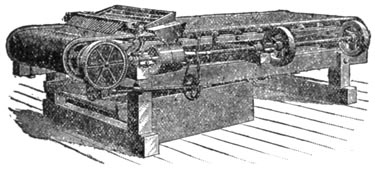
FRUE VANNER.
Veins, lodes, or ledges, may be found in stratified or unstratified
rocks, and in the former they generally cut the beds at an angle.
Veins are bounded by walls. The rock in which a vein is found is a
country rock. Smooth walls are called "slickensides." The upper wall
of an inclined vein is the hanging wall; the other the foot wall. A
layer of clay between the veins and wall is a selvage. A mass of rock
enclosed in the vein is a horse. The vein stone, or gangue, is all
that part of a vein that is not mineral.
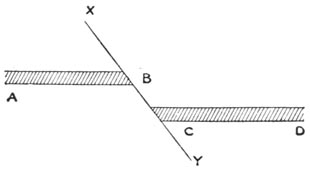
A FAULT.
The throw of a fault in a vein is measured by the amount of vertical
displacement. When the miner comes to a fault, he should follow the
greater angle in his attempt to recover the lode. For instance, on
mining along A B to the line of fault X Y, the exploration will be
continued downward, because the angle A B Y is greater than the angle
A B X.
Mercury that has been "sickened," that is to say, has lost its
brightness and power of amalgamating, may often be cured by washing
with an extremely weak solution of sulphuric acid and adding a little
zinc.
As regards the comparative merits of chlorination and cyanization, it
may be said the one is the equal of the other. Under certain
conditions, chlorine gives a higher percentage of gold; under others
the same may be said of cyanide. A description of either process would
be out of place, however, in a simple elementary work.
Handed down through the centuries, the primitive arrastra is still
useful in certain contingencies. It is like a cider mill in its
principle, and was probably suggested by recollections of that
machine, or else of the Spanish wine-press. A circular, shallow pit, a
dozen feet or more in diameter, is first paved with hard, uncut stones
of granite, basalt, or other hard rock. This pavement is a foot thick,
and beneath it is a bed of puddled clay 6 inches deep. A vertical
shaft with an arm, or arms, revolves in the center of the arrastra.
Grinding blocks weighing 400, or perhaps even 1,000 pounds, are
fastened to the arms by chains or rawhide strips. The forward part of
each stone is raised a couple of inches off the floor. Mule, horse,
water or steam power may be used, the speed ranging from 4 to 18 turns
a minute.
Nothing can be simpler, less expensive, or save a greater proportion
of the value in the ore than the arrastra. Its limited capacity is its
worst fault. An arrastra 10 feet in diameter will treat 500 or 600
pounds of ore at a charge, and handle one ton a day of 24 hours. Ores
that were so poor they yielded nothing to the stamp mill have paid
well with the arrastra.
This humble device may be used to advantage, probably in some of the
poorer gold-bearing cemented gravels of the Northwest. The ore should
be crushed to pigeon-egg size. Small quantities of mercury, about a
tablespoonful to every five tons of gravel, has been found a
satisfactory proportion in California.
In a permanent arrastra a layer of neatly-dressed and pointed stones
is laid in hydraulic cement. A fair-sized arrastra will require 50
pounds of quartz to charge it, and the material must be broken into
pigeon-egg size. After the machine has been started, and a little
water added from time to time, little else need to be done for four or
five hours, and this is perhaps one of the reasons for which it has
always been so favored in indolent Mexico. At this stage, the quartz
and ore will be very finely pulverized, and water should be added
until the pulp is as thin as cream. Quicksilver must now be added in
the proportion of 1¼ ounce for every supposed ounce of gold in the
ore being treated. Two hours' further grinding is given, and water
then admitted until the paste is quite thin, the speed of the arrastra
being reduced at the same time so as to allow the amalgam and
quicksilver to sink to the bottom. A half an hour of this treatment
suffices and the thin mud is run off, leaving the gold and amalgam on
the floor of the arrastra. A second charge of broken quartz is put in
and the operation repeated, the clean-up not taking place oftener than
every ten days, and sometimes only at intervals of a month or so. The
rougher the bottom the longer the interval between clean-ups, as all
the stone work must be taken up each time and all the sand and mud
between them must be washed carefully. The arrastra is extremely
valuable to the poor man who, having discovered a gold-bearing vein,
wishes to transfer some of the metal into his own pocket, at the least
possible outlay. Its cheapness places it within reach of all, while a
stamp will cost a good deal. Then again the amalgamation being more
perfect in the arrastra than in any other mill, it is particularly
suited for the poor, lean ores. It is, however, only adapted to those
that are free-milling, others not being suited to this form of
apparatus, nor, indeed, to any save very costly plants. Some arrastras
have been built to treat old tailings, and have paid well when water
power could be used. Free-milling gold and high-grade silver and gold
ores are those usually treated.
The flagging should be of tough, coarse rock; granite, basalt or
compact quartz are all good. This flagging should be at the very least
a foot thick. When the arms of a 10-foot arrastra are revolving 14
times a minute, the outer stone is traveling 400 feet a minute. Round
holes closed by wooden plugs, or a side gate, lets the liquid mud out.
Some mill men use chemicals in the arrastra; potassium cyanide, and
wood ashes or lye are probably the most useful, as the latter cuts
grease and the former gives life to the quicksilver. Rich silver ores
are treated with blue stone and salt. When the pulp has been ground
sufficiently, quicksilver is added, sometimes 250 pounds being put in
a single charge. A 12-foot arrastra will never treat more than two
tons a day, and often no more than one-half that. One man a shift can
look after a couple of arrastras, and the owner, in case of one
arrastra that is working on tailings, often does everything himself.
Overshot wheels, or turbines, or hurdy-gurdies, furnish the power in
many cases. A simple mule-power arrastra may be built for $150.
A side hill should be chosen for the site of a battery. Ample water
power is necessary, though provision may be made for saving it in
catch basins should such a course be desired. Moreover, there must be
plenty of room below the mill for the tailings, as it may be desirable
at some future time to put them through a second course of treatment.
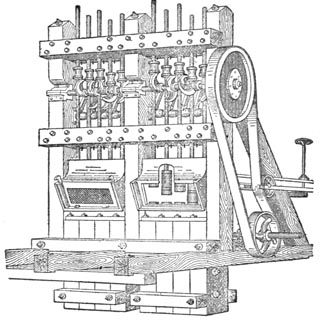
STAMP BATTERY.
Automatic ore-feeders are always put in by good mill men. In cold
climates the water that goes through the mill should be heated, and
this may be done by the exhaust steam, but care is necessary that no
grease get into it, as it would prevent the gold from amalgamating.
The stamps for a light mill may be 3 or 5 in number, and weigh from
700 to 850 pounds. Tables must be water-tight, with half an inch to
one inch drop to the foot, according to the fineness of the gold.
Below them tables, having the same inclination and covered with
blanketing, are used to retain specks of gold that have passed over
the plates without amalgamating.
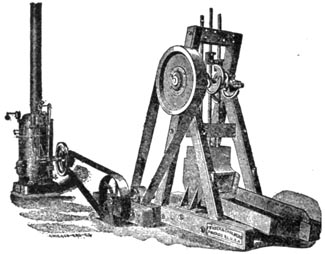
THREE STAMP BATTERY.
After the concentrated materials, always spoken of as the
concentrates, have passed over the tables, they are often roasted to
get rid of the sulphur, arsenic, etc., and afterwards treated with
quicksilver in the pan, or tin, with chlorine or cyanide. These
processes belong, however, to the domain of the professional chemist
and metallurgist, and require the knowledge and experience of an
expert to stand a chance of success.
The coarseness of the mortar screens is subject to infinite variety,
according to individual preference. The number of holes to the square
inch ranges between 60 and 800 in Australia, and between 900 and
10,000 in the United States. The holes, when round, agree in numbers
with those of sewing-machine needles, from 0 to 10. When slots are
preferred to holes, they are generally 3/8-inch in length and No. 6
diameter. Russia sheet iron, or sheet steel 1/32-inch thick is the material of which they
are made. It should weigh one pound to the square foot, be very soft
and tough, have a clean, smooth surface, and show no rust or flaws. In
Australia 1/16 sheet copper is preferred.
The holes in any case must be punched in the sheet so that the rough
edges are turned, and thus any pulp that finds its way into one of the
holes is certain to get out again and not clog. A battery may require
13 sets of screens a year; each screen having a surface of about
1½ square feet. Russia iron screens endure 15 to 40 days. As the
work a stamp can do depends entirely upon how much pulp can escape
through the screen in any given time, the latter is evidently a very
important detail of a battery.
Prospecting stamp batteries differ from ordinary batteries, chiefly in
being of light build and weight.
Amalgam coming from battery stamps is often mixed with all sorts of
rubbish. After being gathered, it is dried with a sponge, foreign
matter picked off the surface and clean quicksilver added. Soft
unglazed paper thrust into the mercury removes the last vestiges of
water, and then a card is drawn vertically or a piece of blanket
horizontally across the mercury to clean it of iron. After squeezing,
the amalgam is retorted.
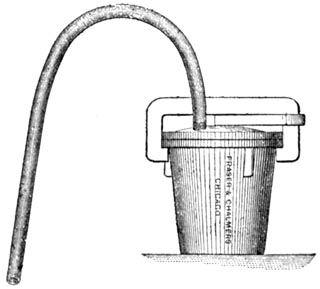
GOLD RETORT.
All the amalgam is placed in one large kettle and, if possible, the
latter is put on a strong table having an inclined surface with a
groove and hole at the lower end to catch any stray globules of
quicksilver. Sodium amalgam, one ounce to each 75 pounds of mercury,
is put in the amalgam kettle and the whole stirred. This sodium
amalgam is not absolutely necessary, but is desirable. After some
minutes, water is poured on the mercury and the whole stirred. All
dirt rises to the surface and is removed with a sponge. The cleaning
is continued until the mercury seems absolutely free from any
impurity, when it is dried with a sponge. It is next turned into
pointed bags of stout canvas and force applied until most of the
quicksilver has squeezed through. The amalgam remains behind. The
quicksilver still contains some gold, but it had better remain if the
mercury is to be used again, as gold attracts gold; it can always be
recovered by retorting.
Sodium amalgam is best made by the miner himself, enough for one
clean-up at a time. Metallic sodium and quicksilver are the necessary
ingredients; the former being kept in a wide-mouthed bottle covered
with coal oil. A frying-pan makes a useful mixer. It must be dry and
clean. Five pounds of clean mercury is poured into the pan, and dried
with a sponge, and heated beyond the boiling-point of water, but not
much above, or there will be a sensible loss of mercury. A piece of
sodium is wiped dry, cut into ½-inch squares and placed with a long
pair of tongs in the center of the warm quicksilver, which, by the
way, is now off the fire and in the open air, the operator meanwhile
keeping religiously to windward of it, unless he courts salivation and
all its attendant ills. As soon as the sodium touches the mercury a
flash and mild explosion will follow, but after a few cubes have been
introduced into the frying-pan, always in the center, this will cease.
As soon as a solid mass of amalgam forms in the middle of the pan, the
contents must be stirred slowly, and a little more sodium added. The
whole mass now crystallizes out, and if put into closely-stopped
bottles it will keep without further protection for a little time.
Once opened, each bottle must be used. Observe all these directions
faithfully, then there will be no danger of inhaling mercurial fumes
nor of being blown to atoms. After the amalgam is once made, it is
safe as sugar.
In retorting amalgam never fill the flask too full, and apply the heat
gradually, and always from the top of the flask downward.
The rocker is a box 40 inches long, 16 inches wide on the bottom,
sloped like a cradle, and with rockers at each end.
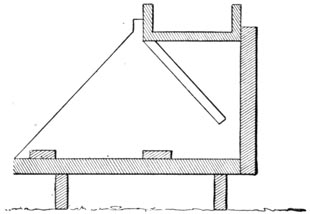
CROSS SECTION OF ROCKER.
A hopper 20 inches square and 4 inches deep, having an iron bottom
perforated with ½-inch holes, occupies the top. A light
canvas-covered frame is stretched under this, forming a riffle.
Riffles, and occasionally amalgamated copper plates, are placed in the
bottom. The gravel is fed into the hopper, the cradle being then
rocked by one hand while water is fed by a dipper with the other.
The cradle must be placed on an inclination while being worked, and
under the influence of the continued side-to-side rocking the dirt is
quickly disintegrated, passes through the riddle and falls on the
apron. From the apron it is conveyed to the inner end of the cradle
floor, from which it flows over the riffles, or bars, and out at the
mouth. The difference in level of the floor is generally about 2½
inches, but this may be varied according to the nature of the dirt
treated. Large stones in the riddle or hopper must be thrown out, but
smaller ones assist in breaking up the lumps of dirt. Every little
while the pebbles are turned out and looked over for nuggets.
Clean-ups are necessary two or three times a day. The hopper is taken
off first, then the apron is slid out, and washed in a bucket or tub
containing clean water, and finally the gold and amalgam are collected
in an iron spoon from behind the riffle bars, and panned out. Gravel
requires at least three times its own weight of water to wash it. The
most convenient way is to lead the water from a stream through a pipe
discharging directly over the hopper, but this is, of course,
impracticable in some places. More often the water is led to a little
pit on the right hand side of the operator, from which he ladles it up
as required. One man can wash from one to three cubic yards daily
according to the character of the dirt, but every time he stops the
machine to feed it with gravel or to empty the riddle, the sand will
pack, and must be removed before washing can go on. Two men can wash
nearly three times as much dirt in a day as one man. But in any case,
the rocker is only a primitive machine, having a capacity but
one-fifth as great as that of the Long Tom, and but one-tenth that of
a very poor sluice, but as it is cheap, requires but little water, and
saves a high percentage of coarse gold, the rocker will continue to be
used in many districts.
The Long Tom was invented many years ago by Georgia miners.

LONG TOM.
It is a trough 12 feet by 15 to 20 inches at the upper end, and 30
inches at the lower, and 8 inches deep. The grade is usually 1 in 12.
A sheet iron plate forms the lower end of the trough. These figures
refer to the upper trough. The lower or riffle-box is 12 feet long by
3 feet wide, with a fall equal to that of the trough and a sufficient
depth to keep the material and water from spilling over the sides. It
should have four riffles. For this means of saving the gold, to work
satisfactorily, the metal must be coarse and the water plentiful.
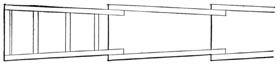
SLUICE BOXES.
Every sluice is an inclined channel through which flows a stream of
water, carrying away all the lighter matter thrown into it, and
separating it from the heavy. When the operations would not be
permanent enough, or sometimes for other reasons, a ground sluice is
preferred to the ordinary box sluice made of boards. Ground sluicing
requires, however, six times as much water as does a box sluice to do
the same amount of work. It is simply a gutter in the bed rock, and if
the bottom is hard and uneven its inequalities will arrest the gold;
if not, a number of boulders too heavy to be moved by the stream are
put into the sluice to act as riffles. No mercury is used. The water
is turned off and the collected coarse gold washed in the pan.
Sluice boxes may be any length, from 30 to 5,000 feet. They vary in
width from 1 to 5 feet, though generally 16 or 18 inches. The grade is
proportioned to the fineness of the gold, varying from 8 inches to 2
feet to the 12-foot box or length. The bottom should be of 1½ inch
plank, and the sides of 1-inch boards. The boxes are made 4 inches
wider at the upper end than at the lower, so as to telescope.
The best method found yet for arresting fine gold is the copper plate
amalgamated with mercury on its face. These plates are never used at
the head of a sluice or other situation where there is much coarse
gold, as they would be superfluous in such a situation, but are placed
some distance down the sluice and are most efficacious in arresting
the "flour," or excessively fine gold. Plates are always of copper
above 1/16 inch thick, and may be 6 feet
or more long, and of a width suited to the capacity of the sluice.
When treated with quicksilver, they become as brittle as glass, and
must be handled with care. The copper plate is first washed with a
weak solution of nitric acid, and then mercury that has been treated
with a weak nitric acid solution is rubbed on the plate. As this
surface of quicksilver wears off, it may be replaced by a little fresh
mercury. Any green slime on a plate is an evidence of copper salts in
the water. It must be scraped off and the spot rubbed with fresh
quicksilver. Gold attracts gold, therefore the plates should not be
cleaned up too often.
Copper plates may be freed from gold by heating them over a fire and
causing the quicksilver to evaporate slowly. The plates, after being
cooled, are rubbed with dilute muriatic acid and covered with damp
cloths for one night. They are then rubbed with a solution containing
salt peter and sal ammoniac, and once more heated over some hot coals,
but not allowed to get red hot. Soon the gold scale rises in blisters;
the plates are then removed from the fire and scraped. Those parts of
the plates that have not yielded up their gold must be re-treated and
fired until they do so. All these scales of gold are then collected in
a porcelain dish, the base metals are dissolved out with nitric acid,
and the gold is then smelted. Corrosive sublimate should be placed in
the crucible as long as any blue flame is seen to come from it.
Some mill men prefer to amalgamate their copper plates with silver
amalgam, claiming that silver-coated plates save a higher percentage
of gold. To amalgamate in this way take some silver bullion, or silver
coin, and dissolve in weak nitric acid, only just strong enough to act
upon the silver. (If you use too much nitric acid you will waste
mercury and make the amalgam harder than it should be for the best
results.) After crystals have formed, quicksilver must be added,
heating gently meanwhile, until a thick, pasty amalgam has formed. Let
this new compound stand for some hours, and squeeze through chamois as
usual. The proportion of silver may be about 1 ounce to the square
foot of copper to be plated.
In facing new copper plates with this amalgam, they should be washed
first with dilute nitric acid; then in clear water; the ball of
amalgam being rubbed over their surfaces, some little force being
applied. Plates should not be used for 24 hours after coating. Porous
copper plates of the best quality, and not too heavily rolled, should
be used. Follow the amalgam with a swab, and rub the alloy well into
the plate.
Zinc amalgam (preferable when mine water containing sulphuric acid is
used in the battery) is applied to the plate after it has been cleaned
with a moderately dilute mixture of sulphuric acid and water. The
zinc-quicksilver ball is rubbed in and applied while the plate is
still wet. Zinc amalgam is prepared as follows: Cut zinc-sheet into
small pieces; wash in weak sulphuric acid; and dissolve in mercury.
When the quicksilver will take no more zinc, squeeze through chamois
and rub in. Zinc-coated plates should stand a week before being used.
Very weak sulphuric acid will always clean these plates of any scum
that may form before they have received a gold coat.
Sometimes the miner will be troubled with impure gold after retorting.
If the metal is very dark this shade may come from the presence of
large amounts of iron. A heavy proportion of mineral salts, such as
chloride of calcium (CaCl), sodium (NaCl), and magnesium (NgCl2),
in the battery water sometimes accounts for this. In such cases
amalgamate, retort, pulverize and roast. Then smelt with borax, the
iron passing into the slag. If necessary smelt a second time, when the
gold should be pure enough to dispose of. In extreme cases, the gold
may weigh but one-fifth of the amalgam treated.
In districts where sufficient water for sluicing is not procurable,
dry washing is resorted to. Nothing but rich, coarse gold can be
worked by this method, and the dry washer rarely delves far below the
surface for his gold. In the Mexican deserts the dirt is laid on raw
hide, all the large pebbles picked out and the sand rubbed as fine as
possible between the hands. The sand is placed in a batea and winnowed
by tossing in the air, the lighter material being blown to leaward and
the heavy gold falling into the batea. A form of winnowing machine has
been patented, which may be driven by horse or hand-power, which is
said to give satisfaction. It works by forcing a strong blast of air
from a fan through a canvas screen. The inventor claims that it will
do the work of three men, and work dirt for 2½ cents a cubic yard.
When there is a tendency in the material to cake, dry washing is
impossible.