The word jazz is already so complicated that it
ought not to be subjected to any new definitions,
and the thing itself so familiar that it is useless to
read new meanings into it. Jazz is a type of music
grown out of ragtime and still ragtime in essence;
it is also a method of production and as such an
orchestral development; and finally it is the symbol,
or the byword, for a great many elements in the spirit
of the time—as far as America is concerned it is
actually our characteristic expression. This is recognized
by Europeans; with a shudder by the English
and with real joy by the French, who cannot, however,
play it.
The fact that jazz is our current mode of expression,
has reference to our time and the way we think
and talk, is interesting; but if jazz music weren’t
itself good the subject would be more suitable for a
sociologist than for an admirer of the gay arts. Fortunately,
the music and the way it is played are both
of great interest, both have qualities which cannot
be despised; and the cry that jazz is the enthusiastic
disorganization of music is as extravagant as the
prophecy that if we do not stop “jazzing” we will go
down, as a nation, into ruin. I am quite ready to
uphold the contrary. If—before we have produced
something better—we give up jazz we shall be sacrificing
nearly all there is of gaiety and liveliness
and rhythmic power in our lives. Jazz, for us, isn’t
a last feverish excitement, a spasm of energy before
death. It is the normal development of our resources,
the expected, and wonderful, arrival of America at a
point of creative intensity.
Jazz is good—at least good jazz is good—and I
propose to summarize some of the known reasons for
holding it so. The summary will take me far from
the thing one hears and dances to, from the thing
itself. The analysis of jazz, musically or emotionally,
is not likely to be done in the spirit of jazz
itself. There isn’t room on the printed page for a
glissando on the trombone, for the sweet sentimental
wail of the saxophone, or the sudden irruptions of
the battery. Nor is there need for these—intellectually
below the belt—attacks. The reason jazz is
worth writing about is that it is worth listening to.
I have heard it said by those who have suffered much
that it is about the only native music worth listening
to in America.
Strictly speaking, jazz music is a new development—something
of the last two years, arriving long
after jazz had begun to be played. I mean that
ragtime is now so specifically written for the jazz
band that it is acquiring new characteristics. Zez
Confrey, Irving Berlin, Fred Fisher, and Walter
Donaldson, among others, are creating their work as
jazz; the accent in each bar, for example, is marked
in the text—the classic idea of the slight accent on
the first note of each bar went out when ragtime
came in; then ragtime created its own classic notion,—the
propulsion of the accent from the first (strong)
note to the second (weak). In jazz ragtime the
accent can occur anywhere in the bar and is attractively
unpredictable. Rhythmically—essentially—jazz
is ragtime, since it is based on syncopation, and
even without jazz orchestration we should have had
the full employment of precise and continuous syncopation
which we find in jazz now, in Pack Up
Your Sins, for example. It is syncopation, too, which
has so liberated jazz from normal polyphony, from
perfect chords, that M Darius Milhaud is led to
expect from jazz a full use of polytonic and atonic
harmonies; he notes that in Kitten on the Keys there
exists already a chord of the perfect major and the
perfect minor. The reason why syncopation lies
behind all this is that it is fundamentally an anticipation
or a suspension in one instrument (or in the
bass) of what is going to happen in another (the
treble); and the moment in which a note occurs prematurely
or in retard is, frequently, a moment of
discord on the strong beat. A dissonance sets in
which may or may not be resolved later. The regular
use of syncopation, therefore, destroyed the fallacy
(as I hold it) of the perfect ear; and this is one
reason why Americans are often readier to listen to
modern music than peoples who haven’t got used to
dissonance in their folk and popular music.
It is not only syncopation that makes us indebted
to negro music. Another element is the typical chord
structure found there, the characteristic variations
from the accustomed. Technically described, one of
the most familiar is the subdominant seventh chord
with the interval of a minor instead of a major
seventh—a method of lowering the leading tone
which affects so distant a piece as A Stairway to
Paradise, where the accented syllable of Par´-adise is
skilfully lowered. (By extension ragtime also uses
the “diminished third.”) The succession of dominant
sevenths and of ninths is another characteristic, and
the intrusion of tones which lie outside of our normal
piano scale is common.8 Still another attack on the
perfect chord comes from the use of the instruments
of the jazz band, one for which ragtime had well
prepared us. The notorious slide of the trombone,
now repeated in the slide of the voice, means inevitably
that in its progress to the note which will make
an harmonious chord, the instrument passes through
discords. “Smears,” as they are refreshingly called,
are the deadliest enemy of the classic tradition, for
the ear becomes so accustomed to discords in transition
that it ceases to mind them. (We hear them,
of course; the pedants are wrong to say that we will
cease to appreciate the “real value” of a discord if
we aren’t pained by it and don’t leave the hall when
one is played without resolution.) In contemporary
ragtime, it should be noted, the syncopation of the
tonality—playing your b-flat in the bass just before
it occurs in the voice, let us say—is often purely a
method of warning, an indication of the direction
the melody is to take.
I put the strange harmonies of jazz first, not
because they are its chief characteristic, but because
of the prejudice against them. The suggestion is
current that they are sounds which ought never to be
uttered; and with this goes an attack on the trick
instruments, the motor-horns, of the battery-man.
The two things have nothing in common. The instruments
of the jazz band are wholly legitimate and
its characteristic instrument was invented by a German,
after whom it is named, in the middle of the
last century, and has been used in serious music by
(and since) Meyerbeer—I refer to the saxophone.
There is no more legal objection to the muted trombone
than to the violin con sordino. And the opponents
of jazz bands will do well to remember that
the pure and lovely D-minor symphony of César
Franck was thrown out as a symphony because it
used the English horn. The actual sounds produced
by the jazz band are entirely legitimate. We have
yet to see what use they make of them.
* * * * *
In Krehbiel’s book the whole question of rhythm
is comparatively taken for granted, as it should be.
Syncopation discovered in classic music, in the Scot’s
snap of the Strathspey reel, in Hungarian folk music,
is characteristic of three-fifths of the negro songs
which Krehbiel analyzed (exactly the same proportion,
by the way, as are in the interval of the ordinary
major). But it is such a normal phenomenon that I
have never found a composer to be interested in it.
Krehbiel, to be sure, does refer to the “degenerate
form” of syncopation which is the basis of our ragtime,
and that is hopeful because it indicates that
ragtime is a development—intensification, sophistication—of
something normal in musical expression.
The free use of syncopation has led our good composers
of ragtime and jazz to discoveries in rhythm
and to a mastery of complications which one finds
elsewhere only in the great composers of serious
music. In describing the Dahoman war dances at
the Chicago World’s Fair, Krehbiel says:
“Berlioz in his supremest effort with his army of
drummers produced nothing to compare in artistic
interest with the harmonious drumming of these savages.
The fundamental effect was a combination of
double and triple time, the former kept by the
singers, the latter by the drummers, but it is impossible
to convey the idea of the wealth of detail
achieved by the drummers by means of exchange of
the rhythms, syncopation of both simultaneously, and
dynamic devices.”
The italics are mine. I am fully aware of the difference
between savage and sophisticated, between
folk music and popular music; yet I cannot help believing
that this entire statement, including the Berlioz
whom I greatly admire, could be applied to Paul
Whiteman playing Pack Up Your Sins or his incredible
mingling of A Stairway to Paradise with a sort
of Beale Street Blues.
Freedom with rhythm is audible—should I say
palpable?—everywhere. Stumbling (Zez Confrey)
is in effect a waltz played against a more rapid
counter-rhythm, and is interesting also for its fixed
groups of uneven notes—triplets with the first note
held or omitted for a time, and then with the third
note omitted. A similar effect with other means occurs
in the treatment of three notes in Innocent Ingénue
Baby, by George Gershwin, where the same note falls
under a different beat with a delightful sense of surprise
and uncertainty. Mr Hooker’s words are
equally tricky, for it isn’t “Innocent-Ingénue-Baby”
at all; it is Innocent Ingénue (baby). In By and By
Gershwin has shifted an accent from the first to the
second simply by giving the second the time-value
usually given to the first, a fresh, delightful treatment
of a sentimental expression. The variety of
method is vastly interesting. Louis Hirsch, whom I
rank fairly low as a composer for jazz, has done perfectly
one obvious, necessary thing: stopped syncopating
in the middle of a piece of ragtime. In the
phrase “shake and shimmy everywhere” in It’s Getting
Very Dark on Old Broadway, he presents the
whole-tone scale descending in two bars of full unsyncopated
quarter-notes. In the works of Zez Confrey
(they are issued with a snobbish tasty cover,
rather like the works of Claude Debussy) the syncopation
and the exploitation of concurrent, apparently
irreconcilable rhythms is first exasperating and eventually
exciting. They are specifically piano pieces
and require a brilliant proficiency to render them.
It is a little difficult, unless one has the piano
score, to determine what part is the work of the composer,
what of the jazz orchestra. You can only be
fairly certain that whatever melody occurs is the composer’s,
and that rhythmically he is followed with
some fidelity. All you need to do is to listen to the
violin, piano, or whatever instrument it is which holds
the beat, to realize what the composer has given.
Harmonization is often, and orchestration nearly always,
left to other hands. Mr Berlin makes a habit
now of giving credit to his chief collaborator, and
he deserves it.9
* * * * *
Mr Berlin’s masterpieces (June, 1923, but who
shall say?) in jazz are Everybody Step and Pack
Up Your Sins. I have written so much about him in
connexion with song and shows that I can say little
more. I see no letting down of his energy, none in
his inventiveness. He is, oddly, one of the simplest
of our composers. A good way to estimate his capacity
is to play the more sentimental songs (I’m Gonna
Pin My Medal on the Girl I Left Behind, Someone
Else May Be There While I’m Gone, All by Myself)
in slow time and then in fast. The amazing way they
hold together in each tempo, the way in which the
sentiment, the flow of the melody, disengages itself in
the slow, and then the rhythm, the beat takes first
place in the fast time, is exceptional. You cannot
do the same with his own Some Sunny Day, nor with
Chicago or Carolina in the Morning. Berlin’s work
is musically interesting, and that means it has a
chance to survive. I have no such confidence in Dardanella
or Chicago. The famous unmelodic four
notes occur in the latter as in Pack Up Your Sins (the
source is the same, but we need not go into that);
the working out is vastly inferior. Fred Fisher’s
work is sledge hammer in comparison with Berlin’s,
and lacks Berlin’s humour. Of that quality Walter
Donaldson has some, and Gershwin much. Donaldson
wrote Al Jolson’s Mammy (I can’t remember
which, but I’m afraid I didn’t like it), and a song I
count heavily on: Carolina in the Morning. This
song is, incidentally, a startling example of how jazz
is improving the lyrics, for the majority of jazz songs
are not meant primarily for singing, so the balladists
take liberties, and not being held to a definite end-rhyme
give us “strolling with your girlie when the
dew is pearly early in the morning.”10 The music is
clean, rapid, and audacious. It carries the introduction
(of the chorus) almost to the point of exhaustion,
suspending the resolution of its phrases until the last
possible moment, and then lets go, with a vast relief
on the long, somewhat yodelly note. Confrey has
done the same thing in Kitten on the Keys where one
bar is repeated five times with successive tightening
of interest.
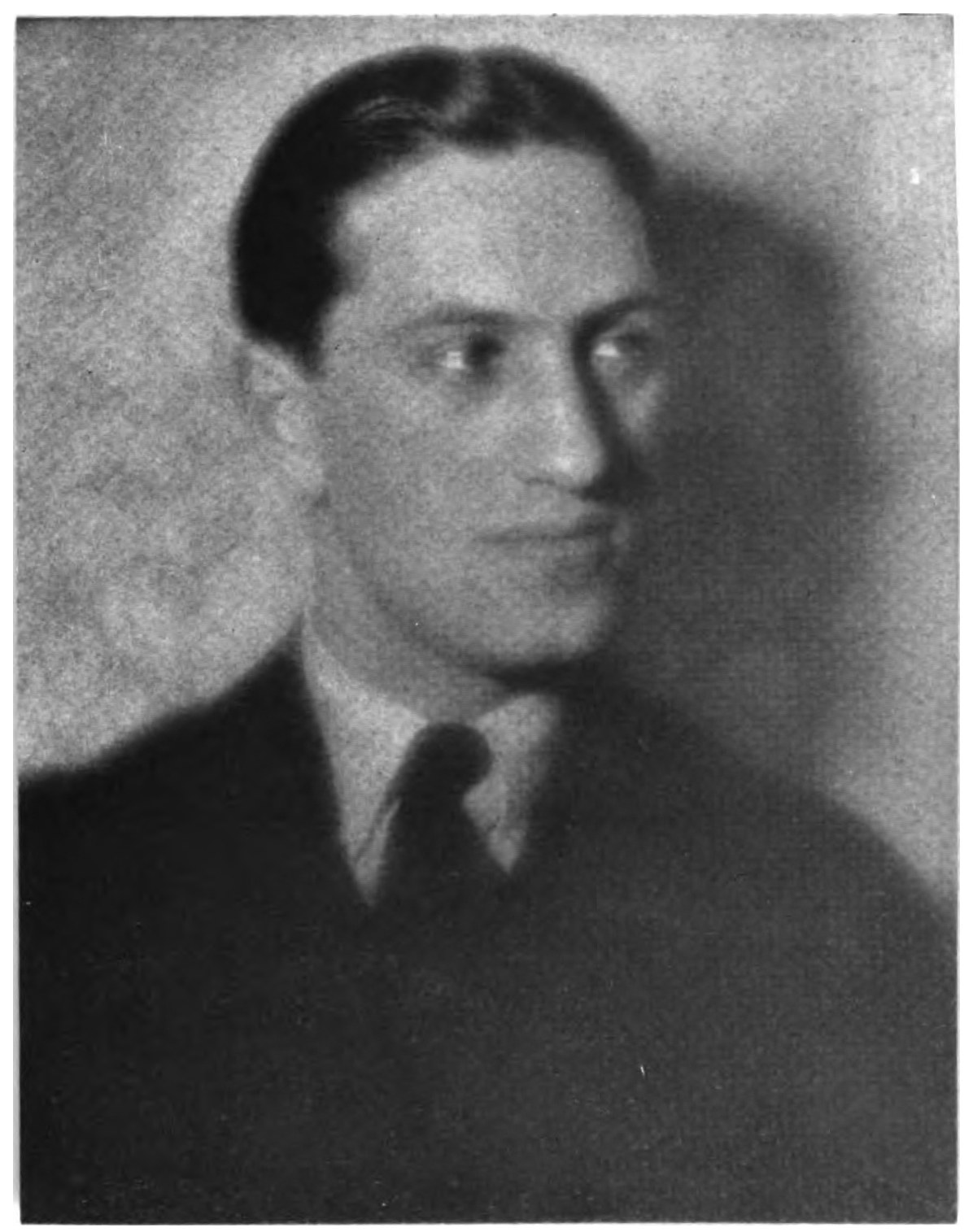
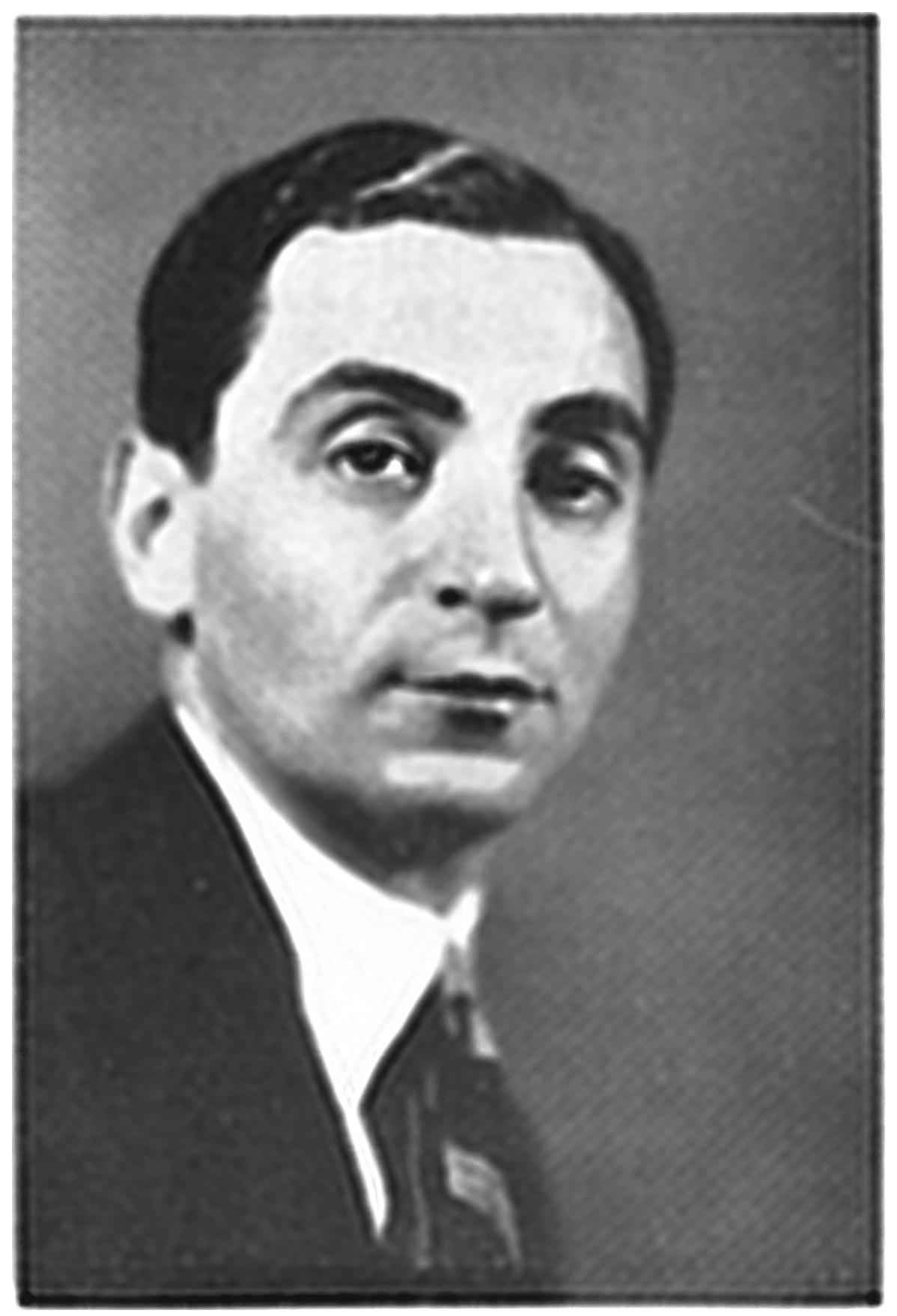
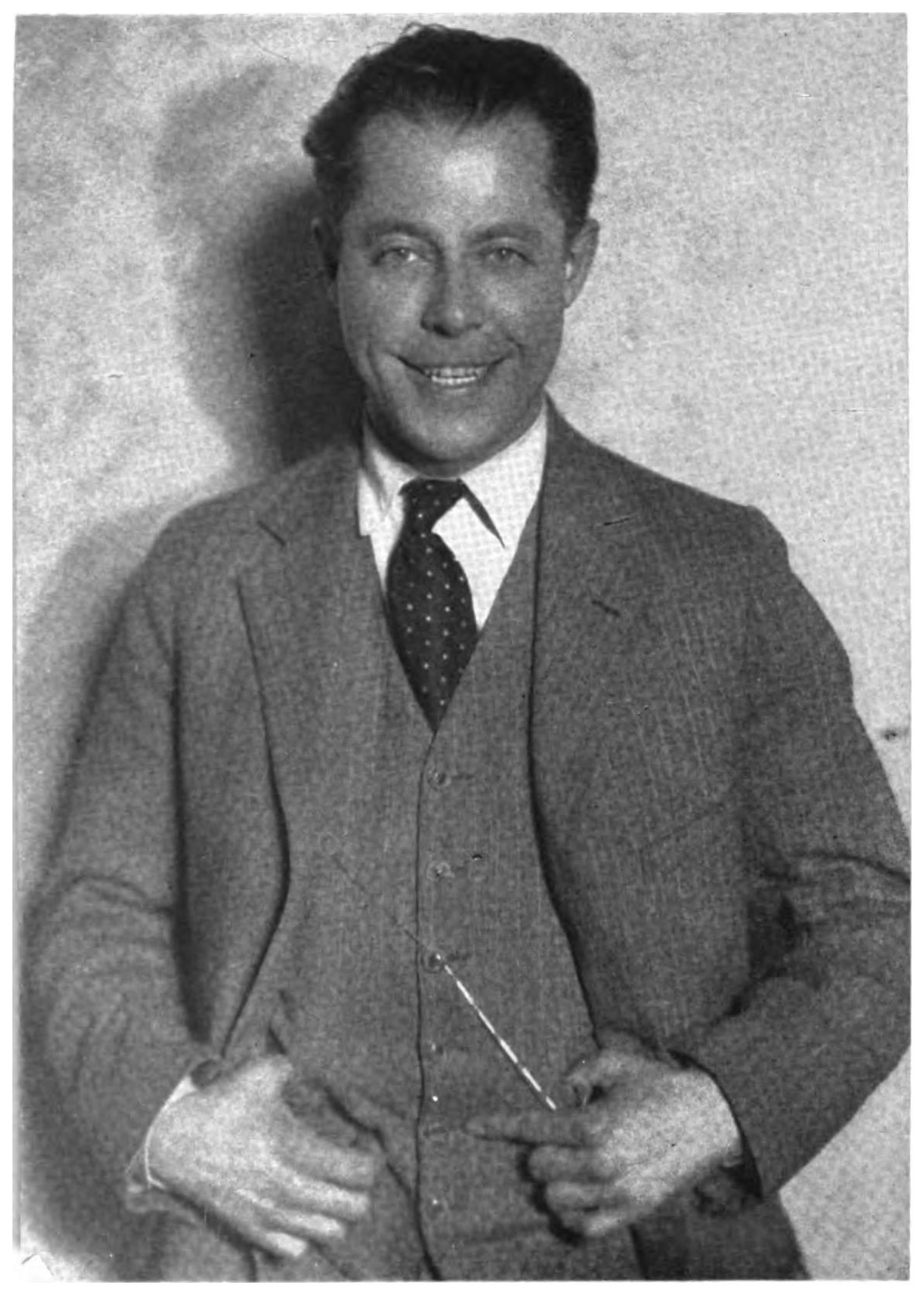
George Gershwin
Two composers are possible successors to Berlin
if he ever chooses to stop. I omit Jerome Kern—a
consideration of musical style will indicate why. I
am sure of Gershwin and would be more sure of Cole
Porter if his astonishing lyrics did not so dazzle me
as to make me distrust my estimate of his music.
Gershwin is in Berlin’s tradition; he has almost all
the older man’s qualities as a composer (not as a
lyrics writer; nor has he Berlin’s sense of a song on
the stage). That is to say, Gershwin is capable of
everything, from Swanee to A Stairway to Paradise.
His sentiment is gentler than Berlin’s, his “attack”
more delicate. Delicacy, even dreaminess, is a quality
he alone brings into jazz music. And his sense of
variation in rhythm, of an oddly placed accent, of
emphasis and colour, is impeccable. He isn’t of the
stage, yet, so he lacks Berlin’s occasional bright
hardness; he never has Berlin’s smartness; and with a
greater musical knowledge he seems possessed of an
insatiable interest and curiosity. I feel I can bank
on him. Banking on Porter is dangerous because essentially
he is much more sophisticated in general
attitude of mind than any of the others, and although
he has written ragtime and patter songs and jazz of
exceptional goodness, he has one quality which may
bar him forever from the highest place—I mean that
he is essentially a parodist. I know of no one else
with such a sense for musical styles. A blues, a 1910
rag, a Savoy operetta serio-comic love song, a mother
song—he writes them all with a perfect feeling for
their musical nature, and almost always with satiric
intention, with a touch of parody. It is only the most
sophisticated form which is germane to him; in highly
complex jazzing he is so much at home, his curiosity
is so engaged, he feels the problem so much, that the
element of parody diminishes. Yet The Blue Boy
Blues, almost as intricate a thing as Berlin ever wrote,
with a melody overlaid on a running syncopated comment,
has a slight touch of parody in the very excess
of its skill. Jazz has always mocked itself a little;
it is possible that it will divide and follow two strains—the
negro and the intellectual. In the second case
Porter will be one of its leaders and Whiteman will
be his orchestra. The song Soon, for example, is a
deliberate annihilation of the Southern negro sentiment
carefully done by playing Harlem jazz, with a
Harlem theme, mercilessly burlesquing the clichés of
the Southern song—the Swanee-Mammy element—in
favour of a Harlem alley. Porter’s parody is almost
too facile; Soon is an exasperatingly good piece
of jazz in itself. He is a tireless experimenter, and
the fact that in 1923 others are doing things he tried
in 1919, makes me wonder whether his excessive intelligence
and sophistication may not be pointing a
way which steadier and essentially more native jazz
writers will presently follow. Native, I mean, to
jazz; taking it more seriously. Whether any of them
could compose such a ballet as Porter did for the
Ballet Suédois is another question.
The other way is still open—the way of Sissle and
Blake, of Creamer and Layton, of A. Harrington
Gibbs. The last is a name unknown to me ten days
before the moment of writing; I do not know if it
represents a Southern negro or a Welshman. But—if
he has composed anything, if Runnin’ Wild isn’t a
direct transcript of a negro devil-tune—he is in the
school of the negro composers and he has accomplished
wonders already. For Runnin’ Wild is a
masterpiece in its genre. Note the cleverness of the
execution: the melody is virtually without accompaniment;
it consists of groups of three notes, the interval
of time being simple, and the interval of pitch in the
group or between two successive groups, is quite conventional.
Once three groups of three notes are
played in succession; toward the end the group is
twice lengthened to four notes; the orchestra is heard
after each group has been sung, giving an unnerving
effect of alternating sound and silence. But there is
something more: There is the complete evocation of
the two negro spirits—the darky (South, slave) and
the buck (Harlem); the negro and the nigger. It
ends with a shout which is lyrical and ecstatic at once,
wild and free. It is an enchantingly gay piece, it expresses
its title—one sees our own Gilda Grey stepping
out in it bravely; it is, in a way, a summary of
the feeling of negro music which Shuffle Along and
its followers restored to prominence.
More must be said of the negro side of jazz than I
can say here. Its technical interest hasn’t yet been
discussed by anyone sufficiently expert and sufficiently
enthusiastic at the same time. In words and
music the negro side expresses something which
underlies a great deal of America—our independence,
our carelessness, our frankness, and gaiety. In each
of these the negro is more intense than we are, and we
surpass him when we combine a more varied and more
intelligent life with his instinctive qualities. Aggravatin’
Papa (don’t you try to two-time me) isn’t exactly
the American response to a suspected infidelity,
yet it is humanly sound, and is only a little more
simple and savage than we are. The superb I’m Just
Wild about Harry is, actually, closer to the American
feeling of 1922 than “I Always dream of Bill”; as
expression it is more honest than, say, Beautiful Garden
of Roses; and He May be Your Man is simply
a letting down of our reticences, a frankness beyond
us.
I shift between the two teams, Sissle and Blake,
Creamer and Layton, uncertain which has most to
give. Sissle and Blake wrote Shuffle Along; the
others accomplished the intricate, puzzling rhythm of
Sweet Angelina, one or two other songs in Strut Miss
Lizzie, and Come Along, I’m through with Worrying.
Of this song a special word can be said. It is based on
Swing Low, Sweet Chariot, and imposes on that
melody a negro theme (the shiftlessness and assurance
of “bound to live until I die”) and a musical
structure similar to that applied to the same original
by Anton Dvořak in the New World Symphony. I
am only a moderate admirer of this work; I am not
trying to put Come Along into the same category, for
its value is wholly independent of its comparative
merits; nor am I claiming that jazz is equal to or
greater or less than symphonic music. But I do feel
that the treatment of a negro melody, by negroes, to
make a popular and beautiful song for Americans
ought not to be always neglected, always despised. I
say also that our serious composers have missed so
much in not seeing what the ragtime composers have
done, that (like Lady Bracknell) they ought to be
exposed to comment on the platform.
If they cannot hear the almost unearthly cry of
the Beale Street Blues I can only be sorry for them;
the whole of Handy’s work is melodically of the
greatest interest and is to me so versatile, so changing,
in quality, that I am incapable of suggesting its
elements. Observed in the works of others, the blues
retain some of this elusive nature—they are equivocal
between simplicity, sadness, irony, and something approaching
frenzy. The original negro spiritual has
had more respect, but the elements have been sparsely
used, and one fancies that even in looking at these
our serious composers have felt the presence of a
regrettable vulgarity in syncopation and in melodic
line. Jesus Heal’ de Sick is negro from the Bahamas;
its syncopation, its cry, “Bow low!” are repeated in
any number of others; the spirituals themselves were
often made out of the common songs in which common
feeling rose to intense and poetic expression—as
in Round About de Mountain, a funeral song with
the Resurrection in a magnificent phrase, “An she’ll
rise in His arms.” The only place we have these
things left, whether you call the present version debased
or sophisticated, gain or loss, is in ragtime, in
jazz. I do not think that the negro (in African
plastic or in American rag) is our salvation. But he
has kept alive things without which our lives would
be perceptibly meaner, paler, and nearer to atrophy
and decay.
I say the negro is not our salvation because with
all my feeling for what he instinctively offers, for his
desirable indifference to our set of conventions about
emotional decency, I am on the side of civilization.
To anyone who inherits several thousand centuries of
civilization, none of the things the negro offers can
matter unless they are apprehended by the mind as
well as by the body and the spirit. The beat of the
tom-tom affects the feet and the pulse, I am sure; in
Emperor Jones the throbbing of the drum affected
our minds and our sensibilities at once. There will
always exist wayward, instinctive, and primitive
geniuses who will affect us directly, without the interposition
of the intellect; but if the process of civilization
continues (will it? I am not so sure, nor
entirely convinced that it should) the greatest art is
likely to be that in which an uncorrupted sensibility
is worked by a creative intelligence. So far in their
music the negroes have given their response to the
world with an exceptional naïveté, a directness of
expression which has interested our minds as well as
touched our emotions; they have shown comparatively
little evidence of the functioning of their intelligence.
Runnin’ Wild, whether it be transposed or
transcribed, is singularly instinctive, and instinctively
one recognizes it and makes it the musical motif
of a gay night. But one falls back on Pack Up Your
Sins and Soon as more interesting pieces of music even
if one can whistle only the first two bars. (I pass
the question of falling farther back, to the music of
high seriousness, which is another matter; it is quite
possible, however, that the Sacre du Printemps of
Strawinsky, to choose an example not unaffected by
the jazz age, will outlive the marble monument of
the Music Box.)
* * * * *
Nowhere is the failure of the negro to exploit his
gifts more obvious than in the use he has made of
the jazz orchestra; for although nearly every negro
jazz band is better than nearly every white band, no
negro band has yet come up to the level of the best
white ones, and the leader of the best of all, by a
little joke, is called Whiteman. The negro’s instinctive
feeling for colourful instruments in the band is
marked; he was probably the one to see what could
be done with the equivocal voice of the saxophone—a
reed in brass, partaking of the qualities of two
choirs in the orchestra at once. He saw that it could
imitate the voice, and in the person of Miss Florence
Mills saw that the voice could equally imitate the
saxophone. The shakes, thrills, vibratos, smears, and
slides are natural to him, although they produce tones
outside the scale, because he has never been tutored
into a feeling for perfect tones, as white men have;
and he uses these with a great joy in the surprise they
give, in the way they adorn or destroy a melody; he
is given also to letting instruments follow their own
bent, because he has a faultless sense of rhythm and
he always comes out right in the end. But this is only
the beginning of the jazz band—for its perfection
we go afield.
We go farther than Ted Lewis, whom Mr Walter
Haviland calls a genius. M Darius Milhaud has
told me that the jazz band at the Hotel Brunswick
in Boston is one of the best he heard in America, and
stranger things have happened. The best of the
negro bands (although he is dead, I make exception
for that superb 369th Hell-fighters Infantry Band as
it was conducted by the lamented Jim Europe) are
probably in the neighborhood of 140th street and
Lenox avenue in New York and in the negro district
of Chicago. Many hotels and night clubs in New
York have good jazz bands; I limit myself to three
which are representative, and, by their frequent appearances
in vaudeville, are familiar. Ted Lewis is
one of the three; Vincent Lopez and Paul Whiteman
are the others. There is a popular band led by Barney
Bernie (as I recall the name, perhaps incorrectly)
which is an imitation Ted Lewis, and not a good one.
Lewis must be prepared for imitators, for he does
with notorious success something that had as well not
be done at all. He is totally, but brilliantly, wrong
in the use of his materials, for he is doing what he
cannot do—i.e., trying to make a negro jazz orchestra.
It is a good band; like Europe’s, it omits strings; it
is quite the noisiest of the orchestras, as that of Lopez
is the quietest, and Lewis uses its (and his) talents
for the perpetration of a series of musical travesties,
jokes, puns, and games. I quote a eulogy by Mr
Haviland:11
For instance, there is his travesty of the marriage ceremony.
To the jazzed tune of the good old classic “Wedding March”
Lewis puts a snowy, flower-decked bridal veil on the sleek,
pomaded head of the trombone player. He puts it on crooked,
with a scornful flip of his slender, malicious hands. Then he
leads forward the hardest-looking saxophone player, and pretends
to marry “Ham” and “Eggs”—and incidentally draws
the correct conclusion as to marriage as it exists in America
to-day. Perfect satire in less than three minutes.
Well, this is extraordinarily tedious and would be
hissed off the stage if it were not for the actual skill
Lewis has in effecting amusing orchestra combinations.
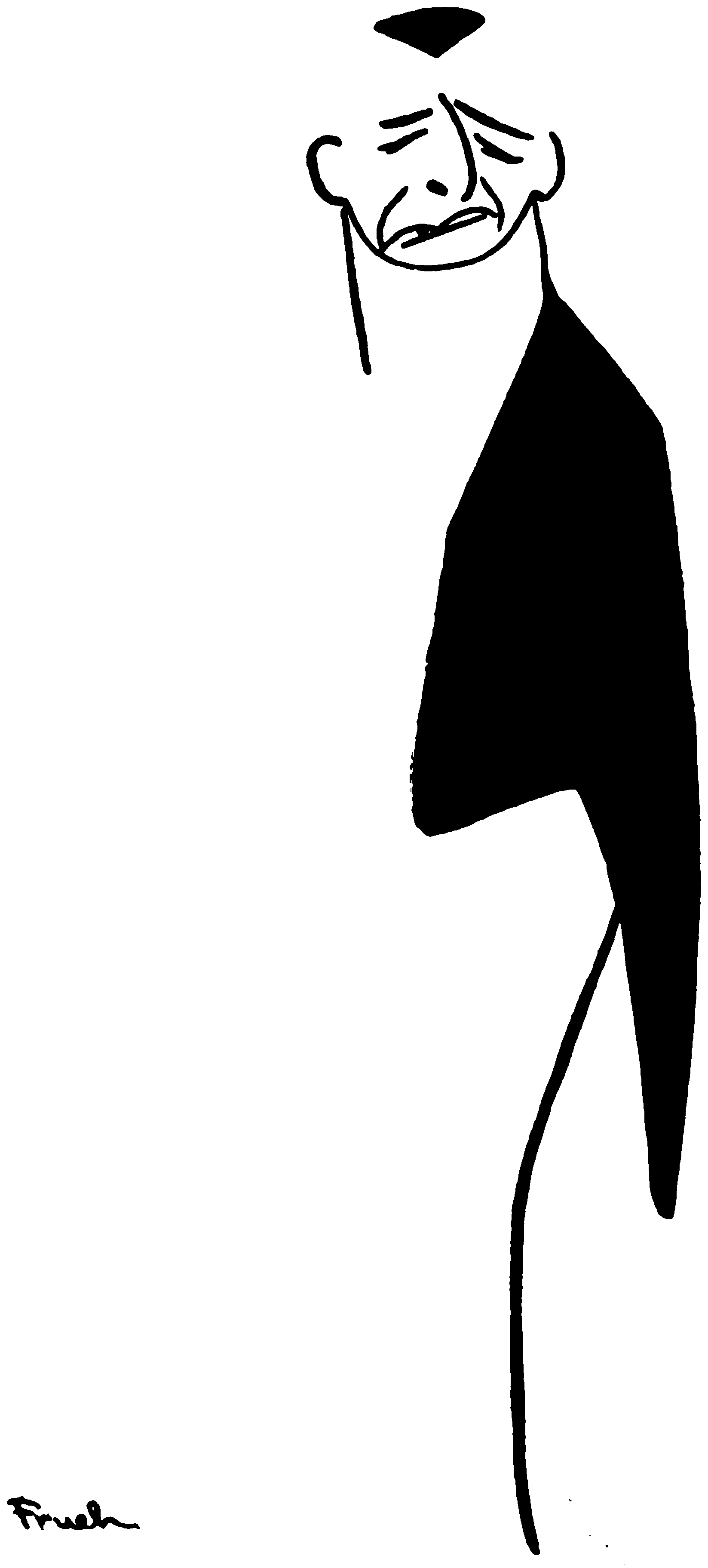
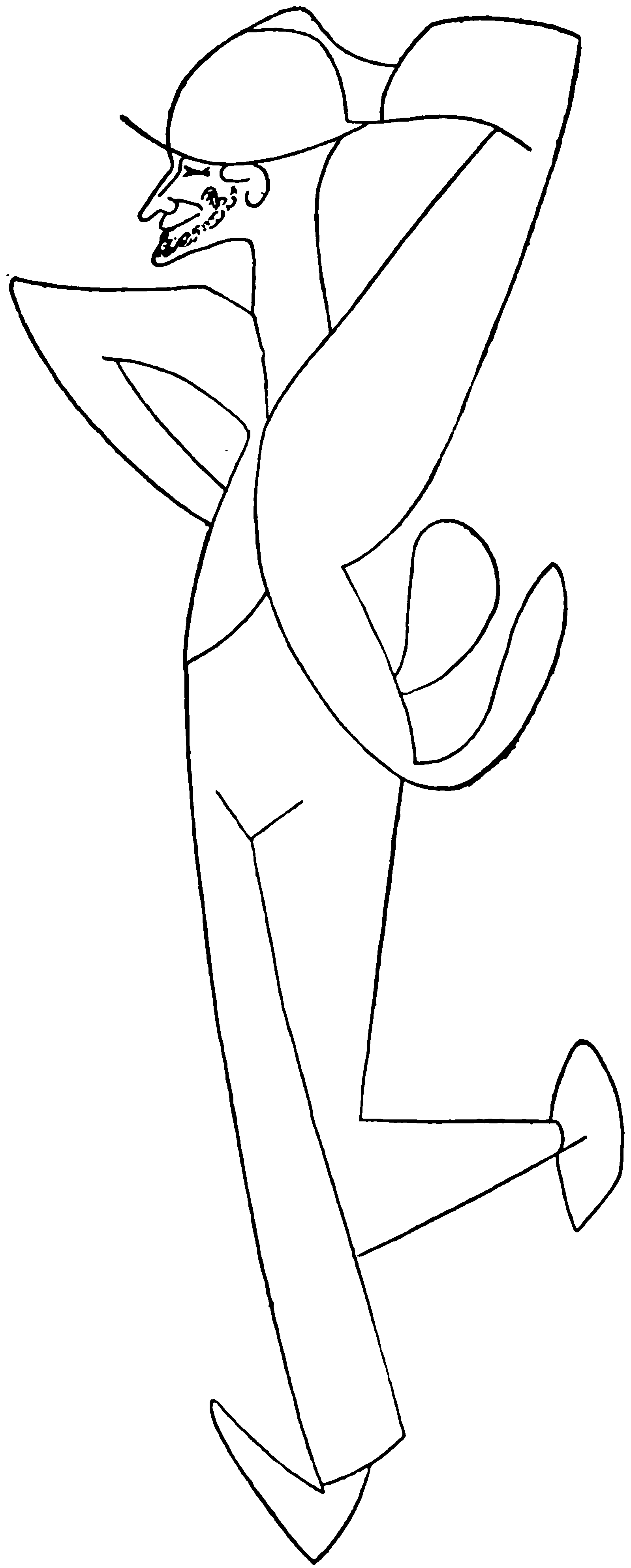
His own violence, his exaggeration of the
temperamental conductor, his nasal voice and lean
figure in excessively odd black clothes, his pontificating
over the orchestra, his announcement that he is
going to murder music—all indicate a lack of appreciation
of the medium. He may be a good vaudeville
stunt, but he is not a great jazz leader. Again Mr
Haviland:
It is not music. It has the form of music, but he has filled
it with energy instead of spirituality. What is the difference?
You’ll understand if you hear his jazz band. It interprets
the American life of to-day; its hard surface, its scorn of tradition,
its repudiation of form, its astonishing sophistication—and
most important, its mechanical, rather than spiritual
civilization.
And again no. Lewis may have a perfectly
trained orchestra, but the sense of control which one
absolutely requires he does not give. He has violence,
not energy, and he cannot interpret those qualities
which Mr Haviland so justly discovers as being
of our contemporary life because he isn’t hard and
scornful and sophisticated himself—he is merely
callous to some beauties and afraid of others, and by
dint of being in revolt against a serene and classic
beauty pays it unconscious tribute. (I fear also that
Lewis imagines the “Wedding March” classic in more
senses than one.) It may be noted also that the tone
of travesty is not correct for contemporary America;
we require neither that nor irony. Parody, rising to
satire, is our indicated medium—Mr Dooley, not
Ulysses.
The orchestra of Vincent Lopez I take as an example
of the good, workmanlike, competent, inventive,
adequate band. It plays at the Hotel Pennsylvania
and in vaudeville, and although Lopez lacks
the ingenuity of Lewis in sound, he has a greater
sense of the capacities of jazz, and instead of doing a
jazz wedding he takes the entire score of “that infernal
nonsense, Pinafore,” cuts it to five characteristic
fragments, and jazzes it—shall I say mercilessly
or reverently? Because he likes Sullivan and he likes
jazz. And the inevitable occurs; Pinafore is good and
stands the treatment; jazz is good and loses nothing
by this odd application. The orchestra has verve
and, not being dominated by an excessive personality,
has humour and character of its own. I trust these
moderate words will not conceal a vast admiration.
Jim Europe seemed to have a constructive intelligence
and, had he lived, I am sure he would have
been an even greater conductor than Whiteman. To-day
I know of no second to Whiteman in the complete
exploitation of jazz. It is a real perfection of
the instrument, a mechanically perfect organization
which pays for its perfection by losing much of the
element of surprise; little is left to hazard and there
are no accidents. Whiteman has been clever enough
to preserve the sense of impromptu and his principal
band—that of the Palais Royal in New York—is so
much under control (his and its own) that it can
make the slightest variation count for more than all
the running away from the beat which is common
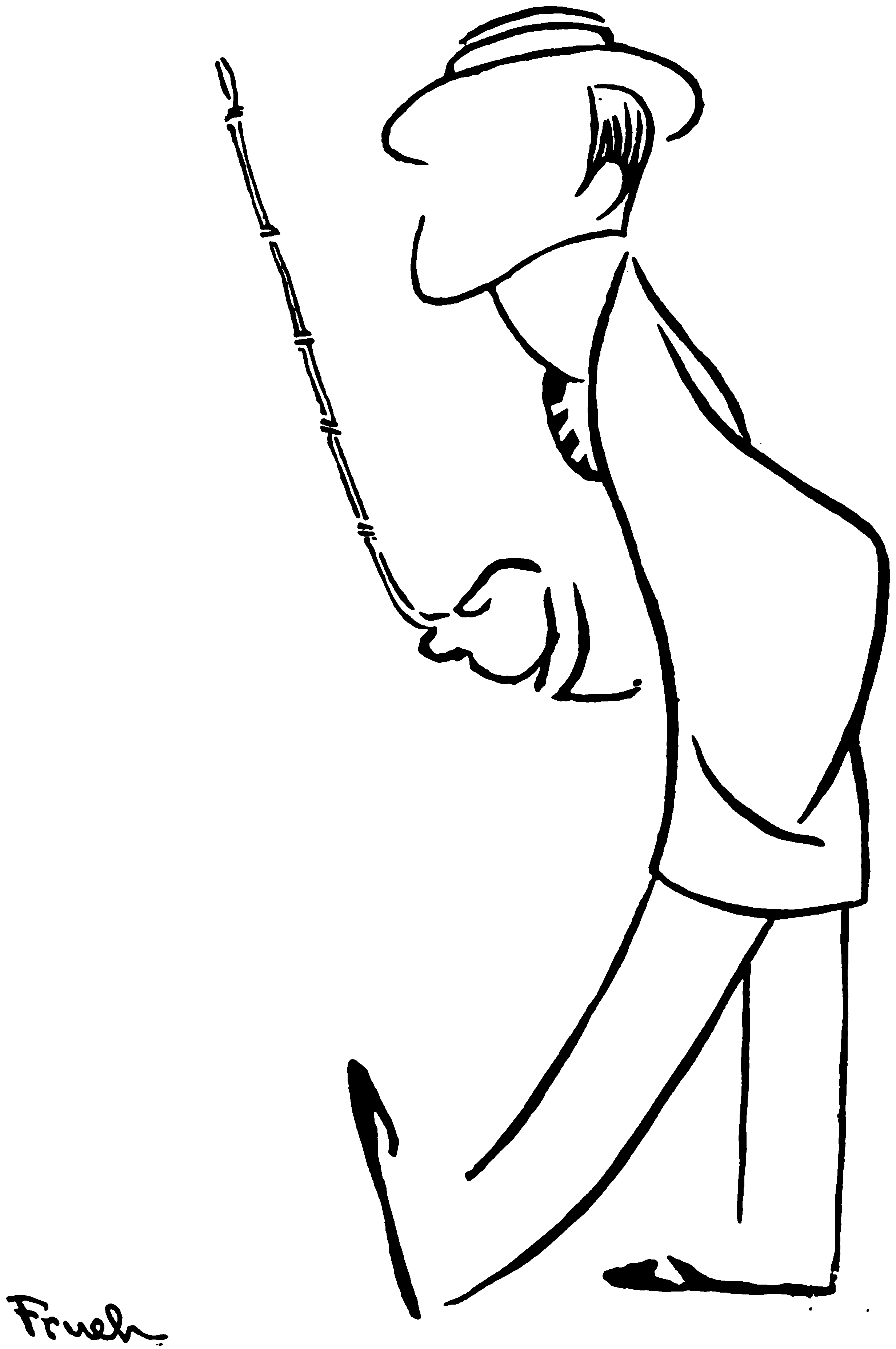
chez Lewis. Like Karl Muck and Jim Europe,
Whiteman is a bit of a kapellmeister; his beat is regular
or entirely absent; he never plays the music with
his hand, or designs the contours of a melody, or
otherwise acts. I know that people miss these things;
I would miss them gladly a thousand times for what
Whiteman gives in return. I mean that a sudden
bellow or a groan or an improvised cluck is all very
well; but the real surprise is constructive, the real
thrill is in such a moment as the middle of Whiteman’s
performance of A Stairway to Paradise when
a genuine Blues occurs. That is real intelligence and
the rest—is nowhere. The sleek, dull, rather portly
figure stands before his orchestra, sidewise, almost
somnolent, and listens. A look of the eye, a twitch
of the knee, are his semaphoric signals. Occasionally
he picks up a violin and plays a few bars; but the
work has been done before and he is there only to
know that the results are perfect. And all the time
the band is producing music with fervour and accuracy,
hard and sensitive at once. All the free, the
instinctive, the wild in negro jazz which could be
integrated into his music, he has kept; he has added
to it, has worked his material, until it runs sweetly
in his dynamo, without grinding or scraping. It becomes
the machine which conceals machinery. He
has arrived at one high point of jazz—the highest
until new material in the music is provided for him.
* * * * *
The title of this essay is provoked by that of the
best and bitterest attack launched against the ragtime
age—Clive Bell’s Plus de Jazz. (In Since Cézanne.)
“No more jazz,” said Mr Bell in 1921, and, “Jazz is
dying.” Recalling that Mr Bell is at some pains to
dissociate from the movement the greatest of living
painters, Picasso; that he concedes to it a great composer,
Strawinsky, and T. S. Eliot, whom he calls
“about the best of our living poets,” James Joyce
whom he wofully underestimates, Virginia Woolf,
Cendrars, Picabia, Cocteau, and the musicians of les
six,—remembering the degree of discrimination and
justice which these concessions require, I quote some
of the more bitter things about jazz because it would
be shirking not to indicate where the answer may lie:
Appropriately it (the jazz movement) took its name from
music—the art that is always behind the times.... Impudence
is its essence—impudence in quite natural and legitimate
revolt against nobility and beauty: impudence which finds
its technical equivalent in syncopation: impudence which
rags.... After impudence comes the determination to surprise:
you shall not be gradually moved to the depths, you shall
be given such a start as makes you jigger all over....
... Its fears and dislikes—for instance, its horror of the
noble and the beautiful are childish; and so is its way of
expressing them. Not by irony and sarcasm, but by jeers and
grimaces, does Jazz mark its antipathies. Irony and wit are
for the grown-ups. Jazz dislikes them as much as it dislikes
nobility and beauty. They are the products of the cultivated
intellect and jazz cannot away with intellect or culture....
Nobility, beauty, and intellectual subtlety are alike ruled
out....
... And, of course, it was delightful for those who sat
drinking their cocktails and listening to nigger bands, to be told
that, besides being the jolliest people on earth, they were the
most sensitive and critically gifted. They ... were the possessors
of natural, uncorrupted taste.... Their instinct
might be trusted: so, no more classical concerts and music
lessons....
The encouragement given to fatuous ignorance to swell with
admiration of its own incompetence is perhaps what has turned
most violently so many intelligent and sensitive people against
Jazz. They see that it encourages thousands of the stupid
and vulgar to fancy that they can understand art, and hundreds
of the conceited to imagine that they can create it....
It is understood that Mr Bell is discussing the
whole of the jazz movement, not ragtime music alone.
I do not wish to go into the other arts, except to say
that if he is jazz, then Mr Joyce’s sense of form, his
tremendous intellectual grasp of his æsthetic problem,
and his solution of that problem, are far more proof
than is required of the case for jazz. Similarly for
Mr Eliot. It is not exactly horror of the noble that
underlies Mr Joyce’s travesty of English prose style,
nor is it to Mr Eliot that the reproach about irony
and wit is to be made. In music it is of course not
impudence, but emphasis (distortion or transposition
of emphasis) which finds its technical equivalent in
syncopation, for syncopation is a method of rendering
an emotion, not an emotion in itself. (Listen to
Strawinsky.) Surprise, yes; but in the jazz of Lewis
and not in that of Whiteman, which does not jeer or
grimace, which has wit and structure—i.e., employs
the intellect. Nobility—no. But under what compulsion
are we always to be noble? The cocktail
drinkers may have been told a lot of nonsense about
their position as arbiters of the arts; precisely the
same nonsense is taught in our schools and preached
by belated æsthetes to people whose claims are not a
whit better—since it doesn’t matter what their admirers
think of themselves—it is what jazz and Rostand
and Michelangelo are in themselves that matters.
I have used the word art throughout this book
in connexion with jazz and jazzy things; if anyone
imagines that the word is belittled thereby and can no
longer be adequate to the dignity of Leonardo or
Shakespeare, I am sorry. I do not think I have given
encouragement to “fatuous ignorance” by praising
simple and unpretentious things at the expense of the
fake and the faux bon. I have suggested that people
do what they please about the gay arts, about jazz;
that they do it with discrimination and without
worrying whether it is noble or not, or good form or
intellectually right. I am fairly certain that if they
are ever actually to see Picasso it will be because they
have acquired the habit of seeing—something, anything—without
arrière-pensée, because they will
know what the pleasure is that a work of art can give,
even if it be jazz art. Here is Mr Bell’s conclusion,
with most of which I agree:
Even to understand art a man must make a great intellectual
effort. One thing is not as good as another; so artists and
amateurs must learn to choose. No easy matter, that: discrimination
of this sort being something altogether different from
telling a Manhattan from a Martini. To select as an artist
or discriminate as a critic are needed feeling and intellect and—most
distressing of all—study. However, unless I mistake, the
effort will be made. The age of easy acceptance of the first
thing that comes is closing. Thought rather than spirits is required,
quality rather than colour, knowledge rather than irreticence,
intellect rather than singularity, wit rather than romps,
precision rather than surprise, dignity rather than impudence,
and lucidity above all things: plus de Jazz.
It is not so written, but it sounds like “Above all
things, no more jazz!” A critic who would have hated
jazz as bitterly as Mr Bell does, wrote once, alluding
to a painter of the second rank:
But, beside those great men, there is a certain number of
artists who have a distinct faculty of their own, by which they
convey to us a peculiar quality of pleasure which we cannot
get elsewhere; and these, too, have their place in general culture,
and must be interpreted to it by those who have felt their charm
strongly, and are often the objects of a special diligence and
a consideration wholly affectionate, just because there is not
about them the stress of a great name and authority.
—and beside the great arts there is a certain number
of lesser arts which have also a pleasure to give; and
if we savour it strongly and honestly we shall lose
none of our delight in the others. But if we fear and
hate them, how shall we go into the Presence?