THE FIFTY-SIXTH DIVISION
After the declaration of war, when the first news of the Expeditionary
Force began to trickle across the Channel, the people of England were
told that troops were marching to the lilting tune with the Cockney
refrain:
Good-bye, Piccadilly,
Farewell, Leicester Square,
It’s a long, long way to Tipperary,
But my heart’s right there.
Within a few months territorial battalions were marching in France and
singing the same absurd song. But the London, the Cockney spirit,
impudent, noisy, but good-tempered and friendly, always wide awake,
observant, and ready for a scrap, above all never down-hearted, led
the way from the very beginning of the war. It is with the
light-hearted crowd of Piccadilly and Leicester Square that we are
concerned, for the whole of London some time or other passes through
those thoroughfares.
* * * * * * *
There is something peculiarly fascinating in following the fortunes of
London troops, particularly Territorial troops.
For some reason there has been a tendency of late years to look down
on the men of London, to dismiss them as weaklings, as men of poor
physique, with maybe smart tongues and clothes, but without the
necessary stamina for hardy soldiers. It would be difficult to say on
what ground such an opinion was based. At least it has no historical
foundation. The Trained Bands of London have a very definite place in
the history of England.
Although it is not the oldest corps, the Artillery Company of London,
formed to train men in the use of the long bow, cross bow, and hand
gun, dates back to the time of Henry VIII. Westminster and the County
of Middlesex were ever to the fore in raising Volunteers as distinct
from the Militia, though the distinction was not always too clear. St.
George’s, Hanover Square—Pimlico—Inns of Court—Bloomsbury—St.
James’s are names to be found in every record of effort to meet a
national danger. Enfield, Tottenham, Stoke Newington, Chelsea,
Kensington, Chiswick, Battersea, Clapham, Clerkenwell, Deptford,
Hungerford, Islington, Lambeth, and Wandsworth have all raised
companies for the defence of England in former times of stress.
There is no need to labour the point. Every student of the history of
the British Army knows what the Service owes to London. The Londoner
has always proved himself a valiant soldier, and has not withheld from
enlistment.
What England owes to the Territorial is above computation. As the
descendant of the old Volunteer he was enrolled to serve in England
alone. But when war with the Central Powers was declared he did not
hesitate—his response was immediate and
unanimous. Territorials
landed in France in 1914, and continued to arrive in that country in a
steady stream as they could be spared from Great Britain.
When the 56th Division was assembled in France during the first days
of February 1916, it was not, therefore, a new unit, looking about
with wondering eyes at new scenes, and standing, as it were, on the
tiptoes of expectation as it paused on the outskirts of the great
adventure. The twelve battalions of infantry were veterans.[1]
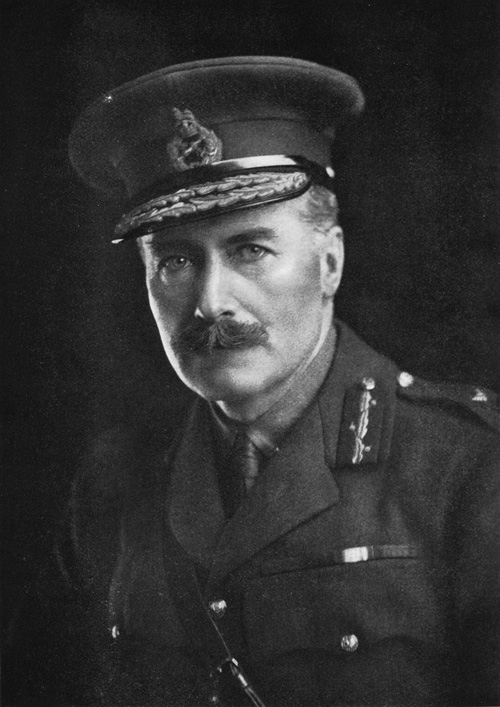
On the 5th February Major-Gen. C. P. A. Hull, to whom command of the
new division was given, arrived at Hallencourt, between Abbeville and
Amiens, where his staff was to meet.
| Lieut.-Col. J. E. S. Brind | G.S.O.1. |
| Major A. E. G. Bayley | G.S.O.2. |
| Capt. T. W. Bullock | G.S.O.3. |
| Bt. Lieut.-Col. H. W. Grubb | A.A. and Q.M.G. |
| Capt. W. M. Sutton | D.A.A.G. |
| Major F. J. Lemon | D.A.Q.M.G. |
| Lieut. H. C. B. Way | A.D.C. |
The presence of these officers, however, did not constitute a
division. Brigade commanders and their staffs arrived—Brig.-Gen. F.
H. Burnell-Nugent, 167th Brigade, Brig.-Gen. G. G. Loch, 168th
Brigade, Brig.-Gen. E. S. Coke, 169th Brigade—and we find a wail of
despair going up from the 169th Brigade: “No rations, fuel, or
stationery yet available”—“No divisional organisation exists” (this
on the 8th), and a wealth of meaning in this note written on the 18th:
“The Brigade Interpreter (who should have
been available at first)
arrived at last. Rain whole day.” Could anything be more tragic?
Our sympathies are entirely with the staff on these occasions, for
though the situation cannot be described as chaotic, it is
bewildering. Troops were arriving from all directions and at all times
of the day; the machinery was not in running order, and its creaking
wheels, which occasionally stopped, necessitated the most careful
watching and a great deal of work. When an organisation is being made,
no one can say “that is not my job,” for it seems as though all jobs
are his for the time being. The Interpreter would have been most
useful if only to arrange the billeting—and what is a staff officer
without stationery?
The Brigades were as follows:
The 167th Infantry Brigade; commanded by Brig.-Gen. F. H.
Burnell-Nugent, with Capt. G. Blewitt as his Brigade Major and Capt.
O. H. Tidbury as Staff Captain. The battalions of this brigade were
the 1/1st London Regt., the 1/3rd London Regt., the 1/8th Middlesex
Regt., and the 1/7th Middlesex Regt.
The 168th Infantry Brigade; commanded by Brig.-Gen. G. G. Loch, with
Capt. P. Neame, V.C., as his Brigade Major, and Major L. L. Wheatley
as Staff Captain. The battalions of this brigade were the 1/4th London
Regt., the 1/12th London Regt. (Rangers), the 1/13th London Regt.
(Kensingtons), and the 1/14th London Regt. (London Scottish).
The 169th Infantry Brigade; commanded by Brig.-Gen. E. S. Coke, with
Capt. L. A. Newnham as his Brigade Major, and Capt. E. R. Broadbent as
Staff Captain. The battalions were the 1/2nd London Regt. (Royal
Fusiliers), the 1/5th London Regt.
(London Rifle Brigade), the 1/9th
London Regt. (Queen Victoria’s Rifles), and the 1/16th London Regt.
(Queen’s Westminster Rifles).
It is not easy to keep the brigade groupings in mind at this
stage—arrangements were recast and designations were changed. The
1/1st (London) Bde. R.F.A., the 2/1st (London) Field Coy. R.E., the
2/1st (London) Field Ambulance were posted to the 167th Brigade. The
1/2nd London Bde. R.F.A., the 2/2nd London Field Coy. R.E., and the
2/2nd London Field Ambulance were posted to the 168th Brigade. The
1/3rd London Bde. R.F.A. and the 2/3rd London Field Ambulance to the
169th Brigade. But we find that subsequent changes result in—
the 1/1st London Bde. R.F.A. becoming 280th Bde. R.F.A;
the 1/2nd London Bde. R.F.A. becoming 281st Bde. R.F.A.;
the 1/3rd London Bde. R.F.A. becoming 282nd Bde. R.F.A.;
and a newly-formed 18-pounder brigade, the 283rd Bde. R.F.A. Also the
two field companies of the Royal Engineers become known as the 512th
and 513th Field Companies, and were joined by the 416th Edinburgh
Field Coy., which was posted to the 169th Infantry Brigade.
And the Royal Army Service Corps, which appears at first as numbers 1,
2, 3, and 4 Companies, become the 213th, with the 214th, 215th, and
216th posted to the three infantry brigades in numerical order.
The Stokes trench mortar batteries were numbered 167th, 168th, and
169th; the medium trench mortar batteries as X, Y, and Z. They were
posted in numerical or alphabetical order to the infantry
brigades.
There was also a heavy trench mortar battery designated V Battery,
which was formed in May 1916.
The pioneer battalion was the 1/5th Battalion Cheshire Regt. The
veterinary unit was the 1/1st London Mobile Veterinary Section.
These were the bits of machinery forming the 56th Division.
The first divisional conference was held on the 11th February, when
most of the officers attending had their first introduction to Gen.
Hull. He was a tall, good-looking man with an abrupt manner, but of
singular charm. It did not take him long to win the complete
confidence of his division.
In the midst of the work of getting the machine properly fitted
together, there were the usual rumours and warning orders which came
to nothing. The first information Gen. Hull received was that the VI
Corps, of which his division formed a part, would relieve the XVII
French Corps and would move to the area Domart-en-Ponthieu. The move
took place on the 27th February, in the midst of a heavy fall of snow,
which made the roads very heavy for transport. And a further move was
made on the 12th March to the Doullens area, between that town and St.
Pol.
Whenever units were behind the line they trained. It did not matter
how long the individual soldier had been in France and Belgium, he was
never excused as a “fully trained soldier.” Even instructors were sent
from time to time to receive fresh instruction at Divisional, Corps,
or Army schools. And so, during the period of assembly, the units of
the 56th Division trained. Some were attached for ten days or
a
fortnight to the 14th Division for work in a “forward position” round
about Dainville—infantry, artillery, engineers, and field ambulance
took their turn at this work; others carried on the routine of
exercise on the training-grounds in the neighbourhood of their
billets. The Commander-in-Chief, Sir Douglas Haig, visited the
divisional area and the school at Givenchy on the 30th March.
In studying the adventures of a division, whether it is holding the
line or whether it is in a reserve area, one must always visualise a
great deal more than the twelve battalions of infantry which make or
repel the final charge in any engagement. A division occupies and
works over a large area, and depends, of course, on a base of
supplies. When a person is told of the front taken up by a division,
he will look at the map and measure off the width of the front line.
“There,” he says, “is the division”! But the division covers quite a
big area in depth as well. Not only do the billets of troops not
actually employed in the front line go back a long way in successive
stages, but the wagons and lorries of the Royal Army Service Corps
work back many miles. The narrowest measurement of a divisional area
is usually the front line.
Perhaps the following list, showing the dispositions of the division
in billets during March, will give those with no experience some idea
of what is meant by the word “division”:
| Divisional Headquarters | Le Cauroy |
| Divisional Artillery Headquarters | Le Cauroy |
| Divisional R.E. Headquarters | Le Cauroy |
| 5th Cheshire Regt. | Grand Rullecourt |
| B Squadron King Edward’s Horse | Grand Rullecourt |
| Divisional Cyclists’ Coy. | Grand Rullecourt |
| 1/4th London Howitzer Bde. | Wamlin and Rozière |
| Divisional Ammunition Column | Etrée-Wamin |
| Headquarters Divisional Train | Bruilly |
| No. 1 Coy. Divisional Train | Wamin |
| 56th Sanitary Section | Le Cauroy |
| Mobile Veterinary Section | Bruilly |
| Salvage Company | Le Cauroy |
| R.E. Ordnance Dump | Le Cauroy |
| Divisional Canteen and Shops | Le Cauroy |
| Divisional Schools | Givenchy-le-Noble |
167th Infantry Brigade |
| Brigade Headquarters | Rebreuve |
| 167/1st and X56th Trench Mortar Batteries | Rebreuve |
| 1/1st London Regt. | Ivergny |
| 1/3rd London Regt. | Cannettemont |
| 1/7th Middlesex Regt. | Beaudricourt |
| 1/8th Middlesex Regt. | Rebreuviette |
| 1/1st London Bde. R.F.A. | Rebreuve |
| 2/1st London Field Coy. R.E. | Honval |
| No. 2 Coy. Train | Rebreuviette |
| 2/1st London Field Ambulance | Ivergny |
168th Infantry Brigade |
| Brigade Headquarters | Manin |
| 168/1st Trench Mortar Battery | Magnicourt |
| Y56th Trench Mortar Battery | Berlencourt |
| 1/4th London Regt. | Beaufort |
| 1/12th London Regt. | Ambrines |
| 1/13th London Regt. | Lignereuil |
| 1/14th London Regt. | Villers-sire-Simon |
| 1/2nd London Bde. R.F.A. | Berlencourt |
| 2/2nd London Field Coy. R.E. | Sars-les-Bois |
| No. 3 Coy. Train | Denier |
| 5th Entrenching Battalion | Blavincourt |
| 2/2nd London Field Ambulance | Liencourt |
169th Infantry Brigade |
| Brigade Headquarters | Houvin-Houvigneul |
| 169/1st and Z56th Trench Mortar Batteries | Houvin-Houvigneul |
| 1/2nd London Regt. | Séricourt |
| 1/5th London Regt. | Magnicourt |
| 1/9th London Regt. | Houvigneul |
| 1/16th London Regt. | Moncheaux |
| 1/3rd London Bde. R.F.A. | Bouret-sur-Canche |
| No. 4 Coy. Train | Houvin-Houvigneul |
| 2/3rd London Field Ambulance | Houvin-Houvigneul |
| Divisional Supply Column | Liencourt |
| Divisional Ammunition Sub-Park | Avesnes-le-Comte |
All these units contribute to an advance. Some designation, such as
“shops,” may strike the ear as strange, an unlikely unit to help much
in an advance; but a man cannot march without boots, a gun can neither
shoot nor advance with a broken spring, a motor lorry will not bring
up a single tin of “bully beef” if its axle breaks, and all these
things are put right by men who are labelled “shops.” Even the
Divisional Canteen plays its part, and has on occasions pushed well
forward to refresh wearied troops.
We say these units contribute to an advance! They contribute to every
action, to every move—they are the division.
As a further measure, which will give the importance of the unit
rather than the size of it, the maximum British effort was 99
infantry, 6 cavalry, and 4 yeomanry divisions (the latter were more
often infantry than cavalry).
The work of perfecting the organisation went on through the months of
February, March, and April. The problem of how to create from nothing
had sometimes to be faced as the Army usually faces such
conundrums—by cutting a bit from something else which did exist.
Capt. Newnham notes in the 169th Brigade diary under date 17th April:
“Brigade Machine Gun Coy. formed. Capt. J. R. Pyper, 4th London, to
command, and Capt. J. B. Baber, Queen’s Westminsters, second in
command. Company formed from existing personnel in battalions, each
battalion finding a section, and some from Headquarters. No M.G.C.
gunners available, as per War Office letter. Already weak battalions
lose good men and reinforcements will have to come from them as well.”
The health of the division was good except for an outbreak of measles
in the 169th Brigade.
On the 3rd May the 167th Brigade moved to Souastre, under the VII
Corps, and the rest of the division followed on the 6th May,
Divisional Headquarters being established at Hénu.
On the 9th May the C.R.A., Brig.-Gen. R. J. C. Elkington, took over
artillery positions from the C.R.A. 14th Division on the Hébuterne
front.
* * * * * * *
Three months had elapsed since the division had commenced to assemble
at Hallencourt. Troops were well rested and trained, and were now to
be launched in the big operations of 1916. It would be as well at this
point to note the general situation, as from now on the 56th Division
took a prominent part in the severe fighting which commenced on 1st
July.
We will give the German point of view as expressed by Gen. von
Falkenhayn and published in his war book[2]:
“France has been weakened almost to the limits of endurance,
both in a military and economic sense—the latter by the
permanent loss of the coalfields in the north-east of the
country. The Russian armies have not been completely
overthrown, but their offensive powers have been so
shattered that she can
never revive in anything like
her old strength. The armies of Serbia can be considered as
destroyed. Italy has no doubt realised that she cannot
reckon on the realisation of her brigand’s ambitions within
measurable time, and would therefore probably be only too
glad to be able to liquidate her adventure in any way that
would save her face.
If no deductions can be drawn from these facts, the reasons
are to be sought in many circumstances ... the chief among
them cannot be passed over, for it is the enormous hold
which England still has on her allies.”
He then goes on to discuss what can be done to break the will of
England. He says that the history of the English wars against the
Netherlands, Spain, France, and Napoleon is being repeated. That
England is “obviously staking everything on a war of exhaustion.” He
puts the winter of 1917 as the latest date when a food crisis and “the
social and political crisis that always follow them, among the members
of our alliance,” will occur, and asks, or rather states, that England
must be shown that her venture has no prospects. But “in this case, of
course, as in most others involving higher strategic decisions, it is
very much easier to say what has to be done than to find out how it
can and must be done.”
How can one inflict a decisive defeat on England on land? Invasion is
impossible—the German Navy is convinced of that.
“As far as our own Continent of Europe is concerned, we are
sure of our troops, and are working with known factors. For
that reason we must rule out enterprises in the East, where
England can only be struck at
indirectly. Victories at
Salonica, the Suez Canal, or in Mesopotamia can only help us
in so far as they intensify the doubts about England’s
invulnerability which have already been aroused among the
Mediterranean peoples and in the Mohammedan world. Defeats
in the East could do us palpable harm among our allies. We
can in no case expect to do anything of decisive effect on
the course of the war, as the protagonists of an Alexander
march to India or Egypt, or an overwhelming blow at
Salonica, are always hoping. Our allies have not the
necessary means at their disposal. We are not in a position
to supply them, owing to the bad communications, and
England, which has known how to swallow the humiliations of
Antwerp and Gallipoli, will survive defeats in those distant
theatres also.
When we turn from them to the European theatre, where
England can be struck on land, we cannot close our eyes to
the fact that we are faced with an extraordinarily difficult
problem.”
It would seem that England was giving poor von Falkenhayn a lot of
trouble. After looking vainly in the East for a vulnerable point in
her armour, he is forced to turn his eyes to the West. And in the West
he does not like the look of the British Army. He cannot collect more
than twenty-five or twenty-six divisions to attack with, and they are
not nearly enough!
“Attempts at a mass break-through, even with an extreme
accumulation of men and material, cannot be regarded as
holding out prospects of success against a well-armed enemy
whose moral is sound and who is not seriously
inferior in numbers. The defender has usually succeeded in
closing the gaps. The salients thus made, enormously exposed
to the effects of
flanking fire, threaten to
become a mere slaughterhouse. The technical difficulties of
directing and supplying the masses bottled up in them are so
great as to seem practically insurmountable.”
He sweeps aside the idea of attacking the English Army with a final
complaint that, even if he drove it completely from the Continent,
“England may be trusted not to give up even then,” and France would
not have been very seriously damaged, so that a second operation would
have to be taken against her. It would be impossible to get sufficient
men.
England’s allies are called her “tools,” and the only thing to do is
to smash up the “tools.” But no weapon is to be discarded, and so
unrestricted submarine warfare must be undertaken against this
arch-enemy.
“If the definite promises of the Naval Authorities that the
unrestricted submarine war must force England to yield in
the course of the year 1916 are realised, we must face the
fact that the United States may take up a hostile attitude.
She cannot intervene decisively in the war in time to enable
her to make England fight on when that country sees the
spectre of hunger and many another famine rise up before her
island. There is only one shadow on this encouraging picture
of the future. We have to assume that the Naval Authorities
are not making a mistake.”
As for the “tools,” Italy is ruled out as a possible one to be broken
as she is not of much account in Falkenhayn’s opinion, and he thinks
there will soon be internal troubles. Russia is also ruled out because
he does not see any gain in the capture of
Petrograd or Moscow, and
there are also “internal troubles.” There is France left.
“As I have already insisted, the strain on France has almost
reached the breaking-point—though it is certainly borne
with the most remarkable devotion. If we succeed in opening
the eyes of her people to the fact that in a military sense
they have nothing more to hope for, that breaking-point
would be reached and England’s best sword knocked out of her
hand.... Within our reach behind the French sector of the
Western Front there are objectives for the retention of
which the French Staff would be compelled to throw in every
man they have. If they do so the forces of France will bleed
to death.... The objectives of which I am speaking now are
Belfort and Verdun.”
Altogether this document, which was prepared for the Kaiser and must
have been read by that potentate with mixed feelings, was not the work
of an optimist. It reads more like despair, as though Falkenhayn was
saying, “I can still fight, I can still hurt, but I am bound to go
down in the end”! One cannot see any very shrewd reasoning in it, for
he not only underrated the valour of the French (as the Germans always
did), but he was placed in very serious difficulties by the successful
attack of Brussiloff on the Austrians in June, so that he also
undervalued the strength of Russia. For this misfortune, however, the
Germans blame the Austrians, condemning them for their offensive
against the Italians in May, which was undertaken against German
advice and made the Brussiloff adventure possible. But this document
shows the policy and plans of Germany for the year 1916—the great
German effort on Verdun, which was to bleed France to death, dominates
all other events. The
attack was launched on the 21st February and
coincides with the formation of the 56th Division, and the subsequent
movements of the division were connected with the wide-spreading
influence of the Verdun battle.
In his dispatch dated the 29th May, Sir Douglas Haig sums up the early
situation very briefly. Since the 19th December, 1915,
“the only offensive effort made by the enemy on a great
scale was directed against our French Allies near Verdun.
The fighting in that area has been prolonged and severe. The
results have been worthy of the highest traditions of the
French Army and of great service to the cause of the Allies.
The efforts made by the enemy have cost him heavy losses
both in men and in prestige, and he has made these
sacrifices without gaining any advantage to counterbalance
them.
During the struggle my troops have been in readiness to
co-operate as they might be needed, but the only assistance
asked for by our Allies was of an indirect nature—viz., the
relief of the French troops on a portion of their defensive
front. This relief I was glad to be able to afford.”
On the other hand, plans for a Franco-British offensive had been fully
discussed by Sir Douglas Haig and Marshal Joffre and complete
agreement arrived at. Vast preparations were in progress. Sir Douglas
Haig desired to postpone the attack as long as possible, because both
the British Army and the supply of ammunition were growing steadily,
and time would enable the newer troops to complete their training. But
though the original plans had no connection with Verdun, they were
bound to influence and be influenced by the great German attack.
It may be said that the Entente Powers were not looking for a speedy
termination of the war, but were bent on inflicting heavy blows on
Germany and her allies, while Germany was seeking, by a concentration
on France at Verdun, to gain a decision in the West. Falkenhayn’s
advice was being followed, although the unrestricted submarine warfare
was postponed for the time being.
The plan for the British offensive was that the main attack should be
delivered by the Fourth Army, under Sir Henry Rawlinson, on a front
stretching from Maricourt, on the right, to Serre, on the left; while
farther north the Third Army, under Sir E. H. H. Allenby, would make
an attack on both sides of the Gommecourt salient.
For an offensive on this scale enormous preparations were necessary.
There was no end to the amount of stores to be accumulated, from
ammunition to horseshoes. In the forward trench system many miles of
trenches had to be dug—assault trenches, assembly trenches,
communication trenches, trenches for telephone wires—dugouts had to
be constructed for sheltering troops, for dressing-stations, for
storing food, water, and engineering material, not forgetting
ammunition. We are bound to admit, however, that in those days,
although much work was done on dugouts, the infantry saw precious
little of them. Mining they saw, indeed, but dugouts were rare.
Then there were dumps to be made at convenient points, and many miles
of railway line, both standard and narrow gauge, to bring the stores
within reach of the fighting troops. Roads had to be constructed, and
in some places causeways had to be built over marshy valleys. Wells
were sunk, over a hundred
pumping stations were installed, and a
hundred and twenty miles of water-mains laid.
The whole country behind this vast front was teeming with men and
horses, with wagons and motor lorries. At night it was as though an
army of gigantic ants were at work, stretched out in long lines,
building and excavating, marching in solemn silent processions with
grim, determined purpose in the slowness of their gait, and bowed down
under loads of material. They passed and repassed in never-ending
streams; the roads were congested with motor and wagon traffic; paths
across the open country could be traced by the shadowy silhouettes of
men in single file. And the horizon flickered with the flash of guns
as with summer lightning, while shells passed overhead with a
long-drawn, ghostly wail, or fell with a sharp swish and a crash. The
line, that maze of foul mud-filled ditches constructed in a belt of
shell-pounded and festering earth, was indicated at night by floating
starlights rising irregularly as sparks, bursting into brilliancy, and
remaining for a moment, suspended in the blackness of the sky like arc
lamps, then dying once more to so many sparks before they fell to the
ground.
Sometimes the nights would be quiet—that is to say, quiet except for
occasional crashes at intervals of several minutes—although the
constant flickering on the horizon would never cease; at others they
would be “lively,” one might almost say there would be a sensation of
hustle, so swift would be the wailing passage and so continuous the
crash of bursting shells. This might last all through the night as an
organised “shoot,” or would come suddenly, without warning, a swift
artillery attack on roads, working parties, or
billets—what was
afterwards known as “harassing fire” though it was in a more intense
form—and shifting from one point to another, from front line to
roads, from roads to billets, from billets to some spot where troops
were suspected to be working. Or there would be a raid with an angry
concentration of artillery from both sides.
And night after night the preparation for the “Big Push” went on.
* * * * * * *
The 56th Division, now trained and “shaken together,” arrived in the
Hébuterne sector, on the right of the Gommecourt salient and towards
the left of the front under preparation for the British effort. The
167th Brigade took over the front-line system held by the 145th
Brigade, 48th Division, on the 4th May. The 168th Brigade marched from
their billets in the Doullens area on the 6th, and the 169th Brigade
followed on the 7th May. Divisional Headquarters were established at
Hénu.
First blood was drawn for the division by the 167th Brigade on the
18th May. A German patrol attempted to bomb a sap held by the 3rd
London Regt., and was beaten off with the loss of one officer and one
N.C.O. killed. These proved to be of the 169th Infantry Regt., 52nd
Division, one of the divisions of the XIV German Corps and a normal
identification.
The system of holding the line was one of “grouping.” On the 22nd May
Brig.-Gen. Coke, 169th Brigade, was in command of the line, which was
held by two battalions of the 169th Brigade and two battalions of the
168th Brigade. In support was Brig.-Gen. Nugent, with his headquarters
at
Souastre, having under his command his own four battalions and one
of the 169th Brigade. Brig.-Gen. Loch, 168th Brigade, with his
headquarters at Grenas, had two of his own battalions and one of the
169th Brigade.
Plans were now in preparation for a very remarkable achievement.
We have seen that the scheme for the big British offensive included an
attack on the Gommecourt salient. This was to be undertaken by the
Third Army, and the task fell to the VII Corps (Gen. Snow), holding
the front in question. For the moment we will confine ourselves to the
point that the 56th Division was to be one of the attacking divisions.
When Gen. Hull was informed of what he was expected to do, he was at
once confronted with an obvious difficulty—the front line of his
sector was some seven hundred yards away from the enemy! It was not
impossible to shorten this distance, but, with one exception, the
several ways of doing it must result in heavy casualties; the enemy
would be bound to see what was afoot, and would try by every means in
his power to prevent and to hinder its execution, and render it as
costly as he could. It would also be a lengthy business unless it was
boldly tackled. Gen. Hull decided on the boldest of all courses.
He traced out a new line which was, on an average, four hundred yards
in advance of the old one. This meant working, in some spots, within
two hundred and fifty yards of the enemy. And he decided to dig it
in one night! It meant that at least three thousand yards of
trench must be constructed in a few hours, a task of appalling
magnitude; and it must be remembered that every effort was always made
to
limit the number of men in any working party required for No Man’s
Land. When he announced his intentions there was something like
consternation at Corps Headquarters.
The task was allotted to Brig.-Gen. Nugent and the 167th Brigade. He
had at his disposal, over and above the five battalions of his
“group,” one company of the 5th Cheshire Regt. with a half of the
2/2nd London Field Coy. R.E.
So that the men might know the lie of the land, the 167th Brigade was
sent on ahead of the rest of the division and straight into the line,
which it held for a fortnight. The Engineers, the company officers of
battalions concerned, and the brigade staff made most careful
reconnaissance, patrolling every night, noting landmarks, getting
acquainted with that silent, eerie tract separating the two lines of
combatants. Conversations throughout the day were punctuated with
references to “the strong point,” “the lonely tree,” the “May bush,”
“the Z hedge,” “the head of Sap 4,” as landmarks became familiar.
Sometimes German patrols were met, sometimes imagined.
It was decided to divide the whole front into four sections—A, B, C,
and D. The only difficulty was the junction between B and C, but this
was eventually marked by a heap of white stones—a small heap.
Four days before the date fixed for the operation, the brigade was
relieved, and during the following days the whole of the arrangements
were rehearsed—with the exception of the actual digging—first by day
and then by night.
Meanwhile the artillery were warned that nothing was to be done by
them to rouse the enemy while the
work was being carried out, but that
all batteries must be manned and ready for instant action. All known
machine-gun emplacements were carefully registered, and arrangements
were made with the Brigadier-General commanding the Corps heavy
artillery to register on all German batteries whose zone of fire
included the area of the work. Two of the Divisional 4·5 howitzers
were to assist in the counter-battery work.
Although the trench was dug in one night, the whole operation required
three nights to complete. On the first night, the 25-26th May,
covering parties crept out and took up positions in advance of the
selected line. Then engineers followed, quiet and certain in all that
they did, and marked out the line with string and pegs. On the left
they got to work speedily: the pegs were about nine inches long and
made from small round stakes from which the bark had not been removed;
the string was ordinary jute twine which had been prepared with loops
at the proper intervals to mark the angle of bays and traverses. They
were undisturbed, and C and D sections were marked out.
But in A and B sections the night was one of excursions and alarms.
First of all there was great difficulty in getting the covering party
through our own wire, which suggests an unfortunate oversight; and
then German patrols were encountered. The latter occurrence was a
contingency which had always been reckoned with. A game of hide and
seek ensued, but meanwhile time passed. There was no question of
clearing No Man’s Land when other parties were working on the left,
and so the marking had to be abandoned. It did not, however, cause any
serious inconvenience.
The next night each battalion marched from billets
fully armed for
digging. Ten per cent. carried picks, and the remainder carried
shovels which had been carefully sharpened. Each man had three
sandbags, one being wrapped round the shovel or pick to prevent noise,
and between them they also carried a quantity of white tape.
In the line ten exits had been made by cutting through our wire and
constructing steps out of the trench—trench ladders had also been
provided by the engineers in case the steps should be impassable
through rain. White boards were hung on the wire to mark these gaps
for the withdrawal.
The communication trenches to be used by the working battalions were
left quite clear by the troops holding the line, and, at the appointed
time, the head of each battalion was at the selected entrance and
advanced in the following order: covering parties, taping parties,
working parties.
The covering parties, consisting of sixty officers and men in six
groups, had orders to use rifle fire as sparingly as possible, but to
make full use of the bayonet if enemy patrols were encountered.
When the covering parties had been given time to get out, the two
other groups of parties followed at short intervals. And half an hour
after the digging parties had left the trench, wiring and carrying
parties, about a hundred men to each battalion, went out. There were
three thousand men in No Man’s Land!
The boldness of Gen. Hull’s enterprise was amply justified. By 2.30
a.m. the trench had been made and was held by posts, found from the
covering parties, reinforced with Lewis guns; they had rations, water,
and shovels to improve their positions, and were
in telephonic
communication with the old trench, and all the working parties had
filed away as silently as they had come.
During the ensuing day the Royal Flying Corps successfully prevented
any enemy aeroplanes from approaching our lines, but our airmen
photographed the new line themselves, and at noon Gen. Hull was able
to see from a photograph what work had been done.
On the night of 27-28th the same number of men were out working again,
improving the front-line trench and wire, digging support lines and
two other communication trenches. The new work had been pegged out the
previous night by the engineers.
The 56th Division had then started its career with the astounding feat
of having in the space of forty-eight hours constructed and wired a
new system of trenches, comprising 2,900 yards of fire trench and
1,500 yards of communication trenches, in No Man’s Land and within 250
yards of the enemy. Casualties were 8 killed and 55 wounded. A little
luck had waited on audacity, but the success of the whole operation
was undoubtedly due to the intelligence and keenness of the men. They
had nothing much to help them. Gen. Hull had, indeed, ordered two or
three wagons, loaded with empty shell-cases and biscuit tins, to drive
up and down the roads in rear of his lines, and the artillery fired an
occasional round from a howitzer as a means of distracting the
attention of the enemy, but it only required one foolish man to lose
his head and disaster would have descended on the whole brigade.
It is interesting to note the dress. The covering parties were in full
fighting kit and carried one day’s
ration; the taping, digging, and
wiring men had no equipment, but carried a rifle, loaded with ten
rounds, and one bandolier; the wire-carrying party had no arms or
equipment.
The first stage was over. There was, however, still an enormous lot of
work to be done—the trenches had to be improved, deepened, revetted,
emplacements had to be made for machine guns and trench mortars,
stores for ammunition of all sorts had to be constructed, cables had
to be buried—it is but a repetition of what was going on everywhere
on that front.
* * * * * * *
Gen. Hull and his G.S.O.1, Lieut.-Col. J. E. S. Brind, an
artilleryman, were considering the problem of attack. The main
features of it are noted by Gen. Hull as follows:
(a) The village of Hébuterne, which affords concealment from
view to within a short distance of our present line and good
observation of the German positions between Gommecourt and the spur
north of the sunken road (K17a and b) on the right of the divisional
front.
(b) The valleys west of Hébuterne, which afford good artillery
positions and cover from view, except from the trees in Gommecourt
Park.
(c) The spur running eastward from Hébuterne just north of the
Hébuterne-Puisieux Road, which defilades the area, north of the spur,
from the German trenches, south of the spur.
(d) Gommecourt Park and village, which, to a certain extent,
dominate the ground to the south.
(e) The spur running from E29c (north-east of Gommecourt)
through K5a and b to the Rossignol Wood along the southern portion of
which spur runs the German fourth line.
This spur commands the eastern edge of Gommecourt, dominates the
German trench system south-east and south of Gommecourt, and affords
concealment, both for battery positions in the valley to the east and
for a covered means of approach for a counter-attack against the
captors of Gommecourt.
(f) The valley south-east of Nameless Farm, in which runs the
Puisieux-Gommecourt Road, a line of approach covered from view from
our present line.
It was once asked after a severe action for the capture of some rising
ground, “What is the use of turning Fritz off a hill? There is always
another hill behind it.” Which was true enough. But it is as well to
remember that the high ground to the left as far as Blairville, held
at this date by the Germans, was in 1918 in our hands, and it enabled
Sir Douglas Haig to turn the whole of the old Somme position.
Of the German line Gen. Hull says:
“The German position south-east of Gommecourt Park and
village consists of three lines of trenches, of which the
first is heavily wired, the second lightly wired, the third
does not appear to be wired at all unless there is sunken
wire on the road. All three lines are visible from our
present position except the second and third lines behind
the strong point K11c and d. The northern flank of this
system of trenches rests on the southern edge of Gommecourt
Park, the trenches along which are organised to fire south.
The southern flank of the system rests on the strong point
K11c.
In rear of this system is another consisting of two lines of
trenches running from the south-east corner of Gommecourt
along the ridge in 5Ka, b, and c, to Rossignol Wood. The
front trench of this system is heavily wired and visible.”
In a most interesting paper on the proposed attack Gen. Hull says:
“The object of the VII Corps attack will be to establish
itself on the line 16 Poplars-Nameless Farm-Little Z-Tree at
E23a12.
The 46th Division will attack from the north and the
question was discussed:
(a) Should we endeavour to secure a footing on the ridge
E29c-K5a in the initial assault, or
(b) Should the 56th Division first secure the German third
line from the south-east corner of Gommecourt Wood and
then, under Corps direction, launch a second attack to
secure the ridge?
Whichever solution the Corps Commander considers it wisest
to adopt, there is one point which I wish to urge: that no
advance through the village or park of Gommecourt should be
attempted until the ridge E29c-K5a is secured.
The clearing of the village and wood is bound to be a costly
enterprise if the enemy makes any attempt to fight it out.
It is to be hoped that the heavy bombardment will very
seriously affect the moral of the garrison of the
village and park, and I consider that the knowledge that
they were cut off from escape and from reinforcements might
have so great an effect on the German troops as to make them
surrender and so save us valuable troops for further
operations.
I was, and still am, in favour of the first solution, i.e.
to secure the Quadrilateral in the first assault. The
reasons which have been urged against this course are:
(a) That at Loos no success was achieved after a certain
limited distance had been carried.
(b) That in the event of either the 46th or the 56th
Divisions failing to achieve their objective, the
detachment of the other would be in an extremely isolated
position.
I have carefully considered both these arguments, and do not
think there is any reason to alter my opinion.
At Loos the 47th Division was the only division to which a
definite objective was given. Its rôle was to form a
defensive flank on the right of the IV Corps. Its left flank
advanced nearly 2,500 yards behind the German front line
without serious loss or difficulty. In the present case I am
proposing an advance, at one point on each divisional front,
of only 800 yards, in the case of the 56th Division, and
less in the case of the 46th Division. In the present case,
too, we have the additional advantage of much heavier
artillery, more ammunition, and a salient to attack.
As regards the second argument, that in the event of one or
other attack failing the detachment of the other division
would be isolated:
In the event of my reaching my objective in K5a, and the
46th Division failing to reach E29c, I should consider it my
duty to put in troops (if necessary from my reserve brigade)
to help the 46th Division.
Troops at K5a would be within 500 yards of the unit at the
south-eastern edge of Gommecourt, and in direct
communication by visual signalling with my present trench
system, so that they can hardly be considered isolated, and
the risk, if any, is, I consider, worth running in order to
isolate completely the enemy troops in Gommecourt Park and
village.
I do not like the idea of delay and a second attack to
capture the Quadrilateral in K5a. The second attack would
have to be launched from our front line trenches, as I do
not consider it would be feasible to organise and launch an
attack from the newly-captured trenches. Any delay would
enable the enemy to put his barrage in front of our
front-line system, as if there is a weak point in our
organisation, it is in the number of counter-batteries
available to deal with the enemy guns. If we delay we lose
the advantage surprise would give us.”
While these problems were being discussed, Sir Douglas Haig had
decided to hurry on his preparations. We have seen that his desire was
to delay as much as possible and perfect his machine, also that every
day meant to him added strength. But meanwhile the Entente Powers were
being pressed in another direction. The Austrians had attacked the
Italians with great initial success. By the end of May the situation
on that front was so serious that the Russian offensive was opened in
the early days of June in order to relieve the pressure.
The Germans accuse the Austrians of having drained their front in
Galicia of artillery for their Italian offensive, and also of holding
the line with troops of poor quality. However that may be, Gen.
Brussiloff’s army, “after a relatively short artillery preparation ...
got up from their trenches and simply marched forward.” Falkenhayn has
a delightful observation on the whole business: “A ‘reconnaissance’
like Brussiloff’s was only possible, of course, if the General had
decisive reason for holding a low opinion of his enemy’s power of
resistance. And on this point he made no miscalculation.”
The immediate effect of the Russian success was the transfer of three
divisions from the Western Front, and later more followed; but the
Germans were still very strong in numbers, and there was no slacking
off of their efforts on Verdun. They were able to help the Austrians
to check the Russian advance and eventually to repulse it, but, on the
other hand, the Italian counter-attack met with success and drove the
Austrians back.
Sir Douglas Haig says that
“The heroic defence of our French Allies had already
gained
many weeks of inestimable value and had caused the enemy
very heavy losses; but the strain continued to increase. In
view, therefore, of the situation in the various theatres of
war, it was eventually agreed between Gen. Joffre and myself
that the combined French and British offensive should not be
postponed beyond the end of June. The object of that
offensive was threefold:
(1) To relieve the pressure on Verdun.
(2) To assist our Allies in the other theatres of war by
stopping any further transfer of German troops from the
Western Front.
(3) To wear down the strength of the forces opposed to us.”
We begin to see now the dominating influence of Verdun. In any case
the offensive could not have been postponed much longer, and if it was
an alteration of plan forced by the enemy, it was not to be compared
with the abandonment by the Germans of their offensive—which
Falkenhayn says he had prepared against the British with the object of
forestalling the Entente blow on the Western Front—due to the
uncomfortable situation of the Austrians.
Probably, however, the date did influence the approaching action of
the 56th Division. The new front line was still a long way from the
enemy. The Queen’s Westminster Rifles succeeded in advancing a small
sector of the line by a hundred yards and, had there been time, the
whole division would have crept closer before jumping on the enemy.
The weather, too, was very bad.
In due course Gen. Hull issued his preliminary instructions, from
which it will be seen that the decision to attempt the capture of the
Quadrilateral in one operation had been taken:
“The attack of the 56th Division will be carried out by the
168th and 169th Brigades, whose tasks will be as follows:
(a) The objective of the 168th Brigade will be to
capture the German line from Fair Trench, about K11d13,
along Farm, Fame and Elbe, Felon, to a point in Fell fifty
yards north-west of the trench junction at K5c52, and to
establish itself in three strong points:
(1) About Farmyard, Farmer, Farm.
(2) About Elbe, between Et and Felon.
(3) About cross-trenches of Fell and Felon with Epte.
168th Brigade will be responsible for the construction of a
fire trench facing south-east to connect the right flank of
the captured line to our present line in W47.
(b) The task of the 169th Brigade will be carried out in
three phases. The object of the 169th Brigade in the first
phase will be to capture the line of German trenches from
the left of the 168th Brigade along Fall, Fellow, the
Cemetery, Eck, the Maze, Eel, and Fir, and to establish
strong points:
(1) From Feud through Ems to the Cemetery inclusive.
(2) About the Maze.
(3) About the south-east corner of Gommecourt Park.
The second phase of the 169th Brigade attack will take place
immediately after the first phase.
The objective of the second phase is the Quadrilateral of
the trenches in the south-east portion of K5a. The artillery
lifts will be timed on the assumption that the infantry will
reach Ems (between Etch and Fillet) twenty-five minutes
after zero; and Exe (between Etch and Fillet) twenty-seven
minutes after zero time.
The third phase will take place directly after the
Quadrilateral is captured, and will consist of the
securing
of the cross-trenches at K5a78 (where Indus crosses Fill and
Fillet) and joining hands with the 46th Division along Fill.
Fillet will be consolidated facing east.
The following will be carried on the man:
200 rounds S.A.A.;
Waterproof sheet;
Haversack;
Iron ration and current day’s ration;
Two to three sand-bags;
Two tube helmets;
Proportion of wire-cutters, bill-hooks, tools.”
The instructions for the 167th Brigade are practically embodied in the
following paragraphs:
“One company 167th Brigade will be placed at the disposal of
the Brigadier-General commanding 169th Brigade, to hold
sectors Y49 and Y50.
Seven officers and 200 men of the 167th Brigade will be
detailed for the control of smoke, and will be under the
orders of the Divisional Gas Officer. Approximately 1,200
men will be required for work under the C.R.E. on
communication trenches across No Man’s Land and for carrying
parties.”
Practice attacks, based on these instructions, were carried out by the
brigades in reserve.
We have written of the constructive preparations which were going on
all along the line of proposed attack. These preparations were
continued until the last moment. But meanwhile another element was
introduced—that of destructive preparation. It is scarcely necessary
to point out that neither form of preparation could be concealed from
the enemy. The Germans knew as well as we did where we would attack.
The Gommecourt sector to be attacked was held by the German 169th and
170th Regiments, with about 1-1/2 battalions on the front line, 1
battalion in support, 2 battalions in reserve in Bucquoy, and 2
companies at Ablainzeville. Their artillery consisted of 5 batteries
of heavy artillery and 12 batteries of field artillery. These
batteries were divided into three groups at Quesnoy Farm, on the left
of the British position, Biez Wood and Puisieux. There was a further
group of guns near Adinfer Wood which could assist in the defence.
The 56th Divisional Artillery, together with the heavy VII Corps guns,
had now to prepare for the infantry assault by smashing up not only
the wire and trench system, but billets and gun positions behind the
German lines as well. As regards villages, most attention was given to
Bucquoy, Essart, Ablainzeville, and Achiet-le-Grand.
Three groups of artillery were formed—a northern group, under
Lieut.-Col. Southam, a southern group, under Lieut.-Col. Macdowell,
and a wire-cutting group under Lieut.-Col. Prechtel. The northern and
southern groups were under the orders of the Corps, and consisted of:
Northern Group
3 batteries of 18-pounders (until zero day, then 4 batteries).
1 battery 4·5 howitzers.
Affiliated at zero to the 169th Brigade.
Southern Group
4 batteries of 18-pounders.
1 battery 4·5 howitzers.
Affiliated at zero to the 168th Brigade.
Wire-cutting Group
5 batteries of 18-pounders until zero and then 4 batteries.
1 battery 4·5 howitzers.
Two of the guns of the 4·5 battery will be at the call of the
counter-battery group.
In the preliminary instructions it will be noticed that a party of
officers and men were detailed to act under the Divisional Gas
Officer. Their special duty was to cover the approach of the infantry
by the discharge of a smoke cloud. It was hoped to introduce some
element of surprise by occasional discharges of smoke during the
preparatory bombardment, and so the Corps ordered that the bombardment
should be carried out for a period of five days, and the attack would
take place on the sixth. These days would be known as U, V, W, X, Y,
and Z days.
“Smoke discharges lasting for a period of ten minutes will
take place on the days and at the hours mentioned below.
They will coincide with the intense artillery bombardment of
the enemy trenches. These bombardments will commence thirty
minutes before the smoke, and will reach their maximum
intensity during the ten minutes that it is being discharged:
U day, no discharge.
V day, no discharge.
W day from 10.15 a.m. to 10.25 a.m.
X day from 5.45 a.m. to 5.55 a.m.
Y day from 7.15 a.m. to 7.25 a.m.
On Z day the smoke cloud will commence five minutes before
zero. On the 46th and 56th Divisional fronts its duration
will be as arranged by
divisions. On the 37th Divisional
front it will continue for one hour.”
U day was the 24th June, but the whole of the great attack was
postponed for two days, so that, instead of having five days of the
preliminary bombardment, there were seven.
Naturally the Germans did not sit still under this destructive fire,
but retaliated on our front line and trench system, and on our rear
organisation. The enemy artillery had been active during the month of
May, and the division had suffered in casualties to the extent of 402;
for the month of June casualties leapt up to 801. The end of June was
a prolonged crash of guns. Only for one half-hour, from 4 p.m., did
the guns cease so that aeroplanes might take photographs of the German
lines, and then the sky was speckled with the puffs of smoke from the
German anti-aircraft guns.
The guns of the 56th Division fired altogether 115,594 rounds, of
which 31,000 were fired on Z day. To this total must be added the work
of the Corps heavy artillery. The 6-inch, 9·2-inch, and 15-inch fired
on V day 3,200 rounds, on W day 2,200 rounds, on X day 3,100 rounds,
and on Y day 5,300 rounds (which was repeated on the two extra days)
at the front-line trenches and strong points. 6-inch, 9·2-inch,
4·7-inch, 4·5-inch, and 60-pounder guns also dealt with the villages
of Bucquoy, Achiet-le-Grand, Essart, and Ablainzeville, but in nothing
like the same proportion of rounds.
The first smoke cloud was discharged on the 26th June, and drew very
little hostile machine-gun fire. The enemy lines were reported to be
much
damaged on that day. On the 27th the smoke discharge was somewhat
spoilt by the premature bursting of a smoke shell an hour before the
appointed time. This misfortune caused the enemy to put down a barrage
on our front-line and communication trenches, which prevented the
smoke detachments getting to their appointed positions. When the cloud
was eventually discharged there was a large gap in the centre of it,
so it must have been obvious to the enemy that it was only a feint.
The continual bombardment became more intense, and the enemy reply
more vigorous. On the 28th the enemy wire was reported as
satisfactorily cut in front of their first and second lines. Observers
also noted that there was considerable movement of troops behind the
German lines.
Every night, the moment it was dark, although the artillery still
pounded trenches, roads, and tracks, patrols crept forward to
ascertain what progress had been made in the battering down of
defences. 2/Lieut. P. Henri, of the 3rd London Regt., raided the front
line. He found the Germans working feverishly to repair their trench,
and succeeded in capturing one prisoner, who proved to be of the
Labour Battalion of the 2nd Reserve Guards Division. He reported that
the wire in some places still formed a considerable obstacle.
A patrol of the 1st London Regt. reported, on the 29th, that new
French wire and some strands of barbed wire had been put up. Up to the
last moment the Germans worked at their defences. Great activity was
seen on the morning of the 30th.
The artillery grew more furious. A hail from heavy and field-gun
batteries descended on trenches
and strong points. Lieut.-Col.
Prechtel’s wire-cutting group pounded away at the wire. The trench
mortar batteries added their quota, though they were chased from
pillar to post by German retaliation. And as the evening shadows fell
on the last day, the usual night firing was taken up by the
never-wearying gunners.
* * * * * * *
The main object of this attack was to divert against the VII Corps
enemy artillery and infantry, which might otherwise have been used
against the left flank of the Fourth Army at Serre. To achieve this
result the two divisions, 46th and 56th, were given the task of
cutting off the Gommecourt salient.
From the 24th to the 30th June the line of the 56th Division was held
by the 167th Brigade. The other two brigades then practised the
assault on a replica of the German defence system near Halloy. In the
early morning of the 1st July the 168th and 169th Brigades took over
the line, and the 167th withdrew to Hébuterne.
The 5th Cheshire Regt. had a company with each of the assaulting
brigades; the Royal Engineers sent a section of the 2/1st London Field
Coy. with the 169th Brigade, and a section of the 2/2nd London Field
Coy. with the 168th Brigade.
The London Scottish attacked on the right with the Kensingtons in
support; then came the Rangers with the 4th London Regt. in support.
The rôle of these battalions of the 168th Brigade may be briefly
described as a half-wheel to the right. They had to capture the strong
point round about Farm and Farmer trenches, and establish other strong
points at Elbe and Et, south-east of Nameless Farm, and the junction
of Felon and Epte.
On the extreme left of the division was the London Rifle Brigade, and
next to them the Queen Victoria’s Rifles. Again as a rough indication
of their task, they had to make a left wheel and hold the line of the
edge of Gommecourt Park, establishing strong points. The Queen’s
Westminster Rifles would then push straight on, carrying the attack
forward, as it were, between the right and left wheels, and capture
the strong point known as the Quadrilateral.
At 6.25 a.m. every gun opened on the German lines, and for one hour
the enemy was pelted with shells of all sizes, the maximum speed of
fire being reached at 7.20 and lasting for ten minutes. At this moment
smoke was discharged from the left of our line near Z hedge, and in
five minutes the smoke was dense along the whole front. Then the
assaulting battalions climbed out of their trenches and advanced
steadily into the heavy fog.
The German front line was reached with little loss—there was
machine-gun fire, but it was apparently high. Almost immediately,
however, the Germans gave an indication of their
counter-measures—they were reported by the London Scottish to be
shelling their own line. This gallant regiment succeeded in gaining
practically the whole of its objectives, but they were never very
comfortable. Owing to the smoke the two left companies lost direction,
the flank company being drawn off in the direction of Nameless Farm,
and the inner company failed to recognise its position and overran its
objective. This was in no way surprising, as it was extremely
difficult, owing to the heavy bombardment, to find, in some places,
any trench at all.
Next to the London Scottish the Rangers met with
strong resistance, and
probably strayed a bit to their left. They were soon in trouble, and
two companies of the 1/4th London Regt. were sent forward to reinforce
them. Together these two units succeeded in reaching the junction of
Epte with Felon and Fell, but there was a gap between them and the
London Scottish.
On the left of the attack the London Rifle Brigade had swept up to the
edge of Gommecourt Park and commenced to consolidate their position.
The Queen Victoria’s Rifles, on the other hand, were meeting with
fierce resistance, and were short of the Cemetery. The Queen’s
Westminster Rifles, advancing in rear, soon became hopelessly mixed up
with the Queen Victoria’s Rifles. Within an hour it became clear that
the infantry were everywhere engaged in hand-to-hand fighting.
The German counter-attack plans matured about an hour after the
assault was launched. Their barrage on No Man’s Land was increased to
fearful intensity, and from Gommecourt Park, which was apparently
packed with men in deep dugouts, came strong bombing attacks. The
London Rifle Brigade called for reinforcements, but platoons of the
reserve company failed to get through the barrage and across to the
German front line.
The assaulting companies had been provided with boards bearing the
names of the trenches to be captured, and as they fought their way
forward, these boards were stuck up to mark the advance. At about 9.30
a.m. the artillery observers, who did most useful and gallant work
during the whole action, could report that all objectives were gained
with the exception of the Quadrilateral. But the troops in the
German
lines were now held there firmly by the enemy barrage; they were cut
off from all communication by runners, and from all reinforcements. On
the right the Kensingtons had failed in an attempt to reinforce the
London Scottish. Captain Tagart, of the former regiment, had led his
company out, but was killed, and of the two remaining officers, one
was killed and the other wounded. A confused message having reached
headquarters, a fresh officer was sent down with orders to rally the
men and make another attempt to cross the inferno of No Man’s Land. He
found that there were only twenty men left, and that to cross with
them was impossible.
The Royal Flying Corps contact machine, detailed to report on the
situation, sent constant messages that the Quadrilateral was empty of
troops of either side. The artillery observers, however, reported
seeing many parties of hostile bombers moving through the Park, and
enemy troops collecting behind the Cemetery.
It seemed as though all battalions had at one time gained their
objectives except the Queen’s Westminster Rifles, but no blame falls
on this fine regiment. Lieut.-Col. Shoolbred says in his report, “As
no officer who got as far as this (first line) ever returned, it is
difficult to know in detail what happened.” The three captains,
Cockerill, Mott, and Swainson, were killed before reaching the second
German line. Apparently the wire on this section of the front was not
satisfactorily dealt with. The report says:
“A great deal of the wire was not cut at all, so that both
the Victorias and ourselves had to file in, in
close order,
through gaps, and many were hit.... The losses were heavy
before reaching the bank at the Gommecourt-Nameless Farm
road. At this point our three companies and the two
Victorias were joined up and intermixed.... Only one runner
ever succeeded in getting through from the assaulting
companies.”
There were a few brave young officers of the Queen’s Westminsters left
at this point—2/Lieuts. J. A. Horne, A. G. V. Yates, A. G. Negus, D.
F. Upton, E. H. Bovill. They proceeded to collect their men and lead
them forward, and while doing this 2/Lieuts. Yates and Negus were
killed. 2/Lieut. Upton, having then reorganised a bombing party,
bombed the enemy out of Fellow and reached the Cemetery. To do this
they had to run over the open and drop into Fellow. Another party
tried at the same time to bomb their way up Etch, but found it was too
strongly held by the enemy. Meanwhile, 2/Lieut. Upton had stuck up his
signboard, and more men doubled up over the open and dropped into
Fellow Trench. 2/Lieut. Horne then mounted a Lewis gun, under cover of
which a platoon of the Cheshire Regt. and some Royal Engineers blocked
Etch and also Fell (it would seem doubtful, from this statement,
whether Fell was ever held).
Sergt. W. G. Nicholls had kept a party of bombers together and, led by
a young lieutenant of the Cheshire Regt., whose name unfortunately is
not mentioned [we believe it was 2/Lieut. G. S. Arthur], this party
forced its way from the Cemetery to the Quadrilateral. The names of
some of the men are given by Col. Shoolbred:
“Cpl. R. T. Townsend, L/Cpl. W. C. Ide, Cpl. Hayward,
Rfn. F. H. Stow undoubtedly did reach the Quadrilateral,
where strong enemy bombing parties met them, and the
Cheshire lieutenant ordered the party to retire, apparently
trying to cover their retirement himself, as he was not seen
again.”
In any case this advance into the Quadrilateral was but a momentary
success, and it may be said that the attack never got beyond the
German third line. Signals were picked up by the artillery observers
calling for bombs. As early as 10 a.m. two parties of London Scottish,
each fifty strong, attempted to take bombs across to their comrades.
None got to the German first line, and only three ever got back to
ours.
About midday the enemy was launching concerted counter-attacks from
all directions. He was coming down Epte, Ems, and Etch, he was coming
from Gommecourt Park, he was in Fall on the right. More desperate
attempts were made to reinforce the hard-pressed troops. Capt. P. A.
J. Handyside, of the 2nd London Regt., led his company out to try and
reach the left of the line. He was hit, but struggled on. He was hit
again and killed as he led a mere half-dozen men into the German first
line.
Capt. J. R. Garland, also of the 2nd London Regt., attempted the same
feat with his company, and met with a like fate. All the officers of
both companies were casualties.
At 2 p.m. the London Scottish still held firm on the right and the
London Rifle Brigade on the left—indeed, 2/Lieut. R. E. Petley, with
thirty men, hung on to Eck three hours after the rest of his battalion
had been ordered to fall back on Ferret, the German first line. But,
although the two flanks held, the
troops in the centre were gradually
forced back until isolated posts were held in the second German line.
By 4 p.m. nothing more was held than the German first line.
By 9 p.m. everyone who could get there was back in our own lines.
But we must not leave our account of the fighting with the story of
the 46th Division untold. It was not unreasonable for the men of the
56th Division to hope, while they were being hardly pressed, that the
46th Division might suddenly come to their aid. Perhaps luck would
favour that division!
The attack from the north was launched between the Gommecourt road and
the Little Z. The 137th Brigade, with the 6th South Staffordshire
Regt. on the right and the 6th North Staffordshire Regt. on the left,
had Gommecourt Wood in front of them. The 139th Brigade, with the 5th
Sherwood Foresters on the right and the 7th Sherwood Foresters on the
left, carried the attack up to the Little Z.
The account of this action is one long series of disasters. It seems
that the South Staffords on the right started by getting bogged in the
mud. A new front line had been dug, but they could not occupy it for
this reason. They filed out through gaps in their wire, and if any
succeeded in reaching the German front line it was for a period of
minutes only. The North Staffords fared no better, though a few more
men seem to have gained the enemy first line, but were, however,
quickly forced out. The utmost confusion reigned in that part of the
line, and the attack, from the very start, was futile.
The 5th and 7th Sherwoods got away to time (7.30), but
“there was a little delay in the fourth wave getting out,
owing to the deep mud in the trenches, and still more delay
in the carrying parties moving up (due to a similar reason),
and also on account of the enemy barrage of artillery,
rifle, and machine-gun fire which became very heavy on our
old front line.... Of the 5th Sherwoods the first and second
waves reached the enemy first line fairly easily, but were
scattered by the time this occurred. The third and fourth
waves suffered severely in crossing from machine-gun fire.
The majority of the first and second waves passed over the
first-line trenches, but there is no evidence to show what
happened to them there, for not a man of the battalions that
reached the German second line has returned. The remaining
waves ... found that the enemy, who must have taken refuge
in deep dugouts, had now come up and manned the parapet in
parties. The Germans were noticed to be practically all
bombers.... The first three waves of the 7th Sherwoods (the
left of the attack) moved out to time and found the wire
well cut. So far as is known, only a small proportion of
these three waves reached the German second line, and after
a bomb fight on both flanks, the survivors fell back on the
German first line, where they found other men of the
battalion consolidating. After expending all their bombs in
repelling a German counter-attack, the survivors retired
over the parapet.”
One can therefore say that, half an hour after the attack was
launched, the Germans in the Gommecourt salient had only the 56th
Division to deal with. We know that the Cemetery was seen to be
occupied by our troops about nine o’clock, and it was probably shortly
after this that the party of Queen’s Westminster Rifles, led by the
gallant lieutenant of the
Cheshires, reached the Quadrilateral. But the
Germans were then masters of the situation on the north of the salient
and, freed from all anxiety in that quarter, could turn their whole
attention to the 56th Division. Up to this time fighting had been
hard, but slow progress had been made, and with even moderate success
on the part of the 46th Division, depression and bewilderment might
have seized the enemy. But he turned with elation to the southern
attack, and shortly after 9.30 a.m. small parties of bombers were seen
moving through Gommecourt Park to attack the London Rifle Brigade, and
strong attacks were launched from the east of Gommecourt village.
For the rest of the day no help came from the 46th Division, though a
new attack was ordered, postponed, and postponed again. The plan was
to reorganise assaulting waves from the carrying parties, and at 3.30
in the afternoon it seemed probable that an attack would materialise,
but it did not. It was perhaps as well, for by that time the 56th
Division occupied the German front line only, and that in very weak
strength.
As night fell all became quiet. The 167th Brigade relieved the 168th
on the right; the 169th reorganised.
General Hull’s conclusions on this action are that
“the primary reason for failing to retain the ground
was a shortage of grenades. This shortage was due
to:
(a) The enemy’s barrage, and in a lesser extent the
machine-gun fire from the flanks, which prevented supplies
being carried across No Man’s Land.
(b) To the breadth of No Man’s Land.
(c) Possibly to insufficient means of collecting
grenades and S.A.A. from men who had become casualties,
and from German stores.
I understand that our counter-battery groups engaged a very
large number of German batteries—the results were not
apparent, and I think this was due to the limited number of
guns available, and also to the small calibre of the
majority employed (60-pounders, 4·7 guns, and 4·5
howitzers). I consider it would be better to employ the
heavy (9·2) and medium (6) howitzers, and even the
super-heavy.
It was particularly noticeable that, once our attack was
launched, the Germans attempted practically no counter-work.
The preliminary bombardment started on the 24th June, and
continued for seven days. During this period the enemy
seemed to have increased the number of his batteries.... The
effect of the bombardment on the German trenches was very
great ... on the dugouts the effect was negligible. On the
moral of the enemy the effect was not so great as one
would have hoped....
I am doubtful of the value of these long bombardments, which
give the enemy time to recognise the points selected for the
attack, and possibly to relieve his troops, and to
concentrate guns, and to bring up ammunition.
The intense bombardment prior to the attack lasted
sixty-five minutes, considerably longer than any of the
previous bombardments. I am in favour of having as many
false attacks and lifts of artillery fire as possible, but
consider there should be no difference....
The German attitude and moral varied
considerably—some of the enemy showed fight, but other
parties were quite ready to surrender as soon as they came
up from their dugouts. But it cannot be said that their
moral was any more shattered by the bombardment than
were their dugouts. Later
in the day German bombers advanced
with great boldness, being assisted by men who advanced over
the open. Our men appear to have had no difficulty in
dealing with enemy bombers at first—it was only when bombs
were scarce that the enemy succeeded in pushing us back. The
counter-attacks on the right were never made in great
strength, but were prepared by artillery fire which was
followed up closely and boldly by bombers. On the left the
enemy appeared to be in greater strength, and came out of
Gommecourt village and through the Park in great numbers.”
The men of London had done well, although the salient remained in the
hands of the enemy. The effort of the infantry was valiant, and they
were supported with devotion by the artillery. The artillery observers
took great risks, and the conduct of one of Lieut.-Col. Prechtel’s
wire-cutting batteries is well worthy of note. It established itself
practically in our front line, about W48, and fired 1,200 rounds
during X, Y, Y1, Y2 days and on Z day fired a further 1,100 rounds.
The German plan was, as has been shown, to prevent all reinforcements
from crossing No Man’s Land, and to deal with those troops who had
lodged themselves in their trench system by strong and well-organised
bombing attacks.
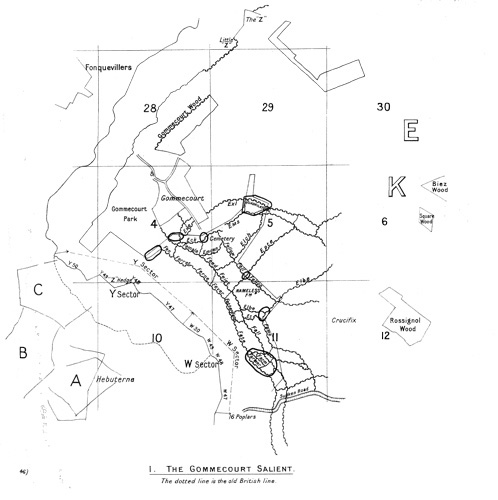
1. The Gommecourt Salient.
The dotted line is the old British line.
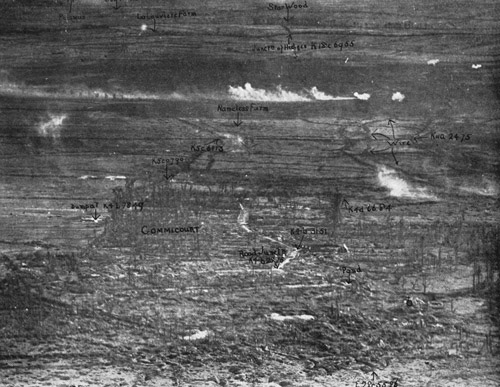
GOMMECOURT, JULY 1916
There is no doubt that the main object of the attack had been
fulfilled. Unpleasant as it may seem, the rôle of the 56th Division
was to induce the enemy to shoot at them with as many guns as could be
gathered together, and also to prevent him from moving troops. The
prisoners captured were 141 from units of the 52nd Reserve Division,
and 37 from
the 2nd Guards Reserve Division, so that no movement of
troops had occurred on that front, and we know that the number of
batteries had been increased. There were many more prisoners than
this, but they were caught in their own barrage as they crossed No
Man’s Land, and large numbers of dead Germans were afterwards found in
that much-battered belt.
The main attack of the Fourth Army, launched on the same day,
succeeded on the right. North of the Ancre as far as Serre our losses
were severe, and the initial gains of the assaulting troops could not
be maintained. After five days’ fierce fighting, the enemy’s first
system of defence farther south had been penetrated to a depth of a
mile over a front of six miles. But north of the Ancre, after the
first day, operations were confined to maintaining a steady pressure
on the enemy.
This battle, with the subsidiary attack on the Gommecourt Salient, is
known as the battle of Albert 1916.
* * * * * * *
The division was not relieved. It had suffered in casualties 182
officers and 4,567 other ranks. The London Scottish had sent 24
officers and 847 other ranks into battle, and 9 officers and 257 other
ranks had come out. The Rangers had sent in 23 officers and 780 other
ranks—6 officers and 280 other ranks came out. The Queen Victoria’s
Rifles came out with 22 officers and 160 other ranks; the London Rifle
Brigade, 18 officers and 300 other ranks; the Queen’s Westminster
Rifles, 19 officers and 160 other ranks. The supporting battalions
suffered only slightly less.
When the fighting had abated the enemy seems to
have initiated a truce
to gather in the wounded. His own stretcher-bearers came out, on
seeing which ours also went out. This state of affairs lasted for an
hour, when our men were warned to get back to their lines.
The state of the line was extraordinary. The front line, over which so
much labour had been expended, had ceased to exist, and could only be
held by means of patrols and a few small posts. Our main line was now
what was known as the R Line, the original line when the 56th Division
arrived in the sector. And the front held by the division was
gradually increased. From the 3rd July onwards the division took over
the line to the left until on the 8th the 169th Brigade was north of
Fonquevillers with its left opposite Little Z. Each brigade held its
front with two battalions in the line, one in brigade reserve and one
in divisional reserve.
During the night of the 13th the artillery made a “demonstration” in
order to help the Fourth Army, which was again attacking in the south.
On this night a patrol of the Queen’s Westminster Rifles captured a
prisoner who proved to be of the 91st Regt.—a normal unit.
On the 17th of the month all three brigades attempted raids, but the
enemy were found to be too alert, and no prisoners were obtained.
The division remained on this front, keeping the enemy busy, until the
20th August, when it was relieved by the 17th Division, and marched
first to Doullens, then to Fromer-le-Grand, then to St. Riquier, where
it proceeded to refit and train under the orders of the X Corps.