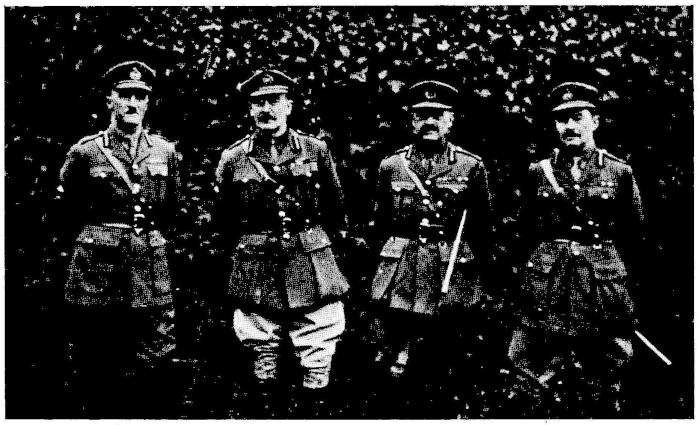
Printed in Great Britain by Richard Clay & Sons, Limited, BRUNSWICK ST., STAMFORD ST., S.E. 1, AND BUNGAY, SUFFOLK.
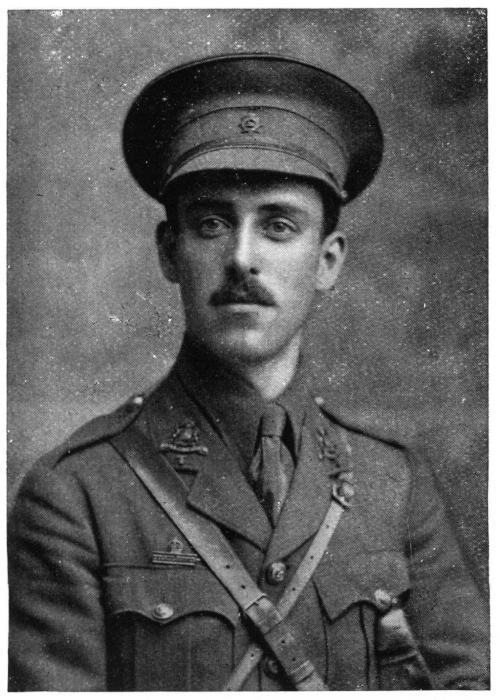
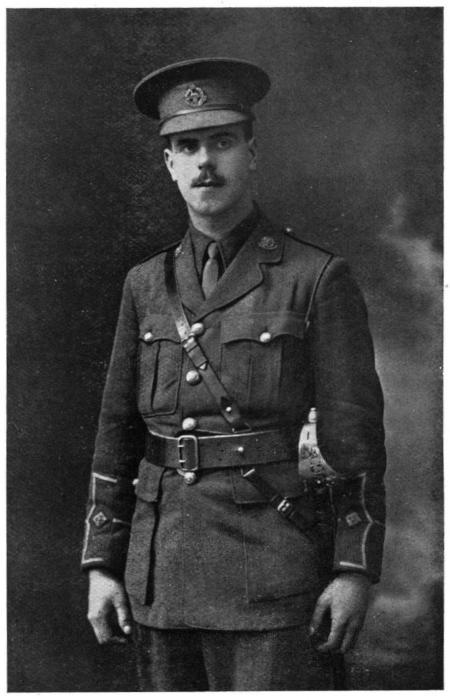
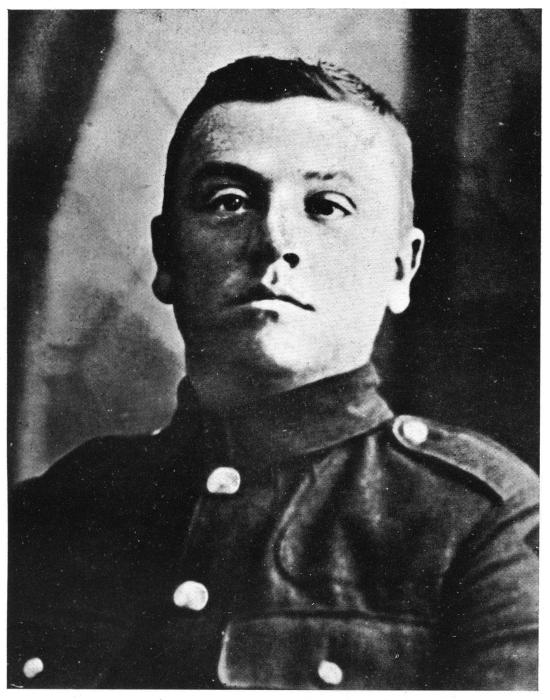
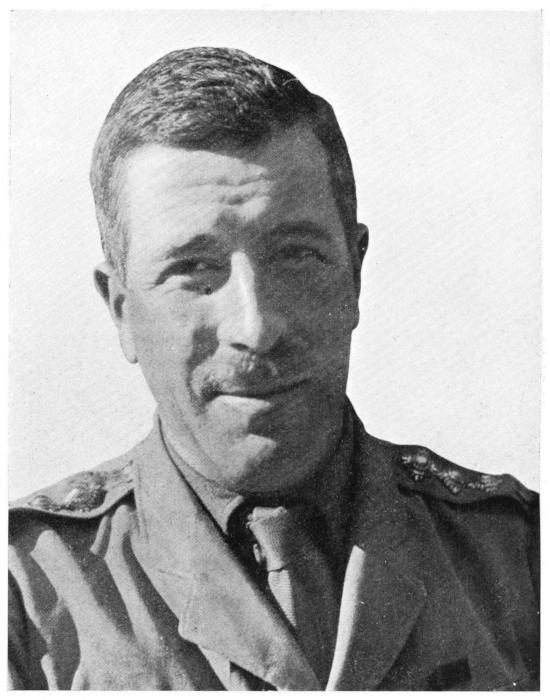
MAJOR-GENERAL SIR WM. DOUGLAS, K.C.M.G., C.B., D.S.O.
By permission of Lyddell Sawyer.
The
42nd (East Lancashire) Division 1914-1918
BY
FREDERICK P. GIBBON Author of “The Lawrences of the Punjab”
LONDON
PUBLISHED AT THE OFFICES OF “COUNTRY LIFE,” LTD.,
20 TAVISTOCK STREET, COVENT GARDEN, W.C. 2, AND BY
GEORGE NEWNES, LTD., 8-11 SOUTHAMPTON STREET,
STRAND, W.C. 2
NEW YORK: CHARLES SCRIBNER’S SONS
To the
Officers, Warrant Officers,
Non-Commissioned Officers, and Men of the
42nd (East Lancashire) Division
As their late Commander, I dedicate this history of their achievements,
conspicuous even in days of great deeds, in the hope that the
record of their unchanging spirit of courage, loyalty, and comradeship
may give gratification to survivors and solace to relatives of the
fallen.
11th November, 1920.
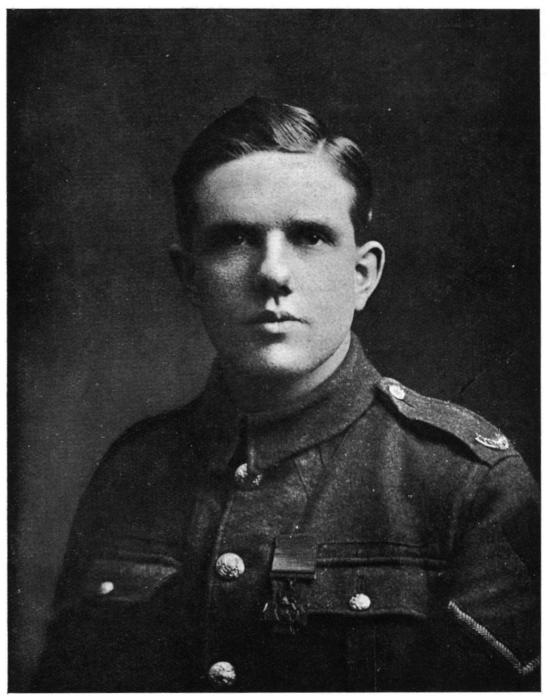
MAJOR-GENERAL A. SOLLY-FLOOD, C.B., C.M.G., D.S.O.
By permission of Keturah Collings.
FOREWORD
The 42nd (East Lancashire) Division was only a comparatively
short time under my command, but during that period officers,
N.C.O.s and men showed themselves to be possessed of a magnificent
fighting spirit.
The 42nd Division came to France at a time of crisis, and shared
in the glory of breaking the most desperate and most dangerous
German offensive made since the early days of the war. In my
Despatches I have drawn attention to some of the outstanding
actions of the Division. I am glad now to express to all ranks my
personal gratitude for their splendid service.
Field Marshal.
G.H.Q. The Forces in Great Britain,
Horse Guards, London, S.W. 1.
14th July, 1919.
PREFACE
“Sir William Douglas asks me ‘to write a few lines’ to be
embodied in the preface to a history of the 42nd Division.
“In the regions of time and space the Dardanelles enterprise
forms only a trifling part of the record of this famous Division;
but, in the sphere of the imagination, that part will be reckoned
by Lancastrians yet unborn as the most precious heirloom bequeathed
to them by the generation who fought the great war.
“Why? I will give the reasons in the words of a gallant young
Australian killed shortly after he wrote me as follows from the front
in France: ‘I often compare the two situations: out here and on
those wild romantic shores of the Ægean; I compare them and I
find that the Peninsula war stands quite alone and apart, an ineffaceable
memory.’
“Bearing in mind that I am limited to a few lines I propose to
think out nothing new, but to repeat now what was jotted down
about a sample of the 42nd Division at the time (the 4th June, 1915),
in my post of command, shared that day with two enormous
tarantulas—
“On the right the French rushed the ‘Haricot’—so long a thorn
in their flesh; next to them the Anson lads stormed another big
Turkish redoubt in a slap-dash style reminding me of the best work
of the old Regular Army; but the boldest and most brilliant exploit
of the lot was the charge made by the Manchester Brigade in the
centre who wrested two lines of trenches from the Turks; and
then, carrying right on to the lower slopes of Achi Baba, had
nothing between them and its summit but the clear, unentrenched
hillside. They lay there—the line of our brave lads, plainly visible
to a pair of good glasses—there they actually lay! We wanted,
so it seemed, but a reserve to advance in their support and carry
them right up to the top. We said—and yet could hardly believe
our own words—‘We are through!’
“Alas, too previous that remark. Everything began to go
wrong. First the French were shelled and bombed out of the
‘Haricot’; next the right of the Naval Division became uncovered
and they had to give way, losing many times more men in the yielding
than in the capture of their ground. Then came the turn of the
Manchesters, left in the lurch, with their right flank hanging in the
air. By all the laws of war they ought to have tumbled back anyhow,
but by the laws of the Manchesters they hung on and declared
they could do so for ever....
General, “Lieutenant of the Tower of London.”
1st September, 1919.
The foregoing words were written by the Commander-in-Chief
under whom the 42nd (East Lancashire) Division went into action
for the first time of its existence. It is nearly a year now since Sir
Ian Hamilton wrote them; this will give the reader some idea of the
gigantic task those who have collected the material for, and the
writer of, this book have had.
The work is an attempt to record the doings and follow the
fortunes of the 42nd (East Lancashire) Division in the Great War,
but nothing that can be written can adequately disclose the noble
manner in which these lads preserved throughout that dogged
courage and insistent resolution from which it was impossible, for
those who were present, to withhold their admiration. My own four
years’ experience of them has left me with the deepest feelings of
pride and affection. From first to last they proved themselves to
be gallant, loyal and self-sacrificing soldiers, warm-hearted, responsive
and lovable men.
The thanks of the Committee responsible for the publication of
this book are due to Captain E. R. Streat and Mr. George Bigwood,
who collected much of the data, but more especially to Mr. F. P.
Gibbon, who so kindly consented to write the History. The labour
of collecting information from War Diaries and comparing the
various accounts which so many old members of the Division have
been kind enough to send him, has been very great, and we owe
Mr. Gibbon a debt of deep gratitude.
7th August, 1920.
The Committee and the Author wish to record their warm
appreciation of the assistance given in the compiling of this
History by many Officers, Non-commissioned Officers and Men of
the Division.
As the final proofs of the book were being passed, there came
the sad news of the death of the first Divisional Commander, Major-General
Sir William Douglas, K.C.M.G., C.B., D.S.O., at Cultz, near
Aberdeen, on November 2nd, 1920. He had come to be regarded
as the Father of the Division. It was under him that it earned the
distinction of being the first Territorial Division to leave these
shores, and under him it received its baptism of fire. Even when
he had passed from command—both during the war and after
hostilities had ceased—his interest in the welfare of all ranks
remained unabated, and the affection he felt towards them was
warmly reciprocated.
In expressing their deep sorrow and their sympathy with Lady
Douglas, the Committee feel that they may speak for all ranks and
all services of the Division.
THE 42nd (EAST LANCASHIRE) DIVISION — CHAPTER I LANCASHIRE AND EGYPT ( August 1914—May 1915 )
For a week or two there had been talk of war and of the likelihood
of England being involved. The prospects and possibilities
formed an interesting topic of conversation and speculation. We
leant over the sheer side of the precipice and caught glimpses of the
black chasm below, but few really doubted the soundness of the
fence over which we peered.
Warnings of disaster had been frequent—but disaster had always
been averted, and fair words had prevailed. For years we had been
living on the verge of national ruin through strikes of railway-men,
transport-workers, miners, or the spinners and weavers of Lancashire,
but at the last moment conciliation always won; there was always
room for compromise. Though civil war in Ireland seemed imminent,
it was comforting to reflect how much common sense there was in
the world. Besides, had it not been proved to every one’s satisfaction
that under modern conditions war between great nations
could not possibly last for more than a month or two, as in that
short period victor and vanquished would alike be reduced to bankruptcy
and impotence? Knowing this no Great Power would be
likely to commit suicide. We were living in the twentieth century,
and a great European war was an abstract conception, not something
that could actually occur.
In the closing days of July 1914 this complacency was giving
way to a very real dread. War might mean suicide even for the
victor, might be “unthinkable,” but it was in sight—plain, stark,
menacing. War such as other nations had known; not a war in
which those who had a taste for soldiering might take part while the
rest of us could read about it in the papers, feel proud of a success
and depressed by a disaster, and wonder whether sixpence would
be added to the income tax. The fantastic image that had thrilled
us not altogether unpleasantly—as children experience ecstatic
shudders when listening to tales of ogres and hobgoblins—was taking
on an appearance of grim reality. Could it after all be a grisly
spectre and not a mere bogey of turnip and white sheet? England
began to regret that the warnings of her greatest soldier had passed
unheeded.
A day or two later Germany flung down her challenge to Christianity
and Civilization, stripped herself of the cloak of decency and
stood revealed in stark brutishness; and on Tuesday, August 4, 1914,
England took up the challenge and declared war. The decision was
apparently not expected by the German Staff. To them it was
rather a matter for exasperation than for apprehension. England
had her hands full at home, and her vast possessions would prove a
source of weakness. She had a small regular army, a force with high
traditions, well trained and well equipped for service on the frontiers
of India and other outposts of the Empire, containing a larger
proportion of officers and men with experience of actual fighting than
any other army of the Great Powers, yet so small in numbers and so
scattered over the face of the globe, that one can almost sympathize
with the German belief that the few thousand men who could be
spared from the duty of policing India, Egypt, South Africa, and
other possessions, might safely be regarded as negligible. She had,
too, a small, indifferently trained and equipped, unprofessional,
home-defence force, but even the British themselves did not take the
Territorials seriously.
As to the rest of the potential fighting material of the British
Isles, had it not been proved to the satisfaction of the Germans (who
had made a special study of such matters with the typical Teutonic
thoroughness which works so efficiently when applied to material
facts, and fails so lamentably when the human factor enters) that
the young manhood of the nation was mainly decadent, of poor
physique, weak-chested, half-educated, lacking in patriotic purpose,
with no thought of the morrow and no ideals? With the exception
of the few hundred thousands who had received some training in
physical drill and discipline in the Boys’ Brigade and its daughter-organizations
which teach discipline, self-respect, and esprit de corps,
or in the School Cadet Corps, all were utterly untrained, and they
hated discipline. England had clearly shown that she was too
selfish to submit to any form of compulsory service; too wrapped
up in the love of comfort, ease and luxury to do more than bribe
fools to die for her. It was a nation that had lost its soul. The
military aid she could give to France could be contemptuously
brushed aside. When France had been paralysed and the Channel
ports secured, the British mercantile marine could be sunk or scared
off the seas, and the British Empire brought to its knees.
Teutonic reasoning was wrong. The British character is too
simple or too complex for the Hun. It may be that no other nation
brings so much froth to the top as ours; that none extends such
tolerance to cranks, nor gives so much rope to little cliques of
shrieking egoists, nor shows such stolid indifference when the few,
claiming to speak on behalf of the nation, so egregiously misrepresent
her. On August 5, 1914, it was seen that practically every man,
woman and child approved what the Government had done, and
felt instinctively that their country would have been shamed had
there been a day’s hesitation. England had found her soul, not lost
it. A nation supposed to consist largely of pleasure seekers, of lovers
of compromise, conciliation and tolerance, of comfort and luxury,
had decided that all it held most dear would be as dust and ashes
if it stood aside, a passive spectator of the agony of France and
Belgium. Practically without a dissentient voice the nation prepared
to sacrifice its all. Unhappily, the politicians, unaccustomed
to realities, were not ready to make the most of this spirit of sacrifice.
Unable to leave their grooves of finesse, intrigue, and opportunism,
they knew not how to appeal simply to the noblest instincts; so
they talked of “business as usual,” and attempted to cajole the
nation into giving a part when the whole was ready to be offered.
Composition of the Division
This is the story of the part played in the most appalling of
human tragedies by the East Lancashire Territorial Division, which,
on leaving England, was composed of the following units—
Cavalry: “A” Squadron, Duke of Lancaster’s Own Yeomanry—6
officers, 132 men.
R.F.A.: The 1st (Blackburn) and the 3rd (Bolton) East Lancashire
Brigades—55 officers, 1289 men.
R.E.: 1st and 2nd Field Companies and Signal Company—19
officers, 568 men.
Infantry: The 5th, 6th, 7th and 8th Battalions, the Lancashire
Fusiliers—120 officers, 3962 men.
The 4th and 5th Battalions, the East Lancashire Regiment—60
officers, 1990 men.
The 5th, 6th, 7th, 8th, 9th, and 10th Battalions, the Manchester
Regiment—180 officers, 5966 men.
A.S.C.: Three Companies and the Transport and Supply Column—16
officers, 276 men.
R.A.M.C.: Three Field Ambulances—30 officers, 665 men.
Total (including Divisional and Brigade Headquarters): 511
officers, 14,966 men.
The twelve battalions of infantry were brigaded as follows—
The Lancashire Fusiliers Brigade—the 5th, 6th, 7th, and 8th
Battalions, Lancashire Fusiliers.
The East Lancashire Brigade—the 4th and 5th Battalions,
East Lancs Regiment, and the 9th and 10th Battalions, Manchester
Regiment.
The Manchester Brigade—the 5th, 6th, 7th, and 8th Battalions,
Manchester Regiment.
The 5th L.F. was mainly composed of men from the Bury district,
the 6th from Rochdale, the 7th and 8th from Salford, the 4th E. Lancs
from Blackburn, the 5th from Burnley, the 5th Manchesters from
Wigan, the 6th and 7th from Manchester and its suburbs (including
a good proportion from the Cheshire suburbs), the 8th from Ardwick
and East Manchester, the 9th from Ashton-under-Lyne, the 10th
from Oldham.
The 1st R.F.A. Brigade (Blackburn) was composed of the following
batteries: the 4th (Blackburn), the 5th (Church), the 6th
(Burnley). The 3rd R.F.A. Brigade (Bolton) of the following: the
18th, 19th and 20th, all from Bolton and district.
Many of these units date back to 1859, when the Volunteer
movement came into being. For forty-one years the Volunteers were
an untried force, but in the year 1900 their offers of service in the
South African War were accepted, the infantry battalions providing
detachments which served with credit in that campaign. It was
not until 1907 that serious thought was given to the equipment and
organization of this fine body of patriotic men. Lord Haldane’s
Territorial Scheme, based on the model of the Regular Army, did
more than change the name from Volunteers to Territorials. Major-General
Douglas Haig, Director of Military Training at the War
Office, had charge of the scheme, and in bringing about this great
change, he gave evidence of the foresight and grasp of essentials
which in 1918 enabled him to lead the armed strength of the Empire
to victory. The various batteries, battalions and corps, no longer
scattered and independent units, were organized and trained as
divisions, and the force was actually treated as a valuable and even
essential element in the system of national defence, with the result
that the Territorial Force soon reached a higher state of efficiency
than the Volunteers had ever been permitted to approach. The
East Lancashire Division had the reputation of being one of the
smartest and most efficient of the whole force.
Mobilization
On August 3 units in camp for their annual peace training were
recalled, and the order to mobilize the Division was received at
5.30 p.m. on the following day. Probably few members of the
Territorial Force had realized that their “calling-up” notices had
been ready from the day they joined; that month by month the
addresses on the envelopes were checked and altered when necessary;
that enough ball ammunition was stored at the various headquarters
to enable every man to march out with the full complement
of a fighting soldier, and that field dressings were available for issue.
It must be remembered that never before had the Force been
embodied, and that officers and men were civilians, few of whom had
ever regarded mobilization as other than a remote possibility quite
outside the range of practical politics. Yet the absence of confusion
was remarkable, as all ranks threw themselves into their new parts
with zest, making the best of unusual conditions and treating discomfort
as a jest. The men were quartered in drill-halls or schools
within easy reach of their Headquarters. Major-General Douglas,
commanding the Division, with his General Staff Officer, Lieut.-Colonel
A. W. Tufnell, was daily at the Divisional Headquarters in
Manchester, or at the Headquarters of units, supervising the
mobilization and arrangements. These have been described as
“hectic days.” Improved though the organization was as compared
with that of the Volunteers, it was anything but complete. Animals
and vehicles for transport, harness, and an infinite variety of requisites
had to be procured by free purchase or by commandeering in
great haste. This was the weakest part of the scheme, and though
much ingenuity was displayed by officers unaccustomed to this sort
of thing, the waste was great. To such shifts were they reduced that
street watering-carts were bought from Urban District Councils,
and actually taken to Egypt. Among the weird varieties of carts
thus acquired one of the best remembered is the “Black and Green”
van which did duty as a Medical Officer’s vehicle, and was last seen
bleached by the sun, but with the original lettering still traceable
under the service grey, at Gabari Docks, Alexandria in February 1917.
Nothing could better illustrate the inability of a large and patriotic
section of the public to grasp the significance of events than the
expectation freely expressed by vendors that their horses or carts
would be returned to them in the course of a few weeks. In some
cases the drivers of requisitioned animals joined the Territorial unit
in order to remain with their horses.
On August 10 Lord Kitchener invited the Territorial Force to
volunteer for foreign service. By August 12 the three Infantry
Brigades had accepted the invitation, and within a few days ninety
per cent. of the East Lancashires eagerly seized the opportunity.
England saw with pride the keenness of the Territorials to meet the
enemy, and knew that her sons were true to the breed. For more
than fifty years she had treated her citizen-army as something that
must not be taken too seriously, but that is England’s way. The
response was magnificent, but it was expected, for the nation never
doubted that they would answer the call. It was no small gift they
offered. The most powerful army the world had ever seen was
moving forward victoriously towards Paris, remorseless and apparently
irresistible; and the Territorials offered their bodies for death
and mutilation, and gave up parents, wives, children, homes, prospects,
and all they held most dear. At a later period such sacrifice
was demanded as the nation’s right, but in August 1914 a lead had
to be given, an example set. Old volunteers were not content to
look on while the younger generation fought and suffered. Daily a
stream of old members, N.C.O.s and men, many in the autumn
of their lives, besieged the Headquarters of their old corps and
clamoured to be allowed to join up, lying cheerfully and brazenly in
respect of their age. Many gained their object; more were almost
broken-hearted by their rejection. The example set in those dark
days was a stimulus and incentive to recruiting all over the country,
and especially so in the great towns of Lancashire, where the “Pals”
battalions were soon to be raised. It was the vindication of the
Volunteer. “Defence, not Defiance,” had been their motto, but
who among the prescient founders and bulwarks of the movement
could ever have conceived the idea of the glorious rôle to be filled
by the corps they had helped to raise—of the old Volunteer units
from every county and city, at full strength, fighting and laying
down their lives in Belgium, France, Egypt, Gallipoli, Palestine and
Greece, and taking an inspiring part in the greatest of all crusades
against the Turk?
Until August 20 officers and men remained within easy reach of
their Headquarters. The Division was then moved into camps in
the neighbourhoods of Bolton, Bury and Rochdale, and anxiously
it awaited the summons. Another fortnight passed, and the rumour
that Egypt was to be the destination began to gain ground. Rumour
was, however, at this time a discredited jade, fit subject for scorn,
for was she not responsible for the passage through England and
Scotland of myriads of Russian soldiers, the ice and snow of Archangel
still clinging to their boots and beards, who had been seen by
thousands of British optimists at every railway junction in the land?
But in the training camps of East Lancashire she was restored to
public favour when a telegram, dated September 5, was received by
the Divisional Commander from Lord Kitchener—
“Inform the Division from me that I hope that they will
push on hard with their training in Egypt, as, before they are
ready, there will be plenty of troops from India to garrison
Egypt, and I hope they will be one of the first of the Territorial
Forces to join our Army on the Continent. All will depend on
their fitness for service against the enemy in the Field.—Kitchener.”
General Douglas spoke for every man in the Division when he
replied: “All ranks much gratified to receive your message. They
are animated with keen desire to fit themselves to join our forces
on the Continent.”
On the 9th September the Division entrained for Southampton,
about forty trains being required to convey men, horses, guns, and
all the material of war; and on the 10th 15,500 Lancashire men,
with about a thousand officers and men of the Hertfordshire and
City of Westminster Yeomanry, embarked upon the great adventure,
the first Territorial Division to volunteer for foreign service,
and the first to leave England’s shores. It was a record of which
the Lancashire men were justly proud, and which secured to them
from the start the prestige and esprit de corps that are usually the
outcome of long and honourable tradition. The details that were
not going out with the Division became the nucleus of the Second
Line, which sent drafts to the First Line until about the end of
August 1915, when the Second Line East Lancashire (66th) Division
was formed. After that date the drafts came from the Third Line
units. The Duke of Lancaster’s Own Yeomanry had been accepted
for voluntary service overseas, and it had been hoped that the whole
regiment would accompany the Division, but finally only “A”
Squadron, was ordered to embark.
Departure for Egypt
It was midnight when the troopships steamed out of the harbour,
a dark night, all lights doused, no coastwise lights to guide, the
blackness stabbed by scores of searchlights. The troops on board
one of the ships began to sing and the whole convoy took up the
strains. In the morning the first arrivals lay-to off the Eddystone,
until, by late afternoon, a great fleet had assembled. At sundown
the convoy sailed in three lines ahead, escorted by the battleship
Ocean and the cruiser Minerva. It is said that this was the first
actual convoy that had left England since the Napoleonic wars.
The rough weather of the first three days and much unavoidable
discomfort aboard ship were borne with cheerfulness. The men
had the impression that they were sadly overcrowded, but subsequent
experience of life in “cubby-holes” and “dug-outs” modified their
ideas of what lack of space really means. It was noticed that even
the worst sufferers from seasickness never lost hope, as, although
whole messes did not eat a meal during those three days, the daily
indent for one bottle of beer per man was always drawn, to be saved
for happier days. Rumours of the presence of enemy craft off
Portugal gave rise to a pleasing sense of excitement and risk, but
nothing happened. Early on September 17 the mighty rock of
Gibraltar loomed suddenly out of the mist, and soon the mystical,
sun-scorched, tawny hills of Northern Africa were sighted.
From Gibraltar the convoy was escorted by the Minerva only.
As the weather improved it was found that, in spite of the crowded
life aboard the troopships, quite a lot of theoretical training, and
even a certain amount of physical, could be given, and there was
little time for leisure in the Mediterranean. One brilliant day, after
Malta had been passed, the sight of a great fleet sailing towards the
West caused much excitement. Soon the news spread that this was
the Lahore Division bound for Marseilles—war-hardened Sikhs,
Gurkhas, Dogras, Punjabis, Pathans, and Rajputs, all eagerly
looking forward to the day when they should cross steel with the
famous soldiers of Germany, and confident of the result of such
meeting. After exchange of greetings and of escorts, the Weymouth
taking the Minerva’s place, flags were dipped and adieux waved.
It was a wondrous sight, this great gathering of mighty ships,
carrying tens of thousands of men and all their material of war from
East to West and from West to East—an object lesson of the strength
and resources of the Empire.
On the 25th September, a misty, languorous morning, the low,
sandy coast of Egypt, fringed with surf, with here and there a clump
of palm trees, was sighted. It was the Egypt of anticipation,
curiously familiar even to men whose travels had rarely taken them
beyond the confines of Lancashire. As the troopships slowly entered
Alexandria Harbour they passed a battle-cruiser of the U.S. Navy.
Though a strict neutrality had to be maintained in respect of action,
there was no attempt to observe it in sentiment. To the delight of
the Lancashire men the Americans manned ship; their band played
“God save the King,” and generally “they did us proud.” The
Division was keen to show its appreciation. The band of the 8th
Manchesters, uncertain whether “Yankee Doodle,” “The Star-spangled
Banner,” or “My Country, ’tis of Thee,” is considered the
national anthem of the United States, and doubting their ability to
render either of the first two airs pleasingly—the third tune being
that of our own national anthem, and therefore open to misconstruction—struck
up “Marching through Georgia.” All too late came
the reflection that possibly the cruiser’s complement had been drawn
from States which might not appreciate this air. However, every
one seemed delighted by the display of cousinly emotion, and felt
the better for the incident.
Arrival in Egypt
The disembarkation, which began the same day, was watched
critically by regular officers who were waiting to embark for France,
and who expressed their delight at the fine appearance and soldierly
bearing of the Territorials. The first troops to land went on by
train to Cairo, where the Yeomanry, the Lancashire Fusiliers Brigade,
the Signal Company, and the Transport and Supply Column took
over Abbasia Barracks. The East Lancashire Brigade were partly
in the Citadel and Kasr-el-Nil Barracks in Cairo and partly in camp
on the Heliopolis Racecourse. The Artillery also encamped on the
racecourse, and the Engineers occupied the Kasr-el-Nil Barracks.
The 5th, 6th and 8th Battalions of the Manchester Brigade and one
company of the 7th Manchesters remained in Alexandria as garrison,
the greater part being quartered in the Mustapha Barracks and
Camp, while detachments were accommodated in the forts of Ras-el-Tin
and Kom-el-Dik. Later, half of this company of the 7th was
sent to Cyprus. The other three companies of the battalion had
been sent to Khartoum via Port Sudan. Detachments of the
R.A.M.C. accompanied the 7th Manchesters to Cyprus and Khartoum,
but the Field Ambulances as units remained with their affiliated
Brigades, the 1st at Alexandria, the 2nd at Heliopolis, and the 3rd
at Abbasia. Detachments of the T. and S. Column took over A.S.C.
duties from the Regulars at Alexandria, Khartoum and Cyprus.
Abbasia was chosen for Divisional Headquarters.
“Khaki” helmets were quickly issued, but as the Embarkation
Staff had put the tropical clothing in bulk in one ship, some time
elapsed before the heavy serge could be discarded in favour of light
drill, and it was astonishing how well the younger lads endured the
excessive heat. They showed their grit from the start. The usual
conditions of issue were experienced. When only the smaller sizes
in headgear, boots, and clothing are available, how is it that so large
a proportion of big-footed, big-headed, big-framed men turns up?
The sun-helmets were approved. “Bill, will they let us tak’ these
whoam wi’ us?” one man was heard to ask. Bill was not one of the
many optimists who took for granted that they would be home for
Christmas. “Tha’ll be lucky if tha tak’s thi yed whoam, never
mind thi ⸺ ’emlet!” he replied.
Many of the horses had died on the voyage, for not only were
the ships ill-fitted for horse transport, but orders had been received
from the War Office, in spite of the Divisional Commander’s expostulations,
not to exceed one man to every six horses. It was not possible
for so small a proportion of men, most of whom were inexperienced,
to cope with so many animals. On one boat alone, the Norseman
(an Australian emigrant boat), there were more than 700 horses in
charge of ninety-five men, and forty-six animals died during the
voyage. The horses at first suffered greatly from climatic conditions,
and especially from sand-colic. One apparently decided to
lay a protest before the highest quarter, so, evading the picket, it
made its way through a narrow gate into the garden of the C.R.A.
and lay down to die almost on the General’s doorstep. The veterinary
officers had a busy time, and a story concerning one of these was told
with much enjoyment by General Maxwell himself. The “vet” was
working at the highest pressure, when a gentleman in civil garb
came along and, proceeding to ask him sundry questions, was curtly
requested to seek the nether regions and mind his own business there.
His horror on discovering later that his abuse had been levelled at
the head of the Commander-in-Chief may be imagined.
Lord Kitchener had asked the Territorials to push on with their
training, and General Douglas had assured him that all ranks were
animated by a keen desire to fit themselves for whatever service
might be required of them. Training had now begun in earnest, and
before long a new stimulus, a fresh incentive, to efficiency appeared,
and the prospect of the Division’s participation in actual warfare
became less remote. During October the suspicion that Turkey
might take the plunge and declare herself on the side of the enemy
had become a probability. An attempt to incite Egypt to revolt,
and, indeed, to persuade Mohammedans throughout the world that
the day had dawned when a swift blow should destroy British
supremacy for ever, might confidently be looked for; and an attack
upon the Suez Canal would surely follow. To Mohammedans—with
the exception of the comparatively feeble Shiah sect—the Sultan of
Turkey was the Defender of the Faith, the representative of the
Prophet. Who could say what religious fanaticism might not
accomplish if he should proclaim Jehad against the infidels? The
situation was grave; it might become critical, for the Khedive’s
good faith was distrusted, and with reason.
The Regular Army of Occupation had left Egypt for France and
Flanders, and Lancashire civilians—clerks, warehousemen, artisans,
mill-hands, merchants, professional men—were responsible for law
and order in the ancient land of the Pharaohs, for its defence and for
the safe-guarding of the Suez Canal and the communications between
West and East. They kept their charge inviolate, and during eight
months, amid strange surroundings and under trying conditions of
climate, the East Lancashire Division gained the confidence of the
Administration and the respect and esteem of British colony and
native population alike, by their efficiency, their grit, and their
exemplary conduct. As soldiers under fire they had yet to be
tested; as men they were proved and approved. Lancashire, and,
indeed, the whole Territorial Force, have reason to be proud of the
first civilian army that was placed in a position of grave responsibility.
On the 22nd of October intelligence was received of considerable
Turkish activity in the Sinai Peninsula. We were still at peace with
Turkey, but it was highly probable that a surprise attack upon the
Suez Canal might precede a formal declaration of war. The Canal
had been patrolled by a battalion of Highland Light Infantry until
early in October, when its duties had been taken over by Indian
troops. To strengthen the Canal defences the 1st and 2nd Field
Companies, R.E., were sent to Ismailia on October 26 and 27, and
a few days later a detachment of the Signal Company and the
machine-gun sections of the 5th Battalion, East Lancashires, and
10th Battalion, Manchesters, also left Cairo for the Canal zone. The
Sappers bridged the Canal in three places, manned the searchlights,
supplied crews for steam-tugs—it was in consequence of an explosion
on one of these boats that the first casualties of the Division occurred,
Lieutenant Woods and six non-commissioned officers and men being
killed—supervised the water supply, destroyed the native village
of Kantara, and built fortifications. The Signal Company laid a
cable between Kantara, Ismailia, and Suez, and the motor-cycle
despatch riders of this company were the first ever employed on
active service outside Europe. The work of the Engineers received
much-valued commendation from the Commander-in-Chief.
A section each of the 2nd and 3rd Field Ambulances had been
sent to Ismailia and Kantara respectively to be attached to the Canal
defences, and these gave what assistance was needed to Indian troops
as well as to the men of their own Division.[1] Another section of
the 2nd Field Ambulance took charge of the Australian hospital at
Mena, at which place, and also at Meadi and Zeitoun, the East
Lancashire Transport and Supply Column had formed depots and
undertaken transport duties for the Anzacs until their own A.S.C.
units arrived.
On October 31 a force of nearly 9000 Yeomanry and Territorials
marched through the streets of Cairo. Such a display of troops had
never before been seen by the natives, and they were much impressed
at a critical time. The Commander-in-Chief, Sir John Maxwell,
expressed his appreciation of the splendid appearance of the men
and of the salutary effect of the parade on the Egyptians. Native
agitators and German and Turkish agents had for some time been
active in Egypt and the Sudan, seeking to discredit the allies, and
one of these did his best to convince spectators that what they took
to be a powerful force was in reality but a stage army—the same
unit marching in a circle. On November 1 Martial Law was proclaimed
throughout Egypt and the Sudan. On the 5th of November
war was declared against Turkey. The island of Cyprus was formally
annexed on the 7th. Two companies of the 8th Manchesters had
relieved the half-company of the 7th Manchesters as garrison on
October 20, and detachments were sent to the various towns of the
island to prevent disturbances between Greeks and Turks when the
proclamation was made. On December 20 Prince Hussein was
declared Sultan of Egypt under British Protectorate, and the 5th
Lancashire Fusiliers provided a guard of honour on the occasion of
the formal entry of the new Sultan into his capital. In Alexandria
and Khartoum the Manchesters had ceremonial marches through
the towns.
Work and Play
For some months the Division was occupied in strenuous training.
The men suffered from the heat, the glare of the sun, the dust, sandstorms,
flies, and other plagues of Egypt, the remarkable drop in
temperature at night, the long, shadeless, desert marches; but they
took it all cheerfully as part of the day’s work, and by the end of the
year 1914 they were fairly well acclimatized and thoroughly fit.
There was play as well as work; cricket, rugger, soccer, lacrosse,
and hockey teams were soon hard at it; concert parties and pierrot
troupes discovered unsuspected talent. There were also boxing
contests, and the race meetings on Gezireh Island provided many
dinners at the Continental and Shepheard’s for the winners. Full
advantage was taken of the opportunities given at week-ends to visit
the marvels of Egypt. The hospitality of the British colonies at
Cairo, Alexandria, and elsewhere was warmly appreciated, and
many friendships were formed between the residents and the men
from Lancashire.
The good feeling and comradeship that prevailed throughout
the Division may be illustrated by an incident, slight but typical.
On the occasion of some special parade the 5th Manchesters had to
cross the very sandy parade ground before reaching the asphalt road
that led out of barracks. Noticing the dusty state of their boots
the men of D Company of the 6th Manchesters darted into their
quarters, which were close at hand, and, producing brushes and rags,
they quickly polished the boots of the Wigan men. It was a trifling
incident, but still a perfect expression of the spirit of good comradeship,
and it had a wonderful and lasting effect. The two battalions
were knit more closely together, and later, in Gallipoli, there was a
sense of absolute security in either battalion in the knowledge that
the other was in support.
The first Christmas on active service was celebrated in traditional
style, plum-puddings and other Christmas fare being sent out by
friends at home. The old hymns and carols at the Morning Service
stirred the emotions deeply, and thoughts of home and memories of
bygone Christmas gatherings became poignant. Dining huts and
messes, rooms and verandahs, were garlanded with palm branches,
flowers, lanterns, and chains of coloured paper. Nothing was
omitted to make the day a memorable and happy one, and one to
look back upon. Still, there were some decidedly novel features,
chief of which, perhaps, was the after-dinner swim in the sea, indulged
in by a number of Manchester men in Alexandria. On Boxing Day
a great sports meeting was held at the Gezireh Sporting Club, Cairo,
and many Lancashire men were successful competitors. They were,
however, outshone by the men of the Ceylon Planters Rifle Corps,
whose prowess was hailed with enthusiasm by their Territorial and
Yeomanry rivals.
Casual mention only has been made of the 7th Manchesters. As
the greater part of this battalion occupied a position of splendid
isolation its very interesting experiences must be referred to separately
and all too briefly. B Company had been dropped at Alexandria
to take over the duties of a company of the Suffolk Regiment in that
town and in Cyprus, and the other three companies remained on
board the troopship. Port Sudan was reached on September 30
after a five days’ voyage, and the warm reception given them by the
Suffolks and the British officials was very welcome after four weeks
at sea. Half of C Company was left to garrison Port Sudan and,
later, among other duties, to patrol the Red Sea in H.M.S. Enterprise,
and to run an armoured train. The rest of the battalion entrained
for Khartoum, a journey of 600 kilometres, where, on October 2,
they were welcomed by the Sirdar, Sir F. R. Wingate, and his Staff.
Khartoum and the Sudan furnished a succession of novel experiences
to the men from Burlington Street, but no surprise quite
equalled that conveyed to them by the intimation that they were at
once, without preliminary coaching, to supply a half-company to
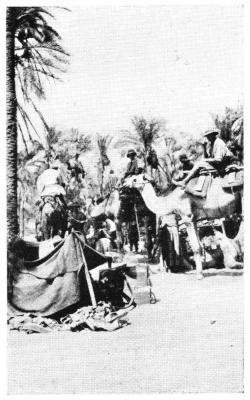
form the British Camel Corps. The two platoons of C Company
were detailed for this duty. The departing O.C. Camel Corps had
little time in which to impart information to his successor, and there
were many documents to sign, some of these being in Arabic. He
seemed grieved that Manchester men should be ignorant of Arabic and
of the customs, habits, and requirements of camels, but volunteered
as much information as could be crammed into five minutes. Captain
C. Norbury and his subalterns gazed upon their new pets,
seventy in number, without affection, and sat down the better to
enjoy the humour of their predicament before sampling its difficulties.
In despair and not in hope, expecting rather to provoke merriment
than to elicit information, the new O.C. Camels asked his half-company
if any man among them had had experience of camels.
Forth stepped the former camel-keeper of Bostock’s menagerie.
The Hour had brought forth the Man. The 7th Manchesters now
felt that they were equal to any emergency, and soon they provided
piano-tuners for the Sirdar’s palace, trained gardeners for the barracks
gardens, and skilled artisans for every variety of job for which
an expert was demanded.
The Camel Corps was soon proficient enough to be sent by the
Sirdar on a two-weeks’ trek through villages where white men had
rarely been seen, and their presence gave the lie to reports circulated
by Turco-German emissaries that all white troops had been recalled
from Egypt and the Sudan to defend their home country from the
enemy at its gates. Incidentally they had the opportunity of seeing
the wonderful results of Manchester enterprise in the great cotton-growing
areas through which they passed. Not only had Khartoum
been transformed from a collection of mud huts into a town of
imposing buildings, shops, and public works, but the savage Sudan
of a few years ago was in process of transformation into a land of
peace and prosperity.
Training proceeded under the same trying conditions of climate
experienced by their comrades in Egypt; the same games and sports
were enjoyed with similar zest; and fitness and efficiency prevailed.
The conduct of the men received and merited high praise from the
Sirdar—who paid the battalion the distinction of becoming its
honorary Colonel—and from all with whom they came in contact.
Relations with the natives were excellent, and a firm friendship was
formed with the Egyptian regiment in Khartoum. The first of all
active service periodicals, The Manchester Sentry, was published in
Khartoum, the Sirdar and Lady Wingate contributing. The three
companies rejoined their comrades of the Manchester Brigade in
Cairo on April 23, 1915.
Defence of the Suez Canal
On January 19, 1915, the Manchester Brigade was transferred
from Alexandria and Cyprus to Cairo, and the 5th and 8th Lancashire
Fusiliers were sent to Alexandria. Reports of renewed activity
on the part of the Turks pointed to an attempt to seize the Suez
Canal and invade Egypt. On January 20 the 1st and 3rd Brigades,
R.F.A., were despatched to the Canal zone, to be followed a few days
later by the 1st Field Company, R.E., which had recently been
brought back to Cairo in order to take part in divisional training.
The artillery was posted on the west bank of the Canal at El Kubri,
Serapeum West, Ferry Post (Ismailia), El Ferdan, and Kantara,
most of the guns being concealed among the pines that grow within
a hundred yards of the bank. The Field Companies assisted the
garrisons of Indian troops in the strong points of the east bank to
improve their defences.
The expectations of hostile attack were realized in the early hours
of February 3, when a force of 12,000 Turks and Germans attacked,
and made an attempt to cross the Canal midway between the east
bank strong points of Serapeum and Toussoum. Heavy rifle and
machine-gun fire developed between those places about 3 a.m.
The guns of the Egyptian Mountain Battery had, by happy chance
or remarkable intuition, been mounted on the west bank within
400 yards of the main crossing-place selected by the Turks. The
chanty of the enemy, as, unaware of the battery’s proximity, he
attempted to launch the heavy steel pontoons, was much appreciated
by the gunners, who opened fire in the dark at point-blank range.
When daylight came the Battery Commander was able to congratulate
himself on some accurate “spotting,” several holed pontoons
and many dead Turks being found at the water’s edge.
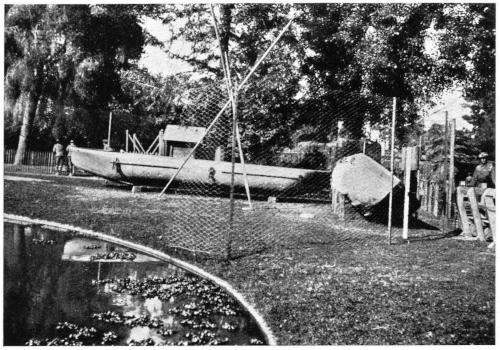
One of these pontoons is now in possession of the Manchester
Corporation.
Two sections of the 1st Field Company had been detailed to
hold the west bank at this point, and in the course of the fighting
on February 3 they lost one man killed and two wounded. The
19th Battery, under Major B. P. Dobson (which had already been in
action on the previous day against the Turkish Camel Corps), played
a conspicuous part in the enemy’s defeat. They had hauled one
15-pounder through a wood to the bank of the Canal and had fired
point blank into the Turks as they vainly attempted to launch their
iron boats. Another gun was man-hauled to a hill behind the wood,
and this found good targets as the enemy approached the Canal.
Captain P. K. Clapham did some good spotting for the battery from
a precarious and exposed position in a tall fir tree. The 18th Battery,
at Ismailia, fired on the enemy positions with good effect from 2000
to 3000 yards, and every battery of the two brigades shared in the
victory. The 20th Battery, at El Ferdan, had the distinction of
being the first Battery of the Division—and probably the first of any
Territorial unit—to open fire upon an enemy. The total casualties
of the East Lancashire Artillery were five men wounded, four of
these belonging to the 19th Battery. The men of the Signal Company,
who had done good work in this sector, also received their baptism
of fire.
The attempt to invade Egypt had failed. The Punjabis (upon
whom fell the brunt of the fighting), the Rajputs and Gurkhas on
the east bank were fully prepared both to meet the attack and to
assume the offensive, inflicting a serious defeat and making important
captures. The Divisional Yeomanry arrived at Ismailia on the
4th of February in time to co-operate with Indians, Anzacs, and the
5th Battery in following up the enemy’s retirement. More than 1600
prisoners were taken. On the 10th General Douglas visited the
posts on the Canal, held by units of his Division, to congratulate his
men on their good work. The 2nd Field Company reached Ismailia
on the 6th, and for the greater part of the month the sappers were
kept busy strengthening the Canal defences, making entanglements,
trenches and bomb-proof shelters, and laying mines. Another attack
upon the Canal was made on the 22nd of March, when the 5th
Battery was again in action, and the next day the Battery accompanied
a column which attacked the Turks in the Sinai Desert about
nine miles N.E. of El Kubri. While the East Lancashire Batteries
remained in the Canal zone Brigadier-General A. D’A. King,
Divisional C.R.A., assumed command of the artillery of the Canal
defences.
Training and Fitness
From the beginning of the year 1915 the training had become
more and more strenuous. There were long marches in the desert—occasionally
very long ones—in full marching order, through native
villages in which the many odours were only excelled in numbers,
variety, and offensiveness by the yelping curs that were stirred into
noisy activity by the tramp of the battalions. The Khamsin wind
was sickly in its heat, the atmosphere heavy and laden with sand,
the glare of the sun pitiless, the only shade available while resting
being the very inadequate shelter provided by a blanket stretched
on rifles. But the men were physically fit—they had to be, for only
fit men were needed. The amateurs had become soldiers. The days
were past when the colour-sergeant’s whispered order to the right-flank
man of a company in extended order for “two scouts” would
reach the left-flank man in the form of “the colour-bloke wants a
couple of stouts.” In spite, however, of good physical condition
and a fine spirit, it could not truthfully be stated that the Suez
road, with its five-mile towers, and the Virgin’s Breast had endeared
themselves to Lancastrians. Familiarity had bred not contempt
but a whole-hearted loathing for that accursed highway and that
distant mound. The Third Tower was the usual goal, the advance
ceasing just beyond it. How the troops hated the sight of this
detestable pile which, in the dust and glare, seemed to recede mockingly
as they tramped towards it! On the homeward march one very
hot day, while the men were cursing the dust and sand, a party of
natives passed, all being mounted on asses. A bulky and perspiring
Salford Fusilier regarded them enviously, and growled: “They say
those blighters ain’t civilized. But they don’t ⸺ well walk!”
There were night operations and marches, during one of which, after
a battalion had been wandering for hours in pitch darkness along the
numerous roads in and around Helouan, the company humorist
suggested to his Captain that they had lost their way. On being
asked why, he replied, “Well, we’ve just passed a road that we
haven’t been down.”
Brigade “shows” and Divisional “stunts,” in conjunction with
Australian and New Zealand troops and English Yeomanry, now
began to play an important part in the training. The sounding of
the Cease Fire was the signal for importunate orange-sellers to
spring up on all sides, holding out the refreshing fruit with shrill
cries of “Two for half” (piastre). Under the alleged cover of
imaginary battle-ships “landing-schemes” were rehearsed. These,
like so many less provocative events, gave rise to highly coloured
rumours which, in spite of the hard fate of earlier rumours, were
entertained with much satisfaction, for Hope is a cheery soul, always
quick to reply that he is not downhearted. The men looked forward
eagerly to an exodus from the captivity of Egypt and longed for
the promised land, where an opportunity to test their soldierly
qualities might be found. Rehearsals, training, and all duties were
carried out with alacrity and unfailing cheerfulness, but they were
becoming monotonous; and the feeling undoubtedly existed that the
Division had—quite unintentionally—been penalized through being
the first Territorial Division to be complete for service. Had they
been a little less efficient another Territorial Division might have
been chosen for useful but inglorious garrison duty in Egypt, and
the East Lancashires might by now have been in France or Flanders.
It seemed to be a case of the first being last.
On Palm Sunday, March 28, a brilliant day, the Division was
reviewed in Cairo by General Sir Ian Hamilton, who had lately
arrived to command the Mediterranean Expeditionary Force, and
Major-General Douglas had good reason for his pride in the troops
under his command. The critical eye of the Commander-in-Chief
seemed to take stock of every individual that passed before him,
and he was obviously impressed by their soldierly bearing and
fitness.[2] Here was a Division whose outward appearance equalled
that of Regulars, and, as a judge of men, he was convinced that their
martial spirit would not belie the outward appearance. He never
had reason to alter his opinion or regret the judgment then passed.
From that day the East Lancashires were “in the ring,” and were
destined to play a part in one of the war’s greatest tragedies. In a
Special Order of the Day the Divisional Commander published the
following letter—
“General Sir Ian Hamilton, having been accorded the privilege
of reviewing the East Lancashire Division, wishes to congratulate
the General Officer Commanding in Egypt, as well
as Major-General Douglas, on the turn-out and soldierly bearing
of that force.
“He was able to observe to-day that the East Lancashire
Division has made full use of the advantages which continuous
fine weather and the absence of billeting have given them over
their comrades now bearing arms, whether at home or on the
continent of Europe.
“Ever since the siege of Ladysmith, General Sir Ian Hamilton
has interested himself specially in the military output of
Manchester, and it is a real pleasure to him now to be able to
bear witness to the fact that this great city is being so finely
represented in the East.”
Early in April there were signs that a fresh attack on the Canal
was contemplated by the Turks, and orders were received that an
Infantry Brigade of the Division must be ready to occupy a position
covering Kantara at short notice. Major-General Douglas selected
the East Lancashire Brigade for this important task. The move was
not begun, however, until the 16th, when two battalions left for
Kantara and Port Said, the others following on the 19th and 20th.
Embarkation for Gallipoli
On April 28 verbal orders were received by the Divisional
Commander that the Division must be prepared to move to the
Dardanelles at short notice. The news soon spread; it was no
rumour this time, but the real thing, and on April 30 excitement
was at fever heat. At last the Territorials were to be given the opportunity
to which all ranks had looked forward so eagerly, and towards
which recent training had been directed. Little time was given for
preparation, but no more was needed, as the Division was ready to
take the field. On May 1, 1915, the embarkation of the East
Lancashire Division began, the Lancashire Fusilier Brigade, the
Brigade Signal Section and No. 2 Company, A.S.C. leaving
Alexandria for the Dardanelles on the 2nd May. The Manchester
Brigade, the Brigade Section Signal Company, No. 4 Company,
A.S.C., and the 1st Artillery Brigade sailed on the night of the 3rd.
Some of the transports had just brought many hundreds of wounded
men from Gallipoli. The Derflinger, a captured German vessel, had
landed 550 casualties a few hours before she was boarded by the
5th and 6th Manchesters, and the gory clothing and stretchers which
littered her decks were sufficient evidence of war’s brutality to sober
the most irresponsible and banish all idea of a “picnic” expedition.
The embarkation of the remainder of the Division was delayed by
the lack of trains, but on the 4th all units, with the exception of the
Yeomanry, left their stations for the ports of embarkation, and on
the 6th of May were at sea. The men carried with them grateful
memories of the ladies of Alexandria, from whom much kindness
had already been received, and who now opened a buffet on the
quay, and from dawn until dusk supplied tea, coffee, and other
refreshments to troops awaiting their turn to embark.
While the troops were embarking Major-General Douglas
received the following telegram from Sir John Maxwell—
“When you have an opportunity will you let the East Lancashire
Division know that during the time they have been under
my command I have been filled with admiration of their conduct,
keenness, capacity for hard work, cheerfulness and soldier-like
spirit. Now they are going on hard active service I am sure
they will fight gallantly and uphold the great traditions of
Lancashire and the Empire, and prove, if proof be needed, that
the trained Territorial soldier is second to none. Good luck
and God speed to you all.”
On May 1 the Embarkation State of the Division was as
follows—
Officers.
Other Ranks.
Headquarters and Signal Service
21
242
Artillery (with twenty-four 15-pr. guns)
57
1,273
Engineers
15
410
Infantry (two machine-guns to each battalion)
369
11,189
R.A.M.C.
34
653
A.S.C.
24
313
Total
520
14,080
Officers commanding units—
C.R.A.
Brig.-General A. D’A. King, D.S.O.
1st Brigade R.F.A.
Lieut.-Colonel A. Birtwistle.
3rd Brigade R.F.A.
Lieut.-Colonel C. E. Walker.
C.R.E.
Lieut.-Colonel S. L. Tennant.
Div. Signal Company
Major A. N. Lawford.
1st Field Company
Major J. H. Mousley.
2nd Field Company
Major L. F. Wells.
Lancashire Fusiliers Brigade
Brig.-General H. C. Frith.
5th Batt. L.F.
Lieut.-Colonel J. Isherwood.
6th Batt. L.F.
Lieut.-Colonel Lord Rochdale.
7th Batt. L.F.
Lieut.-Colonel A. F. Maclure.
8th Batt. L.F.
Lieut.-Colonel J. A. Fallows.
East Lancashire Brigade
Brig.-General D. G. Prendergast.
4th Batt. E.L.
Lieut.-Colonel F. D. Robinson.
5th Batt. E.L.
Lieut.-Colonel W. E. Sharples.
9th Batt. Manchester
Lieut.-Colonel D. H. Wade.
10th Batt. Manchester
Lieut.-Colonel J. B. Rye.
Manchester Brigade
Brig.-General Noel Lee.
5th Batt. Manchester
Lieut.-Colonel H. C. Darlington.
6th Batt. Manchester
Major C. R. Pilkington.
7th Batt. Manchester
Lieut.-Colonel H. E. Gresham.
8th Batt. Manchester
Lieut.-Colonel W. G. Heys.
E.L. Divisional Train
Major A. England.
1st E.L. Field Ambulance
Lieut.-Colonel H. G. Parker.
3rd E.L. Field Ambulance
Lieut.-Colonel W. M. Steinthal.
With one or two exceptions these officers were in command when
the units left England. Lieut.-Colonel Heywood (6th Manchesters)
had been pronounced unfit for active service by reason of defective
eyesight, and Lieut.-Colonel Needham (A.S.C.) was left at Alexandria
sick.
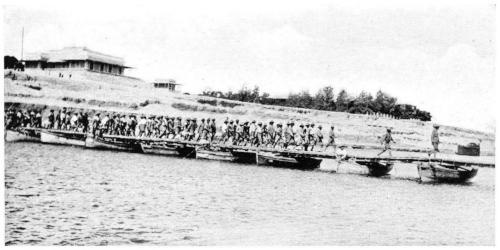
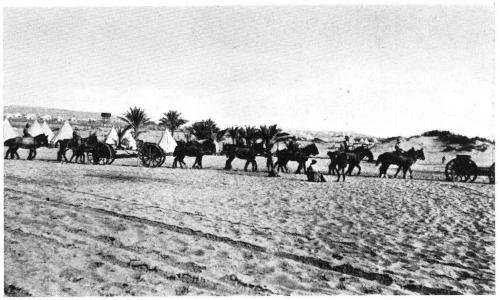
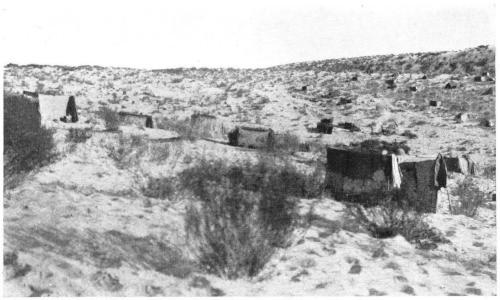
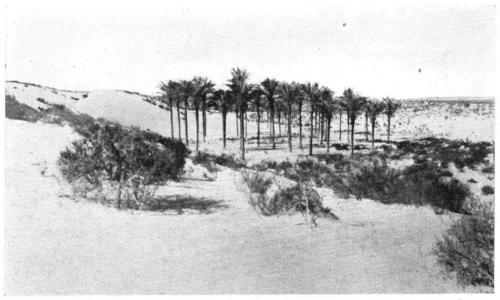
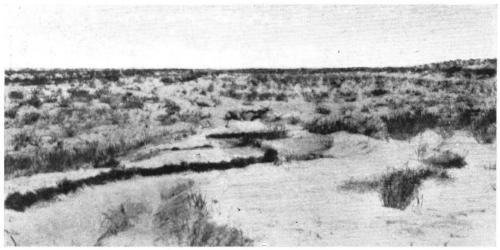
1/2nd GURKHA RIFLES CROSSING 1ST FIELD COMPANY’S BRIDGE OVER
SUEZ CANAL AT FERRY POST.
TURKISH PONTOONS CAPTURED AT TOUSSOUM, SUEZ CANAL.
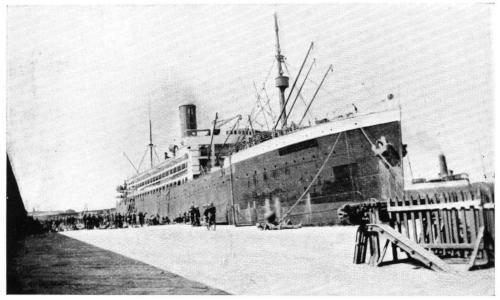
6th BN. MANCHESTER REGT. EMBARKING AT ALEXANDRIA FOR GALLIPOLI.
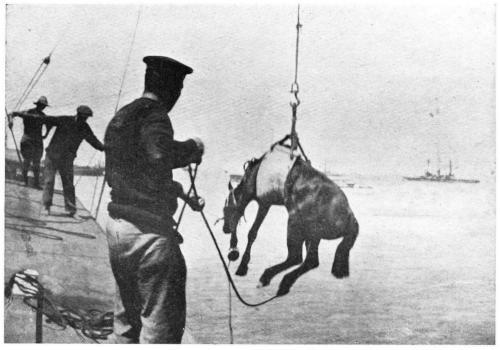
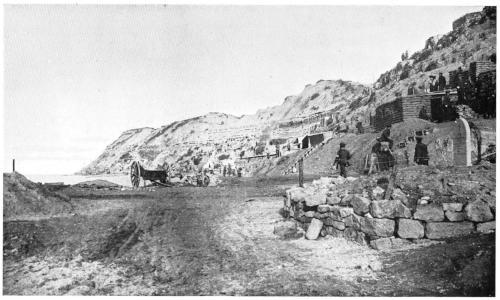
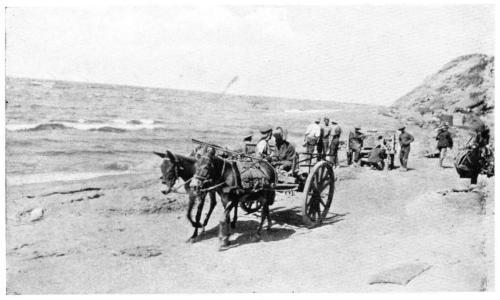
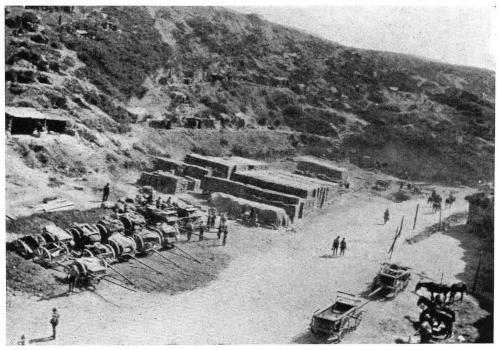
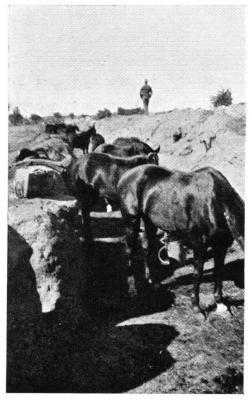
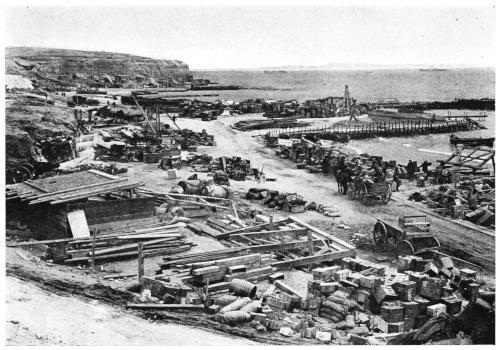
UNLOADING HORSES AT C. HELLES.
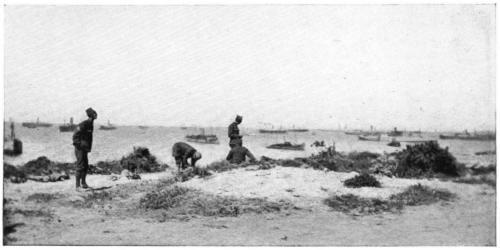
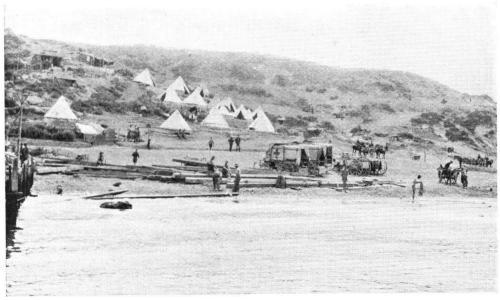
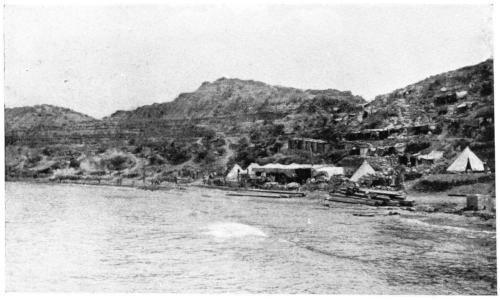
SHIPPING OFF C. HELLES, MAY 1915.
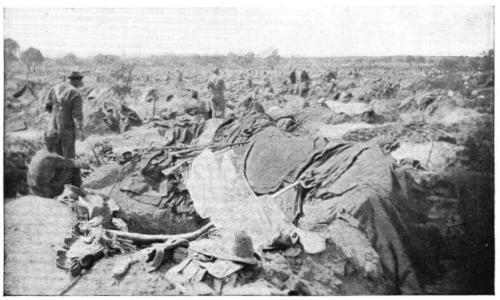
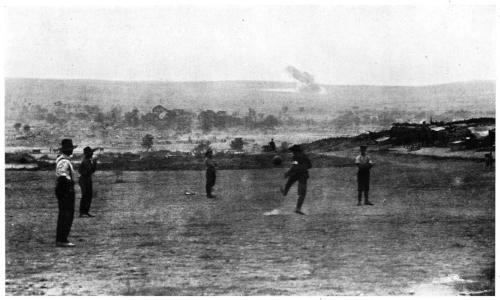
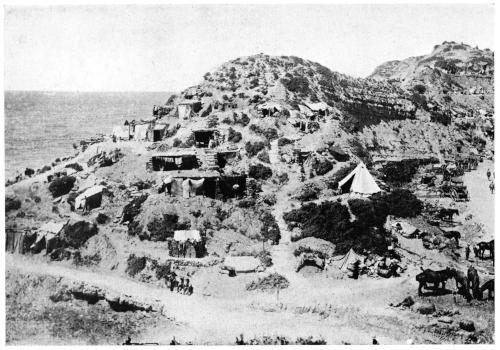
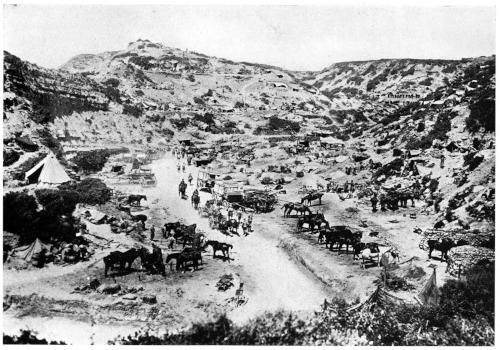
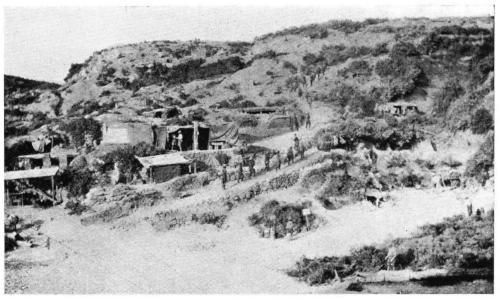
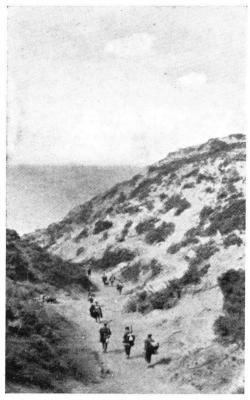
BIVOUACS IN THE “REST AREA,” C. HELLES.
CHAPTER II GALLIPOLI ( May 1915 )
Gallipoli! Who in Lancashire, in England, before the year
1915, knew where or what it was, or had even heard the name?
Bitter was the dispelling of ignorance; hard indeed the road that led
to knowledge! A name of death, of affliction, of suffering almost
too heavy to be borne; but also a name of heroism and endurance
and of high endeavour. A name of Failure, but no less of Glory.
More than 14,000 Lancashire Territorials—bronzed, clear-eyed,
trained men now—put forth from Egypt in the first days of May
1915, upon the second stage of the Great Adventure, bound for the
Ægean Sea, the very source and well-spring of adventure, whose
shores and islands were the playgrounds of heroes. As the transports
steamed northward into the Ægean, some, perhaps, had visions of a
parade across the peninsula, an astonished enemy falling back before
them in disorder, and a triumphant procession into Constantinople.
The glamour of that romantic city laid hold of the imagination of
others, who pictured a victorious entry after some weeks or months
of hard fighting, and the loss of good comrades. The majority,
however, had a better, if still rather vague, idea of the difficulties of
the task that confronted them, for most had heard by now of the
enemy’s preparedness and of the reception that had been given to
the 29th Division, the Anzacs, and the French, and of the awful
losses sustained before a precarious footing had been gained.
So, while the Division is at sea, let us review very briefly the
position on the peninsula of Gallipoli. After a naval bombardment
on February 15, which only served as a threat and warning to the
enemy, a naval attempt on March 18 to force the Straits failed
disastrously, though it certainly attained one of its objects—that of
relieving the pressure upon the Russians. But as the large Turkish
forces withdrawn from the Caucasus were employed upon the defence
of Gallipoli and the Straits, the result was that the hitherto undefended
peninsula was converted into an impregnable position against
the now expected attack. Artillery was mounted to cover every
approach, and barbed wire entanglements were concealed in the
shallows and placed on shore—wire compared with which the British
article was as thread.
On April 25 General Sir Ian Hamilton’s army landed, the 29th
Division at various beaches of the southern extremity of the peninsula,
around Cape Tekke, Cape Helles, and the village of Sedd-el-Bahr, and
the Anzacs on the western shore a dozen miles to the north, just beyond
the headland of Gaba Tepe. The loss incurred had been appalling.
The marvel was that the feat had been accomplished. History
records no grander achievement, no more inspiring example of
heroism. Surely men who could achieve the impossible as these
had done could go anywhere or do anything! They could indeed
do what men can do, but there were no reserves to fill the huge gaps,
and the important gains made so gallantly and at so terrible a cost
had to be abandoned by the fragments of what had once been
battalions and companies. The story of Gallipoli might have been
very different had General Hamilton been granted the support of
the East Lancashire Division a week earlier. On April 30 the
86th Brigade (the four Fusilier battalions) of the 29th Division could
only muster 36 officers and 1830 men out of a normal strength of
104 officers and 4000 men, the 1st Lancashire Fusiliers being reduced
to 11 officers and 399 men.
The finest troops of Turkey made desperate efforts, with a
courage and enthusiasm that won the admiration of the British, to
complete the destruction of the invading force or to drive it into the
sea. With equal determination British, Anzacs, and French held
on to their dearly-won foothold, and made desperate counter-attacks
to improve their position. On May 1 the Indian Brigade
under Brig.-General Cox arrived from Egypt.
On May 5-6 the Lancashire Fusilier Brigade, with No. 2 Section
Signal Company and the 2nd Transport and Supply Company,
disembarked at “W” and “V” Beaches, across the blood-drenched
hulk of the River Clyde, and were temporarily attached to the 29th
Division. Vehicles and animals were slung into the lighters, and
though it was their first experience the men did their job well. The
A.S.C. mules had been supplied from the 49th Reserve Park a few
hours before embarking at Alexandria, and were therefore unknown
to their drivers, who deserve credit for bringing them safely ashore.
As the cable-wagons could not be landed each man of the Signal
Section took as much equipment as he could carry.
Had stimulus been needed to inspire the men from Bury, Rochdale
and Salford, here was their inspiration. They had set foot ashore
close to the spot made world-famous as “Lancashire Landing”
a few days earlier by the 1st Battalion of their own Regiment, with
whom they were now privileged to act. “So strong,” wrote Sir
Ian Hamilton, in his first despatch on the Gallipoli landing, “were
the defences of ‘W’ Beach that the Turks may well have considered
them impregnable; and it is my firm conviction that no finer feat
of arms has ever been achieved by the British soldier—or any other
soldier—than the storming of these trenches from open boats, by
the 1st Lancashire Fusiliers.” Within a few hours of landing the
Territorial Brigade was in action, and at the close of two days’
severe fighting it had a casualty list of 673. The first battalion to
disembark, the 6th Lancashire Fusiliers, took over trenches from
the K.O.S.B. at dusk, on the extreme left of the British line, between
Gully Ravine and the Ægean Sea. The remainder of the Brigade
marched during the night, reaching a point above Gully Beach at
daybreak on May 6.
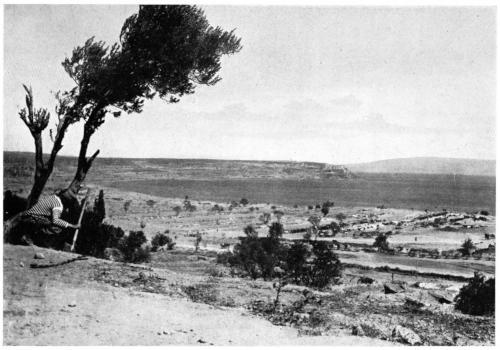
ACHI BABA FROM HIGH GROUND ABOVE “LANCASHIRE LANDING.”
MORTO BAY AND ENTRANCE TO THE NARROWS.
The First Battle—May 6, 1915
A general advance of the whole line, stretching right across the
peninsula, from a point about three miles north of Tekke Burnu on
the left to a point about one mile north of De Tott’s Battery on the
right, was ordered for 10 a.m. that morning. The 6th L.F. gained
more than 400 yards before being held up by heavy fire from rifles
and machine guns. This was the greatest advance made by any
unit that day, and the ground won was held. The 7th were in
support of the 6th. One company of the 8th reinforced the extreme
left; another company supported the left of the 88th Brigade on
the right of the Gully Ravine. This ravine, about fifty yards wide,
with steep cliffs forty to sixty feet high, formed a dangerous gap in
the line, and during the night its bed was occupied by another
company of the 8th. Under cover of night the trenches, having
been cleared of dead and dying, were deepened and improved.
The attempt to continue the advance next morning was not
successful. The 5th L.F. deployed and passed through the 6th in
the front line, the rest of the Brigade being in support, to press home
the attack. The Brigade’s objective was a point about a mile to the
north of the furthest point reached by British troops throughout
the campaign. Some parties of the 5th gained a little ground, but
they were enfiladed, the intensity of the fire drove them back, and
the line remained unaltered. A renewal of the attack in the afternoon,
when the Brigade was reinforced by two battalions of the 87th
Brigade, also failed. At sundown the Brigade was relieved, and the
Lancashire Fusiliers rested on the cliffs until the following evening,
when they were moved to a less exposed bivouac further inland,
among the trees near Morto Bay. The Territorials had been severely
tested and had stood it well. They had been thrust at once into the
fighting line because they were badly needed. When they landed
the position of the depleted 29th Division was precarious. The men
were exhausted, for there is a limit to human endurance, and that
limit had almost been reached. It was vital, if they were not to be
driven into the sea by force of numbers, that an advance should be
made and less exposed positions secured; and the arrival of the
Territorial Brigade had enabled the worn-out Regulars to attain this
object. No. 2 Section Signal Company had done good work. For
two days their tasks had been done in the open, under continuous
fire, all lines having been laid on the surface by hand.
By some blunder or misunderstanding on the part of the Naval
Authorities most of the transports conveying the remainder of the
Division were sent northwards up the coast to Gaba Tepe, instead
of to Cape Helles. The first to arrive, the Derflinger with the 5th
and 6th Manchesters on board, was chased by a destroyer and brought
back with all speed to Helles, where these two battalions disembarked
on the evening of May 6 at “W” and “V” beaches. The 7th and
8th Manchesters landed on the same beaches on the following day
under shell fire, which caused several casualties. The Manchester
Brigade assembled on the cliffs between the beaches before moving
inland to the rendezvous known as Shrapnel Valley. The other transports,
including the Crispin with Headquarters on board, arrived
off Gaba Tepe on May 8, and anchored there for the night. In the
morning Major-General Douglas, failing to obtain a reply to his ship’s
signals, visited the Senior Naval Transport Officer on board H.M.S.
Queen, and the transports were soon steaming southwards, Headquarters
disembarking at “W” beach in the afternoon of May 9.
The disembarkation of the Division was practically completed
on the 11th, though two companies of the 10th Manchesters and one
of the 5th East Lancashires, when about to follow their comrades
ashore, were carried off by the naval authorities for some unexplained
reason, and were not landed until the 14th. The medical and surgical
equipment of the 3rd Field Ambulance was also lost in the same way,
and was not recovered for a fortnight. The 5th Battery, R.F.A., and
two guns of the 6th Battery had been landed, when orders were
received that, as the area occupied by the British was so small,
sufficient space would not be available for the batteries, so the
Artillery must return to Egypt. It was, however, decided to allow
the guns which had already been brought ashore to remain. Lieut.-Colonel
Birtwistle, commanding the 1st Brigade, R.F.A., had gone
ashore with the 5th Battery, and he was placed in charge of a sub-group
of Australian and New Zealand batteries. The mortification of the
other batteries was intense, but after four more months in Egypt
they again sighted Cape Helles, and this time were allowed to land.
For the same reason—congestion on the occupied territory—the
1st, 3rd and 4th Companies, A.S.C., with the exception of the Supply
personnel, were ordered back to Egypt.
The vagaries of the naval transport authorities which had sent
some of the transports on a tour along the coast were not regarded
as an unmitigated evil by those of the wanderers upon whom responsibility
weighed less heavily, for they were given the opportunity
to survey the scene of operations from various angles, from Tekke
Burnu to Fisherman’s Hut beyond the headland of Gaba Tepe, where
lay the Anzacs, and from Cape Helles to Morto Bay and the entrance
to the Straits. They witnessed the bombardment of the enemy’s
positions from sea and land; and some, with good glasses, were able to
follow the movements of the Lancashire Fusiliers during the heavy
fighting of the 6th and 7th of May, and could actually see them
move forward to attack, their bayonets flashing in the sun, and
concentrate on certain points when the advance was held up. On
the right the French Colonial troops were seen, carrying all before
them with their usual dash, only, alas! to be driven back a few hours
later. They passed close to the mighty Queen Elizabeth, that embodiment
of concentrated sea-power which—as many anticipated—had
proved so comparatively ineffective against an enemy on land,
though the big naval shells which burst in and around Krithia Village
threw up clouds of dust and smoke and debris seventy feet in height.
There also were the French men-of-war and the “Packet of Woodbines,”
as the five-funnel Russian cruiser Askold was termed.
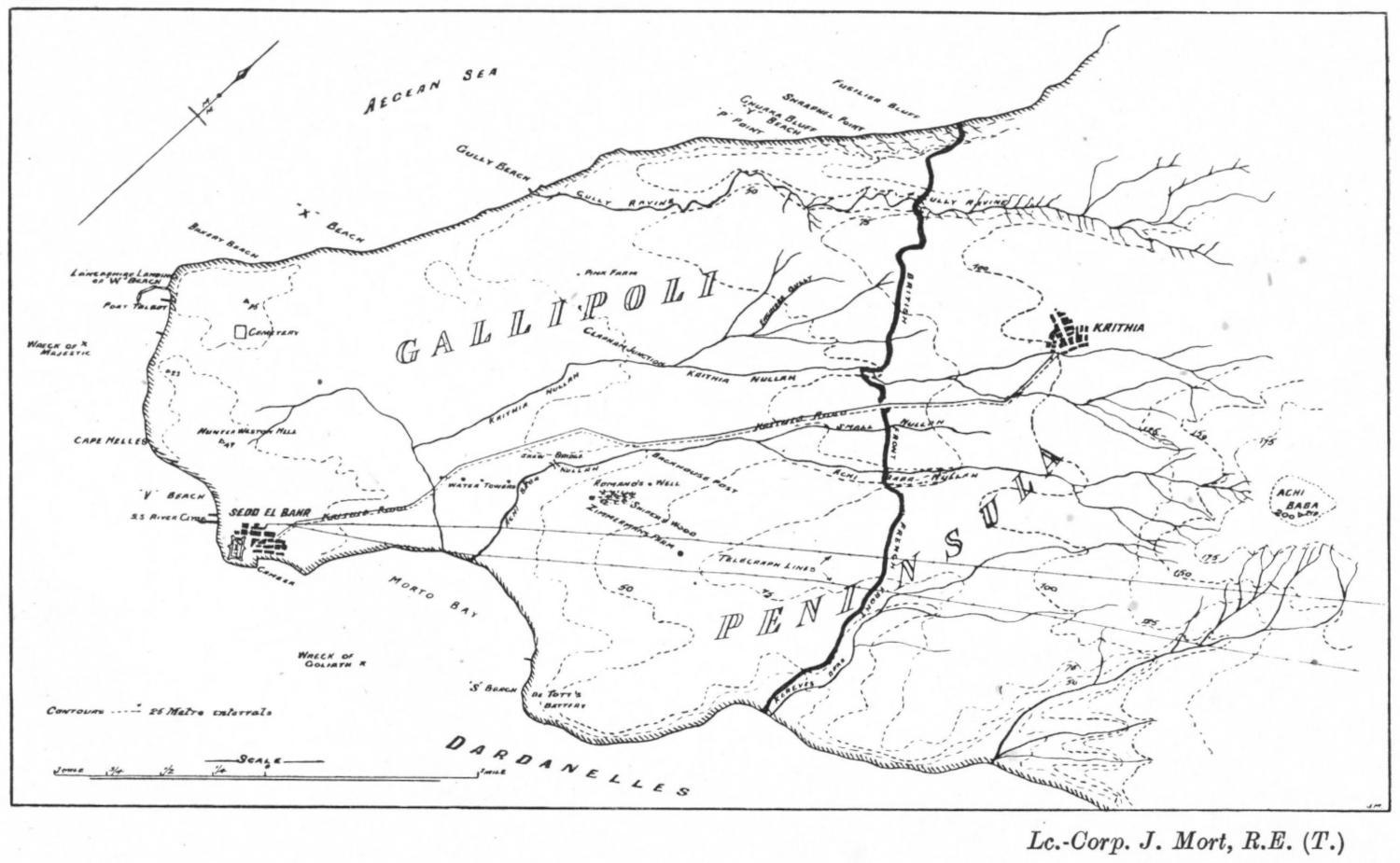
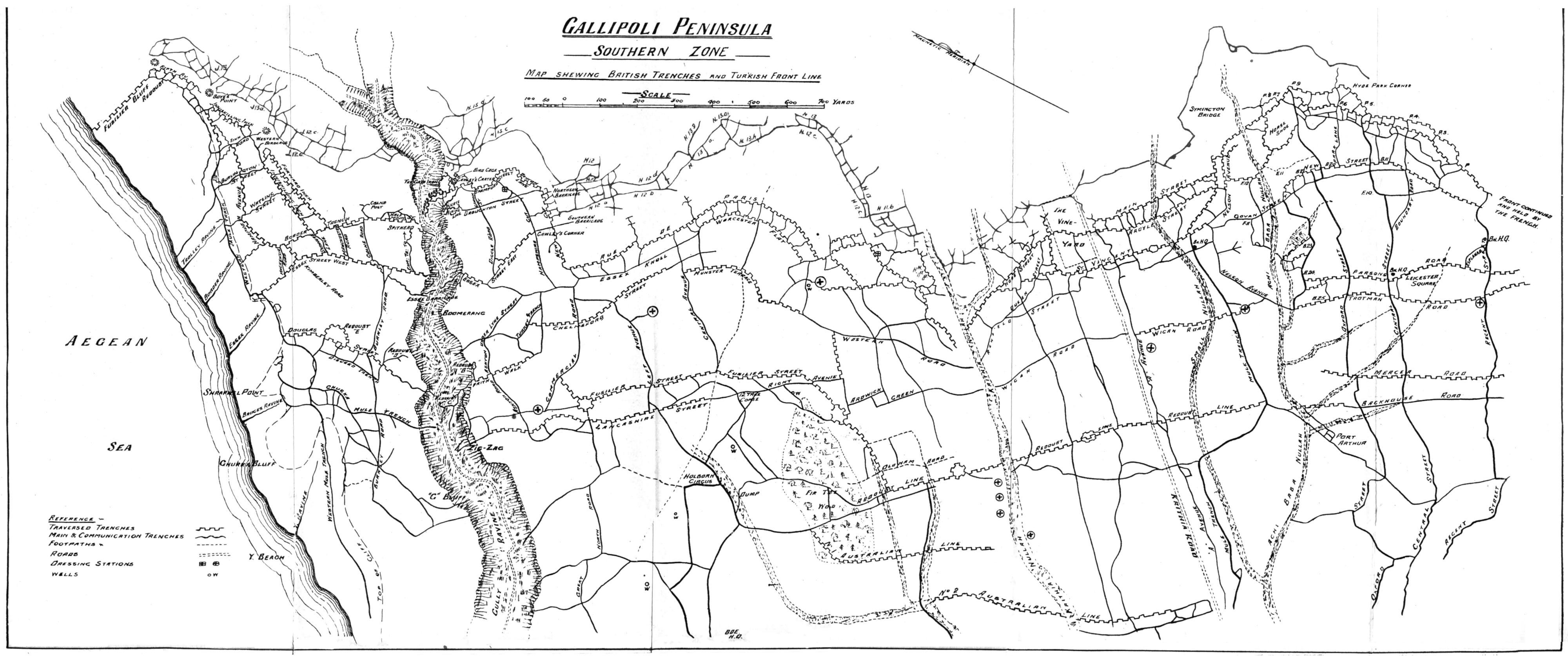
GALLIPOLI PENINSULA
Lc.-Corp. J. Mort, R.E. (T.)
The Landing at Helles
That the landing on open beaches, exposed to chance firing from
the Turkish front, and presenting a visible target to batteries at Kum
Kale on the Asiatic shore, was accomplished quickly and almost
without loss was due to the fine spirit shown by all ranks. The
disembarkation was by no means a simple affair. It contrasted
strangely with the embarkation at Alexandria, where the troop-trains
ran alongside the steamers, and the docks were equipped with
all loading facilities. At Cape Helles the transports anchored at
varying distances from the shore, and the troops were transferred to
steam-tugs and trawlers, each carrying about 500 men to the makeshift
piers of trestles or old barges, or to the jetty formed by the
stranded River Clyde on “V” Beach. Horses and mules were
slung overboard and lowered into lighters. The ground swell
increased the difficulties and dangers.
As the men scrambled into the tugs many began to realize that
they were now confronting the biggest thing that had yet entered
into their lives. They joked and chaffed one another, and smoked
their pipes, as if crossing to the Isle of Man, while the thunder of the
heavy guns echoed against the cliffs. They were not yet “heroes,”
and few of them had yet been tested by fire; and if, to steady their
nerves and conceal from their comrades—and from themselves—the
anxieties and doubts that would not be denied, they made fun
of the ordeal that lay before them, all honour to them!
Each boatload was welcomed by a Landing Officer, whose one
idea was, naturally enough, to get men and baggage clear of his
“pier” and beach in order to make room for the next batch and
prevent the short stretch of foreshore from becoming hopelessly
blocked. The strip of firm sand at the water’s edge soon changed to
loose sand and shingle, which sloped gradually to the foot of the
cliffs, about 150 to 200 yards from highwater mark. The cliffs rose
abruptly to the height of fifty to sixty feet, except in the centre of
the bays, where higher ground was reached by rough winding tracks.
From the top of the cliffs a view of Achi Baba was obtained—a
sight interesting enough, and even exciting, at first, but the interest
soon palled and gave place to detestation. The top was no place
to linger upon, for its occupants were plainly visible to the Turk in
front, as well as to the Turk in Asia. Low scrub and grass covered
it; beyond, the ground dipped slightly before it began to rise nearly
600 feet to the summit of Achi Baba, about six miles to the north-east.
It was mainly uncultivated ground, though a certain amount
of young grain afforded good grazing for the horses while it lasted,
and there were one or two small vineyards more than a mile inland,
the young grapes from these being made into delectable puddings
later by enterprising A.S.C. officers. The only trees near the Helles
beaches were small groups of wind-swept firs and a few limes, but
further inland, near the nullahs, and away on the right, in the French
area around Morto Bay, more foliage could be seen. There were
many wild flowers, including a lovely pink cistus, wild thyme and
very fine wild roses; and here and there the vivid red of a patch of
poppies relieved the general impression of green.
For nearly two miles inland this ground formed a narrow,
congested bivouac for troops newly landed or in reserve, and a rest
camp for those which had suffered heavily. Corps Headquarters,
ordnance, supplies, hospital tents, transport vehicles, and long lines
of picketed horses and mules, covered large expanses. At first men
lay in twos and threes in small natural hollows, in coffin-shaped holes
hastily dug to the depth of two or three feet, or in wide shallow
trenches which provided some little cover for men lying down.
Later, oilsheets were used to cover these trenches as a protection
from the sun by day and the cold at night. The difference in temperature
was keenly felt by men who had passed the preceding
seven months in Egypt. Indeed, on the first night ashore officers
and men, unable to sleep because of the cold, stamped backwards
and forwards until tired, then huddled together until forced to take
violent exercise again. The dawn was exquisite as the first rays of
the sun touched the snow-tipped mountains to the east, but few
were in the mood to appreciate it. What was then asked of the
sun was warmth, not beauty.
Very little protection from shell fire was to be found on the peninsula
owing to the nature of the ground, to the position of the allied
armies between the guns of Achi Baba and the batteries of the
Asiatic shore, and to the entire absence of material for revetting
trenches and constructing shelters and dug-outs. Wood and other
material could only be brought from Egypt or Mudros in small
quantities—small as compared with the vast amount required—and
even these seldom found their way beyond the beaches, and sandbags
during the first months were as precious almost as drinking-water.
Moreover, there was no time for work on defences, and no men were
available. The cliffs themselves provided shelter from shell fire
from the north, but none from “Asiatic Annie,” the heavy gun (or
rather guns) which shelled “W” and “V” Beaches continuously
from various points along Erenkoi Bay east of Kum Kale, inflicting
many casualties and much damage.
Into this too-crowded, unprotected area the Turk consistently
pitched his high-explosive shells, and the ear-splitting crash and
“coal-box” effect greeted the Territorials on arrival and gave them
their first impression of real warfare. It was amazing that the
casualty list was not far heavier. Had the enemy at this period
been in possession of more and better ammunition the position in
Gallipoli would have been untenable. Owing to this shortage in
these early days solitary wagons and pack-animals could be moved
about freely by day behind the lines, within view and range (with
open sights) of the guns on the slopes of Achi Baba; for the Turk
rarely wasted a shell on the chance of destroying one man or horse,
and, by extending to a distance of 400 yards, even a battalion transport
could often go forward and backward unmolested by day.
The incessant rifle fire at night made the area immediately behind
the front lines more dangerous then than by day.
The Nullahs
Farther away to the north the British front was intersected by
three streams, or, except during and immediately after rain, three
more or less dry beds of streams, running north-east to south-west.
The largest of these was Gully Ravine (Saghir Dere) close to and
parallel with the western coast, emptying into Gully Beach about
two miles north of Lancashire Landing. The Krithia Nullah (Kirte
Dere) began near Krithia Village, and intersected the centre of the
British area for a distance of three miles, then, a mile north of “V”
Beach, turned to the south-east and emptied into Morto Bay. The
third, Achi Baba Nullah (Maltepe Dere) ran parallel to, and from
500 to 1000 yards to the east of the Krithia Nullah, and it also
debouched into Morto Bay. No nullah emptied into “W” or “V”
Beach, and none intersected the high ground adjacent to those
beaches. As the one road in the occupied territory, the Krithia
Road, was registered, and in full view of the Turks, these gullies
formed the only concealed approaches from the bivouacs and rest
camps to the front line. The congestion of these “main streets”
made traffic slow and laborious. Normally the approach would
be along the bed of a tortuous stream, showing here and there a
trickle of water, and at one spot in the Krithia Nullah even a small
bathing-pool; but the sight of driftwood and debris deposited six
feet and more above the bed-level gave warning to the observant.
Disastrous experience soon showed that a few hours’ heavy rain could
convert these nullahs into raging and devastating torrents; and
when the spate subsided channels of deep mud would be left, with
here and there a quagmire into which mules and horses sank.
That one may have too much of a good thing while suffering from
a lack of it may be a paradox, but there were times when it was true
enough in Gallipoli. Water there was below the surface, to hinder
the construction of deep trenches, in which men might stand or sit
or walk without offering their heads and bodies as targets to the
sniper; there was at times water in exuberant excess to wash away
stores, equipment, and even trenches and dug-outs; but clean water
was more precious than wine. There were one or two derelict farms
which had wells, but the demand was so great that the supply soon
gave out. Unfortunately no steps had been taken to protect wells
from pollution when the area was first occupied, but afterwards a
guard was placed over them, and the water chlorinated before issue,
through fear of contamination. A small supply for the brewing of tea
was obtained by digging a hole in the trench, below the parados,
and placing therein an old biscuit tin with perforated bottom. In
this way a little water could be collected—and every pint was
treasure. As there were many of our own and the enemy dead lying
out in the open, and also latrines in the immediate neighbourhood,
it is a great tribute to the value of chlorination and typhoid inoculation
that men drank this water with impunity. The normal trickle
through the Krithia Nullah provided water for washing but not for
drinking, as the stream flowed through the Turkish lines into ours,
and was very dirty. A few springs of good water were found in the
banks of the nullah, and one of these never failed to supply about
100 gallons an hour. Later, new wells were dug, a gang of well-sinkers,
chosen from men of the mining districts, doing useful work.
Some of the best of these wells were sunk on the side of a precipitous
cliff at Shrapnel Point, near Gurkha Bluff, within a stone’s throw of,
but fifty feet above, the sea.
Before the Division landed there had been little attempt at
sanitation; there were not nearly enough men for fighting purposes,
and no one had time to worry about such things until too late. The
flies had then arrived.
The southern point of the peninsula had been very sparsely inhabited.
There were two villages, Sedd-el-Bahr, between “V”
Beach and Morto Bay, and Krithia, below the slopes of Achi Baba.
Elsewhere a few isolated buildings remained, and arches of an ancient
aqueduct which had formerly brought water to Sedd-el-Bahr, still
stood. But the inhabitants of the nullahs had not fled. Who that
heard them will ever forget the frogs of the nullahs at night? A
vivid memory of this will remain when things of more importance
are forgotten. The average Lancashire man had read that frogs
croak, and had accepted the statement tolerantly, as we acquiesce
when told that, in spite of appearances, Sirius is really larger than
the moon, or that the earth goes round the sun. Now they heard
them, and considered “croak” too feeble and inexpressive a word.
Some had perhaps read Aristophanes, and had assumed that the
frogs of sunnier climes might voice their joys and sorrows less decorously
than those which reside in suburban ponds near Manchester.
At first the origin of the noise[3] gave rise to much conjecture, a popular
notion being that the Gurkhas were responsible. Anything out of
the common might be attributed to them. Had it not been printed
in the newspapers that the Gurkhas observed a strange rite in respect
of the shedding of blood whenever they drew their kukris, to show
to the curious stranger or to put a still keener edge on the blade?
And did they not throw these heavy, curved knives at the enemy?
Accepting such statements as facts it was quite simple to believe that
you yourself had seen them do these strange things. So the noise
was made by the Gurkhas, and doubtless some unfortunate Turks
were having a most unpleasant time.
The Fauna of Gallipoli
Other interesting and unusual fauna were the tortoises, lizards,
tarantulas, and scorpions. The tortoises were decidedly popular,
and the lizards entertaining, but no one loved the others. At a
later date some ammunition was wasted on the flocks of migrating
cranes and storks that flew over in wedge-shaped phalanx, until
shooting at them was forbidden. The number of birds which lived
and nested on the peninsula, undeterred by, and apparently indifferent
to, the noise, carnage and destruction and the presence of armies
where men had hitherto been infrequent visitors, was remarkable.
Linnets, goldfinches, turtle-doves, magpies, jackdaws, and other
familiar birds were common. During the summer many rollers
were seen, and were called “parrots” from the brilliance of their
plumage. Black-headed buntings, having yellow plumage, were
mistaken for canaries. Birds of prey abounded, from the griffon
vulture seen in May on the cliffs of Helles to the abundant kestrel.
Levantine sheerwaters, known to the Turks as “the souls of the
damned”—a name which gained in significance as the months passed—flew
in flocks round the cape. The winter brought homely English
birds, robins and dunnocks, starlings and chaffinches, to remind
men of home.
Another noise which for a time puzzled the lads from Lancashire
was a weird, penetrating cry heard in the morning and evening.
There were various conjectures as to its origin, but finally the more
enlightened decided that it was the muezin calling the Faithful to
prayer.
Having given some idea of the conditions in Gallipoli and the
nature of the country, we return to the narrative of events.
On May 11 the East Lancashire Division was ordered to take
over the whole of the British front line, except that portion held by
the Indian Brigade, which came under the command of General
Douglas for a few days. The line was taken over in the course of
the night and of the morning of the 12th. It was a pitch dark night
with heavy rain, and few of those who took part will forget this first
experience.
On the evening of the 12th the Manchester Brigade made a
demonstration to draw attention from an important movement by
the Indian Brigade on their left. The high cliff overlooking the ravine
of “Y” Beach was strongly held by the enemy, and the machine
guns of this formidable redoubt formed an obstacle that must be
overcome before further progress could be made. The feint of the
Manchesters served its purpose by distracting attention from the
storming company of the 6th Gurkhas, and so enabling the hardy
little mountaineers to scramble up the cliffs unopposed and rush the
redoubt. They held the Turks at bay while their comrades of the
other three companies swarmed up the rocks and completed the
capture of the position, which received the name of Gurkha Bluff.
It was not only a fine bit of work, but also a success of the greatest
value. On the same evening the Lancashire Fusilier Brigade opened
fire to support a forward movement by French troops on their right.
On May 15 a readjustment of positions was ordered, and on the
nights of May 16-17 and 17-18 the reliefs were carried out. The line
of trenches was now in four sections. That on the left, held by the
29th Division, including the 29th (Indian) Brigade, ran from the
Ægean coast eastward for 1600 yards to the eastern edge of Fir
Tree Wood, 300 yards north-west of Krithia Nullah. The next
section, held by the East Lancashire Division, extended the line for
1500 yards from the right of the 29th Division, through the Krithia
Nullah to the Achi Baba Nullah, which it included. The Royal
Naval Division’s section continued the line for 700 yards to the
Telegraph Line; and the right section, thence to the coast of the
Straits, above the ruin known as “De Tott’s Battery,” about 2100
yards in length, was held by the French Corps Expeditionnaire.
Later this line was termed the Redoubt Line. Saps terminating
in T-heads were run out towards the Turkish trenches, and parties
told off at night to connect the T-heads and dig themselves in, until
two new advanced lines had been made. By the end of May a series
of redoubts had been constructed at intervals along the old front
line, and these were garrisoned in readiness to meet any temporary
success of the enemy. The occasion did not, however, arise. The
Manchester Brigade occupied the first line of the second section,
with the Lancashire Fusilier Brigade on its right, and the East
Lancashire Brigade as reserve. It may be mentioned that at this
period the total ammunition available for a battalion consisted of
200 rounds per man, with twelve boxes of 1000 rounds each in
reserve in the firing line, and twelve boxes at Battalion Headquarters.
During the three weeks after the disembarkation of the Division
had been completed there was little actual fighting, no attack being
made by either side. The arrival of the Territorials had strengthened
the position sufficiently to discourage Turkish hopes of dislodging
the invading force, but no forward movement on a large scale could
be contemplated until the ground recently won had been consolidated
and the difficulties of transport and supplies reduced. As the line
stretched from sea to sea no flanking movement was possible. It
was therefore a case of playing for position for a time. Each infantry
brigade in turn assisted the French, the R.N. Division, and the Indian
Brigade to develop their plans and effect necessary changes, and each
in turn relieved the brigade in the first line.
Shelling and Sniping
But though there was a lull in the fighting after the 8th of May
the shelling of the trenches, rest camps, cliffs, and beaches never
ceased for long. Even bathing parties[4] suffered from the shelling,
and the Turkish rifles blazed away day and night without cessation,
causing much loss to working-parties and men in bivouac far behind
the first line, and even in the R.A.M.C. tents below the cliffs. At
dark one could hear from the cliffs of Gully Beach the continuous
“plop” of bullets striking the water. There were also casualties from
hidden machine guns; and the courage, enterprise, and skill of the
Turkish snipers were the cause of many fatal wounds. Owing to
the shallowness of the average trench it was difficult even for the
most careful and experienced to keep under cover, and most injuries
received at this time were head wounds. The Turkish snipers hid
in the scrub—some carrying camouflage so far as to paint themselves
green—or lay in holes apart from, and generally in advance of, their
trench system; and their patience, persistence, and ingenuity evoked
reluctant tributes from their foemen. Fir Tree Wood was a happy
hunting-ground of the snipers, some of whom had remained in their
hiding-places during our advance, in order to pick our men off at
short range during the night. The Territorials received valuable
tips from the Regulars on the best methods of dealing with snipers,
and before long their numbers, and the losses they inflicted, were
kept in check.
BATHING POOL IN KRITHIA NULLAH.
THE KRITHIA NULLAH.
EVENING “HATE.”
During this period the men not in the front lines were kept busy
unloading supplies at the beaches and transporting them to the
dumps, road-making, trench and well digging, and performing many
other fatigues. The sappers, who had landed on the 9th and 10th
of May, had their hands more than full. The 1st Field Company was
in bivouac near Morto Bay on the right, and the 2nd Field Company
on the left flank near Pink Farm, a solitary building which became a
famous landmark and rendezvous during the campaign. They
directed the construction of trenches, of lines of rifle-pits in front of
the trenches, of dug-outs, and trench-bridges for armoured cars,
improvements of the rough country tracks, work on wells and appliances
for distribution of drinking water, and the manufacture of
bombs. The digging, deepening, and repairing, and, when material
was available, the strengthening of trenches was a never-ending task,
which had to be performed under fire from artillery, machine guns,
and snipers. The soil was mainly a stiff yellow loam, which stood
well unrevetted until rain came, when it was transformed into
peculiarly bad mud, and the water would not drain away. Gorse
and heather, outcroppings of rock, and in one or two sectors, the
tough fir-roots, which interlaced and formed a network at varying
depths, added considerably to the difficulties.
The Field Ambulances on landing had equal difficulties to encounter,
and the way in which they contrived to overcome them and
to makeshift successfully afforded proof of their resource. Dressing
stations had to be made in clefts in the cliffs, with tarpaulin sheets
stretched from boulder to boulder for shelter. The shortage of
appliances and equipment during the first weeks was a serious
handicap. As soon as their equipment arrived they moved up to
the rear of the bivouacs in the centre of the line. The battalion
stretcher-bearers had quickly “made good.” They had had to
stand the usual chaff while training, but within a week of landing
they had become “heroes” in the eyes of their comrades. The
Field Ambulances, lacking tackle, had not been able to provide
bearers to evacuate from First-Aid Posts, and the battalion stretcher-bearers
carried the wounded a distance of three miles to the beach.
Practically everything required for the army in Gallipoli had to
be brought from the base at Mudros, the harbour of the Island of
Lemnos, nearly forty miles away. Even water was conveyed overseas
to supplement the inadequate local supply. Rations, ammunition,
equipment, and material of all sorts were transferred from the
ships to flat-bottomed lighters and landed, frequently in rough
weather, and generally under fire from the Asiatic coast. The small
A.S.C. unit therefore did not enjoy much leisure. No. 2 Transport
and Supply Company had given evidence of its efficiency, for,
though within ten days after landing it had lost forty-one animals
killed, it was found that they possessed one more than the original
number landed. Many loose mules were straying around, and the
company upheld the rather unenviable reputation of which it boasted
in pre-war days of never passing any unconsidered trifles by.
A Divisional Supply dump had been established on the top of the
cliffs above “W” Beach, and there it remained until the evacuation.
Though in a very exposed position and under daily shell fire it enjoyed
a remarkable immunity. The rations were “man-handled” from
the beaches to this dump, where they were issued to the Regimental
Quartermasters, who brought with them their limbers when they had
any, but usually A.S.C. limbers took rations to the R.Q.M.’s dump,
about a mile inland, where they were divided in proportion to the
strength of companies. Here battalion transport men loaded the
pack-animals and led them across country for two or three miles
to Battalion Headquarters, a short distance in the rear of the trenches,
where the stores were unloaded, and the Transport Officer’s responsibility
ended. At Battalion Headquarters a party from each company
in the trenches was waiting to carry the rations to Company Headquarters,
where the C.Q.M.S. issued to the platoon sergeants the
share for their men, and the platoon sergeants in due course divided
the articles among the section commanders.
Transport and Rations
On paper this simple daily routine is a mere matter of efficient
organization, but in active practice it was something more. The
Turk had a very good idea of the routes to be taken, and as he fired
more vigorously during the night than in the daytime, the transport,
whenever possible, moved up soon after noon while he indulged in
his siesta. Rations had, however, often to be taken up at night,
and casualties among the A.S.C. men and trench ration parties were
frequent. None of the pack-animals had previously been under
fire. The load must be packed with equal weight on either side or
it will not reach its destination, for the mule, though a convinced
individualist, has nothing to learn from the best-organized trade
union in the matter of direct action or the lightning strike. The
loads consisted of full boxes and half-filled boxes of bully-beef tins,
tins of biscuits, jars of rum, sacks of loaves, whole cheeses, tins of
jam, bags of tea and sugar, sides of bacon, and on mail-days bags
of letters and parcels. The correct balancing and securing of such
articles, even on a placid, well-trained horse in a paddock at home,
where no more disturbing explosions are to be feared than those
caused by a distant motor-cycle, demands no mean skill and sense
of proportion. But when shells are bursting close at hand, and mules
and horses do their best to prevent the loading and dislodge the
loads, it is a very different affair. When the loading has at last
been accomplished and the animal is asked to move he will probably
kick and buck until the load goes to the winds. Both mules and
horses behaved uncommonly well under fire. On the rough tracks
the mule was far steadier than the horse and could carry an equal
weight. He was more particular about the perfect balance of his
load, and would not attempt to carry an uneven pack.
Having finally completed the packing and persuaded the animals
to start on the journey to Battalion Headquarters the Transport
Officer’s troubles take another turn. He has to find his way in the
dark across an open bullet-swept zone with animals that jib and
shy as the shells burst, or lie down as the fit takes them, and at times
succeed in scattering their packs. These must be collected and
laboriously replaced, the driver meanwhile employing the most
spirited and forcible terms of endearment in his vocabulary. At
times the convoy will be held up by heavy shelling of the area that
has to be crossed. Leaving the open they enter one of the nullahs
up and down which hundreds of troops are moving, and progress is
slow and exasperating. But in spite of all obstacles the transport
men daily got the rations through to their comrades in the line.
Nor should a word of gratitude to the Indian drivers of the A.T.
carts and the Zion Mule Corps be omitted. These men gave efficient
help in the transport of stores and material from the beaches to
the dumps, and their courage under fire was admirable. The pride
the Indians took in the smart and clean turn-out of their mules and
carts was the more noticeable as they did not appear to be subject
to the ordeal of inspection.
The journeys of the ration-parties from Battalion Headquarters
to Company Headquarters were no less exciting than those of the
battalion transport parties. Bearing heavy boxes or bags on heads
or shoulders they crossed from trench to trench in the open, tripping
over wire, stumbling into holes, dodging rifle fire, and, too often,
falling victims to the sniper. But the rations arrived and the men
were fed.
The rations were monotonous and ill-suited to the climate. They
consisted of bacon (for breakfast), bully-beef and biscuit, with a little
jam and cheese, a tin of Maconochie’s vegetable rations being at
first, but not later, considered a treat, but Maconochie was particularly
unsuited to a hot climate. Fruit—even good tinned fruit—and
fresh vegetables would have done much to preserve the health
of the men during the intense heat of the summer. In due course
every man became a more or less expert cook, and to be on visiting
terms was a privilege not unattended by risk, as it involved the
sampling of many weird experiments and decoctions. Bread from
the tents on Bakery Beach was first issued on May 21, and was
received with acclamation.
Firewood was very scarce, as there were few trees or bushes, but
it had to be obtained somehow for the trench fires over which the
men brewed their tea and cooked their food. It was therefore not
uncommon in the Helles area, in spite of orders issued to diminish
waste, to see a caseful of tins of bully-beef tipped out on the roadside,
that the invaluable wooden case might be split up for fuel. Butts
of rifles which lay beside their dead owners met the same fate.
Evidence of the awful waste of war abounded—weapons, ammunition,
equipment, food, clothing, trodden under foot, and left to rust
and decay. Where man could not expose himself by day these
things remained unsalved for months, but elsewhere they were
collected and returned to store. The best place where wood could
be “won” was above Bakery Beach. A sentry was put over the
wood-pile, but interesting conversation and a few cigarettes would
occasionally distract his attention for the needful time.
On May 21 the Brigade Commanders received instructions from
the Divisional Commander on various points connected with the
latest methods and conditions of siege warfare, such as the use of
bombs, sandbags, and loopholes, and the action of snipers. One
officer, one N.C.O. and four men from each company were instructed
in bombing, under the officer commanding the R.E., and each infantry
brigade was allotted 400 bombs. It was found, however, that no
more than 225 bombs were available for distribution among the
three brigades. The bombs were made from empty jam tins sent
down from the trenches to Lancashire Landing, where they were
filled (chiefly by the divisional butchers and bakers at first) with old
nails, bits of shell and of barbed wire, and other scraps of metal
and an explosive charge. At first a time fuse was fitted through
the top of the tin, and this had to be lighted by the aid of a match,
but before long a detonating fuse was fitted. Matches were scarce
and valuable, and in wind and rain many were wasted before the fuse
could be lighted. These bombs were first issued in very small
quantities about an hour before the attack began on June 4.
On the 25th of May occurred the memorable cloud-burst on Achi
Baba, and in a few moments the nullahs were in spate, the trenches
flooded, and thousands of men soaked to the skin. It was an Act
of God which could not be foreseen or provided against, and the
hardship inflicted upon the troops was very great. For a time the
Krithia Nullah was impassable, and many dead Turks were carried
down. The Lancashire Fusiliers Brigade Headquarters was under
four feet of water for several hours, and the Signal Office was washed
away. One battalion was enjoying beef-steaks in the dug-outs
when a roar of water was heard, and a stream twenty feet wide
quickly filled every dug-out. With British tenacity the men held
on to chunks of bread and of steak as they scrambled for higher
ground.
The Submarine Menace
Towards the end of the month the submarine menace developed
into a very real danger to the men-of-war in these waters.
The battleship Triumph was torpedoed on May 25 as she lay at
anchor with nets out, off Anzac. She sank in ten minutes with a
loss of ten officers and sixty-eight men. Two days later, the Majestic,
Rear-Admiral Nicholson’s flagship, lying off Cape Helles, fell a victim
to the same German submarine, and sank in six fathoms. Fortunately
all but forty-eight men were saved. This disaster was witnessed
by many of the Territorials on the beaches and cliffs. As other
British and French battleships were attacked by submarines about
the same time, it became clear that naval co-operation must be
dispensed with, or considerably reduced, as ships at anchor offered
too easy a target for torpedoes.
The Queen Elizabeth had been ordered home on the first hint of
danger, and now all the large ships were sent back to the safety of
Mudros, and the regatta-like gathering at the mouth of the Dardanelles
melted away. The Turk promptly seized the opportunity
for propaganda purposes. An ingeniously worded pamphlet, printed
in English, French, and Hindustani, and dropped from aeroplanes,
notified the invaders that all their battleships and transports had been
destroyed, that the Germans had gained control of the seas, and that
no further supplies need be expected. “Don’t take our word for
it, but see for yourselves. Last week you saw a large fleet of all
kinds of vessels off Cape Helles. Look for it to-day. You have
fought bravely; give yourselves up now to an enemy who respects
your valour and will treat you well.” Tommy laughed. He had
got his rations for the day, and the morrow would take care of itself.
On the 25th of May the designation of the Division was changed,
and as the “42nd (East Lancashire) Division” it took precedence
in numerical order of all other Territorial divisions. The Lancashire
Fusilier Brigade became the 125th Infantry Brigade; the East
Lancashire Brigade the 126th; and the Manchester Brigade the
127th. On May 27 the 126th Brigade was split up among various
battalions of the 29th Division in order to bring those depleted
battalions up to strength pending the arrival of drafts from England.
CHAPTER III GALLIPOLI ( June 1915—January 1916 )
The situation in Gallipoli on the 1st of June, 1915, was disappointing.
Much more had been hoped for than had been accomplished,
and the loss incurred for so small a gain had been three
times as great as the maximum for which the authorities had made
preparation.
After five weeks of toil and struggle, valour and self-sacrifice,
unsurpassed in history, no more had been achieved than the securing
of a mere foothold on the peninsula. Only incurable “optimists”
in England could ignore that fact, but, discouraging though it was,
the prospect would have been less gloomy had there been any reasonable
hope of a steady inflow of drafts to fill the great gaps in the
ranks, and of reinforcements of sufficient strength to permit a
breathing-space to the overworked, worn-out remnants of the heroic
29th Division. Instead, the Russian collapse under Hindenburg’s
blows in Courland, Galicia and Poland took away all hope of support
from the north and east, and set free Turkish divisions in the Caucasus
and Asia Minor for employment in defence of the peninsula. Bulgaria,
too, was about to join in on the side of her ancient enemy
against her former friends; submarine activity had become a very
real menace to communications and had deprived the invaders of
the support of the heavy naval guns; and the shortage of shells,
especially of high explosive, placed them at a great disadvantage.
The daily allowance was limited to three rounds per gun, and at
times to one round, whereas the French 75’s were firing continuously.
The Plan of Battle
The casualties of the Mediterranean Expeditionary Force already
numbered 38,600, and though it was calculated that the enemy had
lost at least 55,000 men, the damage done to the defending force
was not in proportion to that received by the invading force in
view of their relative resources. The difficulties had been underestimated,
and the preparations inadequate, and as the present
position at Helles was an impossible one, it was necessary to move
forward and, by repeated assaults, to push the enemy’s lines farther
and farther from the landing-places. With this object in view an
attack on a large scale had been planned for the beginning of the
month. As a preliminary to this Lieut.-General Hunter-Weston,
commanding the 8th Army Corps, held a conference at the Corps
Headquarters on May 27, to settle details of an advance along the
whole front in order to bring the first-line trenches within assaulting
distance of the Turkish trenches. By 11.10 p.m. the movement was
reported completed, and the troops were digging themselves in.
Casualties had been few, but next morning it was found that in
the darkness mistakes had been made and the new line was, in places,
from 50 to 150 yards in rear of the positions indicated. On the
night of May 28-29 a fresh advance to rectify mistakes was successfully
carried out by the 127th Brigade, but this time the casualty
list was much heavier.
Gallipoli Peninsula
Southern Zone
Map shewing British Trenches and Turkish Front Line
On June 3 orders for the attack were issued. The French
objective was the line of the Kereves Dere Nullah. The first objective
of the 8th Army Corps (of which the 42nd Division formed the
centre, with the 29th Division and the Indian Brigade on their
left, and the R.N. Division on the right) was the main line of Turkish
trenches, about 200 yards from the British first line. The second
objective was the enemy’s third line.
At 8 a.m. the next morning (June 4) the heavy guns and howitzers
would open the bombardment of certain strong positions. At
11.5 a.m. an intense bombardment of the enemy trenches would
begin. At 11.20 all guns except those on the approach lines would
cease fire, and the infantry would cheer, raise their bayonets above
the parapet, as though about to assault, with the object of inducing
the Turk to occupy his front trenches, which would be heavily
bombarded by all guns and howitzers, the machine-guns firing in
bursts as targets presented themselves. At 12 noon the first line
of infantry would advance, without firing, to the assault of the
first objective, the batteries lifting to range on the trenches farther
back. At 12.15 the second wave would advance, pass through the
first line, and attack the second objective.
Divisional conferences were held at the Headquarters of the
125th Brigade, and General Douglas issued and explained his orders,
and disposed the troops under his command as follows: First
wave—two battalions of the 127th Brigade consisting of a half-battalion
each of the 7th, 5th, 8th and 6th Manchesters, from right
to left in the order named. The objective for this line was the
front line of the Turkish trenches. A half-battalion of the 5th
Lancashire Fusiliers was to follow in support on the left flank. The
second wave consisted of the remaining half-battalions of the 127th
Brigade. Their orders were to rush through the front line of Turkish
trenches and gain the second objective, which was less than a mile
from Krithia. A half-battalion of the 6th L.F., as working party,
and the 1st Field Company, R.E., were to follow the first wave;
the other half-battalion and the 2nd Field Company were to follow
the second wave, to consolidate the lines gained. All the above
troops were under the command of Brig.-General Noel Lee. The
remaining half-battalion of the 5th L.F. was to form the garrison
of the line of trenches held as the firing-line before the attack.
The 9th Manchesters were to occupy the second line, which was
strengthened by redoubts. The 7th and 8th Lancashire Fusiliers
were to be in Divisional Reserve. The 9th Manchesters was the
only battalion of the 126th Brigade acting with the Division, the
4th and 5th East Lancashires and the 10th Manchesters being still
split up among the skeleton battalions of the 29th Division.
Battle of June 4, 1915
The bombardment that opened at 8 a.m. on June 4 was the
heaviest and most prolonged that the peninsula had witnessed.
At 11 a.m. every available gun both on land and sea was firing,
including six batteries of four guns each of the famous 75’s, generously
lent by the French Commander. These were firing high-explosive
shell. The whole Turkish line was enveloped in smoke, and it
seemed impossible that any positions could withstand its fury.
The village of Krithia and, indeed, the whole of the hillside appeared
to be a mass of flame and dust. The plan to cease fire on the front
trenches at 11.20 a.m. had the effect intended, and the enemy prepared
to meet the expected assault. A hail of bullets swept over
the trenches of the 127th Brigade, and a few moments later the
renewal of the bombardment caught the Turks as they were manning
the trenches or hastening through the communication trenches to
reinforce their thinly held front line.
The last half-hour of waiting was a severe test of nerves, and
it was a relief both to the imaginative and the stolid when the hour
of noon arrived. But the Manchesters had already been proved.
The operations of the end of May, the digging in No Man’s Land
to push the first line closer to the enemy, while the Turk knew
perfectly well what was intended and had been able, by the light
of a waxing moon, to thin out the working-parties, had been highly
dangerous and trying to the nerves. The losses had been deplorable,
but the will to overcome the difficulties and to face the dangers
with resolution had prevailed, and had given officers, N.C.O.s and
men confidence in one another. Each platoon, each company,
knew that it would not let the others down when the big event
should come off. And now the hour had struck. Promptly at
twelve o’clock the leading wave of the 127th Brigade went over
the top for the first time, and advanced steadily and in good order.
They were met by devastating rifle and machine-gun fire, but those
who escaped the bullets pressed on in a steady line and by bitter
hand-to-hand fighting made good their first objective. In places
the wire was untouched by the bombardment, and men died cutting
it that their comrades might pass through. The second wave
followed at the appointed time. Within five minutes the Turkish
first-line trenches had been captured, and the second in half an
hour, and during the afternoon the fourth line of Turkish trenches
had been penetrated. Sappers accompanying the successive waves
found and disconnected buried mines, and assisted in the construction
of new trenches and the reversal of captured ones. On the left
the 29th Division had seized their first objective, but their further
advance was checked, as the barbed wire on their left remained
undamaged, and the Indian Brigade was held up by this obstacle.
The professional soldiers of this division paid generous tribute to the
amateurs of the 4th and 5th East Lancashires and 10th Manchesters,
who fought with such spirit and determination within their ranks.
On the right, however, an initial success was soon followed
by a reverse which had disastrous consequences. The R.N. Division
had gone forward with a dash that did credit to these young untrained
soldiers, and with a considerable measure of success. On their
right the French had rushed a formidable redoubt, called from its
shape “the Haricot,” but unfortunately their colonial troops,
magnificent in attack, lack the confidence and dogged resolution
in adversity that characterize our “native” troops from the Punjab
and Nepal. They gave way before a furious bombardment and
counter-attack, and the Haricot, once more in Turkish possession,
proved a fatal obstacle. With their right flank exposed to the
concentrated fire of innumerable machine-guns the Naval Division,
cruelly reduced in numbers—one brigade losing sixty officers—were
compelled to fall back to their original line, leaving the right
flank of the 42nd Division in the air, the gap being 300 yards from
front to rear. The Turk possesses individual initiative and resource
in full measure, and he was quick to take advantage of the situation.
Also, he was amply provided with bombs, whereas at this date our
men had none—a serious handicap in close fighting. His bombing
parties began to eat their way into this flank, which was also enfiladed
by rifle and machine-gun fire, and in spite of the most determined
opposition of the Manchesters, of the L.F. who were in support,
and of a party of Engineers under Lieutenant Oscar Taunton, who
threw back the enemy’s grenades until wounded, the position became
critical.
In the meantime the 7th Lancashire Fusiliers had been moved
up to the old fire trenches when these were vacated by the second
wave, and at 2.45 p.m. two companies of the 8th L.F. were sent to
fill the gap between the right of the 127th Brigade and the R.N.
Division. At 3.35 p.m. it was seen that the enemy was massing
troops in a nullah on this flank, seriously threatening the foremost
line. The French Commander had, however, promised to make a
fresh attack on the Haricot at 4 p.m., and this, by enabling the
R.N. Division to advance, should relieve the pressure. Our Allies
were unable, however, to make this attack, and the position of the
7th Manchesters on the right becoming quite untenable, the Divisional
Commander, after consulting the Corps Commander, at 6.30 p.m.
ordered the withdrawal of the foremost line to the main Turkish
trench. The retirement was made with the greatest reluctance;
indeed, the few remaining officers had great difficulty in making
the men realize that the order to withdraw must be obeyed. The
idea of giving up the ground they had won was almost unbearable,
for the four Manchester battalions had resolved to hold on to their
gains, whatever the cost might be. “C” Company of the 6th
Manchesters had penetrated to a considerable distance beyond the
bifurcation of the nullahs, but, being enfiladed from the higher
ground on the right, found it impossible to retire. Its commander,
Captain H. B. Pilkington, was mortally wounded in the head, but,
propped up in the trench, he continued to direct and encourage
his men. The company was practically wiped out.
The cost had indeed been great. Of the 770 men of the 6th
Manchesters only 160 answered to the roll-call that night. A company
of the 8th Manchesters which at noon leapt out of the trenches
nearly 200 strong, could only muster 18, and from the other units
there were similar reports. Early in the afternoon Brig.-General
Noel Lee had received a shell-wound in the throat from which he
died on June 21 in hospital at Malta. When he fell, Lieut.-Colonel
Heys, 8th Manchesters, assumed command, until, an hour later, he
was compelled to return to his battalion, as hardly any of its officers
were left; and he was killed soon after he rejoined. The last remaining
officer of this battalion, Captain Oldfield, was killed shortly
after he had organized the withdrawal of the battalion. Lieut.-Colonel
Lord Rochdale, 6th Lancashire Fusiliers, was ordered to
succeed Colonel Heys, and he remained in temporary command of
the 127th Brigade until June 21. The 7th Manchesters had also
lost their C.O., Major Staveacre, who had succeeded to the command
of the battalion on May 28, when Lieut.-Colonel Gresham was
invalided to Malta.
The work of the Battalion Medical Officers and stretcher-bearers
was beyond praise, but what can be said of the grit of the wounded!
One M.O. records that from the 120 men who passed through his
Regimental Aid Post, many being badly wounded and obviously
in great pain, he did not hear even a whimper. Much difficulty
was experienced in getting the wounded down the crowded and
battered trenches and communication ways. The advanced Dressing
Station of the 3rd Field Ambulance was in the Achi Baba Nullah,
half a mile above Backhouse Post; that of the 1st Field Ambulance
was at Clapham Junction. It was a rough journey for wounded
men from either of these posts to the Central Clearing Station on
“W” Beach; only hand carriage was available for those who could
not walk, and there were many casualties among the bearers, though
they were not fired upon deliberately. The wounded could not
be attended to quickly enough to prevent a line of stretcher cases,
waiting to be dressed, forming outside the stations.
The Territorials had proved themselves in the Division’s first
pitched battle, not merely with credit, but with distinction. Though
the assaulting waves had been exposed to converging fire from
higher ground on either flank their attack had been brilliantly
successful. At the end of the day the front had only been advanced
by 400 yards, yet the Manchesters had gained 1000 yards, and could
have advanced still farther. Indeed, there can be little doubt that
the Turkish centre had been pierced, and that, had not the troops
on their right been compelled to fall back, or had there been reserves
to bring forward, they would have seized the high ground behind the
village of Krithia, the key to the Achi Baba position. The Division
had captured 217 prisoners, including 11 officers.
The 5th of June was mainly given over to the consolidation of
the front to meet the expected counter-attack. On the evening of
the 5th the first line was still held by the 127th Brigade, but during
the night part of it was relieved by the 125th Brigade. There were
two weak points—
(1) A pronounced salient where the right of the 42nd Division
linked with the left of the R.N. Division. A strong work
was in process of formation to strengthen this.
(2) The ground between the Vineyard and the right branch of
the Krithia Nullah had many facilities for bringing enfilade
and reverse fire to bear on our line. This became the
scene of the hardest fighting.
Turkish Counter-attacks, June 6, 1915
At 3.45 a.m. on the 6th the enemy began to shell our line: at
4.25 a.m. strong bodies of Turks were working their way down the
Krithia nullahs. At the same time an attack was delivered on the
trenches held by the 8th Manchesters, but this unit had just been
reinforced by three platoons of the 7th Lancashire Fusiliers, and the
attack was easily repulsed. Some Turks succeeded in getting part
of the trench held by the 5th Manchesters, but were driven out
again by the combined action of the 5th Manchesters and the 5th
Lancashire Fusiliers. At 6.20 a.m. the 88th Brigade, on the left,
were obliged to fall back slightly, and as this exposed the left flank
of the 5th L.F., they were forced to fall back below the bifurcation
of the nullahs. Here they were reinforced by a weak company
of the 7th Lancashire Fusiliers. Bombing attacks and bayonet
charges continued throughout the morning, and reserves were
brought into the front lines until the Divisional Reserve consisted
of only 60 men of the 7th L.F. Casualties were heavy, Lieut.-Colonel
Fallows of the 8th L.F., and his second-in-command, Major
Baddeley, being among the killed. The three battalions of the 126th
Brigade should have rejoined the Division on the 5th, but they, too,
had been fiercely attacked, and, though suffering severely, were
upholding the credit of the Lancashire Territorials. As the 29th
Division could not spare any of these three battalions, the Chatham
Battalion of the R.N. Division was attached to the 42nd Division
at noon on the 6th, and held in reserve.
By 1 p.m. the situation had improved, and the number of Turks
in and around the nullahs had greatly diminished. The 5th and
7th L.F. were now ordered to take the offensive; the small redoubt
near to the bifurcation of nullahs, which had been captured by the
enemy, was attacked and retaken. By the evening of the 6th the
enemy’s attack, which had been made in great strength and with
much bravery, had been repulsed. His losses had been considerable,
and his only gain was the small indentation by the Krithia Nullah.
For three days the fight had raged without intermission. Worn-out,
hungry, thirsty, sleepless men had fought and dug and fought
again until the line had been firmly established and held by the
physically exhausted remnants; and the battalions that had suffered
most had time to rest and lick their wounds.
On June 7 counter-operations were undertaken after dark with
the object of straightening the line from the Vineyard towards the
nullah. The attack was divided into three parts, the right being
entrusted to 100 men of the 9th Manchesters, and 20 men of the
1st Field Company; the centre and left each to a company of the
Chatham Battalion. The 9th Manchesters succeeded, but the left
and centre failed to attain their objective. On the night of June
8-9 the 127th Brigade was withdrawn to Corps Reserve, and its
place in the firing-line taken by the 126th Brigade, the three detached
battalions having rejoined.
The casualties in the 42nd Division during the four weeks
amounted to—
Killed.
Wounded.
Missing.
Officers
68
121
6
Other ranks
610
2691
688
678
2812
694
Total, 4184.
In his Official Despatch, General Sir Ian Hamilton made special
mention of the part taken by the 42nd Division in the action of
the past few days.
“The Manchester Brigade of 42nd Division advanced
magnificently. In five minutes the first line of Turkish trenches
was captured, and by 12.30 p.m. the Brigade had carried with
a rush the line forming their second objective, having made
an advance of 600 yards in all. The working parties got to
work without incident, and the position here could not possibly
have been better.”
After describing the withdrawal of the R.N. Division, Sir Ian
proceeds—
“The question was now whether this rolling up of the newly
captured line from the right would continue until the whole
of our gains were wiped out. It looked very like it, for now
the enfilade fire of the Turks began to fall upon the Manchester
Brigade of the 42nd Division, which was firmly consolidating
the furthest distant line of trenches it had so brilliantly won.
After 1.30 p.m. it became increasingly difficult for this gallant
Brigade to hold its ground. Heavy casualties occurred; the
Brigadier and many other officers were wounded or killed;
yet it continued to hold out with tenacity and grit. Every
effort was made to sustain the Brigade in its position. Its
right flank was thrown back to make face against the enfilade
fire, and reinforcements were sent to try and fill the diagonal
gap between it and the Royal Naval Division.... By 6.30
p.m., therefore, the 42nd Division had to be extricated with
loss from the second line Turkish trenches, and had to content
themselves with consolidating on the first line which they had
captured within five minutes of commencing the attack. Such
was the spirit displayed by this Brigade that there was great
difficulty in persuading the men to fall back. Had their flanks
been covered nothing would have made them loosen their
grip.”
In a private letter from Sir Ian Hamilton to the Divisional
Commander the following sentence occurs: “As a matter of fact
I never saw any finer piece of work than that performed by the
Manchesters that day.”
Appreciation
Later on the evening of June 4 this message from the Divisional
Commander was conveyed to all ranks—
The following message from Lieut.-General A. G. Hunter-Weston,
C.B., D.S.O., received at 8.33 p.m. on June 4, is published
for information—
“Please express to the 42nd Division, and particularly to
the 127th Brigade, my appreciation of the magnificent work
done by them to-day. The 127th Brigade attacked with
gallantry, and held on to the objective ordered with tenacity.
It was a very fine performance. Please convey this to all the
troops of the Division when possible, and tell them that I
deeply appreciate their gallant conduct and devotion to their
duty. The renown they have gained for the Division will not
only reach the ears of all in Lancashire, but throughout the
British Empire. I feel sure that the same tenacity will be
maintained to-night and throughout the Campaign.”
On the night of June 12-13 the 127th Brigade embarked for a
period of rest and reorganization on the island of Imbros. Any
who fondly imagined that the term “rest” implied a period of
repose and pleasant recreation were soon disillusioned, for fatigue
parties were much in request at the Imbros base, and guards had
to be provided for the various stores. While there, the men were
inspected and addressed by the Commander-in-Chief, who assured
them of his appreciation of the Brigade’s gallantry on June 4. Its
place in the line was taken by the 155th Brigade, which with the
156th Brigade had arrived at Helles in advance of the Headquarters
of the 52nd (Lowland Territorial) Division. When the 127th Brigade
returned on June 22 and 23, Brig.-General the Hon. H. A. Lawrence
(later Chief of the General Staff in France) took over the command.
The 5th and 6th Lancashire Fusiliers and the 10th Manchesters
next had their period of rest; the first-named at Mudros and the
others at Imbros. When they returned on July 9 and 10, the 7th
and 8th Lancashire Fusiliers and the 5th East Lancashires took
their turns, the Fusiliers’ period of recuperation being cut down to
four days. On July 13 Brig.-General Viscount Hampden assumed
command of the 126th Brigade.
Though there were many minor operations during June and July
no action on a large scale took place after June 8 on the divisional front.
Enemy activity was kept down by local counter-attacks and bomb-raids.
In one of the former the 126th Brigade’s attack between the
Vineyard and Krithia Nullah on June 18 was anticipated by the enemy,
and the 10th Manchesters suffered severely. The first trench raid
of the Division was made about this time. Lieutenant Bennett
Burleigh, 7th L.F., with six volunteers, crawled up an old communication
trench and bombed a small redoubt held by Turkish
snipers. The party returned without a scratch, though several
men of the 8th L.F., who were giving supporting fire, were killed
or wounded. This raid was the more notable in that it took place
an hour before noon, and, as was hoped, the Turk was caught asleep.
On July 2, the same officer (who was killed in action a few days later)
accompanied by two men, went out twice by daylight and once after
dark along the Turkish communication trench which ran through
the Vineyard, and brought back valuable information. On the 5th
the 7th Manchesters helped to repulse a fierce attack on the 29th
Division on their left, and the battalion wiped out about 150 of the
enemy. On the night of the 10th, Lieutenant O. J. Sutton and
Sergeant Grantham, both of the 9th Manchesters, made a daring
and successful reconnaissance of a new Turkish trench, and on the
following night went out again and ascertained by measurement
its exact position.
About the middle of the month the first Monitors arrived, each
carrying two huge guns, and before long other strange marine objects
appeared—the “blister ships” and the “beetles.” The former
were cruisers which even at anchor could ignore the submarine
menace, and the latter were motor-lighters with a drawbridge at the
bows, and they could carry 500 men to the landings, protected from
bullets and shrapnel by the iron decks and sides. The need for
such protection increased with the daily evidence of the enemy’s
improved supplies of guns and ammunition. On one morning
seven hundred shells dropped on Lancashire Landing alone. On
July 23 the Division had been reinforced by 47 officers and 1500
other ranks from the second line in England, but these did not
nearly make good the losses. The 18th Battery, R.F.A., and the
1/4th E. Lancs (Cumberland and Westmorland) Howitzer Brigade
had also arrived from Egypt during the month, and with them
Brig.-General A. D’A. King, D.S.O., who was given the command
of all artillery in the right-half sector of the Corps. The 5th Battery
under Major Browning, and the two guns of the 6th Battery had
been continuously in action, and had firmly established the credit
of the Territorial Artillery. On July 24 Major-General Douglas
had assumed temporary command of the 8th Corps until August 8,
the command of the Division during that period being taken by
Major-General W. R. Marshall.
Battle of the Vineyard, August 6-7, 1915
On August 6 the period of comparative inactivity came to an
end. The primary purpose of the Gallipoli campaign was to obtain
possession of the Narrows, and thus secure command of the Dardanelles
and cut off communication with the Asiatic shore. It had
been hoped to achieve this by pushing forward from the south,
but the original force had been far too small for the purpose. During
May, June and July the Turkish garrison had been much increased,
and also the supply of guns and shells, and the defences on Achi
Baba greatly and most ably strengthened, whereas the British reinforcements
and drafts to fill the gaps had been relatively small.
There was little prospect of success by a frontal assault from Helles,
and the loss that would be incurred by a futile attempt would cripple
the Allies and remove all chance of ultimate success. The Commander-in-Chief
decided upon an attempt to reach the Narrows
at Maidos, five miles across the peninsula from Anzac, the formidable
Sari Bair range intervening. A new landing was to be made on
August 6 and 7 at Suvla Bay, a few miles to the north of Anzac
cove, and it was hoped that the force landed here would seize the
northern slopes of the Sari Bair range, while the troops from Anzac
would storm the central and southern heights. On August 6 an
attack was to be made from the right of Anzac in order to divert
attention from both the landing and the true objective; and a
vigorous offensive was ordered at Helles, with the object of containing
as large a Turkish force as possible within the southern
area and of drawing their reserves from the north. There appeared
to be good prospects of a decisive success, and hopes were high.
The line of trenches from the Achi Baba Nullah to the Krithia
Nullah (both inclusive) was held by the 125th Brigade on the right
and the 127th on the left, the 126th being in reserve. The French
were on the right of the 125th Brigade and the 29th Division on the
left of the 127th. The 5th Manchesters, who were acting in conjunction
with the 88th Brigade (29th Division) had for objective a
Turkish trench on the right of that Brigade. The bombardment
began at 2.30 p.m. on the 6th, and soon H.E. shells could be seen
bursting in the trench which the 5th had been ordered to take.
At 3.50 p.m. they attacked, but on reaching the objective, found
that they had been enticed into a dummy trench, without cover,
and exposed to enfilade fire. To prevent the right flank of the
29th Division being left “in the air,” Captain Fawcus, commanding
the first line of the 7th Manchesters, was ordered, about 8 p.m.,
to get into touch. Arriving at a trench which he expected to find
occupied by the 88th Brigade, he called out: “Are the Worcesters
there?” and was heavily fired upon. Moving to the left he still
found the enemy in occupation of the trench, and fell back. On
his way to rejoin the second line he came across a small party of
the Worcesters and took them with him. The two lines regained
the firing-line in the small hours of the morning, having lost 40 men
out of 200. That Captain Fawcus returned safely was amazing,
his clothes being riddled with bullets.
A few hours later the Battle of the Vineyard began, the bombardment
by British and French batteries opening at 8.10 a.m.,
and increasing in intensity at nine o’clock when the naval guns joined
in. The fire on the trenches south-east of Krithia Nullah was
both heavy and accurate, but the trenches within the triangle formed
by the fork of the nullahs suffered but little. Half a battalion of
the 126th Brigade was attached to the 125th Brigade on the right,
and another half-battalion to the 127th Brigade on the left. One
battalion of the 126th Brigade was to hold the original line. Two
batteries of machine-guns assisted by bringing a cross fire to bear
on the enemy’s trenches.
At 9.40 a.m., the troops went forward with their usual dash,
wearing tin back-plates that could be seen by the artillery “spotters.”
On the right the Lancashire Fusiliers gained their first objective,
but the 5th and 8th found that their portion was merely a very
shallow trench raked by enfilade fire. Parties of the 6th and 7th
reached their second objective, but enfilade fire and superior numbers
compelled them to fall back. One of the few officers to reach this
objective was Major W. J. Law, 7th Lancashire Fusiliers, who took
part in all the subsequent fighting in the Vineyard. Soon after
11 a.m. portions of the first objective were retaken by a strong
Turkish counter-attack, but the Vineyard remained in our hands.
The 5th and 7th L.F. made a gallant effort to recover what had
been lost and were partially successful. At 1.30 p.m. another
enemy counter-attack in close formation was caught by our guns
and brought to a standstill. The Turks suffered severely in counter-attacks
upon the Vineyard, and for some hours gave up the attempt
in this quarter, but resumed it late at night with no more success.
The 5th and 8th L.F. reoccupied a portion of their first objective
in the evening. Parties of the 4th East Lancashires and 10th
Manchesters gave great assistance both in attack and defence. On
the left the Manchesters showed similar dash and determination,
but owing to the greater difficulties of the ground between and about
the nullahs and to the intricacy of the Turkish trench system, which,
with the nests of machine-guns, had escaped our shells, they were
unable to hold any of the trenches taken in the initial assault, and
their losses were grievous, the attacking lines being mown down
by the enemy’s machine-guns.
The casualties during the two days were—
Officers.
Other Ranks.
Killed
20
203
Wounded
36
770
Missing
24
511
The result was that a tactical point of some importance had
been won and held by the tenacity of the 125th Brigade, and that
a large Turkish force had been pinned down when urgently needed
in the north. The Turks had, indeed, been massing troops in front
of the Division as they had intended to attack our lines in force,
on the 6th or 7th of August. Sir Ian Hamilton telegraphed to the
Corps Commander: “Your operations have been invaluable, and
have given the Northern Corps the greatest possible help by drawing
the main Turkish effort on yourselves. I was sure you were ready
for them to-night. Well done, 8th Corps.”
But though the sacrifice had not been altogether in vain, the
advance from Suvla Bay and Anzac had failed, and the conquest
of the Dardanelles seemed more remote than ever. And yet for one
half-hour it had seemed so near! Of all the many lamentable
tragedies of the campaign surely the most dramatic, the most appealing,
was that on Chunuk Bair, at dawn on the 9th of August, when
companies of the 6th Gurkhas and 6th South Lancashires had
stormed the cliffs and driven the Turks headlong before them.
From the top of the saddle they looked down upon the promised
land. Below them the goal—Maidos, and the Narrows! The way
lay open and victory was in sight—was already achieved!—and the
Turkish Army in the south would be cut off! But these four hundred
men alone of all the Allied troops that landed on the peninsula
were destined to view the promised land. Flushed with triumph,
Gurkhas and Lancastrians intermingled raced down the slopes
after the fleeing Turks. And then the blow fell—truly a bolt out of
the blue—a salvo of heavy shells crashing with infernal accuracy
into the midst of them, mangling and destroying the exulting victors.
Where that salvo came from will probably never be known with
certainty, but there can be little doubt that the shells were British.
The remnants of the little force could only make for shelter; there
was no shelter in front, and the chance had gone, never to return.
The first V.C.
To return to the 42nd Division. In and about the Vineyard
held by the 6th and 7th Lancashire Fusiliers, the fighting surged
and swayed for several days. The Turk fought gamely, with grim
determination, and the casualties on both sides were heavy. The
C.O.s of the two battalions had been ordered to remain at their
Headquarters in communication with the Brigadier, and the Adjutants,
Captains Spafford and Gledhill, held on tenaciously. Spafford
was killed, and the order to retire was sent, but Gledhill’s pertinacity
got this order withdrawn, and the Vineyard was held. A successful
and very gallant stand against great odds was made by “A” Company,
9th Manchesters, on the night of August 7-8, when the first
V.C. awarded to the Division was won by Lieutenant W. T. Forshaw,
who was in temporary command of the company. Two M.C.s and
two D.C.M.s were also won by the company. Forshaw was holding
the northern corner of this small oblong with a bombing party
when he was attacked by a swarm of Turks who converged from
three trenches. For the greater part of two days he kept them
at bay, and even threw back, before they had time to explode, the
bombs they threw at him. In the words of the Official Report—
“He held his own, not only directing his men and encouraging
them by exposing himself with the utmost disregard of
danger, but personally throwing bombs continuously for forty-one
hours. When his detachment was relieved after twenty-four
hours, he volunteered to continue the direction of operations.
Three times during the night of August 8-9 he was again heavily
attacked, and once the Turks got over the barricade; but
after shooting three with his revolver he led his men forward
and recaptured it. When he rejoined his battalion he was
choked and sickened by bomb fumes, badly bruised by a fragment
of shrapnel, and could barely lift his arm from continuous
bomb throwing.”
On the 8th and 9th the 126th Brigade relieved the 125th and
continued the struggle, and Lieutenant S. Collier, 6th Manchesters,
gained the M.C. for a good bit of work on the right of the Vineyard.
A trench held by a group of men of the 126th Brigade was fiercely
attacked by enemy bombers, and its capture appeared certain.
Collier, however, organized and led the defence, and though he had
never before handled a bomb, he displayed much aptitude with
this weapon; and in spite of persistent attacks, continued throughout
the night, the Turks were beaten off. On the night of the 12th
the enemy attacked in mass and captured the Vineyard, but the
next day were bombed out of it, and it was finally consolidated and
held. Throughout the operations the Divisional Engineers had
worked and exposed themselves as fearlessly as ever. Their services
were continuously in demand, and they had never been found wanting.
The bulk of the work on this occasion had fallen on the 1st
Field Company. The Signal Company, too, had proved how competent
all its branches were. Much of its work is not done in the
limelight, and it may be mentioned that the average number of
messages passing through the Signal Office daily had been about
three hundred. In times of stress this number was greatly increased.
On August 13 the 42nd Division was relieved in the trenches
and went into Corps Reserve. The following 8th Army Corps
Special Order was issued next day—
“The 42nd Division has now been withdrawn into Reserve
after having been in the firing-line for three months without
relief. During this time the Division has taken part in three
big attacks, and has been subjected to the continuous strain
of holding, improving and extending our line and communications
under constant fire.
“Though some units have distinguished themselves more
than others, the Division has, throughout this arduous period,
displayed a dash in attack and a spirit of determination and
endurance in defence which is worthy of the best traditions
of the British Army. The persistence with which the enemy
were held off during the recent determined attack, and part
of the ground lost gradually recovered in face of strong opposition,
was a fitting conclusion to the period during which the
Division has been in front line.
“The Lieut.-General Commanding wishes to express to
Major-General Douglas and his staff, as well as to all ranks of
the Division, his appreciation of their good work, and he looks
forward to seeing them again display the same soldierly qualities
in active operations against the enemy at an early date.”
CAPT. FORSHAW, V.C., 1/9 BN. MANCHESTER REGT.
GULLY BEACH.
The Division, however, was not destined to enjoy a long period
of rest, as orders were received at noon on the 19th to take over
the trenches of the Left Section in relief of the 29th Division which
had been ordered to Suvla. This was completed by 8.30 p.m. More
than a thousand officers and men had rejoined from hospital in
Alexandria, and small drafts arrived from England, but the Division
was still much below strength; and as reinforcements for the Division
practically ceased after August, it is indeed amazing that the units
held together in view of the terrible losses through fighting and
disease. The second line, from which alone drafts for the Territorials
could be obtained, was formed into a Division (the 66th) for employment
in France. To all intents this meant that battalions must
dwindle into companies and companies into platoons or even sections.
But there was no corresponding reduction in responsibility. For
instance, a Field Company of twenty or thirty sappers, most of
whom would be worn out by overwork and sickness, must still do
the work of a hundred fit men. The sappers had not enjoyed even
the brief period of rest accorded to other units.
Sickness and Pests
Enemies more insidious than the Turk, and regarded with far
greater detestation, had appeared during the past two months.
The ravages of sickness had reduced the fighting strength of the
Division more than had the bullets of the enemy. Dysentery and
jaundice were rampant, and an epidemic of septic sores ran through
the Division. The seasoned veterans fared better than the new
reinforcements, who succumbed at an appalling rate. There had
been no break in the hot, dry weather. Many of the wells had
gradually become defiled, others had run dry, and this no doubt
contributed greatly to the amount of sickness. The insanitary
conditions inseparable from the type of warfare waged in so confined
and exposed a space, the continuous strain exacted from all, the
lack of sleep, the tropical heat, the monotonous and unsuitable food,
the lice, and, above all, the plague of flies, with which no sanitary
measures and precautions could cope, all were in their degree responsible
for the deplorable results. The country was one huge grave-yard
in which hundreds of corpses of friends and foes lay unburied,
and the air was heavy with the stench. Flies clustered in noisome
masses on everything that attracted them, on the food and in the
mess-tins as these were carried to one’s mouth, on sores, on faces
and hands—blue and green monsters too lazy to fly or crawl away,
and to kill fifty was but to invite five thousand to attend the funeral.
Under such conditions men lived and moved, and even kept a stout
heart. Weak and emaciated, they crawled about the trenches, but
when work or fighting was to be done they never shirked, and did
not give in until compelled to do so. They had by now absorbed
some measure of the philosophy of the East, and, borrowing a phrase
from the enemy when things seemed at their worst, they encouraged
one another with the remark: “Never mind; there’s always to-morrow.”
In these days the small “band of brothers” who had
come safely through the fighting were drawn closely together, and
the rest of the world seemed very remote. The personal inspiration
of certain officers and men counted for much, and the memory of
the example of zeal and energy and good courage when the prospect
was most dreary, set by officers of the Indian Army, in temporary
command of units that had lost their senior officers, is gratefully
preserved by those who survived. Many officers who left England
with the Division gained in no ordinary degree the admiration and
affection of their comrades, but the name of Philip Vernon Holberton
stands out pre-eminently. His repeated acts of gallantry,
his constant thought for others and entire disregard of self, his
genial presence and cheery words of encouragement when these
were most needed, stimulated weary comrades to carry on hopefully,
and made him an inspiration to officers and men alike.[5]
The amalgamation of battalions was put off as long as possible, but
later, in October, there was no alternative. The 5th and 8th Lancashire
Fusiliers were then combined under Lieut.-Colonel F. W. Woodcock,
and the 6th and 7th under Major Alexander; the 5th and 6th Manchesters
under Lieut.-Colonel C. R. Pilkington (Lieut.-Colonel
Darlington having been evacuated with fever), and the 4th East
Lancashires and 9th Manchesters were split up among other
battalions.
ENTRANCE TO GULLY RAVINE AT GULLY BEACH.
GULLY RAVINE. HEADQUARTERS OF SIGNAL CO. AND 2ND FIELD CO. R.E.
New Ground
In the new area, which had previously been held by the 29th
Division, now at Suvla, there were many changes, on the whole for
the better. The men were not sorry to see the last of Krithia and
Achi Baba Nullahs, of the Vineyard and other scenes of carnage.
Yet the names conjure up other memories, not wholly painful—of
heroic attempt and gallant performance, of courage, self-sacrifice,
and devotion to duty unsurpassed in any theatre of war, of cheerfulness
in adversity, of enduring friendships, of doggedness and
determination, of great pride in the comrades who had fallen, whose
graves, marked by biscuit-box crosses, lay thick in the Krithia
Nullah beyond Clapham Junction. The Eski, Australian and
Redoubt Lines, Wigan, Stretford, and Oldham Roads, Burlington
Street, Greenheys Lane, Ardwick Green, Clapham Junction, Cooney’s
corner (where it was wise to make good speed), Romani’s Well,
which could always be relied upon for a supply of deliciously
cool water, the olive-grove beside it, most peaceful and popular of
bivouacs—these were seen for the last time, but the memories that
cluster about them will never be wiped out. The mention of the
names brings back the scene, the sounds, the smells—the gullies
thronged with men and animals, the R.A.M.C. carrying the wounded
down to the dressing stations, the transport toiling up with rations,
the linesmen of the Signal Company coolly and efficiently laying
lines and repairing wires under shell and machine-gun fire, the
despatch riders driving furiously over ground that no motor-cycle
was ever meant to negotiate, those good men of the Zion Mule Corps,
the Hindus driving their well-cared for, well-trained and (to them)
docile mules, or at rest making chupatties, the smell of wood-fires—and
of manure incinerators—the lines of animals, neighing or braying,
the dumps, the incessant crack of rifles, and, above all, the flies and
the mud.
A new nomenclature had now to be learnt and to be created.
Fusilier Bluff, Geoghegan’s Bluff, the Gridiron, the Birdcages,
Border, Essex, Hampshire, Lancashire, Douglas, Frith, Ashton,
Burnley Streets or Roads soon became familiar signs. The derivation
of most of the names is sufficiently obvious, but the “Eski Line”
puzzled the men until some genius among them propounded the
brilliant theory that “it’s the pet name of one of the Staff-officer’s
wives.” As it was understood that he meant “of the wife of one
of the Staff-officers,” the illuminating suggestion was adopted as
satisfactory, and men were heard to murmur the name Eski ecstatically.
Gully Ravine took the place of Krithia Nullah as the main
road to the firing-line. The bed of the gully in September and
October was deep in loose red sand which made very heavy going for
tired troops, but when the mud came one sighed for the vanished
sand. The transport was frequently thigh-deep in liquid mud in
those evil days. On both sides stretched the horse and mule lines,
and stores and dumps were placed at suitable spots. At the last
bend of the gully a wag erected a cairn and labelled it Third Tower.
This was hailed with delight by parties changing over, as all men
who had trained on the Cairo—Suez Road understood that the end
of their journey was close at hand. A thirty-yard rifle-range was
constructed in the ravine for the training of the reinforcements from
the third line, who had had little or no experience of the service
rifle, and the modest beginning of a Divisional School came into
being in one of the small offshoot gullies where Major Fawcus held
his bombing-class.
A “rest” was more of a reality in the new area, and it was
comparatively safe, but in Gallipoli the word rest held a very different
significance from that attached to it at home. It had now become
too closely associated with hard work to be really popular, and the
dolce far niente illusion had been quite dispelled. It meant heavy
fatigues day and night, much digging, the unloading of lighters and
the carrying of heavy loads; but a Beach Fatigue had its compensations,
for it was possible at times to get a bathe if one was not
too fastidious to object to coal-dust and refuse from lighters, nor to
the close companionship of the dead horses and mules that floated
around. These were constantly being towed out to sea, but the
homing instinct, or the current, brought them back again. “W”
Beach even boasted a canteen (run by enterprising Greeks), and men
who had time to spare and were possessed of patience might, after
waiting for hours in a queue, come back with a bit of chocolate and
a tin of fruit—rare and precious luxuries. One day would-be purchasers
found the military police in possession. The Greeks had
been arrested as spies, and were not seen again. In due course the
Division ran its own popular canteen on Gully Beach.
As a rest-bivouac Gully Beach was a great improvement upon all
previous resorts, and its attractions read like a holiday advertisement.
A sea front, excellent bathing in the Mediterranean, superior
accommodation on ledges cut in the cliff face—not unlike a colony
of sea-birds—and those who applied early enough even got first-class
quarters in a hole in the rock. Inside the ravine, where the bends
gave complete protection from shell-fire, caves had been dug in
the cliff sides, one above the other up to forty feet, and even more
in places, above the bed of the gully. By night the illuminations in
these irregular tiers of dug-outs, with the black outline of the cliff-tops
beyond the highest tier of lights standing out distinct against
the star-lit sky, gave the ravine an effect of glamour and romance—almost
of sentimental prettiness—that contrasted strangely with the
grim reality of day. “Doesn’t it remind you of Belle Vue?” was a
comment frequently made by the men, all of whom were familiar
with the chief attraction which Manchester provides for strangers.
It was possible to walk upright along the coast road (or Marine Parade)
past the little colony of the Greek Labour Corps to Lancashire
Landing, but this shore road could not be used for wheeled traffic.
The sunsets seen from the beach, or, better still, lying among the
heather on the cliffs above, were at times gorgeous. Perhaps it
was the peace of twilight, the red sun sinking behind the hills of
Imbros or snow-capped Samothrace, that turned one’s thoughts
and conversation homewards at the evening gatherings, and sharpened
the longing for the good times that must surely be coming.
Prime favourite of all items at the jolly sing-songs arranged by the
various units was “Keep the Home Fires Burning,” and this was
generally kept back for the closing chorus. These entertainments
were excellent and they did good. Much hidden genius was brought
to light, and a store of original and topical humour tapped.
Gully Ravine
In October a start was made with the construction of winter
quarters, in the lower end of the ravine, for the Brigade in reserve,
the R.A.M.C., etc. The supply of sandbags had improved and a
minute quantity of corrugated iron sheets was rationed out to units.
The Divisional Commander naturally took an interest in the
construction of his own quarters, and, among other questions to
the sapper employed thereon, he rashly asked about the composition
of the mortar used. It is here necessary to disclose a trade secret
and state that the mortar depended upon the horse-lines for one
of its components. This secret was revealed without any attempt
at concealment, and thenceforward the sapper worked unhindered,
while the General in the distance wondered what other horrid secrets
had been hidden from him.
A certain corporal of the R.E. who was engaged on D.H.Q.,
had achieved an enviable reputation as one who could deal effectively
with both officers and men. To him infantry officers—not
merely second-lieutenants, but even field officers—were as clay in
the hands of the potter, but when confronted with the Divisional
Staff he met his Waterloo. He found that the Staff Officers’ Union
demanded—
(a) That each officer’s hut should be completely rebuilt without
any inconvenience to the officer concerned.
(b) That each officer should be treated better than any other
officer.
(c) That every one’s hut should be begun at once and finished
forthwith.
Reluctantly he admitted defeat, and applied to be transferred
to work as close as possible to the firing line, “for the sake”—as
he put it—“of peace.”
The Staff Officers of the Division could relish a joke at their
own expense, and they were as much tickled as any one by the
libellous report that the following official scale of rewards paid to
Turkish snipers had been discovered: For killing a private, 5 piastres;
N.C.O., 10; lieutenant, 25; captain, 50; field officer, 100; Red
Tab, court-martial and execution for “assisting the enemy.”
In August there had been a fair supply of vegetables and raisins,
but as a general rule the onion was the only vegetable obtainable.
A small consignment of strawberry jam actually reached the trenches.
By one of those lucky accidents that occur all too rarely the labels
had been removed from the tins, and as the happy warrior enjoyed
the unaccustomed treat his fancy toyed with the picture of the
anguish and indignation of the profiteer and the conscientious
objector on learning that their strawberry jam had been sent in
error to the brutal soldier, and on being asked if they would take
“plum-and-apple” instead. Plum-and-apple was now anathema.
No longer would the poilu proffer his delicacies in barter, and even
the Senegalese declined to trade. The flies were less fastidious.
Cookhouses were now established in Gully Ravine; the battalion
chefs made the most of the ingredients at their disposal; and as
the nights grew chilly the hot, well-cooked meals were more and
more appreciated. Improvization was the crowning art of that
weird-looking soldier, the cook, and one essential qualification for
the job was the ability to “win” wood. In justice to him it must
be admitted that he generally possessed this qualification, and he
did good work. Cookhouses were no safer than other spots behind
the line, and the cook’s job was not a cushy one. In one cookhouse
in the ravine a shell exploded when some dixies of rice were
on the fire. The cook, uninjured in body but indignant at the
mess made, gazed disgustedly at the debris. His only comment
was: “Might have been a b⸺ wedding here!”
Sickness diminished with the coming of the cooler weather, and
as health improved moods of depression abated, and the irresponsible
cheeriness of the British soldier, in spite of all he had gone
through and all that lay before him, shone forth under conditions
the reverse of exhilarating. Perhaps the rum-punch had some
slight share of responsibility on one occasion. A party of transport
men, howling a chorus on their way down the ravine in a drizzling
and depressing rain, on being challenged by a sentry at the Eski
Line, proceeded to serenade him. The sentry, whose job gave
little scope for hilarity, inquired in disgusted tones: “What the
⸺ are you so happy about? Is the war over?”
The unhappy experience of a quartermaster’s storeman provides
a moral—or even more than one. He had noticed two delectable
rum-jars in the orchard by Pink Farm, with a Scottish sentry posted
over them. After profound meditation he decided upon a frontal
attack, and, accompanied by a fellow-conspirator, walked up to the
sentry and said: “I’ve been sent for the rum for the puir laddies
in the trenches. They’ll be awfu’ glaad to get it, and it’ll do them
guid.” He then told his colleague—incidentally addressing him
as “Jock”—to take one jar while he took the other, and off they
went towards the nullah, the sentry appearing quite satisfied, and
curiously lacking in that nasty suspicious spirit so prevalent among
persons in charge of valuables, and so discouraging to enterprises
of this sort. Half-way to the nullah they entered a deep ditch,
with the intention of working their way round to the dump, where
water was already boiling in anticipation. But the jars were heavy
and temptation could no longer be resisted. A cork was pulled
out with great care and some difficulty—and they found themselves
in possession of two bottles of creosol. Their remarks are unprintable.
GULLY BEACH. DIVISIONAL HEADQUARTERS.
GULLY BEACH. INDIAN A.T. CARTS.
GULLY BEACH. QUARTERS OF THE 2ND AND 3RD FIELD AMBULANCES.
GULLY RAVINE. THE “ROAD” OR RIVER BED.
GULLY RAVINE. A “DUMP.”
GULLY RAVINE. HEADQUARTERS 1ST FIELD CO. AND WAY UP TO THE
ESKI LINES.
A new subaltern arrived about this period, and was handed
over at the Battalion Dump to the post-corporal, who was on his
way to H.Q. in the line. Presently a shell passed overhead, and
the corporal explained that “it’s not addressed to us; it’s addressed
to t’ beach,” some miles away. The sub., being a bit on his dignity,
thought fit to tell the corporal—an ancient member of his battalion,
and more in the nature of a family friend than anything else at
Battalion H.Q.—that he need not be funny. A little later, probably
within range of a deceased mule, the sub. unbent, and said: “Rather
queer smell here, corporal?” “Yes, sir,” was the reply, “this is
where we bury uz officers.”
Mining Operations
Instruction in sinking shafts and making galleries had already
been given by expert miners. A Mining Company was now formed,
extra pay being granted to the men, and it was reasonably expected
that this would be filled from the many colliers in the Division.
A Staff Officer who was wont to boast that experts could be produced
for any kind of job, inspected the company and proceeded
to question the men. To the first he said—
“Well, my man, how do you like your task?”
“Oh, it’s not so bad, sir.”
“Extra pay all right, eh?”
“Yes, but you can’t spend it, sir.”
“I suppose the work comes quite naturally to you?”
“No, sir, I’m a solicitor’s clerk.”
The second man was a music-hall artiste, and the third a barber.
Much discouraged, the officer ceased to interrogate.
The enemy exploded mines on the 3rd, 15th, 18th, 21st, 22nd
and 29th of September, all opposite their trench in front of our
right, known as “The Gridiron.” Three of these damaged our
parapet, and all caused interference with our field of fire. The
repairing of the damage done on September 22 was made possible
by the enterprise of bombing parties of the 6th Manchesters under
Lieutenant Collier, who kept up a steady hail of bombs from the
lip of the crater, where they had little shelter. On the left, at
Fusilier Bluff, the Mining Company had got out protective galleries
in time to baffle the Turco-German miners.
At first our mining policy had been defensive, but on this same
day one of our shafts reached the barricade of a favourite Turkish
bombing station. A mine was exploded, the barricade levelled,
and a crater forty feet in diameter formed. The sky was darkened
by the earth thrown up, and men in support and reserve trenches
were covered with the falling clods. Brisk rifle fire from the enemy
showed that the trenches were thickly occupied at the time, and
their losses must have been considerable. A rush was at once made
to the crater and a barricade built across it. Captain Cawley, 6th
Manchesters, M.P. for Prestwich, was shot at night by a Turkish
sniper, when shooting over the parapet with his revolver, and the
crater became known as “Cawley’s Crater.”
On the 17th of October General Sir Ian Hamilton relinquished
the command of the Mediterranean Expeditionary Force amid
universal regret, and left for England. He had won the respect,
and indeed the affection, of all ranks of his army, by whom he was
regarded as a true friend and comrade, prompt in appreciation and
unfailing in sympathy. To General Douglas he wrote: “You
and your Division have always been consoling thoughts in the
anxious moments we have lived through in common, and I want
you to have all the luck in the world.” On Sir Ian’s departure,
Lieut.-General Sir William Birdwood assumed temporary command
in the peninsula until the arrival of General Sir C. Monro.
During October the South-Eastern Mounted Brigade (dismounted)
was attached to the 42nd Division. The Brigade consisted
of the East Kent, the West Kent and the Sussex Yeomanry,
under Brig.-General Clifton-Browne. It remained attached to the
Division until the evacuation, and officers and men proved the best
of comrades. A system of fortnightly reliefs was now instituted,
the 125th and 127th Brigades holding the right sub-sector, with H.Q.
at the zigzag in the Gully; the 126th Brigade and the S.E. Mounted
Brigade the left, or coastal, sub-sector, with H.Q. at Gurkha Bluff.
On the west of Gully Ravine the line was advanced by an average
of forty yards on a front of 300 yards. In no place was the enemy’s
line more than 125 yards from the Division’s trenches, and in places
it was less than ten. On the 29th and 30th of October the Turks
exploded mines near the Gridiron, blowing in fifteen yards of fire
trench, killing two men, and burying six. Three of these were soon
extricated, but, in spite of continued efforts, the other three—all
miners—were given up for lost. As the Divisional Commander was
passing along the trench three days later, he saw to his great delight
two of the missing men being brought from the mine-shaft on
stretchers. The third, Private Grimes, 5th Manchesters, though
obviously on the border of collapse, stoutly refused to be carried.
These men had had no food for three days and only one bottle of
water between the three. It was largely due to the determination
and grit of Private Grimes that they had had the dogged persistence
to dig through twelve feet of earth with the aid of one pocket-knife,
and so win to safety.
The month of November was not marked by military events of
special importance, our constant activity having chastened the
enemy’s offensive spirit. Reports from Turkish prisoners indicated
that the thorough training that had been given in the bombing school
had contributed largely to this result. Mining was very active,
and the divisional miners now held the upper hand. On the 25th
the enemy injected through a hole in one of the galleries an aromatic
gas, which affected the eyes, but not the lungs. Parties of three
or four hundred officers and men from each Brigade were sent, in
relief, to a newly formed Training School at Mudros for two or
three weeks at a time, and derived much benefit therefrom.
Y RAVINE. LOOKING DOWN TO THE SEA.
IN THE FRONT LINE. MAN USING A PERISCOPE.
IN THE TRENCHES. AN ENTRANCE TO A MINE SHAFT.
SHELTERS TO PROTECT HORSES FROM SHELL FIRE.
IN THE FRONT LINE. LOOKING DOWN FUSILIER BLUFF TO THE SEA.
IN THE TRENCHES. MAKING TEA.
GULLY RAVINE.
GULLY RAVINE. STRETCHER BEARERS.
Floods and Frost
During the first half of November there had been occasional
heavy showers and some frost. On the 15th-17th a violent storm,
accompanied by a deluge of rain, drove the sea higher and higher
up the shore, swamping the bivouacs on the beach. In the Gully
conditions were even worse. Bales of hay, sacks of bread, drowned
mules, were washed down the ravine into the sea. On the night
of the 26th a still fiercer storm raged in the peninsula, a storm as
disastrous to the combatants as any that ever affected armies in
the field. The flood-gates of heaven indeed opened, and at Anzac
and Suvla the trenches were quickly waist deep, and the current
swept down like a mill-race—kit, equipment, rations, even men,
being washed away. In places the trenches filled, and the troops
must drown or stand on the top, a sure target for the Turk had
he not been in a like predicament. As in a prairie fire or other of
Nature’s more appalling manifestations, the beast of prey and its
natural victim flee side by side, or cower together, so Briton and
Turk regarded one another as fellow-sufferers rather than as implacable
enemies. The gale became a hurricane; the crash of
thunder, the blinding flashes of lightning, heightened the sense of
catastrophe, and the bitter cold made it the more unbearable. Piers
and landing-stages were destroyed and the beaches strewn with
wreckage. During the 27th the rain came down steadily; then
the wind veered to the north and brought snow and cruel blizzards.
A hard frost followed, and at Anzac and Suvla men were frozen to
death; others lost their limbs—some their reason—and cases of
frost-bite were very numerous. In the south the conditions were
less disastrous than further north, but the suffering of the troops
was intense. Altogether about 10,000 sick had to be removed from
the peninsula as an outcome of the four days’ tragedy. When the
floods subsided Gully Ravine was a bed of deep mud, and its passage—a
vital matter to the Division—could only be accomplished with
infinite labour.
The activity of the hostile artillery increased as superior guns
and munitions of war arrived from Germany, and the bombardments
became more accurate and deadly. On December 14 Lieutenant
W. R. Hartley, 7th Lancashire Fusiliers, led a patrol with great
boldness and judgment close up to the Turkish trenches and located
the entrance of a mine-shaft in the Gridiron, only six yards from a
crater occupied by our men. Captain A. W. Boyd, of the same
battalion, accompanied by Corporal W. Downton and Privates F.
Mottershead and C. Bent, volunteered to carry out the destruction
of this mine-head on the night of the 15th. Unobserved by the
enemy they succeeded in placing a charge of forty pounds of gelignite
in position in the Turkish trench, the charge being laid by Mottershead,
who had originally discovered the mine-shaft. In addition to
the electric wire a thin rope was attached so that a slight jerk would
cause the charge to fall into the shaft; and as it was essential that
the rope should be laid in a straight line Mottershead had to return
to his trench over the Turkish barbed wire and in full view of the
enemy. This was successfully accomplished; the rope was jerked,
and the charge fired. On the following night Lieutenant Hartley
(killed three days later) ascertained that the entrance to the shaft
had been completely filled. Mottershead was awarded the D.C.M.,
and the gallant act was specially mentioned in 8th Corps Orders,
the last paragraph of which stated that: “This enterprise is only
part of the good work that has been done recently by this battalion
under the command of Major W.J. Law, and the keenness and energy
displayed are deserving of all praise.”
Lord Kitchener had visited the peninsula in the middle of November,
and on his return to England had reported in favour of evacuation.
On December 8 General Monro issued orders to evacuate
Suvla and Anzac, and on the 16th the withdrawal of 80,000 men,
nearly 5000 animals, 2000 vehicles and 200 guns began. The highest
estimate of probable loss that might be incurred in this most difficult
and critical of operations was fifty per cent.; the lowest, fifteen per
cent. Preparation was made at Mudros to accommodate from 5000
to 10,000 wounded, yet the evacuation was carried out without
loss. It was one of the finest and most wonderful achievements of
this or any other war, and all ranks shared the credit—though in
very different degrees—from General Birdwood down to the humblest
Indian mule driver.
Two minor operations were arranged for December 19 to take
place simultaneously with an advance of the 52nd Division by the
Krithia Nullah and the evacuation of Suvla and Anzac. Mines
were laid at the Gridiron and at the east end of Fusilier Bluff. The
intention was to take advantage of the explosions to establish bombing
stations in the craters formed. The “jam-tin” bombs were
now obsolete, and those used were the Mills and “cricket-ball”
types. The task at the Gridiron was assigned to the 125th Brigade,
the troops attacking being drawn from the 7th Lancashire Fusiliers,
with some of the 1/2nd (West Lancashire) Field Company, R.E.
The 6th Battalion held the original line and supplied catapult parties
to fire from behind. Major Law was to have directed operations,
but this able and gallant officer was killed two hours before the
time fixed for the attack, and Captain Gledhill assumed temporary
command of the 7th Battalion, Captain Boyd being in charge of the
attacking party. The artillery gave strong support. The mine was
exploded on the far side of a great crater which had a Turkish and
English trench on either side. The explosion blew in the enemy
trench and extended the crater, which the attacking party crossed,
and then pressed down the horns of the Turkish trench and constructed
barricades. By 6 p.m. the new line was well established
in spite of rifle fire and enfilade fire from machine-guns. A Turkish
attack at 9.40 p.m. succeeded in driving our men out, but Captain
Boyd with great resource and promptness organized a counter-attack,
and within fifteen minutes the lost ground had been retaken
and a further gain made. In fact, the bombing parties had to be
restrained from going too far down the enemy trenches in pursuit.
A lot of work had to be done to make the crater tenable, and assistance
was sent. A bomb team of the Sussex Yeomanry did remarkably
good work in consolidating the left trench under heavy machine-gun
fire, which continued all night. By daylight they had succeeded
in deepening and sandbagging the trenches and in digging through
from Cawley’s Crater into the new one. Of two mines laid only
one had exploded at first, but after the counter-attack our men
were withdrawn into safety and the second mine was fired. It
caught a number of Turks who were seen pressing up a sap, probably
with the intention of counter-attacking again. Lieut.-General Sir
Francis Davies, the Corps Commander, telegraphed his congratulations
and gave permission for the new crater to be called officially
“Boyd’s Crater.”
GULLY RAVINE. THROUGH THE MUD.
LIEUT. SMITH, V.C., 1/5 BN. EAST LANCASHIRE REGT.
Similar operations at Fusilier Bluff were not, however, successful.
Parties of the 9th and 10th Manchesters, supported by bombers of the
5th East Lancashires and the W. Lancs. Field Company, R.E., went
forward pluckily, and several got within a yard or two of the enemy
trench, but had to be withdrawn. The retirement was effected with
coolness and judgment by Lieutenant Simpson, R.E., who, though
wounded, checked a bayonet rush of the enemy. The casualties in
both places amounted to one officer and twelve men killed and
four officers and eighty-seven men wounded. The artillery and
trench mortars gave valuable assistance throughout. The following
message from General Birdwood, Commanding the Dardanelles Army,
was received on the morning of the 20th December: “Well done,
42nd Division!”
The second V.C.
On the 22nd December Lieutenant Alfred Victor Smith, 5th
Battalion East Lancashire Regiment, dropped a bomb when in the
act of throwing it. It fell to the bottom of the trench in which were
a number of men. He shouted a warning, and he himself got into
safety, but, seeing that the others could not, he returned and threw
himself on the bomb just as it exploded. He was killed instantly,
but his comrades were saved. It is not too much to say that the
account of this act of heroic devotion sent a thrill through the Empire,
and there was general satisfaction with the decision to confer the V.C.
after death. The 126th Brigade was justly proud of the fact that
both V.C.’s so far gained by the division had been won by officers
of its battalions.
Christmas festivities were held on different dates by the various
units according to their positions in the line or in reserve. Taking
into consideration the adverse conditions that prevailed, an excellent
bill of fare was provided—roast beef, plum-pudding with rum sauce,
a pint of beer for each man, and various delicacies from canteen
stores. Christmas day was bright and frosty, and the Divisional
Band turned Gully Ravine into a pleasure resort by playing Christmas
carols at appointed spots in the ravine. One battalion thought that
greater delicacy might have been shown in the choice of carols.
They had been relieved from the front line on Christmas Eve, and
had just settled down in “rest” bivouacs near Gully Beach to a
much-needed sleep, when, in the early hours of Christmas morning,
they were ordered to turn out and move to a distant bivouac far
up the ravine. As they put on their equipment in a most unchristian
frame of mind, the band started to serenade Divisional Headquarters
with “Christians Awake!” and as the men prepared to move off
the tune changed to a less familiar air. “What are they playing
now?” asked an officer. “‘God rest you, merry gentlemen,’” came
the reply in a voice choked with emotion. With twilight a silence
fell. No gun fired, no rifle cracked, until the moon showed over the
shoulder of Achi Baba, when missiles of destruction of every kind,
from the cricket-ball bomb to the giant shells from monitors out at
sea, pitched into the enemy lines.
Hostile aircraft, both bombing and observation planes, had
greatly increased in number since the evacuation of Suvla and Anzac,
the Turks being naturally anxious to learn what was happening at
Helles. A note attached to an old bomb was thrown from the enemy
trenches into the trenches occupied by the Sussex Yeomanry. It
contained this message: “Good-bye, Sussex Yeomanry. Sorry
you can’t stay, but we’ll meet again on the Canal.”
The Turk was not looked upon with the blend of amusement
(at his egregiousness) and detestation (of his manners and brutality)
with which the Boche was regarded by all who came in contact with
him. Rather was he respected as a brave foeman and esteemed as
a sportsman. Among other things to his credit, he had treated
wounded prisoners well and had respected the Red Cross flag. The
flag of the Advanced Dressing Station at “Y” Beach was in full
view of the Turks for three months, but there was no shelling and no
casualty from shells. When the Field Ambulance of the South
Eastern Mounted Brigade took over in December, the Union Jack
was hoisted in addition to the Red Cross flag. The change was made
at midnight, and promptly at dawn the Turks opened fire. The
first two shells were short; then came three “overs,” and the sixth—and
last—brought down the flag-pole. The Medical Officer who
records the above also testifies that during a long and heavy bombardment
of “Y” Ravine hostile shells were dropping all along the
tracks in the vicinity of the Advanced Dressing Station, the shooting
being “dead accurate,” but not one shell came within sixty yards of
the Red Cross flag that flew over the Dressing Station.
The Evacuation
Rumour had had little rest since August, 1914, yet she remained
very vigorous and active. She had been particularly busy in Helles
since the evacuation of the northern landings. To obtain ready
credence, the rumour-monger must support his theory with convincing
circumstantial evidence, as, for example, that he had been
told by a friend, whose platoon-sergeant’s brother was a batman at
Divisional Headquarters, that there had been a terrible increase in
the slaughter of the staff chickens. The 8th Army Corps Special
Order of the Day, issued on December 20, reassured those who
regarded evacuation as an admission of defeat, and, it must be
confessed, disappointed those who felt that the object of the landings
on Gallipoli had already been defeated and that they could therefore
serve a more useful purpose elsewhere. The Order indicated that
there was no intention to abandon Helles. Confirmation of a resolve
to retain a hold on the peninsula appeared in the shape of the arrival
off Helles of transports carrying fresh troops, the 13th and the
veteran 29th Divisions; and now Rumour whispered of still another
attempt to march across Achi Baba. But on December 27 and 28
innumerable fatigue parties were detailed to collect all stores and
baggage at dumps for transport to the beaches, as the 42nd Division
was to be relieved at once by the 13th Division under Major-General
Stanley Maude. With much labour the baggage was taken to “V”
Beach, only to be ordered to “W” Beach.
At 5 p.m. on the 29th the remnants that were left of the once
proud battalions of East Lancashire Territorials moved off on their
last march in Gallipoli—a sorry procession. The distance to “V”
Beach from which most of the men embarked was about five miles,
much of it through deep mud, and it was sheer grit that pulled them
through, for their frames were wasted and enfeebled through sickness,
exposure and unceasing strain; their feet, sodden through weeks of
standing in muddy and water-logged trenches, were tender and
painful; they were, it is true, quitting the scene of much misery
and suffering, but they were not leaving as victors. Though they
had done and endured all that was possible their object remained
unachieved, and they were depressed by the sense of failure. Not
unreasonably they felt that the Territorials had been neglected by
the authorities at home—that had drafts been supplied in full
measure from their second line they might have won through. At
the date of the first landing, again on June 4, and again in August
when the ambitious advance was made from Anzac and Suvla,
victory had been in sight, and the lack of reserves had robbed the
Dardanelles army of the triumph for which they had paid so heavy
a price.
On arrival at the crowded beach they awaited their turn to board
the “beetles.” The French had a number of haystacks on the shore,
and had posted a sentry to give warning of the coming of the shells
by blowing a horn the instant that he saw the flash from an “Asiatic
Annie” across the Straits. The bursting of the shell had been timed
to follow the flash by twenty-three seconds, so the sounding of the
horn was the signal for a rush to the haystacks or other available
cover. These were seconds of extreme tension until the crash came
and men realized that they at any rate had respite for a time; though
in the dark it was impossible to know what damage had been done
elsewhere. Piers were struck and great gaps made as parties were
about to cross. Throughout the long night the embarkation proceeded,
most of the men crossing the hulk of the River Clyde.[6] The
wind was rising, and the transfer from the lighters to the larger
transports was made dangerous by the roll of both vessels, and much
argument ensued between the Royal Navy and the Mercantile Marine.
In due course it was accomplished and, as the dawn showed pink in
the east, the convoy steamed away towards Mudros. Eight months
ago nearly 14,000 Lancashire Territorials had disembarked on the
inhospitable shores which were now receding. The Division that
left Gallipoli barely numbered 5000, though every battalion and
unit had received drafts from the second and third lines in England,
or from Egypt, and thousands of casualties had rejoined from hospital.
Few of the 14,000 who had landed in May with such high hopes and
in such good spirits, took part in the last melancholy parade to the
beaches, or sailed on this December day to Mudros, but those few
thought of what might have been, and of the great-hearted comrades
and brothers-in-arms whom they had left behind. Many now lay
in the cemetery above Lancashire Landing, a glorious resting-place
from which, when alive, they had looked out upon the intense blue
of the Ægean Sea, with the peaks of Imbros and Samothrace to the
west, to the south and east the coast of Asia Minor and the straits,
and direful Achi Baba to the north; others had been buried where
they fell. Soon the lovely blossoms of the rock-rose and the gorgeous
poppy would be covering their graves.
Perhaps to none of the survivors would these memories be more
poignant than to two of the padres, the Rev. E. T. Kerby, M.C.,[7]
and the Rev. F. W. Welbon, M.C., who had been untiring and
absolutely fearless in giving comfort to the dying, in performing the
last rites under fire, and in sharing the dangers and privations of the
men in the front line.
The Divisional Artillery remained behind, and also a small
detachment of Engineers and the 1st and 3rd Field Ambulances, all
attached for duty to the 13th Division. The more modern guns
must first be saved, and as each battery was withdrawn a battery of
the old 15-pounders of the 42nd Division was substituted, so there
was no cessation of fire during the day. For several nights no
artillery fire was permitted between 9 p.m. and 2 a.m., in order to
accustom the Turk to quiet nights with little or no firing. When
the final evacuation took place three of the old guns were taken
away successfully and the remainder destroyed. Some of the
gunners and the greater part of the R.A.M.C. left a few days before
the curtain fell on the final scene of the great tragedy of Gallipoli.
The last men of the 42nd Division—and among the very last of the
allied forces—to leave the peninsula were detachments of artillery
and R.A.M.C. and a small party of Engineers.
On the 7th of January the last fight was fought on Gallipoli.
After seven hours’ heavy bombardment the Turks attacked, but they
found the front line more heavily manned than it had been for
months past, and the attack failed. Probably they were surprised
by the vigour of their repulse, as they must have been convinced
by now that the Helles force was in process of evacuation. It is
likely that the strong opposition encountered led the Turk to believe
that the British departure was less imminent than he had hoped,
and that he would have to wait a little longer before he could catch
his enemy on the run. If his suspicions were lulled in this way it
was fortunate that he chose for his attack the day immediately
preceding the final evacuation. Heavy casualties were inflicted on
both sides, and the East Lancs R.A.M.C. men were hard at work
without a pause from 5.30 p.m. to 3.30 a.m. on the 8th. Their
good work in attending to the wounded of the 13th Division brought
them the personal thanks of General Maude, who also sent a
letter of appreciation to the Divisional Commander. Lieutenant R.
Hartley, R.F.A., distinguished himself and upheld the Division’s
reputation, by putting out a fire, which had started in a wagon full
of ammunition, at great personal risk.
LANCASHIRE LANDING SHORTLY BEFORE THE EVACUATION.
About noon on January 8 orders were received to destroy everything
that could be of use to the enemy, and an orgy of destruction
began. Huge dumps were made, or added to, the largest of these
being at “W” and “V” Beaches. Hundreds of cases of bully
beef, condensed milk, biscuits, and other rations, ammunition that
could not be taken away, limbers, wheels, and anything else that
would burn, were piled up, and the mass soaked in paraffin. Many
horses and mules had to be shot, to the bitter grief of their drivers.
Preparations were made for the firing of the dumps at daybreak
on the 9th, some hours after the hour fixed for the embarkation of
the last batch of troops. As in the case of so many of the “innovations”
of the Great War—steel helmets, breastplates, catapults,
darts, hand-grenades, for instance—a time-honoured device was
resorted to. Candles were left burning in tins, their rate of burning
having been carefully timed, so that when the flame should reach a
certain point it would ignite a train of oil and waste, which led to a
mass of combustible material placed around and among the wooden
cases. By means of a similar artifice fixed rifles in the firing-line
continued to pop off at irregular intervals in order to delude the
Turk into the belief that the trenches were still occupied.
A walk up Gully Ravine and the Mule Trench to the front line
in the afternoon of January 8 provided new and strange sensations.
Practically all the fighting troops were in or close up to the firing-line,
the support and reserve lines and the usually crowded billets at
Geoghegan’s Bluff, the Eski lines, and similar spots being completely
deserted. One could walk half a mile without meeting anything
other than one of the limbers told off to trundle up and down the
tracks in order to give the enemy the impression that traffic was still
normal.
The Last to Leave Gallipoli
Late at night the troops began to leave the firing-line. When
they had passed, the men in the second line filed out, and after them
followed the small parties—each of one officer and four men—of the
East Lancashire R.A.M.C. to pick up stragglers and assist any sick
or injured. Last of all came the handful of sappers who had charge
of the closing of the gaps in the entanglements of Gully Ravine. In
places the enemy trenches were only fifteen yards from the British
line, and it seemed too much to expect that the Turks should remain
in ignorance of the complete departure of the opposing army.
The night was pitch dark. The men moved along the communication
ways and passed through the gaps with a seeming deliberation
and slowness that was most irritating to the more imaginative,
whose nerves were on edge. There is some comfort in a crowd,
though it may be more liable to panic. The handful of R.A.M.C.
and R.E. who toiled in the rear were dominated by one thought—how
many hours or minutes would go by before the Turk would
discover that the British trenches had been deserted, and that he
would simply have to follow swiftly to cut off all stragglers and
perhaps capture or destroy the greater part of the retreating army?
These were the most trying hours that the Lancashire men had ever
known. “If ever man knew terror, I knew it that night,” said one
of the officers, and the others admitted that his experience was
theirs no less. It cost them a real effort to appear calm and collected,
and to talk to their men in tones of apparent unconcern.
No sound pierced the stillness of the night save the occasional crack
of a Turkish rifle, or of one of the fixed rifles left in the trenches, and
now and then the bursting of a shell on one of the southern beaches.
The last party to arrive at Gully Beach found that the lighter
which should have taken them off, was on a reef. “Saturday night,
and we’ve missed the last train home!” sighed one of the men, as,
in the small hours of the morning of the 9th, they set off along the
shore road to “W” Beach, where the last two lighters, already
packed like tins of sardines, awaited them. R.A.M.C. men and
sappers got on board—one of the former complaining that the night
had passed without the promised excitement—and as they steamed
away the dump on the beach went off with a most appalling din.
As a spectacle it was magnificent, the entire stretch of coast being
lit up; and immediately the Turks awoke to the situation, “went
mad,” and began to shell the whole of the Helles portion of the
peninsula furiously and indiscriminately.
Thus, on the 9th of January, 1916, the last men of the 42nd
Division left Gallipoli. Yet is much of the ground in the south-western
extremity of that peninsula still held for Lancashire by
thousands of her best and bravest, who, in the bloom of youth or
prime of manhood, died fighting cleanly and without hatred for love
of country, faith in her cause, and the honour of their corps.
List of Gallipoli Casualties, M.E.F. (Land Forces, not
including French)
Killed, 28,200; Wounded and Missing, 89,349
117,549
Sick (of whom a large number died) admitted to Hospital
96,683
214,232
Casualties of the 42nd Division in Gallipoli: 395 officers, 8152
other ranks, killed, wounded, and missing.
CHAPTER IV THE SUEZ CANAL AND SINAI ( January, 1916—March, 1917 )
The Division remained at Sarpi Camp, Mudros, until the middle
of January. Gallipoli had left the body weak and the spirit dulled;
every unit was much below strength, and most had less than half,
and some barely a quarter, of their full establishment. Death,
wounds and sickness had played havoc with the organization, and
squad, platoon, and company drills disclosed the fact that the men
had lost much of their barrack-square smartness, but drills and
exercises, guards and pickets soon put an edge on the dulled blade.
The weather was not particularly good, but the decent tents, the
thorough and much-needed wash, the immunity from shell and rifle
fire, the freedom to walk upright, to take exercise and play games,
the arrival of six weeks’ mail, the canteens, the unfailing interest
in the shipping that went in and out of the great natural harbour
daily, all combined to promote content and happiness.
On January 13 the advance parties and the 5th and 6th Lancashire
Fusiliers sailed on H.M.S. Mars to Alexandria, and then
proceeded to Mena, where they took over a large canvas camp and
prepared it for the reception of the Division. The 126th Brigade,
the greater part of the R.F.A. and other details embarked on
January 14, but the weather at Mudros grew worse, and the order
to embark the 127th Brigade was received in the early hours of a
morning of violent storm, during which tents were blown down in
some camps and the men drenched. In the murky half-light of
dawn camps were struck, and companies moved off in a driving
hurricane of hail and sleet. Some boarded a tug, packed so that
they could not even turn their backs to the stinging hail, and were
taken “joy-rides” round the great harbour in unsuccessful search
for their troopship, were landed, and again embarked, transferred to
a cattle-boat to be lodged and boarded on biscuits and bully-beef
for five days, and then transferred to the right transport. Others
marched through the quagmires across half the breadth of Lemnos
and embarked at North Pier, and, indeed, some pessimists are
convinced that they marched three times round the island. An
improvement in the weather soon restored cheerfulness, and with a
light heart the remainder of the 42nd Division left Mudros, the last
link with Gallipoli, on the morning of the 18th of January.
Alexandria was reached in about forty-eight hours; thence by
train to Cairo and by road to Mena, where the Division settled down
in camp near the Pyramids of Gizeh. There the 2nd (Manchester)
Brigade, R.F.A., the ammunition columns, the A.S.C. train, and
other details which had been left behind in Alexandria, or had subsequently
arrived from England, were re-united to the Division. For
the past eight months the A.S.C. had been employed on local transport
work, and had supplied drafts for No. 2 Company at Helles,
for the A.S.C. in Salonika, the expedition in the western desert
against the Senussi, the transport camps at Mudros, and a small
detachment had been sent to Suvla Bay. “A” Squadron, D.L.O.Y.,
which had also taken part in the fighting against the Senussi, rejoined
the Division a few weeks later. The show-places of Egypt were
new to a large proportion of officers and men, who made the most of
what opportunities were afforded to see them. Happy recollections
of the autumn of 1914 were revived by the others, and also memories
of good friends and comrades whose shallow graves lie thick in Helles.
On the whole these were pleasant days of recuperation, but the
Division did not long enjoy the flesh-pots of Egypt—if that term
may be stretched to include the French teas and ices at Groppi’s
and similar delights. Orders were received to move to Tel-el-Kebir,
but after a few units had arrived there the destination was changed
to Shallufa, a few miles north of Suez, the Division concentrating
in a camp in the desert east of the Canal during the last days of
January and the first days of February.
Canal Defences
The Division now formed part of the 9th Corps, commanded by
Lieut.-General Sir Julian Byng, whose Headquarters were at Suez.
Soon after the arrival of the Division the command of the 9th Corps
passed to Lieut.-General Sir Francis Davies, and Brig.-General
V. A. Ormsby succeeded Brig.-General G. S. Elliott in command of
the 127th Brigade. The Division was now equipped for the first
time with pukka first-line transport vehicles, and the field-kitchens
were a much-appreciated novelty. The advance-parties at Shallufa
had had their fill of hard work, for the stores had to be taken across
the Canal and man-handled up the steep banks. For a short period
in the early morning and late evening the Canal could be crossed by
a pontoon bridge built by the Australians, but during the greater
part of the day the crossing had to be made by means of a stage
hauled across by a chain which lay on the bed of the Canal. This
stage often carried a motley collection of troops, natives, camels,
and stores, and the hauling was heavy work, which, at a later period,
was relegated to Field Punishment prisoners from the Divisional
Compound. The Engineers who were in this region in the winter of
1914-1915 found that little had changed. There had been insignificant
enemy raids, and no new works of importance had been
carried out. At Kubri the swing-bridge, made of lighters fifteen
months previously by Major Wells—to last a few months, according
to his instructions—was still working, and as the chesses wore out
they were covered with filled sandbags, so that the progress of animal
traffic over the bridge partook of the nature of a steeplechase. The
Divisional Band paid a series of visits to the units, and it was surely
the first time that these sandhills had echoed with waltz music and
the airs of musical comedy. On such occasions the troops made
quite a happy picture, for the strain of Gallipoli had almost worn
off, and the men, now bronzed to a ripe saddle-colour, danced and
laughed and sang, and a more cheerful and contented set of fellows
could hardly be imagined.
The Canal defences had hitherto been on the west bank, with
bridgeheads on the east bank, close to the Canal. It was recognized
that the Canal must be defended from the eastern side, so a line of
self-contained works was constructed in the desert, far enough out
to prevent the enemy from bringing guns into action within seven
miles of the waterway. Behind these first-line posts was a series
of supporting works, while bridgeheads on the Canal formed the
third line. In each section of the defence a mobile force was held
in readiness for counter-offence. The posts were connected by telephone
with the Brigade Headquarters and with one another. Visual
signalling was also largely used by the Divisional Signal Company,
the heliograph being of great service for long distances in this land
of brilliant sunshine. In due course roads and light railways were
run out to the posts, and three-inch water-pipes were laid. The
posts were named after the depot towns of battalions, but, owing
to subsequent reliefs, the units did not as a rule occupy those named
after their depots. Each post had a garrison of, approximately, a
battalion of infantry, a battery of artillery, a troop of yeomanry,
and a section of engineers. The Transport of the 42nd Divisional
Train was left at Alexandria, where its services would be more useful
than in the desert, the Supply accompanying the Division to the
Canal zone and in subsequent operations.
The Field State of February 29 shows a considerable increase in
the strength of the Divisional Artillery, and that various units had
been attached.
Officers.
Other Ranks.
Divisional Headquarters
14
120
Divisional Signal Company, Cable Section and Airline Section
5
229
Artillery and Divisional Ammunition Column
108
2,520
Royal Engineers
16
296
125th Brigade and Signal Section
124
1,764
126th Brigade and Signal Section
117
2,244
127th Brigade and Signal Section
114
1,584
A.S.C. Supply Details
9
77
R.A.M.C
24
537
Attached—
3rd County of London Yeomanry
5
93
1/2nd W. Lancs. Field Coy., R.E.
6
143
Monmouth R.E.
3
83
Sanitary Section, R.A.M.C.
1
22
19th Mobile Veterinary Section
1
12
1st Essex Regiment
26
934
2nd Hampshire Regiment
25
900
Total
598
11,558
Later the Divisional Squadron of the D.L.O. Yeomanry rejoined
the Division, and the 3rd Dismounted Brigade, mainly Yeomanry,
was also attached.
It is unnecessary to refer to the importance of the Suez Canal,
not merely to the commerce of the Empire, but also to the policy
and strategy of the Allies. But it may be well to explain here, very
briefly and roughly, the general situation so far as it affected the
defence of this main communication between East and West. Prior
to the outbreak of war there were British frontier posts in Sinai as
far east as El Arish on the coast about ninety miles due east of Port
Said, and more than a hundred miles by road from the Canal. The
sole purpose of these posts was to supervise and regulate traffic
between Egypt and the Turkish Empire, and as such traffic automatically
ceased on the outbreak of war with Turkey, the handful
of troops was withdrawn. The invasion of Gallipoli had compelled
the Turks to abandon for a time any idea they may have entertained
of conquering Egypt. Now, at the beginning of 1916, although the
withdrawal of the Allies from the Dardanelles and the entry of
Bulgaria into the war on the side of her ancient enemy had set free
a large Turkish army for employment in Asia, the situation had not
greatly changed. The heavy losses sustained in Gallipoli had been
a serious drain upon the finest troops of the Ottoman Empire; the
Russians had entered Armenia victoriously, and it was not possible
for Turkey to prepare and equip new armies to arrest the Russian
progress and at the same time to cross the Desert of Sinai with any
reasonable prospect of success. For, if the evacuation of Gallipoli
had released a large Turkish force for offensive purposes, it had done
no less for the British, and the conquest of Egypt was still a remote
possibility only. But, as the Turks had been improving their communications
through Palestine, there remained the probability that
they might attempt to establish themselves in strength within
striking distance of the Canal. They hoped that a successful attack
here might bring about a rebellion in Egypt. While the Egyptians
remained passive spectators there was no chance of a Turkish victory.
Routes open to Enemy
There are three routes by which a hostile force might approach
the Canal.
(1) The northern caravan route along the coast through El Arish
to Kantara, the route by which Joseph’s brethren, and later the
Holy Family, and in more recent times Napoleon, had travelled from
Palestine to Egypt.
(2) The central Hassana—Ismailia route.
(3) The southern Akaba—Suez route.
Lack of water along the greater part of the central and southern
tracks renders them impracticable for any but a small, mobile,
desert-bred force, and against raiding parties of this description the
chain of posts under construction would be a sufficient defence. But
the El Arish—Katia—Kantara route is of a different character.
Oases are more numerous, and in the vicinity of Katia and Romani,
within twenty miles of the Canal, wells are plentiful, and the
water, though brackish, is drunk by animals, and to a certain extent
by natives. No army, British or Turkish, could occupy this region
until water-pipes and a railway had been laid, but the possibility
of a rapid dash had to be provided against, so the system of defence
on the northern route was extended to a point much farther east
than was necessary in the central and southern sections, and it
included the coast of the Bay of Tina and the water-bearing area
around Katia and Romani.
Kantara was the base for this northern section, El Ferdan for
the central, and Shallufa, where the 42nd Division was stationed
during February and March, for the southern. Here trenches were
dug and revetted with wooden frames and hurdles backed with
canvas; miles of barbed-wire entanglements were put up; hutments
of matting over wooden frames for mess and recreation, sun-proof
standings for horses, and fly-proof larders were erected at the
posts on the Canal banks. Gangs hauled the chain-ferry, and every
one was kept steadily at work. In fact, the whole of the Canal zone
for a hundred miles from Port Said to Suez has been described as a
vast hive of workers; and the company humorist—who, by the
way, always alluded to the desert as “the croft”—would ask
plaintively: “Is it true, sir, that we’re staying here till we’ve got
all the desert into sandbags?”
Water for men and animals was obtained from the Nile, via the
Sweet Water Canal, which runs a few hundred yards west of the
Suez Canal. Darius the Persian is credited with the construction of
the Sweet Water Canal, which he used for transport between the
Mediterranean and the Red Sea. After Actium the remnant of
Cleopatra’s galleys took refuge therein. It fell into disuse for
centuries, and was restored by de Lesseps as a water-supply for his
workmen while the Suez Canal was under construction. There were
filtering plants at all pumping stations, and as Nile water contains
the parasite of the dreaded disease bilharziosis, there was a strict
rule against bathing in the Nile or the Sweet Water Canal. Water
for the troops was at first brought in barges from Suez and stored in
tanks on both sides of the Suez Canal, being distributed by camel
transport to the outposts in fanatis. A fantasse (plural, fanatis) is
a stoppered flat box of zinc which holds from ten to twelve gallons
and usually leaks a little. A camel carries a fantasse slung on either
side. As the scheme grew the engineers laid a six-inch water-main
across the desert, and thus the ancient prophecy that Palestine would
never be freed from the Turkish yoke until Nile water flowed into it
was fulfilled.
Shallufa and Suez
The third line of works was within easy walking distance of the
Canal. It was good fun for the veterans of Gallipoli to bandy
repartees from the water with the newly-trained drafts for India
and Mesopotamia who, looking down upon them from the towering
decks of big transports, asked when they were going to “do their
bit,” instead of taking a seaside holiday at an Egyptian pleasure-resort.
Much booty in the form of tins of cigarettes thrown by passengers
on liners was gathered in by bold swimmers. The weather
was cool, and, in spite of very strenuous labour in the loose sand,
the stay at Shallufa was a pleasant holiday as compared with
conditions in Gallipoli. The sandstorms of March were decidedly
unpleasant, however, for the sand penetrated everywhere. To
attempt to keep it out of food, equipment, clothing or lungs was
quite futile, and a sandstorm would quickly fill the trenches that
had been dug at the cost of several days’ steady labour. These
sandstorms began with amazing regularity about midday and continued
until 6 p.m. All cooking had to be done before or after
these hours.
During the Shallufa period many officers and men returned to
duty from hospital. These would feel that this record of the 42nd
Division would be incomplete indeed were no reference made and
no tribute paid to the founder and the workers of the admirable Convalescent
Home at Alexandria, established in June, 1915, by Lady
Douglas, whose solicitude for the welfare of all ranks under her
husband’s command will be remembered with lasting gratitude by
the Division. The hospital was supported by the units and by
subscriptions from friends at home. In addition to the return of
those who had been absent through wounds and sickness, units
were further strengthened by small drafts from home—but numbers
still remained much below strength. The Division was weakened
by the return to England of time-expired Territorials, including a
number of the best men. Two officers who had been in command
of their units throughout the Gallipoli campaign also left the Shallufa
camp for England in the spring of 1916—Lieut.-Colonel S. L.
Tennant, R.E., on leave, and Major England, A.S.C., who left to
take charge of the 66th Divisional Train, the duties of Senior Supply
Officer devolving upon Captain A. Gillibrand.
The Artillery here received their 18-pounder guns—handed over
by the 29th Division—and their training and reorganization were
taken seriously in hand, with firing practice in the desert. The
three Field Ambulances remained on the Canal bank, and when not
engaged in training or in attending to the cases brought in on camels
or by light railways from the desert posts, were able to enjoy the
bathing in the Canal. Sick were conveyed by steam launch from
Kabrit and Genefa to Shallufa, and many of the high-temperature
cases were dipped and sponged in the cooling, refreshing water of
the Salt Lake. The Division settled down to a diet of “ginger,
spit, and polish,” the hard work, the swimming, games, sports,
concerts—including a singing competition “for the championship
of Asia”—proved wonderfully efficacious in restoring the vitality
and the smartness of the Division after its long spell of trench life.
Invariably, however, there is the man who has to acquire polish at
the cost of much tribulation to himself and to his immediate superiors.
There was, for instance, the sentry who failed to turn out the guard
for the Divisional Commander. In excuse he explained: “Well,
sir, I didn’t see at first that you were a Staff Colonel,” then, being of
an amiable disposition, he leant forward and added in confidential
tones: “You see, by rights I oughtn’t to be here at all. I’m the
sanitary man!” It was felt that this man was not a success, either
as sentry or diplomat.
During the last days of March and the first days of April, the
Division left Shallufa to camp in the desert about two miles north-west
of Suez. With the assistance of a Belgian contractor and
native carpenters the infantry, under the supervision of the engineers,
rapidly erected a large number of huts with double roofs of
matting and also long lines of stables. A macadam road was made
through the camp and was eventually extended to Kubri. A
thorough course of company, battalion, and brigade training was
carried out here, the physique and efficiency of the troops improving
greatly in consequence. Much of this training was carried out in
the desert west of Suez and along the ancient tower-marked road
that leads to Cairo—the “far end” of the very road which had
become so familiar to the Division in the first autumn and winter
of the war. The machine-gun sections had constant practice;
and it was here that the Brigade M.G. Companies took definite
form as separate units. Emphasis was laid on the training of the
young officer; and the offensive spirit was successfully fostered and
stimulated. Once more it was proved that close-order drill and
punctilious discipline, diversified and relieved by games and sports,
formed the basis on which that military ideal must be built up.
Rugby, soccer, hockey, and even donkey polo were played, and the
Rugby team of the 5th Manchesters won great renown. Canteens
now provided cigarettes, biscuits, chocolates, and other articles much
appreciated by the troops. A Dramatic Society was formed, and
plays specially written by Major G. B. Hurst were given at the
“Theatre Royal.” The rehearsals and presentation gave great fun.
While at Suez the Artillery brigades and batteries were renamed.
The 1st E.L. Brigade became the 210th Brigade, and the 2nd, 3rd,
and 4th became the 211th, 212th, and 213th respectively, each having
three four-gun batteries designated A, B, and C, with the exception
of the 213th Brigade, which consisted of two howitzer batteries.
After the Division left the Shallufa camp it was found that the
defences there were not progressing with sufficient rapidity, and at
the end of May the 7th and 8th Lancashire Fusiliers and the 127th
Infantry Brigade were sent to Kubri and Shallufa to assist the
54th Division. In spite of the great heat, the Lancashire men,
now more or less acclimatized, got through more in a few days
than the recently arrived troops had accomplished in a month,
and they received deserved praise from the G.O.C. of the section
for their work at Manchester, Salford, Ashton, and other posts.
The heat in June was terrific, and a temperature of 120 degrees
in the shade—the difficulty being to find the shade!—was normal,
and on one or two occasions a midnight temperature of 105 degrees
was registered. During this hot period the scouts and signallers of
the 125th Brigade, while taking part in a training scheme, were sent
out to the Ataka Hills, some seven or eight miles from camp, two
parties operating as opposing forces. Movement among the hills
proved more arduous than had been anticipated, and the men
suffered much from the blazing sun—the rays being refracted by
the rocks—and also from want of water. The greater part of them
got back to camp with considerable difficulty. A Yeomanry patrol
and an aeroplane were sent out on June 16, and parties of Arabs
two days later, to look for the missing, and the bodies of two men
who had died from heat and exhaustion were brought in. After
this no training was permitted between the hours of 8.30 a.m. and
6 p.m. For the remaining ten hours of the day the average man
could do little except lie, lightly clad, envying the Russians in the
Caucasian snows, and dreaming of the invention or discovery of an
ice-cold drink that could be produced in unlimited quantities even
in a desert, and would remain unaffected by the temperature. But—
“Who can hold a fire in his hand,
By thinking on the frosty Caucasus?”
Khamsin winds made life almost unbearable, and bathing was the
one resource, for even bridge became too strenuous a game, though
nap was played occasionally by the energetic ones.
El Ferdan
On June 19 the Division was ordered north to take over from the
11th Division the El Ferdan Section, the central section of the Canal
zone, midway between Ismailia and Kantara. The move was completed
by the end of the month. The 7th and 8th Lancashire
Fusiliers took over the defences at Ballah, a station on the Canal,
and the 5th and 6th Lancashire Fusiliers at Ballybunnion, a desert
post about six miles to the east. The 6th and 8th Manchesters and
the 126th Brigade were stationed at El Ferdan and Abu Uruk, about
five miles north-east of El Ferdan. The artillery was split up among
the posts, the 210th Brigade at Ballah and the 211th at El Ferdan,
and during this period the howitzer batteries were rearmed with
4·5 Q.F. howitzers. The 1st Field Company, R.E., was at Ballah
and Ballybunnion; the 2nd Field Company at Abu Uruk, and the
recently arrived 3rd Field Company at Ferdan, where were also the
2nd and 3rd Field Ambulances. The Division was now occupying
the ground where, according to tradition, the Israelites crossed the
Red Sea. The 5th and 7th Manchesters went as far north as Kantara,
where they were attached to the 52nd Division, and the friendship
with the Lowland Scots, begun and cemented in Gallipoli, was
here revived. They also took over posts from the 11th Manchesters,
the first of the “Kitchener” battalions of their own regiment.
The Engineer-in-Chief, Major-General H. B. Wright, called to
his aid the engineers of the Egyptian Government. Civil contractors,
labour and plant were brought down to the Canal and material was
requisitioned from all parts of the globe—from Australia, timber
and wire-netting, the latter to be used for road-making over the
loose sand; from India, water-pipes, matting and meat-safes;
reed-matting from the Sudan; the whole of her stock of Decauville
(two-foot gauge) railway material from Egypt; engines and pumps
from England; and from the United States, through Mr. J. Pierpont
Morgan, a shipload of water-pipes which were so precious as to
require a cruiser as escort. It was, however, upon the R.E. of the
Division and Corps that the brunt of the work fell, though it might
almost be said that the whole Division was temporarily transformed
into a corps of engineers. The system of communication maintained
by the Divisional Signal Company was extensive, all posts and
outlying positions being connected with Headquarters by cable,
often buried in the sand for many miles, and by visual signalling.
Also all posts had their own system of inter-communication by
telephone. Though the great heat continued during the six weeks
in this section there was often a cool breeze on the higher ground,
and conditions generally were far preferable to those prevailing in
the dusty, fiery atmosphere of Suez.
Toward the end of July information was received that a large
enemy force, led by German officers, and armed with German and
Austrian artillery and machine-guns, was moving, with a rapidity
that was surprising when the difficulties of the march of an army
across the desert are realized, westwards from El Arish. Before
long aircraft located Turkish troops at Oghratina Hod—a hod being
a plantation of date-palms—about ten miles east of Romani, held
by the 52nd Division. Aerial activity increased on both sides,
and traffic swarmed on the Romani road. The Turks meant to
force a fight in the worst possible season for British troops, and their
march across the desert was a notable military achievement.
It was now decided to transform the 8th Corps, of which the
42nd Division formed part, into a Mobile Column, under Major-General
the Hon. H. A. Lawrence (a former Brigadier of the 127th
Brigade) for operations in the desert east of the fortified posts.
Camels were to be provided to carry all stores, such baggage as was
absolutely necessary, engineering, material, food, ammunition, and
water. Kit was cut down to the bare minimum. Wheeled transport
was removed as useless, and gun-carriages and limbers were fitted
with pedrails and equipped with extended splinter-bars to allow four
animals to pull abreast, each team consisting of twelve horses. Sand-carts
and camel cacolets would be provided for the R.A.M.C., and
for the engineers new equipment for well-sinking on an extensive
scale, with camels to carry the well-lining materials, troughs, pumps,
tools, etc.
In the last week of July the Division was hurriedly ordered north
to Kantara, the El Ferdan and Ballah area being handed over to
the 54th Division and the 3rd Australian Light Horse Brigade. On
the 29th and 30th of July the Mobile Column scheme was issued to
unit commanders in rough outline, details being left to them. A
Base Depot was formed at Ballah for the R.A. of the Mobile Force,
and A Battery, 210th Brigade, and certain Ammunition Column
details remained at the depot. The horse transport of the remainder
of the Division and the heavier baggage were left at the base camp
at Kantara.
The 127th Brigade, now complete, as the 5th and 7th Manchesters
had rejoined, was the advance brigade at Hill 70. On July 31 it
moved forward along the new railway to Gilban, together with the
Divisional Squadron, a battery of the 212th Brigade, R.F.A., the
3rd Field Company, R.E., and the 3rd Field Ambulance. On the
evening of August 3 the 6th Manchesters proceeded to Pelusium,
near the coast and six miles north-west of Romani, to prepare defensive
works east of the railway line, and to cover the detraining of
the rest of the Brigade. Early in the morning of August 4 the
sound of artillery fire from the direction of Romani announced that
the Turkish attack had begun. The remainder of the Brigade was
hurriedly ordered to Pelusium, and at 3.27 p.m., as the last battalion
was detraining, Brig.-General Ormsby received the order to march
at once in support of the Anzacs, who were heavily engaged in the
neighbourhood of Mount Royston, to the south of Romani. At
3.30 p.m., within three minutes of receipt of the order, the 5th, 7th,
and 8th Manchesters moved off without any transport—as none of
the camels had arrived—and also without their dinners, the stew
which had been prepared for them being left untouched. They
passed through the 6th Manchesters, who were ordered to remain in
their positions covering Pelusium, in order to escort and assist in
organizing the expected camel transport. Artillery, cavalry, and
engineer detachments arrived at Pelusium and moved forward, but
nothing was seen or heard of the camels until 11 p.m., when two long
files, each of 1000 camels, turned up. It was pitch dark, the transport
was new to the Division, and the task of sorting out the animals,
allocating them to the various units, loading them with fanatis,
rations, ammunition and blankets, was a stupendous one. But the
6th Manchesters understood what every moment’s delay in delivering
the goods—especially the water—might mean to their comrades,
and they put their backs into it. By 4 a.m. the camel convoys for
the 127th Brigade and the attached troops had been despatched on
their trek into the desert, and the 6th Manchesters had moved off
to rejoin their Brigade.
Battle of Romani, Aug. 4, 1916
The Turkish army numbered about 18,000 men, including 4000
in reserve, and was well equipped. The soldiers had been assured
that during the great Fast of Ramadan they should destroy the
infidel and march victoriously into Egypt. But General Lawrence,
whose cavalry and aircraft had been in touch with the advancing
army since July 21, had made very thorough preparations for its
reception, and the Battle of Romani was fought strictly in accordance
with his plans, the enemy conforming with pleasing docility to the
tactics he laid down for them. General Lawrence had a large force
of artillery, cavalry, and infantry in an entrenched camp at Romani,
secured on the north by the sea, and conspicuously protected on its
eastern and southern fronts by strong redoubts and entrenchments.
The south-western front, being left open ostentatiously, invited
attack. The enemy could not ignore the force at Romani and
march on towards Kantara and Dueidar, where the 42nd Division
and two brigades of cavalry were stationed, as they would then be
taken in rear and flank by the troops from Romani and in front by
the Kantara force. They fell into the trap. Their aircraft reported
the strength of the British position to the east and south of Romani
and its apparent weakness to the south-west. On the night of
August 3 they had attacked the cavalry outposts to the south of
the camp, and had slowly driven them in. On the morning of the
4th they made a strong feint, with the greater part of their artillery,
against the redoubts held by the 52nd Division on the east, while
their main body moved to the south-west to attack the front that
had been invitingly left open. The Anzac Light Horse, withdrawing
slowly and skilfully, and now fighting on foot, led them
on until they were involved among the sandhills, and at noon the
cavalry and R.H.A. from Dueidar closed in from the south-west.
The attacks on Katib Gannit, held by the 52nd, had now been repulsed
with heavy loss by the Lowlanders, and it was at this stage that
Major-General Chauvel, commanding the Anzacs, asked that the
127th Brigade might be sent with all speed to help “mop up” the
Turk, who so far had been fighting stoutly as usual.
To return to the 127th Brigade. The three battalions had set
off immediately the order was received, the 5th and 7th Manchesters
leading. Heavy though the going was under the pitiless desert
sun, they arrived upon the scene sooner than the Anzac commander
had thought possible. As they drew near they could see the Turkish
shrapnel bursting above the Anzacs, who, now that reinforcements
were at hand, regained their horses and began to mass for a charge
or pursuit. At about 2000 yards from the enemy position the leading
battalions extended into lines, the 7th on the left, the 5th on the
right. But the Turk did not wait. Worn out as he was by the
marching and fighting of the past few days, the sight of the new
British troops moving steadily towards him, line after line in regular
waves, shook his faith in the assurance of victory. As the Manchesters
attacked the ridge of Mount Royston the Battle of Romani
was over. Those Turks who doubted their ability to get away in
safety held up their white sandbags in token of surrender, seven
officers and 335 men, with many horses, mules, rifles, and much
ammunition falling into the hands of the Brigade. The Anzac
cavalry accounted for the rest of the Turkish force at Mount Royston,
having swept round the hill and cut off the retreat. Hundreds of
Turks were seen being rounded up and marched back by a handful
of troopers.
It was a great and decisive victory, in which, though the 42nd
Division had played only a minor part, their share had been most
opportune. The 127th Brigade had entered at exactly the right
moment, and their march across three miles of deep, loose sand, under
a blazing sun, in the hottest season, coming into action within one
hour thirty-three minutes of receiving the order at Pelusium, was
a noteworthy performance, which richly merited the following letter
from the G.O.C., Anzac Mounted Division—
Romani, 18. 8. 16.
Major-General Sir Wm. Douglas, K.C.M.G., C.B., D.S.O.
Commanding 42nd Division.
“My dear General,
“Just a line to ask you to be kind enough to express
my thanks to Brig.-General Ormsby and the 127th Brigade
for the prompt manner in which my request for support was
complied with on the afternoon of the 4th inst., in spite of
the heat and the soft sand-dunes the men had to march over.
“I understand the Brigade moved within three minutes
of getting the order from you, and I found them actually in
position at least an hour before I expected them.
“Yours very sincerely,
“H. G. Chauvel,
Major-General.”
The Turk had been decisively beaten, and on August 4 the menace
to the Canal had passed, and it was now our turn to take the offensive.
That evening plans were made to follow up the success by a forward
move which, though slow and wearisome at first, and discouraging
in its second stage, finally developed into the brilliant campaign in
Palestine and Syria under Allenby, with its amazing succession of
shattering victories.
The Manchesters rested after their toilsome march as best they
could, with little food and water, until 3.30 a.m., when they stood
to, awaiting the order to advance. It was, perhaps, fortunate that
this was delayed in transmission as, while they waited, a string of
camels laden with fanatis was sighted. There was no food, but the
omission passed unheeded in the delight of obtaining water, though
the supply was only enough to allow three-quarters of a bottle to each
man. This small ration had to be husbanded carefully, for it might
have to last them the whole or the greater part of the day.
March to Katia, August 5-6, 1916
By 7 a.m. on the 5th the 127th Brigade was on the move. During
the night the enemy had retired to Hod-el-Enna, where he was holding
a line northward toward Katib Gannit. The 42nd Division was
ordered to advance and envelop the Turkish left flank in conjunction
with the mounted troops, the Anzac Mounted Division operating on
their left, and the 5th Mounted Brigade on the right, linking up with
the 3rd Australian Light Horse. The 125th Brigade, which had
arrived at Pelusium on the previous evening, had made an early
start in the small hours of the morning, and was now on the left,
the 127th Brigade being on the right, and the 126th Brigade in Corps
Reserve at Pelusium. The heat, especially in the valleys, was stifling,
and many men were sunstruck or completely prostrated by the heat.
Souvenirs picked up earlier in the day—Turkish bayonets, swords,
belts—were quickly discarded. The heavy, yielding sand greatly
hindered the horse-drawn guns of the 212th Brigade, R.F.A., and
for the same reason the cable wagons could not keep up, the teams
being utterly exhausted. The Divisional Squadron reached Mount
Royston at noon, after patrolling the railway line throughout the
previous night, and they too had to halt for a time, the horses being
badly in need of rest, food and water. In the evening the squadron
arrived at Hod-es-Seifania, together with a hundred troopers of the
Bikanir Camel Corps. The infantry gained their objectives, and on
the ridge of higher ground saw the cavalry pursuing the Turks and
our guns flinging shrapnel among them. Out at sea, a monitor, looking
like a toy boat, could be seen bombarding the enemy positions—first
a flash, then after a long interval the roar of the great gun,
then an ear-splitting explosion among the fleeing Turks. The Division
now held the line Hod-el-Enna to Mount Meredith, and cavalry patrols
reported that the enemy rearguard was holding the line Bir-el-Rabah—Katia—Bir-el-Mamluk.
The 125th Brigade on the left and the
127th on the right rested for the night on Mount Meredith and Mount
Royston, and the number of Turkish dead lying on these hills showed
how heavy had been the casualties. The evening was cool—in fact,
the night was even chilly after the extreme heat of the day. There
was little to eat or drink. The news came that Katia was to be taken
next day, that the enemy was holding the oasis basin strongly, and
that the march to Katia would be more exacting even than those
of the past two days. The prospect was not alluring, for there was
no sign of water to replenish the empty bottles, many of the native
transport drivers having been stampeded by enemy shell fire. The
prospect of an advance across the desert without food or water was
far more alarming than the Turk, however strong might be his position
and his numbers. Thirsty, hungry, and exhausted the men of the
two brigades scooped hollows in the sand and snatched a few hours
sleep.
Sufferings of the Manchesters, Aug. 6, 1916
At 3 a.m. on August 6 the infantry with the 1st and 3rd Field
Companies, R.E., were preparing to move, each man wondering if he
would be able to hold out, when a beatific vision of distant fantasse-laden
camels was hailed with rapture. The pestiferous oont is an
ungainly beast, with disgusting manners and a vile temper, but there
are moments when one could almost wish that he would allow himself
to be caressed, and this was one of such occasions. Though the allowance
of water was disappointingly small, there being barely a pint
per head, still it made all the difference to the spirit of the troops.
The start was made at 4 a.m., the 42nd Division on the right, the
52nd on the left, with cavalry on both flanks. Viewed from a ridge,
the advance on Katia was picturesque. The plain was covered with
long lines of infantry, mounted troops on the flanks, batteries of
field-guns with traction-engine wheels hauled through the sand by
huge teams of horses. Far away to the rear came endless strings
of grunting, bubbling camels, and miles in front, a tantalizing sight,
lay the green oases that brought to mind the desert pictures of childhood.
The prediction that the march would be more exhausting
than any yet attempted proved only too true, and officers who had
been through the worst of the Gallipoli campaign, and at a later date
had eighteen months’ experience of trench and open warfare in Flanders
and France, declare that they have known nothing to surpass in
horror the sufferings of the 127th Brigade on the 6th of August, 1916.
The 125th Brigade, moving by a more direct route, reached the shade
of the Katia oases in the forenoon, and found that the Turk had not
awaited their coming. But while the Fusiliers rested there, the
Manchesters were still trudging wearily through the soft sand, every
step seeming to sink deeper and deeper, until it needed not only
physical strength but also will-power to drag one’s legs along. In
the depressions between the ridges there was not a breath of air.
The sun grew more and more malignant, and the men became more
and more dejected and taciturn. Hundreds collapsed from sunstroke,
or because every ounce of energy they had possessed had been
expended. The instructions to husband the meagre allowance of
water had been explicit, and every one knew that the bottles
could not be replenished until Katia should be reached. It was
forbidden to drink without first obtaining the permission of the
platoon or unit commander, and the best results were obtained where
the officers insisted firmly on exact obedience to this order. The
men behaved splendidly, and even when their powers of endurance
seemed to have reached the limit, they forced themselves heavily
and listlessly onward, stedfastly resisting the ever-increasing temptation
to drink. A regimental Medical Officer described their appearance
as “that of men being gradually suffocated, their faces turning
a dusky blue; they were panting for breath and falling unconscious
on the track. All that could be done was to try to collect them in
groups and place their heads under any low scrub that could be
found.” At one spot the torture was most cruelly augmented by
an unfulfilled hope of relief. The sight of great quantities of attractive
fruit, outwardly resembling oranges, was hailed with hoarse
cries of delight. The “oranges” were seized upon ravenously, and
in a few cases bitten into—and thrown away with curses. It was
that most bitter of fruits, calumba—bitter as the disappointment
it had caused, for the prospect of allaying the agonizing thirst intensified
the anguish. Then it was that the officers, who were in no better
case than their men but were upheld by their sense of responsibility,
silently blessed him whom they had so often found occasion to curse,
the “funny man” of the platoon or company. Luckily these men
are to be found in every British unit, and when things are at their
worst they extract humour from hardship until even the most
despondent begin to feel less depressed.
KATIA.
KATIA. BIVOUACS.
CAMEL CARRYING WATER TANKS.
CAMELS CARRYING FANATIS WAITING AT THE WATER POINT.
ROMANI. WATER TRUCKS ON THE BROAD-GAUGE RAILWAY.
ROMANI. EAST LANCASHIRE ARTILLERY.
As they struggled gamely on General Douglas rode from company
to company to cheer them with the news that more than 3000 prisoners
and a vast quantity of material had already been captured, and to
show the men that their commander recognized the strain to which
they were being subjected, and appreciated the gallant response
they were making. About midday an oasis, a mile from Katia, was
sighted, and men staggered on towards the trees and the hoped-for
water. But there was no sign of water. Rumour quickly passed
from man to man that water lay within two feet of the surface;
and distressing scenes were witnessed of men half mad with thirst
desperately digging into the sand with entrenching tools and even
bare hands in a vain attempt to find water. Fortunately the camels
arrived an hour later bringing an allowance of a pint for each man,
and undoubtedly this saved many lives.
Refreshed by the water and a lie down in the shade, parties of
volunteers went forth into the hateful desert again, in spite of their
great fatigue, to seek out and bring in those who had fallen by the
way. Through the night desultory rifle fire in front told that the
cavalry were still in touch with the Turkish rearguard, who had put
up a good fight at Oghratina, and managed to get away most of their
guns and transport, though followed and harassed by the R.H.A.
and cavalry as far as Salmana. Complete victory had crowned the
operations, as the following figures show—
Enemy’s strength
18,000
Enemy’s losses
3,930
(prisoners)
1,251
(killed and buried)
4,000
(wounded)
Total losses
9,181
The captured material included a complete Krupp Mountain
Battery with 400 rounds of ammunition, 9 German machine guns
with 32 extra barrels, 30 boxes of belt ammunition, and 9 shields,
2300 rifles, 1,000,000 rounds Small Arm Ammunition, large numbers
of pack saddles, sandbags, clothing, equipment, rockets, barbed
wire, stretchers, tools, swords, etc.; one aeroplane engine and 3
petrol tanks, 100 mules and horses and 500 camels.
The following telegram was received from H.M. the King—
“Please convey to all ranks engaged in the Battle of Romani
my appreciation of the efforts which have brought about the
brilliant success they have won at the height of the hot season
and in desert country.”
Katia, which was bombed daily, was occupied until the 14th
August, on which date the Divisional Headquarters and the units
that had taken part in the operation moved back to Romani and
Pelusium to engage in very arduous training, and to put the finishing
touches to the new equipment after the extremely severe test that
had been undergone. The units were distributed as follows on
the evening of the 15th August—
Pelusium:
Divisional Headquarters.
Signal Company.
Headquarters, R.E.
Divisional Squadron, D.L.O.Y.
126th Infantry Brigade.
A Battery, 211th Brigade, R.F.A.
2nd Field Company, R.E.
2nd Field Ambulance, R.A.M.C.
Attached—100 Bikanir Camel Corps.
Romani:
C Battery, 210th Brigade, R.F.A.
A Battery, 212th Brigade, R.F.A.
1st and 3rd Field Companies, R.E.
125th and 127th Infantry Brigades.
1st and 3rd Field Ambulances, R.A.M.C.
The remainder of the Artillery and Divisional Ammunition
Column were at Kantara and Ballah.
Camels and other “Pets”
Reference has been made to the arrival of the camels on the night
before the march of the 127th Brigade to Mount Royston. The Ship
of the Desert henceforward played so important a part in the operations
of the Mobile Column that gratitude demands a few words of
appreciation. A hundred, more or less, with from thirty to forty
native attendants, were apportioned to each battalion, and the troops
by now would have been unimpressed if a squadron of elephants
had been dumped upon them. The camels and their satellites were
placed in charge of the odd-job subaltern, the sergeant surplus to
Company strength, and the few simple men who would volunteer
to trudge alongside a grunting, grumbling, snapping mass of vermin
and vile odours, and listen to its unpleasant internal remarks, while
gazing upon its patchy hide and drooping, snuffling lips. British
soldiers are notoriously fond of animals, and will try to make a friend
of anything with four legs, or even with none,[8] and no doubt some
of these volunteers had visions of their sloppy, shambling charges
eagerly responding to affection, answering to a pet name, and turning
soft eyes of devotion upon the beloved master while he fondled it.
If so, they were quickly disillusioned, and soon they became prematurely
aged men, bitterly regretting the impulse that had led them
to volunteer. The native gentlemen had apparently been chosen
for their knowledge of the English language—some could even count
up to four in that tongue!—their gambling propensities, their
detestation and ignorance of camels, and their appearance of abject
misery. By the camp fire, at the end of the day’s march, they
became more cheerful as they compared thefts, smoked vile cigarettes,
and babbled of the riotous time they would have in Cairo when they
returned with their accumulated wealth. They were handy men,
however, and the Lancashire lad regarded them with kindly tolerance,
touched with the wondering pity he extends to all who have never
watched Manchester United play Bolton Wanderers.
On the coast, two or three miles to the north of Romani, lies the
hamlet of Mahamadiyeh, which sprang into fame as the most popular
seaside resort in Africa, the battalions, with the exception of those of
the 126th Brigade guarding the railhead, being sent there in turn
for rest, recuperation, and sea-bathing. Further advance eastward
by the Division was impracticable until the railway and pipe line
had been pushed farther ahead, the present limit being a few miles
beyond Romani. Meanwhile, a position was sited east of Oghratina
to cover the extension of the railway, and this was reached by the
Division, less the 125th Brigade, 1st Field Company, R.E., eight
batteries, R.F.A., and the 1st Field Ambulance, on September 11.
A prospecting party of Engineers had located considerable supplies
of water, and the few trial wells were rapidly increased to forty-three,
supplying 9000 gallons an hour. The water was slightly
brackish, but was drunk by horses and camels. Water for the men
was supplied to units at the railhead tanks. The 125th Brigade
had been moved to section defences, the 5th Lancashire Fusiliers
to Kantara, the 6th to Dueidar, the 7th to Hill 40, and the 8th to
Ballybunion. A few weeks later the Brigade was reunited at Mahamadiyeh,
where D.H.Q. was established.
For more than two months the Division shared with the 52nd
Division and the mounted troops the duty of protecting the railway
and water-pipe from raiders, the troops occupying a succession of
forward positions along the coastal road in advance of and covering
the railway, each Division returning to Romani when relieved by
the other. To pack up, load the camels, and move off to a fresh
bivouac quickly became second nature. Steadily the railway was
pushed forward towards El Arish, and alongside it a road was constructed,
the sand being conquered at last by the ingenious device
of wire rabbit-netting laid and pegged down. In this way the
fatigue of marching was much reduced. The large main through
which a daily supply of 40,000 gallons was pumped from the Sweet
Water Canal through filters to Romani, was carried forward by the
Engineers, who also erected reservoir tanks at the railhead. This
supply was barely sufficient for the men, and none of it could be spared
for the animals, so exploring parties of sappers went ahead to sink
innumerable wells and erect signboards giving a rough estimate of
the supply per half hour and the degree of salinity. They also
prepared maps of a region that had hitherto been practically unmapped.
It was an engineer’s war, and the amount of work done
by them in the face of difficulties that had been considered insuperable
was indeed amazing.
The health of the troops had suffered greatly by the prolonged
strain under a tropical sun, and a number of men had been sent into
hospital with dysentery. There had also been a few cases of cholera,
presumably contracted from Turkish prisoners and camping grounds.
A number of men, pronounced medically unfit for the arduous
duties of the Mobile Column, were formed into a composite battalion
and stationed at Kantara, where they were engaged upon guard duties
and training. In October a much-appreciated scheme of rest and
holiday cure was recommended by the medical authorities. Parties
of officers and men were sent to Alexandria for a week’s real relaxation,
and during this week they were practically free to do as they
liked. It was a novel military departure, as there was neither work
nor duty for officers or men. The change of surroundings, the freedom,
and the sea-bathing worked wonders. The coming once more
into touch with civilization had in itself a good effect; health quickly
improved, and with the cooler weather a complete change for the
better was experienced.
In October, Major-General Lawrence, having returned to England,
from the 23rd of the month until the arrival of Lieut.-General Sir
Philip Chetwode early in December, Major-General Sir William
Douglas was given temporary command of the Desert Column, the
name by which the Mobile Force was now known, Brig.-General
Frith assuming command of the Division. As Brig.-General King
had been appointed C.R.A. of the Desert Column, the command of
the Divisional Artillery was taken over by Brig.-General F. W. H.
Walshe, D.S.O., who had been in command of the artillery attached
to the Anzacs.
The Advance to El Arish
The mounted troops, co-operating with bodies of infantry from
one or other of the two Divisions, kept in touch with the enemy,
and pressed him farther and farther to the east as the work of construction
went forward. The railway reached Bir-el-Abd, nearly
thirty miles east of Romani and more than fifty from the Canal,
then to Salmana, then Tilul, and in November the railhead was at
El Mazar, about eighty miles east of the Canal. Engagements took
place at Bir-el-Abd and at El Mazar, the latter forcing the enemy
to withdraw upon El Arish, their base and the most important town
in Sinai. As each stage of railway and water-main construction
was completed the main bodies of the 42nd and 52nd Divisions also
advanced a stage. Viewed from a distance, the slow-moving column
seemed to have strayed into the scene from out of the twentieth
century B.C., as the long line of laden camels wended their deliberate
way along interminable stretches of bare sand, or across salt
lakes of dazzling whiteness, or through undulating scrub country
which raised fleeting hopes that the desert had been left behind.
Turkish aircraft continued to harass the advance, but the bombing
was rarely effective, and even the natives of the Egyptian Labour
Corps grew accustomed to the raids, and no longer bolted like rabbits
for cover when a plane was sighted. Due acknowledgment must
be rendered to these Gyppies, who worked with admirable rapidity
and cheerfulness, each gang being in charge of a native ganger whose
badges of authority were two stripes and a stick which was freely
used. While working they invariably chanted, the ganger acting
as fugleman, and the heavier the work the louder the chanting.
When they were not chanting they were not working. It was at
times fortunate that the soldiers did not understand the words
chanted. The English soldiers soon took up the idea, and when
collective effort was required, it was done to the accompaniment of
some extraordinary singing. Towards the end of November the
42nd Division occupied El Mazar, only twenty-five miles from El
Arish, and the railway was already pushed on to El Maadan, about
ten miles further east, where an important railhead was constructed
and arrangements made for the storage of a large water supply to
be fed by railway tanks. Three or four times a week every man had
for breakfast a 1 lb. loaf baked in Kantara on the previous afternoon.
On December 20 a concentration of all available troops was effected
at El Maadan. There were at least 30,000 men, including natives,
and 18,000 camels, marching in parallel columns as far as the eye
could reach. A rapid forward move and a surprise attack upon the
Turkish positions covering El Arish had been planned, and the prospect
of celebrating the close of the year 1916, and the completion
of the hundred-mile stage of the conquest of the desert, by a good
stand-up fight was looked forward to with exhilaration, except by
the pessimists who freely betted that there would be no fight. In
the small hours of the morning of December 21 the company commanders
received orders to prepare to march—but, alas! back to
El Mazar, not forward to El Arish, for the bird had flown and the
stunt was a “washout.” Brig.-General Walshe had gone out in an
aeroplane to reconnoitre the position for artillery purposes, and as
no sign of the enemy could be seen the pilot brought the machine
down until they skimmed along the top of the palm-trees, and made
sure that the Turk had cleared out. The disappointment was intense.
El Arish was occupied by the mounted troops and the 52nd Division,
while the 42nd gloomily marched back to Mazar. In the words
of the order: “The Turks having fled, the Division was no longer
required to fight them.”
They were not downcast, however, for any length of time. A
remark of the Divisional Commander, as he commiserated with his
men on having missed the promised “scrap,” gave rise to rumours
and much discussion of the Division’s prospects. “Never mind,
lads,” he had said, “you’ll get as much as you want very soon.”
Could it mean France, Salonika, India, Mesopotamia? Perhaps,
even an advance through Palestine—though this was scouted as
too wild a notion. But Christmas was at hand, and hopes and
chagrin were laid aside for the moment, as men’s thoughts were wholly
occupied with visions of Christmas festivities. Anticipations were
fully realized; the mail and parcels from home arrived at the right
time, and the Christmas of 1916 was thoroughly enjoyed. The
rest of the stay at El Mazar was not. The Turk had been stationed
here in force and had bequeathed a legacy of lice of abnormal size and
ferocity, which swelled the fighting strength of the Division to many
times its normal number. A delousing apparatus was brought up
by train, and the men conceded that it was not wholly ineffective—in
assisting the young lice to attain maturity more speedily, and in
whetting their appetites. There was also an alarming development
of septic sores, probably due to the filthy sand.
Meanwhile the mounted troops had been busy. On Christmas
Eve they had struck suddenly at Maghdaba, a dozen miles to the
south of El Arish, and had destroyed the garrison there, and, later,
had made a brilliant lightning raid on Rafa, about thirty miles to
the east, on the border of Sinai and Palestine. The enemy, taken
completely by surprise, surrendered after putting up a good fight.
In the middle of January 1917, the 42nd Division marched by
stages to El Arish, halting for a few days at El Bitia en route. This
place furnished a welcome change from the ordinary desert scenery—palm
groves, flat stretches of firm sand peculiarly adapted for football,
a roaring sea close at hand, and a fine beach for bathing. El
Arish was reached on the 22nd, and this was the furthest point east
attained by the Division, though the Engineers, with a Company of
the 8th Lancashire Fusiliers, spent a few days at El Burj, ten miles
beyond. At El Arish wells were sunk at the edge of the beach where,
to every one’s surprise, excellent water was found in abundance
only twenty yards from the sea. A very bad sandstorm was experienced
here, and there were periodical but ineffective bombing raids
by aircraft. Before the end of the month the Division, less the
squadron D.L.O.Y., was ordered back to the Canal, their destination
being Moascar, near Ismailia.
BIR EL GERERAT. BIVOUACS.
A “HOD” OR OASIS OF DATE PALMS.
TURKISH LINES AT MASAID.
EL ARISH.
EL ARISH.
The Work Accomplished
The heavy sand through which the guns had been hauled and the
difficulties of the water supply for the horses had provided a hard
test of the endurance and skill of the Divisional Artillery, and it is
greatly to the credit of the batteries that they had overcome all
obstacles. Men and horses had become accustomed to desert trekking,
and at the end of a day’s march the bivouacs were prepared,
the horses watered, and everything running as smoothly as under
peace-time conditions. On Christmas Day the batteries had (on
paper) been formed into six-gun batteries, but the scheme was not
actually put into operation until the Division had returned to the
Canal zone.
As in Gallipoli, the Divisional Signal Company had been kept
continuously at work and had displayed energy and efficiency beyond
praise. Every task that had been set them—and their name was
legion!—had been done well. The Supply details of the A.S.C. had
accompanied the Division during the six months’ operations in the
desert, and it may safely be said that no Division was better maintained
in the matter of supply. The R.A.M.C. had formed mobile
sections in each Field Ambulance, and two of these with camel convoy
had accompanied each infantry brigade, and had shared their experiences.
In spite of the heat and the shortage of water the desert life
had on the whole proved healthy.
The magnitude of the work accomplished in the desert may be
estimated by the following figures—
Railways
360
miles
Pipe lines
300
”
Roads
220
”
Timber Hurdles
800
”
Timber for hutting
2,000,000
square feet
Wire netting
50,000
rolls
Barbed wire
7,000
tons
Cement
2,000
tons
Sandbags used
30,000,000
The defence of the Suez Canal had now been made secure. The
revolt against Ottoman rule in the Hedjaz had broken out, and the
Turk was in no mood for further adventurous enterprise. Henceforward
he would confine his energies to defensive operations, and
would ask nothing more than to hold his own.
The infantry entrained for Kantara, en route for Moascar, during
the first days of February, and though the hundred-mile railway
journey was far from luxurious the troops were glad enough to be
spared the weary march back to “th’ Cut.” They had watched the
railway grow mile by mile, and their interest in it was almost that of a
proprietor, but this was the first time they had ridden upon it for
any distance.[9] Most of the units halted for a day or two at Kantara,
a station with which they were familiar enough. Here the only
subject for comment seems to have been the remarkable number
of gulls that swarmed overhead at meal times. The mention of these
birds will remind many officers and men that the 42nd Division
made very useful contributions both to the knowledge of the fauna
of the Sinai Peninsula and to the supply of animals to the Cairo Zoo.
Many desert mice and rats, lizards and tortoises reached the Zoo
alive, and one rat was so exalted by the prospect of introduction to
Cairo society that it gave birth to a healthy litter while in the parcel
post. Insects of great interest and rarity, and of peculiarly local
distribution, were sent to the Ministry of Agriculture at Cairo twice
a week for six months; and species entirely new to science were
discovered. A battalion of the Lancashire Fusiliers, from the R.S.M.
and the Cook-Sergeant down to the sanitary men, took to collecting
and nature study with great ardour and much success.
From East to West
Divisional Headquarters and the Signal Company arrived at
Moascar on February 4. On the 6th, 7th, and 8th the various units
(less the 2nd Field Company, R.E., which proceeded direct by rail
to Alexandria) set out from Kantara on the two-days’ march to Moascar
along the new road by the side of the Canal. The change from the
soft sand of the desert to the hard road was a sore trial to the feet,
and a big proportion of the men limped rather than marched into
Moascar. All ranks now knew what most had suspected for some
time, that the Division was bound for France, and there was general
enthusiasm. The prospect of a change from the sand, the glaring
sun, the discomfort of intense heat, the monotony and isolation of
the desert, was hailed with joy by the majority. A number of officers
and men had not been home since September 1914, and knew that
there was little chance of home-leave while the Division remained
with the Egyptian Expeditionary Force. Yet there were some
among those who had been out longest upon whom the spell of the
East had fallen, and who were disappointed that, having accomplished
so much of the preparatory work, they, like Moses, could only
see the Promised Land from afar, and were not allowed to go forward
into Palestine.
While at Moascar the Division was inspected by Lieut.-General
Sir Charles Dobell, commanding the Eastern Force, and it also
marched past General Sir Archibald Murray, Commander-in-Chief
of the Egyptian Expeditionary Force. An event of even greater
moment for men who had been nearly twelve months in the desert
was a week’s visit from Miss Lena Ashwell’s Concert Party. The
troops were grateful and appreciative, and they showed it
unmistakably.
FLASHES OF UNITS IN THE 42ND DIVISION.
In view of the impending change every man now required serge
clothing, winter underclothing and service cap. The field-gun
batteries were established on a six-gun basis, and two artillery
brigades, the 210th and 211th, were formed out of the three existing
brigades of four-gun batteries. The 1st, 2nd, and 3rd Field Companies,
R.E., were re-numbered as the 427th, 428th, and 429th Field Companies
respectively. Many details left behind during the advance
across the desert rejoined the Division, as did also the R.A. Base at
Ballah, and the instructors and staff of the Divisional School at Suez.
This school had done most useful work, a large number of officers
and other ranks having been put through a series of short courses,
and much progress had been made in bombing and in the use of the
Light Trench Mortar, or Stokes Gun.
To the great disappointment of all ranks it was decided that the
A.S.C. should remain in the East, as a new 42nd Divisional Train
had been formed in England to join the Division on its arrival in
France. There was sincere regret on both sides at the severing of
comradeship. The Divisional Train left Kantara early in March to
join the 53rd Division, to which it was attached during the operations
against Gaza. On the formation of the 74th (Yeomanry) Division
it became the 74th Divisional Train, took part in all operations with
that Division in Palestine, went with it to France, and remained
with it until disembodied. The Divisional Squadron, now with the
53rd Division, was engaged in the first and second battles of Gaza.
Later, it was attached in turn to the 60th and 52nd Divisions in
Palestine and Syria; it took part in the third Battle of Gaza, in
numerous skirmishes, outpost affrays, and pursuits, and shared in
the honour of the great campaign that brought Turkey to her knees.
Before the end of February all preparations had been completed,
and units had entrained for Alexandria. On March 2, 1917, the last
transport left the harbour, and, after two and a half years of service
in the Near East, the 42nd Division was at last on its way to the
Western Front.
CHAPTER V FRANCE ( March-August 1917 )
The voyage westward across the Mediterranean was made under
conditions widely different from those of the outward journey of
September 1914, when “glory of youth glowed in the soul,” and
the glamour of the East and the call of the unknown had made
their appeal to adventurous spirits. Familiarity with war had
destroyed illusion and had robbed it of most of its romance. The
Lancashire Territorials had a very good idea of what to expect in
France or Flanders, and were prepared to face minor discomforts
and worries with the inevitable grousing which proclaims that all
is well, and real privations, perils, and horrors with steadfastness
often masked by levity. Though the Mediterranean was at that
period infested by enemy submarines, the vigilance of the British
and French navies proved a sure shield. One torpedo only was
fired at the troopships, and this passed between the log-line
and the stern of the Megantic. A call was made at Malta, and on
March 1 the first transport anchored in the magnificent harbour of
Marseilles, and D.H.Q. at once entrained for the North of France.
The railway journey of sixty hours to Pont Remy, near Abbéville,
will not be forgotten. Men who had at much cost become
acclimatized to the intense heat and dryness of the Sinai Desert,
were suddenly plunged into the opposite extreme of an arctic climate.
The winter of 1917 was one of the most prolonged and severe on
record, and throughout the tedious journey in French troop-trains
the men shivered and trembled with the bitter cold. But if France
greeted them freezingly there was no mistaking the warmth of the
welcome of her sons and daughters. Wherever the trains stopped
the inhabitants gathered round to cheer them on their way. The
news of the fall of Bagdad had preceded them, and the French
women and girls, old men and children, knew that these were
victorious British reinforcements from the East, and Bagdad and
Sinai were equally remote.
The troops detrained at Pont Remy in a storm of snow and sleet,
and marched through deep, freezing slush to the villages in which
billets had been prepared. After six months’ experience of open
bivouacs wherever the day’s trek ended, the barn billets were something
of a novelty. Reorganization and re-equipment were, of
course, the most urgent matters to be dealt with, and the refit was
carried out expeditiously. The short Lee-Enfield rifle displaced
the longer rifle with which the Division had been armed; and the
issue of two strange items, the “tin hat” and the box respirator,
provoked some hilarity. Baths, each capable of washing sixty
men per hour, were erected by the R.E., and henceforward the
Division left its mark in the shape of new or remodelled baths in
every area in which it was located. The Divisional Cinematograph
and Canteen were also inaugurated here. The last troops from Egypt,
the 5th East Lancashires and the 9th Manchesters, arrived on
March 15. A new Divisional Train joined from England. This
train had already had considerable experience of France, as it had
been formed to join the Lahore Division in September 1914. Motor
ambulances were supplied to the three Field Ambulances, and a
complete train of motor-lorries was attached to the Division. The
42nd Divisional Ammunition Column was formed from a nucleus
of the former Brigade Ammunition Columns with the addition of a
large draft from the R.A. Base in France. A Heavy (9·45-inch) Trench
Mortar Battery and three Medium (6-inch) T.M. Batteries were also
formed here, and these became a part of the Divisional Artillery.
Three Light T.M. Batteries were attached to the Infantry Brigades.
General Douglas’s Farewell
On the arrival of the Division in France Major-General Sir
William Douglas left for England in order to give evidence before
the Royal Commission appointed to inquire into the Dardanelles
Campaign. Temporary command of the Division was taken over
by Brig.-General H. C. Frith, C.B. (125th Brigade), until the arrival
of Major-General B. R. Mitford, C.B., D.S.O., who assumed command
about the middle of March. Much regret was felt by officers
and men that the general, who had been responsible for the training
and organization of the Division in time of peace, and under whose
leadership during two and a half years of war it had served with
distinction in two campaigns and had “made good,” should be
unable to lead them to the gaining of fresh laurels on the most important
of all fronts. They had been fortunate in a commander
who had ever taken a personal interest in the welfare of all ranks
under his command, and who had identified himself with the Lancashire
men and was jealous of their good name. That General
Douglas regarded his officers and men with affection is clearly shown
in his farewell message—
“In bidding the 42nd Division good-bye I wish to express
my heartfelt thanks to my Staff Officers, Commanders, and
Regimental Officers for their loyal and whole-hearted support
and superb work during the period of my command. My admiration
for the conduct, fighting qualities, grit, and endurance
of all ranks is profound. Never have I met a more responsive,
willing and lovable lot of men than these Lancashire lads, and,
to my last days, I shall remember with affection and pride the
three and three-quarter years that I have had the honour to
command them. I know how well you, officers and men, will
add to the great name you have already earned for the Division,
I wish you the best of good fortune and a rich reward.”
Towards the end of March the Division moved to an area some
ten miles east of Amiens, D.H.Q. being established at Mericourt.
The 42nd was now a veteran Division in war and in travel, but in
the trenches of France it was in the position of a new boy at a
strange school. It had learnt much in the old school, and the
experience would be useful. Each unit had a record and tradition
of which it had good reason to be proud, and the commanders knew
that their officers and men could be relied upon. Endurance and
courage had been severely tested, but the endurance required for
slogging through deep sand under a tropical sun was of a very
different nature from that which would now be demanded, and the
intense heat of the desert was a poor preparation for the bitter
winds, the snow, sleet and freezing mud of the trenches of France.
Much had to be learnt in the new school, and much unlearnt.
In Gallipoli the opposing trenches had often been only a few
yards apart, and rifle-fire had continued all day and increased in
violence at night. In that sector of the Western Front taken over
by the Division the recent withdrawal of the enemy had created a
No Man’s Land, which might be anything from 10 yards to 1000
in width, and unaimed rifle-fire was uncommon. Here, too, patrolling
was a matter of nightly routine, whereas in Gallipoli more than
an occasional patrol had been impossible. Two of the most novel
features were the gas and the amount of H.E. shelling. It was
the Division’s first experience of gas, and on rare occasions only
had it witnessed annihilating shell-fire. Never before had any of
the original members been in billets, and they found them and their
inhabitants a source of interest and comfort. Some felt hurt that
the bits of Arabic picked up in the East were of no use here, and
they resolutely refused to learn any French. “I’ve learnt Gyppo,
and I’m not going to bother with any more foreign languages.”
Imagine their delight when on leave in Amiens they found that
the paper-boys (who had come into contact with the Australians)
knew the meaning of “Imshi!” This word, being the imperative
of the Arabic verb “to walk,” did duty for “’op it!” Possibly
the most striking differences of all were that the Division got reinforcements
after suffering casualties, and was able to get back into
“rest” of a real kind after a trying time in the line.
The strength of the Division on April 1 was 727 officers and
16,689 other ranks.
New Experiences
Advance parties had been sent ahead of the Division, and now
other parties of officers, N.C.O.s and men were attached for short
periods to battalions and units of the 1st Division in the front line
trenches that they might see and understand the conditions of
warfare on the Western Front, before the Division should be called
upon to take its place in the line that stretched from the Belgian
coast to Switzerland. The enemy’s retirement from the Somme
and the Ancre to the Hindenburg Line had upset the plans of the
Allies for a spring offensive. The recently-vacated German trenches
were visited, and the scenes of appalling devastation, the shattered
remains of what had once been flourishing villages and farmsteads,
gave the troops their first impressions of France’s martyrdom, and
filled them with indignation and loathing. They had heard and
read of the ruin and desolation in Belgium and Northern France,
but the half had not been told. The wanton destruction of fruit-trees
and the desecration of cemeteries were acts dictated not by
military necessity but by beastliness of mind.
Throughout this preparatory period the troops were kept busily
employed upon the badly damaged roads, and—as occasional opportunity
offered—in the attempt to make the entente still more cordiale.
Feuillieres, Biaches, Herbecourt, Flaucourt, Dompierre, and Peronne
were visited by various units, and the sappers constructed bridges
to take heavy guns and lorry traffic over the Somme at Brie and
elsewhere. Not only had the enemy blown craters at most of the
cross-roads, but, east of Peronne, he had felled the trees that line
the main French roads, and these had to be removed. This work
of clearing up after the German retreat was of great importance, and
the Division gained an insight into conditions on the Western Front
as the troops approached the line. Where possible the ruins of
farms and houses, swarming with rats, were used as billets, but the
road-makers usually slept in cellars, dugouts, and holes. The
wretched weather continued and there was heavy snow in April.
The horses, so long accustomed to an eastern climate, suffered
greatly and began to deteriorate, some succumbing to pneumonia.
The boots which had been issued just before leaving Egypt were
quite unsuited to a bad winter in Northern France, and they fell
to pieces quickly. Each day a number of men had to remain in
billets until new boots could be obtained from Ordnance Stores.
A number of officers and men, however, refused to be worried by
such insignificant details as boots, for were they not going home for
the first time since September 1914? During the month batches of
these veterans departed for fourteen days amid the rousing cheers
of their comrades.
At Peronne, where D.H.Q. was opened on April 14, every building
was badly damaged except the Town Hall, which was at once
placed out of bounds because of this immunity, as any place that
appeared to invite occupation was regarded with suspicion, owing to
the typical Boche habit of leaving delayed-action mines and other
“booby-traps.” Peronne Town Hall did not, however, go sky-high,
as was daily expected. In the village of Peiziere some officers
of the 126th Brigade took up their quarters in a house that had
been left in good condition. Fortunately one of them took the
precaution to explore and found a quantity of high explosive hidden
under the beams. They cleared out. Next day a shell dropped on
the building and it vanished. An R.A.M.C. orderly in the vicinity
was lifted several feet in the air by the force of the explosion. “Eh,
that wur a near do!” he said, as he picked himself up carefully and
resumed his journey.
The Division now formed part of the 3rd Corps of the Fourth Army.
On the 8th of April the 125th Brigade took over a portion of the
line from the 48th Division at Epéhy, in front of Le Catelet, and a
few days later the 126th Brigade also went into the line, in order
that as many battalions as possible might have a short experience
of front-line conditions before the Division as a whole assumed
responsibility for a sector. The front here had become practically
stationary, and as neither side had a continuous trench system the
connecting of posts proceeded nightly, and patrolling and digging
were the chief diversions. The 7th Lancashire Fusiliers was the
first battalion to go into the line, which they advanced, after a
sharp skirmish, to a copse about half a mile ahead. They were
relieved on April 12-13 by the 6th L.F., and during the relief
Malassise Farm, in which were a number of men of both battalions,
was heavily shelled. The building was destroyed, and the fall of
the roof buried about fifty of these men in the cellar. Though the
shelling continued with great violence, admirable courage was shown
in extricating the buried men, and for this the Military Medal was
awarded to a private of each battalion. The Division’s first trench
raid on the Western Front was made by the 4th East Lancashires at
Epéhy. On April 28 the 126th Brigade advanced their line successfully,
but the 4th and 5th East Lancashires suffered rather
heavily.
Throughout April the wintry weather continued, but the unfailing
spirit of the British soldier under depressing conditions is shown
in the following anecdote related by an officer of the 4th East Lancashires:
“The rain was pouring into my dugout, and the water slowly
rising, so to avoid a fit of the blues I went along the line to see how
the men were faring. A sentry was standing in mud half up to his
knees, his hands numbed and wet, and a stream of water ran from
his tin hat. By way of comparing notes I asked this pitiable
spectacle what he really felt like. ‘Like a flower in May, sir,’ was
the cheerful reply, and I was cured of the blues.”
On May 3 the Division took over from the 48th Division a sector
in the neighbourhood of Ronnsoy, south-east of Epéhy. As Brig.-General
Ormsby was engaged in marking out the new front line of
his Brigade near Catelet Copse, the enemy suddenly opened a bombardment,
and he was struck in the head by a piece of shell and
killed. General Ormsby had been in command of the Brigade for
more than twelve months, and during that period he had become
very popular with his men and had gained their respect and admiration.
Lieut.-Colonel H. C. Darlington, 5th Manchesters, once more
assumed temporary command until the arrival of Brig.-General
the Hon. A. M. Henley, who remained in command of the 127th
Brigade until the end of the war.
Two brigades were in the front line and one in reserve, with a
system of four-day reliefs. The long winter was over at last;
summer had arrived without any introduction by spring, and the
weather was now gloriously hot. There was a good deal of local
fighting, especially around Guillemont Farm, an enemy post which
more than one division had found by no means difficult to capture,
but exceedingly difficult to hold. Several night attacks were made
by companies and platoons, in one of which, on the night of May 6-7,
the 9th Manchesters established forward posts in the face of heavy
machine-gun fire, and Private A. Holden was awarded the Bar to
the M.M. for volunteering to bring in the wounded, and afterwards
going out into the open to make sure that none had been missed.
He found a wounded officer and helped to carry him 400 yards on a
heavily shelled road, and went out again to assist another injured
man to safety. He succeeded in this, but was himself wounded.
The enemy artillery was generally active, and on one occasion some
men of the 126th Brigade were quite grateful to the German gunners.
A heavy shell, which fell among some ruined cottages, threw up a
number of gold and silver coins, dated a hundred years ago and
evidently a long-buried hoard.
Epéhy and Ytres
On May 23 D.H.Q. moved to Ytres, about eight miles north-west
of Epéhy, the Division relieving the 20th Division on a newly-captured
sector running from the Canal du Nord, south-west of
Havrincourt, to a point south of Villers Plouich, through Trescault
and Beaucamp; and here the Division remained until July 8. This
was a fairly quiet sector, and during the first few weeks there was no
event of any importance to vary the daily round of digging, wiring,
and strengthening the trench system and the patrolling of No Man’s
Land. Havrincourt Wood in the spring of 1917 remained a very
beautiful spot amid the chaos of war. Though the “hate” of the
Boche was less demonstrative than in many sectors his trench-mortars
and machine-guns were generally busy at night, and considerable
annoyance was caused on the right of the line by a trench-mortar
which—so it was conjectured—was brought up every night
on a light railway, and taken back after a few shots had been fired.
At sunrise the clamour of the guns ceased and the birds at once
“took over,” the cuckoo being particularly active. Nightingales
were common here and in the copses in the line, and as they seemed
to regard machine-guns as rival vocalists, they would sing in competition.
The bell-like whistle of the black and yellow golden oriole
was often heard, and in the centre of the wood the war at times
seemed far enough away. The A.S.C. turned their hands to hay-making,
and helped to cut and harvest some acres of excellent
clover, rye, and lucerne. The 3rd Field Ambulance were more
envied by their fellows, as they harvested—for their own consumption—the
crop of a very prolific strawberry bed in the garden of the
ruined villa which they inhabited at Ruyalcourt.
A quartermaster of the 127th Brigade had chosen the ruins
of a farm at a cross-roads near Havrincourt Wood for his dump.
He was warned by the Town Major that this spot had probably
been mined by the enemy, and particularly warned not to make
use of the cellar, which was a likely place for a “booby-trap.” However,
nothing happened, and of course his men not only went into
the cellar but took planks and bricks therefrom to improve their
quarters in the rooms above. One evening the Q.M. returned from
the line to find his staff in a state of nervous collapse. As soon as
he had prevailed upon them to sit up and take a little nourishment
they related this painful story: The former owner, armed with
documents and accompanied by gendarmes and British Military
Police, had visited the old home, descended into the cellar, and dug
up jars containing jewellery, coins, and banknotes, within a few
inches of the spot from which the storemen had taken the planks.
The butcher had even held a candle to assist the search, and his
reflections on “what might have been,” as the jars of buried treasure
were brought to light, completely unnerved him, especially when the
owner handed him a couple of francs with thanks for the trouble
he had so kindly taken. For some time after this these storemen
displayed a rabbit-like tendency to burrow in any old corner, but
luck was not with them.
One night when the Brigadier of the 127th Brigade was in the
front line the enemy put down a fierce bombardment of gas shells
and H.E. The night was dark, but calm and clear, and large
working parties were out wiring and digging. These came back
“hell for leather,” and General Henley found his passage through
the trench cut off by the crowds. Colonel Dobbin, deeming the
scene unseemly for a Brigadier, suggested a dash over the top.
Unfortunately fresh wire had just been put down, and, close to the
support line where the long-range shells were dropping, both fell
heavily into a double apron-fence. They extricated themselves
painfully, leaving portions of clothing and some blood on the wire,
and eventually arrived, “improperly dressed,” at Battalion Headquarters,
to be met by the adjutant with the tactless remark:
“There has been a bit of a bombardment, sir, but it doesn’t concern
our front.” The Brigadier, who limped for several days, suggested
that his companion should write a sketch of the episode under the
title, “Young officers taking their pleasures lightly.” Though the
Colonel did not take advantage of the suggestion, another officer
did.
Brig.-General H. C. Frith, C.B., returned to England in June to
assume command of a Home Service Brigade, and Brig.-General H.
Fargus, C.M.G., D.S.O., took command of the 125th Brigade until
the end of the war. General Frith was the last of the General
Officers who had served with the Division from the outbreak of war.
For three years he had commanded the Lancashire Fusilier Brigade,
which had become much attached to him, for he was quick to recognize
and give credit for good work, and he possessed a remarkable
memory for faces, invariably knowing each officer by name after
the first meeting. The 6th Manchesters learnt with regret that their
popular M.O., Captain A. H. Norris, M.C., who was home on leave,
had been retained by the War Office for duty at home. A better-known
and better-liked Medical Officer never served with any battalion,
and the regret was not confined to officers and men of the
battalion, for the sick and wounded of many units were grateful
for the energy, solicitude and complete disregard of self—and of red
tape—which he had displayed in looking after their comfort and
welfare in Egypt, Gallipoli, Sinai, and France.
The Front Advanced, June 1917
On the 1st of June the order was received to advance the divisional
front by about 300 yards, the operation to be completed by 6 a.m.
on the 10th. The order indicated that strong opposition might be
expected, and details were left to the Brigadiers. The 126th Brigade
on the right adopted the orthodox method of sapping forward each
night, making a T-head at each sap to connect and form a continuous
line later. The expectations of opposition were realized.
Photographs taken by enemy planes brought heavy trench-mortar
and machine-gun fire on the working-parties, and serious casualties
were inflicted. A position near Femy Wood was occupied at night
by the enemy, who were thence able to harass the working-parties.
On the evening of June 3rd Corporal A. Eastwood, 9th Manchesters,
took a patrol of three men to this point and lay down to await events.
At 9.30 p.m. a German patrol emerged from the wood. The corporal
ordered his men to hold their fire until the enemy were within thirty
paces, when they opened fire with good effect, and remained until
2.30 a.m. covering the work and silencing a machine-gun and snipers.
The hard and rocky nature of the ground in this part of the line was
a further obstacle, but in spite of all difficulties good progress was
made, and the troops were complimented upon their work by the
Chief Engineer of the Corps. On the left, Brig.-General Henley,
profiting by the experience of the 126th Brigade, decided to complete
his part of the operation at one bound. On the night of the 8th-9th
he advanced his line the full distance, and all four battalions of the
127th Brigade began to dig in furiously. The covering party was
in position at 10.30 p.m., and digging began at 11 p.m. under the
supervision of the 427th Field Company, R.E. Before dawn twelve
outposts on a front of 1500 yards were linked up by a continuous
trench, and, leaving a skeleton garrison in the new trench, the
companies returned to their positions practically unharmed. The
finishing touches were added next night, and the new line was completed
by the stated hour. This good work was rewarded by a
Special Order of the Day from the Corps Commander.
The night patrolling in No Man’s Land furnished admirable
opportunities for testing and training officers and men. These
patrols appealed to many adventurous spirits, while others looked
forward to their first experience with natural apprehension. Many
patrols were therefore sent out with the primary object of giving
the men confidence and experience, and this policy was completely
successful. There was also a considerable amount of sniping,
especially in the vicinity of Havrincourt Wood, where German
snipers for a time had the advantage and made the most of their
opportunities. They were, however, beaten at the game by Sergeant
Durrans, 6th L.F., who on June 14 crept 450 yards into the long
grass in No Man’s Land and patiently bided his time. When the
snipers disclosed their positions by firing he gave a fine display of
marksmanship for two and a half hours and picked off half a dozen
of them. He was wounded in the right knee.
On the night of June 12 an officer of the 5th Manchesters, who
were then holding the “Slag Heap,” was detailed to reconnoitre
Wigan Copse, in No Man’s Land, examine the wire—concealed by
the long grass—and find the gaps. He led a party of six men to the
copse, but could find no gaps, the wire being apparently uninjured.
He crawled round it to the back of the copse, and eventually discovered
an opening through which he crept, accompanied by a
corporal, the rest of the party being posted outside. A narrow trench
and some rough shelters were located, but there was no sign of life
until the officer, desiring to take back a souvenir of his visit, disturbed
a pile of stick-bombs. A tarpaulin then moved and a voice
challenged them. The officer fired several shots with his revolver,
and yells indicated that at least one of the Germans had been hit.
The fire was returned, and in a moment the wood seemed alive with
the enemy. As the exit was too close to the German front line for
comfort the patrol crept away and lay in the long grass until the
noise died down, when they withdrew untouched. On the following
afternoon the enemy guns registered on the copse, and in the evening
bombarded the British line and put down a box-barrage, under cover
of which a company of the enemy charged the copse, yelling “Hands
up, the English!” They suffered severely from rifle and Lewis-gun
fire. Information was obtained later from prisoners that the garrison
of the copse had been so scared by the sudden appearance of Englishmen
in the wood that they had bolted, and had reported that the
British were in possession of the post. Hence the elaborate counter-attack
of the empty copse.
In the afternoon of June 22 a particularly daring raid was carried
out by Sergeant J. Sugden (later Lieutenant) of the 10th Manchesters.
Annoyance had been caused by a small trench-mortar, and as it was
suspected that this was fired from a derelict elephant hut a few
hundred yards from our most forward post, Sugden—a born scout—resolved
to make sure. He found that there was a sentry guarding
a dug-out near to the elephant hut, and that the man seemed inclined
to take his duties easily. Returning, he chose two companions,
whom he posted on a flank, while he crawled unobserved to within
a few yards of the dug-out. He then quietly informed the sentry,
in fluent German, that he was covered, and that he would be shot
if he showed the slightest hesitation in obeying orders. He showed
none, so Sugden ordered the other occupants of the post to come out
with their hands up. At first they seemed inclined to dispute the
matter, until told that they were surrounded and that unless they
obeyed promptly they would quickly find themselves blown into a
region even lower than their dugout. The threat had its effect;
they meekly obeyed, and Sugden had the satisfaction of bringing
four very sullen Germans, carrying a trench-mortar, across No Man’s
Land in broad daylight. The Corps Commander sent a complimentary
letter to the Battalion Commander praising the initiative and the
aggressive tactics of his men, and congratulated Sugden personally,
and also gave him special leave for fourteen days.
Night Patrols and Raids
At the end of June the 7th Manchesters were instructed to supply
a party to raid Wigan Copse and bring back three prisoners.
Lieutenant A. Hodge (later Lieut.-Colonel, commanding 1/8th
Manchesters), who was chosen to carry out the raid, gave his men
some realistic preliminary training. At 11 p.m. on July 3 the guns
opened on the enemy’s lines behind the copse, and Hodge’s platoon,
after a crawl of more than half an hour, rushed the copse. Its
occupants tried to bolt, but the box-barrage hemmed them in and
they had to choose between fighting and surrender. One young
German, who had been lying in the grass on outpost duty, was so
scared that in his fright he rose and attached himself to the Manchesters,
until Hodge took him by the scruff of the neck and flung
him to the man behind. But no one wanted the Boche, so he was
flung from one to another until finally one of the covering party
held him captive. After five minutes’ rough-and-tumble, in which
none of the 7th was hurt, though a number of the enemy had been
bayonetted, or shot by the officer’s revolver, Hodge returned with
the three prisoners indented for. It had been a model raid.
On the 8th of July the Division was relieved by the 58th Division,
with the exception of the artillery, which remained in the line with
the 58th Division, and later with the 9th Division, at Havrincourt
Wood until the end of August, when they rejoined their own Division
in Belgium. The artillery’s periods of “rest” were infrequent and
uncertain. Whenever the divisional infantry was relieved the guns
would remain in the line for a time, attached to the relieving Division.
From the artillery point of view the work at Havrincourt consisted
mainly of concentrated fire at night on back areas of the enemy line
and in artillery duels. Corporal Charles Gee, “B” Battery, 210th
Brigade, twice won distinction during this period. On July 22,
near Hermies, a hostile shell set a gun-pit on fire, and Gee, with
Bombardier W. Pate, disregarding the explosions, succeeded in
covering the burning material with earth, and so saved a considerable
amount of ammunition. On August 13, during a heavy bombardment
of the battery position, a shell burst in a dugout occupied by
one man, blowing off one of his legs. Accompanied by Gunner W.
Armitstead, Gee went to the injured man’s assistance, and while
they were removing the debris a shell burst near and knocked both
over. They managed to extricate the man, bandage his wounds, and
convey him to safety, being all the time under heavy fire and suffering
from fumes.
The Ytres sector was looked back upon as a “bon” front by
comparison with others with which acquaintance was made later.
Here the Divisional Concert Party, which afterwards achieved fame
under the title of “Th’ Lads,” was first organized. “Th’ Lads”
soon became a feature which the Division could ill have spared, and
the delightful entertainments given under the fine trees of Little
Wood are recalled with genuine pleasure.
From July 9 to August 22 the Divisional Headquarters were in
the Third Army reserve area at Achiet-le-Petit, where the 127th
Brigade was stationed, with the 125th Brigade at Gomiecourt and
the 126th at Courcelles. This area, which was visited by the King
on July 12-13, had been wholly devastated. What had once been
a village was now a heap of broken bricks and rubble; a few stark
walls standing grimly against the skyline and a name painted in
bold black lettering on a white ground informed the passer-by what
village had once stood here. The fields were scarred with trenches
and shell holes, and all the indescribable debris of an abandoned
battlefield was spread around. Most of the troops were under
canvas, but as there were not enough tents for all a number had to
live in little “shacks” made of odd bits of corrugated iron and any
other scrap material available. The fine weather continued and the
six weeks in this area partook of the nature of a holiday, though the
days were fully taken up by intensive training, special attention
being paid to training in attacks upon fortified posts and strong
points. Instructional visits were made to the scarred battlefields of
the Somme, Brig.-General Henley taking a number of his officers to
Thiepval and giving his personal experiences of the fighting there.
The various training stunts—battalion, brigade, and divisional—enabled
the troops to gain a thorough knowledge of the ground in
this area, and this familiarity with the topography stood them in
good stead when seven months later they were called upon to withstand
the German onrush on this very ground. Time was found for
divisional and brigade sports, inter-battalion football and cricket
matches, boxing contests in the large crater at Achiet-le-Petit; and
the visits of “Th’ Lads” to the Brigade Headquarters were keenly
appreciated. There had never been such a time for sports as this,
and it was hard to realize that “there was a war on.” Newly-painted
vehicles, perfectly turned-out animals, bands playing, troops
spick-and-span, all combined to lend a gala aspect to this period.
On August 22 the period of rest came to an end, and the Division
entrained for the most detested of all fronts—Ypres.
CHAPTER VI YPRES ( September 1917 )
The Division reached Watou, a village in the Poperinghe area,
on the 23rd of August, and, with the exception of the artillery, which
went straight into the line near Potijze Château, under the 15th
Division, remained in that district for a few days’ training prior
to going into the line at Ypres, rather more than a dozen kilometres
to the east. Parties of officers and other ranks from all units were
attached to units of the 15th Division in order to learn the geography
of the sector. Except for the nightly bombing raids by hostile
air squadrons this would have been an uneventful week.
At the end of August the Territorials from East Lancashire
marched from Poperinghe into the Flemish city which had become
a tragic household word throughout the British Isles. The name
of Ypres had a deeper, fuller significance for the men and women
at home than that of any other foreign town, and however queerly
it might be pronounced the word was rarely uttered without stirring
emotions of pride, admiration, horror and pity. In the streets
and country lanes of the homeland were vast numbers of men,
clad in garments of bright blue or grey, who had been maimed and
battered in defence of the ruins of an ancient city of which they
had never even heard before the autumn of 1914; the wards of
hundreds of hospitals were filled with the wounded and gassed,
who spoke unwillingly of the horrors of Ypres; and thousands of
British homes mourned the loss of one or more who had fallen there.
Ypres stood for death and mutilation and agony, and all that was
most cruel and horrible in war. To wives and parents it was the
Valley of the Shadow of Death, where their husbands and sons
fought a never-ending fight with the Powers of Darkness, and never
gave ground, yet never gained the victory.
On July 31, 1917, the Third Battle of Ypres had opened with a
terrific bombardment of the Hun positions, which had lasted ten
days and had obliterated every sign of life and every green thing
that grew. But the ill-luck that dogged the British arms had been
consistent; the fine weather on which the complete success of the
long-prepared offensive largely depended, came to a sudden end,
and when the troops made the attack an unusually heavy rainstorm
had turned the scarred, shell-pitted ground into a vast quagmire, and
the thousands of shell-holes into ponds. The tanks, from which so
much had been anticipated, struggled gallantly against the adverse
conditions, but many of them were “bellied” at an early stage,
and some of those which went furthest into the Boche lines suffered
the ignominious fate of conversion into German pill-boxes and
sniper-posts. A little ground had been gained, a great deal of
unavailing heroism had been shown, there had been much slaughter
of British and Germans, and that was all.
Sooner or later almost every fighting unit of the B.E.F. had been
moved to Ypres. Veterans, indeed, considered that no soldier had
been properly “blooded” until he had taken his place in the line
at the famous salient; and there were probably few soldiers with
any length of service in France or Flanders who had not passed
the traffic-man at the cross-roads leading to Hell Fire Corner, where
the tide of motor ambulances ebbed and flowed so regularly. On
the night of September 1 the 42nd Division passed through the Menin
Gate on their way to the front trenches, now between four and five
kilometres from the town. The Menin Road had been subjected
to almost incessant shelling for more than two years. The German
gunners had registered every square yard of it, and of every other
road and track that led towards the front, and the men declared
that if a large fly crossed the Menin Road in the daytime the Boche
would at once put down a barrage of 6-inch shells. At night their guns
would search every stretch of the road systematically on the chance—which
was almost a certainty—of getting a bag. Night after night
rations and ammunition were brought to the troops in the trenches
through a hail of shells, which too often caught men, animals and
vehicles and blotted them out. Night after night the roads were
converted into shell-holes, but still the work of repairing them went
on unceasingly; the gunners brought their teams along at the
gallop; the transport men arrived with their precious loads and
returned to pass through the inferno again, and often the ration
limbers came back bearing burdens very different from those they
had borne on the outward journey. And for every hundred struck
by Death amid that never-ending hail of shells a thousand tricked
him by hairbreadth escapes. At dawn there would often be a
brief respite—a semblance, or rather a mockery, of peace. For an
hour or two the crashes and rumblings ceased, as though the guns
were pausing for breath through the very violence of their fury, and,
while pausing, were plotting some still more devilish form of hate.
The Ypres Salient
The whole terrain through which the Division passed on its three
miles’ journey to the trenches was stiff with guns. The 18-pounders
had been brought close behind the infantry, and they stood in mud
and shell-holes almost wheel to wheel. They appeared to be innumerable,
and it was something of a shock to the Lancashire
gunners to find so many guns within a radius of one hundred yards.
The 4·5-inch howitzers were in groups, also close to the front;
further back were the 6-inch howitzers, the 60-pounders, and the
guns of heavier calibre, though there was a battery of 9·2-inch
howitzers only twenty yards behind one of our R.F.A. batteries.
The huge naval and 15-inch guns were well to the rear of Ypres,
but though they could not be seen their tremendous power appealed
to the imagination of the infantryman, who regarded them somewhat
in the light of influential friends or patrons who, if occasion
should arise, would see that he had fair play and would keep the
ring. The enemy had also concentrated a similarly vast array of
artillery in this sector, which he too regarded as the most important
and most to be dreaded of all. Day and night the guns of both
sides barked and thundered, and the strain on the gunners would
have been considered unbearable before the Great War had taught
the lesson that the limit of man’s endurance cannot be calculated.
British and Germans lost more guns and gunners here in a week
than an army would have lost in a year’s campaigning in any previous
war. At night, high above the flashes of our 18-pounders, the beautiful
coloured stars and golden rain of the German signal-rockets recalled
memories of Belle Vue nights. In the daytime the swans calmly
paddled in the moat round the eastern ramparts of Ypres, though the
60-pounders blazed away within a few yards of the water’s edge.
YPRES. THE CLOTH HALL.
YPRES. RAILWAY WOOD DUG-OUTS.
POTIJZE ROAD. THE A.D.S. AT THE WHITE CHÂTEAU.
POTIJZE ROAD. BAVARIA HOUSE, AN R.A.M.C. COLLECTING POST.
YPRES. BORRY FARM OR “PILLBOX.”
The Division, now part of the 5th Corps of the Fifth Army,
had a strength of 703 officers and 16,972 men on September 1. The
sector taken over from the 15th Division was about 1500 yards in
width, from a point south-east of the Ypres—Menin railway on the
right to a point 500 yards north-east of Frezenberg on the left.
The roads were soon left, and the units proceeded to their positions
by the duckboard paths which were the arteries from the bases to
the front line, and along which generals and privates, stretcher-bearers
and casualties, rations and ammunition, passed. It was
more easy to lose one’s way than to keep to the track, and soldiers
of both armies strayed into their opponents’ lines. A German
officer, returning from leave, walked into the territory of the Division
one night, and at breakfast time he was being interrogated at D.H.Q.
Along the whole dreary length of duckboards the probability of
slipping into one of the countless shell-holes filled with water and
deep slime, was an ever-present menace which might prove fatal.
At intervals small signboards were erected with the distinctive
number or letter of the path in luminous paint. The front line was
merely a series of linked-up shell-holes, with Battalion and Company
Headquarters in pill-boxes captured from the enemy in the recent
offensive. Despite such discouraging conditions a covey of partridges
would often be put up at dawn by men returning along “J”
trench, between Cambridge Road and the Menin Road.
One shrinks from the attempt to describe the conditions that
prevailed in the Ypres salient. No part of it was ever at rest. By
day, aircraft sought to spot every movement that was attempted
on either side, and day and night the guns sprayed the trenches,
the roads, the duckboard paths, with shrapnel and H.E., the grim
resolve to kill dominating every other thought or desire. The ghastly
evidences of the fighting in three great battles and nearly three years
of warfare were brought to light by the bombardments that tore and
flung up the earth. The flares at night showed up in silhouette the
figures of ration and ammunition carriers and of transport men,
and brought swift destruction upon them. The runners who
bore messages from one headquarters to another took their
lives in their hands every time. Even for those few who were
endowed by nature with the sixth sense of locality the odds
were against their safe arrival and return. But the average town-bred
lad has little sense of locality, so the carrying of a message
meant wandering in a maze in which lurked enemies real and
imaginary, varied by tumbles into shell-holes. Yet the runners
generally got their messages through, and when one failed it was
because another casualty had been added to the list. But if the Ypres
Salient was detested by the British soldier, the enemy, although
not penned within the narrow salient, regarded this sector with
even greater abhorrence, and German prisoners declared that their
troops, on being sent to the Ypres front, considered the order as
equivalent to “certain death or worse.”
One night, at Hell Fire Corner, an ammunition depot was set on
fire by enemy artillery, which continued to shell the dump and its
vicinity furiously. In spite of the bombardment and constant
explosions a party of the divisional transport loaded up alongside
the depot, and got all teams and wagons safely away. Fighting
patrols and working-parties went out nightly, and many were the
unrecorded acts of heroism. There were also minor operations,
which with one exception were quite small affairs. The 125th
Brigade was ordered to attack on September 6 the positions known
as Iberian, Borry and Beck House Farms, strong posts protected
by the usual elaborate system of outworks. Two similar assaults
in this vicinity had already failed—one by the 15th Division, in
which a little ground had been gained by the Black Watch and the
Gordons, who had lost very heavily and had been driven out in the
morning by a counter-attack; and the second, on September 5,
against Hill 35 by the 61st Division, had been no more successful.
Prior to the date fixed for the attack by the Lancashire Fusiliers a
daring reconnaissance in daylight was carried out by Sergeant
Finney, 8th L.F., who, accompanied by a rifle-grenadier and two
Lewis-gunners, pushed out to within twenty-five yards of Beck
House. Although he knew that for the last hundred yards he was
under observation, and could see the enemy manning the shell-holes,
he worked parallel to the position until forced by rifle fire to
withdraw and lie down in No Man’s Land. The following night
Finney went alone to this post and lay out to study the enemy
dispositions at night. He brought back valuable information, and
was awarded the D.C.M. His bold move the previous day had
evidently affected German nerves, for the enemy put up a many-coloured
firework display and disclosed their general dispositions
and barrage line, which previously had only been known vaguely.
Iberian, Borry, and Beck House
Practice barrages had been carried out by the artillery for three
or four days before the 125th Brigade launched its attack, and
rarely have gunners worked with such keenness as the divisional
artillery displayed in the early hours of September 6. Four rounds
per minute was the order, but eight, nine and ten rounds found
their way into the enemy lines, and the gunners state that never
were the guns so hot as on that day. The 5th and 6th L.F., with
the 7th and 8th in support and the 6th Manchesters as carrying
parties, advanced under the heavy barrage. A thunderstorm on
the previous day made the going heavy, and the German machine-gunners,
from the security of their apparently invulnerable concrete
pill-boxes, were able to direct a devastating fire upon the advancing
waves. Within a few minutes many officers and men were down,
one company being reduced to thirty men commanded by a corporal.
The survivors pressed doggedly on, but their courage was unavailing,
and the Iberian and Borry positions were never reached. In the
centre the troops attacking Beck House had a less exposed approach,
and by 7 a.m. they had gained a footing and had captured the
garrison. They now suffered heavily, however, from the machine-guns
in the posts not included in the objective, as well as from those
in Borry and Iberian, and all who had penetrated into Beck House
were killed or captured in a counter-attack by three companies of
fresh storm-troops. The order was received to abandon the attack
on the other posts, and the survivors withdrew reluctantly and with
difficulty from an impossible position, having lost nearly 800 officers
and men. Much gallantry had been shown by all ranks, and a
number of distinctions were awarded for deeds of which the following
are merely typical examples.
Private James Dolan, 5th L.F., though twice blown up by shells
and badly bruised, succeeded in bringing his Lewis-gun into action.
After the rest of the team had become casualties, he worked the gun
alone with great vigour and—to quote the official report—“in an
extraordinarily cheerful manner” against two strong counter-attacks.
Private W. Walliss, of the same battalion, worked as
stretcher-bearer during the attack and for twenty-four hours subsequently,
after the attack had been held up and two of his fellow
bearers had been killed. He was subjected to harassing fire the
whole time, and his disregard of risk and untiring devotion to duty
saved many lives. Sergeant George Ward, 6th L.F., went out six
times into the open under heavy enemy barrage and sniping to bring
in wounded men, and was himself badly wounded on completing his
sixth successful journey. Lance-Corporal E. Taylor, 6th L.F.,
seeing enemy reinforcements threatening, rushed his Lewis-gun into
a shell-hole and opened a deadly fire, breaking up the attack. After
all other members of his team had been killed or wounded Taylor
stuck to his gun until ordered to withdraw. Sergeant J. H. Ashton,
3rd Field Ambulance, “worked unceasingly and without rest for
forty-eight hours, often under heavy fire, in charge of squads removing
the wounded.”
The assistance given by the 6th Manchesters, who had been lent
to the 5th and 6th L.F., was warmly acknowledged by Brig.-General
Fargus and the Battalion Commanders. Lieut.-Colonel Hammond
Smith, commanding the 6th L.F., in a letter to Lieut.-Colonel C. S.
Worthington, D.S.O., commanding the 6th Manchesters, regretting
the heavy loss suffered by the companies attached to his battalion,
added: “To-day I asked for help to bury some of our dead, involving
a carry of three-quarters of a mile through the barrage area.
Seventy-two of your men volunteered, and that speaks for itself.
We could not bear to think of burying men in this area where they
were bound to be blown up again, otherwise we should not have
asked.”
The Division had had an object lesson in the peculiar strength
of the German defensive system and the futility of “minor operations.”
The losses from continuous shelling and from unproductive
local assaults were heavy during the next ten days. There were
deeds of valour, too, but the pill-box problem was no nearer solution.
Gunner S. Hardcastle, “B” Battery, 211th Brigade, during a heavy
bombardment of the battery position near Potijze on September 7,
left cover to go a hundred yards through the shelled area to get water
for a wounded comrade, and three days later, seeing an ammunition
dump belonging to the battery on his left struck and set on fire by
a hostile shell, he ran across and was first to begin the dangerous
work of extinguishing the fire. But for his prompt action a large
amount of ammunition would have been lost. During an attack on
an enemy blockhouse on the night of the 11th-12th September,
Private T. M. Howard, 9th Manchesters, volunteered to bring in an
officer who lay wounded about forty yards from the blockhouse,
from which severe machine-gun and rifle fire was maintained.
Howard reached the officer and carried him 200 yards over exposed
ground illuminated by enemy flares. On the following day Corporal
W. White, 8th Manchesters, made five successive journeys through
a continuous barrage, and each time brought in a wounded man.
On the night of September 11 a covering party protecting workers
in No Man’s Land found a wounded private of the Inniskilling
Fusiliers, who had been lying out since August 11, unable to crawl
into safety. In spite of thirty-one days exposure and starvation—except
for the meagre rations found upon the bodies within reach—he
recovered.
Frezenberg Ridge
Among the casualties of these ten days were Lieut.-Colonel
R. P. Lewis, 10th Manchesters, killed by shell fire, and Brig.-General
A. C. Johnson, D.S.O., seriously wounded within two days of his
arrival to take over the command of the 126th Brigade in succession
to Brig.-General Tufnell, who was Chief Staff Officer of the Division
on the outbreak of war, and who had returned home for a much-needed
rest. Brig.-General W. W. Seymour succeeded to the
command of the Brigade a few days later. On September 18 the
Division was relieved by the 9th Division, and D.H.Q. moved to
Poperinghe, the infantry concentrating in camps in that region
preparatory to a march northwards to the coast. The artillery
remained in the Ypres sector for nearly three weeks, when they
rejoined the Division at Nieuport. The East Lancashire Artillery
did some of its best work in the Ypres Salient, and its best was very
good. Losses in guns and personnel were heavy, especially from
the accurate and relentless fire of the enemy’s 5·9 howitzers, for
there was no cover and no protection other than the accuracy of
their own fire. They were content to give more than they received,
and they gave it with hearty goodwill. As an indication of their
activity it is interesting to record that on one night, September 13,
more than 1100 horsed vehicles conveyed supplies to the Divisional
Artillery, in addition to the supply of ammunition by motor-lorries
and pack-animals. Night after night, in pitch darkness, over cut-up
and waterlogged ground, amid constant shell-storms, the daily
supply of ammunition was brought up, and the gunner had little rest
and less sleep. Dumps were set on fire by the daily bombardment,
and officers and men vied with one another in fighting the flames,
while shells from the enemy and from the burning dumps exploded
right and left. Guns sank axle-deep in the mud—Napoleon’s fifth
element—and were salved under deadly fire. After the rest of
the Division had left for the coast, the artillery took part in continuous
fighting from September 20 onwards, advancing to forward
and exposed positions on Frezenberg Ridge on the 25th. These
were the days of the greatest artillery battles of the war, and it was
not unusual for a single battery to fire 5000 rounds in twenty-four
hours. There were many casualties from gas, as the batteries were
in small depressions in the ground, and these were never really free
from gas. Men wore masks sometimes for five hours at a stretch—until
they had to discard them through sheer exhaustion. In the
course of a few days the four batteries of the 210th Brigade lost
120 men in gas casualties alone. When relieved on the 29th
September batteries could barely muster more than 100 N.C.O.s
and men. Majors Boone and Simon had been killed and Brig.-General
Walshe and Major Highet severely wounded, Lieut.-Colonel
A. Birtwistle, C.M.G., assuming temporary command of the Divisional
Artillery.
Of numerous instances of devotion to duty and disregard of
personal safety three examples (on September 25-26), taken haphazard
from the Honours List, must suffice. Padre A. C. Trench,
attached to the 211th Brigade, R.F.A., followed up the infantry to
their forward positions and worked all day under shell fire, setting
a fine example of cheerfulness to all ranks, bandaging the wounded
and ministering to the dying. Sergeant H. Bentley was in command
of “A” Battery, 210th Brigade—the officers being casualties—when
an ammunition dump close to the guns was set on fire.
Bentley kept the guns working, and with Corporal A. Butterworth
tackled the burning dump and put out the fire, saving ammunition
at a time when it was most valuable. A similar act was that of
Sergeant W. L. Breese, Corporal E. Fletcher, and Driver A. Hughes,
of “C” Battery, 210th Brigade. A gun-pit and an ammunition
dump were fired during a bombardment, and the fire spread to the
camouflage of the guns and to ammunition pits on both flanks.
At great personal danger from bursting shrapnel and H.E., the three
extinguished the newly-started fires and saved two guns and much
ammunition.
Lighter incidents were not wholly absent on Frezenberg Ridge.
A barrel of beer had arrived; naturally enough the Boche could
not ignore so important an event, and before the barrel could be put
in a safe position it was shelled. Men ran to cover, but kept an
anxious eye on the barrel, which was soon punctured. The sight
of beer running to waste was too much for one gunner, who ran to
the barrel, calling out: “Hey, chaps, coom on! Jerry has knocked
t’bung-hole in!” He remained by the barrel, stopping the leak
until the shelling ceased, and ever afterwards marvelled at the lack
of a sense of proportion shown in decorating men for saving guns
and ammunition while one’s sole reward for rescuing a barrel of beer
is to be hailed as a public benefactor.
While in the Ypres Salient the three Field Companies, R.E., as
usual did all manner of work, from the maintenance of duckboard
tracks to the construction of concrete emplacements. The Signal
Sections displayed the efficiency that one learned to expect from
them. A Lamp Signalling Station on the ramparts did useful work,
and the carrier-pigeon service proved surprisingly quick and reliable.
The linemen had a particularly hot time, as communications
were exceedingly difficult to maintain in this sector; and their coolness,
courage, and skill in repairing the constantly damaged lines
gained several decorations, and also the admiration of their comrades
of all arms.
Equally cool must be the stretcher-bearer. Casualties had to
be conveyed by hand carriage over the duckboard tracks before
wheeled carriers could be used. Yet day and night the bearers kept
a continuous stream of wounded flowing to the rear. The distance
between the front and the region of comparative safety made the
evacuation of the wounded a matter of difficulty. The Field Ambulances
were, however, equal to their task, and though the Advanced
Dressing Stations at Railway Dugout, Bavaria House, and Potijze
Château were cramped for space and were frequently gassed and
always shelled, all the wounded were dressed and got away. The
pressure in rear was so great that some bandages were not changed
until the men reached England.
The Army Service Corps had a most trying time, but in spite of
serious losses the supply services never failed. Reference has already
been made to the dangerous and difficult work carried out so competently
by the battalion transports.
Depression
The period at Ypres ended on a note of depression. One felt
that the Division was beginning to doubt its ability to achieve the
impossible. It was not the imminent menace of death from above
in the form of shell or bomb, or from the trenches in front in the
shape of machine-gun bullet. But the secrecy and furtiveness of
every movement, the ghastliness of the abomination of desolation
all around, the sickening sights and smells, the saturation of the
whole terrain with gas to such an extent that men often preferred
to lie out in the open under fire rather than risk suffocation in dug-outs—these
combined to awaken a vague, inarticulate protest against
the cruelty and futility of war. Had the men been able to get at
those responsible for turning a peaceable countryside into something
viler than any man’s imaginings of hell, indignation and
righteous anger would have left little room for the depression generated
by the sense of impotence—the beating one’s head against a
concrete wall, the waste of effort and of lives thrown away in futile
local assaults. The men were glad to quit the Ypres salient, but
they did not leave it in a happy frame of mind. Every one felt
that the Division was not at its best; that it was capable of better
things had opportunity been given.
FREZENBERG RIDGE.
YPRES. SQUARE FARM, USED AS BATTALION HEADQUARTERS AND
AID POST.
NIEUPORT. THE FIVE BRIDGES AND R. YSER.
NIEUPORT. “THE REDAN.”
CHAPTER VII NIEUPORT ( October-November 1917 )
On September 26 and 27 the Division took over the coastal
sector of the Nieuport front, relieving the 66th Division, composed
of the second line of the East Lancashire Territorials. The relief
was therefore a hurried family gathering, a meeting of elder and
younger brothers. The first-line and second-line battalions were
keenly interested in each other’s doings and experiences. Friends
met friends; many were related; more had friends and acquaintances
in common; so they “swapped lies,” and the time was all too
short to exhaust the store of anecdote, reminiscence, and inquiry.
The 66th Division left for Ypres, and a fortnight later “made good”
in the advance at Passchendaele.
D.H.Q. was at La Panne, a picturesque seaside village. The
billets were very good, and for the first time since the Division’s
arrival in France the excitement of shopping was experienced.
The sea-bathing was excellent, and the Belgian Army baths (in a
theatre) were well patronized. The Division now held the left of
the Allied Line, Barrel Post, on the seashore at the mouth of the
Yser, being the extreme left post. On October 1 Major-General
Mitford proceeded to England on leave, and temporary command
was assumed by Brig.-General W. W. Seymour. Nothing of importance
occurred here, and on October 7 the Division was relieved
by the 41st Division, and took over the neighbouring divisional
front from the 32nd Division. The new sector included the town
of Nieuport with the Lombartzyde and St. Georges sub-sectors.
Belgian troops were on the right.
The Nieuport sector was a curious one, and those who had expected
a comparatively “cushy” time were disappointed. The
town itself had ceased to exist, for it had never a day’s immunity
from the enemy artillery, and the bombing was hardly less continuous.
It was also heavily gassed, the place being filled with
gas on most nights. Here the large Gotha bombing-planes were
first sighted, going to or returning from Dunkirk, where bombs
had been dropped during twenty-three of the thirty nights of
September, the enemy pilots being greatly assisted by the guiding
lines of the canals and coast. The strained look, the expression
of dull despair, on the faces of the war-harassed peasantry of all
the devastated areas of France and Belgium, was particularly noticeable
in this region. Nieuport had been very thoroughly tunnelled
by the French during their occupation, and though at first the low,
slimy, and very dark tunnels were distinctly unpopular, all ranks
were thankful for them as they became more intimate with the
situation. The tunnels, running parallel to the streets, had been
made by connecting up the cellars. They were—at times—lighted
by electric lights, but even then fully equipped troops found difficulty
in passing through.
Canals, Bridges, and Floods
The left, or Lombartzyde, sub-sector lay to the north and north-east
of Nieuport, across the wide and deep Yser canal. It was
held by the 125th and 127th Brigades in turn. The less important
St. Georges sub-sector, to the east and south-east, was in charge
of the 126th Brigade, two battalions being in line and two in reserve.
In each sub-sector the front line consisted mainly of breastworks
and island-posts, as much of the area was below sea-level, and it
was impossible to construct trenches in the flooded marshy ground.
The front has been comprehensively described as “one big flood,”
and when, as frequently happened, a big shell knocked in the bank
of one of the many dams, this description was no exaggeration.
Just across the Yser were the Redan and Indiarubber House;
the former being a large triangular redoubt—apex towards the
enemy—with an artificial moat, the latter a barn-like structure
apparently inviting demolition, but in reality built of solid concrete
ingeniously disguised, from which the shells—so rumour says—rebounded
harmlessly. This building, which was lighted by electricity,
was used as headquarters of the battalions in line in the left sub-sector.
The Redan was linked to the town by three wobbly duckboard
bridges, laid on floats, without side-rails, and with many
gaps between the boards. These bridges, Putney, Crowder, and
Vauxhall, rose and fell several feet with the tide, at times making
the approaches and exits, down and up very steep gradients of the
Yser’s muddy banks, a matter of the greatest difficulty. They
were shelled all day and machine-gunned all night, with the result
that they were frequently smashed, for the Germans had the exact
range. Troops, working-parties, and ration-parties had to make
their way across the swaying planks, carrying full equipment, and
often two petrol-tins full of water, or bags of rations, a trench-board,
or a box of ammunition. It was therefore unhealthy to
linger when crossing, and some who had to take frequent trips
across began to think that Ypres was not so bad a place after all.
On the east of the town several smaller canals joined the Yser,
and at this point the Five Bridges—so-called, though there were
really six—had to be crossed. There were also other less important
bridges over these canals, by which the front of the St. Georges
sector was reached. This right sector included the site of one of
the finest golf-links in Europe, but much of it was now under water.
The destruction of dams and locks brought the tide into the canals,
causing them to overflow and flood our defensive works; and the
Boche amused himself at times by refraining from molesting the
sappers while they repaired a dam, in order to knock it down as
soon as completed and filled. The repairing and rebuilding of dams
and bridges was a severe drain upon the resources of the Engineers
and the infantry working under their supervision. The 428 and
429 Field Companies had each more than thirty bridges of various
kinds under their charge. Infantry were attached to the Field Companies,
and every unit supplied a permanent working-party of a
platoon with an officer to serve with the Tunnelling Companies,
which, among much other excellent work here, helped the R.A.M.C.
to construct three deep A.D. Stations in the Nieuport cellars. The
R.A.M.C. had their first experience of mustard-gas, and were also
called upon to treat and evacuate several hundred cases of phosgene
gassing.
There was little activity on these fronts other than artillery duels
and aircraft bombing. The line was often under fire from heavy
mortars, and the bridges, dams, roads, and back areas were constantly
shelled. The enemy’s 15-inch guns bombarded Dunkirk,
twenty miles behind the line, and the shelling of back areas increased
in violence until on reaching the front line it frequently
attained an intensity unsurpassed on any sector of the British front.
The enemy had the advantage of slightly higher ground at Lombartzyde
village, so his works and trenches were not affected by the
floods. As he could see any movement on our side, and as on the
least sign of this his machine-guns and “whizz-bangs” promptly
opened fire, our men lay “doggo” behind the breastworks, or in
small pill-boxes, during the daytime. This absence of movement
gave one a sense of isolation and even the unpleasant feeling of being
left behind by one’s comrades and forgotten. At night there had
to be considerable movement, and the Lancashire men speculated
on the length of stay that would be required to transform them
into amphibians, and when they would begin to develop web-feet.
Patrols sent out to reconnoitre posts alleged to be occupied by the
enemy had a particularly difficult and nerve-testing task. Often
they had to wade through the floods, and sometimes to swim across
the canals, the one compensation being that as No Man’s Land was
always flooded there was little chance of any surprise attack. Listening
posts close up to the German lines were reached by means of
duckboards resting on the marshes, and these at times crossed
ditches eighteen feet deep. Shell-holes in the front areas were
quickly filled with water and converted into ponds of varying depths.
As at Ypres, the heavy shells tore great pits in the roads and blocked
them. One night a guide was sent to conduct some transport past
a newly-made and particularly deep crater. Presently he warned
the drivers that the hole was close at hand—and a moment later
disappeared. Out of the depths arose an agonized wail. “Stop!
for heaven’s sake, stop! I’m down the ⸺ hole myself!”
NIEUPORT, SHOWING REMAINS OF PUTNEY AND CROWDER BRIDGES
AND RUBBER HOUSE IN THE DISTANCE.
INDIA-RUBBER HOUSE, USED AS BATTALION HEADQUARTERS.
There were no communication trenches to most parts of the
line in the left sub-sector, and on dark nights it was easy to lose
one’s way. On the night of the 10th-11th of October, Lieut.-Colonel
G. E. Hope, M.C., commanding the 8th Lancashire Fusiliers,
while visiting his outposts with two officers at a point very near to
the enemy line, saw a post ahead and called out: “What post is
that?” On this challenge the German flat-topped caps were seen
instead of the expected “tin-hats.” The three officers got clear,
but, the night being very dark, they stumbled into another enemy
post. Bombs were thrown and a machine-gun opened on them,
and in the mêlée the three were separated. Hope, who had been
leading, was last seen in the midst of the enemy, who were fighting
one another in the confusion, and he was never heard of again.
His companions got away, one by waiting until there was sufficient
light to give him his bearings; the other by the desperate expedient
of trusting to the enemy’s knowledge of the British lines and making
for a spot where the “minnies” were falling.
General Solly-Flood arrives
The 15th of October, 1917, is a notable date in the history of
the 42nd Division, as on this day Major-General A. Solly-Flood,
C.M.G., D.S.O., assumed command. The new Divisional Commander
when war broke out was a Major in the 4th Dragoon Guards,
who were the first in the British Army to kill any of the enemy.
As C.O. of this regiment he had also fought at Messines, Ypres, and
in all the battles of the Yser in 1914 and 1915, and at Loos in 1915.
In the Somme battles of 1916 he had commanded the 35th Infantry
Brigade, 12th Division. For some months prior to taking command
of the 42nd Division, General Solly-Flood had been Director of
Training at G.H.Q. in France. Mingled with gratification there
was some uneasiness on the part of officers, who feared that the
new Divisional Commander might demand an abnormally high
standard of “spit and polish” and take occasion to “strafe” them
as mere Territorials, should the latest drafts fail to conform to a
Guards standard. They were quickly reassured. They soon found
that they were commanded by a man who understood men and
how to get the best out of them; who meant to lead and inspire
rather than to drive; one who knew well how to show appreciation
of every trier, and how to stimulate him to try still harder, and
instruct him how to make the best possible use of his efforts. Officers
and men alike began to want to satisfy their Chief and to merit his
approval, for he gave them the impression that he knew they would
bring credit to the Division and that he was not only their General
but their friend. From the outset he identified himself with the
Division and was proud to command it.
Prior to August 1917, all drafts for the Division, and men returning
from leave, had been passed through the Corps Rest Camp,
and the training of officers and men had been carried out in England
or at the Army and Corps Schools. These systems had not been
found entirely satisfactory, and it was decided that drafts be sent
direct to divisions. In August 1917, the 42nd Division Rest Camp
accordingly came into being, and in October was changed into the
Divisional Reception Camp, Lieut.-Colonel H. Grant Thorold, D.S.O.,
then assuming the command, which he retained until the end. In this
camp at Ghyvelde the training of the drafts in such subjects as
Musketry, Bayonet fighting, Signalling, Machine- and Lewis-guns,
Scouts, duties of N.C.O.s, etc., was carried out. A Lewis-gun
demonstration in November by men of the 7th Manchesters was
the first of its kind in the Division, and was very instructive. The
Division was fortunate, not only in the officer commanding this
camp, but also in its instructors, most of whom came from battalions
of the Division. But, perhaps, the chief responsibility for the
training which was put to such good account a few months later
rests with Captain Edwards, Coldstream Guards. In his classes
for junior N.C.O.s, corporals, lance-corporals, and selected privates
were put through a short intensive course on all subjects, from cleanliness
in billets to tactical exercises with live ammunition and bombs.
Sports were also included, this being a subject to which the Divisional
Commander attached very great importance. At the end of the
month’s course competitions were held and prizes awarded, the best
all-round student receiving a watch from the Major-General. Competitions
between units in classes and sports became very keen,
with excellent results, and Commanding Officers stated later that
they invariably found that the best students at these classes made
the best leaders in action.
Incidents at Nieuport
Two or three instances, selected more or less at haphazard as
typical of many, must suffice to illustrate the general character of
service in the Nieuport Sector, memories of which are usually associated
with the bridges, canals, and dams, each bridge having its
own history worthy of individual record if space permitted, and
such history would be particularly interesting to the engineers of
the three Field Companies. At 4.20 p.m. on October 22, Putney,
Crowder, and Vauxhall bridges were destroyed by shell fire while a
relief was in progress, and the enemy continued to shell the area to
prevent repairs. Lieutenant J. F. H. Nicholson, Corporal Brightmore,
and Sappers J. Bennett and J. Rylance, of the 429 Field
Company, at once volunteered to repair the bridges, and in spite
of heavy shell fire they had restored communications across Putney
bridge by 5.55 p.m. All four were decorated.
Bath Dam (Dam 66) was, perhaps, the worst job the R.E. had
to tackle in the whole sector, as the enemy made a special target
of it. This dam controlled the flow of the River Yser into the Yser
Canal, and by its means the water in the flooded polders was kept
at a sufficiently high level to form a military obstacle. On October 31
a breach fifteen feet in width was made by 8-inch shells, causing the
flooding of the country up to the third-line trenches. Lieutenant
Mellor, 427 Field Company, promptly organized a working-party of
sappers and men of the 6th and 7th Manchesters, and at once started
on its repair, the enemy, of course, doing their utmost to obstruct.
The indefatigable C.R.E., Lieut.-Colonel D. S. MacInnes, D.S.O.,
who never failed to turn up at any hour of the day or night when
his presence could assist and inspire, took charge of one of the reliefs,
and set an example of energy and coolness under fire.[10] The
breach was rebuilt with sandbags before the rapidly rising tide
could take effect. On November 3 York Dam was damaged, but the
same night a working-party closed the gap with 2000 sandbags;
but on November 13 both York and Hull Dams were heavily shelled
and wiped out, and on the 15th, Dam 66 and Mellor Dam were blown
up by concentrated artillery fire. The height of the tide hindered
the work of repair, which on this account could not be completed
before the Division was relieved.
On October 31 Lieutenant K. MacIver, of “B” Battery, 211
Brigade, R.F.A., during a bombardment of his battery position,
which destroyed two of the three guns, ran out to attend to a wounded
man of another unit. He was knocked down by a shell and his left
arm rendered useless, but, assisted by a driver, he removed the
wounded man to safety. Soon afterwards two dumps caught fire
and MacIver, foreseeing that the flames would assist a hostile plane
to register the battery, ran out into the shelled area and, though
one arm was useless, he extinguished the flames at both dumps.
On November 2 Private T. Brotherton, 5th E. Lancs., while in
charge of a limber taking rations up the line, was wounded by a
shell which dropped three yards in rear of his vehicle. Although in
great pain and under heavy shelling all the time, he coolly unhooked
his mules, one of which had been injured, refusing attention for
himself until he had done everything possible for the animals. He
then had his wounds dressed, and obeyed the order to report to the
nearest Field Dressing Station with great reluctance, as he wished
to return to his transport lines for another mule so that he could
carry on. On the same day Crowder Bridge was shelled while a
party of the 6th Manchesters was in the act of crossing singly, and
one man was seriously wounded and knocked into the water. Sergeant
E. E. Parry, R.A.M.C., attached to the 6th Manchesters, at once
rushed on to the bridge, and remained supporting him and crouching
over him until the shell-storm ceased. The man was saved, and
Parry received the M.M. for this brave deed. On more than one
occasion Captain Brentnall, R.A.M.C., carried wounded men across
a bridge on his shoulders when he considered the shelling too severe
to permit a bearer-party to cross in safety.
On November 4 an enemy shell fired an ammunition dump near
White House, in the right sub-sector. Captains L. Green and
M. B. Bolton, with a number of N.C.O.s and men of the 4th East
Lancashires, hastened to the spot, isolated the fire, and prevented
the destruction of the entire dump. They worked for forty minutes
under heavy shell fire, sometimes carrying burning boxes of smoke
bombs away from the flames. Both officers were decorated, as
were C.S.M. R. Graham, C.S.M. A. Potts, Sergeant R. Driver, and
Privates J. Berry and G. Kay. On the same day Private Isaac
Whitehall, A.S.C., whilst driving a motor ambulance, came under
shell fire at India Post, and was badly wounded in the shoulder.
He succeeded in driving the ambulance under very heavy shelling
to the A.D.S., where he had to be carried in, his machine being
destroyed a few moments later. So serious was his wound that an
operation had to be performed.
The Nieuport Sector was in many ways an exceedingly interesting
part of the line, but space does not permit of more than an allusion
to a number of places and events that will be long remembered.
Among these were the rest billets at East Dunkirk and Wulpen,
the camps in the sand dunes, Fisher’s Post, Suicide Corner, Cocked
Hat and Triangle Woods; the Lombartzyde Road at night, a storm-centre
of “whizz-bangs” and machine-gun bullets; the assistance
given by artillery and machine-guns to the Belgians in their raids
and attacks on Dixmude; the heavy naval guns on board monitors,
on the coast, and in the dunes; the outbreaks of sand colic among
the animals in the transport lines.
It was in this sector that the Division made the acquaintance of
several Medical Officers of the U.S. Army. These were attached
to Field Ambulances and battalions, and became very popular.
Early in November the system of “Retaliation Fire” was abandoned
as unprofitable. The British positions here being entirely
dependent upon the maintenance of dams and bridges, we had many
more vulnerable points than had the enemy. “Punishment Fire,”
consisting of crashes of devastation fire of all guns and howitzers,
including heavies, on certain well-known tender spots, was substituted,
and was more effective.
Cementing the Entente
On November 19 the 133rd French Division (“La Gauloise”)
relieved the 42nd Division, which was now ordered to La Bassée.
The occasion was an interesting one, as the men were keen to notice
differences in methods and kit. In the middle of the relief the
Germans began heavy shelling, and the Divisional Commander,
risking the starting of an artillery battle, applied his scheme of
Punishment Fire and silenced the enemy in twenty minutes. The
relief was completed without further molestation, all ammunition
in the left sub-sector being brought across the Yser in an overhead
cradle. There were no regrets on leaving Nieuport. “Remember
Belgium!” muttered a Fusilier, in allusion to the posters he had
seen when home on leave. “Can I ever bloomin’ well forget it?”
The cool bright weather was ideal for route-marching, and the day’s
march of about twelve miles was usually completed about 2 p.m.
After a short rest, followed by cleaning up and polishing, the troops
would make for the nearest estaminet, there to drink vin rouge
or vin blanc and converse in a strange compound of English, French,
Arabic and sign-language with the thoroughly competent Hebe,
of any age between nine and ninety, who attended to their wants.
While resting for two days at Aire the Festival of St. Catherine
was celebrated, and the local custom which ordains that any youth,
by presenting a girl with a flower, may claim a kiss, was voted a
bright idea, many staunch Protestants from Lancashire admitting
that there was more to be said for some of the Roman Catholic
customs than they had hitherto imagined. It was said that the
flower-gardens of the village were devastated, but the villagers condoned
this departure from the strict respect for private property
normally shown by the British soldier. Indeed, the men’s conduct
in France won high praise from the civilians, who termed them
très gentils. There was a bad moment when a borrowed bucket
fell down a well, and the owner began to express very eloquently
her opinion of such carelessness. Fortunately the cook-sergeant
had “won” a buckshee bucket on his way through France, and the
presentation of this much superior article softened the good lady’s
heart.
The five days’ road-marching acted as a tonic; the splendid
feeding and undisturbed rest night after night revived the spirits
and raised the tone of the troops by the time that they arrived in
the La Bassée Sector. On November 29 they relieved the 25th
Division in the line.
CHAPTER VIII LA BASSÉE ( December 1917—March 1918 )
The front of the La Bassée Sector ran north and south for nearly
5000 yards, and was intersected in the centre by the Béthune—La
Bassée Canal, at a point roughly three kilometres west of the town
of La Bassée. The left, or Givenchy, sub-sector contained the ruins
of Givenchy, once a mining village, now an important tactical point
on a spur of the Aubers ridge. The right sub-sector, which included
the canal and the village of Cuinchy to the south, was known as the
Canal Sector. The opposing lines had been practically stationary
since 1915, and here could be traced the history of trench warfare
from its early and crude forms to its latest developments, as the
story of the earth’s surface is revealed in strata and fossils to the
geologist. The trenches and landmarks bore names familiar to
very many battalions and units of the B.E.F., as, for instance,
Windy Corner, Harley Street, Orchard Keep, Moat Keep, Poppy and
Marie Redoubts, Death or Glory Sap, Red Dragon Crater, Mill Sap,
and many others. In the reserve line—part of the “Village Line”
which ran as far south as Lens—stood Cambrin, Pont Fixe, Le
Plantin, Festubert, and Cailloux, all in ruins, though in Cambrin,
within 2000 yards of the front line, a few civilians still clung to
their homes and strove to subsist by providing light lunches and
selling eggs, chocolates, and oranges to the troops. This sector was
popularly known as “Egg and Chips Front.”
D.H.Q. was at Locon. One infantry brigade held each sub-sector
and the third was in Divisional Reserve, with a system of
reliefs described by an appreciative officer as “beautiful and soothing
in its clockwork regularity.” The villages of Beuvry, Le Preol,
Essars, Le Quesnoy, Gorre, and Oblinghem provided some of the
best billets the Division experienced in France or Belgium, and
the comparatively large town of Béthune was near enough to offer
its considerable attractions to the troops in reserve. Béthune
and its inhabitants had always enjoyed an admirable reputation
among officers and men of the B.E.F., and when the Division first
entered this area the town was not seriously damaged. At a later
date, however, it suffered so severely from aircraft bombing and a
long-range gun that many of its inhabitants were forced to leave;
and a company of the 8th Manchesters on its way from the front
to its billets in the vicinity of the town was surprised by a low-flying
plane, which dropped a bomb that killed or wounded nearly
half the company. By the end of the year 1917 Béthune was like
a city of the dead.
LA BASSÉE CANAL, LOOKING TOWARDS PONT FIXE.
HARLEY STREET AND WINDY CORNER.
LA BASSÉE SECTOR. THE BRICK STACKS.
LA BASSÉE SECTOR. SITE OF GIVENCHY CHURCH.
GIVENCHY. “J” SAP.
GIVENCHY. MOAT FARM.
Though the phrase “nothing to report” occurred with unvarying
monotony during the Division’s sojourn in this region, and though
the experiences here seem to have had little in common with those
of the closing stages of the war, it was in the Béthune—La Bassée
area that the 42nd Division was raised to its highest standard of
efficiency, esprit-de-corps, and enthusiasm, and that it received
training and inspiration to accomplish the deeds by which it won
distinction in the great battles of 1918, and helped to break
the iron might of the German armies and bring about the final
triumph.
The Trenches in Winter
The trench system here was “Bairnsfather-land” pure and
simple. The very names conjure up vivid pictures—the trenches
deep in melting snow; No Man’s Land, with its almost continuous
line of craters, full of stagnant, green, stinking water, the sides of
crumbling earth and slimy mud converting them into death-traps
for night-patrols; the front line with its saps—eerie and lonely
posts for the sentries who kept watch. As in the leading case of
the Curate’s Egg, some parts were better than others. South of
the Brickstacks, and south of the La Bassée—Béthune road, for
instance, the accommodation in dugouts and tunnels was quite
comfortable. Company Headquarters there were sometimes mistaken
by delighted visiting Brigadiers for public picture-galleries,
so elaborately were they decorated with illustrations from La Vie
Parisienne and kindred works. But north of the canal the water-level
was only a few feet below the surface, and the “trenches” were
little more than parapets of turf and sandbag breastworks. They
had been made at a time when little thought was given to “batter”
and “berm,” and, under the influence of rain, frost, and thaw,
shell fire and trench-mortar fire, duckboards had disappeared under
pits of mud, and walls had collapsed and blocked the trenches in a
tangle of wood, rabbit-netting, and mud. It seemed enough to ask
a man merely to keep alive in the awful discomfort of the trenches
in winter, and under such conditions to carry on the offensive
and defensive work of the garrison. But far more than this was
demanded, for there was no end to the work of maintaining existing
defences and constructing a new system. Give the infantryman a
rifle and bombs, and point out where and how he can use them,
and his inevitable grouse is no more than the Englishman’s traditional
method of disguising his real cheerfulness. But hand him
a spade or barbed wire and stakes, and ask him to dig, or erect
“apron” fences, and he ceases to be his old cheerful self. However
nicely the detested term “working party” may be camouflaged,
nothing will ever reconcile him to fatigues, and it must be remembered
that he was attired for war, not for manual labour. The
impedimenta he carried, including the box respirator strapped
across his chest in the “alert” position, placed him under a heavy
handicap. Yet he does the work—no soldier better! He loathed
it, but he put his back into it, and found matter for facetious comment
in his own and his chum’s personal appearance. For the
leather jerkin which had been issued when the frost came had now
been supplemented by a pair of “boots, gum, thigh,” and he looked
like a Yarmouth fisherman in a tin hat.
In this sector sick and wounded were generally conveyed to the
Base Hospitals by the Inland Water Transport’s comfortable hospital
barges. This was a mode of transport much preferred to the
alternative of conveyance over bumpy roads. One badly-wounded
man, on being put aboard one of the barges, expressed the hope that
there were no shell-holes in La Bassée Canal, as he would hate to
be bumped. The men in the trenches regarded the “bargees”
with some envy, and inquiries were made as to the qualifications
necessary to obtain this coveted job.
An extensive scheme of concrete shelter construction was taken
in hand by the engineers, especially in the support line, known as
the Village Line. Owing to the presence of water a few feet below
the ground level, tunnelled dug-outs were seldom practicable, so a
system of 5·9-shell-proof, ferro-concrete structures was begun.
The Brigade in rest-billets supplied working-parties, and some idea
of the amount of labour required is shown in the records of the
428 Field Company, where the number of man-loads of material
used in the making of these shelters for one brigade front alone is
given as follows—
Cement
5,036
sandbags
Shingle
19,384
”
Sand
9,692
”
Total
34,112
sandbags,
each averaging 60 lb. in weight, a quite sufficient load for a man
to carry over a mile of trench duckboards on a slippery day in winter.
A pioneer battalion (three companies) was lent by the 55th Division,
one pioneer company and one field company being with each
infantry brigade in line, the remaining pioneer company working
in back areas under the orders of the C.R.E. By some men duty
in the line was preferred to any other form of employment. A
batman from rear headquarters was returned to duty for some misdemeanour.
Being seen in the line a few days later looking particularly
fit and cheerful, he was asked how he liked the change. “It’s
a cinch!” he replied. “Keep your buttons clean and call the
C.S.M. ‘Sir,’ and it’s a soft job.”
PTE. W. MILLS, V.C., 1/10 BN. MANCHESTER REGT.
DIED OF WOUNDS
BETHUNE—LA BASSÉE CANAL, SHOWING NO MAN’S LAND, THE
CRATERS, ORCHARD KEEP, ETC.
Red Dragon Crater, December 10, 1917
Though there were no infantry operations beyond occasional
raids, the trench warfare was not lacking in incident, and snipers
and patrols were active. Here the enemy snipers gave little trouble,
and our patrols, of which several went out nightly from each front-line
battalion, rarely encountered the enemy in No Man’s Land,
where British mastery was tacitly admitted. Particular attention
was paid to the systematic collection of intelligence by patrols,
and a standard form of patrol report was introduced, and was incorporated
later in the 42nd Division Pocket Book. Gas projectiles
were freely used by the enemy, and on the first occasion these caused
heavy casualties. But this incident gave the 10th Manchesters the
opportunity to show their grit and tenacity. They seized the chance
with both hands, and grievous as was the loss sustained, the story
of the night of December 10 is one that Oldham men look back
upon with pride. The battalion had only been in the front line for
an hour or two when the enemy, knowing that a relief had just taken
place, bombarded their trenches with gas-drums preliminary to
an attack. Practically every man in Red Dragon Crater, occupied
by men of “C” Company, was affected by the poison-gas, and most
were out of action when the Germans attacked. But though choking,
blinded, and reeling—and well aware from lectures on the subject
that exertion under such circumstances is likely to be fatal—every
man who could stand made for the parapet, and with bombs, rifles,
and Lewis guns put up a memorable fight, one after another sinking
back into the trench to die from the poison. But they held their
post and beat the Boche, and every man who took part merited
recognition. Private Walter Mills, realizing the deadly nature of
the gas and the danger of the post being lost, sprang at once to the
top of the trench, and fought magnificently to save the situation.
Though suffering acutely from the gassing, he remained there,
throwing bombs and beating off the attack, and fell back to die just
as victory was assured. He was selected for the posthumous award
of the V.C., and four other men of the company received the Military
Medal.
A snowstorm in December was followed by a frost of more than
a fortnight’s duration. When the sudden thaw came, with torrents
of rain, the old trenches collapsed in many cases and were almost
waist-deep in mud and water. Huge craters, due to former mining
and counter-mining activity, abounded in the sector, and these were
waterlogged, as was most of this marshy region, and the work of
the night patrols was rendered still more difficult and exciting.
Every available man was put to work, and the 55th Division lent
their pioneer battalion and a field company.
Christmas arrived before the thaw, and, with twenty degrees of
frost, the weather was appropriate to the occasion, and the blood
tingled as it ought to do. The festival was celebrated by each
unit on the date most convenient to itself, so the festivities continued
well into January. Quartermasters had become expert in buying
pigs “on the hoof” and fattening them. Béthune yielded oranges,
apples, and nuts, and even beer at a price. Rations were supplemented
lavishly from canteen funds, and there was no lack of cash,
for it was intended that the men should have a good time. Mess-rooms
were gay with garlands and bunting; dangers and hardships
were forgotten, and the troops gave themselves over to merriment
and good-fellowship. During the entertainment that followed one
of the Christmas dinners an officer, much impressed by the radiant
happiness, physical fitness, and morale, remarked: “I wonder what
the parents would think if miraculously transported into this room?
They would imagine that being at the front is regarded as the most
glorious fun in the world, and that their boys are having the time
of their lives.”
The pantomime, Cinderella, given by Th’ Lads, under the direction
of Major Maude, D.A.A.G., Captain Webster, R.A.M.C., and
Captain Makin, 9th Manchesters, drew large and enthusiastic houses,
and richly deserved its popularity, the acting, staging and dresses
being remarkably good. It was held at Le Quesnoy, within range
of the enemy’s field-guns, and parties of officers and men were taken
by motor-lorry from their billets in adjacent villages. In addition,
each unit organized concerts and entertainments, and the 7th Manchesters
were specially prominent in this respect, Major Hurst’s
delightfully funny sketch “Gwendolen de Vere of Greenheys Lane”
being hugely enjoyed. Each Brigade or unit had its favourite songs
and its own peculiar jokes, many of which were incomprehensible
to the outsider. Perhaps none was quite so esoteric as the weird
Lament of the 10th Manchesters, known in three continents and
many countries as “On Owdham Edge beaut ’at” (sung to an old
Methodist tune combining swing and solemnity), wherein the
gruesome fate of the lad who, without head-covering, courts Mary
Jane upon that eminence is foreseen by the fond parent in a way
that vies with Darwin’s logic in tracing the super-excellence of the
roast beef of Old England (pre-war) to the prevalence of old maids
in rural districts, via cats, mice, honey-bees, and clover. First a
cold, then death, burial, eaten by worms, worms devoured by ducks,
which in turn appear upon the family dinner-table. “Then we’s
soon be ettin’ thee,” begins the last verse of this lugubrious but
fascinating lyric. No doubt it recalled the loved, if unlovely, streets
and mills of Chadderton, Mumps, Glodwick and Hollinwood, and
visions of home and of potato-pie. A young “roughyed” who had
taken a Blighty one at Nieuport got home-leave from a South of
England hospital just after Christmas. “Eh, lad, but aw’m glad
to see thi agen,” was his mother’s greeting. “Did they feed thi
well?” “Feed me, mother! I’ve never ’ad such feedin’ in aw
me life as this Christmas. ’am an’ eggs for breekfast, turkey an’
sossidges, plum-puddin’ an’ mince-pies for dinner. Cakes an’ grapes
an’ apples an’ oranges as much as we could put away. Then yesterday
we wur taken to a big house for dinner, and ’ad it all o’er agen,
an’ other things too.” “Eh, lad, but they’ve done thi well!”
“Aye, everything we could want—except one thing, mother, as
I’m fair longin’ for, and that’s a gradely tater-pie.” “That’s aw
reet, lad! There’s one a-waitin’ for thi i’ th’ oven, Aw knowed
as they wouldna be feedin’ thi proper.”
LA BASSÉE SECTOR. THE MILL.
LA BASSÉE SECTOR. GIVENCHY CRATERS.
LA BASSÉE SECTOR. GORRE CHÂTEAU.
Festivities and Social Life
The social life played an important part in developing and stimulating
the morale of the Division. New drafts to replace casualties
had first to acquire the esprit de corps of the Unit, and then of the
Brigade and Division; and the hearty fellowship and jollity shown
by all ranks at Christmastide had a distinct military value. The
42nd had again become one of the happiest of divisions, and good
comradeship prevailed from top to bottom, whether in the line,
where danger and hardship were cheerfully accepted as part of the
day’s work, or in billets, where care was cast aside. To take one
instance, who can forget “Harley Street” after dusk? Within
rifle range of the enemy, and under observation in the daytime, it
would hardly seem the place in which to congregate. With divisional
baths and a reading and recreation room in full swing, the
street was a crowded thoroughfare, and when night fell limbers
and wagons passed through in an unending stream. Men lounged
in the doorways of ruined houses, smoking, passing remarks on
things in general and critical comments on drivers and animals.
The air hummed with the buzz of conversation, broken now and
again by snatches of popular ditties from gatherings of convivial
souls. The spirit of good-humour was passed on to the folk at home.
A machine-gunner had been punished by his officer, and, knowing
that the same officer would have to read the letter in his capacity
as censor, he wrote to his mother: “We have got a new Section
Officer, such a nice fellow. We get on splendidly together, and he
thinks me so capable that he has got me the job of cleaning pack-saddles
this week.”
The strength of the Division on January 1, 1918, was 732 officers
and 14,314 other ranks. On January 14 Major-General Townsley,
of the American Army, with his Chief of Staff and A.D.C., was
attached to the Division for ten days. On the 22nd the campaign
on behalf of St. Dunstan’s Hostel for blinded soldiers was closed.
£775 had been raised in the Division, this amount being £130 more
than had been raised by any other division of the 1st Corps.
The Divisional Artillery, which covered the whole of the front,
had far more fighting than the infantry. The policy was one of
“Offensive-Defensive.” The enemy’s guns, and above all his
trench-mortars, were very active, and long acquaintance with this
sector enabled him accurately to register the targets he periodically
engaged. His “minnies” were the pet aversion of the men in the
trenches. But here the Germans had not the advantage they
possessed at Lombartzyde, and punishment was meted out to them.
As a counter-measure a standing order was issued that for every
T.M. shell fired by the enemy he must receive five in return, and
with the exception of the few occasions when prevented by limitation
of ammunition, all T.M. crews loyally and gladly carried out
the order. Good use was made of the Punishment Fire scheme
inaugurated in the Nieuport sector. A selection, carefully based on
all available intelligence, was made of those targets which would
cause the enemy the most immediate damage and inconvenience.
These were registered, and when the enemy shell fire exceeded what
was considered the limit of normal harassing, prompt and effective
retribution was dealt out to him by guns of all calibres from the
15-inch howitzers to the 18-pounder field-guns.
Of the three machine-gun companies of the Division—the fourth
arrived in February—two and a half companies were in action
covering the front. A few of their guns fired indirect S.O.S. barrages,
and the remainder were sighted for direct fire in carefully
chosen positions distributed in depth. Every inch of ground over
which the enemy must advance was swept by machine-gun fire, direct
or indirect, frontal or flanking. To take two examples only—the
ground from the canal at Death or Glory Sap up to and beyond Red
Dragon Crater was swept by the direct flanking fire of two guns
cunningly emplaced in the railway embankment on the south side
of the canal; and the northern face of the bastion of Givenchy was
swept by the indirect fire of four guns near Festubert Keep. In
addition to their defensive duties the machine-gun companies carried
out day and night harassing programmes.
A brief reference must be made to the work of the 179th Tunnelling
Company, R.E., in the right sector. Most of their heavy
work, such as the construction of tunnelled dug-outs and emplacements,
and the maintenance of infantry sub-ways, proceeded unseen
by the men of other arms, for the entrances to the deep-mining
system were closed to the curious. The strata in which mining
operations were possible had become so honeycombed with galleries
and listening-saps that no new offensive mining could be undertaken
without instant detection. The methods of keeping touch with
enemy activities were full of interest. In a little chamber off the
main gallery a man sat in front of a board on which was a plan of
the mine system. A telephone receiver was fixed over his ears.
By inserting a plug into the board at any of the sapheads he could
listen by a microphone to the enemy’s subterranean activities in
the vicinity of this particular sap. A pump at work in an adjacent
trench, an enemy miner patrolling the gallery or tiptoeing to an
adjacent saphead—even such sounds as these could be detected with
uncanny distinctness.
The system of holding the line by tactical localities and immediate
counter-attack, which afterwards proved so successful as compared
with continuous line, was made the subject of strenuous training.
The reorganization was planned with the double object of reducing
the number of men required to garrison the trenches, and at the
same time of strengthening the defence by a series of self-contained,
mutually supporting localities, disposed in depth and connected,
so far as possible, by underground, shell-proof passages, with wire-entanglements
so sited as to bring an approaching enemy under the
fire of these localities. The term “locality” is used to denote an
area of ground of tactical importance which is organized for defence
in depth to form a centre of resistance. The guiding principle is
that its front and flanks should be held by infantry posts and
machine-guns while reserves are kept in hand ready for counter-attack
within the locality. A large number of concrete machine-gun
emplacements, command posts, etc., were constructed, and as
there was no adequate system of light railways or tramways serving
the front, a heavy strain was thrown upon the transport in bringing
up R.E. material alone. The value of this work was seen later
during the German offensive on the Lys in April, 1918, the sector
being then held by the 55th (West Lancashire Territorial) Division.
Major-General Jeudwine, commanding the 55th Division, in a letter
to Major-General Solly-Flood, stated that the work of the East
Lancashires had greatly assisted the West Lancashires to defeat
the onslaughts of the enemy—and thus hold inviolate that most
important tactical feature, Givenchy—and that he had pleasure in
acknowledging the debt they owed to their predecessors.
Raids
There were raids on both sides, but while those of the enemy
revealed a lack of determination and of the true offensive spirit,
ours were entered upon and carried through with zest. In the
southern sector the Germans were particularly inactive, but the
Division opposite Givenchy showed rather more enterprise.[11] Twice
they attempted to raid “J” and “K” saps, and on the first occasion
succeeded in entering our trenches, only to be promptly ejected.
Other attempts further north were equally futile. On the British
side the raids provided welcome breaks in the monotony of trench
routine. The most important raid by our troops took place on
February 11 in the left sector, opposite Festubert. The artillery
put down a “box” barrage, enclosing an area by three walls of
bursting shells, and Captain D. B. Stephenson, with two other
officers and ninety-seven men of the 9th Manchesters and an officer
and six sappers of the 429 Field Company, went “over the
top” in two waves. In places the wire had been imperfectly
cut, so men lay flat on the “concertinas” to keep the wire down
while their comrades scrambled across. As the barrage enclosed
the enemy within the “box,” they could not get away nor could
reinforcements reach them, so they had no choice but to fight man
to man, and at this the Germans were no match for the Ashton
men. At least twenty-five were killed, seven prisoners and two
machine-guns were secured, and the sappers blew up three enemy
dug-outs with gun-cotton. It was a good night’s work, carried
out with great dash.
On the following night, Lieutenant A. Elliott, 7th L.F., with
Sergeant T. Gerrard, Corporal J. Phipps, and two men, reconnoitred
a mineshaft situated well within the enemy’s lines, near the Brickstacks.
After exploring the tunnel he left a guard over it and went
back for a demolition party, returning with an officer and three men
of a tunnelling company and seven Fusiliers carrying explosive.
Elliott helped the tunnellers to lay the charge, and then sent back
all the men except Phipps, who remained with him to guard the
entrance while the tunnelling officer lit the fuse. The mineshaft
was completely destroyed and the whole party returned in safety.
Elliott and the two N.C.O.s had been associated in two night
adventures on February 1-3, in the course of which they discovered
the mineshaft and explored the tunnelling system for 150 yards.
Afterwards they located and bombed an enemy post, inflicting
casualties.
On February 15 the Division was relieved by the 55th Division
and withdrawn to 1st Corps Reserve in the Busnes—Burbure—Fouquieres
area, with D.H.G. first at Hinges and later at Labouvriere.
The divisional artillery were relieved a few days later, but
the pioneers and the sappers remained at work in the line during
the whole of the Division’s period of rest. The billets in the rest-area
were good, sports were encouraged, and concerts held in the
local halls. Training was carried on vigorously. Suitable ground
for musketry and field work existed in the divisional area, and full
use was made of it. The training always had in view open and semi-open
warfare, and it included the hasty occupation of defensive
positions in depth, counter-attacks on small and large scales, the
use of ground for manœuvre, and of different weapons in attacks on
strong points. This training proved most valuable in the operations
following upon the enemy offensive in March. The Division
also provided large working parties for work on the rear lines of
defence within the Corps area.
Shortly before the Division was relieved it had received its pioneer
battalion, the 1/7th Northumberland Fusiliers, transferred from
the 50th Division. This battalion, commanded by Lieut.-Colonel
Liddell, D.S.O., had been given little time to carry out its reorganization
from a four-company infantry battalion to a three-company
pioneer battalion before being set to work on the 1st Corps defences.
The territorial spirit is strong, and the Northumberland men did
not conceal their chagrin at having to leave the division in which
they had won renown at High Wood and elsewhere, but they soon
threw themselves into the work and play of their new division with
such zeal that they rapidly won popularity and a reputation for
great courage and efficiency. Their work was of the greatest value
to the Division, both when resisting the German onrush, and no less
when the tide turned. They also showed much prowess in all
games and sports.
Reorganization
A more extensive reorganization had now to be made. So great
had been the drain upon the man-power of the empire that it had
become necessary to reduce the establishment of infantry brigades
from four to three battalions. A number of officers and men of the
6th Lancashire Fusiliers, the 4th East Lancashires, and the 9th
Manchesters were posted to other battalions of the Division, and the
remainder transferred to the 66th Division. As the 126th Brigade
thereby lost two battalions, the 8th Manchesters were transferred
to it from the 127th Brigade. The brigades were then made up as
follows—
The 125th Brigade—
1/5th Battalion Lancashire Fusiliers
1/7th ”””
1/8th ”””
The 126th Brigade—
1/5th Battalion East Lancashire Regiment
1/8th ” Manchester Regiment
1/10th ”””
The 127th Brigade—
1/5th Battalion Manchester Regiment
1/6th ”””
1/7th ”””
As most of the battalions were all considerably below strength
they received as reinforcements three battalions (less Commanding
Officers, Adjutants, and Quartermasters) from the 66th Division—the
3/5th Lancashire Fusiliers, the 2/8th Manchesters, and the
2/10th Manchesters—which were divided among the nine battalions.
The departure of three battalions which for three and a half years
had shared in the labours, dangers, and honours of the Division was
a matter of deep regret both for those who left and those who
remained, but there was some consolation in the thought that they
now formed part of the sister-division, and would thenceforward
fight side by side with the second-line battalions of their own units.
The four separate machine-gun companies were now reorganized
as a machine-gun battalion, one company being with each infantry
brigade, and one in Divisional Reserve. There were also changes
in the trench-mortar batteries. V/42, 9·2-inch T.M. Battery had been
left in the La Bassée sector. X/42 and Y/42, 6-inch T.M. batteries
were transformed into six-gun batteries, Z/42 being divided between
them. The departure of the C.R.E., Lieut.-Colonel D. S. MacInnes,
C.M.G., D.S.O., to become Deputy Engineer-in-Chief at G.H.Q.,
caused general regret. Few men of the Division had so thorough
a knowledge of the front line, and whenever any particularly difficult
and dangerous work was in hand, he would be there by day or by
night to assist, and especially to encourage. Another of the best-known
figures in the Division, the A.D.M.S., Colonel T. P. Jones,
C.M.G., had left, and had been succeeded by Colonel W. R. Matthews,
D.S.O., who maintained the R.A.M.C. in the highly efficient state
to which it had been brought by Colonel Jones and his subordinates,
and the Division soon had reason to congratulate itself upon the
appointment. In January, too, Lieut.-Colonel R. F. Guy, D.S.O.,
had been appointed G.S.O. 1. A hard worker, he backed up his
chief with loyalty and energy, and soon gained the entire confidence
of the Brigadiers and C.O.s.
The Divisional Reception Camp at Allouagne was proving very
valuable as a training centre, and even casuals passing through from
hospital or other leave were given a brief refresher in musketry and
gas training, and a general smartening up. That instruction in
“General Knowledge” was needed by some of the newer drafts is
shown by the following true story, which is also a tribute to the
energy and activity of the A.A. and Q.M.G. of the Division. An
N.C.O., at the close of an hour’s instruction in a barn at Le Quesnoy,
asked one or two general questions—
Instructor. “Who commands the battalion?” (Correctly
answered.) “Who commands the battalion when the colonel is
away?”
A Voice (after an interval of silence). “Sergeant-Major ⸺”
Instructor. “Wrong.”
Another Voice. “Colonel Slaughter.”
Instructor. “Wrong again. Major X. commands in the colonel’s
absence. Now, who commands the Brigade?”
Several Voices. “Colonel Slaughter!”
Instructor. “Wrong. It is commanded by General Henley.
Now, who commands the Division?”
Loud Chorus. “Solly-Flood.”
Instructor. “Right. Who commands the Division if the General
is away.”
Full Chorus. “Colonel Slaughter!!”
About this period a violent attack of mange among the R.E.
horses carried off eighty per cent. of one field company’s animals.
Stringent orders were given to prevent its spread, and the drivers
were separated into two lots, one to look after the infected horses,
the other to guard those which had not yet developed symptoms.
All the clothing was stoved, and for one day drivers had to
do their best to keep warm in their shirts and pretend that they
were “Jocks.” The Divisional Commander was always pleased to
see the transport men on terms of intimacy and affection with
their animals, and he frequently asked the names of the horses.
One day he heard a driver address his mare as “Phœbe,” and remembered
that the man had recently assured him that its name was
“Dolly.” He pointed this out, whereupon the driver explained
that in the meantime he had changed his girl.
Though it is always gratifying to come across men thoroughly
devoted to duty and conscientious in its performance, enthusiasm
may be carried to extremes. Two worthy men on the pioneer staff
of their battalion were detailed to superintend a foot-bath, and
being very conscientious, they determined that no foot-bath in the
B.E.F. should have a better record. Each day they proudly reported
the number of men who had used the bath, and the average was
high. But for some reason numbers began to dwindle, so the
pioneers resorted to the expedient of seizing passers-by and compelling
them to wash their feet. The average went up again
until on one unhappy day they grabbed three of the adjutant’s
runners.
The coming event was already casting its threatening shadow
before it. The feeling was in the air that the Germans were preparing
for the mightiest of all their amazing military efforts, and
as one could only conjecture where the heaviest blows would fall,
the whole army was on the alert. The 42nd Division was in a state
of readiness to reinforce any part of the 1st Corps front should
the necessity arise. In addition, one infantry brigade and machine-gun
company were warned to move at short notice by motor-bus and
route-march to reinforce the Portuguese[12] on the immediate left
of the Corps. On the night of February 25-26 the Portuguese
trenches were heavily bombarded, and in the early morning the
126th Brigade moved to its supporting positions in the area around
Vieux Chapelle and La Couture, arriving at 10 a.m. However,
nothing more serious than a raid was attempted, and in the afternoon
the Brigade was withdrawn.
“Wits and Guts”
The Divisional Artillery came out of action for a period of
training near Choques, and on March 1 the Division passed from
Corps into G.H.Q. Reserve. The Divisional Commander availed
himself of the opportunity to deliver to officers and N.C.O.s a lecture
the purport of which is expressed with admirable terseness in its
title, “Wits and Guts.” The General gave a vivid picture of the
fighting of 1914, and foretold that it was highly probable that the
Division before long might find itself similarly situated, and would
then have the opportunity to emulate the deeds of the “Old Contemptibles.”
The lecture was given to every officer and N.C.O. of
each infantry and artillery brigade, and to other units in turn, and
a précis was afterwards issued in the Foreword to the Divisional
Pocket Book. It was in the course of this address that Major-General
Solly-Flood gave the Division its motto, “Go One Better,”
a motto adopted with enthusiasm by all ranks as a very real
expression of the spirit that inspired the Division.
The training during February and March included some keenly
contested and most useful competitions. The basis of training and
sport was the platoon. The spirit of the attack was the platoon.
There were platoon efficiency competitions, from guard mounting
and clean turn-out to contests of skill with all weapons; platoon
boxing, football, cricket, sing-songs, and similar rivalries, and also
transport competitions. In this way every individual had to take
part, and none looked on all the time. There were other interests,
too. Larks were singing, and though the wanton lapwing was not
in evidence, the fuller “crimson” was showing on the robin’s breast—in
short, spring was in the air, and more than one young man’s
fancy lightly turned to thoughts of love, and the French maidens
were not coy. The rather hazy notions that had been entertained
of the French as a light-hearted, frivolous race had been turned
inside out. True, they had seen little or nothing of French males
under fifty-five years of age, but they had discovered that French
women and girls were the most practical, shrewd, clear-headed, and
capable in the world. Young girls and middle-aged and elderly
women were combining the heavy farm-work of men—and doing it
well!—with the house-work of the capable house-wife, the art and
craft of the trained milliner and dressmaker, and a mastery of finance
worthy of a chartered accountant. The rapid and facile mental
arithmetic displayed by girls in “totting up” the sum total of a
complicated series of purchases in one lightning utterance, apparently
composed entirely of sibillants that reminded the audience of
“Sister Susie’s sewing shirts,” took the breath away and compelled
admiration. Nor was the admiration wholly one-sided. The
Lancashire lad was pronounced gentil and aimable. He would fetch
and carry, amuse the children, mind the baby, and perform a hundred
and one odd jobs to help the overworked women, and many friendships
were formed. But training, sports, and dallying were rudely
interrupted by the call received on March 21, when, at about 6 p.m.,
warning orders were received that the Division might be suddenly
called upon to move southwards into action. The warning was
emphasized on the night of the 21st by a terrific bombardment by
German aircraft of all back areas, railheads and junctions.
The great German offensive had begun. On the morning of
March 23 the Division started to join the 6th Corps, Third Army,
in the Somme area, the infantry, R.E., and R.A.M.C. personnel
proceeding in motor-lorry and ’bus, the artillery and transport by
road.
Strength of Division, March 1, 1918
Total strength of 42nd Division, March 1, 1918—
Officers.
Other ranks.
Divisional Headquarters
33
111
Royal Artillery, H.Q.
5
19
210th Brigade, R.F.A.
35
778
211th ””
38
773
Div. Ammunition Column
29
778
Royal Engineers, H.Q.
3
10
427th Field Company
8
208
428th ””
6
197
429th ””
7
213
42nd Signal Company
9
274
125th Brigade, H.Q.
3
21
5th Lancashire Fusiliers
45
958
7th ””
43
907
8th ””
42
934
125th T.M. Battery
3
43
126th Brigade, H.Q.
3
22
5th East Lancashires
44
975
8th Manchesters
46
982
10th ”
54
980
126th T.M. Battery
4
46
127th Brigade, H.Q.
3
21
5th Manchesters
43
958
6th ”
49
982
7th ”
41
980
127th T.M. Battery
5
61
Machine-Gun Companies
38
753
1/7th Northumberland Fusiliers (P.)
43
945
Divisional Train, A.S.C.
20
385
” Supply Column
4
220
R.A.M.C.
1st E.L. Field Ambulance
8
239
2nd ” ””
9
246
3rd ” ””
7
234
19th Mob. Vet. Section
1
26
239th Divn. Employment Coy.
2
312
Total
773
15,514
CHAPTER IX OPENING OF THE GERMAN OFFENSIVE ( March 21—April 9, 1918 )
Before dawn on March 21, 1918, a terrific bombardment along
more than fifty miles of the British front, from east of Arras to
south of St. Quentin, heralded the opening of the mightiest attack
in the history of warfare. More than one hundred divisions—including
many transferred from the Russian front—highly trained
for the special purpose for which they were to be used, were suddenly
launched against less than fifty. The German storm-troops were
concentrated in depth on narrow fronts opposite what were judged
to be the most vulnerable points in the British line; fresh troops
passing through those of the exhausted or shattered divisions that
had been used to break open the gaps. Before they could be
brought to a standstill still further troops, with hordes of machine-guns,
moved forward through the wreckage of the others, forcing
their way to the flanks and even to the rear of the British positions.
The greater the number shot down the more they seemed to
multiply. The enemy was staking everything upon the success of
this gigantic onslaught, and he was fighting with a courage, skill,
determination, and confidence in numbers which would mean the
triumph of Barbarism unless met by still greater resolution and
endurance. Forced back by the weight of numbers, the Fifth Army,
under General Sir H. de la P. Gough, on the right of the area
attacked, and to a lesser extent the Third Army, under General
Sir J. H. G. Byng, on the left, withdrew step by step, fighting
desperately to stem the overwhelming onslaught, and again fell
back still farther as their flanks and rear were enveloped. Village
after village, town after town, recovered for France at a heavy price
in the earlier British offensives, fell once more into the hands of the
enemy; thousands of prisoners, many guns, and great quantities of
material were lost.
Divisions in reserve were hurriedly brought forward to block
the gaps, and to stem the onrush or check its pace. A certain
amount of confusion was unavoidable. The enemy once more
seemed to have established control over the weather, the ground
remaining firm and dry and a mist screening his movements. At
times it was impossible to carry out orders literally, as between their
issue and receipt the situation had changed entirely, and defensive
positions which brigades or battalions of the relieving divisions had
been ordered to take up, were found to be in the occupation of the
enemy.
March 23, 1918
On the morning of the 23rd March the infantry brigades of the
42nd Division, packed into many hundreds of motor-busses and
lorries, pressed southwards through St. Pol to Doullens, and then
turned north-east along the Arras road to Beaumetz-les-Loges, where
they turned south-east in the direction of Ayette, a village more
than eight miles south of Arras and nearly eight miles north-west
of Bapaume. At this stage of the journey they were met by
straggling groups of refugees, women, children, and old men, hastening
with the more portable of their poor possessions out of the
reach of Hun savagery and rapacity. Some of these homeless
wanderers appeared haggard and despairing; some numbed and
hopeless; others simply bewildered. It was a pitiful and pathetic
sight, which aroused feelings of mingled pity and anger, and intensified
the Lancashire men’s longing to get to close quarters with the
oppressor. They were to have their wish. Those who had joined
the Division since August 1915 found the few remaining days of
March more crammed with incident and fighting than the whole of
their previous careers.
As they drew nearer to their destination progress became more
and more difficult, the roads being packed with troops moving in
the same direction; and with an increasing stream of traffic retiring
before the enemy’s advance. The Divisional Commander and
G.S.O. 1. (Lieut.-Colonel R. F. Guy, D.S.O.) had gone on some hours
in advance of the Division to reconnoitre, glean information, and
attempt to unravel the tangled skein of conflicting reports. At
5 p.m. on March 23, D.H.Q. was established at Adinfer, about two
miles north-east of Ayette. The 125th and 126th Brigades debussed
at 7 p.m. and proceeded to Adinfer Wood to bivouac. In the
wood were many green woodpeckers, which greeted the men with
their jeering cry. “Aye, you can ⸺ well laugh!” growled a
Salford man, for the night spent in this wood was not a cheerful
or restful one. There was a keen frost, and as fires were forbidden,
most of the men tried to find warmth by walking up and down
during the night. Before midnight the 127th Brigade debussed on
the Ayette—Douchy road and took up an outpost position, facing
south-east, with two battalions in the outpost line on the
Ablainzevelle—Moyenneville Ridge, a few miles south-east of Adinfer,
with Brigade H.Q. at Courcelles Aerodrome. Owing to the congested
state of the roads the transport was unable to rejoin the Division until
the night of the 25th. The Division was therefore without horses or
wagons; there were no telephones and no mounted messengers. The
Divisional Commander succeeded in borrowing horses from the 40th
Division for the many reconnaissances made prior to taking over
command of the sector. But great as the difficulties were, they were
many times greater when it came to actual command in battle.
The situation was obscure, changing as it did from hour to hour.
As the enemy thrust forward, gaining here and there, by weight of
numbers, a position of tactical importance threatening a flank,
plans must be hurriedly re-cast and movements diverted or stopped.
At 2 p.m. on March 24 orders were received from the Corps Commander,
Lieut.-General Haldane, for the relief of the 40th Division
by the 42nd that night on the right sector of the 6th Corps front.
The Divisional Commander went round the 40th Division’s advanced
lines, and at 2 p.m., in the 40th D.H.Q. two miles east of Bucquoy,
he issued orders to his Brigadiers. The 125th and 126th Brigades
were moved up to Logeast Wood to facilitate the relief, and
Divisional H.Q. was moved to Monchy-au-Bois. At 6 p.m. notification
was received that the 40th Division would leave outposts in
front of a line east of the Arras—Bapaume road, running north and
south through the villages of Ervillers, Behagnies, and Sapignies,
a few miles north of Bapaume, which was now in the enemy’s
hands, and these would be withdrawn when the 42nd were in
position. The 125th Brigade was ordered to take over the right
sub-sector and the 127th the left, the 126th being in Divisional
Reserve. A Special Order of the Day was issued by Major-General
Solly-Flood—
“On this, the first occasion on which the Major-General
has had the honour of leading the Division into action, he
desires to wish all ranks the best of luck. When the enemy
attacks, the Divisional Commander is convinced that the
Division will give such an account of itself as to make the
enemy regret that they tried conclusions with East Lancashire.
“This is the opportunity we want to ‘Go One Better.’”
GOMIECOURT CHÂTEAU.
ERVILLERS, WHERE THE 1/10 BN. MANCHESTER REGT. REPULSED
EIGHT ATTACKS.
SAPIGNIES, THE SCENE OF HEAVY FIGHTING FOR 125TH BRIGADE.
LT.-COL. P. V. HOLBERTON (THE MANCHESTER REGT.) COMMANDING
1/5 BN. LANCASHIRE FUSILIERS. KILLED IN ACTION.
(From a snapshot)
ACHIET-LE-GRAND. THE RAILWAY CUTTING.
ACHIET-LE-GRAND. THE RAILWAY EMBANKMENT.
ESSARTS. DUG OUT USED AS BRIGADE HQRS. DURING FIGHTING
BETWEEN MARCH 28 AND APRIL 7.
BUCQUOY CROSS ROADS: THE SCENE OF SEVERE HAND-TO-HAND
FIGHTING ON APRIL 5, 1918, BY THE 125TH BRIGADE.
Along the road from Bapaume, through Achiet-le-Grand, batteries
of heavy guns were being withdrawn to positions farther
back, and processions of wounded, and the personnel of stationary
hospitals and clearing stations, were moving to the rear as the
infantry brigades set off at dusk. They proceeded in a north-easterly
direction towards Gomiecourt, where they expected to be
met by guides who would lead them to the positions they were to
take over from the 40th Division, which had been in action for
forty-eight hours about Mory—more than two miles east of Gomiecourt—and
had suffered heavily. Twice had Mory been taken by
the enemy, and twice re-taken by counter-attack, and fighting was
still in progress there. The region through which the Brigades
passed was familiar to many, though it wore a very different aspect
now, and as the rifle-range used during the previous summer and
the old camp of the 125th Brigade were passed, the contrast between
the conditions then and now was the subject of much comment.
Instead of the lines of canvas tents one could see dimly the heavy
artillery in action and, when the gun-flashes lighted up the surroundings,
the horses harnessed ready to remove the guns in case
of emergency. Soon after the leading battalion had left Gomiecourt
a Staff Officer of the 40th Division brought word that “as the
enemy are reported to have broken through between Sapignies and
Behagnies,” the order for the relief had been cancelled, so he
diverted the direction of the 125th and 127th Brigades. The report
that the enemy had broken through at Sapignies was later found
to be incorrect. The 127th Brigade, deflected to the right—that is,
to the south instead of to the east—moved across the open in
artillery formation, and the 125th before long passed diagonally
across their lines. The enemy were pressing to the north and
north-west through the gap made by their break-through at
Bapaume, and the leading brigades had turned south and south-east
to stand across their path. Near Forest Lodge the 126th
Brigade met the same Staff Officer, but as Brigadier-General Seymour
knew that the other Brigades had changed direction, he considered
that they would be able to deal with the situation on the right,
and decided to carry out the original orders. The 127th Brigade
was therefore on the right of the divisional front, facing south and
south-east; the 125th in the centre, facing south-east and east;
and the 126th (supposed to be in Divisional Reserve) on the left,
facing east and north-east. Commanding officers, subordinate officers
and men of all three Brigades deserve the greatest credit for the
skilful dispositions made under such unfavourable conditions. The
difficult operation of taking up defensive positions on ground that
had not been reconnoitred had been accomplished in darkness.
The Night of March 24-25
About midnight on the 24th-25th the 127th Brigade was in
position, facing south-east, with outposts on the Bihucourt—Sapignies
road, and the 6th Manchesters on the right, near Bihucourt, established
touch with the 41st Division. At 1 a.m. on the 25th Sapignies
and Behagnies were reported clear of the enemy by the Lancashire
Fusiliers, who took up a line facing east on the high ground east
of the Arras—Bapaume road, covering those two villages. Stragglers
from other divisions passed through and gave much conflicting
information as to what had happened and was happening. A
telephone message from Corps H.Q. stated that the enemy had
possession of Ervillers, as well as of Mory, but this report, like
many others received from the rear at this time, proved unfounded,
for patrols of the 10th Manchesters discovered that Ervillers was
clear of the enemy. This battalion was then ordered to push two
companies forward and take up a position on the south-western
edge of the village, and send patrols through it. This was done
and touch obtained with the 31st Division.
Thus the Division went into battle on the morning of March 25
with all three infantry brigades in the line. It possessed neither
transport for units nor horses for reconnoitring, and the lack of
means of rapid reconnaissance and inter-communication was sorely
felt. Though the Motor-Cycle Dispatch Riders of the Signal Company
proved invaluable, the Signal Company was unable to function
properly until its transport arrived; and during the following two
or three days a heavy expenditure of cable was caused by the
continual moving of Divisional and Brigade Headquarters. The
Division was not covered by its own artillery, and two infantry
brigades of the 40th Division and one of the 59th Division were
still in the line. However, Major-General Solly-Flood took over the
command of the sector, and the Division was then transferred from
the 6th Corps to the 4th Corps under Lieut.-General Sir G. M.
Harper.
At dawn the enemy attacked along the whole divisional front.
The 10th Manchesters pushed two companies forward through
Ervillers to the north-eastern outskirts, and brought up a third
company on their right into a trench which ran parallel with the
Ervillers—Behagnies road. In this trench were men from various
brigades, practically “done in” after four days of hard fighting
without rest; but when Lieut.-Colonel Peel enrolled these oddments
among his own men it was found that they could still fight gallantly.
At 8.45 a.m. a message was received from the 125th Brigade reporting
that other troops were falling back, and asking whether the
Division was to conform. The Divisional Commander replied that
the Division would fight on the position taken up, and no withdrawal
would take place without orders. This message was repeated
to the other infantry brigades, and two M.G. companies were moved
up to cover the flanks. Machine and Lewis gunners had carried
their guns into action a distance of seven to ten miles, and in the
absence of transport all ammunition had been carried by the troops.
It was not the ideal prelude to a thirty-hours’ battle against
odds.
Between 9 a.m. and 10 a.m. (March 25), owing to the withdrawal
of troops of the 40th Division, the enemy penetrated the north end
of Sapignies, in spite of a gallant attempt to check their advance
on the part of the 5th L.F. and a company of the 7th, who held an
angle in the line a little way beyond the village. The enemy massed
his machine-guns, and brought up a battery of field-guns, concentrating
his fire upon this point. “A” Company of the 5th L.F.
was enveloped on three sides, but fought until all ammunition was
spent. A dozen men got away, and a few were captured, but the
rest of the company became casualties. Lieut.-Colonel Holberton,
commanding the 5th L.F., brought up two companies of the
8th L.F., who were in support, and Major M. G. Bird and Captain
Fairhurst, the O.C. and Adjutant of the 8th, collected headquarters
details and led them forward. The counter-attack was a brilliant
one, and Sapignies was regained, and a line established east of the
village. Major Bird, who was awarded the D.S.O., was unfortunately
seriously wounded. Shortly afterwards the enemy again succeeded
in entering and pushing through Sapignies, but was met by the
5th Manchesters on the Sapignies—Bihucourt road, and driven back
into the village.
March 25
As the enemy was reported to be assembling east and south-east
of Bihucourt, a company of the 6th Manchesters under Captain
S. L. Bridgford was ordered there. It arrived simultaneously with
the Germans, and, in spite of their great numerical superiority,
immediately attacked them. Fighting desperately, the company
was forced out of the village step by step, but in a brilliant counter-attack
the ground was regained by sheer grit, backed by superiority
with the bayonet. Again overwhelming numbers prevailed, and
the survivors of the company were once more driven out. With
the handful that remained Bridgford made another gallant effort,
but he was severely wounded and died in the enemy’s hands. The
prompt and determined action of this company gained time for
troops to be moved in support, and prevented the enemy debouching
from Bihucourt. Had they been able to do so and reach Achiet-le-Grand,
they could have commanded the reverse slopes of the
ridge on which rested the centre of the Brigade. The O.C. 6th
Manchesters was ordered to deny Achiet-le-Grand to the enemy at
all costs, and the Pioneer Battalion (7th N.F.) was placed at his
disposal. The 6th Manchesters, however, accomplished their task,
though heavily engaged and under increasing artillery fire, without
calling upon the Pioneers.
Towards midday the situation about Bihucourt on the right of
the divisional front having become critical, the Tanks in Logeast
Wood were ordered to counter-attack, and the 62nd Division, which
had moved up to Bucquoy during the morning, was called upon to
support the right flank of the Division about Achiet-le-Petit. This
manœuvre was successful, four Tanks with a detachment of the
127th Brigade inflicting heavy casualties. About 2 p.m. scouts of
the 5th East Lancashires on the left confirmed the report that the
enemy had seized Behagnies and were advancing on Gomiecourt in
strong force.[13] Lieut.-Colonel Clare, commanding the 5th East
Lancashires, seeing that this move threatened to cut off his own
battalion and also the 10th Manchesters between Gomiecourt and
Ervillers, immediately sent forward headquarters details to hold
the enemy back for a few precious moments. The handful of
scouts, police, signallers, and runners reached the ridge in front of
the enemy and, having good targets at short range, did great
execution. Time was thus gained for two companies of the battalion
to advance from the cross-roads south-east of Gomiecourt in artillery
formation, shaking out into extended order below the crest, and
doubling forward into fire positions from which they opened rapid
fire, breaking up two lines of infantry in extended order not more
than 200 yards away. Two Lewis guns were then brought to bear
upon a large body in close formation farther back, scattering it.
The remaining companies were brought up, and the battalion linked
up with the 125th Brigade. The enemy’s losses were heavy, and
the position appeared to be satisfactory.
Meanwhile the 10th Manchesters had achieved fame by their
defence of Ervillers, and Oldham folk will always regard with pride
the distinction their men earned here. Eight separate determined
attacks upon the battalion had been made by superior numbers,
but the 10th, assisted by a company of machine-gunners which
had been pushed up to cover their left flank, had repulsed them all,
losing good men, but inflicting far greater loss upon the enemy.
For this day’s work the 10th Manchesters had the honour to be one
of the very few battalions mentioned individually in Sir Douglas
Haig’s despatch. But, owing to the withdrawal to the Courcelles
line of a brigade of the division on their left, they were forced to
withdraw from the village about 9.30 p.m., and take up a position
1000 yards east of Gomiecourt. The Divisional Artillery, which
had arrived about noon, and had immediately come into action,
now covered the divisional front, some of the batteries being within
800 yards of the front line, and Battery D/211 had every gun
knocked out.
About 10 p.m. (March 25), the 125th Brigade, which had dug in
on the ridge between Gomiecourt and the Ervillers—Behagnies road,
with the 7th L.F. on the right, the 5th on the left, and the 8th in
support, was again heavily attacked. Lieut.-Colonel Holberton,
with his habitual disregard of personal safety, walked along the
line encouraging and heartening his men, and was shot through the
head and killed instantly. Colonel Holberton, who went out with
the Division in September 1914 as Adjutant of the 6th Manchesters,
was a fine soldier and cheery, gallant comrade, whose death was
deplored by all ranks throughout the Division.
March 25-26
At 11 p.m. the Division was still fighting on the ground it had
taken up the previous night, with a large extension of front, which
had been increased from the original 4000 yards to nearly 10,000,
with both flanks in the air, and the Divisional Reserve consisting of
two half-companies of machine-guns, one company of pioneers, and
a Field Company R.E. as escort to the guns. The right was now
thrown back, with two Field Companies and the 7th Northumberland
Fusiliers holding the railway, covering the gap between Achiet-le-Grand
and Achiet-le-Petit. On the right the 127th Brigade held
the spurs covering the former village, its left joining up with the 125th
Brigade, which was fighting in the outskirts of Behagnies and Bee
Wood, and the 126th, slightly echeloned back, continued the line
to the trenches and Sunken Road just west of Ervillers. The
Divisional Artillery were now ordered to withdraw to positions south
of Ablainzevelle and, a few hours later, to the Essarts Valley. The
transport rejoined late at night. The arrival of fresh divisions and the
withdrawal of those which needed rest had blocked the roads for a
time. Most of the roads crossed in Bucquoy village, and before
noon on March 25 these were completely congested by masses of
vehicles which could neither get on nor get out. The confusion
appeared hopeless, and had the enemy seriously shelled or bombed
these roads the result would have been appalling. The prompt
freeing of the roads was essential, and the “A” and “Q” Staffs
and the A.P.M. were ordered to concentrate their energies on this
job. Ditches were filled in, barbed wire cut down, traffic diverted
across country, and efficient controls posted. By 4 p.m. a steady
stream of traffic was moving along the roads, and by 10 p.m. the
Divisional Transport reached its rendezvous. The R.A. and R.A.S.C.
were then admirably prompt and efficient in locating and supplying
units under the most trying and difficult conditions. In particular
the congestion on the Hannescamps—Essarts road during those days
could only be overcome by combined skill, determination, and
coolness. On this road the Divisional Artillery lost more drivers
and horses than in any other place. But even under such abnormal
conditions rations and ammunition never failed to reach the troops,
and hot meals were frequently served to the men in the front line.
For four days Dispatch Riders[14] were in the saddle day and night,
and their endurance, pluck, and skill in dodging the traffic and
getting their messages through had been of invaluable service to
the Division.
The enemy was again working round the flanks, and, in the early
hours of March 26, in accordance with orders from the Corps
Commander, the withdrawal of the Division began, and was carried
out in three successive bounds—first, to the line Achiet-le-Grand—Moyenneville
railway; then to the Forest Lodge—Courcelles line,
and finally to the Bucquoy—Ablainzevelle line. The troops were in
position here at 10 a.m., and on this last line the enemy was successfully
held.[15] The withdrawals were accomplished in good order,
and, in the case of the 127th Brigade, units slipped away before the
enemy was aware of their retirement, rifle fire being maintained on
their late positions for some time after they had gone. Some units,
however, were followed up hotly, and enemy pressure forced retiring
troops to halt from time to time and open covering fire from different
parts of the line, inflicting heavy casualties upon the Germans. A
withdrawal in daylight, in close touch with the enemy, is a ticklish
operation under any conditions, and the retirement of the troops on
either flank some hours earlier added greatly to the difficulties. The
companies of the M.G. Battalion did good work in covering each
retirement, and the support from the artillery was always effective.
Enormous losses were suffered by the enemy at each stage. During
the day strong enemy attacks were delivered in front of Bucquoy, but
were stopped by artillery, machine gun and rifle fire.
On the morning of the 27th March the headquarters of all three
infantry brigades were established in deep dugouts in the vicinity
of Essarts, about 2000 yards north-west of Bucquoy. From 8 a.m.
enemy aircraft showed great activity, and at 10.15 a.m. heavy
hostile shelling began. During the morning an enemy assembly for
attack, in Nissen huts south of Ablainzevelle, and a massing near
Ablainzevelle Cemetery, were broken up by our artillery. At 2.40
p.m. shelling of the front line became very heavy, but the enemy
massing for attack in Ablainzevelle Wood and Village were dispersed
by the Divisional Artillery, assisted by the German guns which,
shooting short, did much damage to their own infantry. At 3 p.m.
an attack from Logeast Wood was shattered by artillery, machine-gun,
and rifle-fire. During the night a patrol of the 6th Manchesters
entered Ablainzevelle, killed several Germans, and brought back two
machine-guns, the officer in command being severely wounded just
before regaining his own lines. The initiative shown in this little
affair gained the Divisional Commander’s congratulations for the
battalion.
BUCQUOY—AYETTE ROAD, USED AS LATERAL COMMUNICATION BY
FRONT-LINE TROOPS.
ESSARTS CRUCIFIX, USED AS HQRS. OF 211TH ARTILLERY BRIGADE
DURING MARCH-APRIL FIGHTING.
ESSARTS VALLEY, SHOWING POSITIONS OCCUPIED BY DIVISIONAL
ARTILLERY.
GOMMECOURT WOOD, SHOWING OLD GERMAN FRONT LINE (1916)
AND FONQUEVILLERS.
GOMMECOURT WOOD, LOOKING TOWARDS HANNESCAMPS.
JULIUS POINT, LOOKING TOWARDS PIGEON WOOD.
The boundaries between the 4th and 6th Corps had been continually
changing. This caused much alteration of wagon-lines,
rear headquarters, etc., and the difficulties were not lessened by such
alarmist rumours from the rear as that the enemy had broken
through into the Ayette Valley to the north, and as there was a
right-angle bend in the British line south of Bucquoy, on the right
of the Division’s front, this would mean that both flanks of the
Division were enveloped. The rumour was denied by the 126th
Brigade, who stated that they were in touch with the 4th Guards
Brigade, 31st Division. Patrols sent out to Ayette and Le Quesnoy
Farm found that the line on the left of the Division had not been
penetrated, and at 2 a.m. on the 28th the 126th Brigade and the
4th Guards Brigade reported the position satisfactory, the Guards
Division having extended to its right and joined up with the 4th
Guards Brigade, thus closing the gap. Two companies of the 125th
were sent to reinforce the 126th. The trenches now taken over by
the Division were as bad as they could possibly be, having been
disused for years. They were, moreover, open to fire on three sides,
and as rain had been falling for some time, and showed no sign of
stopping, they were knee-deep in mud and water.
March 28
At 8.15 a.m. on the 28th after a heavy bombardment of the
divisional front, an enemy attack developed from the direction of
Ablainzevelle, and was broken up by rifle, machine-gun, and Lewis-gun
fire. A second attack at 10.15 a.m., the enemy advancing in
three waves from Logeast Wood, was repulsed, chiefly by infantry
fire. An hour later large parties from the same direction were met
in the open and driven back, except at one point where the enemy
obtained a footing in our lines. The 6th and 8th Manchesters at
once counter-attacked with the bayonet, and all Germans who had
entered our lines were killed or captured. At 1.30 p.m. a bombing
attack was made against the left of the 127th Brigade. The 6th
Manchesters again counter-attacked and captured two machine-guns
and an officer. While one of the hottest attacks of the day was in
progress Corporal A. Brooks, 6th Manchesters, noticed that his
men were short of rifle-oil and that the bolts of the rifles, from
incessant use, were not working freely. In the face of the enemy
machine-guns and rifles the corporal calmly moved along the line of
his platoon with an oil-can, personally oiled the bolts—and survived.
At 7.10 p.m. concentrated machine-gun fire inflicted heavy losses on
the enemy assembling in Nissen huts between Ablainzevelle and
Logeast Wood.
As Fonquevillers had become a shell storm centre D.H.Q. was
moved to St. Amand. During the night of the 28th March the
Division took over 1500 yards of front on its right flank from the
62nd Division, and a Field Company R.E. was moved up in close
support of each infantry brigade. The 123rd Brigade, 41st Division,
was placed at the disposal of the Divisional Commander as a reserve.
Within the space of forty-eight hours the enemy had made eight
attacks upon the Division, but only on the one occasion had he
entered our line, to be driven out immediately at the point of the
bayonet. The number of effectives in the three infantry brigades
and their condition were now reported as follows—
125th Brigade,
1017.
Fairly fresh.
126th ”
1037.
Much shelled, ready to fight, but cannot march.
127th ”
1100.
Very weary.
But in spite of weary bodies cheerfulness pervaded the Division,
though most of the men could not understand why they had been
ordered to withdraw on the 26th, after proving that they could do
more than hold their own against Jerry. Open warfare of this
sort was more to their taste than the monotonous trench warfare had
been. “Simply topping fighting!” was an officer’s opinion. “Bit
of change like, this ’ere, from the trenches,” observed one Wigan
man to another after four days of hard fighting without sleep. After
due consideration the other replied: “Aye, mate, this is a bit of aw
reet; it favours a b⸺ picnic.”
The sappers had been sent up in support, and though instructions
had been given that they were not to be used in the front line, they
made their way into it and even sent out patrols. They and the
7th Northumberland Fusiliers, who were also being used as front-line
troops, captured prisoners. The battle surplus of battalions
had been formed into a composite battalion, to be used as a fighting
unit if required, but this was not found necessary, as the enemy’s
progress was stayed. March 29 was a comparatively quiet day.
The great German Offensive had been definitely checked on this part
of the Third Army’s front by the determination and fighting qualities
of all ranks and all arms. On the night of the 29th-30th the
Division was relieved by the 41st Division and given a couple of days
in the second-line trenches, in the Hébuterne—Gommecourt sector,
with the exception of the 126th Brigade and “B” Company, M.G.
Battalion, which remained at Essarts at the disposal of the G.O.C.,
41st Division. The Divisional Artillery now occupied positions
around Essarts, and there was no chance of even two days’ rest for
them.
Enemy Offensive Checked
The Division had entered upon these operations under exceptionally
difficult circumstances. South of Arras the whole British
front was being pushed back. Information was indefinite and
conflicting. Owing to the congestion of the roads, the constant
changes of positions and the consequent difficulties of keeping in
touch, the troops had had to rely for a time on emergency rations
solely. They had been pitted against specially selected and trained
storm-troops, greatly superior in numbers and imbued with the
confidence and enthusiasm which a triumphant advance is bound to
inspire. On several occasions both flanks of the Division had been
left in the air, but even then it had proved its ability to hold its
ground stubbornly and cheerfully until ordered to retire; and its
withdrawals had been carried out in good order and with exemplary
steadiness. The Divisional Commander was more than pleased
with his officers and men; he was now confident of their fighting
spirit and skill, as they were confident in his leadership; and when
the Division was relieved he issued the following Special Order of
the Day—
“On being withdrawn from front line of the great battle in
which the Division is engaged, the Major-General wishes to
congratulate all ranks of all arms and services in the Division
on the magnificent work they have done.
“The co-operation between all arms on the battlefield, and
the soldierly spirit displayed by all ranks, resulted in no ground
being given up by the Division without an order, and in enormous
losses to the enemy, whose advance has thereby for the moment
been brought to a standstill.
“The Divisional Motto to ‘Go One Better’ has been truly
established. The Divisional Commander is convinced that all
ranks, at all times and in all places, will live up to it.”
Lieut.-General Sir G. M. Harper, commanding the 4th Corps,
telegraphed—
“The Corps Commander congratulates 42nd Division on
their magnificent behaviour during the last few days of fighting.
Numerous heavy attacks have been made by the enemy, and
have been completely repulsed with heavy loss, and the capture
of prisoners and machine-guns. He heartily thanks the troops
for their courage and endurance, and is confident that they will
continue to hold the line against all attacks.”
The Division returned to the front line on the night of April 1-2,
the 125th Brigade and the 1/7th Northumberland Fusiliers holding
the right sub-sector, and the 126th Brigade and the three Field
Companies, R.E., the left, with the 127th Brigade in support. All
three infantry brigades had their headquarters in Essarts, a village
on which a disproportionate amount of “hate” seemed to be
concentrated. On the night of the 2nd the 125th Brigade raided a
new enemy work east of the Bucquoy—Ablainzevelle road and established
a strong point in the work; and at 2 a.m. on the 3rd the 32nd
Division, on the left of the 42nd, made a successful attack upon
Ayette, capturing 200 prisoners, and establishing a line east of
Ayette.
At 5 a.m. on the 5th of April the 125th Brigade front and the
neighbourhood of Essarts were heavily shelled, gas being freely used.
The 126th Brigade, moving into support trenches at Essarts, suffered
very severely, the 10th Manchesters losing more men than in the whole
of the previous twelve days fighting. H.E. and gas shells alternately
poured down for the space of five hours. The night was pitch-black,
as the men stumbled along the muddy trenches, unable to see or
breathe. The trenches, already a foot deep in mud, were described
as “slime and blood, carpeted with bodies.” But when the bombardment
lifted, the men extracted their dead and wounded comrades,
and resumed their tasks, their resolve to “best the Boche” being no
whit abated. The Composite Battalion, also near Essarts, had
fifty casualties, and the Divisional Artillery also suffered, though
less severely. At 8 a.m., under cover of a trench-mortar hurricane
bombardment, which inflicted very heavy casualties, not only among
the front-line troops but also in the reserve companies, and completely
destroyed a machine-gun section, the enemy attacked and succeeded
in throwing back the left of the 8th Lancashire Fusiliers, the two
companies being wiped out almost to a man. The 7th L.F. and the
right company of the 8th were able to hold their ground, and the
latter began to work its way up the trench to the north, but was
forced to fall back when nearly surrounded, owing to the retirement
of the left company of the left battalion of the division on its right.
All lines being down, communication was bad, but at 11.40 a.m.
orders were issued that the survivors of the 8th L.F. must eject the
enemy at once. They counter-attacked, and at noon reached the
main cross-roads in Bucquoy, where hand-to-hand fighting took place
amid the ruins of the village. Lieut.-Colonel St. Leger Davies[16] was
mortally wounded by machine-gun fire, and Captain G. W. Sutton,
M.C. assumed command and successfully organized the consolidation
of the line regained until he, too, was severely wounded. Very
fierce fighting continued, and two platoons of the 5th L.F. were
brought up. The counter-attack progressed favourably until the
line of the Bucquoy—Ayette road was reached, when it was held up
by machine-gun fire. Touch had again been lost with the battalion
on the right, and the 5th L.F., bringing up their remaining company,
formed a defensive flank in touch with the 7th L.F., and the attack
was brought to a standstill. The fighting, which had been very
bitter all day, gradually died down, and at 8 p.m. the front was
quiet, touch being regained on the right flank during the night.
The morning of the 6th was quiet except for artillery fire on both
sides. Later information revealed the fact that the attack of the
previous day on the divisional front formed part of one of the
fiercest and last attacks with which the enemy followed up his initial
offensive. Its repulse proved of very great importance. The 5th
East Lancashires were put at the disposal of the 125th Brigade, and
their place on Henley Hill, the key to the position between Essarts
and Ablainzevelle, was taken by the Composite Battalion. Later
in the day the 126th Brigade was moved to Souastre, and on the
following night the other infantry brigades were also relieved by the
62nd Division, D.H.Q. being opened at Pas Château, about ten miles
west of Bucquoy. On the night of the 8th the R.E., the M.G.
Battalion, and the Pioneer Battalion were relieved, and also a company
of the 8th Manchesters, which by some mischance had not
been relieved on the previous day. Being naturally annoyed at
this delay the company vented its displeasure upon the Boche
by raiding Ablainzevelle, inflicting many casualties, and capturing
prisoners and a machine-gun.
The casualties in the Division from March 24 to April 8 numbered
126 officers and 2839 other ranks, but heavy as this total was, the
loss inflicted upon the enemy by the Division was far greater. The
evacuation of the wounded had proceeded smoothly in spite of the
heavy traffic and congestion at the Dressing Stations, and very few
casualties had fallen into the hands of the enemy. No man did
better work for the wounded than Padre E. C. Hoskyns, M.C.,
attached to the 7th Manchesters. At Achiet-le-Grand, on March 24,
he collected a large number of casualties of many units and of various
divisions, tended them under heavy fire, and, though himself slightly
wounded, remained with them until they could be evacuated.
Later, he collected wounded and stragglers, organized carrying-parties,
and got the last party safely off just before the enemy
arrived. Good work was done by the Military Police, who had a
very difficult task in managing traffic about Bucquoy, Essarts,
and Hannescamps, and who performed acts of conspicuous gallantry.
The Signal Company had shown its usual efficiency, intrepidity and
capacity for hard work.
Machine-gunners and Lewis-gunners were sorely tried by the
need to carry their guns a distance of seven miles or more into action
before undergoing the sufficiently severe strain of continuous fighting.
The M.G. Battalion, splendidly led by its Commander, Lieut.-Colonel
W. K. Tillie, D.S.O., had done its full share in the gallant
and successful resistance made at Ervillers, Bucquoy, Ablainzevelle
and elsewhere. The efficacy of the Lewis-gun was clearly brought
out, and was enhanced by the initiative of the personnel who used
it. It was also satisfactory to note the effective use of infantry
weapons, particularly the rifle, and the reliance placed upon them
by the men after the first few hours fighting. The attention that
had recently been given to rifle practice proved invaluable, for the
men discovered that provided they applied the lessons learnt, the
enemy had little chance of getting to close quarters.
Factors of Success
Two of the factors that contributed to the Division’s success
may be summarized as follows—
(1) The spirit of mutual trust and camaraderie, from the highest
to the lowest, which had been fostered in the Division. While the
spirit of emulation to carry out the Divisional Motto animated every
unit, each knew that it could rely confidently upon the others.
(2) The rigorous training of the Division in the offensive method
of defence in depth, and the system of holding tactical localities by
units—as opposed to long lines—combined with preparedness for
immediate local counter-attack.
Every branch of the divisional organization had been severely
proved in the fire of this epic struggle, and had stood the test gloriously.
It is impossible to praise too highly the conduct of all ranks throughout
the operations, the initiative of the subordinate commanders in
directing and controlling their commands, and the tenacity, keenness
and fighting spirit of all arms and all ranks. Whether repelling
attacks, or counter-attacking, or withdrawing in accordance with
orders, their cheerfulness and high spirits never flagged. They were
quite confident that they could “lick Jerry” at any time or in any
place, and however weak and exhausted the flesh might be the spirit
was always willing. The reply given by a brigade to H.Q. inquiry as
to its state of exhaustion is typical: “Can’t march, but can fight.”
CHAPTER X ENTR’ACTE ( April 9—August 20, 1918 )
The Division remained for a week in the Pas—Henu—Couin—Vauchelles
area, a period sufficient to enable it to get rid of the
clay and mud spread thickly over equipment, clothing, and person,
and of the stubble that was beginning to camouflage faces; also
to wipe off some of the arrears of sleep and to carry out the necessary
reorganization and re-equipment. Signs of the need for sleep
and rest were very plain. “Their eyes,” said a Battalion Commander,
“seemed to be falling out of their sockets with the strain.
But there was a splendid smile on all the tired faces, a smile of
confidence and victory.” They had been put to the hardest of all
tests as regards courage, endurance, physical fitness, and soldierly
efficiency, and had emerged with flying colours. They knew now
that they were better soldiers than the enemy.
Brigade groups were inspected in turn by the Divisional Commander,
who told them that he was proud to command them, and
explained to them what they had done, what was then happening, and
what might be expected to happen. So far as the Division was
concerned the German offensive had been utterly broken; they had
not surrendered an inch of ground until ordered to do so. At
Ervillers and Sapignies the attack had rebounded off them, and
had flowed round their flanks. And when, at Bucquoy, the attack
had been renewed they had again beaten it, and it had flowed round
their right flank past Rossignol Wood to Hébuterne. He was
confident that the Division would once more demonstrate its ability
to “go one better” than any German division or divisions that
might come up against it. During the week considerable reinforcements
arrived from England, mainly composed of young soldiers
without previous experience, and these were absorbed into the
various units.
Gommecourt—Hébuterne
On April 15 the Division returned to the front line a few miles
west of the positions held at the end of the first week of the German
offensive, relieving the 37th Division in the Centre Sector (Gommecourt—Hébuterne)
of the 4th Corps front. Gommecourt, now
a name only—for the Hun had demolished it so ruthlessly that in
1917 the French Government had decided to preserve the scarred
site as a national monument—lies three miles west of Bucquoy,
and must not be confounded with Gomiecourt, a village nearly
five miles east of Bucquoy, now occupied by the enemy. The relief
was accomplished at midnight, enemy shelling having caused a few
casualties as the troops passed through Fonquevillers. D.H.Q.
was opened at Couin Château, and the Reception Camp in the
woods east of Marieux. On the right the New Zealand Division
held the high ground above Colincamps, and the 62nd Division
was on the left, in the 42nd Division’s old line, Bucquoy—Ayette.
The positions taken over had been the German trenches when No
Man’s Land lay between Fonquevillers and Gommecourt Wood
in June 1916. The old front lines of the enemy, which now formed
our reserve lines, consisted of well-revetted deep trenches with
eighteen inches of mud on the old duck-boards. But his reserve
lines, now forming our front line from Rossignol Wood to a point
500 yards east of Biez Wood, were shallow trenches, lacking in
revetment, fire-steps, barbed wire defences, and anything in the
shape of localities or strong points. Work was concentrated on
these deficiencies, and the old German light railway from Gommecourt
Park to Biez Wood was soon put into working order. It
carried many loads of water, rations, and R.E. material nightly.
There were several tunnelled dugouts in the sector, those stretching
from back to front of Gommecourt Wood being a fine example of
German thoroughness. The cellars under the ruins of Fonquevillers
church were cleared and made gas proof, and they proved valuable
later.
FONQUEVILLERS CHURCH. THE CAVE UNDER THE CHURCH WAS FOR
A SHORT TIME USED AS BRIGADE HQRS.
FONQUEVILLERS—SOUASTRE FORK, THE SCENE OF MUCH SHELLING
AT NIGHT.
CHÂTEAU DE LA HAIE.
GOMMECOURT WOOD.
GOMMECOURT PARK FROM HÉBUTERNE.
The enemy, relaxing the vigour of his attacks upon the Third
and Fifth Armies, had concentrated a huge force in the north, and
on April 9 had struck swiftly at the front of the Second Army, between
Givenchy and Ypres. The Portuguese at Neuve Chapelle
were unable to withstand the attack, and the Germans poured
through the gap. But on their right the West Lancashires of the
55th Division held their positions at Givenchy—the defences which
their Lancashire comrades of the 42nd Division had designed and
nearly completed—with splendid valour and tenacity against four
times their numbers, and refused to give ground. At this point
the line held, and the enemy could make no impression upon it.
Further north, Armentières and other towns and villages which
had been occupied for years by British troops had to be abandoned,
and the enemy pressed forward to Merville and Bailleul. These
were among the darkest days of the war, and the Special Order
of the Day, issued by the Commander-in-Chief on April 11, contains
these significant words—
“Many among us now are tired. To those I would say
that Victory will belong to the side which holds out the
longest. The French Army is moving rapidly and in great
force to our support. Every position must be held to the last
man. With our backs to the wall, and believing in the justice
of our cause, each one of us must fight on to the end.
The safety of our homes and the Freedom of Mankind alike
depend upon the conduct of each one of us at this critical
moment.”
The Defensive System
A few days later French cavalry, artillery, and infantry arrived
from the south, and, though Mont Kemmel was captured from
them on April 26, the crisis was over on this sector. Khaki and
blue together stopped the onrush, and together endured the terrific
hammering until the smiter grew tired. During this period in
April the front held by the 42nd Division had been fairly quiet,
but the storm might burst upon it at any moment, so all thoughts
and energies were concentrated upon perfecting the scheme of defence.
The 4th Australian Infantry Brigade was attached to the
Division from the 16th to the 25th of April, and the Divisional
Front was divided into four sections, each held by one infantry
brigade. The Corps allotted certain lines of defence to Divisional
Commanders, and in the 42nd Division each of such lines was formed
into a Defensive System as follows—
(a) The Front System—an outpost system, including its own
supports.
(b) A Supporting System, known as the “Purple System,” on
the ridge Monchy-au-Bois—Fonquevillers—Gommecourt—Colincamps.
This system must be held against all attacks.
(c) The Sailly-au-Bois—Château de la Haie Switch between
the Purple and Red Systems.
(d) A Reserve System—known as the “Red Line”—forming
the line of assembly of the divisions in Corps Reserve in
case of attack.
Infantry brigades were responsible for the defence of their respective
sections of the Front and Purple Systems and all intervening
ground, and for the organization, construction, and upkeep
of all defences. In each system, or zone, mutually supporting
localities were held, with each locality its own commander, even
down to platoons. Localities were so selected as to defend tactical
points, and, as far as possible, were arranged chequer-wise in depth.
If the troops on a flank were wiped out or overrun a defensive flank
was to be formed from the supports. The artillery were also distributed
in depth so that some batteries were available in each zone.
Battery positions were fortified, and were to be defended to the
last. The R.A. had been instructed in the use of the “hand gun,”
as the gunners derisively termed the rifle. The machine-gun defence
was most carefully and skilfully organized, also in depth, and in no
zone were there any covered approaches which could not be swept
by machine-gun fire.
Divisional Engineers and Pioneers were allotted to the Brigades
as follows—
Right Brigade (high ground above Sailly-au-Bois): one Pioneer
Company.
Right Centre (Hébuterne): one Field Company, R.E., and one
Pioneer Company.
Left Centre (Gommecourt): 1 Field Company and one Pioneer
Company.
Left (Gommecourt Wood): one Field Company.
The Field Companies and Pioneers were placed under the orders
of Brigade Commanders, the C.R.E. to assist Brigade Commanders
as much as possible and to supervise the work of the Field Companies
and Pioneer Battalion. The divisional front was covered by seven
Brigades of Field Artillery and three Brigades of Garrison Artillery.
As the very severe weather continued the postponement of the
expected enemy attack until more favourable conditions should
prevail seemed probable. In view of this the Divisional Commander
on April 19 ordered that every effort must be made to ensure both
security and the comfort and welfare of the men. The instructions
to this effect emphasized the importance of: the field of fire and
flanking fire of defensive localities; fire-stepping trenches; improving
communications; improving defence against gas, particularly
the gas-proofing of deep dug-outs. As many men as
possible were to be provided with shell-proof dug-out accommodation,
and where this was impossible improvised weather shelters to be
constructed. The provision of hot meals in forward areas, of dry
standings to prevent “trench feet,” of a supply of clean socks and
clothing, and of baths and drying-rooms in accessible positions. As
much use as possible to be made of trench tramways to relieve
the strain on transport and carrying parties. “There is so much
necessary work to be done that man power and horse power must
be conserved by making every use of available machinery.”
On April 25 the 4th Australian Brigade was withdrawn and the
New Zealand Division took over a portion of the divisional front.
It was now decided to hold the reduced front with two brigades,
each having one battalion in the front line, one in support and one
in reserve. In turn each of the three brigades went into Divisional
Reserve at Coigneux for a few days. The brigades in the front
line constructed communication trenches and forward Company
Headquarters, and generally consolidated and improved their
positions. For work on the Purple Line—nominated as the main
line of resistance—one battalion of the brigade in reserve was at
the disposal of the C.R.E. A series of strong posts had been taped
out by the engineers, and working parties were engaged upon these
every night. The Purple Line rejoiced in the possession of Beer,
Stout, and Rum Trenches, but whether the names had been given with
the idea of raising false hopes in the breasts of thirsty Teutons and
luring them on to destruction is not known. The enemy artillery
was active, and great quantities of mustard-gas shells were sent
over, but still the Germans refrained from attack. The period,
April 16 to May 7 was noteworthy for the amount of work performed
and the trials incidental to trench warfare rather than for
any offensive operations on either side.
On April 30 the following gracious message from Her Majesty,
the Queen, was issued to the troops—
“To the men of our Navy, Army, and Air Force, I send
this message to tell every man how much we, the women of
the British Empire at home, watch and pray for you during
the long hours of these days of stress and endurance. Our
pride in you is immeasurable, our hope unbounded, our trust
absolute. You are fighting in the cause of righteousness and
freedom, fighting to defend the children and women of our
land from the horrors that have overtaken other countries,
fighting for our very existence as a people at home and across
the seas. You are offering your all. You hold nothing back,
and day by day you show a love so great that no man can
have greater. We, on our part, send forth with full hearts and
unfaltering will the lives we hold most dear. We, too, are
striving in all ways possible to make the war victorious. I
know that I am expressing what is felt by thousands of wives
and mothers when I say that we are determined to help one
another in keeping your homes ready against your glad homecoming.
In God’s name we bless you and by His help we, too,
will do our best.”
A visit to Divisional Headquarters was made on May 4 by Field-Marshal
Sir Douglas Haig, who sent this message to all ranks of
the Division—
“I know how magnificently they have fought, and thank
them from me for their gallant performance. Tell them that
I consider the situation is now far more satisfactory than at
one time I expected it could be. If necessity arises I know
that I can rely on the 42nd Division to do as well again as it
did before.”
On May 7 the Division was relieved by the 57th Division, and
the troops returned to the Pas district, where the greater part were
now accommodated under canvas in the woods at Pas, Henu, and
Couin, while some were in billets. Here they remained until the
beginning of June. The Divisional Artillery, however, continued in
action, occupying positions successively at Monchy-au-Bois, Hannescamps,
Fonquevillers, and Gommecourt.
There was much work to be done on the defences of the Red
Line and La Haie Switch, which would be manned by the division
or divisions in Corps Reserve in the event of a strong enemy attack.
It was essential that every company, every platoon, and indeed
every man, should know the exact position to be taken up at any
time of the day or night, however short the notice. The lines were
thoroughly reconnoitred by all officers, and the manning of battle-positions
was practised until all was perfect. The Divisional Commander
laid stress on the importance of the prompt and correct
transmission of messages and orders, and warned subordinate commanders
against placing too much reliance upon the telephone.
Visual signalling and other methods of transmission must be practised
assiduously and made full use of. The action of the hateful mustard-gas
was explained and practice ordered in the fitting of respirators
and their daily use on ordinary parades and at musketry. The
Major-General complimented the Divisional Artillery on their
excellent discipline during gas concentration on battery positions
on the night of the 12th of May.
The bad weather had now come to an end, and these delightful
days of May, under canvas pitched in sylvan retreats far—yet not
very far—from the madding turmoil of battle, gave one, in the
short intervals of rest from strenuous work and training, almost the
impression of a holiday camp, though all units had to be ready to
move bag and baggage at an hour’s notice and man the Red Line.
Nature, patiently but triumphantly reasserting herself in the face
of the forces of destruction, had a soothing effect which helped men
to put aside for the moment the memories of the grim happenings
of recent days. Moreover, three afternoons of each week were
given up to recreational training, games, boxing and other contests.
Major S. G. Johnson, D.S.O.,[17] Divisional Signal Company, did much
to encourage and to raise the standard of boxing in the Division,
and also to inculcate the right spirit of good, clean fighting, with
the result that the boxers of the Division won laurels in the Corps
boxing competitions. Concerts were held in the hall at Pas, and
the Divisional Concert Troupe and Band visited the troops in Coigneux
and Bayencourt, and behind the line in Louvencourt, Vauchelles
and Halloy. Concerts were held in the open by the talent of various
units, and the 10th Manchesters secured a natural amphitheatre in
Pas Woods. Colonel Peel, with the foresight and energy for which
he was famous, had already asked the Mayor of Oldham to send
out a piano, and this arrived just when it could be put to the best
use.[18]
American Comrades
About the middle of May the 307th Infantry Regiment of the
American Army (77th Division) was attached to the 42nd for instruction
and training, and for three weeks the Americans took part in
all schemes arranged for the Division. The training was divided
into three stages. In the first, the U.S. platoons were attached to
companies of the 42nd; in the second, U.S. companies were attached
to battalions; and later the U.S. battalions formed the fourth
battalions of infantry brigades. The U.S. Pioneer Section was
attached to the Divisional R.E. The Americans were naturally
rather green, and their conception of warfare was perhaps more
crude than they had imagined, but they proved quick and willing
learners, although it was alleged that in one company the platoon-sergeants
had to give instruction in sixteen different languages.
They contributed nobly to entertainments, and in return for tuition
in football, boxing and warfare, they taught the Division to jazz,
and a considerable portion of it, including its Commander, to play
baseball. Officers and men of the two armies mixed together with
cordiality, good-fellowship and mutual respect, these sentiments
being further stimulated by a really good dinner, followed by a
well-organized entertainment, given to the attached Americans by
Colonel Clare and the 5th East Lancashires in the middle of a wood
near Pas. When, on June 3, the Americans were ordered to entrain
for the south, it was a common disappointment that they would
not have the opportunity of fighting side by side with the men with
whom they had helped to train.
On June 7 the Division took over the right sector of the 4th
Corps front from the New Zealand Division. As this was an exceptionally
broad sector, with a frontage of more than 6000 yards,
from a point north of Hébuterne on the left to a point east of Auchonvillers
on the right, only one infantry battalion could be held in
Divisional Reserve. D.H.Q. was opened at Bus-les-Artois. The Field
Ambulances took over the Advanced and Main Dressing Stations at
Sailly-au-Bois, Bus and Louvencourt, the Transport Sections being
also accommodated in the two last-named villages. Artillery on
both sides was active, and the 126th Brigade, on the left, had some
casualties from shelling on the first night, “C” Company, 10th
Manchesters, losing one officer and six other ranks killed, and nine
men wounded. There was much gas-shelling of the forward areas,
and long-range guns frequently opened on Bus and Louvencourt.
But our artillery inflicted still greater damage on the enemy around
Serre and Puisieux, and at night our aircraft flew over to bomb the
back areas. Trench mortars were also active, and every landmark
on the enemy’s front was obliterated. The trenches were well
constructed and well sited, particularly in the centre at La Signy
Farm, where the front line ran along a ridge from which the enemy
was under observation as far back as the villages of Serre and
Puisieux, whereas the British support lines were in dead ground,
secure from rifle and machine-gun fire; and rations and water-carts
were able to come up in daytime. Luxuriant masses of hay-grass,
clover, weeds and thistles covered the ground, and partridges and
quails were plentiful around the trenches.
SAILLY AU BOIS CHURCH. THE CATACOMBS IN THE VICINITY WERE
USED BY THE RESERVE BATTALION.
COUIN VALLEY. THE LEFT BRIGADE AND A FIELD CO. R.E. AND
PIONEER CO. HAD THEIR QUARTERS IN THESE BANKS.
COLINCAMPS. CONCRETE MACHINE-GUN EMPLACEMENTS AND O.P.
CONSTRUCTED IN A FARM.
COLINCAMPS. APPLE TREE O.P. OVERLOOKING GREAT EXPANSE OF
ENEMY COUNTRY TOWARDS BAPAUME.
COLINCAMPS. LA SIGNY FARM.
All vehicles that brought rations and supplies to the front line
took back a load of hay to the transport lines. Divisional orders
about this time drew the attention of Transport Officers to the
excellent grazing available in a certain map-square. Whether the
transport of one particular unit thought that it had found a still
“better ’ole” for grazing, or whether it mistook the map-square,
is not known, but one day the “Q” staff were more surprised than
pleased to see at least one hundred horses peacefully grazing, and
the drivers calmly cleaning harness, under the fold of a hill only a
few hundred yards from the front line. Divisional orders the next
day were very interesting.
Horsemastership
The subject of Horsemastership was one in which the Divisional
Commander, as a Cavalry Officer, naturally took much interest. He
had found the Division somewhat lax in this respect, and had lost
no time in bringing about a considerable improvement. On this, as
on all other subjects, experts differed, each having his own fads and
foibles which conflicted entirely with those of others, so Transport
Officers and Farrier Sergeants led a harassed life while trying to
reconcile the irreconcilable. One authority would consider two hot
feeds per week vital to the well-being of horses, and another that two
would be harmful, but a bran-mash every Saturday night would put
a spring into the step and a shine on the coat.
A Divisional Horsemaster was appointed. He was a firm
advocate of two hot feeds per week, and it was alleged that by walking
down the horse lines he could tell at a glance every horse that had
had less or more than this allowance. It was soon seen that the
Divisional Commander intended to raise the standard of Horsemastership
and Horsemanship by help and advice rather than by
“strafing,” and in this he was loyally supported by the Divisional
Horsemaster and the Director of Veterinary Services. Faults were
pointed out at frequent inspections, and the remedy clearly explained,
with the result that all who had to do with horses were soon taking a
keen interest in the fitness of their animals, and in rivalry with other
units. Some units managed to obtain Soyer stoves for the hot
feeds, but those with a smaller transport had to be content with a
trough known as a “Canadian Cradle,” in which was stewed a
mixture of oats and hayseeds. The latter was not a ration, but
was obtained by shaking the hay over a large sieve, and as the weight
of seeds obtained from different trusses varied greatly, the unofficial
introduction of sweepstakes on the yield per truss added to the
keenness of the personnel. When summer came, grazing took the
place of the hot feed, and each unit had to find a suitable field and
make arrangements. Some congratulated themselves on the excellent
bargain made with the farmer, until on arriving at the field they
found that it had been let to half a dozen units. It was then no
easy matter to find the farmer—who had been paid in advance.
But when fences were broken down, and the horses roamed into
other fields, or when—on the plea that the owner could not be found—horses
were turned into any field that seemed suitable, the farmers
were prompt to appear in the transport lines to make complaint.
Of course the transport officer could speak French; it was merely
the “patois” that baffled him and reduced the argument to a contest
of signs and gestures, in which he put up a poor show against the
Frenchman. The driver-spectators enjoyed the pantomimes hugely,
and would give renderings later for the benefit of less fortunate
comrades. A popular explanation given to our allies on such occasions
was that the N.C.O. in charge of the grazing party had made
a mistake in the map reference, but in time this wore too thin, and
a fresh one had to be invented.
But month by month the horsemastership of the Division became
more and more efficient. The Divisional Transport competitions
did much to improve “turnout” of drivers, horses and vehicles,
and when the Division was trekking, the Divisional Commander
usually posted himself on the line of route to watch the troops pass.
The O.C. unit was called to his side and every small failing pointed
out. In a very short time the Division’s transport came up to the
standard of a Regular division.
Though there were no actions of great importance in June there
were individual acts of gallantry, the following being taken from
one day’s record. On June 16 parts of a burning camouflage dropped
into the gunpit of X/42 T.M. Battery, setting guncotton charges
on fire. The flames were travelling rapidly towards a bomb store
when Corporal A. Metcalf and Gunner W. Chesmer gallantly rushed
to the pit, unfused the bombs, cleared the pit of bombs and charges
and, regardless of danger, extinguished the flames. But for their
prompt, courageous action there must have been grave loss of life
and material. A daring and successful raid was made on Fusilier
Trench the same day by a party of four officers and eighty other
ranks of the 7th Manchesters. As the signal was given for withdrawal
Sergeant A. S. Fleetwood saw a wounded comrade, with a
broken leg, lying beyond the enemy trench. He rushed again into
enemy territory and carried the man to our lines, arriving there
twenty minutes after the rest of the party.
A very severe epidemic of influenza diminished the strength of
the Division during June, and no one was sorry when, on July 2,
the New Zealanders took over the Hébuterne sector and so reduced
the wide frontage of the Division to 3800 yards. This permitted
an infantry brigade, instead of a battalion, to be withdrawn into
Divisional Reserve. Offensive operations were mainly confined to
harassing the enemy by constant artillery and T.M. fire, by gas,
and by frequent raids, which generally resulted in the bringing in
of prisoners. Some of these raids were on a large scale; others
were minor affairs in which, after careful reconnaissance, an officer
and a few N.C.O.s and men would suddenly and quietly make
their way into the enemy trenches, effect their purpose, capture a
prisoner or two for identification, and return. In the daylight raids
no artillery or T.M. preparation was usual, and the withdrawal
as a rule was only covered by machine-gun and Lewis-gun fire. The
barrages placed round objectives by the Machine Gun Companies
contributed largely to the success of the more important enterprises.
Advancing the Line
At 3 p.m. on July 9, Lieutenant C. E. Frost and seven other
ranks of the 5th Manchesters raided a post in Watling Street (the
enemy line east of Auchonvillers), and, having killed all the occupants,
next attacked a working-party. Altogether they killed fifteen of
the enemy—eight of these being the officer’s share—and returned
safely with no other casualties than three slightly wounded, including
Frost, who was twice struck by bombs. Every member of the party
was decorated.
On July 17 a daylight raiding party of eighteen N.C.O.s and men
of the 7th L.F., under Lieutenant J. R. Garbutt, earned the congratulations
of the Divisional Commander. On the night of July
18-19 a raid by three officers and ninety-six other ranks of the
5th East Lancashires accomplished its object. Lieutenant S. W.
Pacey, in command of the leading platoon, though severely wounded,
carried on until his men had finished the task for which they had
been detailed. Sergeant J. Spiers, in command of a platoon which
suffered heavy casualties, led his men through a hail of bullets to
their objective, where he was twice severely wounded. He too
refused to quit until the job was done, and on return he insisted
on the wounds of his men being attended to before his own were
dressed.
On the following night a party of thirty-eight N.C.O.s and men
of the 7th Manchesters, under Lieutenant N. Edge, captured and
consolidated an enemy post five hundred yards in front of our lines.
A night later, another raid by three officers and a hundred and
twenty-five other ranks of the same battalion captured the enemy
system of trenches known as The Triangle, north of the dozen or so
of more or less connected bricks which bore the courtesy title of
La Signy Farm. Four posts were captured, a number of the enemy
killed, and three prisoners brought back. Lieutenant W. Gresty
led with gallantry and skill, and Lieutenant H. Gorst, in charge of
one of the parties, killed three or four Germans with his revolver,
and was seriously wounded by a bullet fired at close quarters.
Sergeant J. Horsfield then took charge of this party and led with
great dash, inspiring his men with confidence at a critical moment.
Next morning the enemy counter-attacked to regain possession of
the lost positions, and wounded with bombs most of the garrison
of a forward post. Lance-Corporal S. Lockett, who was at the
next post, at once attacked with two or three men, and cleared out
the enemy. He himself wounded and took prisoner the German
N.C.O.
During the 20th to 24th July the 6th Manchesters were advancing
their part of the line in a similar manner. In all these operations
C.S.M. H. D. Whitford gave proofs of courage and devotion to duty.
He organized and led a party under heavy machine-gun fire to
bring in a man who had been killed in the attack, and then organized
and conducted a carrying party, also under a hot fire, to take up
rations and ammunition to the garrisons holding the newly-won
posts, and in other ways set an example of courage and resource.
Private W. Tomkinson, when all other members of his Lewis-gun
team had become casualties, took his gun to a new position and
put out of action the machine-gun which had caused the casualties.
Later, he volunteered to lead a party into No Man’s Land to recover
the body of one of his gun team. Private N. S. Smith twice brought
in wounded across the open in daylight under heavy fire.
In an attack by the 7th L.F. on July 22, the leader of a section
being wounded, Private G. Heardley carried him into cover under
point-blank machine-gun fire, and during a daylight raid on the
24th he led his section to attack a party of forty Germans in their
trenches and killed several, though before leaving our lines he had
been wounded, but did not mention the fact. After the capture
of an enemy post on the 22nd, C.S.M. W. Rushton, 5th L.F.,
organized the consolidation with great ability. The post being
harassed by snipers he crawled forward and killed them; the work
on the post being much hampered by rifle grenades and trench
mortars he moved some distance to a flank and then exposed
himself, digging and throwing up earth, and in this way drew the
fire off the post until the consolidation was completed.
On the night of July 30-31 a patrol of the 5th Manchesters came
under a very hot fire and the officer was killed. Corporal J. Melling
took command and withdrew the patrol successfully, and though
under very heavy fire all the time, he managed to carry the body
of the officer back a distance of 600 yards in the open.
These stirring events were not allowed to interfere with recreational
training. In the Corps boxing competition held at Marieux
the 42nd Division produced the champion boxer—best form and
cleanest fighter—besides winning in several other weights. On the
16th July D.H.Q. had been moved to Authie, and the Divisional
Revue, “Sweet Fanny Adams,” was produced there. It was really
very funny and immensely popular with all who were fortunate
enough to get to Authie. As usual the Division left its “Q” mark
on the district, baths, canteens, recreation rooms and Y.M.C.A. huts
being made out of ruined houses as far forward as Sailly-au-Bois and
Courcelles-au-Bois. A reference may be made here to the admirable
work of a Y.M.C.A. padre, the Rev. G. Barclay, who devoted himself
to the welfare and happiness of the men, and who remained with the
Division to the end. His first quarters were in a by no means gas-proof
cellar at Sailly, an old barn providing canteen, reading, and
writing-rooms, where services were held which were much appreciated
by all ranks.
The Turn of the Tide
The latter part of July witnessed a dramatic change in the
military situation. The gigantic enemy onslaughts of March and
April had been directed against the British armies, the first being
an attempt to drive a wedge between the allies, to capture Amiens,
and roll up the British front. At one time the attainment of these
objects seemed near, but British tenacity prevailed, and the line held.
The second, an attempt to pierce a vital point south of Ypres and
gain the coast, also seemed likely to succeed. But though the line
bent back dangerously it would not break, and the arrival of French
reinforcements relieved the strain upon the greatly outnumbered
British. At the end of May a third huge concentration of divisions
drawn from the Eastern front, of new divisions hitherto held in
reserve, and of the divisions withdrawn from the Somme, struck
swift and mighty blows at the French on the Montdidier—Reims
front, and for a second time Paris was in peril, and one feared that
the heart of France was pierced. Then, on July 18, when Paris
seemed almost within grasp of the exultant Hun, and Germany
boasted that the war was won, Foch struck with the reserves—including
British divisions—which he had held back so patiently
to use at the psychological moment, and of whose existence the
enemy seemed unaware. On July 20 the civilized world breathed
freely once more, and the German High Command knew that,
whatever it might order the German populace to think, defeat was
to be its portion.
COLINCAMPS. BROAD-GAUGE RAILWAY LEADING TO EUSTON DUMP.
CHESTNUT AVENUE LEADING FROM COLINCAMPS TO MAILLY-MAILLET
SUCRERIE.
MAILLY-MAILLET SUCRERIE.
BEAUREGARD DOVECOTE, OVERLOOKING MIRAUMONT.
MIRAUMONT. THE SOURCE OF THE R. ANCRE.
WARLENCOURT VILLAGE, LOOKING TOWARDS PYS.
But the time had not yet come for the British Armies to begin
their great offensive. They made their preparations and awaited
the word. Every brigade of the 42nd Division had raided and
seized posts and pushed the enemy back fifty or five hundred yards
at one point or another. In the latter half of July the 127th Brigade,
by means of the attacks already referred to, had advanced their
line on a front of nearly 2000 yards to a depth in places of about
1000 yards, almost to Staff Wood and Observation Wood, 800 yards
east of La Signy Farm. In August the possibility of a new enemy
attack in force was still contemplated, as it was calculated that there
were more than thirty German divisions which had not yet been
employed. So the work on the defences continued with unabated
energy, the Pioneer Battalion, the three Field Companies, the
Tunnelling Companies, and the infantry being kept hard at work
on tunnelled dugouts and fortified posts, and it was said that the
Division was praying that the Germans might attack. The 179 and
252 Tunnelling Companies did fine work, in which Captain Dean
was especially prominent. The names Sixth Avenue, La Sucrerie,
La Signy Farm, Quarry O.P., and Euston Dump recall many
incidents, and Captain Buckley and his Divisional Observers
will remember the magnificent view obtained over “Bocheland”
to Bapaume from Appletree O.P. One of the difficulties in the
construction of the many strong points in this sector was the
wonderful crop of wheat, which was such an obstruction to the field
of fire that much of it had to be rolled flat with an agricultural
roller.
On the night of August 12-13 the 127th Brigade relieved the
126th in advanced posts which had only been occupied that afternoon.
During the relief the enemy returned in great force and made
three determined attacks to regain the lost position. They were
beaten off with great loss. Corporal M. Shea, 6th Manchesters, in
charge of a Lewis-gun section, though wounded in the first attack,
stuck to his post and directed the fire of his gun. He was suffering
extreme pain, but refused to go to the Aid Post until the third
attack was finally beaten off and the situation saved.
The enemy now began to withdraw his battered line to more
favourable defensive positions east of the Ancre. He was followed
up closely, harassed constantly by artillery, machine-guns and
infantry, and given no rest. Patrols found Watling Street untenanted
except by dead Germans, and the trenches had been practically
obliterated by the howitzers of the Divisional Artillery. By day
and night field guns and heavies pounded the German trenches and
strong points, and the effect of the “double crashes” fired nightly
on roads behind the enemy positions, was shown a few days later
when the troops crossed the Serre Ridge and saw the roads littered
with damaged transport. Infantry patrols pushed forward and
engaged his rearguards; successful raids and local attacks were
made; and by August 20 the Division had passed beyond Serre
village and had reached a line running just west of the Beaucourt—Puisieux
road. The line had been advanced by 3500 yards on a
front of 3800 yards, and many prisoners and much material had
been captured. A message from Field-Marshal Sir Douglas Haig,
congratulating the Division “on the vigour it has displayed in
following up the retreating enemy,” was much appreciated by all
ranks.
For seventy-five days the Division had been in the line, an
unusually long period. The heavy work upon the defensive system,
the numerous raids and minor operations, the constant harassing
of the enemy, the consolidating of the new positions gained, the
advancement of the line with its added difficulties of transport and
supply, all these—in the hottest months of the year—had imposed a
great strain upon all units. But the troops were fired by enthusiasm,
and had no desire to be relieved at such a time as this. Their one
desire was to get the Boche on the run; and when the rumours of
impending advances finally gave place to definite detailed orders
and preparations, the weariness and strain were lightly cast aside.
The Germans had done their worst, and had made deep impressions
on the allied front. The 42nd Division now meant to go for the
Hindenburg Line—and to “go one better.”
CHAPTER XI THE BEGINNING OF THE END ( August 21st—September 6th, 1918 )
“The Third Army has been ordered to press the enemy back towards
Bapaume without delay, and to make every effort to prevent the enemy
from destroying road and rail communications.” The Battle Instructions
issued to the 42nd Division on August 20th begin with the
above words, and the Division rejoiced that the signal was down at
last for the Third Army to join in the Great Allied offensive, and
that General Byng’s attack was planned to open before dawn on
the morrow. The 4th Corps had three Divisions in the front line,
the 42nd, the New Zealanders, and the 37th, from right to left.
On the right of the 42nd was the 21st Division of the 5th Corps.
The Division’s attack was planned on a two-brigade front, with the
127th Brigade on the right, and the 125th on the left. There were
three objectives. The first was a line roughly parallel to the present
frontage of the Division and about a thousand yards to the east,
and the advance was made by fighting patrols, brigades being in
echelon with the left brigade leading. The second objective included
some high ground on the left flank, and mainly concerned the
125th Brigade; and the third, and most important, objective was,
on the left, Beauregard Dovecot, a group of shell-shattered trunks—the
remains of trees which formerly surrounded the now obliterated
Dovecot—on high ground where five roads meet, and on the right
a point within a few hundred yards of the village of Miraumont, and
looking down upon it.
The organization of the Division was now designed to secure
effective co-operation of all arms under the new conditions of open
warfare. The Division had done well in the stationary warfare of
continuous lines of trenches; it had shaped still better in the offensive-defensive
method of Defence in Depth in which it had been so
thoroughly trained by its present Commander; now it was to be
tested by the novel experience of open warfare. Infantry Brigade
Groups were composed as follows—
Infantry Brigade.
Artillery Brigade.
Machine-Gun Company (one or more).
2 Sections Field Company, R.E.
Cavalry or Tanks when available.
These were all under the command of the Infantry Brigadier,
the Artillery Commander using the same headquarters where possible—a
system that had distinct advantages over the old system of
using an Artillery liaison officer.
At zero—4.55 a.m. on August 21—the guns opened. Four
minutes later the 125th Brigade launched their attack, fighting patrols
of the 5th L.F. advancing, under a creeping barrage, which lifted at
an average rate of 100 yards every four minutes, against Hill 140,
a strong point better known as The Lozenge. The opening moves
were of a peculiarly delicate nature as, owing to the paucity of guns,
the whole of the artillery and most of the machine-gun fire had to
be concentrated first to form the barrage for the 125th Brigade, in
order to make sure of The Lozenge, which was the key to the position,
before being switched off, at the appointed time, to make a barrage
for the 127th Brigade, and again switched to the left when the
advance on the second objective was timed to start, at two hours
after zero. There was a heavy ground mist—sure precursor of a hot
day—and the ill-luck as regards weather conditions, which for some
years had attended British offensives, was absent at last. But
though the mist served as a screen, it increased the difficulties of
keeping touch.
The Lozenge was a nest of machine-guns, and there was sharp
and savage hand-to-hand fighting when the Bury men got in with
the bayonet. They were better and more confident than the enemy
at this game, and Jerry knew it; and when he found that he could
not keep them from closing he realized that the game would soon be
up, and his number also—or else his hands.
The guns switched over to the right, and at the appointed hour,
5.50 a.m., the 6th Manchesters on the right and the 7th on the left
went over the top, and the 127th Brigade’s first objective was also
reached in good time, the barrage again assisting most effectively.
A very difficult ravine had had to be crossed, with steep gradients
down to and up from the Beaucourt—Puisieux road. This broken
ground was defended by nests of machine-guns, but the friendly mist
rendered their fire far less deadly than usual, and the Manchesters
were able to get to close quarters. Many of the enemy were killed
with the bayonet and a large number captured.
At 6.55 a.m. the 125th Brigade started for the second objective,
and soon overcame all opposition. The attacks had been made with
vigour and courage, but these qualities would have been unavailing
had there been any flaw in the organization, planning, and timing,
or in the co-operation between the artillery, machine-guns, aircraft
and infantry. There was none, and both first and second objectives
were secured and consolidated.
The Dovecot, August 21, 1918
But neither brigade was able to gain the final objective at its
first attempt, for the enemy was in great strength and, as he clearly
regarded the positions attacked as very important, he fought around
the Dovecot and in front of Miraumont with much courage and
determination. Owing to the mist touch had not been maintained
between the 125th Brigade and the New Zealanders. When the
mist lifted, the company of the 7th L.F., to whom the capture of
the Dovecot had been entrusted, found that they were advancing
upon an enemy battery, which opened fire at point-blank range.
An attempt was made to hold a shell-hole position, but the enemy
was in strong force, and a fierce counter-attack practically wiped out
the defenders. However, in the course of the afternoon a joint
attack by the two brigades drove the enemy from the entire line of
the final objective, the 7th L.F., assisted by two machine-gun sections,
capturing the Dovecot, while the Manchesters advanced along the
top of the ridge, clearing the enemy out of his dug-outs, and established
themselves before Miraumont. They repulsed a counter-attack in
the afternoon, and later in the day another, made by picked storm-troops,
was also beaten off. The capture of the high ground dominating
the Ancre was a brilliant beginning to a victorious advance
which was destined to continue until the beaten enemy sued for
peace. Field guns, anti-tank guns, and a large number of machine-guns
and prisoners had been taken. With this considerable success
the day’s fighting ended. But not its labour, for the newly-won
positions had to be consolidated and all preparations made for the
inevitable counter-attacks, so work went on steadily throughout
the night.
SGT. E. SMITH, V.C., D.C.M., 1/5 BN. LANCASHIRE FUSILIERS.
In the course of the battle of the 21st August there had been a
general high standard of courage and also many acts of heroism,
some of which passed unnoticed, while some were rewarded. The
outstanding valour and prowess of Lance-Sergeant Edward Smith,
5th L.F., at the capture of The Lozenge and subsequently, received
the recognition they deserved, the Victoria Cross being awarded on
the following grounds—
For conspicuous gallantry, leadership and personal example
during an attack on the 21st August and subsequent operations.
This N.C.O. while in command of a platoon personally took a
machine-gun post, rushing the garrison with his rifle and bayonet.
The enemy, on seeing his advance, scattered to throw hand-grenades
at him. Regardless of danger he shot and killed at least
six of the enemy. Having done this he ordered his men to follow
him, and mopped up two more machine-gun posts, again killing
and capturing some of the garrison himself. A little later,
seeing another platoon requiring assistance, he led his men to
them, took command of the situation, and captured the objective,
again killing many of the enemy himself. During the enemy
counter-attack on the 22nd August he led a section forward and
regained the line where it had been penetrated on his platoon
front. This N.C.O.’s personal example of bravery, skill and
initiative is worthy of the highest praise and reward. His
conduct throughout exemplified magnificent courage and skill
with his weapons, and in addition he displayed marked tactical
ability and command. All men around him were greatly inspired
by his leadership and example.
At 2.30 a.m. on August 22nd the enemy artillery opened fire,
and for an hour and a half the infantry along the whole of the divisional
front and the batteries around Serre were vigorously bombarded,
mainly with gas-shells. At 4.15 a.m. the expected counter-attack
was delivered, and was repulsed with very heavy loss to the enemy
at all points except at the Dovecot. The Germans debouching from
Miraumont were shattered by steady, well-aimed fire from rifles,
Lewis-guns, and machine-guns. The four guns of the section of
“B” Company, M.G. Battalion, attached to the 125th Brigade, had
been taken forward in front of the infantry, and these, assisted by
flanking fire from “C” Company’s machine-guns, with the 127th
Brigade, completely broke up the attack on the right. On the left,
however, posts of the 7th L.F. at the Dovecot were overrun after
bitter fighting by overwhelming numbers, but the enemy was held
on a line which the battalion had consolidated the previous afternoon
just west of and overlooking the Dovecot. Two platoons of the
10th Manchesters (this battalion having been placed under the orders
of the 125th Brigade) gave great assistance.
At 8.30 a.m. the enemy counter-attacked this new line and also
the positions on the left of the divisional front held by the New
Zealand Division. The attack was beaten back all along the line,
and again the machine-guns contributed conspicuously to the success.
The four guns of the forward section of “B” M.G. Company took
the enemy waves in enfilade and broke them up utterly, the section
capturing a number of prisoners and forcing more than 200 to surrender
to the New Zealanders, who expressed their appreciation of
the good work and efficient assistance rendered by the section.
During this counter-attack a body of the enemy got through a gap
between the two brigades, and all of them were killed or captured by
a support section of the M.G. Battalion. Information obtained
from prisoners proved that the counter-attacks had been made by
four battalions of an entirely fresh enemy division—the 52nd German
Naval Division—brought down from Flanders. A third counter-attack
was made later in the day, but this, too, was beaten off, and
in the evening and throughout the night the troops worked hard to
consolidate their new positions, and prepared to follow up their
successes. There was to be no rest for them or for the enemy.
The 21st and 22nd of August were days of extreme heat. Considerable
movement had been made under a blazing sun, with heavy
loads, over ground that had been badly gassed, and as fighting and
work upon the new positions had been continuous for over forty
hours there was a certain amount of exhaustion, and also some
suffering from the heat. But there was none of the dejection and
depression that usually accompany exhaustion. Instead, there was
the consciousness of achievement, of triumph long deferred but now
assured, and of buoyancy of spirit which could control the physical
weariness and carry the tired body on and on to further and greater
achievement. Der Tag—for years a subject of jest—had dawned at
last, and its glorious opportunities were not to be thrown away
because of a physical longing for rest and sleep. That the War must
end some day every one knew; that it would end in victory for the
Allies few of the soldiers doubted; but hope had been deferred so
long, and disappointments had been so many and so great, that
après la guerre had become a joke, a half-cynical allusion to a period
as inevitable as death but much more remote. Now all was changed;
the war had taken on an entirely new complexion, and “next spring,”
or even an earlier date, was spoken of with confidence, for at last,
and for the first time, the Boche was on the run. His day was over
and ours had dawned. Though his numbers were still equal or
superior to ours, though his lines of defence were as formidable as the
skill and ingenuity of the greatest masters of defensive warfare could
make them, and though he would turn, snarling, and fight like a
wolf at bay, our men had complete confidence in their skill with rifle
and bayonet, their grit, and their will to conquer. They knew now
that they were Jerry’s master. There was an accumulation of old
scores to wipe off, and though the beaten individual Boche would
generally be treated with contemptuous good-humour, there remained
the deep loathing of all the vile deeds by which the title of “Hun”
had been earned. Exhaustion and physical distress were therefore
thrust aside by the call for action.
Miraumont, August 22-24
At 2.30 a.m. on August 23 two companies of the 8th L.F. on the
left and two of the 10th Manchesters on the right attacked the Dovecot.
The enemy fought hard to retain his hold of this position, but
the Salford and Oldham men fought still harder, and the Dovecot
was finally won. Casualties were heavy on both sides. A number
of prisoners were taken, and also a complete Field Dressing Station.
The New Zealanders on the left advanced their right to conform;
and their attack being successful they passed beyond the line of the
125th Brigade, which then swung forward its left flank until touch
was restored and sent patrols down into the Miraumont Valley.
During the night the 125th Brigade was relieved by the 126th
(D Company, M.G. Battalion attached), which also took over 500
yards of front from the New Zealand Division, who were thus
squeezed out by the 126th Brigade on their right and the 5th Division
on the left.
To exploit victories the following method was adopted—
(a) Strong patrols, usually one platoon, would make good
the ground by bounds. These patrols to be adequately
supported.
(b) When patrols were definitely held up, and the enemy
located, the artillery would bombard points of resistance, and
patrols would advance under a creeping barrage.
(c) If the patrols were again held up, a set-piece attack would
be organized.
In making these attacks the enemy’s position would be turned
from one or both flanks. Machine-gun sections were to be pushed
up behind patrols close enough to give effective support by direct
fire. At least one section R.E. to be with the advance-guard, and
also parties of Tunnelling Companies, R.E., to locate and destroy
road-mines and “booby-traps.” The Pioneer Battalion would be
available under the Divisional Commander’s hand. The Commander
of a higher formation must explain attack orders, personally or
through a Staff Officer, verbally to the Commander of a lower formation,
and wherever possible the objectives must be pointed out on
the ground to the subordinate commanders who had to carry out the
operation. Briefly, the policy was to command the battle from
horseback and not by telephone from a dug-out.
The important village of Miraumont, situated to the south-east
of the Dovecot on both banks of the River Ancre, and strongly held
by the enemy, was the next objective. Its fall would force the
Germans to abandon the line of the Ancre, so a stiff resistance was
expected. On the night of the 23rd-24th August the 21st Division
on the right had crossed the Ancre further south and obtained a
footing upon Thiepval Ridge. On the morning of the 24th the
British were above Miraumont on three sides, and about midday
the 126th and 127th Brigades fought their way round the outskirts
from the north and south respectively until they met on the eastern
side. The river was low and there was little difficulty in finding
fordable passages. To the south these were secured by patrols of
the 6th and 7th Manchesters, while the 5th East Lancashires and the
10th Manchesters turned the position from the north. The capture
of this place was a noteworthy example of well-planned and well-carried
out co-operation between the artillery and infantry of the
Division. Heavy guns pumped shells into the centre of the village;
field-guns smothered the outer circumference with shrapnel to keep
down the enemy machine-gun fire, while the two infantry brigades
worked round outside. When the two columns met on the farther
side the guns ceased fire, and at noon infantry patrols entered the
town from all sides and “mopped up.” Some snipers had to be
disposed of, and there were a few house-to-house chases, but the
majority of those who had been unable to withdraw before the completion
of the encircling movement, were found ready, and indeed
anxious, to surrender to any one. A stretcher-bearer of the 127th
Brigade, who had fallen into German hands when searching for
wounded in the mist of the early morning, proudly conducted about
twenty of his now docile captors to meet the advancing patrols. A
column of about 300 Germans, waving white flags, marched east out
of Miraumont and surrendered. Many other prisoners, a complete
battery of 5·9-inch howitzers, some 4·2-inch guns, and many machine-guns
were captured. Our casualties were light in proportion to the
success attained and to the loss inflicted on the enemy. The stretcher-bearers
carried the wounded long distances over badly torn-up
ground, in great heat, and under artillery and machine-gun fire.
Capture of Pys and Warlencourt
The capture of Miraumont was promptly followed up, and within
a few hours of its fall fighting patrols of the 126th Brigade had
entered Pys, a village more than a mile to the east, on the heels
of the enemy. The straggling village of Warlencourt—Eaucourt,
about a mile and a half farther east, was the next objective. The
forward move began at 7.30 p.m., the two brigades moving along
parallel lines, the 126th Brigade to the north and in advance of the
127th Brigade. In spite of the difficulties of a night advance through
unknown country against strong enemy forces, well furnished with
machine-guns, the 5th East Lancashires made steady progress,
pushing the enemy rearguard in front of them, following up warily
but resolutely, and adding to their bag of prisoners from time to time.
On the outskirts of the village the opposition increased in intensity,
and the enemy line of resistance, 400 yards west of Warlencourt, was
found too strong to be attacked without artillery preparation. The
troops on the right and left were already some distance in the rear.
An outpost line was put out, and both brigades took up positions
affording cover from the heavy machine-gun fire with which the
enemy swept the valley west of Warlencourt throughout the night.
The 126th Brigade lay across the Loupart Wood road, north and
north-east of the village, and the 127th on the western outskirts.
After dawn the German fire slackened and patrols of the 7th Manchesters
advanced. They encountered opposition which weakened
by degrees, and at 10 a.m. on August 25 a company of the 7th entered
Warlencourt and passed through it. The advance was then stopped,
as the north-eastward advance of the 63rd Division squeezed out the
42nd, which withdrew to concentrate in the Miraumont—Pys area,
where two days were passed in rest and recuperation.
The Corps Commander wired his congratulations to the Divisional
Commander on the successful issue of these operations, and asked him
“to convey to all troops under your command my thanks for their
work during the past three days and to congratulate them on their
success, which could only have been attained by great fighting
capacity and endurance.”
The Divisional Artillery was quickly called upon to assist the
63rd Division, which was in difficulties west of Le Barque and Thilloy,
the troops being mown down by numerous enemy machine-guns
posted in a sunken road between the two villages, and no amount of
courage could prevail against the storm of bullets. After hurried
reconnaissance the 210th and 211th Brigades, R.F.A., were rushed to
positions by Loupart Wood, which was being heavily shelled at the
time. A race between the two brigades ensued, the batteries trotting
and even galloping to the positions by different routes. It was a
perfect example of artillery manœuvre. At one moment an empty
grass plain; a moment later a plain covered with the guns, wagons,
and horses of eight batteries! The instant the trails were dropped—before
the horses had got clear of the positions—the S.O.S. went up,
and forty-eight guns were belching fire practically simultaneously.
Each division in turn was brought out of the line for a day or
two in order that the offensive might be carried on with renewed
vigour. Refreshing and necessary as the respite undoubtedly was,
the troops, stimulated by the victories of the past few days and by
the prospect of still greater successes, were glad to resume their
vocation of “learning Jerry” to make war. The 42nd Division
relieved the 63rd on the night of August 27-28 on a line running north
and south of the village of Le Barque, a short distance beyond
Warlencourt, with the 126th Brigade now on the right and the 127th
on the left, each brigade having a frontage of 1000 yards. The
enemy held the village of Thilloy, about a thousand yards east of this
line, and two attacks by the 63rd Division had failed to dislodge him.
Patrols found the village and the brickfields to the north held in
force, and preparations were made to turn these positions from north
and south. In the early morning of the 29th the withdrawal of the
enemy from Bapaume, less than a mile to the north-east of the left
flank of the Division, was reported, and patrols of the 5th Manchesters,
finding that Thilloy was being evacuated in consequence, pushed
through the village. At 6.30 a.m. the 126th Brigade (with “A”
and “D” Companies, M.G. Battalion) was ordered to take over the
divisional front with two battalions in the front line, and advance on
Riencourt-les-Bapaume, the 127th Brigade dropping back into close
support. Strong fighting patrols followed up the retiring enemy,
but there was to be no “set-piece” attack, except under preliminary
bombardment and creeping barrage. The 8th Manchesters on the
right came under sharp machine-gun fire from Riencourt in front and
from Beaulencourt on their right flank, and were held up. By night-fall
the leading companies of the 5th E. Lancs. on the left had crossed
the Bapaume—Peronne road and made good the high ground by the
reservoir half a mile north-west of Riencourt. A frontal attack on
the village from the west by companies of the 8th Manchesters failed,
in spite of the most gallant efforts of all ranks, long distance machine-gun
fire from Beaulencourt taking them in the flank and rear, and
causing heavy casualties.
In the early hours of the 30th August patrols of the 5th E. Lancs.
engaged the enemy in the outskirts north of the village. The
German positions were, however, very strongly held, and their
numerous machine-guns excellently posted and handled, and little
progress could be made. Prisoners taken later stated that orders
had been given that Riencourt must be held at all costs. Captain
Dick, with two platoons of “A” Company, worked his way down a
trench leading south-east towards an enemy position, until he could
get dead ground almost up to the position. Making good use of this,
he rushed the ridge, and the enemy bolted, giving easy targets at
short range. He then led his two platoons against another position
with such speed that only three of his men could keep up, but they
proved too much for the nerves of the Germans, who fired wildly and
missed. Captain Dick killed the officer, his three men wounded
others, and the hands of the remaining forty-five went up. For
this he was awarded the D.S.O. The battalion dug in, and the
artillery shelled the ridge immediately north of the village, but
patrols sent out to discover the result of the bombardment reported
that the enemy machine-gun positions were still held too strongly
to give any chance of getting to close quarters.
Riencourt, August 30-31
In the afternoon the 10th Manchesters were ordered to move
into position for a night attack upon Riencourt. Crossing the
Bapaume—Peronne road they were heavily shelled, and an enemy
observation plane kept in touch only a few hundred feet above them.
Machine-gun bullets raised spurts and dust all around or glanced off
the stones, and several road-mines exploded close to where they passed,
sending up great columns of earth. It was Oldham Wakes Friday,
and the men talked of bygone wakes and of the people at home, and
made grim jests in contrasting past and present. “A” Company,
on the left, worked round to the north-east and lay out in a fold of
the ground until the barrage should lift. “D” Company, on the
right, had to get through a lot of wire, and, being held up for a time,
suffered rather severely. H.E. and shrapnel rained upon the German
positions so thickly that it seemed as though they must be obliterated,
but as soon as the two companies launched their attack, on the
lifting of the barrage, they were met by a hail of shrapnel and machine-gun
bullets. Bending their heads to the storm the first wave went
steadily forward and at dusk forced their way into the village, where
dumps of smoke-shells, trench-mortar shells and Very lights, left
behind in the March retreat, exploded from time to time. Enemy
infantry and machine-gunners fought courageously, taking up one
position after another, as they were forced back. But the second
wave pushed through the centre of the village, and getting on the
flank killed or captured the crews of the machine-guns. As the
Germans were bringing up considerable reinforcements from Villers-au-Flos,
“C” Company was rushed forward, the three companies
were linked up, and the enemy driven off with heavy loss. Soon after
dawn “B” Company was moved up from reserve and the line
advanced 300 yards on the left flank. The enemy brought up more
machine-guns and even a light field-gun which fired at point-blank
range, and made desperate efforts to recover the lost ground, but
fighting patrols dealt with them, and Riencourt and its outskirts were
finally won. Two field-guns were taken, and one of these was
promptly turned against its former owners by gunners of the 210th
Brigade. The capture of Riencourt was a brilliant affair, carried to
a successful issue against great odds by the clever handling of the
companies engaged and the dash and keenness of the infantry and
machine-gunners. The Divisional Commander was prompt to show his
appreciation in a telegram to the Battalion Commander. During
the Riencourt operations there were numerous instances of individual
daring, initiative, and resource. After the capture of the village,
Captain J. A. C. Taylor, D.S.O., whose leadership of “A” Company,
10th Manchesters, contributed greatly to success, led a Lewis-gun
section against the enemy on his flank, and drove them out of a
trench and sunken road, killing a large number and capturing three
prisoners and a machine-gun. After this he led an attack against a
machine-gun post, which he captured. Lance-Sergeant H. Harrison,
8th Manchesters, on his own initiative went through an intense
artillery barrage and heavy machine-gun fire in daylight and dressed
the wounded who had been left behind close to the enemy’s position,
when the 8th Manchesters were ordered to withdraw on the night of
August 29-30. At night he returned with stretcher-bearers and
collected all the wounded in the area. For this he was awarded a
bar to the Military Medal which he had gained in March for a similar
bit of work. A more humorous incident was that of the 10th
Manchester stretcher-bearer who brought in a number of prisoners
whom he had cowed with an empty beer-bottle—his only weapon.
A group of about twenty Germans, who had been holding a post some
distance east of the village, had evidently heard of the good times
enjoyed by prisoners in England, so instead of retiring to fight again
another day, they waited to be gathered in. Somehow they were
ignored by mopping-up patrols, and were no doubt hurt by this lack
of consideration. While debating on their next step a British
contact ’plane appeared, and on its approach they waved handkerchiefs
attached to rifles, and walked complacently into their cage.
Their brilliant success in this and other night attacks led the 10th
Manchesters to adopt the nickname of “The Night-jars.” The
Divisional Commander’s predilection for night attacks was completely
vindicated on each such occasion, and casualties were much fewer
than would have been the case in daylight attacks, even under the
best artillery barrage. But thoroughly trained, confident, and trustworthy
troops are necessary for success in night attacks, and the
General’s confidence in his officers and men was always justified.
The 8th Manchesters and the 5th E. Lancs. were relieved during
the night of the 30th-31st by the 127th Brigade, and they went into
Divisional Reserve at Pys, the 125th Brigade becoming support
brigade in Thilloy. The relief by the 6th Manchesters was carried
out under difficult circumstances, as the battle raged inside and
around Riencourt, and the position was obscure. The battalion to
be relieved could not supply guides, so Lieut.-Colonel T. Batherwick,
M.C., commanding the 6th Manchesters, made an exhaustive personal
reconnaissance amid heavy bursts of shell and machine-gun fire, and
returned to lead in two companies. He then made a second personal
reconnaissance under similar conditions before taking in the remainder
of the battalion. For this and for his part in the success at Miraumont
the D.S.O. was awarded. After the relief of the two battalions
had been completed the 10th Manchesters remained for a day or two
in the front line, attached to the 127th Brigade. After the capture
of Riencourt there was no further fighting of any importance on
August 31, the rest of the day being spent in consolidating the
positions taken up around the village.
Villers-au-Flos, September 2
On September 1 the 127th Brigade, by pushing out to the left,
got into touch with the New Zealanders on the high ground north-east
of Riencourt. The situation was unsatisfactory on the right, as this
flank was much exposed to the enemy in Beaulencourt, which still
held out against the 5th Corps. The next objective was Villers-au-Flos,
about a mile south-east of Riencourt, and the attack on this
thickly-wooded and strongly-held position was made by the 5th
Manchesters on the right and the 6th Manchesters on the left at
5.15 a.m. on September 2, after eight minutes’ bombardment. The
two battalions and a company of the 7th Manchesters attached to
the 5th went forward in fine style in the face of a very stiff resistance,
under a creeping barrage which lifted 100 yards every three minutes.
Very stiff fighting took place the moment the advance began, for the
barrage, though heavy and accurate, was not sufficient to overcome
opposition, and the infantry had to provide additional covering-fire
to enable detachments to advance without losing the barrage. The
accuracy and quickness of fire of the Stokes gunners attached to
each of the leading battalions destroyed a machine-gun nest and two
German trench-mortars which had caused numerous casualties.
On the left good progress was made, but on the right the 5th
Manchesters had a harder task, their right flank being swept by the fire
of a number of machine-gun posts, but this was overcome by a noteworthy
instance of co-operation. An aviator, seeing that the
infantry were in difficulties, flew over the German posts and attacked
them with machine-gun fire, and at the same time a battery of
18-pounders was withdrawn from the barrage and switched on the
machine-gun nests, while trench-mortars, machine-guns and neighbouring
infantry, on their own initiative, brought their full available
volume of fire to bear. This proved too much for the Germans, a
number of whom surrendered, and the 5th and 7th Manchesters went
forward. Stiff fighting continued, for the enemy made skilful use
of the cover of ruined houses, hedges, and bushes, but once at close
quarters the Manchesters made short work of the Germans, who
suffered heavily. The Stokes gunners, after using up all their
bombs, fixed bayonets and joined heartily in the hand-to-hand
fighting. They were gallantly led by Lieutenant R. H. Welch, commanding
the 127th Light T.M. Battery, who was awarded the D.S.O.
Light carriages had been improvised for the 6-inch mortars, and
these vied with the Stokes mortars in close support of the infantry.
They had to be man-handled across rough ground, but in spite of the
weight of mortars and heavy ammunition they were brought into
action in forward positions in astonishingly quick time. Two
fighting tanks had been detailed to take part in the attack.
One broke down, but the other passed through the village with the
infantry and gave very valuable assistance by destroying machine-gun
posts. A supply tank delivered small-arm ammunition and
drinking water close behind the front line. Before noon Villers-au-Flos
had been thoroughly mopped up, and the 127th Brigade was
consolidating its new positions beyond the village. Three hundred
prisoners, a battery of 77 mm. guns, eighteen machine-guns and
much material had been captured, and the enemy’s loss in killed and
wounded was very great.
In a Special Order of the Day Brigadier-General Henley congratulated
the 127th Brigade on “adding a new anniversary to those
which your gallantry has already made famous.... Yesterday,
after three months of unbroken fighting in trenches and in the open,
and in face of stubborn resistance by Huns more than equal in
numbers, you stormed and took Villers-au-Flos with the utmost dash
and determination—a feat which would have been notable if performed
by battalions at full strength and fresh from a period of rest. When
Manchester hears of this new proof of your prowess, she may well
be as proud of her sons as I am of commanding such soldiers.”
The New Zealanders on the left and the 21st Division on the right
had also made good progress, but the 42nd Division had again gone
farther forward than either, and in consequence the 127th Brigade was
in a pronounced salient, exposed to enfilade fire on both flanks. The
machine-gun sections which had advanced with the battalions applied
themselves with zest to keep down the enemy’s fire, and they dealt
with it very effectively. In the early afternoon the New Zealanders
on the left made a further attack and came up into line with the 6th
Manchesters, thus easing the situation on that flank. In the evening
the 5th and 6th Manchesters were relieved by the 7th Manchesters
and 8th Lancashire Fusiliers. At night the heavy and field artillery
shelled Barastre and Haplincourt Wood in preparation for the
morrow’s advance upon those places. In the early hours of September
3, however, patrols of the 8th L.F. and the 7th Manchesters found
that the enemy had retired and that Barastre and Haplincourt
Wood were empty. The fighting at Villers-au-Flos had evidently
hit the enemy hard, and the Division made haste to exploit its
success. The 125th Brigade was ordered to “leap-frog” through
the 127th, and this was completed at 10 a.m., the 8th L.F. finding the
advance-guard. It was a most exhilarating advance, reminding
one of a Field Day on Salisbury Plain, and a new thrill was provided
when a troop of the Scots Greys passed through and exchanged
greetings with the infantry. Warfare had become more and more
open recently, but this was the real genuine article. Cavalry going
into action on horseback was a pleasant and cheering sight, and its
significance was realized. The foot-sloggers grinned and waved
their hands, wishing them the best of luck. The battalions in the
rear were also witnessing sights, perhaps not so striking in their
appeal to the eye, but hardly less significant of the change that had
come over the scene. The whole British Army seemed on the move,
and the roads were packed with transport. There were field artillery
drawn by teams of mules, 6-inch howitzers bouncing along behind
motor-lorries, dumps in process of removal, tanks, busses, field-kitchens,
cable-wagons, observation-balloons attached to motor-cars
with the observer at a height of 100 feet, and every variety of vehicle
hastening in the wake of the retreating foe. The railways had been
entirely destroyed, and much damage had been done to the roads,
especially at the cross-roads. The traffic was constantly checked,
or if possible diverted, while huge craters were filled in, but all difficulties
were overcome, and the transport, and supply services got
through Barastre without a halt, and at 1 p.m. the village of Bus,
three miles beyond Villers-au-Flos, was entered. By 6 p.m. Ytres,
the day’s final objective, had been gained, and now the Division
was on familiar ground. On the left touch had been maintained
throughout with the New Zealanders, who had made equally rapid
progress, but the division on the right had met with greater opposition,
and was 1000 yards behind.
RIENCOURT-LES-BAPAUME.
VILLERS-AU-FLOS.
TRESCAULT ROAD, LEADING THROUGH HAVRINCOURT WOOD.
A SLEEPER TRACK THROUGH HAVRINCOURT WOOD.
TRESCAULT WATER POINT.
Bus, Ytres, Neuville-Bourjonval
With Metz-en-Couture as the objective the advance was resumed
at 7 a.m. on September 4, the 5th L.F. leading. The night had been
remarkable for the intensity of the enemy’s gas bombardment,
and this continued throughout the day. Ytres, Bus, and indeed
most of the positions in the divisional area were drenched with gas,
and box-respirators had to be worn for hours at a time. In addition
to the bombardment the troops were bombed by successive flights
of enemy aircraft. Fighting patrols crossed the Canal du Nord
without much opposition, but considerable resistance was met with
at Neuville-Bourjonval, and the advance-guard was checked in
the outskirts of this village. The division on the right had been
held up at the Canal, which they could not cross, and until they could
accomplish this it would be useless to incur heavy losses in capturing
the village while the Division’s right flank was in the air. In the
evening four strong patrols were sent out under a barrage to make
good the village and the trench system beyond, and the two northern
patrols penetrated the enemy’s trenches and took prisoners. On the
morning of the 5th the village was cleared, but the enemy still held
a trench system to the east. This was attacked in the afternoon
by a company of the 7th L.F., in conjunction with an attack on the
left by the New Zealand Division, and all guns of “B” Company,
M.G. Battalion, assisted in placing a box-barrage round the objective.
The attack was brilliantly successful, the trench system being captured
and more than 100 prisoners taken, with very slight loss to the
company. On the night of September 5-6 the Division, less the
artillery which remained in the line, was relieved by the New
Zealanders, and moved back to the Pys—Thilloy area, with D.H.Q.
in a German ammunition dump at Riencourt. The Divisional
Artillery had some strenuous days with the New Zealanders, the
casualties at Metz-en-Couture being heavy. Some of the batteries
fired 5000 rounds, and one battery nearly 6000, in a day.
The sixteen days from August 21st to September 5th had been a
period of continuous victory in which every unit shared. The ease
with which the troops shook out into open warfare after a long period
in the trenches was remarkable, advanced artillery sections and often
advanced batteries moving in close support of the infantry. The
shooting of the artillery and the accuracy of their barrages earned the
praise and the thanks of the infantry, and the gunner can hardly
wish for a greater reward. The continual night work involved in
bringing up the very large supplies of gun ammunition required
in modern battles was most wearing for drivers and lorries, but the
guns were fed. Light trench-mortars were frequently used in close
support of advanced infantry, and when the ammunition was expended
the men acted as infantry with marked success. The M.G. Battalion
was consistently good. At critical moments officers and N.C.O.s
showed admirable resource and initiative, and the guns were handled
with skill and daring. The system of pack transport, to which great
attention had been paid during training, enabled gunners, where
their fire would prove a deciding factor, to take up positions in advance
of the infantry.
The water-supply was the chief problem of the R.E., and the
exceptional experience of the C.R.E., Lieut.-Colonel J. G.
Riddick, with water difficulties in Gallipoli and Sinai proved
invaluable to the Division.[19] This part of France had little surface
water. There was none between the Ancre at Miraumont and
the Canal du Nord at Ytres, and the shafts of village wells had
been blown in by the enemy. By the capture of Miraumont
control of the sources of the Ancre was obtained, and the engineers
of the 42nd and New Zealand Divisions at once got to work on the
erection of dozens of horse-troughs and a number of water-cart
filling-points. During the advance beyond Miraumont all water
had to be carried forward in Garford lorries to some improvised
water-point as near the firing-line as possible. At this point canvas
tanks of 2300 or 9000 gallons capacity were erected, and the lorries
were at work at all hours of the day and night to keep the tanks filled.
Lift-and-force pumps were then installed, and by their means the
battalion water-carts were supplied. Credit is due to Lieut.-Colonel
R. J. Slaughter, D.S.O., and the “Q” department for their excellent
organization, upon which the advance depended. Artillery horses
had to be watered at the occasional foul village ponds until damaged
wells could be re-opened, a difficult task which the R.E. accomplished
by working day and night. The need for water was so urgent that
at times the Garford lorries had to be hurried forward along by-roads
before the tunnellers and sappers had completed road reconnaissance,
and one of these was blown to pieces by a road-mine, and its drivers
killed.
The Signal Company established Visual Stations as far forward
as possible, and also supplemented electrical communications by
using wireless, pigeons, and Mounted Orderlies. The destruction
of roads in the line of advance, and the multitude of shell-holes
which pitted the face of the country, made conditions exceptionally
difficult for the R.A.S.C., but supplies never failed, thanks to the
energy and skill with which the 7th N.F. Pioneers repaired and re-made
the roads, and to the expert work of the sappers and tunnellers
who unearthed innumerable booby-traps on roads and in dug-outs.
Supply tanks gave invaluable aid in bringing up trench mortars,
water and ammunition of all kinds. The work of the R.A.M.C.
was carried out skilfully and with creditable smoothness, casualties
being treated and evacuated with a degree of comfort that could
hardly have been expected under the conditions of constant movement,
the Field Ambulances keeping up with the infantry, and setting
up Aid Posts wherever they could find suitable shelter. Stretcher-bearers
went through shell and machine-gun fire calmly and deliberately
in the performance of their duties. Officers and men from the
highest to the lowest, had complete confidence in one another.[20]
Captures and Casualties
In short, it was efficiency in all branches that enabled the Division
to advance a distance of fifteen and a half miles in sixteen days,
against a strong and desperate foe, across country which gave every
advantage to the defence, and in that short period to capture the
towns and villages of Miraumont, Pys, Warlencourt, Thilloy, Ligny-Thilloy,
Riencourt, Villers-au-Flos, Bus, Barastre, Ytres, and
Neuville-Bourjonval. One thousand two hundred and sixty-one
prisoners passed through the Divisional Cages and Dressing Stations,
24 guns of all calibres up to 8-inch, 50 heavy and more than 100 light
machine guns, 16 trench-mortars, and a large quantity of material
of war were taken. The casualties of the Division were: 20 officers
and 233 other ranks killed, 49 officers and 1256 other ranks wounded,
but the loss inflicted upon the enemy was calculated at four times
that number. It was a magnificent record which well deserved the
Divisional Commander’s Special Order of the Day, of September 6,
1918—
“In March of this year I had the honour of congratulating
you on the valour and good work displayed by all ranks of all
arms and services in a defensive battle. To-day I am proud
to find that my confidence in you to live up to the Divisional
Motto in an offensive battle has been more than fulfilled.
“In seventeen days continuous fighting you have accounted
for, at the very lowest computation, more than a whole enemy
division.
“Officers, N.C.O.s and men of the East Lancashire Division,
I congratulate you on your valiant deeds, and in the name of our
King and Country, I thank you for the good work you have done.
“As to the future, I remain confident that, if possible, even
better work will be done, and the enemy will have further cause
to regret meeting the East Lancashire Division.”
The Division was no less proud of its Commander, and its confidence
in him was unbounded.
CHAPTER XII THROUGH THE HINDENBURG LINE ( September 7-30, 1918 )
Along the entire front from the Belgian coast to Alsace the
Allied advance progressed with a vigour and speed that surpassed
the hopes of the civilized nations, and now began seriously to sap
the morale of the Hun. One of the many satisfactory results of
this rapid progress was the shortening of the front, in consequence
of which divisions were squeezed out of the line at the conclusion
of each move forward by the overlapping of divisions on either
flank. Sometimes a division that had penetrated farther than its
flanking divisions would be squeezed out when these drew level;
at times a division that had encountered greater opposition, and
had had to fight for every yard of ground, would be overlapped by
troops which had advanced beyond it across less difficult country.
Divisions were thus given more frequent opportunities for recuperation
and reorganization, and for the training of the new drafts
which were being hurried across the sea to repair the heavy losses
inseparable from even the most successful assault.
Though the casualties of the 42nd Division had been small in
comparison with the value of its accomplishment and the loss it
had inflicted upon the enemy, it had suffered severely; and a
fortnight of rest, recreation, and training in villages through which
its recent victorious advance had been made was a boon that was
much appreciated. A number of tents were provided, but the
greater part of the troops had to dig in, or repair damaged German
shelters. There was no lack of material, so weather-proof and fairly
comfortable quarters were soon available. Each brigade of the
Divisional Artillery was granted a brief respite of three or four
days in which to “wash and brush up,” and get a little sleep after
their exacting toil. D.H.Q. was at Riencourt in a German ammunition
dump, at one end of which was a kind of museum containing
a specimen of every variety of shell in the dump. The whole area
from Bus-en-Artois to Ytres was utterly devastated, and the once
flourishing town of Bapaume was a heap of brickdust. Horrible
evidences of recent fighting and of the battles of early spring were
oppressively apparent. But the Division was now inured to horrors—not
callous to suffering, but accustomed to death, and able to
look it in the face. Men would risk all to save an injured comrade,
and would even do much to assist a badly wounded enemy, but
once a man was dead they accepted philosophically the fact that
there was no help for it, and they had better think of something
else. The interest and physical effort of sports and games, hard
work and training helped men to forget. The training was of a
thoroughly practical nature in attacks against strong positions, all
arms co-operating; and officers and men threw themselves into it
with a zest that clearly indicated their determination not only to
“go one better” than the enemy, but also to eclipse their own
previous performances. The spirit of the men is illustrated by a
story told to the C.R.A. by the Commander of the N.Z. Division.
A diminutive Lancashire lad was found in the New Zealanders’
trenches. On being asked what he was doing there he replied,
“Just looking round,” and added in explanation: “We’re waiting
out at rest just behind you chaps until the next attack starts.
We’re the Storm Troops, you see!”
Ever since first meeting the New Zealanders in the early spring,
about Hébuterne, the two divisions had been firm friends. The
N.Z.s were very big men with big strength, ideas, and hearts, but
they exhibited great liking for their brothers of smaller stature
from Lancashire, and recognized that small bodies may contain
very big hearts. They were unfailingly ready to co-operate in any
work that would help to beat the Boche. The nickname of “The
Pull-Throughs,” which they gave to the Division, contained an
uncomplimentary allusion to the size of the men—the flannel pull-through
measuring four inches by two inches—and at the same time
an appreciative reference to the way in which they invariably pulled
through each task entrusted to them. Another division with which
the 42nd had been brought into the closest touch was the 37th—a
very fine division. The relations between the 37th and 42nd were
always most cordial, and each knew that it could always rely upon the
other’s whole-hearted co-operation.
On the night of September 21-22 the Division relieved the
37th Division in the left sector of the 4th Corps front, rather more
than a mile east of Havrincourt Wood, and just east of Trescault,
places with which the Division had made acquaintance in the
spring of 1917. D.H.Q. was moved to Velu Wood, taking over
what had been the H.Q. of the German 14th Reserve Corps, a
beautifully fitted place in the middle of a copse, completed by the
enemy just in time to serve the Division. The 126th Brigade, now
under the command of Brig.-General T. H. S. Marchant, D.S.O.,
held the line, 2500 yards in width, with all three battalions. On
the night of the relief Havrincourt Wood was heavily gassed,
between 2000 and 3000 Yellow Cross shells being used. In spite
of excellent gas discipline casualties were severe, and these included
Lieut.-Colonel Peel, D.S.O., commanding the 10th Manchesters, who,
though badly gassed, refused to go down the line. From the 22nd
to the 26th September the front was quiet, activity being confined
to the gunners and to patrols. The latter were vigorous and successful,
capturing prisoners and improving the position east of Trescault
at Bilhem Farm. Further south, a daylight patrol of the 5th East
Lancashires did good work in front of Beaucamp, a strongly held
village in the 5th Division’s area.
UNSEEN TRENCH, PART OF THE HINDENBURG LINE S.E. OF
HAVRINCOURT.
ANOTHER TRENCH IN THE HINDENBURG DEFENCE SYSTEM NEAR
HAVRINCOURT.
On the night of September 26th the front was taken over by
the 125th Brigade on the right and the 127th on the left, preparatory
to one of the most ambitious attacks ever made by the 42nd
or any other division. This was no less than the piercing of the
famous Hindenburg trench system, by smashing a way through a
two-mile depth of the most strongly and scientifically defended
positions in the history of warfare. The enemy had succeeded in
withdrawing his battered troops, and had placed fresh divisions in
line opposite the 4th Corps front. These were given complete
assurance that the British advance would be held up at this
“impregnable” line, which would be their winter position, and
against which the Allies would fling themselves in vain. German
orders issued at this date laid down that not a foot of ground was
to be given up here.
The Objectives, September 27
The objectives of the 4th Corps and of the corps on its left
consisted of two main ridges—the Beaucamp Ridge to the south
and the Flesquières Ridge to the north. These were separated by
the Ribecourt Valley. From the Beaucamp Ridge three large spurs
projected northward into the valley, and these spurs formed the
objectives of the Division. The most easterly of the three spurs
(which are separated by deep re-entrants and very steep gradients)
was known as Highland Ridge, and this is the highest and steepest
of the three. East of Highland Ridge the ground drops abruptly
to the narrow Couillet Valley, running south to north into the
Ribecourt Valley. Beyond the Couillet Valley the ground rises
sharply to Welsh Ridge. The great double row of trenches of the
Hindenburg Line extended diagonally across the spurs, facing
approximately S.S.W.
The 42nd Division was on the left of the 4th Corps front, with
the 5th Division on its right and the 3rd Division (6th Corps) on
its left. The “jumping-off” line was roughly about 600 to 1000
yards east of Havrincourt village on the north and of Trescault
on the south. The attack was to be made in five bounds, the
successive objectives being termed the Black, Red, Brown, Yellow,
and Blue Lines, the summit of Highland Ridge being the Blue Line,
which was more than two miles east of the starting line of the
127th Brigade on the left and rather less from the 125th’s line on
the right. On reaching Highland Ridge patrols were to be sent
into the Couillet Valley and on to Welsh Ridge as far as a
Green Line about two miles beyond the Blue Line. The bounds
were to be made by the leap-frog method, companies passing over
one another in turn as each objective was secured. “B” and
“C” Companies of the M.G. Battalion would accompany the 127th
and 125th Brigades respectively; “A” and “D” Companies would
take part in the barrage. Zero hour for the Third Army was fixed
at 5.20 a.m. on September 27th; but as the 3rd Division on the
left and the 5th Division on the right would advance along higher
ground than the 42nd, it was arranged that the 42nd should not
move until these divisions had had time to make good the higher
ground on its flanks. The Lancashire Fusiliers were therefore timed
to leave at 7.52 a.m., and the Manchesters at 8.20 a.m.
The attack was preceded by a short intense bombardment by
six brigades of Field Artillery, one brigade of Heavy Artillery, and
the trench mortars; and at its scheduled time each infantry brigade
advanced in successive waves under a creeping barrage of shrapnel
and machine-gun bullets. Two Mark IV tanks were allotted to the
125th Brigade and six to the 127th, but two of these broke down at
the start, a third developed engine trouble, and by noon a fourth and
fifth were put out of action after doing useful work.[21] The assistance
of the others in dealing with machine-gun nests was very
valuable, and they were handled with great skill.
Unfortunately the attack of the division on the right was held
up all morning by the very strong enemy defences around Beaucamp,
a commanding position on the right flank of the 125th Brigade’s
line of advance. The 7th and 8th L.F. were thus exposed to a
terrible enfilading fire from the high ground about Beaucamp, and
the leading companies were practically blotted out. Within half
an hour of the start all the officers of one company of the 8th L.F.,
and all but one of each of two other companies, had been killed or
wounded. With great gallantry the two battalions persisted in face
of a murderous fire, but the failure to drive the enemy out of
Beaucamp made it impossible for the Fusiliers to get beyond their
first objective, the Black Line, until towards midday. The right
of the 127th Brigade, which had made good progress, was thus left
in the air. The leading wave of the 5th Manchesters had advanced
over Trescault Ridge in fine style, and had gained the first objective
within the scheduled time, with considerable, but not disproportionate,
loss. The 6th and 7th Manchesters, dividing the front
equally, passed through the 5th, and, though badly knocked about
by machine-gun fire, both from the front and the unprotected right
flank, they made good the Red and Brown Lines in the course of
the forenoon, and the 7th Manchesters captured two 77 mm. guns.
With bomb and bayonet they turned the Germans out of their huge
and elaborate dug-outs in batches of twenty and thirty, about 400
being taken in the first three hours by the 127th Brigade and the
Machine-Gun Company, which had gone forward with its usual
dash, and had selected its positions and handled its weapons with
much coolness and skill. More than 350 enemy dead were buried
later in the area between the Black and Brown Lines.
September 27
On the right of the 127th Brigade’s front the 7th Manchesters
were wholly exposed to enfilade fire from the high ground to the
south—for Beaucamp still defied the division on the right—and
their casualties were grievous: 450 men of this battalion went
over at 8.20 a.m.; only 150 were left at the end of the day, and
of 16 officers only 4 remained. Two determined counter-attacks
were made against the 7th Manchesters on the Brown Line, but
“B” Company flung back a defensive flank and held the ground,
the machine-gunners doing great execution. Further progress was
impossible until touch had been regained with the 125th Brigade.
By 11.30 a.m. the 1st Cheshires had mopped up Beaucamp, and
the Lancashire Fusiliers were now able to make progress towards
the Red Line, and cleared up Boar Copse with the assistance of
one of the tanks. At 1.30 p.m. they had passed the second
objective and were approaching the Brown Line, overcoming fierce
resistance and inflicting heavy losses on the enemy. By 2.30 p.m.
a company of the 6th Manchesters, consisting of 2 officers and 30
other ranks, had reached the Yellow Line, on the extreme left of
the divisional boundary, joining hands with the 187th Brigade of
the 3rd Division in Ribecourt, and about the same time an equally
weak company of the 7th Manchesters was on this line, and the
enemy was being turned out of his network of dug-outs. The
German machine-gunners were specially selected and trained men
of undoubted valour, and as a rule they would work their guns
and fight to the death. But the infantry, though they would fight
well under the protection of the machine-guns, were cowed by the
bayonet when close quarters were reached, and would then surrender
with curious docility, and often, indeed, with eagerness. The Manchesters
could spare no men as escorts for prisoners; they simply
waved them to the rear, and the Boches meekly obeyed, too glad
to be out of the fighting to attempt to take advantage of the
disproportion between captors and captives by acts of treachery.
There were exceptions, of course, and on one such occasion a mud-begrimed
private approached his officer with: “Beg pardon, sir,
’ave I your permission to shoot one of the prisoners who threw a
bomb at us after putting ’is ’ands up?” “Certainly,” replied the
officer. The man looked relieved. “That’s all right, sir. I ’ave
shot the blighter.”
The 127th Brigade was now linked up with the 62nd Division,
which had passed through the 3rd Division and now occupied
Ribecourt. During the afternoon there was a lull in the fighting.
The company objectives were in some cases on a frontage of 600
yards, and numbers were now so small that commanders had not
men enough to attack on so broad a front. Little parties gained
ground as they could, but reorganization and reinforcement were
necessary before a further assault on a large scale could be made.
On both sides the artillery was on the move, our batteries pushing
forward, theirs retiring to avoid risk of capture. It was becoming
evident that the enemy’s strength was failing, and that the spirit
had been hammered out of him. It had been a soldier’s battle of
ding-dong fighting against an enemy possessing the advantage of
the strongest possible positions combined with superiority in numbers
of men and of machine-guns. To win success against such odds
required skill with weapons—bullet, bayonet, and bomb—and also
the finest qualities of initiative, resource, determination, and endurance
on the part of subordinate leaders and men, and this skill
and these qualities had been shown in a high degree. When company,
platoon, and section commanders fell, junior N.C.O.s and
even privates had proved that they could lead. By sunset more
than a thousand prisoners, including two battalion commanders and
a complete headquarters staff, had been passed through the divisional
cage. The artillery had contributed splendidly to the successful
issue of the day, and the rapidity with which they had moved into
action in new advanced positions had been remarkable.
Welsh Ridge, September 28
Orders were issued to attack the Blue Line during the night.
As the 6th and 7th Manchesters had lost so large a proportion of
their officers and men, the 10th Manchesters were placed at Brig.-General
Henley’s disposal for the operation, and this battalion was
brought up into the Yellow Line and moved into its positions for
the assault in pitch darkness. On the right of the divisional front
the 5th Lancashire Fusiliers passed through the 7th and 8th Battalions
on the Brown Line, in preparation for the attack. Zero hour
was altered from 1.30 a.m., September 28, as originally fixed, to
2.30 a.m., at the request of the division on the right; and at the
latter hour, the waning moon being now up, the 10th Manchesters
and the 5th L.F. moved off with fine dash under a creeping barrage.[22]
The attack was successful along the whole front, and by 6 a.m.
the Oldhamers had secured the final objective and the Bury men
had passed the Yellow Line and were approaching Highland Ridge.
“B” Company, M.G. Battalion, again distinguished itself by engaging
two German field-guns and destroying the crews. The
company commander, Major E. W. C. Flavell, personally engaged
one of the guns and forced the enemy to abandon it. Both guns
were captured later. Throughout the operations of these two days
the machine-gunners of all companies fought their guns splendidly,
and took a number of prisoners. Lieut.-Colonel W. K. Tillie, commanding
the M.G. Battalion, did work of great value in making
most daring reconnaissances. The 10th Manchesters took more than
250 prisoners and the 5th L.F. a large number and also a 77 mm.
gun with gun-team. The enemy, plainly demoralized, could be
seen from the edge of Couillet Valley moving in straggling parties
eastwards and upwards towards Welsh Ridge, where a stand was
to be expected. The 10th Manchesters at once sent patrols into
the valley and across the railway, and at 8.15 a.m. “A” Squadron,
3rd Hussars, was ordered up from Velu and placed at the disposal
of Brig.-General Henley. At 10.30 a.m. the cheering report arrived
that the Oldham patrols had gained a footing on Welsh Ridge. The
Brigadier ordered the cavalry to report to the O.C. 10th Manchesters,
and to assist that battalion in the task of reconnaissance, and he
began to move larger bodies of infantry across the valley.
In the early afternoon the 126th Brigade took over the left front and
passed through the 127th. It had been ordered to take over the whole
of the divisional front and establish itself on Welsh Ridge, but the
Lancashire Fusiliers were not to be denied. The 5th L.F. had reached
the top of Highland Ridge, and here the 8th L.F., in spite of their
serious losses thirty-six hours earlier, passed through them and followed
the 3rd Hussars in close support to Good Old Man Farm, a post of
considerable importance on the ridge. The Hussars had captured
one side of the farm, the other being still in the enemy’s possession,
and they held on until the infantry arrived and took over. By
6 p.m. the 8th Manchesters (who had passed through the 10th), and
a little later the 8th L.F., had reached their objectives and won the
summit of Welsh Ridge. The 125th Brigade had captured between
400 and 500 prisoners during the day, 35 machine-guns, 6 trench-mortars,
and a field-gun. Welsh Ridge had been made good at a
comparatively slight cost, and at 3 a.m. on September 29 the New
Zealand Division relieved and passed through the 42nd; and from
this most advantageous “kicking-off” ground they continued the
victorious advance. The battle had been very involved, and no
definite line could be found on the top of Welsh Ridge, behind which
the New Zealanders could form up before “leap-frogging” the 42nd.
Therefore, after dark, all 42nd troops east of Surrey Road, on the
western slope, were withdrawn to that road, and here the New
Zealanders were given exceptionally favourable assembly and
“kicking-off” positions, and a perfect artillery barrage.
In two days of incessant fighting the Division had pierced the
much-vaunted Hindenburg Line to a depth of 5000 yards, and the
Booty Officer’s report stated that 1712 prisoners from five enemy
divisions, 8 field-guns, one 4·2-inch howitzer, and 92 machine-guns had
been taken. But this was certainly an under-estimate, as nearly
1500 Germans passed through the 127th Brigade command post
on one day, September 27. It was impossible to estimate accurately
the numbers captured by any given formation, as the Germans were
so thoroughly beaten and so glad to be out of the fighting, that they
took charge of themselves and marched into captivity without
escort. The Division had lost 12 officers and 179 other ranks killed,
and 33 officers and 874 other ranks wounded and missing. The
enemy’s losses in killed and wounded had been enormous.
The Division withdrew to Havrincourt Wood for ten days’ rest,
reorganization, and training of the new drafts. General Solly-Flood,
congratulating his troops on the successful storming of the
Hindenburg Line, and on “the soldierly conduct and gallant fighting
qualities displayed,” assured them that “Once more you have
proved the Divisional Motto, and have struck a hard blow for our
King and Country. I am proud to be your Commander.” He
also presented ribbons of decorations awarded for conspicuous
service. Each recipient of an honour, when the ribbon was pinned
to his tunic, was given a card bearing the Divisional Sign and Motto,
and the signature of the Divisional Commander, on which an account
of the deed was typewritten, and these cards are highly prized.
Between March and September 1918, as opportunity offered, many
hundreds of these were presented by the General; and the stories
of these deeds of valour and devotion to duty would fill several
volumes. The more thickly such acts were crowded into the space
of a few days, as on March 25-26, August 21-24, August 30—September
2, and September 27-28, the less chance has the historian
to record individual instances, such as stand out when raids, not
battles, are the stirring events of the period.
The loss of many good comrades was sorely felt, but individual
grief was for a time swamped by the common exultation. For four
years the tide of battle had ebbed and flowed more or less evenly.
Successful but costly attacks had been followed by equally successful
and costly counter-attacks; the finer heroism on the one side had
been balanced by great material advantage on the other, and it
seemed as though trench warfare must go on for ever. At last the
thrill of victory upon victory was being experienced, and the knowledge
that they had played a worthy part, that they had been strong
and of good courage, was very pleasant. From all parts of the
Allied line came the same story of victory, and the news of Allenby’s
45,000 prisoners in Palestine, and of Bulgaria’s unconditional
surrender, now arrived to crown the jubilation.
CHAPTER XIII ACROSS THE RIVER SELLE ( October 9-23, 1918 )
On the 9th of October the Division marched out of the rest area
to take over the left sector of the 4th Corps front, held by the New
Zealand Division. After the breaking of the Hindenburg Line the
pursuit had been carried on by the Third Army with such vigour
that the enemy had been unable to make any prolonged stand, and
the front was now at least a dozen miles east of the Couillet Valley.
Throughout these operations the Divisional Artillery had assisted
the New Zealanders. Evidence of the haste with which the enemy
had retired was furnished on the second day’s march, when the
battalions passed through Lesdain, as most of the houses here had
been left standing, though interiors had been looted. While the
unending column of troops and transport moved eastward across the
ridges and valleys of the Somme country, past battered villages
and farmsteads, a stream of old men, women and children poured
to the west. These were the liberated civilians, freed at last from
the Prussian yoke. Though many of them seemed too stunned by
ill-treatment and the loss of all they had possessed to understand
or feel interest in what was passing around them, the greater number
greeted the British soldiers enthusiastically, and urged them to
drive the sales Boches out of their beloved France, whose soil had
been defiled. Ruined and bereft though they were, French pride
and passionate love of their country still burned brightly, and the
chief emotion was joy that the cochons prussiens were being hustled
ignominiously out of France. The second night was passed in
Pélu Wood and Château Briseux, with D.H.Q. at Esnes. Away to
the north Cambrai was burning so fiercely that the spire of one of
its churches stood out black against the background of flame. A
semicircle of fires in the further distance told of the destruction
of villages and homesteads, and the Lancashire men understood
something of the loathing and hatred that animated the homeless
French and perhaps saved them from the deadening effect of utter
despair. The third day’s march brought the Division to Fontaine-au-Pir
and Beauvois, where a halt was made while arrangements
were completed for the relief of the New Zealanders around Briastre,
on the western bank of the River Selle.
The River Selle winds through and about Solesmes, Briastre,
Neuvilly, Le Cateau and other villages east and south-east of Cambrai,
and here the Germans made one of the last desperate attempts to
check the British advance. The line of the Selle was strategically
one of the most important positions along the whole front, the key
position to Maubeuge, Mons, and above all Valenciennes, the centre
of the enemy’s main lines of communications for all the northern
area. The German troops were ordered to fight to the death in the
very strong defences prepared east of the Selle, and their best troops
were put into the line here, including the 25th German Division,
which claimed that it had fought through the war with an unbroken
record of victory. This famous, hard-fighting division had been
held in reserve that it might be thrust in at the vital moment, fresh,
fit and confident, to turn the scale, and it was now brought into line
against the 42nd Division. To increase their confidence the German
Higher Command issued the following statement: “All past experiences,
all prisoners’ statements, prove that the British infantry does
not push on as it meets with resolute resistance. Only by offering
a tough defence shall we achieve an honourable peace.” General
Solly-Flood issued this statement to his troops with the comment:
“The Division, as it has always done, will overcome the toughest
defence the already shaken Hun can offer, and teach him once more
what the Divisional Motto means.”
The New Zealanders had already secured a precarious footing
at one or two points on the eastern bank of the Selle, opposite Briastre,
and on the night of October 12-13 their front was taken over by the
125th Brigade, two companies of the 8th L.F. crossing the river.
The enemy made violent attempts to dislodge them, and, by driving
them back across the Selle, prevent or delay the bridging of the
river. The first attempts were on the night of the relief, but these
were repulsed without much trouble. On the afternoon of the 13th
the enemy made much more desperate counter-attacks. At 4.15
p.m., after a heavy bombardment, their infantry and machine-gunners
counter-attacked in force. Though the troops of the division
on the right were forced to withdraw their forward posts, the two
companies of the 8th L.F. stood firm, and inflicted very heavy losses,
a Lewis-gun section contributing largely to this. Fresh counter-attacks,
no less violent, were made, and enfilading machine-gun fire
compelled the posts on the extreme right to withdraw a short distance
and take up a defensive flank, which checked the enemy. At night-fall
patrols again worked forward and established posts close to the
original line. In the course of the next few days the brigade succeeded
in establishing posts across the river along the whole divisional
front, between Briastre and the railway triangle just south of Solesmes.
The enemy now disclosed a greater artillery strength than he
had shown during recent weeks, and on the 13th and 14th Briastre
was heavily shelled and gassed. Captain H. Neame, R.A.M.C.,
accompanied by a French officer, Lieutenant Pinto, and some N.C.O.s
and men of the 2nd and 3rd Field Ambulances, twice entered the
village during the worst of the shelling, and helped to evacuate
more than 150 civilians. Among these were at least thirty infirm
persons and children, who had to be sought out, and then carried
into safety. On the 15th Lance-Corporal W. Armstrong, 5th L.F.,
being ordered to reconnoitre a suspected machine-gun post in a house
on the Solesmes—Belle Vue road, led his section so skilfully that
they not only found the post, with a loaded gun in position, but also
seized an opportunity to enter quietly and abstract the gun before
the garrison realized what was taking place. They were then fired
upon, but the withdrawal was managed with equal skill, and the
gun carried off without a casualty to the section.
Bridging the Selle, October 17-19
As the banks of the Selle drop rather sharply to the water it is
not an easy stream to bridge or cross, especially as the enemy held
the higher ground, with direct observation, not more than 400 yards
away, and in some places their machine-gun posts were only 100 and
150 yards from the river. On the nights of the 17th and 18th the
Divisional Engineers erected four footbridges with handrails, and
prepared material for others, and also for two pontoon bridges to
take wheeled traffic and field-guns. About the centre of the sector
was a weir; north of this the width of the stream was from 15 to
20 feet, and here the bridges were made of German telegraph posts,
30 feet in length, with boards nailed across. South of the weir the
width was greater, and the bridges were made of trestles and duckboards.
On the night of the 19th—the assembly for attack taking
place at midnight—four more footbridges and the pontoon bridges
were erected. The pontoon wagons were brought down soon after
dusk, their wheels padded with canvas filled with straw to deaden
the noise. There was a great deal of rain, the river north of the
weir rose nearly four feet, overflowed its banks, and inundated the
surrounding country, so that the bridges already constructed had to
be raised and extended. By the gallantry and good work of the
Engineers all was completed in time, in spite of violent machine-gun
fire and shelling with H.E. and gas. Respirators were worn for
several hours, but there were only six casualties among the sappers.
The route to each bridge was taped out to guide the assembling
troops and ensure speed in getting into the “kicking-off” positions
east of the Selle; and a lantern was placed at the head of each
bridge, which was numbered. Thanks to the efficiency and thoroughness
of the sappers, the infantry were able to cross the river and
deploy for the attack without confusion or delay.[23]
The bridging being completed, the advance of the Third Army
was resumed on October 20, with zero hour at 2 a.m. The direction
of the Division’s advance, which from the opening of the Third
Army’s offensive had been practically due east, was now turned to
the north-east, towards Maubeuge and Mons. The attack was planned
in three phases.
First Phase.—The 126th Brigade, which had relieved the 125th
in the front line, would advance, with the 5th East Lancashires on
the right and the 10th Manchesters on the left, and a company of
the 8th Manchesters in support of each battalion, at zero plus three
minutes, under a barrage lifting at the rate of 100 yards every three
minutes. The first objective, termed the Blue Line, was the railway
cutting running southwards from Solesmes—a very strong defensive
system, with deep dug-outs in the cutting; the second objective,
termed the Green Line, was the high ground beyond a sunken road
which ran roughly parallel to the railway, about 1500 yards north-east
of the “kicking-off” positions. Between the Blue and Green
Lines the barrage would lift at the rate of 100 yards every five minutes.
Handshakes would be established with the 5th Division on the
right and the 62nd on the left on the divisional boundary lines at
each objective.
Each battalion would advance in four waves, as follows: On
the right the first wave (“B” Company, 5th E. Lancs.) to go
forward with six sections in arrow-head formation to the railway
cutting, while one platoon would seize Belle Vue Farm, near the
cross-roads a few hundred yards west of the railway, mop up the
cross-roads, and then work from left to right and form a defensive
flank on the spur just beyond the railway; the second wave (“C”
and “D” Companies), advancing in extended order, to carry on
the advance to the Green Line, through the ravine that stretched
diagonally between the two objectives; the third wave (“D”
Company) to advance in line of sections in single file, and, after mopping
up the ravine, to extend either flank of the leading companies
and provide fighting patrols to clear the flanks and find touch with
the 10th Manchesters and the 5th Division; the fourth wave (“D”
Company, 8th Manchesters) to form a defensive flank between the
spur and the right of the Green Line. On the left, the first wave
of the 10th Manchesters (“C” Company on the right, “A” Company
on the left) to carry both objectives; the second wave (“B”
Company) to reinforce the first, and mop up and occupy the cutting;
the third wave (“D” Company) to leapfrog over the second and
clear the ravine; the fourth wave (“B” Company, 8th Manchesters)
to assist in mopping up and to support the others as
required.
THE CEMETERY NEAR BILHEM FARM ON THE TRESCAULT—RIBECOURT ROAD.
R. SELLE FIGHTING. BELLE VUE.
R. SELLE FIGHTING. FIRST OBJECTIVE, THE RAILWAY CUTTING.
R. SELLE FIGHTING. THE RAVINE.
Second Phase.—The 127th Brigade to pass through the 126th
and advance from the Green Line at 7 a.m., under a barrage at the
rate of 100 yards in five minutes, to the Red Line (of which the
hamlet of Marou formed the centre), about 1200 to 1500 yards further
to the north-east. After a pause of fifteen to thirty minutes, to
continue the advance to the Brown Line, which would secure the important
tactical point of the sunken cross-roads on the top of the
hill between Marou and Romeries, at the rate of 100 yards in four
minutes, making the total advance for the morning about 4000
yards on the left, and rather more than 3000 on the right. Handshakes
to be established with the flanking divisions where the lines
cross the divisional boundaries.
Plan of Attack, October 20
Third Phase.—The advance beyond the Brown Line to be carried
on by the 125th Brigade, objectives and date depending upon the
general situation on the front of the Corps.
Two companies of the M.G. Battalion were allotted to the 126th
Brigade and one to the 127th. The reserve company, with a company
of the New Zealand M.G. Battalion, would cover the advance
from high ground west of the Selle. The importance attached by
the Commander-in-Chief to the offensive east of Cambrai was shown
by the vast array of artillery concentrated there. As the artillery
was let loose upon the enemy positions the thunder of the heavy
guns seemed to shake the ground, and it was amazing that ammunition
could be brought up in sufficient supplies to feed the voracious
monsters. The night of October 19-20 was very dark, and to
assist the infantry to keep direction, the artillery fired bright “incendiary”
shells to mark the flanks and also the centre of their
barrage, and these proved useful guides. The attacking battalions
had already rehearsed the assault on preceding days, and each
moved off through Briastre in the darkness, mist and rain, crossed
the Selle, and arrived at its “kicking-off” position between midnight
and 1 a.m., the 5th East Lancashires without loss. The left flank,
however, was heavily shelled, and the 10th Manchesters suffered
rather severely. It was raining hard, but many men were so tired
that they fell asleep as they lay in a beet-field awaiting the signal.
At 2 a.m. (October 20) the barrage came down 300 yards in front,
and the first waves went over as one man. The bandsmen of the
5th East Lancashires, who were on duty as extra stretcher-bearers,
had brought up their instruments, and played the Regimental March
under teeming rain and heavy fire. Enemy machine-guns opened
at once and caused about fifty casualties among the 5th East Lancashires,
and a thick belt of wire had to be got through in the dark.
But the sections were on the railway in good time, and with a terrific
yell the Burnley men entered the steep cutting and went for the
defenders with the bayonet, and in a very short time a red Very
light signalled back that the railway was captured. Meanwhile
the platoon detached to carry Belle Vue Farm—a formidable position,
strengthened by three cunningly devised machine-gun nests—had
achieved its object, though both its commander and sergeant
had fallen before the objective had been reached. The barrage
slowed down to the four-minute rate, and the second wave advanced
in extended order and captured the ravine. They were then enfiladed
by machine-guns, but this hardly checked the advance, and the
Green Line was carried, the battalion having passed through six
defensive belts, at all of which opposition was encountered. On
reaching the final objective they were harassed for a time by machine-gun
fire from the left, and in the blackness of the night a number of
the men lost direction and wandered into the 10th Manchester’s
territory. Touch was soon established, however, with this battalion,
and, later, with the 5th Division; and the ground was thoroughly
mopped up. The battalion had suffered more than a hundred
casualties, but had captured 300 prisoners, of better physique and
appearance than any previously taken.
The 10th Manchesters had met with equal success on the left.
Encountering wire west of the railway, Lance-Corporal Revell rushed
forward, and though the wire was still under our own barrage, he
cut a gap through which the section passed. A little later, Revell
charged a machine-gun post and bayoneted the crew. The railway
cutting was a ravine, down the steep banks of which the Oldham
men stumbled and rolled in the dark. It was strongly held and
deadly machine-gun fire was brought to bear upon them, but they
were quickly masters of the situation, and at the scheduled time a
green flare signalled that the 10th Manchesters held the railway line.
The Green Line was also captured to time. There was much bitter
hand-to-hand fighting in the dark, and numerous instances of the
rushing and capture of machine-gun posts. So well was the direction
kept that the right company found itself exactly on the spot on the
Green Line at which it had aimed. The leading companies were
now enfiladed by two machine-guns in the sunken road, so Captain
J. A. C. Taylor, D.S.O., M.C., took two men forward with a Lewis
gun, which, however, he was unable to fire, owing to the mud. He
brought up a German machine-gun, but this also jammed. He next
went several hundred yards under continuous machine-gun fire to
obtain rifle-grenades, which he fired, and then rushed forward, shot
two of the enemy with his revolver, and made the rest run. This
prompt and courageous action—for which the bar to the M.C.
was awarded—cleared up the situation on the Green Line, and ensured
a capital starting-point for the 6th Manchesters.
Typical Incidents, October 20
During the early hours of the morning of October 20th, both
in the darkness and at dawn, there were numerous instances of
daring, resource, and initiative, every one of which is well worth
recording if space permitted. A few may be picked out at random,
as typical of many others performed by officers and men of all
battalions engaged that day. On the left Sergeant S. R. Lees, in
command of a platoon of the 10th Manchesters engaged in clearing
the railway cutting, worked round to the rear of a crater strongly
held by machine-guns, which they attacked and captured. He then
pushed on to Solesmes, outside the divisional boundary, mopping
up the whole railway triangle, accounting for a number of the enemy
on the way and taking their machine-guns, and got into touch with
the 62nd Division. This platoon cleared more than 1000 yards of
the railway. Corporal W. Martin, with two men of the 10th
Manchesters, came upon a body of nearly fifty of the enemy. The
three opened fire and shot several Germans, then charged with the
bayonet, killed and wounded others, and put the remainder to
flight. Sergeant T. O’Connel, leading his men with great dash,
rushed and captured five machine-guns in succession. Captain
J. C. S. Rowbotham rushed two machine-gun posts, shooting the
crews, taking the guns, and accounting for twenty-four of the
enemy. Private J. H. Chapman, No. 1 of a Lewis-gun, when passing
through wire was fired at by a machine-gun at close range. He
brought his gun into action and killed the crew. Being wounded,
he handed his gun to No. 2 and continued the advance to the final
objective 1500 yards away, where he bayoneted a number of the
enemy, and only had his wounds dressed when the position had
been consolidated.
On the right, similar heroism was shown. Sergeant W. Fletcher
and two men of the 5th East Lancashires rushed a post containing
twenty Germans and two machine-guns, and killed or captured the
lot. Lieutenant W. Cookson, with six men, charged a machine-gun
nest containing an officer and thirty men, killed eight and took the
rest prisoner. Privates Yegliss, M.M., and Chalkley were sent with
a message to Battalion H.Q. On the way they encountered three
separate armed parties of the enemy, overcame their resistance, and
delivered the message and eight unwounded prisoners. A section
of the same battalion came under very deadly machine-gun fire
which caused a number of casualties. Seeing his comrades hesitate,
Private A. Waterhouse called out, “I’m hit, lads, but I’m going
on!” Inspired by this example, the survivors of the section
promptly followed the lead and captured the post. Another private,
W. Kehoe, at a time of confusion due to enfilading machine-gun fire
and the obstacle of wire in front, organized a party of platoon strength,
including N.C.O.s, and gave them the correct direction towards the
final objective, going in advance with a Lewis-gun—though not a
Lewis-gunner himself—and checking every twenty-five or thirty
yards to fire a few rounds. In all this hand-to-hand fighting
Stokes-gunners, machine-gunners and Lewis-gunners took their
share and gained decorations. Sterling courage was shown in
bringing up the ammunition across ground swept by hostile machine-guns,
and also in collecting ammunition from the wounded. The
stretcher-bearers were no less heroic, and their devotion saved
many lives.
At 7 a.m. the 127th Brigade passed through the 126th, the
5th Manchesters on the right, the 6th on the left, and the 7th in
support. At the outset the 5th Manchesters were badly knocked
about by enfilading machine-gun fire from the right flank, which
caught the advancing waves on the bare high ground, south of Marou
and west of Maison Rouge, which had to be crossed. The deadliness
of this enfilading fire was due to the fact that very strong enemy
counter-attacks had forced the division on the right to withdraw
temporarily, so the right flank of the Wigan men was in the air. The
enemy was offering a stubborn resistance, infantry and machine-gunners
fighting skilfully and well. But the 6th Manchesters on the
left overcame all obstacles. At the start the leading company suffered
many casualties from machine-guns, which held up the advance for
a short time. Lieutenant F. C. Benton successfully organized
attacks against these nests, and took fifty prisoners. The Red Line
was secured, and the hamlet of Marou cleared with machine-gun,
rifle and bayonet. Sergeant W. Tinsley led an attack against a
strongly held position. His section had to pass through fierce
machine-gun fire and shell fire, but the post was captured, and
Tinsley himself killed five men with the bayonet. Private A.
Brewer, when his section commander was killed, took charge of
a section, and, attacking a machine-gun nest which was holding up
the advance, captured twelve prisoners and the gun. The 6th,
though anxious to press forward to the final objective, were ordered
to remain on the Red Line until the situation on the right had
improved.
The 7th Manchesters were now brought up, “D” Company
forming a defensive flank on the right of the 5th. The line was
advanced, but the enfilading fire was still too destructive to permit
the capture of the objective until the division on the right could
make good. It was during the hottest of the fighting on this flank
that Private Alfred Wilkinson, 5th Manchesters, gained the Victoria
Cross by the most noteworthy of many individual acts of heroism
on this day. His company was held up in an exposed position by
very heavy machine-gun fire from the front and right flank. All other
means of communication having failed, four runners were sent out
in succession with messages asking for assistance, and all four were
killed before many yards had been covered. Though Wilkinson
had seen the four shot down, and therefore knew how slight his
chance of escape would be, he volunteered to carry the message.
The distance was more than 600 yards, but somehow, though scores
of bullets only missed him by inches, he got through, and assistance
was sent. Throughout the remainder of the day Wilkinson continued
to do splendid work. Private J. Bowers, of the same
battalion, carried his wounded officer through very heavy shell fire
to a place of safety. Though himself twice wounded while doing
this, he refused to give in until he had got the officer under cover
and had found stretcher-bearers, and undoubtedly saved the officer’s
life. Great gallantry had been displayed by the 7th Manchesters,
under Captain James Baker. The company had lost heavily from
enemy shelling and machine-guns, both during the assembly and
when attacking, but though its strength had been reduced to
thirty-five when Captain Baker formed a defensive flank on the
right of the 5th Manchesters, it repelled strong counter-attacks,
held on for eight hours, and eventually made the position secure.
R. SELLE FIGHTING. A SUNKEN ROAD. SOLESMES IN THE DISTANCE.
R. SELLE FIGHTING. MAROU.
CAPTURED TANKS NEAR LE QUESNOY.
LC.-CORP. A. WILKINSON, V.C., 1/5 BN. MANCHESTER REGT.
Soon after midday the enemy massed for a counter-attack, but
the assembly was broken up by the artillery and outstanding work
by the machine-guns. About 4 p.m. the 5th Division attacked
under a heavy barrage, the 5th and 7th Manchesters, with companies
of the 8th which had been brought forward, co-operating.
This advance was successful and the Red Line was secured. A
machine-gun nest on the right, which had been very troublesome all
morning, was captured by “C” Company, 7th Manchesters. The
6th Manchesters were now able to resume their attack, which had been
postponed, as the artillery had been required to switch the barrage
to other objectives; and the final objective, the Brown Line—more
than 1000 yards beyond Marou—was captured about 9 p.m., some
hundreds of the enemy being driven from the last position, in the
sunken cross-roads half-way between Marou and Vertigneul, with
heavy loss. Privates H. W. Jarvis, M.M., and M. Fearn, 6th
Manchester stretcher-bearers, had displayed great devotion in
attending to the wounded and bringing them into safety at a time
when the violence of the machine-gun fire made it almost certain
death to move about. Throughout the rest of the day and in the
evening these two men worked incessantly in constant peril, and
saved many more lives.
The enemy artillery had been active since early morning, their
fire being especially concentrated upon our guns. Battery D/211
was put out of action gun by gun, until one gun remained, with
only Sergeant W. Ritchie and Gunners J. Willis and H. Watts to
work it. After a time Ritchie was too badly wounded to be able
to give any assistance, but the two gunners continued to fight their
gun until at last it was put out of action by a direct hit. All three
received the D.C.M.
All Objectives Gained
The night of October 20th closed with all the Division’s objectives
secured. The Prussians of the “Invincible” 25th Division had
plenty to think about—both those in the divisional cage and those
still at large. They had been very thoroughly beaten and very
roughly handled; and when it had come to “in-fighting” they had
been soundly thrashed again and again by half their numbers.
They had met two of the East Lancashire brigades to their sorrow,
and were soon to experience similar treatment from the third.
The newly-won positions were consolidated next day, October
21st. In the afternoon there was heavy enemy shelling with H.E.
and gas; and low-flying aeroplanes were active over the front.
The Germans were by no means done for; they meant to resist
stubbornly any further advance, and had brought artillery from
other sectors into position. During the night of the 21st-22nd the
125th Brigade relieved the 127th, and the enemy shelling continued
at intervals during the day and night of the 22nd. It was unusually
heavy at midnight, and the assembly of the brigade for the attack
was made under most unfavourable conditions, the number of
casualties among the Fusiliers being serious.
The advance of the Third Army was resumed in the early hours
of the 23rd October, the Fourth and First Armies co-operating.
The 42nd Division held the left of the 4th Corps front, with the
5th Division on the right, and the 3rd Division, 6th Corps, on
the left. At 3.20 a.m. the Divisional and New Zealand Artillery
put down a barrage which lifted at the rate of 100 yards in six
minutes. The Division’s final objective was, roughly, the line of
the River Harpies from the north of Beaurain on the right to
Vertigneul in the centre, and to the outskirts of Romeries, north-east
of Vertigneul, on the left. The advance was to be made in
three bounds, and the New Zealanders would then pass through
the 125th Brigade at 8.40 a.m. and continue the advance, supported
by the divisional artillery and two companies of the 42nd M.G.
Battalion.
Capture of Vertigneul, October 23
At 3.26 a.m. the Fusilier Brigade, with “C” Company, M.G.
Battalion, moved off, the 7th Battalion on the right, the 8th on
the left, and the 5th in support. Once again the right flank had
the greater difficulty, and the progress of the 7th was slow. They
were enfiladed from machine-gun posts on the high ground west of
Beaurain, from Beaurain itself, and, later, from the quarries north of
Beaurain. These poured destructive fire upon them as they strove
gallantly to go forward. A couple of tanks were sent to their assistance,
and these eased the situation by destroying the nearer machine-gun
nests. But the enemy, holding Beaurain very strongly, had
checked the advance of the 5th Division, so the flank of the 7th L.F.
was in the air, and its right company had been much weakened by
heavy losses. The left company, however, made progress in the
centre by the Marou—Beaurain road. There were numerous instances
of devotion to duty and disregard of personal safety on the part of
all ranks. Lieutenant W. J. O’Bryen gained a second bar to his M.C.
by leading his men round by a flank against a machine-gun nest which
had held them up at 100 yards’ range, and capturing the position;
and C.S.M. Thos. Roe, M.M., dealt similarly with another nest.
Corporal F. Hesford kept his men together under deadly shell fire,
and though knocked down by a shell which killed the man next to
him, Hesford worked his section steadily through the fire to the
flanks of the machine-guns, and captured all three.
Conditions on the left were much more satisfactory. The 8th
L.F. had advanced steadily, and as the 3rd Division was making
corresponding progress on the left, their flank was not unduly exposed.
Still, they had to fight their way step by step, held up time after
time by the numerous machine-gun nests, but always overcoming
the resistance, and turning the enemy out of his holes at the bayonet’s
point. Soon after the start Captain D. G. Bird’s company came
under fierce fire from machine-gun nests. Led by their officer, the
company rushed the posts and bayoneted the entire garrison.
Pushing on, Bird led his men to the final objective, north of Beaurain,
and held it under very heavy fire. C.S.M. Riley, whose courage and
coolness in the assembly had been conspicuous, made personal
reconnaissances under heavy fire during the attack, and brought
valuable information regarding the situation on the flanks. He was
the first man on the final objective. Sergeant C. Carter, seeing that
the troops on his right were held up, rushed the enemy post with
two men, and captured the gun. He then took nine prisoners from
a dug-out close to the post. Lance-Corporal W. Walmsley, though
wounded in the side by a bayonet, led his section against a machine-gun
nest which had been holding up the advance, and captured it, all
the enemy being killed with the bayonet. Privates C. H. Perkins
and F. Peace worked a Lewis-gun under heavy artillery and machine-gun
fire, and though Perkins was severely wounded in the knee, the
two men continued to fight the gun until they had killed or captured
the whole of the opposing machine-gun crew. Privates H. A.
Jackson and G. H. Robson attacked a machine-gun nest with a
Lewis-gun, killed four men and captured or dispersed the rest.
As similar instances of pluck and confidence were being shown
in all parts of the fighting area between Marou, Beaurain and
Vertigneul, and the trench-mortar crews and machine-gunners
fought with rifle, bayonet and revolver; and stretcher-bearers,
R.A.M.C. and signallers, though not taking part in hand-to-hand
combats with the bayonet, were doing their duty with equal disregard
of their own safety, the final objective was reached, at
first on the left, where Vertigneul was captured by the 8th L.F.,
and later on the right flank, where Captain Kirsopp, G.S.O. 3, of
the 42nd, gave valuable assistance by a reconnaissance outside the
divisional boundary, north-west of Beaurain. Here he came across
a company of the Cheshires and led them to their objective, where
they linked up with the 7th L.F., and the front was securely established.
The 8th L.F. had captured more than 100 prisoners, two
field-guns, thirty-four machine-guns, and some trench-mortars.
The 7th and 5th had also made good captures.
This attack of the 125th Brigade was as brilliant an exploit as
any during the war. The difficulty of assembly in the dark had
been augmented by the complicated tactics required by the need
to align the barrage to suit divisions on the flanks. An outward
wheel on one flank of the Brigade and an inward wheel on the
other flank had to be made in pitch darkness, and while in actual
conflict with the enemy, before the whole line could advance. The
area was saturated with enemy gas, and machine-gun nests abounded.
Orders had been frequently changed, and it was only possible to
issue final orders to the Brigade at 2 p.m. at Belle Vue Farm.
Company commanders then had to crawl considerable distances to
attend a hastily summoned conference. This left little time to get
the orders down to platoon commanders, and objectives could not
be pointed out in daylight. But the Fusiliers went over the top
as though on parade and took all objectives. The laurels gained
here are worthy of a place beside those won at Minden.
At the scheduled time, 8.40 a.m., the New Zealanders passed
through the 125th Brigade, and continued the advance beyond the
line of the Harpies, two companies of the 42nd M.G. Battalion
going with them. This was the second flying start given them by
the Division.
Prisoners taken by the 42nd Division during the operations of
October 20-23 numbered 927, and the booty included three field-guns,
102 machine-guns, nine trench-mortars, and twenty-two anti-tank
rifles. A number of enemy batteries were put out of action
by our artillery. Five hundred and fifteen enemy dead were counted
on the battlefield—men of the shattered and demoralized 25th
German Division, and to a lesser extent of the 18th Division. The
42nd, which had lost 138 killed and 707 wounded, withdrew west
of the Selle, and on October 24 concentrated in Beauvois, a pleasant
little town, only slightly damaged by the war, where really good
billets were enjoyed for the first time since March. The inhabitants
of Beauvois and Caudry had been in German hands for four years,
and their delight at having Englishmen as guests, instead of Germans
as tyrants, was displayed in a manner rather disconcerting to many
lads, who found it embarrassing to be kissed and fussed over, and
to be called “deliverers” and “saviours.” However, they appreciated
the many evidences of kindliness and goodwill, and helped
in their own way to cement the friendship and understanding between
the nations; and they were truly glad to be once more in an inhabited
country. Everything possible was done to make the men happy
and comfortable. The canteens were well supplied; massed bands
gave enjoyable concerts; and the Divisional Concert Party gave
daily performances of Sweet Fanny Adams and April Fools in a
factory that had been converted into a theatre. The enemy had
been pressed so hard that they had left, almost intact, an excellent
bathing establishment where hot baths could be obtained. The
Divisional Reception Camp was moved up to Aulicourt Farm, and,
while training was by no means neglected, plenty of opportunity
was given for recreation. The Divisional Boxing Tournament was
won by the 8th L.F., as was also the Band Contest. Most popular
of all was the Football Competition, in the final of which the
7th N.F. (Pioneers) beat the R.A.M.C. by two goals to nil. Ten
pleasant days were spent at Beauvois, and on the night of
November 3 the Division began its move forward to relieve the
N.Z. Division in the Forêt de Mormal.
CHAPTER XIV FORÊT DE MORMAL AND HAUTMONT ( November 3-11, 1918 ) — SPECIAL ORDER OF THE DAY
An advance along the entire fronts of the Fourth, Third and
First Armies, French armies co-operating, had been planned for the
4th November. The attack on the 4th Corps front was to be carried
out by the 37th Division on the right and the N.Z. Division on the
left; and the 42nd Division was to pass through the New Zealanders,
and the 5th Division through the 37th, on the night of November
5-6. As secrecy was essential, movements of troops prior to the
opening of the battle had to be made in darkness.
The 126th Brigade marched out of Beauvois soon after darkness
fell on November 3, the 127th following, and the 125th bringing up
the rear. The roads had been much damaged by heavy traffic and
rain, and the going was bad. The 127th Brigade completed its first
stage—to Viesley—before midnight, and the 126th Brigade arrived
at Solesmes between 2 and 3 a.m. on the 4th, and remained there until
the attack of the 4th Corps was launched, at 5.30 a.m. Secrecy
being no longer necessary the march was then resumed. By 6 p.m.
the New Zealanders reported the capture of Le Quesnoy, with 1000
prisoners, and the 126th and 127th Brigades were now in touch with
the situation on the N.Z. Division’s front, the former having reached
Beaudignies, about 3000 yards south-west of Le Quesnoy.
The 126th Brigade passed through Le Quesnoy to Herbignies on
the morning of the 5th November, keeping about 6000 yards in rear
of the New Zealanders, and the rear brigade, the 125th, reached
Beaudignies. Here D.H.Q. opened during the morning of the 5th,
but on account of the situation moved further forward, to Potelle
Château. In the afternoon the leading brigade entered the extensive
Forêt de Mormal[24] at a point about half a mile east of Herbignies.
Bad as the conditions of the march from Beauvois had been, they
now became far worse. Rain had been falling steadily for some
days, and the roads and forest tracks—bad at the best of times—were
ankle-deep, and in places almost knee-deep in mud and decaying
leaves. At the main cross-roads huge craters had been blown,
measuring from 60 to 80 feet in diameter, with a depth of 30 feet.
One of these was bridged by the sappers, and a corduroy deviation
road made round the biggest—just west of Forester’s House—a way
being cut through the trees for horses and vehicles. Four men in
each platoon had been furnished with hatchets and bill-hooks in
anticipation of obstacles in the forest, and wood-warfare had formed
part of the training given at Beauvois.
Meanwhile the leading brigade pressed forward, leaving its transport
behind. Progress was slow, as machine-guns, Lewis-guns,
munitions and supplies had to be man-handled. The enemy continued
to shell the forest spasmodically, and though casualties were
infrequent, the sound of the shells crashing through and tearing off
the branches was not exhilarating. The long and arduous passage
through the Mormal Forest will long be remembered by all three
brigade groups as a drab and depressing episode, unrelieved by the
excitement of fighting, or even seeing the enemy.
The weather, the congestion, and the condition of the roads had
become worse, and the 127th Brigade, which entered the forest on
the following day, had a more wretched experience even than the
others. For two days they had had no shelter from the bitterly
cold rain, and as they were badly in need of a rest, the 125th Brigade
was ordered up from Herbignies, where shelter and rest had been
obtained, to become the support brigade, the 127th being moved to
billets in Le Carnoy for a couple of days. The central road past
Forester’s House was the widest and best of the routes, but even
here there was barely room for one wagon to pass another. Trees
had been blown across it; there were bogs on either side, and its
eastern part was shelled continually. If, in making way for motor-traffic,
a gun- or wagon-wheel got off the track by so much as a foot,
it was at once bogged up to the axle. The Divisional Commander
therefore issued an order prohibiting the use of motors beyond a
certain point, so Generals and Staff Officers had to proceed on horseback
or on foot. It was a necessary but not a popular order, particularly
with supply officers, but in spite of all adverse conditions—rain
and mud, craters and blown culverts, congestion of men, horses,
guns, ammunition and ration vehicles—the transport was most
efficiently managed; supplies and ammunition got through, and the
troops even received a hot meal from the field-kitchens in the middle
of the forest. The Engineers and Pioneers worked magnificently, as
always.
November 5-6
On the evening of November 5 the command of the left division
sector of the 4th Corps front passed to the G.O.C. 42nd Division,
and by 3.30 a.m. on the 6th the relief of the leading N.Z. Brigade
by the 126th Brigade had been completed. The relief had been
peculiarly difficult, on account of the intense darkness, the uncertainty
of the location of the troops to be relieved, and the state of
the forest roads. The front taken over ran from a point just beyond
the forest near Petit Bayay on the right and along the extreme
eastern fringe a little further north, then bent back through the
forest to Les Viviers and La Grande Rue, where the situation
was obscure, the right division of the 6th Corps being echeloned
some 3000 yards to the rear of the 42nd’s front. The 4th Corps
front was, as usual, in advance of the Corps to right and left, and
once again the 42nd Division formed the spearhead of the 4th Corps
offensive, taking this rôle turn and turn about with their New Zealand
comrades. To cover the exposed left flank a second M.G. Company
was allotted to the 126th Brigade.
FORESTER’S HOUSE AND CRATERS IN THE FORÊT DE MORMAL.
EASTERN EDGE OF THE FORÊT DE MORMAL.
NOVEMBER 1918. THE ENEMY’S EFFORTS TO DELAY OUR ADVANCE.
FORT EAST OF HAUTMONT, NEAR WHICH THE DIVISION HAD ITS
LAST FIGHTING ON NOV. 8, 1918.
HAUTMONT, CAPTURED BY 126TH BRIGADE ON NOV. 8, 1918. THE
BRIDGES WERE ERECTED BY THE DIVISIONAL ENGINEERS.
At 6.30 a.m. on the 6th—about three hours after the completion
of the relief—the advance was resumed, with the 5th E. Lancs. on
the right and the 8th Manchesters on the left. There could be little
artillery support as the difficulties of movement through the vast
expanse of forest had increased with the continuous rain and the
heavy traffic over the soft tracks, and though officers and men of
the artillery brigades worked like heroes they could not accomplish
the impossible. The 5th E. Lancs. gained their objective—the road
running south from Les 5 Chemins and Hoisies Farm—after severe
fighting and numerous casualties, inflicted mainly by the enemy
machine-guns strongly posted in the neighbourhood of Hoisies Farm
and, further south, in the orchards and gardens between Petit Bayay
and the River Sambre.
On the left the progress of the 8th Manchesters was slower. Their
left flank was entirely exposed to intense machine-gun fire, particularly
from Hargnies to the north-east and Coutant to the north, and
their casualties were serious, one company losing all officers but one.
They had to make a way through numerous thick hedges, every gap
of which was under direct machine-gun fire, and despite gallant
attempts to go forward the battalion was held up on a line between
one hundred and two hundred yards east of the forest boundary.
Fighting continued until darkness supervened, when the troops lay
on the roadside, in ditches, or under hedges, in the cold and rain.
The 10th Manchesters, in close support, experienced the same trying
conditions.
As the nearest point to which ambulances could be brought was
two and a half miles in rear of the fighting, the evacuation of the
wounded was a matter of much difficulty. The badness of the roads
and tracks and the persistence of enemy shelling and machine-gun
fire on all forward roads gave a heavy and dangerous task to the
stretcher-bearers. It was largely due to the energy of Lieut.-Colonel
Callam, D.S.O., commanding the 1st Field Ambulance, in rearranging
and supervising the system of evacuation, that the wounded were
successfully cleared. The R.E. and the Pioneer Battalion worked
day and night on the road craters and blown culverts in the Mormal
Forest, and gradually the routes were opened up.
On the evening of the 6th orders were received that the advance
would be continued in the early morning by the divisions on the
right and left, and that the 42nd Division would not attempt to push
forward until the right division of the 6th Corps, on its left, had
made progress. By 8.45 a.m. on the 7th this division had passed
through Coutant and come up into line, and the 126th Brigade
resumed its forward move. The 10th Manchesters had been brought
into the centre of the front line, with the 5th E. Lancs. on the right
and the 8th Manchesters on the left. The three battalions advanced
steadily, and by 10 a.m. Hoisies Farm, the Five Roads, and the
hamlet of Hargnies had been captured. Casualties were now slight,
for the enemy, no longer able to enfilade the left flank, gave ground
without waiting for our troops to get to close quarters.
At 10.30 a.m. the Divisional Commander rode round the front
and ordered the advance to be continued by means of strong patrols,
which pushed forward at once to the line Vieux Mesnil—Boussières.
By noon the high ground beyond Vieux Mesnil and between that
village and Boussières had been occupied. In view of the heavy
losses of the previous day the 8th Manchesters had been withdrawn
into brigade reserve, and the other battalions continued their advance.
Little opposition was encountered at first, but later Vieux Mesnil
was heavily shelled, and the left flank, which was again exposed,
suffered from machine-gun fire.
On the evening of November 7th the 126th Brigade was given
a further objective, the high ground immediately east of the River
Sambre, including Hautmont, a small manufacturing town situated
on both banks of the river, and the Bois-du-Quesnoy. On the
following morning the 125th Brigade would pass through the 126th
and advance to the final objective, east of the Maubeuge—Avesnes
road, i.e. on a line running due south from Maubeuge.
Before daybreak on the 8th the 126th Brigade had seized the
Bois d’Hautmont, a large wood west of the Sambre, and had sent
patrols into the western outskirts of the town, surprising a small
enemy rearguard there. By 10.15 a.m. the parts of the town on
the western bank of the Sambre had been secured. All the bridges
had been destroyed, but, though the river here is from 40 to 50 yards
in width, the leading companies of the 10th Manchesters and 5th
E. Lancs. at once set to work to improvise a crossing. The main
road had been carried over a lock to an island by a bridge of masonry,
and then across the stream by another bridge. The explosions that
had dropped these bridges had partially demolished houses on the
island and on both banks, so there was ample material on the spot.
Assisted enthusiastically by the inhabitants of Hautmont, who
dragged doors, beds, and mattresses to the river bank, the Oldham
and Burnley men managed to connect with the island, and thence
with the further bank. Parties of both battalions then engaged the
enemy rearguards, which were holding out with machine-guns in the
eastern parts of the town and with field-guns near Fort Hautmont,
more than half a mile east of the town. Street fighting continued
in the outskirts until the Germans were finally driven from the town,
though they still held a position at the cemetery about half a mile
east of the river.
The reception given to the victorious troops by the delighted
inhabitants will never be forgotten. Shells were still crashing into
the houses, and machine-gun bullets flew around, but these were
utterly disregarded in the exultation of the moment. Women threw
their arms round the necks of the soldiers, old men embraced them,
girls ran to them with cakes and flowers and wine. The horrors
of a long captivity were forgotten in the joy of victory and the
impulse to welcome and honour the victors. The enemy artillery
made a special target of the Prisoners of War cage and hospital, in
which were two English doctors and about thirty British patients,
and shelled this quarter vigorously.
Capture of Hautmont, November 8
Meanwhile, at about 8 a.m., the 125th Brigade had crossed the
Sambre near Pont-sur-Sambre, and a little later—the river here
forming a loop northwards—had crossed again by a footbridge thrown
across by the sappers near Boussières, and had approached Hautmont
from the south as the 126th Brigade closed upon it from the west.
Enemy shell fire was heavy, his batteries occupying forward positions
and remaining in action until the infantry were close upon them.
Enemy rearguards held strong positions at Fort Hautmont and
Ferme de Forêt (the latter being about 800 yards south-east of the
fort), and were well supplied with field artillery. The Fusiliers,
however, made good progress, and by 5 p.m. the 5th L.F., on the
right, were due south of Fort Hautmont and near to Ferme de Forêt,
where much opposition was met from enemy machine-guns. The
7th L.F. on the left were close to the fort, threatening to envelop it
from west and north, and patrols were working further north, beyond
the cemetery. The 8th L.F., in close support, covered the exits
from the town, formed a defensive flank facing north, and drove the
Germans from the position they had held on to at the cemetery.
At dusk fighting patrols worked forward and succeeded in ejecting
the enemy from Fort Hautmont and Ferme de Forêt. This ended
the fighting. The Fusilier Brigade had had a stiff march during the
morning before coming into contact with the enemy, and their
experiences of the previous day in the Mormal Forest had been
anything but restful and invigorating; but their work to the south
and east of Hautmont showed that “hammering the Hun” was
more to their taste than any amount of rest would have been. By
capturing the high ground around Hautmont on November 8, the
125th and 126th Brigades had—in the soldiers’ phrase—“broken
Jerry’s heart,” and at last he was really “on the run.”
The division was now disposed with the 125th Brigade advancing
towards the Maubeuge—Avesnes road, the 126th in Hautmont,
and the 127th in Hargnies and Vieux Mesnil. D.H.Q. had moved
to Haute Rue. At 10.45 p.m. on the 8th all three Fusilier battalions
were working forward. Their losses had been comparatively slight,
and at 4.40 a.m. on November 9 they occupied the final objective
on the entire front.
The division on the left was still echeloned to the rear, and
between 6 a.m. and 7 a.m., patrols of the 7th L.F. pushed forward
to Louvroil, a suburb of Maubeuge outside the Division’s boundary,
and found that the enemy had withdrawn. No further infantry
advance being intended on this day (November 9) the 3rd Hussars
and the 4th Corps Cyclists were sent forward. They got into touch
with the German rearguards on the line of the River Thure.
The nearest railhead was at Caudry, more than 30 miles in rear
of Maubeuge, and delayed-action mines, cunningly hidden, and
timed to explode on different days, continued to blow up the railway
line and roads. The Motor Transport Company of the Divisional
Train had served the Division well throughout the campaign, but
now its heavy vehicles could not get through the narrow, congested,
badly damaged tracks of the forest, and had to make a long detour
through Bavay. Without transport it was impossible, even for
British infantry, to keep up with the rapidly retiring enemy, who
had the use of a thoroughly efficient railway system and undamaged
roads, all of which were destroyed later by his rearguards. The
horse transport of the R.A.S.C. succeeded in bringing up the absolutely
essential supplies, and the Sappers and Pioneers made this possible,
though they had to work and march both day and night to keep up
with the rate of advance. In addition, the bridging equipment of
the three field companies and of the N.Z. Engineers had to be brought
as close up to the front as possible, and at the same time kept free
from any serious risk of damage by shell fire, for there was no bridging
park available to replace damaged pontoons. At 10 a.m. on
November 9 the Divisional Engineers began to bridge the Sambre,
and by 8 p.m. a girder bridge over the lock and a pontoon bridge
over the river were open for traffic. While this work was in progress
the Pioneer Battalion, assisted by a crowd of willing French civilians,
had cleared away all the debris, including a large coal-dump, that
had blocked the approaches to the bridges.
In the afternoon the divisional front was taken over by the
7th L.F., with an outpost line 1000 yards east of the Maubeuge—Avesnes
road, and the other battalions were withdrawn into billets
in Hautmont, where D.H.Q. was now opened. In the evening,
patrols of the 7th L.F. entered Ferrière and Les Trieux—nearly two
miles beyond the outpost line—and captured three trains full of
munitions, a motor-lorry, and machine-guns.
Orders were received on the morning of the 10th for the Division
to take over the infantry outpost line on the whole of the Corps front.
This was carried out during the day, the 7th L.F. covering the front
with two outpost companies and two companies in support; and
the pursuit of the enemy on the Third Army’s front was taken over
by the 6th Corps.
November 11, 1918
On the morning of November 11, 1918, the order was issued—
Hostilities will cease at 11 a.m. to-day. Troops will stand
fast on line reached at that hour. Defensive precautions will be
maintained. There will be no intercourse of any description with
the enemy.
A few hours later the Divisional Commander issued a Special
Order of the Day—
“The Armistice proclaimed to-day has brought the operations
in which the Division was engaged to a premature
conclusion.
“Generally speaking, the recent fighting was not of the
violent nature in which you have previously taken part and
so greatly excelled. At the commencement of the operation,
however, it was sufficiently severe, and the conditions imposed
by the Forest of Mormal and the bridgeless River Sambre were
such as to call for the highest soldierly qualities.
“After long marches at night in bad weather over boggy
forest tracks, although cold and wet, hungry and tired, you
attacked and defeated the enemy with your customary
indomitableness.
“When the history of the war is written your efforts, commencing
in the Forest, then forcing the passage of the bridgeless
River Sambre in the face of severe enemy fire, and culminating
in the capture of the town of Hautmont, will rank very high
among the exploits of soldiers during this great war.
“I consider that the Divisional Motto has once again,
probably for the last time, been entirely upheld.
“Officers, N.C.O.s and men of all arms and services in the
Division, I am proud to be your Commander and to be able
once more to thank you, in the name of our King and Country,
for your gallant deeds and your steadfast loyalty.”
Charleroi, 18th March, 1919.
Demobilization is so rapidly scattering the officers and men of
the Division, that the time has arrived when I must take a formal
farewell of those who, during the past two years, have served me so
well.
On such an occasion, it will not be out of place briefly to review
the achievements of the Division throughout the great war.
The first critical days of August, 1914, brought with them the call
to the Territorial Force to volunteer for active service abroad. The
East Lancashire Division eagerly offered itself, and may well be
proud of its unique record of being the first division of the Territorial
Force to leave England for service abroad.
In September, 1914, the Division sailed to Egypt. There the
work of training was relieved by a share of the garrison duty and
defensive operations in Egypt which, in February, 1915, brought the
Division its first fighting in the repulse of the Turkish attack on the
Suez Canal.
In May, 1915, the Division landed in Gallipoli. There for eight
long months it fought a campaign of unceasing danger and privation,
punctuated only by fierce and bloody engagements. The Division,
and those in East Lancashire who are associated with it, may well
be proud of its achievements on June 4th, 5th and 6th, 1915.
Following the evacuation of the Dardanelles, the early months
of 1916 saw the Division on another front—Sinai Peninsula. There
it took part in the pursuit of the Turkish army to El Arish.
The month of March, 1917, brought the Division into France, and
its achievements there are still comparatively fresh in our minds.
After its earliest tours of duty at Epéhy and Havrincourt, it took
its part in the operations at Ypres in 1917. Thence it went to
Nieuport, where for a spell it held a particularly difficult sector.
The winter of 1917-1918 saw it holding the line astride the
Béthune—La Bassée Canal, cheerfully undergoing the trials, dangers
and discomforts of a winter of trench life. During its tour here, the
Division worked strenuously on a system of defence destined to prove
of vital importance in the enemy offensive on the Lys in April, 1918;
and its sister Division, the 55th West Lancashires, has paid a generous
tribute to the assistance this work rendered them when they won
renown in the heroic defence of Givenchy.
In March, 1918, the Division was plunged into the final phase of the
war. From rest billets behind Béthune it was hurried in busses to
the area north of Bapaume to help in stemming the great enemy
offensive. This it effectually did in an epic battle in a manner which
has earned for it undying fame. From the 23rd March on, it stubbornly
faced a determined enemy flushed with success and far
superior in numbers of men and guns. With its flanks often in the
air, and no artillery support but what its own gunners could give, it
coolly and gallantly covered the disorganization in the rear areas.
For seventeen consecutive days it remained in action and held its
ground in a manner that cannot be surpassed by the performance of
any troops in any period of history.
On the 21st August, 1918, after three months’ continuous duty in
the line near Hébuterne, and without any preliminary training, the
Division took part in the opening stage of the great Allied attack.
From that time until the Armistice on November 11th it played a
continuous part in the great offensive. We can with reason be proud
of the Division’s share in that fighting. Its record includes an
advance of 64 miles, during which it fought in 12 general actions—each
of several days’ duration. Its captures include 18 towns and
villages, over 4000 prisoners, 37 guns of all calibre, 122 trench
mortars, 455 machine guns, and much other valuable booty.
The Commander’s Farewell Order
Early in 1918 I set the Division a motto, “Go one better,”
believing the spirit it expressed would always carry them to success.
It has invariably acted up to that motto, and it is my pride to be able
to say that never has the Division been called upon to undertake an
operation in which it did not succeed, and never was it set a task
which it did not more than accomplish.
Such honours have not been won without a heavy toll in wounded
and in dead. Many a gallant Lancashire lad lies in a soldier’s grave
in Gallipoli, Sinai, France and Belgium, but the memory of their
glorious deeds will live in our hearts for ever.
For those who remain, I hope before relinquishing my command,
to have organized a “42nd DIVISION OLD MEMBERS ASSOCIATION.”
Through its agency we will meet again from time to time,
and so keep alive old memories and old friendships, and lend a hand
to those amongst us who may be in need, in the same spirit of mutual
helpfulness which has inspired us during the past.
In bidding farewell to the Division, in command of which I have
spent the happiest and proudest moments of my life, I wish to express
to all ranks of every arm and department my deep admiration for
the noble services they have rendered to their King and Country,
and my overwhelming gratitude for the loyal support they have
always accorded to me as their Divisional Commander.
GOOD LUCK.
GOD PROSPER YOU.
A. Solly-Flood, Major-General, Commanding 42nd (E.L.) Division.
FOOTNOTES
[1] The first Indian troops to reach Egypt arrived on October 30, the New
Zealanders on November 30, and the Australians on December 2.
[2] It is a striking testimony to the fitness of the Lancashire Territorials—mainly
recruited from large manufacturing towns—that, though the men had
undergone no more than a hurried medical examination to ascertain their fitness
for home service, very few broke down under the rigorous training in Egypt.
[3] Some declared that what the frogs said was “Bivouac! Bivouac!” A
member of a new draft going up Krithia Nullah for the first time by night was
heard to say: “I wish these ’ere b⸺ ducks ’d shut up; they’ll give away uz
position.”
[4] General Bailloud, commanding a French Division, informed General
Douglas that his men were always shelled when bathing in Morto Bay until,
soon after the arrival of the 52nd Division, a kilted battalion went down to
bathe, and from that day the firing ceased. He concluded that the Turks were
under the impression that the wearers of “skirts” must be women, and, being
of a gallant disposition, they refrained from shelling the bathers.
[5] Holberton could trounce an offender very effectively, but his comments
never rankled nor ever affected the admiration and affection in which he was
held. While Adjutant and at the same time O.C. of his battalion, he placed a
newly-joined subaltern in charge of a working-party. An hour later, to his
surprise, he saw the party returning from the task. “You don’t mean to say
you’ve finished?” he said to the sub. “No, sir, but the men said they were
tired and would work better after a rest and tea.” “Yes,” said Holberton, “they
wanted to find out if they had to deal with an officer or a d⸺ fool! Now they
know.”
[6] Was there ever a ship that lived through such shelling as this old hulk
was subjected to for the period of nine months during which she lay aground
at “V” Beach? Or on whose decks so much blood had been shed? The sale
of the River Clyde to a Spanish firm at Malta seems hard to justify and shows a
regrettable lack of imagination.
[7] Padre Kerby read the Burial Service over nearly one thousand graves of
the Manchesters in Gallipoli.
[8] One man, indeed, tried to cultivate friendship with a horned viper. He
had actually tied a string to its tail—how he managed this goodness only knows!—and
was showing it round when it rose in its wrath and bit him. The fact
that he was near the M.O.’s tent saved him, but he was left with a “dud” finger
for life. All sorts of queer pets, lizards, tortoises, praying-mantis, etc., were
kept by the men when their units were stationary, and one of these—a large
lizard—proved to be of a rare species, and found an honourable refuge in the
Cairo Zoo. Desert mice and rats of various kinds abounded, and were often
tame and amenable, but of larger animals only a few gazelles and, once, an
Egyptian wild-cat, were seen. Nearly every cookhouse acquired a pet goat,
the diminutive black one of the 10th Manchesters being the most admired of
those. The 6th L.F. goat “joined up” at Imbros and saw service in Gallipoli
as well as in Sinai.
[9] The 42nd did not regard as a happy compliment to their marching prowess
the fact that while the troops of other divisions were occasionally allowed to go
by train, they had always to walk. A Tommy, home on leave, got into conversation
with an Australian in a London bus. “Are you 42nd Division?” asked
the Australian, who had been in the desert in 1916. “That’s so,” the
Lancastrian replied. “Well,” drawled the other, “why don’t you get out
and walk?”
[10] It was alleged and universally believed that Colonel MacInnes after each
day’s hard work used to spend his few hours of “rest” in repairing Dam 66.
[11] About the middle of January the 126th Brigade found themselves opposed
in this sector by the 126th German Infantry Brigade.
[12] Pigeons, working in pairs, were proving very useful at this period, and
“Signals” thought it might be a good thing to teach our Portuguese allies something
about the pigeon service. They accordingly sent two pairs of birds to the
Portuguese Staff, with instructions as to their use, and awaited results. The
pigeons did not return to the loft, but next day a very polite note arrived,
thanking “our comrades, the British officers, for their hospitality.”
[13] The following extract from an infantry officer’s letter home, giving his
impressions of the enemy’s methods of advance, is worth quoting here: “The
Boche came on in ones and twos and small groups, apparently disorganized,
and yet with wonderful speed and method. In a few moments hundreds would
filter down into a depression of the ground, and from there advance in small
sections, running anyhow, one after another, and making an exceedingly difficult
target. Our artillery cut him to pieces when they saw him massing, but it was
very difficult to inflict heavy losses with the rifle—though at times we had good
practice, and all we had to do then was to take a rifle and shoot at odd parties of
Boche. The German army is a wonderful organization. The pace at which
they came on, and how they managed to pile up line after line of men in successive
attacks, was almost incredible. One minute you would be watching
the crest of a ridge and see a few men sauntering over the top in twos and threes,
and two minutes later you would find the face of the ridge swarming with men,
and more and more pushing on behind. As fast as their lines were shot down,
other lines took their place.”
Note.—This method of “infiltration,” to which the writer refers, had
formed part of the Division’s training while in the La Bassée sector, was still
more assiduously practised in May, June, and July, 1918, and was put into
operation with signal success as soon as the British Offensive began.
[14] The Dispatch Riders sometimes had the luck that dash and courage
deserve. But not always! A corporal writes: “We were passing the canteen
at Achiet-le-Grand as it was about to be burnt, so of course we looked round for
what we could win, and in the dark stumbled over a box. When in the dim
light we made out the name Abdullah on the side, we quickly strapped the
box to a carrier. On arrival at Headquarters the box drew a crowd, and we
learnt for the first time what decent fellows we were, and how everybody liked
us. What was more to the point, we were offered up to five francs a tin for the
contents. After a struggle with jack-knives, willingly lent, we got the box
open. It was full of the cheapest kind of razor-strops.... During four years in
France as Dispatch Rider I have been with several Divisions, and never met
better sports than the Dispatch Riders and Headquarter staff of the 42nd. I
tried hard to get back to the 42nd later, but couldn’t manage it.”
[15] It was not easy to make the men understand why they had to retire. They
were holding their own and punishing the enemy. The Divisional Commander,
on going the round of the troops later in the day, was asked by one of the men:
“Why did you order us back, sir? Weren’t we doing right?”
[16] Colonel Davies, formerly an officer of the 6th Manchesters, went out with
the Division in 1914, and served in Egypt, Gallipoli and Sinai. He was a
gallant soldier with a charming personality, and his loss was keenly felt.
[17] During a bombardment of Fonquevillers a considerable portion of a house
was blown into Major Johnson’s motor, and as he could not spare the time to
empty it, he brought the debris to D.H.Q., where he had to endure much chaff
on the subjects of looting and furniture removal vans.
[18] An officer of this battalion wrote home: “My C.O. is the most energetic
man I ever struck; he is at it from morning till night, and in the night too.
He does not stop for meals, and I invariably go to meals with a notebook and
pencil, as all sorts of points strike him suddenly, and down they go in my
notebook.”
[19] “Riddick was a tower of strength, combining energy, capability, and
inventive genius with other soldierly qualities. His gallantry and unassuming
loyalty to the Division could not be surpassed. Under his leadership no job of
work, from constructing mined dug-outs or bridging rivers in the face of close
enemy opposition, to fighting in the front line, came amiss to the sappers of the
Divisional R.E.”—Extract from letter of the Divisional Commander to the author.
[20] The relations between officers and men are exemplified in the following
extracts from two letters to the mother of an officer, the first being from the
officer himself, dated September 4, 1918, and the second from a sergeant after
the officer’s death—
“Oh, my splendid men! Even the most unlikely ones did wonders, and I
never felt so proud of men!... It speaks volumes for Englishmen and for the
righteousness of our cause. The British Tommy is a great man, and don’t let
any one forget it.”
“His thoughts were always for the boys. He helped them in all fatigues as
one of themselves. He worked like a slave carrying tents and doing anything
to make the boys comfortable. When he saw that one of us was tired he would
do his two hours trench patrol himself.... I fairly trembled for his safety on
many occasions.... His first greeting was: ‘Well, sergeant, are the boys
comfortable?’ He thought all the world of his platoon, and they just idolized
him.”
[21] One tank caught fire and had to be abandoned on the ridge east of Trescault.
It carried a number of T.M. bombs, and presented a most ludicrous spectacle,
hopping about like a wounded rabbit as each bomb exploded.
[22] The following description of the barrage is taken from an officer’s letter,
dated 30-9-18—
“Dawn had not quite broken, and a half moon was shining in a cloudless sky.
All was as quiet as the grave when suddenly a big gun fired, and instantaneously,
from one end of the horizon to the other, the barrage started.... Looking
back it seemed that the sky was on fire for miles and miles, and the ground shook.
In front there was one long flickering crashing line of bursting shells—a wall of
fire 70 yards in front of us. What a barrage it was! I believe we could have
followed it to Berlin.... A barrage is a terrifying thing to be under, as always
a few men are knocked out by splinters or ‘shorts,’ but it is necessary to keep
right under it and prevent the Boche putting his head up before you are on top
of him. We would advance, then kneel down to wait for the barrage to creep
forward, and by the light of the bursting shells I could see right down the line,
and it was a wonderful sight. The men were in as straight a line as though
dressed on parade, every man motionless on one knee, the moon glinting on bayonet
and steel helmet. As we went forward again, the line would break up as men
darted in and out of trenches and shell-holes to clear out the Boche, and then
‘back again to the line of the barrage!’ That is the secret of success.”
[23] One of the pack-mules, when crossing, deliberately jumped into the water,
dragging his driver in. It was the second time the mule had behaved in this way.
The driver got the animal and its load to the enemy’s side and, while shells and
bullets were whizzing around, he admonished his charge on its folly. “This is
the second ⸺ time you’ve done this,” he said. “If you fancy yourself as a
⸺ submarine, you’re ⸺ well mistaken. Coom on!”
[24] The Forêt de Mormal, covering more than thirty-four square miles, is
referred to by Field-Marshal Viscount French, in his book “1914,” as a serious
obstacle to his retiring army. It was a still greater obstacle to the Advance
of November 1918, as by that time the roads had undergone four years’ heavy
wear, without repairs, and there was no material other than logs and fascines
that could be used in the work of making deviations round the huge craters.
ROLL OF HONOUR — HEADQUARTERS STAFF — ‘A’ SQUADRON, 1/1 DUKE OF LANCASTER’S OWN YEOMANRY — 42nd (EAST LANCS.) DIVISIONAL R.F.A. — 1st EAST LANCS. BRIGADE, R.F.A. (T.) — 2nd EAST LANCS. BRIGADE, R.F.A. (T.) — 3rd EAST LANCS. BRIGADE, R.F.A. (T.) — 4th EAST LANCS. BRIGADE, R.F.A. (T.) — 210th Brigade, R.F.A. (T). — 211th Brigade, R.F.A. (T.) — 42nd DIVISIONAL AMMUNITION COLUMN — ROYAL ENGINEERS — 427 Field Coy., R.E. — 428 Field Coy., R.E. — 429 Field Coy., R.E. — 42nd Division Signal Coy., R.E. — 125th INFANTRY BRIGADE — 1/5 BATTALION LANCASHIRE FUSILIERS — 1/6 BATTALION LANCASHIRE FUSILIERS — 1/7 BATTALION LANCASHIRE FUSILIERS — 1/8 BATTALION LANCASHIRE FUSILIERS — 126th INFANTRY BRIGADE — 1/4 BATTALION EAST LANCASHIRE REGIMENT — 1/5 BATTALION EAST LANCASHIRE REGIMENT — 1/9 BATTALION MANCHESTER REGIMENT — 1/10 BATTALION MANCHESTER REGIMENT — 127th INFANTRY BRIGADE — 1/5 BATTALION MANCHESTER REGIMENT — 1/6 BATTALION MANCHESTER REGIMENT — 1/7 BATTALION MANCHESTER REGIMENT — 1/8 BATTALION MANCHESTER REGIMENT — 7 BATTALION NORTHUMBERLAND FUSILIERS — 1/1 EAST LANCASHIRE FIELD AMBULANCE
Brig.-Gen. V. A. Ormsby, Commanding 127th Infantry Brigade.
Captain L. Gordon, Brigade Major, 126th Infantry Brigade.
Officers
Bibby, Maj. H. L.
Crook, Lieut. P. J.
Other Ranks
Ashman, Tpr. L.
Berry, Tpr. O.
Birch, Tpr. J. W.
Fox, Tpr. S.
Harris, Cpl. S.S. A.
Harrison, Tpr. J. F.
Hills, Tpr. H.
McKenna, Tpr. R.
Moore, Tpr. G. W.
Nickells, Tpr. W. C.
Siddall, L.-Cpl. T. H.
Smith, Tpr. A.
Stott, Tpr. H.
Turner, S.S. S.
Williams, Tpr. J. H.
Williams, Tpr. T.
Officers
Boone, Maj. H. G., D.S.O.
Hall, Maj. A. G., M.C.
Dickenson, Capt. W. H. E. de B.
Greenwood, Capt. G. W.
Simon, Capt. H. H.
Appleton, Lieut. A.
Bury, Lieut. J.
Carrick, Lieut.
Garnett, Lieut. J. K.
Hartley, Lieut. C. R.
McPherson, Lieut. W.
Nuttall, Lieut. A.
Pierpont, Lieut.
Bowles, 2nd Lieut. P.W., M.C., M.M.
Butler, 2nd Lieut.
Fry, 2nd Lieut.
Lechertier, 2nd Lieut. J. A.
Wells, 2nd Lieut. M. G.
(See also 210th Brigade)
The Blackburn Artillery
Other Ranks
Airey, Dvr. W.
Baldwin, Dvr. H.
Baldwin, Dvr. T.
Ballard, Siglr. H.
Beardwood, Cpl. H.
Bennison, Bdr. J.
Bentley, Gnr. H.
Biltcliffe, Gnr. J. W.
Bonnell, Gnr. G.
Booth, Sgt. H. G.
Bridge, Dvr, H.
Brunskill, Gnr. H.
Brunt, Dvr. F.
Burgis, Dvr. F.
Burnell, Sgt. S.
Cain, Dvr. M.
Carr, Bdr. E.
Chappell, Cpl. T.
Clegg, Gnr. G.
Dewhurst, Gnr. G.
Duckworth, Sgt. J.
Edmundson, Dvr. G.
Fitzmaurice, Dvr. H.
Gibson, Dvr. R.
Groom, Dvr. J.
Haken, Gnr. W.
Hall, Dvr. W. A.
Haseley, Gnr. R.
Heap, Fitter-Cpl. F. C.
Heap, Dvr. R.
Heathcote, Dvr. J.
Henderson, Dvr. J.
Heys, T.
Heyworth, Dvr. J. A.
Hindman, J.
Holden, Gnr. H.
Holden, Gnr. T.
Ingham, Gnr. J.
Isherwood, Gnr. F.
Jeffrey, Sgt. J.
Kelshaw, Bdr. G.
Kenyon, Cpl. W.
Knowles, Dvr. J.
Lee, Cpl. H.
Livesey, Gnr. A.
Livesey, F.
Lucas, Bdr. J.
Lupton, Bdr. L. P.
Norris, Sgt. J. B.
Nuttall, Gnr. F.
Pate, Gnr. W.
Peel, Gnr. R.
Peel, Whlr. H.
Pheasey, A.
Puzzar, Gnr. R.
Read, Bdr. E. A.
Rennard, Gnr. F.
Renwick, Gnr. M. J.
Riley, Gnr. R.
Rushton, Gnr.
Seeney, Bdr. E.
Simpson, Sgt. H. B.
Simpson, Gnr. R.
Smith, Dvr. F.
Smithies, Dvr. A.
Spurr, Dvr. T.
Starkie, Bdr. R.
Thompson, Dvr. T.
Tuck, Cpl. W.
Wakefield, Sgt. J. W.
Walmesley, Gnr. A.
Walmesley, Gnr. R.
Walmsley, Gnr. R.
Waring, Dvr. W.
Wilkinson, Dvr. A.
Woods, Bdr. J.
Wright, Cpl. G.
(See also 210th and 211th Brigades)
The Manchester Artillery
Other Ranks
Ashley, Fitter-Sgt. A.
Ayrton, Cpl. H.
Bebbington, Gnr. H.
Beech, Dvr. F.
Binns, Cpl. G. W.
Boulton, Gnr. J. W.
Brierley, Dvr. J.
Brierley, J. A.
Broadmeadow, Bdr. S. E.
Butler, Gnr. N.
Calverley, Dvr. H.
Dalton, Dvr. T.
Dieterich, Gnr. W.
Dooley, Dvr. R.
Duckworth, Gnr. F.
Edwards, Dvr. T. P.
Fletcher, Dvr. H.
Flint, Gnr. W. E.
Ford, Gnr. J.
Foster, Sgt. J. W.
Fox, Bdr. C.
Gadsby, Sgt. F.
Gartside, Dvr. H.
Gibson, Gnr. W.
Goodier, Gnr. J.
Hall, Gnr. J. P.
Hamlett, Gnr. T.
Hawksworth, Dvr. J.
Henshaw, Gnr. W. H.
Hessner, W.
Howsam, Gnr. G.
Hulme, Gnr. F.
Huxley, Gnr. F.
Ingham, Bdr. F.
Keenan, Gnr. J.
Kelshaw, A/Bdr. A.
Kirkham, Gnr. C.
Mallinson, Cpl. L.
McGuire, Dvr. J.
McLoughland, Dvr. W.
Morgan, Q.M.Sgt. D.
Moss, Gnr. H.
Naylor, Gnr. J.
Palmer, Gnr. J. H.
Price, L/Bdr. E.
Prichard, D.
Radford, J.
Rogers, L/S. A.
Ryan, Gnr. J.
Shaw, Sgt. H.
Spence, Bdr. S.
Taylor, Bdr. G.
Telford, Cpl. W. S.
Tierney, Dvr. J.
Wilkinson, Sgt. E.
Williams, Gnr. A.
Williams, Gnr. G. D.
Wright, Dvr. S.
Wylde, Dvr. O. V.
Yates, Gnr. A.
(See also 211th Brigade)
The Bolton Artillery
Other Ranks
Alcock, Gnr. G. A.
Bailey, Drv. C.
Bates, Cpl. W. G.
Boon, J.
Brandwood, Cpl. A.
Briggs, Gnr. J.
Brooks, Gnr. W.
Brown, Gnr. J.
Brownlow, Gnr. J. V.
Brownson, Gnr. W.
Cain, Dvr. P.
Carter, Drv. H.
Chadburn, S/S. Cpl. S.
Chadwick, Gnr. J.
Clayton, Bdr. J.
Clegg, Bdr.
Connor, Dvr. P.
Coucill, Gnr. F.
Davies, Gnr. F.
Easey, Drv. H.
Edge, Bdr. F.
Farrer, Gnr. J.
Gallagher, Sgt. J.
Garner, Bdr.
Glover, Dvr. J.
Goodman, Sadlr. E.
Greenhalgh, Dvr. G.
Guffogg, Bdr. S.
Halsall, Gnr. H.
Hardman, Bdr. F.
Helm, Dvr. H. B.
Heywood, Gnr.
Hodgkinson, Bdr. F.
Holdbrook, Dvr. S.
Holliday, Dvr. R.
Howard, Gnr. W.
Husband, Gnr. E. H.
Hutchinson, Sadlr. P.
Johnson, Bdr. A.
Lee, Bdr. G.
Lee, Gnr. H.
Lever, Fitter J.
Lewis, Gnr. J. E.
Lodge, Bdr. H.
Marsh, Gnr. W.
Mather, Gnr. R.
Matthews, Dvr. W.
Martin, Bdr. J.
McGuinness, Dvr. C.
Meek, Dvr. B.
Mulvaney, Dvr. K. H.
Murray, Gnr. H.
Nield, Cpl. C. H.
Olive, Dvr. J.
Parkinson, Gnr. J. D.
Pilkington, Dvr. C.
Pilkington, Bdr. W.
Poppleton, Bdr. F.
Pover, Dvr. J.
Ratcliffe, J.
Roscoe, Dvr. J.
Rowbotham, Gnr. J.
Russell, Dvr. H.
Schofield, Siglr. P.
Shell, Gnr. P.
Sixsmith, Dvr. J. H.
Smith, Gnr. F.
Smith, Dvr. H.
Smith, Gnr. J. M.
Thornley, Gnr. H.
Thornley, Gnr. T.
Tildesley, H.
Warbrick, Fitter W.
Warburton, Sgt. F.
Webster, Gnr. J. E.
Westby, Dvr. J.
Wilkinson, Dvr. R.
Wilson, Gnr. S. C.
Wood, Gnr. J.
Woodcock, Bdr. H.
Worsley, Sadlr. G.
Wrigley, Dvr. J.
Yound, Gnr. J.
Young, Dvr. H.
(See also 210th and 211th Brigades)
The Cumberland Artillery
Other Ranks
Adams, Gnr. H. S.
Armstrong, Gnr. J.
Banks, Cpl. A. R. (R.A.M.C.).
Beeby, Gnr. W.
Belenkin, Cpl. J. N.
Bell, Bdr. J.
Birrell, Gnr. F.
Brophy, Gnr. C.
Brown, Gnr. J.
Brown, Gnr. J.
Bushby, Gnr. E. O.
Campbell, Gnr. J.
Chadwick, Gnr. G. H.
Clark, Gnr. J.
Cleveland, S/S. Cpl. J.
Coulthard, Sgt. W.
Curtis, Bdr. W. J.
Denver, Gnr. B.
Dixon, Dvr. M.
Dovey, Gnr. F.
Edie, B.Q.M.Sgt. R.
Edwards, Gnr. T.
Fell, Bdr. J.
Fish, Gnr. L.
Fowler, Gnr. T.
Fox, Gnr. H.
Fox, Sgt. W.
Frazer, Gnr. S.
Gambles, Bdr. J.
Gilmour, B.Q.M.Sgt. R.
Graham, Bdr. A. B.
Graham, Gnr. W. D.
Halliday, Gnr. A.
Heasman, Cpl. G.
Hodgson, Gnr. F. W.
Homewood, Gnr. N. E.
Howe, Gnr. R.
Hunter, Gnr. N.
Jackson, Sgt. J.
Jeffrey, Dvr. H.
Jenkinson, Gnr. J. T.
Johnstone, Cpl. P.
Lawson, Bdr. T.
Massy, Sgt. A., D.C.M.
McCullough, Sgt. J.
McDowell, Gnr. T.
McKenzie, Sgt. H., M.M.
McLoughlin, Gnr. R.
McMillan, Gnr. J.
Monkhouse, B.Sgt.-Maj. R.
Murphy, Cpl. R.
Murray, Dvr. F. G.
Pritt, Sgt. R.
Reed, Gnr. M.
Roberts, Gnr. C. A.
Robinson, Gnr. T.
Sewell, Dvr. T.
Sibbald, Gnr. G.
Signoratti, Dvr. F.
Sinclair, Gnr. A.
Smith, Sgt. W. M.
Sowerby, Gnr. W.
Stockdale, Gnr. J.
Tetterington, B.Q.M.Sgt. J.
Thornburrow, Dvr. J.
Tyson, Dvr. S.
Varty, Gnr. T. B.
Wheatcroft, Dvr. W.
Wilson, Sgt. J.
Wilson, Dvr. J. H.
Wannop, Cpl. I. J.
Other Ranks
Adams, Gnr. G.
Airey, Gnr. T.
Alderson, Dvr. G.
Baron, Gnr. F.
Becconsall, Sgt. R.
Bell, Bdr. J. M.
Blackwell, Gnr. N.
Bradford, S/S. F. W. D.
Brooker, Dvr. L.
Brown, Siglr. C.
Bullock, Cpl. R.
Calcutt, Dvr. J. H.
Carr, Gnr. N.
Catlow, Sgt. R.
Chadderton, Gnr. A.
Colburn, Gnr. A.
Colburt, Gnr. A.
Conboy, Bdr. J. W.
Demaine, Tptr. J.
Douglas, Gnr. A. H.
Edwards, Bdr. J.
Fish, Gnr. L.
Fletcher, Cpl. E.
Fritzhugh, Gnr. H. A.
Gallagher, Dvr. T.
Gilbert, Dvr. B.
Graham, Bdr. A.
Gregory, Dvr. A.
Hill, Dvr. A.
Holden, Dvr. W.
Isaacson, Dvr. G. R.
Jones, Gnr. T.
Jones, Dvr. W.
Jowett, Gnr. J.
Jowett, Gnr. J. F.
Lascelles, Dvr. E. M.
Lee, Dvr. J.
Lee, Gnr. J.
Liddil, Gnr. C.
Lightfoot, Gnr. W.
Liversidge, Gnr. T.
Maguinness, Dvr. F.
Marsden, Gnr. T.
Maxwell, Gnr. J.
McCluskey, Gnr.
McFarlane, Dvr. W.
McKeown, Cpl. J.
Midwinter, Gnr.
Mitchell, Dvr. A.
Moulden, Bdr. H.
Nolan, Cpl. W. A.
Ormrod, Gnr. P.
Parkington, Dvr. J.
Parkinson, Siglr. R.
Peak, Cpl. W.
Pickup, Gnr. E.
Rees, Dvr. G.
Riding, Dvr. T.
Robinson, Cpl. R.
Ryan, Bdr. J.
Sanderson, Bdr. R. H.
Sherlock, Gnr. A.
Slack, Gnr. G.
Smith, Bdr. G. H.
Smith, Bdr. H.
Stock, Dvr. G. F.
Stockdale, Gnr. J.
Stott, Gnr. F.
Tallent, Gnr. W.
Thornburrow, Dvr. J.
Tonkin, Gnr. J.
Turner, Dvr. J.
Tyson, Dvr. S.
Waddington, Dvr. E.
Waldwin, Gnr. W.
Wilson, Dvr. P.
Woodruffe, Dvr. F. E.
Wolsey, Dvr. S.
Other Ranks
Ashworth, Fitter-Cpl. R.
Ashworth, Gnr. S.
Bardsley, Gnr. H.
Baybutt, Cpl. A.
Bewley, Dvr. J.
Blenkin, Cpl. T. J.
Boardman, Gnr. T. H.
Bridge, Gnr. A.
Bush, Gnr. P.
Bushby, Gnr. E.
Chipchase, Gnr. J.
Clayton, Sgt. E.
Connor, Gnr. J. W.
Cook, Sgt. T.
Cook, Dvr. W.
Crickett, Gnr. J.
Cunnane, Gnr. T.
Curtis, Bdr. W.
Dixon, Gnr. R.
Dixon, Dvr. W.
Earnshaw, Dvr.
Edwards, Dvr. A.
Edwards, Gnr. R.
Fell, Bdr. J.
Ford, Gnr. A.
Fox, Sgt. W.
Gambles, Bdr. J.
Gray, Farr.-Sgt. W.
Hallworth, Cpl. T.
Hancock, Siglr. G. A.
Hardman, Gnr. E. C.
Hardy, Gnr. H.
Hart, Sgt. T. V.
Heaney, Dvr. W.
Henshall, Gnr. D.
Holliday, Gnr. R.
Holmes, Bdr. W.
Hope, Bdr. L.
Howarth, Dvr. C. J.
Hunter, Gnr. N.
Jeffrey, Dvr. H.
Johnstone, Gnr. H.
Kent, Dvr. S.
Lawson, Bdr. T.
McEvoy, Gnr. R.
McGee, Gnr. A.
Murray, Dvr. F.
Oliver, Dvr. A. E.
O’Neill, Dvr.
Reed, Gnr. M.
Rowbotham, Dvr. S.
Russell, Dvr. N.
Schofield, Gnr. J.
Sharpe, L.-Cpl. J. H.
Shaw, Cpl. T.
Shortland, Dvr. E.
Smith, Sgt. W.
Taft, Gnr. S.
Thompson, Sgt. J.
Threlfall, Gnr. L. H.
Varty, Gnr. T. B.
Waddington, Bdr. R.
Wagstaff, Gnr. S.
Warburton, Bdr. R.
Webster, Gnr. H. L.
Whiteley, Gnr. R.
Whitworth, Gnr. C.
Wilson, Cpl. J. G.
Wood, Gnr. W. H.
Other Ranks
Benson, Dvr. H.
Duerden, Cpl. E.
Harding, Dvr. A.
Holt, Dvr. L.
Pontefract, Dvr. V.
Prattley, Dvr. G. T.
Rolley, Dvr. J.
Whaite, Dvr. A.
Wilson, S/S. J.
Officers
Eastwood, Lieut. R. A.
Mackenzie, Lieut. L. A.
Taunton, Lieut. O., M.C.
Ainley, 2nd Lieut. K. E. D.
Hunter, 2nd Lieut. J. K.
Malcolm, 2nd Lieut. W. N.
Other Ranks
Abrahams, 2nd Cpl. E.
Bailey, Sap. E.
Bancroft, Sap. A.
Barlow, Sap. E.
Bettley, Sap. J. H.
Bird, Drv. C.
Birkenshaw, Sap. F.
Bishop, Sap. T.
Bowker, Sap. A.
Bowker, Drv. T.
Broady, Sap. G. H.
Burke, Sap. F.
Burton, Sap. L.
Catterall, Sap. J.
Cawley, Sap. H.
Coglan, Sap. T.
Conway, Sap. T.
Dixon, Sap. R.
Dwyer, Sap. A.
Eastwood, Sap. H.
Farnworth, Sap. J.
Francis, Sap. F.
Garstang, Sgt. J. E.
Giles, Sap. W. D.
Gloyne, Sap. P.
Greenhalgh, Sap. E. A.
Halliwell, Sap. G. N.
Henderson, L.-Cpl. J. F.
Hopkins, Sap. H. B. J.
Horne, 2nd Cpl. W.
Hulme, Sap. J.
Hurring, Sap. W.
Jennings, Sap. A.
Later, Sgt. J. O.
Lee, Sap. H. A.
Lees, Drv. F. B.
Leppard, Sap. P.
Loxley, Sap. E.
Maher, Sap. R.
Melville, Sap. H.
Moss, Sgt. H.
Mottram, Sap. W.
Nolan, Sgt. J. W.
Owen, Sap. H.
Penny, Sap. A.
Perkins, L.-Cpl. F.
Probyn, Sap. H.
Ritchie, Sap. C.
Smith, L.-Cpl. E.
Smith, Sap. H.
Smith, Drv. J.
Sproson, Cpl. G.
Tolson, 2nd Cpl. H.
Wilkinson, Sap. W.
Wright, Drv. W.
Officers
Carver, Capt. O. A.
Bull, Lieut. G. J. O.
Angus, 2nd Lieut. R. B.
Saint, 2nd Lieut. J. H.
Woods, 2nd Lieut. B. H.
Other Ranks
Atkinson, Sap. M.
Barlow, Sap. W.
Bold, Drv. C. H.
Bradshaw, Sap. A.
Brooks, Trmptr. W.
Brocklesby, L.-Cpl. E.
Butterworth, L.-Cpl. J.
Cooper, Sap. A.
Dunn, Sap. J.
Elliott, Sap. C. K.
Farmer, Drv. H.
Goldstraw, 2nd Cpl. R.
Gore, Sap. A.
Greenhalgh, Sap. H.
Greenwood, Sap. W.
Grimshaw, Sap. G. H.
Hampson, Sap. G.
Harwood, Sap. J.
Hinsley, Sap. T
Hodge, Sap. W. R.
Jackson, Sap. H.
Kelsall, Sap. J. H.
Kerridge, Cpl. W.
Knott, Sap. W.
Magee, Drv. J.
McLeavy, Cpl. G.
McLeod, Sap. W.
McQuinn, L.-Cpl. O.
Mellor, Sgt. W.
Moor, Sap. H.
Moscrop, Sap. J. A.
Mountfield, Sap. H.
Naylor, Cpl. W.
Nugent, Sap. J.
O’Donnell, Sap. F.
Palmer, Sap. J. E.
Pickston, L.-Cpl. H. V.
Potts, Sap. J.
Robinson, Sap. G.
Saunders, Sap. J.
Scott, Sap. J.
Shaw, Cpl. H.
Shaw, L.-Cpl. T. E.
Staresmere, Sap. W.
Stephenson, Sap. F.
Swift, L.-Cpl. H.
Taylor, Drv. J.
Warburton, Sap. H.
Ward, Sap. T. H.
Waterhouse, Sap. T.
Wielding, 2nd Cpl. T.
Officers
Chapman, Lieut. D. C.
Other Ranks
Ashton, Sap. A.
Baker, Sap. W. F.
Barraclough, Sap. F.
Bates, Sap. S.
Carter, Sap. J. W.
Cooke, Sap. F.
Deedman, Sap. S. F.
Evan, Sap. J. T.
Flynn, Sap. J.
Galpine, Sap. H.
Hellon, Sap. J. W.
Holland, Sap. J.
Hynes, Cpl. W.
Jones, Drv. B.
Kershaw, Sap. G. B.
Mansfield, Sap. A.
McCannah, Sap. S.
Meckin, L.-Cpl. J.
Mort, Cpl. S. C.
Newton, Sgt. J. L.
Rooney, Sap. J.
Royles, Sap. J. H.
Scott, Sap. W.
Shaw, Sap. T. J.
Staveley, Sap. H.
Tomlinson, Sap. J.
Thompson, Sap. J. C.
Walker, Drv. A. W.
Walker, L.-Cpl. G. H.
Watson, Sap. H. H.
Williams, Sap. C.
Williams, Sap. R. C.
Wilkinson, Sap. W.
Wright, L.-Cpl. D.
Yates, Sap. S.
Officers
Williamson, Capt. C. H., M.C.
Moore, Lieut. H. T. P., M.C.
Other Ranks
Aitchison, Sap. E.
Ardis, Cpl. J.
Bayley, Drv. T.
Broderick, Sap. J., D.C.M.
Couch, L.-Cpl. H., M.M.
Cox, L.-Cpl. R. S.
Dowd, Sap. H. W.
Edwards, S.S. T.
Fielding, Cpl. J., M.M.
Findlay, Pioneer R.
Garside, Sap. F.
Hall, Pioneer E.
Hartley, Drv. W.
Heap, Sap. C.
Heywood, Sap. A.
Higginbottom, Sap. G.
Humphreys, Sap. C. Y.
Jackson, Sap. F.
Kennedy, Cpl. J.
Latter, Sap. S.
Law, Pioneer J. W.
Ling, Sap. A.
Lorimer, Sap. W. E.
Lowe, Drv. J.
McGuire, Drv. J.
Naylor, Sap. E. C.
Penson, Sap. C. W.
Poole, Sap. A.
Richardson, Pioneer J.
Sheppard, Sap. F. W.
Sinclair, Sap. J.
Smith, Sap. J. W.
Sutcliffe, Pioneer N.
Walsh, Sap. J.
Officers
Clive, Lt.-Col. P. A., D.S.O.
Holberton, Lt.-Col. P. V.
Bentley, Capt. F. M., M.C.
Bridge, Capt. J. K.
Briggs, Lieut. W. L.
Hudson, Capt. A. P.
Jemkins, Capt. E. E., M.C.
Kay, Capt. G. C.
Milnes, Capt. S. H.
Paton, Capt. M. B.
Cameron, Lieut. W. G.
Frizelle, Lieut. E. S.
Fryer, Lieut. W. B.
Grant, Lieut. R. W. G.
Harrison, Lieut. C. H.
Hawksey, Lieut. B. R.
Hinckley, Lieut. A.
Hoyle, Lieut. H. K.
Mashiter, Lieut. T. A. G.
Morgan, Lieut. V. H.
Murphy, Lieut. G.
Page, Lieut. J. K. S.
Renshaw, Lieut. A.
Stafford, Lieut. A. D.
Stott, Lieut. W. E.
Tankard, Lieut. W.
Templeman, Lieut. J. W.
Thompson, Lieut. M. B.
Tristram, Lieut. E. B.
Whittam, Lieut. F.
Yapp, Lieut. W. C.
Other Ranks
Adams, Pte. H.
Alderson, Pte. R. A.
Aldridge, Pte. G.
Allcock, Pte. W.
Allen, Pte. H.
Allen, Pte. W.
Alliban, Pte. H.
Alston, L.-Cpl. H.
Andrews, L.-Cpl. H. H.
Andrews, Pte. J.
Andrews, Pte. R. A.
Ansins, Pte. G.
Antrobus, Pte. W.
Archer, Pte. E. J.
Armstrong, L.-Cpl. W.
Ash, Pte. G. V.
Ashton, Pte. A.
Ashton, Pte. J. H.
Ashton, Pte. R. J.
Ashworth, Pte. H.
Atkinson, Pte. W.
Austin, Pte. J.
Austin, Pte. R.
Bageant, Pte. F.
Bamford, Pte. B. P.
Bamford, Pte. W.
Bamford, Pte. W.
Banks, C.Sgt.-Mjr. W.
Barker, Pte. L.
Barker, Pte. T.
Barker, Cpl. T. H.
Barley, Pte. G.
Barlow, Pte. F.
Barnes, L.-Cpl. C. E.
Barton, Cpl. J. A.
Beardsworth, Pte. R.
Beaumont, Pte. J.
Bedford, Pte. C.
Bedford, Pte. C. J.
Bennett, Pte. J.
Bennett, Sgt. J.
Bent, Pte. W.
Berry, Pte. H.
Berry, Pte. J.
Berry, Pte. L.
Bills, Pte. H.
Birch, Pte. H.
Birchall, Pte. F.
Bird, Pte. W. T.
Bishop, Pte. C.
Boardman, Pte. C.
Boardman, Pte. D.
Boon, L.-Cpl. J. J.
Booth, Pte. N.
Booth, Sgt. H.
Booth, Pte. J. W.
Booth, Pte. S.
Boothman, Pte. J.
Bowden, Cpl. C.
Bowker, Cpl. T.
Bradburn, Pte. H.
Bradford, Pte. L.
Bradley, Pte. H.
Bradshaw, Pte. A.
Brand, Sgt. H.
Brennan, Cpl. J.
Brierley, Pte. J. J.
Brocklehurst, Pte. F.
Brooks, Pte. A.
Brooks, Cpl. W.
Brown, Pte. T.
Brown, Pte. G.
Brown, Pte. H.
Buckley, Cpl. E. F.
Buckley, Pte. J.
Bunn, Pte. A.
Bunn, L.-Cpl. J. J.
Burden, Pte. F.
Burke, Pte. J.
Burke, Cpl. P.
Burrows, Pte. C.
Burston, Pte. W.
Butterworth, Pte. A.
Butterworth, Pte. E.
Butterworth, Pte. F.
Butterworth, Pte. G.
Butterworth, Cpl. J.
Butterworth, Pte. J.
Butterworth, Pte. R.
Butterworth, Pte. W.
Butterworth, Cpl. W.
Buxton, Pte. G. V.
Calderbank, Pte. F.
Calverley, L.-Cpl. J. E.
Carless, C.Sgt.-Mjr. W., D.C.M.
Carmichael, Pte. R. F.
Carney, Pte. J.
Carr, Pte. J.
Carroll, Pte. W.
Carruthers, Pte. J. R.
Chadwick, C.Sgt.-Mjr. J.
Chamley, Pte. W.
Chapman, Pte. E.
Charles, Pte. D.
Charman, Pte. A.
Clarke, Pte. G.
Clarke, Pte. W.
Clarke, Cpl. S. E.
Clifford, Pte. M.
Cockcroft, L.-Cpl. E.
Coe, Pte. A.
Collantine, Pte. J.
Collinson, Pte. F.
Compston, Cpl. T. H.
Connell, Pte. W.
Connelly, Pte. J.
Consterdine, Sgt. W.
Cookson, Pte. H.
Cooper, Pte. A.
Cooper, Pte. W. E.
Corlett, Pte. J. A.
Corser, Cpl. F.
Cowley, Pte. J.
Crabtree, Pte. J.
Crabtree, Pte. W.
Crawford, Pte. H.
Crawford, Pte. W.
Crawford, Pte. W.
Crook, Pte. A.
Crossley, Pte. J. H.
Crowther, Pte. W.
Cryer, Pte. F.
Cullen, Pte. J.
Curran, Pte. J.
Curran, Pte. T.
Cutts, Pte. H.
Dakin, Pte. E. B.
Davison, Pte. T.
Dawson, L.-Cpl. W. L.
Dean, Pte. R.
Dearden, Sgt. F.
Dickie, L.-Cpl. D.
Dixon, Pte. C.
Dixon, Pte. F.
Dobson, Pte. T.
Dodd, Pte. T.
Douglas, Pte. J. W.
Duckworth, Pte. R.
Dudley, Pte. H.
Duncan, Pte. W.
Duxbury, Pte. W.
Eatough, Pte. L.
Eccles, Pte. T.
Eckersley, Sgt. E.
Eckersley, Pte. F.
Egerton, Pte. F.
Entwistle, Pte. D.
Evans, Pte. C.
Evans, L.-Cpl. E. R.
Fitzsimmonds, Pte. T.
Fletcher, Pte. G.
Flook, Pte. A.
Ford, Pte. J.
Foxcroft, Pte. A.
Foxcroft, Pte. W.
Fraser, Pte. J.
French, Pte. G.
Frith, Pte. C.
Garland, Pte. A.
Garner, Pte. G. H.
Garner, Pte. W. R.
Garswood, Pte. G.
Gibbons, Pte. C.
Glasgow, Pte. R.
Gledhill, Pte. F.
Goldsmith, Pte. F.
Goodall, Pte. E.
Goodfellow, Pte. J.
Greaves, Pte. F.
Green, Pte. T.
Green, Pte. W.
Greenhalgh, L.-Cpl. F.
Greenwood, Pte. H.
Griffiths, Pte. P.
Grimshaw, Pte. C.
Grimshaw, Pte. R.
Grimston, Pte. R.
Grundy, Pte. J.
Guthrie, Pte. J.
Guy, L.-Cpl. J. W.
Hall, Pte. F.
Hall, Pte. F.
Hall, Pte. H.
Hall, Pte. H.
Hall, Pte. J.
Hall, Pte. R.
Hall, Pte. S.
Hall, Pte. W.
Hallisey, Pte. J.
Hamer, Pte. J.
Hamilton, Sgt. J.
Hardman, Pte. J.
Harling, Pte. J.
Harness, Pte. A.
Harper, Sgt. H.
Harrington, Pte. F.
Harrison, Pte. S.
Hart, Pte. S.
Hartney, Pte. J.
Haslam, Pte. E.
Head, Pte. W. C.
Hearst, Pte. A.
Heaton, Pte. S. J.
Hemmings, Cpl. J.
Heyes, L.-Sgt. W.
Heywood, Pte. R.
Heywood, Pte. W.
Hill, Pte. F.
Hill, Cpl. J.
Hill, Pte. T.
Hines, Pte. W.
Hockey, Pte. E. J.
Hodges, Cpl. L.
Hodgson, Pte. D.
Hodgson, Pte. G.
Holcroft, Pte. P.
Holden, Sgt. A.
Holden, L.-Cpl. J. G.
Holden, Pte. R.
Holden, Pte. W.
Holding, Pte. G.
Holland, Pte. W. H.
Holt, Pte. C.
Holt, Cpl. J.
Holt, Pte. J.
Holt, Pte. J. C.
Holt, Pte. T.
Holt, Pte. W.
Hopkinson, Pte. J.
Hopkinson, Pte. P.
Hopwood, Pte. W. P.
Horgan, Cpl. C.
Horrocks, Pte. S.
Horrocks, Pte. T.
Horsman, Pte. J. E.
Hough, Pte. F.
Houghton, Pte. H.
Houghton, Pte. J.
Howard, Pte. H.
Howard, Pte. J.
Howard, Pte. W. E.
Howarth, Sgt. J.
Howarth, Pte. R.
Howarth, Pte. S.
Howarth, Pte. W.
Howell, Pte. S.
Huddleston, Pte. A.
Hughes, Pte. J.
Hulmes, Pte. H.
Hunt, Pte. T. H. M.
Hurst, Pte. H.
Hurst, Pte. J.
Hutchinson, Pte. H.
Hutchinson, Cpl. R.
Hutton, Pte. W.
Hyland, L.-Cpl. M.
Ingham, C.Sgt.-Mjr. A.
Jeffries, Pte. A.
Johnson, C.Q.M.Sgt. H. K.
Jones, Pte. E.
Jones, Pte. H.
Jones, Pte. J.
Jones, Pte. T.
Jones, Pte. W.
Jones, Pte. W.
Kay, Pte. D.
Kay, L.-Cpl. W.
Kean, Pte. F.
Keighley, Pte. J.
Kelly, Pte. J. M.
Kelly, Pte. T.
Kenyon, L.-Cpl. H.
Kershaw, Pte. F.
Kershaw, Pte. J.
Kildare, Pte. R.
Kirk, Pte. J. W.
Kirkman, Sgt. F.
Kirkman, L.-Cpl. M.
Knight, Cpl. A. J.
Knowles, Sgt. E.
Knowles, Pte. R.
Lawless, Pte. J.
Lee, Pte. E.
Lee, Pte. G.
Lee, Cpl. J.
Lee, Pte. P.
Leech, Pte. J.
Lever, Pte. J.
Lewis, Pte. W. H.
Linton, Pte. G.
Livesey, Pte. F.
Livsay, Pte. W.
Lockwood, Pte. R.
Lomas, Pte. S.
Lomax, Pte. F.
Lomax, Pte. S.
Lomax, Pte. S.
Lord, Pte. A.
Lord, Pte. F.
Lord, Pte. J. E.
Low, L.-Cpl. W. A.
Lowe, Pte. F.
Lowe, Pte. P.
Lowe, Pte. R.
Lowe, Pte. S.
Lowery, Pte. J. F.
Lowther, L.-Cpl. W.
Lundregan, Pte. G.
Mahon, Pte. E.
Mahoney, L.-Sgt. P.
Manley, Pte. A. R.
Mapley, Pte. G. F.
Martin, Pte. R.
Martin, Sgt. T.
Mason, L.-Cpl. C.
Mather, Pte. A. H.
Mather, Sgt. F.
Mather, Pte. J.
Matthews, Pte. A. D.
Maughan, Pte. J. J.
May, Pte. J.
May, Pte. J.
Mayall, Pte. J. G.
Mayor, Pte. F.
McLaren, Pte. T.
McLean, Pte. J.
McMahon, Pte. W. H.
McNamara, Pte. A.
Merriman, Pte. T.
Metcalf, Pte. M.
Micklesfield, Sgt. J.
Midgley, Pte. F.
Mighall, Sgt. J.
Milburn, C.Q.M.Sgt. F.
Mitchell, Pte. W.
Monks, Pte. J.
Moore, Pte. G. W.
Morris, Pte. J.
Moult, Pte. J. W.
Murphy, Cpl. S.
Murray, Pte. R.
Nabb, Pte. W.
Nadin, Pte. S. H.
Naylor, Pte. F.
Nesbitt, Pte. R. W.
Newbury, Pte. W.
Newton, Pte. W. B.
Noble, Pte. G.
Nolan, Pte. W.
Nuttall, Pte. H.
Nuttall, Cpl. J.
Nuttall, Pte. N.
Nuttall, Sgt. W.
Nuttall, Pte. W.
O’Brien, Pte. J. W.
O’Connell, Pte. W.
Ogden, Pte. H.
Ogden, Pte. W.
Oliver, Sgt. J. A.
Orrell, Sgt. J.
Orrell, Pte. W.
Park, Pte. A.
Park, Pte. J.
Parker, Pte. F. M.
Parker, Pte. J. H.
Parker, Pte. T.
Parks, Pte. J.
Partington, Pte. F.
Partington, L.-Cpl. H.
Partridge, Pte. L.
Pearson, L.-Cpl. C.
Pearson, Pte. J.
Petrie, Pte. G.
Phillips, Pte. H. C.
Pitcher, Pte. P. H.
Pitt-Pladdy, Cpl. J. K.
Pollitt, Pte. J.
Pollitt, Pte. T.
Poole, Pte. C. A.
Pooley, Pte. J.
Porter, Pte. F. M.
Porter, Pte. P.
Porter, Sgt. R. W.
Preston, Pte. H. A.
Price, L.-Sgt. F.
Radcliffe, Pte. E.
Ramsbotton, Pte. J.
Ratcliffe, Pte. H.
Rawcliffe, Pte. J. R.
Reed, Pte. C. R.
Regan, Pte. F. A.
Richardson, L.-Cpl. S.
Rigby, Pte. F.
Rigby, L.-Cpl. J.
Rigby, L.-Cpl. J.
Riley, Pte. F.
Riley, Cpl. R.
Riley, Pte. W.
Roach, Pte. H.
Robinson, Pte. C. R.
Robinson, L.-Cpl. L.
Robinson, Pte. R.
Rogers, Pte. B.
Rowbotham, Pte. F.
Rowe, Pte. A.
Rowlstone, Pte. E.
Rudd, Pte. F.
Rumins, Pte. G.
Sagar, Pte. A.
Sale, Pte. H.
Sampler, Pte. A.
Savage, Pte. J. J.
Scaife, Pte. W.
Schofield, L.-Cpl. J.
Schofield, Pte. W.
Scholes, Pte. N.
Scorey, Pte. L. H.
Scotson, Pte. J.
Scotting, Pte. W. H.
Scowcroft, Pte. J.
Sculley, Pte. W.
Seal, Pte. W.
Sedgwick, Sgt. F.
Sharples, Pte. L.
Shaw, Pte. F.
Shaw, Pte. W.
Sheldon, Pte. G.
Shepherd, Pte. B.
Shepherd, Pte. F.
Shepherd, Pte. W.
Shillingford, Pte. A.
Sillifant, Pte. R. S.
Simson, Pte. J.
Skeen, Pte. J. T.
Slinger, Pte. R.
Smethurst, Pte. A.
Smethurst, Pte. R.
Smith, Pte. A. W.
Smith, L.-Cpl. C. F.
Smith, Pte. F.
Smith, Pte. G.
Smith, Pte. H.
Smith, Pte. H.
Smith, Sgt. J.
Smith, Pte. J. G.
Smith, Pte. T.
Smith, Sgt. W.
Spencer, Pte. G.
Spinks, Pte. W.
Stanley, Pte. H.
Starling, Pte. M.
Steele, Pte. A. A.
Stockdale, Pte. E.
Storey, Sgt. J. E.
Stott, Pte. W.
Street, Pte. A.
Stringfellow, Pte. A.
Stroud, Pte. W. J.
Studholme, Pte. W.
Sumpter, Pte. A.
Sutcliffe, Pte. A.
Sutcliffe, Pte. C.
Sykes, Sgt. N.
Taylor, Pte. A.
Taylor, Pte. D. W.
Taylor, Pte. E.
Taylor, Pte. H.
Taylor, Pte. G.
Taylor, Pte. J. W.
Taylor, Pte. W.
Taylor, L.-Cpl. W. H.
Tedford, Pte. G.
Tennant, Pte. F.
Tennant, L.-Cpl. J. H.
Tetlow, Pte. L. H.
Thomas, Pte. W.
Thompson, Pte. F.
Thompson, Pte. J. A.
Thompson, Pte. W.
Thompson, Pte. W.
Thornton, Pte. S.
Todd, Pte. W. F.
Tootall, Pte. T.
Toothill, Pte. T.
Travis, Pte. H.
Treloar, L.-Cpl. H.
Turner, Pte. F.
Tweedale, Pte. W.
Tyrer, Pte. J.
Unsworth, Pte. F.
Upham, Pte. H.
Vardon, Pte. R.
Viggers, L.-Cpl. H.
Wagstaff, L.-Cpl. H.
Wakes, Pte. G.
Walker, Pte. C.
Walker, Pte. J.
Wall, Pte. T.
Waller, Pte. F.
Walling, Pte. J.
Walmsley, Pte. H.
Walmsley, Pte. H. A.
Walsh, Pte. R.
Walton, L.-Cpl. H. A.
Walton, Pte. T.
Watson, Pte. A.
Watts, Pte. T.
Webb, Pte. W.
Whalley, Pte. J.
Whalley, Pte. S.
Wharton, Pte. H.
Whatmough, Pte. R.
Whitehead, Pte. J.
Whitehead, L.-Cpl. S.
Whiteley, Pte. F.
Whittaker, Pte. J.
Whittam, Sgt. J.
Whittingham, L.-Cpl. H.
Wickstead, Pte. J.
Wild, Pte. F.
Wilding, Pte. W.
Wiles, Pte. G.
Wilkinson, Pte. A.
Wilkinson, Pte. D.
Wilkinson, Pte. J.
Wilkinson, Pte. J.
Wilkinson, Pte. M.
Williams, Pte. A. E.
Williams, Pte. G. W.
Williamson, Pte. J.
Wilson, Pte. A.
Wilson, Pte. E.
Wood, Pte. H.
Wood, Pte. H.
Wood, Pte. J.
Wood, Sgt. J.
Woods, Pte. J.
Woodward, Pte. A.
Wright, Pte. W.
Wroe, Pte. V.
Yates, Pte. H.
Yates, C.Sgt.-Mjr. J. H.
Yates, Pte. T. F.
Yates, Pte. W.
Young, Pte. W.
Officers
Blake, Capt. G. S.
Clegg, Capt. A. V.
Griffiths, Capt. and Q.M. W. H.
Spafford, Capt. and Adjt. A. L.
Griffiths, A.-Capt. J. F. U.
Harvey, Lieut. F. W.
Holden, Lieut. N. V.
Leake, Lieut.
O’Neill, Lieut. S.
Smith, Lieut. J. H.
Aitken, 2nd Lieut. J. F.
Duckworth, 2nd Lieut. E.
Isherwood, 2nd Lieut. N.
Noxon, 2nd Lieut. F. C.
Taylor, 2nd Lieut. T. R.
Thompson, 2nd Lieut. G. C.
Wyatt, 2nd Lieut. J. L.
Other Ranks
Ackroyd, Pte. B.
Acton, Pte. J. W.
Adams, Cpl. G.
Adshead, Pte. L.
Allsopp, Cpl. A.
Anderson, Pte. A.
Appleton, Sgt. H.
Armstrong, Pte. J. W.
Armstrong, Pte. J. W.
Armstrong, Pte. W.
Ashton, Pte. E.
Ashurst, Pte. I.
Ashworth, Pte. F.
Ashworth, Pte. G.
Ashworth, Pte. J.
Ashworth, Pte. N.
Atkinson, Pte. F.
Atkinson, Pte. G.
Bailey, Cpl. W.
Ball, Cpl. F.
Bamford, Pte. W.
Barker, Pte. F. A.
Barlow, Pte. O.
Barnes, Pte. J. T.
Beaman, Pte. P.
Beere, Pte. R. E.
Benbow, Sgt. J. E.
Berry, Pte. F. W.
Birbeck, Pte. J.
Black, Pte. L.
Boardman, Cpl. J.
Boocock, Pte. F.
Boocock, Pte. T.
Boothman, Sgt. W.
Bowker, Pte. A.
Boyes, Pte. J.
Boyes, Pte. J.
Brereton, L.-Sgt. T.
Bridge, Pte. H.
Bridge, Pte. T.
Brierley, Pte. J. W.
Britton, L.-Cpl. F.
Broadbent, Sgt. S.
Brookes, Pte. J.
Brown, Pte. W.
Broxton, Pte. E.
Burgess, Sgt. J.
Burrows, Pte. J.
Butterworth, Pte. F.
Butterworth, Pte. W.
Callow, Pte. J. W.
Carpenter, Pte. W. H.
Carr, Sgt. P.
Chadwick, Pte. C. H.
Chadwick, Pte. H.
Chadwick, Pte. W.
Cheadle, Pte. A. P.
Child, Pte. J. W.
Clark, Pte. H.
Clarke, Pte. E.
Clarke, Pte. W.
Clegg, Pte. A.
Cockerill, Pte. W.
Connolley, Pte. F.
Connolly, Pte. J.
Conoley, Pte. T.
Consterdine, Pte. F.
Cook, Pte. C.
Cook, L.-Sgt. R.
Copeland, Pte. G.
Cotton, Pte. E.
Crossley, A.-Sgt. G.
Crossley, Pte. N.
Crosswell, Pte. H.
Crowther, Pte. H.
Cryer, Pte. E.
Cryer, Cpl. J.
Curran, Pte. P.
Daniels, C.Sgt.-Maj. S.
Davies, Pte. C.
Dawson, Pte. W.
Dean, Pte. A.
Dean, Sgt. J.
Dearden, Pte. E.
Dix, Pte. C. H.
Donegani, Pte. T.
Doswell, Pte. H.
Dougherty, Pte. J.
Drouthwaite, Pte. W.
Emerson, Pte. W.
English, Pte. P.
Entwistle, Pte. H.
Etcalfe, Pte. C.
Evans, Pte. G. E.
Farnworth, Pte. E. A.
Farrar, Pte. J. W.
Farrar, Pte. W.
Fielder, Pte. F.
Firth, Pte. F.
Firth, Pte. F.
Fitton, Pte. A.
Fitton, Pte. J. A.
Fitton, Cpl. W.
Fitton, Sgt. W.
Fores, Pte. A.
Foulds, Pte. W.
Foulger, Pte. H.
Foxall, Pte. J.
Foxhall, Pte. J.
Freestone, Pte. J. W.
Fretwell, Pte. G. H.
Fretwell, Pte. J.
Gallagher, Pte. J. T.
Gannon, Pte. T.
Garlick, Pte. H.
Garlick, Pte. H.
Geldard, A.-Cpl. G.
Gibbons, Pte. F.
Gibbs, Pte. J.
Gibson, Sgt. T.
Gledhill, Pte. A. W.
Gorden, Pte. F.
Gordon, Pte. F.
Gosling, Pte. C.
Gosling, Pte. J.
Grant, Pte. C.
Gregory, Pte. T.
Greenwood, Pte. F.
Greenwood, Pte. H.
Greenwood, Pte. H.
Greenwood, L.-Cpl. W.
Greenwood, Pte. W.
Greenwood, Pte. W. A.
Grime, Sgt. A.
Grimshaw, Pte. J.
Gruchy, Cpl. J.
Guthrie, Sgt. T.
Hadley, Pte. J. R.
Halliwell, Pte. A.
Hamer, Pte. H.
Hamer, Pte. W. H.
Hammond, Pte. R.
Hammond, Pte. R.
Haney, Pte. J.
Hannel, Pte. W. A.
Hardiker, Pte. H.
Hargreaves, Pte. H.
Harrison, Pte. T.
Haselgrave, Pte. H.
Hassall, Pte. S.
Hayes, Pte. E.
Heanon, L.-Cpl. T.
Heap, Pte. E.
Heap, Pte. W.
Heap, Pte. W.
Henderson, Pte. E.
Hesketh, Pte. W.
Heveron, Pte. E.
Heywood, Pte. O.
Hilton, Pte. H. C.
Holbrook, Pte. J.
Holden, Pte. B.
Holden, Cpl. E.
Holding, Pte. P.
Holding, Pte. P.
Hollows, Pte. B.
Holt, Pte. F.
Holt, Pte. F.
Hopkins, Pte. A.
Hopkinson, Pte. J.
Hosker, L.-Sgt. W.
Howard, Pte. E.
Howard, Cpl. P.
Howarth, Pte. F. B.
Howarth, Pte. F. B.
Howarth, L.-Cpl. O.
Howarth, Pte. S.
Hoyle, Pte. J.
Humphreys, Pte. F.
Hunt, Pte. A.
Hunt, Pte. J.
Hyland, L.-Cpl. E.
Hyland, Cpl. J.
Ingham, Pte. W.
Irving, Pte. J.
Izatt, Sgt. J.
Jackson, A.-Sgt. E.
Jackson, Pte. H.
Jackson, Pte. H.
Jackson, Pte. H.
Jackson, Pte. S.
Jackson, Pte. W.
Jacques, Pte. R.
James, Sgt. S.
Jamieson, Pte. A.
Jeffreys, Pte. R.
Jewel, Pte. T.
Jolly, A.-Cpl. J.
Jones, Pte. W.
Keary, Pte. T.
Kelly, Pte. T.
Kennedy, Pte. S.
Kinna, Pte. T. V.
Kirkby, Cpl. C.
Knight, Pte. H.
Knott, Pte. J.
Lamb, Pte. J.
Langdale, Pte. J.
Langley, Pte. J. W.
Lawrence, Pte. J.
Lawton, Pte. J.
Lees, Pte. H.
Lewis, Pte. F.
Liddle, Pte. A.
Livesey, Pte. J.
Livesey, Pte. R.
Longbottom, Pte. D.
Lord, C.Sgt.-Maj. J.
Lord, Pte. S. R.
Lovatt, Pte. H.
Maddock, Pte. A.
Marsden, L.-Cpl. J.
Marshall, Pte. F.
Marshall, Pte. F.
Mason, C.Sgt.-Maj. J.
McCann, Pte. J.
McDermott, Pte. G.
McDonald, Pte. G.
Mellor, Pte. F.
Mellor, Sgt. J.
Mellor, Pte. S.
Metcalfe, Pte. C.
Middleton, Pte. R.
Mills, Pte. F.
Mills, Pte. F.
Mills, Pte. H.
Milne, Pte. H.
Mitchell, Pte. A.
Mitchell, Pte. G.
Mitchell, Pte. G.
Morris, Pte. A.
Morris, Pte. T.
Morris, Pte. T.
Morrow, L.-Sgt. A.
Murphy, Pte. A.
Naylor, Pte. T.
Newton, Pte. J.
Nightingale, Pte. J.
Nuttall, Pte. A.
O’Donnell, Pte. P.
Ogden, Sgt. J.
Ogden, Pte. R.
Oldfield, Cpl. J.
Oliver, Pte. L.
Osbaldston, Pte. G.
Owen, Pte. J. H.
Palfreyman, Cpl. H.
Parry, Pte. E.
Parry, Pte. W.
Partington, Pte. J.
Parton, Pte. E.
Parton, Pte. E.
Paskell, Pte. E. C.
Pearson, Pte. H. J.
Pickersgill, Pte. C.
Pickles, Pte. E.
Pickles, Pte. F.
Pilkington, Pte. E. L.
Pilling, Pte. H.
Pollitt, Pte. J.
Potter, Pte. G. R.
Potter, Pte. G. R.
Powell, Pte. G.
Prince, Pte. S. J.
Ratcliffe, Pte. F.
Ratcliffe, Pte. T.
Rawle, Pte. P.
Reed, C.Sgt.-Mjr. W.
Richards, Pte. E.
Richardson, Pte. H.
Richardson, Pte. W.
Riley, Pte. F.
Riley, Pte. J. T.
Risby, Pte. R.
Roberts, Pte. H. W.
Robinson, L.-Cpl. W. H.
Robinson, Pte. W. H.
Rogers, Cpl. D.
Rostern, Pte. W.
Rushton, Pte. J. R.
Russell, Pte. G.
Russell, Pte. G.
Ryle, Pte. W.
Sanderson, Pte. J.
Saville, Pte. R.
Schofield, Pte. F.
Scholes, Pte. W.
Scott, Pte. W.
Seal, Sgt. A.
Seal, L.-Cpl. H.
Senior, Pte. H.
Seville, Pte. T.
Seville, Pte. T.
Sharpe, Pte. N.
Sheard, Pte. J.
Shepherd, Pte. A.
Shepherd, A.-Sgt. W.
Sherriff, Pte. W.
Simpson, Pte. J.
Simpson, L.-Cpl. W.
Simpson, Pte. W.
Simpson, Cpl. W. H.
Skyes, Pte. N.
Smith, L.-Cpl. A. W.
Smith, Pte. J.
Smith, Pte. W.
Spencer, Cpl.
Spencer, L.-Cpl. J. W.
Stafford, L.-Cpl. J.
Stansfield, Pte. R. H.
Stansfield, L.-Cpl. T.
Stock, Pte. A.
Stockport, Pte. J.
Stockton, Pte. J. W.
Stott, Pte. F.
Stott, Pte. J.
Stringer, Pte. N.
Styles, Pte. G. E.
Sutcliffe, Pte. F.
Sutcliffe, Pte. F.
Sutcliffe, Pte. W.
Taylor, Pte. H.
Taylor, A.-Cpl. I.
Taylor, Pte. J.
Taylor, Pte. R. R.
Thompson, Cpl. E. J.
Tillitson, Pte. J.
Timms, Pte. J.
Travis, Pte. W.
Turles, Pte. H.
Turner, Pte. C. E.
Turner, Pte. E.
Turner, Pte. F.
Turner, Pte. J.
Turner, Pte. W.
Turner, Pte. W.
Wacey, Pte. W.
Walsh, Pte. J.
Walters, L.-Cpl. R.
Walton, Pte. G.
Walton, Pte. J. A.
Walton, Pte. S.
Walton, Pte. W.
Weaver, Pte. W.
Webster, Pte. A.
Wedge, Pte. J.
Wellens, Pte. W.
Wheelan, Pte. A.
Whittaker, Pte. T.
Whittaker, Pte. W.
Whittaker, Pte. W.
Whitworth, Pte. H.
Whitworth, Pte. J.
Wilcock, Cpl. H.
Wild, Cpl. G.
Wild, Pte. G.
Wild, Pte. J.
Wilde, Sgt. J.
Worsley, Pte. T.
Officers
Cade, Maj. R. H.
Law, Maj. W. J.
Blease, Capt. H.
Humphreys, Capt. A. C.
Murgatroyd, Capt. H. L., M.C. (Leicester Regt.)
Waterhouse, Capt. R.
Morrison, Act.-Capt. L. (Lt. Liverpool Regt.)
Austin, Lieut. S.
Burleigh, Lieut. B.
Ripperger, Lieut. H. T. A., M.C. (4th Gloucester Regt.)
Roberts, Lieut. E. W.
Spink, Lieut. E. W.
Tennant, Lieut. A. S.
Andrews, 2nd Lieut. H. G.
Battye, 2nd Lieut. R.
Beecroft, 2nd Lieut. W. H. (6th Gloucesters)
Carter, 2nd Lieut. H. J.
Downham, 2nd Lieut. H.
Hartley, 2nd Lieut. W. R.
Heaton, 2nd Lieut. H. W.
Kerr, 2nd Lieut. R. C., R.F.A. (S.R.)
Lakeman, 2nd Lieut. H. L., R.A.S.C.
Steele, 2nd Lieut. W.
Thompson, 2nd Lieut. J. S. (West Riding)
Usher, 2nd Lieut. R. W. A.
Weyman, 2nd Lieut. P.
Williams, 2nd Lieut. T. J.
Other Ranks
Aden, Pte. C.
Agnew, Pte. J.
Aldons, Cpl. G.
Anslow, Pte. T.
Appleton, Sgt. J. M. M.
Appleton, Pte. R.
Arkustell, L.-Cpl. A. T.
Arkwright, Pte. T.
Arnold, Pte. T.
Armstrong, Pte. J.
Ashcroft, L.-Cpl. J.
Ashley, Pte. J.
Ashton, Pte. W.
Ashworth, Pte. E.
Atkinson, Pte. W.
Backhouse, Pte. A.
Bagg, Pte. S.
Bailey, Pte. J. W.
Baker, Sgt. D.
Baker, Pte. H.
Baker, Pte. R. W.
Baldestone, Pte. J. H.
Bamford, Pte. J.
Barber, Pte. J. J.
Bardsley, Pte. F.
Bardsley, Pte. G.
Barker, Pte. C. W. R.
Barlow, Pte. J.
Barlow, Pte. W.
Barrowclogh, Pte. C. E.
Beale, Pte. J. A.
Beamish, Pte. W.
Beardmore, Pte. J. B.
Beaumont, Pte. R.
Berry, Pte. J.
Bird, Pte. E.
Bishop, Pte. B. V.
Bishop, Sgt. J.
Bishop, Pte. L.
Blakely, Pte. J.
Blakeway, Pte. T. I.
Blekeley, Pte. W. H.
Bond, Pte. J.
Bouston, Pte. S. J.
Bower, Sgt. W.
Boyer, Sgt. W.
Bradbury, Pte. A.
Braddock, Pte. G. W.
Bradley, L.-Cpl. W.
Bradshaw, Pte. E.
Brearley, Pte. H.
Brock, Cpl. A. D.
Brooks, Pte. A.
Brooks, Pte. E.
Brough, L.-Cpl. J.
Brown, Pte. T.
Brown, C.Q.M.Sgt. W.
Bowen, Pte. T.
Bull, Pte. B.
Bullock, Pte. S.
Bunting, Pte. S.
Burfoot, Pte. A.
Burfoot, Pte. C.
Burgess, Pte. S.
Burgoyne, Pte. W.
Burke, Pte. R.
Bush, Pte. S. L. A.
Cameron, Pte. C.
Carey, Pte. E. P.
Carr, Pte. J. F.
Carr, Pte. G.
Carter, L.-Cpl. F. J.
Carter, Pte. W.
Cartwright, Pte. S.
Cathaside, Pte. J.
Catlin, Pte. A.
Caulfield, Pte. J.
Chadderton, Pte. A.
Chadwick, Pte. E.
Chadwick, Pte. R.
Chadwick, Pte. R.
Chantry, Pte. H.
Chapman, Pte. S.
Cheetham, Sgt. R. C.
Chetwood, Pte. J. W.
Chilcutt, Pte. W.
Chorlton, Pte. J.
Chorlton, Pte. J. E.
Christian, Pte. J.
Clarke, Pte. A.
Clarke, Pte. F.
Clarke, Pte. J.
Clayton, Pte. H.
Clewlow, Pte. S.
Coackley, Pte. F.
Coates, Pte. R. E.
Cockrane, Pte. D.
Collins, Pte. A. F.
Colling, L.-Cpl. R. M.
Conlan, Pte. J.
Conner, Pte. J.
Cooke, Pte. D.
Cordner, Pte. J.
Cotton, Pte. J.
Courtney, Sgt. F.
Cowborn, Pte. J.
Crane, Pte. D.
Critchley, Pte. T.
Cronshaw, Pte. H.
Crotch, Pte. A.
Cullen, Pte. J.
Cunningham, Pte. T.
Curzon, Pte. L.
Dalling, Cpl. G.
Daly, Pte. M.
Damson, Pte. F. H.
Davenport, Pte. H.
Davenport, Sgt. W. H.
Davidson, Pte. G. J.
Dawe, Pte. H.
Deavall, Pte. J.
Devine, Pte. B. W.
Devine, Pte. T. B.
Dickenson, Pte. G. A.
Dickson, Pte. J.
Dilworth, Sgt. J. T. T.
Dodd, Pte. E.
Dolby, Pte. F.
Donelly, Pte. F.
Dorber, Pte. W.
Downes, Pte. A.
Downton, L.-Cpl. W.
Dudd, Pte. J. S.
Duffy, Pte. P.
Duffy, Pte. W.
Dunham, Pte. W. F.
Dunthorne, Pte. W.
Durnford, Pte. T. E.
Dutton, Pte. J.
Dutton, L.-Cpl. R.
Earnshaw, Pte. J.
Easthan, Cpl. W.
Eckersall, Pte. S.
Eckersley, Pte. E.
Edge, Pte. W.
Ellison, Pte. F.
Evans, Pte. E.
Evans, Pte. F.
Evans, Pte. W.
Everall, Pte. T.
Farquharson, Pte. J.
Farrar, Pte. J. R.
Fender, Pte. J.
Ferrier, Pte. J. R.
Fisher, Pte. J.
Flynn, L.-Cpl. E.
Foulkes, Cpl. J. H.
Franklin, Cpl. J.
Freer, Cpl. T.
Friary, Pte. J.
Gainan, Pte. F.
Gandy, Pte. H.
Gaskell, Pte. W.
Gee, Pte. D.
Gee, Pte. J. W.
Gee, Pte. R.
Gelder, Pte. A. E.
Gerard, Pte. F.
Giblin, Pte. C. T.
Gibson, Pte. C.
Gillespy, Pte. A.
Gillings, Pte. A.
Gillow, Pte. J.
Goddard, Pte. J. C.
Goodhall, Pte. H.
Gorman, Pte. H. T.
Gorton, Pte. J.
Graham, Pte. F.
Grant, Pte. A.
Green, Pte. J.
Green, Pte. J. R.
Green, Pte. P.
Gregory, Pte. H.
Gregory, L.-Cpl. R. C.
Gregory, Pte. S.
Grice, Pte. A.
Griffin, Pte. F.
Griffiths, Pte. E. V.
Grimshaw, Pte. J.
Grimsley, Pte. A.
Hack, Pte. A.
Hackney, L.-Cpl. A.
Hacking, Pte. W.
Hall, Pte. B. R.
Hall, Pte. C.
Hall, Pte. E.
Hall, Pte. G.
Hall, Pte. H.
Hall, Pte. S.
Hanley, Pte. J.
Haigh, Pte. G.
Hardman, Pte. G.
Hardman, Pte. R.
Hardy, Pte. J. H.
Harley, Pte. E.
Harries, Pte. S. J.
Hart, Cpl. T.
Hartley, Pte. J.
Harvey, L.-Cpl. A.
Hasey, Pte. F.
Hassall, Pte. H.
Hawthorn, Pte. T.
Hayward, Pte. J.
Hayes, Pte. T.
Hayes, Pte. W.
Heardley, Pte. G., D.C.M., M.M.
Hearne, L.-Cpl. H.
Heath, Pte. H. H.
Henderson, Pte. E.
Henshaw, Pte. J.
Higgins, Pte. G.
Higgins, L.-Cpl. J. R.
Higson, Pte. W.
Hinde, Pte. C.
Hitch, Pte. H.
Hodges, Pte. W.
Hodgson, Cpl. H. B.
Holden, Pte. G. T.
Holder, Pte. E. E.
Holliday, Pte. A. B.
Hollinsead, Pte. A.
Holman, Cpl. F. J.
Holman, L.-Cpl. H. G.
Holmes, Pte. A.
Holmes, Pte. F.
Holroyd, Pte. E.
Holt, Pte. C. A.
Holt, Pte. W.
Hopton, L.-Cpl. T.
Hosler, Pte. G.
Houghton, Pte. J.
Houghton, Pte. W.
Howard, Pte. J.
Howard, Pte. J. L.
Howarth, Pte. J.
Howell, Pte. J. H.
Hughes, Pte. A.
Hughes, L.-Cpl. E.
Hughes, Pte. F.
Hughes, Pte. J.
Hughes, Pte. R.
Hughes, Pte. W.
Hunt, Pte. F.
Hunt, Pte. T.
Hurine, Pte. B.
Irvin, Sgt. W.
Jackson, Pte. H. E.
Jackson, Pte. J. M.
Jackson, Drummer J. T.
James, Pte. J.
Jarvey, Pte. G.
Jeffries, Pte.
Jenkins, Pte. J.
Jennings, Pte. J. W.
Jepson, Pte. E.
Jepson, Pte. H.
Jepson, Pte. H.
Jerrum, Pte. F. G.
Johnson, Pte. J. E.
Johnson, Pte. W.
Johnson, Cpl. W. J.
Johnstone, Pte. W.
Jones, Pte. P.
Jones, Pte. R.
Jones, Pte. W.
Joynson, Pte. J. W.
Kay, Pte. A.
Kay, Pte. T.
Kearnes, Pte. J. A.
Keeley, Pte. E.
Kellett, Pte. H.
Kendall, Pte. T.
Kenyon, Pte. A.
Kershaw, Pte. J.
Kershaw, Cpl. J.
Kershaw, Cpl. S.
Kilroy, Pte. A.
Knowles, Pte. A.
Lamb, Pte. H.
Lamming, L.-Cpl. H.
Larkin, Pte. J. A.
Laudy, Pte. T.
Lavery, Pte. J. H.
Lazenby, Pte.
Lee, Pte. C.
Lee, Pte. W.
Lees, Pte. T.
Lester, Pte. J.
Lettle, Pte. N.
Lewis, L.-Cpl. J.
Lindley, Pte. W.
Lindon, C.Sgt.-Maj. J.
Loftwood, Pte. A.
Long, Pte. S.
Lord, Pte. G.
Macdonald, L.-Cpl. J.
Mackey, Pte. N.
Maddock, Pte. A.
Maddocks, Pte. H.
Maguire, Pte. T.
Mallandaine, Pte. W.
Manning, Pte. G.
Marchant, Pte. C. F.
Marland, Pte. W. T.
Marshall, Pte. W. R.
Massey, Sgt. A.
Matthews, Cpl. E. J.
Matthews, Cpl. F.
Matthews, Pte. G.
Matthewson, A.-Bglr. W. A.
McCarthy, Pte. J.
McDonald, Pte. C.
McDonald, Pte. H.
McMurdo, L.-Cpl. T.
Mclver, Pte. W.
McLean, Pte. I.
Mellor, Pte. C. B.
Millington, Pte. J.
Millington, Pte. W. H.
Mills, Pte. F.
Millward, Pte. H. L.
Mitchell, Cpl. J.
Mitchell, Pte. M.
Mitchell, Pte. T. A.
Mogerley, Pte. F.
Molloy, Pte. J.
Monksfield, Pte. J. W.
Mooney, L.-Cpl. L. P.
Morgan, Pte. F. R.
Morrell, Pte. J.
Morris, Pte. J. H.
Morrison, Pte. W. J.
Muir, Pte. A.
Mulholland, Pte. F.
Neale, Sgt.
Nesbitt, Pte. A.
Newberry, Pte. W.
Newlove, Pte. J. W.
Nicholls, Pte. E. A.
Nicholls, Pte. J.
Noakes, Pte. F.
O’Connor, Pte. J. F.
O’Connor, Pte. T.
O’Gorman, Pte. H. J.
Olive, Pte. A.
O’Neill, Pte. W.
Ong, L.-Cpl. G. A.
Openshaw, Pte. J. H.
Ormerod, Cpl. H.
Osborne, Pte. A.
Owen, Cpl. A.
Owen, Pte. T.
Owen, Pte. W.
Oxborough, Pte. A. B.
Palmer, Pte. G.
Palmer, Pte. H.
Parkes, Pte. J.
Parry, Pte. L.
Partington, Pte. N.
Patten, Pte. W.
Pendlebury, Pte. A.
Pendlebury, Pte. V.
Penkethman, Pte. H.
Peppin, Pte. J. E.
Perry, Pte. R.
Petrie, Pte. W.
Pickering, Pte. G.
Pickersgill, Pte. W. S.
Pieri, Pte. W. L.
Pilling, Pte. E.
Pinder, Pte. T. H.
Platt, Pte. A.
Pollard, Cpl. E.
Pollitt, Pte. J. E.
Pomfret, Pte. T.
Pooley, Pte. J.
Post, Pte. J.
Potter, Pte. J.
Powell, L.-Cpl. J.
Powell, Pte. J.
Pratt, Pte. R. R.
Preston, Pte. J.
Price, Pte. A.
Price, Pte. J.
Priddle, Pte. H. J.
Pyne, Pte. J. H.
Quigley, Pte. W.
Rae, Pte. A.
Rawlings, Pte. E. L.
Raynor, L.-Cpl. C.
Reynolds, Pte. J.
Reynolds, Pte. W.
Rhodes, Pte. J.
Richards, Pte. A.
Richards, Pte. G. L. W.
Richardson, Pte. J.
Ridgway, L.-Cpl. T.
Riding, Pte. G.
Ringrose, L.-Cpl. C. R.
Rivers, Pte. W.
Robb, Pte. W.
Roberts, L.-Cpl. A.
Roberts, Cpl. T.
Robinson, Pte. J.
Robson, Pte. J.
Rowe, Pte. F.
Rowlands, Pte. W.
Rowley, C.Sgt.-Mjr. A.
Royle, Pte. J.
Ruddings, Pte. C.
Rutherford, Pte. J.
Ryan, Pte. L.
Sankey, Pte. T.
Searle, Pte. W.
Seed, C.Sgt.-Mjr. W., M.M.
Schofield, Pte. A.
Schofield, Pte. E.
Schofield, Pte. T.
Scriven, L.-Sgt. A. E.
Sharp, Cpl. W.
Shaw, Pte. F.
Shaw, Pte. H.
Shaw, Pte. T. H.
Sheldon, Sgt. H.
Shepherd, Pte. H.
Simpson, Pte. J.
Skerratt, Pte. H.
Skidmore, Pte. E.
Slater, Pte. G. H.
Slater, Pte. L. E.
Smith, Pte. B. J.
Smith, Pte. C.
Smith, Pte. H.
Smith, Pte. H. J.
Smith, Pte. J.
Smith, Pte. J.
Smith, Sgt. J. A.
Smith, Pte. T.
Sommerville, Pte. J.
Spencer, Pte. W.
Stacey, Pte. G.
Stafford, Pte. H.
Stanley, Pte. F.
Stanley, Pte. W.
Starkey, Sgt. R.
Stephenson, Pte. R.
Stocker, L.-Cpl. J. T.
Stockton, Cpl. A.
Stockton, Cpl. H.
Stoll, Pte. D.
Sumner, Pte. E.
Sumner, Sgt. H.
Sutton, Pte. H.
Swindles, Pte. F.
Tarren, Pte. H.
Tate, Pte. J.
Taylor, Pte. A.
Taylor, Pte. G. D.
Taylor, Pte. J.
Thompson, Pte. R.
Thompson, L.-Cpl. S.
Thorley, Pte. H.
Thornton, Pte. W.
Thorpe, Pte. T. T.
Throupe, Pte. G. F.
Tomkins, Pte. N.
Tomlinson, Pte. C.
Toms, Pte. L.
Tonge, Pte. R.
Treharnes, Pte. W. S.
Truman, Pte. A. C.
Turner, Pte. J.
Turner, Pte. W.
Tyson, Pte. H.
Tweed, Pte. J.
Unsworth, Pte. J.
Vagg, Pte. C.
Varley, Pte. B. R.
Vaughan, Sgt. R.
Vickers, Pte. F.
Vickers, Pte. L.
Vickers, Pte. P.
Walker, Cpl. J. E.
Walker, Pte. H.
Walker, Pte. W.
Walkins, Pte. W.
Walsh, Pte. J. S.
Walsh, Pte. M.
Warburton, Pte. J. J.
Ward, L.-Cpl. A.
Ward, L.-Cpl. A.
Wardman, Pte. J. T.
Warner, Pte. E.
Warren, Pte. A.
Watts, Pte. G.
Webb, Pte. A. G.
Wedgewood, Pte. G.
Weir, Sgt. J.
Whatmough, L.-Cpl. P.
Whealing, Pte. J. H.
White, Pte. H.
Whiting, Pte. G. S.
Whittall, Sgt. A. E.
Whyatt, Pte. W.
Wilkins, Pte. H.
Wilkinson, Pte. H.
Wilkinson, Pte. H.
Wilkinson, L.-Cpl. W.
Williams, Cpl. J. H.
Williams, Pte. L.
Willington, Pte. W.
Wills, Pte. J.
Wilson, L.-Cpl. J.
Wilson, Pte. L. A.
Winder, Cpl. E. B.
Winn, Sgt. R.
Withers, Pte. J.
Wood, L.-Cpl. A.
Wood, L.-Cpl. F.
Wood, Pte. S.
Wooton, L.-Cpl. W. R.
Worrall, Pte. H.
Worsley, Cr.-Sgt. T.
Wray, Pte. J.
Wright, Pte. J.
Yates, Pte. S.
Yeoman, Pte. E.
Young, Pte. L.
Officers
Davies, Lt.-Col. O. St. L. (1/6 Manchester Regt. attd.).
Fallows, Lt.-Col. J. A.
Hope, Lt.-Col. G. E., M.C.
Waterhouse, Lt.-Col. R. D.
Baddeley, Mjr. E. L.
Alderson, Capt. R., M.C.
Fisher, Capt. J. B. (10th North Staffs. attd.).
Frankland, Capt. R. C. (3rd North Staffs. attd.).
Goodfellow, Capt. A. J.
Humphrey, Capt. E. S.
McCulloch, Capt. J. A.
Parke, Capt. A., M.C.
Radford, Capt. A. L. (9th K.L.R. attd.).
Bailey, Lieut. F.
Horner, Lieut. B.
Ingleton, Lieut. H. J.
Littler, Lieut. J. T.
Sturt, Lieut. H. M.
Tayleur, Lieut. (10th North Staffs. attd.).
Battye, 2nd Lieut. C. (4th West Riding Regt. attd.).
Boydell, 2nd Lieut. W. V.
Clay, 2nd Lieut. L. J.
Deacon, 2nd Lieut. R. E. (10th North Staffs. attd.).
Lodge, 2nd Lieut.
Mason, 2nd Lieut. G. J.
Middleton, 2nd Lieut. A. C.
Morris, 2nd Lieut. I. R. C. (Herts. Yeomanry attd.).
Phillips, 2nd Lieut. G. (Gloucester Regt. attd.).
Proctor, 2nd Lieut. G. H. V.
Rose, 2nd Lieut. E. W.
Tucker, 2nd Lieut. C. H. (10th North Staffs. attd.).
Other Ranks
Ackroyd, Pte. H.
Adams, Pte. A. C.
Adams, Pte. W.
Allcock, Pte. B.
Allwood, Pte. A.
Ambler, Pte. E.
Amers, Pte. R.
Andrews, Sgt. H.
Ansell, Pte. S.
Appleton, L.-Sgt. T. E.
Archer, Pte. A. E.
Armstrong, Pte. G. (attd. 125 T.M.B.)
Armstrong, Pte. W. J.
Arnold, Pte. J.
Arnold, Pte. W. A.
Ashcroft, Pte. E.
Ashton, Pte. J. W.
Ashworth, Pte. H.
Aspinall, Pte. S. G.
Atherton, Pte. W.
Atkinson, L.-Sgt. J.
Bailey, L.-Cpl. H. J.
Barber, Cpl. F.
Barber, Pte. W. H.
Barlow, Pte. E.
Barlow, Pte. J.
Barlow, Pte. W.
Barnett, Pte. H.
Barron, L.-Cpl. H. B.
Barron, Sgt. A.
Baugh, Pte. M.
Baxter, Pte. F.
Baxter, Pte. W.
Beale, Pte. E.
Bembridge, Pte. T.
Berrington, Pte. G.
Berry, Pte. L.
Beswick, Pte. W.
Birchall, Pte. J.
Bishop, Pte. J.
Black, Pte. F.
Blake, Pte. P. G.
Blakeney, Pte. A. E.
Boardman, Pte. J.
Bolland, Pte. A.
Booth, Pte. A.
Bowden, L.-Sgt. F.
Boyer, Sgt. R.
Brady, Pte. F.
Bramble, Pte. J.
Brett, Pte. A.
Brierley, C.Q.M.Sgt. T.
Britton, Pte. H.
Brooks, L.-Cpl. C. R.
Brooks, Pte. A.
Brookes, Pte. J.
Brown, Pte. D.
Brown, Pte. J.
Brown, Pte. J.
Brown, Pte. J.
Brown, Pte. T.
Brunning, Pte. S.
Burgess, Pte. L.
Burgess, Pte. W.
Burton, Sgt. W. E.
Bush, Pte. H.
Caldicott, Sgt. H.
Caley, Pte. A.
Campbell, Pte. J.
Caplan, Pte. H.
Carlisle, Pte. T.
Carney, Pte. A.
Carr, Pte. A.
Carr, Pte. J.
Carter, Sgt. H. J.
Chadwick, Sgt. J. W.
Chadwick, Pte. T.
Chapman, Pte. J.
Chase, Pte. S. J.
Cheatle, Pte. J.
Chilton, Pte. A.
Choularton, Pte. G.
Clamp, Cpl. G. W.
Clark, Pte. A.
Clarke, Pte. P.
Clayton, Pte. J.
Clowes, Pte. P.
Coates, Sgt. A.
Coffey, Pte. A. E.
Colbridge, Pte. A.
Collett, Pte. S. J.
Conlon, Pte. P.
Conquest, Pte. A.
Constable, Pte. E. E.
Cooper, Pte. J. T.
Cook, Pte. C. H.
Cooke, Pte. A. G.
Corlett, Pte. J.
Corrigan, L.-Sgt. M.
Covell, Pte. J.
Cowell, Cpl. R., D.C.M.
Cowell, Pte. W.
Crawford, Pte. H.
Creasey, Pte. F.
Crompton, Pte. J.
Crompton, Pte. R.
Crosby, L.-Cpl. A. S.
Crossley, Pte. W. E.
Crowe, Pte. L.
Cryer, Pte. S.
Cryer, Pte. T.
Cummings, Pte. P.
Curley, Pte. P.
Curran, Pte. A.
Curtis, Pte. F. G.
Curtis, Pte. J.
Cuthbert, Pte. P.
Daly, Pte. J.
Davenport, Pte. R.
Davies, Pte. H.
Dawson, Pte. W.
Denman, Cpl. P.
Dennison, Pte. T.
Dimbleby, Pte. F.
Dodds, Pte. W.
Dodman, Pte. A.
Dolan, Cpl. J., D.C.M.
Drage, Cpl. T. H., M.M.
Draper, Pte. R.
Dryden, Pte. J. H.
Dunn, Pte. J.
Dutson, Pte. J.
Dutton, Pte. E.
Dyson, Cpl. G.
Eagling, Pte. G.
Eden, Pte. J. H.
Edgar, Pte. R. F.
Edgar, Pte. T.
Edwards, Pte. J.
Ellis, Dmr. A.
Ellis, L.-Cpl. F.
Ellison, Pte. F.
Ellison, Pte. T.
Ellwand, Pte. R. H.
Elwell, Pte. J. H.
Emery, Pte. T.
Entwistle, Pte. J.
Evans, Cpl. J.
Evans, Pte. W.
Fairclough, Pte. F.
Farmer, Pte. J.
Farnworth, Pte. A., D.C.M.
Farnworth, Pte. W.
Farrand, Pte. J.
Faulkner, Pte. E.
Fawcett, L.-Cpl. E.
Fawcett, Pte. J. A.
Finch, Cpl. E.
Fisher, Pte. E.
Fletcher, Pte. F. A.
Fletcher, Pte. J. W.
Fletcher, Pte. T.
Foxwell, Pte. C.
Frost, Sgt. J.
Fryer, Pte. J.
Fyfield, Cpl. W. R.
Gandy, Pte. H.
Ganley, Pte. B.
Garbutt, Pte. T.
Garnett, Pte. R.
Garrett, Pte. J. F.
Gawthorpe, Pte. W.
Gee, Pte. R.
Gibbons, Pte. C. H.
Gibbs, Cpl. J.
Gill, Pte. W.
Glasper, Pte. G.
Glaulin, Pte. W.
Glendinning, Pte. A.
Glossop, Pte. B.
Graham, Pte. W.
Greenwood, Dmr. E.
Greenwood, Pte. T.
Greenwood, Pte. W.
Grey, Pte. R.
Grime, Pte. J.
Grimshaw, Pte. W.
Goodall, Pte. J. H.
Goodman, Pte. A.
Goodman, Pte. C. E.
Gordon, Pte. H.
Gough, Pte. H.
Guckion, Pte. M.
Hale, Pte. W.
Hallsworth, Pte. R.
Hambleton, Pte. W. E.
Hamilton, Pte. R. J.
Hamnett, Cpl. E.
Hampson, Pte. J.
Hand, Pte. G.
Hand, Pte. O. C.
Hankinson, Pte. E.
Hanson, Pte. H.
Hardcastle, Pte. W.
Hardie, Cpl. H.
Hardy, Pte. J.
Harper, Pte. W.
Harridine, Pte. F.
Harris, Pte. J.
Harrison, Pte. J.
Harrison, L.-Sgt. W.
Harrop, Pte. J.
Harwood, Pte. W.
Hatton, L.-Cpl. W.
Hayhurst, Pte. A.
Hayton, Cpl. W.
Heron, Pte. W.
Heywood, Pte. E.
Hibbert, Pte. P.
Hickson, Cpl. W.
Higginson, Pte. G. F.
Hiles, Pte. G.
Hill, Pte. H.
Hill, Pte. J. W.
Hill, Pte. W. R.
Hillier, L.-Cpl. C.
Hilton, Pte. J.
Hodgson, Pte. T.
Holland, Pte. C.
Holmes, Sgt. J. E.
Holt, Pte. J. T.
Hook, L.-Cpl. J.
Hopton, Pte. J. A.
Houghton, Pte. C.
Howard, Pte. H.
Howlett, L.-Cpl. W.
Howley, Pte. A.
Howson, Pte. J.
Hughes, Pte. F.
Hughes, Pte. J.
Hunter, L.-Cpl. W.
Hurine, Pte. J.
Hussey, Pte. J.
Isherwood, Pte. W. R.
Jackson, Pte. C.
Jackson, Pte. J.
Jackson, Pte. N.
James, Pte. G.
Jones, Pte. C.
Jones, Pte. E.
Jones, Pte. H.
Jones, Pte. T.
Jones, Pte. W.
Jones, Pte. W. H.
Jenkins, Pte. W.
Kay, Pte. J. H.
Kelly, Pte. J.
Kelly, Pte. S.
Kennedy, Sgt. J.
Kent, Pte. R. T.
Kenyon, Pte. H.
Kerfoot, Pte. H.
Kerry, L.-Cpl. J.
Kerry, Pte. C.
Keyte, Pte. W. E.
Kilroy, Pte. J.
King, L.-Sgt. H.
King, Pte. H. J.
King, Pte. S.
Kirk, Pte. G. T.
Kirk, Pte. J. R. (attd. 125 T.M.B.)
Knight, Pte. J. W.
Knowles, Pte. R.
Langton, Pte. W.
Lawlor, Pte. W.
Lawson, Pte. J.
Lawson, Pte. W.
Lear, Pte. E.
Lee, Pte. M.
Lee, Pte. W. M.
Leicester, Cpl. W.
Leigh, Pte. C.
Leigh, Pte. F.
Leonard, Pte. R.
Lever, Pte. G.
Lightfoot, L.-Cpl. J. (attd. 9th K.L.R.).
Limmage, Pte. J.
Lomax, Sgt. F.
Long, Pte. W. F. F.
Longson, Pte. R.
Lyons, Pte. L.
Maben, Pte. G.
Mackay, Pte. A.
Maddocks, Pte. G. J.
Makin, Pte. J.
Manley, Pte. F.
Marsh, Pte. E.
Martin, Pte. G.
Mason, Pte. J.
Mason, Pte. R. E. I.
Mason, Pte. R. H.
Mason, Pte. W.
Massey, Cpl. R.
Mathews, Pte. A.
Mathison, Pte. J.
Mayne, Pte. W. B.
Mayor, Pte. F.
McBurney, Pte. T.
McClurg, Pte. H.
McCracken, Pte. H.
McDonald, Pte. J.
McFarlane, Pte. G.
McFarland, Pte. J. H.
McGarry, Pte. J.
McGuire, Pte. W.
McLaine, Pte. A. H.
McLoughlin, Pte. T.
McManus, Dmr. F.
Middleton, Pte. J.
Midgeley, Pte. H.
Miller, Pte. J.
Miller, Cpl. P.
Millett, Pte. E.
Mills, Pte. A. W.
Mills, Pte. E.
Mills, Pte. W.
Milner, Pte. G. H.
Mitchell, Pte. J.
Mitchell, Pte. M.
Mitchell, Pte. W.
Moffett, Pte. E. H.
Molloy, Pte. T.
Moore, Pte. W.
Moore, Pte. W.
Moran, Pte. J.
Morgan, Pte. G.
Morphet, Pte. T. H.
Morriss, Pte. S.
Morris, Pte. T. H.
Moss, Dmr. J.
Moss, Pte. S.
Moss, Pte. T.
Murphy, L.-Cpl. W.
Murphy, Pte. F.
Murphy, Pte. H.
Muskett, Pte. H.
Mycock, Pte. T.
Nesbitt, Pte. G.
Nesbitt, Pte. J.
Newell, Pte. G.
Newman, L.-Cpl. G. E.
Newman, L.-Sgt. J. R., M.M.
Newton, Pte. F.
Oddie, Pte. T.
Ogden, Pte. G.
O’Keefe, Cpl. F. P.
O’Mara, Pte. J.
Ong, C.Q.M.Sgt. W.
O’Niell, Pte. P.
Orman, Pte. P.
Orme, Pte. J.
Orrell, Pte. J.
Outram, Pte. A.
Owen, Pte. J.
Paiton, Pte. A.
Parker, Pte. G.
Parker, Pte. S.
Parkinson, Pte. W.
Pearce, L.-Cpl. P.
Pearson, Pte. J. E.
Pearson, Pte. S.
Peel, Pte. E.
Pemberthy, Pte. W.
Pemberton, Pte. D. J.
Pendlebury, L.-Cpl. C.
Perry, Pte. H.
Petchey, Pte. G.
Plumb, Pte. E.
Potter, Pte. C. S.
Potts, Cpl. J.
Powell, Pte. J.
Powell, Pte. J.
Proctor, Pte. W.
Pulman, Pte. F.
Purkiss, C.Sgt.-Mjr. A.
Pyper, Pte. J.
Quinn, Cpl. J.
Read, C.Q.M.Sgt. P.
Rees, Pte. W. D.
Reid, Pte. J.
Revington, Pte. A.
Ridler, Pte. W.
Riley, Pte. W.
Roach, Pte. A.
Roberts, Pte. F.
Roberts, Pte. G.
Roberts, Pte. H.
Roberts, Pte. T.
Robinson, Pte. C.
Robinson, Pte. F., M.M.
Robinson, Pte. J.
Robinson, Pte. J.
Robson, Pte. H. S.
Rogerson, Pte. R.
Rollings, Pte. H.
Rosevere, Pte. H.
Ross, Pte. J.
Royle, Pte. J.
Ryan, Pte. M.
Sagar, Cpl. F.
Saunders, L.-Cpl. A.
Scanlon, Pte. T. E.
Schofield, Cpl. A.
Schofield, Sgt. H. (Instr. K.O.R.L. attd.).
Scott, Pte. C. F. D. S.
Seaton, Pte. P.
Setchell, Pte. G. T.
Sharpe, Pte. G.
Sharples, Pte. N.
Shaw, Pte. H.
Shaw, C.Sgt.-Mjr. R., D.C.M.
Shaw, Pte. W.
Sheeran, Pte. J. J.
Shepherd, Pte. A. H.
Shepherd, Pte. E. W.
Shepherd, Pte. W.
Sherman, Pte. H.
Shippam, Pte. J.
Shorrocks, Cpl. F.
Slater, Pte. W.
Slater, Pte. W.
Smart, Pte. A.
Smart, Pte. J.
Smedley, Pte. W. H.
Smethurst, Pte. F. C.
Smith, Pte. A. L.
Smith, Pte. D. H.
Smith, Pte. F.
Smith, Pte. F.
Smith, Pte. G. W.
Smith, Pte. J.
Smith, Pte. O. N.
Smith, Pte. T.
Smith, L.-Cpl. W.
Smith, Pte. W.
South, Pte. R.
Southern, Pte. E.
Southern, Pte. J. E.
Stansfield, Pte. A. E.
Steele, Pte. R.
Stoddart, L.-Cpl. T.
Stone, Pte. W. H.
Stones, Pte. C.
Stott, Pte. E.
Stott, L.-Cpl. J.
Straw, Pte. F. W.
Sumner, Pte. T.
Sutcliffe, Pte. W.
Swale, Pte. J.
Swift, Pte. W.
Tait, Pte. A. J.
Tamblin, Pte. A.
Taylor, L.-Cpl. H.
Taylor, Sgt. J.
Taylor, Pte. J.
Taylor, Pte. L.
Teasdale, Pte. T. H.
Tennant, Pte. S.
Tetlow, L.-Cpl. F.
Tetlow, Pte. H.
Tetzloff, Sgt. P. H.
Thomas, Pte. H.
Thomason, Pte. R.
Thompson, Pte. J.
Thornton, Pte. S. G.
Todd, Pte. H.
Todd, Pte. H.
Tomlinson, Pte. C.
Tonge, Pte. J. E.
Toole, Pte. J.
Towle, Pte. T.
Travis, Pte. J.
Varley, Pte. A.
Vaughan, Sgt. H.
Vickers, Pte. G.
Vickers, Pte. W. H.
Vickerstaff, Pte. C.
Waddington, L.-Cpl. R.
Wagstaffe, Pte. R.
Walden, L.-Cpl. H. T.
Walker, Pte. C.
Walker, Sgt. E. G.
Wallace, Pte. A. R.
Wallwork, Pte. H.
Warner, Pte. G.
Warner, Pte. T.
Warrington, Pte. F.
Waterson, Pte. F. E.
Webster, Pte. R.
Welch, Pte. J.
Wheatley, Pte. C.
White, Pte. S.
Whitehead, Pte. J. W.
Whittingham, Cpl. A.
Wilde, Pte. J. A.
Wilkinson, Pte. F.
Wilkinson, Pte. H.
Williams, Pte. D.
Williams, Pte. O. W.
Williams, Pte. T.
Williams, Pte. T.
Williams, Pte. T. R.
Williams, Pte. W. T.
Willoughby, Pte. F.
Wilson, Pte. J.
Wolfendale, Pte. J.
Wolfendale, Pte. J. A.
Womersley, Pte. F.
Wood, Pte. C.
Wood, Pte. G.
Woodward, Pte. W.
Worsley, Pte. E.
Worsley, Pte. R.
Wright, Pte. E.
Wright, Pte. L.
Yardley, Pte. H.
Yates, Pte. E.
Yates, Pte. S.
Young, Pte. G.
Young, Pte. T. W.
Officers
Smith, Maj. J. T.
Papprill, Capt. F. E.
Dewhurst, Lieut. J. M.
Jackson, Lieut. G.
Sames, Lieut. W. F.
Thwaites, Lieut. R.
Whalley, Lieut. H. W.
Wolf, Lieut. P.
Woods, Lieut. E.
Ashton, 2nd Lieut. J. R. W.
Coles, 2nd Lieut. C.
Fyldes, 2nd Lieut. A. W.
Heywood, 2nd Lieut. T. A.
Hornby, 2nd Lieut. W. R.
de Pennington, 2nd Lieut. A.
Sykes, 2nd Lieut. J.
Taylor, 2nd Lieut. J. B.
Wilding, 2nd Lieut. J.
Woodhouse, 2nd Lieut. E.
Other Ranks
Adams, L.-Cpl. L.
Ainsworth, Pte. A.
Ainsworth, Pte. A.
Ainsworth, Cpl. H.
Ainsworth, Pte. H.
Airey, Pte. W.
Alston, Sgt. R. B.
Ardis, Cpl. J.
Ashworth, Pte. P.
Aspden, Sgt. W.
Atherton, Pte. W.
Austin, L.-Cpl. J.
Barker, Pte. F.
Barrett, Cpl. G.
Barrett, Pte. W.
Bartlett, Pte. R. J.
Bassett, Pte. J.
Battle, Pte. J.
Bell, L.-Cpl. C. W.
Bentley, Pte. H.
Blackburn, Co.Sgt.-Mjr. A. W.
Bleasdale, Pte. J.
Boswell, L.-Cpl. T.
Bousfield, Pte. H.
Bousfield, Pte. P.
Brandwood, Pte. J.
Brayshaw, Pte. H.
Brightmore, Pte. W.
Brown, Pte. A. I.
Brown, Pte. D.
Brown, Pte. W.
Burke, Pte. H.
Callum, L.-Cpl. M.
Carney, Pte. F.
Carr, Pte. J.
Carter, Pte. M.
Casey, Pte. G.
Cawson, Pte. W.
Charnley, Pte. F.
Chesworth, Pte. J.
Chew, Pte. W.
Chiney, Pte. C.
Clarke, Pte. G. W.
Clarkson, Pte. R.
Clarkson, Pte. T.
Clough, Pte. W.
Cook, Pte. R.
Coote, Pte. J.
Cornwall, Pte. J.
Cotton, Pte. A.
Cowell, Pte. E.
Cox, Cpl. F. N.
Crawford, L.-Cpl. J.
Croasdale, Pte. W.
Crowther, Pte. B.
Culshaw, L.-Cpl. H.
Culshaw, Pte. J.
Cuthbert, Pte. A.
Davies, Pte. J. S.
Davies, Pte. J. T.
Davis, Pte. J.
Dawson, Pte. T.
Dawson, Pte. W.
Dean, Pte. R.
Decaux, Sgt. J.
Dennett, L.-Cpl. W.
Denny, Cpl. T. H.
Devaney, Pte. M.
Dewhurst, Pte. R.
Dickenson, Pte. H. (L.-Cpl.).
Dickinson, Pte. C.
Dougherty, Pte. B.
Dougherty, Pte. W.
Douglas, Pte. E.
Downham, Pte. J. J.
Duckworth, Pte. J.
Duckworth, Pte. W.
Duerden, Pte. J.
Dunn, Pte. A.
Durham, Pte. J.
Duxbury, Pte. F.
Eastham, Pte. A. (L.-Cpl.).
Eccles, Pte. F. W.
Eccles, Pte. J.
Edwards, Pte. J.
Entwistle, Pte. A.
Entwistle, Pte. W. E.
Evans, Pte. A.
Evans, Pte. A. E.
Fallon, Pte. J.
Fay, Pte. J.
Fay, Pte. R.
Fielding, Pte. A.
Fielding, Pte. T. A.
Fineberg, Pte. F.
Firth, Cpl. J.
Fish, Pte. J.
Flatt, Pte. J.
Fleming, Pte. J.
Forrest, Pte. J. R.
Fowler, Pte. E.
Fynn, Pte. J.
Gale, Pte. J.
Garner, Pte. H.
Gillibrand, Pte. C.
Gillibrand, Pte. W.
Gleave, Pte. T.
Goodier, Pte. T.
Greenwood, Sgt. S.
Grogan, Pte. A.
Hadfield, Pte. J.
Hall, Pte. R.
Hall, Pte. T.
Halliwell, Pte. J. R.
Hampson, Pte. J.
Harbour, Pte. J. W.
Hargreaves, Pte. C. V.
Hargreaves, L.-Cpl. R.
Hargreaves, Pte. R.
Harrison, Pte. H.
Hartley, Pte. L.
Harwood, Pte. E.
Harwood, Pte. H. C.
Haslam, Pte. J.
Haslewood, Cpl. D. N.
Haworth, Pte. A.
Haworth, Cpl. J.
Haworth, Pte. J.
Haworth, Pte. W.
Haworth, Pte. W.
Heap, Sgt. W. H. J.
Heaps, Cpl. J.
Heaps, Pte. R.
Heron, Sgt. H.
Heywood, Pte. W.
Higginson, Pte. R.
Hilton, Pte. W.
Hindle, Pte. A.
Hogg, Pte. J. R.
Holden, Pte. B. P.
Holden, Pte. E.
Holden, Pte. J.
Holden, Pte. J.
Holden, Pte. J.
Holden, Pte. J.
Holden, Pte. R.
Holden, L.-Cpl. W.
Hollinghurst, Pte. H. R. R.
Hope, Pte. G.
Houghton, Pte. T.
Howson, Pte. W.
Hoyle, Pte. J.
Hulme, Pte. J.
Hulton, Pte. J.
Hurst, Pte. H.
Hustwaite, Pte. W.
Huxley, Pte. F.
Hyde, Pte. F. S.
Ince, Pte. E.
Ingham, Pte. A.
Ingham, Pte. J.
Irwin, Pte. A.
Isherwood, Pte. W.
Jackson, Cpl. R.
Jennings, Pte. T.
Jepson, Pte. J. R.
Johnson, Pte. M.
Johnson, Pte. T.
Jones, Pte. A. E.
Jones, Pte. G.
Joyner, Pte. C.
Jubb, Pte. G.
Kay, Pte. J.
Kay, Pte. J.
Kelsall, Pte. A.
Kirk, Pte. A.
Knights, Cpl. J.
Knowles, Pte. L.
Knowles, Pte. W.
Lamb, Pte. J. C.
Law, L.-Cpl. E.
Lawrence, Pte. A.
Lawson, Pte. C. T.
Lawson, Pte. E.
Lee, Pte. J.
Lee, Pte. R.
Leeming, Pte. H.
Leonard, Pte. J. J.
Lightbown, Pte. T. H.
Lomas, Cpl. J.
Lowe, Pte. L.
Lowe, Pte. R.
Lyons, L.-Cpl. P.
Marsden, Pte. J.
Marsden, Pte. N.
Marsh, Pte. G. H.
Marshall, Sgt. E.
Martin, Pte. A. E.
Mashiter, Pte. G.
May, Cpl. H.
McDairmid, Pte. J.
McLaren, Pte. J.
McLoughlin, Pte. W.
McNamara, Pte. T.
McNulty, Pte. P.
Mellor, Pte. F.
Mercer, Pte. C.
Moore, L.-Cpl. H.
Moran, L.-Cpl. W.
Morley, Pte. J.
Myers, Pte. H.
Neville, Pte. J.
Noble, Pte. J.
Noblett, Pte. H.
Noon, Pte. A.
Noon, Pte. M.
Norse, Pte. T.
Ormerod, L.-Cpl. H. A.
Parkinson, Pte. R.
Parsonage, Pte. T.
Pemberton, Sgt. W.
Pendergast, Pte. T.
Perry, Pte. H.
Phillips, Cpl. W.
Pickervance, Pte. H.
Pickup, Pte. A.
Pilkington, L.-Cpl. M.
Pinder, L.-Cpl. B.
Pinder, Pte. J.
Place, Pte. T.
Pollard, Pte. L. (L.-Cpl.).
Powell, Pte. W.
Preston, Pte. J. B.
Preston, Pte. C.
Proctor, Dmr. F.
Proctor, Pte. W.
Pym, Pte. A.
Rawlinson, Pte. E. P.
Rawlinson, Pte. T. C.
Readett, Pte. S.
Remington, Pte. T.
Reynolds, Pte. A.
Richmond, Pte. J.
Roberts, Pte. J.
Rogers, Pte. J. W.
Rothwell, Pte. S.
Sandham, Pte. W.
Scott, Pte. C.
Scowcroft, Cpl. W.
Seed, Pte. L. F.
Shackleton, Sgt. J. C.
Shaw, Pte. F.
Shaw, Pte. R. W.
Shuttleworth, Sgt. D.
Shuttleworth, Pte. J.
Simms, Pte. J.
Sipson, Pte. E. B.
Slater, Pte. J.
Slater, Pte. J.
Slater, Pte. R.
Slater, Pte. R.
Slinger, Pte. F.
Smart, Pte. D. D.
Smith, Pte. A.
Smith, Pte. G. T.
Smith, Pte. J.
Smith, Pte. J. J.
Smith, Pte. J. R.
Smith, Pte. T.
Smith, Pte. T. R.
Snape, L.-Cpl. B. S.
Sprague, Sgt. B.
Starkie, Pte. J.
Stewart, Pte. H.
Stoddart, Pte. J.
Sutcliffe, Pte. A. F.
Sweeney, Pte. J.
Taylor, Pte. A.
Taylor, Pte. J.
Taylor, Pte. W.
Taylor, Pte. W. F.
Thomas, Sgt. J. R. H.
Thompson, Pte. J. J.
Thompson, Pte. M.
Townsend, Dmr. J.
Townsend, Pte. J.
Tucker, Pte. A.
Turbutt, Sgt. J.
Valentine, Pte. A.
Wallace, Sgt. E.
Walmsley, Pte. T.
Walsh, Cpl. F.
Waring, Pte. J.
Watson, Cpl. J. K.
Whittaker, Pte. J. H.
Whittingham, Pte. J.
Whittle, Pte. J.
Widdop, Pte. R.
Wilcock, Pte. R.
Wilcock, L.-Cpl. W.
Wild, Sgt. T.
Wilde, Pte. R.
Wignall, Pte. H.
Williams, Pte. G.
Williams, Pte. J.
Wilson, Pte. M.
Windle, Pte. A.
Woodburn, Pte. W.
Woods, Pte. A.
Worsley, Pte. H.
Wright, Pte. W.
Yates, Pte. E.
Young, Pte. L.
Younger, Pte. D.
Officers
Bolton, Capt. H. H.
Brewis, Capt. A. P.
Molke, Capt. E.
Robinson, Capt. J. C. C. H.
Walmsley, Capt. S. H.
Barker, Lieut. J. H. J.
Dyson, Lieut. C. B.
Sprake, Lieut. G. E.
Bolton, 2nd Lieut. J.
Brash, 2nd Lieut. J. Jnr.
Davenport, 2nd Lieut. R.
Edwards, 2nd Lieut. H. W.
Farmer, 2nd Lieut. G. B.
Hart, 2nd Lieut. J. S.
Hunwick, 2nd Lieut. E. N.
Kippax, 2nd Lieut. J. E.
Pickup, 2nd Lieut. W.
Rodgers, 2nd Lieut. A. E.
Sachs, 2nd Lieut. R. D.
Smith, 2nd Lieut. A. V., V.C.
Stansfield, 2nd Lieut. F.
Thomas, 2nd Lieut. W.
Walkden, 2nd Lieut. A. C.
Webber, 2nd Lieut. A. F. A.
Other Ranks
Allcock, Pte. J. M.
Allen, Pte. A.
Alston, Pte. B.
Anyon, Pte. J.
Armstrong, Pte. P.
Arrandale, Pte. J.
Ash, Pte. S.
Ashton, Pte. G.
Ashworth, Pte. F.
Ashworth, Pte. F. F.
Ashworth, L.-Sgt. J. W.
Atkinson, Pte. C.
Austin, Pte. A.
Balderson, Pte. J.
Baldwin, L.-Cpl. E.
Bamber, Sgt. J.
Bamford, Pte. D.
Banham, Pte. R. A.
Barber, Pte. R.
Barker, Cpl. E.
Barlow, Cpl. T. B.
Barnes, Pte. W. H.
Barrett, Sgt. A. E.
Barrow, Pte. G.
Bentham, Pte. R.
Berry, Pte. H.
Bilsborough, Pte. J.
Black, Pte. G. E.
Blackledge, Pte. A.
Blakey, Pte. F.
Boley, Pte. W. M.
Booth, Cpl. H.
Bordley, Pte. A. J.
Borick, Pte. P.
Bowden, L.-Cpl. J.
Bowler, Pte. H.
Boyes, Cpl. B.
Bradley, Pte. G.
Brambles, Pte. J.
Bray, Pte. H.
Briggs, Sgt. R. H.
Brindle, Pte. T.
Brown, Pte. C. A.
Brown, Pte. J. W.
Brown, Pte. W.
Buckle, Pte. F. E.
Bullock, Pte. J.
Burgess, Pte. F.
Burrell, L.-Cpl. C.
Burrows, Pte. J. R.
Burton, Pte. O.
Bury, Pte. R.
Butterworth, Pte. H.
Butterworth, L.-Cpl. J.
Butterworth, Cpl. W.
Calverley, Pte. W.
Calvert, L.-Sgt. T.
Campion, L.-Cpl. W. E.
Carter, Pte. A.
Cawtherley, Pte. J. R.
Chadwick, Pte. R.
Chadwick, Pte. T.
Chapman, Pte. J. W.
Cheeseborough, Pte. A.
Christian, Pte. A.
Clinch, Pte. W.
Clough, Pte. F.
Clough, Pte. J.
Cocker, Pte. J.
Colenso, Pte. F.
Collinge, Pte. A.
Conway, Pte. F.
Cook, Pte. A.
Cook, Pte. R.
Coombes, Pte. E.
Cooper, L.-Cpl. H.
Cosgrove, Pte. T.
Cottam, Pte. J.
Cottam, Pte. L.
Cowgill, Pte. R. R.
Crabtree, C.Sgt.-Mjr. G. E.
Crabtree, L.-Cpl. M.
Cropper, L.-Cpl. J. W.
Crowther, Sgt. J.
Crowther, Pte. W. B.
Crummett, Pte. E. W.
Cryer, L.-Cpl. C.
Culpan, Pte. E.
Dand, Pte. J. G.
Davies, Pte. W.
Davis, Pte. J. J.
Davis, Pte. S.
Dawkes, Pte. A.
Dean, Pte. J.
Dearden, Pte. L.
Devey, Pte. A.
Dickenson, Pte. J.
Dickenson, Sgt. W.
Drake, Pte. H. O.
Drewery, Pte. H.
Driver, Pte. L.
Duckett, L.-Cpl. J.
Duckworth, Pte. T.
Dunlavey, Pte. T.
Durkin, Pte. J.
Duxbury, Pte. W.
Eastwood, L.-Sgt. E.
Eccleston, Pte. A.
Eckersley, Pte. J.
Eddleston, Pte. R.
Edmonson, Pte. A.
Ellis, Pte. C.
Emmett, Pte. H.
Entwistle, Pte. H.
Evans, Pte. F.
Evans, Pte. H.
Fay, Pte. P.
Fenn, Pte. P.
Fish, Pte. J.
Fletcher, Cpl. A.
Ford, Pte. E.
Forshaw, Pte. R.
Forster, Pte. F.
Freear, Pte. A.
Furber, Pte. C. H.
Gardner, Pte. S.
Gavin, Pte. T. H.
Gelding, Pte. G. H.
Gillett, Pte. J.
Gorton, L.-Cpl. A. E.
Gotthardt, Pte. F.
Gould, Pte. F.
Graham, L.-Cpl. R.
Graham, Pte. T. A.
Green, Pte. J.
Green, L.-Cpl. J. W.
Greenwood, Pte. H.
Greenwood, Pte. R.
Greenwood, L.-Cpl. W.
Greenwood, Pte. W.
Gregory, Pte. O. B.
Grogan, Pte. P.
Grundy, C.Sgt.-Mjr. G.
Grunshaw, Pte. A.
Hacking, Pte. P.
Hale, Sgt. W.
Hall, Pte. F.
Hall, Pte. W.
Hallet, Pte. A. S.
Halstead, L.-Cpl. A. C.
Halstead, Pte. J. H.
Halstead, Pte. T.
Halton, Pte. D.
Handley, Pte. J. H.
Hardacre, Pte. G.
Hardcastle, Pte. J.
Hargreaves, Pte. T.
Harker, Pte. G. A.
Harris, Pte. G. E.
Harris, Pte. S. E.
Hartley, Pte. C. E.
Hartley, Pte. J.
Hartley, Pte. J. N.
Hartley, Pte. R.
Hartley, Pte. W.
Harwood, Pte. S.
Haydock, Sgt. G.
Hayes, Pte. J. L.
Hayles, Pte. W. J.
Healey, L.-Cpl. W.
Hedderman, Pte. J.
Hepworth, Pte. A.
Hetherington, Pte. S.
Hewitt, Sgt. N.
Heys, Pte. R. H.
Heyworth, Pte. J.
Higham, L.-Cpl. B. J. W.
Hilton, Pte. H.
Hindle, Pte. A.
Hodgkinson, Pte. J. C.
Hodgson, Pte. D. T.
Hodson, Pte. W.
Holden, Pte. J.
Holden, Pte. S. H.
Holdworth, Pte. N.
Holgate, Pte. T.
Holland, Pte. E. P.
Holland, Pte. J.
Holt, Pte. G.
Holt, Pte. H.
Hook, Sgt. A.
Hoolahan, Pte. J. H.
Horrocks, Pte. W.
Horsfield, Pte. W.
Houghton, Pte. R. C.
Howarth, Pte. J. C.
Howarth, Pte. J. E.
Howarth, Pte. R.
Howarth, Pte. R.
Howarth, Pte. W.
Howorth, Pte. O.
Hughes, Pte. H.
Hunter, Pte. W.
Hutchings, Pte. W.
Ingham, Pte. J. H.
Jackson, Pte. R. W.
Johnson, L.-Sgt. G.
Johnston, Pte. J. W.
Jones, L.-Sgt. H.
Kay, Pte. H.
Kay, L.-Sgt. W.
Kennerley, L.-Cpl. W.
Kent, L.-Sgt. G.
Kenyon, L.-Sgt. G.
Keown, Pte. C.
Kershaw, Pte. W.
Key, Pte. W.
Killean, Pte. J.
Killean, Pte. J.
Kirkman, Sgt. S.
Lane, Pte. C.
Law, Pte. G.
Lawless, Pte. F. G.
Laycock, Pte. E.
Leatherbarrow, Pte. E.
Leaver, Pte. A.
Lee, Pte. H.
Lee, Pte. T. W.
Leonard, Pte. G.
Leyland, Pte. F.
Lightbown, Pte. J.
Livesey, C.Sgt.-Mjr. P.
Lockett, Pte. H.
Lockett, Pte. T. W.
Lord, Pte. E.
Lord, C.Q.M.Sgt. G. H.
Lowe, Pte. C.
Lowe, Pte. R. J.
Lucas, Pte. J.
Lynch, Pte. M.
Magnall, Sgt. J.
Maloney, Pte. J.
Marsden, Pte. J.
Marsland, Pte. H.
Maschiter, Pte. R.
Maslin, Pte. W.
Masterson, Pte. J.
Mather, Pte. W.
Maymond, Pte. F.
McClelland, Pte. J. H.
McDonald, Pte. M.
McGrath, Pte. G. H.
McHugh, Sgt. P.
Messenger, Pte. J.
Metcalf, Pte. W.
Mills, Pte. D. H.
Milner, Pte. J. H.
Mitchell, Pte. O. J.
Molloy, Dmr. S.
Moore, Pte. G.
Moore, Pte. T.
Moore, Pte. W.
Moran, Pte. W.
Morgan, Pte. H.
Morton, Sgt. J.
Murgatroyd, Pte. F.
Murphy, Pte. J.
Murphy, Pte. W.
Murray, Pte. G.
Nightingale, Pte. M.
Ninness, Pte. J.
Nuttall, Pte. H.
Nutter, Pte. W.
O’Brien, Pte. D.
Orr, Pte. J.
Owen, Pte. H.
Parkin, Pte. G. R.
Parkinson, Pte. T.
Parkinson, Pte. T.
Parkinson, Pte. W. F.
Payne, Sgt. R.
Peach, Pte. J.
Pearce, Pte. C.
Pearson, Pte. J. E.
Pedley, Pte. W.
Pennington, Pte. C.
Pettifer, Pte. W. S.
Pickles, Pte. A.
Pickup, Pte. J. J.
Pickup, Pte. R.
Piercy, Pte. H. A.
Pilkington, Pte. A. V.
Pinder, Pte. J. E.
Pinder, Pte. R.
Powell, Pte. T.
Pratt, Cpl. W.
Procter, Pte. E.
Proctor, Pte. H.
Proctor, Pte. J. H.
Pyle, Pte. G. S.
Quinn, Pte. S.
Ralston, Cpl. P.
Rawstron, Pte. F.
Redman, Pte. H.
Reed, Pte. J.
Richardson, Pte. C.
Rickard, Pte. H.
Riley, Pte. E.
Riley, Pte. J. H.
Riley, Pte. W.
Riley, Pte. W.
Robertshaw, Pte. R.
Robinson, L.-Cpl. J.
Robinson, Pte. J.
Robinson, Pte. R.
Robinson, Pte. W.
Rothwell, Pte. R. H.
Rowley, Pte. H.
Rushton, Sgt. F. W.
Rushton, Pte. H.
Sargeant, Pte. C. W.
Saunders, Pte. A.
Savage, Pte. J.
Scales, Pte. W. T.
Scott, Pte. A.
Scott, Pte. H.
Sellings, Pte. E. V.
Shapcott, Pte. A.
Shapcott, Dmr. W.
Sharples, Pte. J.
Simpson, Pte. J.
Sisson, Pte. J.
Slater, Pte. L.
Smallshaw, Pte. W. T.
Smith, Pte. E.
Smith, Pte. R.
Smith, Pte. R.
Smithies, Pte. R.
Snape, Pte. J. H.
Sockett, L.-Cpl. J.
Spencer, Pte. J. S.
Stanton, Pte. M.
Starkie, Pte. H.
Starmer, Pte. H.
Steele, Pte. A.
Stride, Pte. G. H.
Stott, Pte. J. T.
Sugden, C.Sgt.-Mjr. J. W.
Sutcliffe, Cpl. H.
Sykes, Pte. D.
Tattersall, Pte. T. A.
Tattersall, Pte. W.
Taylor, Pte. F.
Taylor, Cpl. F. J.
Taylor, Pte. J.
Teasdale, L.-Sgt. J. F.
Thompson, Pte. C. F.
Thornber, Pte. B.
Thornber, L.-Cpl. W.
Thornton, Pte. T.
Thorpe, Pte. T.
Thwaites, Pte. T.
Tillotson, Pte. W.
Tomlinson, Pte. J.
Towers, Pte. H.
Towler, Pte. E.
Townsend, Pte. A.
Truman, Pte. F.
Turner, Sgt. S.
Usher, Pte. J.
Wadsworth, C.Q.M.Sgt. A.
Wall, Pte. G.
Walker, Pte. J.
Walker, Pte. W.
Walmsley, Pte. J.
Walton, Pte. J. E.
Walton, Pte. R.
Ward, Sgt. A.
Ward, Pte. F.
Ward, Pte. W.
Watson, Pte. J.
Watson, Pte. O.
Weston, Pte. J. E.
Whipp, Pte. J.
Whisker, Pte. H.
Whitehead, Pte. A.
Whitehead, Pte. J.
Whitehead, Pte. J. W.
Whittaker, Pte. F.
Wilkinson, Sgt. J., D.C.M.
Williamson, Pte. J.
Wilson, Pte. P.
Wilson, Pte. R.
Winder, Pte. R.
Wollett, Pte. G.
Wolstenholme, Sgt. H.
Woodhead, Pte. L.
Wormwell, Pte. J.
Worsfold, Pte. W. C.
Wright, Pte. E.
Yates, Pte. G.
Officers
Anderson, Mjr. W. J.
Archbutt, Mjr. W. H.
Hilton, Mjr. A.
Hamer, Capt. F.
Sugden, Capt. H.
Cooke, Lieut. C. E., M.C.
Marsden, Lieut. P. S.
Porter, Lieut. S.
Wade, Lieut. J. M.
Dearnaley, 2nd Lieut. I.
Dixon, 2nd Lieut. H. F.
Freedman, 2nd Lieut. B.
Hudson, 2nd Lieut. A. H.
Jones, 2nd Lieut. F.
Robson, 2nd Lieut. J. M.
Stringer, 2nd Lieut. A. E.
Woodhouse, 2nd Lieut. P. A.
Other Ranks
Adshead, Pte. W.
Andrew, Pte. J. W.
Appleby, Cpl. J. E.
Ashcroft, L.-Cpl. T.
Atkin, Pte. B.
Bailey, Pte. M.
Ballagher, Pte. J.
Ballard, Pte. F.
Bardsley, Pte. J.
Barker, Pte. J.
Barker, Pte. M.
Barker, Pte. W.
Barrett, L.-Cpl. H.
Bates, Pte. J.
Bell, Pte. G.
Bell, Pte. J.
Bennett, Pte. H.
Bennett, Pte. J.
Bertenshaw, L.-Cpl. J.
Birchall, C.Sgt.-Mjr. W.
Blaize, Pte. T.
Blandford. L.-Cpl. J.
Bolter, Cpl. H.
Booth, Pte. A.
Booth, Pte. C.
Booth, Pte. C.
Bourne, Pte. W.
Bowker, Pte. E.
Bown, Pte. F.
Bradbury, Pte. H.
Bradbury, Pte. W.
Brady, Pte. J.
Braithwaite, Sgt. N. D.
Brammall, Pte. W.
Bridge, Pte.
Broadbent, Pte. J.
Brough, Pte. J.
Brown, Pte. J. H.
Buckley, Pte. S.
Burgess, L.-Cpl. A.
Burgess, Pte. R.
Burke, L.-Cpl. W.
Butler, Pte. T.
Cain, Pte. G. F.
Campbell, Pte. R.
Carr, Pte. T. A.
Chadderton, Pte. E.
Chadwick, Pte. H.
Chapman, Pte. J.
Christian, Pte. H.
Clarkson, Pte. F.
Clegg, Pte. H.
Clegg, Pte. W.
Coffey, Pte. J.
Connolly, Pte. J. H.
Cooke, Dmr. H.
Cooper, Pte. J. H.
Crane, Pte. J.
Crompton, L.-Cpl. J.
Cuppello, Cpl. J.
Cusick, Pte. B.
Daley, Pte. J.
Daley, Pte. J. W.
Doran, Pte. T.
Downs, Pte. J.
Dyson, Pte. F.
Earle, Sgt. H.
Earnshaw, L.-Cpl. E.
Elliott, Pte. H.
Evans, Pte. T.
Eyre, Sgt. G.
Farnley, Pte. J.
Favier, Pte. F.
Fielding, Pte. T.
Finiucane, Pte.
Finnigan, Pte. J.
Foden, Pte. W. S.
Forrester, Pte. W. B.
Foster, Pte. R.
Garside, Pte. E.
Garside, Pte. H.
Garside, Pte. P.
Gaskell, Pte. T.
Gee, Pte. A.
Gee, Pte. J.
Gibson, Cpl. C.
Gibson, Cpl. H.
Gibson, L.-Cpl. H.
Gibson, Cpl. R.
Godding, Pte. A. V.
Gorman, Pte. T.
Green, Pte. A.
Green, Pte. E.
Green, Pte. H.
Green, L.-Cpl. S.
Gregory, Pte. H.
Gunnell, Pte. F.
Hague, Pte. A.
Hague, Pte. J.
Hall, Pte. T.
Hall, Pte. T.
Hamer, Pte. W. H.
Handley, Cpl. R.
Hanley, Pte. W.
Hanson, Pte. F.
Hardman, Pte. T.
Hare, Pte. A.
Harling, Pte. A. G.
Harrison, Pte. H.
Harrison, Pte. T.
Haughton, Pte. G.
Heinemann, Pte. E.
Heginbottom, Pte. J.
Herod, L.-Cpl. G.
Hibbert, Pte. E.
Higgins, Pte. C.
Higham, L.-Sgt. T.
Hodgkiss, Pte. E.
Hollingworth, L.-Cpl. J.
Hopkins, Pte. H.
Howard, Pte. J.
Hudson, Pte. G. W.
Hughes, Cpl. J.
Hughes, Pte. T.
Humphreys, Pte. C. H.
Illingworth, Sgt. H.
Jackson, Pte. F.
Jenkinson, Pte. J.
Jenneys, Pte. J. W.
Jevons, Pte. J. W.
Jones, Pte. A.
Jones, Pte. E.
Jones, Pte. F.
Jones, Pte. J.
Jones, Pte. O.
Jubb, Pte. J.
Kellett, Pte. S.
Kelly, Pte. E.
Kenyon, Pte. H.
Kerr, Pte. J.
Kerrick, Pte. H. H.
Lawton, Sgt. J.
Lawton, Pte. J.
Lee, Pte. F.
Lee, Sgt. T. H.
Leech, Pte. W.
Leech, Pte. W.
Lewis, Pte. A.
Lilley, Pte. W.
Lindley, Pte. J.
Lomas, Sgt. T.
Lord, Pte. H.
Lord, Pte. S.
Love, Pte. J.
Lunn, Pte. H.
Margreave, Pte. E.
Markham, Pte. J.
Marland, Dmr. A.
Martin, Pte. J.
Martyn, Pte. E.
Mason, L.-Cpl. W.
Massey, L.-Cpl. G.
Mather, Pte. S.
Mather, Pte. W.
Matthews, Cpl. H.
McClusky, Pte. R.
McDonald, Pte. J.
McDonnell, Pte. F.
Metcalfe, Pte. A.
Millar, Pte. L. S.
Mitcheson, Cpl. W.
Molyneaux, Pte. A.
Morris, Pte. J. H.
Moss, Pte. T.
Mycock, Pte. F.
Nally, Pte. W.
Newton, Pte. E.
Newton, Pte. H.
Nicholson, Pte. P.
Noonan, Pte. G.
Norman, Pte. T.
Nuttall, Pte. W.
O’Connor, Pte. J. J.
Ogden, Pte. H.
Ogden, Pte. S.
Oldfield, L.-Cpl. F.
Pearson, Pte. S.
Penny, Pte. T.
Portington, Pte. T.
Postle, Pte. W.
Potter, Pte. H.
Potts, Pte. W.
Poulston, Pte. P.
Pridham, Pte. W.
Rawlings, Pte. B.
Redfern, Pte. M.
Reyner, Pte. J.
Ridings, Pte. P.
Robinson, Pte. E.
Robson, Pte. G.
Rogan, Pte. M.
Rowbottom, Pte. J.
Ryder, Pte. J.
Ryding, Pte. H.
Schofield, Pte. R.
Sellers, Pte. J.
Sellers, Pte. J. E.
Shatwell, Pte. B.
Shepherd, Pte. F.
Sheridan, Pte. A.
Shuttleworth, Pte. W.
Sidebottom, Pte. H.
Sinclair, Pte. W.
Skirvin, Pte. E.
Smith, Pte. A.
Smith, Pte. C.
Smith, Pte. E.
Smith, Pte. F.
Smith, Pte. F.
Smith, Pte. I.
Smith, Pte. J.
Smith, Pte. J. W.
Smith, Pte. T.
Smith, Cpl. W.
Snape, Pte. A.
Speddings, Pte. J.
Spurrett, Cpl. A.
Stelfox, Pte. S.
Stevens, Pte. S.
Stones, Pte. P.
Stott, Pte. R.
Strutt, Pte. S.
Summersgill, Pte. J.
Swain, Pte. J. E.
Travis, Pte. J.
Taylor, Sgt. J.
Taylor, Pte. P.
Tetlow, Pte. J.
Thomas, Pte. R. A. L.
Thompson, Pte. B.
Thompson, Pte. H.
Thompson, Pte. J.
Tilbury, Pte. P.
Tindall, Pte. J.
Townley, Pte. W.
Turner, Pte. C.
Varey, Pte. R.
Walker, Pte. G. H.
Walker, Pte. G. H.
Walker, Pte. J.
Walker, Pte. J.
Walker, Pte. J.
Walley, Pte. S.
Watson, Pte. P.
Watson, Pte. S.
Welford, Pte. C. J.
Wilde, Cpl. J.
Wilde, Pte. J.
Williamson, Pte. E.
Wilshaw, Pte. J.
Wood, Pte. H.
Worsley, Pte. G.
Wrigley, Pte. A.
Wyatt, Dmr. F.
Officers
Lewis, Lt.-Col. R. P.
Baird, Capt. L. B.
Owen, Capt. G. W.
Speelman, Capt. H. L. I.
Cook, Lieut. F. E.
Cooper, Lieut. C. M.
Clegg, Lieut. J.
Clegg, Lieut. J. H.
Griffiths, Lieut. F. N. G.
Norris, Lieut. W. J.
Shaw, Lieut. W. D.
Thorley, Lieut. G.
Ashcroft, 2nd Lieut. R. G. L.
Elliott, 2nd Lieut. F. P.
Emmott, 2nd. Lieut. J. B.
Gregory, 2nd Lieut. S.
Kirk, 2nd Lieut. T.
Nevinson, 2nd Lieut. H. K. B.
Stott, 2nd Lieut. J.
Wilson, 2nd Lieut. T. L.
Other Ranks
Adams, L.-Cpl. R.
Addyman, Dmr. W.
Allen, Pte. H. S.
Alty, Pte. H.
Ambrose, Pte. G. G.
Anderson, Pte. H.
Anderton, Pte. J. C.
Andrew, Pte. S.
Arundale, Pte. J.
Ashton, Pte. P.
Ashton, Pte. W.
Aspen, Pte. A.
Aspin, L.-Cpl. J.
Bailey, Pte. A.
Bailey, Pte. H.
Bailey, Pte. H.
Bailey, L.-Cpl. J.
Bairstow, Pte. S.
Bakewell, Pte. H.
Bamford, Pte. J.
Bannister, Pte. C.
Bannister, Pte. H. S.
Bardsley, Pte. J.
Bardsley, Pte. J.
Barker, Pte. A.
Barker, L.-Cpl. C.
Barlow, Pte. J.
Barnes, Pte. J.
Barratt, Pte. S.
Bates, Pte. E.
Bates, Pte. J.
Bayley, Pte. G.
Beaumont, L.-Cpl. T. E.
Beever, Pte. B.
Belshaw, Pte. J.
Belshaw, Pte. W. H.
Bennett, Pte. A. E.
Berry, Pte. J. L.
Betterley, Pte. G.
Biram, L.-Cpl. H.
Black, Dmr. T.
Blains, L.-Cpl. T.
Blainey, Pte. D.
Bliss, L.-Cpl. J.
Bocking, Pte. W.
Booth, Pte. S.
Bould, Pte. J.
Bowden, Sgt. F.
Bowman, Pte. J.
Boxwell, L.-Cpl. J. D.
Boyd, Pte. W.
Boyle, Cpl. J.
Bradley, Pte. H.
Brennan, Pte. F.
Brierley, Pte. J.
Briggs, Pte. H.
Brooks, Pte. W. G.
Brown, Pte. E.
Brown, Pte. E.
Brown, Pte. G.
Brownbill, Pte. R.
Buckley, Cpl. J. N.
Buckley, Pte. W.
Burke, Pte. J. C.
Burgess, Pte. J.
Burgess, Pte. R.
Bushell, Pte. C.
Byrne, Pte. J.
Cadman, Pte. J.
Calvert, Pte. H.
Carrington, Pte. E.
Carter, Pte. W.
Cartledge, Pte. G.
Chadwick, Pte. M.
Chappell, Pte. J.
Chandley, Pte. G.
Charleswood, Pte. J.
Charnley, Pte. J. E.
Cheetham, Pte. T.
Chester, Pte. H.
Claber, L.-Cpl. T.
Claber, Pte. T.
Clark, Pte. H.
Claney, Pte. J.
Clarkson, Pte. J.
Clegg, Pte. H.
Clegg, Pte. P.
Clegg, Pte. P.
Clutton, Sgt. H.
Coates, Pte. J.
Coleman, Cpl. J.
Coles, L.-Cpl. C. E. J.
Collinge, Pte. H.
Connolly, Pte. A.
Cook, Pte. W.
Cook, Pte. G. H.
Cookes, Pte. C. C.
Cooper, Pte. J.
Coppins, Pte. F. J.
Cotterell, Pte. R. L.
Coyne, Pte. R.
Crawshaw, Pte. G.
Creek, Pte. L.
Crewe, L.-Cpl. T. H.
Crompton, Pte. R.
Crossley, Pte. F.
Culshaw, Pte. R.
Currie, Pte. J.
Currie, Pte. W.
Dalton, Pte. A.
Daly, Pte. J.
Darlington, Pte. E.
Davies, Pte. M. H. J.
Dawes, Pte. J. W.
Dean, Dmr. C.
Dinkwater, Sgt. E.
Dobson, Pte. W.
Dodgson, Pte. F.
Doran, Pte. J.
Drabble, Pte. F.
Drayton, Pte. G.
Dunkerley, C.Sgt. Mjr. F.
Dyson, Pte. T.
Dyson, Pte. W.
Eastwood, Pte. H.
Edwards, Pte. R.
Ellery, Pte. A.
Elson, Pte. E.
Elson, Pte. T.
Etchells, Pte. F.
Etchells, Pte. J.
Evans, L.-Cpl. J.
Ewers, Pte. G.
Exley, Pte. H.
Fallows, L.-Cpl. S.
Fannon, Pte. T.
Finlan, Pte. H. A.
Finney, Pte. A.
Fitton, Pte. E.
Fitton, Pte. J.
Fitzgerald, Pte. G.
Fizzard, Pte. A.
Fleetham, Cpl. G.
Fletcher, Pte. A.
Fletcher, Pte. J. E.
Fletcher, Pte. J. W.
Fletcher, Pte. L.
Foden, Pte. S. B.
Ford, Pte. J.
Francis, Cpl. F.
Frost, L.-Cpl. W.
Gales, L.-Cpl. M. H.
Gardiner, Sgt. J.
Gibson, Pte. W.
Gledhill, Pte. H. C.
Goldsby, Pte. J.
Goodier, Pte. J.
Goodier, Pte. W.
Gorbett, L.-Cpl. F.
Grady, L.-Cpl. A.
Greaves, Pte. A.
Greaves, Pte. L.
Greaves, Pte. W.
Green, Pte. J. A.
Greenwood, Pte. F.
Greenwood, Cpl. J.
Greenwood, Pte. W.
Gregson, L.-Cpl. J. H.
Grundy, Pte. H. B.
Hadfield, Cpl. F.
Hadfield, Pte. J. W.
Hadfield, Pte. J. A.
Hadfield, Pte. W.
Hague, Pte. A.
Hague, Pte. G.
Hague, Pte. T.
Hall, Pte. J.
Hallam, Pte. J.
Hardman, L.-Cpl. S.
Hargreaves, Pte. A.
Hargreaves, Pte. F.
Harrison, Pte. J.
Harrison, L.-Cpl. S. H.
Harrop, L.-Cpl. J.
Hayes, Pte. G.
Healey, Pte. D.
Henthorn, Pte. H.
Hewitt, Pte. W.
Heywood, Pte. R. W.
Highton, Pte. H.
Hilton, Cpl. J.
Hinchcliffe, Sgt. H.
Hitchen, Pte. A.
Holden, Pte. J.
Holden, Pte. S.
Holland, Pte. H.
Holmes, Pte. E.
Holmes, Pte. J. E.
Holt, Pte. W.
Holt, Pte. G.
Hornby, Pte. W.
Horton, L.-Cpl. E. M.
Howard, Pte. C.
Howard, Pte. O.
Hoyle, Pte. F.
Hufton, Sgt. W.
Humphreys, Pte. J. C. R.
Hutchins, Pte. E.
Huxley, Pte. H.
Isherwood, Pte. J.
Jackson, Pte. H.
Jackson, Pte. J.
Jackson, Pte. J.
Jackson, Pte. J. W.
Johnson, Sgt. E.
Johnson, Pte. J. J.
Jones, L.-Cpl. E.
Jones, Pte. E.
Jones, Pte. F.
Jones, Cpl. G. A.
Jones, Pte. J.
Jones, Pte. T.
Jowett, Pte. C.
Kealey, Pte. T.
Kelly, Pte. J.
Kent, L.-Sgt. F.
Kenworthy, Pte. H.
Kenyon, Pte. E.
Kershaw, Pte. A.
Kidd, Cpl. W.
Kirkman, Cpl. H.
Kite, Pte. N.
Kitson, Sgt. F.
Knott, Pte. H.
Knott, Pte. T. H.
Lane, Pte. R.
Langley, Sgt. C.
Lawson, Pte. W.
Lawton, Pte. F.
Leach, Pte. L.
Lees, Pte. J. W.
Lewis, L.-Cpl. H.
Little, Pte. T.
Littlewood, Pte. W.
Lloyd, Pte. F. A.
Lomas, Pte. J.
Lowe, Pte. F.
Lycett, Pte. E.
Lynn, Pte. J.
Mason, Cpl. W.
Mason, Pte. J. T.
Massey, Pte. J. H. T.
Massey, Pte. S.
Maxwell, Pte. J.
McConnell, Pte. T.
McNulty, Pte. J.
Mead, Pte. J.
Melia, Pte. T.
Mellor, Pte. A.
Mellor, Pte. F.
Mellor, Pte. S.
Mewitt, Pte. J. E.
Miller, Pte. G. R.
Miller, Pte. J.
Milner, Sgt. J.
Mills, Pte. H.
Mills, Pte. W.
Mills, Pte. W.
Molyneux, Pte. T. W.
Monks, Pte. G.
Moorcroft, Pte. W.
Moran, Pte. F.
Morgan, Pte. H.
Morgan, Pte. J. E.
Morgan, Pte. T.
Morgan, Pte. W.
Morris, Pte. J. L.
Murphy, Pte. J.
Nanson, Sgt. W.
Needham, L.-Sgt. J.
Needham, Pte. J.
Nelson, Pte. G.
Neville, Pte. M.
Newman, Pte. E.
Newton, Pte. H.
Nicholas, Pte. D. J.
Nicholls, Pte. F.
Norcross, Pte. H.
Norman, Pte. A.
Ogden, Pte. A.
Ogden, Pte. E.
Ogden, Pte. H.
Ogden, Pte. J.
Olive, Pte. E.
Openshaw, Pte. J.
Owen, Pte. T.
Owens, Pte. R.
Palmer, Pte. R. H.
Patchett, Pte. W.
Percy, Pte. C. N.
Pickering, Pte. J.
Pickering, Pte. T.
Pickles, Pte. W.
Pinder, Pte. J.
Platt, Pte. E.
Platt, Pte. J.
Platts, Pte. H.
Pollitt, Pte. J.
Pool, Pte. T.
Powall, Pte. H.
Powell, Pte. J. D.
Powell, Pte. R.
Prescott, Pte. G.
Pritchard, Pte. W.
Ramsden, Pte. J.
Ratcliffe, L.-Cpl. J.
Rayment, Pte. T.
Rees, Pte. G. J.
Redford, Pte. W.
Regan, Pte. J.
Renshaw, Pte. E.
Richardson, Pte. J.
Riley, Pte. J.
Rinnie, Pte. J.
Robertson, L.-Cpl. J.
Robinson, Pte. E.
Robinson, L.-Cpl. F.
Robinson, Pte. F.
Robinson, Pte. S.
Robinson, Pte. T. E.
Roscoe, Pte. R.
Rose, Cpl. J. W.
Ross, Pte. H.
Rothwell, Pte. W. H.
Rourke, Pte. G.
Royle, Pte. H.
Ryatt, Pte. G. B.
Saint, Pte. H.
Saunders, Pte. R.
Saville, Pte. G.
Schofield, Pte. B. G.
Schofield, Pte. H.
Schofield, Pte. H.
Scholes, Pte. F.
Scholes, Pte. F.
Scott, Pte. W.
Seville, Sgt. H.
Seville, Pte. W.
Shaw, Pte. G.
Shaw, Pte. J.
Shepherd, Pte. C.
Shepherd, Pte. L. J.
Shires, Pte. H.
Shirley, Pte. J.
Skitt, Pte. J.
Slinger, Pte. H.
Smalley, Pte. E. R.
Smedley, Pte. S.
Smith, Pte. F.
Smith, Pte. H.
Smith, Pte. J.
Smith, Pte. J. T.
Smith, Sgt. R.
Snare, L.-Cpl. A. A.
Snore, Pte. A.
Stafford, Pte. C.
Stansfield, L.-Cpl. F.
Stansfield, Pte. J.
Stanton, Pte. T. W.
Stephenson, Pte. J.
Stockton, Pte. A.
Stott, Pte. C.
Stott, Pte. E.
Stott, Pte. F. H.
Stott, Pte. J.
Stott, Pte. J. S.
Strachen, L.-Cpl. T. H.
Stubbs, Pte. W. H.
Styles, Pte. H.
Sutcliffe, Pte. W.
Sutton, Pte. C. V.
Sutton, Pte. J.
Sykes, Pte. F.
Taulbutt, Pte. G.
Taylor, Pte. G.
Taylor, Pte. J.
Taylor, Pte. J. L.
Taylor, Pte. J. W.
Taylor, Pte. S.
Taylor, Pte. W.
Taylor, Pte. W.
Thomas, Pte. D. J.
Thorpe, Pte. J. R.
Titley, Pte. J.
Tomlinson, Pte. J.
Travis, Pte. G.
Travis, Pte. J.
Turner, Cpl. A.
Turner, L.-Cpl. E.
Turner, L.-Cpl. J.
Turner, Pte. W.
Turnock, Pte. W.
Twiggs, Pte. F.
Tyson, Pte. J. E.
Viner, Pte. A. W.
Wales, Pte. J.
Walker, Pte. E.
Walker, Pte. J.
Walker, Sgt. T.
Walmsley, Pte. R.
Walsh, Cpl. P. J.
Wandrey, Pte. J.
Ward, Pte. T.
Wardle, Pte. P.
Warrener, Pte. E.
Watson, Pte. H.
Whewell, L.-Cpl. T.
Whitehead, Pte. J. W.
Whitmore, Cpl. R.
Whittaker, Pte. R.
Whittaker, Pte. R.
Whitworth, Pte. J. E.
Wilde, Pte. E.
Wilkinson, Pte. W.
Wilson, Pte. E. R.
Wilson, Pte. L.
Wolstencroft, Sgt. S.
Wood, Pte. A.
Wood, Sgt. J. W.
Wood, Pte. J. W.
Worthington, Pte. J. W.
Wright, L.-Cpl. A.
Wright, Pte. H.
Wrinson, Pte. R.
Wyatt, Pte. F.
Wyke, Sgt. W.
Officers
Ainscough, Capt. C.
Brown, Capt. F. S.
Dickson, Capt. L. E., M.C.
Hindley-Smith, Capt. E. H.
James, Capt. F. A.
Johnson, Capt. W. G. E.
Jowett, Capt. J. S.
Leech, Capt. A. C.
Rogers, Capt. H. M.
Winterbottom, Capt. D. D.
Box, Lieut. P. J.
Cowan, Lieut. B. T. R.
Dicksey, Lieut. R. G. A.
Foster, Lieut. L. T. L.
Iveson, Lieut. F. T.
James, Lieut. G. S.
Johnson, Lieut. H. N.
Lamb, Lieut. E. R.
Skipworth, Lieut. P. J.
Arnold, 2nd Lieut. J.
Batten, 2nd Lieut. P. W.
Brook, 2nd Lieut. A. C.
Byron, 2nd Lieut. H.
Davis, 2nd Lieut. L. E.
Harman, 2nd Lieut. A. G.
James, 2nd Lieut. R. F.
Mather, 2nd Lieut. D.
McGeorge, 2nd Lieut. T. L.
Pagett, 2nd Lieut. L. H.
Penton, 2nd Lieut. H.
Porter, 2nd Lieut. H. J.
Scott, 2nd Lieut. F. G., M.M.
Smith, 2nd Lieut. W. C.
Walker, 2nd Lieut. T. C.
Other Ranks
Acton, Cpl. C.
Aldred, Pte. J.
Allcock, Pte. W.
Allen, Cpl. F.
Arden, L.-Cpl. F.
Arstall, Pte. B. C. S.
Ashcroft, Pte. J.
Askey, Pte. W.
Atkins, Pte. J. B.
Austin, Pte. J.
Bainbridge, Pte. G.
Baldwin, Pte. T.
Bampkin, Pte. T.
Banks, Pte. A.
Banks, Cpl. J.
Banks, Pte. T.
Bann, Pte. A.
Bardsley, Pte. F.
Bargery, Pte. A.
Barker, Pte. E.
Barlow, Pte. W.
Barlow, Pte. W. H.
Barnes, Pte. A.
Barnes, Pte. J.
Barnfield Pte. H.
Barnish, Pte. S.
Baron, Cpl. E.
Barrett, Pte. J. F.
Barrett, Pte. W. J.
Barrow, Pte. T.
Barton, Pte. S.
Bate, L.-Cpl. F.
Bates, L.-Cpl. G.
Bates, L.-Cpl. T.
Battersby, Pte. J.
Baxendale, Sgt. R.
Bayley, Pte. J.
Beaumont, Pte. H.
Beaver, Pte. A. E.
Beeley, L.-Cpl. J. W.
Bendale, Pte. J.
Bennett, Pte. W.
Bennison, Sgt. W.
Bentham, Pte. E.
Beresford, Pte. W.
Bickley, Cpl. G.
Birchall, Pte. A. H.
Blackledge, Pte. J.
Bloor, L.-Cpl. S.
Boardman, Pte. J.
Boardman, Pte. R.
Bolton, Pte. J.
Bolton, Pte. J.
Booth, Pte. J.
Bowden, Pte. C.
Boyle, Sgt. A. McN.
Braithwaite, Pte. J.
Bramall, Pte. V.
Brennand, Pte. J. W.
Bridge, Sgt. J.
Bridgwater, Pte. W. J.
Brindle, Dmr. W.
Brittain, Pte. L.
Britton, Pte. E., M.M.
Brown, L.-Cpl. E.
Brown, Pte. J.
Brown, Pte. P.
Brown, Pte. W. L.
Buckley, Pte. J.
Burke, Pte. F.
Burns, Pte. J.
Buzza, Pte. A.
Byrne, Pte. W.
Calderbank, Pte. J.
Calderbank, Pte. T.
Callaghan, Pte. A.
Campsall, Pte. W. L.
Carey, Pte. T.
Carney, Pte. T.
Carr, Pte. G.
Carter, Pte. A.
Cartmer, Pte. I.
Case, Pte. J. T.
Catterall, Pte. H.
Causey, Pte. R.
Chadwick, Cpl. F., D.C.M.
Chadwick, Pte. E.
Chadwick, Pte. F.
Chapman, Pte. W.
Cheetham, L.-Cpl. A.
Clarke, L.-Cpl. J.
Clarkson, Pte. J.
Claxton, Pte.
Clay, L.-Cpl. F.
Clements, Pte. C.
Clitheroe, Pte. J.
Cole, Pte. J. L.
Collinge, Pte. R.
Collins, L.-Cpl. B.
Conway, Pte. T.
Cooke, Pte. S.
Cooper, Pte. C.
Cordingly, Pte. J.
Cosgrove, Pte. J.
Cottam, Pte. G.
Coulthard, Pte. G. W.
Cox, Pte. S. W.
Cragg, Pte. C.
Critchley, Pte. C.
Crofts, Pte. W.
Crooks, Pte. J.
Crossland, Pte. W.
Cullen, Pte. T.
Cush, C.Sgt.-Mjr. J. A.
Dainteth, Pte. J.
Dakin, Pte. G. A.
Daniels, Pte. J.
Danson, Pte. W.
Darlison, Pte. G.
Davenport, Pte. J.
Davenport, L.-Cpl. W.
Davies, Pte. J.
Davies, Pte. W. P.
Dawson, Pte. J.
Dawson, Pte. L.
Dean, Pte. J.
Dean, Pte. J. W.
Dean, Pte. T.
Dempsey, Sgt. P.
Dennerley, Pte. L.
Dent, Pte. J.
Devereaux, Pte. C. E.
Ditchfield, Pte. O.
Doherty, Pte. J. P.
Doughty, Pte. J.
Dowd, Pte. J.
Downham, Pte. R.
Downing, Pte. T.
Duckworth, Pte. R.
Duddle, Pte. W.
Duddy, Pte. J.
Duggan, Pte. H.
Dutton, Pte. T.
Eccles, Pte. P.
Eckersley, Pte. R.
Edge, Pte. G. E.
Fallas, Pte. J.
Farrell, Pte. P.
Fergusson, Dmr. J.
Fisher, Pte. F.
Flannagan, Pte. J. W.
Fleming, Pte. F. W.
Fletcher, Pte. J.
Foster, Cpl. C.
Foulkes, Pte. J.
Fowler, Sgt. W.
Fox, Pte. J.
Fox, Pte. J. T.
France, Pte. J.
Garswood, Pte. E.
Garswood, Pte. T.
Gaskell, Pte. J.
Giblin, Pte. J.
Gillow, Pte. J. A.
Glover, C.Sgt.-Mjr. J., M.M.
Glover, Pte. R.
Goodwin, Pte. F.
Graham, Pte. A.
Grayless, Pte. T.
Green, Pte. W.
Greenacre, Pte. C. A.
Griffiths, L.-Cpl. C.
Grimshaw, Pte. J. T.
Gregory, Pte. J.
Gregory, Pte. J.
Gregson, Pte. J.
Hall, Pte. S. R.
Hallam, Pte. H.
Halliwell, Pte. G.
Halliwell, Pte. T.
Hardman, Pte. W.
Harrison, Pte. A.
Harrison, Pte. P.
Harrison, Pte. T.
Harrison, Pte. W.
Harron, Pte. H.
Harwood, Pte. W.
Hawkins, Pte. G.
Heaton, Pte. C.
Heaton, Pte. J.
Henderson, Pte. J.
Henley, Pte. J.
Henshall, L.-Cpl. J. H.
Hersnip, Pte. J.
Hesford, Pte. R.
Hessey, Pte. H.
Hetherington, Cpl. J.
Heyes, Pte. J.
Heywood, Pte. A.
Hicks, Pte. H.
Higgins, Pte. T. E.
Highton, Pte. W.
Hill, Pte. F. S.
Hilton, Sgt. A., D.C.M.
Hilton, Pte. H.
Hilton, Pte. H. A.
Hilton, L.-Cpl. J.
Hilton, Pte. R.
Hocking, Pte. R. J.
Holdgate, L.-Cpl. G.
Holland, Pte. E.
Holland, Pte. T. R.
Holland, Pte. W.
Hollingsworth, Pte. W.
Hollins, Pte. F.
Holmes, Pte. J.
Hopper, Cpl. A.
Horrocks, Pte. J.
Horrocks, Sgt. J.
Horrocks, Pte. T.
Horsfield, Sgt. E.
Houghton, Pte. A.
Houghton, Pte. J.
Houghton, Pte. R.
Houghton, Pte. R.
Howard, Sgt. J.
Howard, Pte. W.
Hudson, Pte. W.
Hughes, Pte. F.
Humphreys, Pte. R.
Hunt, Pte. A.
Huntley, Pte. T. E.
Huthart, Pte. T.
Iddon, Pte. P.
Jackson, Pte. J.
Jacobs, Cpl. J. W.
Jarvis, Pte. W.
Jenkinson, Pte. S.
Jennings, Pte. J.
Jepson, Pte. H.
Johns, Pte. A.
Johnson, Pte. C. P.
Johnson, Pte. H.
Jones, Pte. A.
Jones, Pte. G.
Jones, Pte. G.
Jones, Pte. G. H.
Jones, Pte. H.
Jones, Pte. J.
Jones, Pte. J.
Jones, Pte. P.
Jones, Pte. R.
Jones, Pte. W. B.
Kay, Pte. S.
Kay, Pte. W.
Keefe, Pte. H.
Keegan, Pte. J.
Kelly, Pte. E.
Kelly, Pte. T.
Kenderdine, Pte. C. S.
Kershaw, Pte. J.
Kinder, Pte. W.
Kirk, Pte. J.
Knott, Pte. H.
Labiff, Pte. T.
Lacey, L.-Cpl. J.
Lambert, Pte. G.
Lambert, Pte. G. A.
Lancaster, Pte. C.
Lawton, Pte. S.
Leadbetter, Pte. F. N.
Lee, Pte. F., M.M.
Lee, Pte. J.
Lee, Pte. J. J.
Lees, Pte. H.
Lewis, Pte. J.
Lewis, Pte. N.
Lightfoot, Pte. R.
Lindsay, Pte. J. T.
Liptrot, Cpl. S. H.
Little, Pte. R.
Livesey, L.-Sgt. C. E.
Longson, Pte. J.
Loughlin, Pte. E.
Lowe, Cpl. J.
Loynd, Sgt. A.
Macdonald, Pte. W.
Madden, Pte. E.
Mahon, Pte. J.
Mainey, Pte. J.
Marlor, Pte. E.
Marsh, Pte. J.
Martin, Pte. T.
Martindale, Pte. J.
Martland, Pte. J.
Mason, Pte. H.
Mather, Pte. H. T.
McCallum, Pte. W.
McCombes, Pte. J.
McGann, Pte. J.
McGregor, Pte. J.
McNamara, Pte. T.
Mee, Pte. J.
Middlehurst, Pte. T.
Millington, Cpl. W.
Milner, L.-Cpl. R. H.
Moore, Pte. A.
Moores, Pte. J.
Morres, Pte. G.
Morris, Pte. R. W.
Mortimer, Pte. S.
Moss, Pte. T.
Moss, Pte. W.
Mullarkey, Pte. J.
Mulrooney, Cpl. J.
Mulvehill, Pte. J.
Murphy, L.-Cpl. W.
Murphy, Pte. L.
Myers, Pte. W.
Naish, Pte. H.
Naylor, Pte. J.
New, Pte. I.
Newcombe, Pte. C. W., M.M.
Newton, Pte. J.
Ode, Pte. J.
Ogden, Pte. H.
Oldfield, Pte. B. S.
Oliver, Pte. J. A.
Otter, Pte. J. H.
Parkes, Pte. W.
Parr, Pte. H.
Parry, Pte. W. H.
Peake, Pte. J.
Pendlebury, Pte. J. J.
Pennington, Pte. H.
People, Pte. T. A.
Pickles, Sgt. J.
Pickvance, Pte. S.
Pilkington, Pte. S.
Pollard, Pte. E.
Potter, Pte. W.
Prescott, Pte. F.
Preston, Pte. T.
Priestley, Pte. R. T.
Pritchard, Pte. A.
Raddcliffe, Pte. W., M.M.
Ramsdale, Dmr. J.
Rathbone, Pte. J.
Rawlinson, Pte. C.
Ready, Pte. J.
Regan, Pte. A. E.
Rhodes, Pte. J. W.
Riley, Cpl. E. W.
Rocks, Pte. J.
Roberts, Pte. T.
Robinson, Pte. C.
Roden, Pte. T.
Rogers, Pte. J.
Rogers, L.-Sgt. P.
Rooney, Pte.
Rostron, Pte. W.
Rothwell, Pte. A.
Rowe, Pte. A., M.M.
Rowlands, Pte. W.
Rowlandson, L.-Cpl. F.
Rudd, Cpl. H.
Ruorke, Pte. J.
Rushworth, Pte. W.
Rylands, Sgt. A. H.
Sanderson, C.Q.M.Sgt. A.
Sargent, Pte. C.
Seddon, Pte. J.
Shaw, Pte. J.
Shaw, Pte. T.
Sharples, L.-Cpl. G.
Shepherd, Pte. G.
Shone, Pte. H.
Shore, Pte. R.
Shufflebottom, Cpl. A. S.
Shuttleworth, Pte. W.
Simms, Pte. T.
Simpkin, Pte. J.
Sissons, Pte. G. W.
Slater, L.-Cpl. J.
Smallman, Pte. A.
Smith, Pte. G.
Smith, Sgt. G. W.
Smith, Pte. H.
Smith, Sgt. J., D.C.M.
Smith, Pte. J.
Smith, Pte. J. S.
Smith, Pte. R.
Smith, Pte. R.
Smith, Pte. W.
Southern, Pte. C.
Southern, Pte. E.
Spencer, C.Sgt.-Mjr. W.
Stanley, Pte. J.
Statter, Sgt. C.
Statter, Cpl. W.
Stockton, Cpl. S., D.C.M.
Stott, L.-Cpl. J., D.C.M.
Strike, Pte. E.
Stuart, Sgt. T., M.M.
Summers, Pte. A. H.
Sumner, Pte. J. W.
Sumner, Pte. R. K.
Swanson, Pte. S.
Sweeney, Pte. T.
Talbot, Pte. W.
Talbot, Sgt. W.
Tapp, Pte. F. T.
Tate, Pte. J.
Taylor, Pte. R.
Telford, L.-Cpl. J.
Telford, L.-Cpl. J. G.
Telford, Pte. R.
Thomas, Pte. E. A.
Thomas, Pte. H.
Thompson, Pte. A.
Thompson, Pte. G.
Thompson, Pte. J.
Thompson, L.-Cpl. W.
Tickle, C.Q.M.S. J. M.
Tighe, Cpl. J.
Tither, Pte. R. T.
Tomlinson, Pte. B. J.
Topping, Sgt. J.
Trotman, Pte. G. H.
Trousdale, Cpl. F., D.C.M.
Turner, Pte. A. M.
Turner, Pte. J.
Turner, Pte. P.
Unsworth, Pte. F.
Wadsworth, Pte. J. H.
Walker, Pte. E.
Wallace, Pte. G. F.
Warren, Pte. H.
Warren, Pte. W. F.
Waterworth, Pte. A.
Watts, L.-Cpl. H. P.
Webb, Pte. A.
Wedlock, Pte. W. C.
Westhead, Pte. T.
White, Pte. W. O.
Whittle, Sgt. S. W.
Wilkinson, Pte. J.
Wilkinson, Pte. J.
Williams, Pte. B.
Williams, Pte. F.
Williams, Sgt. J.
Wilson, Pte. E.
Wimpenny, Pte. H.
Winnard, Pte. J.
Winstanley, Pte. W.
Wood, L.-Cpl. D.
Wood, Pte. P.
Wood, Pte. W.
Woodhall, Pte. R.
Woodward, Pte. A.
Worsley, Pte. J.
Worthington, Pte. J.
Worthington, Pte. J.
Wright, Pte. J.
Wright, Pte. W.
Yates, Pte. A.
Yorke, Cpl. A.
Young, Pte. A.
Officers
Holberton, Lt.-Col. P. V.
Worthington, Lt.-Col. C. S., D.S.O.
Davies, Lt.-Col. O. St. L.
Heywood, Maj. A. G. P.
Bazley, Capt. W. N.
Bedford, Capt. R. H.
Bridgford, Capt. S. L.
Brierley, Capt. H. C.
Cawley, Capt. H. T.
Edgar, Capt. G.
Holt, Capt. J.
Hunter, Capt. A. D.
Jackson, Capt. S. F.
Kessler, Capt. E.
Pilkington, Capt. H. B.
Reiss, Capt. W. E.
Waine, Capt. W. H.
Walker, Capt. A. J.
Brook Taylor, Lieut. A. C.
Donald, Lieut. A. J.
Knight, Lieut. H. H.
McDougall, Lieut. S.
Mills, Lieut. T. R.
Thorburn, Lieut. E. F.
Young, Lieut. E. T.
Barber, 2nd Lieut. L. H.
Bennett, 2nd Lieut. J.
Brooks, 2nd Lieut. A. C.
Collier, 2nd Lieut. S., M.C.
Compton Smith, 2nd Lieut. R.
Farrington, 2nd Lieut. W. B.
Greenhough, 2nd Lieut. J. W., D.C.M.
Hankinson, 2nd Lieut. R. H.
Jackson, 2nd Lieut. M. R.
Killick, 2nd Lieut. R. D.
Love, 2nd Lieut. J. R.
Milne, 2nd Lieut. A. H.
Pearson, 2nd Lieut. F. W.
Rainbow, 2nd Lieut. J.
Sitford, 2nd Lieut. L. J.
Vipond, 2nd Lieut. H.
Worthington, 2nd Lieut. T. R.
Other Ranks
Ainsworth, Pte. W.
Alderman, Pte. H.
Alexander, Pte. J.
Allen, Pte. F. E.
Anderson, Pte. A. E.
Anderson, Pte. R. E.
Apperley, Pte. A.
Arnold, Pte. E. W.
Ashley, Pte. C. S.
Ashton, Pte. W.
Aspinwall, Pte. R. A.
Atherton, Pte. J.
Atkinson, Pte. R.
Atkinson, Pte. S.
Austin, Pte. H. E.
Bailey, Pte. H.
Bailey, Pte. T.
Baker, Pte. J. E.
Ballantine, Pte. G.
Ballingall, L.-Cpl. A. S.
Bamford, Pte. M.
Banks, Pte. S. E.
Barber, Pte. G.
Bardsley, Pte. M.
Barker, Pte. W. R.
Barlow, Pte. C. H.
Barlow, Pte. G.
Barlow, Pte. H.
Barne, L.-Cpl. V.
Barnes, Pte. H.
Barratt, Pte. A.
Bates, L.-Cpl. C. B.
Bateson, Pte. E.
Battye, Pte. W. T.
Bebbington, Pte. J.
Beeston, Pte. F.
Bell, Pte. A.
Bell, Pte. E. F.
Bell, Pte. F. A.
Belshaw, Pte. A.
Bennett, Sgt. J.
Benson, Pte. J. W.
Berry, L.-Sgt. A. J.
Berry, Pte. S. C.
Bickerton, Pte. M.
Binns, Pte. C. F.
Birch, Pte. G. R.
Blacklock, Pte. J.
Blades, Pte. A.
Blaikie, Pte. M.
Bleakley, Pte. E. D.
Bleakley, Pte. W.
Blears, Pte. H.
Blease, Pte. F. S.
Booth, Pte. W. H.
Bordson, L.-Cpl. L.
Boswell, Sgt. P. W.
Boyd, Sgt. L. D.
Boyes Varley, Sgt. C. T.
Bradbury, Sgt. G. S.
Brierley, Pte. F.
Brimblecombe, Pte. T. L.
Brittain, Pte. L. A.
Broadbent, Pte. F.
Bromhead, L.-Cpl. T.
Brooklebank, Pte. T.
Brooks, Pte. W. H.
Broome, Pte. G. E.
Brown, Pte. S. O.
Browne, Pte. W. E.
Browne, Pte. W. H.
Bryan, Pte. C. T.
Buckley, Pte. A.
Buckley, Pte. B. C.
Buckley, Pte. I.
Buckley, Sgt. R. M.
Buerdsell, Pte. A.
Burgess, Pte. A.
Burgess, Pte. F.
Bullock, Pte. A.
Butterfield, Pte. S.
Butterworth, Cpl. E. C.
Buzza, Pte. J.
Byron, Pte. G.
Cadman, Pte. C.
Cain, Pte. J.
Carhart, Pte. C. S.
Carter, Pte. F.
Carter, Pte. W.
Causer, Cpl. A. B.
Chilton, Pte. T.
Clarke, L.-Sgt. J. H. A.
Clarke, Pte. F. M.
Clarke, Sgt. J.
Clarke, Pte. S.
Clarke, Pte. V. E.
Clarke, Pte. W. J.
Clayton, Pte. A. B.
Clayton, Pte. S. C.
Clegg, Sgt. J.
Cliff, Pte. A.
Clifton, Pte. R. H.
Clind, Cpl. H. P.
Cloy, C.Sgt.-Mjr. H.
Collard, Pte. E.
Collinge, Pte. A.
Collins, Pte. G. H.
Compton, Pte. R. S.
Const, Pte. W.
Cooney, Pte. J. D.
Cooper, Pte. C. H.
Cooper, Pte. R. H. M.
Cooper, Pte. W.
Coops, Pte. H.
Coppack, Pte. W.
Corbishley, Pte. R.
Corbitt, Cpl. H.
Cordt, Pte. T. H.
Corless, Pte. J.
Cornes, Pte. H. W.
Cornwell, Pte. J.
Cory, L.-Sgt. B. C.
Cottrill, Pte. G. H.
Courtman, Pte. P.
Cowell, Pte. H.
Coxhill, Pte. O. R.
Craddock, Pte. E. L.
Craven, Pte. T. R.
Craythorne, Pte. J.
Cressy, Pte. R. P.
Crewe, Pte. P.
Crompton, Pte. W.
Crompton, Sgt. W.
Crook, Pte. J.
Cross, Pte. G. A.
Crowder, Cpl. C. E.
Cummock, Pte. A.
Cumpsty, Pte. S. H.
Cundall, L.-Cpl. W. L.
Daarden, Pte. F.
Daber, Pte. A.
D’Arcy, Pte. J.
Darlington, Pte. H. C.
Davies, Pte. A. L.
Davies, Pte. R.
Davies, Pte. W. W.
Davy, Pte. A.
Dawson, Pte. J.
Dearden, Pte. J.
Denham, Pte. J. D.
Dennett, Pte. W.
Derry, Pte. W.
Dibman, Pte. W.
Dick, Pte. H.
Dobson, Pte. L.
Dodd, Pte. W. N.
Doig, Pte. A. M.
Duggins, Pte. M.
Duke, Pte. W.
Dunbar, Pte. H.
Dunkerley, Pte. J.
Dyer, Pte. J.
Dyson, Pte. C.
Earle, Pte. J.
Eckersley, Pte. T.
Edwards, L.-Cpl. F.
Edwards, Pte. J. G.
Egerton, Pte. J. W.
Ellis, Sgt. W.
Elton, Pte. J. F.
Evans, Pte. G.
Evans, Pte. L.
Evans, Pte. W.
Evanson, Pte. W.
Fagan, Sgt. T.
Fairy, Pte. W.
Fancourt, Pte. L. C.
Felton, Pte. N.
Ferguson, Pte. A.
Ferguson, Pte. D.
Few, Cpl. H. A.
Fields, Pte. S. J.
Finningley, Pte. A.
Fitton, Pte. L.
Fleming, Sgt. A. J.
Fletcher, Pte. R.
Foley, Pte. J. C.
Forbes, Pte. S. H.
Fox, L.-Cpl. W. H.
Fox, Pte. W.
Freeman, Pte. H.
French, Pte. A. R.
Fry, Pte. A. H.
Gant, Pte. A.
Galley, Pte. G.
Garner, Pte. T. H.
Garside, Pte. C.
Gaskell, Pte. F.
Gaskell, Pte. T.
German, Pte. A.
Gerrard, Pte. N. W.
Gilbert, Pte. J.
Gill, Pte. E. G.
Gilland, Pte. T.
Gond, Pte. F.
Goodall, Pte. C.
Goodall, Pte. E. L.
Goodier, Pte. G.
Gradisky, Pte. F.
Graham, Pte. F.
Gray, Pte. D.
Green-Goddard, Pte.
Griffith, Pte. G.
Griffiths, Cpl. R. F.
Griffiths, Pte. H.
Grimes, Pte. C. R.
Grimshaw, Pte. E. M.
Grimshaw, Pte. W.
Grogan, Pte. T.
Groomes, Pte. S. J.
Grove, Pte. D.
Gunn, Pte. R.
Hackett, Pte. J.
Hadfield, Pte. E.
Hadfield, Sgt. F.
Hahn, L.-Cpl. W. F.
Haig, Pte. E.
Hall, Pte. J.
Halliday, Pte. F. H.
Hambleton, Pte. W.
Hammond, Pte. J. L.
Hanley, Pte. C. A.
Harrison, Pte. B.
Harrison, L.-Cpl. T.
Harrop, Pte. J.
Harwood, Pte. J.
Hawthorn, Pte.
Hayes, Sgt. A.
Hayes, Pte. W.
Haynes, Pte. H.
Hayward, Pte. F. C.
Hayward, Pte. J. H.
Hayward, Pte. T. B.
Heap, Pte. E. A.
Heard, Cpl. R. L.
Heath, Pte. H.
Heeley, Pte. A. E.
Hewitt, Pte. J.
Heydon, L.-Cpl. S.
Heyes, Pte. W.
Heywood, Pte. A.
Heywood, Pte. W.
Hickman, Pte. F. P.
Hickson, Pte. J. F.
Higgins, Pte. H. W.
Hill, Pte. G. A.
Hind, Pte. R. B.
Hindley, Pte. H.
Hobday, Pte. A. M.
Hocknell, Pte. T.
Hodgson, Pte. F.
Holden, Pte. G. A.
Holland, Pte. T.
Holland, Pte. T. A.
Holme, Pte. N. Z.
Holme, Pte. T.
Holt, Pte. W. N.
Holyoake, L.-Cpl. F.
Honniball, Pte. W.
Hornbrook, Pte. H.
Horne, Pte. J. L.
Horrocks, Pte. W. T.
Hough, Pte. J. H.
Houghton, Pte. A.
Houghton, Pte. T.
Houldsworth, Pte. H. S.
Howarth, Pte. A.
Howarth, Pte. F.
Howarth, C.Sgt.-Mjr. J.
Howarth, Pte. N. D.
Howell, Pte. A. H.
Huddleston, Pte. L. F.
Huff, Pte. L.
Hulse, L.-Cpl. A.
Humphreys, Pte. J. L.
Hurst, L.-Cpl. H. G.
Hyman, Pte. H.
Ismay, Pte. T.
Jackson, Pte. A.
Jackson, Pte. W.
Jagger, Pte. J. A.
Jarratt, Pte. H.
Jefferies, Pte. F.
Johnson, Pte. E. A.
Johnson, Pte. L. A.
Johnson, Pte. S. R.
Jones, Pte. E.
Jones, Pte. H.
Jones, Pte. H.
Jones, Pte. J.
Jones, Pte. P.
Jones, Pte. R. E.
Kay, Pte. H.
Kelly, Pte. C. L.
Kelsey, Pte. J.
Kent, Sgt. G.
Kenyon, Pte. S.
Kershaw, Sgt. F.
Kershaw, Pte. R.
Kershaw, Pte. S.
Kerwin, Pte. J.
King, Pte. E.
Kitchen, Pte. C. F.
Kitson, Pte. F.
Knight, Pte. A.
Knight, Sgt. T.
Laimbeer, Pte. H. N.
Lamb, Pte. J.
Lancaster, Pte. D. G.
Langford, Pte. G.
Lawson, L.-Cpl. W. F. B.
Leach, Pte. H. A.
Lee, Pte. J.
Lee, Pte. S.
Leese, Pte. J. S.
Leigh, L.-Cpl. W.
Leighton, Pte. W.
Lilley, Pte. L.
Lister, Pte. J. B.
Livesley, Cpl. A.
Livingstone, Pte. J.
Llewellyn, Pte. F.
Lloyd, Pte. N. V.
Loughland, Pte. H. V.
Loughlin, Pte. W.
Lowe, L.-Sgt. W. A.
Lown, Pte. S.
Mackenzie, Pte. W.
Magee, Pte. H. H.
Maguire, Pte. J.
Mahony, Pte. F.
Maloney, C.Sgt.-Mjr. H.
Mantle, Pte. J.
Marsden, Pte. F. C.
Marsden, Pte. T. F.
Marsh, L.-Cpl. A.
Martin, Pte. J.
Martin, C.Sgt.-Mjr. J. R.
Martin, L.-Cpl. R. J.
Mason, Pte. F.
Massey, Pte. T.
Mather, Pte. A. S.
Mathews, Pte. J.
Mathews, Pte. S.
Mathewson, Pte. T. A.
Mayall, Pte. W.
McIntyre, Sgt. P. S.
McMillian, L.-Cpl. S.
McNab, Pte. G.
McNaughton, Sgt. W. M.
McNulty, Pte. E.
McSpiret, Pte. G. P.
Mellor, Pte. C. L.
Mercer, Pte. W.
Merron, Pte. E.
Metcalf, Pte. H. G.
Metcalfe, Pte. J.
Metcalfe, Pte. W.
Millar, Cpl. C. W.
Mills, Pte. F. T.
Mills, Pte. R.
Mitchell, Pte. F.
Molyneaux, Pte.
Moores, Pte. S.
Moorhouse, Pte. W. C.
Moreton, L.-Cpl. B. W.
Morris, Pte. D.
Morris, Pte. W. T.
Mortimer, Pte. H.
Morton, Pte. C. L.
Moss, Pte. F. B.
Moss, Pte. H.
Moss, Pte. S.
Mould, Cpl. H.
Mullins, Cpl. P.
Murphy, Pte. F.
Musgrave, Pte. W.
Neaves, Pte. C. A.
Needham, Pte. F.
Neill, Pte. T.
Newlove, L.-Cpl. G.
Nicholson, Pte. S.
Nightingale, Pte. F.
Nightingale, Pte. R.
Nobbs, Pte. B. J.
Norton, Sgt. E.
Oarton, Pte. W.
Ogden, Pte. A.
Ollerenshaw, Pte. J.
Orme, Sgt. J.
Owens, Pte. T.
Palmer, Pte. T. E.
Parker, Pte. G.
Parker, Pte. G. C.
Parker, Pte. J. N.
Partt, Pte. E.
Payne, Pte. A. R.
Peat, Pte. C.
Peel, Pte. S.
Penn, Pte. H.
Penny, Pte. T. H.
Peover, Pte. J. W.
Percival, Pte. A.
Phillips, Sgt. D.
Pickup, Pte. J. B.
Pierpoint, Pte. H. W.
Pilling, Pte. H.
Pilling, Pte. J. G. C.
Pilling, Pte. S. B.
Pinders, Cpl. C.
Place, Pte. W. A.
Plant, L.-Cpl. H. M.
Plevin, Pte. H.
Pollack, Pte. F.
Pollard, Pte. J.
Porter, Pte. T. C.
Pounder, Pte. W. H.
Prescott, Pte. N.
Price, Cpl. H.
Prince, Pte. C.
Pugh, Pte. J.
Pyggot, Sgt. T.
Rae, Pte. C. W.
Ralphs, Pte. F.
Ralphs, Pte. H.
Rankin, Pte. W. M.
Reade, Pte. N. E.
Rebbitt, Pte. H. R.
Redfern, Pte. R. L.
Redhead, Pte. J. F.
Reid, Pte. W.
Renwick, Pte. T.
Reynolds, Pte. C.
Rhodes, Pte. R. C.
Richards, L.-Cpl. A. G.
Richards, Sgt. G. A.
Richardson, Pte. A. V.
Richardson, Pte. S. C.
Roberts, L.-Cpl. B.
Roberts, L.-Cpl. W.
Roberts, Pte. C.
Roberts, Pte. G. A.
Robinson, Pte. E. J.
Robinson, Pte. J.
Robinson, Pte. W. R.
Robinson, Pte. W. T.
Rogers, Pte. S.
Rogerson, Pte. E.
Romington, Pte. C.
Roscoe, Pte. F. N.
Rothwell, Pte. J.
Rowland, Pte. F.
Rowlinson, Pte. J. G.
Rutherford, Pte. W. L.
Rutter, Cpl. C. A. G.
Ryder, Pte. A. D.
Ryder, Pte. W.
Salomon, Pte. S.
Scholes, Pte.
Scotchford, Pte. G.
Scott, Pte. J.
Seames, Pte. H. C.
Senior, L.-Cpl. J. K.
Sharples, Pte. A.
Shawcross, Sgt. J.
Shenton, Pte. R.
Shepherd, Pte. L.
Sidebottom, Pte. E.
Sides, Pte. W.
Simm, Pte. A.
Sinclair, Pte. D. C.
Slater, Pte. E. C. H.
Slater, Pte. G. H.
Smith, Cpl. A. B.
Smith, Cpl. D.
Smith, Pte. G.
Smith, Pte. G. S.
Smith, Pte. H.
Smith, Cpl. H. M.
Smith, Cpl. M.
Smith, Pte. W.
Smith, Pte. W. F.
Smith, Pte. W. N.
Snape, Pte. W.
Sorton, Sgt. E.
Southam, Pte. P.
Spring, Pte. W. H.
Stables, Pte. G.
Stacey, Pte. J.
Stead, Pte. J. R.
Stear, Pte. R.
Steward, Pte. P.
Stones, Pte. H.
Stott, Sgt. R.
Summers, Pte. G.
Sutton, Pte. F.
Sykes, Pte. E.
Tabb, Pte. P.
Taglforth, Sgt. W.
Talbot, Pte. E.
Tatlow, Pte. H.
Tattersall, Pte. G.
Taylor, Pte. A.
Taylor, Pte, C. H.
Taylor, Pte. F.
Taylor, Pte. G. E.
Taylor, Pte. P. E.
Taylor, Pte. T.
Taylor, Pte. T. H.
Taylor, Pte. W.
Taylor, Pte. W. H.
Tease, Sgt. T. A.
Thirlwall, Cpl. G. H.
Thompson, Pte. A.
Thompson, L.-Cpl. F.
Thompson, Pte. G. S.
Tollett, Pte. W.
Tomlin, Pte. E.
Torkington, Pte. R.
Tozer, Pte. N. S. F.
Troacher, Pte. W.
Trueman, Pte. S.
Tulk, Pte. A. L.
Turner, Pte. R. W.
Turton, Pte. C. G.
Tyldesley, Pte. T. H.
Utley, Pte. C.
Valentine, L.-Sgt. C. K.
Veitch, Cpl. A. P. F.
Wade, Pte. G.
Walker, Pte. F. G.
Walker, Pte. F. J.
Wallace, Pte. F.
Walley, L.-Cpl. A.
Walley, Pte. F.
Walters, Pte. A. J.
Walters, Sgt. W.
Walton, Pte. C.
Walton, Pte. G.
Ward, Pte. W. E.
Wardley, Pte. C. S.
Warrington, Pte. P.
Warwick, Pte. R.
Waterland, Pte. F.
Waters, Pte. G. E.
Webster, Pte. A.
Webster, Pte. T.
Whitbread, Pte. L. G.
Whitehead, Pte. S. L.
Whitla, Pte. C. M.
Whittaker, Pte. A. D.
Whittaker, Pte. G.
Wilcox, Cpl. F.
Wild, Pte. C. P.
Wild, L.-Cpl. E.
Wild, Pte. J. W.
Wilkinson, Pte. W.
Williams, Pte. E.
Williams, Pte. E.
Williams, Pte. E.
Williams, Pte. F. N.
Williams, Pte. H.
Williams, Pte. H.
Williams, Pte. H.
Wilson, Pte. C.
Wilson, Pte. H.
Wilson, L.-Cpl. J.
Wilson, Pte. J.
Wilson, C.Q.M.Sgt. W.
Wood, Pte. E.
Wood, Pte. E.
Woodhead, Cpl. C. S.
Worthington, Sgt. T. R.
Wright, Cpl. A. E.
Wright, Pte. R.
Wright, Pte. T. H.
Yardley, Sgt. H.
Yates, C.Sgt.-Mjr. A.
Yates, Pte. A. C.
Yates, Pte. R. F.
Yates, Sgt. R.
Yates, Pte. W. C.
Young, Pte. J.
Officers
Staveacre, Maj. J. W.
Allen, Capt. C. R., M.C.
Philp, Capt., R.A.M.C.
Rylands, Capt. R. E.
Savatard, Capt. T. W.
Sivewright, Capt. W. J.
Tinker, Capt. A. H.
Williamson, Capt. C. H., M.C.
Bacon, Lieut. A. H.
Brown, Lieut. T. F.
Carley, Lieut.
Cooper, Lieut. C. M.
Dudley, Lieut. C. L.
Freemantle, Lieut. W. G.
Granger, Lieut. H. M.
Grant, Lieut. R. W. G.
Kay, Lieut. H. N.
Lomas, Lieut. F.
Ludlam, Lieut. E. W.
McLaine, Lieut. D.
Pearson, Lieut. H.
Ray, Lieut. H. M.
Thewliss, Lieut. H. G.
Thorpe, Lieut. W. T.
Tyrer, Lieut. J. R.
Ward, Lieut. G. H.
Wood, Lieut. A. S.
Other Ranks
Abercrombie, Pte. E.
Adamson, Pte. C.
Adderley, Pte. E.
Alman, Pte. T.
Anderson, Cpl. R.
Anderton, Pte. F.
Ashton, Pte. C. B.
Ayres, Pte. W. A.
Bailey, Pte. W.
Bain, Pte. T. P.
Baker, Pte. H.
Balf, Pte. C.
Balon, Pte. E.
Bamber, Pte. M.
Bancroft, Pte. J. W.
Banks, Pte. A.
Bannan, Pte.
Barber, Pte. S.
Barks, Pte. F. C.
Barnes, Pte. J. H.
Barnett, Pte. I.
Barratt, Pte. R.
Barrow, L.-Cpl. T. E.
Barry, Pte. R. J.
Barton, Pte. T.
Beckett, Pte. J.
Beckett, Pte. R.
Bedford, Pte. F. A.
Bell, Pte. A.
Bennet, Cpl. C.
Bennett, Pte. R.
Bent, Pte. W.
Berry, Cpl. J.
Berry, Pte. J.
Beswick, Pte. R.
Billington, Pte. H.
Bincliffe, Pte. A.
Blackledge, Pte.
Bland, Pte. H. W.
Bleasdale, Pte. W.
Boaley, Pte. A.
Boardman, Pte. A. H.
Boden, Pte. G. C.
Bouchier, Pte. G. C.
Bowe, Pte. G.
Bowling, Pte. T.
Boyd, Cpl. H.
Bracegirdle, Pte. L.
Brewer, Pte. M. C.
Bridge, Pte. E.
Bridson, Pte. R.
Bright, Pte. W.
Bromley, L.-Cpl. E.
Brookes, Pte. A.
Brookes, Pte. J.
Broughton, Pte. V.
Brown, Pte. E.
Brown, Pte. G.
Brown, Sgt. H.
Brown, Pte. J. W.
Bruce, Pte. W.
Byrne, Pte. T.
Buckley, Pte. L.
Buckley, Pte. W.
Burgess, Pte. A.
Burgess, Pte. A.
Burgess, Pte. J.
Burns, Pte. R.
Burr, Pte. H.
Butcher, Pte. H.
Calardine, L.-Cpl. J.
Callaghan, Pte. H.
Callon, Pte. J. W.
Carpenter, Pte. C.
Carr, Pte. A. E.
Carroll, Sgt. J.
Castrey, Pte. E.
Cavanagh, Pte. F.
Cavanagh, Pte. J.
Cawley, Pte. B.
Chadwick, Pte. C.
Chadwick, Pte. W.
Chantler, Pte. J.
Chappell, Cpl. J. H.
Chappell, Pte. L.
Clare, Pte. H.
Clarke, Pte. E. E.
Clegg, Pte. H.
Cliffe, Pte. G.
Clime, Pte. J.
Colley, Pte. W. J.
Collier, L.-Cpl. C.
Collins, Pte. R. C.
Collins, Pte. W.
Connell, Pte. A.
Connor, Pte. J.
Cookson, Sgt. S. R.
Cookson, Pte. W.
Cott, Pte. T.
Couper, Pte. G.
Cousell, Pte. J.
Cox, Pte. J.
Croughan, Cpl. C.
Cunnington, Pte. R.
Dale, Pte. H.
Daley, Pte. A.
Darbyshire, Pte. H.
Davidson, Pte. S.
Davies, Pte. C.
Davies, Pte. G.
Davies, Pte. G.
Davies, Pte. H.
Davies, Pte. T. A.
Dawson, Pte. T. B.
Day, Pte. H. G.
Dean, Pte. H.
Dillon, Pte. H.
Dingle, Pte. W. H.
Dodd, Pte. J.
Dodds, Pte. J. E.
Doherty, Pte. T.
Doolen, Pte. R. J.
Downey, Pte. O.
Draper, Pte. J. E.
Driver, Pte. R.
Duffy, Pte.
Dyehouse, L.-Cpl. W. H.
Dyke, Pte. F. G.
Eardley, Pte. G.
Earnshaw, Pte. N.
Ebourne, Pte. W.
Edgerton, Pte. G. J. A.
Edwards, Pte. J.
Elphinstone, Pte. R. J.
England, Pte. E.
England, Pte. W.
Evans, Pte. G.
Fairhurst, Pte. F.
Farrar, Pte. A.
Farrington, Pte. A.
Fawdrey, Pte. G.
Finch, Pte. H. B. L.
Finch, Pte. S.
Fisher, Pte. B.
Fisher, Pte. J.
Fitchett, Pte. F.
Fitzsimmons, Pte. J.
Fletcher, Pte. E. H.
Foden, Sgt. W.
Forbes, Pte. W.
Ford, Pte. P.
Ford, Pte. R.
Forester, Pte. J. H.
Franklin, Pte. L.
Gamble, Pte.
Gardener, Pte. W.
Garratt, Pte. J.
Garrett, Pte. A.
Gibbons, Pte. J.
Gibson, Pte. F.
Gibson, Pte. J.
Gilbert, Pte. R.
Gillibrand, Pte. A.
Goddard, Pte. T.
Golton, Pte. J.
Goulding, Pte. P.
Graham, Pte. J. A.
Graham, Pte. W. H.
Grainger, Pte. H. M.
Green, Pte. J. D.
Greenhalgh, Pte. J.
Gregory, Pte. J.
Gresty, Pte. F.
Hall, Pte. C.
Hall, Pte. H.
Hallam, Pte. F.
Hamilton, Pte. G.
Hammersley, Pte. J.
Hampson, Pte. J.
Hardy, L.-Sgt. A.
Hargreaves, Pte. H.
Harling, Pte. J.
Harrison, Pte. E.
Harrison, Pte. H. N.
Harrison, Pte. T. S.
Harrison, Pte. W.
Harrop, Pte. W.
Hartnett, R.S.M.
Haselwood, Pte. T.
Haydock, Pte. J.
Hazeltine, Pte. J. R.
Heath, Sgt. F.
Heath, Pte. G.
Hewitt, Pte. W.
Heyward, Pte. S.
Higham, Pte. T.
Hilditch, Pte. H.
Hills, L.-Cpl. G. G.
Hilton, Pte. W.
Hinchcliffe, Pte. W.
Hind, Pte. W.
Hindly, Pte. J. B.
Hobbs, Pte. T.
Hodgkins, Pte. W.
Hodkinson, Pte. J. D.
Hodson, Pte. F.
Holcroft, Pte.
Holdcroft, Pte. F.
Holland, Pte. J. H.
Hollingworth, Pte. D.
Holmes, Pte. S.
Holmes, Pte. S.
Holt, Pte. J.
Hope, Pte. J. W.
Horrocks, Pte. W. E.
Horrox, Pte. W.
Hunt, Pte. E.
Hunt, Pte. H.
Hunt, Pte. S. A.
Hunt, Pte. W.
Ikin, Pte. J. W.
Ingram, Pte. H.
Jackson, L.-Cpl. E.
Jackson, L.-Cpl. J.
Jackson, Pte. J.
Jackson, Pte. J. S.
Jacques, Pte. G.
Jennings, Pte. W. G.
Jepson, Pte. W.
Johnson, Pte. A.
Johnson, Pte. J. H.
Johnson, Pte. R.
Johnson, Pte. W. A.
Jones, Pte. H.
Jones, Pte. J.
Jones, Pte. J.
Judge, Pte. M.
Kaufmann, Pte. S.
Kay, Pte. R.
Kearney, Pte. A. D.
Keeber, Pte. H.
Keeble, Pte. F.
Keegan, Pte. G.
Kellett, Pte. W.
Kelly, Pte. H.
Kelly, Pte. J.
Kenyon, Pte. A.
Kenyon, Pte. F.
Keogh, Pte. F.
Kerfoot, Pte. F.
Kershaw, Pte. J. H.
Kirby, Pte. H.
Kidd, Pte. T.
Krell, Pte. J.
Lamb, Pte. R.
Laver, Pte. H.
Lawton, Sgt. C. H.
Leach, Pte. R.
Lee, Pte. J. M.
Lee, Pte. W. H.
Lees, Pte. W.
Leigh, Pte. L.
Leigh, Pte. W.
Livesey, Pte. W.
Lockett, Cpl. S. E.
Lomas, Pte. F.
Lomas, Pte. G. A.
Longshaw, Pte. R.
Lowerson, Pte. H.
Lowry, Pte. H.
Lyons, Pte. J.
Lyons, Pte. T.
Lythe, Pte. F.
Makin, Pte. A. W.
Maley, Pte. E.
Mallis, Pte. G. W.
Manley, Pte. J. N.
Marshall, Pte. R.
Martin, Pte. W. H.
Marvin, Pte. G.
Mason, Pte. J.
Master, Pte. E. H.
Mates, Cpl. J.
McCartney, L.-Cpl. H. S.
McCleod, Pte. A.
McClure, Pte. E.
McHugh, Pte. H.
McKeown, Pte. E.
McKie, Pte. W. K.
McVey, Pte. J.
McWilliam, Pte. R.
Mellor, Pte. G.
Merriman, Cpl. R.
Midgeley, Pte. F.
Milligan, Pte. A.
Milligan, Pte. A. J.
Milligan, Pte. J.
Millington, Pte. P.
Milward, Pte. K.
Minns, Sgt. W.
Minshall, Pte. F.
Mitchell, Pte. H.
Mitchell, Pte. H.
Moisey, Pte. J.
Molyneaux, Pte. H. S.
Moore, Pte. G.
Moran, Pte. J.
Morrell, Pte. J.
Morris, Pte. A.
Morris, Pte. E.
Morris, Pte. H.
Munday, Sgt. F.
Myers, Pte. R.
Nevin, Pte. J. S.
Newbold, Pte. S.
Newman, Pte. G. E.
Norman, Pte. E.
Norton, Pte. J.
Nuttall, Pte. H. W.
Oarkinson, Pte. A. C.
Oates, Pte. L.
O’Brien, Pte. A.
Oldfield, Pte. W. F.
Oldham, Pte. W.
Ormerod, Pte. A. E.
Page, Pte. A.
Pannell, Pte. T.
Pardoe, Pte. P.
Parsonage, Pte. A. F.
Parsons, Cpl. F. M.
Passant, Pte. R.
Peacock, Pte. W. H.
Pearce, Pte. F.
Pearson, Pte. G.
Pease, Pte. W. F.
Pender, Pte. W.
Percival, Pte. J.
Phillips, Pte. J. P.
Pickles, Pte. W.
Platt, Pte. R.
Platt, Pte. W. C.
Pollitt, Pte. E.
Pope, Pte. W.
Powell, Pte. A. E.
Prendergast, Pte.
Raper, Pte. A. E.
Rawlings, Pte. H.
Rawlinson, Pte. W. R.
Rawson, Pte. W.
Redford, Pte. S. F.
Reid, Pte. J.
Rhodes, Pte. J. W.
Rideal, L.-Cpl. J. H.
Riley, Sgt. R.
Roberts, Pte. A.
Roberts, Pte. J.
Robertson, Pte. G.
Rogers, Pte. S.
Rogerson, Pte. W. H.
Rosewell, L.-Sgt. A.
Ross, Pte. C.
Royle, Pte. F. E. H.
Russell, Pte. W. H.
Salt, Pte. G.
Salter, Pte. H.
Sanderson, Pte. J.
Scraton, Pte. C.
Shaw, Pte. B.
Shearere, Pte. G.
Shepherd, Pte. J. E.
Shipley, Pte. J. R.
Sidebottom, Pte. H.
Skelmerdine, Pte. G.
Slowe, Pte. J. W.
Smith, Pte. H.
Smith, Pte. M.
Smith, Pte. R. S.
Smith, Pte. W. H.
Smith, Pte. W. H.
Sowden, Pte. W. P.
Sparling, L.-Cpl. P.
Stahler, Pte. J.
Stanton, Cpl. W.
Starkie, Pte. C.
Steel, Pte. R.
Stocks, Pte. T.
Stoddart, Pte. L.
Stott, Pte. A.
Super, Pte. C.
Sweeney, Pte. J.
Tanner, Sgt. A.
Tanner, Sgt. E.
Taylor, Pte. H.
Taylor, Pte. J.
Taylor, Pte. J. H.
Taylor, Pte. J. W.
Taylor, Pte. S.
Thomas, Pte. E.
Thomas, Pte. J. A.
Thompson, Pte. S. E.
Thompson, Pte. T.
Thornily, Pte. B.
Timothy, Pte. E.
Titterington, Cpl. F.
Tracey, Pte.
Treadway, Pte. T.
Twigg, Pte. F. A.
Vardon, Pte. C.
Verity, L.-Cpl. J.
Vickers, Pte. J. H.
Vipond, Pte. A.
Wakefield, Pte. A.
Wakefield, Pte. G.
Walker, Pte. J. W.
Walker, Pte. R.
Walker, Pte. S.
Wallace, Pte. G.
Walley, Pte. H.
Wallis, L.-Cpl. E.
Walsh, Pte. M.
Wanstall, Pte. H.
Ward, Pte. A.
Ward, Pte. J.
Ward, Pte. J.
Watmough, Pte. A.
Watmough, Pte. W.
Webb, Pte. S.
Webster, Sgt. H.
Welsh, Pte. R.
Whelan, Pte. J.
White, Pte. R.
Whiteley, Pte. J. B.
Whittaker, Pte. A. T.
Wilbraham, Pte. T.
Wild, Pte. G.
Wilde, Pte. H. J. R.
Wilde, Pte. J. F.
Williams, Pte. A.
Williams, Pte. F.
Williams, Pte. H.
Williams, Pte. J.
Williams, Pte. R.
Williams, Pte. S.
Williams, Pte. W. V.
Wilson, Pte. L.
Winter, Pte. D.
Winterbottom, L.-Cpl. G.
Wiskin, Pte. A.
Wittle, Pte. G.
Wolstencroft, Pte. R. K.
Wood, Pte. A.
Wood, Pte. E.
Woodward, Pte. H.
Wookey, Pte. A. J.
Worrall, Pte. J. E.
Worrall, Pte. S.
Wrigley, Pte. J.
Yearsley, Pte. A.
Young, Pte. G.
Young, L.-Cpl. H.
Officers
Heyes, Lt.-Col. W. G., T.D.
Forbes, Capt. A.
Hall, Capt. B. C.
Hepburn, Capt. A. J.
Oldfield, Capt. E. G. W.
Rose, Capt. H. J.
Standring, Capt. D. H.
Thody, Capt. C. J.
Whitworth, Capt. H.
Davies, Lieut. C. J.
Deakin, Lieut. C. K.
Evans, Lieut. J. E. M.
Eller, Lieut. C. R.
Hall, Lieut. S.
Heywood, Lieut. S.
Ingram, Lieut. W. H.
Marsden, Lieut. R.
Womersley, Lieut. J. W.
Bowen, 2nd Lieut. A.
Davie, 2nd Lieut. S. J.
Helm, 2nd Lieut. F.
Johnson, 2nd Lieut. P. C.
McLauchlan, 2nd Lieut. A.
Moran, 2nd Lieut. J.
Scott, 2nd Lieut. W. J. de V.
Tuson, 2nd Lieut. W.
Westbrook, 2nd Lieut. E. W.
Wilkinson, 2nd Lieut. J. Y.
Other Ranks
Abbott, Pte. G. A.
Abbott, Pte. W.
Allen, Pte. A.
Allen, Pte. E.
Allen, Pte. J. W.
Almond, Pte. W.
Anderson, Pte. W.
Antill, Pte. C. S.
Antrobus, Pte. A.
Arnold, Pte. J.
Ashby, Pte. J. H.
Ashcroft, Pte. G.
Banham, Pte. D. J. K.
Bardsley, Pte. T. H.
Barker, Pte. H.
Barlow, L.-Cpl. W.
Bartle, Pte. J. W.
Batkin, Pte. W. H.
Bayliss, Pte. A.
Beamish, Pte. C.
Beddows, Pte. L.
Bell, Pte. G. T.
Bellen, L.-Cpl. T.
Bennett, L.-Cpl. G. A.
Benson, Pte. R.
Bent, Pte. A.
Blackshaw, Sgt. F.
Blades, Pte. A.
Blakey, Pte. P.
Boddis, Cpl. T.
Booth, Pte. A.
Borrell, Pte. W.
Bottomley, Pte. J.
Boughton, Pte. A. W.
Bowers, Pte. S. L.
Bowes, Pte. S.
Bowker, Pte. J.
Boyle, Pte. M.
Bracegirdle, Pte. J.
Bray, Pte. J.
Breakey, Pte. H.
Bridge, Pte. A.
Bridgewood, Pte. T.
Briggs, Pte. L.
Broadbent, Pte. J.
Brown, Pte. B.
Brown, Cpl. E.
Brown, Pte. J.
Brown, Pte. T.
Bryan, Pte. T.
Bryan, Pte. W.
Buckley, Pte. E.
Bullock, Pte. J.
Burke, Pte. L.
Burrows, Pte. H.
Bury, Pte. S. W.
Butler, Pte. W.
Buzza, Pte. H.
Cadmore, Sgt. A.
Campbell, Pte. A.
Cannon, Pte. T.
Carden, Pte. S.
Carruthers, Cpl. C.
Carswell, Pte. J. L.
Cartledge, Pte. F.
Caton, Co. Sgt.-Mjr. J.
Certmar, Pte. W.
Chamberlain, Pte. W.
Chambers, Pte. J. W.
Chambers, Sgt. T. A.
Chapman, Pte. S.
Charlesworth, Pte. R.
Charlton, Pte. F.
Chelmick, Pte. C.
Chester, Pte. G.
Chorlton, Pte. J. W.
Clarence, Pte. C. B.
Clarke, Pte. A.
Clarke, Pte. J.
Clarkson, Pte. J. W.
Clayton, Pte. A. T.
Clements, Pte. H. J.
Clemson, Dmr. J. W.
Coach, Pte. J.
Cockrane, Pte. A.
Coffey, Pte. J.
Collinson, Pte. J.
Collinwood, Pte. R. W.
Concoran, Pte. J.
Connell, Pte. A.
Connell, Pte. J. E.
Connor, Pte. H.
Connor, Pte. W.
Cook, Pte. A.
Cooke, Pte. J. J.
Cooper, Pte. G. H.
Cooper, Pte. W.
Coote, Pte. F.
Corlett, Pte. C. H.
Corlett, Pte. W.
Cowden, Pte. H.
Cowzens, Pte. H.
Cox, Pte. H.
Cranshaw, Pte. G.
Craven, Pte. J.
Creighton, L.-Cpl. A.
Crilley, Pte. A.
Crompton, Pte. J.
Crumbleholme, Pte. J.
Dandy, Sgt. H.
Davidson, Cpl. J.
Davies, Pte. A.
Davies, Pte. H.
Davies, Pte. R.
Davies, Pte. W.
Dickinson, Pte. G.
Dollery, Pte. L.
Dorset, Pte. F.
Downes, Pte. A.
Draper, Pte. B. G.
Dudley, Pte. R.
Dyson, Pte. S.
Eardley, Pte. E.
Edwards, Pte. F.
Edwards, Pte. F.
Edwards, Pte. L.
Edwards, Pte. T.
Ellis, Pte. J. A. C.
Entwistle, Pte. J. R.
Evans, Pte. J.
Evans, Pte. W.
Fairclough, Pte. A.
Farrell, Pte. B.
Farrell, Pte. J.
Featherstone, Pte. H.
Finn, Pte. G.
Fitton, Pte. R.
Flattery, Pte. J. E.
Flynn, Pte. T. E.
Foran, Pte. W.
Ford, Pte. J.
Ford, Pte. H.
Forrester, Pte. F. M.
Foster, Pte. C.
Foster, Pte. G.
Foulds, Pte. W.
Fraser, Pte. A.
Fullen, Pte. H.
Furey, Pte. F.
Gallaway, Pte. J.
Gannon, Pte. J.
Garchan, Pte. D.
Gardner, Pte. J.
Garner, Pte. J.
Garside, C.Q.M.Sgt. E.
Gibbons, Pte. C.
Gibson, Pte. H.
Giddley, Pte. T. E.
Gill, Pte. N.
Glasby, Pte. A.
Gleaves, Pte. H.
Glynn, Cpl. J.
Goacher, Pte. E.
Goodfellow, Pte. A.
Goodman, Pte. W. H.
Goodyear, Pte. J. W.
Greaves, Pte. A.
Grange, L.-Cpl. A.
Graves, Pte. W. E.
Greatorex, Pte. E. B.
Greatorix, Pte. J. W.
Green, Pte. H.
Green, Pte. W.
Greenwood, Pte. J.
Gregory, Pte. H.
Gregory, Pte. J.
Gregory, Pte. W.
Gregson, L.-Cpl. G.
Gribbin, Pte. J.
Griffiths, Pte. T.
Grindrod, Pte. H.
Gunshon, Pte. J.
Hampson, Pte. S.
Hanman, Pte. W. P.
Hardman, Pte. W. R.
Harling, Pte. C. E.
Harper, Pte. J.
Harris, Pte. G. T.
Harris, Pte. W.
Harrison, Pte. E.
Harrison, Pte. S.
Harrop, Bdsm. W.
Harry, Pte. C.
Hart, Pte. D.
Hartley, Pte. J. H.
Hassell, Pte. C.
Heap, Pte. J.
Heathcote, Pte. J.
Herbert, Pte. H.
Hetherington, Pte. H.
Hevison, Pte. T.
Hilton, Pte. S. L.
Hindle, Pte. W.
Hobson, Pte. W. H.
Hodgson, Pte. A. E.
Holdsworth, C.Sgt. W. H.
Holmes, Pte. C.
Holtam, Pte. J.
Horn, Pte. H.
Horsefield, Pte. T. G.
Hough, Pte. W. B.
Howard, Pte. J.
Huband, Pte. A.
Hudson, Pte. A.
Hughes, Pte. W.
Hull, Pte. H. J.
Hulme, Pte. J.
Hulse, Pte. J.
Humphreys, Pte. J.
Hunt, Pte. H.
Hurst, Pte. R.
Illidge, Pte. E.
Irlam, Pte. J.
Irons, Pte. R.
Irvine, Pte. F. R.
Irving, Pte. G.
Jackson, Pte. J.
Jackson, Pte. R.
Johnson, Pte. H.
Johnson, Pte. R.
Johnson, Pte. W.
Jones, Pte. B.
Jones, Pte. E. S.
Jones, Pte. F.
Jones, Pte. G. G.
Jones, Pte. L. H.
Keeley, Pte. A.
Keeling, Sgt. H.
Keeling, Pte. T.
Keenan, Pte. M.
Kellett, Pte. C.
Kellett, Pte. F.
Kelly, Co.Sgt.-Mjr. A.
Kelly, Pte. E.
Kelly, Pte. J.
Kemp, Pte. G.
Kerridge, Pte. W. E.
Kershaw, Sgt. E.
Kight, Pte. G.
Kilroy, Pte. W.
King, Pte. L.
Kirwin, Pte. J.
Kitts, Pte. J.
Knott, R. Sgt.-Mjr. J.
Laing, Pte. D. C.
Lamb, Pte. R.
Langley, Pte. G.
Lavner, Pte. W.
Laycock, Pte. J.
Leake, Sgt. R. F.
Lee, Pte. C. J.
Lee, Pte. R.
Leeming, Pte. E.
Leigh, Pte. C.
Leigh, Pte. T.
Lewis, Pte. W. S.
Limb, Pte. J.
Lloyd, Pte. T.
Logan, Pte. W.
Lomax, Pte. J.
Low, Pte. J. P.
Lowe, L.-Cpl. N. E.
Lucas, Pte. W.
Lupton, Pte. C.
Lynch, Pte. J.
Maddocks, Pte. W. H.
Madeley, Pte. C. H.
Mann, Pte. J.
Mansley, Pte. J.
Manwaring, Sgt. F.
Mapleton, Pte. W.
Markwell, Pte. F. G.
Marsden, Pte. J.
Marsland, Pte. J.
Massey, Sgt. J.
Mather, Pte. A. E.
Matthews, Pte. J.
Maxwell, L.-Cpl. H.
Mayoh, Pte. F. L.
McCartney, L.-Cpl. G.
McCovey, Pte. J. S.
McCullough, Pte. R.
McDermott, Pte. P.
McGee, Pte. F. G.
McGee, Pte. S. T.
McMaster, Pte. K. S.
McPhee, Pte. J.
Mellor, Cpl. J.
Mellor, Pte. J.
Merrick, Pte. A.
Millington, Pte. J.
Mills, Pte. F.
Mitcham, Pte. H.
Mitchell, Sgt. J.
Moores, Pte. J.
Moreton, L.-Cpl. A.
Morgan, Pte. W.
Morgan, Pte. W. J.
Moran, Pte. J. F.
Morris, Pte. A.
Morris, Pte. H. A.
Mott, Pte. J.
Mottram, Pte. G.
Mottram, Pte. H. J.
Muckley, Pte. T.
Muir, Pte. H. F.
Mullins, Pte. J.
Murphy, Pte. P.
Murray, Pte. E.
Murthwaite, Pte. H.
Muscroft, Sgt. J.
Needham, Pte. G.
Neild, Pte. D.
Nelson, Pte. W.
Nelson, Pte. W. C.
Newbiggin, Pte. R.
Newman, Cpl. H.
Newton, Pte. A.
Nicholson, Pte. J. W.
Nield, L.-Cpl. J.
Noble, Pte. D.
Norcross, Pte. F.
O’Brien, Pte. P.
O’Brien, Pte. R. C. J.
O’Connor, Pte. P.
O’Neill, Pte. T.
Osbourne, L.-Cpl. J
Osbourne, Pte. J.
Overend, Pte. W.
Owen, Pte. J. G.
Parton, Pte. C. E.
Pass, Pte. J.
Patten, Pte. C.
Paul, Pte. J.
Pearson, Pte. A.
Peduzzi, Sgt. J.
Peers, Pte. T. E.
Pennington, Pte. E.
Percy, Pte. C. N.
Perry, Pte. A. R.
Phillips, Pte. J.
Pigot, Pte. F. W.
Pitman, Pte. S.
Poke, Pte. J.
Potts, Pte. T.
Pover, L.-Cpl. D.
Powell, Pte. W.
Poyner, Pte. H.
Prestwich, Pte. C.
Price, Pte. A. E.
Price, Pte. J.
Price, Pte. J. W.
Proctor, Pte. R. W.
Proudlove, Cpl. J.
Pry, Pte. A. E.
Pulford, L.-Sgt. N. N.
Quinn, Pte. J.
Ramsbottom, Pte. E.
Ramsden, Pte. E.
Ramsden, Cpl. H.
Reardon, Pte. A.
Redford, Pte. J. J.
Reeder, Pte. G. A.
Reid, Pte. W. R.
Richardson, Pte. C. C.
Ridgard, Pte. R.
Riley, Pte. E.
Riley, Pte. G. F.
Roberts, Pte. S.
Robinson, Pte. C. E.
Robinson, Pte. J.
Robinson, Pte. W.
Rofe, Pte. H. H.
Ross, L.-Cpl. A.
Routledge, Pte. H.
Rowbottom, Pte. S. W.
Rowsone, Pte. G.
Royle, Pte. I.
Royle, Pte. J.
Royle, Pte. T. E.
Rutledge, Pte. A.
Rylott, Pte. H.
Satchwell, Pte. F.
Scott, Cpl. T.
Scrivener, Pte. W. G.
Shaw, Pte. A.
Shaw, Pte. F.
Shaw, Pte. S.
Shaw, Pte. T.
Sheilds, Pte. J.
Shepley, Pte. T.
Shepstone, Pte. A. G.
Shields, L.-Cpl. J.
Shields, Pte. T.
Simms, Pte. J.
Simpson, Pte. G.
Slattery, Pte. P. W. E.
Sloane, Pte. J.
Smethurst, Pte. T. F.
Smethurst, Sgt. W.
Smith, Pte. A.
Smith, Pte. E.
Smith, Cpl. F.
Smith, Sgt. G. E.
Smith, Pte. R.
Spencer, Sgt. R.
Spencer, Pte. W.
Splaine, Pte. J.
Staley, Pte. H.
Stanley, Pte. E.
Stanway, Pte. T.
Steeles, Cpl. H.
Steen, Pte. W. H.
Stenning, Pte. C. S.
Stockdale, Pte. H.
Stone, Pte. J.
Stone, Pte. J.
Stone, Sgt. J.
Stott, Pte. C.
Sutcliffe, Pte. T.
Sutton, Pte. G.
Sutton, Sgt. J. H.
Swift, Pte. J. H.
Swindells, Pte. J.
Sykes, Pte. W.
Tabbener, Pte. A. E.
Taberner, Pte. J.
Tate, Pte. R.
Taylor, Pte. H. J.
Taylor, Pte. N.
Taylor, Sgt. W. H.
Tew, Pte. J. H.
Thatcher, Pte. J.
Thomas, Pte. S. B.
Thompson, Pte. W.
Thorneycroft, Pte. D.
Tierney, Pte. T.
Tingle, Pte. A. H.
Titley, Pte. T. H.
Tollitt, Pte. T.
Tomlinson, Pte. W. G.
Towler, Pte. W.
Tudbury, Pte. A.
Turner, Sgt. C.
Tyrrell, Pte. G. H.
Tytler, Co. Sgt.-Mjr. D. H.
Uden, Pte. A.
Upton, Pte. A.
Vernon, Pte. A.
Vernon, Pte. H. H.
Wade, L.-Cpl. T.
Wagwell, Pte. A.
Walker, Pte. S. N.
Walley, L.-Cpl. W.
Walmesley, Pte. J. W.
Walton, Pte. A.
Ward, Pte. F.
Wareham, Pte. E.
Warner, Pte. J. C. G.
Warrington, Pte. G.
Waterhouse, Sgt. J.
Waters, Pte. E.
Watson, Pte. B.
Watson, Pte. J.
Webb, Pte. F. H. M.
Welfare, Pte. J. E.
Westcombe, Pte. W.
Westover, Pte. G. O.
Wheeler, Pte. E.
White, Pte. T.
Whittaker, Sgt. C.
Wilcock, Pte. W.
Wild, Pte. G.
Wilde, Pte. J.
Wilkinson, Pte. H. B.
Wilkinson, Pte. J.
Williams, Pte. A.
Williams, Pte. H.
Williams, L.-Cpl. J. W.
Williams, Pte. R.
Williams, Pte. S.
Williamson, Pte. J.
Wilson, Pte. C.
Wilson, Pte. T. C.
Winkle, Pte. S.
Winstanley, Dmr. A.
Withers, Pte. F.
Wood, Pte. C. E.
Wood, Pte. J.
Wood, Pte. R.
Woodbine, Pte. T.
Worthington, Pte. G.
Worthington, Pte. P.
Yeoman, Pte. H. N.
(Pioneer Battalion)
Officers
Davis, Lieut. G. C.
Merivale, Lieut. F.
Stiles, Lieut. E. W.
Other Ranks
Allsopp, Pte. B. H.
Armstrong, Pte. T. H.
Bennison, Pte. R.
Clark, Pte. J.
Crawford, Pte. W.
Cutts, Pte. L. R.
Dobby, Pte. F. W.
Dyson, Pte. H.
Evans, L.-Cpl. F.
Fisher, Pte. J.
Foster, L.-Sgt. J. W.
Gowens, Cpl. E.
Graham, Pte. T. W.
Greenwood, Pte. F. J.
Heron, Pte. F.
Hood, Pte. A.
Humphreys, Pte. P.
Hurst, L.-Cpl. W.
Martin, Pte. C.
McPherson, Pte. J.
Mills, Pte. W.
Monoghan, Cpl. O.
Pizer, Pte. L.
Playford, Pte. W, A.
Probert, Pte. B.
Robinson, L.-Cpl. R. E.
Skelly, Pte. W.
Stephens, Pte. C.
Thain, Pte. J.
Watson, Pte. E.
Wilkinson, Pte. I.
Williamson, Pte. W.
Wilson, Pte. W.
Young, L.-Sgt. A.
Other Ranks
Adams, Pte. F. E.
Bennett, Pte. E.
Bridge, Pte. A. J.
Greenhalgh, Pte. G. A.
Hartley, Pte. H.
Hubbard, Sgt. S. S.
Newall, Cpl. H.
Rathbone, Pte. A.
Shiers, Pte. A. W.
Tough, Pte. G.
Wharmby, Pte. A.
It is regretted that it has been impossible to obtain complete casualty lists of the
Divisional Artillery, 42nd Machine Gun Battalion, the 2nd and 3rd Field Ambulances
and some of the smaller formations of the Division.
HONOURS AND AWARDS — DIVISIONAL AND BRIGADE HEADQUARTERS — ‘A’ SQUADRON, 1/1 DUKE OF LANCASTER’S OWN YEOMANRY — 42nd (EAST LANCS.) DIVISIONAL R.F.A. — ROYAL ENGINEERS — 125th INFANTRY BRIGADE — 1/5 BATTALION LANCASHIRE FUSILIERS — 1/6 BATTALION LANCASHIRE FUSILIERS — 1/7 BATTALION LANCASHIRE FUSILIERS — 1/8 BATTALION LANCASHIRE FUSILIERS — 126th INFANTRY BRIGADE — 1/4 BATTALION EAST LANCASHIRE REGIMENT — 1/5 BATTALION EAST LANCASHIRE REGIMENT — 1/9 BATTALION MANCHESTER REGIMENT — 1/10 BATTALION MANCHESTER REGIMENT — 127th INFANTRY BRIGADE — 1/5 BATTALION MANCHESTER REGIMENT — 1/6 BATTALION MANCHESTER REGIMENT — 1/7 BATTALION MANCHESTER REGIMENT — 1/8 BATTALION MANCHESTER REGIMENT — 7 BATTALION NORTHUMBERLAND FUSILIERS — ROYAL ARMY SERVICE CORPS — 1/1 EAST LANCASHIRE FIELD AMBULANCE — ROYAL ARMY VETERINARY CORPS — 42 BATTALION MACHINE GUN CORPS
It is regretted that it has been impossible to obtain complete lists of Honours and
Awards of the Divisional Artillery, the 42nd Machine Gun Battalion, the 2nd and 3rd
Field Ambulances and some of the smaller formations of the Division.
LEFT TO RIGHT: BRIG.-GEN. F. W. H. WALSHE, C.M.G., D.S.O.,
C.R.A.; MAJOR-GEN. A. SOLLY-FLOOD, C.B., C.M.G., D.S.O., COMMANDING 42ND
DIVISION; BRIG.-GEN. H. FARGUS, C.B., C.M.G., D.S.O.; BRIG.-GEN. THE HON.
A. M. HENLEY, C.M.G., D.S.O.
Printed in Great Britain by Richard Clay & Sons, Limited, BRUNSWICK ST., STAMFORD ST., S.E. 1, AND BUNGAY, SUFFOLK.

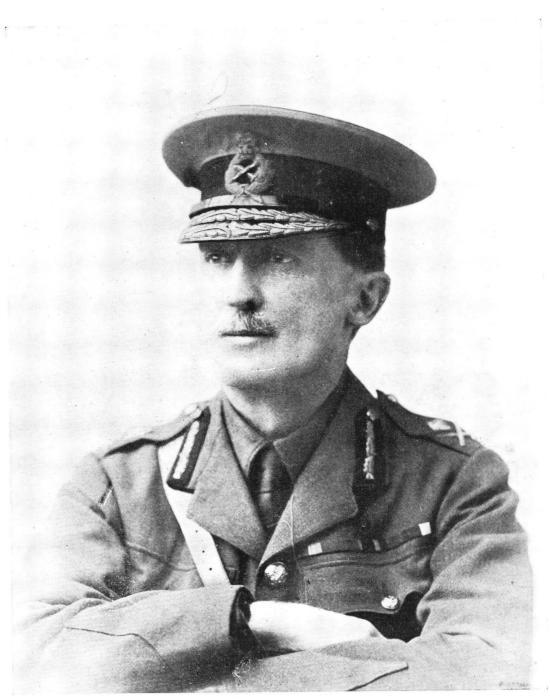
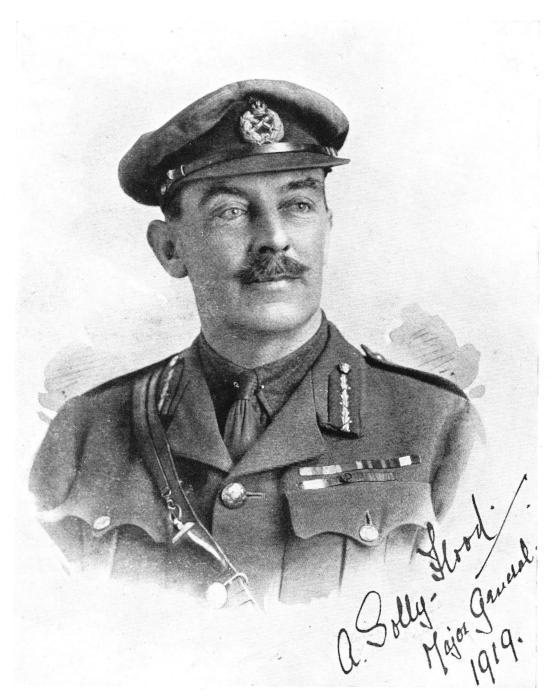
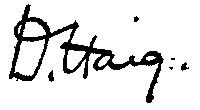

![(signature:) W. Douglas. Maj. General [illegible] 42nd Division]](https://openoldbooks.sgp1.digitaloceanspaces.com/books/the-42nd-east-lancashire-division-1914-1918/images/signature4.jpg)