The Deadly Radiation
Nora Powell was frankly out of her depth. It showed in her eyes, and
in the petulant protrusion of her lower lip. She asked, cool gaze
studying her new superior, "Would you be kind enough to explain that
more fully, Dr. Lane?"
Gary needed no urging. It was this theory which was responsible for his
unusual curtness, for his irate explosion at the rocketdrome, for the
preoccupation that had marked his return flight from Luna to Earth.
He wanted most desperately to convince his superior, Dr. Bryant, and
all his other associates, that this startling discovery was not lightly
to be dismissed.
Furthermore—and it surprised Gary Lane to find the desire within
him—he wanted to prove to Nora Powell that he was not, in truth,
the ogre she now believed him. That there had been an excuse for his
rudeness.
So he spoke, setting forth the arguments thought out during the flight
from Earth's satellite.
"You are all familiar," he said, "with the theory of the 'expanding' or
'bubble' universe.
"We approach an understanding of this by thinking of our existence—our
universe of three spatial dimensions with one temporal extension—as a
sphere which is all surface.
"Not merely a hollow sphere, you understand. Everything—including
empty space, solid matter and energy, is on the surface of this
hypersphere. Thus our galaxy constitutes one point imbedded in the
surface of the sphere ... the nearest star is another ... the farthest
still another ... and so on with each of a billion galaxies.
"It has been suggested that an undefined 'something' is 'blowing
up' this bubble, and that as expansion increases, the degree of
separation between galaxies widens so that they appear to be running
away from each other. The big objection to this theory has been the
insurmountable question—if this hypersphere is expanding, into what,
since it contains all of Space and Time in itself, does it expand?"
Dr. Anjers interrupted somewhat caustically.
"You reject this theory, I gather?"
"Completely," declared Gary boldly, "and definitely! It has not, nor
will it ever, solve the paradoxes we observe. My belief is that though
the Greater Universe may be a closed and finite hypersphere, it is
not expanding, but static. And it lends itself to real and constant
measurement."
Nora Powell said, "But, Dr. Lane—the principles of relativity! The
value of h, and the Lorenz contraction—"
"Are all taken care of," insisted Gary, "if you will accept my new
major premise." He pondered, briefly, how best to state his idea.
Then: "Let us suppose," he said, "you are standing in the center of
a floor in a large room. The walls of this room, activated by some
machine, are moving away from you. If you could measure this motion
spectroscopically, you would observe the phenomenon of the 'red
shift'—right?"
Dr. Bryant nodded. "Yes, Gary. That is, in effect, the relationship of
our galaxy to the Greater Universe as now conceived."
"Quite. But—" said Gary—"suppose that you stood motionless in that
same room, and some strange force acted on you to shrink you! Then
what would you see?"
The girl's eyes widened. She cried, "A—a universe running away from
you!"
"And your spectroscopic analysis—?"
"Would show the red shift!" Nora whirled to the two older men. "Dr.
Bryant ... Dr. Anjers ... he's right! Now I see what the pictures
meant! The comet, entering our contracting galaxy, changed its course
sharply—"
The foreign scientist's eyes clouded with impatience behind their heavy
lids. He smiled commiseratingly. "A very interesting conjecture, my
young friend. But it is fool-hardy to reason on such flimsy evidence.
Your camera, despite your belief, may have shaken ... your spectroscope
may have been out of adjustment ... any one of a thousand things." A
chubby hand dipped swiftly into Gary's briefcase, drew forth a flat,
circular tin of film. "Is this the roll on which—?"
"Don't do that!" Gary literally screamed the words, leaping forward
barely in time to prevent the older scientist from opening the
container. Rudely he swept the tin from Dr. Anjers' grasp, swiftly
inspected the thin line of metal seal. Only after he had satisfied
himself that it was intact did he think to apologize. Then: "You must
forgive me, sir, please. But these are supplementary exposures; they
have not yet been developed."
The small man nodded understandingly. "The fault is mine, Dr. Lane.
Forgive me."
Dr. Bryant, too engrossed in his own thoughts to see the byplay, now
raised his head thoughtfully.
"Nevertheless, Gary, Miss Powell raised an important point. What about
our known and proven celestial mechanics?"
"My theory," said Gary firmly, "makes them even more valid. Their
truth is not reversed—only their meaning. In other words, the
principles of the Lorenz equation still hold true, but we must learn to
interpret it from a new angle. It is not the yardstick which moves; it
is the observers! We of this dwindling galaxy which, alone in all the
vastness of the Greater Universe, is becoming ever smaller!"
"But—but why, Gary? Why?"
"That," confessed Lane, "I do not know. But it is a problem we must
solve. And quickly. Or—"
"Or—?" prompted Nora Powell as he hesitated.
"Or—" concluded Gary grimly—"oblivion! Unless I erred seriously in my
first computations, there is a limit to the amount of shrinkage matter
can withstand. And that limit is rapidly drawing near. Matter cannot
contract forever. If we cannot find a way to free ourselves from the
strange force being brought to bear upon us from out there—" Gary's
hand swept the gathering dusk of Earth's twilight—"our Earth and sun,
our sister planets, our galaxy—all these are doomed!"
For the second time within minutes, silence followed one of Gary Lane's
pronouncements. But this was no moment of dubiety. Something of his
deadly earnestness had communicated itself to his listeners; their
voices were muted as if with awe at the magnitude of his warning.
Muldoon already knew, of course, and already believed. Credence shone
in the eyes of Nora Powell. Dr. Anjers' broad, fair brow was drawn;
the cherubic mask of his features was marred with white lines of
concentration. Dr. Bryant coughed, twisting long, capable fingers into
steeples of thought.
It was the foreign scientist who broke the silence. Quietly. Carefully.
In a voice which might have been gently chiding, had its accent not
been thickened by a note of near-alarm.
"Aren't you," he ventured softly, "aren't you being just a little bit
melodramatic, Dr. Lane? After all, this is only a hypothesis. A very
new and—if you will forgive me—most implausible conjecture—"
"New," agreed Gary almost harshly, "but not implausible, Doctor.
We know, don't we, Flick?" The camera expert nodded. "We know, and
we have further proof. Those rolls of film offer half of it; simple
mathematics supplies the rest. Flick, suppose you get to work on those
exposures right away. We'll show them—"
"O.Q., Gary," said Muldoon. "I'll get at it immediately. 'Scuse me,
folks!"
Dr. Anjers said, "Please, no! Don't do this just to convince me,
gentlemen. I did not mean to imply doubt. I am skeptical, yes; what man
of science would not be? But there is no hurry—"
Gary grinned at him mirthlessly.
"That's where you're wrong, Doctor. There is a need for haste. Every
day is precious; perhaps every hour, every minute. We're not doing this
merely to dispel your doubts. We're doing it because it has to be done,
and as swiftly as humanly possible. The sooner mankind realizes its
peril, the sooner we can take measures to do something. How long will
it take you, Flick?"
"At least three hours. Maybe four."
"All right. Get going. Meanwhile, if you'll permit me, Dr. Bryant,
I'd like to duck into my office. There must be a lot of accumulated
correspondence to run through. Miss Powell, if you'll be kind enough to
come with me—?"
"Yes, Dr. Lane."
Anjers said, "Office, yes. I have not been near my own desk all
morning. Perhaps I, too, should spend a little time with my papers. So,
gentlemen—"
But Dr. Bryant caught his arm. "Oh, no you don't, my friend! Lane and
Muldoon need a few hours privacy, but I am much too excited to let
everyone get away from me. Let's go to my rooms. I must discuss this
matter with someone."
"That's it, then," nodded Gary. "We'll meet in the projection room
at—let's see—five p.m. That's O.Q. with everyone? So long, then.
Flick, careful with those shots!"
Muldoon glared at him aggrievedly.
"You're telling me?" he retorted. "Listen, pal—to me they're fresh
laid eggs, and I'm the mama hen."
Thus the meeting disbanded.
At four-thirty, Gary Lane spoke a last, "yours truly" into his
stenoreel, snapped the switch which sent the machine into operation as
a transcriber, rose and yawned vigorously.
"That," he said, "is that! Thank goodness. I don't know how I would
have ever finished up without your help, Miss Powell."
Nora Powell said, "I'm glad I was of some assistance, Dr. Lane."
"Some assistance?" grinned Gary. "You were the whole works. I
wouldn't have known how to answer half those letters if you hadn't
been here to advise me. Say, by the way—" He glanced at her
quizzically—"Am I forgiven yet? I mean about that business down at the
rocketdrome?"
Nora Powell met his gaze briefly, flushed and turned away. "I—I had
forgotten all about it, Doctor," she said.
"Now, that," approved Gary, "is something to really be thankful for.
Well, it's almost time for our appointment. Let's go down and see how
Flick's making out."
Thus it was that Gary Lane and the girl were a full half hour earlier
in reaching the projection room than had been agreed. On such small
hinges is the gateway of Fortune hung. For had they been ten minutes,
perhaps a single moment later, the great adventure which was to befall
them might have ended ere it began. Laughing Flick Muldoon might never
have laughed again, and the precious evidence which he and Gary had
brought back from Luna might never have been viewed by understanding
eyes.
For when young Dr. Lane pushed open the projection room door, it was
to peer into a chamber not brilliantly alight, as he had expected, but
one Stygian-draped in darkness. Even so, he was not at first alarmed.
Flick's prints must surely be ready by now, but it was quite possible
the cameraman was testing his equipment. Gary called cheerfully, "Hey,
Flick! Why the blackout? O.Q. to come in—Say! What's wrong?"
Because his only answer was a deep, choking groan. And even as the
girl behind him mouthed an incoherent cry of warning, Gary got the
illumination he had asked for—but in an unwanted way. The darkness was
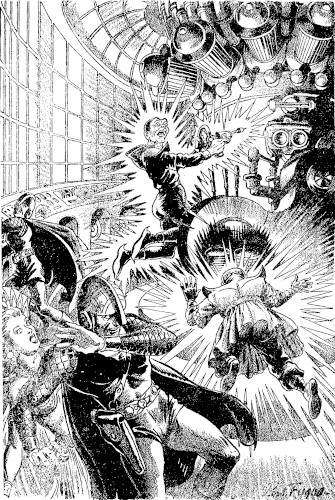
suddenly, fiercely stabbed with a livid flare, an undulating streamer
of light from the opposite end of the room. A crackling, hissing ochre
finger of light which seemed to burn with an inward malevolence of its
own.
And where this dirty glare struck matter, walls and drapes, woodwork
and plastic, metal instruments and decorative vines, all—with a
dreadful sort of impotent homogeneity—burst into sudden and spontaneous
flame! By the light of the burning furniture, Gary glimpsed a dim,
uncertain figure huddled in the doorway opposite—and from the hands of
this unknown arsonist leaped the living flame!
Gary Lane could claim no heroism for what he did; his actions were too
impulsive, too instinctive, to be considered real bravery. It never
occurred to him that his enemy was armed where he was not, nor that
the light-streamer devouring all else in the room could just as easily
strip his flesh from his bones like tinfoil over a candleflame. All he
knew was that somewhere in this room, Flick Muldoon lay hurt—perhaps
dead!—and that documents on which depended the future of all mankind
were being imperiled by a mysterious assailant.
Soundlessly, but with the speed of a striking panther, he hurled
himself across the room. In the unreal tawny-black his body could have
been, at best, but a dimly glimpsed bulk. The lethal flame did not turn
in his direction, scorching him instantly out of existence. And then—
And then his shoulders met sturdy flesh with a solid impact; the
stranger grunted meatily and staggered backward. Gary's hands groped,
clawing, for the flame weapon ... felt his fingers burn on superheated
metal....
For the barest fraction of a second! Then the enemy regained his feet.
Gary sensed, rather than saw, the arm uplifting as many voices raised
in sudden clamor, and the sound of running footsteps echoed from the
corridor he had quitted. He was aware of Nora Powell's cry, "Dr.
Lane—look out! Oh, Gary—!"
Then the spinning world descended with brutal force upon his temple,
the gloom split asunder into myriad whirling galaxies of fire, and he
sank senseless to the floor!
"—Better now," said a voice from far, far away. "I think he can hear
me. Gary, my boy! Are you all right?"
Gary lifted his head and groaned; opened his eyes to find himself
looking up into the kindly face of Dr. Bryant. Beside the old
astronomer, her mist-blue eyes wide with fear and something else Gary
Lane was too dazed to decipher, stood Nora Powell, while beside her,
cherubic cheeks gray with inarticulate outrage, was the small foreign
physicist.
Recollection flooded back on Gary; swiveling his head he discovered
that the flames which threatened the room had been extinguished. But
how about—?
"Flick?" he muttered, struggling to rise. "Flick! Is he—?"
"O.Q., chum," growled Flick Muldoon, coming from behind him. "The
firebug busted me, laid me out colder than a Laplander's kiss, but you
got a worse smack than I did. I'm O.Q."
"And the—the films?" asked Gary fearfully.
"Safe," chuckled Muldoon, "as a pork pie at a Mohammedans' picnic. I
went down, yeah—but I went down with 'em clutched to my manly buzzum!
Our murderous friend, whoever he was, would have needed a can opener to
get 'em out of my hands. Me, I've got instincts, I have!"
Gary was on his feet, now, and staring about him. A little unsteadily,
true, but gathering strength with every moment. He said, "Then you
didn't get a look at him?"
"Who, me? I haven't got eyes in the back of my head, pal!"
"How about you, No—Miss Powell?" Gary caught himself just in time,
reddening as he did so. Though his mind was intent on the problem now
confronting them, some hidden portion found time to be astonished that
his tongue should so trick him.
"I saw him no better than you did. Perhaps not even as well. When you
charged him, I ran into the corridor and screamed for help."
"And a good thing, too," appended Dr. Bryant. "The whole Observatory
might have gone up in flames had help not come immediately. Gary, that
weapon—whatever it was—is the most destructive force ever unleashed
by man! It burns right through anything. Wood, metal, plastic—"
"I can see that," scowled Gary. He bit his lip, an unwelcome suspicion
forcing itself into his mind as he stared at the other member of
their little party. "What puzzles me is—where did he come from? The
arsonist, I mean. How many people are in this Observatory beside
ourselves?"
"Why, scores, Gary. The laboratory men and the observers, upstairs, the
students below—it was they who helped us fight the fire, you know."
"Yes. But—" Gary turned suddenly to Dr. Anjers. "Doctor—where were
you when this fire was started?"
Anjers blinked at Gary mildly. "Me, my friend? Why, with Dr. Bryant in
his study, of course. But, why? Surely you don't think I—?"
"I don't know what to think," groaned Gary. "While I didn't see the
intruder very well, as nearly as I could judge he was just about your
height and build. Dr. Bryant, you're positive Dr. Anjers was with you?"
"Of course, Gary."
"Every minute? Neither of you left the study?"
"Not for a second. We were together every moment until we heard Miss
Powell's cry; then we hurried here together. Really, Gary—"
"Yes, I know," conceded Gary ruefully. "I'm sorry. But the man did
look a little like Dr. Anjers, and—"
The small scientist nodded sympathetically.
"Say no more about it, Doctor. You have had ample reason to be
apprehensive—and to question. Judging from what I see here, you
narrowly escaped a horrible death. Our foe's weapon is, indeed, a
terrible one. As a physicist, I cannot understand how anything can
create spontaneous combustion in such nonflammable substances as metal
and plaster—"
"No?" grunted Gary. "Well, I can! Look here!"
He stepped to the wall upon which the ray had played most fiercely,
bent and rose, sifting through his fingers a palm-full of tiny granules.
"Here's your answer. And it ties in exactly with what we were talking
about earlier this afternoon. Condensation of matter!
"See those granules? They are all that remain of a space five feet wide
by six feet high! Their matter has been condensed by that hellish ray.
The liberation of their excess bulk in the form of pure energy was what
caused them to burst into flame. There's your answer, and—Good Lord!"
He stopped, stricken by the thought which had leaped into his brain. A
thought at once so terrible and incredible that he could scarce believe
it. But it must be true! It was the only way this phantasmagoria made
any kind of sense.
"Blind! I've been blind! Now I see it all!"
"What, Gary?" demanded Flick. "What do you see?"
"This plaster wall—contracted into a handful of pebbles," said
Gary bleakly. "Our galaxy—contracting to a grim and certain death!
They are both part of one and the same plot. A plot by someone—or
something!—to destroy Mankind! It is not simply a blind, unreasoning
force which is speeding the destruction of our solar system. It is a
deliberate doom to which we are being driven. The weapon used here this
afternoon is a miniature replica of that which—Flick, what did the
arsonist's weapon look like? Did you see it?"
Flick shook his head.
"Sorry, Gary. I drew a blank. I don't remember a thing."
But Nora Powell, who had stirred to an instrument panel near the
crumbled wall, gasped suddenly. "I didn't see the weapon either, Gary,"
she cried. "But here is evidence of what it did. Look at this Geiger
counter. It has gone completely mad. It has registered more than a
thousand direct hits within the past half hour!"
"What?" exclaimed Dr. Bryant. "A thousand direct hits! That's
impossible! Geiger counters register only the impact of cosmic rays.
And the periodicity of these rays is as steadfast and invariable as—"
But Gary Lane silenced him with a great cry.
"Now I know I'm right! The Geiger counter proves it! The weapon used by
our enemies shoots—cosmic radiation!"