On the beach at Westhaven, beyond the town and harbour, stood a row of
houses, each with a garden of tamarisk, thrift, and salt-loving flowers,
frequented by lodgers in search of cheap sea breezes, and sometimes by
families of yachting personages who liked to have their headquarters on
shore.
Two girls were making their way to one of these. One was so tall
though very slight, that in spite of the dark hair streaming in the wind,
she looked more than her fifteen years, and her brilliant pink-and-white
complexioned face confirmed the impression. Her sister, keeping as
much as she could under her lee, was about twelve years old, much more
childish as well as softer, smaller, with lighter colouring and blue
eyes. Going round the end of the house, they entered by the back
door, and turning into a little parlour, they threw off their hats and
gloves. The younger one began to lay the table for dinner, while the
elder, throwing herself down panting, called out—
‘Ma, here’s a letter from uncle. I’ll open
it. I hope he’s not crusty about that horrid low millinery
business.’
‘Yes, do,’ called back a voice across the tiled
passage. ‘I’ve had no time. This girl has put me
about so with Mrs. Leeson’s luncheon that I’ve not had a
moment. Of all the sluts I’ve ever been plagued with,
she’s the very worst, and so I tell her till I’m ready to
drop. What is it then, Ida?’ as an inarticulate noise was
heard.
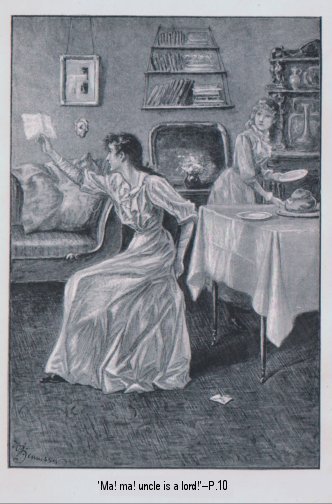
‘Ma! ma! uncle is a lord!’ came back in a gasp.
‘What?’
‘Uncle’s a lord! Oh!’
‘Your uncle! That stick of a man! Don’t be
putting your jokes on me, when I’m worrited to death!’
exclaimed Mrs. Morton, in fretful tones.
‘No joke. It’s true—Lord Northmoor.’
And this brought Mrs. Morton out of the kitchen in her apron and bib, with
a knife in one hand and a bunch of parsley in the other. She was a
handsome woman, in the same style as Ida, but her complexion had grown
harder than accorded with the slightly sentimental air she assumed when she
had time to pity herself.
‘It is! it is!’ persisted Ida, reading scraps from the
letter; ‘“Title and estates devolve on me—family
bereavements—elder line extinct.”‘
‘Give me the letter. Oh, you gave me such a turn!’
said Mrs. Morton, sinking into a chair.
‘What’s the row?’ said another voice, as a sturdy
bright-eyed boy, between the ages of his sisters, came bouncing in.
‘I say, I want my grub—and be quick!’
‘Oh, Herbert, my dear boy,’ and his mother hugged him, ‘your
uncle is a lord, and you’ll be one one of these days.’
‘I say, don’t lug a man’s head off. Who has been
making a fool of you?’
‘Uncle Frank is Lord Northmoor,’ said Ida impressively.
‘I say, that’s a good one!’ and Herbert threw himself
into a chair in fits of laughter.
‘It is quite true, Herbert,’ said his mother.
‘Here is the letter.’
A bell rang sharply.
‘Bless me! I shall not hear much more of that bell, I hope.
Run up, Conny, and say Mrs. Leeson’s lunch will be up in a moment,
but we were hindered by unexpected news,’ said Mrs. Morton, bustling
into the kitchen. ‘Oh dear! one doesn’t know where one
is.’
‘Let her ring,’ said Ida. ‘Send her off, bag and
baggage! We’ve done with lodgings and milliners and telegraphs,
and all that’s low. We shall all be lords and ladies, and ever
so rich.’
‘Hold hard!’ said Herbert, who had got possession of the
letter. ‘He doesn’t say so.’
‘He’ll be nasty and mean, I daresay,’ said Ida.
‘What does he say? I hadn’t time to see.’
Herbert read from the neat, formal, distinct writing: “I do not
yet know what is in my power, nor what means I may be able to command; but
I hope to make your position more comfortable and to give my nephew and
nieces a really superior education. You had better, however, not take
any steps till you hear from me again.” There, Ida, lots of
schooling, that’s all.’
‘Nonsense, Bertie; he must—if he is a lord, what are
we?’
Hunger postponed this great question for a little while; but dinner had
been delayed till the afternoon school hour had passed, and indeed the
young people agreed that they were far above going to their present
teachers any more.
‘We must acquire a few accomplishments,’ said Ida.
‘Uncle never would afford me lessons on the piano—such a shame;
but he can’t refuse me now. Dancing lessons, too, we will have;
and then, oh, Conny! we will go to Court, and how they will admire
us!’
At which Herbert burst out laughing loudly, and his mother rebuked
him. ‘You will be a nobleman, Herbert, and your sisters a
nobleman’s sisters. Why should they not go to Court like the
best of them?’
‘That’s all my eye!’ said Herbert. ‘The
governor has got a young woman of his own, hasn’t he?’
‘That dowdy old teacher!’ said Ida. ‘Of course
he won’t marry her now.’
‘She will be artful enough to try to hold him to it, you may
depend on it,’ said Mrs. Morton; ‘but I shall take care he
knows what a shame and disgrace it would be. Oh no; he will not
dare.’
‘She is awfully old,’ said Ida.
‘Not near so old as Miss Pottle, who was married yesterday,’
said Constance, who, at the time of her father’s death, and at other
times when the presence of a young child was felt to be inconvenient at
home, had stayed with her grandmother at Hurminster, and had grown fond of
Miss Marshall.
‘Don’t talk about what you know nothing about,
Constance,’ broke in her mother. ‘Your uncle, Lord
Northmoor, ain’t going to lower and demean himself by dragging a mere
school teacher up into the peerage, to cut out poor Herbert and all his
family. There’s that bell again! I shall go and let Mrs.
Leeson know how we are situated, and that I shall give her notice one of
these days. Clear the table, girls; we don’t know who may be
dropping in.’
This done, chiefly by Constance, the sisters put on their hats, and
sallied forth with their astounding news to such of their friends as were
within reach, and by the time they had finished their expedition they were
convinced of their own nobility, and prepared to be called Lady Ida and
Lady Constance Northmoor on the spot.
When they came in they found the parlour being prepared for company, and
were sent to procure sausages and muffins for tea. Mrs. Morton had,
on reflection, decided that it was inexpedient to answer her brother-in-law
till she had ascertained, as she said, her just rights, and she had invited
to tea Mr. and Mrs. Rollstone and, to Constance’s delight, his little
daughter Rose, their neighbours a few doors off; but as Rose was attending
classes, it had been useless to go to her before.
Mr. Rollstone was a great authority, for he had spent the best part of
his life in what he termed the first families of the highest circles.
He had been hall boy to a duke, footman to a viscountess, valet to an earl,
butler to a right honourable baronet, M.P., and when he had retired on the
death of the baronet and marriage with the housekeeper he had brought away a
red volume, by name Burke’s Peerage, by which, as well as by
his previous knowledge, he was enabled to serve as an oracle respecting all
owners of yachts worthy of consideration. If their names were not
recorded in that book, he scorned them as ‘parvenoos,’
however perfect their vessels might be in the eyes of mariners. The
edition was indeed a quarter of a century old, but he had kept it up to
date, by marking in neatly all the births, deaths, and marriages from the
Gazette—his daily study. His daughter, a nice,
modest-looking girl of fourteen, Constance’s chief friend, came
too.
His wife was detained by her lodgers, but when he rolled in, with the
book under his arm, there was a certain resemblance between himself and it,
for both were broad and slightly dilapidated—the one from gout, the
other from wear, and the red cover had faded into a nondescript
whity-brown, or browny-white, not unlike the complexion of a close-shaven
face. He was carefully arrayed in evening costume, and was very
choice in his language, being, in fact, much grander than all his
aristocratic masters rolled into one; so that though Mrs. Morton tried to
recollect that she was a great lady and he had been a servant, force of
habit made her feel his condescension when he held out his puffy white
hand; and, with a gracious bend of his yellow-gray head, said, ‘Allow
me to offer my congratulations, Mrs. Morton. I little suspected my
proximity to a lady so nearly allied to the aristocracy.’
‘I am sure you are very kind, Mr. Rollstone. I had no
notion—Ida can tell you I was quite overcome—though when I came
to think of it, my poor, dear Morton always did say he had high
connections, but I always thought it was one of his jokes.’
‘Then as I understand, Mrs. Morton, the lamented deceased was
junior to the present Lord Northmoor?’
‘Yes, poor dear! Oh, if he had but lived and been eldest, he
would have become his honours ever so much better!’
‘And oh, Mr. Rollstone, what are we?’ put in Ida
breathlessly, while Rose squeezed Constance’s hand in schoolgirl
fashion.
‘Indeed, Miss Ida, I fear I cannot flatter you with any change in
your designation. If your respected parent had survived he might have
become the Honourable Charles, but only by special grant from Her
Majesty. It was so in the case of the Honourable Frances Fordingham,
when her brother inherited the title.’
‘Then at least I am an Honourable!’ exclaimed Mrs.
Morton.
‘I am afraid not, Mrs. Morton. I know of no precedent for
such honours being bestowed on a relict; but as I understand that Lord
Northmoor is no longer in his first youth, your son might succeed to the
title, and, in that case, his sisters might be’—he paused for a
word—‘ennobled.’
‘Then does not it really make any difference to us?’
exclaimed Mrs. Morton.
‘That would rest in the bosom of his lordship,’ said Mr.
Rollstone solemnly.
‘I declare it is an awful shame,’ burst out Ida, while
Constance cooed ‘Dear uncle!’
‘Hush, hush, Ida!’ said her mother. ‘Your
uncle has always treated us handsomely, and we have every reason to expect
that he will continue to do so.’
‘He ought to have us to live with him in his house in London, and
take us to Court,’ said Ida. ‘Oh, Mr. Rollstone, is he
not bound to do that?’
And Constance breathed, ‘How delicious!’
Mr. Rollstone perhaps had his doubts of the figures Mrs. and Miss Morton
would cut in society, but he contented himself with saying, ‘It may
be well to moderate your expectations, Miss Ida, and to remember that Lord
Northmoor is not compulsorily bound to consult any interests but his
own.’
‘If he does not, it is perfectly abominable,’ cried Mrs.
Morton, ‘towards his poor, only brother’s children, with
Herbert his next heir-apparent.’
‘Heir-presumptuous,’ solemnly corrected Mr. Rollstone, at
which Ida looked at Constance, but Constance respected Rosie’s
feelings, and would not return her sister’s glance, only blushed, and
sniggered.
‘Heir-apparent is only the eldest son, who cannot be displaced by
any contingency.’
‘And there’s a horrid, little, artful school teacher, who
drew him in years ago—before I was married even,’ said Mrs.
Morton. ‘No doubt she will try to keep him now. Most
likely she always knew what was going to happen. Cannot he be set
free from the entanglement?’
‘Oh!’ gasped Constance.
‘That is serious,’ observed Mr. Rollstone gravely.
‘It would be an unfortunate commencement to have an action
for breach of promise of marriage.’
‘She would never dare,’ said Mrs. Morton. ‘She
is as poor as a rat, and could not do it!’
‘Well, Mrs. Morton,’ said Mr. Rollstone, ‘if I may be
allowed to tender my poor advice, it would be that you should be very
cautious and careful not to give any offence to his lordship, or to utter
what might be reported to him in a sinister manner.’
‘Oh, I know every one has enemies!’ said Mrs. Morton,
tossing her head.
After this disappointment there was rather less interest displayed when
Mr. Rollstone proceeded to track out and explain the whole Northmoor
pedigree, from the great lawyer, Sir Michael Morton, who had gained the
peerage, down to the failure of the direct line, tracing the son from whom
Francis and Charles Morton were descended. Certainly Miss Marshall
must have been wonderfully foresighted if she had engaged herself with a
view to the succession, for at the time it began, the last Lord Northmoor
had two sons and a brother living! There was also a daughter, the
Honourable Bertha Augusta.
‘Is she married?’ demanded Mrs. Morton.
‘It is not marked here, and if it had been mentioned in the
papers, I should not have failed to record it.’
‘And how old is she?’
‘The author of this peerage would never be guilty of the solecism
of recording a lady’s age,’ said Mr. Rollstone gravely;
‘but as the Honourable Arthur was born in 1848, and the Honourable
Michael in 1850, we may infer that the young lady is no longer in
her first youth.’
‘And not married? Nearly Fr—Lord Northmoor’s
age. She must be an old cat who will set her mind on marrying
him,’ sighed Mrs. Morton, ‘and will make him cut all his own
relations.’
‘Then Mary Marshall might be the better lookout,’ said
Ida.
‘She could never be unkind,’ breathed little Constance.
‘There is no knowing,’ said Mr. Rollstone oracularly;
‘but the result of my observations has been that the true high-bred
aristocracy are usually far more affable and condescending than those
elevated from a lower rank.’
‘Oh, I do hope for Miss Marshall,’ said Constance in a
whisper to Rose.
‘Nasty old thing—a horrid old governess,’ returned
Ida; and they tittered, scarcely pausing to hear Mr. Rollstone’s
announcement of the discovery that he had entered the marriage in 1879 of
the Honourable Arthur Michael to Lady Adela Emily, only daughter of the
Earl of Arlington, and the death of the said Honourable Arthur by a
carriage accident four years later.
Then Herbert tumbled in, bringing a scent of tea and tar, and was
greeted with an imploring injunction to brush his hair and wash his
hands—both which operations he declared that he had performed,
spreading out his brown hands, which might be called clean, except for
ingrained streaks of tar. Mr. Rollstone tried to console his mother
by declaring that it was aristocratic to know how to handle the ropes; and
Herbert, sitting among the girls, began, while devouring sausages, to
express his intention of having a yacht, in which Rose should be taken on a
voyage. No, not Ida; she would only make a fool of herself on board;
and besides, she had such horrid sticking-out ears, with a pull at them,
which made her scream, and her mother rebuke him; while Mr. Rollstone
observed that the young gentleman had much to learn if he was to conform to
aristocratic manners, and Herbert under his breath hung aristocratic
manners, and added that he was not to be bored, at any rate, till he was a
lord; and then to salve any shock to his visitor, proceeded to say that his
yacht should be the Rose, and invite her to a voyage.
‘Certainly not till you can behave yourself,’ replied Rose;
and there was a general titter among the young people.


