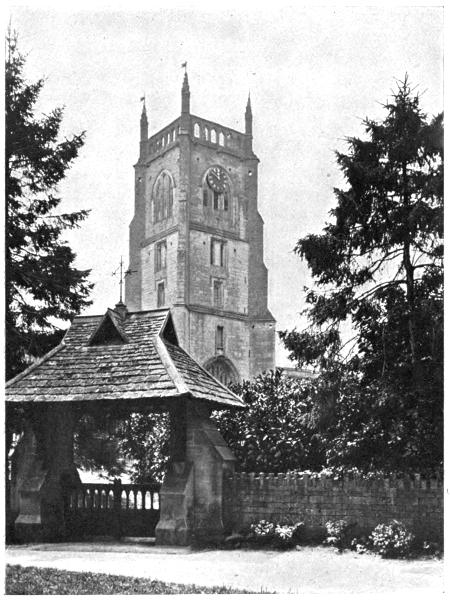
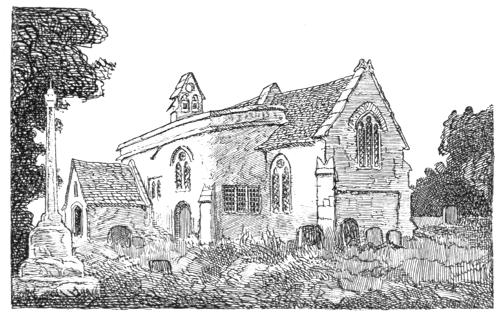
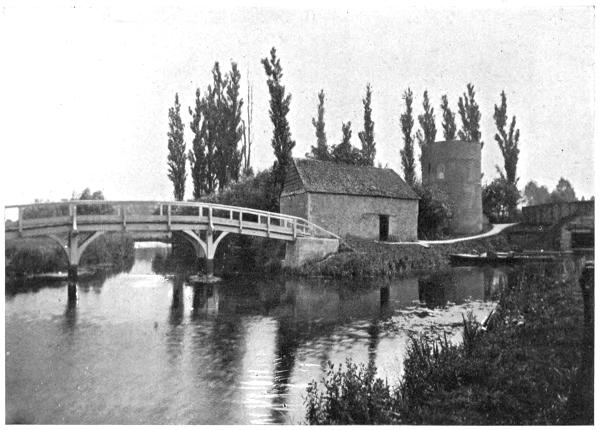
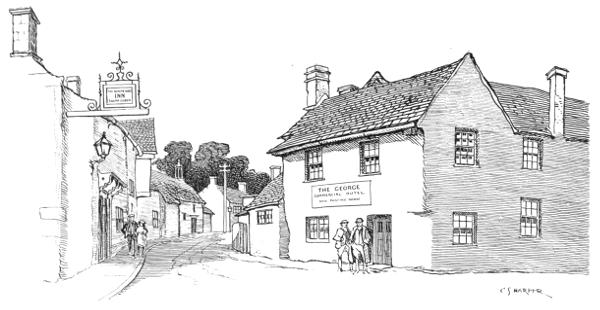
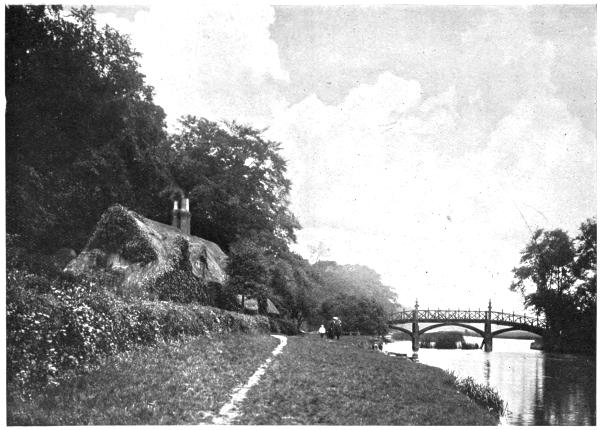
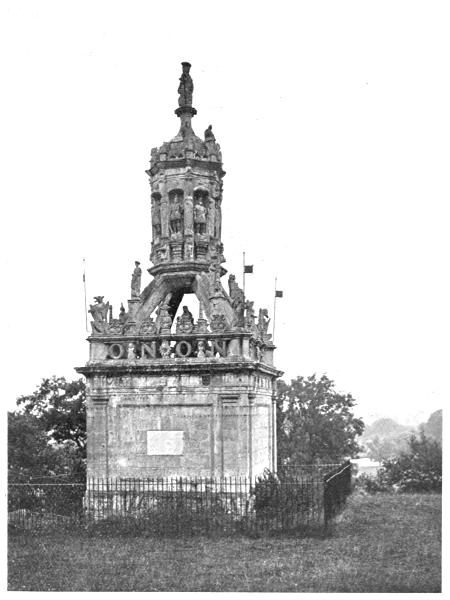
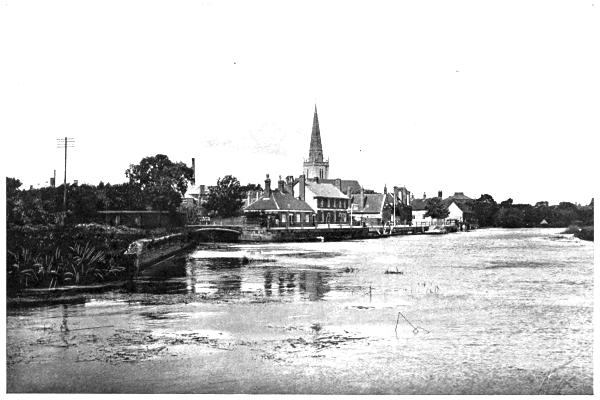
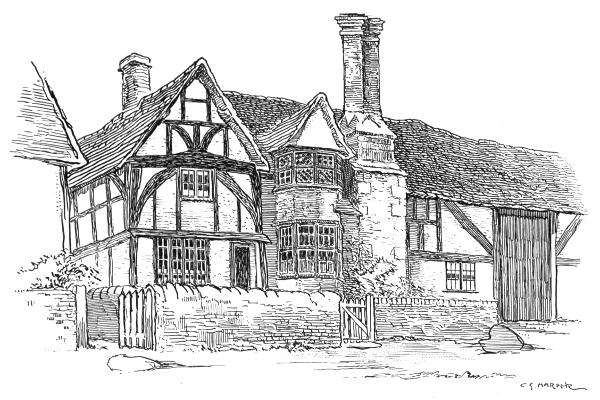
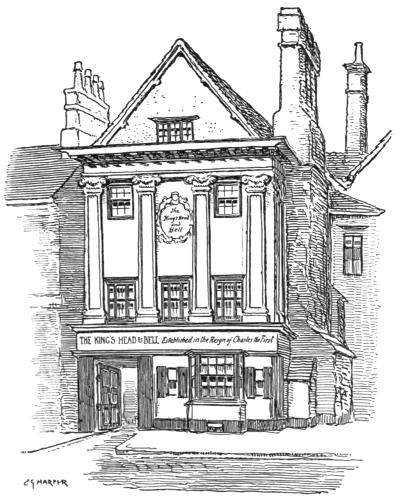
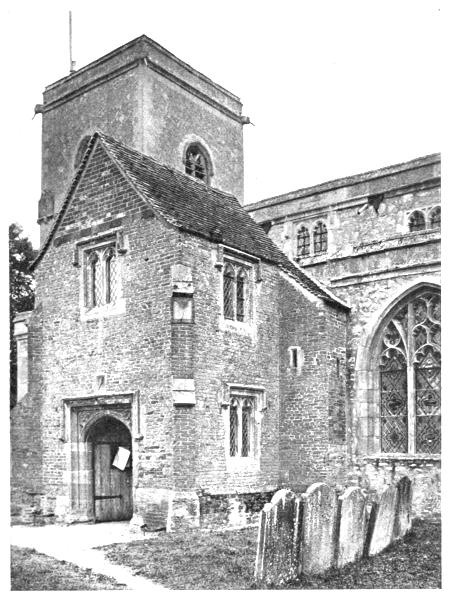
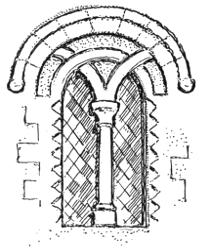
CONTENTS — LIST OF ILLUSTRATIONS — SEPARATE PLATES — ILLUSTRATIONS IN THE TEXT — SWEET THAMES, RUN SOFTLY TILL I END MY SONG — THAMES VALLEY VILLAGES — INTRODUCTORY — CHAPTER I
Transcriber’s Note: Illustrations have been moved so as not to fall in
the middle of paragraphs (leaving them as close to the original position
in the book as possible). A few minor printing errors were corrected.
Volume II is available as Project Gutenberg ebook #57366.
THAMES VALLEY VILLAGES
WORKS BY CHARLES G. HARPER
The Portsmouth Road, and its Tributaries: To-day and in Days
of Old.
The Dover Road: Annals of an Ancient Turnpike.
The Bath Road: History, Fashion, and Frivolity on an Old
Highway.
The Exeter Road: The Story of the West of England Highway.
The Great North Road: The Old Mail Road to Scotland. Two
Vols.
The Norwich Road: An East Anglian Highway.
The Holyhead Road: The Mail-Coach Road to Dublin. Two
Vols.
The Cambridge, Ely, and King’s Lynn Road: The Great
Fenland Highway.
The Newmarket, Bury, Thetford, and Cromer Road: Sport
and History on an East Anglian Turnpike.
The Oxford, Gloucester, and Milford Haven Road: The
Ready Way to South Wales. Two Vols.
The Brighton Road: Speed, Sport, and History on the Classic
Highway.
The Hastings Road and the “Happy Springs of Tunbridge.”
Cycle Rides Round London.
A Practical Handbook of Drawing for Modern Methods of
Reproduction.
Stage Coach and Mail in Days of Yore. Two Vols.
The Ingoldsby Country: Literary Landmarks of “The Ingoldsby
Legends.”
The Hardy Country: Literary Landmarks of the Wessex Novels.
The Dorset Coast.
The South Devon Coast.
The Old Inns of Old England. Two Vols.
Love in the Harbour: a Longshore Comedy.
Rural Nooks Round London (Middlesex and Surrey).
Haunted Houses: Tales of the Supernatural.
The Manchester and Glasgow Road. This way to Gretna
Green. Two Vols.
The North Devon Coast.
Half Hours with the Highwaymen. Two Vols.
The Autocar Road Book. Four Vols.
The Tower of London: Fortress, Palace, and Prison.
The Somerset Coast.
The Smugglers: Picturesque Chapters in the Story of an Ancient
Craft.
The Cornish Coast. North.
The Cornish Coast. South.
The Kentish Coast.[In the Press.
The Sussex Coast.[In the Press.
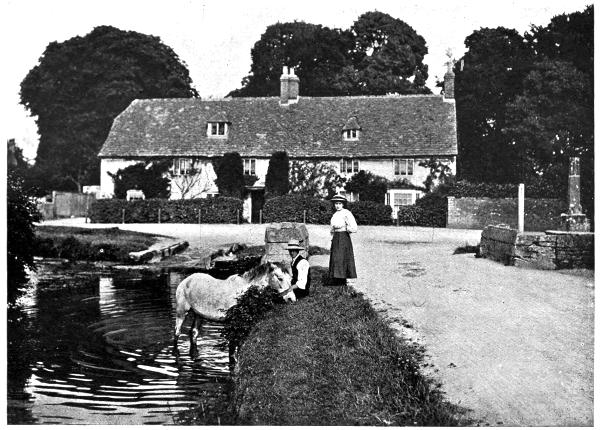
AT ASHTON KEYNES.
THAMES VALLEY
VILLAGES
BY
CHARLES G. HARPER
VOL. I
ILLUSTRATED FROM PHOTOGRAPHS BY W. S. CAMPBELL
AND FROM DRAWINGS BY THE AUTHOR
ISIS
London: CHAPMAN & HALL, Ltd.
1910
PRINTED AND BOUND BY
HAZELL, WATSON AND VINEY, LD.,
LONDON AND AYLESBURY.
“Sweet Themmes, runne softly till I ende my song.”
Past town and village, cot and lonely farm,
His silver stream with murm’ring music goes;
Singing glad anthems, full of drowsy charm;
Sweet songs of praise, unheeded not by those
Who know his banks full well, who often love
To roam his course, his marge to pace along,
While Spenser’s line re-echoes as we rove:
“Sweet Themmes, runne softly till I ende my song.”
The Thames we all know intimately, for the river
was discovered by the holiday-maker in the ’seventies
of the nineteenth century; but we do not all know
the villages of the Thames Valley, and it was partly to
satisfy a long-cherished curiosity on this point, and
partly to make holiday in some of the little-known
nooks yet remaining, that this tour was undertaken.
To one who lives, or exists, or resides—the reader
is invited to choose his own epithet—beside the lower
Thames, there must needs at times come a longing
to know that upper stream whence these mighty
waters originate, to find that fount where “Father
Thames” starts forth in hesitating, infantile fashion;
to seek that spot where the stream, instead of flowing,
merely trickles. To such an one there comes, with
every recurrent spring, the longing to penetrate to
the Beyond, away past where the towns and villages,
the water-works and breweries cluster thickly
beside the river-banks; above the town of Reading,
the Biscuit Town, and town of sauce and seeds;
beyond the fashionable summer scene of Henley
Regatta, and past the city of Oxford, to the Upper
River and its unconventionalised life.
When spring comes and wakes the meadows with
delight, and the osiers and the rushes again feel life
stirring in their dank roots, the old schoolboy feeling
of curiosity, of mystery, of a desire for exploration,
springs anew. You walk down, it may be, to some
slipway or draw-dock by Richmond or Teddington,
or wander along those shores contemplating the high-water-marks
left by the late winter floods, which not
even the elaborate locking of the river seems able
to prevent; and observing the curious line of refuse
of every description brought down by the waters,
and now left, high and dry, a matted mass of broken
rushes, water weeds, twigs, string and the like, marvel
at the wealth of corks that displays itself there. Children
have been known to make expedition towards
the distant hills, seeking that place where the rainbow
touches the ground; for the sly old legend tells
us that on the spot where the glorious bow meets the
earth there lies buried a crock of gold. An equally
speculative quest would be to fare forth and seek the
Place whence the Corks Come. There (not for
children, but for “grown-ups”) should be, you
think, the Land of Heart’s Desire.
There are, I take it, three chief things that the
world of men most ardently wishes for. An unregenerate
man’s first desires are to wealth, to a
woman, and to a drink; or, in the words attributed
to Martin Luther:
Who loves not woman, wine, and song,
He is a fool his whole life long;
and the valley of the Thames, from Oxford to
Richmond, would seem, by the evidence of these
millions of corks of all kinds, to be a place flowing
with champagne, light wines, all kinds of mineral
waters, and bottled beers.
Corks, rubber rings from broken mineral-water
bottles, and big bungs that hint of two-or three-gallon
jars, abound; these last telling in no uncertain
manner of the magnificent thirsts inspired among
anglers who sit in punts all day long, and do nothing
but keep an eye on the float, and maintain the glass
circulating.
A thirsty person wandering by these bestrewn
towing-paths must sigh to think of the exquisite
drinks that have gone before, leaving in this multitude
of corks the only evidence of their evanescent
existence. Shall we not seek it, this land of the
foaming champagne, that comes creaming to the brim
of the generous glass; shall we not hope to locate
those shores, far or near, where the bottled Bass,
poured into the ready tumbler, tantalises the parched
would-be drinker of it in the all-too-slowly-subsiding
mass of froth that lies between him and his expectant
palate? Shall we not, at least if we be of “temperance”
leanings, quaff the cool and refreshing
“stone-bottle” ginger-beer; or, failing that, the
skimpy and deleterious “mineral-water” “lemonade”
that is chiefly compounded of sugar and carbonic-acid
gas, and blows painfully and at high-pressure
through the titivated nostrils? Shall we
not—— but hold there! Waiter, bring me—what
shall it be?—an iced stone-bottle ginger!
That was the brave time, the golden age of the
river, when, rather more than a generation ago, the
discovery of the Thames as a holiday haunt was first
made. The fine rapture of those early tourists, who,
deserting the traditional seaside lounge for a cruise
down along the placid bosom of the Thames, from
Lechlade to Oxford, and from Oxford to Richmond,
were (something after the Ancient Mariner sort) the
first to burst into these hitherto unknown reaches,
can never be recaptured. The bloom has been brushed
from off the peach by the rude hands of crowds of
later visitors. The waterside inns, once so simple
under their heavy beetling eaves of thatch, are now
modish, instead of modest; and Swiss and German
waiters, clothed in deplorable reach-me-down dress-suits
and lamentable English of the Whitechapel-atte-Bowe
variety, have replaced the neat-handed—if
heavy-footed—Phyllises, who were almost in the
likeness of those who waited upon old Izaak Walton,
two centuries and a quarter ago.
To-day, along the margin of the Thames below
Oxford, some expectant mercenary awaits at every
slipway and landing-place the arrival of the frequent
row-boat and the plenteous and easily-earned
tip; and the lawns of riparian villas on either hand
exhibit a monotonous repetition of “No Landing-Place,”
“Private,” and “Trespassers Prosecuted”
notices; while side-channels are not infrequently
marked “Private Backwater.”
All the villages immediately giving upon the stream
have suffered an equally marked change, and have
become uncharacteristic of their old selves, and converted
into the likeness of no other villages in this
our England, in these our times. There is, for example,
a kind of theatrical prettiness and pettiness
about Whitchurch, over against Pangbourne; and
instead of looking upon it as a real, living three-hundred-and-sixty-five-days-in-the-year
kind of place,
you are apt to think of what a pretty “set” it makes;
and, doing so, to speak of its bearings in other than
the usual geographical terms of east and west, north
and south; and to refer to them, indeed, after the
fashion of the stage, as “P.” or “O.P.” sides.
But if we find at Whitchurch a meticulous neatness,
a compact and small-scale prettiness eminently
theatrical, what shall we say of its neighbour, Pangbourne,
on the Berkshire bank of the river? That
is of the other modern riverain type: an old village
spoiled by the expansion that comes of being situated
on a beautiful reach of the Thames, and with a railway
station in its very midst. Detestable so-styled
“villas,” and that kind of shops you find nowhere
else than in these Thames-side spots, have wrought
Pangbourne into something new and strange; and
motor-cars have put the final touch of sacrilege
upon it.
Perhaps you would like to know of what type the
typical Thames-side village shop may be, nowadays?
Nothing easier than to draw its portrait in few words.
It is, to begin with, inevitably a “Stores,” and is
obviously stocked with the first object of supplying
boating-parties and campers with the necessaries of
life, as understood by campers and boating-parties.
As tinned provisions take a prominent place in those
holiday commissariats, it follows that the shop-windows
are almost completely furnished with supplies
of tinned everything, festering in the sun. For
the rest, you have cheap camp-kettles, spirit-stoves,
tin enamelled cups and saucers, and the like utensils,
hammocks and lounge-chairs.
Thus the modern riverside village is unpleasing
to those who like to see places retain their old natural
appearance, and dislike the modern fate that has
given it a spurious activity in a boating-season of
three months, with a deadly-dull off-season of nine
other months every year. We may make shift to
not actively dislike these sophisticated places in
summer, but let us not, if we value our peace of mind,
seek to know them in winter; when the sloppy street
is empty, even of dogs and cats; when rain patters
like small-shot on the roof of the inevitable tin-tabernacle
that supplements the over-restored, and spoiled,
parish church; and when the roar of the swollen weir
fills the air with a thudding reverberance. Pah!
The villas, the “maisonettes,” are empty: the
gardens draggle-tailed; the “Nest” is “To Let”;
the “Moorings” “To be Sold”; and a general air
of “has been” pervades the place, with a desolating
feeling that “will again be” is impossible.
But let us put these things behind us, and come to
the river itself; to the foaming weir under the lowering
sky, where such a head of water comes hurrying down
that no summer frequenter of the river can ever see.
There is no dead, hopeless season in nature; for
although the trees may be bare, and the groves dismantled,
the wintry woods have their own beauty,
and even in mid-winter give promise of better
times.
But along the uppermost Thames, from Thames
Head to Lechlade and Oxford, the waterside villages
are still very much what they have always been. All
through the year they live their own life. Not there
do the villas rise redundant, nor the old inns masquerade
as hotels, nor chorus-girls inhabit at weekends,
in imitative simplicity. A voyage along the
thirty-two miles of narrow, winding river from Lechlade
to Oxford has no incidents more exciting than
the shooting of a weir, or the watching of a moor-hen
and her brood.
Below Oxford, we have but to adventure some
little way to right or left of the stream, and there,
in the byways (for main roads do not often approach
the higher reaches of the river), the unaltered villages
abound.
CHAPTER II
CIRENCESTER—SOURCE OF THE THAMES—KEMBLE—ASHTON
KEYNES—CRICKLADE—ST. AUGUSTINE’S
WELL
The head-spring of the Thames is, in summer, not
so easy a place to find. It rises on the borders of
Wilts and Gloucestershire, and has been marked down
and written about sufficiently often; but the exact
spot is quested for with difficulty, and when the
traveller has found it, he is, after all, not sure of his
find, for the place is supplied, in these latter days, with
no recognisable landmark, and even the road-men and
the infrequent wayfarers along that ancient way, the
Akeman Street, which runs close by, appear uncertain.
That it is “over there, somewhere,” is the most
exact information the enquirer is likely, at a venture,
to obtain.
There are excellent reasons for this distressing incertitude.
The winter reason is that Trewsbury Mead,
the great flat meadow in which Thames Head is situated,
is so water-logged that it is often a morass, and
not infrequently a lake. In summer, on the other
hand, the spot is so parched, partly on account of the
season, but much more by reason of the pumping-works
in the immediate neighbourhood, that not only
the Thames Head spring is quite dry, but the bed of
the infant Thames itself is generally dry for the first
two miles of its course.
Thames Head is situated three miles south-west of
Cirencester, that beautiful old stone-built town whose
name we are traditionally told to pronounce “Ciceter,”
just as Shakespeare wrote it. That was the old popular
way, before the folks of the surrounding country
could read or write, and knew no better; but to-day,
when “education” is the birthright of all, though
culture be the acquisition of few, they are the rustic-folk—the
“lower orders”—who say “Cirencester,”
as my lords and gentlemen and ladies were wont to
do; while nowadays the upper circles refer to
“Ciceter.” It is a curious reversal. If you say,
in these times, “Cirencester,” you, in so doing, proclaim
yourself, socially, an outsider, fit only to feed
out of the same trough as those creatures who pronounce
“Marjoribanks,” “Cholmondeley,” or “Wemyss”
as spelled. We all know—or ought—that
“Marshbanks,” “Chumley,” and “Weems” are
your only ways, if you would be socially saved.
These are the last resorts of those who have no other
distinction to mark them out from the common herd:
just a verbal inflection, combined, possibly, with a
method of hand-shaking. To what straits we are
reduced, in these democratic times, to express our
superiority!
There is another way to the pronunciation of
“Cirencester,” lately come into favour with provincials
of this neighbourhood. It is a method of
the simplest: merely the adoption of the clipped
way common to the local milestones, which tell the
tale of so many miles to “Ciren.”
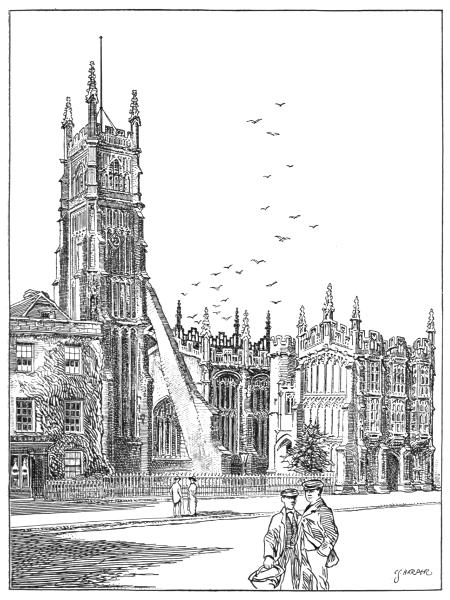
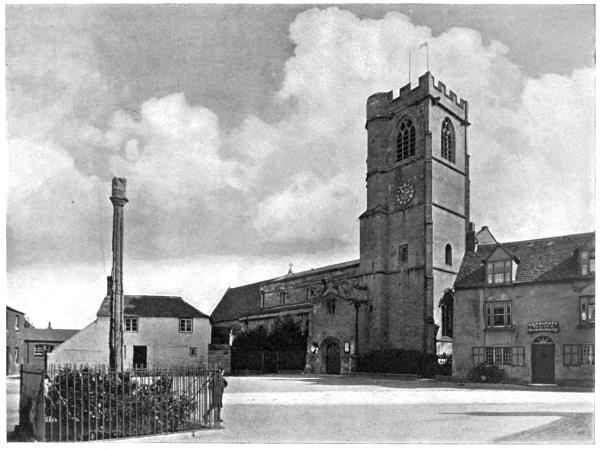
The noblest thing in Cirencester is the beautiful
old church, which rises in its midst, beside the remarkably
broad High Street, with much of that scale
and stateliness we commonly associate with a cathedral.
It is one of the noblest works of the Perpendicular
period, when architects grew aspiring, but
did not always succeed in building artistically as well
as big. Here the two aims have been achieved. But
a third desideratum, that of building securely, was
not originally included, it would appear, for one of
the most astonishing things about this structure is
the great masonry strut which would be called a
“shore” if it were only in timber, and is so clearly
for utility, and absolutely unbeautiful and unarchitectural,
that to style it a buttress would be to disparage
the exquisite adornments that buttresses at
their best are capable of being. This great crutch
for a noble tower in danger of falling so soon as it
was built, nearly five hundred years ago, is, however,
justified of its existence, for the lofty belfry yet stands
securely. The ingenious way in which the supporting
masonry is built diagonally through the west wall of
the south aisle, down to the ground, compels admiration
for the engineering skill displayed.
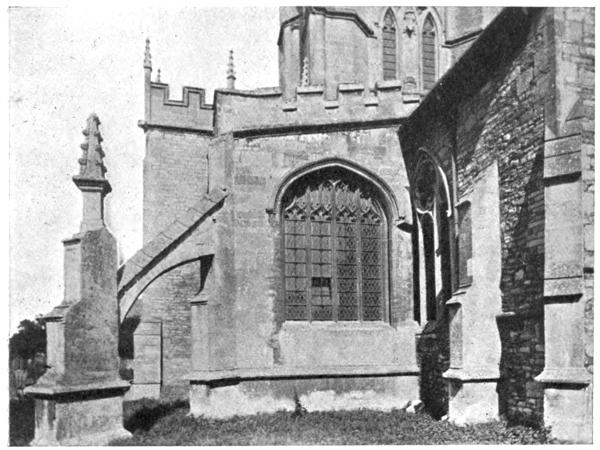
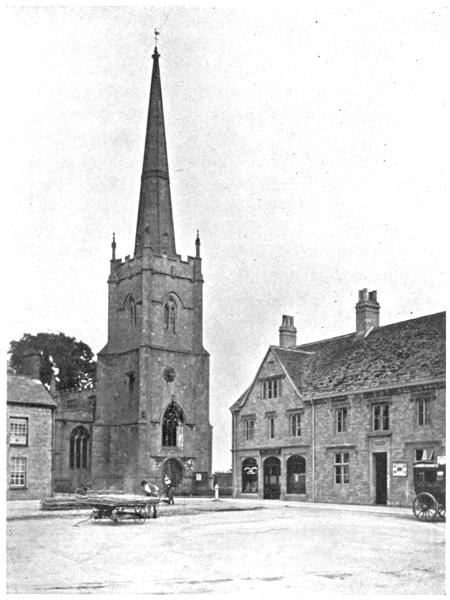
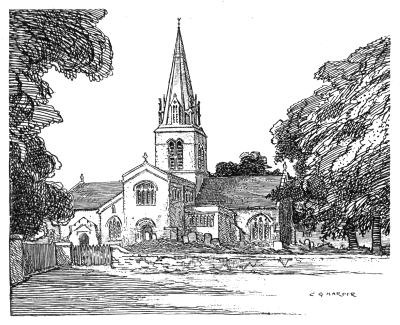
CIRENCESTER CHURCH: SHOWING THE GREAT BUTTRESS.
The great three-storeyed porch, by far the largest
porch, and certainly the most singular, in England,
built in advance of the south aisle, and looking proudly
upon the street, would seem to have been built for the
convenience of the many priests who served the large
number of chantries established from time to time
in the church. It is a very late and very beautiful
Perpendicular work. Not long after its completion
the greasy rascals were sent packing, in the life-giving
Reformation that saved the nation. It for long afterwards
served as the Town Hall, but was commonly
known as “the Vice”—a strange survival and corruption
of “parvise.”
The interior of the church discloses a nave-arcade
of very lofty and graceful proportions; a work probably
as completely satisfactory as anything in this
country. And there is very much else to study here.
There are monuments, worn and battered, to knights
and dames, wine-merchants, wool-merchants, grocers,
and other old tradesmen of the town. Among them
may be noticed the brass to Reginald Spycer, 1442,
with his four wives—Reginald in the middle, and the
four ladies beside him, two and two. A late example
is that of Philip Marner, 1587, representing him full-length,
robed, with staff in one hand and a flower
in the other. A dog sits beside him. In the upper
left-hand is a pair of shears, indicating that he was
a clothier. The rhymed inscription says:—
In Lent by will a sermon he devised,
And yerely Precher with a noble prised.
Seven Nobles he did geue ye poore for to defend,
and 80 li to xvi men did lend,
In Cicester, Burford, Abington, and Tetburie,
ever to be to them a stocke Yerly.
In a glazed frame is preserved an ancient blue
velvet pulpit-cloth, given in 1478 by Ralph Parsons,
a priest, whose cope it had been.
The road that runs, white and broad, in a straight
undeviating line, from Cirencester to Thames Head,
and so on at last, after many miles, to Bath—the
“Akemanceaster” that has given the Akeman Street
its name—comes in three miles to a stone bridge
spanning a canal. This is “Thames Head Bridge,”
and the canal is the Thames and Severn Canal, which,
beginning at Inglesham, just above Lechlade, ends at
Stroud. The length of this water-way is thirty miles.
The works were begun in 1783 and completed in 1789.
The object of the Thames and Severn Canal, which
joins the Stroudwater Canal, and reaches the Severn
at Framilode, was to provide a commercial water-way
between the highest point of the navigable
Thames, near Lechlade, and the Bristol Channel.
Its course lies along some very high ground just beyond
Thames Head, going westward, and in all there
are forty-four locks, rising 241 ft. 3 in. There is
also a remarkable piece of engineering in the Sapperton
Tunnel, through which the canal takes its
course. The tunnel is fifteen feet wide, and is driven
through Sapperton Hill at a point 250 feet beneath
its summit.
It follows that of necessity a canal, so elevated
above the surrounding country, must be provided with
water by artificial means, and a supply is provided by
a pumping-station close at hand to Thames Head
Bridge. This raises water to the extent of three
million gallons a day: hence the dried-up character
of the Thames Head spring, except in winter, and
the usual summer phenomenon of the infant Thames
being quite innocent of water for a distance of two
miles from its source. Of late years the Great Western
Railway, which has a station at Kemble, a mile and
a half away, has erected a still larger and more powerful
pumping-station, for the purpose of supplying
water for its own needs at Swindon, fourteen miles
distant.
The Akeman Street here divides Wiltshire and
Gloucestershire. If we descend from the Thames
Head Canal bridge and follow the towing-path in a
westerly direction, into Gloucestershire, for half a
mile, we come, by scrambling down the canal-bank
to the meadow below, to the source of the river, and
at the same time to the destruction of a cherished
illusion. Picturesque old histories of the Thames
have made us familiar with Thames Head, and have
shown us dainty vignettes of that spring. One such
I have before me as I write these words. It shows
a rustic well, overhung by graceful trees, with a little
country-girl in homely pinafore dipping a foot in the
water as it gushes forth. We need expect no such
scene nowadays. The well is buried under fallen
masses of the dull, ochre-coloured earth of Trewsbury
Mead, and all we see is a rough, dry hollow, overhung
by trees which refuse to live up to the grace suggested
by the old illustrations. We need not wonder any
more why so few people know Thames Head, or why
the spot is unmarked. It is merely a memory, and
Peacock’s charming verse has long ceased to be
applicable:—
Let fancy lead from Trewsbury Mead,
With hazel fringed, and copsewood deep;
Where scarcely seen, through brilliant green,
Thy infant waters softly creep.
But although the pumping-stations so greedily
suck up all the available moisture in summer, the
spring is said often to burst out in winter, three feet
high; and at such times it is only necessary to drive
a walking-stick anywhere into the turf of this meadow
for a little fount to spring up from the hole thus
drilled.
The river thus originated is known alternatively
as the “Isis,” and in the writings of old pedantic antiquaries
retains that alternative name until Oxford
is passed and Dorchester reached; where, according
to such authorities, in the confluence of the Isis and
the Thame, the “Thame-Isis,” becomes the “Tamesis,”
or Thames. To the Oxford boating-man,
however, the streams below and above Oxford are
respectively the Lower and the Upper River, and
“Isis” is reserved for the title of a University magazine,
or the name of a boating-club.
“Isis” is, of course, a Latinised form of “Ouse,”
which in its turn is a modified form of the Celtic
“uisc,” for water, and gives us such other river-names
as Usk, Axe, Exe, and Wye; while we find it hidden
again in the names of Kirkby Wiske, in Yorkshire, and
in that of “whisky,” deriving from “usquebaugh.”
The time when the Upper Thames was first called
“Isis” is uncertain. The name is certainly a Latinised
form of “Ouse”; but the Romans do not
appear to have so styled it. Julius Cæsar, in his
Commentaries, speaks only of “Tamesis”; and the
Anglo-Saxon Chronicle, A.D. 905, mentions only the
“Thames.” We do not, in fact, read of anything
like “Isis” until 1359, when a monk of Chester,
Ranulphus Higden, wrote in his Polychronicon a
passage which, rendered into English from his Latin
original, runs thus: “Tamisa seems to be composed
from the names of two rivers, the Ysa, or Usa, and the
Thama. The Thama, running by Dorchester, falls
into the Ysa; thence the whole river, from its source
to the eastern sea, is called Thamisa.” A much later
writer, Leland, I think, says, in that rarefied, detached
way we expect in old writers, “The common people
call it the ‘Thames,’ but scholars call it the ‘Isis.’”
The name of “Thames” is equally Celtic with that
of the Latinised “Isis,” nor is it the only Thames in
the country, for the river Tamar, dividing Devon and
Cornwall; the Teme, in Shropshire and Herefordshire;
and the Tame, in Staffordshire, are each closely
allied in name.
The generally-accepted source of the Thames at
Thames Head has by no means gone undisputed, and
a rival exists at Seven Springs, three miles south-east
of Cheltenham. This spot is the source of the river
Churn, which, falling into the Thames at Cricklade,
after a course of sixteen or seventeen miles, takes the
stream some ten miles farther up-country than that
which issues from Thames Head. Thus we have the
singular paradox, that the Churn, this first tributary
of the Thames, is considerably longer than the parent
stream. This is a problem that would have desolated
the logical mind of Euclid, and it has worried
geographers and writers of books for uncounted years.
No matter how diligently we may seek to track this
heresy to its lair—to its original propagation—we
shall inevitably be foiled; nor indeed (as in the case
of rival religious dogmas) shall we ever be able to
definitely settle which of the two is the heresy, and
which the true faith. If we rely upon the canon that
the source of any river is that point which is situated
farthest from its mouth, and then refer to the maps,
there can be no doubt whatever that the Churn is the
true Thames, and that the Seven Springs source is
its head-spring. It is an unavoidable conclusion,
like it or like it not; and if we take the trouble to
visit Seven Springs, we shall discover that some one
has been concerned to mark the spot prominently
with the same belief, in the inscription set up there
on a wall going down into the pool:—
Hic tuus,
O Tamesine Pater,
Septemgeminus fons.
or, in English,
Here flows, O Father Thames,
Thy sevenfold source.
We can only assume, in the difficulty with which
we are thus faced, that the original error, of placing
Thames Head at Trewsbury Mead, and naming the
stream which issues from Seven Springs the “Churn,”
arose in those very remote times, before even the
Romans came to Britain, when surveying and map-making
were unknown and relative distances were
uncertain. That the river Churn bore its present
name even at the period when the Romans descended
upon Britain is an assured thing, for the Romans
named Corinium—the present “Cirencester”—from
its situation on the Churn. The existing form of the
place-name is of Saxon origin, and is really “Churnchester”—the
“castle on the Churn.”
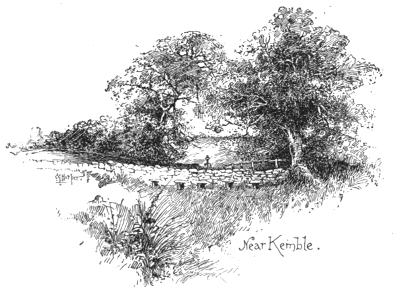
Near Kemble.
Kemble Junction, the railway station that dominates
this neighbourhood, marks where the little
four-mile branch of the Great Western Railway goes off
to Cirencester from the line to Stroud and Gloucester.
There is no likely expectation that Cirencester will
begin to grow and to lose its old-world character while
it remains, as now, at the loose end of this little single-track
branch railway; and the hunting-men of this
Vale of White Horse district remain quite unconcerned
and unafraid of developments. This country, between
Cirencester, Cricklade and Lechlade, is a hunting
country and an agricultural country, and long
centuries ago it lost to Leeds and Bradford, and other
like centres, the clothing industry for which this
Cotswold district was in mediæval times and after
famed. Thus Kemble Junction is by no means a
junction of the Swindon or the Clapham Junction
type, and is rather a peaceful than a bustling place.
The village itself stands on rising ground above this
district of springs. Even though it be more remarkable
for its stone walls than for anything else, it is a
not unpleasing village, for in a neighbourhood such as
this, where laminated stone is easily dug out from a
few feet below the level of the soil, we expect dry stone
walling and stone-built houses; and certainly the
hard stony effect is softened by the plentiful trees of
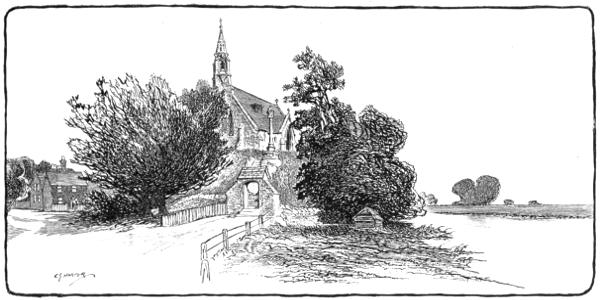
the place. The Early English church, with tall spire,
120 feet high, has been so thoroughly “restored,”
and swept and garnished, and so plentifully endued
with plaster, that architects with a love of antiquity,
and all antiquaries, looking upon it, can scarce refrain
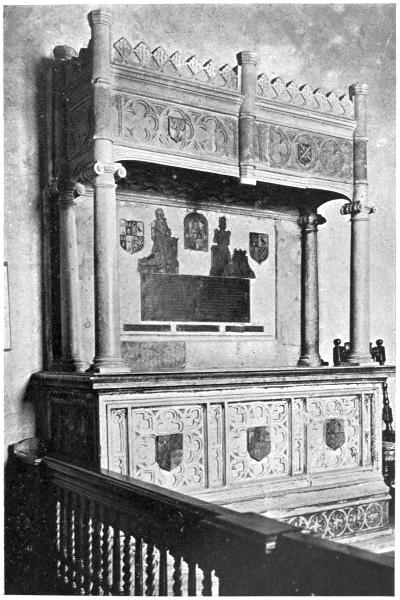
from tears. Inside the church is a curious
monument—
Dedicated to the memory of Beatrice and Edward, the deare
wife and son of Mr. Richard Pitt, both interred within these
walls, shee the 26th day of Aprill 1650, hee the 29th day of March
1656
who{
Conflicted
}in ye Church{
militant
were buried
materiall
Do reigne
triumphant.
She died i’ th’ noone, he in the morne, of Age, yet virtue
(though not yeres) fil’d their lives’ page.
Resurgemus
Posuit maritus mæstissimus paterque plorans.
We shall probably not be wrong in regarding this
as one of the ultra-Puritan families of that Puritan
age.
Just below Kemble, on the way to the hamlet of
Ewen, the course of the Thames is in summer hardly
to be distinguished in the meadows through which
it runs. Grass covers it, in common with the meadows
themselves; only the grass is of a ranker and coarser
kind, and largely admixed with docks. The dry-walling
of one of these meadows shows the winter
direction of the stream clearly enough, in the row of
holes left in building the wall for the water to pass
through.
AT EWEN.
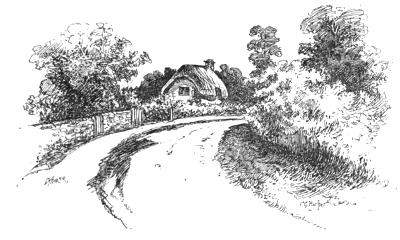
Ewen, standing by the roadside, is remarkable only
for its rustic cottages, but they are particularly beautiful
in their old unstudied way; heavily thatched,
and surrounded with old-fashioned gardens. The
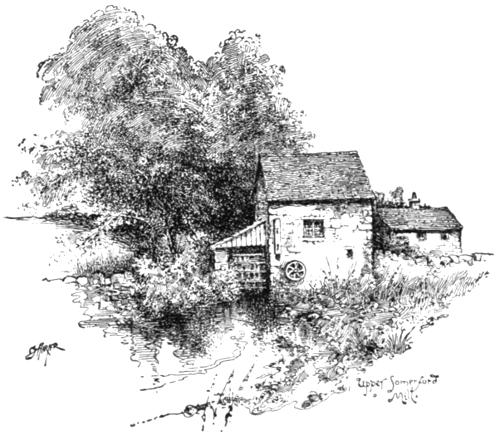
Thames begins to flow, or to trickle, regularly at Upper
Somerford Mill, whose water-wheel, immense in proportion
to the little stream, is picturesquely sheltered
under wide-spreading trees. The village of Somerford
Keynes lies close at hand.
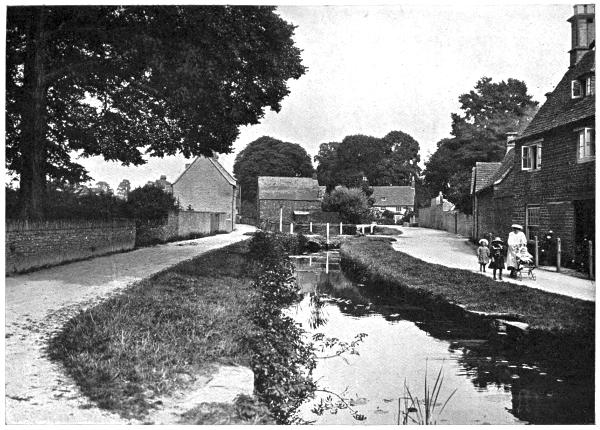
AT ASHTON KEYNES.
The way between this village and Ashton Keynes
passes over rough common-land, and enters Ashton
Keynes romantically, past the great church, and along
a fine avenue of elms beside the manor-house, emerging
at what, until a few years ago, was Ashton Keynes
Mill. The elm avenue of Ashton Keynes is other than
we should expect, if we come to the place primed with
a knowledge of what the “Keynes” in the place-name
signifies. Those elms should be oaks, for “Keynes”
derives from the ancient Norman word for an oak-tree;
in later French, “chênaie.” Hence also the
name of Horsted Keynes, in Sussex.
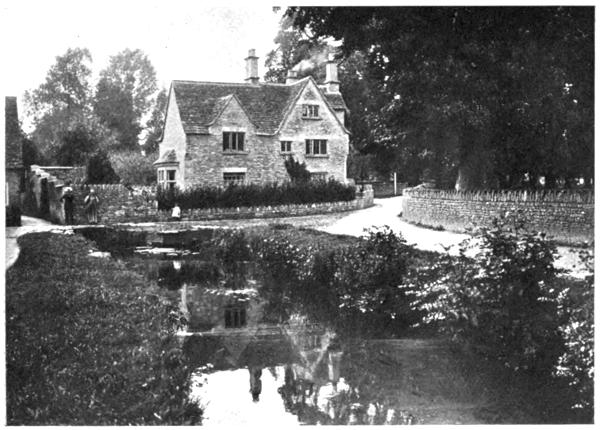
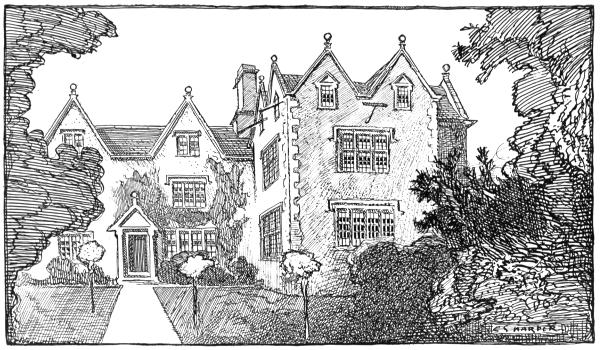
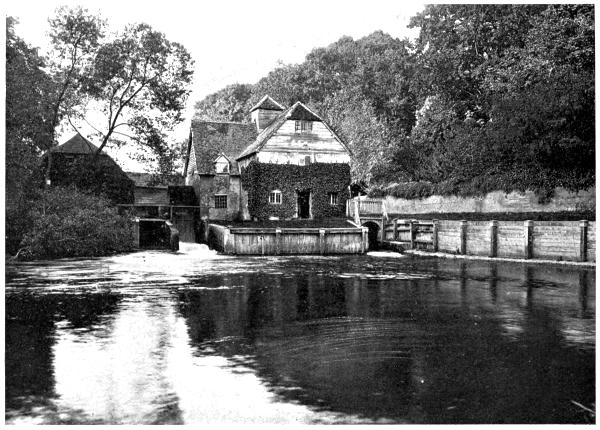
THE OLD MILL HOUSE, ASHTON KEYNES.
Upper Somerford Mill.
All the old mills that once made the Thames additionally
picturesque are disappearing. Some go up
in flame and smoke, like Iffley Mill, below Oxford,
painted and sketched by a thousand artists, and described
by a hundred writers of books and descriptive
articles, to whose lasting sorrow it was destroyed by
fire in 1907. Shiplake Mill met a similar fate a little
earlier, and modern milling conditions forbid their
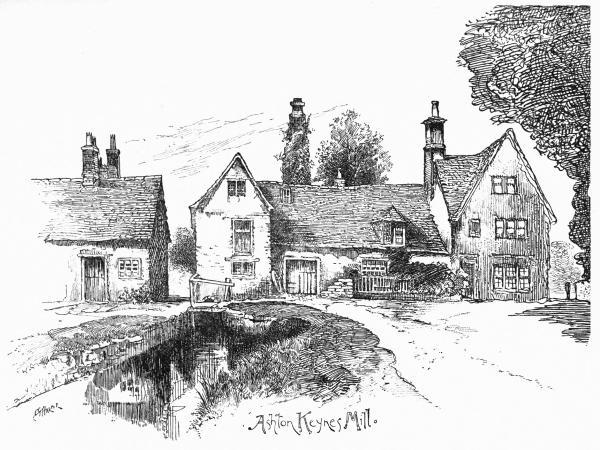
ever being rebuilt. Ashton Keynes Mill became
disestablished, as a mill, because it could no longer
compete with the modern steam-roller flour-mills, that
nowadays grind flour much more expeditiously and
cheaply than the old water-driven mills. But the
old mill-house stands, little altered. It is built substantially,
of stone, and has old peaked gables and
casemented windows, and so, when its ancient commercial
career came at last to an end, its own picturesqueness,
and its strikingly beautiful setting,
appealed irresistibly to some appreciative person
seeking an old English home; with the result that
it has been converted into a very charming private
residence.
Little need be said about Ashton Keynes church,
for it is of very late Gothic, and plentifully uninteresting;
but the village itself is a delight. It is the
queen of Upper Thames villages, with a picture at
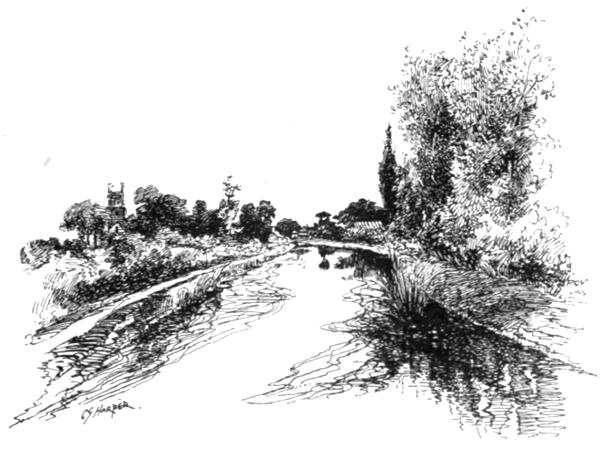
every turn. Here the Thames flows quietly down
one side of the village street, and at the beginning
of that rural, cottage-bordered, tree-shaded highway
is the first bridge across the river; an ancient Gothic
bridge, with a slipway beside it, where the horses
are brought down to wash their legs in summer. Beside
the bridge stand the remains of one of the three
fifteenth-century wayside crosses which once gave
Ashton Keynes a peculiarly sanctified look. The
ruins of all three are still here,—smashed originally
during the seventeenth-century troubles in which
King, Church, Parliament and Puritans contended
violently together; and further damaged by the mischievous
pranks of many generations of village
children.
Ashton Keynes Mill.
There are many little bridges spanning the Thames
at Ashton Keynes, for the stream washes the old stone
garden-walls of a long line of cottages, and the entrance
to each cottage necessitates a bridge of stone, of brick,
or of timber. Stonecrop, candytuft, wallflowers,
arabis, snapdragon, and many other semi-wild plants
grow in the crevices of these old walls, and drape them
all the summer with an unimaginable mantle of
beauty; and where the cottages end, and the highway
becomes a straight flat road, making for Cricklade,
a modern country residence has been built, with the
walls of it going down in the same way into the water,
and the wild flowers encouraged in the like fashion
to inhabit there. A contemplative person might pass
a pleasant time at Ashton Keynes, where there is a
homely inn, but none of those unamusing “amusements”
which serve to render places of holiday resort
unendurable. For those not very numerous persons
who are satisfied with their own company Ashton
Keynes affords decided attractions. No one ever
goes there, for it is on the road to Nowhere in Particular,
and not even the motor-car is a very familiar
sight. Thus the ruminative stranger will have his
privacy respected; unless indeed he happens to be
either an artist or a photographer, when he is certain
to be surrounded by a dense crowd of children, who
seem to become instinctively aware of an open sketch-book
or a camera at hand, and surround the owners
of them in most embarrassing fashion. The artist
is the more fortunate of the two, for it is only an
easily-satisfied curiosity to see what he is doing which
attracts these unwelcome attentions; while the unfortunate
photographer is pestered with requests
to be “took,” and worried to extremity of despair
by hordes of fleeting children obscuring his camera’s
field of vision, or posing grotesquely and in most
damaging fashion in his choicest foregrounds.
Below Ashton Keynes the Thames is joined by the
little Swillbrook, and crossed at the confluence by
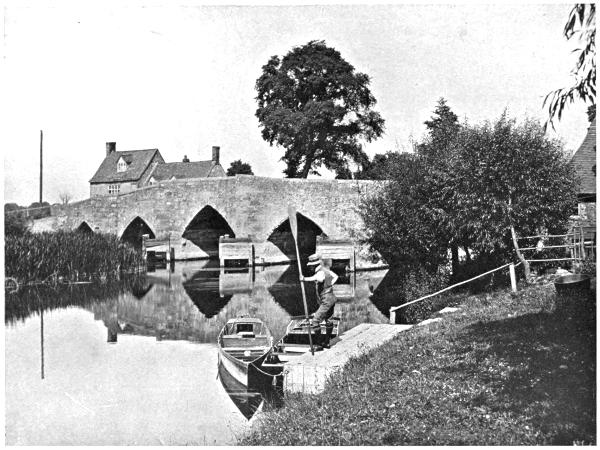
the small, three-arched masonry Oaklade Bridge.
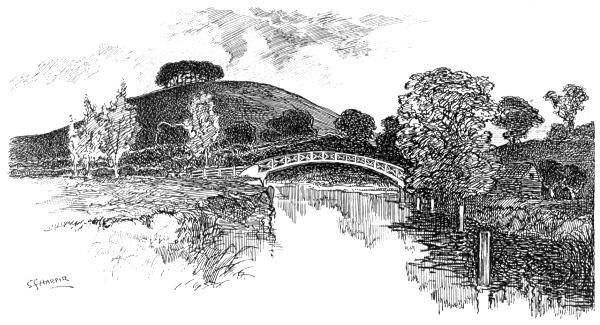
A mile or so below this is Water Hay Bridge, a typical
“county” bridge, whose frame of iron girders and
railings, painted white, ill assorts with the luxuriance
of swaying reeds and thickly-clustered alders that
here enshrouds the stream.
We read in old accounts of the Thames that it was
navigable for barges as far as this point, and “Water
Hay” may possibly be a corruption of Water Hythe,
indicating a wharf. It is in this connection to be
noted that the Cricklade and Ashton Keynes road
crosses here, and that however unlikely it may now
seem that the stream could ever have been navigable
to this spot for such heavy craft as barges, it must
always be borne in mind that, in the many general
causes that have led to the shrinkage of rivers throughout
the country, and here in especial in the pumping
away of the head-spring of the Thames, the stream
cannot now closely compare with its old self of a
hundred and fifty years ago. We may therefore very
well believe those old writers who speak of the Thames
being navigable to this point, and imagine, readily
enough, a rude wharf where goods were landed, and
left for Ashton Keynes and surrounding villages, in
days when even the few roads of the present time
either did not exist at all, or were so bad that haulage
along them was almost impossible, by reason either
of the mud, or of the water that very often flooded
them.
Between this and the little town of Cricklade the
stream winds continually, but the road goes straight
over Water Hay Bridge and makes direct for the townlet,
three miles distant. The navigation of these
first few miles of the Thames was long ago considered
to be so irretrievably a thing of the past, that it was
permitted the constructors of the North Wilts Canal,
in crossing the stream, one mile above Cricklade, to
build a brick bridge or aqueduct so low-pitched across
it that the crown of the arch scarcely appears above
water, and effectually stops any attempt to get even
a canoe through.
THE INFANT THAMES, ASHTON KEYNES.
The approach to Cricklade from the west by road is
a noble introduction to the town. It is a small town,
of entirely agricultural character, yet it has been
a place of importance in its day; and although that
day has long passed, its two churches of St. Sampson
and St. Mary prove it to have been once considerable.
Cricklade, indeed, standing on the Ermine
Way, the Roman road that led from Spinae to Corinium—or
in modern terms, from Speen by Newbury
to Cirencester—could not have been other than important.
The invading Danes, making their way up
the Thames Valley in A.D. 905, and again in 1016,
found it worth while plundering, and it has from very
early times been a market-town. It prospered in a
quiet way until the opening of the Thames and Severn
Canal, in 1789, for it was, after the ancient wharf at
Water Hay had been abandoned, at the head of the
Thames navigation; but when the canal came past,
outside the northern end of the town, the water-borne
traffic halted here no more, and Cricklade was, in a
minor-tragical way, ruined. Nor have railways served
ever to redress the injustice. The Great Western comes
no nearer than the small wayside station of Purton,
four miles distant, and although the Midland and
South-Western Junction Railway comes to Cricklade,
and has a station here, the railway management—judging
from the fact of its providing only one train
a day each way, at inconvenient hours—would much
rather you did not use it, you know, if you don’t mind.
And the Cricklade people do not use it, and go the
four miles to Purton, instead. We have, therefore,
not the slightest prospect of Cricklade ever growing.
It is quite in keeping with the rural look of the one
long broad street of Cricklade, bordered by houses
that are, for the most part, of cottage-like appearance,
that it has for centuries been known as the “Peasant
Borough”: the technical territorial “township” including
no fewer than fifty-one surrounding parishes.
That it should have been, until the passing of an early
Reform Act, also a Parliamentary borough, returning
members to Parliament, does not of itself seem remarkable,
knowing as we do that places like Gatton
and Old Sarum, with no inhabitants at all, shared
the same privilege. Cricklade, however, lost its
representation through long-continued and shameless
bribery.
Here, in the long silent streets of Cricklade, the
stranger is noted curiously in summer, the local season
being in winter; for this is now a hunting-centre of
the divided Vale of White Horse country, and the
hounds are kennelled here.
Cricklade, we are told, is properly “cerriglád”:
an ancient British expression signifying a “stony
ford”; but is it not, even more properly, “Cerrig-let,”
i.e. the stony place where the river Churn has its outlet
to the Thames? We have several places in England
in which “cerrig” is hidden under various corruptions:
notably Crick, in Northamptonshire, and
numerous places named Creech, in widely-sundered
districts; while in Wales we find Cerrig-y-Druidion
in the north, and Crickhowell in the south. In Scotland
the word is commonly rendered “Craig.”
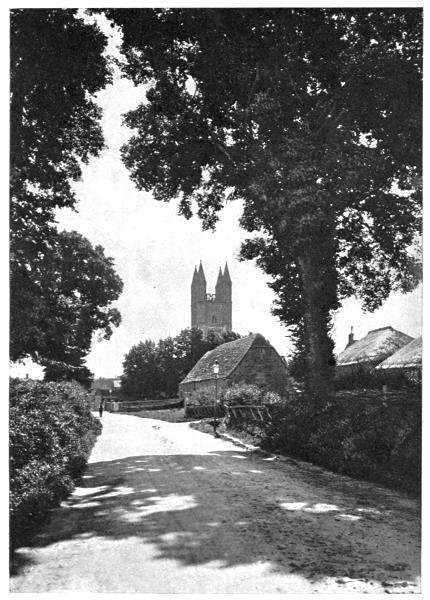
APPROACH TO CRICKLADE.
But old writers who flourished before the science
of place-names had come into existence generally
guessed at the meaning of the names of those places
of which they wrote; and extremely bad guesses they
almost always made. Their way with “Cricklade”
is a shocking example of a “reach-me-down” ready-made
meaning, supplying a barbarous misfit. Cricklade,
if you please, is, according to these seekers after
truth who are content to pick up the first obvious lie
that rests in their path, or to seize the first absurdity
that suggests itself, is “Greeklade,” the site of a forgotten
Greek university established here even before
the coming of the Romans. Forgotten! yes: that
university is easily forgotten which had never
any existence; but this derivation served its day,
and was generally accepted. Thus we find the poet
Drayton content to write in his Polyolbion:
Greeklade, whose great name yet vaunts that learned tongue,
Where to Great Britain first the sacred muses sung.
But Drayton erred only where others had erred
for some seven or eight hundred years; for indeed
the absurd legend derives from the name of “Greek-islade,”
given to the town in the time of Alfred the
Great.
St. Sampson’s, the chief church of Cricklade, stands
by the road as you enter from the direction of Ashton
Keynes; its tall, curiously-panelled tower framed
beautifully in the view by a noble group of hedgerow
elms. This odd dedication puzzles most people,
and in truth St. Sampson, or “Samson,” without the
“p,” is a remote and obscure personage who flourished
in the sixth century, and is thought to have died
A.D. 560. He appears to have been a Breton who
fled his country, and in after-years returned to Brittany
and became Bishop of Dôl. Two other churches
are dedicated to him: South Hill, by Launceston,
and Golant, near Lostwithiel, in Cornwall; while the
island of Samson, in the Scilly Isles, owes its name
to this source. Milton Abbey, in Dorsetshire, was
formerly quadruply dedicated to SS. Mary, Michael,
Samson, and Bradwalladr; while there still exists a
St. Sampson’s church in the City of York. But that
owes its name to another fellow—an early Archbishop
of York; so early, indeed, that he is not generally
included among the primates. He, strangely enough,
appears to have been contemporary with, and a friend
of, the other Sampson.
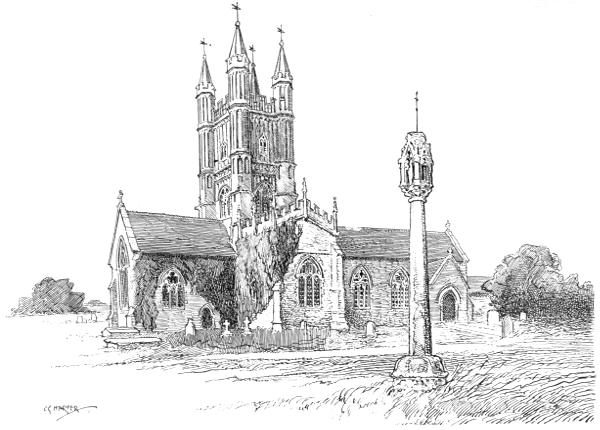
ST. SAMPSON, CRICKLADE.
This church of St. Sampson at Cricklade does
the saint especial honour, for it is a much more than
usually fine cruciform building, greatly superior to
the usual parish type. It presents, in general, an
exterior view of Perpendicular character, even though,
on closer examination, the architectural expert may
discover very considerable Early English and Decorated
portions. The central tower is its great feature,
for you not only see it from afar, but on a closer view
it is found to be so strikingly individual that even
those persons unusually well-versed in these things
are puzzled to find anywhere its fellow. The detailed
illustration of it in this book will render unnecessary
any lengthy description; and will at the same time
reveal the noble quality of its sturdy pinnacles and
the exquisitely effective character of the deep panelling
that covers the upper stage and mounts into the angle-turrets.
It is a finely massive, robust design, to which
the elegant light pierced parapet adds a contrasting
note of airy grace. In the detailed view of this tower
an empty niche will be seen, which probably once held
a statue of the eponymous saint of this church. On
the side of the tower not shown a keen eye may observe
a pair of scissors sculptured at a considerable height
from the ground: an indication, doubtless, that the
tower, rebuilt in its present form, owed its existence
to the benefaction of one of those wealthy clothiers
who in the fifteenth century attained in the Cotswold
and surrounding districts to their highest degree of
prosperity, and gave liberally of their wealth to the
rebuilding of churches, the founding of almshouses,
and other good deeds, and have left numerous records
of their existence in the fine monumental brasses of
Wiltshire and Gloucestershire, ensigned with their
merchants’-marks or the emblems of their trade—the
wool-pack and the shears, in place of the heraldic
achievements of nobler persons.
The interior of this charming church is even more
noble than the impressive exterior bids us expect.
It is at once massive, and well-lighted, and graceful:
the climax of its beauty found beneath the central
tower, where the piers and arches and finely-ribbed
vaulting go soaring up to form a handsome lantern,
set about with many shields, sculptured with the arms
of Edward the Confessor, of the diocese of Salisbury,
and of the Dudleys, Earls of Warwick. Prominent
here among these cognizances we shall find the intertwined
sickles of the extinct, but once wealthy and
powerful, Hungerford family, whose ancient badge
is found plentifully all over Wiltshire, and frequently
in Somerset. It is a Sir Walter Hungerford of the
mid-fifteenth century who is here the subject of
allusion in this shield, for he gave the presentation of
the living of St. Sampson’s, together with the manor
of Abington Court, to the Dean and Chapter of Salisbury,
for the express purpose of maintaining the
Hungerford Chantry in Salisbury Cathedral, and to
assist in keeping in repair the Cathedral campanile.
Many changes have befallen since then: the Church
has been reformed, and chantries are no longer possible;
but the ancient, beautiful, and interesting
detached campanile of Salisbury Cathedral was in
existence until nearly the close of the eighteenth century,
when it was wantonly destroyed by Wyatt in
the course of the disastrous “restorations” in which
the Dean and Chapter, charged particularly to maintain
the campanile, placidly betrayed their trust, and
calmly saw it levelled with the ground. To-day the
presentation belongs to the Dean and Chapter of
Bristol.
A curious feature of the exterior of St. Sampson’s
is the flying angle-buttress to the south-east, supporting
a Perpendicular south-east chapel built very
clumsily on to the already-existing Decorated chancel.
The illustration clearly shows the awkward way
in which the addition abuts upon the older building,
partly blocking up a very fine window. The addition
was obviously not built with good foundations, as
the necessity for further adding the flying buttress,
and the subsidence still evident in the distinctly
out-of-plumb lines of the chapel, still show. The date
of the buttress is still visible, carved on the stonework:
“Anno Domini 1569.”
The tall canopied cross now standing in the churchyard
was originally in the street, but was removed
hither to preserve it from the injury it was there likely
to suffer; and in its stead we find an object of a very
different character, and warranted to withstand the
ill-usage of many generations of mischievous children:
nothing less than a Russian, or other, gun. The
school-buildings immediately in the rear of the cross
are the successors of those founded and endowed in
1652 by one Robert Jenner, goldsmith, of London.
STRAINER-BUTTRESS, ST. SAMPSON’S, CRICKLADE.
“LERTOLL WELL”
Another similar cross is to be seen in the little
churchyard of the curious old church of St. Mary at
the other, the northern, extremity of the town, and
immediately looking on to the street. St. Mary’s is
altogether different in appearance from the noble,
upstanding church of St. Sampson, but none the less
interesting on that account. It is a huddled-together
old building, with a squat tower, or remains of a tower,
and altogether on a miniature scale. Queer little
dormer windows start out of its broadly-sloping roofs,
and they and the south porch are things of delight
in the picturesque way. The interior is an affair of
very slender Late Perpendicular nave piers and arcade,
contrasting with a stern, sturdy Norman chancel-arch.
Proceeding still northward beyond this point, the
Thames is seen, here reinforced by its confluence with
the river Churn; and if we care further to proceed
a few yards, the Thames and Severn Canal will be
found.
A strange belief exists among the people of Cricklade,
to the effect that any native of the town possesses,
as his or her birthright, the privilege of selling
anything without a licence in the streets, not only
of Cricklade, but of any other town in England and
Wales. This belief, although unsupported by any
evidence, has been handed down from time immemorial.
It would be curious if any native-born
inhabitant of Cricklade were to test this by selling
any articles in (say) the streets of London, without
first providing himself with a hawker’s licence, so
that this traditionary right could be proved still
effective, or otherwise. The privilege is said to have
been conferred by some unspecified king, in acknowledgment
of Cricklade having given shelter to his
Queen “when in distress.”
In this connection we may profitably turn to the
old farm-house, once a manor-house, in Cricklade,
by the banks of the Thames, called “Abington
Court,” once the property, as we have already seen, of
the Dean and Chapter of Salisbury. This is said to
have been formerly a Royal hunting-box, and tradition
further tells us that Charles the Second was the
last monarch to use it. History does not tell us of
any Queen in distress at Cricklade, nor of any Queen
ever here; but kings have ever been accustomed to
maintain many queens (so, without offence, in these
pure pages, to call them) from the time of Solomon and
David, throughout the ages, and until modern times.
It is a kingly privilege, not often allowed to lapse;
and it is quite within the bounds of possibility that
there was at some time one of these uncertificated
consorts at Abington Court, and that here she gave
birth to a child, and that this particular (or shall we
say, this not very particular?) king thereupon celebrated
the occasion by conferring the curious privilege
already discussed.
There is something in this ancient house which
seems to support the theory: a substantial something
in the shape of a large and elaborately-carved old
oaken four-poster bedstead, fine enough to have been
used by such distinguished personages. No one
knows how it came here, but here it remains, and goes
with the property. Tenants may come and go, but
the bedstead, left by the last royal occupant, stays.
An exceptionally interesting spot exists at a distance
of a mile-and-a-half to the north of Cricklade
town, in the neighbourhood of Latton and Down
Ampney. You will not easily discover this interesting
spot, because no map marks it, no guide-book
tells of it, and only very few among the older generation
of the rural agricultural labourers cherish any
recollection of it. The younger folk know nothing
whatever of this historic landmark, which is so insignificant
and elusive a thing that one might readily
be in the same field with it, and yet not see it. It is
the pure and never-failing spring of St. Augustine’s
Well, once famed in all the country round about;
either by that name, or by the alternative title of the
“Lertoll Well,” or stream. This pure and cooling
fount was long credited with medicinal virtues, less
because of any properties in the water itself than
because it was blessed by Saint Augustine. For it was
to these parts that Augustine came, somewhere about
thirteen hundred and twenty years ago, for his conference
with the dignitaries of the native British
Church. Augustine, accredited by the Pope, Gregory
the Great, to England, on a mission to reconvert the
Anglo-Saxons to Christianity, in addition sought to
reconcile the early British Church, which had continued
to survive in Wales, with the Church of Rome;
and to that end he arranged a conference on or near
this spot, beyond the then boundary of Saxon England,
in the territory of the British clan known as
the Hwiccas. Had Augustine been a different manner
of man, the proposals he had to offer for a fusion of
the Churches would probably have been entertained;
but although long since canonised, he was really very
little of a saint, and by no means the eager missioner
he is generally represented. He came to England,
in the first instance, only because he was sent, very
much against his inclination, by his spiritual head,
whom he dared not disobey; and his haughty, intolerant
temper brought these ideas of unity to naught.
At the place of meeting was an oak-tree, for many
centuries afterwards known as “St. Augustine’s Oak,”
but long since utterly decayed and vanished away.
It is said to have been felled about 1825, and the site of
it is supposed to be a small group of farm-buildings,
rebuilt in modern times, known as the “Oak Barn.”
The British clergy had heard unfavourably of Augustine’s
domineering spirit, and went with suspicion
to meet him. They had agreed, however, when
they proceeded to this oak, which must have been
a notable landmark, that if he received them
standing, they would listen favourably to his proposals;
but if he sat when they presented themselves,
thus receiving them as inferiors, they would refuse
to discuss the question of unity.
Augustine received them sitting, and the conference
broke up. He is said to have performed miracles
here, at this meeting, and to have touched the eyes
of the blind with the water of the Lertoll stream, so
that their sight was restored; but none of these prodigies
availed with those slighted native clergy.
It is remarkable, however, that an obscure tradition
lingers among the peasantry of the neighbourhood to
this day, to the effect that the water of this stream
is “good for the eyes.” You will not find this tradition
in books; it is just a belief handed down
from father to son in the course of some forty
generations.
The spring is situated in a meadow to the north of
the Cricklade and Maisey Hampton road, and bubbles
up and runs unheeded away, in these material, sceptical
times; but those days are not far removed when
the peasantry of Gloucestershire and Wiltshire resorted
to it, for cure of their ailments, and filled bottles
with the treasured water, for home use.
CHAPTER III
CASTLE EATON—KEMPSFORD—BY THE THAMES AND
SEVERN CANAL TO INGLESHAM ROUND HOUSE—LECHLADE—FAIRFORD—EATON
HASTINGS WEIR—KELMSCOTT—RADCOT BRIDGE.
A mile or so below Cricklade, the river Ray flows into
the Thames, from the direction of Swindon. Opposite,
on the left bank, stands Eisey Chapel, on its
little knoll amid the meadows. It is the place of
worship of the hamlet of Eisey, a little collection of
cottages removed out of sight from the river; and
is just a small rustic Perpendicular building, with a
bell-cote. Water Eaton, which is not on the water,
and Castle Eaton, which does not possess a castle,
come next, both deriving the name from ea =
“water”; the first named of the two therefore given
its name twice over. The “water” of Water Eaton
refers perhaps to the old manor-house, rather than
the church, the manor-house being in sight of the
stream. The prefix to the name must have been
added in Saxon times, when the Romanised British
were driven out and the descriptive nature of the
name “Eaton” forgotten. Although not spelled
in the same way as Eton by Windsor, the two mean
precisely the same, and have fellows in very many
other “Eatons” throughout England.
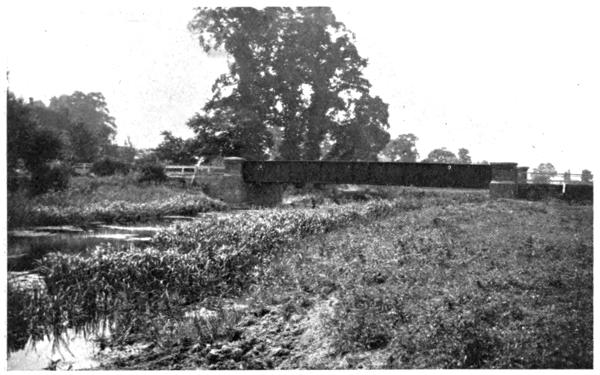
THE IRON GIRDER BRIDGE, CASTLE EATON.
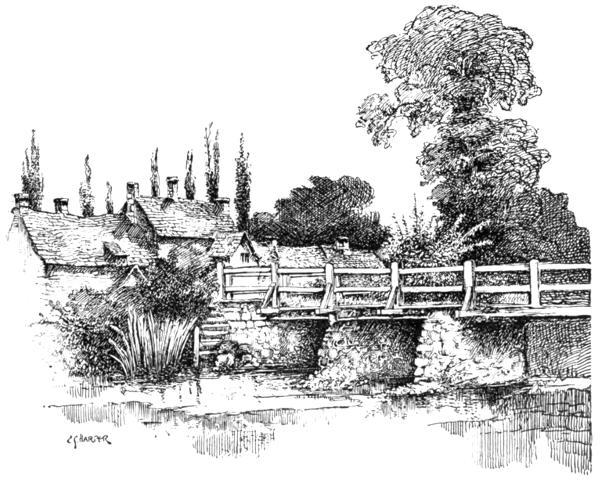
THE OLD BRIDGE, CASTLE EATON.
Water Eaton manor-house, of heavy Georgian
architecture and dull red brick, with characteristically
prim rows of heavily-sashed windows, is unimaginative
but decorous.
Although Castle Eaton has now no castle, and
not even the discoverable site of one, here was formerly
situated a stronghold of the Zouches. It is a very
quiet village, of a purely agricultural type, and generally
littered with straw and fragments of hay. Here
the Thames was until quite recent years crossed by
a most delightful old bridge, that looked like the ruins
of some very ancient structure whose arches had
been broken down and the remaining piers crossed
by a makeshift affair of white-painted timber.
“Makeshift” is perhaps hardly the word to be properly
used here, for it seems to indicate a temporary
contrivance; and this bridge, if not designed in keeping
with the huge, sturdy, shapeless stone and rubble
piers, was at any rate sufficiently substantial to have
existed for many generations, and to have lasted for
many yet to come. Alas that we should have to
write of all this in the past tense! But it is so. Twenty
years ago, when the present writer paid his first visit
to Castle Eaton, the old bridge was all that has just
been described—and more; for no pen may write,
nor tongue tell, of the beauty of that old, time-worn
yet not decrepit, bridge, that carried across the
Thames a road of no great traffic, and would have
continued still safely to carry it for an indefinite
period. It was one of the expected delights of revisiting
the Upper Thames, to renew acquaintance
with this bridge, sketched years before; and it was
with a bitter but unavailing regret and a futile anger
that, coming to the well-remembered spot, it was
seen to have been wantonly demolished, and its place
taken by a hideous, low-pitched iron girder bridge,
worthy only of a railway company; and so little likely
to be permanent that it is observed to be already
breaking into rusty scales and scabs beneath its
hideous red paint. The ancient elms that once formed
a gracious background to the old bridge stand as of
old beside the river bank; but the old bridge itself
lies, a heap of stones that the destroyers were too
lazy to remove, close by, on the spot on which they
were first flung. No description, it has been said,
can hope to convey the beauty of Castle Eaton Bridge,
for the old stone piers were hung with wild growths,
and spangled and stained with mosses and lichens.
A sketch of one end of it may serve; but it once
formed the subject of a painting by Ernest Waterlow,
and in that medium at least, its hoary charm has been
preserved. Let a photograph of its existing successor
be here the all-too-shameful evidence of the
wicked ways of the Thames Conservancy with this
once delightful spot in particular, and with such spots
in general. We cannot frame to use language too
strong for a crime so heinous against the picturesque.
CASTLE EATON CHURCH: SHOWING SANCTUS-BELL TURRET.
THE THAMES AND SEVERN CANAL, NEAR KEMPSFORD.
Let us recapitulate the facts, and draw the indictment
more exactly against that sinning body. We
shall thus ventilate a righteous indignation, and help
to create a healthy public feeling against all such
damnable doings, by whomsoever done. We are,
of necessity, in this country of change and of an increasing
population, faced with a continuous defacement
of places ancient, beautiful and historic; and
it behoves us to use our utmost efforts to preserve
what we have left. What, then, shall we say of such
absolutely unnecessary outrages as this? Shall we
not revile the whole body responsible, from the Board
and the Secretary down to the chief engineer and
the staff of underlings who did the deed? The
Thames Conservancy, in fact, has been a most diligent
destroyer of the beauty of the river; slaving early
and late and overtime in that devil’s work, but remaining
supremely idle where the encroachments
of private persons, or the uglifications by waterworks
companies, and modern mill-and factory-builders are
concerned. It is the Thames Conservancy that has
repaired the banks of the river and has reinforced
the walls of its weirs and lock-cuts, with hideous bags
and barrels of concrete, that retain their bag-and-barrel
shape for all time, and so render miles of riverside
sordid in the extreme. We simply cannot afford
these ways with the river.
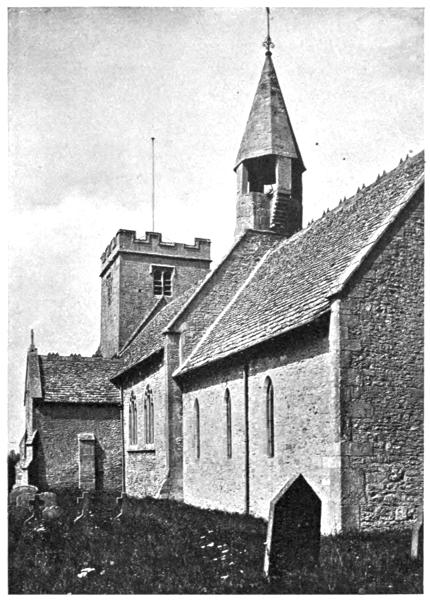
The church of Castle Eaton is in a modest way
a remarkable building. It is a moderate-sized Early
English structure, chiefly notable for retaining its
original stone sanctus-bell turret on the roof. The
interior discloses nave and chancel only, with a shallow
elementary north aisle, built out from the original
building, and supported upon two wooden pillars on
stone bases. This extension—a half-hearted addition—was
itself made several centuries ago, apparently
for the purpose of affording additional seating accommodation
at some period when the population
had increased. But it has greatly shrunken since
then; and in these times when the towns have superior
attractions for all wage-earners, it still continues to
shrink.
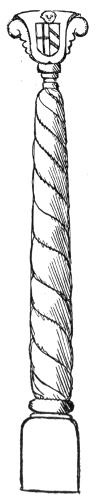
OLD WOODWORK, CASTLE EATON.
A very curious old oak post, some seven feet high,
and carved with a spiral pattern,
stands at the end of one of the pews,
and seems to mark what must have
been the old manorial pew; bearing
as it does on its ornamental head a
shield of arms, dated 1704, probably
that of some bygone local family.
The whole affair looks remarkably like
a part of some old four-poster bedstead,
but it may be one of the supports
of a former western gallery. A
half-length fresco figure of the Virgin—the
church being dedicated to St.
Mary—is to be seen on one of the
walls, and a very large, and apparently
fine, brass of a knight was once in
the church. But this has been at
some time destroyed, and the stone
indent itself is now to be found, flung
out of the building and used as a
paving-stone, outside the west door.
Road, river, and canal now all
make for the village of Kempsford,
which does not derive its name from
some ancient, prehistoric Kemp, but from “Chenemeresford,”
said to signify “the ford on the great
boundary”; that is to say, the river. And Kempsford
is situated in Gloucestershire, here divided from
Wiltshire by the Thames, which forms the natural
frontier of many counties along its course, from
Thames Head to the sea.
We shall find the best way from Castle Eaton to
Kempsford, little more than a mile distant, to be
across the meadows and to the towing-path of
the Canal, here and onward to its beginning at
Inglesham, a very beautiful stretch of water-way;
overhung, as it is, by noble trees in places, and rich
in rushes and water-lilies. When the Gloucestershire
and other County Councils, together with
the local Rural District Councils, procured an
Act of Parliament for taking over this neglected
waterway, great hopes were entertained of reviving
an undertaking which had never been remarkable
for its financial success, and it was fondly hoped
thereby to break the “monopoly” held by the
railway. A trust was formed in 1895 by those
public bodies interested, and it was agreed to
guarantee £600 annually for thirty years for repairing
and working the canal. The Great Western
Railway was thus rid of an incubus, and the ratepayers
of these various districts find themselves
saddled with an utterly unremunerative expenditure
that no commercial firm would have had the folly to
assume. For not only were the repairs of Sapperton
Tunnel exceedingly costly, and the general overhauling
of the canal expensive, but no traffic worth
the mention has been induced to come this way.
Those squanderers of public money were heedless of
the facts of modern business, and forgot to consider
that in these latter days time is more than ever the
essence of the contract in worldly affairs. Less able
than ever, therefore, are canals to compete with railways.
So once more, after a fugitive period of activity,
we see the Thames and Severn Canal returning
to its old neglected condition.
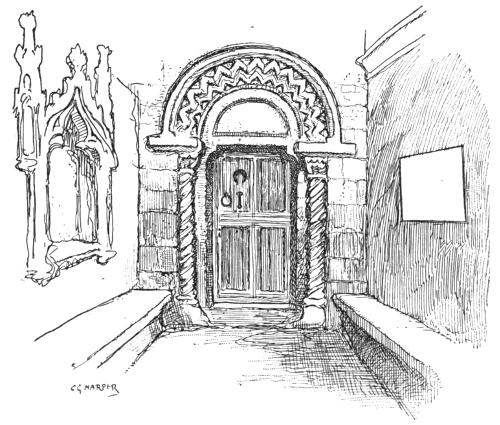
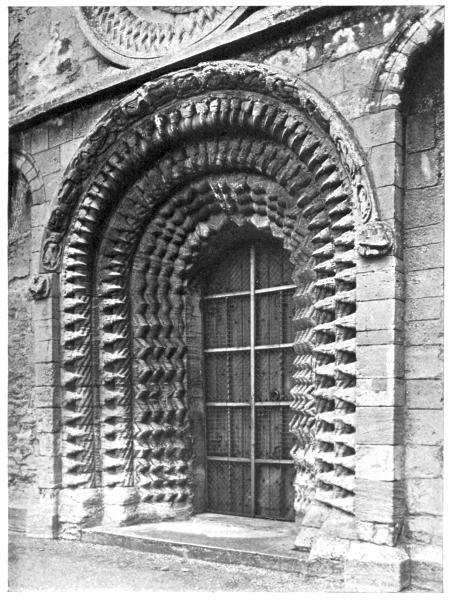
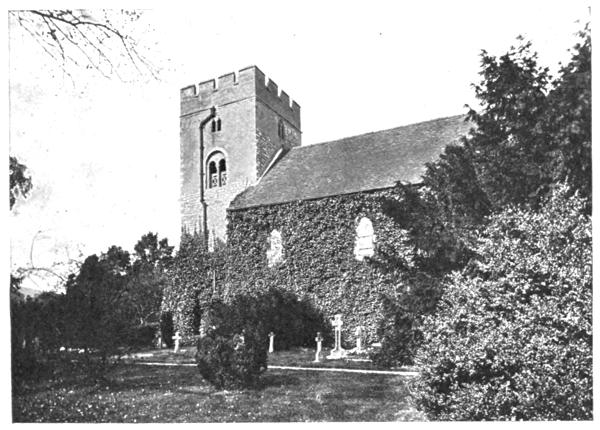
NORMAN PORCH, KEMPSFORD.
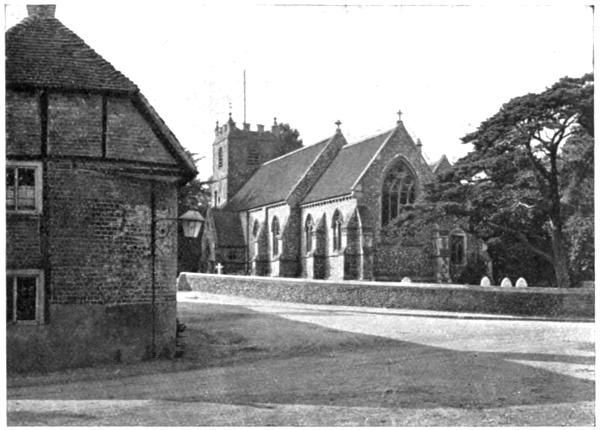
KEMPSFORD CHURCH.
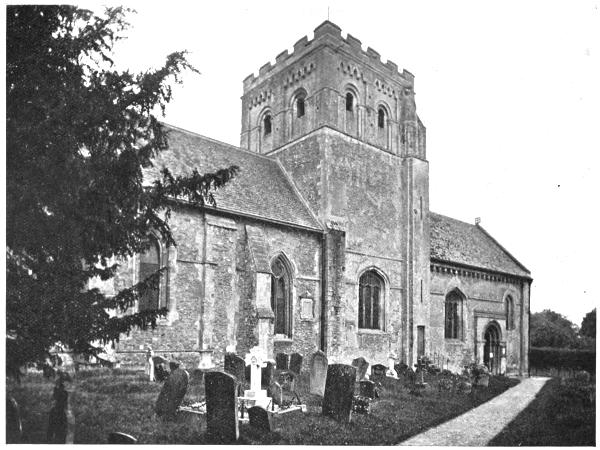
Kempsford church-tower is prominent across the
meadows, and we find it to be a notable and interesting
church, and the village a place of aristocratic appearance,
where humble cottages are few and the manor-house
imposing. This is as it should be in a place
with its history: the manor having once belonged
to Edward the Confessor, who gave it to Harold.
William the Conqueror conferred it upon one of his
knights, and in the course of the centuries the property
came to Henry, Duke of Lancaster, whose son-in-law,
John o’ Gaunt, Shakespeare’s “time-honoured
Lancaster,” once resided here, greatly favouring this
one of his many manors, of which the number scattered
all over England was so great that it would have
been distressingly hard work for him to visit them
each and all in the course of a year.
The only son of Henry, first Duke of Lancaster,
was drowned here, and his sorrowing father is said
never again to have resided at Kempsford. On the
north door of the church is nailed a horseshoe, in
allusion, it is said, to one cast by his horse on his
departure, and immediately nailed up here by the
inhabitants. It is, indeed, often said to be the original
shoe, but that is an absurdity. A curious other
horseshoe legend and observance is to be noted at
the town of Lancaster, John o’ Gaunt’s ancient palatine
seat. There, where the two principal thoroughfares
of the town cross, is “Horseshoe Corner,” so
named from the horseshoe let into the roadway, and
renewed in every seven years; in memory, says
tradition, of a shoe cast there by his horse.
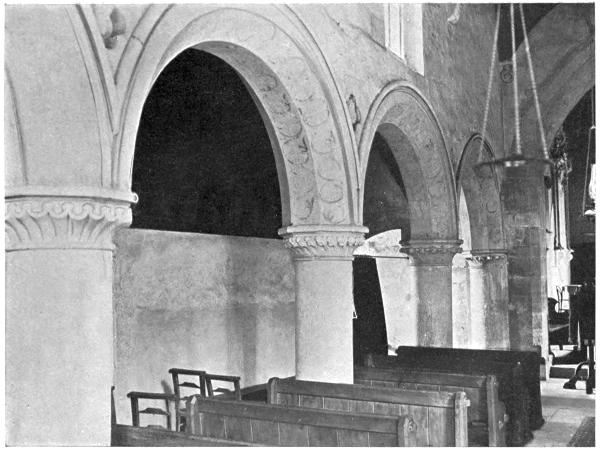
Kempsford church consists of a long and lofty
aisleless nave, with tall central tower. The nave is
Norman, with Norman doorways and Perpendicular
windows, and very beautiful, gorgeous, and impressive.
The ancient manor-house, frequently styled “the
Palace,” came at last into the possession of the
Hanger family, Earls of Coleraine, one of whom
wantonly destroyed it.
The Thames and the Thames and Severn Canal,
running almost side by side at Kempsford, now
abruptly part company again, and meet only three-and-a-half
miles farther on, at Inglesham. The canal
is the more easily followed, since the windings of the
Thames in those miles add certainly another mile
and a half to the distance, and are to be followed only
with extreme difficulty by canoe, or afoot through
many fields. Hannington Bridge, crossing it nearly
a mile and a half below Kempsford, is the first bridge
of any importance, and is a solid, stolid modern
masonry building, eminently practical and unimaginative,
serving to carry the road from Highworth
to Fairford across. The remains of an old weir on
the way give pause to the exploring canoeist at most
seasons; and a small tributary, the river Cole, hailing
from Berkshire, is seen on approaching Inglesham.
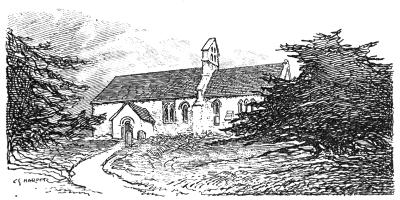
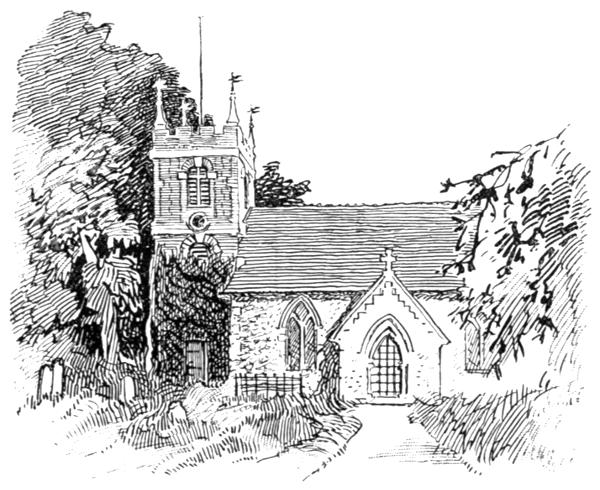
There are no churches in these surroundings more
interesting than the humble little building at Inglesham,
one mile from Lechlade, in an almost solitary
situation. It is quite a rustic church, chiefly in that
best period of gothic architecture, Early English, and
it is so far removed from restoration, or even adequate
care, that it is almost falling to pieces. Damp
and neglect have wrought much havoc here, and the
zealous concern of the Society for the Preservation
of Ancient Buildings, by preventing any large scheme
of repair, seems not unlikely to result, at no distant
date, in the entire dissolution of the structure.
The meeting of the canal and river at Inglesham
Hound House is marked picturesquely by the grey
round tower of the Hound House itself, and by a row
of tall poplars. The Round House is nothing but a
glorified lock-keeper’s house, situated beside this,
the first lock, where the canal sets forth on its way
toward Stroud and the Severn. A mile farther downstream
lies the town of Lechlade, across the lovely
level meadows, with the tall spire of its church
glinting whitely in the sun. It is an exquisite view,
and so alluring that you are in haste to make acquaintance
with Lechlade itself, that promises so romantically.
But let us not hurry. Rather that distant
view than Lechlade at close quarters; for although
it is in very truth an inoffensive town, it is also sufficiently
true to remark that it is dulness incarnate,
and that this mile-long glimpse will be found the
better part.
INGLESHAM CHURCH.
At Inglesham Round House there are plentiful
facilities wherewith to refresh the body and to employ
the uncultivated mind; for the lock-keeper’s domain
includes a number of apologetic sheds and shanties
devised for the benefit of picnic-parties; and anything
eatable or drinkable likely to be called for by
parties on picnic, or boating, or merely padding the
hoof, is obtainable, together with the mechanical
music of melodeons or other such appliances that will
serve you with pennyworths of minstrelsy, as more
or less appropriate sauce. Here also is a greatly-patronised
camping-ground, generally plentifully occupied
with tents in favourable summers. The river
Coln here also flows into the Thames from Fairford.
It is a pretty spot, with its hunchbacked lock-bridge,
and the not unhandsome modern foot-and
tow-bridge that spans the Thames, helping to compose
a picture. It is the Ultima Thule of the Oxford man’s
“Upper River”; the farthest point to which it is
generally navigable for small boats.
Passing Inglesham Round House, and proceeding
over the foot-bridge to the right bank of the Thames,
toward Lechlade, we enter Berkshire; crossing over
the stone single-span Lechlade bridge into the town
and into Gloucestershire.
The town of Lechlade takes its name from the little
river Leach which rises at Northleach, fourteen miles
in a north-westerly direction, and gives its name to
Northleach, East Leach Turville, and East Leach
Martin. Although Lechlade—i.e. “Leach-let,” the
outlet of the Leach—thus obtains its name, that
little river flows into the Thames at a considerable
distance away, two and a half miles below the town,
at Kelmscott.
INGLESHAM ROUND HOUSE.
The disastrous persons who derived “Cricklade”
from “Greeklade,” and invented a university of
Greek professors there, made “Lechlade” a rival
seat of learning, where Latin was taught, and gave
its original name as “Latinlade.” Fuller tells us
how this imaginary university—in which he seems to
have believed—ended by migrating to Oxford. He
is quite poetic about it. “The muses,” he says,
“swam down the shores of the river Isis, to be twenty
miles nearer to the rising sun.”
Other, and equally weariful, persons made Lechlade,
“Leeches-lake,” the home of the College of
Physicians (“leeches”) relegated to this obscure
town—which, of course, it never was.
It is now hardly conceivable that once upon a
time there was a considerable traffic in cheese upon the
upper Thames, between Cricklade, Lechlade, Oxford,
and London; but such was the case. This was formerly
a great cheese-producing district, as it might
well be now; and, as roads were bad everywhere
and railways were not yet, the only method was to
load the cheeses on barges, and so float down-stream.
Lechlade is very well on week-days, in the quiet
way of all such decayed townlets, but on Sundays
it is not to be recommended. Dulness stalks its
streets almost visibly, and the only sounds are the
argumentative tones of the preacher in the Wesleyan
chapel (a building with black doors and gilded
mouldings, after the fashion of a jeweller’s shop) at
one end of the street, whose raucous voice can be
distinctly heard at the other: not unlike that of a
man quarrelling outside a public-house.
But the fates preserve us from a Sunday at Lechlade!
It is fully sufficient to skim through the place
at such a time, and make for some other that does
not so completely figure the empty life. A village
is not dull, because it has no pretensions to being a
town—and country life is never dull. But at Lechlade
the position is so desperate on Sunday that, for
sheer emptiness of other incident, a large proportion
of the population flock the half-mile that stretches
between the town and the railway-station, and hang,
deeply interested, upon the bridge, to witness the
Sunday evening train depart. It is a curious spectacle,
and one that carries the mind of a reminiscent
reader back to stories of marooned castaways on
desert isles, gazing hopelessly upon the departing
ship that has left them to solitude and despair. That
must needs be a place of an extreme Sabbath emptiness
where the grown-up inhabitants are impelled,
by way of enlivening the weary evening, to walk half
a mile to witness what seems an incident so commonplace
to the inhabitants of places whose pulses beat
more robustly.
A STREET IN FAIRFORD.
The “pratie pyramis of stone,” as Leland styles
the spire of Lechlade church, is almost the only architectural
feature of the townlet, if we except a few
mildly-pretty stone-built houses of Tudor gables and
mullioned windows; among which may be included
the “Swan” inn. None of these are included in the
accompanying view of the church, which, although
graceful without, and promising interest within, has
been miserably treated, and swept clear of anything
of note. A few curious carvings are to be noted on
the lower stage of the tower exterior, including a
singular bearded and capped profile head and a hand
grasping a scimitar. Although well done, they look
like the idle sport of some irresponsible person or
persons, and do not appear
to have any particular
meaning or local application.
ANCIENT CARVING, LECHLADE
CHURCH.
The architecture of the
building is of no great
interest to archæologists,
being of somewhat late
Perpendicular date, but a
charming example of
tabernacle-work may be
noted on one of the piers
of the nave-arcade, adjacent
to the font. On the
gable of the nave, at the
east end, is a figure of St.
Lawrence, to whom the
church is dedicated. He
holds a gridiron, the symbol of his martyrdom, in
one hand, and the book in the other.
Fairford is the centre of attraction in this district.
It lies away north-west, four miles distant, at the end
of the little railway from Lechlade, on the river Coln.
The Gloucestershire Coln has its name spelled without
a final “e” (for what reason no man knoweth), and
gives a title of distinction to a group of villages—Coln
St. Denis, Coln Rogers, and Coln St. Aldwin’s—that
are famed for their beauty. But Fairford has superior
claims to notice, chiefly for the celebrated stained-glass
windows of its church.
“Fair-ford” may or may not derive its name
from its picturesque situation, but the beauty of
the ancient ford of the Coln, now and for long
past crossed by a bridge, might well warrant an
assumption that the name arose from an æsthetic
appreciation of the scenery. Exactly what it is like
to-day may be seen by the view shown here, with its
noble church placed finely above the meadows.
Fairford is a village that was once a town, prosperous
in the far-off days when the wool-growers and
the cloth-workers of the Cotswolds made fortunes in
their trades and founded families that came in time to
a dignified haven in the peerage; and at last declined
and died out, or have rejuvenated themselves with
American marriages and the dollars incidental thereto.
This old process of founding families by way of successful
trading we may still see at work, in our own
times, under our own intimate observation, encouraged
by the institutions of primogeniture and a House
of Lords, two most powerful incentives to success.
LECHLADE.
Fairford nowadays stands aside from all these
activities. Its day is done, and except on those occasions
when the motor-omnibus between Lechlade
and Cirencester plods through, and on the weekly
market-day, there is no stir in the place at all. Its
fine church and the famous windows alone bring
strangers here. The church is due to the munificence
of the Tame family. John Tame, merchant, of
London, purchased the manor in 1498, and died
twenty-seven years later. He must have been a
typical “new man,” with plenty yet to spare of the
abounding energy that had made his wealth in London,
for it was he who began, and nearly completed, the
rebuilding of Fairford church. We may well picture
him, in our imagination, hopeful of founding a family,
as many other successful traders of that expansive
age had already done, or were doing. His immediate
descendants, however, failed him, and the name is
extinct. It was his son, John, who completed the
church, and died in 1534. Monumental brasses to
the memory of these Tames, and of the third and last,
Sir Edmund Tame, are seen here, but their greatest
monument is the church itself, a beautiful example
of the last developments of Perpendicular architecture,
in which the coarsened mouldings, here and there
noticeable, the curiously-set pinnacles of the tower,
and the character of the grotesques carved on the
exterior, alone hint of that new leaven in matters
architectural and spiritual, the Renascence, that was
presently to overthrow ancient architecture and
much else.
But the wonderful windows, twenty-eight in all,
the finest and largest set of old stained-glass windows
in England, are our chief concern at Fairford.
The question as to the foreign or English workmanship
of these windows has always been in dispute;
unnecessarily, it would appear to the present writer.
They are, for the most of them, obviously of Flemish
origin; and a late discovery would seem to have at
last settled the point. In the west window of the
south aisle will be observed an executioner with a
sword, on which is a monogram A. An ape also
appears in the window, for no very obvious reason,
except that it affords material for a pun; a form of
humour greatly favoured by the old craftsmen, as all
conversant with ancient churches well know. The
monogram and the ape point to the glass being
the work of Aeps, a Flemish worker in this sort
at the period of the Fairford church-building.
The large figures of the prophets and apostles
which fill the windows of the aisles are so unmistakably
Flemish that there should never have been the least
doubt about them. If there were any room for incertitude,
it would be in respect of the great west
window, the most remarkable of the series, which
appears to disclose no foreign element; but, as it in
all other respects obviously belongs to the general
scheme, it may perhaps be called Flemish, in common
with the others.
FAIRFORD, FROM THE RIVER COLN.
A legend long current, accounting for these windows,
says that John Tame, asked to pilot a vessel
containing them from Nuremberg to Rome, turned his
course to England instead, and in fact stole the windows.
Now, however fantastic this story, it probably
contains this much of truth, that it hands down a
foreign origin; but that this glass was acquired in
any chance way is altogether unlikely, for it bears
every sign of having been designed for this church,
and for the exact position and size of the windows
it occupies. The designs have been ascribed by some
to Albrecht Dürer, and an old manuscript goes so far
as to relate a visit paid by Vandyck to Fairford, when
he said the drawing was Dürer’s work. This, however,
would seem to be impossible, as Dürer was but
twenty-three years of age when Fairford church was
in course of building.
The great west window affords the chief interest,
illustrating as it does the Last Judgment. The upper
half, above the dividing transom, displays the company
of the blest, assembled round the central figure
of Christ in majesty, with St. John Baptist on His
right hand, and the Virgin on the left. Three half-circles,
somewhat resembling rainbows, surround
these figures; the first a deep red band, filled with
representations of the seraphim; the second, yellow,
with figures of the apostles; the third, blue, filled
with the cherubim. Angels fill the outer spaces,
quiring before the Throne. These be the glorious
surroundings of the good, the constant, and the
true.
The Doom, occupying the lower portion of the
window, is a striking example of imagination applied
to the subject of retribution for sin. The Devil and
his infernal host and the flames of Hell were evidently
very real to those who pictured these scenes of torment,
and to those who first looked upon them,
and they could certainly never have thought it
possible a time would come when people would either
laugh at these ideas of a real personal Devil with
attendant fiends, or look upon them as curiosities;
certainly without any fear or awe.
Here, in all the grotesque drawing and vivid colouring
of which that age was capable, we see the rewards
of wickedness. St. Michael the Archangel, in the
centre, is shown, holding the scales of justice, wherein
the souls of the dead are being weighed. On the left
of him is St. Peter, with his key, standing at the
gates of Paradise; while on the right are seen the dead
rising from their graves, and the flames of Hell, a
little subdued by the weathering of the centuries,
awaiting them. In the lower right-hand
corner is a representation of the
Devil himself, with a head like a
cottage loaf, in the very opening of
his own especial region, holding the
red-hot bars, and grinning out between
them. Curious auxiliary devils are
shown, actively engaged in carrying the dead to
torment; among them the remarkable group illustrated
here. The tall scaly devil on the right,
carrying one of the damned
on his back, is a blue
fiend; the other, displayed
in the act of lashing
a woman just rising from
her grave, is a strawberry-coloured
devil, covered
with pips, and glaring with
eyes of flame.
Other fiends in green,
in red, and in yellow, are
pursuing shrieking souls,
or, having caught them,
are seen flinging them into
pits of fire. Some of these
places of torment are shown neatly enclosed in
masonry, like blast-furnaces. Another fiend, illustrated
here, regarding a woman clasping her knees,
seems to be rather of an apologetic, gentlemanly
type. It is his business to be a tormentor, but he
looks genuinely sorry for it.
THE GREAT WEST WINDOW, FAIRFORD, DISPLAYING THE “DOOM.”
The other windows are of distinctly inferior interest,
displaying as they do mostly
saints, but some of the smaller
lights repay close attention.
In them you see the persecutors
of the Church, set forth with
every horrific detail of innate
malignity; while, hovering
over a representation of the
Crucifixion is seen a batlike
devil, awaiting the last breath
of the impenitent thief, to secure his escaping soul.
These remarkable windows owe their preservation
to the care taken of them by William Oldisworth of
Fairford, during the Puritan upheaval, probably with
the aid of Lady Verney, wife of Sir Thomas Verney,
lord of the manor. She was daughter and heiress of
Sir Edmund, the last of the Tames, and interested, of
course, in seeing that the gifts of her ancestors were
in safe keeping. The glass was, accordingly, carefully
removed and buried in Fairford Park. There
it remained until the restoration of order, when it
was exhumed and replaced. A tall classic column
stands as a monument to this singular history.
It is not always so easy a matter as you might
suppose to hire a boat at Lechlade for the thirty-two
miles’ voyage to Oxford; which, after all, is not only
the best way of seeing the Thames, but the Thames
Valley villages also. Unless considerable notice is
given, especially if it be the week before Bank Holiday,
the boat-proprietor is extremely chary of letting his
craft out of sight, and it becomes a matter of favour
and delicate negotiation to secure a boat, even
though you tender good value in coin of the realm for
its hire. The proprietor’s point of view is that it is
all very well for pleasuring folk to drop easily down
to Oxford with the stream in two days, but it remains
for him, or one of his men, to get it back against
stream; not so easy a matter, even though the
stream be gentle. In fact, the demand for boats
for the trip is not sufficiently large for special arrangements
for cartage back by road to be made; and
that familiar summer sight anywhere between Richmond
and Oxford, a slowly-progressing van, laden
with boats, rolling along the intervening miles of
highway, is not visible here. But, although the hiring
is, as already said, somewhat difficult, the explorer
has at least the satisfaction of finding the Upper
River secluded and unspoiled.
Immediately below Lechlade begins that long
and ever-increasing series of locks by which the
Thames Conservancy has converted the river into an
astounding succession of toll-gates; with this result,
that you are not long out of sight of one lock before
another comes in view; while lock-cuts in addition
grow longer, as well as more numerous, and tend to
make the river in many places very formal. But,
at any rate, the true river-course, leading to the weirs,
or often round by what are now backwaters, is by
contrast, and by disuse, rendered often a very paradise
of wild, untended life.
MONUMENT IN THE PARK, FAIRFORD, WHERE THE FAMOUS
WINDOWS WERE BURIED.
The first lock of the forty-two locks on the Thames
is that of St. John’s, which, like Lechlade Bridge,
often styled “St. John’s Bridge,” takes its name
from the Priory of St. John the Baptist that once
stood hard by. The Priory was a Hospice as well,
and was charged with the care of travellers who came
this way. As part of their charge the Black Canons
who formed the establishment built the original
bridge across the Thames here.
St. John’s Bridge, like some carefully-restored old
dowager, by no means looks its age, but all those who
care to know are credibly informed that “This
bridge, though often repaired and altered on the
upper part, is the original structure of great antiquity,
having existed prior to the reign of Henry III.”
The “Trout” inn, formerly the “St. John Baptist’s
Head,” stands beside a backwater, on the site of the
Priory that was disestablished so long ago as 1473.
At St. John’s Lock the lock-keeper not only hands
you the first of the many threepenny pink tickets that
are painfully familiar to those who cruise upon the
Thames, but another in addition, for Buscot Lock,
one-mile-and-a-quarter onward, where the poor,
impoverished (or, perhaps more likely, the mean,
parsimonious) Conservancy cannot, or at least does
not, maintain a resident lock-keeper; with the
result that you have the choice of working your own
way through, or of leaving the job to the official
hands of the keeper at St. John’s, who in the latter
event cycles the distance. But in any case you pay
your threepence for each lock.
The Thames from this point becomes singularly
lonely. Few roads cross it, and the villages are
small and infrequent, and are rarely to be seen from
a boat. The ideal method of exploration is to take
a bicycle on the boat and to lay it across the bows,
where it is out of the way and yet easily within reach
when wanted. Then, at some convenient point,
where a road or path comes down to the river, and
places likely to be of interest are but a mile, or two
or three miles, distant, it is your easiest method to
have out the machine and explore swiftly and with
ease, among little-visited ways.
Buscot, however, on the Berkshire shore, is so
close at hand that its church may easily be seen from
the boat and visited by the mere effort of pulling
to the bank under the hoary willows, and stepping
into the meadow beside whose buttercup-spangled
grass it stands.
Buscot—formerly Burwardscott, then corrupted
into Burscott, and finally into the present rendering—is
a place of some note, artistically and agriculturally,
for the little parish church has an east window
by Burne-Jones, representing the Good Shepherd,
instead of the usual ecclesiastical-furnishers’ impossible
stained-glass saints. We may perhaps, without
offence, congratulate ourselves and all concerned
that those stained-glass freaks are, and must ever
have been, impossibilities. They have the most
unprepossessing countenances, of an impossibly holy
type, and generally the vilest taste in coloured robes;
while of the Burne-Jones saints we can at least say
that, although commonly eight feet high in proportion
to their heads, and generally of a consumptive type,
they are at least recognisably like human beings.
And a saint, you know, was originally, before he or
she was given his or her halo and other extraordinary
attachments, merely a more than usually good person
of just ordinary physical attributes. I don’t think
anyone will have the hardihood to deny that. One
other prime curiosity the church of Buscot possesses:
a very highly enriched pulpit of wood, with panels
painted in various religious subjects, by or after
artists of the Italian School. A panel representing
the Annunciation is more remarkable than ever was
intended, for among the attendant Wise Men from
the East is shown a negro with black head and arms
and white legs! “Can the Ethiopian change his
skin?” Partially, it should seem.
Buscot manor-house is as notable for containing
the Burne-Jones “Briar Rose” sequence of paintings
illustrating the ancient legend of the Sleeping Beauty,
as the owner is for his successful shire-horse breeding.
It is not often that the love of art and keen interest
in shire horses are shared equally by one man, as
they are by Sir Alexander Henderson, of Buscot,
who is at once the owner of the finest Burne-Jones
pictures and the breeder of “Buscot Harold,” champion
of three successive London Shire Horse Shows.
It is interesting to know that Buscot manor-house,
standing in its park on the ridge above the river,
on the way to Faringdon, was built from the stones
of the demolished palace at Kempsford, even though
we may see only an eighteenth-century solidity and
comfort, rather than any hint of beauty or history
in the re-edified stones.
Hart’s Weir, or Eaton Weir, as the Conservancy
elects rather to style it, is but a mile-and-a-quarter
below Buscot, and is one of the few old-fashioned
weirs, fitted with paddles and rymers, of which a few
are removed for the passage of a boat, that now
remain. Beside it stands the “Anchor” inn, with
not another house in sight, and the little church of
Eaton Hastings—it would be an affectation to speak
of the village, unless a few scattered cottages may so
be named—two miles away, by the riverside, but so
hidden that its existence is not suspected by passing
oarsmen.
It is amusing to observe the blank puzzlement that
overspreads the faces, and governs the actions, of
those occupants of boats from Lechlade who, coming
for the first time to this unfamiliar type of weir and
lock combined, helplessly steer from one side of the
river to the other, in search of the familiar lock-cut
and lock-gates, and, failing to find them (as well they
may, for such things do not exist here), at last landing
and enquiring for them at the inn. Eaton Weir is
one of the last now left of the old weirs that served
the turn of the river in days of old, and they are
therefore now so uncommon that none need feel
ashamed of coming unexpectedly for the first time
to one, and not comprehending the situation. But
those who are taken by surprise here and cannot
understand why they can find no way through, do,
it is evident by leisured observation, feel a kind of
shame at being so completely “sold.” Eaton Weir,
and others of its kind, are, in fact, complete barriers
across the river, affording a check to all craft until
four or five of the paddles are pulled up. The construction
is simple, consisting of a sill, generally a
heavy beam of wood, laid across the bed of the river,
with a similar beam crossing immediately over it,
from bank to bank. These form the framework of
the weir, which is completed by a number of stout
supports going perpendicularly down at intervals
from upper beam to lower, and by a continuous row
of “paddles” set between them. The “paddles”
are, roughly speaking, in the shape of shovels, but
much longer in the handle and bigger in the blade.
It is obvious that when all the paddles are down in
their places the head of water must be considerably
raised above the weir, although a volume of water
pours through all the while. To admit the passage
of a boat, the weir-keeper draws up four paddles or
more, and then, if the craft be going down-stream,
it is guided by the steersman carefully to the weir, and
deftly allowed to be shot through by the force of the
waterfall thus created in the opening. A little mild
excitement generally accompanies this “shooting the
rapids,” even though the fall be only about eighteen
inches to two feet when the paddles are first drawn,
and reduced to almost nothing if you wait a few
minutes while the head of accumulated water runs
itself away. The Thames Conservancy will have its
dues, and whether it be a lock or a weir you pass,
you render threepence for a small boat, and receive a
pink ticket in return.
And so one comes to Kelmscott, which owes its
name to some Saxon thane, just as Buscot derives
from some dim ancient Burward. But of that
Kenelm whose “cot” this was, history says no more
than it does of Burward. If we adventure into the
hinterland at the back of Bampton—whose full name
is Bampton-in-the-Bush—we shall find two other
“cots,” or “cotts,” Alvescott, and Kencot—and
there is Cote (which is merely “cot” spelled in
another way, and unappropriated to any personal
name) further down-stream behind Shifford.
At Kelmscott the river Leach comes really to its
“lade,” or outflow; its “let,” or outlet: a similar
word being used at Oaklade (“uisk-lade,” or water
outlet), where the Swillbrook joins the Thames, and
at Cricklade, where the Churn falls in. In the words
of the presiding genius of the place, the late William
Morris, Socialist, poet, decorative-artist, demagogue,
literary man, and master-printer, this is “a reach
of the river where on the side of the towing-path is
a highish bank with a thick whispering bed of reeds
before it, and on the other side a higher bank, clothed
with willows that dip into the stream, and crowned
by ancient elm-trees.” Very true. It is also a
beautiful and sequestered spot; and although now,
since the death of William Morris in 1896, become a
much-talked-of new literary shrine, few are those who
trouble its ancient peace.
The village lies near the banks of the Thames, with
a rough, unkempt piece of common opposite the old
Elizabethan, stone, gabled manor-house that was for
some years the home of Morris and of Dante Gabriel
Rossetti. Nothing but the upper windows of the
old house can be glimpsed from the road, for a very
high wall effectually guards its seclusion.
KELMSCOTT MANOR.
Morris loved the place with an intense love,
and brought back to the house much of its old
ways, with much else of his own, in artistic “Morris
tapestries” and other hangings, such as were designed
by him and Burne-Jones, made at Merton
by Wimbledon, and sold at the establishment of
Morris & Co. in Oxford Street. We do not
commonly look upon Socialists as anything but
discontented artisans and weekly wage-earners in
general; but Morris performed his share of street-corner
spouting with such, and yet dreamed golden
dreams of the World Beautiful, and did much to
make it so. But, at the same time, his lovely wares
in wall-papers, in hangings and carpets, in furniture
and stained-glass, were of the most expensive kind
that none of those “have nots” could by any means
possess. The famous Morris books, too, produced
at the Kelmscott Press, Hammersmith, were of
those prices that only plutocrats could afford, and
were produced strictly after the individualistic and
anti-Socialistic theory of “limited edition.”
The only new house in Kelmscott village is one
built to preserve the memory of this man who wrought
such beautiful things and preached doctrines so impossible;
and on the front of it is a very ornate tablet,
bearing a portrait-medallion. The work is, however,
in such low relief and so elaborated that it is difficult
to be clearly distinguished.
Away through the scattered village, and out at the
other end, stands the little decayed parish church of
St. George: decrepit and surrounded in most melancholy
fashion by spindly overhanging lime-trees.
The place oppresses the stranger, even on summer
days, with gloom, which is increased as he walks up
the dank little pathway to the south porch, among
the serried graves of a numerous local family, each
one within his concrete bed. The quite plain headstone
to William Morris is close by.
There is no feeling of this melancholy in the account
written by Morris, in his News from Nowhere, of a
village church; but which was evidently a description
of this:
“We went into the church, which was a simple
little building with one aisle divided from the nave
by three round arches, a chancel, and a rather roomy
transept for so small a building, the windows mostly
of the graceful Oxfordshire fourteenth-century type.
There was no modern architectural decoration on it;
it looked indeed as if none had been attempted since
the Puritans whitewashed the mediaeval saints and
histories on the wall.”
The building is chiefly of Early English date,
consisting of nave, chancel, rudimentary north aisle of
a makeshift character, and north and south transepts
and clerestory. There is a rough tub-font. Some
traces of ancient colouring are found on the round-headed
arches of the nave-arcade; while the accompanying
illustration will show that the sculptured
capitals of the columns are of great, if simple beauty,
and doubtless studied in the long ago from the water-plants
of the Thames.
KELMSCOTT CHURCH.
Nothing can equal the calm delights of those still,
hushed hot days of early summer on these reaches of
the upper Thames, when the tall sweet grasses of the
meadows by which we float are ripening to the scythes
of the reapers, and before the birds have quite finished
their wild torrent of springtime mating song. Here,
with the boat drawn up beside some tall sheaf of
growing rushes, we may listen to the twittering
distant song of the skylark, flying, an almost invisible
speck, high up in the intensely blue sky; and may see
the water-rat swimming across the stream. Cows
gaze with a mild curiosity from the banks, under the
welcome shade of the willows, or recline, with a certain
lumpish dignity, among the buttercups and daisies.
The fragrance of spring is yet in the land, and that man
who, lazing here, lights a cigarette, and so imports
an alien fragrance, offends against his environment.
FARINGDON CLUMP.
So we shall come, after many intervals and halts
by reedy shores where the waterlilies grow, to Radcot
Bridge; the meads spreading wide on either hand,
and the great imposing landmark of Faringdon
Clump for always prominent in the view on the right:
now, with the continued extravagant loopings of the
river, far ahead, now abreast of us, and again in the
rear; so that it becomes difficult to believe this
elusive landmark really one and the same hill.
Beneath Faringdon Clump lies the little town of
Great Faringdon, great only in its quietude, somewhat
broken, it is true, in these latter days by
motor-cars, that, rushing along the ridgeway road on
which it is situated, indecently disturb its slumbrous
dignity.
Faringdon Clump is emphatically the landmark of
this district, even as Wittenham Clumps are the
geographical pointers of a wide district between
Oxford and Wallingford. Many people know it as
“Faringdon Folly.” The height of Faringdon Hill
itself, on which the clump of Scotch firs called “the
Folly” is situated, is about 500 feet, and Faringdon
town, although beneath it, is not itself by any
means in the levels, as those who, cycling to it
from the Thames at Radcot Bridge, shall easily
find, as they come laboriously up the ascending
gradients.
But, before we reach Radcot Bridge, the newly-built
Grafton Lock has to be passed through. It is situated
in a grassy solitude, and takes its name from an insignificant
hamlet quite remote from the river. At
Grafton Lock, indeed, the lock-keeper’s wife and
daughter, who between them take our threepence
and work the lock-gates, are pleased to see the
infrequent stranger, and to exchange the news, and
receive well-earned compliments on the beauty of the
lock-garden.
RADCOT BRIDGE.
Now comes Radcot Bridge, neighboured and overhung
by a wealth of trees; tall, slim, spiring poplars,
and others that spread boldly out. Radcot Bridge
is your only possible halting-place hereabouts for
the night; for here is the waterside “Swan” inn,
with its lawn sloping down to the river, its landing-steps
and boathouse: and Faringdon and its inns are
three miles distant. Thither, however, you must
needs fare, if so be the “Swan” is full.
The single-span, round-arched bridge through
which one comes in these times is not the real original
bridge, nor is the present course of the Thames at
this point the real original river. This is a new cut,
made in 1787, to improve the navigation, then still considered
to be of considerable commercial importance.
The old course of the river flows sluggishly to the
right-hand, and is not now practicable for boats.
Here still stands the ancient gothic bridge, with its
three pointed arches and the base and socket of what
was once a cross on the eastern parapet. This bridge
and the causeway built to it, across the meadows,
once formed a more important means of communication
than now, for the road across the Thames from
Faringdon led northwards to Burford, and so by
degrees into the Midlands. Its strategic value has
been at least twice illustrated. The bridge itself
dates from about 1300, and was on December 20th,
1387, the scene of a sharp action in which Henry,
Earl of Derby, met and defeated Robert de Vere, the
Earl of Oxford, favourite of Richard the Second.
Many of de Vere’s men were drowned here on that
December day, and their commander himself narrowly
escaped, by swimming across the river, half clad in his
armour. His force seems to have been taken completely
by surprise. The “Henry, Earl of Derby”
of this affair was he who twelve years later, 1399,
at last succeeded in deposing Richard, and reigning
in his stead, as Henry the Fourth.
The second occasion of Radcot’s figuring in martial
annals was a skirmish in the long course of the Great
Rebellion, when Faringdon House, up yonder, three
miles away in the town, was held for the King, and
the bridge was occupied as an outpost. Cromwell’s
men appear to have driven the outpost in, with some
loss.
But, before an end is made with Radcot Bridge,
let us note the little-known fact that it was hence,
in those seventeenth-century times, when roads were
little better than muddy tracks across the fields are
now, that much of the stone employed by Wren in
the rebuilding of St. Paul’s Cathedral was brought
to London. The old quarries whence this stone
came have been closed now for two hundred years,
but the site of them is still to be found at a spot to
this day known as “Kit’s Quarries,” near Burford,
eight miles north of Radcot Bridge. I have written
about Christopher Kempster—the “Kit” of those
quarries—in another place,[1] and have shown that he
was firstly clerk of works and master-mason in the
employment of Sir Christopher Wren for many years,
not only in the rebuilding of St. Paul’s Cathedral,
but also in the general rebuilding of the City of
London churches. Retiring from those positions, he
bought the quarries, and thenceforward dealt largely
in the stone with which he had once built.
The stone was conveyed from near Burford, along
eight miles of bad roads, and here at Radcot Bridge,
on the old course of the river, before the new channel
was cut, was loaded, into barges, and so found its
way to London.
It will be well to explore into the level Oxfordshire
hinterland behind Radcot Bridge. There we shall,
in the course of two miles, find the untidy village of
Clanfield, which straggles lengthily
on either side of the grassy edges
of a stream three parts dry in
summer, and thus revealing to the
disgusted wayfarer rich and varied
deposits of unconsidered village refuse—in
the way of battered tins
and old boots embedded in the ooze.
Thistles, nettles, and scrubby weeds
bedevil the grass that might so
easily be made beautiful.
ST. STEPHEN.
But there are evidences that
Clanfield is awakening to better
things. A “Village Institute” has
arisen amid these rank undesirables,
and tentative clippings, sweepings,
and garnishings may be noticed. The church and
churchyard are, fittingly enough, in the forefront of
these improvements.
CLANFIELD CHURCH.
It is a charming village church of moderate size,
built in the Perpendicular period, and dedicated to
St. Stephen, as those well versed in saintly symbols
may readily perceive on approaching, by a glance
at the curious figure of the saint himself, boldly
sculptured on the tower. He bears in his right hand
a little heap of what look like apples, but are intended
to represent stones, in allusion to the manner of his
martyrdom, by being stoned to death. On the west
side of the tower is a tablet to the memory of James
Joy and Robert Cross, killed by lightning when at
work side by side in the fields, August 9th, 1845.
Over the south door is an ancient sundial, cut into
the masonry, and screened from casual observation
by the porch, which is thus seen to be a later addition.
[1] The Oxford, Gloucester, and Milford Haven Road, vol. i., pp. 263,
266-269.
CHAPTER IV
GREAT FARINGDON—BUCKLAND—BAMPTON-IN-THE-BUSH—COTE—SHIFFORD
Great Faringdon, on the right, or Berkshire, side
of the river, is well worth visiting. Technically a
town, its inhabitants would probably feel injured by
any one styling it a village; but there are towns and
towns; and Faringdon, although it perhaps may
not be styled “decayed,” is at any rate unprogressive.
There be those among us who are so constituted that
they mislike the word “progress,” and are repelled
by any place they hear to be “progressive.” This is
entirely due to the recent connotation of “progress.”
Modern men have seen so much of the futile striving
and competition, the shameless advertising, and the
sordid things that stand for “progress” in these
days, that they look with yearning upon those spots
that are said to be “unprogressive,” and ardently
wish their lives might be lived therein, instead of
being merely existed where the struggle for survival
is waged with ever-increasing severity.
Great Faringdon—how humorously that epithet
sounds to a Londoner!—is unprogressive in the best
of these senses. You do not find, on approaching it,
the ragged slummy selvedges that fringe the towns
where commerce thrives so abundantly, where the
rich grow daily richer, and the poor daily more abjectly
and helplessly impoverished. No matter from what
direction you approach Faringdon, along none of the
five entrances to the town do you see mean suburbs
spreading grimly into the shamed fields, nor plentiful
notice-boards declaring “This eligible land” to be
“ripe for building.” Faringdon’s expansive days are
done, and no man can see the likelihood of their
return, for, although the town is situated on such a
network of highways that travellers by road can
scarce get about the neighbourhood without going
through it, the great days of the road are passed, and
the motor-car is not going to bring them back in that
old sense. The last blow was delivered at the chances
of Faringdon’s expansion when the main line of the
Great Western Railway was carried four miles to the
south, past Uffington, whence a small branch line
comes, to serve the town, and stops here.
Faringdon is an historic place, but its history ceased
to be a living thing at so remote a period that it seems,
to many who do not trouble to come to close quarters
with it, to be a very dryasdust history indeed. It
is largely the history of the Saxon kings, to many of
whom Faringdon was a favourite place of residence.
But of all these times, and of later royal visits, no
tangible record is left; and the Faringdon of to-day
is just an ancient market-town that contrives to live
quietly on the needs of the surrounding agricultural
population. In a rapidly-changing England, this
town is one of a few that, made to stand aside from
the ways of modern trade, remain very much what
they have been during the last two centuries. The
last incidents that ever stirred the pulses here were
election contests, and the last issues in the larger
sort that disturbed town and district were fought out
so long ago as the middle of the seventeenth century,
in the attack and defence of Faringdon in the Great
Rebellion. Then the Royalists held the town and
Faringdon House, the seat of the Pye family, behind
the church. The Pyes had been in possession of the
property only some twenty-three years when the
troubles broke out, having purchased it in 1622. They
were then on the popular side, Sir Robert Pye, indeed,
having married the sister of John Hampden, the
patriot, who lost his life at Chalgrove Field. Greatly
to his mortification, the Royalists had seized and
garrisoned his mansion, and it fell to his lot to besiege
it. The elder of the two sons of this Sir Robert was
that Hampden Pye, born in 1647, who is the subject
of the Ingoldsby Legend of “Hamilton Tighe,” “a
sobriquet interfering neither with rhyme nor rhythm,”
as the author justly claims. The legend of Hampden
Pye, which Barham thus versified, was one once current
in Faringdon and Uffington, and the surrounding
district; and told how he, the eldest son, heir to the
family estates, contracted what his family regarded
as an undesirable marriage, and how he was hounded
on to join the naval expedition to Vigo, under the
command of Sir George Rooke, in 1702. His own
mother is said to have been chiefly instrumental in
this, and to have been among those who secured his
being placed prominently in the post of danger, so
that he might be got rid of. One of the earliest shots
in action carried off the head of Hampden Pye, who
was by no means the reckless youngster we might at
first suppose, for a comparison of dates shows him
to have been fifty-five years of age at the time.
It was believed in Faringdon that always afterwards,
when his mother went out in her carriage,
the spectre of her son stood at the door with his head
under his arm, handed her in, and took his seat
opposite. He grew even more troublesome after her
death, but was at last “laid” for a hundred years
in a small pond near the house by an eminent divine
skilled in dealing with refractory ghosts. “The
period,” continues Barham, writing in 1832, “lapsed
a few years ago, and the people are now very shy of
passing the said pond after dark.” And now the
best part of another century has fled; but in the
meanwhile the ghost of Hampden Pye appears to
have been quiescent.
But the most famous of the Pyes was that Henry
James Pye, born here in 1745, who was descended
from Edmund, the younger brother of the unfortunate
Hampden, and was not only a typical county gentleman,
and sometime a member of Parliament, but
became also, in 1790, Poet Laureate. The appointment
was one of Pitt’s political jobs, and given as a
reward for support in Parliament. Pye effected a
change in the old-time payment of poets-laureate in
kind by the annual gift of a tierce of Canary wine,
and accepted an annual £27 instead.
He was, in addition, a police magistrate at
Westminster; and was as excellent on the bench
as he was execrable in verse. When the office of
Poet Laureate comes under discussion, Pye in the
eighteenth century, and Alfred Austin in the present
era, are inevitably bracketed together, for the purpose
of showing to what depths of inanity a Poet Laureate
can descend. But both these laurelled bards have
been unjustly handled. To deliberately select the
inferior versifier of the age and to make him Laureate
is of itself a doubtful official service to a man; and
then for critics to maliciously pick out his most feeble
efforts by which to judge him and hold him up to
contempt is cruel. It is something as though we
were to appraise Tennyson by the Skipping Rope
(which is worse than any of Pye’s futilities) and to
leave Maud altogether out of account. Pye’s idea of
poetry was at any rate a part of the habit of thought
current at the time, and of the same order of flowery
compliment as that of Thomson, who wrote The
Seasons: although infinitely inferior in execution.
Topographical description, interlarded with generous
praise of his country-gentlemen neighbours, whose
seats dotted the country he described: that was
largely Pye’s idea of poetry; and not a vicious, if on
the other hand not an inspired, view.
Pye was not a man favoured by fortune. When his
father died, he found himself heir indeed to the family
estates, but they were encumbered with debts to the
amount of £50,000; and soon afterwards the house
was burned down. He sold the estates about 1785,
from sheer inability to make head against his financial
embarrassments; and Faringdon knew the Pyes no
more.
But Faringdon Clump, already mentioned, was
planted by him before the family connection was thus
severed, and still flourishes; while his poetry lies
dead and forgotten by the world at large. His other
chief work was the pulling down of that Faringdon
House which had been besieged by his ancestor, and
replacing it by a new residence.
The large parish church, with curiously squat
central tower, suffered greatly during those warlike
operations of 1645-6. The spire, with which the
tower was at that time surmounted, was destroyed,
as also was the south transept; since rebuilt.
Numerous monuments and brasses are to be found
in this extensive Early English, Decorated, and Perpendicular
building. Prominent among these monuments
is the fine alabaster altar-tomb of Sir Henry
Unton, 1596, in the Unton Chapel. It was placed
here by his widow, Dame Dorothy Unton, whose
own effigy, in a kneeling attitude, was at the feet of
that of her husband, until tactless “restorers”
effected a very injudicious separation, and not only
took her away from her husband, but out of the
Unton Chapel, and placed her in that of the Pyes.
Sir Henry Unton was both a warrior and a diplomat.
He had earned his knighthood at the siege of Zutphen,
where his kinsman, Sir Philip Sidney, met his death.
Afterwards he became Ambassador to France. It
was while in Paris that he sent to the young Duke of
Guise, who had spoken slightingly of Queen Elizabeth,
a bitter challenge to a duel:—
“Forasmuch as in the lodging of Lord Dumayne,
and in public elsewhere, impudently and indiscreetly
and overboldly, you spoke badly of that Sovereign
whose sacred person I in this country represent: to
maintain both by word and weapon—her honour
(which never was called in question among people of
honour and virtue)—I say you have most wickedly
lied; and you shall do nothing else than lie whensoever
you shall dare to taxe her honour. Moreover,
that her sacred person (being one of the most complete
and virtuous Princesses that lives in the world)
ought not to be evil spoken of by the tongue of such
a perfidious Traytor to her Law and Country as you
are; and hereupon I do defy and challenge your
person to mine with such manner of arms as you shall
like or choose, be it on horseback or on foot. Nor
would I have you think that there is any inequality
between us, I being issued of as great a race and
noble house in all respects as yourself. So … I will
maintain my words, and the lie which I have given,
and which you should not endure if you have any
courage at all in you. If you consent not to meet me
hereupon, I will hold you, and cause you to be held,
for the errantest coward and most slanderous slave
that exists in France. I expect your answer.” The
Duc de Guise did not accept this offensive challenge,
although thrice repeated.
Built into the exterior east wall of the chancel is
an unconventional monument. This is a cannon-ball,
underneath which we read that it is “Sacred to
the memory of John Buckley, formerly surgeon in
His Majesty’s Navy, who in an engagement with the
French squadron off the coast of Portugal, Aug. 17,
1759, had his leg shot off by the above ball.”
In the middle of Faringdon’s steeply-descending
street, here suddenly growing very narrow, is the
old town-hall and market-house, supported on stone
pillars, after a pattern familiar throughout Berkshire
and other counties, and formerly open on the ground
floor. A modern Fire Station now, however, fully
occupies one end, and an old-fashioned lock-up, with
barred and bolt-studded door, part of the other. On
the stone pillar beside that prison door there is still
to be seen a fragment of the hand-pillory, or iron
wristlet, by which petty offenders were formerly
secured until they had purged their offending.
FARINGDON MARKET HOUSE.
Returning now to Radcot Bridge, and the boat
which is waiting all this while to convey us on our
downward voyage, we pass on to Radcot Lock, a mile
down, and under “Old Man’s Bridge”; or rather the
successor of an old wooden bridge that went by
that name, and is now replaced by a smarter, white-painted
bridge of like material, of which type there
are several others between this and Oxford. The
landscape is here very open: the Berkshire hills
situated at some considerable distance off, on the
right, while the flat Oxfordshire plain, on the left,
is lost in infinity. Here, on the way to Rushey Lock,
are many backwaters, so screened by the tall growths
of midsummer rushes and by the drooping branches
of the willows, now made heavy by fully-grown
foliage, and further masked by dense masses of
water-lilies, that their existence is scarcely suspected.
And thus we come to Tadpole Bridge, of which the
very best to be said is that it is an eminently useful,
and quite inoffensive stone structure of one arch,
perhaps nearly a century old. We shall find, proceeding
down the Thames, that all too often it is
difficult to award even such negative praise as this
to the bridges that cross the river.
WOODEN BRIDGE ACROSS THE UPPER THAMES.
Here Tadpole Bridge carries an excellent road
across to Buckland, two miles on the right, in Berkshire;
and two miles to the left, to Bampton, in
Oxfordshire. We will first see what Buckland may
be like.
It is soon obvious that it occupies a site on the
ridge of hills running between Oxford and Faringdon;
for its square church-tower presently becomes
prominent on the skyline.
Buckland was for many generations, and until
the present time of writing, in possession of the
Throckmorton family, but now the extravagances of
bygone baroneted Throckmortons, and the mortgage-charges
they recklessly heaped up, have overtaken
the present generation, and Buckland has at last
been sold into other hands.
The great church of Buckland, largely Norman
and Early English, is neighboured by a modern
Roman Catholic church. The old church contains
some monuments of these long-descended Throckmortons,
and others to their predecessors, the Yate
family, among them that of a seventeenth-century
baronet and his lady, Sir Edward Yate and Lady
Katherine, who would appear, between them, according
to their epitaph, to have held all the virtues in
fee-simple:
“In this black marble that each sex may finde
White and faire presidents to guide the minde,
Men, Women, know, remember
“Both liv’d lively examples of conjugal,
Paternal, maternal, and religious vertue.
The Baronet particularly honoured for
Morall, economical and prudential merit.
The ladie reverenced for
Sanctimonious zeal, humble and constant patience,
Abundant charitie, and admirable justice.
“Their daughter Elizabeth (who died a mayde,
her parents lyving)
Belovede, admired for
Devoute, chaste, modest and discrete
demeanour and fervent Charitie.
Reader!
Depart!
Imitate!
1648.”
So the ancient tradition of the “bad Baronet”
has its exception here, at any rate. But what shall
we say of the lady whose “sanctimonious zeal” is the
subject of such confident allusion? Only this: that
there are two different meanings to “sanctimonious,”
and that we must give her the benefit of the best
of them. Referring to dictionaries we find that to
be sanctimonious is either to be holy, or to be
“hypocritically pious or devout,” like Shakespeare’s
“sanctimonious pirate.” Unfortunately for the posthumous
fame of the doubtless altogether estimable
lady, there is but one connotation of that expression
nowadays, and it is not the flattering one.
The stately stone eighteenth-century mansion of
the Throckmortons, with widespreading wings, ending
in pavilions looking more than a thought too airy for
this cold climate of ours, was the work of the Woods,
to whom much of the architectural dignity of the
city of Bath is due.
There are (or we must now say there were) curious
relics in this grand house of the Roman Catholic
Throckmortons. They included a chemise of that
precious “martyr,” Mary, Queen of Scots, whom we
know from the pages of history to have been one of the
most wicked women that ever lived, and who was
justly—but belatedly—beheaded; and a gold medal
of Charles the First, another “martyr.”
Here, too, is, or was, the famous coat made for Sir
John Throckmorton in 1811. Curious prints of the
making of this celebrated article of attire, brought
into being as the subject of a wager, are still sometimes
to be met with. The fashioning of it was a hey-presto!
kind of business. From the shearing of the
sheep, all through the many processes of treating the
wool, weaving the cloth, and making the coat, to the
wearing of that coat for dinner at Newbury, the total
time occupied was but thirteen hours and twenty
minutes!
The way to Bampton from Tadpole Bridge is
uneventful and unfrequented. This district was
long notorious for its entire lack of roads, and we may
read in old histories, “There was no stoned road of
any kind leading from Bampton to the neighbouring
towns and villages, and travellers were in the habit
of striking across the common and finding their way
to Witney, Burford, Oxford, or any other place as
best they could.”
From these circumstances Bampton was known
as “Bampton-in-the-Bush,” and appears of speculative
interest; but Bampton-in-the-Bush has long
since lost the greater part of its name; and now that
the roads in these parts of Oxfordshire are no better
and no worse than those to be found elsewhere in this
county, and now the scrub-woods and widespreading
common-lands that once overspread the locality have
given place to flat and uninteresting fields, it is
“Bampton” only; and a very dull place at that.
Its church is the principal feature—and a very
beautiful and unusual feature—of Bampton. The
tall stone spire is visible for miles across the level
landscape. It is largely a Transitional-Norman and
Early English church, and cruciform, with central
tower and north and south transepts. The broach-spire
is supported at the angles by graceful flying
buttresses, from which rise shafts, each of these four
shafts bearing the stone effigy of an apostle. The
effect of these figures, standing out boldly against the
sky, is very striking and unusual.
In the porch the otherwise unremarkable tablet to
Thomas Euston, who died in 1685, proceeds to record
the death of “Mary, his only wife,” in 1699. No
polygamist he, at any rate!
The exceptional size and beauty of Bampton
church are greatly due to the peculiar ecclesiastical
history of Bampton, which until 1845 rejoiced, or
ought to have rejoiced, in the possession of no fewer
than three vicars for this one church; and, what is
more extraordinary still, these three clergymen had
each a vicarage, standing respectively north, south,
and east of the church. To complete this holy fence,
so to speak around it, on the west side was situated the
Deanery, now a farmhouse, where the Deans of Exeter
once resided when taking their summer holidays.
The origin of this remarkable arrangement is due to
Leofric, first Bishop of Exeter, a native of Bampton,
who, having endowed the church, presented the living
to the Dean and Chapter of Exeter; with the stipulation
that all vicars presented must have already
served in the diocese of Exeter. The three vicars
were styled “Portionists,” each taking four months’
duty in the year. This curious arrangement came
to an end in 1845, when the parish was divided into
Bampton, Bampton Aston, and Bampton Lew, each
with its vicar, and either of the two newly-constituted
parishes, it may be added, with its fearsome would-be
Gothic church of that not sufficiently instructed
period.
BAMPTON CHURCH.
No one ever reads architectural descriptions, and
so let it suffice to say that the interior of Bampton
church is very well worth seeing; notably for its
fine Saxon and Transitional-Norman chancel-arch.
The monuments include one with a mutilated stone
effigy of George Tompson, dated 1603. It could
never have been a good example of the sculptor’s
art; and time and unsympathetic hands have conspired
to reduce it to something the appearance of an
almost shapeless log, but the rhymed epitaph, cast
in characteristic early seventeenth-century form,
has a certain prettiness of imagination:
“Heavne hath my sovle in happiest ioye and blisse;
Earthe hath my earthe, whear bodie tomed is.
Poore have my store, for ever to their vse;
Frendes have my name, to keepe withovt abvse.
Heaven, earth, poore, frendes, of me have had their parte,
And this in lief was chefest ioye of harte.”
A THAMES-SIDE FARM.
GATEWAY, COTE HOUSE.
There stands in the flat country between Bampton
and Northmoor, amid the level meadows, washed,
and not infrequently severely flooded, by the Charney
Brook, by the Windrush, and by many mazy rills,
the picturesque old mansion, now a farmhouse of a
superior residential type, of Cote. It was built in
the reign of James the First, between the years 1608
and 1612, by one Thomas Horde, and was originally
surrounded by a moat. Alterations, apparently
undertaken in 1704, the date of the fine wrought
ironwork of the old gates secluding it from the road,
abolished the moat; but a squat tower at one end
of the grey, many-gabled mansion still discloses the
old ideas of defence. It was at one time some twenty
feet higher. At that period, when Thomas Horde
built his house at Cote, times were, in fact, still unsettled,
and one never knew into what dangers one
might be drawn. The very year when he began
building was the year of the Gunpowder Plot; and
when such things could be, a man did well to stand
upon the defensive.
Beyond Cote, towards the river, lies Shifford,
secluded and rarely visited. The old church of
Shifford fell down in 1772, and a new building took
its place. This was removed in 1863.
Shifford is traditionally the scene of a Parliament,
or Witanagemot, held here by Alfred the Great about
A.D. 890: “There sate at Shifford many thanes,
many bishops, and many learned men, wise earls,
and awful knights: there was Earl Elfrick, very
learned in the law; and Alfred, England’s herdsman,
England’s darling; he was king of England; he
taught them that could hear him how they should
live.”
There still remain, in the meadows by Shifford,
traces of earthworks and the stump of an ancient
cross, sufficiently proving that this was indeed
anciently a place of considerable importance. But
commerce with the world of affairs no longer stirs
the pulses of Shifford, or the neighbourhood of it, and
the Thames steals softly along, between tall palisades,
as it were, of rushes, and past the sentinel willows,
with only an occasional farmstead in sight; farms
where one might almost suppose the farmers to
consume their own produce, so remote from all
methods of conveying it away do they seem to be.
CHAPTER V
HARVESTS OF THE THAMES: WILLOWS, OSIERS, RUSHES
The willows, pollarded or left to their natural growth,
that form, as it were, a continuous guard of honour
along many miles of the upper course of the Thames,
and overhang with a wild luxuriance its mazy backwaters,
are indeed a guard to those banks in more
than fanciful phrase. Their tangled roots clutch
them in many-fingered embrace and support them in
times of flood, and their gnarled and fantastic trunks
serve the useful office at such times (when the
meadows are under water and resemble inland lakes)
of exactly delimiting the course of the stream, where
the current runs deep and strong, and dangerous.
Willows we always associate with a watery situation,
and their habit is indeed better suited to low-lying
meadows and to river-courses than to places
high and dry. The great demands the willow makes
upon water place it in the forefront as a drainer of
marshy soil: and thus not only beside the Thames,
but along rivers in general, and in the fens and
on Sedgemoor, where the energies of hundreds of
years past have been directed towards expelling
the water, it is a familiar feature of the landscape.
We also inevitably associate the willow, and especially
that drooping variety, of the pendant boughs and
leaves, known as the “weeping willow,” with melancholy,
and, from Shakespeare to W. S. Gilbert, it is
associated with unrequited love. The spot where
Ophelia met her death is thus described in Shakespeare:
“There is a willow grows ascaunt the brook,
That shows his hoar leaves on the glassy stream.”
The expression “hoar leaves” refers to the under
side of the willow-leaf, of a whitish or silvery hue,
not unlike hoar-frost; prominently seen when a
strong wind ruffles the branches.
A THAMES-SIDE FARM.
The love-lorn among the characters in the operas
written by Sir W. S. Gilbert plentifully carry on the
old tradition, and from Archibald Grosvenor (“The
All-Right”) and Patience, in the duet “Hey, Willow-waly
O!” to Teresa, in The Mountebanks, who sings,
“Willow, willow, where’s my love?” they frequently
apostrophise this tearful tree. Nay, even in the
Bab Ballads we read of a troubadour whose refrain
was “Willow, willow, o’er the lea,” and who maintained
it with such pertinacity that it is at last rightly
described as “his aggravating willow.”
No one can pretend that a freshly-pollarded willow
is a beautiful object, as it stands up, naked, by the
riverside, shorn of all its branches, and resembling
nothing but some rude gigantic club with fist-like,
knuckly head, whence those branches have been
ruthlessly cut away. Even after two or three seasons,
when those branches have been allowed to grow again
and to present a more or less mop-like head of foliage,
the pollarded willows look whimsically like so many
Shockheaded Peters, after the style of the familiar
Struwelpeter German toy-book. Not beautiful, and
not perhaps ugly, they are the grotesque comedians
of the riverside scenery.
The willow is what scientists and arboriculturists
might—and possibly do—style an “economic” tree;
that is to say, it has commercially useful features.
Its bark is an excellent medicine for ague, and useful
for tanning, although oak-bark is better. The ancient
Britons wove their light boats, their “coracles,” from
willow-wands, and cricket-bats are now made from
its wood. Thus descriptive writers upon cricket-matches,
thinking to be picturesque, are frequently
found using the vicious phrase “wielders of the
willow,” when in fact they mean batsmen. Many
varieties of coarse baskets are now manufactured
from willow branches. Hence the assiduous pollarding
of the willow about once every seventh
year, in the middle of winter.
Even the familiar osiers of the Thames have some
of these economic uses, and the osiers themselves are
a variety of willow.
“By the rushy fringèd bank,
Where grows the willow and the osier dank,”
says Milton, illustrating, in his Comus, the almost
inevitable companionship of these leafy cousins.
If we wished most strikingly and picturesquely to
describe the difference between an osier and a willow,
we should say that an osier was a willow without a
trunk. The osiers grow in beds, as a dense array of
upright rods, and, to the uninitiated, there is but one
kind of osier, but experts are said to be able to distinguish
three hundred varieties. Experts are wondrous
folk. Strange to say, although we associate
osiers with watery flats and soggy patches of ground,
the “hams,” or “holts,” as the osier-beds are
generally styled, must, if it is desired to grow a good
crop, by no means be saturated with water. To
successfully form an osier-plantation, the land must
be well trenched or otherwise drained of all stagnant
or surplus water. Basket-willows refuse to thrive
in land that is awash, and they require the sustenance
of good manure. Weeds, too, hinder their growth,
and they are susceptible to attacks from fly.
All these particulars doubtless come as surprising
information to those whose life on the Thames
consists merely of rowing, sailing, or camping. If
they notice the numerous osier-beds at all, it is only
to wonder idly at the dense thickets of tall straight
rods they form; and it is but rarely suspected, either
that they are carefully planted and tended, or that
the crop of rods is both valuable and precarious.
An osier-bed is formed by planting cuttings of
some six inches in length. Like cuttings from its
big brother, the willow, they strike easily, and soon
form vigorous plants. Indeed, in the case of green
poles and posts made of willow, many worthy housewives
have frequently been astonished at finding the
posts they use for hanging out the domestic washing
budding lustily and becoming healthy trees.
An osier-rod of one year’s growth is ripe for cutting,
and cutting proceeds every year, from the established
stool: the season’s growth being, according to the
variety, and to circumstances, anything from ten
to fifteen feet.
Osier-growing is a considerable industry, and,
with due care and ordinary good fortune, very profitable;
for there is not at present a sufficiency grown
in England to satisfy the demand, and we thus
import largely from France, Belgium, and Holland.
But, as shown already, the osier requires to be properly
tended, and has its enemies. Prominent among
these is the water-rat, whose destructive habits, in
gnawing through the base of half-grown rods, are
very costly to growers.
The rods are cut in autumn or winter, and are then
sorted into four sizes, known as “Luke,” “Threepenny,”
“Middleborough,” and “Great.” Of these,
“Luke” is the smallest. They are done up for sale
in “bolts,” i.e. bundles, forty inches round.
To prepare osier-rods for basket-weaving, they
are stacked upright in shallow trenches filled with
water, their butt-ends immersed from six to eight
inches; and thus they are left until spring, when,
with the rising of the sap, they begin to throw out
buds. When April at last is merging into May, the
rods have already burst into leaf and begun forming
roots. Then is the opening of the rod-strippers’
season; for at this juncture the bark is most easily
separated from the rods. Rod-stripping is one of
the few surviving primitive rustic industries, carried
on, according to the mildness, or otherwise, of the
spring, in the open air, or in rustic sheds. This is
pre-eminently an occupation for women and children,
and generally forms a picturesque scene, not remotely
unlike a gipsy encampment. The immemorial instrument
used in peeling or stripping the rods is a “break,”
formed of two pieces of iron or steel mounted side
by side on a wooden post, about waist-high, somewhat
resembling an exaggerated tuning-fork, or a “Jew’s
harp.” The rods are drawn through the springy
embraces of this contrivance, which thus cleanly
strips away the bark, and leaves the rod a pure white
wand. For the protection of more than usually
delicate rods from being bruised, the breaks are
occasionally faced with india-rubber.
The whereabouts of a busy group of osier-peelers
are readily discovered from some little distance, for
the operation of drawing the rods through the breaks
is accompanied by a sharp metallic “ping”; a
chorus of these sounds in several keys carrying a
long way across the still meadows. And if not by
sound, certainly by sense of smell is the group of
busy workers to be located, for the stripped osiers,
or rather, the peelings from them, give forth a strongly
aromatic and pungent odour.
The peeled rods are then carefully dried and
stored away. They form the material for white
baskets, or for baskets that are to be dyed. The
rods from which yellow or brown baskets are to
be made are treated differently, being peeled in
hot water, or in steam; this method—known as
“peeling buff”—bringing out the juices of the rods
and staining the surface, according to the variety of
osier, buff, brown, or yellow.
The ancient method of keeping count of the
number of bolts stripped by each worker was identical
with that employed in the hop-gardens, and is still
frequently used. This is by “tally.” Computation
by tally is one of the most ancient—perhaps the most
ancient—means of reckoning known, and preceded
the use of arithmetic. It consists of taking a short
stick of some soft wood, splitting it into equal halves,
and cutting notches along it. This method of keeping
count is simplicity itself, and absolutely beyond
possibility of fraud or error. The method employed
was, and is, to give each worker half of the split tally
stick; the other half being kept by the foreman.
In osier-stripping, upon a bolt, or bundle, of rods
being finished, the foreman takes the worker’s half
of the tally, and, fitting it to the half he carries, cuts
a notch; and so on with each successive bolt. The
point is that the notches of these two halves must
of necessity agree, or “tally.”
The tally system of accounts lasted until a very
late period in those most conservative of institutions,
Government offices, and it was the accidental flare-up
of a great mass of old Exchequer tallies that destroyed
the old Houses of Parliament at Westminster, in 1834.
The rushes, too, that grow so luxuriantly beside
the waters of the upper Thames have some economic
value, and form a very bulky harvest. The usual
frequenters of the Thames, who see nothing of the
river in spring, autumn, or winter, think of the rushes
only as those tall sword-like blades of living green
that keep guard along so many miles of meadows;
but the Thames in April shows a very different
complexion of affairs. Then the rush has merely
begun to show its sword-point above the water; and
does not attain its full height until June. It is in
flower during July and August; and in that last
month comes the harvest. It is perhaps rather
risky harvesting, and is accomplished from a punt.
The rush-cutter comes to his work armed with a
reaping-hook fixed to the end of a long pole, so that
he is enabled to reach deep down below the surface
of the water, where the rushes spring from their
roots.
The cut rushes are spread out in the meadows, to
dry, for two or three weeks; and, being so largely
charged with water, diminish remarkably in the
process of drying; a freshly-cut shock of sixty-eight
inches’ girth shrinking to a bolt of forty inches. A
bolt of this size is generally sold for one shilling.
Dried rushes are used for making light baskets, and
often for thatching; but in olden times one of the
principal uses for them was the strewing of floors in
the home, for those were the days before the introduction
of carpets. The peculiarly sweet scent of the
dried rush made it especially welcome for this purpose,
and a fresh supply of rushes was thought the right
of every new guest. But the rush-strewn floors of
those ancient domestic interiors had their own peculiar
dangers and nastinesses, if the sweeping and the
renewing were not frequent; for the dogs of the
household generally lived and slept in the house, and
it was the usual practice for guests at table to fling
them bones and unappetising pieces of fat, which
therefore often lurked unsuspected for the unwary
heel among the rushes; often enough only belatedly
revealing their presence to the nose.
CHAPTER VI
NEW BRIDGE, THE OLDEST ON THE THAMES—STANDLAKE—GAUNT’S
HOUSE—NORTHMOOR—STANTON
HARCOURT—BESSELSLEIGH
The Oxfordshire side of the river continues as flat
as ever, to New Bridge, which, rising greyly from
amid the sedges, commands extensive views, less by
reason of its own height, which is nothing to speak
of, than by the lowness of these level lands. New
Bridge, which carries the Abingdon and Witney road
across—it is not a greatly-frequented road—is the
oldest bridge existing on the river. The traveller
who has spent much time in exploring in the highways
and byways of England is not surprised at
this paradox, and has indeed met with so many
Newtowns and Newports, Newmarkets, New Inns,
New Colleges, and the like that are demonstrably
of a hoary antiquity, and older than most other
towns, markets, inns, and colleges, that he really
expects a New Bridge to be at least five centuries
gone in newness. And this bridge was built c. 1260,
by the monks of a neighbouring monastery, which
itself has wholly disappeared, while their old pont
remains as sturdy as ever.
NEW BRIDGE: THE OLDEST BRIDGE ACROSS THE THAMES.
It is a queer, seven-arched building, just as Leland
wrote of it in the time of Henry the Eighth, “lying
in low meadows, often overflowed with rage of rain.”
At the Berkshire end is the “Maybush” inn, and on
the Oxfordshire side is the “Rose,” in friendly
rivalry; but where the trade comes from, in this
lonely situation, to keep them both going, is a mystery.
The customers can be but few, but what magnificent
thirsts they must possess!
At New Bridge the river Windrush falls into the
Thames, from its source in the Cotswolds, thirty
miles away, after passing through Witney, and by
some very beautiful scenes. It is the “nitrous
Windrush” of Drayton’s verse: those supposed
nitric qualities of its waters having originally led
to the establishment of Witney’s blanket-making
industry.
That the flat, low-lying lands here were in former
times under water seems sufficiently evident in the
name of Standlake, a village a mile-and-a-half distant
from New Bridge. A British village, discovered in
1857, near by, may have been one of those lake-villages
in which, for security, our remote ancestors
dwelt. The church of Standlake has a quaint semi-detached
octangular tower, crowned with a spire.
There are some curious and interesting places to be
found in these flat, unfrequented lands. Proceeding
towards Northmoor, ever and again crossing tributary
rills of the Windrush, the moated manor-house, now
a farm, of “Gaunt’s House” lies secluded amid
meadows. It takes its name from one John Gaunt,
who originally built it about 1440, but there is nothing
nearly so old here to-day. The place has its own
little niche in history, for in the seventeenth century,
at the outbreak of the Civil War, it was the property
of that Dr. Samuel Fell, Dean of Christ Church,
Oxford, who was the subject of the famous undergraduate
rhyme—
“The reason why I cannot tell,
I do not like thee, Doctor Fell.”
The Doctor was a Royalist, and his moated house
here was held for that side in 1644. After a stubborn
defence by its garrison of fifty men, who kept a
besieging force of eight hundred at bay for three
days, it surrendered on May 31, 1645. The house,
greatly injured in this warlike passage, was rebuilt in
1669 by Dr. John Fell, who also was Dean of Christ
Church. It is not a picturesque house, and seems
to have been greatly modernised about the beginning
of the nineteenth century. The woodwork of one of
the doors is, however, curiously pierced, as though
for musketry defence.
But, although the house itself is commonplace,
the broad moat, brimming full of water, is beautiful,
and in summer-time is so covered with waterlilies
that the water itself is not to be seen. Let those
who think this the language of exaggeration go and
see for themselves.
NORTHMOOR: CHURCH AND DOVECOTE.
An old bridge, replacing a former drawbridge,
gives access to the house, through two tall gateposts
surmounted by worn stone heraldic effigies, blunted
by time out of all recognisable likeness; not only to
anything in nature, but even to anything in heraldry.
Here, serving to keep the wooden gateway open, is
an iron cannon-ball found in the moat, which, according
to an inscription on the wall, was cleared in
1883.
Northmoor village, near at hand, has an interesting
church of the Early English period, and a charming
and unspoiled Jacobean mansion adjoining, which
has the appearance of never having been altered
since the first building of it.
Oddly placed by the road between mansion and
church, is a delightful old timbered pigeon-house,
which seems to be contemporary with the old residence.
At the west end of the church a quaintly balustered
bell-loft bears the following inscription, obviously
considered (by those who inscribed it) to be
poetry:
“Richard Lydall: Gave a new Bell,
And Built This Bell Loft Free:
And Then He Said: Before He Dyed,
Let Ringers Pray For Me. 1701.”
Which was very wrong of him, a Protestant, living
under the reformed religion.
The inner sides of the aisle-window splays here
at Northmoor exhibit that peculiarity already noticed
in several churches of the upper Thames Valley: a
more or less decorative treatment of the inner arch.
Here the special treatment is confined to a corbelling-out
of the archway; but this is effected in a quaint
manner: the corbel on one side being provided with
a kind of vaulting-shaft. Here, as elsewhere along, or
near, the course of the Thames, the strong influence
of the river upon the imagination and work of the
old architectural sculptors is distinctly to be noted:
the capitals of the shafts being carved with representations
of aquatic plants.
But the chief attraction, in all these parts adjacent,
is of course the village of Stanton Harcourt, and
that it is so, you who penetrate to it, along the level
roads, cannot fail easily to perceive, if not by evidence
of many sightseers making for it, then, at any rate,
in the numerous notices displayed offering accommodation
for tea-parties. Stanton Harcourt is beautiful,
alike in its old-world rustic village of thatched, unpretending
cottages, screened by noble elms from
rude blasts, and in the romantic and unusual group
formed by the ancient church-tower and the towers
of the old manor-house. Approaching, it is as
though the church had two towers, for the chief one
of the manor-house is very like its ecclesiastical
neighbour.
Stanton Harcourt must have derived the first
part of its name from some stone road, but the road
is obscure, and an absurd local legend, almost too
childishly-ridiculous to be repeated, tells us that it
arose from the brave deeds of a former Harcourt, who,
in that conveniently vague period, “ages ago,” was
fighting desperately in some unnamed battle, and
was enjoined by his chief to fight on. “Stand to un,
Harcourt,” he exclaimed; and Harcourt feats of
arms in “standing to un” accordingly won the day.
A curious thing may be noted: that the stones called
the “Devil’s Quoits,” near the village, are themselves
thought to be relics of a battle fought in A.D. 614,
between the Saxons and the British; long before
there were any Harcourts in the land.
STANTON HARCOURT: MANOR HOUSE AND CHURCH.
The Harcourts first came into possession of
Stanton over seven hundred years ago. It was in
1125 that the second Queen of Henry the First gave
the property to one Millicent de Camville, whose
daughter married Richard de Harcourt, thus the
first of a long line of that family, which really ended
with the mother of Edward Vernon, who assumed
his mother’s maiden name, and died in 1847, as Archbishop
of York. The later and present Harcourts
are therefore really Vernons.
The ancient and beautiful manor-house of Stanton
Harcourt, a group of buildings forming a quadrangle,
was built about the middle of the fifteenth century,
with a rebuilt gatehouse tower of a century later,
the work of a Simon Harcourt of that period. The
house was occupied until 1688; and then, with the
death of Sir Philip Harcourt, it fell upon evil times,
for his widow deserted the place. Nuneham
Courtney, which, in the course of these pages, we
shall visit, below Oxford, had been purchased in 1710
by a later Simon Harcourt, and to it the family seat
was removed, and the manor-house at Stanton allowed
still further to fall into decay. Seventy years later
the buildings, by that time mostly ruinous, were
demolished, with the exception of the gatehouse, one
of the towers of the mansion, and the curious and
interesting ancient kitchen, which has only one
fellow to it in England: the well-known and remarkable
Abbot’s Kitchen at Glastonbury.
This Stanton Harcourt kitchen, standing now
beside quiet lawns, and overgrown with creepers and
ivy, has long lost any association with cookery, and
looks particularly ecclesiastical, except perhaps for
the rampant griffin, holding a vane, which crowns the
tall pyramidal tiled roof, and wears rather a devilish
expression. He is a formidable griffin, too, measuring
eight feet high.
THE KITCHEN, STANTON HARCOURT.
To properly impress the reader, or the beholder,
with this kitchen, it is necessary to give its dimensions.
It has a total height of seventy-two feet, made up of
thirty-nine feet of the wall, twenty-five feet roof, and
the eight feet, as aforesaid, of that banner-bearing
monster.
There are no chimneys. The fires were made
against the walls, which are three feet thick; the
smoke from them escaping through wooden louvres,
or shutters, above. According to the direction from
which the wind blew, these louvres were shut to on
one or other of the four sides. The mechanical
ingenuity of the age was at a low level, and was not
able to contrive means by which these ventilators
could be opened or shut from within; so we find
a turret staircase leading up to the roof, around which
runs an open-air passage for access to the louvres.
Alexander Pope, residing in the neighbouring old
tower during three summers, “translating” Horace,
and writing fantastic letters in the meanwhile to his
friend, the Duke of Buckingham, exercised his fancy
on this kitchen, and found it to resemble the forge
of Vulcan, the cave of Polyphemus, and the Temple
of Moloch: “The horror of it has made such an
impression upon the country people that they believe
the witches keep their Sabbath here, and that once
a year the Devil treats them with infernal venison,
viz. a toasted tiger, stuffed with tenpenny nails.”
But all, according to him, was decrepit at Stanton
Harcourt:—
“Its very rats are grey. I pray the roof may not
fall upon them, as they are too infirm to seek other
lodgings.”
It is the nature of rats to be grey; but we need
not seek to deprive Pope of his point. The place was
haunted, too, by the ghost of one “Lady Frances,”
and we hear “some prying maids of the family report
that they have seen a lady in a fardingale through
the keyhole; but the matter is hushed up, and the
servants are forbidden to talk of it.”
“Pope’s Tower” is in three floors. On the
ground-floor is the domestic chapel, roofed in fan-vaulting.
You enter it by an ante-chapel with a
wooden ceiling in blue, spangled with gilt stars: a
gorgeous, but tarnished firmament. The upper room,
known as “Pope’s Study,” was occupied by him
during two hard-working summers, and he celebrated
the completion of his task by inscribing on a pane of
red glass in one of the windows, “In the year 1718
Alexander Pope finished here the fifth volume of
Homer.” The glass has been removed, and is now
at Nuneham.
I have already placed the word “translating” in
quotation-marks, to indicate the fact that Pope’s
claim to have rendered Homer’s Iliad from the Greek
into English verse was a mere pretence. He was
no Greek scholar, and fobbed off upon his publisher
and upon confiding subscribers his metrical version of
translations by more scholarly persons. He grew
rich upon the fraud, and still enjoys a reputation
among the uncritical for a classical learning he did
not possess.
The church, standing close at hand, has a central
tower, of which the lower stage is clearly seen to be
Early English. On this an upper stage has been
reared. The junction of the two is prominently
marked by the upper stage being boldly set back;
producing a striking sense of massiveness.
EARLY ENGLISH SCREEN (UNRESTORED), STANTON HARCOURT.
The chancel-screen, west of the crossing of north
and south transepts, is of exceptional interest, as
perhaps the earliest such screen remaining in this
country unaltered. The hinges and the lock and
bolt of the door are in perfect order, and as good as
ever they were, although now nearly seven hundred
years old. The screen is of the Early English period,
simple and pure in its every detail. A little more
care for this relic would have resulted in the organ
and the choristers’ seats being placed at less close
quarters. The lock of the door is original, and so
are the several curiously-patterned holes pierced
through the lower part of the screen.
The altar-tomb in the north wall of the chancel,
said to be that of Isabel de Camville, is very short,
and its architectural details are of a hundred years’
later date than her death, leading to the supposition
that this is rather an Easter sepulchre than a tomb.
The sculptured emblems of the Passion support this
view. On the south side is the tomb, with effigy,
of Maud, daughter of Lord Grey, of Rotherfield Greys.
She died, wife of Sir Thomas Harcourt, 1394. In
the Harcourt Chapel, locked, and the key kept at
Nuneham, many of that family lie; prominent among
them Sir Robert Harcourt, and Margaret his wife,
1471; both effigies wearing the order of the Garter,
the lady represented with it above the elbow of her
left arm. She is one of the three dames known to be
so decorated in monumental effigy: the others being
the Duchess of Suffolk, at Ewelme, and Margaret
Camoys, at Trotton, Sussex. There were some sixty
ladies admitted to the Order between 1376 and 1488:
the last of them the Lady Margaret Tudor, mother of
Henry the Seventh. Since that time, the only
women Companions have been reigning Sovereigns
or Queens-consort.
Here, among the Harcourts, is an altar-tomb to
that Archbishop of York who was not, as already
shown, really a Harcourt, but a Vernon; and a life-sized
marble effigy of William, third Earl Harcourt,
Field-Marshal, and G.C.B., who died 1830.
On the south side of the church an unassuming
tablet records the tragic fate which befel “John
Hewet and Sarah Drew, an industrious young man
and virtuous maiden of this parish, contracted in
marriage, who, being with many others at harvest,
were both in one moment killed by lightning, on the
last day of July, 1718.”
Beneath are some lines written by Pope:
“Think not by rigorous judgment seized,
A pair so faithful could expire;
Victims so pure Heaven saw, well-pleas’d,
And snatch’d them in celestial fire.
“Live well, and fear no sudden fate;
When God calls virtue to the grave,
Alike, ’tis justice, soon or late,
Mercy alike to kill or save.
“Virtue unmov’d can hear the call,
And face the flash that melts the ball.”
The Berkshire side of the river, from New Bridge
downwards, now demands some notice. There,
instead of the unbroken flatness that continues
through Oxfordshire as far as the city of Oxford
itself, you have a lofty ridge more or less closely
continuing to follow the course of the stream. A
fine highway runs along the ridge, with pleasant
and interesting villages upon, or near it. There
may be found Longworth, and Appleton; and there,
too, Besselsleigh.
BESSELSLEIGH: CHURCH AND FRAGMENT OF MANOR HOUSE.
We can scarcely call Besselsleigh retired, for it
stands directly upon this fine, broad, and well-frequented
road that leads out of Oxford, on to Faringdon
and only students of maps know what many
towns further west. The motors come swishing
along it at some very fine turns of speed, for there
is none to say them nay. Such travellers never
notice Besselsleigh, for the modern mansion stands
well hidden within its park, and of the old house
that once almost fronted the high road there is absolutely
nothing left but two of the stone entrance
gateposts, and those in a more or less wrecked condition.
Those travellers may indeed notice the
church, but even that is doubtful, for it is a very
little and a very humble church, and although its
little churchyard gives upon the road, it is so enshrouded
by large trees and small trees that its very
existence may not be suspected by quick-moving
traffic.
The trees here are indeed noble, and form a
splendid aisle of living green: elms, oaks, and Scotch
pines intermingled. The church, rather barn-like,
has an Early English double bell-cote at its west end.
Of the Besils who gave this place its name in 1350
history has but a moderate amount to say. They
married the estate, so to speak, with an heiress, last
of the family that had hitherto held it; and in the
course of time it passed from them in like manner:
the heiress-general of the Besils marrying a Fettiplace.
And nowadays for even a Fettiplace one may
seek in vain, for that family, once so numerously
spread over Oxfordshire, Berkshire and Gloucestershire,
is itself extinct. But Besselsleigh did not
pass from them in that accustomed manner, for they
sold it to the Lenthalls in 1634, and it is still held
by the same race.
“At this Legh,” says Leland, “be very fayre
pastures and woodes; the Blessels hathe been lords
of it syns the time of Edward the First. The Blessels
cam out of Provence in Fraunce, and were men of
activitye in feates of armes, as it appearith in the
monuments at Legh; how he faught in lystes with
a strange knyghte that challengd hym, at the whiche
deade the kynge and quene at that tyme of England
were present. The Blessels were countyed to have
pocessyons of four hundred marks by the yere.”
Sir Peter Besils seems to have been the worthiest
member of this family, for he not only gave freely of
stone to the building of Burford Bridge at Abingdon,
and of Culham Bridge, close by, but left £600 by his
will of 1424 for the purpose of making amends for
any wrong he or his ancestors may have done any
man. If his executors did not spend that sum in
this manner, presumably because they could find no
aggrieved persons, then they were to construct roads
with it.
Mr. Speaker Lenthall, to whom Besselsleigh was
sold in 1630, repaired the little church, and here later
members of that family are buried. But none of
them have attained to the fame of Mr. Speaker, who
died in 1662, and lies buried in Burford church. He
was a long-headed and tactful man, and, as such,
one well calculated to hold his own in troubled and
uncertain times, by care not to give offence to
either of the contending parties. He was member of
Parliament for Woodstock, and was elected Speaker
in the Long Parliament.
King Charles, at that critical moment in parliamentary
history when his Majesty went down to the
House in person, for the purpose of arresting the five
members who had courageously withstood his will,
asked Lenthall if he saw any of these five present,
and he replied, with marvellous resourcefulness at
so strained a juncture: “May it please your Majesty,
I have neither eyes to see nor tongue to speak in this
place but as this House is pleased to direct me, whose
servant I am here; and humbly beg your Majesty’s
pardon that I cannot give any other answer than
this to what your Majesty is pleased to demand of
me.” Lenthall was one of the few prominent men
of that time who were able to enrich themselves.
While most were ruined in those long-drawn troubles,
he snatched profits out of them, became extensively
rich, and died owner of many manors. These are
the goodly rewards of a moderator; but history
gives no favourable verdict upon such.
CHAPTER VII
CUMNOR, AND THE TRAGEDY OF AMY ROBSART
One comes more readily to Cumnor by road, but
more picturesquely by river, from Bablockhythe,
whence a byway leads steeply up to that famous
place. Cumnor is indeed of such fame that, although
one must needs allow it to be a hill-top—certainly
not a valley—village, yet to omit it from these pages
would surely be unpardonable. At Bablockhythe
remains the last of the old river ferries, capable of
taking a wheeled conveyance across; and capable,
too, of giving an unwary oarsman or punter a very
nasty check with its rope, permanently stretched
athwart the stream.
There is some very noble, still, quiet scenery at,
and just above and below, Bablockhythe, where the
water runs with a deep and silent stealthiness, and
the bushy poplars and pendant weeping willows are
reflected with such startling faithfulness that the
reflection in the water beneath looks more solid—much
more real—than the foliage above. It is an
illusion of the weirdest kind.
In one or other of the quiet backwaters between
this and Oxford there may be found, by those who
care to seek, the curious aquatic plant known as the
“water-soldier.” Botanists of course know it by
another, and a horrific, name: to them it is “stratiotes
aloides.” But to those few rustic folk who know
at all of its existence—and it is not a common affair—it
is the “water-soldier.” It does not, however,
convey any military impression to the ordinary
beholder, being just a plumed bunch of leaves which
in summer-time is found floating on the surface;
coming up from its autumn, winter, and spring home
below, in the river-mud, and growing long suckers,
resembling strawberry runners, each of them with
a youthful “soldier”—or recruit, shall we say—at
its end. These form leaves, and each one produces
a white flower. When these flowers fade the “water-soldier”
and its outposts of young sink again to the
river-bed, and there rest until summer comes again,
when the process is repeated.
But what of Cumnor? It looks boldly down upon
the Thames Valley from a conspicuous wooded ridge.
It is a village picturesque alike in itself and in its
romantic history, traditions, and legends. Figure to
yourself a place of scattered rustic cottages, not yet
touched to commonplace by that shrinkage of distances
caused by the rapidity and frequency of
modern methods of travel which have brought expansions,
rebuilding, and general modernisings in
their train; with an ancient and stately church
rustically overhung with trees quite in the old Birket
Foster and first-half-of-the-nineteenth-century convention.
That is Cumnor to-day.
CUMNOR CHURCH.
In Domesday Book the place appears as “Comenore,”
but we hear of it in Anglo-Saxon times as
“Colmonora”; and it is supposed to have obtained
the first part of its name from one St. Colman, or
Cuman, a seventh-century Gaelic saint. The termination,
“ora,” doubtless refers to the shores of
the Thames; not, however, nearer than a mile and
a half, and at a considerably lower level.
Cumnor had, apparently, an early church, replaced
by the existing fine Transitional Norman and
Early English cruciform building, not yet ravaged
by the “restorer.” Cumnor Place, built about 1350,
as a sanatorium for Abingdon monastery, after the
fearful experiences of the “Black Death” pestilence,
stood very closely adjoining the picturesque churchyard,
on its south side, and, after several changes of
owners, and at last sunk to the condition of a roofless
ruin, was finally demolished in 1811, and its stones
used in the rebuilding of the church at Wytham.
There is much of interest belonging to Cumnor
church, from the battered old altar-tomb in the
churchyard, with barely legible inscription, to Lieutenant
William Godfrey, “who faithfully served
King Charles ye I. from Edgehill Fight to ye end of
ye unhappy wars,” down to the curious epitaph on
the exterior east wall, upon “Christian, the wife of
Henry Hutt”:
“Could exemplary Worth, or Virtue Save
One happier Woman had escap’d the Grave.
From every Vice, and female Error free,
She was in fact, what Woman ought to be.
Envy’d no Queens, but pitied all their Cares,
Expecting Crowns less troublesome than theirs.”
This paragon of virtue, worth, and contentment with
her station in life died in 1740, aged 31.
A real startler awaits the stranger who enters
unsuspectingly into Cumnor church. This is none
other than a singularly vivid likeness of Queen Elizabeth,
done in stone and standing on a pedestal in
the north aisle. The pale effigy, standing there in the
subdued light of the church, is calculated to stir
the nerves of the most stolid. The statue, a singularly
fine one, represents the Queen in the costume
of the period, made familiar in many statues and
paintings. She is standing, and holds the orb and
sceptre, symbols of sovereignty. This work of art
has a history of some curious interest. It was
originally set up in the grounds of Cumnor Place by
Robert Dudley, Earl of Leicester, in honour of his
great patroness. Perhaps it is due to this origin
that the statue represents the Queen so pleasingly.
Zucchero, in his painting of her, and the many other
sculptors who plied their chisels on this inspiring
theme, never produced anything to vie with this
in combined charm and dignity. Elsewhere you
perceive “great Eliza”—in spite of courtly efforts
to idealise her—rendered not a little uncouthly.
Majesty, with more than a dash of vinegar, and plain
evidences of the termagant, are characteristics of the
most of Queen Elizabeth’s portraits in marble, stone,
and paint; but here she is rendered in terms of grace.
STATUE OF QUEEN ELIZABETH, CUMNOR CHURCH.
Upon the decay of Cumnor Place the statue was
removed to Dean Court, and thence to a height above
the village of Ferry Hinksey, in 1779. From that
solitude it was taken to Wytham Abbey, and eventually
forgotten; being found, broken to pieces, in
an out-house. It was finally removed, restored, and
placed here, in Cumnor Church, in 1888, on a pedestal
detailing these circumstances.
An unusual, and welcome, feature of this church
is the series of engravings, reproductions of seventeenth-century
correspondence, and notes upon the
history of the village, for the information of the
cultured visitor. Here you may read something
of the grim associations of the vanished Cumnor
Place, and learn, in a chronological table drawn up
by the vicar, to what tune the centuries have jogged
along in this rural parish. That chronology ends with
this remarkable thought, this astonishing intellectual
effort: “1893. The Future is not yet!”
It never is.
Brasses, now placed upon the walls, commemorate
the virtues and the benefactions of various persons,
including “Katherin, sometyme the wyffe of Henry
Staverton, who dyed a good Christian the xxvth day
of December in ye yere of our lorde God, 1557.” It
is perhaps even more important to have lived a good
Christian; but, apart from such counsel of perfection,
the inscription is a significant change from those
piteous pre-Reformation invocations for mercy, and
appeals for prayers, that were the commonplaces of
all monumental inscriptions only a few years earlier.
James Welsh, who died in 1612, and Margery,
who departed three years later, each leaving £5 in
charity, are celebrated in verse, beginning:
“The body of James Welsh lyeth buryed here,
Who left this mortall life at fourscore yeare.”
In the south transept, dedicated to St. Thomas
of Canterbury, lie two Abbots of Abingdon, one of
them probably William de Comenore, who died in
1333. Latest of all the monuments here is that of
Sir William Wilson Hunter, an Indian official, who
died in 1900, aged 59.
But the chief interest centres in the fine canopied
tomb of grey marble, on the north side of the chancel,
to Anthony Forster and his wife: Forster, that
“Tony Fire-the-Faggot” of Sir Walter Scott’s unhistorical
“historical” romance of Kenilworth, in
which he is held up to execration as a villain of the
most varied villanies; a time-server and hypocrite:
“Here you, Tony Fire-the-Faggot, papist, puritan,
hypocrite, miser, profligate, devil, compounded of all
men’s sins, bow down and reverence him who has
brought into thy house the very mammon thou
worshippest.”
This horrid portraiture of the man is an overdrawn
picture. No need to paint the devil blacker
than he really is; and although the evidence available
tends to attach the stigma of “murderer” to
him, it does not by any means follow that he practised
all the meannesses and petty vices with which
he is charged.
On the other hand, those whitewashers of smirched
reputations who have long been so actively and unprofitably
employed in cleansing historical characters
under a cloud, have overstepped the mark
in loudly declaring their belief in his innocence of all
charges brought against him.
The name of Anthony Forster, in fiction and in
fact, is closely connected with the famous tragedy
of Cumnor Place and Amy Robsart, which still, after
three hundred and fifty years, exercises the minds
of historians, and arouses controversies; and seems
likely ever to do so.
We have already referred to the house as a grange
belonging to the Abbots of Abingdon. It came into
the private possession of Thomas Pentecost, alias
Rowland, the last of them, by deed of gift from Henry
the Eighth in 1538. The Abbot, in consideration of
his having peaceably and willingly surrendered the
Abbey and all its belongings to the King, was given
Cumnor Place for his life; but as he died the following
year, he derived little benefit from the compact.
Seven years later, October 8th, 1546, the King conferred
Cumnor Place, with the manor of Cumnor,
and greater tithes, upon his physician, George Owen,
in consideration of some lands at Oxford, including
the site of Rewley Abbey; and a cash payment of
£310 12s. 9d. William Owen, son of this George,
married in 1558 one of the Fettiplace family, his
father then settling upon him the Cumnor property.
William Owen, however, elected to live elsewhere,
and let Cumnor Place to Anthony Forster.
Who, then, was this Anthony Forster? He was
the friend and factor of a very great man in those
times: a man by no means great from force of character,
but from sheer opportunism, good luck, and
the favour of a comely person: none other, indeed,
than Lord Robert Dudley, later to become, by the
ennobling hands of Queen Elizabeth, Earl of Leicester.
Around the reputation of Dudley there lurk too many
sinister stories for us to lightly dismiss any charge
brought against him or his agents. He was suspected
of having put many persons away by the means of
poison: a method very fashionable in that age of
the Renaissance and widespread neo-pagan culture;
and that he was an ambitious man to whose ambition
no bounds of prudence or conscience were set is generally
acknowledged by historians. He was by no
means alone in this, but was typical of his age, an
age great in refinements, culture, and wealth; great
in arms, and no less notable in its tortuous policies,
national and domestic; and in its lies and manifold
duplicities.
TOMB OF ANTHONY FORSTER, CUMNOR.
The early prospects of Lord Robert Dudley, as
third son of the Duke of Northumberland, were perhaps
not particularly brilliant, and as a young man
of eighteen or nineteen years he had in 1550 married
Amy, daughter and heiress of Sir John Robsart, of
Stanfield Hall, Norfolk. That was in the reign of
Edward the Sixth, the young King himself being
present at the wedding. There is no reason against
the assumption that this was a love-match; but
there is every reason to assume that in after-years,
when his ambitions were kindled, it was bitterly regretted
by Dudley, who, in the changes that had
befallen with the successive deaths of Edward the
Sixth and of Queen Mary, and with the accession of
Queen Elizabeth, had become not only a courtier,
but a royal favourite, looked upon with amorous
glances by that great Queen herself, whose subtle
character has defied the analysis of historians. Queen
Elizabeth’s lovers, looked upon with favour, were
not few, but Dudley was pre-eminent among them,
and presumed, and was allowed to presume, more
than any others. The Queen continually enriched
him with grants of land and with the monopoly of
the export of wool and other commodities, until he
became extraordinarily wealthy, and able to maintain
a magnificence remarkable even for that period.
The loves of Dudley and his Queen afforded gossip
for not only the Court, but for the nation at large,
and a forthcoming marriage was looked upon as so
sure a thing that the Spanish Ambassador found it
possible to write home to his sovereign, referring to
Dudley as “the King that is to be.” And all this
while, we are to bear in mind, Dudley’s wife, Lady
Robert Dudley (the “Amy Robsart” of the looming
tragedy) was alive! What was that meek woman
doing while such well-founded gossip was heard in
every corner of the land? She was travelling and
visiting in many different parts of the country, and
doing so in considerable state.
Among the relics of her to be seen, framed on the
walls of Cumnor Church, is the facsimile of a letter
from her to her husband, dated 1557, displaying
nothing but perfect confidence and trust, which she
might do, well enough, and yet find her trust misplaced.
Or, possibly, those letters were cast in a
conventional form, and hid a breaking heart.
But, although Dudley and his wife had for some
years lived apart, and although he was notoriously
a false and faithless man, whose varied gallantries
were the talk of the time, there was not yet, in 1557,
any question of getting rid of her, and no great and
dazzling ambition made him or his agents contemplate
a crime. Queen Mary yet ruled and it was
not until the following year that she died, and was
succeeded by her sister, Elizabeth. No sooner, however,
did Elizabeth become Queen than Dudley
appeared as the most favoured courtier. That he
was to become King-Consort none doubted, and it is
singular to consider that, in all the records of that
time, the fact of his being already married appeared
to offer no bar to that contemplated union. Continuously,
from the Queen’s accession, these circumstantial
rumours spread, and it is beyond the bounds
of credibility that Lady Dudley should not have been
made perfectly well acquainted with them in the
course of the two years in which they were current.
Lady Dudley—why historians and others continue
to write of her after her marriage by her maiden
name of Amy Robsart is not clear—had been accustomed
to visit a Mr. Hyde, a kinsman of Dudley’s,
at Denchworth, near Abingdon; and it does not,
therefore, appear extraordinary that when Anthony
Forster, her husband’s steward, took Cumnor Place
on lease, in 1559, she should elect to visit there:
the more especially so if there were any truth in the
rumour that she was ill at that time, for Cumnor,
as we have already seen, was supposed to be a particularly
healthy spot.
But it is by no means so sure that she was at all
unwell. It is one of the most damning evidences
of foul play in this famous case that rumours were
current for some time before the murder, or the
accident, whichever it was, to the effect that she was
suffering from cancer and was sure to die shortly,
and that this gossip was contradicted at the time.
Among those who gave the lie to it was the Spanish
Ambassador, writing to the Duchess of Parma.
“They,” he said, “are thinking of destroying Lord
Robert’s wife.” Who “they” were we can only
conjecture. “They have given out that she is ill;
but she is not ill at all; she is very well, and is
taking care not to be poisoned.”
Is it at all reconcilable with the theory of accident
that a person whose continued existence stood
in the way of so ambitious a man as Dudley, and of
whom it was so freely said that she was dying, when
she was known to be well, and whose life was said
to be in danger from violence or poison, should in
fact meet her end so immediately and mysteriously?
No modern coroner’s jury would return a verdict
of accidental death under such suspicious circumstances.
What are the known facts? Lady Dudley was
residing at Cumnor Place in September 1560, and
the extraordinary cloud of suggestions, innuendoes,
and suspicions current everywhere must have reached
her ears. She must have been superhuman not to
have been miserably affected by these doings of her
husband, who, at the time when the tragedy happened,
was with the Queen at Windsor; and she
was, as we have seen suggested, probably in fear of
being secretly poisoned. On Sunday, September 8th,
the day of Abingdon Fair, her servants all went to
Abingdon, by her express desire, according to one
account. But, at any rate, they did all go, leaving
in the house alone, it would seem, Lady Dudley,
Mrs. Hyde, and Mrs. Odingsell, Mr. Hyde’s sister.
The three ladies were that evening playing a game
popular at that time, known as “tables,” when
suddenly Lady Dudley arose and left the room, being
almost immediately afterwards found dead at the
foot of a staircase by the servants returning from
the Fair; having apparently fallen and broken her
neck.
Where was Forster at this time? The records
are silent, and do not tell of any man about the place.
The views of Dudley himself and his dependents
were that the affair was purely an accident. Alternatively,
it was suggested by some that it was suicide.
But Dudley’s conduct on receipt of vague news
of tragedy at Cumnor was suspicious. It would be
supposed that the first act of an innocent man would
be to hurry off from Windsor to the scene of this
happening, to learn at first hand what had befallen
his wife; but Dudley was content to send Sir Thomas
Blount, a confidential gentleman in his train, to ride
over and make inquiries. On the way Blount met
a messenger from Cumnor, proceeding to Windsor
with the detailed news. Next day, at Cumnor,
Blount, examining the lady’s maid, extracted from
her the admission that Lady Dudley had been frequently
heard to pray for delivery from desperation.
He eagerly seized upon this as indicating suicide,
but the maid immediately checked him with, “No,
good Mr. Blount, do not so judge of my words. If
you should so gather, I should be sorry I said so
much.”
What “desperation” might mean is uncertain:
it is a strange choice of a word; but it has been
thought that the unhappy woman, knowing she was
in danger of being murdered, thus prayed to be protected
from the desperate resolves against her life.
Blount, writing to Dudley, acquainted him with
the feelings of the neighbourhood about the affair,
by which it is sufficiently evident that this happening
was already regarded as a serious thing for Dudley.
To this Dudley replied, directing that the strictest
inquiry should be made; that an inquest should be
held immediately, and “the discreetest and most
substantial men should be chosen for the jury.” But
surely, the question of an inquest and the choice of
a jury were the affairs of others than himself, and
an inquest would have been held in any case, whether
he liked it or not; and so his directions to that end
are mere unmeaning words. He further begged of
Blount “as he loved him and desired his quietness,
to use all devices and means for learning of the truth
without respect to living persons”; and especially
desired him not to dissemble, but to tell him, faithfully,
“whether it happened by evil chance, or villainy.”
He was evidently seriously alarmed for himself;
but we look in vain for any expression of sorrow at
his wife’s lamentable end. All he was concerned
with was “the talk which the wicked world will
use”: talk for which his own conduct for long past
had given the fullest occasion.
Blount had halted at Abingdon on his journey,
and only reached Cumnor on September 11th.
Already, as might have been supposed, the coroner
had summoned his jury. They were, in Blount’s
opinion, “as wise and able men, being but countrymen,
as ever I saw.” They deliberated long and
searchingly, and Blount wrote again, on the 13th,
that they were very active; “whether equity is
the cause, or malice [i.e. suspicion, let us note] against
Forster, I know not.” He further said that they were
very secret, but he could not hear that they had found
any presumption of evil. He thought, however, they
would be sorry (these wise and able men—for countrymen)
if they failed. Obviously Blount had been
trying to pump the jury as to their finding. Dudley
himself, writing to Blount, said the foreman of the
jury had communicated with him to the effect that
although the inquiry was not yet concluded, for
anything they could learn to the contrary, it was a
very misfortune. So Dudley himself had been
trafficking with the jury, a thing that would in
modern times afford very strong presumption of
guilt.
If we put faith in Dudley’s own protestations,
we must, however, find him innocent. Yet is it
possible to have this faith?
After hearing to that effect from the foreman
he wrote to Blount, saying that after the jury had
rendered their verdict, he could only wish there
would be a second inquiry. He wished Arthur
Robsart, the dead woman’s brother, and Appleyard,
her half-brother, to be present. Never at any time,
in all these scenes, was Dudley himself present. It
is uncertain whether a second jury was summoned,
or whether the sittings of the first were extended;
but it is certain that an inquiry was still in progress
on September 27th, and that this resulted at last in
a verdict of accidental death.
But the affair cast an indelible stain upon Dudley’s
reputation, and although the question of his marrying
the Queen was not dropped, and was ardently
debated from time to time, his wife, being dead,
proved a more insuperable obstacle than she had
been while living. The dark suspicions, if not of
his actual complicity, at least of Forster’s having
contrived the tragedy in his master’s supposed interest,
would not be allayed. Everywhere mutterings
were heard, and the Queen did not dare marry
one under such a cloud.
Lady Dudley was buried in great state in the
church of St. Mary, Oxford, and even there the
grisly accusation of assassination came up, in Dr.
Babington, the preacher, chaplain to Dudley himself,
thrice making a slip of the tongue; desiring
the prayers of the congregation for the lady “so
pitifully murdered,” instead of “slain.” This incident
serves sufficiently to show what was in men’s
minds.
In 1566, seven years after the tragedy, Appleyard
was brought before the Privy Council for having
declared that he had not been satisfied with the jury’s
verdict, but for Dudley’s sake had covered the murder
of his sister. He was intimidated, and fully apologised,
for Dudley had become all-powerful; and he
was made to explain his words as “malice,” and to
beg pardon for them; but an apology extracted by
such means does not carry great weight. Years
afterwards Cecil could find it possible to say that
Dudley was “infamed by his wife’s death,” and so
infamed he still remains, whether we find it by
direct participation or by the deeds of his too-subservient
agents.
We must here come to the conclusion that Dudley
was not himself guilty; but that Forster certainly
was. That conclusion can, indeed, hardly be avoided.
The country side thought so, and it is not sufficient
for apologists to point to his gentility and his culture,
and to exclaim that such an one would be incapable
of such a crime. Whenever did honourable descent
or cultivated tastes prevent a man from bearing a
villain’s part? The view that because Forster was
a gentleman, and interested in the arts, he was incapable
of crime is the conventional view of people
who are not satisfied that a villain is a villain unless
he wears a scowl and other distinguishing signs.
It has been remarked that Forster would not in
after-years have been chosen Member of Parliament
for Abingdon and would not have been given University
and other honours if he had been what suspicion
made him. But would he not? Dudley
could have procured all these things, and more, for
his faithful man, even as he was in a position to
secure most things for himself.
The year following the tragedy of Cumnor Place,
Forster purchased the freehold of it; Owen probably
being unwilling any longer to hold a house with such
dark associations. And here he lived the remainder
of his life, dying in 1572. In those twelve years he
almost wholly rebuilt Cumnor Place, which he left
by will to Dudley, who had, in the meanwhile, become
Earl of Leicester. If the Earl accepted this
gift, he was to pay £1,200 to Forster’s heirs.
The Earl did accept, but sold the property
soon after. It is not to be supposed that he would
care to be any longer associated with the ill-omened
place. By this sale Cumnor passed to the Norris
family, ancestors of the Earls of Abingdon, who still
own it.
The entry of Forster’s funeral at Cumnor is to
the effect that “A. F., gentleman,” was buried on
November 10th; and it has been thought curious
that the word “gentleman” takes the place of some
other word first written and then erased: whether
the first was uncomplimentary, or merely the Latin
word miles, as sometimes suggested, is now of course
beyond the wit of man to discover.
Those who visit Cumnor with this pitiful story
in their recollection, and are disappointed at finding
Cumnor Place no longer in existence, will find in the
Purbeck marble monument to Forster an interesting
relic, bringing them into touch with these long-vanished
personages; but they will find no support
of the charges brought against him. Nor could
such support be in any way expected; but in the
long Latin eulogistic verses engraved in brass under
the brass effigies of himself, his wife, and their three
children, we find him credited with an astonishing
variety of virtues and accomplishments. He was,
it seems, distinguished for his skill in music, languages,
and horticulture, and was charitable, benevolent,
and full of religious faith. The brass portraiture,
too (which, after all, is not necessarily a
portrait), represents him as a man of singularly open
countenance.
Apart from the personal association, the tomb
is interesting as combining late Gothic and Renaissance
decoration.
It has already been said that Cumnor Place is a
mansion of the past, and that it was finally demolished
by a former Earl of Abingdon in 1811. An amusing
story is told, to the effect that when the popularity
of Scott’s Kenilworth aroused a keen interest in
Cumnor, the Earl undertook to drive some guests
over to see the house, forgetting that he had, several
years earlier, given orders for it to be demolished.
The disappointment of himself and his friends on
arriving at Cumnor was very keen.
Cumnor Place was never more than a modest
country residence, and bore no resemblance to Scott’s
description; nor had it the imposing towers described
in Mickle’s ballad, which concludes with—
“Full many a traveller oft hath sigh’d,
And pensive wept the Countess’ fall,
As wand’ring onward they’ve espied
The haunted towers of Cumnor Hall.”
It stood to the south of the church, and was in
its last years a ruinous malthouse, finally converted
into labourers’ cottages. The stones of it were removed
chiefly for the building of Wytham church;
and there, at the entrance to the churchyard, an
archway remains to this day, bearing the inscription
by the pietistic Forster: “Verbum Domini Janva
vitae.”
It only remains to once more remark that Scott’s
novel, Kenilworth, enshrining many of these things,
is full of the grossest perversions of known facts, and
not for one moment to be relied upon, historically.
Raleigh figures in it, and in its pages is knighted by
Queen Elizabeth, in 1560; but he was only eight
years of age at the time. Lady Dudley is represented
as the Countess of Leicester; but she met her
tragic end three years before Dudley was created
Earl. She is also made to figure in the grand festivities
at Kenilworth, although she had been dead
fifteen years when these great doings took place.
There was no “Black Bear” inn at Cumnor at that
time; nor could there reasonably have been such
a sign, for Dudley, whose device it was, did not then
own property at Cumnor, and was not directly associated
with the village. The Richard Varney, co-villain
with Forster in the story, was derived by Scott
from Ashmole’s gossipy Antiquities of Berkshire, and
is not to be readily identified.
CHAPTER VIII
WYTHAM—THE OLD ROAD—BINSEY AND THE ORATORY
OF ST. FRIDESWIDE—THE VANISHED VILLAGE OF
SEACOURT—GODSTOW AND “FAIR ROSAMOND”—MEDLEY—FOLLY
BRIDGE.
The river makes a great semicircular bend, as between
New Bridge and Oxford, so that although but six
miles between the two, measured in a straight line
on the map, it is fifteen miles by water. Cumnor
stands roughly in the middle of the projecting part
of Berkshire enclosed within this bend, and Wytham
almost at the farthest northward fling of it, just
below where Eynsham Bridge (otherwise styled
Swinford Bridge) carries the great highway from
Oxford across the Thames towards Witney and
Gloucester. Eynsham, a quaint old village, is one
mile distant.
EYNSHAM.
Wytham, amid the deep woodlands, on its bold
hill-top in the bight of the river, is a sequestered place,
the site of the mansion called Wytham Abbey, seat
of the Earls of Abingdon. “Abbey” is a fanciful
term, as applied here, for no religious house ever
stood upon the site, and the existing buildings arose
in the sixteenth century, at the bidding of one of the
Harcourts, who then owned the property. How it
eventually came through several hands and at last
by marriage into the Bertie family, Earls of Abingdon,
is not, I imagine, a matter of general interest.
Wytham village, lying beneath that lordly seat, is
one of the most charming villages in Berkshire, which
is saying a good deal in the commendatory sort. It
is, and has long been, famed for its strawberry-growing,
and was once even recommended by the
faculty to invalids for a “strawberry cure.” I
cannot imagine the ailment for which the eating of
strawberries is a likely remedy, but a pleasanter
“cure” could hardly be invented.
Wytham woods crest Beacon Hill, and in them
the pheasants are plentiful. This is the equivalent
of saying that there is no right of way. But anciently
the road from Oxford to Eynsham, and on to Witney
and Gloucester, ran across this hill: a plaguey bad
road, a very beast of a road. The track of it may
still be followed (by permission sought and obtained
from Lord Abingdon, let me hasten to add) steeply
and roughly up through these sylvan surroundings,
and as roughly and as steeply down again, to Eynsham
Bridge, which was built in 1799 by a former
Earl, to replace the ford by which all wayfarers up
to that time were obliged to cross the river. It is
still a toll-bridge for vehicles, levying the modest
sum of one halfpenny for cycles, and sixpence for
motor-cars. The arduous road from Oxford across
the hill was abandoned about the same time,
when the existing so-called “Seven Bridges Road,”
leading along the levels to Eynsham Bridge, was
reconstructed.
There is a great deal of interest wrapped up in
that old road. It left Oxford on much the same line
as now, but was neither drained nor embanked, and
proceeded for some distance from the city along
swampy ground, so that travellers upon it from
Oxford to Eynsham were made to feed full of varied
discomforts. Proceeding through Botley, often at
the peril of their lives from floods, they then bore
away to the right, for Wytham, passing through
the village of Seacourt on the way. From Wytham,
mounting and descending the hazardous track over
Beacon Hill, at the imminent danger of their necks,
they then came to the peril of the ford; and having
haply passed over this in safety, felt that risks from
natural causes were over. There remained only the
bandits of an early period, and the highwaymen of
a later to give them pause. As for Binsey, it is
merely an insignificant hamlet situated at a very
dead-end of traffic. You shall find it readily enough
by proceeding from the “Perch” inn, beside the
river, just above Medley Weir; but it is quite other
guesswork seeking it from Wytham, for no way
exists where formerly an ancient path ran, and a
channel cut from the Thames winds a prohibitive
course through the flat meadows.
Binsey, indeed, stands on an island in olden times
called Thorney, where St. Frideswide, that celebrated
Oxford saint, first built her oratory, the
name of the isle being then, we are told, changed
to “Binsey”: absurdly said to signify the “isle
of prayer.” Here she also founded the well of St.
Margaret, miraculously springing forth in answer to
her prayer, as springs were wont to do in the eighth
century. They have long since refused to do the
like. It is perhaps not remarkable that Binsey and
this famous well in after-years became, and long
remained, the objects of pilgrimage. The halt and
the lame, the epileptic and the otherwise afflicted,
flocked to Binsey and were cured, hanging up their
crutches in the oratory and festooning it with their
discarded bandages: and incidentally leaving solid
gifts of money behind, greatly to the gain of the
monastery of St. Frideswide, in Oxford, to which
Binsey belonged from 1132 until the end of such
things, four hundred years later.
The crowds of pilgrims who came out of Oxford,
making for the oratory and well of St. Frideswide,
turned off at the vanished village of Seacourt.
Few places have perished so utterly as this long-lost
habitation of men, styled at various times “Sekecourt,”
“Seuecurde,” and “Sechworth”; for all
we shall now discover of it is a farm so named. But
Seacourt was for many centuries a considerable place.
Not only did it lie directly upon the then highway
to the west, but it was the pilgrims’ lodging-place,
and for the accommodation of such it is recorded
to have possessed no fewer than twenty-four inns.
With the successive blows of the dissolution of the
monasteries, when pilgrimages ceased out of the
land, and then when the road itself was diverted,
Seacourt’s doom befel. It subsided into ruin, and
became the abode of foxes and wild-fowl; and
presently the very stones of it were carted away.
The self-satisfied attitude of Binsey folk in
summer, and the woe-begone, dreary, flooded-out
experiences of the same people in winter are amusingly
contrasted in traditional sayings, current in these
parts. Thus, in summer, a villager, asked where he
lives, is supposed to say, “Binsey; where d’ye think?”
but in winter he will reply, disconsolately, “Binsey,
Lord help us!” And it needs only a week or so of
rain in one of our tearful summers for the low-lying
meadows to be flooded, completely islanding the
place in the midst of something resembling an inland
sea.
BINSEY CHURCH.
In modern times the holy well has been found at
the west end of Binsey church and restored, as the
inscription records: “St. Margaret’s spring, granted,
as it is told us, to the prayers of St. Frideswide, long
polluted and choked up, was restored to use by T. J.
Prout, student of Christ Church, the vicar, in the
year of redemption, 1874.” The well may be holy,
but the water again in these days looks provocative
of typhoid.
Between Wytham and Binsey, and directly upon
the river, is a very much better known place than
either; to wit, Godstow. “Fair Rosamond” and
Godstow have employed the morbidly-sentimental
pens of uncounted scribblers. It is easy to be either
sentimental or morbid, and of the easiest to be morbidly-sentimental
over unworthy subjects: hence
the exploitation in this wise of “Fair Rosamond.”
Godstow Nunnery, it seems, was founded by
Edith, an ex-chère amie of Henry the First, and wife
of the second Robert D’Oilgi, or D’Oyley, lord of
Oxford. The buildings were consecrated with great
state by the Bishop of Lincoln in 1138. There is
little need here to dwell upon the history of the
nunnery, which in general is sufficiently dull; and
Godstow is, in fact, interesting only on account of
that highly improper person known in romantic
history as “Fair Rosamond,” who was educated
here. The name of Rosamond, if we may believe
Dryden, who, as a poet, is perhaps not to be altogether
relied upon as an authority, was really Jane.
It might have been worse. However:
“Jane Clifford was her name, as books aver,
Fair Rosamond was but her nom de guerre.”
That she was daughter of Walter, Baron Clifford,
of Hay, in Wales, is historically certain; but much
else relating to her is merely picturesque legend.
She appears to have been born about 1150, and was
educated in this then newly-built nunnery. Here,
in some unexplained way, she attracted the attention
of the King, Henry the Second, and became his
mistress, greatly to the jealous rage of his Queen,
Eleanor of Poitou, the divorced consort of the King
of France, who by many was held to be no better.
This association of the King and of Rosamond seems
to have lasted about four years.
Legends tell variously how Queen Eleanor burst
in upon a secret bower in which the King had hidden
her at Woodstock, and gave her the choice of death
by dagger or poison, and how she chose the bowl
rather than the steel, drank of it and so died; but
these are unhistorical. All that seems fairly certain
is that a break in her relations with Henry occurred,
and that she retired to Godstow and died there, some
four years later, about 1176.
A great mass of legend has accumulated around
these bare outlines of her story, and poets have
freely employed their imagination upon her. With
remarkable unanimity, they assume Rosamond to
have been a blonde:
“Her locks of curlèd hair
Outshone the golden ore;
Her skin with whiteness may compare
With the fine lily-flower;
Her breasts are lovely to behold,
Like to the driven snow.”
That she had two children seems to be established,
but that they were, as often stated, William Longsword,
Earl of Salisbury, and Geoffrey, Archbishop
of York, has been disputed.
Rosamond, we are told, was for sake of her wit
and beauty received back by the nuns of Godstow
with alacrity. Doubtless she told them many strange
tales of the wicked world, for who better qualified to
know? Her body was buried before the high altar.
King John, according to Lambarde, raised a gorgeous
monument to her, inscribed,
Hic jacet in tumba, Rosa Mundi, non Rosa Munda,
Non redolet, sed olet, quae redolere solet.
Speed paraphrased this as follows:
“This tomb doth here enclose the world’s most beauteous Rose,
Rose, passing sweet erewhile, now nought but odour vile.”
A few years later, Hugh, Bishop of Lincoln, paying
a round of pastoral visits in his diocese, in which
Oxford was then included, coming to Godstow, saw
this gorgeous monument and asked what great and
good person it was, then, who lay here. It was, said
the nuns, the tomb of Rosamond, sometime mistress
of Henry the Second, who for love of her had done
much good to that church. Thereupon the saintly
and scandalised Bishop declared that the “hearse of a
harlot was not a fit spectacle for a quire of virgins to
contemplate, nor was the front of God’s altar a proper
station for it”; and he directed that she should be
removed and buried outside, “lest Christian religion
should grow in contempt.”
Leland, diligent antiquary, tells us that in after-years
Rosamond’s tomb was here, inscribed “Tumba
Rosamundæ,” and that her bones had been found,
enclosed in lead, “and within that closed in leather;
when it was opened there was a very swete smell
came out of it.” Time thus gave the lie to that
fearful old epitaph of King John’s day.
The nunnery of Godstow when dissolved in the
reign of Henry the Eighth contained eighteen nuns,
and its annual income was £274; a considerable sum
as prices then ruled. The property was granted to
that Dr. Owen who at the same time secured Cumnor,
and the domestic buildings became a secular residence.
This was held during the Civil War by Colonel Walter,
and was taken by Fairfax in May 1646, and burned.
All we see nowadays of Godstow nunnery is a
small building, ruined and roofless, apparently of no
very great antiquity, for besides the Perpendicular
window there are no other evidences of Gothic architecture,
the two other windows being merely flat-headed
Elizabethan insertions.
Efforts have been made from time to time to
discover the remains of Rosamond. Two stone
coffins were dug up about 1800, and in one of them
were the bones of a young woman. On the supposition
that this was the sarcophagus of Rosamond, a
once well-known antiquary and citizen of Oxford,
Alderman Fletcher, appropriated it, and conceived
the eccentric idea of being buried therein; and when
his time came, in 1826, he was accordingly laid in it,
in the church of Yarnton, a few miles distant.
An uncommon plant, said to have been introduced
from foreign parts by the nuns, still grows freely in
these meadows by the grey ruins. It is known to
botanists as Aristolochia clematitis, but to ordinary
country folk as “birthwort” and was used in confinement
cases. You may identify it by its heart-shaped
leaf and bold yellow flower.
The charm of the river fades away after passing
Medley Lock and nearing Oxford, and suffers a change
into the commercial ragged edges and untidy squalid
purlieus of a great city.
We may read in old dry-as-dust authors how
“Medley” derives from “Middleway”—this being
midway between Godstow and Oxford—but we need
not (indeed, we had better not) put any faith in that
derivation. Also, according to those same authorities,
it was a scene of great resort for “divers pleasures.”
Of what those diversified pleasures chiefly consisted
we must judge rather from the verses of George
Withers than from the grudging phrase of Dryasdust,
who, forgetful of his own youth, gives us no details.
But let George Withers himself inform us:
“In summer-time to Medley
My love and I would goe,
The boatmen there stood ready
My love and I to rowe;
For creame there would we call,
For cakes, for pruines too;
But now, alas! sh’as left me,
Falero, lero, loo.”
Let nothing be said of the river between Medley
and Folly Bridge. What should one say of gas-works
in these pages, or of other evidences that we
are not living in ancient times, and that the city of
Oxford is a populous place, and up-to-date in all
respects except that of its University?
Folly Bridge serves to mark the limits of the
Upper and the Lower river, as well as its prime purpose
of carrying the road to Abingdon across the
stream; and it stands in the minds of many for the
enterprising and industrious Salter, whose steamboats
and whose row-boats are centred thereby.
The real original name of Folly Bridge, dating
back to Norman times, is “Grand Pont,” that is to
say, Great Bridge; great according to the ideas of
those times. Even so lately as 1844, when the first
Great Western railway-station was opened near this
point, the bridge was still well known by its old name,
in addition to the other, for the station was called
after it, “Grandpont”; but, in the years that have
passed since then, the name of “Folly Bridge” alone
has survived, and you might expend the whole of a
day asking for it by its original style, and not find
any one who knows it.
In the middle of the old bridge stood an ancient
tower known traditionally as “Friar Bacon’s Study,”
where that learned man had been accustomed to take
astronomical observations. It straddled across the
roadway and formed, in fact, one of the gateways of
the city. A strange saying was current of this tower,
to the effect that when a man of greater learning than
Bacon passed under it, the tower would fall. It
never did fall, but was pulled down by the city corporation,
as an obstruction to the road, in 1779.
Years before that date, it had been let to a person
named Welcome, who not only repaired it, but built
another storey. The citizens of Oxford then called
it “Welcome’s Folly.”
The bridge was rebuilt between the years 1825 and
1827; but, although Welcome is forgotten, his supposed
folly still, as we perceive, gives the place a name.
There can be no doubt that, to many uninquiring
people, the name of the bridge seems to be a satire
on the pleasure-seeking life of those so-called scholars,
the University men, to whom boating and the
“bumping” races are more than all the wisdom of
the schools.
Below Folly Bridge begins that long line of glorified
house-boats, headquarters of the various college
boating-clubs, known as the “University Barges,”
stationary along the left bank of the river, by Christ
Church meadows. The ethics of bumping or being
bumped, and the sporting politics of the Torpids or
the Eights are subjects by themselves, and not to be
discussed here.
What, strangers ask, are Torpids? The name
suggests a boa-constrictor dined to repletion, and
reduced to a state of torpidity; it is, however, merely
the survival of an old Oxford nickname for the less
active among boating men, who, roused by it, and
adopting it, took to racing among themselves, as a
separate class. The extinct “sloggers” on the river
Cam at Cambridge, derived similarly, from the taunt
of “slow-goer.”
The racecourse of these clubs is between Folly
Bridge and Iffley: scenically a dull stretch of river,
however exciting it may be from the aquatic sportsmen’s
point of view. And if the river between
Oxford and Iffley be dull, what shall we say of the
road thither?
CHAPTER IX
IFFLEY, AND THE WAY THITHER—NUNEHAM,
IN STORM AND IN SUNSHINE
The way from Oxford by road to Iffley is a terrible
two miles of “residential” suburbia. So soon as
the pilgrim has come out of Oxford, over Magdalen
Bridge, and, taking the right-hand fork of roads,
has passed St. Clements, he has entered upon the
villa-lined Iffley road, in which the houses are
numbered to over nine hundred. I hope I am neither
a Prig nor a Superior Person, but I fully confess I
should not like to live—or to “reside,” if you will have
it so—in a house numbered well on into the hundreds.
I do not, broadly speaking, envy our grandfathers of
sixty or seventy years ago, for they are dead and we
are among the living, but they had at least this
advantage, among, of course, many serious disadvantages
that we fortunately do not experience—that
their towns (always excepting London) had no
suburbs. Our ancestors of not so very long ago
stepped out of their ancient streets and found themselves
at once in the country. We have, commonly,
at the threshold of every town, miles of undistinguished
modern streets, commonplace, unhistorical,
depressing. But, at any rate, there are no
tramways, electric or other, along the Iffley road,
and that is something to be thankful for, viewed
from the æsthetic standpoint, although it may leave
something to be desired on the score of convenience.
IFFLEY CHURCH: NORTH SIDE.
The best way to reach Iffley is undoubtedly by
water. The Thames, from Folly Bridge to Iffley
Lock, is not, it is true, at its best, but it, at any rate,
retains something of the genius of locality, which a
suburban road does not, and anything should be
preferable to that road.
But, alas! Iffley Mill, once the glory of the river
at this point, is at the moment of writing, a blackened
heap of ruins, and it is not expected that it will be
rebuilt. Even if it be, that will not be the Iffley
Mill beloved of artists these many generations past.
Thus ends the old manorial mill that has existed, in
one form or another, on this spot, since the Norman
conquest, and probably earlier still, for the place is
mentioned in Anglo-Saxon charters dated 945 A.D.,
in which it is styled “Giftelei.” It is said that
“Iffley” has been spelled in eighty different ways,
and Iffley Mill has probably been sketched, painted,
and photographed as many thousand times; and,
that being so, we will leave the mill, for once, unillustrated.
Enthusiastic local writers have often claimed for
Iffley church that it is the finest Norman country
parish church in England. It is not really quite
that, but it is certainly among the finest. It is a
large building, of late Norman architecture, built
about 1170, when the gaunt, grim early Norman
style had developed into something which, although
not less massive, was more ornate and decorative.
It is a church without aisles. The West front is
imposing, and particularly rich, exhibiting a deeply-recessed
door, with circular window above, and
three windows above that. The circular window is
a restoration, of some fifty years ago, of the original,
destroyed in the eighteenth century and replaced
by a larger, with the object, sufficiently laudable
in itself, but archæologically lamentable, of admitting
more light. The highly-enriched doorway,
with characteristic beak, cable, and chevron devices,
is protected by a bold hood-mould, finely sculptured
with the signs of the zodiac. The low, square
central tower is unaltered, but most of the windows
in the body of the church have been remodelled
at different periods in the long history of Gothic
architecture. The chancel, originally apsidal, was
lengthened about 1270, in the Early English style.
The chancel-arch is curiously carved, and the roof
is massively groined in stone. The ancient black
marble font is as old as the building itself, and may
be compared with a somewhat similar, but more
elaborate, series in Winchester Cathedral, East
Meon church, and St. Michael’s, Southampton. On
the north side of Iffley church is an enormous,
widespreading yew, probably as old as the church
itself, and still healthy. Beside it stands a restored
churchyard cross.
WEST DOOR, IFFLEY CHURCH.
Among the deprived ministers at the time of
the Commonwealth was Charles Forbench, vicar
of Iffley, who was imprisoned for persisting in
reading the Book of Common Prayer when its
use was forbidden by the Parliament. “If,” said
he, “I must not read it, I am resolved I will say
it by heart, in spite of all the rogues in England.”
This was a very fine spirit of resistance against
tyranny, and we must all resist tyranny, from whatsoever
quarter it proceeds; but it may otherwise
be doubted if the Book of Common Prayer is, or
ever was, worth fighting for, or whether prayers
said by rote—which is really what Forbench meant
when he said “by heart”—are the kind of supplications
that win to the Throne of Grace. For my
own part, had I been one of those Parliamentary
Commissioners, I suspect I would have made Forbench
take a meal off the Book of Common Prayer,
as he was so fond of it; but it would not be a very
nourishing meal, physically, or spiritually I take
leave to say.
Nuneham—every one knows Nuneham; for, by
favour of the Harcourts, who own the place, it has
for many years past been a popular spot for rustic
teas. I raise my hat, or cap, as the case may be,
to the Harcourts, past and present—to the memory
of Sir William, that doughty political protagonist,
and voluminous letter-writer to The Times over the
signature of “Historicus,” who, although quite
capable of leading a party, chose to be merely the
trusty lieutenant of the windiest political wind-bag
of any and every age; and to the present Mr. Lewis
Harcourt, for the access they have permitted, and
still extend, to their lovely domain. Every one, I
say, knows Nuneham, for does not Salter, who runs
his comfortable steamboats between Oxford and
Richmond, drop passengers here, on the banks,
and does he not call and pick them up again at
the close of the day, conveying them from Oxford
and back at the cost of one shilling? Yea; thousands
have made that trip; and, given a fine day,
there is, experto crede, not any trip more delightful.
But if the day turn tearful, then Nuneham is the
very last place to which any one who is not a fish
or a duck would wish to go. Do I not know the
misery of it at such times: the landing on the wet,
clayey bank, under the trees of the glorious woods,
which shed great spattering drops of rain on one;
the half-mile walk, or rather, butter-slide, by the
woodland track, to that picturesque thatched cottage
in the lovely backwater, where the cottagers in fine
weather supply open-air teas to these pilgrims,
and in wet weather do the like; refusing, much to
the said pilgrims’ disgust, to give them the much-needed
shelter in their own dry and comfortable
quarters; with the result that those unhappy
persons grow cold and shivery and develop colds
in their heads, and entertain savage thoughts of
Nuneham? Truly, no more miserable experience
is possible than that of sitting in one of the picturesquely-thatched
arbours by the waterside, and
dallying over a lukewarm tea, awaiting the hour
for the up-river steamer’s arrival, while the moisture-laden
wind comes searchingly in at the open front.
And it does not make matters better to know that
those disobliging cottagers are, all the while, crouching
over their own roaring wood-log fires.
THE BRIDGE, NUNEHAM COURTNEY.
But let us dwell no longer upon these harrowing
experiences. It does not always rain at Nuneham—but
only when we want to go there. Then it rains
all day. But when the sun shines, Nuneham is the
ideal place for an idle day, and those draughty
arbours the most exquisite of nooks. From them you
look out upon a river scene that closely resembles
some stage “set.” The trees, right and left, or, to
speak in stage conventional language—on Prompt and
Off-prompt sides—hang in that almost impossibly
picturesque way we expect in the first act of a melodrama
of the old Adelphi or Drury Lane type. You
know the kind of thing; or, if you do not, go to
Nuneham and see it. Anyway, take my word for it
that this is sheerly competitive with the stage. Beneath
these trees, whose other side, you are quite
convinced, is merely canvas and framework, are the
usual conventional rocks, on one of which the villain
will presently sit and gloat over the impending fall
of the hero. And swans come lazily paddling up
to the rush-fringed margin of the river; and, really,
all you miss is the limelight.
But if this scene seems to have been bodily taken
from the stage, the queer timber bridge that here
crosses the backwater gives quite another aspect
to the place. Looking upon it for the first time,
it appears in the likeness of some old friend whom,
for the moment, you cannot exactly place; and
then at last you have it. It closely resembles that
bridge on the time-honoured Willow-pattern Plate,
with which Oriental china has long familiarised us.
If only we had the pagoda to one side, and the queer
little figures, carrying their yet more queer little
bundles, crossing it, the scene would be conventionally
complete. To emphasise and properly accentuate
these remarks, I include a view, taken by
that amiable photographic friend and companion
to whom the most of the pictures in this book are
due. I have not dared to publish a view of the
bridge looking upstream, for that and Iffley Mill
are absolutely the two most hackneyed views of
the river in existence. Instead, therefore, we are
here looking downstream.
Nuneham is a curious combination of the ugly
and the beautiful. The great mansion, ugliness
incarnate, is surrounded by lovely and stately
gardens, created about 1765 by the masterful Earl
Harcourt, typical among the great landowners of
that age. There is something not a little awesome
about the megalomaniacal methods of those great
ones of that period, who had such autocratic wills,
so much money, and such unquestioned power.
Earl Harcourt, in common with many others of
his class and of his period, could not endure that
the village and the church of Nuneham should be
within sight of his windows, and so he abolished
both, causing a new village to arise fringing the
London road, and a new church, which stands as
an indictment of the then prevailing want of taste,
being in the likeness of a Greek temple, to be built
in the woods at the back of the mansion. It is
dated 1764. Here lies Sir William Harcourt, who
died in 1904.
CARFAX CONDUIT, NUNEHAM COURTNEY.
I will not be so gross as to attempt a description
of the loveliness of the natural beauties of Nuneham,
or of the views from it: only let it be said that the
view from the grassy knoll on which stands the old
Carfax conduit, brought from Oxford, is exquisite,
commanding, as it does, distant peeps of Oxford in
one direction, and of Abingdon in another, with
lovely stretches of meadowlands, woods, and water,
in between. There is, it may well be supposed,
no more beautiful fountain in England than this
old conduit from the four cross-roads in the centre
of Oxford; but the expansion of population and
the increase of traffic have ever banished the beautiful,
and thus this fine Renascence building, given
to the city of Oxford by Otho Nicholson in 1610, was,
so early as 1787, removed as an inscription upon
it states, “to enlarge the High Street.” The University,
the inscription goes on to state, then presented
it to George Simon, Earl Harcourt. If it
were worth accepting, it certainly was also worth
keeping, and that the University could thus give it
away reflects no credit upon that body. The repetitive
“O. N.” observed upon the conduit stands for
the initials of Otho Nicholson.
CHAPTER X
ABINGDON
Abingdon, some three miles distant, now claims
attention; and a good deal of leisured attention is
its due. That pleasant and quietly-prosperous old
town is one of those fortunate places that have
achieved the happy middle course between growth
and decay, and thus are not ringed about with
squalid, unhistorical, modern additions. Its population
remains at about 6,500, and therefore it is not,
although possessing from of old a Mayor and Corporation,
a town at all in the modern sense. Thus
shall I shift to excuse myself for including it in these
pages. In these days of great populations we can
scarce begin to think of a place of fewer than ten
thousand inhabitants, as a “town” at all.
The origin of Abingdon, whose very name is said
to mean “the Abbey town,” was purely ecclesiastical,
for it came into existence as a dependency of the
great Abbey founded here in the seventh century.
Legends, indeed, tell us of an earlier Abingdon,
called “Leavechesham,” in early British times,
and make it even then an important religious centre
and a favourite residence of the kings of Wessex,
but they—the legends and the kings alike—are of
the vaguest.
ABINGDON.
Leland, in the time of Henry the Eighth, wrote
of the town: “It standeth by clothing,” and it did
so in more than one sense, for it not only made cloth,
but a great deal of traffic between London and
Gloucester, Stroud, Cirencester, and other great
West of England clothing centres, came this way,
and had done so ever since the building of Abingdon
(or Burford, i.e. Boroughford) bridge and the bridge
at Culham Hithe in 1416, had opened a convenient
route this way. The town owed little to the Abbey,
for the proud mitred abbots, who here ruled one of
the wealthiest religious houses in England, and sat
in Parliament in respect of it, were not concerned
with such common people as tradesfolk, and did
not by any means encourage settlers. They trafficked
only with the great, and aimed at keeping Abingdon
select. From quite early times they had adopted
this attitude: perhaps ever since William the Conqueror
had entrusted to the monastery the education
of his son Henry, afterwards Henry the First—an
education so superior that, by reason of it, Henry
the First lives in history as “Beauclerc.”
It was a highly-prosperous Abbey, and smelt
to heaven with pride, and had a very bad reputation
for tyrannical dealings with those who had managed
to settle here. The Abbot refused to allow the
people to establish a market, and in 1327 the enmity
thus caused broke out into riot. From Oxford
there came the Mayor and a number of scholars,
to help the people of Abingdon in their quarrel,
and part of the Abbey was burnt, its archives destroyed,
and the monks driven out. But this was
a sorry, and merely a temporary, victory; for the
Abbot procured powerful assistance and regained
his place, and twelve of the rioters were hanged.
The scandalous arrogance and state of the Abbots
of Abingdon aroused the wrath of Langland, a monk
himself, but one of liberal views, who some few years
later wrote that prophetic work, The Vision of Piers
Plowman, in which the downfall of this great Abbey
is directly and specifically foretold:
“Eke ther shal come a kyng,
And confesse yow religiouses,
And bete you as the Bible telleth
For brekynge of your rule.
…
And thanne shal the abbot of Abyngdone,
And al his issue for evere,
Have a knok of a kyng,
And incurable the wounde.”
When the Abbey was suppressed in 1538, its annual
income was £1,876 10s. 9d., equal to about £34,000,
present value.
With the disappearance of the Abbey, the town
of Abingdon grew, and continued to prosper by
clothing and by agriculture until the opening of
the railway era. When the Great Western Railway
was originally planned, in 1833, it was intended to
take it through Abingdon, instead of six miles south,
as at present, and to make this, instead of Didcot,
the junction for Oxford. But Abingdon was strongly
opposed to the project, and procured the diversion
of the line, and so it remains to this day an exceedingly
awkward place to reach or to leave, by a
small branch railway. It has thus lost, commercially,
to an incalculable degree, but in other ways—in the
preservation of beauty and antiquity—has gained,
equally beyond compute.
CHRIST’S HOSPITAL, ABINGDON.
An architect might find some stimulating ideas
communicated to him by the quaint and refined
detail observable in many of the old houses. There
is, among other curious houses near the Market
House, the “King’s Head and Bell,” in an odd classic
convention.
Of the great Abbey church nothing is left. The
townsfolk had such long-standing and bitter grievances
against the Abbey that they must have rejoiced
exceedingly when the fat and lazy monks were at
last cast out upon the world; and they seem to
have revelled in destruction. The Abbey precincts
are now largely built over; but, such as they are
to-day, they may be found by proceeding out of
the Market Place, past St. Nicholas’ church, and
through the Abbey gateway, now used as part of
the Town Hall, and restored, but once serving as a
debtors’ prison.
Here a mutilated and greatly time-worn Early
English building will be found, with a vaulted crypt,
and two rooms above. To this has been given the
(probably erroneous) name of the “Prior’s House.”
Its curiously stout Early English chimney, with
lancet-headed openings, under queer little gables,
is a landmark not easily missed. The successor of
the original Abbey Mill is itself very picturesque.
Adjoining is the long, two-storeyed building often
styled the “Infirmary,” and sometimes the “Guest
House”; perhaps having partaken of both uses.
It can only have been used for humble guests, or
patients, for it is merely a rough-and-ready wooden
building, rather barn-like, divided into dormitories.
THE TOWN HALL, ABINGDON.
The charming little Norman and Perpendicular
church of St. Nicholas has been very severely dealt
with by “restoring” hands, but its quaintness
and charm appear indestructible. An especially
peculiar feature of the altogether unconventional
West front is seen in the curious little flat-headed
window under a gable roof to the north side of the
tower, giving a curiously semi-domestic appearance
to the church. The windows light a staircase turret,
which is perhaps the remaining part of some priest’s
residence formerly attached to the church.
ST. NICHOLAS, ABINGDON.
But, far or near, the chief feature of Abingdon
is St. Helen’s church, whose tall and graceful spire
has the peculiar feature of being built in two quite
distinctly different angles: the lower stage much
less acute than the upper. It is what architects
call an “entasis.” A band of ornament marks
the junction of the two stages. This spire is
of the Perpendicular period, built upon an Early
English tower. The rest of this exceptionally large
and beautiful church, which has the peculiarity of
being provided with a nave and four aisles, is Perpendicular.
It should be noted that what are now
the two extra aisles were originally built by the
town guilds, as chapels. The five aisles form a noble
vista, looking across the church. They are named,
from north to south, Jesus Aisle, Our Lady’s, St.
Helen’s, St. Catharine’s, and Holy Cross. The
great breadth of the church originated a local saying,
by which either of alternative courses of any action,
supposed to have little to choose between them,
may often be heard referred to as “That’s as broad
as it’s long, like St. Helen’s church.”
Brasses and monuments of Abingdon’s old merchants
and benefactors are numerous: among them
this curious inscription to Richard Curtaine, 1643:
“Our curtaine in this lower press
Rests folded up in Natur’s dress;
His dust perfumes this urn, and he
This towne with liberalitie.”
Here, too, is the tomb of John Roysse, citizen of
London, and mercer, who founded here “Roysse’s
Free School,” and died in 1571. The slab covering
his tomb came from his London garden.
ST. HELEN’S, ABINGDON.
The town is singularly rich in old and interesting
almshouses, the churchyard being enclosed on three
sides by various charitable foundations of this kind.
Of these the oldest and most remarkable is the
almshouse founded about 1442 by the Guild of
Holy Cross, and refounded after the Reformation,
in 1553, as Christ’s Hospital, by Sir John Mason, an
Abingdon worthy who rose from the humblest
beginnings to be Ambassador to the French Court,
and Chancellor of the University of Oxford. The
chief feature of Christ’s Hospital, as regards its
front, is the long half-timber cloister, with no fewer
than one hundred and sixty little openings in the
woodwork, looking out to the churchyard. A picturesque
porch projects midway, and from the
steep roof rises a quaint lantern, crowned with
cupola and vane. Old black-letter and other texts
and paintings cover the walls of the cloister. Under
the lantern is the hall, or council-chamber, an old-world
room with a noble stone-mullioned bay window
looking out upon the almshouse gardens in the rear.
In this window are set forth the arms of benefactors
towards the institution, and their portraits further
adorn the walls, together with a curious contemporary
account of the buildings of Abingdon and Culham
Hithe bridges. As the value of endowments increased,
so the buildings of Christ’s Hospital have
been from time to time added to; and in addition
there are Twitty’s and Tomkins’s almshouses. A
gable-end of Christ’s Hospital abuts upon St. Helen’s
Quay, on the river-side, with inscriptions curiously
painted under protecting canopies: “God openeth
His hand and filleth all things living with plenteousness;
be we therefore followers of God as dear
children. 1674”; and “If one of thy Brethren
among you be poore within any of thy Gates in thy
land which the Lord God giveth thee, thou shalt
not harden thy heart, nor shut thine hand from thy
poor Brother. 1674.”
Abingdon is full of noble old buildings, both of
a public and a private character, and prominent
among them must be reckoned the imposing Market
House. There is nothing else quite like it, in style
or in dignity, in England, and it is not too much to
say that it would, by itself, ennoble any town. It
was built 1678-84, and followed in plan the old
conventional lines of such buildings: i.e. an open,
arcaded ground floor, supporting an upper storey;
but in design it is one of the purest examples of
revived classic architecture in the land. The upper
storey in this case was intended for use as a sessions-house.
OLD HOUSES, STEVENTON CAUSEWAY.
The design has been variously attributed to
Inigo Jones, to Webb, his successor in business, or
to Sir Christopher Wren, without any other evidence
than that it partakes of the known style of all these.
But Inigo Jones died in 1652, and Webb in 1674,
and so they are both out of the question. There
are at the present time in private possession at
Abingdon a few old documents, preserved by merest
chance, which abundantly prove who built the
Market House, if not precisely who designed it.
They detail payments made to Christopher Kempster,
whom we have met earlier in these pages.[2] He
was, or at this time had been, clerk-of-works and
master-mason to Wren, in his rebuilding of St.
Paul’s Cathedral and the City churches, and afterwards
retired to Burford, where he owned quarries.
He would have been forty-eight years of age at the
time when this Market House was begun. Unless
we are prepared to assume him a transcendental
clerk-of-works and a very Phœbus of a master-mason,
it seems scarce likely that he designed, as well as
built, this exceptionally fine structure; and the
inference therefore to be drawn is that he induced
Wren to sketch out the design and built to it, either
with or without the supervision of that great architect.
SUTTON COURTNEY—LONG WITTENHAM—LITTLE
WITTENHAM—CLIFTON HAMPDEN—DAY’S LOCK
AND SINODUN
A group of rustic villages nestles undisturbed by
any press of traffic on the right, or Berkshire, bank
of the river: Drayton, Sutton Courtney, and Appleford;
with Steventon and Milton away back in the
hinterland, all very charming, and wholly unaltered.
At Steventon are to be found the most delightful
old cottages. There are no better in Berkshire.
This is a sweeping statement, but true. The proof
of it lies partly in visiting that coy spot: coy, because
the said cottages lie off the high road along the
by-lane known as Steventon Causeway.
One might say much about Sutton Courtney,
the “south town” of the Courtneys, who owned it
in the long ago, with Nuneham Courtney, to the
north of it. Here is an “Abbey,” but it is in private
occupation as a residence, and is not a show-house;
and very much the same may be added of the old
manor-house and its “Court House,” adjoining the
church. The “Abbey” was really a place to which
the brethren of the Abbey of Abingdon might occasionally
retire for rest and for health’s sake.
SUTTON COURTNEY CHURCH.
The manor of Sutton Courtney finally passed
from the family in the sixteenth century, when
Henry Courtenay, Marquis of Exeter, was attainted
and his property seized. The old manor-house,
built around a courtyard, still retains its ancient
hall, with minstrels’ gallery. The so-called “Court
House,” in the grounds, is a late Norman building,
with lancet windows, and is thought by competent
authorities to be the hall of justice of the original
manor-house.
There is much quiet charm in Sutton Courtney,
and much interest: the charm and interest of long
existence, with changes only brought about by slow
effluxion of time. I suppose there is little new about
Sutton Courtney except the young chestnut-trees
that line the grassy way to the church; always
excepting the last few puling infants that have been
carried that way to be christened. The church
itself is an example of gradual change, yet of the
continuity that marks this dear ancestral God’s
own country of Old England, in which we are unworthy
co-partners. It is of all periods, from Norman
to Perpendicular; its last development seen in the
south porch, rendered in red brick, in strong contrast
with the stone of the rest of the building. The
porch is by courtesy Perpendicular, but is rather in
the domestic Gothic style than of ecclesiastical
type, and looks remarkably as though some one had
found a small house and brought it to the church
and left it to be called for. There is a particularly
charming little late Norman belfry window, with
interlacing arches, well worth notice, and a row of
grotesquely-sculptured corbels of the same period,
with an odd variety of sick and sorry expressions.
On the same face of the tower is a prettily-decorated
sun-dial.
The pulpit, with quaint sounding-board above
and the fine Transitional Norman arch next it,
form a charming picture. It is easily obvious that
this enriched arch, now forming that of the easternmost
bay of the south
aisle, was formerly the
chancel arch, before
the church was rebuilt
on a larger scale than
the original structure;
for although the arch
itself has found a new
situation, the columns
on either side of it
have been used again
to support the newer
and broader chancel-opening.
NORMAN BELFRY-WINDOW,
SUTTON COURTNEY
SUTTON COURTNEY.
INTERIOR, SUTTON COURTNEY CHURCH.
Two curious black-and-white
frescoes, at
the west end of the north and south aisles respectively,
are worth notice. They represent the administration
of the Andrews Charity, by which six poor widows,
and as many men, were given clothes, a penny loaf
each on Sundays, and on three certain days yearly,
money to buy meat. They were, unhappily, obliged
to listen to a sermon preached on Corpus Christi
day, on the goodness of Andrews and the humility
and thankfulness proper to bedesmen and receivers
of doles. The frescoes represent the old men and
the old women receiving the clothes, which they
appear to be doing in a somewhat tentative and
timorous, not to say condescending, manner, at the
hands of one who looks like a ferocious beadle, or
suchlike functionary.
There is a bridge at Sutton Courtney where toll
is still demanded. It is variously “Sutton” bridge
or “Culham” bridge: this last name productive
of some confusion with the bridge at Culham
ford (or Culham Hithe) between Dorchester and
Abingdon.
From Culham and Sutton Courtney one comes
by river in a mile under the ugly Great Western
Railway bridge at Appleford, and then in another
mile to the lovely winding backwater on which
Long Wittenham is situated. Although now a
backwater, it is the real original course of the river,
and the straight waterway on the left, through
which all the traffic passes on to Clifton Lock, is a
formal cut, made for convenience, and for shortening
the distance. Long Wittenham, by reason of this
circumstance, is nowadays not only on a river backwater,
but also, owing to the main roads passing it
at a considerable distance away, on a backwater
of life as well; and those who seek to reach it by
road will find that the way is not only long, but
circuitous and puzzling; while to those who may
essay to leave it by a specious short-cut for Appleford,
the only advice to be offered, if they ride
bicycles, is “don’t!” especially as no reasonable
person, having once seen Appleford, which consists
of a railway crossing and a few cottages, and a
rebuilt church, ever wants to go there again.
The picturesque and interesting church of Long
Wittenham, partaking of all periods of Gothic architecture,
has two especial claims to notice. The
first is in the Early English leaden font, one of the
twenty-nine leaden fonts known to exist in England.
The lower part of it is arcaded, the arches filled with
effigies of bishops; the upper part decorated at
irregular intervals with curious whorl devices. The
Jacobean wooden carved font-cover also is not
without interest.
The second of these special features is a curious
piscina in the shallow south transept of early fourteenth-century
date, combining with the purpose of
a holy-water stoup that of a monument to the founder
of the church. This takes the form of a miniature
recumbent effigy, two feet in length, of an armed
knight, cross-legged, and with drawn sword in
hand and shield on arm. Two angels, sculptured in
low relief, crown the arch. A third claim that Long
Wittenham church may well make upon the lovers
of things venerable and beautiful is the very fine old
timber porch, romantically weathered. The accompanying
illustration displays this to excellent advantage,
and also emphatically discloses the massive
character of the timbering, seen especially in the
verge-or barge-boards, consisting of but two separate
pieces, of great thickness. It is a truly worshipful
piece of craftsmanship.
LITTLE WITTENHAM.
ANCIENT TIMBER PORCH, LONG WITTENHAM (UNRESTORED).
Long Wittenham may well be called long. From
the ancient cross at one end of it, past the church,
it goes on and on in a single street, and finally loses
itself indeterminately between making on the one
hand for Clifton Hampden, and on the other for
the vast hedgeless fields across which lies the way
to Little Wittenham, one mile distant. Those widespreading
fields of this district are a distinct and
remarkable feature of this countryside. Whether
they be pasture, or corn, or turnip fields, they give
a sense of largeness and strangeness to the traveller
in these parts, accustomed only to the little five-
or six-acre enclosures of other neighbourhoods.
Here vast fifty-acre expanses of wheat or swedes
go in swooping undulations over the hillsides, and
you rarely see the boundaries of them. These
peculiarities of Berkshire agricultural conditions
certainly make for economical farming, with less
space wasted upon unproductive hedges; and they
certainly also make for picturesqueness here, where
the great double hill of Sinodun rises boldly in roughly
pyramidal shape from the lower levels. There are
huge prehistoric earthworks on the summit of Sinodun:
vast concentric circumvallations and fosses
reared by long-forgotten folk, the vastness of whose
defensible works gives, almost like an arithmetical
exercise, the measure of their fears. Who were
those who slaved so strenuously at this fortification,
and who those others against whose expected onslaught
they made such preparations? Archæologists
have their theories, indeed, but no one
knows. Really, from all available evidence, it would
appear that Sinodun was fortified from the very
earliest times, and that each conquering race which
settled in Britain, and in turn decayed in manhood
and the arts of war, and so gave opportunity for a
newer conquest at the hands of uncultured but virile
barbarians, in turn occupied this hill-top and were
attacked and slain in it, in those pitiless battles of
extermination that were the usual features of the
world’s youth.
Sinodun and its fellow-hill are in these times
crested with plantations of trees, known far and
near as “Wittenham Clumps”; and there is a
third clump, a minimus infant brother, or poor relation,
kind of clump, on a lesser eminence, not unremotely
reminiscent of Landseer’s picture, “Dignity
and Impudence.”
The traveller across Didcot downs, the boating-man
on the Thames—all, in fact, who come within
view of them—are obsessed by Wittenham Clumps,
which dominate all views, and from the river, at
any rate, are always appearing in the most unexpected
quarters. Even the traveller by railway remarks
them. Such an one, journeying along the Great
Western main-line and gazing from the carriage-windows,
sees those black blotches of trees on the
hill-tops come whirling into view, and thinks of
them in relation to his journey, with the mental
note, “Now we are near Didcot.”
DAY’S LOCK, AND SINODUN HILL.
Sinodun and the clumps look nowhere more impressive
than along the road between Culham and
Wallingford, where they form not so much the
boldly-isolated hills and tufts they appear to be
from the river, as the culmination of the gradually-rising
downlands. In the lap of the downs, just
before they rise to these crests, are situated some
ranges of farm-buildings in the open, hedgeless
fields, and there you see the cattle-byres and the
ricks looking small against the huge scale of their
surroundings in this shivery setting. It is Anglo-Saxon
Berkshire you see here, in all essentials,
not the twentieth-century Berkshire typified by
Reading; and more of a piece with White Horse
Hill than with that bustling and thriving and
increasing town.
The stranger who comes to Long Wittenham
thinks, on first seeing its retired aspect, that if ever
he wished to seclude himself from the world, it is to
Long Wittenham he would go; but he has only
to proceed to Little Wittenham for him at once to
look upon Long Wittenham as, by force of contrast,
a metropolitan centre. As the larger place is with
a peculiar fitness styled “long,” so yet in a more
appropriate manner is the smaller called “little.”
It appears to consist solely of a church, a vicarage,
and a farm.
Little, or Abbot’s, Wittenham, the manor having
once belonged to Abingdon Abbey, is not merely
little. It is also remote. Not a remoteness of
great mileage, but the quite equal detachment of
being situated on a road that leads to anywhere
at all only by rustic and winding ways. It sits
peacefully and slumberously at the very foot of
Sinodun, enfolded amid delightful hedgerow elms,
“the world forgetting, and by the world forgot.”
Not always was Little Wittenham so retired from
all rumours of the outer world, for here was situated,
from the sixteenth century until 1800, when it was
demolished, the manor-house of the Dunch family,
who moved not obscurely in the society of their time.
The Dunches finally died out in 1719, and now all
that is left of them are some musty pedigrees in
county histories, the mounds and trenches to the
north of the church, where their mansion stood,
and some tombs and brasses in the church itself,
which was rebuilt, except the tower, in 1863. It is
a tall, slim tower, picturesquely weatherworn, but
not exceptionally remarkable, unless we take note
of its small turret-window in the shape of an ace of
spades (not an ace of clubs, as my late friend, Mr.
J. E. Vincent, says in his Highways and Byways in
Berkshire). Local legend tells us that this represents
the ace with which the builder of the tower
won a fortune; but it is really nothing more than
a cross-slit window, mutilated in its upper half into
that shape.
WITTENHAM CLUMPS.
Clifton Hampden, lying between the Wittenhams,
is on the Oxfordshire side of the river. If there
were ever a competition as to which is the prettiest
village on the Thames below Oxford, surely Clifton
Hampden would be bracketed with Sonning for
first place. There is this chief difference between
the two; that Sonning is a considerable village and
Clifton a small one. They are alike in that they
both possess a bridge, but different again in the fact
that while Sonning bridge is of the eighteenth century,
and with only its quaintness to recommend it, the
bridge at Clifton is a beautiful building of the nineteenth,
in the mediæval style, one of the most successful
on the river, and only lacking the element of
age. There is, sooth to say, no village at Clifton
Hampden; just a bridge, a church, the lovely old
thatched Barley Mow Inn, and a few scattered
cottages, generally, in the summer months, with
an artist in front of each, rendering it in the medium
of water or of oil, upon paper or canvas. And the
grassy banks come down to the river delightfully,
and over on the Oxfordshire side rises the charming
little Transitional Norman and Decorated church
upon the abrupt sandstone bluff or cliff that gives
Clifton its name. One may linger away contented
afternoons here, perhaps with a book, perhaps
watching from the bridge the minnows or the dace,
or with amusement noting the evolutions of the
flotillas of ducks and ducklings that come and go
in company, like miniature navies. To see a duck
dip down and stand on its head in the water is to
watch a humorous feat: possibly, according to the
observations of some naturalists, to witness a tragedy,
for it would seem that the ferocious pike have not
infrequently been known to seize by the head a
duck so gymnastically exercising, and thus to make
an end of it.
The quality of Clifton Hampden church is shown,
as to its exterior, by the accompanying illustration;
which also discloses the steep steps leading up to
it, and the elaborate churchyard cross—all works
of 1907. The Hampdens, who once owned the
manor, have no memorials here, and the greatly-restored
condition of the church is due to the Hucks-Gibbs
family. The Transitional Norman south nave-arcade,
with round-headed arches, simply sculptured
capitals, and enormous bases to the columns, is entirely
delightful: the plain painted north arcade,
without capitals, poor and mean by comparison.
In the church was once an ancient leaden font, of
the Dorchester and Long Wittenham type, but this
was sold for old metal by a vicar who thought it
ugly!
CLIFTON HAMPDEN.
Sinodun Hill, whose aspects and history have
already been remarked upon, groups grandly as
one drops down river to Day’s Lock, as perhaps
the illustration may serve to indicate. The original
Day who, ages ago, conferred his name upon the
lock is forgotten, but at any rate the proprietary
style of the lock’s name and of those of one or two
others reminds people who know anything about
the history of the river of those times before the
coming of the Thames Conservancy, when the stream
and the towing-paths along it were regarded very
much as the private property of the landowners
whose fields ran down to their water-course. We
read much of the mediæval robber-barons of the
Rhine, and their fellows in this country were those
riparian property-owners, who made up for the
lack of ferocity which characterised their continental
counterparts by a cunning assumption of legality,
very much more difficult to dispose of than sheer
brute force. Much of the history of the Thames is
concerned with actions in courts of law to assert or
to contest these rights, real or assumed. So early as
1624 an Act of Parliament providing for the better
navigation of the Thames referred incidentally to
the “Exactions of the Occupiers of Locks and Weirs
upon the River of Thames Westward,” and set out
to do away with them; but that was a long business,
and for many a year afterwards Day, of Day’s Lock,
and Boulter, of Boulter’s Lock, and their brethren,
owned, or rented from landowners, the locks still
named after them, and charged just what they
pleased for traffic passing through.
Beyond Day’s Lock comes Dorchester, i.e. Dwr
chester, the fortress on the water. Plenty of water
here, at any rate, to give point to the place-name,
for at this spot the Thame, meandering along through
oozy meadows, joins the Thames. It cannot be
said, by any exactness of imagery, to “fall” into it;
to use that well-worn expression beloved by the
writers of geography primers.
CHAPTER XII
DORCHESTER—BENSON
Dorchester, Oxon, has not the slightest resemblance
to Dorchester, Dorset: the two have little
in common save their name, which might well have
been much more than duplicated, seeing how many
must have been the camps and fortresses upon
various waters. Fortunately, with the result of
saving us from the confusion of dozens of Dorchesters,
our very remote ancestors were possessed
of sufficient resourcefulness to enable them to fit
distinctive names to those places.
The great days of Dorchester are done, and the
place is so quiet and slumberous, although on a
high road, that the first part of the place-name might
almost be held to derive from the French verb
dormer, to sleep. The one street, long and somewhat
picturesque, the fine stone open-balustraded bridge
across the Thame, and the church: in that inventory
you have an outline of Dorchester. The great parish
church that was once an Abbey church, the successor
of an early Cathedral, although an architectural
and archæological feature of great interest, does
not form so striking a picture as it should; for the
building is long and low, with level, unbroken roof-line,
and an ineffective tower at the west end; and
it displays its inordinate length prominently to the
road.
SEDILIA, DORCHESTER ABBEY.
The cathedral that once stood here was that of
the great bishopric of Dorchester, founded in A.D. 635
by Birinus, who had been sent by the Pope, Honorius,
the year before, to preach Christianity to the Saxons.
The see of Dorchester lasted, with some intermissions,
until 1086, and comprised the greater
part of England, including what are now the
bishoprics of Winchester, Salisbury, Exeter, Bath
and Wells, Lichfield, Hereford, Worcester, and
Oxford.
A few traces remain of that abandoned Saxon
cathedral, but they are such that only expert archæologists
can point them out; and of the Early
English Abbey church begun by the Augustine
monks to whom it had then been granted, in 1140,
the nave alone is left. The nave in an ordinary
building would be an important item, but the Abbey
church of Dorchester is an extraordinary structure,
and of such a plan that the architectural features of
its nave cannot well be very striking. The building
was originally without aisles. It adjoined the Abbey
cloisters, which were situated on the north side,
and consequently the north wall of the nave has
few openings. The choir was rebuilt grandly, in the
Decorated style, about 1330; and at a slightly earlier
date a north aisle had been added to it, circa 1280.
In 1300 a south-choir aisle was built, and twenty
years later, a south-nave aisle. To this was added
the Perpendicular porch. The tower was constructed
about 1680, in a debased manner.
Thus the northern wall, from end to end, is
largely blank, and the architectural graces of the
building are reserved chiefly for the south aspect.
The remarkable east end is built upon ground
abruptly sloping to the east, and is, moreover,
closely set about with trees.
The choir is the most notable portion, containing
finely-carved stone sedilia, with small spherical
triangular windows at the back, filled with twelfth-
and fourteenth-century stained glass, setting forth
the story of St. Birinus. The arrangement of these
sedilia and the shape and design of these windows,
profusely decorated with the “ball-flower” ornament,
form probably an unique architectural composition.
The great east window, for beauty easily
in the front rank among elaborately-designed windows,
is as remarkable as it is beautiful, being intricately
traceried in its entire length, instead of,
in the usual way, plainly mullioned for two-thirds
of its height, with the enrichment confined to the
head. The surpassing beauty of this design is perhaps
even thrown into more prominent relief by
the stark ugliness of the bare stone pillar dividing
it in half. It seems probable that in olden times
this was filled with a Crucifixion. The presence of
this undesirable feature is a structural necessity.
It is, in fact, a buttress, necessitated by the
sharp fall in the ground outside. There is no
excuse, however, for the stupidity which has
caused some hangings to be erected at the back
of the altar, by which a portion of the window is
obscured.
THE EAST WINDOW, DORCHESTER ABBEY.
But certainly the most extraordinary and interesting
of windows is that on the north side of
the choir, immediately adjoining the east window.
It is the famous “Jesse Window,” of which the
centre mullion represents the genealogical tree of
Jesse, whose figure, in a reclining posture, is seen
below. From the centre mullion spring branches
at regular intervals on either side, worked decoratively
in stone. Twenty-seven little figures, also carved
in stone, represent the various personages of the
House of David, and sixteen others are in stained
glass. The exterior of this remarkable window is
extraordinarily mean and thin, and gives no hint
of the beauty of the interior.
Some altar-tombs and brasses remain, sadly
mutilated, and the west end of the church is more
or less of a stone-heap, where many fragments
of the building are preserved. The chapel at the
east end of the south choir-aisle was rebuilt by Sir
Gilbert Scott. The work was largely a conjectural
reconstruction, a type of undertaking Scott above
all things delighted to engage upon, generally with
results far from satisfactory; but in this case it
is an unquestioned artistic success. It may, however,
be observed that the constructional part of it is
poor, for it is bodily subsiding into the deep gully
that runs past the east end; and must soon be underpinned,
or heavily buttressed, if it is not to fall
into ruin.
The Norman font is of lead; a very fine example,
exhibiting, within arcading, seated figures of the
twelve apostles, in high relief. Another leaden
font, greatly resembling that at Wittenham, is at
Warborough, two miles distant.
THE JESSE WINDOW (ON THE LEFT), DORCHESTER ABBEY.
Between Dorchester and Wallingford, whether
we proceed by the Oxfordshire side of the river or
the Berkshire, we are in a level district of many
springs, to which the place-names of the villages
numerously bear witness. Thus in Berkshire there
are the two conjoined delightful villages of Brightwell
and Sotwell, where a little rill goes rippling by, until
early summer dries it up. The name “Brightwell”
thus speaks for itself. Sotwell, I presume, means
“sweet well.” And in Oxfordshire, beyond the
scope of these pages, is another Brightwell, with
the family name of “Salome” added to it; while
the name of Ewelme, a beautiful and historic village
near by, means simply “wells.” Just beyond
Wallingford, too, is Mongewell. The river runs
between, with the beautiful stone bridge of Shillingford,
and the water-side village of Benson on the
way: Benson, by common consent lopped of much
of its name, being really “Bensington.” So unanimously
has the locality agreed upon the shorter
form, and for such a length of time, that even map-makers
have adopted it. Of the clan of Bensings,
whose chief settlement this was, we can know nothing;
and the later conflicts between the Saxon kingdoms
of Wessex and Mercia, in which Bensington changed
hands with great frequency, until Mercia at length
assimilated it, are such far-off, remote doings that
it is perhaps a little difficult to take even a languid
interest in them. Even the old coaching days seem
remote, although large and imposing specimens of
English coaching hostelries stand in the crooked
street of Benson, a little dazed by motor-cars and
the noise and the stink of them, wondering whither
have gone the mails and the stages of yore.
CHAPTER XIII
WALLINGFORD—GORING
And so we come, past the pretty Oxfordshire hamlet
of Preston Crowmarsh, into the good old Berkshire
town of Wallingford.
Wallingford town has been thrust aside by
modern circumstances and altogether deposed from
its ancient importance. If we look at large maps,
and thereby see how several great roads here converge
and cross the Thames, the reason of this former
importance will be at once manifest, and likewise
the existence of the great castle of Wallingford will
be explained. Wallingford derives its name from
“Wealinga-ford,” a Saxon term by which the ford
of the Wealings—that is to say the British, or the
Welsh, whom the Saxons were gradually displacing—was
meant.
DORCHESTER.
DORCHESTER ABBEY.
How they held the fort here in those dim times
before the Norman came and built his great stone
castle—and before even the Saxon came—we may
perhaps see in the remarkable earthworks that still
form three sides of a square enclosure: the river
itself forming the natural defence of the fourth
side. No stranger whose eye lights upon those
ancient dykes in the Kine Croft can fail to notice
them, nor help speculating for what purpose they
were made. No facts are, or will ever be, available;
but it does not require much penetration to reconstruct
the needs of that primeval community
protected within these earthworks, not in themselves
a sufficient protection, but easily defensible in that
age when they formed—as they doubtless did—the
foundation for a wooden stockade.
At that time, when William the Conqueror had
descended upon England and fought the battle of
Hastings, there lived and ruled in Wallingford a
Saxon thane, by name Wygod, who, noting the
caution which forbade the Conqueror to advance
directly upon London and caused him to make a
circuitous march, invited him to cross the Thames
here, which he accordingly did, at this place receiving
the homage of the chief Saxon notables. Was
Wygod, then, a traitor, or was he merely a level-headed
opportunist who saw that all was lost, and
sought to moderate strife by wise action? We are
not in full possession of the facts, and therefore
cannot tell whether to praise or blame him. But
the results show that he did well: did, perhaps,
better than he knew at the time of doing; for he
thus—and also in giving his daughter Edith in
marriage to Robert D’Oyley, one of the Conqueror’s
knights—helped in the great work of bringing about
the settlement of the realm and the eventual merging
of the Norman and the Anglo-Saxon races. And
by so much those who fell at Hastings, fighting for
their country, had died in vain.
It was not very long before the great castle of
Wallingford was put to proof as a fortress, for it
played an important part in the wars between the
Empress Maud and King Stephen. The Empress,
sorely beset in the castle of Oxford, escaped thence
through the snow of one December night, covered
with a sheet; and by favour of that covering entirely
escaped observation, and came safely to Wallingford,
whither she was followed after an interval
by Stephen, who built a castle at Crowmarsh, on the
Oxfordshire side of the river, to keep her in check.
She then escaped to Gloucester, while her trusty
partisan, Brian Fitzcount, held out for years: until,
indeed, Stephen was wearied, with the result that
the long civil war was at last concluded by the
treaty of Wallingford, effecting the compromise
by which Stephen was to reign for his life, and Henry,
son of the Empress Maud, was to succeed him:
which, in the fulness of time, he accordingly did;
and reigned, and misgoverned sometimes, and at
others governed well, as Henry the Second, in a truly
Norman way, for thirty-five years.
WALLINGFORD.
Wallingford was in after-centuries frequently a
royal residence; chiefly, it is true, for royal widows
and other such extinct volcanoes, Have Beens, and
back-numbers; but by the sixteenth century the
castle appears to have become dilapidated. Leland,
for example, declared it in his time “sore yn ruine”;
but Camden, coming after him, said its size and
magnificence were amazing to him, as a young man.
“My fer-ends, what is ter-ewth?” as Chadband
despairingly asked. Perhaps Leland’s capacity for
amazement was less than that owned by Camden.
After Leland’s time, it must surely have been repaired;
or how else could the sixty-five days’
siege have been withstood by the gallant Royalist
governor, Blagge, in 1646? I pause for a reply,
without, however, in the least expecting one. Six
years later, the cautious Parliament caused this
stronghold to be blown up, and now all we can see
are some rude fragments of walls in the large and
beautiful grounds of a private residence, courteously
opened on summer afternoons.
Its curious privileges also mark the antiquity of
Wallingford. Among them is the nine o’clock curfew,
instead of at eight o’clock: said to have been granted
as a special favour by William the Conqueror, in
recognition of his friendly reception here. The
curfew-bell still sounds from the tower of St. Mary-le-More
every evening at nine o’clock.
The native-born burghers of Wallingford had
the immemorial right (perhaps they have it now,
for what it may be worth) of claiming, when tried
for a first offence against the criminal law, that,
instead of being put to death, they should have
their eyes put out and be otherwise mutilated.
Those lenient, soft-hearted, sentimental ways of
dealing with crime have ever been the curse of the
country! At Wallingford, Thomas Tusser, author
of Five Hundred Points of Good Husbandry, who
was born about 1524 and died 1580, began his career
as a chorister in the castle chapel, and appears to
have had a sorry time of it here, according to his
reminiscent verses,
“What robes, how bare, what college fare!
What bread, how stale, what penny ale!
Then, Wallingford, how wert thou abhor’d
Of seely boys!”
Reason sufficient, it would seem, by those eloquent
lines!
There were of old fourteen churches in Wallingford;
but the town suffered so greatly in the plague
of 1343, and then from the Black Death, that the
population dwindled away to almost nothing, and
most of the churches fell into ruin, so that three
only remain: St. Mary-the-More, St. Leonard, and
St. Peter’s; and even those were greatly battered
during the siege. The last named is that whose
fantastic white masonry steeple is prominently
seen from the river. It was built, together with
the body of the church, in 1769. In its churchyard
lies Sir William Blackstone (died 1780), Lord Chief
Justice, and author of the most famous Commentaries
since Julius Caesar. But Blackstone’s work is of
quite another kind than that of the “noblest Roman
of them all.” It is, of course, a work of legal
erudition.
WALLINGFORD: TOWN HALL, AND CHURCH OF ST. MARY-THE-MORE.
St. Mary-the-More, whose name carries with it
allusion to another St. Mary’s—St. Mary-the-Less,
united with St. Peter, so long ago as 1374, is in the
market-place, grouping finely with the curious seventeenth-century
Town Hall that stands supported
on an open arcade, affording space for the market.
It is so fine and so entirely satisfactory a Town
Hall, and so imbued with architectural grace and
distinction, that no one will be in the least surprised
to see it some day improved off the face of the earth,
in the usual manner of provincial authorities with
such. The prominent gallery above was, and is,
used for proclaiming public events, from the accession
of a Sovereign down to the result of a municipal
election.
For the rest, Wallingford is a quiet town, with a
workhouse and the gasworks as the chief architectural
features of one end; and a very fine stone
bridge of fourteen arches, rebuilt in 1809, at the
other. Some solid, comfortable-looking seventeenth-
and eighteenth-century residences somewhat ennoble
the quiet streets, and the George Inn is picturesque.
Crowmarsh Gifford is a little village on the
Oxfordshire side of the river.
Newnham Murren stands beside a steep and
exquisitely-wooded road that leads on past Mongewell,
where it loses that lovely woodland character
and goes undulating over chalky switchbacks to
come eventually to North Stoke, South Stoke, and
Goring.
Mongewell church stands in a beautifully-wooded
park, on a lawn-like expanse close to the river
bank. It has, unfortunately, been entirely rebuilt.
Shute Barrington, Bishop-Palatine of Durham, who
possessed a country residence here, and died in
London in 1826, aged ninety-three, is buried in the
building.
North Stoke is just the matter of a few farms and
a rustic church, but South Stoke is a considerable
village, lying between the river and the Great
Western Railway on its way from Goring to Cholsey.
It is, perhaps, a thought too much obsessed by the
railway, for the embankment of it, not at all masked
by trees, looks starkly down upon village street
and church. Here, too, the church has been restored
and rendered uninteresting, except for its old wrought-iron
hour-glass stand.
And so we come into Goring, and to its strangely-named
inn, the “Miller of Mansfield”; its sign,
painted by Marcus Stone, R.A., with a scene from the
old legend, and a quotation from it; “Here,” quoth
the Miller, “goode fellowe, I drink to thee.” The
sign is strangely out of its geographical setting,
for the neighbourhood of Mansfield, in Nottinghamshire,
is a far cry from Goring. The legend tells
how Henry the Second, lost while hunting in Sherwood
Forest, sought shelter of the miller, who gave him
half a bed with his son Richard, and fed him well
on venison; “only,” said he, “you must not let
the King know I poach it.” The King (always
according to the legend) gave the miller a pension
of a thousand marks yearly, for life. His name, it
appears, was Job Cockle, and the King created him
“Sir John,” and made him ranger of the forest;
and perhaps, on the well-proved principle of “set
a thief to catch a thief,” he served well to preserve
the royal game.
GORING CHURCH.
HOUR-GLASS STAND, SOUTH STOKE.
Goring (“Garinges” in Domesday), whose name
means “the meadow on the edge,” or margin—i.e.
on the shores of the Thames—is a Thames-side
village improved utterly out of its olden country
style. It is still a village, just as one may truly
say that a commoner created a peer is still a man;
but it is a village almost wholly composed of stylish
up-river residences; and those few shops, a hotel
or two, and a scanty sprinkling of cottages that
exist here, do so only by way of ministering to the
villa-residents. It is extremely difficult to come to
the river banks here, except at the picturesque bridge
that joins Goring with Streatley, on the opposite
shore, for every piece of land and every access are
jealously guarded, and there are not a few rights-of-way
that may be observed by the observant to
be artfully masked with hedges and screened by
gates, or even decorated with lying “Private Road,”
and “Trespassers will be Prosecuted” notices. The
stranger who desires to wander at will is well-advised
to disregard all such. The same new tale is told
from the river, for boating-parties nowadays proceed
up-stream or down between endless notices displayed
on inviting riverside lawns and at seductive side-channels,
to the effect that this, that, and the other
are “Private”; “No Landing,” or “Private Backwater,”
and the like.
Amid all these modern developments, the ancient
Norman parish church of St. Thomas à Becket
stands, not so greatly altered. Even tyros in the
understanding of architecture can tell at a glance
that its tower is of that period, and some heavy
cylindrical columns within proclaim the same age;
but the “Norman” semicircular apse is a modern
rebuilding of the original, destroyed long ago.
The evident ancient importance, ecclesiastically,
of Goring is due to the existence of an Augustinian
convent here, from the time of Henry the Second;
but its secular importance was of far remoter date,
for this was the place where that immemorial British
track, the Icknield Way, crossed the Thames, on
its course from Icklingham, the capital of the Iceni,
out of Suffolk and through Essex, Buckinghamshire,
and Oxfordshire, to climb the Berkshire downs, and
so continuing into the West of England. The
Romans found Goring as useful a strategic point as
did those early British peoples; and must, if the
evidences of coins, and foundations of buildings,
and mosaic pavements discovered here are worth
anything, have made it almost as favourite a residence
in the more settled years of their occupation of
Britain as it is in our own era. Streatley, on the
Berkshire bank, in its name, the “street meadow,”
alludes to the passing through it of this ancient
street, or road.
There are a few unimportant brasses and other
memorials to the Whistler and other families in
Goring church. Among these is a Latin inscription
to “Helinor and Margaret Whistler,” which is
rendered into English thus:
“This Helinor Whistler, a pious, beautiful, and
modest virgin, lies with her sister Margaret in the
tomb. These, whom love and one spirit united,
are enshrined together in bronze by their only brother.
She was wont to weep ever, seldom to smile; for a
season, vows, prayers, and tears were her meat and
drink. She seemed to outlive her two sisters in
actual existence, yet to them it was as if she were
dead, though living; and after they were ashes she,
fed by the fear of God, did not touch bread and drink
for seven years. The vows and prayers of the poor
of Goring and the neighbourhood and the muse of
Oxford forbid her to die; and, being dead, she
still lives.”
Fortunately for the gaiety of nations, we may
say with conviction that this remarkable person is
exceptional.
Goring was the scene of a sad happening in 1674,
by which “about” sixty persons were drowned.
This is related in a scarce pamphlet of the time,
called
Sad and Deplorable News
from
OXford-sheir & BArk-sheir
being a lamentable and true
RELATION
of the drowning of about sixty persons, Men, Women,
and Children, in the lock near Goring in Oxfordsheir
as they were passing by water from Goring-Feast to
Stately in Barksheir.
Readers, this story is both strange and true,
And for your good presented unto you.
Be careful of your life all sin to fly,
Lest you by death be taken suddenly.
When he is sent on you arrest to make
No fees, nor Bail, can purchase your escape.
London:
Printed for R. Vaughan in the Little Old Bailey.
1674.
“a punctual account of a most true and unparalleled Disaster
which happened at Goring Lock, going to Stately on Monday
the 6th of this instant July 1674 about 7 aclock at night, where
about 50 or 60 persons, of Men, Women, and Children, with one
Mare crossing the water together in a boat from Oxfordsheir
to Barksheir by the watermen’s imprudently rowing too neer
the shore of the Lock they were by the force of the water drawn
down the Lock, where their boat being presently overwhelmed
they were all turned into the Pool except fourteen or fifteen
(who had been all there at the Feast at Goring) were all unfortunately
drowned, and to show how vain all human aid is
when Destiny interposes, this happened in the view of hundreds
of people, then met at the same feast, near this fatal Lock, who
found the exercise of their pastime disturbed, and their Jollity
dashed by this mournful Disaster, of which they were helpless—but
I hope not fruitless—spectators.”
This calamity so impressed the pamphleteer
that he drew from it the conclusion the end of the
world was at hand; but he appears to have been
quite as eager to sell his pamphlet as though the
world were good enough to last all his time. That
is over two hundred and thirty years ago, and the
old globe still spins in space.
The white-painted wooden toll-bridge that carries
the road across the river to Streatley gives the wayfarer
the best views. From it you see to greatest
advantage the foaming weir, the green backwaters,
and the mill. Let us cross this bridge to Streatley,
avoiding the fearful hill that leads past the hamlet
of Gathampton, circuitously up to Goring Heath,
and then alarmingly down to Whitchurch. Streatley
we shall find much smaller and simpler than Goring.
There, to one side of the bridge, is the mill, with
the neatest of lawns, decorated with brilliant flowers,
giving upon the water; while on the other is the
waterside Swan inn, greatly resembling some
ancient private residence, also with its lawns and
with a full supply of the easiest chairs, wherein to
do that most difficult of things—nothing.
PANGBOURNE CHURCH.
BASILDON CHURCH.
INDEX
STREATLEY—BASILDON—PANGBOURNE—MAPLEDURHAM—PURLEY
Beside the long rustic street of Streatley is the
restored—nay, the rebuilt—church, with a new
font and almost everything else new. The old font
has been walled into the masonry at the junction
of nave and chancel.
The street goes mounting towards the broad
high road that runs closely neighbouring the river
on this Berkshire side, between Wallingford and
Reading. Between this and Wallingford we have
only the two villages of Moulsford and Cholsey, and
they lack interest. Cholsey is the “Celsea” of
Domesday. Boating-men know Moulsford only as
that place where the old waterside inn, the Beetle
and Wedge, is situated. The queer sign has puzzled
many town dwellers, but it presents no difficulties
to country folk, for a “beetle” is well known to
them as a heavy wooden mallet, used in splitting
timber, and the “wedge” is the iron wedge inserted
in the timber and struck by the “beetle.” The
inn has, like most other Thames-side inns, been
largely added to and altered; but old frequenters
of the river have ardent memories of it and their
morning “rum-and-milk.”
Does any one in these latter days take that old
traditional Thames-side morning drink, “rum-and-milk,”
that once most favoured of all up-river restoratives?
Have we not, in “those dear dead days
beyond recall,” as we lay in our more or less lavender-scented
beds in some old-world waterside hostelry,
been awakened by the clink of a trayful of glasses
and heard a knock at the door, with the call, “Your
rum-and-milk, sir”?
We had not ordered rum-and-milk at that untimeous
hour, but as this was obviously the proper
thing to be done, the custom of the country, so
to say, we drank that strange drink—rather a
heady and heavy drink, without question—and were
promptly sent off to sleep again by it.
The charms of Streatley and of Streatley Hill
have been sung by Mr. Ashby-Sterry, who is a kind
of picnic and banjo poet-laureate of the Thames
as it was in those famous riverside years, the ’eighties,
when the charms of the river had not long since
been discovered, and commercialism had not yet
begun its reign: the years when Molloy and Cotsford
Dick, and Marzials had just entered upon their
song-writing and composing. Mr. Ashby-Sterry is
not a Tennyson, but one cherishes an endearing
picture of him, clothed in boating-flannels and a
“blazer,” laurelled—if one may express it so—with
bulrushes, and discovered seated in company with
some cooling tipple, gently but firmly declining to
perform any physical exertion: least of all that
involved in climbing Streatley Hill, which is
indeed a “breather.” Perhaps he is not even a
little bit like that, really; but his writings are
responsible for such a mental picture:
“ … I’m told that you
Should mount the Hill and see the view;
And gaze and wonder, if you’d do
Its merits most completely:
The air is clear, the day is fine,
The prospect is, I know, divine—
But most distinctly I decline
To climb the Hill at Streatley!”
But to have done with all this, and to make our
way to Basildon, which, although it is divided into
Upper and Lower, is in the total of those parts
but a small place. I do not know (nor apparently
does any one else) from what Basil or Basileus—what
leader of men—Basildon takes its name. That,
like so much else, is lost among unrecorded things,
but the world knows a something else more immediately
to the point; and that is the fact that Charles
Morrison of Basildon Park died in the early part of
1909, worth about six millions and three-quarters
sterling. The estate was later sworn for probate
at the remarkable figure of £6,666,666; an extraordinary
array of numerals, almost exactly the
Number of the Beast, “six hundred threescore
and six,” mentioned in the thirteenth chapter of
Revelation, multiplied by ten thousand.
The ornate gates of the noble demesne of Basildon
Park look upon the road, and are very florid, with
stone gate-piers surmounted by urns filled to overflowing
with stony representations of most of the
kindly fruits of the earth, and upheld by cupids.
Basildon church, with a farm or two and the parsonage,
lies down near the river in a tongue of
meadow-land so cut off by the river on its north
side and the railway on the south that it is, in effect,
much more remote than many places hundreds of
miles away. The high-road, like the railway, cuts
across the base of this piece of land; and as only a
narrow lane runs through it and simply ends at
the church, there is no inducement for the ordinary
wayfarer to venture this way. Strangers are rare
down by that nook where Basildon church stands,
almost hidden by trees, and I should not be surprised
to learn that the few people who live there mark
those days as special, and keep them in memory,
when they chance to see a strange face. There are
many remote corners along the shores of the winding
Thames, but none more secluded than this of Basildon.
It is a small church that serves for the place,
and the body of it appears to have been wholly
rebuilt of late years. The tower, an eighteenth-century
red-brick affair, is an almost exact counterpart,
on a smaller scale, of the tower of Pangbourne
church. Beside the massive polished granite tomb
of the Morrisons stands a sculptured group of two
boys represented as bathers standing on a rushy
river-bank. This is the pathetic memorial of Ernest
and Edward Deverell, aged sixteen and fifteen,
who were drowned while bathing in the Thames,
June 26, 1886.
WHITCHURCH.
The road on to Pangbourne gradually nears the
river again, and touches it at what was until some
twenty years since one of the loveliest reaches of
the Thames, for here the stream is bordered by a
long ridge of chalk hill, broken here and there into
cliffs that used to shine whitely into the water.
Keeley Halswelle painted an exquisite picture of
this scene, and it was hung in the Royal Academy;
and that is now the only thing left of it, for Shooter’s
Hill—the name of this ridge—has been purchased
by a highly-successful trader in what is satirically
known as the “rag trade” (why is it that the drapery
trade is so greatly affected by Welshmen?) who
has not only set up for something in the way of a
country gentleman here, with his ornate house and
picture-gallery, and his gardens and hot-houses, but
has, in addition, quite in the way of the businessman,
made the purchase an investment by scooping
out nine or ten sites from those wild riverside chalk-cliffs,
and building on them a series of villas, described
in the guide-books as “bijou residences.”
So the quiet, ancient beauty of Pangbourne Reach
is now a thing of the past, and instead of the white
cliffs, the stream reflects red-brick.
Something has already been said, in the opening
pages of this book, respecting the recent spoiling
of Pangbourne village by the overbuilding in it:
all brought about by the convenience of a main-line
railway-station in the very midst of the place; and
therefore nothing more may be written. The same
remarks apply in degree to Whitchurch, at the
other end of the long bridge that here joins the
two banks.
There is a dull high road out of Pangbourne,
and there is a delightful towing-path, crossing the
mouth of the little Pang bourne, and going with a
fine view across river to Hardwicke House, amid
its beautiful lawns on the Oxfordshire side, and
presently to Mapledurham Lock. Hardwicke House
has associations with the troubles of Charles the
First, and was greatly injured during the fighting
about Reading.
Although there is no public ferry at Mapledurham
Lock, boats there afford an opportunity of crossing
the river; greatly, no doubt, to the chagrin of the
Blounts, who own Mapledurham, and have not
only distinguished themselves in modern times by
seeking the aid of the law-courts to forbid fishing in
the river at this point, but have so arranged that
there is no inn at Mapledurham, and have placed
every conceivable obstacle in the way of any one
save themselves enjoying the scene. Notice-boards
informing the stranger that this, that, and the other
are “Private” start out at unexpected corners;
and there is only wanting one touch to make this
attitude thorough. The suggestion is hereby offered
that, for thoroughly scaring away those insistent
persons who do not entirely believe in such notices,
there should be added to them, more Americano!
“This means YOU.”
But there is reason in most things, and the
reason for this uncompromising attitude is found,
according to rumour, in the nearness of Mapledurham
to Reading, which sends out numerous boating-parties
at holiday times; and such parties, we all know,
are not always discreet, either in word or deed.
MAPLEDURHAM MILL.
The old mill of Mapledurham is, now that Iffley
Mill has become a thing of the past, the most picturesque
on the Thames. Near by it stands the
humble little church, amid tall elms, with monuments
of the Blounts and others, secluded from lesser folk
in a side chapel. A curious small mural monument,
with the representation of a dropped curtain, is to
be seen here, to the memory of Captain Adrian
Rose, born 1878, died 1908. He served in the Boer
War.
The beautiful late Tudor mansion of the exclusive
Blounts, built by Sir Michael Blount, Lieutenant of
the Tower in 1581, stands a little way back from
the river, and turns its front away from it. Like
so many Elizabethan manor-houses, its plan is that
of an elongated capital letter E, the upper and lower
projecting limbs formed by the wings; the middle
being the entrance. The view of it at some little
distance down the mile-long avenue of stately elms
is delightful, whether you see it under the mid-day
sun, or by the mellow romantic afterglow of a summer
evening. At either time the richness in colour of
its old red-brick front, patterned in lozenge shapes
by vitrified bricks of a darker hue, is evident. It is
a house of some romance. Legends tell that on the
death of a Blount, or prophetically before such an
event—it is not quite clear which—an elm of the
long avenue falls; by which it would seem that the
owner of this avenue of many trees, a large proportion
of them past their prime and prone (as elms
especially are) to fall suddenly and without apparent
cause, must sometimes receive a shock to his nerves,
especially if he be superstitious; and as the Blounts
have ever been Roman Catholics, it seems safe enough
to deduce superstition in many of them.
The family have been seated here some four
hundred years, and are kin of that Sir Walter Blount
who was slain at Shrewsbury fight, in 1403; cut
down by Douglas, who mistook him for King Henry.
“A gallant knight he was,” says Hotspur, pointing
out to Douglas his mistake, “his name was Blunt,
semblably furnished like the King himself.”
As popish recusants, and as Royalists in the
civil war, the Blounts have suffered sequestration,
and have seen hostile soldiers quartered in their
old house, and the Sir Charles Blount of that time
was slain in the service of the King at Oxford in 1644.
A literary association illuminates their annals
at a later period, the spinster Martha Blount, having
been Pope’s “Stella” or “Patty,” a constant
friend and correspondent, and the recipient at the
poet’s death of his books, his plate, and £1,000.
That Pope was not in sympathy with the rural
surroundings of Mapledurham seems evident from
his lines upon Miss Martha on one occasion returning
hither
“To plain work, to purling brooks,
Old-fashioned halls, dull aunts, and croaking rooks.”
But then, that was the approved eighteenth-century
way!
MAPLEDURHAM HOUSE.
A long three miles leads direct from Mapledurham
to Reading—a lovely road through woodlands, by
way of Caversham; but Caversham spoils it all,
at the end: Caversham, the cross-river suburb of
Reading, where the new streets impinge upon the
fair face of the country, and where the gasworks
and the destructors, and suchlike evidences of civilisation
abound, and crying children and angry
mothers cry and spank. If I were a Blount and
owned Mapledurham, I would not journey from it
by way of Caversham, that is quite certain! The
best way is undoubtedly by river, past delightful
Purley; or by the road along the Berkshire bank,
through Upper Purley, and past Tilehurst railway
station.
Purley might well be thought to lie outside the
strife of the wicked world. The “lea” down in
which the village lies is so secluded that none others
than those who live here, or have business in the
place, ever come into it—unless they be stalwart
or inquisitive explorers of the calibre—shall it be
said?—of the present writer. The “village,” of a
few rustic cottages, lies down below the high road,
between the tall embankment of the Great Western
Railway and the river. You may hear the trains
numerously rushing by, swishing with a curious
sound past the dense trees that fill this little nook
and flourish upon the embankment itself, but
you cannot well see them: only the arm of a tall
signal-post wagging continually between the signal
to proceed or to stop. The trains tell the villagers,
plainly enough, that there is a busy world; and
they can see it, plainly enough, when they go for
their weekly marketing to Reading; but the business
of it all passes by, out of sight, in the manner typified
by those swiftly-moving trains.
There should be no ill in this place; but since they
are human beings that live here, and not angels,
there has been of late a good deal of trouble, well-known
to local people in what was styled by the
Berkshire newspapers of 1907-8 “The Purley Scandal.”
There need have been no scandal, so far as the
outer world was concerned, had it not been for the
action of the rector of the parish.
But let a summary of the case, extracted from
one of the newspapers, here be given:
“A Mrs. Moule had been head mistress of the
Purley Church of England school for twelve years,
and had conducted it during that time efficiently,
with nothing to be urged either against her abilities
or her character. But Mrs. Moule had a daughter
who loved not wisely but too well. The result was
that the girl had to get married hastily. She left
the village until the child was born; then she went
to stay with her mother for a few days. The rector
of the parish—one of those nice, charitable Christian
gentlemen with whom our readers are by this time
well acquainted—demanded that Mrs. Moule should
turn her daughter out of doors for at least six months.
The mother refused, her ‘conduct’ was brought
to the notice of the school managers by the holy
man aforesaid, and she was dismissed her employment.
The Education Committee of the Berks
County Council supported the parson and the managers
in their monstrous act of injustice, and tried to
burke discussion. The whole question was then
raised at a special meeting of the Council, when the
decision arrived at was ‘that this Council expresses
a wish that the Education Committee will, should
opportunity offer, sanction Mrs. Moule’s appointment
to a similar post to that which she recently
held.’”
Here we see in working that truly British love of
compromise, which has been aptly defined as a
middle course by which neither party is satisfied.
The church of Purley lies quite remote, at the
end of the scattered cottages, and through a woodland
path. The body of it has been rebuilt, but
the red-brick seventeenth-century tower remains,
with a sculptured heraldic shield of the Bolingbrokes
on its south face.
Transcriber’s Note: This index originally appeared in Volume II and has
been copied here for the convenience of the reader. Only the references
within this volume are hyperlinked.