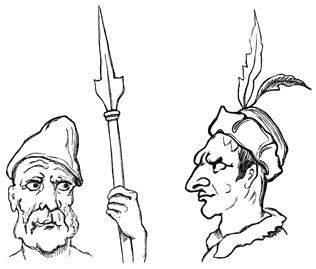
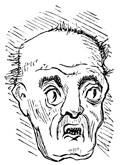
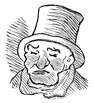
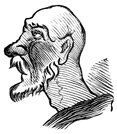
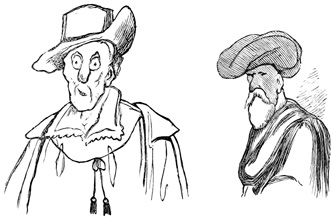
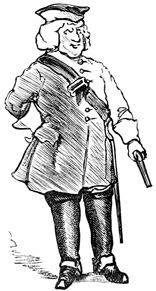
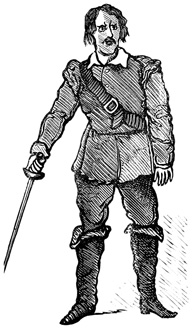
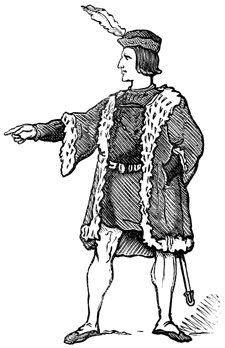
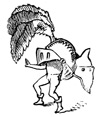
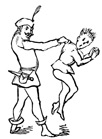
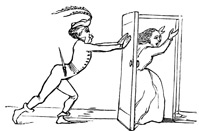
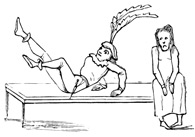
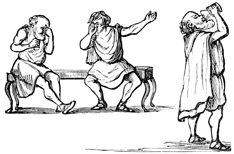
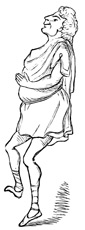
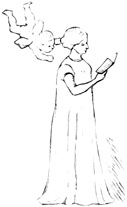
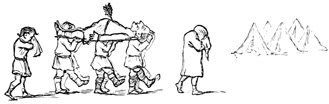
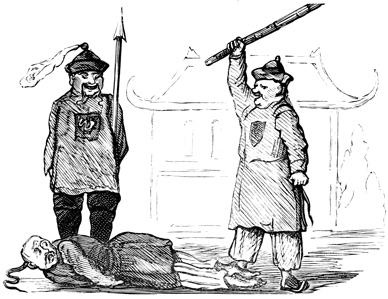
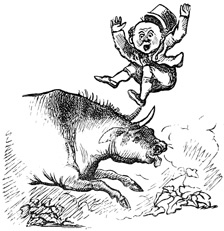
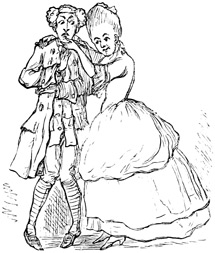
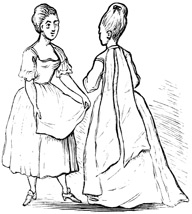
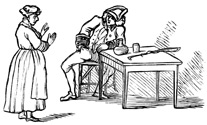
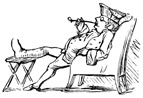
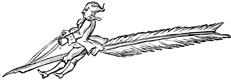
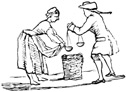
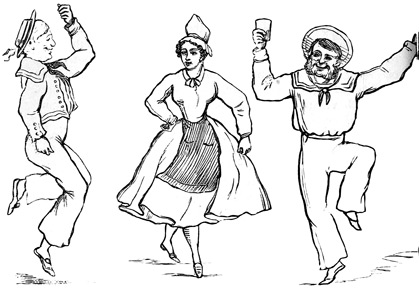
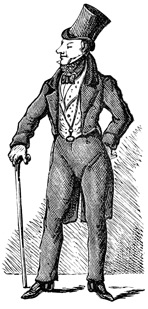
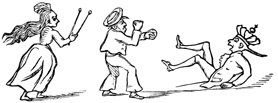
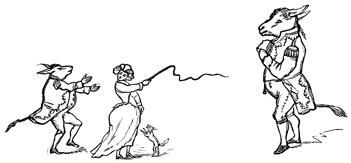
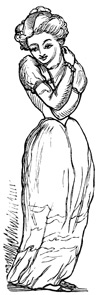
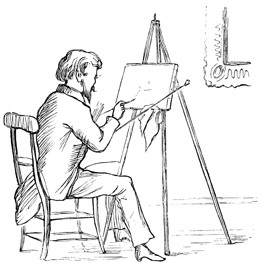
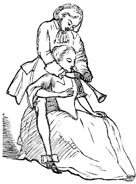
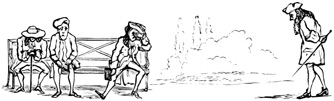
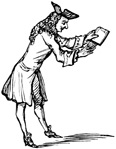
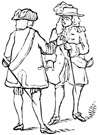
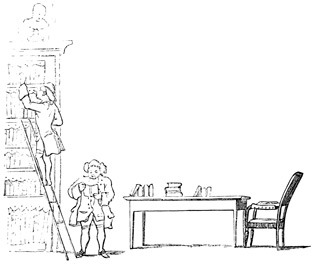
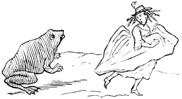
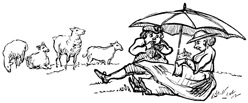
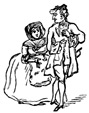
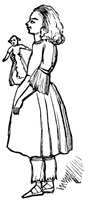
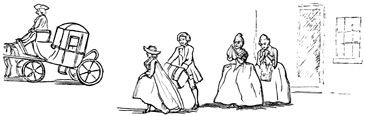
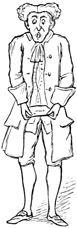
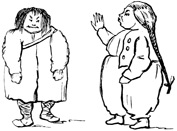
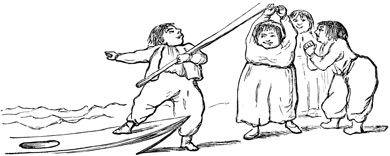
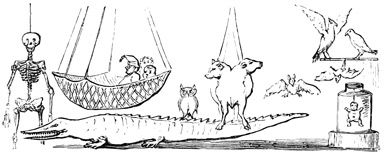
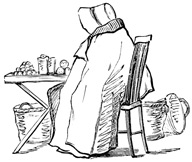
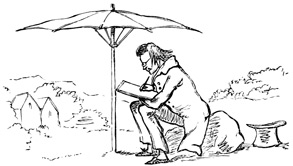
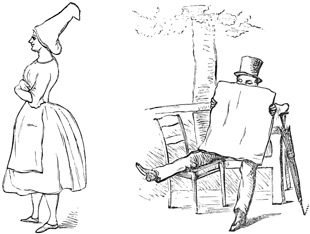
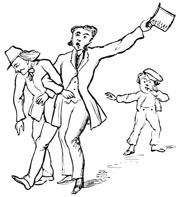
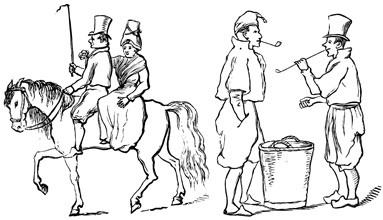
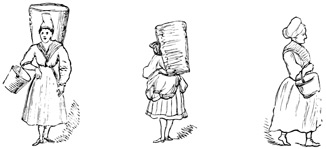
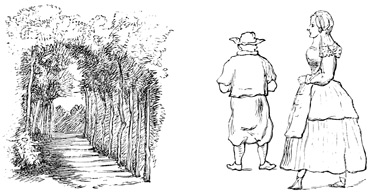
Early Essayists whose Writings have furnished Thackeray with the Accessories
of Portions of his Novels and Lectures—Works from the Novelist's
Library, elucidating his Course of Reading for the Preparation of his 'Lectures'—'Henry
Esmond,' 'The Virginians,' &c.—Characteristic Passages
from the Lucubrations of the Essayists of the Augustan Era illustrated with
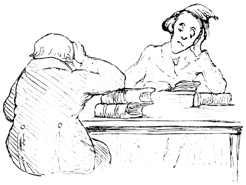
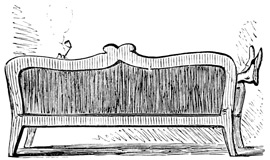
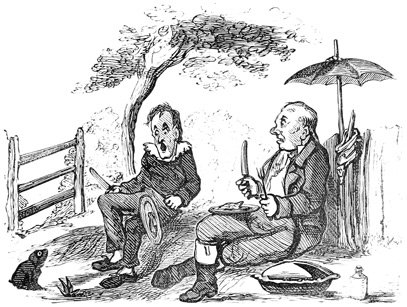
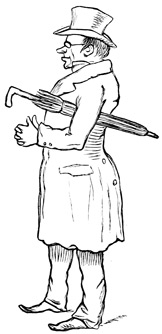
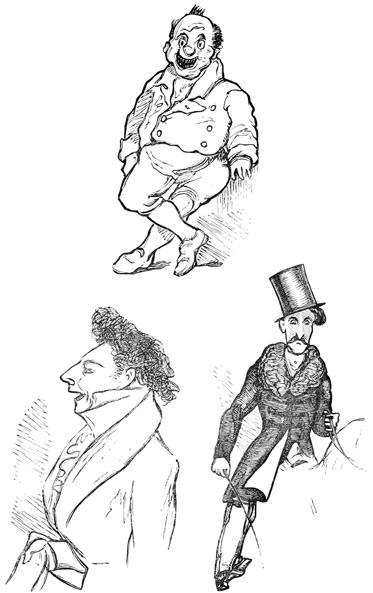
original marginal Sketches, suggested by the Text, by Thackeray's Hand—The
'Tatler'—Its History and Influence—Reforms introduced by the purer
Style of the Essayists—The Literature of Queen Anne's Reign—Thackeray's
Love for the Writings of that Period—His Gift of reproducing their masterly
and simple Style of Composition; their Irony, and playful Humour—Extracts
from notable Essays; illustrated with original Pencillings from the
Series of the 'Tatler,' 1709.
The commencement of the eighteenth century
has been christened the Augustan Era
of English literature, from the brilliant assembly
of writers, pre-eminent for their
wit, genius, and cultivation, who then enriched
our literature with a perfectly original
school of humour.
The essayists, to whose accomplished
parts we are indebted for the 'Tatlers,'
'Spectators,' 'Guardians,' 'Humorists,'
'Worlds,' 'Connoisseurs,' 'Mirrors,'
'Adventurers,' 'Observers,' 'Loungers,'
'Lookers-on,' 'Ramblers,' and kindred papers, which picture the
many-coloured scenes of our society and literature, have conferred
a lasting benefit upon posterity by the sterling merit of their writings.
It has been justly said that these essays, by their intrinsic worth,
have outlived many revolutions of taste, and have attained unrivalled
popularity and classic fame, while multitudes of their contemporaries,
successors, and imitators have perished with the accidents
or caprices of fashion.
The general purpose of the essayists as laid down by Steele, who
may be considered foremost among the originators of the familiar
school of writing, 'was to expose the false arts of life, to pull off the
disguises of cunning, vanity, and affectation, and to recommend a
general simplicity in our dress, our discourse, and our behaviour.'
Bickerstaff's lucubrations were directed to good-humoured exposures
of those freaks and vagaries of life, 'too trivial for the
chastisement of the law and too fantastical for the cognisance of the
pulpit,' of those failings, according to Addison's summary of their
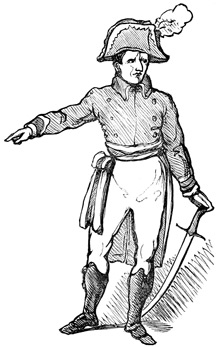
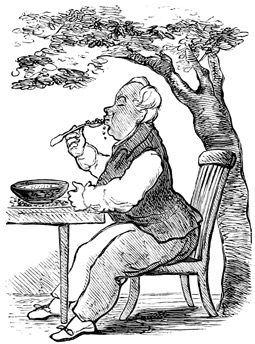
purpose in the 'Spectator' (No. 34), thus harmonised by Pope:—
Safe from the bar, the pulpit, and the throne,
Yet touched and shamed by Ridicule alone.
The graceful philosophers, polished wits and playful satirists exerted
their abilities to supply 'those temporary demands and casual exigencies,
overlooked by graver writers and more bulky theorists,' to
bring, in the language of Addison, 'philosophy out of closets and
libraries, schools and colleges, to dwell in clubs and assemblies, at
tea-tables and in coffee-houses.'
'The method of conveying cheap and easy knowledge began
among us in the civil wars, when it was much the interest of either
party to raise and fix the prejudices of the people.' It was in this
spirit that the oft-mentioned Mercuries, 'Mercurius Aulicus,'
'Mercurius Rusticus,' and 'Mercurius Civicus' first appeared.
A hint of the original plan of the 'Tatler' may in some degree
be traced to Defoe's 'Review; consisting of a Scandal Club, on
Questions of Theology, Morals, Politics, Trade, Language, Poetry,
&c.,' published about the year 1703.
'The "Tatler,"' writes Dr. Chalmers, 'like many other ancient
superstructures, rose from small beginnings. It does not appear
that the author (Steele) foresaw to what perfection this method of
writing could be brought. By dividing each paper into compartments,
he appears to have consulted the ease with which an
author may say a little upon many subjects, who has neither
leisure nor inclination to enter deeply on a single topic. This,
however, did not proceed either from distrust in his abilities, or in
the favour of the public; for he at once addressed them with confidence
and familiarity; but it is probable that he did not foresee
to what perfection the continued practice of writing will frequently
lead a man whose natural endowments are wit and eloquence,
superadded to a knowledge of the world, and a habit of observation.'
The first number of the 'Tatler' bore the motto,
Quicquid agunt homines—
nostri est farrago libelli.—Juv. Sat. I. 85, 86.
Whate'er men do, or say, or think, or dream,
Our motley paper seizes for its theme.
The original sheet appeared on Tuesday, April 12, 1709,[13]
and
the days of its publication were fixed to be Tuesdays, Thursdays,
and Saturdays. 'In the selection of a name for the work, Steele
affords an early instance of delicate raillery, by informing us that
the name "Tatler" was invented in honour of the fair sex; and
that in such a character he might indulge with impunity the
desultory plan he first laid down, with a becoming imitation of the
tattle and gossip of the day.' The first four numbers were given
gratis, the price was then fixed at a penny, which was afterwards
doubled.
Steele, whose humour was most happily adapted to his task,
assumed as censor of manners the alias of Isaac Bickerstaff.
'Throughout the whole work,' writes Beattie, 'the conjuror, the
politician, the man of humour, the critic; the seriousness of the
moralist, and the mock dignity of the astrologer; the vivacities
and infirmities peculiar to old age, are all so blended and contrasted
in the censor of Great Britain as to form a character equally complex
and natural, equally laughable and respectable,' and as the
editor declares, in his proper person, 'the attacks upon prevailing
and fashionable vices had been carried forward by Mr. Bickerstaff
with a freedom of spirit that would have lost its attraction and
efficacy, had it been pretended to by Mr. Steele.'
A scarce pamphlet, attributed to Gay, draws attention to the
high moral and philosophic purpose which was entertained originally.
'There was this difference between Steele and all the rest
of the polite and gallant authors of the time: the latter endeavoured
to please the age by falling in with them, and encouraging them in
their fashionable vices and false notions of things. It would have
been a jest some time since for a man to have asserted that anything
witty could have been said in praise of a married state; or
that devotion and virtue were any way necessary to the character
of a fine gentleman. Bickerstaff ventured to tell the town that
they were a parcel of fops, fools, and vain coquettes; but in such
a manner as even pleased them, and made them more than half
inclined to believe that he spoke truth.'
The humorists of the Augustan era were, as the world knows,
peculiar objects of regard to the great writer of 'Roundabout
Essays' in the age of Queen Victoria. Novels, lectures, and
reviews alike prove the industry and affection with which Thackeray
conducted his researches amidst the veins of singular richness and
congenial material opened to him by the lives and writings of
these famous essayists, in such profusion that selection became a
point of real art.
It is not difficult to trace the results of Thackeray's reading
among his favourite writers, or to watch its influence on his own
compositions. Nor did his regard for these sources of inspiration
pass the bounds of reasonable admiration; he argues convincingly
of the authentic importance of his chosen authorities.
From his minute and intelligent studies of the works of these
genial humorists Thackeray acquired a remarkable facility of
thinking, spontaneously acknowledged by all his contemporaries,
with the felicitous aptitude of the originals, and learned to express
his conceptions in language simple, lucid, and sparkling as the
outpourings from those pure fonts for which his eagerness may be
said to have been unquenched to the end of his career.
That artist-like local colouring which gives such scholarly value
to 'Henry Esmond,' to the 'Virginians,' to the 'Humorists of
the Eighteenth Century,' and which was no less manifest in the
work which engaged his thoughts when Death lightly touched the
novelist's hand, furnishes the evidence of Thackeray's familiarity
with, and command of, the quaintest, wittiest, wisest, and pleasantest
writings in our language.
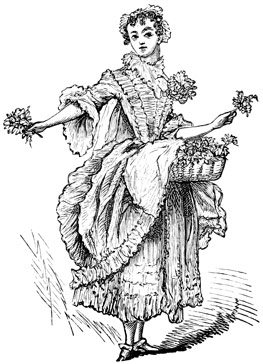
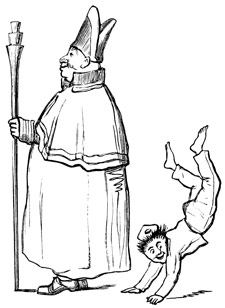
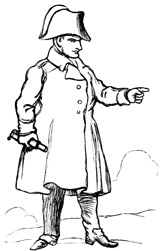
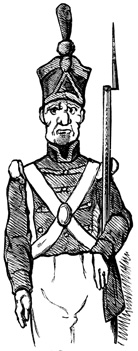
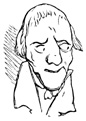
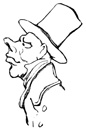
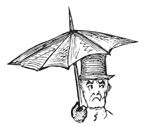
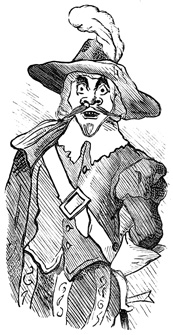
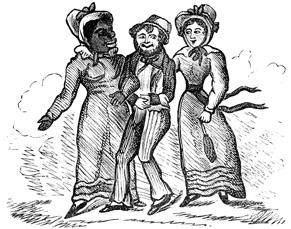
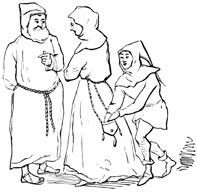
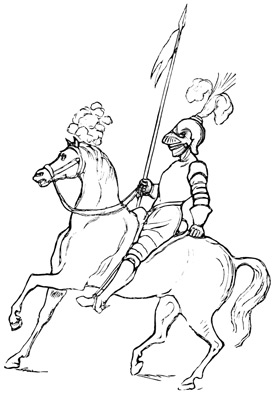
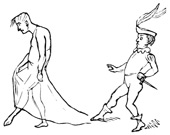
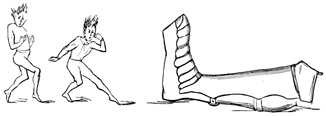
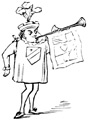
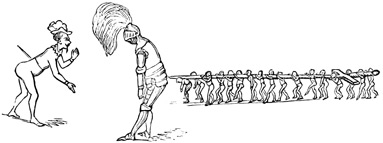
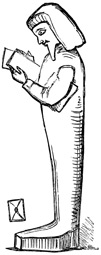
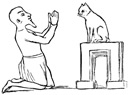
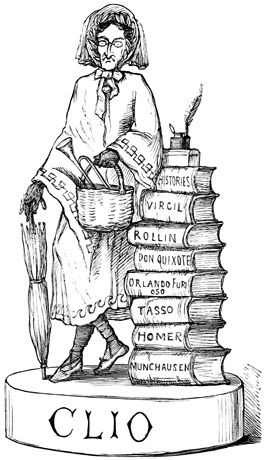
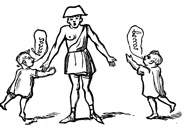
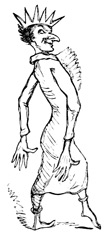
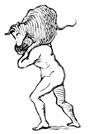
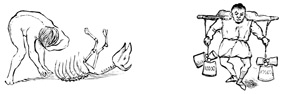
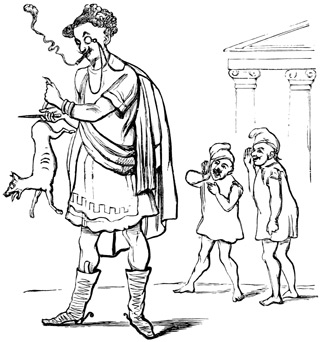
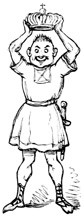
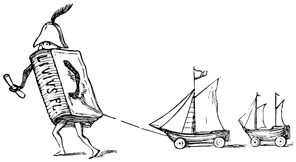
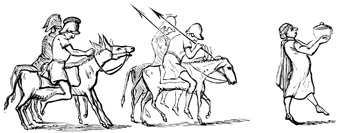
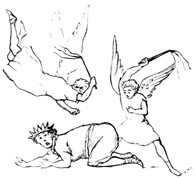
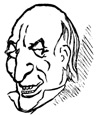
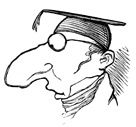
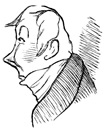
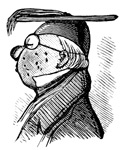
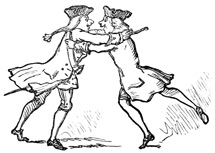
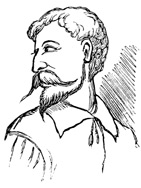
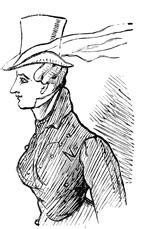
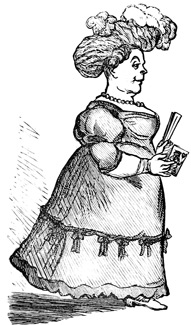
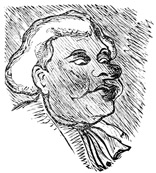
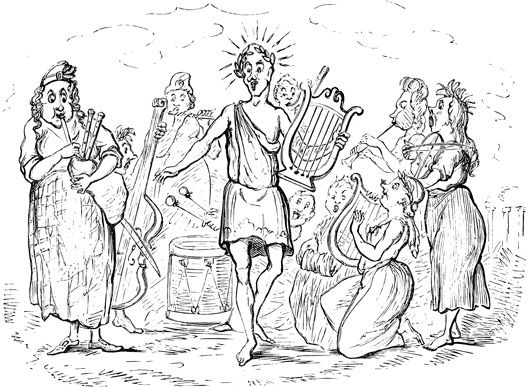
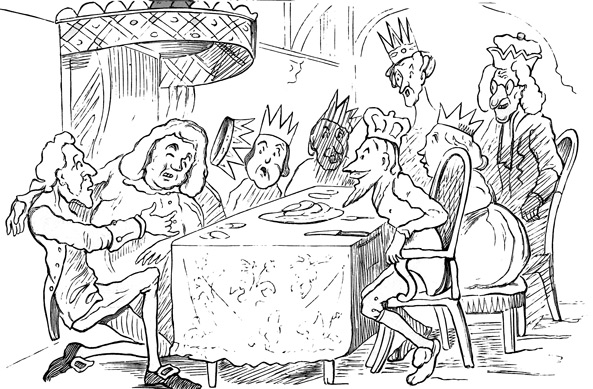
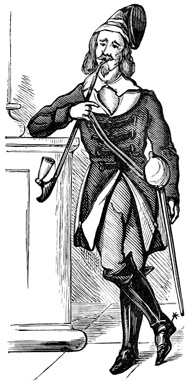
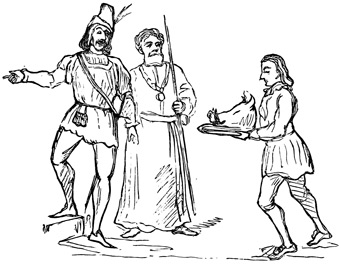
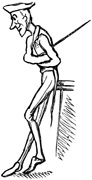
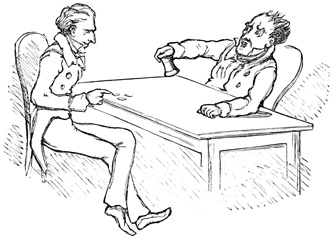
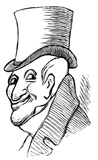
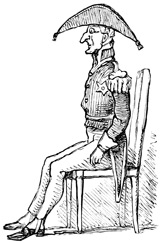
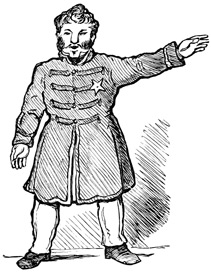
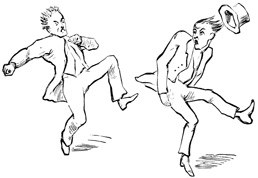
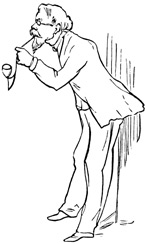
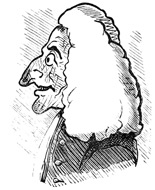
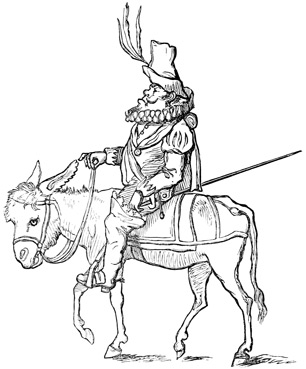
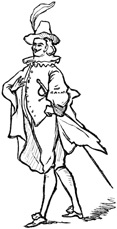
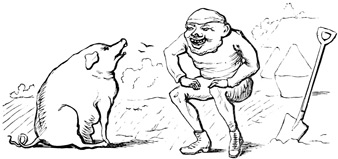
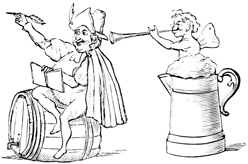
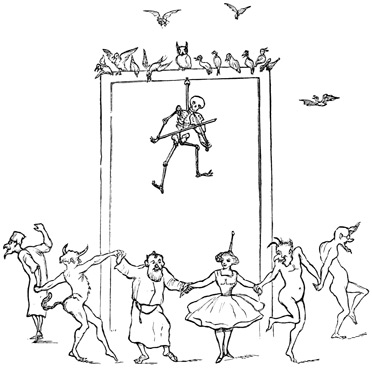
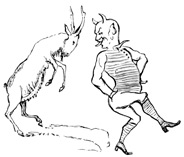
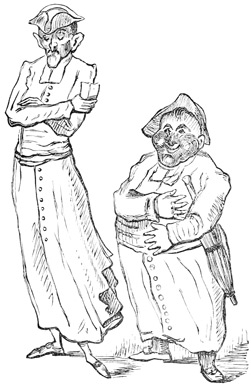
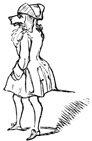
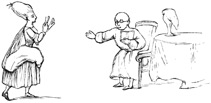
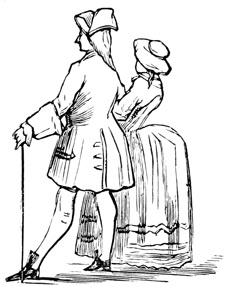
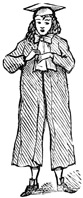
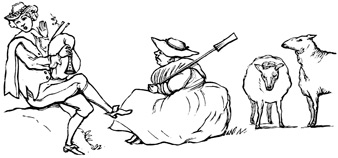
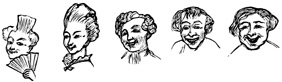
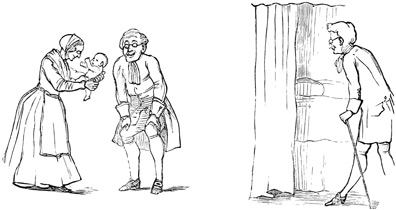
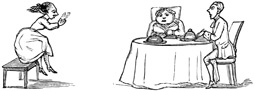
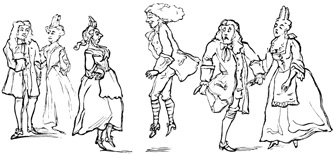
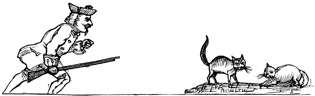
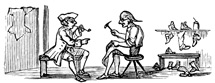
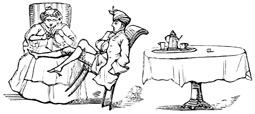
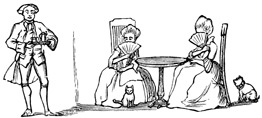
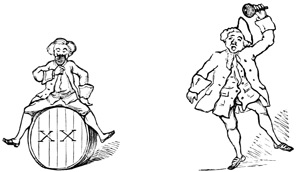
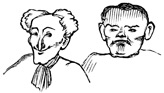
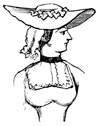
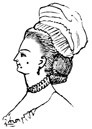
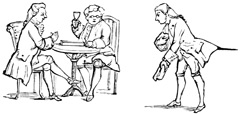
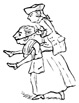
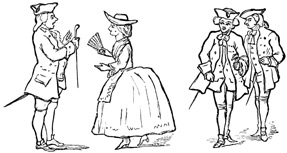
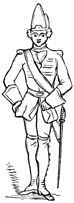
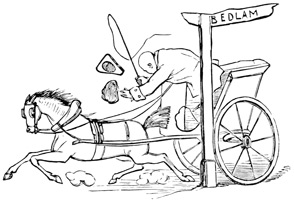
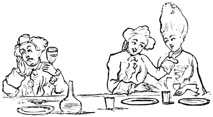
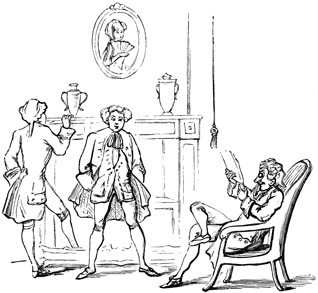
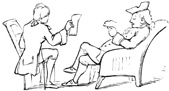
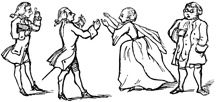
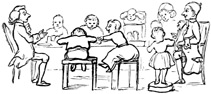
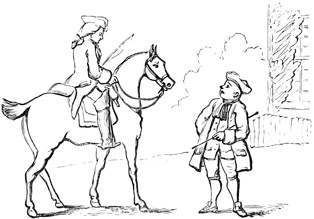
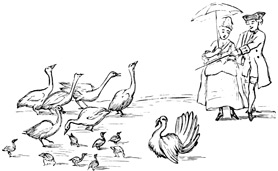
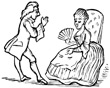
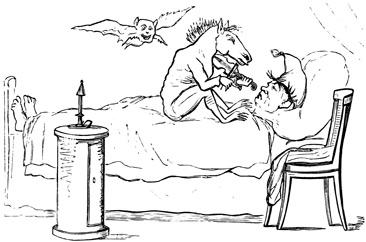
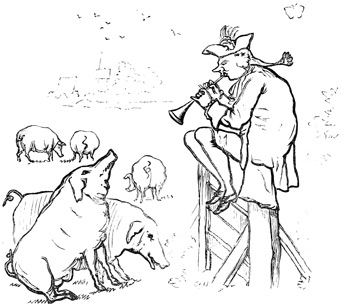
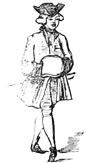
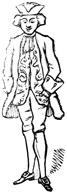
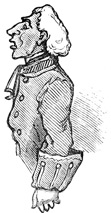
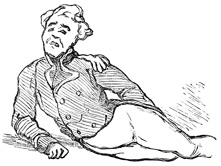
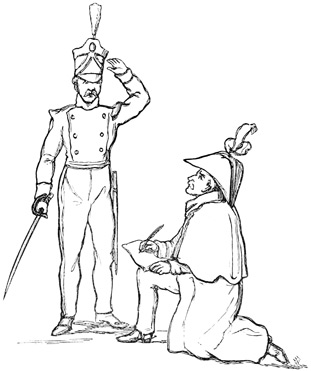
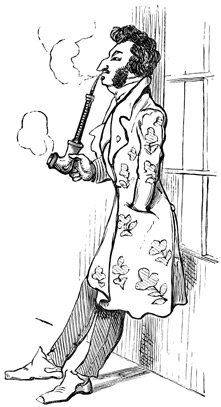
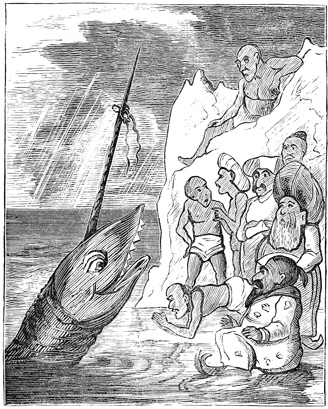
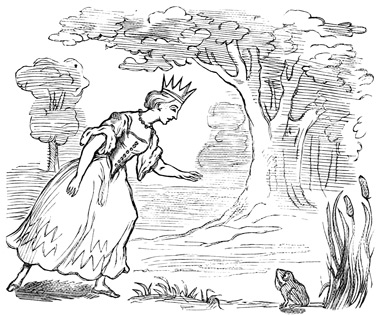
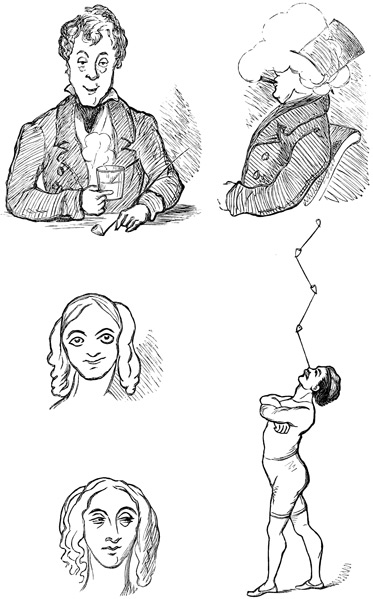
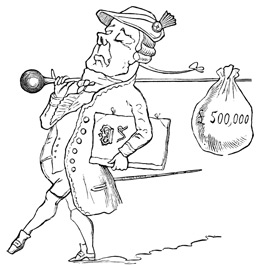
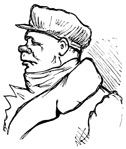
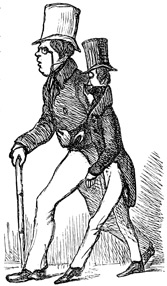
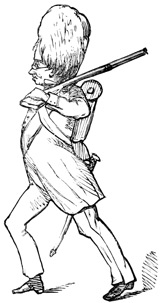
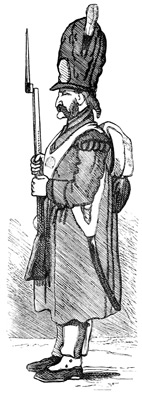
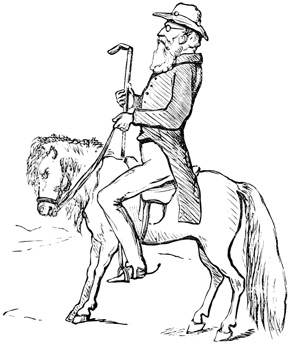
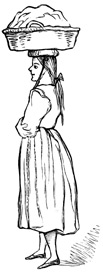
It will be felt by readers who realise Thackeray in his familiar
association with the kindred early humorists, that the merry
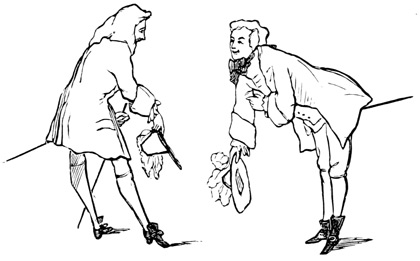
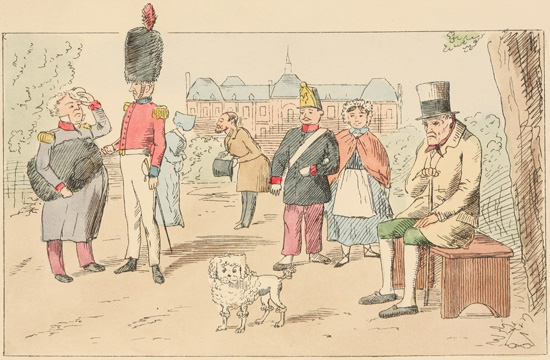
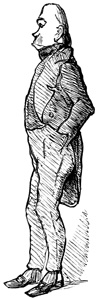
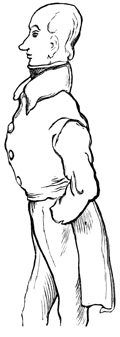
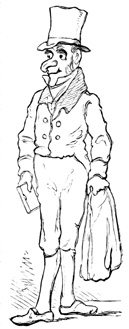
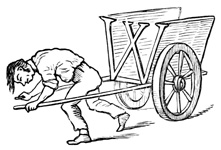
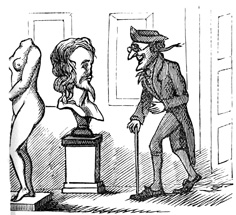
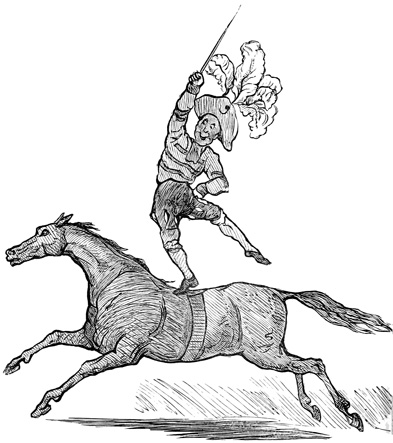
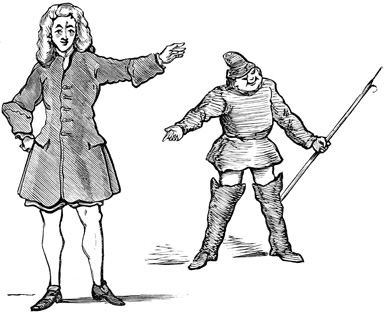
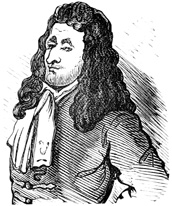
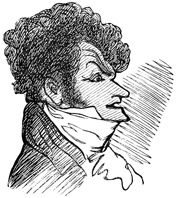
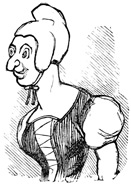
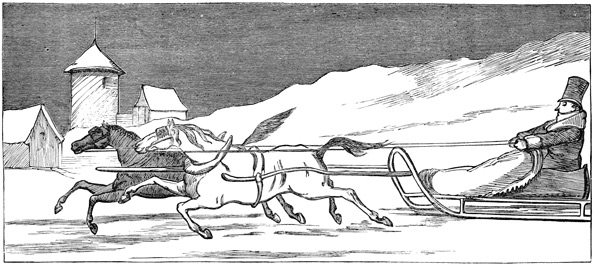
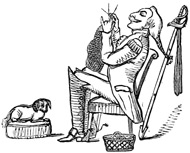
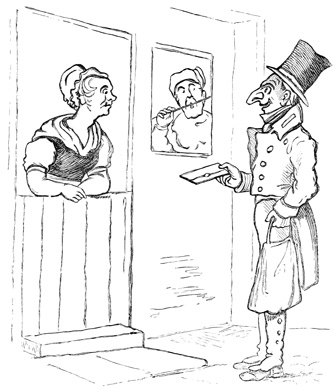
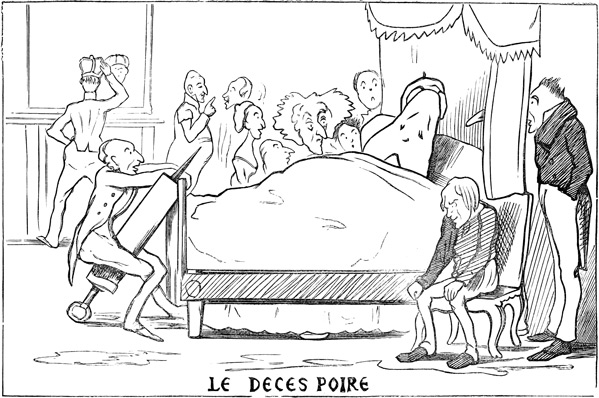
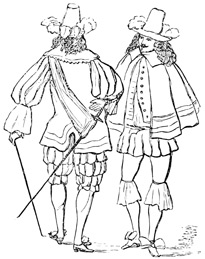
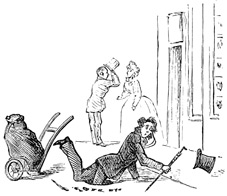
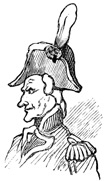
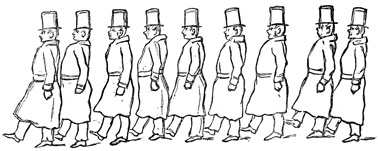
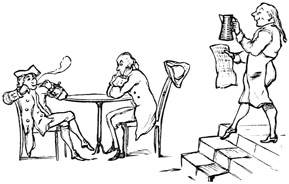
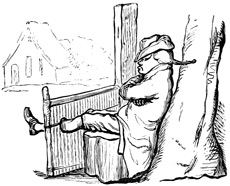
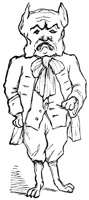
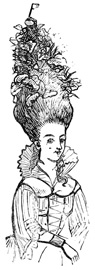
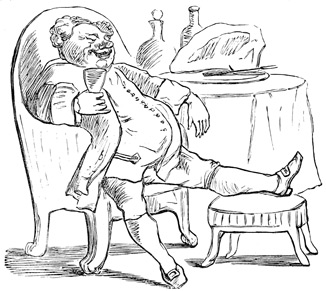
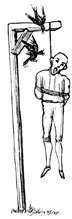
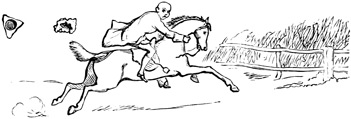
passages his pencil has italicised by droll marginal sketches are,
with all their suggestive slightness, in no degree unworthy of the
conceits to which they give a new interest; while in some cases,
with playful whimsicality, they present a reading entirely novel.
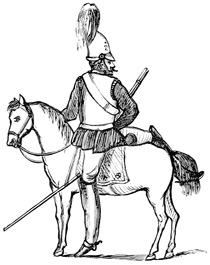
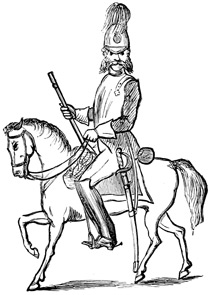
The fidelity of costume and appointments, even in this miniature
state, confirms the diligence and thought with which the author of
'Henry Esmond' pursued every detail which illustrated his
cherished period, and which might serve as a basis for its consistent
reconstruction, to carry his reader far back up the stream of time.
The necessity of compressing within the limits of this volume
our selections from the comparatively exhaustless field of the
humorous essayists, necessarily renders the paragraphs elucidated
by Thackeray's quaint etchings somewhat fragmentary and abrupt,
while the miscellaneous nature of the topics thus indiscriminately
touched on may be best set forth according to the advertisement
with which Swift ushered in his memorable 'Number One':
'All accounts of gallantry, pleasure, and entertainment shall
be under the article of White's Chocolate-house;[14]
poetry, under
that of Will's Coffee-house;[15]
learning, under the title of Grecian;[16]
foreign and domestic news, you will have from Saint James's
Coffee-house; and what else I have to offer on any other subject
shall be dated from my own apartment.[17]
'I once more desire my reader to consider, that as I cannot
keep an ingenious man to go daily to Will's under twopence
each day, merely for his charges; to White's, under sixpence;
nor to the Grecian, without allowing him some plain Spanish, to
be as able as others at the learned table; and that a good
observer cannot speak with even Kidney (the waiter) at St.
James's without clean linen; I say, these considerations will, I
hope, make all persons willing to comply with my humble request
(when my gratis stock is exhausted) of a penny apiece; especially
since they are sure of some proper amusement, and that it is
impossible for me to want means to entertain them, having,
besides the force of my own parts, the power of divination, and
that I can, by casting a figure, tell you all that may happen before
it comes to pass.'
No. 5. The 'Tatler.'—April 21, 1709.
Who names that lost thing love without a tear,
Since so debauch'd by ill-bred customs here?
To an exact perfection they have brought
The action love, the passion is forgot.
'This was long ago a witty author's lamentation, but the evil
still continues; and if a man of any delicacy were to attend the
discourses of the young fellows of this age, he would believe there
were none but the fallen to make the objects of passion. So true
it is what the author of the above verses said, a little before his
death, of the modern pretenders to gallantry: "They set up for
wits in this age, by saying, when they are sober, what they of the
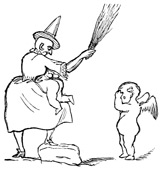
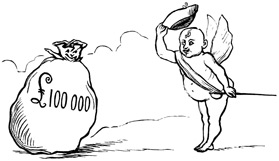
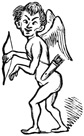
last spoke only when they were drunk." But Cupid is not only
blind at present, but dead drunk; and he has lost all his faculties;
else how should Celia be so long a maid, with that agreeable behaviour?
Corinna, with that sprightly wit? Serbia, with that
heavenly voice? and Sacharissa, with all those excellences in one
person, frequent the park, the play, and murder the poor Tits that
drag her to public places, and not a man turn pale at her appearance?
But such is the fallen state of love, that if it were not for
honest Cynthio, who is true to the cause, we should hardly have
a pattern left of the ancient worthies in that way; and indeed he
has but very little encouragement to persevere. Though Cynthio
has wit, good sense, fortune, and his very being depends upon her,
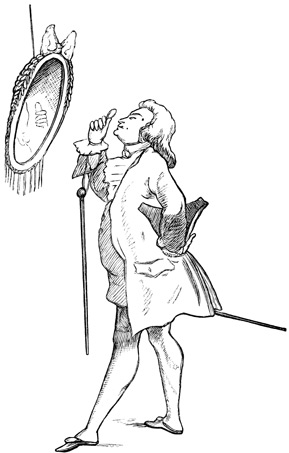
the termagant for whom he sighs is in love with a fellow who stares
in the glass all the time he is with her, and lets her plainly see she
may possibly be his rival, but never his mistress. Yet Cynthio
pleases himself with a vain imagination that, with the language of
his eyes, now he has found out who she is, he shall conquer her,
though her eyes are intent upon one who looks from her, which is
ordinary with the sex.
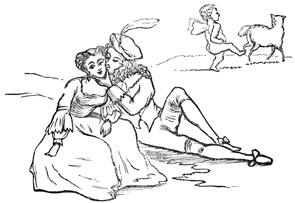
'It is certainly a mistake in the ancients to draw the little gentleman
Love as a blind boy, for his real character is a little thief
that squints; for ask Mrs. Meddle, who is a confidante or spy
upon all the passions in town, and she will tell you that the whole
is a game of cross purposes. The lover is generally pursuing one
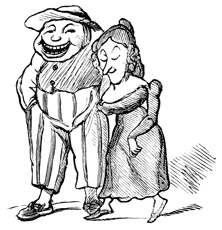
who is in pursuit of another, and running from
one that desires to meet him. Nay, the nature
of this passion is so justly represented in a
squinting little thief (who is always in a double
action), that do but observe Clarissa next time
you see her, and you will find, when her eyes
have made their soft tour round the company
she makes no stay on him they say she is to
marry, but rests two seconds of a minute on
Wildair, who neither looks nor thinks on her or
any woman else. However, Cynthio had a bow from her the
other day, upon which he is very much come to himself; and I
heard him send his man of an errand yesterday, without any
manner of hesitation; a quarter of an hour after which he
reckoned twenty, remembered he was to sup with a friend, and
went exactly to his appointment. I sent to know how he did this
morning, and I find he hath not forgotten that he spoke to me
yesterday.'
No. 9. The 'Tatler.'—April 30, 1709.
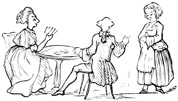
Pastorella, a lively young lady of eighteen, was under the
charge of an aunt, who was anxious to keep her ward in safety, if
possible, from herself and her admirers. 'At the same time the
good lady knew, by long experience, that a gay inclination curbed
too rashly would but run to the greater excesses; she therefore
made use of an ingenious expedient to avoid the anguish of an
admonition. You are to know, then, that Miss, with all her
flirting and ogling, had also a strong curiosity in her, and was the
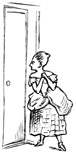
greatest eaves-dropper breathing. Parisatis (for so her prudent
aunt is called) observed this humour, and retires one day to her
closet, into which she knew Pastorella would peep and listen to
know how she was employed. It happened accordingly; and the
young lady saw her good governante on her knees, and, after a
mental behaviour, break into these words: "As for the dear
child committed to my care, let her sobriety of carriage and
severity of behaviour be such as may make that noble lord, who is
taken with her beauty, turn his designs to such as
are honourable." Here Parisatis heard her niece
nestle closer to the key-hole. She then goes on:
"Make her the joyful mother of a numerous and
wealthy offspring; and let her carriage be such as
may make this noble youth expect the blessings of
a happy marriage, from the singularity of her life, in
this loose and censorious age." Miss, having heard
enough, sneaks off for fear of discovery, and immediately
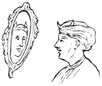
at her glass, alters the setting of her head;
then pulls up her tucker, and forms herself into the
exact manner of Lindamira; in a word, becomes a sincere convert
to everything that is commendable in a fine young lady; and two
or three such matches as her aunt feigned in her devotions are at
this day in her choice. This is the history and original cause of
Pastorella's conversion from coquetry.
'I scarce remember a greater instance of forbearance in the
usual peevish way with which the aged treat the young than this,
except that of our famous Noy, whose good nature went so far as
to make him put off his admonitions to his son even until after his
death; and did not give him his thoughts of him until he came to
read that memorable passage in his will: "All the rest of my estate,"
says he, "I leave to my son Edward, to be squandered as he shall
think fit; I leave it him for that purpose, and hope no better from
him." A generous disdain, and reflection how little he deserved
from so excellent a father, reformed the young man, and made
Edward, from an arrant rake, become a fine gentleman.'
No. 23. The 'Tatler.'—June 2, 1709.
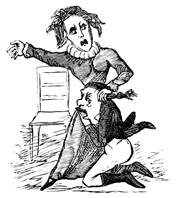
The 'Tatler' relates the instance of a lady who had governed
one husband by falling into fits when he opposed her will. Death
released this gentleman, and the lady consoled herself quickly
with a very agreeable successor, whom she determined to manage
by the same method. 'This man knew her little arts, and resolved
to break through all tenderness, and be absolute master as soon as
occasion offered. One day it happened that a discourse arose
about furniture; he was very glad of the occasion, and fell into an
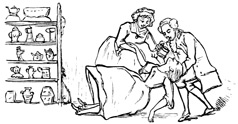
invective against china, protesting that he would never let five
pounds more of his money be laid out that way as long as he
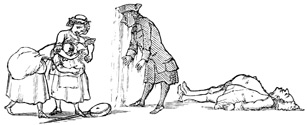
breathed. She immediately fainted—he starts up, as amazed, and
calls for help—the maids run up to the closet. He chafes her
face, bends her forward, and beats the palms of her hands; her
convulsions increase, and down she tumbles on the floor, where
she lies quite dead, in spite of what the whole family, from the
nursery to the kitchen, could do for her relief. The kind man
doubles his care, helps the servants to throw water into her face
by full quarts; and when the sinking part of the fit came again,
"Well, my dear," says he, "I applaud your action; but none of
your artifices; you are quite in other hands than those you passed
these pretty passions upon. I must take leave of you until you
are more sincere with me: farewell for ever." He was scarce at
the stair-head when she followed, and thanked him for her cure,
which was so absolute that she gave me this relation herself, to be
communicated for the benefit of all the voluntary invalids of her
sex.'
No. 24. The 'Tatler.'—June 4, 1709.
The 'Tatler' is discoursing of 'pretty fellows,' and 'very
pretty fellows,' and enlarging on the qualifications essential to fit
them for the characters.
'Give me leave, then, to mention three, whom I do not doubt
but we shall see make considerable figures; and these are such as
for their Bacchanalian performances must be admitted into this
order. They are three brothers, lately landed from Holland; as
yet, indeed, they have not made their public entry, but lodge and
converse at Wapping. They have merited already, on the waterside,
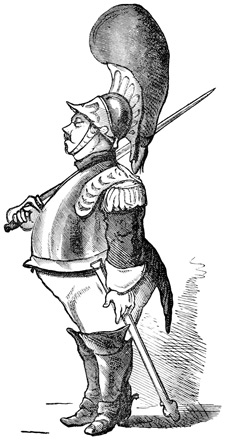
particular titles: the first is called Hogshead; the second,
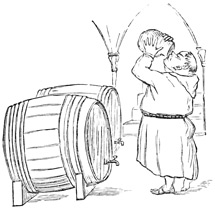
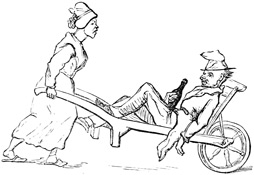
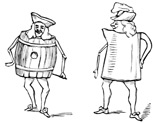
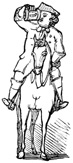
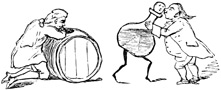
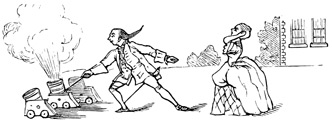
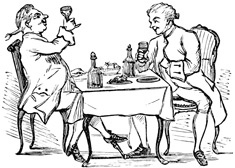
Culverin; and the third, Musquet. This fraternity is preparing
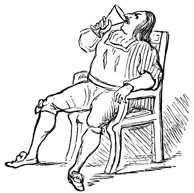
for our end of the town, by their
ability in the exercises of Bacchus,
and measure their time and merit
by liquid weight and power of
drinking. Hogshead is a prettier
fellow than Culverin, by two
quarts; and Culverin than Musquet,
by a full pint. It is to be
feared Hogshead is so often too
full, and Culverin overloaded, that Musquet will be the only lasting
very pretty fellow of the three.'
No. 28. The 'Tatler.'—June 14, 1709.
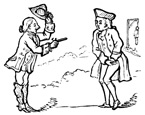
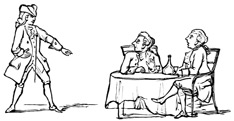
'To the "Tatler."—Sir,—I desire the favour of you to decide
this question, whether calling a gentleman a smart fellow is an
affront or not? A youth, entering a certain coffee-house, with his
cane tied to his button, wearing red-heeled shoes, I thought of
your description, and could not forbear telling a friend of mine
next to me, "There enters a smart fellow." The gentleman
hearing it, had immediately a mind to pick a quarrel with me, and
desired satisfaction; at which I was more puzzled than at the
other, remembering what mention your familiar makes of those
that had lost their lives on such occasions. The thing is referred
to your judgment; and I expect you to be my second, since you
have been the cause of our quarrel.—I am, Sir, &c.'
'Now what possible insinuation can there be, that it is a cause
of quarrel for a man to say he allows a gentleman really to be
what his tailor, his hosier, and his milliner have conspired to make
him? I confess, if this person who appeals to me had said he was
"not a smart fellow," there had been cause for resentment.'
No. 34. The 'Tatler.'—June 28, 1709.
Mr. Bickerstaff has been working certain wonderful effects by
prescribing his circumspection-water, which has cured Mrs. Spy of
rolling her eyes about in public places. Lady Petulant had made
use of it to cure her husband's jealousy, and Lady Gad has cured
a whole neighbourhood of detraction.
'The fame of these things,' continues the Censor-General,
'added to my being an old fellow, makes me extremely acceptable
to the fair sex. You would hardly believe me when I tell you
there is not a man in town so much their delight as myself. They
make no more of visiting me than going to Madam Depingle's;
there were two of them, namely, Dainia and Clidamira (I assure
you women of distinction), who came to see me this morning, in
their way to prayers; and being in a very diverting humour (as
innocence always makes people cheerful), they would needs have
me, according to the distinction of pretty and very pretty fellows,
inform them if I thought either of them had a title to the very
pretty among those of their own sex; and if I did, which was the
most deserving of the two?
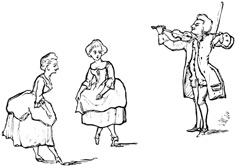
'To put them to the trial, "Look ye," said I, "I must not
rashly give my judgment in matters of this importance; pray let
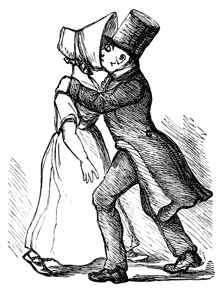
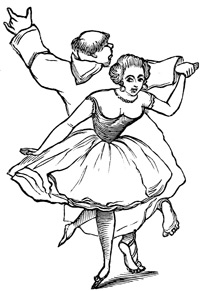
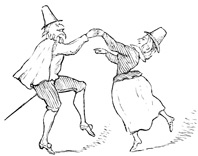
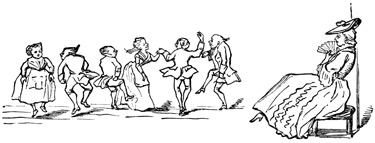
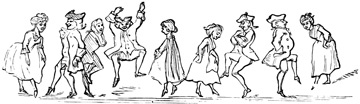
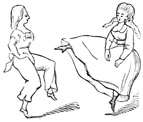
me see you dance; I play upon the kit." They immediately fell
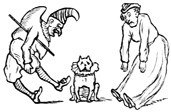
back to the lower end of the room (you may be sure they curtsied
low enough to me), and began. Never were two in the world so
equally matched, and both scholars to my namesake Isaac.[18]
Never was man in so dangerous a condition as myself, when they
began to expand their charms. "Oh! ladies, ladies," cried I; "not
half that air; you will fire the house!" Both smiled, for, by-the-bye,
there is no carrying a metaphor too far when a lady's charms are
spoken of. Somebody, I think, has called a fine woman dancing
"a brandished torch of beauty." These rivals move with such an
agreeable freedom that you would believe their gesture was the
necessary effect of the music, and not the product of skill and
practice. Now Clidamira came on with a crowd of graces, and
demanded my judgment with so sweet an air—and she had no
sooner carried it, but Dainia made her utterly forgot, by a gentle
sinking and a rigadoon step. The contest held a full half hour;
and, I protest, I saw no manner of difference in their perfections
until they came up together and expected sentence. "Look ye,
ladies," said I, "I see no difference in the least in your performances;
but you, Clidamira, seem to be so well satisfied that I
should determine for you, that I must give it to Dainia, who
stands with so much diffidence and fear, after showing an equal
merit to what she pretends to. Therefore, Clidamira, you are a
pretty, but, Dainia, you are a very pretty lady; for," said I,
"beauty loses its force if not accompanied with modesty. She
that hath an humble opinion of herself, will have everybody's
applause, because she does not expect it; while the vain creature
loses approbation through too great a sense of deserving it."'
No. 36. The 'Tatler.'—July 2, 1709.
The 'Tatler' inserts a letter on termagant wives and sporting
tastes:—
'Epsom, June 28.
'It is now almost three weeks since what you writ about happened
in this place. The quarrel between my friends did not run
so high as I find your accounts have made it. You are to understand
that the persons concerned in this scene were Lady Autumn
and Lady Springly. Autumn is a person of good breeding,
formality, and a singular way practised in the last age; and Lady
Springly, a modern impertinent of our sex, who affects as improper
a familiarity as the other does distance. These heroines have
married two brothers, both knights. Springly is the spouse of
the elder, who is a baronet, and Autumn, being a rich widow, has
taken the younger, and her purse endowed him with an equal fortune,
and knighthood of the same order. This jumble of titles,
you need not doubt, has been an aching torment to Autumn, who
took place of the other on no pretence but her carelessness and
disregard of distinction. The secret occasion of envy broiled
long in the breast of Autumn; but no opportunity of contention
on that subject happening, kept all things quiet until the accident
of which you demand an account.
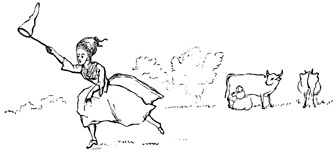
'It was given out among all the gay people of this place, that
on the ninth instant several damsels, swift of foot, were to run for
a suit of head-cloaths at the Old Wells. Lady Autumn, on this
occasion, invited Springly to go with her in her coach to see the
race. When they came to the place, where the Governor of
Epsom and all his court of citizens were assembled, as well as a
crowd of people of all orders, a brisk young fellow addressed himself
to the younger of the ladies, viz. Springly, and offers her his
services to conduct her into the music-room. Springly accepts
the compliment, and is led triumphantly through a bowing crowd,
while Autumn is left among the rabble, and has much ado to
get back into her coach; but she did it at last, and as it is
usual to see, by the horses, my lady's present disposition, she
orders John to whip furiously home to her husband; where, when
she enters, down she sits, began to unpin her hood, and lament
her foolish fond heart to marry into a family where she was so
little regarded. Lady Springly, an hour or two after, returns
from the Wells, and finds the whole company together. Down
she sat, and a profound silence ensued. You know a premeditated
quarrel usually begins and works up with the words some
people. The silence was broken by Lady Autumn, who began to
say, "There are some people who fancy, that if some people"—Springly
immediately takes her up, "There are some people who
fancy, if other people"—Autumn repartees, "People may give
themselves airs; but other people, perhaps, who make less ado,
may be, perhaps, as agreeable as people who set themselves out
more." All the other people at the table sat mute, while these
two people, who were quarrelling, went on with the use of the
word people, instancing the very accidents between them, as if they
kept only in distant hints. Therefore, says Autumn, reddening,
"There are some people will go abroad in other people's coaches,
and leave those with whom they went to shift for themselves; and
if, perhaps, those people have married the younger brother, yet,
perhaps, he may be beholden to those people for what he is."
Springly smartly answers, "People may bring so much ill humour
into a family, as people may repent their receiving their money,"
and goes on—"Everybody is not considerable enough to give her
uneasiness."
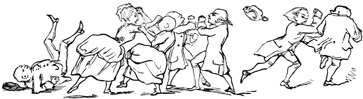
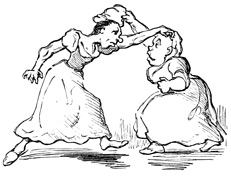
'Upon this Autumn comes up to her, and desired her to kiss
her, and never to see her again; which her sister refusing, my
lady gave her a box on the ear. Springly returns, "Ay, ay," said
she, "I knew well enough you meant me by your some people;"
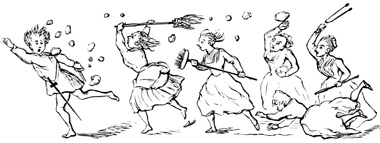
and gives her another on the other side. To it they went, with
most masculine fury; each husband ran in. The wives immediately
fell upon their husbands, and tore periwigs and cravats.
The company interposed; when (according to the slip-knot of
matrimony, which makes them return to one another when anyone
puts in between) the ladies and their husbands fell upon all
the rest of the company; and, having beat all their friends and
relations out of the house, came to themselves time enough to
know there was no bearing the jest of the place after these adventures,
and therefore marched off the next day. It is said, the
governor has sent several joints of mutton, and has proposed
divers dishes, very exquisitely dressed, to bring them down again.
From his address and knowledge in roast and boiled, all our
hopes of the return of this good company depend.
'I am, dear Jenny,
'Your ready friend and servant,
'Martha Tatler.'
No. 37. The 'Tatler.'—July 5, 1709.
The 'Tatler' is discoursing of country squires, with fox-hunting
tastes, and how in their rough music of the field they
outdo the best Italian singers for noise and volume. One of
these worthies is described on a visit in genteel society in town.
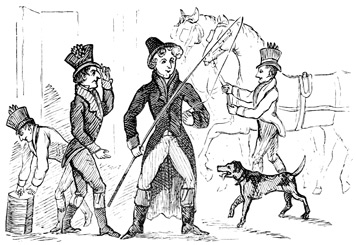
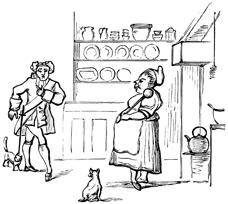
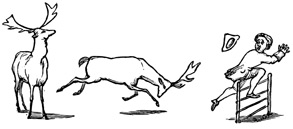
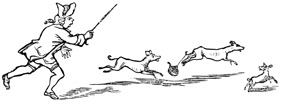
'Mr. Bellfrey being at a visit where I was, viz. at his cousin's
(Lady Dainty's), in Soho Square, was asked what entertainments
they had in the country. Now, Bellfrey is very ignorant, and
much a clown; but confident withal: in a word, he struck up a
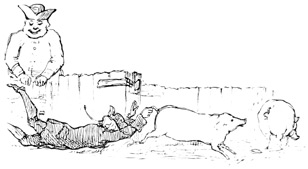
fox-chase; Lady Dainty's dog, Mr. Sippet, as she calls him,
started, jumped out of his lady's lap, and fell a barking. Bellfrey
went on, and called all the neighbouring parishes into the square.
Never was woman in such confusion as that delicate lady; but
there was no stopping her kinsman. A roomful of ladies fell into
the most violent laughter; my lady looked as if she was shrieking;
Mr. Sippet, in the middle of the room, breaking his heart
with barking, but all of us unheard. As soon as Bellfrey became
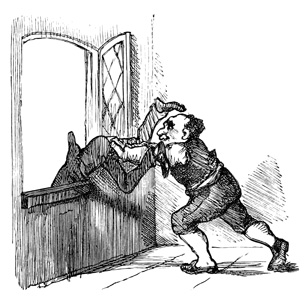
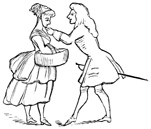
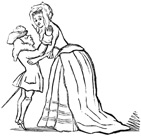
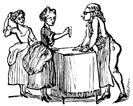
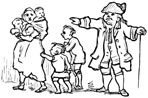
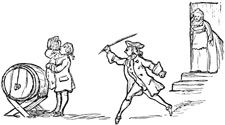
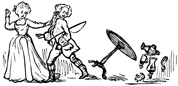
silent, up gets my lady, and takes
him by the arm, to lead him off.
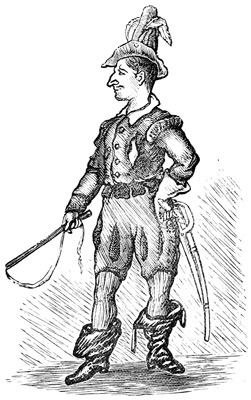
Bellfrey was in his boots. As she
was hurrying him away, his spurs
take hold of her petticoat; his
whip throws down a cabinet of
china: he cries, "What! are your
crocks rotten? are your petticoats ragged? A man cannot walk
in your house for trincums."'
No. 38. The 'Tatler.'—July 7, 1709.
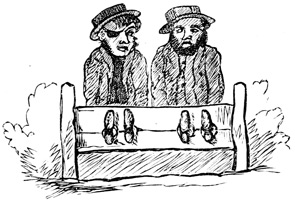
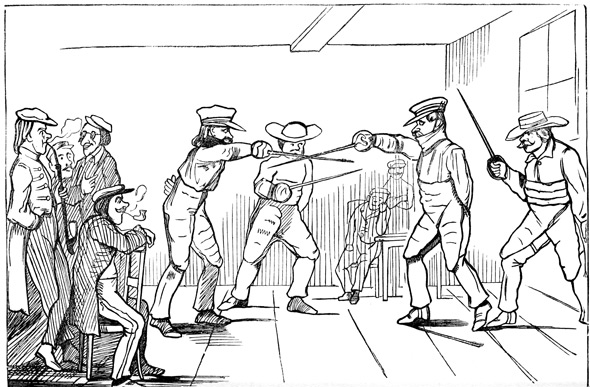
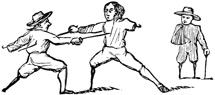
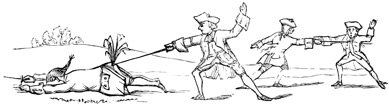
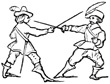
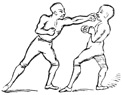
The practice of duelling had been early discountenanced by
the 'Tatler.' An altercation after a stock-broking transaction was
settled in the fashion thus reported in its pages:—
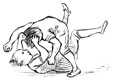
'... However, having sold the bear, and words arising about
the delivery, the most noble major, according to method, abused
the other with the titles of rogue, villain, bear-skin man, and the
like. Whereupon satisfaction was demanded and accepted, and
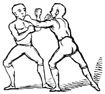
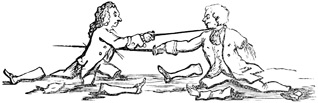
forth they marched to a most spacious room
in the sheriff's house, where, having due regard
to what you have lately published, yet
not willing to put up with affronts without
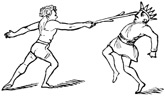
satisfaction, they stripped and in decent
manner fought full fairly with their wrathful
hands. The combat lasted a quarter of an
hour; in which time victory was often doubtful, until the major,
finding his adversary obstinate, unwilling to give him further chastisement,
with most shrill voice cried out, "I am satisfied!
enough!" whereupon the combat ceased, and both were friends
immediately.'
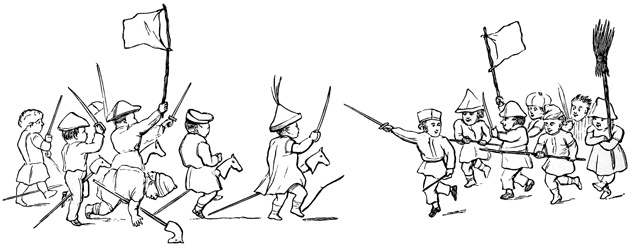
No. 41. The 'Tatler.'—July 14, 1709.
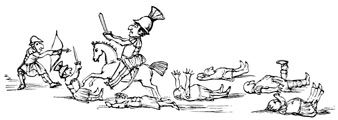
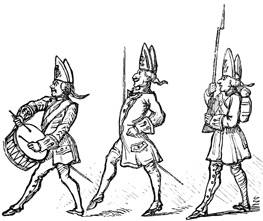
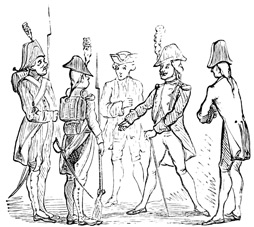
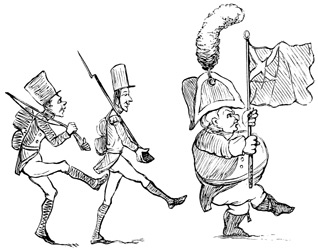
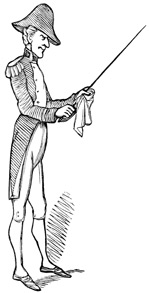
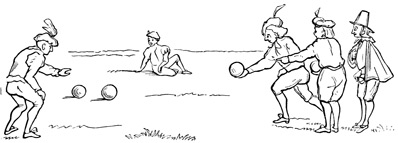
A battle fought in the very streets of London by the Volunteers
of 1709, from their head-quarters, the Artillery Ground, Moorgate,
is thus described by one of the Grub Street auxiliaries:—
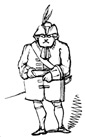
'Indeed, I am extremely concerned for the lieutenant-general,
who by his overthrow and defeat is made a deplorable instance of
the fortune of war, and the vicissitudes of human
affairs. He, alas! has lost in Beech Lane and
Chiswell Street all the glory he lately gained in and
about Holborn and St. Giles's. The art of sub-dividing
first and dividing afterwards is new and
surprising; and according to this method the troops
are disposed in King's Head Court and Red Lion
Market, nor is the conduct of these leaders less
conspicuous in the choice of the ground or field
of battle. Happy was it that the greatest part of
the achievements of this day was to be performed near Grub
Street, that there might not be wanting a sufficient number of
faithful historians who, being eye-witnesses of these wonders,
should impartially transmit them to posterity! but then it can
never be enough regretted that we are left in the dark as to the
name and title of that extraordinary hero who commanded the
divisions in Paul's Alley; especially because those divisions are
justly styled brave, and accordingly were to push the enemy along
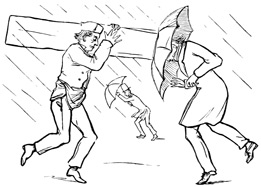
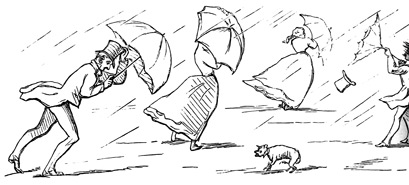
Bunhill Row, and thereby occasion a general battle. But Pallas
appeared, in the form of a shower of rain, and prevented the
slaughter and desolation which were threatened by these extraordinary
preparations.'
No. 45. The 'Tatler.'—July 23, 1709.
Mr. Bickerstaff, having paid a visit to Oxford, has spent the
evening with some merry wits, and, after his custom, he relates
the adventures of the evening to furnish a paper for the
'Tatler':—
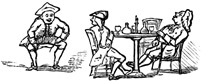
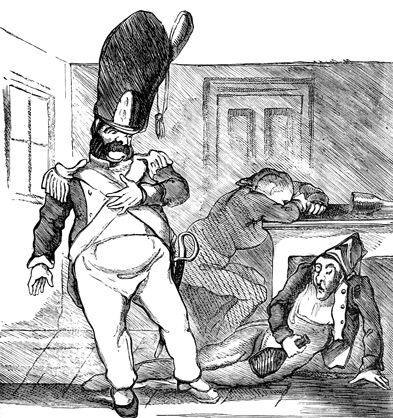
'I am got hither safe, but never spent time with so little satisfaction
as this evening; for, you must know, I was five hours with
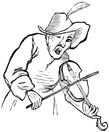
three merry and two honest fellows. The former sang catches
and the latter even died with laughing at the noise they made.
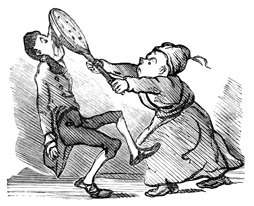
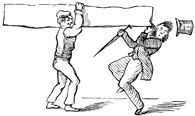
"Well," says Tom Bellfrey, "you scholars, Mr. Bickerstaff, are
the worst company in the world." "Ay," says his opposite, "you
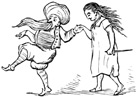
are dull to-night; prythee,
be merry." With that I
huzzaed, and took a jump
across the table, then came
clever upon my legs, and
fell a laughing. "Let Mr.
Bickerstaff alone," says one of the honest fellows; "when he is in
a good humour, he is as good company as any man in England."
He had no sooner spoke, but I snatched his hat off his head, and
clapped it upon my own, and burst out a laughing again; upon
which we all fell a laughing for half an hour. One of the honest
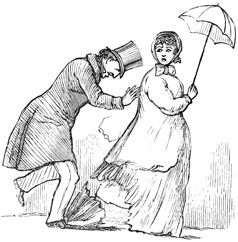
fellows got behind me in the interim and hit me a sound slap on
the back; upon which he got the laugh out of my hands; and
it was such a twang on my shoulders, that I confess he was
much merrier than I. I was half angry, but resolved to keep
up the good humour of the company; and after hallooing as
loud as I could possibly, I drank off a bumper of claret that
made me stare again. "Nay," says one of the honest fellows,
"Mr. Isaac is in the right; there is no conversation in this:
what signifies jumping or hitting one another on the back? let
us drink about." We did so from seven of the clock until eleven;
and now I am come hither, and, after the manner of the wise
Pythagoras, began to reflect upon the passages of the day. I remember
nothing but that I am bruised to death; and as it is my
way to write down all the good things I have heard in the last
conversation, to furnish my paper, I can from this only tell you
my sufferings and my bangs.'
No. 46. The 'Tatler.'—July 26, 1709.
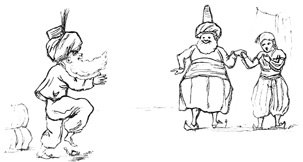
Aurengezebe, a modern Eastern potentate, is described as
amusing his later years by playing the grand Turk to the Sultanas
of Little Britain.
'There is,' proceeds the account, 'a street near Covent Garden
known by the name of Drury, which, before the days of Christianity,
was purchased by the Queen of Paphos, and is the only
part of Great Britain where the tenure of vassalage is still in
being.... This seraglio is disposed into convenient alleys and
apartments, and every house, from the cellar to the garret, inhabited
by nymphs of different orders.
'Here it is that, when Aurengezebe thinks fit to give loose to
dalliance, the purveyors prepare the entertainment; and what
makes it more august is, that every person concerned in the interlude
has his set part, and the prince sends beforehand word what
he designs to say, and directs also the
very answer which shall be made to him.
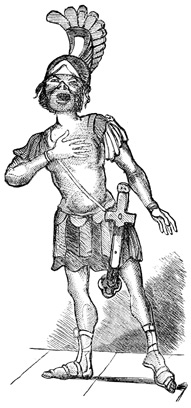
'The entertainment is introduced by
the matron of the temple; whereon an
unhappy nymph, who is to be supposed
just escaped from the hands of a ravisher,
with her tresses dishevelled, runs into
the room with a dagger in her hand, and falls before the emperor.
'"Pity, oh! pity, whoever thou art, an unhappy virgin, whom
one of thy train has robbed of her innocence; her innocence,
which was all her portion—or rather let me die like the memorable
Lucretia!" Upon which she stabs herself. The body is immediately
examined, Lucretia recovers by a cup of right Nantz, and
the matron, who is her next relation, stops all process at law.'
Similar extraordinary entertainments continue the evening,
which concludes in a distribution of largesse by the fictitious
sultan.
No. 47. The 'Tatler.'—July 28, 1709.
The 'Tatler' describes an incident of Sir Taffety Trippet, a
fortune-hunter, whose follies, according to Mr. Bickerstaff, are too
gross to give diversion; and whose vanity is
too stupid to let him be sensible that he is a
public offence.
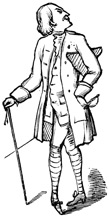
'It happened that, when he first set up for
a fortune-hunter, he chose Tunbridge for the
scene of action, where were at that time two
sisters upon the same design. The knight
believed, of course, the elder must be the
better prize; and consequently makes all
sail that way. People that want sense do
always in an egregious manner want modesty,
which made our hero triumph in
making his amour as public as was possible.
The adored lady was no less vain of his
public addresses. An attorney with one
cause is not half so restless as a woman with one lover. Wherever
they met, they talked to each other aloud, chose each other
partner at balls, saluted at the most conspicuous part of the
service of the church, and practised, in honour of each other, all
the remarkable particularities which are usual for persons who
admire one another, and are contemptible to the rest of the world.
These two lovers seemed as much made for each other as Adam
and Eve, and all pronounced it a match of nature's own making;
but the night before the nuptials, so universally approved, the
younger sister, envious of the good fortune even of her sister, who
had been present at most of the interviews, and had an equal taste
for the charm of a fop, as there are a set of women made for that
order of men; the younger, I say, unable to see so rich a prize
pass by her, discovered to Sir Taffety that a coquet air, much
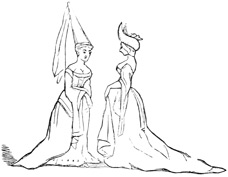
tongue, and three suits was all the portion of his mistress. His
love vanished that moment; himself and equipage the next
morning.'
No. 52. The 'Tatler.'—Aug. 9, 1709.
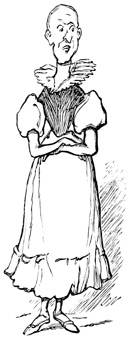
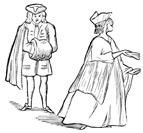
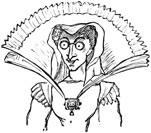
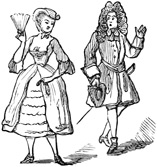
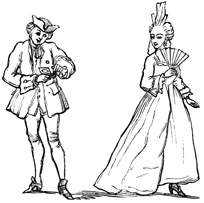
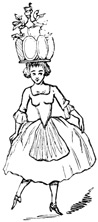
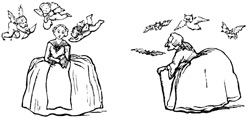
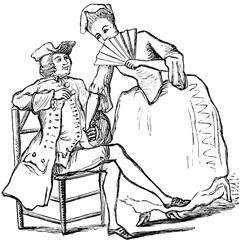
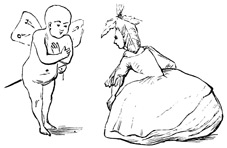
'Delamira resigns her Fan.
'When the beauteous Delamira had published her intention of
entering the bonds of matrimony, the matchless Virgulta, whose
charms had made no satires, thus besought her to confide the
secret of her triumphs:—
'"Delamira! you are now going into that state of life wherein
the use of your charms is wholly to be applied to the pleasing
only one man. That swimming air of your body, that jaunty
bearing of your head over one shoulder, and that inexpressible
beauty in your manner of playing your fan, must be lowered into
a more confined behaviour, to show that you would rather shun
than receive addresses for the future. Therefore, dear Delamira,
give me those excellences you leave off, and acquaint me with
your manner of charming; for I take the liberty of our friendship
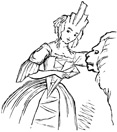
to say, that when I consider my own stature, motion,
complexion, wit, or breeding, I cannot think
myself any way your inferior; yet do I go through
crowds without wounding a man, and all my
acquaintance marry round me while I live a virgin
masked, and I think unregarded."
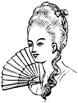
'Delamira heard her with great attention, and,
with that dexterity which is natural to her, told
her that "all she had above the rest of her sex and contemporary
beauties was wholly owing to a fan (that was left her by her
mother, and had been long in the family), which whoever had in
possession and used with skill, should command the hearts of all
her beholders; and since," said she, smiling, "I have no more to
do with extending my conquests or triumphs, I will make you a
present of this inestimable rarity." Virgulta made her expressions
of the highest gratitude for so uncommon a confidence in her, and
desired she would "show her what was peculiar in the management
of that utensil, which rendered it of such general force when
she was mistress of it." Delamira replied, "You see, madam,
Cupid is the principal figure painted on it; and the skill in playing
the fan is, in your several motions of it, to let him appear as
little as possible; for honourable lovers fly all endeavours to
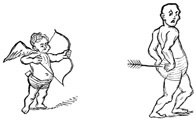
ensnare them, and your Cupid must hide his bow and arrow,
or he will never be sure of his game. You observe," continued
she, "that in all public assemblies the sexes seem to separate
themselves, and draw up to attack each other with eye-shot: that
is the time when the fan, which is all the armour of a woman, is
of most use in our defence; for our minds are construed by the
waving of that little instrument, and our thoughts appear in composure
or agitation according to the motion of it."'
No. 57. The 'Tatler.'—Aug. 20, 1709.
The 'Tatler' transcribes from La Bruyère an extract, which he
introduces as 'one of the most elegant pieces of raillery and
satire.' La Bruyère describes the French as if speaking of a people
not yet discovered, in the air and style of a traveller:—
'I have heard talk of a country where the old men are gallant,
polite, and civil; the young men, on the contrary, stubborn, wild,
without either manners or civility. Amongst these people, he is
sober who is never drunk with anything but wine; the too frequent
use of it having rendered it flat and insipid to them: they
endeavour by brandy, or other strong liquors, to quicken their
taste, already extinguished, and want nothing to complete their
debauches but to drink aqua-fortis. The women of that country
hasten the decay of their beauty by their artifices
to preserve it; they paint their cheeks, eye-brows,
and shoulders, which they lay open, together with
their breasts, arms, and ears, as if they were afraid
to hide those places which they think will please,
and never think they show enough of them.
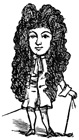
'The physiognomies of the people of that
country are not at all neat, but confused and embarrassed
with a bundle of strange hair, which they
prefer before their natural; with this they weave
something to cover their heads, which descends half way down
their bodies, hides their features, and hinders you from knowing
men by their faces. This nation has, besides this, their god and
their king.
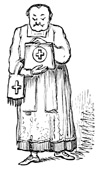
'The grandees go every day, at a certain hour, to a temple
they call a church: at the upper end of that temple there stands
an altar consecrated to their god, where the priest celebrates some
mysteries which they call holy, sacred, and tremendous. The
great men make a vast circle at the foot of the altar, standing with
their backs to the priests and the holy mysteries, and their faces
erected towards their king, who is seen on his knees upon a
throne, and to whom they seem to direct the desires of their hearts,
and all their devotion. However, in this custom there is to be
remarked a sort of subordination; for the people appear adoring
their prince and their prince adoring God.'
No. 61. The 'Tatler.'—Aug. 30, 1709.
Mr. Bickerstaff is musing on the degeneracy of the fair, and on
the changes which beauty has undergone since his youth.
'We have,' he argues, 'no such thing as a standard for good
breeding. I was the other day at my Lady Wealthy's, and asked
one of her daughters how she did. She answered, "She never
conversed with men." The same day I visited at my Lady Plantwell's,
and asked her daughter the same question. She answers,
"What is that to you, you old thief?" and gives me a slap on the
shoulders....
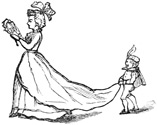
'I will not answer for it, but it may be that I (like other old
fellows) have a fondness for the fashions and manners which prevailed
when I was young and in
fashion myself. But certain it is
that the taste of youth and beauty
is very much lowered. The fine
women they show me now-a-days
are at best but pretty girls to me
who have seen Sacharissa, when all
the world repeated the poems she
inspired; and Villaria (the Duchess
of Cleveland), when a youthful king was her subject. The things
you follow and make songs on now should be sent to knit, or sit
down to bobbins or bone-lace: they are indeed neat, and so are
their sempstresses; they are pretty, and so are their handmaids.
But that graceful motion, that awful mien, and that winning
attraction, which grew upon them from the thoughts and conversations
they met with in my time, are now no more seen. They
tell me I am old: I am glad I am so, for I do not like your present
young ladies.'
No. 64. The 'Tatler.'—Sept. 6, 1709.
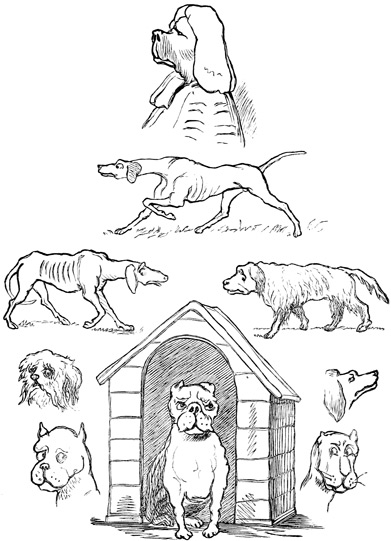
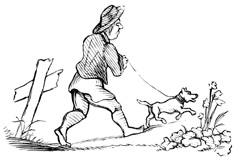
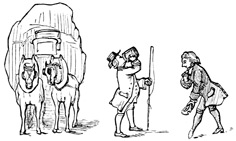
'"⁂ Lost, from the Cocoa-tree, in Pall
Mall, two Irish dogs, belonging to the pack of
London; one a tall white wolf dog; the other
a black nimble greyhound, not very sound, and
supposed to be gone to the Bath, by instinct,
for cure. The man of the inn from whence they
ran, being now there, is desired, if he meets
either of them, to tie them up. Several others
are lost about Tunbridge and Epsom, which,
whoever will maintain, may keep."'
No. 67. The 'Tatler.'—Sept. 13, 1709.
The 'Tatler' proposes to work upon the post, to establish
a charitable society, from which there shall go every day
circular letters to all parts, within the bills of mortality, to tell
people of their faults in a friendly manner, whereby they may know
what the world thinks of them. An example follows, which had
been already sent, by way of experiment, without success:—
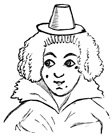
'"Madam,—Let me beg of you to take off the patches at the
lower end of your left cheek, and I will allow two more under your
left eye, which will contribute more to the symmetry
of your face; except you would please to remove
the two black atoms on your ladyship's chin, and
wear one large patch instead of them. If so, you
may properly enough retain the three patches above
mentioned. I am, &c."
'This I thought had all the civility and reason
in the world in it; but whether my letters are
intercepted, or whatever it is, the lady patches as she used to do.
It is observed by all the charitable society, as an instruction in
their epistles, that they tell people of nothing but what is in their
power to mend. I shall give another instance of this way of
writing: two sisters in Essex Street are eternally gaping out of the
window, as if they knew not the value of time, or would call in
companions. Upon which I writ the following line:—
'"Dear Creatures,—On the receipt of this, shut your casements."
'But I went by yesterday, and found them still at the window.
What can a man do in this case, but go in and wrap himself up in
his own integrity, with satisfaction only in this melancholy truth,
that virtue is its own reward; and that if no one is the better for
his admonitions, yet he is himself the more virtuous, in that he
gave those advices?'
No. 79. The 'Tatler.'—Oct. 11, 1709.
Mr. Bickerstaff's sister Jenny is going to be married. The
'Tatler' tells the following anecdote, as a warning 'to be above
trifles:'—
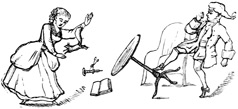
'This, dear Jenny, is the reason that the quarrel between Sir
Harry and his lady, which began about her squirrel, is irreconcilable.
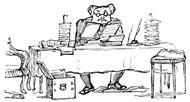
Sir Harry was reading a grave author; she runs into his
study, and, in a playing humour, claps the squirrel upon the folio:
he threw the animal, in
a rage, on the floor; she
snatches it up again,
calls Sir Harry a sour
pedant, without good
nature or good manners.
This cast him
into such a rage, that
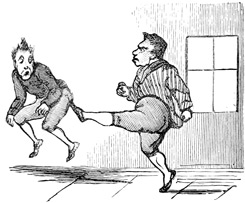
he threw down the table before him, kicked the book round the
room, then recollected himself: "Lord, madam," said he, "why
did you run into such expressions? I was," said he, "in the
highest delight with that author when you clapped your squirrel
upon my book;" and smiling, added upon recollection, "I have
a great respect for your favourite, and pray let us be all friends."
My lady was so far from accepting this apology, that she immediately
conceived a resolution to keep him under for ever, and, with
a serious air, replied, "There is no regard to be had to what a man
says who can fall into so indecent a rage and an abject submission
in the same moment, for which I absolutely despise you." Upon
which she rushed out of the room. Sir Harry stayed some minutes
behind, to think and command himself; after which he followed
her into her bed-chamber, where she was prostrate upon the bed,
tearing her hair, and naming twenty coxcombs who would have
used her otherwise. This provoked him to so high a degree that
he forbade nothing but beating her; and all the servants in the
family were at their several stations listening, whilst the best man
and woman, the best master and mistress, defamed each other in a
way that is not to be repeated even at Billingsgate. You know
this ended in an immediate separation: she longs to return home,
but knows not how to do it; and he invites her home every day.
Her husband requires no submission of her; but she thinks her
very return will argue she is to blame, which she is resolved to be
for ever, rather than acknowledge it.'
No. 86. The 'Tatler.'—Oct. 27, 1709.
'When I came home last night, my servant delivered me the
following letter:—
'"Sir,—I have orders from Sir Harry Quickset, of Staffordshire,
Baronet, to acquaint you, that his honour, Sir Harry himself;
Sir Giles Wheelbarrow, Knight; Thomas Rentfree, Esquire, justice
of the quorum; Andrew Windmill, Esquire; and Mr. Nicolas
Doubt, of the Inner Temple, Sir Harry's grandson, will wait upon
you at the hour of nine to-morrow morning, being Tuesday, the
twenty-fifth of October, upon business which Sir Harry will impart
to you by word of mouth. I thought it proper to acquaint you
beforehand, so many persons of quality came, that you might not
be surprised therewith. Which concludes, though by many years'
absence since I saw you at Stafford, unknown, Sir, your most
humble servant,
'"John Thrifty."
'I received this note with less surprise than I believe Mr.
Thrifty imagined; for I know the good company too well to feel
any palpitations at their approach: but I was in very great concern
how I could adjust the ceremonial, and demean myself to all
these great men, who perhaps had not seen anything above themselves
for these twenty years last past. I am sure that is the case
of Sir Harry. Besides which, I was sensible that there was a great
point in adjusting my behaviour to the simple squire, so as to give
him satisfaction, and not disoblige the justice of the quorum.
'The hour of nine was come this morning, and I had no
sooner set chairs, by the steward's letter, and fixed my tea-equipage,
but I heard a knock at my door, which was opened, but
no one entered; after which followed a long silence, which was at
last broken by, "Sir, I beg your pardon; I think I know better:"
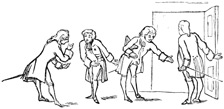
and another voice, "Nay, good Sir Giles——" I looked out
from my window, and saw the good company all with their hats
off, and arms spread, offering the door to each other. After many
offers, they entered with much solemnity, in the order Mr. Thrifty
was so kind as to name them to me. But they had now got to
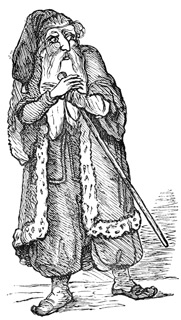
my chamber-door, and I saw my old friend Sir Harry enter. I
met him with all the respect due to so reverend a vegetable; for
you are to know that is my sense of a person who remains idle in
the same place for half a century. I got him with great success
into his chair by the fire, without throwing down any of my cups.
The knight-bachelor told me, "he had a great respect for my
whole family, and would, with my leave, place himself next to Sir
Harry, at whose right hand he had sat at every quarter-sessions
these thirty years, unless he was sick." The steward in the rear
whispered the young templar, "That is true to my knowledge."
I had the misfortune, as they stood cheek by jole, to desire the
squire to sit down before the justice of the quorum, to the no
small satisfaction of the former, and the resentment of the latter.
But I saw my error too late, and got them as soon as I could into
their seats. "Well," said I, "gentlemen, after I have told you
how glad I am of this great honour, I am to desire you to drink a
dish of tea." They answered one and all, "that they never drank
tea of a morning." "Not drink tea of a morning?" said I, staring
round me. Upon which the pert jackanapes, Nic Doubt, tipped
me the wink, and put out his tongue at his grandfather. Here
followed a profound silence, when the steward, in his boots and
whip, proposed, "that we should adjourn to some public house,
where everybody might call for what they pleased, and enter upon
the business." We all stood up in an instant, and Sir Harry filed
off from the left, very discreetly, countermarching behind the
chairs towards the door. After him Sir Giles, in the same manner.
The simple squire made a sudden start to follow; but the justice
of the quorum whipped between upon the stand of the stairs. A
maid, going up with coals, made us halt, and put us into such confusion
that we stood all in a heap, without any visible possibility of
recovering our order; for the young jackanapes seemed to make a
jest of this matter, and had so contrived, by pressing in amongst
us, under pretence of making way, that his grandfather was got
into the middle, and he knew nobody was of quality to stir a step
until Sir Harry moved first. We were fixed in this perplexity for
some time, until we heard a very loud noise in the street; and Sir
Harry asking what it was, I, to make them move, said, "it was
fire." Upon this all ran down as fast as they could, without order
or ceremony, until we got into the street, where we drew up in
very good order, and filed down Sheer Lane; the impertinent
templar driving us before him as in a string, and pointing to his
acquaintance who passed by. When we came to Dick's coffee-house
we were at our old difficulty, and took up the street upon
the same ceremony. We proceeded through the entry, and were
so necessarily kept in order by the situation that we were now got
into the coffee-house itself; where, as soon as we arrived, we
repeated our civilities to each other: after which we marched up
to the high table, which has an ascent to it inclosed in the middle
of the room. The whole house was alarmed at this entry, made
up of persons of so much state and rusticity. Sir Harry called for
a mug of ale and "Dyer's Letter." The boy brought the ale in an
instant, but said, "they did not take in the letter." "No!" says
Sir Harry, "then take back your mug; we are like indeed to have
good liquor at this house!" Here the templar tipped me a
second wink, and, if I had not looked very grave upon him, I
found he was disposed to be very familiar with me. In short, I
observed, after a long pause, that the gentlemen did not care to
enter upon business until after their morning draught, for which
reason I called for a bottle of mum; and finding that had no effect
upon them, I ordered a second, and a third; after which Sir
Harry reached over to me, and told me in a low voice, "that place
was too public for business; but he would call upon me again to-morrow
morning at my own lodgings, and bring some more friends
with him."'
No. 88. The 'Tatler.'—Nov. 1, 1709.
The 'Tatler' has been much surprised by the manœuvres of a
studious neighbour.
'From my own Apartment, October 31.
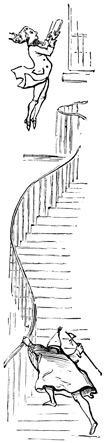
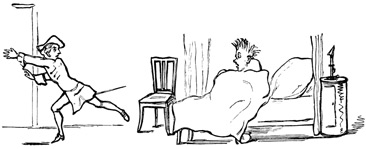
'I was this morning awakened by a sudden shake of the
house; and as soon as I had got a little out of my consternation,
I felt another, which was followed by two or three repetitions of
the same convulsion. I got up as fast as possible, girt on my rapier,
and snatched up my hat, when my landlady came up to me, and
told me, "that the gentlewoman of the next house begged me to
step thither, for that a lodger that she had taken in was run mad;
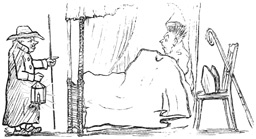
and she desired my advice." I went immediately. Our neighbour
told us, "she had the day before let her
second floor to a very genteel youngish man,
who told her he kept extraordinary good
hours, and was generally at home most part
of the morning and evening at study; but
that this morning he had for an hour together
made this extravagant noise which we
then heard." I went up stairs with my hand
upon the hilt of my rapier, and approached
this new lodger's door. I looked in at the
key-hole, and there I saw a well-made man
look with great attention on a book, and on
a sudden jump into the air so high, that his
head almost touched the ceiling. He came
down safe on his right foot, and again flew
up, alighting on his left; then looked again
at his book, and, holding out his leg, put it
into such a quivering motion, that I thought
that he would have shaken it off. He used
the left after the same manner, when on a
sudden, to my great surprise, he stooped
himself incredibly low, and turned gently on
his toes. After this circular motion, he continued
bent in that humble posture for some
time looking on his book. After this, he recovered
himself with a sudden spring, and
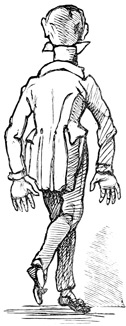
flew round the room in all the violence and
disorder imaginable, until he made a full pause
for want of breath. In this interim my woman
asked "what I thought?" I whispered "that
I thought this learned person an enthusiast, who possibly had his
education in the Peripatetic way, which was a sect of philosophers,
who always studied when walking." Observing him much out of
breath, I thought it the best time to master him if he were disordered,
and knocked at his door. I was surprised to find him
open it, and say with great civility and good mien, "that he hoped
he had not disturbed us." I believed him in a lucid interval, and
desired "he would please to let me see his book." He did so,
smiling. I could not make anything of it, and, therefore, asked
"in what language it was writ?" He said, "it was one he studied
with great application; but it was his profession to teach it, and
could not communicate his knowledge without a consideration." I
answered that I hoped he would hereafter keep his thoughts to himself,
for his meditations this morning had cost me three coffee dishes
and a clean pipe. He seemed concerned at that, and told me "he
was a dancing master, and had been reading a dance or two before
he went out, which had been written by one who taught at an
academy in France." He observed me at a stand, and informed
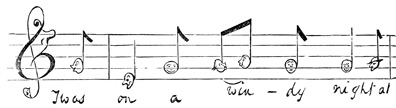
me, "that now articulate motions as well as sounds were expressed
by proper characters; and that there is nothing so common as to
communicate a dance by a letter." I besought him hereafter to
meditate in a ground room, for that otherwise it would be impossible
for an artist of any other kind to live near him, and that I
was sure several of his thoughts this morning would have shaken
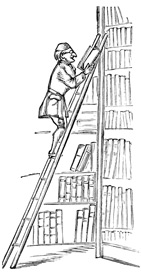
my spectacles off my nose, had I been myself at study.'
No. 91. The 'Tatler.'—Nov. 8, 1709.
One of the celebrated beauties of 1709 pays the 'Tatler' a
friendly visit to obtain his counsel on the choice of her future
husband, being perplexed between two suitors—between inclination
on one hand and riches on the other.
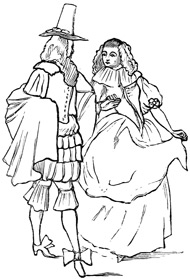
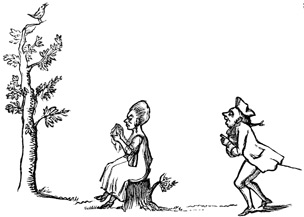
'From my own Apartment, November 7.
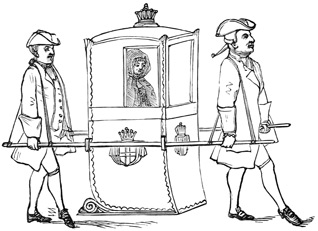
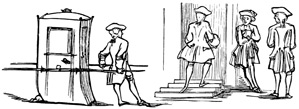
'I was very much surprised this evening with a visit from one
of the top Toasts of the
town, who came privately
in a chair, and bolted
into my room, while I
was reading a chapter of
Agrippa upon the occult
sciences; but, as she entered
with all the air and
bloom that nature ever bestowed on woman, I threw down the
conjurer and met the charmer. I had no sooner placed her at my
right hand by the fire, but she opened to me the reason of her visit.
"Mr. Bickerstaff," said the fine creature, "I have been your correspondent
some time, though I never saw you before; I have writ
by the name of Maria. You have told me you are too far gone in
life to think of love. Therefore I am answered as to the passion
I spoke of; and," continued she, smiling, "I will not stay until
you grow young again, as you men never fail to do in your dotage;
but am come to consult you as to disposing of myself to another.
My person you see, my fortune is very considerable; but I am at
present under much perplexity how to act in a great conjuncture. I
have two lovers, Crassus and Lorio. Crassus is prodigiously rich,
but has no one distinguishing quality. Lorio has travelled, is well
bred, pleasant in discourse, discreet in his conduct, agreeable in
his person; and with all this, he has a competency of fortune
without superfluity. When I consider Lorio, my mind is filled
with an idea of the great satisfactions of a pleasant conversation.
When I think of Crassus, my equipage, numerous servants, gay
liveries, and various dresses, are opposed to the charms of his
rival. In a word, when I cast my eyes upon Lorio, I forget and
despise fortune; when I behold Crassus, I think only of pleasing
my vanity, and enjoying an uncontrolled expense in all the pleasures
of life, except love."'
The 'Tatler' naturally advised the lady that the man of her
affections, rather than the lover who could gratify her vanity with
outward show, would afford her the truest happiness, and counselled
her to keep her thoughts of happiness within the means
of her fortune, and not to measure it by comparison with the mere
riches of others.
No. 93. The 'Tatler.'—Nov. 12, 1709.
The 'Tatler,' from his eagerness to promote social reforms, has
succeeded in drawing upon himself numerous challenges from the
individuals who have considered themselves aggrieved by his
writings.
'From my own Apartment, November 11.
'I have several hints and advertisements from unknown hands,
that some who are enemies to my labours design to demand the
fashionable way of satisfaction for the disturbance my lucubrations
have given them. I confess that as things now stand I do not
know how to deny such inviters, and am preparing myself accordingly.
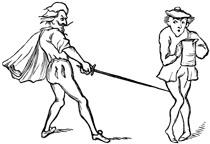
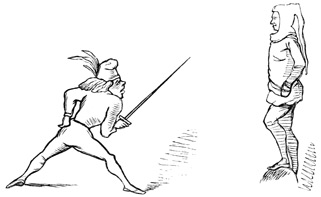
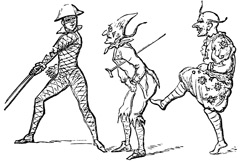
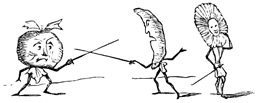
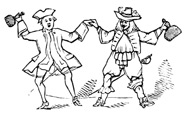
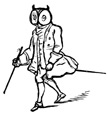
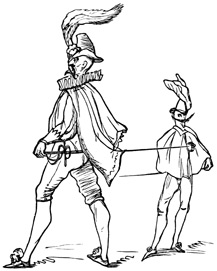
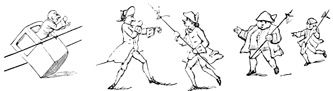
I have bought pumps, and foils, and am every morning
practising in my chamber. My neighbour, the dancing-master,
has demanded of me, "why I take this liberty since I will not
allow it to him?" but I answered, "his was an act of indifferent
nature, and mine of necessity." My late treatises against duels
have so far disobliged the fraternity of the noble science of defence,
that I can get none of them to show me so much as one pass. I
am, therefore, obliged to learn by book, and have accordingly
several volumes, wherein all the postures are exactly delineated.
I must confess I am shy of letting people see me at this exercise,
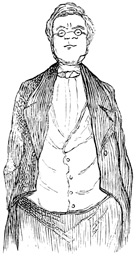
because of my flannel waistcoat, and my spectacles, which I
am forced to fix on the better to observe the posture of the
enemy.
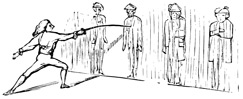
'I have upon my chamber walls drawn at full length the
figures of all sorts of men, from eight feet to three feet two inches.
Within this height, I take it, that all the fighting men of Great
Britain are comprehended. But as I push, I make allowance for
my being of a lank and spare body, and have chalked out in every
figure my own dimensions; for I scorn to rob any man of his life
by taking advantage of his breadth; therefore, I press purely in a
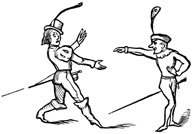
line down from his nose, and take no more of him to assault than
he has of me; for, to speak impartially, if a lean fellow wounds
a fat one in any part to the right or left, whether it be in carte or in
tierce, beyond the dimensions of the said lean fellow's own breadth,
I take it to be murder, and such a murder as is below a gentleman
to commit. As I am spare, I am also very tall, and behave
myself with relation to that advantage with the same punctilio,
and I am ready to stoop or stand, according to the stature of my
adversary.
'I must confess that I have had great success this morning,
and have hit every figure round the room in a mortal part, without
receiving the least hurt, except a little scratch by falling on my
face, in pushing at one at the lower end of my chamber; but I
recovered so quick, and jumped so nimbly on my guard, that, if he
had been alive, he could not have hurt me. It is confessed I
have written against duels with some warmth; but in all my discourses
I have not ever said that I knew how a gentleman could
avoid a duel if he were provoked to it; and since that custom is
now become a law, I know nothing but the legislative power, with
new animadversions upon it, can put us in a capacity of denying
challenges, though we were afterwards hanged for it. But no more
of this at present. As things stand, I shall put up with no more
affronts; and I shall be so far from taking ill words that I will not
take ill looks. I therefore warn all hot young fellows not to look
hereafter more terrible than their neighbours; for if they stare at
me with their hats cocked higher than other people, I will not bear
it. Nay, I give warning to all people in general to look kindly at
me; for I will bear no frowns, even from ladies; and if any
woman pretends to look scornfully at me, I shall demand satisfaction
of the next of kin of the masculine gender.'
No. 96. The 'Tatler.'—Nov. 19, 1709.
The 'Tatler,' in despair of effecting his object by discouraging
certain acts of foppery, endeavours to carry out his principle by an
opposite course of treatment.
'From my own Apartment, November 18.
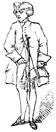
'When an engineer finds his guns have not had their intended
effect, he changes his batteries. I am forced at present to take
this method; and instead of continuing to write against the singularity
some are guilty of in their habit and behaviour, I shall
henceforth desire them to persevere in it; and not only so, but
shall take it as a favour of all the coxcombs in the town, if they
will set marks upon themselves, and by some particular in their
dress show to what class they belong. It would be very obliging
in all such persons, who feel in themselves that they are not of
sound understanding, to give the world notice of it, and spare
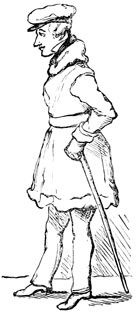
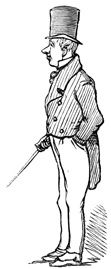
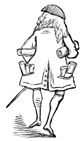
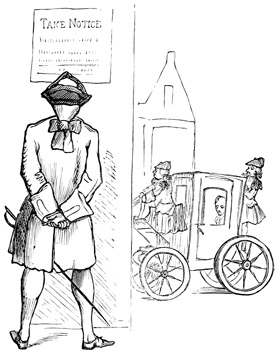
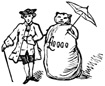
mankind the pains of finding them out. A cane upon the fifth
button shall from henceforth be the sign of a dapper; red-heeled
shoes and a hat hung upon one side of the head shall signify a
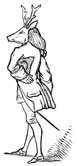
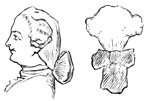
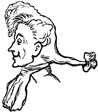
smart; a good periwig made into a twist, with a brisk cock, shall
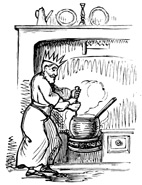
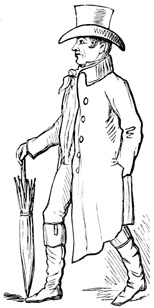
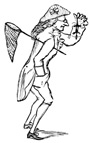
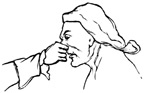
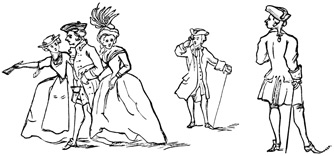
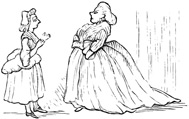
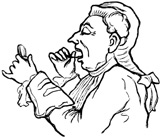
speak a mettled fellow; and an upper lip covered
with snuff, a coffee-house statesman. But as it is
required that all coxcombs hang out their signs, it is,
on the other hand, expected that men of real merit
should avoid anything particular in their dress, gait,
or behaviour. For, as we old men delight in proverbs,
I cannot forbear bringing out one on this occasion,
that "good wine needs no bush."
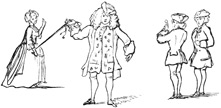
'I must not leave this subject without reflecting
on several persons I have lately met, who at a distance
seem very terrible; but upon a stricter enquiry into their
looks and features, appear as meek and harmless as any of my
neighbours. These are country gentlemen, who of late years have
taken up a humour of coming to town in red coats, whom an
arch wag of my acquaintance used to describe very well by calling
them "sheep in wolves' clothing." I have often wondered that
honest gentlemen, who are good neighbours, and live quietly in
their own possessions, should take it into their heads to frighten
the town after this unreasonable manner. I shall think myself
obliged, if they persist in so unnatural a dress, notwithstanding
any posts they may have in the militia, to give away their red
coats to any of the soldiery who shall think fit to strip them, provided
the said soldiers can make it appear that they belong to a
regiment where there is a deficiency in the clothing. About two
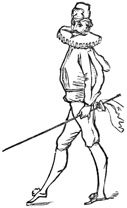
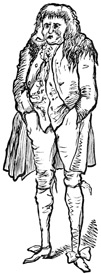
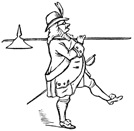
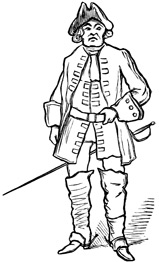
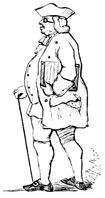
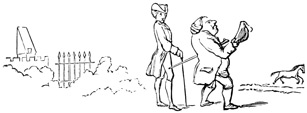
days ago I was walking in the park, and accidentally met a rural
esquire, clothed in all the types above mentioned, with a carriage
and behaviour made entirely out of his own head. He was of a
bulk and stature larger than ordinary, had a red coat, flung open
to show a gay calamancho waistcoat. His periwig fell in a very
considerable bush upon each shoulder. His arms naturally swung
at an unreasonable distance from his sides; which, with the
advantage of a cane that he brandished in a great variety of
irregular motions, made it unsafe for any one to walk within
several yards of him. In this manner he took up the whole Mall,
his spectators moving on each side of it, whilst he cocked up his
hat, and marched directly for Westminster. I cannot tell who
this gentleman is, but for my comfort may say, with the lover in
Terence, who lost sight of a fine young lady, "Wherever thou art,
thou canst not be long concealed."'
No. 103. The 'Tatler.'—Dec. 6, 1709.
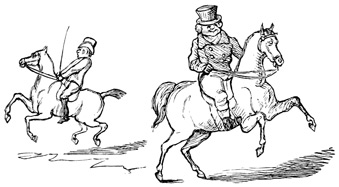
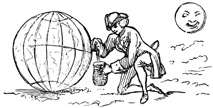
These toys will once to serious mischiefs fall,
When he is laughed at, when he's jeer'd by all.
Creech (ab Hor., Ars Poet. v. 452).
The 'Tatler,' pursuing his vocation as a censor of manners, is
presumed to have established a court, before which all bearers of
canes, snuff-boxes, perfumed handkerchiefs, perspective glasses,
&c., are brought, that they may, upon showing proper cause, have
licences granted for carrying the same; but upon conviction that
these appendages of fashion are adopted merely out of frivolous
show, the articles thus exposed are ordered to become forfeited.
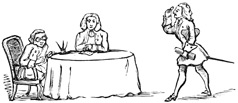
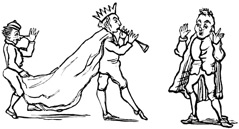
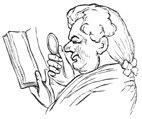
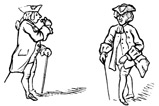
'Having despatched this set of my petitioners, the bearers of
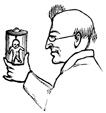
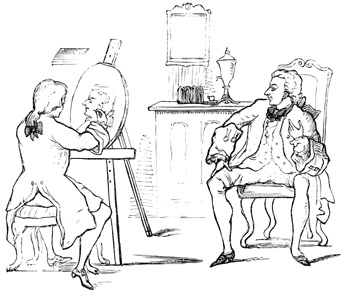
canes, there came in a well-dressed man, with a glass tube in one
hand, and his petition in the other. Upon his entering the room,
he threw back the right side of his wig, put forward his left leg,
and advancing the glass to his right eye, aimed it directly at me.
In the meanwhile, to make my observations also, I put on my
spectacles; in which posture we surveyed each other for some
time. Upon the removal of our glasses, I desired him to read his
petition, which he did very promptly and easily; though at the
same time it sets forth "that he could see nothing distinctly, and
was within very few degrees of being utterly blind," concluding,
with a prayer, "that he might be permitted to strengthen his sight
by a glass." In answer to this, I told him "he might sometimes
extend it to his own destruction. As you are now," said I, "you
are out of the reach of beauty; the shafts of the finest eyes lose
their force before they can come at you; you cannot distinguish a
Toast from an orange-wench; you can see a whole circle of beauty
without any interruption from an impertinent face to discompose
you. In short, what are snares for others"—my petitioner would
hear no more, but told me very seriously, "Mr. Bickerstaff, you
quite mistake your man; it is the joy, the pleasure, the employment
of my life to frequent public assemblies and gaze upon the
fair." In a word, I found his use of a glass was occasioned by no
other infirmity but his vanity, and was not so much designed to
make him see as to make him be seen and distinguished by
others. I therefore refused him a licence for a perspective, but
allowed him a pair of spectacles, with full permission to use them
in any public assembly as he should think fit. He was followed
by so very few of this order of men, that I have reason to hope
that this sort of cheat is almost at an end.
'Little follies in dress and behaviour lead to greater evils.
The bearing to be laughed at for such singularity teaches us
insensibly an impertinent fortitude, and enables us to bear public
censure for things that most substantially deserve it. By this
means they open a gate to folly, and often render a man so ridiculous
as to discredit his virtues and capacities, and unqualify him
from doing any good in the world. Besides, the giving in to uncommon
habits of this nature, it is a want of that humble deference
which is due to mankind, and, what is worst of all, the certain
indication of some secret flaw in the mind of the person that
commits them.
'When I was a young man, I remember a gentleman of great
integrity and worth was very remarkable for wearing a broad belt
and a hanger instead of a fashionable sword, though in other
points a very well-bred man. I suspected him at first sight to
have something wrong in him, but was not able for a long time to
discover any collateral proofs of it. I watched him narrowly for
six-and-thirty years, when at last, to the surprise of everybody but
myself, who had long expected to see the folly break out, he
married his own cook-maid.'
No. 108. The 'Tatler.'—Dec. 17, 1709.
Thus while the mute creation downward bend
Their sight, and to their earthly mother tend,
Man looks aloft, and with erected eyes
Beholds his own hereditary skies.—Dryden.
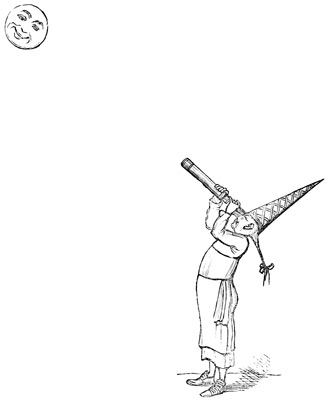
The 'Tatler,' for a little rational recreation, has visited the
theatre, hoping to enlarge his ideas; but even in 1709 we find
a passion for mere acrobatic exhibitions engaging and corrupting
the popular taste.
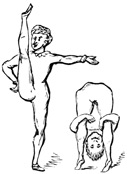
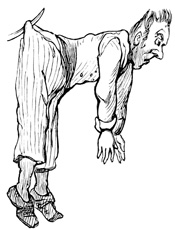
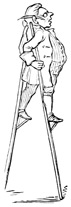
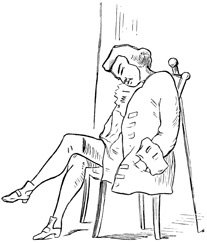
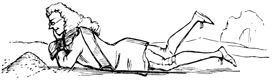
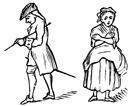
'While I was in suspense, expecting every moment to see my
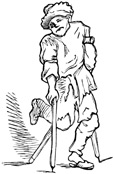
old friend Mr. Betterton appear in all the majesty of distress, to
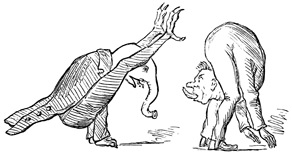
my unspeakable amazement there came up a monster with a face
between his feet, and as I was looking on he raised himself on one
leg in such a perpendicular posture that the other grew in a direct
line above his head. It afterwards twisted itself into the motions
and writhings of several different animals, and, after a great variety
of shapes and transformations, went off the stage in the figure of a
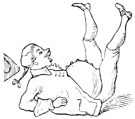
human creature. The admiration, the
applause, the satisfaction of the audience,
during this strange entertainment, is not
to be expressed. I was very much out of
countenance for my dear countrymen, and
looked about with some apprehension, for
fear any foreigner should be present. Is it
possible, thought I, that human nature
can rejoice in its disgrace, and take pleasure
in seeing its own figure turned to
ridicule and distorted into forms that raise
horror and aversion!'
No. 109. The 'Tatler.'—Dec. 20, 1709.
In this giddy, busy maze,
I lose the sunshine of my days.—Francis.
A fine lady has condescended to consult the 'Tatler' on a
trifling matter; the solemnity of her state—an admirable picture
of the equipage of a fine lady of that period—electrifies the philosopher
and amazes his simple neighbours.
'Sheer Lane, December 19.
'There has not some years been such a tumult in our neighbourhood
as this evening, about six. At the lower end of the
lane, the word was given that there was a great funeral coming by.
The next moment came forward, in a very hasty instead of a
solemn manner, a long train of lights, when at last a footman, in
very high youth and health, with all his force, ran through the
whole art of beating the door of the house next to me, and ended
his rattle with the true finishing rap. This did not only bring one
to the door at which he knocked, but to that of everyone in the
lane in an instant. Among the rest, my country-maid took the
alarm, and immediately running to me, told me "there was a fine,
fine lady, who had three men with burial torches making way
before her, carried by two men upon poles, with looking-glasses
each side of her, and one glass also before, she herself appearing
the prettiest that ever was." The girl was going on in her story,
when the lady was come to my door in her chair, having mistaken
the house. As soon as she entered I saw she was Mr. Isaac's
scholar, by her speaking air, and the becoming stop she made
when she began her apology. "You will be surprised, sir," said
she, "that I take this liberty, who am utterly a stranger to you;
besides that, it may be thought an indecorum that I visit a man."
She made here a pretty hesitation, and held her fan to her face.
Then, as if recovering her resolution, she proceeded, "But I think
you have said, that men of your age are of no sex; therefore, I
may be as free with you as with one of my own."'
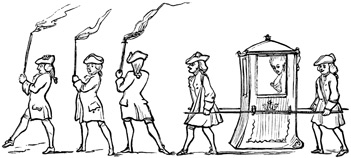
The fine lady consults Mr. Bickerstaff on a trivial subject; she
then describes to him the honour he should esteem her visit; the
number of calls she is compelled to make, out of custom or ceremony,
taking her miles round; several acquaintances on her visiting
list having been punctually called on every week, and yet
never seen for more than a year. Then follows an account of a
visiting list for 1708:—
| Mrs. Courtwood—Debtor. |
Per contra—Creditor. |
| To seventeen hundred and four visits received |
1704 |
By eleven hundred and nine paid |
1109 |
| |
|
Due to balance |
595—1704 |
No. 111. The 'Tatler.'—Dec. 24, 1709.
Oh! mortal man, thou that art born in sin!
The Bellman's Midnight Homily.
Mr. Bickerstaff is meditating on mental infirmities; after examining
the faults of others, he is disposed to philosophise on his
own bad propensities, and his cautiousness to keep them within
reasonable subjection.
'I have somewhere either read or heard a very memorable
sentence, "that a man would be a most insupportable monster,
should he have the faults that are incident to his years, constitution,
profession, family, religion, age, and country;" and yet
every man is in danger of them all. For this reason, as I am an
old man, I take particular care to avoid being covetous, and telling
long stories. As I am choleric, I forbear not only swearing,
but all interjections of fretting, as pugh! or pish! and the like.
As I am a lay-man, I resolve not to conceive an aversion for a
wise and good man, because his
coat is of a different colour from
mine. As I am descended of
the ancient family of the Bickerstaffs,
I never call a man of
merit an upstart. As a Protestant,
I do not suffer my zeal
so far to transport me as to
name the Pope and the Devil
together. As I am fallen into
this degenerate age, I guard myself
particularly against the folly
I have now been speaking of. As I am an Englishman, I am
very cautious not to hate a stranger, or despise a poor palatine.'
No. 116. The 'Tatler.'—Jan. 5, 1710.
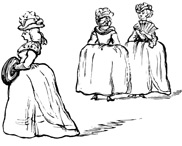
The 'Tatler,' still maintaining his court for the examination of
frivolities in costume, is engaged in giving judgment on female
fashions. The hooped petticoat is the subject before his worshipful
board. A fair offender has been captured, and stripped of
her encumbrances until she is reduced to dimensions which will
allow her to enter the house; the petticoat is then hung up to
the roof—its ample dimensions covering the entire court like a
canopy. The late wearer had the sense to confess that she 'should
be glad to see an example made of it, that she wore it for no
other reason but that she had a mind to look as big and burly as
other persons of her quality, and that she kept out of it as long as
she could and until she began to appear little in the eyes of her
acquaintance.' After hearing arguments concerning the encouragement
the wearing of these monstrous appendages offered to the
woollen manufacturers, to the rope and cord makers, and to the
whalebone fisheries of Greenland, the 'Tatler' pronounced his
decision that the expense thus entailed on fathers and husbands,
and the prejudice to the ladies themselves, 'who could never
expect to have any money in the pocket if they laid out so much
on the petticoat,' together with the fact that since the introduction
of these garments several persons of quality were in the habit of
cutting up their cast gowns to strengthen their stiffening, instead
of bestowing them as perquisites or in charity, determined him to
seize the petticoat as a forfeiture, to be sent as a present to a
widow gentlewoman, who had five daughters, to be made into
petticoats for each, the remainder to be returned to be cut up into
stomachers and caps, facings for waistcoat sleeves, and other garniture.
He thus concludes: 'I consider woman as a beautiful,
romantic animal, that may be adorned with furs and feathers,
pearls and diamonds, ores and
silks. The lynx shall cast its
skin at her feet to make her a
tippet; the peacock, parrot, and
swan shall pay contributions to
her muff; the sea shall be
searched for shells, and the
rocks for gems; and every part
of nature furnish out its share
towards the embellishment of a
creature that is the most consummate work of it. All this I shall
indulge them in; but as for the petticoat I have been speaking of
I neither can nor will allow it.'
No. 145. The 'Tatler.'—March 14, 1710.
Nescio quis teneros oculus mihi fascinat agnos.—Virg. Ecl. III. 103.
Ah! what ill eyes bewitch my tender lambs?
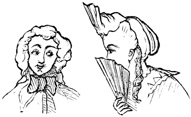
'This paper was allotted for taking into consideration a late
request of two indulgent parents, touching the care of a young
daughter, whom they design to send to a boarding-school, or keep
at home, according to my determination; but I am diverted from
that subject by letters which I have received from several ladies,
complaining of a certain sect of professed enemies to the repose
of the fair sex, called oglers. These are, it seems, gentlemen who
look with deep attention on one object at the playhouses, and are
ever staring all round them in churches. It is urged by my correspondents,
that they do all
that is possible to keep their
eyes off these ensnarers; but
that, by what power they
know not, both their diversions
and devotions are interrupted
by them in such a manner as that they cannot
attend to either, without stealing
looks at the persons whose eyes are fixed upon them. By this
means, my petitioners say, they find themselves grow insensibly
less offended, and in time enamoured of these their enemies.
What is required of me on this occasion is, that as I love and
study to preserve the better part of mankind, the females, I would
give them some account of this dangerous way of assault; against
which there is so little defence, that it lays ambush for the sight
itself, and makes them seeingly, knowingly, willingly, and forcibly
go on to their own captivity. The naturalists tell us that the
rattlesnake will fix himself under a tree where he sees a squirrel
playing; and when he has once got the exchange of a glance
from the pretty wanton, will give it such a sudden stroke on its
imagination, that though it may play from bough to bough, and
strive to avert its eyes from it for some time, yet it comes nearer
and nearer, by little intervals looking another way, until it drops
into the jaws of the animal, which it knew gazed at it for no other
reason but to ruin it. I did not believe this piece of philosophy
until the night when I made my observations of the play of eyes at
the opera, where I then saw the same thing pass between an ogler
and a coquette.'
No. 146. The 'Tatler.'—March 16, 1710.
Intrust thy fortune to the Powers above;
Leave them to manage for thee, and to grant
What their unerring wisdom sees thee want:
In wisdom as in greatness they excel;
Ah! that we lov'd ourselves but half so well!
We, blindly by our headstrong passions led,
Are hot for action, and desire to wed;
Then wish for heirs, but to the gods alone
Our future offspring and our wives are known.
Juv. Sat., Dryden.
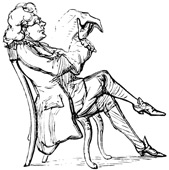
'As I was sitting after dinner
in my elbow-chair, I took up
Homer, and dipped into that
famous speech of Achilles to
Priam,[19]
in which he tells him
that Jupiter has by him two great
vessels, the one filled with blessings,
and the other with misfortunes;
out of which he mingles
a composition for every man that
comes into the world. This passage
so exceedingly pleased me, that, as I fell insensibly into my
afternoon's slumber, it wrought my imagination into the following
dream:—
'When Jupiter took into his hands the government of the
world, the several parts of nature with the presiding deities did
homage to him. One presented him with a mountain of winds,
another with a magazine of hail, and a third with a pile of thunderbolts.
The Stars offered up their influences; Ocean gave his
trident, Earth her fruits, and the Sun his seasons.
'Among others the Destinies advanced with two great urns,
one of which was fixed on the right hand of Jove's throne, and the
other on the left. The first was filled with all the blessings, the
second with all the calamities, of human life. Jupiter, in the
beginning of his reign, poured forth plentifully from the right
hand; but as mankind, degenerating, became unworthy of his
blessings, he broached the other vessel, which filled the earth
with pain and poverty, battles and distempers, jealousy and falsehood,
intoxicating pleasures and untimely deaths. He finally, in
despair at the depravity of human nature, resolved to recall his
gifts and lay them in store until the world should be inhabited by
a more deserving race.
'The three sisters of Destiny immediately repaired to the
earth in search of the several blessings which had been scattered
over it, but found great difficulties in their task. The first places
they resorted to, as the most likely of success, were cities, palaces,
and courts; but instead of meeting with what they looked for
here, they found nothing but envy, repining, uneasiness, and the
like bitter ingredients of the left-hand vessel; whereas, to their
great surprise, they discovered content, cheerfulness, health, innocence,
and other the most substantial blessings of life, in cottages,
shades, and solitudes. In other places the blessings had been
converted into calamities, and misfortunes had become real
benefits, while in many cases the two had entered into alliance. In
their perplexity the Destinies were compelled to throw all the blessings
and calamities into one vessel, and leave them to Jupiter to
use his own discretion in their future distribution.'
No. 148. The 'Tatler.'—March 21, 1710.
They ransack ev'ry element for choice
Of ev'ry fish and fowl, at any price.
'I may, perhaps, be thought extravagant in my notion; but I
confess I am apt to impute the dishonours that sometimes happen
in great families to the inflaming diet which is so much in fashion.
For this reason we see the florid complexion, the strong limb, and
the hale constitution are to be found among the meaner sort of
people, or in the wild gentry who have been educated among the
woods or mountains; whereas many great families are insensibly
fallen off from the athletic constitution of their progenitors, and are
dwindled away into a pale, sickly, spindle-legged generation of
valetudinarians.
'I look upon a French ragoût to be as pernicious to the
stomach as a glass of spirits; and when I see a young lady
swallow all the instigations of high soups, seasoned sauces, and
forced meats, I have wondered at the despair or tedious sighing
of her lovers.
'The rules among these false delicates are, to be as contradictory
as they can be to nature. They admit of nothing at their
tables in its natural form, or without some disguise. They are to
eat everything before it comes in season, and to leave it off as
soon as it is good to be eaten.
'I remember I was last summer invited to a friend's house,
who is a great admirer of the French cookery, and, as the phrase
is, "eats well." At our sitting down, I found the table covered
with a great variety of unknown dishes. I was mightily at a loss
to learn what they were, and therefore did not know where to help
myself. That which stood before me I took to be roasted porcupine—however,
I did not care for asking questions—and have since
been informed that it was only a larded turkey. I afterwards
passed my eye over several hashes, which I do not know the
names of to this day; and, hearing that they were delicacies, did
not think fit to meddle with them. Among other dainties, I saw
something like a pheasant, and therefore desired to be helped to a
wing of it; but to my great surprise, my friend told me it was a
rabbit, which is a sort of meat I never cared for. Even the
dessert was so pleasingly devised and ingeniously arranged that I
cared not to displace it.
'As soon as this show was over, I took my leave, that I might
finish my dinner at my own house; for as I in everything love
what is simple and natural, so particularly my food. Two plain
dishes, with two or three good-natured, cheerful, ingenuous
friends, would make me more pleased and vain than all that
pomp and luxury can bestow; for it is my maxim that "he keeps
the greatest table who has the most valuable company at it."'
No. 155. The 'Tatler.'—April 17, 1710.
When he had lost all business of his own,
He ran in quest of news through all the town.
'There lived some years since, within my neighbourhood, a
very grave person, an upholsterer,[20]
who seemed a man of more
than ordinary application to business. He was a very early riser,
and was often abroad two or three hours before any of his neighbours.
He had a particular carefulness in the knitting of his
brows, and a kind of impatience in all his motions, that plainly
discovered he was always intent upon matters of importance.
Upon my inquiry into his life and conversation, I found him to be
the greatest newsmonger in our quarter; that he rose before day
to read the "Postman;" and that he would take two or three
turns to the other end of the town before his neighbours were up,
to see if there were any Dutch mails come in. He had a wife and
several children; but was much more inquisitive to know what
passed in Poland than in his own family, and was in greater pain
and anxiety of mind for King Augustus's welfare than that of his
nearest relations. He looked extremely thin in a dearth of news,
and never enjoyed himself in a westerly wind. This indefatigable
kind of life was the ruin of his shop; for, about the time that his
favourite prince left the crown of Poland, he broke and disappeared.
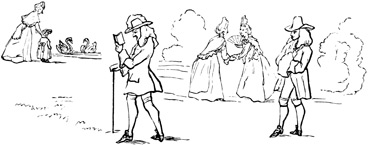
'This man and his affairs had been long out of my mind, until
about three days ago, as I was walking in St. James's Park, I
heard somebody at a distance hemming after me; and who should
it be but my old neighbour the upholsterer! I saw he was
reduced to extreme poverty, by certain shabby superfluities in his
dress; for notwithstanding that it was a very sultry day for the
time of the year, he wore a loose great-coat and a muff, with a
long campaign wig out of curl; to which he had added the ornament
of a pair of black garters buckled under the knee. Upon
his coming up to me, I was going to inquire into his present
circumstances; but I was prevented by his asking me, with a
whisper, "whether the last letters brought any accounts that one
might rely upon from Bender." I told him, "None that I heard
of;" and asked him "whether he had yet married his eldest
daughter." He told me, "No; but pray," says he, "tell me sincerely,
what are your thoughts of the King of Sweden?" For,
though his wife and children were starving, I found his chief concern
at present was for this great monarch. I told him "that I
looked upon him as one of the first heroes of the age." "But
pray," says he, "do you think there is any truth in the story of his
wound?" And finding me surprised at the question, "Nay," says
he, "I only propose it to you." I answered "that I thought
there was no reason to doubt of it." "But why in the heel," says
he, "more than in any other part of the body?" "Because,"
said I, "the bullet chanced to light there."
'We were now got to the upper end of the Mall, where were
three or four very odd fellows sitting together upon the bench.
These I found were all of them politicians, who used to sun themselves
in that place every day about dinner-time. Observing them
to be curiosities in their kind, and my friend's acquaintance, I sat
down among them.
'The chief politician of the bench was a great asserter of paradoxes.
He told us, with a seeming concern, "that, by some
news he had lately read from Muscovy, it appeared to him that
there was a storm gathering in the Black Sea, which might in time
do hurt to the naval forces of this nation." To this he added,
"that, for his part, he could not wish to see the Turk driven out
of Europe, which, he believed, could not but be prejudicial to our
woollen manufacture."
'He backed his assertions with so many broken hints and
such a show of depth and wisdom, that we gave ourselves up to
his opinions. The discourse at length fell upon a point which
seldom escapes a knot of true-born Englishmen; whether, in case
of a religious war, the Protestants would not be too strong for the
Papists. This we unanimously determined on the Protestant side.[21]
'When we had fully discussed this point, my friend the upholsterer
began to exert himself upon the present negotiations of
peace; in which he deposed princes, settled the bounds of kingdoms,
and balanced the power of Europe, with great justice and
impartiality.
'I at length took my leave of the company, and was going
away; but had not gone thirty yards before the upholsterer
hemmed again after me. Upon his advancing towards me with a
whisper, I expected to hear some secret piece of news, which he
had not thought fit to communicate to the bench; but, instead of
that, he desired me in my ear to lend him half-a-crown. In compassion
to so needy a statesman, and to dissipate the confusion I
found he was in, I told him, "if he pleased, I would give him five
shillings, to receive five pounds of him when the great Turk was
driven out of Constantinople;" which he very readily accepted,
but not before he had laid down to me the impossibility of such
an event as the affairs of Europe now stand.
'This paper I design for the peculiar benefit of those worthy
citizens who live more in a coffee-house than in their shops, and
whose thoughts are so taken up with foreign affairs that they
forget their customers.'
No. 163. The 'Tatler.'—April 25, 1710.
Suffenus has no more wit than a mere clown, when he attempts to write
verses; and yet he is never happier than when he is scribbling; so much does
he admire himself and his compositions. And, indeed, this is the foible of
every one of us; for there is no man living who is not a Suffenus in one thing
or other.—Catul. de Suffeno, XX. 14.
'I yesterday came hither about two hours before the company
generally make their appearance, with a design to read over all
the newspapers; but, upon my sitting down, I was accosted by
Ned Softly, who saw me from a corner in the other end of the
room, where I found he had been writing something. "Mr.
Bickerstaff," says he, "I observe, by a late paper of yours, that
you and I are just of a humour; for you must know, of all impertinences,
there is nothing which I so much hate as news. I never
read a gazette in my life; and never trouble my head about our
armies, whether they win or lose, or in what part of the world they
lie encamped." Without giving me time to reply, he drew a
paper of verses out of his pocket, telling me "that he had something
that would entertain me more agreeably; and that he would
desire my judgment upon every line, for that we had time enough
before us until the company came in."
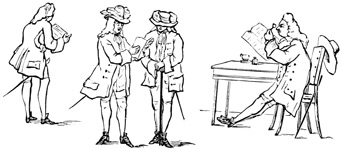
'Finding myself unavoidably engaged in such a conversation,
I was resolved to turn my pain into a pleasure and to divert
myself as well as I could with so very odd a fellow. "You must
understand," says Ned, "that the sonnet I am going to read to
you was written upon a lady, who showed me some verses of her
own making, and is, perhaps, the best poet of our age. But you
shall hear it."
'Upon which he began to read as follows:—
To Mira, on her incomparable Poems.
1.
When dress'd in laurel wreaths you shine,
And tune your soft melodious notes,
You seem a sister of the Nine,
Or Phœbus' self in petticoats.
2.
I fancy when your song you sing
(Your song you sing with so much art)
Your pen was pluck'd from Cupid's wing;
For, ah! it wounds me like a dart.
'"Why," says I, "this is a little nosegay of conceits, a very
lump of salt. Every verse has something in it that piques; and
then the dart in the last line is certainly as pretty a sting on the
tail of an epigram, for so I think you critics call it, as ever entered
into the thought of a poet." "Dear Mr. Bickerstaff," says he,
shaking me by the hand, "everybody knows you to be a judge of
these things; and, to tell you truly, I read over Roscommon's
'Translation of Horace's Art of Poetry' three several times before
I sat down to write the sonnet which I have shown you. But
you shall hear it again, and pray observe every line of it; for not
one of them shall pass without your approbation. My friend
Dick Easy," continued he, "assured me he would rather have
written that 'Ah!' than to have been the author of the 'Æneid.'
'"He indeed objected that I made Mira's pen like a quill in one
of the lines and like a dart in the other." "But as to that—oh!
as to that," says I, "it is but supposing Cupid to be like a porcupine,
and his quills and darts will be the same thing." He was
going to embrace me for the hint; but half-a-dozen critics coming
into the room, whose faces he did not like, he conveyed the
sonnet into his pocket, and whispered me in the ear, "he would
show it me again as soon as his man had written it over fair."'
No. 178. The 'Tatler.'—May 30, 1710.
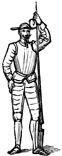
'When we look into the delightful history of the most ingenious
Don Quixote of La Mancha, and consider the exercises and
manner of life of that renowned gentleman, we cannot
but admire the exquisite genius and discerning spirit
of Michael Cervantes; who has not only painted his
adventurer with great mastery in the conspicuous
parts of his story, which relate to love and honour,
but also intimated in his ordinary life, in his economy
and furniture, the infallible symptoms he gave of his
growing phrenzy, before he declared himself a knight-errant.
His hall was furnished with old lances, halberds,
and morions; his food, lentiles; his dress,
amorous. He slept moderately, rose early, and spent
his time in hunting. When by watchfulness and exercise he was
thus qualified for the hardships of his intended peregrinations, he
had nothing more to do but to fall hard to study; and, before he
should apply himself to the practical part, get into the methods of
making love and war by reading books of knighthood. As for
raising tender passions in him, Cervantes reports that he was wonderfully
delighted with a smooth intricate sentence; and when
they listened at his study-door, they could frequently hear him
read aloud, "The reason of the unreasonableness, which against
my reason is wrought, doth so weaken my reason, as with all
reason I do justly complain of your beauty." Again he would
pause until he came to another charming sentence, and, with the
most pleasing accent imaginable, be loud at a new paragraph:
"The high heavens, which, with your divinity, do fortify you
divinely with the stars, make you deserveress of the deserts that
your greatness deserves." With these and other such passages,
says my author, the poor gentleman grew distracted, and was
breaking his brains day and night to understand and unravel their
sense.
'What I am now warning the people of is, that the newspapers
of this island are as pernicious to weak heads in England as ever
books of chivalry to Spain; and therefore shall do all that in me
lies, with the utmost care and vigilance imaginable, to prevent
these growing evils.'
Mr. Bickerstaff goes on to describe the private Bedlam he has
provided for such as are seized with these rabid political maladies.
No. 186. The 'Tatler.'—June 17, 1710.
Virtue alone ennobles human kind,
And power should on her glorious footsteps wait.
'There is nothing more necessary to establish reputation than
to suspend the enjoyment of it. He that cannot bear the sense of
merit with silence, must of necessity destroy it; for fame being
the general mistress of mankind, whoever gives it to himself insults
all to whom he relates any circumstances to his own advantage.
He is considered as an open ravisher of that beauty for whom all
others pine in silence. But some minds are so incapable of any
temperance in this particular, that on every second in their discourse
you may observe an earnestness in their eyes which shows they
wait for your approbation; and perhaps the next instant cast an
eye in a glass to see how they like themselves.
'Walking the other day in a neighbouring inn of court, I saw
a more happy and more graceful orator than I ever before had
heard or read of. A youth of about nineteen years of age was in
an Indian dressing-gown and laced cap, pleading a cause before
a glass. The young fellow had a very good air, and seemed to
hold his brief in his hand rather to help his action, than that he
wanted notes for his further information. When I first began to
observe him, I feared he would soon
be alarmed; but he was so zealous
for his client, and so favourably received
by the court, that he went on
with great fluency to inform the
bench that he humbly hoped they
would not let the merit of the cause
suffer by the youth and inexperience
of the pleader; that in all things he
submitted to their candour; and modestly desired they would not
conclude but that strength of argument and force of reason may
be consistent with grace of action and comeliness of person.
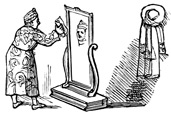
'To me (who see people every day in the midst of crowds,
whomsoever they seem to address, talk only to themselves and of
themselves) this orator was not so extravagant a man as perhaps
another would have thought him; but I took part in his success,
and was very glad to find he had in his favour judgment and costs,
without any manner of opposition.'
No. 204. The 'Tatler.'—July 29, 1710.
He with rapture hears
A title tingling in his tender ears.
Francis's Horace, Sat. V. 32.
'Were distinctions used according
to the rules of reason
and sense, those additions
to men's names would be,
as they were first intended,
significant of their worth, and
not their persons; so that in
some cases it might be proper to say of a deceased ambassador,
"The man is dead; but his excellency will never die." It is,
methinks, very unjust to laugh at a Quaker, because he has taken
up a resolution to treat you with a word the most expressive of
complaisance that can be thought of, and with an air of good-nature
and charity calls you Friend. I say, it is very unjust to
rally him for this term to a stranger, when you yourself, in all your
phrases of distinction, confound phrases of honour into no use at all.
'Tom Courtly, who is the pink of courtesy, is an instance of
how little moment an undistinguishing application of sounds of
honour are to those who understand themselves. Tom never fails
of paying his obeisance to every man he sees who has title or
office to make him conspicuous; but his deference is wholly given
to outward considerations. I, who know him, can tell him within
half an acre how much land one man has more than another by
Tom's bow to him. Title is all he knows of honour, and civility
of friendship; for this reason, because he cares for no man living,
he is religiously strict in performing, what he calls, his respects to
you. To this end he is very learned in pedigree, and will abate
something in the ceremony of his approaches to a man, if he is in
any doubt about the bearing of his coat of arms. What is the
most pleasant of all his character is, that he acts with a sort of
integrity in these impertinences; and though he would not do any
solid kindness, he is wonderfully just and careful not to wrong his
quality. But as integrity is very scarce in the world, I cannot
forbear having respect for the impertinent: it is some virtue to be
bound by anything. Tom and I are upon very good terms, for
the respect he has for the house of Bickerstaff. Though one
cannot but laugh at his serious consideration of things so little
essential, one must have a value even for a frivolous good conscience.'