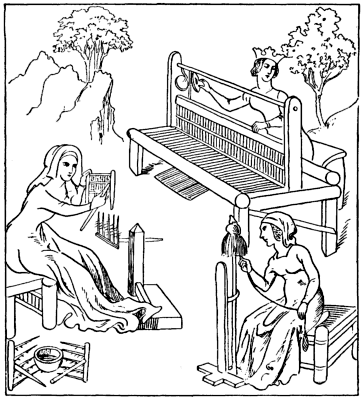
Apparatus: Pick glass, dissecting pin,[21] foot-rule.
Materials: 4 square inches of burlap.
References: Textiles. See page 54, Weaving; page 1, Fibers.
1. Look at the cloth under the pick glass and describe the
appearance and structure of its interlacing threads, called weave.
2. With a pin separate the interlacing threads of the cloth which
are called warp and filling. Warp is composed of yarn running
in the direction of the length of the cloth. Filling is composed of
yarn running at right angles to the warp.
a. What are the interlacing threads of cloth called?
b. Of what is warp composed and in what direction do the warp
threads extend? filling?
3. Notice the appearance of the individual threads (called yarn)
of the warp and filling. Test the strength of the yarn by trying
to break it.
4. Untwist one of the warp threads and one of the filling threads.
Notice whether the yarn becomes stronger or weaker as it is
untwisted. What effect has twist on the yarn?
5. After untwisting one of the threads what remains? Measure
the length of several of these ends called fibers. Describe the
appearance of the fiber as to curl, feel, fineness, etc.
1. Of what does yarn consist?
2. What causes the fibers to cling together?
3. What is the process called by which two sets of threads
interlace?
4. When two sets of threads interlace or are woven what is
produced?
Apparatus: Hand loom,[22] two pencils, scissors.
Material: Yarn of two colors.
Reference: Textiles, page 58.
1. Make a warp on the hand loom with green yarn by having
parallel threads running the longest way of the loom to the
notches.
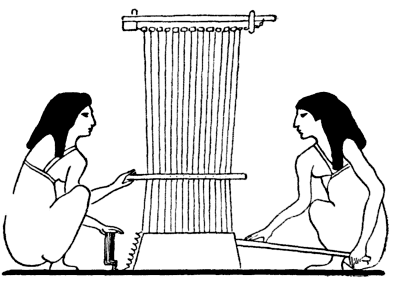
2. A harness is a framework on a loom used for raising certain
warp threads. Use a pencil as a harness and raise the 1st, 3d,
and 5th warp threads. A shed will in this way be formed
through which the shuttle carrying the filling thread will pass.
Use the red yarn for filling and attach it at one end before passing
it through the shed.
3. With a second pencil to act as a second harness raise the
2d, 4th, and 6th warp threads. Pass the filling through the shed
thus formed.
4. Repeat twice Directions 2 and 3.
5. Tie all ends, cut the woven sample away from the loom, and
mount in note-book.
1. What part of a loom is the harness?
2. What is meant by a shed?
3. What carries the filling thread through the shed on a loom?
4. What is the principle of plain weaving?
5. Name some fabrics produced by plain weaving? See Textiles,
page 58.
Apparatus: Hand loom, four pencils, scissors.
Materials: White cotton warp, colored yarn filling.
Reference: Textiles, page 58.
1. On the hand loom make a warp by threading four white warp
threads to a notch until there are six sets of warp threads.
2. Using a pencil as a harness (See Exp. 2) raise the first thread
of each set of warp threads and pass the filling thread through the
shed thus formed.
3. With another pencil as a second harness raise the second thread
of each set of warp threads and pass the filling.
4. With a third pencil raise the third thread of each set of warp
threads and pass the filling.
5. With still another pencil to act as a fourth harness raise the
fourth thread of each set and again pass the filling.
6. Repeat the above directions (2 to 5) several times. Notice
that the moving of the filling thread, one warp thread to the left,
each time it is woven is causing a diagonal line or rib to form,
called twill.
7. Cut the woven sample away from the loom and mount.
1. Why is this weave called a twill weave?
2. How is the diagonal line or twill formed?
3. Why would this kind of weaving be spoken of as 4-harness
weave?
4. What popular dress fabric is of twill weave?
Apparatus: Pick glass, dissecting pin, foot-rule.
Material: 4 sq. in. of burlap, 4 sq. in. of serge.
References: Textiles, pages 58, 59,
60.
1. Examine the burlap under the pick glass, noting the structure
and number of threads to the inch in the warp (called ends) and the
number of threads to the inch in the filling (called picks). Verify
with foot-rule.
2. Repeat the above, using serge.
1. What is meant by a number of “ends to the inch”? a number
of “picks to the inch”?
2. How many ends to the inch in the burlap? How many picks
to the inch?
3. How many ends to the inch in the serge? How many picks?
4. Note several differences between cloth produced by plain
weaving and cloth produced by twill weaving.
Apparatus: Hand loom, two pencils, scissors.
Materials: White cotton warp, filling yarn of two colors.
Reference: Textiles, page 62.
1. Thread the loom two warp threads to a notch until there are
20 ends (warp threads).
2. Use a pencil as a harness. Raise the 1st, 3d, 5th, 7th, and
9th sets of warp threads.
3. Fasten securely the green filling yarn at one end and pass
it through the shed formed by carrying out Direction 2. Draw
the filling thread tight and wind once or twice around the outside
warp end.
4. Use a second pencil as a harness and raise the sets of warp
threads that are now down, forming a new shed.
5. Fasten the red filling yarn at one end and pass it through the
shed. Wind once or twice about the outside warp end.
6. Raise the red filling to form a loop in each place where it (the
red filling) has passed over a warp end.
7. Form a shed by raising the first harness and pass through
the green filling thread, drawing it tight to hold the red filling above
it in place. Wind about the outside warp end.
8. Repeat Directions 2-7 several times, each time raising the
red filling to form loops and each time drawing the green filling
tight to hold the red in place.
9. Cut with scissors the loops formed by raising the red filling.
10. As well as you can with scissors, shear the pile (the soft,
thick covering on the face) to make a fairly even surface.
11. Cut the sample away from the loom and mount.
1. What are some varieties of cloth that are woven with a pile
surface?
2. Sometimes the loops of the pile are cut and sometimes left
as loops. What fabrics are examples of cut pile? uncut pile?
3. What is meant by the pile of velvet or carpet?
Apparatus: Pick glass, dissecting needle.
Materials: Samples of satin, voile, lace curtaining, double cloth, carpeting.
Reference: Textiles, pages 58-64.
1. Examine the sample of satin under the pick glass. Notice
that the warp and filling interlace in such a way that there is no
trace of the diagonal on the face of the cloth.
a. Is satin of a close or loose weave?
b. What can you say of the surface of satin?
c. What effect has this smooth surface on light?
d. This is called a satin weave. Why?
e. What is the most extensive use of the satin weave? (See
Textiles, page 1.)
Note.—Sometimes fabrics of other weaves will have a satin
stripe.
2. Examine the sample of voile under the pick glass. This is
a type of what is known as gauze weave.
a. What is the chief characteristic of the gauze weave?
b. Name several gauze fabrics.
3. Examine a piece of lace curtaining under the pick glass.
a. If the fancy figures were not present, of what weave would
this sample be?
Simple figures are stitched into plainly woven or gauze fabrics
by machinery to imitate embroidery. This style of weave
is known as lappet weave.
b. On fabrics of what two weaves is lappet weaving used?
c. What is lappet weaving?
4. Examine a piece of carpet. Notice the elaborate designs or
patterns and the number of colors used. When the figures are
elaborate they cannot be stitched in by simple lappet weaving.
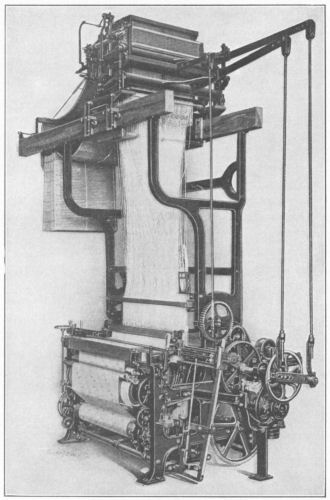
A special attachment called the Jacquard apparatus is placed
on top of the loom. This apparatus controls the warp threads
so that a great many sheds may be formed and elaborate figures
woven into fabrics. This is called Jacquard weaving.
a. What must be added to a loom for Jacquard weaving?
b. What is the use of the Jacquard apparatus?
c. When is the Jacquard weave used instead of lappet weave?
5. Read Textiles, page 61.
6. Examine the sample of double cloth. Notice that there
are two single cloths. They are combined into one by here and
there lacing the warp and filling of one cloth into the warp and
filling of the other. In this way they are fastened together securely.
a. What color is the sample on one side? the other?
b. Of what is double cloth composed?
c. How are the single cloths combined into one?
d. Read Textiles, page 62. What are some of the uses of
double cloth?
7. How many classes of weave have been studied?
8. Name the classes of weave.
9. Name a fabric to illustrate each weave.
Apparatus: Pick glass, dissecting needle.
Materials: Samples of broadcloth, mohair, silk,
cotton cloth, linen.
References: Textiles, pages 1; 97,
Mohair; 203, Silk; 105, Cotton;
193, Linen; 199, Hemp;
201, Jute; 232, Ramie;
233, Pineapple.
1. Read Textiles, page 1, paragraph 1. What are textiles?
2. Cloth is composed of yarn. Yarn in its turn is composed of
many small ends called fibers.
3. Look at the sample of broadcloth. If you did not know this
to be broadcloth you would speak of it as woolen goods. Detach
from the sample a filling thread and separate it into fibers. These
are woolen fibers.
4. Examine the sample of mohair and separate a filling thread
into fibers. This takes the name mohair from the fibers which
compose it. Mohair is obtained from the Angora goat.
5. Examine a sample of silk, also a detached filling thread. The
silk fiber consists of a thread spun by the silk worm.
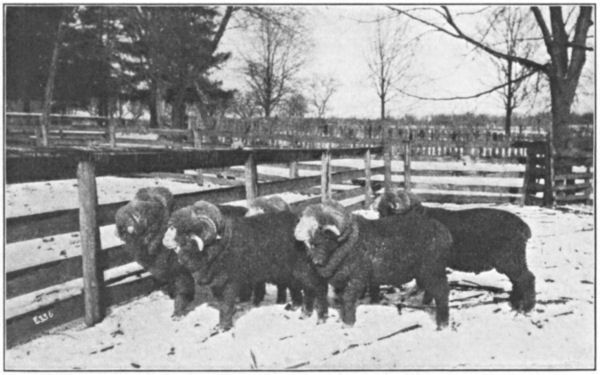
6. Wool, mohair, and silk fibers are obtained from the animals,
the sheep, goat, and silk worm, hence they are called animal fibers.
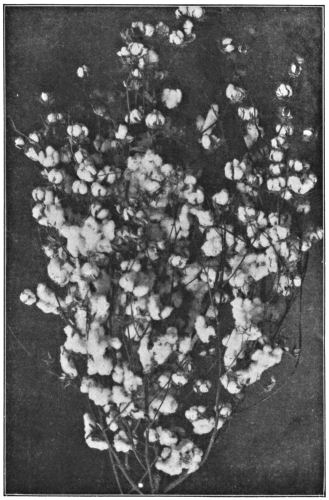
7. Detach from the sample of cotton cloth a filling thread and
separate it into fibers. These are cotton fibers and are obtained
from the cotton plant.
8. Examine the sample of linen, a filling thread and its fibers.
Linen is composed of fibers obtained from the flax plant.
9. Cotton and linen fibers are obtained from plants, and are
called vegetable fibers. There are other vegetable fibers such as
jute, hemp, ramie, pineapple, etc., but cotton and linen are the
most important.
10. Name the most valuable fibers for textile use.
1. Of what is cloth composed?
2. Of what does yarn consist?
3. How are the fibers made to join in one long thread? (See
Experiment 1.)
4. Of what fibers are woolen and worsted goods composed?
5. Of what animal is wool the covering?
6. Of what fibers is mohair composed?
7. From what animal is mohair obtained?
8. Of what does the silk fiber consist?
9. What are the animal fibers?
10. Why are they called animal fibers?
11. Of what fibers is cotton cloth composed?
12. From what plant are cotton fibers obtained?
13. From what plant is the linen fiber obtained?
14. What are the most important vegetable fibers?
15. Name four other vegetable fibers.
16. Why are these fibers called vegetable fibers?
Apparatus: Pick glass, microscope, 2 pine cones, foot-rule.
Materials: Raw wool, woolen yarn.
Reference: Textiles, chapter i.
1. Separate a strand of woolen yarn into fibers. Examine both
these fibers and fibers pulled from the raw wool. Would you
describe these fibers as coarse or fine?
2. How do the fibers feel to touch?
3. Test the strength of the wool fibers by trying to break them.
4. Measure the length of several fibers.
5. Why was it difficult to straighten the fibers to measure them?
6. Extend the fiber to its full length, then release. How does
this prove the fiber to be elastic?
7. Examine the fibers under the microscope. Describe. Notice
that the wool fiber is cylindrical in shape. Notice that it is
covered with scales which overlap much as do the tiles of a roof
or the spines of a pine cone.
8. Hold one pine cone with the spines pointing upward. With
the spines of the other pointing downward press the second cone
down on the first. What happens? Just so the scales or points
of the wool fibers hook into one another and interlock. These
scales or serrations give to the wool fiber its chief characteristic
which is the power of interlocking known as felting or shrinking.
9. See Textiles, page 2, the drawing of a magnified wool fiber.
Make a drawing of a wool fiber.
10. Examine under the microscope a hair from your head. Wool
is only a variety of hair. Notice that the scales on the hair lie
close to the stem and do not project as in the woolen fiber, hence
hair fibers cannot interlock as wool fibers do. The scales lying
close to the hair give a smooth surface to the fiber and make luster
a characteristic.
11. Compare the wool fiber with hair, noting two differences.
1. With what is the wool fiber covered?
2. Of what advantage are these scales or points?
3. What is the chief characteristic of wool?
4. What is meant by the shrinking or felting power?
5. Name five characteristics of the wool fiber.
Apparatus: Microscope, foot-rule.
Materials: Wool fibers, mohair fibers, sample of mohair brilliantine.
References: Textiles, pages 1, 37,
97.
1. Pull a mohair fiber from the fleece. Hold it up to the light.
Describe the fiber as you see it.
2. Hold a mohair fiber and a wool fiber side by side to the light.
Note the differences.
3. Measure several mohair fibers.
4. Examine the mohair fiber under the microscope. The fiber
is covered with scales, but they lie close to the fiber and do not
project in points as do the scales on the wool fiber, hence mohair
will not felt to any degree.
5. The Angora goat of Asia Minor furnishes the mohair. This
goat is being raised in the western states of the United States
now.
6. Detach from the sample of mohair brilliantine a warp thread;
a filling thread. Which is mohair? Which is cotton?
7. What word would describe the feel of mohair brilliantine?
the appearance?
8. What are the characteristics of the mohair fiber?
9. What are the uses of mohair? Mohair is used in the manufacture
of plushes, dress fabrics, and imitation furs.
1. Why will mohair not felt as wool does?
2. The scales lying close to the stem will have what effect on
the surface of the fiber?
3. What effect will a smooth surface have on light?
4. What characteristic is given to mohair from the fact that
the smooth surface reflects light?
5. From what animal is mohair obtained in greatest quantity?
6. Where is mohair being grown in the United States?
Apparatus: Microscope, foot-rule.
Materials: Tuft of cotton fibers, cotton ball, seeds.
Reference: Textiles, chapter ix, page 105.
1. Hold a tuft of cotton fibers tightly between the fingers and
thumb of each hand and pull apart with a jerk. What is your
judgment of the strength of the staple (fiber)?
2. Loosen gently the fibers of one of the tufts you have pulled
apart. What is the feel of cotton? the appearance as you hold
it to the light?
3. Detach several fibers one by one. How does the length compare
with that of the wool and mohair? Measure and record the
length of three fibers.
4. How do cotton fibers compare in fineness with wool fibers?
5. Compare the elasticity of cotton with that of wool.
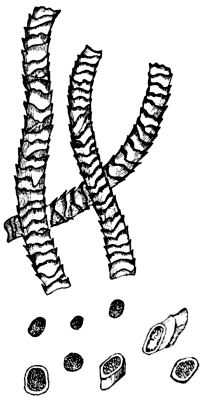
6. Examine the cotton fibers under the microscope. Observe
that the enlarged fiber looks like a twisted ribbon. When the
fiber was growing it was cylindrical in shape. When ripe the plant
drew back its life-giving fluid from the fiber and it collapsed and
twisted like a corkscrew. The twist is peculiar to the cotton,
being present in no other fiber. The twist makes the cotton fiber
suitable for spinning, helping to hold the short fibers together.
7. Read of the cotton plant from Textiles, chapter ix.
8. The four chief cotton producing countries are the United
States, Egypt, India, Brazil.
9. There are several classifications of cotton. The most common
are Sea Island (in the lead); Egyptian (a close second);
Uplands (that of the United States, southern part); and Peruvian.
10. Uplands is the most common cotton of our South.
1. What characteristic causes the cotton fiber to be easily recognized
under the microscope?
2. Why does the twist render the cotton fiber suitable for spinning?
3. What are the characteristics of the cotton fiber?
4. Why is cotton known as a vegetable fiber?
5. Name the chief cotton producing countries.
6. What are the most common classifications of cotton?
7. What is the finest growth of cotton? (Sea Island commands
at the present time $1.00 a lb., while Middling Uplands brings
15 cents.)
8. Where is cotton known as Upland Cotton grown?
Apparatus: Tripod, alcohol lamp, small pan of water, lead pencil.
Material: Silk cocoon.
Reference: Textiles, chapter xvii, page 203.
1. Place the cocoon in a small pan of water. Apply heat to the
pan until the water boils. The cocoon is placed in hot water to
soften the glue which holds the fibers together.
2. Remove the outside loose fibers which cannot be reeled. This
tangled silk on the outside of the cocoon is called floss.
3. Brush the finger over the cocoon to find the loose ends. Unwind
carefully until you find a continuous end. Wind or reel the
silk fiber over a lead pencil.
4. The silk fiber is the most beautiful and perfect of all fibers.
5. Hold the cocoon to the light as you reel. How does the silk
fiber compare in fineness with the wool and cotton fibers?
6. The silk fiber is from 1000 to 4000 feet long. Unlike the other
fibers the silk fiber is already a thread.
7. How does light effect the silk fiber? When the gum is thoroughly
washed off the silk takes on its luster which is its chief
characteristic.
8. Break the fiber after you have reeled a small quantity.
Notice how the fiber springs back. Extend and release again.
What characteristic does this illustrate?
9. Examine the silk fiber under the microscope. Notice that
it is round and smooth and resembles a glass rod. It shows what
appear to be two fibers united by the gum secreted at the same
time that the fiber was formed. Describe the silk fiber as it
appears under the microscope.
10. Silk is taken from the reel and twisted into a skein of raw
silk and thus exported.
11. The manufacture in the United States begins with raw silk.
It is handled here first by the throwster who winds it from the skein
and makes different varieties of thread.
1. Why is the silk cocoon first placed in hot water?
2. What is known as floss?
3. What is meant by silk reeling?
4. What can you say of the length of the silk fiber?
5. In what way does the silk fiber differ from the other fibers?
6. What is the chief characteristic of the silk fiber?
7. What are other characteristics of the silk fiber?
8. In what form is silk exported?
9. In what countries is most of the raw silk produced? (See
Textiles, page 206.)
10. With what does the silk manufacture in the United States
begin?
11. Who is the throwster and what is his work?
Apparatus: Microscope.
Material: Flax fibers.
Reference: Textiles, chapter xv, page 193.
1. The linen fiber is obtained from the flax plant. Certain fibers,
such as flax, jute, and ramie, are obtained from the stem of the
plant, hence are known as bast fibers, and flax is the most important
bast fiber.
2. It is difficult to separate the flax or linen fiber from the woody
part of the stem. The process is called retting, which is really
rotting by soaking the stem in water.
3. Before the fibers are entirely free from the woody part of the
plant they undergo the processes of beating, breaking, scutching,
hackling, etc.
4. Read the account of each process. See Textiles, pages 194,
195.
5. Measure and record the length of two linen fibers.
6. Test the strength by trying to break the fiber.
7. Test for elasticity.
8. What is the appearance of the linen fiber when held to the
light?
9. What is the color of the fiber? What is the process called by
which linen is whitened? (Bleaching.)
10. Examine the flax fibers under the microscope. Observe that
the fibers look like long cylindrical tubes. Describe the appearance
of linen fibers under the microscope.
11. The best flax is grown in Belgium and Ireland.
1. From what part of the plant are bast fibers obtained?
2. Name some bast fibers.
3. What is the most important bast fiber?
4. What is retting?
5. For what purpose is linen subjected to retting?
6. Through what five processes does the flax fiber pass before
it is free?
7. Where is the best flax grown?
Apparatus: A pair of hand cards.
Material: Small quantity of scoured wool.
References: Textiles, pages 39 and
50.
1. Examine the hand cards. Notice that there is a foundation
of several layers of leather. Notice that this foundation is covered
with staples of steel wire. Notice that the staples are shaped like
the letter U with the points turned one way. The covering of
the hand cards is called card clothing.
2. Hold one hand card in the left hand, face up, wires pointing
to the left. Spread the wool over the pointed wires of this card.
3. Hold the other card in the right hand, face down, with the
wires pointing to the right. Bring the pointed wires of this card
down on the wool and drag it lightly through the wires of the
other card. Repeat several times.
4. You have been carding wool. The sharp points have been
tearing the wool apart or disentangling the fibers. Carding brushes
the fibers out smooth and makes them somewhat parallel. It
forms them into a thin sheet.
5. The wool must be carded many times before it is sufficiently
disentangled for drawing and spinning. In order to card again
the hand card must be stripped of the wool so that it may be
dragged again through the staples.
6. Hold the hand card, which is in your right hand, erect.
Notice that the wires point downward. Move the other hand
downward over the wires. Notice that the surface is smooth.
The points do not prick as they will if you try to brush the hand
upwards over the wires.
7. Hold the card in the left hand in a similar position. Raise
and bring the sharp wires of this card down on the smooth surface
of the other card and strip it of its wool.
8. Card again, then strip again. Repeat several times until
the fibers are thoroughly disentangled.
9. This carding and stripping, once done by hand, is now done in
the mill by a power machine called the card. (See picture, Textiles,
page 38.) Notice that instead of cards this machine consists of
rollers or cylinders. Some are carding cylinders and some are
stripping cylinders. The principle is the same as that of the hand
cards. The wool is carded and stripped again and again and is
finally delivered in a soft, fluffy rope called a sliver ready for drawing
and spinning.
1. What is the covering of the hand card called?
2. Describe card clothing.
3. What does carding do to the wool?
4. When the sharp wires of one cylinder meet the sharp pointed
wires of another cylinder what is the action on the wool?
5. If the sharp points of one cylinder meet the smooth surface
of another cylinder what happens to the wool on that cylinder?
6. In what form does the wool finally leave the machine? What
name is given to this fluffy rope?
7. How was carding done in the early days? How is it done
now?
8. In what way is the principle of the hand cards the same as
that of the card of the mill?
Apparatus: Foot-rule, elastic band.
Material: Small quantity of scoured wool.
References: Textiles, pages 4, 44,
134; Sections: Spinning: Mule Spinning.
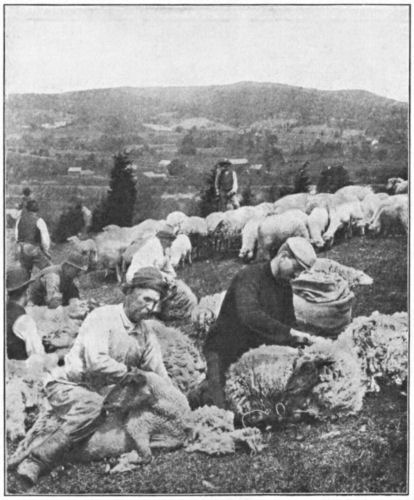
1. Observe the mass of wool fibers. The wool was clipped from
the sheep, washed, and oiled to make it smooth and pliable.
2. With the fingers gently open up or loosen the mass of wool
fibers. In the mill this is done by a machine called the card. (See
picture, Textiles, page 38.) And the process itself is called carding.
3. Gently draw out the mass of fibers until you have drawn it
into one long strand.
4. Draw it again and again until to draw it would cause it to
break.
5. This process in the mill is known as drawing. The wool
passes through machine after machine, which gradually reduces
the thickness of the strand.
6. You have now a strand called roving, but not a thread with
which you could weave. What is called the strand? Why could
you not weave with it as it is? If you pulled the roving apart it
would separate into a number of small ends. What name is given
to these ends?
7. It is necessary to hold these fibers together in a thread. Hold
the roving in the left hand and with the right hand draw the fibers
out several inches. As you draw, twist the roving between the
fingers and thumb. The twisting is called spinning.
8. When you have twisted sufficient yarn to attach to the end
of a foot-rule, do so. Give a whirl to the ruler, which is taking the
place of the old-time spindle, and let it drop. Continue to whirl
the ruler and notice that as it revolves the yarn is twisting. When
well twisted, wind the yarn on the ruler. There was a hook on the
old-time spindle. Instead of the hook, hold the wound yarn in
place by an elastic band. Draw out several inches again and
repeat.
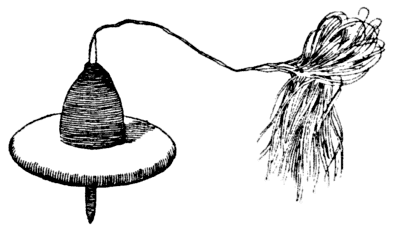
9. With the spindle a distaff was used. It held the roving which
you now hold in your left hand. (See picture of distaff and spindle.)
10. Define spinning; see Textiles, page 4, footnote. The early
use of the spindle was the same as its use of to-day. In what two
ways is the spindle of use?
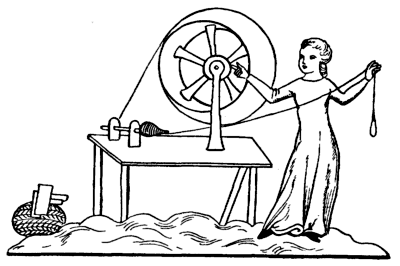
11. The improvement on the distaff and spindle was the spinning
wheel. Now the spinning frame in the mill has replaced both.
1. After shearing, through what two processes does wool pass?
2. Why is it necessary to oil wool?
3. What is the work of the card?
4. Explain the process called drawing. Why is it necessary to
repeat the operation several times?
5. What followed the distaff and spindle in the development of
spinning?
6. On what is the spinning done now in the mill? See Textiles,
picture, pages 135, 137.
Apparatus: Coarse comb, fine comb.
Material: Small quantity of scoured wool.
Reference: Textiles, pages 39-44.
1. Open up the wool a little with the fingers. Do this in place
of carding, as you need but a small quantity.
2. You comb your hair to make the hairs lie parallel, side by side,
in place. Combs are used on wool for just the same purpose, but
the first process of combing is not known as such. It is called
gilling, and the combs themselves are called fallers. The machines
are known as gill boxes. See Textiles, page 43.
3. Hold the carded wool in the left hand in the middle of the
strand. With the coarse comb in the right hand, comb and thus
straighten the fibers first at one end then at the other. This is
gilling. The principle of gilling is to comb the fibers more and more
nearly parallel and to draw them out into more even strands.
4. The coarse comb causes the hairs to lie parallel. A fine comb
will further straighten the hairs, but it will also remove the snarled,
tangled, short hairs. Again wool is to be treated like hair. Hold
the strand in the middle as before. Comb each end with the fine
comb. Notice that the fine comb is removing the short fibers and
leaving the long fibers between the fingers. This is the second
process of combing, and is called combing.
5. The long fibers are called tops and the short fibers are known
as noils.[23] Combing is the process which separates the long fibers
known as tops from the short fibers known as noils.
6. The combing machine in the mill is a very complicated one.
See picture, Textiles, page 41.
7. Gill and comb several strands of wool.
8. Top is too delicate, as it comes from the comb, to be handled.
The next process is to combine several strands into one. Combine
the several strands you have gilled and combed. Comb this one
end with the coarse comb again to be sure that the fibers are perfectly
parallel.
9. You gilled, combed, and gilled again. So it is in the mill.
After combing, the wool is gilled again by machines known as
finisher gill boxes, and wound into a ball called a top.
10. A top differs from top. Top is the strand of long fibers which
comes from the comb. A top is the ball of combed wool as it comes
from the finisher gill boxes. It weighs from 7 to 12 lbs. and contains
200 to 250 yds.
11. The wool is now ready for the next processes—those of drawing
and spinning.
1. Why is the hair combed? Why is wool combed?
2. What is the first process of combing called? What name is
given to the combs used in gilling? What are the machines called?
3. What is the principle of gilling?
4. How does a fine comb act on the hair?
5. When you combed the wool with the fine comb what happened?
6. What are the long fibers called? the short? Of which are there
more?
7. What is the second process of combing called?
8. Why is it necessary to combine several strands of top into one
end?
9. Why is it necessary to gill again after combing?
10. In what form does the wool finally leave the finisher gill
boxes?
11. What is a top?
12. What two processes follow carding?
13. For what two processes is wool now ready?
Apparatus: Hand cards, coarse and fine combs, pencil.
Material: Scoured wool.
Reference: The preceding experiments.
1. This wool has already been subjected to the three operations
of shearing, scouring, and oiling.
2. Card the wool. What does carding do to the wool?
3. Strip the cards. Rub the sheet of fibers between the palms
of the hands into the form of a strand. It is in this form that it
leaves the card of the mill, and it is known as a sliver of wool.
4. Pull about three inches of wool from the sliver and perform
upon it the operation of gilling by combing it with the coarse
comb.
5. Follow the gilling by the operation of combing, which you will
do by combing again, this time with a fine comb.
6. Pull about three inches again from the sliver. Continue to
gill and comb by section until the entire sliver has been gilled and
combed.
7. Combine several strands into one and subject the one strand
to a second process of gilling to make sure that all fibers are side
by side.
8. Gently draw out this strand of combed long fibers known
as top. As you draw, spin. As you spin, wind on a lead pencil.
The fineness of the yarn depends on the amount of drawing and
twisting.
9. What is the source of wool? You began with wool, covering
of the sheep’s body, and after subjecting it to a series of operations
you have converted it into yarn which is ready for weaving.
10. Name the operations in order, through which raw wool
passes before it finally becomes yarn.
1. What are the first three processes through which wool passes?
What is shearing? scouring?
2. Why is wool oiled?
3. What is meant by a sliver of wool?
4. What does gilling do to the wool?
5. What does combing do to the wool?
6. Why is there another operation of gilling after combing?
7. What is meant by drawing? spinning?
8. What name is given to the wool wound on the pencil?
9. On what does the fineness of the yarn depend?
Apparatus: Pick glass.
Materials: Sample of woolen cloth and worsted cloth.
References: Textiles, pages 50 and 51.
Take a piece of worsted fabric and separate a piece of yarn
from either the warp or filling. Do the same with a piece of woolen
fabric. Notice the appearance of each piece of yarn. Which is
smoother? What effect would friction have on the worsted yarn?
the woolen yarn? Which sample of yarn would shine and reflect
the light?
Apparatus: Chalk, scissors, dissecting pin, needle, pick glass.
Material: 4 square inches of cloth from the loom.
Reference: Textiles, page 71.
1. Cloth from the loom is far from being a finished product.
It must pass through several processes before it is finished. These
processes are known as finishing.
2. What is the feel of this cloth?
3. Hold the cloth to the light and look through it. Note the
imperfections and chalk them. What defects did you notice?
4. Place the cloth on the desk, face down. Rub the fingers over
the back of the cloth. When the fingers locate a knot, raise it with
the dissecting needle to be cut off later.
5. Reverse the cloth. Rub the fingers over the face. When
a knot is found, force it through to the back with the dissecting
needle. All the knots are on one side now. Clip them off with the
scissors. This is called burling and is the first process of finishing.
6. Hold the cloth to the light. Notice where an entire filling
thread is missing. This is known as a full miss pick. When part
of a filling thread is missing it is spoken of as a half miss pick. In
general what does a miss pick mean?
7. Unravel a filling thread from the lower edge of the cloth.
With it thread a needle and replace the missing pick. Follow the
weave closely, using a pick glass as an aid. You are performing
the second process of finishing, that of mending.
8. If a warp end is missing replace it.
1. What is meant by finishing?
2. What is the first process of finishing? What is burling?
3. What is a full miss pick? a half miss pick?
4. What is the second process of finishing? What is mending?
Of what must the mender be careful?
Material: Stained fabrics.
Textiles are easily stained, therefore it is necessary to know something
about the character of stains and the methods of removal.
Stains may be roughly divided into the following classes:
a. Stains from foods, such as grease and fruit acids.
b. Stains from machinery, as wheel grease and oils.
c. Blood stains.
d. Inks.
e. Chemicals, such as acids, alkalies.
Food stains are usually due either to grease contained in soup,
meat, milk, etc., or to sugar contained in candies or preserves, or
to fruit acids contained in fresh fruits or sauces.
Wheel grease and lubricant stains are obtained from various parts
of machines, like elevators, street cars, etc. After the cloth leaves
the loom it often contains spots of grease, oil, or dirt stains due to
drippings from the loom or overhead machinery. These are
removed by means of liquids called solvents that dissolve the stain.
Ether is the principal solvent used in the mill to remove small
stains.
Very few people realize that vapors of cooked food and fat,
unless carried out of a house, will condense and settle on fabrics
in the form of a film which collects a great deal of dust. (A bad
grease spot usually has a neglected grease spot for a foundation.)
In order to break up this film it is necessary to separate the
entangled dust. This is performed by some mechanical means,
such as shaking and brushing.
The most effective method of removing a stain is to place a circle
of absorbent material[24] around the spot to take up the excess of
liquid. A white cloth should be placed under the fabric to absorb
the solvent and show when the goods are clean. Then apply the
solvent with a cloth of the same color and texture (satin is excellent
as it does not grow linty) and rub from outside the spot to
the center to prevent spreading. It is necessary to rub very
carefully as excessive rubbing will remove the nap and change
the color. One of the great dangers in removing a stain is
that you may spoil the fabric. Therefore great care must be
exercised.
The principal solvents are ether, chloroform, alcohol, turpentine,
benzene, and naphtha. Each solvent may be used to best advantage
on certain fabrics.
The commercial grades of the solvents often contain impurities
that leave a brown ring after evaporation. This brown ring is
very objectionable. Turpentine is used only in removing stains
from coarse fabrics. Chloroform, benzene, and naphtha are used
on ordinary silks and linens. Ether and chloroform are used to
best advantage in removing stains from delicate silk, as they seldom
affect colors and evaporate very quickly. Of course it must
be borne in mind that when a stain is removed from a fabric that
portion that contained the stain loses some coloring matter and feels
rougher than the other part.
It is usually desirable to use the following method in removing
grease from a heavy fabric, such as carpets or colored fabrics. In
case the grease is fresh, place over the stain a piece of clean blotting
paper or a piece of butcher’s brown wrapping paper and underneath
absorbent paper or oil cloth, and then press the spot with a warm
iron. As heat often affects the shades of certain colors such as
blues, greens, and reds, it is best to hold a hot iron over the fabric
and see if the grease is melted.
Remove a stain from a piece of carpet.
Ordinary Fabrics (wash goods). Wash the fabric containing grease
or blood stain with tepid water and soap.
Delicate Fabrics. As strong soap will spoil some colors and textures
it is necessary to apply a solvent when a delicate fabric is
stained.
Remove stains from a washable fabric and a delicate fabric.
Wheel grease is a mixture of oils and graphite. Apply benzene
to the wheel grease spot. This will dissolve the oil, leaving the
coloring matter (graphite) on the cloth, and this may be collected
on the white cloth on the other side.
Remove a wheel grease stain from a dress fabric.
Fruit acids and all others, except nitric acid may be removed
by putting ammonia on the spot. This will neutralize the acid,
forming a salt which may be either brushed or washed off. In
the case of nitric acid the fibers of the cloth are actually destroyed
and no amount of ammonia will restore the original condition of
the fabric.
Remove a stain of orange juice from a dress or shirt waist.
Blood stains may be removed from a fabric by washing with
cold or tepid water. Never use hot water, as hot water coagulates
the albumen of the blood. After removing the blood soap and
warm water may be used. In case the fabric is a thick cloth, the
blood may be removed by applications of moist starch.
Take different samples of fabrics and soil them with fruit acids,
soup, wheel grease, ink, and blood and remove them. Exercise
great care so as not to leave a mark or remove the coloring.
Remove blood from a fabric.
1. What is a solvent? an absorbent?
2. What is the best solvent to be used in removing stains from
silks, coarse goods, and linens? from delicate silks?
3. Why is a brown ring often left after removing a stain?
4. How may grease and blood stain be removed from wash goods?
5. What is wheel grease? How may it be removed?
6. How will ammonia remove acid stains?
7. Does it remove all? Why not?
8. Explain the method of removing blood stain from cloth.
Apparatus: Large porcelain dish or casserole, filter.
Materials: Undyed piece of woolen and worsted fabric, undyed yarn, and undyed raw cloth.
Reference: Textiles, page 65.
1. Prepare a solution of coloring matter by dissolving a half
ounce of diamond dye (green or red) in a quart of water. Filter
the solution. Place a piece of white woolen cloth in the liquid
and boil ten minutes. Then wash the dyed fabric and notice
whether the dyestuff washes off or not.
2. Repeat the experiment, using the same weight of undyed
woolen yarn. Repeat with worsted yarn.
3. Repeat the experiment using the same weight of wool sliver.
4. Notice which has the deeper color. The degree of color
depends on the amount of twist in yarn. Which sample has
absorbed the greatest amount of dyestuff from the liquid?
a. Why is a yarn-dyed fabric faster than a piece-dyed?
b. Why is a raw stock dyed fabric better than piece or yarn
dyed?
Apparatus: Porcelain dish, filter stand, etc.
Material: Piece of cotton cloth.
Reference: Textiles, page 67.
1. Prepare a solution of coloring matter by dissolving a half
ounce of logwood in a quart of water. Filter the solution.
Place a piece of cotton cloth in the liquid and boil ten minutes.
Then wash the dyed fabric and notice whether the dyestuff
washes off or not.
2. Repeat the same experiment and use a piece of cotton cloth
that has been previously washed in common alum.[25] Note the
effect. Which has the greater attraction for dyestuffs, cotton or
wool? Why is alum used?
3. Repeat the same experiment, using first the same weight of
cotton yarn and then the same weight of cotton sliver. Notice
the results.
Which piece of cotton holds the dye best, that which was dipped
in alum or the one that was simply boiled in the solution?
Apparatus: Porcelain dishes.
Material: Silk yarn.
Reference: Textiles, pages 212-214.
1. Weigh separately two skeins of dry silk and distinguish skein
No. 1 by looping some cotton thread into it. Prepare a tepid
bath containing 10 gm. strong sumach extract in 400 cc. water.
Enter the skeins of silk and work for 15 to 20 minutes, meanwhile
slowly raising the temperature to about 150° F. Remove, squeeze,
rinse with water, squeeze, and dry skein No. 1 for weighing.
2. Meanwhile prepare another bath containing 4 gm. of copperas
(ferrous sulphate) in 400 cc. cold water. Work skein No. 2 in
bath for 10 minutes cold. Remove, and rinse well; save the iron
bath. Repeat the treatment in the sumach and iron baths several
times more, finally wash the sumach iron skein in 1 per cent hot
soap solution; rinse, squeeze, and dry. Weigh each dried and
cooled skein and note the increase in weight of each. Save
sample for Experiment 23 and note the effect of weighting on the
yarn.
Apparatus: Porcelain dish, filter stand, etc.
Material: Piece of silk yarn.
Reference: Textiles, page 210.
1. Prepare a solution of coloring matter by dissolving a half
ounce of logwood in a quart of water. Filter the solution.
Place a piece of silk skein, from Experiment 22, in the liquid
and boil ten minutes. Then wash the dyed silk and notice
whether the dyestuff washes off or not.
2. Repeat the same experiment using the same weight of silk
yarn without weighing it. Compare the results.
Apparatus: Pen knife.
Materials: Woolen and cotton fabrics.
Reference: Textiles, pages 66-68.
Unravel threads of the suspected sample, and with a blade of
pen knife note whether the dyestuff has penetrated through the
yarn as noted by the depth of color in the interior of the yarn.
In case there is the same depth of color in the interior as on
the surface, the fabric is yarn-dyed. If on the other hand, the
interior of the yarn is not so highly colored as the exterior, it is
piece-dyed.
1. What is meant by yarn-dyed fabric?
2. What is meant by piece-dyed fabric?
3. How may the two be distinguished?
Apparatus: Knife-blade.
Materials: Cotton fabrics.
Reference: Textiles, page 65.
Printed fabrics may be distinguished from dyed by observing
the back side of the cloth, and noting whether or not the pattern
on the face of the cloth penetrates through to the back, or only the
outline shows. In case the figure or pattern is on both sides of the
fabric, it may be distinguished from the dyed by taking one thread
of the suspected sample, and by the means of a knife-blade attempting
to scrape off the coloring on the surface of the thread. If the
dyestuff has penetrated into the interior of the thread, it is not
printed.
Generally speaking, printed fabrics are known from dyed fabrics
by the fact that the former have the design printed on the face of
the cloth. This is called direct printing. The best dyed fabrics
are obtained by dyeing in what is called a jig, and the whole fabric
is saturated with color. Most, if not all the cloths which you see
in the retail dry goods stores which are in plain colors are dyed in
the jig. Some of the cheaper qualities of dyed fabrics are padded
in a mangle, but there has been a very small quantity of these goods
on the market for many years.
Printed fabrics may be made as fast as dyed fabrics; it all depends
upon the process by which the goods are converted. Within the
past few years great headway has been made in dyeing with what
are termed vat colors. Indanthrene is a vat color and a great many
mills have used this class of dye successfully in dyeing plain shades.
This is what would be termed a fast color in every sense of the word.
There are a number of dyestuff makers in Europe who put vat
colors on the market, but they all call them by different names.
Vat colors have been used with success in printing during the past
year or two, especially on shirting fabrics, and these colors are
fast to both light and washing. Most direct colors used for printing
or dyeing are equally fast to light and washing, but of course they
will not stand the test as well as the vat colors mentioned above.
The essential qualities of a good printed fabric are its ability to
withstand exposure to light and washing. In printing, of course,
a greater variety of desirable styles can be obtained than by dyeing,
in fact there are certain popular lines of goods now on the
market the effect of the designs of which cannot be obtained in
any other way than by printing. At the same time, although the
field in designing for dyed fabrics is limited, some very handsome
effects can be obtained.
It will not be many years before a large proportion of the printed
and dyed fabrics put on the market, both foreign and domestic,
will be in the vat colors which, as stated above, are very fast.
Even at the present time there are many mills that are using
this class of colors entirely, especially the mills which manufacture
woven fabrics.
1. In printed fabrics is the pattern clearly discernible on the
back of the cloth?
2. If the fabric is printed on both sides, how may this fact be
proved?
3. What is the difference between printed and dyed fabrics?
Apparatus: A quart bottle.
Material: Sulphur, worsted or silk fabric.
Bleaching powder cannot be used in bleaching animal fibers
such as woolen and silk fabrics. It injures the fibers and at the
same time leaves them yellow.
Animal fibers are best bleached by immersing in an aqueous
solution of sulphurous acid or exposing them to fumes of burning
sulphur.
Wet a piece of dyed worsted or silk fabric and hang it in a
quart bottle containing fumes of burning sulphur.[26] The fumes
of burning sulphur have an affinity for coloring matter—dyestuff.
The fumes (called sulphur dioxide) do not in most cases destroy
the coloring matter as chlorine does, but simply combine with
it to form colorless compounds which can be destroyed. The
color can be restored by exposing the bleached fabric to dilute
sulphuric acid.
1. Why is it necessary that the fabric be moist in order to be
bleached by sulphur dioxide fumes?
2. What becomes of the coloring matter?
Apparatus: Porcelain dish.
Material: Piece of calico.
Reference: Textiles, page 148.
Place a quarter of an ounce of bleaching powder in a quart
bottle containing a pint of water.[27] Then place a piece of calico in
the water containing the bleaching powder. What is the effect
on the calico? Then remove cloth to another bottle filled with
dilute hydrochloric or dilute sulphuric acid. What is the effect
on the color? Then wash the whitened cloth thoroughly in
water.
Why is it necessary in practice to pass cotton fabrics through
two baths in bleaching? What is contained in the first bath?
in the second bath?
Apparatus: Pick glass.
Materials: Different fabrics.
References: Textiles, pages 56-58, etc.
Examine different samples of cloth and classify them according
to the seven standards given on pages 56-58, etc.
Apparatus: Yard stick.
Materials: Sample of cotton, woolen, and worsted yarns.
References: Textiles, pages 49,
51, 52.
As yarns used in the manufacture of fabrics are of all degrees of
thickness, it became necessary to adopt some method of measuring
this thickness. For this purpose yarns are numbered, so that
when the number is known an idea of the size of the yarn may
be gained. It would seem advisable to number yarns of all kinds
according to one fixed standard, yet unfortunately this is not done.
The methods of counting yarns are many and varied. The usual
method is to estimate the yarn number by taking the number of
hands of a definite length which make up some given weight.
Thus in the worsted yarn, No. 1 is a yarn that has 560 yards to
a pound. No. 2 worsted yarn has two times 560 yards to a
pound. How many yards in No. 12 worsted yarn? How many
yards in No. 20 cotton yarn?
Apparatus: Test dial.
Material: Piece of yarn.
References: Textiles, pages 131-132.
As the amount of twist in yarn determines its strength, it is
necessary to know the amount of twist per inch in given yarn.
The strength increases up to a certain limit. When this limit is
reached, increased twist does not make the thread any stronger.
We may also have twist and strength at the expense of bulk.
The test consists in finding out the number of turns per inch, and
this is done by an arrangement where a certain length of yarn is
stretched between two points on a twisting machine and the twist
taken out. The number of turns required to take the twist completely
out are registered on a dial at the side of the apparatus.
Poor cotton that goes into coarse goods cannot be spun as fine
as the finer cotton. The shorter the cotton the more twist is
required to spin it, and the more twist that is put into the yarn,
the less will be the yardage. Whereas on the finer and longer
cotton there will be less twist put into it, and the yarn will be
much stronger. Find the twist in different kinds of yarn.
Apparatus: Microscope.
Materials: Silk, cotton, and woolen fabrics.
Reference: Textiles, page 238.
When one examines a fabric the first thing to do is to determine
the direction of the warp and direction of the filling.
Fabrics with Selvedge.—Examine any fabric with a selvedge
and notice that the warp threads run in the same direction as
the length (longest side) of the selvedge. What direction will
the filling threads bear to the selvedge?
Fabrics with a Nap.—Examine a piece of flannel and notice
the direction of the nap. Why will the direction of the nap be
the same as the direction of the warp? Remember the way in
which the fabric enters the napping machine.
Fabrics Containing Double Threads.—Examine a fabric containing
double and single threads and notice that the warp contains
the double threads. Why?
Fabrics Containing Cotton and Woolen Yarn.—Examine a
fabric containing cotton and woolen threads running in different
directions and notice that the cotton threads form the warp.
Why?
Another way to tell the warp threads in a fabric is to examine
warp and filling threads very closely and notice which set contains
the greater twist? Why? See if they are separated at more
regular intervals. Why?
Stiffened or Starched Fabrics.—Examine stiffened or starched
goods very closely and notice the threads. If only one set can be
seen they are the warp threads. The stiffer and straighter
threads are found in the warp. Why? The rough and crooked
threads are seen in the filling.
Apparatus: Pick glass.
Materials: Samples of cloth.
Reference: Textiles, page 238.
1. Examine different samples of cloth and determine the number
of filling threads and warp threads by means of a pick glass.
2. Then examine different priced fabrics of the same kind and
see whether the low or high priced fabric has the greater density.
Apparatus: Balances, die.
Materials: 4 square inches of cloth.
Reference: Textiles, page 239.
1. Fabrics are bought and sold by the yard. In order to express
the amount of wool or cotton in a fabric the weight in ounces per
yard is usually given.
2. In order to find the number of ounces per yard a piece of cloth
of definite size, usually about 4 sq. in., is stamped out by means of
a die, or cut by means of a tin plate exactly 4 sq. in. (2 in. on the
side). This is then weighed on very accurate balances and expressed
in grains. Find the weight per yard. Remember 7000
grains equal 1 lb.; 16 oz. equal 1 lb.
Apparatus: Hot water.
Material: Sample of woolen fabric.
Reference: Textiles, page 239.
1. Take a sample of a woolen fabric 12 in. by 20 in. and pour
hot water over it and leave it immersed over night. Then dry it
in the morning at a moderate temperature without stretching.
Then measure its length and divide the difference in lengths by
the original length. The quotient multiplied by 100 will give the
per cent of shrinkage.
2. Repeat the same experiment with a worsted fabric, and with
a cotton fabric.
3. Why does the woolen fabric shrink more than the worsted?
Apparatus: Porcelain dish, soap solution.
Materials: Cotton and woolen fabrics.
Reference: Textiles, page 242.
1. Colored goods and printed fabrics should withstand the action
of washing. They require more care than white goods and should
be soaked in cold water containing very little soap and no soda.
They should be dried in the shade as a very hot sun will fade them.
If it is necessary to dry them in the sun be sure that they are
dried wrong side out, as direct sunlight fades them about five
times as much as reflected light.
2. All colored fabrics should stand mechanical friction as well
as the action of soap liquor and the temperature of the washing
operation. In order to test the fabric for fastness a piece should
be placed in a soap solution similar to that used in the ordinary
household, and heated to 131° F. The treatment should be
repeated several times.
3. If the color fails to run it is fast to washing.
1. Why should more care be exercised in washing colored goods
than white?
2. How may colored fabrics be tested to show that they stand
the action of soap solution?
3. Does a moderately warm temperature (131° F.) affect the
fastness of colored fabric?
Apparatus: Yarn, white unstarched cotton fabric.
Materials: Fabrics worn near the skin.
Reference: Textiles, page 242.
Stockings, hosiery yarns, corset stuffs, and all fabrics intended
to be worn next to the skin must be closely knitted to withstand
friction and must not rub off, stain, or run, that is, the dyed
materials must not give off their color when worn next to the human
epidermis (skin), or in close contact with other articles of clothing,
as in the case of underwear.
In order to test two fabrics to see which is the better, it is
necessary to rub the fabric or yarn on white unstarched cotton
fabric.
In comparing the fastness of color of two fabrics it is necessary
to have the rubbing equal in all cases.
1. What is meant by friction?
2. What is meant by the expression “fastness of color of two
fabrics”?
3. How may the fastness of a colored material be tested to
withstand friction?
Apparatus: Water, undyed yarn.
Materials: Silk and woolen fabrics.
Reference: Textiles, page 243.
Silk and woolen materials for umbrella making, raincoats, etc.,
are expected to be rainproof. These fabrics are tested by plaiting
with undyed yarns and left to stand all night in water. Notice
whether the color of the fabric has run into the undyed yarns.
Take a sample of the fabric and shake some drops of water on
it. Notice whether it loses its luster when the drops have dried.
Spotting may be prevented by placing a damp cloth on the wrong
side of the material; roll the two together, and when evenly damp,
unroll and press through the damp cloth with a fairly hot iron.
Place a piece of the fabric in the sun so that the sun and rain
may come in contact with it. Notice whether it loses its color
and becomes gray and dull.
Apparatus: Cardboard.
Materials: Silk, woolen, and cotton fabrics.
Reference: Textiles, page 244.
Cover one end of the sample of cloth with a piece of cardboard.
Expose the fabric to the sunlight for a number of days and examine
the cloth each day and notice whether the part exposed has
changed in color when compared with the part covered. Count
the number of days it has taken the sunlight to change the color.
Does direct sunlight have any effect upon colored fabrics? Which
is the most affected by the sun, silk, woolen, or cotton fabrics,
dyed with same dyestuff, in the same length of time? Are fabrics
changed any sooner by the sun than by the weather?
Materials: Cotton, silk, and woolen fabrics.
Reference: Textiles, page 244.
Examine various fabrics for fastness to weather, light, and air
by placing samples outside of a window so that they will be exposed
to the weather, light, and air. Have duplicate samples of the above
away from the weather and light. Compare the samples exposed
to the weather with those in the house and note the number of
days it takes to change. Classify the fabrics. Which of the
fabrics are most easily affected by the weather, light, and air?
Apparatus: Porcelain dish, lime, and water.
Materials: Cotton, silk, and woolen fabrics.
Reference: Textiles, page 243.
Ladies’ dress goods are expected to withstand the action of mud
and dust. In order to test a fabric for the resistance, the sample
should be moistened with lime and water (10 per cent solution),
dried, and brushed. Or sprinkle with a 10 per cent solution of
soda, drying, brushing, and noting any change in the color.
a. Is there any change in color after the lime water has been
removed from the cloth?
b. With what may the action of the lime water or soda be
compared?
Materials: Rubberized fabrics.
A great many rubberized fabrics are used for hospitals, domestic
purposes and for clothing. On account of the high price of excellent
rubberized fabrics a great many substitutes are placed on the
market that are satisfactory to the eye, but have not the wearing
qualities for the service they are intended to render.
Strength and Resistance to Scratching.—In order to test a rubberized
fabric to see if it has the necessary strength to stand
everyday use, see if it is possible to scratch it with the finger nail.
Then crease it and crumple it between the hands. Then spread
it out very carefully and notice whether there are any broken
places. If there are it should be rejected.
Waterproof Qualities.—A rubberized fabric should be waterproof.
A sample may be tested by forming a bag with it and
filling it with water. Crumple the bag while it is filled with
water. Notice whether it cracks or leaks.
Examine various rubberized fabrics and notice whether they
are substantial.
Apparatus: Acid, fire.
Materials: Warp and filling threads of cotton and woolen fabrics.
Reference: Textiles, page 239.
One of the most useful tests is to see whether an article is made
of wool, cotton, or silk, and if a composition of two or more materials,
to estimate the percentage of each. Practical experience
can teach one much in this respect, and in many cases inspection
is quite insufficient. A more reliable test is to burn a piece of
material and notice how it burns.
Take a sample of a woolen and cotton fabric; separate the
warp and filling and untwist one piece of warp and one piece of
filling yarn. Burn a piece of untwisted yarn and notice whether
it burns slowly and curls up into a black crisp cinder leaving a disagreeable
smell, or burns with a flash leaving a light ash behind.
1. Describe the burning process.
2. What is the burning test for vegetable fiber?
3. What is the burning test for animal fiber?
Repeat the same experiment, placing the untwisted yarn in sulphuric
acid. Apply heat and note the effect.
What is the acid test for vegetable fiber?
What is the acid test for animal fiber?
Examine different fabrics to see whether they contain vegetable
or animal fibers.
Examine a real linen towel and a cotton towel. Wet your hands
and use both towels to dry them. Notice which of the fabrics
absorbs the moisture quicker, or which towel dries the hands better.
Compare a cotton table-cloth and a linen table-cloth. Notice
that the linen fabric has a natural gloss, a cool, smooth feel, and
launders much better than cotton. The cotton fabric on the other
hand gives off a fuzz, and irons dull and shapeless.[29]
Linen is tough and strong, cool feeling, and has a long fiber.
Linen cannot be given a cotton fabric finish.[30]
Cotton on the other hand has a weak, short fiber, dull, warm,
and non-absorbent. After washing, cotton resembles a limp rag
while linen retains firmness and stiffness.
Which fabric absorbs the moisture more readily?
What is the difference in appearance between the two fabrics?
Between the fibers of the fabrics?
Apparatus: Porcelain dish, potassium hydrate.
Material: Piece of silk fabric.
Reference: Textiles, page 240.
Since silk fabrics, particularly hosiery, are becoming popular,
various attempts have been made to produce substitutes for real
silk. To test a silk fabric, boil the sample in 4 per cent potassium
hydrate solution and note the effect. If it produces a yellow
solution it is artificial silk, if colorless it is pure silk.
Another simple way used by some workmen, although unhygienic,
is to unravel a few threads of the suspected fabric,
place them in the mouth, and masticate them vigorously.
Artificial silk will soften under the operation and break up
into a mass of pulp. Natural silk will retain its fibrous strength.
Test various samples of cheap “silk” hosiery.
Apparatus: Porcelain dish, hydrochloric acid.
Material: Silk or woolen fabric.
Reference: Textiles, page 240.
Silk may be distinguished from wool by putting the suspected
thread or fabric into cold concentrated hydrochloric acid. If silk
is present it will dissolve, while wool merely swells.
Test various samples of silk and wool.
Apparatus: Fuchsine, ammonia.
Materials: Cotton and linen fabrics.
Reference: Textiles, page 240.
1. On account of the high price of linen various attempts are
made to pass cotton off for linen. While it is possible sometimes
to detect cotton by rolling the suspected fabric between the thumb
and finger, the better way is to stain the fabric with fuchsine. If
the fibers of the fabric turn red, and this coloration disappears
upon the addition of ammonia, they are cotton; if the red color
remains, the fibers are linen. The most reliable test is to examine
the fiber under the microscope and note the difference in structure.
2. Test a cheap linen fabric for cotton.
3. When cotton yarn is used to adulterate linen it becomes fuzzy
through wear, and when used to adulterate other fabrics, it wears
shabby and loses its brightness. Linen is a heavier fabric, and
wrinkles much more readily than cotton. It wears better, and
has an exquisite freshness that is not found in cotton fabrics.
4. Describe a chemical test for linen.
5. What is the difference in appearance and wearing qualities
of cotton and linen?
Apparatus: Hot iron.
Materials: Silk, cotton, and woolen fabrics.
Place the sample over an ironing board and iron it with hot
iron (about 200° F.). Compare the sample immediately with one
not ironed. Remember that many colors, particularly colored silks,
change while they are hot. If the original shade returns when the
fabric has cooled, then the fabric is fast to ironing and pressing.
1. What is the object of ironing and pressing clothes?
2. Is it a good plan to press clothes often?
3. Is there any difference in the effect of the hot iron on the
three kinds of fabrics?
Apparatus: Porcelain dish.
Materials: Silk, cotton, and woolen fabrics.
Reference: Textiles, page 243.
1. In addition to withstanding the action of coming in contact
with the human skin, fabrics like hosiery, etc., should withstand
the excretions of the body.
2. To test a fabric for resistance, place the sample in a bath of
dilute acid made by adding one teaspoonful of acetic acid to a
quart of water warmed to the temperature of the body, 98.6° F.
The fabric should be dipped a number of times, and then dried,
without rinsing, between parchment paper.
1. What is the effect of the acid solution upon the fabrics?
2. Would they necessarily withstand the effect of perspiration,
even if they did withstand the acetic acid solution? Why?
Apparatus: Magnifying glass, porcelain dish.
Materials: Various fabrics.
Reference: Textiles, page 242.
1. A great many cotton fabrics such as muslin often contain
considerable sizing or dressing. In order to examine a fabric
and determine whether too much dressing has been used, take a
small sample of the fabric and crush it in the hand and rub it
together, so that the dressing is removed and the quantity employed
may be determined. If much dressing has been used, dust
will be produced in rubbing. Prick the surface with your finger
nail. Notice whether the starch comes off. Then wet your finger
and rub it on the cloth and allow it to dry. Does the gloss disappear?
2. Another method is to hold the sample before the light and
notice whether you can recognize the dressing. Examine the
sample with a magnifying glass (or pick glass) and notice whether
the dressing is superficial or penetrates the substance of the fabric.
3. Would you buy low priced cotton goods with a thick gloss
and pasty look?
4. Notice the effect (lusterless) of fabrics containing much
dressing after washing.
5. A very simple way for telling the amount of loading or weighting
in a cotton fabric is to weigh a given sample, then “boil the
fabric out in hot water,”—boiling for several hours and then drying
it. The difference in weight after drying and before boiling
gives the weight of sizing material per sample piece.
6. If mineral loading has been used to a great extent, a large
residue is left after burning.
Apparatus: Dynamometer.
Materials: Various fabrics.
Reference: Textiles, page 237.
1. An excellent way to test the strength of a fabric is to place
the two thumbs together and press them down on the sample, holding
it tight underneath. Then try to break the threads, first in
one direction and then in the other. Do they break easily? Notice
whether one set is very much stronger than the other.
2. Manufacturers usually test yarn and fabrics by means of an
instrument called a dynamometer. In this way one can find out
whether a yarn or fabric comes up to the necessary strength, and
whether it has the required yield or stretch. Both these points are
of importance in practical work, for it is essential that the yarn
as shown should at least be strong enough to bear the strain of
manufacture. The test is made by stretching a hank of yarn
between the two hooks of a cloth testing machine. The handle at
the side is now turned, so that the lower hook descends and puts
a strain on the hank. This strain is increased, and at the same
time the pointer moves around the dial, which indicates in pounds
the amount of strain. When the threads of the hank begin to
break, the strain is released, and the catch at the side keeps the
pointer in position until the amount of strain is read on the dial.
The distance stretched by the yarn before breakage occurs is
shown in inches and fractions of an inch, in the small indicator
arranged near the upper hook.
Test different fabrics and yarns.
Apparatus: Pick glass.
Materials: Knitted fabric, woven fabric.
Reference: Textiles, page 153.
1. Examine a piece of knitted fabric under the pick glass and
notice the construction. How does it differ from weaving? The
single thread is formed into rows of loops which hang upon each
other, thus giving the knitted fabric its characteristic springiness.
Why is hosiery suitable for underwear? Try to obtain the thread
of the knitted fabric and reduce the whole to a heap of yarn by
cutting it. Is the yarn intact?
2. A knitted fabric may be told from a woven fabric by studying
the following sketch. (See page 310.)
Note that the element of stretch or elasticity is wholly lacking
in the woven cloth except what lengthwise elasticity may be in
the threads themselves. On the other hand, referring to the
printed diagram of the knitted fabric it will just as readily be seen
that its very structure implies such a corrugation of its individual
loops that if distended by force in any direction its tendency is to
return to the normal.
The essential characteristics of good hose are:
1. That they should be without seams.
2. That they should be so knit as to conform to the foot of
the wearer.
3. That they should be thickened or reinforced where the greatest
wear comes.
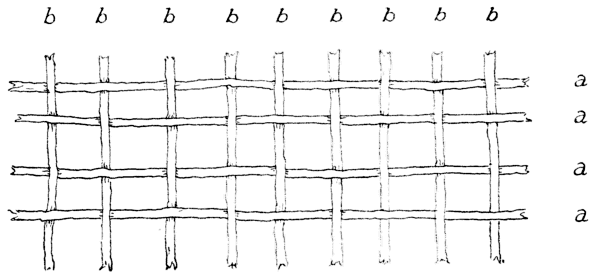 ORDINARY WEAVING
a. Weft. b. Warp.
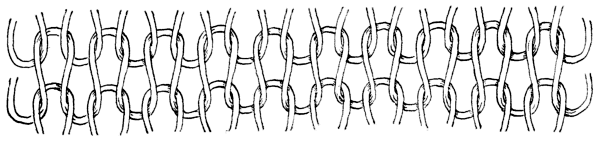 PLAIN STOCKING FABRIC
The essential characteristics of good underwear are:
1. It should be made from elastic cloth, which implies a knitted
cloth.
2. It should be porous in a high degree—whether in winter
weight or summer weight.
3. The seams should be made upon the most modern sewing
machines, with as little bulk as possible.
Apparatus: Magnifying glass.
Materials: Hosiery (seconds).
Reference: Textiles, page 159.
Examine a piece of hosiery called a second, obtained from a
hosiery mill, and notice whether any of the following defects are
present:
a. Yarn contains thick bits and buns.
b. Knots are badly tied.
c. Discolored yarn.
d. Lacks solidity and firmness, due to the gauge being too
coarse for the yarn.
e. Full work-yarn too thick for gauge.
Apparatus: Crochet needle.
Material: Thread.
1. Crocheting is another method, like knitting, of making a
fabric. Examine the operation of crocheting. Notice that only
one thread is made use of, and is formed into loops by means of a
large needle with a hook at the end. The chief point is that the
loops are not formed in uniform rows, but one loop at a time, and
with the greatest liberty to choose any part of the article already
made to form a new loop. For this reason, crocheting adapts
itself to the production of fancy patterns useful for ornamenting.
2. A knitted fabric can be told from a crocheted fabric by noting
that a knitted fabric is composed of rows or ranks of loops of a
single yarn which interlock successively with similar rows or ranks
of loops, while a crocheted fabric consists of a structure the basis of
which is a thread crocheted or knitted into a chain which is attached
at intervals to itself.
Materials: Different samples of cotton fabrics.
Reference: Textiles, pages 151-152.
1. Examine different kinds of cotton fabrics. Compare the
lowest, medium, and highest priced varieties of the same fabric.
Notice how quickly the finish of a low priced cotton fabric with a
thick gloss loses its luster after washing.
2. Examine the different grades of the following fabrics: white
lawn, Indian Head cotton suiting, muslin, lawn, and cambric.
Wash the samples several times.
Does it pay to buy cheap cotton fabrics for underwear, etc.?
What are the characteristics of a good piece of cotton cloth?
Materials: Different samples of woolens.
Reference: Textiles, pages 71-82.
1. Woolens differ from worsteds in having a more or less
covered face, with the result that the weave rarely is noticeable,
and the general color effects are much smoother and softer than
those of worsteds.
2. Examine different grades of woolen fabrics, such as serges.
Defects.—If a piece of woolen is not constructed right from
the start or if the work is not properly finished, that is, enough
fulled in width or length, it is liable to be raggy or slazy. As a
great many fabrics are more or less teaseled, there is a possibility
of such pieces becoming too woolly and too hairy.
Materials: Different kinds of worsted fabrics.
Reference: Textiles, pages 71-82.
1. A good piece of worsted fabric should have a clear outline of
the pattern, perfection of weave lines, and when the fabric is
exposed to light should show a luster without polish.
2. Examine different types of worsted fabrics, and notice how
many conform to the above requirements.
3. The most essential point of worsted is that it should have a clean
and even looking face. By clean is meant well sheared. By even is
meant that the individual ends and picks used should be even and not
full of knots, or of any foreign matter. Of course, there are some exceptions,
for instance, in an unfinished worsted which has more or
less nap on the face, it could not be sheared absolutely clear, but
at the same time, the face should be very evenly cropped.
Defects.—A serious defect would be if the cloth was not well
sheared or if it contained many uneven cords and picks, or ends
and picks missing, or coarse ends and slubs.
Examine different worsteds and notice any defects.
Worsteds.—Speaking generally, worsteds may be divided into
two classes, distinguishable according to the luster of their surface,
or to the softness of their feel. They are used both for ladies’
and men’s wear. Worsted coatings may also be classed as worsteds.
The coatings are woven in both single and double cloths in fancy
weave effects for piece dyes, marketed in variety of finish, according
to fashion.
Under this heading may be classified staple cloths, such as
serges, clays, and fancy weave effects without any illumination.
They can be finished in three ways:—Clear, undressed, and cheviot,
used for ladies’ dress goods or men’s wear, according to weight.
The finish of the cloth varies according to the fashion, but there
is always a certain demand for clear and undressed worsteds, for
men’s wear.
Examine a number of worsted fabrics and classify them.
Suitings.—The term suitings covers various manipulations of
manufactured goods.
1. Tennis suitings, composed of all wool, or all worsted, white or
cream ground, decorated with solid color, silk and weave stripe
effects.
2. Piece-dyed worsteds, such as a blue ground with white silk
line, cable cord, and fancy weave stripe effects, or any other
ground shade color with its complementary decoration applied.
3. Mixture wool or mixture worsted yarns made into fabrics,
decorations applied in color; cable, silk, and weave effects in stripes
or overline color checks, suitable for men’s wear, or decorated
suitable for woman’s wear. The darker shades for fall and the
lighter shades for spring.
General weight of fabric for men’s wear, 12 to 14 oz. per yd., 56 in.;
general weight of fabric for ladies’ wear, 8 to 12 oz. per yd., 54 in.
4. As a rule, when one speaks of a suiting, you expect to see
a fancy effect, in the form of a fancy stripe, check, or a colored
mixture, in loud or quiet tones of decoration. Long naps in
fancy effects are sometimes fashionable, and at other times the
cloth finish is popular.
This class may be subdivided into
1. Light weight for spring or fall.
2. Heavy weight for winter.
The light weight class generally consists of covert cloths in
lighter colors for spring, and cloths usually of the undressed finish
from worsted or woolen stock for fall.
The heavy weight class generally consists of heavily fulled goods,
such as meltons, beavers, naps, etc., which give a heavier and
warmer coat for winter use only, and where an exceptionally heavy
coat is required, double and treble cloths are occasionally employed.
Examine different kinds of suitings and classify them.
Trouserings.—Trouserings are more firmly woven than suitings
and are heavier. They invariably have a stripe. The ground
shade of the better grade of men’s wear fabrics is generally composed
of twist warp yarns, ranging from dark slate gray to light
lavender gray. An endless variety of broad and narrow fine line
effects is produced by expert manipulation and combination of
weave and silk decorations, producing the pleasing effect required
for this class of goods. The filling is nearly always black; but
sometimes a dark slate is used.
The cheaper grades are generally made of wool and cotton mixtures
and twists, down to all cotton, in imitation of the better
grades.
Overcoatings.—Overcoatings are heavy woolen or worsted
fabrics and heavily teaseled or gigged, giving a rough, hairy appearance.
Whether thick or thin, coarse or fine, they should always be
elastic fabrics, that is, as much so as well fulled woolen goods
can be. When hard or stiff they never make a graceful garment.
The special goods made for overcoats are nearly all soft goods.
Examine different fabrics and classify them into either suitings,
overcoatings, trouserings, etc.
Materials: Samples of different cheap silk fabrics.
Reference: Textiles, pages 203-218.
There are cheap and expensive silk fabrics on the market. The
consumer is often tempted to buy the cheaper fabric and wonders
why there is such a difference in price. The difference in price is
due to the cost of raw material and additional cost is due to the
care in manufacturing. For example, raw silk costs from $1.35
to $5 a pound according to its nature, quality, and the country
from which it comes. The cost of throwing silks preparatory to
dyeing also varies, the average being 55 cents a pound for organzine
or warp, and 33 cents a pound for tram and filling. The
prices here also vary according to the nature of the twist imparted
to the silk, which is regulated by the kind of cloth it is
to enter into. The cost of dyeing varies from 55 cents a pound
upwards to perhaps $1.50 a pound, according to the dye and the
treatment which the silk is to receive in the process of dyeing.
The cost of winding, quilling, and sundry labor items necessary
with soft silk prior to its being woven, will perhaps average about
a cent per yard of woven goods for the cheapest cloths and range
upwards according to the grade of the fabric. The cost of weaving
also varies with the cloth, and may be 9 cents for one fabric
and 25 cents or more per yard for the more expensive.
Weavers are paid from 2 cents to 60 cents per yard for
weaving the different fabrics, and other operations vary greatly
in cost; for instance, the cost of printing is entirely dependent
upon the work and the number of colors used, whether it is blotch
printing, discharge work, or block printing. Different processes
in finishing have widely varied costs. At the present time moire
work is done which costs as high as 25 cents per yard. There are
also other materials which can be finished for as little as ½ cent per
yard. Some goods have to be finished over and over again in the
dyeing and finishing while others are very simply done. Many
printed goods are handled 150 times after they come from the
loom.
When it comes to relative values of similar goods produced by
different manufacturers there are a few general principles by which
good construction can easily be determined. Most pure dye
fabrics when burned will rather shrivel and boil than burn, while
those which are weighted heavily with metallic salts will simply
char and turn white without losing the structure of the fabric.
A fabric in which the quantity of warp and filling are of equal
weight gives the maximum strength for the amount of material
used. For the same weight and material, that having the most
bindings of warp and filling will give the greater service. Fabrics
with an insufficient number of warp or filling threads slide easily
and do not give good service, though sometimes fashionable. A
fabric having a twist in the warp and filling will last longer than
one using the same amount of silk and the same binding with
less twist.
All of these things may be taught to women many times over,
but if the fashion demands an article which breaks all of the
above laws and is everything that it should not be, they will
buy it in preference to a serviceable fabric. As a general rule, the
consumer will be safest in buying goods produced by houses
of good reputation and whose products are well known.
A large part of the retail value of silk goods is their fashion
demand and is quite independent of their cost of production.
For instance, at the present time crêpe fabrics, brocades, and prints
are commanding a premium while such goods as plain taffetas
could not be sold for the cost of production.
The advantages of the better kinds of silks over the cheap ones
are pure dye, long wear, and more expensive manufacturing.
Apparatus: Scales, ruler.
Material: Samples of fabrics.
Reference: Textiles, pages 144-146.
The United States Government imposes a tax on certain imported
fabrics and yarn. In the case of cotton, the rates of duty
are to be ascertained according to the average number of the yarns
in the condition in which it is imported.
The length of the yarn is to be counted as equal to the distance
covered by it in the cloth, all clipped threads to be measured as if
continuous and all ply yarns to be separated into singles and the
count taken of the total singles; any excessive sizing is to be
removed by boiling or other suitable processes. The number of
the yarn is the English number of 840 yd. to a lb. for a No. 1 yarn.
The average number of yarn may be found without unraveling
the fabric, and is the quotient of the total thread length, by the
weight in the proportion of 840 yd. of yarn equaling 81/3 grains,
which is equivalent to a No. 1 yarn.
The following simple formula may be used:
Multiply the count of threads per square inch by the number
of square inches in the sample used, this product to be multiplied
by 100; then divide the product thus obtained by the weight of
the sample in grains multiplied by 432. The quotient will give
the number of the yarn.
For example, take a sample of cotton cloth 4 in. square, which
equals 16 sq. in., having 28 warp and 28 woof threads, a total of
56 threads to the square inch, and weighing 8.6 grains. The
formula applied would be as follows:
56 × 16 × 100 ÷ 8.6 × 432 = 24, the number of the yarn.
The formula may be further simplified by weighing a square
yard of the cloth and dividing the number of threads per square
inch by 1/300 of the weight per square yard in grains.
Find the number of yarn in several cotton fabrics.
A great deal of time should be devoted to the study of standard
fabrics so that pupils may be able to recognize them by inspection
and know how to test them for adulterants.
This may be done by having the pupils study the fabrics one
by one, placing a sample of each in a note-book. Underneath
the sample should be written the use of the fabric, the width,
the different grades, with prices, wearing qualities, and how the
fabric is made. In connection with this work special effort
should be made to develop a textile vocabulary so as to be
able to discriminate between the different fabrics, to know the
types of weaves, and the different kinds of finish, etc. In this
way develop the ability to know what materials and colors weave
best, the prices which should be paid for strong materials, the
amount of material necessary, and the trade names of fabrics
which can be depended upon for substantial goods.
Occasional tests in recognizing fabrics should be given by the
teacher by placing before the pupils unlabeled fabrics that
they have previously studied and have them give the name,
approximate price or grade, weave, qualities, etc.
Remnants or small pieces of standard fabrics may be obtained
from the leading dry goods stores of the country. Teachers should
have on exhibition in cabinets a large display of standard fabrics
with a card attached giving the name and use of each.
The first thing a buyer of cloth notices in examining the fabrics
is the finish. The finish is tested by feeling and seeing. To
illustrate: broadcloth should have a smooth face and a nap
evenly laid. If the finish is in keeping with the character of the
cloth, he next examines the fiber of the yarn to see whether it is
composed of pure wool or two or more fibers in combination.
Then test the strength of the cloth to see if it will meet the
requirements.
A test should be made to tell whether it is poorly dyed or well
dyed. There is no test that can be applied to all colors to ascertain
this, neither is it possible to judge by the eye. The best way
is to take a small sample of the goods and submit it to the washing
and light test.