Hitherto no attempt has been made to distribute olden silken
textiles into various schools; but the numerous specimens in the
admirable collection at South Kensington enable us to separate
them into several groups—Chinese, Persian, Byzantine, Indian,
Syrian, Saracenic, Moresco-Spanish, Sicilian, Italian, Flemish,
British, and French. We shall now especially refer to that
collection.
The Chinese examples are not many: but, whether plain or
figured, they are beautiful in their own way. From all that we
know of the people, we are led to believe that their style two
thousand years ago is the same still; so that the web wrought by
them this year or three hundred years ago, like no. 1368, would differ
hardly in a line from their far earlier textiles; of which Dionysius
Periegetes wrote that “the Seres make precious figured garments,
resembling in colour the flowers of the field, and rivalling in fineness
the work of spiders.” In these stuffs, warp and woof are of
silk and both of the best kinds.
Persian textiles, as we see them at South Kensington, must
also have been for many centuries very much the same in design
and character. Sometimes the design is made up of various kinds
of beasts and birds, real or imaginary, with the sporting cheetah
spotted among them; and the “homa” or tree of life conspicuously
set above all. In such cases we may conclude that the
web was wrought by Persians, and generally the textile will be
found in all its parts to be of the richest materials.
No. 8233, may be referred to as an illustration of the Persian
type.
A school of design sprung up among the Byzantine Greeks,
from the time when in the sixth century they began to weave
home-grown silk, which retained not a little of the beauty, breadth,
and flowing outline of ancient art. Together with this, a strong
feeling of Christianity showed itself as well in many of the
subjects which they took out of holy writ as in the smaller
elements of ornamentation. Figures, whether of the human form
or of beasts, are given in a much larger and bolder size than on
any other ancient stuffs. Though there are not many known
specimens from the old looms of Constantinople there is one,
no. 7036, showing Samson wrestling with a lion, which may serve
as a type. In the year 1295 St. Paul’s cathedral would seem to
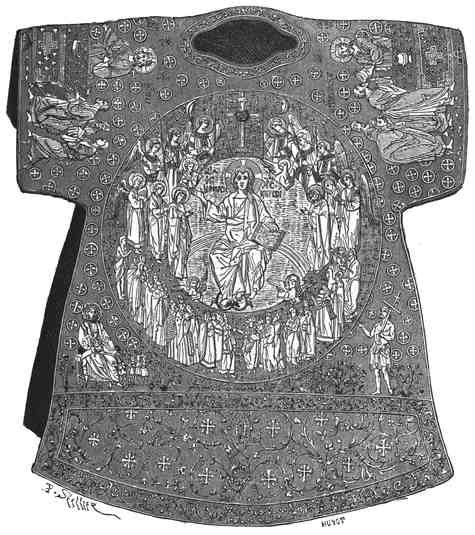
have possessed several vestments made of Byzantine silk. A
very splendid dalmatic of Byzantine silk, probably of the twelfth
century, is preserved in the treasury of St. Peter’s at Rome. The
colour is dark blue, and the embroidery in gold and colours.
The specimens at South Kensington from the Byzantine and
later Greek loom are not to be taken as by any means first-rate
examples of its general production. They are poor both in
material and, when figured, in design. There are, however, many
pieces: nos. 1241, 1246, 1257, 1266, etc.
Indian ancient silks and textiles have their own distinctive
marks.
From Marco Polo, who wandered much over the far east some
time during the thirteenth century, we learn that the weaving in
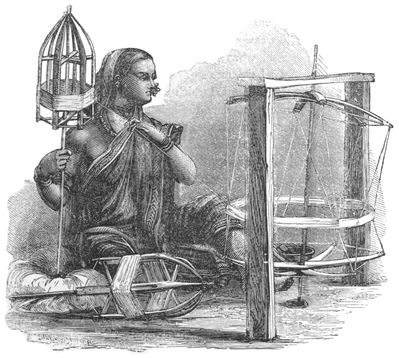
India was done by women who wrought in silk and gold, after a
noble manner, beasts and birds upon their webs:—“Le loro
donne lavorano tutte cose a seta e ad oro e a uccelli e a bestie
nobilmente e lavorano di cortine ed altre cose molto ricamente.”
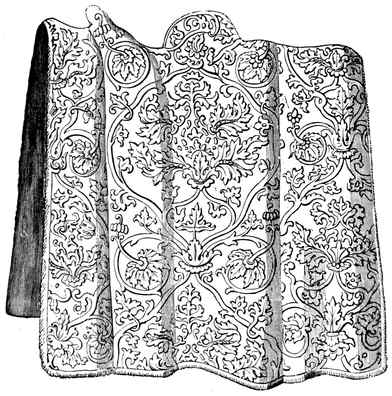
Byzantine Dalmatic: preserved at Rome.
Several of the South Kensington mediæval specimens from
Tartary and India show well the truthfulness of the great Venetian
traveller, while speaking about the textiles which he saw in those
countries. The dark purple piece of silk figured in gold with birds
and beasts of the thirteenth century, no. 7086, is good; but
better still is the shred of blue damask, no. 7087, with its birds,
its animals, and flowers wrought in gold and different coloured
silks. India, also, has ever been famous for its cloud-like
transparent muslins, which since Marco Polo’s days have kept
that oriental name, through being better woven at Mosul than
elsewhere.
The Syrian school is well represented at South Kensington by
several fine pieces.
The whole sea-board of that part of Asia minor, as well as far
inland, was inhabited by a mixture of Jews, Christians, and
Saracens; and all were workers in silk. The reputation of the
neighbouring Persia had of old stood high for the beauty and
durability of her silken textiles, which caused them to be sought for
by the European traders. Persia’s outlet to the west for her goods
lay through the great commercial ports on the coast of Syria.
Persia was accustomed to set her own peculiar seal upon her
figured webs, by mingling in her designs the mystic “homa:”
and, naturally, this part of the pattern became in the eyes of
Europeans, at first, a sort of assurance that those goods had been
made in Persian looms. By one of the tricks of imitation followed
in that day, as well as now, the Syrian designers threw the
“homa” into their patterns. Borrowed perhaps originally from
Hebrew tradition, this symbol of “the tree of life” had in it
nothing objectionable either to the Christian, the Jew, or the
Moslem: all three, therefore, took it and made it a leading
portion of design in the patterns of their silks; and hence it is
that we meet with it so often. Though at the beginning, it may be,
done with a fraudulent intention of palming on the world Syrian
for Persian silks, the Syrians usually put also into their fabrics a
something which declared the real workmanship. Mixed with the
“homa,” the “cheetah,” and other elements of Persian patterns,
the discordant two-handled vase or the badly-imitated Arabic
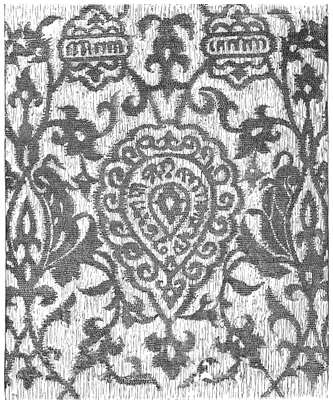
sentence betrays the textile to be not Persian but Syrian. No.
8359 exemplifies this. Furthermore, probably in ignorance about
Persia’s superstitious use of the “homa” in her old religious
services, the Christian weavers of Syria put the sign of the cross
by the side of the “tree of life:” as we find upon the piece of
silk, no. 7094. Another remarkable specimen of the Syrian loom
is no. 7034, whereon the Nineveh lions come forth conspicuously.
As good examples of well-wrought “diaspron” or diaper,
no. 8233 and no. 7052 may be mentioned.
Saracenic weaving, as shown by the design upon the web, is
exemplified in several specimens at South Kensington.
However much against what looks like a heedlessness of the
teaching of the Koran, it is certain that the Saracens, those of the
upper classes in particular, felt no difficulty in wearing robes upon
which animals and the likenesses of created things were woven;
with the strictest of their princes a double-headed eagle, possibly
borrowed from the crusaders, was a royal heraldic device. Stuffs
figured with birds and beasts, with trees and flowers, were not the
less on that account of Saracenic workmanship, and meant for
Moslem wear. What, however, may be chiefly looked for upon
Saracenic textures is a pattern consisting of longitudinal stripes
of blue, red, green, and other colour; some of them charged with
animals, small in form; some written, in large Arabic letters, with
a word or sentence.
Moresco-Spanish or Saracenic textiles wrought in Spain, though
partaking of the striped pattern and bearing words in real or
imitated Arabic, had some distinctions of their own. The designs
shown upon these stuffs are almost always drawn out of strap-work,
reticulations, or some combination of geometrical lines,
amid which are occasionally to be found different forms of conventional
flowers. Sometimes, but very rarely, the crescent moon is
figured as in the curious piece, no. 8639. The colours of these
silks are usually either a fine crimson or a deep blue with almost
always a fine toned yellow as a ground. But one remarkable
feature in these Moresco-Spanish textiles is the presence of the
ingenious imitation (before spoken of) of gold; for which shreds
of gilded parchment cut up into narrow flat strips are substituted
and woven with the silk. This, when fresh, must have looked
very bright, and have given the web all the appearance of the
favourite stuffs called here in England “tissues.” The fraud, as
already explained, if fraud it were, is not easily discovered
without a magnifying glass. A guide may be found in the
blackness of the gold. Nos. 7095, 8590, and 8639, are
examples of this gilded vellum.
The Sicilian school strongly marked wide differences between
itself and all the others which had lived before; and the history
of its loom is as interesting as it is varied.
The first to teach the natives of Sicily how to rear the silkworm
and spin its silk were, as it would seem, the Mahomedans, who
coming over from Africa brought with them, besides the art of
weaving silken textiles, a knowledge of the fauna of that vast
continent—its giraffes, its antelopes, its gazelles, its lions, its
elephants. These invaders told them also of the parrots of India
and the hunting sort of leopard,—the cheetahs; and when the
stuff was wrought for European wear both beast and bird were
imaged upon the web, and at the same time a word in Arabic was
woven in. Like all other Saracens, those in Sicily loved to mingle
gold in their tissues; and, to spare the silk, cotton thread was
not unfrequently worked up in the warp. When, therefore, we
meet with beasts taken from the fauna of Africa, such, especially,
as the giraffe and the several classes of the antelope family, with
perhaps also an Arabic motto, and part of the pattern wrought in
gold, as well as cotton in the warp, we may fairly take the specimen
as a piece of Sicily’s work in its first period of weaving silk.
The second epoch was when in the twelfth century Roger,
king of Sicily, took Corinth, Thebes, and Athens; from each of
which cities he led away captives all the men and women he could
find who knew how to weave silks, and carried them to Palermo.
These Grecian new comers brought fresh designs which were
adopted sometimes wholly, at others but in part and mixed up
with the older Saracenic style. In this second period of the
island’s loom we discover what traces the Byzantine school impressed
upon Sicilian silks, and helped so much to alter the type
of their first designs. On one silk, the pattern is a grotesque
mask amid the graceful twinings of luxuriant foliage, such as might
have been then found upon many a fragment of old Greek sculpture;
this may be seen on no. 8241; on another, a sovereign on horseback
wearing the royal crown and carrying a hawk upon his
wrist, as in no. 8589; on a third, no. 8234, is the Greek cross,
with a pattern much like the old netted or “de fundato” kind
which has been described, p. 38.
But Sicily’s third is quite her own peculiar style. At the end
of the thirteenth and beginning of the fourteenth century she
struck into an untried path. Without throwing aside the old
elements employed by the Mahomedans Sicily put with them the
emblem of Christianity, the cross, in various forms, on some
occasions with the letter V. four times repeated.
From the east to the uttermost western borders of the
Mediterranean the weavers of every country had been in the
habit of figuring upon their silks those beasts and birds they saw
around them: the Tartar, the Indian, and the Persian gave us the
parrot and the cheetah; the Africans, the giraffe and the gazelle;
the people of each continent, the lions, the elephants, the eagles,
and the other birds common to both. From the sculpture of the
Greeks and Romans the Sicilians could have easily copied the
fabled griffin and the centaur; but it was left for their own wild
imaginings to figure such an odd compound in one being as the
animal—half elephant, half griffin—which we see in no. 1288.
Their daring flights of fancy in coupling the difficult with the
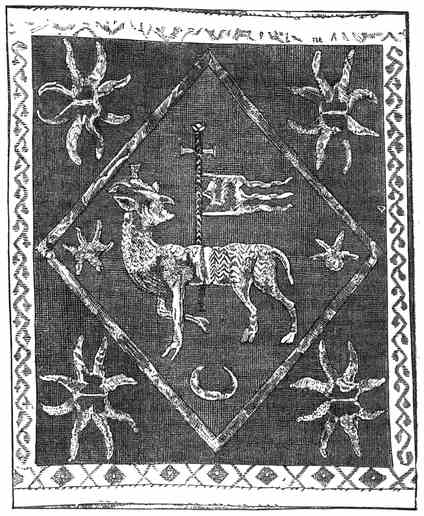
beautiful are curious; in one piece large eagles are perched in
pairs with a radiating sun between them, and beneath are dogs,
in pairs, running with heads turned back; in another, running
harts have caught one of their hind legs in a cord tied to their
collar, and an eagle swoops down upon them; and the same
animal, in another place on the same piece, has switched its tail
into the last link of a chain fastened to its neck; on a third
sample are harts, the letter M floriated, winged lions, crosses
floriated, crosses sprouting out on two sides with fleurs-de-lis, and
four-legged monsters, some like winged lions, some biting their
tails. Hardly elsewhere to be found are certain elements peculiar
to the patterns upon silks from mediæval Sicily; such, for
instance, as harts, and demi-dogs with very large wings, both
animals having remarkably long manes streaming far behind them;
or harts lodged under green trees in a park with paling about it.
The hawk, the eagle, double and single headed, or the parrot,
may be found on stuffs all over the east; not so, however, the
swan, which was a favourite with Sicilians and may be seen often
drawn with much gracefulness.
The Sicilians showed their strong affection for certain plants
and flowers. On a great many of the silks in the South Kensington
collection from Palermitan looms we see figured upon a
tawny coloured grounding beautifully drawn foliage in green;
sometimes vine leaves, sometimes what looks like parsley, so
curled, crispy, and serrated are its leaves. Another peculiarity
is the introduction of the letter U, repeated so as to mark the
feathering upon the tails of birds; or to fall into the shape of an
O; as in nos. 8591, 8599.
Whether it was that the crusaders made Sicily so often the
halting spot on their way to the holy land, or that knights
crowded there for other purposes, and thus dazzled the eyes of the
islanders with the bravery of their armorial bearings, it is certain
that the Sicilians were particularly given to introduce many
heraldic charges—wyverns, eagles, lions rampant, and griffins—into
their designs. The occasions in which such elements of
blazoning come in are so numerous that one of the features
belonging to the Sicilian loom in its third period is that, bating
tinctures, it is decidedly heraldic.
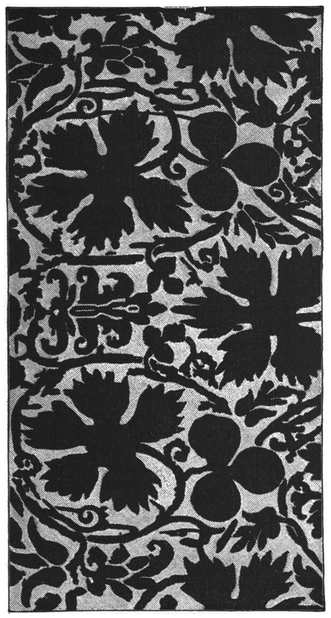
Silk damask—Sicilian: fourteenth century.
All this beauty and happiness of invention, set forth by bold,
free, spirited drawing, were bestowed too often upon stuffs of a
very poor inferior quality, in which the gold if not actually base
was always scanty, and a good deal of cotton was wrought up with
the silk.
Till within a few years past the royal manufactory at Sta.
Leucia, near Naples, produced silks of remarkable richness; and
the piece, no. 721, does credit to its loom, as it wove in the seventeenth
century. Northern Italy was not idle; and the looms
which she set up in several of her great cities, in Lucca, Florence,
Genoa, Venice, and Milan, earned for themselves a good repute
and a wide trade for their gold and silver tissues, their velvets,
and their figured silken textiles. Yet, in the same way as each
of these free states had its own accent and provincialisms in
speech, so also had it a something often thrown into its designs
and style of drawing which told of the place and province whence
the textiles came.
Lucca at an early period made herself known in Europe for
her textiles; but her workmen, like those of Sicily, seem to have
thought themselves bound to follow the style brought by the
Saracens of figuring parrots and peacocks, gazelles, and even
cheetahs, as we see in the specimens no. 8258 and no. 8616.
But with these eastern animals she mixed up emblems of her own,
such as angels clothed in white. She soon dropped what was
oriental from her patterns which she began to draw in a larger,
bolder manner, and showing an inclination for light blue as a
colour.
As in other places abroad so at Lucca cloths of gold and of
silver were often wrought, and the Lucchese cloths of this costly
sort were in much request in England during the fourteenth century.
In all likelihood they were not of the deadened but the
sparkling kind, afterwards especially known as “tissue.” Exeter
cathedral, in 1327, had a cope of silver tissue, or cloth of Lucca:—“de
panno de Luk.” At a later date, belonging to the same
church, were two fine chasubles—one purple, the other red—of the
same glittering stuff: “de purpyll panno.” York cathedral possessed
many copes of tissue shot with every colour required by
its ritual, and among them were “a reade cope of clothe of tishewe
with orphry of pearl, a cope with orphrey, a cope of raised clothe
of goulde,” making a distinction between tissue and the ordinary
cloth of gold. In the wardrobe accounts of Edward the second
the golden tissue, or Lucca cloth, is several times mentioned.
Whether the ceremony happened to be sad or gay this glittering
web was used; palls made of Lucca cloth were, at masses for the
dead, strewed over the corpse; at marriages the care-cloth was
made of the same stuff: thus when Richard de Arundell and
Isabella, Hugh le Despenser’s daughter, had been wedded at the
door of the royal chapel, the veil held spread out over their heads
as they knelt inside the chancel during the nuptial mass was of
Lucca cloth.
About the same time velvet became known, and came into use
both for vestments and for personal wear; and Lucca probably
was among the first places in Europe to weave it. The specimens
at South Kensington of this fine textile from Lucchese looms,
though few in comparison with those from Genoa, still have a
certain historical value for the English workman: no. 1357, with
its olive green plain silken ground and trailed all over with
flowers and leaves in a somewhat deeper tone, and the earlier
example, no. 8322, with its ovals and feathering stopped with
graceful cusps and artichokes, afford us good instances of what
Lucca could produce in the way of artistic velvets.
Genoa, though in mediæval times not so conspicuous as she
afterwards became for her textile industry, encouraged over her
narrow territory the weaving of silken webs. Of these the earliest
mention we have found is in the inventory of vestments belonging
to St. Paul’s cathedral, London, in 1295: besides a cope of Genoa
cloth that church had, of the same manufacture, a hanging patterned
with wheels and two-headed birds. Though this first
description be scant, we may reasonably gather that the Genoese
cloths must have resembled the textiles wrought at Lucca. Genoa
still keeps up her old reputation for beautiful velvets.
In the collection at South Kensington there are examples of
every kind of Genoese velvets; some with a smooth unbroken
surface, some elaborately patterned and showing, together with
wonderful skill in the weaving, much beauty of design. Some
are raised or cut, the design being worked in a pile standing well
up by itself out of a flat ground of silk, either of the same or
of another colour, and not unfrequently wrought in gold. No.
7795 is an example of a very costly kind; in which the ground is
velvet, and again of velvet is the pattern itself but raised one pile
higher than the other, so as to show its form and shape distinctly.
No. 8323 shows how the design was worked in various coloured
velvet. This last was a favourite in England and called motley;
in his will, 1415, printed in Rymers Fœdera, Henry lord Scrope
bequeathed two vestments, one, motley velvet rubeo de auro; the
other, motley velvet nigro, rubeo et viridi, etc.
Venice does not seem to have been at any time, like Sicily and
Lucca, smitten with the taste of imitating in her looms the patterns
which she saw abroad upon textile fabrics, but appears to have
borrowed from the orientals only one kind of weaving cloth of
gold: the yellow chasuble at Exeter cathedral in 1327, figured
with beasts, is the only instance we know where she wove animals
upon silks. Venice, however, set up for herself a new branch of
textiles, and wrought for church use square webs of a crimson
ground on which were figured, in gold or on yellow silk, subjects
taken from the Scriptures or the persons of saints and angels.
These square pieces were employed, sewed together, as frontals to
altars, but when longwise more generally as orphreys to chasubles,
copes, and other vestments.
There is a remarkable similarity between the drawing of the
figures upon old Venetian silks and the woodcuts in books published
at Venice in the early part of the sixteenth century; such
as the fine pontifical by Giunta, or the “Rosario” by Varisco.
We find in both the same style and manner; the same broad fold
and fall of drapery; the same plumpness and outline of the human
face and figure. So near is the likeness in design that we may
almost believe that the artists who supplied the blocks for the
printers sketched also the drawings for the looms.
By the fifteenth century Venice knew how to produce good
damasks in silk and gold: if we had nothing more than the
specimen, no. 1311, where St. Mary of Egypt is so well represented,
it would be quite enough for her to claim for herself such a distinction.
Nor can there be much doubt that Venice wrought in
velvet; and if those rich stuffs were made there, sometimes raised,
sometimes pile upon pile, in which her painters loved to dress the
personages, men especially, in their pictures, then Venetian velvets
were certainly beautiful. Of this any one may satisfy himself by
one visit to our National gallery. There, in the “Adoration of
the magi” painted by Paulo Veronese, the second of the wise men
is clad in a robe of crimson velvet, cut or raised after a design in
keeping with the style of the period.
No insignificant article of Venetian textile workmanship were
her laces wrought in every variety; in gold, in silk, in thread.
The portrait of a Doge usually shows him clothed in his dress of
state. His wide mantle, with large golden buttons, is made of
some rich dull silver cloth; and on his head is the Phrygian-shaped
ducal cap bound round with broad gold lace diapered, as
we see in the bust portrait of Loredano, painted by John Bellini,
in the National gallery. Not only was the gold in the thread
particularly good but the lace itself in great favour at the English
court at one time; bought, not by yard measure but by weight,
“a pounde and a half of gold of Venys” was employed “aboute
the making of a lace and botons for the king’s mantell of the
garter.” This was for Henry the seventh. “Frenge of Venys
gold” appears twice in the wardrobe accounts of Edward the
fourth. Laces in worsted or in linen thread wrought by the
bobbin at Venice, but more especially her point laces or such as
were done with the needle, always had, as they still have, a great
reputation.
Venetian linens, for fine towelling and napery in general, were
in favourite use in France during a part of the fifteenth century.
In the ‘Ducs de Bourgogne’ by Laborde, more than once we
meet with such an entry as “une pièce de nappes, ouvraige de
Venise.”
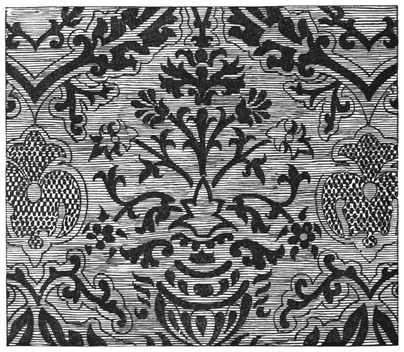
Silk damask—Florentine: fifteenth century.
Florence, about the middle of the fourteenth century, obtained
a place in the foremost rank amid the weavers of northern Italy.
Specimens of her earliest handicraft are rare; there are two at
South Kensington. One of these, no. 8563, shows the excellence
of her work in secular silks. Other pieces witness to the delicacy
of her design at a later time, the sixteenth century. The orphrey-webs
of Florence are equally conspicuous for drawing and skill in
weaving, and in beauty come up to those made at Venice, far
surpassing anything of the kind ever wrought at Cologne.
But it was of her velvets that Florence was warrantably proud.
Henry the seventh bequeathed “to God and St. Peter, and to the
abbot and prior and convent of our monastery of Westminster, the
whole suit of vestments made at Florence in Italy.” We may yet
see how gorgeous this textile was in one of these Westminster
abbey copes still in existence, preserved at Stonyhurst college.
The golden ground is trailed all over with leaf-bearing boughs of
a bold type, in raised or cut ruby-toned velvet of a rich soft pile,
which is freckled with gold thread sprouting up like loops.
Though not so rich in material nor so splendid in pattern, there
are at South Kensington, nos. 7792 and 7799, two specimens of
Florentine cut crimson velvet on a golden ground, like the royal
vestments in their kind and having the same peculiarity, the little
gold thread loop shooting out of the velvet pile. These pieces are
a full century later than the cope at Stonyhurst.
That peculiar sort of ornamentation—the little loop of gold
thread standing well up and in single spots—upon some velvets,
seems at times to have been replaced, perhaps with the needle, by
small dots of solid metal, gold or silver gilt, upon the pile: of the
gift of one of its bishops, John Grandisson, Exeter cathedral had
a crimson velvet cope, the purple velvet orphrey of which was so
wrought: “purpyll velvette worked with pynsheds” of pure gold.
Milan, though now-a-days she stands in such high repute for
the richness and beauty of her silks of all sorts, was not, we believe,
at any period during mediæval times as famous for her velvets, her
brocades, or cloths of gold, as for her armour, so strong and trustworthy
for the field, so exquisitely demascened for courtly service.
Still, in the sixteenth century, she earned a name for rich cut
velvets as may be seen in the specimen, no. 698; for her silken
net-work, no. 8336, which may have led the way to weaving silk
stockings; and for her laces of the open tinsel kind once in great
vogue for both sacred and secular use, as in no. 8331.
England, from her earliest period, had textile fabrics varying in
design and material; the colours in the woollen garments worn by
each of the three several classes into which the Bardic order was
divided, and of the chequered pattern in Boadicea’s cloak, have
been already mentioned. It would seem from John Garland,
whose witness is referred to above, p. 12, that the lighter and more
tasteful webs wrought here came from women’s hands; and the
loom, one of which must have been in almost every English nunnery
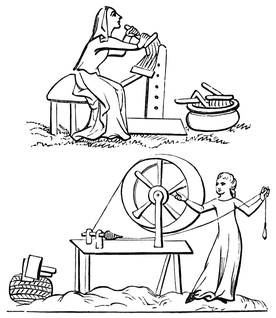
and homestead, was of the simplest make.
In ancient times the Egyptians wove in an upright loom, and
beginning at top so as to weave downwards sat at their work.
In Palestine also the weaver had an upright loom, but, beginning
at bottom and working upwards, was obliged to stand. During
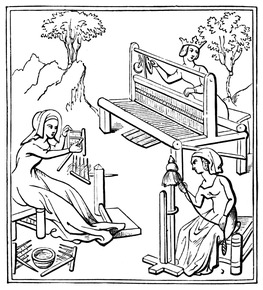
the mediæval period the loom in England was horizontal, as is
shown by that figured in the Bedford book of Hours (preserved in
the British museum), fol. 32; at which the blessed Virgin is seated
weaving curtains for the temple.
There are several examples at South Kensington of the work
of English women, showing the excellence of their handicraft as
well as elegance in design during the thirteenth century. Nos.
1233, 1256, and 1270 may be referred to. But for specimens of
the commoner sorts of silken textiles and of wider breadth, which
began to be woven in this country under Edward the third, it would
be hazardous to direct the reader. Recent examples, velvets
among the rest, may be found in the Brooke collection. To some
students the piece of old English printed chintz, no. 1622, will
not be without an interest.
For the finer sort of linen napery Eylisham or Ailesham in
Lincolnshire was famous during the fourteenth century. Exeter
cathedral, in 1327, had a hand towel of “Ailesham cloth.”
Our coarser native textiles in wool or in thread, or in both
woven together, formed a stuff called “burel.” St. Paul’s in
1295 had a light blue chasuble, and Exeter cathedral in 1277 a
long pall of this texture. Burel and, in short, all the coarser
kinds of work were wrought by men: sometimes in monasteries.
The old Benedictine rule obliged the monks to give a certain
number of hours every week-day to hand-work, either at home or
in the field.
The weaving in this country of woollen cloth, as a staple
branch of trade, is very old. Of the monks at Bath abbey we are
told by a late writer, “that the shuttle and the loom employed
their attention (about the middle of the fourteenth century), and
under their active auspices the weaving of woollen cloth (which
made its appearance in England about the year 1330, and received
the sanction of an act of parliament in 1337) was introduced,
established, and brought to such perfection at Bath as rendered
the city one of the most considerable in the west of England for
this manufacture.” Worcester cloth was so good that, by a chapter
of the Benedictine order held in 1422 at Westminster abbey, it
was forbidden to be worn by the monks and declared smart enough
for military men. Norwich also wove stuffs that were in demand
for costly household furniture; and Sir John Cobham, in 1394,
bequeathed “a bed of Norwich stuff embroidered with butterflies.”
In one of the chapels at Durham priory there were four blue
cushions of Norwich work. Worsted, a town in Norfolk, by a
new method of its own for the carding of the wool with combs of
iron well heated, and then twisting the thread harder than usual in
the spinning, enabled our weavers to produce a woollen stuff of a
peculiar quality, to which the name itself of worsted was immediately
given. To such a high repute did the new web grow that
church vestments and domestic furniture of the choicest sorts were
made out of it. Exeter cathedral among its chasubles had several
“de nigro worsted” in cloth of gold. Vestments made of worsted,
variously spelt “worsett” and “woryst,” are enumerated in the
fabric rolls of York minster. Elizabeth de Bohun, in 1356, bequeathed
to her daughter the countess of Arundel “a bed of red
worsted embroidered;” and Joane lady Bergavenny leaves to John
of Ormond “a bed of cloth of gold with lebardes, with those
cushions and tapettes of my best red worsted.”
Irish cloth, white and red, in the reign of king John was much
used in England; and in the household expenses of Swinford,
bishop of Hereford in 1290, an item occurs of Irish cloth for
lining.
English weavers knew also how to work artificially designed
and well-figured webs. In the wardrobe accounts of Edward the
second is this item: “to a mercer of London for a green hanging
of wool wove with figures of kings and earls upon it, for the king’s
service in his hall on solemn feasts at London.” Such “salles,”
as they were called in France, and “hullings” or rather “hallings”
the name they went under here, were much valued abroad and in
common use at home. Under the head of “Salles d’Angleterre”
among the articles of costly furniture belonging to Charles the fifth
of France, in 1364, one set of hangings is thus entered: “une
salle d’Angleterre vermeille brodée d’azur, et est la bordeure à
vignettes et le dedens de lyons, d’aigles et de lyepars.” Here in
England, Richard earl of Arundel in 1392 willed to his dear wife
“the hangings of the hall which was lately made in London, of
blue tapestry with red roses with the arms of my sons,” etc.; and
lady Bergavenny, after bequeathing her hullying of black, red, and
green to one friend, left to another her best stained “hall.”
Flemish textiles, at least of the less ambitious kinds such as
napery and woollens, were much esteemed centuries ago; and our
countryman Matthew of Westminster says of Flanders that, made
from the material which we sent her, the wool, she sent us back
precious garments. So important was the supply of wool to the
Flemings in the fourteenth century that the check given to it by
the wars between England and France at that time led to a special
treaty between Edward the third and the burghers of the Flemish
communes under the guidance of James van Artevelde.
Though industrious everywhere within her limits, some of the
towns of Flanders stood foremost for certain kinds of stuff, and
Bruges became in the latter end of the fifteenth century conspicuous
for its silken textiles. The satins of Bruges were used in England
for church garments. Haconbie church, in 1566, had “one white
vestmente of bridges satten repte in peces and a clothe made
thereof to hange before our pulpitt;” and in 1520 York cathedral
had “a vestment of balkyn (baudekin) with a crosse of green satten
in bryges.” Her damasks silks were equally in demand; and
the specimens at South Kensington will interest the student.
Nos. 8318 and 8332 show the ability of the Bruges loom;
while the favourite pattern with the pomegranate in it betrays
the likings of the Spaniards, at that time the rulers of the country,
for this token of their renowned Isabella. No. 8319 is another
sample of Flemish weaving, rich in its gold and full of beauty in
design.
In her velvets Flanders had no need to fear a comparison
with anything of the kind that Italy ever threw off from her
looms, whether at Venice, Florence, or Genoa. Not to name
others one example, with its cloth of gold ground and its pattern
in a dark blue deep-piled velvet, is not surpassed in gorgeousness
even by that splendid stuff from Florence of which the Stonyhurst
cope, just spoken of, was made.
Block-printed linen toward the end of the fourteenth century
was another production of Flanders. Though existing examples
to the eyes of many may look poor or mean, yet to men like
the cotton-printers of Lancashire they will have a strong attraction;
and to the scholar they will be deeply interesting as suggestive
of the art of printing. Such specimens are rare, but it is
likely that England can show in the chapter library at Durham
the earliest sample of the kind as yet known; a fine sheet wrapped
about the body of some old bishop found in a grave opened by
Mr. Raine in 1827, within the cathedral. Several pieces of
ancient silks and English embroidery were found at the same
time.
What Bruges was in silks and velvets, Yprès, in the sixteenth
century, became for linen; and for many years Flemish linens
were in favourite use throughout England. Hardly a church
of any size, scarcely a gentleman’s house in this country, but used
a quantity of towels and other napery that was made in Flanders,
especially at Yprès.
French silks, now in such extensive use, were not much cared
for until the end of the sixteenth century in France itself, and
seldom heard of abroad. The reader, then, must not be astonished
at finding so few examples of the French loom in any
collection of ancient silken textiles.
In France, as in England, women in mediæval days, old and
young, rich and poor, while filling up their leisure hours in-doors
used to work on a small loom, weaving narrow webs, often of
gold and diapered with coloured silks. At South Kensington,
nos. 1250, 7062, and 7064 are examples of such French wrought
stuffs belonging to the thirteenth century. In damasks, the
earliest French productions are of the sixteenth century; and
no. 8352 is a favourable example of what this manufacture then
was in France; everything later is of the type so well known to
everybody. In several of her textiles a leaning towards classicism
in design is discernible.
Like Flanders, France knew how to weave fine linen which
here in England was much employed for ecclesiastical as well
as household purposes. Three new cloths of Rains (Rennes
in Brittany) were, in 1327, in use for the high altar in Exeter
cathedral, and many altar cloths of Paris linen. In the poem of
the ‘Squire of low degree’ the lady is told
Your blankettes shal be of fustyane,
Your shetes shal be of cloths of rayne;
and, in 1434, lady Bergavenny devises in her will “two pair
sheets of Raynes, a pair of fustians,” etc.
Cologne, the queen of the Rhine, became famous during the
whole of the fifteenth and part of the sixteenth century for a
certain kind of ecclesiastical textile which, from the very general
use to which it has been applied, we may call “orphrey web.”
The productions of Cologne, however, are every way far below
in beauty the similar works of Italy. Italian orphrey-webs are
generally worked in gold or yellow silk upon a crimson ground of
silk. Florentine are often distinguished from the Venetian by
the introduction of white for the faces; those of Cologne vary
from both by introducing blue, while the material is almost always
poor and the weaving coarse. In England this orphrey web was
in church use and called, as we learn from the York “wills and
testaments,” “rebayn de Colayn.”
The piece of German napery, no. 8317 (of the beginning of
the fifteenth century), will be to those curious about household
linen an acceptable specimen.
If in some old inventory of church vestments we find an entry
mentioning a chasuble made of cloth of Cologne, we should
understand it to mean not a certain broad textile woven there, but
merely a vestment composed of several pieces of this kind of web
sewed together; like the frontal made of pieces of woven Venice
orphreys, no. 8976.