CHAPTER I LEGAL CRIMINAL PROCEDURE — ENGLAND AND IRELAND — SCOTLAND — Citation of Witnesses—Subpœna — FEES ALLOWED TO MEDICAL WITNESSES
The Coroner‘s Court.—The office of coroner is mentioned in
a charter in 925. Coroners were formerly chosen for life by the
freeholders of the district, but their election is now in the hands of
the County Councils. Their duties were first clearly pointed out by the
Act 4 Edw. I. c. 2, 1275 (De officio coronatoris).
At the present time the duties of the coroner are chiefly to hold
inquiry into the cause of death when there is any reason to doubt that
death resulted from natural causes.
When death results from natural causes, and under ordinary conditions,
the medical attendant is bound, under a penalty of forty shillings,
to certify as to the cause. The registrar of deaths accepts such a
certificate when accompanied by oral testimony given by a person who
was present at the time of death, and issues a certificate accordingly,
authorising the interment of the deceased.
Should conditions obtain to prevent the medical attendant from forming
an opinion as to the cause of death, or which would lead him to infer
that death did not take place from natural causes, he should notify the
matter to the coroner. Such would be necessary if death were directly
or indirectly due to accident, or if death occurred within a reasonable
time after an accident, although due to some other cause, or if an
accident happened to deceased during the course of a chronic illness,
the accident, however, not being in itself necessarily fatal.
It would be necessary also to notify the coroner if the death took
place under circumstances which, to the medical attendant, appeared
suspicious, such as might arise from culpable neglect or cruelty on
the part of persons in charge of the deceased. The same would apply to
cases in which the cause of death was unknown. A great responsibility
rests on the medical practitioner, in that he is compelled under a
penalty to certify as to the cause of death; while if he do so without
due consideration, or carelessly, he renders himself liable to censure
or legal proceedings.
It may happen that in certain cases—for example, where an accident
befell the deceased during the course of a lingering illness, and which
in itself had no causal relations to the death—the doctor may be prone
to certify the death as from the illness alone, taking no note of the
accident; and pressure may be brought to bear upon him by the relations
of the deceased to so certify and save them the trouble and publicity
of an inquest. It should be remembered, however, that although the
certificate be accepted by the registrar, and interment take place, the
coroner, if informed of the matter, may order the body to be exhumed
for the purposes of inquest.
There are coroners who, on receipt of information of death from
uncertain causes, may elect, on evidence obtained apart from the
medical practitioner, to notify the registrar authorising the interment
without holding an inquest. The law, however, states that, “except upon
holding an inquest, no order, warrant, or other document for the burial
of the body shall be given by the coroner” (50 and 51 Vict.).
The Coroners Act (50 and 51 Vict.) provides that, when a coroner is
informed that the dead body is lying within his jurisdiction, and there
is reasonable cause to suspect that such person has died a violent or
unnatural death, or a sudden death, of which the cause is unknown, or
died in prison, he shall summon a jury of not less than twelve, or more
than twenty-three, men to inquire touching the death of such person
aforesaid.
If the deceased were attended at his death, or during his last illness,
by a legally qualified medical practitioner, the coroner may summon
such practitioner as a witness. If the deceased were not so attended in
his last illness, the coroner may summon any legally qualified medical
practitioner in actual practice, in or near the place where the death
happened, to give evidence as to the cause of death. In either case the
coroner may require the medical witness to make a post-mortem
examination of the body, with or without analysis of the contents of
the stomach or intestines.
Should a statement on oath be made by any one before the coroner, that
in his belief the death of the deceased was caused partly or entirely
by the improper or negligent treatment of a medical practitioner, such
medical practitioner shall not make or assist at the post-mortem
examination.
If a majority of the jury are not satisfied with the medical evidence,
they may require the coroner, in writing, to summon another legally
qualified practitioner, named by them, to make a post-mortem
examination, with or without analysis of the contents of the stomach
and intestines, and give evidence as to the cause of death. A medical
practitioner who fails to obey the summons of a coroner, issued in
pursuance of the Coroners Act, is liable to a penalty not exceeding
five pounds, unless he shows good and sufficient cause for not having
so done. When evidence has been given before a coroner or magistrate,
and the case is afterwards sent for trial, copies of the medical report
and depositions are given to the judge and counsel, so that evidence
given at the trial is compared in detail with that given before the
coroner or magistrate. In view of this, it is imperative on the part of
medical witnesses to carefully consider their evidence before giving it.
The object of a coroner‘s inquest is to ascertain whether the death of
the person, over whose body the inquest is held, was due to natural
causes or not.
The proceedings are not directed against any one, they do not
constitute a trial, and hearsay evidence is admissible. The coroner
and jury alone have the right to interrogate the witnesses. Counsel
may be present in the interest of persons concerned with the inquest
who may desire such assistance, but counsel may not cross-examine any
witnesses, and may only question them by permission of and subject to
the decision of the coroner.
Witnesses are examined on oath, their evidence is taken down, and
should the case be transferred to a superior court, they are bound
under a penalty to appear and give evidence. The coroner may adjourn
an inquest for the purpose of obtaining further evidence, if he should
deem it necessary.
Should the verdict of the jury charge a person with murder, the coroner
issues a warrant for the arrest of the person, unless the person be
already in custody. In the case of manslaughter the coroner may accept
bail. According to the Act 4 Edw. I. c. 2, the coroner and jurors
must view the body, this being absolutely necessary to
give jurisdiction to him, and he has the power, within a convenient time
after the death, to order a dead body to be disinterred for this purpose.
Order of Summons from the Coroner to a
Legally Qualified Medical Practitioner
- “London.
- To wit—To ____________________ Esq., Surgeon.
- “Sir—By virtue of this my Order as one of HisMajesty‘s
- Coroners for the County of London you are hereby required
- to be and appear before me and the jury on
- ______ day, the ______ day of ______ at ______ o‘clock in the
- ______ noon, at ______ in the Parish of ______, then and there
- to give evidence on His Majesty‘s behalf touching the death of
- ____________, and to make or assist in making a post-mortem
- examination of the Viscera of the Head, Chest, and Abdomen of
- the body of the said ____________ with ______ an analysis and
- report thereon at the said Inquest. And herein fail not at your peril.
- Dated the ______ day of ____________ 19.”
- (Signature of Coroner.)
Prosecution.—There was no Public Prosecutor in England until
some years ago, when an Act was passed authorising the appointment
of such an official, who should undertake the duty of prosecuting in
certain and specific cases of public importance, and in districts where
the appointment might be agreed upon. In ordinary circumstances it has
usually been left to the person against whom a crime has been committed
to prosecute the offender.
Magistrates‘ Court.—In the Magistrates‘ Court of Petty
Sessions, the proceedings are for the purpose of investigating as to
the culpability or non-culpability of a person accused of some criminal
act, or criminal negligence.
In this Court the accused person must be present, as the inquiry is
relative to his guilt or innocence. Witnesses in this Court may be
examined and cross-examined by counsel. A magisterial investigation
cannot take place if no arrest have been made. The magistrate may
deal summarily with cases of simple assault and such-like of minor
import, but when the case is of a more serious nature, and in suspected
manslaughter or murder, the accused person is committed to a superior
Court for trial, such as the Court of Quarter Sessions, the Assize
Court or, in London, the Central Criminal Court, all witnesses, medical
or lay, being bound over to appear and give evidence. The summons to
the Assizes is called a subpœna, and all witnesses receiving the
same, when accompanied with reasonable travelling expenses, are bound
to obey it.
Assizes.—The Assizes comprise two Courts, the Crown Court and
the Civil Court. A separate judge presides over each. In the former
only cases of a criminal nature are tried; in the latter suits are
tried between two parties. Medical practitioners may be called upon to
give evidence in either Court, according to the nature of the case in
which they are directly concerned.
Prior to a case being investigated by a judge and petty jury, it has
to come before the grand jury. This jury decides whether the case is a
proper one to proceed to trial.
The grand jury hear the evidence of such witnesses as they think fit,
apart from counsel. Should the grand jury consider the case one for
trial, they return a “true bill,” and it goes before the judge and
petty jury; if not, they “cut the bill,” and the accused is discharged.
Medical witnesses may be called upon, when under subpœna, to give
evidence before the grand jury.
The Crown Court of Assize consists of a judge and a sworn jury of
twelve men, called the petty jury. The latter hear the evidence of
witnesses, and are guided by the summing up of the judge. They deliver
a verdict after consideration of the evidence by which the accused
person is found guilty or not guilty. The judge, after receiving the
verdict, allots such punishment as he considers just. In certain cases
the prisoner when convicted may appeal to the Court of Criminal Appeal.
In the Assize Courts only barristers can plead; in the Magistrates‘
Courts of Petty Sessions, solicitors or barristers may plead.
In the Courts of Assize the witnesses are subject to the following
routine of examination. First, Examination-in-chief: this the
witness undergoes at the hands of the barrister who is pleading on
behalf of the party by whom the witness is called. In this examination
such questions are put to the witness as may elicit answers conveying
to the judge and jury a clear account of all the witness knows with
regard to the case. After the examination-in-chief, the counsel of the
opposite side subjects the witness to cross-examination, in
such a way as to shake the evidence given by the witness during his
examination in chief in points which would weigh against the prospects
of his client. It is during cross-examination that a medical witness
may be subjected to questions which suggest answers capable of a
different interpretation from those he had previously given.
After cross-examination, the counsel for the party upon whose side
the witness appears subjects the latter to re-examination,
if he consider it necessary, during which he endeavours to clear
up any doubtful points in the evidence given by the witness during
cross-examination, with the purpose of eliciting an explanation of
their meaning.
The judge and members of the jury may put such questions to the witness
as they may consider necessary.
The same method of procedure applies to the higher Courts.
In Scotland public prosecutors are appointed by the Crown. The
chief public prosecutor is the Lord-Advocate; next in rank come
the Deputy-Advocates and Procurator-Fiscal. The Lord-Advocate and
Deputies take charge of cases in the High Courts of Justiciary, the
Procurator-Fiscal in the lower Courts.
The duties of the public prosecutor are to bring all accused persons
to a bar of justice; and in addition he acts as the coroner does in
England. Any person who is supposed to know anything about the case
is interrogated by the Procurator-Fiscal, or is precognosced.
The examination is made on oath; the written evidence constitutes the
precognitions. Counsel for the accused or for the Crown may
precognosce witnesses.
The preliminary examination of the accused takes place before the
Sheriff or Justice, and he may commit the person for trial or liberate
him, according to the evidence.
The precognitions, in cases of committal, are forwarded to the Crown
Counsel in Edinburgh, who may stop the proceedings, or send the accused
before the High Court, Circuit Court of Justiciary, or Sheriff, with
or without a jury. The Justiciary Courts correspond to the Courts of
Assize in England. Should the case be so transferred for trial, the
witnesses are summoned by writ. A penalty of £5 may be imposed for
disobedience to such writ, or imprisonment pending expression of regret
before the Court, and tendering bail for appearance.
Common witnesses and medical witnesses to fact are not allowed in
Court except when giving evidence. Expert witnesses may be allowed to
remain in Court by mutual consent of counsel. When one expert witness
is giving evidence, other experts are required to leave the Court, and
no expert witness who may have been present during the examination of
common witnesses is allowed to give evidence as to facts.
The verdicts of “Guilty” or “Not guilty” are similar to those given in
England, but in addition a verdict of “Not proven” may be given, and
all are final. In the case of the last two the accused cannot be tried
again.
In Scotland the verdict of a bare majority of the jury holds
good, whereas in England the decision must be unanimous. In the
case of a suspicious death, or a dead body being discovered,
the Procurator-Fiscal, acting as a coroner does in England, but
without a jury, may direct a medical man to examine the body and
send in a report; but all reports must be certified on soul and
conscience, without which they are of no value. Should the medical
examiner be satisfied without making an internal examination, he
may certify to the Procurator-Fiscal on the result of his external
examination.
Should the Procurator-Fiscal consider it requisite to have a complete
examination, he issues a warrant to that effect to the medical
practitioner who has seen the case, and usually associates with him the
most skilled practitioner available in the neighbourhood. The warrant
consists of a petition by the Procurator-Fiscal, addressed to the
local judge, setting forth the grounds of his application, and craving
warrant to the inspectors named to make the necessary examination. This
is signed by the Procurator-Fiscal, and countersigned by the Sheriff or
local judge, if granted. The receivers of this warrant are empowered to
take full custody of the body, and they should be careful to carry
the warrant with them, or they may be refused admission pending
its production, which may result in great waste of time, and end in a
miscarriage of justice. The Procurator-Fiscal may supply to the medical
inspectors portions of the precognitions likely to bear on the medical
part of the inquiry. Medical men ought to be on their guard against
performing dissections in cases evidently judicial without previously
warning the proper law authorities, or without a warrant; for instances
have occurred where, owing to the want of proper support, obstructions
were thrown in the way which might have proved fatal to the value
of the investigation; and, besides, the premature disclosure of the
results of the inspection might frustrate other important steps of the
precognition.
The medical men so engaged will, as a rule, find it to their interest
to exclude all visitors, whether lay or professional, from the room
during the dissection. The regulations issued by the Crown Office,
Edinburgh, direct that no one should be allowed to be present at
the examination out of mere curiosity, and recommend that any one
not engaged in the inspection, but who is in attendance to give
information, or for any other purpose, and who may afterwards become
a witness, should remain in an adjoining room. The medical inspection
often furnishes good tests of the value of other evidence in the case;
therefore, it is desirable that the general witnesses should not have
an opportunity of knowing what is observed in the dissection of the
body. The notes of a case should be made at the time of inspection or
immediately afterwards. In the case of post-mortem examinations
it is better that while one inspector conducts the practical details of
the examination, the other should take notes of its successive steps,
indicating all the points inquired into, with the observations made,
the appearances presented, negative as well as positive, stating simple
facts alone, without either generalisations or opinions. These notes
should be looked over by both inspectors before the body is sewn up, so
that omissions in the notes, or in the inspection itself, may be then supplied.
In England, except upon a subpœna, a medical man is not bound to attend
as a witness at a trial, and then it should be served a reasonable time
before the trial, in order that he may make proper arrangements for
the carrying on of his business during his absence. In civil cases his
reasonable expenses should be tendered to him at the time the subpœna
is served, or within a reasonable time of the trial; and he may refuse
to give evidence unless his charges are paid, provided his objection be
stated before he has been sworn. A witness may be summoned from
any part of the United Kingdom.
The question has been raised, whether a scientific witness was
bound to attend when subpœnaed. The law on the point is enveloped in
some obscurity; the better course is therefore to attend.
No tender of fees is necessary in criminal cases, “except in the case
of witnesses living in one distinct part of the United Kingdom being
required to attend subpœnas directing their attendance in another, who
are not liable to punishment for disobedience of the process, unless
at the time of service a reasonable and sufficient sum of money, to
defray their expenses in coming, attending, and returning, have been
tendered to them.” When summoned to two cases, the one civil, the other
criminal, the witness must attend the criminal; or when both cases are
the same, the one to which he first received the subpœna—notifying,
however, to the counsel engaged on the other case his unavoidable
absence, and giving the reasons which prevent his attendance.
In Scotland, witnesses are summoned by a writ or citation, which
must be delivered at the residence of the witness a reasonable time
before the trial. Delivery to a member of the family, or a servant
not within the house, will not do. If access cannot be gained, the
copy is fastened to the most patent door of the house. If the witness
do not appear, and it be clearly shown that he was duly cited, a
warrant for his apprehension may be issued, and he becomes liable to
be incarcerated till he finds “caution” for his due attendance at the
trial. His non-attendance may also, unless good excuse be forthcoming,
render him liable to a fine, or unlaw, of a hundred merks Scots—about
£5.
Form of Subpœna in England.—Where a medical witness has given
evidence in a case in which the accused person has been committed for
trial to a superior Court, he is summoned to give evidence at such
Court in the following terms:
L.S.
“George, by the grace of God, of the United Kingdom
of Great Britain and Ireland, King, Defender of the Faith,
To ______________________
Greeting: We command you, and every
of you, that all business being laid aside, and all excuses
ceasing, you do in your proper persons appear before our
Court of Quarter Sessions of the Peace (or other Court),
assigned to keep the peace in the City (or Borough) of
__________________________, and also to hear and determine
divers Felonies, Trespasses, and other Misdemeanours in our
said City (or Borough) committed, to be holden within the
_______________________, in the said City (or Borough),
on ____________________ the _______ day of _________
now next ensuing, at the hour of ten o‘clock in the forenoon
of the same day, to testify the truth and give evidence,
on our behalf, against __________________ in a case of
_____________; and this and every of you are in no wise to
omit, under the Penalty of Twenty Pounds for you and every
of you. Witness, ___________________, Esq., our Recorder
at ____________ aforesaid, the ________ day of _________
in the ________ year of our reign.”
“(Signed)
“Clerk of the Peace.”
In Scotland the following is the form of summons to appear
before the High Court of Justiciary, and at an inquiry into a fatal
accident:
(I.)
“To _________________________________________
“You are hereby lawfully cited to attend a sitting of the
High Court of Justiciary within the Criminal Court
__________, upon the ___________ day of _________
Nineteen hundred __________ years, at ____________
o‘clock _______ noon, as a witness in the case against
_______________________, prisoner in the Prison
of _______________, and that under the pain of
One Hundred Merks Scots.
“(Signed)
“Sheriff-Officer.
“Note.—Any witness failing to appear in terms
of citation not only forfeits the penalty, but is
liable to be apprehended and imprisoned.
“(Preserve and bring this Copy with you.)”
Coroner‘s Court.—The Coroners Act states that fees for medical
witnesses attending an inquest shall be, for attending to give evidence
at an inquest whereat no post-mortem examination has been made
by the witness, one guinea. For making a post-mortem examination
and attending to give evidence, two guineas. No fee can be obtained
for making a post-mortem examination by a medical practitioner,
unless it be made by order of the coroner. Extra fees are not provided
for when the inquest is adjourned. For an inquest held over the body of
a person who has died in a lunatic asylum, public hospital, infirmary,
workhouse infirmary, or other medical institution, whether endowed
or supported by voluntary contributions, the medical officer of such
institution shall not be entitled to a fee. Should the dead body of
a person be taken to such an institution, the medical officer, if
summoned to give evidence, is entitled to the usual fee. Such fees are
paid at the termination of the inquest.
Magistrates‘ Court.—If the witness reside within two miles of
the Court, the fee is ten shillings and sixpence; beyond two miles, one
guinea.
Courts of Quarter Sessions, and Central Criminal Court of
London.—One guinea per day, and two shillings a night away from
home, with threepence per mile each way travelling expenses.
Assize Court.—One guinea per day, with two shillings a night
away from home, and a reasonable and sufficient amount for travelling
expenses. If there be no railway, threepence a mile each way. Sundays
are not included.
Court of Probate and Divorce.—One guinea per day within five
miles of the General Post Office. If beyond, two or three guineas a
day, with expenses out of pocket for coming and returning.
Court of Appeal.—One guinea a day if resident in London; two
or three guineas, with travelling expenses, if from a distance.
County Court.—From fifteen shillings as an ordinary witness,
with one guinea per day expenses if from home, to one to three guineas
for qualifying as an expert witness. With attendance at Court one to
two guineas and expenses one to three guineas per day.
In Civil Cases.—An arrangement is usually made with the
solicitor for a fee; this should be made before accepting the subpœna.
A written undertaking for payment, and properly stamped, should be
obtained from the solicitor before giving evidence; in default of this,
the witness should appeal to the judge from the witness-box before
being sworn. After taking the oath a witness is bound to give evidence,
and the solicitor may refer him to his client for the fee, which may
lead to disappointment.
IN SCOTLAND
The fee for attendance at High Courts of Justiciary or the Sheriff
Criminal Court is one guinea per day, if the Court be held in the town
in which the medical witness lives. For a post-mortem examination
and report, two guineas. For an analysis of blood or other stains on
clothing, two to four guineas, depending upon the amount of work done.
If the witness come from a distance, he is allowed two guineas per day,
both for the actual attendance at Court and also for each day occupied
in travelling to and fro, with a guinea a day for travelling expenses.
CHAPTER II MEDICAL EVIDENCE GENERALLY — 1. DOCUMENTARY — 2. ORAL OR PAROL — 3. EXPERIMENTAL — Identity — Examination of a Person said to have been Assaulted — Identity of the Dead
On the subject of evidence it is necessary to say a few words, for
it must be remembered that that which may be held to be evidence in
logic may not be so in law. Nothing in law is intuitive—nothing is
self-evident; everything must go through the process of proof by
testimony.
Legal evidence is therefore composed of testimony, but all testimony
is not necessarily evidence in law. Thus, if a witness declare that he
saw a certain act committed, his testimony may be accepted as evidence;
but if he state that his knowledge of a fact is obtained from another
person, such information, although it contain an absolutely true
description of what actually occurred, will not be received. In this
case his testimony is simply hearsay, and as such is not admissible,
except in the case of dying declarations, and in one or two other
instances which do not, however, concern us.
Medical evidence may be divided under the following heads: (1)
Documentary; (2) Oral or Parol; (3) Experimental.
Under this head are included Medical Certificates, Written Opinions,
Medical Reports, and Dying Declarations.
Medical Certificates.—Certificates generally refer to death,
to vaccination, to notification of infectious and industrial diseases,
and in districts which have adopted it, the notification of births; to
the state of health of an individual, &c. For those which have respect
to the health or to the illness of an individual there is no particular
legal form, as a certificate is merely a simple statement of a fact.
The only essential condition is that it contains the exact truth,
and any departure from this will entail heavy penalties. A statement
signed by a registered medical practitioner, distinctly describing the
condition of A or B, is all that is necessary as far as the law in
England is concerned. In Scotland the law is somewhat different, for
“A certificate of bad health by a physician or surgeon must bear to be
on soul and conscience.” ... “In cases of homicide, and other
crimes against the person, medical certificates produced respecting
the nature of the injuries must be verified on oath by the medical
persons who granted them” (Dictionary Scot. Law). In Scotland,
the omission of the words “on soul and conscience” invalidates a certificate.
Certificates of death, of vaccination, of notification of infectious
diseases, tuberculosis, industrial diseases, and births, and of insanity
can be procured already printed in the forms prescribed by the law.
Certificates of the Cause of Death.—A medical practitioner who
has been in attendance during the last illness of a person is legally
bound to give a certificate stating, “to the best of his knowledge and
belief, the cause of death.” If he be unaware of the cause of death,
or have reason to believe that death was not due to natural causes, or
the result of violence, he may refuse the certificate. In such a case
it is customary and desirable for the medical man to notify the Coroner
of the circumstance as soon as possible. If he have no reasonable cause
to prevent him supplying the certificate, he is liable to a penalty
not exceeding forty shillings. In England and Ireland it is given to
a relative of the deceased or legally authorised person, who must
deliver it to the Registrar. In Scotland the doctor sends it to the
Registrar direct. Not more than one certificate should be given. No fee
is chargeable. The information on the certificate should be as clear,
complete, and accurate as possible.
Notification of Births.—When the authorities of any district
have adopted the Notification of Births Act of 1907, it is the duty
of any person who has been in attendance on the mother at the time,
or within six hours after the birth, to give notice of the birth in
writing to the Medical Officer of Health of the district in which the
child is born. The necessary certificate must be filled in and posted
to the Medical Officer of Health within thirty-six hours of the time of
birth. The certificate applies to any child dead or alive born after
the twenty-eighth week of pregnancy. Should the relatives of, or other
attendant upon the mother, fail to notify the birth, it is the duty
of the medical attendant to do so, failing which he may be fined not
exceeding twenty shillings.
Notification of Infectious Diseases.—By the Act of Parliament
1889, every medical practitioner attending on or called in to visit
the patient, shall forthwith, on becoming aware that the patient is
suffering from an infectious disease to which the Act applies, send to
the Medical Officer of Health of the district a certificate stating the
name of the patient, the situation of the building, and the infectious
disease from which in the opinion of such medical practitioner the
patient is suffering.
The notifiable diseases are: smallpox, cholera, diphtheria, membranous
croup, erysipelas, scarlatina or scarlet fever, typhus, typhoid,
enteric, relapsing, continued and puerperal fever.
By consent of the Local Government Board the Health Authorities may add
other diseases as occasion may require for a time or permanently. Of
these due notice is given to medical men. Tuberculosis and ophthalmia
neonatorum are now notifiable. The fee for the certificate in private
practice is 2s. 6d., if in a public institution,
1s. Failure to certify renders the medical man liable to a
penalty of 40s.
Notification of Tuberculosis.—As mentioned previously,
tuberculosis is now a disease notification of which is compulsory.
Special forms are provided for the purpose.
Notification of Industrial Diseases.—Under the Factory and
Workshop Act, 1901, every case of lead, phosphorus, arsenical, or
mercurial poisoning, or anthrax, if contracted in a factory or workshop
must be notified by the practitioner in attendance on the case. The
certificate must be sent to the Chief Inspector of Factories at the Home
Office, London. The fee for notification is 2s. 6d. Other
diseases may be added to the list by special order of the Home Office.
Written Opinions.—These generally refer to civil questions.
The Medical Report.—A Report is a document given in
obedience to a demand by the public authorities in Scotland, and has
reference chiefly to criminal cases. Medical Reports are sworn to
as true by those who draw them up. According to Alison, it is not a
sufficient objection that a Medical Report was made up at an interval
after the occurrence of the circumstances to which it refers. The same
high authority also states that should the writer of a Medical Report
die before the trial, his Report may be used in evidence,—this may be
doubted.
The necessity for simplicity in the arrangement and in the wording of
their Reports cannot be too strongly urged on medical men. “A medical
witness will do well to remember, also, that copies of his Report and
depositions, either before a coroner or a magistrate, are usually
placed in the hands of counsel as well as of the Court; and that his
evidence, as it is given at the trial, is compared word for word with
that which has already been put on record.” All hearsay statements and
irrelevant matter should not be inserted in a Report; and the reporter
should be particularly careful not to add any comments to his simple
narration of facts. The use of superlatives is also very objectionable,
as it partakes somewhat of exaggeration. All technical words or phrases
should be as much as possible avoided; and where they are absolutely
necessary, they should be briefly explained.
As a case in point, showing the necessity for care in the use of words,
is the following from a published Paper by the late Sir R. Christison:
“Some years ago, on an important trial in the High Court of Justiciary
for assault, the public prosecutor attempted to prove that the person
assailed had been wounded to the effusion of blood; which is held in
law to be an aggravation of guilt in such cases. When the principal
medical witness was examined as to the injuries inflicted, he was asked
whether any blood had been effused; and he replied that a good deal
must have been effused. But he meant that there was effusion of blood
under the skin, constituting the contusion he had described; while the
counsel and the Court at first received his answer as implying that
there had been considerable loss of blood from a wound. The latter view
was on the point of passing to the jury as a fact, when one of the
judges detected the equivoque, and set the matter to rights.”[1]
In Scotland a medical practitioner may be called upon by the
authorities to grant reports as to dead bodies, without performing a
post-mortem examination.
In the first case, where a death has occurred unaccompanied by any
suspicious circumstances, or where the evidence of suicide or death
from accidental injury is apparent from a simple examination of the
body, a certificate “on soul and conscience,” stating the probable
cause of death, is considered sufficient by the authorities, and a
post-mortem is dispensed with. It is not necessary that the
deceased be seen by the medical practitioner before death, “yet, from
the suddenness of the death, the age of the deceased, and the symptoms
spoken to by the friends, he may still be enabled, satisfactorily to
himself, to certify the cause of death.” In England, such a case would
be the subject of a coroner‘s inquest.
In the second case, he may be summoned by a constable to inspect a body
found on the public road, or in any other unusual situation. In this
case he is called not only to certify the fact, but also the probable
cause of death. He may, under these circumstances, give a report
of the external examination of the body, at the same time suggesting
the necessity for further and more careful examination by dissection,
&c., and this is considered the proper course for him to take. In
England, in this case also, an inquest would be necessary. In all cases
medical men will consult their own interests in giving these Reports.
A Medical Report consists of two parts—the Minute of the
Examination, and the Reasoned Opinion on the first portion
of the Report. In the case where the Report is made by two or more
persons appointed for the purpose, the latter portion is written in the
plural, and signed by each of the parties certifying.
The following is an outline of a Medical Report, which may be more or
less modified to suit the requirements of the case:
FORM OF MEDICAL REPORT
(Date.)(Place of Examination.)
(Names of those who can speak to the Identity of the Body.)
I. MINUTE OF THE EXAMINATION
1. External Inspection
1. General Condition of the Body.—(a) Well or ill nourished.
(b) General colour. (c) Marks and scars. (d) Products of
disease—Ulcers, hernia, &c. (e) Injuries.
Caution.—There may be no external marks of injury, and
yet death may be due to violence. Extreme difficulty in
deciding if injury be inflicted before or after death.
2. Height.—Determined by measurement.
3. Age.—This can only be approximately guessed.
4. Sex.—This is, of course, only difficult when
putrefaction is far advanced. Hair found only on the
MONS VENERIS or PUBES
is characteristic of the female,
but if it extend upwards on the abdomen, equally so
of the male. No sex can be distinguished in the
embryo before the third month of intra-uterine life.
5. Colour of the Eyes.—Difficult of determination.
Why?
(a) Disagreement of observers.
(b)Presence of putrefaction.
6. Colour of the Hair.—This is necessary, in order to compare
hair of deceased with that found on suspected party.
7. Position of the Tongue.—Normal or abnormal, injured
or uninjured.
8. Condition and Number of the Teeth.—(a)Complete.
(b) Incomplete. (c) Any peculiarity as regards size
or form,
in order to compare with mark or bite on suspected party, &c.
9. Signs of Death.—Presence or absence of the
rigor mortis
or supervening putrefaction.
10. Condition and Contents of the Hands and Nails.—
(a) In the drowned: weeds, sand, and signs of long immersion.
(b) In those shot:scorching or blackening of the hand from powder,
or injury from recoil of the weapon.Is the weapon grasped firmly
in the hand? Cadaveric spasm? Cadaveric rigidity?
11. Condition of the Natural Openings of the Body—Nose,
Mouth, &c.—(a) Presence of sand or weeds in mouth
of those found in the water. (b) Presence of marks of
corrosive poisons. (c) Presence or absence of the
signs of virginity, or of recent injury about the parts.
12. Condition of the Neck.—(a) Presence of marks of
strangulation.
(b) Condition of the upper cervical vertebræ.
(c) Dangers to be avoided in determining the fracture or dislocation
the cervical vrtebræ. Great mobility of neck, sometimes present,
not due to injury of the bone.
- 2. Internal Inspection
- A. Cranial Cavity.
- 1. Condition of the bones of the skull.
- 2. Condition of the membranes and sinuses of the brain.
- 3. Condition and appearances of the brain substance.
- 4. Contents of the lateral ventricles.
- B. Thoracic Cavity.
- 1. Position of the organs on opening the chest.
- 2. Condition of the heart, large blood-vessels, and pericardium.
- 3. Condition of the larynx, trachea, lungs, pleura, pharynx,
- tongue, and gullet.
- C. Abdominal Cavity.
- 1. Position of the abdominal organs.
- 2. Healthy or diseased condition of the liver, spleen,
- stomach, intestines, pancreas, bladder and ureters,
- prostate, kidneys and supra-renal glands, uterus and
- ovaries, blood-vessels and peritoneum.
- 3. Contents of the stomach and bladder.—Should it be
- necessary to remove the stomach and intestines, two
- ligatures should be placed at the cardiac extremity of the
- stomach and also at the pyloric end, and cut between the two
- ligatures, then the stomach may be removed intact; and other
- ligatures at the end of small intestines, also the rectum,
- and the bowels then removed as conditions demand.
- 4. Condition of the blood-vessels.
- 5. Condition of bones and joints.
II. THE REASONED OPINION
In this portion of the Report the inspectors state the nature of the
conclusion at which they have arrived, and their reasons.
Recapitulation of the foregoing Rules.—It may be of advantage
here to restate, in a tabular form, a few suggestions as to the
composition of the Report:
N.B.—1. Let the Report be as short as possible, but state
your views with clearness and distinctness. After stating the nature
of the disease in any organ, report “all other organs healthy,” if
they have been found so. To specify some organs, omitting others, may
lead to a pressing inquiry from counsel as to the condition of the
supra-renal capsules, or some other organ, and an unfounded doubt cast
on the Report of the examiner.
2. Always avoid the use of technical terms as
far as possible, so that you may be saved the annoyance of having to
explain your meaning in the witness-box.
3. Express all dates and numbers in writing.
Measure all marks, and describe their size and appearance in writing.
Carefully write all names of persons to whom reference is made. Take
accurate notes, and from them compose your report. Make a list of all
articles submitted for inspection and analysis, and label them.
4. State all facts clearly and chronologically.
A fact is what is known directly and personally to witness, and
not what has been repeated by some other person. Do not report hearsay
testimony as matters of fact.
5. Every report should be written under the
impression that it may come into court to be read.
6. Always avoid superlatives and all epithets of
feeling or impressions on the mind.
7. Always avoid speculative opinions and
reference to moral circumstances, unless specially required to do
so.
8. State your conclusions at the end of the
Report in as few sentences as possible.
9. Keep a rough draft of all your Reports, for
future reference.
10. Transmit Report, signed and dated, without
unnecessary delay, to the proper authorities.
Dying Declarations.—The principle on which these are accepted
is founded, partly on the awful situation of the dying person, and
partly on the absence of interested motives in one on the brink
of eternity, and which is supposed to obviate the necessity of a
cross-examination. The law presumes that any one cognisant of impending
death will tell the truth, and such declarations are equal to evidence
on oath. The greatest care must be taken by the medical man who is
called in to see a person supposed to be dying, with regard to any
declaration he or she may wish to make. He must be satisfied as to the
mental condition of the person. The medical attendant should simply
take the statement as it is made, writing it down on the spot, or as
soon after as possible. The identical words used should be committed
to paper, and no suggestions or interpretations of his own should be
made. Leading questions should never be put, nor any attempt made
to induce the patient to make any statement. When we consider the
condition of the patient, the possibility of delirium induced by the
severity of the injury, together with the dread of death, it is, to
say the least, injudicious to introduce the suspected party into the
room for the purpose of identification, though this procedure has been
suggested by some writers. In every case, however, it is advisable
for the medical attendant, as soon as he sees that the case must end
fatally, to acquaint the patient in the presence of others of the fact,
when any statements made may then be taken. It is preferable that such
statements be made before a magistrate if time will allow. It should
also be borne in mind by those receiving dying declarations, that in
England “it must be shown that the deceased, at the time he made the
statement, was under the impression that death was impending; not
merely that he had received an injury from which death must ensue, but
that, as the popular phrase goes, ‘he then believed he was on the point
of death’” (R. v. Forester). In one case (R. v. Fagent, 7
C. & P. 238) it was held that a declaration was inadmissible, because
the person making it asked some one near her whether he thought she
would “rise again”; and it was held that this showed such a hope
of recovery as rendered the previous declaration inadmissible. The
declaration should be signed by the person making it, and witnessed by
some one present at the time.
In the case of Reg. v. Whitmarsh (Central Criminal Court, Sept.
19, 20, 21, 1896), 62 J.P. 680. Upon an indictment for the murder of
a woman, who died as the result of the prisoner having used certain
instruments or other means upon her with the intent to procure her
miscarriage, it was shown that an inspector of police had seen her at
Charing Cross Hospital. He asked her questions, and from her answers
he wrote down a statement. The woman signed it. On July 7 the woman
appeared to be in a dying condition, and was aware of it. She said
she feared she must die, and asked to see her mother and a clergyman.
The doctor told her that he had given up all hope, and that she might
not live to see her mother. A magistrate saw her shortly afterwards,
and read over to her the statement she made on June 29, and he
affixed to it the following note, “This statement was read over to
Alice Bayley by me, and is referred to in her dying declaration,” and
signed. Held (Darling, J.), that though this statement might
be admissible, it had better not be admitted in evidence. On the same
day the woman had also made a statement to the magistrate, of which
he had taken note, but before it was finished she became exhausted.
The magistrate then took the statement of June 29, repeated portions
of it to her in his own words, wrote these down, and asked her if it
was correct. He then read the whole statement to her and she signed
it. The statement commenced, “Having the fear of death before me, and
being without hope of recovery”—concluding with the words, “And the
statement I made on the 29th of June, and have now heard read over, is
true.”
Justice Darling held this statement was admissible as a dying
declaration.
In the case of Rex v. Smith, 65 J.P. 426 (Bruce, J., Central
Criminal Court). A magistrate and a doctor visited a dying woman for
the purpose of taking her statement. In reply to a question put to her
by one of them, she said, “I am aware that I am seriously ill.” The
magistrate asked her questions and the doctor wrote down the answers.
At the trial the statement was objected to as inadmissible as a dying
declaration on two grounds: Firstly, that the statement consists only
of answers to questions put to her by the magistrate, and so comes
within the ruling of Cave, J., in Reg. v. Mitchell, 17 Cox
C.C. 503, that “a declaration should be taken down in the exact words
which the person who makes it uses, in order that it may be possible
from those words to arrive precisely at what the person meant. When
a statement is not the ipsissima verba of the person making
it, but is composed of a mixture of questions and answers, there are
several objections open to its reception in evidence.... In the first
place, the questions may be leading questions, and in the condition of
a person making a dying declaration there is always very great danger
of leading questions being answered without their force and effect
being fully comprehended.”
Secondly, the prosecution had not shown that at the time the woman made
the statement she was in expectation of immediate death.
The judge held (1) That the prosecution had not proved that in her own
opinion the woman was beyond all hope of recovery, and that therefore
the statement was inadmissible; (2) That such a statement—the
magistrate asking her questions and the doctor taking down only her
answers in writing—was not admissible as a dying declaration.
In the case of Rex v. Holloway, 65 J.P. 712 (Wills, J., Central
Criminal Court). The prisoner threw a burning lamp at his stepson and
set fire to his stepdaughter, who succumbed to the burns she received.
A deposition of the deceased girl was taken down by a magistrate. At
the time it was taken it was intended that it should be in accordance
with the provisions of the 1867 Act. The accused was present and had
full opportunity of cross-examining the witness. The deposition was
read over to the girl, and she assented to it, but could not sign it
because of the injuries to her hands. The magistrate who took the
deposition signed it. It was held that the deposition had been taken in
accordance with the provisions of the Indictable Offences Act, 1848,
sec. 17, and was admissible though it had not been signed by the girl.
The validity of a dying declaration has been called in question when
made by a person who has suffered a severe concussion of the brain,
and then recovered his sensibility. It is well known that under such
circumstances the recollection of what took place before or after the
injury is in many cases very imperfect, and the injured party may thus
draw unintentionally upon his imagination for his facts. In Scotland,
“the written deposition of a person who is dead is admissible, whether
the person were the party injured or not, if he would have been a
competent witness. It is not necessary that the deceased believe
himself to be dying when he emits the deposition, for his consciousness
of approaching death may be inferred from the nature of the wound,
or the state of illness or other circumstances of the case. Such
depositions are generally taken by a magistrate, but a declaration
deliberately made, though without an oath, and taken down ‘by a
creditable person,’ is admissible” (Macdonald, Scottish Criminal
Law, p. 512).
A medical man may be called as a common witness, or as an
expert witness. In the first case, he has only to state,
as any other witness might do, the facts that have fallen under his
observation; in the second, he has to interpret the facts he has
himself observed, or to give his opinion on facts noticed by others. In
stating his opinion, a medical witness must be prepared to back up his
opinion by such reasons as may be satisfactory to the understanding
of his hearers, “and this is the principal qualification of a
medical witness, that he make himself intelligible to ordinary
comprehensions.” No man is bound to give any testimony by which he
may render himself liable to any criminal prosecution. (See the ruling
of Bailie, J., in the case of Mr. George Patmore, tried for the murder
of John Scott in a duel.)
At the trial, the witness is first examined by the party who calls him:
this is the examination-in-chief. He is then cross-examined by the
opposite party; and, lastly, re-examined by the former party, when he
is offered the privilege of explaining any discrepancies between his
examination-in-chief and cross-examination, but he must not introduce
any new matter, for by so doing he renders himself liable to be
cross-examined on it.
The Use of Notes.—All notes should contain a plain statement
of the facts, and, to render them admissible as evidence, they must be
taken at the time, and duly attested. From the notes prepared
as before mentioned a witness may refresh his memory, but they are
not accepted in its place. A witness may not read his notes as
evidence, nor may he refresh his memory by documents not his own and
not produced, but he may refresh his memory by looking at a document
received from the accused at the time of the offence, and kept by him
(Geo. Wilson, jun., Aberdeen, May 1, 1861; 4 Irv. 42).
The Use of Books.—No witness is allowed to quote from books,
or to quote the opinion of other medical men on the subject, but he
may refer to facts. Sir Henry Littlejohn, in his papers on Medical
Jurisprudence,[2]
gives some useful hints on this subject. It appears that a medical
witness, in an unguarded moment, stated that his opinion was
corroborated by a distinguished member of the medical profession not
engaged on the trial. The judge informed the witness that it was most
irregular to have other medical men present at the dissection than
those mentioned in the warrant, and that, if the witness did not feel
qualified for conducting such dissections, he had better resign the
post of medical inspector.
In England, at the request of both parties, the medical and scientific
witnesses may be excluded from the Court, but as a general rule they
are allowed to be in Court, and hear the whole of the evidence of
the case. In Scotland they are always excluded, although, by mutual
consent, “experts” may remain to hear the general evidence on which
they are to express their opinions, but when an expert is giving his
opinion the others must leave the Court. In the latter country also, a
medical witness who has been in Court cannot be examined on the facts
of the case, but only on matters of opinion. A medical man is, however,
sometimes allowed, on a special motion, to remain, although he is to
be examined as to facts, and withdrawn when other witnesses are to
be examined as to facts to which he is to speak. (See case of E. W.
Pritchard, H.C. 1865; 5 Irv. 88.)
In giving evidence the witness should—(1) Speak loudly and distinctly.
(2) Answer questions categorically—Yes or no. (3) Never use
superlatives. (4) Give answers irrespective of results of trial. (5)
Express no opinion as to guilt of prisoner; state facts only. (6)
Avoid using technical terms. (7) Avoid long discussions, especially
theoretical arguments.
When a quotation is made from a book by the examining counsel, the
medical witness, before replying to a question based on it, should see
that the quotation has been fairly and fully given, due regard being
paid to the context. Neglect of this precaution may lead him into
considerable difficulty.
A medical witness should remember that he is not retained for a party,
but in the cause of justice. He must, therefore, be candid in his
manner and simple in his language. Mr. Haslam remarks that, however
dexterous a witness may show himself in fencing with the advocate, he
should be aware that his evidence ought to impress the judge, and be
convincing to the jury. Their belief must be the test by which his
scientific opinion is to be established. That which may be deemed by
the medical evidence clear and unequivocal, may not impress the judge,
nor carry conviction to the jury.
The advice given by Sir W. Blizard may not be out of place here: “Be
the plainest man in the world in a Court of Justice; never harbour a
thought that if you do not appear positive, you must appear little
and mean for ever after; many old practitioners have erred in this
respect. Give your evidence in as concise, plain, and yet clear manner
as possible; be intelligent, candid, open, and just, never aiming at
appearing unnecessarily scientific. State all the sources by which
you have gained your information. If you can, make your evidence a
self-evident truth: thus, though the Court may at the time have too
good or too mean an opinion of your judgment, yet they must deem you an
honest man. Never, then, be dogmatic, or set yourself up for judge and
jury; take no side whatever, be impartial, and you will be honest. In
Courts of Judicature you will frequently hear the counsellors complain
when a surgeon gives his opinion with any of the least kind of doubt,
that he does not speak clearly; but if he is loud and positive, if he
is technical and dogmatic, then he is allowed to be clear and right. I
am sorry to have to observe that this is too frequently the case.”
Liability of Medical Men to reveal Professional Secrets.—The
question has arisen how far a medical man is bound to reveal the
secrets confided to him in his professional capacity as medical
attendant. This question was raised by Mr. Cæsar Hawkins in the trial
of the Duchess of Kingston (11 Harg. St. Tri. 243), before the House of
Peers, and decided by Lord Mansfield thus: “Mr. Hawkins will understand
that it is your (the other Peers) judgment and opinion that a surgeon
has no privilege, where it is a material question in a civil or
criminal course to know whether parties were married or whether a child
was born, to say that his introduction to the parties was in the course
of his profession, and in that way he came to the knowledge of it. I
take it for granted, that if Mr. Hawkins understands that, it is a
satisfaction to him and a clear justification to all the world. If a
surgeon was voluntarily to reveal these secrets, to be sure he would be
guilty of a breach of honour, and of great indiscretion; but, to give
that information in a Court of Justice, which, by the law of the land,
he is bound to do, will never be imputed to him as any indiscretion
whatever.” However objectionable it may be to the medical witness, and
be considered by him a breach of professional confidence, to reveal in
a Court of Law secrets known but to himself and patient, and regarded
as sacred, he has no privilege but to reveal them if demanded as
evidence, unless the evidence be such as might incriminate himself.
This is not the ruling in most Continental countries, where the medical
man claims the same privileges of secrecy as the priest in confessional.
Under this head will be treated Identity and the examination of
the Living and the Dead, Real and Apparent Death, Cause of Death,
Exhumations, and Autopsies.
Examination of the Living.—With regard
to the identification of the living, the presence of a medical man
is seldom required, but there are many occasions when his opinion
may be sought. Thus, under the Factory Acts, he may have to examine
children about whose age doubts may have arisen. The Table on p. 33,
giving the periods at which the teeth appear, will assist him. A
medical man may also be requested to give an opinion as to the mental
soundness or unsoundness of an individual. He may also be consulted in
cases where questions have arisen as to the existence and character
of certain marks on the body—of deformities, either congenital or
produced subsequent to birth, or of doubtful sex. The marks which most
frequently give rise to differences of opinion are nævi materni,
scars, and tattoo marks. In cases of doubtful sex, the
male organs may resemble the female, the female the male, or they may
be blended together in about equal proportions.
In all cases where an examination of a living person is required, the
consent of the person must be obtained, the nature of the examination
explained, and that any facts recorded will be used as evidence if
required. If the person refuse to be examined then it must not be
carried out.
Cicatrices.—The following questions may
be put to the medical expert—(1) Do scars ever disappear? (2) Can the
age of a scar be definitely stated?
In reply to the first and second questions, I shall quote the words
of the late Professor Casper: “Consequently the scars occasioned by
actual loss of substance, or by a wound healed by granulation, never
disappear, and are always to be seen upon the body; but the scars of
leech bites, or lancet wounds, or of cupping instruments, may disappear
after a lapse of time that cannot be more distinctly specified, and may
therefore cease to be visible upon the body. It is extremely difficult,
or impossible, to give any certain or positive opinion as to the age of
a scar.”
All cicatrices should be examined with oblique light and the aid of
a lens. In the early stages a cicatrix is of a red colour, changes
to brown, and later to white, and the surface glistens. In the
intermediate stages one could not give any positive evidence of the age
of a cicatrix. The probability is that a red cicatrix is a recent one,
a white cicatrix is not recent.
I have seen well-defined cicatrices upon the back of a Russian, after
incisions made by the blades of a cupping instrument fourteen years
previously, and in an Englishman after twenty-five years (R. J. M.
Buchanan).
Devergie states that where the brand of a galley-slave has vanished,
it may be recalled by slapping its usual position with the palm of the
hand. The scar remains white, while the skin round it is reddened. A
change of temperature to the part will sometimes cause the reappearance
of a vanished scar. Washing may also help to reproduce scars.
Cicatrices produced in childhood may grow with the ordinary growth of
the individual. The shape of a cicatrix will depend upon the character
of the wound which produced it; on the nature of the healing process;
on the elasticity or tension of the skin; on the convexity of the part;
and on the looseness of the subcutaneous cellular tissue. An incised
wound healing by the “first intention” will most probably leave a white
linear cicatrix; on the other hand, a wound healing by granulation will
leave a more or less irregular scar. The position of a wound on the
body also modifies the subsequent cicatrix; thus a linear cicatrix is
produced when the wound is in the long diameter of the limb, a more
or less oval one when across the limb. The retraction of the skin in
the latter case tends to draw the skin at right angles to the line of
incision, thus approximating the extremities of the cut, increasing
it in breadth and lessening it in length. Owing to one or more of the
above-mentioned conditions the typical cicatrix of an incised wound
is elliptical, tending, however, in some cases to assume a circular
form. Linear cicatrices are found chiefly between the fingers and
toes, and where the cutaneous surfaces are concave. In gunshot wounds
the resulting cicatrix is depressed and disc-shaped, and more or less
adherent in the centre to the subcutaneous tissues, and if the weapon
be fired close to the surface of the body, grains of unburnt powder
may be seen in the surrounding skin. Cicatrices from burns are, as a
rule, large, irregular, and superficial, and frequently give rise to
deformity. A scar left by caustics is circumscribed, deep and depressed
in the centre. Cicatrices in the groins are probably venereal; those in
the neck and under the jaw, strumous. Scars from operation incisions
are much less evident now than when wounds were more likely to
suppurate and heal by granulation. It is remarkable, after an incision
made with aseptic precautions and healing by first intent, as time
progresses the cicatrix becomes less and less noticeable, but they
can be detected by methods described above. Fine punctures and stitch
cicatrices may eventually leave little or no trace.
Dupuytren and Delpech state that the tissue formed in a cicatrix is
never converted into true skin—the rete mucosum when once
destroyed never being re-formed. It contains no sebaceous glands,
sweat glands, or hair follicles, and is but slightly vascular. This
may account for the white colour of ordinary cicatrices, but even to
this rule exceptions may be taken, and dark brown patches of pigment
have been known to mark the situation of old lacerated wounds. It must
be remembered also that in irregular wounds and in incised wounds
which may heal with an uneven joint, that portions of skin may become
embedded or grow into the scar tissue and give rise to difficulty in
forming an opinion. I have seen a well-defined dark coloration of the
skin continue for three months after the application of a mustard
plaster, followed at the time by desquamation.
Tattoo Marks.—With regard to tattoo
marks, the question of their disappearance gave rise to considerable
discussion in the celebrated Tichborne case. On this subject the
experiments of Hutin, Tardieu, and Casper appear to point to the fact
“that tattoo marks may become perfectly effaced during life,”
but that after death the colouring matter with which the marks were
made may be found in the lymphatic glands. This is especially the
case when vermilion is used. The most permanent marks are made with
Indian ink, powdered charcoal, gunpowder, washing blue or ink, and
vermilion. These are given in the order of their permanency. Hutin
found that in 506 men who had been formerly tattooed, the marks had
disappeared from 47 of the number. Not only does permanency depend upon
the colouring matter used, but also upon the depth to which it has
penetrated. If superficial, it may gradually become effaced. If the
material be carried down to the papillæ, it will remain permanent, and
can only be removed in such a way as to leave a scar. But besides the
spontaneous disappearance of tattoo marks from the lapse of time, these
marks may be artificially removed, and in such a manner as to prevent
the possibility of a definite opinion being given as to their primary
character. The presence of a scar in the situation of a well-known
tattoo mark is suspicious. Thus, the Claimant had a scar on a part
where it was sworn that Arthur Orton had been tattooed. The application
of strong acetic acid, potash, hydrochloric acid and glycerole of
papain appears to be the means adopted for the removal of tattoo marks.
Efforts are made to remove superficial tattoo marks by removing the
particles with needles. Tattoo marks according to their position and
design are useful evidence of identification.
Birth Marks.—The presence and characters
of birth marks should be noted for purposes of identification.
Their removal may be possible, but, except in such as are small and
superficial, the process used for removal leaves traces behind in the
form of cicatrices or irregularities of surface, which may generally be
detected in oblique light and with the aid of a good lens. Large moles
or nævi may he excised, but a cicatrix will remain, which will
differ in shape from the original mark.
Congenital Deformities.—These offer no
difficulty and are in many cases permanent, such as intra-uterine
amputations, constrictions, abnormality of limbs, &c. Such
conditions as hare-lip, cleft-palate, herniæ;, &c., may be
altered by surgical procedure, but leave permanent records of this.
Peculiarities in twins are interesting as to their being of the “mirror
image” or “identical” type.
Anthropometry.—This is principally used
for the identity of habitual criminals. The Bertillon method is based
upon certain measurements of the body, the principal of which are (1)
the length of the head, (2) width of head, (3) length of body, (4)
length of trunk while sitting, (5) distance between tips of mid-fingers
with arms outstretched, (6) length of left forearm, left middle finger,
and left foot, (7) length and width of right ear, (8) colour of irides.
These measurements place the person in one or other class, according to
the special system of classification.

Fig. 1.—First line (from
left to right), plain impressions of whorl (thumb), arch (second
finger), radial loop (forefinger).
Second line, rolled impressions of whorl (thumb),
ulnar loop (fourth finger).
Finger Prints.—These are
largely used as a means of identification in criminal cases, either by
prints left upon articles, or by prints definitely made by the police
authorities as a record for identification purposes.
On articles, the finger prints may be rendered more visible by
dusting with some finely powdered material of dark colour which will
adhere to the impression, which may then be photographed and enlarged.
For purposes of record, the impressions are taken directly upon a
suitable surface of the bulbs of the fingers and thumbs after having
coated them with printer‘s ink. The impressions thus made show
individual peculiarities in the distribution and arrangement of the
ridges of the skin; and the chances of the markings of two individuals
being alike is about one in sixty-four millions. By means of the
pattern of these ridges, prints may be classified under the headings
of arches, whorls, and loops, with certain recognised modifications of
these. (See Figs. 1 and 2.)

Fig. 2.—First line
(from left to right), plain impressions of whorl (forefinger),
ulnar loop (thumb), arch (second finger).
Second line, rolled impressions of whorl
(thumb), ulnar loop (third finger).
Eyes and Veins.—The angle of the
eyes to the middle line of the face is an aid to identity; this will show
whether the equator of the eye is on a plane at a right angle to the
middle line, or above or below it. Tamassia lays much stress upon
the arrangement of the veins on the back of the hands, which is an
individual characteristic and one which is not easily altered or likely
to be. By compressing the arms with a ligature the veins are made to
stand out in relief and the backs of the hands are photographed.
Other Peculiarities.—The identity of the
accused may be further proved by the absence or malformation of the
teeth corresponding with a bite on the party assaulted, or the
impression of the teeth on soft articles like cheese. Peculiarities
of dentistry may be useful in identification. Or it may be proved
that the wound inflicted could only have been made by a left-handed
person, or in a manner peculiar to those engaged in the slaughtering
of animals—e.g. is the cut from within outwards, as employed by
butchers? The correspondence in the size and peculiarities of the foot
of the prisoner and the footprints found in the vicinity of the
crime is important as evidence. There is considerable difference of
opinion as to the size of a footprint on the ground, Mascar of Belgium
asserting that it is smaller than the foot that made it, Caussè,
on the contrary, that it is usually larger. It should be borne
in mind that the size of the footprint varies in running, walking, and
standing, being smallest in running and largest when the individual
is standing, which may account for the difference of opinion of the
two observers just mentioned. This fact should always be borne in
mind when an examination is required to be made of the footprints in
the neighbourhood of the crime. A mark in the footprint showing that
the sole of the boot had been patched, or in the case of the naked
foot that there was some deformity of the toes, would of necessity
be important. The mark of the naked foot smeared with blood has, in
several cases, led to the identification of the culprit. Photographs
may be used as a means of identification. Casts of footprints may be
taken by smearing the print carefully with oil, and pouring in liquid
plaster of Paris, or by dusting it over with powdered paraffin wax,
and then melting it by holding a hot iron over the print; this may be
repeated until a sufficiently thick cast is obtained. Hot solution
of gelatine in water, mixed with oxide of zinc and glycerine to the
requisite consistence, may be used for the purpose.
Dyeing of Hair.—As a means of disguise
the hair may be dyed, or the colour may be changed from dark to light.
For darkening the hair, preparations containing permanganate of potash,
or the acetate of lead, bismuth, or nitrate of silver, are most
frequently employed. Sticks of nitrate of silver or lunar caustic are
used for darkening eyebrows and moustachios. A wash containing sulphide
of potassium is used before the application of the lead solution. This
removes the grease, and helps the rapid formation of the black sulphide
of lead. Preparations of henna are fashionable for the production of
shades of copper to rich brown. To detect fraud, some of the suspected
hair should be steeped in dilute nitric acid, the acid driven off by
gentle heat, and the nitrate dissolved in distilled water, and then
sulphuretted hydrogen passed through the solution, the result being
the formation of the black sulphide of lead. If silver be present, the
addition of hydrochloric acid will throw down the insoluble chloride of
silver. If careful examination be made of dyed hair, it will be found
that the dye is irregularly taken by the hair; the hair loses lustre,
and I have not unfrequently seen the hair close to the scalp white, or
at least several shades lighter than the rest. The scalp may also be
seen more or less discoloured, especially when nitrate of silver is
used and applied by the individual himself.
For lightening the natural colour, solutions of chlorine, of
peroxide of hydrogen, nitric and nitro-hydrochloric acids, of varying
strengths, are used. It must be remembered that the action of chlorine
is by no means uniform. The hair retains the odour of chlorine for some
time, even after repeated washing, and is hard, stiff, and brittle.
Devergie states that he has not succeeded in producing a perfect
whitening of the hair in less than from twelve to twenty hours. It must be borne in
mind that, under certain circumstances, dark hair may become suddenly
white. I have seen large patches of grey hair over the head, the result
of repeated attacks of neuralgia.
In the examination of persons whose hair is alleged to have been dyed,
it is necessary to compare the dyed hair with that from other parts
of the body, e.g. the pubes, or axilla, to wait and watch for
irregularities of colour as the hair grows, new growth being free from
dye, and if necessary to shave the part and compare the new growth with
other hair, also to examine carefully the skin in the position where
the dye has been applied. In one case which I noted, a man had been in
the habit of touching the moustachios and eyebrows with lunar caustic,
having previously damped it with his tongue; in time it produced
argyria which coloured the whole of his face, the body generally, but
most noticeable on the face.
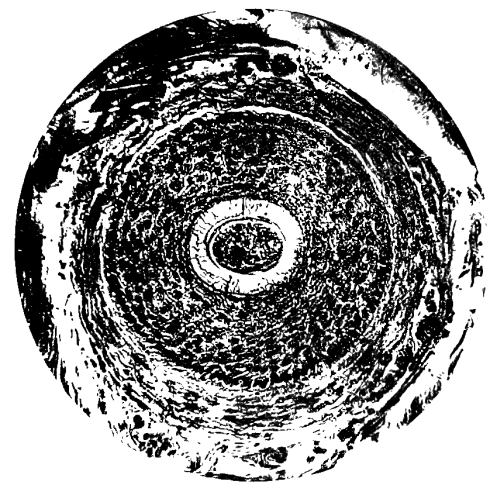
Fig. 3.—Photo-micrograph
of transverse section
of normal hair follicle, × 250.
(R. J. M. Buchanan.)
Carefully examine the bruises, wounds, &c., to see if they could have
been inflicted as described. Ask no questions that may suggest an
answer. Examine all weapons said to have been used, and hand them over
to the police. In all cases where danger to life is imminent, send
for the Authorities, and take dying declarations, as these may become
evidence of vast importance, and, if properly taken, are as valid as if
given on oath.
Much of what has been said under the heading of identity of the living
is applicable in examinations to establish identity of the dead.
The latter requires certain special details of examination owing to
the peculiar circumstances which may be present demanding them. The
material subject to examination may be incomplete, and difficulties
arise, so that it is essential to record every minute detail which may
be of value as evidence.
The purposes of examination under this heading are mainly related to
the questions of stature, age, sex, and special peculiarities of the
body.
It will be useful here to emphasize the importance of making a detailed
examination of the body. The examination, particularly the external
inspection, should be made in daylight.
If the body be seen where first discovered, note should be taken of the
exact position and attitude, of any signs of a struggle, of footprints
to or from the body; of bottles, medicines, vomit, or excreta near
the body, and which should be collected and retained. The expression
and colour of the face, the condition of the hands, the condition of
the dress as to tears and stains, the heat, amount of rigidity or
putrefaction, the presence of wounds and vital reaction in them.
If the body has been removed from the place where found, make similar
notes, remove the clothes, and compare any cuts if present in the
clothes with those on the body. Record for identification—nævi, moles,
tattoos, scars, hare-lip, cleft-palate, the mammæ, abnormalities of
fingers, teeth, bones, limbs, joints, &c.
An examination of the mouth, for the presence or absence of false
teeth, or of any peculiar formation of the jaw, may lead to the
identification of the body. In the case of Dr. Parkman, the
recognition by a dentist of the false teeth worn by the deceased led
to identification of the remains, and also to the discovery of his
murderer. The presence of an ununited fracture, as in the case of
Livingstone, may lead to the identification of the body. In one case
where a man was said to have died from a fracture of the ribs recently
caused by a blow, it was found on examination that the bones were
united by a firm callus, clearly showing that the skeleton produced
could not be that of the man alleged to have been murdered.
Record the height and if possible the weight. Note the sex, the
probable age, nutrition, and cleanliness or otherwise. Examine all
wounds, bruises, and describe them carefully, and marks, e.g.
strangulation or throttling. Examine the hands carefully and describe
their peculiarities, also the colour of hair and eyes. Examine all the
apertures of the body for foreign bodies, or abnormal conditions, and,
in females, record carefully the condition of the external genitalia
and the presence or absence of the hymen.
Although a more detailed account of the method of carrying out
post-mortem examinations is given later on, it will not be out of place
here to point out briefly the steps of examination. I would again
emphasize the importance of making a thorough and complete internal
examination, leaving no organ unexamined. If there be no call for
special examination of the thorax or abdomen first, commence with
the examination of the surface of the brain, then proceed downwards.
Note the direction of any wounds and their depth. Examine all organs
for morbid changes, and in females, the vagina and uterus. Examine
the larynx and œsophagus. Remove injured bones and examine joints.
Remove the spinal cord. Always remember to note the contents of the
stomach and bladder in reference to the period at which death may
have occurred. Weigh all organs. Always remember the probability of
poisoning, and make your examination accordingly.
All fragments or injured parts of a body or its organs should be
preserved, and photographs taken of them.
It is better for two medical men to conduct the examination together.
Do not make the examination without an order from the coroner. A
medical man who is alleged as implicated in the cause of death should
not be present.
Identification of the dead may present special difficulties where
mutilation of the body has taken place, or where the body has been
severely burnt, or is disfigured as in cases of explosions or advanced
putrefaction. In such cases, fragments of clothes, ornaments, and
dental work may afford valuable evidence.
Occupation Marks.—As an aid to
identification, it is important to remember that certain trades leave
marks by which those engaged in them may be identified.
Thus, in shoemakers there may be more or less depression of the lower
portion of the sternum, due to constant pressure of the last against
the bone.
Tailors work sitting, with the legs crossed and the body bent forward.
The body is thus cramped, and the abdomen drawn in, and the thorax
projects over it, due to the manner of sitting. They frequently have a
soft red tumour on the external malleolus. A like tumour, but not so
large, may also be found on the external edge of the foot, and a corn
on the little toe.
Photographers have their fingers blackened by nitrate of silver,
pyrogallic acid and other developers, or stained yellow with bichromate
of potash.
Seamstresses have the index finger of the left hand roughened by the
constant pricking of the needle.
Copyists have on the little finger of the right hand, near its
extremity, a corn, and at the end of the middle finger a hard groove
made by the pen.
Violinists have corns on the tips of the fingers of the left hand,
harpists on both hands.
In smokers of pipes the incisors and canines are more or less worn by
the mouthpiece, but sometimes the groove is between the canines and
bicuspids. In cigarette smokers, the forefinger and thumb are stained with
tobacco juice, also between the index and middle fingers, on the dorsum.
In coachmen, corns may be formed between the thumb and index finger,
and between the index and the second finger of the left hand, from the
pressure of the reins, and between the thumb and index finger of the
right hand, from the pressure of the whip.
In bricklayers, from the constant action of picking up bricks, the
flattening of the tip of the thumb and index finger of the left hand is
not uncommon.
Plasterers have corns on the external surfaces of the thumb and index
finger, due to grasping the “hawk” on which the plaster is placed
during their work.
Joiners and carpenters have callosities on the palm of the right hand
from grasping their tools, and between the thumb and index finger of
the right hand, also over the first interphalangeal joint of the right
index finger. The right shoulder is lower than the left.
The finger-ends of turners and coppersmiths are also more or less
flattened; in the latter, a deposit of the metal may take place.
To ascertain the time which may have elapsed since death.—This
can scarcely be determined with precision, as so much depends upon
the conditions under which the body may have been placed. The subject
under consideration is, therefore, beset with difficulties, and its
elucidation will require the greatest care on the part of the medical
expert. A careful attention, however, to the subjects treated in the
following pages will help to clear up many a doubtful point.
COOLING OF THE BODY
(1) External
circumstances. |
 |
Covered by bed-clothes, or otherwise |
| unexposed, when cooling will be dry |
| slower than in cold air quickly moving. |
| (2) Condition of the |
 |
Slow, if fat. |
| body itself. |
|
 |
1. Wasting diseases. Quick. |
| |
2. Suffocation. Slow. |
| (3) Kind of death. |
3. Cholera, yellow fever, |
|
Increase |
| |
rheumatic fever, and |
of heat |
| |
cerebro-spinal meningitis. |
after death. |
The following circumstances must also be taken into consideration: (1)
Age. (2) Air—(a) moving; and (b) at rest. (3) Moisture.
(4) Warmth. (5) Nature of the supposed cause of death, as affecting
cooling of the body, and promoting the rapid advance of putrefaction.
(6) Presence or absence of the rigor mortis. Bodies may be
preserved for months if exposed to intense cold.
The following Table, compiled from the experiments of Devergie, may
be of use in aiding the expert to form his opinion, but it must be
borne in mind that, from the great difficulties which surround the
subject, the statements made are only approximately correct. The table
is divided into four stages or periods, the last being that in which
putrefaction commences:—
First.—From a few
minutes to twenty hours after death—Animal heat more or less
present, but seldom continuing longer than ten or twelve hours. Muscles
contract on the application of galvanic stimuli, and in the earlier
stage to blows.
Second.—From ten
hours to three days—Body quite cold and rigor mortis well
marked; muscles do not contract on the application of stimuli. The age,
mode of death, and other collateral circumstances must, more or less,
be taken into consideration before an opinion can be given.
Third.—From three
to eight days—The body is quite cold, and cadaveric rigidity has
passed off. The muscles no longer respond to any galvanic or mechanical
stimulus. The stage is modified and somewhat shortened in summer.
Fourth.—From six to
twelve days—Commencement of putrefaction. Putrefaction may,
however, take place on the first or second day after death; so that, as
before stated, care must be taken before any positive decision can be given.
Stature.—As a general rule the length
of the body is equal to the distance between the tips of the middle
fingers with the arms outstretched. If an arm be missing, the length of
the remaining one multiplied by two, with the addition of 6 inches for
each clavicle and 1½ inches for the width of the sternum, will give the
approximate height. The femur is said to be equal to .275 of the body
height. If the skeleton be entire, the addition of 1½ inches for the
soft parts should be made.
Where only a limb or long bone or part of one be available, it is not
possible to give anything more than an approximate opinion of the height.
Sex.—When mutilation, putrefaction, or charring has taken
place, by which the genitalia have been demolished, it may be difficult
to determine the sex. Evidence will be afforded by the distribution of
the pubic hair, which in the male reaches as high as the umbilicus, but
is horizontal with few exceptions in the female. Males have more hair
on the body generally.
The presence of moustachios and beard and the length of the hair on the
head will assist in sex determination.
The breasts if present will denote the sex, also the uterus, which
withstands putrefaction and burning to a marked degree.
Remains of clothing and ornaments will indicate the sex of the wearer.
Lineæ albicantes on the abdomen, buttocks, and breasts indicate the
female sex, and the probable occurrence of previous pregnancies. It
must, however, be remembered that lineæ albicantes occur in males who
have been stout or had the abdomen distended by disease.
The Skeleton in Relation to Identification.—When a
complete skeleton is submitted for examination, the chief points to elucidate
are the age and sex. These will be noted further on. It may happen that
a single bone, separate bones, or only a part of one is obtainable,
when there may be considerable difficulty in expressing a definite
opinion. The questions to be answered are: Are they human or belonging
to the lower animals? When the bones are entire the answer is not very
difficult to settle; but when parts of bones have to be dealt with, one
has to be very careful in forming conclusions, and the fragments may
have to be submitted, to a skilled anatomist. One may not be able
to express an opinion about bones of the lower animals, other than
to state they are not human. The services of a skilled Comparative
Osteologist may be necessary to decide the nature of the animal.
When fragments resembling bone have to be examined, the microscope
will be necessary to determine their osseous structure. When several
bones have to be examined it may be possible to build up part or the
whole of a skeleton. Duplicate bones will indicate remains of more than
one creature. All fragments and bones should be carefully described,
measured, and photographed.
By the character of the bones one may be able to determine the sex to
which they belong and the approximate age. As a general rule the bones
of the female are smaller, lighter, and less marked by muscular and
other attachments.
The thorax in the female is deeper than in the male, the sternum
shorter and more convex, the ensiform cartilage thinner and ossified
later in life. The cartilages of the ribs are larger and the ribs
smaller than in the male. The ribs are more oblique and may show the
results of long corset pressure. The body of the sternum is over twice
the length of the manubrium in the male, less than this in the female.
The length of the twelfth rib in the male averages 103 mm., in the
female 83.8 mm. The pelvis exhibits marked differences. The sacrum of
the male is more curved than that of the female, which is straighter in
the upper half and more curved in the lower. The male pelvis is more
compact, deeper, rougher, and narrower. The pubic angle is smaller, the
obturator foramen is oval, and the ischia incurved. The female pelvis
is more open, shallower, wider, not so rough, a wider pubic angle, and
shallower and broader symphysis, the ischia are everted, wider apart
and flatter, and the obturator foramen triangular. The inlet of the
female pelvis is greater in all its diameters.
The skull in the male is heavier and larger, the markings and ridges
being more pronounced, the mastoid processes, occipital protuberance,
zygomatic and superciliary ridges are more prominent, and the capacity
greater than in the female.
In the female the jaw is less prominent and has a wider angle.
The lumbar curve is longer in the female, and the lumbo-sacral angle
greater than in the male.
The angle made by the neck of the femur with the shaft is about a right
angle in the female, more obtuse in the male. It must be remembered
that these differences between the sexes are not present to the same
degree before puberty, so that prior to it the examination offers
little evidence as to sex.
When examining bones any injuries to their structure or other
abnormalities should be noted. The skull must be carefully examined
for fractures, especially the base, which may be easily overlooked.
Injuries to vertebræ should be looked for. The presence of callus will
indicate that fracture has occurred at a period before death long
enough for its formation.
Age.—There are several data which enable one to form a fairly
accurate opinion as to the age of a body, these are especially useful
in earlier years and intra-uterine life.
The more general are the size, height, development, the presence or
absence of signs of puberty, the state of dentition, the greyness of
the hair; in the female the atrophic condition of the uterus after the
menopause, and the character of the lower jaw.
In addition are the time of life at which centres of ossification
appear and the union of epiphyses to the shafts of bones and bones with
each other.
In intra-uterine life centres of ossification appear by the end of the
sixth month in the os calcis, manubrium, and the bodies and laminas of
the sacral vertebræ; by the seventh, in the first piece of the body of
the sternum and the astragalus; by the eighth, in the second piece of
the body of the sternum; at full term in the cuboid, third piece of
the sternal body, first coccygeal vertebra, and the lower epiphysis of
the femur.
All traces of the fontanelles have disappeared by the end of the
fourth year. The angle of the jaw in infants and young children is
obtuse; as dentition proceeds, the body becomes deeper and the angle
alters so that towards adult life it approaches a right angle, the
ramus is longer and the body has become well developed with a mental
foramen midway between upper and lower borders. In the new-born, the
mental foramen is low down as the body of the jaw is practically all
alveolar. In old people the angle again becomes obtuse and the alveolus
disappears as the teeth are shed, and the mental foramen is at the
upper border.
Table of the Eruption
of the Teeth
| Age— |
Eruption of teeth. |
Temporary. |
| Lower |
central |
incisors, |
7 |
months. |
| Upper |
“ |
“ |
8 |
“ |
| “ |
lateral |
incisors, |
7-10 |
“ |
| Lower |
“ |
“ |
10-12 |
“ |
| First molars, |
12-14 |
“ |
| Canine teeth, |
18 |
“ |
| Second molars, |
22-24 |
“ |
| |
| |
First molars, |
6 |
years |
Permanent. |
| Middle incisors, |
7 |
“ |
| Lateral incisors, |
8 |
“ |
| First bicuspids, |
9 |
“ |
| Second bicuspids, |
10 |
“ |
| Canines, |
11-12 |
“ |
| Second molars, |
12-13 |
“ |
| Wisdom teeth, |
18-25 |
“ |
Examine the lower jaw. The ramus forms an obtuse angle in full-grown
fœtus, a right angle in adult life, obtuse in old age from loss of teeth.
Table showing the Periods at which Points
of Ossification appear after Birth
Years of
Life. |
Bones in which Centres of Ossification appear. |
| 1. |
Fourth piece of the body of the sternum; coracoid process |
| of scapula; head of humerus; os magnum (carpus); |
| head of femur; upper end of tibia; external cuneiform |
| (tarsus). |
| 2. |
Lower end of radius; unciform (carpus); lower end of tibia; |
| lower end of fibula. |
| 3. |
Great tuberosity of humerus; patella; internal cuneiform (tarsus). |
| 3-4. |
Upper end of fibula. |
| 4. |
Great trochanter (femur); middle cuneiform (tarsus). |
| 4-5. |
Scaphoid (tarsus); lower end of ulna. |
| 5. |
Lesser tuberosity (humerus); internal condyle (humerus); |
| trapezium and semi-lunar (carpus). |
| 5-6. |
Upper end of radius. |
| 6. |
Scaphoid (carpus). |
| 7. |
Trapezoid (carpus). |
| 10. |
Upper end of ulna. |
| 12. |
Pisiform (carpus). |
| 13-14. |
External condyle (humerus); small trochanter (femur). |
Periods of Union of Epiphyses
with the Shafts of Bones,
and of Bones with each other
Years of
Life. |
|
| 1-2. |
Symphysis of lower jaw. |
| 2. |
Frontal suture; unites from below upwards; it may persist. |
| Anterior fontanelle filled up. |
| 7-8. |
Rami of ischium and pubes. |
| 17. |
Epiphyses of upper end of ulna; small trochanter (femur). |
| 17-18. |
Epiphyses of condyles (humerus); upper end of radius. |
| 18. |
Epiphyses of great trochanter of femur; lower end of tibia; |
| lower sacral vertebræ; portions of acetabulum united. |
| 19. |
Epiphyses of the head of the femur. |
| 20. |
Epiphyses of the head of the humerus; lower end of radius |
| and ulna. |
| 21. |
Epiphyses of the upper end of tibia; lower end of fibula. |
| 24. |
Epiphyses of upper end of fibula. |
| 25. |
Second and third pieces of sternum; first and second sacral |
| vertebræ; epiphyses of clavicle, lower end of femur. |
| 40. |
Manubrium, with body of sternum.
|
Table showing the Development of the Embryo
according to the Lunar Months
| Month. |
Length. |
Weight. |
Observations. |
| First. |
Four to |
Twenty |
The embryo is curved; the mouth on |
| (3rd or 4th |
six lines. |
grains. |
the cephalic extremity appears as |
| week.) |
a cleft, and the eyes as two |
| black points. Nipple-like |
| protuberances mark the position of |
| the extremities. The heart can be |
| seen, and the liver is |
| disproportionably large. |
| Second. |
Fifteen to |
Two to |
The head disproportionably large. |
| (End of 8th |
eighteen |
five |
Nose, lips, and external parts of |
| week.) |
lines. |
drachms. |
generation visible, but sex |
| doubtful. Anus appears as a dark |
| point. Abdomen encloses the internal |
| organs. Extremities project slightly |
| from the trunk. Ossification in |
| clavicle and lower jaw about end o |
| seventh week; in frontal bone and |
| ribs towards end of eighth week. |
| Third. |
Two to |
One to two |
Eyes and mouth closed. Fingers well |
| (End of |
two and |
ounces. |
separated; nails recognisable. The |
| 12th week.) |
a half |
|
The sex can be detected by the aid |
| |
inches. |
|
of a lens. Suprarenal capsules and |
| thymus gland are formed. The |
| cavities of the heart and divisions |
| of the brain distinct. The placenta |
| isolated; the umbilical vesicle, |
| allantois, &c., have disappeared. |
| Fourth. |
Five to |
Two and |
The skin rosy and tolerably dense. |
| (End of |
six |
a half |
Sex seen without aid from lens. |
| 16th week.) |
inches. |
to three |
The mouth is large and open; the |
| |
|
ounces. |
umbilicus is near the pubes. |
| |
|
|
Meconium of a greyish-white colour |
| |
|
|
in the large intestines. |
| Fifth. |
Ten to |
Seven |
From the fifth month the length of |
| (End of |
eleven |
to ten |
the fœtus in inches is approximately |
| 20th week.) |
inches. |
ounces. |
exactly double the number of the |
| |
|
varying in |
lunar months. The nails are |
| individuals. |
distinct. The head, liver, heart, |
| and kidneys are disproportionately |
| large. The hair appears as a light |
| down. The meconium is of a |
| yellowish-green colour. Points of |
| ossification, pubes and os calcis.
|
| Sixth. |
Twelve to |
One to two |
Down and sebaceous matter cover the |
| (End of |
thirteen |
pounds. |
skin. The colour of the body is a |
| 24th week.) |
inches. |
|
cinnabar-red, and the umbilicus is |
| |
|
|
farther from the pubes. The meconium |
| is darker incolour; and the scrotum |
| is empty, the testes being close to |
| the kidneys. The pupillary membrane |
| is still present. |
| Seventh. |
Fourteen |
Three or |
The skin is of a dirty-red colour; |
| (End of |
to fifteen |
four pounds. |
the hair about half an inch long, |
| 28th week.) |
inches. |
|
and plentiful. Membrana pupillaris |
| |
|
|
disappearing; eyelids non-adherent. |
| The large intestine quite full of dark |
| olive-green meconium. Fontanelles |
| distinctly felt. Liver still large, of a |
| dark-brownish colour. |
| Eighth |
Fifteen |
Three to |
The skin, covered with soft hair, |
| (End of |
to sixteen |
five pounds |
is more of a rosy flesh-colour. |
| 32nd week.) |
inches. |
|
Disappearance of the pupillary |
| |
|
|
membrane, and descent of the |
| testicles into the scrotum. The |
| open vulva exposes the clitoris to |
| view. The nails almost reach the |
| tips of the fingers. |
| Ninth. |
Sixteen to |
Six pounds. |
The head covered with hair; |
| (End of |
eighteen |
|
the down on the body closing. |
| 36th week.) |
inches. |
|
|
| Tenth. |
Eighteen |
Seven to |
Well-known signs of maturity. |
| (End of |
to twenty |
nine |
| 40th week.) |
inches. |
pounds. |
Table giving the Measurements, according to the Months,
of the Extremities of the Fœtus in
the Order of their Development
| |
Third. |
Fourth. |
Fifth. |
Sixth. |
Seventh. |
Eighth. |
Full Period. |
| Humerus |
3½ | lines. |
8 | lines. |
13-15 | lines. |
16 | lines. |
20-22 | lines. |
23-24 | lines. |
3 | inches. |
| |
| Radius |
2½ | “ |
8 | “ |
12 | “ |
16 | “ |
17 | “ |
18-19 | “ |
2 | “ |
8 | lines. |
| Ulna |
3 | “ |
8 | “ |
13 | “ |
17 | “ |
18 | “ |
22-23 | “ |
2 | “ |
10 | “ |
| Femur |
2-3 | “ |
4-5 | “ |
12 | “ |
17 | “ |
19-21 | “ |
24 | “ |
3 | “ |
6 | “ |
| Tibia |
2-3 | “ |
4-5 | “ |
12 | “ |
17 | “ |
19-21 | “ |
21-23 | “ |
3 | “ |
2 | “ |
| Fibula |
2½ | “ |
. . . |
12 | “ |
17 | “ |
19-21 | “ |
21-23 | “ |
3 | “ |
1 | “ |
Table showing the Maximum and Minimum
Dimensions of the Osseous
Nucleus of the Inferior Femoral Epiphysis from
the Seventh
Month of Intra-Uterine Life to Two Years after Birth
| |
INTRA-UTERINE |
|
EXTRA-UTERINE. |
| | |
Days. |
Months. |
| | Seventh |
Ninth | Mature |
1-8 | 9-15 |
16-28 | 1 |
3-6 | 7-12 |
2-24 |
| | |
lines | lines |
lines | lines |
lines | lines |
lines | lines |
lines |
| Maximum |
| 2 |
4 | 3½ |
3½ | 2½ |
5 | 4 |
8 | 7 |
| Minimum |
| “ |
¾ | 1 |
¾ | 1½ |
2 | 2 |
3 | 5 |
No. of
Children (125)
examined |
31 | 9 |
52 | 8 |
3 | 2 |
9 | 3 |
6 | 2 |
CHAPTER III MODES OF DYING, SUDDEN DEATH, SIGNS OF DEATH — MODES OF DYING — SUDDEN DEATH — SIGNS OF DEATH — Real Death — Exceptions. — Cutaneous Hypostasis — External Conditions Which Modify Putrefaction — Internal Conditions Which Modify Putrefaction — THE PHENOMENA OF PUTRESCENCE IN THEIR CHRONOLOGICAL ORDER — 1. External — 2. Internal — Organs which Putrefy Early — Organs which Putrefy Late
Syncope—death beginning at the heart.
Asphyxia—death beginning at the lungs.
Coma—death beginning at the brain.
Syncope.—From δνγκοπτω, I strike down. Sudden arrest of
the action of the heart.
This condition may be brought about by
- 1. Deficiency of blood due to hæmorrhage—death by anæmia.
- 2. Effect of certain diseases and poisons, &c.—death by asthenia.
Causes—Heart Disease.—Aortic regurgitation, fatty
degeneration, &c.
Hæmorrhages from wounds of blood-vessels or the heart, profuse
hæmoptysis or hæmatemesis, uterine hæmorrhage, bursting of varicose
veins, bursting of aneurysms.
Shock.—Emotion; blows on the head or epigastrium; sudden
evacuation of fluids from the body, as in emptying an over-distended
bladder, tapping a hydrocele, ascites, or a pleural effusion. Extensive
injuries to the body (railway and machinery accidents). Drinking large
quantities of cold water when heated.
Exhaustive diseases, chronic or infective.
Symptoms.—Pallor of the face and mucous membranes, dimness of
vision, cold perspirations, sense of impending death, restlessness, air
hunger and gasping for breath, nausea, and, maybe, vomiting, noises in
the ears, passing delirium, quick, feeble, and fluttering pulse, or the
latter may be imperceptible at the wrist, insensibility, convulsions.
In ordinary fainting attacks many of the above symptoms are absent;
such as are present are temporary. In collapse, consciousness is
retained.
Post-mortem Signs.—The cavities of the heart contain a normal
quantity of blood in death by asthenia, but may be almost empty when
death is due to anæmia. The blood in asthenic death is simply arrested
in its course; blood is, therefore, found in the large veins and in
the arteries. The brain and the lungs are not engorged with blood.
Asphyxia.—From ἀ priv. et δφνξιϛ, pulse. Apnœa is the
better term—ἀ priv. et πνεω, I respire; but this word is now
used by physiologists to denote a cessation of the respiratory movements due to
artificially oxygenated blood. Blood in this condition fails to excite
the respiratory centre in the medulla, and respiration ceases. To avoid
confusion the term asphyxia had better be retained, especially as it
is most commonly used and generally understood. Asphyxia, or death
from defect in the quality of the blood, is brought about when any
impediment is placed on the healthy action of the lungs. Experiment
has shown that for a short time after respiration has ceased, the
heart still continues to act, and that if the impediment to the proper
aeration of the air by the lungs be removed, life may be prolonged.
Taking therefore the primary meaning of the terms asphyxia and apnœa
into consideration, it may be remarked that the latter precedes the
former in point of time—asphyxia marking the period at which the action
of the heart ceases, apnœa the cessation of the respiratory functions.
Causes of Asphyxia.—1. Mechanical obstruction to the
air passages: foreign bodies, exudations, tumours, suffocation,
strangulation, drowning, hanging, spasm of glottis from mechanical
irritation, or irritant gases.
2. Interference with the action of the respiratory muscles: exhaustion
of the muscles from cold; paralysis of muscles from injury to or
disease of respiratory centre; poisons acting on the centre; continued
pressure on walls of the chest; fixation of muscles from tetanus or
strychnine poisoning.
3. Diseases of and injuries to the lungs: pleurisy with effusion, acute
pneumonia, empyema, pneumothorax, pyopneumothorax, pulmonary apoplexy,
embolism of pulmonary artery.
4. Inhalation of air deficient in oxygen.
Symptoms of Asphyxia.—Divided into three stages. First
stage: deep, frequent, and laboured respiration; the extraordinary
muscles of respiration are called into play. Second stage: the
inspiratory muscles are less active than expiratory, convulsions of
nearly all the muscles of the body occur. Third stage: paralysis
of respiratory centres, dilated pupils, loss of consciousness, absence
of reflexes. Gasping inspirations with prolonged intervals precede
dissolution.
Post-mortem Signs.—Engorgement of the pulmonary artery, the
right cavities of the heart, and vent cavæ; but on the left side of
the heart the cavities, together with the aorta and pulmonary veins,
are either empty or contain but little blood. It must be remembered,
however, that cases of asphyxia do sometimes occur where the cavities
on each side of the heart are empty, or nearly so. This is the
case in the syncopal asphyxia of some writers. If also the obstruction
to respiration be imperfect, the circulation may be continued for
some time, congestion of one or more of the internal organs being
the result. The blood is dark-coloured, contains much CO₂, and the
hæmoglobin is almost completely reduced. The blood coagulates slowly.
Coma.—Insensibility ending in death. Causes.—Concussion
of the brain, cerebral hæmorrhage, embolism, thrombosis, tumour,
depressed fracture of skull, meningitis, and serous effusions; effects
of poisons such as opium, alcohol, ptomaines, arsenic, barium, oxalic
and carbolic acids; in certain diseases of kidneys and liver, uræmia,
cholæmia, acetonæmia, profound anæmia, e.g. pernicious, and as a
terminal stage to acute or chronic diseases.
Symptoms of Coma.—Coma is generally preceded by stupor,
from which the patient may be roused to a certain extent, but only
temporarily. The reflexes in this stage may be exaggerated, and the
power of swallowing fluids may be retained. When coma is present there
is complete abolition of consciousness, sweating, the patient is
powerless, the breathing stertorous. The temperature may vary according
to the cause; normal or subnormal generally, it may rise in lesions
of the pons Varolii. The pulse is generally full and bounding, the
pupils dilated or contracted and insensitive to light, the conjunctival
reflex absent. Mucus collects in the air-passages and causes “the
death rattle,” and the breathing becomes more and more embarrassed and
irregular. The reflexes are lost, and the sphincters relaxed.
Post-mortem Appearances.—Causal lesions are found in the brain
or other organs; there is usually hyperæmia of the brain and spinal
cord and their membranes, unless there be profound anæmia preceding
death. The condition of the heart and lungs is not constant; the
general appearances resemble those in death from asphyxia.
Table giving the Diagnosis of
Several
Forms of Insensibility
Injury to the Head—Concussion of
the Brain.—The symptoms are very similar to those of shock, with
unconsciousness, but it may be possible to rouse the person. The pupils
are equal and dilated or contracted, and react sluggishly to light.
The breathing is shallow and slow with sighing, the pulse feeble.
The muscles are relaxed but not paralysed. Vomiting and involuntary
micturition and defæcation may occur. The temperature is usually subnormal.
Cerebral Compression.—This, when due
to injury, is usually associated with fracture of the skull and
hæmorrhage. Insensibility is complete, the person cannot be roused.
The pupils may be unequal, contracted or dilated, and may not react
to light. The breathing is slow, stertorous, and may be irregular, or
Cheyne-Stokes in type. The pulse is full and bounding, the cheeks are
blown out during expiration. Paralysis, rigidity, or convulsions may be
present on one side of the body. There may be retention of urine, with
overflow incontinence.
In cases associated with severe fracture or hæmorrhage within the
skull, the conjunctivæ may be chemosed, or there may be hæmorrhage from
the nose or ear; and a flow of cerebro-spinal fluid may take place from
the nose.
Alcohol.—In coma due to alcohol, there
will be an alcoholic odour of the breath, alcohol in the stomach
contents, and it can be detected in the urine. The odour of alcohol in
the breath may be due to the administration of alcohol by an outsider
at the onset of the symptoms which have ended in the coma. The pupils are
equal, contracted, the conjunctival reflex present, and the pupil dilates
on pinching the skin of the neck. The pulse is rapid, at first strong it
becomes feeble, the respirations snoring. If the coma be not complete,
muscular inco-ordination may be noticed. The person can usually be
aroused by stimulation.
In pure alcoholic coma the presence of the special features of coma
from other causes will be absent. It must be remembered, however, that
alcoholic coma may be combined with other kinds, and the more serious
form should be kept in mind. Where there is the slightest doubt in the
diagnosis, one‘s procedure should be ruled by the possibility of the
graver cause.
Opium or Narcotic Poisoning.—The skin
is usually perspiring freely, moist and cold; the countenance placid,
pale and ghastly, the lips livid. The eyes are heavy, and the pupils
contracted to a pin-head and equal, the conjunctival reflex usually
present. There is the odour of opium in the breath. The pulse is slow,
and the respiration stertorous and slow. There is no paralysis, and the
person can be momentarily roused by a sharp question or blow.
Apoplexy.—The person is with difficulty,
if ever, temporarily aroused. The face is red and bloated. Respiration
suspirious and stertorous, and there is often Cheyne-Stokes breathing.
The pupils are dilated or irregular; in pontine hæmorrhage, contracted.
The temperature may at first be subnormal but gradually rises.
There may be rigidity of the limbs, or hemiplegia. The pulse is full
and bounding, often of high tension with hardened arteries.
Albuminuria may be present.
Uræmia.—This is less profound than in
cerebral hæmorrhage; the patient may be temporarily aroused; the onset
is usually gradual. There is albuminuria with casts; albuminuric
retinitis may be present. The pupils may be contracted or dilated. The
breath has a peculiar so-called “uræmic odour.” The pulse is generally
slow, the tension high, and the heart enlarged. The respirations
are slow and sighing, and may be Cheyne-Stokes in type. There is no
paralysis. There may have been preceding convulsions, and the coma may
alternate with these attacks.
Anasarca may be present.
Diabetic Coma.—This may come on suddenly,
and may occur unexpectedly in a person in whom diabetes has not been
discovered up to the time of coma. There is sighing respiration, “air
hunger.” The odour of acetone in the breath is present, and sugar in
the urine.
Epilepsy.—Unconsciousness is profound,
and comes on immediately with rigidity, followed by convulsions,
unilateral, limited to the side of the face, jaws, head and neck or
arm, or generalised. Bloody froth exudes from the mouth, the tongue
being bitten. The eyes are wide open, the pupils dilated and insensible
to light. Micturition may occur. After the convulsive attack has passed
off, post-epileptic coma may remain, though usually for a short time
only.
Syncope.—This has been described under
modes of dying (p. 38).
In all cases of coma when first seen examine the head for signs of
injury, note the odour of the breath, observe the state of the pupils
and their reactions, examine the limbs for paralysis, count the pulse
and note its character, and the state of the arteries, note the size of
the heart and auscultate it at each area. Count and note the character
of the respirations, take the temperature, examine the urine, take note
of the person‘s age, and inquire into the previous history.
Sudden death may proceed from natural or violent causes. From the
former, death may occur unexpectedly and very rapidly, but as a rule
the period of time occupied by the phenomena of “dying” is measurable,
though inconstant. Should such period of time be immeasurable, death
may be considered as instantaneous.
Apart from sudden death resulting from violence or poisoning, the
common causes are as follows:—
1. Diseases of the heart: angina pectoris, valvular diseases with
failure of compensation, especially aortic regurgitation, degeneration
of the heart muscle, rupture of the heart, heart failure from
diphtheria or toxic diseases.
2. Diseases of the blood-vessels: rupture of aneurysms or varicose
veins, thrombosis, embolism.
3. Cerebral hæmorrhage, especially when in the region of the pons
Varolii or cerebellum.
4. Lesions of the respiratory system: œdema or spasm of the glottis,
membranous deposit or foreign bodies in the larynx or trachea, foreign
bodies in the pharynx, tumours, whooping-cough, asthma, embolism
of the pulmonary artery, air embolism, fat embolism, rupture of a
vessel or aneurysm into the air-passages, as in phthisical cavities,
pneumothorax, hæmothorax, pleuritic effusion, and in acute pneumonia.
5. Rupture of a gastric ulcer or ulcer of some other part of the
alimentary tract.
6. Sudden hæmorrhage into the peritoneal cavity from ruptured uterus,
ectopic gestation, &c.
7. Rupture of internal organs: distended bladder, spleen, pregnant
uterus, or other abdominal viscus.
8. Hæmorrhage into the pancreas.
9. Conditions associated with the nervous system: mental emotions,
epilepsy, uræmia, laryngismus stridulus in children.
10. Sudden death has occurred in Addison‘s disease, in diabetes, in
cases of lymphatism or status lymphaticus in young people, during the
early stage of chloroform anæsthesia, during simple vaginal examination
in women, during the injection of fluids into the vagina or uterus.
Bouvalat (Annales d‘Hygiène, 1892) relates a case in which, as
the cannula of a syringe was being introduced into the os uteri of a
woman with the object of criminal abortion, she fell back before any
fluid was injected, and died in a few minutes.
A similar case came under my notice, in which death took place while
the husband of the woman was attempting to introduce a solution of 20
minims of tincture of iodine, mixed with water to measure two drachms,
into her uterus through a No. 3 catheter.
Real or Apparent Death
It will be unnecessary here to discuss any of the theories put forward
with regard to cases of apparent death or prolonged trance, but simply
to note in the order of their occurrence the phenomena which attend
real death.
Under this heading it is important to draw a distinction between
“Somatic death” and “Molecular death.” “Somatic death” is defined as
“the cessation of the vital functions and of the general renewal of
tissue consequent on that cessation”; “Molecular death” is the death of
the tissues themselves.
The signs of death occur as follows:—
1. Entire and continuous cessation of the respiration and
circulation; no sounds heard on auscultation. The absence of the
heart sounds is the most important sign of death, for even in the
severest forms of syncope the cardiac pulsations, as shown by M.
Bouchet, can with care be heard.
Tests for cessation of respiration:—
(a) Auscultation. (b) Placing a cold hand-mirror or
empty drinking-glass over the mouth or nostrils, or a light feather,
and noting the presence or absence of bedewing or movement. (c)
Placing a shallow vessel, such as a saucer, full of water on the chest
or abdomen, and observing the presence or absence of rippling of the
fluid (Winslow‘s test).
Tests for cessation of the circulation:—
(a) Auscultation.
(b) Manual exploration of the principal arteries for pulsation
or thrill.
(c) Magnus‘s test, applying a ligature tightly round a finger,
sufficient to stop the venous but not the arterial circulation, and
noticing whether or not a bloodless ring forms at the seat of ligature,
and a zone of livid redness on the distal side of the ligature, the
part becoming first red, then purple.
(d) Applying pressure to the finger-nail, and noticing whether
the colour disappears on pressure, and a pink tinge appears after
relaxing the pressure.
(e) Applying heat, such as dropping melted sealing-wax on the
skin, and noting whether or not redness or vesication ensues.
(f) Holding the hand, with the fingers abducted, against a
strong fight, and observing whether or not the web of the fingers is
translucent.
(g) Inserting a brightly polished needle into a fleshy part of
the body, allowing it to remain for ten seconds or so in situ,
and noticing whether it is tarnished or not on withdrawing it.
(h) Injecting hypodermically a solution of fluorescin
(resorcin-phthalein and sodium bicarbonate, a gramme of each dissolved
in 8 c.c. of water). No local discoloration of the skin takes place if
the circulation has ceased, but if not, a yellowish-green coloration
of the skin occurs round the seat of injection, and the substance may
be detected in the blood at a part some distance from the seat of
injection. By immersing some white silk threads in the blood drawn
at a distance from the prick, then boiling them in distilled water,
the latter will have a greenish colour if the fluorescin has been
circulated (Icard‘s test).
These tests will detect whether the circulation has ceased or not, and
so differentiate suspended animation from real death.
2. The lustre of the eye is lost immediately after death. It
has, however, been stated that the iris will respond to the action of
atropine and eserine for some hours after death, and that the action of
the latter is always more marked than that of the former. The fundus
as seen by ophthalmoscopic examination is altered, the normal redness
changes to a yellowish-white, the vessels in the disc and just around
it become empty, and the veins appear to contain bubbles of gas and the
column of blood is broken up (Bouchet). A blackish round or oval stain
has been described by M. Larcher on the sclerotic coat on the outer
side, which he calls l‘imbibition cadavérique du fond de l‘œil.
It is probably due to thinning of the sclerotic from evaporation,
enabling the choroid to be seen through it. The spot precedes rigidity
and is a forerunner of putrefaction.
3. The most powerful stimulus applied to the body does not cause
any reaction. The muscles may, however, be made to contract
shortly after death by the stimulus of a slight blow, or by galvanism.
4. The surface of the body becomes of an ashy-white colour.
(1) Persons of florid complexion retain this on
the malar prominence for some time after death.
(2) The red or livid edges of ulcers.
(3) Blue, black, or red tattoo marks, if not
effaced during life, do not disappear.—Ecchymoses retain the hue they
had at the time of death.
(4) An “icteric” coloration existing at death, as
in jaundice, never becomes white.
(5) A rosy tint of the skin on those poisoned by
carbon monoxide.
(6) Dusky-red patches in those frozen to
death.
(7) In certain cases of drowning, a rosy colour
may be observed on the lips and malar prominences.
5. The temperature of the body at the time of death is retained
for some time. As a sign of death the fall of temperature must be
progressively continuous. Cooling will depend on the medium in which the
body is placed, and mere coldness of the body is not a sign of death.
(1) Fat persons retain the heat longer than lean
ones; adults longer than children or old persons. Bodies are cooled
by—1. Radiation. 2. Conduction. 3. Convection.
(2) Bodies immersed in water cool more rapidly
than in air. This fact may be of importance in determining survivorship
in a case of drowning.
(3) Bodies in bed and covered by the clothes, or
in cesspools and in dung-heaps, cool less rapidly than when exposed.
(4) Persons killed by lightning may keep warm
longer than others.
(5) Death by suffocation retards the process of
cooling.
(6) The body may be cold externally, but
possesses a considerable amount of heat when the internal organs
are exposed. Persons who have died of cholera, yellow fever, or
suddenly of some acute disease—rheumatism—may retain for some hours
a considerable amount of heat. It has even been asserted that in
some diseases—cholera—there is an increase of temperature soon after
death (Laycock), also after death due to
some diseases of the nervous system as in pontine hæmorrhage and
cerebro-spinal meningitis, and following prolonged muscular spasm as in
tetanus.
(7) Most bodies, under ordinary circumstances,
are, as a rule, quite cold in from eight to twelve hours after death.
The rate of loss of temperature depends upon the difference between
that of the body and its surroundings; it lessens as the body cools.
It takes at least twenty-four hours for it to fall to the heat of the
surrounding atmosphere.
6. Relaxation, primary flaccidity, more or less general, of the
muscular system takes place.
“If the above signs are alone present, death must have taken place
in from ten to twelve hours at the longest” (Casper).
Exception: cadaveric spasm.
7. Want of elasticity in the eyeball: flaccidity of the iris.
This condition invariably occurs in from twelve to eighteen hours after
death.
8. Flattening of the muscles of those parts on which the body
rests, due probably to loss of vital turgidity.
9. Hypostasis.—Suggillation, or post-mortem staining, is
due to the gravitation of the blood to the most dependent parts of the
body not subject to direct pressure. The hypostatic marks begin to form
in from eight to twelve hours after death, and increase in size till
putrefaction sets in. They alter their position with changes in the
position of the body so long as the blood remains fluid, but when it
has coagulated they remain permanent. Hypostasis may be mistaken for an
ecchymosis or a bruise, and in the lungs for congestion, inflammation,
&c. Errors may also occur with regard to the brain, stomach, kidneys,
and intestines: in the last, the redness of inflammation is seen all
over the parts, whereas the coloration of hypostasis is interrupted,
and this is best shown by drawing out the convolutions. The heart is
an exception to the rule, but it may contain clots varying in size and
colour. These are post-mortem formations. The use of the word
suggillation is objectionable, as it has been used in opposite senses
by Continental and British authors—some writers restricting the term
to ecchymosis proper, others using it as synonymous with cadaveric
lividity or external hypostasis.
(1) Meaning of the expression.—The
gravitation of the blood in the capillaries after death, in obedience
to the laws of inert matter.
(2) On what parts of the body usually
seen?—On the most dependent parts of the body; on the whole of the
back of the body, if the body be supine. The patches are irregular
and slashed, terminate abruptly, and do not fade gradually into the
surrounding colourless skin.
(3) At what period after death first
observed?—In from eight to twelve hours, gradually extending in
size till putrefaction sets in.
(4) Whether or not affected by death from
hæmorrhage?—Formed after every kind of death, even after
death due to hæmorrhage, although the coloration may not be quite so
marked.
(5) Hypostasis is liable to be mistaken
for ecchymosis—the result of injury.—Hypostasis must also
not be confounded with the livid patches seen on the legs and feet of
aged persons and on those who have died from typhus, chronic renal and
cardiac disease, &c. The rose patches—“frost erythems”—seen on
those who have died from exposure to cold, must not be mistaken for
ecchymosis. The above patches are as frequently on the upper surfaces
of the body as on the lower, and are not so extended as cadaveric
lividities; the blood, moreover, which gives rise to them is diffused
through the areolar tissue, and not incorporated with the true skin.
(6) How distinguished from
ecchymosis?—Effused or coagulated blood is found when an incision
is made in a true ecchymosis, however small, whereas a few
bloody points are alone seen on a slight or deep incision into a
post-mortem stain or true hypostasis. The seat of hypostasis is
the superficial layer of the true skin. Hypostases are never raised
above the surface, as ecchymoses sometimes are. In describing these two
conditions, “ecchymosis” and “hypostasis,” it is preferable to describe
the former as “discoloration from extravasated blood,” and the latter
as “lividity after death.”
10. Cadaveric rigidity.—From the moment of death till the time
when putrefaction sets in, the muscular structures of the body may be
said to pass through three stages:—
(1) Muscular Irritability.—The muscles
flaccid, but still possessing the power of contractility on the
application of certain stimuli. Parts contracted during the act of
dying—cadaveric spasm—as the muscles of the hand grasping a knife or
other weapon, may continue so for some time after death.
(2) Cadaveric rigidity.—A state of
rigidity, the power of contractility absent.
(3) Commencement of Putrefaction and
Chemical Change.—Relaxation again present; all power of
contraction lost, not to be regained.
Cadaveric rigidity, or rigor mortis, is a purely muscular
phenomenon, and is not dependent on the nervous system, as it is not
prevented, though it may be delayed, by division of the nerves, and
is as well marked in paralysed as in non-paralysed limbs. Cadaveric
rigidity, which occurs early in the heart, must not be mistaken for
hypertrophy, or its absence for dilatation. In every case the rigor
mortis precedes putrefaction, and consists in a shortening and
thickening of certain muscles, chiefly the flexor and adductor muscles
of the extremities, and also the elevators of the lower jaw.
This condition commences in the involuntary muscles, and in the heart
may simulate hypertrophy of that organ, then passes into the voluntary
muscles of the back of the neck and lower jaw, and then into the
muscles of the face, front of the neck, chest, and upper extremities,
and then into the trunk muscles, and last of all, into those of the
lower extremities. In most cases it passes off in the same order, the
body becoming quite flaccid, the rigor mortis never returning.
These phenomena occur whilst the body is cooling. The muscle becoming
rigid is dying, the rigid muscle is dead. The cause of the rigor
mortis is held to be due to the coagulation of the myosin. The
reaction is acid from the presence of sarcolactic acid, but becomes
alkaline during putrefaction.
If fresh difibrinated blood be passed through the rigid muscle, it will
become flaccid, and respond by contraction to electric stimulation.
Cadaveric rigidity generally supervenes from eight to
twenty hours after death, and may continue from a few hours to
four or nine days.
The sooner rigidity comes on after death the sooner will it pass away,
and the later the onset the longer it will last. It is a general rule
that whatever exhausts the muscular irritability before death causes
the early appearance and the more rapid disappearance of rigor mortis.
Conditions which modify the onset and duration of rigor mortis:—
(1) Age.—Transitory rigor mortis
may appear in the immature fœtus according to the state of its muscular
development.
It is feeble and disappears quickly in infants and young children.
It is usually well marked in adolescents and healthy adults, but feeble
in old people.
(2) The Degree of Muscular Development of
the Body.—Other things being equal, the greater the muscular
development and muscular strength at the time of death, the slower is
the onset of rigor mortis, and the longer its duration;
the more feeble or exhausted the muscular condition, the more rapid the
onset and the shorter its duration.
(3) The Temperature of the Environment of
the Body.—In temperate and colder climates rigor
mortis follows the usual course. A low temperature, below
freezing-point, will retard the onset and favour the duration of
rigor mortis, but if the body be suddenly thawed before rigor
mortis has set in, it will appear rapidly and disappear more
quickly than if it had not been subjected to the process of thawing.
If a body already in a condition of early
rigidity be exposed to a temperature of 75° C., the rigidity becomes
more marked, since albuminates in the muscles, other than the myosin,
become coagulated in addition. This phenomenon has been called heat
stiffening.
(4) Mode of Death.—After all exhausting
diseases of long or short duration, rigor mortis appears early and
passes off quickly, as in death from phthisis, cholera, typhus fever,
typhoid, hydrophobia, scurvy, and occasionally in chronic Bright‘s disease.
Death during alcoholic intoxication favours the duration of rigor
mortis. After violent muscular exercise death is quickly followed
by rigidity. Animals that have been hunted for some time before
death stiffen very rapidly. When convulsions precede death, rigor
mortis sets in early as a rule, but in certain cases, where death
has been preceded by strong convulsions, rigidity may appear quickly,
but last for some days, as in some cases of poisoning by strychnine.
Conditions which simulate rigor mortis:—
(1) Stiffening by Catalepsy.—In this
condition the temperature of the body will remain at a degree
compatible with life over a period incompatible with real death. If a
limb be extended and rigid in catalepsy, after passive flexion of it,
it will return to its former state.
(2) Rigidity from the Body being
Frozen.—In this condition passive movement of the joints is
accompanied by crackling due to fracture of their frozen contents.
(3) Heat Stiffening.—Is seen in the bodies
of persons who have been suddenly immersed in boiling fluids; also to a
certain degree in bodies of persons who have met their death by burning
from paraffin lamp accidents.
Cadaveric Spasm or Instantaneous Rigor.—“When this phenomenon
occurs the last act of life is crystallised in death.” It is a
prolongation of the last vital contraction of the muscles into
the rigidity of death. Cadaveric rigidity of the muscles must be
distinguished from muscular spasm occurring at the moment of
death.
They may thus he distinguished: In cadaveric rigidity any object placed
in the hand prior to the onset of rigor mortis can be readily
removed, even if the precaution be taken of binding it in the hand
prior to the accession of rigor mortis.
In the case of muscular spasm the object is found grasped in the
hand, and can only be with difficulty removed.
The difficulty experienced in removing a pistol or other weapon from
the hand may point to suicide; its easy removal to homicide, the weapon
having been placed there after death.
No adequate explanation of this phenomenon has yet been made. It is
not an unusually early onset of rigor mortis in the muscles
affected, because they do not share in the initial relaxation that
precedes it, or the weapon would fall from the hand, and the bodies
would not retain the peculiar attitudes which have been described in
different instances. Nothing can simulate cadaveric spasm and it cannot
be produced in any way after death. Instantaneous rigor only occurs in
cases in which there has been great mental tension and nerve excitation
before death. It is a continuation of probably the very last voluntary
act of life.
A body showing the signs of death before mentioned (Nos. 1 to 10)
may be held to be that of a person who has been dead from two to
three days at the longest (Casper).
Muscular states of the body between the period of somatic and molecular
death:—
(1) Primary Flaccidity.—The muscles
respond to electrical stimuli; the chemical reaction of the muscles is
either neutral or faintly alkaline.
(2) Cadaveric Rigidity or Rigor
Mortis.—During this condition molecular death takes place; the
muscles do not respond to stimuli, but fresh defibrinated blood passed
through the muscles will restore the response to stimulation, and their
reaction is markedly acid.
(3) Secondary Flaccidity.—Disintegration
of the muscular elements takes place, no stimuli will provoke response,
and the reaction again becomes alkaline.
Table showing the
principal points to be noted in the period of accession of Cadaveric
Rigidity and the causes which retard or hasten its appearance, or
modify its duration:—
In what does it consist?—In a
shortening and thickening of the muscles, particularly the flexors and
adductors of the extremities, and elevators of the lower jaw.
Period of Invasion.—Generally in from
eight to twenty hours after death. It has been known, however, to
supervene within three minutes of death, but it may be delayed for
sixteen or seventeen hours.
Period of Duration.—From one to nine days.
Three weeks (Taylor).
Order in which the Muscles are
affected.—Involuntary muscles, back of neck and lower jaw, muscles
of the face, front of the neck, chest, upper extremities and then the
lower extremities.
Order in which it disappears.—Back of
neck, lower jaw, &c., following the course of its accession.
Effects of Exposure to Cold.—Prolonged by
dry cold air, and by cold water.
Effects of Enfeebling Disease prior to
Death.—Rapid in its invasion, and passing off rapidly.
Effect of a Robust Frame at Period of
Death.—The accession may be prolonged; but, other things being
equal, it is more strongly manifested, and continues longer.
Effects of Violent Exercise prior to
Death.—Rapidly supervenes and rapidly disappears, as in soldiers
killed at the end of a battle.
Effects of Poison.—Poisons which cause
violent contractions for some time prior to death—strychnine,
&c.—influence the rapid invasion of the rigor mortis,
its short duration, rapidly followed by putrefaction. Where death
in poisoning by strychnine is almost instantaneous, with a short
convulsive stage, rigor mortis comes on rapidly and
remains a long time.
11. Putrefaction.—the last of the phenomena which follow
death—is the resolution of the organised tissues of the body to the
inorganic state. It is a gradual process, and is the result of the
action of micro-organisms, aided by moisture, air, and warmth.
Putrefaction is the only absolute sign of death having taken place.
The conditions which modify putrefaction are as follows:—
External Conditions.—1. Micro-organisms; 2. Air; 3. Moisture;
4. Warmth.
Internal Conditions.—1. Age; 2. Sex; 3. Condition of the
body—(a) Constitutional peculiarity; (b) State of
the body. 4. Kind of death—(a) The result of disease;
(b) The result of poisons.
1. Micro-organisms.—A fauna and flora of decomposition has
been described in a paper by Hough on “The Fauna of Dead Bodies,”
B. M. J., vol. ii. 1897, p. 1853, to which the reader is referred.
Many different forms of micro-organisms combine in the production of
putrefaction, and the result of their action is inevitable, unless the
body be guarded against their invasion by special means, or the tissues
be rendered unfit for their use.
2. Air.—Exposure in the open air has a marked effect in
promoting putrefaction; but garments fitting close to the body, and
thus excluding air, have a contrary effect. Dry air, or air in motion,
by assisting evaporation from the corpse, acts as a preservative.
The composition of the soil in which the body is placed has also a
more or less modifying effect. In light, porous soil, allowing of
the free ingress of air, decomposition is more rapid than in close,
compact soil, as clay; but in this we have to contend with another
agent—moisture—which more or less counteracts the protective virtue
of the closer earth.
3. Moisture.—Putrefaction cannot proceed without moisture.
The body, however, contains sufficient water to enable this process
to commence spontaneously. Organic substances artificially deprived
of water do not putrefy. Cold and heat possess marked antiseptic
properties—the former by freezing the fluids in the body, the latter
by drying them up.
4. Warmth.—A temperature between 70° and 100° F. is found most
favourable to decomposition. The effect of cold is shown by the fact
that a body immersed in water during winter, at a temperature between
36° and 45° F., may be so well preserved as to present, ten or twelve
days after death, well-marked signs of violence, which would in summer
have been utterly obliterated in five or seven days. The preservative
influence of cold water will, however, depend greatly on the depth
at which the body has been submerged. Bodies so submerged, and then
exposed to the air, putrefy with such rapidity that exposure for one
day is said to work a greater change than three or four days longer
retention of the body in the water. As an instance of the preservative
power of cold, may be mentioned the mammoth found in Siberia embedded
in a block of ice.
1. Age.—The bodies of young children, other things being equal,
are said to putrefy rapidly. It should be remembered, however, that
clothing possesses considerable power in retarding putrefaction, and
that, in the hurry and anxiety to get rid of the infants, they are
oftener exposed naked than clothed, which may, in some measure, account
for their more rapid decomposition.
2. Sex.—Sex, it would appear, has little or no influence either
to retard or hasten putrefaction; but it has been remarked that females
dying during or soon after child-birth, irrespectively of the cause of
death, putrefy rapidly.
3. Condition of the Body.
(a) Constitutional Peculiarity.—It is generally admitted
that persons of the same age and sex, dying similar deaths, and
subjected to like conditions as to exposure to the air and interment
in the same soil, exhibit marked differences as regards the accession
and rapidity of putrefaction. The explanation may be difficult, but the
fact still remains.
(b) State of the Body.—Fat and flabby corpses putrefy
more rapidly than the lean and emaciated. Hence old people, who are
generally thin, keep fresh for a comparatively long time. Bodies, also,
which are much mutilated rapidly decompose—decomposition setting
in first at the parts injured. In examining wounds and bruises said
to have been inflicted during life, it is well to remember that the
tendency of putrefaction is to make them appear more severe.
4. Kind of Death.
(a) Effect of Disease.—Healthy persons dying suddenly,
other things being equal, are said to decompose more slowly than those
who have died from exhausting diseases, as in the case of typhoid,
phthisis, and dropsy, following organic disease, or of those diseases
attended with more or less putridity of the fluids.
(b) Effects of Poisons.—Putrefaction rapidly supervenes
in those who have died suffocated by smoke, by carbonic oxide, and by
sulphuretted hydrogen. Narcotic poisoning is stated to accelerate this
condition; but in poisoning by phosphorus or alcohol, and in cases
of death from sulphuric acid, the putrefactive changes are greatly
retarded. Arsenic, chloride of zinc, and antimony are reputed to
possess antiseptic properties. The manner in which death takes place
from the action of the poison greatly hastens or retards putrefaction.
Thus, in the case of poisoning by strychnine, it is found that
when death has occurred rapidly, without much muscular exhaustion,
putrefaction sets in slowly; but that, when the muscular irritability
has been greatly exhausted by successive fits, the contrary is the result.
One to Three Days.—Greenish coloration of the abdominal walls.
Odour of putrescence is gradually developed, and, concurrently with
this, the eyeball becomes soft and yielding to pressure.
Three to Five Days.—The green colour, of a deeper shade, has
now passed over the abdomen, extending also to the genital organs.
Patches of this green coloration also make their appearance somewhat
irregularly on other parts of the body, such as the neck, back, chest,
and lower extremities. A dark reddish frothy fluid about this time
wells up from the mouth.
Eight to Ten Days.—The patches of green colour have now
coalesced, so that the whole body is discoloured. On some parts of
the body the colour is of a reddish-green, due to the presence of
decomposed blood in the cellular tissue. The abdomen is now distended
with gases, the products of decomposition. In India this distension has
been known to occur in less than six hours, the average period being a
little over eighteen hours. Much depends upon the season of the year.
The colour of the eyes has not disappeared, but the cornea have fallen
in. Relaxation of the sphincter ani takes place, and the superficial
veins appear like reddish-brown cords. The nails still remain firm.
Fourteen to Twenty Days.—The colour of the surface is now
bright green, with here and there patches of a blood and brown colour.
The epidermal layer of the skin is raised in bullæ of varying size, in
some places the skin being more or less stripped off. The nails are
detached, and can be easily removed. The hair can be pulled from the
scalp with ease. The body is now greatly distended with gases, and
the features cannot be recognised, owing to the swollen condition of
the face. The body is generally covered with vermin. In determining
the time at which death occurred, it will be necessary to take into
consideration the season of the year, as it is found that an advanced
stage of decomposition may be present in from eight to ten days, with
the thermometer ranging between 68° and 77° F., which in winter, with
a temperature of from 32° to 50° F., would require twenty to thirty
days. “Bodies green from putridity, blown up and excoriated, at the
expiry of one month, or from three to five months after death (cæt.
par.), cannot with any certainty be distinguished from one another”
(Casper).
Three to Six Months.—During the above period the stage of
colliquative putrefaction has set in. The thoracic and abdominal
cavities, due to the increased formation of gas, have burst. The bones
of the cranium have more or less separated, allowing the brain to
escape. The soft parts are more or less absorbed, and no recognition
of the features is possible. The sex can only be positively made out
by the presence of a uterus, or by the peculiar growth of hair on the
pubes, which in woman only covers the pubes, but in man extends upwards
to the navel.
Saponification.—Bodies exposed to the action of water, or buried
in damp, moist soil, are apt to undergo certain changes, in the course
of which they become saponified, and the formation of a substance known
as adipocere is the result. Adipocere—adeps, lard,
and cera, wax—is chiefly composed of margarate of ammonia,
together with lime, oxide of iron, potash, certain fatty acids, and
a yellow-coloured odorous matter. The melting-point is 126.5° F.
Adipocere has a fatty, unctuous feel, is either pure white or of a
pale yellowish colour, and with the odour of decayed cheese. It is
highly resistant to putrefactive organisms, and is generally free from
them. The formation of this substance “to any considerable extent is
not likely to occur in less than three to four months in water, or
six months in moist earth, though its commencement
may take place at
a much earlier period” (Casper). The
above-quoted authority mentions a case in “which the remains of a
fœtus were found imbedded in adipocere, and which fœtus was proved to
have been buried in a garden exactly six months and three-quarters.”
Taylor also records the case of a bankrupt who committed suicide by
drowning, in which the muscles of the buttocks were found converted
into adipocere in five weeks and four days at the longest.
Although the above statements may be accepted with regard to the
formation of adipocere as far as European countries are concerned,
they do not seem to be applicable to India, where the change appears
to be more rapid. Dr. S. Coull Mackenzie, in his valuable book on
Medico-Legal Experiences in Calcutta, records a case of a young
man whose body, recovered after seven days‘ immersion in the river
Hooghly, “was found to be in an advanced state of saponification,” and
the fleshy portions of undigested food in the stomach were converted
entirely into adipocere. “Lastly,” he writes, “in the hot, steamy,
rainy months of September and October, in three of the cases above
mentioned, saponification was found in bodies immersed in water, both
externally and internally, in from two days to eight days ten hours. In
the soft and porous soil of Lower Bengal during the rainy seasons, even
in a wooden coffin, the change is very rapid—three or four days.”
To explain the formation of adipocere, it has been supposed to be due
to the decomposition of the muscular structures of the body, by which
hydrogen and nitrogen are evolved, these combining to form ammonia, and
this, coming in contact with the fatty acids of the fat, forms a soap.
The process of saponification takes place most rapidly in young fat
persons; next, in those adults who abound in fat, and in those whose
bodies have been exposed to the soil of water-closets; more rapidly
in running than in stagnant water; and lastly, in those who have been
buried in moist, damp soil, especially if the bodies have been piled
one on the top of the other, the lowest being first saponified. The
muscular tissue appears to be the first to undergo this change. In
water the process is said to be completed in about five months, but in
soil a period of two or three years appears necessary.
Mummification is of no medico-legal interest, as the causes
which produce it are unknown, and no reliable data can be obtained as
to the period of its accession, or the time required for its production.
Table showing the order
in which the
Internal Organs undergo Putrefaction:
- 1. The Trachea.
- 2. The Brain of Infants.
- 3. The Stomach.
- 4. The Intestines.
- 5. The Spleen.
- 6. The Omentum and Mesentery.
- 7. The Liver.
- 8. The Adult Brain.
- 9. The Heart.
- 10. The Lungs.
- 11. The Kidneys.
- 12. The Bladder.
- 13. The Gullet.
- 14. The Pancreas.
- 15. The Diaphragm.
- 16. The Blood-vessels.
- 17. The Uterus.
1. The Trachea, including the Larynx.—The rapid change in
the trachea must be borne in mind, in order to avoid the error of
attributing death to suffocation or drowning. An examination of the
trachea should never be omitted.
2. The Brain of Infants up to the First Year.
3. The Stomach.—The first traces of putrefaction are seen in
from four to six days after death. All the coats of the stomach are
softened, but there is no excoriation, as is the case when corrosive
poisons are taken. Emphysematous separation of the mucous coat may be
present, but must not be confounded with the excoriation just mentioned.
4. The Intestines.—Casper declares that he does not remember
any case in the course of his experience where the intestines
were “found earlier putrefied than the stomach.” In the course of
putrefaction they become of a dark brown colour, bursting, and allowing
an escape of their contents; and they ultimately become changed into a
dark pultaceous mass.
5. The Spleen.—This organ in some cases putrefies before the
stomach and intestines; but, as a rule, it resists decomposition longer.
6. The Omentum and Mesentery.
7. The Liver.—This organ is not unfrequently found firm and
dense some weeks after death. It putrefies earlier in new-born children
than in adults. The convex surface first shows signs of putrefaction.
The gall-bladder also remains for some time recognisable.
8. The Adult Brain.—The brain of newly-born children, as
mentioned before, soon putrefies. This is not the case in the adult
brain. Putrefaction sets in not on the surface, but at the base of the
brain. A wound of the brain causes it to putrefy more rapidly than if
no injury be present.
9. The Heart.
10. The Lungs.—Contemporaneously with the appearance of
decomposition in the heart, the lungs also begin to show signs of
putrefaction, though this condition may take place earlier.
11. The Kidneys.—These organs are long in yielding to the
putrefactive process.
12. The Bladder.—Nearly all the other organs of the body are in
a state of decomposition before this viscus becomes materially affected.
13. The Gullet.—This long remains firm, even after the stomach
and intestines fail to be recognised.
14. The Pancreas.—The body must be far advanced in putrefaction
before this gland becomes affected.
15. The Diaphragm.—This may be distinguished after the lapse of
four to six months.
16. The Blood-vessels.—The aorta may be recognised after the
body has been interred for fourteen months.
17. The Uterus.—Of all the organs of the body, the uterus
resists the putrefactive changes longer than any other organ.
Table showing some important Facts to be
noticed with regard To Putrefaction:
- 1. Earliest external indication of it.
- (1) In a Body exposed to Air.—Greenish coloration of the
- abdominal coverings.
- (2) In a Body immersed in Water.—Face, head, and ears,
- gradually extending from above downwards.
- 2. Earliest internal indication.—Found in the trachea, including
- the larynx.
- 3. Advanced putrefactive appearances to be expected in a body
- exposed to air, say from fourteen to twenty days at mean
- temperature, as regards—
- (1) Epidermis.—Raised here and there in blisters about
- the size of a walnut, in some places the size of a dinner
- plate, and quite stripped off.
- (2) True Skin.—Maggots cover the body, chiefly in the
- folds of the skin.
- (3) Cellular Tissue.—Blown up with gas.
- 4. Comparative time required to produce equal extent of putrefaction
- in a body—
- (1) In Air.—One week. One month.
- (2) In Water.—Two weeks. Two months.
- (3) In Earth.—Eight weeks. Eight months.
Does Lime hasten Putrefaction?—It is a very general opinion
that it does. Careful experiment has, however, proved that lime neither
retards nor hastens putrefaction, but that it prevents the escape
of the gases produced during the process by absorbing them; it is,
therefore, a good and safe deodoriser, and in this property its true
value lies.
CHAPTER IV POST-MORTEM EXAMINATIONS AND EXHUMATIONS — I. Part of General Directions — II. Necessary Implements — III. External Aspect, and Examination of the Body — IV. Dissection, or Internal Examination of the Body — V. Examination in Cases of Wounds and Contusions — VI. Examination in Cases of Poisoning — VII. Examination in Cases of Suffocation — VIII. Examination in Cases of Burning — IX. Examination in Cases of Criminal Abortion — X. Examination in Cases of Infanticide — EXHUMATIONS
The following are some of the Instructions issued to Medical Inspectors
by the Crown Office in Scotland, slightly modified:
13. When any portions of the body, or any substances
found in or near it, are to be preserved for further examination, they
ought never to be put out of the custody of the inspectors, or of a
special law officer. They must be locked up in the absence of the
person who keeps them. When they are to be transmitted to a distance,
they should be labelled, and the labels signed by the inspectors; and
after being properly secured and sealed, they should be delivered by
the inspectors themselves, or the special law officer whose duty it is
to see them delivered into the hands of the parties for whom they are
intended.
14. Besides the ordinary instruments used in common dissections, the
inspector should be provided with a foot-rule for measuring distances,
and a glass measure graduated to drachms, for measuring the quantities
of fluids, two or three stoneware jars of medium size, or when these
cannot be had, a few clean bladders, for carrying away any parts of the
body which it may be necessary to preserve for future examination, and
in cases of possible poisoning, three or four bottles of eight, twelve,
and sixteen ounces, with glass stoppers or clean corks, for preserving
fluids to be analysed. The common square green glass pickle bottles are
very suitable, and can generally be obtained. No bottle or jar should
be used until it has been thoroughly washed under the supervision of
one of the inspectors. In cases of infanticide a balance, having a flat
scale-pan with a foot-rule painted on it, is of great use; on it the
infant may be stretched, weighed, and measured at one operation. Paper,
pens, ink, and sealing-wax should also be provided.
15. All distances, lengths, surfaces, and the like, whose extent may
require to be described, ought to be accurately measured; and the
same rule ought to be followed in ascertaining the volume of fluids.
When large quantities of fluids are to be measured, any convenient
vessel may be used, whose capacity is previously ascertained by the
inspectors. Conjectural estimates and comparisons, however common, even
in medico-legal inspections, are quite inadmissible.
16. The importance of the external examination, and the particulars to
be chiefly attended to in performing it, will vary in different cases
with the probable cause of death. It comprehends an examination—(1)
Of the position of the body when found, as well as of all external
injuries or marks presented by it. (2) Of the vicinity of the body,
with a view to discover the objects on which it rested, or from or upon
which it may have fallen, marks of a struggle, signs of the presence
of a second party about the time of death or after it, weapons or
other objects the property or not the property of the deceased, the
remains of poisons, marks of vomiting; and where marks of blood are of
importance, and doubts may arise as to their really being blood, the
articles presenting them must be preserved for further examination. (3)
Of the dress, its nature and condition, stains on it of mud, sand, and
the like, of blood, of vomit, of acids, or other corrosive substances,
marks of injuries, such as rents or incisions; where injuries have been
inflicted on the body, care should be taken to compare the relative
position of those on the body and those on the clothes; and where
stains, apparently from poison, are seen, the stained parts are to
be preserved for analysis. (4) Ligatures, their material and kind,
as throwing light on the trade of the person who applied them; the
possibility, or impossibility, of the deceased having applied them
himself; their sufficiency for accomplishing their apparent purpose, &c.
17. The inspectors will commence the examination of the body itself by
surveying the external surface and openings. Before cleaning it they
will examine it on all sides, not neglecting the back, as is often
done, and look for marks of mud, blood, ligatures, injuries, stains
from acids, and the like; foreign bodies, or injuries within the
natural openings of the body, viz. the mouth, nostrils, ears, anus,
vagina, and urethra. If there are impressions of finger marks, they
will consider which hand produced them. If there be any doubt about
stains being blood, the skin presenting them must be preserved for
analysis. If there be acid stains, or other probable remains of poison,
or any foreign matter, the nature of which may require to be determined
by analysis, these must also be preserved. The ordinary places for the
impressions of ligatures are the neck, the wrists, the ankles, and the
waist. The degree of warmth of the trunk and extremities, the presence
or absence of cadaveric rigidity, and whether it exists equally in the
upper or the lower extremities, should be noted in this stage of the
proceedings; in other cases the progress of putrefaction, as indicated
by the odour of the body, the looseness of the cuticle, the colour of
the skin, and formation of dark vesicles on it, the evolution of air in
the cellular tissue, the alteration of the features, the softness of
the muscles, the shrivelling of the eyes, the looseness of the hair and
nails.
18. In this part of the examination it will sometimes be necessary to
observe the particulars by which the body may be identified. These are
numerous. But the most important are the stature, the age and sex,
the degree of plumpness, the size and form of the nose and mouth, the
colour of the eyes and hair, the state of the teeth, warts, nævi,
deformities, scars of old abscesses, ulcers, and wounds, and, if a
woman, marks of her having had one or more children.
19. The body is next to be washed, if necessary, and the hair of the
head shaved, or at least closely cut; and a thorough examination of
the whole integuments is to be made. At this stage the inspectors will
look particularly for the appearance of lividity, noting its chief
seat and its relation to the posture in which the body was found—for
impressions on the skin of objects on which it had rested—for marks of
injuries, more especially contusions, taking care to ascertain their
real nature by making incisions through the skin—for marks of disease,
such as eruptions, ulcers, and the like—for marks of burning—for
marks of concealed punctures in the nostrils, mouth, external openings
of the ears, the eyes, the nape of the neck, the arm-pits, the anus,
the vagina, and beneath the mammæ or scrotum; in infants, also in the
fontanelles and the whole course of the spine. At this stage, wounds
and other injuries should be carefully examined according to the
directions given in Division V. (infra). Where the injury may
have caused loss of blood, the presence or absence of pallor of the
skin, lining membrane of the mouth, and the gums ought to be noted.
20. In commencing the dissection of the body, it must be laid down as
an invariable rule that all the great cavities should be examined, and
also every important organ in each, however distinctly the cause of
death may seem to be indicated in one of them. It is right to examine
the cavity of the spine, and at all events its upper portion, in any
case where an unequivocal cause of death has not been discovered
elsewhere.
21. In examining the organs situated in the several cavities of the
body the inspectors must be guided in a great measure by their ordinary
anatomical and pathological knowledge.
22. The inspectors should begin with that cavity over which there is
a wound or other mark of injury. Or, if there be an injury on the
extremities, the dissection ought to commence there. In the absence
of any such guide, that cavity should be taken first where the
circumstances of death, so far as they are ascertained, may lead the
inspectors to expect unusual appearances. In other cases, the abdomen
should be first opened but not dissected, and a general survey made of
the parts exposed, without disturbing them materially, the position
of the diaphragm being determined by examining it with the hand; then
the thorax is immediately to be examined, unless there is good reason
for doing otherwise. The reasons for this method of procedure are as
follow: If the abdominal organs are removed, and the veins cut, the
blood in the heart may drain away through the venæ cavæ, and error
result. If, on the other hand, the thorax be first opened, the relation
of the abdominal organs to each other cannot be clearly made, owing to
the relaxation of the diaphragm, due to the severing of its thoracic
connections. Again, if the thorax be first opened, the position of the
diaphragm cannot be determined. The inspectors may begin with the head,
which may be examined thoroughly in the first instance, afterwards the
chest and belly, as above described; the spine being reserved till the
conclusion. Wherever unusual appearances are discovered in the first cursory
survey, the anatomical examination ought in general to be begun there.
23. In examining the several regions of the body it is to be observed
that wherever a wound, or other obvious injury of the external parts,
lies in the way of the ordinary incisions, that part must be avoided,
so as to leave the external injury unaltered.
24. The most approved mode of opening the head in medico-legal cases
is, after dividing the integuments from ear to ear, and reflecting
the scalp over the forehead and occiput, to make the usual circular
incision through the skull, about an inch above the orbits in front,
and over the occipital protuberance behind, using the saw lightly
and carefully after the outer table of the skull has been divided,
so as to avoid injuring the membranes of the brain; and to raise the
skull-cap from before backwards, taking care to detach the dura mater
from the skull with the handle of the scalpel or a spatula where it
adheres firmly. The chisel and mallet should never be used where there
is any chance of finding a fracture of the skull; for how could it be
distinguished from a fracture made with the mallet? Should the dura
mater be firmly adherent to the skull-cap, the better practice is to
divide it carefully, so as to remove both at the same time. Tearing the
membrane and crushing the brain substance are thus avoided. In infants
and young children this mode of procedure is most necessary, as in them
the dura mater is, as a rule, adherent.
25. The ordinary mode of examining the membranes of the brain, and the
brain itself, answers well in medico-legal dissections. Effusions of
fluid within the skull should always be measured. After the brain is
removed, the dura mater ought to be stripped from the base of the skull
to facilitate the search for fractures there, which will, of course,
indicate external violence. After the removal of the brain, the upper
part of the spinal canal should be examined through the foramen magnum
before any part of its course be laid open; and search should be
particularly made for dislocation or other injury in the region of
the atlas and dentata. In cases of fatal fractures of the head, the
strength of the bones should be attended to. In cases of extravasation
within the head, the state of the coats of the cerebral arteries should
be examined.
26. The best mode of opening the spine is, after having finished the
examination of the brain, to cut through the integuments from the
occiput to the coccyx—to lay the vertebræ thoroughly bare on each
side by cutting away the muscles—to make an incision with the saw
on each side of the skull, from the postero-inferior angle of the
parietal bones into the lateral edge of the occipital hole—to remove
the triangular portion of the occipital bone thus detached, and then
to cut the rings of the vertebræ on each side with the bone-nippers or
spine-knife, beginning with the atlas. In these cases preference should
be given to the saw, by which the operation is not only more easily
accomplished, but there is no risk of confounding previous fracture
with that made in dissecting. Where there is reason to think that the
bones are injured, the laying open of the canal should stop at the
distance of two or three vertebræ from the injury, and the injured
bones, with two or three adjacent vertebræ on each side, should be
removed entire before the examination is extended farther down the spine.
27. The organs of the throat may be examined, either by dividing the
lower jaw-bone at the chin, cutting the soft parts close to the inner
surface of each half of the bone backwards, and then turning the two
segments outwards; or by freely reflecting the skin of the throat,
separating the soft parts from the inside of the lower jaw, the knife
being carried parallel with and close to the bone, drawing the tongue
out below the chin, and then continuing the dissection backwards.
28. The best mode of examining the organs situated in the throat is,
after detaching the soft parts from the lower jaw, as advised in Sect.
27, to dissect the soft palate from the bone, and proceeding backwards,
to detach the whole soft parts from the base of the skull and vertebræ
down to the sternum, leaving them connected with the organs in the
chest. Besides the ordinary points to be attended to in this part of
the examination, the presence of venereal or other ulcerations is a
matter requiring attention in some cases.
29. It is necessary to examine the pharynx and gullet, the larynx,
trachea, and its greater ramifications, the lungs, the heart, and the
great vessels with particular care, because here are most frequently
found the causes of sudden natural death. In examining the heart each
auricle and each ventricle ought to be laid open by an independent
incision of its parietes; and this should not intersect any of the
valvular openings or the septum cordis.
30. For laying open the chest and abdomen, the most convenient method
is to make an incision down the fore part of the neck, chest, and
abdomen to the pubes; then cutting from the peritoneum upwards, to
dissect back the integuments and muscles of the chest, and examine the
abdomen, as in Sect. 22; next, divide the cartilages of the ribs, and,
cutting upwards, close under them, to raise the cartilages along with
the sternum. In separating the sternum from the clavicles, care must be
taken not to wound the subjacent vessels; and this may be avoided by
the dissector moving each shoulder so as to show the exact position of
the sterno-clavicular joints, and then dividing both joints cautiously.
In dividing the cartilages of the ribs, the saw is sometimes necessary.
The cartilages should be cut as far from the sternum as possible, to
give free space for the subsequent examination.
31. In inspecting the organs in the chest, a cursory examination
should be first made by turning them over, ascertaining the nature
and measuring the quantity of effused fluids, feeling for fractures
of the ribs, tumours, or other diseases, and opening the pericardium
to obtain a view of the heart. The most convenient course to pursue
next is, without moving the heart from its place, to lay open its
several cavities, in order to judge of the quantity and state of the
blood in both sides of that organ. For this purpose the following
incisions should be made: The first, beginning close to the
base, is carried along the right border of the heart directly into
the right ventricle towards the apex, care being taken not to cut the
septum. This lays open the right ventricle. The second incision,
opening up the right auricle, begins midway between the entrances of
the venæ cavæ, ending just in front of the base. The third, for
exposing the left auricle, commences at the left superior pulmonary
vein, and ends just in front of the base, close to the coronary vein,
care being taken not to wound it. The fourth, displaying the
left ventricle, commences behind the base, and ends close to the
apex. If the blood is in a fluid state, the quantity contained in the
right auricle may be materially affected by the head being examined
previously, as the blood may have escaped from the heart by the jugular
veins. The whole of the organs in the chest—the lungs, heart, and
gullet—together with the parts dissected downwards from the throat,
should now be removed in one mass, in order to examine them in detail
on a table. But previously two ligatures should be applied on the
gullet, just above the cardiac orifice of the stomach, and the division
made between them.
32. The organs in the abdomen ought to be turned over, like those of
the chest, before any one of them is minutely examined, but before the
thorax is opened, for the reasons given in Sect. 22. In the subsequent
examination, that organ is to be first proceeded with in which there
may appear to be disease.
33. In a post-mortem examination, the most approved mode of
examining these injuries is, if they be situated over great cavities,
to expose the successive structures in the manner of an ordinary
dissection, observing carefully what injuries have been sustained
by the parts successively exposed before they are divided. Wounds
ought not to be probed, especially if situated over any of the
great cavities. The depth of a wound is best ascertained by careful
dissection and exposure of the parts involved; but after this is done,
the thickness of the tissues penetrated may be measured by the probe.
34. The seat of the wounds must be described by actual measurement from
known points, their figure and nature also carefully noted, and their
direction ascertained with exactness.
35. Before altering by incisions the external appearances of injuries,
which should never, if possible, be done, care must be taken to
consider what weapon might have produced them, and if a particular
weapon be suspected, it should be compared with them. The wounded parts
should be cut out entire, and carefully preserved.
36. Apparent contusions must be examined by making incisions through
them; and the inspectors will note whether there is a swelling or
puckering of the skin; whether the substance of the true skin be
black through a part or the whole of its thickness; whether there be
extravasation below the skin or in the deeper textures, and whether the
blood be fluid or coagulated, generally or partially; whether the soft
parts below be lacerated, or subjacent bones injured; and whether there
be blood in contact with the lacerated surfaces. By these means the
question may be settled whether the contusions were inflicted before or
after death.
37. In the cases of wounds, too, the signs of vital action must be
attended to, especially the retraction of the edges, adhesion of blood
to their surfaces, or the injection of blood into the cellular tissue
around, or the presence of the signs or sequelæ of inflammation.
Hypostasis must not be mistaken for vascular injection.
38. When large arteries or veins are found divided, care must be taken
to corroborate the presumption thus arising by ascertaining, in the
subsequent dissection, whether the great vessels, lungs, liver, and
membranous viscera of the abdomen be unusually free of blood.
39. In the course of the dissection of wounds, a careful search must
be made for foreign bodies in them. When firearms have occasioned
them, the examination should not be ended before discovering the
bullet, wadding, or other article, if any, lodged in the body; and
whatever is found must be preserved. When the article discharged from
firearms, or when any other weapon had passed through and through a
part of the body, the two wounds must be carefully distinguished by
their respective characters, especially as regards their comparative
size, inversion or eversion, smoothness or laceration, of their edges,
their roundness or angularity, and the comparative amount of bleeding
from each. In gunshot injuries, the presence or absence of marks of
gunpowder should be noted.
40. When wounds are situated over any of the great cavities, they ought
not to be particularly examined until the cavity is laid open; and in
laying open the cavity, the external incisions should be kept clear of
the wounds.
41. When the discoloured state of a portion of the skin is such as to
render it doubtful whether it is due to injury or to changes after
death, an incision should be made to ascertain whether there is blood
effused into the textures, constituting true ecchymosis, or merely
gorging of the vessels of the skin, or discoloration from infiltration
of the colouring matter of the blood, which takes place in depending
parts of a dead body. The term suggillation should be avoided, as it
has been used in opposite senses by Continental and British authors.
The respective expressions, “discoloration from extravasated blood,”
and “lividity after death,” are preferable.
42. In examining a body in a case of suspected poisoning, the
inspectors should begin with the alimentary canal, first tying two
ligatures round the gullet, above the cardiac orifice of the stomach,
two round its pyloric end, and a third at the sigmoid flexure of the
colon, then removing the stomach and entire intestines; next dissecting
out the parts in the mouth, throat, neck, and chest in one mass; and,
finally, dissecting the gullet, with the parts about the throat, from
the other organs of the chest. The several portions of the alimentary
canal may then be examined in succession.
43. Previous to commencing the dissection in cases of supposed
poisoning, the inspectors should make such inquiries as may enable them
to form an opinion as to the class of poison to which the death may be
traceable, and thus to guide them as to the conclusions to be come to
from the presence, or it may be the complete absence, of any marked
appearance explaining the cause of death.
44. The medical inspectors may afford most important aid to the law
officers in investigating the history of cases of supposed poisoning.
For this purpose minute inquiry should be made into the symptoms during
life their nature, their precise date, especially in relation to meals
or the taking of any suspicious article, their progressive development,
and the treatment pursued. It is impossible to be too cautious in
collecting such information, and, in particular, great care must be
taken to fix the precise date of the first invasion of the symptoms,
and the hours of the previous meals. The same care is required in
tracing the early history of the case, where the inspector happens
to visit the individual before death; and if suspicions should not
arise till his attendance has been going on for some time, he ought,
subsequently to such suspicions, to review and correct the information
gathered at first, especially as to dates. All facts thus obtained
should be immediately committed to writing.
45. Besides inspecting the body and ascertaining the history of the
case, the inspectors may afford valuable assistance to the law officers
in searching for suspicious articles in the house of the deceased.
These are—suspected articles of food, drink, or medicine; the vessels
in which they have been prepared or afterwards contained; the family
stores of the articles with which suspected food, &c., appears to have
been made. All such articles must be secured, according to the rules
in Sect. 13, for preserving their identity. In this examination the
body-clothes, bed-clothes, floor, and hearth should not be neglected,
as they may present traces of vomited matter, acids spurted out or
spilled, and the like.
46. When a medical man is called to a case during life, where poisoning
is suspected, he ought as soon as possible to follow the instructions
laid down for securing articles in which poison may have been
administered.
47. In the same circumstances, it is his duty to observe the conduct of
any suspected individual, were it for no other reason than to prevent
the remains of poisoned articles from being put out of the way, and to
protect his patient against further attempts.
48. The whole organs of the abdomen must be surveyed, and particularly
the stomach and whole tract of the intestines, the liver, spleen, and
kidneys, the bladder; and in the female, the uterus and its appendages.
The intestines should in general be split up throughout their whole
length; and it should be remembered that the most frequent seat of
natural disease of their mucous membrane is in the neighbourhood
of the ileo-cæcal valve, and that, next to the stomach, the parts
most generally presenting appearances in cases of poisoning are the
duodenum, upper part of jejunum, lower part of ileum, and rectum.
49. In cases where the possibility of poisoning must be kept in view,
and where matters may require to be procured for chemical analysis, it
is essential to be sure that all instruments, vessels, and bladders
used are scrupulously clean.
50. When any unusual odour is perceived, either in the blood in the
course of making the dissection, or in the stomach when opened, it
ought to be carefully observed, and if possible identified by all the
medical men present. In this way alcohol, opium, prussic acid, oil of
bitter almonds, and other odorous poisons may be recognised. The smell
of the contents of the stomach ought always to be noted whenever it is
opened, as the smell often alters rapidly.
51. The stomach and intestines should be taken out entire, and their
contents emptied into separate bottles. If the stomach or part of
the intestines present any remarkable appearance, examination may
be reserved, if convenient, till a future opportunity; but in every
circumstance it must be preserved and carried away, as it may itself
be an important article for analysis. The throat and gullet may
be examined at once, and preserved with their contents, which, if
abundant, may be kept apart in a bottle. In addition to the alimentary
canal and its various contents, portions of the solid organs of the
body ought to be secured for analysis. The most important are the
liver, spleen, and kidneys. A part of the liver, at least a fourth
part, should be secured in every case of supposed poisoning; and in
cases where the fatal illness has been of long duration, and therefore
only traces of the poison may remain in the body, the whole of the
liver, the spleen, and both kidneys should be secured. A portion of the
blood, especially when the odour of any volatile poison is perceived,
should be at once put into a bottle, closed by a good cork or stopper.
52. No person ought to undertake an analysis in a case of suspected
poisoning unless he be either familiar with chemical researches, or
have previously analysed with success a mixture of organic substances,
containing a small proportion of the poison suspected.
53. All persons undertaking an analysis should bear in mind that the
opinion of some other person practised in toxicological researches may
be required; and they should therefore take care, when practicable, to
use only a portion of the several articles preserved for analysis. The
identity of the subjects for analysis must be secured by the
rules in Sect. 13.
54. In cases of suspected drowning, the inspectors will observe
particularly whether grass, mud, or other objects be clutched by the
hands, or contained under the nails; whether the tongue be protruded or
not between the teeth; state of the penis; whether any fluid, froth,
or foreign substances be contained in the mouth, nostrils, trachea,
or bronchial ramifications; whether the stomach contains much water;
whether the blood in the great vessels be fluid. Careful pressure
should be made upon the lungs; any fluid contained in them in thus
forced into the bronchial tubes and trachea, and its nature observed.
When water with particles of vegetable matter or mud is found within
the body, these must be compared with what may exist in the water in
which the body was discovered, and should be preserved for further
scientific investigation, if requisite. Marks of injuries must be
compared diligently with objects both in the water and on the banks
near it, and especial attention given to the question—whether any
observed injuries had been sustained by the body before or after death.
55. In cases of suspected death by hanging, strangling, or smothering,
it is important to attend particularly to the state of the face
as to lividity, compared with the rest of the body; the state of
the conjunctiva of the eyes as to vascularity; of the tongue as to
position; of the throat, chin, and lips as to marks of the nails,
scratches, ruffling of the scarf-skin, or small contusions; the
state of the blood as to colour and fluidity; the state of the
heart as regards the amount of blood in its several cavities; the
state of the trunk and branches of the vena cava in the abdomen as
regards distension with blood; and the state of the lungs as regards
congestion, rupture of any of the air cells, and small ecchymoses under
the pleura, or the pericardium. The mark of a cord or other ligature
round the neck must be attentively examined; and here it requires to
be mentioned that the mark is often not distinct till seven or eight
hours after death, and that it is seldom a dark livid mark, as is very
commonly supposed, but a pale greenish-brown streak, presenting no
ecchymosis, but the thinnest possible line of bright redness at each
edge, where it is conterminous with the sound skin. Nevertheless,
effusions of blood and lacerations should be also looked for under and
around the mark, in the skin, cellular tissue, muscles, cartilages, and
lining membrane of the larynx and trachea. Accessory injuries on other
parts of the body, more especially on the chest, back, and arms, must
also be looked for, as likewise the appearance of blood having flowed
from the nostrils or ears, and the discharge of fæces, urine or semen.
In cases where death may be due to the emanations from burning fuel or
other poisonous vapours, a small phial should be filled with the fresh
blood, and securely corked for further investigation, if requisite.
56. In supposed death by burning, the skin at the edge of the burns
should be carefully examined for redness, or the appearance of vesicles
containing fluids.
57. In suspected criminal abortion, when the woman survives, the chief
points for inquiry are: The proofs of recent delivery, the ascertaining
of facts tending to show that she has been subjected to manœuvres with
instruments, and the occurrence of symptoms traceable to the action of
any of the drugs reputed as capable of causing abortion.
When the woman has died, the points requiring special attention at the
dissection are: The state of the womb, as regards its size and the
condition of its lining membrane, in reference to the probable period
of delivery; the condition of the intestinal canal, in reference to the
action of irritant drugs; of the mucous membrane of the bladder, in
reference to the action of cantharides; close inspection of the womb
and vagina, in reference to mechanical injuries, especially punctured
wounds; and any appearances that the death may have been caused by
inflammation in the organs of the pelvis, or by bleeding from the wound.
58. In cases of suspected infanticide, certain specialities must be
borne in mind. The cavity of the head should be laid open with a pair
of scissors. In opening the abdomen, the navel should be avoided, so
that the state of the vessels of the navel-string may be examined
correctly. This is done by carrying two incisions from the ensiform
cartilage to each of the anterior superior spines of the ilia, and by
deflecting downwards the triangular flap thus formed.
59. The inquiry in cases of infanticide should be conducted with
reference to the five following distinct questions: (1) The probable
degree of maturity of the child? (2) How long it has been dead? (3)
Whether it died before, during, or after delivery, and how long after?
(4) Whether death arose from natural causes, neglect, or violence? and
(5) Whether a suspected female be the mother of the child?
60. The points to be attended to for ascertaining the probable degree
of maturity of the child are: The general appearance and development,
the state of the skin, its secretions, and its appendages; the hair and
nails; the presence or absence of the pupillary membrane; the length
and weight of the whole body; whether the navel corresponds or not with
the middle of the length of the body; the situation of the meconium in
the intestines; the size of the testicles in the case of males, and in
either sex the size of the point of ossification in the lower epiphysis
of the thigh-bone. This is easily observed by making an incision
across the front of the knee into the joint, pushing the end of the
thigh-bone through the cut, slicing off the cartilaginous texture
carefully until a coloured point is observed in the section, and then,
by successive very fine slices, ascertaining the greatest diameter of
the bony nucleus. This does not exist previous to the thirty-sixth week
of gestation, and in a mature child is about one-fourth of an inch in
diameter. Has the infant been washed? Absence or presence of vernix
caseosa. Nature and character of the wrappings, if any, found on the child.
61. The points of chief importance in reference to the period which
has elapsed after death are those specified in the last clause of
Sect. 17—it being borne in mind that the bodies of infants are often
concealed in ash-pits and dunghills, and that in these circumstances
putrefaction is very rapid.
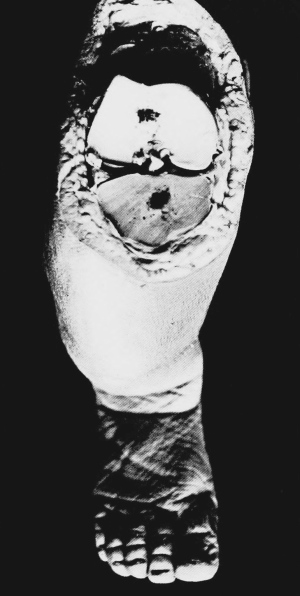
Plate.—Section
through the epiphysis
of the lower end of the femur showing
ossification centre, in a full-term fœtus.
62. The circumstances which indicate whether the child died before,
during, or after parturition, and how long after it, are the signs
of its having undergone putrefaction within the womb; the marks on
the crown, feet, buttocks, shoulders, &c., indicating presumptively
the kind of labour, and whether it was likely to have proved fatal to
the child; the state of the lungs, heart, and great vessels, showing
whether or not it had breathed; the nature of the contents of the
stomach and of the intestines; the presence of foreign matters in the
windpipe; the state of the umbilical cord, or of the navel itself, if
the cord be detached.
63. In order to examine properly the state of the lungs, heart, and
great vessels, with a view to determine whether or not the child had
breathed, the inspection should be made in the following order: Attend,
first, to the situation of the lungs; how far they rise along the sides
of the heart; to their colour and texture; whether they crepitate or
not. Then secure a ligature round the great vessels at the root of the
neck, and another round the vena cava above the diaphragm. Cut both
sets of vessels beyond the ligatures, and remove the heart and lungs
in one mass, which must be weighed and put into water, to ascertain
whether the lungs, with the heart attached, sink or swim. In the next
place, put a ligature round the pulmonary vessels, close to the lungs,
and cut away the heart by an incision between it and the ligature.
Lastly, ascertain the weight of the lungs; whether they sink or swim
in water; whether blood issues freely or sparingly when they are cut
into; whether any fragments swim in the instances where the entire
lungs sink; and in every instance of buoyancy whether fragments of them
continue to swim after being well squeezed in a cloth.
64. The general question to be considered in relation to the cause
of death is, whether the appearances are such as to be traceable to
the act of parturition, or whether they indicate some form of violent
death. The directions given in Divisions V., VI., and VII. apply to
infants as well as adults; but the following points are specially to be
noticed in cases of supposed infanticide:
In relation to wounds and contusions, the
possibility of minute punctured wounds of the brain or other vital
organs; in reference to injuries of the head, the effusion of blood
under the scalp, not in the situation where it could have been
produced during labour, or fracture of the bones not producible by
compression of the head during labour, and not connected with defective
ossification of the skull; in reference to the allegation that the
head was injured by the child suddenly dropping from the mother,
when not recumbent, the presence of sand or other foreign matters on
the contused scalp, and the existence of more than one injury of the
head; in relation to suffocation, the external and internal signs of
this form of death—marks of compression of the mouth, and nose, and
throat, and the presence of foreign matters in the mouth and throat,
air-passages, gullet, or stomach, especially if the body be found in
contact with similar substances; in reference to bleeding from the
navel-string, a bloodless state of the body, without any wound to
account for it; in reference to poisons, most commonly narcotics, the
absence of any of the above appearances, with an otherwise healthy
state of the body; in reference to starvation and exposure, emaciation
of the body, absence of food from the stomach, and an empty, contracted
condition of the intestines; in reference to the possibility of the
child having been suddenly expelled, and having fallen on the floor
or into privies, &c., the state of the navel-string is to be
noted—whether long or short, whether remaining attached to the child
and connected with the after-birth, indicating rapid labour, or, if
divided, whether it had been cut or torn across. Nature of the ligature
used, if any.
65. The circumstances noticed in Sects. 60, 61, 62, 63, 64, compared
with the signs of recent delivery in the female, will lead to the
decision of the question whether the suspected female be the mother of
the child. These circumstances may be shortly recapitulated as being
the signs of the degree of maturity of the child—the signs on the body
of the kind of labour, the signs which indicate the date of its death,
and the interval which elapsed both between its birth and death, and
between its death and the inspection.
It becomes necessary sometimes to exhume the bodies of persons who have
been buried. The cases which generally call for this always unpleasant
proceeding are those where a suspicion of poisoning or violence has
arisen some little time after the burial of the supposed victim. Or
the necessity may arise to show that the body buried is that of a
person whose death it is absolutely necessary to prove. In the case of
Livingstone, though this can scarcely be called a case of exhumation,
yet an examination some months after death of the arm of the corpse
alleged to be that of Livingstone, proved the existence of a badly
united fracture which the deceased was known to have had.
In conducting the exhumation, it is necessary that the medical experts
should be present to see the body removed from the coffin, and also
any person or persons who may be in a position to speak as to the
identity of the corpse—as, for instance, those who dressed it and
prepared it for burial. The person who made the coffin may also be of
assistance to speak as to its identity. As soon as the medical men are
armed with the proper authority, no time should be lost in order to
get the body as fresh as possible, and at once prove or disprove the
accusation of the crime, which, in the case of innocent persons, cannot
be too quickly removed. The best time to take up the body, if in the
summer, is early in the morning; and, in all cases, the examination,
if possible, should be made during daylight. Everything necessary for
making a medical inspection should be taken, and also a table on which
to place the body. Rubber gloves should be worn. A pail containing a
solution of some disinfectant, for the inspectors to wash their hands
after the exhumation is finished, should be close at hand. And it is as
well to expose the body for a short time to the air before beginning
the inspection. There is seldom any risk to health in removing a single
body, yet certain precautions are necessary; thus it is as well to
stand on the windward side of the corpse. Vaults should not be entered
as soon as they are opened, but time allowed for their ventilation.
Carefully note the amount of preservation of the coffin, and, if
broken, if any of the surrounding earth is in contact with the body.
This precaution is necessary in cases of suspected mineral poisoning
(as in arsenic, &c.), and it is as well also to save one or two pounds
of the earth immediately above the coffin for analysis. The body may
then be examined externally, any hair left on head or face preserved
for identification; and then an inspection of all the cavities made,
the contents of the stomach and bowels being placed in dry earthenware
jars or glass bottles, corked and capped with thin indiarubber skin,
and so tied and sealed that the string must be cut or the seals broken
in order to open them. The ends of the string should be sealed in the
presence of the authorities. In the examination, the instructions
previously given should be carefully followed. All injured or diseased
parts should be removed and preserved whenever this is practicable.
Soft parts not intended for analysis may be preserved in a concentrated
solution of salt.
Beyond what Period is it useless to Exhume a Corpse?—There is
no scientific limit, for even the bones may show that violence has
been used, or may point to the identity of a corpse, as in the case
of Livingstone just mentioned. Pregnancy may be detected. The medical
inspectors must proceed with the inspection unless they can positively
say that the progress of decay is such as to render the examination
nugatory in relation to its special objects. Casper mentions the case
of a man whose body was three times exhumed for different purposes. In
Scotland the law imposes a limit of twenty years, but in England the
law is silent on the point; in France a limit of ten years from the
date of the supposed crime; and in Germany, the limit is thirty years,
if the offence is that punishable with death, the time varying from
three to thirty years with the nature of the crime.
CHAPTER V ASSAULTS, HOMICIDE, AND WOUNDS — (1) Murder. (2) Culpable Homicide. — WOUNDS — INJURIES OF SPECIAL REGIONS — Injuries of the Head and Spine — Wounds of the Throat and Chest — Injuries of the Abdomen — FRACTURES OF BONES — Is the Wound Suicidal, Homicidal, or Accidental? — Duties of a Medical Man When Called to Examine a Wounded Person — PRETENDED ASSAULT — THE CAUSES OF DEATH FROM WOUNDS — 1. Direct — 2. Indirect — 3. Malum regimen — THE SEVERAL KINDS OF WOUNDS — 1. Incised Wounds — 2. Punctured Wounds — 3. Lacerated and Contused Wounds — 4. Gunshot Wounds
Assault.—Every act of attack upon the person of another is an
assault in law, whether it injure or not; nor is it necessary that the
act done take effect. Spitting on anyone is an assault. No provocation
by word, whether written or spoken, can justify an assault, though
it may mitigate the offence. If a medical man unnecessarily strip a
female patient naked, under pretence that he cannot otherwise judge
of her illness, it is an assault if he himself take off her clothes
(R. v. Rosinski, 1 Mood C.C. 12). So, where a medical man had
connection with a girl fourteen years of age, under the pretence that
he was thereby treating her medically for the complaint for which he
was attending her, she making no resistance solely from the bona
fide belief that such was the case, this was held to be certainly
an assault, and probably a rape (R. v. Case, 1 Den. 580; 19 L.J.
[M.C.] 174). Such an act is now held to constitute a rape.
Battery.—This includes beating or wounding. A touch of the
finger, however slight, is included under this term.
Homicide.—In Scotch law homicide is held to be committed
only where a distinctly self-existent human life has been destroyed.
Destruction of an unborn child, however short a time before delivery,
may be criminal, but is not homicidal. In the same country criminal
homicide is divided into two classes:
1. Murder is constituted in law by any wilful act causing
the destruction of human life, whether plainly intended to kill, or
displaying such utter and wicked recklessness as to imply a disposition
depraved enough to be wholly regardless of the consequences. Murder may
be the result of personal violence, poison, or by the committal of some
other serious crime, as where anyone causes the death of a woman in the
attempt to procure criminal abortion, rape, or by the exposure of an
infant which results in its death. The use of weapons is not essential.
2. Culpable Homicide.—The name applied in law to cases where
the death of a person is caused or materially accelerated by improper
conduct of another, and where the guilt does not come up to the crime
of murder:
(a) Intentional killing of another in
circumstances implying neither murder on the one hand, nor justifiable
homicide on the other—e.g. if a person exceed moderation in
retaliation for an injury, or kill another when the danger to which he
was exposed is passed.
Every charge of murder is held to conclude a charge of
culpable homicide, and the jury, if they see cause, may find that culpable
homicide only has been committed.
(b) Homicide, by the doing of any
unlawful, or any rash and careless act, from which death results,
though not foreseen as probable—e.g. using firearms in a public
street, &c.
(c) Homicide, resulting from negligence or
rashness in the performance of a lawful duty—e.g. a signalman on
a railway forgetting to alter the points, and thus causing a collision,
and loss of life. In England this would amount to manslaughter.
Justifiable Homicide.—Self-defence; hanging a prisoner properly
sentenced to death; killing another to prevent murder, if prevention
can avail in no other way. In self-defence, the person killing must be
in reasonable dread of death at the hand of his adversary.
In England there is—1. Murder; 2. Manslaughter; 3. Justifiable
Homicide.
Murder, according to Lord Coke (3 Inst. 47), is constituted “where
a person of sound memory and discretion unlawfully killeth any
reasonable creature in being, and under the King‘s peace, with malice
aforethought, either expressed or implied.”
In England the killing must be committed with malice aforethought.
Malice may be expressed or implied.
In Scotland malice aforethought is not necessary (5 Irv. 525, and 40
S.J. 92, and 5 S.L.R. 20).
The law in both countries appears to differ more in terms than in
practice. In England, if an injured party live for one year and a day,
and then die, death is not attributed to the injury; but in Scotland,
although no definite time is fixed, yet no case would I believe
be entertained at any lengthened period after the commission of a
homicidal act. The longest interval, according to Taylor, at which
conviction has taken place from indirectly fatal consequences was
nine months.
In the United States, as a rule, the crime of murder admits of two
degrees: in the first, where the act is intentional or is the
result of an attempt at burglary, rape, arson, or by poison; otherwise
the crime falls under the second degree.
Legal Definition.—According to the statute (24 and 25 Vict.
c. 100, sec. 18), the word “wound” includes incised, punctured,
lacerated, contused, and gunshot wounds. But to constitute a wound
within the meaning of the statute, the whole skin, not the
mere cuticle, or upper skin, must be divided (R. v.
M‘Laughlin, 8 C. & P. 635). But a division of the internal skin,
e.g. within the cheek or lip, is sufficient to constitute a
wound within the statute (R. v. Warman, 1 Den. C.C. 183). If the
skin be broken, the nature of the instrument with which the injury is
inflicted is immaterial, for the present statute extends to wounding,
&c., “by any means whatsoever.” A wound from a kick with a boot
is within the statute (R. v. Briggs, 1 Mood C.C. 318). Injuries,
burns, and scalds—which, in accordance with the above definition of a
wound, are not wounds—are provided for under the clause, “or cause any
grievous bodily harm to any person.”
Casper defines “an injury” to be “every alteration of the structure
or function of any part of the body produced by any external cause.”
Taylor proposed the following as the best definition which can be given
to the word “wound,” whether in a medical or legal sense, viz. that
it is “a breach of continuity in the structures of the body, whether
external or internal, suddenly occasioned by mechanical violence.”
This would include dislocations, fractures, either simple or compound,
injury to the skin or mucous membrane, and to internal organs. Burns
and injuries due to the action of corrosives are excluded from the
category of wounds.
Concerning Wounds in general.—Great care must be taken to
ascertain the exact site and course of the injury on the body, as this
precaution will greatly assist in answering the questions: Is the
wound dangerous to life? Does it cause grievous bodily harm?
Is it suicidal, that is, inflicted by the person on himself; or
homicidal, inflicted by another? The solution of the question
of the dangerous character of the wound is left to the professional
knowledge of the witness, who may be required to state his reasons for
considering the wound dangerous to life. His mere assertion will not be
accepted. “The safest course,” says Elwell, “for the witness, in regard
to all these questions, is to give a true and plain account of the
wound, describing it minutely, and the probable consequences that may
attend it.” In relation to their danger to life (apart from so-called
“simple” wounds which are not usually extensive, heal easily, and cause
little trouble in their course), wounds may be considered dangerous
to life when they are so extensive, or on account of their position
and relation to important structures when they would prove fatal
without the intervention of surgical skill; and when the danger is
imminent. A mortal wound is one which is rapidly followed
by death. Wounds, however, which in themselves could not be regarded
as dangerous to life, may become so by intercurrent complications,
such as erysipelas or other infective process. As a general rule, only
those wounds in which the danger to life is imminent should be
stated as dangerous to life. Compound fracture of the bones of the
cranium, injury to any large arterial trunk, or to any of the internal
organs, may be considered as “dangerous to life”; but where the danger
is more remote, as in the probable supervention of tetanus, erysipelas,
&c., the medical opinion must be more guarded. But the medical witness
should always bear in mind that death may follow the slightest injury.
A case is recorded of death in forty-eight hours after extraction of a
tooth. The contrary also holds good, for the most fearful injuries have
been followed with recovery.
The following suggestions may help the practitioner in the formation of
his opinion as to the probable danger of a wound:
1. The extent of the injury. 2. The character of
the instrument used in the infliction of the wound. 3. The violence
suffered by the parts. 4. The size and importance of the blood-vessels
and nerves injured. 5. Is the wound healing or likely to heal well,
and is the constitutional disturbance severe or slight? 6. Age of the
sufferer. 7. Is there any constitutional taint likely to render even
a slight wound more severe, or even dangerous to life? 8. Has the
previous medical treatment been skilful or otherwise?
Should the injured party be found dead, a careful post-mortem
examination will alone determine the probable part the injury bore in
the production of the fatal result.
Points of Importance to be Noticed
in Examination of a Dead Body
found Wounded.
1. Note situation, extent, depth, breadth, length, and direction of
wound. Take careful measurements, in order to determine the character
of the weapon, and the organs of the body injured.
2. Is there any appearance of ecchymosis, or is the effused blood
liquid or coagulated?
3. Examine wound as to presence of pus, adhesive inflammation,
gangrene, or foreign bodies.
Why? Presence of pus, &c., will
show that death must have taken place some time after the wound was
inflicted.
4. In all examinations of wounds, be careful to disturb as little as
possible their outward appearance, in order to compare the wound with
the suspected weapon.
5. All notes should be taken during such examination, or
immediately after.
6. Make a careful examination of all the important organs of the body.
Why? In order to disprove the suggestion
that death was due to other causes—poison, disease, &c. This is
important, as in the case of a girl who, dreading a whipping, swallowed
some arsenic, from which she died, yet her father was tried for causing
her death by the severity of his punishment.
7. Only facts should be stated in the Report; no inferences
should be drawn or suggested.
8. In describing the appearance of wounds use simple untechnical
language, and avoid superlatives and high-flown words to describe
and explain simple facts.
9. In gunshot wounds, note position of body, state and contents of the
hands, and the direction of the wound in relation to external objects.
Note also in all kinds of wounds the relationship of the wound to cuts
or rents in the clothes of the deceased.
These may be either external, affecting the integuments; or
internal, affecting the brain substance, &c. In the latter, as a
rule, there are signs of external violence. An ecchymosed tumour of the
scalp may impart a sensation of crepitation to the finger, and
may thus be mistaken for a fracture of the skull. The tumour may also
pulsate if any large vessel be near it, giving one the idea that
the pulsations are due to the movements of the brain. A large wound
without fracture points to a more or less oblique blow, a small wound
to direct violence. A blow with a heavy blunt weapon may make a clean
incised wound, and often in these cases the seat of the bruise does not
correspond with the centre of the cut. Dr. Ogston mentions the case
of a young lady on whom a cricket ball inflicted a wound across the
forehead, immediately above, and of the length of, one of the eyebrows,
which he could not distinguish from a wound by a cutting instrument.
All injuries to the head are more or less severe and dangerous, and
great care is required in forming a prognosis with regard to the
ultimate effect of an injury to the head. Inflammation of the brain
does not, as a rule, supervene for about a week after the accident, and
patients should not be considered safe from danger till two or three
weeks after. Be it remembered also that in some cases the inflammatory
action may proceed insidiously for some months without giving any
distinct evidence of its presence till close upon a fatal termination.
Scalp wounds are dangerous, from erysipelas, &c. They should be
examined as to their extent, form, depth, and position.
Concussion of the brain may arise from falls on the nates, or
from blows on the head. The face becomes pale, the pupils contracted,
the pulse weak and small, the extremities cold, the respiration
scarcely perceptible, and the sphincters relaxed. The tendency to
death is from syncope. Reaction may then occur: the pulse quickens;
the skin is hot and dry; there is great confusion of thought, from
which the patient ultimately recovers; vomiting is present in most
cases. Concussion often passes into compression, due to hæmorrhage
from the lacerated cerebral vessels. Concussion and compression differ
in this: in the former, the effects are instantaneous; in the latter,
a short time elapses before the symptoms make their appearance; and
these become more and more marked, whereas in concussion they gradually
pass off. It is often a difficult matter to distinguish the effects of
compression from those common to drunkenness or narcotic poisoning.
The odour of the breath and the history of the case will assist in
forming an opinion. Concussion of the brain may prove fatal without
either fracture of the skull, effusion of blood within the cranium, or
any other change being observed on dissection, death being caused by
the shock given to the whole nervous organ, which, being unrelieved,
speedily lapses into annihilation of function.
The symptoms of compression—a full, strong, and often irregular
or slow pulse; normal heat of surface; muscular relaxation; dilatation,
contraction, or inequality of the pupils; stertorous breathing, and
paralysis—are not unfrequently retarded, and this consideration should
render the opinion very guarded. Bryant records a case (Surgery,
vol. i. p. 216) in which a man was thrown out of a gig on to his head.
After a short period of insensibility he walked for half an hour, and
then gradually again became insensible, and ultimately died. A large
clot was found over the left cerebral hemisphere, the blood evidently
having flowed from the middle meningeal artery. The short period of
insensibility probably arrested the flow of blood from the artery,
which recurred on the sufferer walking. The structural form of the
cranium may have much to do with the danger to be expected from
blows—some skulls being thinner than others—and in a few rare
instances the fontanelles may not have become ossified during life.
The possibility of an unhealthy condition—atheroma—of the arteries of
the brain, or of disease of the heart, must be taken into consideration
before venturing an opinion as to the tendency or ultimate cause of
death.
It may be stated that the patient died of apoplexy. Apoplexy is a
disease of old age, and seldom occurs in the young, although it is just
possible it might occur. The arteries should, in every case, be
examined for the presence or absence of disease. When violence is used,
the effusion of blood is, as a general rule, on the surface of
the brain; but two cases are given by Dr. Abercrombie of spontaneous
bursting of a blood-vessel within the head, followed by effusion of
blood upon the surface of the brain. “An external injury,
coexisting with an extravasation of blood into the cerebral substance,
does not necessarily imply cause and effect. The previous condition of
the brain, or the outpouring of blood from diseased vessels, may, in
fact, have been the cause of the accident” (Hewett).
When, however, blood is found effused on the surface of the brain, especially
between the dura mater and the skull, either beneath or opposite to an
external wound, we may reasonably infer that the hæmorrhage is due to
a direct blow. Hæmorrhage so severe as to produce dangerous pressure
on the brain, as a rule, comes from a rupture of the middle meningeal
artery.
Husband relates a case in the Edinburgh Infirmary in which there was
a large clot over the left frontal lobes, accompanied with aphasia
and right hemiplegia, with no rupture of the middle meningeal artery,
or any signs of external injury. The man had just left the cells on a
charge of drunkenness. The source of the hæmorrhage was not clearly
made out, but it seemed to be due to the rupture of an artery in
a pachy-meningitic patch. Blood may be found in the cavity of the
arachnoid in the great majority of severe injuries to the head, and
even in trifling cases where least expected. Rupture of the venous
sinuses may take place without fracture of the skull. I have met
with this in a fatality during a boxing match; a large effusion over
the brain, and especially in the temperosphenoidal fossa, taking
place from rupture of the left lateral sinus at the junction with
the superior petrosal; there was also a vertical hæmorrhage into the
pons. The effused blood may, after a time, become changed, and form
a false membrane on the parietal arachnoid, seldom on the
visceral surface. Blood cysts may even be formed, in the course
of time, having all the appearances of a serous membrane. The blood may
spread to parts remote from the seat of injury, and the extravasation
does not always occur at the exact spot of the application of the blow,
but often at a spot directly opposite. Two extravasations may be the
result of one blow.
Fits of passion have been advanced as a cause of apoplexy, but this
cause is rare. Fracture of the cranial bones may be due to
counter-stroke—contre-coup—or to falls on the nates, &c.
Fractures of the skull are divided into two groups (Körber):
(1) those produced by bilateral compression of the skull; and
(2) those resulting from violence applied to one side only.
In both groups the line of fracture runs parallel with the axis of
compression. Fissures of the base from bilateral compression of
the skull are always transverse. Punctured wounds of the cranium are
always dangerous, but the patient may survive many days. Dr. Bigelow,
Professor of Surgery in Harvard University, U.S.A., relates a case in
which an iron bar, weighing thirteen and a quarter pounds, three feet
seven inches in length, and one inch thick, was driven through the
head, followed by recovery, the patient only losing the use of the
injured eye.
Contusion and laceration of the brain may occur from injuries to the
head, either at the seat of injury or by contre-coup at some other
part. The contused area may exhibit local extravasation of blood,
or in the diffuse form, extravasations may be multiple and also on
the surface. The symptoms are those of cerebral irritation, coma,
or restlessness, paralysis, tonic or clonic spasms. In slight cases
recovery may follow, in others some degree of loss of mentality and
paralysis may remain.
There is great danger of inflammatory complications. I have met with a
case of severe comminuted fracture of the skull with laceration of the
brain, the latter substance appearing on the surface of the scalp, with
loss of brain substance, in a boy who made a complete recovery without
any loss of intelligence or power following the injury.
For the detection of brain substance on weapons the microscope is alone
reliable, and then only the cellular portion of the brain is of any use.
Injuries to the spinal cord may cause immediate death; cases,
however, occur of life being prolonged for some days, or even longer,
after injury to the cord. The symptoms are progressive paraplegia and
paralysis of the bladder and rectum, ending in death. Bedsores and
septic infection of the bladder and kidneys are complications which
add to the gravity of the condition. Spicula of bone in the cord,
dislocation of the vertebræ, or extravasation of blood in the membranes
of the cord, may be found after death. The presence of blood upon the
spinal cord is not necessarily the result of violence, as hæmorrhage
may take place spontaneously. The spine should be examined in all fatal
cases of supposed injury. Concussion of the spinal cord is a fertile
source of differences of opinion in railway cases. In no case should a
hasty decision be given as to the probable future result to the patient
from the injury.
Wounds of the face are not generally dangerous, unless they
penetrate the brain. There is always the possibility of injury to
the eye causing detachment of the retina, or inflammation leading to
blindness. Punctured wounds in the neighbourhood of the orbit may
become septic and lead to secondary meningitis.
Wounds of the throat are more or less dangerous, due to the
possibility of severe hæmorrhage, emphysema, and bronchitis.
Wounds of the chest are dangerous, on account of the amount of
the hæmorrhage which may take place, and the importance of the organs
which may be injured. Death may result more from the mechanical action
of the blood effused than from the depressing effect of the quantity
evacuated. Penetrating wounds of the thorax injuring the lungs cause
emphysema, pneumo-, pyo-, or hæmothorax, any of which may prove fatal;
pleurisy and pneumonia may occur. A fracture of the ribs may give rise
to injury of the lung substance or to inflammation of its coverings.
Laceration of the lungs may take place without fracture of the ribs.
The ventricles of the heart may be pierced, and yet life may be
prolonged for one or two months, permitting of considerable locomotion
during that period (Briand et Chaudé, Med. Leg., vol. i. p.
511). Wounds of the heart, however, are, as a rule, rapidly fatal.
Rupture of valves may follow blows on the chest, and rupture of the
heart may occur from crushes or violent blows. Rupture of the heart
has taken place during violent exertion, and this is more likely to
occur when the muscle is diseased. It is often difficult to make out
the direction of the wound, as the lungs change their position during
respiration.
Wounds of the abdomen, penetrating the intestines, although
not necessarily fatal, may cause death from peritonitis, due to the
escape of the intestinal fluids. Rupture of the intestine may follow
blows or crushing; it is generally fatal from peritonitis unless early
surgical treatment is carried out. Hernia may also follow wounds of
the abdomen. Rupture of the liver is not of infrequent occurrence, and
may occur without any external signs of the injury. The rupture is, as
a rule, longitudinal, transverse lacerations being rare. It is often
followed by pneumonia if not rapidly fatal. The cœliac plexus may be
much damaged by a blow or kick on the stomach, especially if this organ
be distended with food, and death may result without leaving any trace
of the injury externally or internally. The bladder may be ruptured and
death result from extravasated urine. Rupture of the bladder may occur
from fracture of the pelvis without sign of external injury. Rupture of
the kidney may be recovered from if slight, but when severe is
fatal. Rupture of the spleen is usually fatal, and is more likely to
occur when enlarged from any cause. Coagulable lymph, the effect of a
wound of a serous membrane, may be thrown out in twelve hours or less.
Injuries to the abdomen may cause death by—
1. Shock; without lesion of the internal organs,
inflammation, or external signs of injury.
2. Hæmorrhage.
3. Lesion of the internal organs, but without
inflammation. Death in these cases seems to be due to depression of the
nervous system due to the intense pain following these injuries.
4. By inflammation without lesion of internal
organs.
5. Inflammation from lesion of internal
organs.
6. Destruction of the natural functions of the
organs, and, as a result, malnutrition of the body.
Except in the first case, when death is instantaneous,
wounds of the abdomen are not as a rule immediately fatal.
Wounds of the genital organs of the female may cause fatal
hæmorrhage, which takes place from the plexus of veins which, in these
parts, are devoid of valves. A kick from behind whilst the woman is
stooping or kneeling may rupture the labial vessels and death supervene.
Blows and kicks upon the abdomen do not often injure the non-gravid
uterus, but during gestation may produce abortion and hæmorrhage. If
the pregnancy be advanced the uterus may be ruptured or the placenta
separated. Penetrating wounds either through the abdominal wall, or
per vaginam in the attempt to procure abortion, cause hæmorrhage and
peritonitis with septic infection.
Unless they implicate some special structure, such as the brain and
medulla, simple fractures are not considered dangerous to life. When
compound, they may be complicated with hæmorrhage and infective
processes.
Certain pathological conditions favour the spontaneous fracture of
bones, or this occurrence with such slight violence as would not cause
fracture in the normal may take place.
In old people bones are more liable to fracture from their brittle
condition. Liability to easy fracture occurs in the insane, in nervous
lesions as locomotor ataxia and general paralysis of the insane,
when the bones are the seat of new growths, in fragillitas ossium,
osteopsathyrosis; in the latter disease I have seen the femur fracture
by the weight of the leg while resting the foot on a cushion. The
liability to fracture depends upon the proportion of organic and
inorganic constituents. In disease, the latter may be reduced and
predispose to fracture; in the young, the bones are more liable to
greenstick or incomplete fracture; and in the old, from excess of
inorganic constituents causing brittleness.
A medical man may be required to express an opinion as to whether or
not fractures are the result of direct violence, and especially when
allegations have been made against attendants on the senile or insane.
The previous predisposing pathological conditions must always be taken
into account, and also the amount, if any, of repair that has followed
in relation to the time the alleged violence took place.
As the condition of a fracture of the bone of a limb may become a
question of considerable importance in medico-legal investigations, the
following brief account of the process of repair in fractures is given:
From the First to the Third Day.—The period of inflammation
and exudation. Ordinary signs of inflammation and laceration of the
parts. Blood will be found extravasated round the fracture, also in the
medullary canal mixed up with the fat.
From the Third to the Fourteenth Day.—Gradual subsidence of
inflammatory action and growth of the soft provisional callus from
the periosteum and surrounding structures, and internally in the
medulla, forming a fusiform mass holding the broken ends of the bones
together with some degree of firmness. This becomes firmer and almost
cartilaginous in density. When the bones are kept immovable, or are
impacted, the provisional callus may not be formed. In the case of the
ribs the provisional callus is always formed, and Dupuytren‘s “ring of
provisional callus” is constant. This may also occur in fractures of
the clavicle.
From the Fourteenth Day to the Fifth
Week.—Ossification of the provisional callus. The bone is first
soft and spongy till the conversion of the soft callus is complete.
From the Fifth Week to some Months after the
Injury.—Complete bony union of the fracture and absorption of
the provisional callus.
Although the blood clot completely disappears from the immediate
neighbourhood of the fracture at an early period, yet layers of dark
coagulum may often be found beneath the superficial fascia for four
weeks or more after the accident (Erichsen).
It may be of importance to remember this in medico-legal inquiries.
The presence or absence of the signs of vital reaction will help to
distinguish fractures caused before or after death.
A fracture taking place immediately after death cannot be distinguished
from one immediately before death, but if a few hours after death, the
differences are easily recognised, blood is not effused round the ends
of the bones unless a large vessel be torn.
In the examination of bones for fracture in the living it is the duty
of the examiner to have an X-ray plate taken of the injured bone,
especially if the seat of injury is in close vicinity to a joint.
Previous fractures are easily recognisable after death even when the
bone does not show manifestations externally; on longitudinal section
the seat of fracture is rendered evident.
An attempt is made to answer this question by a consideration of
the wounds in reference to their position, nature,
extent, and direction.
In reference to their position it has to be borne in mind that
one person may wound any part of the body of another, but that to the
suicide certain parts only are accessible, and they have a predilection
for wounding themselves in favoured regions; the front of the body
and vital parts are chosen by the suicide, while wounds on the back
point to homicide. Suicidal wounds on the head are generally in front
or lateral, and on the neck in front or to one side, in cutting the
throat. Accidental head injuries are more often on the vertex, and when
there may be no history of a fall on the occiput, wounds in this
situation indicate homicide.
Suicides may choose unusual regions, such as cutting of a large vessel
as the femoral artery in Scarpa‘s triangle, or by a limited incision,
the carotid in the neck, the injury may be about the genitals, and the
penis and scrotum have been amputated.
Accidental injuries may occur on any part of the body, but most
commonly on exposed parts.
The nature and extent of the wounds does not afford much
assistance; with the exception of contused wounds which are usually
homicidal or accidental, any other form of wound, particularly incised
or punctured wounds, may be suicidal or homicidal, and with regard to
gunshot wounds, much depends upon their position and extent. As a rule,
the suicide does not make several wounds, and the homicide may not only
inflict several but of a greater severity than are necessary to carry
out his purpose.
Suicides, especially when insane, may wound themselves severely
and cause great injuries by leaping from buildings or similar high
positions. In some cases suicides have inflicted several and varied
wounds on their bodies.
The direction of suicidal wounds, when the person is
right-handed, is generally from above downwards and inwards on the
chest, and on the left side. An upward direction points rather to
homicide.
Cut throat wounds, when suicidal and inflicted by the right
hand, are generally oblique from left to right, beginning higher up
than they end. They generally cross the thyroid cartilage, and the
larger vessels may escape; if made below the thyroid cartilage they
are generally smaller and horizontal. The skin is the last structure
divided, and there may be several so-called “tentative cuts.” It has
been held that when the large vessels are cut the suicide stops, but
this is incorrect, as in some cases the wound has reached the spine
and the vessels been quite severed. Suicides may try to decapitate
themselves from behind, and failing this stab themselves. A homicidal
cut throat wound, when made from the front with the right hand,
commences on the right side and is carried to the left; they are often
deep incisions to the vertebræ and the tissues “undercut” at the ends.
A homicidal cut throat wound when made from behind the victim resembles
a suicidal one. When wounds are present on the forearms, hands, and
fingers, and if there are injuries on other parts of the body also, the
inference would be that the hand wounds were received in guarding the
throat or other efforts at defence from a homicidal attack.
Wounds produced by Firearms.—To distinguish between suicidal,
homicidal, and accidental wounds is far from easy. If the weapon be
held hard up or close to the body, as in suicide, the skin and hair
would be scorched and blackened, as would probably the hand that held
the weapon, but this has not occurred in every case. The grasping of
the firearm by the hand in cadaveric spasm is certain evidence of
suicide, as this cannot be simulated by an assailant placing the weapon
in the hand after death. Full investigation should be made by noting
the bullet track and surrounding objects which may have been grazed in
its course, in order to form a probable estimate of the direction from
whence it came. Bullet wounds in the back are usually homicidal.
The surgeon should at once visit the wounded party, and proceed to
examine the injury, for if this be done before swelling occurs, he will
be better able to form an opinion of its nature, extent, and severity.
If the wound has been dressed, he should, if possible, obtain the
attendance of the person who applied the dressings, and who would be
able to describe their nature, and the dangers to be avoided in their
removal, should that be deemed necessary. In no case should a surgeon
remove the dressings applied by a professional brother without his
presence and assistance. The condition of the injured party should be
carefully noted, and a minute description of the wound written down at
the time. The statements of the bystanders are also useful and should
be noted. The procedure in the examination of the dead body has been
previously described (p. 60).
An important question here arises. Have the wounds found on the
body been produced during life or after death? The answer is beset
with difficulties, and considerable caution will be necessary, but
tables will be given under the different kinds of wounds to assist
the diagnosis. Signs of vital reaction are important, as showing the
ante-mortem infliction of the wound; but these may, to some
extent, be removed by the action of water, as in cases where the
body is found in a pond. Under these circumstances the evident signs
of drowning—water in the stomach, &c.—will assist the diagnosis.
The presence of putrefaction also greatly obscures the diagnosis.
The presence of coagulated blood between the edges of the wound is
not a trustworthy indication of the ante-mortem infliction
of the wound, as experiment has shown that as long as the body
remains warm coagulation may take place. Coagulation even in contused
wounds, effected before death, may be retarded from various unknown
causes—disease, e.g. scurvy; mode of death, e.g.
asphyxia. The amount of hæmorrhage on or around the body is, other
things being equal, a safe criterion as to the time when the wound
was inflicted; if in considerable amount, arterial blood points to
ante-mortem injury; the presence of venous points blood to
post-mortem injury.
Care should be taken to record and photograph the body in position
where found, and its relation to surrounding objects. Careful note
should be made of the surroundings and the character and presence
of any blood-stains, footprints, &c. The question may have to be
considered as to whether the body is in the place it was when the
wounds were inflicted. Blood in any quantity in one place, and the body
found in another so seriously injured that locomotion would be
impossible, point to the body having been removed.
Signs of a struggle, if any, should be recorded. If a weapon be found
near to the body, its position should be noted, and if in the hand,
the firmness of the grasp—cadaveric spasm—should be recorded. All
clothing should be carefully examined, and the relation of cuts and
body wounds noted. All blood-stains on the clothing should be examined
and described.
Multiple bullet wounds denote homicide, but suicides have been known
to inflict more than one wound. It is strong evidence of suicide if
the gun or pistol has burst by the explosion, as suicides have a
predilection for overloading the weapon employed.
How may wounds, alleged to have been the result of an assault, be shown
to have been self-inflicted? This has to be done by considering:
(1) The character of the wounds: in these cases they are generally
slight, and may consist in a series of small, superficial wounds.
(2) The parts of the body where they are, and those from which they are
absent. They are never found on vital parts, but always where there
is little danger of doing harm. They are present on parts accessible
to the individual. The hands are seldom wounded, and if they be, not
severely.
(3) The clothing may not be cut, and if it be, the cuts may not go
right through, and if they do, they may not coincide with the position
of the wounds. The person should be clothed in order to determine
this. Blood-stains on the cuts in the clothing may be erratic in
distribution, some being on the inner layer only, some on the outer,
and rarely soaking through all, pointing to the probability of its
having been artificially applied.
Such self-inflicted wounds are usually produced for the purpose of
bringing a fictitious charge of assault, feigning self-defence or
provocation on the part of the assailant when accused; and in order
to divert suspicion, as in the case of a person who alleges he has
received the injuries by an assailant who was committing robbery while
he himself is guilty of it.
Wounds may prove fatal from results which are (1) directly
due to injury—hæmorrhage, shock, or mechanical
injury to some vital organ, e.g. the heart or lung; or
(2) indirectly from complications which may supervene
such as infective processes—erysipelas, tetanus, septic infections,
gangrene,—exhaustion, or the effects of surgical operations; or (3)
malum regimen (a) on the part of the patient, (b)
on the part of the medical attendant.
Hæmorrhage.—Hæmorrhage may be profuse
and cause rapid death if a large blood-vessel, more especially an
artery, has been injured. The hæmorrhage may take place internally, in
which case it need not necessarily be profuse; it will depend upon the
position; a small hæmorrhage into the pericardium or in the brain may
prove rapidly fatal.
Shock.—Death from shock is generally
associated with severe injury, either a single one, or from several
smaller injuries, any of which alone would not be expected to prove
fatal. Death may occur from shock when the visible injury may be
slight, as in blows over the heart and abdomen, the latter causing
fatal syncope from dilatation of the splanchnic vessels. Repeated
lesser injuries as in flogging may cause death through shock; and fatal
psychical shock may be caused by mental excitement, as, for instance,
in an encounter when no physical injuries have been received.
Mechanical Injury to Viscera.—This causes
rapid death, more especially when the viscus injured, as the heart or
medulla, is necessary for the immediate functions of life; injuries to
other organs may not be followed by immediate death unless very severe
and with great shock. A wound of the lung may not be followed by death
for some time.
In a healthy person the violence necessary to prove fatal ought to be
greater than in one diseased, and pathological conditions may be found
post-mortem, which were pre-existent to the injury, e.g.
degeneration of blood-vessels, aneurysm, valvular disease of the heart,
phthisical cavities which may have bled, gastric ulcer which may have
ruptured. Such conditions might influence the findings of a jury, as,
for example, it is not always possible to form the opinion that death
has been directly due to violence when signs of injury are slight;
a man may receive a blow on the head while in the act of falling in
a fight, and post-mortem a cerebral hæmorrhage be found with
diseased vessels, when it would be difficult to say with certainty that
the hæmorrhage was directly caused by the blow or preceded it.
Fatal Complications.—In English law if
death follow injury inflicted by a person within a year and a day, the
assailant may be tried and punished; beyond that time the person is
not held responsible for the death. The infective processes mentioned
above may supervene at any time during the course of wounds with fatal
result. Further, as a result of altered conditions left by injuries
which in themselves have not proved fatal, and from the immediate
effects of which the person has recovered, fatal complications may
follow, e.g. a person may have received an abdominal wound which
after healing may become the seat of hernia which may strangulate; or
an injury to the spinal cord, which may cause death at a late date from
bedsores and exhaustion.
Septic Processes.—These may cause death
at an early date according to their nature and virulence and the power
of resistance of the person. In such cases the original injury need not
have been dangerous to life. In other cases the infection may persist
after the wound has healed, as infective endocarditis might conceivably
do.
Surgical Operations.—Should a surgical
operation be considered necessary for the treatment of the injury or
in order to save life, and the person dies after it, the prisoner will
be held responsible for the death. This holds good if the operation
has been done in good faith and performed with reasonable skill and
care. If, however, it can be shown that the operation was unnecessary,
or performed unskilfully and death resulted, the prisoner would not be
held responsible unless it can be proved that the injury apart from the
operation could have caused death, when the jury might convict.
Where from improper treatment of an injury an operation is called for
because of the improper treatment and the person dies, the prisoner
would not be held responsible. The main points to be considered in
reference to surgical operations for criminal injuries are:
- (1) The operation must be absolutely necessary.
- (2) The operator must have acted with reasonable skill and care.
- (3) That the wound was dangerous to life, and without operation
- would most probably have proved fatal.
(a) On the part of the Person
Injured.—If the wound is not in itself sufficient to cause
death, but by negligence in the care of it by the injured person,
complications arise which cause death, then the punishment would
probably be mitigated; but in law a person accused of criminally
injuring another is held responsible for the immediate and remote
results. “No man is authorised to place another in such a predicament
as to make the preservation of his life depend merely on his own
prudence.” If, however, it can be proved that death was largely due to
the imprudence or recklessness of the deceased, it is probable that
this would lessen the punishment.
(b) On the part of the Doctor.—A
person accused of criminally injuring another being held responsible
for the results immediate and remote, may plead that the latter,
i.e. complications, or the death itself are not due to the
injury directly, and endeavour to throw the responsibility on someone
else, either the injured person through negligence, or on the doctor
for unskilful treatment. In reference to the complications, the medical
witness may be asked for his opinion as to the cause and effect of the
complication, and how it might have been avoided. Having considered all
the facts laid before him and made his deductions, he must give his
opinion fairly, and leave it to the Court to decide in what way his opinion
may influence its judgment and the amount of punishment for the offence.
When there is an allegation that the treatment has been unskilful or
negligent, and contributory to complications and death, and a defence
raised accordingly, the prisoner has to prove this to the satisfaction
of the Court in order to mitigate the offence and punishment. The
medical man is expected to have exercised reasonable skill. If the
person treating the injury is a registered medical practitioner, and
has applied his treatment in good faith and for cure, even if the
treatment were improper, the assailant would be held responsible.
The care which the medical man ought to exercise is that which everyone
ought to exercise who has received the statutory education and passed
the statutory examinations.
(1) Incised; (2) Punctured; (3) Lacerated and Contused; and (4) Gunshot.
Made by sharp instruments.
General Characters.—Incised wounds are somewhat spindle-shaped,
their superficial extent being greater than their depth; the edges are
smooth and slightly everted, and the wounds are always larger than the
weapon which inflicted them—due to retraction of the divided tissues.
If a wound be in a line with the fibres of a muscle, there will be
less “gaping” than when the wound is directly or obliquely across the
muscle. From muscular contraction, or the elasticity of the skin, an
incised wound may assume a crescentic form. The cellular tissue is
infiltrated with blood, and coagula are found at the bottom and between
the edges of the cut. It must be borne in mind that a wound with smooth
edges may be made by a blunt weapon over bones near the surface,
as on the scalp and over the tibia or shin, but a certain amount of
contusion may, in most cases, be detected by careful inspection a short
time after the receipt of the injury.
It is often of importance to distinguish where the weapon entered, and
where it was drawn out. The end where the weapon entered is usually
more abrupt than the other, which is naturally more drawn out. But in
some cases I have seen, when the weapon was simply drawn across the
part, both ends of the wound alike.
The orifice is generally a little smaller than the weapon.
A stab may sometimes present the appearance of an incised wound; the
depth will, however, help to distinguish the one from the other. The
wound may not at all correspond with the shape of the weapon, and the
same pointed instrument may produce very different-shaped wounds in
different parts of the body. Much depends upon the movement of the
instrument in the action of puncturing; in the case of a double-edged
instrument the wound will most probably be fusiform or diamond-shaped.
When made with a knife the wound may be wedge-shaped if the knife have
a thick back. A circular weapon splits the skin and leaves a slit;
broken glass and pottery act in a similar way, but the wounds may have
jagged edges and show signs of contusion in them. On dissection, two or
more punctures may be found in the soft parts, with only one external
orifice; these are due to the weapon being only partially withdrawn at
each stab. Punctured wounds are always more dangerous than incised.
They cause little, if any, hæmorrhage externally, unless a large
vessel, such as the femoral artery, be injured, but they may cause
internal hæmorrhage or penetrate a viscus, e.g. the lung or
heart. These wounds generally heal by suppuration, and not infrequently
an abscess is formed in and around the track of the wound. Perforating
wounds generally have a large entrance wound with inverted edges, and a
small exit with everted edges; if the weapon be rough, the reverse may
be the case.
The edges of these wounds are never smooth, and generally do not
correspond at all with the weapon. A considerable amount of contusion
or bruising surrounds the solution of continuity of the part.
Hæmorrhage from these wounds is usually slight. A point of considerable
interest may arise in connection with this class of wounds; the defence
may declare that the injury was the result of a fall, and not due to
a blow. The history of the case, and the presence of a bruise where
no theory of a fall can explain its existence, will often afford the
only solution of the difficulty. Lacerated wounds heal by suppuration,
generally with more or less sloughing, and leave a permanent scar.
Scratches with the finger-nails may be considered as lacerated wounds,
but the skin is merely abraded, not divided. They are never important
as wounds, but often as a proof of a struggle in cases of rape, &e.
Bites are also lacerated wounds. The diagnosis of lacerated and
punctured wounds, whether inflicted before or after death, will depend
on much the same grounds as those of incised wounds, hæmorrhage, vital
reaction, &c.
Table of Differentiation Between
Ante-mortem and Post-mortem Wounds:
| Incised Wounds. |
| IN THE LIVING. |
IN THE DEAD. |
| 1. Edges sharply cut and everted, |
1. Edges close, and not everted. |
| the skin and muscles being retracted. |
|
| 2. Bleeding copious, and generally arterial. |
2. Bleeding absent or scanty. |
| 3. There are clots. |
3. There are no clots in most cases; |
| |
sometimes a few strial clots. |
| 4. There is a good deal of staining |
4. There is little or no staining |
| or diffusion of blood in the muscular |
or diffusion of blood in the tissues |
| and connective tissues. |
of the wound. |
| 5. After some hours or days there will be |
5. There will be no attempt at |
| signs of repair or inflammation. |
repair, and no signs of inflammation. |
| |
There may be signs of putrefaction.
|
| Lacerated Wounds. |
| 1. There will be more hæmorrhage and |
1. There is hardly any hæmorrhage or |
| staining from the blood at first. |
staining unless large veins are torn across. |
| 2. After a few hours, or days, there will be |
2. No evidence of repair, or inflammation, |
| suppuration or other sign of repair; |
or gangrene can be detected. |
| inflammation or gangrene may also |
|
| supervene as in incised wounds. |
|
| Contused Wounds. |
| 1. There is swelling, and, after a few hours |
1. There is little swelling or change |
| or a few days, if deep-seated, the skin |
of colour. |
| changes colour, particularly at the edges. |
|
| 2. There is effusion of liquid blood and |
2. Very little blood is effused. There are |
| lymph in the deeper parts, and coagula form. |
hardly any clots. |
| 3. The swelling subsides and the colours |
3. There are no rainbow-like or prismatic |
| fade after some days, or, in some cases, |
changes of colour. |
| weeks. |
|
| 4. Abscesses may form, or ulceration, |
4. No abscesses form, and no erysipelas |
| sloughing, or erysipelas set in. |
or dangerous changes are met with. |
The appearance which gunshot wounds present will to a great extent
depend upon the form of the projectile, and the distance at which the
firearm was discharged. Round halls make a larger opening than conical.
Small-shot, fired within a short distance of the body, make one large
ragged opening. The scattering of the shot depends on the calibre of
the gun, on the charge of powder, and essentially on the distance. A
charge of ordinary (No. 5) shot, to make a single hole, must have been
fired at less than one foot; but experiments should always be
made with the alleged weapon. A patent cartridge would make a single
hole at a considerable distance—five or six yards. Round bullets may
split, but the conical ones seldom do. The edges of wounds produced
by the discharge of firearms are always more or less ecchymosed; this
condition appears in about an hour after the infliction of the injury.
If the ball strikes obliquely, the edges of the wound may be much
lacerated, or the opening may be valvular and of small size, if the
skin over the part be in any way tightened, or if a conical ball has
been used. The injury to bones is greater from conical than from round
balls. The old round balls were easily deflected; the conical are not
so easily turned aside. The track of the ball widens as it
deepens. This is the reverse of an ordinary punctured wound. The
ball may either lodge in a part, or perforate it. Should it have
lodged, it must be preserved and compared with the alleged firearm.
Bits of clothing or wadding may be carried into the wound. The latter
should be carefully kept, as they may prove important as a means of
identification.
The aperture of entrance and exit must, if possible, be determined.
On this point there is much difference of opinion. The wound of
exit is always smaller than the wound of entrance
(Casper). In this opinion Casper agrees with
M. Malle, Olliver d‘Angers, and M. Huguier, but is opposed by Taylor,
M. Matthysens, and others. “The characters of a gunshot wound,” says
Assistant-Surgeon Neill, “are those of a contusion and laceration of
all the tissues. Sometimes they are so simple as to bear resemblance to
a punctured wound, particularly if a rifle-ball (conoidal), revolving
on its long axis, has passed through the soft parts at a great speed,
but within a few hours it resembles a contusion. The wound of entrance,
as it has been termed, bears no comparison in size or shape to that
of the exit when a rifle-ball has caused the injury. In the former
you see the edges of the wound curving inwards, and the circumference
small, with little or no hæmorrhage. In the latter, the wound is large,
with torn and irregular edges projecting outwards, and perhaps only
slight oozing of blood. In a short time, averaging an hour, round the
entrance wound slight redness begins, gradually extending to about two
inches round its orifice. Again, this colour changes to a blue- or
greenish-black, and you see all the appearances of a severe bruise,
with a small wound of the skin, its edges still curved inwards. In
the exit wound the discoloration of the skin is not apparent.” The
probable reason for the discrepancies in the statements of observers,
as to the characters of entrance and exit wounds, may be found in the
fact that experiments have been conducted with different-sized balls,
different kinds of weapons, with varying quantities and qualities of
the powder used, the character of the wads, and with varying velocities
and distances. As pointed out by M. Roux, the two openings may be
equal if the ball preserves the same velocity through the tissues as
it possessed before entrance; the entrance hole is smaller than
the exit, when the ball has lost much of its trajectile force,
and enters the softer parts of the body first; the entrance is
larger than the exit, when the ball first enters through the
denser tissues of the body, and leaves through the softer.
The opening of entrance made by the ball has generally, but by no means
always, inverted edges. The edges of the exit opening are everted,
bloody, and raw; but both the entrance and exit wounds may be everted
in fat persons, due to the protrusion of the fat; and this eversion
may also result from the expansive power of the gases generated
during putrefaction, should this condition be present. Wounds made by
double shots, as from double-barrelled guns, or pistols, or from
slugs fired from one barrel, diverge after their entrance into the body.
Observations during the war in South Africa threw fresh light upon the
results of gunshot wounds produced by modern projectiles. Of wounds
produced by the Mauser bullet, one correspondent (The Physician
and Surgeon, 1900, p. 49) states that “the aperture of entrance
seldom shows any bruising of surrounding tissue; frequently it has
been difficult to locate it, for where the skin is dense and elastic,
there is seldom any bleeding. There is never any inversion of the
edges, which are sometimes circular in form, and sometimes triangular
like a leech-bite. The aperture of exit, where the bullet has not been
distorted, is seldom any larger than that of entrance; there is no
bruising of surrounding tissue, and no eversion of the edges; bleeding
varies, of course, in accordance with the proximity of large, medium,
or small blood-vessels in the track, but in the vast majority of cases
it is slight.”
The late Sir William MacCormac, quoted by Sir William Stokes
(B. M. J., vol. i., 1900, p. 1453), says: “I saw a large number of
injuries inflicted by the Mauser bullet, which is remarkable for the
small wound it produces. In three-fourths, if not a larger proportion,
it was impossible to tell the exit from the entrance wound, they were
so similar in appearance.”
In the examination of gunshot wounds we have to consider—
1. Direction in which the Gun was fired.—The track and position
of the ball in the body, coupled with the relative position of the body
to a window or door through which the gun may have been discharged,
and the place where the ball is found, should it have passed through
the body, may assist us in forming an opinion. It is often impossible
to trace the course of the ball through the cavities of the body,
but through the muscles and denser structures this is more easily
accomplished. The effects of the ball on surrounding objects may assist
very much in finding the direction of its course. Sir Astley Cooper,
by a careful consideration of the above suggestions, once correctly
determined that a left-handed man had fired the fatal shot.
2. Distance at which the Charge was fired.—In the case of wounds
inflicted by a small shot, the scattering of the shot must be our
guide. Dupuytren has related a case in which a fowling-piece charged
with powder alone and fired at a distance of two or three feet from
the abdomen made a round hole in it and killed the man. If the weapon
be fired a short distance, e.g. a few inches from the body,
the skin will be scorched, smoke-blackened, and tatooed with powder,
the flame may singe the hair or clothing. If discharged quite hard up
to the body, the edges of the wound are freely lacerated, ecchymosed,
and burnt. Smokeless powder will not cause blackening of the skin. The
absence of scorching, or marks made round the wound by the half-burnt
powder, allows of the assumption that the shot must have come from
some distance—rather more than four feet. The absence of any of the above,
however, is not an absolute proof that the shot has come from a distance.
There is no means of deciding, from an examination of a pistol or
gun, when the weapon was last used. In all cases, medical men, unless
sportsmen and familiar with firearms, should hand over the weapon to a
gamekeeper or gunsmith, and not attempt to give an opinion on matters
about which they know nothing. The following may be of use to students
for examination purposes, but for nothing else: Among the products
formed when gunpowder is exploded is the sulphide of potassium, but if
exposed to the air some portion of this substance is converted into
the sulphate of potash. If, then, the gun-barrel be washed out with
distilled water, and the washings filtered, and, on the addition of a
solution of acetate of lead, a black precipitate of sulphide of lead be
formed, this is supposed to point to recent use; if, on the other hand,
a white precipitate of sulphate of lead forms, to the use of the weapon
at some more distant date than the period alleged.
CHAPTER VI BLOOD-STAINS — EXAMINATION OF BLOOD-STAINS — Physical Examination — Microscopical Examination — Chemical Examination — Spectroscopic Examination — Blood Spectra — Biological Tests for Blood — Vegetable and other Stains which resemble Blood
It is important in medico-legal investigations to determine the nature
of stains found on clothes, weapons, articles of furniture, &c. In the
case of blood-stains note should be made of their incidence upon the
body or in its vicinity. Blood-stains may vary in their character,
incidence, and magnitude, as sprays, spirts, or jets, smears of various
forms, or pools of blood.
Notes should be made of the relation of the direction of a spray
of blood to the position of a wounded body when found. A plan with
the position of the stains should be sketched upon the spot, and
measurements taken carefully.
In the examination of blood-stains the purpose of the medico-jurist is
not to demonstrate all the properties of blood, but to identify it.
There is not much difficulty in ascertaining whether stains are due
to blood or not; but when the question arises as to whether the blood
be human or that of some other animal, the identification is more
difficult and less certain.
Blood-stains vary in colour, according to the age of the stain, the
quantity of blood in it—the thicker the stain the darker—and the
nature and colour of the material upon which it is. Recent stains are
reddish in colour, old stains brownish. This change of colour depends
upon the free access of air and the presence or absence of chemical
substances in the air, so that it is almost impossible to infer the
age of a blood-stain by its colour. On dark-coloured materials the
stains are rendered more visible by the aid of artificial light, such
as candle-light; on light-coloured materials, on leather, wood, iron,
and stone, they are more visible in good daylight. By reason of the
coagulation and the albuminous composition of blood, dry stains stiffen
the fabric when thin, and on thicker woollen materials the fine fibres
become matted. On metals, such as iron or steel, they appear as dark
shiny spots or smears, and when dried are often fissured or cracked.
Rust may so alter blood as to produce a difference between the stains
on the blade and handle of a knife. In quite recent blood-stains
the general appearances are sufficient to give rise to a conclusion
as to their nature, especially if the stains are large. The general
features as seen by the naked eye are such that one may often recognise
blood-stains as arterial by the comet shape they retain when
falling slantwise on an object. Venous blood is not spurted in small
jets like arterial, but blood from veins may become splashed upon
objects and assume shapes similar to those produced from an arterial jet.
The examination of blood-stains should be carried out in the following
way:
1. Examine the stains carefully with a good pocket lens or a low power
microscope lens. A fabric will show matting of its fibres, red
filaments, and minute coagula in its meshes. In old blood-stains
coagula may be absent and the fabric appear as if dyed. The characters
of any fibres or hairs adhering to the stain and the nature of the
substance upon which the stain is should be noted.
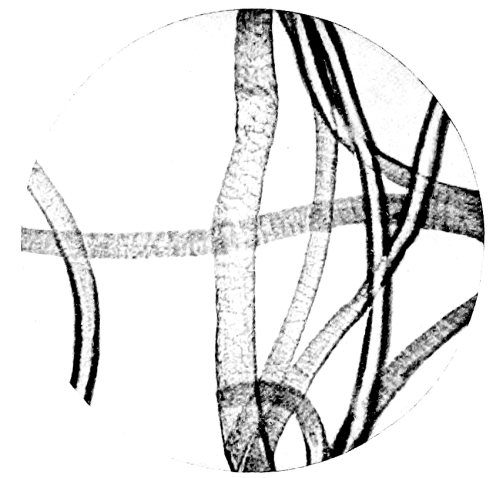
Fig. 4.—Photo-micrograph
of wool fibres, × 250.
(R. J. M. Buchanan.)
2. Make accurate notes of the position and shape of the stains on the
material examined.
3. Take one stain, if there are several, or part if single, and note
the solubility of it in water, or in a mixture of water and some other
substance. The solubility of the colouring matter is greater if the
stain be recent than if it be old. The older the stain the less soluble
it becomes, as the hæmoglobin is gradually changed in course of time to
insoluble hæmatin.
An endeavour should be made to obtain a solution for microscopical,
chemical, and spectroscopical examination. The solvent, in order to
obtain the blood corpuscles in as natural a form as possible, should
approach in its specific gravity the liquor sanguinis.
The following solvents fulfil this purpose:
(a) Glycerine and water, 1 to 7 (sp. gr. 1030).
(b) Pacini‘s solution of chloral hydrate
in water (1 in 10).
(c) Normal saline solution.
(d) Roussin‘s solution of glycerine 3
parts, sulphuric acid 1 part (by weight), and water so that the mixture
shall have a sp. gr. of 1028.
(e) Saturated solution of borax in
distilled water.
If distilled water alone be used, the red corpuscles lose their
hæmoglobin and become “laked” or “phantom” corpuscles; if the solution
be of higher sp. gr. than liquor sanguinis, then the corpuscles
become crenated and irregular in shape.
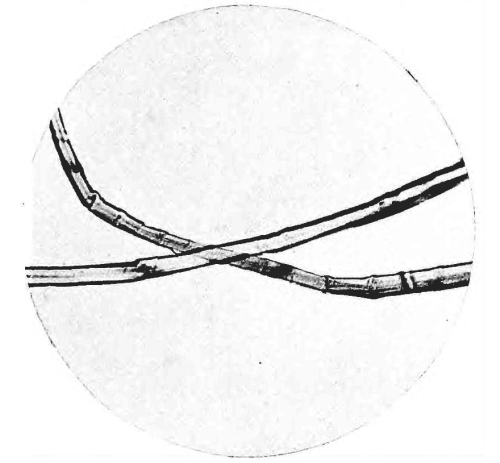
Fig. 5.—Photo-micrograph
of flax fibres, × 250.
(R. J. M. Buchanan.)
The technique of examination has to be varied in certain details,
according to the material upon which the stain is. Stains may have to
be examined upon cloth-fabrics, wood, plaster, metal, or leather. These
will be taken separately, and the methods of examination described
which will prove most reliable in each case.
1. Cloth-fabrics.—Cut out a stain, or part of one, and macerate
it in a quantity of one of the solvents mentioned above, sufficient
for the purpose. If the stain be very small, squeeze with fine forceps
one or more drops upon microscope slides for microscopic, and keep
the remainder of the solution for spectroscopic, examination. In dyed
fabrics, which have been mordanted, the mordant may fix the blood-stain
so as to prevent solution, and especially so when the attempts have
been made to wash out the stain with soap and water.
To make a solution of the stain in such cases it is best to use
distilled water to which a small quantity of ammonia or citric acid has
been added; in one or other of these the colouring matter will dissolve.
2. Wood.—Note the kind of wood, cut off a thin shaving and
treat with one of the solvents mentioned above. If on wood containing
tannic acid, such as oak or elm, the best solvent is a two per cent.
solution of hydrochloric acid.
3. Plaster.—Scrape off some of the stained plaster, and treat
as for cloth or wood.
4. Metal.—If the stain be upon a clean and unrusted metal,
e.g. the clean blade of a knife, then gently heat the metal on
the side opposite to the stain, when the latter, if recent, will peel
off or can be easily detached. This requires some care and dexterity.
It is easy, however, to scrape the stain off into a watch-glass, and
this procedure is necessary when the metal is rusted and the stain
mixed with the rust, or when the stain is thin.
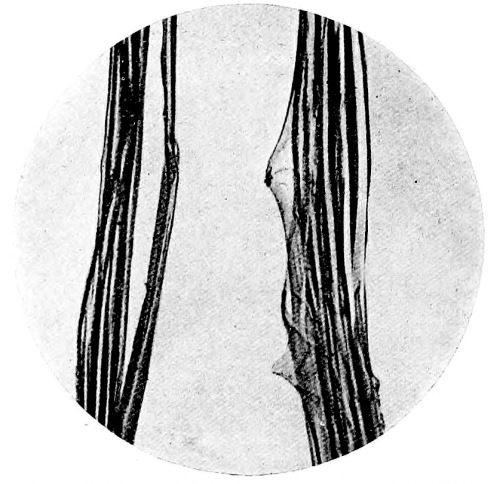
Fig. 6.—Photo-micrograph
of silk fibres, × 250.
(R. J. M. Buchanan.)
If on iron and mixed with rust the borax solution may be used, with
a drop or two of solution of ammonia; use a fine camel-hair pencil
dipped in the solution, and brush the stain off into a watch-glass.
Becker advises that stains mixed with rust should be digested with a
weak solution of ammonia and common salt for a few hours; decant the
solution and evaporate it upon a microscope slide to dryness, then test
the residue by the “hæmin test.”
Ganttner‘s test should be used to a portion of a stain upon metal when
thin or mixed with rust. It may be carried out upon the metal itself
or upon a scraping of the stain in a watch-glass resting upon a black
surface. Moisten the scraping in a watch-glass with a drop or two of
distilled water rendered feebly alkaline, then add a minute drop of
hydrogen peroxide. Wherever blood is present bubbles of gas develop,
which give the material a white beaded appearance. The froth develops
from the outside of the drop towards the centre when the stain is
mainly composed of blood. In a scraping consisting of mixed particles
of rust and blood, the reaction only appears upon the particles of
blood, and rust to which blood adheres; it does not take place on
those particles of rust free from blood. Before adding the peroxide of
hydrogen it may be necessary to dissipate any air-bubbles which may
cling to the scraping in the alkaline water by gentle agitation with
the point of a fine glass rod. Should the above reaction with peroxide
of hydrogen not take place, then one can rest assured that no blood is
present. The test, however, is a negative one; it is not a positive
test for blood only; other fluids and exudations from the body, such as
saliva and pus, give the reaction. The reaction will take place with
blood-stains of any age.
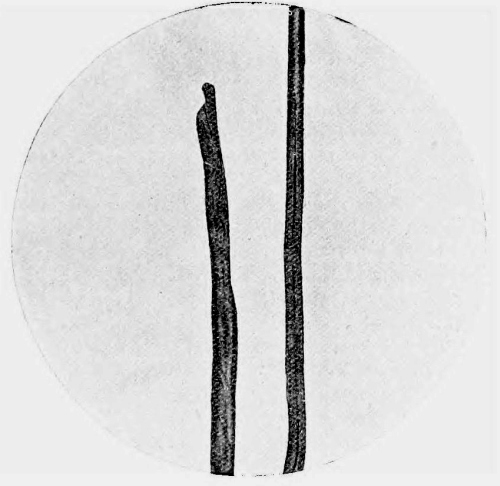
Fig. 7.—Photo-micrograph
of cotton fibres, × 250.
(R. J. M. Buchanan.)
In examining a clasp-knife or any hinged weapon for blood-stains, the
instrument should be taken to pieces and all the hinges and recesses
carefully examined, for in these places blood may be found, although
the weapon had previously been wiped clean, and appear free from stains.
5. On Leather.—The tannic acid in leather forms a compound with
blood which is insoluble in the solvents generally used. A thin shaving
of the stained portion should be taken and folded, with the stained
surface outwards, in the form of a loop. If the outer surface of the
loop with the stain be made to touch the surface of the glycerine and
water solution, at the same time taking care that the leather itself
be not moistened, a recent stain may yield a sufficient quantity of
colouring matter for the purposes of examination. Failing this, the
shaving should be digested in a small quantity of a two per cent.
solution of hydrochloric acid in distilled water (Sorby).
The microscopical examination of blood-stains, for the purpose of
identifying the presence of the red blood corpuscles, is especially
applicable to recent stains. In these the corpuscles may retain, to a
great extent, their normal characters; but their condition varies with
the age of the stain; they become altered in appearance and irregular
in shape with increasing age, until a stage is reached when they
become completely disintegrated and unrecognisable. Having obtained
a solution of a stain by one of the methods recommended, a few drops
should be placed upon a clean microscope slide and covered with a No. 1
cover-glass. In a recent stain, where minute coagula are present, one
may be placed on a microscope slide and moistened by breathing upon it
several times, and then covering it with a No. 1 slip, or a drop of the
glycerine solution may be allowed to act upon it on the slide until
it be sufficiently moistened, when it should be covered in the same
way. The preparation should be examined through the microscope with a
good lens (preferably a ¹/₁₂th oil immersion), magnifying 300 to 400
diameters, and if any corpuscles be found, their characters should be
carefully observed and noted.
All such specimens should be carefully preserved and labelled with
a description of the method of preparation, the case to which they
belong, the date of preparation, and the signature of the individual
who has made and examined them. It is essential that the preparation
and examination of the specimen should be made by the same individual.
In certain cases the conditions may be sufficiently favourable to allow
of the production of stained specimens, which can be mounted so as
to retain their original characters permanently. In every case it is
advisable to pursue the investigation with this object in view.
This process is especially applicable to recent blood-stains, in which,
from preliminary examination, the presence of blood corpuscles has been
determined; where complete disintegration of the blood corpuscles has
taken place it would not be of any value.
It may so happen that by means of stained specimens the identity of
blood corpuscles may be more easily established, when the result of
examination is uncertain in a specimen not so prepared.
By the action of certain dyes upon the corpuscles their special
features are rendered easier of recognition. Any of the approved
methods of preparing blood films for general clinical purposes, which
will suit the circumstances, may be employed. An easy and reliable
method is as follows. A drop of the solution of the blood-stain
properly prepared as previously recommended, or if obtainable a small
coagulum moistened with normal saline solution, is placed on a clean
coverslip and spread evenly over its surface with the aid of a fine
glass rod. The film is allowed to dry in the air, covered with a
watch-glass for protection against dust. When dry it is passed three
times through the flame of a Bunsen burner, or placed in a mixture of
equal parts of absolute alcohol and ether, to fix it. After fixation it
should be placed for a minute or more in an aqueous solution of eosin.
Any excess of stain should be removed by washing in distilled water,
and the specimen allowed to drain by standing it on edge upon a
piece of filter paper; it should then be allowed to dry, and then
counterstained with a freshly prepared aqueous solution of methylene
blue, hæmatoxylin solution, or other nuclear dye. Wash again in
distilled water, allow to dry, and mount in Canada balsam. By this
method the corpuscle will be stained pink, and if nucleated, the
nucleus will be stained by the methylene blue, hæmatoxylin, or other
nuclear stain which may have been used.
Leishman‘s stain may be used. This stain being a methyl-alcohol
solution is used for fixing and staining at the same time. A few
drops of the stain is placed on the dried film; after standing until
evaporation is almost complete, distilled water is dropped on to the
slide, and left to stand for two or three minutes, it is then drained
off, and a few more drops of distilled water added until the film is
pink in colour, then dried with filter paper. Red corpuscles are tinted
red with the eosin, and nuclei of leucocytes or nucleated red cells
violet or deep blue. The specimen may be examined direct with the oil
immersion or mounted in Canada balsam.
When examining specimens prepared from blood-stains, it is necessary
to search carefully for other cellular structures such as epithelial
cells, spermatozoa, or fragments of hair.
It may be advisable, in certain cases where the amount of material
submitted for examination is small, to centrifugalise some of the
solution in a fine glass tube, in order to determine any cellular
elements present to one spot. By making use of this concentrated
portion containing the cellular elements for the preparation of a
microscopic specimen, one not only facilitates the microscopical
examination, but is able to place more reliance upon the results
obtained.
The Results of Microscopical Examination of
Blood-Stains in Their Medico-Legal Relations.
As previously stated, the examination of alleged blood-stains from
a medico-legal standpoint is pursued essentially for the purpose of
testifying as to whether they have been produced by blood or not.
Where the examination yields a negative result, further procedure is
necessary with a view of identifying the true nature of the stain.
Should, however, the result be positive, the question arises as to
the possibility of distinguishing between human blood and the blood
of other animals, and determining the exact animal from which the
blood has been derived. Such an examination should be pursued in full
recognition of its importance as a factor towards the establishment of
truth essential to the administration of justice.
To fulfil this obligation the methods employed should be so selected as
to produce results bearing testimony free from any possibility of doubt.
Certain differences exist, and may be detected by microscopical
examination, between the red corpuscles of human blood and those of
some other animals sufficiently well marked to render differentiation
possible. The differences are those of form and structure.
(1) In man the red corpuscles appear as circular
biconcave discs, averaging ¹/₃₅₀₀ of an inch in diameter, and are
non-nucleated.
The red corpuscles of mammals present the same features, with the
exception of the
(2) Camel tribe, in which the corpuscles are oval in
form, but non-nucleated.
(3) In birds, fishes, reptiles, and
amphibians the red corpuscles are oval in shape, and possess a
nucleus.
Guided by the above facts, one is able to testify whether or not the
corpuscles exhibit the characters of mammalian blood.
Many attempts have been made with a view to establishing a reliable
means of differentiation between the red blood corpuscles of man and
other mammals (the camel excepted), and with a certain degree of
success, such as might be expected, under select conditions favourable
to histological research, but which do not obtain in medico-legal
practice. Differences in size of the red corpuscles, as revealed by
micrometric measurement, have been suggested as a possible means of
distinguishing between the blood of different mammals. Of the common
animals, the red blood corpuscles of the sheep present the most marked
difference in size compared with those of man. The following table of
the dimensions of red blood corpuscles is derived from measurements
made by Treadwell, and quoted by White (The Medico-Legal
Journal, New York, 1895):
| |
μ. |
| Human |
7.940 |
| Dog |
6.918 |
| Rabbit |
6.365 |
| Ass |
6.293 |
| Pig |
6.101 |
| Horse |
5.503 |
| Cat |
5.463 |
| Ox |
5.436 |
| Sheep |
4.745 |
|
|
Menstrual blood contains no fibrin, has an acid reaction due
to the vaginal mucus which keeps it fluid, and contains squamous
epithelial cells. None of these characters can be differentiated on
fabrics, especially when contaminated with urinary stains in addition.
Hence, in cases of alleged rape, no distinction can be drawn between
blood-stains on the underclothing of the female, which may have
arisen from hæmorrhage the result of violence to the sexual parts,
and those which might have arisen from the ordinary menstrual flow
or metrorrhagia. The detection of spermatozoa, however, would add
considerable value to the observation.
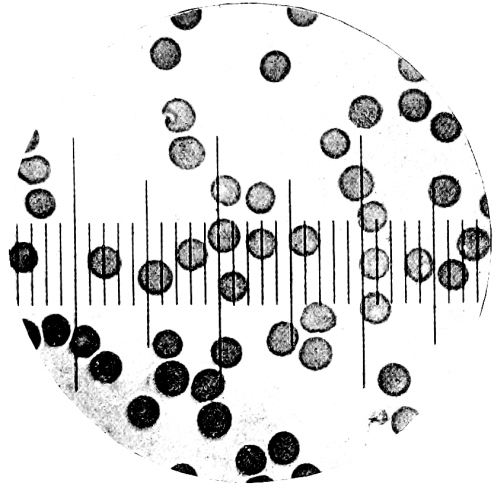
Fig. 8.—Measurement of
Blood Corpuscles.
Photo-micrograph of human red blood
corpuscles, × 800. Each corpuscle in diameter covers two divisions
of the scale. Compare with sheep‘s blood, Fig. 9.
(R. J. M. Buchanan.)
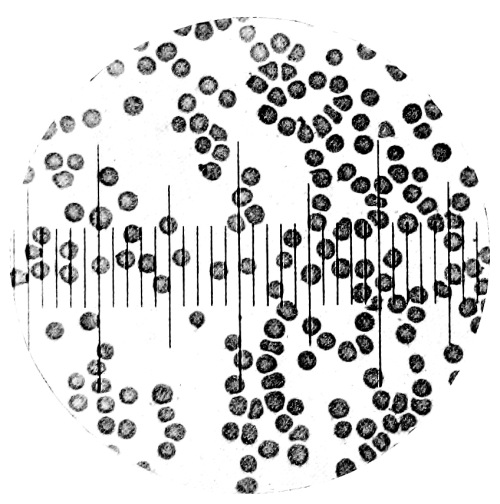
Fig. 9.—Measurement of
Blood Corpuscles.
Photo-micrograph of red blood corpuscles from
the sheep, × 800. The diameter of the corpuscle covers one division of
the scale. Compare with human blood, Fig. 8.
(R. J. M. Buchanan.)
Blood Crystals.—Professor Preyer of Jena pointed out many
years ago that the hæmoglobin crystals from the blood of some animals
differed in shape from those of man, and this fact has given rise to
many attempts to trace the identity of the blood to the animal from
which it has been derived. The results have not been of sufficient
value to establish it as trustworthy for medico-legal purposes. Dr.
Monckton Copeman (B. M. J., vol. ii. p. 190, 1889) has carefully
investigated the subject, and his researches, partly confirmed by
Professor Glaister of Glasgow, show that from the guinea-pig, rat,
and squirrel, crystals of hæmoglobin may be easily obtained, but the
solubility of human hæmoglobin renders it much more difficult to
crystallise. Crystals may, however, be obtained in the following ways:
(a) By feeding leeches on human blood,
crystals may be found, after some weeks, in the gastric dilatation of
the alimentary canal.
(b) By diluting human blood with the
fluid from hydrocele, ascites, or pleurisy when they have undergone
decomposition.
(c) By adding crystals of glycocholate or
taurocholate of soda to human blood.
(d) By adding a drop of cat‘s bile to
human blood on a microscope slide, but the crystals are those of
reduced hæmoglobin.
Crystals of human hæmoglobin appear in the form of rectangular plates,
with a greenish or pale claret colour. On spectroscopic examination
they exhibit the characters of reduced hæmoglobin, in contradistinction
to the crystals derived from the lower animals, which produce the
spectrum of oxyhæmoglobin.
The blood of the bullock, sheep, and pig is very difficult to
crystallise. By the method adopted by Gamgee of adding to defibrinated
blood one-sixteenth its volume of ether, shaking until the mixture
becomes transparent, and allowing to stand in an ordinary temperature for
48 hours, crystals may be obtained from the blood of the following animals:
| 1. |
Horse. |
| 2. |
Bullock. |
| 3. |
Sheep. |
| 4. |
Pig. |
| 5. |
Dog. |
| 6. |
Cat. |
| 7. |
Rabbit. |
| 8. |
Squirrel. |
| 9. |
Guinea-pig. |
| 10. |
Rat. |
| 11. |
Mouse. |
| 12. |
Chicken. |
| 13. |
Pigeon. |
Crystals from human blood are not easily obtainable by this process,
but when they are, they always give the spectrum of reduced hæmoglobin,
whereas those from the animals mentioned above give the spectrum of
oxyhæmoglobin.
Having obtained a coloured solution from a supposed blood-stain, if
sufficient in quantity, apply the following chemical tests to separate
portions:
1. Add a few drops of a weak solution of ammonia in distilled water.
The colour may remain unchanged, or, at the most, a slight
heightening may take place, if it be due to blood. If the solution
of ammonia be too strong, a brown colour may be produced if blood be
present.
2. Heat to boiling, when the following changes take place if blood be
present:
(a) The colour may disappear.
(b) Coagulation follows.
(c) A precipitate falls, dirty grey or
brown in colour, depending upon the amount of colouring matter present.
On adding caustic potash to the precipitate
it will dissolve, and the solution formed will appear greenish by
transmitted and red by reflected light. This phenomenon is called
the dichroism of blood. Authorities differ in opinion as to
whether the colour is green by transmitted and red by reflected light,
or vice versa. “As a matter of fact, the phenomenon is
chameleon-like as regards colour, so that both sets of observers may be
considered right or wrong” (Glaister).
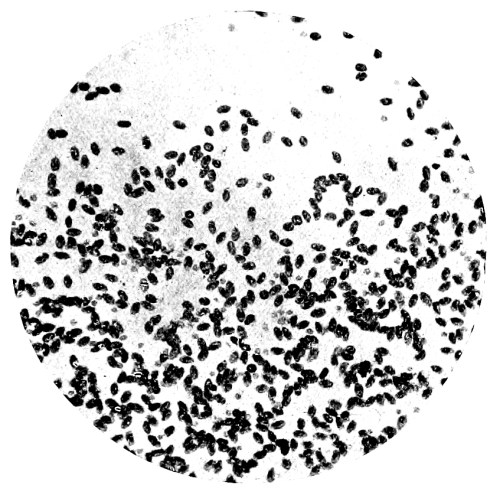
Fig. 10.—Photo-micrograph of red blood
corpuscles from domestic fowl, × 250.
(R. J. M. Buchanan.)

Fig. 11.—Photo-micrograph of blood
corpuscles of fish, × 250.
(R. J. M. Buchanan.)
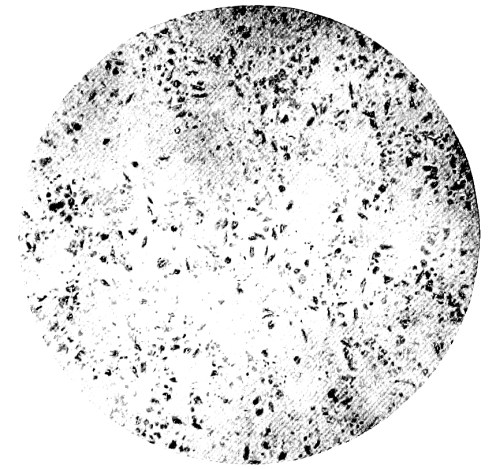
Fig. 12.—Photo-micrograph of blood
corpuscles from a dried stain of the blood of a codfish, × 250.
(R. J. M. Buchanan.)
3. Add tincture of guaiacum, freshly prepared: an opaque,
cream-coloured precipitate of the guaiac resin will form in the aqueous
solution. On the addition of ozonic ether, turpentine, or peroxide of
hydrogen, a blue colour will be produced at the junction of the fluids:
proportionate to the amount of blood-colouring matter present, the blue
colour will vary in intensity.
This test, known as Day‘s or Schönbein‘s, is extremely delicate, and
reacts to no coloured substance except blood.
In cases where the blood-stain is small, the test may be applied as
follows. Moisten a pure white filter paper with a drop of distilled
water, or one of the solutions recommended in the section on physical
examination, and touch the stain with the moistened portion. On adding
a drop of tincture of guaiacum followed by a drop of ozonic ether
to the wet filter paper the blue colour will be produced and easily
recognised on the white surface.
The guaiacum test, although extremely delicate, can only be accepted as
providing negative evidence. The absence of reaction proves the absence
of blood, except in very old blood-stains, which may not respond
to the test. The blue colour produced indicates that the substance
may be blood, but it cannot be accepted without corroboration.
Gluten, raw potato, milk, bile, sweat (Ogston), and other oxidising
substances give a blue colour with guaiacum and ozonic ether; some
substances give the blue colour with guaiacum alone.
With blood, however, the test is sufficiently delicate to detect one
drop in six ounces of water.
4. Nitric acid added to a portion of the solution of blood in
distilled water produces a whitish-grey precipitate.
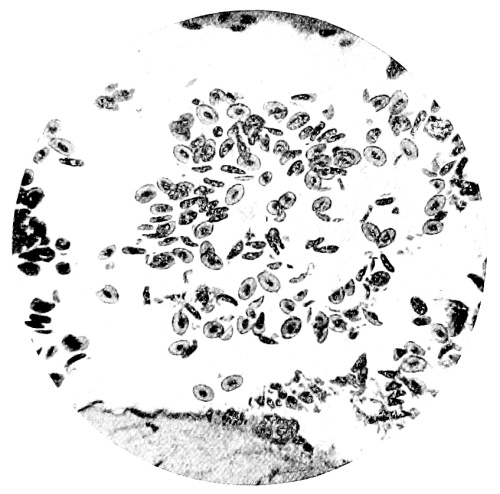
Fig. 13.—Photo-micrograph of
frog‘s blood showing oval nucleated red corpuscles, × 250.
(R. J. M. Buchanan.)
5. Hæmin Crystals.—Concentrate a portion of the solution upon
a microscope slide, add to it a minute crystal of chloride of sodium
and a few drops of glacial acetic acid. Heat gently to dryness or to a
lesser degree under a coverslip; examine with the microscope; if blood
be present, crystals of hæmin, or the hydrochloride of hæmatin, will
be found. They are of a yellowish-red to brownish-black colour with
a metallic lustre. They occur in rhomboidal prisms, or six-sided in
shape, or in the form of “whetstones,” often in clusters; many of the
crystals exhibit a lipped projection on one side. They are known as
Teichmann‘s crystals. It is well to verify their origin from blood by
placing upon them a drop of hydrogen peroxide, when they will give off
bubbles of oxygen gas.
They are insoluble in water, alcohol, and dilute acetic and
hydrochloric acids. They dissolve in boiling acetic or hydrochloric
acids, and the caustic alkalies. They respond to the guaiacum test, and
the ash produced by incineration shows the presence of iron by the red
colour produced on the addition of a drop of hydrochloric acid and a
solution of potassium sulphocyanide.
The production, by the methods described, of such crystals affords
conclusive proof of the presence of blood.
To a portion of the coloured solution, filtered if necessary, the
spectroscopic tests should be applied. The following points must be
remembered in carrying out a spectroscopic examination:
(a) The colouring matter of fresh blood is hæmoglobin, and it
may exist in two states, according to the degree of its combination
with oxygen.
In arterial blood it is present as oxidised hæmoglobin, and the same
obtains in blood which has been exposed to the air under certain
conditions and for a varying period of time.
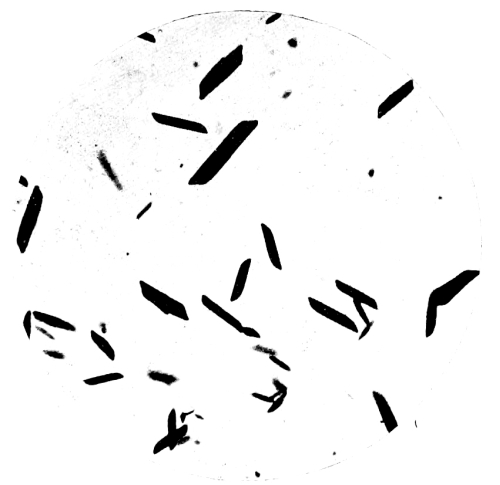
Fig. 14.—Photo-micrograph of
crystals of hæmin, × 250.
(R. J. M. Buchanan.)
In venous blood, especially when obtained under conditions preventing
oxidation, as from the heart cavity of an animal newly asphyxiated, it
is present as deoxidised hæmoglobin.
(b) In dry stains, especially if they have been subjected to
the action of impure air containing the products of coal-combustion,
the colouring matter becomes changed into methæmoglobin, or
hæmoglobin in which its combination with oxygen has been altered
in such a way that a current of a neutral gas, such as hydrogen or
nitrogen, will not dissociate it, as it does with oxyhæmoglobin. Such
stains have a brownish colour, and may give an acid reaction.
(c) In stains which have retained moisture, from having lain in
damp places, the hæmoglobin becomes converted into hæmatin. The
same change takes place in dry stains after a longer period of time.
On examining the solution of the colouring matter from a blood-stain
with the spectroscope, the spectrum will vary according to its
condition and the nature of the solvent used.
The spectra of hæmoglobin and its derivatives are characteristic, and
afford conclusive evidence of the presence of blood. The spectra must
be recognised, however, in more than one condition. Other substances
may yield spectra very similar to that of oxyhæmoglobin, but when
subjected to certain tests they do not alter in the same way. They
cannot be made to give the spectra of reduced hæmoglobin and reduced
hæmatin, and any colouring matter which may be made to yield the
spectra of reduced hæmoglobin and reduced hæmatin is derived from blood.
1. Oxidised hæmoglobin (O₂Hb) is characterised by the presence
in its solar spectrum of two absorption bands between the D and E
lines. The first band commences at the D line and extends a short
distance towards the E. The second commences at a little distance from
it, and terminates at the E line; it is about twice the breadth of the
first. The band at D is more defined than the other (Fig. 15, 1).
2. Deoxidised or reduced hæmoglobin presents one broad
band occupying almost the whole of the space between D and E slightly
to the left of these lines (Fig. 15, 2).
3. Methæmoglobin presents two bands between D and E, in the same
position as those of O₂Hb, but in addition a third band between C and D
and near to the former (Fig. 15, 3).
A solution of oxyhæmoglobin or methæmoglobin may be reduced by the
addition of a reducing agent, such as Stokes‘ reagent, consisting of
ferrous sulphate with a small quantity of tartaric acid dissolved in
water and rendered alkaline at the time of using with ammonia, or,
better still, by the addition of ammonium sulphide. The spectrum will
change to that of reduced hæmoglobin.
4. Acid hæmatin presents a spectrum with a band between D and E,
commencing at a little distance from D and ending at E, also a narrower
band between C and D and commencing at C. It is a difficult spectrum to
obtain.
5. Alkaline hæmatin presents a spectrum with a single band
between C and D near to the D line. It is more difficult to obtain than
the spectrum of acid hæmatin.
It is not necessary, however, to obtain these spectra, viz. 5 and 6,
but it is necessary to reduce solutions of either acid or alkaline
hæmatin in order to obtain the spectrum of reduced hæmatin. To
do so proceed as follows. To some of the solution of colouring matter
obtained from the stain add a small quantity of a 20 per cent. solution
of sodium hydrate; the solution will alter in colour, and the spectrum
of O₂Hb or MetHb will disappear. On adding to this solution of alkaline
hæmatin a few drops of ammonium sulphide, or Stokes‘ fluid, it becomes
claret-coloured, and on examination with the spectroscope the spectrum
of reduced hæmatin will be seen. This is the most pronounced of
all blood spectra. Its production can be hastened by gently warming the
solution.
If the stain be old and already changed into hæmatin, its solution
will yield the spectrum of acid hæmatin, and will give the spectrum of
reduced hæmatin on the addition of ammonium sulphide or Stokes‘
fluid without previous alkalisation.
6. Reduced hæmatin presents a spectrum with a dark band about
midway between D and E, and a broad but paler band commences near the E
line and extends to the b line (Fig. 15, 4).
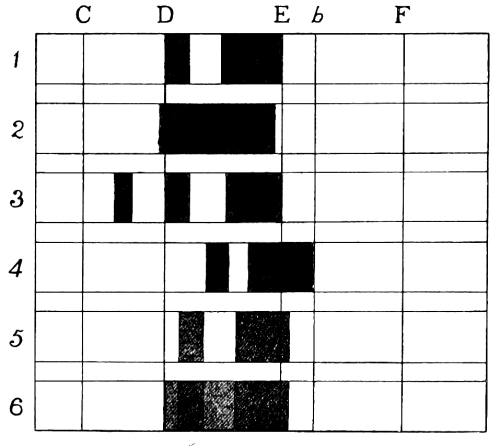
Fig. 15.—Blood Spectra.
| 1. Oxyhæmoglobin. |
3. Methæmoglobin. |
5. CO hæmoglobin. |
| 2. Reduced hæmoglobin. |
4. Reduced hæmatin. |
6. CO hæmoglobin and |
| |
|
reduced hæmoglobin. |
In cases of death by asphyxia, in which the hæmoglobin is in
combination with CO₂, the blood, if removed and examined immediately
after death, gives a spectrum of reduced hæmoglobin, but on exposure
to the air it rapidly changes to oxyhæmoglobin. The period after death
at which blood is usually submitted for medico-legal examination
is sufficiently late to allow of this change, and so prevents the
possibility of determining death by asphyxia by spectroscopic
examination of the blood. Where death has been caused by the action of
carbon monoxide, the blood is of a cherry-red colour,
and it will retain this colour unchanged for a long time, in fact for
years, due to a stable combination of the CO and hæmoglobin, called
carboxyhæmoglobin. Such blood yields a very characteristic spectrum,
with two bands similar to those of O₂Hb, but nearer to the violet end
(Fig. 15, 6). Their position should be assured by accurate measurement
and comparison with a spectrum of O₂Hb. The CO hæmoglobin, however,
cannot be reduced; on the addition of ammonium sulphide or Stokes‘
fluid the bands remain unaltered.
In cases where the amount of fluid obtainable for examination is very
small, recourse must be had to the micro-spectroscope, using a Sorby‘s
cell to hold the fluid, and substituting for the eye-piece of the
microscope a specially constructed spectroscope arranged so as to throw
the spectrum of a known solution of blood-colouring matter alongside of
that yielded by the solution under examination. Artificial light should
be used, and the D line located by placing in the flame a platinum wire
carrying a salt of sodium.
The results of the experimental investigations of
Friedenthal,[3]
Deutsch,[4]
Uhlenhuth,[5]
Wasserman and Schutze,[6]
Nuttall,[7]
Tarchetti,[8]
Grünbaum,[9]
Metchnikoff,[10]
and M‘Weeney[11] into
“blood relationships” have led to the suggestion of a new method—the
“biological test,” by which different kinds of mammalian blood may
be distinguished one from the other. Their experiments show in a
general way that the “serum from an animal which has been injected
intraperitoneally with any given organic fluid will, if mixed in small
quantity with a dilute solution of the fluid used for the injection,
produce a more or less definite precipitate.” If human defibrinated
blood be injected into the peritoneal cavity of a rabbit, the serum
obtained from the rabbit‘s blood, when mixed with a clear solution of
the blood of man or ape, will produce a precipitate, and agglutinate
the red blood corpuscles if present: the same reaction will not follow
if such serum be added to a solution of the blood of any other animal.
The introduction of substances of albuminous or proteid nature into
the body of an animal, and which can be taken up by its cells as a
food, produces in the body of the animal a series of substances called
antibodies, of which one is designated precipitin from its power
of producing a precipitate with the substance introduced. The organic
substance introduced capable of producing antibodies is called the
antigen. The precipitin is formed and present in the blood serum
of the inoculated animal.
Metallic poisons, alkaloids and carbohydrates, do not produce
antibodies; some vegetable proteids do.
The serum containing the precipitin is called the antiserum.
The precipitin in the antiserum is specific, and produces the effect
only with its own antigen, not with that derived from another species
of animal, but will act with one derived from a closely allied species,
e.g. man and the higher apes, sheep, and goat.
In order to eliminate this the antigen should be diluted to 1:1000.
The blood used as antigen may be dried and sterilised, thus it may be
kept for a long time, and when required for use dissolved in normal
saline.
The most convenient human antigen for general use is ascitic or
pleuritic fluid, and may be kept in good condition when mixed with a
small quantity of chloroform.
To produce the antiserum 3 to 10 c.c. of the antigen serum is injected
into a vein or the peritoneal cavity of a rabbit, and repeated at an
interval of four or five days until 25 c.c. have been injected. The
serum of the rabbit is then tested with the antigen diluted 1:100.
The injections are then continued until 70 to 80 c.c. have been
administered. The animal is then killed, the blood collected, and
stood in a refrigerator for the serum to separate. This is then drawn
into sterile pipettes, sealed, and kept in the cold. For purposes of
preservation one-tenth its volume of 5 per cent. phenol may be added
before pipetting. The antiserum may be dried on slips of black paper
for future use.
For medico-legal purposes, the antiserum should always be tested with
its antigen to be sure of its efficacy.
The antigen to be tested should be diluted 1:1000 at least, as potent
antisera may give reactions with strong solutions of antigens derived
from other species of animals. Various antisera may be made by
inoculating rabbits with the serum of different animals.
Metchnikoff has shown that intraperitoneal injection is not absolutely
necessary in order to produce an antiserum, feeding a rabbit on the
blood will act in the same way.
The procedure for testing a stain is as follows. First of all the
stain must be proved to be blood by the usual methods; this because
the antiserum will give reactions with other albuminous substances,
e.g. mucus, pus, semen, milk, or albuminous urine derived from
the animal providing the antigen.
Having proved the stain to be blood, a solution of it should be made
in normal saline, sufficiently strong to give the HNO₃ reaction for
albumin, or to foam when shaken up. If the amount of solution be small,
the tests can be carried out in capillary tubes or pipettes. The
solution of the stain must be cleared by filtration or the centrifuge.
The tests must be controlled by comparison with known human blood,
and blood from several domestic animals. For this purpose the various
antisera should be kept in stock.
Two sets, A and B, of six small tubes are used, into each of A is
placed 0.05 c.c. of human antiserum from a sensitised rabbit. Into each
tube of Set A is then added double the amount of diluted antigen, as follows:
| Set A — |
1. |
Receives |
extract |
of known |
human |
blood |
-stain. |
|
| 2. |
“ |
“ |
“ |
ox |
“ |
“ |
| 3. |
“ |
“ |
“ |
horse |
“ |
“ |
| 4. |
“ |
“ |
“ |
sheep |
“ |
“ |
| 5. |
“ |
“ |
“ |
pig |
“ |
“ |
| 6. |
“ |
“ |
“ |
stain |
under observation. |
Set B is now charged as follows:
| Set B — |
1. |
Receives |
normal |
rabbit serum |
0.05 |
c.c. |
| 2. |
“ |
human |
antiserum |
0.05 |
“ |
| 3. |
“ |
ox |
“ |
0.05 |
“ |
| 4. |
“ |
horse |
“ |
0.05 |
“ |
| 5. |
“ |
sheep |
“ |
0.05 |
“ |
| 6. |
“ |
pig |
“ |
0.05 |
“ |
To each tube in Set B is now added about 0.1 c.c. of the extract of the
suspected stain.
It will thus be seen that in Set A known antigen is added to known
precipitin, with the exception of tube 6, which receives suspected
antigen, while in Set B the suspected antigen is added to known
antisera, with the exception of No. 1, which contains normal rabbit
serum.
The tubes are observed in an hour and the results noted. Should the
stain be human blood, positive reactions will be present in tubes 1 and
6 of stand A, and tube 2 of B.
The negative reactions in the other tubes in stand A prove that the
antiserum used is specific, and will only react with its own antigen;
in stand B that the stain is composed of specific human antigen,
reacting only with its own antiserum.
Should the stain suspected be other than human, and derived from one
of the other animals used for antiserum in stand B, then the positive
reaction will occur in the particular tube.[12]
The test is now recognised as very sensitive and reliable, and is also
applicable to the detection of the flesh or fluids of animals, and has
thus been used for the detection of meat stuffs.
Tarchetti advises the following procedure in the examination of
blood-stains: Dissolve the stain in a few drops of a 0.9 per cent.
aqueous solution of sodium chloride, filter, and divide the filtrate
into two portions; to one (a) add 0.5 c.c. of the prepared
rabbit serum (the so-called antiserum); to the other (b) serum
from a rabbit which has not been injected with human blood. Both are
to be placed in an incubator at 37° C. for an hour. By this time,
if the solution of the stain be of human or anthropoid origin, the
contents of the tube (a) will have become turbid, the contents
of tube (b) will remain clear. From a series of experiments
with blood-stains of man and other animals on a variety of materials,
Tarchetti states that this method is reliable. Prepared rabbit “human
antiserum” has been shown to have no such reaction with the blood of
the pig, ox, calf, mouse, or rat.
From the result of his investigations Grünbaum points out that these
reactions must be looked upon rather as “special” than “specific,” in
view of the fact that his “chimpanzee antiserum” gave a slight
but distinct turbidity after a few hours with horse blood. He
also suggests a method for the microscopical application of the
“biological test,” by using a 1 per cent. blood solution with a drop of
“antiserum.” This method has enabled him to distinguish between human
and anthropoid blood, the reaction occurring earlier and being more
complete when the “antiserum” is used on its own blood.
Certain vegetable colouring matters give spectra which may be mistaken
for blood, from their close similarity. Of these cochineal dissolved in
a solution of alum gives two bands similar to O₂Hb. On the addition of
boric acid the bands move to the violet end of the spectrum, but they
are unaffected if the colouring matter be blood. Lac-dye, alkanet root,
madder, and others also give spectra resembling O₂Hb, but they are
changed or disappear on adding ammonia or sulphite of potassium, while
the spectrum of blood remains unaltered.
As stated previously, spectra of colouring matters other than blood
are not capable of being altered by reducing agents, so that, however
similar they may be to O₂Hb, they cannot be accepted as derived from
blood unless the spectra of reduced Hb and reduced hæmatin can be
obtained in the way described.
Cochineal, colours of certain roots and wood, turn crimson on the
addition of ammonia, logwood bluish-black.
The colour of the rose and certain flowers turn green on adding ammonia.
Fruit-stains from mulberry, currants, gooseberries, &c., turn
bluish-green with ammonia.
Vegetable stains have their colour heightened by the action of dilute
acids.
Chlorine bleaches fruit-stains, but turns the colour of blood-stains to
an olive-green.
Red dyes fixed by a mordant are not influenced by ammonia.
Iron stains are usually blackened by ammonium sulphide.
Red paint may contain red oxide of iron; digest with hydrochloric acid
and test for iron, by adding ferrocyanide of potassium to obtain the
Prussian blue. Iron stains may be of a reddish-brown or orange colour,
and insoluble in water, so that HCl is used to dissolve them.
Citrate and malate of iron stains are soluble in water; the
addition of ammonia to an aqueous solution produces no change; guaiacum
will give a blue reaction if a persalt of iron be present. The addition
of hydrochloric acid and ferrocyanide of potassium will give the
Prussian blue reaction. A drop of nitric acid added to the solution
will oxidise the iron to the ferric state, and on the addition of a few
drops of fresh-made aqueous solution of sulphocyanide of potassium the
port-wine colour of sulphocyanide of iron will be produced.
A control test must be made with distilled water to prove the purity of
the reagents, and the two results compared with each other.
Aniline stains resembling blood are changed to greenish-yellow or yellow
on the addition of dilute nitric acid. Eosin stains produce a
fluorescent solution when dissolved in water. Grease, tar, pitch,
snuff, and paint may be mistaken for blood, especially on dark fabrics.
They may be detected by two methods:
(a) The Wet Method.—Having failed to obtain a solution
by the aid of the ordinary solvents for blood, other solvents must be
used; ether or benzene for grease, paint, or tar. The solution obtained
must be examined with the spectroscope.
(b) The Dry Method.—Place the cloth or other fabric
stain down upon a clean white filter paper; then on pressing the cloth
with a hot laundry iron, grease, tar, or pitch will stain the paper,
paint or snuff will not.
CHAPTER VII BURNS AND SCALDS, CONTUSIONS AND BRUISES — BURNS AND SCALDS — Post-mortem Appearances — Preternatural Combustibility — Burns due to X-Rays — CONTUSIONS AND BRUISES
Burns and Scalds are lesions characterised by a more or less marked
destruction of the tissues of the body, caused by the action upon its
internal or external surfaces of a temperature higher than that of the
body itself, or by the action of corrosive chemical substances.
Burns are produced in the following ways:
By exposure to radiant heat.
By the direct application of flame.
By contact with heated solids.
By contact with solid bodies which have become liquefied by heat,
such as metals in a state of fusion.
By friction.
By lightning, electricity, and X-rays.
By contact with corrosive chemical substances, solid or liquid.
Scalds are produced by the application of heated liquids, at or
near their boiling-points, or in a gaseous form—as steam.
The injuries produced will depend upon the degree of temperature, the
period of exposure to its action, and the extent of surface involved.
The danger to life depends more on the extent of surface injured
than the intensity of the burn or scald upon a limited area, unless
the position of the burn render it peculiarly dangerous. Even though
the injuries be comparatively superficial, if they involve one-third
or one half of the surface of the body they must be regarded as
fatal. They may prove fatal by shock, by asphyxia, by constant and
profuse discharge from the injured surface, from absorption of septic
matter, from secondary inflammations of internal organs and serous
membranes—pleurisy, peritonitis, meningitis, perforating ulcer of
the duodenum. Children succumb more quickly than adults to burns and
scalds—the simplest, in their case, often proving fatal.
The cause of early death from burns and scalds is looked upon as a
disorder of the blood following injury to the red corpuscles by the
heat, and that this is more easily brought about in children, because
of the thinness of the skin, and the red corpuscles being less capable
of resistance.
The following table gives the different degrees of burns:
1. Superficial inflammation, characterised by redness without
blistering.
2. Acute inflammation, the epidermis raised, forming vesicles
containing serum.
3. Destruction of the superficial layers of the true skin.
4. Destruction of the true skin and subcutaneous cellular
tissues.
5. The superficial and deep parts converted into a charred mass.
6. Entire carbonisation of the parts.
(Dupuytren.)
These will vary according to the extent of the injuries, the length of
time the individual lived after receiving them, and the causative agent.
External Appearances.—1. Burns.—Radiant heat whitens
the skin, flames blacken it, from deposit of carbonaceous material.
The hair and clothing of the body are singed. Blisters may be present
on various parts, and roasted patches of the skin or deeper parts may
be present. The flame of an explosive, such as a mixture of coal gas
and air, scorches and mummifies the skin. The skin is blackened by
the explosion of gunpowder, and particles of the powder may be driven
into it; similar results follow explosions in coal mines, but to a
greater degree. Burns caused by red-hot solids or molten metals vary
in appearance according to the length of time they have remained in
contact with the surface: if short, there may be injury to the skin
only, with blistering; if for a longer period, there will be roasting
or charring of the part, and blisters may not be present.
All stages of burns may be present.
The uncovered parts of the body, as a rule, are more affected than the
clothed, unless the clothes become ignited, when the converse would
hold good. In cases where the clothes have been saturated with an
inflammable oil like petroleum the burns are much more severe.
2. Scalds.—The appearances produced and the severity of the
result will vary directly with the boiling-point of the liquid. Boiling
water and steam produce vesication; the hairs are not affected. If the
steam be superheated, blistering may be absent, and the skin appear
sodden and devoid of elasticity. If the person survive the injuries
for some days, the skin will present appearances of reaction. After
exposure to great heat the bodies of the victims are usually contorted,
with the limbs flexed and the arms fixed in a defensive attitude—the
“pugilistic attitude.” This condition is due to heat rigidity.
Internal Appearances.—The brain is shrunk, usually without any
alteration in form, the lungs also shrunk, and the larynx, trachea,
and bronchi may contain carbonaceous material; their membranes may
be injected and covered with frothy mucus. The kidneys may present
reddish-brown markings from altered blood, and degeneration of the
epithelium of the tubules and Malpighian bodies.
There may be a reddened appearance of the mucous membrane of the
stomach and intestines, and in a certain number of cases, where death
has occurred some time after the injuries, ulcers may be present in the
duodenum.
The uterus and testicles resist the action of fire in a marked degree,
and may be changed but slightly, although the rest of the body has been
almost consumed.
The blood of persons who have been exposed to the action of
CO during a fire will present the usual cherry-red colour and
the spectrum of COHb. A similar cherry-red colour of the blood
is found in bodies of persons burnt to death which is not due to the
action of CO. The cause is a physical one, the alteration in
colour being due to the coagulation of the albumin in microscopical
particles by the heat. In this condition the spectrum is that of
O₂Hb, and can be reduced in the usual way. The same peculiar
condition of the blood may be produced in corpses by exposure to a
sufficiently high temperature.
If on the examination of the blood COHb is detected, it indicates that
the person in whose body it is found was alive during the progress of
the fire.
Corrosives.—The appearances produced by the application
of corrosive chemical substances are peculiar to them, and depend
upon their special actions upon the tissues. Sulphuric acid acts by
rapidly extracting water from the tissues and producing local rise of
temperature; nitric acid combines with the tissues to form picric acid;
nitrate of silver acts upon the tissue by hyperoxidation, and combines
to form albuminate of silver, nitric acid being liberated. A solution
of phosphorus in carbon disulphide, known as Greek fire, by the rapid
oxidation and burning of the phosphorus produces combustion of the
tissues.
The diagnosis of lesions produced by corrosives from those by fire
or heated fluid or steam rests upon the absence of vesication, the
presence of the stains on the skin or clothing which they produce, and
the chemical analysis of the stains. Sulphuric acid produces a grey
or brownish-black eschar on the body; hydrochloric acid may leave a
whitish-grey stain; nitric acid produces a yellow stain on the skin,
and may produce sloughing.
Was the burn inflicted before or after death?—The answer to
this question depends upon careful consideration of all the evidences
afforded by the external and internal appearances, and upon the
presence or absence of vital reaction in the lesions found.
Two characteristic appearances—redness and vesication—are present in
burns inflicted during life when the surface of the body is not charred
and the tissues destroyed. The redness affects the surface and entire
substance of the true skin, which is dotted by the deep red openings
of the sudoriferous and sebaceous ducts. This appearance cannot be
produced after death. Blisters are formed by a temperature somewhat
less than that of boiling water. Vesication, according to Orfila,
is characteristic of a burn inflicted during life, and the late Sir
Robert Christison found that in burns caused before and after death the
vesicles in the former contained serum, the latter air. In anasarcous
subjects, however, serous blisters may be formed, especially if the
heat employed be not too severe. A case is recorded by Taylor in which
vesicles containing bloody serum were formed on the body of a man who
had just been drowned and who had been put into a hot bath.
Ante-mortem vesicles in which vital reaction has taken place present
the following characteristics:
(a) They contain serous fluid in which albumin and
chlorides can be detected.
(b) An inflammatory red bounding line round the
circumference.
(c) Inflammatory redness of the base, and the papillæ
of the skin.
(d) The presence of pus, which would
indicate that the person had lived at least thirty-six hours after the
burn had taken place.
In burns produced after death, the surface and substance of the skin is
of a dull white colour, dotted with grey openings of the sudoriferous
and sebaceous ducts, and the subcutaneous tissues are uninjected.
Vesicles produced by burns may have to be distinguished from the
phlyctænæ, the result of advanced putrefaction. The latter possesses
none of the characteristics of the former.
If a vesicle present the following characteristics it may be accepted
as a post-mortem origin without doubt: if it be small and its contents
scanty, if the fluid it contain be free from albumin and chlorides, if
it contain air, and if there be no signs of inflammatory reaction.
Was the burning homicidal, suicidal, or accidental?—No general
rules for guidance can be here laid down. In most cases the conditions
under which the body is found will point less to suicide than to
homicide or accident. In cases of murder, the body is often burnt in
the attempt to destroy all traces of the crime. It must, however, be
borne in mind that intense heat applied to the body may give rise to a
wound on the surface like that caused by a cutting instrument. Casper
mentions such a case, in which a wound was found over the liver, due to
the application of intense heat to the body. The conjunction of robbery
will greatly assist in helping to solve the difficulty. It may be very
confidently stated that to dispose of a body by burning is no easy matter.
The possibility of “spontaneous combustion” occurring in bodies
during life has been mentioned in the earlier writings on medical
jurisprudence, and cases have been recorded in which it has been
alleged to have taken place. Up to the present time no undoubted case
of “spontaneous combustion” during life has been seen. On the other
hand, the possibility of its occurrence is contra-indicated by the
following facts: that the human body must consist of 75 per cent. of
its weight of water, to be compatible with life, and that a dead body
steeped in methylated spirit for many months or even years will never
be consumed, if set on fire, in the rapid and complete manner alleged
as occurring in cases of so-called “spontaneous combustion.”
A case is recorded by Beatson (B. M. J., vol. i., 1886, p. 295)
of a man, subject to foul eructations from the stomach, who got out of
bed during the night and struck a match to see the time; while blowing
out the light his breath took fire, producing an explosive noise
sufficiently loud to awaken his wife. Such cases are very rare.
It is a fact that by the action of certain micro-organisms upon
organic matter inflammable gases are produced. That such an occurrence
is possible, in the dead human body, is supported by cases recorded
by Gull (Med. Times and Gazette, 1885) and Reynolds (Med.
Chron., 1891). In Gull‘s case inflammable gases escaped through
punctures made into the abdomen, and they burned spontaneously on
contact with the air. In Reynold‘s case no flames were seen, but
extensive and deep marks of burning were present, especially on the
trunk and thighs. It has been suggested that the habitual use of
alcohol in excess during life renders the tissues of the body more
inflammable, but the matter is not yet decided. Tissues steeped in
alcohol are not rendered more inflammable.
Dr. Ogston, who cautiously avoids committing himself to the belief
in “spontaneous combustion,” yet thinks that the subject of
preternatural combustibility in certain conditions of the body
may perhaps, to say the least of it, be set down as one still sub
judice. “There is no evidence to justify the use of the word
‘spontaneous,’ but there can be no doubt that an extraordinarily high
degree of combustibility occurs in rare instances, to which the term
preternatural combustibility would more correctly apply”
(J. Dixon Mann).
Over-exposure to the action of X-rays produces burns of a peculiar
character, and in cases of unprotected skin exposed to the action
of the rays in those who are constantly working with them, forms
of dermatitis have arisen which are intractable and tend to become
epitheliomatous in character.
The results of slight over-exposure, or repeated short exposures vary
from a simple redness of the skin to severe dermatitis, the hair of the
part being shed. When the over-exposure or dosage has been severe, the
skin may vesicate and ulcerate. I have seen this in cases where the
rays have been used for reduction of the spleen in leukæmia and Banti‘s
disease. The burns heal with cicatrisation of radiate shape, the skin
around the scar being permeated with numerous capillary vessels which
produce the appearance of capillary nævi, and in other instances
large stellate superficial vessels are formed. In addition, marked
pigmentation of the skin may follow the burn. X-ray burns which have
produced vesication and ulceration or sloughing take a long time to
heal in comparison with ordinary burns.
In repeated exposure to the rays, even when little redness has been
noticed at the time, the formation of capillary vessels may become
evident some time after the exposures have been stopped. This may cause
disfigurement, by the formation of telangiectasis, especially if they
appear on the face or neck. The falling out of the hair is produced
by X-rays as a therapeutic measure in cases of ringworm, and due
precaution must be taken to limit the effect and area of exposure by
proper screening. The same precaution should be used to protect parts
of the body other than the part which requires treatment or examination
in other conditions.
With increasing knowledge of the effects of X-ray exposures, special
precautions have been devised to prevent untoward effects, so that burns
from over-exposure, and dermatitis amongst X-ray workers are prevented.
In the living these injuries are accompanied with swelling, pain, and
more or less discoloration of the part affected. Among malingerers it
is not an uncommon practice to bruise the body to imitate the spots
of purpura and scurvy. In scurvy, the condition of the gums common to
that disease, and the state of the general health, will point to the
true nature of the spots. The diagnosis of purpura will be assisted
by noting the diffusion of the spots over the body. In old people
purpuric spots frequently extend round the limbs, chiefly on one of the
lower extremities. Many blood diseases are associated with ecchymoses
and purpuric eruptions. Some persons are very easily bruised, and a
pinch, by no means severe, will cause on their arms a severe bruise.
Discoloration—ecchymosis—may take place in the skin, cellular tissue,
muscles, or internal organs as a result of external injury, or it may
be due to sudden and powerful contraction of a muscle or group of
muscles. Not infrequently the discoloration does not appear over the
seat of injury, but at some distance from it; and when the effusion
is deep-seated, days may elapse before any discoloration of the skin
takes place, and then it is not blue, as in superficial parts, but of a
violet, greenish, or yellowish hue. A deep-seated ecchymosis may give
no external sign of its presence; hence in all cases deep incisions
should be made before an opinion is ventured as to the entire absence
of this occurrence. This is very noticeable among the deep-seated
muscles of a limb. In these cases, forty or fifty days may elapse
before the deep-seated bruise shows its existence on the surface, and
then only as irregular, yellowish, green, or bluish spots over the
part. A very slight contusion, as a sprain of the ankle, may give rise
to extended discoloration of the leg. An ecchymosis is not necessarily
situated directly under the seat of injury. A blow given during
life may not appear as an ecchymosis till after death. The
change of colour in bruises begins at the circumference, and travels
inwards. During the first three days the colour of the bruise is blue,
bluish-black, or black; greenish on the fifth or sixth day; and yellow
from the seventh to the twelfth. The extent of an ecchymosis depends
greatly on the looseness of the cellular tissue. A slight contusion
causes a slight redness and swelling, and may leave no mark on the dead
body, unless death has taken place within thirty-six hours. Injuries of
this kind sometimes leave a parchment-like hardness and discoloration
of the skin. The part looks slightly depressed, due probably to the
epidermis having been partly rubbed off, and the skin then drying.
Similar marks are sometimes made by blisters. These marks may be
produced on the dead body by friction and exposure to the air.
The diagnosis of ecchymosis from hypostasis has been given (see p. 46).
A tolerably severe blow after death would be necessary to produce
appearances similar to those produced by a slight one during life.
In scourging, there are parallel ecchymosed lines, of small spots
resembling petechiæ. An internal organ may be ruptured, and yet there
may be no appearance of injury externally. The liver is the organ most
commonly ruptured. The rupture is almost always longitudinal, and in
some cases a portion of the gland is more or less detached. The spleen
is also not infrequently ruptured; and this occurs most frequently in
countries where ague prevails. Rupture of the lungs and brain is rare.
When the pelvis is fractured, the bladder is frequently found ruptured.
Death in most cases is due to internal hæmorrhage or shock, when any of
the internal organs are ruptured.
Can the appearance of a bruise be produced after death?—It is
possible that the appearance of a bruise inflicted during life may be
produced within two hours after death, and in some rare cases even
after the lapse of three hours and a quarter (Christison); but these
ecchymoses are limited in extent, and when large are due to a rupture
in a vein which can be readily ascertained. The experiments of the late
Sir Robert Christison, relating to this question, are detailed in the
Edinburgh Medical and Surgical Journal, vol. xxxi. The amount
of violence required after death to produce appearances like those
made before death is such as would seldom, if ever, be inflicted on a
corpse, and, therefore, where we find a well-marked bruise we ought to
infer that it was made before death.
The following table, compiled from the experiments of Christison, may
assist the diagnosis:
| During Life. |
After Death. |
| 1. Swelling of the part. |
1. No swelling. |
| 2. Coagulation of the blood |
2. No such appearance, unless |
| effused into the adjacent |
there is a rupture of a large |
| cellular tissue, with or |
vessel in the neighbourhood |
| without tumefaction. |
of loose cellular tissue. |
| 3. Incorporation of blood |
3. No such appearance produced |
| with the whole thickness |
by a blow after death. |
| of the true skin, rendering |
|
| it black instead of white. |
|
N.B.—Extensive effusion may occur without
affecting the skin, but when the skin is so affected Christison thought
it decisive of ante-mortem injury.
The Size and Form of a Bruise should be noted.
Why?
1. In Hanging and Strangulation.—The mark due to pressure of
the cord on the neck in hanging runs obliquely round the neck; in
strangulation, the mark encircles the neck. The mark is frequently
interrupted, and may present very varied appearances in different parts
of the neck. The mark of the knot may be found under the chin.
2. In Throttling.—The pressure exerted on the throat of the
deceased by the fingers of his assailant may leave marks which may
point to the means used to cause death.
3. In other Cases of Death by Violence.—The impression made
by the weapon used may lead to the identification of the murderer.
The marks left by the wards of a large door-key once led to the
identification of the assailant.
CHAPTER VIII SUFFOCATION, HANGING, STRANGLING, AND THROTTLING — SUFFOCATION — HANGING — STRANGLING — THROTTLING
Death from suffocation is said to result from any impediment to the
respiration which does not act by compressing the larynx or trachea.
Suffocation may therefore be caused by pressure on the chest, as in
persons crushed in a crowd. It may also be due to the respiration of
certain gases, or to the presence of pulverulent substances in the air,
which act by choking up the air-passages. Imprisonment in any confined
space may cause death from suffocation, and abscesses bursting into
the trachea, or vomiting matters in drunken persons lodging in the
windpipe, may be attended with a like result. Pressure on the umbilical
cord whilst the child is in the maternal passages causes death from
suffocation.
Signs of Death by Suffocation.—The first effect of arrest to
the passage of air into the lungs is the stagnation of blood in the
capillaries of the lungs. Non-arterial blood then goes to the brain and
consciousness is soon lost. The respiratory sensation is then arrested
by the circulation of venous blood. The left side of the heart becomes
emptied, and then weak; the right side full and engorged. The great
venous trunks are also more or less full, and the abdominal viscera,
liver, spleen, and kidneys congested. The arrest of the heart‘s action
is a secondary effect; the right side is paralysed by being too full,
the left by being empty. These signs may be said to be typical, or,
rather, are to be expected in death due to suffocation, but it must
be distinctly stated that they are not always present. The right side
of the heart is not in all cases engorged with blood; and Christison
warns medical men against expecting “strongly marked appearances in
every case of death from suffocation.” The heart, moreover, continues
to contract after the lungs have ceased to perform their duty. Death
is thus due to apnœa—that is, death beginning at the lungs—and not
to syncope. Death in some cases is from neuro-paralysis or nervous
apoplexy. In death by shock, which in most cases is instantaneous, both
sides of the heart are equally filled. Death, the result of disease,
may present all the signs of death from suffocation, and no suspicion
may be aroused as to the cause of death from the post-mortem
appearances, especially if putrefaction have set in.
The following table is given as an aid to diagnosis in this form of
death:
Points to be noticed in forming a
Diagnosis of Death by Suffocation
1. The Blood.—There is unusual fluidity of the blood
found in death by suffocation, however produced. This condition is
sometimes present in deaths due to certain diseases, fevers, &c., and
in cases of narcotic poisoning. Even with the blood in this condition,
the presence of coagula in the cavities of the heart is not infrequent.
The colour of the blood is changed to a dark purple, but in suffocation
by carbon monoxide it is red.
2. Animal Heat.—In persons who have died from suffocation the
animal heat is long retained.
3. Cadaveric Rigidity.—Other things being equal, the rigor
mortis is as well marked in this kind as in other forms of death.
4. The Lungs.—Hyperæmia of the lungs is rarely absent. In
most cases both lungs are engorged in about equal proportions.
Hypostasis—post-mortem stains—must not be mistaken for
capillary engorgement.
5. The Heart.—Engorgement of the right side of the heart, the
left being empty, or nearly so. It is advisable always to examine the
heart first, and then the lungs. The pulmonary artery is also much
congested.
6. Capillary Ecchymoses.—These appear as purplish-red spots
on the pulmonary pleuræ, on the surface of the heart, aorta, in the
thymus, and on the diaphragm. They may appear on the above-mentioned
parts in a fœtus suffocated in utero by pressure on the cord.
These ecchymoses are rarely seen on adults, most frequently on infants,
due probably to the thinness of the coats of the capillaries, which
are ruptured in the efforts made to breathe. They are not a positive
sign of death from suffocation, as they have been seen in death due to
cholera, typhus, and other diseases. They are present also where death
is due to hanging, drowning, &c.
7. Condition and Appearance of the Trachea.—The mucous membrane
of the trachea is injected, and appears of a cinnabar-red colour. This
is present in every case of death by suffocation, and must not be
confounded with the dirty cherry-red or brownish-red coloration due
to putrefaction. Remember also that the trachea putrefies early. If
suffocation be slowly produced, a quantity of frothy mucus may be found
in the windpipe, and also in the smaller tubes of the lungs. Always
examine, especially in cases of supposed infanticide, the trachea for
foreign bodies, the presence of soot, &c. The presence of sand, ashes,
&c., in the œsophagus and stomach in persons buried in these materials,
is presumptive of the person having been placed in them prior to death.
8. Kidneys, Vena Cava, &c.—The quantity of blood in the kidneys
is always considerable. The abdominal veins are all more or less
congested, and the external surface of the intestines presents numerous
traces of venous congestion.
9. The Brain.—Apoplexy of the brain, as secondary to the
pulmonary apoplexy, may be more or less present, attended by its
well-known appearances.
10. Face, Tongue, and Mouth.—The expression of the face is not
characteristic of death by suffocation, and differs in no particular
from that common to other forms of death, being more frequently pale
than turgid; and the starting of the eyes, popularly ascribed to
this form of death, is not often seen. The tongue may or may not be
protruded beyond the teeth. The presence of froth about the
mouth is not constant, and is of common occurrence in those dying from
natural causes. The tympanum may be ruptured.
Was the suffocation homicidal, suicidal, or
accidental?—Suffocation may occur accidentally during the act of
swallowing, and by foreign bodies placed carelessly in the mouth and
then drawn suddenly into the windpipe, or by blocking the pharynx or
œsophagus, also from being smothered by sinking into sand, grain, mud,
and such-like, or by the bed-clothes in cases of epilepsy during a fit.
Examine the lips for the presence of ecchymosis and other marks of
violence. A man, some years ago, was accused of having caused the death
of his wife by strangulation, for which he was indicted, and tried
before the High Court of Justiciary in Scotland. The post-mortem
examination revealed the cause of death as due to suffocation, and
the following injuries were found on dividing the windpipe, which
contained a quantity of frothy mucus: in the interior of the larynx
there was a considerable extravasation of blood lying beneath the
investing membrane, and passing up on both sides and behind, as far as
the chink of the glottis, and above that opening into the ventricles of
the larynx. There was here, also, a fracture of the right wing of the
thyroid cartilage, by which its lowest horn was wholly detached, and
the cricoid cartilage was broken in two places at opposite sides of its
ring. The defence was that she had fallen accidentally while in a state
of drunkenness, and had thus produced the fatal injuries.
The man was acquitted, the legal opinion in favour outweighing the
medical opinion against the theory of accident. The above case created
some discussion at the time, and induced Dr. Keiller to make several
experiments as to the possibility of fracturing the cartilages of the
larynx. The following are his conclusions:
1. That ordinary falls on the human larynx are apparently not
capable of producing fractures of its cartilages, and even falls
from a height with superadded force appear to be unlikely to
do so.
2. That severe pressure applied from before backwards,
so as strongly to compress the larynx against the vertebral column, or
violent blows inflicted over the larynx by means of a heavy
body, are sufficient to cause fractures of the larynx. Fractures
so produced, however, will be most discernible on the internal
surface, and generally in or near the mesial line.
3. Violent compression applied to the sides of the
larynx (as in ordinary manual throttling or strangulation
by grasping), is, of all applied forces, the most likely to produce
fractures of the alæ of the thyroid cartilage, or even of the cricoid
cartilage, and fractures so produced are most perceptible, as well as
most extensive, on the external surface of the larynx. By this
lateral mode of applying force, the hyoid bone is almost
most readily broken.
4. That the condition of the larynx in regard to the absence or
presence of ossific deposit materially influences its liability to
fracture from external violence. If altogether cartilaginous, partial
slits or splittings may be produced. If partly ossified, fractures may
be produced by a comparatively moderate degree of applied violence, and
if extensively or entirely ossified, extreme violence will generally
be required to produce laryngeal fracture (Edinburgh Medical
Journal, 1855-56).
Homicidal suffocation may be due to forcibly introducing foreign bodies
into the air-passages, especially in children; adults suffocated thus
are generally under the influence of alcohol or drugs, or enfeebled
from disease. Suicidal suffocation by these means is generally limited
to lunatics.
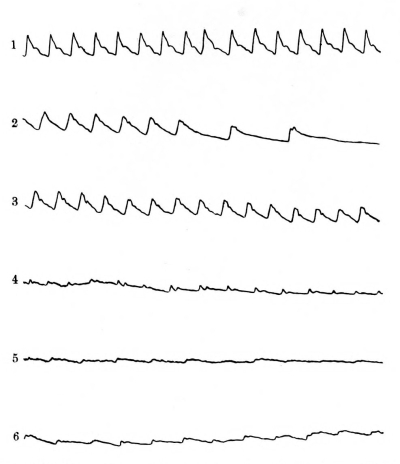
Fig. 16.—The pulse in this case became
slower than normal. Five minutes after the drop the type reached that
of bradycardia, then recovered itself, and even 14½ minutes after the
drop was beating with normal frequency, but in the meantime had become
very feeble.
- 1. The day before execution, 102 per minute.
- 2. 5 minutes after the drop, 54 per minute.
- 3. 7 minutes, 102 per minute.
- 4. 10 minutes, 96 per minute.
- 5. 13 minutes, 66 per minute.
- 6. 14½ minutes, 72 per minute.
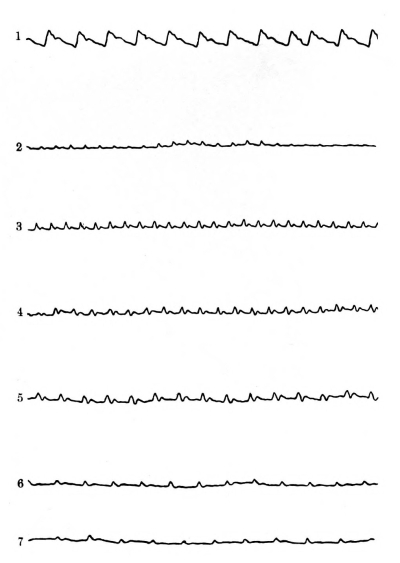
Fig. 17.—The pulse
in this case became accelerated and then fell again, but was
feeble throughout.
- 1. The day before execution, 84 per minute.
- 2. 3½ minutes after the drop, 162 per minute.
- 3. 4 minutes, 156 per minute.
- 4. 5½ minutes, 132 per minute.
- 5. 6½ minutes, 102 per minute.
- 6. 9 minutes, 84 per minute.
- 7. 11½ minutes, 78 per minute.
- 8. 12½ minutes, 78 per minute.
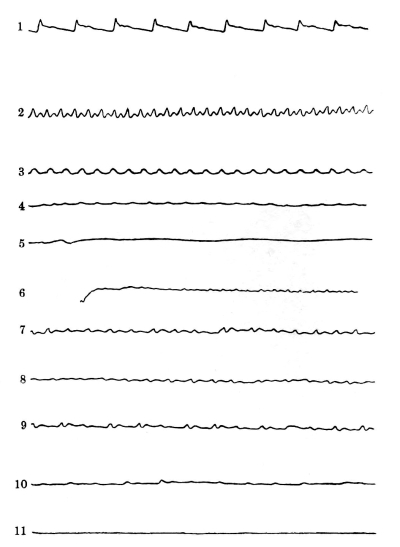
Fig. 18.—In this
case the pulse rate increased, and then fell to 72 per minute
towards the end.
- 1. 1 week before execution, 60 per minute.
- 2. 2½ minutes after the drop, 162 per minute.
- 3. 3 minutes, 138 per minute.
- 4. 3½ minutes, 132 per minute.
- 5. 4½ minutes.
- 6. 5¼ minutes, 168? per minute.
- 7. 5¾ minutes, 108 per minute.
- 8. 7 minutes.
- 9. 8½ minutes.
- 10. 10 minutes, 72 per minute.
- 11. 12 minutes.
Homicidal suffocation by compression of the chest has been effected
in infants; in adults it is combined with the covering of the nose
and mouth. The victims are generally old or enfeebled. Suffocation of
infants may be homicidal, or accidental, due to “overlaying”; in the
latter the greatest mortality is amongst the youngest infants. A child
ten months old may struggle and free itself or awaken the mother.
In France a favourite mode of committing suicide by suffocation is the
use of irrespirable gases—carbonic acid, carbon monoxide, and the
like. Collateral circumstances must be taken into consideration, and
will more or less help to point to the true cause of death.
The cause and nature of the death in all of its forms just mentioned
are in general the same. Pressure on the trachea—thus arresting
respiration—and also on the important vessels and nerves of the neck,
results in death, which may be brought about in four different ways:
- 1. Cerebral congestion, or apoplexy.
- 2. Congestion of the lungs and heart—apnœa or asphyxia.
- 3. Combination of above—apoplexy and asphyxia or apnœa.
- 4. Neuro-paralysis—nervous apoplexy, or syncope.
The following table will show the relative frequency of each form of
death:
| |
Remer. |
|
Casper. |
| Apoplexy |
9 |
9 |
| Asphyxia |
6 |
14 |
| Mixed |
68 |
62 |
|
83 |
85 |
Traumatic asphyxia occurs when a heavy weight such as a fall
of earth or masonry compresses the chest, and thoracic respiration is
impossible. The head and neck appear ecchymosed, the purplish-blue
lividity generally ending abruptly at the lower part of the neck
or upper part of the thorax, about the level of the clavicles.
The conjunctivæ are ecchymosed, and there may be epistaxis. This
discoloration does not disappear on pressure by the finger, indicating
its petechial character. If the person survive long enough, the
discoloration gradually disappears, passing through the colour changes
of an ordinary ecchymosis.
The effects on the eyes may be such as to be followed by changes in the
retina, and optic atrophy leading to loss of vision.
Parts of the neck pressed upon by clothing may escape ecchymosis, and
present a white mark of almost normal skin.
Death by hanging is caused by the more or less perfect suspension of
the body by a cord applied around the neck, the weight of the body
acting as the constricting force.
The body need not hang completely, partial suspension is sufficient to
cause death. The ligature surrounds the neck above the thyroid
cartilage, the epiglottis is pushed against the back of the pharynx,
the base of the tongue and the soft parts are pressed into the cavity
of the pharynx, so that the obliteration of the naso-pharyngeal and
the laryngeal passages is complete. Death is due to asphyxia and
pressure on the cervical blood-vessels, even if the air-passages be
not completely occluded; stoppage of the cerebral circulation being
sufficient to cause death; in such a case the signs of asphyxia are
absent.
Consciousness is quickly lost, due to pressure on the vessels, and, for
this reason, in accidental or suicidal hanging the person is prevented
from making any effort to save himself.
Post-mortem Appearances.—The external appearances are
more or less those described under “Death from suffocation.” In the
greater number of cases the face bears a quiet, placid expression, no
turgidity or lividity being noticeable. The eyes are usually half open,
but not protruded, and the condition of the pupils variable. The tongue
may be protruded, but just as often not. The face may be pale or livid,
and a bluish colour present on the free border of the lips. Cyanosis
and swelling of the face are only present when the death agony has been
long; they soon disappear.
Ecchymosis of the conjunctiva, and on the outer surfaces of the lids
may be present. The escape of urine, fæces, and semen may take place,
but are not characteristic, and are extremely rare.
Casper states that in not one of the many cases he had examined of
persons hanged has he ever “found an erection of the male organ,”
and he also asserts that the emission of semen is extremely rare.
Seminal emissions take place more frequently in persons who have been
shot, and also in those who have been poisoned by irrespirable gases
or by hydrocyanic acid. As a test of strangulation, it is therefore
worthless. Tardieu, however, only noticed the escape of urine and fæces
in two out of forty-one cases; it is by no means a test of hanging, as
it may occur after death if the body is shaken in a cart, or roughly
used when first found. A fat person dying of apoplexy may have a mark
round the neck as if strangled. Injury to the spinal cord due to
fracture or dislocation of the cervical vertebræ is rare in suicidal
hanging. Fracture of the spinal ligaments and of the hyoid bone is also
rare. Rupture of the internal and middle coats of the carotid arteries
sometimes occurs. But it appears that considerable damage is done to
the soft parts of the neck by the present judicial mode of hanging with
the “long drop.”
Dr. Dyer has recorded (New York Medical Journal, vol. iii.,
1866) some experiments he made on the eyes of a man and some dogs
killed by hanging. He found certain transverse fissures across the
lens, which he is inclined to think are characteristic of this mode of
death. Dr. R. F. Hutchinson states that an invariable sign of death
from hanging is the flow of saliva out of the mouth, down the chin,
and straight down the chest. The appearance is unmistakable and
invariable, and could not occur in a body hung up after death,
the secretion of saliva being a living act (Chevers).
Death from hanging may take place although the toes or other parts of the body
rest on the ground. Death is complete in four or five minutes.
Marks of the Cord, &c.—The mark of the cord is nearly always
present. It varies with the breadth and hardness of the ligature, but
is often interrupted. Its irregularities are reproduced on the skin.
It is sometimes only seen on one side. In strangling, the mark is low
down, most frequently encircling the neck; in hanging, the mark is
generally above or on the thyroid cartilage, and carried obliquely
upwards. The mark of the cord may be of a dirty yellowish-brown colour,
and, when cut into, feels more or less hard and leathery. In general
appearance it is not unlike the mark left by mustard-plasters or
blisters applied within a short time of death. This effect is probably
produced by the rubbing off of the epidermis, and subsequent drying up
of the cutis on exposure to the air. At other times the mark may be of
a dirty reddish or bright blue colour; or, lastly, there may be little
or no mark present, or the edges may assume a livid red coloration,
being nothing more or less than a post-mortem stain.
May the mark of the cord be produced after death?—On this point
Casper says: “That any ligature with which any body may be suspended
or strangled, not only within a few hours, but even days after death,
especially if the body be forcibly pulled downwards, may produce a mark
precisely similar to that which is observed in most of those hanged
while alive.” And the same authority also adds that “the mark of the
cord is a purely cadaveric phenomenon.”
Accidental hanging is rare, and generally happens with children
while playing at hanging, or by accidentally becoming entangled in a
window-blind cord or swing rope, or by the neck-band of an article of
clothing by which they may become accidentally suspended from the spike
of a railing.
Homicidal hanging is rare, but the body may be suspended after
death from violence, to simulate suicide; and it may have to be decided
whether the hanging took place during life or after death.
The mark of the cord is of no assistance, rents in the carotids with
extravasation into the coats of the vessels indicate ante-mortem
suspension. The flow of saliva down the chin to the body indicates
suspension before death. It is important to examine the body for
injuries which could not be self-inflicted, and to remember the possibility
of poison having been administered with suspension after death.
Suicidal hanging is the most common, as it is a favourite mode
of death with suicides. The absence of marks of injury on the body
found suspended, and the want of evidence as to a previous struggle
having taken place, all point to suicide. The fact that the feet
are found in contact with the ground does not militate against the
probability of suicidal hanging; and it appears that in India the
natives seldom hang themselves from any height, and are most frequently
found with their feet on the ground. A person may take poison first,
and hang himself before the poison has had time to prove fatal.
Death is due to pressure made on the neck by any form of ligature
carried circularly round the neck, without suspension. The cord in
hanging is, as a rule, placed more obliquely than in strangling.
The mode of death is the same as in hanging. The post-mortem
appearances are similar to those of hanging, practically those of
asphyxia. The mark on the neck is the principal feature. In position
it is generally horizontal and situated below or on a level with the
thyroid cartilage. It more completely encircles the neck. It may be
interrupted in places if an irregular ligature has been used, causing
irregular pressure. Its character depends largely upon the nature
of the ligature. If the constriction has been uniform a continuous
depression is produced which may be marked by ecchymosis. If the skin
has been abraded, the line dries, and has a brownish, parchment-like
appearance and feeling. If the ligature has been removed before life
is quite extinct, the depressed line may disappear or be but slightly
evident.
A soft, broad ligature may leave no mark on the neck, if not applied
too tightly, or for too long a time. Should the victim have been
strangled in the recumbent posture, and dragged upwards and backwards
by the ligature, the mark will be on a slant as in hanging. According
to the amount of violence used injuries may be caused to the deeper
structures of the neck, such as effusion of blood into muscles,
fractures of the thyroid or cricoid cartilage; rupture of the tympanum
and epistaxis may take place.
Accidental strangulation may occur when a cord suspending a
weight on the back and passing across the chest slips and encircles or
compresses the neck.
Falling out of bed, with entanglement in the clothes or nightdress, may
cause strangling by tightening of the neck-band round the neck.
Homicidal strangling is as common as homicidal hanging is rare.
It is difficult to hang a man, but easy to strangle him, because
consciousness is rapidly lost, and the victim is unable to offer any
resistance once the cord is tightened round the neck. In homicidal
strangling the murderer generally uses a great deal more violence than
is necessary, and so there is found after death much more local injury
in such cases.
Severe local injuries, such as fracture of the laryngeal cartilages or
hyoid bone, denote homicide, as they are rarely noticed in suicidal
strangulation.
There may also be signs of general violence about the face, neck,
chest, or other parts of the body. The position of the knot affords
no material help, as the murderer may tie it in any position, but
more than one knot, especially if in different positions, points to
homicide. It must be remembered that finger-nails or other marks in the
vicinity of the ligature may be present in cases of suicides, from the
slipping of the cord or the determined attempts of the suicide to carry
out the act, or plucking at the cord involuntarily. When a person is
first strangled, then hung, there would be two marks—one probably
horizontal, the other slanting.
Suicidal strangulation is rare. The knot is generally adjusted
at the front or side of the neck, the cord may encircle the neck
several times. Injuries to the deep structures of the neck are absent.
Signs of general violence are not necessarily present.
If there be two marks upon the neck, one due to an attempt at
strangulation, the other to suspension, in a suicide, the first would
be the less marked, the latter more pronounced, whereas in homicide the
strangulation mark would be most distinct.
Throttling is strangling by means of the hand or hands alone, and is
due to constant pressure of the fingers upon the throat. Very little
pressure is required to occlude the glottis; it can be done with
slight pressure of the thumb and forefinger on the side of the thyroid
cartilage.
The impression of the fingers and thumb upon the throat have
characteristic marks. They are usually to be seen on both sides of the
throat. The thumb mark is on one side, and the marks of the fingers,
separated from one another or clustered together, are on the other,
the thumb mark being the highest. When grasped from the front by the
right hand, the thumb mark will be on the right side of the throat.
If the victim be throttled by the two hands at the same time, as when
on the ground, the thumb marks are on the same side. If the assailant
be left-handed, and has used this hand to grip the throat, the thumb
mark will be on the left side of the victim. The finger marks are one
above the other. The marks may appear as ecchymoses if the examination
be made soon after death; if later, they may appear and feel like
parchment, and of a brownish colour. Crescentic marks of finger-nails
may be present, also other scratches in the vicinity. Other marks of
general violence may be present, and should the victim have fallen
to the ground, the head may be injured. Much blood is effused in the
tissues of the neck and the laryngeal cartilages, and the hyoid may be
found fractured; the carotids may escape injury, but not always.
The mucous membrane of the cheeks may be found lacerated. Where the
victim is thrown to the ground and knelt upon, fracture of the ribs and
ecchymosis of the chest wall may occur.
In a case examined by me of combined strangling and throttling, marks
of the ligature and fingers were both present, and on the clavicles
separate marks produced by the knuckles while tying the cord. These
knuckle marks did not show up till some time after death. Effusions
of blood were present in the tissues of the neck on each side of the
larynx, and amongst the muscles on both sides, and in the sheath of the
left carotid artery.
The hyoid bone was fractured in two places in its left half. The
thyroid cartilage was fractured vertically on each side of the middle
line into three pieces, the central portion having fallen behind the
other two into the cavity of the larynx. The right wing of the thyroid
was comminuted. The cornua were fractured. The cricoid cartilage was
also fractured posteriorly, and into three pieces in front. Effusions
of blood in the fractured areas had formed beneath the mucous membrane.
Effusion of blood was present on the front wall of the pharynx and the
upper part of the œsophagus. The right carotid artery was atheromatous,
and linear and star-shaped fissures were present, the latter surrounded
by a ring of sub-intimal effusion of blood.
On the right side of the thorax the fifth rib was fractured at the
junction with its cartilage, and on the left side the second, third,
fourth, fifth, and sixth ribs were fractured close to their cartilages,
and again from three to five inches further back. Blood effusions in
the tissues of the chest wall and under the pleuræ were present in the
region of the fractures.
A handkerchief was found tight on the neck and tied with two knots
both fastened securely. It was probable that the handkerchief had been
tied on after the throttling, as the knot ends were too short to allow
a sufficient pull on them to cause the injuries. Throttling may be
regarded as a homicidal act; although one or two instances of suicidal
throttling have been recorded in the insane.
Judicial Hanging.—In judicial hanging the prisoner is suspended
by a rope with a running noose around the neck, after a sudden drop of
from six to eight feet according to the weight of the body. The noose
may be arranged with the knot or slip-ring fixed at the side below
the ear, or in front so as to jerk the head backwards. The sudden and
severe strain upon the neck produces fracture or dislocation of the
spinal column at the second or third cervical vertebra, with rupture
of the spinal cord. Other local injuries occur, such as rupture of
cervical muscles, fracture of the larynx, and even lacerated wounds
of the neck. The head has even been severed completely from the body,
and the deep structures of the neck have even been so lacerated that
the body has hung by skin only, stretched to the thickness of two or
three fingers. Death is said to take place from shock, pressure on the
vagi, and asphyxia, probably also cerebral apoplexy. When death is
instantaneous, the body hangs motionless, the head fallen over the side
opposite the knot, and the neck stretched.
The heart may, however, continue to beat for a varying period after
apparent death—in some cases even as long as 14½ minutes. The
following interesting series of pulse tracings were taken by Dr.
Llewellyn Morgan, of Liverpool, and kindly placed at my disposal. In
No. 1 the heart beats could be recorded at the wrist for 14½ minutes
after the drop; in No. 2 for 12½ minutes; and in No. 3 for 12 minutes.
The frequency and character of the beat is variable, but in each case
shows a practically normal rate towards the end. (See Figs. 16,
17, 18.)
Apart from the local injuries to the neck, the external appearances in
judicial hanging are similar to those in other forms.
CHAPTER IX DROWNING — Recapitulation of the Post-mortem Appearances in the Drowned — I. External — II. Internal
Death by drowning occurs when the breathing is arrested by watery or
semi-fluid substances, blood, urine, or the muddy semi-fluid matter
found in cesspools and marshes. It is not necessary for the whole body
to be submerged. Death may result if the face alone be immersed, as in
the case of a man in a fit of drunkenness being drowned in the water
contained in the imprint of a horse‘s hoof left in the mud.
In addition to the changes in the internal organs, identical with those
present in persons who have died from suffocation or hanging, water is
found in the lungs or stomach.
Death may be due to—
- (a) Apoplexy.
- (b) Asphyxia.
- (c) A combination of the two.
- (d) Neuro-paralysis.
Death from pure apoplexy is rare; and it may be affirmed that death
from syncope never occurs in the drowned without leaving some signs of
asphyxia.
It is more difficult to restore the drowned than those dying from mere
stoppage of air from entering the lungs. Few if any persons recover who
have been submerged four minutes, and even in cases where this time has
been exceeded, followed by recovery, this result is probably due to the
person fainting before entering the water.
In death from drowning, the lungs are distended and overlap the heart,
and have a peculiar spongy feeling. They also contain a quantity of
frothy fluid, which cannot be produced in the dead body, as it is
the result of the violent efforts made by the individual to breathe
in the act of dying. This frothy condition of the fluid in the lungs
is an important sign of death by drowning, especially if the fluid
corresponds with that in which the individual is said to have perished.
It is just possible, however, that the person may have been
first suffocated, and then thrown into the water, froth in the trachea
being found in those suffocated; but in this case the froth is small in
quantity, and not watery. The froth in the drowned is like that made
with soap and water, and is not viscid, thus differing from bronchitic
exudation. Water in the stomach is an important indication of death
from drowning, especially if the water contained in the stomach can
be shown to possess the same characters as that in which the body was
found. Water in the intestines is still more important. In a great
number of cases this, however, must be next to impossible; when it can
be identified, the value of this sign is enhanced by the fact that
water does not enter the stomach in those submerged after death, unless
putrefaction be far advanced, or the body has lain in very deep water.
Casper concluded that a person had been drowned, by finding a small
quantity of mud in the stomach after putrefaction had set in. Water,
however, may be absent from the stomach if the person fall into the
water in a state of syncope, and it may be present if the person has
taken a draught of water before submersion.
The effect of season on putrefaction in water is shown in the
following table:
| Summer. |
|
Winter. |
| 5 to 8 |
hours |
produce |
as much change |
as 3 to 5 |
days. |
| 24 |
“ |
“ |
“ |
4 to 8 |
“ |
| 4 |
days |
“ |
“ |
15 |
“ |
| 10 to 12 |
“ |
“ |
“ |
28 to 42 |
“ |
| (Devergie.) |
Of the external signs, the presence of sand, gravel, or mud under the
nails may or may not be an important sign, for sand or mud may collect
under the nails during the efforts to drag the body from the water; but
weeds, &c., grasped in the hands show that there has been a struggle,
and point to death from drowning. The cutis anserina—goose
skin—present generally on the anterior surface of the body, and not,
however, peculiar to death from drowning, is important as a sign of
recent vitality. The face of those who have been drowned, and then
quickly removed from the water, is pale, and in most cases not swollen;
the eyes may or may not be closed; and not infrequently round the mouth
there is more or less froth, especially when death is due to apnœa. In
summer, however, after two or three days, and longer in winter, the
face assumes a reddish or bluish-red coloration, putrefaction taking
place about the head and upper extremities earlier than in other forms
of death. The contraction or retraction of the penis is a
well-marked sign of death by drowning, and Casper asserts that he has
“not observed anything similar so constantly after any other kind of
death.” Ogston states that he has met with two cases of erection of the
penis in the drowned.
The question as to how long a body may remain in the water before it
floats has given rise to considerable discussion, without, however,
arriving at any very definite conclusion. It may be stated in general
terms that, as floating depends to some extent on the rapidity in which
putrefaction supervenes on submersion, bodies float earlier in summer
than in winter, in salt than fresh water, clothed than naked. In India
bodies have floated in twenty-four hours after immersion. Females and
children float more readily than males. A body from various causes may
float within a few hours of its submersion, especially if the body be
that of a female, fat and clothed. The old idea that the body of a
person thrown into water during life sinks, but that a dead body under
like conditions floats, is a fiction now exploded.
Suicide or Homicide?—Homicide by drowning is rare, except in
children. Accidental and suicidal drowning are common enough.
The signs to be sought for in the drowned are—(1) Absence of any
injury. (2) Cutis anserina and retracted penis. (3) Water and
mud in the stomach. (4) Froth in the air-passages. (5) Distended lungs.
(6) General signs of death by asphyxia.
It should be remembered that the fact of the hands being tied together,
or to the feet, does not militate against suicide by drowning.
If wounds and other injuries be found on the body, the question
arises as to whether the injuries were sufficient in themselves to
cause death, and then as to whether they were caused during life.
A person jumping from a height into the water may sustain severe
injuries—dislocation of both arms, fracture of the skull and of
the vertebræ, or even lacerated wounds of more or less severity.
The absence of the signs proper to death by drowning, coupled with
the presence of external injuries, would point to death by violence
prior to immersion. The presence of signs of drowning, and injuries,
sufficient to have caused death in themselves, would indicate that they
had occurred after death.
The following considerations may assist in forming an opinion:
- 1. Previous history of person found in the water.
- (a) Any history of suicidal tendency.
- (b) Any motive that would render suicide probable.
- 2. Height from which the person fell.
- 3. Absence or presence of signs of death by drowning.
- 4. Absence of stakes or other objects in the water that might
- have caused injuries to anyone falling against them.
The time required to cause death by drowning is so short that persons
seldom recover after submersion for three or four minutes; but the
cessation of respiration is no guide to the extinction of life, and an
attempt at resuscitation should always be made, for if the respiration
be fairly restored the heart will soon act. Nay more, as pointed out
before, in cases of so-called asphyxia, the heart may continue to act
for several minutes after the entrance of air to the lungs has been
arrested, and in judicial hanging it frequently happens that the pulse
at the wrist can be felt for ten or twelve minutes after suspension.
(See Figs. 16, 17,
18.)
1. In the Skin.—Rose-coloured patches may be present on
the face and neck. The condition of goose skin—cutis
anserina—is hardly ever absent even in summer. The cutis
anserina is not, however, characteristic of drowning, as it may
be present in other forms of violent death, and also in some persons
during life. It is a vital act, the result of nervous shock, and does
not depend upon the temperature of the water for its production; still,
it points to recent vitality.
2. The Tongue.—The tongue is just as often found behind the
jaws as between them (Casper).
3. The Hands and Feet.—The hands and feet acquire a
greyish-blue colour when the body has lain in the water from twelve to
twenty-four hours. The skin also becomes corrugated in longitudinal
folds. The greyish-blue condition of the hand is known as the
“cholera hand.” The nails may contain particles of sand and weeds.
“No corrugation or discoloration of the skin of the hands or feet is
ever observed on the body of anyone drowned who has been taken out of
the water within half an hour, within two, six, or even eight hours”
(Casper). The same authority states he has produced
these effects by laying the hands after death in water, or wrapping them in
cloths kept constantly wet for a few days.
4. The Genitals.—Contraction of the penis and dartos is an
almost constant symptom, and Casper has “not observed anything similar
so constantly after any other kind of death.” It is due, probably, to
the same cause as the cutis anserina, which Brettner attributes
to “bundles of unstriped muscular fibres, lying in the upper stratum
of the true skin, surrounding the sebaceous glands, and forcing them
forwards by their contraction, thus making the cutis anserina.
Precisely similar unstriped muscles are found in the subcutaneous
cellular tissue of the penis; they run principally parallel to the long
axis of the member, but very often large bundles run across it.” The
action of cold and fright is to induce contraction of these cutaneous
muscles, with a resulting contraction of the penis.
1. The Brain.—Cerebral hyperæmia is most rare in the
drowned, but cerebral hypostasis is not infrequently mistaken for it.
2. The Trachea.—The mucous membrane of the trachea and larynx
is always more or less injected, and is of a cinnabar-red, which
must not be mistaken for the dirty, brownish-red colour, the result
of putrefaction. A white froth, but seldom bloody, is also found in
varying quantity in the trachea, and is a most important sign of vital
reaction, but its diagnostic value is destroyed by putrefaction.
Sometimes a portion of the contents of the stomach may be found in the
trachea. When this occurs it is due to the act of coughing, induced by
the admission of water into the lungs. The contents of the stomach are
forced into the mouth, and then drawn into the lungs during the next
attempt at inspiration. This indicates that the person entered the
water during life. In cases where death has taken place from syncope
little or no froth may be found in the trachea.
3. The Lungs.—The lungs are completely distended, almost
entirely overlapping the heart, and pressing close to the ribs. They
are spongy to the feel, and when cut into, a considerable quantity
of bloody froth escapes. The froth found in the lungs is the
result of the powerful attempts to breathe, and cannot be produced by
artificial means. It adheres not to the sides of the bronchial tubes,
as does the exudation of bronchitis or pneumonia. The distension of
the lungs is due partly to an actual hyperæmia, and partly to inhaled
fluid. Water is present in the pleural cavities.
4. The Heart and Great Vessels.—As is common to other forms of
asphyxia, the left side of the heart is entirely, or almost entirely,
empty; the right, on the contrary, is engorged. This condition of the
heart is, therefore, not a diagnostic sign of drowning, and is absent
in the drowned when death takes place by neuro-paralysis; in fact, in
some cases of undoubted drowning, both sides have been found empty,
probably, however, the result of putrefaction (Ogston).
The same may be said of the accompanying congestion of the pulmonary artery.
5. The Blood.—As is common in all forms of death where
respiration has been arrested, the blood is found to be remarkably
fluid, and of a cherry-juice colour. M. Faure in his monograph
on asphyxia states that he has found large and firm clots in the right
side of the heart in the drowned who have not remained long under
water. The blood is diluted with water, most marked in the left side of
the heart. The amount of dilution is greater in slow drowning.
6. The Stomach.—Casper considers that the presence of fluid in
the stomach, corresponding to that in which the body is found, is “an
irrefragable proof of the actual occurrence of death from drowning,”
and that the swallowing of it must have been a vital act of the
individual dying in the water. The absence of water from the stomach
does not negative death from drowning. Water is not always present. It
is possible for it to reach the stomach of a submerged body after death.
Water in the intestines is a more reliable sign of death from drowning,
and indicates submersion during life. It is only after very long
submersion and under great pressure that water finds its way into the
intestines after death.
N.B.—Putrefaction in the drowned in most
cases commences in the upper part of the body, and extends downwards.
The face, head, and neck are first attacked. This is the reverse of
putrefaction in air.
CHAPTER X DEATH FROM STARVATION, COLD, HEAT, BY LIGHTNING AND ELECTRICITY — DEATH FROM STARVATION — DEATH FROM COLD — DEATH FROM EXPOSURE TO HEAT — DEATH BY LIGHTNING AND ELECTRICITY — LIGHTNING — Industrial Electricity
Death from starvation may be due to the total withdrawal of food, to
prolonged insufficiency, defective quality, inability to swallow it,
and inability to retain it.
Death from starvation may occur during famines, amongst ship-wrecked
sailors, and persons entombed in mines or pits, and is due to sheer
privation. It may follow criminal starvation, wilful refusal to take
food as a form of suicide, and it has been noted in cases of hysteria
and lunacy.
It may result from mechanical hindrance to the entrance of food
into the body from ankylosis of the jaws, or its passage through
the alimentary tract from stricture of the œsophagus or stomach,
from cancer or cicatrisation after injury from swallowing corrosive
substances. Amongst other diseases, tuberculosis, malignant disease,
and diabetes mellitus are the chief which produce external appearances
of starvation.
In the withdrawal or deprivation of food for criminal purposes the
victims are usually old, helpless, or feeble-minded persons, or young
children.
Symptoms.—These depend on the previous
state of nutrition. Starvation may be regarded as acute when death
occurs within fourteen days from the withdrawal of food, chronic when
at a longer period.
The symptoms of hunger vary: they are said to pass off in forty-eight
hours, but may last for several days acutely.
The body temperature falls below normal, and the fall may be two
or three degrees before death. The pulse gradually increases in
frequency day by day. The chief sign is loss of body weight. Chossat‘s
experiments on pigeons showed that when they were totally deprived
of food, the surplus fat of the body was lost first, then the fatty
coverings of internal organs, the interstitial fat of muscles last of
all; the muscles themselves also wasted. A peculiar odour like acetone
emanates from those who have been starved, and towards and after death
the odour is putrescent.
In addition to the above signs, there are anæmia, sunken, glistening
eyes with dilated pupils, prominence of bony projections, pale and
dry lips and tongue, parched mouth and throat, weakness of the voice,
sunken abdomen, wasted limbs, constipated bowels, urine scanty and
turbid. There are pains in the abdomen, relieved by pressure; great
thirst, a dusky, dry skin, occasionally purpuric eruptions, exhaustion,
ultimately delirium ending in death.
Post-mortem Appearances.—There is emaciation of the whole
body, dry, wrinkled skin of a brown colour; the muscles are flabby and
wasted, the abdomen sunken, the eyes red and open; this appearance is
not common in death from other causes. The mouth and throat are dry
even to aridity. The heart, lungs, and blood-vessels are collapsed,
and contain but little blood. The abdominal viscera are shrunken and
without enveloping fat. The omentum is devoid of fat, and clear; the
gall bladder is full of dark bile; the urinary bladder may be quite
empty. The stomach and intestines are collapsed, contracted, and empty,
and the walls extremely thinned.
Diagnosis.—The absence of any other cause of death—such
as cancer of the stomach, stricture of the œsophagus, &c.—and the
previous history of the case will assist in forming an opinion, care
being taken not to confound the results of wasting disease with those
due to starvation.
Legal Relations.—The question of death from starvation may be
raised in a case of infanticide by omission. Although rare as an act
of homicide, it must be remembered that the law does not require the
absolute deprivation of food to be proved, but only that the necessary
quantity and quality of food has been withheld; but malice at the same
time must be proved. In cases of infanticide by starvation, the mother
and not the father is responsible for the proper feeding of the child;
but in the case of an apprentice, the master and not his wife is bound
to supply proper food to such apprentice.
In questions of survivorship, and in criminal cases, the medical
witness may be asked how long a person may survive after complete
withdrawal of food. Little is known as to the length of time
required to cause death by starvation, but it is certain that life
may be prolonged for some time without food, if water be allowed.
Starvation is less rapid in its effects if the body be kept warm. In
a case recorded in the Lancet, a man who had been shut up in
a coal-mine for twenty-three days, with only a little dirty water
to drink, lived three days after his liberation, and then died of
exhaustion. In adults the average is from seven to ten days without
water. Tidy (Legal Medicine, vol. i. p. 392) is of the opinion
that the young die first, then adults, and the aged last. Taking into
account the enfeebled vitality of the aged, it is more probable that
the young or middle-aged adult would survive the longest. Where water
is freely obtainable, life may be prolonged to the fifty-eighth day
(Foderé, vol. ii. p. 276) or even more.
Apart from age, account must be taken of the condition of the person in
reference to bodily health prior to the withdrawal of food.
The following tables, showing the average weight and height of
children up to twelve years of age, are from the Report of the British
Anthropometric Committee (1883):
Male Children
| Age. |
Weight in
Pounds. |
| At birth |
6.8 |
| One month |
7.4 |
| Two |
months |
8.4 |
| Three |
“ |
9.6 |
| Four |
“ |
10.8 |
| Five |
“ |
11.8 |
| Six |
“ |
12.4 |
| Seven |
“ |
13.4 |
| Eight |
“ |
14.4 |
| Nine |
“ |
15.8 |
| Ten |
“ |
16.8 |
| Eleven |
“ |
17.8 |
| Twelve |
“ |
18.8 |
| Age. |
Height in Inches. |
Weight in Pounds. |
| Female. |
Male. |
Female. |
Male. |
| One |
year |
27.5 |
33.50 |
.... |
18.8 |
| Two |
years |
32.33 |
33.70 |
25.3 |
32.5 |
| Three |
“ |
36.23 |
36.82 |
31.6 |
34.0 |
| Four |
“ |
38.26 |
38.46 |
36.1 |
37.3 |
| Five |
“ |
40.55 |
41.03 |
39.2 |
39.9 |
| Six |
“ |
42.88 |
44.00 |
41.7 |
44.4 |
| Seven |
“ |
44.45 |
45.97 |
47.5 |
49.7 |
| Eight |
“ |
46.60 |
47.05 |
52.1 |
54.9 |
| Nine |
“ |
48.73 |
49.70 |
55.5 |
60.4 |
| Ten |
“ |
51.05 |
51.84 |
62.0 |
67.5 |
| Eleven |
“ |
53.10 |
53.50 |
68.1 |
72.0 |
| Twelve |
“ |
55.66 |
54.59 |
76.4 |
76.7 |
Table of Ages, Heights, and Weights
of Males and Females from
13 to 30-35 Years of Age
Years of
Age. |
Males. |
Females. |
Height in
Inches. |
Weight in
Pounds. |
Height in
Inches. |
Weight in
Pounds. |
| 13 |
56.91 |
82.6 |
57.77 |
87.2 |
| 14 |
59.33 |
92.0 |
59.80 |
96.7 |
| 15 |
62.24 |
102.7 |
60.93 |
106.3 |
| 16 |
64.31 |
119.0 |
61.75 |
113.1 |
| 17 |
66.24 |
130.9 |
62.52 |
115.5 |
| 18 |
66.96 |
137.4 |
62.44 |
121.1 |
| 19 |
67.29 |
139.6 |
62.75 |
123.8 |
| 20 |
67.52 |
143.3 |
62.98 |
123.4 |
| 21 |
67.63 |
145.2 |
63.03 |
121.8 |
| 22 |
67.68 |
146.9 |
62.87 |
123.4 |
| 23 |
67.48 |
147.8 |
63.01 |
124.1 |
| 24 |
67.73 |
148.0 |
62.70 |
120.8 |
| 25-30 |
67.80 |
152.3 |
62.02 |
120.0 |
| 30-35 |
68.00 |
159.8 |
61.15 |
120.8
|
Recapitulation of the Post-mortem Appearances
of Death by Starvation
1. In the Body generally.—Marked general emaciation of the
body. The skin is dry and shrivelled, sometimes more or less covered
with unhealthy-looking pimples, the muscles soft, reduced in size, and
free from fat. A peculiar fœtid acrid odour is given off from the body.
2. In the Solid Viscera of the Thorax and Abdomen.—The liver is
small, the gall-bladder distended with bile, and the heart and kidneys
deprived of any surrounding fat. All the internal organs are shrivelled
and bloodless.
3. In the Stomach and Intestines.—The stomach in some cases
is quite healthy, but more or less stained with bile; in others it is
found collapsed, contracted, empty, and the mucous membrane more or
less ulcerated. The intestines are thin, contracted, empty, and so
shrunken that the canal is almost obliterated. According to the late
Dr. Duncan, the intestines are frequently found inflamed and ulcerated.
This form of death is rare in England, but is more common in countries
where the winters are severe. Anything that depresses the vital powers
renders the individual more or less susceptible to cold; such, for
instance, as drunkenness, previous illness, or deficiency in the
amount of food. The following post-mortem appearances are given
by Ogston, who holds that they point, in the absence of any other
obvious cause of death, “if not with absolute certainty, yet with high
probability,” to death caused by cold:
1. An arterial hue of the blood generally, except
when viewed in mass within the heart; the presence of this coloration
not having been noted in two instances.
2. An unusual accumulation of blood, as in
Quelmalz and Cappel‘s cases, on both sides of the heart, and in the
larger blood-vessels of the chest, arterial and venous.
3. Pallor of the general surface of the body,
and anæmia of the viscera most largely supplied with blood. The only
exceptions to this were moderate congestion of the brain in three
cases, and of the liver in seven of them.
4. Irregular and diffused dusky-red
patches—“frost erythems”—on limited portions of the exterior of the
bodies, encountered in non-dependent parts, these patches contrasting
forcibly with the pallor of the skin and general surface.
These signs are not so well marked in children as in adults. The late
Sir Benjamin Brodie considered that the effect of cold is to destroy
the principle of vitality equally in every part, and that it does not
exclusively disturb the functions of any particular organ. The fact of
a body being found frozen is no proof that death has been brought about
by cold.
Symptoms.—Exposure to severe cold
produces loss of energy, lethargy, followed by drowsiness, with an
intense desire to sleep, which, if gratified, passes on to stupor
and coma. There may be delusions before the coma. The primary cause
of death is attributed to the lessened dissociation of oxygen from the
hæmoglobin to the tissues, and a lessened power of the latter to utilise it.
Diagnosis.—The general appearance of the deceased, and the
absence of any other cause of death, together with the appearances just
mentioned, will assist in forming an opinion on this difficult subject.
The body lies as if in a deep and calm, sleep, without any external
appearance to guide us as to the cause of death, except perhaps a
swelling of the extremities, which has come on prior to death. If a
body be found buried in snow, and putrefaction present, death did not
in all probability take place from cold, provided that the cold has
been severe and continuous. Death from cold is generally accidental,
except in newly-born children, when it may be either accidental or
homicidal, according to circumstances.
When freezing of the body has taken place prior to the onset of
rigor mortis, the latter comes on after the body thaws. This,
combined with the other post-mortem signs given above, affords
evidence of the strong probability that death had resulted from
exposure to cold. In view of the red colour of the skin being similar
to that caused by poisoning with CO, a spectroscopic examination of the
blood should be made.
The results from exposure to excessive heat manifest themselves in
various ways. Any condition which may lessen the resistance of the
body to external heat predisposes to heat-stroke; such as privation,
fatigue, mental emotions, alcohol, over-eating, and especially previous
attacks of the disease.
Sunstroke occurs in those who work under the direct rays of the
sun, when the air is hot, still, and humid.
Heat-stroke or thermic fever affects those working in places
which are excessively hot and confined, as in glass-works, foundries,
stoke-holds, boiler-houses, sugar-refineries, paper-mills, &c.
Heat exhaustion and prostration are brought about in a similar
manner, but the effects are not the same, and usually transient and
less severe.
Sunstroke or heat-stroke may occur in two forms, the
asphyxial or apoplectic, and the hyperpyrexial; it
is also classified as sthenic or asphyxial, and asthenic or syncopal.
Asphyxial sunstroke or heat apoplexy is probably the
least frequent; prodromal symptoms are headache, vertigo, disturbances
of vision, dyspnœa, and dry skin. In some cases sudden unconsciousness,
with or without convulsions, may occur, and death rapidly follows.
The coma may not be profound; there may be nausea and vomiting of dark
material, bounding pulse, stertorous breathing, contracted pupils, and
frequent micturition. The body exhales a “mousey odour.” There may be
involuntary dejection, with the same pungent odour, and very watery.
Delirium is present in some cases. The temperature may be subnormal,
or rise to 102° F., occasionally even to 106° F. When fatal, the coma deepens,
the pulse becomes rapid and feeble, and there is Cheyne-Stokes respiration.
In Hyperpyrexial cases the symptoms are similar to the
asphyxial, but the temperature may reach 110-115° F., and in profound
coma death takes place from asphyxia. A subconscious or automatic
state, in which the person may go on working, may precede the “stroke.”
In cases which are not so rapid, pneumonia, meningitis, cardiac and
respiratory paralysis may occur and prove fatal.
Heat exhaustion may be more gradual in its onset, or come on
suddenly. Prodromal dizziness, faintness, nausea, headache, drowsiness,
epigastric and lumbar pains may precede the prostration and muscular
weakness. Fever supervenes, a rapid pulse, and in severe cases collapse.
Consciousness is seldom completely lost, and in favourable cases is quickly
regained. When there is marked prostration the heart may fail.
The condition known as heat prostration is a milder form, in
which there is little or no fever, and the circulation remains good.
After suffering from an attack of heat-stroke certain sequelæ have
been noted. The patients are rendered sensitive to slight elevations
of temperature, and, during warm weather, experience chromatopsia,
headaches, irritability, irascibility, and even delirium. Epilepsy
and insanity may persist during life. Fiske from his investigations
concludes that the habits of those working in hot atmospheres, and the
degree of temperature, are not nearly so important as the absence of
thorough ventilation as causative factors in the disease.
Post-mortem Appearances.—Rigor mortis comes on early,
and is pronounced and disappears quickly. Putrefaction is early in
onset. The brain and cord, the lungs and spleen and splanchnic area
exhibit venous engorgement.
The blood is fluid, and the red corpuscles crenated. Extravasations of
blood may be present in the skin, the serous membranes, and cavities,
the superior sympathetic ganglia, and the vagi and phrenics. The left
ventricle is markedly contracted, the right dilated and filled with
blood.
Van Gieson records acute parenchymatous degeneration of the whole of
the cerebro-spinal nervous system, with chromatolysis of the cells.
Parenchymatous changes may be present in the liver and kidneys.
Death is not always immediate. Sometimes the clothes have been
torn off the body with scarcely any personal injury. Metallic
articles, especially steel, worn or carried about the person become
magnetic and may be fused. The lesions which may be met with
after lightning-stroke are varied, and may comprise wounds of almost
any description; simple, compound, or comminuted fractures of bones;
burns in the form of streaks, patches, lines, or arborescent markings;
ecchymoses; singeing of the hair; impressions of metallic articles on
the skin. Apart from the lesions noted above, the following symptoms
may be present: deafness, blindness, paralysis, loss of memory,
delirium, and convulsions. Not infrequently those killed by lightning
are found in the same position that they occupied during life. The
question may arise as to whether the deceased died by lightning or
violence. The presence of a storm at the time when death is stated
to have occurred, and other attendant circumstances, will in most
cases point to the true cause of death. Metallic articles should be
examined with regard to their electric state. Dr. Honiball tenders
this caution: “Be not too sure that in every body found dead after a
thunderstorm, and where no marks upon it are found, that death was due
to lightning-stroke, for it may happen that death was due solely to
cardiac syncope owing to sudden and startling fright.”
Post-mortem Appearances.—Apart from the external injuries,
when present, post-mortem rigidity comes on early. The head and
neck may be purplish in colour, the eyes partially open and suffused,
with variable pupils. The internal signs are not characteristic. The
membranes and vessels of the brain may be hyperæmic. The blood has been
said to be very fluid, but it may be coagulated. The internal organs
may be torn, bones may be fractured, and blood-vessels ruptured.
With the increased use of electricity for motive power and illumination
instances of injury and even death have occurred, and probably will
become more frequent. One of the most important safeguards of the body
against the effects of electricity is its high degree of resistance,
especially if the body surface be dry. Moisture of the body surface
lessens the resistance and increases the liability to injurious effects.
The body is a bad conductor; it is said to be three million times less
than mercury, and fifteen million times less than copper; the nerves
conduct like metals. The danger of electric shocks depends upon the
amount of current passing through the body, the kind of contact, and
the insulation of the body at the time. Moisture of the body or clothes
will increase the effects of the shock. Much depends upon the quality,
duration, strength, and density of the current, and the direction in
which it passes.
The continuous current is less severe than the interrupted, and the
alternating is the most powerful in its effects. An alternating current
of 300 volts has caused death, and one of 1500 volts would certainly
prove fatal, whereas for the continuous current it would take 3000
volts to prove fatal.[13]
Cases are recorded when with good contact even so low as 65 volts
has proved fatal. The Board of Trade forbids the introduction into
dwelling-houses of currents of more than 250 volts, unless for special
purposes and with special permission.
As the current enters or leaves the body it may cause local injury.
Tetanic muscular contractions with pain, and pain from stimulation of
nerve endings in the skin with erythema may occur. Burns produced by
electricity may be accompanied by much local destruction of tissue and
slow healing.
There may be ascending neuritis from injury to nerves.
The shock may cause insensibility with pallor and stertorous breathing;
the skin is moist, the eyes suffused, and the pupils dilated.
Death is due to (1) inhibition of the medulla oblongata, or (2) direct
action on the heart muscle. According to the researches of Cunningham,
currents which traverse the whole body transversely or longitudinally
produce fibrillary contraction of the heart muscle. When the current
passes through the brain, medulla, and upper cord it may cause death
by respiratory paralysis. Those who have recovered from severe shock
describe the sensation as peculiar rather than painful.
Post-mortem Appearances.—These include the local injury, if
any, at the point or points of contact, some hyperæmia of the internal
organs, œdema of the lungs, and fluidity of the blood. The general
appearances are those of asphyxia. Kratter considers that external
burns in association with subpericardial and subpleural ecchymoses, and
especially subendocardial petechiæ, also the presence of congestion of
the bronchi, strongly indicate death from electricity.
Minute hæmorrhages may occur in the meninges, and in the fourth and
other ventricles. Changes have also been described in the cells of the
central nervous system in experiments upon animals.
Treatment.—The current should be switched off at once; the
patient should be removed from the conductor, the rescuer being
protected with some insulating material, the attempt should not be made
bare-handed.
Stimulation, warmth, and artificial respiration should be resorted
to. After respiration has been re-established, friction should be
applied to the body. The treatment should be persevered in for several
hours. Signs of life may not be seen for two hours. Venesection may be
desirable.
CHAPTER XI OFFENCES AGAINST CHASTITY — RAPE — VIRGINITY
According to the Statute 24 and 25 Vict. c. 100, sec. 48, rape in
England is defined as the “carnal knowledge of a woman against her
will.” In Scotland rape is held to be “the carnal knowledge of a woman
forcibly, and against her will, or of a girl below twelve years of age,
whether by force or not” (Hume, i. 303). An Act passed in 1885 (48 and
49 Vict. c. 69) has materially affected the law on this subject as
regards the age of females. To constitute the offence of rape, there
must be penetration, but proof of the actual emission of semen
is not now necessary. Before the Statute 9 Geo. IV. c. 31, sec. 18,
it was also necessary to prove emission, which might be proved either
positively by the evidence of the woman that she felt it, or it might
be presumed from circumstances; as, for instance, that the defendant,
after connection with the prosecutrix, arose from her voluntarily
without being interrupted in the act. The slightest penetration of the
male organ within the vulva will be sufficient, and the hymen need not
be ruptured (R. v. Russen, 1 East P.C. 438, 439). The resistance
of the woman must be to the utmost of her power. If, however, the woman
yield through fear or duress, it is still rape; but of course much
will depend upon the previous character of the woman, and her conduct
subsequent to the alleged outrage. The party ravished is a competent
witness to prove this and every other part of the case; but the
credibility of her testimony must be left to the jury. The defendant
may produce evidence of the woman‘s notoriously bad character for want
of chastity or common decency, or that she had before been connected
with the prisoner himself; but he cannot give evidence of any other
particular facts to impeach her chastity (R. v. Hodgson, R. & R.
211). She may be asked if she has had connection with other men, but
she need not answer (R. v. Cockcroft, 11 Cox, 410, per Willis,
J.). If she deny connection with the men named to her, they cannot be
called to contradict her (R. v. Holmes, L.R. 1 C.C.R. 334).
A rape, according to Scottish law, may be committed on a common
strumpet; and in England the law goes even further, and admits the
possibility of rape on the concubine of the ravisher (1 Hale, 729),
“although such circumstances should certainly operate strongly with the
jury as to the probability of the fact that connection was had with a
woman against her will.” A husband may be guilty of rape on his wife if
he hold her while another violates her, as in the case of the Earl of
Castlehaven, tried in 1637. Carnal knowledge of a woman by fraud,
which induces her to suppose it is her husband, now constitutes a rape
by the 48 and 49 Vict c. 69, which enacts that “whereas doubts have
been entertained whether a man who induces a married woman to permit
him to have connection with her by personating her husband, is or
is not guilty of rape, it is hereby enacted and declared that every
such offender shall be deemed to be guilty of rape.” It has also been
decided that if a man get into bed with a woman while she is asleep,
and he know she is asleep, and he have connection with her while in
that state, he is guilty of rape (R. v. Mayers, 12 Cox, 311, per
Lush, J.). The offence of rape is not triable at quarter sessions.
Upon an indictment for rape, there must be some evidence that the act
was without the consent of the woman, even when she is an idiot. In
such a case, where there was no appearance of force having been used to
the woman, and the only evidence of the connection was the prisoner‘s
own admission, coupled with the statement that it was done with her
consent, the Court held that there was no evidence for the jury (R.
v. Fletcher, L.R. 1 C.C.R. 39).
In another case, where the prisoner was caught in the act by the father
of an idiot girl, the learned judge told the jury that if the prisoner
had connection with the prosecutrix by force, and if she was in such
an idiotic state that she did not know what the prisoner was doing,
and if the prisoner was aware of her being in that state, they might
find him guilty of rape; but if, from animal instinct, she yielded to
the prisoner without resistance, or if the prisoner, from her state
and condition, had reason to believe she was consenting, they ought to
acquit him. The jury found that he was guilty of an attempt at rape (R.
v. Barrat, L.R. 2 C.C. 81).
Where the prosecutrix, an apparent idiot, proved that the prisoner had
had connection with her, but it appeared from her examination that
though she knew he was doing wrong, she made no resistance, and the
prisoner, on being apprehended and charged with committing a rape upon
the prosecutrix “against her will,” said “Yes, I did, and I‘m very
sorry for it,” it was held that there was evidence to go to the jury of
a rape (R. v. Pressy, 10 Cox, 635).
In Scotland, in the case of Hugh M‘Namara (H.C. July 24, 1848, Ark.
521), where the woman was only one degree removed from idiocy, it was
laid down that “if she had shown any physical resistance, to however
small an extent, the offence would be complete, in consequence of her
inability to give a mental consent.”
In future cases the above decisions will probably be set aside in the
light of the present enactment.
In the case also of a quack doctor, who, under the pretext of
performing a surgical operation on a young girl of nineteen years of
age, had connection with her, she at the time resisting, but believing
that she was undergoing an operation, it was held, on appeal, that he
was guilty of the crime of rape, and the former conviction confirmed
(R. v. Hattery, C.C.).
In England, and in Ireland, and also in Scotland, unlawfully and
carnally knowing a girl under thirteen years of age constitutes a
felony—the attempt in the former countries constitutes a misdemeanour;
in Scotland, a “crime and offence.” The child may be a witness if she
understands the nature of an oath or understands the duty of speaking
the truth, but her evidence must be corroborated by some other material
evidence in support thereof, implicating the accused. The carnal
knowledge of a girl above thirteen and under sixteen, or of any female
idiot or imbecile woman or girl, under circumstances which do not
amount to rape, but which prove that the offender knew at the time of
the commission of the offence that the woman or girl was an idiot or
imbecile, constitutes a misdemeanour. Above sixteen consent does away
with the crime; and it shall be a sufficient defence for the accused to
show that he had reasonable cause to believe that the girl was of or
above the age of sixteen years. This defence does not apply to female
idiots or imbeciles.
A boy under the age of fourteen was formerly in England presumed by law
incapable of committing a rape (R. v. Groombridge, 7 C. & P.
582); but in Scotland there was no such provision, and a boy thirteen
and a half years of age was committed for rape (Rob. Fulton, jun., Ayr,
Sept. 20, 1841).
The recent Act before quoted provides that, instead of imprisonment,
the offender, if under sixteen, may be whipped and sent to a
reformatory school for not less than two or more than five years.
Evidently age cannot now be pleaded as an incapability.
The crime of rape appears to be most frequently perpetrated against
children, probably due to the popular idea that an attack of gonorrhœa
may be cured by connection being had with a virgin or healthy female.
The following Table from Casper gives the result of his examination of
one hundred and thirty-six cases of rape:
| From |
2½(!) |
to |
12 |
years |
old |
99 |
| “ |
12 |
|
“ |
14 |
“ |
20 |
| “ |
15 |
“ |
18 |
“ |
8 |
| “ |
19 |
“ |
25 |
“ |
7 |
| |
|
|
47 |
“ |
1 |
| |
|
|
68 |
“ |
1 |
|
136 |
In examination of a case of alleged rape, several points of interest
will have to be considered, which, for the sake of convenience, will be
placed in a tabular form:
- 1. An examination of the parts of generation.
- (a) Inflammatory redness and abrasion of the parts.
- (b) A muco-purulent secretion.
- (c) Hæmorrhage or dried blood about the genital organs.
- (d) Destruction of the hymen.
- (e) Dilatation of the vagina.
- (f) General signs of rape.
- 2. An examination of the body and limbs of the female.
- 3. Examination of the linen worn by the female and the male for
- (a) Marks of semen.
- (b) Marks of blood.
- (c) Marks of other discharges, gonorrhœa, &c.
1. An Examination of the Parts of Generation.
(a) More or less inflammatory redness and abrasion
of the mucous membrane lining the parts, which is never absent in
children, and may last for some weeks. “In adults, virgins up to the
time of the commission of the crime, this appearance is either not
found at all or only faint traces of it. In those previously deflowered
it is never observed.” In the case of young children the genitals may
be so injured as to cause death in a few hours. The parts may therefore
present all varieties of injury, from slight bruising and redness to
the most fearful lacerations.
Caution.—Inflammatory irritation due to catarrh
may occur, and be apt to mislead.
(b) A muco-purulent secretion, from the mucous
membrane lining the vagina, of a greenish-yellow colour, more or less
viscid, and soiling the linen of the girl. This secretion, in colour
and consistence, cannot be distinguished from that the result of
gonorrhœa. The usual period of incubation of gonorrhœa is from three to
eight days; among young girls, however, this period may be shortened.
The incubatory stage of soft chancre is from three to five days (Diday); that of hard chancre somewhat longer,
varying from fifteen to twenty days. Enlargement of the inguinal glands
and the persistence of the discharge after the use of simple treatment
will tend greatly to confirm the suspicion of venereal disease. The
genital organs of the male may have to be examined as to the presence
of gonorrhœa or syphilis. Syringing the urethra may remove for a time
the gonorrhœal discharge; care must therefore be taken in forming an opinion.
Caution.—Unhealthy children, and those
recovering from some debilitating diseases—fever, &c.,—may suffer
from purulent discharges from the vagina. Small ulcers may also be
present, and may be mistaken for syphilitic ulceration Infantile
leucorrhœa is not uncommon. (Percival‘s Medical Ethics.)
(c) Hæmorrhage or Dried Blood about the Genital
Organs.—(1) Frequently absent in young children. (2) Always found
in adults, virgins at the time the rape was committed, when the vessels
of the hymen are ruptured.
(d) Destruction of the Hymen.—Most frequently, and
especially in young girls, one or more lacerations of the hymen
may be seen. These lacerations must be looked for within five or six
days of the alleged rape, as they soon heal up, and then no certain
opinion can be given as to the date of their infliction. They may also
be produced by any foreign body to substantiate a charge of rape.
(e) Dilatation of the Vagina.—This condition may be
produced by the passage of hard bodies in order to substantiate a false
charge of rape. Casper once examined a girl, only ten years of age,
whose mother had gradually dilated her vagina with her fingers, in
order to fit her for sexual intercourse with men.
(f) General Signs of Rape.—To the above are added certain
general signs, as a difficulty in walking, attended with
an involuntary separation of the thighs, common to both children
and adults; pain is also not infrequently present in passing
water, and when the bowels are relieved. In determining
the truthfulness of the statements made as to an alleged rape,
the character of the woman, and the obvious inconsistencies of
her statements must be taken into consideration. Moreover, if, in
addition to the injuries found on the external genitals, spermatozoa
be detected in the vagina, a presumption in favour of the injuries
being due to sexual intercourse will be clearly made out, but the
presence of spermatozoa in the vagina of a woman is no evidence of
rape. Care, however, must be taken not to confound with spermatozoa an
animalcule—Trichomonas vaginæ—described by M. Donné as being
sometimes found in the vaginal mucus. The head of the animalcule is
larger than that of a spermatozoon, and is surrounded by a row of cilia.
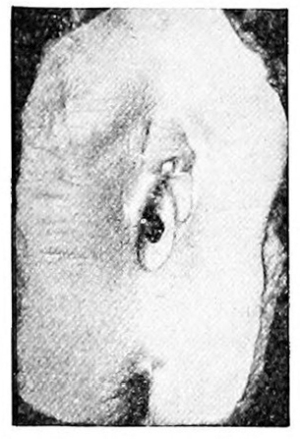
Fig. 19.—Hymen of child
of
four years—annular type.
The illustration also shows the
prominence of the
urinary portion of
the genitals.
(Glaister.)
In the case of young children, the anxiety on the part of the parents
of the child to push the charge, and the story of the child and
that of the parent heard apart, may assist in guiding the opinion.
The lesson-like way in which the child tells her story, even to
the minutest details, is always suspicious. The proof of a previous
defloration negatives the pretended loss of virginity at the time of
the commission of the deed for which the accused is being tried. In
most cases, it is best to let the patient tell her own tale, and then
cross-examine. An injudicious question may put her on her guard.
2. Examination of the Limbs and Body of the Female for Bruises,
&c.—Little value is to be placed on injuries said to be inflicted
on the person of a female the result of a struggle, as these may be
produced by the woman on herself in order to substantiate her story. In
children, for obvious reasons, they do not occur.
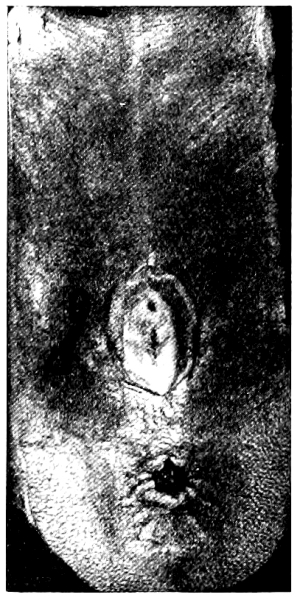
Fig. 20.—Virgin hymen,
with central slit.
(Glaister.)
3. Examination of the Linen.—In all cases a careful examination
of the body linen of both parties should be made. With regard to the
position of the stains on the chemise of the woman, M. Devergie insists
that the stains on the front of the chemise are seminal, those on the
back are due to blood. This distinction is too arbitrary to meet all
the facts of these cases, for the position of the spots necessarily
depends on the respective positions of the parties at the moment of
ejaculation; and, moreover, the woman is more likely to wipe the parts
with the front than the back of her chemise. Mistakes may arise from—
1. The garments being intentionally soiled with blood. This is not
infrequently done in cases of false accusations.
2. The menstrual discharge may be readily mistaken for that due to
violence, as the two kinds of blood cannot be distinguished.
3. The red juice of fruits and grease spots have been mistaken for
marks of blood and seminal stains on linen.
The identification of blood-stains is not difficult when the stain
occurs on pieces of white linen; but when, as it not infrequently
happens, they have to be detected on the coarse, dirty, often stinking
linen of the poor, the task becomes somewhat more difficult. The same
may be said with regard to seminal spots. As a means of diagnosis in
stains due to semen, the appearance and smell of the stains are of no
assistance whatever. The microscope will alone give any trustworthy
evidence as to the nature of the stain; and even here a caution must be
added—for the fact is beyond doubt that the semen even of a healthy
young man varies much, and is scarcely ever twice alike, so that the
absence of spermatozoa is no proof that the spot is not seminal in its origin.
The following are the tests used for the detection of semen:
1. Characteristic smell when the spot is
moistened.—This test is of no use, for the reasons
before stated.
2. Appearance when held to the light.—As uncertain
as the preceding.
3. Doubtful spots upon cotton or linen—not upon
wool, which usually contains sulphur—should be
cut out and moistened with a few drops of oxide of lead,
dissolved in liquor potassæ, and then dried at a temperature
of 68° F. The stain in a few minutes becomes of a dirty
yellow or sulphur-yellow colour. This change in colour
proves that the mark is not a seminal stain. Semen
does not contain albumen. This test only shows that the
stain is not caused by albuminous compounds, which contain
sulphur; but it does not follow therefore that the spot must
be seminal, for marks made by gum, dextrine, and some other
substances of a like nature are not changed in colour.
4. The Microscope.—This is by far the most reliable
test, but care is required in its manipulation.
(a) The cloth must not be rubbed between the fingers,
as the spermatozoa may be damaged by the operation.
(b) The suspicious spot on the linen should be
carefully cut out and placed in a clean watch-glass or small
porcelain vessel, and then moistened with a small quantity
of distilled water. The cloth may be gently moved about in
the water with a glass rod, and gentle pressure made so as
to thoroughly wet the cloth, which, in most cases, will be
accomplished in about a quarter of an hour. A single drop
should now, by gentle pressure with the fingers, be squeezed
on to a clean slide, and then placed under the microscope.
(c) Another method may be adopted. First determine
the side of the cloth on which the stain is present, and
cut out the stain, leaving a small strip of cloth attached
to the main portion. Place the end of the strip in a little
water in a watch-glass, so that the water by capillary
attraction may permeate the entire stain. With a thin-bladed
knife gently remove the moistened stain and place it on a
microscopic slide, and examine as before.
Fixing and Staining.—A drop of the watery extract of
the stain may be placed on a microscope slide and allowed to
dry in the air, covered to protect it from dust, and then
fixed by heating the slide over a spirit or Bunsen flame or
by the use of absolute alcohol. When fixed, the preparation
can be stained with eosin and methylene blue, methylene
violet, or other nuclear dye. The film may also be fixed and
stained with Leishman‘s solution in one procedure, or fixed
by heat first and then stained with Leishman. The procedure
is the same as for blood, viz. to cover the film with a
few drops of Leishman‘s stain, let stand for two or three
minutes, then add a few drops of distilled water, in two
or three minutes wash in distilled water, dry with filter
paper, and examine with the oil immersion. The preparation
may be mounted in Canada balsam and preserved for further
reference. The head of the spermatazoon takes the nuclear
dyes in ordinary use. The spermatazoa are best found in
the centre of the stain. If the stain be small the watery
extract may be centrifuged.
Florence‘s Reaction.—A useful chemical reaction has
been introduced by Dr. Florence of Lyons. It depends upon
the reaction between a concentrated solution of iodine in
potassium iodide and human semen. A watery extract of the
stain is made, and a drop placed on a microscope slide, by
| Potassium iodide |
1.65 |
grms. |
| Iodine |
2.54 |
“ |
| Distilled water |
30 |
c.c. |
The drops are covered with a cover glass and examined; where
the two drops unite, a precipitate is formed which consists
of brown crystals, very similar to hæmin crystals. If there
be sufficient material the precipitate may be obtained
in a test tube. This test is extremely delicate, and is
analogous in value to the guaiacum reaction for blood. A
positive reaction does not absolutely prove that the stain
is seminal, but a negative reaction proves that it is not.
Dr. Florence holds the reaction is specific for human semen,
as he has failed to obtain it with the seminal fluid of any
other animal, or other fluids or tissues. He considers it
due to the presence of an alkaloidal body in human semen,
which he calls virispermin.
The crystals are said by Dr. Max Richter to form on the
addition of the iodine solution to decomposition products of
lecithin.
The author has found this reaction extremely delicate, even
with minute traces. The crystals form rapidly and are easily
recognisable. They, however, are evanescent and disappear on
standing, so that they cannot be preserved as microscopic
specimens.
The biological test.—This is carried out in the same
way as the biological test for blood. Dr. C. G. Farnum, who
proposed this test, uses semen or testicular emulsion for
antigen, injecting 5 to 10 c.c. into the peritoneal cavity
of a rabbit at intervals of from two to six days, on five
or eight occasions. The antiserum is diluted from twelve
to eighteen times with normal saline, and the semen four
to twenty-five times. Human antiserum gives a precipitin
reaction with the watery extract of human seminal stain, but
not with testicular emulsions of the bull, dog, or goat, or
with human blood serum.[14]
Can a Rape be committed by one man on a healthy, vigorous
woman?—The answer to the question will, to a great extent, depend
on the relative strength of the conflicting parties. Every case of rape
has to be judged on its own merits. In any case, the medical jurist
has simply to state, from the examination of the parties, that sexual
intercourse has taken place, leaving the jury to decide whether a rape
or not has been perpetrated. A case is mentioned by Casper where a healthy,
strong adult of twenty-five years old was violated by a single man.
Can a Woman be Violated during Sleep?—By this is intended
natural healthy sleep, and not that induced by narcotics. In natural
sleep, rape is scarcely possible in a virgin, especially if the hymen
be found recently ruptured, though it may be possible in a woman
accustomed to sexual intercourse.
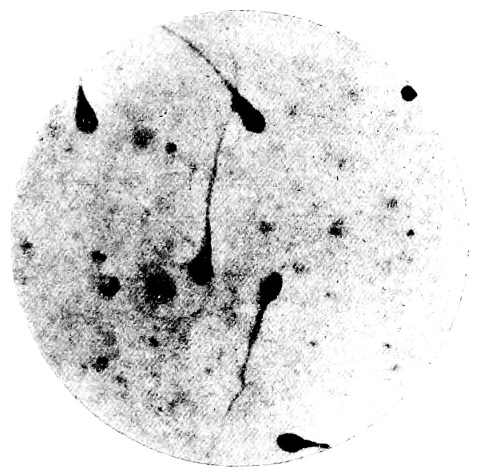
Fig. 21.—Photo-micrograph
of human spermatozoa, × 1000.
(R. J. M. Buchanan.)
Can a Woman become Pregnant by an act of Rape?—The answer to
this question is most decidedly in the affirmative. It is not necessary
for a woman to experience any sexual pleasure during connection in
order that she may conceive. A woman may become pregnant if fresh semen
be injected into the vagina with a glass syringe.
Signs of Rape in the Dead.—In the case of a woman found dead,
the question may arise as to her having been violated prior to death.
The reply to the question is by no means easy. Severe injury to the
genitals is a presumption in favour of rape, but cases are by no means
rare in which men failing to accomplish coïtus have injured the parts
with their fingers. The presence of spermatozoa in the vaginal mucus is
good evidence of a recent coïtus, but is no direct evidence of a rape.
Collateral evidence will in most cases decide the point.
Physical Signs of Rape
in Adult and in Child
| In the Adult. |
In the Child. |
| 1. If examined soon after the |
1. There may not be sufficient |
| commission of the offence, the |
penetration to rupture the hymen, |
| hymen of the adult virgin may |
consequently there will be |
| be ruptured, and the fourchette |
no hæmorrhage. In other cases |
| may be lacerated, and the parts |
the external organs will be |
| covered with blood. |
bruised, and in many cases |
| |
severely lacerated, the lacerations |
| depending on the amount of |
| penetration and force used. |
| 2. Difficulty in walking, in |
2. Same as in the adult, but |
| passing water, and sometimes |
lasting for a longer time—from |
| when the bowels are relieved. |
eight to fourteen days. |
| These signs in the adult pass |
|
| off in a day or two. |
|
| 3. Injuries on the person abused, |
3. For obvious reasons these |
| such as scratches and ecchymoses, |
do not occur on children. |
| may be present as the result of a |
|
| struggle. These may be self-inflicted. |
|
Directions as to manner of making a Medico-Legal
Examination in a Case of Alleged Rape.
1. Be careful to note everything, for it is in such cases as the one
under discussion where apparently unimportant signs may become of the
greatest moment.
2. Give the female no time for preparation, but make your visit, and
at once proceed to an examination. The visit to be of any practical
service should not be delayed beyond the third or fourth day after
the alleged offence, “by which time the lacerations will have healed,
the cicatrices disappeared, and the torn hymen be in such a state as
to make it difficult to say whether it had been divided recently or
at an earlier period.” But remember that you are not justified in
using force; and in this, as in cases of suspected pregnancy, if
you examine a woman against her will you render yourself liable for an
action for assault, and may have to pay heavily for your enthusiasm.
- (a) Note time of a visit.
- (b) Note time of alleged offence.
- Why? May prove the accused party
innocent by an alibi.
- (c) Avoid leading questions.
3. Age, strength, and condition of the health of the complainant.
Examine the wounds asserted to have been inflicted, and see if they
correspond with the history given of their infliction.
4. Examine organs of generation.
- (a) Any recent signs of violence—blood, abrasions, ulcerations, &c.
- (b) Condition of hymen, and of the carunculæ myrtiformes.
- (c) Was the woman menstruating at the time? Signs
- modified or obliterated by menstruation.
5. Preserve any spots on linen, &c., for future examination.
6. In case of death after violence—
- (a) Examine mouth for foreign bodies, &c.
- (b) Fractures or bruises on the body.
7. Examine spot where the crime is stated to have taken place.
8. Examine person of the accused.
- (a) Muscular development and strength.
- (b) Any abrasion about the penis, size of penis,
- rupture of the frænum, &c.
- (c) On linen, blood-stains, seminal spots, &c.
- (d) Marks on his body, scratches, &c., as evidence
- of resistance.
N.B.—The lapse of a few days may be
sufficient to remove all traces of the violence done to the parts;
and in most cases days, weeks, and even months may elapse before an
examination is made of the alleged victim.
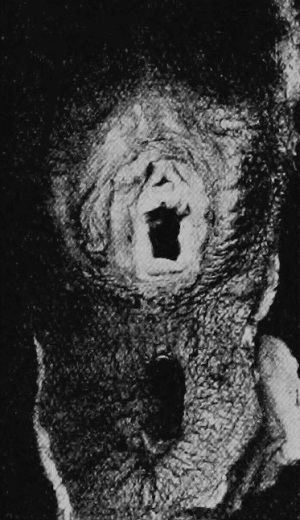
Fig. 22.—Deflorated hymen,
after parturition, in adult woman.
(Glaister.)
There is no one sign which may be considered as an absolute test for
virginity. The presence or absence of the hymen is of no probative
value one way or the other. Its very existence has been denied by Paré,
Buffon, and others. It may be absent as the result of disease, or as
the result of a surgical operation to allow of the free discharge of
the menstrual flow. Its presence is no bar to conception; and cases
are on record where it has been found necessary to incise it, to
allow of the passage of the fœtus into the world. In fact, women who
have been prostitutes for years have possessed to the last uninjured
hymens. The changes in the breasts which proceed from impregnation do
not occur where only defloration has taken place. The rugose condition
of the vagina is only affected by the first birth, and not by sexual
intercourse.
What has been said of the above signs as tests for virginity may be
said of a host of others which from time to time have, with varying
success, been advanced as aids to the diagnosis. Casper, however,
considers “that where a forensic physician FINDS A HYMEN STILL
PRESERVED, EVEN ITS EDGES NOT BEING TORN, AND ALONG WITH IT—in
young persons—A VIRGIN CONDITION OF THE BREASTS AND EXTERNAL
GENITALS, HE IS THEN JUSTIFIED IN GIVING A POSITIVE OPINION AS TO THE
EXISTENCE OF VIRGINITY, and vice versa.”
CHAPTER XII PREGNANCY — Signs of Pregnancy — Uncertain Signs — Certain Signs — Diagnosis of Pregnancy — DELIVERY — 1. Signs of Recent Delivery in the Living — 2. Signs of Recent Delivery in the Dead — 3. Signs of a Previous Delivery
It not infrequently happens that a medical man is called upon to
make an examination of a woman for legal purposes, in order to
decide—(a) The existence of an alleged pregnancy. (b)
The possibility of a previous pregnancy. (c) As to the existence
of concealed pregnancy.
The following are some of the reasons why pregnancy may be feigned:
1. By a married woman, to gratify the desire
of her husband for issue.
2. To influence the jury in a case of breach
of promise of marriage as to the assessment of the damages.
3. To extort money from a seducer or paramour.
4. To produce a spurious heir to property.
5. By a single or married woman, to stay the
infliction of capital punishment.
Pregnancy may be concealed—(a) In order to procure abortion.
(b) In order to commit infanticide. (c) In the married
and the unmarried, to avoid disgrace.
Besides the above, other important questions may arise with regard to
this state:
1. Is pregnancy possible as the result of coïtus in a state of
unconsciousness?—There appears no reason for doubting the
possibility of this occurrence.
2. Can pregnancy occur before the appearance of the
catamenia?—That pregnancy may occur before menstruation is
undoubted; and it appears probable that the changes in the ovaries
and uterus may go on at the regular monthly periods, and yet there
may be no discharge of blood from the uterus, which, as pointed out
by Bischoff, is only a symptomatic though usual occurrence. Hence,
pregnancy is possible prior to menstruation.
3. What is the earliest and latest age at which pregnancy is
possible?—In our climate (Britain), the earliest age at which
pregnancy may occur is about the eleventh or twelfth year; but the
youngest age at which this condition is reported to have occurred
is nine years (Meyer). In hot climates—as
in Bengal—mothers under twelve years of age are by no means rare.
Cohabitation in marriage takes place much earlier in India than in
Europe, but Chevers doubts if menstruation naturally occurs much sooner
there than elsewhere, and Baboo Modusoodun Gupta believes that the
catamenia appear sooner or later, according to the mode of living of
the females, and the sexual excitement to which they may be subjected.
Thomas mentions the case of a girl who menstruated regularly from
the age of twenty-one months, and also of another at eight months.
The limit to child-bearing appears to be between the fiftieth and
fifty-second years; but even here considerable variation has been
recorded, and women have been delivered of children at the age of
sixty. Haller even reports one at seventy. As long as menstruation
continues a woman may become pregnant; but even the cessation of this
flow for some months is no bar to conception.
4. Is it possible for a woman to become pregnant eight weeks after
her last confinement?—This is undoubtedly possible, but it is of
rare occurrence. It is also probable that a woman may abort at the end
of the time above mentioned. Husband knew a woman, who for several
years bore a child every ten months.
At common law, in cases of disputed inheritance, the following
may occur, and give rise to the necessity for medical evidence on the
subject: A woman who has just lost her husband may disappoint the
expectant heirs to an estate by alleging that she is pregnant.
At criminal law, pregnancy may be used as a stay to the
infliction of capital punishment.
In the first case, a jury of matrons is impanelled by a writ de
ventre inspiciendo, to decide the existence of pregnancy, and if
the fact be proved, to watch till such time as she be delivered.
In the second case, in England, the pregnancy must be proved, and also
whether she be quick with child. In Scotland the pregnancy must
be proved, but without reference to quickening, and the jury of
matrons is unknown in that country. In the same country, if it can be
shown that a woman is pregnant, and that her life or that of the child
is endangered by her imprisonment, she may be admitted to bail till
after delivery. A pregnant female also cannot be compelled to appear
and give evidence, if on competent authority it be shown that her
delivery will probably take place at the time fixed for the trial.
The diagnosis of early pregnancy in ordinary cases is by no means easy,
especially before the third or fourth month of gestation; but to the
medical jurist it is still more difficult, as he has to deal with cases
where he can scarcely expect much candour. No opinion should, however,
be given without taking into consideration the collective value of the
signs, as no one sign will afford sufficient data on which to base an
opinion. The signs furnished by auscultation are the most reliable, but
the position of the fœtus may render the sounds of the fœtal heart and
placental souffle difficult to detect.
The following may be taken as among the most important signs of
pregnancy, given in the usual order of their occurrence:
| Uncertain or Accessory Signs |
| 1. |
Cessation of menstruation |
First month. |
| 2. |
Morning sickness |
Second month. |
| 3. |
Salivation |
Variable. |
| 4. |
Mammary sympathies |
Third month. |
| 5. |
Enlargement of the abdomen |
Fourth month. |
| 6. |
Quickening |
Fourth month. |
| 7. |
Kiesteine |
Variable. |
| 8. |
Jacquemier‘s Test |
Third month. |
Certain or Essential Signs |
| 1. |
Ballottement |
Fourth month. |
| 2. |
Uterine souffle |
Second month. |
| 3. |
Pulsation of the fœtal heart |
Fourth month.
|
1. Cessation of Menstruation.—The non-appearance of the
catamenia, though a most valuable sign, is by no means a conclusive
one, as menstruation may be arrested by diseases of various kinds;
while, on the other hand, there are many well-recorded cases of women
who have menstruated regularly during the whole period of their
pregnancy. There have been also cases in which the menses only occurred
during pregnancy; and in a few still more curious cases, women who have
never menstruated have been known to have borne several children. In
cases of concealed pregnancy, the woman may smear her linen with blood
to imitate the menstrual flow.
2. Morning Sickness.—Nausea, often ending in vomiting,
generally occurs soon after rising in the morning, and may commence
almost immediately, but more frequently not till the expiration of the
fifth or sixth week after conception. It is not a reliable sign, and
is often very irregular in its occurrence. When present, it varies in
degree, from a feeling of nausea to the most violent vomiting, very
distressing to the patient.
3. Salivation.—The excessive secretion of the salivary glands,
due to the irritation caused by pregnancy, was first mentioned by
Hippocrates as a sign of this condition. “It is to be distinguished
from ptyalism induced by mercury, by the absence of sponginess and
soreness of the gums, and of the peculiar fœtor, and by the presence of
pregnancy.” It is oftener absent than present.
4. Mammary Sympathies.—As the breasts may enlarge from various
causes—such, for instance, as the distension of the uterus from
hydatids, or, as is the case with some women at each menstrual period,
when the catamenia are suspended, or after they have ceased—this is
by no means a sign on which much reliance should be placed. The change
in the colour of the nipple and areola, more apparent in women of dark
complexions, is more to be relied on as a diagnostic sign of pregnancy.
The first observable alteration, which occurs about two months after
conception, is “a soft and moist state of the integument, which appears
raised, and in a state of turgescence, giving one the idea that, if
touched by the point of the finger, it would be found emphysematous.
This state appears, however, to be caused by infiltration of the
subjacent cellular tissue, which, together with its altered colour,
gives us the idea of a part in which there is going forward a greater
degree of vital action than is in operation around it; and we not
infrequently find that the little glandular follicles, or tubercles as
they are called by Morgagni, are bedewed with a secretion sufficient to
damp and colour the woman‘s dress.”
During the progress of the next two months, the changes in the areola
are in general perfected, or nearly so, and then it presents the
following characteristics: “A circle round the nipple, whose colour
varies in intensity according to the particular complexion of the
individual, being usually much darker in persons with black hair, dark
eyes, and sallow skin, than in those of fair hair, light-coloured eyes,
and delicate complexion. The extent of the circle varies in diameter
from an inch to an inch and a half, and increases in most persons as
pregnancy advances, as does also the depth of colour. In the centre of
the coloured circle, the nipple is observed partaking of the altered
colour of the part, and appearing turgid and prominent, while the
surface of the areola, especially that part which lies more immediately
around the base of the nipple, is studded over and rendered unequal by
the prominence of the glandicular follicles, which, varying in number
from twelve to twenty, project from the sixteenth to the eighth of an
inch; and, lastly, the integument covering the part appears turgescent,
softer, and more moist than that which surrounds it; while on both
there are to be observed at this period, especially in women with dark
hair and eyes, numerous round spots or small mottled patches of a
whitish colour, scattered over the outer part of the areola, and for
about an inch or more all around, presenting an appearance as if the
colour had been discharged by a shower of drops falling on the part.”
The value of the above changes in the nipple and areola as a diagnostic
sign of pregnancy is greatly lessened by a previous pregnancy. It
should also be remembered that milk may occur in the breasts of women
who are not pregnant.
5. Enlargement of the Abdomen.—For the first four months of
pregnancy the entire uterus is contained in the cavity of the pelvis;
it then gradually rises, so that at about the fifth month it is midway
between the pubes and umbilicus, which latter it reaches at the end
of the sixth month; during the seventh month it may be felt half-way
between the umbilicus and ensiform cartilage; at the end of the
eighth month it is level with the cartilage, now quite filling the
abdomen. Still increasing in size during the ninth month it does not
ascend higher, the abdominal walls yielding to its increased weight,
allowing it to fall somewhat forward. A caution is necessary with
regard to this sign. The abdomen may enlarge from causes other than
pregnancy. Pregnancy and ascites, or ovarian dropsy, may coexist in
the same patient, and the diagnosis be rendered anything but easy. The
enlargement of the abdomen may lead to unfounded suspicions detrimental
to the happiness and health of the unfortunate object of them.
6. Condition of the Cervix Uteri.—The cervix softens during
pregnancy, and the softening is present as early as the second or third
week. It is an important sign. Hejar‘s sign or the softening at the
junction of cervix and body and the lower uterine segment is valuable,
but not always easily elicited. It is of most value from the second
to the fifth months. At the sixth month it loses one-fourth of its
length; at the seventh it is only half of its original length; at the
eighth it loses another quarter; and at the ninth the neck is entirely
obliterated. This shortening is more apparent than real, and its
occurrence is denied by the late Dr. J. M. Duncan, except during the
last few days of pregnancy.
7. Quickening.—The period at which quickening occurs varies
from the fourth to the fifth month; and the term is understood to imply
the first perception of the movements of the fœtus experienced by the
mother. Nervous women, anxious to have children, sometimes complain of
sensations which they ascribe to quickening, pregnancy being absent.
Pregnancy may occur without quickening.
8. Kiesteine.—This is no test of pregnancy, as it may be found
in women not pregnant.
9. Jacquemier‘s Test.—A violet or port-wine colour of the
vagina and inner surface of the vulva, due to venous congestion of the
parts from pressure of the gravid uterus.
A flattening of the upper wall of the vagina, produced by the
enlargement and anteversion of the uterus, which, forcing the os
towards the sacrum, makes the anterior wall of the vagina tense, has
been added by Dr. Barnes as a sign of pregnancy.
1. Ballottement.—This test of pregnancy is applied by causing
the patient to stand upright; the finger of the right hand is then
passed into the vagina and placed in the anterior fornix, the other
hand being placed lightly over the abdomen in order to steady the
uterine tumour. If the finger be now jerked upwards against the head
of the child, it will be felt to float upwards in the liquor amnii,
and then by its own weight gradually to return to its former position.
Tumours in the uterus, attached to its walls by a pedicle, may give the
same sensation. Scanty supply of liquor amnii, or malposition of the
child, may sometimes prevent the adoption of the test.
2. Uterine Souffle.—Under this head are included the placental
bruit, and the pulsations of the umbilical cord. Both these sounds
require a skilled auscultator to detect them. The uterine murmur,
or bruit placentaire, is heard best at the lower and lateral
portions of the uterus, just above Poupart‘s ligament. It is
isochronous with the pulse of the mother, and is heard most distinctly
about the fourth or fifth month of utero-gestation; in some cases,
however, it may be heard as early as the tenth week. The sound is
intermittent, and varies in character, being sometimes hissing,
whirring, or cooing, at others rasping.
3. Pulsation of the Fœtal Heart.—The sounds of the fœtal
heart were first noticed by Mayar in 1818, and those of the placenta,
or placental souffle, by Kergaradec in 1822. The sound of
the fœtal heart is composed of a rapid succession of short, regular
double pulsations, differing from that of the adult heart in rhythm
and frequency. It can be heard more or less over the whole of the
abdomen about the middle of the fourth month, and is not unlike the
muffled ticking of a watch. In frequency it varies from 100 to 140.
The auscultator should be careful not to hang his head down, or he
may be apt to mistake the throbbing of his own arteries for sounds
communicated from the patient.
4. Intermittent Contraction of the Uterus.—From the fourth to
the tenth month of pregnancy, the uterus may be felt by the palpating
hand to alternately contract and relax; the period of contraction and
relaxation varies. It is present in pregnancy whether the fœtus be
alive or dead.
Pregnancy may be simulated by ascites, by fibrous tumours of the
uterus, by ovarian dropsy, and by enlargement of the uterus from
retention of the catamenia due to an imperforate hymen, &c. The breasts
may also become affected by uterine tumours.
1. Pseudo-Pregnancy.—In the examination of cases of alleged
pregnancy, the medical jurist should bear in mind the possibility of
enlargement of the uterus and abdomen from the presence of tumours.
The probable occurrence of pseudo-pregnancy should also be
considered. Tumours and pseudo-pregnancy may occur in the married and
unmarried; and as the latter is not infrequently accompanied with many
of the signs and symptoms of pregnancy, an early diagnosis is of the
utmost importance.
The diagnosis will consist in—
(a) A careful examination of all the
symptoms present, when, in most cases, a break in their order of
sequence may be observed, or certain signs may be added which do not
occur in true pregnancy.
(b) Presence or absence of the hymen.
(c) If the patient be placed well
under the influence of chloroform, the tumour, if the result of
pseudo-pregnancy, will subside, gradually returning as the effects of
the anæsthetic pass off. Whilst the patient is under the influence
of the anæsthetic, the hand may be pressed on the abdomen at each
expiration, and there retained, the pressure being continued during the
inspirations.
2. Dropsy.—Use of the stethoscope; examination of the breasts
for milk, and the urine for albumen.
3. Fibrous Tumours.—Absence of fœtal movements and other signs
of pregnancy.
4. Ovarian Dropsy.—Tumour on one side of the abdomen; breasts
unaffected, and auscultation giving negative results.
5. Retention of the Catamenia.—On examination, the hymen found
perfect and bulging. This condition cured by a crucial incision.
This subject is best discussed under three heads: (1) Signs of Recent
Delivery in the Living. (2) Signs of Recent Delivery in the Dead. (3)
Signs of Previous Delivery.
(a) Transitory Signs; (b) Persistent Signs of Delivery
(a) Transitory Signs of Delivery
1. General Indisposition.—The face is pale or flushed; the
eyes sunken, and surrounded by a dark areola; there is considerable
debility, and a tendency to faint; the skin is warm and moist, and the
pulse quick. It must be borne in mind that a woman who is anxious to
conceal her recent delivery may, by an effort of the will, to a great
extent hide her real condition.
2. The Breasts.—The breasts feel firm and “knotty,” and on
pressure yield a small quantity of colostrum or milk, which may
be distinguished by the aid of a microscope.
3. The Abdomen.—The skin of the abdomen shows signs of recent
distension; it is relaxed, and more or less thrown into folds, the
lower part marked by irregular broken streaks of a pinkish tint,
becoming white and silvery as time goes on.
4. The Lochia, or the “Cleansings.”—These consist in a
discharge from the uterus, which, for the first three or four days
after delivery, is more or less bloody. During the succeeding four or
five days it acquires a dirty-greenish colour—“green waters,” with
a peculiar sour, rancid odour. In a few days this is succeeded by a
yellowish, milky-looking mucous discharge, which may continue for four
or five weeks.
5. External Parts of Generation.—The labia and vagina bear
distinct marks of injury and distension.
6. The Uterus.—The uterus is enlarged, and may be felt by the
hand for two or three days after delivery, as a round ball, just above
the pubes. The orifice of the uterus, if examined a few hours after
delivery, appears as a continuation of the vagina. This condition
completely disappears in about a week after delivery.
7. After-pains.—These are of no use from a diagnostic point of
view, as we have no means of testing their presence or absence.
(b) Persistent Signs of Delivery
1. Entire obliteration of the hymen.—This is no proof of actual
delivery.
2. Destruction of the fourchette.
3. The vagina dilated, and free from rugæ.
4. Dark colour of the areola round the nipples.—This varies
among women; and cases are known where there was no areola either
during pregnancy or after delivery.
5. Skin of Abdomen.—Due to the great distension of the abdomen,
the skin appears streaked with silvery lines varying in breadth. These
markings in some cases may be scarcely perceptible, especially if the
female has worn a tight abdominal belt during her pregnancy. The same
appearance may be produced by dropsy, or the prolonged distension of
the abdominal walls, the result of other causes. Attention to the other
signs present will assist the diagnosis. After the lapse of seven to
ten days the recent delivery of a woman cannot be certainly proved by
an examination of the living woman, especially if it be known that she
had previously borne children. In primiparæ the pink-coloured streaks
on the abdomen, and the transverse condition of the os uteri, may
strongly point to recent delivery.
Should the woman die immediately after delivery, the external parts
will present the same appearance as just described in the living. On
opening the abdomen, the uterus will be found fat and flabby, between
nine and twelve inches long, and with the os uteri wide open. The
cavity of the uterus may contain large bloody coagula, and its inner
surface be lined by the decidua. The attachment of the placenta is
easily detected by its dark colour, and by the semi-lunar openings of
the arteries and veins on the surface of the uterus.
Of course all the appearances just described will be greatly modified
by the time that has elapsed between delivery and death.
Delivery after Death.—The fœtus has been known to have
been expelled from the uterus by the force of the gases generated
by putrefaction. Dr. Aveling, in a paper published in the
Obstetric Transactions, 1873, arrives at the conclusion that
post-mortem delivery is possible even where no symptoms of
parturition were noticed before death. He also thinks that the child
may live in utero for some hours after the death of the mother.
Table showing the Size of the
Uterus at
Different Periods after Delivery
Two to Three Days.—7 inches long and 4 inches wide.
Seven Days.—Between 5 and 6 inches long and 2 inches wide.
Fourteen Days.—From 4 to 5 inches long and 1½ inches wide.
End of Second Month.—Normal size. 2½ inches long and about
2 inches broad at the fundus.
Table giving Weight of the Uterus
after Delivery
| Immediately after Delivery |
22 to 24 |
ounces. |
| Within a Week |
18 to 21 |
“ |
| End of Second Week |
10 to 11 |
“ |
| End of Third Week |
5 to 7 |
“ |
| End of Second Month |
normal, 9 to 10 |
drachms. |
| (Heschl.) |
1. Marks on the abdomen, consisting in shining silvery lines,
due to the distension of the skin. These may result from distension
other than that the result of pregnancy—tumours, dropsy, &c.
2. Marks on the breasts, similar to those appearing on the
abdomen. These, in conjunction with the above, are important.
3. Peculiar jagged condition of the os uteri, felt by the
finger. The condition may be the result of disease.
4. Marks of rupture of the fourchette or perinæum.
5. Dark colour of the areola round the nipple.
6. Negative evidence, from absence of any of the above.
Can a Woman be delivered unconsciously?—This question may arise
in cases of infanticide. Setting aside cases of epilepsy (in a fit of
which disease Husband once attended a woman who was confined during
the fit without being aware that she had been delivered), cases of
apoplexy, coma, and narcosis from chloroform, opium, &c., it may be
stated that delivery is possible during profound sleep. Husband once
attended a woman who informed him that “she always had her pains during
her sleep,” and only woke up just as the head came into the world. When
it is borne in mind how easily some women pass through labour, it is
quite possible that, after a busy day, sleep may be so profound as not
to be disturbed by the pains of labour. In primiparæ the occurrence
is more problematical. Women have often declared that they have been
unconsciously delivered whilst at stool. This is also possible, but the
circumstances of the case must be severely sifted.
CHAPTER XIII FŒTICIDE, OR CRIMINAL ABORTION — 1. Natural or Accidental — 2. Violent
[“Every woman, being with child, who, with intent to procure her
own miscarriage, shall unlawfully administer to herself any poison or
other noxious thing, or shall unlawfully use any instrument, or other
means whatsoever, with the like intent: and whosoever, with intent to
procure the miscarriage of any woman, whether she be or be not with
child, shall unlawfully administer to her, or cause to be taken by
her, any poison or other noxious thing, or shall unlawfully use any
instrument, or other means whatsoever, with the like intent, shall be
guilty of felony, and being convicted thereof shall be liable, at the
discretion of the Court, to be kept in penal servitude for life, or for
any term not less than five years, or to be imprisoned for any term not
exceeding two years, with or without hard labour, and with or without
solitary confinement.”—Statute 24 and 25 Vict.
c. 100, sec. 58.]
The 59th section of the same Statute also takes into consideration
the unlawfully supplying or procuring any poison, or other noxious
thing, or instrument, or thing whatsoever for a woman, for the purpose
of inducing abortion. The person so doing shall be guilty of a
misdemeanour, and be kept in penal servitude for a term of five years,
or be imprisoned for any term not exceeding two years, with or without
hard labour.
It will be seen from the passages above quoted that there is no
distinction between a woman quick or not quick with
child. “The offence is to procure the miscarriage of any woman,
whether she be or be not with child” (R. v. Goodhall, 1 Din.
187; 2 C. & K. 293). But although the law does not regard “quickening”
in cases of abortion, yet the fact of having “quickened” may be pleaded
as a bar to immediate capital punishment.
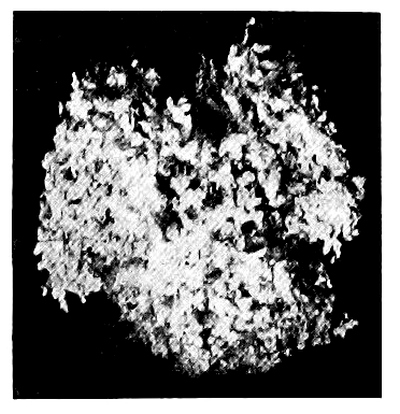
Fig. 23.—Abortion at fourth week.
(Glaister.)
It has been decided in Scotland that drugging or operating to procure
abortion is criminal, though unsuccessful, but it is not certain
whether the woman alone can be charged with taking drugs to procure
abortion. Both in England and in Scotland, to make the procuring of
abortion criminal, “there must be felonious intent,” for it may be
necessary to cause abortion. It must be borne in mind that the law
allows no discretionary power on the part of medical practitioners
who, to save the life of the mother, may deem it advisable to induce
premature delivery. This being the case, no medical man should attempt
to induce premature labour without the consent of the relatives of the
woman, and the sanction of a medical colleague after consultation.
This precaution is the more necessary as several medical men have
been prosecuted, an event which would not have taken place had the
precaution above suggested been observed. A medical man should also
be very careful never to give any medicine “to bring on the courses”
if he has the slightest suspicion of pregnancy, even as a “placebo”
to satisfy an importunate patient, for should abortion be otherwise
procured, his really harmless medicine may be accused with the result,
and a grave suspicion be raised against him, to say the least.
The term abortion is understood in medicine to mean the
expulsion of the contents of the fœcundated uterus before the sixth
month of pregnancy, that is, before the child is considered viable.
After this period it is said to be a premature labour.
In law, however, no distinction is made and the expulsion of
the contents of the uterus at any period before the full time
of pregnancy is considered an abortion; in popular language, a
miscarriage.
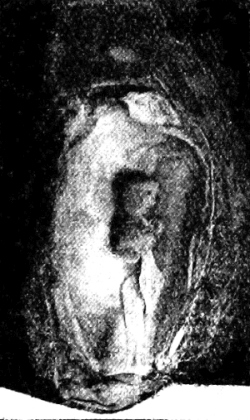
Fig. 24.—Abortion between
sixth and eighth week.
(Glaister.)
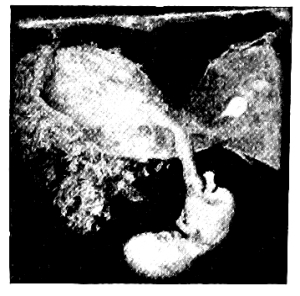
Fig. 25.—Abortion at tenth
week.
(Glaister.)
Abortion, when not produced by criminal means, generally occurs at or
a little before the third month of utero-gestation, and then
usually in first pregnancies, or during the latter part of the period
of child-bearing. It is also more frequent among the rich than among
the poor. Of the two thousand cases of pregnant women examined by Dr.
Whitehead of Manchester, the sum of whose pregnancies was 8681, or 4.38
for each, rather less than 1 in 7 had aborted.
When abortion is criminally induced, it generally takes place between
the fourth and fifth months, that is, about the time the woman
becomes certain of her condition.
The Causes of Abortion are—
- 1. Natural or Accidental.—
- (a) Maternal—belonging to the mother;
- (b) Fœtal—belonging to the ovum.
- 2. Violent.—
- (a) Mechanical;
- (b) Medicinal.
(a) Maternal.—Among the maternal causes may be mentioned
excessive lactation; any irritation of the rectum or bladder; loss of
blood, which, by increasing the amount of carbonic acid in the blood,
acts as an excitant to the spinal cord; excessive irritability and
excitability of the uterus, &c. Certain states of the system conduce to
abortion—albuminuria, syphilis, certain fevers, scarlet fever,
smallpox, &c. Abortion may become habitual in some women. Great joy or
sudden sorrow have not infrequently been the cause of abortion. The
tendency to abortion is greatest at the menstrual periods, that is, at
the time when, had not the woman become pregnant, menstruation would
have taken place. Slight causes acting at these times are very liable
to produce abortion.
(b) Fœtal.—The death of the ovum, or a diseased
condition of its uterine coverings, or of the placenta, probably of an
inflammatory nature.
(a) Mechanical.—Under this head may be mentioned the
passage of certain instruments into the cavity of the womb, and the
rupture by violence of the membranes which surround the fœtus; also
the injection of fluids into the uterus. A medical man practising
in Yorkshire informed Husband that so great was the dread of large
families, that he knew of several ladies who, if they went a day
over their monthly period, passed a catheter into the uterus, with
the desired result. “It was wonderful,” he added, “how clever they
were.” In India a twig of the Euphorbium nivulia, anointed
with assafœtida, is used for the same purpose. “The fœtus is never
delivered alive, but there is said to be no great danger to the woman”
(Chevers). Women may use hairpins, knitting-needles,
and the idea is to pass the instrument “until blood comes,” which is accepted
as a sign that abortion will be sure to follow. In some cases it is by
no means easy to procure abortion, and women have been known to undergo
a considerable amount of violence without abortion taking place. In
some women, however, on the other hand, the slightest violence—such, for
instance, as slipping from a step or low chair—will cause them to abort.
(b) Medicinal.—Certain drugs, among which may be
mentioned ergot, savin, pennyroyal, rue, tansy, saffron, perchloride
of iron, diachylon which contains lead, and others, have been used
for the induction of abortion. In India unripe pineapple has a great
reputation as an abortive (Medical Jurisprudence for India,
Chevers). It is scarcely necessary to mention each
drug individually, but it must be remembered that there is not one single
internal medicament of which it can be consistently with experience
asserted that, even when an abortion has followed its use, it must
have produced this abortion, and that cause and effect are in such a
case “indirect and necessary connection.” All the so-called abortives
are most uncertain in their action, and their use is attended with
considerable risk to the woman. In the case of diachylon profound
lead poisoning may be the result. Be this as it may, they are more
frequently used to induce abortion than mechanical procedure, from the
fact that the latter requires some amount of anatomical knowledge and
manipulative skill.
The dangers of abortion from any cause are hæmorrhage, sepsis, and
peritonitis. In mechanical interference, especially where proper
precautions have not been taken to prevent them, sepsis and peritonitis
from local injury and perforation are prone to occur.
A medical man may be required to—(1) Examine into the nature and
characters of the substances expelled from the womb; (2) Examine the
woman stated to have aborted.
1. Examination of the Substances expelled from the Womb.—The
substances expelled from the womb often become the subject of judicial
inquiry, and the medical man may be required to give his opinion as to
their probable nature.
Dr. Gallard has called attention to the following:
1. During the last six months of pregnancy, abortion, even when it
occurs spontaneously, goes through the two stages as at full time,
i.e. the expulsion of the products of conception is, as a rule,
preceded by rupture of the membranes, followed after a time by the
expulsion of the placenta.
2. In the first three months this order of things is absent, for it
is the rule to see the fœtus expelled entire en bloc without
rupture of the membranes.
3. If, then, we find during the first three months of pregnancy the
products of an abortion in which the membranes have been ruptured and
the embryo expelled alone, we must look for a pathological cause for
this infraction of a general rule; and if no disease of the embryo or
of the mother is found, we are justified in attributing the abortion
to mechanical means used directly against the products of conception.
Charpentier has shown that this rupture of the membranes is not
an absolute proof of criminal abortion; but in eighteen cases of
spontaneous abortion M. Leblond only found rupture of the membranes in
one, and in this the membranes presented an abnormal friability.
The questions may be asked—(1) Is it a fœtus?—(2) Is it a mole? If
so, is a mole also a fœtus?—(3) Is it merely the coats of the uterus,
and unconnected with pregnancy?
1. Is it a Fœtus?—The development of the fœtus is given on pp.
35, 36 et seq.
2. Is it a Mole?—This question gives rise to another: Is a mole
a fœtus? To this the answer must be in the affirmative. Moles, being
the diseased appendages of the fœtus, vary in character, and have been
described by obstetrical writers under the following heads: (a)
Hydatiginous; (b) Carneous; (c) Fatty Moles.
(a) Hydatiginous Moles are a result
of a diseased condition of the villi of the chorion. The villi become
dropsical, and hang in masses like a bunch of grapes.
(b) Carneous Moles.—These are the
result of hæmorrhage into the chorion. The blood becomes organised, and
a fleshy mass is formed, to which in some cases a withered fœtus is
attached.
(c) Fatty Moles.—Death of the
fœtus and fatty degeneration of the placenta, or fatty degeneration of
the placenta and death of the fœtus, produces this variety of mole. A
withered fœtus with a mass of fatty placenta are expelled.
3. Is it merely the Coats of the Uterus, and unconnected with
Pregnancy?—Fleshy masses may be expelled from the womb, which may
not be the result of sexual intercourse. The description just given of
true moles will, it is hoped, assist in forming a correct diagnosis.
Considerable care will be required, for the honour of the woman accused
depends upon the opinion given as to the nature of the substances
submitted for examination. It must also not be forgotten that moles may
be retained for many months in the uterus and be then expelled. The
knowledge of this fact may rebut an accusation of infidelity against
a wife. Polypi may be discharged from the womb; the presence of a
pedicle will point to their true character. All substances expelled
from the uterus should be carefully washed in water, and all clots
removed. The examination of the woman may also help in the formation
of the diagnosis. The absence of the signs of defloration or of recent
delivery will be in her favour.
2. Examination of a Woman stated to have aborted.—This subject
may be divided under two heads—(1) Has the woman been recently
delivered? (2) What were the means used to procure the abortion?
It is by no means easy to answer the question whether an alleged
abortion has really taken place or not. The signs of recent delivery
are in most cases absent, for the woman can better hide her condition
during the earlier than during the later months of utero-gestation;
consequently suspicion may not have been aroused against her for some
weeks or months after the event. The history of the case, with other
attendant circumstances—milk in the breasts, change in the colour of
the areola round the nipples, severe flooding, absence of the hymen,
injuries to the os uteri, transverse condition of the os uteri in
contradistinction to its circular form after delivery, &c.—will, in
most cases, assist in forming a correct diagnosis; but it must be again
repeated that few of the signs applicable to delivery at the full time
are here available.
In all doubtful cases—
1. Examine into the general and present state of
the health of the woman.
2. Find out if there are any reasons which would
occasion a pretext to use drugs which are not usually given to women
during pregnancy.
3. Learn if menstruation is regular and easy,
or if the woman is in the habitual use of emmenagogues, for, if so
accustomed, she may have used them ignorant of pregnancy.
4. If a woman ascribes her abortion to a fall, to
an accident, or to violence used against her, carefully examine into
the nature of these.
5. Examine into the general causes of abortion,
and also inspect the expelled substances.
Where death is supposed to have followed the use of abortives, the
alimentary canal must be examined for the signs of the action of
irritants, or the presence of disease in the internal organs; but when
death has resulted from an attempt to procure abortion by instrumental
means, the neck of the womb is most frequently found covered by a
number of small more or less irregular wounds, which may penetrate into
the womb or lose themselves in the walls of the organ. Their course
is indicated by infiltration, or a small extravasation of coagulated
blood, the exact condition of which must, if possible, be ascertained,
so as to decide when the wound was inflicted.
The examiner must not forget that the wounds may extend to the
fundus of the uterus, and in this case the autopsy shows that a blunt
instrument, as a catheter or uterine sound, introduced through the
os uteri into the retroverted uterus, glides by its own weight into
the rent. The seat of the tear leads one to think that pregnancy was
not far advanced when the attempt was made, and in fact the accident
most frequently occurs in cases of suspected pregnancy. It must be
remembered that the uterus is often punctured by the injudicious use
of the uterine sound, but without any immediate dangerous symptoms.
Wounds in the walls of the vagina indicate the use of instruments by
an inexperienced hand; in the fundus of the uterus, to one at least
accustomed to the introduction of instruments. Spontaneous rupture of
the uterus is impossible during the early periods of pregnancy, just
when the attempts at abortion are usually made. Rupture due to external
violence is, as a rule, accompanied with outward signs of the violence used.
In all cases a careful examination of the structure of the uterus
should be made. An examination of the ovaries for false or
true corpora lutea should be made. The opinions on the character
and differences of these bodies are so discordant as to destroy all
confidence in their value as proof of conception or the reverse.
Taylor says: “The discovery of the ovum in the uterus in
process of development could alone, in the present state of our
knowledge, warrant an affirmative opinion on this point in a Court
of Law, and this I believe to be the safest view at present of this
much-contested question. On the other hand, the absence of a corpus
luteum from the ovary would not in all cases warrant an opinion that
conception had not taken place.”
Examine carefully for local sepsis and signs of inflammation of the
uterus and its surrounding structures.
Recapitulation
In Medicine, Abortion occurs before the sixth month of
pregnancy—premature labour after that period.
In Law, Abortion may take place any time before the full
period of utero-gestation.
Abortion may be due to—
- 1. Natural or Unavoidable Causes.
- (a) Maternal. (b) Fœtal.
- 2. Violence, with Criminal Intent.
- (a) Mechanical. (b) Medicinal.
CHAPTER XIV INFANTICIDE — DEFINITION OF THE TERM “LIVE BIRTH” IN CRIMINAL CASES — DEFINITION OF THE TERM “LIVE BIRTH” IN CIVIL CASES — CAUSE OF DEATH TO THE FŒTUS — 1. In Favour of Precipitate Birth and Accidental Injury — 2. In Favour of Criminal Violence
According to the present state of English law, infanticide—murder
of a new-born child—is not regarded as a specific crime, but
is treated and tried by those rules of evidence which are applicable
in cases of felonious homicide, but with this difference, that the
law requires proof that the child was born alive. An old Statute (21
Jac. I. c. 27) made the concealment of the birth of a bastard child
conclusive evidence of murder. As far as the legal estimation of
the crime is concerned, it matters not whether the child was killed
immediately on its entrance into the world, or within a few days
afterwards. A fœtus not bigger than a man‘s finger, but having the
shape of a child, is a child within the Statute (R. v. Colmer,
9 Cox, 506; R. v. Hewitt, 4 F. & F. 1101). An English judge,
at a late trial, stated that if the jury were of the opinion that the
prisoner had strangled her child before being wholly born, she must be
acquitted of murder. The law also, on the score of humanity, presumes
that every child is born dead until direct evidence to the contrary,
from medical or other sources, is given. The onus of the proof of live
birth, therefore, devolves on the prosecution. It may also be difficult
to decide as to the maternity, and the woman accused will have to be
examined as to the possibility of her recent delivery.
Here let me repeat the advice given on page 148 as to the examination
of a woman. Your duty is to request the woman to allow of the necessary
examination, giving her the warning which every magistrate or coroner
is bound to give to any person charged with a crime, before requiring
an answer to a question which may be used in evidence against her at
the subsequent trial. The innocent and the guilty may alike object to
an examination, but the presumption is against the party declining,
if several have voluntarily submitted. A young lady committed suicide
rather than submit to an examination by two medical men under an order
from the coroner. The medical men were guilty of a grave indiscretion,
and both they and the coroner were acting ultra vires in
attempting to force a woman to obtain evidence against herself
(Taylor, vol. ii. p. 431).
The decision as to recent delivery will, to a great extent, rest on the
condition of the mother, and the apparent age of the child found dead.
The discovery of the body of the child is not necessary to conviction,
but the medical evidence as to the signs of respiration, of course,
depends on the body being found and examined. In most cases of alleged
infanticide tried in England, juries appear more inclined to fall back
on the minor offence—concealment of birth—than to convict of
the capital offence; and this appears to be the only alternative if the
body cannot be found, for, as we have just said, in law every child is
held to be born dead. It must of course be shown that the woman has
been recently delivered. In case of failure to prove the murder of the
child, the Act (24 and 25 Vict. c. 100, sec. 60) enacts that “if any
woman shall be delivered of a child, every person who shall, by any
secret disposition of the dead body of the said child, whether such
child died before, at, or after its birth, endeavour to conceal the
birth thereof, shall be guilty of a misdemeanour.” The mere avowal of
the birth is not sufficient to convict her; she must be proved to have
done some act of disposal of the body after the child was dead (R.
v. Turner, 8 C. & P. 755).
In Scotland, concealment of pregnancy is a statutory crime,
chargeable when the child born is found dead or is not found at all,
and there is no proof of its having been murdered. Pregnancy, up to
a period when a child might be born alive, must be proved, and the
words “during the whole period of her pregnancy” do not imply that the
pregnancy must have continued for the full period of nine months. All
that is necessary is that there should be such proof of duration of
pregnancy as made a living birth possible. If the accused can bring
forward a witness to whom she communicated her pregnancy, or called for
assistance at the birth, or (it is believed) can prove that the child
was born dead, she is entitled to an acquittal.
It has also been said that a woman ought not to be convicted of
“concealment of pregnancy,” if at the time of delivery the fœtus
do not appear to have reached the seventh month of intra-uterine
existence. The birth of a “child,” whether dead or alive, is essential;
therefore, if the woman accused “can prove that that which she brought
forth was not a ‘child,’ but an abortion, or a fœtus, which,
from some accident, was in such a condition that, though there had
been assistance, it could not have been in a condition to be called
‘a child,’ then the case is out of the Statute.” The Scotch Statute
differs from the English on the “concealment of birth” in this, that
so long as the woman makes known her pregnancy, the motive for doing
so is not considered. Thus, if she make arrangements with anyone to
conceal the birth, “the Statute is eluded by that very circumstance”
(Alison). The Statute applies to married as
well as to single women; but, in the former case, the penalty is seldom
enforced unless foul play is suspected.
“The entire delivery of a child.” There must be an independent
circulation in the child before it can be accounted alive (R. v.
Enoch, 5 C. & P. 539). The entire child must be actually born into
the world in a living state (R. v. Poulton, 5 C. & P. 329).
But the fact of the child being still connected with the mother by
the umbilical cord will not prevent the killing from being murder
(R. v. Reeves, 9 C. & P. 25). To kill a child in its mother‘s
womb is no murder, because the person killed must be “a reasonable
creature in being, and under the King‘s peace.” But if the child be
injured in the womb, and yet be born alive, and then die as a result of
such injuries, it may be murder in the person who inflicted them (R.
v. Senior, 1 Mood. C. C. 346).
A distinction must be drawn between medical or physiological
life and legal life. A child may have breathed, as it not
infrequently does, before it is completely born into the world;
and this might, in a medical point of view, be considered as a live
child, but it is not one legally. The entire delivery of the child is
necessary in law; and “it must also be proved that the entire child has
actually been born into the world in a living state, and the fact of
its having breathed is not a conclusive proof thereof.” The inference
unfortunately follows from this ruling, that a mother may kill her
child without fear of punishment, if she do so before the entire body
has slipped from her.
The evidence of live birth in civil is somewhat different from that
required in criminal cases. The viability of the child is determined
in Scotland by its crying; in France, by its respiration; in
Germany, “the LIVE BIRTH of a child
is to be held proven when it has been heard to cry by witnesses of
unimpeachable veracity present at its birth”; but in England, the
pulsation of the child‘s heart, or any tremulous motion of the muscles,
however slight, has been considered as satisfactory proof of live
birth.[15]
According to Blackstone, “crying, indeed, is the strongest evidence,
but it is not the only evidence”; and Coke remarks, “If it
be born alive, it is sufficient though it be not heard to cry, for
peradventure it may be born dumb.”
Signs of Live Birth prior to Respiration, and independent of
it.—(1) Negative.—Signs of intra-uterine death, i.e.
putrefaction, or “intra-uterine maceration,” or of such imperfect
development that it could not have been born alive.
(2) Positive.—Injuries to the child showing that it must have been
born alive.
1. Negative.—Intra-uterine Putrefaction.—This
condition differs in some remarkable points from putrefaction in air.
The body is extremely flaccid and flattened, the bones of the cranium
moving easily on one another. The skin of the hands and other parts of
the body bear the evidence of prolonged soaking in fluid. In parts,
the skin is whitish, or of a reddish-brown or coppery-red colour,
without any trace of green, which is always present when putrefaction
takes place in the air. The cuticle may be raised in blisters, and be
easily detached from the true skin. The denuded patches are moist and
greasy, and exude a stinking, reddish-coloured serous fluid. The face
is flattened, and the features distorted. In one case that Husband
attended of intra-uterine death of the fœtus in a primipara, and where
putrefaction was far advanced, the scalp burst during delivery, and
the brain was poured out. Should, however, the child be exposed to
the air, it may soon acquire the appearances proper to putrefaction
in that medium. If the child, immediately after birth, be thrown into
water, the putrefactive changes would be like those of intra-uterine
decomposition. In this case the lungs must be examined for the evidence
of death by drowning.
2. Positive.—Evidence that injuries found
on the body could not have been inflicted during birth, or accidentally
after birth. On this subject it is scarcely possible to give an opinion
one way or the other. All the medical witness can fairly state is,
that, from the condition of the lungs, respiration has or has not taken
place; that, in the former case, it is not easy to state whether the
injuries were the cause of death or inflicted after death.
Appearances showing that a New-Born Child has breathed.—1.
Walls of the Chest.—“The vaulting of the
thorax is not of the slightest diagnostic value.” Casper quotes from
Elsässer the following remarks: “It is irrefutable that the variations
in the circumference of the thorax (and, of course, in its diameters)
are so considerable that no certain normal mean for a thorax that has
breathed, and for one that has not breathed, can be laid down. In most
cases the measurements of the thorax are incapable of determining
whether the lungs contain air or not. The reasons for these variations
is, without doubt, to be referred to the congenital differences in
the volume of the osseous thorax; partly, also, to the thickness of
the soft parts, particularly of the subcutaneous fat and the thoracic
muscles; partly, also, to the differences in the degree and amount of
the dilatation of the thorax by respiration, with which the distension
of the lungs also corresponds,” &c.
2. Diaphragm.—The position of the
diaphragm may be considered as a good diagnostic sign; for it is found
that, in children born dead, the highest point of the concavity is
between the fourth and fifth ribs, whereas in those born alive it
is between the fifth and sixth. The position of the diaphragm may
be affected by the gases produced during putrefaction, and also, in
children who have breathed, from distension of the stomach and
intestines with gas.
3. Stomach and Intestines.—With regard to
the stomach, Tardieu has suggested that the presence of air-bubbles in
the glairy mucus usually found in that organ is a sign of live birth,
as it can only have arisen from the swallowing of saliva and mucus,
aerated by repeated attempts at respiration, probably lasting from five
to fifteen minutes. Air in the duodenum is strong evidence of live
birth. Breslau of Prague, who has further investigated this subject,
states that, in children born dead, or who have undergone prolonged
intra-uterine putrefaction, there is never any accumulation of gas
in the stomach or intestines, and that the presence of gas in these
organs is contemporaneous with respiration, and is independent of the
ingestion of food. The intestines of newly-born children do not float
in water, but rapidly sink in that fluid. As respiration proceeds, the
coils of the intestines become distended with gas.
4. Kidneys and Bladder.—The presence
of crystals of uric acid in the pelvis of the kidneys and even in
the bladder has been suggested as a sign of live birth. Uric acid
infarction, as it has been called, usually occurs in from two to ten
days after birth, at a period when there are more important signs of
live birth than this, even if infarction did not occur, as it does, in
still-born infants.
5. Lungs.
(a) Size.—In the fœtus, prior to respiration, the lungs
do not fill the cavity of the chest, and the left lung is never found
even partially covering the heart.
After respiration they fill the thorax more or less completely, the
amount of distension depending, of course, upon the completeness of the
respiratory acts on the part of the child.
(b) Consistence.—Before respiration has taken place, the
lungs feel firm, compact, and resistant, and are of the consistency of
liver.
After respiration they are spongy, crepitant, and yielding when pressed
between the fingers. They also present a marbled appearance. These
signs of respiration are more or less modified by disease, and the
atelectasis pulmonum of Jörg, jun.
Casper denies the existence of atelectasis pulmonum as a
distinct disease of newly-born children, and considers that “it is
nothing else than the original fœtal condition, from which it differs
in no anatomical respect”—an opinion supported by Meigs, who says “it,
in fact, resembles exactly the fœtal lung.” It is simply the result
of the child dying from some cause before respiration has had time
to become fully established, and has possibly been confounded with
hepatisation. It must also be remembered that cases are on record of
infants having lived for some hours, and then died, yet the lungs sank
as a whole, and when cut in pieces.
(c) Colour.—The colour of the fœtal lungs is
“exceedingly various,” and it is by no means easy to convey the idea
of colour by words. Speaking in general terms, the lungs of children
who have not breathed are of a reddish-brown liver colour,
this colour changing to a brighter red at their margins. In children
who have breathed, the lungs are of a slaty-blue colour, more
or less mottled with circumscribed red patches. This circumscribed
mottling is never found in perfectly fœtal lungs. When the
lungs are inflated artificially, they swell up and present a uniform
cinnabar-red colour, destitute of insular marbling. The insular
marbling of the lungs is characteristic of lungs that have breathed,
and is due to the presence of blood in the arteries and veins
surrounding the inflated lung tissue.
(d) Buoyancy in Water.—Lungs which have respired float
in water.
But the objection may be raised that lungs that have not
respired may yet float from—
- 1. The result of artificial respiration.
- 2. The result of putrefaction.
The value of these objections will be discussed in the following pages.
The following table is given by Tidy:
| Lungs that have not Breathed. |
Lungs that have Breathed. |
| 1. Dark in colour (black-blue, |
1. Light in colour (rose-pink, |
| maroon, or purple), resembling |
pale pink, light red, or crimson), |
| liver. No mottling. |
mottled. |
| 2. Air-vesicles not visible |
2. Air-vesicles distinctly |
| to the naked eye. |
visible to the naked eye, or a |
| |
lens of low power (say a two-inch, |
| |
or even a common reading-glass). |
| 3. When squeezed or cut, do not |
3. Crepitate or crackle freely. |
| crepitate or crackle. |
|
| 4. Contain but little blood, |
4. Contain a good deal of blood, |
| therefore little escapes on section. |
which escapes freely on section. |
| 5. The blood present is not |
5. The blood present is freely |
| frothy, unless there be |
mixed with air, and therefore |
| putrefaction. |
appears frothy. |
| 6. Sink in water, unless putrid, |
6. Float in water; or, at all |
| and often not then. |
events, the parts which have been |
| |
events, the parts which have been |
| expanded, or have breathed, float. |
| If fully expanded, they will buoy |
| up the heart. |
| 7. Bubbles of gas arising |
7. The air cannot be squeezed |
| from putrefaction may be |
out by pressure. |
| squeezed out, and as they |
|
| escape are usually noted to |
| be of large size. |
Hydrostatic Lung Test
(Docimasia pulmonum hydrostatica)
The value of this test, which is a test of respiration and not of live
birth, is founded on the supposition that a lung in which respiration
has taken place will float if placed in water, and that when this has
not occurred it will sink. Admitting that a lung floats as a result of
respiration, it has been objected that this is no proof of live birth,
for respiration may take place in:
- 1. The womb, vagitus uterinus.
- 2. The maternal passages, vagitus vaginalis.
- 3. Cases when the head protrudes, the body not yet being born.
With regard to the two first objections, it will be sufficient to say
that, in all the cases of so-called intra-uterine respiration, the
respiratory acts have occurred in difficult or instrumental labours,
where it is justifiable to suppose that, in the endeavour to remove the
child, a certain amount of air may have been unavoidably admitted into
the maternal passages. But the cases with which the medical jurist has
to deal cannot be classed with these, for in all those brought under
his notice delivery has been more or less rapid and unassisted.
To the last objection the same reply may be given, that rapid delivery
in doubtful cases must be considered as the rule, and that the time
which elapses between the birth of the head of the child and its
complete delivery is so short as not to lead to any great error in
diagnosis. It is true that the woman may faint with the child half
born, and that respiration may thus take place; and it has not yet been
decided how many inspirations a child must make to entirely inflate its
lungs, or the length of time required to do so.
N.B.—Any pressure exerted on the
umbilical cord during the process of delivery gives rise to respiratory
acts on the part of the fœtus. The presence of what Casper calls
petechial ecchymoses beneath the pleuræ, upon the aorta, and
even on the heart, are, as a rule, a proof that attempts at respiration
have been made. These petechial ecchymoses are sometimes found on the
same parts in the drowned. (See “Drowning.”)
How is the Hydrostatic Lung Test performed?
and What are the Objections to its Use?
As this test was first used, it consisted in placing the lungs, with
or without the heart, in water, and then noting whether they sank or
floated. A glass vessel, eighteen inches high and twelve in diameter,
half filled with distilled water at 60° F., should be used. In summer,
water at the ordinary temperature of the room will answer the purpose.
To this rough test pressure is now added; the lung, or portions of it,
are greatly compressed in a linen cloth, and then thrown into water as
before. If the lungs thus compressed float, respiration is held to have
taken place; should they sink, the contrary is presumed.
Pressure is used for the following reason: The air generated by
putrefaction, and which may cause the lungs to float, is removed by
pressure, but no amount of pressure, short of entirely destroying
the lung tissue, will remove that which is the result of respiration
or inflation; and between these the medical expert must decide from
collateral evidence.
In performing the test: (1) Try if the lungs will float with the heart
and thymus gland attached to them. (2) If they will float without the
heart, &c. (3) Try if portions will float with or without pressure.
The following are the Objections to this Test:
- 1. The lungs may sink as a result of disease.
- 2. Respiration, even in healthy lungs, may be so imperfect
- that they may sink.
- 3. Emphysema pulmonum neonatorum.
- 4. Putrefaction.
- 5. Artificial inflation.
1. That in consequence of disease the entire lungs, or portions of
them, may sink, and yet respiration may have taken place. Disease of
the lung may occur previously to birth or soon afterwards, but it is
scarcely probable that the disease would attack every portion of the
lung. Parts, doubtless, small in proportion to the diseased part, may
yet have been sufficiently inflated to float. The presence of disease
is also not difficult of detection.
2. That respiration, even in healthy lungs, may be so imperfect that
they may sink. This objection can scarcely be considered valid against
the general application of the test, for in these cases there is no
known test by which respiration or its absence can be determined. They
are, therefore, out of the pale of the test, as they are out of every
other mode of investigation.
3. Emphysema pulmonum neonatorum.—Emphysema is generally the
result of excessive dilatation of the air cells of the lung, rupture of
the cell walls, and infiltration of the intra-lobular areola tissue.
This condition may be brought about by:
(a) Respiration.
(b) Inflation.
The fact of the matter is simply this, that the so-called emphysema
pulmonum neonatorum, or emphysema of new-born children, is
nothing more or less than incipient putrefaction, induced by certain
unascertained conditions.
Casper sums up his conclusions on this subject in the following words:
“That not one single well-observed and incontestable case of emphysema,
developing itself spontaneously within the lungs of a fœtus born
without artificial assistance, is known; and it is not, therefore,
permissible in forensic practice to ascribe the buoyancy of the lungs
of new-born children, brought forth in secrecy and without artificial
assistance, to this cause.”
4. Putrefaction.—It must be admitted as proved that the lungs
of new-born children in a state of decomposition will float in water.
But this admission does not render the test valueless, for it must be
remembered:
(a) That air generated by putrefaction is
found in bubbles under the pleuræ, or in the fissures between
the lobuli of the lungs, and not in the air cells of the
lungs.
(b) That gas as a result of putrefaction
can easily be removed by compressing the lungs, or portions of them.
(c) That crepitation in putrefied lungs is
absent, owing to the fact stated under (a).
(d) That the lungs are among those organs
which putrefy late.
(e) That negative evidence may be
obtained, if the lungs, in a highly putrescent body, sink in water.
The tendency of putrefaction, as above stated, is to cause them to float.
5. Inflation.—In the first place, it is to be remarked that to
inflate the lungs is by no means an easy task. Elsässer states “that in
forty-five experiments performed on children born dead, without opening
their thorax and abdomen, only one was attended with complete
success, thirty-four with partial success, and ten with none whatever;
and it must also be remembered that these experiments were conducted
without disturbance, and with the greatest care.” Professor Gross
states his opinion on this subject thus: “We are decidedly of opinion
that artificial inflation of the lungs is a very difficult matter; and
we believe that the complete distension of these organs can only be
effected where a tube is introduced into the mouth of the larynx.”
In the cases that come before the medical expert, the question
naturally arises, Who would inflate the lungs? Surely not the mother.
If not the mother, who else? It has been suggested that some malicious
person might inflate them to sustain a charge of infanticide. Is this
probable?
The following points may be noticed on this subject:
(a) Known difficulty in inflating the
lungs.
(b) Absence on the part of the mother of
any preparation to save the life of her child.
(c) Presence of air in the stomach and
intestines, the result of attempted inflation.
(d) Bright cinnabar-red colour of the
lungs, without trace of mottling.
(e) Absence of frothy blood when the lungs
are cut into.
(f) When, therefore, we observe the
following phenomena, a sound of crepitation without any escape of
blood-froth on incision, laceration of the pulmonary cells with
hyperæmia, bright cinnabar-red colour of the lungs without any
marbling, and perhaps air in the (artificially inflated)
stomach and intestines, we may with certainty conclude that the
lungs have been artificially inflated.
It may be further noted that natural respiration is accompanied with,
first, the distension of the air cells of the lungs with air; and,
second, with an increased flow of blood into the organs, beyond that
necessary for their nourishment and growth. They thus increase in
absolute weight, while their specific gravity is lessened.
The objections just mentioned apply to the hydrostatic test as
originally employed. It will now be necessary to notice those against
the same test when modified by pressure. These are two in number:
1. That no amount of pressure, short of entirely destroying the lung
tissue, can expel the air from a lung that has been inflated, or from
one in which respiration has taken place.
2. Pressure is, therefore, no test of natural respiration or of
artificial inflation.
In answer to the above, it will only be necessary to refer to what has
been already said with regard to the difficulty of inflation, and the
more probable event of the condition of the lungs being the result of
respiration.
Casper thus sums up the result of his views with regard to the
probative value of the docimasia pulmonaris:
“That a child has certainly lived
during and after its birth—
“1. When the diaphragm stands between the fifth and sixth ribs.
“2. When the lungs more or less completely occupy the thorax, or at
least do not require to be sought for by artificial separation of the
walls when cut through.
“3. When the ground colour of the lungs is broken by insular marblings.
“4. When the lungs are found by careful experiment to be capable of
floating.
“5. When a bloody froth flows from the cut surface of the lung on
slight pressure.”
The Lung Test is unnecessary when—
1. The umbilical cord has dropped off, and cicatrisation has followed.
2. Where food is found in the stomach.
3. Where there are evident signs of putrefaction in utero.
4. Also in the case of the birth of monsters, or where, from congenital
malformation, the possibility of live birth is excluded.
Besides the hydrostatic test, the following have been proposed:
Ploucquet‘s Test.—This test is based on the relative weight
of the lungs, before and after respiration, to that of the entire body
of the child. The variations found in practice between the relative
weights render the test worse than useless.
Absolute Weight of the Lungs.—This test consists in a
comparison of the weight of the lungs before and after respiration,
and it may be stated here that the lungs, prior to respiration, vary
in weight from about 400 to 650 grains; but so much depends on the
maturity or immaturity of the child, and degree of respiration, that,
like the last, the test is unworthy of confidence.
Wredin‘s Test.—Dr. Wredin, of Petrograd, states that the
gelatinous substance found in the middle ear of infants before
birth, gradually disappears, to be replaced by air on the subsequent
establishment of respiration. Wendt, of Leipzig, from an examination of
300 cases, declares that the gelatinous substance can only be expelled
by the establishment of full respiration. The value of this test has
been questioned, as some observers have found that in different cases
intervals of from a few hours to five weeks have occurred, before the
replacement of the gelatinous material by air.
Table Showing the Signs of
Maturity of Child At Birth
As regards:
1. Average Length of Body.—Nineteen inches.
2. Average Weight of Body.—About seven pounds.
3. Eyes.—The pupillary membrane is not found in the mature
child.
4. Navel.—Said to be exactly midway between the pubes and
the ensiform cartilage.
5. External Genitals.—Testicles found in the scrotum, and the
labia majora cover the vagina and clitoris.
6. Os Femoris.—Ossification of the inferior femoral
epiphysis. The osseous nucleus measures from three-quarters of a line
to three lines in diameter.
Death may be due to—
- I. Immaturity on the part of the fœtus.
- II. Complications occurring during or immediately after birth.
- III. Congenital disease in one or more of the fœtal organs.
- IV. Neglect or exposure, constituting “Infanticide by Omission.”
I. Immaturity on the part of Fœtus.-From some cause or
another, the child may die immediately after birth, in spite of every
attempt to save it. In many of these cases no disease adequate to
account for death can be detected.
II. Complications occurring during or immediately after
Birth.—(1) Unavoidable or inherent in the process of parturition.
(2) Induced with criminal intent, constituting “infanticide by
commission.”
1. Unavoidable or Inherent in the Process of Parturition.—The
immediate cause of death may be either maternal or fœtal. In the
former, the presence of tumours in the pelvic passages, or disease
of the bones, causing a narrowing of the canal, may lead to fatal
compression of the head of the child. Death may also be due to
protracted labour from debility on the part of the mother, or she may
suddenly faint after delivery. A congested state of the brain may
be present in these cases. In the latter (fœtal), pressure on the
umbilical cord from malposition of the child during labour, or an
abnormal increase in the size of the head, may cause death. There is
also a greater mortality, both during and after delivery, among male
than female children. The child may be also accidentally suffocated in
the fæces of the mother, or in the fold of her dress; or it may be born
while the woman is straining at stool, and be drowned in the contents
of the pan. Husband once met with a case of accidental death of a
child from suffocation in the drawers of the mother, who persisted,
from motives of delicacy, in wearing those articles of dress during
her confinement. Death may also result from strangulation, occasioned
by the pressure of the funis round the child‘s neck. The death in this
case can scarcely be considered as due to strangulation, as the child
had never breathed, but it is probably the result of the arrest of the
flow of blood along the cord, from the tightness of the folds round the
neck. Some congestion of the brain may, however, be found resulting
from the pressure on the vessels of the neck. Lastly, death may
ensue from a fall on the floor in cases of sudden and quick labours,
especially if the woman be in the erect posture at the time of delivery.
2. Induced with Criminal Intent.—Infanticide by commission:
was the death due to violence? The answer to this question is by no
means easy. In all doubtful cases the attendant circumstances must be
taken into consideration. A woman may unintentionally injure her child
in her efforts to drag it from her. The presence of respiration, more
or less complete, is strongly presumptive against the death being the
result of accident. But even here considerable caution is necessary,
for the injury may not be immediately fatal, although accidentally
inflicted, sufficient time elapsing between its infliction and the
death of the child to allow of respiration. Foreign bodies found in the
mouth and fauces are also corroborative of death by violence. A case is
recorded in which the child‘s fauces, upper portion of the œsophagus,
the larynx, and the trachea were closely packed with a coarse green
sand, and yet the lungs sank when the hydrostatic test was applied to
them. There was nothing to show when the packing of the fauces was effected.
Strangulation may be produced by the constriction of the umbilical
cord round the neck, and for this reason marks round the child‘s
neck cannot always be ascribed to intentional violence. Of 327 cases
collected by Elsässer, in which the cord was from one to four times
round the children‘s necks, there was not in a single instance any mark
of the cord perceptible, even though in some cases the cord had to be
cut to permit the completion of labour. With regard to marks round
the neck of a new-born child, Casper remarks that it is possible “to
mistake the folds of the skin, produced by the movements of the head,
and which remain strongly marked in the solidified fat, and are very
prominent, particularly in short necks, for the marks of the cord.”
The mark left by the funis is broad, corresponds with
the breadth of the cord, runs without interruption round the neck,
and is everywhere quite soft, and never excoriated. Ecchymoses may be
present, irregularly following the line made by the cord. On the other
hand, “a mummified, parchment-like, unecchymosed depression points
in every case to strangulation by a hard, rough body,” and this more
especially if there be any abrasion of the cuticle or laceration of
the skin. Death, sometimes ascribed to strangulation, is probably the
result of suffocation, and happens thus: any pressure exerted on the
cord cuts off the blood from the placenta to the fœtus, and gives rise
to respiratory attempts on the part of the child, the child dying from
suffocation, or from the engorgement of the lungs with liquor amnii
drawn into them at every effort to breathe. An infant may be poisoned.
This cause of death is very rare, but deaths have resulted from the
use of poisonous gases. While on this subject it may be advisable
to state here that ulcerations have been found in the stomach and
intestines more or less accompanied with a collection of dark brown or
black bloody fluid, which have given rise to suspicions of poisoning
in infants to all outward appearances quite healthy. An infant may be
thrown into water and drowned. No traces of this mode of death would
be discoverable in the infant unless respiration had taken place prior
to its immersion. The plea of accidental drowning in a cesspool or
water-closet pan may be put forward; it is therefore well to examine
the cord. Has a ligature been placed upon it? Has it been cut by a
sharp instrument? The nature and character of the fluid found in the
stomach should be noted.
Fractures of the skull may happen—
1. In the Womb.—The parturient female may fall from a
considerable height, and thus cause injury to her child. These cases
are of no judicial importance, as the presence of intra-uterine
putrefaction or an examination of the lungs will at once show that
the child has not breathed. It must be borne in mind, however, that
dislocations may take place in the womb, and this fact may be brought
forward in defence. The history of the case, and the absence of any
other signs of violence, will decide the truth or falsity of the plea.
2. During Labour.—Fracture of the cranial bones during labour
generally occurs in difficult and protracted labours, which, from this
very cause, seldom become the subject of judicial inquiry. In some
cases the defective ossification of the bones of the skull may
give rise to fractures, which may lead to dangerous mistakes. This
deficiency, in the process of ossification is thus described by Casper:
“If the bone in question is held up to the light, this is seen to shine
through the opening, which is closed only by the pericranium. When the
periosteal membrane is removed, the deficiency in the ossification is
seen in the form of a round or irregularly circular opening, not often
more than three lines in diameter, though frequently less; its edges
are irregular and serrated: these edges are never depressed, as is
the case in fractures; and neither they nor the parts in their
neighbourhood are ever observed to be ecchymosed.” The child in these cases
may breathe for a short time, and then die without any apparent cause.
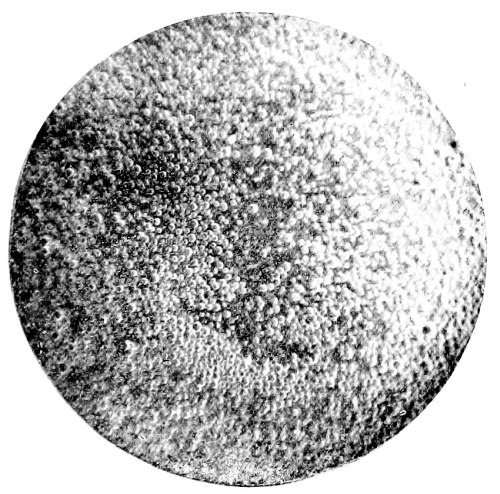
Fig. 26.—Photo-micrograph
of human milk, × 250.
(R. J. M. Buchanan.)
3. By Falls.—It is beyond doubt possible for a child to be born
so precipitately as to fall on the floor and be severely injured, and
that even fatally. In cases of alleged precipitate birth, to account
for injuries found on the child, the following points should be
remembered, and will assist in forming a diagnosis:
(a) Rupture of the umbilical cord. In all cases it would be
advisable to measure the length of the cord, and then the distance of
the vulva from the ground, allowing of course for the woman not being
quite erect at the time of delivery owing to a separation of the legs.
A disproportion between the two measurements may or may not account for
the rupture of the cord. The following measurements may be taken: usual
length of cord, eighteen to twenty inches; distance of vulva from the
ground, twenty-six inches, but allowing for stooping, two-thirds of
the above. To the length of the cord must be added about nine inches,
the distance from the navel to the top of the head of the child. Thus,
a fall of about thirty inches will put no strain on the cord. A case
is on record of a rupture of the cord taking place while the woman
was in a recumbent position, but in that case the labour was
precipitate, and the cord very short and small.
(b) Placenta not detached from the child.
(c) Fracture of the parietal bones; the fracture radiating into
the frontal and squamous portion of the temporal bone. In experiments
on twenty-five children dropped from a height of thirty inches, one
parietal bone was found fractured in sixteen of the cases; both
parietals, in six cases. The fractures in most cases occurred about the
parietal protuberances. It must be remembered that the children were
dead, and that it is easier to fracture the skull of a live infant than
that of a dead one.
(d) Imperfect ossification of the bones of the skull.
(e) Absence of other injuries.
(a) The fact of the umbilical cord being divided by some sharp
instrument and not torn. A caution must be here inserted, for Taylor
mentions a case where rupture of the cord occurred in such a manner
that it could not be decided whether it had been intentionally cut or
torn.
(b) Extensive fracture of one or more of the bones of the
cranium.
(c) Fracture and dislocation of the neck.
(d) Presence of incised wounds, and other evidence of violence.
N.B.—In all doubtful cases, a
guarded opinion should be given, stating simply that the dissection
does not reveal anything contrary to the statements offered as to the
cause of death.
III. Congenital Disease in one or more of the Fœtal
Organs.—In all cases the presence of congenital disease must be
sought for.
IV. Neglect or Exposure, constituting “Infanticide by
Omission.”—Under this head may be mentioned the following:
(a) Neglecting to place the child in such a position that it may
breathe freely.
(b) Neglecting to protect the child from extremes of cold or
heat.
(c) Neglecting to feed it with the food appropriate to its age.
(See Signs of Death from Starvation, pp. 132 et seq.)
(d) Neglecting to tie the umbilical cord.
To give answers to these questions will in many cases be impossible,
and each must be decided by such circumstances as present themselves
in each individual case. For instance, if the body be found stiff,
blanched, naked or nearly so, lying on the ground, the vessels of
the interior gorged with blood, whilst the superficial vessels are
contracted and can be seen only with difficulty; at the same time,
the hydrostatic test shows that respiration has taken place, and in
the absence of all external or internal causes—the probability is in
favour of death by cold. In close relation with the present subject is
the question—
Has the Infant bled to Death?—Fatal hæmorrhage from the cord
may occur, especially if it be divided by a sharp instrument close to
the body of the child. As a rule, hæmorrhage does not occur from a
ruptured cord. (The signs of death from hæmorrhage have been noticed, page 81.)
How Long did the Child survive its Birth?—The answer to this
question is by no means easy, and the data on which a decision can be
based are not very reliable. The presence or absence of the vernix
caseosa should be noticed. In still-born children the closed
eyelids, when raised, do not remain open; in the live-born, on the
other hand, the eyes remain half open even after repeated attempts to
close them. Another guide to the determination of the length of time
the child survived its birth may be found in the absence or presence
of the meconium in the intestines. The meconium—so-called from its
resemblance to inspissated poppy juice—is found in the large intestine
as a dark-greenish pasty mass, more or less filling that portion of
the bowel. In the upper portions of the intestines it varies from a
light-yellowish or greyish to a greenish-brown colour, till in the
large intestine it assumes the colour and consistence above mentioned.
It is generally discharged by the infant in from four or five to
forty-eight hours after birth. In breech presentations it may be passed
during the process of delivery, although the child be still-born; but
its entire absence from the intestines is presumptive of existence for
some days after birth.
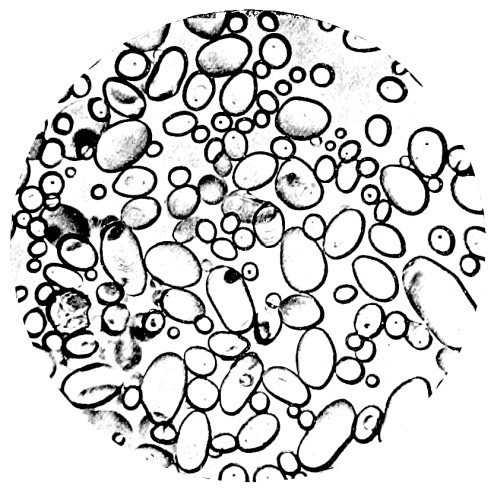
Fig. 27.—Photo-micrograph
of
starch granules, × 250 (potato).
(R. J. M. Buchanan.)
The following are some of the points to be considered in forming a
diagnosis: (1) Changes in the skin. (2) Changes in the umbilical cord.
(3) Changes in the circulatory system.
Table showing how long a
New-born Child has Lived.
| |
At Birth,
but before
Respiration. |
From
1 to 24 Hours. |
From
2 to 3 Days. |
| Skin. |
As a rule, very red, soft, |
The skin is firmer and rosy, |
The skin assumes a yellowish |
| smooth, and covered with |
and the vernix caseosa not |
tint. Sometimes on the |
| a whitish, fatty, sticky coat |
so white. |
abdomen and base of the chest, |
| (vernix caseosa). |
|
the epidermis shows signs of |
| |
|
approaching exfoliation |
| Head. |
Presence of caput |
|
The caput succedaneum has |
| succedaneum. |
|
disappeared, leaving only a |
| |
|
slight ecchymosis. |
| Umbilical |
Is fresh, firm, bluish, roundish, |
The umbilical cord is |
The cord is brown from its |
| Cord. |
more or less spongy. The |
withering, and the calibre of |
extremity to its base, is less |
| |
ductus arteriosusis is four to six |
the arteries is beginning to |
moist, and already shows signs of |
| long. Its lines diameter |
diminish from the thickening |
mummification. The vessels are not |
| is double that of each of |
of their walls. |
easily made out, being flattened, |
| the branches of the pulmonory |
|
and contain a fine clot more or |
| artery. |
|
less contracted. |
| The |
The large intestine contains |
The meconium is discharged, |
The green mucus which covered the |
| Large |
meconium. |
but the large intestine still |
intestine is detached in places. |
| Intestine. |
|
contains thick greenish mucus. |
|
| |
From
3 to 4 Days. |
From
4 to 6 Days. |
From
6 to 12 Days. |
| Skin. |
The icteric colour of the |
The exfoliation of the skin |
The exfoliation of the skin has |
| skin is more marked. Exfoliation |
extends from the groins to the |
extended to the extremities. |
| of the skin has begun over |
axillæ and between he shoulders. |
|
| belly and base of the chest. |
The epidermis is detached in |
|
| |
strips, in scales, or as a firm |
|
| |
powder. |
|
| Head. |
|
|
|
| Umbilical |
The cord is of a brownish-red |
The cord is detached from |
If the cord was thin, cicatrisation |
| Cord. |
colour, flattened and distorted. |
the abdomen, the membranes first, |
is complete before the |
| The vessels are twisted like a |
then the arteries, and last, the |
tenth day. The arteries, the vein, |
| gimlet. The arteries are in great |
vein. The arteries and the vein are |
and other fœtal canals are |
| part obliterated, the calibre of the |
quite obliterated. The ductus |
obliterated. If the cord was thick, |
| vein and ductus venosus is |
arteriosus and foramen ovale |
a sero-purulent discharge may |
| diminished, but they and the |
diminished in size are still open. |
continue to the twenty-fifth or |
| foramen ovale are still open. The |
|
thirtieth day. |
| circumference of the ring is injected |
|
|
| and begins to show signs of |
|
|
| inflammation, with the discharge |
|
|
| of a sero-purulent fluid at the |
|
|
| base of the cord. |
|
|
| The |
|
|
|
| Large |
The green mucus almost absent. |
The green mucus quite absent. |
|
| Intestine. |
|
|
|
1. Changes in the Skin.—Exfoliation of the cuticle. The time
at which this occurs is so variable as to be of little value in a
medico-legal inquiry.
2. Changes in the Umbilical Cord.—Mummification of the cord is
not of the slightest value as a proof of extra-uterine life; but the
separation of the cord which occurs between the fourth and seventh day,
especially when cicatrisation has taken place, is a sure sign that the
child must have lived four or five days at least. Two other appearances
of some value may also be noted, namely:
(a) In fresh bodies, the appearance of a bright red ring about a
line in breadth, which surrounds the insertion of the cord, and which
is formed within the uterus.
(b) A similar red ring, about two lines broad, around the
insertion of the cord, accompanied with “thickening, inflammatory
swelling of the portion of the skin affected, and slight purulent
secretion from the umbilical ring itself.” This latter condition
Casper considers as affording “irrefragable proof of the
extra-uterine life of the child.”
3. Changes in the Circulatory System.
(a) Ductus Arteriosus.—Arterial duct. A contracted
condition of this duct is of no value as a proof that a child has
survived its birth; for the duct is liable to become contracted, and
even obliterated, before the birth of the child.
(b) Ductus Venosus.—Nothing certain is known as to
the exact time when this duct closes; the condition of the vessel is,
therefore, of no assistance in determining the possibility of the
child having survived its birth. The duct has been found closed in a
still-born child; and in one child, which lived for a quarter of an
hour, both the ductus arteriosus and the foramen ovale
were found closed. Cases are also on record in which these fœtal
channels were found open after thirty days of extra-uterine life.
(c) Foramen Ovale.—What has been said of the preceding
may be said with regard to the foramen ovale.
N.B.—To sum up, therefore, in the fewest
words, any attempt at forming an opinion on the docimasia
circulationis may result in a fatal error on the part of the
medical witness, as it is impossible to determine with any accuracy
by days the period of their closure. As a general statement, however,
the following, according to Bernt and Orfila, is the order in which
obliteration of the fœtal vessels takes place: (1) The umbilical
arteries. (2) Ductus venosus. (3) Ductus arteriosus. (4) Foramen ovale.
Synopsis
1. Infanticide is not regarded as a specific crime.
2. To be tried by the same rules of evidence as apply to murder.
3. The law presumes that every child is born dead, till proof to the
contrary is given.
4. Onus of proving live birth devolves on the prosecution.
5. The body need not be found in order to obtain conviction of the
suspected party, if not of infanticide, at least of concealment of birth.
The medical evidence, however, depends on the body being
found and examined.
The medical witness may be examined on one or more of the
following points:
- (1) The recent delivery of the accused.
- (For “Signs of Recent Delivery,” see page 155 et seq.)
- (2) Maturity of the child found.
- (3) Was the child still-born or live-born?
- (4) Cause of death.
- (5) Lastly, as to the mental condition of the mother.
- Puerperal mania, &c.
6. In absence of proof of infanticide, the woman, in England,
may be tried for concealment of birth, that is, disposing secretly of
the body, whether the child be born dead or alive.
7. In Scotland, a woman may be tried for concealment of pregnancy
when the child is dead or missing, if she do not call for or
make use of help or assistance in the birth; but the case is quashed,
if the child be shown alive by the mother to others.
CHAPTER XV INHERITANCE—LEGITIMACY—IMPOTENCE AND STERILITY —SURVIVORSHIP—MALPRAXIS AND NEGLECT OF DUTY —FEIGNED DISEASES—EXEMPTION FROM PUBLIC DUTIES—WILLS — INHERITANCE — LEGITIMACY — IMPOTENCE AND STERILITY — SURVIVORSHIP — MALPRAXIS AND NEGLECT OF DUTY — FEIGNED DISEASES—MALINGERING — EXEMPTION FROM PUBLIC DUTIES — WILLS
This subject will be discussed under the following heads: (1) The child
must be born alive. (2) The child must be born during the lifetime
of the mother. (3) The child must be born capable of inheriting. (4)
Tenancy by courtesy, and possessio patris.
1. The Child must be born alive.—This has been discussed in the
preceding section.
2. The Child must be born during the lifetime of the
Mother.—Death terminates the marriage contract. Would a child born
after the death of the mother, and therefore not during marriage, be
entitled to inherit?
On this point Lord Coke writes:—“If a woman, seised of lands in fee,
taketh husband, and by him is bigge with childe, and in her travell
dyeth, and the childe is ripped out of her body alive, yet shall he
not be tenant by the curtesie, because the child was not born during
the marriage nor in the life of the wife; but in the meantime her land
descended.”
It appears from this that the husband is not entitled to the life-rent.
3. The Child must be born capable of inheriting.—Monsters
cannot inherit according to law. Blackstone says: “A monster which
hath not the shape of mankind hath no inheritable blood,” and cannot,
therefore, inherit; but, “if it hath human shape, it may be an heir.”
Buffon classes monsters under three divisions: (a) Monsters by
excess of organs. (b) Monsters by defect of organs. (c)
Monsters by alteration or wrong position of parts.
A hermaphrodite inherits, or not, property according to the prevailing
sex.
4. Tenancy by Courtesy and Possessio Patris.—“When a man
marries a woman seised of an estate of inheritance, and has by her
issue born alive, which was capable of inheriting her estate; in
this case he shall, on the death of his wife, hold the lands for his
life as tenant by the courtesy of England.”
There is yet another case bearing closely on this subject, known in
law as possessio fratris. On this subject Mr. Amos writes: “In
the event of a man twice married dying, and leaving a daughter by each
marriage, his estate would be equally shared by the daughters of the two
marriages; but if we suppose that there is also a son by the second
marriage, born in a doubtful state, the legal effect of his momentarily
surviving birth would be to disinherit the daughter of the first
marriage entirely, and transfer the whole of the estate to the daughter
of the second marriage, she being sister to the male heir, while the
daughter of the first marriage is only half-blood.”
In both of these cases proof of live birth, as before mentioned, is of
the slenderest kind.
A fœtus in the womb (en ventre sa mère) may—(a) Have
a legacy or estate made over to it. (b) A guardian assigned
to it. That these conditions may take effect, it must be born alive.
(c) Be an executor. To exercise this post partum function,
the child must in England have attained the age of twenty-one.
Every child born in wedlock is presumed to have the husband of the
woman as its father; but this presumption may be denied for the
following reasons:
1. Absence or death of the reputed father.
2. Impotence or disease in the reputed father, preventing
matrimonial intercourse.
3. In the case of a premature delivery in a newly-married woman.
4. Want of access.
5. The paternity of the child may be disputed when the woman
marries immediately after the death of her husband.
In Scotland, a child is held to be legitimate if born ten lunar months
after the death or absence of its alleged father; and the absence of
the supposed father must continue till within six lunar months of the
birth of the child, to prove its illegitimacy.
In the same country, a child born before marriage is rendered
legitimate by the subsequent marriage of the parents. This is not the
case in England.
A child born during wedlock is legitimate, although the date of
conception may be before marriage. A child born after the death of its
mother is held to be legitimate. A child may, as Taylor remarks, be
conceived before marriage, and born after the death of the mother, and
yet be legitimate, though neither conceived nor born in wedlock.
The Code Napoleon prohibits the contraction of a second marriage until
ten months after the death of the first husband; and this is also the
case in Germany. The Anglo-Saxon law prohibits remarriage for twelve
months. In Britain no time is fixed by law.
Duration of Pregnancy.—The consideration of this subject is of
importance in its relation to the legitimacy of a child.
The natural period of human gestation is usually stated at forty weeks,
ten lunar or nine calendar months, or 280 days. In Prussia, the period
is extended to 302 days, and in the Code Napoleon to 300; in Scotland,
ten months is held as the limit.
The duration of human gestation is subject to considerable variation; in
some females it is always protracted; in others, always premature.
Several modes of calculation are adopted by women:
1. Ascertained date of impregnation from one
coïtus.
2. Supposed sensations of female at time of
conception.
3. Suppression of the catamenia. This is open to
the objection, that causes other than that of impregnation may arrest
them. The catamenia may be stopped by cold or other causes for two or
three months, and then, before their return, pregnancy may occur, thus
upsetting all calculations. The usual mode of calculation is from two
weeks after the last menstruation, and the period so fixed is corrected
by the time at which quickening occurs.
4. Period of quickening. (a) Quickening
supposed when pregnancy is absent. (b) Pregnancy without
quickening. (c) Variations in the time of its occurrence.
Whichever may be the mode of calculation adopted, it may be stated
that, as a rule, the period of human gestation is from 275 to 280 days,
and that cases of alleged pregnancy beyond 300 days must be received
with considerable caution.
The pregnancy of the Countess of Gloucester was held, in the reign of
Edward II., to be legitimate, although her husband had been dead one
year and seven months at the date of the application.
Premature Births.—The question may be asked, At what period
of gestation may a child be born viable—that is, capable of living
and attaining to maturity? Seven months, or 210 days, is considered as
the limit; but cases have been recorded of children born at six months
being reared. The Roman law admitted the legitimacy of seven-months’
children. (For the Signs of Immaturity, see “Table of the Development
of the Embryo,” pp. 35, 36.)
Superfœtation.—The term is used to imply the conception of
a second embryo in a woman already pregnant, and the birth of two
children at one time, differing considerably in their maturity, or of
two births, a considerable period of time elapsing between each. The
possibility of this occurrence has been doubted.
Churchill, in his work on Midwifery, writing on this subject says:
“In conclusion, I would say—(1) That the theory of superfœtation
is unnecessary to explain the birth of a mature fœtus and a
blighted ovum, of a mature and immature fœtus born together or within
a month of each other, or of fœtuses of different colours, as they may
reasonably be supposed to be the product of one act of generation, or
of two nearly contemporaneous. (2) That, in cases of double uterus,
it is possible for a second conception to take place, and—judging
from the subsequent birth of the second child in the only case on
record—at a later period than the first. (3) That, in the remaining
cases, where one mature child succeeded the birth of another after a
considerable interval, we have no proof of a double uterus in any,
and positive proof that in one case it was single; and that to the
explanation of these cases no theory as yet advanced is adequate, that
of superfœtation being opposed by physical difficulties which are
unsurmountable in the present state of our knowledge.”
The late Dr. Matthews Duncan has, however, shown that the mouth of the
womb is not completely closed by conception, and the communication
between the vagina and ovary is not destroyed for some months after
impregnation, and that there is no impediment to the ascent of the
spermatozoa. Galabin[16]
records an instance of extra-uterine and uterine pregnancy occurring at
the same time, the extra-uterine fœtus being advanced in development as
compared with that in the uterus, and regards the condition as one of
superfœtation.
The late Dr. Milne, while admitting this form of pregnancy as possible,
though very rare, remarks: “This variety we should not think due so
much to mechanical hindrances as to the absence of proper ovules. It
would imply extraordinary vigour were perfect ovulation to be achieved
for any length of time after impregnation.”
Evidence in relation to the above subjects may be required in actions
for nullity of marriage, divorce, legitimacy, inheritance, pregnancy,
and criminal assault.
Impotence.—By impotence is meant the incapacity for sexual
intercourse, and applies both to the male and female; but the term is
more especially used in reference to the former.
Sterility.—Sterility denotes the incapacity for procreation
of children; is also applicable to both sexes, but more usually in
reference to the female. A person may be impotent without being
sterile, although the former is usually regarded as implying the
latter. On the other hand, a person may be sterile without being
impotent, the former not necessarily denoting the latter. In reference
to nullity of marriage, if natural sexual relations are not and cannot
be consummated, the marriage will be declared null and void, provided
that such inability of consummation was unknown to the person bringing
the action for nullity before marriage. Impotence is sufficient ground
for bringing an action for nullity, provided it was present at the date
of the marriage, that it is irremediable, and that the person bringing
the action was not informed of it previously. Should, however, the
marriage have been consummated and impotence develop later, there will
be no grounds for such an action.
Impotence and Sterility in the Male.—This may arise from some
organic defect of the organs or functional disorder.
In reference to the former there are certain abnormalities of the
male organs which have to be considered. Monorchids, men in whom one
testis is absent from the scrotum, are not necessarily impotent or
sterile; nor are cryptorchids, where both testes are undescended. In
many of these cases spermatozoa are absent from the seminal fluid with
consequent sterility; on the other hand, procreation has taken place,
proving that cryptorchids are not necessarily sterile.
Absence of the penis may be the result of want of development, injury,
disease, or operation. The penis may be present but attached in its
whole length to the scrotum; this may be remedied by operation.
Epispadias, so often associated with ectopion vesicæ, as a rule renders
an individual impotent and sterile. On the other hand, hypospadias
does not necessarily bar procreation; it will depend largely upon the
position of the urethral opening, and the possibility of its being
remedied by operation.
Removal or destruction of both testes renders a man sterile eventually,
but not necessarily impotent.
Functional disorder due to disease may give rise to impotence,
although the organs may remain anatomically perfect. Diseases such as
diabetes and influenza, neurasthenia, tabes dorsalis, myelitis, mumps,
and orchitis, and injuries to the head may be causative factors in
impotence.
The capacity for sexual intercourse is influenced to a varying degree
by age. Sexual capacity is regarded as coincident with puberty. In
judging the sexual capacity of a youth, age is of less moment than the
degree of physical development. I have seen a male child of five years
of age with as complete development of the sexual organs as an adult,
and with a deep voice. At the other extreme of life it is impossible to
lay down any definite limit to sexual capacity. Although it is regarded
as diminishing with age, yet there are many instances of procreative
power in men of an advanced age.
The principal points for consideration in reference to impotence and
sterility in the male are: (a) Does the condition prevent the
secretion of semen? (b) Does it prevent the conveyance of semen
to the vagina?
Impotence and Sterility in the Female.—As in the male, these
may be associated with organic defect or functional disorder. The
external organs may be absent, with or without the internal. The vagina
may be wanting through lack of development, or it may be obstructed by
mal-development or the result of disease. Again, the external organs
may be present, but the internal absent in whole or part. The hymen
may be imperforate, or unusually tough. Diseases of the uterus often
give rise to sterility. Vaginismus, in which attempts at coïtus cause
painful spasm, may prevent intercourse. In reference to functional
disorders are to be noted extreme debility, constant leucorrhœa,
dysmenorrhœa, menorrhagia, and amenorrhœa, all of which may be
associated with or causative factors in sterility. Emotional psychical
conditions may prevent sexual intercourse in women. General diseases,
however, do not necessarily prevent intercourse, as the woman may
remain a passive agent, neither is bodily deformity always a barrier to
the act.
The advent of sexual capacity in women is regarded as coincident with
the onset of the menses, about fourteen years of age, but pregnancy has
been known to take place prior to the first menstrual period. The age
at which the menses first appear varies in no small degree. It has been
known to occur during the first year of life, and pregnancy has been
known to occur as early as the eighth year. The menopause in women is
regarded as coincident with loss of procreative power. Women as a rule
cease to menstruate at forty-five years of age, but in not a few the
function persists until fifty, in exceptional cases to a more advanced
age. It is rare for a woman to bear children after the menopause, but
exceptions have been known to take place.
In the case of a husband seeking a nullity of marriage on the grounds
of impotence or sterility in his wife, the question at issue is not
whether she can bear children, but can she permit sexual intercourse?
Many conditions which cause sterility in the woman need not render her
impotent, and unless the latter obtains a nullity of marriage would not
be allowed. Further, the conditions which render the woman impotent
must be permanent and irremediable.
The question of survivorship is not infrequently raised when a mother
and her new-born infant are found dead, or where several persons
have perished by a common accident. In the first case the mother is
generally presumed to have lived longest; and this presumption may be
borne out by the fact of the delivery being premature, or if there
be considerable disproportion between the size of the child and the
maternal passages. As pointed out before, important civil rights may
depend upon the question as to the live birth of an infant; and the
husband‘s rights to be tenant to the courtesy will, of course,
depend upon the view taken as to the probable survivorship or not of
the child.
With regard to the second question, much will depend upon the relative
ages and strength of the individuals. Sex will also have to be taken
into consideration. In the case of one or more persons found dead,
either from wounds or other causes, the fact of some being warm and
others cold, the presence of the rigor mortis in one and absence
in the other, will point to the probable survivorship. The severity
of the wounds and injuries to large arterial trunks must also be
considered. (See test case, Underwood v. Wing, 1 Jur. N.S. 169.)
In this case a man, his wife, and three children were washed overboard
and drowned, one child, however, being seen alive a few minutes after
the others were submerged. The question at issue was, Did the husband
survive the wife, or the wife the husband? and on this Wightman, J.,
in summing up, said: “We may guess, or imagine, or fancy, but the law
of England requires evidence, and we are of opinion that there is no
evidence upon which we can give a judicial opinion that either survived
the other; in fact, we think it unlikely that both did die at the same
moment of time, but there is no evidence to show who was the survivor.”
Verdict for the plaintiff.
A medical man is liable to a civil action for damages who, by a
culpable want of care and attention, or by the absence of a competent
degree of skill and knowledge, causes injury to a patient. And it is not
necessary that the patient should have employed or was to have paid
him, provided always that there be no negligence or carelessness on
the part of the patient. Lord Chief-Justice Tindall remarks: “Every
person who enters into a learned profession undertakes to bring to
the exercise of it a reasonably fair and competent degree of skill.”
It has also been decided that if the defendant acted honestly, and
used his best skill to cure, and it does not appear that he thrust
himself in the place of a competent person, it makes no difference
whether he was at the time a regular physician or surgeon or not (R.
v. Van Butchell; R. v. Williamson, &c.). A surgeon does
not undertake to perform a cure, nor does he profess to bring the
highest professional skill into the consideration of the case; but he
does undertake to bring a fair and reasonable amount. The degree of
skill required by law is good common sense, or such knowledge as the
operator had, joined with a good purpose to help the afflicted, even if
such interference rendered the patient a cripple for life. “It would be
dreadful,” says Hullock, B., “if every time an operation was performed
an individual was liable to have his practice questioned.” “So, if a
physician or surgeon give his patient a potion or plaster to cure him,
which, contrary to expectation, kills him, this also is neither murder
nor manslaughter, but misadventure.” A medical man is only liable for
gross negligence, not for every slip he may make; but the distinction
between criminal and actionable negligence cannot be defined; but it
appears that the negligence must be so gross as to come under the legal
meaning of the word “felonious.” (See p. 82.)
Human ingenuity is not wanting among those who, for private ends,
pretend to be suffering from disease. The soldier or sailor, anxious to
escape the dangers of active service, finds a ready means of evading
his duties by shamming; the prisoner, in order to lighten the burden of
his punishment, does the same. A man declares himself impotent to save
the expense of keeping an alleged bastard child, or to avoid punishment
for rape. Beggars appeal to the public by feigning some painful
disease, and incautious benevolence becomes the dupe of the clever
impostor.
Any attempt at classification is here out of the question, nor does
it appear necessary to give a long list of diseases which have been
feigned, or the means that have been employed by artists in deception.
To give some general hints for guidance is all that will be attempted
here, leaving matters of detail to the acumen of the medical examiner,
who, if in active practice, will have many opportunities of testing his
powers of discernment:
1. Never be satisfied with one visit, but pay a
second at a short interval, and unannounced.
2. Have the patient carefully watched in the
interval of your visits.
3. Examine each organ of the body separately,
carefully comparing the state of each with the symptoms described by
the patient.
4. Note the discrepancies in the statements of
the patient as to his symptoms and their known occurrence in real
disease.
5. Sometimes ask questions the reverse of his
statements, or take his statements for granted, when in all probability
he will contradict himself.
6. Remove all bandages and other dressings.
7. The administration of sham physic, or the
suggestion of some heroic mode of treatment; the application of the
actual cautery may have a beneficial effect.
8. Pay little attention to the reports of
bystanders, or of the culprit‘s fellow-prisoners.
9. Anæsthetics may be employed, if necessary, for
the purpose of detection.
10. The motives of deception should be inquired
into, and borne in mind, in the examination of all cases.
The existence of certain diseases may be claimed as a bar to active
service, both in a civil and in a military capacity; and the opinion
of a medical man may be required as to the fitness or unfitness of the
individual for the service from which he claims exemption. In giving
certificates of this nature, the medical practitioner cannot be too
guarded in wording them; and each case must be treated on its merits,
so that strict justice may be done.
Among the diseases which may incapacitate a man for active employment
may be mentioned—syphilis; hernia; phthisis; affections of the eyes,
attended with dimness of vision, or colour blindness; varicose veins;
and some other diseases.
Although a medical man, as a rule, should refuse to draw up a will,
still there are occasions when his doing so may save much litigation
and expense. The following directions may therefore be of use:
1. Let the wishes of the testator be expressed in the plainest and
simplest words, avoiding all expressions that seem to admit of another
meaning than the one intended.
2. All alterations in the will should be initialled.
3. Do not scratch out a word with a knife, and no alteration must be
made after the will is executed.
4. Two witnesses are necessary, who must both be present and sign the
following attestation at the end of the will, or on each sheet if more
than one sheet of paper be used: “Signed by the testator (or testatrix,
as the case may be) in the joint presence of us, who thereupon signed
our names in his (or her) and each other‘s presence.”
5. Add address of witnesses.
6. A clause appointing an executor should be inserted thus: “And I
appoint J. B. executor of this my will.”
7. Begin, “This is the last will of me, W. B. of S.”; and end, “and I
revoke all former wills and codicils.”
Dated this ___________ day of
______________ one thousand, &c.
CHAPTER XVI MENTAL UNSOUNDNESS — DEFECTIVE DEVELOPMENT OF THE FACULTIES — CARE OF MENTALLY DEFECTIVE PERSONS — GENERAL SYMPTOMS OF INSANITY — MANIA — MORAL MANIA — MELANCHOLIA — DEMENTIA OR FATUITY — DELIRIUM TREMENS. SIMPLE DELIRIUM. SOMNAMBULISM. SLEEP-DRUNKENNESS. — THE RESTRAINT OF THE INSANE AND DIRECTIONS FOR SIGNING MEDICAL CERTIFICATES. — LIABILITIES OF PERSONS SIGNING LUNACY CERTIFICATES — LIABILITIES OF PERSONS RECEIVING INSANE PATIENTS — TESTAMENTARY CAPACITY — RESTRAINT OF HABITUAL DRUNKARDS
In the whole range of medical jurisprudence there is no subject more
interesting, more difficult, or more important than the diagnosis
of insanity, and its relation to the criminal responsibility of
individuals. It is impossible, in the short space at our disposal, to
do more than to offer a few remarks which may assist the student in the
elucidation of some of the most important cases which may engage his attention.
Legal Definitions.—Three forms of mental disorder are
recognised in law:
1. A nativitate, vel dementia
naturalis—idiocy or imbecility.
2. Dementia accidentalis, vel
adventitia—acquired general insanity, either temporary or
permanent, lunacy.
3. Dementia affectata, acquired madness
from intoxication, &c.
(See “Delirium Tremens,” p. 205.)
Under the term lunacy are included the mania, monomania, and dementia
of medical writers. Another term frequently used in legal proceedings,
the meaning of which it is not easy to give, is “non compos
mentis,” unsoundness of mind. According to the late Forbes
Winslow, “unsoundness of mind is not lunacy” in the legal acceptance of
the phrase. This term was first used in a Statute passed in the reign
of Henry VIII., relating to the punishment of treasonable offences, and
is defined by the early law text-books to be strictly one who gaudet
lucidis intervallis—a definition not psychologically exact. The
phrase “unsoundness of mind” was first used by the late Lord Eldon to
designate a state of mind not exactly idiotic, and not lunatic with
delusions, but a condition of intellect occupying a place between the
two extremes, and unfitting the person for the government of himself
and the management of his affairs.
The above definition has been acted upon by other judges—Lyndhurst,
Brougham, &c. As a rule, a medical witness will consult his own
interest in not attempting to define insanity, bearing in mind the
philosophic caution of Polonius, who, when addressing Hamlet‘s mother, says—
- “Your noble son is mad:
- Mad call I it; for, to define true madness,
- What is‘t but to be nothing else but mad?”
To the legal mind, the chief character of insanity is the presence of
delusion
; but this view is far too restricted. It was first
advanced by Erskine in the trial of Hadfield. Before that trial the
doctrine was that every man was responsible for his acts, unless he was
totally deprived of his understanding and memory, and did not know what
he was doing, “no more than an infant, than a brute, or a wild beast”
(R.
v.
Arnold). In the case of Bellingham, the knowledge of
“right” and “wrong” in the abstract was the test of mental unsoundness;
and, as in the opinion of the judge and jury he was held to be capable
of solving this metaphysical problem, Bellingham was duly hanged.
Since the trial and acquittal of MacNaughton on the ground of insanity,
the doctrine of the knowledge of abstract right and wrong has been
changed to a knowledge of right and wrong in relation to the particular
act of which the person is accused, and also at the time of committing
it.
It has also been held that, on the assumption that a person labours
under partial delusion only, and is not in other respects insane, he
must be considered in the same situation as to responsibility as if
the facts, with respect to which the delusion exists, were real. For
example, if, under the influence of delusion, he supposes another
man to be in the act of attempting to take his life, and he kills
that man, as he supposes, in self-defence, he would be exempt from
punishment. If his delusion were that the deceased had inflicted a
serious injury on his character and fortune, and he killed him in
revenge for such supposed injury, he would be liable to punishment.
“Here,” says Maudsley, “is an unhesitating assumption that a man,
having an insane delusion, has the power to think and act in regard to
it reasonably, ... that he is, in fact, bound to be reasonable
in his unreason, sane in his insanity.” Yet this was the doctrine
laid down by the judges in answer to certain questions propounded by
the House of Lords after the acquittal of MacNaughton (see Maudsley‘s
Responsibility in Mental Disease, pp. 88 et seq.).
As laid down by English lawyers, madness absolves from all guilt in
criminal cases. Where the deprivation of the understanding and memory
is total, fixed, and permanent, it excuses all acts; so, likewise,
a man labouring under adventitious insanity is, during the frenzy,
entitled to the same indulgence, in the same degree, as one whose
disorder is fixed and permanent (Beverley‘s Case, Co. 125, Co. Litt.
247, 1 Hale 31). “But the difficulty in these cases is to distinguish
between a total aberration of intellect and a partial or temporary
delusion merely, notwithstanding which the patient may be capable of
discerning right from wrong; in which case he will be guilty in the eye
of the law, and amenable to punishment.”[17]
Lord Hale, who first pointed out the distinction to be drawn between
total and partial insanity, offered the following as the best test he
could suggest: “Such a person, as labouring under melancholy
distempers, hath yet as great understanding as ordinarily a child of
fourteen years hath, is such a person as can be guilty of felony.”
(On this subject, see R. v. Ld. Ferrers, 19 St. Tr. 333; R.
v. Arnold, 16 St. Tr. 764, &c.)
To excuse a man from punishment on the ground of insanity, it
appears that it must be distinctly proved that he was not capable of
distinguishing right from wrong, and that he did not know, at the time
of committing the crime, that the offence was against the laws of
God and nature (R. v. Offord, 5 C. & P. 186).
I shall here quote from Macdonald‘s Criminal Law of Scotland:
“Insanity or idiocy exempts from prosecution. But there must be an
alienation of reason such as misleads the judgment, so that the person
does not know ‘the nature of the quality of the act’ he is doing, or if
he does know it, that he does not know he is doing what is wrong. If
there be this alienation, as connected with the act committed, he is
not liable to punishment, though his conduct may be otherwise rational.
For example, if he kill another when under an insane delusion as to the
conduct and character of the person—e.g. believing that he is
about to murder him, or is an evil spirit,—then it matters not that he
has a general notion of right and wrong. For, in such a case, ‘as well
might he be utterly ignorant of the quality of murder.’ He does the
deed, knowing murder to be wrong, but his delusion makes him believe he
is acting in self-defence, or against a spirit. Nor does it alter the
effect of the fact of insanity at the time, that the person afterwards
recovers.... But the alienation of reason must be substantial. Oddness
or eccentricity, however marked, or even weakness of mind, will not
avail as a defence. Even monomania may be insufficient as a defence,
where the delusion and the crime committed have no connection, or where
the person, though having delusions, was yet aware that what he did was
illegal.”
Mere moral insanity—where the intellectual faculties are sound, and
the person knows what he is doing, and that he is doing wrong, but has
no control over himself, and acts under an uncontrollable impulse—does
not render him irresponsible (R. v. Burton, 3 F. & F. 772). Some
medical writers contend that there are two forms of insanity—moral and
intellectual. The law only recognises the latter, owing probably to
the difficulty of distinguishing between so-called moral insanity and
moral depravity. Taylor says: “Further, until medical men can produce
a clear and well-defined distinction between moral depravity and moral
insanity, such a doctrine, employed as it has been for the exculpation
of persons charged with crime, should be rejected as inadmissible.”
The day may not be far distant when the term “moral depravity” will
be unknown, and future generations, ceasing to believe in absurd
superstitions, will come to look on crime as the result of disease
of the brain, and learn to treat, instead of to punish, the morally
diseased. (For a full discussion of this subject the reader is referred
to the works of Dr. Henry Maudsley.)
The fact of the sanity or insanity of the prisoner at the time the
crime was committed is left to the jury to decide, guided by the
previous and contemporaneous acts of the party; and it has been laid
down by Lord Moncreiff in Scotland, and Lord Westbury in England,
that the mental soundness or unsoundness of any individual is to be
decided by the jury on the ordinary rules of every-day life, and that
on these principles they are as good judges as medical men. The whole
tendency of legal practice, when dealing with the plea of insanity, is
to entirely ignore the medical evidence. On the question of medical
evidence in cases of insanity, Doe J., of New Hampshire, remarks: “At
present, precedents require the jury to be instructed by experts in
new medical theories, and by judges in old medical theories,” and that
in this “the legal profession were invading the province of medicine,
and attempting to install old exploded medical theories in the place
of facts established in the progress of scientific knowledge. If the
tests of insanity are matters of law, the practice of allowing experts
to testify what they are should be discontinued; if they are matters
of fact, the judge should no longer testify without being sworn as a
witness, and showing himself qualified to testify as an expert.”
Lunacy—What Constitutes? (8 and 9 Vict. c. 100, secs. 90 and
114).—Imbecility and loss of mental power, whether arising from
natural decay, or from paralysis, softening of the brain, or other
natural cause, and although unaccompanied with frenzy or delusion of
any kind, constitute unsoundness of mind, amounting to lunacy within
the meaning of 8 and 9 Vict. c. 100 (R. v. Shaw, 1 C.C. 145).
The above is the last definition of lunacy up to 1875; but as the law
on this subject is so constantly changing, the student will find it
best to consult the Law Reports from time to time. (See the
account in the case of R. v. Treadaway, Law Reports. Also
the Lancet, on the same case, vol. i. 1877.)
For some valuable remarks on the subject of the irresponsibility of
madmen, the student is referred to the works of Maudsley, Pritchard,
Ray, Hoffbauer, Georget, and others.
The following suggestions are offered for consideration on this subject:
1. Was the act an isolated event in the life of the culprit? Has it the
appearance of spontaneity, or was it the culminating point of a life
spent in so-called criminal acts?
2. Absence of a motive for the committal of the deed.—The
absence of an apparent motive is no proof of an unsound mind;
the moving principle may be “the conscious impulse to the illegal
gratification of a selfish desire.”
3. The presence or absence of a well-concerted plan of action is
a diagnostic sign of little value.—Casper remarks that “only in
one case can the examination of the systematic planning of the deed
afford any information, and that is when these plans and preparations
themselves evince the stamp of a confused intellect, and betray the
hazy consciousness, the mental darkness, in which the culprit was involved.”
4. A dominant delusion may be so concealed as to be for a time
undiscoverable.—The case of the man who gave no indication of his
madness till he was asked to sign the order for his release, when he
signed Christ, is an example how carefully a delusion may be
concealed even during a most careful examination. Questions directed to
this point showed that he laboured under all the errors which such a
delusion might suggest.
5. It may “easily be conceived that insane persons, whose unreason
affects only one train of thought more or less restricted, yet labour
in other respects under disorders of feeling which influence their
conduct and their actions and behaviour without materially affecting
their judgment: and that many of such deranged persons, who often
conduct themselves tolerably well in a lunatic asylum, and while living
among strangers with whom they have no relations, and against whom
they have no prejudices or imaginary reason of complaint; subjected,
besides, to the rules of the house and to an authority that nobody
attempts to dispute; would, nevertheless, if restored to liberty
and residing in the midst of their families, become insupportable,
irritable at the slightest contradiction, abusive, impatient of the
least remark on their conduct, and liable to be provoked by trifles to
the most dangerous acts of violence. If, under such circumstances, a
lunatic should commit any act of injury or serious damage to another,
would it be just to punish him; because it cannot be made apparent that
the action has any reference to, or connection with, the principal
delusion which is known to cloud his judgment, it being apparent that
his moral faculties have undergone a total morbid perversion?”
6. Insanity with Lucid Intervals.—Haslam, Ray, and others
appear to deny the possibility of lucid intervals; but M. Esquirol,
on the other hand, fully recognises the existence of this form of
insanity. In a legal sense, a temporary cessation of the insanity
constitutes a lucid interval, but the cessation must be complete, and
not merely a remission of the symptoms. The interval must be of some
duration; and when continuous insanity has been proved, the onus of
proving a lucid interval in civil cases rests with the party trying to
support the validity of a deed executed during the alleged interval.
“If you can establish,” says Sir W. Wynne, “that the party afflicted
habitually by a malady of the mind has intermissions, and if there was
an intermission of the disorder at the time of the act, that being
proved is sufficient, and the general habitual insanity will not affect
it, but the effect of it is this—it inverts the order of proof and
presumption; for, until proof of habitual insanity, the presumption
is that the party agent, like all human creatures, was rational; but
when an habitual insanity in the mind of the person who does the act is
established, then the party who would take advantage of the fact of an
interval of reason must prove it.” In civil cases the law recognises
the validity of wills made during lucid intervals, and has even taken
the reasonableness of a will as a proof of a lucid interval.
7. Have measures been taken by the culprit to escape punishment?
The classification of insanity adopted here is that given by Ray, and
is sufficient for all practical purposes:
I
N
S
A
N
I
T
Y. |
Defective
development
of the
faculties. |
Idiocy |
1. Resulting from |
| congenital defect. |
| 2. Resulting from an |
| obstacle to the |
| development of the |
| faculties supervening |
| in infancy. |
| Imbecility |
1. Resulting from |
| congenital defect. |
| 2. Resulting from an |
| obstacle to the |
| development of the |
| faculties supervening |
| in infancy. |
Lesion of
the faculties
subsequent
to their
development. |
Mania |
1. Intellectual— |
| (a) General. |
| (b) Partial. |
| 2. Affective— |
| (a) General. |
| (b) Partial. |
| Dementia |
1. Consecutive to mania, |
| or injuries of |
| the brain. |
| 2. Senile, peculiar to |
| old age. |
Under this heading may be included idiocy, cretinism, imbecility,
feeble-mindedness, and moral imbecility.
Idiocy is congenital, and was defined by Esquirol thus: Idiocy
is not a disease, but a condition in which the intellectual faculties
are never manifested, or have never been developed sufficiently to
enable the idiot to acquire such an amount of knowledge as persons of
his own age, and placed in similar circumstances with himself, are
capable of receiving. Idiocy commences with life, or at an age which
precedes the development of the intellectual and affective faculties,
which are from the first what they are doomed to be during the whole
period of existence. Since the days of Esquirol, much improvement has
been made in the care and treatment of the idiot; and it appears that
he is capable of some, though in most cases slight, mental culture. The
cases in which improvement takes place probably belong to imbecility,
leaving the idiot in the same condition as described by Esquirol.
Cretinism differs from idiocy in being endemic; it is also more
curable, or at least more susceptible of improvement, than the latter.
In the idiot the malady is congenital; the cretin, on the other hand,
may to all appearances be free from disease for a time. “Every cretin
is an idiot, but every idiot is not a cretin; idiocy is the more
comprehensive term, cretinism is a special kind of it.” The enlarged
thyroid gland, high-arched palate, and brown or yellow colour of the
skin, are characteristic of the cretin. Local causes are at work in the
production of cretinism; e.g. defective function of the thyroid gland.
The idiot is usually cunning, mischievous, and dirty in his habits.
The derivation of the word idiot, from the Greek, ίδιώτης— a
private person, or an ill-informed ordinary fellow—is
peculiar. A person suffering from any form of mental unsoundness,
and thereby rendered incapable of taking care of himself or of his
property, was formerly called by English law “an idiot,” and this word
was not infrequently joined with “fatuus” in old writs.
Imbecility.—This is a minor form of idiocy, and may or may
not be congenital. It admits of considerable degrees of intensity.
Imbeciles exhibit mental defection, rendering them incapable of
managing themselves or their affairs, and imbecile children are
incapable of being taught to do so.
Feeble-mindedness is a lesser degree of mental defection than
imbecility. It may exist from birth or an early age. Such persons
require care and control for the protection of themselves and others.
They may be incapacitated from acquiring the knowledge imparted in
ordinary schools.
Moral imbeciles exhibit moral defects which render them vicious
in behaviour, and they often exhibit criminal tendencies, which are not
affected by punishment.
The Mental Deficiency Act of 1913 provides for their care. Such a
person may be either sent to an institution or placed under special
guardianship by the parent or guardian, if an idiot or imbecile;
or by the parent when, though not an idiot or imbecile, the person
affected be under the age of twenty-one years. If in addition to being
a defective, the person is neglected, abandoned, or without means of
support; or cruelly treated, guilty of a criminal offence, or liable to
be sent to an industrial school, or under imprisonment, detained in an
industrial school, inebriate reformatory, or institution for lunatics,
or habitual drunkard within the meaning of the Inebriates Act; or
in whose case proper notice has been given by the Local Education
Authority; or who is in receipt of relief at the time of giving birth
to an illegitimate child, or pregnant of such child.
Certificates required.—In the case of a parent or guardian who
desires to place a mentally defective person under guardianship, two
medical certificates are necessary, one of which must be from a
medical man approved by the Local Authority or Board. If the person be
not an idiot or imbecile, the certificates must be signed by a Judicial
Authority, after such inquiry as he thinks fit. A defective to be dealt
with otherwise than by parent or guardian, is so under an order by a
Judicial Authority on a petition presented under the Act, an
order of a Court if guilty of a criminal offence, or an order
of the Secretary of State if detained in prison, a criminal lunatic
asylum, or reformatory.
The order of a Judicial Authority may be obtained by petition of any
relative or friend, or an officer of the Local Authority authorised
under the Act for the purpose. Two medical certificates must accompany
the petitions, one of which must be signed by a medical man approved
by the Local Authority or Board; or, when a medical examination cannot
be carried out, a certificate to that effect must be presented, and a
statutory declaration made by the petitioner and one other person,
who may be one of the medical certifiers, stating the class to which
the defective belongs. Upon receiving the certificates the Judicial
Authority interviews the defective. When the petition is presented by
a parent or guardian, the Judicial Authority, if satisfied, may issue
an order for the defective to be placed in an institution or appoint
a guardian. If the petitioner be not parent or guardian, consent in
writing of one or other must be obtained, without which the order must
not be made, unless the parent or guardian withhold their consent
unreasonably or are not to be found. If the Judicial Authority be not
satisfied, he may postpone the order, or refuse it.
When the order is made by a Court, the Court must be satisfied, on
medical evidence, that the person is a defective.
Two medical certificates are necessary when the Secretary of State
makes an order.
The order remains in force for a year, may be renewed for a second
year, and then for periods of five years.
The onset of insanity may be gradual or sudden. More commonly the onset
is gradual, and manifested by alterations of emotion and conduct, which
may for a considerable period precede any impairment of intelligence.
Periods of depression may alternate with periods of excitement.
Irritability and instability of temper manifest themselves, and lead
relatives and friends to become suspicious of the change that is the
herald of serious mental impairment. Lack of interest in environment,
business, or the usual pleasurable pursuits, also a tendency to
personal seclusion manifest themselves, and changeability of the
affections, more often to those nearly related, are not uncommon.
Sooner or later the capacity to conduct business and allied pursuits
becomes enfeebled, and the power of judgment lessened; depression
begets apprehension and a dread of impending ruin in this world or
in the world to come. Marked indecision and vacillation of action is
quite common. Delusions follow, mostly of persecution, in the form of
attempts to cause ruin or poisoning. Delusions associated with the
special senses are common, particularly of hearing, supposed voices
urging the committal of certain actions, or expressive of derision; of
vision, by which objects are seen which are non-existent; of taste,
imparting the idea of poisoning; of touch and pain, invoking peculiar
sensations; of smell, conveying the idea that food, the body, &c.,
exhale disgusting odours.
Associated with the onset of insanity, and remaining permanently,
are three special distortions of perceptions—viz. illusions,
hallucinations, and delusions. So long as the first two
can be reasoned upon and rejected, judgment remains. At one or other
time the afflicted person becomes so affected by them that they become
realities, and are accepted as true and existent; then the judgment is
perverted, and the person is said to suffer from a delusion.
Illusions.—An illusion is a false perception, a perversion of
the senses, a mockery, false show, counterfeit appearance. The false
perception is, however, invoked by some external appearance.
Hallucinations.—Hallucinations are perverted sensations and
perceptions, for the production of which no external impulse is
present. The person may complain of seeing horrible reptiles around,
which are not present. So long as the reasoning faculties are capable
of dispelling the alleged reality of the hallucination and rejecting
it, it remains but an hallucination.
If, however, it becomes accepted as a reality and the person becomes
obsessed thereby, it becomes a delusion.
Delusions.—A delusion is a chimerical thought, an affection
of the mind. It implies a disordered intellect. Delusions generally
concern the insane person, his power, soul, &c. A delusion is a
perverted idea of the mind in which there is belief in non-existent
things or occurrences. Delusions may be based upon previous
hallucinations, or arise out of erroneous conceptions.
Mania is the result of a morbid condition of the brain, and to
express which “the term raving madness may be used with propriety,
as an English synonym for mania. All maniacs display this symptom
occasionally, if not constantly, and in greater or less degree.” Like
other diseases, mania observes the same pathological laws. There is a
period of incubation, during which the true state of the patient is in
most cases misunderstood, or not appreciated. Mental exaltation may
exist from the first onset of the disease, or the attack may be ushered
in by a stage of gloom or despondency. The general health shows signs
of impairment, the liver becoming sluggish, and the bowels confined or
relaxed. In some cases a febrile condition of the system is among the
premonitory symptoms of an attack of mania. The physical health is not
usually much affected during the paroxysm.
Dr. Conolly remarks that “even acute mania is not always accompanied
by the ordinary external signs of excitement. It would seem as if we
had yet to learn the real symptoms of cerebral irritation. Certainly,
in recent cases of mania—cases which have lasted more than six weeks,
and in young persons in whom I have seen the maniacal attack pass
into dementia—I have known the most acute paroxysms of mania exist,
rapid and violent talking, continual motion, inability to recognise
surrounding persons and objects, a disposition to tear and destroy
clothes and bedding, without any heat of the scalp or of the surface,
without either flushing or paleness of the face, with a clean and
natural appearance of the tongue, and a pulse no more than eighty or
eighty-five.”
This may occur in some cases, but in the majority there is always some
amount of physical derangement; the system, however, gradually becoming
tolerant of the undue excitement to which it is subjected.
Following the classification adopted, Intellectual Mania will now
be briefly considered under its two divisions—General and
Partial.
General Intellectual Mania.—By many medical writers general
intellectual mania is divided into mania and melancholia. The mind
in the former type of the disease is involved in the most chaotic
confusion possible, and there is also considerable bodily derangement.
The moral faculties become more or less affected, and the patient‘s
social and domestic relations are greatly altered. At one time he
is subject to violent fits of immoderate laughter, at another he is
gloomy and taciturn; sometimes quiet and tractable, at others wild
and excited, necessitating close confinement. He is haunted by wild
delusions, which at times take entire possession of him, and under
the influence of which he acts in the most extraordinary manner. In
the latter—melancholia, or mania with depression—delusion may be
absent, or, rather, for a time undetectable. The sufferer is gloomy,
and troubled with unhappy thoughts, which sometimes lead him to
self-destruction. He is sleepless, and rejects his food as unnecessary.
He may be aroused for a short time by questions addressed to him,
his replies to which are usually given correctly, most frequently in
monosyllables; but the moment his questioner leaves him he relapses
into his former gloomy state.
Partial Intellectual Mania.—The term monomania, first
suggested by Esquirol, is now generally given to this variety of
insanity. The patient, in the simplest form of this disorder, becomes
possessed of some single notion, which is alike contradictory to common
sense and to his own experience. Thus, he may fancy himself made of
glass; and influenced by this idea, he walks with care, and in dread
of being broken by contact with other bodies. In the case of an inmate
at the City of London Asylum, the presence of a weasel in the stomach
was stated by one woman. Esquirol mentions the case of a woman with
hydatids in her womb, who believed that she was pregnant with the
devil. Most of these strange fancies appear to be dependent on errors
of sensation.
Monomaniacs are ready enough to declare their predominant idea; yet
at times, and that without the occurrence of a lucid interval, they
will as carefully conceal it. “In the simplest form of monomania, the
understanding appears to be, and probably is, perfectly sound on all
subjects but those connected with the hallucination. When, however, the
disorder is more complicated, involving a longer train of morbid ideas,
we have the high authority of Georget for believing that, though the
patient may reason on many subjects unconnected with the particular
illusion on which the insanity turns, the understanding is more
extensively deranged than is generally suspected.”
Pinel first drew attention to this form of madness. Pritchard defines
it as “consisting in a morbid perversion of the natural feelings,
affections, inclinations, temper, habits, and moral dispositions,
without any notable lesion of the intellect or knowing and reasoning
faculties, and particularly without any maniacal hallucinations.”
It is divided into—General Moral Mania. Partial Moral
Mania.
General Moral Mania.—“There are many individuals,” says
Pritchard, “living at large, and not entirely separated from society,
who are affected in a certain degree with this modification of
insanity. They are reputed persons of a singular, wayward, and
eccentric character. An attentive observer will often recognise
something remarkable in their manners and habits, which may lead him
to entertain doubts as to their entire sanity; while circumstances are
sometimes discovered on inquiry which add strength to this suspicion.
In many instances it has been found that a hereditary tendency to
madness has existed in the family, or that several relatives of the
person affected have laboured under other diseases of the brain. The
individual himself has been discovered to have suffered, in a former
period of life, an attack of madness of a decided character. His temper
and disposition are found to have undergone a change, or to be not
what they were previously to a certain time; he has become an altered
man, and the difference has perhaps been noted from the period when he
sustained some reverse of fortune which deeply affected him, or the
loss of some beloved relative. In other instances, an alteration in
the character of the individual has ensued immediately on some severe
shock which his bodily constitution has undergone. This has been either
a disorder affecting the head, a slight attack of paralysis, or some
febrile or inflammatory complaint, which has produced a perceptible
change in the habitual state of his constitution. In some cases, the
alteration in temper and habits has been gradual and imperceptible;
and it seems only to have consisted in an exaltation and increase of
peculiarities which were always more or less natural and habitual.
Persons labouring under this disorder are capable of reasoning,
or supporting an argument upon any subject within their sphere of
knowledge that may be presented to them; and they often display great
ingenuity in giving reasons for the eccentricities of their conduct,
and in accounting for, and justifying, the state of moral feeling under
which they appear to exist. In one sense, indeed, their intellectual
faculties may be termed unsound—they think and act under the influence
of strongly excited feelings; and persons accounted sane are, under
such circumstances, proverbially liable to error, both in judgment and
conduct.” (For interesting cases of this form of madness, see Ray‘s
Jurisprudence of Insanity.)
Partial Moral Mania.—In the case of the unfortunate sufferers
from this malady, one or two only of the moral powers are perverted.
This division admits of several subdivisions:—
Kleptomania.—A marked propensity to theft. “There are persons,”
says Rush, “who are moral to the highest degree as to certain duties,
but who, nevertheless, lie under the influence of some vice. In one
instance, a woman was exemplary in her obedience to every command of
the moral law except one—she could not refrain from stealing. What
made this vice more remarkable was, that she was in easy circumstances,
and not addicted to extravagance in anything. Such was the propensity
to this vice that, when she could lay her hands on nothing more
valuable, she would often, at the table of a friend, fill her pockets
secretly with bread. She both confessed and lamented her crime.”
Pyromania.—This consists in an insane impulse to set fire
to everything—houses, churches, and property of every kind and
description.
Erotomania and Nymphomania.—This is known as amorous madness,
and consists in an inordinate and uncontrollable desire for sexual
intercourse. The unfortunate victims of this disease often express the
greatest disgust and repugnance for their conduct.
Homicidal Mania—In this form of madness the propensity to
homicide is very great, and in most cases uncontrollable. In the case
of the notorious Deeming, hanged in Australia in 1892 for the murder
of his wife, an appeal was made from the finding of the Colonial Court
by which he was tried to the Privy Council, on the ground of his being
affected with homicidal mania. The plea was not sustained. (See the
case of Henrietta Cornier, given by Pritchard, Ray, and others.)
The following suggestions may be of assistance in forming a diagnosis
as to the existence or non-existence of this form of madness:—
1. Previous history of the
individual.—Melancholy, eccentric, morose, &c.
2. Absence of motive.—Gain, jealousy, revenge,
hatred, &c.
3. A number of victims are often sacrificed at
one time.—The murderer, on the other hand, seldom sheds more blood
than is necessary for his success.
4. Proceedings of the murderer before and after
the crime.—Absence of attempts at concealment or escape on the part
of the madman.
5. Character of the victims.—Not infrequently,
in the case of madmen, their victims are those whom, when sane, they
loved most, and to whom they were most attached.
Suicidal Monomania, or the Propensity to Suicide.—Much
discussion has arisen on this subject. Suicide is not always the
result of unsoundness of mind. Some, like M. Esquirol, are inclined to
consider suicide as always a manifestation of insanity. In the present
day, the dislike of coroners‘ juries to bring in any other verdict but
that of “suicide whilst in a state of unsound mind” is proverbial.
This condition is associated with mental depression and delusions.
In its simple form, marked depression of spirits, apprehension of
evil, sleeplessness, loss of appetite, and impaired alimentation with
constipation are evident.
Delusions of ruin, of the committal of acts contrary to the laws of God
and man—“the unpardonable sin”—a marked inaptitude to carry on
the ordinary duties of life, indecision, and often unutterable misery,
are commonly exhibited. The delusions are fixed and may be multiple.
They may comprise persecution, by friends or others; that things are
happening which powerfully influence the person‘s life and body, or,
as is often the case, concern religious matters, and everlasting
punishment.
Suicidal tendencies are often present, and depend largely upon the
misery associated with the condition. Melancholics often conceal this
tendency, or may exhibit it in varied ways so as to hide the method
which has been definitely decided upon. Thus a person so afflicted may
be found in possession of poison at one time, a pistol at another, a
knife at another, when the real intention is that of drowning. Thus
it is necessary to keep an extremely careful watch on melancholics.
Homicidal tendencies are not common. In some cases the melancholia
is combined with marked agitation. The face depicts misery,
the eyebrows raised, and the person moves about incessantly, picking
up objects and replacing them, moaning and uttering the same phrases
expressive of misery and hopelessness, wringing the hands, and rocking
the body to and fro.
In other cases stupor is predominant, and the person sits in
silence and in the same attitude. Some resent interference, others
are easily persuaded by their attendants to do certain acts, but when
done relapse again into stupor. They manifest extreme apathy. Suicidal
tendencies are a pronounced feature of such cases.
Melancholia and mania may alternate periodically, with lucid intervals
intervening. The term circular insanity has been applied to this
alternate character of the disease.
Dementia consists in a failure of the mental faculties, not
congenital, but coming on during life. “A man,” says Esquirol, “in a
state of dementia is deprived of advantages which he formerly enjoyed.
He was a rich man who has become poor. The idiot, on the contrary,
has always been in a state of want and misery.” In this state there
is always more or less coherence, and maniacal paroxysms are not
infrequent. In mania, incoherence may be present, but then it is
characterised by sustained and violent excitement. In dementia, on
the other hand, there is apparent torpor and exhaustion of the mental
faculties. Closely allied to this form of mental unsoundness is that
interesting disease known as “general paralysis of the insane,”
or perhaps a better term, progressive paralysis of the insane.
It is considered by some to precede the psychical derangement, a
contrary opinion being held by others. General paralysis may accompany
any of the forms of mental derangement, but it is generally preceded
by a stage of melancholy. As the paralytic affection becomes more
marked, there is a concurrent loss of memory and incapability of
mental association, and all sense of duty is lost; the patient becomes
careless as to his person, and dirty in his habits. He expresses
himself as possessed of great property, and boasts of the wonderful
deeds that he can or has accomplished. Gradually he sinks into a state
of complete mental and physical decay. He cannot give expression to
his thoughts, and has to be fed, the food being pushed into his mouth.
The symptom which first attracts the attention, and which is perhaps
the first order of sequence, is a modification in the articulation.
“This is neither stammering nor hesitation of speech. It more closely
resembles the thickness of speech observable in a drunken man. It
depends upon loss of power over the co-ordinate action of the muscles
of vocal articulation.” If the tongue be now examined, it will be
found that when it is protruded it is not inclined to one side, but
that it is tremulous, and is protruded and withdrawn in a convulsive
manner. Griesinger was the first to call attention to the fact, and his
statement has since been confirmed, “that this motory disorder is at
the commencement not so much paralytic as convulsive in its nature.”
The gait becomes unsteady, the patient walks stiffly, and stumbles
over the slightest unevenness in the floor. Step by step the paralysis
progresses, till at last the unfortunate sufferer takes to his bed, on
which he may lie for months. Sometimes, especially during the earlier
stages, he may suffer from terrible delusions, from maniacal paroxysms,
or from epileptic fits, the latter possessing certain peculiarities.
The tongue during the fit is seldom bitten, which is so commonly the
case in epilepsy; and the convulsions are not so general, being limited
more to one side than to the other. It is also remarkable that each fit
is in most cases followed by an increase of the mental derangement.
Pritchard recognises four stages of dementia or fatuity:—
First Stage.—Forgetfulness and impaired memory. This is common
to old age. In most cases passing events produce little, if any,
impression, whilst the past is remembered with tolerable freshness.
Second Stage.—Incoherence and unreason, characterised by a
total loss of the reasoning faculty.
Third Stage.—Incomprehension. The person so affected is quite
incapable of comprehending the meaning of the simplest question; and
should he attempt to reply, his answer is generally remote from the
subject.
Fourth Stage.—Inappetency. The animal instincts are lost. The
unfortunate sufferer lives, and that is all, being scarcely conscious
of life. Organic life is all that is left.
Delirium Tremens.—A temporary form of insanity, the result
of excessive indulgence in spirituous liquors. The drunkard, under
the effects of intoxication, “can derive no privilege from a madness
voluntarily contracted, but is answerable to the law equally as if he
had been in full possession of his faculties at the time” (1 Hale 32;
Co. Litt. 247). The intoxication of the defendant may be taken as a
mitigating circumstance, showing that the deed was unpremeditated. A
person rendered incapable of using his reason by intoxication brought
about by others, is not liable for his actions.
Simple Delirium.—Acts performed during attacks of certain
diseases—fever, sunstroke, &c.—accompanied with delirium, do not
render the individual liable to punishment; and wills made during the
continuance of the disorder, if they contain no statement inconsistent
with the known wishes and desires of the party during health, are
valid, the law looking more to the good sense of the will as a proof of
a lucid interval, than to the proved existence of such lucid interval.
Somnambulist, &c.—This is an abnormal mental state, closely
allied to that artificially produced and known under the names of
mesmerism, hypnotism, electro-biology, &c. It is commonly known
as “sleep-walking.” In this condition the mind appears to become
enslaved by one train of ideas to the exclusion of all others; the
somnambulist, thus deeply bent on the accomplishment of a definite
end, takes no heed of those objects which are in no way connected with
the dominant ideas in his mind. Hence, he walks safely past dangers
which, when awake, would disconcert his judgment and weaken his will.
Somnambulism appears also to be closely connected with epilepsy.
In 1878, a man named Fraser was tried in Glasgow for the murder of
his child by beating it against the wall. He was acquitted on the
ground of being unconscious of the nature of his act by reason of
somnambulism. He had sprung from an epileptic and insane stock; his
mother died in an epileptic fit, and some of his other relatives were
insane. Thus it appears, if the somnambulism be proved, the accused is
exonerated from any responsibility connected with the act for which he
is being tried. So also, if a person be suddenly aroused from a deep
sleep—somnolentia or sleep-drunkenness—the question may
be raised as to his responsibility for an act committed at the moment
of awakening (R. v. Milligan). There cannot be a doubt but that
if a person be suddenly aroused whilst dreaming, he may unconsciously
commit acts, the outcome of his dream, which, unless the possibility
of this condition be recognised, may entail severe punishment on him.
This state is closely allied to that mental condition which sometimes
occurs in epileptics immediately after a fit. But in this, as in cases
of somnambulism, the facts of the case would have to be most carefully
scrutinised.
The following hints may be of use as a guide in determining the
responsibility or not of the accused:—
1. The person must be shown to have a general
tendency to deep and heavy sleep, out of which he can only be aroused
by a violent and convulsive effort.
2. Are there any circumstances which, happening
before the individual went to sleep, would produce a train of disturbed
thought not entirely composed by sleep?
3. Did the act occur during the usual hours for
sleep?
4. Was the cause of the awakening sudden, and
does the act bear throughout the character of unconsciousness?
5. What were the subsequent acts of the accused
in relation to the deed? Did he try to evade responsibility? This
must not have too much stress laid upon it, for the wretchedness of
the sudden discovery may so overcome him, that he may seek to shelter
himself from the consequences of an act for which he is legally but not
morally responsible.
No person can be put under restraint unless the conditions required by
the Lunacy Acts are fulfilled. The Acts of Parliament for this purpose
are the Lunacy Act of 1890 (53 Vict. c. 53) and that of 1891 (54 and
55 Vict. c. 65). Lunatics may be put under restraint by the following
procedures, according to the particular case:—
- Reception Order on Petition.
- Urgency Order.
- Order after Inquisition.
- Summary Reception Order.
- Order for Lunatics Wandering at Large, and for Pauper Lunatics.
- Reception Order by Two Commissioners.
Reception Order on Petition.—This is usually the procedure
for private patients. The order for petition may be obtained from a
specially appointed Justice of the Peace, Judge of County Courts,
or Magistrate. A petition for the order must be presented to the
Judicial Authority by the husband, wife, or relative of the alleged
lunatic; if any other person apply, the reasons for this must be
given. A petitioner must be twenty-one years of age or over, and must
have seen the alleged lunatic within fourteen days before
its presentation. A statement of particulars and two medical
certificates must accompany the petition. The proceedings are private,
and no one except the petitioner, the alleged lunatic, and any one
person appointed by him, and the two medical men who have signed the
certificates, may be present, unless by permission of the Judicial
Authority. If the Judicial Authority be satisfied, he may make the
order at once, even without seeing the patient, or he may appoint a
time within seven days for inquiries and consideration. He may visit
the alleged lunatic.
At the time of consideration of the petition he may adjourn it for not
more than fourteen days, or he may make the order at the time. He may
summon further witnesses, or dismiss the petition, giving his reasons
for so doing in writing.
A reception order is valid for seven days from its date, unless the
lunatic is certified by a medical man to be unfit for removal, when the
order is extended until a medical certificate of fitness for removal is
obtained, which is valid for three days.
The medical men signing the certificates must not be in partnership,
as principal and assistant, or have any direct or indirect interest in
the patient or his keeping (16 and 17 Vict. c. 96, sec. 4). They must
make separate visits at different times for the purpose of examination.
Each medical man must have examined the person within seven clear days
before the presentation of the petition.
Each medical man must write clearly and in the proper place on the
certificate: (1) The facts observed by himself as evidence of insanity,
and (2) the facts observed by others as evidence of insanity. The name
of his informant must be given.
One of the certificates should, whenever practicable, be under the hand
of the usual medical attendant (if any) of the alleged lunatic. If not
practicable, the reason must be given by the petitioner to the Judicial Authority.
Neither of the certifying medical practitioners may be the father or
father-in-law, brother or brother-in-law, sister or sister-in-law,
partner or assistant of the other of them.
Great care should be taken to follow carefully the marginal directions
on the certificate form. The most trivial omission will invalidate the
certificate. The omission of the name of the street and number of the
house is sufficient to set it aside. A medical man should remember
that, although his certificate may have passed the scrutiny of the
Commissioners, it is liable to be made the subject of discussion in
a Court of law, and in cross-examination he will have to support the
statements therein made.
The following certificate properly filled up by Dr. Millar of Bethnal
House Asylum, is given in his book on Hints on Insanity, and
may be taken as an example of a correct certificate at that time, the
present form being slightly different:—
MEDICAL CERTIFICATE
PROPERLY FILLED UP
| 1. Here set forth the |
I, the undersigned, |
| qualification entitling the |
John Millar, being a (¹) |
| person certifying to practise |
Licentiate of the |
| as a physician, surgeon, or |
Royal College of Physicians, |
| apothecary. |
Edinburgh, |
| |
and being in actual practice as |
| 2. Physician, surgeon, or |
a (²) Physician, hereby certify |
| apothecary, as the case |
that I, on the third day of |
| may be. |
November, One thousand eight |
| |
hundred and eighty-eight_, a |
| 3. Here insert the street and |
(³) 600 - Cambridge Road, |
| number of the house (if |
Bethnal Green, in the county of |
| any), or other like particular. |
Middlesex, separately from any |
| |
other medical practitioner, |
| |
personally examined |
| |
James Thompson, sen., of |
| 4. Insert residence, and |
(⁴) 600 Cambridge Road, |
| profession or occupation |
Bethnal Green, gentleman, |
| (if any). |
and that the said James Thompson, |
| |
sen., is a person (⁵) |
| 5. Lunatic, or an idiot, |
of unsound mind, and a proper |
| or a person of unsound mind. |
person to be taken charge of, and |
| |
detained under care and treatment; |
| |
and that I have formed this opinion |
| |
upon the following grounds, viz.:— |
| 6. Here state the facts. |
1. Facts indicating insanity |
| |
observed by myself (⁶)— |
| |
He is incoherent in his |
| |
conversation, violent in his |
| |
conduct, and quite unable to |
| |
take care of himself. |
| 7. Here state the information, |
2. Other facts (if any) |
| and from whom. |
indicating insanity |
| |
communicated to me by |
| |
others (⁷)— |
| |
|
| |
His son, James Thompson, jun., |
| |
informs me that he has |
| |
threatened to commit suicide, |
| |
and has twice attempted it with |
| |
a razor. |
| |
|
| |
(Signed) Name—JOHN MILLAR |
| |
| Place of abode—Bethnal House, Bethnal Green. |
Dated this third day of November,
One thousand eight hundred and eighty-eight. |
Table relating to “Facts” of Insanity,
(compiled from Millar.)
Facts offering no Evidence
of Insanity. |
| 1. Refuses to take her medicine and resists |
| in every way; closes her teeth; threatens |
| to strike every one near her; obliged to |
| use the strait-waistcoat. |
| 2. Violent in her temper, and very abusive. |
| 3. Moody and irritable temperament, and of |
| weak memory in many particulars. |
| 4. General restlessness of manner; considers |
| himself heavily involved in debt to many |
| thousand pounds; says he has been ruined |
| by the Government, and that he intends |
| prosecuting the Admiralty for £5000 damages. |
| Vague and Irrelevant Facts. |
| 1. She is suspicious of her husband; says he |
| keeps bad company; she is most irritable and |
| jealous, and takes stimulating drinks to a |
| dangerous and exciting extent. |
| 2. Obstinate; has the manner and appearance |
| of an insane person; complained of her head; |
| refused her food, and would not go |
| downstairs; melancholy. |
| 3. He has imperfect sight; good hearing and |
| taste; he is unable to speak; his gait is |
| ape-like, and the skull-bones seem to have |
| fallen together from the want of cerebral |
| development. He will occasionally slap his |
| face and strike his hands; sometimes makes |
| a howling noise. |
| 4. She is very good-tempered; but day and |
| night she talks almost incessantly; |
| occasionally sings. She says she comes from |
| Otaheite, and relates stories of thos |
| around her doing absurd things. |
| Good Facts. |
| 1. She states that she is a lost person and |
| without hope of forgiveness; that she will |
| be taken to prison, and die a miserable |
| death; that the devil whispers in her ear |
| that she has committed the unpardonable sin. |
| 2. Great taciturnity; complete seclusion |
| from society; aversion to cleanliness; |
| wandering about the streets at improper hours. |
| 3. He states that he is a Prince of France; |
| that he possesses a palace, and has recently |
| had two fortunes left him (he cannot tell by |
| whom)—one of £400,000, the other of |
| £600,000; that he is going to Liverpool, a |
| distance of 150 miles, with a horse and |
| cart, which will take him four hours to go and |
| eight to return. |
| 4. Inability to hold any rational |
| conversation; her manner and conduct are |
| totally at variance with her usual habits. |
The following are examples of “Facts” sent back to be amended by the
Commissioners—the emendations in italics:—
1. Incoherence, perversion of facts, delusion.
Fancies that he possesses large amounts of money which
people have secreted from him.
2. Says her sister lives in Chiselhurst, and she
fears she is dying. She took great notice of my feet, and remarked that
they were very large. Query by Commissioner—Are these delusions? Her
sister does not live at Chiselhurst, and is perfectly well; my
feet are not large.
3. General restlessness of manner; considers
himself heavily involved in debt to many thousands of pounds,
whereas his debts do not amount to a few hundreds;
says he has been ruined by the Government, whereas he has
only been dismissed from his appointment on account of his
incapacity; and he intends prosecuting the Admiralty for £5000
damages, he having no real ground of action. (This was
twice sent back for correction, the first correction being—By these
statements I was satisfied that the patient was of unsound mind,
and by his general conduct during examination. Finally
amended as given above.)
(a)—a Justice of the Peace for ____, or His Honour
the Judge of the County Court of ____, or ____ Stipendiary
Magistrate for ____.
(b) Full postal address and rank, profession, or occupation.
(c) At least twenty-one.
(g) Some day within 14 days before the date of the presentation
of the petition.
(h) Here state the connection or relationship with the patient.
(k) Full Christian and surname.
53 Vict. c. 5.—Sched. 2, Form 1.
PETITION FOR AN ORDER FOR RECEPTION
OF A PRIVATE PATIENT
In the Matter of_______________________________
a person alleged to be of unsound mind.
To (a)____________________________________
____________________________________
____________________________________
The Petition of__________________________________________
of (b)______________________________________________
______________________________________________
in the County of_________________________________________
1. I am___________(c) years of age.
2. I desire to obtain an Order for the Reception of
________________________________________________
as a person of unsound mind, in the Haydock Lodge Licensed House,
situate at Newton-le-Willows, Lancashire.
3. I last saw the said__________________________________
at______________________________________________________
on the (g)_______day of________________ 19_______
4. I am (h)_______________________________ of the
said________________________________________________
(or if the Petitioner is not connected with or related
to the or Patient, state as follows:)
I am not related to or connected with the said_________________
________________________________________________________
The reasons why this Petition is not presented by a relation
or connection are as follows:
The circumstances under which this Petition is presented by
me are as follows:—
5. I am not related to or connected with either of the persons
signing the certificates which accompany this petition as (where
the petitioner is a man) husband, father, father-in-law, son,
son-in-law, brother, brother-in-law, partner, or assistant (or
where the petitioner is a woman) wife, mother, mother-in-law,
daughter, daughter-in-law, sister, sister-in-law, partner, or assistant.
6. I undertake to visit the said_____________________________
__________________________personally, or by some one specially
appointed by me, at least once in every six months while under
care and treatment under the order to be made on this petition.
7. A statement of particulars relating to the said________________
______________________________________accompanies this petition.
If it is the fact, add: 8. The said_____________________
has been received in the Haydock Lodge Licensed House,
Newton-le-Willows, under an Urgency Order dated the____________
________________________________________________________
The petitioner therefore prays that an order may be made in
accordance with the foregoing statement.
Signed (k)_______________________________________
Date of Presentation of the Petition, this____________
day of___________________ 19_________
53 Vict. c. 5, s. 31.
When neither Certificate is signed by the
Usual Medical Attendant.
I, the undersigned, hereby state that it is not practicable to
obtain a Certificate from the usual Medical attendant of (a)
__________________________________________________________________
for the following reason, viz.:—
(b) To be
signed
by the
petitioner.
(Signed) (b)______________________________
_______________ 19____________
Form 2.
STATEMENT OF PARTICULARS REFERRED
TO IN THE ANNEXED PETITION
If any particulars are not known the fact is to be so stated.
[Where the patient is in the petition or order described
as an idiot,
omit the particulars marked ►]
| The following is a Statement of Particulars |
|
__________________ |
| relating to the said |
__________________ |
| |
| Name of patient, with Christian name at |
|
__________________ |
| length |
__________________ |
| |
| Sex and Age |
|
__________________ |
| ► Married, single, or widowed |
|
__________________ |
| |
| ► Rank, profession, or previous occupation |
|
__________________ |
| (if any) |
__________________ |
| |
| ► Religious persuasion |
|
__________________ |
| |
| Residence at or immediately previous to |
|
__________________ |
| the date hereof |
__________________ |
| |
| ► Whether first attack |
|
__________________ |
| Age on first attack |
|
__________________ |
| |
| When and where previously under care |
|
__________________ |
| and treatment as a lunatic, idiot, or |
__________________ |
| person of unsound mind |
__________________ |
| |
| ► Duration of existing attack |
|
__________________ |
| Supposed cause |
|
__________________ |
| Whether subject to epilepsy |
|
__________________ |
| Whether suicidal |
|
__________________ |
| Whether dangerous to others, and in |
|
__________________ |
| what way |
__________________ |
| |
| Whether any near relative has been |
|
__________________ |
| afflicted with insanity |
__________________ |
| |
| Names, Christian names, and full postal |
|
__________________ |
| addresses, of one or more relatives |
__________________ |
| of the patient |
__________________ |
| |
| Name of the person to whom notice of |
|
__________________ |
| death to be sent, and full postal |
__________________ |
| address, if not already given |
__________________ |
| |
| ‡Name and full Postal Address of the |
|
__________________ |
| usual Medical Attendant of the Patient |
__________________ |
| |
‡When the Certificate is not signed by the
usual Medical Attendant,
the Certificate on the other side must be filled out. |
(a) When the
petitioner
or person
signing an
urgency order
is not the
person who
signs the
statement, add
the following
particulars
concerning
the person who
signs the
statement.
| Signed (a) |
|
| Name, with Christian |
|
| Name at length |
____________________________________ |
| Rank, Profession or |
|
| Occupation (if any) |
____________________________________ |
| How related to, or |
|
| otherwise connected |
|
| with the Patient |
____________________________________ |
53 Vict. c. 5. s. 7 (4).
When a previous Petition has been dismissed.
(a) Name of
Patient.
(b) Name
of asylum,
hospital,
licensed
house,
or single
charge.
(c) Justice
of the
Peace
for ——,
or Judge of
County
Court
of —, or
Stipendiary
Magistrate
for ——
I, the undersigned, hereby state that a former Petition for
Reception of (a)___________________________________________
into (b)__________________________________________________
was presented to __________________________________________
(c)______________________________________________________
in the month of________________ 19_______, and dismissed.
Herewith is a copy
(furnished by the Commissioners in Lunacy)
of the statement sent to them of the reasons for its dismissal.
Signed________________________________________
________________ 19________
Note.—This Copy is to be obtained from the Commissioners
in Lunacy by the Petitioner at his own expense.
An Order for Reception of a Lunatic is to be obtained upon a private
application by Petition to a Judge of County Courts, or Stipendiary
Magistrate, or Metropolitan Police Magistrate, or specially appointed
Justice of the Peace. The petition is to be presented, if possible, by
the husband or wife, or by a relative (i.e. a lineal ancestor
or lineal descendant, or lineal descendant of an ancestor not more
remote than great-grandfather or great-grandmother) of the Lunatic,
and is to be accompanied by a Statement of Particulars and two
Medical Certificates on separate sheets of paper. One of the Medical
Certificates accompanying the Petition must, if practicable, be by the
usual Medical Attendant of the Lunatic; if not by him, the reason
must be stated (see Form above). If a
previous Petition has at any time been dismissed, the facts relating
to its dismissal are to be stated in the fresh Petition
(see Form above); and the Petitioner must obtain
from the Commissioners in Lunacy a Copy of the Statement sent to them
of the reasons for its dismissal, and present this copy with his
Petition. The Reception Order (which will not remain in force for
more than seven days after its date), the Petition, the Statement
of Particulars, and the Medical Certificates must be sent to the
Superintendent or Proprietor of the Asylum, Hospital, or House where
the Patient is to be received.
(a) Insert residence of patient.
(b) County, city, or borough, as the case may be.
(c) Insert profession or occupation, if any.
53 Vict. c. 5.—Sched. 2, Form 8.
CERTIFICATE OF MEDICAL PRACTITIONER
In the Matter of_________________________________________
of (a)___________________________________________________
in the (b)_____________________ of_________________________
(c) _____________________________________________________
_______________________________________an alleged lunatic.
I, the undersigned, ________________________________________
do hereby certify as follows:
1. I am a person registered under the Medical Act, 1858,
and I am in the actual practice of the medical profession.
(d) Insert the place of examination, giving the name of the
street with number or name of house, or should there be no number, the
Christian and surname of occupier.
(e) County, city, or borough, as the case may be.
(f) Omit this where only one certificate is required.
(g) A lunatic or an idiot, or a person of unsound
mind.
(h) If the same or other facts were observed previous to the
time of the examination, the certifier is at liberty to subjoin them in
a separate paragraph.
(i) The names and Christian names (if known) of informants to
be given, with their addresses and descriptions.
(k) Strike out this clause in case of a patient whose removal
is not proposed.
(l) Insert full postal address.
2. On the_______________________ day of ________________ 19__
at (d) _______________________________________________
in the (e)___________________ of _____________________
_________________(separately from any other practitioner) (f)
I personally examined the said ___________________________________
and came to the conclusion that ____ he is (g) ____________
and a proper person to be taken charge of and detained under
care and treatment.
3. I formed this conclusion on the following grounds, viz.:—
(a) Facts indicating insanity observed by myself at the
time of examination (h), viz.:—
_____________________________________________________________
_____________________________________________________________
_____________________________________________________________
_____________________________________________________________
_____________________________________________________________
_____________________________________________________________
(b) Facts communicated by others (i), viz.:
_____________________________________________________________
_____________________________________________________________
_____________________________________________________________
_____________________________________________________________
_____________________________________________________________
_____________________________________________________________
4. The said __________________________________________________
appeared to me to be[18]
..................in a fit condition of
bodily health to be removed to an asylum, hospital, or licensed house (k).
5. I give this certificate having first read the section of the
Act of Parliament printed below.
Signed____________________________________
of (l)_____________________________
Dated this __________ day of ________ 19__
Lunacy 8.
53 Vict. c. 5, ss. 4, 11, 16, 28, 29.
Extract from section 317 of the Lunacy Act, 1890.
Any person who makes a wilful misstatement of any material
fact in any medical or other certificate or in any statement or
report of bodily or mental condition under this Act, shall be
guilty of a misdemeanour.
(a) A Justice for —, specially appointed under
the Lunacy Act, 1890, or the Judge of the County Court of —,
or the Stipendiary Magistrate for—
(b) Address and occupation.
(d) Name of petitioner.
53 Vict. c. 5.—Sched. 2, Form 3.
ORDER FOR RECEPTION OF A PRIVATE PATIENT, TO BE MADE
BY A JUSTICE APPOINTED UNDER THE LUNACY ACT, 1890,
JUDGE OF COUNTY COURTS, OR STIPENDIARY MAGISTRATE
I, the undersigned _______________________________________________
being (a) _________________________________________________
__________________________________________________________________
upon the petition of _____________________________________________
of (b) ____________________________________________________
in the Matter of _________________________________________________
a person of unsound mind, accompanied by the Medical Certificates
of _______________________________________________________________
and ______________________________________________________________
hereto annexed, and upon the undertaking of the said (d)
__________________________________________________________________
to visit the said ________________________________________________
personally or by some one specially appointed by the said (d)
__________________________________________________________________
once at least in every six months while under care and treatment
under this Order, hereby authorise you to receive the
said _____________________________________________________________
as a patient into your Licensed House (e).
And I declare that I have [or have not] personally
seen the said ____________________________________________________
before making this Order.
Dated this __________________ day of ________________ 19___
Signed (a) _________________________
A Justice for _________________________________
appointed under the above-mentioned Act [or the
Judge of the County Court of_____________________
or a Stipendiary Magistrate].
Urgency Orders.—Where it is urgent that an alleged lunatic
(not a pauper) must be put under restraint as soon as possible, he may be
received upon an urgency order, without petitioning a Judicial
Authority, accompanied by a statement of particulars and one
medical certificate. The order should be made by the husband, wife,
or a relative of the alleged lunatic; if this be not possible, the
reasons must be stated. It may be signed before or after the medical
certificate, and before or after a petition order has been made.
If before, it must be noted in the petition; if after, a copy must
accompany the petition. No person may sign an urgency order if under
twenty-one years of age, and must have seen the alleged lunatic within
two days before the date of the order.
The urgency order remains in force seven days from its date,
during which period the procedure for a “Judicial Order on Petition” is
carried out. If the petition has been presented and the order is for
some reason or other deferred, then the urgency order remains in
force. The medical examination for certification must have been made
not more than two days before reception, and reasons must be given why
“it is expedient” that the alleged lunatic should be put under control
“forthwith.”
53 Vict. c. 5.—Sched. 2.
FORM OF URGENCY ORDER FOR THE RECEPTION OF
A PRIVATE PATIENT, WITH MEDICAL CERTIFICATE
AND STATEMENT ACCOMPANYING URGENCY ORDER
Forms 4, 2, 8 and 9.
(a) House, or hospital, or asylum,
or as a single patient.
(b) Name of Patient.
(c) Lunatic, or an idiot, or a person of unsound
mind.
(d) Some day within two days before the date of the
order.
(e) Husband, wife, father, father-in-law, mother, mother-in-law,
son, son-in-law, daughter, daughter-in-law, brother, brother-in-law,
sister, sister-in-law, partner, or assistant.
(If not the husband or wife, or a relative of the patient, the
person signing to state as briefly as possible—1. Why the order
is not signed by the husband or wife, or a relative of the patient.
2. His or her connection with the patient, and the circumstances
under which he or she signs.)
(f) Superintendent of ____ the ____ asylum, ____ hospital or
resident licensee of the ____ house (describing the asylum, hospital,
or house by situation and name.)
Lunacy, Nos. 4 & 2.
(33 Vict. c. 5, s. 11.)
I, the undersigned, being a Person Twenty-one years of age,
hereby authorise you to receive as a Patient into your (a)
House (b) _______________________________________________
_______________________________________________________
as a (c) __________________________________whom I last saw at
________________________________________________________
on the (d) __________________ day of_______________ 19______
I am not related to or connected with the Person signing
the Certificate which accompanies this Order in any of the
ways mentioned in the Margin. (e) Subjoined (or annexed)
hereto is a Statement of Particulars relating to the said ____________
(Signed) ___________________________________
Name and Christian Name _______________________
at length_______________________
Rank, Profession, or Occupation ___________________
(if any)_______________________
Full Postal Address _____________________________
How related to or connected _____________________
with the patient___________________________
Dated this _______________ day of __________ 19____
Form 2.
STATEMENT OF PARTICULARS REFERRED
TO IN THE ANNEXED ORDER
If any particulars are not known the fact is to be so stated.
[Where the patient is in the petition or order described
as an idiot,
omit the particulars marked ►]
| The following is a Statement of Particulars |
|
__________________ |
| relating to the said |
__________________ |
| |
| Name of patient, with Christian name at |
|
__________________ |
| length |
__________________ |
| |
| Sex and Age |
|
__________________ |
| Married, single, or widowed |
|
__________________ |
| |
| |
| ► Rank, profession, or previous occupation |
|
__________________ |
| (if any) |
__________________ |
| |
| ► Religious persuasion |
|
__________________ |
| |
| Residence at or immediately previous to |
|
__________________ |
| the date hereof |
__________________ |
| |
| ► Whether first attack |
|
__________________ |
| Age on first attack |
|
__________________ |
| |
| When and where previously under care |
|
__________________ |
| and treatment as a lunatic, idiot, or |
__________________ |
| person of unsound mind |
__________________ |
| |
| ► Duration of existing attack |
|
__________________ |
| Supposed cause |
|
__________________ |
| Whether subject to epilepsy |
|
__________________ |
| Whether suicidal |
|
__________________ |
| Whether dangerous to others, and in |
|
__________________ |
| what way |
__________________ |
| |
| Whether any near relative has been |
|
__________________ |
| afflicted with insanity |
__________________ |
| |
| Names, Christian names, and full postal |
|
__________________ |
| addresses, of one or more relatives |
__________________ |
| of the patient |
__________________ |
| |
| Name of the person to whom notice of |
|
__________________ |
| death to be sent, and full postal |
__________________ |
| address, if not already given |
__________________ |
| |
| Name and full Postal Address of the |
|
__________________ |
| usual Medical Attendant of the Patient |
__________________ |
| |
| Signed (a) |
____________________ |
When the Petitioner or person signing an Urgency Order is NOT
the person who signs the Statement, add the following particulars
concerning the person who signs the Statement.
| Name, with Christian |
|
| Name at length |
____________________________________ |
| Rank, Profession or |
|
| Occupation (if any) |
____________________________________ |
| How related to, or |
|
| otherwise connected |
|
| with the Patient |
____________________________________ |
(a) Insert residence of patient.
(b) County, city, or borough, as the case may be.
(c) Insert profession or occupation, if any.
(d) Insert the place of examination, giving the name of the
street, with number or name of house, or should there be no number, the
Christian and surname of occupier.
(e) County, city, or borough, as the case may be.
(f) A lunatic, an idiot, or a person of unsound
mind.
(g) If the same or other facts were observed previous to the
time of the examination, the certifier is at liberty to subjoin them in
a separate paragraph.
(h) The names and Christian names (if known) of informants to
be given, with their addresses and descriptions.
Lunacy, Nos. 8 & 9.
(53 Vict. c. 5, ss. 11, 28, 29, 32 and 33.)
53 Vict. c. 5.—Sched. 2, Form 8.
CERTIFICATE OF MEDICAL PRACTITIONER
In the Matter of ___________________________________
of (a) _____________________________________________
in the (b)________________________ of ________________
(c) ________________________________________________
an alleged lunatic.
I, the undersigned __________________________________
do hereby certify as follows:—
1. I am a person registered under the Medical Act, 1858,
and I am in the actual practice of the medical profession.
2. On the _____________ day of _____________ 19 ____
at (d) ____________________________________________
in the (e) ________________ of ______________________
I personally examined the said ________________________
and came to the conclusion that ______ he is (f)___________
and a proper person to be taken charge of and detained under
care and treatment.
3. I formed this conclusion on the following grounds, viz.:—
(a) Facts indicating Insanity observed by myself
at the time of examination (g), viz.:—
______________________________________________
______________________________________________
______________________________________________
______________________________________________
(b) Facts communicated by others (h), viz:—
______________________________________________
______________________________________________
______________________________________________
______________________________________________
(i) If an urgency certificate is required,
it must be added here.—Form No. 9.
53 Vict. c. 5.—Form 9.
(i) STATEMENT ACCOMPANYING
URGENCY ORDER
I certify that it is expedient for the welfare of the said
_______________________ (or for the public safety, as
the case may be) that the said ________________________________
should be forthwith placed under care and treatment.
My reasons for this conclusion are as follows: __________________
_______________________________________________________
_______________________________________________________
_______________________________________________________
_______________________________________________________
(k) Strike out this clause in case of a private patient whose
removal is not proposed.
4. The said ___________________________________
appeared to me to be [‡ _____________] in a fit condition
of bodily health to be removed to an asylum, hospital,
or licensed house(k).
(‡) Or not to be.
5. I give this certificate having first read the section of the Act
of Parliament printed below.
Dated this ________________ day of ________________
One thousand nine hundred and ______________
(l) Insert full postal address.
(Signed) _____________________________
of (l) _____________________________
Extract from section 317 of the Lunacy Act, 1890.
Any person who makes a wilful misstatement of any
material fact in any medical or other certificate,
or in any statement or report of bodily or mental
condition under this Act, shall be guilty of a misdemeanour.
Orders after Inquisition.—This constitutes a legal
investigation as to whether or not a person is capable of managing his
or her own affairs, and whether restraint is necessary. It is conducted
before a judge, with a jury if the alleged lunatic demand one, unless
the judge is satisfied by personal examination that the lunatic is not
mentally competent to understand the demand for a jury. In such a case
the medical man is only concerned as a witness.
According to circumstances the alleged lunatic may be kept under
restraint, or remain at liberty with the control of his or her affairs
under a “Committee of Estate”; or, if declared sane, set free and with
control of his estate.
Summary Reception Orders.—When a lunatic is not under proper
control, and if without relations or friends, and there be no one who
will sign a petition for detention, or when a lunatic is uncared for,
cruelly treated, and is found so by a medical practitioner, his duty
is to inform a constable, relieving officer, or overseer of the parish
of the fact. The official will then make a statement on oath to a
Judicial Authority, who will direct two medical practitioners to make
the necessary examinations, and if satisfied he will issue an order for
the removal of the individual to an asylum. The procedure followed will
then be the same as for a “petition for reception.” Under a summary
reception order the Judicial Authority may place the person under the
care of a relation or friend, or the visitors of the asylum in which
the person is intended to be, or is placed.
Lunatics Wandering at Large.—Every constable, relieving
officer, or overseer of a parish who knows of a person, whether pauper
or not, who is deemed to be a lunatic and wandering at large, shall
apprehend and take such person before a Justice, or if the Justice
receive information on oath, he may have the person apprehended and
brought before him. The Justice has the person medically examined, and
if certified a lunatic to the satisfaction of the Justice, he may issue
an order for detention; if the medical man certify that the person
is not fit for removal, the removal is postponed until the person is
certified fit for it.
The above proceedings are not necessary if it be considered a matter of
public safety and for the good of the alleged lunatic that immediate
detention be carried out. The constable, relieving officer, or overseer
of the parish may remove such person to the workhouse of the union
in which the person is, and detain him for not more than three days.
Before the expiration of that time the necessary proceedings under the
Lunacy Act must be taken.
Reception Order by two Commissioners.—Any two or more
Commissioners in Lunacy may visit a pauper lunatic or an alleged
lunatic not detained in a workhouse or lunatic asylum, and if satisfied
after certification by a medical man that the person is a lunatic,
order removal to an asylum.
Pauper Lunatics.—A medical officer of a Poor Law Union who has
knowledge that a pauper within his district is alleged to be a lunatic,
shall notify the relieving officer or overseer of the parish where
the pauper resides of the fact, who within three days shall notify a
Justice, who will interview the alleged lunatic and call in a medical
practitioner to examine and certify. If the Justice be satisfied that
the person be a lunatic, he makes an order for removal to an asylum.
One medical certificate only is necessary.
Escape of Lunatics.—An escaped lunatic may be retaken at any
time within fourteen days without a fresh order.
Discharge of Lunatics.—The reception order remains in force
for periods of one, two, and three years, and then for periods of five
years. At the end of any of these periods the Lunacy Commissioners may
continue the detention of the lunatic, if satisfied by certification
from the medical man of the institution, or the usual medical attendant
of the lunatic, that the patient remains of unsound mind and further
detention is necessary.
The petitioner of the reception order may request the discharge of a
patient. The discharge may be refused if the medical man in charge
certifies the lunatic dangerous and unfit to be at large, unless two of
the visitors to the asylum or the Commissioners visiting the asylum or
house give their consent in writing.
Two Commissioners—one medical, the other legal—may order the
discharge of any patient.
When a patient recovers, the medical attendant of the institution
notifies this to the petitioner or person responsible for the payment
on account of the patient. Should the patient not be removed within
seven days of such notice, the patient may be discharged “forthwith.”
PROCEDURE IN SCOTLAND
Idiots and imbeciles under eighteen years of age may be received into
training schools without the legal procedure which obtains in England
and Wales. They are sent to these institutions as lunatics, however,
under the usual legalities, in order that the Government grant may be
obtained. When over eighteen years of age, if sent to institutions
other than training schools, they are classed as lunatics, and the
necessary legal procedure is followed.
Insane persons whose malady is not confirmed may be cared for
privately for a period not exceeding six months. The certificate of one
medical practitioner only is required.
Insane persons, pauper or not, can be placed in an asylum by
order of the Sheriff, by petition and two medical certificates. The
inspector of the poor acts as petitioner for paupers.
In cases of urgency a certificate of emergency from one medical
practitioner is required, along with a request from the petitioner, to
the superintendent of the asylum.
A person who is prodigal or facile can be restrained from
alienating his property by guardians appointed by the Court.
When a lunatic is found to be incapable of administering his or her
estate, the Court appoints a Committee of Estate.
PROCEDURE IN IRELAND
The procedure differs in pauper and private cases.
Pauper patients, not dangerous.—In order to detain such a
pauper there must be a declaration of insanity and destitution, with
the names and addresses and descriptions of two relatives of the
person, given before a magistrate. A magistrate and a clergyman or
poor-law guardian must certify that they have personally inquired into
the case. One medical certificate is necessary. The applicant must
remove the patient when called upon.
Paying patients who are not dangerous, for admission to a
district asylum, are under more stringent regulations. A declaration
that they are unable to pay the expenses necessary for support in a
licensed house must be made before a magistrate; further, that there is
no friend who can undertake this; and a statement of the length of time
the patient has resided in the country. A magistrate and clergyman must
certify that they have investigated the case. One medical certificate
must be signed by two practitioners. A guarantee for the payment must
be given, and also to remove the patient when called upon. The sanction
of an inspector of lunatics must be given.
For admission into licensed houses, charitable institutions, and single
care, an order by a relative or connection of the lunatic is required
with two medical certificates, unless urgent, when one is sufficient,
but a second must follow within fourteen days.
A medical practitioner is bound to certify as to the sanity of a
person. If, however, he undertakes to fill up the certificates
necessary for the detention of an alleged lunatic, he becomes
responsible to the authorities for the correctness of the certificates,
and if he make a wilful misstatement of facts he is guilty of a
misdemeanour. The medical practitioner may have an action brought
against him by the lunatic when recovered or discharged. The most
vindictive feelings may be entertained against the medical man. In such
a case, if the medical man proves his “good faith” and the exercise of
“reasonable care” in his examination and certification, he receives the
protection of the Court.
In the case of Nottidge v. Ripley and Nottidge, the Lord Chief
Baron having been understood to intimate an opinion that no person
ought to be so confined unless he is dangerous to himself or others,
the Commissioners pointed out that the scope of the Lunacy Acts is not
thus limited. They said:
“The object of these Acts is not, as your Lordship is aware, so much to
confine lunatics, as to restore to a healthy state of mind such of them
as are curable, and to afford comfort and protection to the rest.
Moreover, the difficulty of ascertaining whether one who is insane be
dangerous or not is exceedingly great, and in some cases can only be
determined after minute observation for a considerable time.
“It is of vital importance that no mistake or misconception should
exist, and that every medical man who may be applied to for advice on
the subject of lunacy, and every relative and friend of any lunatic,
as well as every magistrate and parish officer (each of whom may be
called upon to act in cases of this sort), should know and be well
assured that, according to law, any person of unsound mind, whether he
be pronounced dangerous or not, may legally and properly be placed in a
county asylum, lunatic hospital, or licensed house, on the authority of
the preliminary order and certificates prescribed by the Acts.
“Upon the whole, it appears that the power to restrain and confine
a lunatic is limited at common law to cases in which it would be
dangerous, either as regards others or himself, for the lunatic to
be at large; but that the power to place and detain a lunatic in a
registered hospital or licensed or other house, under an order and
medical certificates duly made and obtained in accordance with the
Lunacy Acts, is not so limited.”
The terms of the Lunacy Act, 1890, are as follows:
“Subject to the exceptions in this Act mentioned
a person shall not be received or detained as a lunatic, as a single
patient, unless under a reception order by a judicial authority.”
“Every person who, except under the provisions of the Act, receives or
detains a lunatic or an alleged lunatic in an institution for lunatics,
or for payment takes charge of, receives to board or lodge, or detains
a lunatic or alleged lunatic in an unlicensed house, shall be guilty
of a misdemeanour, and in the latter case shall also be liable to a
penalty not exceeding fifty pounds.” “Except under the provisions of
this Act, it shall not be lawful for any person to receive or detain
two or more lunatics in any house, unless the house is an institution
for lunatics or a workhouse.” “Any person who receives or detains two
or more lunatics in any house except as aforesaid shall be guilty of a
misdemeanour.”
It is therefore unlawful to receive a lunatic or alleged lunatic except
by reception order. Only one can be received into a private house, and
a reception order is required. No medical man should receive a lunatic
into residence without the necessary reception order. All the statutory
regulations are demanded for a single case, and the private house is
subject to visitation and inspection.
It is also important to remember that if any one receive a person not
insane at the time, but who subsequently becomes insane, he renders
himself liable to prosecution, unless he procure the necessary medical
certificates and order (R. v. Wilkins).
Is a Lunatic a competent Witness?—Mr. Fitzjames Stephen
maintains (Criminal Law) that madmen are competent witnesses in
relation to testimony as in relation to crime. If they understand the
nature of an oath, and the character of the proceedings in which they
are engaged, they are competent witnesses whatever be the nature or
degree of their mental disorder. An idiot shall not be allowed to give
evidence (Co. Litt. 6 b; Gilb. Ev. 144); a lunatic during a lucid
interval may do so (Id. Com. Dig. Testm. {A}). When a lunatic
is tendered as a witness, it is for the judge to examine and ascertain
whether he is of competent understanding to give evidence, and is aware
of the nature and obligation of an oath; if satisfied that he is, the
judge should allow him to be sworn and examined (R. v. Hill, 2
Den. 255; 20 L.J. [M.C.] 222).
The Civil Rights of Lunatics.—If an individual be suffering
from such mental disease as to render him incompetent to manage his own
affairs, the law steps in to protect him and his property from injury.
But the power so used does not necessarily imply that he is deprived of
his personal freedom, but merely such restraint as is necessary for his
protection.
Many lunatics, under the protection of the Court, live in their own
houses with large establishments. A person so protected by the law is
said to be subject to an “interdiction.” In these cases a commission
is usually granted by the Court of Chancery, and a writ known under
the name of “de lunatico inquirendo” issued, after certain
legal matters of detail are settled, and affidavits from medical men
certifying to the insanity of the party have been filed.
The tests of insanity in these cases differ from those required in
criminal cases, where the knowledge of right from wrong is imperatively
demanded. The mental defect must not be the result of ignorance or want
of education, and at one time commissions were only issued when it was
shown that lunacy and idiocy alone existed, imbecility or mere weakness
of mind not being deemed sufficient to deprive a man of his civil
rights, or to place him under the protection of the Court.
To so great an absurdity did this lead, that the man suffering
from a delusion sufficient to be comprehended under the legal term
“lunacy” was protected, whereas the feeble-minded were left without
interference, though needing it more. The cost of these commissions
sometimes reached almost fabulous sums. The expense has been somewhat
lessened by recent enactments, and the process simplified—the Lord
Chancellor having it in his power to direct an inquiry before two
Commissioners, thus dispensing with a jury. (See the 16 and 17 Vict. c.
70, and 25 and 26 Vict. c. 86.)
In Scotland, however, the law is far more simple. The cognition
proceeds on a brieve or writ addressed to the Lord President of
the Court of Session, and directs him to inquire “whether the person
sought to be cognosced is insane, who is his nearest agnate, and
whether such agnate is of lawful age.” “And such person shall be deemed
insane if he be furious or fatuous, or labours under such unsoundness
of mind as to render him incapable of managing his affairs.” “The
trial is before a judge of the Supreme Court and a special jury. If
the insanity be proved, the nearest agnate—relation by the father‘s
side—is by law entitled to the guardianship.” No one not a near
relative can institute these proceedings.
In Scotland also, the trial by jury may be avoided by applying by
petition to the Court of Session for the appointment of a judicial
factor or curator bonis. Of this appointment the alleged lunatic
is informed, which, if he please, he may oppose; medical evidence is
received, and on this the Court rests its decision—the usual course
being to remit the case to some competent person to make inquiry, take
evidence, and report. The Commissioner is usually the Sheriff.
Examination of the Insane.—A few words of caution need here
be said. Medical men will consult their own dignity and that of their
profession by remembering that in cases of alleged insanity, as in
fact in all other cases when their opinion is sought, they are not
justified in taking sides. Their evidence will be the more valuable in
proportion to the care they take in examining into the facts of the
case, and the good sense and judgment shown in their examination of the
patient. To distinguish between the mistakes, the result of ignorance
and want of education, and those the result of a feeble mind, is of
primary importance. It is no sign of insanity in an uneducated farmer
that he knows not the pons asinorum. All cases should be tested
by considering the surroundings and possible degree of culture of a
person placed under like conditions as the party under examination. Has
he shown himself capable of an average amount of culture? or is his
mental condition inferior to what one might legitimately expect under
the influences to which he has been subjected? The medical examiner
should also direct his attention to this important point, setting aside
all legal and medical theories of insanity, viz.—“Is the case of
such mental disorder as to create an incapacity for managing
affairs.”
A medical practitioner may be called upon to give evidence as to
the capacity of a testator to make a valid will. An ordinary person
witnessing a will does so to fact only, but if a medical man do so it
implies that he was of the opinion that the testator was fit to make
a will and of a sound and disposing mind. In making an examination of
a person for fitness to make a will, the medical man must endeavour
to find out if the testator understands the nature of his action, and
all the details associated with it; also if he knows the nature and
amount of his property, and the claims or otherwise of those who may
become beneficiaries under it. Further, has he such a delusion as may
influence his will in disposing of his property, and bring about a
disposal of it which, if the mind had been sound, would not have been
made.
A person may have a delusion or delusions without interfering with the
making of a will. If the “disposing mind” be left intact, testamentary
capacity is upheld. In severe illness and old age the mind may be
so disturbed, without true insanity being present, that a person is
rendered incapable of making a will. In all such cases the medical man
should be sure of his ground before granting, if requested, that the
patient is capable or otherwise. It is a good plan, when examining a
patient as to testamentary capacity, to have the will produced, and
privately read it out to the person and ask if it be correct, then to
have the person repeat the dispositions of the will, and see if they
coincide with the contents of the document.
People who are aphasic may make wills which are valid. Difficulties
arise in cases of sensory aphasia.
An habitual drunkard, as defined by law, is “a person who, not being
amenable to any jurisdiction in lunacy, is notwithstanding, by reason
of habitual intemperate drinking of intoxicating liquor, at times
dangerous to himself or herself, or to others, or incapable of managing
himself or herself or his or her own affairs.”
Before placing such a person under restraint in a licensed retreat the
person‘s consent must be obtained. The patient must make an application
to a Justice of the Peace, and supported by a declaration from two
persons stating that the applicant is an habitual drunkard within
the meaning of the Act. If the justice be satisfied, he can make out
an order for detention. The order is valid for any time mentioned in
the application not exceeding two years. The patient can be detained,
forcibly if necessary, and if escaped may be arrested and taken back.
CHAPTER I — GENERAL EVIDENCE AND DIAGNOSIS OF POISONING — GENERAL TREATMENT OF CASES OF POISONING — EXAMINATION OF THE CONTENTS OF THE STOMACH, VISCERA, ETC., FOR POISON
DEFINITION OF A POISON—SALE OF POISONS—CLASSIFICATION
OF POISONS—ACTION OF POISONS—GENERAL EVIDENCE
OF POISONING—GENERAL TREATMENT IN CASES OF POISONING
—GENERAL METHODS OF EXAMINATION FOR POISON
Toxicology is that division of Forensic Medicine which takes into
consideration the modes and actions of poisons upon the living body,
the treatment of their effects upon the body, and the methods of
detecting them when occasion requires.
Definition of a Poison.—Neither the law nor medicine defines a
poison. The popular definition is to be avoided, viz., that, a poison
is a substance capable of acting injuriously on the body when taken or
administered in a small dose.
Husband defined a poison as “any substance which, introduced into
the system or applied to the body, is injurious to health and destroys
life, irrespective of temperature or mechanical means.”
Taylor and Stevenson define a poison as “a substance which when
absorbed into the blood is, by its direct action, capable of seriously
affecting health or destroying life.”
There are substances, however, which do not require absorption into
the blood in order to exert their deleterious action, e.g. the
corrosive acids and alkalies; but, although the chief action is a local
one in most cases, some absorption does take place and is evidenced
in systemic effects, and are so classified as poisons differing from
powdered glass, which acts mechanically only and is not a poison in the
true sense of the word.
Winter Blyth considers that “a substance of definite chemical
composition, whether mineral or organic, may be called a poison if
it is capable of being taken into any living organism, and causes,
by its own inherent chemical nature, impairment or destruction of
function.”
According to Luff a poison is “a substance which, either by
its direct action upon the skin or mucous membranes, or after its
absorption into the blood, is capable of injuriously affecting health
or destroying life.”
Letheby defines a poison as “anything which otherwise than by the
agency of heat or electricity is capable of destroying life, either by
chemical action on the tissues of the living body, or by physiological
action from absorption into the system.”
The law does not recognise the manner in which the substance acts,
nor the result; the legal standpoint is the intent of the
administrator qua administrator. The law is as follows: “Whosoever
shall administer or cause to be administered or taken by any person any
poison or other destructive thing with intent to commit murder shall be
guilty of a felony” (24 and 25 Vict. c. 100, sec. 11).
Section 22. “Whosoever shall
unlawfully apply or administer to or cause to be taken by, or attempt
to apply or administer to, or attempt to cause to be administered to
or taken by, any person, any chloroform, laudanum, or other stupefying
or overpowering drug, matter, or thing, with intent, in any of such
cases, thereby to enable himself or any other person to commit, or
with intent, &c., to assist any other person in committing any
indictable offence, shall be guilty of felony.”
Section 23 enacts that, “Whosoever
shall unlawfully administer to, or cause to be administered to, or
taken by any other person, any poison or other destructive or noxious
thing so as thereby to endanger the life of such person, or so as
thereby to inflict upon such person any grievous bodily harm, shall be
guilty of a felony.”
Section 24. “Whosoever shall
unlawfully or maliciously administer to or cause to be administered to
or taken by any other person any poison or other destructive or noxious
thing with intent to injure or aggrieve or annoy such person shall be
guilty of a misdemeanour.”
Section 25. “If upon the trial of any
person charged with the felony above mentioned the jury shall not be
satisfied that such person is guilty thereof, but shall be satisfied
that he is guilty of the misdemeanour above mentioned, then, and in
every such case, the jury may acquit the accused for such felony and
find him guilty of a misdemeanour.”
Administration of Noxious Drugs.—The law throws on the medical
witness the responsibility of the definition of a noxious thing,
and whether it was given in excess, or liable to cause annoyance or
injury to health. At a Bodmin Assize, Lord Chief-Justice Cockburn,
after consultation with Mr. Justice Hawkins, delivered an important
judgment on the subject. A man was charged with having administered
cantharides with criminal intent. The judges ruled that there must
not only be an administration of a noxious drug with a guilty intent,
but the drug must have been administered in such quantities as to be
noxious, whereas the dose here given was too small to be seriously
deleterious. Distinction was drawn between a drug like cantharides,
which is only noxious when given in excess, and strychnine, a
well-established poison. Acquittal was therefore directed. In the
case of R. v. Cramp, the prisoner was charged with having
administered half an ounce of oil of juniper with intent to procure
abortion. He was convicted, but appealed on the legal ground that
the substance must be noxious in itself, and not only when given in
excess. Lord Coleridge ruled that “if a person administers with intent
to produce miscarriage something which as administered is
‘noxious,’ he administers a ‘noxious thing.’”
The Sale of Poisons.—The law, by the Pharmacy Act, 1868, and
its amendments, restricts the sale of poisons to pharmaceutical
chemists, chemists and druggists, and registered medical practitioners.
The Acts define and indicate by schedule “Poisons within the meaning
of the Act.” The Schedule of Poisons, as amended in the “Poisons and
Pharmacy Act, 1908,” and “Additions to Schedule 1913,” is:
SCHEDULE OF POISONS
[As amended by Orders in Council]
Part I
Arsenic, and its medicinal preparations.
Aconite, aconitine, and their preparations.
Alkaloids.—All poisonous vegetable alkaloids not specifically
named in this schedule, and their salts, and all
poisonous derivatives of vegetable alkaloids.
Atropine, and its salts, and their preparations.
Belladonna, and all preparations or admixtures (except belladonna
plasters) containing 0.1 or more per cent. of belladonna
alkaloids.
Cantharides, and its poisonous derivatives.
Coca, any preparation or admixture of, containing 1 or more
per cent. of coca alkaloids.
Corrosive sublimate.
Cyanide of potassium, and all poisonous cyanides and their
preparations.
Emetic tartar, and all preparations or admixtures containing 1 or
more per cent. of emetic tartar.
Ergot of rye, and preparations of ergots.
Nux vomica, and all preparations or admixtures containing 0.2 or
more per cent. of strychnine.
Opium, and all preparations or admixtures containing 1 or more
per cent. of morphine.
Picrotoxin.
Prussic acid, and all preparations or admixtures containing 0.1 or
more per cent. of prussic acid.
Savin, and its oil, and all preparations or admixtures containing
savin or its oil.
Part II
Almonds, essential oil of (unless deprived of prussic acid).
Antimonial wine.
Cantharides, tincture and all vesicating liquid preparations or
admixtures of.
Carbolic acid, and liquid preparations of carbolic acid,
and its homologues containing more than 3 per cent.
of those substances, except preparations for use as
sheep wash or for any other purpose in connection with
agriculture or horticulture, contained in a closed
vessel distinctly labelled with the word “poisonous,”
the name and address of the seller, and a notice of the
special purposes for which the preparations are intended.
Chloral hydrate.
Chloroform, and all preparations or admixtures containing more
than 20 per cent. of chloroform.
Coca, any preparation or admixture of, containing more than 0.1
per cent. but less than 1 per cent. of coca alkaloids.
Diethyl-barbituric acid, and other alkyl, aryl, or metallic
derivatives of barbituric acid, whether described
as veronal, proponal, medinal, or by any other
trade name, mark, or designation; and all poisonous
urethanes and ureides. [Added March 12, 1913.]
Digitalis.
Mercuric iodide.
Mercuric sulphocyanide.
Oxalic acid.
Poppies, all preparations of, excepting red poppy petals
and syrup of red poppies (Papaver rhœas).
Precipitate, red, and all oxides of mercury.
Precipitate, white.
Strophanthus.
Sulphonal, and its homologues, whether described as trional,
tetronal, or by any other trade name, mark, or
designation. [Added March 12, 1913.]
All preparations or admixtures which are not included in
Part I. of this schedule, and contain a poison within
the meaning of the Pharmacy Acts, except preparations
or admixtures the exclusion of which from this
schedule is indicated by the words therein relating to
carbolic acid, chloroform, and coca, and except such
substances as come within the provisions of Section 5
of this Act.
Memorandum.—Special
importance attaches to the last paragraph of Part II. of the schedule,
as the effect of that paragraph is to include in Part II. many
preparations and admixtures of vegetable drugs which contain poisonous
alkaloids, although the drugs containing them are not specified in the
schedule.
With those in Part I. a registration of the sale is compulsory, the
purchaser must be known to or introduced by some person known to the
vendor, and the purpose for which the poison is required, the date,
the name and amount of the poison sold, the name and address of the
buyer, and the entry must be signed by the purchaser and introducer.
All substances in Parts I. and II. must be labelled by the vendor
with a label bearing the name of the poison, the name and address
of the seller, and the word “Poison”; but with those in Part II. no
registration as in Part I. is required. In the sale of arsenic both
the seller and purchaser must sign the entry, and the introducer must
witness it. No arsenic can be legally sold to a person under the age of
twenty-one years; nor may it be sold in quantities of less than 10 lbs.
unless mixed with soot or indigo—one ounce of the former, or half an
ounce of the latter, to each pound of arsenic. If quantities of over 10
lbs. be sold, and the soot or indigo would render it unfit for use in
the way desired, then they may be omitted (Arsenic Act, 1851).
Classification of Poisons.—A good and scientific classification
of poisons is still wanted. The following simple general division,
depending upon the chief effect, may be taken as guides by the student:
| (a) Corrosives—Local corrosion. |
| (b) Irritants—Gastro-intestinal irritation. |
| (c) Neurotics—Altered action of the nervous system. |
1. INORGANIC |
| Corrosive—Sulphuric acid, &c. |
| Irritant—Arsenic, &c. |
2. ORGANIC |
| Irritant—Savin, Cantharides. |
| Affecting Brain—Opium. |
| Affecting Spinal Cord—Strychnia. |
| Affecting Heart—Digitalis. |
| Affecting Lungs—Carbonic acid. |
| (Guy.) |
IRRITANTS |
| Mineral |
 |
Acid poisons—Sulphuric acid, &c. |
| Alkaline poisons—Caustic soda, &c. |
| Non-metallic—Phosphorus, Iodine, &c. |
| Metallic—Arsenic, Antimony, &c. |
| Vegetable—Savin, Elaterium, &c. |
| Animal—Cantharides. |
NEUROTICS |
| Cerebral—Opium, Hydrocyanic acid, Alcohol. |
| Spinal—Strychnia, Nux vomica. |
| Cerebro-spinal—Conium, Belladonna, Aconite. |
| Cerebro-cardiac—Calabar bean, Digitalis. |
| (Taylor.) |
The subjoined classification is based upon that adopted by the late
Professor Sir Douglas Maclagan. Where the poison acts in such a manner
as to place it in two or more groups, I have fully described it in one,
merely drawing attention to it under the others:
| DIVISION I |
CHEMICAL
|
| Corrosive, |
 |
Acids. |
|
| Alkalies. |
|
| Caustic salts. |
|
| Vulnerant, |
|
Needles. |
DIVISION II |
VITAL
|
| Irritant, |
Metalloid, |
Phosphorus, Iodine. |
| “ |
Metallic, |
Arsenic, Antimony, Mercury, &c. |
| “ |
Vegetable, |
Gamboge, Elaterium, Colchicum, Squill. |
| “ |
Animal, |
Cantharides, Ptomaines.
|
| Narcotic, |
Somniferous, |
Opium. |
| “ |
Deliriant, |
Hyoscyamus, Belladonna. |
| “ |
Inebriant, |
Alcohol, Cocculus Indicus, Chloroform, |
| |
|
Ether, Cannabis Indica. |
| Sedative, |
Cardiac, |
Digitalis, Aconite, &c. |
| “ |
Cerebral, |
Ether, Chloroform, Hydrocyanic acid. |
| “ |
Neural, |
Conium, Aconite. |
| Excitomotory, |
Strychnia, Ergot. |
| Irrespirable Gases, |
Carbonic acid, Carbon monoxide, |
| |
|
Coal gas, Chlorine. |
| Toxicohæmic or Septic, |
Snake venom, Ptomaines, “Toxins.” |
Action of Poisons.—Amid the difficulties which surround this
subject, three points appear to have been clearly made out: (1) That it
is necessary for all poisons to enter the blood before their specific
action can be produced. (2) That poisons possess an elective affinity
for certain tissues and organs. Thus, arsenic, however introduced
into the system, as a rule attacks the stomach; and this peculiarity
of action closely allies it to the poisons of typhoid, scarlet fever,
smallpox, &c., which appear to have, respectively, an elective affinity
for the glands of the intestines, the throat, and the skin. (3) That
the habitual use of a poison in medicinal doses does not ensure a
perfect toleration on the part of the system with regard to the action
of the poison, for sooner or later a complete cachexia is produced,
showing that the poisonous effect of the drug is not arrested.
Besides the above, there are also certain conditions connected with
the action of poisons: (1) The poison is absorbed and distributed by
the blood. (2) A portion is eliminated by the fluid secretions and
excretions. (3) Another portion is for a time deposited in the tissues
and organs of the body. These processes are of necessity simultaneous.
The channels of entrance and exit are as follows: Of entrance we
have—(1) The blood-vessels as a result of wounds—more
important in a physiological than a medico-legal question. (2) The
skin and cellular membrane.—Absorption by the skin is modified by
the condition of the part, and also by the form in which the drug is
applied. Thus the skin of the arm-pits and groins is more absorbent
than the palms of the hands. Watery solutions are not so effective
as oily preparations, and the application of the drug in fine powder
is more effectual than a watery solution of it. This is explained
by the presence of a natural oily, unctuous substance on the skin,
which prevents the direct contact of the watery solution, but if the
solution be allowed to evaporate on the part, the substance thus left
in minute division is then readily absorbed. The danger of allowing
strong solutions of corrosive sublimate to evaporate on the head in
the treatment of certain skin eruptions is thus explained. (3) The
lungs and air-passages.—Absorption by these organs is most active,
hence the intense rapidity in the action of aerial poisons. (4) The
stomach and intestines.—Poisons introduced into the stomach or
intestines take longer to arrive at the special organs on which they
act than by the other channels of entrance. They are absorbed by the
capillaries into the mesenteric veins, and before passing to the heart,
by which they enter the general circulation, they pass through the
liver, where they are in part excreted in the bile or deposited in the
gland. The absorbing power of the stomach is modified by its fulness or
emptiness, and poisons not soluble in water may be rendered so by the
gastric secretion.
The avenue of entrance may materially modify the action, and some
poisons which act rapidly when entering by a wound, are inert when
taken into the stomach. Snake poisons when given by the mouth are
entirely harmless. Hydrogen sulphide is more toxic when inhaled
than when taken in solution. This, though true in some cases, does
not always occur; and the inertness of these poisons, it has been
suggested, may be due to the elimination of them being as rapid
as their absorption, so that a poisonous dose never enters the
circulation. The intestines absorb more rapidly than the stomach, and
this must be borne in mind when administering powerful drugs per anum.
Of the channels of exit we have: (1) The kidneys. (2) The
lungs. (3) The bile. (4) The milk. (5) The
saliva. (6) Mucous membrane. (7) The skin.
We know not the cause, but certain poisons appear to select a
particular route for their exit—thus iodide of potassium leaves by
the urine; mercury and its salts by the saliva; arsenic and eserine,
the active principle of the Calabar bean, in small quantities, by the
stomach, &c. We are, however, prepared to show that all poisons must
enter the blood before they produce their effects, and that almost
simultaneously with the entrance of the poison into the blood a process
of elimination begins, and that fatal effects depend upon absorption
taking place more rapidly than elimination. On the amount also of the
poison absorbed do its fatal effects depend, and not on the quantity
actually taken. Whilst absorption and elimination are both going on,
some of the poison is being deposited in the organs and tissues of the
body. As proofs of these statements it has been shown that poisons
have been detected in the blood, and that urine, saliva, and milk,
fluids secreted from it, may contain portions of the poison taken, and
produce dangerous symptoms when given to other animals. Poisons applied
to the brain tissue, or to nerve trunks, do not produce symptoms,
and the action of a poison may be arrested for a time by compressing
by a ligature the main vessels of the limb under the skin of which
the poison has been injected. After death no trace of the poison may
be detected, the quantity taken being just sufficient to produce a
fatal result, or elimination may be so rapid that, although death was
directly due to the poison, any remains of its existence cannot be
made out. This occurred in the case of Dr. Alexander, who died from
an accidental dose of arsenic, all the arsenic being eliminated in
seventeen days—in another fatal case, in seven days.
(Taylor)
As evidence of the diffusion of poisons the following table
may be of use:
| Physiological. |
|
Dilatation of the pupil in poisoning by |
| belladonna, hyoscyamus, &c. |
| Contraction of the pupil in poisoning by |
| opium, Calabar bean. |
| |
| Physical. |
 |
Taste.— |
Bitter taste of the secretions. Strychnia, |
| |
picrotoxin. The milk of animals fed on wormwood |
| |
may become bitter; on colchicum, poisonous. |
| Smell.— |
Prussic acid, tobacco, conium, &c. |
| Colour.— |
Skin blackened by nitrate of silver, given |
| |
internally. |
N.B.—By the aid of the spectroscope the
salts of lithium and thalium have been detected in the liver and other
tissues.
Recapitulation of the Mode of Action of Poisons,
and the Causes which Modify their Action.
| MODE OF ACTION |
| I. LOCAL |
| 1. Corrosion of the part |
|
Strong acid, alkali, &c. |
| to which the poison |
| is applied. |
| |
| 2. Inflammation as the |
|
Arsenic, cantharides, &c. |
| result of irritants |
| applied to a part. |
| |
| 3. Effects on the nerves |
|
Dilatation of the pupil by belladonna, |
| of motion and sensation. |
tingling of the tongue and skin by |
| |
aconite, paralysis by conium. |
| II. REMOTE |
| 1. Common—not to be distinguished from the effects of |
| injury or disease. |
| 2. Specific—peculiar to the poison itself. |
| (1) General—affecting the whole system.—Antimony. |
| (2) Partial—acting on a particular organ.—Antimony |
MODIFYING CAUSES |
| 1. Quantity. |
|
1. Quantity of the poison increases its rapidly |
| fatal action. |
| 2. Action changed by the size of the dose. Thus, |
| oxalic acid in large doses acts as a corrosive; in |
| small doses on the heart, brain, or spinal cord. |
| |
| 2. Form. |
|
Solubility increases the activity of poisons. |
| Chemical Combinations.—Baryta is poisonous, |
| sulphate of baryta is inert. |
| Mixture.—Dilution may retard or accelerate |
| the action of a poison.[19] |
| |
| 3. Point of application—Skin, lungs, mucous and serous membranes.
|
| |
4. Condition of
the body. |
|
Habit—generally lessens the action of |
| poisons, e.g. arsenic-eater, morphine |
| taker, morphine taker. |
| Idiosyncrasy—increases or may lessen the |
| action of poisons. |
| Disease—generally lessens, but in some |
| cases increases the action of poisons. |
It will now be necessary to consider briefly the general evidences of
poisoning, in order to determine whether a death alleged to be due
to poison is not really the result of disease. For convenience of
description, this subject will be divided into five sections:
- 1. Evidence from the Symptoms.
- 2. Evidence from the Post-mortem Appearances.
- 3. Evidence from Chemical Analysis.
- 4. Evidence from Experiments on Animals.
- 5. Moral Evidence.
1. Evidence from the Symptoms.—As a general rule the symptoms
come on suddenly while the person is in apparent health, except in
cases of slow poisoning, when the poison may be so administered by
frequently repeated and small doses as to simulate disease, and the
physician is more easily misled than when a single large dose is given.
In cases of suspected homicide this suddenness in the accession of the
symptoms is particularly to be noticed, and we may have to decide as to
the probabilities of accident, suicide, or homicide. Here collateral
evidence must be our guide. The slowness, obscurity, and irregularity
of the symptoms are more in favour of homicide than either accident or
suicide. But it must also be borne in mind that the invasion of many
diseases is sudden, as is the case with cholera, gastritis, and some
others.
Certain conditions of the system more or less modify the effects of
some poisons. Thus, sleep delays the action of arsenic; and this may
also be the case with other poisons. Intoxication has also been said
to exert a retarding power over the action of certain poisons. This is
probably more apparent than real, the fact being that the symptoms in
the cases observed are masked.
Much more important, however, is the influence of disease. Large doses
of opium are well borne in mania, delirium tremens, dysentery, and
tetanus; whereas it is well known that even small doses of mercury in
cases of Bright‘s disease of the kidney, or in children recovering from
any of the eruptive fevers, have produced dangerous salivation.
The symptoms of poisoning go on from bad to worse in a steady course;
but there may be remissions, followed, under treatment, by their entire
disappearance, no ill effect remaining. Remissions are most likely to
occur in slow poisoning with the metallic irritants, from fear of
detection or cunning on the part of the poisoner to imitate the
progress of disease. In nervous affections, all the symptoms must be
taken into consideration, and these will be found to differ from those
of any known poison. The history of the case should also have due
attention paid to it.
In poisoning, the symptoms appear soon after food or drink has been
taken. This is open to the objection that apoplexy has occurred
immediately after a meal. The probative value of the above statement
is, however, increased if several persons have been similarly affected
after partaking of the same dish, especially if the symptoms followed
within a short time—under four hours—of the meal. But it must also be
remembered that all persons are not affected alike by the same poison.
Again, the diagnostic value is weakened if it can be proved that the
person or persons affected have taken nothing in the way of food for
two or three hours previously.
The flesh of animals poisoned by accident, or intentionally, may
seriously affect those who eat it.—As a case in point may be
mentioned the injurious effects produced in some persons who had
partaken of the Canadian partridges imported to this country some years
ago, and which had probably eaten some poisonous berries during the
severe winter of that year.
Poisons may be introduced into the system otherwise than by the mouth;
that is, they may be placed in the vagina or rectum, or inhaled when
volatile poisons are used. Sometimes a poison has been introduced
into the medicine, or a poisonous draught substituted for the one
prescribed. In any case, where suspicious symptoms suddenly occur, the
poison has most probably been taken in from half an hour to an hour
previously, and it is of special importance to note the period of time
that may have elapsed between the accession of the symptoms and the
last meal, or administration of medicine.
When called in to a case of suspected poisoning, and in many cases
where no suspicion at the time arises, the medical attendant should pay
attention to the following points:
1. The time of the occurrence of the symptoms, and their
character.
2. The time that has elapsed between their commencement and
the last meal, dose of medicine, &c.
3. Have the symptoms continued without intermission or
remission, and in an aggravated form, till death?
4. The order of their occurrence.
5. The previous health or illness of the patient.
6. Have the symptoms any relation to a particular meal or
article of food, &c.?
7. If patient has vomited, have the vomited matters,
especially the first, been carefully preserved?
8. Preserve all vomited matters, food, medicines, &c.
9. How many were at the meal, and was what was taken common
to all, or only taken by a few?
2. Evidence from Post-mortem Appearances.—The morbid
appearances found in cases of poisoning will be treated more in
detail when each poison, or group of poisons, comes to be separately
considered. A caution may be given here against allowing the
post-mortem signs of disease or external injury to exclude
the idea of poisoning; for death may to all appearance be the result
of disease or injury, and yet be caused by poison. An attention to
the post-mortem appearances is important in all cases; for in
many instances, where the symptoms were unknown to the experts at
the time the inspection was made, they were subsequently found to
correspond with the morbid changes which the autopsy revealed. The
normal appearance of the stomach is white or nearly so, except during
digestion, when it is reddened; yet we may sometimes come across cases
in which the mucous membrane of this organ may be found so reddened as
to lead to a suspicion of poisoning. The knowledge of this fact, and
the absence of symptoms, will prevent an error in diagnosis. Ulceration
from disease and from irritant poisoning must be distinguished. In
that due to disease, the ulcers formed are, as a rule, small and
circumscribed; in those from poison, there is diffused inflammatory
redness over other parts of the stomach, and even in the intestines;
and the poison, as in the case of arsenic, may be found adhering to the
sides of the ulcer. Ulceration is more frequently the result of disease
than of the action of poisons. Perforation of the stomach or intestines
may be due to ulceration or to corrosion. The condition of the mouth
and gullet will help the diagnosis. The appearance of the ulcer and the
parts around it, together with the hints just given, must guide the
diagnosis. Of post-mortem softening little need be said, beyond
stating that it very rarely occurs, and is of course not preceded
by symptoms. (For the diagnosis between inflammatory redness of the
intestines and post-mortem staining, see page 45.)
3. Evidence from Chemical Analysis.—The objects of a chemical
analysis are to determine: (1) The presence and nature of the poison.
(2) The proportion or quantity of the poison taken. (3) The solution of
certain questions connected with the administration of the poison.
The detection of poison in the body is of course the most important
proof of poisoning; but it may be suggested that the poison was
introduced after death, which, to say the least, is a most ingenious
line of defence, but which, at the same time, must be held to be highly
improbable, and impossible if found deposited in one or more of the
solid organs. Again, granting that poison has been taken, is it the
cause of death? This question may arise when injuries are found on the
body, and it then becomes a matter of importance to know something of
the symptoms which preceded death, and the morbid appearances found
after death. The case of the girl who took arsenic to escape a beating
by her father is a case in point. The father was tried for causing the
death of the girl by undue severity, but it was subsequently shown
that arsenic self-administered was the true cause of death. The poison
may disappear from the body. This disappearance may be effected by
vomiting, purging, or by the urine, or the poison may become absorbed
and decomposed. The person poisoned may live sufficiently long to allow
of the entire elimination of the poison, and yet die of the induced
exhaustion. (See case of Dr. Alexander, ante.)
Some poisons, especially those which are sparingly soluble, are with
difficulty removed from the stomach, even by the most incessant and
violent vomiting. This is notably the case with arsenic, which adheres
to the mucous coat of the stomach with considerable tenacity. But
even after all traces of the poison have left the stomach, it may be
detected in the solid viscera.
Temporary deposit of poison in the organs or tissues (Taylor):
(1) The Liver. (2) The Kidneys. (3) The Spleen. (4) The Heart. (5) The
Lungs. (6) The Muscles. (7) The Brain. (8) The Fat. (9) The Bones.
With regard to arsenic, the following table, taken from Taylor, is of
importance, as showing the amount of the poison which may be found in
the liver at certain intervals:
| After taking the Poison. |
Total Weight of Arsenic. |
| In |
5½ to 7 hours |
0.8 grains. |
| 8¾ hours |
1.2 |
| 15 hours |
2.0 |
| 17 to 20 hours |
1.3 |
| 10½ days |
1.5 |
| 14 days |
0.17 |
| 17 days |
nil |
Is it necessary that the poison should be found in the body or in the
evacuations to lead to a conviction for poisoning? On this point,
Christison was of opinion that if the symptoms, post-mortem,
appearances, and moral evidence are very strong, it is not necessary
that the poison be found in order to establish a charge of poisoning.
This opinion was also supported by the late Dr. Geoghehan, Professor
of Medical Jurisprudence in the Royal College of Surgeons, Ireland,
and was also virtually acted upon in the case of Palmer, where the
non-detection of strychnia was strongly dwelt upon by the counsel
for the defence, but without success. Many of the vegetable poisons
almost defy detection, except by the symptoms, post-mortem
appearances, and some experiments on animals of doubtful value. The
detection of poison in the food taken, or in the vomited matters, is of
great importance; but it is of still greater importance if it can be
found in the urine, drawn from the bladder, this being a proof that it
has passed through the system. Here again a caution is necessary—for
it must be remembered that poisoning may be feigned or
imputed—the poison being mixed with the food and evacuations,
and an innocent person accused.
The following suggestions should be carefully considered by every
analyst when substances are sent to him for examination:
He should carefully note when and from whom the substances were
received; in what state they were received—secured, or exposed—the
number of articles, and whether properly labelled. He must make the
analysis himself, and state where it was made. The character and
nature of the substances examined should be noted, and he must be
prepared to give an outline of the methods or processes used for their
determination. He must also be able to guarantee the purity of his
reagents, and be prepared to answer the following questions:
- 1. Is the poison free or combined?
- 2. What is the strength and quantity found?
- 3. Could the poisonous substance exist naturally?
- 4. How much of the poison found is a fatal dose?
- 5. If no poison is found, is there anything noxious
- or injurious to health?
The analyst may have the following submitted to him for examination:
(1) Substances found on the accused, or in the room, or on the person
of the deceased. (2) Articles of food. (3) Vomited matters, urine, &c.
(4) Contents of the stomach. (5) Solid organs of the body.
He may also have his results called in question for the following
reasons: (1) Purity of his reagents. (2) Faulty processes. (3) Hasty
conclusions. (4) Experiments on animals.
Death may undoubtedly be due to the action of a poison, and yet its
presence may fail to be detected, due to—(1) The nature of the
poison-strychnia, hydrocyanic acid, &c. (2) Vomiting and purging. (3)
Absorption and elimination. (4) Decomposition—phosphorus, chloral
hydrate, chloroform. (5) Smallness of the dose.
(For directions for conducting a post-mortem examination in
cases of poisoning, see page 61.)
4. Evidence from Experiments on Animals.—The evidence derived
from experiments on animals with the contents of the stomach and
vomited matters must not be too implicitly trusted, as these may give
rise to vomiting and other symptoms when no poison is present. All
animals are not alike affected with man by the same poisons; and it
appears that the dog and the cat are the only animals that at all
approach man with regard to the effects produced. Experiments on the
lower animals are useless to decide—(1) The fatal dose of any poison.
(2) The rate of absorption, deposition, or elimination of poisons. (3)
The rapidity of the action of certain poisons.
In the case, however, of some vegetable poisons, the effects produced
on animals by a portion of the substance taken by the person
suspected of having been poisoned, may afford corroborative evidence
of poisoning. In the case of Lamson, executed for poisoning his
brother-in-law with aconite, experiments on animals formed the chief
evidence against the accused.
5. Moral Evidence.—The moral evidence of poisoning is generally
furnished by the common witnesses of the Crown; but the value of this
kind of evidence, in many cases, can only be fully appreciated by a
medical witness. To render this part of the subject as complete as
possible, a few remarks may not be out of place. The suspicious conduct
of the prisoner before and after the event, the recent purchase of
poison, the mode of administration, the object of the prisoner in
getting rid of his supposed victim, and the fact of several persons
being alike affected, should be carefully noted down. The anxiety
evinced during the illness of the deceased, and the hurry in the
funeral arrangements, showing an over-anxiety to remove all traces of
his guilt, are suspicious. The probability of suicide is weakened by
the state of the mind and the nature of the dying declarations of the
deceased. In the case of a person indicted for poisoning, evidence to
show motive in another case is admissible. (R. v. Geering, 18
L.J. [M.C.] 215; R. v. Heeson or Johnson; R. v. Garner, 3
F. & F. 681.)
Lastly, it remains to be considered—
What is the duty of a Medical Man who suspects the Action of Poison
in a Patient on whom he is in attendance?
In the case of R. v. Wooler, Baron Martin, who tried the case,
in his charge to the jury, stated that, in his opinion, the medical men
in attendance ought, “when the idea of poisoning struck them, to have
communicated their suspicion to the husband, if they did not suspect
him; and if they did suspect him, they ought to have gone before a
magistrate.” Suppose they had acted as the learned judge suggested,
and spoken to the husband, who, had he been guilty, would in all
probability have desisted from his terrible design for a time, then
a great criminal would have been let loose on society, and without
punishment. Then, again, had they applied to the magistrates, the delay
caused by the indecision of the magistrates how to act in so delicate
a case would have allowed the criminal to remove all traces of his
design, and the means of testing their suspicions would have been lost;
and, along with this, would have been lost the professional character
and fortunes of the authors of the investigation. “There is a third
course,” said the late Sir R. Christison, “and in my opinion it is the
fittest of all: When the medical attendant is satisfied of the fact of
poisoning, he should communicate his conviction to the patient himself.
His predicament, in every other way, is so embarrassing, that he ought
not to be deterred by the chance of injury to his patient from making
so dreadful a disclosure.” (See an account of the same course being
adopted in the case of Mr. Blandy by his physician, Dr. Addington,
reported in Howell‘s State Trials, vol. xviii.)
Table giving the
names of Diseases, the Symptoms of which resemble those the result of
Irritant Poisons, together with such points of difference as may assist
in distinguishing the one from the other:
Irritant Poison.—Symptoms of violent irritation
in one or more portions of the alimentary canal. Pricking and burning of the
tongue and mouth, and intense thirst, frequently accompanied with
great constriction in the throat. Great abdominal pain and tenderness.
Vomiting and purging are also usually present. The skin is hot and cold
at intervals; the pulse small, frequent, and irregular. In the last
stage the skin may become icy cold. An acrid, metallic, or burning
taste in the mouth precedes the vomiting. The vomit and alvine
discharges are generally mixed with blood. Death occurs in from
six hours to two days and a half.
Cholera.—Extreme and sudden prostration.
The breath is cold to the hand in the last stages. The body is cold,
shrivelled, and livid, or of a leaden hue. Vomiting and purging are
present; the former is never bloody, the latter resembling rice-water.
The thirst is intense, and in this particular alone resembles the
effects of irritant poison. Death in from one to two days, or even less.
Summary of the General Evidence of Poisoning,
in a Tabular Form
| Poison. |
Natural Causes. |
| 1. The symptoms come on suddenly, |
1. Many diseases come on |
| and rapidly progress. |
suddenly—cholera, gastritis, |
| |
&c—and run a rapid course to |
| |
a fatal termination. |
| 2. The symptoms begin while |
2. Some acute diseases begin |
| the person is in sound health. |
under like circumstances. |
| 3. The symptoms of poisoning |
3. This is also the case with |
| go on from bad to worse in a |
many common diseases. |
| steady increase. |
|
| 4. Uniformity in the nature of |
4. The uniformity of the symptoms |
| the symptoms. |
is common to many diseases; |
| |
but in some cases the absence |
| |
of uniformity may be a proof |
| |
of disease. |
| 5. The symptoms come on |
5. Apoplexy, colic, cholera, and |
| immediately after a meal. |
some other diseases may follow |
| |
a meal. But the fact that some |
| |
hours have elapsed since the |
| |
last meal is against the |
| |
probability of poisoning. |
| 6. Several persons are attacked, |
6. As a general principle it may |
| after partaking of the same |
be stated that there is no |
| meal, with the same symptoms. |
disease likely to attack |
| |
several persons at once, but |
| |
there are cases on record of |
| |
this having occurred. |
| 7. Poison found in the food, |
7. Poison may be mixed with food, |
| vomited matters, urine, &c. |
&c, in cases of imputed poisoning. |
English Cholera.—In this disease all
the symptoms of irritant poisoning are present. Pain in the belly,
and vomiting. But in this disease the vomit and alvine discharges are
never bloody, most frequently bilious. An acrid taste in the
mouth and throat succeeds the vomiting. This is due to the acrid
nature of the vomited matters. The stools contain bile in English
cholera; in irritant poisoning, sometimes blood. Death is rare within
three days.
Gastritis.—Acute idiopathic gastritis
is so rare in this country as scarcely to need description. Most of
the cases recorded of acute gastritis have been found to be due to
irritants. We must, therefore, consider the period and order of the
occurrence of the symptoms in relation to the last meal. Costiveness
of the bowels would point to the presence of gastritis or enteritis,
violent purging and vomiting to irritant poisoning.
Enteritis.—Though more common
than gastritis, enteritis is a rare disease. The bowels are
generally confined. Tubercular and aphthous inflammation of the
intestines may simulate irritant poisoning, especially chronic
poisoning by arsenic. The post-mortem and a chemical analysis
will reveal the true cause of death.
Peritonitis.—In the early stages of the
disease vomiting is rare, and constipation is the rule, with marked
tenderness over the whole abdomen. The morbid appearances in the
peritoneum are seldom caused by irritants.
Perforation of the Stomach.—The symptoms
supervene immediately after a meal; the pain, which is very acute,
gradually extending over the abdomen. In most cases the patient has
suffered for some time previously from dyspepsia.
Hernia.—Examine the seat of pain, the
cause will be soon detected. But an omental hernia may be present,
giving rise to twisting pain at umbilicus.
Intussusception of the Bowels.—Pain,
sudden and confined to one spot below the stomach. Vomiting is present
without purging, thus differing from diarrhœa and cholera. After
a time the vomit becomes fæcal.
Colic.—May be confounded with poisoning
by the salts of lead. If lead be taken in large doses, it produces
the symptoms common to irritant poisons added to those of colic. In
chronic lead poisoning, the blue line round the gums, the aspect of
the patient, and history of the case, will point to the true cause of
the symptoms. Lead colic is also generally accompanied with extreme
depression of spirits.
Rupture of Internal Organs.—Rupture of
the stomach, duodenum, gall-bladder, and impregnated uterus, is of rare
occurrence. The autopsy will show the true cause of death.
Table giving the names
of Diseases the Symptoms of which resemble those the result of Narcotic
Poisoning, together with such points of difference as may assist in
distinguishing the one from the other:
Narcotic Poisoning.—Giddiness, headache,
drowsiness, and considerable difficulty in keeping awake. Paralysis
of the muscles, convulsions, ending in profound coma and death. The
symptoms of narcotic poisoning begin not later than an hour, or at most
two hours, after the poison is taken, except in the case of poisonous
fungi and spurred rye, when a day or two may elapse. The symptoms of
narcotic poisoning advance gradually. The person may, in most
cases, be roused from the deepest lethargy. The pupil in opium
poisoning is, as a rule, contracted. Recovery seldom occurs
after twelve hours; in most cases, death takes place in six or eight
hours—the shortest time being three hours.
Apoplexy.—In some cases apoplexy is
preceded by warning symptoms—headache and giddiness. As a rule apoplexy
is a disease of old age, and of stout, plethoric people. If the
symptoms do not come on for some hours after food or drink has been
taken, this disease is to be suspected; but it may occur at
or immediately after a meal, too soon to be the result of the
action of narcotics—ten to thirty minutes always elapsing before
these poisons act. Apoplexy generally comes on suddenly, coma at once
present. It is seldom possible to rouse the person when the sopor of
apoplexy is fully developed. The pupils in apoplexy are usually
unequal or dilated; but should the effusion of blood take place
into the pons Varolii, the pupils may be contracted, hence closely
simulating opium poisoning. Apoplexy may last for days, or death may
occur in an hour.
Epilepsy.—Loss of consciousness and
presence of convulsions mark this disease; and in these it resembles
poisoning by prussic acid. Epilepsy is in most cases a chronic disease.
Warnings—aura epileptica—are often present. The fit begins
violently and abruptly. The paroxysm generally lasts for some time,
and death rarely occurs during the first attack.
Table showing Points
of Difference in the Action of
Corrosive and Irritant Poisons
| Corrosives. |
Irritants. |
| 1. Destruction of the parts to |
1. Irritation of the parts to |
| which they are applied. No |
which they are applied |
| remote action on the system. |
producing inflammation. |
| |
Remote action present in |
| |
most of the irritants. |
| 2. Symptoms supervene immediately |
2. Symptoms may rapidly |
| they are swallowed, and consist |
supervene after they are |
| of a burning, scalding pain |
taken, or some delay may |
| elt in the mouth, gullet, and |
occur, due to the state of |
| stomach. |
concentration or dilution |
| |
of the poison. Pain in |
| |
the stomach and bowels, |
| |
more or less severe, is |
| |
always present with the |
| |
other signs of irritation. |
| 3. Death may result from— |
3. Death may result from— |
| (1) Shock. |
(1) Shock. |
| (2) Extensive destruction of |
(2) Irritation, causing |
| the parts touched. |
|
| (3) Starvation. |
(3) Protracted suffering. |
| (4) Suffocation, the result of |
(4) Starvation. |
| œdema, or spasms due to |
|
| acid in larynx. |
|
| 4. Post-mortem appearances: |
4. Post-mortem |
| corrosion and extensive |
appearances: irritation |
| destruction of tissue. |
and signs of inflammation, |
| |
ulceration, &c. |
The principal modes of procedure are as follows:
1. To remove the poison from the digestive tract, or neutralise it or
render it insoluble by the administration of suitable antidotes.
2. To overcome the effects of that which has been absorbed.
3. To promote its elimination.
4. To alleviate dangerous symptoms, and endeavour to keep the patient
alive until the effects of the poison have passed off.
To forcibly empty the stomach, emetics may be administered or other
means used to induce vomiting, or the stomach pump or tube may be
employed.
Suitable emetics are sulphate of zinc in thirty-grain doses dissolved
in warm water, a dessert-spoonful of mustard in half a pint of warm
water, ipecacuanha wine in tablespoonful doses, copious draughts of hot
water. Tartar emetic and sulphate of copper should be avoided, except
in cases of phosphorus poisoning, when the latter may be used. The
hypodermic injection of ⅒ grain of apomorphine is a very useful emetic,
especially in cases of narcotic poisoning. Irritation of the fauces
with the finger or a feather promotes vomiting, and may be useful in
the absence of an emetic.
The stomach tube or pump is most useful in that it is under the control
of the operator and enables him to thoroughly wash out the stomach.
After passing the tube, previously lubricated with vaseline or
glycerine, through the œsophagus down to the stomach, a pint of warm
water should be first injected before withdrawing any of the contents.
By alternate injection of water and its withdrawal, the stomach may
be efficiently cleansed, and at the same time solutions of suitable
antidotes may be passed into it. It must be remembered that neither
the stomach pump, syphon tube, nor emetics, are to be used in cases of
poisoning with corrosives, with the exception of carbolic acid. The
tube should be used with great caution in cases of irritant poisoning.
Antidotes are remedies which counteract the effects of poisons.
They act mechanically, e.g. flour and water, chalk mixture;
chemically, as magnesia and chalk in mineral acid poisoning, alkaline
sulphates in lead and barium poisoning; and physiologically, as
antagonists, such as morphine and atropine, atropine and physostigmine,
strychnine and chloral hydrate.
To counteract the effects of the portion of the poison absorbed,
special treatment is necessary: purges and diuretics may be called for;
artificial respiration may be necessary; cardiac depressants require
cardiac stimulants; the cold douche as a restorative and external
warmth are desirable in certain cases. Sedatives may be administered
to alleviate convulsive seizures. Tracheotomy may be required in cases
with laryngeal complications; and pain, exhaustion, excessive vomiting
or purging are to be treated by appropriate remedies.
The number and condition of the vessels received should be noted and
copies made of any affixed labels.
The appearance, smell, colour, and reaction to test paper of the
contents should be noted, and their weights and volumes determined.
All jars, wrappers, labels, and seals should be preserved for future
reference.
The stomach contents should be carefully examined in reference to their
nature, colour, and smell, and the presence or absence of any abnormal
constituents. The mucous membrane of the stomach should be examined
with the naked eye and by the aid of a lens, the surface washed with
distilled water, and the washings added to the contents.
There is often some clue as to the nature of the poison afforded, and
the investigation should be made for it first; the presence or absence
of other poisons, however, must be determined. If there be no clue,
then a systematic examination must be carried out. The poison must be
looked for not only in the contents of the stomach, but in the viscera
as well; it must be remembered that poison may be introduced into the
stomach after death.
Volatile poisons, such as alcohol, chloroform, prussic acid, may be
separated by distillation after acidulation with tartaric acid. Arsenic
is best separated by drying the organic material, and distilling after
adding strong hydrochloric acid.
Other metallic poisons may be tested for, with or without destruction
of organic matter. To destroy the organic matter, the moist
method is the one in general use: After reducing the contents of
the stomach or the viscus to a pulp, they are mixed with distilled
water to the consistency of thin gruel, and placed in a flask with some
crystals of potassium chlorate—half an ounce to each pound of the
liquid. Pure hydrochloric acid is added, and the flask gently heated
on a water bath, a mixture of chlorine and oxides of chlorine is given
off and gradually breaks up the organic matter, converting at the same
time any mineral poison present into the chloride. This procedure is
followed until the material becomes quite limpid, more chlorate or
hydrochloric acid may be added if necessary. It is then transferred to
an evaporating dish and heated on the water bath until the smell of
chlorine disappears. It is then filtered while hot, to allow chloride
if present to pass through; a stream of sulphur dioxide is passed
through the filtrate when cold, to reduce any metals present to a lower
state of oxidation. Silver chloride will not pass through the filter in
this process, so it has to be dealt with in a special manner.
In making a systematic analysis, volatile poisons must be tested for
first, then ascertain the presence or absence of alkaloids, after which
the inorganic poisons must be dealt with.
CHAPTER II DIVISION I.—CHEMICAL — CORROSIVE POISONS — THE MINERAL ACIDS — THE ALKALIES — CAUSTIC SALTS — VULNERANT
General Characters.—The mineral acids have no remote effects on
the system; their action is purely local. They are seldom used
for the purpose of homicide, except in the case of young children.
By suicides they are more frequently employed.
The Symptoms common to the action of these acids supervene
immediately the acid is swallowed, and consist in a sensation of
burning in the mouth and gullet. Dreadful pain is felt in the
stomach, attended with constant eructations, and vomiting of a
brownish or blackish matter, mixed with blood. Mucus, together
with, in severe cases, portions of the mucous membrane of the
stomach, may be detected in the vomited matters, which have an
intensely acid reaction, changing the colour and destroying the
texture of cloth or other material on which they may fall. The act
of swallowing is attended with intense pain, and not infrequently is
rendered quite impossible. The thirst is intense, the bowels are
confined, and the urine is diminished in quantity. The pulse is
small and weak, and the skin clammy and cold. Respiration is
performed with difficulty, and the countenance expresses the most
intense anxiety. Sometimes, when the upper part of the windpipe
is implicated, there is more or less cough and difficulty of
speech. Death may even result from suffocation—the skin, in this
case, presenting a cyanosed appearance. The mouth is excoriated,
the lips shrivelled and blistered. In children, when the acid has
been poured far back into the mouth, by forcing the bottle backwards
before emptying it of its contents, the mouth may more or
less escape injury, and the signs in it of corrosive poisoning be
absent. The teeth may become loose, and fall out of the mouth.
The mental faculties remain clear, death generally coming on suddenly,
the patient dying convulsed or suffocated. The period at
which death ensues is very variable, and considerable power for
locomotion may be retained by the sufferer, though, as a rule, he is
found writhing in exquisite agony on the floor or elsewhere. Some
cases recover, leaving the coats of the stomach more or less injured,
and the general health greatly impaired.
Post-mortem Appearances.—The body externally is healthy.
The lips and external parts of the body, which have come in contact
with the acid, are charred. The mucous membrane of the mouth,
shrivelled and eroded, is whitish, yellowish, or brownish, sometimes
appearing “as if it had been smeared with white paint” or thin
arrowroot. Many of the appearances above described will depend upon
the rapidity with which death has followed the swallowing of the
poison. The mouth, gullet, and trachea may alone show any signs of the
corrosive action of the poison, and it is important to remember that
death may be due to sulphuric acid, and yet the acid may never have
reached the stomach. In one or two cases where the poison was poured
into the mouth during sleep, and in the case of children in whom the
mouth was held open, there were no signs of the poison on the lips,
and the mouth even escaped in one or two cases. The stomach, in some
cases more or less contracted and perforated by the corroding action of
the acid, may contain a dark grumous liquid, the acidity of which will
depend upon the treatment adopted, or the length of time that may have
elapsed from the swallowing of the acid to the fatal termination. The
stomach also appears as if carbonised, this being due to the action of
the acid on the effused blood; no such appearance being produced when
sulphuric acid is poured into the dead stomach. Corrosive action may
be found in the duodenum. In cases where the patient has survived from
sixteen to twenty hours, the small intestines have been found inflamed.
The blood, Casper states, is never fluid in acute poisoning by
sulphuric acid, but always “syrupy at least, and sometimes ropy; it has
a cherry-red colour, and acid reaction.” Sulphuric acid is also said to
possess powerful antiseptic properties, and that bodies of those who
have died from its effects remain long fresh.
There are two things which may render the diagnosis difficult—(1)
Gastric ulcer. (2) Post-mortem digestion of the stomach.
Gastric ulcers vary in size from that of a threepenny-piece to that
of a florin, or larger. In shape they are round or oval, and present
the appearance of shallow but level pits, with sharp, smooth, vertical
edges—appearing as if they had been punched out. The peritoneal
opening is smaller than that on the internal surface of the stomach.
The absence of injury to the mouth and gullet will distinguish gastric
ulcer and post-mortem softening from the action of corrosive
poisons.
General Treatment.—Chalk, carbonate of magnesia, bicarbonate of
soda, the plaster from the walls or ceiling of the apartment stirred in
water, and followed by diluent drinks—barley water, linseed tea, &c.
The use of the stomach pump is contra-indicated.
SULPHURIC ACID
Forms.—Sulphuric acid occurs in two forms—concentrated
and diluted.
Characters.—Concentrated sulphuric acid or oil of vitriol
(specific gravity, 1.800 to 1.845), as it is found in commerce, is a
heavy, oily, colourless, or slightly brownish-coloured liquid, not
fuming when exposed to the atmosphere; but, when added to water,
causing a rapid increase of temperature, which may crack the glass
vessel in which the mixture is made. Sulphuric acid chars and destroys
the texture of organic bodies placed in it. Dilute sulphuric
acid is a colourless, strongly acid liquid, reddening litmus, and
charring paper dipped into it when subsequently dried, care being taken
not to scorch the paper.
Symptoms, &c.—The symptoms and post-mortem signs have
been already described, p. 246.
Chemical Analysis and Tests.—The acid will have to be examined
under the following heads: (1) Simple, concentrated acid. (2) Dilute
acid. (3) Mixed with organic liquids, food, vomit, &c. (4) On the
clothes of the person injured.
I. Concentrated Acid
1. Chars Organic Matter.—A piece of wood or paper placed in the
strong acid rapidly becomes blackened.
2. Heat when added to Water.—Equal quantities of acid and water
added together produce intense heat.
3. Evolution of Sulphurous Acid.—When boiled with chips of
wood, copper cuttings, or mercury, fumes of sulphurous acid are
evolved, detected by their sulphur-like odour, and by their power of
first bluing and then bleaching starched paper dipped in iodic acid.
II. Dilute Acid
1. Chars Paper.—This only occurs when the paper is dried by the
aid of heat, subsequently to moistening it in the dilute acid.
2. Precipitation of Sulphate of Barium.—A solution of the
nitrate or of the chloride of barium is precipitated by sulphuric
acid in the form of a white insoluble powder, unaffected by nitric or
hydrochloric acid, even when heat is applied. This test is so delicate,
that a liquid containing ¹/₂₅₀₀₀th part by weight of the acid is
precipitated by either of the test solutions.
3. Action of Heat.—The dilute acid is entirely volatilised by heat.
III. Mixed with Organic Liquids, &c.
In tea, coffee, or beer the mode of applying the tests are the same,
the mixture being previously filtered, or the acid separated from the
organic mixture by dialysis, or the following cautions are necessary:
Objection A.—Alum, or any acid sulphate, would give all the
reactions with the nitrate and chloride of barium.
Answer A.—Evaporate a portion of the doubtful liquid; if
pure acid, there will be no residue, sometimes only the slightest
trace of sulphate of lead.
Objection B.—Erroneous estimation of free sulphuric acid, in
consequence of the presence of some saline or neutral sulphates.
Answer B.—Evaporate as before. The free sulphuric acid
separated by warming the liquid is then added to a known weight of
powdered carbonate of baryta until effervescence ceases. The resulting
precipitate when weighed, represents the free sulphuric acid present.
Calculate in the following manner—
- BaCO₃ + H₂SO₄ = BaSO₄ + H₂O + CO₂.
- BaCO₃ = 197.
- H₂SO₄ = 98.
- CO₂ = 44.
In the above equation, 98 parts of H₂SO₄ take the place of 44 parts of
CO₂. If, therefore, 100 grains of BaCO₃ renders the liquid neutral,
the amount of free SO₄ present will be represented by the increased
weight of the precipitate in the proportion of 54 to 98, the difference
between 44 and 98 the equivalent of CO₂ + SO₄.
To extract the acid from organic mixtures, digestion with alcohol is
required: filter and neutralise the filtrate with caustic potash,
evaporate to dryness, and dissolve the residue in distilled water
acidulated with hydrochloric acid; the previous tests may then be
applied. Extraction with alcohol leaves behind combined acid in the
form of sulphates. The presence of free acid in the filtrate or
original mixture may be detected by the change of tropæolin solution
from yellow to crimson or ruby colour when added to it; or on adding a
few drops of the mixture or filtrate to a solution of potassio-tartrate
of iron B.P. in water, so as to make it of a yellow tinge, and to which
potassium sulphocyanide has been added, the liquid changes from a
yellow to a port-wine colour.
IV. Stains on the Clothes, &c.
1. The strong acid changes the colour of black woollen cloth to a dirty
brown, the edges of the spots assuming a reddish tint after a few days.
The dilute acid on the same cloth produces a red stain, which in time
becomes brown.
2. The spots made by the strong acid remain damp for some time—strong
sulphuric acid, having a great affinity for water, continually absorbs
moisture from the atmosphere.
3. The spot should be cut out, boiled in distilled water, or digested
with alcohol, filtered and tested for free sulphuric acid.
4. A portion of the cloth not touched by the acid should be tested, in
order to show that the sulphuric acid found is not due to sulphates
present in the cloth.
5. An acid sulphate—bisulphate of potash—gives a reddish stain to
black cloth like that produced by the dilute acid. Test for this salt
by incineration.
Fatal Period.—Average time before death ensues is from two to
twenty-four hours. The shortest time was one hour, but in children
death may be instantaneous. Life, however, may be prolonged for some
weeks, or even months.
Fatal Dose.—One drachm in a healthy adult has proved fatal; on
the other hand, however, four ounces have been swallowed without being fatal.
Treatment.—As before mentioned.
N.B.—This acid in past years has given rise to several actions,
it having been employed to disfigure the person by throwing it in the face.
NITRIC ACID
Forms.—Strong nitric acid, and dilute nitric acid.
Characters.—This acid is commonly known as aqua fortis,
or red spirit of nitre. It is seldom used as a poison.
The strong acid varies in colour from a pale yellow to a deep
orange. The colour is due to admixture with peroxide of nitrogen.
On cloth and articles of dress it produces yellow
stains, which are darkened by the application of an alkali. If
poured on copper cuttings, reddish fumes of nitrous acid are given off.
Dilute nitric acid is a colourless acid liquid, not precipitated
by nitrate of barium or nitrate of silver, showing absence of sulphuric
and hydrochloric acids. All its alkaline salts are soluble in water.
Symptoms.—The symptoms have been before described, and are
similar to those produced by sulphuric acid, though not quite so
severe. The vapour of this acid has caused death in eleven hours
by congestion of the bronchial tubes and lungs; care should, therefore,
always be taken not to inhale the fumes given off by the acid in the
manufacture of gun-cotton, &c.
Post-mortem Appearances.—Same as the mineral acids generally,
but the tissues touched are turned yellow, and if bile be in the
stomach it is turned green. The stomach is rarely perforated.
Chemical Analysis.—Nitric, like sulphuric, acid will be
examined under four heads; but being a volatile acid, easily
decomposed, and also having its nature changed by contact with organic
substances, its presence on clothes may fail to be detected after a
few weeks. The colour of the stain on cloth may also remain, although
the acid has been entirely removed by washing. 1. Strong, concentrated
acid. 2. Dilute acid. 3. Mixed with organic liquids, &c. 4. On the
clothes of the person injured.
I. Concentrated Acid
1. Volatility.—When exposed to the atmosphere, strong nitric
acid gives off colourless or orange-coloured acid fumes. Heated in a
watch-glass, it is evaporated without residue.
2. Action on Organic Matter.—The acid leaves on woollen clothes
a yellow-coloured stain, which is darkened by the addition of an
alkali. The colour of the stain is due to the formation of picric acid.
3. Action on Metals.—Gently heated in a test tube with copper
filings, orange-coloured fumes are given off, which redden but do not
bleach litmus paper. Starch paper treated with iodide of potassium
becomes purple.
4. Solution of Gold.—If a small portion of gold leaf be
put into the acid, no effect is produced; but on the addition of
concentrated hydrochloric acid, the metal is rapidly dissolved.
II. Dilute Acid
1. Absence of sulphuric and hydrochloric acids, proved by no
precipitate being formed with nitrate of barium and nitrate of silver.
2. It does not char paper when the paper is heated, as is the case with
sulphuric and hydrochloric acids.
3. If a piece of filtering paper be dipped into a solution of the acid
saturated with carbonate of potash, dried and ignited, it will burn
like touch-paper.
4. The acid liquid, saturated with carbonate of potash and evaporated,
deposits fluted prisms which do not effloresce or deliquesce on
exposure. Neutralised with soda, the crystals are of a rhombic form.
5. A crystal, so formed, moistened with distilled water on a plate, and
then heated with strong sulphuric acid and allowed to cool, gives with—
(1) A piece of green sulphate of iron—a dark green
ring round the crystal.
(2) A small portion of morphia—a rich orange colour,
a yellow liquid being formed.
(3) A small portion of brucine—a blood-red colour.
6. If an aqueous solution of diphenylamine be added to a solution
containing nitric acid, in a test tube, and pure sulphuric acid be
poured down the side of the tube to form a layer at the bottom, a blue
colour forms at the junction of the two liquids.
III. Mixed with Organic Liquids, &c.
Due to the measures employed by way of treatment the vomited matters
may be neutral and yet nitric acid be present. The method adopted
with viscid and turbid organic mixtures is to dilute them with pure
water, and then filter. If the filtrate be acid, it is neutralised with
carbonate of potash, evaporated, and then set aside to crystallise,
and the crystals purified by digesting them in ether or alcohol. The
crystals are again dissolved and re-crystallised. The tests just
mentioned should then be employed. It should be remembered that nitric
acid has a strong tendency to combine with solid organic structures,
and to become decomposed. The parts of the body stained by the acid
should, therefore, be digested in water at a gentle heat, the liquid
cooled, filtered, and neutralised with carbonate of potash, and then
examined for nitre.
IV. Stains on the Clothes, &c.
Macerate the piece of cloth in distilled water by the aid of heat. If
the solution be acid, neutralise with carbonate of potash, and filter.
Test the solution as before mentioned.
The action of the dilute solution of caustic potash on the following
stains on cloth is characteristic: Nitric acid stain becomes of a clear
orange tint. Iodine stain disappears. Bile stain remains unchanged.
Fatal Period.—Death may take place in an hour and a half, or
life may be prolonged for some months.
Fatal Dose.—Two drachms; recovery has taken place after
half a fluid ounce of the strong acid has been taken.
Treatment.—As before mentioned when speaking of the acids
generally.
HYDROCHLORIC ACID
Forms.—Strong and the dilute acid. It is known as muriatic
acid, or spirits of salts.
Characters.—Strong hydrochloric acid is either
colourless or has a bright yellow tint, due to the presence of the
perchloride of iron. It fumes in the air, and gives rise to dense white
fumes when a glass rod moistened with ammonia is held over the surface
of the acid. The dilute acid is colourless.
Symptoms.—Poisoning with muriatic acid is so rare that the
symptoms have not been well studied, but they do not appear to differ
much from those produced by the action of the other acids. It does not
stain the skin, but may darken the mucous membranes. The fumes are apt
to attack the air-passages.
Chemical Analysis.—The acid will have to be examined under the
following heads: 1. Simple, concentrated acid. 2. Dilute acid. 3. Mixed
with organic liquids, food, &c. 4. On the clothes of the person injured.
I. Concentrated Acid
1. Action on Organic Matter.—The strong acid tinges most
organic tissues, when immersed in it, a yellow colour. The
stains on black cloth are at first distinctly red, becoming
reddish-brown after a few days.
2. Action on Metals.—This acid does not act on copper or
mercury, even when boiled with them, and this distinguishes it from the
other acids.
3. Hydrochloric acid, added to peroxide of manganese and then warmed,
gives off chlorine gas, detected by its greenish-yellow colour and
suffocating odour. The vapour thus produced bleaches litmus paper,
and causes a blue coloration on starch paper moistened with iodide of
potassium.
II. Dilute Acid
1. Decomposes alkaline carbonates, chlorides being formed which, when
heated in the solid state with strong sulphuric acid and peroxide of
manganese, evolve chlorine gas, known by the before-mentioned tests.
2. Precipitation of Chloride of Silver.—A white curdled
precipitate of chloride of silver is thrown down when a solution of
nitrate of silver is added to hydrochloric acid. This precipitate
becomes grey on exposure to light. If a portion of the precipitate be
added to ammonia it will dissolve; another portion, when boiled with
nitric acid, is unaffected; and a third portion, ignited in a capsule,
becomes converted into a horny mass.
In any case where there is a doubt as to whether the hydrochloric
acid exists in the free state, or is only present in the form of
chlorides, the following test should be resorted to, which will not
only discriminate between the two forms, but give the relative amount
of each present:
Take two equal measures of the acid liquid. Precipitate one with
nitrate of silver, after the addition of nitric acid, and weigh the
precipitate. Evaporate the second portion of the acid liquid to
dryness, and dry the residue in a water bath; dissolve this residue
in distilled water, and treat the solution with nitrate of silver as
before, weighing any precipitate which occurs. The weight of chloride
of silver obtained from the first portion of the liquid will give
all the hydrochloric acid present, both in the free state and in
combination; while the weight of the silver precipitate in the second
portion of liquid only gives the chlorides, all free—hydrochloric acid
having passed off during the process of evaporation.
III. Mixed with Organic Liquids, &c.
The suspected acid liquid should be filtered, and then distilled
almost to dryness. The portion of the distillate which comes over at
first may be thrown away; but the latter portion will give all the
reactions before described for hydrochloric acid, if that be present.
Distillation is adopted in the case of this acid, as it is more
volatile than either sulphuric or nitric acid. It may be objected that
the acid found in the vomited matters is from the gastric juice. In
answer to this, it may be stated that the free hydrochloric acid in
normal gastric juice is only about five grains in sixteen ounces, an
amount which would give but slight reaction with the tests.
IV. Stains on the Clothes, &c.
The spots produced by the action of the acid on black cloth are at
first of a bright red colour, changing in ten or twelve days to
reddish-brown. These spots may be cut out and macerated in warm water;
the liquid thus obtained then tested by nitrate of silver and the other
tests before noticed. Another portion of the cloth should be treated
in the same manner, and the resulting liquid tested, as a control
against the objection that the acid might have been present in the
cloth. Hydrochloric acid has been used to erase writing from paper in
attempts at forgery, &c. The paper must be treated in the same manner
as mentioned for the cloth, and the tests used. Sometimes oxalic acid
is employed for a like purpose, in which case the nitrate of silver
will give a precipitate; but the oxalate of silver is soluble in nitric
acid; the chloride is not soluble even when boiled.
Fatal Period.—From two or five hours to thirty hours or more.
Fatal Dose.—One fluid drachm to one ounce; recovery has
taken place after swallowing two fluid ounces.
Treatment.—The same as for the other acids.
Table showing the Colour produced by
the Action of
the Mineral Acids
on the Skin and on Cloth
| |
Skin. |
Cloth. |
| Sulphuric acid. |
Brown colour. |
Dirty-brown edges becoming |
| red after a few days from |
| absorption |
| Nitric acid. |
Bright yellow, due to |
Yellow, orange-red, or brown. |
| the formation of |
|
| picric acid. Colour |
|
| heightened by |
|
| alkalies. |
|
| Hydrochloric acid. |
Greyish-white. |
Bright red changing after some |
| days to reddish-brown. |
SULPHATE OF INDIGO
A dark blue liquid formed by dissolving indigo in strong sulphuric
acid. Used as a dye. The symptoms are much the same as those detailed
under sulphuric acid, with the additional bluing of the mouth and lips.
It may be detected with the tests given under sulphuric acid, the blue
colour being first discharged by boiling it with nitric acid.
CARBOLIC ACID
Phenol. Phenic Acid. Coal-tar Creosote. Oil of Tar
Carbolic acid is obtained in the dry distillation of coal, and forms
the acid portion of coal-tar oil, from which it is subsequently
extracted by shaking the crude coal-tar oil with a mixture of slaked
lime and water. After allowing the mixture to stand for some time,
the watery portion is separated from the undissolved oil, the former
treated with hydrochloric acid, and the resulting oily fluid purified
by careful distillation. Up to the year 1900 no restrictions were
put upon the sale of carbolic acid, but owing to the large number
of suicidal and accidental deaths from its use, it was by Act of
Parliament scheduled as a poison, and all preparations containing more
than 3 per cent. of it, cresylic acid, or their homologues, must be
sold as poisons.
Pure carbolic acid forms long, colourless, prismatic needles, which
melt at 35° C. into an oily liquid. It boils at 180° C., and greatly
resembles creosote, for which it is very frequently substituted in
commerce, but from which it differs in the following characters: It
does not affect polarised light as creosote does; it forms a jelly-like
mass with collodion, and is soluble in a solution of potash, whereas
creosote is unaffected by collodion, and is insoluble in a solution
of potash. It possesses a penetrating, characteristic odour; burning
taste; is slightly soluble in water, but freely so in glycerine, ether,
and alcohol; and gives no acid reaction to test paper. When undiluted,
it attacks the skin, which it shrivels up.
Creosote is obtained from wood-tar, which imparts to it its caustic
properties.
Carbolic acid acts as a corrosive and anæsthetic on the skin and mucous
membranes, and as a narcotic on the brain. Its poisonous properties
are exerted whether it be swallowed or merely applied to the skin,
especially if a wound be present.
Effects on the Skin, &c.—Strong carbolic acid, when applied
to the skin, corrugates, hardens, and destroys its sensibility, and
is said to whiten it; though in one case, in which the crude acid
had been taken with a suicidal intent, there was after death a dark
brownish ring about half an inch wide surrounding the mouth; and in
another, that of a child who, in climbing to a shelf, poured over its
face and neck about half a saucerful of diluted acid, the colour of the
skin touched by the acid was yellowish-white and yellowish-brown, dry
and parchment-like. The action of the acid on the mucous membranes is
similar to that on the skin, but the corrugation is more marked, and
considerable softening and peeling may also take place.
Effects on the Nervous System.—Rapidly supervening stupor,
total muscular relaxation, anæsthesia, and stertorous breathing are
among the most prominent symptoms. Nearly all the sufferers die
comatose. Carbolic acid appears to act principally on the central
nervous ganglia at the base of the brain and on the spinal cord. The
evidence is more in favour of its action on the brain than on the
spinal cord, and not at all on the periphery of the nerves. The muscles
contract vigorously after death, in response to galvanic stimulation
applied either to the nerves or to the muscles themselves.
Effects on the Circulation.—The action of carbolic acid on the
circulation has not yet been fully worked out, but it appears to be a
cardiac depressant, the heart being arrested in diastole.
General Symptoms.—As soon as the acid is swallowed, the
patient complains of intense burning pain in the mouth, throat, and
stomach, the pupils are contracted, the conjunctiva insensible to
touch, the skin cold and clammy, the temperature rapidly falls, and
the pulse becomes weaker and weaker, till it is almost imperceptible.
The breathing is laboured, and, as the fatal issue approaches, becomes
stertorous; vomiting of frothy mucus occurs in some cases. The invasion
of the symptoms is most rapid, and many of the patients have been
in an insensible condition when found. The above symptoms have even
supervened when the strong acid has been used for dressing wounds.
Dr. J. Hamilton records a case where the acid was used as an
application to a wound four inches long, in a child four and a half
years of age. Direct contact of the acid with the wound was prevented.
About an hour after the dressing was applied he saw the patient, who
was then supposed to be suffering from the effects of chloroform
used during the operation on the child‘s arm. She was suffering from
symptoms like those before described. On removing the dressing, some
of the carbolic acid, it was found, had melted and run into the wound,
and to this Dr. Hamilton attributed the symptoms. The child ultimately
died. (See British Medical Journal, 1873, vol. i. p. 226.)
The urine and fæces, when passed, are of a dark colour, and it has been
frequently noticed that the urine passed by the assistants in surgical
hospitals, who, under the antiseptic methods adopted, are constantly
washing their hands in solutions of carbolic acid, is of an olive-green
colour. This shows that absorption takes place readily through the
skin. Bilroth, in his work on Clinical Surgery, gives several
instances of absorption in this way. Nephritis with casts in the urine
may occur. The hypodermic administration of carbolic acid, twelve
to twenty-four grains in a day, has failed in five cases under my
observation to be followed by carboluria.
Post-mortem Appearances.—If the poison has been drunk, a dark
brownish horny rim may be found soon after death round the lips; the
mucous membrane of the mouth and stomach is whitened, corrugated, and
softened, and looks as if smeared with white lead—in some cases, horny
in patches; inflammatory signs being absent or only slightly visible.
The blood is uniformly fluid, becoming a bright red on exposure. The
smell of carbolic acid is detected in the stomach, and sometimes in
the small intestine, and even in the spleen, liver, and kidneys. In
Dr. Ferrier‘s case, the urine found in the bladder after death had a
slight olive-greenish tint with a peculiar mixed odour, which gave the
usual reactions to the tests for carbolic acid. The dark colour of the
urine is not due to the presence of hæmin, as the urine, in poisoning
by carbolic acid, does not contain more than a normal amount of iron;
the colour is, therefore, probably due to some product formed by the
partial oxidation of the acid as hydroquinone. Signs of nephritis may
be present. The left ventricle of the heart is, in most cases, found
contracted, the right flaccid. The lungs are congested, and this may
also be the case with the vessels of the brain; but there may be an
entire absence of any post-mortem signs to point to the probable
cause of death, where the poison has gained entrance through a wound
when the acid has been used as a surgical dressing.
Chemical Analysis.—Carbolic acid may be separated from mixture
with organic substances by distillation with dilute sulphuric acid,
from urine by agitation with ether. Bromine water, as recommended
by Landolt, gives a bulky yellowish precipitate of tribromo-phenol.
The precipitate should then be collected, well washed, and gently
warmed in a test tube with sodium-amalgam and water. The liquid poured
into a dish and acidulated, will, if phenol be present, give the
characteristic odour of that substance, and it may be seen floating
in the liquid as an oily fluid. By this test, one part of phenol in
43,700 of water may be detected. It must be remembered that, according
to Landolt, carbolic acid is normally present in the urine, but Hoppe
Seyler contends that it is not originally present in urine, but
is formed by the action of sulphuric acid, probably from indican.
Carbolic acid urine, treated with nitric acid, and then with potassæ,
and concentrated, becomes blood-red, brown-red, and then changes from
pea-green to violet. Carbolic acid mixed with urine does not give the
above reactions (Schmidt‘s Jahrbücher, Bd. clxiv. p. 144).
A solution of carbolic acid, mixed with one-fourth of its volume of
ammonia and a few drops of bleaching powder solution (1 in 20 of
water), and then warmed, but not boiled, assumes a blue colour (green
in very dilute solutions), becoming red on the addition of sulphuric or
hydrochloric acid. The perchloride of iron gives a violet colour with
carbolic acid.
Fatal Period.—Death has occurred in three minutes; also delayed
to sixty hours; usually three to four hours.
Fatal Dose.—One drachm has caused death in twelve hours.
A child six months old died from the effects of a quarter of a
teaspoonful of a solution of one part of the acid to five of glycerine.
Recovery has taken place after an ounce of 90 per cent. strength
liquefied acid, also after four ounces of the crude acid; after six
ounces of the crude acid, 14 per cent. strength; and in a child of two
after half an ounce of crude acid of 30 per cent. strength.
Treatment.—Stomach pump. Wash out the stomach with equal
quantities of alcohol and water mixed—whisky, brandy, gin, or rum will
do until absolute alcohol or rectified spirit be obtained. The washing
should be repeated every 5 to 15 minutes from four to eight times;
apomorphine hydrochlorate gr. ⅒ should be given hypodermically at the
commencement, and the administration of demulcent drinks. Emetics are
of little or no use, owing to the anæsthesia of the mucous membrane of
the stomach. The sulphate of soda, Glauber salts, has been proposed as
an antidote. Any soluble sulphate may be tried. Oil or vinegar is the
best outward application to the skin, after washing with spirit of wine
or methylated spirits.
OXALIC ACID
This is a powerful corrosive and cardiac poison, but on account of its
strongly acid taste it is ill-adapted for the purposes of the murderer.
Deaths have not infrequently followed the accidental substitution of
this substance for Epsom salts—sulphate of magnesia—which it somewhat
closely resembles.
The ordinary crystals of oxalic acid are in the form of four-sided
prisms, colourless, transparent, odourless, or with a slight acid
smell, very acid taste, and not deliquescent in the air. It is
largely used in the arts, by brass-polishers, straw-bonnet makers,
book-binders, and others. The acid is also used to remove writing-ink
from parchment, paper, &c., for the purposes of forgery, &c.
Symptoms.—These present many strange anomalies. In a large
dose—an ounce or more—oxalic acid acts as a corrosive; in a smaller,
as an irritant; and in a still smaller dose, as a cardiac sedative.
Death has been known to occur so rapidly as to prevent any attempt
at treatment. When the dose is large, an acid taste is experienced
during swallowing, followed by burning pain in the throat and stomach.
Vomiting then sets in, and in most cases continues till death, which
may, however, occur when this symptom has existed from the first.
The vomited matters may be simply mucus, mucus and blood, or dark
coffee-grounds-looking matter. Unless the case is protracted, the
bowels are rarely much affected, though purging and tenesmus have been
noticed. Occult blood may be present in the fæces. Collapse now sets
in; the pulse becomes feeble and scarcely perceptible, the skin cold
and clammy, showing the action of the poison on the heart probably
through the central nervous, as well as through the intra-cardiac
ganglia. Should the treatment adopted prove successful, and life be
prolonged, the patient complains of tenderness of the mouth, soreness
of the throat, and painful deglutition. Pressure over the abdomen
causes pain. Vomiting and purging are also frequently present; and if
recovery takes place, convalescence is generally very gradual. The
urine may contain a large quantity of albumen, casts are numerous, and
oxalates in crystal form are present.
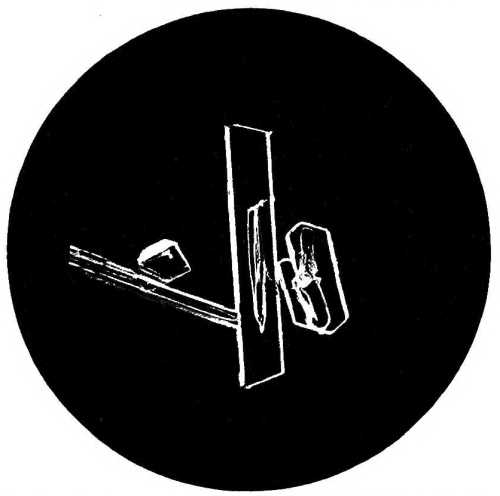
Fig. 28.—Photo-micrograph
of crystals of oxalic acid, × 50.
(R. J. M. Buchanan.)
Oxalic acid acts as a poison when applied to a wound in any part of the
body; and although this substance undoubtedly acts on the brain through
the medium of the blood, it is a remarkable fact that it cannot be
detected in that fluid, even when injected into the femoral vein of
an animal which died in thirty seconds (Christison).
Leeches, it is recorded, have been poisoned by the blood drawn by them from
persons suffering from oxalic acid poisoning. The blood does not appear
to undergo any physical change. Unlike the mineral acids, oxalic acid
is still poisonous even when its corrosive and irritant properties have
been destroyed by dilution.
Post-mortem Appearances.—The mucous membrane of the mouth,
tongue, and throat is corrugated, white, and softened. The tongue
is sometimes of a brownish colour, and sordes appear on the teeth.
The stomach is in some cases pale, soft, and very brittle, and
contains a dark, grumous, acid liquid; at other times it presents
several semi-gelatinous spots, looking as if they had been boiled.
Enlarged blood-vessels filled with dark-coloured blood are also seen
ramifying over the internal surface of the organ. Perforation is of
rare occurrence. The intestines generally escape with some slight
inflammatory redness, unless the case is unusually prolonged. In some
cases the stomach is quite healthy, no morbid appearance being found in
any portion of the alimentary canal.
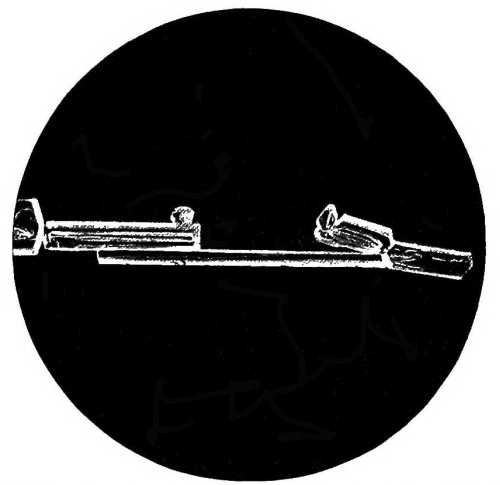
Fig. 29.—Photo-micrograph
of crystals of oxalic acid, × 50.
(R. J. M. Buchanan.)
Chemical Analysis.—From organic mixtures the acid may be
separated by dialysis, and the tests applied, or it may be obtained
in crystals by precipitating it from the boiled and filtered organic
mixture with acetate of lead. The precipitate washed is then decomposed
by sulphuretted hydrogen and filtered, the filtrate concentrated to
drive off excess of sulphuretted hydrogen, and then set aside to
crystallise, which, if the acid be present, it does in slender prisms.
From the contents of the stomach the acid may be separated by partial
drying over a water bath, extraction with hot alcohol acidulated with a
little hydrochloric acid, filtering the alcoholic solution, evaporating
to dryness, and dissolving the residue in water. Should, owing to the
treatment adopted, oxalate of lime in white chalky masses be found in
the stomach, these should be washed and then boiled with pure carbonate
of potash. A partial decomposition takes place, insoluble carbonate of
lime and soluble oxalate of potash are present in the liquid, which,
when filtered and neutralised with nitric acid, may be tested with the
following reagents:
1. Nitrate of silver gives a white precipitate, soluble
in cold nitric acid; the precipitate dried and heated on
platinum foil is dissipated in a white vapour with slight detonation.
2. Calcium chloride or sulphate produces a white precipitate
with oxalic acid; the test is more delicate if the acid be first
neutralised with ammonia. The precipitate is immediately dissolved by
hydrochloric or nitric acid, but not dissolved by oxalic, tartaric,
acetic, or other vegetable acid. Lime-water should not be used as a
test, as it gives precipitates with other acids; the sulphate largely
diluted is not open to this objection.
3. Lead acetate gives a white precipitate soluble in nitric
acid. On clothes, parchment, &c., the spot or spots must be well
boiled, and the above tests applied to the solution. The stains may
vary from a brownish-red to orange-red colour.
Fatal Dose.—Three drachms have caused death in one hour; sixty
grains caused the death of a boy sixteen years of age, but recoveries
have been known to take place after an ounce and an ounce and a half
had been swallowed.
Fatal Period.—Death has resulted in ten minutes from a
dose of one ounce. The shortest period has been three minutes.
The time varies with individuals, even when the same quantity is taken.
In the case of two girls who each swallowed an ounce of oxalic
acid, one died in ten minutes, and the other in thirty
minutes. Death usually takes place within from half an hour to an
hour, although it has been delayed for five days.
Treatment.—Water should not be given, as it increases the
solubility of the acid, and thus assists in the more extensive
absorption and diffusion of the poison. The carbonates of potash and
soda should be avoided, as the oxalates of these alkalies are
themselves poisonous. The stomach tube should not be used. Lime
is the best antidote, as the oxalate of lime is insoluble, and may
be given in the form of common whiting; a pint of saccharated
lime water may be given. Vomiting should be promoted. In the stage of
collapse the case must be treated on general principles.
Essential Salt of Lemons
The binoxalate of potash or salt of sorrel, or, as it is more commonly
known, salt of lemons, occurs as a constituent of many plants. The
common sorrel—Rumex acetosa—contains it in large quantities.
Symptoms.—Those of poisoning by oxalic acid, on which its
poisonous properties depend.
Post-mortem Appearances.—Inflammation of the stomach and
intestines. Other appearances as in oxalic acid.
Chemical Analysis.—See oxalic
acid. The incinerated salt leaves a white residue of potassium
carbonate; oxalic acid leaves no residue.
Fatal Period.—Eight minutes in the case of a lady
recently confined, who took half an ounce of the salt by mistake for
cream of tartar.
Fatal Dose.—Half an ounce.
Treatment.—The same as recommended for poisoning by oxalic acid.
Table showing Symptoms, Post-mortem
Appearances,
Fatal Dose, Period of Death, and
Treatment of Poisoning by
| |
Sulphuric Acid. |
| Symptoms |
Burning pain in the mouth, |
| throat, and gullet. Constant |
| vomiting of brownish or blackish |
| matter containing blood. |
| The lips shrivelled, blistered, |
| and excoriated; and the corners |
| of the mouth show signs |
| of the corrosive action of the |
| poison. Collapse and death. |
| Post-mortem Appearances |
Presence of the signs of powerful |
| corrosion; perforation of the |
| stomach, which is blackened |
| and softened. |
| Fatal Dose |
One drachm. |
| Fatal Period |
One hour. Average about ten hours. |
| Treatment |
Magnesia, chalk, whiting, soap suds, |
| milk, and mucilaginous drinks. |
| |
Hydrocyanic Acid. |
| Symptoms |
Giddiness, insensibility, difficult |
| respiration, dilated pupil, |
| tetanic spasms, and convulsions. |
| In acute cases, death by shock; |
| in those more prolonged |
| suffocation ends the scene. |
| Post-mortem Appearances |
Face pale and countenance composed; |
| congestion of the brain, and traces |
| of inflammation in the stomach |
| and bowels. Odour of prussic acid |
| may be detected in most cases in the |
| stomach and other parts of the body. |
| Fatal Dose |
About 45 minims of the |
| Pharmacopœia acid. |
| Fatal Period |
Two to five minutes. |
| Treatment |
Chlorine in vapour and in water, and |
| the mixed oxides of iron. Cold |
| affusion to the head and face, |
| galvanism, artificial respiration, &c. |
| |
Oxalic Acid. |
| Symptoms |
Burning pain in the mouth and |
| throat, vomiting of greenish-brown |
| or grumous matter. Collapse sets |
| in; skin cold and clammy; |
| frequent pulse, and respiration |
| hurried. Delirium and convulsions |
| end in death. Effects depend on |
| size of dose. Well diluted, it acts |
| on brain, spine, and heart. |
| Post-mortem Appearances |
Lining membrane of mouth and |
| fauces white, shrivelled, and easily |
| removed. Perforation of stomach |
| rare. The post-mortem appearances |
| depend on dilution of acid. |
| Fatal Dose |
One drachm in a boy; in another |
| case, half an ounce. |
| Fatal Period |
Less than ten minutes. |
| Treatment |
Chalk and water. Promote vomiting. |
| Magnesia, lime water, and oil. |
| Mucilaginous drinks. |
ACETIC ACID
In the glacial form this acid acts as a corrosive, the dilute acid as
an irritant. Cases have been recorded of poisoning by the glacial acid.
Symptoms.—The parts with which the acid has come in contact are
softened and rendered yellowish-white in colour. The larynx is commonly
affected by the acid, as it is very volatile.
Post-mortem Appearances are those of corrosive poisoning with
inflammatory action in the upper air-passages.
Fatal Period is variable but rapid.
Fatal Dose.—One drachm caused death in a child, but recovery
has taken place in an adult after taking six fluid ounces.
Chemical Analysis.—Separate the free acid from organic matter
by distillation, if in combination it should be liberated by adding
phosphoric acid. With ferric chloride and ammonia to neutralisation a
red colour is produced, turned yellow by hydrochloric acid.
Treatment.—Magnesia should be given to neutralise the acid and
vomiting produced. The laryngeal symptoms will require treating on
general principles; tracheotomy may be necessary.
POTASH. SODA. AMMONIA
Poisoning by the use of the alkalies is very rare. For the sake of
convenience, and as the symptoms produced by the caustic preparations
of soda and potash, taken in large doses, do not greatly differ, one
description will do for both:
Potash is found in commerce as (1) caustic potash, either solid
or in solution; (2) carbonate and bicarbonate; (3) pearl-ash and
soap-lees.
Soda is found as (1) caustic soda; (2) carbonate (washing soda)
and bicarbonate; (3) soap-lees, carbonate of soda mixed with caustic alkali.
General Characters.—Like the inorganic acids, the alkalies
destroy the animal tissues with which they come in contact. Their
action is local, no specific remote effects being produced. They are
seldom, if ever, used for the purpose of homicide; the deaths caused by
them are in most cases the result of accident or suicide. When injected
directly into the veins of animals, the toxic action of potash and soda
appears to differ, the former arresting the action of the heart in
diastole, whereas the latter, according to Podocaepow and Guttman, does
not, even in large doses, affect the heart or temperature—Guttman,
moreover, asserting that soda has no influence upon the nerve centres,
the peripheral nerves, or the muscles. It is difficult to understand
how, with this asserted negative action, soda, like potash, causes death.
Symptoms.—During the act of swallowing, the patient complains
of a caustic taste, accompanied with a sensation of burning in the
mouth and throat, extending into the stomach. Vomiting may or may
not be present; but in severe cases, when it does occur, the vomited
matters may be mixed with blood. The surface of the body is cold, and
bathed in a cold sweat. Purging is generally present, accompanied
with intense pain and straining. The pulse is weak and quick, and the
countenance anxious.
The post-mortem appearances are inflammation and softening
of the mucous membrane of the mouth, gullet, and stomach, which may
also be covered with chocolate-coloured or black spots. When life has
been prolonged for some months the stomach may become contracted, the
pyloric orifice scarcely admitting the passage of a fine probe.
Chemical Analysis.—The caustic alkalies are known from their
carbonates by giving a brown precipitate with nitrate of silver;
whereas their carbonates give a white, and also effervesce on the
addition of an acid.
The following table will show the reaction of these alkalies with
reagents:
To distinguish Caustic Potash
from Caustic Soda
| |
Potash. |
Soda. |
| Bichloride of platinum. |
A canary-coloured |
No precipitate. |
| precipitate |
| in solutions |
| acidulated with |
| hydrochloric acid. |
| Strong solution of |
Precipitate in granular |
No precipitate. |
| tartaric acid. |
white crystals. |
|
| Colour given to flame. |
Rose or lilac tint. |
Yellow tint. |
| Neutralised with |
Crystallises in long, |
Crystallises in |
| nitric acid. |
slender, fluted prisms. |
rhombic plates. |
In Organic Mixtures.—If the mixture be strongly alkaline,
filter and test as above.
Fatal Period.—From three hours to as many years.
Fatal Dose.—About half an ounce of the caustic alkali. The
smallest fatal dose recorded of caustic potash is forty grains.
Treatment.—Water freely; drinks containing citric or acetic
acid, vinegar, lemon juice, oil, linseed tea, and other demulcent
drinks. The stomach tube should be avoided.
AMMONIA
In vapour, in solution, or solid.
Symptoms.—The vapour may cause death by producing inflammation
of the larynx and lungs. The symptoms to which it gives rise are a
feeling of choking, and a suspension of the power of breathing. Intense
heat and pain are felt in the throat, which may remain for some time.
When ammonia is swallowed in solution, the symptoms produced are not
unlike those the result of the action of soda or potash, only more
intense. Dr. Patterson records the history of a case of a poor man who
drank about an ounce of the liquid ammonia. When seen, his lips were
livid, breathing stridulous, aspect anxious, extremities cold, pulse
100; inside of mouth, tongue, fauces, as far as visible, red, raw, and
fiery-looking. He died suddenly, nineteen days after the accident, of
laryngeal spasm. Albuminuria occurred in one case.
The post-mortem appearances are those found in most cases of
poisoning by corrosives.
Chemical Analysis.—Ammonia can be separated from organic
mixture by distillation. Putrefaction must not have taken place. The
vapour of ammonia is easily set free and recognised by its pungent
odour. The carbonate effervesces when an acid is added to it, and gives
a white precipitate with salts of lime. Dense white fumes are given
off in the presence of hydrochloric acid. Nessler‘s reagent gives a
reddish-brown colour or precipitate.
Fatal Period.—Death has been known to occur in four
minutes, but life may be prolonged for some time, the person dying
of some thoracic trouble.
Fatal Dose.—A teaspoonful of the strong solution.
Treatment.—Vinegar and water, lime-juice and oil, and leeches
to the throat if the inflammatory symptoms be severe. The rest of the
treatment will depend upon the symptoms present. Tracheotomy may be
necessary.
CHLORIDE OF ANTIMONY
Chloride of antimony (butter of antimony) is a corrosive liquid. The
colour varies from a light yellow to a dark red. Though a powerful
poison, it is seldom taken for that purpose. It has been taken
by mistake for ginger beer. On the addition of water, the white
oxychloride is precipitated.
Symptoms.—The symptoms produced by swallowing this substance
are those of corrosive poisoning. The mouth and throat are excoriated,
the skin cold and clammy, and the pulse feeble and quick. Severe pain
is felt in the stomach, and vomiting is incessant.
Post-mortem Appearances.—Those found after corrosive poisoning.
Chemical Analysis.—When poured into water, the chloride is
precipitated; the precipitate, soluble in tartaric acid, becomes
orange-red on the addition of hydrogen sulphide. The supernatant liquid
will give a white precipitate with nitrate of silver, showing the
presence of hydrochloric acid. The salts of bismuth are precipitated by
the addition of water, but the precipitate is, unlike the antimonial,
insoluble in tartaric acid, and is blackened by hydrogen sulphide.
From organic liquids, the antimony may be obtained by boiling
them with tartaric acid, filtering, and then applying the tests for
antimony.
Treatment.—Milk, magnesia, and infusions containing tannin.
CHLORIDE OF ZINC
This substance is a powerful corrosive. It is employed as a
disinfectant, and is sold to the public under the name of “Sir W.
Burnett‘s Fluid.” This preparation, which is a strong solution of
the chloride of zinc, has caused death by being mistaken for “fluid
magnesia,” for “pale ale,” and in one case, on board one of the
American steamers, for “mineral water.” Chloride of zinc is also used
in the treatment of cancer and other tumours as an external application.
Symptoms.—The symptoms come on immediately after the poison is
swallowed. Chloride of zinc acts as a powerful corrosive, accompanied
with all the symptoms which have been before described when speaking
under the head of corrosive poisons. The nervous system is also
powerfully affected.
Post-mortem Appearances.—Those of corrosive poisoning in its
most violent form. The mouth, throat, stomach, and intestines are often
found hardened, white, opaque, and corrugated.
Chemical Analysis.—Ammonium sulphide gives a white precipitate,
which is insoluble in caustic alkalies. Hydrogen sulphide gives a
white precipitate in neutral solutions, but no precipitate when the
free mineral acids are present. Potassium ferrocyanide gives a white
precipitate. Test for chlorine with nitrate of silver.
Treatment.—White of eggs, emetics, followed by demulcent drinks.
CHLORIDES OF TIN
This metal requires but little notice; but the two
chlorides—protochloride and the perchloride—form a mixture used in
the arts, and known as Dyer‘s Mixture. They act as irritant
poisons, but are seldom used as such.
NITRATE OF SILVER
The only preparation of silver requiring notice is the
nitrate—lunar caustic, or lapis infernalis. It acts as a
powerful corrosive. If administered for some time in small doses it is
deposited in the skin, which acquires a permanent dark colour. It does
not appear to be eliminated by the urine, and has been discovered in
the liver five months after its administration was discontinued.
The symptoms come on immediately, the vomited matters becoming
blackened on exposure to light. The dark spots on the skin will also
help to point to the nature of the poison. A dose of salt and water may
be given by way of treatment.
GLASS, ENAMEL, AND NEEDLES
None of the above can be considered as poisons; but should they be
taken, they give rise in most cases to irritation of the stomach and
bowels. Pins and needles have been swallowed without doing much harm.
Mixing ground-glass in food is a favourite mode of killing adopted by
the West Indian negroes.
CHAPTER III DIVISION II.—VITAL — METALLOID IRRITANTS — PHOSPHORUS — IODINE — IODIDE OF POTASSIUM
Poisoning by this substance is more common in France than in England.
In England, the deaths due to this poison are more frequently the
result of accident, from the incautious use of phosphorus paste for the
destruction of vermin. These pastes generally contain from 3 to 4 per
cent. of phosphorus. Children have also been poisoned by sucking the
heads of lucifer matches. In one case, that of a child, death followed
from sucking about forty matches. It has most frequently been employed
as a means of suicide, but seldom for the purpose of homicide. One
case, however, occurred at the Bodmin Assizes in 1857. Kopf relates a
case of a young woman, aged twenty-four, who died on the fourth day
after swallowing the heads of six packets of lucifers (Allg. Wien.
Med. Ztg., No. 47, 1819; Schmidt, vol. cv. p. 296). The size of the
packets is not stated. In this case the bowels were confined, and the
post-mortem revealed only the redness of inflammation in the
stomach and bowels. Death has followed inunction of phosphorus paste.
General Characters.—There are two kinds—ordinary waxy,
crystalline phosphorus, and a peculiar form known as red allotropic
or amorphous phosphorus, prepared by heating waxy phosphorus to a
temperature of 240° C., in an atmosphere free from oxygen. The ordinary
yellow phosphorus is poisonous, the red or amorphous non-poisonous.
As found in the shops, phosphorus is preserved in water in the form
of translucent white or slightly yellow-coloured cylinders. It is
sparingly soluble in oil, alcohol, and other hydrocarbons, but greatly
so in bisulphide of carbon. White vapours are given off when it is
exposed to the air, these consisting of phosphorus and phosphoric acids.
Symptoms.—Phosphorus acts as an irritant poison, but some days
may elapse after the poison is taken before the injurious effects
become apparent. The symptoms occur in three stages.
First stage: The patient complains of a garlic-like taste in the
mouth, peculiar to poisoning by this substance. This is followed by a
burning sensation in the throat, accompanied with severe pain in the
stomach, and intense thirst. The belly becomes swollen, and there is
vomiting, in some cases, of blood from the stomach, which may continue
till death. The vomited matters are of a dark green or black colour,
with an odour of garlic, and sometimes appearing phosphorescent in the
dark. This condition may also be observed in the motions passed. There
is intense thirst. The pulse is feeble, the countenance anxious, and
the surface of the body bathed in a cold sweat. In males, priapism is
not infrequent. The nervous and muscular debility is intense, and the
patient may die in a state of collapse or during a fit of convulsions.
Second stage: This is a stage of intermission of the symptoms
which may last for three days or more, the patient seems as if going
to recover, and only suffers from general malaise. A case is recorded
where the intermission lasted nine weeks. In cases proceeding to a
fatal termination the intermission is followed by the third stage.
Third stage: Jaundice is the most notable symptom and rapidly
increases; the liver becomes much enlarged and the abdomen distended;
epigastric pain is severe and there is vomiting of grumous black
material consisting of altered blood; purging may be present and the
motions contain blood. There is a marked tendency for hæmorrhages to
occur from the mucous membranes and subcutaneously, producing purpuric
spots. The urine is diminished, high coloured, contains bile pigments,
albumen, blood, and casts. There are great prostration, a quick weak
pulse, sleeplessness, coldness of the surface, gradually increasing
weakness, apathy, convulsions, and coma, followed by death about the
fifth or sixth day.
The liver may diminish in size before death. It is rare for recovery
to take place after enlargement of the liver and jaundice have
supervened. It is by no means always easy to diagnose acute yellow
atrophy of the liver or malignant jaundice from phosphorus poisoning.
In phosphorus poisoning, the early symptoms, those of acute gastritis,
are more severe, are developed more rapidly, and run their course more
quickly than in acute atrophy, and there is a marked interval between
these and the appearance of the jaundice; in acute yellow atrophy
this interval is wanting, and from the beginning, on the contrary,
there are gradual malaise, slight gastric catarrh, and jaundice. The
jaundice and suffering, together with the increased action of the heart
in phosphorus poisoning, are wanting in malignant jaundice, but the
cerebral symptoms are more marked in the latter than in the former.
Acute yellow atrophy most frequently occurs in women, especially during
pregnancy. In acute atrophy leucin and tyrosin are present in the
urine; in phosphorus poisoning they may occur, but generally in the
urine voided just before death.
Chronic poisoning, accompanied with all the symptoms just mentioned,
may result from the action of the vapour on those engaged in the
manufacture of phosphorus or of lucifer matches. In persons thus
employed, necrosis of the jaws and caries of the teeth are not of
infrequent occurrence. The lower jaw is more commonly affected. Mr.
Lyons states that this form of necrosis cannot attack persons who have
perfectly sound teeth, but only those whose teeth are carious (St.
Bartholomew‘s Hospital Report, vol. xii.).
Post-mortem Appearances.—Those of acute irritant poisoning,
including extensive destruction of the coats of the stomach, by
softening, ulceration, and perforation, terminating in gangrene.
The stomach may contain a quantity of white vapour, having a strong
smell of garlic. This white vapour has been noticed to pass from the
vagina and anus of those poisoned by phosphorus. The blood appears
to be thoroughly disorganised; the blood-cells are colourless and
transparent, their colouring matter being dissolved in the uncoagulated
liquor sanguinis; hæmorrhages may be present beneath the serous
membranes and in the pleural and pericardial cavities, and thromboses
are frequently present, due to a tendency for the blood-cells to
agglutinate. In a case recorded in the British Medical Journal,
1873, fatty degeneration of the liver and kidneys was found a week
after the poison was taken. In phosphorus poisoning, the liver is
enlarged, of a dull appearance, doughy, uniformly yellow, with the
acini well marked; in acute atrophy, the liver is diminished in size,
greasy on the surface, leathery, of a dirty yellow colour, with traces
only of the obliterated acini. In the former, also, the hepatic cells
are either filled with oil globules or entirely replaced by them;
in the latter, the cells are filled with a fine granular detritus,
and their structure replaced by newly-formed connective tissue.
Putrefaction rapidly supervenes on death. Hæmorrhages may be found on
the surface of the brain and spinal cord, and the grey matter of the
cortex and basal ganglia rose-pink in colour. Fatty changes have been
found in the walls of the capillaries and the large cortical cells.
Chemical Analysis.—The smell of phosphorus is characteristic,
as is also its luminosity when exposed in the dark. The following
process, suggested by Mitscherlich, may be adopted for its detection:
To render the suspected matter quite fluid water is added, previously
acidulated with sulphuric acid, in order to neutralise any ammonia
present. The liquid is then transferred to a glass retort, fitted with
a long condensing tube passing into a receiver containing solution of
nitrate of silver. Distillation is conducted in the dark, when the
minutest trace of phosphorus may be detected by the luminous appearance
of the vapour during condensation. Other modifications of this process
have been suggested, in order to increase the space occupied by the
phosphorescence.
By the above process, one part of phosphorus may be detected in 100,000
parts of substance. Another method for the detection of this poison
in very minute quantities is that proposed by Dussart (Compt.
Rend., xliii. 1126), and modified by Blondlot (Compt. Rend.,
lii. 1197). The test is based on the fact that when phosphorus
is exposed to the action of nascent hydrogen in a Marsh‘s
apparatus, it burns with an emerald-green flame. In order to avoid the
yellow colouring of the flame produced by the sodium in glass, Blondlot
recommends the use of a platinum jet. As the green colour is more or
less interfered with by the presence of organic matters, he passes the
gas through a solution of nitrate of silver; the resulting precipitate
is then placed in another hydrogen apparatus, as just mentioned, and
the colour of the flame of the issuing gas noted. Phosphorus may
become decomposed in the body; and as phosphoric acid is taken in most
articles of food, the only satisfactory evidence of phosphorus having
been taken is to produce it in its free state, or at least to exhibit
its luminosity. The detection of the colouring matter of lucifer
matches in the stomach or vomited matters will point to the probable
nature of the poison, and whence it was derived.
Scherer‘s Test is based on the reducing action of phosphorus on
nitrate of silver, which it blackens. The suspected material should be
placed in a flask or in a Dowzard‘s apparatus for Gutzeit‘s test for
arsenic, lead acetate is added to the material to fix the H₂S, and some
lead acetate solution placed in each cell. A little ether is added to
the mixture, and the flask or top of the apparatus capped with paper
moistened with nitrate of silver, and set aside for some hours in a
dark place. If phosphorus be present the paper will be blackened from
deposition of metallic silver.
Fatal Period.—From half an hour to twenty days or more.
Fatal Dose.—One grain and a half. The smallest fatal dose
recorded for an adult is one-eighth of a grain. An infant five weeks
old died from sucking a single match head, which probably contained
one-fiftieth of a grain of phosphorus. Recovery has taken place after
four and six grains have been taken.
Treatment.—The stomach pump or syphon tube should be used as
soon as possible, and the stomach well washed out with warm water
containing a drachm of old oil of turpentine to the pint. If the
turpentine be not readily obtained, “sanitas” should be used with the
water, or a 1 per cent. solution of permanganate of potash. After
washing the stomach, the old oil of turpentine, or the French oil of
turpentine, or “sanitas” may be administered in half to one drachm
doses in mucilage and water every fifteen minutes for several doses,
and afterwards three or four times daily. The 1 per cent. solution of
potassium permanganate may be administered in copious drinks.
According to some observers, turpentine is said to be of no value;
but this failure in the use of turpentine has been shown to be due to
the employment of different varieties of oil. The crude acid French
oil, of the three kinds met with in commerce, appears to be the only
one that acts as described below. With turpentine, phosphorus forms a
spermaceti-like mass consisting of turpentine phosphorus acid.
It has an acid reaction, and is converted, on exposure to the air,
into a resinous substance smelling like pine-resin. With earths and
metallic oxides it forms insoluble salts. The acid is not poisonous;
doses of 0.03 to 0.3 gram may be given to dogs and rabbits without any
other effect than that of lowering of the body temperature. To the
formation of this compound, the antidotal properties of turpentine in
phosphorus poisoning are attributed (Kohler a. Schempf Dingl.,
pol. Jcxcix.). Turpentine is said by some to be valueless if not given
within twelve hours. Emetics of sulphate of copper may be administered,
but the salt is liable to cause severe gastro-enteritis. Further
treatment may consist of mucilaginous drinks containing magnesia and opium to relieve
pain. Oils or fats should not be given because of their solvent
action upon phosphorus.
Synopsis of the Effects due to
Poisoning by Phosphorus
1. Which variety of phosphorus is poisonous?—The ordinary yellow
phosphorus usually kept in water. The allotropic form is inert.
2. What quantity is sufficient to kill an adult?—One grain and a half.
3. Symptoms as regards—
(1) Alimentary Canal.—Pain in the stomach
and belly, eructation of gas smelling like garlic, vomiting, and
sometimes purging, with other signs of irritation.
(2) Circulatory System.—Tendency to
hæmorrhage from the mouth, stomach, lungs, bladder, &c. Petechiæ
and ecchymoses may occur on all parts of the body. If the case be
prolonged, anæmia may be present. Pulse small, weak, and scarcely
perceptible.
(3) Nervous System.—Cramps, creeping
sensations in the limbs, delirium, convulsions, paralysis, and extreme
nervous prostration.
(4) Period of Invasion of the
Symptoms.—Obscure and insidious; some hours or even days may elapse
before the appearance of the symptoms.
(5) Period of Fatal Termination.—In some
cases as short as four hours.
4. Post-mortem Appearances—
(1) Alimentary Canal.—Signs of irritation
and inflammation in the stomach and intestines. Gangrene and
perforation have been noticed. Strong smell of garlic when the abdomen
is laid open. Appearances not unlike scurvy may be found.
(2) Cellular Tissue.—Ecchymoses may
be present in the cellular tissue of the abdomen, chest, and
other parts of the body.
(3) Muscular Tissue.—Fatty degeneration
in the heart and other organs of the body has been noticed in several
cases.
(4) Liver.—Fatty degeneration of the
gland.
(5) Blood entirely disorganised, the cells
transparent, and their contents dissolved in the uncoagulated liquor
sanguinis. The colour, cherry-red.
5. Name special affection produced by phosphorus in lucifer
match makers—Necrosis of the jaws, usually of the lower jaw. The
disease begins in a decayed tooth.
6. Name a natural disease which phosphorous poisoning has been
supposed to resemble—Acute yellow atrophy of the liver.
Iodine is seldom used as a poison, owing to the difficulty experienced
in disguising its colour. In the form of a strong solution it has been,
however, employed for throwing on the person with intent to cause
grievous bodily harm, as in this form it is corrosive, and destroys the
part which it touches.
General Characters.—Iodine is a dark grey solid, with a bright
metallic lustre. It melts at 107° F., boils at 175° F., and gives off
at the ordinary temperature a faint odour not unlike chlorine. But
slightly soluble in pure water, it is, however, readily dissolved when
a soluble iodide is added to the water.
Symptoms.—Those produced by irritant poisons generally; the
severity of the symptoms being increased by the strength of the
solution, iodine possessing corrosive as well as irritant properties.
The vomited matter will be stained with the iodine, and starchy
material turned blue or black.
Post-mortem Appearances.—Those the result of acute irritant
poisoning.
Fatal Period.—Two days.
Fatal Dose.—One fluid drachm of the tincture has proved fatal;
recovery has taken place after taking one fluid ounce of the tincture.
Treatment.—The stomach should be emptied by the aid of the
stomach pump, and then diluent drinks—arrowroot and barley water—may
be given.
Chemical Analysis.—Add bisulphide of carbon to the suspected
mixture, and shake them together. The sulphide will dissolve out
the iodine, which may be obtained on evaporation and sublimed. The
characteristic reaction of iodine, the development of a blue colour on
the addition of a small quantity of starch, will be conclusive evidence
of its presence. If chloroform be added to iodine in aqueous solution
and shaken up, the chloroform is coloured crimson by the iodine, and
falls to the bottom as the mixture is allowed to settle.
This salt is largely used in medicine; and though poisonous effects may
be produced, due probably to some constitutional idiosyncrasy, it has
seldom been used as a poison. It must, however, be placed among noxious
irritant substances.
General Characters.—Iodide of potassium—hydriodate of
potash—occurs in cubical crystals of a white or faint yellow colour,
very slightly deliquescent when pure, and with a feeble odour of iodine.
Symptoms.—Iodide of potassium acts as an irritant in large
doses, producing also many of the symptoms which attend a violent
catarrh, with profuse discharge from the nose, lachrymation, and
swelling of the eyelids, also pustular eruptions like acne on the face
and body generally. Small doses—three to five grains—have produced
in some persons most unpleasant and even alarming symptoms. In chronic
poisoning, certain glands, the mammary and testicles, are said to
waste away. Salivation is not infrequently present. I have seen the
administration of the salt produce a severe bullous and hæmorrhagic
eruption, simulating hæmorrhagic smallpox, with sloughing. (See also
the account in British Medical Journal, 1878, of a case of
purpura in a child five months old, after a dose of two and a half
grains of the salt.)
Treatment.—The use of emetics and the stomach pump, starch, &c.
Chemical Analysis.—In solution, iodide of potash gives the
following characteristic reactions:
| 1. With a salt of lead |
Bright yellow precipitate. |
| 2. With corrosive sublimate |
Bright scarlet precipitate. |
| 3. With strong nitric acid and starch |
A blue colour. |
In organic mixtures the mode of detecting it is more complicated.
Sulphuretted hydrogen should be first passed through the mixture in
order to convert any free iodine into hydriodic acid. The excess of the
gas is then driven off by the application of heat, and potash added,
the resulting liquor filtered, and the filtrate evaporated to dryness.
To get rid of any organic matter, the residue left after evaporation is
charred at a low red heat, reduced to powder, and dissolved in water.
This solution is then concentrated, and strong nitric acid and solution
of starch added, when, if iodine be present, the blue colour will be developed.
CHAPTER IV METALLIC IRRITANTS — ARSENIC — Cacodylic Acid — ANTIMONY — Tartar Emetic — MERCURY — LEAD — COPPER — ZINC — IRON — BISMUTH — POTASSIUM — BARIUM — CHROMIUM
Arsenic is found as metallic arsenic, as arsenious acid, in the form of
two sulphides—realgar and orpiment, and as a constituent of several
ores—iron, copper, &c.
Metallic arsenic is of a steel-grey colour, brittle, and sublimes at
a temperature a little below 400° F., without, however, previously
fusing. The vapour of the metal has a peculiar garlic-like odour, which
is not possessed by any of its compounds.
Arsenious Acid
Arsenious anhydride—white arsenic—the most important of all the
compounds of arsenic, is colourless, odourless, and almost devoid of
taste. As found in commerce, it occurs under two forms—as a white
powder, and as a solid cake, which is at first nearly transparent, but
soon becomes opaque, and then resembles white enamel. At a temperature
of about 380° F. it sublimes, but is again deposited on cool surfaces
in the form of octahedral crystals. It is but slightly soluble in cold
water, only about half a grain to a grain being taken up by an ounce of
water. Stirred in boiling water, and then allowed to cool, from a grain
to a grain and a quarter is dissolved in the same quantity of water;
but when it is boiled for an hour, about twelve grains are dissolved
in the ounce of water. This solubility is, however, diminished by the
presence of any organic matter in the liquid. It is therefore less
soluble in infusions of tea or coffee than in pure water. A teaspoonful
of powdered arsenic is said to weigh 150 grains, and a pinch 17 grains.
Arsenious acid is used in the arts in the manufacture of certain green
colours, in dyeing, and in calico printing. A weak solution is employed
in medicine in the treatment of certain diseases of the skin, in ague,
and in other diseases.
It has been proposed to use arsenious acid, on account of its caustic
properties, as an application for cancerous tumours. The employment of
this substance for this purpose is by no means new; but its use has
been revived from time to time by the charlatan. In the year 1844, a
man was tried at the Chester Winter Sessions (R. v. Port) for
the murder of a woman whom he pretended to cure of a cancer by the use
of an arsenical plaster. In another case, recorded by M. Flandin, where
death occurred, the quack declared that he had not applied more than
four or five grains to the woman‘s breast. The powder
used for this purpose is generally composed of arsenious acid, realgar,
and oxide of iron. The above cases, to which many more might be added,
attest to the danger which attends the application of arsenic to the
surface of the body; it should, therefore, never be used, especially
as a more safe and potent caustic for this purpose is found in the
chloride of zinc. Some years ago, in London, several cases of severe
arsenical poisoning were due to the presence of arsenic in some cheap
violet powder. In one case the navel and scrotum of a baby were
fearfully excoriated, due to the use of this powder.
Farmers employ arsenious acid (white arsenic) for destroying vermin:
for steeping corn in order to destroy any spores of fungi; and it
also forms an ingredient in the wash for sheep. Injurious effects
have followed the accidental use of the corn thus treated, and those
employed in washing the sheep have suffered more or less severely.
By an Act of Parliament (14 Vict. cap. xiii. sec. 3), it is ordered
that if sold in small quantities, it must be mixed with the sixteenth
part of its weight of soot, or the thirty-second part of its weight
of indigo, ten pounds being the smallest quantity allowed to be sold
unmixed.
The presence of this admixture must be remembered, as a medical man
may be led into an error when the vomited matters are coloured blue,
black, or green, from the mixture of bile with the indigo. Arsenic is
not, as a rule, a corrosive poison. One case is, however, on record
where it acted as a corrosive, but the purity of the arsenic in that
case has been questioned. Its action is that of an irritant, causing
inflammation in the stomach and bowels of those who have taken it;
and it appears that fatal effects are produced whether the poison be
swallowed or introduced into the system in any other way—e.g.
by injection into the rectum or vagina, or applied to the surface of
the body.
Some observers hold that arsenic cannot be considered in the light
of an accumulative poison, others that it is so to a certain extent,
and that its elimination is not so rapid as was previously thought.
Given in medicinal doses, it is eliminated in from fifteen to twenty
days. Hence, in cases which have survived the immediate action of the
drug, no arsenic may be found in the body fifteen days after its fatal
administration. This is a fact of considerable importance. In the
case of Pierre Emile L‘Angelier, for whose murder Madeline Smith was
tried, Dr. Penny found 88 grains in the stomach, although the deceased
survived eight or ten hours after the probable period of taking the
poison, and vomited repeatedly during that time. At the above trial,
the question was suddenly raised, that if such a large quantity was
found after death in the stomach, it was scarcely possible to infer
the administration of a much larger quantity; and thus, that the
quantity must have been larger than another party could have secretly
administered, or naturally would attempt to administer. Drs. Mackinlay
and Wylie, of Paisley, obtained 60 grains, and Sir R. Christison 30
grains more, from the stomach of a man poisoned by arsenic administered
in whisky-punch sweetened, the arsenic being kept in suspension by
constant stirring.
Symptoms of Arsenical Poisoning
Acute.—The rapidity and virulence of the symptoms are more or
less modified by the form (e.g. solution) and the dose taken.
From half an hour to an hour is the usual time which elapses before the
symptoms of poisoning present themselves. In one case, in which the
poison was in solution, the symptoms came on immediately after it was
swallowed; in another, after the lapse of ten hours. The patient first
complains of a feeling of faintness and depression, followed by intense
burning pain in the stomach, increased by the slightest pressure.
Nausea and vomiting, the latter increased by the act of swallowing, now
occur. The vomited matters may be dark brown, black, or bilious; or
they may be greenish from the indigo mixed with the arsenic coming in
contact with the yellow colouring matter of the bile. Blood may also
be vomited. Purging, accompanied with straining at stool, and cramps
in the calves of the legs may occur—the purging, like the vomiting,
being incessant, and affording no relief to the sufferer; the stools
may contain blood, or resemble those of cholera. The thirst is intense,
and there may be a feeling of throat irritation, the pulse feeble
and irregular, and the skin cold and clammy. The urine may or may
not be suppressed. As a rule, the symptoms in this form of poisoning
are continuous; but cases occur in which there are distinct
remissions, and even intermissions. Coma, paralysis, or
tetanic convulsions may supervene before death closes the scene.
Certain anomalies may occur.—The pain may be absent or but
slight. Vomiting and purging do not occur in all cases, nor is thirst,
a most common and persistent symptom, always present. In some cases
the symptoms resemble those which accompany an attack of cholera. In
others, signs of collapse first make their appearance, from which the
patient may rally, or he may die outright. These variations in the
symptoms do not appear to be due to the form or quantity
of the poison taken. It should also be remembered that arsenic may
produce symptoms closely resembling those the result of narcotic
poisoning.
Chronic.—In whatever way the poison be exhibited in small and
repeated doses, there follows a peculiar and characteristic train of
symptoms, associated with (a) the general nutrition of the body,
(b) the facial appearance, (c) irritative disturbance
of the alimentary canal, (d) skin eruptions, and (e)
implication of the nervous system.
(a) The nutrition of the body is altered, there is gradual loss
of flesh with ragged growth of the finger-nails and falling out of the
hair. There may be œdema and jaundice in some cases.
(b) The face presents a peculiar appearance, the eyes are
inflamed and watery, the conjunctivæ reddened and congested, there is
excessive secretion from the nose resembling coryza.
(c) The disturbance of the digestive organs is revealed by the
dryness of the mouth and occasional excoriation of the tongue, which
may be reddened or covered with white fur and silvery in appearance;
salivation may be present instead of dryness of the mouth; there
may also be irritation of the throat; symptoms of gastro-enteritis,
e.g. nausea and vomiting, anorexia, diarrhœa, or alternating
diarrhœa and constipation.
(d) The skin eruptions are of various kinds, and comprise
eczema, herpes, urticaria, erythema, keratosis, marked pigmentation and
exfoliation.
(e) The nervous symptoms are those of peripheral neuritis,
numbness, formication, hyperæsthesia, and tenderness, especially
of the soles of the feet, the latter presenting appearances of
erythro-melalgia; there is some amount of paresis, in some cases
amounting to absolute paralysis of the limbs affected. The hands may be
anæsthetic, while the feet are hyperæsthetic and hyperalgesic, and the
perspiration much increased. Mental symptoms are not common, but there
may be hebetude, or delusions.
In the Maybrick case, tried at the Liverpool Assizes in 1889, the
following symptoms arose from repeated administration of arsenic during
a period of probably about fourteen days. On April 27 Mr. Maybrick was
seized with vomiting after taking tea. On the next day the vomiting
continued, with foulness of the tongue, and he complained of stiffness
in the lower limbs. On May 1 he complained of feeling unwell after
taking luncheon, and he was sick on the following three days, and
complained of a tickling sensation in the throat, with retching. On May
7 he was still suffering from vomiting, diarrhœa had commenced, and the
throat was very dry and inflamed. On May 8 the diarrhœa was accompanied
by tenesmus. On May 9 the tenesmus was distressing, and he died on May 11.
Dr. Prosper de Pietra Santa describes a disease to which workers in
manufactories of paper coloured with Schweinfurt-green are liable,
characterised by the appearance of vesicles, pustules, plaques
muqueuses, and ulcerations on the exposed parts of the body,
fingers, toes, and scrotum. Arsenical poisoning has been mistaken
for nettle-rash, scarlet fever, and Addison‘s disease. In cases of
slow poisoning the symptoms resemble very much those of gastritis and
ulcer of the stomach, and death due to the action of arsenic has been
referred to “spontaneous inflammation of the bowels.”
It must be remembered that in some cases of acute arsenical poisoning,
when the acute symptoms have passed away, the nervous system exhibits
its effects at a later period; in one case paresis came on on the
fifth day, in another at the end of a week, and in a case recorded by
Seeligmüller four weeks elapsed before the onset of nervous symptoms.
Post-mortem Appearances.—The appearances found after death
depend upon the quantity of the dose and the length of time which
supervenes between the taking of the poison and death. Inflammation
of the stomach is a marked effect of the action of this substance on
the system; and this condition is in most cases present whether the
poison be swallowed, sprinkled on an ulcerated surface, or rubbed into
the skin. The inflammatory redness, which may assume the appearance
of crimson velvet, may be found in cases where death has taken
place in two hours. It is sometimes found spreading over the
entire surface of the stomach; at others, at the cardiac end only.
The red colour is increased on exposing the stomach to the air. When
the poison has been swallowed, the stomach may be found covered with
white patches of arsenic, embedded in dark-coloured thick mucus, mixed
with blood. Dr. Paterson thus describes the condition of a stomach he
examined: Its lining membrane was generally very red and injected; but
in addition there were very numerous stellated patches of vivid red,
leading to a darker tint; in the centre of some of them was noticed a
minute clot of blood; in others, an exceedingly rough particle of a
crystalline substance, which was afterwards found to be arsenious acid.
Perforation of the stomach is extremely rare, if it has ever occurred,
but ulceration of the same organ has been observed in a person who
died from the effects of arsenic in five hours (Christison, on
Poisons, p. 340). In opposition to all the statements just made
it has been shown that arsenic may prove fatal without leaving any sign
of inflammatory action (R. v. M‘Cracken; R. v. Newton).
The mouth, pharynx, and gullet are generally found free from any
inflammatory action. The small intestines may or may not be affected:
in most cases the duodenum alone shows any signs of irritation. The
rectum is that part of the large intestine most prone to inflammation.
I have seen marked ulceration of the colon after death from inhalation
of arseniuretted hydrogen. The other internal organs—the liver,
spleen, and kidneys—do not appear to be appreciably affected by
arsenic.
Due probably to the antiseptic properties of arsenic, the stomach
and intestines retain for a long period after death the appearances
of irritant poisoning. In two cases, this was so well marked as to
be visible—in the one case, twelve months, and in the other,
nineteen months after interment. In suspected cases portions of
the liver should always be preserved and examined for arsenic.
The Period after Death when
Arsenic may be Detected
Arsenic is an indestructible poison, and may be found in the body after
many years. In one case it was detected after the lapse of fourteen
years. Arsenic has the power, to a certain extent, of arresting
putrefactive changes; the stomach may, therefore, be found well
preserved, and with the signs of inflammatory action present after the
lapse of many months, and after putrefaction has far advanced in other
parts of the body. When a person is suspected of having been poisoned
with arsenic, and nothing but the skeleton is left for investigation,
the arsenic should be looked for specially in the bones of the pelvis
and the neighbouring vertebræ (Watt‘s Dictionary of Chemistry,
Sup.).
In reference to the preservative action of arsenic upon the tissues of
those poisoned by it, the appearances of the bodies of the victims of
Flannagan and Higgins, recorded by Whitford (B. M. J., 1884,
vol. i. p. 504), are interesting. Arsenical poisoning having been
established in one of three victims, the bodies of two others, Mary
Higgins, aged ten years, and John Flannagan, aged twenty-four years,
were exhumed and examined. The abdominal viscera of Mary Higgins
yielded one grain of arsenious acid, and although the body had been
interred for about thirteen and a half months, it was well preserved.
A remarkable state of preservation obtained in the body of John
Flannagan, who had been interred for thirty-seven and a half months;
the face and body generally could be easily identified. Three and a
half grains of arsenious acid were found in the abdominal viscera.
In these cases a peculiar appearance was found in the stomach and
intestines, consisting of a golden-yellow pigment or coating of the
mucous membrane of the parts. It was thought by some observers to
be composed of arsenic sulphide, but Campbell-Brown, and Davies of
Liverpool, as a result of their analysis of it, found that it did not
contain any appreciable amount of arsenic, but consisted mainly of bile
pigment.
In trials for arsenical poisoning, where an exhumation has been made,
the question may arise whether the arsenic found in the body has been
carried into it from the earth surrounding the coffin.
In reply, the following points must be kept in mind:
1. Arsenic may occur in certain calcareous and
ochrey soils.
2. In these soils no arsenical compound
soluble in water has been found.
3. The arsenic of these soils is dissolved out by
hydrochloric acid, proving their previous insolubility.
4. The arsenic is, therefore, probably in the
form of an arsenite or arseniate of iron, lime, &c.
5. Careful experiments have rendered it evident
that even “under the most favourable circumstances the dead human body
does not acquire an impregnation of arsenic from contact with arsenical
earth” (Taylor).
6. It has been suggested that the arsenical
compound in the soil may be rendered soluble by the ammonia formed
during putrefaction.
This last suggestion is negatived by the following facts:
1. The production of ammonia ceases before the
body arrives at that stage of decomposition when it is at all likely to
be exposed to the action of the soil of the cemetery.
2. The production of hydrosulphuret of ammonia
during decomposition would tend to the production of sulphuret of
arsenic forming yellow patches in the substance of the organs, thus
rather fixing the arsenic on particular parts than allowing it to
percolate through the tissues of the body from external application.
Analysis of the Suspected Earth.—About two pounds of the earth
should be boiled for some time in water; supernatant liquid should then
be poured off from the insoluble residue, and filtered. The filtered
liquid, after concentration, may then be examined by the tests about to
be described. If no arsenic be found, the earth may now be boiled with
dilute hydrochloric acid, filtered, concentrated, and then tested as
before. The first process shows that no compound of arsenic soluble in
water is present; the second shows that the arsenic is in a state of
combination, and therefore not likely to impregnate the body.
The Detection of Arsenic
General Directions.—In cases of suspected poisoning by arsenic
or antimony, the contents of the stomach should be mixed with distilled
water acidulated with hydrochloric acid and filtered, and the filtrate
placed in a stoppered bottle lettered or numbered “A” or “1.” The
liver should be cut into pieces, some of which should be bruised in a
mortar with distilled water acidulated as above mentioned, pressed and
filtered, and the filtrate placed in a bottle marked “B” or “2.”
The kidneys and portions of the other solid organs may also be treated
as above. Each solution so obtained may be then tested by the processes
about to be described. By these means the amount of poison in each
organ may be estimated.
Before subjecting the organic mixture to Marsh‘s or Reinsch‘s
processes, Brande and Taylor strongly recommend a modified course of
procedure.
The contents of the stomach, vomited matters, &c., and the solid
organs, finely divided, must each be separated and thoroughly
dried in a water bath, then mixed with an excess of strong
hydrochloric acid in a flask, and slowly distilled by means of a sand
bath, the distillate carried into a receiver containing a little pure
distilled water, and the process continued nearly to dryness.
If arsenic be present, the distillate contains the arsenic as
chloride, and can be at once subjected with great facility to the
usual tests for the presence of that metal. This mode of proceeding
both facilitates and expedites the ordinary methods of testing, as it
separates the arsenic present from the complex organic mixtures with
which it is associated, and presents it in a comparatively pure form
for identification. The process also admits of the residue left in the
retort being examined for lead and the other metallic poisons.
Before the following processes are applied, some of the sediment from
the contents of the stomach, or the vomited matters, may be collected
and well washed. If this is boiled in distilled water and filtered,
the following tests, known as “the liquid tests for arsenic,” may be
applied to the filtrate:
1. Ammonia Nitrate of Silver, prepared by adding a weak
solution of ammonia to a strong solution of nitrate of silver, gives
with arsenic a yellow precipitate of arsenite of silver soluble
in nitric, citric, acetic, and tartaric acids, and ammonia.
2. Ammonia-Sulphate of Copper, prepared by adding ammonia to
a dilute solution of sulphate of copper, gives with arsenic a green
precipitate of arsenite of copper. This precipitate is
soluble in the mineral and vegetable acids and ammonia, but is not
affected by soda or potash. The precipitate, dried and heated in a
reduction tube, yields octahedral crystals of arsenious acid.
3. Sulphuretted Hydrogen.—The suspected liquid should
be first slightly acidulated with pure hydrochloric acid
before the sulphuretted hydrogen gas is passed into it, when, if
arsenic be present, a yellow precipitate is formed, known to be such by
the following tests:
(1) Insoluble in water, ether, alcohol, the
vegetable acids, and dilute hydrochloric acid, but decomposed by strong
nitric and nitro-hydrochloric acids.
(2) Dissolved, if no organic matter present,
forming a colourless solution, when potash, soda, or ammonia is
added.
(3) The yellow precipitate dried and heated
with soda and cyanide of potassium yields a sublimate of metallic
arsenic.
N.B.—None of the above tests should be
applied in the presence of organic matter. The soluble salts of
cadmium and per-salts of tin give yellow-coloured precipitates with
sulphuretted hydrogen.
(4) If stannous chloride dissolved in strong
hydrochloric acid be added to a solution of arsenic in hydrochloric
acid, metallic arsenic is thrown down as a precipitate. This is a
fairly delicate test.
The following Table
gives the differences between the
Yellow Precipitates formed with
Sulphuretted Hydrogen
and Arsenic, Cadmium, and Per-Salts of Tin:
| |
Arsenic. |
Cadmium. |
Per-Salts of Tin. |
| Colour. |
Yellow. |
Yellow. |
Dirty yellow. |
| Action of ammonia. |
Soluble. |
Insoluble. |
Insoluble. |
Action of hydrochloric
acid. |
Insoluble. |
Soluble. |
|
| With cyanide flux. |
Sublimes as
metallic arsenic. |
Sublimes as
brown oxide. |
No sublimate. |
Marsh‘s Process.—This method for the detection of arsenic is
founded on the fact that the several compounds of arsenic, except
the sulphide and metallic arsenic itself, form a gaseous compound
with nascent hydrogen, from which it may be readily separated
by appropriate treatment. The solution to be tested should,
therefore, be prepared as proposed by Brande and Taylor, given
on a preceding page.
Precautions.—(1) Absolute purity of reagents. (2) The sulphuric
acid should be diluted with five times its weight of water, and allowed
to cool. (3) The suspected fluid should be added gradually. (4)
Generate the gas regularly. (5) If no stain be at once produced, keep a
portion of the exit tube red-hot for at least one hour.
The usual form of the apparatus is that of a U-shaped glass
tube, about one inch in diameter and eight inches high, supported in a
vertical position on a wooden stand. One end of the tube is fitted with
a tap, and terminates in a glass tube drawn to a fine point; the other
end is closed with a cork.
The apparatus is used as follows: A piece of pure zinc is dropped
into the tube, and shaken into such a position that it occupies the
bottom of that limb of the tube which is furnished with the tap.
Water is then added, and subsequently sufficient pure sulphuric acid
to cause a moderately brisk evolution of hydrogen. The production
of hydrogen gas from pure zinc and pure sulphuric acid is sometimes
slow, and may be facilitated by adding a few drops of platinic
chloride solution to the contents of the flask previous to the
addition of the sulphuric acid. The gas being allowed to
accumulate for a short time, the tap is then partially turned on,
and the gas ignited; if, on depressing a piece of white porcelain
momentarily in the flame, no deposit or discoloration occur, the
reagents used may be taken as pure. By the use of Thorpe‘s apparatus
for Marsh‘s test, in which the hydrogen is obtained by the electrolysis
of water, the absence of arsenic in the reagents and apparatus is
ensured. The tap is now connected with a tube of thin, hard glass,
drawn out to a fine point at the end and having a constriction in the
middle. The liquid to be tested being now placed in the apparatus,
the gas is again ignited, and a piece of white porcelain momentarily
depressed in the flame, when, if arsenic be present, a black,
circular, metallic-looking stain will appear, which has the following
composition. In the centre is the unoxidised metal, round this is a
mixed deposit, and outside this the zone of arsenious acid. While the
gas is passing, the exit tube should be heated to redness a little
behind the constricted part, when a dark ring will appear if arsenic be
present. The black deposit on the porcelain may be either arsenic or
antimony, but may be distinguished as follows:
| |
Arsenic. |
Antimony. |
| Nature of the stain. |
Metallic brilliancy |
Absence of metallic lustre. |
| Effect of heat. |
Volatile. |
Non-volatile. |
| Heated with a little |
Dissolves. |
Oxidises to a white |
| nitric acid. |
|
insoluble powder. |
| Warmed with a strong |
Dissolves immediately. |
Slowly dissolved. |
| solution of chloride |
|
|
| of lime. |
|
|
| Treated with |
Detached but not dissolved, |
Soluble: on evaporation, |
| bisulphide of |
but if heated to drive off |
orange-yellow sulphide |
| ammonium. |
ammonia yellow sulphide |
formed. |
| |
formed. |
|
| The nitric acid |
A brick-red precipitate |
No reaction, but if |
| solution evaporated |
soluble in ammonia |
ammonia and potash |
| to dryness gives |
|
are added, a black |
| with nitrate of silver. |
|
precipitate is ultimately |
| |
|
formed. |
The portion of the tube on which the dark ring has been deposited is
now cut off, broken into fragments, and heated in a small, hard glass
tube—when, if arsenic be present, a white sublimate will be obtained
of well-defined octahedral crystals. If the sublimate be treated with
sulphide of ammonium, it is detached but not perfectly dissolved,
and on evaporation of the solution to dryness, a residue of the
yellow sulphide of arsenic will remain, which, if heated with strong
nitric acid, and evaporated again to dryness, will give a brick-red
precipitate with nitrate of silver solution, soluble in ammonia. The
process of Marsh may be used quantitatively by passing the issuing
gas through a glass tube, dipping into a strong solution of argentic
nitrate. A portion of the tube is kept at a red heat, when, if arsenic
be present, it is deposited in the metallic form in the cool portion.
The glass tube containing the stain is cut with a file and weighed.
The stain is then removed by strong nitric acid, the tube dried and
weighed: the difference in weight equals the amount of metallic
arsenic. The nitrate of silver solution is now treated with pure
hydrochloric acid, filtered, and the filtrate neutralised with sodium
carbonate, titrated with standard solution of iodine. By dipping the
end of the issuing tube into a fresh solution of argentic nitrate, the
absence of colour will show that all the arsenic has been obtained.
Instead of the U-shaped tube a Wolff‘s bottle or Erlenmeyer‘s
flask may be used, and the exit tube carrying off the gas bent twice
upon itself and connected with a glass bulb containing calcium
chloride. From this bulb the long, hard glass tube proceeds, pointed
at the end to form a gas jet; the gas is lighted at the end, and if a
Bunsen flame be applied at a short distance from the end, a deposit of
the arsenic, if present, will form on the distal side of the point at
which the flame is applied.
Reinsch‘s Process.—First obtain a clear solution by filtration
or otherwise, and then proceed as follows: Strongly acidify the liquid
with hydrochloric acid, introduce some pieces of copper foil, and
heat to near the boiling-point of the liquid. Both the acid and metal
must be previously tested to ensure their freedom from arsenic. Any
arsenic present will then be deposited on the copper in the metallic
state, either in the form of a black lustrous deposit when the arsenic
is present in any quantity, or else as a steel-grey coating when a
minute quantity only is present. In either case, the copper foil, after
remaining for some time in the suspected fluid, is taken out, cut into
small pieces, introduced into the bottom of a hard glass tube, and
heated to low redness, when the arsenic will sublime as arsenious acid
in octahedral crystals, forming a ring in the cooler portion of the
tube. The deposit is identified as arsenious acid by the form of the
crystals, and by its deportment with the various reagents, as in the
treatment of similar sublimates mentioned under Marsh‘s Process.
Two precautions have to be taken in applying this test: do not use too
large a portion of copper foil at first, and do not remove the copper
too quickly from the boiling fluid. A solution containing arsenic acid
or an alkaline arsenite, mixed with sulphuric acid, does not produce
any deposit on metallic copper even after long boiling, unless the
quantity of the arsenic present be considerable; the deposition may,
however, be ensured by adding sulphurous acid or a sulphite, whereby
the arsenic is reduced to arsenious acid (G. Werther, J. Pr.
Chem., lxxxii. 286; Jahresb., 1861, p. 851).
Objections to Reinsch‘s Process.—The chief objection to
Reinsch‘s process is the possible impurity of the reagents used—both
these reagents, even when supplied as pure, being liable to contain
traces of arsenic. As met with in commerce, both hydrochloric acid and
metallic copper invariably contain minute quantities of arsenic, the
former generally containing the larger quantity of that impurity.
Although, by purchasing the purest possible reagents, specially
prepared for analysis, it may be possible to ensure their freedom from
arsenic, yet in all cases they should be tested before using them. Some
of the hydrochloric acid should be diluted with distilled water, and
gently heated with the copper foil. If no tarnishing or deposit of any
kind occur on the metal after a lapse of several hours, the reagents
may be taken as pure and the trial of the suspected substance at once
made.
Professor Abel has proposed the following process to ensure the
purity of the copper and acid: Boil together equal portions of strong
hydrochloric acid and a solution of perchloride of iron. While the
mixture is boiling immerse the copper foil, which, if pure, will be
merely brightened in colour; if impure, a black deposit on the metal
is formed.
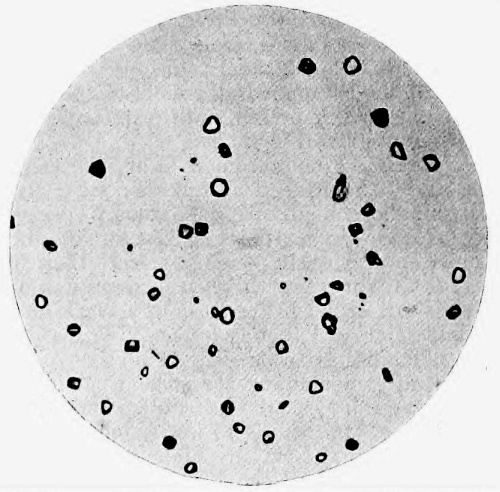
Fig. 30.—Photo-micrograph
of
sublimate of arsenious acid obtained
by Reinsch‘s process, × 250.
(R. J. M. Buchanan.)
Bloxam‘s Method for the Detection of Arsenic.—The late
Professor Bloxam suggested an admirable and delicate process for the
detection of small quantities of arsenic. The method is, like that
of Marsh, founded on the property possessed by nascent hydrogen of
forming a gaseous compound with arsenic; but, instead of the hydrogen
being generated by the action of dilute sulphuric acid on zinc, Bloxam
generates the gas by an electric current.
The wires from the extremities of a battery terminate in small plates
of platinum foil, which are plunged into the liquid to be tested, the
apparatus being so arranged that the hydrogen gas evolved from the
negative pole is collected. The issuing gas is tested in a similar
manner to that obtained in Marsh‘s process.
This method of Bloxam‘s is exceedingly delicate, and possesses one
great advantage, that no zinc being used, there is no danger of
contamination by the use of impure metal; while, as nothing foreign is
introduced during the process of testing, the liquid under examination
is left pure for the application of other tests if necessary.
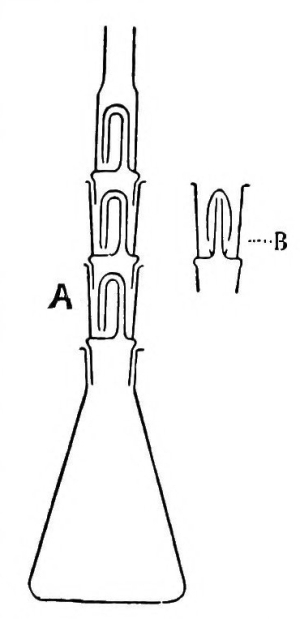
Fig. 31.—Dowzard‘s apparatus for Gutzeit‘s test for
arsenic. A and B indicate glass cells or traps which contain
solutions of lead acetate and copper chloride for the purpose of
fixing H₂S and PH₃ which otherwise would react upon the mercuric
chloride spot on the filter-cap. The cells are fitted into one another,
as shown in the figure.
Gutzeit‘s Test.—This test is more sensitive to the presence of
minute quantities of arsenic than that of either Reinsch or Marsh. The
apparatus devised by Dowzard should be used (Journ. Chem. Soc.,
vols. lxxix. and lxxx. 463, p. 715), which consists of an Erlenmeyer‘s
flask fitted with superimposed cells, containing solutions which will
wash or neutralise those gases which would interfere with the accuracy
of the result. The following is Dowzard‘s description of the method of
using the apparatus:
“A weighed or measured portion of the sample is mixed with 5 c.c. of
pure HCl (if the sample is alkaline it must be neutralised first), four
drops of a 15 per cent. solution of cuprous chloride in hydrochloric
acid are then added, and the mixture made up to 30 c.c. with water; if
it is not convenient to work with such a small bulk as 30 c.c. this
quantity may be doubled or trebled, but the same proportion of acid
should be used. A rod of pure zinc, 3 cm. long and 5 mm. in diameter,
is first placed in the flask, the above mixture is then introduced and
the first cell placed in position; lead acetate solution 5 per cent. is
now poured into the cell until it is about half full. The second and
third cells are filled in a similar manner; a small tuft of cotton wool
is introduced into the neck of the top cell, and its mouth capped with
mercuric chloride paper, which may be held in position by an elastic
band or a glass collar made from a piece of glass tubing. After forty
minutes or more the cap is removed and examined in full daylight. A
minute trace of arsenic is indicated by a lemon-yellow spot, which
varies in tint according to the amount present; and a heavy trace by an
orange-brown spot. The mercuric chloride paper is prepared as follows:
one drop of a 5 per cent. solution of mercuric chloride is allowed to
fall on the centre of a piece (4 cm. square) of thin Swedish filtering
paper, such as Muncktell‘s No. 1 F.; the paper is dried before using.”
The lead acetate in the cells absorbs any H₂S gas given off, and if
additional cells contain a 15 per cent. solution of cuprous chloride
in hydrochloric acid, PH₃ is also prevented from passing and causing a
stain. By this method arsenic can be detected in the presence of 2500
times its weight of antimony. The presence of selenium and tellurium
compounds does not interfere with the usefulness of this method.
Fleitmann‘s Test.—Detects arsenic in the presence of antimony,
but does not detect arsenic as arsenic acid. When zinc or aluminium
is heated with excess of potassium or sodium hydroxide in a mixture
containing arsenious anhydride, arseniuretted hydrogen is evolved. The
gas may be led into 4 per cent. nitrate of silver solution, or a test
tube the top of which is covered with filter paper wet with nitrate of
silver. The gas reduces the silver salt, and a black precipitate is
produced in the solution, or a black spot on the paper.
Fatal Dose.—Two grains in solution have been known to cause
death. Recoveries have, however, occurred after an ounce or more of the
poison has been taken. Much will depend upon the fulness or emptiness
of the stomach at the time the poison is taken, and also upon the
vehicle in which the poison is administered. Vomiting and purging are
more urgent when the dose is large, probably assisting to get rid of
the arsenic before its fatal action is produced.
Fatal Period.—From twenty minutes to two or three weeks, and
even later from the secondary effects of the poison. Any thick medium,
cocoa or soup, will of course delay the action of the poison.
Treatment.—Vomiting should be promoted, and diluent drinks
largely given. The stomach pump, if it can be procured without
much delay, should also be employed to empty the stomach. Emetics
of sulphate of zinc should be given without delay—followed by the
administration of milk, lime-water, and albumen. Symptoms as they occur
must be treated on general principles.
The hydrated sesquioxide of iron, the hydrated oxide of magnesia,
and animal charcoal have been proposed and used as antidotes. The
sesquioxide of iron can be prepared ready to hand by saturating the
tincture ferri perchloridi with ammonia or washing soda. It
should be given freely. Drachm doses of dialysed iron in water may
be administered. Reputed antidotes are useless when the poison is in
the solid state. The diarrhœa, tenesmus, collapse, pain, and nervous
symptoms should be treated on general principles.
Other Poisonous Compounds of Arsenic
Arsenical Vapour.—The vapour from the flues of the copper and
arsenic smelting-works in Cornwall, escaping into the air, may cause
death to cattle, and the destruction of vegetation. The workmen in
these works not infrequently suffer from eruptions on the skin, and
from great constitutional derangement; but, on the whole, taking into
consideration the dangerous nature of their employment, the men appear
to enjoy average health. Actions for damage and nuisance have resulted
from the escape of this vapour from the factories.
Arsenite of Potash.—A solution of arsenite of potash, mixed
with the tincture of red lavender (the solution contains four grains
of arsenious acid in one ounce)—better known as Fowler‘s
Solution, or as Fowler‘s Mineral Solution or
Tasteless Ague Drop. It is probably a solution of arsenious
acid in carbonate of potash, and not a true arsenite of potash.
This preparation has been much used as a domestic remedy for ague
in the Fens of Cambridgeshire. Death from its use is rare; but it
is, nevertheless, too dangerous a medicine to be used recklessly.
Idiosyncrasy has much to do with the action of the drug, some persons
taking even large doses with impunity, whilst, in others, the smallest
medicinal dose has produced alarming symptoms. It is stated that the
Styrian arsenic-eating peasant is capable of taking without injury
five grains of arsenious acid for a dose; and in one case of suspected
murder in Styria, the prisoner was acquitted as the deceased was known
to be an arsenic-eater.
Donovan‘s Solution.—A solution of hydriodate of arsenic and
mercury. Now officinal, and much used by many practitioners.
Sheep Dip.—The mixture used for washing sheep, composed of
tar-water, soft soap, and arsenic, has caused death in twenty-four
hours. The men engaged in dipping the sheep may suffer both locally and
constitutionally from the effects of the arsenic in the solution.
Treatment.—As before described.
Analysis.—See p. 280 et seq.
Arsenite of Copper.—Scheele‘s green, and the aceto-arsenite
of copper, Schweinfurt-green, are met with in commerce and the
arts as green pigments. Among workmen they are familiarly known as
emerald-green, Brunswick-green, or Vienna-green. In France, the term
vert Anglais or English green has been given to them. Scheele‘s
green contains about 55 per cent. of pure arsenious acid; the other,
Schweinfurt-green, about 58 per cent.
These colours are employed for various purposes, among which the
following may be mentioned:
- 1. Artificial flowers and other articles of dress.
- 2. Confectionery, pastry ornaments, and toys.
- 3. As green paint for the insides of houses.
- 4. In the green colour for wall-papers.
- 5. In the green-coloured paper lining boxes, &c.
- 6. Green-coloured tapers used for artificial lighting.
The employment of emerald-green in the colouring of wall-papers is
so extensive, that in the year 1860 an English paper-stainer stated
that he used two tons of arsenic weekly. In 1862 the amount of this
colour manufactured during the year was from 500 to 700 tons. Numerous
cases of chronic arsenical poisoning have resulted from the presence
of arsenic in the form of Scheele‘s green and Schweinfurt-green in
wall-papers and other articles. As the colour is only loosely applied
to the surface by means of a weak solution of size, it is easily
brushed off, and may so impregnate the air of a room as to produce
injurious effects on those who inhabit the apartment. By fermentation
of the starch paste used for fastening the paper to the walls, nascent
hydrogen is liberated, and, combining with the arsenic to form
arseniuretted hydrogen, passes into the air of the room and is inhaled.
This gas is extremely poisonous, and small quantities suffice to
produce serious results. Certain moulds are endowed with the power of
living in materials containing arsenic, and of decomposing arsenious
acid or its salts into the gaseous form known as diethylarsine;
there are altogether ten such moulds, and the most active is the
Penicillium brevicaule.
In the case of ladies‘ dresses, the following method is adopted:
The colouring material is made by thoroughly
stirring together a mixture containing, in definite proportions, the
green pigment, cold water, starch, and gum arabic, or some similar
substance which shall give the colour consistence and adhesiveness. Not
infrequently in this process the hand and forearm are freely used in
the liquid to expedite the work. Of this mixture, properly prepared,
the workman takes a quantity in his fingers and roughly spreads it
over the muslin or fine calico. The fabric is then beaten and kneaded
between the hands until it is uniformly coloured. The longer this
process is continued, the more perfect is the result. The cloth is now
fastened to a frame for drying. In all this process of colouring, the
hands, forearms, and frequently also the face of the operative must
become soiled with the green colour. It will be also observed that the
colour is but loosely applied, no mordant being used, as in
calico printing, to fix the pigment in the texture of the cloth.
Symptoms.—All the effects produced by arsenic may result from
the use of articles coloured with these pigments. Chronic inflammation
of the stomach and bowels, and irritation of the eyes, accompanied
in some cases with extreme nervous debility and prostration,
are by no means uncommon in those employed in the manufacture
of this “cheerful,” but poisonous colour. The skin of the hands,
arms, and scalp is often attacked by a vesicular eruption or an
erythema. When it is borne in mind that, according to the
analysis of Hoffman, a single twig of twelve artificial leaves
may contain as much as ten grains of pure arsenic, it is not to be
wondered at that the most serious results have occurred from the
reckless use of these colours. In Prussia and France the use of the
arsenical colours is prohibited.
Analysis.—Scheele‘s green is insoluble in water, but is soluble
in ammonia, the solution having a blue colour, from the separation
of the arsenious acid from the oxide of copper. If a few drops of
the blue ammoniacal solution be poured on some crystals of nitrate
of silver, the yellow arsenite of silver is formed. The blue ammoniacal
solution, if acidified with HCl and boiled with pure copper foil,
deposits arsenic on the copper, which, if cut into strips and placed
in a small reduction tube and heated, sublimes and is deposited in
octahedral crystals on the cold portion of the tube. The tests
before described are applicable for the detection of this substance.
Orpiment
Orpiment, or yellow arsenic, one of the sulphurets of arsenic, has been
used occasionally as a poison. It is also largely employed in the arts
for paper-staining and for colouring toys. In cases of arsenical
poisoning, it is this compound that is commonly found adhering to the
stomach and intestines. It is formed by the sulphuretted hydrogen, the
result of decomposition, acting on the white arsenic swallowed.
Realgar
Realgar, or red arsenic, is another of the sulphurets of arsenic, and,
like orpiment, is largely used in the arts as a colour. It is also
employed, like orpiment, as a depilatory, fatal results having followed
its use for this purpose. The colour of this substance prohibits its
frequent use as a poison.
Both of these compounds owe their poisonous properties to the amount of
free arsenious acid which they contain, and which may be as much as 30
per cent.
Symptoms.—The symptoms produced by these substances are similar
to those caused by arsenic. The fatal dose will depend on the amount of
free arsenious acid which they may each contain.
Treatment.—Emetics and demulcent drinks.
Metallic Arsenic, &c.
Metallic arsenic, fly powder, arsenic acid, largely used in the
manufacture of magenta, aniline red, or fuchsine, and the arseniates
of potash and soda, are all poisonous. The papier moure of the
shops consists of blotting-paper steeped in a solution of arseniate of
potash. Macquer‘s neutral arsenical salt is the binarsenate of potash.
Symptoms.—The symptoms are those of arsenical poisoning.
Treatment.—When metallic arsenic has been taken, vomiting must
be promoted by the use of proper emetics. Tartar emetic should never
be used. In the treatment for poisoning with arsenic acid, or of the
arseniates of potash and soda, the hydrated oxide of iron, or of the
acetate of iron, should be used, as the arseniates are precipitated by
the iron.
Arsenic Acid
No case of poisoning by this substance has been recorded, for, although
poisonous, it is better known in the laboratory than in the shops.
It differs from arsenious acid in being only partially volatilised
by heat, in its solubility in water, and in being precipitated of a
brick-red colour by nitrate of silver. With sulphuretted hydrogen a
yellow precipitate is slowly formed, insoluble in hydrochloric acid.
Arseniuretted Hydrogen
This gas has proved fatal in several cases. It is generated in the
process known as Marsh‘s process for arsenic, and is so poisonous that
a very small quantity, not sufficient to be detected by its odour, has
caused death. In most cases death has been the result of accident.
Symptoms.—Giddiness, fainting, constant vomiting, pain in
stomach, and suppression of urine, with rapid destruction of the red
blood corpuscles, associated with hæmorrhages from all the mucous
membranes and jaundice, are among the most prominent symptoms.
The post-mortem appearances are inflammation of the stomach,
with softening of its coats. The liver and kidneys are also more or
less affected, and have been found of a deep indigo colour.
Analysis.—This has been described when speaking of Marsh‘s
process for arsenic.
Cacodylic acid and the cacodylates are poisonous. The acid dissolves
easily in water and alcohol, and it unites with many metals and
organic substances to form salts. Although it is held by some to be
non-poisonous, Murrell asserts that the administration of cacodylate of
sodium produces symptoms “far more severe than those which follow the
exhibition of arsenic in its ordinary forms” (B. M. J., 1900,
vol. ii. p. 1823; 1901, vol. i. p. 120).
Professor Fraser of Edinburgh, on the other hand, from clinical
observation and chemical tests, affirms that cacodylic acid and the
cacodylates are extremely stable bodies, and the arsenic in them is
with such great difficulty set free that it passes through the body in
combination as an inert substance (B. M. J., 1902, vol. i. p. 713).
Arsenical Contamination of Food Stuffs
Arsenic is found associated with many other substances in nature,
particularly copper and pyrites. Arsenic is commonly present in
commercial sulphuric acid manufactured from pyrites containing the
metal, and when such acid is used with common salt for the production
of hydrochloric acid, the latter also becomes contaminated. It may be
safely stated that commercial sulphuric acid, hydrochloric acid, copper
and zinc, free from arsenic, do not exist in the market. Hence in the
detection of arsenic by the toxicologist the absolute purity of these
reagents, which he uses, must be established.
In the manufacture of glucose, arseniferous sulphuric acid has been
the means of contaminating it. Ritter and Blyth pointed out the
danger, by this means, of conveying arsenic into beer, confectionery,
syrup, and other food stuffs. Glucose made with such acid, and used
in the manufacture of beer, was the cause, in the year 1900, of a
widespread and serious epidemic of arsenical poisoning in Manchester
and Liverpool, in which several thousand persons suffered. Arsenic may
also contaminate grain during malting by the use of anthracite coal or
sulphur bar in the kilns.
Recapitulation of the Leading Facts
with regard to
Poisoning
with Arsenic
| ACUTE POISONING.—SYMPTOMS, ETC. |
| Action on alimentary canal. |
Intense irritation of the stomach, upper |
| part of small intestine, and lower part |
| of the large. The inflamed condition of |
| the stomach occurs even if arsenic be |
| absorbed by the skin. Not present in |
| all cases. |
| Circulation |
The heart weakened, with a consequent |
| reduction in force and frequency of |
| pulse. |
| The brain and nervous system. |
In some cases the action upon the brain |
| is that of a narcotic, and the |
| paralysis sometimes seen appears to |
| be due to a direct action of the drug |
| on the cord. |
| The urinary organs |
Arrest of the action of the kidneys is |
| not uncommon. Stranguary. |
| Fatal dose |
Two grains. |
| Average period of the |
From half an hour to an hour after the |
| commencement of the |
poison is taken. |
| symptoms. |
|
| Average period before death. |
Ten to twenty-four hours. |
CHRONIC POISONING.—SYMPTOMS, ETC. |
| The eyes, nose, and mouth |
Irritation and redness of the eyes and |
| nostrils. Dryness of the mouth and |
| throat. |
| The stomach and bowels |
Loss of appetite, colicky pains, cramps, |
| irritability of bowels, mucous |
| discharges. |
| Nervous system |
Depression and irritability of spirits, |
| sleeplessness, giddiness, convulsions, |
| vertigo, paralysis, etc. |
| Cutaneous surface |
Brown pigment deposit in the skin of |
| the face. “Eczema arsenicale,” etc. |
| Means of diagnosis in |
Examine the urine unostentatiously. |
| suspected cases. |
Remove patient from present abode. |
| |
Examine wall-paper, etc., for arsenic. |
| The probable post-mortem |
Signs of irritation, slight or absent, |
| if death is due to this poison. |
in stomach and bowels. |
| Organs most important to |
Liver, stomach, kidney. |
| secure for analysis. |
|
| Circumstances under which |
Green wall-papers, coloured toys and |
| it may occur independently |
sweets, green tarlatan dresses, etc. |
| of criminal administration. |
|
Antimony, the Stibium of the ancients, is obtained from the native
sulphide. Metallic antimony is of a bluish-white colour, crystalline
and brittle. It melts at about 840° F., and is slowly volatilised at a
white heat.
Two compounds of antimony—tartar emetic and chloride of antimony—are
alone of any toxicological interest.
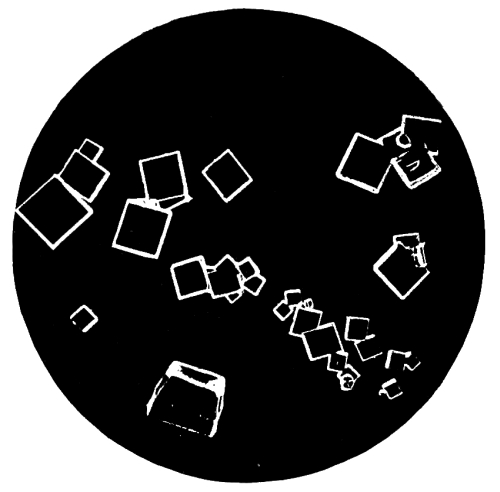
Fig. 32.—Photo-micrograph
of crystals
of tartarated antimony, × 50.
(R. J. M. Buchanan.)
Antimonium Tartaratum. Tartarated Antimony
Tartar emetic occurs as a white powder; sometimes, however, with a
yellowish tint. It is soluble in about three parts of boiling water and
fifteen of cold, and insoluble in alcohol.
The vinum antimoniale of the Pharmacopœia contains two grains of
the salt in an ounce of wine.
Before 1856 poisoning by antimony was of rare occurrence, but since
that year several cases of chronic poisoning have occurred, giving to
this substance considerable importance.
Symptoms of Antimonial Poisoning
Acute.—Tartar emetic is an irritant poison, but possesses
slight corrosive properties. When taken in large doses, two or three
drachms, it gives rise to a metallic taste in the mouth, which is not
easily removed. In most cases, violent vomiting follows immediately
after the poison is swallowed, the vomiting continuing even after the
stomach is emptied of its contents. In a few cases, however, even when
a large dose has been taken, vomiting may be absent. Burning pain is
felt at the pit of the stomach, accompanied with cramps in the belly
and purging. There is considerable difficulty in swallowing, and the
patient complains of tightness and constriction in the throat. The
mouth and throat in some cases are excoriated, or covered with whitish
aphthous-looking spots, which ultimately become brown or black. In some
cases the thirst is intense; in others, absent or nearly so. Cramps
in the lower extremities, almost amounting in some cases to tetanic
spasms, followed by extreme depression, are generally the precursor
of a fatal termination. The urine may be suppressed, as is the case
in arsenical poisoning; in some cases it has even been increased. On
this point, however, the statements of observers differ. Trousseau
says that the urine is suppressed; Huseman that it is never
suppressed. The skin is in some cases covered by a pustular eruption,
not unlike that of smallpox. Dobie has recorded a case of poisoning by
tartar emetic in which a comatose condition was present. In antimonial
poisoning, even in the most desperate cases, there is always greater
hope of recovery than in arsenical poisoning.
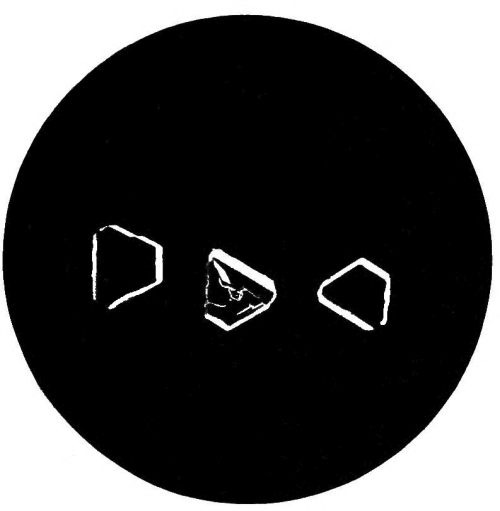
Fig. 33.—Photo-micrograph
of crystals
of tartarated antimony, × 50.
(R. J. M. Buchanan.)
Chronic.—The symptoms which mark the chronic form of poisoning
differ chiefly in being less intense and less rapid than in the acute.
Chronic poisoning by small repeated doses is that form of poisoning
which appears most in vogue of late years—as certain diseases,
enteritis, etc., can be simulated by the administration of repeated
small doses. The unfortunate victim complains of constant nausea and
retching, with great depression. Food is objected to, as it only
increases the vomiting. The matters vomited are at first merely mucus,
but after a time they become mixed with bile. Each time the poison is
repeated, the symptoms become aggravated. Emaciation gradually sets in,
and the person dies from complete exhaustion, or from the effects of
a larger dose than usual. Chronic poisoning has given rise to several
errors in diagnosis, and the histories of recorded cases should put
medical men on their guard. In all doubtful cases examine the urine.
Post-mortem Appearances.—The mucous membrane of the throat,
gullet, and stomach is inflamed, and in some places softened and
corroded. Aphthous-looking spots are not infrequently found on the
mucous membrane of the stomach, and these may also be observed on the
throat and on the small intestines. The liver has been found in some
cases of chronic poisoning, where the fatal termination has been for
some time retarded, enlarged, and its structure so soft as to be easily
broken down. Fatty degeneration of the internal organs has been found
after protracted fatal administration of the drug. It is stated that in
Brunswick the fatty livers of the geese are produced by the judicious
administration of antimony. The appearances above detailed may be more
or less absent or present, according to the time that may have elapsed
from the swallowing of the poison to the time at which death has
occurred.
At the post-mortem examination on the body of Mr. Bravo,
poisoned with tartar emetic in 1876, the mucous surfaces of the stomach
and duodenum were found pale and yellowish. Ulcers were present in
the cæcum, and the rest of the large intestine blood-stained, but not
ulcerated. Stevenson records the post-mortem appearances of
the bodies of three women poisoned by tartar emetic (B. M. J.,
1903, vol. i. p. 873). They are of peculiar interest in reference to
the preservative action of antimony upon the bodies of those poisoned
by it. In the case of M. E. Marsh, upon whose body the examination was
made eight days after death, there was no odour of putrefaction, the
bowels were in a condition of acute catarrh and streaky congestion
without ulceration.
The body of Bessie Taylor had been buried for twenty-one months;
ordinary putrefactive changes were absent, and with the exception of
the integuments, it was in a remarkably good state of preservation.
The alimentary canal showed acute non-ulcerative gastro-enteritis, the
stomach and duodenum were of a cinnabar-red colour, the jejunum also
in patches. The ileum was covered with orange-red mucus in its lower
portion, and there was an orange-coloured patch twelve inches above
the ileo-cæcal valve. The patch on analysis was proved to contain
antimonious sulphide. Similar orange patches were present in the colon
and upper portion of the rectum. There were no ulcerations, but the
mucous membrane of the intestines was of a dull cinnabar-red colour.
The body of Mary J. Spink was exhumed five years after burial, and
presented a life-like aspect; there was no putrefactive odour, and
no larvæ present. The stomach and intestines were of a cinnabar-red
colour; there were no ulcerations; the intestines contained
orange-coloured mucus.
Elimination of Antimony from the System
Antimony, taken in a large dose, or in small doses frequently repeated,
appears to be rapidly absorbed, and then eliminated from the system by
the kidneys. Dating from the time at which the poison was swallowed, it
will be found in the organs of the body in the following order:—
1. Stomach and bowels, but slightly in the
liver.
2. Absent from the stomach, but present in the
liver, spleen, and kidneys—traces in the blood.
3. Present in the fat and bones, with traces in
the liver, fæces, and urine.
4. The period required for its complete
elimination from the vital organs varies from fifteen to thirty days.
In other words, the presence of antimony in the stomach and intestines
points to the recent administration of the poison; and its absence
from those organs, and presence in the others above mentioned, to a
more remote period of administration. It has been suggested that in
some cases the poison may be eliminated by the mucous membrane of the
stomach. This assumption has been proved to be correct, for it has been
shown that antimony may be found in the stomach after the inhalation of
antimoniuretted hydrogen.
Fatal Dose.—It is impossible to state with certainty the exact
amount of antimony—tartar emetic—which may prove fatal, as recoveries
have taken place even after an ounce had been taken. Large doses are
uncertain in their effects, as the severe vomiting which they produce
generally helps to get rid of the poison. In small doses, death may
result from the depressing action which it exerts over the heart.
Fatal Period.—From a few hours to several weeks, and even
months.
Treatment.—Promote vomiting by the administration of warm
water, or warm greasy water, or the stomach may be washed out with
a syphon tube, unless the chloride of antimony is the poison, and
then give tannic acid in drachm doses in warm water, or any vegetable
infusion containing tannin—viz., tea, oak bark, or cinchona bark.
Demulcent drinks may be administered, and warmth applied. Opium may be
given to relieve pain, and stimulants for the depression.
The Detection of Antimony
Prepare the solutions of the liver and other solid organs, and also the
contents of the stomach, as described under the detection of arsenic,
using tartaric acid instead of hydrochloric acid. Through a portion
of one of the solutions, obtained by filtration or dialysis, pass a
current of sulphuretted hydrogen, which will produce, if antimony be
present, an orange-coloured precipitate of the sulphide of antimony.
The precipitated sulphide is dissolved by hot hydrochloric acid with
the evolution of sulphuretted hydrogen; and if the resulting solution
be poured into water, a white precipitate is formed of oxychloride of
antimony, soluble in tartaric acid. Chloride of bismuth is precipitated
when poured into water, but the precipitate is turned black by sulphide
of ammonium, the antimonial orange-red; the precipitate of bismuth is
not soluble in tartaric acid, the antimonial is soluble.
Marsh‘s and Reinsch‘s processes may also be used for the detection of
antimony. The former is, however, open to the objection that antimony,
when present in any quantity, rapidly precipitates on the zinc in the
form of a flocculent black deposit, while the issuing gas is found to
contain only traces of the metal.
Reinsch‘s process is, however, very delicate, and its application is in
every respect similar to that in use for the detection of arsenic. The
acid liquid should, however, be boiled down to a small bulk with the
copper, before a conclusion is drawn as to the entire absence of the metal.
Table giving the Characteristic Reactions
of Antimonial and Arsenical Deposits
on Copper.
| |
Antimony. |
Arsenic. |
| The colour of the |
Lustrous, with a violet hue. |
Dark steel-grey colour, |
| deposit on copper |
|
and lustrous. |
| by Reinsch‘s |
|
|
| process is— |
|
|
| The coated copper |
No effect, or only a |
Well-marked sublimate |
| heated in the end |
trifling white sublimate, |
of octahedral crystals; |
| of a small tube. |
non-crystalline, |
is readily volatile. |
| |
non-volatile. If the |
|
| sublimate be dissolved |
| in solution of tartaric |
| acid and sulphuretted |
| hydrogen passed |
| through the solution, |
| the orange antimonious |
| sulphide is thrown down. |
It may be noted that mercury likewise yields a deposit on copper with
Reinsch‘s process; but the coating is in this case either of a grey
colour or white, and silvery on the application of friction. When
the coated copper is heated in a glass tube, there is a sublimate of
metallic mercury readily aggregating into globules on being rubbed with
a glass rod. If the deposit is trifling in quantity, a magnifying-glass
should be used to identify the metallic globules. This test at once
distinguishes a deposit on copper due to mercury from that produced
under similar conditions by arsenic or antimony.
Quantitative Analysis.—Take a measured quantity of the
suspected liquid and precipitate thoroughly with sulphuretted hydrogen.
Wash, dry, and weigh precipitate. One hundred parts equal 202.78 parts
of crystallised tartar emetic.
Recapitulation of the
Leading Facts
with regard to Poisoning
with Antimony.
| ACUTE POISONING.—SYMPTOMS, ETC. |
| Action on alimentary canal. |
Intense irritation of the stomach and |
| bowels, constant vomiting, and |
| frequently purging. Eliminated by the |
| stomach when absorbed by the skin, or as |
| antimoniuretted hydrogen by the lungs. |
| Presence, in some cases absence, of |
| signs of inflammation in intestinal canal. |
| Circulation |
The cardiac contractions are lessened in |
| frequency and force, the heart being |
| finally arrested in diastole. |
| Brain and nervous system. |
Sometimes delirium, paralysis of sensation |
| and motion, and diminution of reflex action. |
| Urinary organs |
Secretion of the kidneys, as a rule, not |
| arrested; sometimes increased. |
| Fatal dose |
Two grains. |
| Average period of |
A very short time after the poison is |
| commencement |
taken. Almost immediately. |
| of symptoms. |
|
| Average period before death. |
Various. Ten to twenty hours. |
CHRONIC POISONING.—SYMPTOMS, ETC. |
| Mouth |
Aphthous spots on mouth, metallic taste. |
| The stomach and bowels |
Constant irritation, nausea, sinking at |
| the stomach, symptoms of enteritis or |
| cholera, purging, tenesmus, etc. |
| Nervous system |
Malaise, low spirits, giddiness, delirium. |
| Cutaneous surface |
Pustular eruption like smallpox, sweating, |
| decrease in temperature. |
| Means of diagnosis in |
Same as for arsenic. |
| suspected cases. |
| The probable post-mortem |
Much the same as in arsenic poisoning. |
| if death is due to this poison. |
| Organs most important to |
Liver, stomach, and kidneys. |
| secure for analysis.
|
Metallic mercury possesses no toxicological interest, as it appears to
be almost inert, even in very large doses. If applied to the skin in
a finely-divided state, as in mercurial ointment, or internally, as
blue pill, its toxic effects may be produced. The vapour given off from
the metal is highly poisonous, producing salivation, emaciation, and
death. A singular accident of poisoning by mercurial vapour occurred on
board H.M.S. Triumph in 1810, owing to the bursting of bladders
containing large quantities of the metal; in three weeks 200 men were
affected with salivation, etc., nearly all the cattle on board died, as
well as the mice, a dog, and a canary-bird.
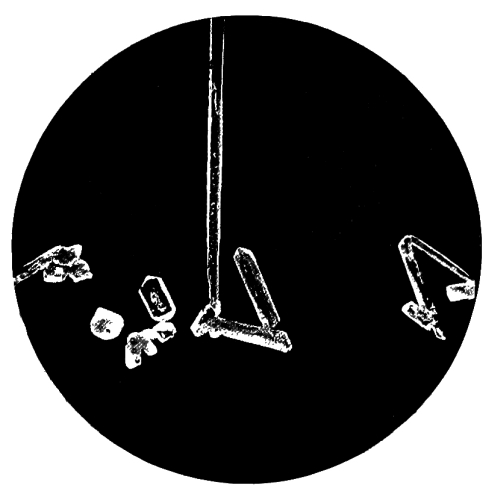
Fig. 34.—Photo-micrograph
of crystals of corrosive sublimate, × 50.
(R. J. M. Buchanan.)
Corrosive Sublimate
This is the most important of the preparations of mercury. It occurs
either in crystalline masses of prismatic crystals or as a white
powder. It is now known among chemists as the perchloride, though it
is frequently spoken of as the bichloride, chloride, and oxymuriate of
mercury. It has a powerful metallic and styptic taste, and is soluble
in about sixteen parts of cold water and three of boiling water.
Alcohol and ether readily dissolve it, the latter having the power
of abstracting it from its solution in water. This property of
ether is of importance as a means of separating corrosive sublimate
from its solution in other liquids. It is important to remember that
corrosive sublimate is soluble in alcohol (R. v. Walsh). The
liquor hydrargyri perchloridi of the Pharmacopœia contains half a grain
of the salt to a fluid ounce of water. Half a grain of the muriate of
ammonia is added to increase the solubility of the mercurial salt.
Applied externally to the unbroken skin, corrosive sublimate has caused
death in several cases, the symptoms being almost identical with
those which follow the entrance of the poison into the stomach. Toxic
symptoms have followed intra-uterine or vaginal injections of solution
of perchloride of mercury, also when it has been used to wash out
abscess cavities. Acute poisoning, in some cases fatal, has resulted
from the external application of corrosive sublimate to ulcers and tumours.
Symptoms of Poisoning by
Corrosive Sublimate
Acute.—The symptoms come on almost immediately the poison is
swallowed. A strong metallic coppery taste in the mouth is experienced,
and a choking sensation in the throat. Pain of a burning character
is felt, extending from the mouth to the stomach, followed by nausea
and vomiting of stringent mucus, more or less tinged with blood, and
violent purging, the evacuations being also mixed with blood and mucus.
The pulse is feeble, quick, and irregular; the countenance flushed
or pale, and the tongue white and shrivelled. This appearance of the
tongue is not present in all cases. Broncho pneumonia may occur. The
skin is cold and clammy, and the functions of the kidneys are altered
and albuminuria present, there being in many cases complete suppression
of urine. As is the case with other irritant poisons, the symptoms and
effects produced admit of considerable variation. Thus, there may be
no pain in the stomach, and no purging. Salivation is present in some
cases, but chiefly in those in whom the fatal termination is somewhat
prolonged. This sign is not infrequently absent. Poisoning with
corrosive sublimate differs from arsenical poisoning in the following
particulars:—Corrosive sublimate has a distinct metallic taste,
arsenic is almost tasteless; the symptoms in the former supervene
immediately the poison is swallowed, in the latter there is a short
delay. The discharges in corrosive sublimate are more frequently bloody
than in arsenic poisoning.
Chronic.—The symptoms present in this form of poisoning are
modified by the size of the dose, and the interval allowed to elapse
between each dose. Nausea, followed by occasional vomiting, and pains
in the stomach, are complained of by the patient. There is general
constitutional disturbance, with anæmia and cachexia, and consequent
mental depression. Salivation, as might be expected, is a more
prominent symptom than in acute poisoning; but the salivation may be
intermittent—that is, it may cease and then reappear, even after the
lapse of months, without an additional dose of mercury having been
given in the interval. Salivation may also come on in the course of
certain diseases, attacking the salivary glands, and it may also be
produced by other causes—pregnancy, etc. The glands of the mouth
become swollen and painful, the gums tender, and the teeth loosened
fall out of the mouth. Periostitis of the jaw may occur. The breath has
a peculiar, offensive smell, the bowels are irritable, and diarrhœa
is not infrequently present. It must be borne in mind that in
certain diseases—granular disease of the kidney—the smallest dose
of any mercurial preparation may produce profuse ptyalism. And the
toxicologist must be careful not to mistake the affection known as
cancrum oris, or “the canker,” most common in delicate, ill-fed
children and adults, for the effects of mercury. The nervous system
is more or less affected, neuralgic pains and mercurial tremors
being present in many cases. The tremors commence in the tongue and
face and spread to the arms and legs—they are similar to those of
paralysis agitans; at first they are invoked by exertion, finally they
become continuous; they cease during sleep. Paralysis may also occur,
especially in those exposed to the vapour of mercury. Habit appears to
exert some influence on the action of corrosive sublimate, if we may
accept the story of the old man of Constantinople, who for thirty years
took large doses till his daily allowance was a drachm, and then died
at the respectable age of one hundred years.
Post-mortem Appearances.—The morbid appearances are chiefly
confined, as is the case with arsenic, to the stomach and bowels;
but the corrosive action of the mercurial sublimate is more marked.
Inflammation more or less intense is always present in the stomach, the
mucous membrane of which may be found of a slate-grey colour, corroded,
and so soft as to scarcely admit of the removal of the organ without
tearing it. The cæcum and rectum are also sometimes found inflamed,
and the mucous membrane softened. Perforation of the stomach is very
rare, only one case having been recorded in which this was present. The
mouth, throat, and gullet may also present signs of the action of the
poison similar to those just described as seen in the stomach. Patches
of pneumonia are present in the lungs of some cases, and the kidneys
show coagulative and desquamative nephritis.
Fatal Dose.—The smallest dose was two grains in the case
of a child, but the exact amount to cause death in an adult has not
been accurately determined. Recovery has taken place after one hundred
grains has been taken.
Fatal Period.—From half an hour to five days. No exact time
can be stated. In one case death took place on the twelfth day after
swallowing seventy grains of the perchloride.
Treatment.—Vomiting, if present, must be encouraged; if absent,
it must be produced by emetics—zinc sulphate or cupric sulphate,
followed by copious draughts of warm water. The hypodermic injection of
¹/₂₀ to ⅒ grain of apomorphine may also be used to produce vomiting.
Albumen, the white of egg, or vegetable gluten produced from flour by
washing it in a muslin bag, should be given. The albuminate of mercury
so formed should be quickly removed by an emetic or lavage by means
of a soft tube and funnel in mild cases, as it is soluble in excess
of albumen, and may be digested or absorbed. The rapid removal of the
poison from the stomach, however, is the end to which all our exertions
must tend. The forcible use of the stomach pump should not be employed
if it can possibly be avoided, as it may greatly injure the softened
mucous membrane of the gullet and stomach. Opium may be given to
relieve pain, and opium enemata to relieve purging and tenesmus.
Calomel
Calomel, or the subchloride of mercury, is not used as a poison.
In large doses it may act as an irritant poison, and death has not
infrequently occurred even from comparatively small doses. Profuse
salivation and gangrene of the mouth have resulted from its use,
and cases are recorded of death resulting from these. In many
cases idiosyncrasy appears to modify, more or less, the action of
this preparation of mercury. The poisonous effect of calomel has
been attributed to—(1) Adulteration with corrosive sublimate. (2)
Conversion of the calomel into corrosive sublimate by the action of the
hydrochloric acid of the gastric juice.
N.B.—The free acid of the gastric juice is
probably in too small a quantity to materially alter the composition of
the calomel.
Ammonio-Chloride of Mercury
White precipitate may, if taken in large doses, produce alarming
effects, but it cannot be regarded as an active poison. Pavy‘s
experiments on rabbits indicate that it is a more powerful poison than
was formerly thought to be the case. Its action is that of an irritant,
accompanied with, in some cases, severe salivation.
Red Precipitate
Red oxide of mercury possesses poisonous properties, but it is
seldom employed as a poison. The symptoms most frequently present
are vomiting, coldness of the surface of the body, stupor, pain in
the abdomen, and cramps of the muscles of the lower extremities. The
vomited matters are generally mixed with some of the red oxide.
Cinnabar. Vermilion
A compound of sulphur and mercury in the form of a dark red crystalline
mass is known as cinnabar; and to the same substance reduced to a fine
powder the name vermilion has been given. It is used as a red pigment.
It can scarcely be considered as a poison, Orfila asserting that it
is not poisonous. The vapour of this substance appears, however, to
be capable of producing severe symptoms, and in one case, profuse
salivation resulted from the application of the vapour to the body.
Cyanide of Mercury
This substance, though an active poison little inferior to corrosive
sublimate, is seldom used as such, probably from its being better known
to chemists than to the general public. It differs from corrosive
sublimate in having no local corrosive action. It has been supposed,
but proof is wanting, that its injurious effects are due to its
decomposition by the acids of the stomach and the formation of prussic
acid. Death has occurred in nine days from a dose of ten grains. It
acts as an irritant. The sulphocyanide of mercury is used in the
manufacture of the toy known as Pharaoh‘s serpents.
Turbith Mineral
A powerful irritant poison, but seldom used. A drachm has caused death
in a boy sixteen years of age. Coldness of the surface, burning pain in
the stomach and bowels, with other symptoms of irritant poisoning, were
present. After death, the mucous membranes of the throat, stomach, and
bowels were found considerably inflamed.
Nitrates of Mercury
These substances—the nitrate and sub-nitrate—are used in the arts for
various purposes. They act as powerful irritant poisons, with symptoms
and post-mortem appearances not unlike those before described
when speaking of corrosive sublimate and other irritants.
Chemical Analysis:
Table showing the Reaction of Mercuric and
Mercurous Salts with Reagents
| Mercuric Salts |
| 1. With solution of iodide |
1. Bright scarlet precipitate, |
| of potassium. |
soluble in excess. |
| 2. With potash solution. |
2. Bright yellow precipitate. |
| 3. With hydrosulphuret of |
3. First a yellowish and then a |
| ammonia. |
black precipitate is produced. |
| 4. Heated in a reduction tube. |
4. It melts, boils, is volatilised, |
| and forms a white crystalline |
| sublimate. |
| 5. With ether. |
5. It is freely soluble in ether; and |
| the ethereal solution, when |
| allowed to evaporate |
| spontaneously, deposits the salt |
| in white prismatic crystals. |
| 6. Heated with carbonate of |
6. Globules of metallic mercury |
| soda in a reduction tube. |
are produced. |
Mercurous Salts |
| 1. Hydrochloric acid. |
1. A white precipitate of calomel, |
| blackened on addition of ammonia. |
| 2. Potassium iodide solution. |
2. Green precipitate. |
| 3. Caustic potash or soda |
3. Black precipitate of mercurous |
| solution. |
oxide.
|
Detection of Mercury in the Tissues and
in the Contents of the Stomach.
Mercury is particularly liable to be absorbed by the tissues; it also
readily combines with various organic substances, gelatine, albumin, &c.

Fig. 35.—Photo-micrograph
of globules of
mercury obtained by Reinsch‘s process, × 50.
(R. J. M. Buchanan.)
A.—If the contents of the stomach are under examination, they
should be diluted with distilled water, filtered, and the residue
pressed and reserved for further examination.
The liquid thus obtained may be concentrated, and, while still warm,
slightly acidified with hydrochloric acid. A slip of zinc foil, with
a piece of gold foil twisted round it, is then introduced. If mercury
be present, the gold will, sooner or later, lose its yellow colour,
and its surface become white and silvery, while the zinc is wholly or
partially dissolved. The gold being removed, separated from the zinc,
washed first with water and then with ether, is divided into two equal
parts. One half may be heated in a reduction tube, when it will yield a
sublimate of metallic mercury, identified by the spherical form of the
globules under a magnifying-glass, and their metallic reflection and
complete opacity. The other half of the gold may be treated with nitric
acid and heated, which will dissolve off the mercury. The resulting
solution, after expelling the excess of acid by evaporation, will give
a scarlet precipitate with iodide of potassium soluble in excess; and,
with protochloride of tin, a black precipitate of metallic mercury.
B.—For the detection of mercury in the insoluble form, the
residue from A is dried; or, if the tissues are under
examination, they should be finely divided, and freed from superfluous
moisture. In either case, the substance is boiled in moderately strong
nitric or hydrochloric acid (about one part of acid to four of water).
After digestion for some time, the liquid is filtered, concentrated,
and tested as in A. When there is reason to infer the presence
of corrosive sublimate in considerable quantity in an organic liquid,
advantage may be taken of the solubility of the salt in ether, and
the power possessed by this liquid of abstracting it from its aqueous
solutions. The liquid is agitated with an equal volume of ether, the
ethereal solution poured off and allowed to spontaneously evaporate,
when the corrosive sublimate will be left in white silky prisms,
yielding all the characteristic reactions of the salt. In obscure cases
of salivation, the saliva should be examined as follows: Take about
two drachms of the saliva, acidulate with pure hydrochloric acid, and
immerse in the mixture a very small piece of copper gauze attached
to a platinum wire, and set aside in a warm place for some hours. If
mercury be present, the copper will be covered with a white coating;
this should be washed and heated in a reduction tube, when globules of
mercury will be formed, and examined with a lens.
C.—Mercury in solution may be detected by Reinsch‘s process.
On boiling with pure copper foil after acidifying the solution with
hydrochloric acid, the mercury is deposited on the copper in the
metallic state, as a whitish silvery film, which can be polished
to a silvery mirror surface. On washing the film in water, ether,
and absolute alcohol and allowing it to dry, then subliming it in a
reduction tube by the aid of heat, the mercury deposits on the cool
part of the tube in the form of minute globules, which may be easily
recognised through the microscope. If a small crystal of iodine be now
placed in the tube and gently warmed so as to volatilise it, but not
the mercury, and the tube be left to stand for a short time, the iodine
combines with the mercury to form the scarlet iodide, the colour of
which renders it easy of recognition.
According to Bonnewyn, the presence of an extremely small quantity of
corrosive sublimate (¹/₅₀₀₀₀) in calomel may be detected by immersing
a clean knife blade, moistened with alcohol or ether, in the suspected
calomel. A black spot is formed on the steel very difficult of removal.
No spot is formed when the calomel is pure.
Metallic lead is not poisonous; but it appears probable that when it
is acted upon by the acids of the intestinal secretions, it may become
so changed as to produce unpleasant symptoms. Any salt of lead is
poisonous when in a condition to be absorbed into the system.
Sugar of lead and white lead are alone important, and will therefore be
briefly considered.
Sugar of Lead
Acetate of Lead. Subacetate. Goulard‘s Extract
General Character.—The acetate of lead, better known as sugar
of lead, is not unlike loaf-sugar in its general appearance. It is
usually met with in the form of solid crystalline masses of a white or
brownish-white colour. To the taste it is sweet, a metallic astringent
taste being left in the mouth. Acetate of lead is soluble in water and
in alcohol. The subacetate is a more active poison than the neutral
acetate. Sugar of lead is popularly considered as an active poison, but
this does not appear to be the case. Sir R. Christison gave eighteen
grains daily in divided doses for eight or ten days with no other
unpleasant symptoms than slight colicky pains in the abdomen. Lead is
probably eliminated from the system by the urine, and also by the milk;
but there is reason to believe that when once deposited in the body,
some considerable time is required for its complete elimination. Dr.
Wilson is of opinion that in chronic lead poisoning the lead is more
largely deposited in the spleen than in any other organ of the body.
This organ should therefore always be carefully examined in suspected
cases of poisoning by this metal.
Goulard‘s Extract is a solution of the subacetate of lead. It
may be of a reddish colour, from the employment of common vinegar in
the place of pure acetic acid in the manufacture.
Goulard‘s Lotion is the extract diluted with water.
White Lead
White lead, carbonate of lead, ceruse, or kremser white, is used as a
pigment. It is generally in the form of white, heavy chalky masses,
insoluble in water, and, when taken in large doses, poisonous. It is
this substance which, in the majority of cases, causes chronic lead
poisoning, or painter‘s colic.
The chloride and nitrate, the oxides, litharge
and red lead, are all poisonous; but the sulphate, due
probably to its insolubility, appears to be inert.
Lead poisoning may result from—
1. Constant contact with lead and its salts in manufactories.
2. Its use in the arts and as a pigment. The injurious effects of
this substance are strikingly seen among painters, the makers of
glazed cards, and the workmen engaged in preparing Brussels lace—this
material being whitened by beating white lead into it. All thus
employed are liable to suffer more or less from chronic poisoning.
3. Its application to the surface of the body in the form of ointment,
plasters, cosmetics, and hair-dyes.
4. Drinking water impregnated with lead, from being stored in leaden
cisterns or conveyed in leaden pipes.
“The action of water upon lead is much modified by the presence of
saline substances. It is increased by chlorides and nitrates, and
diminished by carbonates, sulphates, and phosphates, and especially by
carbonate of lime, which, held in solution by excess of carbonic acid,
is a frequent ingredient of spring and river water. But water highly
charged with carbonic acid may become dangerously impregnated with
lead, in the absence of any protecting salt, in consequence of its
solvent power over carbonate of lead. In general, water which is not
discoloured by sulphuretted hydrogen may be considered as free from
lead; but there are few waters which have passed through leaden pipes,
or have been retained in leaden cisterns, in which a minute analysis
will not detect a trace of the metal; and were it not for the great
convenience of lead, iron pipes and slate cisterns would, from a
sanitary point of view, be in all cases preferable.
“Another case of contamination by lead may arise from electric action,
as where iron, copper, or tin is in contact with or soldered into lead;
and in these cases, owing to the action of alkaline bases as well as
of acids upon the lead, danger may occur when it is thrown into an
electro-negative as well as into an electro-positive state.
“Cisterns are sometimes corroded and their bottoms are perforated by
pieces of mortar having dropped into them, the lime of which has caused
the oxidation of the metal and a solution of the oxide.”
5. Lead may also find its way into the system by means of the food.
Farinaceous foods, chocolate, and tea may become contaminated if lead
wrappers be used; and confectionery from the use of lead chromate as a
colouring agent. The use of leaden vessels in the manufacture of cider
is attended with danger, and also the keeping of pickles in glazed
earthenware jars. The celebrated “Devonshire Colic” was the result
of cider-making in leaden vats. Beer may be contaminated with lead
if allowed to stand in leaden pipes overnight. Rum has been known to
have been dangerously impregnated with lead, leaden worms having been
used attached to the stills. Many tobacconists are in the habit of
using lead foil to wrap up their tobacco and snuff; this practice has
resulted in several cases of chronic lead poisoning. Soda and Seltzer
waters may contain lead when kept in syphons with leaden caps or valves.
6. Acute and subacute cases of poisoning occur from the taking of lead
in the form of diachylon pills to procure abortion.
Symptoms of Poisoning by Lead
Acute.—A metallic taste in the mouth, accompanied with dryness
in the throat and intense thirst, is experienced by the patient soon
after the poison is swallowed. In some cases, however, two or more
hours may elapse before the effects of the poison begin to show
themselves. Vomiting may or may not be present. Twisting colicky pains
are felt in the abdomen, relieved in some cases by pressure. The
paroxysms of pain may be separated by intervals of ease. The bowels
are, as a rule, obstinately confined, and the fæces are of a dark
colour, from the formation of the sulphuret of lead. The skin is cold,
the pulse quick and weak, and there is considerable prostration of
strength. In some cases the patient suffers from cramps of the calves
of the legs, and sometimes, in protracted cases, paralysis of one
or more of the extremities may supervene. The effect on the nervous
system, headache, temporary blindness, is marked by giddiness, and
stupor, in some cases delirium even resembling acute mania, terminating
in coma, or convulsions and death. Albuminuria may occur.
Chronic.—This form of poisoning generally occurs among
painters, manufacturers of white lead, pewterers, and others. The
early symptoms are those of ordinary colic, only more severe. The
patient generally complains, in the first instance, of feeling unwell,
and of general debility. He then suffers from pain of a twisting,
grinding nature, felt in the region of the navel, the abdomen being
retracted and hard. The bowels are obstinately confined. The appetite
becomes capricious, and may be entirely lost. The mouth is parched,
the breath fœtid, the countenance sallow, the skin dry, and general
emaciation sets in. A nasty sweetish metallic taste in the mouth is
present in most cases. Not infrequently the subjects of lead poisoning
experience a peculiar form of paralysis of the upper extremities,
well known as “dropped hand.” It appears that this condition is the
result of paralysis of the extensor muscles of the wrist, the long
supinator escaping. In other cases the muscles of the shoulder girdle
or pelvic girdle and legs may be affected. Acute general paralysis has
occurred in workers with lead, and may prove fatal. Optic neuritis
and optic atrophy occur in some cases. Persistent headache may be
present in others. The muscles undergo a form of fatty degeneration.
The lead appears to act primarily on the muscles, then on the nerves,
and lastly on the nerve centres. The absorption of lead causes marked
anæmia with degeneration of the red corpuscles, which show marked
punctate basophilia. One other symptom of importance has yet to be
noticed. The gums, at their margins where they join the teeth, present
a well-marked blue line, absent where a tooth has been removed.
This is not present in all cases, but it should be looked for. Chronic
lead absorption produces cardiovascular changes with arterio-sclerosis,
valvular degeneration, cardiac hypertrophy, and chronic renal
changes with albuminuria. Closely associated with these conditions
are saturnine arthritis and gout. The effects upon the vessels may
predispose to cerebral hæmorrhage or lead encephalopathy. Cicconardi
suggests as a method of diagnosis in lead poisoning, where the cause of
the colic is uncertain, to paint the skin with a 6 per cent. solution
of sodium sulphite. If lead be the cause the painted part will become
darkened in colour.
N.B.—The symptoms produced by white lead—carbonate
of lead—are those of colica pictonum, or painter‘s colic,
described under the head of Chronic Lead Poisoning.
Post-mortem Appearances.—In acute poisoning the mucous membrane
of the stomach and intestines is inflamed, and is in some cases covered
by layers of white or whitish-yellow mucus, more or less impregnated
with the salt of lead swallowed. Corrosion of the mucous membrane may
occur if the dose be large, and this condition is more frequently
present when the neutral salt is taken.
In chronic poisoning there are no constant post-mortem appearances.
The muscles of the paralysed extremity are usually found flaccid, of a
cream colour, and the subject of fatty degeneration.
Fatal Dose.—Sugar of lead is not an active poison, recovery
having taken place after one ounce had been swallowed.
Fatal Period.—Uncertain.
Treatment.—The stomach should be emptied by means of the pump
or syphon tube, followed by the free administration of the sulphates of
soda and magnesia. The carbonates should not be given, the carbonate
of lead being poisonous. Vomiting should be promoted, and a powerful
cathartic administered. Albumen and milk should also be given, as these
precipitate the oxide. In the chronic form of poisoning, the iodide
of potash and aperients, notably the sulphate of magnesia, should be
administered. Dixon Mann does not consider that iodide of potash is
of any value as an eliminator of lead, as the latter forms a stable
compound with the tissues. Sulphur baths are also useful in removing
the lead from the system. Lately the galvanic bath has been tried with
great success. By way of prophylaxis, it has been recommended
that all those engaged in lead manufactories, or who are obliged to
handle this metal frequently, should partake largely of lemonade made
with sulphuric acid, should not take their meals in the factories, or
without well washing the hands.
Chemical Analysis.—When the solid acetate is heated on platinum
foil, it melts, then solidifies, becomes dark in colour, and gives off
fumes of acetic acid.
The following are the liquid tests for lead in solution:
1. Dilute sulphuric acid gives a white precipitate of the sulphate,
which is insoluble in nitric, but soluble in hydrochloric acid, in
excess of caustic potash solution, and in ammonium acetate solution.
2. Solution of potassium iodide gives a yellow precipitate, soluble in
boiling water and caustic potash solution.
3. Sulphuretted hydrogen, or ammonium sulphide, gives a black
precipitate.
4. Potassium bichromate a yellow precipitate.
Detection of Lead in Organic Mixtures
The contents of the stomach or vomited matters must be diluted
with water and filtered. The residue left on the filter, washed
with distilled water, should be set aside for further examination;
the filtrate and washings acidified with nitric acid. A current of
sulphuretted hydrogen passed through the solution will then throw down
the whole of the lead, should any of that metal be present, in the
form of a brownish-black sulphide, which may be collected on a small
filter and dried. The sulphide, boiled with dilute nitric acid, is
partly converted into insoluble sulphate, and in part dissolved as
nitrate. The carefully neutralised solution may be either tested at
once or carefully concentrated. In either case, the production of a
bright yellow precipitate, with a solution of bichromate of potash, and
a similar one with a solution of iodide of potassium, may be taken as
conclusive of the presence of lead. The portion of lead deposited as
sulphate will be found to be soluble in a solution of pure potash, the
resulting liquid giving a brown-black precipitate on the addition of
sulphide of ammonium.
The insoluble residue left on the filter should be incinerated in a
porcelain crucible, either with or without nitric acid, care being
taken not to raise the temperature more than is necessary to produce
the desired effect: the carbonised mass boiled with dilute nitric
acid evaporated to dryness, extracted with distilled water, and
then filtered, the filtrate tested as before mentioned. It is often
useful, as a preliminary test for the presence of lead in a soluble
form, to dip a piece of bibulous paper into the clear liquid obtained
by submitting the contents of the stomach or vomited matters to
filtration, and then exposing the paper to the action of a current of
sulphuretted hydrogen. If lead be present, blackening of the paper will
take place.
To detect the lead in the urine and fæces, Dixon Mann advised the urine
to be evaporated to the consistency of gruel, and the fæces to be mixed
with distilled water to a similar consistence; the organic matters are
then to be destroyed with hydrochloric acid and chlorate of potash
with the aid of heat, and the solution filtered. The filtrate is then
placed in a cell with a parchment bottom, and this into another cell
containing distilled water acidulated with sulphuric acid. Two pieces
of platinum foil are now placed in the inner and outer cells, separated
by the parchment; that in the inner cell is connected with the cathode,
that in the outer with the anode of four Grove cells, and the current
closed for several hours. The lead, if present, is deposited on the
platinum connected with the cathode.
The magnesium method (Marsden & Abram) is useful. A strip of pure
magnesium is placed in the urine, to which has previously been added
ammonium oxalate, about 1 gramme to 150 c.c. Lead, if present, is
deposited on the magnesium in about half an hour, but it may take some
hours. The strip is washed in distilled water and dried—warmed with a
crystal of iodine the yellow iodide will form; or the deposit may be
dissolved in HNO₃ and tested in the usual way.
Goadby recommends inoculating the urine with bacillus coli, which
during its growth produces H₂S; this precipitates any lead as sulphide.
After filtering, the filtrate is dissolved in a small quantity of 10
per cent. nitric acid and tested by the usual methods.
Recapitulation of the Leading Facts with
regard to Poisoning by Lead
| ACUTE POISONING.—SYMPTOMS, ETC. |
| Action on alimentary canal. |
Sweet metallic taste in mouth. Vomiting, |
| constipation, burning twisting pain in |
| the belly. Inflammation of canal. |
| Circulation |
The pulse lowered, and tendency to death |
| from syncope. Anæmia. |
| Nervous system. |
Neuralgic pain, convulsions, cramps, |
| paralysis, &c.
|
CHRONIC POISONING.—SYMPTOMS, ETC. |
| Mouth and alimentary |
Sweet metallic taste; blue line at margins |
| canal. |
of gums; breath fœtid. Colic, constipation. |
Nervous and muscular
symptoms. |
Headache, delirium, stupor, amaurosis, |
| paralysis of the extensor muscles of the |
| wrist, anæsthesia of the affected part. |
| Fatty degeneration of the muscles. |
Circumstances under
which it may occur. |
Certain trades, as painters, plumbers, |
| type-founders, &c. Action of drinking |
| water on lead. Hair-dyes, food in leaden |
| utensils, &c. |
| Prophylaxis |
Grinding lead colours in oil or water. |
| Cleanliness in factories. Slate cisterns for |
| water. Dilute sulphuric acid lemonade. |
| Medical treatment |
Epsom salts, iodide of potassium, galvanic |
| baths, &c. |
Metallic copper, like metallic lead, is not poisonous, but its oxides
are; it should, therefore, not be swallowed, as it is rapidly acted
on by the intestinal secretions and poisonous compounds formed. An
alloy of copper is used for ornamenting ginger-bread, &c. All the
salts of copper are poisonous. The most important are, however, the
sulphate, blue-stone, or blue vitriol, and the
subacetate or verdigris.
Copper is eliminated to a slight extent by the urine. It has been
found in the stomach, liver, and intestines eight months after its
administration had been discontinued. It has also been detected more
readily in the bronchial secretion than in the urine.
Symptoms of Poisoning by Copper
Acute.—The primary action of the sulphate of copper in from
five- to fifteen-grain doses is that of a quick emetic; in larger
doses, a powerful irritant; but when absorbed, it appears to act
chiefly on the brain and nervous system. Its irritant action is marked
by nausea, vomiting, griping pain in the belly, which is greatly
distended, and increased flow of saliva. The vomited matters are of a
bluish or greenish colour, and the discharges from the bowels greenish
and containing blood. The vomited matters become blue on the addition
of ammonia. The above-mentioned symptoms usually follow immediately
after the poison is swallowed, and rapidly increase in severity. After
a time, the remote effects supervene, marked by headache, giddiness,
laboured breathing, quick irregular pulse, coma or convulsions,
paralysis, and death.
In poisoning by this substance, the convulsions are most violent, and
wild incoherent delirium not infrequent.
The subacetate of copper or verdigris produces symptoms not unlike
those just described. Jaundice and suppression of urine may result when
either this or the sulphate is taken.
Chronic.—Constant and troublesome irritation of the stomach
and bowels; vomiting and purging, attended with considerable straining
at stool; loss of appetite, loss of power, and general emaciation
set in. The patient is subject to frequent trembling of the limbs,
which may end in paralysis. The mouth is unpleasant, and a coppery,
metallic taste is experienced. Cramps or colicky pains in the belly are
not infrequently present. Jaundice is sometimes present. The vomited
matters are greenish; but the practitioner must not be led away, and
thus mistake the colour of the vomited matters which occur in some
morbid states of the bile, for the result of poisoning by a salt of
copper. A form of chronic poisoning affecting workers in this metal
has been described by some French pathologists as “copper-colic.” A
cachectic condition of the system, accompanied with one or more of
the symptoms already detailed, marks this form of poisoning. A
purple line along the margins of the gums is present in some cases.
Copper poisoning may result from—
1. Its introduction into the system by using, for culinary purposes,
copper vessels not properly tinned. An interesting account of poisoning
from this source may be found in the second volume of the Medical
Observations and Inquiries by a Society of Physicians in London,
published 1764. The cases there recorded occurred on board ship, with
most alarming symptoms.
2. By constant application of the metal to the surface of the body,
necessitated by certain processes in its manufacture and in its
application for industrial purposes. M. Michel Levy, however, says in
his work, Traité d‘Hygiène, Publique et Privée, that workmen
in copper may pass green-coloured urine and yet be as robust and as
long-lived as other workmen.
3. The use of certain preparations of this metal as pigment.
4. The use of German silver—an alloy of copper, zinc, and nickel—may
be rendered dangerous by the action of acid food upon the compound.
5. The use of a salt of copper to give a green fresh colour to certain
tinned vegetables and fruits, peas, &c., now introduced into this
country from France.
Post-mortem Appearances.—The mucous membrane of the stomach is
inflamed, the inflammation extending sometimes into the gullet. The
intestines may be found perforated. The lining membrane of the whole
alimentary canal presents a deep green colour, distinguished from that
the result of a morbid condition of the bile by being turned blue on
the addition of ammonia.
Fatal Dose.—Nothing certain is known as to the exact quantity
that may prove fatal, as the evidence of the poisonous action of copper
is somewhat contradictory. It appears to be more dangerous in small
doses than in large ones. Half an ounce of verdigris or subacetate has
proved fatal to an adult.
Fatal Period.—The shortest time on record is four hours.
Treatment.—Induce vomiting, and assist the emetic action of
the copper salts by the free use of warm water, milk, or any demulcent
drink. The stomach tube may be used if vomiting does not occur. As an
antidote, large quantities of albumen and iron filings have been given,
of which the former appears to be most efficacious.
Chemical Analysis.—The following are the liquid tests for
copper in solution:—
1. Ammonia gives a bluish-white precipitate soluble in excess, forming
a blue solution.
2. Sulphuretted hydrogen and ammonium sulphide give a
chocolate-coloured precipitate.
3. Ferrocyanide of potassium gives a port-wine colour, or reddish-brown
precipitate.
4. If a bright steel needle be introduced into an acid solution of
copper, the metal is deposited on the needle.
5. If a piece of zinc bound with platinum wire be placed in a solution
of a copper salt, the metal is deposited on the platinum; it is turned
violet on exposure to the vapour from sulphuric acid mixed with
potassium bromide.
Detection of Copper in Organic Liquids
A.—The finely-divided tissue, or the contents of the stomach,
diluted with water, are thrown on a filter, and the insoluble portion
set aside for further treatment. (See B.)
The filtrate and washings may now be concentrated, acidified with
sulphuric acid, and a polished needle inserted in the liquid; and
should no immediate deposition of metallic copper occur, it may be
allowed to remain for several hours. The colour of the metallic deposit
is highly characteristic of copper. As a corroborative proof, the
concentrated liquid may be placed in a platinum capsule with some
fragments of zinc, when the copper will be deposited on the platinum
capsule at the parts in contact with the zinc; the liquid poured off,
and the excess of zinc adhering to the platinum removed by dilute
hydrochloric acid. The copper may now be dissolved off the platinum by
nitric acid, the excess of acid driven off by heat, and the solution
subjected to the wet tests given above.
B.—The insoluble portion from A is incinerated in a
porcelain crucible. The ash thus obtained is digested in hydrochloric
acid with the aid of heat, and evaporated nearly to dryness. The
residue, dissolved in distilled water, may be tested as under
‘A.’
The sulphate and the chloride of zinc are alone important. Poisoning by
the chloride of zinc has been described (p. 265).
Sulphate of Zinc
White vitriol or white copperas.
Symptoms.—The sulphate of zinc acts as a pure irritant. Violent
vomiting, accompanied with pain in the abdomen, and purging, are the
symptoms which first make their appearance. These may be followed by
symptoms which betoken collapse, viz. coldness of the limbs, paleness
of the face, irregular pulse, and fainting.
Post-mortem Appearances.—Presence of inflammatory action.
Fatal Dose.—Uncertain.
Fatal Period.—Death has occurred in four hours.
Chemical Analysis.—Distinguished from oxalic acid by remaining
fixed when heated on platinum foil.
In Solution:
1. Ammonia gives a white precipitate soluble in excess.
2. Ferrocyanide of Potassium, a white precipitate.
3. Sulphuretted Hydrogen or Ammonium Sulphide, a milky-white
precipitate in a neutral pure solution.
4. Nitrate of Baryta, a white precipitate showing the presence
of sulphuric acid.
5. Caustic potash or soda, a white precipitate soluble in
excess.
In Organic Mixtures pass sulphuretted hydrogen, collect the
sulphuret, and decompose it with boiling hydrochloric acid, then test
for zinc.
Treatment.—Tea, coffee, milk, warm water, albumen, and in some
cases enemata of gruel and other emollients.
The preparations of iron which are of importance are the sulphate and
the muriate.
Sulphate of Iron
Copperas or Green Vitriol—has been administered as a
poison, but more frequently to procure abortion. An ounce has been
taken with no other serious effect than the production of violent
pain, purging, and vomiting. Constant application of this substance to
the body has produced vomiting, pains in the belly and limbs. These
symptoms disappear on treatment.
Chemical Analysis.—(1) Hydrosulphuret of ammonia gives a black
precipitate. (2) Ferrocyanide of potassium added to it, in solution,
gives rise to a greenish-blue precipitate, becoming dark blue on
exposure. (3) Chloride of barium will point to the nature of the acid
present.
Muriate of Iron
Better known as the Tincture of Sesquichloride of Iron, or the
Tinctura Ferri Perchloridi.—The tincture acts as a corrosive
and irritant poison, death having followed in five weeks after an
ounce and a half had been swallowed. It is sometimes used as an
abortifacient. Recovery has, however, taken place after three ounces had
been swallowed. The symptoms present in most cases observed were those
of a corrosive and irritant.
Chemical Analysis.—(1) The addition of nitrate of silver,
causing a white precipitate insoluble in nitric acid, points to the
presence of chlorine. (2) The peroxide of iron, indicated by the
formation of Prussian blue on adding a solution of the ferrocyanide of
potassium.
The preparations of this metal act as irritant poisons, death having
occurred from a dose of two drachms of the sub-nitrate. Dr. Trail
(Outlines of Medical Jurisprudence, p. 116) mentions the ease of
a patient of his who took six drachms in three days in divided
doses. The symptoms were vomiting, extreme pain in the abdomen and
throat, a weak, feeble pulse, and much anxiety about the præcordia.
Recovery took place. A case of severe vomiting during pregnancy, ending
fatally, was mistaken for arsenic poisoning. The error arose from
mistaking a greyish powder on the walls of the stomach for arsenic. It
turned out on further inquiry that it was bismuth, given medicinally to
prevent the vomiting. Bismuth carbonate mixed with gruel or bread and
milk is given in large quantities for the purposes of radiography of
the alimentary canal without any untoward effects.
Nitrate of Potash
This substance is well known as nitre, saltpetre, and sal prunella. In
large doses it acts as an irritant, and cases are recorded in which it
has been used to poison children. In one case, the presence of crystals
of the salt in some of the dried vomited matter on the child‘s shoe,
led to an explanation of the cause of death.
Symptoms.—Those of a pure irritant, to which death must be
referred, and not to any constitutional action of the drug. The nervous
symptoms, which are sometimes very marked, are, as is well known,
common to the action of many pure irritants. In some cases there is
suppression of urine.
Post-mortem Appearances.—Those produced by irritants generally.
Chemical Analysis.—Separate the poison by dialysis, evaporate,
and test the crystals as directed under nitric acid.
Fatal Dose.—About an ounce.
Fatal Period.—Two hours.
Treatment.—The same as for other irritants; demulcent drinks.
Promote vomiting.
Sulphate of Potash
Sal Polychrist, Sal de Duobus, or sulphate of potash,
acts as an irritant poison, being largely used in France as an
abortive. The symptoms and the post-mortem appearances are much
the same as those produced by the nitrate. A like treatment may also be
adopted. In the detection of this substance, the nitrate of baryta will
point to the acid present, and bichloride of platinum to the presence
of potash.
Chlorate of Potash
This salt acts as a poison when taken in large doses, producing
symptoms which might be mistaken for poisoning with arseniuretted
hydrogen, or for such diseases as hæmoglobinuric fever.
Symptoms.—These comprise pain in the stomach and bowels with
vomiting, collapse and stupor, cyanosis, jaundice; diminution of the
urine, which contains hæmoglobin, casts, and albumen. It is a question
whether the jaundice is hæmatogenous or hepatogenous. Chlorate of
potash destroys the red corpuscles, the hæmoglobin is dissolved out and
is set free in the liquor sanguinis.
Fatal Dose.—45-50 grains proved fatal to a child three years
old. For an adult 390 grains to an ounce and a half.
Fatal Period.—From five hours to several days.
Treatment.—The stomach should be washed out through the syphon
tube. Venæsection may be useful, with subsequent transfusion of fresh
blood. The nephritis and other symptoms must be treated generally.
Post-mortem Appearances.—The mucous membrane of the stomach
may be inflamed and submucous hæmorrhages may be found. The blood is
chocolate in colour and gives the spectrum of methæmoglobin. The spleen
is enlarged and chocolate-coloured, and the kidneys acutely inflamed.
Chemical Analysis.—Chlorate of potash may be separated from
organic material by dialysis.
1. If to a solution of the salt a few drops of indigo sulphate be
added, and then a few drops of strong sulphuric acid, the indigo-blue
is bleached.
2. If a small crystal of the chlorate be heated in a test tube with a
drop of strong sulphuric acid, it explodes with detonation.
The chloride, nitrate, and carbonate of barium are all irritant
poisons. But besides their irritant action, the salts of barium also
appear to act on the nervous system and the heart, arresting its action
in systole. The symptoms, post-mortem appearances, and treatment are
the same as for the other irritant poisons. Sulphate of magnesia, or
other soluble sulphate, should be given to form an insoluble sulphate
of baryta. Sulphate of barium is also used like bismuth carbonate for
radiography.
Chemical Analysis.—Sulphuric acid or alkaline sulphate gives
a white precipitate with solution of chloride of baryta, insoluble in
nitric acid. The salts impart to flame a greenish-yellow colour. The
chlorine is detected by nitrate of silver. Dissolve the carbonate in
hydrochloric acid, and test as above.
Two compounds of this metal are largely used in the arts for dyeing
purposes—the neutral chromate and the acid bichromate of potash. The
bichromate of potash is a powerful poison, and death may occur from its
direct action on the nervous system, without the development of any of
the signs of irritation; in other cases, however, well-marked irritant
symptoms have been present. Applied externally, it produces deep
fistulous sores, especially on the mucous membrane of the septum of the
nose, in the workmen who are engaged in its manufacture. These sores
are prevented to some extent by taking snuff. Dyers not infrequently
suffer severely on their arms when using it in the course of their
trade. Death has resulted in four hours after its administration.
Chemical Analysis.—A solution of the bichromate of potash,
added to a solution of acetate of lead, gives a yellow precipitate;
with nitrate of silver, a red. The salt boiled with hydrochloric or
sulphuric acid and alcohol, gives a green liquid.
Treatment.—Emetics, magnesia, chalk, demulcent drinks, &c.
CHAPTER V VEGETABLE AND ANIMAL IRRITANTS — SAVIN — CROTON OIL — COLCHICUM — ERGOT — BLACK HELLEBORE — WHITE HELLEBORE — GAMBOGE — JALAP — SCAMMONY — CASTOR-OIL — ARUM MACULATUM — YEW — LABURNUM — FOOL‘S PARSLEY — BRYONY — ELATERIUM — CANTHARIDES — PUTREFACTIVE OR BACTERIAL ALKALOIDS — LEUCOMAINES OR ANIMAL ALKALOIDS
Mode of Action.—The general effects produced by the somewhat
large class of vegetable irritants are—
1. Severe abdominal pain, accompanied with vomiting and purging.
2. Absence in most cases of any cerebral or nervous symptoms.
3. The irritant properties appear to reside in an acrid oil or resin.
In colchicum, stavesacre, and some others, the presence of an alkaloid
may account for their active properties.
4. In medicinal doses, the vegetable irritants act as safe purgatives.
5. The post-mortem appearances found in the alimentary canal
betoken inflammation, the result of irritation.
6. Applied externally, they produce inflammation, pustular eruptions,
and sometimes unhealthy callous sores.
The leaves and tops of this plant, Juniperus Sabina (N.O.
Coniferæ), yield an acrid volatile oil, to the presence of which
the poisonous properties are due. The oil is colourless or pale yellow,
with a peculiar terebinthinate odour. It is used in medicine both
internally and externally, and is supposed to possess emmenagogue
properties. The dried powder is less active than the fresh tops. Savin
is seldom used as a poison, more frequently to procure abortion. Its
use for this purpose is mentioned in the old ballad of “Marie Hamilton”:
- “The King has gane to the Abbey garden,
- And pu‘d the savin tree,
- To scale the babe from Marie‘s heart;
- But the thing it wadna be.”
Symptoms.—Those of irritant poisoning. Violent pain in the
abdomen, followed by vomiting, and in some cases salivation and
strangury. Purging is not always present. When taken to procure
abortion, death often takes place before the object for which it was
taken is attained.
Post-mortem Appearances.—The stomach, gullet, and intestines
are found congested and inflamed. The stomach may in places be seen
corroded, and a green powder adherent to its coats. The powder washed
and dried, and then rubbed, gives off the odour of savin.
Chemical Analysis.—When an infusion or decoction of the leaves
has been taken, chemical analysis is of no assistance. The oil may
be separated from the contents of the stomach by subjecting them to
distillation, and then shaking the distillate with ether, when the oil
is dissolved out. On the evaporation of the ether, the oil is left for
examination. When the powder is taken the contents of the stomach are
not unlike green pea-soup. If a small portion of the green liquid be
taken, and diluted with water, the green chlorophyll, being insoluble,
will sink; but if the colour be due to bile, the liquid will remain of
a uniform green colour. If a portion of the green matter be collected,
dried, and then rubbed in a mortar, the characteristic odour of savin
will be given off. The microscope may detect bits of the twigs.
The oil, on the addition of strong sulphuric acid, gives a brown
colour. On diluting the coloured liquid with water, a dense white
precipitate forms.
The oil expressed from the seeds of Croton tiglium (N.O.
Euphorbiaceæ).
The seeds, when taken, produce violent pains in the stomach and
purging. Pereira has described the case of a man who suffered severely
from inhaling the dust of the seeds. The dose of the oil is from
half a minim to a minim. Dr. Trail mentions the case of a delicate
lady patient who took three drops for a dose without inconvenience.
Dr. Adam records a case (Edinburgh Medical Journal, 1856) of
a man who, in mistake, drank three drachms of a liniment containing
about fifty drops of croton oil. After the most alarming symptoms,
the patient ultimately recovered. Two drachms and a half have caused
death (Journal de Clinic Médicale, 1839, p. 509). The poisonous
properties depend upon the presence of a fatty acid.
A medical friend informed Husband that in Shetland six drops in as many
colocynth pills have, in cases there, only produced “a comfortable
‘aisement’ of the bowels.” This is attributed to the dura
ilia, resulting from a constant fish diet.
Symptoms.—Pain in the abdomen, vomiting, and purging, followed
by exhaustion and collapse. In some cases, when the dose is large, the
pain is hot and burning, and may be felt from the mouth downward.
Chemical Analysis.—Separate the oil from the contents of the
stomach by means of ether, and then drive off the ether by means of
heat. The oil then warmed with nitric acid becomes of a brown colour,
and nitrous acid vapours are given off.
The poisonous properties of Colchicum autumnale, Meadow Saffron
(N.O. Melanthaceæ) reside in an alkaloid Colchicine,
chiefly found in the corms, but also present in other parts of the
plant. The seeds have caused death.
In June 1875 an epidemic of gastric irritation among the inhabitants
of Rione Boego was traced to the use of the milk of goats which had
accidentally eaten the leaves of colchicum.
Symptoms.—Colchicum, in medicinal doses, increases the activity
of the liver, and bile is freely secreted. The action of the kidneys
and of the skin is also increased. The heart is more or less affected,
and its frequency diminished. In large doses, all the symptoms of
irritant poisoning are present, and in some cases have been likened to
those observed in Asiatic cholera.
Post-mortem Appearances.—Death may result from its use without
leaving any morbid appearances. In other cases, however, the usual
signs of inflammation were present. Casper describes the colour
and condition of the blood in those poisoned by colchicum as dark
cherry-red, with the consistency of treacle. A marked congestion of the
vena cava may also be present.
Chemical Analysis.—Colchicine, obtained by Stas process, added
to concentrated nitric acid, becomes of a violet colour, changing to
blue and brown. The violet solution changes to yellow on dilution
with water, then to red on adding caustic soda. Tincture of iodine
precipitates colchicine of a kermes brown colour, platinum bichloride
yellow, and tannic acid white, the precipitate being soluble in
alcohol, acetic acid, and alkaline carbonates. Strong sulphuric acid
gives a yellow colour with colchicine, which changes to green, violet,
and reddish-brown on the addition of nitric acid.
Fatal Dose.—One ounce of the tincture.
Treatment.—Stimulants and opium should be given to counteract
its depressing effects. Tannin is said to be an antidote.
Like savin, ergot is more frequently used to procure abortion than as a
poison. When taken in a large dose it causes vomiting, purging, intense
thirst, hurried breathing, and irregularity of the heart‘s action.
Ergot appears to act powerfully on non-striated muscular fibre wherever
it exists in the body; hence the vessels contract powerfully, and the
peristaltic action of the intestinal canal is greatly increased. On
the pregnant uterus its action is uncertain, as it does not appear to
have any marked power in inducing labour, but on the parturient uterus
its effects are most marked. A case is recorded in the Lancet
(vol. ii. 1882) in which ergot had been taken for some time to procure
abortion, but this end not being accomplished, the patient took “two
hands full” of the powdered ergot to expedite matters, which caused
the following fatal symptoms: There was some amount of jaundice, and
the expression of the face was anxious. Occasionally fits of stupor
occurred, and the general condition of the patient was maudlin, but
there was no smell of alcohol in the breath; but during the course
of the case, which ended fatally, a distinct etherish smell could be
perceived. The pulse was so quick that it could not be counted, and it
had also a peculiar jerky feeling under the finger. Attempts were made
to induce labour by passing a bougie-a-boule, but the patient
died collapsed before delivery could be effected.
Where the drug has been taken for some time in the form of rye-bread
made from the diseased grain, the symptoms in some cases are referable
to the nervous system; in others, the blood appears to undergo certain
changes; and hæmorrhages into the internal organs, as in the case just
mentioned, have been frequently noticed. Gangrene of one or more of
the extremities has also been known to occur. To chronic poisoning
by this drug the term Ergotism has been applied, and may
occur under two forms—the spasmodic and the gangrenous; the former
marked by convulsions, giddiness, delirium, dimness of vision, and
tetanic spasms; the latter, as a rule, by dry gangrene of the nose or
extremities.
Chemical Analysis.—Ergot has a peculiar, slightly fishy odour,
which is increased by rubbing up the powder with liquor potassæ and
heating the mixture. At the same time it turns a reddish colour. The
production of this odour, and the appearance under the microscope, are
the only tests yet known for this substance in powder. From organic
mixture it may be extracted with hot alcohol acidulated with sulphuric
acid. The solution is red in colour, and shows two bands in the
spectrum, one in the green, and a second, broader and more marked, in
the blue.
Treatment.—Wash out the stomach, and give inhalations of amyl
nitrite.
This plant, Helleborus niger—Black Hellebore—(N.O.
Ranunculaceæ), known as the Christmas rose, is the melampodium of
the old pharmacopœias. All parts of the plant are poisonous.
Symptoms.—Purging, vomiting, pain in the bowels, and cold
sweats. Death is generally preceded by convulsions and insensibility.
Post-mortem Appearances.—Those common to the action of other
irritants.
White Hellebore, Veratrum album (N.O. Melanthaceæ),
acts very much in the same manner as the black hellebore, but is
more powerful. The powder causes violent sneezing. The alkaloid
Veratria appears to be the active principle. The symptoms and
post-mortem appearances are analogous to those produced by black
hellebore.
Gamboge is the gum resin of Garcinia Morella. It is an active
ingredient in certain quack “vegetable pills.” One drachm has caused
death by its irritant action. Owing to the imperfect pulverisation of
gamboge in quack pills, they have caused violent irritation of the
bowels, straining at stool, and prolapsus uteri, due to the irritating
action of small pieces of this substance.
Jalap, the powder obtained from the tubers of Exogonium Purga.
The active properties of the drug reside in a resin. It is a drastic
purgative; twelve grains have killed a dog.
Scammony is obtained from the dry root of Convolvulus Scammonia.
Like the last mentioned, it is a powerful purgative, and may cause
death if given in large doses to debilitated individuals.
The oil expressed, with or without the aid of heat, from the seeds
of Ricinus communis. A girl, eighteen years of age, died in
Liverpool in 1837 from eating a few of the castor-oil seeds.
Cuckoo-pint, Wake-robin, or Lords and Ladies, is one of the most acrid
of indigenous vegetables. The active property of the plant appears to
be lost by drying, and by distillation in water. Children have been
poisoned by its leaves.
The twigs and fruit of Taxus baccata act as irritant poisons,
producing also symptoms which point to cerebro-spinal mischief. A
case is recorded of poisoning by yew leaves, in which only five
grains of the leaves were found in the stomach; yet death took place
within an hour from the time the symptoms commenced (British
Medical Journal, 1876, vol. ii. p. 392). In the above-mentioned
case, vomiting and other signs of gastric irritation were absent.
The chief symptoms present were—pallor of the face, faintness, an
almost imperceptible pulse, facial convulsions, foaming at the mouth,
stertorous breathing, loss of consciousness, ending in death. The
symptoms are due to an alkaloid toxin. Several children have died
after eating the fruit. Post-mortem signs of irritation of the
alimentary canal.
Cytisus Laburnum, or common Laburnum, the seeds, bark, and wood
of which are poisonous. They contain a narcotico-acrid, crystallisable
alkaloid—Cytisine—producing vomiting, foaming at the mouth,
convulsions, and insensibility. Recovery took place in two cases
mentioned by Trail, from the use of emetics and ammonia.
Æthusa Cynapium has been mistaken for parsley. Nausea, vomiting,
giddiness, and severe abdominal pains are among the most common
symptoms of poisoning by this plant.
Two plants are included under this name, Bryonia dioica, white
bryony (N.O. Cucurbitaceæ), the only indigenous cucurbitaceous
plant, and the Tamus communis, black bryony (N.O.
Dioscoreaceæ). Both the bryonia dioica and the tamus communis
possess active irritant properties. They are of importance from the
fact of their growing wild, and the possibility of the fruit being
eaten by children.
Elaterium, the inspissated juice of Ecballium officinarum, or
Squirting Cucumber. It is a powerful drastic purgative, one grain
having given rise to alarming symptoms in man.
ANIMAL IRRITANTS
Cantharides—Cantharis vesicatoria (N.O. Coleoptera)—is
seldom given as a poison, but is most frequently employed to procure
abortion, or for its supposed aphrodisiac properties.
Cantharides is a pure irritant. Applied externally, it produces
vesication; and if absorbed, strangury.
Cantharidine—the active principle of Cantharides—is
insoluble in water and bisulphide of carbon. It is but slightly soluble
in alcohol, but it is dissolved by chloroform, ether, and some oils.
Four parts of cantharidine have been procured from a thousand parts of
the flies.
Symptoms.—An acrid taste is first experienced in the mouth,
followed by a burning heat in the throat, stomach, and abdomen. There
is constant vomiting of bloody mucus, and the stools also contain
blood. The patient complains of intense thirst, pains in the loins,
and an incessant desire to void urine, which is frequently mixed with
blood. Salivation in some cases is a prominent symptom. Strangury may
result from the external application of cantharides as a blister, &c.
Priapism is often obstinate and painful, and the fatal termination is
generally ushered in by violent convulsions and delirium. In pregnant
women, abortion may take place as a result of the general irritation
and disturbance of the system, there being no proof that the uterus
is particularly affected by the drug. The vomited matters may contain
shining green particles, the presence of which indicates the nature of
the poison taken. The invasion of the symptoms may in some cases be
retarded.
Post-mortem Appearances.—Those of powerful irritation. The
mucous membrane of the whole alimentary canal, from the mouth to the
rectum, has been found in a state of acute inflammation. The uterus,
kidneys, and internal organs of generation share also in the general
irritation, ulceration of the bladder having been met with in some
cases. Portions of the wings and elytra are sometimes found adhering to
the coats of the stomach.
Fatal Dose.—One ounce of the tincture has caused death in
fourteen days. This is perhaps the smallest fatal dose on record. Six
ounces have been stated to have produced no dangerous symptoms. The
worthlessness of the preparation may account for this result.
Treatment.—Vomiting should be promoted and warm mucilaginous
drinks given. If vomiting be absent, emetics should be administered.
Oil should not be given, as it dissolves out the active principle.
Opium may be given with advantage.
Chemical Analysis.—The contents of the stomach should be
concentrated and then treated with chloroform, filtered, and the
filtrate allowed to spontaneously evaporate. A portion of the residue
should then be placed on the skin, and the presence or absence of
vesication noticed. Examined under the microscope, portions of
the wing-cases may be detected. No change of colour is produced
in cantharidine by the action of sulphuric or nitric acid, thus
distinguishing this substance from any of the vegetable alkaloids.
The processes by which complex and highly organised substances are
broken up into their primary elements are largely synthetical. The
putrefactive processes brought about by the action of bacteria result
in the formation of special products, some of which combine with
certain mineral and vegetable acids to form definite chemical salts;
in this respect they correspond with inorganic and organic bases.
These products are called ptomaines, a name suggested by an Italian
toxicologist, Selmi, and it is derived from the Greek word πτῶμα,
a cadaver or corpse.
On account of their basic properties, resembling the vegetable
alkaloids, they are called putrefactive or bacterial alkaloids. They
have been called animal alkaloids, but some ptomaines may be produced
by the action of bacteria upon vegetable proteids; so this term is not
strictly applicable, and should be restricted to those basic bodies or
“leucomaines” that result from metabolism of the tissues in the
animal body.
The essential element of their basic nature is nitrogen, and in this
they resemble the vegetable alkaloids. Some contain oxygen, like the
fixed alkaloids, while others do not, like the volatile alkaloids
nicotine and conine. The kind of ptomaine formed depends upon the
nature of the bacterium, the material upon which, and the conditions
under which, it grows; the amount of oxygen present; the temperature
and the period of growth. All ptomaines are not necessarily poisonous.
Albumin is the origin from which all alkaloids, vegetable or animal,
are derived. The following is a list of the principal ptomaines:
Methylamine, CH₃NH₂.—Found in
herring brine and decomposing fish—non-poisonous.
Dimethylamine, (CH₃)₂NH₂.—From
putrefying gelatine, yeast, fish, and sausage—non-poisonous.
Trimethylamine, (CH₃)₃N.—Various
decomposing animal and vegetable tissues, ergot—poisonous in large
quantities.
Ethylamine, C₂H₅NH₂.—Beet-sugar,
wheat-flour—non-poisonous.
Diethylamine, (C₂H₅)₂NH₂.—Putrid
fish and sausage—non-poisonous.
Triethylamine, (C₂H₅)₃N.—Putrid
fish and sausage—non-poisonous.
Propylamine, C₃H₇NH₂.—From cultures
of bacteria of fæces—non-poisonous.
Butylamine, C₄H₁₁N.—From cod-liver
oil. Diaphoretic and diuretic—in large doses causes vomiting and
stupor.
Iso-amylamine,
(CH₃)₂·CH·CH₂CH₂NH₂.—Decomposing yeast and cod-liver oil—active
poison, causes convulsions and death.
Caproylamine, C₆H₁₅N.—Called
septicin by Hager.
Collodine, C₈H₁₁N.—The first
ptomaine obtained in a chemically pure condition—from putrid horse
flesh, pancreas, gelatine, and mackerel.
Hydrocollodine, C₈H₁₃N.—Putrefying
horse flesh and mackerel—highly poisonous.
Parvoline, C₉H₁₃N.—Putrid horse
flesh and mackerel.
Unnamed base, C₁₀H₁₅N.—From
decomposing fibrin and jelly-fish. Like curare in its action.
Putrescine, C₄H₁₂N₁₂.—From human
corpses—feebly poisonous.
Cadaverine, C₅H₁₆N₂.—From human
corpses—causes suppuration.
Neuridine, C₅H₁₄N₂.—Common product
of putrefaction—quite inert.
Neurine, C₅H₁₃NO.—From human
corpses, intensely poisonous—resembles muscarin in its action.
Choline, C₅H₁₅NO₂.—From putrefying
animal and vegetable substances—feebly poisonous; by giving up one
molecule of water it changes to neurine—this may be brought about by
bacteria or chemical agencies.
Muscarine, C₅H₁₃NO₂.—From putrid
fish and horse flesh. The active principle of poisonous mushroom.
Gadinine, C₇H₁₆NO₂.—From
putrefying codfish, haddock, and gelatine, in pure cultures of proteus
vulgaris—poisonous in large quantities.
A Base (?), C₇H₁₇NO₂.—From
decomposing horse flesh—its action is like curare: causes loss of
temperature, rigors, convulsions, and general paralysis: the heart
stops in diastole.
Mydaleine.—Composition not determined—from
human corpses—actively poisonous.
Even after prolonged periods and with access of air, any putrefactive
alkaloids which may form do so in very small quantities, and they are
very unstable. In their chemical reactions they respond to many of the
group-tests used for alkaloids, but they differ in their reaction to
the special tests used for vegetable alkaloids. There is no test that
will differentiate between putrefactive and vegetable alkaloids, as a
class; at the same time no putrefactive alkaloid will give the same
chemical reactions, and have the same physiological properties, as any
one of the vegetable alkaloids.
Neurine was first obtained by Liebreich by boiling protagon with
concentrated baryta. Since then it has been extracted from putrefying
animal tissues. The free base is strongly alkaline, and gives a
white cloud with the vapour of hydrochloric acid. It is intensely
poisonous, resembling muscarine in its action. Very small quantities
cause complete paralysis in frogs. Respiration ceases first, and the
heart beats become more and more feeble, until it stops in diastole. If
atropine be now injected the heart begins to beat again.
As a defence set up in cases of poisoning, when one or other of the
rarer alkaloids has been used, it has been suggested that the poison
discovered in the body of the deceased was due to the processes of
putrefaction of the tissues themselves. In view of this it is important
to know the toxic power of such putrefactive alkaloids as may be found
in the human cadaver.
Two only of these are actively poisonous—neurine and
mydaleine; others are toxic in so small a degree that large
amounts would be required to produce lethal effects, far more in
proportion to the body weight than any vegetable alkaloid for which it
may be alleged they have been mistaken.
Neurine does not appear before the fifth or sixth day after
death, mydaleine not until the seventh day, and only in traces;
it does not appear in amount sufficient for quantitative analysis until
the end of the second or third week.
At the period after death when a medico-legal analysis has generally
to be made, choline is the only alkaloid present, and it is but
feebly poisonous.
In rabbits neurine causes marked salivation and increased flow
of secretion from the eyes and nose. The heart beats more quickly
at first, but gradually slows down and stops in diastole. There is
increased peristalsis of the intestines with profuse diarrhœa. There
is narrowing of the pupil both after injection or local installation.
Clonic spasms and violent convulsions occur, and are followed by
paralysis first of the hind then of the fore legs, ending in death. The
symptoms are prevented or relieved by atropine.
If atropine be injected first the poisonous effects of the
neurine do not show themselves.
Mydaleine was discovered by Brieger in putrefying cadaveric
organs. Small doses injected into guinea-pigs cause profuse
lachrymation and coryza.
The pupils dilate and then become motionless. The temperature rises
from 1° to 2° Centigrade. There is somnolence at this stage, with
increased intestinal peristalsis. The pulse and respirations are
quickened; later these with the temperature return to the normal, and
the animal recovers. Large doses cause death with the heart in diastole
and the intestines contracted.
Clonic spasms and stupor precede death.
The Extraction of putrefactive alkaloids from organic matters
may be carried out by the process for alkaloid extraction (vide
p. 335 et seq.).
Amongst the attempts made to distinguish the putrefactive from
vegetable alkaloids by chemical reactions one method was based on the
rapid reduction of potassium ferricyanide to the ferrocyanide. After
converting the alkaloid to a sulphate, a solution of it is mixed with
a drop of potassium ferricyanide and a drop of ferric chloride added:
the deep blue colour of Prussian blue is produced if reduction to the
ferrocyanide has taken place. However, certain vegetable alkaloids,
viz. morphine, aconitine, eserine, and hyoscyamine act rapidly as
reducing agents upon the ferricyanide. Emetine, igasurine, nicotine,
colchicine act less rapidly. Brieger considers that when the reaction
occurs with putrefactive alkaloids it is due to impurities present in
them. Brouardel and Boutmy have suggested making use of the action
of alkaloids upon photographic silver bromide paper as a means of
distinction. The paper is written upon with a solution of the alkaloid
and kept light free for half an hour; it is then fixed in a solution
of sodium hyposulphite and washed in water. The putrefactive alkaloids
are said to reduce and blacken the silver compound, while the vegetable
alkaloids do not. Neither of these processes is to be relied upon for
medico-legal purposes.
Leucomaines or animal alkaloids are basic substances
which originate from the metabolic processes taking place in the animal
body. They closely resemble the vegetable alkaloids, and some are found
in plants as well as animals. It is probable that some of them may have
originated primarily from the putrefactive processes in the intestines
and been absorbed into the system. The following is a list of the
principal leucomaines resulting from the metabolism of the tissues of
the animal body:
Adenin, C₅H₅N₅.—From thymus gland,
from all tissues animal or vegetable which are rich in nucleinic
acid—poisonous in large doses.
Sarkine or hypoxanthine,
C₅H₄N₄O.—From urine and flesh—causes increased reflex
excitability and convulsive seizures.
Guanine, C₅H₅N₅O.—From flesh and
guano—it is inert.
Xanthine, C₅H₅N₄O₂.—From flesh and
urine—acts as a muscle stimulant.
Heteroxanthine, C₆H₆N₄O₃.—From
urine.
Methylxanthine, C₆H₆N₄O₂.—From
urine.
Paraxanthine, C₇H₈N₄O₂.—From
urine—destroys spontaneous muscular action, lessens reflex
excitability.
Carnine, C₇H₈N₄O₃.—From fresh
meat.
Gerotine, C₅H₁₄N₂.—From liver and
kidneys, an isomer of cadaverine—exerts a paralysing action upon the
nerve centres and cardiac ganglia.
Spermin, C₂H₅N.—From semen,
testicles, ovaries, breast, thyroid, pancreas, and spleen, normal
bone marrow. Poehl states that it has a tonic effect on the nervous
system.
Creatinine, C₄H₇N₃O.—From urine.
Crusocreatinine, C₅H₈N₄O.—From
fresh meat.
Xanthocreatinine, C₅H₁₀N₄O.—From
fresh meat—causes depression, fatigue, somnolence, defæcation, and
vomiting.
Betaine, C₅H₁₁NO₂.—From urine.
Mytilotoxine, C₆H₁₅NO₂.—From
poisonous mussels.
The Relation of Leucomaines
to Disease
It will be necessary in considering the relation of leucomaines to
disease to give the term a wider significance than that relative to the
chemistry of these bodies. Autogenous diseases may be looked upon as
having their origin in altered metabolism of the tissue cells, apart
from the introduction of foreign cells or poisons. “It is certainly
true that if we should drink only chemically pure water, take only that
food which is free from all adulteration and infection, and breathe
the purest air free from all organic matter living and dead, yet our
excretions would contain poisons. It is true that the excretions
of all living things, plants, and animals contain substances which
are poisonous to the organisms excreting them” (Vaughan). Bouchard
estimates that the amount of a certain poison formed in the intestines
of a healthy man in twenty-four hours, if absorbed, would prove fatal.
Unless free elimination takes place, elevation of temperature may follow.
The products of imperfect digestion, if absorbed, may give rise to
serious disturbances. Hildebrandt has shown by his experiments that
subcutaneous injection of pepsin into dogs is followed by elevation
of body temperature, which he calls “ferment fever.” The fever
reaches a maximum within a few hours and may last several days.
Rigors are frequent. The animals suffer from trembling in the limbs,
uncertainty of gait, vomiting, dyspnœa, and coma followed by death.
On post-mortem examination there are found degeneration of the
heart, muscles, liver, and kidneys, abundant hæmorrhages into the
intestine, Peyer‘s patches, the mesenteric glands, and occasionally
into the lungs. The blood is at first lessened in coagulability,
afterwards increased, and thrombi formed which have been found in the
lungs and kidneys.
Excessive formation of these poisonous substances within the body
or insufficient elimination of them produces serious disturbances.
Fatigue fever is an example. A considerable rise of temperature may
follow excessive and prolonged exercise, the appetite is impaired,
and insomnia is present from excitation of the brain and the senses
being rendered more acute. There may be rigors simulating malaria.
This fatigue fever occurs particularly amongst recruits in armies
subjected to prolonged marching. From his observations of this disease
in the Italian army, Mosso states that it is due to the absorption
of poisonous substances into the blood from the tissues, which, if
injected into the circulation of healthy animals, produces symptoms
of exhaustion. The fever of prostration or exhaustion is similar but
less in degree, it is more likely to be produced by prolonged exertion
with insufficient food, it may resemble typhus fever, delirium may
be present, and loss of muscular control over the bowels; death may
result. In non-fatal cases weeks may elapse before recovery takes place.
Rachford has pointed out that an excess of paraxanthine in the blood
is followed by migraine, and it may give rise to epileptic seizures,
gastric neurosis, and asthma; and by injecting paraxanthine into the
blood of mice and rats he has produced symptoms of certain forms of
epilepsy, and others similar to the nervous symptoms of chronic lead
poisoning.
CHAPTER VI FOOD POISONING (BROMATOTOXISMUS) — Meat Poisoning (Kreotoxismus) — Fish Poisoning (Ichthyotoxismus) — Poisoning by Milk and Milk Products — TRICHINIASIS — TOXICOHÆMIC, SNAKE POISONS, ETC.
Instances have occurred from time to time of serious illness attacking
individuals either separately or collectively shortly after the ingestion
of food. The food may be rendered poisonous in the following ways:
1. A poisonous substance may have been added to it, intentionally or
accidentally.
2. Grain may become infected with poisonous fungi, e.g. ergot.
3. Plants or animals may feed upon materials harmless to them, but
which render them poisonous to man—birds that have fed on mountain
laurel are said to have proved poisonous to man.
4. During periods of physiological activity of certain of their glands,
the flesh of some animals becomes poisonous to man; some fish, for
example, are poisonous during the spawning season.
5. Food may carry infection by contamination with germs, e.g.
typhoid bacilli in milk.
6. The animal may suffer from a specific disease, and it may be
transmitted to man, e.g. tuberculosis.
7. Foods may be contaminated with bacteria which produce poisons either
before or after the food has been eaten.
8. The food may be infected with parasites or their ova, and which
develop in the individual who partakes of it, e.g. trichiniasis.
In cases in which the poison has been added or preformed, the symptoms
of poisoning come on almost immediately or within a short space of
time; there may, however, in the latter, be a delay in the appearance
of the symptoms in instances where the bacterial poison is formed
subsequent to the ingestion of the food. This delay is bordering on the
nature of a true infection. In those cases when the bacteria have been
present in the animal before, or develop in it subsequent to its death,
and which develop in the person who eats it as food, symptoms may not
come on for some time; the condition is a true infection, and there may
be an incubation period over six or seven days.
Apart from those cases of poisoning following the ingestion of food
to which poison has been added, or from meat affected by parasitic
disease, there have occurred outbreaks of serious illness following the
partaking of meat. Vaughan, in the Twentieth Century Practice of
Medicine, vol. xiii. p. 20, holds that “there can scarcely be any
difference of opinion on the following points: (1) With fresh food to
act upon and with normal gastric juice to act, the process of peptic
digestion proceeds without the formation of any harmful substance. (2)
With putrid food, containing poisons to start with, the most active
digestion does not guarantee the destruction of those poisons. (3)
With even the best of food, peptic digestion may proceed so slowly and
imperfectly that during the process poisons may be formed by bacterial
agencies.” During the process of decomposition of meat and other
albuminous foods by bacterial agency, certain poisonous substances are
formed prior to the production of the ptomaines or bacterial alkaloids.
These are known as toxalbumoses and enzymes; they are unstable bodies,
they cannot be obtained in a crystalline form, and their composition
is not fully understood. They give certain reactions with a few
group reagents, but they are recognised only by their effects upon
living animals. As decomposition advances the more stable alkaloids
are formed, but those which are poisonous, like the toxalbumoses, are
readily converted by further processes of putrefaction or by chemical
means into innocuous bodies. Toxins is the general term used in
toxicology for these poisonous substances formed from animal tissues.
It is not necessary that complete putrefaction should have taken place
for meat to prove poisonous. In fact many of the severest cases are
those in which it has not fully putrefied. The most poisonous toxins
are present during the early stages of decomposition, and the changes
are not recognisable by the senses—smell or taste—which would ensure
the rejection of the meat as food.
The poisonous effects are rarely due to the ingestion of bacterial
products alone; those cases in which no bacteriological investigation
of the food has been made cannot be taken into consideration. The
toxalbumoses are destroyed by a few minutes‘ exposure to a temperature
at boiling-point, 212° F. (Durham, B. M. J., 1898, vol. ii. p. 797).
In reference to the toxic action of the alkaloids, these have been
noted only from the results following subcutaneous injection; their
effects when taken per orem have not been established by experiment.
In all instances where the necessary bacteriological investigation has
been properly carried out a true infection has been proved to have
taken place.
In cases of meat poisoning the principal bacteria concerned are not the
ordinary putrefactive organisms. The Bacillus enteritidis of Gärtner,
which has been found associated with twelve epidemics, and the Bacillus
botulinus of Ermengem are the most important causative agents.
The Bacillus enteritidis is killed by proper cooking. It is destroyed
in one minute at a temperature of 180° F. At 41° F. it will not grow,
but, in meat kept at 68° F. for seventy-two hours, it flourishes
abundantly. Freezing will not kill it. In meat which has been infected
with the bacilli post-mortem they do not penetrate the meat more
than 1 cm. in ten days. Roasting or boiling will sterilise it. In those
instances in which poisoning has taken place after cooking, the bacilli
have either been present in the meat beforehand, and the temperature
has not been sufficiently high or the cooking sufficiently prolonged,
to ensure their destruction in the deepest portions; or the meat after
cooking has become contaminated, and been insufficiently warmed up
again after keeping it for a day or so. Exposure to sewer gas will not
affect meat and contaminate it with the Bacillus enteritidis. The chief
symptoms due to the Bacillus enteritidis are vomiting and diarrhœa,
herpes labialis, rashes on the skin followed by desquamation in about
fourteen days, jaundice, and great thirst. The onset is sudden, with
nausea, headache, pains in the back and limbs, rigors, fever lasting a
few days, general weakness, and, in cases which recover, convalescence
extending over a period of from three to six weeks.
The symptoms of botulismus, due to the Bacillus botulinus of Ermengem,
and associated with sausage poisoning, are, as a rule, dryness of
the mouth, constriction of the fauces, nausea, vomiting, purgation,
vertigo, dilatation of the pupils, with dimness of vision and diplopia,
and a sense of suffocation. Marked muscular weakness and nervous
prostration are prominent symptoms. In fatal cases there is weakness of
the pulse and cyanosis, with coldness of the surface and perspiration.
The temperature is raised at first and may reach 103° F., but
ultimately falls below normal. Delirium comes on late, followed by coma
and death.
In dangerous cases obstinate constipation may follow after a few hours
of watery stools.
On post-mortem examination of the bodies in fatal cases the
following appearances have been noted: a white, dried, parchment
condition of the mouth, fauces, throat, and gullet; hyperæmia of
the mucous membrane of the stomach and intestines with submucous
extravasations of blood. The abdominal and thoracic viscera have
been found engorged with blood, with enlargement of the spleen; the
former are due to failure of the heart, and cannot be regarded as
characteristic of sausage poisoning. Some stress has been laid on
the observation that putrefaction is unusually delayed, but Müller
has shown that no reliance can be placed upon it; he says that in
forty-eight autopsies it has been noted that in eleven of them
putrefaction had developed rapidly.
The symptoms of meat poisoning are grouped by Dixon Mann into two
divisions: (1) those due to a true infection, (2) those due to simple
poisoning.
In (1) the symptoms are those of an infectious disease—they include
headache, anorexia, rigors, constipation followed by diarrhœa, pains in
the back and limbs, photophobia, delirium, skin eruptions, meteorism,
and enlargement of the spleen. The post-mortem appearances
greatly resemble those of enterica—infiltration, ulceration, and
sloughing of Peyer‘s patches; hæmorrhage into the bowels, enlargement
of the spleen, with possibly some pus depots.
In (2) the symptoms are those of acute gastro-enteritis—violent
vomiting, purging, prostration, cramps in the legs, and collapse;
the temperature is generally subnormal, but may be elevated. The
post-mortem appearances are those produced by gastro-enteritis,
with hæmorrhages into the intestinal mucous membrane; the spleen is
frequently enlarged, and Peyer‘s patches may be infiltrated.
Meat poisoning has usually been most frequently associated with the
ingestion of pork, veal, beef, meat pies, potted meat, tinned meat,
sausages, and brawn. The more finely divided the meat, the more
easily and completely it may become infected and poisonous. Cases of
poisoning from the ingestion of canned meats are not uncommon. In some
instances they may be due to metallic poisoning, in the great majority
they are due to putrefactive changes having taken place in the meat.
Ungefug reports a case confirmed by the celebrated chemist Heinrich
Rose, in which sulphate of zinc had been used as a preservative
instead of saltpetre. In some the canning may have been imperfect,
and putrefaction taken place before reaching the consumer; in others
decomposition may have begun after opening the can. The meat may have
been taken from diseased animals, or decomposed prior to canning.
Poisoning by tinned provisions with the metal used for tinning is more
likely to occur with fruits than meat. The malic acid of the juice
probably dissolves the solder and forms a malate of tin. Cherries,
apples, pineapples, and tomatoes are the most likely to do this.
In 1890 Luff investigated four cases of tin poisoning due to the
consumption of tinned cherries. Some of the material left was analysed,
and the juice contained malate of tin in solution equivalent to two
grains of the higher oxide of tin per fluid ounce. It was estimated
that the symptoms were produced by doses of two to four grains of
malate of tin. Two of the patients nearly died from the diarrhœa and
collapse.
Sulphate of copper is used to give a full green colour to peas, olives,
and pickles, or it may contaminate preserved fruits if they be left in
copper vessels. The copper combines with the phyllocyanic acid of the
chlorophyll, and although insoluble in the surrounding liquor, is set
free and absorbed by the process of digestion.
Fish may cause poisoning in two ways: in one the poison is a
physiological product of certain glands of the animal, and is quite
independent of bacteria; the other is due to the poisonous products
of bacterial growth. The fish that are inherently poisonous as a rule
occupy tropical waters: several of them exist in Japanese waters.
Mackerel, carp, barbel, and herrings may become poisonous at times;
some of these, especially mackerel, may rapidly become unfit for food
after they are dead. Caviare and the roe of herrings have caused
poisoning. Shell-fish, especially mussels, also may prove poisonous.
The symptoms of fish and shell-fish poisoning are variable. In some
cases disturbance of the nervous system predominates, with delirium,
convulsions, and paralysis. There may be dryness and constriction
of the throat, dyspnœa, disturbed vision, vertigo, jerky speech or
aphonia, rapid pulse, loss of co-ordination, numbness, formication,
coldness of the limbs, dilated pupils, paralysis, and collapse,
followed by death in a few hours. Other cases exhibit symptoms of
severe gastro-intestinal irritation, with nausea, vomiting, pain,
tenesmus, mucous and bloody stools; in the most dangerous cases the
bowels are constipated. Cases exhibiting the nervous type of symptoms
resemble poisoning by atropine, and an alkaloid—ptomatropine—is
regarded as the cause. It has never been obtained in the pure state,
and nothing is known of its composition. It must not be mistaken, in
toxicological examination, for atropine; its presence can only be
recognised by its action on the pupil.
Many cases of fish poisoning are accompanied by erythema, urticaria,
and severe itching of the skin. In probably all cases there is an
elevation of the body temperature.
Tinned fish has caused poisoning on many occasions. In one case of
tinned salmon poisoning, which proved fatal, parts of the stomach
and intestines were almost gangrenous from the intensity of the
inflammation.
Stevenson (Brit. Med. Journ., 1892) records a case of
sardine poisoning which proved fatal, and in which the tissues
post-mortem were found to be emphysematous. He extracted an
alkaloid from some of the sardines, and the stomach contents; it was
highly toxic and proved fatal to rats.
It is most probable in poisoning by tinned fish that the contents of
the tins have become contaminated with bacteria before being sealed up.
Shell-fish may become contaminated with bacteria and cause true
infections in people who eat them. Typhoid fever has been carried in
this way by oysters, and probably cockles. The fish may develop toxins
and prove poisonous, and as an example of this mussels produce a
powerful toxin—mytilotoxine—while they are alive, which gives
rise to a serious illness termed mytilotoxismus. There are three quite
different classes of symptoms induced by poisonous mussels. In one the
symptoms are principally those of acute gastro-enteritis; in another
skin eruptions are the principal feature; and the third is known as
mytilotoxismus paralyticus, in which there is great disturbance of the
cerebro-spinal nervous system, with paralysis. The two former groups
of symptoms are due to putrefactive processes in the mussels, but the
third or paralytic group is due to the alkaloid mytilotoxine,
which is not a product of putrefaction, as it is not found in mussels
that have been allowed to decay.
There is nothing to evidence the idea that mussels absorb metallic
poisons—e.g. copper—from the bottoms of vessels.
The term milk poisoning or galactotoxismus is used here to indicate
the results following the drinking of milk infected with saprophytic
toxicogenic bacteria, and which are mainly responsible for the high
mortality from “summer diarrhœas” of artificially-fed infants. One of
the products of these bacterial infections of milk is the alkaloid
tyrotoxicon. It has been isolated by Vaughan from cheese, and
has also been found in ice-cream, frozen custards, and cream puffs.
Vaughan, however, asserts that it is not the one most frequently
present, nor is it the most actively poisonous. There are others which
he considers are poisonous albumins (Vaughan, Twentieth Cent. Pract.
Med., vol. xiii.).
The symptoms of poisoning by tyrotoxicon are mainly those of acute
gastro-enteritis, and comprise constriction of the fauces, nausea
and vomiting, sharp griping intestinal pains, headache, thoracic
oppression, chilliness, dizziness, and purging. In severe forms
exhaustion, subnormal temperature, coma, collapse, and death may follow.
This disease is due to the introduction of the Trichina spiralis
into the human body. The encysted worm is found embedded in the
fibres of all the striped muscles of the trunk and limbs, and even
in the heart, where it appears in the form of white ovoid bodies or
capsules, the capsules being sometimes calcareous. The worm passes the
greater part of its existence in the chrysalis state in the muscular
system of one animal, and only reaches its mature condition in the
stomach of another. Virchow and Zenker assert that the trichina not
only frequently presents itself in the human organism, but that this
organism is most favourable for its full development. Once in the
stomach, the period of incubation is about three to eight days, and
then propagation rapidly begins and continues, so that Dr. Kellen
estimates that in about seven days after the ingestion of half a pound
of meat the stomach and intestines may contain thirty millions of the
worms. The worms when introduced into the stomach leave their capsules,
become free, produce young, and these leave the stomach through its
coats for the muscles, where they become encysted. The trichina is most
frequently found in pork, seldom in sheep, horses, or oxen—the last
being the most free.
Symptoms.—Intestinal irritation, loss of appetite, sickness,
malaise, general weakness of the limbs, and diarrhœa. The eyelids swell
as well as the joints, the skin is bathed in cold, clammy sweat, and a
low form of fever sets in. Death may be due to peritonitis, paralysis
of the muscles—the result of their destruction—or to irritative
fever. During the perforation of the coats of the stomach and bowels by
the worms, the mucous membrane becomes inflamed, pus is formed on the
surface, and the stools become bloody.
Under this head may be classed all those effects produced by the sting
or bite of various insects and reptiles, and also by the bite of the
mad dog and wolf.
No medico-legal question is likely to be raised on this subject, at
least in this country, where, with the exception of the common viper or
adder, all our reptiles are harmless enough.
CHAPTER VII THE VEGETABLE ALKALOIDS — Alkaloidal Group Reagents — Methods for detecting Vegetable Alkaloids
Vegetable alkaloids may be classified in three groups: (1) derivatives
of pyridine, e.g. atropine, conine; (2) derivatives of
quinoline, e.g. cinchonine, narcotine; (3) substituted amines
and amides. The majority of the vegetable alkaloids belong to the
first two groups. They are for the most part solid, crystalline, and
colourless; a few, such as conine, nicotine, and pilocarpin, are
liquid. They combine with acids to form salts, and the salts are more
soluble in water than the free alkaloid. Alkaloids possess certain
properties in common, amongst which is that of being precipitated
from their solutions by certain reagents, which are called alkaloidal
grouping reagents. Some are precipitated by all the group reagents,
others only by a few.
1. Iodine dissolved in solution of Potassium Iodide—Wagner‘s
reagent.—Gives a reddish-brown precipitate with most alkaloids.
2. Phosphomolybdic Acid—Sonnenschein‘s reagent.—Made
by dissolving phosphomolybdate of soda in water containing one-tenth
its volume of strong nitric acid. It gives a yellow precipitate with
most of the alkaloids; it also precipitates ammonium salts and ammonia
derivatives, also salts of lead, silver, and mercury unless there be
sufficient acid to keep them in solution.
3. Potassio-mercuric Iodide—Mayer‘s reagent.—Made by
adding a solution of potassium iodide to one of mercuric chloride until
the red precipitate first formed be just dissolved. This solution
precipitates most of the alkaloids. The solution to be tested must
contain acetic acid.
4. Phosphotungstic Acid—Scheibler‘s reagent.—This acts
in a manner very similar to phosphomolybdic acid.
There are several methods recommended for the isolation and detection
of the vegetable alkaloids, and their separation from the contents of
the stomach or from the membranes and tissues of the body. The process,
however, most generally pursued is that of Stas, which may be briefly
described as follows:
(a) The substance to be examined is mixed with twice its weight
of absolute alcohol, to which from ten to thirty grains of tartaric or
oxalic acid—preferably the former—have been added, and the mixture
subjected to gentle heat in a flask, 70° to 75° C., or 158° to 167° F.
(b) If the membranes or organs have to be examined, they are
finely divided, treated with absolute alcohol, squeezed, and again
treated with fresh alcohol as in (a).
In either case, the mixture, when quite cold, is filtered, and the
alcoholic solution is concentrated by evaporation, either in
vacuo or in a current of air not exceeding 95° F. or 35° C.
The liquid residue is now passed through a moistened filter, which
separates the fat and other insoluble matters. The filtrate is
evaporated to dryness over sulphuric acid or in vacuo, and the
acid residue of this evaporation dissolved in the smallest possible
quantity of distilled water. The acid liquid is then gradually
neutralised with the bicarbonate of potash or soda until effervescence
ceases, and afterwards shaken in a flask with four or five times its
bulk of pure ether, and allowed to settle. When the ether has become
quite clear, a small portion of it is decanted into a small glass
capsule, and allowed to spontaneously evaporate in a dry place. If
during evaporation streaks of liquid appear on the side of the capsule,
running together at the bottom, a liquid volatile alkaloid is probably
present. If none of these manifestations occur, the alkaloid is in all
probability solid and non-volatile.
The Alkaloid is Volatile. |
The Alkaloid is Non-Volatile. |
| |
|
| To the original mixture in a flask |
To the original mixture in a |
| add a moderate quantity of a strong |
flask add strong caustic potash or |
| solution of caustic potash or soda, |
soda solution, and agitate with |
| mixed with ether; agitate, and allow |
successive portions of pure ether |
| the mixture to settle. Pour off the |
allowing it to completely settle |
| ethereal solution, and re-shake |
each time. The ethereal solutions, |
| residue with a fresh quantity of |
being mixed, are evaporated, leaving |
| ether; decant, and mix both solutions. |
the alkaloid in an impure state. |
| The ethereal solution is now shaken |
To purify it, the solid residue left |
| with a mixture of four parts of water |
on evaporation is treated with a |
| and one of sulphuric acid, which |
small quantity of dilute sulphuric |
| withdraws the alkaloid from its |
acid, which dissolves the alkaloid, |
| solution, leaving any fatty matter |
leaving any fatty impurities behind. |
| dissolved in the ether. The acid |
The acid liquid is evaporated to |
| solution is now mixed with strong |
three-quarters of its bulk over |
| potash or soda solution in excess,[20] |
strong sulphuric acid, and then a |
| agitated with ether, the ether poured |
saturated solution of carbonate of |
| off, and then evaporated at as low |
potash or soda added. The absolute |
| a temperature as possible,[21] |
alcohol will then dissolve out the |
| leaving the pure alkaloid with all its |
pure alkaloid, giving it, on in the |
| characteristic chemical and |
crystalline form, and in evaporation, |
| physical properties. |
a state to show its characteristic |
| |
reactions. |
If morphine has to be sought for, the liquid should be shaken with
ether immediately after being neutralised with carbonate of sodium, and
the ether poured off as quickly as possible; for if the alkaloid
have time to separate in the crystalline form, scarcely any of it is
dissolved by the ether (Otto).
The method of Stas is based upon the fact that the salts of the
alkaloids, as a class, are soluble in water and alcohol, but are
insoluble in ether; and that these salts when in solution are readily
decomposed by the mineral alkalies with the elimination of the
alkaloids, which, in their free and uncombined state, are more or less
readily soluble in ether.
Otto‘s Method.—Otto‘s modification of
Stas‘s process is simpler, and at the same time equally accurate.
Instead of numerous treatments and evaporations which have to be gone
through in the original process, Otto converts the alkaloid into a
salt, such as the sulphate, by the addition of acid, and after solution
in a small quantity of water, agitates with successive quantities of
ether, which remove all foreign fatty matters, leaving the solution of
the alkaloid comparatively pure, and from which the alkaloid may be
obtained in a state of great purity, by first rendering the solution
alkaline and then using ether to dissolve the alkaloid.
R. Wagner‘s Method.—The presence of
alkaloids in organic liquids—strychnia in beer, for example—may,
according to R. Wagner (Zeitschr. Anal. Chem., vol. iv. p. 387),
be detected by mixing the liquid, diluted with two vols. water (½ to 1
litre), with about 5 c.c. of a solution of iodine in potassium iodide
(12.7 grains iodine to the litre) and a few drops of sulphuric acid.
The precipitate separated from the supernatant liquid is dissolved in a
dilute solution of sodium hyposulphite, and again precipitated by means
of the iodine solution. If this new precipitate be now dissolved in
aqueous sulphurous acid, the solution will leave, on evaporation, the
pure sulphate of the base.
Dragendorff‘s Method.—This is intended
for the purpose of separating alkaloids from each other when more than
one are in aqueous solution, by using different solvents in sequence.
Some solvents take up certain alkaloids to the exclusion of others.
The process consists of extracting the aqueous acid solution of the
alkaloids successively with petroleum spirit, benzene, chloroform,
and amyl-alcohol, then alkalising it and repeating with the same solvents.
1. From the acid solution benzene removes caffeine,
colchicine, santonin, digitalin, cantharidin. Chloroform removes
papaverine, colchicine, narceine, picrotoxin.
2. From the alkaline solution petroleum ether
removes strychnine, brucine, aconitine, veratrine, conine, nicotine,
lobeline, emetine, and aniline. Benzene removes atropine,
hyoscyamine, physostigmine, codeine, narcotine, and further
quantities of strychnine, brucine, aconitine, veratrine, and emetine.
Chloroform removes morphine, narceine, papaverine, strychnine,
and brucine. Amyl-alcohol removes morphine, solanine, and
narceine.
The Stas process cannot be recommended
for the detection of opium in organic liquids, for two reasons.
Firstly, that it altogether fails to indicate the presence of meconic
acid; and, secondly, because morphine is almost insoluble in ether.
Dragendorff recommends the use of benzole for separating the
alkaloids, but in this substance morphia is nearly insoluble. It is,
however, applicable to strychnine, aconitine, conine, and atropine;
but for the two last, on account of their volatility, ether is
preferable.
Rodger‘s and Girdwood‘s
Method.—Extraction with dilute hydrochloric acid and the use
of chloroform instead of ether. Chloroform is a much better solvent
of most alkaloids than ether. Particularly useful for the isolation
of strychnine and for most alkaloids, but there is a little danger of
hydrolysis of the alkaloid in the use of a mineral acid, e.g.
hyoscine.
Stevenson‘s Modification of the Otto-Stas
Process.—The material to be examined, if solid, is finely
divided, and digested for twenty-four hours with twice its weight of
rectified spirit at 35° C.; if fluid, with twice its volume. The clear
liquid is decanted and the residue again digested with fresh spirit;
this is again decanted, and mixed with the first alcoholic solution.
The residue is now digested with spirit faintly acidified with acetic
acid; this is decanted, and the residue digested with two or three
lots of unacidified alcohol. The alcoholic extracts obtained before
acidification are mixed together and rapidly raised to 70° C. for a
moment or two. They are quickly cooled and filtered, and the filter
washed with spirit. The acidified extract and those after it are
mixed and treated in the same way. The extracts are then separately
evaporated at a temperature not above 35° C. to the consistency of
a syrup, the excess of acid being neutralised with soda; these are
extracted with absolute alcohol, and the extracts evaporated to a syrup
as before. The syrupy extracts are now diluted with a small quantity
of water, filtered, the filters washed with water, and the filtrates
mixed. The liquid will contain the whole of the alkaloids, and will be
free from albuminoids, which have been coagulated while the extracts
were at 70° C. The liquid containing the alkaloids is extracted several
times with washed ether, which removes fatty acids or oils, but does
not remove alkaloidal salts. The ether should be washed with water to
which a few drops of sulphuric acid has been added, and the water kept:
this has to be done because some alkaloidal salts are slightly soluble
in ether. The acid liquid and the acidified aqueous washings of the
ether are mixed together, rendered alkaline with sodium carbonate, and
exhausted firstly with a mixture of one volume of chloroform to three
of ether, and lastly three or four times with ether alone.
The alkalisation with sodium carbonate liberates the alkaloids from
their salts, and these are soluble in the chloroform-ether and ether.
These ethereal extracts are then washed with water acidified with
sulphuric acid, and water alone, and the washings mixed. The water
acidulated with sulphuric acid converts them into sulphates, which are
insoluble in the ether and chloroform, and are removed by the acidified
water, while impurities are left behind. The mixed aqueous and acid
extracts are again washed with ether, the ether removed, and the
liquid re-alkalised with sodium carbonate and then re-extracted with
chloroform-ether and ether.
The ethereal solutions are removed and are washed with water slightly
alkalised with sodium carbonate. The ethereal solution is filtered
through a dry filter, the filtrate evaporated to dryness first at 35°
C. then at 100° C., and cooled over sulphuric acid. The residue is
weighed and represents the weight of the alkaloids. A test quantity
should be evaporated to see if there be any oily odorous residue,
i.e. a volatile alkaloid, nicotine or conine. If so, the
chloroform and ether extracts should be mixed with a little pure ether
and strong hydrochloric acid; the alkaloids are thus changed into
non-volatile hydrochlorides, which are left behind after evaporation of
the chloroform and ether. Any alkaloid found should be converted into
the hydrochloride, dissolved, and tested by special tests. Morphine
cannot be extracted except in very minute amounts by this method. To
obtain it, the first alkaline solution from which the other alkaloids
have been removed should be extracted with acetic ether and ether, in
which morphine is soluble.
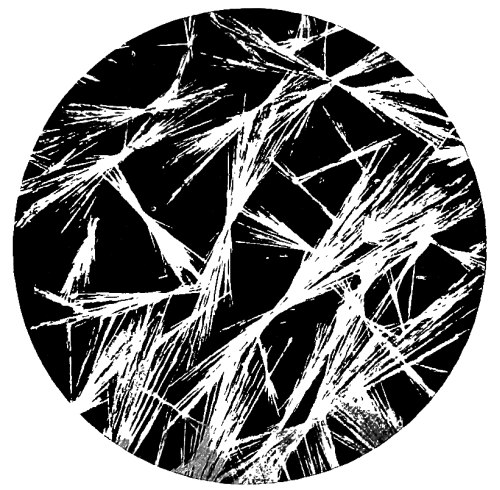
Fig. 36.—Photo-micrograph
of crystals
of hydrochloride of morphine, × 50.
(R. J. M. Buchanan.)
Taylor‘s method for the extraction of morphine may be briefly described
as follows:
The liquid—porter, &c.—to be examined is acidified with acetic acid;
or, if a solid organ is to be tested, it must be cut into thin slices
and placed in distilled water acidified in a similar way. In either
case the liquid is digested for one or two hours at a gentle heat,
and filtered. Acetate of lead is now added to the filtrate until no
further precipitation occurs; the liquid is then boiled and filtered.
The meconic acid remains on the filter as meconate of lead, while
the filtrate contains the morphine as acetate. The liquid is freed
from excess of lead by passing through it a current of sulphuretted
hydrogen, filtered to remove the precipitated sulphide of lead, and the
resulting liquid evaporated to an extract on a water bath, and treated
with alcohol. The alcoholic solution on evaporation gives acetate of
morphine, which may then be tested.
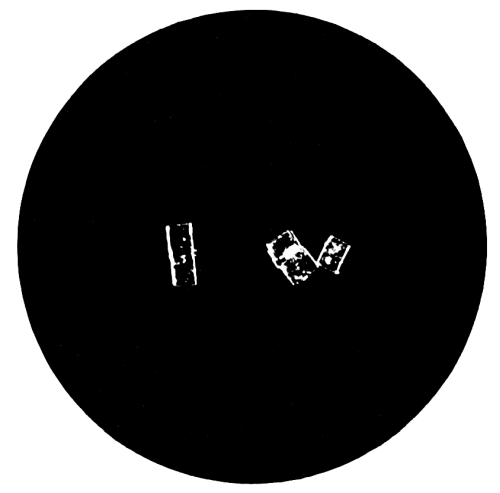
Fig. 37.—Photo-micrograph
of meconic acid
crystallised from aqueous solution, × 50.
(R. J. M. Buchanan.)
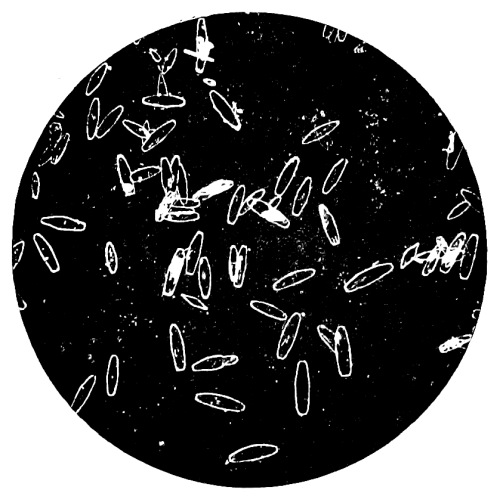
Fig. 38.—Photo-micrograph
of meconic acid
crystallised from an alcoholic solution, × 50.
(R. J. M. Buchanan.)
The meconate of lead which remains on the filter is decomposed by
treating it with dilute sulphuric acid, and gently boiling the mixture.
The filtered liquid should be neutralised before the tests for the
presence of meconic acid are applied.
The reactions of both morphine and meconic acid are best seen from the
following Table:—
| Morphine—Solid |
| Treated with strong nitric acid. |
Dissolves with effervescence and |
| the production of ruddy fumes, |
| forming a rich orange-coloured |
| solution not changed by the |
| addition of stannous chloride. |
| Mixed with a little iodic acid |
A blue colour, due to the |
| and starch paste. |
liberation of iodine. |
| Dissolved in cold strong |
Bright-green colour. |
| sulphuric acid, and a drop of |
| strong solution of bichromate |
| of potash added. |
| Rubbed with sulphomolybdic acid |
A violet colour changing to |
| (Frohde‘s reagent). |
green, and then sapphire-blue. |
| Morphine and Meconic Acid in Solution |
| |
Morphine. |
Meconic Acid. |
| Tested with litmus paper. |
Slightly alkaline. |
Very distinctly acid. |
| A little perchloride |
An inky-blue colour, |
Deep red colour, not |
| of iron, rendered |
destroyed and changed |
easily destroyed by |
| of nearly neutral |
to orange-red by |
a solution of |
| as possible. |
nitric acid. |
corrosive sublimate or |
| |
|
dilute mineral acids. |
The characteristic tests for morphine are its reactions with nitric
acid, iodic acid and starch, and perchloride of iron. The reaction
with the perchloride of iron is also characteristic of meconic acid.
This last-mentioned test is a very conclusive one for meconic acid,
when certain precautions are taken; for the property of striking a
deep red with a persalt of iron is shared equally by sulphocyanides
and alkaline acetates. The colour produced by sulphocyanic acid is
instantly bleached on the addition of corrosive sublimate.
The question thus lies between acetic and meconic acid. To distinguish
the one from the other, the solution to be tested should be boiled
for a short time after the addition of a few drops of sulphuric acid.
Any acetate present is decomposed and the acetic acid is expelled
by the boiling; so that if, after allowing the solution to cool, it
still gives the red colour with perchloride of iron, the reaction may
be taken as conclusive of meconic acid. By these means morphine and
meconic acid may be detected in porter and other liquids.
Table showing the Characters and
Tests of the Following Poisons
| Morphine. |
Strychnine. |
| 1. Crystallises in colourless |
1. Crystallises in white |
| transparent prisms, belonging |
four-sided prisms, terminated |
| to the trimetric system. |
by four-sided pyramids. |
| 2. Sulphuric acid and |
2. Treated with cold sulphuric |
| bichromate of potash give |
acid, no reaction; on |
| a bright-green coloration. |
the addition of a crystal of |
| |
potassium bichromate, an |
| intense purple colour is |
| produced, becoming |
| crimson and then light red |
| 3. Strong colourless nitric acid, |
3. Strong nitric acid usually |
| added freely to a cold |
produces a yellow or |
| solution, produces a deep |
yellow-brown colour. |
| orange-red coloration, not |
|
| changed by stannous chloride. |
|
| Brucine. |
Narcotine. |
| 1. Crystallises in oblique rhomboidal |
1. Crystallises in right rhombic |
| prisms, sometimes agglomerated |
prisms, or in needles |
| mushroom-like heads. |
grouped in bundles. |
| 2. Sulphuric acid gives a |
2. Sulphuric acid a bright |
| rich rose-pink tint; on the |
sulphur-yellow colour, |
| addition of potassium |
potassium bichromate added a |
| bichromate, none of the |
green colour as with morphine, |
| reactions of strychnine |
but slower in production. |
| are observed. |
|
| 3. Strong nitric acid produces a |
3. Strong nitric acid forms |
| blood-red colour, changed |
a colourless fluid, becoming |
| after warming and diluting |
yellow on heating. |
| with distilled water to purple |
|
| by stannous chloride; |
| ammonium sulphide gives |
| a similar but less marked |
| reaction. Excess of stannous |
| chloride discharges the |
| blood-red colour in the cold. |
CHAPTER VIII NARCOTIC POISONS — Somniferous OPIUM
Opium is the inspissated juice of the Papaver somniferum, the
garden or opium poppy. The plant is a native of Egypt and Syria,
cultivated in England.
Opium is sometimes taken in its crude state as a poison, but more
frequently one of its preparations is thus employed—notably the
tincture, better known as laudanum.
The poisonous properties of this drug reside in an alkaloid,
morphine—in combination with an acid, meconic acid.
The several varieties of opium vary considerably in the quantity of
morphine which they contain, the amount varying from 2 to 9 per cent.
Opium, or its alkaloid, morphine, forms an important ingredient
in Dalby‘s Carminative, Winslow‘s Soothing Syrup,
Godfrey‘s Cordial, Chlorodyne, Nepenthe, &c.
Of all forms of poisoning, that by opium and its preparations is the
most frequent; and it is stated that three-fourths of all the deaths
from opium occur among children under five years of age.
Symptoms.—The rapidity with which the symptoms of poisoning
by opium make their appearance will depend upon the form in which
the poison is taken—solution, of course, increasing the activity of
the drug. In most cases, an interval of from half an hour to an hour
elapses after the poison has been swallowed before any evil effects
become apparent. Christison, however, mentions a case in which stupor
did not show itself for eighteen hours. During the first stage of
poisoning by opium, the patient may become slightly excited; this state
is, however, soon followed by giddiness and drowsiness. The eyes are
kept open with difficulty. Stupor and insensibility now supervene, from
which he may, in most cases, be temporarily aroused by a loud noise or
a smart blow. As the case progresses, coma and stertorous breathing
occur, and it becomes almost impossible to rouse him at all. The pulse,
at first small, quick, and irregular, becomes slow and full as the coma
increases. The breathing, hurried in the early stages, is now slow and
stertorous. The pupils are contracted in the early stages, and may be
in the later stages dilated; the former condition is most frequently
present, together with insensibility to light. The pupils may be
contracted in cases of hæmorrhage into the pons Varolii, and
this disease has been mistaken for opium poisoning. In uræmic coma,
coming on in the course of Bright‘s disease, the pupils may also be
contracted; the nature of the case will be explained by the history
and presence of dropsy. All the secretions, except that of the skin,
are suspended, and the bowels are usually obstinately confined. The
breath may be impregnated with the odour of opium. Certain anomalies
in the symptoms may occur; thus, there may be vomiting and purging,
convulsions (the last most frequent in children), delirium, tetanic
spasms, one pupil dilated and the other contracted, paralysis, and
anæsthesia. It must be borne in mind that remissions sometimes occur in
the symptoms, the patient dying after an attempt at recovery.
A question of some importance may arise as to the amount of volition
and power of locomotion which may exist for some time after a poisonous
dose has been taken. Death may be due to causes other than the effect
of poison. It must, at least, be admitted as possible, that a person,
after swallowing a quantity of opium sufficient to cause death, may yet
be able to walk and move about for one or two hours.
Opium-eating.—If opium be taken for some time in small
doses, the system becomes tolerant of it, so that a dose which would
be poisonous to most people only produces a slight and pleasurable
excitement. De Quincey was in the habit of taking daily nine ounces of
laudanum. The habitual opium-eater generally suffers from disorders of
the digestive organs, dyspepsia and its train of unpleasant symptoms;
the body becomes thin, the countenance attenuated, the eyes sunken and
glassy, the gait halting, and the body bent. The craving for the drug,
which becomes greater and greater, is only temporarily satisfied by
larger and larger doses. The opium-eater seldom attains a great age,
usually dying before forty. This is perhaps a somewhat exaggerated
picture of the ill effects of opium-eating. Christison, after quoting
the results of his observations in twenty-five cases of confirmed
opium-eaters, concludes as follows: “These facts tend on the whole
rather to show that the practice of eating opium is not so injurious,
and an opium-eater‘s life is not uninsurable, as is commonly thought,
and that an insured person, who did not make known his habit, could
scarcely be considered guilty of concealment to the effect of voiding
his insurance. But I am far from thinking (as several represent who
have quoted this work) that what has now been stated can with justice
be held to establish such important inferences; for there is an obvious
reason why, in an inquiry of this kind, those instances chiefly should
come under notice where the constitution has escaped injury—cases
fatal in early life being more apt to be lost sight of, or more likely
to be concealed.”
Effects of External Application.—The application of opium
to the surface of the body is not usually attended with dangerous
symptoms; but, in a few cases, due probably to some idiosyncrasy,
alarming effects, or even death, have resulted from the external
application of the drug. Orfila has tried to show that opium is readily
absorbed by the coats of the rectum, and that it acts more rapidly than
when taken into the stomach. This statement does not appear to be
correct, for the dose administered by enema is usually twice that given
by the mouth.
Post-mortem Appearances.—As might be expected, the appearances
found after death are not very characteristic. The vessels of the brain
are congested, and serous effusions in the ventricles or between the
membranes are not uncommon. Engorgement of the lungs is most frequently
present in those cases in which convulsions have occurred. The stomach
is in most cases found quite healthy. The bladder may be full of urine,
due probably to the person being unable to empty it from loss of
consciousness.
Fatal Period.—From three-quarters of an hour and upwards.
Fatal Dose.—Four grains is about the smallest fatal dose of
opium in an adult; but cases of recovery, where an ounce or more
of laudanum has been taken, are not very rare. Children are very
susceptible to opium. The smallest dose of morphine that has proved
fatal to an infant is one-twelfth of a grain of the hydrochloride.
Half a grain of the acetate has proved fatal to an adult, one grain
of morphine or its salts has proved fatal on several occasions. With
prompt treatment recovery has taken place after much larger doses, even
as much as seventy-five grains.
Chemical Analysis and Tests.—These have been described on
p. 339 et seq.
Treatment.—The stomach pump should be used without delay, and
the stomach thoroughly washed out. The washing water should contain
about ten to fifteen grains of permanganate of potash to the pint, and
the washing repeated at short intervals, as the permanganate destroys
the morphine. If the stomach tube be not at hand, the patient should
be made to drink the permanganate solution if possible. This treatment
should be carried out even when morphine has been administered
hypodermically, as it is excreted by the stomach. Emetics should also
be given if the patient can swallow; if unable to do so, a hypodermic
of ⅒ grain of apomorphine may be given. The administration of strong
coffee or tea, the application of ammonia to the nostrils, flagellation
of the soles of the feet, and keeping the patient constantly walking
about (a procedure of doubtful value) are among the measures usually
adopted by way of treatment. Galvanism and artificial inflation of
the lungs have done good service even in the most hopeless cases. The
student is referred to some important cases recorded by Dr. Burgess and
others in the Medical Press and Circular, vol. i. p. 369, for
the year 1892. Dr. Burgess strongly recommends prolonged artificial
respiration, the interrupted current, and the administration of
stimulants, externally, internally, and hypodermically. Dr. Finny is of
opinion that, while opium may be useful in cases of atropine poisoning,
atropine is of little use in opium poisoning; in this opinion Dr.
Burgess concurred. The state of the respiration is a better test than
the condition of the pupil when atropine is used as an antidote. If the
administration of atropine does not quicken the respiration it should
be discontinued, and other methods tried. Vinegar should not be given,
as it dissolves the morphine and renders it more easy of absorption.
Death is rare in those cases in which proper remedies have been
resorted to before the stage of stupor has commenced.
Synopsis of the Effects of Opium
upon the System
1. The Mental Faculties.—The first effect noticed when opium is
taken in small doses is a primary exaltation of the mental faculties;
the imagination is rendered brilliant, and the passions exalted; after
a time drowsiness supervenes, followed by deep sleep. A dose of thirty
drops of the tincture caused in one experimenter an exhilaration of the
mental faculties, and an aptitude for study; the subsequent drowsiness
being removed by a dose of a hundred drops or more, when the greatest
mental excitement was the result.
2. The Respiration.—The frequency of the respiration is
diminished, and the oxidation of the blood impaired.
3. The Pulse.—The first effect on the circulatory system is
that of a stimulant, and then sedative. By the administration of
repeated small doses, the force of the circulation may be maintained
for some time.
4. The Eyes and Countenance.—The pupils, when the patient is
powerfully under the influence of opium, are contracted even to a
point. Dilatation, has, however, been noticed in some cases, especially
when death approaches. In apoplexy of the pons Varolii, the pupils are
contracted. The countenance is placid, pale, and ghastly; the eyes
heavy, and the lips livid.
5. The Cutaneous System.—The skin, although cold, is not
infrequently bathed in profuse perspiration.
6. The Alimentary Canal.—Sometimes there is vomiting and even
purging; but, as a rule, the secretions along the whole alimentary
canal are diminished, and constipation is the result. According to Dr.
Walter Smith, of Dublin, morphine is mainly excreted into the stomach
and bowels, and so cast out in the fæces. Very little goes out in the
urine.
7. The Average Commencement of Symptoms.—Much depends upon the
size and form of the dose. In most cases the first appearance of the
symptoms is seldom delayed beyond an hour after the poison is taken.
8. The Average Period of Death.—Seven to twelve hours.
Table showing some of the Symptoms and Effects
of Opium and Belladonna
| Opium. |
Belladonna. |
| 1. Slight excitement, coma, |
1. Active, busy delirium preceding |
| lethargy, and no return of the |
the coma, followed by delirium, |
| excitement should the patient |
if recovery takes place. |
| recover. |
|
| 2. Coma is of shorter duration than |
2. Coma is of longer duration than |
| in poisoning by belladonna. |
in poisoning by opium. |
| 3. Pupils contracted. |
3. Pupils dilated. |
| 4. Local application to the eye |
4. Dropped into the eye, the pupils |
| does not affect the pupil. |
are dilated. |
| 5. Bowels as a rule confined. |
5. Bowels not affected. |
| 6. Acts powerfully on children. |
6. Well borne by children. |
Table showing the Points
of Distinction between
Apoplexy and Narcotic Poisoning
| Apoplexy. |
Narcotic Poisoning. |
| 1. Apoplexy may be preceded by |
1. No premonitory symptoms, |
| premonitory symptoms, as |
except by fortuitous |
| giddiness, headache, noises in |
combination. |
| the ears and partial paralysis. |
|
| 2. Apoplexy chiefly attacks the old, |
2. More frequently in the young, |
| and is very rare in young people. |
especially of the female sex. |
| 3. Most frequently among fat people. |
3. In fat or thin people. |
| 4. Symptoms may come on during |
4. An interval of from ten to thirty |
| the meal or immediately after. |
minutes always occurs,even in |
| |
the case of opium, the |
| |
commonest of narcotic poisons. |
| 5. The symptoms commence abruptly, |
5. The symptoms advance |
| sometimes with deep stupor. |
gradually. |
| 6. Patient is with difficulty, if ever, |
6. Patient may be roused from |
| temporarily aroused. |
the deepest lethargy if shaken |
| Convulsions common. |
or spoken to in a loud voice. |
| Face bloated |
Convulsions rare in opium |
| Pupils dilated, or irregular. |
poisoning. Face seldom bloated. |
| |
Pupils contracted. |
| 7. Life may be prolonged for a day or |
7. Life is seldom prolonged beyond |
| more. Apoplexy may, however, |
six or eight hours. Shortest |
| kill in an hour. |
time in which opium has |
| |
caused death, three hours. |
| 8. No response when the forehead |
8. Patient may be roused by |
| is smartly tapped with the |
tapping the forehead, &c. |
| finger-nails, or when water is |
|
| injected into the ear. |
|
Table showing the Condition
of the Pupils in—
| Ordinary sleep |
The eyes turned upwards; pupils contracted. |
| Chloroform narcosis |
When the liquid is taken, coma; pupils |
| dilated; eyes suffused or glistening, and |
| turned upwards. When the vapour is |
| inhaled, pupils first contracted; when coma |
| supervenes, dilated. |
| Apoplexy |
Pupils dilated; insensible to light. Sometimes |
| unequal. Apoplexy of pons Varolii, |
| pupils contracted. |
| Alcoholic coma |
The pupils dilated or variable, and not affected |
| |
by a bright light placed before them. |
| Poisoning by opium |
Contracted in some cases to a pin‘s head; as |
| |
death approaches, the pupils dilate. |
| Carbolic acid |
Contracted and insensible to light. |
| Calabar bean |
Powerful contraction of the pupils. |
| Hyoscyamus or atropine |
Dilatation of the pupils. |
| Strychnine |
In some cases the pupils, during the |
| paroxysms, are dilated, and contracted |
| during the intermissions. |
| Aconite |
Sometimes contracted; but in 17 out of 20 |
| cases recorded by Dr. Tucker, dilatation |
| was present. |
CHAPTER IX DELIRIANT POISONS — BELLADONNA — HYOSCYAMUS — STRAMONIUM — ŒNANTHE CROCATA — CAMPHOR — SALICYLIC ACID
Under this head will be noticed those poisons whose action on the
animal economy is characterised by delirium, illusion of the
senses, and marked dilatation of the pupil. In some cases there
is considerable irritation of the digestive organs, accompanied with a
difficulty in passing water, sometimes ending in complete suppression
of urine. The mydriatic alkaloids atropine, hyoscine, hyoscyamine,
daturine, duboisine, scopolamine, are practically identical in chemical
composition and action, and produce similar symptoms.
The following are among the most important poisons of this group:—
- 1. Belladonna.
- 2. Hyoscyamus.
- 3. Stramonium.
- 4. Solanum Dulcamara.
- 5. Solanum Nigrum.
- 6. Solanum Tuberosum.
Those of less importance are Œnanthe crocata or Dropwort,
Camphor, Salicylic Acid, and Yew—the last already described among the
Vegetable Irritants.
Symptoms.—Taken internally or applied externally, belladonna,
Atropa Belladonna (N. O. Solanacea), or its alkaloid
atropine, causes dryness of the mouth and throat, with intense thirst.
Nausea and vomiting are present in most cases, accompanied with
giddiness, double or indistinct vision, active delirium, convulsions,
ending in stupor and coma. In the majority of cases an erythematous
rash appears on the skin, with elevation of temperature resembling
scarlet fever. A very marked characteristic of poisoning by solanaceous
plants is dilatation of the pupil, the iris in some cases being
reduced to a mere line round the pupil. The symptoms in some cases
which have been recorded are almost identical with those of delirium
tremens. In other instances there has been little or no delirium, the
patient at once passing into fatal lethargy. Alarming symptoms have
followed from drinking a decoction of belladonna leaves, which were
mistaken and supplied for those of the ash. Accidental poisoning has
also frequently occurred among children from their eating the ripe
berries of the belladonna plant. Slight symptoms of poisoning are
sometimes met with from the use of belladonna plasters to remove the
milk from the breasts of women delivered of still-born children, or in
cases where the child has died soon after birth. In these cases the
patients complain of intense dryness of the mouth, dimness of vision,
and itching of the skin. The removal of the plasters will at once
arrest the unpleasant symptoms.
In the Gazette des Hôpitaux, July 1859, a case is recorded of
poisoning by the outward application of belladonna in the form of the
following liniment: Camphorated oil of henbane, ten ounces; extract of
belladonna, four scruples. The patient was seriously ill for some days,
but ultimately recovered.
Poisoning has also resulted from the use of a solution of atropine
(four grains to one ounce) dropped into the eye in the treatment of
iritis. (See British Medical Journal, 1876, vol. i.)
Post-mortem Appearances.—Congestion of the vessels of the
brain, sometimes with fluid blood, at other times with thick black
blood. The stomach may or may not be congested; but in cases where the
ripe berries have been taken, the mucous lining may be seen deeply dyed
by the juice of the berries. The pupils are usually found dilated.
Fatal Dose.—One teaspoonful of belladonna liniment and one
drachm of tincture have proved fatal. Recovery has taken place after
half an ounce of liniment and extract. Children are less affected than
adults. Of atropine half a grain has proved fatal. Recovery has taken
place after five grains of the sulphate.
Fatal Period.—Twelve hours to several days.
Chemical Analysis.—From organic mixtures the alkaloid may be
obtained by Stas‘s process, and treated according to Vitali with a
little fuming nitric acid, and then dried in a water bath: when cold,
it must be moistened with a drop of potassæ dissolved in absolute
alcohol. A violet colour changing to red is produced, the violet being
characteristic, as strychnia when treated as above gives a red colour.
The physiological action on the pupil must also be noted. When the
berries are taken, the mucous membrane of the stomach may be found
dyed of a purple colour, turned green by alkalies and red by acids.
Fragments of the berries may also be found in the stomach.
To a small quantity of solid atropine add a drop or two of strong
sulphuric acid, then a crystal of sodium nitrite; a yellow colour is
produced, which alcoholic solution of potash changes to reddish-violet
and then pale rose.
Free atropine gives a red colour with phenolpthalein; the colour is
discharged with alcohol, but reappears on evaporating it.
Gerrard‘s Test.—Mercuric chloride dissolved in alcohol gives a
red colour.
Blyth‘s Test.—To the solid alkaloid add strong solution of
baryta, evaporate, to dryness, and heat the residue, when the smell of
hawthorn blossom is given off.
Wormley‘s Test.—An alcoholic solution of bromine gives a
crystalline yellow precipitate.
Treatment.—Wash out the stomach and give hypodermic injections
of one-third of a grain of pilocarpine, which is the best
antidote. Emetics and purgatives, castor-oil and animal charcoal
may be administered. The symptoms as they present themselves
must be treated on general principles.
N.B.—Belladonna has been stated to act in
antagonism to opium, and its administration recommended in poisoning by
that drug.
Hyoscyamus, Hyoscyamus niger, or henbane (N.O.
Solanaceæ), alkaloids hyoscine, hyoscyamine, taken in large doses,
produces symptoms not unlike those due to belladonna. There is the same
affection of sight—double vision; the same dilatation of the pupils,
delirium, confusion of thought, insensibility, and coma. Hyoscine has
a hypnotic effect in comparison to the deliriant action of belladonna.
But its action varies very much on different people. A form of mania,
with wild hallucinations, has sometimes been observed to follow the
administration of this drug.
The peculiar property of henbane is marked by its tendency to produce
a general paralysis of the nervous system. The root has been eaten by
mistake for parsnips, when all the foregoing symptoms were present. The
seeds are more poisonous than the roots, the leaves being the least
poisonous part of the plant.
Post-mortem Appearances.—The morbid appearances are not unlike
those which result from poisoning with belladonna.
Fatal Dose.—Nothing certain can be stated as to the amount
required to cause death. Alarming symptoms are said to have followed
the administration of ten minims of the tincture, repeated every
six hours. Twenty of the seeds have caused active delirium.
Idiosyncrasy may have something to do with this result. Half a drachm
of the tincture is often given to an adult, and repeated every four
hours, without any unpleasant result.
Treatment.—As for belladonna, emetics and purgatives, to expel
the poison from the system.
The Thorn Apple, Datura Stramonium (N.O. Solanaceæ),
possesses powerful poisonous properties. These are marked by the
production of giddiness, impairment of vision, and syncope. Furious
delirium is not infrequent; and in one case where this state was
present there was loss of speech. The face is usually flushed, the
eyes glistening and restless, and the pupils dilated; in short, the
countenance is that of one intoxicated. Taken together, the symptoms
are not unlike those produced by belladonna.
Poisoning by stramonium seeds is a favourite mode of procedure among
the Hindoos; but as the poison is most frequently given to facilitate
robbery, death seldom results from its use. In India, the seeds are
mixed with the boiled rice so commonly eaten there, and as they closely
resemble the seeds of the common capsicum, the dangerous nature of the
mixture is not readily detected. The seeds of the datura can be
distinguished by the taste, which is slightly bitter, whereas that of
the capsicum is hot and pungent. The outward application of the leaves
may give rise to all the appearances of poisoning.
The active principle of stramonium is the alkaloid Daturine,
which crystallises in colourless quadrangular prisms, with a bitter
acrid taste. It resembles atropine and hyoscyamine in chemical
properties.
Post-mortem Appearances.—Congestion of the vessels of the brain
and its membranes, with some slight gastric irritation.
Treatment.—As for belladonna, emetics and purgatives, to get
rid of the portions of the plant swallowed.
Some other solanaceous plants—Solanum Dulcamara, Bittersweet
or Woody Nightshade, Solanum nigrum, or Garden Nightshade, and
the Solanum tuberosum, or Potato—possess poisonous properties.
They, like the other members of the order to which they belong,
give rise to symptoms characterised by giddiness, dimness of sight,
trembling of the limbs, and delirium. The water in which the potato has
been boiled is sometimes used by the vulgar as an application to favus
of the scalp.
The active principle of these plants resides in an alkaloid,
Solanine, which is not a very powerful poison. A rabbit has been
killed in a few hours by two grains of the sulphate of solanine.
Hemlock-Dropwort, or Dead-tongue, is a poisonous indigenous,
umbelliferous plant.
Accidental poisoning by this plant has occurred, the root having been
mistaken for parsnip. The symptoms in one of the cases which have been
recorded were those of delirium tremens; in another, which
terminated fatally, vomiting of blood was followed by convulsions.
First contraction and then dilatation of the pupil, spasmodic
respiration, and an almost imperceptible pulse were the effects
noticed. Death may take place in a few hours.
Post-mortem Appearances.—Congestion of the vessels of the
brain, and gastric irritation. The face has sometimes a bloated
expression, and blood may escape from the ears and mouth.
Treatment.—Purgatives and emetics, to evacuate the bowel and
stomach, and thus get rid of the poison.
Camphor is a concrete vegetable oil obtained from Camphora
officinarum (N.O. Lauraceæ). Its employment for the purpose
of homicide is rare, but several cases of accidental poisoning from the
use of the homœopathic solution have been recorded (British Medical
Journal, 1873, vol. ii. p. 617).
The symptoms are—languor, giddiness, delirium, foaming at the mouth,
vomiting of blood-tinged fluid, convulsions, gastric irritation, and
great abdominal pain. In one case—that of a young lady aged twenty,
who took twenty-five drops of “Epps‘ Concentrated Solution of Camphor”
for a sore throat—all the above-mentioned symptoms were present; she
was also unconscious for several hours, and partially paralysed for
several days—perfect recovery from the nervous symptoms not taking
place for more than six months.
The homœopathic solution (Rubini‘s) is stronger than that of the
British Pharmacopœia in the proportion of 7.2 to 1. For its detection
in organic fluids, it may be removed by chloroform; and from fixed
oils, by distillation. Water precipitates it from its alcoholic solution.
Post-mortem Appearances.—Those produced by irritants.
Treatment.—Purgation and emetics, to empty the bowel and
stomach.
This substance, prepared by acting on a mixture of carbolic acid and
sodium with carbonic acid at a moderate heat, is used largely for
acute rheumatism. In some cases premonitory symptoms of poisoning have
demanded a cessation in the administration of the drug. The most usual
of these are noises in the ears, difficulty of hearing, amblyopia,
delirium, and profuse perspiration. There may be hæmorrhages from the
mucous membranes, and into the retina. When the drug is discontinued
the symptoms pass off. The symptoms are held by some observers to be
due to the artificial and not the natural acid.
CHAPTER X INEBRIANT POISONS — ALCOHOL — COCAINE — COCCULUS INDICUS — LOLIUM TEMULENTUM — POISONOUS FUNGI — NITROBENZENE, OR ESSENCE OF MIRBANE — DINITROBENZENE — ANILINE — ACETANILIDE (ANTIFEBRIN), PHENAZONUM (ANTIPYRIN), AND PHENACETIN
The poisons grouped under this head are characterised by causing
delirium, followed by narcotism. Recovery is not infrequently slow, the
system suffering more or less severely from the effects of the poison.
In the case of alcohol, loss of appetite, accompanied with considerable
gastric irritation, are among the after-effects of the poison.
The chief of this group are—Alcohol, Cocculus Indicus, Poisonous
Fungi, Nitro-Benzene.
Others of less importance will be briefly considered.
It will be necessary to consider poisoning by this substance under two
forms—acute and chronic. So many anomalies present themselves that it
is difficult to give a clear outline of the symptoms.
Acute.—In most cases the symptoms come on within a few minutes
after the poison is swallowed. Giddiness, confusion of ideas, and a
difficulty in walking straight are among the first effects produced,
these being followed by stupor and coma. Nausea and vomiting are
the early signs of recovery. In some cases there may be no
premonitory symptoms, sudden and complete stupor supervening some time
after a large dose of alcohol has been taken.
The patient not infrequently recovers from the first symptoms. A
relapse takes place; he becomes insensible, and dies convulsed. The
countenance wears a vacant expression, the face flushed and bloated,
the lips livid, and the pupils dilated and insensible to light. The
pupils may be contracted, but dilate on irritating the skin by a
pin-prick or pinch. The sensibility of the pupil to the action of
light should be regarded as a favourable symptom. The rapidity with
which alcohol acts is not so great as to prevent the individual from
walking some distance and performing certain acts of volition. The
rapidity with which the symptoms show themselves will depend upon the
previous habits of the individual, and the strength and quantity of the
alcohol taken. Alcohol, when diluted, induces a preliminary stage of
excitement, followed by stupor; but when concentrated, stupor may come
on almost immediately after the spirit is swallowed.
The vapour of alcohol may act as a poison, giving rise to the symptoms
above mentioned.
Congestion of the lungs or brain, or both together, is in most cases
the cause of death in acute poisoning by alcohol.
Chronic.—The habitual dram-drinker suffers from many diseases.
The appetite becomes impaired; there is considerable irritation of the
stomach and bowels, marked by vomiting and purging. Then follows a long
list of organic diseases. The structure of the liver becomes changed;
it may increase in size, become lighter in colour and cirrhotic, being
then known as “hobnailed” or dram-drinker‘s liver. Jaundice
and dropsy may be present as the result of this altered condition of
the gland. The kidneys also suffer from granular degeneration. Then
follow a long series of nervous complaints: congestion of the brain,
paralysis, delirium tremens, and insanity. Sudden death by coma
not infrequently ends the career of the drunkard.
Delirium tremens is one of the most common results of the habit
of drinking; and this affection, it is stated, may be induced by the
sudden discontinuance of alcohol in those who are habitually given to
its use.
Post-mortem Appearances.—The stomach may present the usual
signs of inflammation, due to the irritant action of alcohol. The
colour of the mucous membrane of the stomach may be bright red, dark
red, brown, or quite pale. The brain and its membranes are sometimes
congested, and the intracranial vessels gorged with blood. The odour
of alcohol may be present in the contents of the stomach; and alcohol
may, in some cases, be detected in the lungs, brain, and other organs
of the body. The lungs are not infrequently found congested, and
the right cavities of the heart full of dark-coloured blood. Casper
examined a case in which the cavities of the heart were empty. The
blood is remarkably fluid, and of a dark colour. “Lymphatic exudation
between the cerebral meninges, so that the pia mater upon the cerebral
hemispheres is seen here and there whitish as if varnished, is not
a result of death from drinking, but is the result of the chronic
irritation of the brain by habitual drunkenness, and is therefore a
very common appearance in the bodies of all drunkards, from whatever
cause they have died.” One other condition occurring in those dying
from the effects of alcohol, is the remarkably long continued presence
of the rigor mortis, and perfect freedom from putrefaction, even
up to the ninth day, in an atmosphere by no means unfavourable to early
decomposition. A condition of the skin known as cutis anserina,
or “goose skin,” was present in some of the cases examined by Casper.
Absorption and Elimination.—From experiments on animals, it
has been shown that alcohol is rapidly absorbed, and then eliminated
from the system, and that all traces of alcohol may disappear in a few
hours, and yet death be the result of its action. Alcohol is supposed
to be decomposed in the body, but the exact changes it undergoes do not
appear to be very clearly made out.
Fatal Period.—Death has occurred in a few minutes after a large
dose of alcohol had been swallowed. The average fatal period is about
twenty-four hours. Death may also be an indirect result of the action
of alcohol on the system.
Fatal Dose.—Uncertain. The age and habits of the individual
must be considered. Between three and four ounces proved fatal to a boy
seven years of age.
Table showing the Points of Distinction between Concussion
of the Brain, Alcoholic Poisoning, and
Poisoning by Opium.
| Concussion of the Brain. |
Alcoholic Poisoning. |
Poisoning by Opium. |
| 1. Marks of violence on |
1. The absence of |
1. Same as under |
| the head. |
marks of violence, |
alcohol. |
| |
unless the person has |
|
| fallen on the ground. |
| The history of the |
| case will help in |
| forming an opinion. |
| 2. Stupor comes on |
2. Excitement |
2. The symptoms |
| suddenly. |
previous to the |
slow in appearing; |
| |
stupor, which comes |
drowsiness, stupor, |
| |
on suddenly. |
lethargy. Muscles |
| |
|
relaxed, and |
| locomotion impossible. |
| The patient may be |
| roused by a sharp |
| question. |
| 3. Face pale and cold; |
3. Face flushed; and |
3. The face pale, |
| the pupils sluggish and |
pupils generally |
pupils contracted. |
| insensible to light |
dilated. |
|
| sometimes dilated. |
|
|
| 4. Remissions are |
4. Partial recovery |
4. Remissions are, as |
| rare, the patient |
may take place, |
a rule, rare in this |
| recovering slowly, |
followed by death |
form of poisoning. |
| and with some |
after the lapse |
|
| confusion of ideas. |
of some hours. |
|
| 5. Absence of the |
5. Presence of the |
5. Odour of opium |
| odour of alcohol in |
odour of alcohol in |
in the breath. |
| breath; if present, |
the breath. |
|
| it is probably due |
|
| to the treatment of |
|
| bystanders. |
|
Chemical Analysis.—Tests for Alcohol:
1. Characteristic smell.
2. It dissolves camphor.
3. Treated with dilute sulphuric acid and a
strong solution of bichromate of potash, the green oxide of chromium
is set free, and the vapour of aldehyde may be detected by the
smell.
4. Burnt under the mouth of a test tube,
moistened with solution of baryta or lime-water, a deposit is formed in
the tube of carbonate of baryta or lime.
5. If a few drops of a solution of iodine in
iodide of potassium be added to alcohol, and then sufficient caustic
potash be added to decolourise it, a crystalline precipitate of
iodoform with its characteristic odour will be formed.
6. If copper turnings be added to a solution
containing alcohol, then some strong nitric and sulphuric acid, and
the mixture warmed, the odour of sweet spirit of nitre will be given
off.
7. On warming with sodium or lead acetate and
sulphuric acid the odour of acetic ether is evolved.
Alcohol in the Contents of the Stomach or in the Tissues.—The
contents of the stomach, or the tissues bruised and macerated in
distilled water, should be carefully distilled in a water bath. It
will be necessary to neutralise the liquid prior to distillation.
The distillate should be mixed with chloride of calcium or anhydrous
sulphate of copper, and re-distilled. The liquid thus obtained is
shaken with dry carbonate of potash, and allowed to settle. The alcohol
rises to the top of the mixture, whence it may be removed by the aid of
a pipette, and tested as before mentioned.
Treatment.—Immediate use of the stomach pump and emetics; to
empty the stomach a hypodermic injection of apomorphine may be given.
Affusion of cold water to the head, or the injection of cold water
into the ears, may be tried. The administration of ammonia, and the
employment of galvanism, have been of service in some cases.
Cocaine is an alkaloid obtained from the Erythroxylon Coca. It
produces a paralysing effect upon the endings of sensory nerves, and is
used as a local anæsthetic. When absorbed into the blood it paralyses
the vagus and causes increased rapidity of the pulse. Applied to the
eye it causes dilatation of the pupil. It first has a stimulating
action on the centres of the brain and spinal cord, finally paralysing
them. It produces death by paralysis of respiration, according to
Mosso, by causing tetanus of the respiratory muscles.
Symptoms.—The symptoms produced are pallor, cyanosis,
faintness, and cold sweats, pain in the precordial region, rapid pulse,
intermittent heart beat, laboured respiration. The pupils are dilated.
Speech becomes incoherent, there may be trismus of the jaws, the ideas
are confused, and there may be delirium. Tetanic spasms of muscles may
occur, and convulsions, also loss of consciousness.
Chronic poisoning, following the cocaine habit, produces a long
series of symptoms which are manifestations of mental and physical
degeneration, which in extreme cases may pass on to insanity, with
hallucinations and delusions.
Fatal Dose.—Half a grain injected into the gum of an adult has
caused alarming symptoms, and two-thirds of a grain has caused death.
Recovery has taken place after forty-three grains were taken by the mouth.
Fatal Period.—Death has occurred in twenty minutes after three
and a half grains by hypodermic injection.
Chemical Analysis.—The alkaloid may be separated from the
stomach contents or viscera by the usual procedure for extraction of
alkaloids.
1. On the addition of strong nitric acid and evaporating to dryness,
the residue when treated with alcoholic solution of potash gives off an
odour like peppermint or meadow-sweet.
2. Goeldner‘s Test.—Strong sulphuric acid and resorcin when
mixed with cocaine gives a blue colour, changing to rose-pink on
addition of caustic potash. Goeldner considers this a reaction peculiar
to cocaine.
3. Metzer‘s Test.—If a few drops of a 5 per cent. solution of
chromic acid in water be added to a solution of cocaine hydrochloride,
each drop gives a yellow precipitate which redissolves. The addition of
strong hydrochloric acid produces a yellow precipitate of chromate of
cocaine. Metzer considers this reaction peculiar to cocaine.
4. When applied to the tongue or lips a feeling of numbness is
produced; it is rendered more effectual if a solution of sodium
bicarbonate be first applied to the mucous membrane.
Treatment.—Wash out the stomach and encourage vomiting.
Stimulants and ammonia should be given freely, and if convulsions
occur chloroform should be inhaled. Tannic acid or gallic acid in
thirty-grain doses have been recommended, also iodine one grain with
potassium iodide ten grains, in a wine-glassful of water between
the stomach-washing or emesis. Oxygen inhalations and artificial
respiration may be resorted to in failure of the respiration.
The fruit of Cocculus Indicus, Anamirta paniculata (N.O.
Menispermaceæ), is poisonous, and is frequently used by poachers
to capture fish. The berries are ground to powder, mixed with bread,
and then thrown into the water. When taken by the fish, they become
stupefied, float to the surface, and are then taken.
The poisonous properties are due to a crystalline alkaloid,
Picrotoxin. Fraudulent publicans have used this drug for the
adulteration of beer. The strength of the beer is first reduced by the
addition of salt and water, and then the cocculus indicus is added,
to give to it an intoxicating property. The effect produced on the
unfortunate customers is a strong desire to sleep, with more or less
wakefulness. Loss of voluntary power is present, but consciousness
is not lost, the sufferer lying in a state bordering on nightmare.
Cocculus is not used in medicine or the arts, and yet a large quantity
is imported, and mysteriously disappears in this country.
Symptoms.—The symptoms which have been noticed in poisoning
by this substance are—nausea, vomiting, severe abdominal pains,
stupor, and intoxication. Two deaths at least have been reported as
resulting from it. In the case of R. v. Cluderay, “the defendant
administered to a child two cocculus indicus berries, entire in the
pod, with intent to murder the child.” The kernel is a poison; the pod
is not, and will not dissolve in the stomach; and they were therefore
harmless. This was held to be administering poison with intent to
murder, within the section of the Statute.
Picrotoxin, the alkaloid, is in fine white crystals, intensely
bitter to the taste, soluble in boiling water, slightly so in cold.
Alcohol and ether readily dissolve it. Strong nitric acid dissolves it,
without change of colour; and sulphuric acid produces an orange-yellow
colour, changed to pale yellow by dilution. In organic liquids it might
be mistaken for sugar, or vice versa, as it precipitates the
oxide of copper when boiled with the sulphate of copper and potash. In
examining beer supposed to be adulterated with picrotoxin, the beer
should be acidulated with hydrochloric acid, and then shaken up with
ether. On spontaneous evaporation of the ether, the picrotoxin is left
in crystals.
Treatment.—Stomach pump, emetics, apomorphine subcutaneously;
then chloral and the bromide of potassium. Chloroform may be inhaled.
Paraldehyde is said to be a specific antidote.
The seeds of Lolium temulentum, or common darnel, are poisonous.
Cases of poisoning have occurred from these seeds being accidentally
ground with wheat or rye, and then made into bread.
Symptoms.—Gastric irritation, nausea, and vomiting followed
by giddiness, deafness, loss of vision, and, in some cases, delirium.
Not infrequently the symptoms resemble those produced by ergot. No
death has been recorded as resulting from the use of these seeds. Three
ounces of paste made from darnel flour, given to a dog, did not cause death.
Accidental poisoning by mushrooms is by no means rare. The Agaricus
campestris, and a few others, are edible; but it is a fact worthy
of notice that the poisonous properties of mushrooms are modified
by climate and the seasons of the year at which they are collected.
Idiosyncrasy may have something to do with the injurious effects
produced on some persons by the fungi.
The Agaricus campestris, or common mushroom of this country, is
sometimes poisonous; and in some countries—Italy and Hungary—it is
usually avoided. In Russia and in France certain fungi are eaten which
are regarded as poisonous by us.
Bentley gives, in his Botany, the following table, by which
edible and poisonous mushrooms may be known:
| Edible. |
Poisonous. |
| 1. Grow solitary in dry airy |
1. Grow in clusters in woods |
| places. |
and dark damp places. |
| 2. Generally white or brownish. |
2. Usually with bright colours. |
| 3. Have a compact, brittle |
3. The flesh tough, soft, and |
| flesh. |
watery. |
| 4. Do not change colour by the |
4. Acquire a brown, green, or |
| action of the air when cut. |
blue tint when cut and |
| |
exposed to the air. |
| 5. Juice watery. |
5. Juice often milky. |
| 6. Odour agreeable. |
6. Odour commonly powerful |
| |
and disagreeable. |
| 7. Taste not bitter, acrid, salt, |
7. Have an acrid, astringent, |
| or astringent. |
acid, salt, or bitter taste. |
Symptoms.—Two sets of symptoms may follow the use of mushrooms
as food—those of irritant and those of narcotic poisoning. In the
latter class, giddiness, double vision, and even delirium, have been
present. Nausea, vomiting, purging, and convulsions characterise those
of the former class. In some cases the individual has presented all the
appearances of intoxication.
Post-mortem Appearances.—These will depend to a great extent
upon the character of the symptoms prior to death. If signs of
irritation have been present, inflammation of the stomach and bowels
will most probably be found; but if, on the other hand, narcotic
symptoms were predominant, congestion of the vessels of the brain will
most likely be present. Arsenic and other poisons have been mixed
with mushrooms with intent to kill; the probability of this occurring
should be borne in mind, and a rigid examination of the contents of the
stomach made in all doubtful cases.
Treatment.—Castor-oil and emetics, atropine hypodermically.
This substance, prepared by acting on benzene by nitric acid, is
largely used for flavouring sweets, &c. Nitrobenzene is a heavy,
yellow, oily substance with a strong odour of bitter-almond oil, from
which, however, it differs by undergoing no change of colour when
agitated with strong sulphuric acid. The natural oil acquires a fine
crimson colour when treated with strong sulphuric acid.
Symptoms.—These may not make their appearance for three or four
hours after the poison is swallowed or inhaled. The vapour is more
powerful than the liquid. In some cases which have been described,
the patient has complained of feeling drunk, with pain in the head,
giddiness, faintness, distorted vision, drowsiness, ending in coma and
death. The face is flushed, the jaws sometimes spasmodically closed,
and the lips livid. Vomiting then supervenes, the vomited matters
having the odour of bitter almonds. Symptoms not unlike those produced
by prussic acid or the essential oil of bitter almonds have been
noticed in one or two cases; but, as a rule, the insensibility is not
immediate, as in prussic acid poisoning, and in this fact lies the
distinction between the two substances. Rapidly fatal cases might be
mistaken for apoplexy, but the odour betrays the cause of death.
Post-mortem Appearances.—Nothing very characteristic is found
after death due to this poison. The blood is sometimes black and fluid
and gives the spectrum of acid hæmatin, the lungs congested, and the
liver of a purple colour. The blood, contents of the stomach, and even
the tissues, may smell strongly of this substance.
Chemical Analysis.—Nitrobenzene may be separated by distilling
the organic mixture with sulphuric acid, when the distillate will
contain the poison if present. It is converted into aniline by
heating it with acetic acid and iron filings. (See test for aniline,
infra.) On account of its odour, the only substance with which
it can be confounded is the essential oil of bitter almonds, which owes
its poisonous properties to the prussic acid it contains.
The following Table
may assist in its Detection.
| |
Nitrobenzene. |
Oil of Bitter Almonds. |
| Strong sulphuric acid. |
No change of colour. |
A rich crimson colour. |
| Proto-sulphate and the |
No blue colour. |
Prussian blue. |
| persulphate of iron, |
|
|
| liquor potassæ, and |
| hydrochloric acid. |
| Solution of sulphate |
Insoluble. |
Soluble. |
| of soda. |
|
|
Treatment.—Stomach pump, emetics, stimulants, cold douche,
artificial respiration.
This substance is a solid of a yellow colour, and is used in the
manufacture of roburite, bellite, and sicherite,
explosives used in coal mines for blasting. Poisoning by it occurs
amongst the workmen who come in contact with it in factories where
it is used, by inhaling either the vapour or fine particles, and by
handling it may become absorbed through the skin.
Symptoms.—In acute cases these are similar to poisoning by
nitrobenzene. In chronic poisoning there is a marked and peculiar
pallor of the face, with a livid blue colour of the ears, lips,
fingers, and toes. Nausea and vomiting occur, with weakness,
giddiness, and staggering. Amblyopia is a common symptom, with
concentric contraction of the visual field and central scotoma. The
blood resembles that of pernicious anæmia, and the urine is brown or
blackish, due to some pigments of the aromatic series.
Post-mortem Appearances.—The blood has been found
chocolate-coloured, and ecchymoses have been noted in mucous membranes.
Treatment.—As for nitrobenzene.
Aniline is a colourless oily liquid gradually changing to brown on
exposure to air. The various aniline dyes are obtained by oxidation
of aniline. Aniline is produced by reduction of nitrobenzene. It is
slightly soluble in water, freely so in alcohol or ether. It can be
absorbed through the unbroken skin as well as by the lungs and mucous
membranes. It is used in the manufacture of marking inks. It has very
toxic properties.
Symptoms.—The symptoms come on rapidly—nausea and vomiting,
with giddiness and drowsiness; the lips, face, ears, fingers, toes,
conjunctivæ, and mucous membranes become cyanotic. The respirations
are slow and laboured. The pulse may be full and slow, or small and
irregular. The body surface is cold, the pupils react sluggishly
to light. The blood is chocolate-coloured, and is said to give the
spectrum of methæmoglobin. The blue colour is held to be due to pigment
changes, and not to true cyanosis. Convulsions and coma may come on in
fatal cases.
Buchanan met with a case of aniline poisoning in a man who by mistake
swallowed about half an ounce of marking ink. Vomiting came on early,
with giddiness and staggering gait. The body became changed in colour
very rapidly—the colour being between a slate and leaden hue. The
eyeballs were of the same colour but of a lighter shade, the mouth
and tongue exhibited the colour most markedly. The temperature was
subnormal, the pulse quick and feeble, and the breathing occasionally
interrupted with sighing respirations. The blood failed to give the
spectrum of methæmoglobin. The symptoms passed off within twenty-four
hours. During the illness, the man passed several green-coloured
motions. The vomit was of a purplish-black colour—from the marking
ink—and on analysis gave the reactions of aniline. Some of the ink was
procured, and on being analysed was found to consist of hydrochloride
of aniline and chloride of copper. The treatment consisted of stomach
lavage and inhalations of oxygen, which gave the patient much relief.
Cases have been recorded of aniline poisoning in infants from
absorption of the material from linen napkins, which were stamped
with marking ink. Buchanan has seen lividity arise from the dry
hydrochloride of aniline having been carried in a paper parcel in the
waistcoat pocket for two or three days.
Post-mortem Appearances.—None characteristic.
Fatal dose.—Six drachms have proved fatal, probably less might
do so.
Chemical Analysis.—Aniline may be separated from organic matter
by alkalising and distilling the mixture.
1. If chloride of lime (bleaching powder) be added slowly to an aqueous
solution of aniline, a deep purple colour is produced, which changes to
brownish-red.
2. If strong sulphuric acid be added to aniline in a porcelain capsule
it forms a dirty-white mass; on adding water and then potassium
bichromate a bronze-green colour is produced, which changes rapidly to
blue and then black.
3. If aniline be dissolved in excess of aqueous solution of phenol, and
bleaching powder dropped into the mixture, a yellow streak changing to
blue follows each drop.
4. Heated with corrosive sublimate a rich crimson colour is produced.
5. If aniline be mixed with a little chloroform and alcoholic solution
of potash and heated, the peculiar odour of phenyl-isocyanide is given
off.
Treatment.—As for nitrobenzene.
Fusel-oil, Amylic Alcohol,
Potato-Spirit.—Fusel-oil, also known as amylic alcohol, is
known by its unpleasant odour and burning taste; it acts like alcohol
as an inebriant, giving rise to headache, giddiness, &c.
Nitro-glycerine.—In liquid or vapour,
violent headache and throbbing in the temples are produced by this
substance, which is used in the treatment of angina pectoris.
These substances are used extensively as antipyretics. They have been
known to cause poisoning when administered in large doses.
Symptoms.—The symptoms are principally those of depression,
impairment of sight, vertigo, sleepiness, and unconsciousness;
collapse, cyanosis, and loss of body temperature; the pulse and
respiration are lowered. Antipyrin causes tumultuous action of the
heart, and there may be erythematous or herpetic eruptions on the skin.
Aniline derivatives, like sulphonal and other synthetic drugs, tend
to destroy the red corpuscles of the blood, and decompose hæmaglobin,
producing hæmatoporphyrin which appears in the urine.
Chemical Analysis.—Antifebrin may be extracted from an acid
solution by chloroform; for antipyrin the solution should be alkaline.
Antifebrin gives the phenyl-isocyanide reaction on warming with
alcoholic solution of potash and chloroform. Bichromate of potassium
dissolved in strong sulphuric acid gives a red colour, changing to
brown and dirty green; sodium nitrite and strong hydrochloric acid give
a yellow colour, changing to green and blue; on evaporation the residue
is orange, and turns red on addition of ammonia.
Antipyrin.—Heated with strong nitric acid and the liquid
allowed to cool, a purple colour is produced; if water be added a
violet precipitate is thrown down, and the filtered liquid will be
purplish-red. Ferric chloride gives a blood-red colour, destroyed by
a mineral acid. An aqueous solution of potassium nitrite and strong
sulphuric acid gives a green colour.
Phenacetin is coloured yellow by nitric acid, the colour
persisting when heated. It dissolves in sulphuric acid without change
of colour. Boiled with hydrochloric acid, then diluted with water and
chromic acid solution added, gives a deep red solution.
CHAPTER XI SEDATIVE POISONS — DIGITALIS — TOBACCO — LOBELIA — VERATRINE — HYDROCYANIC ACID — ACONITE
Cardiac
The common foxglove, Digitalis purpurea, (N.O.
Scrophulariaceæ), grows wild in the hedges in the South of England.
All parts of the plant are poisonous, from the presence of a glucoside
digitalin, and in addition it also contains the glucosides
digitoxin, digitonin, and digitalein; according to Kopp, digitoxin is
six to ten times more toxic than digitalin.
Symptoms.—Nausea, salivation, vomiting, purging, and severe
abdominal pains are first noticed. The patient then complains of pain
in the head, giddiness, and a gradual loss of sight. The eyes protrude,
the pupils are dilated and insensible to light, and the sclerotics,
according to Tardieu, are of a characteristic blue colour; the pulse
weak, slow (forty in the minute) and jerky, sometimes intermittent. The
surface of the body is cold, and bathed in perspiration. An aggravation
in the symptoms takes place whenever the patient attempts to leave the
recumbent position; hence, in all cases of poisoning, and in those
where the therapeutical action of the drug is sought, the patient
should be warned of the danger of leaving the recumbent posture. A
marked depression in the action of the heart is a characteristic
effect of this poison. The effect on the heart may be divided into
three stages: (1) diminution in the frequency of the pulse, and rise
of arterial pressure; (2) both of these become abnormally low; (3)
frequency of pulse abnormally high, arterial pressure abnormally low.
Convulsions have sometimes been noticed, and syncope and stupor are not
uncommon.
Post-mortem Appearances.—Congestion of the brain and its
membranes, and some inflammatory redness of the mucous membrane of the
stomach. The blood is fluid.
Fatal Dose.—Uncertain. Large doses of the infusion and tincture
have been given without any untoward results. Thirty-eight grains of
the powdered leaves, and nine drachms of the tincture, have proved
fatal. One-quarter to half a grain of digitalin might prove fatal to an
adult.
Fatal Period.—From three-quarters of an hour to twenty-four
hours.
Chemical Analysis.—If the leaves in an infusion be taken, these
must be sought for and examined. The glucoside may be extracted by
first removing the impurities by means of petroleum ether, then
acidifying with acetic acid and extracting with chloroform.
The following are the tests for digitalin:
1. An almost amorphous, white, or fawn-coloured
inodorous substance.
2. Almost insoluble in water.
3. Decomposes nitric acid, with the evolution
of nitrous acid fumes. An orange-yellow-coloured solution is formed,
which, in a few days, assumes a golden-yellow tint.
4. Sulphuric acid dissolves it, changing it to a
reddish-brown colour, changed to violet by bromine vapour.
5. Hydrochloric acid with it at first forms
a yellow solution, which, when heated, changes to a bright green colour.
The physiological test may be employed by injecting a solution of a
carefully prepared extract of the contents of the stomach or vomited
matters under the skin of a frog, dog, or rabbit.
Treatment.—Purgatives and emetics should be given, followed by
infusions containing tannin, green tea, oak bark, galls, strong coffee,
and other stimulants. The patient should be kept in the recumbent
posture, and on no account allowed to sit up.
The consumption of tobacco, Nicotiana Tabacum (N.O.
Solanaceæ), has greatly increased of late years. In some countries
its use was prohibited by stringent laws. In Russia amputation of the
nose was the punishment. Several Popes have excommunicated those who
smoked in St. Peter‘s at Rome; and in some parts of Switzerland it was
ranked on the tables next to adultery. Amurath IV made smoking tobacco
a capital offence. Be this as it may, the moderate use of tobacco does
not appear to lead to injurious results; and it is found that workmen
engaged in the manufacture of tobacco do not suffer from any diseases
other than those affecting the generality of mankind.
Nicotine—the alkaloid—is a colourless or slightly
amber-coloured, oily, volatile liquid. It is to this principle that
the poisonous activity of the drug is due. It differs from the other
oily alkaloid, conine, in appearing of a green colour when a
drop is placed on the surface of white enamelled glass—conine having a
pink colour. They both leave a greasy stain on paper. Nicotine
has been detected by Stas‘s process in the tongue, stomach, lungs, and
liver. A ptomaine not unlike nicotine has been discovered.
Symptoms.—Symptoms of poisoning by tobacco are by no means
uniform, and have been variously described by observers. As a type
of the effects produced, the following may be noticed as occurring
to the tyro after his first or second “pipe”: The pulse is primarily
quickened; then follow nausea and faintness, accompanied with an
intense feeling of sinking. The face is blanched, the pulse slow;
perspiration stands on the forehead, and ultimately he vomits, and then
gradually recovers. Cold air blowing on the face, or sponging the face
with cold water, materially hastens a return to comfort. Sometimes,
as in the case related by Dr. Marshall Hall of a man who smoked two
“pipes,” nausea, vomiting, and syncope occurred, followed by stupor,
stertorous breathing, general spasms, and insensibility of the pupil.
After an interval of a few hours, the above symptoms again returned,
but from which the patient ultimately recovered. Death has resulted
as a sequence to excessive smoking. Gruelin records two cases—one
from seventeen, the other from eighteen, pipes smoked at a sitting.
The symptoms after taking nicotine are more acute, and are a burning
acrid taste in the mouth and throat, nausea, vomiting, unconsciousness,
shock, sighing respirations, delirium, convulsions; the pupils first
contracted then dilated.
The filthy habit of snuff-taking has also been accredited with one
or two deaths. Santeuil, the French poet, died in two days from the
effects of snuff mixed with his wine as a practical joke.
In animals, the symptoms are—nausea, vomiting, purging, convulsions,
stupor, and death. The heart becomes paralysed. One drop of the
empyreumatic oil on the tongue of a cat killed it in two minutes, the
animal dying in convulsions.
Post-mortem Appearances.—These are by no means uniform or
characteristic. If much vomiting precedes death, the vessels of the
brain may be engorged with blood. Inflammation of the stomach and
intestines is also present in some cases. The odour of nicotine may be
detected in the vomit or the stomach contents.
Fatal Period.—The symptoms soon make their appearance, and
death has occurred in three-quarters of an hour, or even less—in three
minutes after taking the nicotine, in fifteen minutes after enema of
tobacco.
Fatal Dose.—One to three drops of nicotine would probably kill
an adult in a few minutes; an enema containing half a drachm of the
leaves has proved fatal.
As an enema, tobacco should be used with extreme care.
Chemical Analysis.—Nicotine obtained by the usual process for
alkaloid extraction, and mixed with water, may have the following tests
applied after solution in dilute hydrochloric acid:
1. Chloride of platinum gives an orange-yellow
crystalline precipitate.
2. Corrosive sublimate, a white crystalline
precipitate.
3. Arsenio-nitrate of silver, a yellow
precipitate.
4. Caustic potash added to the hydrochloride and
warmed causes a strong odour of tobacco.
5. Solution of iodine in ether added to ethereal
solution of nicotine is followed by the production of long needle
crystals after some hours.
Treatment.—Promote vomiting, wash out the stomach, cold water
douches, and stimulants. Inject strychnine hypodermically.
Lobelia, or Indian Tobacco, Lobelia inflata (N.O.
Lobeliaceæ), is extensively employed in North America in
the treatment of asthma. The plant is officinal in the British
Pharmacopœia. In small doses it possesses expectorant properties.
Symptoms.—Nausea, vomiting, giddiness, cold clammy sweats, and
great depression. The pulse becomes irregular, and very feeble. Taken
together, the symptoms are not unlike those produced by tobacco.
Fatal Period.—One to two days, or more.
Fatal Dose.—One drachm of the powder.
Chemical Analysis.—The alkaloid is fluid and may be extracted
like nicotine; with it (1) strong sulphuric acid gives a red colour;
(2) sulphomolybdic acid gives a violet colour.
Treatment.—The same as recommended under tobacco. Stimulants
should be given, ether hypodermically or alcohol per rectum.
The alkaloid Veratrine is obtained from the dried fruit of
Asagrœa officinalis (N.O. Melanthaceæ).
The alkaloid is in the form of a white amorphous powder, bitter and
acrid to the taste. It acts as a powerful errhine, causing violent
sneezing. Insoluble in water, it is readily dissolved by alcohol,
ether, and chloroform. When gently heated on a plate with strong
sulphuric acid, it first turns yellow, then crimson. Veratrine is
entirely dissipated by heat.
Two grains of the alkaloid killed a cat in one minute; a dog being
destroyed in two hours by a dose of three grains. The one-sixteenth of
a grain (?) of veratrine in a pill caused alarming symptoms in an adult
woman, for whom it was ordered by a medical man.
Symptoms.—Acrid burning sensation in the throat and down the
œsophagus to the stomach, vomiting, great thirst, diarrhœa may occur
with tenesmus. The pulse is feeble and respiration slow. The pupils may
be dilated or contracted. Collapse and twitching of muscles, loss of
consciousness and convulsions, or delirium and stupor may come on.
Post-mortem Appearances.—Are the same as in poisoning by any of
the vegetable irritants.
Treatment.—Stomach pump, and emetics. Astringent infusions
should be given, and alcohol and opium administered if the condition of
the patient seems to require them.
Chemical Analysis.—Extract in the usual way for alkaloids.
1. Strong sulphuric acid produces a yellow
colour, changing to red, produced rapidly if heated.
2. Strong hydrochloric acid and heat produces a
red colour.
3. Sulphomolybdic acid produces a reddish colour,
changing to dirty brown, greenish, and finally blue.
These tests should be done with the solid veratrine.
Hydrocyanic acid is a compound of cyanogen and hydrogen. It was first
obtained by Scheele in 1782, but it was not until 1815 that Gay-Lussac
pointed out its real nature. Anhydrous hydrocyanic acid may be obtained
by passing over cyanide of mercury, gently heated, a stream of dry
sulphuretted hydrogen. It is now made by mixing ferrocyanide of
potassium with dilute sulphuric acid, and applying heat, when the acid
is distilled over and collected in a cooled receiver.
Dilute hydrocyanic acid, the only important form of the acid from a
toxicological point of view, is a colourless, feebly acid liquid,
with a peculiar odour, like that of bitter almonds or peach kernels
(specific gravity, 0.997). The Pharmacopœial acid contains 2 per cent.
of anhydrous acid; that of Scheele 5 per cent. According to Taylor,
however, the percentage of the acid varies from 1.3 to 6.5. Taking
into consideration the smallness of the dose, and the shortness of the
time before death occurs, it is the most deadly of all known poisons.
Prussic acid is not regarded as a cumulative poison—that is, it does
not gradually accumulate in the body and then break out with dangerous
or fatal violence.
Symptoms.—These will be more or less modified by the quantity
of the dose, and in some cases closely resemble an attack of epilepsy.
In most cases, the symptoms of poisoning are seldom delayed beyond
one or two minutes; and if the dose be large, the symptoms
of poisoning may come on while the person is drinking. Giddiness,
followed by almost complete insensibility, mark the accession of the
symptoms. The eyes are fixed, staring, and glassy; the pupils are
dilated, and insensible to light. The muscles of the extremities are
relaxed, and the limbs flaccid. A white or bloody froth surrounds
the mouth, and the jaws are fixed. The surface of the body is cold
and clammy to the touch; the respiration is sometimes long-drawn and
spasmodic; and the pulse so reduced as to be almost imperceptible.
The breathing is sometimes stertorous in character. This is
an important fact; for, in ignorance of the occasional presence of
this symptom, it was argued that Walter Palmer, whose breathing was
stertorous, died of apoplexy, and not from prussic acid as was alleged.
When the dose is small (between twenty and thirty drops of the dilute
acid), the patient complains of nausea, giddiness, and a feeling of
constriction round the head. The mind is confused, the pulse hurried,
and the breathing irregular. Salivation may also be present. Tetanic
spasms and involuntary evacuations precede the fatal termination. When
the dose is from ten to twenty drops, the patient complains of nausea,
giddiness, and a feeling of impending suffocation. These symptoms under
treatment may soon pass off, or leave the patient more or less confused
and listless. In most cases, where the dose is very large, death takes
place suddenly, without convulsions; but the period of death does not
appear to be as short in man as in the lower animals.
External Application.—Applied to the unbroken skin, prussic
acid does not appear to have caused any alarming symptoms; but it
should be used with the utmost caution where the skin is at all abraded
or ulcerated.
Post-mortem Appearances.—In making an inspection, care should be
taken; for, if the dose be large, the vapour from the corpse on opening
it has been known to produce giddiness and fainting. Externally, the
skin is pale, livid, or of a violet colour. The hands are clenched,
and the nails blue. The jaws are firmly set, and there is usually some
froth around the mouth. The internal organs are greatly congested, and
the venous system gorged with fluid dark-coloured blood. The stomach
and intestines are sometimes inflamed, but in many cases they present
no material alteration in colour.
The appearances, when only a small dose has been taken, are not unlike
those of asphyxia. The detection of the odour of hydrocyanic acid in
the body is of importance; but this may be absent from the following
causes:
1. Smallness of the quantity of the acid present.
2. Volatilisation from exposure of the corpse to
the air.
3. The smallness of the dose, and its absence the
result of absorption and elimination, if death has not rapidly taken place.
4. The amount of dilution of the poison.
5. Concealed by other odorous substances.
In some cases, the smell may be detected in the stomach seven or
eight days after death. The viscera should, in all cases of suspected
poisoning, be placed in a glass-stoppered jar, and the stopper covered
by bladder and tinfoil. Hydrocyanic acid is so volatile that, unless
the greatest care be taken, all traces of it may vanish; and thus the
guilty person may be allowed to escape.
Fatal Period.—From a few seconds to as many minutes. Under
active treatment, if a patient survive forty minutes, he will generally
recover.
Fatal Dose.—Thirty minims of the dilute acid of the
Pharmacopœia. This contains six-tenths of a grain of the anhydrous
acid. Recovery has, however, taken place even after comparatively large
doses. The strength and age of the individual, and also the emptiness
or fulness of the stomach at the time the poison is swallowed, will
materially affect the issue.
Experiments on Animals
Numerous experiments on animals have been made to ascertain the
rapidity with which prussic acid kills. The late Sir R. Christison
found that three drops projected into the eye acted on a cat in twenty
seconds, and killed it in twenty more. The same quantity dropped on
a fresh wound in the loins acted in forty-five, and proved fatal in
one hundred and five seconds. In the cases where death did not occur
so rapidly, there were regular fits of violent tetanus; but in the
very rapid cases, the animals perished, just as the fit was ushered
in, with retraction of the head. In rabbits opisthotonos, in cats
emprosthotonos, were the chief tetanic symptoms.
As a proof that the acid acts equally on the brain and spinal cord, may
be noticed the presence of coma and tetanus in some cases of poisoning
by this substance.
In the experiments on animals certain effects were noticed, which are
as follows:
Expulsion of the Fæces and Urine.—In some cases only the fæces,
in others the urine alone, was involuntarily expelled; and in some
other cases neither the one nor the other was present.
The Shriek or Cry.—This cry, though a common, is by no means a
constant symptom.
Convulsions.—These are sometimes present.
Acts of Volition.—Only slight acts are possible; in the case of
one of the dogs experimented on by Mr. Nunneley, the animal “went down,
came up, and then went down again the whole flight of a steep, winding
staircase.”
The Post-mortem Appearances were not well marked in the animals
subjected to experiment. In chronic cases, Mr. Nunneley states that
both sides of the heart were distended with black blood. The pure
acid is stated to completely destroy the irritability of the heart
and voluntary muscles, galvanism producing no effect whatever. “In
eight experiments on cats and rabbits with the pure acid, the heart
contracted spontaneously, as well as under stimuli, for some time after
death, except in the instance of the rabbit killed with twenty-five
minims, and one of the cats killed by three drops applied to the
tongue. In the last two the pulsation of the heart ceased with the
short fit of tetanus which preceded death; and in the rabbit, whose
chest was laid open instantly after death, the heart was gorged, and
its irritability utterly extinct.”
Detection of Hydrocyanic Acid
in Cases of Poisoning
The “Vapour Tests” are those most readily applied to organic
mixtures; but in some cases it may be necessary to make a distillation
of the suspected substance, in order to isolate the poison.
The first point to be noticed is, whether any odour of the acid
can be perceived in the substance under examination. In any case, the
contents of the stomach or finely-divided tissues should be mixed with
water, and examined as to the reaction with test paper. If the mixture
be found to be alkaline, it must be neutralised by the addition
of tartaric acid; if, on the contrary, it be acid, carbonate of
soda must be carefully added to neutralisation. A state of neutrality
is always necessary previous to distillation, for the following reasons:
An alkaline state of the liquid would, on the one hand, prevent,
or, at all events, retard, the evolution of the hydrocyanic acid;
whilst, on the other, the existence of any free acid would
decompose any cyanide which might be present, and thus give rise to an
evolution of hydrocyanic acid not existing as such in the mixture.
The organic mixture is then placed in a flask, and the contents
distilled at as low a temperature as possible by the aid of a water
bath.
Should hydrocyanic acid be present, the distillate will yield all the
characteristic reactions of the dilute acid.
1. Nitrate of silver will give a curdy-white precipitate, insoluble in
cold but soluble in boiling nitric acid. A portion of the precipitate,
on the addition of some liquor potassæ, sulphate of iron, ferric
chloride and hydrochloric acid, forms Prussian blue. In this test,
which may be taken as quite conclusive, the hydrochloric acid decomposes
the cyanide of silver; and on the addition of the sulphate of iron,
Prussian blue is formed.
2. If a portion of the dry precipitate formed by the nitrate of silver
be heated in a test tube, cyanogen gas will be evolved, known by its
characteristic odour of peach blossoms, and by its burning at the mouth
of the tube with a rose-coloured flame.
3. To the solution containing hydrocyanic acid add a few drops of
potassium nitrite, two or three drops of ferric chloride solution and
dilute sulphuric acid until a yellow tint is obtained; heat to boiling,
cool, precipitate excess of iron with ammonia, filter, and add one or
two drops of a very dilute solution of colourless ammonium sulphide.
A very minute quantity of hydrocyanic acid gives a violet-red colour,
changing to blue, green, and finally yellow.
4. If a solution of starch be tinged blue with iodine, the colour will
be discharged by a minute quantity of hydrocyanic acid.
Vapour Tests.—There are three tests for the presence of
hydrocyanic acid when present in organic mixtures, which have the
advantage of being applicable without the addition of anything
extraneous to the mixture to be tested. They are all dependent on the
volatile nature of hydrocyanic acid, and may be applied as follows, the
suspected mixture being divided into three portions:
1. Iron or Prussian Blue Test.—The liquid mixture to be tested
is placed in a small beaker glass, and covered with a glass plate the
centre of which is smeared with a mixture of potash and proto-sulphate
of iron. The whole is now left undisturbed for some time. The glass is
eventually removed, and the mixture of potash and iron treated with
hydrochloric acid, which, should hydrocyanic acid be present, will
cause the development of Prussian blue.
2. Sulphur Test, or Liebig‘s Test.—A second portion of the
original mixture is placed in a beaker, and a watch-glass containing a
few drops of bisulphide of ammonium is suspended over the liquid, the
mouth of the beaker being closed. A short time is allowed to elapse;
the watch-glass is then removed, and its contents evaporated to dryness
at a low temperature. A blood-red colour is developed on the addition
of a little perchloride of iron to the dry residue. This
effect is due to the absorption of the hydrocyanic acid vapour by the
bisulphide of ammonium—sulphocyanide of ammonium being formed, which,
on the addition of perchloride of iron, gives the blood-red colour of
the sulphocyanide of iron, which is bleached by corrosive sublimate.
3. Silver Test.—This is the most successful of the vapour
tests, a single apple pip yielding all the reactions. If a watch-glass
containing a few drops of nitrate of silver solution be suspended in
a beaker (as in 2), the silver solution will become white and opaque,
from the formation of cyanide of silver; examined under the microscope
it is seen to consist of small prismatic crystals. The cyanide as
formed, treated with hydrochloric acid, liquor potassæ, and sulphate of
iron, will give Prussian blue.
The Quantitative Analysis.—Use the precipitate of cyanide of
silver, 100 grains being equal to 20.33 of pure anhydrous acid.
Treatment.—The treatment of poisoning by prussic acid is now to
be considered. As part of the general treatment, the stomach pump
should be at once employed, and the stomach emptied and then washed out
with water.
Ammonia.—The use of this substance was first advocated by Mr.
John Murray of London, and is no doubt a valuable remedy if given
early. Care should be taken that the mucous membrane of the air
passages and alimentary canal be not inflamed by using too strong a
solution.
Chlorine.—Recommended by Riauz in 1822. Water impregnated with
the vapour of chlorine may be given internally, and the gas may be
breathed under proper precautions.
Cold Affusion.—First proposed by Dr. Herbst of Göttingen.
Its success is most to be looked for when it is employed before the
convulsive stage of the poisoning is over. The cold water should be
poured on the head and down the spine.
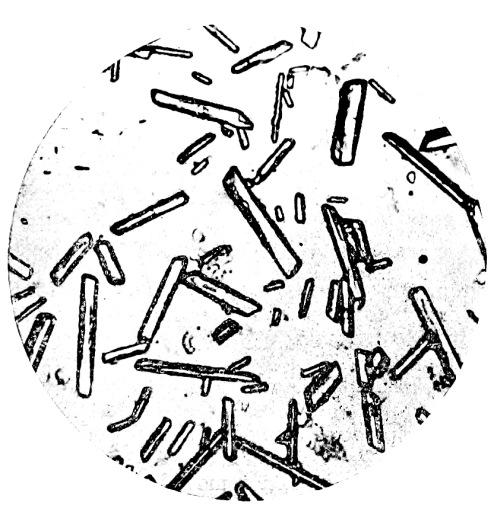
Fig. 39.—Photo-micrograph
of crystals of cyanide
of silver obtained by the vapour test, × 50.
(R. J. M. Buchanan.)
Bleeding from the Jugular Vein.—In one case treated by
Magendie, bleeding from the jugular vein was attended with success.
Chemical Antidotes.—The administration of a solution of
carbonate of potash, followed by a solution of the mixed sulphates of
iron, has been suggested. The formation of Prussian blue is the result.
The only objection to this treatment is, that prussic acid is so
rapidly absorbed that death may result from the already absorbed acid
before the antidote can be given.
Atropine.—This should be given hypodermically.
Peroxide of hydrogen should be given freely by means of the
stomach tube.
Cobalt nitrate 0.5 to 1 per cent. solution has been advocated
hypodermically.
Sodium thiosulphate, in 10 per cent. solution, repeated
hypodermically.
Cyanide of Potassium
This substance is used largely by photographers and electro-platers.
It acts as a poison in a similar manner to hydrocyanic acid, and the
symptoms are the same. As a commercial preparation it frequently
contains undecomposed potassium carbonate, and may exert a corrosive
action on the mucous membranes of the mouth and stomach, leading to the
production of blood-stained mucus in the stomach.
Post-mortem Appearances.—These are the same as those described
under hydrocyanic acid, with the addition of the corrosive effects.
Fatal Dose.—Five grains have proved fatal in a quarter of an
hour; recovery has taken place after forty grains.
Chemical Analysis.—Same as for hydrocyanic acid.
Treatment.—As for hydrocyanic acid.
PREPARATIONS CONTAINING
HYDROCYANIC ACID
The following plants contain prussic acid, and are therefore more or
less poisonous in proportion to the quantity of the acid which they
severally contain:
- Nat. Ord. Rosaceæ
- Amygdalus Communis.—The Almond and its varieties.
- Prunus Domestica.—The Plum and its varieties.
- Cerasus.—The Cherry and its varieties.
- Pyrus Aria, or White Bean Tree.—The seeds are poisonous.
- Nat. Ord. Euphorbiaceæ
- Jatropha Manihot, or Bitter Cassava.
Bitter Almonds
The essential oil of bitter almonds is very poisonous. “The oil does
not, like common essential oils, exist ready formed in the almond, but
it is only produced when the almond pulp comes in contact with water.
It cannot be separated by any process whatever from the almond without
the co-operation of water—neither, for example, by pressing out the
fixed oil, nor by the action of ether, nor by the action of absolute
alcohol. After the almond is exhausted by ether, the remaining pulp
gives the essential oil as soon as it is moistened; but if it is also
exhausted by alcohol, the essential oil is entirely lost. The reason
is, that alcohol dissolves out a peculiar crystalline principle named
Amygdalin, which, with the co-operation of water, forms the
essential oil by reacting on a variety of the albuminous principle in
the almond, called Emulsin, or Synaptase.
The essential oil of bitter almonds may contain from 6.0 to 14.33 per
cent. of hydrocyanic acid. Deaths from the incautious use of this oil
for flavouring articles of confectionery are not infrequent. As the
flavour is not in the least injured, it has been suggested to subject
the oil to repeated distillation with caustic potassæ, by which means
the oil is purified from prussic acid.
Symptoms in Man.—Nausea, vomiting, and diarrhœa, due to gastric
irritation, have occurred when the dose has been small, as is the case
when confectionery owes its flavour to the use of the essential oil.
Idiosyncrasy may have something to do with these effects, for cases
are on record where a single almond has produced a state resembling
intoxication, followed by an eruption not unlike urticaria or
nettle-rash. Taken in large doses, the symptoms produced are identical
with those described under poisoning by prussic acid. The breath is
usually strongly impregnated with the odour of bitter almonds.
Symptoms in Animals.—Vomiting, trembling, weakness, paralysis,
tetanic convulsions, and coma.
Post-mortem Appearances.—These are identical with those seen in
poisoning by the pure acid.
Fatal Dose.—The essential oil is from four to eight times as
strong as the acid of the Pharmacopœia. From twenty to thirty drops
have proved fatal. Death may take place in half an hour or less.
Treatment.—The same as that recommended under prussic acid.
Cherry-Laurel
The cherry-laurel, Prunus Laurocerasus—the leaves of which have
been used for flavouring custards, &c.—contains prussic acid, and is
therefore poisonous.
In the British Pharmacopœia there is an Aqua Laurocerasi—laurel
water—prepared from the leaves. It contains 0.1 per cent. of
hydrocyanic acid. It should be used with extreme caution, as the amount
of hydrocyanic acid contained in the leaves is uncertain. Death has
frequently resulted from its use. The most important case, however, is
that of Sir T. Broughton. His mother, who gave him his usual draught
on the morning of his death, observed that it had a strong smell of
bitter almonds. Two minutes after he took it she observed a rattling
or gurgling in his stomach; in ten minutes more he seemed inclined to
doze; and five minutes afterwards she found him quite insensible, with
the eyes fixed upwards, the teeth locked, froth running out of his
mouth, and a great heaving at his stomach, and gurgling in his throat.
He died within half an hour after swallowing the draught. No light was
thrown on the case by the carelessly conducted post-mortem; but
the suddenness of his death, the improbability of apoplexy occurring
at so early an age, and the odour of bitter almonds observed by his
mother, pointed out clearly enough the true cause of death.
All parts of this plant, the Aconitum Napellus (N.O.
Ranunculaceæ), are poisonous. The poisonous properties depend upon
the presence of an alkaloid—aconitine—chiefly found in the root.
Poisoning by the alkaloid came before the public mind in the case of
Dr. Lamson, executed for the murder of his brother-in-law. The symptoms
noticed in that case were very much as detailed below. When any part
of the plant is chewed, a sensation of tingling is experienced in the
mouth, and burning in the throat. Many of the aconites are, however,
inert. The root, having been taken by mistake for horse-radish, has led
to several cases of accidental poisoning.
| Aconite |
Horse-Radish |
| General Characteristics.— |
General Characteristics.— |
| Root conical; dark brown externally, |
Root cylindrical, of nearly the same |
| and with numerous twisted rootlets; |
thickness down its whole length. |
| internally, the colour is whitish. |
Externally, buff-coloured; |
| |
internally, white. |
| Taste.—Produces a tingling |
Taste.—Sweet and pungent. |
| and numbing sensation in the mouth. |
|
Symptoms in Man.—The patient complains, within a short time
after the poison is taken, of dryness of the throat, accompanied with
tingling and numbness of the mouth and tongue. He then complains of
nausea, vomiting, pain in the epigastrium, and distressing dyspnœa,
of a sensation of formication or tingling, with numbness in his face
and limbs, which appear to him heavy and enlarged. In attempting to
walk he staggers, his limbs losing their power of supporting his
body. He becomes giddy, his pupils dilated, and his sight and hearing
imperfect; but he is seldom unconscious till near death. His pulse
irregular, gradually becomes weaker, and at last almost imperceptible;
his skin cold and clammy; his features pale and bloodless; and his mind
clear: then suddenly he dies, in some cases from shock, in others from
asphyxia; or he may die from syncope, especially after some exertion.
Symptoms in Animals.—Weakness of the limbs and staggering, the
respiration slow and laboured, loss of sensation, paralysis, dimness
of vision, increasing difficulty in breathing, convulsions, and
death by asphyxia.
Delirium is present in some cases, and dilatation of the pupil has also
been noticed. In a case recorded in the British Medical Journal,
1877, vol. i. p. 258, two ounces of the tincture of aconite were
drunk in mistake for Succus Limonis; recovery took place, but
not before alarming symptoms had taken place, and death at one time
appeared imminent.
Post-mortem Appearances.—General venous congestion. The brain
and its membranes are, in most cases, found congested and the stomach
and intestines inflamed.
Fatal Period.—The symptoms may come on immediately, or may
be delayed for an hour or two. In the case mentioned in the British
Medical Journal the patient walked about five miles after
swallowing two ounces of the tincture, which he drank at 11 o‘clock,
returning home at 2.30 P.M. An excise
officer, who died in about four hours, was able to walk from the Custom
House over London Bridge. Death has taken place in so short a time as
one hour and a quarter.
Fatal Dose.—About two grains of the extract, and one drachm
of the tincture. Much will depend upon the amount of the alkaloid
present. One drachm of the scraped root is said to have proved fatal.
One-fifteenth of a grain of aconitine has proved fatal.
Chemical Analysis and Tests.—The alkaloid must be isolated from
the contents of the stomach by the process of Stas. The physiological
test consists in placing a small portion of the extract, or the
alkaloid so obtained, on the tongue or lip, and noting if tingling be
produced. To the pure alkaloid, nitric acid added produces no change
of colour. Officinal phosphoric acid added, and the mixture carefully
evaporated, a violet colour is produced; this reaction is due to
impurities in the aconitine.
Kundrat‘s Test.—A solution of ammonium vanadate in strong
sulphuric acid produces a coffee colour with aconitine.
Treatment.—Emetics, stomach lavage, castor-oil, and animal
charcoal should be given. The administration of digitalis in aconite
poisoning has been attended with good results. (See British Medical
Journal, 11th December 1872.) The drug may be given hypodermically
as an antidote. Stimulants will be required; and friction down the
spine, together with galvanism and artificial respiration, may be tried.
Synopsis of the Action of Aconite
1. On Nervous System.—Giddiness, numbness, and tingling in
the limbs is a primary effect, followed by gradually increasing
paralysis of the muscles, and insensibility of the surface of the
body to pinching and pricking. Dr. Fleming asserts that it produces a
powerful sedative effect on the nervous system. At any rate,
it now seems to be proved that aconite paralyses the sensory nerves,
commencing at their peripheral endings.
2. On Vascular System.—Extreme depression of the circulation
is produced by doses large enough to cause death. The pulse may become
imperceptible at the wrist. In medicinal doses, aconite lowers the
heart‘s action; in poisonous doses, it causes fatal syncope.
3. On Digestive System.—Some have denied the irritant action of
aconite on the alimentary canal, but Sir R. Christison states that he
was deterred from the use of aconite “by two patients being attacked
with severe vomiting, griping, and diarrhœa.”
CHAPTER XII CEREBRAL POISONS — ETHER — CHLOROFORM — CARBON BISULPHIDE — CHLORAL HYDRATE — SULPHONAL — TRIONAL AND TETRONAL — VERONAL
The symptom most characteristic of these poisons is the marked
anæsthesia which they produce when their vapours are inhaled. The
hydrate of chloral, though placed under the above heading, is more
closely allied in its action to opium than to ether or chloroform.
Ether, when taken in its liquid form, produces symptoms and
post-mortem appearances not unlike those caused by alcohol.
Fatal Dose.—No death having been recorded, the fatal dose of
this substance is unknown.
Ether Vapour.—The vapour of ether has caused death. Entering
the blood through the lungs, it acts with great rapidity, a state of
lethargy being quickly induced.
The early symptoms are noticed in a modification of respiration, the
breathing becoming slow, prolonged, and stertorous. The face is pale,
the lips bluish, and the surface of the body cold and exsanguine. The
pulse, at first quickened, becomes slower, as the inhalation of the
vapour is continued. The pupils are dilated, and the eyes glassy and
fixed. The voluntary muscles of the body become flabby and relaxed,
the patient still, however, having the power to move the limbs. The
involuntary muscles are not affected; as an instance, the uterus
contracts and expels its contents with ease. If the inhalation of
the vapour be pushed too far, the pulse sinks, and coma ensues, from
which the patient can only with difficulty be aroused; but if in an
early stage the ether be discontinued, the patient quickly regains
consciousness, due to the rapid elimination of the ether by the
lungs. A marked peculiarity in this form of poisoning is the complete
anæsthesia or paralysis of the nerves of sensation.
Post-mortem Appearances.—These are chiefly found in the brain
and lungs, which in most cases are greatly congested. The cavities of
the heart have been found full of dark-coloured liquid blood. A marked
effect noticed in poisoning by ether is the congestion of the vessels
of the upper portion of the spinal cord. The liver, kidneys, and spleen
are sometimes congested.
Chemical Analysis.—The contents of the stomach and tissues must
be treated and distilled, as described under alcohol.
Tests:
1. The vapour passed into a solution of
bichromate of potash, and sulphuric acid added, gives the reactions of
alcohol.
2. The vapour burns with a smoky flame,
depositing carbon on any cool surface placed above the flame.
3. It is but sparingly soluble in water, on which
liquid it floats.
Treatment.—When the pulse becomes weak, and the breathing
laboured and stertorous, the inhalation should be discontinued, and
cold water dashed in the face—free ventilation being also allowed.
Galvanism and artificial respiration should also be tried.
The effects produced by chloroform when swallowed are not unlike those
occasioned by alcohol. Four ounces have been taken without causing
death; it is, therefore, not an active poison in this form.
Chloroform Vapour.—The symptoms occasioned by chloroform when
inhaled are not unlike those caused by ether, with this exception, that
insensibility and general relaxation of the muscles are more rapidly
produced.
Symptoms.—The symptoms of poisoning when chloroform is taken by
the mouth are similar to those following inhalation, with irritation of
the mucous membrane of the stomach and intestines. Vomiting generally
occurs, the person becomes unconscious and comatose, the face cyanosed
and the skin moist. The pupils are dilated and insensitive to light.
The breathing is slow and stertorous, the pulse small and feeble.
Death is due to respiratory paralysis first, and paralysis of the
heart in addition, or the latter, according to some observers, may be
the primary cause. On recovery diarrhœa may follow, with occasionally
enlargement of the liver and jaundice.
Post-mortem Appearances.—Congestion of the vessels of the
brain, and also of the lungs, is generally found. The cavities of the
heart are usually empty; but, in some cases, the right side of the
heart is found distended with dark-coloured fluid blood. Congestion of
the spleen, liver, and kidneys is not of infrequent occurrence.
Fatal Period and Dose.—In one or two cases where the vapour was
inhaled, death took place in from one to two minutes. Thirty drops thus
taken destroyed life in one minute, and even fifteen drops have proved
speedily fatal. It has thus destroyed life in a smaller dose, and
more rapidly, than any other known poison. When swallowed, one fluid
drachm has proved fatal in a boy, about four fluid drachms in an adult.
Recovery has taken place after four fluid ounces. Three hours is the
shortest fatal period after swallowing chloroform.
Chemical Analysis.—In searching for the presence of this
substance in the blood or tissues, the examination should be made as
speedily as possible, as chloroform is thought by some observers to
have a great tendency to pass into formic acid, and thus to escape
recognition.
1. The substance to be examined should be placed in a flask, to which
is adapted a glass tube bent at right angles. A piece of blue litmus
paper, and another portion of paper moistened with iodide of potassium
and starch paste, are inserted into the end of the glass tube. The
flask and its contents should now be placed in a water bath heated to a
temperature of 161° F. (72° C.), and a portion of the glass tube just
past the bend heated to redness. Any chloroform vapour evolved from
the contents of the flask is decomposed during its passage through
the heated glass tube into free chlorine and hydrochloric acid, the
presence of the former being indicated by the starch paper becoming
blue; while at the same time the reddening of the litmus paper reveals
the presence of the acid. As a further corroboration, the exit tube may
be made to dip into nitrate of silver solution, when a precipitate of
the curdy-white chloride of silver will take place, insoluble in nitric
acid, but dissolving on the addition of ammonia. Every 100 parts of
chloride of silver formed, equals 27.758 of chloroform. By this process
chloroform has been detected four weeks after death in putrid organs.
2. Chloroform may be separated from organic mixtures by distillation.
If aniline and alcoholic solution of potash be added to chloroform and
heated, the peculiar odour of phenyl-isocyanide is given off.
3. A solution of β-naphthol dissolved in caustic potash, when added to
chloroform and heated, gives a blue colour.
4. Chloroform reduces Fehling‘s solution.
Treatment.—The same as recommended with regard to ether. M.
Nelaton recommends inversion of the body, and ascribes the recovery of
one patient to his suddenly lifting him up and throwing him over his
shoulder with his head hanging down.
This substance is largely used in certain industries, as it dissolves
oils, fats, caoutchouc, gutta percha, &c. It is very inflammable,
burns with a blue flame, evolving sulphur dioxide. The odour, when
this substance is impure, is very disagreeable. If taken internally,
it produces an intense burning sensation in the throat, headache, and
giddiness. In chronic poisoning from the vapour in manufactories where
it is used, there appear to be two stages—one of excitement, and
one of depression. In the former, there are more or less persistent
headache, irritability of temper, tinnitus aurium, and even mania;
in the latter, anæsthesia of the skin, even affecting the mucous
membranes, patients complaining that their tongues feel as if tied in
a cloth. Paralysis of the limbs has been noted in prolonged cases of
chronic poisoning. The post-mortem appearances do not differ
much from those found after death from the inhalation of chloroform.
Carbon bisulphide may be separated from organic liquids by
distillation, and detected by its odour, and by a black precipitate of
sulphide of lead when heated with nitrate of lead and potash.
This substance is prepared by acting on alcohol by chlorine. It is used
extensively as a hypnotic, and, owing to its indiscriminate use, many
fatal cases have been recorded. Care should be taken when large doses
are given not to repeat them too quickly, as there appears to be a
tendency to accumulation, and sudden and dangerous action of the drug.
Symptoms.—Chloral, in moderate doses, acts on the brain as
a powerful hypnotic, the early symptoms being gradual drowsiness,
followed by deep sleep. With a dose of about 30 grains, the patient
can, however, by walking about, ward off sleep. In large doses the
narcosis becomes completely uncontrollable, and the poison then acts
as a depressant to the basal ganglia of the brain, and on the spinal
cord; and, as a result, there is weakness of the heart‘s action, with
ultimate diastolic arrest, slowing of the respiratory movements,
and general muscular weakness, with some anæsthesia. Under these
circumstances the patient has all the appearance of a drunken person,
the face is flushed, and the deep sleep may pass imperceptibly into
death without any marked change. In some cases delirium precedes the
condition of sleep. The pulse in some cases is quickened, and the
face flushed; but, in other cases, the pulse becomes slow and almost
imperceptible, the heart being ultimately arrested in diastole. In
these cases the face is pale, and the breathing performed at long
intervals. The motor paralysis present, when a poisonous dose is
taken, is due to the action of the drug on the spinal cord, and not
on the nerves. During the sleep produced by chloral, the pupils are
contracted, but dilate on the person awakening. In a case described
by Dr. Levinstein, and reported in the Lancet, 21st February
1874, the patient took six drachms with intent to commit suicide. The
face was at first flushed, the veins swollen, and the pulse 160 per
minute; he then became livid, the pupils contracted, and at times the
circulation appeared to be entirely arrested. The temperature varied
from 32.9° C. to 38.7° C. (89.6° F. to 100.4° F.). This case recovered
under treatment by the subcutaneous injections of strychnine (.03 to
.04 grain), and the use of faradisation in thirty-two hours after the
poison had been taken. Chronic chloral poisoning, “chloral-drinking,”
has unfortunately become far too common of late years, in which the
mental faculties suffer severely, so that in our asylums, cases of
mania and melancholia are rightly (or wrongly) attributed to the habit.
A peculiar eruption, not unlike that produced by shell-fish, and
followed by desquamation, sometimes occurs when this substance has been
given for some time in medicinal doses.
Post-mortem Appearances.—These are not unlike those of
asphyxia, the vessels of the brain being engorged, and the ventricles
containing an abnormal quantity of fluid. The mucous membrane of the
larynx may be injected, and in some cases œdematous. The right side of
the heart is engorged and the left empty, together with congestion of
the lungs. Chloral is very little decomposed into chloroform by the
blood. W. H. Roberts has in several cases recovered it as chloral from
the blood.
Fatal Dose.—The fatal dose cannot be accurately stated, but
children, as in the case of belladonna, are said to bear the drug
better than adults. A child a year old died in ten hours from a dose of
three grains. Ten grains proved fatal to an old lady seventy years of
age. Twenty grains has caused death in an adult in half an hour, and in
one case thirty grains. As a rule, any quantity over two drachms may
be considered a dangerous, if not a fatal dose, although recovery has
been stated to have occurred after one ounce. Dr. Richardson considers
120 grains, distributed over twenty-four hours, as a safe dose for an
adult. Death may take place suddenly, or after the lapse of several
hours.
Fatal Period.—From fifteen minutes, which is the shortest time
on record, to thirty-nine and a half hours, which is the longest period
recorded.
Chemical Analysis.—Chloral may be extracted from the stomach
contents by digestion with absolute alcohol acidified by sulphuric
acid. The alcoholic extract is filtered and evaporated. The residue is
treated with petroleum ether to remove fatty substances, and finally
shaken with pure ether to remove the chloral. On evaporating the ether
the chloral hydrate is left. From urine it may be extracted by first
acidifying with sulphuric acid and then treating it with petroleum
ether and ether. Chloral hydrate in solution gives the following
reactions:—
1. On agitation with solution of caustic potash, and gently warmed if
necessary, chloroform is evolved, which can be detected by its odour.
From a strong solution the chloroform may separate in the form of
minute globules.
2. If one drop of ammonium sulphide be added to a solution of chloral
hydrate and gently heated, a peculiar opalescent milky reddish-yellow
precipitate forms. This test is extremely delicate, and differentiates
chloral hydrate from chloroform.
3. Alcoholic solution of potash and aniline when added to chloral
hydrate solution, shaken up and warmed, produces the peculiar odour of
phenyl-isocyanide. This is due to the formation of chloroform on the
addition of the caustic potash.
4. If β-naphthol dissolved in caustic potash solution be added to a
solution of chloral hydrate and the mixture warmed, a blue colour is
produced.
5. Chloral hydrate reduces Fehling‘s solution.
To separate chloroform in the stomach contents from chloral hydrate
they should be acidified with tartaric acid and distilled, when
the chloroform which was free in the stomach will pass over to the
receiver. If the residue be now rendered alkaline with caustic potash
and again distilled, any chloroform which then comes over must have
been derived from chloral hydrate in the stomach contents.
Treatment.—The treatment consists in washing out the stomach,
the administration of emetics, or hypodermic injection of apomorphine,
in the use of galvanism, friction, mustard-plasters to the calves of
the legs, artificial respiration, and the hypodermic injection of a
solution of nitrate of strychnia or injection of atropine. The warmth
of the body must be carefully maintained in all cases by suitable
external applications. Oxygen inhalations are said to be beneficial.
Sulphonal is a product of the oxidation of mercaptol, obtained from
acetone and mercaptan; it occurs in tasteless, odourless, colourless
crystals or powder, was introduced into medical practice in 1888, and
has since caused many accidental deaths. The habit of taking it may
be acquired. It has a tendency to accumulative action when taken for
some time without interruption. A serious feature in most of the cases
of poisoning is that usually those taking it have been apparently
benefited by the drug up to the time of the appearance of toxic symptoms.
Symptoms.—In medicinal doses (15-30 grains) it has an action
similar to that of paraldehyde, it causes sleep with little depression
of the circulation and respiration. Larger doses produce variable
symptoms, mental confusion with nervous ataxic manifestations, stupor,
and insensibility; less frequently excitement and convulsions. Skin
eruptions may follow a large dose or from its long continued use. In
severe cases there is marked cyanosis, feeble pulse, and stertorous
and irregular breathing. Death usually results from failure of
respiration, or the urine may be suppressed and fatal coma supervene.
Albuminuria and hæmatoporphyrinuria are common features, especially
in chronic cases. The deep pink colour of the urine was attributed to
hæmatoporphyrin, and indicating extensive destruction of the red blood
corpuscles. It is a grave symptom. That the colour of the urine is due
to hæmatoporphyrin is questionable, for on removing the hæmatoporphyrin
the colour remains the same. The cumulative action is due to slow
elimination by the kidneys. A case published by Drs. Taylor and Sailer,
and reported in the Lancet, February 1900, was that of a woman
aged fifty-two years, unmarried, and presenting symptoms of hysteria.
On inquiry it was discovered that she had been in the habit of taking
sulphonal for some time, the dose being fifteen grains per diem. She
was informed of the evil results likely to follow the continued use of
the drug, and she discontinued its use for some weeks. After this she
resumed taking the drug, and began speedily to exhibit all the symptoms
of sulphonal poisoning: viz. mental confusion, marked insomnia,
difficulty of speech, and a peculiar sighing dyspnœa. The urine was
tinged a deep pink colour (hæmatoporphyrinuria), and a stiffness and
paralysis of both legs soon developed. The control of the sphincters
was lost. Cutaneous sensibility was not affected. The paralysis spread
rapidly upwards, and death resulted from cardiac failure. Spectroscopic
examination of both urine and blood disclosed the presence of
hæmatoporphyrin. At the necropsy the following conditions were
revealed: fatty degeneration was present in the heart, liver, and
kidneys. The spleen was filled with a greenish pigment, both free and
within the lymphoid corpuscles, the fibrous trabeculæ were greatly
increased in size, and the lymphoid follicles were extremely well
developed. Excessive pigmentation was found also in the lymphatic
glands of the body and in the lungs. No morbid changes could be found
in the spinal cord or brain.
Fatal Dose.—This is very uncertain, depending upon
idiosyncrasy. Thirty grains has caused death in a woman in forty
hours, while a case is reported in the Lancet, January 1904,
of recovery after the taking of 365 grains. In many cases death has
followed the daily use of moderate doses (10-20 grains) for several
months.
Fatal Period.—May occur in a few hours, or days, or after
months; also after the use of the drug has been discontinued.
Chemical Analysis.—Sulphonal is very stable, and is unaffected
by boiling alkalies or by concentrated nitric or sulphuric acids.
From its solution in concentrated sulphuric acid it may be recovered
by dilution. It is easily recovered from the body after death, as its
stability prevents its decomposition. It is isolated from organic
matter by treatment with alcohol, evaporation, and extraction of the
residue with hot water, evaporation and final extraction with ether.
Tests.—1. Heated in a test tube with powdered charcoal,
sulphonal forms mercaptan, acetic acid, formic acid, and sulphur
dioxide. The offensive odour of mercaptan may be noted, and the vapours
will change blue litmus paper. Sulphur dioxide may be shown by its
bleaching action on a piece of filter paper moistened with blue starch
iodide and suspended in the mouth of the tube.
2. When melted with potassium cyanide, sulphonal develops a mercaptan
odour, and potassium sulphocyanate is formed at the same time. A
blood-red colour is therefore produced on the addition of ferric
chloride to a solution of the residue in water. Great care must be
exercised in the carrying out of this test, as it is somewhat dangerous
to the experimenter.
Treatment.—The stomach should be washed out in order to remove
any drug unabsorbed. Diuretics, purgatives, and general stimulants
given, such as strychnine, hot coffee, &c.
These compounds are very similar in both their chemical and
physiological properties to sulphonal, but both have a bitter taste.
Both have caused fatal poisoning, the symptoms being very similar to
those caused by sulphonal.
Veronal, a synthetic compound, is a white crystalline powder about four
times as powerful as sulphonal, very slightly soluble in water, more
soluble in hot water, and in alkaline solutions, and absorption takes
place from the intestine.
Symptoms.—In moderate doses it produces sleep without subsequent
depression, and does not affect temperature or respiration.
In larger doses it may cause erythema and constipation, with
alternating semi-coma and delirium. During the last few years
fatal cases of poisoning have become rather frequent.
Details of a fatal case by Dr. Durrant reported in Taylor, p. 616, are,
briefly: A man aged thirty-three, a heavy drinker, to whom veronal
had been prescribed, in fifteen-grain doses, with chloral hydrate and
bromide of ammonium, had gradually increased the dose from 15 to 30
grains, or even 60 grains. Five weeks before death he had taken 100
grains, and had recovered in three days. Nine hours after taking 120
grains of veronal with 20 grains of chloral and 40 grains of ammonium
bromide he was found deeply comatose, with surface warm, respirations
32, pulse 102, pupils dilated, corneæ insensitive, reflexes absent.
Next day not so deeply comatose, he could be made to wince by slapping
the face, the pupils were still dilated, temperature 102° F., pulse
110, reflexes still absent. Later he was still constipated, and the
breathing impeded by mucus. On the third day he spoke when roused;
the temperature, bowels, and pupils the same. With slight remission
he became worse, and on the fourth day, in a comatose condition,
with muscular flaccidity and absence of reflexes, temperature 104°
F., respirations over 40, and the pulse 150, death took place.
Post-mortem.—Nothing was found except intense congestion of the
lungs, liver, spleen, and brain, due, no doubt, to the asphyxial form
of death. The mucous membrane of the alimentary canal was congested,
but otherwise normal.
Chemical Tests.—1. Heated dry with sodium carbonate, ammonia is
evolved. If held in the mouth of the tube red litmus paper turns blue,
turmeric paper brown.
2. A saturated solution acidified with nitric acid gives a white
precipitate with Millon‘s reagent soluble in excess.
Treatment.—As for sulphonal.
CHAPTER XIII NEURAL POISONS — CONIUM — CALABAR BEAN
The common or spotted hemlock, Conium maculatum (N. O.
Umbelliferæ), is indigenous. It must be distinguished from the
Myrrhis temulenta, another indigenous, umbelliferous plant,
which has also a spotted stem, but which is covered with hairs—the
stem of the hemlock being smooth. Several cases of poisoning have
occurred, hemlock having been mistaken for parsley, fennel, asparagus,
and parsnip. The leaves of the plant have a peculiar mousy odour, which
is intensified when they are rubbed in a mortar with some caustic
potash. The poisonous properties reside in an alkaloid, conine.
The activity of the plant appears to depend upon the time of the
year when it is gathered, being most powerful in May. The ready
decomposition of the alkaloid by heat or age renders the extract of
conium a very uncertain preparation, the conine being converted into an
inert resinoid matter.
Conine the alkaloid is a colourless volatile oil, lighter than
water, with an odour of mice. It is strongly alkaline, soluble in
diluted acid, but its salts have not yet been crystallised. It has been
suggested that a ptomaine not unlike conine may be formed in the body
by the combination of one molecule of butyric acid and one molecule of
ammonia with separation of water, thus:
| Butyric Acid. |
|
Ammonia. |
|
|
Conine. |
| 2C₄H₈O₂ |
+ |
NH₃ |
- |
2H₂O = |
C₈H₁₅N |
Conine is a deadly poison, killing all animals, death resulting from
asphyxia. Neutralised with an acid, its activity is increased, and it
becomes more soluble in water. Almost instant death resulted in a dog
from injecting two grains of conine, neutralised with hydrochloric
acid, into the femoral vein.
Symptoms in Man.—The symptoms in some cases resemble those of
poisoning with opium; in others, the patient complains of dryness and
constriction of the throat, and drowsiness. There is dilatation of the
pupil, with closure of the eyes or ptosis, and loss of power in the
muscles of the extremities, so that the patient falls on attempting to
walk. The paralysis does not appear to be due to any direct influence
upon the muscles, but upon the motor nerves, and especially on their
extreme peripheral ends, and in this differs from Calabar bean, which
acts on the spinal cord. Gradual loss of power in the respiratory
muscles is the cause of death. Giddiness, coma, and convulsions were
the typical symptoms of two cases of accidental poisoning recorded by
Dr. Watson.
Symptoms in Animals.—“Palsy, first of the voluntary muscles,
next of the chest, lastly of the diaphragm—asphyxia, in short,
from paralysis, without insensibility, and with slight occasional
twitches only of the limbs; and the heart was always found contracting
vigorously for a long time after death” (Christison).
Post-mortem Appearances.—Congestion of the vessels of the brain
and lungs. The blood is very fluid, and of a dark colour, the fluidity
due probably to the mode of death—slowly induced asphyxia. There may
be some redness of the mucous membrane of the alimentary canal.
Fatal Period.—The symptoms may come on in from ten minutes to
an hour, or more, after the poison has been taken. Death usually takes
place in about four hours.
Fatal Dose.—Uncertain. Thirty grains of the extract carefully
prepared killed a rabbit in five minutes. A single drop of conine
dropped into the eye of a rabbit killed it in nine minutes.
Chemical Analysis.—Conine may be extracted from organic mixture
by the general process for extracting alkaloids. The following tests
may then be applied:
1. The odour of conine, when diluted with water, resembles that of
mice. Harley states that a mixture of caustic potash with organic
substances may evolve a similar odour even when conine is absent.
2. On warming conine with sulphuric acid and potassium bichromate
butyric acid is produced, and can be recognised by its peculiar odour.
3. If conine be added to a solution of alloxan a reddish-purple colour
is produced in a few minutes, and white needle-shaped crystals form
on standing. These crystals if dissolved in caustic potash solution
produce a purple colour, and the odour of conine is given off.
Treatment.—Emetics, stomach pump, castor-oil, followed by
ammonia and other diffusible stimulants. Artificial respiration should
be resorted to and kept up for a long time.
A strong emulsion of Calabar bean, Physostigma venenosum
(N.O. Leguminosæ), is used on the West Coast of Africa as a test
of innocence in cases of suspected witchcraft. In 1864 some children in
Liverpool were poisoned by eating some of these beans, which had been
swept out of a ship from Africa on to a heap of rubbish. The poisonous
alkaloid is physostigmine or eserine.
Symptoms.—Vomiting, giddiness, irregular action of the heart.
The mental faculties are unaffected. The eyes are bright and the pupils
contracted; in which latter it differs most strikingly from
atropine, hyoscyamine, and daturine, where dilatation of the pupil
is the rule. The late Sir R. Christison considered that its primary
action is on the heart, causing paralysis of that organ, and that the
insensibility and coma are only secondary. Dr. Harley considers that it
is not a cardiac, but a respiratory poison. Later experiments have
shown that the paralysis produced is due to the action of the drug
on the spinal cord and not on the nerve trunks. It appears also that
death is due to a failure of the respiration, for the heart in animals
has been found still beating for one and a half hours after death. The
contraction of the pupil, when locally applied, is probably brought
about by its paralytic action on the peripheral sympathetic nerve
fibres of the iris; and it is stated that when very large doses of
physostigmine are given, the pupils dilate, pointing to oculo-motor
palsy. A few drops of the extract placed in the eye cause powerful
contraction of the pupil.
Fatal Dose.—Six beans produced death in a boy six years of age.
Chemical Analysis.—The alkaloid eserine should be extracted
in the usual way, benzene being used as a solvent in the place of
chloroform and ether.
Eserine gives the following chemical reactions:
1. If an aqueous solution of the salt be boiled and then strong nitric
acid added, the solution turns a yellowish-orange colour, changed to
violet on addition of caustic soda in excess; the violet is discharged
on acidulation, but returns on re-alkalising the solution.
2. A solution of eserine in ammonia solution gives a blue residue on
evaporation to dryness. Dilute acids produce a red-coloured solution
with it, which is fluorescent by reflected light.
3. Bromine water produces a red turbid solution with eserine, which
clears on heating.
4. The physiological test—eserine solution instilled into the eye of
an animal produces contraction of the pupil.
Treatment.—The stomach should be emptied and washed out by
means of the syphon tube, or emetics administered. One-fiftieth to
one thirtieth of a grain of atropine sulphate should be administered
hypodermically and repeated until the pupils dilate. The tincture of
belladonna may be given by the mouth. Stimulants should be given and
artificial respiration carried out if required.
CHAPTER XIV EXCITOMOTORY POISONS — NUX VOMICA — STRYCHNINE — BRUCINE
NUX VOMICA STRYCHNINE
Some of the most poisonous known plants belong to the genus
Strychnos (N.O. Loganiaceæ).
The Java poison, Upas Tieuté, is a watery extract of S. Tieuté;
the basis of the poison used in Guiana, and known as Wourali,
Ourari, Urari, or Curare, is the juice of S. toxifera. S.
nux vomica, the Koochla tree, produces the nux vomica seeds of
commerce; and the bark of the tree has been accidentally substituted
for cusparia, or angustura bark, hence it is known as false
angustura bark. The substitution is attended with considerable
risk, on account of the strychnine which the false bark contains.
It may be known by its being quilled, externally covered with white
lichenous spots, and the internal surface becoming blood-red
when touched with nitric acid. This reaction, which depends upon the
presence of an alkaloid, brucine, does not occur when true
angustura bark is thus treated.
The Seeds of S. Nux Vomica
The British Pharmacopœia contains an extract and a tincture. The
alkaloid strychnine is the active principle of the seeds and other
parts of the plant. Another alkaloid, brucine, is also found, and is
poisonous.
The symptoms and post-mortem appearances and treatment will be
detailed under the head of strychnine. The brown powder of the seeds
may, in some cases, be seen adhering to the mucous membrane of the stomach.
Strychnine is very slightly soluble in cold water to the extent of one
part in 8300; in boiling water one part dissolves in about 2500. It is
more soluble in alcohol, and very soluble in chloroform or ether and
chloroform mixed.
It has a bitter taste, so intense, that one part in 70,000 of water
can be detected by the taste. Strychnine is not easily decomposed—it
resists the action of warm strong sulphuric acid, and is not altered by
putrefactive processes when present in viscera. It has been discovered
in the body 322 days after death in one case, 368 days in another.
Fig. 40.—Photo-micrograph
of crystals of
strychnine sulphate from aqueous solution, × 50.
(R. J. M. Buchanan.)
Fig. 41.—Photo-micrograph
of crystal of
strychnine sulphate from aqueous solution, × 50.
(R. J. M. Buchanan.)
Allen detected strychnine in the residue of some viscera from a person
who had died of strychnine poisoning, and which he had kept in a jar
for six years. Richter found the alkaloid at the end of eleven years in
putrid tissues which had been exposed to the air all that time in open
vessels.
Symptoms.—Should the poison be in solution, the patient
complains of a hot and intensely bitter taste during swallowing.
The effects of the poison depending to a great extent on the mode
of administration, become manifest in from a few minutes to an hour
or more after it is taken. The earliest symptoms are a feeling of
suffocation and great difficulty of breathing. These come on suddenly,
without any premonitory warnings. Twitching of the muscles rapidly
pass into tetanic convulsions of nearly all the muscles of the body,
which are simultaneously affected. The head after several jerks becomes
stiffened; the neck rigid; the body curved forward, quite stiff, and
resting on the back of the head and heels. The face is congested, and
the countenance expresses intense anxiety; the eyes staring, the mouth
open, and the lips livid. The throat is dry, the thirst great; but
when an attempt is made to drink, the jaws are spasmodically closed,
and a piece of the vessel may be bitten out. During the intervals of
the paroxysms the intellect is usually clear, and the patient appears
conscious of his danger, frequently exclaiming, “I shall die!” He is
also conscious of the accession of the paroxysms, telling those around
him of their approach, and asking to be held. In the case of J. P.
Cook, poisoned by Palmer, those about him tried to raise him, but he
was so stiff that they found it impossible. He then said, “Turn me
over,” which they did, and he died in a few minutes. Intense pain is
felt, due to the powerful contractions of the muscles. After the lapse
of a minute or two, the spasms subside, a sudden lull takes place,
during which the patient feels exhausted and his skin is bathed in sweat.
In poisoning by strychnine, the jaws are slightly, if at all, affected,
trismus is a late symptom, and occurs only during a convulsive seizure.
In tetanus the result of disease, the locking of the jaws is an early
and a marked symptom.
As death approaches the fits become more frequent, and the patient dies
from exhaustion or suffocation.
Post-mortem Appearances.—There is no characteristic appearance
found after death. The blood is fluid, the heart empty, with some
congestion of the membranes of the brain. Absence of all cause for so
violent and sudden a death. Rigor mortis is prolonged for some time.
Fatal Period.—The rapidity in the accession of the symptoms and
fatal termination will, to some extent, depend upon the form in which
the poison is taken—i.e. in solution or in pill. In most cases
the symptoms appear in from three or four minutes to an hour or more
after the poison is swallowed, death following in from ten minutes to
six hours. As a rule, if the person lives for two hours after the onset
of symptoms recovery may be expected.
Fig. 42.—Photo-micrograph
of strychnine sulphate,
film preparation from chloroform solution, × 50.
(R. J. M. Buchanan.)
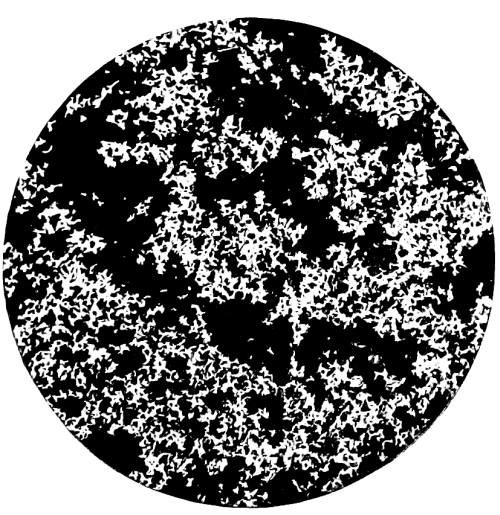
Fig. 43.—Photo-micrograph of
chromate of strychnine, × 50.
(R. J. M. Buchanan.)
Fatal Dose.—A quarter to half a grain; but large doses have
been taken, followed by recovery.

Fig. 44.—Photo-micrograph
of
sulphocyanate of strychnine, × 50.
(R. J. M. Buchanan.)
Chemical Analysis.—The poison may fail to be detected, and this
link in the scientific evidence may be wanting, as was the case in
Palmer‘s trial. In that case the strychnine had been administered in
pills; and when after death the stomach had been cut open, and
the contents lost, there was little hope of discovering the poison. The
non-discovery of the poison was made a strong point on the part of the
defence, ignoring at the same time the fact that the stomach had been
tampered with and the contents spilt. The alkaloid abstracted from the
tissues or contents of the stomach by the process generally used for
extraction of alkaloids, may have the following tests applied to it:
1. Scarcely soluble in water, but readily soluble
in acidulated water.
2. Intensely bitter taste.
3. Not affected by sulphuric acid; but when
a little peroxide of lead, or peroxide of manganese, or bichromate
of potash, or ferricyanide or permanganate of potassium is added,
a magnificent purple-blue colour, changing to crimson, and finally
to a light red tint, is the result. The ¹/₂₀₀₀₀ part of a grain of
strychnine has been stated to give this reaction.
4. The physiological test consists in introducing
a small quantity of the suspected substance under the skin of a frog,
and noting whether or not the animal suffers from tetanic spasms.
5. The Galvanic Test.—Place a solution
of strychnine, say one part of strychnine in 15,000 of water, in a
slight depression in a piece of platinum foil, and allow the mixture to
evaporate. When dry, moisten the spot with sulphuric acid, connect the
foil with a positive pole of a single-cell Grove‘s battery, and then
touch the acid solution with the negative pole. A violet colour will be
at once produced, remaining permanent.
6. Bloxam‘s Test.—To the solid alkaloid
in a porcelain dish a drop or two of strong nitric acid is added and
gently heated; on adding a small quantity of potassium chlorate a
scarlet colour is produced. Ammonia changes this colour to brown and
a brown precipitate falls. If the mixture he evaporated to dryness it
leaves a dark green residue forming a green solution in water, changed
to orange-brown with caustic potash and green again with nitric acid.
This test distinguishes strychnine from any of the alkaloids which
commonly occur in cases of poisoning.
7. Potassium bichromate when added to a solution
of a salt of strychnine, produces a yellow crystalline precipitate of
chromate of strychnine: the reaction can be done on a microscope slide
and the crystals examined. On drying the crystals and then touching
them with a drop of strong sulphuric acid, the purple colour changing
through red to green is produced.
8. Picric acid gives a yellow crystalline
precipitate of the picrate.
9. Ammonium or potassium sulphocyanate produces
crystalline precipitates.
10. Ferri-cyanide of potassium produces a
crystalline precipitate with solutions of salts of strychnine.
Strychnine may not be found in the body, even after death from
poisoning by it, for the following reasons:
1. Smallness of the quantity taken.
2. The time which has elapsed after taking the
strychnine until the symptoms commence.
3. If the careful preservation of the stomach and
its contents has been overlooked.
4. The alkaloid may have been eliminated from the
body before death.
Treatment.—Evacuation of the stomach by emetics and the stomach
pump, under anæsthesia, and then the administration of animal charcoal,
iodide of potash, tannic acid, and tea; bromide of potassium in large
doses (half an ounce), and repeated in smaller doses. Chloral should be
given in five-grain doses hypodermically every ten minutes, until the
convulsions are subdued. Chloroform should be inhaled for some time.
Urethane is said by Anrep to be more useful than chloral, and should be
given in drachm doses.
This alkaloid is present along with strychnine in Nux Vomica seeds
and the Ignatius bean. Cases of poisoning by it seldom occur, as the
alkaloid is but little known by the public.
Symptoms.—It resembles strychnine in its action but is much
less poisonous. It produces death by convulsions when injected
subcutaneously, but according to Brunton does not so often produce
convulsions when taken into the stomach.
Differential Diagnosis of Strychnine Poisoning from
Tetanus, Hysteria, Epilepsy, and other
Poisons causing Tetanic Spasms.
| Tetanus. |
Tetanus from Strychnine. |
| 1. The presence of a wound. |
1. Some solid or liquid |
| Symptoms have no connection |
taken within a short time |
| with any liquid or solid |
of commencement of symptoms. |
| swallowed. |
Not connected with any |
| |
peculiarity of constitution. |
| 2. Gradual accession and |
2. Symptoms sudden and |
| progress of the symptoms; |
violent. All the muscles are |
| difficulty in swallowing; |
affected at one and the same |
| stiffness of the jaws, neck, |
time. Arms affected and |
| trunk, legs, and arms. The |
hands clenched at the same |
| hands not generally affected. |
time as the body and legs. |
| |
Jaw only affected or fixed |
| |
during efforts to swallow. |
| 3. Curving of the spine forwards |
3. Opisthotonos an early |
| not primarily present; |
symptom, generally |
| generally comes on after some |
appearing in a few minutes. |
| days of previous illness. |
|
| 4. Symptoms may undergo |
4. Intervals of complete |
| abatement, but there is no |
intermission. |
| perfect intermission. |
|
| 5. Death after the lapse of |
5. Death usually occurs in |
| several hours or days. Direct |
two hours, or even less |
| injury to spinal cord may give |
than a quarter of an hour. |
| rise to tetanus and death in |
Recovery in a few hours. |
| a few hours. Recovery slow. |
|
| Hysteria. |
Epilepsy. |
Tetanus occurring
During the Action
of other Poisons. |
| 1. Connected with |
1. Previous |
1. The presence of |
| a peculiar |
history of |
other symptoms of |
| constitution. |
epilepsy. |
poisoning peculiar |
| |
|
to certain poisons. |
| 2. The presence of |
2. Presence of the |
|
| known stigmata |
aura epileptica. |
|
| of hysteria. |
The tongue bitten; |
Obs.—Arsenic, |
| |
and insensibility |
antimony, and |
| |
lasting for |
other irritant |
| |
some time. |
poisons may |
| 3. The spasms |
3. Alternate |
sometimes cause |
| frequently |
contraction and |
tetanic spasms; |
| convulsive, and |
relaxation of |
but other symptoms |
| alternating with |
the muscles. |
are present which |
| stiffness of the |
|
point to the nature |
| muscles. Loss |
|
of the poison. |
| of consciousness. |
|
|
| 4. |
|
|
| 5. Never fatal. |
5. Seldom fatal |
|
| Recovery very |
during first |
| rapid. |
attack. |
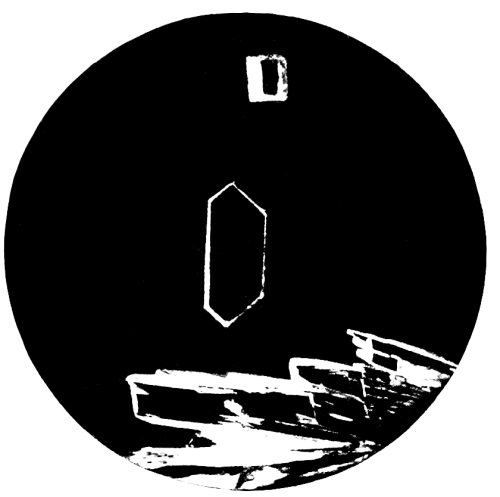
Fig. 45.—Photo-micrograph of
crystals of brucine sulphate, × 50.
(R. J. M. Buchanan.)
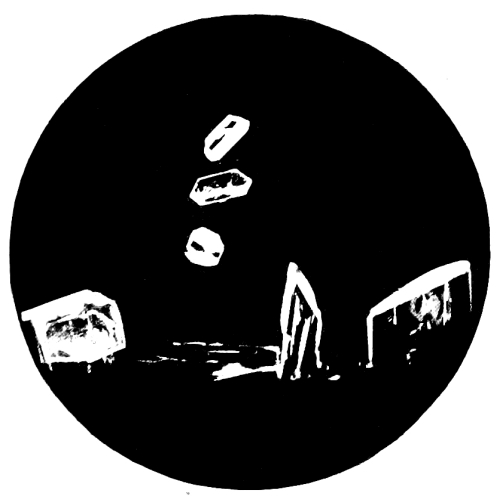
Fig. 46.—Photo-micrograph of
crystals of brucine sulphate, × 50.
(R. J. M. Buchanan.)
Chemical Analysis.—The alkaloid may be extracted from organic
admixture by the usual methods. Its reactions to special tests are as
follows:
1. If nitric acid be added to the solid alkaloid, or in aqueous
solution, a bright red colour is produced which changes to yellow on
heating. The addition of stannous chloride or sulphide of ammonium to
the acid solution after cooling changes it to violet; the colour is
discharged by excess of the stannous chloride. If the red acid solution
be largely diluted with water, a yellow precipitate falls, soluble in
dilute hydrochloric acid. If the filtrate from the yellow precipitate
be neutralised by ammonia and calcium chloride added, a precipitate of
calcium oxalate forms, insoluble in acetic but soluble in hydrochloric
acid. This reaction is peculiar to brucine.
2. With sulphuric acid and potassium bichromate a deep orange-red
colour is produced.
3. Sulphomolybdic acid gives an orange-red or purplish-red colour,
changing to blue.
4. Blyth‘s Test.—If methyl iodide be added to a solution of
brucine in strong alcohol, circular rosettes of crystals form in a few
minutes. Strychnine does not give this reaction.
Treatment.—Same as for strychnine.
CHAPTER XV IRRESPIRABLE GASES — CARBON DIOXIDE — CARBON MONOXIDE — WATER GAS — SULPHURETTED HYDROGEN — COAL GAS — COMBUSTION GASES — ACETYLENE GAS — NITROGEN MONOXIDE, NITROUS OXIDE — PETROL FUMES — NAPHTHA, BENZOL OR BENZENE — SULPHUR DIOXIDE — CHLORINE — PHOSPHORETTED HYDROGEN
Circumstances under which it occurs accidentally.—Death may
result where several persons are sleeping in the same room, and the
ventilation is imperfect; from the admission of the vapour of charcoal
into a room from an adjoining vent; or from incautiously sleeping in a
brewery close to a vat in which fermentation is going on. Many deaths
have occurred from this gas, due to the incautious descent into wells.
It must also be borne in mind that death may result from the presence
of this gas in an atmosphere which will permit the combustion of a
candle. For a candle will burn in an atmosphere containing 25 per cent.
of CO₂, whereas 5 per cent. will cause death. The burning of a candle
is therefore no test of security from danger in an atmosphere where
the presence of carbonic acid is suspected. Carbonic acid does not, as
is generally supposed, sink to the lower portions of a room; and Dr.
Taylor, from his experiments, states “that in a small and close room
persons are liable to be suffocated at all levels, from the very equal
and rapid diffusion of carbonic acid during combustion.”
Symptoms.—When the carbonic acid is pure, that is, unmixed with
other gases, spasm of the glottis at once occurs, and the sufferer
falls down insensible, and death is almost immediate. When the gas
is diluted the early symptoms are a feeling of weight and fulness
in the head, accompanied with giddiness, throbbing of the temporal
arteries, drowsiness, palpitation of the heart, gradually increasing
insensibility, stertorous breathing, ending in death from asphyxia or
apoplexy. Sometimes the victim dies convulsed, at other times a deep
sleep quietly merges into death. The symptoms will, of course, depend
upon the quantity and purity of the gas present in the apartment.
Action on the Animal Economy.—The opinions of observers vary
greatly—Berzelius maintaining that an atmosphere containing 5 per
cent. was not injurious to life; Allen and Pepys, on the other hand,
stating that 10 per cent. of the gas would cause death. Bernard
considers that it is not poisonous, as it can be injected into the
bodies of animals without injury, and that its action is purely
negative; it is irrespirable in the same sense as pure hydrogen or
nitrogen is—simply, therefore, causing death by suffocation. Whatever
may be the true explanation of its action, it is enough for all
practical purposes to know that death follows when it is breathed, even
when mixed with a normal amount of oxygen.
Post-mortem Appearances.—The face may be pale and composed,
or swollen and livid. The vessels of the brain are frequently greatly
congested, and the heart and great vessels gorged with black fluid
blood. The blood in some cases, however, is of a cherry-red colour.
This may probably be due to the presence of carbon monoxide, which
appears to have the power of preventing the change of arterial into
venous blood, the opposite effect to that of carbon dioxide. The tongue
may or may not be protruded beyond the teeth; in most instances the
latter is the case. Animal heat is long retained after death, and the
rigor mortis occurs as in other forms of death.
Treatment.—Bleeding from the arm, cupping from the nape
of the neck, and the employment of cold affusion to the head. The
patient should be removed without delay into the open air. Artificial
respiration and galvanism have been successfully employed in some
cases, and inhalations of oxygen should be used if possible.
How the proportion of Carbon Dioxide may be estimated.—The
air to be examined is drawn into a vessel capable of holding one and
a half gallons, to which is added a clear solution of lime or baryta.
The vessel, after being well agitated, is allowed to remain untouched
for from eight to twenty-four hours. The carbonic acid is absorbed by
the lime or baryta, and the difference in the causticity of the lime
solution before and after it is placed in the vessel gives the amount
of carbonic acid present in the air. A simple method of collecting the
air in a mine is by lowering a bottle full of fine sand, so arranged
that at any depth it may be turned upside down, and the sand allowed to
run out, its place being taken by the air of the mine. The bottle may
now be quickly drawn up, corked, and reserved for examination.
How may an Apartment, Well, or Mine be cleared of it?—Free
ventilation in the first case. In the case of a well, a basket of
slaked lime may be let down; but in mines a steam fanner or a jet of
steam must be blown through the mine. No one, of course, should be
allowed to enter the well or mine until it has been cleared of the
carbonic acid.
This gas is formed in a variety of ways, one being the oxidation of
carbon at a very high temperature in a limited supply of oxygen. It
is given off by iron stoves at a red heat. It is one of the chief
ingredients of the vapour of burning charcoal.
To this gas is due the suffocating quality of air in which coke or
charcoal is burnt. It is inodorous, hence the dangerous insidiousness
with which it produces its fatal results. It is said that 0.5 per cent.
will cause death, and even 0.1 per cent. is injurious. The vapours from
brick kilns and “burnt ballast” heaps are injurious to health, and the
owners of them may be indicted for causing a nuisance.
The fumes from burning charcoal are taken advantage of for purposes of
suicide, a method frequently used on the Continent, but almost unheard
of in England. The suicide generally shuts himself up in a room, which
he has closed against any ventilation, and in which he has placed a
receptacle containing burning coke or charcoal.
Poisoning by carbon monoxide occurs in two forms—acute and
chronic.
Symptoms: Acute.—The first symptoms may be those of
excitation, which are quickly followed by intense headache, giddiness,
throbbing of the temples, and nausea followed by vomiting. Muscular
weakness occurs, sensation and the reflexes are lost, drowsiness and
coma follow, and in fatal cases convulsions often come on before
death. The pulse becomes imperceptible at the wrist. The conjunctivæ
become hyperæmic, the eyes staring, the pupils dilated and insensible.
The voluntary and involuntary muscles are relaxed, the skin cold and
cyanotic, and the lips covered with froth.
Chronic.—The symptoms are headache, neuralgic pains, anæmia,
shortness of breath, and wasting; when advanced they are those of
peripheral neuritis and mental disturbances.
The less severe symptoms of chronic carbon monoxide poisoning are not
uncommon, and occur in those who occupy small and badly ventilated
rooms, in which there may be a heating stove, gas stove, or imperfect
gas fittings; the last are especially dangerous when water gas is used
for illuminating purposes, as it contains a high percentage of carbon
monoxide.
It is a very powerful gas, speedily causing death by acting chiefly
on the nervous system, the symptoms being those produced by a pure
narcotic.
The post-mortem signs are redness of the face, with reddish
patches on different parts of the body. The blood—and this is chiefly
characteristic of carbon monoxide poisoning—is cherry-red, due to a
chemical compound formed by the action of the gas on the colouring
matter of the blood, thus paralysing the oxygen-carrying power of the
blood corpuscles. The gas is supposed to combine with the hæmoglobin
forming a fixed compound, the spectroscopic examination showing the
two absorption bands of the hæmoglobin nearer to the violet end of the
spectrum than under normal conditions. (See Blood Spectra, p. 103.)
These bands resemble those of O₂Hb, so their position must be compared
with a spectrum of O₂Hb, the two spectra being side by side.
There is another important difference, however, determined by the
action of a reducing agent such as ammonium sulphide. The bands of
COHb are unaltered, while those of O₂Hb are reduced.
Death frequently takes place before all the Hb has been changed
into COHb, so that the blood contains a mixture of COHb and
O₂Hb, and on the addition of a reducing agent the spectrum is
a composite one of COHb and reduced Hb. Only the broad band of
reduced Hb is to be seen if the amount of COHb present be
less than 28 per cent. In an atmosphere containing a large percentage
of carbon monoxide death may occur before the blood contains sufficient
COHb to give the characteristic spectrum.
The treatment consists in the removal of the sufferer into the
fresh air, artificial respiration, venesection, and the transfusion of
arterialised defibrinated blood. Oxygen inhalations should be given. In
two cases subcutaneous injections of nitro-glycerine were followed by
recovery.
This gas is prepared by passing steam through incandescent carbon, and
is a compound of nearly equal parts of carbonic oxide and hydrogen. It
owes its dangerous properties to the first-named gas. When water gas,
pure and simple, is supplied for heating purposes, its leakage cannot
be detected, as the gas possesses no odour. When used for lighting and
carburetted, its escape is more readily detected by the smell, but
even then it is more dangerous than coal gas as the proportion of CO
is higher. Several deaths have resulted from the use of water gas for
heating and lighting purposes, and also for steel smelting in Leeds.
The symptoms of poisoning are those of carbon monoxide.
Sulphuretted hydrogen is a gas possessing a powerful odour of rotten
eggs. It is largely used as a test for most of the metals; and its
presence may be detected by filter paper, moistened with a salt of
lead, becoming black.
Symptoms.—When the gas is moderately diluted the symptoms
produced are giddiness, throbbing of the temples, pain and oppression
of the stomach, nausea, and vomiting; delirium and convulsions
sometimes occur, together with laborious respiration and an irregular
pulse. When the gas is but slightly diluted, the person becomes
suddenly weak and insensible, and rapidly dies.
Post-mortem Appearances.—Fluidity and blackness of the blood,
loss of muscular contractility, and a tendency to rapid putrefaction.
The bronchial tubes are reddened, and the internal vascular organs may
appear almost black.
Treatment.—This will consist in the immediate removal of the
person into fresh air, and the administration of stimulants, together
with the respiration of chlorine gas evolved from bleaching powder by
the action of an acid.
Coal gas is composed of several hydrocarbons, the chief of which is
marsh gas, together with free hydrogen, carbon monoxide and carbon
dioxide, ammonia, hydrogen sulphide, and sulphides of carbon, which
give to it its peculiar odour. The poisonous properties of coal gas are
due to the carbon monoxide, 7.5 per cent. being present in ordinary gas
as supplied for illuminating purposes. It can be detected by passing
the coal gas through an acid solution of cuprous chloride, which
becomes black by the formation of a compound CuCOCl. A dangerous
explosive compound is formed when the gas reaches the proportion
of 1 in 10 of the atmosphere. Poisoning by this gas is, as a rule,
accidental.
Symptoms.—Headache, nausea, vomiting, giddiness, ending in
coma. Stertorous breathing is noticed in some cases. Should the
sufferer be removed from the gas, the breath smells strongly of the
gas. The murderer Chantrelle tried to cover his crime by admitting gas
into his wife‘s bedroom, but the attempt failed. The pupils are, as a
rule, dilated before death.
Post-mortem Appearances.—Cherry-red colour of the blood,
redness of the pulmonary tissue, and froth in the air-passages. The
vessels of the brain are engorged, and rose-coloured patches appear on
the thighs.
Treatment.—This consists in removing the patient into the fresh
air, artificial respiration, oxygen inhalations, &c., as in carbon
monoxide.
Toxic effects have been produced by inhalation of the gases caused by
explosives. The principal gases are carbon dioxide, carbon monoxide,
and nitrogen. Gunpowder yields a considerable amount of CO and
sulphuretted hydrogen. Nitro-glycerine, dynamite, and gun-cotton yield
a large amount of CO. Tonite yields very little CO, and roburite none.
Smokeless powders give off CO.
The manufacture of “roburite” and “sicherheit,” which contain
dinitro-benzine, is fraught with danger from this substance, causing,
in acute cases, cyanosis of the face or the whole body, headache,
vertigo, paresis, coldness, quick pulse, dyspnœa, shallow breathing
with long intervals, and coma. Vomiting may occur, and the blood
becomes a chocolate colour. A chronic form of poisoning produces
lividity and cyanosis, with gastritis, hepatic enlargement and
jaundice, paræsthesia, numbness, and cramps in the muscles, amblyopia
with concentric contraction of vision-fields, and central scotoma.
The blood is like that of pernicious anæmia, and the urine brown or
blackish.
This gas has a peculiar odour of geranium. It is a product of the
incomplete combustion of hydrocarbons, and is formed when lamps or gas
jets are burned with insufficient air, e.g. a Bunsen burner
which has “lighted back,” also from the use of oil stoves, and gas
cooking and heating apparatus. It is used for illumination, and formed
by the action of water on calcium carbide. It forms a highly explosive
mixture with air. It is not a potent poison. Continued exposure to
it causes anæmia, malnutrition, and nervous symptoms. On animals it
produces narcosis. It does not combine with hæmoglobin, but acts as an
indifferent gas.
This is known as laughing gas; it has a sweetish taste and smell.
When breathed in small quantities it produces tingling sensations and
induces laughter, hence its name. When breathed for anæsthetic purposes
the skin becomes livid, the blood pressure raised, and unconsciousness
follows. It acts first upon the higher nerve centres, then upon the
spinal cord, medulla, and heart. If pushed too far it causes death
by asphyxia. In ordinary use for anæsthesia, the latter is rapidly
produced, and recovery follows quickly when the administration is
stopped. It has peculiar effects upon certain people, who may not only
show the symptoms of hilarity, but, in some cases, become extremely
violent.
Petrol fumes produce toxic effects upon those who breathe them,
comprising perverted taste, dysphagia, headache, giddiness, cyanosis,
insensibility, mania and imbecility. Maniacal outbreaks occur during
recovery. Peripheral neuritis may follow.
This causes poisoning when swallowed or inhaled, e.g. glove
cleaning, waterproofing, &c. Death has taken place in either way.
Symptoms.—In acute poisoning there is excitement,
flushing of the face, cyanosis, dilated pupils, headache, slow
breathing, stupor and coma, with gastro-intestinal irritation.
Hallucinations and delirium may occur amongst workers in it;
idiosyncrasy plays a part. Women may become intoxicated, excited, and
hysterical. It may cause headache, vertigo, narcosis, and inability to
walk, with vomiting. Small hæmorrhages may occur. Rapid coma and death
may occur when the vapour is concentrated.
Treatment.—When swallowed, the stomach tube should be used and
ether and strychnine given hypodermically. When overcome by vapour,
removal to the open air, artificial respiration, oxygen inhalations,
and restoratives are required.
This is an irrespirible gas with the odour of burning sulphur. It is a
preservative and bleaching agent, is used for disinfection, and occurs
in certain industries.
The inhalation of the fumes causes a feeling of suffocation, with spasm
of the glottis, and irritation of the nose, trachea, and bronchi,
producing sneezing and cough; opacity of the cornea, dyspnœa, cyanosis,
and convulsions may occur.
The gas is used for disinfection and bleaching. In chemical works
chronic poisoning may occur causing anæmia, emaciation, gastritis,
dental caries, bronchitis, and emphysema. If concentrated, it causes
dyspnœa, violent cough, hæmoptysis, stupor, and syncope.
Treatment.—Fresh air, steam inhalations, and the general
treatment of the lung conditions.
This is a very poisonous gas. Deaths have occurred on board ships
carrying cargoes of electrolytic ferrosilicate containing calcium
phosphide. It reduces the oxyhæmoglobin. It may produce rapid, followed
by slow and laboured breathing and convulsions.