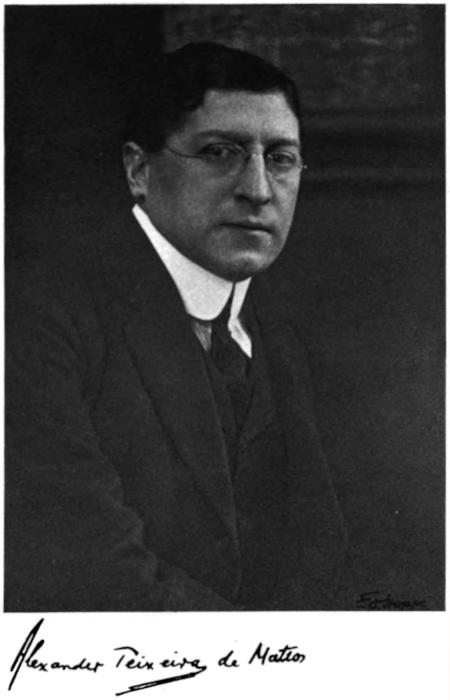
II
In the autumn of 1914 a censorship department
was improvised in the office of the
National Service League. A press-gang of
two, working the clubs of London and the
colleges of Oxford, established the nucleus of
a staff; and the first recruits were given, as
their earliest duty, the task of bringing in
more recruits. As the department had been
formed to examine the commercial correspondence
of neutrals and enemies, the first
qualification of a candidate was a knowledge
of languages; and, in the preliminary search
for recruits, Alfred Sutro convinced the friend
who had succeeded him in translating Maeterlinck
that a man who was equally at home
in English, French, German, Flemish, Dutch
and Danish, with a smattering of ecclesiastical
Latin, was too valuable to be spared. Teixeira
joined the growing brotherhood of lawyers,
dons and business men in Palace Street,
Westminster, advising on intercepted letters
and cables, curtailing the activities of traders
in contraband, assimilating the procedure of
a government department and being paid
stealthily each week, like a member of some
criminal association, with a furtive bundle of
notes.
It was his first experience of the public service,
almost his only taste of responsibility;
and it marked the end of the cloistered life.
Though he brought to his new work a varied
knowledge of affairs, Teixeira had participated
but little in them since his marriage in
1900. The friends of his youth, when he was
living in the Temple,—John Gray and Ernest
Dowson, William Wilde (whose widow he
married) and William Campbell,—such
acquaintances as Oscar Wilde and Max
Beerbohm, Robert Ross and Bernard Shaw,
Leonard Smithers and Frank Harris, were
for the most part scattered or dead; and,
though he kept touch with J. T. Grein, Edgar
Jepson, Alfred Sutro and a few more, he
seemed at this time, after Campbell’s death,
to lack opportunity and inclination for making
new friends.
His gregarious years, and the varied experience
which they brought, belonged to an
earlier period. Coming from Amsterdam to
London in 1874 at the age of nine, the son
of a Dutch father and an English mother,
Teixeira[1] placed himself under instruction
with Monsignor Capel and was received into
the Holy Roman Catholic Church. In
blood, faith and nationality, the Dutch Protestant
of Portuguese-Jewish extraction had
thus passed through many vicissitudes before
he married an Irish wife, became a British
citizen and died a Catholic. Traces of the
Jew survived in his appearance; of the Dutchman
in his speech; and his intellectual and
racial mixed ancestry was betrayed by a cosmopolitan
outlook. Ignorant of many prejudices
that are the native Briton’s birthright,
he remained ever aloof from the passions of
British thought and speech. If he respected,
at least he could not share the conventional
enthusiasms nor associate himself with the conventional
judgements of his new countrymen.
He wrote of his neighbours among whom he
had lived for more than forty years, with an
unaffected sense of remoteness, as “the English”;
after his naturalization, he was fond of
talking, tongue in cheek, about what “we English”
thought and did; but, in the last analysis,
he embodied too many various strains to
favour any single nationality.
After being educated at the Kensington
Catholic Public School and at Beaumont,
Teixeira worked for some time in the City
and was rescued for literature by J. T. Grein,
who made him secretary of the Independent
Theatre. By his work as a translator and as
the London correspondent of a Dutch paper,
he lived precariously until his renderings of
Maeterlinck, whose official translator he became
with The Double Garden, called public
attention to a new quality of scholarship.
Though he flirted with journalism, as editor
of Dramatic Opinions and of The Candid
Friend, and with publishing, in connection
with Leonard Smithers, translation was the
business of his life until he entered government
service. He is best known for his version
of Fabre’s natural history, which he lived
to complete and which he himself regarded
as his greatest achievement, for the later
plays and essays of Maeterlinck, for the novels
and stories of Ewald and for the novels
of Couperus. These, however, formed only
a part of his output; and his bibliography includes
the names of Zola, Châteaubriand, de
Tocqueville, President Kruger, Maurice Leblanc,
Madame Leblanc, Streuvels and many
more. One work alone ran to more than a
million words; and he married on a commission
to translate what he called “the longest
book in any language”.
The improvised censorship was not long
suffered to function unmolested. The home
secretary, learning that his majesty’s mails
were being opened without due authority,
warned the unorthodox censors that they were
incurring a heavy fine for each offence and
advised them to regularize their position.
Simultaneously, the Customs were thrown into
difficulty and confusion,[2] by the proclamation
of the king in council, forbidding all
trade with the enemy: in the absence of records,
investigation and an intelligence department,
it was impossible to say whether
goods cleared from London would ultimately
reach enemy destination; and the censors who
were watching the cable and wireless operations
of Dutch and Scandinavian importers
seemed the natural advisers to approach. At
this point the embryonic department, which
had risen from the ashes of the National
Service League, joined with a licensing delegation
from the Customs to form the War
Trade Department and Trade Clearing
House.
Drifting about Westminster from Palace
Street to Central Buildings, from Central
Buildings to Broadway House and from
Broadway House to Lake Buildings, St.
James’ Park, the War Trade Intelligence Department,
as it came to be called, was made
the advisory body to the Blockade Department
of the Foreign Office, with Lord Robert
Cecil as its parliamentary chief, Sir Henry
Penson, of Worcester College, as its chairman,
and H. W. C. Davis, of Balliol, as its
deputy-chairman. Teixeira, as the head of
the Intelligence Section, controlled the supply
of advice on the export of “prohibited commodities”
to neutral countries; as a member
of the Advisory Board, he came later to share
in responsibility for the department as a
whole. Among his colleagues, not already
named, were “Freddie” Browning, the first
organizer of the department, O. R. A. Simpkin,
now Public Trustee, H. B. Betterton,
now a member of parliament, Michael Sadleir,
the novelist, R. S. Rait, the Scottish Historiographer-Royal,
John Palmer, the dramatic
critic, and G. L. Bickersteth, the translator of
Carducci.
When the department came to an end,
Teixeira resumed his interrupted task of translation,
which had, indeed, never been wholly
abandoned; his daily programme during the
war was to work at home from 5.0 a.m. till
8.0 a.m. and in his department from 10.0 a.m.
till 6.0 p.m. or 7.0 p.m., then to play
bridge for an hour at the Cleveland Club, returning
home in time for a light dinner and
an early bed.[3]
Leisure, when at last it came to him, was
not to be long enjoyed: early in 1920, a further
break in health compelled him to undertake
a rest-cure, first at Crowborough and then
in the Isle of Wight. He returned to Chelsea
in the spring of 1921 and spent the summer
and autumn working in London or staying
with friends in the country, to all appearances
better than he had been for some years,
though in play and work alike he had now to
walk circumspectly. Towards the end of the
year he went to Cornwall for the winter and
collapsed from angina pectoris on 5 December
1921.
In a life of nearly fifty-seven years Teixeira
escaped almost everything that could be
considered spectacular. Happy in the devotion
of his wife and the love of his friends,
unshaken in the faith which he had embraced
and untroubled by the misgivings and melancholy
that assail a temperament less serene,
he faced the world with a manner of gentle
understanding and a philosophy of almost universal
toleration. His only child—a boy—died
within a few hours of birth; Teixeira
was troubled for years by ill-health; he was
never rich and seldom even assured of a comfortable
income. Nevertheless his temper or
faith gave him power to extract more amusement
from his sufferings than most men derive
from the plentitude of health and fortune.
Of a malady new even to his experience
he writes: “Is death imminent? Why
do I always have the rarer disorders?” He
loved life to the end—the world was always
“God’s dear world” to him—; to the end, he,
who had known so many of the world’s waifs,
continued forbearing to all but the censorious.
“I was taught very early in life,” he writes,
“to make every allowance for men of any
genius, whereas you look for a public-school
attitude towards all and sundry.... You
see, if one cared to take the pains, one could
make you detest pretty well everybody you
know and like. For everybody has a mean,
petty, shabby, cowardly side to him; and one
had only to tell you of what the man in question
chooses to keep concealed.” ...
“Life,” said Samuel Butler, “is like playing
a violin solo in public and learning the instrument
as one goes on.” Those who met Teixeira
only in his later years must have felt that
he was born a master of his instrument; it
is not to be imagined that there could ever
have been a time when he was ignorant of
the grace, the urbanity, the consideration and
the gusto that mark off the artist in life from
his fellows.
III
Though his letters contain scattered references
to the principles which he followed in
translation, Teixeira could never be persuaded
to publish his complete and considered
theory. His excuse was that he had
never been able to write more than eight hundred
words of original matter, a disability
that once threatened him with disaster when
he was invited to lecture on the science and
art of bridge to the members of a club formed
for mutual improvement and the pursuit of
learning. After being entertained at a fortifying
banquet, Teixeira delivered his eight-hundred
words. As, at the end of the two
and three-quarter minutes which his reading
occupied, the audience seemed ready and
even anxious for more, he read his address
a second time. Later, he began in the middle;
later still, he ran disgracefully from the
hall.
The method which he followed in translation
has, therefore, to be reconstructed from
the internal evidence of his books and from
personal experience in collaboration.
“I shall not,” wrote Matthew Arnold in
criticizing Newman, “in the least concern
myself with theories of translation as such.
But I advise the translator not to try ‘to rear
on the basis of the Iliad, a poem that shall
affect our countrymen as the original may be
conceived to have affected its natural hearers’;
and for this simple reason, that we cannot
possibly tell how the Iliad ‘affected its natural
hearers.’”
The first quality that distinguishes Teixeira
from most of the translators whose work and
methods of work have swelled the controversial
literature of translation is that he
confined himself to modern authors. Unacquainted
with Greek and little versed in
Latin, he was never faced with the difficulty
of having to imagine how an original work
affected its natural hearers. Maeterlinck
and Couperus were his personal friends;
Fabre and Ewald, who predeceased him,
were older contemporaries; it is only with de
Tocqueville and Châteaubriand that he had
to gauge the intellectual atmosphere of an
earlier generation. In judging whether his
English rendering left on the minds of
English readers the same impression as the
original had left on its “natural hearers”, he
had a court of appeal always available; and,
while the English reader is “lulled into the
illusion that he is reading an original work”,
the foreign author can testify to the fidelity
with which his text has been followed and his
spirit reproduced. “What a magnificent
translation The Tour is!” Couperus writes;
“what a most charming little book it has
become! I am in raptures over it and have
read it and reread it all day and have had
tears in my eyes and have laughed over it.
You may think it silly of me to say all this;
but it has become an exquisitely beautiful
work in its English form. My warmest
congratulations!”
To achieve this illusion, Teixeira began
his literary life with the most essential quality
of a translator: an equal knowledge of the
language that was to be translated and of the
language into which he was translating it.
English and Dutch came to him by inheritance;
French and Flemish, German and
Danish he added by study; and throughout
his working life he was incessantly sharpening,
polishing and adding to his tools.
Limitless reading refreshed a vast vocabulary;
meticulous accuracy refined his meanings
and justified his usages. His dictionaries
were annotated freely; and the margins
of his manuscripts were filled with challenges
and suggestions for his friends to consider,
until his own exacting fastidiousness had at
last been satisfied. Apart from professional
lexicographers, it would have been difficult
to find a man with more words in current use;
it would have been almost impossible to find
one who employed them with nicer precision.
Learning sat too lightly on his shoulders to
make him vain of it, but no one could hear or
correspond with him without realizing the
presence of a purist; he seldom quoted, mistrusting
his memory, confessed himself an
amateur in colloquial dialogue and refused
with equal obstinacy to venture on English
metaphors and English field-sports. “I do
not know the difference between a niblick
and a foursome,” he would protest. “When
you say that your withers are unwrung, I do
not know whether you are boasting or complaining.
What are your withers? Have
you any, to begin with? Do you ‘wring’
them or ‘ring’ them? And why can’t you
leave them alone?”
Not content with mastering five foreign
languages, Teixeira created a new literary
English for every new kind of book that he
translated. His versions of Maeterlinck’s
Blue Bird, Couperus’ Old People and The
Things That Pass, Fabre’s Hunting Wasps
and Ewald’s My Little Boy have nothing in
common but their exquisite sympathy and
scholarship; four different men might have
produced them if four men could be found
with the same taste, knowledge and diligence.
Fabre’s ingenuous air of perpetual discovery
demanded the style of a grave, grown-up
child; Maeterlinck’s mystical essays invited
a hint of preciosity and aloofness, to suggest
that omniscience was expounding infinity
through symbols older than time; and the
atmospheric sixth-sense of Couperus had to
be communicated by a sensitiveness of language
that could create pictures and conjure
up intangible clouds of discontent, guilty
terror, suppressed antagonism or universal
boredom. In reading the original, Teixeira
seemed to steep himself in the personality of
his author until he could pass, like a repertory
actor, from one mood and expression to
another; his own mannerisms are confined to
a few easily defended peculiarities of spelling
and punctuation.
For a man who must surely have divined
that his calibre was unique, Teixeira was
engagingly free from touchiness. In translating
a book, as in organizing a department,
he was magnificently grateful for the word
that had eluded him and for the criticism
which he had not foreseen. A purist in
language and a precisian in everything, he
realized that a living style is throttled by too
great obedience to rules; but he was afraid,
even in dialogue, of unchaining a wind of
colloquialism which he might be unable to
control; and, in constructing the deliberately
artificial speech of his Maeterlinck translations,
he recognized that he lacked his
readers’ age-old familiarity with the English
of the Bible. Though his passion for consistency
led him to say: “My name ought to
have been Procrus-Tex,” he stretched out
both hands for an authority that would justify
him in broadening his rule. “I have
always spelt judgment without an e in the
middle,” he declared in 1915, when, with the
gravity that characterized his more trivial
decisions, he had abandoned violet ink, because
it seemed frivolous in war-time, and the
long s (ſ), because it bore a Teutonic aspect.
“I am too old to change now; and you know
my rule, All or None.” Four years later he
announced: “In future I shall spell ‘judgement’
with an e in the middle. The New
English Dictionary favours it; you assure me
that it is so spelt in your English prayer-book;
and Germany has signed the peace
terms.”
No comparison with other translators can
be attempted until another arise with Teixeira’s
range of languages and his volume of
achievement. He himself could never say,
within a dozen, how many books he had
translated; but in them all he created such an
illusion of originality that they are not suspected
of being translations until his name is
seen. In a wider view, he undermined the
pretensions of those who boasted that they
could never read translations; and, if no one
is likely to be found with all his gifts, he at
least prepared the way for a new school of
translators. It may be hoped that, after the
battles which he fought, important foreign
authors will not again be sacrificed to illiterate
hacks at five-shillings a thousand words:
it may even be expected that competent
scholars will no longer disdain the task of
translating contemporary works. All literary
predictions are rash; but there seems
little risk in prophesying that Teixeira’s renderings
of Fabre, Couperus and Maeterlinck
will be read as long as the originals.
The tangible fruits of his astonishing
industry are only a part of his achievement:
it is to him, in company with Constance
Garnett, William Archer, Aylmer Maude
and the other undaunted pioneers, that English
readers owe their escape from the self-satisfied
insularity with which they had protected
themselves against continental literature.
When publishers have been convinced
that translations need not be unprofitable
and when a conservative public has discovered
that they need not be unreadable, a
future generation may be privileged to have
prompt access to every noteworthy book in
whatsoever language it has been written,
without waiting as the present generation has
had to wait for an English rendering of
Tolstoi, Turgenieff, Dostoieffski and Tchehov.
In conversation Teixeira took little pleasure
in discussing himself; in correspondence
he could not help giving himself away. The
reader will deduce, from his slow surrender
of intimacy, the shyness that ever conflicted
with his sociability; the absence of all allusions
to his literary work, save when he
fancied that a second opinion might help
him, is evidence of a personal modesty that
amounted almost to unconsciousness of his
position in letters. Diffidence and sociability,
first conflicting, then joining forces,
led him in his departmental work to discuss
every problem with a friend; and in all personal
relationships, he needed an hourly confidant
because everything in life was an
adventure to be shared and might be worked
in later to the saga with which he strove to
make himself ridiculous for the diversion of
his company. “Thus,” he writes of a childish
freak, “do the elderly amuse themselves for
the further amusement of a limited circle.”
Weighty commissions were assembled, daring
expeditions set out under his leadership to
choose a dressing-gown for country-house
wear; the grey tall-hat with which he surprised
one private view of the Royal Academy
was no less of a surprise to him and even
more of an abiding pleasure. For a year or
two afterwards he would telephone on the
first of May: “If you will wear your goodish
white topper to-day, I will wear mine”;
and once, when these conspicuous headpieces
were in evidence, he led the way to Covent
Garden Market, with the words: “It is not
every day that the women of the market see
two men in such hats, such coats and such
spats, standing before a fruit-stall with their
canes crooked over their arms and their
yellow gloves protruding from their pockets,
consuming the first green figs of the year in
the year’s first sunshine.”
In conversation he once boasted that he was
never bored; and, though every man and
woman at the table volunteered the names of
at least six people who would bore him to
extinction, the boast was justified in that,
however irksome one moment might be, it
could always be invested afterwards with the
glamour of an eccentric adventure. Somewhere,
among his immediate ascendants, there
must have been a not too remote ancestor of
Peter Pan. On his fifty-sixth birthday, Teixeira
was having a party arranged for him,
with a cake and fifty-six tiny candles; for days
beforehand he had been asking for presents
of any kind, to impress the other visitors in
his hotel; and, if he knew one joy greater
than receiving presents, it was finding an
excuse to give them.
With the heart of a child in all things, he
had the child’s quality of being frightened by
small pains and undaunted by great; a cut
finger was an occasion for panic, but the
threat of blindness found him indomitable.
Herein he was supported throughout life by
the faith which he had acquired in boyhood
and which he preserved until his death. “I
save my temper,” he once wrote, “by not discussing
religion except with Catholics or
politics except with liberals. There’s room
for discussion in the nuances; there’s too much
room for it with those who call my black
white.” ... While it was generally known
among his friends that he was a devout Catholic,
only a few were allowed to see how much
reliance he placed in religion; and he would
grow impatient with what he considered a
morbid protestant passion for worrying at
something that for him had been immutably
settled.
In political debates he would only join at
the prompting of extreme sympathy or extreme
exasperation. His native feeling for
the Boers in the Transvaal was little shared
in England during the South African war;
and his loathing for English misrule in Ireland
was too strong to be ventilated acceptably
among the people whom he met most commonly
in London. His connection with the
Legitimist cause came to an end with the outbreak
of war: though he had hitherto delighted
in penetrating between the sentries at
St. James’ Palace and placarding the wall
with an appeal to all loyal subjects of the
rightful king, he was unable to continue his
allegiance when Prince Rupprecht of Bavaria
became an enemy alien.
Legitimacy and Catholicism, apart from
other claims on his regard, gratified a love
for ceremonial and tradition that would have
been more incongruous in a liberal if Teixeira’s
whole equipment of beliefs, practices
and preferences had not been a collection
of incongruities. Though he detested militarism,
he could never understand why the
English civilians omitted to uncover to the
colours; hating pomposity, he enjoyed the
grand manner in address and, on being
greeted by a peer as “my dear sir,” replied
“my dear lord” in a formula beloved by Disraeli.
As a relief to an accuracy of expression
which he himself called Procrustean
and pernickety, he would transform any word
that he thought would look or sound more
engaging for a little mutilation. It was a
bad day for the English of his letters when he
read Heine and entered into competition for
the most torturing play upon words; his
case became hopeless when he was introduced
to a couple of friends who could pun with
him in four or five languages. It was this
bent of mind that may justify the description
of him[4] as the son of Edward Lear and the
grandson of Charles Lamb.
Underlying the whimsical humour of his
letters and peeping through the mock solemnity
of his speech was a young child’s concern
for the welfare of his friends: himself never
growing up, he never outgrew his generous
delight in any success that came to them; their
ill-health and sorrow were harder to bear
than his own; and he shewed a child’s impulsive
generosity in offering all he had in comfort.
Sympathy, help, experience and advice
were at hand for whosoever would take them:
he had too long lived precariously to forget
the tragedy of those who failed and failed
again; he knew life too well to grow impatient
with those who failed through no one’s fault
but their own.
Love of life, enduring to the end, knowledge
of life, increasing every day, combined
to join this heart of a child to the experience
of an old man. As a connoisseur of food and
wine, as of style and manner, he belonged to
a generation that ranked life as the greatest
of the fine arts. To lunch with him was to
receive a liberal education in gastronomy,
though his course of personal instruction
sometimes broke down for lack of material:
from time to time he would announce with
jubilation that he had discovered some rare
vintage in some unknown restaurant; a party
would be organized to sample it, only to be
informed that the last bottle had been consumed
by Mr. Teixeira the day before.
As an explorer, he remained, to his last
hour, at the age when a boy lingers rapturously
before one shop after another, enjoying
all impartially, sharing his enjoyment with
every passer-by, confident that life is an unending
vista of glittering shop-windows and
that the day must somehow be long enough
for him to take them all in.
V
The first five months of 1916 were a time
of relatively good health for Teixeira; and
our correspondence contains little more than
an invitation, which he acknowledged in
departmental language.
I wrote:
Tuesday, Jan. 4th, 1916.
Though long I’ve wished to bid you come and dine,
Your way of life stood ever in the way;
For you, I gather, go to bed at nine
And rise at five (or five-fifteen) next day.
Yet Tuesday brings my chance. At half-past eight
I go to guard my king; but, ere I go,
With meat and wine I purpose to inflate
My sagging stomach for an hour or so.
Then will you join me? Seven o’clock, I think:
The Mausoleum Club is fairly near:
Whate’er your heart desire of food and drink,
And any kind of clothes you choose to wear.
S. McK.
We should be glad, replies Teixeira, if this
application could come up again in say a fortnight’s
time.
A. T.
Trade Clearing House.
When next I was summoned for duty as a
special constable, the application was submitted
again; and Teixeira dined with me at
the Reform Club. Later in the year, though
he had been warned by William Campbell,
the greatest friend of his middle years, that a
man who laughed so much would never be
admitted to membership, I was allowed to
propose him as a candidate; and from the day
of his election he became one of the most
popular figures both in the card-room and
in the south-east corner of the big smoking-room,
where his most intimate associates gathered.
His hours of work, to which the first stanza
refers, have already been mentioned; his
methods call for a word or two of description.
The library in Cheltenham Terrace looked
out over the Duke of York’s School and was
lined with book-cases wherever windows,
fire-place or door permitted. The furniture
consisted of a sofa, which was used for hat-boxes
and more books; a writing-table, which
was used for anything but writing; a revolving
book-case, filled with works of reference;
and the editorial chair from the office of The
Candid Friend. Seating himself in dressing-gown
and slippers, between the fire-place and
the revolving book-case, Teixeira dug himself
into position: a despatch-box under his
feet raised his knees to an angle at which he
could balance a dictionary upon them, with
its edge resting on a miniature bureau; on the
dictionary rested a blotting-pad; and every
book that he needed was in reach either of his
hand or an elongated pair of “lazy-tongs”;
scissors, string, sealing-wax, india-rubber and
knives were ingeniously and menacingly suspended
from nails in the revolving book-case;
on the top stood cigarettes, matches, a paste-pot
and a vast copper ash-tub; and the colour
of his violet carpet was chosen to conceal the
occasional splashings of a violet-ink pen.
With a telephone on one side to put him in
touch with the outside world and with a bell
on the other to secure his morning coffee,
Teixeira could work without moving until
evicted by force.
In the beginning of June, he was ordered to
Malvern.
No news, he writes on the 10th, except that
I have arrived and had some tea....
There are hawthorns at Malvern and rhododendrons
of -dra but also the most bloodthirsty
hills. And there was an officer in the train who
told me that the feeling in Franst was most
“optimistic”.
The proprietress of this hotel pronounces my
name Teisheira. This must be looked into.
I s’pose I’m enjoying myself, he writes next
day. I feel very restless.
[My cook], I forgot to tell you, was mounting
guard over the dispatch-box like a very sentinel,
with hands duly folded: a most proper spectacle.
I nearly died, but not entirely, hunting for my
porter up and down the length of the longest
train you ever saw (I am sure this must be correct,
in view of the fact that you never did see
this particular train)....
This hotel is not so uncomfortable: I slept
eight hours; I have a writing-table in my room;
my bath was too hot to get into; these are signs
of human comfort, are not they? Nor is the
food nasty. Fortunately, there is not much of it.
I ordered me a bottle of Berncastler Doctor.
They brought me Liebfraumilch. I waved it
away, saying that hock was acid and gave me
gout. Then, persuaded to be a Christian, I sent
one running after it before the doctor was opened
and drank two glasses; and it was delicious; and
I have no gout.
Why I sit boring you with this dull stuff I do
not know: it is certainly not worth including in
the Life and Letters.
Two days of solitude set him athirst for
companionship.
Good-morning, fair sir, he writes on
12.6.16. I hope this finds you as it leaves me at
present, a little improved in health. But I would
not wish my worst enemy the weariness from
which I am suffering.... Picture me buying
useless things so that I may exchange a word
with a shopman; for no one talks to me here.
Also the weather is bitterly cold.
And next day:
I have ... talked at length to a highly intelligent
Dane, with a massy pair of calves that
do credit to his pastoral country. But he has
returned to town this morning.
They play very low at the club, fortunately, for
I lost 13/-, which would have been £10, had I
been playing R.A.C. points. Also they make
me too late to dress for dinner, which doesn’t
matter: nothing matters in this world.
For the rest, I have reason to think that I
shall begin to cheer up from to-morrow and to
remain cheerful until Saturday. That is “speech-day”—I
presume at Malvern College—when I
expect to see an awful invasion of horribobble
papas and mammas.
Bless you.
The hoped-for cheerfulness has not yet arrived,
he laments on 14.6.16. I live in one of the
most tragic of worlds. But ... I have had
more conversation. The place of the Dane with
the fatted calves ... has been taken by a parson,
a passon, a parsoon, an elderly parsoon with
the complete manner of the late Mr. Penley in
The Private Secretary: he would like to give
every German a good, hard slap, I am sure. He
is a much-travelled man; and his ignorance of
every place which he has visited is thoroughly entertaining....
I am becoming popular at the club: they took
12/- out of me yesterday. I must set my teeth
and get it back though.
The influx of odious parents, he writes on
18.6.16, with their loathy, freckled criminals
of offspring has flustered the waiters and is spoiling
all my meals. What I do now is to change
for dinner after all and come in exactly an hour
late for meals. They have some way of keeping
the food—such as it is—piping hot; and so I do
not suffer unduly for avoiding the sight of some,
at least, of the carroty-headed boys and their
thick-ankled sisters....
Ah well! I can begin to count the days until
I am back among you; and a glad day that will
be for me! Nobody in the world, I think, hates
either rest or enjoyment so much as I do.
Good-bye. I am going for a walk. I tell you
frankly, I am going for a walk. I tell you this
frankly....
On Teixeira’s return to the department,
our correspondence was suspended until I
went to Cornwall for a week’s leave in August.
When I wrote in praise of my surroundings,
he replied with a warning:
You are probably too young ever to have heard
of ... a play-actress ... who brought a breach
of promise action ... and earned the then
record damages of £10,000. She took a cottage
somewhere the other day and brought her mother
to live in it. The mother said, “This is just the
sort of place I like; I shall be happy here,” then
fell down the stairs and was dead in half an
hour....
... Remember me to the Atlantic....
The next letter contained a story from
Ireland:
Sligo, 18 August 1916.
... Here, in this most distressful country, we
are about to experience again the blessings of
coercion, administered by Duke, K.C., and Carson,
high priest of the cult. In Sligo, the other
day, two ladies treating each other in a public-house,
the barman intervened at the tenth drink,
saying:
“Stop it now; ye can’t have any more; troth,
I won’t sarve ye again. Don’t ye know it’s Martial
Law that’s on the people?”
Whereupon one of them enquired of the other:
“For the love of God, Mrs. Murphy, what’s
he talking about at all? Who’s Martial Law?”
To which her friend replied sotto voce:
“Whist, don’t be showing your ignorance,
ma’am! Don’t ye know he’s a brother of Bonar
Law’s?”...
As official papers accompanied every letter,
a trace of departmental style is occasionally
visible in private notes:
War Trade Intelligence Department, 23 August, 1916.
“Harry Edwin” ate a grouse last night and drank
many glasses of port. You can imagine the sort
of grumpy commensal that he is to-day.
A. T.
“Harry Edwin.”
To see.
23.8.16.
Seen and approved.
H. E. P.
... Don’t overbathe, he adds as a postscript.
Why be so reckless? You remind me of the
London city “clurks” who arrive in Switzerland
one evening, run straight up the Matterhorn the
next morning. I believe that two per cent of
them do not drop dead.
The Sehr Hochwohlgeboren und Verdammter
Graf Zeppelin, he writes on 25.18.16, did
some damage last night at Greenwich, Blackwall
(a power-station) etc. For the rest, no news.
I am picking up not wholly unconsidered trifles
at the Wellington and benefiting your Uncle
Reggie pro rata. [Bridge winnings at this time
were thriftily exchanged for War Savings Certificates.]
This morning I (pro)-rated the girl ...
at the post-office for not “pushing” those certificates.
I said that, whenever any one asked for
a penny stamp, she should ask:
“May we not supply you with one of these?”
It went very well with the audience.
This morning, he writes later, I have bought
my thirteenth fifteen-and-sixpennyworth of Uncle
Reggie. Mindful of my injunction to “push” the
goods, the post-office girl ... urged me to buy
a £19.7. affair which would be good for £25 in
five years’ time. Alas! Still, there are hopes.
In his preface to The Admirable Bashville,
Bernard Shaw explains his reason for throwing
it into blank verse: “I had but a week
to write it in. Blank verse is so childishly
easy and expedious (hence, by the way,
Shakespeare’s copious output), that by adopting
it I was enabled to do within the week
what would have cost me a month in prose.”
Pressure of work sometimes drove Teixeira
to a similar expedient in rimed verse:
Letter just received, he writes in haste on
26.8.16. to acknowledge the account of a bathing
mishap:
With great relief at noon I found
That S. McKenna was not drowned.
Many thanks for the pendant to these lovely
verses.
P.S. I note—and we all note—he adds—that
you never express the wish to see us all again.
How different from my Malvern letters! Ah,
what a terrible thing is sincerity!
VII
In the middle of May I cabled to Teixeira
in code, asking him to forward no more
letters; and I did not hear from him again
until my return to England in the second week
of June.
As soon as I was ready to take his place, he
went to Harrogate for a cure and remained
there for six weeks. For part of the time I
took his place in another sense of the phrase.
At the end of July the Air Board commandeered
my flat; and, until I could find, decorate
and furnish another, Teixeira and his
wife most kindly placed their house at my
disposal. This will explain the following
extract:
Harrogate: 15 July, 1917.
Here is the key. Come in when you like, make
yourself as comfortable as you can and forgive
all deficiencies. I feel a compunction at not having
the physical energy to “clear” things a bit for
you; but there you are....
I have started my cure, he writes on 18.7.17,
which promises to be a most strenuous, arduous
and tedious affair. I have to take daily two
soda-water tumblers of strong sulphur water and
two ordinary tumblers of warm magnesia water;
and on alternate days (a) a Nauheim bath and
(b) a hot-air bath....
It is raining steadily. This doesn’t matter.
But that sulphur-water, on an empty stomach, at
8 a.m.! Two-and-twenty ounces of it, hot! The
stench of it! It is said to remind one of rotten
eggs; but, as I have never smelt a rotten egg, it
reminds me of nothing and only suggests hell.[5]
Sugar seems to have been more scarce in
Harrogate than in London; and Teixeira’s
appeals and contrivances were always pathetic
and sometimes frantic.
My wife did manage to get half a pound of it
flung at her head this morning, he writes on
19.7.17. I had so entirely forgotten the essential
rudeness of the people of Yorkshire that its
discovery came upon me as an utter surprise. I
amuse myself by overcoming it with smiles.
Smiles are unfamiliar symptoms to them and take
them aback.
You may tell Sutro that I have bought a dozen
silk collars.
After weary weeks of nauseating treatment,
he writes:
It will be an awful sell if this cure ends without
doing me good. Still I always hope. Whatever
happens I shall want at least a week’s after-cure
which I should probably take here: simply a rest
and air, without any waters or baths. But what
is your Cornish date?
I replied, 27.7.17.
By this time you will have seen that our minds
have been working on parallel lines towards the
same conclusion that an after-cure is quite essential.
It will suit me perfectly well to stay here
until, and including, Friday the 24th, or later if
you like. My Cornish arrangements are quite
fluid....
For all your pagan pose, he writes, you are a
fine old Irish Christian gentleman, as is proved
by your suggestion of an after-cure, dictated no
doubt at the identical moment when I was writing
my answer to it. At any rate, I prefer to
think of you as a Christian brother rather than
as a Corsican brother. As I said, I shall probably
take that after-cure, but take it at Harrogate,
which is about as bracing a spot as any in
the three kingdoms. To go straight to the sea
might set up my rheumatism again, if indeed it
is suppressed; there is no sign yet of that desiderandum....
It is necessary to insert my letter of 30.7.17
in order to explain Teixeira’s reply to it.
I went home for the week-end, I wrote, and
travelled up this morning with C. H. C. has a
new and most amusing game. It consists of inviting
people to stay with him for the week-end
and encouraging them to bathe in the river
Thames and only disclosing, when the damage
has been done, that the bed of that ancient river
is richly studded with broken bottles. There
was a small boy in the carriage with one badly
injured foot as a result of C.’s pleasantry. I did
a conspicuous St. Christopher stunt and carried
the boy on my shoulders the entire length of the
arrival platform at Paddington....
I, Teixeira answers, 30.7.17, once carried
Willie Crosthwait, then aged 14, the whole
length of the Euston departure platform. That
beats you (and perhaps caused the best part of my
present troubles). He is now an army chaplain;
and I sit moaning at Harrogate.
Ululu!
My eviction took place in the first week of
August; and on 3.8.17 I wrote to Teixeira:
I am thinking of moving to Chelsea on Tuesday....
You may remember a story of Benjamin
Jowett in connection with two undergraduates
who persisted in staying up at Balliol
throughout the Long Vacation. Jowett, by way
of gently dislodging them, insisted first that they
should attend Chapel daily. The undergraduates
grumbled, but obeyed. Jowett, seeing that his
first attack had failed, arranged with the kitchen
authorities that the food served to these recalcitrant
young scholars should be entirely uneatable,
and in the course of time their spirit was
so much broken that they left him and Balliol in
peace. He is reported to have said, as he
watched them driving down to the station:
“That sort goeth not forth but by prayer and
fasting.” So with me. I have manfully withstood
the stalwart labourers who break walls
down all round me throughout the night; but,
when the porters are paid off, the maids deprived
of their rooms, the hot-water supply disconnected
and the gas cut off at the main, I feel that I may
retire with dignity and the full honours of
war....
Make yourself as comfortable in Chelsea as
you can, he answered on 4.8.17. As at present
advised, we return on Wednesday fortnight, the
22nd....
The days here speed past on wings, thanks to
their monotony. Waters at 8; again at 10.30;
a bath or baths at 11; lunch at 1.30; a jog-trot
drive from 3 to 4; bridge; dinner at 7.30; massage
at 9; all this with unfailing regularity. I
believe far more in my masseuse (she lives at this
house) than in my doctor. It will amuse your
father to hear that this genius is prescribing for
me in the matter of rheumatism, neuritis and
fibrositis in the arm without having once had my
shirt off! I make suggestions, at the instance of
the masseuse, and he promptly annexes them as
his own:
“Tell me, doctor, may I do so-and-so?”
“You are to do so-and-so; and this very day!”
The doctors here generally have the very
worst name; but there is nobody to pull them up
or show them up.
The place teems with people whom I know and
don’t want to see.
The rain it raineth every day and all day....
My cure is now over, he writes on 12.8.17;
it has been long and costly; it has done me no
good at all. Indeed my main affliction is worse;
certain movements of the right arm which were
possible with comparative ease before I came
down are now nearly impossible. On Saturday,
at the final consultation, when I took leave of my
doctor and paid him five guineas, he told me for
the first time that I have no neuritis but that I
have bursitis. All the while, mark you, he has
been treating me for fibrositis. It is a consolation
to know, however, that I have no arthritis.
What I have been having is what the vulgar
would call a hi-tiddlyhitis high old time....
A week later I went again to Cornwall on
leave.
Do devote yourself, wrote Teixeira, 25.8.17,
at any rate for the first ten days of your
absence, to becoming very well and strong. I
have never seen you quite so ill as yesterday and I
was infinitely distressed about it. Treat yourself
as though you were an exceedingly old man like
me. Then when you have entered upon your
rejuvenescence you can begin to play pranks with
yourself again....
Later he added:
Be careful not to honour the Atlantic with
more than one immersion a day....
And, 30.8.17. I am exceedingly busy, but
I am enjoying it all. My health is as bad as ever
and I have recovered my famous lead-poisoning
hue. I expect you, however, to return with the
bloom of roses and the stains of coffee on your
cheeks. So make up your mind to sleep and do
it....
In the first week of September there began
the most persistent series of air-raids that occurred
at any stage during the war.
Last night, Teixeira writes, 5.9.17, was
made hideous by a pack of confounded Germans
who came over London and created no end of a
din. I looked out of the window, saw one shell
burst in a south-easterly direction, debated
whether to go below or remain in bed and remained
in bed.
[My cook], from her basement, appears to
have obtained a much clearer aural view:
“Didn’t you hear them two raiders firing
bom-m-ms at each other, sir?”
There spoke your Sinn Feiner: they were both
raiders to her. The row lasted for over two
hours; and I feel an utter wreck. Lord knows
what mischief the brutes have done this time.
Vale et nos ama.
Next day, in a letter dated, City of Dreadful
Nights, he adds:
Last night no air-raid was possible, because of
an appalling thunderstorm, which kept me awake
for another three hours. If you have ever heard
thunder rolling for fifty seconds without intercession
and giving sixty of these rolls to the
hour, you will know the sort of thunderstorm it
was.
This description prompts him to an anecdote:
“Then there’s Roche, the resident magistrate.
Don’t go shooting Roche now ... unless it’s by
accident. What does he look like? Well, if
ye’ve ever seen a half-drowned rat, with a grey
worsted muffler round its neck, then ye know the
kind of man Roche is!”—Speech quoted before
the Parnell Commission.
On my return from Cornwall, my flat was
not yet ready for me, but the Teixeiras’ hospitality
allowed me to continue staying with
them.
You will be as welcome on Thursday night as
peace at Christmas, wrote Teixeira, 9.9.17.
[My cook] is away on a holiday and there is a
possibility that she will not be back by then; and
in the meantime there is nobody else. You may,
therefore, have to submit to a modicum of discomfort:
... your boots will probably have to
accumulate to some extent before they are cleaned
on the larger scale. You have so many boots,
however, that I venture to hope that this will
not incommode you unduly.
This welcome was seasoned later by a story
which Teixeira invented, describing his
efforts to dislodge me. According to this, he
used to fall resonantly from his bedroom to his
study at 5.0 each morning and, if this failed to
rouse me, he would mount the stairs again
and continue to throw himself down until I
waked. At 6.0 a cup of tea would be brought
me; at 7.0 the morning paper; at 8.0 my
letters. When I went to my bath at 8.30,
Teixeira used to assert that he flung my
clothes into a suit-case, tiptoed downstairs
and laid the case on the doorstep. His tactics
failed because I only waited until he was
locked in the bathroom before creeping down
and retrieving the case.
As our leave was over for the year, there
was no further exchange of letters save when
one or other was absent from our department.
I have read the new Maeterlinck play[6]—a
good theme infamously treated, I find myself
writing, 27.12.18. I beg you to scrap the
third act and with it your regard for M’s feelings;
then rewrite it with a little passion, a great
deal of fear and unlimited un-understanding
horror. The invasion of Belgium wasn’t a
Greek tragedy where the afflicted prosed and
philosophised—with a chorus dilating on cattle-yas;
it was noisy, bloody and, above all, unbelievable.
Maeterlinck has brought no nightmare
into it....
Letter just received, he replied next day.
You are a highly illuminated and illuminating
critick. Your remarks upon that play are exactly
right (as I now know, having just read my
first three Greek plays)....
I enclose, he writes 10.8.18, 1¾ chapters
of the Couperus classical comedy-novel [The
Tour], which I amused myself by doing because
you insisted so emphatically that the book should
be done. But I will go no further till I have
your verdict. Don’t trouble to do any work on
this; the marginal refs. were merely inserted as
I went along. Just see if the thing is the sort of
thing that’s likely to take on; and talk to me
about it when you see me....
IX
In 1918 Teixeira’s health had so much improved
that he was able to dispense with all
violent and disabling cures.
This was the period when he was, socially,
in greatest request. I introduced him, in the
spring, to Mr. and Mrs. Asquith, who shewed
him much hospitality and great kindness
from this time until his death. His leaves
were now usually spent with them at Sutton
Courtney; but, since he required to take little
or no sick-leave, the number of letters exchanged
in this year is small.
At the armistice, he left the Intelligence
Section to become secretary to the department;
and, though we worked in the same
building for two or three months more, I
naturally saw less of him than when we shared
the same table. The last communication that
passed between us as colleagues, like the first,
written three years before, contained an invitation.
Its form must be explained by reference
to Stevenson’s and Osborne’s Wrong
Box. Rudyard Kipling has mentioned, in
A Diversity of Creatures, the sublime brotherhood
to whom this book is a second Bible.
“I remembered,” [he writes in The Vortex],
“a certain Joseph Finsbury who delighted the
Tregonwell Arms ... with nine ... versions
of a single income of two hundred pounds, placing
the imaginary person in—but I could not
recall the list of towns further than ‘London,
Paris, Bagdad, and Spitzbergen.’ This last I
must have murmured aloud, for the Agent-General
suddenly became human and went on: ‘Bussoran,
Heligoland, and the Scilly Islands’—‘What?’
growled Penfentenyou. ‘Nothing,’ said
the Agent-General, squeezing my hand affectionately.
‘Only we have just found out that we
are brothers.... I’ve got it. Brighton, Cincinnati
and Nijni-Novgorod!’ God bless
R. L. S.[7]...” One of the greatest living authorities
on The Wrong Box was a member of the
Reform Club; and, on joining, Teixeira found it
necessary to his self-protection to study the most
aptly-quoted work in the world.
My invitation was couched in the cryptic terms
of the brotherhood:
MATTOS. Alexander William de Bent
Teixeira, if this should meet
the eye of, he will hear
something to his advantage
by lunching with me to-day
at the far end of Waterloo
Station (Departure Platform)
or even at Lincoln’s
Inn.
War Trade Intelligence Department.
30 December, 1918.
On leaving the department early in 1919, I
saw and heard little of Teixeira until he invited
me to collaborate in the translation
of The Tour. Occasional divergencies of
opinion about translating Latin words in the
English rendering of a Dutch novel had the
very desirable result of making Teixeira set
out some few of the principles which he followed.
Couperus sends me this postcard, he writes,
29.4.18:
“Amice,
“You are of course at liberty to act according
to your taste and judgement. I do not however
understand the thing: in every novel treating of
antiquity the classical word sometimes gives a
nuance to the untranslatable local colour. And
every novelist feels this: See Quo Vadis, in
Jeremiah Curtius’ translation. However, do as
you think proper.
“Yours,
“L. C.”
He has us on the hip with his Jeremiah Curtius.
And I feel more than ever that you were too drastic
in your views and I too weak in yielding to
them....
We should always guard ourselves against the
bees in our bonnets. When I produced Zola’s
Heirs of Rabourdin, the stage-manager said his
play-actors couldn’t pronounce Monsieur, Madame
and Mademoiselle to his liking: might he
try how it would sound with Mr., Mrs., and Miss
Rabourdin? He tried!
If your principle were carried to any length,
you would have to call a pagoda a tower, a jinrickshaw
a buggy, a café a coffee-house, a gendarme
a policeman (i.e. a sergent-de-ville), a
toga a cloak, a gondola a wherry, an Alpenstock
an Alpine stick, a ski a snowshoe: one could go
on for ever!
Yet I am ever yours,
Tex.
In the spring and summer of 1919 our
letters became more frequent. Though Teixeira
spent most of his time in his department, I
employed the first months of liberation in
staying with friends. The translation of The
Tour went on apace; and arrangements were
made for the English publication of Old
People and the Things That Pass. If he had
given his readers no other book by Couperus
or by any other writer, he would still have
established two reputations with this.
It’s a funny thing, he writes, 21.5.19; 4:57
a.m.; but I find that I can no longer trs. Latin,
even with a dictionary. I suppose it’s because
I can’t construe it. Would you mind putting a
line-and-a-bit of Ovid into English for me?
Here it is:
Materian superabat opus, nam Mulciber illic
Æquora celarat.
... My intentions are to go down to I. for
5 or 6 days on the 5th of June and to join my
wife at Bexhill on or about the 18th for 3 or 4
weeks.
“Bexhill-on-Sea
Is the haven for me,”
sang Clement Scott in a visitors’-book discovered
by Max Beerbohm, who tore him to pieces for
it in the Saturday, in an article signed “Max.”
Scott, pretending not to know who Max was,
flew to the Era and wrote his famous absurdity,
“Come out of your hole, rat!” Gad, how we
used to laugh in those days!...
My reply began:
I resent your practice of heading your letters
with the unseemly time at which you leave a warm
and comfortable bed. And I dated my own: 22
May, 1919. Cocktail-time. What would you
think of me if I headed my letters with the equally
unseemly time at which I sometimes go to bed?
I have been working so late one or two nights last
week and this that the times would coincide, and
you might bid me good-morning as I bade you
good-night....
I went ... to a musical party.... I felt
that it was incumbent upon me to see whether
you had done anything in the matter of the Belgian
quartette.[8] You will be shocked to hear
that the quartette is not only still in existence, but
has added a supernumerary to turn over the
music of the pianist....
On 7.6.19, he wrote from Somersetshire: You
are—it is borne in upon me that you must be—a
secret autograph-hunter. Here am I, hoping to
do nothing but sleep 26 hours out of the 24, to
do nothing ever, to the great ever; and here
come you, hoping for a letter, lest you be pained.
A scripsomaniac, my poor Stephen, a scripsomaniac
you will surely be, if you do not check yourself
in time.
Yes, yes, yes, yes, yes! I know that I am Satan
rebuking sin; but was Satan ever better employed?
Far rather would I see him rebuking sin than
prompting letters for idle hands to write.
Well, I know that I am staying in Somersetshire
with I., who is at this moment speeding towards
the Hôtel du Vieux Doelen at the Hague,
to nurse a sick friend. Ker pongsay voo der
sah? And I am happy as the day is long, petted
and coddled by his delightful mother, lolling
from the morning unto the evening in the open
air and doing not one stroke of work. And utterly
at my ease, not even blushing when my
brother cuckoo mocks me from the tree-top, as he
does sixty times to the minute.
I return on the 12th; on the 13th I go cuckooing
at the Wharf, returning on the 16th; ...
on the 18th I join my wife at Bexhill; how, I
ask you, can I come a-cuckooing in Lincoln’s Inn?
Nor do see any chance of touching The Tour
while I am here. I am really too busy to do
aught but play the sedulous cuckoo in Cockayne.
So let my visit to you be a pleasure (to both of
us) postponed....
To this I replied, 14.7.19: I lunched yesterday
with one Butterworth, who is opening up a
publisher’s business. In the course of conversation
I mentioned to him your translation of Old
People and the Things that Pass. More than
that, I took upon myself to lend him my copy of
the American edition so that he might have an
opportunity of forming his own opinion of it.
You may, if you like, call me interfering and presumptuous,
but I have not committed you in any
way to anything, and yesterday’s transaction may
be regarded as no more than the loan of a book
from one person to another. I, as you know,
feel it a reproach that that book is still unpublished
in England, and, if Butterworth thinks fit
to make you a good offer, no one will be better
pleased than me....
On 26.7.19 he wrote from Bexhill: If it
comes on to rain as it threatens daily, I shall be
returning The Tour to you quite soon; and in any
case it will go back to you before I leave here on
the 15th of July: I must reduce the weight of
my luggage; I had to run all over the town to
find two stalwart ruffians to carry it to the attic
where I sleep.
You need not look at it before we meet unless
you wish; but you may like to do Cora’s song[9]
in your sleep meanwhile; and my additional comments
and queries are few.
I am leading here that methodical humdrum
life which alone makes time fly. When I return
to town you shall see me occasionally at the opera,
but not oftener than twice a week. You will
have to look for me, however, for I shall be stalking
behind pillars, cloaked in black, like Lucien
de What’s-his-name, hiding from my black beast,
Lady....
P.S. Can you tell me if Beecham intends to
do any light operas at Drury Lane in addition to
that tinkly, overrated Fille de Madame Angot?
I am dying to hear the whole Offenbach series
before I die.
A letter from Bexhill, dated 2.7.19,
touches on one general principle of translating:
... With all deference, a translator’s first
duty is not to translate. His first duty is to love
God, honour the king and hate the Germans.
His next duty is to produce a version corresponding
as near as may be with what an English original
writer, if he were writing that particular
book, would set down. His last duty is to translate
every blessed word of the original....
Next day he wrote:
T. B. [Thornton Butterworth] is taking “O.
P.” [Old People] and coming down here to see
me on Saturday.
Ever so many thanks for your generous offices
in the matter....
On Peace Day, in a letter dated from Finsbury
Circus, Teixeira writes:
Here sit I, putting in four or five hours before
a train leaves to take me to Herbert George and
Jane Wells at Easton Glebe and reading Quo
Vadis. Already, in 99 pages, I have discovered
21 expressions which you would undoubtedly
have condemned in The Tour.
... This is interesting: [the author] says
that in Nero’s day it was already becoming a
stunt among the Romans to call the gods by their
Greek Names. Tiberius was not so much earlier—was
he?—than Nero that the practice might
not have begun even then. If so, we can let
Couperus have his way and retain those few
names. They are very few, I think. I can remember
at the moment only Aphrodite and Zeus
and possibly Eros. It may be that Juno is mentioned
as Hera, but I doubt it.
There is a charming garden, with a most beautifully
kept lawn. The flowers ... consist
entirely of the only three that I dislike: fuchsias,
begonias and red geraniums.
Still ...
I hope that you are spending the day as peacefully
and that this will find you well and
happy....
Two east-end Jews within hail of me are talking
Yiddish and sharing a Daily Snail between
them. There is a cat. There is or am I. And
there are those fuchsias.
On 18.8.19, I wrote:
The North of Ireland seems beating up for a
storm, does not it? I suppose there is no point
in my reminding you that a perfect gentleman
would not fail to present himself at Euston next
Friday at 8.10 p.m. to tuck me into my sleeper
and see me safely off? My address in Ireland
from Aug. 23rd to 31st is (in the care of Sir John
Leslie, Baronet) Glaslough, Co. Monaghan....
At 8.10 on Friday, he replied, 20.8.19,
this perfect gentleman will be eating his melon
at Huntercombe Manor House, Henley-on-Thames
(in the care of Squire Nevile Foster),
but for which he would undoubtedly come to see
you oft in the stilly night. I wish you safely
through the war-zone, happy and interested in
this, your first visit to Ireland and prosperously
home again. Now do not write and answer that
you have paid eighteen visits to Ireland before:
those eighteen visits have always been and always
will be to my mind as mythical as the travels of
Mungo Park or Mendes Pinto....
Feeling that I must acquaint Teixeira with
my safe arrival in Ireland, I wrote, 28.8.19:
Glaslough, Co. Monaghan.
... I am here; yes, but how did I get here?
I am here; yes, but shall I ever get away? I
left London on Friday with my young and very
lovely charge, encountered engine-trouble and
reached Holyhead an hour late. I sat on the
boat-deck with her (but without an overcoat),
watching the dawn until I was chilled to the
marrow and any other man would have been
delirious with pneumonia. The breakfast-car
train had left, so we took a later one from Dublin.
Being faced with the prospect of waiting
2½ hours at Clones, I got out at Drogheda to
send a telegram to the Leslies, begging them to
meet us there by car. Unhappily, the train went
on without me, bearing away my young and very
lovely charge, my suit-case, my despatch-box, my
umbrella and my hat. I was left with a pair of
gloves and my charge’s ticket.... I bought
myself a cap of 4/6 and a clean collar for
/4d, and spent the day writing letters, contriving
epigrams and lunching off scrambled eggs and
Irish whiskey.
I have been taken to the McKenna grave at
Donagh and presented—by Shane—to the clan
as its head, which I am not. The recognition of
Odysseus by his old nurse was eclipsed by the
recognition accorded me by an old woman who
remembered—unprompted—my coming to Glaslough
twelve years ago and thanked God that she
had been spared to see me again. It is a very
lovely place that the Leslies have taken from us.
But how to leave it? It is Horse Show week,
and every sleeper has been booked for three
weeks. I shall have to cross from Belfast to
Liverpool, I think, and try to get my sleeping
done on the boat. And that means that I shall
not be home till Tuesday. Can’t be helped.
On 31.8.19 Teixeira wrote to greet me on
my return from Ireland:
After your preliminary wanderings, my dear
Stephen O’Dysseus, welcome home again! You
were always the worst courier in the world; I’ve
not ever known you to bring one of your young
and very lovely charges to her destination without
encountering cataclysmal adventures on the
road.... Still, would that I had known that
you can buy collars, clean and therefore presumably
new collars, at Drogheda for fourpence
apiece. Yesterday I paid fifteen shillings for a
dozen....
On 21.12.19 he writes to offer me good
wishes for Christmas:
The one and only thing that the Fortunate
Youth appeared to me not to possess will reach
you in a little registered packet to-morrow evening....
You are to accept it as a token of the
happiness which I wish you during this Christmas
and the whole of the coming year.
That was a very jolly party on Wednesday:
I enjoyed everything: the gay and kindly company,
the admirable foodstuffs, even the music;
and, if it be true, as I told you, that Covent
Garden has shrunk in size since my young days,
I am compelled to confess that your box was a
larger than I ever saw before.
At this season of excess, he writes on Christmas
Day, I am allowed to indulge my passion
for chocolates, but not to buy any for myself;
and it was most thoughtful of you to pander to
my taste. Thank you ever so much. And thank
you also for your good wishes....
I must be off to mass, but not without first
begging you to hand your mother and sister my
best wishes for a happy New Year. As to you,
I shall see or talk to you before then....
My young Sinn Feiner has written a novel[10]
which to my mind is a most remarkable production
and which will have to be read by you at all
costs. It is published in Dublin; and it is doubtful
whether a single other copy will find its way
to this foreign land.
In April Teixeira and his wife went to
Hove: and on 27.4.20 he writes:
It is blowing what-you-may-call-it here: ’arf a
mo’, ’arf a brick, half a gale. Apart from that,
we are well and send our love.
Commenting on a house-party which I had
described, he adds:
All we can do, my dear Stephen, is to ask you
to remember the old adage:
Birds of a feather flock together;
and the modern variants:
Birds of a beak meet twice a week;
Birds of a voice share a Rolls-Royce;
Birds of a kidney are Alf and Sydney;
Birds of a tail are hail-fellow-hail;
Birds of a crest are twins of the best;
Birds of a gizzard are witch and wizzard;
Birds of a chirrup are treacle and syrup;
The hawk and the owl sit cheek by jowl.
Yours ever,
Alexander and Lily Tex.
The next letter was from his wife and
brought the news that Teixeira’s health had
taken an unexpected turn for the worse. His
life was not in immediate danger, but henceforward
he must regard himself as an invalid
and must work under the conditions imposed
by his doctor.
X
As soon as he was well enough to be moved,
Teixeira came up from Hove and, after a
few days in Chelsea, went to a nursing-home
in Crowborough for the summer.
Nothing is more characteristic of him than
that the first message he sent after the beginning
of his illness was one of reassurance
and optimism:
Sent you a wire this morning, he writes, lest
you be seriously distressed. Really much better
after nine hours’ sleep.... I expect I shall be
quite well by Saturday, when we return but I
shall have to be jolly careful....
Thanks for your letters, he writes, 8.5.20,
when we were arranging to meet. Nothing you
can do for me at present except converse with
me in the form of: Tex. Very short questions:
Stephen. Very long answers. I’m getting
plaguily impatient at the slowness of my recovery:
it’s very wrong, wicked and impatient of me.
I enclose.
A. Two lines from your favourite “poet”
(save the Mark Tapley)!
B. Some wedding-effusions which remind me
that Burne-Jones, when they told him that marriage
was a lottery, said:
“Then it ought to be made illegal.”
While undergoing his rest-cure, he not
infrequently communicated with me by
means of annotations to the letters which I
wrote him. His comments are given in
parenthesis.
I ... went to see As You Like It at the Lyric
Theatre, Hammersmith, I wrote, 15.5.20. It
is a good production but an uncommonly bad
play, like so many of that author’s. If any
dramatist of the present day served up that kind
of musical comedy without the music, but with
all the existing purple patches, I wonder what
your modern critic would make of it.
(Laurence Irving used to go about saying,
“Teixeira says that Shakespeare wrote only one
decent play: Timon of Athens! Wha-art d’ye
think of that? The mun’s mud!” Talking of
Shakespeare, if you want to laugh, really to
laugh, ce qu’on appelle to laugh, read (you will
never see it acted) a stage-play called Titus Andronicus....)
(Help! A man waved to me on the lawn
y’day: an Ebrew Jew ... had motored down to
see his sister here; told me I’d find her very
“bright.” She’s fifty bien sonnés. Told him I’d
feel too shy to talk to anybody for weeks. But
I’m lending her books. Help!)
Strictly limited in the amount of work
which he was allowed to do, Teixeira
in these weeks read voraciously; and his
letters of this period contain almost the only
critical judgements that I was able to extract
from him.
On 25.5.20. he writes:
Was Pearsall Smith the inventor of the pedigree
tracing the descent of the English from the
ten lost tribes of Israel?
Isaac
|
|
Isaacson
|
|
Saxon
What was the other famous book, besides
Erewhon, which George Meredith (whom I am
beginning to dislike almost as much as Henry
James and Pearl Craigie) caused Smith, Elder
& Co. to reject? Was it Treasure Island or
something quite different?
Which Samuel Butlers am I to buy now? I
have (in the order of which I have enjoyed
them):
- The Way of all Flesh
- Alps and Sanctuaries
- The Notebooks
- Erewhon Revisited
- Erewhon
The machinery part of the last-named bored
me; the philosophy also; and I fear I missed much
of the irony. But the style! It’s unbeaten.
It’s as good as Defoe. It knocks Stevenson silly
because it’s so utterly natural. Hats off to that
for style.
Should I enjoy The Humour of Homer,
though knowing nothing or little about Homer?
The Authoress of the Odyssey: would this be
wasted on me? What is The Fair Haven about?
I don’t want to read Butler’s religious views—all
you Britons think and talk and write much too
much about religion—nor his views on evolution:
he is too much in sympathy, I gather, with that
dishonest fellow, Darwin.
What shall I read of that same Darwin, so
that I may do my own chuckling? Please name
the best two or three, in their order as written.
Where shall I find the quarrels between Huxley
and Darwin? That accomplished gyurl, my
stepdaughter, had read all about them before
she was sixteen but was unable to point me to
the book.
At your leisure, my dear Stephen, answer me
all these questions. As you see, I’m making
progress. I have neither capacity nor inclination
(thank God) for work yet, but I can read day
without end.
Pearsall Smith’s Stories from the Old Testament
would amuse you. It’s too dear; but it
would amuse you, in parts.
In discussing Darwin’s books, I suggested
that Teixeira should find out whether the
members of his church were encouraged to
read them.
He replies, 28.5.20:
... I am very glad that Darwin is on the
Index and I hope that this interferes with his
royalties....
And on 2.6.20:
Pray bear with a postcard. I noticed that
you used “detour” on two occasions.... I sympathize.
There’s no English equivalent save
Tony Lumpkin’s seriocomic “circumbendibus.”
But I meant to tell you of my recent discovery
that Chesterton uses “detour,” sic without an accent
or italics. And it’s well worth considering.
I, for my part, have made up my mind to adopt
it in future, by analogy with “depot” and, for
that matter, “tour,” which is never italicized.
I also intend to adopt your “judgement”....
What a lot one can still write for a penny!
Tex.
In acknowledging one of his translations,
I wrote:
Two of my worst faults as a reader are that
I always finish a book which I have begun and
always begin a book which has been presented
to me by the author or translator.
Teixeira comments:
(I always thought highly of your brain till
now. I regret to tell you that the only other
human being who has ever confessed that vice to
me is J. T. Grein’s mother.... Drop that vice.
Why, I once “began” to read the Bible!...)
With most of your criticisms I agree, my letter
continued. Teixeira had been reading the
manuscript of some short stories; though there
are one or two points on which I remain adamant.
If you wish to shorten your life, ask any Coldstreamer
whether he belongs to the Coldstreams.
It is always either the Coldstream Guards or the
Coldstream....[11]
(I suspected you of being right, but I was not
ashamed to ask you. You may or may not have
observed how much less of a snob I am than most
of the people you strike. Cricketing terms,
nautical terms, military terms, Latin quantities,
those endless excuses for the worst forms of British
snobbery, all leave me cold.)
In discussing methods of work, he writes:
(... It will interest you to know that Oscar
Wilde dropped all his pleasures when he wrote
his plays; retired into rooms in St. James’ Place,
hired ad hoc, to write the first line; and did not
leave them till he had written the last. And one
of them at least, The Importance, was a perfect
work of art, whatever one may think of the
others.)
Though he enjoyed his rest-cure, it gave him—he
complained—no news to communicate:
You’re not interested in my brown dog and I
speak to no one else.
On my pointing out that I could not be
interested in an animal of which I had hitherto
not heard, Teixeira wrote, 4.6.20:
... It must have been my morbid delicacy
that prevented me, knowing your dislike of dogs,
from mentioning the brown dog before. As a
man gains strength, he loses delicacy: that explains
though it does not excuse my late reference
to him. He is an Irish terrier, endowed with a
vast sense of humour, who runs about on three
legs (which is one more than I, who am eighteen
times his age, can boast) and plays with me from
ten till half-past six (when I go to bed). He
saves me from all boredom and I am grateful to
him....
Little by little I am beginning to itch for
work.... I can’t work yet; but I regard the itching
as a good sign. And I no longer find these
longish letters so much of a strain. It takes a
lot to kill a Portugal.[12]
Bring me to the gentle remembrance of your
charming host and hostess. I wonder if I shall
ever meet either of them at one of your pleasant
dinners again. I wonder if I shall ever dine
with you again at all....
On 8.6.20 he writes:
... I send you a letter from ... a Beaumont
master and scholastic in minor orders.
Apart from its nice misspelling, its noble, broad-minded
casuistry will explain to you why I love
the Church, as it explains to me why you hate it.
Cependant I suppose that I must set to work and
read me a little Darwin.
I am making fair progress, as my recent letters
must have proved to you. But I do not yet
consider myself near enough to complete recovery
to return to town....
In June Teixeira was created a Chevalier
of the Order of Leopold II. My letter of
congratulation was annotated on this and
other subjects:
Referring to a criticism of Kipps, I had
written:
It is excellent stuff, and I always regard Wells
as being one of the ... greatest ... comedy-writers.
But I always feel that in Kipps and all
the earlier books he is only working up to Mr.
Polly, which is the most exquisite thing that he
has done in that line.
(I have read both down here and prefer Kipps.
The phrases underlined, quoted in the Times
notice (attached) of Wells’ Polly-Kippsian “History
of the World” reminds me irresistibly of
the old lady who, witnessing a performance of
“Anthony and Cleopatra,” by your Mr. Shakespeare
or our Mr. Shaw, observed: “How different
from the home life of our dear queen!”)
... Let me offer you—a trifle belatedly perhaps—my
congratulations on your new dignity.
(“Thanks.” A. Kipps)
Certainly you should tell the [Belgian] Ambassador
that it is not only inconvenient but impossible
for you to be invested in person and that he
must send you the warrant and insignia....
Did I ever tell you the story of Mr. G.’s search
for a decoration? The Kaiser refused to give
him one on any consideration, and he therefore
toured Europe, lending or giving money to one
government after another in the hope of being
ultimately rewarded with the 4th class of the
Speckled Pig. In every court he was promised
his decoration, but, when he presented himself
for the investiture, the court officials turned from
him with just that expression of loathing and
nausea which he had formerly observed on the
face of the Kaiser. It was only when he reached
Bulgaria that he found the Czar and his court less
squeamish. On payment of a considerable solatium
he was invested with the 19th class of the
Expiring Porpoise and returned in triumph to his
native Stettin. Here, however, his troubles were
only beginning, as he was unable to obtain permission
to wear the Expiring Porpoise at any
public function in Germany. Seeing that he had
paid one considerable sum to the Bulgarian Czar
and another to the firm of jewellers, who substituted
diamonds for the paste of the jewel he
felt, naturally enough, that he was receiving little
value for his lavish expenditure. Bulgaria, it
seemed, was the only country where the Expiring
Porpoise could be worn. Accordingly he returned
to Sofia and paid a further sum to be invited
to the banquet which the burgomaster of
Sofia was giving on the Czar’s birthday. Here
he was at length rewarded for so many months of
disappointment and neglect. Before the soup
had been served, the Czar had hurried round to
his place and was kissing him on both cheeks.
“My dear old friend!” said he, “No, you are
not to call me ‘sir’; henceforth it is ‘Fritz’ and
‘Ferdinand’ between us, is it not? How long it
is since last I saw you! I have been waiting to
express my heart-felt regret for the unpardonable
carelessness of my Chamberlain. When it was
too late and you had left Sofia (I feared for
ever), my Chamberlain discovered that you had
been invested with the 19th Class of the Expiring
Porpoise. You must have thought me mad, for
no sane man would offer the 19th class to a person
of your distinction. It was the 1st class that
I intended. This bauble that I am wearing round
my neck to-night. Tell me, my dear Fritz, that it
is not too late for me to repair my error.” With
that word the Czar removed the collar and jewel
from his own neck and slipped it over the head
of G. taking in exchange G.’s despised collar and
jewel of the 19th class. It was only when our
friend returned to his hotel that he discovered
the new jewel to be of the most unfinished paste,
as cheap or cheaper than the paste which he had
previously removed at such expense from the
jewel of the 19th class.
(This is a splendid story.)
I am afraid, I added, that I have no idea who
is the official to whom you apply for leave to
wear these things....
(My dear Stephen, you had better here and
now adopt as your maxim what I said to Browning
soon after he had engaged my services on
behalf of H.M.G.: “I yield to no man living
in my ignorance on every subject under the sun.”
You outdo and outvie me. You never know
anything. In other words, you know nothing.
But I’ll wager that these are worn without permission.
What’s the penalty? The Morning
Post to-day names a couple of dozen to whom
it’s been granted.)
Evidently feeling that I was living too
much alone, Teixeira enclosed a copy of The
Times’ list of forthcoming dances:
(Don’t wait for invitations, he urged in a postscript.
Ring the top bell and walk inside.)
The next letter needs to have Teixeira’s use
of the word palimpsest explained. His
good-nature in reading his friends’ manuscripts
was inexhaustible. I never intended
him to do more than give me a general
opinion; but his critical vision was microscopic,
and he filled the margins with questions
and comments. In returning me one
manuscript, he wrote:
I have made some 800 notes, of which 600 are
purely frivolous. Six are worth serious attention.
While this textual scrutiny was quite invaluable,
Teixeira seldom gave that general
opinion of which I always felt in most need
at the moment when I had lately finished a
book and was unable to regard it with detachment.
Accordingly, the manuscript, on leaving
him, was usually sent to another friend,
who commented not only on the text but also
on the marginalia. As her occasional controversies
with Teixeira (expressed in such
minutes as:
“Pull yourself together, Mr. T!”
“You men! One’s as bad as the other,
you know.”
“Never mind what Mr. T. says, Stephen:
I understand.”
“I wish my brain worked as quickly as
that.”)
and with me invited rejoinders, the first version
of a manuscript sometimes took on the
appearance of a contentious departmental
file. It was in this form that Teixeira called
it a palimpsest.
On 22.6.20 he writes:
Thanks for your letter and the palimpsest....
I’ve studied it amid distressing circumstances, in
a long-chair, on a lawn, beneath the sun, surrounded
by breezes and patients, who being forbidden
to speak to me, dare not help me to collect
the scattered pages....
Lady D. is another of England’s darlings. In
the first place, she nearly always agrees with me
and there she’s right: I have told you time after
time that, if only everybody would agree with
me, the world would be an infinitely sweeter
place. In the second place, she dislikes Browning
almost as much as I do. No one can dislike
him quite so much; but she certainly disapproves
of your particular taste in extracts from the burjoice
mountebank’s rhymed works.
I can understand that she sometimes unsettles
you by condemning you for the quite logical behaviour
of the male characters in your trilogy:
you might meet this by presenting her with a
copy of Thus spake Zarathustra in addition to
those pencils which will mark which you already
had in mind for her. On the other hand, I think
that you may safely take her word for it when
she says:
“Oh, Stephen, women aren’t like this!”
Send me more! Send me more!
In a letter of 22.6.20, he wrote:
To-morrow I make my way up to Oxford for
the House Gaudy but before leaving I may find a
moment to report my movements.
Teixeira comments:
I have heard of the House Beautiful but never
of the House Gaudy. Now don’t be a British
snob but answer like a little Irish gentleman, as
I should answer if you asked me what “acht-en-tachtig
Achtergracht” mean in Dutch. Of
course, working it out in the light of my own intelligence,
I feel that, if “House” is an Oxford
sobriquet for Christ Church and “gaudy” Oxford
slang for a merrymaking of sorts, you ought to
have suppressed that capital G and written “the
House gaudy,” in distinction from the Balliol
gaudy, the Magdalen gaudy, etc.
You are not a Hottentot (Loud cheers), but
you are as fond of capital letters as a Hottentot
is of glass beads.
I’m feeling rather full of beans to-day ...
(as you perceive.)...
The improvement was visibly maintained
in his letter of 25.6.20:
Thanks for your two letters of the 23rd and
24th instant postum. Don’t start; instant postum
is the ridiculous name of the toothsome beverage
which my specialist ordered me to take
instead of tea or coffee....
I jump at the chance of playing the schoolmaster
in the matter of those capital letters. It
is too utterly jolly finding you in a compliant
mood....
My rule and yours might well be to start with
a definite prejudice against capital letters in the
middle of a sentence, combined with a resolve
never to use them if it can be avoided. Having
taken up this firm standpoint, we can afford and
we can begin to make concessions. For instance,
my heart leapt with joy, nearly twenty years
ago, when the founders of the Burlington Review
decided to abolish all capitals to adjectives, to
print “french, german, egyptian, persian,” etc.
You have no idea how well this affected the page.
But what is all right in a majestic review (or was
it magazine, by the way?) like the Burlington
may look ultraprecious in a novel. Therefore I
concede French, German, etc. Only remember
that it is a concession, a concession to Anglo-American
vulgarity. A Frenchman writes (and
that not invariably: I mean, not every Frenchman).
“Un Français les Anglais,” but (invariably)
“L’elan français, le rosbif anglais”. The
Germans and Danes begin all nouns with a capital
(as the English did, in some centuries), but
no adjectives whatever. The Italians, Norwegians
and Swedes have no capitals to their adjectives;
the Dutch are gradually discarding
them; they are discarded entirely in scientists’
Latin: the Narbonne Lycosa (a certain spider of
the Tarantula genus) in Latin becomes Lycosa
narbonniensis....
Your question about “high mass” is, involuntarily,
not quite fair. Mass quite conceivably
comes within the category of such words as State
and a few others, which are spelt with a capital
in one sense and not in another.[13] I write “going
to mass” (no French catholic would write “allant
à la Messe!”) and I see no reason why catholics
should write Mass except in a technical work.
They would write “the Host” because of the real
presence; but I see no more reason for the Mass
than for Matins or Compline. Obviously, it
is different in a technical work in translating
Fabre, I speak of a Wasp, a Spider, a Beetle; in
translating Couperus, I do not....
“The Colonel, the Major, the Vicar,” in a
novel; don’t they set your teeth on edge? As
well write about the Postmistress of the village.
When in doubt, as I wrote to you on the subject
of the hyphenated nouns, take little Murray[14]
for your guide. He has the sense to begin the
vast, the immense majority of his words with a
lower-case letter. And there are doubtful
words: Titanic, Cyclopean. I never know these
without turning ’em up for myself.
To sum up:
(a) take a firm stand against capitals generally;
(b) be prepared to make moderate (i.e.
grudging,) concessions;
(c) have little Murray at your elbow.
After so long a letter, Teixeira contented
himself with a few annotations to one next
day.
On my telling him that I had congratulated
a common friend of his son’s “blue”, he interposed:
(I would write to A. P. if I knew what a
“blue” was; but I really have not the remotest
idea. Word of honour, I’m not conniegilchristing.
I presume it has to do with cricket; and
it’s a mere guess.)
I have studied your exposition of capitals, I
continued, with great interest and, I hope, profit,
though there is a fundamental difficulty which I
hasten to put before you.... So long as
proper names intrude their capitals into mid-sentence
you cannot arrive at flat uniformity, and
a few capitals more or less do not offend
me....
I did not intend to be unfair about High Mass
and first thought of suggesting for your consideration
either Holy Communion or that hideous,
hypocritical, pusillanimous compromise beloved
of Anglicans, the “eucharist,” then substituted the
name of a ceremonial in your own church. You,
I see, write of the Real Presence without capitals.
(Gross knavery and insincerity on my part;
rank scoundrelism. I’d have put caps, on any
other occasion.)
I should give capitals to this and to such words
as Incarnation, Crucifixion and Ascension, when
used in a religious connection. Also to the word
Hegira and any similar words culled from any
other religion. As I told you before, I am without
a rule and would let almost any word have
its capital, if I could please it thereby. Words
used in a special sense also have their capitals
from me, as for example Hall, when that means
a college dinner served in hall. No, I am afraid
that a capital for colonel, major and vicar leaves
my teeth unmoved, and I could write postmistress
with a capital light-heartedly. On the other
hand I should not use a capital for dustman, as
this is not a title or office.
I am, as you see, quite illogical and inconsistent;
and, if I try to follow your rules, it will
be only in the hope of pleasing you. I cannot
rouse myself to any enthusiasm for or against a
liberal use of capitals and I do not think that
it is a matter of great importance. On considerations
of comeliness, I think the French printed
page, with its vile type and vile, fluffy paper, is
one of the ugliest things (Nonsense, nonsense,
you unæsthetic Celt! The unsought, natural
beauty and perfection of the page make up for
all the inferiority of the material. Never say
that again! Your friend Seymour Leslie would
scratch and claw you for it.) ever allowed to
issue from a printing press, but that may be only
insular prejudice....
Forgive a boring letter, I beg, but I am in a
thoroughly boring mood. (Grawnted.)...
A postscript to this controversy came on a
postcard dated 28.6.20:
... Darwin spells “the king” with a small
“k.”
He is rather good in spelling, bad in punctuation,
execrable in statement, logic, deduction. In
The Descent of Man he says:
“Music arouses in us various emotions, but not
the more terrible ones of horror, fear, rage, etc.”
He had never heard of me, though I was 17
when he died.
Tex.
Crowborough, 30 June (alas, how time flies!) 1920.
For your two letters of 28, 29 June, many
thanks. I really can’t write and congratulate H.
on that! How awful!
And to think that, if Lionel [the recipient of
the “blue”] had been “vowed” to the B.V.M.
in his infancy, he’d have worn nothing but blue
and white, anyhow, till he came of age!...
Objecting to my having enclosed the phrase
“honest broker” in inverted commas, he
continues:
Lady Y., you may remember, said:
“Good beobles, we come here for your goots.”
“Ay,” they replied, “and for our chattels
too!”
I don’t want your chattels; but I am convinced
that I came to England for your goots and to
save you from degenerating into a lady novelist.
The worst of it is that Lady D. agreed with you....
Seriously, however: suppose Winston were
to use a perfectly commonplace metaphor, to say,
e.g., that he had ordered the Gallipoli expedition
off his own bat. Would that for all time
raise those four words from the commonplace to
the exceptional? Could you never employ that
phrase except in “quotes”?...
Be sensible. Do not fight against your rescuer.
Let me, when I receive the Royal Humane
Society’s medal, feel that my gallant efforts were
not in vain, that I succeeded in saving your life
and soul!...
P.S. An invitation to the ... Oppenheim wedding
has just arrived. Like the man who answered
the big-game-hunter’s advertisement, I’m
not going.[15]
Trusting that this will find you alive, he writes
7.7.20, I write to thank you for your letter
and to return the book. [The Diary of a Nobody].
It amused me, though I am not prepared
to go as far as Rosebinger, Birringer or Bellinger.
I could certainly furnish a bedroom without
it; in fact, I hope to die before I read it
again; I don’t rank it with Don Quixote; and I
have never seen the statue of St. John the Baptist,
so “can’t say.” I think that Mr. Hardfur
Huttle, towards the end, does much to cheer the
reader.
I have bought pahnds and pahnds’ worth of
books; I am rou-inned; and yet I never have
aught to read. Can you lend me Huxley’s Collected
Essays? Can you lend me anything in
which somebody “goes for” somebody else? I
yearn to read savage attacks; you know what I
mean: not attaxi-cabri-au lait, but attacks free
from all milk of human kindness.
Here is a typical quotation from your favourite
“poet”, whom, by the way, Benjamin Beaconsfield
disliked as much as I do:
“Out of the wreck I rise, past Zeus to the
P(sic)otency o’er him.”
Nice and typical, isn’t it? But you mustn’t use
it, as the first six words form the title of a novel
by Beatrice Harraden which I have been driven
to read down here by the dearth of books.
My last two purchases have just arrived; series
i and ii of the New Decameron. Shall I enjoy
them?...
You will want something to read in the train,
he writes on 10.7.20. Read this Muddiman’s
Men of the Nineties. But please return it to me;
it will serve to keep the child quiet when she next
comes down. And it served to make me feel
very young again (seven years younger than you
are now) to read of all those remarkable men
with whom I foregathered in the nineties.
They would probably have accepted Squire and
Siegfried Sassoon.[16] None of the other poets;
none of the prose-writers, painters, “blasters” or
blighters....
In acknowledging the book, I objected to
what I considered the excessive importance
that is still attached to the men of the nineties
and to their work:
I doubt, I wrote, 12.7.20, whether the
years 1890 to 1900 have produced more permanent
literature of the first order than any other
decade of the 19th century—or the twentieth.
Paris was discovered anew in those days and
seemed a tremendous discovery, though its influence
was meretricious, and the imitations from
the French were usually of the worst French
models. The discovery of art for art’s sake was,
I always feel, the most meaningless and pretentious
of all other shams. Even Wilde never
made clear what he meant by the phrase, though
he and his school interpreted it practically by a
wholly decadent over-elaboration of decoration.
The interest of the period lies in the astounding
success achieved by this noisy and self-sufficient
coterie in imposing itself on the easily startled,
and easily shocked and still more easily impressed
middle and upper classes of London society.
But that is a thing that so many people can do
and a thing that is so seldom worth doing.
In a later letter, I added, 15.6.20:
I believe that the great bubble of the nineties
has been pricked for the present generation. All
the work of Max, most of Beardsley and a little
of Wilde have a permanent place; and, if some
one would do for the poets and essayists of the
nineties what Eddie Marsh has done for the
Georgian poets, we might have one volume of
moderate size containing the poetry of interest
and good craftsmanship though of little power or
originality....
Whether [the artistic movement of the
nineties] effected any great liberation of spirit or
manner from the fetters of mid-Victorian literature
I cannot say, though I am inclined to doubt it.
That liberation was being achieved by individual
writers such as Meredith and Kipling, who never
had anything to do with the domino-room of the
Cheshire Cheese. Never, I am sure, was any
artistic group so void of humour as the men of the
nineties.
Having damned them, their period and
work so far, I may surprise you by conceding
that they do still arouse great interest.... I
have been thinking that it is almost your duty to
put on permanent record your own knowledge and
opinions about this school. Max Beerbohm is
unlikely to do it, and you must now be one of
the very few men living who were on terms of
intimacy with the leaders of the movement....
Men under thirty have never heard of John Gray,
Grackanthorpe or your over advertised American
friend Peters. Your annotations to Muddiman’s
book go some very little distance towards
filling this gap, but I think you should undertake
something more substantial. For heaven’s sake
do not call it The History of the Nineties, but
is there any reason why you should not—from
your memory and without consulting a single
work of reference—compile a little book of
Notes on the ’Nineties? Make it an informal
dictionary of biography, put down all the names
of the men associated with that movement at
leisure, record about each everything that has not
yet appeared in print and correct the occasionally
incorrect accounts of other writers. Such a book
would be a valuable addition to literary history,
it would be amusing and not difficult for you to
write, it could be turned to the profit of your
reputation and pocket....
For this criticism Teixeira took me to task
in his letter of 14.7.20.
And now, Stephen, tremble. How often have
I not called you “the wise youth!” How constantly
have I not believed you to be filled with
knowledge, either acquired or instinctive and intuitive,
of most things! And now your
letter ... has disappointed me almost to tears.
Your only excuse would be that you took Oscar
Wilde and Bernard Shaw to be and practically
alone to be the men of the nineties. That is not
so. And, if you agree with me that Oscar was a
man of the eighties and that Shaw is a man of
the twentieth century, you have no excuse whatever
and 98% of the first paragraph in your
letter is dead wrong.
I presume that you keep copies of your letters
to me: you should; they will be useful for your
Memoirs of a Celibate (John Murray: 1950;
105/- net). Anyhow, here goes:
There was no question of either a literary revival
or revolution in the nineties and there was
no sham, colossal or minute.
The men engaged were not pretentious, not
conceited, not humbugs. They were a group of
men, mostly under 30, who just wrote and drew
and painted as well as they could, in all sincerity
and with no view of financial gain. Dowson, Johnson,
Horner, Image, etc., etc., etc., were the humblest,
most modest lot of literary men I ever met.
Their output was not immense: it was infinitesimal,
just because they were so careful to
produce only work that was “just so.” Think,
Stephen. What did Henry Harland, one of the
few to live to over 40, put out? The Cardinal’s
Snuff Box, My Friend Prospers, Mademoiselle
Miss and Other Stories: that is all! Ernest
Dowson: two slim volumes of verse, half-a-dozen
short stories, a collaborator’s share in two
novels. John Gray: one slim volume of verse.
Lionel Johnson: God knows how little. And so
on. Arthur Symns has worked on steadily, but,
though he is getting on for sixty, you cannot say
that his output is immense or contains anything
that was not worth doing.
Immensely advertised! Where? And by
whom?
Beardsley’s output was immense, for his years.
Ought not the world to be grateful for it? He
told me once that he had an itch for work; and it
looked afterwards as if he knew that he was
doomed to die at 24 or 26 and wanted to throw
off all he could before. When he worked no one
knew: no one ever saw him at work and he was
always about and always accessible.
He was not conceited.... Rickets and Shannon
were a little conceited: they had a way of
“coming the Pope” over the rest, as Will Rothenstein
once put it to me. (Will always took
“a proper pride” in his excellent work, but no
more). But, Lord, hadn’t they the right to be?
Was ever a book more beautifully designed than
Silverpoints (cover, page, type, typesetting by
Ricketts)? Place Ricketts’ cover of the Pageant
beside any other book in your library and tell me
how it strikes you. Look at anything that
Charles Shannon condescends to exhibit in the
Academy and see how the quality of it slays
everything around it exactly as a picture by Whistler
or Rossetti would do.
To revert to immensity of output (I have to
keep levanting and tacking about), I call immense
the output of Belloc (the modern Sterne),
Chesterton (the modern Swift), E. V. Lucas
(the modern Addison); they themselves would be
flattered at the comparisons. These chaps,
though they can and sometimes do write as well
as the men of the nineties, spoil their average by
writing immensely; and they write immensely because
they want a good deal of money. Now the
men of the nineties hadn’t clubs, homes, wives or
children; lunched for a shilling; dined for eighteen
pence; and didn’t want a lot of money.
They cared neither for money nor fame; they
cared for their own esteem and that of what you
call their coterie and I their set.
And that (to answer a question which you once
asked me) is art for art’s sake; and I maintain
that it is not right to call this meaningless or pretentious
or a sham.
This coterie, or set, was not noisy: I never
met a quieter; it was self-sufficient only in the
best sense; and it in no way imposed or impressed
itself on the middle and upper classes of London
society. How could they? I doubt if any number
of the Savoy ever sold 1,000 copies; certainly
no number ever sold 2,000. And they ... were
never in society, were never in the outskirts of
society and never wanted to be in either.
But there! I daresay you were thinking of
Oscar all the time....
Enter on the lawn a nurse bearing my dinner-tray.
After dinner I retire to bed....
One day, Teixeira added, 17.7.20, I’ll return
to those men of the nineties (I will never
write a book about them: really I was too much
outside them)....
I trust that some Leonard Merricks are on
the way: I’m nigh starved for books again.
Don’t send me Zola or Balzac in English: I
couldn’t stomach the translations. And I expect
you’re right about Balzac’s French style.
Those giants were awful chaps: Balzac, Rubens,
the pylon-designing Baines, brrr!...
On 22.7.20 he writes:
I beseech you, if you haven’t it, buy yourself a
copy of The Home Life of Herbert Spencer.
By “Two.” It is the book praised by “Rozbury”
in his letter to Arrowsmith prefacing The Diary
of a Nobody. I bought it and began to shake
with laughter at Rosebery’s being such an ass.
But, after a few pages, I began to see what he
meant; and then, time after time, I nearly rolled
off my long-chair with laughing not at Rosebery
but with him. I’d lend it you, but it’ll only
cost you 3/6; and I want you to have it as a companion
volume to The Diary.
However, if you will not buy it, I will lend it
to you. You’ve “got” to read it, or I will never
write you another letter.
And on 23.7.20:
Some 32 years ago, “Pearl Hobbes” wrote to
me that I ought to translate Balzac; and I am
sorry it is too late for me to do Goriot. I am
rereading it all the same with much enjoyment,
though I think that these gala editions should be
at least as well translated as my Lutetian set of
six Zola novels.
Huxley, in his little autobiography, writes:
“As Rastignac, in the Père Goriot, says to
Paris, I said to London:
“‘A nous deux!’”
I remembered that this came at the end of
the book, turned to it and found:
“Rastignac ... saw beneath him Paris, ...
The glance he darted on this buzzing hive seemed
in advance to drink its honey, while he said
proudly:
“‘Now for our turn—hers and mine.’”
An epigrammatic tag sadly boshed, I think.
I find that “leave them nothing but their eyes
to weep with” occurs in this book; so we must
absolve poor old Bismark at any rate from inventing
this bloodthirsty phrase.
And I find the Ukraine mentioned! The
Ukraine! The dear old Ukraine! A sweet
land of which I—and you? be honest! had never
heard before the days of the W.T.I.D.
I have sent for a complete set of Heine from
Heinemann; it just occurred to me that I have
read little of this great man’s. And I am told
that the translation is good....
Do E. and J., he asks, 26.7.20, ever perpetrate
those plays upon words of which Heine was
so fond? They are not exactly puns; I am not
sure that quodlibets isn’t the word for them. E.G.:
Herr von Schnabelowpski smites the heart
of a Dutch hotel-proprietress. Over the real
china cups she gazes at him porcela(i)nguidly.
That is not a very good example. This one
is better: Heine calls on Rothschild at Frankfurt.
Rothschild receives him quite famillionairly.
Good-bye. It threatens rain; and I propose
to spend the day in bed, with the proofs of The
Inevitable....
A criticism of Plarr’s Life of Dowson
leads Teixeira, 27.7.20, to annotate the letter
that contained it:
... I was suggesting, I wrote, that the effect ... on
the minds of a generation which
knew not Dowson would be to make it feel that
it did not want to know him....
(Your cecession from catholicism, he replies,
has done you McKennas a lot of harm. You
flout tradition and go in for rational inference
and deduction in its place. Horrible, horrible!
The apostles are not all dead; many of them are
your living contemporaries; you could, if you like,
receive at first hand their memories of their dead
fellows; and you prefer to make up your own
mistaken impressions in the light of your own
mistaken intellect. Well, well!
And, if you write just that sort of life of me,
I’ll wriggle with pleasure in my coffin.)
This evening Henry Arthur Jones is giving a
dinner ... to James M. Beck.... I have been
bidden to attend....
(Beck is the finest orator I ever heard; and I’ve
heard Gladstone inter alios.
Those Heine quodlibets about which I wrote
y’day are, I believe, called “split puns,” though
I doubt the happiness of the term. I made one in
my sleep this morning: rowdies on the Brighton
road indulging in a charabanquet....)
I can never have news, as you may imagine,
writes Teixeira, 29.7.20; my letters must be
always replies to yours....
I like your Cave-Brown-Cave story if it was
true; it probably was, as a family of that name
exists.[17]
I never heard John Redmond, I am sorry to
say. He was, so to speak, after my time. I
heard Parnell and, if I were only a mimic, could
give you his curiously contemptuous, high-bred,
high-pitched voice to-day. I heard Randolph;
and at the time, in the eighties, both he and
Arthur Balfour used to lisp. Does A. B. lisp
now? Answer this: it interests me; and it has
a sort of bearing on that passing-fashion competition
which you were starting. So essential
to birth and breeding was the lisp in those days
that even the English-bred Comte de Paris
lisped ... in French! I was at his silver wedding
and well remember his reception of me.
“Vouth êtes le bienvenu ithi!”
Incidentally I remember that good King Edward
(“then Prince of Wales,” as the memoir-writers
say) glared at me furiously on that occasion,
because I was wearing trousers of the
identical pattern as his: an Urquhart check with
a pink line....
In the course of a dinner-party given at
this time, the conversation turned on those men
and women who had won everlasting renown
with the least effort or justification. The
United States Ambassador (Mr. Davis) proposed
Eutychus, of whom little is known but
that he fell asleep during a sermon and
tumbled from a window: I suggested the
uncaring Gallio, who did less and is better
known. Some one else put forward Melchisedec.
Agreeing that every name in the Bible
has a certain immortality, we turned to secular
history. At the subsequent instigation
of Mr. Davis, Lord Curzon of Kedleston
propounded “the apple-bearing son of William
Tell.” I invited Teixeira to give his
opinion.
I can’t compete with Curzon, he replied on
6.8.20, though I’ve tried. After all, he was
one of the Souls! I did think of Alfred and the
cakes; but that monarch owes only 5/6 of his
immortality to those cakes and young Tell owed
all his to the apple. But stay! Many hold
Tell and his offspring to be mythical persons.
If so, what about the good wife who scolded Alfred?
I should like you to find some one who
will say that I have beaten Curzon....
I shall be in town from 8 September to a few
days later. If you want to see me, you must
arrange your engagements accordingly. I am the
colour which we can never get our brown shoes to
assume till just before the moment when they
drop off our feet. But I am as weak as ten thousand
rats....
On 7.8.20 he writes:
You will remember that ... I declined to join
your Passing Fashion Research Society, or whatever
you decided to call it. But I have no objection
to being an honorary corresponding member.
And I will set you a subject.
To establish the year in which it first became
the vogue for smart British males to don a deliberately
dowdy attire.
The dowdiness all burst upon my astonished
eyes at once: the up-and-down collar worn with
a top hat and a morning coat; permanently
turned trousers worn with Oxford shoes, so as to
display an inch or so of sock; tie usually to
match the socks and often “self-coloured” and patternless.
There are three items of sheer deliberate
dowdiness for you. Another dowdy item
was even a little earlier, I believe: the one-buttoned
glove, showing a bit of bare wrist between
it and the shirt-cuff. But the soft-fronted dress-shirt,
also a piece of dowdy dandyism, came in
much at the same time as the three specimens
cited above.
I should guess the year to be either 1907 or
1908, but I am not quite sure. You, with your
wonderful memory, may be able to place it, for
1907-8 marks the period when you burst upon
the London firmament.
I—who can remember witnessing a departure
for Cremorne—I, I need hardly tell you, remember
much older and almost as strange things.
I remember peg-top trowsers, skin-tight trowsers,
bell-shaped trowsers, though I can’t fix the epoch
of any of these phenomena; and I can remember
when we deliberately wore our trowsers so long
that we trod upon them with our heels and
frayed them; and that was in 1880-1.
But all I ask that you should fix is the date of
the deliberately dowdy well-dressed man....
I think, he writes, 9.8.20, that the time has
come for you to write ... a big political novel,
a big, serious, flippant, earnest, sarcastic, political
novel.... Your book should be quite Disraelian
in scope; it should be a roman a clef to this
extent, that it would contain half—or quarter-portraits;
and you ought to concentrate on it
very thoroughly. I am convinced that the world
is waiting for it.
Do you observe the comparative sweetness of
my mood. It is doomed entirely to this glorious
weather. For the rest, I hope and believe that
you never resent those whacks with which, when
the sky is overcast, I am apt to belabour my correspondents
like an elderly Mr. Punch on his
hustings.
My good, kind Brighton doctor—good because
he is clever, kind because he charges me no fee—was
over here from Brighton y’day to see me.
He tells me that this peculiar susceptibility of
mine to atmospheric influence is a symptom of
convalescence rather than ill-health. He is much
pleased with the improvement in my condition;
and he approves of my winter plans, though he
would rather have dispatched me to San Remo
or even Egypt had either been feasible.
Read Max on Swinburne in the Fortnightly
Review when you get the chance and contrast it
with George Moore’s account of his visit to Swinburne,
in which he can only tell us that he found
the poet naked in bed. I forget where it occurs....
In answering this letter I pointed out that
Disraeli avoided the great political issues of
the days in which he was writing and that any
author, such as H. G. Wells in The New
Machiavelli, Granville Barker in Waste and
H. M. Harwood in the Grain of Mustard
Seed, who attempts a political theme is almost
bound to impale himself on one or other
horn of a dilemma; if his novel or play revolve
round a living controversy such as the right
to strike in war-time or the justice of ordering
reprisals in Ireland, the theatre may become
the scene of a nightly riot and the critics
will consider their own political preferences
more earnestly than the literary merits of the
book; if the action of play or novel be based
on a dead or unborn controversy, it will fail
to arouse the faintest interest. I was sure
that the other admirers of the three works
which I quoted were unmoved by the endowment
of motherhood, by educational reform
and by housing schemes.
In reply, Teixeira wrote, 11.8.20:
... Don’t slay the suggestions of the big
political novel off-hand or outright. I mean a
bigger thing than you do; a thing that not Wells
nor Barker nor Harwood ... could write,
whereas you, I think, could; a thing as big as
Coningsby; a thing called The Secretary of State
or The First Lord of the Treasury, or some such
frank affair as that.
You have kept up a “very average” logical
position in life. You know a number of statesmen,
but you know only those whom you like and
you like only those whom you esteem. Your portraits
of those whom you esteem could not offend
them; your sketch even of a genial rogue ...
could not offend him; and you don’t or ought not
to care if your daguerreotypes of S., M. and B.
offended them or not....
Incidentally you might do no little good, to
Ireland, which should have been your native land,
to England, which by your own choice remains
your home, and to the world in general, to which
I hope that you bear no ill-will....
In his next letter, 14.8.20, he returns to
the same subject:
Your letter ... pretty well convinces me, at
any rate about the Coningsby novel. Dizzy never
wrote about the period in which he was just then
living. All his novels are antedated a good many
years. This by way of defending him against
any idea that he ever offended by betraying private
or official secrets in his novels....
One of Teixeira’s last letters (19.8.20)
from Crowborough contained a translation
of the terms (already quoted) in which
Couperus congratulated him on his version of
The Tour:
Couperus writes:
“Your last envoi has given me a most delightful
day. What a magnificent translation. The
Tour is; what a most charming little book it has
become! I am in raptures over it and read and
reread it all day and have had tears in my eyes
and have laughed over it. You may think it
silly of me to say all this; but it has become an
exquisitely beautiful work in its English form.
My warmest congratulations!...
“Thank McKenna for his assistance: the hymn
has become very fine. For that matter the
whole book is a gem, if I may say so myself.”
So I’ve had one appreciative reader at any
rate!...
On 27.8.20 he adds:
Tell Norman [Major Holden, then liberal
candidate for the Isle of Wight] that, should
there be an election in “the island” before I leave
Ventnor, he’ll find me both able and ready to
impersonate the oldest inhabitant and gallop to
the polling-station, in my bath-chair, and vote for
him....
And, finally, in praise of toleration:
31 August 1920 (being the birthday of Her
Majesty the Queen of the Netherlands).
It won’t do to insist on this racial aspect of
things. I was never of those who called L. G.
a damned little Welsh solicitor. He would have
been just the same had he been Scotch or English
or Irish. After all, our friend R. is little and
Welsh and was a solicitor and will as likely as
not be damned if he doesn’t join his wife’s church.
And there is the converse case, when you hear
men describing an outrage committed by Englishmen
as “unenglish.” How can the things be unenglish
which the English do?
Like yourself, the late W. H. Smith was
shocked when Parnell stood up and told the House
of Commons ... that he had lied to them in
the interests of his country. I like to think of
you as occupying a subtler and more philosophical
standpoint than the late W. H. Smith....
I continue to feel better; and the arrival of
two very pretty women patients has loosed my
tongue and given me an outlet for many a childish
and innocent jest. I excuse these jests by
saying that they’re due to Minerva.
“Who’s Minerva?”
“Mi-nervous breakdown. By the way, I hope
you like your Alf?”
“Our Alf? What do you mean?”
“Your al-f-resco meals.”
Just like that!...
XI
For the next few days Teixeira was absorbed
in his preparations for leaving Crowborough.
On arriving in London, he came
to stay with me until he and his wife went to
the Isle of Wight for the autumn and winter.
In acknowledging, on 1.9.20 his instructions
about the diet on which he now lived, I
wrote:
Many thanks for your letter written on the
anniversary of Her Majesty the Queen of the
Netherlands. Do not forget to date any letters
you may write on Friday the anniversary of
Naseby, the crowning mercy of Worcester and the
death of O. Cromwell.
Teixeira interpolated here:
(And the birthday of my late aunt Judith Teixeira.)
On 2.9.20 he writes:
Dodd [Dodd, Mead and Co. Inc.] is going to
reissue [Couperus’] Majesty in America and
would like you to write a preface to it.... Will
you do this? I should very much like you to. It
involves re-reading the book, I fear; but after
that you will not have much to do except to draw
an analogy between the hero and the poor Czar,
on whose character the recent articles in the
Times have thrown an interesting light.
I reminded Teixeira that I had never read
Majesty, as I had never been able to secure
a copy.
You’re perfectly right, he replied on 5.9.20.
I’ll bring the only copy in the world, that I know
of, in my suit-case.
You will be able to point to some remarkable
prophecies on C’s part (he foretold the Hague
Conference years before it happened) and, for
the rest, to let yourself go as you please on high
continental dynastic politics. I doubt if any
writer ever entered into the soul of princes as this
astonishing youth of 25 or so did....
I propose to revise Majesty so thoroughly that
I shall be entitled to eliminate Ernest Dowson’s
name from the title-page, even as I eliminated
John Gray’s from that of Ecstacy. There was
no true collaboration in either case; and they did
little more for me than you did in Old People:
not so much as you did in The Tour. Neither
had the original before him.
I look forward greatly to my stay with you....
Eimar O’Duffy [the author of The Wasted Island]
has been married by another novelist and
has gone to live with her in a cottage in Wexford.
She spells her name Cathleen; and he has sent
me his early poems, in which he spelt his name
Eimhar. He tells me that this spelling was
abandoned because it didn’t look well; this I accept.
He adds that it is pronounced Avar: this
I do not believe....
On leaving me, Teixeira wrote 24.9.20 to
tell me that he had reached Ventnor without
mishap:
This is not to acknowledge the receipt of any
letter from you that may or may not be awaiting
me at the County & Castle Club, an edifice into
which I have not yet made my comital and castellated
entry. Rather is it to announce my safe
arrival, after four hours of wearying travel, and
my complete revival, after ten hours of refreshing
sleep, and to repeat my thanks for your utterly
exceptional and debonnair hospitality.
The first impression of Ventnor is favourable....
This pococurantist attitude, if I may employ
a phrase beloved by Teixeira, was not supported
by his wife in the postscript which
she added:
Poor fellow, he was so tired travelling and so
good over it. This place one could wear rags in,
it’s so antiquated; and we shall return confirmed
frumps and bores. There is some miniature
beauty in a low hill and a tinkly pier that would
be blown away in a quarter of a gale....
I have seen the sun and feel reasonably well
and happy, Teixeira proclaims in a second letter
on the same day....
From the end of September to the end of
December, when I left England, our letters—though
we corresponded almost daily were
much taken up with business matters. I
therefore only reproduce such extracts as
throw light on Teixeira’s literary opinions
and on his life at Ventnor.
My dear Stephen, loyal and true, he writes on
3.10.20; A thousand thanks for Lady Lilith,
with its charming dedication, and for your letter....
I cannot well lend you the Repington
volumes. I have them from the Times Book
Club, which is all that my poor wife has to supply
her with books. But seriously I advise you to
buy them. They are as admirable as they are
beastly. They form a perfect record of the war
as you and I saw it; you will refer to them often
in years to come; they mention every one that I
know (except yourself) and a host more, every
one that you know and a few more; and there is
a very full index to them....
No, do not send me the Tree book: it will
arrive in the next parcel from the Times Book
Club....
There follows an account of a characteristic
dialogue between Teixeira and his
dentist:
New (enumerating every action, like a comic-conjurer):
“Spray!”
Tex: “Oremus!”...
I wish, he writes on 6.10.20, that I had no
correspondent but you: what good stuff I could
write to you! But 19 letters in one day: think
of it!...
My age is a melancholy one. The man of 50
or 60 sees all his acquaintances and friends dying
off in ones and twos: Heinemann and Williamson
to-day; who will it be to-morrow? When
he’s 70, he begins to be a sole survivor, with no
friends left to lose.
You will find the Tree book amusing as you go
on with it. Four-fifths of it represent the life of
a dead fairy told by living fairies, one wittier and
more whimsical than the others. I confess to
tittering over Viola’s “screwing their screws to
the sticking-point” and “peacocks held in the
leash.” And that’s a glorious portrait of Julius,
though, when I knew him, he was more mature
and more majestic....
On 11.10.20 he breaks into verse:
My very dear Stephen McKenna,
I’m reading your Lilith again,
With much intellectual pleasure
And some little physical pain.
This jingle shaped itself within my head
As I stepped to my table from my bed.
It’s that physical pain I’m after for the present.
The book hurts my eyes....
I’ve had a little petty cash from the Couperus
books. It’s been amusing to see that Small Souls
in a given six months produces 15 times as much
in America as in this benighted country....
Though he commonly kept his religion and
politics to himself, Teixeira’s sympathy with
the Irish moved him to write, 27.10.20:
I’m angrily unhappy at the death of McSwiney.
To kill a man with a face like that! Compare
the faces of those who killed him!...
It’s a brute of a world that the sun is shining
on so brightly....
I had contemplated spending the winter in
a voyage up the Amazon, but abandoned it
in favour of one down the east coast of South
America. Teixeira comments, 29.10.20:
Your new voyage is the more sensible and interesting
by far. What’s Amazon to you or you
to Amazon? I pictured you and trembled for
you, steaming slowly up that mighty river between
alligators taking pot-shots at you with poisoned
pea-shooters from one bank and hummingbirds
yapping split infinitives at you from the
other. You will be much better off on board your
goodish coasting tramp....
... It interested me, he adds, 30.10.20,
to read in this morning’s Times that Brazilian
stock has risen a couple of points at the news of
your contemplated visit. I hope that Argentine
rails will follow suit....
[A lady] when returning Shane Leslie’s book,
which I had lent to her and she enjoyed ... had
the asinine effrontery to write to me ... of
“McSwiney’s farcical death.” Isn’t it dreadful to
think that the world has given birth to women
who can write like that?
Can death ever be farcical? We know that
the epithet is wholly inapposite in the present instance.
But can death ever be farcical? I told
you, I think, of Major Johnson, who, throwing
hot coppers from the balcony of the Grand Hôtel
in Paris at the crowd cheering Kruger, overbalanced
himself, fell to the pavement and was killed.
That is the nearest approach to a farcical death
that I can think of. But I should call it ironical.
A farcical death. Alas!...
On 31.10.20 he writes:
I fear you will have a hell of a windy time at
Deal or Dover or wherever Walmer Castle has
its being (Walmer perhaps, as an afterthought)?
It is blowing half a gale here. The Dutch say
“to lie like a horse-thief.” The English ought
to say “to lie like a guide-book.” One lies before
me at this moment:
“In fact, Ventnor is a sun-box; and the east
and north winds would have to confess that they
have not even a visiting acquaintance with her.”
At the same moment, these self-same winds are
“a-sharting in my ear”:
“We don’t confess to nothink of the sort!
Ho, leave us in yer will before yer die!”
’Tis well to be you, looking forward to sailing
the Spanish Main....
Of Philip Guedalla’s Supers and Supermen,
Teixeira writes, 7.11.20:
I have got it out of the Times Book Club because
of a kindly notice. There are two or three
delicious plums in it....
Among the happy phrases is one—“nudging
us with his inimitably knowing inverted commas”—to
which I would in my mean, Parthian way
call your attention, as bearing upon one of our
recent controversies....
What is B.N.C., a Noxford college mentioned
in Galsworthy’s book?[18] he asks, 10.11.20.
Bras(?z)enos? How I hate these initials!...
On St. Stanislaus’ Day, he writes:
Many thanks for your letter of yesterday
(which was the eve of St. Stanislaus) ... I
have no ... bright social news for you.
Yet stay.
A card was left upon me, a few days ago, by
Captain Cave-Brown-Cave, R.N., with a verbal
message:
“Would Mr. Teixeira-de-Mattos-Teixeira care
for a rubber of bridge one afternoon?”
Yesterday I accepted the soft invitation and
took 14/- off Captain Cave-Brown-Cave and his
fellow troglodytes. This would have been £7 at
my normal points.
These are our island adventures.
Here is your Inevitable.
Make me a list (will you?) of people who to
your knowledge have entreated me hospitably
during the past twelve-month, so that I may send
them copies of this or some other book when
Christmas cometh round.
With their addresses, please, of which I remembreth
not one single one....
I had been recommended to go from Buenos
Aires across the Andes to Valparaiso and to
come home by Chile, Peru and the Panama
Canal rather than to sail twice over the same
course between Buenos Aires and Southampton.
Teixeira comments on this change of plans
in his letter of 16.11.20:
They have had a cyclone, I see, at “Baires,” as
the wireless used to have it at the W.T.I.D;
but, as we had a gale y’day at Ventnor, there’s
not much in that. On the other hand, how do
you propose to travel from Baires to Paradise
Valley? I ask in all ignorance: is there a railway?
I know there are Argentine Rails; but are
the Andes tunnelled? If not, what about it?
You can travel from London to Ventnor via
Cowes but also via Ryde; in my days, the route
from Baires to Valparaiso knew but one method:
to Ride, if you like, but to Ride via Llamas. Let
me warn you, a llama would spit in your eye as
soon as look at you. And you not knowing a
word of the language! How’s it to be done,
Stephen, how’s it to be done? There are bits of
the Andes where you cross a crevasse, llama and
all, in a basket slung on a rope which stretches
from precipice to precipice. Of all the cinematographic
stunts! Well, there! Have you a nice
revolver?...
... Tell me what you think that you are going
to eat between Baires and Valparaiso, he adds
next day. They grow comparatively few fish on
the slopes or even on the crests of the Andes....
As a matter of curiosity, write to me to-morrow
what your weather was like now at 9.15 a.m. to-day.
I am sitting at a wide-open window actually
perspiring (saving your presence) with heat.
I reassured him as best I could (17.11.20):
... Those who know tell me that there is a
perfectly good railway from Buenos Aires to Valparaiso
with a permanent way, rolling stock,
points and signals, tunnels to taste and all the
paraphernalia that one might buy on a small scale
at Hamley’s toy-shop. The Andes ought, of
course, to be crossed on mule-back, but this takes
long and I do not know any mules. Nor, from
your exposition of their habits, am I desirous of
meeting any llamas....
My faithful Stephen, many thanks for your
three letters, he writes, 21.11.20. I’ve been
feeling rather out of sorts these last few days
and have not written to you since Thursday, I
believe; not that I have much to tell you ...
except that, were I weller and stronger, I should
write and offer my sword to that maligned monarch,
Constantine I. of the Hellenes. I am
growing heartily sick of seeing countries meddling
in other countries’ business....
It were the baldest side on my part, he confesses
on 23.11.20 to pretend that the weather here
has not turned cold. The winds are what is
known as bitter. But the sun is shining like
blazes. And there you have what I was leading
up to: once bitter, twice shining.
Ever yours,
Alexander Crawshay.
Not content with emulating Mrs. Robert
Crawshay’s wit and appropriating her name,
Teixeira laid his witticism before her and
challenged her to say that it was not of the
true brand. There is a reference to this in a
later letter; his next communication was a
picture-postcard of Ventnor, annotated by
himself:
A. [A bathchair man] This is not me.
B. [A child with a hoop] Nor is this, really.
C. [An indistinguishable figure] This might
be.
D. [A picture of the hotel] But probably
I am here, lurking in the Royal Hotel, where I
can sea the sea but the sea can’t see me.
I think little of your latest joke, I wrote, 24.11.20,
and have myself made several of late
that put yours into the shade. Thus, on learning
that a woman of my acquaintance had left her
rich husband and run away with a penniless lover,
I added the conclusion that they were now living
in silver-gilty splendour. I can assure you that
that is far more in the true Crawshay tradition....
My effort met with less than no approval:
My poor Stephen!, Teixeira wrote 25.11.20.
The worst of your jokes, when you attempt to
play upon words, is that they have all been made
before. It must be 36 (thirty-six) years (I said,
years) since I saw at the old Strand Theatre a
play called Silver Guilt parodying The Silver
King.
I am glad or sorry, whichever I should be, that
your arm[19] has taken (arma virumque cano: beat
that if you can! Virus poison, acc. (I hope
and trust) virum)....
My conscience smites me, he writes, 26.11.20,
for having omitted in either of my last two
letters to express the sympathy which I feel with
Seymour Leslie—and you—in this serious illness
of his. What is it exactly? Whatever it may
be, I hope that he will get the better of it....
His aunt Crawshay has been good enough to
pass “once bitter, twice shining.” She says that
it “is a really worthy phrase and will be of use to
us all!”...
I have been reading a lot of French lately, in
those very cheap, double-columned, illustrated
editions. It is perfectly marvellous to see how
happily the French draughtsmen succeed in catching
their authors’ ideas, whereas one may safely
say that “our” British illustrators do not catch
them once in ten times. Why is this? I am not
sure that a certain rough, unwashed Bohemianism
is not at the bottom of it, achieving results
which are beyond that prim, priggish mode of
life which nowadays governs the artists on this
side. I may be wrong: I certainly couldn’t
elaborate my theory; on the other hand, I may be
perfectly right....
In an earlier letter I had asked why he
sought a refuge where he could see the sea but
where the sea could not see him. The answer
is given in a postscript:
I might turn giddy if the sea saw me; but it
would look very ugly if I saw it.
By way of revenge I reminded Teixeira
that the gender of virus was neuter:
Alas!, he replies, 27.11.20.
I suspected it at the time; and now my uprooted
hairs are beglooming the pink geraniums
below my window. I have taken my oath; and
now you and I are pledged: no French, you; no
Greek or Latin, I. It may be all for the best.
And arma virusqus cano would have sounded
so much better!...
Returning to the subject of French Illustration,
he adds, 28.11.20:
It’s the knock-about, rough-and-tumble, café life
in Paris I expect, that accounts for the greater
success of the French illustrators. They all of
them meet all the authors in the great Bourse à
poignées de main that are the Paris coffee-houses.
The subjects are discussed over a thousand
books; and the draughtsman is not overpaid....
What I’m “after” is this, that the British illustrators,
sitting at home in their neatly-swept fiats
or studios, decorated mainly with Japanese fans,
furnished with wives instead of mistresses, that
these smug dogs, with their pappy brains, cannot
turn out such good work or enter so well into the
spirit of things, as the Frenchman. And, if all
this sounds damned immoral, I can’t help it.
The shadow of Christmas fell across Teixeira’s
mind so early as the first day of December:
I ask myself, he writes:
“What shall I give this Stephen? A
book?... But he’s got a book!... Ah,
but has he a three-volume novel? No, bedad!...
And, as I live, I don’t believe that Violet
Moses is included in his collected edition of the
works of that mighty writer, Leonard Merrick.”
So here’s a first edition for you, with my blessing.
[Your secretary] should try to remove the
labels with that nastiest of utensils, a wet, hot
sponge....
For the first time in many months Teixeira
was driven back on The Wrong Box to find
an adequate comparison with the informative
newcomer who now disturbed the noiseless
tenour of his way:
Joseph Finsbury has arrived, he writes,
2.12.20. Overhearing me tell my wife that
Bucharest is the capital of Roumania, he leant
forward and asked me if I had been to Bucharest.
Tex: No.
Joseph: Oh, I thought I heard you mention
Bucharest.
Tex: I sometimes mention places which I have
never visited.
Joseph: Bucharest is a second Paris.
Tex: Grrrrrrrrmph!
Joseph: Though I daresay it has been destroyed
by now.
Tex: (to his wife).... Have you done with Femina?
If so, I’ll give it to those Dutch ladies.
(Stalks off to Mrs. and Miss van L.)
Joseph: (to an Irish widow) I have been to
all the capitals of Europe ... (and holds the
wretched Mrs. N. enthralled, so I am told, for
two mortal hours)....
Later. Joseph (to [my wife]): How clever
of your husband to speak Dutch to those ladies!
[My wife]: Not at all! He’s a Dutchman.
Joseph: I know Holland very well. I have been
to Rotterdam. I have been to Java. The finest
botanical gardens in the world are at Buitenzorg
near Batavia.
[My wife]: Re-e-ally!
Can you Teixeira asks, 2.12.20, lend me that
book by James Joyce (Portrait of the Artist),
which you once wrote to me about? I see Barbellion
praises it enthusiastically in the new diary.
Would you like me to lend you A Last Diary
or have you bought it?
Your Uncle Joseph was in disgrace yesterday.
We have a girl trio of musicians here, who play
at tea-time and eke after dinner. The pianist
reports that he said to her:
“I have been to Japan. I was very ill there
and I found myself in the arms of a Japanese
woman.”
To-day he stopped me in the road and said:
“I wish I could speak Dutch, sir, as well as you
speak English. I once learnt a continental language,
but I mustn’t speak it now. What it was”
(throwing out his arms) “you can guess....”
I had read Barbellion’s two books without
sharing Teixeira’s admiration for them, in
part because I thought that a book of self-revelation
so unreserved should only have
been published posthumously, in part because
it was incongruous—to use no stronger word—to
find a man, who had aroused wide-spread
compassion by what was taken to be the account
of his last hours, reading with relish
the sympathetic press notices which it brought
him.
To this criticism Teixeira replies, 5.12.20:
Thank you for your two letters and the loan
of James Joyce.... Barbellion I like and almost
love—I should love him entirely but for a
common strain in him that makes itself heard
occasionally—but then I was taught very early
in life to make every allowance for men of any
genius, whereas you look for the public-school
attitude towards all and sundry. Apart from
this, B. seems to me to have borne almost unparalleled
suffering with remarkable courage and to
have shown a good deal of pluck besides in laying
bare his soul in the midst of it all.
You see, if one cared to take the pains, one
could make you detest pretty well everybody you
know and like. For everybody has a mean,
petty, shabby, cowardly side to him; and one has
only to tell you of what the man in question
chooses to keep concealed. B. chose to reveal
it; that’s all about it....
My wife bids you be sure to say good-bye,
when you go on your travels, to the woman,
whoever she may be, in whom you are most interested.
Her reason is that she dreamt two
nights ago that you were prevented from doing
so. This does not imply that you will not return
alive. It means only that something prevented
you from saying good-bye to that person and that
it would be fun to stultify the dream....
On 7.12.20 Teixeira writes:
... I am reading James Joyce, skippily. The
fellow has a great deal of talent, but much of it is
misdirected. I should not be surprised if one day
he began to write books that he and his country
will be proud of....
Incidentally I admire his ruthless suppression
of capitals and am interested in his ditto ditto
of hyphens....
On Christmas Eve, he writes:
Forgive us our Christmases as we forgive them
that Christmas against us.
What I want to know by your next letter and
what you have not told me, though you may think
that you have, is how you propose to travel home
from the west coast of South America....
And on 27.12.20:
I was asked to “recite” yesterday! I refused.
I was asked to take part in a hypnotic experiment:
would I rather be the professor or the
subject?
“The subject,” I replied. “But I would even
rather be dead.”
And on 29.12.20:
... This is the last letter but one or two
which I shall be writing to you before you sail or
puff down the Solent.... Needless to add that
I feel sad at the thought of your imminent departure
and glad at the thought that you appear
to feel a trifle sad too.
The Almanzora! Well, God speed her
across the Atlantic! But she’s got a plaguy hairdressing
name. On my dressing-table stand two
bottles and two only. One contains Anzora
cream; the other Pandora brilliantine. Both are
meant to preserve and beautify my already well-preserved
and beautiful hair. I must try to “become”
some Almanzora to keep them company....
XIII
The diary which Teixeira kept for me
during my absence in South America was,
so far as I am aware, his first venture in
this kind of literature. Approaching it with
trepidation, he abandoned it with loathing.
The mystery of a double cash-column quickly
palled; and he was not long intrigued even
by printed reminders of the moon’s phases and
of the days on which dividends and insurance-policy
renewals became due.
30 December 1920.
As a large number of these Diaries circulate
abroad it may be well to point out that the Astronomical
Data, such as phases of the moon etc.
are given in Greenwich time.
Perhaps it may be as well, Teixeira concurs,
30.12.20.
31 December 1920.
I did not see the old year out. I played 1/-
bridge in the afternoon at Captain Cave-Brown-Cave’s,
with him, Captain B. and Dr. F. and won
£—18.0.
which at normal points would have been
9.5.0.
(I presume that is what the right-hand column
is for. But the left-hand column? Ah, that
left-hand column!...)
The last that I saw of the old year was a 68-7-0,
grey-haired parson in pumps and a prince-consort
moustache and whiskers waltzing a polka,
or polkering a waltz—in short, dancing something
exceedingly modern—with a 15-7-0 flapper.
Then we went to bed, wondering how Stephen
was spending his New Year’s Eve, on board the
Almanzora, in a south-westerly gale.
Saturday, 1 January.
When at 5.30 I switched on my light and
rose, I saw a leprechaun standing on my writing-table,
looking like a little sandwich-man. Fearlessly
I approached; and he changed into a bottle
of eau-de-Cologne with an envelope slung round
his neck, inscribed, “To my Best Beloved.”
Mark [my wife’s] bold capitals. And show
me another couple whose united ages amount to
117 years or more and who still do this sort of
thing. O olden times and olden manners!...
Monday, 3 January.
Bridge at Cave’s with Captain B. and Dr. C.
[My wife]: “What did you talk about at
tea?”
Tex: “Jam.”
This question and answer never vary, after my
return from a visit to the C.-B.-C’s....
I foresee that this compilation is going to rival
the Diary of a Nobody. And I am pledged to
keep it up until the 7th of March. Kismet!
Or, as the dying Nelson said, “Kismet, Hardy.”
Wednesday, 5 January.
Dividends due
What dividends?
Sunday, 9 January.
Thank goodness that I have only space to
thank goodness that I have only space wherein
... ad infinitum....
Thursday, 13 January.
Received from Stephen’s mother his letter to
his mother....
Received from Lady D. Stephen’s letter to
[her] and wrote to her in appropriate terms, expressing
doubts upon Stephen’s dietary while
crossing the South-American continent, where
there are neither fish nor eggs, save the eggs of
condors and hummingbirds....
Friday, 14 January.
... My bank-balance is overdrawn, but I
make 19/6 at bridge.
... Mr. and Mrs. Hugh Martin arrive. I
do not know if this is the Daily News’ Irish correspondent
whom the Black and Tans wanted to
murder.
Tuesday, 18 January.
Begin Couperus’ Iskander: The novel of
Alexander the Great; two enormous volumes,
which I may hardly live to translate. It is a
great joy to see this artist building up his story
with firm and elegant perfection from the very
first page, with conviction and a fine self-confidence,
no grouping, no floundering, no hesitation....
Saturday, 23 January.
Need something happen every day at Ventnor?
Danged if there need!
Monday, 24 January.
... The new rich arrive, Rolls-Royce and all.
Tuesday, 25 January.
Those new rich! So new, so rich, so drearily
unostentatious! Young new richard bald, pan-snayed,
ill-dressed; young new wife and sister-in-law
dowdy; young new secretary without a dinner-jacket
to his backside; young new baby and young
new nurse all over the place; young new Rolls-Royce,
careering over the island, the only sign of
wealth.
If only there were a few diamonds, a few
banded cigars, a few h’s dropping on the floor
with a dull thud, one could at least laugh. But
the drabness, the gloom of these particular new
rich: O my lungs and O my liver!...
Thursday, 27 January.
It is terrible, the number of people who come
to this hotel; and I regret the pleasant, non-“paying”
days when we were six visitors and three
musicians, with a full staff of servants to wait on
us. There are now over thirty people at meals,
one uglier than the other. And as soon as one
goes two others take his place....
Sunday, 30 January.
... To bed at 5, with my “special dinner”
at 7, John Francis Taylor’s meal: “Give me
some milk; and let the milk be hot. And give me
some bread; and let the bread be inside the milk.”
Monday, 31 January.
The Insurance herein contained is not valid
until your name has been registered.
I don’t care. Yer can ’ave the insurance.
The new rich have some business visitors.
Tuesday, 1 February.
... Departure of the new riches’ little thyndicate
of friends.
Arrival of the dividend on my Benson &
Hedges’ 10% 2nd pref., the only shares wherein
I have ever invested that have ever paid any
dividend whatever. Lord, how I have moiled
and toiled to sink money in stumer companies!
Shrewsburry & Talbot Hansoms! Galician Oilfields!
Rubber substitutes! Cork substitutes!
Tampico-Panuco Deferred! United Transport
Co.! In the three last I still have holdings:
about £250 in all. And the things that
I have inherited: thousand of dollars’ worth
of Mexican (and Turkish and Hungarian and
Russian) rubbish, which would barely fetch a
tenner, all told!...
Thursday, 3 February.
... The new arrivals include a long, lean
man ... and his wife. His hair is dyed to
suggest 55; he is probably a cadaverous 77. He
comes down to dinner in a white tie and tails.
His digestion is of the weakest. He refuses
soup, leaves the fish, refuses a cutlet, leaves the
goose and seems to dine mainly on crême Beau
Rivage, which is a crême carmel decorated with
a blob of whipped cream and angelica. His conversation
with his wife consists purely of whispered
smiles.
Friday, 4 February.
I received letters from Stephen to me and
from Stephen to his mother. I have still to receive
a letter from Stephen to Lady D....
On his return he will borrow from me Frank
Harris’ second series of Contemporary Portraits,
just arrived from New York.
There is no bridge at the Home-Sweet-Homes.
I go to the club, play with P. the local solicitor;
Dr. W., of Harrogate; Mr. S., of the same and
win the sum of £——2½ d.
Saturday, 5 February and
Sunday, 6 February
An episode of “And oh, the children’s voices
in the lounge!” was followed by my going to
the office and saying:
“I am going to bed lest these children be the
death of me. May I have a special dinner,
please?”
“Certainly. What would you like?”
“Send me some milk and let the milk be hot.
And send me some bread and let the bread be inside
the milk.”
Next morning, having slept eight hours and
fifteen minutes, I went to the manageress and:
“People,” I said, “are far too proud of their
children and too fond of displaying them in
public.... There is nothing wonderful about
parentage and nothing clever. Most people are
parents. I have been one myself.... Children
should be seen and not heard.... If they raise
their voices in the public rooms, they should be
sent to their bedrooms. Some would suggest the
coal-hole; but I, as you know, have a gentle
heart.... Remember that we live in an age
of reprisals. The privilege of screaming and
yelling is not confined to children. Adults enjoy
equal rights. Next time a child raises its voice
in my presence, I shall in quick succession bellow
like a bull, roar like a lion, howl like a jackal,
laugh like a hyena. If you drive me to it, I shall
copy all the shriller domestic animals.... The
matter is now in your hands.”
Monday, 7 February.
Peace reigns at Ventnor....
Wednesday, 16 February.
... I start my sock-and-tie stunt, which consists
in “copycatting” daily, Austin Read seconding,
an absurd young man of half my age. Thus
do the elderly amuse themselves for the further
amusement of a limited circle....
Tuesday, 22 February.
Stephen’s letter of 20.1.21 to his mother
arrives. [I again varied my itinerary and had
decided to make my way to Valparaiso through
the Straits of Magellan rather than across the
Andes.] So he is travelling in the wake of
H.M.S. Beagle and the late Charles Robert
Darwin! He’ll be perished with cold; but he’s
more likely to get a fish or two to eat....
Sunday, 27 February.
Stephen’s birthday. His health shall be drunk
in brimming barley-water; and, though I believe
he has already had a birthday-present, he shall
have a copy of The Tour the moment it arrives.
Good luck to him!
P.S. Absolutely a good notice of The Tour
in the Sunday Times. My wife says that the
critic must have been drunk.
Monday, 28 February.
Arrival of a terrible Yorkshire group, two men
and a woman.... They foregather with ...
a man who appears in carpet-slippers, like Kipps,
and talk of nothing but food, in broad Leeds.
Tuesday, 1 March.
... “Ah had hum-und-eggs to my breakfast
this morning. Ah was always partial to hum-und-eggs
for breakfast.... Ah had new potai-i-toes
ut the dinner. Ah said to McKanner,
‘These are too good to pass.’ We had summon
with ’em, summon und new potai-i-itoes.”
They seem to be bank-managers and to have
dined with Reggie at some London City and
Midland Bank-wet....
Thursday, 3 March.
T. takes me to East Dene, the childhood home
of Swinburne, now a convent of the Sacred Heart.
I am shown over the entrancing grounds by the
Mother Superior. Before taking me into the
chapel:
“You are not a catholic, I suppose?” she asks.
“Indeed I am.”
“I mean, a Roman catholic?”
“Reverend mother, are there any others?”
“Oh, they all call themselves Anglican catholics
nowadays!”
Then on to Craigie Lodge, where Pearl
Hobbes pesters the tenants with trivial spirit-messages.
Home, feeling cold as death....
Saturday, 5 March.
... I am correcting proofs of The Three
Eyes for Hurst & Blackett. Altogether I shall
have four books out this spring.
- The Tour, Butterworth.
- The Three Eyes, Hurst & Blackett.
- Majesty, Dodd.
- More Hunting Wasps, Dodd.
Not so bad for an owld, infirm mahn!
Sunday, 6 March.
It is pleasant to see the sun gain strength
daily, with every sort of flower appearing,
almond-blossoms in full swing, cherry-blossoms hard
at it and pear-blossoms making a beginning.
Monday, 7 March.
Departure of [the married Yorkshire visitors].
“Thank God, they’re gone!” the survivor is
heard to say.
Arrival of the survivor’s women-folk. He
sees them to their rooms and comes down to gloat
over some woman. When his wife returns to
the hall:
“Hullo, Helen!” he says. “Are ye dahn olready?”
And repeats the bright question:
“Hullo, Helen! Are ye dahn olready?”
What a people, the men of Yorkshire!...
Wednesday, 9 March.
I begin a collodial sulphur treatment ...
for that picturesque right leg of mine. Irving’s
left leg was a poem (Oscar Wilde); my right leg
is a money-box, adorned with three patches the
size of a shilling, a sixpence and a groat, all very
nice and silvery. I asked [the doctor] whether
it was leprosy or dropsy. He said it was soriasis,
scoriasis, scloriasis: I don’t know which
and I don’t care.
Thursday, 10 March.
The [other Yorkshire visitors] are to go on
Monday, when I can say:
“Thank God, they’re gone!”
And I pray that the table next to ours may not
be given to people with provincial accents. Let
it be noted that the friend of “McKannar” is
manager of the—branch of the L.J.C.M.
at Leeds, so that, when I go to live at Leeds, I
may bank elsewhere....
Friday, 11 March.
At the club, I win 1861 points at bridge in 90
minutes.
|
£. |
s. |
d. |
| In money, at 2½d the 100, this represents |
|
4 |
0 |
| At the Cleveland it would have represented |
9 |
12 |
0 |
| At the Reform Club it would have represented |
2 |
8 |
0 |
Sunday, 13 March.
John (“Shane”) Leslie’s book on Cardinal
Manning seems to me very good. Leslie is very
nasty to Purcell, who no doubt deserves it.
Monday, 14 March.
Departure of [the last Yorkshireman], leaving
his women-people behind him. He asked
for it and he shall have it:
“Thank God he’s gone!”
He used to stare at me till I devised the retort:
closing my eyelids and yawning at him
like a lion.
I think I must talk to Reggie about him some
day.
Tuesday, 15 March.
... The hotel is filling up madly for Easter.
There will be more here then than at Christmas.
Help!...
Thursday, 17 March.
S. Patrick ☽ First Quarter, 3.49 a.m.
Well, I went to church to pray for Ireland:
what else was there to be done?
Stephen’s return seems to be unduly delayed;
and I’ve forgotten the name of his ship.
Friday, 18 March.
The sun shines in the morning.
The rain falls in the afternoon.
I play a little bridge.
The sun shines all day.
Thank God, a letter from Stephen and an end
to this beastly diary!
XIV
Teixeira continued to live at Ventnor until
the beginning of May, with spirits, health and
powers of work all steadily improving. He
returned to London in time to welcome Couperus,
who arrived in the middle of the month
and was entertained privately and publicly
for five or six weeks.
I don’t know exactly when you’ll be back, he
writes, 11.3.21, but I welcome you home with
all my heart ... and with an S.O.S.
The title of [Couperus’] The Inevitable[20]
has been forestalled, in a novel publishing with
Holden & Harlingham. And I want another
good title in a hurry. Can you help me?
There is always:
Wilkie Collins would have called it:
George Egerton would have said:
(But that’s giving the solution away too soon).
Is there a possible title with “Doom” or
“Fate” in it?
Henry James:
Stephen McKenna:
George Robey:
Did She Fall or Was She Pushed?
The Bible:
Tex:
Anything on the Wilkie Collins lines overleaf.
The Lure of Fate.
Could She Avoid It?
It Had To Be.
And, as I said, there’s always:
Welcome home, my dear Stephen, he writes,
19.3.21....
I look forward, with pleasure, to receiving your
diary and soon you may look backward, with disgust,
to having received mine.
My health has made very reasonable progress
and my wife is exceedingly well. Frank Dodd
visits us for two days on Thursday: how we
shall be after that ... well, how shall we be
after that?...
On 27.3.21 he writes:
Dodd arrived on Thursday: I say, he arrived.
He arrived by travelling from London to Southhampton
in a luggage-van with a first-class ticket
(what’s the penalty for that?); by running his
boat into the mud 10 minutes from Cowes; by
missing his connection; by changing at Ryde; and
by repeating his offence “thence” and “hither”:
i.e. travelling with the same ticket in a second
luggage-van. At 9 p.m. he arrived, greeting me
with the words:
“I’ve had nothing to eat since breakfast.”
You should have seen the poor fellow torn
between two longings, with a plateful of soup
before him while waiting for a Ventnor cocktail,
consisting of 98% Plymouth gin and 2% orange
bitters.
We motored him on Friday to Blackgang, to
Chale, to Carisbrooke, to Newport, to Brading,
to Bembridge, to Sandown, to Shanklin and back.
Having already familiarized himself with Cowes
and Ryde, he declared that he had now seen
every city in the Isle of Wight except Freshwater.
I lay low about Yarmouth, but yesterday I
walked him back from Bonchurch, after my
doctor had motored us “thither.”
We did a lot of talking in between, but he did
not sap my vitality.... He left after tea for
France, via Southhampton and Havre; and I
was able to sit up, take nourishment and even
stand and watch a ball-room full of people dance
Lent out on what the festive programme called
“Easter Saturday”: Christians, you may or
may not be aware, call it Holy Saturday....
And on 31.3.21:
... I booked a seat on a four-in-hand this
morning to go to certain point-to-point races;
cancelled it; received an invitation from my young
doctor to take me there in his car; declined it,
feeling too weak and sulphurous.... I have
a leg, like Sir Willoughby what’s-his-name; but
this leg is covered with patterns (Sir Willoughby
Patterne, was it?) and to cure it I am covered
and lined with brimstone. It is not curing; and
I am just tempersome, that’s all....
In answer to my question what he would
like for a birthday present, he replies, 3.4.21:
This is one of the days on which I feel like
nothing on earth. Yet I must answer your three
letters to the best of my enfeebled power....
I want a Catholic Dictionary
or
Drummond’s Life of Erasmus
or
a second-hand copy of either
will be quite acceptable: the
second is an old book and
probably out of print.
five fumable cigars “from stock”; but a present
I must have because I am working a stunt about
the immense number of birthday gifts which I am
sure of receiving. The Cleveland Club is being
canvassed with this intent and the members
urged to make canvass-backed ducks and drakes
of their money: oh, how like nothing on earth I
feel after being brought to bed of this joke!
I am to have a cake with 56 candles in it from my
doctor’s wife, which her name is Phyllis Twigg;
so let no one send me an other. If I ate more
than 56 candles at my age, I should have to go in
cossack-cloth and ashes for the rest of my life; oh,
like nothing on earth, Stephen, like nothing on
earth!...
The acknowledgement of the birthday
present had to be delayed while Teixeira
described his effort to observe an eclipse:
I ordered a pail and some water (“and let the
water be inside the pail”) to be placed on the lawn
this morning, so that I might observe the eclipse
of the sun. The eclipse was over before I got
down; as the pail was bright white that made no
difference. Things looked very uncanny from
my bedroom window and I tried to tremble like a
Red Indian: they tremble, as you know, like Red
Indianything....
It was written on the morrow of his birthday,
10.4.21:
Many thanks for your letter of the 8th, for
your good wishes and for a noble Catholic Dictionary,
with which I was mightily pleased. It
will be of great value to me if I live (a) to edit
The Autumn of the Middle Ages, by Huisinga
and (b) to translate The Land of Rembrand, by
Busken Huet, two monumental tasks which I have
been discussing with Dodd....
You have presumably bought Queen Victoria,
by the side of which Eminent Victorians is quite a
dull book. And I read that, on Friday last,
eight gentleman were seen sitting in a row in
Kensington Gardens, all reading Strachey’s book.
If, however K. G. were closed to the public on
Friday, then the story is mythical....
Your birthday-stunt worked wonders. Miracles
never cease: R—— sent me an Omar Khayyam!
R. a round or circular photograph-frame of
a precious metal known as silver. N. F. 25 cigars
of the por Laranaga flavor. B. 50 of the
flavour known as Romeo y Julieta. P. 100 cigarettes
of the snake-charming flavour, which, being
manufactured from the finest high-grade selected
Turkish leaf tobacco, must be exchanged
for the cigarettes of Ole Virginny when I am next
in hail of one of Messrs. Salmon & Gladstone’s
famous establishments.
This exhausts your list. Over and above these
gifts, I received from S. an Umps, i.e. a biscuit-ware
naked doll, with wings, practicable arms
and a heart in the right, non-commital place, in
the middle of its chest. Also, a neat black and
grey tie. From Mrs. H. a tie.... From my
wiff a tie and a pair of mittens, for elderly early-morning
wear. From the manageress of the hotel,
a knitted canary waistcoat with sapphire buttons
to cover the nudity of the Umps. From an
anonymous admirer, a smaller naked doll, made,
I venture to think, of celluloid-georgette. From
a lady staying at the hotel, a box of Sainsbury’s
chocolates, which are the most toothsome in the
world. From G. H., aged 80, and F., his wife,
age 75, a box of other chocolates, and 50 De
Reske cigarettes. From A. T., aged 6, bought
with her own money, a bottle of ink and a ball of
twine. From her mother, P. T., neé McKenna—nay,
Mackenzie—two blue-bird electric-light
shades.
The T’s, who belong to my local doctor, in
the proportion of one wife and one daughter, also
gave me a birthday party. To meet me were invited
Dr. C., Dr. F., and Captain Cave-Brown-Cave.
It opened with an ode or oratorio about
fairies and happiness, intoned by Anne and Dr.
C. to an accompaniment by Mrs. T. Then Anne
put her arms round my neck, embraced me tenderly
and told me not to mind what Mrs. Teixeira
said about my touting for presents: Mrs. Teixeira
didn’t mean it, couldn’t mean it; and Anne
didn’t believe it, couldn’t believe it. With the
tears streaming down the knees of my cashmere
trouserings, I was led in to tea to see my name
spelt in letter-biscuits and my birthday-cake surrounded
by 56 pink, green, white and red candles.
Then we played bridge and I won eight shillings.
And I doubt if Queen Victoria ever described a
birthday more fully.
No, she would not have forgotten, as I nearly
forgot, that F. E. W. also sent me a tie....
In the middle of the month, Teixeira began
to make preparations, for his return:
Should you happen, he writes, 14.4.21, to buy
a steam-yacht, in addition to a motor-car, before
the 5th of May, you might send her for us:
we would as soon travel that way, land at the
Temple stairs and lunch with you while the yacht
takes our luggage up-river to Chelsea....
You have evidently misunderstood my motives
in deciding to buy a car, I began to explain.
Get a neat, unobstrusive disk with “Hackney
Carriage” fitted to it, he interposed: you can
make a tidy income out of your car then, when
the Muse (should I say the Garage?) fails you.
... If, he writes, 19.4.21, you have not
blewed or blued (which is it?) your last fiver,
consider whether your library is really complete
without the Greville Memoirs. Strachey’s book
will probably have set you lusting for them.
They contain the original story about “speaking
disrespectfully of the Equator.”...
I send you the second edition of Harris’ life
of Oscar. You have already read the first edition.
But you will like to see such things, if
any, in the appendix as may be new and certainly
Shaw’s contribution to the end....
I had the misfortune to offend Teixeira by
quoting a passage from Sir James Frazer’s
Golden Bough:
I save my temper, he writes, 22.4.21, by
not discussing religion except with Catholics or
politics except with liberals. There’s room for
discussion in the nuances, there’s too much room
for it with those who call my black white. I
never dispute the goodness of certain infidels nor
the wickedness of many of the faithful. What I
hate is the smug-smiling affectation of superiority
displayed by the agnostics....
Huxley I have proved guilty—at least to my
own satisfaction—of intellectual dishonesty and
financial turpitude; of Frazer I know nothing
whatever. I vaguely pictured him as one of several
distinguished compilers of whom I knew
nothing; that beastly quotation at the head of one
of your chapters came as a great shock to me,
which grew into a very cataclysm when I found it
followed by another and a longer one.
I won’t call you an Englishman again. But it
is funny that you can’t write about yourself without
going into the matter of what you think or
do not think about religion....
I forgot to tell you, he writes, 24.4.21, that
I received y’day, from Jack Tennant, from a
house with an improbable name, in a Scotch
county which I had never heard of (Morayshire),
a salmon—the whole bird—weighing 7½ lbs. and
measuring somewhere about 7½ feet. I distributed
3 lbs. to my doctor and 3 lbs. to the heir
presumptive to the Cave-Brown-Cave baronetcy
(with apologies for the radical source of the gift).
My wiff and I ate 3 oz. of it to our dinner; and
the remainder was consumed by the manageress,
the bookkeeper and housekeeper of the Royal
Hotel....
Ten days later his preparations were complete.
Unless I ring you up at 11, on Friday, he
writes, 3.5.21, I will be with you at 11, as suggested
in your letter—the morning is still my
best time—and lunch at the club.
XV
In the summer and autumn of 1921 Teixeira
enjoyed better health than at any time in the
last seven years. He supported without ill-effects
the strain of incessant luncheon and
dinner-parties during the visit of Couperus
to London; he moved from house to house,
staying with friends; he completed his unfinished
work and laid ambitious schemes for
the future.
I have written to Couperus, he told me,
13.5.21, preparing him to be entertained by the
Titmarsh Club and by the Asquiths....
You might tell me in an early letter what to
do in proposing [him] for temporary honorary
membership of the Reform Club and when to do
it....
My dear Stephen, he writes, 16.5.21;
My dear Stephen, he repeats;
The second allocution sounds almost superfluous;
but I will not waste a sheet of Ryman’s
priceless Hertford Bank. I intended the “M”
of “My dear Stephen” to form the “M” of
“Many thanks for your letter of the 14th.”
However, you may remember that the only difference
between Moses and Manchester is that
one ends in -oses and the other in -anchester;
and there you are....
I am calling on the Netherlands minister at
half-past eleven this morning.... Bisschop (of
the Anglo-Batavian Society) rang me up on Saturday
evening.... There is to be a council-meeting
at 4 o’clock on Friday at the International
Law Association in King’s Bench Walk....
If you are back by Friday and likely to be at
home, I’ll come on to see you from there. And
I’ll write to you to-morrow about my call on Van
Swinderen....
P.S. to my former letter, he writes on the
same day: Van Swinderen was most charming.
He at once offered to have the Dutch reading at
the legation.... I said that, if Van S. would
make it an invitation matter, he would be doing
a great honour to C. and giving a very welcome
reception to the Dutch colony in London....
He leapt at this; said he would give a dinner
to twenty of la crême de la crême; he could manage
thirty at two tables; and ask up to a hundred
to the reception....
Everything is provisional to Mrs. Van Swinderen’s
agreement; and I am to lunch there on
Friday and hear more....
When Couperus returned to Holland, my
correspondence with Teixeira was suspended.
We were meeting or communicating by telephone
almost daily; and it was only when we
left London to stay with friends that the
letters were resumed.
Weather hot and stuffy, he writes, 1.8.21,
from Sutton Courtney. Lawns running down to
a perfectly full river and absolutely dry: and I
with not much to tell you....
I am sleeping beautifully and eating lightly;
and I feel too indolent for words.
Good-bye and bless you!
My wife, he writes, 5.8.21, pictures me surrounded
by people who, if she broke my heart
by dying, would thrust women of forty on me,
“dear, dearest Mr. Tex,” to look after me. Is
it not a beautifully witty tag to a letter? I think
so....
To my reproach that he had left London
without saying good-bye to me, he replies,
16.8.21 with complete justification:
As our logical neighbours across the channel say:
“Zut!... Zut!... Et encore zut!...”
Had you profited as you ought by the careful
bringing up which your kind parents gave you,
you would have known that it is for those who
go away to say good-bye, for those who arrive to
say good-day. You left London before I did.
I say no more in reply to your reproaches....
If ever you leave London, however, at about
the same time as I, remember, will you not, the
etiquette (French) and the punctilio (Italian)?...
... If you think that I have much to tell you,
he adds, 20.8.21, you are mistaken. Y’day I
went for a stroll, turned up a footpath which I
imagined would bring me back here, found that
it didn’t, after I had gone much too far to turn
back, and plodded on and on—my apprehensive
mind full of a picture of myself being devoured
by onsticelli and stercoraceous geodurpes amid a
fine setting of ferns and bracken—until I reached
Abingdon. It might have been Oxford, so exhausted
was I.
A boy was bribed to fetch me a car and I returned
just before the search-party set out for me.
I roam no more. There is a lawn here: let me
walk up and down it....
I do not despair about Ireland because I never
despair about anything.
And I am ever yours,
Tex.
Your letter of the 23rd, he writes, 25.8.21,
found me still here. (The Wharf, Sutton Courtney):
I go to-morrow to the Norton Priory till
Monday ... and longer if they will have me
longer. Then back home; and to Sutro’s for a
brief week-end on Saturday.
Yes, I know Lancaster, its castle, where I have,
and its lunatic asylum, where I have never,
stayed....
It were useless for me to pretend that I have
not mislayed your list of addresses. I may find
it in some other suit; but you might notify me of
your next movement whenever you write. But do
not translate m.p.h. as miles per hour. Master
of phoxhounds, if you like, or miles per horam;
but we English say an hour and not per hour....
M. sent an enormous 120 h.p. (hocus pocus)
land-yacht to meet me at Portsmouth, he writes
from Norton Priory, 27.8.21, relieving me of
the worst part of the journey.... N. arrived
from town before dinner, bringing with him
a ... stockbroker.... They go up on Monday
morning, but I stay on till Wednesday, like
a gay limpet but a perfectly moral: M’s brother
comes down on Monday.
For the rest, I have the same room, but have
not yet cracked my skull against the canopy of
the same fourposter; and I am perfectly
happy....
Your original waybill is found, he adds, 30.8.21;
but I have the receipt of no letter from you
to acknowledge. N. ... went up after breakfast
y’day and brother R. M. came down before
dinner. He is a pleasant New Zealander and
took a lot out of me at bridge.
Life here pursues its quiet course. I accompanied
M. and W. to the sea’s edge yesterday
but found the effort of ploughing through the
shingle tolerably exhausting and shall not repeat
it to-day. Indeed, the whole family, Miss T. included,
are bathing now and I am writing twaddle
to you under the pear-tree.
And, as I live, I think I’ll write no more. I
have no more to say; and the papers have just
come. I leave here after lunch (eon) to-morrow,
spend an hour or two in Chichester cathedral and
arrive home in time for my bread and milk....
On his return to Chelsea and a typewriter,
he says, 1.9.21:
You will be pleased to receive a letter from me
in legible type, instead of in that hand which is
becoming almost as crabbed as yours. And I
continue to address you at Bamborough Castle,
though that stronghold figures as something very
near Zambuk Castle in your letter of 30 August.
N. filled me with fears of internecine feuds
within your fortress, of bloody strife for the one
shady nook of the orchard and so on. You say
nothing of these things; and I assume that there
has been no slaughter in your time. There was
a horrid game when I became a British kid in the
early seventies: I am king of the castle! Get
out, you dirty rascal! I trembled at the thought
of you and N. playing this game against ruthless
border clansmen. All’s well that ends well....
I lost twenty goodish guineas at three-handed
bridge after Brother Roy arrived. He wanted
to can everything on the estate: the apples, the
pears, the fleas on the dogs’ backs, the flyaway
ducks. He wanted to introduce New Zealand
mutton-birds into this country....
I had a tooth out yesterday, he writes,
3.9.21,—until then I had thirteen of my own left,
an unlucky number—and was not at my best....
The tooth was extracted at a high cost, in the
presence of a dentist, an anaesthetist and my
body-physician but without unpleasant consequences.
And this afternoon I go to the Sutros
for a brief week-end.
I have no news, except that I have bought
some most attractive socks, or half-hose....
... I have no news, he complains, 12.9.21.
I write to you simply out of friendship and
duty. I spent five hours at the Zoo y’day....
We lunched there; so did most of the beasts,
heavily. You should have seen S. staggering
under the weight of about nine pounds of the
most expensive oranges, bananas, apples and
onions, not to mention sugar, monkey-nuts, and
two raw eggs. Say what you will, it is laffable to
feed a small monkey with slices of apple till he
has both pouches full, all four hands and his
mouth. When you hand him the eighth slice,
you wait in breathless expectation....
I had a tooth extracted last week, reducing
the number of my real teeth to twelve. To-day
the number of my pseudo-teeth is to be increased
to eighteen (quite correct: they swindle you out
of a couple) and I propose to lunch at the Reform
Club with many gaps in my mouth.
I have arranged terms for two luvverly rooms
at the Tregenna Castle Hotel, St. Ives, from
1 November to 1 April. Rooms face south, away
from the beastly ocean; breakfast in the bedroom;
baths a volonte. We hope to be well and
happy there. I must see much of you before
you go to Sweden....
... I rejoice to hear that you are going to
Copenhagen. It is a charming coquette of a
little city, with which you will fall head over ears
in love.
Not to take a second risk, I send this to Crosswood,
he writes 13.9.21, and I beg you to lay
me at the feet of your gracious chatelaine; and,
if E. is there, you can give her the love of her
Uncle Tex.
At the Reform Club ... I played a little
bridge ... and won 29/-; then, finding my rate
of progress rather slow, I veered off to Cleveland
Club and won £7.12.0 more. This satisfied me;
and I came home, ate two little fillets of sole, some
apple-sauce and custard and (damn the expense)
a ha’porth of cheese and so to bed.
To complete my Diary of a Nobody, I am glad
that you have changed your name from Gowing
to Cumming and I am
ever yours,
Tex.
Many thanks for your letter of y’day, he
writes, 14.9.21, bearing traces of the pear skin
and plumstones therein mentioned, not to speak
of a spot of butter and a small burn from your
after-brekker cigarette.
I have crossed Shap in a swift and powerful
railway-train, with a whiskered and spectacled
judge of the high court, in the opposite seat. I
remember old Day’s teaching me how to observe
whether one were going up hill or down by watching
the roadside rills:
“Water invariably flows downwards,” said he,
gravely....
Ecclefechan I don’t know and don’t want to;
Carlisle, I do; Gretna Green I do: I never
want to set eyes on either again. I have a desolating
memory of brown fields between Carlisle
and Gretna Green. By now you have, I expect,
seen as much of England as you wish to see in
the course of your natural life....
To-day, seized with a sudden lech for art and
beauty, my wiff and I are going to Hammersmith
to hear The Beggar’s Opera....
I have again lost your waybill, he writes,
16.9.21, and cannot tell if this will still find you
at Glow-worm Castle.
The Beggar’s Opera was a great affair.
Little has happened to me since.
But to-day Mrs. Asquith and her daughter
are coming to play different forms of the game
of auction bridge at the Cleveland Club.
And to-morrow ... ah, to-morrow! To-morrow
I am going to stay for the week-end
with a hostess, at or near Marlow, whose name
I do not even know.... I am promised a perfectly
good end; but so were any babies of old
who ended in being eaten by the ogress.
We are never too old for adventures; but pray
that I come safely out of this one.
On 30.9.21 he writes:
Very many thanks for The Secret Victory, with
the delightful dedication and preface. I am not
at all sure that I shall not read the book again.
I have just returned from an interview with the
local income-tax brigand which filled me with some
apprehensions.... After a ... jest or two, I
left the brigand’s cave unscathed....
I go to the Wharf to-morrow for a week and
may stay on a day or two longer, if pressed: I always
do, you know....
I had been invited to deliver some lectures
in Sweden and Denmark. Teixeira was good
enough to read the manuscript of these, as of
almost everything I wrote. With his letter
of 3.10.21 he returned the first:
Here is your lecture ... I really cannot suggest
any cuts. My one and only lecture read 2¾
minutes: this is no reason why yours should not
read an hour and a quarter. Does any one want
to go and sit in a hall, with free light and warmth
thrown in for less than an hour and a quarter?
No; the Swedes will admire your fluency and be
pleased with you.
On my return to England, he asks,
14.11.21:
When do we meet? We have decided to leave
on the 30th. I can lunch with you to-morrow,
if you like, and bring you your two Ewald books.
Teixeira’s departure to Cornwall, already
delayed by his wife’s illness, had now to be
postponed again, as he was prostrated with
ptomaine poisoning.
Both invalids were sufficiently recovered
to face the journey on 2 December; and, next
day, Teixeira sent me news of his safe arrival:
Tregenna Castle Hotel,
St. Ives, Cornwall,
3 December, 1921.
My dear Stephen:
Thanks for your letter that reached me just
before I left town. This is my address: what
else would it be? And the enclosed [an invitation
to lecture] is sent to show you that you are
not the only Beppo on the peach (damn your
British metaphors!): you might not believe it
otherwise. But you may picture the courteous
terms in which I declined.
There is nothing for nervous dyspepsia or gastric
horribobblums like seven goodish hours in
a swift and powerful railway-express. I have
been free from pain or sickness for the first night
since Wednesday week. But I slept little.
From 1 a.m. onwards I spent a sleepless, painless
night.
The hotel is comfortable and commodious in
an old-fashioned country-house way; no central
heating, but big fires; a certain amount of intrigue
with Lizzie the chambermaid to secure a really
hot bath: you know the sort of thing; immense
grounds, a very park of 100 acres, which I shall
never leave, because, if I did, I should never get
back: we stand too high.
Bless you.
Ever yours,
Tex.
It was the last letter that I ever received
from him; and on Monday, December the
fifth, as I was in the middle of answering it,
a telegram informed me that he had died that
morning. As he was getting up, he collapsed
in his wife’s arms and slipped, unconscious,
on the floor. Death was instantaneous and,
it may be presumed and hoped, painless.
He was buried in the Holy Roman Catholic
Cemetery at St. Ives; and a requiem mass for
the repose of his soul was said at the Brompton
Oratory.
Even those with best cause to suspect how
nerveless was his grasp on life could not
readily believe that one who loved life so
well was to enjoy no more of it. “He was
spared old age,” said one friend; but to
another Tex had lately confessed that he
would like to live for ever.
Before he left London, we said good-bye
for five months: he was to winter in Cornwall,
I in the West Indies. In seeing again the
exquisite handwriting of these many hundreds
of letters that commemorate our friendship
for the last six years of his life, I at least
cannot feel that his voice has grown silent
or that his laughter is at an end. The big,
solemn figure is vividly present; the favourite
phrases and the familiar gestures are stamped
for ever on the memory of any one that loved
him.
I am writing four thousand miles away
from St. Ives: and it may be possible to fancy
that he has been ordered to remain there
longer than we expected. This time there
may be no diary; perhaps the only letters will
be those already written; he may seem not to
hear all that he once loved hearing; but,
wherever he has gone, his personality remains
behind.
It was an old-standing bond that the survivor
should write of the other. I have tried
to make Teixeira paint his own portrait. If
his letters have failed to reveal him, what can
I add? His literary position is unchallenged;
those who knew him how slightly soever
knew his humour and wit, his whimsical
charm, his understanding and toleration.
Those who knew him best had strongest
reason for loving him most deeply. Those
who knew him not missed knowing a ripe
scholar, a fine and tender spirit, a great and
gallant gentleman, a matchless companion
and the truest friend on earth.
BERBICE,
BRITISH GUIANA
15 February, 1922.