The blossom storm came and blew away the apple
blossoms, the heavy fragrance of the lilacs died,
and the shrubbery became again only a mass of
green leaves and ugly, crooked stems; but amid
this, something happened to Tessa; something that
was worth as much to her as any happenings that
came before it; something that had its beginning
when she was a little school-girl running along the
planks and teasing Felix Harrison. How much certain
jarring words spoken that day and how much
a certain bit of news influenced this happening,
she, in her rigid self-analysis, could not determine!
She arose from the breakfast table at the same
instant with her father, saying: “Father, I will
walk to the corner with you.”
“We were two souls with one thought,” he replied.
“I intended to ask you for a few minutes.”
They crossed the street to the planks. She
slipped her arm through his, and as he took the
fingers on his arm with a warm grasp, she said; “I
never want any lover but you, my dear old father.”
102
“Nonsense, child! Only girls who have had a
heart-break say such things to their old fathers,
and your heart is as good as new, I am sure.
Tessa, I want to see you married before I die.”
“May you live till you see me married,” she
answered merrily. “What an old mummy you
will be!”
“I have been thinking of something that I want
to say to you. I am an old man and I am not
young for my age—”
“Now, father.”
“I may live a hundred years, of course, and
grow heartier each year, and like the ‘frisky old
girl,’ die at the age of one hundred and ten, and
‘die by a fall from a cherry-tree then,’ but, still
there’s a chance that I may not. And now, Daughter
Tessa”—his voice became as grave as her eyes,
“I want you to promise me that you will always
take care of your poor little mother; poor little
mother! You are never sharp to her like saucy
Dine, and she rests in you like an acorn in an acorn
cup, although she would be the last to confess it.”
“I promise to do my best,” Tessa said very
earnestly.
“But that is only a part of it. Promise me that
if she wishes to marry again, and her choice be one
that you approve—”
“Approve!”
“Approve,” he repeated, “that you will not hinder
but rather further it, and keep Dine from making
her unhappy about it.”
103
“I will not promise. You shall not die,” she
cried passionately. “How can you talk so and
break my heart?”
“Dr. Watts says that we all begin to die as soon
as we are born, so I have had to do it pretty thoroughly;
but he was a theologian and not a medical
man. Have you promised?”
“Yes, sir,” speaking very quietly, “I have promised.”
With her hand upon his arm, they kept even
step for ten silent minutes.
“Are you writing again?”
“Yes, sir.”
“Then you must walk every day.”
“Oh, I do, rain or shine. I am going down the
road this afternoon to look at the wheat fields and
the oat fields and to see the boys and girls dropping
corn!”
“And to wish that you were a little girl dropping
corn?”
“No, indeed,” she said earnestly and solemnly.
“I like my own life better than any life I ever knew
in a book or out of a book.”
“When I count up my mercies I’ll remember
that.”
She was dwelling upon those words of her father
late that afternoon as she sauntered homeward with
her hands full of wild flowers and grasses.
“Mystic, will you ride with me?”
A feeling of warmth and of tenderness ever crept
into her heart at the sound of this voice.
104
She loved Dr. Lake.
“No, sir, thank you; I am out for a walk and
when I walk I never ride.”
“But I want to talk to you—to tell you something.”
She stepped nearer and stood at the carriage
wheel; his voice was sharp and his white
temples hollow. “Sue has refused me,” he began
with a laugh. “I proposed last night, and what do
you think she said? ‘Why, Dr. Lake, you are poor,
and you smell of medicine.’”
“They are both true,” she said, not conscious of
what reply she was making.
“Yes,” he answered bitterly, “they are both true
and will be true until the end of time. Don’t you
think that you could reason with her and change
her mind; you have influence.” He laid his gloved
hand on the hand that rested on the wheel. “It
will kill me, Mystic, if she doesn’t marry me.”
So weak, so pitiful! She could have cried. And
all for love of flighty Sue Greyson!
“I was sure that she would accept me. She has
done every thing but accept me. I did not know
that a woman would permit a man to take her day
after day into his arms and kiss her unless she intended
to marry him. Would you permit that?” he
asked.
“You know that I would not,” she answered
proudly; “but Sue doesn’t know any better; all
she cares for is the ‘fun’ of the moment.”
“I have been hoping so long; since Towne went
away; I can’t bear this.”
105
“There is as much strength for you as for any
of us,” she said gently.
“But I am too weak to hold it.”
And he looked too weak to hold it. She could
not lift her full eyes. “I am so sorry,” was all she
could speak.
“There isn’t any thing worth living for anyway;
I, for one, am not thankful for my ‘creation.’ I
wish I was dead and buried and out of sight forever.
Sue Greyson has another offer to whisper to
all Dunellen. I would not stay here, I would go
back to that wretched hospital, but my engagement
with her father extends through another year.
Well, you won’t ride home with me?”
“Not to-day, I want to be out in this air.”
“And you don’t want to be shut in here with
my growling. I don’t blame you; I’d run away
from myself if I could. I’ll kill half Dunellen and
all Mayfield with overdoses before another night,
and then take a big dose myself. Say, Mystic, you
are posted in these things, where would be the
harm?”
“Take it and see.”
“Not yet awhile. I am not sure of many things,
but I am sure that a man’s life in this world will
stare in his face in the next. And my life has not
been fit even for your eyes.”
Homely, shabby, old, worn, excited, with a sharp
ring in his voice and a stoop in his shoulders.
What was there in him to touch Sue Greyson?
Where was the first point of sympathy?
106
Tessa could have taken him into her arms and
cared for him as she would have cared for a child.
“I have just seen an old man die; a good old
man; he was over ninety; he prayed to the last;
that is his lips moved and his old wife laid his
hands together; he liked to clasp his hands when
he prayed, she said. She put her ear down close
to his mouth, but she could not distinguish the
words. I was wishing that I could go in his
place, and that he could take up my life and live
it through for me. He would do better with it
than I shall.”
“Is not that rather selfish?”
“Life is such a sham. I don’t believe in the
transmigration of souls; I don’t want to come back
and pull through another miserable existence.”
“I want you to stay this soul in this body; I do
not want to lose you.”
“If every woman in the world were like you—”
“And every man were as tired and hungry as
you—”
“What would he do?”
“He would hurry home to a good, hot dinner.”
“I have not eaten or drank since yesterday morning.
Sue has a hot dinner waiting for me. She
will sit with me while I eat, and tell me, perhaps,
that she has had a letter from that fellow in Philadelphia,
or that that well-preserved specimen of
manhood, old John Gesner, has asked her to drive
with him. Some flirtation of hers is sauce to every
dish.”
107
“Poor Sue,” sighed Tessa.
“She might be happy if she would; I would take
care of her.”
“Good-by,” squeezing his fingers through his
glove. “Go home and eat.”
“Give me a good word before I go.”
“Wait.”
“Is that the best word you know?”
“It is good enough.”
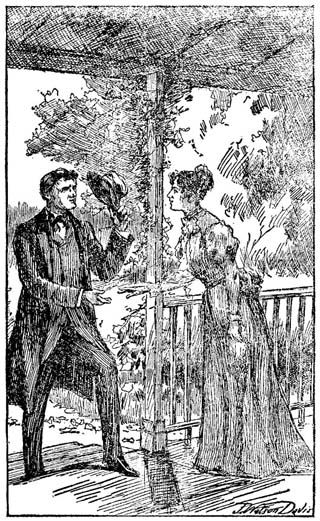
“Well, good day, Mystic,” he said, lifting his hat.
She went back to the grassy wayside, thinking.
What right had Sue Greyson’s light fingers to meddle
with a life like Dr. Lake’s? They had not one
taste in common. How could he find her attractive?
She disliked every thing in which he was interested;
it was true that she could sing, sing like
one of the wild birds down in the woods, and he
loved music.
She paused and stood leaning against the rails
of a fence, and looked across the green acres of
winter wheat; one day in September she had stood
there watching the men as they were drilling the
wheat; afterward she had seen the tender, green
blades springing up in straight rows, and once she
had seen the whole field green beneath a light
snow. The wind moved her veil slightly, both
hands were drooping as her elbows leaned upon
the upper rail, her cheeks were tinged with the
excitement of Dr. Lake’s words, and her eyes suffused
with a mist that was too sorrowful to drop
with tears. A quick step on the grass at her side
108
did not startle her; she did not stir until a voice
propounded gravely: “If a man should be born
with two heads, on which forehead must he wear
the phylactery?”
She turned with a laugh. “Gus, I would know
that was you if I heard the voice and the question
in the Great Desert.”
“Can’t you decide?”
“My thoughts were not nonsense.”
“Of course not, you were labelling and pigeon
holing all that you have thought of since sunrise!
I’ve been sitting on a stone waiting for your conference
to end. Are you in the habit of meeting
strange men and conversing with them.”
“Yes, I came out to meet you.”
“I only wish you did! I wish that you would
make a stranger of me and be polite to me. It is
nothing new for you to be wandering on a Saturday
afternoon, and nothing new for you to find me.”
“I didn’t find you.”
“I intended to give you the honor of the discovery;
now we will share the glory. Shall we
go on?”
“I have been to my roots; do you know my
roots? Do you know the corner above Old Place
and the tiny stream?”
“I know every corner, and every root, and every
stream. Shall I carry your flowers for you? I
never can see why I should relieve a maiden of a
burden when her avoirdupois equals mine. You
will not give them to me? I have something to
109
read to you—something of my own composing—I
composed it in one brilliant wakeful moment—you
will appreciate it.”
“I do not believe it.”
“Wait until you hear it. Lady Blue, are you
going to be literary and never be married! Woe
to the day when I taught you all you know.”
They went on, slowly, for she liked to talk to
Mr. Hammerton. “Father said something like that
this morning and it troubled me; why may I not
do as I like best? Why should he care to see me
married before he dies?”
“Why should he not?”
“Nonsense. I can take good care of myself; beside,”
with a mischievous glance into his serious
eyes, “I really don’t know whom to marry.”
“Oh, you could easily find some one. If all else
fail, come to me, and if I am not too busy I will
take you into consideration.”
“Thanks, good friend! But you will always be
too busy. What have you to read to me?”
“Something that you will appreciate. I wrote
it for you. Stay, sit down, while I read it.”
“I don’t want to. You can read and walk. The
mother of Mrs. Hemans could read aloud while
walking up hill.”
Mr. Hammerton’s voice was not pleasant to a
stranger, but Tessa liked it because it belonged to
him; it was a part of him like his big nose, his
spectacles, and the tiny bald spot over which, every
day, he carefully brushed his hair. The color in
110
his cheeks was as pretty as a girl’s, and so was the
delicate whiteness of his forehead; the bushy mustache,
however, made amends for the complexion
that he sometimes regretted; Tessa had once told
him that his big nose, his mustache, and his awkwardness
were all that kept him from being as
pretty as his sister.
“I am not the mother of Mrs. Hemans.” He
took a sheet of paper from his pocket-book, and
showed her the poem written in his peculiarly plain,
upright hand.
“Excuse my singing and I will read. You must
not think of any thing else.”
“I will not.”
“You are walking too fast.”
She obediently took slower steps.
He cleared his throat and, holding the paper near
his eyes, began to read. A shadow gathered in his
listener’s eyes at the first four lines.
“A nightingale made a mistake;
She sang a few notes out of tune,
Her heart was ready to break,
And she hid from the moon.
“She wrung her claws, poor thing,
But was far too proud to speak;
She tucked her head under her wing,
And pretended to be asleep.
“A lark arm in arm with a thrush,
Came sauntering up to the place;
The nightingale felt herself blush,
Though feathers hid her face.
111
“She knew they had heard her song,
She felt them snicker and sneer.
She thought this life was too long,
And wished she could skip a year.
“‘O, nightingale!’ cooed a dove,
O, nightingale, what’s the use;
You bird of beauty and love,
Why behave like a goose?
“‘Don’t skulk away from our sight,
Like a common, contemptible fowl;
You bird of joy and delight,
Why behave like an owl?
“‘Only think of all you have done;
Only think of all you can do;
A false note is really fun
From such a bird as you.
“‘Lift up your proud little crest:
Open your musical beak;
Other birds have to do their best,
You need only to speak.’
“The nightingale shyly took
Her head from under her wing,
And giving the dove a look,
Straightway began to sing.
“There was never a bird could pass;
The night was divinely calm;
And the people stood on the grass,
To hear that wonderful psalm!
“The nightingale did not care,
She only sang to the skies;
Her song ascended there,
And there she fixed her eyes.
“The people that stood below
She knew but little about;
And this story’s a moral, I know,
If you’ll try to find it out.”
“How did you know that I need that?” she
asked, taking it from his hand. “Who wrote it?”
“I did.”
“Don’t you know?”
“No. I don’t know. I copied it for you.”
“Thank you. I thank you very much. You
could not have brought me any thing better.”
“I brought you a piece of news, too.”
“As good as the poem?”
“Nan Gerard thinks so. She is to be married
and to live at Old Place; our castle in the air.”
“Old Place isn’t my castle in the air. Who told
you?”
“A woman’s question. I never told a woman a
secret yet that she did not reply, ‘Who told you?’
Mary Sherwood told me, of course. Do you congratulate
Naughty Nan?”
“Must I?”
“It’s queer that I do not know that man. I
have missed an introduction a thousand times.
Do you congratulate her?”
“I am supposed to congratulate him. He is
very lovable.”
“I thought that only women were that.”
“That’s an admission,” laughed Tessa, “you
cross old bachelor.”
“You learned that from Dine.”
113
“No, I learned it from you.”
Tessa talked rapidly and lightly, perhaps, because
she did not feel like talking at all.
Would he marry Nan Gerard? Why could she
not be glad for Nan Gerard? Why must she be
just a little sorry for herself? Why must it make
a difference to her? Why must the weight of the
flowers be too heavy for her hand, and why must
she give them that toss over a fence across a field?
“Your pretty flowers,” expostulated Mr. Hammerton.
“I do not care for them; they were withering.”
“I have a thought; I wonder why it should
come to me; I am wondering if you and I walk
together here a year from to-day what we shall
be talking about. My prophetic soul reveals to
me that a year makes a difference sometimes.”
“I remember a year ago to-day,” she answered.
“A year has made a difference.”
“Not to you or me?”
“To Nan Gerard?” she answered seriously.
“But that does not affect us.”
Did it not? A year ago to-day Ralph Towne
had brought her some English violets, and she had
pressed them and thrown a thought about him
and about them into a poem. To-day had he taken
violets to Nan Gerard?
“Lady Blue; you are absent-minded.”
“Am I? I was only labelling and pigeon-holing
a thought; it is to be laid away to moulder
with the dust of ages.”
114
“A thought that can not be spoken?”
“A thought that it was folly to think, and that
would be worse than folly to speak.”
If he replied she did not hear; they sauntered
on, she keeping the path and he walking on the
grass.
A carriage passed, driving slowly. The two ladies
within watched the pedestrians,—a fair-faced
girl with thoughtful eyes, and a tall man with an
intellectual face,—as if they were a part of the landscape
of the spring.
“‘In the spring a young man’s fancy—’”
laughingly quoted one of them.
“Will she accept or refuse him?” asked the other.
“If she do either it will be once and forever,”
was the reply seriously given. “Did you notice her
mouth? She has been very much troubled, but she
can be made very glad.”
After the carriage had passed, Mr. Hammerton
spoke, “I am glad we amused those people; they
failed to decide whether or not we are lovers.”
“They have very little penetration, then,” said
Tessa. “I am too languid and you are too unconscious.”
“There is nothing further to be said; you do not
know what you have nipped in the bud.”
“I suppose we never know that.”
Dinah met them at the gate, her wind-blown
curls and laughing eyes in striking contrast to the
older face that had lost all its color. Tessa did not
115
see that Mr. Hammerton’s eyes were studying the
change in her face; she had no more care of the
changes in her face with him than with Dinah.
“I’ll be in about eight,” he said to Dinah, as Tessa
brushed past him to enter the gate.
Another thing that influenced impressible Tessa
this day, was a talk at the tea-table. They were
sitting around the tea-table cozily, the four people
who, in her mother’s thought, constituted all Tessa’s
world. Mr. Wadsworth in an easy position in his
arm-chair was listening to his three girls and deciding
that his little wife was really the handsomest
and sprightliest woman that he had ever seen,
that happy little Dine was as bewitching as she
could well be, and that Tessa, the light of his eyes,
was like no one else in all the world. Not that any
stranger sitting in his arm-chair would have looked
through his eyes, but he was an old man, disappointed
in his life, and his three girls were all of
earth and a part of heaven to him. They were all
talking and he was satisfied to listen. “I believe
that some girls are born without a mother’s heart,”
Mrs. Wadsworth said in reply to a story of Dine’s
about a young mother in Dunellen who had slapped
her baby, saying that she hated it and was nothing
but a slave to it! “Now, here’s Tessa. She has no
motherliness. Only this morning Freddie Stone fell
down near the gate and hurt his head; his screams
were terrifying, but she went on working and let
him scream. As I said it is all as girls are born.”
“Yes,” answered Tessa, in the deliberate way in
116
which she had schooled herself to reply to her
mother, “I know that your last assertion is true.
There was a lady in school, a teacher of mathematics,
she acknowledged that she did not love her
own little girls as other mothers seemed to do.
She stated it as she would have stated any fact in
geometry; perhaps she thought that she was no
more responsible for one than for the other. The
mere fact of motherhood does not bring mother
love within; any mother that does not give to her
child a true idea of the mother-heart of God fails
utterly in being a mother. She may be a nurse, a
paid nurse, or a nurse upon compulsion; any hired
nurse can wash a child’s face, can tie its sash and
make pretty things for it to wear, and any nurse,
who was never mother to a child, can teach it what
God means when He says, ‘as a mother comforteth.’
Miss Jewett could not be happier in her Bible class
girls if they were all her own children; she
says so herself. Mary Sherwood said to her one
day, ‘If my mother were like you, how different I
should have been!’”
“Such a case is an exception,” returned Mrs.
Wadsworth excitedly.
“Nineteen out of her twenty-three girls tell her
their troubles when they would not tell their own
mothers,” said Dinah. “She has twenty-three secret
drawers to keep their secrets in.”
“She has time to listen to fol-de-rol. She advises
them all to marry for some silly notion and
let a good home slip, I’ve no doubt.”
117
“I expect that twenty-one of her girls have refused
John Gesner,” laughed Mr. Wadsworth. “He
will have to bribe Miss Jewett to let them alone.”
“Only twenty, father,” said Dine. “Tessa and
Sue and I are waiting to do it.”
“I will make this house too uncomfortable for
the one of you that does refuse him.”
“Mother! mother!” remonstrated Mr. Wadsworth
gently.
“He’ll never have the honor,” said Dine. “Mr.
Lewis Gesner is the gentleman; I have always admired
him. Haven’t you, Tessa?”
“Yes; I like to shake hands with him; he has a
trustworthy face.”
“So much for the mothers of Dunellen, Tessa;
how about the fathers? Would the girls like to
have Miss Jewett for a father, too?”
“Oh, the fathers have the bread-winning to do.
If the mothers do not understand, we can not expect
the fathers to understand. There was a girl
at school who had had a hard home experience;
she told me that she never repeated the second
word of the Lord’s prayer; that she said instead:
Our Lord, who art in heaven?”
“Oh, deary me! How dreadful!” cried Dinah,
moving nearer the arm-chair and dropping her
head on her father’s shoulder. “Didn’t she ever
learn to say it?”
“Not while we were at school.”
“Tessa, you can talk,” said her mother.
“Yes,” said Tessa, humbly, “I can talk.”
118
“She was a very wicked girl,” continued Mrs.
Wadsworth. “I don’t see how she dared; I should
think that she would have been afraid of dying in
her sleep as a judgment sent upon her.”
“Perhaps she did not repeat the prayer as a
charm,” answered Tessa, in her clearest tones.
Dinah lifted her head to laugh.
“You upheld her, no doubt,” declared Mrs. Wadsworth.
“I sympathized with her as they who never had
a pain can feel for the sick,” said Tessa, smiling
into her father’s eyes.
“How did you talk to her?” asked Dine.
“What is talk? I only told her to wait and she
would know.”
“It’s easy to talk,” said Mrs. Wadsworth uncomfortably.
“You can talk an hour about sympathy,
but you didn’t run out to Freddie Stone.”
“Why didn’t you?” inquired her father seriously.
Tessa laughed, while Dine answered.
“Mother was there talking as fast as she could
talk, Bridget was there with a basin of water and
a sponge, Mrs. Bird had run over, a carriage with
two ladies, a coachman and a footman had stopped
to look on, and oh, I was there too. He was somewhat
bloody.”
“You are excused, daughter. Save your energies
for a time of greater need.”
“Energies! Need!” tartly exclaimed Mrs. Wadsworth.
“If she begins to be literary, she will care
for nothing else.”
119
“I see no evidence of a lessening interest yet,”
replied her father.
“Oh, I might know that you would encourage
her. She might as well have the small-pox as
far as her prospects go! A needle is a woman’s
weapon.”
“You forget her tongue, mother,” suggested
Dine. “Oh, Tessa, what is that about a needle;
Mrs. Browning says it.”
Tessa repeated:
“‘A woman takes a housewife from her breast,
And plucks the delicatest needle out
As ’twere a rose, and pricks you carefully
’Neath nails, ’neath eyelids, in your nostrils,—say,
A beast would roar so tortured—but a man,
A human creature, must not, shall not flinch,
No, not for shame.’”
“Some woman wrote that when she’d have done
better to be sewing for her husband, I’ll warrant,”
commented Mrs. Wadsworth. Mr. Wadsworth
looked grave.
“Oh she had a literary husband,” replied Tessa,
mischievously. “A word that rhymed with supper
would do instead of bread and butter; and he cared
more for one of her poems than he did for his
buttons.”
“Literary men don’t grow on every bush; and
they don’t take to literary women, either,” said her
mother.
“Mother, you forget the Howitts, William and
Mary; what good, good times they have taking
120
long walks and writing; like you and Gus, Tessa,
and Mr. and Mrs. Browning—”
“You don’t find such people in Dunellen; we live
in Dunellen. Gus will choose a woman that doesn’t
care for books, and so will Mr. Towne, mark my
words! And so will Felix Harrison, even if he is
killing himself with study.”
“He is improving greatly,” said Mr. Wadsworth,
pulling one of Dine’s long curls straight. “He is
going away Monday to finish his studies.”
“I honor him,” said Tessa, flushing slightly.
“Don’t,” said Dine, “he sha’n’t have you, Tessa.
Don’t honor him.”
“That’s all you and your father think of—keeping
Tessa. She needs the wear and tear of married
life to give her character.”
“It’s queer about that,” rejoined Tessa in a perplexed
tone, playing with her napkin ring. “If
such discipline be the best, why is any woman
permitted to be without it? Why does not the
fitting husband appear as soon as the girl begins
to wish for him? In the East, where it is shameful
for a girl not to be married at eleven, I have
yet to learn that the wives are noted for strength
or beauty of character.”
“You may talk,” said her mother, heatedly, “but
two years hence you will dance in a brass kettle.”
“I hope that I shall work in it,” answered Tessa,
coloring painfully, however. Whether her lips
were touched with a slight contempt, or tremulous
because she was very, very much hurt, Dinah could
121
not decide; she was silent because she could not
think of any thing sharp enough to reply; she never
liked to be too saucy.
Mr. Wadsworth spoke in his genial voice: “It’s
a beautiful thing, daughters, to help a good man
live a good life.”
Dinah thought: “I would love to do such a beautiful
thing.” Tessa was saying to herself, “Oh,
what should I do if my father were to die!”
Mr. Wadsworth pushed back his chair, went
around to his wife and kissed her. Tessa loved
him for it.
“You have helped a good man, a good old man,
haven’t you, fairy?” he said, smoothing the hair
that was as pretty as Dinah’s.
“Yes,” answered his wife, and Tessa shivered
from head to foot. “People all said that you were
a different man after you were married.”
“I’m going over to Norah’s,” cried Dinah. “I
told her that I would come to write our French
together. And, oh, father! I forgot to tell you,
Gus will be in about eight.”
“I don’t know that I care for chess; I can not
concentrate my attention as I could a year ago.”
“Why do you run off if he is coming?” asked
Mrs. Wadsworth.
“He comes too often to be attended to,” Dine
answered. “Won’t you be around, Tessa?”
“Perhaps.”
Tessa had resolved to give the evening to writing
letters, and was passing through the dining-room with
122
a china candlestick in her hand, when
her father, reading Shakespeare at the round table,
on which stood a shaded lamp, detained her by
catching at her dress.
“Set your light down, daughter, and stay a
moment.”
With her hand upon his shoulder, she looked
down over the page he was reading:
“‘Heaven doth with us as we with torches do;
Not light them for themselves—’”
she read aloud.
“I made my will to-day,” he said quietly; “that
is, I changed it. Lewis Gesner and Gus Hammerton,
my tried friends, were in the office at the time.
If you ever need a friend, daughter, any thing done
for you that Gus can not do—I count on him as the
friend of my girls for life—go to Lewis Gesner.”
“I don’t want a friend; I have you.”
“If I should tell your mother about the will she
would go into hysterics, and Dine would be sure
that I am going to die; I have divided my little
all equally among my three. That is, all but this
house and garden, which I have given to my elder
daughter, Theresa Louise. It is to be hers solely,
without any gainsaying. Your mother will fume
when the fact is made known to her, but I give it
to you that my three girls may always have a
roof, humble though it be, over their heads. The
old man did not know how to make money, but he
left them enough to be comfortable all their lives
123
there was never any need that his wife should worry
and work, or that his daughter should marry for a
home. Very good record for the old man; eh,
daughter?”
She laid her cheek against the bald forehead and
put both arms around his neck.
“And, Tessa, child, your mother is half right
about you; don’t have any notions about marriage;
promise me that you will marry—for you will, some
day—but for the one best reason.”
“What is that?” she asked roguishly. “How
am I to know?”
“What do you think?”
“Because somebody needs me and I can do him
good.”
“A Hottentot might urge that; you will find the
reason in time. Don’t make an idol; that is your
temperament.”
“I know it.”
“And above all things don’t sacrifice yourself;
few men appreciate being done good to! I know
men, they are terribly human. Gus Hammerton is
a fine fellow.”
“He is terribly human,” she answered with a little
laugh.
“Am I harsh towards your mother ever, do you
think?” he asked in a changed tone.
“Why, no,” she exclaimed in surprise.
“I used to be. I tried to mould her. Don’t you
ever try to mould any body; now run away to your
work or to your book! Don’t sigh over me, I am
124
‘well and hearty.’ How short my life seems when
I look back. Such dreams as I had. It’s all right,
though.”
She could not run away, for the door-bell, in answer
to a most decided pull, detained her; she
opened it, expecting to see Mr. Hammerton, but
to her surprise, and but slightly to her pleasure,
Felix Harrison stood there in broad-shouldered
health.
“Good evening,” she said with some bewilderment.
“Do I startle you?” he asked in the old gracious,
winning manner. “May I come in?”
“I am very glad to see you. Will you walk into
my parlor, Mr. Fly?”
The one tall candle in the china candlestick was
the only light in the room. She set it upon the table,
saying, “Excuse me, and I will bring a light,
that we may the better look at each other. The
light of other days is hardly sufficient.”
“It is enough for me,” he said, pushing the ottoman
towards one of the low arm-chairs. “Sit down
and I will take the ottoman. The parrot recognizes
me.”
Her hand moved nervously on the arm of her
chair; the hand was larger now than when it
had spilled ink on his copy-book, larger even than
when it had written her first, shy, proud, indignant
refusal.
“You are not the tempest you used to be,” he
said smiling after a survey of her face.
125
“Wasn’t I a tempest? I have outgrown my little
breezes. In time I may become as gentle as a
zephyr.”
“You always were gentle enough.”
“Not to you.”
“Not to me when I tormented you.”
“Probably I should not be gentle if I were tormented
now.”
She had never decided to which of the five thousand
shades of green Felix Harrison’s eyes belonged;
they were certainly green; one of the
English poets had green eyes, she wondered if
they were like Felix Harrison’s. To-night they
glittered as if they were no color at all. This face
beside her was a spiritualized face; a strong mouth
as sweet as a woman’s, a round benevolent chin; a
low, square forehead; hair as light as her own; his
side face as he turned at least five years younger
than the full face; she had often laughed at his
queer fashion of growing old and growing young.
At times, in the years when they were more together
than of late, he had changed so greatly that,
after not having seen him for several days she had
passed him in the street without recognition; these
times had been in those indignant times after she
had refused him; that they were more than indignant
times to him she was made painfully aware
by these changes in his rugged face.
“I have been thinking over those foolish times,”
she said, breaking the silence. “I am glad that
you came in to-night; I am in a mood for confessing
126
my wrong-doings; I have said many quick
words; you know you always had the talent for
irritating me.”
“Yes, I always worried you.”
“You did not intend to,” she said hastily, watching
the movement of his lips; “we did not understand,
that is all. It takes longer than a summer
and a winter for heart to answer to heart.”
“We have known each other many summers
and many winters.”
“And now we are old, sensible, hard-working
people; having given up all nonsense we are discovering
the sense there is in sense.”
He turned his face with a listening look in his
eyes.
“Did not some one come in? Shall we be disturbed?”
“Not unless we wish to be. It is only Mr. Hammerton,
he is a great friend of father’s. He renews
his youth in him.”
“Is he not your friend?”
How well she remembered his suspicious, exacting
questions!
“He is my best friend,” she said proudly.
“I wish I was in heaven,” he said, his voice
grown weak. “Every thing goes wrong with me;
every thing has gone wrong all my life. Father
is in a rage because I will not stay home; he offered
me to-day the deed for two hundred acres as
a bribe. I should be stronger to-day but that he
worked my life out when I was a growing boy.”
127
“A country life is best for you. Your old homestead
is the loveliest place around, with its deep
eaves and dormer-windows and vines. That wide
hall is one of my pleasant recollections, and the
porch that looks into the garden, the blue hills
away off, and the cool woods, the thrushes and the
robins and the whip-poor-will at twilight; that solitary
note sets me to crying, or it used to when I
dreamed dreams and told them to Laura! I hope
that Laura will love the place too well to leave it;
it is my ideal of a home; much more than splendid
Old Place is.”
“I will stay if you will come and live in it with
me,” he said quietly.
“I like my own home better,” she answered as
quietly. “Are you stronger than you were?”
“Much stronger. I have not had one of those
attacks since March. Lake warns me; but I am
twice the man that he is! How he coughed last
winter! I haven’t any thing to live for, anyway.”
“It is very weak for you to say that.”
“Whose fault is it that I am so weak? Whose
fault is it that my life is spoiled? You have spoiled
every thing for me by playing fast and loose with
me.”
“I never did that,” she answered indignantly.
“You accuse me wrongfully.”
“Every time you speak to me or look at me you
give me hope; an hour with you I live on for
months. O, Tessa,” dropping his head in both
hands, “I have loved you all my life.”
128
“I know it,” she said solemnly. “Can’t you be
brave and bear it?”
“I am bearing it. I am bearing it and it is
killing me. You never had the water ebb and
flow, ebb and flow when you were dying of thirst.
Women can not suffer; they are heartless, all their
heart is used in causing men to suffer. A touch
of your hand, the color in your cheek, a dropping
of your eyes, talks to me and tells me a lie; and
then you go up-stairs and kneel down to Him, who
is the truth-maker! You are a covenant-breaker.
You have looked at me scores of times as if you
loved me; you have told me that you like to be
with me; and when I come to you and ask you like
a man to become my wife, you blush and falter, and
answer like a woman—no. I beg your pardon—”
The tears stood in her eyes but would not fall.
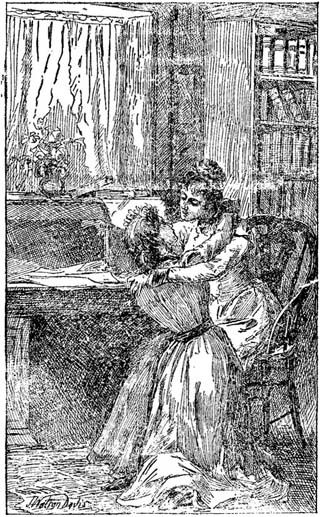
“I did not come here to upbraid you. I did not
start from home with the intention of coming; but
I saw you through the window with your arms
around your father’s neck and I thought, ‘Her
heart is soft to-night; she will listen to me.’ I
was drawn in, as you always draw me, against my
better judgment. I shall not trouble you again; I
am going away. Tessa,” suddenly snatching both
hands, “if you are so sorry for me, why can’t you
love me?”
“I don’t know,” not withdrawing her hands,
“something hinders. I honor you. I admire you.
Your love for me is a great rest to me; I want to
wrap myself up in it and go to sleep; I do not
129
want to give it up—no one else loves me, and I do
want somebody to love me.”
“I will love you; only let me. Marry me and I
will stay at home; I will do for you all that a human
heart and two human hands can do; I will be
to you all that you will help me to be.”
“But I do not want to marry you,” she said perplexed.
“I should have to give up too much. I
love my home and the people in it better than I
love you.”
“I will not take you away; you shall have them
all; you shall come to them and they shall come
to you; remember that I have never loved any
one but you—” the great tears were rolling down
his cheeks. “I am not worth it; I am not worthy
to speak to you, or even to hold your hands
like this.” He broke down utterly, sobbing wearily
and excitedly.
“Don’t, oh, don’t,” she cried hurriedly. “I may
grow to love you if you want me to so much,
and you are good and true, I can believe every
word you say—not soon—in two or three years
perhaps.”
His tears were on her hands, and he had loved
her all her life; no one else loved her, no one else
ever would love her like this; he was good and
true, and she wanted some one to love her; she
wanted to be sure of love somewhere and then to
go to sleep. Her father should see her married before
he died; her mother would never—
“You have promised,” he cried, in a thick voice.
130
“You have promised and you never break your
word.”
“I have promised and I never break my word;
but you must not speak of it to any one, not even
to Laura, and I will not tell father, or Gus, or Miss
Jewett, or Dine; no one must guess it for one year—it
is so sudden and strange! I couldn’t bear to
hear it spoken of; and if you are very gentle and
do not try to make me love you—you must not
kiss me, or put your arms around me, you know
I never did like that, and perhaps that is one
reason why I never liked you before—you must
let me alone, let love come of itself and grow of
itself.”
“I will,” he uttered brokenly, and rose up trembling
from head to foot. “May God bless you!—bless
you!—bless you!”
It was better for him to leave her; the strain had
been too great for both.
“I must be alone; I must go out under the stars
and thank God.”
She lifted her face to his and kissed him. How
unutterably glad and thankful she was in all her
life afterward that she gave that kiss unasked.
“God bless you, my darling,” he said tenderly,
“and He will bless you for this.”
Bewildered, not altogether unhappy, she sat alone
while he went out under the stars.
Was this the end of all her girlhood’s dreams?
Only Felix Harrison! Must she pass all her life
with him? Must her father and mother and Gus
131
and Dine be not so much to her because Felix Harrison
had become more—had become most? And
Ralph Towne? Ought she to love Felix as she
had loved him?
The hurried questions were answerless. She did
not belong to herself; not any more to her father
as she had belonged to him half an hour since with
both her arms around his neck. Love constituted
ownership, and she belonged to Felix through this
mighty right of love; did he belong to her through
the same divine right?
He was thanking God and so must she thank
Him.
“Tessa,” called her father, “come here, daughter!”
With the candle in her hand, she stood in the
door-way of the sitting-room. “Well,” she said.
“With whom were you closeted?” asked Mr.
Hammerton, looking up from the chess-board.
The effort to speak in her usual tone lent to her
voice a sharpness that startled herself.
“Felix Harrison.”
“Your old tormentor!” suggested Mr. Hammerton.
“Who ever called him that?” She came to the
table, set the candlestick down and looked over
the chess-board.
“She has refused him again,” mentally decided
Mr. Hammerton, carefully moving his queen.
“I called you, daughter, because Gus withstood
me out and out about ‘Heaven doth with us as we
132
with torches do.’ Find it and let his obstinate
eyes behold!”
She opened the volume, turning the leaves with
fingers that trembled. “Truly enough,” she was
thinking, “a year from to-day will find a difference.”
“Now I am going over for Dine,” she said, after
Mr. Hammerton had acknowledged himself in the
wrong.
“Permit me to accompany you,” he said. Even
with Tessa Wadsworth, Gus Hammerton was often
formal. They found Dinah bidding Norah good-by
at Mr. Bird’s gate; they were laughing at nothing,
as usual.
“Let us walk to the end of the planks,” suggested
Mr. Hammerton. “On a night like this I
could tramp till sunrise.” He drew Tessa’s arm
through his, saying, “Now, Dine, take the other
fin.”
The end of the planks touched a piece of woods;
at the entrance of the wood stood an old building,
windowless, doorless, chimneyless; the school children
knew that it was haunted.
“We’re afraid,” laughed Dine; “the old hut looks
ghostly.”
“It is ghostly, I will relate its history. Once
upon a time, upon a dark night, so dark that
I could not see the white horse upon which I
rode—”
“Oh, that’s splendid,” cried Dinah, hanging contentedly
upon his arm. “Listen, Tessa.”
133
But Tessa could not listen. She was feeling
the peace that rested over the woods, the fields;
that was enwrapping Old Place, and further down
the dim road the low-eaved homestead that must
thenceforth be home to her. There could be no
more air-castles; her future was decided. She had
turned the leaf and discovered a name that hitherto
had meant so little: Felix Harrison. Not Ralph
Towne; a year ago to-night it was English violets
and Ralph Towne. The peace that brooded over
all might be hers, if only she would be content.
At this moment,—while she was trying to be content,
trying to believe that she could interpret the
peace of the shining stars, and while she was hearing
the sound of her companion’s words, a solemn,
even tone that rolled on in unison with her
thoughts,—two people far away were thinking of
her; thinking of her, but not wishing and not
daring to speak her name.
“I can not understand, Ralph. I was sure that
we would bring Naughty Nan away with us.”
“Truly, mother, I would have pleased you, if I
could.”
“You are too serious for her; with all her mischievous
advances,—like a white kitten provokingly
putting out its paw,—she was more than
half afraid of you.”
“It does not hurt her to be afraid.”
“She is most bewitching.”
“Now, mother! But it is too late; she will understand
by my parting words that I do not expect to see her
134
soon again. In my mind is a
memory that has kept me from loving that delicious
Naughty Nan.”
“Is the memory a fancy?”
“No; it is too real for my ease of mind. If I
were a poet, which I am not, I should think that
her spirit haunted me.”
“Can you tell me no more of her? That daughter
that I might have had!”
“I do not understand her: she is beyond me, she
baffles me.”
“I read of a man once who loved a woman too
well to marry any one else, and yet he did not love
her well enough to marry her.”
“Was he a fool?”
“Answer the question for yourself. Are you a
fool?”
“Yes, I am. I do not know my own mind. I
should call another man a fool.”
“It may not be too late,” she gently urged.
“Too late for what?” he asked irritably.
“To be wise.”
In a few moments he spoke in an abrupt, changed
tone—
“Mother! I have decided at last. I shall hang
out my shingle in Dunellen. It is a picturesque
little city, and the climate is as good for you as the
south of France.”
“I am very glad,” she answered cordially. “You
are a born physician, you are cool, you are quick,
you are gentle; you can keep your feelings under
135
perfect control. You are not quite a Stoic, but you
will do very well for one.”
“But you will not be happy at Old Place without
me.”
“Why should I be without you?”
“You have noticed that large, wide brick house
on the opposite side of the Park from Miss Jewett’s?
It has a garden and stable; it is just the house for
us; you may have two rooms thrown into one for
your sitting-room and any other changes that you
please.”
“I remember it, I like the situation; there are
English sparrows in the trees.”
“We will take that for the present. John Gesner
owns it; he will make his own price if he sees that
I want it, I suppose. I do want it. There are not
many things that I desire more. You and I will
have a green old age at Old Place.”
“You forget that I am thirty years older than
you, my son.”
By accident, one day, Mrs. Towne had come
across, in one of the drawers of her son’s writing-table,
a large photograph of Tessa Wadsworth, a
vignette, and she had gazed long upon her; the
face was not beautiful, one would not even think
of it as pretty, but it was fine, intellectual, sensitive,
and sweet. In searching for an old letter not
long before leaving home, she had discovered this
picture, defaced and torn into several pieces.
“Ralph, you will not be angry with your white-headed
old mother, but were you ever refused?”
136
“No,” he said, laughing. “A dozen women may
have been ready to refuse me, but not one ever did.”
“Nor accepted you, either,” she continued,
shrewdly.
He arose and began to pace the floor; after some
turns of excited movement, he came to her and
stood behind her chair. “I know that I have been
accepted; I know that I asked when I did not
intend to ask—that is—I was carried beyond myself;
I asked when I did not know that I was
asking.”
“What shall you do now?”
“I shall ask in reality; I shall confess myself in
the wrong.”
“And she?”
“And she? She has the tenderest heart in the
world. She has forgiven me long ago.”
“Do not trust her eyes and forget her lips,”
warned his mother. “Love is slain sometimes.”
He resumed his walk with a less confident air.
He had forgotten her lips.
Would Tessa have cared to hear this? Would
she have forgotten Felix, his blessing and the quiet
of the holy stars?
“Oh,” cried Dinah, with her little shout (she
would not have been Dinah without that little
shout), “Oh, Tessa, did you hear?”
“She is star-gazing,” said Mr. Hammerton.
“It isn’t a true story,” pleaded Dinah. “You
didn’t really see him hanging by the rope and the
woman looking on.”
137
“My young friend, it is an allegory; that is what
you will drive some man to some day.”
“You know I won’t. What is the name of that
bright star?”
“It isn’t a star, it’s a planet.”
“How do I know the difference?”
“Lady Blue knows.”
“Do you call her that because her eyes are so
blue or because she is a blue-stocking?”
“She is not a blue-stocking; I will not allow it.
It is for her eyes.”
“Gus,” said Dinah, “I can’t understand things.”
“What things?”
“Tennyson’s Dream of Fair Women.”
“I shouldn’t think you could. I have spent
hours on it trying to make it out. You look up
Marc Antony and Cleopatra—”
“As if I had to.”
“Well, look up the daughter of the warrior Gileadite,
and fair Rosamond, and angered Eleanor,
and Fulvia, and Joan of Arc.”
“And will you read it to us, and talk all about
it?” cried Dinah in delight. “I like King Lear
when father reads it, but I can’t understand Shakespeare;
he is all conversations.”
Mr. Hammerton laughed, and patted her head.
“I will bring you the stories that Charles and
Mary Lamb gathered from Shakespeare.”
“Shall we turn?” asked Tessa, slipping her hand
through his arm; he instantly imprisoned her fingers.
Felix would be troubled and angry she knew,
138
even at this clasp of an old friend’s hand. Jealousy
was his one strong passion; he was jealous of the
books she read, of the letters she received, of every
word spoken to her that he did not hear; she wondered
as her fingers drew themselves free, if he
would ever become jealous of her prayers.
She drew a long breath as the weight of her
bondage fell heavier and heavier; and then, he was
so demonstrative, so lavish of his caresses, and her
ideal of a lover was one who held himself aloof,
who kept his hands and his lips to himself. She
sighed more than once as she kept even pace with
the others.
“Has the nightingale made a mistake?” asked
Mr. Hammerton, as they were crossing to the gate.
“She only made one mistake. I wonder how
many I can make if I do my best to make them.”
Dinah opened the gate; her father’s light streamed
through the windows over the garden, down the
path.
“Good night,” said Mr. Hammerton. “Oh, I just
remember, what shall I do? I asked my cousin
Mary to go to a lecture on Burns with me to-night,
and I declare! I never thought of it until
this minute.”
“Mary Sherwood will give it to you,” said Dinah.
“I wonder what your wife will do with you.”
“A wife’s first duty is obedience,” he answered.
“I’d like to see the man I’d promise to obey,” said
Dinah, quickly.
“I expect you would,” he said gravely.
139
Dine darted after him to box his ears, words being
impotent, and Tessa went into the house. “I
think I’ll pigeon-hole this day and then go to bed,”
she said, a merry gleam crossing her eyes; “between
my two walks on the planks to-day, I have lived
half a lifetime. I hope Dr. Lake is asleep; I will
never hurt Felix as he is hurt.”