WESTWARD HO!—FIGHTING DISSIPATION IN THE SEVENTH
CAVALRY—GENERAL CUSTER'S TEMPTATIONS.
The junketing and frolic at St. Louis came to an end in a
few days, and our faces were again turned westward to a life
about as different from the glitter and show of a gay city in a
holiday week as can be imagined. Leavenworth was our
first halt, and its well-built streets and excellent stores surprised
us. It had long been the outfitting place for our officers.
The soldiers drew supplies from the military post, and
the officers furnished themselves with camp equipage from
the city. Here also they bought condemned ambulances,
and put them in order for traveling-carriages for their families.
I remember getting a faint glimmer of the climate we
were about to endure, by seeing a wagon floored, and its
sides lined with canvas, which was stuffed to keep out the
cold, while a little sheet-iron stove was firmly fixed at one
end, with a bit of miniature pipe protruding through the
roof. The journey from Fort Leavenworth to Santa Fé, New
Mexico, then took six weeks. Everything was transported in
the great army wagons called prairie-schooners. These were
well named, as the two ends of the wagon inclined upward,
like the bow and stern of a fore-and-after. It is hard to realize
how strangely a long train of supplies for one of the distant
posts looked, as it wound slowly over the plains. The
blue wagon-beds, with white canvas covers rising up ever so
high, disclosed, in the small circle where they were drawn
together at the back, all kinds of material for the clothing
and feeding of the army in the distant Territories. The number
of mules to a wagon varies; sometimes there are four,
and again six. The driver rides the near-wheel mule. He
holds in his hand a broad piece of leather, an inch and a half
in width, which divides over the shoulders of the lead or pilot
mule, and fastens to the bit on either side of his mouth.
The leaders are widely separated. A small hickory stick,
about five feet long, called the jockey-stick, not unlike a
rake-handle, is stretched between a pilot and his mate. This
has a little chain at either end, and is attached by a snap or
hook to the bit of the other leader.
When the driver gives one pull on the heavy strap, the
pilot mule veers to the left, and pulls his mate. Two quick,
sudden jerks mean to the right, and he responds, and pushes
his companion accordingly; and in this simple manner the
ponderous vehicle and all the six animals are guided. . . . The
most spirited mules are selected from the train for leaders.
They cannot be reached by the whip, and the driver
must rely upon the emphasis he puts into his voice to incite
them to effort. They know their names, and I have seen
them respond to a call, even when not accompanied by the
expletives that seem to be composed especially for this
branch of charioteering. The driver of our mules naturally
suppressed his invectives in my presence. The most profane
soldier holds his tongue in a vise when he is in the presence
of a woman, but he is sorely put to it to find a substitute for
the only language he considers a mule will heed. I have
seen our driver shake his head and move his jaws in an ominous
manner, when the provoking leaders took a skittish leap
on one side of the trail, or turned round and faced him with
a protest against further progress. They were sometimes so
afraid of buffalo, and always of Indians, they became rebellious
to such a degree he was at his wits' end to get any
further go out of them. It was in vain he called out, "You
Bet, there!" "What are you about, Sal?" He plainly
showed and said that he found "such 'ere tongue-lashing
wouldn't work worth a rap with them vicious creeturs."
The driver, if he is not a stolid Mexican, takes much pride
in his mules. By some unknown means, poor as he is, he
possesses himself of fox or small coyote tails, which he fastens
to their bridle, and the vagaries in the clipping of the
poor beasts' tails, would set the fashion to a Paris hair-dresser.
They are shaved a certain distance, and then a tuft is left,
making a bushy ring. This is done twice, if Bet or Sal is
vouchsafed an appendage long enough to admit of it; while
the tuft on the end, though of little use to intimidate flies, is
a marvel of mule-dudism. The coats of the beasts, so valued
sometimes, shine like the fine hair of a good horse. Alas!
not when, in the final stages of a long march, the jaded,
half-starved beasts dragged themselves over the trail. Driver
and lead mules even, lose ambition under the scorching sun,
and with the insufficient food and long water famines.
The old reliability of a mule-team is the off-wheeler. It is
his leathery sides that can be most readily reached by the
whip called a "black-snake," and when the descent is made
into a stream with muddy bed, the cut is given to this faithful
beast, and on his powerful muscles depends the wrench
that jerks the old schooner out of a slough. The nigh or saddle
mule does his part in such an emergency, but he soon
reasons that, because he carries the driver, not much more
is expected of him.
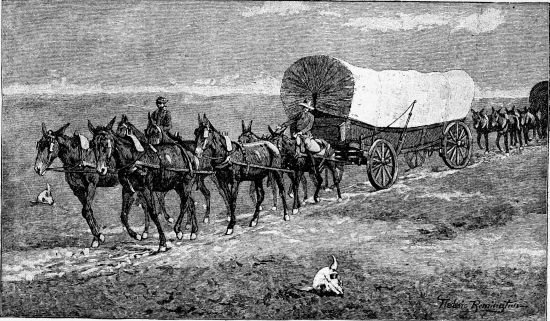 CONESTOGA WAGON, OR PRAIRIE-SCHOONER.
The General and I took great interest in the names given
to the animals that pulled our traveling-wagon or hauled the
supplies. As we rode by, the voice of the driver bringing out
the name he had chosen, and sometimes affectionately, made
us sure that the woman for whom the beast was christened
was the sweetheart of the apparently prosaic teamster. I
was avowedly romantic, and the General was equally so,
though, after the fashion of men, he did not proclaim it.
Our place at the head of the column was sometimes vacant,
either because we were delayed for our luncheon, or because
my husband remained behind to help the quartermaster or the
head teamster get the train over a stream. It was then that
we had the advantage of hearing the names conferred on
the mules. They took in a wide range of female nomenclature,
and we found it great fun to watch the family life of
one human being and his six beasts. My husband had the utmost
respect for a mule's sense. When I looked upon them
as dull, half-alive animals, he bade me watch how deceitful
were appearances, as they showed such cunning, and evinced
the wisdom of a quick-witted thoroughbred, when apparently
they were unobserving, sleepy brutes. It was the General
who made me notice the skill and rapidity with which a
group of six mules would straighten out what seemed to be a
hopeless tangle of chains and harness, into which they had
kicked themselves when there was a disturbance among them.
One crack of the whip from the driver who had tethered
them after a march, accompanied by a plain statement of his
opinion of such "fools," would send the whole collection
wide apart, and it was but a twinkling before they extricated
themselves from what I thought a hopeless mess. No chains
or straps were broken, and a meek, subdued look pervading
the group left not a trace of the active heels that a moment
before had filled the air. "There," the General used to say,
"don't ever flatter yourself again that a mule hasn't sense.
He's got more wisdom than half the horses in the line." It
took a good while to convince me, as a more logy-looking
animal can hardly be found than the army mule, which
never in his existence is expected to go off from a walk, or
to vary his life, from the day he is first harnessed until he
drops by the way, old or exhausted.
At the time we were first on the Plains, many of the
teamsters were Mexicans, short, swarthy, dull, and hardly a
grade above the animal. The only ambition of these creatures
seemed to be to vie with one another as to who could
snap the huge "black-snake" the loudest. They learned to
whisk the thong at the end around the ears of a shirking off
leader, and crack the lash with such an explosive sound that
I never got over jumping in my whole Plains life. I am sorry
to say my high-strung horse usually responded with a spring
that sent me into thin air anywhere between his ears and his
tail, with a good deal of uncertainty as to where I should alight.
I suspect it was an innocent little amusement of the drivers,
when occasionally we remained behind at nooning, and had
to ride swiftly by the long train to reach the head of the column.
The prairie-schooner disappeared with the advancing railroad;
but I am glad to see that General Meigs has perpetuated
its memory, by causing this old means of transportation
to be made one of the designs in the beautiful frieze carved
around the outside of the Pension Office at Washington.
Ungainly and cumbersome as these wagons were, they merit
some such monument, as part of the history of the early days
of frontier life in our country. We were in the West several
years before the railroad was completed to Denver, and the
overland trains became an every-day sight to us. Citizens
used oxen a great deal for transportation, and there is no
picture that represents the weariness and laggard progress of
life like an ox-train bound for Santa Fé or Denver. The
prairie-schooner might set out freshly painted, or perhaps
washed in a creek, but it soon became gray with layer upon
layer of alkali dust. The oxen—well, nothing save a snail
can move more slowly, and the exhaustion of these beasts,
after weeks of uninterrupted travel, was pitiful. Imagine,
also, the unending vigil when the trains were insecurely
guarded; for in those days there was an immense unprotected
frontier, and seemingly only a handful of cavalry. The regiments
looked well on the roster, but there were in reality but
few men. A regiment should number twelve hundred enlisted
men; but at no time, unless during the war, does the
recruiting officer attempt to fill it to the maximum; seventy
men to a company is a large number. The desertions during
the first years of the reorganization of the army after the
war thinned the ranks constantly. Recruits could not be
sent out fast enough to fill up the companies. The consequence
was, that all those many hundred miles of trail where
the Government undertook to protect citizens who carried
supplies to settlements and the mines, as well as its own trains
of material for building new posts, and commissary and
quartermaster's stores for troops, were terribly exposed and
very poorly protected.
"The Indians were, unfortunately, located on the great
highway of Western travel; and commerce, not less than
emigration, demanded their removal." There are many
conflicting opinions as to the course pursued to clear the way;
but I only wish to speak now of the impression the trains
made upon me, as we constantly saw the long, dusty, exhausted-looking
column wending its serpentine way over the
sun-baked earth. A group of cavalry, with their drooping
horses, rode in front and at the rear. The wagon-master was
usually the very quintessence of valor, It is true he formed
such a habit of shooting that he grew indiscriminate, and
should any of the lawless desperadoes whom he hired as
teamsters or trainmen ruffle his blood, kept up to boiling-heat
by suspense, physical exposure, and exasperating employees,
he knew no way of settling troubles except the
effectual quietus that a bullet secures. I well remember my
husband and Tom, who dearly loved to raise my indignation,
and create signs of horror and detestation at their tales,
walking me down to the Government train to see a wagon-master
who had shot five men. He had emigrated from the
spot where he bade fair to establish a private cemetery with
his victims. No one needed a reason for his sudden appearance
after the number of his slain was known. And yet no
questions were put as to his past. He made a capital wagon-master;
he was obedient to his superiors, faithful, and on
time every morning, and the prestige of his past record answered
so well with the citizen employees, that his pistol remained
unused in the holster.
It seemed to be expected that the train-master would be a
villain. Whatever was their record as to the manner of arranging
private disputes, a braver class of men never followed
a trail, and some of them were far superior to their chance
lot. Their tender care of women who crossed in these slow-moving
ox-trains, to join their husbands, ought to be commemorated.
I have somewhere read one of their remarks
when a girl, going to her mother, had been secreted in a
private wagon and there was no knowledge of her presence
until the Indians were discovered to be near. "Tain't no
time to be teamin' women folks over the trail with sech a
fearsom sperit for Injuns as I be." He, like some of the
bravest men I have known, spoke of himself as timid, while
he knew no fear. It certainly unnerved the most valiant
man when Indians were lurking near, to realize the fate that
hung over women entrusted to their care. In a later portion
of my story occurs an instance of an officer hiding the woman
whose husband had asked him to take her into the States,
even before firing a shot at the adversary, as he knew with
what redoubled ferocity the savage would fight, at sight of
the white face of a woman. It makes the heart beat, even
to look at a picture of the old mode of traversing the highway
of Western travel. The sight of the pictured train,
seemingly so peacefully lumbering on its sleepy way, the
scarcely revolving wheels, creaking out a protest against even
that effort, recalls the agony, the suspense, the horror with
which every inch of that long route has been made. The
heaps of stones by the wayside, or the buffalo bones, collected
to mark the spot where some man fell from an Indian arrow,
are now disappearing. The hurricanes beating upon the
hastily prepared memorials have scattered the bleached bones
of the bison, and rolled into the tufted grass the few stones
with which the train-men, at risk of their own lives, have delayed
long enough to mark their comrade's grave.
The faded photographs or the old prints of those overland
trains speak to me but one story. Instantly I recall the
hourly vigilance, the restless eyes scanning the horizon, the
breathless suspense, when the pioneers or soldiers knew from
unmistakable signs that the Indian was lying in wait. In
what contrast to the dull, logy, scarcely moving oxen were
these keen-eyed heroes, with every nerve strained, every
sense on the alert. And how they were maddened by the
fate that consigned them, at such moments, to the mercy of
"dull, driven cattle." When I have seen officers and soldiers
lay their hands lovingly on the neck of their favorite horse,
and perhaps, when no one was near to scoff at sentiment,
say to me, "He saved my life," I knew well what a man felt
when his horse took fire at knowledge of danger to his rider
and sped on the wings of the wind, till he was lost to his pursuers,
a tiny black speck on the horizon. The pathos of a
soldier's parting with his horse moved us to quick sympathy.
It often happens that a trooper retains the same animal
through his entire enlistment, and it comes to be his most
intimate friend. There is nothing he will not do to provide
him with food; if the forage runs low or the grazing is insufficient,
stealing for his horse is reckoned a virtue among
soldiers. Imagine, then, the anxiety, the real suffering, with
which a soldier watches his faithful beast growing weaker day
by day, from exhaustion or partial starvation. He walks beside
him to spare his strength, and finally, when it is no
longer possible to keep up with the column, and the soldier
knows how fatal the least delay may be in an Indian country,
it is more pitiful than almost any sight I recall, the sadness
of his departure from the skeleton, whose eyes follow his
master in wondering affection, as he walks away with the
saddle and accoutrements. It is the most merciful farewell
if a bullet is lodged in the brain of the famished or exhausted
beast, but some one else than his sorrowing master has to
do the trying deed.
This is not the last act in the harrowing scene. The soldier
overtakes the column, loaded down with his saddle, if
the train is too far away to deposit it in the company wagon.
Then begins a tirade of annoying comments to this man, still
grieving over the parting with his best friend. No one can
conceive what sarcasm and wit can proceed from a column
of cavalry. Many of the men are Irish, and their reputation
for humor is world-wide. "Hullo, there! joined the doe-boys,
eh?" "How do you like hoofing it?" are tame specimens
of the remarks from these tormenting tongues; such a
fusillade of sneers is followed not long after by perhaps the
one most gibing of all flinging himself off from his horse,
and giving his mount to the one he has done his best to stir
into wrath. A cavalryman hates, beyond any telling, enforced
pedestrianism, and "Share and share alike" is a motto
that our Western soldiers keep in use.
If the wagons held merchandise only, by which the pioneer
hoped to grow rich, the risk and suspense attending these
endless marches were not worth commemorating; but the
bulk of the freight was the actual necessities of life. Conceive,
if you can, how these brave men felt themselves chained,
as they drove or guarded the food for those living far in
advance. There were not enough to admit of a charge on the
enemy, and the defensive is an exasperating position for a
soldier or frontiersman. He longs to advance on the foe;
but no such privilege was allowed them, for in these toilsome
journeys they had often to use precautions to hide themselves.
If Indians were discovered to be roaming near, the camp was
established, trains corralled, animals secured inside a temporary
stockade; the fires for coffee were forbidden, for smoke
rises like a funnel, and hangs out an instant signal in that
clear air. Even the consoling pipe was smoked under a
sage-bush or in a hollow, if there happened to be a depression
of the ground. Few words were spoken, the loud oaths sank
into low mutterings, and the bray of a hungry mule, the
clank of wagon-chains, or the stamping of cattle on the baked
earth, sounded like thunder in the ears of the anxious, expectant
men.
Fortunately, our journey in these trains was not at once
forced upon us at Leavenworth. The Kansas Pacific Railroad,
projected to Denver, was built within ten miles of Fort
Riley, and it was to be the future duty of the Seventh Cavalry
to guard the engineers in building the remainder of the
road out to the Rocky Mountains. It did not take us long
to purchase an outfit in the shops, for, as usual, our finances
were low, and consequently our wants were curtailed. We
had the sense to listen to a hint from some practical officer
who had been far beyond railroads, and buy a cook-stove the
first thing, and this proved to be the most important of our
possessions when we reached our post, so far from the land
of shops. Not many hours after we left Leavenworth, the
settlements became farther and farther apart, and we began
to realize that we were actual pioneers. Kansas City was
then but a small town, seemingly with a hopeless future, as
the bluffs rose so steeply from the river, and even when the
summit was reached, the ups and downs of the streets were
discouraging. It seemed, then, as if it would never be worth
while to use it as a site for a town; there would be a lifetime
of grading. It is very easy to become a city forefather in
such a town, for in the twenty-one years since then, it has
grown into a city of over 132,000 inhabitants—but they are
still grading. The lots which we could have had almost for
the asking, sell now for $1,000 a front foot. Topeka, the
capital, showed no evidence of its importance, except the little
circle of stars that surrounded it on our atlas. There
were but three towns beyond Fort Riley then, and those were
built, if I may so express it, of canvas and dug-outs.
Our railroad journey came to an end about ten miles from
Fort Riley. The laborers were laying track from that point.
It had been a sort of gala day, for General Sherman, on one
of his tours of inspection of the frontier posts, had been
asked by railroad officials to drive the final spike of the division
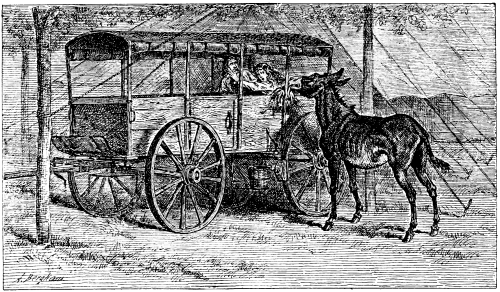
of the road then finished. We found a wagon waiting
for our luggage, and an ambulance to carry us the rest of the
journey. These vehicles are not uncomfortable when the
long seats on either side are so arranged that they make a
bed for the ill or wounded by spreading them out, but as
traveling conveyances I could not call them a success. The
seats are narrow, with no back to speak of, and covered with
carriage-cloth, which can keep you occupied, if the country
is rough, in regaining the slippery surface for any number of
miles at a stretch. Fort Riley came in sight when we were
pretty well tired out. It was my first view of a frontier post.
I had either been afraid to confess my ignorance, or so assured
there was but one variety of fort, and the subject needed no
investigation, that Fort Riley came upon me as a great surprise.
I supposed, of course, it would be exactly like Fortress Monroe,
with stone walls, turrets for the sentinels, and a deep
moat. As I had heard more and more about Indians since
reaching Kansas, a vision of the enclosure where we would
eventually live was a great comfort to me. I could scarcely
believe that the buildings, a story and a half high, placed
around a parade-ground, were all there was of Fort Riley.
The sutler's store, the quartermaster and commissary storehouses,
and the stables for the cavalry horses, were outside
the square, near the post, and that was all. No trees, and
hardly any signs of vegetation except the buffalo-grass that
curled its sweet blades close to the ground, as if to protect
the nourishment it held from the blazing sun. The post was
beautifully situated on a wide plateau, at the junction of the
Republican and Smoky Hill rivers. The Plains, as they
waved away on all sides of us, like the surface of a vast ocean,
had the charm of great novelty, and the absence of trees was
at first forgotten in the fascination of seeing such an immense
stretch of country, with the soft undulations of green
turf rolling on, seemingly, to the setting sun. The eye was
relieved by the fringe of cottonwood that bordered the
rivers below us.
Though we came afterward to know, on toilsome marches under
the sweltering sun, when that orb was sometimes not even
hidden for one moment in the day by a grateful cloud, but the
sky was spread over as a vast canopy of dazzling blue, that
enthusiasm would not outlast such trials, still, a rarely exultant
feeling takes possession of one in the gallops over the
Plains, when in early spring they are a trackless sea of soft
verdure. And the enthusiasm returns when the campaign
for the summer is over, and riding is taken up for pleasure.
My husband was full of delight over the exquisite haze that
covered the land with a faint purple light, and exclaimed,
"Now I begin to realize what all that transparent veil of
faint color means in Bierstadt's paintings of the Rocky
Mountains and the West." But we had little time to take
in atmospheric effects, as evening was coming on and we were
yet to be housed, while servants, horses, dogs and all of us
were hungry after our long drive. The General halted the
wagon outside the post, and left us to go and report to the
commanding officer.
At that time I knew nothing of the hospitality of a frontier
post, and I begged to remain in the wagon until our quarters
were assigned us in the garrison. Up to this time we had
all been in splendid spirits; the novelty, the lovely day and
exhilarating air, and all the possibilities of a future with a
house of our own, or, rather, one lent to us by Uncle Sam,
seemed to fill up a delightful cup to the brim. We sat outside
the post so long—at least it seemed so to us—and grew
hungrier and thirstier, that there were evident signs of mutiny.
The truth is, whenever the General was with us, with
his determination of thinking that nothing could exceed his
surroundings, it was almost impossible to look upon anything
except in the light that he did. He gave color to everything,
with his hopeful views. Eliza sat on the seat with the driver,
and both muttered occasional hungry words, but our Diana
and I had the worst of it. We had bumped over the country,
sometimes violently jammed against the framework of
the canvas cover, and most of the time sliding off from the
slippery cushions upon the insulted dogs—for of course the
General had begged a place for two of them. He had kept
them in order all the way from the termination of the railroad;
but now that he was absent, Turk and Byron renewed
hostilities, and in the narrow space they scrambled and
snarled and sprang at each other. When the General came
back he found the little hands of our curly-headed girl
clenched over the collar of Byron at one end of the ambulance,
while Turk sat on my lap, swelling with rage because
my fingers were twisted in the chain that held him, as I sat
at the door shaking with terror. It was quick work to jerk
the burly brute out of the door, and end our troubles for the
time; but the General, after quieting our panic, threw us into
a new one by saying we must make up our minds to be the
guests of the commanding officer. Tired, travel-stained, and
unaccustomed to what afterward became comparatively easy,
we were driven to one of the quarters and made our entrance
among strangers. I then realized, for the first time, that we
had reached a spot where the comforts of life could not be
had for love or money.
It is a strange sensation to arrive at a place where money
is of little use in providing shelter, and here we were beyond
even the commonest railroad hotel. Mrs. Gibbs, who received
us, was put to a severe test that night. Already a
room in her small house had been prepared for General Sherman,
who had arrived earlier in the day, and now there were
five of us bearing down upon her. I told her how I had
begged to be allowed to go into quarters, even though there
were no preparations, not even a fireplace where Eliza could
have cooked us food enough over the coals to stay hunger;
but she assured me that, having been on the Plains before the
war, she was quite accustomed to a state of affairs where
there was nothing to do but quarter yourself upon strangers;
and then gave up her own room to our use. From that
night—which was a real trial to me, because I felt so keenly
the trouble we caused them all—dates the beginning of a
friendship that has lasted through the darkest as well as the
brightest hours of my life. I used to try to remember afterward,
when for nine years we received and entertained
strangers who had nowhere else to go, the example of undisturbed
hospitality shown me by my first friend on the frontier.
The next day my husband assumed command of the garrison,
and our few effects were moved into a large double
house built for the commanding officer. There were parlors
on one side, whose huge folding doors were flung open, and
made our few articles of furniture look lonely and meagre.
We had but six wooden chairs to begin with, and when, a
few miles more of the railroad being completed, a party of
one hundred and fifty excursionists arrived, I seated six of
them—yes, seven, for one was tired enough to sit on a trunk—and
then concluded I would own up that in the larger
rooms of the house, into which they looked significantly,
there were no more chairs concealed. I had done my best,
and tried to make up for not seating or feeding them, by very
busy talking. Meanwhile there were incessant inquiries for
the General. It seems that he had begun that little trick of
hiding from strangers, even then. He had seen the advancing
column of tourists, and fled. One of the servants finally
unearthed him, and after they had gone and he found that I
had been so troubled to think I could do nothing for the
citizens, and so worried because he was non est, he did not
leave me in such strait again until I had learned to adapt myself
to the customs of the country where the maxim that
"every man's house is his castle" is a fallacy.
The officers who had garrisoned the post began to move
out as our own Seventh Cavalry officers reported for duty.
The colonel of the regiment arrived, and ranked us out of our
quarters, in this instance much to our relief, as the barrack of
a building would never fill up from the slow rate at which our
belongings increased. This army regulation, to which I have
elsewhere referred, was then new to me. The manner in
which the Government sees fit to arrange quarters is still
amusing to me, but I suppose no better plan has ever been
thought out. In the beginning of a well-built post, there is
but little choice. It is the aim to make the houses, except
that of the commanding officer, exactly alike. From time to
time new quarters are built. The original plan is not followed;
possibly a few improvements are added to the newer
houses. Ah! then the disturbance ensues! Fort Vancouver,
in Washington Territory, is one of the old posts, quite interesting
from the heterogeneous collection of quarters added
through fifty years. I was spending a day or two, in 1875,
with my husband's niece, whose husband was some distance
down on the list, and consequently occupied a low log building,
that dated back no one knows how far. Even in that
little cabin they were insecure, for in reply to my question,
"Surely you are permanently fixed, and won't be moved,"
they pathetically answered: "Not by any means! We live
from hour to hour in uncertainty, and there are worse quarters
than these, which we walk by daily with dread, as ——
ranks us, and he is going to be married, so out we go!"
Assigning quarters according to rank goes on smoothly for
a time, but occasionally an officer reports for duty who ranks
everyone. Not long ago this happened at a distant post, and
the whole line went down like a row of bricks, as eight
officers' families were ousted by his arrival, the lowest in rank
having to move out one of the non-commissioned officers who
had lived in a little cabin with two rooms. If possible, in
choosing a time to visit our frontier posts, let this climax of
affairs be avoided. Where there is little to vary life the
monotony is apt to be deeply stirred by private rages, which
would blow away in smoke if there was anything else to think
of. It is rather harrowing to know that some one has an
eye on the home you have furnished with your own means.
I could hardly blame a man I knew, who, in an outburst of
wrath concerning an officer who had at last uprooted him,
secretly rejoiced that a small room that had been the object
of envy, having been built at the impoverished post of refuse
lumber from the stables, was unendurable on a warm day;
and the new possessor was left to find it out when he had
settled himself in the coveted house.
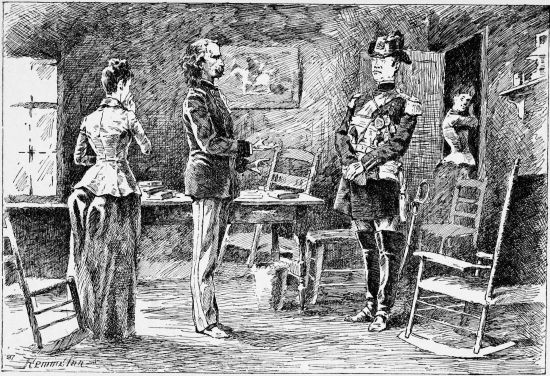 THE OFFICER'S DRESS—A NEW-COMER FOR A CALL.
After our quarters were chosen by the Colonel, we took
another house, of moderate size, bought a few pieces of furniture
of an officer leaving the post, and began to live our
first homelike life. The arrival of the new officers was for a
time our only excitement. Most of them had been in the
volunteer service, and knew nothing of the regular army.
There was no one to play practical jokes on the first comers;
but they had made some ridiculous errors in dress and deportment,
when reporting at first, and they longed to take
out their mortification at these harmless mistakes, by laying
pitfalls for the verdant ones who were constantly arriving.
The discipline of the regular army, and the punctilious observance
compelling the wearing of the uniform, was something
totally new to men who had known little of parades in
their fighting days in the tented field. If it was possible to
intimidate a new officer by tales of the strictness of the commanding
officer regarding the personal appearance of his
regiment, they did so. One by one, those who had preceded
the last comer called in to pay their compliments; but by
previous agreement they one and all dwelt upon the necessity
of his making a careful toilet before he approached the
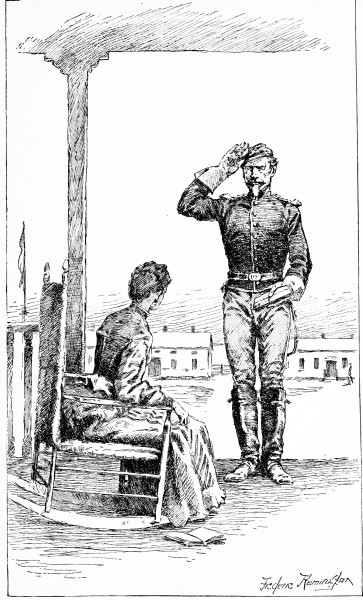
august presence of the Lieutenant-colonel. Then one or
two offered carelessly to help him get himself up for the occasion.
Our brother Tom had arrived by this time, but there
was nothing to be made out of him, for he had served a few
months with a regular regiment before being transferred to
ours. He was therefore sent one day to prepare me for the
call of an officer who had been assisted into his new uniform
by the mischievous knot of men who had been longest with
us. If I had known to what test I was to be put to keep my
face straight, or had dreamed what a gullible creature had
come into their roguish hands, I would not have consented
to receive him. But it was one of the imperative roles that
each officer, after reporting for duty, must pay a formal visit
to the commanding officer and his family. I went into the
parlor to find a large, and at that time awkward, man, in full
uniform, which was undeniably a tight fit for his rather portly
figure. He wore cavalry boots, the first singularity I noticed,
for they had such expanse of top I could not help seeing
them. They are of course out of order with a dress coat.
The red sash, which was then en règle for all officers, was
spread from up under his arms to as far below the waist line
as its elastic silk could be stretched. The sword-belt, with
sabre attached, surrounded this; and, folded over the wide
red front, were his large hands, encased in white cotton
gloves. He never moved them; nor did he move an eyelash,
so far as I could discover, though it seems he was full of internal
tremors, for the officers had told him on no account to
remove his regulation hat. At this he demurred, and told
them I would surely think he was no gentleman; but they
assured him I placed military etiquette far above any ordinary
rule for manners in the presence of ladies, while the truth
was I was rather indifferent as to military rules of dress. As
this poor man sat there, I could think of nothing but a child
who is so carefully dressed in new furbelows that it sits as if
it were carved out of wood, for fear of disarranging the finished
toilet. Diana made an almost instant excuse to leave
the room. The General's mustache quivered, and he moved
restlessly around, even coming again to shake hands with the
automaton and bid him welcome to the regiment; but finally
he dashed out of the door to enjoy the outburst of mirth
that he could no longer control. I was thus left to meet the
situation as best I could, but was not as fortunate as the General,
who had a friendly mustache to curtain the quiver in
his mouth. The poor victim apparently recalled to himself
the martial attitude of Washington crossing the Delaware, or
Napoleon at Waterloo, and did not alter the first position he
had assumed. In trying to prevent him from seeing my confusion,
I redoubled my efforts to entertain him, and succeeded
only too well, for when he slowly moved out of the door
I found myself tired out, and full of wrath toward my returning
family. I never could remember that these little spurts
of rage were the primest fun for my people. The poor officer
who had been so guyed did not gratify his tormentors by
getting angry, but fell to planning new mischief for the next
arrival. He lost no time in begging my pardon for the hat,
and though I never saw much of him afterward, he left only
pleasant impressions on my mind of a kind-hearted man, and
one of those rare beings who knew how to take a joke.
We derived great pleasure from our horses and dogs during
the autumn. A very pretty sorrel horse was selected for
Diana, but we had little opportunity to have her for a companion.
The young officers engaged her a week in advance,
and about all we saw of her riding was an avalanche of flying
curls as she galloped off beside some dashing cavalier. I remember
once, when she was engaged otherwise, and my
horse temporarily disabled, I took hers, and my husband kept
begging me to guide the animal better, for it was nettling his
fiery beast by insisting upon too close proximity. It finally
dawned upon us that the little horse was a constitutional
snuggler, and we gave up trying to teach him new tricks.
But how the General shouted, and bent himself forward and
back in his saddle, after the horse had almost crushed his
leg and nothing would keep him at a distance. He could
hardly wait to get back to garrison, and when we did, he
walked into the midst of a collection of the beaux and told
the whole story of how dreadfully demoralized a cavalry
horse in good and regular standing could become, in the
hands of a belle. The girl blushed, and the officers joined
in the laughter, and yet every one of them had doubtless
been busy in teaching that little telltale animal this new development
of character.
It was delightful ground to ride over about Fort Riley.
Ah! what happy days they were, for at that time I had not
the slightest realization of what Indian warfare was, and consequently
no dread. We knew that the country they infested
was many miles away, and we could ride in any direction
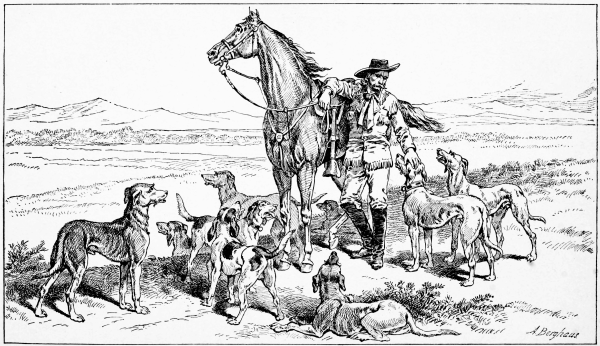
we chose. The dogs would be aroused from the deepest
sleep at the very sight of our riding costumes, and by the
time we were well into them and whip in hand, they leaped
and sprang about the room, tore out on the gallery, and
tumbled over one another and the furniture in racing back,
and such a din of barking and joyful whining as they set up—the
noisier the better for my husband. He snapped his
whip to incite them, and bounded around crying out,
"Whoop'em up! whoop'em up!" adding to the mêlée by a
toot on the dog-horn he had brought from the Texas deer-hunts.
All this excited the horses, and when I was tossed
into the saddle amidst this turmoil, with the dogs leaping
around the horses' heads, I hardly knew whether I was myself
or the venturesome young woman who spends her life in
taking airy flights through paper-covered circles in a sawdust
ring. It took some years for me to accustom myself to
the wild din and hubbub of our starting for a ride or a hunt.
As I have said before, I had lived quietly at home, and my
decorous, suppressed father and mother never even spoke
above a certain tone. The General's father, on the contrary,
had rallied his sons with a hallo and resounding shouts
from their childhood. So the hullabaloo of all our merry
startings was a thing of my husband's early days, and added
zest to every sport he undertook.
Coming from Michigan, where there is a liberal dispensation
of swamp and quagmire, having been taught by dear experience
that Virginia had quicksands and sloughs into which
one could disappear with great rapidity, and finally, having
experienced Texas with its bayous, baked with a deceiving
crust of mud, and its rivers with quicksand beds, very naturally
I guided my horse around any lands that had even a depression.
Indeed, he spoke volumes with his sensitive ears,
as the turf darkened in hollows, and was ready enough to be
guided by the rein on his satin-like neck, to the safer ground.
It was a long time before I realized that all the Plains were
safe. We chose no path, and stopped at no suspicion of a
slough. Without a check on the rein, we flew over divide
after divide, and it is beyond my pen to describe the wild
sense of freedom that takes possession of one in the first
buoyant knowledge that no impediment, seemingly, lies between
you and the setting sun. After one has ridden over
conventional highways, the beaten path marked out by
fences, hedges, bridges, etc., it is simply an impossibility to
describe how the blood bounds in the veins at the freedom
of an illimitable sea. No spongy, uncertain ground checks
the course over the Plains; it is seldom even damp, and the
air is so exhilarating one feels as if he had never breathed a
full breath before. Almost the first words General Sherman
said to me out there were, "Child, you'll find the air of the
Plains is like champagne," and so it surely was. Oh, the joy
of taking in air without a taint of the city, or even the country,
as we know it in farm life! As we rode on, speaking
enthusiastically of the fragrance and purity of the atmosphere,
our horses neighed and whinnied to each other, and snuffed
the air, as if approving all that was said of that "land of the
free." My husband could hardly breathe, from the very
ecstasy of realizing that nothing trammeled him. He scarcely
left the garrison behind him, where he was bound by chains
of form and ceremony—the inevitable lot of an officer, where
all his acts are under surveillance, where he is obliged to
know that every hour in the day he is setting an example—before
he became the wildest and most frolicsome of light-hearted
boys. His horse and he were one, not only as he sat
in the saddle, a part of the animal, swayed by every motion
of the active, graceful beast, but such unison of spirit took
possession of each, it was hard to believe that a human heart
did not beat under the broad, splendid chest of the high-strung
animal.
It were well if human hearts responded to our fondness,
and came instantly to be en rapport with us, as did those
dear animals when they flew with us out to freedom and
frolic, over the divides that screened us from the conventional
proprieties. My husband's horse had almost human ways of
talking with him, as he leaned far out of the saddle and laid
his face on the gallant animal's head, and there was a gleam
in the eye, a proud little toss of the head, speaking back a
whole world of affection. The General could ride hanging
quite out of sight from the opposite side, one foot caught in
the stirrup, his hand on the mane; and it made no difference
to his beloved friend, he took any mode that his master chose
to cling to him as a matter of course, and curveted and
pranced in the loftiest, proudest way. His manner said as
plainly as speech, "See what we two can do!" I rarely
knew him to have a horse that did not soon become so pervaded
with his spirit that they appeared to be absolutely one
in feeling. I was obliged, usually, to submit to some bantering
slur on my splendid Custis Lee. Perhaps a dash at first
would carry the General and the dogs somewhat in advance.
My side had a trick of aching if we started off on a gallop,
and I was obliged to keep a tight rein on Custis Lee at first, as
he champed at the bit, tossed his impatient head, and showed
every sign of ignominious shame. The General, as usual,
called out, "Come on, old lady! Hurry up that old plug of
yours; I have one orderly; don't want another"—this because
the soldier in attendance is instructed to ride at a certain
distance in the rear. After a spurt of tremendous speed,
back flew the master to beg me to excuse him; he was
ready now to ride slowly till "that side of mine came round
to time," which it quickly did, and then I revenged the insult
on my swift Lee, and the maligner at last called out,
"That's not so bad a nag, after all."
The horses bounded from the springy turf as if they really
hated the necessity of touching the sod at all. They were
very well matched in speed, and as on we flew were "neck
by neck, stride by stride, never changing our place." Breathless
at last, horses, dogs and ourselves made a halt. The
orderly with his slow troop horse was a speck in the distance.
Of course I had gone to pieces little by little, between the
mad speed and rushing through the wind of the Plains.
Those were ignominious days for women—thank fortune
they are over! Custom made it necessary to disfigure ourselves
with the awkward waterfall, and, no matter how
luxuriant the hair, it seemed a necessity to still pile up more.
With many a wrathful opinion regarding the fashion, the
General took the hairpins, net and switch, and thrust them
into the breast of his coat, as he said, "to clear the decks for
action for another race." It was enough that he offered to
carry these barbarities of civilization for me, without my
bantering him about his ridiculousness if some accidental
opening of his coat in the presence of the officers, who were
then strangers, revealed what he scoffingly called "dead women's
hair."
A fresh repinning, an ignoring of hairpins this time, re-girthing
of saddles, some proud patting of the horses' quiving
flanks, passing of the hand over the full veins of their
necks, praise of the beautiful distended, blood-red nostrils,
and on we started for another race. If spur or whip had
been used in speeding our horses, it would have spoiled the
sport for me, as the effort and strain looks so cruelly like
work; but the animals were as impatient for a run as we were
to start them. It must be a rare moment of pleasure to all
horse-lovers, to watch an animal flying over the ground,
without an incentive save the love of motion born in the
beast. When we came to certain smooth stretches on the
road, where we were accustomed to give the horses the rein,
they grew excited and impatient, and teased for the run if we
chanced to be earnestly talking and forgot to take it. How
fortunate is one who can ride a mythological Pegasus as well
as a veritable horse! There is nothing left for the less gifted
but to use others' words for our own enthusiasm:
"Now we're off, like the winds, to the plains whence they came;
And the rapture of motion is thrilling my frame!
On, on, speeds my courser, scarce printing the sod,
Scarce crushing a daisy to mark where we trod;
On, on, like a deer when the hounds' early bay
Awakes the wild echoes, away and away!
Still faster, still farther, he leaps at my cheer,
Till the rush of the startled air whirs in my ear!"
Buchanan Read not only made General Sheridan's splendid
black horse immortal, but his grateful owner kept that faithful
beast, when it was disabled, in a paddock at Leavenworth,
and then, when age and old wounds ended his life,
he perpetuated his memory by having the taxidermist set
him up in the Military Museum at Governor's Island, that
the boys of this day, to whom the war is only history, may remember
what a splendid part a horse took in those days,
when soldiers were not the only heroes. I thank a poet for
having written thus for us to whom the horse is almost
human:
"I tell thee, stranger, that unto me
The plunge of a fiery steed
Is a noble thought—to the brave and free
It is music, and breath, and majesty—
'Tis the life of a noble deed;
And the heart and the mind are in spirit allied
In the charm of a morning's glorious ride."
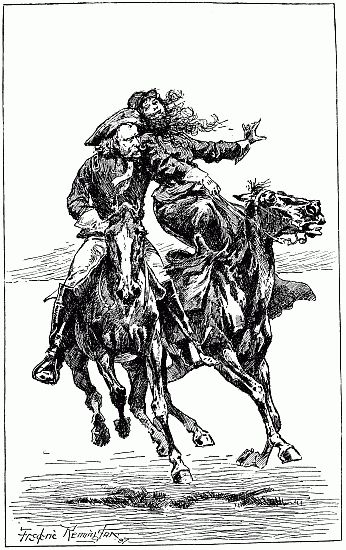 A SUSPENDED EQUESTRIENNE.
There was a long, smooth stretch of land beyond Fort
Riley, where we used to speed our horses, and it even now
seems one of the fair spots of earth, it is so marked by happy
hours. In reality it was a level plain without a tree, and the
dried buffalo-grass had then scarcely a tinge of green. This
neutral-tinted, monotonous surface continued for many unvarying
miles. We could do as we chose after we had passed
out of sight of the garrison, and our orderly, if he happened
to have a decent horse that could overtake us, kept drawing
the muscles of his face into a soldierly expression, trying not
to be so undignified as to laugh at the gamesomeness, the
frolic, of his commanding officer. What a relief for the poor
fellow, in his uneventful life, to get a look at these pranks!
I can see him now, trying to keep his head away and look
unconscious, but his eyes turned in their sockets in spite of
him and caught it all. Those eyes were wild with terror one
day, when our horses were going full tilt, and the General
with one powerful arm, lifted me out of my saddle and held
me poised in the air for a moment. Our horses were so
evenly matched in speed they were neck and neck, keeping
close to each other, seemingly regardless of anything except
the delight at the speed with which they left the country behind
them. In the brief moment that I found myself suspended
between heaven and earth, I thought, with lightning
rapidity, that I must cling to my bridle and keep control of
my flying horse, and trust to good fortune whether I alighted
on his ear or his tail. The moment I was thus held aloft was
an hour in uncertainty, but nothing happened, and it taught
me to prepare for sudden raids of the commanding officer
after that. I read of this feat in some novel, but was incredulous
until it was successfully practiced on me. The Custer
men were given to what their Maryland father called "toting"
us around. I've seen them pick up their mother and
carry her over the house as if she weighed fifty instead of one
hundred and fifty pounds. There was no chance for dignified
anger with them. No matter how indignant I might be,
or how loftily I might answer back, or try one of those eloquent
silences to which we women sometimes resort in moments
of wrath, I was snatched up by either my husband or
Tom, and had a chance to commune with the ceiling in my
airy flight up and down stairs and through the rooms.
One of our rides marked a day with me, for it was the occasion
of a very successful exchange of horses. My husband
used laughingly to refer to the transaction as unfortunate for
him; but as it was at his suggestion, I clung with pertinacity
to the bargain. My horse, Custis Lee, being a pacer, my
husband felt in the fascination of that smooth, swift gait I
might be so wedded to it I could never endure anything else;
so he suggested, while we were far out on our evening ride,
that we change saddles and try each other's horse. I objected,
for though I could ride a spirited horse when I had come to
know him, I dreaded the early stages of acquaintance. Besides,
Phil was a high-strung colt, and it was a venturesome
experiment to try him with a long riding-skirt, loaded with
shot, knocking about his legs. At that time the safe fashion
of short habits was not in vogue, and the high winds of Kansas
left no alternative to loading our skirts. We kept opening
the hem and inserting the little shot-bags as long as we
lived there. Fortunately for me, I was persuaded into trying
the colt. As soon as he broke into a long swinging trot, I
was so enchanted and so hilarious with the motion, that I
mentally resolved never to yield the honor temporarily conferred
upon me. It was the beginning of an eternal vigilance
for my husband. The animal was so high-strung, so quick,
notwithstanding he was so large, that he sprang from one
side of the road to the other on all fours, without the slightest
warning. After I had checked him and recovered my
breath, we looked about for a cause for this fright, and found
only the dark earth where slight moisture had remained from
a shower. In order to get the smoothest trotting out of him,
I rode with a snaffle, and I never knew the General's eyes to
be off him for more than an instant. The officers protested,
and implored my husband to change back and give me the
pacer. But his pride was up, and he enjoyed seeing the
animal quivering with delight at doing his best under a light
weight, and he had genuine love for the brute that, though
so hard to manage in his hands, responded to my lightest
touch or to my voice.
As time advanced and our regiment gained better and better
horseflesh, it was a favorite scheme to pit Phil against
new-comers. We all started out, a gay cavalcade of noisy,
happy people, and the stranger was given the post of honor
next to the wife of the commanding officer. Of course he
thought nothing of this, as he had been at the right of the
hostess at dinner. The other officers saw him take his place
as if it were the most natural thing in the world, but in reality
it was a deep-laid plot. Phil started off with so little effort
that our visitor thought nothing of keeping pace for a while,
and then he began to use his spurs. As my colt took longer
and longer strides, there was triumph in the faces of the officers,
and a gleam of delight in the General's eye. Then came
the perplexity in my guest's face at a trotter outdoing the most
splendid specimen of a loping horse, as he thought. A little
glance from my husband, which incited me to give a sign
and a low word or two that only Phil and I understood, and
off we flew, leaving the mystified man urging his nag in vain.
It was not quite my idea of hospitality so to introduce a
new-comer to our horses' speed; but then he was not a transient
guest, and the sooner he knew all our "tricks and our
manners" the better, while it was beyond my power of self-denial
to miss seeing the proud triumph in my husband's
eyes as he rode up and patted the colt and received the little
return of affection from the knowing beast. Phil went on
improving in gait and swiftness as he grew in years, and I
once had the courage, afterward, to speed him on the Government
race-track at Fort Leavenworth, though to this day
I cannot understand how I got up to concert pitch; and I
could never be induced to try such an experiment again. I
suppose I often made as good time, trotting beside my husband's
horse, but to go alone was something I was never permitted
to do on a roadway. The General and brother Tom
connived to get this bit of temporary courage out of me by
an offhand conversation, as we rode toward the track, regarding
what Phil might be made to do under the best circumstances,
which I knew meant the snaffle-rein, a light
weight, and my hand, which the General had trained to be
steady. I tried to beg off and suggest either one of them for
the trial; but the curb which they were obliged to use, as
Phil was no easy brute to manage with them, made him
break his gait, and a hundred and seventy pounds on his
back was another obstacle to speed. It ended in my being
teased into the experiment, and though I called out, after
the first half-mile, that I could not breathe any longer, the
air rushed into my lungs so rapidly, they implored and urged
by gesture and enthusiastic praise, until I made the mile they
had believed Phil equal to in three minutes.
I wish I could describe what delight my husband took in his
horse life, what hours of recreation and untiring pleasure he got
out of our companionship with Jack Rucker, Phil and Custis
Lee. On that day we three and our orderly were alone on the
track, and such a merry, noisy, care-forgetting three as we
were! the General, with his stop-watch in hand, cheering me,
urging the horse wildly, clapping his hands, and hallooing with
joy as the animal responded to his expectation. Phil's coming
up to their boasts and anticipations was just a little episode
in our life that went to prove what a rare faculty he had of
getting much out of little, and of how persistently the boy
in him cropped out as soon as an opportunity came to throw
care aside. It is one of the results of a life of deprivation,
that pleasures, when they come, are rarities, and the enjoyment
is intensified. In our life they lasted so short a time
that we had no chance to learn the meaning of satiety.
One of the hardest trials, in our first winter with the regiment,
was that arising from the constantly developing tendency
to hard drinking. Some who came to us had held up
for a time, but they were not restricted in the volunteer service,
as a man who fought well was forgiven much else that
came in the rare intervals of peace. In the new state of affairs,
as went the first few months of the regiment, so would
it go for all time. There was a regiment stationed in New
Mexico at that time, the record of which was shameful. We
heard of its career by every overland train that came into our
post, and from officers who went out on duty. General
Sherman said that, with such a set of drunkards, the regiment,
officers and all, should be mustered out of the service.
Anything, then, rather than let our Seventh follow such a
course. But I must not leave the regiment at that point in
its history. Eventually it came out all right, ably officered
and well soldiered, but it was the terror of the country in
1867. While General Custer steadily fought against drunkenness,
he was not remorseless or unjust. I could cite one
instance after another, to prove with what patience he strove
to reclaim some who were, I fear, hopeless when they joined
us. His own greatest battles were not fought in the tented
field; his most glorious combats were those waged in daily,
hourly fights on a more hotly contested field than was ever
known in common warfare. The truest heroism is not that
which goes out supported by strong battalions and reserve
artillery. It is when a warrior for the right enters into the
conflict alone, and dares to exercise his will in defiance of
some established custom in which lies a lurking, deadly peril
or sin. I have known my husband to almost stand alone in
his opinion regarding temperance, in a garrison containing
enough people to make a good-sized village. He was thoroughly
unostentatious about his convictions, and rarely said
much; but he stood to his fixed purpose, purely from horror
of the results of drinking. I would not imply that in garrison
General Custer was the only man invariably temperate.
There were some on pledge; some temperate because they
paid such a physical penalty by actual illness that they could
not drink; some restrained because their best-loved comrade,
weak in his own might, "swore off" on consideration
that the stronger one of the two backed him up; some
(God bless them!) refused because the woman they loved
grieved, and was afraid of even one friendly glass. What I
mean is, that the general custom, against which there is little
opposition in any life, is, either to indulge in the social glass,
or look leniently upon the habit. Without preaching or
parading his own strength in having overcome the habit,
General Custer stood among the officers and men as firm an
advocate of temperance as any evangelist whose life is devoted
to the cause.
I scarcely think I would have realized the constantly recurring
temptations of my husband's life, had I not been beside
him when he fought these oft-repeated battles. The pleasure
he had in convivial life, the manner in which men and women
urged him to join them in enjoyment of the sparkling
wine, was enough to have swept every resolution to the winds.
Sometimes the keen blade of sarcasm, though set with jewels
of wit and apparent badinage, added a cut that my ears,
so quickened to my husband's hard position, heard and
grieved over. But he laughed off the carefully concealed
thrust. When we were at home in our own room, if I asked
him, blazing anew with wrath at such a stab, how he kept his
temper, he replied, "Why notice it? Don't I know what
I've been through to gain my victory? That fellow, you
must remember, has fought and lost, and knows in his soul
he'll go to the dogs if he doesn't hold up, and, Libbie, he
can't do it, and I am sorry for him." Our brother Tom was
less patient, less forbearing, for in one of his times of pledge,
when the noble fellow had given his word not to taste a drop
for a certain season if a man he loved, and about whom he
was anxious, would do the same, he was sneered at by a
brother officer, with gibes at his supposed or attempted superiority.
Tom leaped across the table in the tent where
they sat at dinner, and shook up his assailant in a very emphatic
way. I laugh in remembrance of his choler, and am
proud of it now. I, as "gentlewoman," descended from a
line of decorous gentlemen and ladies, ought to be horrified
at one man's seizing another by the collar and pouncing
upon him, regardless of the Marquis of Queensbury rules.
But I know that circumstances alter cases, and in our life an
occasional good shaking was better than the slow justice of
a tedious court-martial.
The General would not smile, but there was a noticeable
twisting of his mustache, and he took himself out of the way
to conceal his feelings, when I pointed my discerning finger
at him and said, "You're laughing, your own self, and you
think Tom was right, even if you don't say a word, and look
so dreadfully commandery-officery at both of us!" The
General did not keep himself aloof, and sometimes, in convivial
scenes, when he joined in the increasing hilarity, was
so infused with the growing artificial joviality, and grew jollier
and jollier, that he was accused himself of being the wildest
drinker of them all. But some one was sure to speak up and
say, as the morning approached, "I have sat beside Custer
the night through, and if he's intoxicated it's over water, for
he has not tasted a drop of wine—more loss to him, I say."
Only a short time before the final battle, he dined in New
York, at a house where General McDowell was also a guest.
When no one else could hear, he told me, with a warning
not to talk of it, that he had some one to keep him company,
and described the bowl of ice that stood in the midst of the
untouched semicircle of glasses before General McDowell,
and how the ice seemed just as satisfactory as any of the
rare beverages. We listened once to John B. Gough, and
the General's enthusiasm over his earnestness and his eloquence
was enhanced by the well-known fact of his failures,
and the plucky manner in which he started anew. Everybody
cries over Jefferson's Rip Van Winkle, even if they have
never encountered drunkenness, and my husband wept like a
child because of his intense sympathy for the weakness of the
poor tempted soul, harrowed as he was by a Xantippe.
If women in civil life were taken among men, as army
women are, in all sorts of festivities, they would get a better
idea of what strength of purpose it requires to carry out a
principle. At some army posts the women go to the sutler's
store with their husbands, for billiards or amusements.
There is a separate room for the soldiers, so we see nothing
of those poor fellows who never can stay sober. The sutler's
is not only the store, but it is the club-house for the garrison,
and I have known posts where the officers were so guarded
about their drinking, that women could go among them and
join in any amusement without being liable to the distress
that the sight of an intoxicated man invariably gives to a
sensitive woman. If I saw drunken soldiers reeling off after
pay-day, it was the greatest possible relief to me to know,
that out of hundreds only a few were married, as but a certain
number of the laundresses were allowed to a company.
So no woman's heart was going to be wrung by unsteady
steps approaching her door, and the sight of the vacant eyes
of a weak husband. It took away half the sting and shock,
to know that a soldier's spree was not one that recoiled on
an innocent woman.
As I look back upon our life, I do not believe there ever
was any path so difficult as those men on the frontier trod.
Their failures, their fights, their vacillations, all were before
us, and it was an anxious life to be watching who won and
who lost in those moral warfares. You could not separate
yourself from the interests of one another. It was a network
of friendships that became more and more interwoven by
common hardships, deprivations, dangers, by isolation and
the daily sharing of joys and troubles. I am thankful for the
certainty that there is some one who scores all our fights and
all our victories; for on His records will be written the story
of the thorny path over which an officer walked if he reached
the goal.
Women shielded in homes, supported by example, unconscious
of any temptation save the mildest, will realize with
me what it was to watch the quivering mouth of a man who
voluntarily admitted that until he was fifty he knew he was
in hourly peril of being a drunkard. The tears blind me as I
go back in retrospection and think over the men that warred
against themselves.
In one respect, there never was such a life as ours; it was
eminently one of partings. How natural, then, that the last
act before separation be one of hospitable generosity! How
little we had to offer! It was often almost an impossibility
to get up a good dinner. Then we had so many coming to
us from a distance, that our welcome could not be followed
up by any entertainment worthy of the name. Besides, there
were promotions to celebrate, an occasional son and heir to
toast, birthdays occurring so often, and nothing in the world
that answered for an expression of hospitality and good feeling
but an old straw demijohn behind the door. It was surprising
what pertinacious lives the demijohns of the garrison
had. The driver of the wagon containing the few appointments
of an officer's outfit, was just as careful of the familiar
friend as one could wish servants to be with the lares and
penates of an æsthetic household. If he was rewarded with
a drink from the sacred demijohn, after having safely preserved
it over muddy roads, where the mules jerked the
prairie-schooner out of ruts, and where, except for a protecting
hand, the contents would have saturated the wagon, he
was thankful. But such was his reverence for what he considered
the most valuable possession of the whole wagon,
virtue alone would have been sufficient reward. When in the
regimental movings the crockery (the very heaviest that is
made) was smashed, the furniture broken, carpets, curtains,
clothes and bedding mildewed and torn, the old demijohn
neither broke, spilled nor suffered any injury by exposure to
the elements. It was, in the opinion of our lovers of good
whiskey, a "survival of the fittest."
It never came to be an old story with me, that in this constant,
familiar association with drinking, the General and
those of his comrades who abstained could continue to exercise
a marvelous self-control. I could not help constantly
speaking to my husband of what he went through; and it
seemed to me that no liberty could be too great to extend to
men who, always keeping their heads, were clear as to what
they were about. The domestic lariat of a cavalryman might
well be drawn in, if the women waiting at home were uncertain
whether the brains of their liege lords would be muddled
when absent from their influence.
 Either of the above works will be sent by mail, postage
prepaid, to any part of the United States, Canada, or Mexico,
on receipt of the price.
Either of the above works will be sent by mail, postage
prepaid, to any part of the United States, Canada, or Mexico,
on receipt of the price.