THE Survey Camp at the time of my arrival in Palestine was fixed at
Shechem, where I proceeded after a few days’ rest at Jerusalem,
accompanied by Sergeant Black, R.E.
About sunset we began to descend into the narrow, stony gorge of the
Robber’s Fountain. The road is not improved by the habit of clearing the
stones off the surrounding gardens into the public path. It descends
through olive-groves to a narrow pass with a precipice on the left,
beneath which is the little spring. A ruined castle commands the pass on
the Jerusalem side, and is still called “Baldwin’s Tower” by the
peasantry, having no doubt been built by one of the kings of that name.
The gorge once passed, we emerged into an open valley, and on our left
was Sinjil, named from Raymond of Saint Gilles, who there fixed his camp
when advancing on Jerusalem. The short twilight gave place to almost
total darkness, as we began to climb the watershed which separates the
plain of Moreh from the valley coming down from Shiloh, and the moon had
risen when the great shoulder of Gerizim became dimly visible some ten
miles away, with a silvery wreath of cloud on its summit. Creeping
beneath its shadow we gained the narrow valley of Shechem, and followed
a stony lane between walnut trees under a steep hillside. The barking of
dogs was now heard, and the lights in camp at length came into view.
Shechem is the first Syrian town mentioned in the history of Abraham,
and the ground round Jacob’s well was the first possession of Jacob in
the Holy Land. Shechem is recognised in the Pentateuch as the capital of
central Palestine, ranking with Hebron in the south, and Kadesh in the
north, as a city of refuge. Later on we find Rehoboam crowned here, and
indeed it is not too much to say that Shechem may be considered the
natural capital of Palestine. Its central situation, its accessibility,
its wonderfully fine water-supply, are advantages not enjoyed by any
other city in the land. The one disadvantage which perhaps as early as
the time of Rehoboam prevented its being selected as a capital, consists
in its being commanded by a hill on either side so close to the town,
that the old geographer, Marino Sanuto, in the fourteenth century,
considers the place to be untenable by any military force, because
stones might be rolled down upon the houses from either Ebal or Gerizim.
It was at Shechem that the solemnities which were to be performed on the
conquest of the country—the reading of the law and erection of the
altar—were commanded by Moses to be performed, yet, soon after, we find
the religious capital at Shiloh, and, in a few years after the great
schism, the political capital of Israel was removed to Tirzah, and
afterwards to Samaria.
But while the town is interesting from its antiquity and from the
vicissitudes of its history, the Samaritan people are yet more so.
Who are the Samaritans? What is their origin, and relation to the other
natives of the country? The answer is usually a short one. They are
Cuthim, strangers from beyond Jordan—settlers who replaced the
Israelites led away by Sargon. It seems to me, however, that these
conclusions must be received with great reserve.
Soon after my arrival we received a visit from Amram, the Samaritan
high-priest, accompanied by Jacob Shellaby. The high-priest was a
wonderfully handsome old man, with fine aquiline features, and he wore
the crimson turban distinctive of his race. He could speak no languages
except Arabic and Samaritan, and his ideas were perhaps rather limited,
as he pronounced Gerizim to be the highest mountain in the world. We
represented to him that Ebal, close by, was nearly 230 feet higher. He
allowed that it appeared to be so, but could not in reality be, because
Gerizim was the highest mountain in the world. This fine old dignitary
died in 1874. It was thought that his successor was to be a mere doll in
the hands of Jacob Shellaby; a gentleman who is an accomplished savant.
In England he appeared for some time in the character of a Samaritan
prince. He supplied travellers with many ancient Samaritan hymn books,
purloined, it is said, while the congregation were reverently
prostrating themselves. He described to us with immense gusto the mode
of preparing ancient manuscripts, by steeping a skin in coffee-grounds,
and placing it for a month or two under the pillows of the diwan. Many
an unwary traveller has been taken in by his false antiquities, stones,
and manuscripts. It was thought that Shellaby would succeed, on the
death of Amram, in obtaining the ancient roll of the law itself; but
this is the Samaritan Fetish, and the young high-priest would not
connive at such a deed—which would indeed have been the killing of the
golden goose, as the manuscript brings in a yearly income—and
excommunicated Jacob, who, after holding an heretical passover of his
own on Gerizim, finally left the congregation and repaired to Jerusalem,
where I saw him in 1875.
Jacob Shellaby’s ideas were perhaps not far in advance of the
high-priest’s. He related very naïvely his delight at the supposed
discovery of a gigantic emerald, which he showed us, and which was
merely a large fragment of green slag from some old glass-works. He also
fully believed in the story of a cave guarded by genii, and full of
gold, which might be carried away, but invariably flew back by night to
its place, from wherever it might be taken.
Two things struck me very much in my intercourse with the Samaritans
during this first visit, and during another stay of a few days in 1875
in Nablus.
First of all it is indisputable that both in features and in figure they
bear a strikingly close family likeness to the Jews. It may be urged
that the Cuthim are supposed to have been Semitic, but so are the
Syrians and Bedawin, yet they are not at all like the Jews. The
Samaritans are a very pure stock, the beauty of their priestly family is
remarkable; the aquiline nose, the lustrous brown eyes, the thick under
lip, the crisp hair, the peach-like down of the complexion, are features
pre-eminently Jewish. The lean and weedy figure is again peculiar also
to the Palestinian Jews, and contrasts forcibly with the obesity of the
Turks and the sturdiness of the peasantry. For hundreds of years the
Jews have kept their race pure, and so have the Samaritans. Since the
time of Christ at least, Jews and Samaritans have probably never
inter-married, yet we find them now closely alike in their
characteristic physiognomy.
In the second place, the Samaritans preserve an ancient copy of the
Pentateuch, which, though differing in some marked peculiarities, is yet
substantially the same as the Jewish text. It is written in the
Samaritan character, which closely approaches the most ancient forms of
Jewish writing. It cannot be supposed that these Samaritans would have
adopted the religion and sacred books of a nation that they despised and
hated, and the evidence of the character employed is in favour of the
original copies having been made before the time of Ezra, when,
according to the Rabbis, the square alphabet was adopted, before indeed
the schism between Jew and Samaritan became so intense as it afterwards
grew to be.
These facts naturally incline one primâ facie to consider the
Samaritans as originally of the same stock with the Jews, and an
investigation of the question seems to me to show that they are the last
remnants of the scattered Israel, the lost Ten Tribes, whose history has
always excited curiosity in the minds of so many.
It will be allowed that but little reliance can be placed on the
partisan descriptions of Josephus and of the Rabbinical writers.
Unfortunately we gather but little from the Bible which can throw light
on the subject, and the Samaritan accounts are all very late, their
oldest chronicles dating back only to the twelfth century, though
apparently founded on more ancient material. It may, however, be
interesting to sketch what is known of their history from various
sources.
Sargon, who on his monuments is described as “Destroyer of the city of
Samaria and of all Beth Omri,” took away with him in 721 B.C. all the
more important and a great host of minor captives, to Assyria. Still a
certain proportion of the Israelites would seem to have been left
behind, as we find Hezekiah, in 717 B.C., sending messengers through the
country of Ephraim and Manasseh, inviting Israelites to the Passover,
which might not be eaten by strangers, and some actually attended it (2
Chron. xxx. 18). Worshippers from Shechem and Samaria are also noticed
as coming to Jerusalem after its destruction by Nebuchadnezzar (Jer.
xli. 5); thus, though foreign colonists from Cutha, Ava, Hamath, and
Sepharvaim were sent into Samaria, there is reason to suppose that many
of the original Israelite population were left.
The Talmudic doctors invariably call the Samaritans Cuthim. Cutha is a
district as yet unknown, but it may be noticed that the Biblical account
represents the men of Cutha as serving Nergal, who is known from
Cuneiform inscriptions to have been a “lion-god,” worshipped by
inhabitants of Cutha, and therefore an appropriate deity to appease when
a plague of lions was devastating the land. It is not impossible that
the Jews seized upon the close similarity of the name Cuthim with the
title Kûsânîya, or “true people,” by which one Samaritan sect
distinguished themselves from a second, the Lifânîyeh. The first sect
believed in the future life, in future reward and punishment; the latter
confined the promises of the law to temporal matters; the latter were
named from a word meaning “to make light,” because, like the pupils of
the Jewish Hillel, they made the law less stringent, whereas the
stronger sect, the Kûsânîya, made its burden heavier, following the
example of the school of Shammai.
The foreign colonists, from Cutha, found themselves, as they simply
supposed, unable to appease the deity of their new country without
special instructions in the peculiarities of his rite. They petitioned
therefore for a priest, and an Israelite priest returned and dwelt at
Bethel. It is perhaps only natural to suppose that the place here
intended in the Bible is Gerizim, which was held by the Samaritans to be
the site of Jacob’s vision. It follows from this account that at least
one priestly family returned to Samaria, and the Samaritans claimed a
descent for their priesthood from Phinehas the grandson of Aaron.
Another curious allegation, brought forward by Josephus and also to be
found in the Targums, is that the Samaritans claimed to be Sidonians;
this is however plainly contradictory to the view that they were Cuthim,
and only serves to show the small reliance that can be placed on the
later Jewish accounts.
Having then indications that the Israelites were not all carried to
Assyria, and that one at least of their priests returned, and having the
invariable assertion of the Samaritans that they are descendants of this
small remnant, and in confirmation of this their physiognomical
characteristics, their religion, their possession of an ancient text of
the books of Moses, their observation of the Jewish Passover, according
to the most ancient form of the rite, we may fairly place the Samaritan
literature in the balance against the accounts of the
Pharisees—Josephus and the Talmudic doctors—which, as above shown, are
in themselves contradictory.
It seems probable that the cause of the division of the Hebrew monarchy
is to be sought in an original jealousy between the great tribes of
Judah and Joseph who first seized on the land; but, as we have seen
above, the religious schism was not complete before the time of the
revival under Ezra. Worshippers from Shechem had been received at
Jerusalem, and on the return of the Jews the Samaritans were anxious to
take part in the restoration of the Temple in the Jewish capital. With
regard to the history of the quarrel, Jewish and Samaritan accounts are,
as might be expected, diametrically opposed. Josephus, in a passage
which has no parallel in the Book of Ezra (Ant. xi 4. 9.), represents
ambassadors, including Zerubbabel, as going to Darius and obtaining a
decree against the Samaritans, forbidding them to interfere with the
building of the Temple. From the Book of Ezra it appears, however, that
the enemies of Judah succeeded in stopping the work of restoration (Ezra
iv. 24). The Samaritan account is in agreement with this; according to
their chronicle the whole of Israel, with the exception of the Jews,
wished to build the Temple on Gerizim. An appeal was made to the King,
and copies of the law made by Sanballat and Zerubbabel were cast into a
great fire; the former leapt out thrice unhurt, the latter were
immediately consumed. These traditions cannot of course be put in the
same category with the sober history of the Book of Ezra; but in the
main the accounts are not discordant, as both acknowledge an appeal to
Darius and the hindrance of the Jews by Samaritan opposition.
In tracing the history of the schism, it is important to remember the
great similarity of doctrine which certainly existed between the
Samaritans and the Sadducees. The Jews never placed their enemies in
quite the same category with the heathen. In the remarkable tract on the
Cuthim, a Jew is allowed to hold intercourse with a Samaritan in all
cases where it might be to his own advantage, but not when it is against
his interests. The two tenets which caused the exclusion of Cuthim from
the congregation are stated to have been—first, their belief in Gerizim
as the true religious centre; second, their denial of the resurrection,
which opinion they shared with the Sadducees.
Many details of the Samaritan faith were identical with Karaite and
Sadducean tenets, and the view taken of their error appears to have
been, with one Jewish party, that, while originally orthodox, they had
become mixed with the priests of the high places and corrupted the
purity of the faith.
It cannot be doubted that it was the Pharisees who were the deadly
enemies of the Samaritans. This sect, originating in the “separation”
under Ezra, at once excluded the Samaritans from participation in the
building of the Temple. Sanballat was connected by marriage with the
Sadducean high-priest—a fact which favours the view that he was an
Israelite, not a foreigner—but against this affinity Ezra set his face,
and the schism was thus rendered more complete. Gradually the Pharisees
gained in power as the Sadducees declined; under the Hasmoneans they
obtained at length the high-priesthood, and Hyrcanus succeeded in
destroying the Samaritan Temple in 129 B.C. With the exception of a
short interval the Pharisees were in power until 35 B.C., and the
constant reprisals which for four hundred years had been indulged in on
both sides, had left such indelible hatred between the two nations that
nothing but entire submission and the abandonment of Gerizim would have
induced even the Sadducees to receive into the congregation a people
whose religion in other respects was almost indistinguishable from their
own.
The Samaritans are, indeed, in the peculiarities of their doctrine
almost identical with the original Jewish party—the Karaite and
Sadducean sects. They are even called Sadducees in Jewish writings, and
their denial of the resurrection was, like that of the Sadducees, based
on the declaration that nothing was to be found in the law of Moses on
the subject. Again, their version of the law is closely similar to that
of the Septuagint, which was a translation authorised by a Sadducean
high-priest from a text differing from that finally established by the
Pharisees. The animosity of Josephus—who was a Pharisee—the fierce
denunciations of the Talmud, written by Pharisees, the destruction of
the Gerizim Temple by Hyrcanus—also a Pharisee—all combine to indicate
that the Jewish hatred had nothing to do with any foreign origin of the
race, but rather was roused by the religious differences of a people
whom they knew to be their kith and kin.
It is often supposed that the Samaritans borrowed their religion from
the Sadducees. It is surely a simpler explanation that they were a sect
originally identical because originally Israelite.
The Samaritan chronicles give a plain account of the origin of their
people. At the time of the return from captivity a certain number of the
congregation carried into Assyria came back to Palestine under
Sanballat. Some thirty thousand, however, remained behind awaiting the
Prophet whom they expected as a leader.
Sanballat is called in the Bible “the Horonite.” From this title it has
been supposed that he was a foreigner, though the Samaritans call him
Lawîni the “Levite.” The place where Israel assembled before crossing
into Palestine, and where the first quarrel as to where the Temple was
to be built occurred, was Horân, and this may perhaps account for the
term Horonite. The Jews, under Zerubbabel, repaired to Jerusalem, the
test of the congregation, three hundred thousand in all, beside youths,
women, children, and strangers (probably the colonists from Cutha,
Hamath, and Ava), were led to Gerizim, where they established the Temple
on the 9th of Tizri. Such is the Samaritan account, which gains
credibility when we compare it with the Book of Ezra, and from the fact
that Sanballat was connected by marriage with a Sadducean high-priest in
Jerusalem. The name Lawîni or “Levite” is still preserved as the name of
a prophet whose tomb is shown to the west of Shechem.
The quarrels and recriminations of Jews and Samaritans it is useless to
follow in detail. The beautiful lessons of Christ were lost on both
alike, and the large charity of the parable of the good Samaritan, with
the truth that neither at Jerusalem nor on Gerizim was God exclusively
to be sought, seem to have been far beyond the comprehension of the
disputants. Even in their own accounts the falseness and cruelty of the
Samaritans are repulsively prominent; nor does the Jewish character
stand high by contrast either for ingenuousness or for charity to their
enemies.
By the time of our Lord the hatred of the two people had become greater
than their aversion to the heathen. Wine for the Temple passing through
Samaria became unfit for use, a Jew was forbidden to help a wounded
Samaritan or a Samaritan woman in trouble. On the other hand, murder and
treachery are charged against the Cuthim; they lighted false beacons in
order to confuse the Jewish calendar depending on the appearance of the
new moon; they betrayed the Jews to the Romans; they polluted the Temple
with bones. Such crimes could never be forgiven, and the Jews in
contempt cast them out as heathen and foreigners.
The later history of the Samaritans has been often told; under Pilate
they raised a tumult, headed by a leader who (probably assuming the
character of Messiah) promised to show them the golden vessels said to
have been buried by Moses on Gerizim. The cruelty with which this revolt
was repressed led to Pilate’s final disgrace.
In the time of Vespasian they again rebelled, and were again repressed.
Under Hadrian they assisted the Romans against the Pharisees led by Bar
Cocheba, but under Severus they took part in rebellion with the Jews.
The greatest revolt appears to have been, however, in the time of
Justinian, when the whole race rose, in May 529 A.D., attacked the
Christians, put the Bishop of Neapolis to death, and crowned a certain
Julian. Their punishment was cruel, and henceforward they disappear from
history, having probably been almost exterminated.
The Emperor Zeno had in 474 A.D. erected a church on Gerizim. This
church Justinian converted into a sort of fortress by building a second
wall round it. He also caused five churches (possibly all now
represented by mosques) to be rebuilt in Neapolis.
In the fifth century the Samaritans had begun to spread over Egypt and
southern Palestine, in 493 A.D. they had a synagogue in Rome. In the
seventh century, according to their own records, they occupied the whole
of Palestine except the Judean hills. Up to some fifty years ago they
had a synagogue in Gaza, the last of their communities, which in the
seventeenth century also existed in Cairo and Damascus. At the present
day they are found only in the town of Nablus, and appear to have become
extinct in other towns about the year 1820 A.D.
In the middle ages they seem to have been undistinguished from the Jews,
and thus it is only in the writings of a Jew (R. Benjamin of Tudela)
that they are described. He speaks of about one hundred Cutheans “who
observe the law of Moses only,” that is to say, do not recognise the
later books. Though writing with the usual Pharisaic prejudice, the
Rabbi admits the priestly family to be descendants of Aaron.
The existence of an ancient roll of the law, in possession of the
Samaritans, was known to Scaliger; a copy was obtained by Pietro Della
Valle in 1616 A.D., and this brought the Samaritans again into notice.
They became a sort of pet people among learned men, and long
correspondences were held with them. Thus, although the ancient copy at
Shechem has never been collated, the value of the Samaritan version of
the Pentateuch is well known to students.
The most striking peculiarity of the Samaritan text is its close
resemblance to the Septuagint version. This caused a most exaggerated
estimate of its value to be at one time formed. It was supposed that the
Masoretic text, from which our English version has been taken, was
corrupt, and the Samaritan and Greek the more ancient. The labours of
the great scholar Gesenius have, however, almost placed these questions
at rest. He points out that though the Samaritan and Greek agree against
the Masoretic text in about one thousand passages, there are numerous
instances where Greek and Hebrew agree against the Samaritan. He further
holds that the archaic forms of the Hebrew have been modernised in the
Samaritan, and numerous corruptions introduced from purely theological
reasons. The variations of the text he divided into three classes:
first, Samaritan forms of words; secondly, blunders and emendations in
the text; thirdly, alterations for the glorification of Gerizim and of
the Samaritans. It cannot be doubted that in some cases, however, the
Samaritan and Greek preserve the sense which has been lost in the Jewish
version. Gesenius’s conclusion will commend itself to all by its
moderation and impartiality. He holds that Samaritan and Greek are both
derived from ancient codices, differing among themselves and also from
the text which became received later by the Jews. Kennicott goes yet
further in saying that the authority of both the versions should be
recognised. The antiquity of the text from which our English version is
derived, is however established by the comparison, and unless the oldest
Samaritan roll differs very materially from all other copies as yet
collated, we cannot expect to get much of any permanent value or
interest from its examination.
The Rolls of the Law, or Five Books of Moses (considered by the
Samaritans to form a single work), now found in the Synagogue at Nablus
are three in number. I have twice been enabled to see them; at Jerusalem
also I was shown another manuscript, not a roll but in the form of a
book, which is called “The Fire-Tried,” as it claims to be one of
Sanballat’s copies before noticed. These venerable documents may now be
briefly described.
The Samaritan synagogue stands in the Samaritan quarter, the
south-western part of the town of Nablus. It is a mean room, with
white-washed walls, and a dome with a skylight. A dirty counterpane is
hung before a recess, called the Musbah, in which is a cupboard. From
behind this veil the manuscripts are produced. At my first visit the
high-priest Amram brought out the latest scroll. It is written in black
ink on parchment, and rolled on two rollers, enclosed in two cylinders
of brass, covered with a florid arabesque of thin silver plates fastened
on to the brass. The scroll is kept on a shelf of the cupboard, the
other two are locked up. The case is enveloped in a green silk wrapper,
embroidered with arabesques. Mr. Drake, who accompanied me, now asked to
see the next. The high-priest answered, after affecting great surprise,
that his nephew Jacob had the key; he, however, was soon persuaded to
send his son to fetch it, and brought out from the locker the second,
which is of older appearance, also in a brass case, with huge knobs to
the rollers. By means of these rollers the parchment is slipped round,
so that each column of the roll is visible in turn. The workmanship in
this case is better than that of the first. The cherubim, pot of manna,
Aaron’s rod, and other sacred objects, are shown in the arabesque. There
is a legend with the date 820 A.H., or 1456 A.D., which gives the name
of the maker as Jacob ben Phoki, a Damascene. The writing in this
manuscript appears to have been touched up later.
The high-priest and his nephew Jacob now declared that there was no
older scroll, but Mr. Drake said he had seen it, and at length they were
reduced to saying that being ceremonially unclean they could not touch
it. We accordingly stepped behind the veil, the locker was opened, and
we saw the famous roll of Abishuah in a solid silver cover of modern
workmanship. The greatest reluctance was manifested in showing us this
sacred relic; the priests exclaimed, “Permission!” and “In the name of
God.” The roll is said to have been written on the skins of about twenty
rams, which were slain as thank-offerings, the writing being on the hair
side; the handwriting is small and rather irregular, the lines far
apart; the ink is faded and of a purplish hue, the parchment much torn,
very yellow, and patched in places, and bound at the edges with green
silk.
Down the centre of the scroll runs the famous title called Tarîkh or
“Inscription,” a sort of acrostic. By thickening one or two letters in
each line in a vertical column, the following has been obtained:
“I Abishuah, son of Phinehas, son of Eleazar, son of Aaron the priest,
the favour of Jehovah be upon them, for His glory I have written this
Holy Torah (copy of the law) in the entrance of the tabernacle of the
congregation on Mount Gerizim, even Bethel, in the thirteenth year of
the possession by the children of Israel of the land of Canaan and all
its boundaries. I thank the Lord.”
My second visit was paid after the death of Amram, in company with
Lieutenant Kitchener and Mr. Elkarey the missionary. Jacob, the old
man’s nephew, was now high-priest; on the 10th of June, 1875, we
repaired again to the synagogue. The high-priest, an eminently handsome
man about thirty-five years of age, received us, dressed in robes of
dark purple, with the crimson turban; his brown beard long and square,
not marred at the corners; his dark eyes with drooping lids, the
beautiful olive complexion and delicate aquiline nose, perhaps a little
too square at the end, made him a model of beauty of a certain type—the
Jewish beauty, for which the priestly family of the Hasmoneans was so
famous, and which captivated Herod the Great in Mariamne, the last of
her race.
Hastily admitting us, he locked the door, and brought us to the veil now
covered over with a gorgeous yellow satin cloth. A younger priest
brought out the second manuscript, but was hastily told “not that one;”
and the silver case once more appeared, and was placed on a sort of
trestle. Whilst we examined it, some urchins got up on the roof and
looked through the skylight. The priest was alarmed, he drove them away,
replaced the old scroll, unlocked the door, and showed us the other two.
There is a marked difference in the treatment Abishuah’s roll receives
at the hands of the priests. It is indeed a Samaritan Fetish, and is
only seen by the congregation once a year, when elevated above the
priest’s head on the Day of Atonement.
The so-called “Fire-tried Manuscript” belongs to a poor widow in
Jerusalem, named Mrs. Ducat. She lent it to a German savant named Dr.
Jacob Frederic Kraus, and his essay on the manuscript is kept with it.
The whole consists of 217 leaves, containing the Torah or law, from the
twenty-ninth verse of the first chapter of Genesis to the blessing of
Moses in Deuteronomy. Six leaves are added in a smaller hand on
parchment at the beginning, the first being almost illegible. The real
manuscript only begins at Gen. xi. 11; three leaves are added at the end
for protection, after Deut. xxix. 30. The whole is much worn, and
measures eleven inches by nine inches, and three inches in thickness.
The text is divided into paragraphs, with verses, sentences, and words
separated by a single dot; words are not allowed to be broken by the
line, but in order to fill up the line the last letters are further
apart, unless they form the word Jehovah which is read Elwem. The
letters are not so small as those of Abishuah’s roll, nor as large as
those of the later roll; the hand is steady and uniform. The Decalogue
is not numbered by marginal letters, in this respect it resembles
Abishuah’s roll, and so also the paragraphs are neither numbered nor
stated in either text. These points seem to show the Fire-tried
Manuscript to be ancient.
Some hundreds of the Samaritan copies of the law have the acrostic like
Abishuah’s roll, each giving the name, place, and date of the text; but
the Fire-tried Manuscript has a note instead at the end of Genesis, to
this effect:
“This holy Torah has been made by a wise, valiant, and great son, a
good, a beloved, and an understanding leader, a master of all knowledge,
by Shelomo, son of Saba, a valiant man, leader of the congregation, by
his knowledge and his understanding, and he was a righteous man, an
interpreter of the Torah, a father of blessings, of the sons of Nun (may
the Lord be merciful to them!); and it was appointed to be dedicated
holy to the Lord, that they might read therein with fear and prayer in
the House of the High-Priesthood in the seventh month, the tenth day;
and this was done before me, and I am Ithamar, son of Aaron, son of
Ithamar the High-Priest; may the Lord renew his strength! Amen.”
A note at the end of the Book of Numbers connects this manuscript with
the story given above from the Samaritan Book of Joshua.
“It came out from the fire by the power of the Lord to the hand of the
King of Babel, in the presence of Zerubbabel the Jew, and was not burnt.
Thanks be to the Lord for the Law of Moses.”
This curious manuscript, which has been photographed for the Palestine
Exploration Fund, came into Mr. Ducat’s hands from a Samaritan in
payment of a bad debt. It has been in England, and was then offered for
sale for £1000. In 1872, £200 was asked for it. There were faint traces
of gilding on the proper names still visible when shown to me in August
of the same year.
Turning again to the Samaritans themselves. In 1872 the little community
numbered 135 souls, of whom no less than eighty were males. The Moslems
say that the number is never exceeded, and that one of the eighty dies
as soon as a child is born. By the defection of Jacob Shellaby with his
family, they have been reduced to a total of 130 souls.
Year by year the Samaritans are dying out. Clinging to Shechem and the
Holy Mountain, they are the last left of the nation which in the fifth
and seventh centuries spread far over Palestine and Egypt.
The religion of the Samaritans approaches probably closer to original
Judaism than anything among the Jews themselves. Even their view that
Gerizim was intended to be the Temple mountain is not without
foundation, for while the blessings and curses are placed on the two
Samaritan mountains, Jerusalem is not noticed in the books of Moses.
The first Samaritan doctrine is the Unity of God and His special
revelation to Israel. They hold Moses to be the one messenger of God,
and superior even to their expected Prophet; they believe in the
immutability and perfection of the written law, and finally in Gerizim
as the earth’s centre, the house of God, the highest mountain on earth,
the only one not covered by the flood, the site of altars raised by
Adam, Seth, and Noah, the Mount Moriah of Abraham’s sacrifice, the
Bethel or Luz of Jacob’s vision, the place where Joshua erected first an
altar, next the tabernacle, finally a temple. On its slope the cave of
Makkedah is also shown, though now closed up. From all these sacred
memories it becomes naturally the central shrine of Samaritan faith.
It appears also that they believe in future retribution, and in angels
and devils as ministers of God in the unseen world, but their views as
to the future life seem to be vague.
Still more interesting is the question of the Samaritan belief in a
future prophet who is to be of the sons of Joseph. This expectation,
founded on the words of Moses, “The Lord thy God will raise up unto thee
a Prophet like unto me” (Deut. xviii. 15), is identical with the Jewish
expectation in Maccabean times. It is to this belief, no doubt, that the
Samaritan woman refers in the conversation at Jacob’s well, “I know that
Messias cometh” (John v. 25). In 1860 the Samaritans believed the
Prophet to be already on earth. His name is to begin with the letter M,
his titles are Taheb the “restorer,” and El Mahdy the “guide.” Following
his direction the congregation will repair to Gerizim, under the famous
“twelve stones” will find the Ten Commandments, and under the stone of
Bethel the golden vessels of the Temple and the manna. After one hundred
and ten years the Prophet is to die and be buried beside Joseph in the
valley. Soon after, on the conclusion of seven thousand years from its
foundation, the world is to come to an end.
Whilst agreeing with the Jews in the acceptance of the law in its
strictest and most limited interpretation as immutable and everlasting,
the Samaritans differ in many minor points as to its interpretation, not
only as regards Gerizim, but also in such matters for instance as the
rights of the widow who is married to the nearest relation and not to
the brother of her husband. They allow bigamy if the first wife be
childless, but do not permit more than two wives; they do not allow
earrings to be worn, because of the use of earrings in the moulding of
the golden calf. Any member of the priest’s family may be made a priest
if twenty-five years old, and if his hair has never been cut. The men
marry at fifteen, the girls at twelve, the dowry given by the husband
being from forty to sixty pounds. Generally speaking they adhere more
closely to the original spirit of the law than do the Jews, and have not
invented any of those evasions which are described in the Talmud.
These details, with many more too minute to be now discussed, will be
found in Juynboll’s edition of the Samaritan Book of Joshua, in Nutt’s
“Sketch of Samaritan History,” and in Mills’ “Modern Samaritans.” It is
needless to say that the various accusations of idolatry which have been
brought against these unorthodox Israelites (unorthodox from a Jewish
point of view) are groundless. They do not and never have worshipped a
dove, the story originating probably in their belief in a miraculous
dove which carried letters for Joshua; as to the statement that they
hold the world to have been created by a goat, it appears to be
altogether an invention.
A few words must be added as to the great feasts held yearly, though I
have never been so fortunate as to witness the Passover on Gerizim. In
addition to this great festival, the Samaritans keep the Feast of
Pentecost, and the Fast of Atonement when the Torah is displayed and
kissed, the law read, and sleeping, eating, and talking alike forbidden.
On the first day of the Feast of Tabernacles they repair to booths of
arbutus boughs pitched on the side of Gerizim: these, with the Sabbath,
which is very strictly observed, and a feast in memory of the
deliverance from Egypt, form their principal festivals.
The sacrifice on Gerizim, called Karaban Afsah, has been graphically
described by one of the most picturesque writers on the Holy Land. A
brief résumé of his and other accounts will render the present sketch
more complete.
After special preparation by prayer and the reading of the Law, the
congregation repair to the plateau or lower spur, running out west from
the high ridge of Gerizim, on which are the ruins of the ancient Temple,
and it is at this time covered with white tents; it is, however, only
within the last thirty years that this has been allowed by the Moslems.
At sunset on the 15th of Nizan the service begins, the high-priest
standing on a large stone surrounded by a low dry stone wall. A certain
proportion of the congregation wear long white robes, and all have white
turbans instead of the usual red one. Six sheep are slain, as the sun
goes down, by the Samaritan butcher cutting their throats; the entrails
and right fore-legs are cut off and burnt; the bodies are scalded with
water from two huge cauldrons heated over a fire of brushwood, the
fleeces removed, the legs skewered, and the bodies then thrust into a
sort of oven in the ground (Tannûr in Arabic), covered with a hurdle and
with sods of earth. Here for five hours they are baked. The oven, lined
with stone, can be seen on the mountain all the year round. The men of
the congregation gird themselves with ropes, and with staves in their
hands and shoes on their feet as though prepared for a journey, they
surround the meat when brought out, and generally eat standing or
walking; of late years, however, they have been seen seated. The Jews
have always eaten the Passover seated, in Palestine, but until lately
the Samaritans have adhered to the ancient and prescribed form to eat
“in haste.” The scene of the feast, dimly visible by the light of a few
candles, is one of unique interest, taking the spectator back for
thousands of years to the early period of Jewish history. The men eat
first, the women next; the scraps are burnt, and a bonfire kindled and
fed with the fat; the rest of the night is spent in prayer for four
hours. On the following day rejoicings continue; fish, rice, and eggs
are eaten, wine and spirits drunk, and hymns, generally impromptu, are
sung. On the 21st of the month another pilgrimage is made to Gerizim,
forming the eighth festival held by the nation.
Such is a slight sketch, compiled partly from personal inquiries and
partly from various standard authorities, of the history and customs of
the Samaritans. To sum up the points principally worthy of
consideration. We have seen that while the later Jewish accounts are
contradictory as to the origin of this people, and the Bible itself
silent, we have their own assertion that they are the remaining
descendants of the Ten Tribes of Israel. We have noticed that their
physiognomy leads to the conclusion that they are of the same stock with
the Jews, that their sacred book is a version of the Pentateuch and
their religion a very pure form of Judaism, that the first became
apparently their religious standard before the time of Ezra, and that
it is inconceivable that they should have adopted Jewish dogmas at a
period when they were distinguished by their hatred of that nation.
Finally, we see their doctrines to be in the main identical with those
of the most ancient Jewish party, the Karaite or Sadducean.
From these various reasons the conclusion which appears to me personally
to follow is, that the Samaritans are to be believed in respect of their
account of their own origin, and that in them we find the only true
descendants of Israel, and the only remnant of the Ten Tribes with
exception perhaps of those still dispersed in Assyria, who have,
however, in many cases deserted their original faith.
The subject which naturally next claims attention is that of the
Samaritan sacred places, and of their relation to the Biblical history.
The sites in question are all grouped in the immediate vicinity of
Shechem.
The modern town of Nâblus (the Roman Neapolis) probably occupies, in
part at least, the site of the ancient Shechem, as is indicated by the
proximity of the modern cemetery to the greater number of the Jewish
rock-cut sepulchres. It is a town of some thirteen thousand inhabitants,
of whom all but about six hundred are Moslems of a very fanatical
spirit. The town is well built, containing several fine houses and a
good bazaar. It is surrounded with walls and is long and narrow, situate
at the head of the great valley, called “Valley of Barley,” which runs
west to Samaria.
The Vale of Shechem is from a quarter to half a mile wide north and
south, hemmed in between the twin mountains Ebal and Gerizim, the
summits of which are two miles apart in a line. The valley is the most
luxuriant in Palestine; long rivulets, fed by no less than eighty
springs (according to the natives), run down the hill-slopes and murmur
in the deep ravine; gardens surround the city walls; figs, walnuts,
mulberries, oranges, lemons, olives, pomegranates, vines, plums, and
every species of vegetable grow in abundance, and the green foliage and
sparkling streams refresh the eye. But as at Damascus, the oasis is set
in a desert, and the stony, barren mountains contrast strongly with the
green orchards below.
The Crusaders have left their mark on the town: the ruined “Leper’s
Mosque” to the east seems to have been probably the Hospital: the Great
Mosque is a Byzantine Basilica, with an outer court, having on the east
a fine Gothic portal. The little chapel of the “Wailing of Jacob” (over
his lost son Joseph) was also once a Christian church. The names of the
six quarters of the city appear to be ancient.
Just inside the town wall is a modern Moslem mosque, dedicated to the
“Ten Sons of Jacob,” and the site is probably connected with an ancient
tradition of the tombs of the sons of Israel mentioned by St. Jerome in
his account of St. Paula’s travels. Olive-groves extend eastwards for
half a mile from the town, and on the west also there are groves where
the lepers have taken up their abode. The ancient ruins extend some way
beyond the walls on the east, and the foundations of a former monastery
exist above the road on the south-west.
South of Nâblus rises the rocky and steep shoulder of Gerizim. The
mountain is L-shaped; the highest ridge (2848·8 feet above the sea) runs
north and south, and a lower ridge projects westwards from it. The top
is about 1000 feet above the bottom of the valley east of Shechem. As
compared with other Judean mountains, the outline of Gerizim is very
fine; the lower part consists of white chalk, which has been quarried,
leaving huge caverns visible above the groves which clothe the feet of
the hill. Above this formation comes the dark blue Nummulitic limestone,
barren and covered with shingle, rising in ledges and long slopes to the
summit. The whole of the northern face of the mountain abounds with
springs, the largest of which, with ruins of a little Roman shrine to
its Genius, was close to our camp.
In ascending to the summit of the western spur of Gerizim, by the path
up the gully behind our camp, the contrast was striking between the
bright green of the gardens, dotted with red pomegranate blossoms, and
the steel-grey of the barren slope. Riding eastwards and gradually
ascending, we first reached the little drystone enclosures and the oven
used during the Passover. There are scattered stones round, but no
distinct ruins of any buildings; the place is called Lôzeh or Luz, but
the reason of this appears to have escaped notice. The title is of
Samaritan origin, and is due to their view that Gerizim is the real site
of Bethel or Luz, the scene of Jacob’s vision.
The highest part of the mountain is covered by the ruins of Justinian’s
fortress, built 533 A.D., in the midst of which stands Zeno’s church,
constructed in 474 A.D. The foundations alone are visible, showing an
octagon with its entrance on the north, and remains of six side chapels;
the fortress is a rectangle 180 feet east and west, 230 north and south,
with towers at the corners; that on the south-west being now a little
mosque dedicated to Sheikh Ghanim, who is, according to the Samaritans,
Shechem the son of Hamor. The fortress walls are built of those
constantly recurring drafted stones which are often loosely described as
Jewish or Phœnician masonry, though the practised eye soon
discriminates between the original style of the Temple at Jerusalem, and
the rude rustic bosses of the Byzantines and Crusaders.
A large reservoir exists, north of the castle which is called El
Kŭl’ah in Arabic, and below this a spur of the hill projects,
artificially severed by a ditch and covered with the traces of a former
fortress. This is perhaps the station of the Roman guards, who thus
prevented the Samaritans from approaching Gerizim, for it commands the
north-eastern ascent to the mountain.
Of the ancient Samaritan Temple, probably the only relics are the
remains of massive masonry known as the “Ten Stones” (’Asherah Balatât),
near the west wall of Justinian’s fortress. They are huge blocks rudely
squared, forming one course of a foundation, the north-west corner of
which was laid bare by Captain Anderson’s excavation in 1866. There are
two courses, and the lower one contains thirteen stones; this course,
however, was not formerly visible, and the Samaritans considered ten
stones alone to lie buried, and to be those brought from Jordan at the
time of Joshua—thus supposing some supernatural agency sufficient to
carry such huge blocks up a steep slope 1000 feet high, to say nothing
of the journey from the Jordan. Under these stones, as before noticed,
the treasures of the old Temple are supposed to lie hidden.
South of the fortress is one of those flat slabs of rock which occur all
over the summit. It shelves slightly down westward, and at this end is a
rock-cut cistern. The whole is surrounded by a low drystone wall. This
is the Sacred Rock of the Samaritans, and the cave is traditionally that
in which the tabernacle was made. At the time of my second visit some
peasants were using the Sacred Rock as a threshing-floor. Rude stone
walls extend on every side, and farther south there is a curious flight
of steps leading down east. They are called the “seven steps of
Abraham’s altar,” and just beneath them, on the edge of the eastern
precipice at the southern extremity of the plateau, there is a little
trough cut in the rock resembling the Passover oven. This the Samaritans
suppose to be the site of Abraham’s sacrifice of Isaac, for their
version of the story reads “Moreh” instead of Moriah, and makes Gerizim
the scene of the Patriarch’s trial.
This question has been taken up by Dean Stanley, who favours the
Samaritan view; but it must not be forgotten that Moriah is distinctly
stated in the Bible (2 Chron. iii. 1) to be the hill on which the Temple
was built at Jerusalem, as also the scene of Isaac’s sacrifice (Gen.
xxii. 2).
The view from the summit of Gerizim is extensive and interesting.
Northward the dome-like top of Ebal shuts out the distance, whilst the
eastern half of Nâblus, with its gardens, is seen below. The numerous
hills of the “Land of Tampne,” as the Crusaders called it, with the dark
wooded height of Jebel Hazkin, or “Ezekiel’s Mountain,” and the gorge
which leads down by Salem to the waters of Ænon, appear to the right. On
the east the broad Plain of Moreh lies at our feet, and the mountains of
Gilead rise blue and clear behind; in the middle of the plain stands
’Awertah, the place of entombment of the sons of Aaron; farther south
are the mountains round Shiloh, and Tell ’Asûr (the ancient Baal Hazor),
loftier than even Ebal itself by some 300 feet. The ridge of Gerizim
joins on the south the chain of Mount Salmon, on whose summit in 1874
the snow lay white and thick as late as March. Gradually turning to the
south-west the gleaming sand-hills and the shining sea appear, and the
stone villages of the Beni S’ab hills stand up like towers in mid
distance. Here on a clear day the brown ruins of Cæsarea, once the scene
of bloody feuds between Jews and Samaritans, can be descried; and
farther north the range above Samaria is seen over the shoulder of
Gerizim, and behind this the dark woods and volcanic crater of Sheikh
Iskander, with Carmel faint and blue in the extreme distance.
Crossing the narrow valley on another July day, the Survey-party
ascended the eastern brow of Ebal. The Mount of the Curses is even more
barren than Gerizim, the Mount of Blessing. Cactus-hedges clothe its
feet, on which the culture of the cochineal insect has lately been tried
without success. The slope of steel-blue rock is less abrupt than that
of Gerizim, but a band of precipitous cliffs exists near the summit. The
mountain is dome-shaped, its top (3076·5 feet above the sea) is higher
than those of any mountains near, though both in Judea and in Galilee
more lofty points occur; thus Ebal is a conspicuous object from all
sides, especially from the north and from the maritime plain. The
southern face of the hill has no springs on it, but many occur on the
north. The southern slopes are covered with corn, and at sunset the
orange-coloured flush over the bare rocks produces a startling contrast
to the rich foliage of the valley beneath.
There are three curious places on Ebal; one of which is a rude stone
building, enclosing a space of fifty feet square, with walls twenty feet
thick, in which are chambers. The Samaritans call it part of a ruined
village, but its use and origin are a mystery. It resembles most the
curious monuments near Hizmeh, called the “Tombs of the Sons of Israel.”
The second place is the little cave and ruined chapel of Sitt Eslamîyeh,
“the Lady of Islam,” who has given her name to the mountain. It is
perched on the side of a precipice, and is held sacred by the Moslems,
who have a tradition that the bones of the Saint were carried hither
through the air from Damascus. The third place is a site the importance
of which has not been previously recognised. It is a little Moslem
Mukâm, said once to have been a church, called ’Amâd ed Dîn, the
“Monument of the Faith.” The name thus preserved has no connection with
Samaritan tradition, but it is undisputed that the sacred places of the
peasantry often represent spots famous in Bible history. It is therefore
perhaps possible that the site thus reverenced is none other than that
of the monumental altar of twelve stones from Jordan, which Joshua
erected, according to the Biblical account, on Ebal, and not on Gerizim
as the Samaritans believe, charging the Jews with having altered the
names (Deut. xxvii. 4). The hill-top on which this monument stands is
called Râs el Kâdy, “Hill of the Judge.” It was here that the Crusaders
placed Dan, the site of Jeroboam’s Calf Temple, and the present name may
perhaps be connected with this theory, Dan (“the Judge”) being
translated into the Arabic Kâdy (“Judge”), just as it has been at the
true Dan, now Tell el Kâdy, at the source of Jordan. The idea that Dan
was to be sought on Ebal originated, no doubt, in the acceptance by the
Crusaders of the Samaritan site of Bethel on Gerizim, at the foot of
which mountain, according to the mediæval writers, the golden calves
were made. This view cannot, however, be supported from the Bible
narrative.
In the account given of the reading of the Law, we find that the
Israelites stood half “over against” Gerizim, half over against Ebal,
and that an altar of whole stones was built “in Mount Ebal,” where also
a copy of the law was written by Joshua (Josh. viii. 30, 33). Later on
we find reference to a great stone under an oak by “the holy place of
Jehovah” (Josh. xxiv. 26), and the same place is probably intended by
“the oak of the pillar that was in Shechem” (Judges ix. 6); it is even
conjectured that the “oak which was by Shechem,” where Jacob hid the
strange gods (Gen. xxxv. 4), was the same place. The pillar of the oak
must not be confused with the altar on Ebal, and we have next to discuss
the question of the probable position of this sacred oak.
It has been pointed out by Canon Williams and other writers that a
natural amphitheatre exists, between Ebal and Gerizim, in the sloping
sides of two recesses opposite each other, formed by a tributary valley
from each hill; there is space for the assembly of a vast multitude, and
the voice of a speaker in the valley could probably have been heard by
the entire congregation, though such a requirement is not necessarily
involved in the description of the reading of the law. It is striking to
find here at the foot of Gerizim a place called the “Pillar,” but it
cannot represent the altar on Ebal, and if it be the great stone by the
oak, where Joshua made a covenant with Israel, it has no direct
connection with the reading of the law. The Mosque of the Pillar (el
’Amûd) is a little shrine similar to many in the country, with small
whitewashed domes and a wall surrounding a little garden. The gate is on
the north, and cool pitchers of water here await the thirsty pilgrim;
within is a paved court shaded by an aged tree, shrubs and palms are
visible through the doorway, and the small building stands in the midst
with whitewashed walls and wooden door. The modern Samaritans seem to
regard this as the true site of Joshua’s stone by the oak (Josh. xxiv.
26).
It is not, however, at this mosque that the Samaritan chronicles and the
early Christian pilgrims seem to agree in placing the site of the oak.
Jerome and Eusebius speak of a place called Balanus or Balata, the
Samaritan or Aramaic equivalent of Elon an “oak,” and the same place is
noticed in the Samaritan chronicles under the Arabic titles of Balâta
and Shejr el Kheir (the “tree of grace”). The site is thus carried about
half a mile east, to the village of Balâta (equivalent to Ballut, an
“oak”), close to Jacob’s Well.
The sites which next attract attention are situate at the point where
the Vale of Shechem opens into the Plain of the Mŭkhnah or “camp.”
Here close together we find Jacob’s Well and Joseph’s Tomb, and in
connection with them our attention turns naturally to the Sychar of St.
John’s Gospel.
The tradition of Jacob’s Well is one in which Jews, Samaritans, Moslems,
and Christians alike agree. Its credibility is thus much increased, for
there are only three other sites as to the position of which such
unanimity exists, namely the site of the Temple at Jerusalem and those
of Joseph’s and Eleazar’s tombs. In addition to this argument there are
other reasons which lead to the belief that the tradition is
trustworthy; the proximity of Joseph’s Tomb, and of Sychar, and finally
the fact of a well existing at all in a place abounding with streams,
one of which is within one hundred yards’ distance. No other important
well is found near, and the utility of such a work can only be explained
on the assumption that it was necessary for the Patriarch to have water
within his own land, surrounded as he was by strangers who may naturally
be supposed to have guarded jealously their rights to the springs. By
digging the well Jacob avoided those quarrels from which his father had
suffered in the Philistine country, pursuing a policy of peace which
appears generally to have distinguished his actions.
The well then, as being one of the few undoubted sites made sacred by
the feet of Christ, is a spot of greater interest than any near Shechem.
Its neighbourhood is not marked by any very prominent monument, and
indeed it would be quite possible to pass by it without knowing of its
existence. Just east of the gardens of Balâta, a dusty mound by the road
half covers the stumps of three granite columns. After a few moments’
search a hole is found south-west of them, and by this the visitor
descends through the roof of a little vault, apparently modern, as shown
in the illustration. The vault stretches twenty feet east and west, and
is ten feet broad, the hole in the pointed arch of the roof being in
the north-east corner. The floor is covered with fallen stones which
block the mouth of the well; through these we let down the tape and
found the depth to be seventy-five feet. The diameter is seven feet six
inches, the whole depth cut through alluvial soil and soft rock
receiving water by infiltration through the sides. There appears to be
occasionally as much as two fathoms of water, but in summer the well is
dry. The little vault is built on to a second, running at right angles
northwards from the west end, but the communication is now walled up. In
this second vault there are said to be remains of a tesselated pavement,
and the bases of the three columns above mentioned rest on this floor,
the shafts sticking out through the roof—a sufficient proof that the
vault is modern.
The view from the well is good: on the south the rugged slopes of
Gerizim; on the west the olives in the Vale of Shechem, with Ebal rising
behind, and the little hamlet of Balâta with its fig gardens, the
whitewashed walls and dome of Joseph’s Tomb, the mud huts of Sychar: on
the north-east the neighbourhood of Shalem whence Jacob first came; and
on the east the broad brown Plain of the Mŭkhnah, named perhaps (for
the word is of Hebrew origin) from the great encampment of Israel at the
time of the first conquest.
A Christian church was built before 383 A.D. round Jacob’s Well, but did
not exist apparently in 333 A.D., when the Bordeaux Pilgrim visited the
spot. Bishop Arculph, in 700 A.D., gives a plan which shows the building
as cruciform, with the well in the middle; and St. Willibald (722 A.D.)
mentions it as standing in his day. It was probably founded by
Constantine and destroyed in the invasion of Omar, for in Crusading
times it had disappeared. To this church the pavement and pillars seem
to have belonged. As late as 1555 A.D. a little altar stood in the vault
on which yearly mass was offered, but this practice is now discontinued.
About six hundred yards north of the well is the traditional Tomb of
Joseph, venerated by the members of every religious community in
Palestine. The building stands east of the road from Balâta to ’Askar,
at the end of a row of fine fig trees. The enclosure is square and
roofless, the walls whitewashed and in good repair, for, as an
inscription on the south wall in English informs the visitor, it was
rebuilt by Consul Rogers, the friend of the Samaritans, in 1868; it is
about twenty-five feet square, and on the north is another building of
equal size, but older and partly ruinous, surmounted by a little dome.
The tomb itself resembles most of the Moslem cenotaphs—a long narrow
block with an arched or vaulted roof having a pointed cross section. It
is rudely plastered, and some seven feet long and three feet high. It is
placed askew, and nearest to the west wall of the court. A stone bench
is built into the east wall, on which three Jews were seated at the time
of our second visit, book in hand, swinging backwards and forwards as
they crooned out a nasal chant—a prayer no doubt appropriate to the
place.
The most curious point to notice is, however, the existence of two short
pillars, one at the head, the other at the foot of the tomb, having
shallow cup-shaped hollows at their tops. These hollows are blackened by
fire, for the Jews have the custom of burning sacrifices on them, small
articles such as handkerchiefs, gold lace, or shawls being consumed.
Whether this practice is also observed by the Samaritans is doubtful.
The tomb points approximately north and south, thus being at right
angles to the direction of Moslem tombs north of Mecca. How the
Mohammedans explain this disregard of orientation in so respected a
Prophet as “our Lord Joseph,” I have never heard; perhaps the rule is
held to be only established since the time of Mohammed. The veneration
in which the shrine is held by the Moslem peasantry is, at all events,
not diminished by this fact.
The little village of ’Askar stands on the slope of Ebal within sight of
Jacob’s Well, about half a mile from it and little over a mile from
Nâblus. It is merely a collection of mud-hovels like Balâta or any
village near, but it has a spring issuing from a curious cave, and
ancient rock-cut sepulchres beneath it, so that it is in all probability
an ancient site.
It is here no doubt that we recognise the Sychar of the Fourth Gospel.
An unaccountable confusion has grown up lately between Sychar and
Shechem, for which the Crusaders are originally responsible, as they are
indeed for most of the false theories on sacred sites. It is only
through careful study, and by such work as that of the Survey, that we
are beginning to escape from the entanglements and confusion caused by
the ignorance of knights and priests, arriving, in the twelfth century,
strangers and illiterate enthusiasts in a hostile country.
It will be evident to all readers of the Gospel narrative that Sychar,
“a city of Samaria” near Jacob’s Well (John iv. 5, 6), is a description
hardly to be expected of Shechem, which is moreover mentioned by its
original name in the New Testament (Acts vii. 16). The early Christians
recognised the distinction, and place Sychar a mile east of Shechem, as
noticed in the “Itinerary of Jerusalem,” 333 A.D. It is clear that they
refer to ’Askar, and the identity is maintained by Canon Williams and
others; but a difficulty has always been felt by students because the
modern name begins with a guttural, which cannot have occurred in the
name Sychar. This difficulty the Samaritan Chronicle seems to me to
remove, for in it we find a town mentioned apparently near Shechem,
called Ischar, which is merely a vulgar pronunciation of Sychar; and the
Samaritans themselves, in translating their Chronicle into Arabic, call
it ’Askar. Thus the transition is traceable from the Hebrew form, having
no meaning in Arabic but originally “a place walled in,” through the
Samaritan Ischar to the modern ’Askar, “a collection” or “army” in
Arabic.

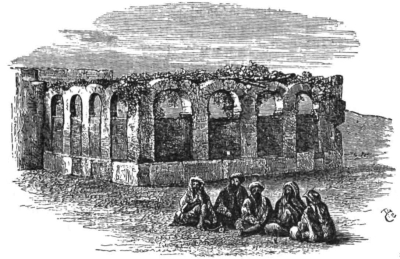
TOMB OF PHINEHAS.
But one group of sacred places remains to be noticed, in the village of
’Awertah called Abearthah in the Samaritan dialect. It stands in the
Plain of the Mŭkhnah, and is sacred to the Samaritans and to the Jews
as containing the tombs of Phinehas and Eleazar, Abishuah and Ithamar.
It is probably to be recognised as the Hill of Phinehas, where Eleazar
was buried according to the Bible (Josh. xxiv. 33), and which is
described as in Mount Ephraim.
In 1872 I visited the village and examined the two principal monuments.
That of Eleazar, west of the houses, is a rude structure of masonry in a
court open to the air. It is eighteen feet long, plastered all over, and
shaded by a splendid terebinth. In one corner is a little mosque with a
Samaritan inscription bearing the date 1180 of the Moslem era. The Tomb
of Phinehas is apparently an older building, and the walls of its court
have an arcade of round arches now supporting a trellis covered with a
grape-vine; the floor is paved. A Samaritan inscription exists here as
well as at the little mosque adjacent. The tombs of Ithamar, and of
Abishuah, the supposed author of the famous roll, are shown by the
Samaritans close by.
The “Holy King Joshua” is said by the Samaritans to have been buried at
Kefr Hâris, which they identify with Timnath Heres. This village is nine
miles south of Nâblus.
The Jewish pilgrim Rabbi Jacob of Paris visited Caphar
Cheres—presumably Kefr Hâris, in 1258 A.D., and mentions the tombs of
Joshua, Nun, and Caleb. The Samaritans also hold that Caleb was buried
with Joshua, and thus we have the curious result that Jews and
Samaritans agree as to the site of these tombs, both placing them within
the boundaries of Samaria. The Crusading writers point to the same site
for Joshua’s Tomb, and the place is marked on the map of Marino Sanuto
(1322 A.D.) in the relative position of Kefr Hâris.
The modern village has three sacred places: one of Neby Nûn, the second
Neby Lush’a, the third Neby Kifl. In the two first we recognise Nun and
Joshua; Neby Kifl was an historic character, but his shrine possibly
occupies the place of the medieval Tomb of Caleb.
The site of Joshua’s Tomb seems therefore to be preserved by an
indigenous tradition at least as authentic as that which fixes Joseph’s
Tomb. It has been supposed that Jerome indicates a different site, but a
careful reading of his account of St. Paula’s journey seems to show that
he also refers to the tomb at Kefr Hâris.
HEROD’S COLONNADE. SAMARIA.