Somersby Rectory, the birthplace of Alfred Tennyson
see page 3
Alfred Tennyson was born on Sunday, August 6th, 1809, at Somersby,
a village in North Lincolnshire between Horncastle and Spilsby. His
father, the Rev. Dr. George Clayton Tennyson, Rector of Somersby,
married in 1805 Elizabeth Fytche, daughter of the Vicar of Louth,
in the same county; and, of their twelve children, Alfred was the
fourth.
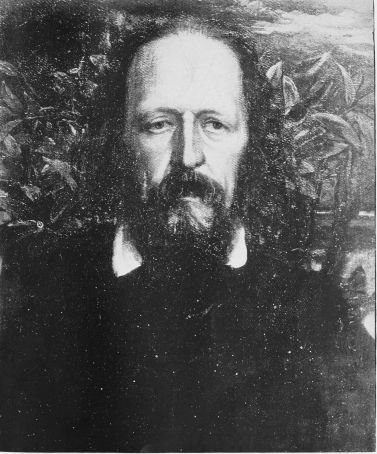
From a portrait by G. F. Watts, R.A.
ALFRED TENNYSON
Rischgitz Collection
He always spoke with affectionate remembrance of his early home: of the
woodbine trained round his nursery window; of the mediæval-looking
dining-hall, with its pointed stained-glass casements; of the pleasant
drawing-room, lined with bookshelves and furnished with yellow
upholstery. The lawn in front of the house, where he composed his early
poem, “A Spirit Haunts the Year’s Last Hours,” was overshadowed on one
side by wych-elms, on the other by larch and sycamore trees. On the
south was a path bounded by a flower-border, and beyond “a garden
bower’d close” sloping gradually to the field at the bottom of which ran
the Somersby Brook
That loves
To purl o’er matted cress and ribbed sand,
Or dimple in the dark of rushy coves,
Drawing into his narrow earthen urn
In every elbow and turn,
The filtered tribute of the rough woodland.
The charm and beauty of this brook haunted the poet throughout his life,
and to it he especially dedicated, “Flow down, cold rivulet, to the
sea.” Tennyson did not, however, attribute his famous poem, “The Brook,”
to the same source of inspiration, declaring it was not addressed to any
stream in particular.
Tennyson was exceedingly fortunate in the environment of his childhood
and the early influence exercised by his parents. His mother was of a
sweet and gentle disposition, and devoted herself entirely to the
welfare of her husband and her children. Her son is said to have taken
her as a model in “The Princess”; and he certainly gave a more or less
truthful description of this “remarkable and saintly woman” in his poem
“Isabel”:—
Locks not wide-dispread,
Madonna-wise on either side her head;
Sweet lips whereon perpetually did reign
The summer calm of golden charity.
Tennyson’s father was a man of marked physical strength and stature,
called by his parishioners “The stern Doctor.” In 1807 he was appointed
to the living of Somersby, and that of the adjoining village of Bag
Enderby, and this position he held until his death, on March 16th, 1831,
at the age of fifty-two. He was buried in the old country churchyard,
where “absolute stillness reigns,” beneath the shade of the rugged
little tower. In his time the roof of the church was covered with
thatch, as were also those of the cottages in its immediate vicinity.
The livings of Somersby and Bag Enderby were held conjointly, service
being conducted at one church in the morning and at the other in the
afternoon. Dr. Tennyson read his sermons at Bag Enderby from the quaint
high-built pulpit, Alfred listening to them from the squire’s roomy pew.
The Grammar School, Louth
see page 7
At the age of seven Tennyson was sent to school at Louth, a market-town
which may fairly lay claim to having been a factor of some importance in
his early life. His maternal grandmother lived in Westgate Place, her
house being a second home to the young Tennysons. The old Grammar School
where Alfred received the early portion of his education is now no
longer in existence. Tennyson’s recollections of it and of the Rev. J.
Waite, at that time the head-master, were not pleasant. “How I did hate
that school!” he wrote later. “The only good I got from it was the
memory of the words Sonus desilientis aquæ, and of an old wall covered
with wild weeds opposite the school windows.”
Tennyson’s first connected poems were composed at Louth, and in this
town also his first published work saw the light, appearing in a volume
entitled “Poems by Two Brothers,” issued in 1827 by Mr. J. Jackson, a
bookseller. The two brothers were Charles and Alfred Tennyson.
After a school career which lasted four years, Alfred returned to
Somersby to continue his studies under his father’s tuition. This course
of instruction was supplemented by classics at the hands of a Roman
Catholic priest, and music-lessons given him by a teacher at Horncastle.
In 1828 Charles and Alfred Tennyson followed their elder brother
Frederick to Trinity College, Cambridge. They began their university
life in lodgings at No. 12, Rose Crescent, moving later to Trumpington
Street, No. 57, Corpus Buildings. Of his early experiences of life at
Cambridge, Alfred wrote to his aunt: “I am sitting owl-like and solitary
in my rooms (nothing between me and the stars but a stratum of tiles).
The hoof of the steed, the roll of the wheel, the shouts of drunken Gown
and drunken Town come up from below with a sea-like murmur.... The
country is so disgustingly level, the revelry of the place so
monotonous, the studies of the University so uninteresting, so much
matter of fact. None but dry-headed, calculating, angular little
gentlemen can take much delight in them.”
Arthur Hallam (from the bust by Chantrey)
see page 8
It was at Trinity College that Tennyson first made the acquaintance of
Arthur Hallam, youngest son of the historian, whose friendship so
profoundly influenced the poet’s character and genius. “He would have
been known if he had lived,” wrote Tennyson, “as a great man, but not as
a great poet; he was as near perfection as mortal man could be.”
In February 1831 Tennyson left Cambridge without taking a degree, and
returned to Somersby, his father dying within a month of his arrival.
From this time onward Hallam became an intimate visitor at the Rectory,
and formed an attachment for his friend’s sister Emily. In July 1832
Tennyson and Hallam went touring on the Rhine, and at the close of the
year appeared the volume of “Poems by Alfred Tennyson,” which contained,
amongst others, “The Lady of Shalott,” “The Miller’s Daughter,” “The
Palace of Art,” “The Lotos Eaters,” and “A Dream of Fair Women.”
“Well I remember this poem,” wrote Fitzgerald, with reference to “The
Lady of Shalott,” “read to me, before I knew the author, at Cambridge
one night in 1832 or 3, and its images passing across my head, as across
the magic mirror, while half asleep on the mail-coach to London ‘in the
creeping dawn’ that followed.”
There she weaves by night and day
A magic web with colours gay.
She has heard a whisper say,
A curse is on her if she stay
To look down to Camelot.
She knows not what the curse may be,
And so she weaveth steadily,
And little other care hath she,
The Lady of Shalott.
The idea of “Mariana in the South” came to Tennyson as he was
travelling between Narbonne and Perpignan. Hallam interpreted it to be
the “expression of desolate loneliness.”
Till all the crimson changed, and past
Into deep orange o’er the sea,
Low on her knees herself she cast,
Before Our Lady murmur’d she;
Complaining, “Mother, give me grace
To help me of my weary load,”
And on the liquid mirror glow’d
The clear perfection of her face.
Of these earlier poems none added more to Tennyson’s growing reputation
than “The Miller’s Daughter.” It was probably written at Cambridge, and
the poet declared that the mill was no particular mill, or if he had
thought of any mill it was that of Trumpington, near Cambridge. But
various touches in the poem seem to indicate that the haunts of his
boyhood were present in his mind.
Stockworth Mill was situated about two miles along the banks of the
Somersby Brook, the poet’s favourite walk, and might very well have
inspired the setting of these beautiful verses.
I loved the brimming wave that swam
Thro’ quiet meadows round the mill,
The sleepy pool above the dam,
The pool beneath it never still.
The meal-sacks on the whiten’d floor,
The dark round of the dripping wheel,
The very air about the door
Made misty with the floating meal.
In the volume of 1832, several stanzas of “The Palace of Art” were
omitted, because Tennyson thought the poem was too full. “‘The Palace of
Art,’” he wrote in 1890, “is the embodiment of my own belief that the
Godlike life is with man and for man.”
Amongst the “marvellously compressed word pictures” of this poem is the
beautiful one of our illustration on page 11.
Or in a clear-wall’d city on the sea,
Near gilded organ-pipes, her hair
Wound with white roses, slept St. Cecily;
An angel look’d at her.
On the 15th of September, 1833, Arthur Hallam died suddenly at Vienna.
His remains were brought to England, and laid finally to rest in the old
and lonely church beside the sea at Clevedon, on January 3rd, 1834.
When on my bed the moonlight falls,
I know that in thy place of rest
By that broad water of the west
There comes a glory on the walls.
“In Memoriam”
see pages 16, 17
Tennyson’s whole thoughts were absorbed in memories of his friend, and
he continually wrote fragmentary verses on the one theme which filled
his heart, many of them to be embodied seventeen years later in the
completed “In Memoriam.”
The home of Emily Sellwood, at Horncastle
see page 19
In 1830 Tennyson first met Emily Sellwood, who twenty years later became
his wife. Horncastle was the nearest town to Somersby, and in the
picturesque old market-square stood the red-brick residence of Mr. Henry
Sellwood, a solicitor. The young Sellwoods being much of the same age as
the Tennysons, a friendship sprang up between the two families, which in
later
years ripened into a double matrimonial relationship. In 1836, Charles
Tennyson, the poet’s elder brother, married Louisa, the youngest
daughter of Henry Sellwood. In the previous year he had succeeded to the
estate and living of Grasby, taking the surname of Turner under his
great-uncle’s will. At his own expense he built the vicarage, the church
and the schools; and on his death, in 1879, Grasby descended to the Poet
Laureate. It was at his brother’s wedding that the bride’s sister,
Emily, was taken into church by Alfred Tennyson, but no engagement was
recognised between them until four or five years later, and their
marriage did not take place until 1850. It was solemnised at Shiplake
Church on June 13th, the clergyman who officiated being the poet’s
intimate friend, the Rev. Robert Rawnsley.
In the April of the same year, on the death of Wordsworth, Tennyson had
been offered the poet-laureateship, to which post he was appointed on
November 19th, owing chiefly to Prince Albert’s admiration for “In
Memoriam.”
Lady Tennyson became the poet’s adviser in literary matters. “I am proud
of her intellect,” he wrote. She, with her “tender, spiritual nature,”
was always by his side, cheerful, courageous, and a sympathetic
counsellor. She shielded his sensitive spirit from the annoyances and
trials of life and “her faith as clear as the heights of the June-blue
heaven” helped him in hours of depression and sorrow.
Chapel House, Twickenham
see page 20
Chapel House, Twickenham, was the poet’s first settled home after his
marriage, and he resided in it for three years. It was here his “Ode on
the Death of the Duke of Wellington” was written, and the birth of his
son Hallam took place in this house on August 11th, 1852.
Farringford, Tennyson’s residence at Freshwater
see page 25
In 1853, whilst staying in the Isle of Wight, Tennyson heard that the
residence called Farringford was to let at Freshwater. He decided to
take the place on lease, but two years later purchased it out of the
proceeds resulting from “Maud,” which was published in 1855, and
Farringford remained his home during the greater part of each year for
forty years, and here he wrote some of his best-known works.
“The house at Farringford,” says Mrs. Richmond Ritchie in her Records,
“seemed like a charmed palace, with green walls without, and speaking
walls within. There hung Dante with his solemn nose and wreath; Italy
gleamed over the doorways; friends’ faces lined the passages, books
filled the shelves, and a glow of crimson was everywhere; the oriel
drawing-room window was full of green and golden leaves, of the sound of
birds and of the distant sea.”
The Glade at Farringford
see page 29
The grounds of Farringford are exceedingly beautiful and picturesque. On
the south side of the house is the glade, and close by
The waving pine which here
The warrior of Caprera set.
Referring to Farringford in his invitation to Maurice, Tennyson wrote—
Where far from noise and smoke of town
I watch the twilight falling brown
All round a careless order’d garden,
Close to the ridge of a noble down.
The ridge of the down in question constituted the poet’s favourite walk,
and
the scenery which he encountered round Freshwater Bay might well have
been represented in the opening verse of “Enoch Arden”—
Long lines of cliff breaking have left a chasm;
And in the chasm are foam and yellow sands.
Inland the road leads to the little village of Freshwater, in which the
erection of a number of new houses evoked from the poet the lines—
Yonder lies our young sea-village—Art and Grace are less and less:
Science grows and Beauty dwindles—roofs of slated hideousness!
Alfred Tennyson
see pages 22 and 26
Opposite these villas stands an ivy-clad house at that time occupied by
Mrs. Julia Cameron, the celebrated lady art-photographer, two of whose
effective portraits of Tennyson appear on pages 22 and 26.
“The Idylls of the King”
see pages 15, 21, 27, 31
In the autumn of 1859, “The Idylls of the King” were first issued in
their original form, being four in number: Enid, Vivien, Elaine, and
Guinevere, and from their publication until the end of Tennyson’s life
his fame and popularity continued without a check. During the next few
years the poet spent much time in travelling, but in 1868 he laid the
foundation-stone of a new residence, named Aldworth, about two miles
from Haslemere, which became his second home—
You came, and look’d and loved the view
Long-known and loved by me,
Green Sussex fading into blue,
With one grey glimpse of sea.
On the way from Haslemere to Aldworth, it is necessary to cross a rough
common covered with whin bushes to reach the long winding lane which was
named Tennyson’s Lane. This was the poet’s favourite walk when living in
the neighbourhood.
Tennyson’s Memorial, Beacon Hill, Freshwater
see page 34
Tennyson died on Thursday, October 6th, 1892, and was buried in the
Poets’ Corner, Westminster Abbey, next to Robert Browning, and near the
Chaucer monument. Against the pillar close by the grave has been placed
Woolner’s well-known bust. The monument erected to the memory of the
poet on Beacon Hill, near Freshwater, was unveiled by the Dean of
Westminster on August 6th, 1897.
Alfred Tennyson (from the painting by Samuel Laurence)
see page 5
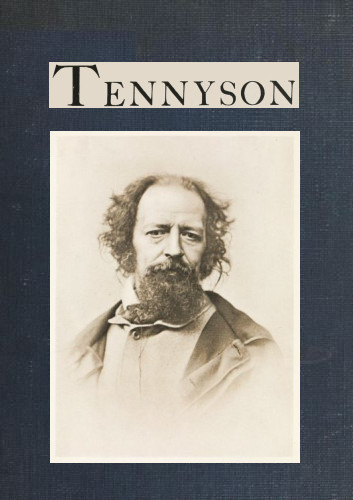
With regard to the portraits of Tennyson reproduced in these pages,
perhaps those of chief interest in addition to the Cameron photographs
already referred to are the paintings by Samuel Laurence, executed about
1838, and the three-quarter length by G. F. Watts, now in the possession
of Lady Henry Somerset. Of the former Fitzgerald wrote:
“Very imperfect as Laurence’s portrait is, it is nevertheless the best
painted portrait I have seen; and certainly the only one of old days.
‘Blubber-lipt’ I remember once Alfred called it; so it is; but still the
only one of old days, and still the best of all, to my thinking.”
Alfred Tennyson (from the painting by G. F. Watts in 1859)
see page 23
The Watts portrait, according to Mr. Watts-Dunton, possesses “a certain
dreaminess which suggests the poetic glamour of moonlight.” The same
writer asserts that “while most faces gain by the artistic halo which a
painter of genius always sheds over his work, there are some few, some
very few faces that do not, and of these Lord Tennyson’s is the most
notable that I have ever seen among men of great renown.”