Minor errors, attributable to the printer, have been corrected. Please
see the transcriber’s note at the end of this text
for details regarding the handling of any textual issues encountered
during its preparation.
Any corrections are indicated using an underline
highlight. Placing the cursor over the correction will produce the
original text in a small popup.
Any corrections are indicated as hyperlinks, which will navigate the
reader to the corresponding entry in the corrections table in the
note at the end of the text.
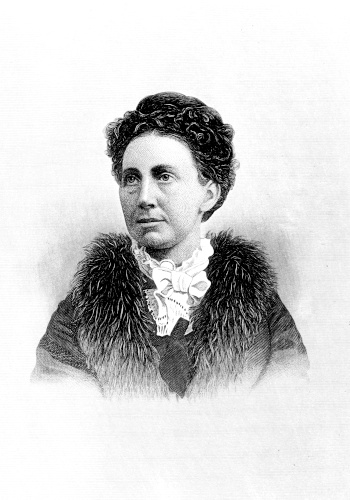
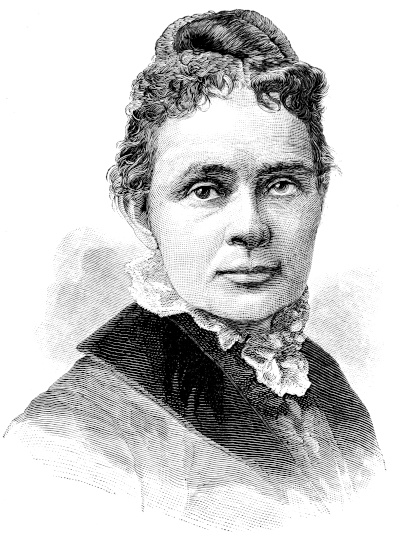
Engd by Geo. E. Perine N. York.
Mary Clemmer Ames
A.D. WORTHINGTON & Co. Hartford.
I
OR,
INSIDE LIFE AND SCENES
IN
OUR NATIONAL CAPITAL
As a Woman Sees Them.
EMBRACING
A FULL ACCOUNT OF THE MANY MARVELS AND INTERESTING
SIGHTS OF WASHINGTON; OF THE DAILY LIFE AT THE WHITE HOUSE, BOTH PAST
AND PRESENT; OF THE WONDERS AND INSIDE WORKINGS OF ALL OUR
GOVERNMENT DEPARTMENTS; AND DESCRIPTIONS AND REVELATIONS
OF EVERY PHASE OF POLITICAL, PUBLIC, AND
SOCIAL LIFE AT THE NATION’S CAPITAL.
By MARY CLEMMER,
Author of “Memorials of Alice and Phœbe Cary,” “A Woman’s Letters from Washington,” etc., etc.
TO WHICH IS ADDED A FULL ACCOUNT OF
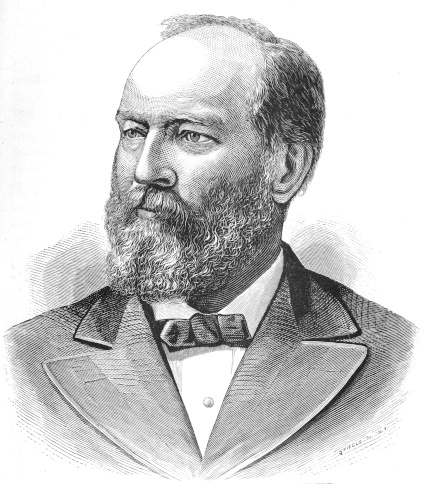
THE LIFE AND DEATH OF PRESIDENT JAMES A. GARFIELD,
BY J. L. SHIPLEY, A. M.
FULLY ILLUSTRATED
With a Portrait of the Author on Steel, and Forty-Eight fine Engravings on Wood.
[SOLD BY SUBSCRIPTION ONLY.]
HARTFORD, CONN.:
THE HARTFORD PUBLISHING COMPANY.
EXCELSIOR PUBLISHING CO., CHICAGO, ILL.
OHIO PUBLISHING CO., CLEVELAND, OHIO.
1882.
IIEntered according to Act of Congress, in the year 1881, by
THE HARTFORD PUBLISHING CO.,
In the office of the Librarian of Congress at Washington.
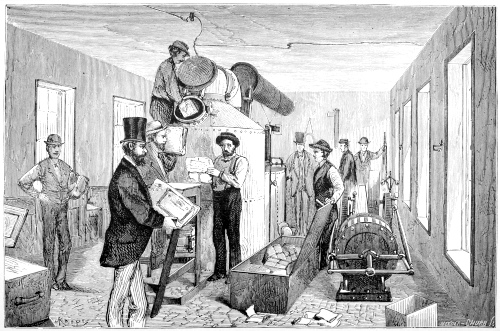
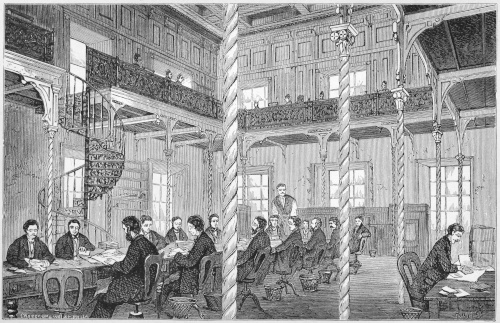
The above is a graphic sketch of the destruction of the worn and defaced currency constantly being redeemed by the Government, which is here burned every day at 12 o’clock. On one occasion considerably more than one hundred million dollars’ worth of bonds and greenbacks were destroyed in this furnace, and the burning of from fifty to seventy-five millions at a time is a matter of ordinary occurrence.
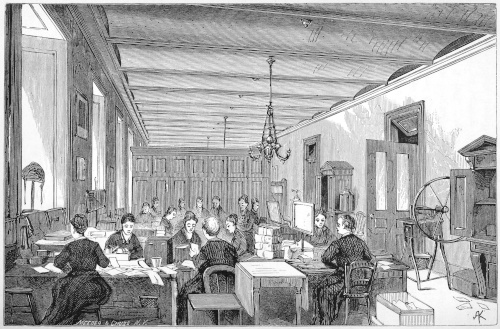
This room is in the Redemption Bureau, Treasury-Building. Over One Hundred Thousand Dollars’ worth of Fractional Currency alone is here daily received for redemption: out of which about Three Hundred and Fifty Dollars’ worth of counterfeit money is detected, stamped, and returned.
24.
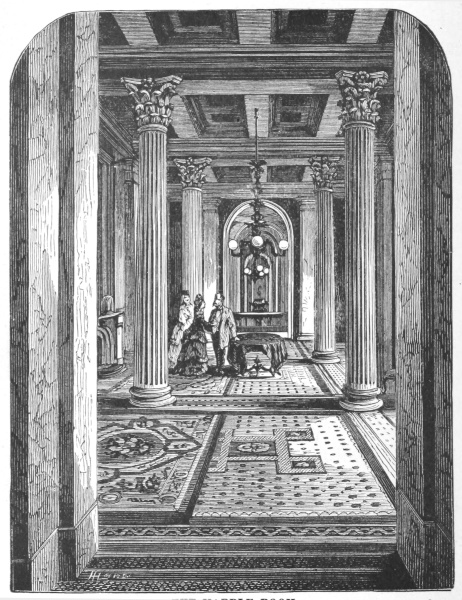
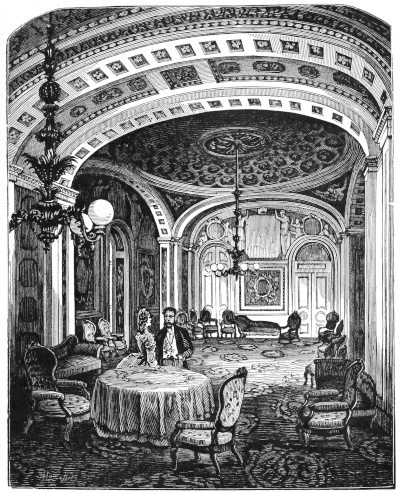
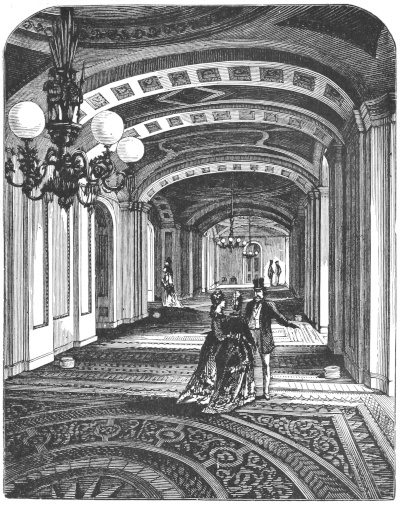
The Lobby of the Senate—Inside the Capitol—Washington,
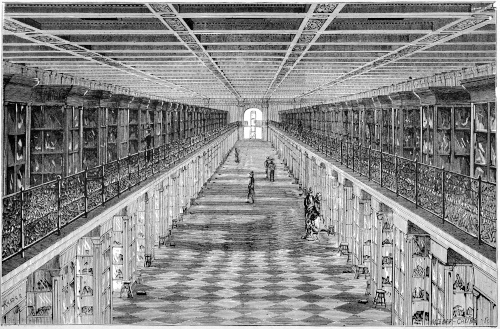
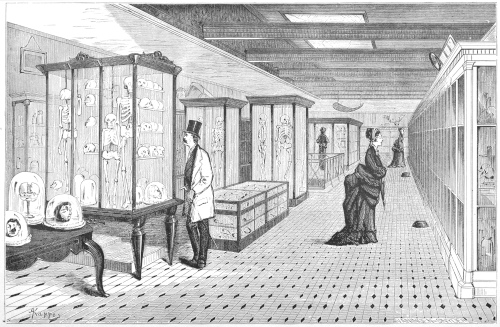
This Museum occupies the scene of the assassination of President Lincoln, in Ford’s Theatre, which after that date became the property of the Government. It contains a collection of upwards of twenty thousand rare, curious and interesting objects, surpassing any similar collection in the world. It is visited annually by upwards of twenty-five thousand persons.
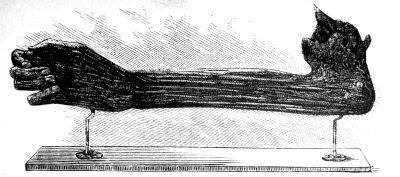
Skin, flesh, and bones complete. Amputated by a cannon-shot on the battle-field of Gettysburg. The shot carried the severed limb up into the high branches of a tree, where it was subsequently found, completely air and sun-dried.
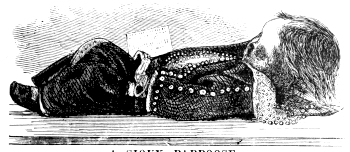
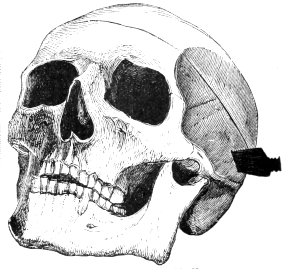
Who received an arrow-wound in the head, three gun-shot flesh-wounds, one in the arm, another in the breast, and a third in the leg. Seven days afterwards he was admitted to the hospital at Fort Concha, Texas, (where he subsequently died,) after having travelled above 160 miles on the barren plains, mostly on foot.
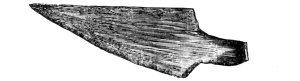
Of soft hoop-iron. These arrows will perforate a bone without causing the slightest fracture, where a rifle or musket-ball will flatten; and will make a cut as clean as the finest surgical instrument.
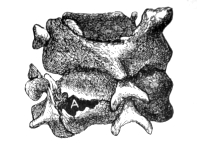
Being part of the Vertebræ penetrated [A] by the bullet of Boston Corbett. Strange freak of fate that the remains of Booth should find a resting-place under the same roof, and but a few feet from the spot where the fatal shot was fired.
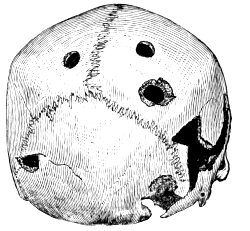
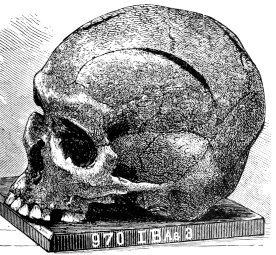
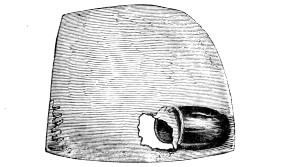
Wounded at Spottsylvania; showing the splitting of a rifle-ball—one portion being buried deep in the brain, and the other between the scalp and the skull. He lived twenty-three days.
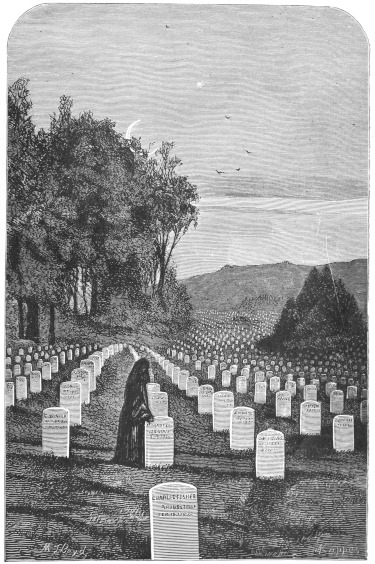
The remains of over 8,000 soldiers, killed during the war, lie buried in this Cemetery—the name, regiment, and date of death of each is painted on a wooden head-board.
The Young Surveyor’s Dream—A Vision of the Future Capital—The United States Government on Wheels—Ambitious Offers—The Rival Rivers—Temporary Lodgings for Eleven Years—Old-Fashioned Simplicity—A Great Man’s Modesty—Conflicting Claims—A Convincing Fact—The Dreadful Quakers—A Condescending Party—A Slight Amendment—An Old Bill Brought to Light Again—The Future Strangely Foreshadowed—A Dinner of Some Consequence—How it was Done—Really a Stranger—A Nice Proposal—Sweetening the Pill—A “Revulsion of Stomach,”
Born of Much Bother—Undefined Apprehensions—Debates on the Coming City—Old World Examples—Sir James Expresses an Opinion—A Dream of the Distant West—An Old-time Want—A Curious Statement of Fact—Where is the Center of Population—An Important Proclamation—Original Land Owners—Well-worn Patents—Getting on with Pugnacious Planters—Obstinate David Burns—A “Widow’s Mite” of Some Magnitude—How the Scotchman was Subjugated—A Rather “Forcible Argument,”
Washington’s Faith in the Future—Mr. Sparks is “Inclined to Think”—A Slight Miscalculation—Theoretical Spartans—Clinging to Old World Glories—Jefferson Acts the Critic—He Communicates Some Ideas—Models of Antiquity—Babylon Revived—Difficulty in Satisfying a Frenchman’s Soul—The Man Who Planned the Capital—Who Was L’Enfant?—His Troubles—His Dismissal—His Personal Appearance, Old Age, Death, and Burial Place—His Successor—A Magnificent Plan—A Record Which Can Never Perish—An Overpaid Quaker—Jefferson Expresses His Sentiments—A Sable Franklin—The Negro Engineer, Benjamin Bancker—A Chance for a Monument,
How the City Was Built—“A Matter of Moonshine”—Calls for Paper—Besieging Congressmen—How They Raised the Money—The Government Requires Sponsors—Birth of the Nation’s Capital—Seventy Years Ago in Washington—Graphic Picture of Early Times—A Much-Marrying City—Unwashed Virginian Belles—Stuck in the Mud—Extraordinary Religious Services,
Expectations Disappointed—Funds Low and People Few—Slow Progress of the City—A Question of Importance Discussed—Generous Proposition of George Washington—Faith Under Difficulties—Transplanting an Entire College—An Old Proposition in a New Shape—What Washington “Society” Lacks—Perils of the Way—A Long Plain of Mud—Egyptian Dreariness—The End of an Expensive Canal—The Water of Tiber Creek—Divided Allegiance of Old—The Stirring of a Nation’s Heart—A Personal Interest,
Hopes Realized—Washington in 1873—Major L’Enfant’s Dream—Old and New—“Modern Improvements”—A City of Palaces—The Capital in all its Glory—Traces of the War—Flowers on the Ramparts—Under the Oaks of Arlington—Ten Years Ago—The Birth of a Century—The Reign of Peace,
Municipal Changes—Necessity of Reform—The “Organic Act” Passed—Contest for the Governorship of Columbia District—Mr. Henry D. Cooke Appointed—Board of Public Works Constituted—Great Improvements Made—Opposition—The Board and Its Work,
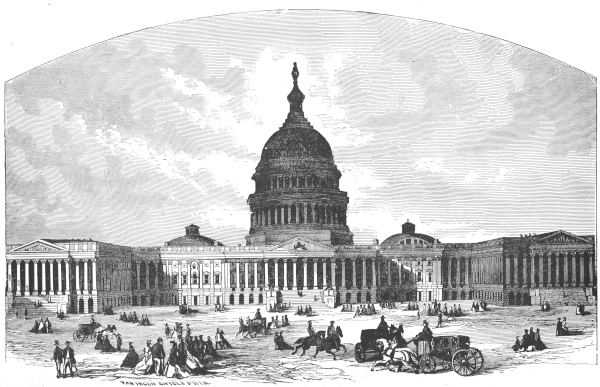
Various Plans for the Building—Jefferson Writes to the Commissioners—“Poor HalletHallet” and His Plan—Wanton Destruction by the British, A. D. 1814—The Site Chosen by Washington Himself—Imposing Ceremonies at the Foundation—Dedicatory Inscription on the Silver Plate—Interesting Festivities—Extension of the Building—Daniel Webster’s Inscription—His Eloquent and Patriotic Speech—Mistaken Calculations—First Session of Representatives Sitting in “the Oven”—Old Capitol Prison—Immense Outlay upon the Wings and Dome—Compared with St. Peter’s and St. Paul’s—The Goddess of Liberty—The Congressional Library—What Ought to be Done,
A Visit to the Capitol—The Lower Hall—Its Cool Tranquility—Artistic Treasures—The President’s and Vice-President’s Rooms—The Marble Room—The Senate Chamber—“Men I Have Known”—Hamlin—Foote—Foster—Wade—Colfax—Wilson—The Rotunda—Great Historical Paintings—The Old Hall of Representatives—The New Hall—The Speaker’s Room—Native Art—“The Star of Empire”—A National Picture,
The Famous Bronze Doors—The Capitol Grounds—Statue of Washington Criticised—Horace Greenough’s Defence of the Statue—Picturesque Scenery Around the Capitol—The City and Suburbs—The Public Reservation—The Smithsonian Institution—The Potomac and the Hights of Arlington,
Arrival of a Solitary Lady—“The Pantheon of America”—Il Penserosa—Milton’s Ideal—Dirty Condition of the House of Representatives—The Goddess of Melancholy—Vinnie Ream’s Statue of Lincoln—Its Grand Defects—Necessary Qualifications for a Sculptor—The Bust of Lincoln by Mrs. Ames—General Greene and Roger Williams—Barbarous Garments of Modern Times—Statues of Jonathan Trumbull and Roger Sherman—Bust of KosciuskoKosciusko—Pulling his Nose—Alexander Hamilton—Fate of Senator Burr—Statue of Baker—His Last Speech Prophetic—The Glory of a Patriotic Example—The Lesson which Posterity Learns—Horatio Stone, the Sculptor—Neglected Condition of the Capitol Statuary—Curious Clock—Grotesque Plaster Image of Liberty—Webster—Clay—Adams—The Pantheon at Rome—The French Pantheon,
The Senate Reception-Room—The People who Haunt it—Republican “Ladies in Waiting”—“Women with Claims”—Their Heroic Persistency—A Widow and Children in Distress—Claim Agents—The Committee of Claims—A Kind-Hearted Senator’s Troubles—Buttonholing a Senator—A Lady of Energy—Resolved to Win—An “Office Brokeress”—A Dragon of a Woman—A Lady who is Feared if not Respected—Her Unfortunate Victims—Carrying “Her Measure”—The Beautiful Petitioner—The Cloudy Side of Her Character—Her Subtle Dealings—Her Successes,
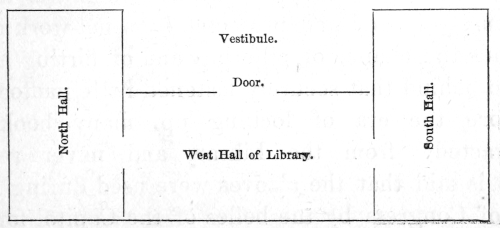
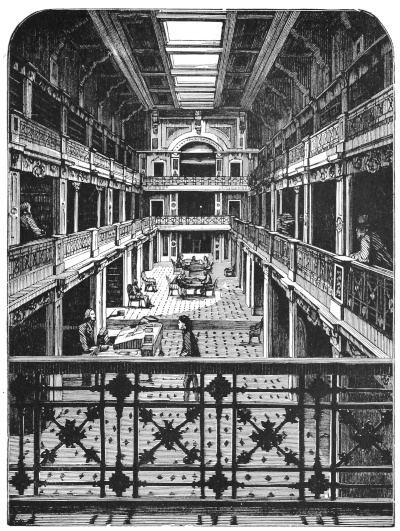
ixInside the Library—The Librarian—Sketch of Mr. Spofford—How Congressional Speeches are Manufactured—“Spofford” in Congress—The Library Building—Diagram—Dimensions of the Hall—The Iron Book Cases—The Law Library—Five Miles of Book Shelves—Silent Study—“Abstracting” Books—Amusing Adventure—A Senator in a Quandary—Making Love Under Difficulties—Library Regulations—Privileged Persons—Novels and their Readers—Books of Reference—Compared with the British Museum—Curious Old Newspapers—Files of Domestic and Foreign Papers—One Hundred Defunct Journals—An Incident of the War of 1814—Putting it to the Vote—“Carried Unanimously”—35,000 Volumes Destroyed—Treasurers of Art Consumed—The New Library—The Next Appropriation,
How a Library was Offered to Congress—Mr. King’s Proposal—An Eye to Theology—The Smithsonian Library Transferred—The Good Deeds of Peter Force—National Documents—Eliot’s Indian Bible—Literary Treasures—The Lawyers Want a Library for Themselves—The Finest Law Library in the World—First Edition of Blackstone—Report of the Trial of Cagliostro, Rohan and La Motte—Marie Antoinette’s Diamond Necklace—A Long Life-Service—An Architect Buried Beneath his own Design—“Underdone Pie-crust”—Reminiscences of Daniel Webster and the Girard Will,
THE HEAVEN OF LEGAL AMBITION—THE SUPREME COURT ROOM.
Memories of Clay, Webster, and Calhoun—Legal Giants of the Past—Stately Serenity of the Modern Court—“Wise Judgment and Wine Dinners”—The Supreme Court in Session—Soporific Influences—A Glimpse of the Veritable “Bench”—The Ladies’ Gallery—The Chief Justices of the Past—His Apotheosis—Chief-Justice Chase—Black-Robed Dignitaries—An Undignified Procession—The “Crier” in Court—Antique Proclamation—The Consultation-Room—Gowns of Office—Reminiscence of Judge McLean—“Uncle Henry and his Charge”—Fifty Years in Office,
The Center of a Nation’s Hopes—Stirring Reminiscences of the Capitol—History Written in Stone—Patriotic Expression of Charles Sumner—Building “for all Time”—“This our Fathers Did for Us”—The Interest of Humanity—A Secret Charm for a Thoughtful Mind—An Idea of Equality—The Destiny of the Stars and Stripes—A Mother’s Ambition—The Dying Soldier,
xThe Capitol in Spring—A Magic Change—Arrival of Visitors—A New Race—“Billing and Cooing”—Lovers at the Capitol—A Dream of Perpetual Spring—Spending the Honeymoon in Washington—New Edition of David Copperfield and Dora—“Very Young”—Divided Affections: The New Bride—Jonathan and Jane—Memories of a Wedding Dress—An Interview with a Bride—“Two Happy Idiots”—A Walk in the City—President Grant—The Foreign Ambassadors—“Beau” Hickman—An Erratic Genius—Walt Whitman the Poet—A “Loafer” of Renown—Poets at Home—Piatt—Burroughs—Harriet Prescott Spofford—Sumner and Chase—Tiresome Men—How to Love a Tree,
Washington Weather—Sky Scenery—Professor Tyndall Expresses an Opinion—A Picture of Beauty—Prejudiced Views—Birds of Rock Creek—The Parsonage—A Scene of Tranquil Beauty—A Washington May—Charms of the Season—Mowers at Work—The Public Parks—Frolics of the Little Ones—Strawberry Festivals—“Flower Gathering,”
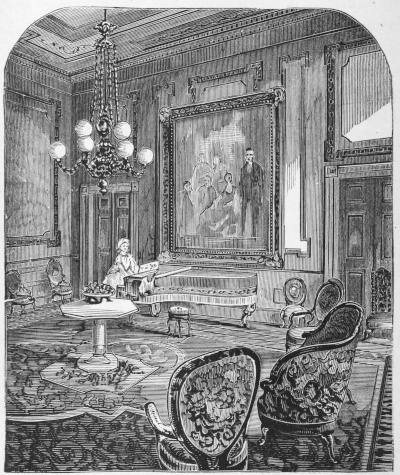
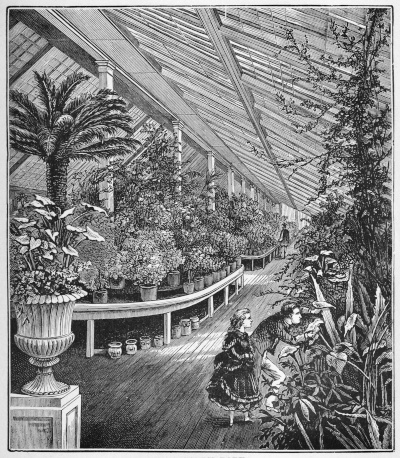
Haunted Houses—Shadows of the Past—Touching Memories—The Little Angels Born There—A State of Perpetual Dampness—Dingy Aspect of a Monarch’s Palace—Outside the White House—A Peep Inside the Mansion—The Emperor of Japan Supersedes the Punch-Bowl—The Unfinished “Banqueting-Hall”—Glories of a Levée—Magnificent Hospitalities—A Comfortable Dining-Room—A Lady of Taste—An American “Baronial Hall”—The Furniture of Another Generation—A Valuable Steward—A Professor of Gastronomy—Paying the Professor and Providing the Dinner—Feeding the Celebrities—Mrs. Lincoln’s Unpopular Innovations—Fifteen Hundred Dollars for a Dinner—How Prince Arthur, of England, was Entertained—Domestic Economy—“Not Enough Silver”—A Tasty Soup—The Recipe for an Aristocratic Stew—Having a “Nice Time”—Hatred of Flummery—An Admirer of Pork and Beans and Slap-jacks—A Presidential Reception—Ready for the Festival—Splendor, Weariness and Indigestion—Paying the Penalty—In the Conservatory—Domestic Arrangements—Reminiscence of Abraham Lincoln,
A Morning Dream—Wives and Daughters of the Presidents—An Average Matron of the 18th Century—Educational Disadvantages—A Well-Regulated LadyLady—Useful Wife—Advantages of Having a Distinguished Husband—A Modern Lucretia—Washington’s Inauguration Suit—An Awkward Position for a Lady—Festivities in Franklin Square!—Transporting the Household Gods—Keeping Early Hours—Primitive Customs—Much-Shaken Hands—Remembrances of a Past Age—Very Questionable Humility—The Room in which Washington Died—Days of Widowhood—A Wife’s Congratulations—A True Woman—Domestic Affairs at the White House—An Unfinished Mansion—Interesting Details—A Woman’s Influence—A Monument Wanted—Devotion of a Husband—The “Single Life”—Disappointed Belles—An Extraordinary Reception—Blacked His Own Boots—A Daughter’s Affection,
A Social Queen—“The Most Popular Person in the United States”—The Slow Days of Old—Traveling Under Difficulties—Political Pugnacity—Formality versus Hospitality—Big Dishes Laughed at—A Foreign Minister Criticises—Advantages of a Good Memory—Funny Adventure of a Rustic Youth—A Strange Pocketful—Putting Him at His Ease—Doleful Visage of a New President—Getting Rid of a Burden—A Brave Lady—Waiting in Suspense—Taking Care of Cabinet Papers—Watching and Waiting—Flight—Unscrewing the Picture—After the War—Brilliant Receptions—Mrs. Madison’s Snuff-Box—Clay Takes a Pinch—“This is my Polisher!”—Two Plain Old Ladies from the West—They Depart in Peace—Days of Trouble and Care—Manuscripts Purchased by Congress—Last Days of a Good Woman—Mrs. Monroe—A Severe and Aristocratic Woman—Madame Lafayette in Prison,
A Traveling Lady—Life in Russia—A Modern American Minister—A long and Lonely Journey—The Court of St James—Peculiar Waists—Costume of an Ancient Belle—Fearful and Wonderful Attire of a Beau—“A suit of Steel”—An Ascendant Star—A Man Who Hid his Feelings—The Candidate at a Cattle Show—Charles’s Opinion of His Mother—How a Lady “Amused” Her Declining Days—A Woman’s Influence—Politics and Piety Disagree—Why the General Didn’t Join the Church—A Head “Full of Politics”—Swearing Some—The President Becomes a Good Boy—Domestic Tendencies,
Widows “at par”—Four Sonless Presidents—Supported by Flattery—A Delicate Constitution—Living to a Respectable Age—Teaching Her Grandson How to Fight—A Pathetic Reminiscence—A Perfect Gentlewoman—Obeying St. Paul—A Woman Who “Kept Silence”—“Sarah Knows Where It Is”—Three Queens in the Background—A Very Handsome Woman—A Lady’s Heroism—A Man Who Kept to His Post—A Life in the Savage Wilderness—A Life’s Devotion—The Colonel’s Brave Wife—Objecting to the Presidency—An Inclination for Retirement—The Penalty of Greatness—Death in the White House—A Wife’s Prayers—A New Regime—The Clothier’s Apprentice and the School Teacher—The Future President Builds His Own House—Domestic Happiness—Twenty-seven Years of Married Life—Home “Comforts” at the White House—The Memory of a Loving Wife,
xiiUnder a Cloud—“A Woman Among a Thousand”—Revival of By-gone Days—Another Lady of the White House—A “Golden Blonde”—Instinct Alike with Power and Grace—A Fun-Loving Romp—Harriet with her Wheelbarrow of Wood—A Deed of Kindness—The Wheel Turns Round—Gay Doings at the Capital—Rival Claims for a Lady’s Hand—Reigning at the White House—Doing Double Duty—Marriage of Harriet Lane—As Wife and Mother—Mrs. Abraham Lincoln—Standing Alone—A Time of Trouble and Perplexity—Rumors of War—Whispers of Treason—Awaiting the Event—A Life-long Ambition Fulfilled—The Nation Called to Arms—What the President’s Wife Did—The Dying and the Dead—Arrival of Troops—The Lonely Man at the White House—An Example of Selfishness—Petty Economies—The Back Door of the White House—An Injured Individual—Death of Willie Lincoln—Injustice which Mrs. Lincoln Suffered—The Rabble in the White House—Valuables Carried Away—Big Boxes and Much Goods—Mrs. Lincoln Disconsolate—Missing Treasures—Faults of a President’s Wife,
After the War—A Contrast—Secretly Burying the Dead—A Wife of Seventeen Years—Midnight Studies—Broken Down—A party of Grandchildren—“God’s Best Gift to Man”—The Woman Who Taught the President—Doing the Honors at the White House—Traces of the Soldiers—A State of Dirt and Ruin—Mrs. Patterson’s Calico Dress—In the Diary—A Nineteenth Century Wonder—How the Old Carpets were Patched—How $30,000 were Spent—Buying the Furniture—Working in Hot Weather—Very Good Dinners—Doors Open to the Mob—Sketching a Banquet—The Portraits of the Presidents—The Impeachment Trial—Peace in the Family—The Grant Dynasty—Looking Home-like—Mrs. Grant at Home—What Might Be Done, if—How a Certain Young Lady was Spoilt—Brushing Away “the Dew of Innocence,”
RECEPTION DAY AT THE WHITE HOUSE—GLIMPSES OF LIFE.
Feeling Good-Natured—Looking After One’s Friends—Ready to Forgive—Mr. Grant’s “Likeable Side”—Rags and Tatters Departed—The Work of Relic-Hunters—Eight Presidents, All in a Row—Shadows of the Departed—A Present from the Sultan of Turkey—A List of Finery—A Scene Not Easily Forgotten—How They Wept for Their Martyr—Tales which a Room Might Tell—Underneath the Gold and Lace—The Census of Spittoons—“A Horror in Our Land”—The Shadow of Human Nature—Two “Quizzing” Ladies—An Illogical Dame—Her “Precarious Organ”—A Lady of Many Colors—“A New Woman”—A Vegetable Comparison—The Lady of the Manor—Women Who are Not Ashamed of Womanhood—Observed and Admired of All—Sketch of a Perfect Woman—After the Lapse of Generations—The “German”—The “Withering” of Many American Women—Full Dress and No Dress—What the Princess Ghika Thinks—A Young Girl’s Dress—“That Dreadful Woman”—The Resolution of a Young Man,
My Own Private Opinion—The Little “Sons of War” Feeling Bad—Brutal Mothers—Our Heroes—Later Festivities—A Lively Time—The Mighty Drum-Major—“Taken for a Nigger”—Magnificent Display—The Oldest Regiment in the States—Sketches of Well-known Men—Blacque Bey—Full Turkish Costume—The Japanese Minister—The Supreme Court—Congress Alive Again—The Valedictory—Taking the Oath—“The Little Gentleman in the Big Chair”—His Little Speech—His Wife and Family Behind—The New President—Memories of Another Scene—The Curtain Falls,
How Sixty Thousand Dollars were Spent—Something Wrong: “Twas Ever Thus”—A Fine Opportunity for a Few Naughty Words—Lost Jewels—The Colored Folks in a Fix—Six Thousand People Clamoring for Their Clothes!—A Magnificent “Grab”—Weeping on Window-ledges—Left Desolate—Walking under Difficulties—The Exploit of Two Old Gentlemen—Horace Greeley Loses his Old White Hat—He says Naughty Words of Washington—A Little Too Cold—Gay Decorations—Modesty in Scanty Garments—The President Frozen—Ladies of Distinction—Half-frozen Beauties—Why and Wherefore?—A Stolid Tanner Who Fought his Way,
The Responsibilities and Duties of the Secretary of the Treasury—Three Extraordinary Men—Hamilton Makes an Honest Proposal—The Mint at Philadelphia—A Little Personal Abuse—The Secretary Borrows Twenty Dollars—Modern Greediness—The Genius Becomes a Lawyer—Burning of Records—Hunting for Blunders and Frauds—The Treasury Building—A Little Variety—A Vision of Much Money—Old Debts Raked Up—Signs of the Times—The National Currency Act—Enormous Increase of the National Debt—Facts and Figures—The Credit of the Government Sustained—President Grant’s Rule—George S. Boutwell Made Secretary—Great Expectations,
xiv“Old Hickory” Erects his Cane—“Put the Building Right Here”—A Very Costly Building—The Workers Within—The Business of Three Thousand People—The Mysteries of the Treasury—Inside the Rooms—Mary Harris’s Revenge—The “Drones” in the Hive—Making Love in Office Hours—Flirtations in Public—A List of Miserable Sinners—A Pitiful Ancient Dame—Women’s Work in the Treasury—The Bureau of Printing and Engraving—Dealing in Big Figures—The Story of a Paper Dollar—In the Upper Floor—The Busy Workers—Night Work—Where the Paper is Made—The “Localized Blue Fibre”—The Obstacle to the Counterfeiter—The Automatic Register—Keeping Watch—The Counters and Examiners—An Armed Escort—Varieties of Printing—The Contract with Adams’ Express—Printing the Notes and Currency—Internal Revenue Stamps—Manufacturing the Plates—The Engraving Division—“Men of Many Minds”—Delicate Operations—A Pressure of Five or Six Tons—The Plate Complete—“Re-entering” a Plate—An “Impression”—How Old Plates are Used Up—A Close Inspection—Defying Imitation—The Geometric Lathe,
THE WORKERS IN THE TREASURY—HOW THE MONEY IS MADE.
The Dollar with the Counters—In the Tubs—Getting a Wetting—Servants of Necessity—That Scorching Roof—Brown Paper Bonnets—A State of Dampness—Squaring Accounts—Superintending the Work—The Face-printing Division—The United States “Sealer”—Printing Cigar-Stamps and Gold-Notes of Many Colors—With a Begrimed Face—The Fiery Little Brazier—What the Man Does—The Woman’s Work—The Automatic Register—An Observer Without a Soul—Our Damp Little Dollar—The Drying Room—The First Wrinkles—Looking Wizened and Old—Rejuvenating a Dollar—Underneath Two Hundred and Forty Tons—Smooth and Polished—Precious to the Touch—A Virgin Dollar—The “Sealer” at Work—Mutilated Paper—What the Women are paid—The Surface-Sealing Division—Seal Printing—The Aristocratic Green Seal—The Numbering Division—Dividing the Dollars—Snowy Aprons and Delicate Ribbons—Needling the Sheet—A Blade that Does not Fail—Sorting the Notes—The Manipulation of the Ladies—The Dollar “In its Little Bed”—Dollar on Dollar—“Awaiting the Final Call,”
xvReady for the World—Starting Right—Forty Busy Maids and Matrons—Counting Out the Money—Human Machines—A Lady Counting for a Dozen Years Fifty Thousand Notes in a Day—Counting Four Thousand Notes in Twenty Minutes—What has Passed Through Some Fingers—Big Figures—Packing Away the Dollars—The Cash Division—The Marble Cash-Room—The Great Iron Vault—Where Uncle Sam Keeps His Money—Some Nice Little Packages—Taking it Coolly—One Hundred Millions of Dollars in Hand—Some Little White Bags—The Gold Taken from the Banks of Richmond—A Distinction Without a Difference—The Secret of the Locks—The Hydraulic Elevator—Sending the Money off—Begrimed, Demoralized, and Despoiled—Where is Our Pretty Dollar?—The Redemption Division—Counting Mutilated Currency—Women at Work—Sorting Old Greenbacks—Three Hundred Counterfeit Dollars Daily—Detecting Bad Notes—“Short,” “Over,” and “Counterfeit”—Difficulty of Counterfeiting Fresh Notes—Vast Amounts Sent for Redemption—Thirty-one Million Dollars in One Year—The Assistant Treasurer at New York—The Cancelling Room—The Counter’s Report—The Bundle in a Box—Awkward Responsibility—“Punching” Old Dollars—The Funeral of the Dollar—The Burning, Fiery Furnace—The End of the Dollar,
THE GREAT CASH-ROOM—THE WATCH-DOG OF THE TREASURY.
No Need for Dirty Money—The Flowers of July—Money Affairs—The Great Cash-Room—Its Marble Glories—A Glance Inside—The Beautiful Walls—A Good Deal of Very Bad Taste—Only Made of Plaster—“The Watch Dog” of the Treasury—The Custodian of the Cash—A Broken-nosed Pitcher—Ink for the Autographs—His Ancient Chair—“The General”—“Crooked, Crotchety, and Great-hearted”—“Principles” and Pantaloons—Below the Surface—An Unpaintable Face—An Object of Personal Curiosity—Dick and Dolly pay the General a Visit—How the Thing is Done—Getting his Autograph—A Specimen for the Folks at Home—Where the Treasurer Sleeps—Going the Round at Night—Making Assurance Sure—Awakened by a Strong Impression—Sleepless—In the “Small Hours”—Finding the Door Open—A Careless Clerk—The Care of Eight Hundred Millions—On the Alert—The Auditors—The Solicitor’s Office—The Light-House Board—The Coast Survey—Internal Revenue Department,
WOMAN’S WORK IN THE DEPARTMENTS—WHAT THEY DO AND HOW THEY DO IT.
Women Experts in the Treasury—Their Superiority to Men—Money Burnt in the Chicago Fire—Cases of Valuable Rubbish—Identifying Burnt Greenbacks—The Ashes of the Boston Fire—From the Bottom of the Mississippi—Mrs. Patterson Saves a “Pile” of Money—Money in the Toes of Stockings—In the Stomachs of Men and Beasts—From the Bodies of the Murdered and Drowned—One Hundred and Eighty Women at Work—“The Broom Brigade”—Scrubbing the Floors—Stories which Might be Told—Meditating Suicide—The Struggle of Life—How a Thousand Women are Employed—Speaking of Their Characters—Miss Grundy of New York—Women of Business Capacity—A Lady as Big as Two Books!—A Disgrace to the Nation—Working for Two, Paid for One—Beaten by a Woman—The Post-Office Department—Folding “Dead Letters”—A Woman Who has Worked Well—“Sorrow Does Not Kill”—The Patent Office—Changes Which Should be Made,
WOMEN’S WORK IN THE TREASURY—HOW APPOINTMENTS ARE MADE.
xviThe Difference Between Men and Women—A Shameful and Disgraceful Fraud—What Two Women Did—Cutting Down the Salaries of Women—The First Woman-Clerk in the Treasury—Taking Her Husband’s Place—The Feminine Tea-Pot—“A Woman can Use Scissors Better than a Man”—Profound Discovery!—“She’ll do it Cheaper”Cheaper”—Besieged by Women—Scenes of Distress and Trouble—Infamous Intrigues—The Baseness of Certain Senators—Virtue Spattered with Mud—Secret Doings in High Places—Sounding Magnanimous—Passing the Examination—The Irrepressible Masculine Tyrants—Up to the Mark, but not Winning—An Alarming Suggestion—Men Versus Women—Tampering with the Scales,
GOVERNMENT OFFICIAL LIFE—HOW PLACE AND POWER ARE WON.
Keeping his Eye Open—The Sweet and Winning Ways of Mr. Parasite—In Office—The Fault of the “People” and “my Friends”—Pulling the Wool over the Eyes of the Innocent—Writing Letters in a Big Way—The “Dark Ways” of Wicked Mr. P—— —A Suspicious Yearning for Private Life—The Sweets of Office—John Jones is not Encouraged—Post-offices as Plentiful as Blackberries—Receiving Office seekers—Dismissing John—Over-crowded Pastures—John’s Own Private Opinion—Peculiar Impartiality of the Man in Office—What the Successful Man Said—A Certain Kind of Man, and Where He can be Found,
The Post-Office—The Postal Service In Early Times—The First Postmaster General—The Present Chief—A Cabinet Minister—The Subordinate Officers—Their Positions and Duties—The Ocean Mail Postal Service—The Contract Office—The Finance Office—The Inspection Office—Complaints and Misdoings—One Hundred and Twenty Years Ago—Franklin Performs Wonderful Works—His Ideas of Speed—Between Boston and Philadelphia in Six Weeks—Dismissed from Office—A New Post-Office System—The Inspector of Dead Letters—Only Seventy-five Offices in the States—Only One Clerk—Government Stages—The Office at Washington—Franklin’s Old Ledger—The Present Number of Post-Offices—The Dead Letter Office—The Ladies Too Much Squeezed—Opening the Dead Letters—Why Certain Persons are Trusted—Three Thousand Thoughtless People—Valuable Letters—Ensuring Correctness—The Property Branch—The Touching Story of the Photographs—The Return Branch—What the Postmaster Says,
THE DEPARTMENT OF THE INTERIOR—UNCLE SAM’S DOMESTIC ARRANGEMENTS.
Inadequate Accommodation in Heaven—Valuable Documents—In Jeopardy—Talk of Moving the Capital—Concerning Certain Idiots—A Day in the Patent Office—The Inventive Genius of the Country—Division of Indian Affairs—Lands and Railroads—Pensions and Patents—The Superintendent of the Building—The Secretary of the Interior and his Subordinates—Pensions and Their Recipients—Indian Affairs—How the Savages are Treated—Over Twenty—One Million of Dollars Credited to their Little Account—The Census Bureau—A Rather Big Work—The Bureau of Patents—What is a Patent?—A Few Dollars Over—The Use Made of a Certain Brick Building—Cutting Down the Ladies’ Salaries—Making Places for Useful Voters—A Sweet Prayer for Delano’s Welfare,
THE PENSION BUREAU—HOW GOVERNMENT PAYS ITS SERVANTS.
Sneering at Red Tape—The Division of Labor—Scrutinizing Petitions—A Heavy Paper Jacket—Invalids, Widows, and Minors—The Examiner of Pensions—How Claims are Entertained and Tested—What is Recorded in the Thirty Enormous Volumes—How Many Genuine Cases are Refused—One of the Inconveniences of Ignorance—The Claim Agent Gobbles up the Lion’s Share—An Extensive Correspondence—How Claims are Mystified, and Money is Wasted—Seventy-five Thousand Claims Pending—The Reward of Fourteen Days’ Service—The Sum Total of What the Government has Paid in Pensions—The Largest and the Smallest Pension Office—The Miscellaneous Branch—Investigating Frauds—A Poor “Dependent” Woman with Forty Thousand Dollars—How “Honest and Respectable” People Defraud the Government—The Medical Division—Examining Invalids—The Restoration-Desk—The Appeal-Desk—The Final-Desk—The Work that Has Been Done—One Hundred and Fifty Thousand People Grumbling—The Wrath of a Pugnacious Captain,
TREASURES AND CURIOSITIES OF THE PATENT OFFICE—THE MODEL ROOM—ITS RELICS AND INVENTIONS.
The Patent Office Building—The Model Room—“The Exhibition of the Nation”—A Room Two Hundred and Seventy Feet in Length—The Models—Wonders and Treasures of the Room—Benjamin Franklin’s Press—Model Fire-Escapes—Wonderful Fire-Extinguishers—The Efforts of Genius—Sheep-Stalls, Rat-Traps, and Gutta Percha—An Ancient Mariner’s Compass—Captain Cook’s Razor—The Atlantic Cable—The Signatures of Emperors—An Extraordinary Turkish Treaty—Treasures of the Orient—Rare Medals—The Reward of Major Andre’s Captors—The Washington Relics—His Old Tent—His Blankets and Bed-Curtains—His Chairs and Looking-Glass—His Primitive Mess-Chest and old Tin Plates—Model of an Extraordinary Boat—Abraham Lincoln as an Inventor—The Hat Worn on the Fatal Night—The Gift of the Tycoon—The Efforts of Genius—A Machine to Force Hens to Lay Eggs—A Hook for Fishing Worms out of the Human Stomach,
THE BUREAU OF PATENTS—CRAZY INVENTORS AND WONDERFUL INVENTIONS
xviiiPatent-Rights in Steamboats—The Corps of Examiners—Twenty Thousand Applications per annum—Fourteen Thousand Patents Granted in One Year—Wonderful Expansion of Inventive Genius—“The Universal Yankee”—Second-hand Inventions—Where the Inventions Come From—Taking Out a Patent for the Lord’s Prayer—A Patent for a Cow’s Tail—A Lady’s Patent—Hesitating to Accept a Million Dollars—How Patentees are Protected—The American System—Exploits of General Leggett—His Efficiency in Office—The Inventor Always a Dreamer—Perpetual Motion—The Invention of a D. D.—Silencing the Doctor—A New Process of Embalming—A Dead Body Sent to the Office—Utilizing Niagara—An Englishman’s Invention—Inventors in Paris—How to Kill Lions and Tigers in the United States with Catmint—A Fearful Bomb Shell—Eccentric Letters—Amusing Specimens of Correspondence,
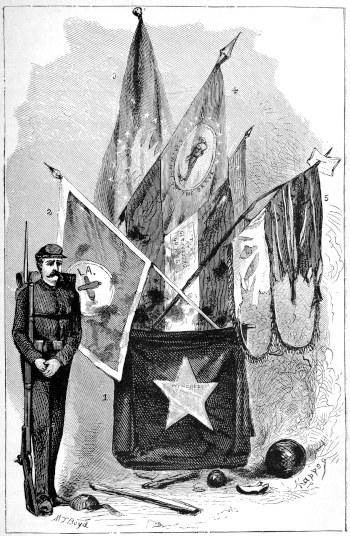
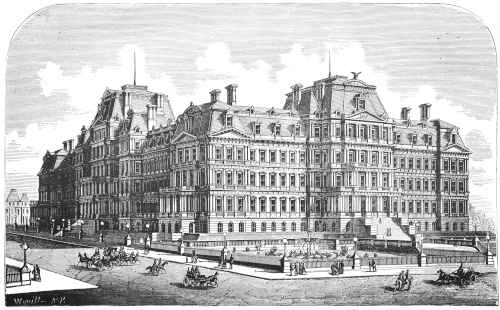
The Secretary-of-War—His Duties—The Department of the Navy—The Custody of the Flags—Patriotic Trophies—The War of the Rebellion—Captured Flags—An Ugly Flag and a Strange Motto—The Stars and Stripes—The Black Flag—No Quarter—The Washington Aqueduct—Topographical Engineers—The Ordnance Bureau—The War Department Building—During the War—Lincoln’s Solitary Walk—Secretary Stanton—The Exigencies of War—The Medical History of the War—Dr. Hammond—Dr. J. H. Baxter—The Inspection of over Half a Million Persons—Who is Unfit for Military Service—Curious Calculations Respecting Height, Health, and Color,
THE ARMY MEDICAL MUSEUM—ITS CURIOSITIES AND WONDERS.
Ford’s Theatre—Its Interesting Memories—The Last Festivities—Assassination of President Lincoln—Two Years Later—Effects of “War, Disease, and Human Skill”—Collection of Pathological Specimens—The Army Medical Museum opened—Purchase of Ford’s Theatre—Ghastly Specimens—A Book Four Centuries Old—Rare Old Volumes—The Most Interesting of the National Institutions—Various Opinions—Effects on Visitors—An Extraordinary Withered Arm—A Dried Sioux Baby!—Its Poor Little Nose—A Well-dressed Child—Its Buttons and Beads—Casts of Soldier-Martyrs—Making a New Nose—Vassear’s Mounted Craniums—Model Skeletons—A Giant, Seven Feet High—Skeleton of a Child—All that remains of Wilkes Booth, the Assassin—Fractures by Shot and Shell—General Sickles Contributes His Quota—A Case of Skulls—Arrow-head Wounds—Nine Savage Sabre-Cuts—Seven Bullets in One Head—Phenomenal Skulls—A Powerful Nose—An Attempted Suicide—A Proverb Corrected—Specimen from the Paris Catacombs—Typical Heads of the Human Race—Remarkable Indian Relics—“Flatheads”—The Work of Indian Arrows—An Extraordinary Story—A “Pet” Curiosity—A Japanese Manikin—Tattooed Heads—Adventure of Captain John Smith—A “Stingaree”—The Microscopical Division—Preparing Specimens,
“OLD PROBABILITIES’” WORKSHOP—HOW WEATHER CALCULATIONS ARE MADE.
xix“Old Probabilities”—An Interesting Subject—The Weather Bureau—The Experience Of Fifty Centuries—Foreseeing the Approach of Storms—The Fate of the Metis—Quicker than the Storm—The First Warning by Telegraph—Exchanging Reports with Canada—The “Observing Stations”—Protecting the River Commerce—The Signal Corps—The Examinations—The Sergeant’s Duties—The Signal-Stations—The Work of the Observers—Preparing Bulletins at Washington—Professor Maury’s Account—Safeguards Against Mistakes—Deducing Probabilities—Despatching Bulletins—Watching the Storm—The Storm at San Francisco—Prophetic Preparations—Perfect Arrangements—Training the Sergeants—General Meyer’s Work—An Extraordinary Mansion—The “Kites and Windmills”—Inside the Mansion—The Apparatus—“The Unerring Weather-Man”—“Old Probabilities” Himself—How Calculations are Made—“Young Probabilities”—Interesting Facts,
THE NAVY DEPARTMENT—THE UNITED STATES OBSERVATORY—THE STATE DEPARTMENT.
The Navy-Yards and Docks—Equipment of Vessels—Bureau of Ordnance and Hydrography—The Naval Observatory—The Bureau of Medicine—Interesting Statistics—The Navy Seventy Years Ago—Instructions of the Great Napoleon—Keeping Pace with England—Scene from the Observatory—Peeping through the Telescope—The Mountains in the Moon—The Largest Telescope in the World—The Chronometers of the Government—The Test of Time—Chronometers on Trial—The Wind and Current Charts—The Good Deeds of Lieutenant Maury—“The Habits of the Whale”—The Equatorial—A Self-acting Telescope—The Transit Instrument—The Great Astronomical Clock—Telling Time by Telegraph—Hearing the Clock Tick Miles Away—The Transit of Venus—Great Preparations—A Trifle of Half-a-Million of Miles—A Little Secret Suggestion—Pardons and Passports,
INSIDE THE GOVERNMENT PRINTING OFFICE—THE STORY OF A “PUB. DOC.”—WOMEN WORKERS.
The Largest Printing Establishment in the World—The Celebrated “Pub. Doc.”—A Personal Experience—What the Nation’s Printing Costs—A Melancholy Fact—Two Sides of the Question—Printing a Million Money-Orders—The Stereotype Foundry—A Few Figures—The Government Printing-Office—A Model Office—Aiding Human Labor—Working by Machinery—The Ink-Room—The Private Offices—Mr. Clapp’s Comfortable Office—The Proof-Reading Room—The Workers There—The Compositor’s Room—The Women-Workers—Setting Up Her Daily Task—The Tricks and Stratagems of Correspondents—A Private Press in the White House—Acres of Paper—Specimens of Binding—Specimen Copies—Binding the Surgical History of the War—The Ladies Require a Little More Air—Delicate Gold-Leaf Work—The Folding-Room—An Army of Maidens—The Stitching-Room—The Needles of Women—A Busy Girl at Work—“Thirty Cents Apiece”—Getting Used to It—The Girl Over Yonder—The Manual Labor System—Preparing “Copy”—“Setting Up”—Making-Up “Forms”—Reading “Proof”—The Press-Room—Going to Press—Folding, Stitching, and Binding—Sent Out to “The Wide, Wide World.”
INSIDE THE SMITHSONIAN INSTITUTION—ITS TREASURES OF ART AND SCIENCE—THE LARGEST COLLECTION IN THE WORLD.
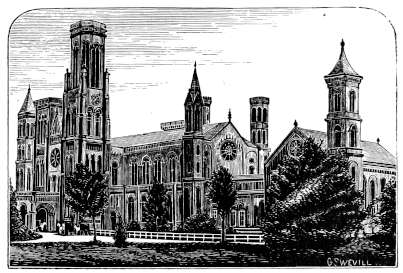
Strange Story of James Smithson—A Good Use of Money—Seeking the Diffusion of Knowledge—Catching a Tear from a Lady’s Cheek—Analysis of the Same Tear—A Brief Tract on Coffee-Making—James Smithson’s Will—Praiseworthy Efforts of Robert Dale Owen—The Bequest Accepted—The Plan of the Institution—Its Intent and Object—The Smithsonian Reservation—The Smithsonian Building—The Museum—Treasures of Art and Science—The Results of Thirty Government Expeditions—The Largest Collection in the World—Valuable Mineral Specimens—All the Vertebrated Animals of North America—Classified Curiosities—The Smithsonian Contributions—Its Advantages and Operations—Results—The Agricultural Bureau—Its Plan and Object—Collecting Valuable Agricultural Facts—Helping the Purchaser of a Farm—The Expenses of the Bureau—The Library—Nature-Printing—In the Museum—The Great California Plank—Vegetable Specimens,
OLD HOMES AND HAUNTS OF WASHINGTON—MEMORIES OF OTHER DAYS.
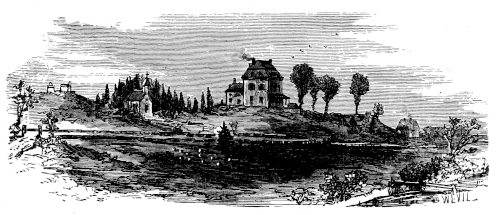
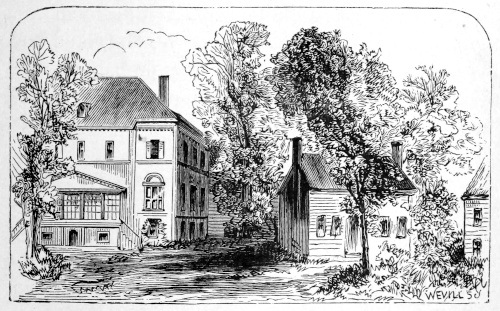
The Oldest Home in Washington—The Cottage of David Burns—David Burns’s Daughter—The Attractions of a Cottage—The Favored Suitor—How The Lady was Wooed and Won—Mother and Daughter—The Offering to God—A Costly Mausoleum—The Assassination Conspiracy—Persecuting the Innocent—The Octagon House—A Comfortable Income—The Pleasures of Property—A Haunted House—Apple-Stealing—“Departed Joys and Stomach-Aches”—The TragedyTragedy of the Decatur House—A Fatal Duel—The Stockton-Sickles House—A Spot of Frightful Interest—The Club-House—Assassination of Mr. Seward—Scenes of Festivity—The House of Charles Sumner—Corcoran Castle—The Finest Picture Gallery in America—Powers’ Greek Slave—“Maggie Beck”—During the War—The Romantic Story of Mr. Barlow’s Niece—Forgetting His Own Name—Locking Up a Wife—The “Ten Buildings”—Old Capitol Prison—The Deeds of Ann Royal and Sally Brass—“Paul Pry”—Blackmailing—Feared By All Mankind—An Unpleasant Sort of Woman—Arrested on Suspicion—Where Wirz was Hung,
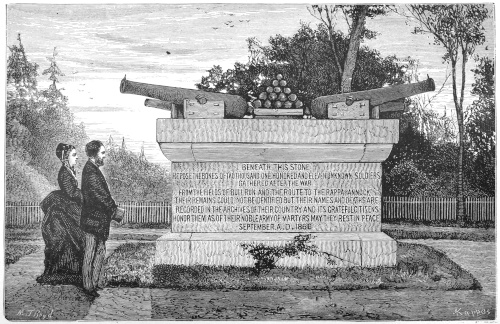
The Tomb of Washington—The Pilgrims who Visit it—Where George and Martha Washington Rest—The Thought of Other Graves—The Defenders of the Republic—Eating Boiled Eggs—A Butterfly Visit—Patriarchal Dogs—Remembering a Feast—The Room in which Washington Died—The Great Key of the Bastile—The Gift of Lafayette—Moralizing—Inside the Mansion—Uncle Tom’s Bouquets—Beautiful Scenery—Memorial Day at Arlington—The Soldiers’ Orphans—The Grave of Forty Soldiers—The Sacrifice of a Widow’s Son—The Record of the Brave—A National Prayer for the Dead,
THE LIFE AND CAREER OF JAMES A. GARFIELD, THE MARTYRED PRESIDENT.
The National Republican Convention of 1880—Nomination of James A. Garfield as President Hayes’s successor—The History of His Life—His Humble Home—Death of His Father—Hardship and Privations of Pioneer Life—Struggles of His Mother to Support the Family—Splitting Fence Rails with her own Hands—The Future President’s Early School Days—Working as a Carpenter—Chopping Wood for a Living—Leaving Home—Life as a Canal Boat Boy—Narrow Escapes—Beginning His Education in Earnest—School Life at Chester—How He Paid His Own Way—First Meeting with His Future Wife—Early Religious Experience—Enters Williams College—Professor and President—His First Appearance in Politics—His Brilliant Military Record—His Services at Shiloh, Corinth, and Chickamauga—His Congressional Career—Republican Leader of the House of Representatives—He is Elected to the United States Senate—His Appearance as the Leader of the Sherman Forces at the Chicago Convention—He is Himself Nominated amid the Wildest Enthusiasm—An Exciting Campaign—His Triumphant Election,
THE HISTORY OF THE ASSASSINATION AND DEATH OF PRESIDENT JAMES A. GARFIELD—THE GREAT TRAGEDY OF THE AGE.
Inauguration of President Garfield—Kissing His Venerable Mother—Chief Magistrate of Fifty Million People—Illness of Mrs. President Garfield—Tender Solicitude of the President for the Welfare of His Wife—She Goes to Long Branch—The President’s Plans to Meet Her—His Arrival at the Depot of the Baltimore and Potomac R. R. at Washington—His Buoyant Spirits—Joyous Anticipation of Meeting His Wife—The Assassin Lying in Wait—The Fatal Shot—Tremendous Excitement—The Wounded President—His Assassin, Charles J. Guiteau—Who He is—His Infamous Appearance and Character—His Cool Deliberation—His Capture and Imprisonment—A Thrill of Horror Throughout the Country—Removal of the President to the White House—Arrival of Mrs. Garfield—Her Courage and Devotion—The Fight for Life—Anxious Days—Removal of the Wounded President to Long Branch—A Remarkable Ride—Great Anxiety Throughout the Country—Fighting Death—Slowly Sinking—After Eighty Days of Unparalleled Suffering the President Breathes His Last—Grief and Gloom throughout the Land—The Whole Civilized World in Tears—Unprecedented Funeral and Memorial Honors—His Burial at Cleveland—Attendance of Two Hundred and Fifty Thousand People—His Life and Character Reviewed,
The Young Surveyor’s Dream—Humboldt’s View of Washington—A Vision
of the Future Capital—The United States Government on Wheels—Ambitious
Offers—The Rival Rivers—Potomac Wins—Battles in Congress—Patriotic
Offers of Territory—Temporary Lodgings for Eleven
Years—Old-Fashioned Simplicity—He Couldn’t Afford Furniture—A
Great Man’s Modesty—Conflicting Claims—Smith Backs Baltimore—A
Convincing Fact—The Dreadful Quakers—A Condescending Party—A
Slight Amendment—An Old Bill Brought to Light Again—The
Indian Place with the Long Name—Secession Threatened—The Future
Strangely Foreshadowed—A Dinner of Some Consequence—How it was
Done—Really a Stranger—A Nice Proposal—Sweetening the Pill—A
“Revulsion of Stomach”—Fixed on the Banks of the Potomac.
More than a century ago a young surveyor, Captain
of the Virginia troops, camped with Braddock’s
forces upon the hill now occupied by the Washington
Observatory, looked down as Moses looked from Nebo
upon the promised land, until he saw growing before his
prophetic sight the city of the future, the Capital of a
vast and free people then unborn. This youth was George
Washington. The land upon which he gazed was the undreamed
of site of the undreamed of city of the Republic,
then to be. This youth, ordained of God to be the Father
of the Republic, was the prophet of its Capital. He foresaw
it, he chose it, he served it, he loved it; but as a
Capital he never entered it.it.
22Gazing from the green promontory of Camp Hill,
what was the sight of land and water upon which the
youthful surveyor looked down? It was fair to see, so
fair that Humboldt declared after traveling around the
earth, that for the site of a city the entire globe does
not hold its equal. On his left rose the wooded hights
of Georgetown. On his right, the hills of Virginia
stretched outward toward the ocean. From the luxurious
meadows which zoned these hills, the Potomac
River—named by the Indians Cohonguroton, River of
Swans—from its source in the Alleghany Mountains,
flowing from north-west to south-west, here expanded
more than the width of a mile, and then in concentrated
majesty rolled on to meet Chesapeake Bay, the river
James, and the ocean. South and east, flowing to meet
it, came the beautiful Anacostin, now called Eastern
Branch, and on the west, winding through its picturesque
bluffs, ran the lovely Rock Creek, pouring its
bright waters into the Potomac, under the Hights of
Georgetown. At the confluence of these two rivers,
girdled by this bright stream, and encompassed by hills,
the young surveyor looked across a broad amphitheatre
of rolling plain, still covered with native oaks and undergrowth.
It was not these he saw. His prescient
sight forecast the future. He saw the two majestic
rivers bearing upon their waters ships bringing to these
green shores the commerce of many nations. He saw
the gently climbing hills crowned with villas, and in the
stead of oaks and undergrowth, broad streets, a populous
city, magnificent buildings, outrivaling the temples of
antiquity—the Federal City, the Capital of the vast Republic
yet to be! The dreary camp, the weary march,
23privation, cold, hunger, bloodshed, revolution, patient
victory at last, all these were to be endured, outlived,
before the beautiful Capital of his future was reached.
Did the youth foresee these, also? Many toiling, struggling,
suffering years bridged the dream of the young
surveyor and the first faint dawn of its fulfillment.
After the Declaration of Independence, before the adoption
of the Constitution of the United States, its government
moved slowly and painfully about on wheels. As
the exigencies of war demanded, Congress met at Philadelphia,
Baltimore, Lancaster, York, Princeton, Annapolis,
Trenton, and New York. During these troubled years
it was the ambition of every infant State to claim the
seat of government. For this purpose New York offered
Kingston; Rhode Island, Newport; Maryland, AnnapolisAnnapolis;
Virginia, Williamsburg.
June 21, 1783, Congress was insulted at Philadelphia
by a band of mutineers, which the State authorities could
not subdue. The body adjourned to Princeton; and the
troubles and trials of its itinerancy caused the subject of
a permanent national seat of government to be taken up
and discussed with great vehemence from that time till
the formation of the Constitution. The resolutions offered,
and the votes taken in these debates, indicate that
the favored site for the future Capital lay somewhere between
the banks of the Delaware and the Potomac—“near
Georgetown,” says the most oft-repeated sentence. October
30, 1784, the subject was discussed by Congress, at
Trenton. A long debate resulted in the appointment of
three commissioners, with full power to lay out a district
not exceeding three, nor less than two miles square, on
the banks of either side of the Delaware, for a Federal
24town, with power to buy soil and to enter into contracts
for the building of a Federal House, President’s house,
house for Secretaries, etc.
Notwithstanding the adoption of this resolution, these
Commissioners never entered upon their duties. Probably
the lack of necessary appropriations did not hinder
them more than the incessant attempts made to repeal
the act appointing the Commissioners, and to substitute
the Potomac for the Delaware, as the site of the anticipated
Capital. Although the name of President Washington
does not appear in these controversies, even then
the dream of the young surveyor was taking on in the
President’s mind the tangible shape of reality. First,
after the war for human freedom and the declaration of
national independence, was the desire in the heart of
George Washington that the Capital of the new Nation
whose armies he had led to triumph, should rise above
the soil of his native Dominion, upon the banks of the
great river where he had foreseen it in his early dream.
That he used undue influence with the successive Congresses
which debated and voted on many sites, not the
slightest evidence remains, and the nobility of his character
forbids the supposition. But the final decision attests
to the prevailing potency of his preferences and
wishes, and the immense pile of correspondence which
he has left behind on the subject, proves that next to the
establishment of its independence, was the Capital of the
Republic dear to the heart of George Washington. May
10, 1787, Massachusetts, New York, Virginia and Georgia
voted for, and New Jersey, Pennsylvania, Delaware and
Maryland against the proposition of Mr. Lee of Virginia,
that the Board of Treasury should take measures for
25erecting the necessary public buildings for the accommodation
of Congress, at Georgetown, on the Potomac River,
as soon as the soil and jurisdiction of said town could be
obtained.
Many and futile were the battles fought by the old
Congress, for the site of the future Capital. These battles
doubtless had much to do with Section 8, Article 1,
of the Constitution of the United States, which declares
that Congress shall have power to exercise exclusive legislation
in all cases whatsoever, over such district (not exceeding
ten miles square,) as may, by cession of particular
States and the acceptance of Congress, become the seat
of government of the United States. This article was
assented to by the convention which framed the Constitution,
without debate. The adoption of the Constitution
was followed spontaneously by most munificent acts on
the part of several States. New York appropriated its
public buildings to the use of the new government, and
Congress met in that city April 6, 1789. On May 15,
following, Mr. White from Virginia, presented to the
House of Representatives a resolve of the Legislature of
that State, offering to the Federal government ten miles
square of its territory, in any part of that State, which
Congress might choose as the seat of the Federal government.
The day following, Mr. Seney presented a
similar act from the State of Maryland. Memorials and
petitions followed in quick succession from Pennsylvania,
New Jersey and Maryland. The resolution of the Virginia
Legislature begged for the co-operation of Maryland,
offering to advance the sum of one hundred and
twenty thousand dollars to the use of the general government
toward erecting public buildings, if the Assembly
26of Maryland would advance two-fifths of a like sum.
Whereupon the Assembly of Virginia immediately voted
to cede the necessary soil, and to provide seventy-two
thousand dollars toward the erection of public buildings.
“New York and Pennsylvania gratuitously furnished elegant
and convenient accommodations for the government”
during the eleven years which Congress passed in their
midst, and offered to continue to do the same. The Legislature
of Pennsylvania went further in lavish generosity,
and voted a sum of money to build a house for the
President. The house which it built was lately the University
of Pennsylvania. The present White House is
considered much too old-fashioned and shabby to be the
suitable abode of the President of the United States. A
love of ornate display has taken the place of early Republican
simplicity. When George Washington saw the
dimensions of the house which the Pennsylvanians were
building for the President’s Mansion, he informed them
at once that he would never occupy it, much less incur
the expense of buying suitable furniture for it. In those
Spartan days it never entered into the head of the State
to buy furniture for the “Executive Mansion.” Thus the
Chief Citizen, instead of going into a palace like a satrap,
rented and furnished a modest house belonging to
Mr. Robert Morris, in Market street. Meanwhile the
great battle for the permanent seat of government went
on unceasingly among the representatives of conflicting
States. No modern debate, in length and bitterness, has
equalled this of the first Congress under the Constitution.
Nearly all agreed that New York was not sufficiently central.
There was an intense conflict concerning the relative
merits of Philadelphia and Germantown; Havre de
27Grace and a place called Wright’s Ferry, on the Susquehanna;
Baltimore on the Patapsco, and Connogocheague
on the Potomac. Mr. Smith proclaimed Baltimore, and
the fact that its citizens had subscribed forty thousand
dollars for public buildings. The South Carolinians cried
out against Philadelphia because of its majority of Quakers
who, they said, were eternally dogging the Southern
members with their schemes of emancipation. Many
others ridiculed the project of building palaces in the
woods. Mr. Gerry of Massachusetts declared that it was
the hight of unreasonableness to establish the seat of
government so far south that it would place nine States
out of the thirteen so far north of the National Capital;
while Mr. Page protested that New York was superior to
any place that he knew for the orderly and decent behavior
of its inhabitants, an assertion, sad to say, no
longer applicable to the city of New York.
September 5, 1789, a resolution passed the House of
Representatives “that the permanent seat of the government
of the United States ought to be at some convenient
place on the banks of the Susquehanna, in the State
of Pennsylvania.”Pennsylvania.” The passage of this bill awoke the
deepest ire in the members from the South. Mr. Madison
declared that if the proceedings of that day could
have been foreseen by Virginia, that State would never
have condescended to become a party to the Constitution.
Mr. Scott remarked truly: “The future tranquillity and
well being of the United States depended as much on
this as on any question that ever had or ever could come
before Congress;” while Fisher Ames declared that every
principle of pride and honor, and even of patriotism, was
engaged in the debate.
28The bill passed the House by a vote of thirty-one to
nineteen. The Senate amended it by striking out “Susquehanna,”
and inserting a clause making the permanent
seat of government Germantown, Pennsylvania, provided
the State of Pennsylvania should give security to pay
one hundred thousand dollars for the erection of public
buildings. The House agreed to these amendments.
Both Houses of Congress agreed upon Germantown as
the Capital of the Republic, and yet the final passage of
the bill was hindered by a slight amendment.
June 28, another old bill was dragged forth and
amended by inserting “on the River Potomac, at some
place between the mouths of the Eastern Branch and
the Connogocheague.” This was finally passed, July 16,
1790, entitled “An Act establishing the temporary and
permanent seat of the government of the United States.”
The word temporary applied to Philadelphia, whose disappointment
in not becoming the final Capital was to be
appeased by Congress holding their sessions there till
1800, when, as a member expressed it, “they were to
go to the Indian place with the long name, on the
Potomac.”
Human bitterness and dissension were even then rife
in both Houses of Congress. The bond which bound
the new Union of States together was scarcely welded,
and yet secession already was an openly uttered threat.
An amendment had been offered to the funding act, providing
for the assumption of the State debts to the amount
of twenty-one millions, which was rejected by the House.
The North favored assumption and the South opposed it.
Just then reconciliation and amity were brought about
between the combatants precisely as they often are in
29our own time, over a well-laid dinner table, and a bottle
of rare old wine. Jefferson was then Secretary of
State, and Alexander Hamilton, Secretary of the Treasury.
Hamilton thought that the North would yield and
consent to the establishment of the Capital on the Potomac,
if the South would agree to the amendment to assume
the State debts. Jefferson and Hamilton met accidentally
in the street, and the result of their half an
hour’s walk “backward and forward before the President’s
door” was the next day’s dinner party, and the final,
irrevocable fixing of the National Capital on the banks
of the Potomac. How it was done, as an illustration of
early legislation, which has its perfect parallel in the legislation
of the present day, can best be told in Jefferson’s
own words, quoted from one of his letters. He says:
“Hamilton was in despair. As I was going to the President’s
one day I met him in the street. He walked me
backward and forward before the President’s door for
half an hour. He painted pathetically the temper into
which the legislature had been wrought; the disgust of
those who were called the creditor States; the danger of
the secession of their members, and the separation of the
States. He observed that the members of the administration
ought to act in concert ... that the President
was the centre on which all administrative questions
finally rested; that all of us should rally around him
and support by joint efforts measures approved by him,
... that an appeal from me to the judgment and discretion
of some of my friends might effect a change in
the vote, and the machine of government now suspended,
might be again set in motion. I told him that I was
really a stranger to the whole subject, not having yet
30informed myself of the system of finance adopted ...
that if its rejection endangered a dissolution of our Union
at this incipient stage, I should deem that the most
unfortunate of all consequences, to avert which all partial
and temporary evils should be yielded.
“I proposed to him, however, to dine with me the next
day, and I would invite another friend or two, bring them
into conference together and I thought it impossible that
reasonable men, consulting together coolly, could fail by
some mutual sacrifices of opinion to form a compromise
which was to save the Union. The discussion took place....
It was finally agreed to, that whatever importance
had been attached to the rejection of this proposition,
the preservation of the Union and of concord among the
States was more important, and that therefore it would
be better that the vote of rejection should be rescinded
to effect which some members should change their votes.
But it was observed that this pill would be peculiarly
bitter to Southern States, and that some concomitant measure
should be adopted to sweeten it a little to them. There
had before been a proposition to fix the seat of government
either at Philadelphia or Georgetown on the Potomac,
and it was thought that by giving it to Philadelphia
for ten years, and to Georgetown permanently afterward,
this might, as an anodyne, calm in some degree the ferment
which might be excited by the other measure alone.
So two of the Potomac members, [White and Lee,] but
White with a revulsion of stomach almost convulsive,
agreed to change their votes, and Hamilton agreed to
carry the other point ... and so the assumption was
passed,” and the permanent Capital fixed on the banks
of the Potomac.
CHAPTER II. CROSS PURPOSES AND QUEER SPECULATIONS.
31
Born of Much Bother—Long Debates and Pamphlets—Undefined Apprehensions—Debates
on the Coming City—Old World Examples—Sir
James Expresses an Opinion—A Dream of the Distant West—An Old-time
Want—A Curious Statement of Fact—“Going West”—Where is
the Centre of Population—An Important Proclamation—Original Land
Owners—Well-worn Patents—Getting on with Pugnacious Planters—Obstinate
David Burns—A “Widow’s Mite” of Some Magnitude—How
the Scotchman was Subjugated—“If You Hadn’t Married the
Widow Custis”—A Rather “Forcible Argument”—His Excellency
“Chooses”—The First Record in Washington—Old Homes and Haunts—Purchase
of Land—Extent of the City.
As we have seen, the Federal City was the object of
George Washington’s devoted love long before its
birth. It was born through much tribulation. First
came the long debates and pamphlets of 1790, as to
whether the seat of the American government should
be a commercial capital. Madison and his party argued
that the only way to insure the power of exclusive legislation
to Congress as accorded by the Constitution, was
to remove the Capital as far from commercial interests as
possible. They declared that the exercise of this authority
over a large mixed commercial community would be
impossible. Conflicting mercantile interests would cause
constant political disturbances, and when party feelings
ran high, or business was stagnant, the commercial capital
would swarm with an irritable mob brim full of
wrongs and grievances. This would involve the necessity
of an army standing in perpetual defense of the
32capital. London and Westminster were cited as examples
where the commercial importance of a single city
had more influence on the measures of government than
the whole empire outside. Sir James Macintosh was
quoted, wherein he said “that a great metropolis was to
be considered as the heart of a political body—as the
focus of its powers and talents—as the direction of public
opinion, and, therefore, as a strong bulwark in the
cause of freedom, or as a powerful engine in the hands
of an oppressor.” To prevent the Capital of the Republic
becoming the latter the Constitution deprived it
of the elective franchise. The majority in Congress opposed
the idea of a great commercial city as the future
Capital of the country. Nevertheless when a plan for
the city was adopted it was one of exceptional magnificence.
It was a dream of the founders of the Capital
to build a city expressly for its purpose and to build it
for centuries to come. In view of the vast territory now
comprehended in the United States their provision for
the future may seem meagre and limited. But when we
remember that there were then but thirteen States, that
railroads and telegraphs were undreamed of as human
possibilities—that nearly all the empire west of the Potomac
was an unpenetrated wilderness, we may wonder
at their prescience and wisdom, rather than smile at their
lack of foresight. Even in that early and clouded morning
there were statesmen who foresaw the later glory of
the West fore-ordained to shine on far off generations.
Says Mr. Madison: “If the calculation be just that we
double in fifty years we shall speedily behold an astonishing
mass of people on the western waters....
The swarm does not come from the southern but from
33the northern and eastern hives. I take it that the centre
of population will rapidly advance in a south-westerly direction.
It must then travel from the Susquehanna if it is
now found there—it may even extend beyond the Potomac!”
Said Mr. Vining to the House, “I confess I am in favor
of the Potomac. I wish the seat of government to be
fixed there because I think the interest, the honor, and
the greatness of the country require it. From thence, it
appears to me, that the rays of government will naturally
diverge to the extremities of the Union. I declare that
I look upon the western territories from an awful and
striking point of view. To that region the unpolished
sons of the earth are flowing from all quarters—men to
whom the protection of the laws and the controlling
force of the government are equally necessary.”
In the course of the debate Mr. Calhoun called attention
to the fact that very few seats of government in the
world occupied central positions in their respective countries.
London was on a frontier, Paris far from central,
the capital of Russia near its border. Even at that early
date comparatively small importance was attached to a
geographical centre of territory as indispensable to the
location of its capital. The only possible objection to a
capital near the sea-board was then noted by Mr. Madison
who said, “If it were possible to promulgate our laws by
some instantaneous operation, it would be of less consequence
where the government might be placed,” a possibility
now fulfilled by the daily news from the Capital
which speeds to the remotest corner of the great land not
only with the swiftness of lightning but by lightning itself.
Although the States have more than doubled since the
days of this first discussion on where the Capital of the
34United States should be, it is a curious fact that the centre
of population has not traveled westward in any proportionate
ratio. According to a table calculated by Dr.
Patterson of the United States mint, in 1840 the centre
of population was then in Harrison County, Virginia, one
hundred and seventy-five miles west of the city of Washington.
At that time the average progress westward since
1790 had been, each ten years, thirty-four miles. “This
average has since increased, but if it be set down at fifty
miles, it will require a century to carry this centre five
hundred miles west of Washington, or as far as the city
of Nashville, Tennessee.” I state this fact for the benefit
of crazy capital-movers who are in such haste to set the
Capital of the Nation in the centre of the Continent.
I have given but a few of the questions which were
discussed in the great debates which preceded the final locating
of the Capital on the banks of the Potomac. They
are a portion of its history, and deeply interesting in their
bearing on the present and future of the Capital city.
The long strife ended in the amendatory proclamation
of President Washington, done at Georgetown the 30th
day of March, in the year of our Lord 1791, and of the
independence of the United States the fifteenth, which
concluded with these words: “I do accordingly direct
the Commissioners named under the authority of the
said first mentioned act of Congress to proceed forthwith
to have the said four lines run, and by proper metes and
bounds defined and limited, and thereof to make due report
under their hands and seals; and the territory so to
be located, defined and limited shall be the whole territory
accepted by the said act of Congress as the district
for the permanent seat of the government of the United
35States.” Maryland had ceded of her land ten miles square
for the future Capital. Nothing seemed easier than for
these three august commissioners, backed by the powerful
Congress, to go and take it. But it was not so easy
to be done. In addition to the State of Maryland the
land belonged to land-holders, each one of whom was a
lord on his own domain. Some of these held land patents
still extant, dating back to 1663, and 1681. These
lords of the manor were not willing to be disturbed even
for the sake of a future Capital, and displayed all the irascibility
and tenacity regarding price which characterize
land-holders of the present day. If we may judge from
results and the voluminous correspondence concerning
it, left by George Washington, the three commissioners
who were to act for the government did not “get on”
very well with the pugnacious planters who were ready
to fight for their acres—and that the greater part of the
negotiating for the new city finally fell to the lot of the
great Executive. One of the richest and most famous
of these land-owners was David Burns. He owned an
immense tract of land south of where the president’s
house now stands, extending as far as the Patent Office
called in the land patent of 1681 which granted it, “the
Widow’s Mite, lyeing on the east side of the Anacostin
River, on the north side of a branch or inlett in the said
river, called Tyber.” This “Widow’s Mite” contained six
hundred acres or more, and David Burns was in no wise
willing to part with any portion of it. Although it laid
within the territory of Columbia, ceded by the act of
Maryland for the future Capital, no less a personage than
the President of the United States could move one whit
David Burns, and even the President found it to be no
36easy matter to bring the Scotchman to terms. More
than once in his letters he alludes to him as “the obstinate
Mr. Burns,” and it is told that upon one occasion
when the President was dwelling upon the advantage
that the sale of his lands would bring, the planter, testy
Davy, exclaimed: “I suppose you think people here
are going to take every grist that comes from you as
pure grain, but what would you have been if you hadn’t
married the widow Custis.”
After many interviews and arguments even the patience
of Washington finally gave out and he said:
“Mr. Burns, I have been authorized to select the location
of the National Capital. I have selected your farm
as a part of it, and the government will take it at all
events. I trust you will, under these circumstances,
enter into an amicable arrangement.”
Seeing that further resistance was useless, the shrewd
Scotchman thought that by a final graceful surrender he
might secure more favorable terms, thus, when the President
once more asked: “On what terms will you surrender
your plantation?” Said humble Davy: “Any
that your Excellency may choose to name.” The deed
conveying the land of David Burns to the commissioners
in trust, is the first on record in the city of Washington.
This sale secured to David Burns and his descendants an
immense fortune. The deed provided that the streets of
the new city should be so laid out as not to interfere with
the cottage of David Burns. That cottage still stands in
famous “Mansion Square,” and the reader will find its
story further on in the chapter devoted to the Old Homes
and Haunts of Washington. The other original owners of
the soil on which the city of Washington was built were
37Notley Young, who owned a fine old brick mansion near
the present steamboat landing, and Daniel Carroll, whose
spacious abode known as the Duddington House, still
stands on New Jersey Avenue, a little south-east of the
Capitol. On the 31st of May, Washington wrote to Jefferson
from Mount Vernon, announcing the conclusion of
his negotiations in this wise—the owners conveyed all
their interest to the United States on consideration that
when the whole should be surveyed and laid off as a
city the original proprietors should retain every other
lot. The remaining lots to be sold by the government
from time to time and the proceeds to be applied toward
the improvement of the place. The land comprised within
this agreement contains over seventy-one hundred acres.
The city extends from north-west to south-east about four
miles and a half, and from east to south-west about two
miles and a half. Its circumference is fourteen miles,
the aggregate length of the streets is one hundred and
ninety-nine miles, and of the avenues sixty-five miles.
The avenues, streets and open spaces contain three thousand
six hundred and four acres, and the public reservations
exclusive of reservations since disposed of for private
purposes, five hundred and thirteen acres. The
whole area of the squares of the city amounts to one
hundred and thirty-one million, six hundred and eighty-four
thousand, one hundred and seventy-six square feet,
or three thousand and sixteen acres. Fifteen hundred
and eight acres were reserved for the use of the United
States.
CHAPTER III. THE WORK BEGUN IN EARNEST.
38
Washington’s Faith in the Future—Mr. Sparks is “inclined to think”—A
Slight Miscalculation—Theoretical Spartans—Clinging to Old World
Glories—Jefferson Acts the Critic—He Communicates Some Ideas—Models
of Antiquity—Babylon Revived—Difficulty in Satisfying a
Frenchman’s Soul—The Man who Planned the Capital—Who was
L’Enfant?—His Troubles—His Dismissal—His Personal Appearance,
Old Age, Death and Burial-Place—His Successor—The French Genius
“Proceeded”—The New City of Washington—A Magnificent Plan—All
About the City—The Major not Appreciated—“Getting on Badly”—L’Enfant
Worries Washington—A Record which Can Never Perish—An Overpaid
Quaker—Jefferson Expresses his Sentiments—A Sable Franklin—The
Negro Engineer, Benjamin Bancker—A Chance for a Monument.
The majority of Congress were opposed to a commercial
Capital, yet there are many proofs extant that
to the hour of his death George Washington cherished
the hope that the new city of his love would be not
only the capital of the nation, but a great commercial
metropolis of the world. Mr. Jared Sparks, the historian,
in a private letter says: “I am inclined to think
that Washington’s anticipations were more sanguine than
events have justified. He early entertained very large
and just ideas of the vast resources of the West, and of
the commercial intercourse that must spring up between
that region and the Atlantic coast, and he was wont to
regard the central position of the Potomac as affording
the most direct and easy channel of communication.
39Steamboats and railroads have since changed the face of
the world, and have set at defiance all the calculations
founded on the old order of things; and especially have
they operated on the destiny of the West and our entire
system of internal commerce, in a manner that could not
possibly have been foreseen in the life-time of Washington.”
Throughout the correspondence of Washington
are scattered constant allusions to the future magnificence
of the Federal City, the name by which he loved
to call the city of his heart, allusions which show that
his faith in its great destiny never faltered. In a letter
to his neighbor, Mrs. Fairfax, then in England, he said:
“A century hence, if this country keeps united, it will
produce a city, though not as large as London, yet of a
magnitude inferior to few others in Europe.” At that
time, after a growth of centuries, London contained eight
hundred thousand inhabitants. Three-fourths of Washington’s
predicted century have expired, and the city of
Washington now numbers one hundred and fifty thousand
people.
The founders of the Capital were all very republican
in theory, and all very aristocratic in practice. In speech
they proposed to build a sort of Spartan capital, fit for a
Spartan republic; in fact, they proceeded to build one
modeled after the most magnificent cities of Europe.
European by descent and education, many of them allied
to the oldest and proudest families of the Old World,
every idea of culture, of art, and magnificence had come
to them as part of their European inheritance, and we
see its result in every thing that they did or proposed to
do for the new Capital which they so zealously began to
build in the woods. The art-connoisseur of the day was
40Jefferson. He knew Europe, not only by family tradition
but by sight. Next to Washington he took the
deepest personal interest in the projected Capital. Of
this interest we find continual proof in his letters, also of
the fact that his taste had much to do with the plan and
architecture of the coming city. In a letter to Major
L’Enfant, the first engineer of the Capital, dated Philadelphia,
April 10, 1791, he wrote: “In compliance with
your request, I have examined my papers and found the
plans of Frankfort-on-the-Main, Carlsruhe, Amsterdam,
Strasburg, Paris, Orleans, Bordeaux, Lyons, Montpelier,
Marseilles, Turin, and Milan, which I send in a roll by
post. They are on large and accurate scales, having
been procured by me while in those respective cities myself....
Having communicated to the President before
he went away, such general ideas on the subject of the
town as occurred to me, I have no doubt in explaining
himself to you on the subject, he has interwoven with his
own ideas such of mine as he approved.... Whenever
it is proposed to present plans for the Capital, I
should prefer the adoption of some one of the models of
antiquity, which have had the approbation of thousands
of years; and for the president’s house I should prefer
the celebrated fronts of modern buildings, which have
already received the approbation of good judges. Such
are Galerie du Louise, the Gardes Meubles, and two
fronts of the Hotel de Salm.” On the same day he
writes to Washington: “I received last night from
Major L’Enfant a request to furnish any plans of towns
I could for examination. I accordingly send him by this
post, plans of Frankfort-on-the-Main, etc., which I procured
while in those towns respectively. They are none
41of them, however, comparable to the old Babylon revived
in Philadelphia and exemplified.” But these two fathers
of their country, as time proved, “did not know their
man.” Had they done so, they would have known in
advance that a mercurial Frenchman would never attempt
to satisfy his soul with acute angles of old Babylon
revived through the arid and level lengths of Philadelphia.
The man who planned the Capital of the United States
not for the present but for all time, was Peter Charles
L’Enfant, born in France in 1755. He was a lieutenant
in the French provincial forces, and with others of his
countrymen was early drawn to these shores by the magnetism
of a new people, and the promise of a new land.
He offered his services to the revolutionary army as an engineer,
in 1777, and was appointed captain of engineers
February 18, 1778. After being wounded at the siege of
Savannah, he was promoted to major of engineers, and
served near the person of Washington. Probably at that
time there was no man in America who possessed so much
genius and art-culture in the same directions as Major
L’Enfant. In a crude land, where nearly every artisan
had to be imported from foreign shores, the chief
designer and architect surely would have to be. Thus
we may conclude at the beginning, it seemed a lucky
circumstance to find an engineer for the new city on the
spot.
The first public communication extant concerning the
laying out of the city of Washington is from the pen of
General Washington, dated March 11, 1791. In a letter
dated April 30, 1791, he first called it the Federal City.
Four months later, without his knowledge, it received
42its present name in a letter from the first commissioners,
Messrs. Johnson, Stuart, and Carroll, which bears the
date of Georgetown, September 9, 1791, to Major L’Enfant,
which informs that gentleman that they have
agreed that the federal district shall be called The Territory
of Columbia, (its present title,) and the federal
city the city of Washington, directing him to entitle
his map accordingly.
In March, 1791, we find Jefferson addressing Major
L’Enfant in these words: “You are desired to proceed
to Georgetown, where you will find Mr. Ellicott employed
in making a survey and map of the federal
territory. The special object of asking your aid is to
have the drawings of the particular grounds most likely
to be approved for the site of the federal grounds and
buildings.”
The French genius “proceeded,” and behold the result,
the city of “magnificent distances,” and from the beginning
of magnificent intentions,—intentions which almost
to the present hour, have called forth only ridicule—because
in the slow mills of time their fulfillment has been
so long delayed. As Thomas Jefferson wanted the chessboard
squares and angles of Philadelphia, L’Enfant used
them for the base of the new city, but his genius avenged
itself for this outrage on its taste by transversing them
with sixteen magnificent avenues, which from that day
to this have proved the confusion and the glory of the
city. French instinct diamonded the squares of Philadelphia
with the broad corsos of Versailles, as Major
L’Enfant’s map said, “to preserve through the whole a
reciprocity of sight at the same time.”
A copy of the Gazette of the United States, published
43in Philadelphia, January 4, 1792, gives us the original
magnificent intentions of the first draughtsman of the
new city of Washington.
The following description is annexed to the plan of the city
of Washington, in the District of Columbia, as sent to Congress
by the President some days ago:
PLAN OF THE CITY INTENDED AS THE PERMANENT SEAT OF THE GOVERNMENT
OF THE UNITED STATES, PROJECTED AGREEABLY TO THE
DIRECTION OF THE PRESIDENT OF THE UNITED STATES IN PURSUANCE
OF AN ACT OF CONGRESS, PASSED ON THE 16TH OF JULY,
1790, “ESTABLISHING A PERMANENT SEAT ON THE BANKS OF THE
POTOMACK.”
BY PETER CHARLES L’ENFANT.
OBSERVATIONS EXPLANATORY OF THE PLAN.
I. The positions of the different grand edifices, and for the
several grand squares or areas of different shapes as they are
laid down, were first determined on the most advantageous
ground, commanding the most extensive prospects, and the
better susceptible of such improvements as the various interests
of the several objects may require.
II. Lines or avenues of direct communication have been devised
to connect the separate and most distant objects with the
principals, and to preserve throughout the whole a reciprocity
of sight at the same time. Attention has been paid to the passing
of those leading avenues over the most favorable ground for
prospect and convenience.
III. North and south lines, intersected by others running
due east and west, make the distribution of the city into streets,
squares, &c., and those lines have been so combined as to meet
at certain points with those diverging avenues so as to form on
the spaces “first determined,” the different squares or areas
which are all proportioned in magnitude to the number of avenues
leading to them.
44MR. ELLICOTT “DOES BUSINESS.”
Every grand transverse avenue, and every principal divergent
one, such as the communication from the President’s house to
the Congress house, &c., are 160 feet in breadth and thus
divided:
Ten feet for pavement on each side, is
20
feet
Thirty feet of gravel walk, planted with trees on each side,
60
feet
Eighty feet in the middle for carriages,
80
feet
160
feet
The other streets are of the following dimensions, viz.:
Those leading to the public buildings or markets,
130
Others,
110-90
In order to execute the above plan, Mr. Ellicott drew a true
meridian line by celestial observation, which passes through
area intended for the Congress house. This line he crossed by
another due east and west, and which passes through the same
area. The lines were accurately measured, and made the basis
on which the whole plan was executed. He ran all the lines by
a transit instrument, and determined the acute angles by actual
measurement, and left nothing to the uncertainty of the compass.
REFERENCES.
A. The equestrian figure of George Washington, a monument
voted in 1783 by the late Continental Congress.
B. An historic column—also intended for a mile or itinerary
column, from whose station, (at a mile from the Federal House,)
all distances and places through the Continent are to be calculated.
C. A Naval itinerary column proposed to be erected to celebrate
the first rise of a navy, and to stand a ready monument to
perpetuate its progress and achievements.
45D. A church intended for national purposes, such as public
prayers, thanksgivings, funeral orations, &c., and assigned to
the special use of no particular sect or denomination, but equally
open to all. It will likewise be a proper shelter for such monuments
as were voted by the late Continental Congress for those
heroes who fell in the cause of liberty, and for such others as
may hereafter be decreed by the voice of a grateful nation.
E. E. E. E. E. Five grand fountains intended with a constant
spout of water.
N. B. There are within the limits of the springs twenty-five
good springs of excellent water abundantly supplied in the driest
seasons of the year.
F. A grand cascade formed of the waters of the sources of
the Tiber.
G. G. Public walk, being a square of 1,200 feet, through
which carriages may ascend to the upper square of the Federal
House.
H. A grand avenue, 400 feet in breadth and about a mile in
length, bordered with gardens ending in a slope from the house
on each side; this avenue leads to the monument A, and connects
the Congress garden with the
I. President’s park and the
K. Well improved field, being a part of the walk from the
President’s House of about 1,800 feet in breadth and three-fourths
of a mile in length. Every lot deep colored red, with
green plats, designating some of the situations which command
the most agreeable prospects, and which are best calculated for
spacious houses and gardens, such as may accommodate foreign
ministers, &c.
L. Around this square and along the
M. Avenue from the two bridges to the Federal House, the
pavements on each side will pass under an arched way, under
whose cover shops will be most conveniently and agreeably
situated. This street is 106 feet in breadth, and a mile long.
The fifteen squares colored yellow are proposed to be divided
among the several States of the Union, for each of them to improve,
46or subscribe a sum additional to the value of the land for
that purpose, and the improvements around the squares to be
completed in a limited time. The centre of each square will
admit of statues, columns, obelisks, or any other ornaments,
such as the different States may choose to erect, to perpetuate
not only the memory of such individuals whose councils or military
achievements were conspicuous in giving liberty and independence
to this country, but those whose usefulness hath
rendered them worthy of imitation, to invite the youth of succeeding
generations to tread in the paths of those sages or heroes
whom their country have thought proper to celebrate.
The situation of those squares is such that they are most
advantageously seen from each other, and as equally distributed
over the whole city district, and connected by spacious avenues
round the grand federal improvements and as contiguous to
them, and at the same time as equally distant from each other
as circumstances would admit. The settlements round these
squares must soon become connected. The mode of taking
possession of and improving the whole district at first must
leave to posterity a grand idea of the patriotic interest which
promoted it.
Two months after the publication of those magnificent
designs for posterity, Major L’Enfant was dismissed from
his exalted place. He was a Frenchman and a genius.
The patrons of the new Capital were not geniuses, and
not Frenchmen, reasons sufficient why they should not
and did not “get on” long in peace together. Without
doubt the Commissioners were provincial, and limited in
their ideas of art and of expenditure; with their colonial
experience they could scarcely be otherwise; while L’Enfant
was metropolitan, splendid, and willful, in his ways
as well as in his designs. Hampered, held back, he yet
“builded better than he knew,” builded for posterity.
The executor and the designer seldom counterpart each
47other. L’Enfant worried Washington, as a letter from
the latter, written in the autumn of 1791, plainly shows.
He says: “It is much to be regretted that men who
possess talents which fit them for peculiar purposes
should almost invariably be under the influence of an
untoward disposition.... I have thought that for
such employment as he is now engaged in for prosecuting
public works and carrying them into effect, Major
L’Enfant was better qualified than any one who
has come within my knowledge in this country, or indeed
in any other. I had no doubt at the same time
that this was the light in which he considered himself.”
At least, L’Enfant was so fond of his new “plan” that he
would not give it up to the Commissioners to be used as
an inducement for buying city lots, even at the command
of the President, giving as a reason that if it was open
to buyers, speculators would build up his beloved avenues
(which he intended, in time, should outrival Versailles)
with squatter’s huts—just as they afterwards did. Then
Duddington House, the abode of Daniel Carroll, was in
the way of one of his triumphal avenues, and he ordered
it torn down without leave or license, to the rage of its
owner and the indignation of the Commissioners. Duddington
House was rebuilt by order of the government in
another place, and stands to-day a relic of the past amid its
old forest trees on Capitol Hill. Nevertheless its first demolition
was held as one of the sins of the uncontrollable
L’Enfant, who was summarily discharged March 6, 1792.
His dismissal was thus announced by Jefferson in a letter
to one of the Commissioners: “It having been found impracticable
to employ Major L’Enfant about the Federal
City in that degree of subordination which was lawful
48and proper, he has been notified that his services are at
an end. It is now proper that he should receive the reward
of his past services, and the wish that he should
have no just cause of discontent suggests that it should
be liberal. The President thinks of $2,500, or $3,000,
but leaves the determination to you.” Jefferson wrote
in the same letter: “The enemies of the enterprise will
take the advantage of the retirement of L’Enfant to
trumpet the whole as an abortion.” But L’Enfant lived
and died within sight of the dawning city of his love
which he had himself created—and never wrought it, or
its projectors any harm through all the days of his life.
He was loyal to his adopted government, but to his last
breath clung to every atom of his personal claim upon it,
as pugnaciously as he did to his maps, when commanded to
give them up. He lived without honor, and died without
fame. Time will vindicate one and perpetuate the other
in one of the most magnificent capitals of earth. His
living picture lingers still with more than one old inhabitant.
One tells of him in an unchangeable “green surtout,
walking across the commons and fields, followed by
half-a-dozen hunting dogs.” Also, of reporting to him at
Port Washington in 1814 to do duty, and of first receiving
a glass of wine from the old soldier-architect and engineer
before he told him what to do. Mr. Corcoran, the
banker, tells how L’Enfant looked in his latter days: “a
rather seedy, stylish old man, with a long blue or green
coat buttoned up to his throat, and a bell-crowned hat;
a little moody and lonely, like one wronged.”
COLUMBIA SLAVE PEN. FREEDMAN’S SAVINGS BANK.
SMITHSONIAN INSTITUTE.
MAJOR L’ENFANT’S RESTING PLACE.
He lived for many years on the Digges’ farm, the estate
now owned by George Riggs, the banker, situated about
eight miles from Washington. He was buried in the
49family burial-ground, in the Digges’ garden. When the
Digges family were disinterred, his dust was left nearly
alone. There it lies to-day, and the perpetually growing
splendor of the ruling city which he planned, is his only
monument.
He was succeeded by Andrew Ellicott, a practical engineer,
born in Buck’s County, Pennsylvania. He was
called a man of “uncommon talent” and “placid temper.”
Neither saved him from conflicts, (though of a
milder type than L’Enfant’s,) with the Commissioners.
A Quaker, he yet commanded a battalion of militia in
the Revolution, and “was thirty-seven years of age when
he rode out with Washington to survey the embryo city.”
He finished, (with certain modifications,) the work which
L’Enfant began. For this he received the stupendous
sum of $5.00 per day which, with “expenses,” Jefferson
thought to be altogether too much. In his letter to the
Commissioners dismissing L’Enfant, he says: “Ellicott is
to go on to finish laying off the plan on the ground, and
surveying and plotting the district. I have remonstrated
with him on the excess of five dollars a day and his expenses,
and he has proposed striking off the latter.”
After Ellicott concluded laying out the Capital, he became
Surveyor-General of the United States; laid out
the towns of Erie, Warren and Franklin, in Pennsylvania,
and built Fort Erie. He defined the boundary dividing
the Republic from the Spanish Possessions; became
Secretary of the Pennsylvania Land Office, and in 1812
Professor of Mathematics at West Point, where he died
August, 1820, aged 66.
Ellicott’s most remarkable assistant was Benjamin
Bancker, a negro. He was, I believe, the first of his
50race to distinguish himself in the new Republic. He was
born with a genius for mathematics and the exact sciences,
and at an early age was the author of an Almanac,
which attracted the attention and commanded the praise
of Thomas Jefferson. When he came to “run the lines”
of the future Capital, he was sixty years of age. The
caste of color could not have grown to its hight at that
day, for the Commissioners invited him to an official seat
with themselves, an honor which he declined. The picture
given us of him is that of a sable Franklin, large,
noble, and venerable, with a dusky face, white hair, a
drab coat of superfine broadcloth, and a Quaker hat.
He was born and buried at Ellicott’s Mills, where his
grave is now unmarked. Here is a chance for the rising
race to erect a monument to one of their own sons, who
in the face of ignorance and bondage proved himself
“every inch a man,” in intellectual gifts equal to the
best.
CHAPTER IV. OLD WASHINGTON.
51
How the City was Built—“A Matter of Moonshine”—Calls for Paper—Besieging
Congressmen—How they Raised the Money—The Government
Requires Sponsors—Birth of the Nation’s Capital—Seventy Years Ago
in Washington—Graphic Picture of Early Times—A Much-Marrying
City—Unwashed Virginian Belles—Stuck in the Mud—Extraordinary
Religious Services.
Nothing in the architecture of the city of Washington
calls forth more comment from strangers
than the distance between the Capitol and the Executive
Departments. John Randolph early called it “the city
of magnificent distances,” and it is still a chronic and
fashionable complaint to decry the time and distance it
takes to get any where. In the days of a single stage
line on Pennsylvania Avenue, these were somewhat lamentable.
But five-minute cars abridge distances, and
make them less in reality than even in the city of New
York. It is a mile and a half from the northern end of
the Navy-yard bridge to the Capitol, a mile and a half
from the Capitol to the Executive Mansion, and a mile
and a half from the Executive Mansion to the corner of
Bridge and High Streets, Georgetown. We are constantly
hearing exclamations of what a beautiful city
Washington would be with the Capitol for the centre of
a square formed by a chain of magnificent public buildings.
John Adams wanted the Departments around the
52Capitol. George Washington but a short time before his
death, gave in a letter the reasons for their present position.
In going through his correspondence one finds that
there is nothing, scarcely, in the past, present or future
of its Capital, for which the Father of his Country has
not left on record a wise, far-reaching reason. In this
letter, he says: “Where or how the houses for the
President, and the public offices may be fixed is to me,
as an individual, a matter of moonshine. But the reverse
of the President’s motive for placing the latter
near the Capitol was my motive for fixing them by the
former. The daily intercourse which the secretaries of
departments must have with the President would render
a distant situation extremely inconvenient to them, and
not much less so would one be close to the Capitol; for
it was the universal complaint of them all, that while
the Legislature was in session, they could do little or no
business, so much were they interrupted by the individual
visits of members in office hours, and by calls for paper.
Many of them have disclosed to me that they have been
obliged often to go home and deny themselves in order
to transact the current business.” The denizen of the
present time, who knows the Secretaries’ dread of the
average besieging Congressman, will smile to find that
the dread was as potent in the era of George Washington
as it is to-day. A more conclusive reason could not
be given why Capitol and Departments should be a
mile apart. The newspapers of that day were filled
with long articles on the laying out of the Capital city.
We find in a copy of The Philadelphia Herald of January
4, 1795, after a discussion of the Mall—the yet-to-be garden
extending from the Capitol to the President’s house—the
53following far-sighted remarks on the creation of the
Capital. It says: “To found a city, for the purpose of
making it the depository of the acts of the Union, and
the sanctuary of the laws which must one day rule all
North America, is a grand and comprehensive idea, which,
has already become, with propriety, the object of public
respect. The city of Washington, considered under such
important points of view, could not be calculated on a
small scale; its extent, the disposition of its avenues and
public squares should all correspond with the magnitude
of the objects for which it was intended. And we need
only cast our eyes upon the situation and plan of the
city to recognize in them the comprehensive genius of
the President, to whom the direction of the business has
been committed by Congress.”
The letters of Washington are full of allusions to the
annoyance and difficulty attending the raising of sufficient
money to make the Capitol and other public buildings
tenantable by the time specified, 1800. He seemed
to regard the prompt completion of the Capitol as an
event identical with the perpetual establishment of the
government at Washington. Virginia had made a donation
of $120,000, and Maryland one of $72,000; these
were now exhausted. After various efforts to raise
money by the forced sales of public lots, and after abortive
attempts to borrow money, at home and abroad, on
the credit of these lots, amidst general embarrassments,
while Congress withheld any aid whatever, the urgency
appeared to the President so great as to induce him to
make a personal application to the State of Maryland for a
loan, which was successful, and the deplorable credit of the
government at that time is exhibited in the fact that the
54State called upon the credit of the Commissioners as an
additional guarantee for the re-payment of the amount,
$100,000, to which Washington alludes as follows: “The
necessity of the case justified the obtaining it on almost
any terms; and the zeal of the Commissioners in making
themselves liable for the amount, as it could not be had
without, cannot fail of approbation. At the same time I
must confess the application has a very singular appearance,
and will not, I should suppose, be very grateful to
the feelings of Congress.”
I have cited but a few of the tribulations through
which the Capital of the nation was born. Not only
was the growth of the public buildings hindered through
lack of money, but also through the “jealousies and
bickerings” of those who should have helped to build
them. Human nature, in the aggregate, was just as inharmonious
and hard to manage then as now. The Commissioners
did not always agree. Artisans, imported from
foreign lands, made alone an element of discord, one which
Washington dreaded and deprecated. He went down
with his beloved Capital into the Egypt of its building.
He led with a patience and wisdom undreamed of and
unappreciated in this generation, the straggling and discordant
forces of the Republic from oppression to freedom,
from chaos to achievement—he came in sight of the
promised land of fruition and prosperity, but he did not
enter it, this father and prophet of the people! George
Washington died in December, 1799.
The city of Washington was officially occupied in
June, 1800.
The only adequate impression of what the Capital was
at the time of its first occupancy, we must receive from
55those who beheld it with living eyes. Fortunately several
have left graphic pictures of the appearance which
the city presented at that time. President John Adams
took possession of the unfinished Executive Mansion in
November, 1800. During the month Mrs. Adams wrote
to her daughter, Mrs. Smith, as follows: “I arrived
here on Sunday last, and without meeting with any accident
worth noticing, except losing ourselves when we
left Baltimore, and going eight or nine miles on the
Frederic road, by which means we were obliged to go
the other eight through the woods, where we wandered
for two hours without finding guide or path.... But
woods are all you see from Baltimore till you reach the
city, which is only so in name. Here and there is a
small cot, without a glass window, interspersed amongst
the forests, through which you travel miles without seeing
any human being. In the city there are buildings
enough, if they were compact and finished, to accommodate
Congress and those attached to it; but as they are,
and scattered as they are, I see no great comfort for them....
If the twelve years in which this place has been
considered as the future seat of government had been improved
as they would have been in New England, very
many of the present inconveniences would have been removed.
It is a beautiful spot, capable of any improvement,
and the more I view it the more I am delighted
with it.”
Hon. John Cotton Smith, of Connecticut, a distinguished
member of Congress, of the Federal school of
politics, also gives his picture of Washington in 1800:
“Our approach to the city was accompanied with sensations
not easily described. One wing of the Capitol only
56had been erected, which, with the President’s house, a
mile distant from it, both constructed with white sandstone,
were shining objects in dismal contrast with the
scene around them. Instead of recognizing the avenues
and streets portrayed on the plan of the city, not one
was visible, unless we except a road, with two buildings
on each side of it, called the New Jersey Avenue. The
Pennsylvania, leading, as laid down on paper, from the
Capitol to the presidential mansion, was then nearly the
whole distance a deep morass, covered with alder bushes
which were cut through the width of the intended avenue
during the then ensuing winter. Between the President’s
house and Georgetown a block of houses had been
erected, which then bore and may still bear, the name of
the six buildings. There were also other blocks, consisting
of two or three dwelling-houses, in different directions,
and now and then an insulated wooden habitation,
the intervening spaces, and indeed the surface of the city
generally, being covered with shrub-oak bushes on the
higher grounds, and on the marshy soil either trees or
some sort of shrubbery. Nor was the desolate aspect of
the place a little augmented by a number of unfinished
edifices at Greenleaf’s Point, and on an eminence a short
distance from it, commenced by an individual whose
name they bore, but the state of whose funds compelled
him to abandon them, not only unfinished, but in a ruinous
condition. There appeared to be but two really comfortable
habitations in all respects, within the bounds of
the city, one of which belonged to Dudley Carroll, Esq.,
and the other to Notley Young, who were the former
proprietors of a large proportion of the land appropriated
to the city, but who reserved for their own accommodation
57ground sufficient for gardens and other useful
appurtenances. The roads in every direction were muddy
and unimproved. A sidewalk was attempted in one instance
by a covering formed of the chips of the stones
which had been hewn for the Capitol. It extended but a
little way and was of little value, for in dry weather the
sharp fragments cut our shoes, and in wet weather covered
them with white mortar, in short, it was a “new settlement.”
The houses, with one or two exceptions, had been
very recently erected, and the operation greatly hurried
in view of the approaching transfer of the national government.
A laudable desire was manifested by what few
citizens and residents there were, to render our condition
as pleasant as circumstances would permit. One of the
blocks of buildings already mentioned was situated on the
east side of what was intended for the Capitol square, and
being chiefly occupied by an extensive and well-kept hotel,
accommodated a goodly number of the members.
Our little party took lodgings with a Mr. Peacock, in
one of the houses on New Jersey Avenue, with the addition
of Senators Tracy of Connecticut, and Chipman
and Paine of Vermont, and Representatives Thomas of
Maryland, and Dana, Edmond and Griswold of Connecticut.
Speaker Sedgwick was allowed a room to himself—the
rest of us in pairs. To my excellent friend Davenport,
and myself, was allotted a spacious and decently
furnished apartment with separate beds, on the lower
floor. Our diet was varied, but always substantial,
and we were attended by active and faithful servants.
A large proportion of the Southern members took lodgings
at Georgetown, which, though of a superior order,
were three miles distant from the Capitol, and of course
58rendered the daily employment of hackney coaches indispensable.
Notwithstanding the unfavorable aspect which Washington
presented on our arrival, I can not sufficiently
express my admiration of its local position. From the
Capitol you have a distinct view of its fine undulating
surface, situated at the confluence of the Potomac and its
Eastern Branch, the wide expanse of that majestic river
to the bend at Mount Vernon, the cities of Alexandria
and Georgetown, and the cultivated fields and blue hills
of Maryland and Virginia on either side of the river, the
whole constituting a prospect of surpassing beauty and
grandeur. The city has also the inestimable advantage
of delightful water, in many instances flowing from copious
springs, and always attainable by digging to a
moderate depth, to which may be added the singular
fact that such is the due admixture of loam and clay in
the soil of a great portion of the city that a house may
be built of brick made of the earth dug from the cellar,
hence it was not unusual to see the remains of a brick-kiln
near the newly-erected dwelling-house or other edifice.
In short, when we consider not only these advantages,
but what, in a national point of view is of superior
importance, the location on a fine navigable river, accessible
to the whole maritime frontier of the United States,
and yet easily rendered defensible against foreign invasion,—and
that by the facilities of inter-population of
the Western States, and indeed of the whole nation, with
less inconvenience than any other conceivable situation,—we
must acknowledge that its selection by Washington
as the permanent seat of the federal government, affords
a striking exhibition of the discernment, wisdom and forecast
59which characterized that illustrious man. Under this
impression, whenever, during the six years of my connection
with Congress, the question of removing the seat of
government to some other place was agitated—and the
proposition was frequently made—I stood almost alone,
as a northern man, in giving my vote in the negative.”
Sir Augustus Foster, secretary of legation to the British
minister at Washington, during the years 1804-6,
has left an amusing account on record both of the appearance
of the Capital and the state of its society
during the administration of President Jefferson: “The
Spanish envoy, De Caso Yrujo, told Sir Augustus it was
difficult to procure a decent dinner in the new Capital
without sending the distance of sixty miles for its materials.
Things had mended somewhat before the arrival
of Sir Augustus, but he still found enough to surprise
and bewilder him in the desolate vastness and mean accommodations
of the unshaped metropolis.”
Of private citizens Sir Augustus says: “Very few
private gentlemen have their houses in Washington. I
only recollect three, Mr. Brent, Mr. Tayloe, and Mr. Carroll.”...
Most of the members of Congress, it is true,
keep to their lodgings, but still there are a sufficient
number of them who are sociable, or whose families
come to the city for a season, and there is no want of
handsome ladies for the balls, especially at Georgetown;
indeed, I never saw prettier girls anywhere. As there
are but few of them, however, in proportion to the great
number of men who frequent the places of amusement
in the federal city, it is one of the most marrying places on
the whole continent.... Meagre the march of intellect
so much vaunted in the present century; the literary
60education of these ladies is far from being worthy of the
age of knowledge, and conversation is apt to flag, though
a seat by the ladies is always much coveted. Dancing
and music serve to eke out the time, but one got tired of
hearing the same song everywhere, even when it was:
“Just like love is yonder rose.”
“No matter how this was sung, the words alone were
the man-traps; the belle of the evening was declared to
be just like both, and the people looked around as if the
listener was expected to become on the instant very tender,
and to propose.... Between the young ladies,
who generally not only good looking, but good tempered,
and if not well informed, capable of becoming so, and
the ladies of a certain time of life, there is usually a wide
gap in society, young married women being but seldom
seen in the world; as they approach, however, to middle
age, they are apt to become romantic, those in particular
who live in the country and have read novels fancying all
manner of romantic things, and returning to the Capital
determined to have an adventure before they again retire;
or on doing some wondrous act which shall make them
be talked about in all after time. Others I have known
to contract an aversion to water, and as a substitute, cover
their faces and bosoms with hair powder, in order to render
the skin pure and delicate. This was peculiarly the
case with some Virginia damsels, who came to the halls
at Washington, and who in consequence were hardly less
tolerable than negroes. There were but few cases of this
I must confess, though as regards the use of the powder,
they were not so uncommon, and at my balls I thought
it advisable to put on the tables of the toilette room not
61only rouge, but hair powder, as well as blue powder,
which had some customers....
“In going to assemblies one had sometimes to drive
three or four miles within the city bounds, and very often
at the great risk of an overthrow, or of being what is
termed ‘stalled,’ or stuck in the mud.... Cards were
a great resource during the evening, and gaming was all
the fashion, at brag especially, for the men who frequented
society were chiefly from Virginia or the Western States,
and were very fond of this the worst gambling of all games,
as being one of countenance as well as of cards. Loo was
the innocent diversion of the ladies, who when they looed
pronounced the word in a very mincing manner....
“Church service can certainly never be called an amusement;
but from the variety of persons who are allowed
to preach in the House of Representatives, there was
doubtless some alloy of curiosity in the motives which led
one to go there. Though the regular Chaplain was a Presbyterian,
sometimes a Methodist, a minister of the Church
of England, or a Quaker, or sometimes even a woman
took the speaker’s chair; and I don’t think that there
was much devotion among the majority. The New Englanders,
generally speaking, are very religious; though
there are many exceptions, I cannot say so much for the
Marylanders, and still less for the Virginians.”
Notwithstanding the incongruous and somewhat disgraceful
picture which Sir Augustus paints of the Capital
City of the new Republic, he goes on to say: “In spite
of its inconveniences and desolate aspect, it was I think
the most agreeable town to reside in for any length of
time,” which if true insures our pity for what the remainder
of our native land must have been.
CHAPTER V. THE CAPITAL OF THE NATION.
62
A Ward of Congress—Expectations Disappointed—Funds Low and People
Few—Slow Progress of the City—First Idea of a National University—A
Question of Importance Discussed—Generous Proposition of George
Washington—Faith Under Difficulties—Transplanting an Entire College—An
Old Proposition in a New Shape—What Washington “Society”
Lacks—The Lombardy Poplars Refuse to Grow—Perils of the Way—A
Long Plain of Mud—“The Forlornest City in Christendom”—Egyptian
Dreariness—Incomplete and Desolate State of Affairs—The End of an
Expensive Canal—The Water of Tiber Creek—American “Boys” on the
March—Divided Allegiance of Old—The Stirring of a Nation’s Heart—Ready
to March to her Defense—A Personal Interest—Patriotism
Aroused—The First-born City of the Republic—Truly the Capital of
the Nation.
Washington was incorporated as a city by act of
Congress, passed May 3, 1802. The city, planned
solely as the National Capital, was laid out on a scale so
grand and extensive that scanty municipal funds alone
would never have been sufficient for its proper improvement.
From the beginning it was the ward of Congress.
Its magnificent avenues, squares and public buildings,
could receive due decoration from no fund more scanty
than a national appropriation. At first Congress appropriated
funds with much spirit and some liberality, but
there were many reasons why its zeal and munificence
waned together. At this day it has not fulfilled the most
sanguine expectations of its founders. In Jefferson’s
63time its population numbered but five thousand persons,
and for forty years its increase of population only averaged
about five hundred and fifty per annum. Many
stately vessels sail down the Potomac to the Chesapeake
and the James and out to the ocean; but the
Potomac is far from being the highway of commerce.
The wharves of Washington and Georgetown are empty
compared with those of New York, or even of Baltimore.
For generations there was neither commerce
nor manufacture to induce men of capital to remove
from large cities of active business to the new city in
the wilderness, whose very life depended on the will
of a majority of Congress. Washington’s idea of the
National Capital far outleaped his century. His vision
of its future greatness comprehended all that the capital
of a great nation should be. He foresaw it, not only as
the seat of national commerce, but the seat of national
learning. One of the dearest projects of his last days was
the founding of a National University at the city of Washington.
The following references to this subject in a
letter from him to the commissioners of the Federal districts,
with an extract from his last will, but faintly express
the intense interest which he manifested in the
National University, both in his daily life, and familiar
correspondence:—
WASHINGTON TO COMMISSIONERS OF FEDERAL DISTRICTS.
“The Federal city, from its centrality and the advantages which
in other respects it must have over any other place in the United
States, ought to be preferred as a proper site for such a University.
And if a plan can be adopted upon a scale as extensive
as I have described, and the execution of it should commence
64under favorable auspices in a reasonable time, with a fair
prospect of success, I will grant in perpetuity fifty shares in
the navigation of the Potomac River toward the endowment
of it.”
FROM WASHINGTON’S WILL.
“I give and bequeath in perpetuity the fifty shares which I
hold in the Potomac Company (under the aforesaid acts of the
legislature of Virginia) toward the endowment of a University
to be established within the limits of the District of Columbia,
under the auspices of the general government, if that government
should incline to extend a fostering hand toward it. And
until such Seminary is established and the funds arising from
these shares shall be needed for its support, my further will and
desire is, that the profits arising therefrom whenever the dividends
are made be laid out in purchasing stock in the Bank of
Columbia, or some other bank at the discretion of my executors,
or by the Treasurer of the United States for the time being,
under the direction of Congress, providing that honorable body
should patronize the measure; and the dividends proceeding
from the purchase of such stock are to be vested in more stock,
and so on, till a sum adequate to the accomplishment of the
object be obtained, of which I have not the smallest doubt before
many years pass away, even if no aid and encouragement is
given by legislative authority, or from any other source.”
The correspondence of Washington and Jefferson abound
with consultations concerning this great National University.
During his stay in Europe, Jefferson had become
personally conversant with its ancient seats of learning,
and longed to see somewhat of the splendor of their culture
transferred to his own native land. So great was his
zeal on this subject, both he and John Adams favored
the plan at one time of transferring to this city the entire
college of Geneva, professors, students, all. But George
65Washington opposed the transplanting of an entire body
of foreign scholars to the new Republic, almost as earnestly
as he did that of a horde of foreign laborers to
build the Capitol, he believing both to be inimical to the
growth of republican principles and feelings in a newly
created republic.
Three-fourths of a century have passed since Washington,
Jefferson and Adams consulted together concerning
the National University of the future. Alas! it is still of
the future. The dream of its fulfillment was dearer to
the father of his country, probably, than to any other
mortal. The explicit provision made for it in his will
proves this. That bequest went finally, I believe, to a
college in Virginia. Columbia College, feeble, small and
old, is the nearest approach to the National University
of which the National Capital can boast to-day. Strange
after the lapse of nearly a century, the other evening the
friends of this feeble and stunted college, including the
President of the United Stales, high officials, learned professors,
foreign ministers, and gentlemen of the press,
assembled in Wormley’s comfortable dining-room, and
over an “epicurean banquet” discussed what Jefferson
and Washington did in their letters—a National University
for the National Capital. The desire of Washington
although not yet fulfilled, must in time become a reality.
The National Capital, already the centre of fashion, and
rapidly becoming the seat of National Science as well as
of National Politics and Government, is the natural seat
of National Learning. The educational element, the
high-toned culture which always marks the mental and
moral atmosphere surrounding a university is to-day the
marked lack of what is termed “society in Washington.”
66The United States Government is doing much for science.
There is a greater number of persons actively devoted to
scientific pursuits in the National Capital than in any other
city of the Union. Washington is already the seat of
more purely intellectual activity than any other American
city. The scientific library of the Smithsonian Institute
is one of the best in the world. New departments
of the Government devoted to Science are continually
being established on sure and ever-spreading foundations.
All these facts point to the final and crowning one—the
University of the Nation at the National Capital.
For a time, after the incorporation of the city, its founders
and patrons zealously pursued plans for its improvement.
But failing funds, a weak municipality, and indifferent
Congresses, did their work, and for many years
“the city of magnificent distances” had little but those
distances of which to boast. Jefferson had Pennsylvania
avenue planted with double rows of Lombardy poplars
from Executive Mansion to Capitol, in imitation of the
walk and drive in Berlin known as Unter den Linden.
But the tops of the poplars did not flourish, and the
roots were troublesome, and in 1832 the hoped for
arcade came to naught. In truth Pennsylvania avenue
was one long plain of mud, punched with dangerous
holes and seamed with deep ravines. The interlacing
roots of the poplars made these holes and ravines the
more dangerous, till an appropriation, during the administration
of Jackson, caused them to be dug up and the
entire avenue to be macadamized, notwithstanding a large
minority in Congress could find no authority in the Constitution
for such an unprecedented provision for the public
safety. Every Congress was packed with strict constructionists
67and economists, who opposed every effort to
improve the National Capital. Many, narrow, sectional
and provincial, had no comprehension of the plan of a
city founded to meet the wants of a great nation, rather
than to suit the convenience of a meagre population. A
city planned to become the magnificent Capital of a vast
people could not fail through its very dimensions to be
oppressive to its citizens, if the chief weight of its improvement
was laid upon their scanty resources. A
National Capital could only be fitly built by the Nation.
For many years the Congress of the United States refused
to do this to any fit degree, and the result for more than
one generation was the most forlorn city in Christendom.
At a recent meeting of the friends of Columbia College
Attorney General Williams stated that when he first
visited Washington, in 1853, the “Egypt” of Indiana
could not compare in dreariness and discomfort with the
Capital of the Nation.
In 1862 Washington was a third rate Southern city.
Even its mansions were without modern improvements
or conveniences, while the mass of its buildings were low,
small and shabby in the extreme. The avenues, superb
in length and breadth, in their proportions afforded a
painful contrast to the hovels and sheds which often
lined them on either side for miles. Scarcely a public
building was finished. No goddess of liberty held tablary
guard over the dome of the Capitol. Scaffolds, engines
and pulleys everywhere defaced its vast surfaces of gleaming
marble. The northern wing of the Treasury building
was not even begun. Where it now stands then stood
the State departments, crowded, dingy and old. Even
the southern wing of the Treasury was not completed as
68it was begun. Iron spikes and saucers on its western
side had been used to conclude the beautiful Greek ornamentation
begun with the building. All public offices,
magnificent in conception, seemed to be in a state of
crude incompleteness. Everything worth looking at
seemed unfinished. Everything finished looked as if it
should have been destroyed generations before. Even
Pennsylvania avenue, the grand thoroughfare of the Capital,
was lined with little two and three story shops, which
in architectural comeliness have no comparison with their
ilk of the Bowery, New York. Not a street car ran in the
city. A few straggling omnibuses and helter-skelter hacks
were the only public conveyances to bear members of Congress
to and fro between the Capitol and their remote lodgings.
In spring and autumn the entire west end of the city
was one vast slough of impassible mud. One would have
to walk many blocks before he found it possible to cross a
single street, and that often one of the most fashionable
of the city. “The water of Tiber Creek,” which in the
magnificent intentions of the founders of the city were
“to be carried to the top of Congress House, to fall in a
cascade of twenty feet in height and fifty in breadth, and
thence to run in three falls through the gardens into the
grand canal,” instead stretched in ignominious stagnation
across the city, oozing at last through green scum
and slime into the still more ignominious canal, which
stood an open sewer and cess-pool, the receptacle of
all abominations, the pest-breeder and disgrace of the
city. Toward the construction of this canal the city of
Washington gave $1,000,000 and Georgetown and Alexandria
$250,000 each. Its entire cost was $12,000,000.
It was intended to be another artery to bring the commerce
69of the world to Washington, and yet the Washington
end of it had come to this!
Capitol Hill, dreary, desolate and dirty, stretched away
into an uninhabited desert, high above the mud of the
West End. Arid hill, and sodden plain showed alike the
horrid trail of war. Forts bristled above every hill-top.
Soldiers were entrenched at every gate-way. Shed hospitals
covered acres on acres in every suburb. Churches,
art-halls and private mansions were filled with the
wounded and dying of the American armies. The endless
roll of the army wagon seemed never still. The
rattle of the anguish-laden ambulance, the piercing cries
of the sufferers whom it carried, made morning, noon and
night too dreadful to be borne. The streets were filled
with marching troops, with new regiments, their hearts
strong and eager, their virgin banners all untarnished as
they marched up Pennsylvania avenue, playing “The girl
I left behind me,” as if they had come to holiday glory—to
easy victory. But the streets were filled no less with
soldiers foot-sore, sun-burned, and weary, their clothes
begrimed, their banners torn, their hearts sick with
hope deferred, ready to die with the anguish of long defeat.
Every moment had its drum-beat, every hour was
alive with the tramp of troops going, coming. How
many an American “boy,” marching to its defence, beholding
for the first time the great dome of the Capitol
rising before his eyes, comprehended in one deep gaze, as
he never had in his whole life before, all that that Capitol
meant to him, and to every free man. Never, till the
Capital had cost the life of the beautiful and brave of our
land, did it become to the heart of the American citizen
of the nineteenth century the object of personal love that
70it was to George Washington. To that hour the intense
loyalty to country, the pride in the National Capital which
amounts to a passion in the European, in the American
had been diffused, weakened and broken. In ten thousand
instances State allegiance had taken the place of
love of country. Washington was nothing but a place
in which Congress could meet and politicians carry on
their games at high stakes for power and place. New
York was the Capital to the New Yorker, Boston to the
New Englander, New Orleans to the Southerner, Chicago
to the man of the West. There was no one central rallying
point of patriots to the universal nation. The unfinished
Washington monument stood the monument of the
nation’s neglect and shame. What Westminster Abbey
and Hall were to the Englishman, what Notre Dame and
the Tuileries were to the Frenchman, the unfinished
and desecrated Capitol had never been to the average
American. Anarchy threatened it. In an hour the
heart of the nation was centered in the Capital. The
nation was ready to march to its defence. Every public
building, every warehouse was full of troops. Washington
city was no longer only a name to the mother waiting
and praying in the distant hamlet; her boy was
camped on the floor of the Rotunda. No longer a far off
myth to the lonely wife; her husband held guard upon
the heights which defended the Capital. No longer a
place good for nothing but political schemes to the village
sage; his boy, wrapped in his blanket, slept on the
stone steps under the shadow of the great Treasury. The
Capital, it was sacred at last to tens of thousands, whose
beloved languished in the wards of its hospitals or slept
the sleep of the brave in the dust of its cemeteries. Thus
71from the holocaust of war, from the ashes of our sires and
sons arose new-born the holy love of country, and veneration
for its Capital. The zeal of nationality, the passion
of patriotism awoke above the bodies of our slain. National
songs, the inspiration of patriots, soared toward
heaven. National monuments began to rise consecrated
forever to the martyrs of Liberty. Never, till that hour,
did the Federal city—the city of George Washington,
the first-born child of the Union, born to live or to perish
with it,—become to the heart of the American people
that which it had so long been in the eyes of the
world—truly the Capital of the Nation.
CHAPTER VI. THE WASHINGTON OF THE PRESENT DAY.
72
Hopes Realized—A Truly National City—Washington in 1873—Major L’Enfant’s
Dream—Old and New—“Modern Improvements”—A City of Palaces—The
Capital in All Its Glory—Traces of the War—Flowers on the
Ramparts—Under the Oaks of Arlington—Ten Years Ago—The Birth
of a Century—The Reign of Peace—The Capital of the Future.
And now! The citizen of the year of our Lord
1881 sees the dawn of that perfect day of which
the founders of the Capital so fondly and fruitlessly
dreamed. The old provincial Southern city is no more.
From its foundations has risen another city, neither
Southern nor Northern, but national, cosmopolitan.
THE NATIONAL CAPITOL.—WASHINGTON. It covers more than three and a half acres. Over thirteen million dollars have thus far been expended in its erection.
Where the “Slough of Despond” spread its waxen
mud across the acres of the West End, where pedestrians
were “slumped,” and horses “stalled,” and discomfort
and disgust prevailed, we now see broad carriage
drives, level as floors, over which grand equipages and
pony phaetons glide with a smoothness that is a luxury,
and an ease of motion which is rest. Where ravines and
holes made the highway dangerous, now the concrete
and Nicholson pavements stretch over miles on miles of
inviting road. Where streets and avenues crossed and
re-crossed their long vistas of shadeless dust, now plat on
plat of restful grass “park” the city from end to end.
Double rows of young trees line these parks far as the
73sight can reach. In these June days they fill the air with
tender bloom. Gazing far on through their green arcades
the sight rests at last where poor Major L’Enfant
dreamed and planned that it one day would,—on the
restful river, with its white flecks of sails, upon distant
meadows and the Virginia hills. Old Washington was
full of small Saharas. Where the great avenues intersected
acres of white sand were caught up and carried
through the air by counter winds. It blistered at white
heat beneath your feet, it flickered like a fiery veil before
your eyes, it penetrated your lungs and begrimed your
clothes. Now where streets and avenues cross, emerald
“circles” with central fountains, pervading the air with
cooling spray, with belts of flowers and troops of children,
and restful seats for the old or the weary take the place
of the old Saharas. In every direction tiny parks are
blooming with verdurous life. Concrete walks have
taken the place of their old gravel-stone paths. Seats—thanks
to General Babcock—everywhere invite to sit
down and rest beneath trees which every summer cast a
deeper and more protecting shadow. The green pools
which used to distill malaria beneath your windows are
now all sucked into the great sewers, planted at last in
the foundations of the city. The entire city has been
drained. Every street has been newly graded. The
Tiber, inglorious stream, arched and covered forever
from sight, creeps in darkness to its final gulf in the
river. The canal, drained and filled up, no longer
breeds pestilence. Pennsylvania avenue has outlived its
mud and its poplars, to be all and more than Jefferson
dreamed it would be,—the most magnificent street on
the continent. Its lining palaces are not yet built, but
74more than one superb building like that of the Daily
National Republican soars high above the lowly shops of
the past, a forerunner of the architectural splendor of the
buildings of the future. Cars running every five minutes
have taken the place of the solitary stage, plodding
its slow way between Georgetown and the Capital. Capitol
Hill, which had been retrograding for more than
forty years, has taken on the look of a suddenly growing
city.city. Its dusty ways and empty spaces are beginning to
fill with handsome blocks of metropolitan houses. Even
the old Capital prison is transformed into a handsome
and fashionable block of private dwellings. The improvements
at the West End are more striking. Solid
blocks of city houses are rising in every direction, taking
the place of the little, old, isolated house of the past, with
its stiff porch, high steps, and open basement doorway.
Vermont, Massachusetts and Connecticut avenues are already
lined with splendid mansions, the permanent winter
homes of Senators and other high official and military
officers. The French, Spanish, English and other foreign
governments have bought on and near these avenues for
the purpose of building on them handsome houses for
their separate legations. The grounds of the Executive
Mansion are being enlarged, extending to the Potomac
with a carriage drive encircling, running along the shore
of the river, extending through the Agricultural Smithsonian
and Botanical garden grounds, thus fulfilling the
original intent of connecting the White House with the
Capitol by a splendid drive. The same transformation is
going on in the Capitol grounds. Blocks of old houses
have been torn down and demolished, to make room for
a park fit to encircle the Capitol, which can never be
75complete till it takes in all the rolling slopes which lie
between it and the Potomac. No scaffolding and pulleys
now deface the snowy surfaces of the Capitol. Unimpeded
the dome soars into mid-air, till the goddess of
liberty on its top seems caught into the embrace of the
clouds. The beautiful Treasury building is completed,
and a block further on, the click of ceaseless hammers
and the rising buttresses of solid stone tell of the new
war and navy departments which are swiftly growing
beside the historic walls of the old. Even the Washington
monument has been taken into hand by General
Babcock, to whom personally the Capital owes so
much, and by a fresh appeal to the States he hopes to
re-arouse their patriotism and insure its grand completion.
Flowers blossom on the ramparts of the old forts,
so alert with warlike life ten years ago. The army
roads, so deeply grooved then, are grass-grown now.
The long shed-hospitals have vanished, and stately dwellings
stand on their already forgotten sites. The “boys”
who languished in their wards, the boys who marched
these streets, who guarded this city, how many of them
lie on yonder hill-top under the oaks of Arlington, and
amid the roses of the Soldier’s Home. Peace, prosperity
and luxury have taken the place of war, of knightly days
and of heroic men.
The mills of time grind slowly. What a tiny stroke
in its cycles is a single century. One hundred years!
The year nineteen hundred! Then if the father of his
country can look down from any star upon the city of
his love he will behold in the new Washington that
which even he did not foresee in his earthly life—one
of the most magnificent cities of the whole earth.
CHAPTER VII. WHAT MADE NEW WASHINGTON.
76
Municipal Changes—Necessity of Reform—Committee of One Hundred
Constituted—Mr. M. G. Emery Appointed Mayor—The “Organic Act”
Passed—Contest for the Governorship of Columbia District—Mr. Henry
D. Cooke Appointed—Board of Public Works Constituted—Great Improvements
Made—Opposition—The Board and its Work—Sketch
of Alexander R. Shepherd—His Efforts During the War—Patriotic
Example.
A sketch of the territorial government which now
rules the District of Columbia, will account for new
Washington and the many beneficent changes which have
renovated the city.
As early as the winter of 1868, efforts were made to secure
a united government for the entire District, instead
of the triple affair then in operation, viz.: municipal corporations
for Washington and Georgetown, and the Levy
court for the County. Under that regime no system of
general improvements could be established. The District
was under the exclusive jurisdiction of Congress and was
obliged to beg and plead with that body for permission to
begin and for appropriations to pay for each improvement,
as its increasing business and population imperatively demanded.
Again, the extension of the right of suffrage
and the consequent increase of the number of ignorant
voters, made it apparent that something must be done to
prevent the control of the cities falling into the power of
77a class of petty ward politicians of the very worst order,
who had sprung up just after the war, and who had already
caused considerable uneasiness in the minds of the solid
and thinking portion of the community, by the rapid manner
in which they had managed to increase the public debt
without showing any corresponding public benefits.
It was at first proposed to have the District governed
by commissioners to be appointed by the President, and
I believe bills to that effect were introduced into Congress
by Senator Hamlin, and Mr. Morrill, of Maine, but
were defeated. Of course the proposed change was very
unpopular, and the Washington Common Council passed
a series of resolutions protesting against any interference
with the government then existing. The extravagance
and venality of the administration of 1868-9, however,
awakened the sober and thoughtful minded citizens to
the absolute necessity of a radical and vigorous reform,
and during the winter of 1869-70 a committee of one
hundred was constituted, to whom was given the task
of perfecting a bill granting a territorial government to
the District, and of the urging of its passage by Congress.
This bill failed to pass that Session, and there
next came a bitter political contest, resulting in the
election of Hon. M. G. Emery as Mayor of Washington.
The evils which it was supposed Mr. Emery would
correct, did not seem to lessen during his administration,
and in the following winter the project of a new government
was revived and urged with so much vigor that
Congress, on the 21st of January, 1871, passed what is
now known as the “Organic Act,” establishing and defining
the powers of the territorial government of the
District of Columbia. Immediately following the passage
78of this act there appeared four prominent candidates
for the governorship of the young territory, viz:
Messrs. M. G. Emery, Sayles J. Bowen, Jas. A. Magruder,
and Alex. R. Shepherd. Messrs. Emery and Bowen soon
subsided, and the contest narrowed to between Messrs.
Shepherd and Magruder.
It was unmistakably the popular desire that the appointment
should be given to Mr. Shepherd. He had
been more prominent than any other individual named
in securing the change effected; the nucleus of the Organic
Act is said to have been drafted by him, and the energy
and sagacity he had shown in his public life pointed
him out as peculiarly fit for the position. Besides, he
had gained the popular confidence by his unvarying integrity
and fearless independence, and by a quality too
rarely observed in a public man—positive manliness.
Colonel Magruder, the Georgetown candidate, was quite
popular in that city, where he had for a number of years
been the collector of customs. Though at that time he
was not extensively known in Washington, those who
were his friends were ardent and untiring in their support.
It soon became evident that the appointment of either
of these gentlemen would cause extreme dissatisfaction
to the supporters of his competitors, and as it was especially
desirable that the new government should commence
its operations with perfect good feeling pervading
all the different parties, a governor was sought who
should harmonize all differences, and Henry D. Cooke,
of the firm of Jay Cooke & Co., a gentleman of unimpeachable
integrity, who had kept aloof from all factions
and who, in fact, was one of Mr. Shepherd’s warmest
supporters, was at length selected.
79Then came the appointment of that body of men,
against whom so much abuse has been hurled, but to
whose energies the existence of the new Washington
I have portrayed is wholly attributable, viz: the Board
of Public Works. This Board was at first composed of
Messrs. A. R. Shepherd, A. B. Mullett, S. P. Brown, and
James A. Magruder, with the Governor as president ex-officio.
Since then Messrs. Mullett and Brown have resigned,
and their places have been filled by Messrs. Adolf
Cluss, and Henry A. Willard.
I may state also that the first Secretary of the District
was N. P. Chipman, and that when he was elected as the
delegate to Congress, the position was given to E. L.
Stanton, the son of the late Secretary Stanton, by whom
it is now filled.
All the gentlemen I have named are men of clear intelligence,
excellent business capacity, and positive energy.
The amount of labor performed by the Board of Public
Works can scarcely be imagined by one who has not lived
right here in the District, and observed the complete and
almost magical changes that have taken place. Embarrassed
at the very commencement of their career by the
slipshod manner in which improvements had been carried
on under the old corporations, they soon encountered a
violent opposition from many citizens who should have
heartily supported their efforts. This opposition was organized
and persistent, leaving no artifice untried to hinder
and check the efforts of the Board, seeking injunction
after injunction in the courts, and finally appealing to
Congress and effecting an investigation which lasted for
four months, and was as searching and minute as any
ever attempted by that body, but which ended not only
80in the absolute acquittal of the Board of every charge
alleged, but in a cordial commendation of their acts by
the committee which conducted the inquiry.
I wish to give this Board of Public Works the credit to
which they are justly entitled. When I read the slanders
that are cast upon them, I want to ask the authors if they
would prefer the dingy, straggling, muddy, dusty Washington
of two years ago to the bright, compact, clean and
beautiful city of to-day?
The “head and front” of this Board, the man who has
infused a portion of his own enthusiasm into his fellow
members, the man to whose comprehensive mind and
untiring energy the success of the Board is almost entirely
due, who was made vice-president and executive
officer by his colleagues because they recognized his
great abilities, and were content to follow where he
should lead, is Alexander R. Shepherd of Washington.
He is a native of Washington, was born in 1885, and
is consequently now but thirty-eight years old. His
father died when he was quite a boy, and at the early
age of ten years he began the rough struggle of life.
He at first started to learn the carpenter’s trade, but
finding that unsuitable to his tastes he entered a store,
as errand boy. At seventeen he was taken into the
plumbing establishment of Mr. J. W. Thompson, as clerk.
By industry, fidelity and ability, he at length attained
a partnership in that house, and upon Mr. Thompson’s
retirement, succeeded to the full control of the business,
which under his skillful management has so rapidly grown
that it now defies competition with any similar establishment
south of New York.
When the war of the Rebellion broke out, Mr. Shepherd
81was mainly instrumental in forming the Union
party in Washington, proving loyal amidst the bitter
hostility of many of his best friends. As early as the
15th of April, 1861, he enlisted as a private soldier, and
for three months shouldered his musket in defense of the
National Capital. In the same year he was elected a
member of the Common Council, and again in 1862,
when he was made president of that body. In 1867 he
was appointed a member of the Levy court, and in that
capacity first developed his ability and energy as a public
man. He was president of the Citizens’ Reform Association
during the Emery campaign, and was, I believe,
the prime mover of Mr. Emery’s nomination, and contributed
by his efforts largely to that gentleman’s success.
At that election Mr. Shepherd was chosen to the Board
of Aldermen, which position he held when appointed to
the Board of Public Works.
In person Mr. Shepherd is a tall, noble looking man,
with a large, well-formed head, sharply-defined features,
massive under jaw and square chin, indicative of the
indomitable perseverance and firmness which are the
most prominent traits in his character. Although a self-made
man, he has acquired a fund of information which
many a collegian might envy. His mind is thoroughly
disciplined, his perceptions keen, his decisions rapid, and
his language vigorous and terse. In private life he is
universally respected and esteemed. His benevolence is
unbounded, and beside subscribing liberally to every public
appeal, he performs innumerable acts of private charity,
which few know save the grateful recipients.
It was believed by the majority of people that Governor
Cooke would retain his position only until the fusion
82of the irritated factions was effected, and that in the
event of his resignation Mr. Shepherd would be appointed
his successor. Whether Governor Cooke retires
before the end of his term or not, it is the universal belief
that Mr. Shepherd will be the second governor of
the District of Columbia.
He is a representative man, embodying in his history
and character more emphatically, perhaps, than any other
man, the new life of the new city of Washington.
CHAPTER VIII. BUILDING THE CAPITOL.
83
George Washington’s Anxiety about it—His View of it Politically—Various
Plans for the Building—Jefferson Writes to the Commissioners—His
Letter to Mr. Carroll—“Poor Hallet” and His Plan—Wanton Destruction
by the British, A. D. 1814—Foundation of the Main Building
Laid—The Site Chosen by Washington Himself—Imposing Ceremonies
at the Foundation—Dedicatory Inscription on the Silver Plate—Interesting
Festivities—The Birth of a Nation’s Capital—Extension of the
Building—Daniel Webster’s Inscription—His Eloquent and Patriotic
Speech—Mistaken Calculations—First Session of Representatives Sitting
in “the Oven”—Old Capital Prison—Immense Outlay upon the
Wings and Dome—Compared with St. Peter’s and St. Paul’s—The
Goddess of Liberty—The Congressional Library—Proposed Alterations—What
Ought to be Done.
George Washington believed the building of
the Capitol to be identical with the establishment
of a permanent seat of government. To the consummation
of this crowning building, the deepest anxiety and
devotion of his later years were dedicated. Next to determining
a final site for the city was the difficulty of
deciding on a plan for its Capitol.
Poor human nature had to contend awhile over this
as it seems to have to about almost everything else. A
Mr. S. Hallet had a plan: Dr. Thornton had one, also.
Jefferson wrote “to Dr. Stewart, or to all the gentlemen”
Commissioners, January 31, 1793:
“I have, under consideration, Mr. Hallet’s plans for the Capitol,
which undoubtedly have a great deal of merit. Doctor
84Thornton has also given me a view of his. The grandeur, simplicity
and beauty of the exterior, the propriety with which
the departments are distributed, and economy in the mass of the
whole structure, will, I doubt not give it a preference in your
eyes as it has done in mine and those of several others whom I
have consulted. I have, therefore, thought it better to give the
Doctor time to finish his plan, and for this purpose to delay
until your meeting a final decision. Some difficulty arises with
respect to Mr. Hallet, who, you know, was in some degree led
into his plan by ideas which we all expressed to him. This
ought not to induce us to prefer it to a better; but while he is
liberally rewarded for the time and labor he has expended on it,
his feelings should be saved and soothed as much as possible. I
leave it to yourselves how best to prepare him for the possibility
that the Doctor’s plans may be preferred to his.”
February 1, 1793, Jefferson writes from Philadelphia to
Mr. Carroll—
“Dear Sir:—Doctor Thornton’s plan for a Capitol has been
produced and has so captivated the eyes and judgments of all
as to leave no doubt you will prefer it when it shall be exhibited
to you; as no doubt exists here of its preference over all
which have been produced, and among its admirers no one is
more decided than him, whose decision is most important. It
is simple, noble, beautiful, excellently distributed and moderate
in size. A just respect for the right of approbation in the Commissioners
will prevent any formal decision in the President, till
the plan shall be laid before you and approved by you. In the
meantime the interval of apparent doubt may be improved for
settling the mind of poor Hallet whose merits and distresses interests
every one for his tranquillity and pecuniary relief.”
These quotations are chiefly interesting in connection
with the fact that poor, pushed-to-the-wall Hallet rebounded
afterwards, notwithstanding Jefferson’s enthusiasm
85over Thornton’s plan, and Washington’s declaration
that it combined “grandeur, simplicity and convenience.”
The architects preferred the design of Hallet and in building
retained but two or three of the features of Doctor
Thornton’s plan.
After the burning of the Capitol wings by the British,
August, 1814, Mr. B. H. Latrobe, of Maryland, began
to rebuild the Capitol on Stephen Hallet’s plan. The
foundations of the main building were laid March 24,
1818, under the superintendence of Charles Bulfinch, and
the original design was completed in 1825. The site of
the Capitol was chosen by George Washington, on a hill
ninety feet above tide-water, commanding a view of the
great plateau below, the circling rivers, and girdling
hills—a hill in 1663 named “Room,” later Rome, and
owned by a gentleman named “Pope.”
September 18, 1793, the south-east corner of the Capitol
was laid by Washington with imposing ceremonies.
A copy of The Maryland Gazette, published in Annapolis,
September 26, 1793, gives a minute account of the grand
Masonic ceremonial, which attended the laying of that
august stone. It tells us that “there appeared on the
southern bank of the river Potomac one of the finest companies
of artillery that hath been lately seen parading to
receive the President of the U. S.” Also, that the Commissioners
delivered to the President, who deposited in
the stone a silver plate with the following inscription:
“This south-east corner of the Capitol of the United States
of America, in the city of Washington, was laid on the 18th day
of September, 1792, in the thirteenth year of American Independence;
in the first year, second term of the Presidency of
George Washington, whose virtues in the civil administration
86of his country have been as conspicuous and beneficial, as his
military valor and prudence have been useful, in establishing
her liberties, and in the year of Masonry, 5793, by the President
of the United States, in concert with the Grand Lodge of Maryland,
several lodges under its jurisdiction and Lodge No. 22 from
Alexandria, Virginia.
Signed,Thomas Johnson, David Stewart, Daniel Carroll}Commissioners, etc.”
The Gazette continues:—
“The whole company retired to an extensive booth, where
an ox of 500 lbs. weight was barbecued, of which the company
generally partook with every abundance of other recreation.
The festival concluded with fifteen successive volleys from the
artillery, whose military discipline and manœuvres merit every
commendation.”
“Before dark the whole company departed with joyful hopes
of the production of their labors.”
Fifty-eight years later, near this spot another corner-stone
was deposited bearing the following inscription in
the writing of Daniel Webster:—
“On the morning of the first day of the seventy-sixth year of
the Independence of the United States of America, in the city
of Washington, being the fourth day of July, eighteen hundred
and fifty-one, this stone designed as the corner-stone of the extension
of the Capitol, according to a plan approved by the
President in pursuance of an act of Congress was laid by
MILLARD FILMORE,
PRESIDENT OF THE UNITED STATES,
Assisted by the Grand Master of the Masonic Lodges, in the
presence of many Members of Congress, of officers of the Executive
87and Judiciary departments, National, State and Districts, of
officers of the Army and Navy, the Corporate authorities of this
and neighboring cities, many associations, civil and military and
Masonic, officers of the Smithsonian Institution, and National
Institute, professors of colleges and teachers of schools of the
Districts, with their students and pupils, and a vast concourse
of people from places near and remote including a few surviving
gentlemen who witnessed the laying of the corner-stone of
the Capitol by President Washington, on the 18th day of September,
1793. If, therefore, it shall hereafter be the will of God
that this structure shall fall from its base, that its foundation be
upturned, and this deposit brought to the eyes of men; be it
then known that on this day the Union of the United States of
America stands firm, that their constitution still exists unimpaired,
and with all its original usefulness and glory growing
every day stronger and stronger in the affections of the great
body of the American people, and attracting more and more the
admiration of the world. And all here assembled, whether belonging
to public life or to private life, with hearts devoutly
thankful to Almighty God for the preservation of the liberty
and happiness of the country, unite in sincere and fervent
prayer, that this deposit, and the walls and arches, the domes
and towers, the columns and entablatures, now to be erected
over it may endure forever.
“God Save the United States of America.
DANIEL WEBSTER,
Secretary of State of the United States.”
In the speech made by Mr. Webster on this occasion
he uttered the following words:—
“Fellow citizens, what contemplations are awakened in our
minds as we assemble to re-enact a scene like that performed
by Washington! Methinks I see his venerable form now before
me as presented in the glorious statue by Houdon, now
in the Capitol of Virginia.... We perceive that mighty
88thoughts mingled with fears as well as with hopes, are struggling
with him. He heads a short procession over these then
naked fields; he crosses yonder stream on a fallen tree; he ascends
on the top of this eminence, whose original oaks of the
forest stand as thick around him as if the spot had been devoted
to Druidical worship and here he performs the appointed duty of
the day.”
Fifty-eight years stretched between this scene and the
last and already the mutterings of civil revolution stirred
in the air. Could Webster have foreseen that the marble
walls of the Capitol whose corner-stone he then laid
would rise amid the thunder of cannon aimed to destroy
it and the great Union of States which it crowned, to
what anguish of eloquence would his words have risen!
The Capitol fronting the east was set by an astronomical
observation of Andrew Ellicott. Its founders were as
much mistaken in the direction which the future city
would take as they were in the future commerce of the
Potomac. They expected that a metropolis would spring
up on Capitol Hill, spreading on to the Navy Yard and
Potomac. Land-owners made this impossible by the price
they set upon their city lots. The metropolis defied them—went
down into the valley and grew up behind the
Capitol.
The north wing of the central Capitol was made ready
for the first sitting of Congress in Washington, November
17, 1800. By that time the walls of the south wing had
risen twenty feet and were covered over for the temporary
use of the House of Representatives. It sat in this
room named “the oven” from 1802, until 1804. At that
time the transient roof was removed and the wing completed
under the superintendence of B. H. Latrobe until
89its completion. The House occupied the room of the Library
of Congress. The south wing was finished in 1811.
The original Capitol was built of sandstone taken from
an island in Acquia Creek, Virginia. The island was purchased
by the government in 1791 for $6,000 for the use
of the quarry. The interior of both wings was destroyed
by fire when the British took the city in 1814, the outer
walls remaining uninjured. Latrobe, who had resigned
in 1813, was re-appointed after the fire to reconstruct the
Capitol. The following December, Congress passed an
act leasing a building on the east side of the Capitol, the
building afterwards so famous as “Old Capitol Prison,”
and which was crowded with prisoners during the war of
the Rebellion. Congress held its sessions in this building
till the rebuilt Capitol was ready for occupation.
By act of Congress, September 30, 1850, provision
was made for the grand extension wings of the Capitol,
to be built on such a plan as might be approved by the
President. The plan of Thomas C. Walter was accepted
by President Fillmore, June 10, 1851, and he was appointed
architect of the Capitol to carry his plan into
execution. Walter was the architect of Girard College,
Philadelphia, and to him we owe the magnificent marble
wings and iron dome of the Capitol. The dome cost one
million one hundred thousand dollars. The wings cost
six millions five hundred thousand dollars. The height
of the interior of the dome of the Capitol from the floor
of the rotunda is 180 feet and 3 inches. The height of
the exterior from the floor of the basement story to the
top of the crowning statue is 287 feet and 5 inches. The
interior diameter is 97 feet. The exterior diameter of
the drum is 108 feet. The greatest exterior diameter is
90135 feet, 5 inches. The Capitol is 751 feet, 4 inches long,
31 feet longer than St. Peter’s in Rome, and 175 feet longer
than St. Paul’s in London. The height of the interior of
the dome of St. Peter’s is 330 feet. The height of the
interior of the dome of St. Paul’s is 215 feet. The
height of the exterior of St. Peter’s to the top of lantern
is 432 feet. The height of the exterior of the dome of
St. Paul’s is 215 feet.
The ground actually covered by the Capitol is 153,112
square feet or 652 square feet more than 3 ½ acres. Of
these the old building covered 61,201 square feet and the
new wings with connecting corridors, 91,311 square feet.
The dome of the Capitol is the highest structure in
America. It is one hundred and eight feet higher than
Washington Monument in Baltimore; sixty-eight feet
higher than Bunker Hill Monument and twenty-three
feet higher than the steeple of Trinity Church, New York.
Mr. Walter was succeeded by Mr. Edward Clarke, the
present architect of the Capitol. Thus far Mr. Clarke’s
work has consisted chiefly in finishing and harmonizing
the work of his varied and sometimes conflicting predecessors.
Under his supervision the dome has been completed,
and Thomas Crawford’s grand goddess of liberty,
sixteen and one-half feet high, has ascended to its summit
while he has wrought out in the interior the most harmonious
room of the Capitol—the Congressional Library.
The greatest work which he still desires to do is to put
the present front on the rear of the Capitol facing the
city, and to draw forth the old freestone fronts and rebuild
it with marble, making a grand central portico parallel
with the magnificent marble wings of the Senate and
House extension. To rebuild the central front will cost
91two millions of dollars. The face of the Capitol will
never be worthy of itself till this is accomplished. The
grand outward defect of the Capitol is the slightness and
insignificance of the central portico compared with the
superlative Corinthian fronts of the wings. Between
their outreaching marble steps, beside their majestic monoliths
the central columns shrink to feebleness and give
the impression that the great dome is sinking down upon
them to crush them out of sight. There is something
soaring in the proportions of the dome. Its summit
seems to spring into the empyrean. Its proud goddess
poised in mid-air, caught in their swift embrace, seems to
sail with the fleeting clouds. Nevertheless its tremendous
base set upon that squatting roof threatens it with
perpetual annihilation.
From the very beginning the Capitol has suffered as a
National Building from the conflicting and foreign tastes
of its decorators. Literally begun in the woods by a nation
in its infancy, it not only borrowed its face from the
buildings of antiquity, but it was built by men, strangers in
thought and spirit to the genius of a new Republic, and
the unwrought and unimbodied poetry of its virgin soil.
Its earlier decorators, all Italians, overlaid its walls with
their florid colors and foreign symbols; within the American
Capitol, they have set the Loggia of Raphael, the
voluptuous ante-rooms of Pompeii, and the Baths of Titus.
The American plants, birds and animals, representing
prodigal nature at home, though exquisitely painted are
buried in twilight passages, while mythological bar-maids,
misnamed goddesses, dance in the most conspicuous and
preposterous places. The Capitol has already survived
this era of false decorative art.
92Congress in 1859 authorized a Commission of distinguished
American artists, comprising Messrs. Brown,
Lumsden and Kensett, to study, the decorations of the
Capitol and report upon their abuses. Their suggestions
are beginning to be followed, and yet so carelessly, that after
the lapse of fourteen years they need reiteration. The
Artist Committee recommended an Art Commission, composed
of those designated by the united voice of America.
Artists as competent to the office who shall be the channels
for the distribution of all appropriations to be made
by Congress for art purposes, and who shall secure to
artists an intelligent and unbiased adjudication upon the
designs they may present for the embellishment of the national
buildings. When one remembers some of the Congressional
Committees who have decided on decorations
for the Capitol even within the last ten years, it is enough
to make one cry aloud for a Commission designated by
artists, whose art-culture shall at least be sufficient to
tell a decent picture from a daub, a noble statue from a
pretense and a sham.
In conclusion the Commission of Artists said:—
“The erection of a great National Capitol seldom occurs but
once in the life of a nation. The opportunity such an event
affords is an important one for the expression of patriotic elevation,
and the perpetuation, through the arts of painting and
sculpture, of that which is high and noble and held in reverence
by the people; and it becomes them as patriots to see to it that
no taint of falsity is suffered to be transmitted to the future upon
the escutcheon of our national honor in its artistic record.
A theme so noble and worthy should interest the heart of the
whole country, and whether patriot, statesman or artist, one impulse
should govern the whole in dedicating these buildings and
grounds to the national honor.”
CHAPTER IX. INSIDE THE CAPITOL.
93
A Visit to the Capitol—The Lower Hall—Its Cool Tranquillity—Artistic
Treasures—The President’s and Vice-President’s Rooms—The Marble
Room—The Senate Chamber—“Men I have Known”—Hamlin—Foote—Foster—Wade—Colfax—Wilson—The
Rotunda—Great Historical Paintings—The
Old Hall of Representatives—The New Hall—The Speaker’s
Room—Native Art—“The Star of Empire”—A National Picture.
Come with me. This is your Capitol. It is like
passing from one world into another, to leave behind
the bright June day for the cool, dim halls of the
lower Capitol. No matter how fiercely the sun burns in
the heavens, his fire never penetrates the twilight of this
grand hall, whose eight hundred feet measure the length
of the Capitol from end to end.
Here, in Egyptian Colonnades, rise the mighty shafts
of stone which bear upon their tops the mightier mass
of marble, and which seem strong enough to support the
world. In the summer solstice they cast long, cool
shadows, full of repose and silence. The gas-lights flickering
on the walls, send long golden rays through the
dimness to light us on. We have struck below the jar
and tumult of life. The struggles of a nation may be
going on above our heads, yet so vast and visionary are
these vistas opening before us, so deep the calm which
surrounds us, we seem far away from the world that we
94have left, in this new world which we have found. Every
time I descend into these lower regions I get lost. In
wandering on to find our way out, we are sure to make
numerous discoveries of unimagined beauty. Here are
doors after doors in almost innumerable succession, opening
into departments of commerce, agriculture, etc., whose
every panel holds exquisite gems of illustrative painting.
Birds, flowers, fruits, landscapes, in rarest fresco and color,
here reveal themselves to us through the dim light.
It would take months to study and to learn these pictures
which artists have taken years to paint. They
make a department of art in themselves, yet thousands
who think that they know the Capitol well are not aware
of their existence. At the East Senate entrance, look at
these polished pillars of Tennessee marble, their chocolate
surface all flecked with white, surrounding a staircase meet
for kings. They are my delight. Look at these foliated
capitals, flowering in leaves of acanthus and tobacco.
Look up to this ceiling of stained glass, its royal roses
opening wide their crimson hearts above you; these too
are my delight. I am not one of those who can sneer
at the Capitol. Its faults, like the faults of a friend are
sacred. I know them, but wish to name them not, save
to the one who only can remedy. It bears blots upon
its fair face, but these can be washed away. It wears
ornaments vulgar and vain, these can be stripped off
and thrown out. Below them, beyond them all, abides
the Capitol. The surface blemish vexes, the pretentious
splendor offends. These are not the Capitol. We look
deeper, we look higher, to find beauty, to see sublimity,
to see the Capitol, august and imperishable!
THE MARBLE ROOM. INSIDE THE CAPITOL.—WASHINGTON.
The four marble staircases leading to the Senate Chamber
95and Hall of Representatives, in themselves alone embody
enough of grace and magnificence to save the Capitol
from cynical criticism. We slip through the Senate
corridor, you and I, to the President’s and Vice-President’s
rooms. Their furniture is sumptuous, their decoration oppressive.
Gilding, frescoes, arabesques, glitter and glow
above and around. There is not one quiet hue on which
the tired sight may rest. Gazing, I feel an indescribable
desire to pluck a few of Signor Brumidi’s red legged
babies and pug-nosed cupids from their precarious
perches on the lofty ceilings, to commit them to nurses or
to anybody who will smooth out their rumpled little legs
and make them look comfortable.
We are Americans, and need repose; let us, therefore,
pass to the Marble Room, which alone, of all the rooms
of the Capitol, suggests it—
“The end of all, the poppied sleep.”
Its atmosphere is soft, serene, and silent. Its ceiling is of
white marble, deeply paneled, supported by fluted pillars
of polished Italian marble. Its walls are of the exquisite
marble of Tennessee—a soft brown, veined with white—set
with mirrors. One whose æsthetic eyes have studied
the finest apartments of the world says that to him
the most chaste and purely beautiful of all is the Marble
Room of the American Capitol. Americans though we
are, we have no time to rest, albeit we sorely need it.
It is not for you or me to linger in marble rooms,
maundering of art. Molly, rocking her baby out on the
Western prairie, wants to know all about the Senate;
baby is going to be a senator some day. Moses, on that
little rock-sown farm in New England, has his “chores all
96done.” He rests in the Yankee paradise of kerosene,
butternuts, apples, and cider. Yet to make his satisfaction
complete, he must know a little more about the Capitol.
Molly and Moses both expect us to see for them
what they can not come to see for themselves. So let us
peep into the Senate. It can not boast of the ampler proportions
of the Hall of Representatives. Its golden walls
and emerald doors can not rescue it from insignificance.
The ceiling of this chamber is of cast-iron, paneled
with stained glass—each pane bearing the arms of the
different States, bound by most ornate mouldings, bronzed
and gilded. The gallery, which entirely surrounds
the hall, will seat one thousand persons. Over the Vice-President’s
chair, the section you see separated from the
rest by a net-work of wire, is the reporters’ gallery. The
one opposite, lined with green, is the gallery of the diplomatic
corps; next are the seats reserved for the Senators’
families. The Senators sit in three semi-circular rows,
behind small desks of polished wood, facing the Secretary
of the Senate, his assistants, the special reporters of debates,
and the Vice-President.
On a dais, raised above all, sits the Vice-President. I
have seen six men preside over the Senate. Hamlin, slow,
solid, immobile, and good-natured. Foote, silver-haired,
silver-toned, the king of parliamentarians. Foster of
Connecticut, that most gentle gentleman, who went from
the Senate bearing the good will of every Senator whatever
his politics. Wade, the most positive power of all,
with his high, steep head, shaggy eyebrows, beetling perceptive
brow, half roofing the melancholy eyes, the rough-hewn
nose, the dogged mouth, and broad immovable
chin. Life lines our faces according to its will and gazing
97on the furrows of this one, one reads the story of the
whole battle. Looking, there was no need that its owner
should tell what a warfare life had been since the poor
farmer-boy, more than half a century ago, turned his face
from the Connecticut Valley and striving with the earth
beneath his feet dug his way (on the Erie Canal) toward
the West to fortune, and to an honorable fame. Then
came Schuyler Colfax, who brought into the silent and
stately Senate the habits of the bustling noisy house. It
was a hard seat for “Schuyler,” that Vice-President’s
chair, and he came at last to vacate it regularly by two
o’clock that he might write in the seclusion of the Vice-President’s
room a few of those ten thousand popular personal
letters which made his chief lever of influence with
the people and which he always used to write in the
Speaker’s chair. As President of the Senate he was
usually just, always urbane, never impressive. He had
not the presence which filled the seat to the sight, nor
the dignity which commanded attention, and silence.
Under his ruling the Senate changed its character perceptibly
from a grave august body to a buzzing and inattentive
one. As the President of the Senate seldom
listened to a speaker, the Senators as rarely took the
trouble to listen to each other. The question discussed
might be of the gravest import to the whole nation, the
speaker’s words, to himself, might be of the most tremendous
importance to the national weal, just the same he had
to empty them upon vacancy, speaking to nothing in particular,
while the Vice-President looked another way, and
his colleagues went on scribbling letters, whispering political
secrets to each other, munching apples in the aisles
or smoking in the open cloak-rooms, with feet aloft.
98Vice-President Wilson, without an atom of parliamentary
experience, has already won the hearts and improved
the manners of the Senate by simply giving attention
to its debates. No matter how tiresome, he steadfastly
looks and listens. The humblest speaker—seeing that he
has one pair of eyes fixed upon him, one direct immovable
point toward which he may direct his remarks—takes
heart, and in spite of himself makes a better speech than
would be possible were he beating a vacuum, and speaking
to nobody in particular. Even his listening constituency
and the next day’s Globe is not such an incentive
to present inspiration as two steadfast eyes and one pair
of good listening ears.
We leave the Senate Chamber by the western gallery.
Here in the niche at the foot of the staircase, corresponding
to Franklin’s on the opposite side, stands the noble
figure of John Hancock. The stairs are of polished white
marble and the painting above them leading to the gentlemen’s
gallery of the Senate, in its setting of maroon
cloth represents the battle of Chapultapec in all the ardor
of its fiery action. We saunter on along the breezy
corridors through whose open windows we catch delicious
glimpses of the garden city, the gliding river and the
distant hills, past the Supreme Court room into the great
rotunda.
THE SENATE CHAMBER.
INSIDE THE CAPITOL.—WASHINGTON.
The rotunda is ninety-five feet in diameter, three hundred
feet in circumference and over one hundred and
eighty feet in height. Its dome contains over eight millions
eight hundred thousand pounds of iron, presenting
the most finished specimen of iron architecture in the
world. The panels of the rotunda are set with paintings
of life-size, painted by Vanderlyn, Trumbull and others.
99The Declaration of Independence; the surrender of Burgoyne;
surrender of the British Army, commanded by
Lord Cornwallis, at Yorktown, Virginia, October 19,
1781; resignation of General Washington at Annapolis,
December 23, 1783, all by Colonel Trumbull; the baptism
of Pocahontas by Chapman; landing of Columbus by Vanderlyn;
De Soto’s discovery of the Mississippi, by Powell.
Like most works of genius these paintings have many
merits and many defects. Perhaps the favorite of all is
the Embarcation of the Pilgrims in the Speedwell at Delft
Haven, by Robert W. Weir. Its figures and the fabrics
of its costumes are wonderfully painted; so, too, is the
face of the hoary Pilgrim who is giving thanks to God
for their safe passage across stormy seas to the land of
deliverance; but the enchantment of the picture is the
face of Rose Standish. If I were a man, I would marry
such a face out of all the faces on the earth, for the being
which it represents. These eyes, blue as heaven and as
true, would never fail you. No matter how low you might
fall, you could see only in them purity, faith, devotion,
tenderness, and unutterable love—and all for you.
The group in bas-relief over the western entrance of
the rotunda was executed by Cappelano, a pupil of Canova.
It represents the preservation of Captain Smith by
Pocahontas. The design was taken from a rude engraving
of the event in the first edition of Smith’s History of
Virginia. The idea is national, but you see the execution
is preposterous. Powhatan looks like an Englishman,
and Pocahontas has a Greek face and a Grecian
head-dress. The alto-relievo over the eastern entrance
of the rotunda represents the Landing of the Pilgrims.
The pilgrim, his wife and child are stepping from the
100prow of a boat to receive from the hand of an Indian,
kneeling on the rock before them, an ear of corn. Good
Indian. He was no relation to the Modoc! Still the
little boy evidently has no faith in him for he is tugging
at his father’s arm as if to hold him back from that ear
of corn or the hand that holds it.
Over the south door of the rotunda we have Daniel
Boone and two Indians in a forest. Boone has dispatched
one Indian and is in close battle with the other. The latter
is doing his best to strike Boone with his tomahawk,
but Boone averts the blow, by his rifle in one hand, while
the other drawn back holds a long knife which he is about
to run through his foe. The action is exciting enough
for the New York Ledger, although rendered tangled
and cramped by a too narrow space. It commemorates
an occurrence which took place in the year 1773. This,
as well as the landing of the Pilgrims, was executed by
Causici, another pupil of Canova. Over the northern
door of the rotunda we have William Penn standing under
an elm, in the act of presenting a treaty to the Indians.
Penn is dressed as a Quaker, and looks as benevolent
as the crude stone out of which he is made will let him.
This panel was executed by a Frenchman named Genelot.
THE HALL OF REPRESENTATIVES.
INSIDE THE CAPITOL.—WASHINGTON.
We pass through the noblest room of the Capitol, the
old Hall of Representatives and through the open corridor
directly into the new Hall of Representatives. It
occupies the precise place in the south wing which the
Senate Chamber does in the northern wing. Like the Senate
room, the light of day comes to it but dimly through
the stained glass roof overhead. Like that, also, it is entire,
encircled by a corridor opening into smoking apartments,
committee rooms, the Speaker’s room, etc., which
101monopolize all the out of door air, and every out of door
view. The air of the central chamber is pumped into it
by a tremendous engine at work in the depths of the
Capitol and admitted through ventilators one under each
desk. You see these are covered with shining brass
plates which by a touch of the foot can be adjusted to admit
a current of fresh air, or shut it off, according to the
wish of the occupant of the chair above it. In former
times these ventilators were uncovered, and then were
used to such an extent as spittoons by the honorable gentlemen
above them, and filled to such a depth with tobacco
quids and the stumps of cigars that the odor from
them became unbearable and they had to be covered up.
The Hall of Representatives is 139 feet long, 93 feet
wide and 30 feet high with a gallery running entirely
around the Hall, holding seats for 1200 persons. Like
the Senate, the ceiling is of iron work bronzed, gilded and
paneled with glass, each pane decorated with the arms of
a State. At the corners of these panels in gilt and bronze
are rosettes of the cotton plant in its various stages of
bud and blossom. The Speaker’s desk, splendid in proportion,
is of pure white marble, while crossed above his
head are two brilliant silk flags of the United States.
One of the panels under the gallery at his left is filled
with a painting in fresco, by Brumidi.
The Speaker’s room, in the rear of his chair across the
inner lobby, is one of the most beautiful rooms in the
Capitol. Its ornaments are not as glaring as those of the
President’s and Vice-President’s rooms, while its mirrors,
carved book-cases, velvet carpets and chairs, give it a
look of home comfort as well as of luxury. It has a bright
outlook upon the eastern grounds of the Capitol, and its
102walls are hung with portraits of every speaker from the
First Congress to the present one.
We pass through the private corridor looking from the
Speaker’s room out into the grand colonnaded vestibule
opening upon the great portico of the south extension.
These twenty-four columns and forty pilasters have blossomed
from native soil. Athens, Pompeii, Rome, are left
out at last, and looking up to these flowering capitals
we see corn-leaves, tobacco, and magnolias budding and
blooming from their marble crowns. Every column, every
pilaster bears a magnolia, each of a different form, all
from casts of the natural flower. And far below, beneath
the Representatives’ Hall, there is a row of monolithic
columns formed of the tobacco and thistle. It is above
the marble staircase opposite, leading to the ladies’ gallery,
that we see painted on the wall covering the entire
landing, the great painting of Leutze, representing the
“Advance of Civilization;” “Westward the Star of Empire
takes its way”—is its motto. At the first glance
it presents a scene of inextricable confusion. It is an
emigrant train caught and tangled in one of the highest
passes of the Rocky Mountains. Far backward spread
the Eastern Plains; far onward stretches the Beulah of
promise, fading at last in the far horizon. The great wagons
struggling upward, tumbling downward from mountain
precipice into mountain gorge, hold under their shaking
covers every type of westward moving human life.
Here is the mother sitting in the wagon-front, her blue
eyes gazing outward, wistfully and far, the baby lying
on her lap; one wants to touch the baby’s head, it looks
so alive and tender and shelterless in all that dust and
turmoil of travel. A man on horseback carries his wife,
103her head upon his shoulder. Who that has ever seen it
will forget her sick look and the mute appeal in the suffering
eyes. Here is the bold hunter with his racoon
cap, the pioneer boy on horseback, a coffee-pot and cup
dangling at his saddle, and oxen—such oxen! it seems as
if their friendly noses must touch us; they seem to be
feeling out for our hand as we pass up to the gallery.
Here is the young man, the old man, and far aloft stands
the advance guard fastening on the highest and farthest
pinnacle the flag of the United States.
Confusing, disappointing perhaps, at first glance, this
painting asserts itself more and more in the soul the oftener
and the longer you gaze. Already the swift, smooth
wheels of the railway, the shriek of the whistle, and the
rush of the engine have made its story history. But it is
the history of our past—the story of the heroic West.
It is one of a thousand which should line the walls of the
Capitol, feeding the hearts of the American people to the
latest generation with the memory of our forefathers,
showing by what toilsome ways they followed the Star
of Empire and made the paths of civilization smooth
for their children’s feet.
CHAPTER X. OUTSIDE THE CAPITOL.
104
The Famous Bronze Doors—The Capitol Grounds—Statue of Washington
Criticised—Peculiar Position for “the Father of his Country”—Horace
Greenough’s Defence of the Statue—Picturesque Scenery Around the
Capitol—The City and Suburbs—The Public Reservation—The Smithsonian
Institution—The Potomac and the Hights of Arlington.
We come back to the grand vestibule of the southern
wing, to the flowering magnolias, tobacco and corn-leaves
of the marble capitals, and pass out to the great
portico. This is one of the famous bronze doors designed
by Rogers, and cast in Munich. How heavy, slow, and
still, its swing! The other opens and closes upon the
central door of the north wing, leading to the vestibule
of the Senate.
Here, from the portico we look out upon the eastern
grounds of the Capitol in the unsullied panoply of a June
morning, across the closely shorn grass, the borders of
roses and beds of flowers, through the vista of maples
with their green arcade of light and shadow, to the august
form of George Washington sitting in the centre of the
grounds in a lofty cerule chair mounted on a pedestal of
granite twelve feet high.
This is the grandest and most criticised work of art
about the Capitol. The form being nude to the waist
and the right arm outstretched, it is a current vulgar joke
105that he is reaching out his hand for his clothes which are
on exhibition in a case at the Patent Office. It is true that
a sense of personal discomfort seems to emanate from the
drapery—or lack of it—and the posé of this colossal figure.
George Washington with his right arm outstretched, his
left forever holding up a Roman sword, half naked, yet
sitting in a chair, beneath bland summer skies, within a
veiling screen of tender leaves is a much more comfortable
looking object than when the winds and rains and
snows of winter beat upon his unsheltered head and uncovered
form. This statue was designed in imitation of
the antique statue of Jupiter Tonans. The ancients made
their statues of Jupiter naked above and draped below as
being visible to the gods but invisible to men. But the
average American citizen, being accustomed to seeing the
Father of his country decently attired in small clothes,
naturally receives a shock at first beholding him in next
to no clothes at all. It is impossible for him to reconcile
a Jupiter in sandals with the stately George Washington
in knee-breeches and buckled shoes. The spirit of
the statue, which is ideal, militates against the spirit of
the land which is utilitarian if not commonplace.
Nevertheless, in poetry of feeling, in grandeur of conception,
in exquisite fineness of detail and in execution,
Horatio Greenough’s statue of George Washington is
transcendently the greatest work in marble yet wrought
at the command of the government for the Capitol. It is
scarcely human, certainly not American, but it is godlike.
The face is a perfect portrait of Washington. The
veining of a single hand, the muscles of a single arm are
triumphs of art.
Washington’s chair is twined with acanthus leaves and
106garlands of flowers. The figure of Columbus leans against
the back of the seat to the left, connecting the history of
America with that of Europe; an Indian chief on the right
represents the condition of the country at the time of its
discovery. The back of the seat is ornamented in basso-relievo
with the rising sun, the crest of the American
arms, under which is this motto: “Magnus ab integro
sæculorum nascitur ordo.” On the left is sculptured in
bas-relief the genii of North and South America under
the forms of the infant Hercules strangling the serpent,
and Iphiclus stretched on the ground shrinking in fear
from the contest. The motto is “Incipe posse puer cui
non risere parentes.” On the back of the seat is the following
motto: “Simulacrum istud ad magnum Libertatis
exemplum. Nec sine ipsa duraturum.”
One of the greatest works of contemporary art, the
masterpiece of a master, it has been the subject of more
rude and vulgar jests than any other piece of American
sculpture. The painful disparity which so often exists
between the judgment of the multitude and the inspiration
of the creator has never been more touchingly illustrated
than in the following words of Horatio Greenough,
concerning this monument to his own genius and to the
Father of his country. He says: “It is the birth of my
thoughts, I have sacrificed to it the flower of my days, and
the freshness of my strength; its every lineament has
been moistened with the sweat of my toil and the tears of
my exile. I would not barter away its association with
my name for the proudest fortune that avarice ever
dreamed of. In giving it up to the nation that has done
me the honor to order it at my hands, I respectfully claim
for it that protection which is the boast of civilization to
107afford art, and which a generous enemy has more than
once been seen to extend even to the monuments of its
own defeat.”
Retracing our steps to the rotunda, we turn westward
through the main hall of the Congressional Library to the
lofty colonnade outside, from whose balcony we look down
upon the view which Humbolt declared to be the most
beautiful of its type in the whole world. Directly below
us, past the western terrace of the Capitol, with its open
basin full of gold fishes flashing in the sun, stretch the
Capitol grounds. Many varieties of trees already grown
to forest hight spread their interlacing roof of cool,
green shadow over the malachite sward below. Beds of
flowers set in the grass, from the early March crocuses to
the November blooming roses, make the grounds fragrant
and precious with their presence. Here the dandelion
spreads its cloth of gold in early May. Here the chrysanthemums
fringe the snow with pallid gold in white December.
Now the fountains are lapsing in dreamy tune
through the long June hours, and the seats under the trees
are filled with visitors. Nurses with children in their arms,
old men and women leaning on their staffs, lovers “billing
and cooing” through the long twilight and starlight seasons.
Beyond spreads the city, every ugly outline hidden
and lost in a waving sea of greenery rippling and tossing
above it. The great avenues run and radiate in all
directions. Pennsylvania Avenue stretches straight on
between its border of shade trees to its acropolis one mile
distant, the great Treasury gleaming in the sun, and the
white chimneys of the Executive Mansion peering above
the trees; and still on, till it joins the primitive streets
of Georgetown. Massachusetts Avenue, broad, straight,
108magnificent, spans the city from end to end unbroken.
Virginia Avenue to the left, goes on to meet Long
Bridge, leading far into the Old Dominion. Directly in
front stretches the public reservation yet to be made
splendid as the Nation’s Boulevards, but already holding
the Congressional gardens and conservatories, the unique
towers, and picturesque grounds of the Smithsonian Institution,
the broad flower-banded terraces of the Agricultural
Department, and the incomplete Washington
Monument. Beyond we see the wide Potomac, flecked
all over with snowy sails, far down old Alexandria, dingy
on its farther shore; opposite the Heights of Arlington,
and amid its immemorial oaks; Arlington House with
the stars and stripes floating free from its crowning
summit.
CHAPTER XI. ART TREASURES OF THE CAPITOL.
109
Arrival of a Solitary Lady—“The Pantheon of America”—Il Penserosa—Milton’s
Ideal—Dirty Condition of the House of Representatives—The
Goddess of Melancholy—Vinnie Ream’s Statue of Lincoln—Its Grand
Defects—Necessary Qualifications for a Sculptor—The Bust of Lincoln
by Mrs. Ames—General Greene and Roger Williams—Barbarous Garments
of Modern Times—Statues of Jonathan Trumbull and Roger
Sherman—Bust of KosciuskoKosciusko—Pulling His Nose—Alexander Hamilton—Fate
of Senator Burr—Statue of Baker—His Last Speech Prophetic—The
Glory of a Patriotic Example—The Lesson which Posterity Learns—Horatio
Stone, the Sculptor—Washington’s Statue at Richmond—Neglected
Condition of the Capitol Statuary—Curious Clock—Grotesque
Plaster Image of Liberty—Webster—Clay—Adams—The Pantheon
at Rome—The French Pantheon—Bar-Maid Goddess—Dirty Customs
of M. C’s—Future Glory of America.
A solitary lady has arrived in the old Hall of the
House of Representatives; or, as Senator Anthony
eloquently calls it, “the Pantheon of America.” “Considering
her age,” (as women sweetly say of each other,)
“she looks quite young.” What her precise age may
be, I am as unable to tell you as that of any other of
my friends. The daughter of Saturn and Vesta, we may,
at least, conclude that she has lived long enough to look
older than she does. Her name is “Il Penserosa,” and,
“to judge by appearances,” she seems to have flourished
about twenty-five of our mortal years. Yet Milton sung
of her in his youth, before an unruly wife and three disobedient
daughters, (who perversely wished to understand
110the alphabet which they read to their blind father,) had
made him crabbed and loftily sour towards women—Milton
sung of this maid who has but lately arrived in
Washington:
“Come, pensive nun, devout and pure,
Sober, steadfast, and demure,
All in a robe of darkest grain
Flowing with majestic train,
And sable stole of cypress lawn,
Over thy decent shoulders drawn;
Come, but keep thy wonted state
With even step and musing gait,
And looks commercing with the skies,
Thy rapt soul sitting in thine eyes.”
Now, if this maiden can keep on holding her head up,
with looks perpetually “commercing with the skies” so
that it will be impossible for her to see all the tobacco-juice
and apple-cores beneath and round about her, it
will conduce greatly to her peace of mind. I am sorry
that “the Pantheon of America” is not a cleaner looking
place. It’s a pity, as we have a Pantheon, that its shabbiness
and dirt should flourish to a degree that is absolutely
melancholy. I am sure it was in obedience to the law of
fitness that the committee of the Congressional Library
or some other committee, brought the Goddess of Melancholy
in here, to hold her eyes and nose aloft, and to
stand supreme queen, regnant of dust and gloom and
American “expectoration.” “Hail! divinest Melancholy.”
I am glad, judging by your face, that you are of the lymphatic
temperament, and that consequently, all this dirt
will afflict you less than it does me. But the more I look
at your impassive and soulless countenance the more I
111fear that, after all, you are but a feeble counterfeit of
Milton’s goddess or of the divine maiden conceived and
born in,
“Woody, Ida’s inmost grove.”
In speaking of this marble, my heart will not let me
forget that it was wrought by a hand self-taught; yet no
less, standing where it does, it must be measured—somewhat,
at least—by the standards of art. The figure, diminutive
even in its femininity, suffers to insignificance
by being set almost directly behind the gaunt and elongated
form of Miss Ream’s “Lincoln;” yet it is in the
figure, in its posé and gentle curves, its chaste and graceful
drapery, “the stole of cypress lawn, over the decent
shoulders drawn” in the firm yet delicate hand which
holds it in its place—in these only it is that the artist has
caught and fastened in stone the aspect of the “goddess,
sage and holy.” The face is meaningless. Not a line,
not a curve, not an expression indicates a capacity for
melancholy, contemplation or anything else emotional or
intellectual. No mortal woman ever really meditated
for a minute who did not get her hair pushed back further
from her eyes than this, but these regulation locks run
straight down the little, senseless Greek face in a mathematical
angle, indissolubly banded by a little perked up
helmet, embossed with seven stars. Why these stars?
“Il Penserosa” was not nearly enough related to “that
starred Ethiop queen” Cassiope, to have borrowed the
helmet to wear even in the old Hall of the old House
of Representatives “in the United States of America.”
As for the Ream statue of Lincoln, (like many people,)
the first glance at it is the most satisfactory that you will
112ever have. It will never look as well again. Some declare
this very palpable lack to be in the subject—Mr.
Lincoln’s own face and form—but many others note it to
be in this representation of them. Mr. Lincoln’s living
face was one of the most interesting ever given to man.
There was more than fascination in its rugged homeliness;
there was in it the deeper attraction of suffering and sympathy.
It outrayed from every line engraven there by
human pain and love and longing. But no soul can put
into a statue or painting more than it has in itself. In
this statue of Mr. Lincoln we have his rude outward image,
unilluminated by one mental or spiritual characteristic.
It is mechanical, material, opaque. Mrs. Sarah
Ames, in her bust of Lincoln, which stands just behind
our friend, “Il Penserosa,” has transfixed more of the
soul of Lincoln in the brow and eyes of his face than
Miss Ream has in all the weary outline of her many feet
of marble. In the bust the lower part of the face is idealized
into weakness. Without his gauntness and ruggedness
Lincoln is not Lincoln. But any one who ever saw
and felt the deep, tender, sad outlook of his living humanity
must thank Mrs. Ames for having reflected and
transfixed it in the brows and eyes of this marble.
Just outside of its alcove, at the right hand of the door
which enters the New House of Representatives, stand
side by side, the two statues from Rhode Island—one of
General Green, the other of Roger Williams. That of
General Green is spirited and exquisitely fine in detail;
while that of Roger Williams is the one ideal statue in
our Pantheon. Both were executed in Rome—the first
by Henry R. Brown, the second by Franklin Simmons,
of Providence, Rhode Island. No portrait of Roger Williams
113being in existence, Mr. Simmons has evolved from
imagination and his inner consciousness a quaint, poetic
figure and a dreamlike face, above whose lifted eyelids
seems to hover a seraphic smile. Then it is refreshing
to turn from the stove-pipe hats, shingled heads and angular
garments in which the men of our generation do penance,
to the flowing locks, puckered knee-breeches, with
their dainty tassels, and the ample ruffs in which the
holy apostle of liberty represents his name and time.
He holds a book in his hand, on whose cover is inscribed
the words, “Soul Liberty,” and, with open, uplifted glance
and free posé seems about to step forward into air, with
lips just ready to open with words of inspiration.
Opposite, on the other side of the Hall, stand together
Connecticut’s contribution—the statues of Jonathan Trumbull
and Roger Sherman. They are of heroic size and at
first glance are most imposing. When you walk nearer,
and soberly survey them, you see that Roger Sherman
looks solid and stolid, and you see also (at least, I do,)
that old Jonathan Trumbull, with his down-perked head
and narrow-lidded eyes, looks like a meditative rooster—an
immense human chanticleer, who had paused in his
lording career for a minute’s meditation. Mind, I don’t
say but this may be a grand statue, in its way, I only observe
that it is a very repelling one to me.
Just round the angle of the alcove on a box set on
end, covered with tattered black cambric, stands a bust
of Kosciusko, by H. D. Saunders. Poor Kosciusko! His
nose always needs wiping; and what a pedestal for a
Pantheon! A candle or a soap box, probably, half covered
with black tags; then on his nose celestial, the dust
alights and lodges always. It is so provocative—the tip
114of it; every bumpkin who approaches it taps or pulls it.
Thus, literally, Kosciusko’s nose is seldom clean. One
day it was. Some pitying hand had washed the entire
face. If you could have seen the difference between
Kosciusko clean and Kosciusko exiled, dirty and forlorn!
A few steps from this bust stands the statue of Alexander
Hamilton, by Horatio Stone—a noble figure, spirited in
posture and beautiful in countenance. No painted portrait
can give so grand an idea of the great Federalist to
posterity. It is eight feet high and represents Hamilton
in the attitude of impassioned speech. It is persuasive
rather than declamatory, for the lifted hands droop, the
face presses slightly forward, the eyes look out from under
their royal arches deep and steadfast, while the sunshine
pouring down the dome lights up every lineament
with the intensity of life. The execution of the statue is
exquisite, while in posé and expression it is the embodiment
of majesty and power. Burr—who presided over
the Senate, who with the pride, subtlety and ambition of
Lucifer, planned and executed to live in the future amid
the most exalted names of his time—sleeps dishonored
and accursed; while the great rival that he hated, whose
success he could not bear, whose life he destroyed, comes
back in this majestic semblance to abide in the Capitol.
Thus we behold in this statue not only a “triumph of
art” but also a triumph of that final retributive compensation
of justice which sooner or later crushes every
wrong. This image of Hamilton looks forth from an era
which, across the gulf of our later revolution, seems already
remote. It recalls Washington the friend, Jefferson
the foe, the war of Colonist and Tory, the war of
ideas between Federalist and Republican, the struggles
115and successes of a splendid career; yet how far removed
seem all across the graves of the men of our own generation
whom patriotism and death have made illustrious and
immortal. Thus nearer and dearer to the hearts of to-day
must be the image of “the noblest Roman of them
all.” It is a statue of Baker, also executed by Horatio
Stone, in Rome, in 1863. Hamilton stands forth in heroic
size, while the statue of Baker is under that of life, and
barely suggests the grand proportions of the man. Yet
the dignity and grandeur of his mien are here, as he
stands wrapped in his cloak, his arms folded, his head
thrown back, his noble face lifted as if he saw the
future—his future—and awaited it undaunted and with
a joyful heart. At his side is the plumed hat of a soldier,
and on the pedestal on which he stands are graven words
from his last speech in the United States Senate, when
he replied to Breckenridge, “There will be some graves
reeking with blood, watered by the tears of affection.
There will be some privation. There will be some loss
of luxury; there will be somewhat more need of labor
to procure the necessaries of life. When that is said, all
is said. If we have the country, the whole country,
the Union, the constitution, free government—with these
will return all the blessings of a well ordered civilization.
The path of the country will be a course of grandeur and
glory such as our fathers in the olden time foresaw in
the dim visions of years to come—such as would have
been ours to-day, had it not been for the treason for
which the senator too often seeks to apologize.”
Thus to the land he loved he gave his life—a life so
rich in every quality that rounds and completes the highest
manhood.
116At sight of this mute marble, what memories are stirred!
Again, in and around Union Square throbs the vast
human mass. Banners wave, cannons boom, drums
beat, men march. Every pulse of the air thrills with the
cry, “To Arms!” Amid all the orators of that hour,
whose voice uttered such burning words as Baker—he
who left the seat of a senator for the grave of a soldier.
Thank God for our dead who yet live. No land has a
more priceless legacy. No soil was ever planted with
richer blood. No freedom ever bought with a costlier victory.
Let me tell you, public men, amid all your lavish
expenditures of money wrung from the people, never begrudge
the price you pay for the fit statue of a great character.
Line the corridors of the Capitol with the images of
the noble and the good, that, by suggestion and semblance,
they may arouse to a purer purpose the emulation of the
living. In these halls where lobbyists congregate, where
money-changers stand with shameless faces offering their
venal price for truth and honor, buying and selling the
integrity of manhood, give to our eyes at least the memories
of high example. If men in the rush of affairs and
the absorption of their ambitions take no time to study
them, thoughtful women will pause and ponder, and then
teach the children who are to rule after us to love and remember.
I look on these statues and think of the man who
wrought them—think of him as I saw him every day six
years ago, a pale, dissatisfied, restless man, whose hands
were busy with uncongenial tasks, but whose brain was
haunted with noble ideals, to which he was powerless to
give form or substance. Opportunity, the ultimate test
of all power, came to him and at last Congress voted ten
117thousand dollars to Horatio Stone to execute the statue
of Alexander Hamilton in Rome. And, lo! the intangible
vision of the weary man is embodied in imperishable
marble—the most majestic statue beneath the dome of the
Capitol. A little way before it is a plaster cast, mounted
high on a wooden block, of Houdin’s bronze figure of
Washington, the original of which is in the State Capitol
at Richmond, Virginia. Such a peaked-headed, idiotic-looking
Washington I never saw elsewhere. If he looked
like this, it is perfectly plain why he passed through life
without ever once having done anything naughty. But
if he did look like this he was a stupid mortal to live
with. Most of the marbles of our Pantheon are poorly set.
Even the seraphic apostle of “soul liberty” stands on a
box covered with cinnamon-colored cambric, and his martial
brother does likewise. Abraham Lincoln is ensconced
within an unpainted wooden fence, and the great lawgivers
of Connecticut stand in their big cloaks upon cotton
covered boxes. Mrs. Ames’ bust of “Lincoln” is poised on
a handsome pedestal of Scotch granite; but, with few exceptions,
though not utterly barren of fine marbles, the
present aspect of the American Pantheon is chiefly suggestive
of crudeness, shabbiness, and—the exorbitant necessity
of spittoons. Over the entrance is a clock, having
for its dial the wheels of a winged car, resting on
a globe. In this car sits a lady called History, with a
scroll and pen in hand. Oh! the story she could tell
if she could tell the truth. Opposite, twenty-four Corinthian
columns of variegated Potomac marble shoot to the
roof, and shadow what was once the gallery of the Old
Hall of Representatives. In the centre stands a horrid-looking
plaster image of Liberty, modeled by Cansici;
118and under it the American bird, modeled from life and
cut in sandstone by Volaperti. Besides, scattered about
are portraits of Henry Clay, a mosaic portrait of Lincoln,
by Signor Salviato of Venice, of Charles Carroll of Carrollton,
and of Joshua Giddings.
I have meant to pass nothing over that graces or disgraces
our American Pantheon, that you, afar, may see it
as it is. In itself it is the most majestic room in the
Capitol. Set apart to enshrine the sculptured forms of
illustrious dead, already its arches and alcoves are fraught
with their living memoirs. Here Webster spoke, here
Clay presided, here Adams died.
It is modeled from the Roman Pantheon, and its roof,
at least, is like it. We have no proof that the Roman
Pantheon was set apart for such a purpose as that to
which our own is dedicated; indeed, in the beginning
it was supposed to be connected with the Roman baths.
To-day it is chiefly sacred to art as the burial-place
of Raphael. The French Pantheon, also, was comparatively
poor in statues, though boasting of immense
compositions in painting, by David and Gros. Herein
the great men who have illustrated France appear in
the forms of Fenelon, Malesherbes, Mirabeau, Voltaire,
Rousseau, Lafayette, and others; while at their feet, as
befits their sex, sit History and Liberty, properly employed
making wreaths for the heads of these masculine
heroes. From the dome look down Clovis, Charlemagne,
St. Louis, Louis XIV., XVI., XVII., Marie Antoinette,
Madame Elizabeth, with a central glory to represent
Deity. The dome of our own rotunda is a florid
imitation of this. We have Franklin, Washington, and
troops of goddesses, who look like bar-maids; but from
119the focal apex we have omitted God, whose eye is needed
for such an assembly.
The magnificent facade which leads to the Houses of
Parliament in Westminster Palace is nine hundred feet
long, paneled with tracery and decorated with rows of
majestic statues of the kings and queens of England, from
the conquest to the present time. Let us hope that it will
never be defiled from beginning to end, as our own magnificent
legislative halls, with tobacco-juice from the mouths
of demoralized men. The earth has never had but one
absolutely perfect building, in itself the final consummate
flower of art—the Parthenon—consecrated first to woman,
the Virgin House, sacred to Athena. Beneath its pure
and perfect dome there was nothing to divert the gazer’s
contemplation from the simplicity and majesty of mass
and outline. The whole building, without and within,
was filled with the most exquisite pieces of sculpture,
executed under the guidance of Phidias. The grand central
figure was the colossal statue of the Virgin Goddess,
wrought by the hand of Phidias himself. The weight of
gold which she carried, says Thucydides, was forty talents.
Could a wooden fence guard so much gold in our Christian
Pantheon to-day? It was a happy thought which dedicated
this old hall of the nation to national art, but it far
outleaped its century. That which shall truly be the
Pantheon of America is not for us. The children of later
generations, a far-off procession, may come up hither to
worship the diviner forms of the future, the majestic
statues of the nation’s best—its sons grand in manhood,
its daughters divine in womanhood; but, with here and
there a rare exception, our eyes who live to-day will see
them not.
CHAPTER XII. WOMEN WITH CLAIMS.
120
The Senate Reception Room—The People Who Haunt It—Republican
“Ladies in Waiting”—“Women with Claims”—Their Heroic Persistency—A
Widow and Children in Distress—Claim Agents—The Committee
of Claims—A Kind-hearted Senator’s Troubles—Buttonholing
a Senator—A Lady of Energy—Resolved to Win—An “Office Brokeress”—A
Dragon of a Woman—A Lady who is Feared if not Respected—Her
Unfortunate Victims—Carrying “Her Measure”—The
Beautiful Petitioner—The Cloudy Side of her Character—Her Subtle
Dealings—Her Successes—How Government Prizes are Won.
The room itself means only grace, beauty and silence.
The moment had not come for dis-illusion, thus I
went forth without a word regarding its human aspect.
To-day, dear friends, we will go in and face that. We
sit down in the shadow of this Corinthian pillar, and, looking
out see the most noticeable fact is that this lofty
apartment is thronged with women. A number are conversing
with senators; others are gazing toward the doors
which lead into the Senate. Some seem to be waiting
with eager eyes and anxious faces; others are leaning
back upon the sofas in attitudes of luxurious listlessness.
Do you ask why they are here? Are they studying the
stately proportions and exquisite finesse of the ante-room?
Not at all. It is not devotion to the aesthetic
arts nor the inspiration of patriotism, which brings these
women thither. They are a few, only a very few, of the
121women—with “claims,” who, through the sessions of
Congress haunt the departments, the White House and
the Capitol.
THE LADIES’ RECEPTION ROOM.
INSIDE THE CAPITOL.—WASHINGTON.
The dejected looking woman on the sofa opposite is a
widow, with numerous small children. You may be certain
by the unhopeful expression of her face that it is her
own claim which, almost unaided and alone, she is trying
to “work through” Congress. Her home is far distant.
She borrowed money to come here, she borrows money
to support her children, money to pay her own board;
borrows money to pay the exorbitant fees of the claim-agent,
who, constantly fanning the flame of “great expectations,”
assures her every day that Congress will pay
her the thousands which she demands for her losses—will
pay her this very session. Meantime the session is almost
ended, and the widow’s claim, on which hangs such
a heavy load of debt and fear, lies hidden and forgotten
in the pigeon-hole of the Committee of Claims. While
it lies there, gathering dust, she a cheaply clad, care-faced
woman, no longer young, and never pretty, has
grown to be most burdensome to Senator ——, especially
to the chairman of that committee. Irksome, not
to be desired, is the importunate presence of this forlorn
woman. No less irksome to these functionaries is the
sight of her hundred sisters in distress—more or less;
poor widows, with small children, with personal claims
upon the Government. The chairman dreads the sight
of this woman and of her like. He dreads it the more
that he is perfectly certain that her case is not reached,
and will not be this session. A kind-hearted man, he is
unwilling to set the seal of despair on her face by telling
her the truth. She finds it out at last, and then remembering
122all his evasions, in her disappointment and hopeless
poverty, she denounces him as “deceitful and heartless,”
whereas the honorable gentleman was only trying to be
kind. Meanwhile the Senate is too much interested in
immense claims involving millions, to be paid out of the
National Treasury, too much absorbed in the discussion
of the universal, to be able to come down to the small
particular of a poor widow, with hungry children, whose
only heritage was lost in the war. In time, whose
cycles may be as long as those of the Circumlocution Office
and the Court of Chancery—but some time, when
the widow has borrowed and spent more money than the
whole claim is worth, it may be investigated, and full or
partial justice done. In either case, it will take more
than she receives to pay the many expenses which she
has incurred during her long years of waiting. Do you
wonder that her face looks doleful while she waits for
Senator —— to come in to answer her card, sent
into the Senate Chamber. Here he is and we can hear
what he says, “I am very sorry, Madame; but it has
grown to be too late. I fear that your case can not be
reached this session.” Poor woman. It would have been
better for you to have staid at home, kept out of debt,
worked with your hands to have supported your children.
That would have been a hard life, but not so hard as the
mortification, suspense, and defeat of this, and the long
years of labor after all.
See that sharp-faced woman, with darting, prying eyes.
She rushes in one door and out of another. She hurries
back. She meets a senator, and “button-holes him,”
after the fashion of men, and begins conversing in the
most importunate manner. He makes a retreat. Lo! in
123a moment she attacks another, leading him triumphantly
to a sofa, where we witness a teté-a-tetéteté-a-teté, on the feminine
side, carried on with marked emphasis and much gesticulation.
This woman not only has one claim in Congress,
she has many, and not one her own. She is a claim-agent,
an office-brokeress. She buys claims, and speculates
in them as so much stock. She takes claims on
commission, deluding many a poor victim into the belief
that “my influence” and “my friends,” Senator So-and-So
and Secretary P. Policy, will insure it a triumphant
passage and a remunerative end, “without fail.” It is
not strange, through sheer pertinacity and by dint of endless
worrying, she often succeeds. She is purely feline in
her tactics—ever alert, watchful, wary, cunning, and so
she worries her victims and wins. She is one of the
world’s disappointed, dissatisfied ones; so, more than all
else, we will be sorry for her. What God meant to be a
fair life has been striven away in one weary struggle for
the worldly honor and conventional prestige lying just
above her reach. And to her the most pleasurable excitement
in all the claim profession is the delusion that
it affords her of personal power and of association with the
great!
Pardon me, good friends, for calling a name. I must
call it, for it is true. Here comes a very dragon of a
woman. I am as afraid of her as if she had horns. I was
going to say that she was a man-woman, which is the
greatest monstrosity of the genus feminine. But I honor
my brethren too much for such a comparison, and so will
simply say-in manners, she is a dragon. The men whom
she seizes must think so; they give her her way, because
they are afraid of her. Too well they know that, if they
124do not yield her point—if they do not at least promise
her their influence—if they do not assure her that they
will do all in their power to carry “her measure”—that
she will attack them in the street, in the legislative lobbies,
in the quiet of their lodgings, everywhere, anywhere, till
they do. She is no covert power. She proclaims aloud
that she has come to Washington to carry a measure
through Congress to establish some man in power. And
she does it because her tongue is a scourge and her presence
a fear.
Leaning back in a chair, no one near her, you see a fair
woman, whose beautiful presence seems at variance with
the many anxious and angular and the few coarse women
around her. The calmness of assured position, the serene
satisfaction of conscious beauty, envelop her and float
from her like an atmosphere. We feel it even here.
Plumes droop above her forehead, velvet draperies fall
about her form. We catch a glimpse of laces, the gleam
of jewels. Look long into her face; its splendor of tint
and perfection of outline can bear the closest scrutiny.
Look long, and then say if a soul saintly as well as serene
looks out from under those penciled arches, through the
dilating irises of those beguiling eyes. Look, and the
unveiled gaze which meets yours will tell you, as plainly
as a gaze can tell, that adulation is the life of its life, and
seduction the secret of its spell. This beauty would not
blanch before the profanest sight; it is the beauty of one
who tunes her tongue to honeyed accents, and lifts up her
eyelids to lead men down to death. She comes and goes
in a showy carriage. She glides through the corridors,
haunts the galleries and the ante-rooms of the Capitol—everywhere
conspicuous in her beauty. All who behold
125her inquire, Who is that beautiful woman? Nobody
seems quite sure. Doubt and mystery envelop her like
a cloud. “She is a rich and beautiful widow,” “She is
unmarried,” “She is visiting the city with her husband.”
Every gazer has a different answer. There are a few,
deep in the secrets of diplomacy, of legislative venality,
of governmental prostitution, who can tell you she is one
of the most subtle and most dangerous of lobbyists. She
is but one of a class always beautiful and always successful.
She plays for large stakes, but she always wins. The
man who says to her, “Secure my appointment, make sure
my promotion, and I will pay you so many thousands,”
usually gets his appointment, and she her thousands. Does
she wait like a suppliant? Not at all. She sits like an
empress waiting to give audience. Will she receive her
subjects in promiscuous assemblage? No; if you wait
long enough you will see her glide over these tessellated
floors, but not alone. Far from the ears of the crowd, in
rooms sumptuous enough for the Sybarites, this woman
will dazzle the sight of a half-demented and wholly bewildered
magnate, and then tell him what prize she
wants. With alluring eyes and beguiling voice she
will besiege his will through the outworks of his senses,
and so charm him on to do her bidding. He promises
her his influence; he promises her his power; her favorite
shall have the boon he demands, whether it be of
emolument or power.
Thus some of the highest prizes in the Government
are won. Unscrupulous men pay wily women to touch
the subtlest and surest springs of influence, and thus
open a secret way to their public success. No longer
the question is: Shall women participate in politics?
126shall they form a controlling element in the Government?
But, as there are women who will and do exert
this power, shall it remain abject, covert, equivocal, demoralizing,
base? Or shall it be brave and pure and
open as the sun?
CHAPTER XIII. THE CONGRESSIONAL LIBRARY.
127
Inside the Library—The Librarian—Sketch of Mr. Spofford—How Congressional
Speeches are Manufactured—“Spofford” in Congress—The Library
Building—Diagram—Dimensions of the Hall—The Iron Book
Cases—The Law Library—Five Miles of Book Shelves—Silent Study—“Abstracting”
Books—Amusing Adventure—A Senator in a Quandary—Making
Love under Difficulties—Library Regulations—Privileged Persons—Novels
and their Readers—Books of Reference—Cataloguing the
Library—The New Classification—Compared with the British Museum—Curious
Old Newspapers—Files of Domestic and Foreign Papers—One
Hundred Defunct Journals—Destruction of the Library by English
Troops—An Incident of the War of 1814—Putting it to the Vote—“Carried
Unanimously”—Wanton Destruction—Washington in Flames—A
Fearful Tempest—The Second Conflagration—35,000 Volumes Destroyed—Treasures
of Art Consumed—Congressional Grants—The New
Library—Extensive Additions—The Next Appropriation—The Grand
Library of the Nation.
The most remarkable fact of the present connected
with the Congressional Library, is its Librarian, Mr.
Ainsworth R. Spofford.
Mr. Spofford was appointed Assistant Librarian by
President Lincoln, December 31, 1864, and upon the
resignation of Mr. Stephenson the same month succeeded
him as Librarian. Mr. Spofford was formerly connected
with the secular press of Cincinnati, Ohio, and was also
engaged in the book trade in the same city. But neither
fact accounts for his almost unlimited practical knowledge
of books of every age and in every language. He is himself
128a vast library in epitome. If you wish to inform
yourself upon any subject under the sun, if you have any
right or privilege to inform Mr. Spofford of that fact, in
five minutes you will have placed before you a list, written
down rapidly from memory, of the best works extant
upon the subject named, and in as few moments as it will
take to find them, and draw them forth from their dusty
nests, you will have them all heaped on a table before
you, ready for your search and research, and all the headaches
they will be sure to give you.
Mr. Spofford has the credit among experts of writing
many Congressional speeches for honorable gentlemen
whose verbs and nominatives by chronic habit disagree,
and whose spelling-books were left very far behind them,
but who nevertheless are under the imperative necessity
of writing learned speeches of which their dear constituents
may boast and be proud. By the way, a lady in private
life in Washington,—a scholar and caustic writer,—used
to earn all her pin money, before her ship of fortune
came in, by writing, in the solitude of her room, the
learned, witty and sarcastic speeches which were thundered
in Congress the next day, by some Congressional Jupiter,
who could not have launched such a thunder-bolt to
have saved his soul had it not been first forged and electrified
by a woman. The Librarian of Congress is too
much absorbed by his routine labors to have much time
or strength to spare for the writing out of Congressional
speeches. But daily and almost hourly he suggests and
supplies the materials for such speeches. When a member
whose erudition is not remarkable, stands up in his
seat, backing every sentence he utters on finance, law
or politics, by great authority, more than one mentally
129exclaims, “Spofford!” We know where he has been.
Mr. Spofford is a slight gentleman in the prime of life, of
nervous temperament with very straight, smooth hair,
classic features and a placid countenance. Always a
gentleman, his patience and urbanity are inexhaustible,
if you have the slightest claim upon his care. If you
have not, and he has no intention of being “bothered,”
his “shoo fly” capabilities are equally effectual. Like
most book-people, Mr. Spofford’s nervous life far outruns
his material forces. He needs more sunshine, air and
out-of-door existence, as most Americans do. Therefore
I here cast him a crumb of sisterly counsel, born of gratitude
and selfishness. Spend more time on the Rock
Creek and Piney Branch roads, on the hills and by the
sea, Mr. Spofford. Then may you live long, prosper, and
grow wiser, for the sake of my books, and everybody’s!
The halls of the Library of Congress are among the
most chaste, unique and indestructible of all the halls of
the Capitol. The Library occupies the entire central
portion of the western front of the original Capitol. The
west hall extends the entire length of the western front
flanked by two other halls, one on the north the other on
the south side of the projection.
DIAGRAM OF THE LIBRARY OF CONGRESS.
130The west hall which a few years since made the whole
Library, is 91 feet 6 inches in length, 34 feet wide and
38 feet high, the other two halls of the same hight are
29 feet 6 inches wide and 95 feet long. The halls are
lighted by windows looking out upon the grounds of
the Capitol and by roof lights of stained glass. The
ceiling is iron and glass, and rests on foliated iron brackets
each weighing a ton. The pilasters and panels are of
iron painted a neutral hue tinged with pale green and
burnished with gold leaf. The floors are of tessellated
black and white marble. The iron book-cases on either
side rise story on story, floored with cast-iron plates, protected
by railings, and traversed by light galleries. Including
the Law Library, these halls contain 26,148 feet,
or nearly five miles of book-shelving, and contain over
210,000 volumes. The iron floors are covered with
kamptulicon floor cloth, a compound of India-rubber and
cork, which possesses the triple advantage of being clean,
light and cheap. The leg of every chair has a pad of
solid India-rubber under it. Nobody is allowed to speak
above a whisper; thus the stolid turning, or the light flutter
of leaves make the only sound which stirs the silence.
Alcove after alcove line the halls, but with the exception
of two devoted to novels and other light reading,
left open for the ladies of members’ families, they are
all securely locked and protected by a net-work of wire,
and thus the chance of pilfering and of flirting are both
shut in behind that securely fastened little padlock.
THE CENTRAL ROOM, CONGRESSIONAL LIBRARY.
INSIDE THE CAPITOL.—WASHINGTON.
Before the era of locking up, many books were
“abstracted” from the Library and never returned.
And it is said that the alcoves were used during the sessions
of Congress by the belles of the Capitol for reception
131rooms in which they received homage and listened
to marriage proposals. The story is told of “a wealthy
Southern representative gleaning materials for a speech
in an upper section,” who was suddenly stopped in his
pursuit after knowledge above by the knowledge ascending
from below that “a penniless adventurer” was that
moment persuading his pretty daughter to elope in the
alcove under him. It did not take the parent long to descend
into that alcove. The daughter did not elope.
The halls are lined with wide tables and arm-chairs
provided for all who wish to make use of the treasures
of the Library. Tickets with blanks can be filled with
the name of any book desired, over the signature of the
applicant, who retains the book while remaining in the
Library. On the back of those tickets are printed the
following regulations of the Library:
1. Visitors are requested to remove their hats.
2. No loud talking is permitted.
3. No readers under sixteen years of age are permitted.
4. No book can be taken from the Library.
5. Readers are required to present tickets for all books
wanted, and to return their books and take back their tickets
before leaving the Library.
6. No reader is allowed to enter the alcoves.
No books can be taken out of the Library except on
the responsibility of a member of Congress. Till within
a very few years, books were allowed to be taken by
strangers who presented a written permit to do so from
a Congressional official. This courtesy resulted in the
destruction and loss of so many valuable works, it had to
be abolished and the stringent rules of the present time
132established and strictly enforced. An act of Congress
provided that books can be taken out of the Library only
by the President of the United States, Members of the
Cabinet, Judges of the United States Supreme Court,
Members of the Senate and House of Representatives,
Secretary of the Senate, Clerk of the House and members
of the Diplomatic Corps. This privilege of course
includes the families of these official gentlemen.
Forgetting this fact, the long list of story-books and
new novels often “charged” to these State names would
be something ridiculous. Dealers in light literature suffer
somewhat from this privilege. The copyright law and
the Congressional Library together provide society and
State with all the surface literature that they want during
their sojourn in Washington. For reference the books
are most extensively and thoroughly used by all seekers
after knowledge. American and foreign authors line the
tables in these quiet halls daily, and the results of their
research are usually given to the world. Legal, political,
and historical works are the ones most constantly called
for and searched.
From 1815 to 1864 the Library was catalogued on the
system adopted by Mr. Jefferson according to Bacon’s
Division of Science. This classification adapted to a small
library was inadequate to the necessities of thousands of
consulting readers. Mr. Spofford, on his advent as Librarian,
went to work to simplify the system. The result was
a complete catalogue of all the books in the great Library
arranged alphabetically under the heads of authors. A
proof of the perfection of this arrangement is, that any
book hidden in the farthest corner of the most distant
alcove is handed to a reader at the tables within five
133minutes after his application, while in the British Museum
he would do well if he got it in the space of half an hour.
Till the reign of Mr. Spofford, newspapers, as valuable
documentary history, had almost been ignored by the
guardians of the Library. This great defect Mr. Spofford
has done much to eradicate and remedy. Files of all the
leading New York dailies are now regularly kept. Some
unbroken files have been secured, including those of the
New York Evening Post, from its beginning in 1801, the
London Gazette from 1665, the French Moniteur (Royal,
Imperial, and Republican,) from 1789, the Illustrated
London News, the Almanac de Gotha from 1776, and a
complete set of every newspaper ever published in the
District of Columbia, including over one hundred now
no more. Before the last progressive regime, even after
Congress had appropriated $75,000 for the replenishing
of the Library, the entire national collection did not contain
a modern encyclopedia, or a file of a New York daily
newspaper, or of any newspaper except the venerable
Washington National Intelligencer. De Bow’s Review
was the only American magazine taken, “but the London
Court Journal was regularly received, and bound at
the close of each successive year!”
The Congressional Library is the only one in the
world utterly fire-proof, without an atom of wood or of
any combustible material in its miles of shelving. Before
it attained to this indestructible state it suffered much.
First from the British. On the evening of August 24,
1814, after the battle of Bladensburg, General Ross led
his victorious troops into the Federal City. As they approached
the Capitol a shot was fired by a man concealed
in a house on Capitol Hill. The shot was aimed at the
134British general, but only killed his horse. The enraged
Britons immediately set fire to the house which contained
the sharp-shooter, who, it is said, was a club-footed gardener-barber
Irishman. The unmanageable troops were
drawn up in front of the unfinished Capitol, a wooden
scaffolding, occupying the place of the Rotunda, joining
the two wings. They first fired a volley into the windows
and then entered the building to prepare it for destruction.
Admiral Cockburn ascended to the Speaker’s chair,
and derisively exclaimed:
“Shall this harbor of Yankee Democracy be burned?
All for it say ‘Aye!’”
It was carried unanimously, and the torch of the Englishman
applied to the hard-earned treasures of the young
Republic. The Library of Congress, used as lighting paper,
was entirely destroyed. With it, two pictures of national
value were burned; portraits of Louis XVI. and
Marie Antoinette, which, richly framed, had been sent to
the United States Government in Philadelphia, by the
unfortunate French King.
While the Capitol was burning, clouds and columns of
fire and smoke were ascending from the President’s
house and all the other public buildings of the young
city. The conflagration below was dulled by the conflagration
above; one of the most dreadful storms of thunder
and lightning ever known in Washington, met and
lighted on the British invaders, dimming and quenching
their malicious fires.
In 1851 the magnificent new library-room of the Central
Capitol, which now held 55,000 volumes and many works
of art, was discovered to be on fire. The destruction was
immense. Thirty-five thousand volumes were destroyed.
135Among the valuable pictures burned at the same time were
Stuart’s paintings of the first five Presidents; an original
portrait of Columbus; a second portrait of Columbus;
an original portrait of Peyton Randolph; a portrait of
Boliver; a portrait of Baron Steuben; one of Baron de
Kalb; one of Cortez, and one of Judge Hanson, of Maryland,
presented by his family. Between eleven and twelve
hundred bronze medals of the Vattemare Exchange, some
of them more than two centuries old, were destroyed;
also, an Apollo in bronze, by Mills; a very superior
bronze likeness of Washington; a bust of General Taylor,
by an Italian artist; and a bust of Lafayette, by David.
The divisions of Natural History, Geography, and
Travels, English and European History, Poetry, Fiction,
and the Mechanic Arts and Fine Arts were all burned.
The whole of the Law Library escaped the fire.
It indicates the intellectual vitality of the nation that
an appropriation of $10,000 was immediately made for
the restoration of the Library, and by the close of the
year $75,000 more for the same purpose.
Like most beginnings, that of the Congressional Library
was humble in the extreme. The first provision for this
great National collection was made at Philadelphia by an
act of the Sixth Congress, April 24, 1800, appropriating
$5,000 for a suitable apartment and the purchase of
books for the use of both Houses of Congress. The first
books received were forwarded to the new seat of Government
in the trunks in which they had been imported.
President Jefferson, from its inception, an ardent friend
of the Library, called upon the Secretary of the Senate,
Samuel Allyne Otis, to make a statement on the first day
of the session, December 7, 1801, respecting the books,
136the act of Congress having provided that the Secretary of
the Senate, with the Clerk of House of Representatives,
should be the purchasers of the books. The Congressional
provision for the Library in 1806 was $450.00.
In a report made by Doctor Samuel Latham Mitchell
from New York to the House, January 20, 1806, he says:
“Every week of the session causes additional regret that the
volumes of literature and science within the reach of the National
Legislature are not more rich and ample. The want of
geographical illustration is truly distressing, and the deficiency
of historical and political works is scarcely less severely felt.”
President Madison always exercised a fostering care
over the Library and an act approved by him, December
6, 1811, appropriates, for five additional years, the sum of
one thousand dollars annually for its use.
The whole number of books accumulated in fourteen
years, from 1800 to 1814, amounted only to about three
thousand volumes. The growth of the Library may be
traced in the relative sums appropriated to its benefit
by successive Congresses. In 1818, $2,000 were appropriated
for the purchase of books. From 1820 to 1823,
$6,000 were voted to buy books.
In 1824, $5,000 were appropriated for the purchase of
books under the Joint Committee; also $1,546 for the
purchase of furniture for the new Library in the centre
building of the Capitol.
The yearly appropriation for the increase of the Library,
for many successive years after the accession of
General Jackson, was $5,000; these were exclusive of
the appropriations made for the Law Department of the
Library. In 1832 an additional appropriation of $3,000
137was made for Library furniture and repairs. In 1850
the annual appropriation of $1,000 to purchase books
for the Law Library was increased to $2,000. Within a
year of the burning of the Library in 1851, $85,000 had
been voted by Congress for the restoration of the Library
and the purchase of books.
The west hall of the New Library was completed and
occupied July 1, 1853. It was designed by Thomas A.
Walter, the architect of the Capitol. The appropriation
for miscellaneous books alone in the years 1865 and 1866
amounted to $16,000. In 1866, $1,500 were set apart
for procuring files of leading American newspapers, and
the sum of $4,000 was voted June 25, 1864, to purchase
a complete file of selections from European periodicals
from 1861 to 1864 relating to the Rebellion in the United
States. July 23, 1866, the amount of $10,000 was
voted by Congress for furniture for the two wings of the
extension. The present magnificent halls of the Library
of Congress were built at an expense of $280,500. The
main hall cost $93,500, and the other two halls $187,000.
The last two have been built under the superintendence
of Mr. Edward Clark. Beautiful and ample as these three
halls are in themselves, they are already too small to
hold the rapidly accumulating treasures of the Library.
The next appropriation will take the Congressional
Library out of the Capitol altogether into a magnificent
building, built expressly for and devoted exclusively
to the uses of the Grand Library of the Nation.
CHAPTER XIV. A VISIT TO THE NEW LAW LIBRARY.
138
How a Library was Offered to Congress—Mr. King’s Proposal—An Eye to
Theology—The Smithsonian Library Transferred—The Good Deeds of
Peter Force—National Documents—“American Archives”—Congress
Makes a Wise Purchase—Eliot’s Indian Bible—Literary Treasures—The
Lawyers Want a Library for Themselves—Their “Little Bill” Fails to
Pass—They are Finally Successful—The Finest Law Library in the
World—First Edition of Blackstone—Report of the Trial of Cagliostro,
Rohan and La Motte—Marie Antoinette’s Diamond Necklace—A Long
Life-Service—The Law Library Building—An Architect Buried Beneath
his own Design—“Underdone Pie-crust”—“Justice” Among the
Books—Reminiscence of Daniel Webster and the Girard Will.
A little more than a month after the burning of
the Library by the British in 1814, a letter was
read in the Senate, from Thomas Jefferson at Monticello,
tendering to Congress the purchase of his library of nine
thousand volumes.
The collection of this library had been the delight of
Mr. Jefferson’s life, and, long before, he had written of it
as “the best chosen collection of its size probably in
America.” Pecuniary embarrassments had already begun
to cloud his closing years, and the double hope of relieving
these, and of adding to the treasures of his beloved
Republic, impelled him to this personal sacrifice. In his
letter to the Committee he said:
“I should be willing indeed to retain a few of the books to
amuse the time I have yet to pass, which might be valued with
139the rest, but not included in the sum of valuation until they
should be restored at my death, which I would cheerfully provide
for.”
The sum of $23,950 in Treasury notes, of the issue
ordered by the law of March 4, 1814, was paid him. The
actual number of volumes thus acquired was 6,700. Although
a Mr. King, of Massachusetts, more burdened with
zeal than knowledge, made a motion which called out a
loud and long debate, that all books of an atheistical,
irreligious, and immoral tendency should be extirpated
from the Library and sent back to Mr. Jefferson, the department
of Theology in his library was found to be large,
sound, and valuable.
In 1866 the custody of the Library of the Smithsonian
Institution, with the agreement of the Regents, was transferred
to the Library of Congress. It brought forty
thousand additional volumes to the Congressional Library.
When you come to Washington, you will see in the gallery
of the Smithsonian Institution the bust of a noble man
standing on a simple plaster column, bearing the name
Peter Force. He, during his life, did more than any one
American to rescue from oblivion the early documentary
history of the United States. He came from his native
city, New York, to Washington, as a printer, in 1815. In
1820 he began the publication of the National Calendar,
an annual volume of national statistics, and also published
the National Journal, the Administration organ during
the Presidency of John Quincy Adams. In 1833 the
Government entered into a contract with Mr. Force to
prepare and publish a “Documentary History of the
American Colonies.” Nine volumes subsequently appeared
under the title of the “American Archives.” In
140preparing this work, Mr. Force gathered a collection of
books, manuscripts, and papers relating to American History,
unequalled by any private collection in the world.
At the request of the Joint Library Committee of the
Thirty-ninth Congress, Mr. Spofford, the Librarian, entered
into a thorough examination of the Force Library. After
spending from two to three hours per day on it for two
months, he presented to Congress an exhaustive classified
report of its treasures, which resulted in the purchase of
the entire Force Library by the Joint Library Committee
for the sum of one hundred thousand dollars, the sum
offered by the New York Historical Society for the same
collection. It occupies the South Hall of the Congressional
Library.
Before this purchase, the largest and most complete collection
of books relating to America was tucked away on
the shelves of the British Museum. Among the treasures
of the Force Library is a perfect copy of Eliot’s Indian
Bible, the last copy of which sold brought $1,000; forty-one
different works of Cotton and Increase Mather, printed
at Boston and Cambridge, from 1671 to 1735; complete
files of the leading journals of Massachusetts, New York,
Pennsylvania, Virginia, and other States, from 1735 to
1800, with 245 bound volumes of American newspapers
printed prior to 1800; and these make but a small proportion
of its priceless historical wealth.
February 18, 1816, a bill was introduced in the Senate
to establish a Law Library at the Seat of Government, for
the use of the Supreme Court of the United States. It
passed that body, but never went into effect, from the non-action
of the House of Representatives on the bill. July
14, 1832, [Andrew Jackson, President,] a bill was approved,
141entitled, “An Act to increase and improve the
Law Department of the Library of Congress,” which, in
its four sections, contained the following provisions:
“For the present year a sum not exceeding five thousand
dollars, and a farther annual sum of one thousand dollars for
the period of five years, to be expended in the purchase of law
books.”
The number of law books owned by the Library at
that time was 2,011; 639 of these belonged to the Jefferson
collection. From this beginning, within forty years
has grown the finest law library in the world. It contains
every volume of English, Irish and Scotch reports,
besides the American; an immense collection of case law,
a complete collection of the Statutes of all civilized countries
since 1649, filling one hundred quarto volumes. It
includes the first edition of Blackstone’s Commentaries,
an original edition of the report of the trial of Cagliostro,
Rohan and La Motte, for the theft of Marie Antoinette’s
diamond necklace—that luckless bauble which fanned to
such fury the fatal flames of the Revolution. When Andrew
Jackson became President, in 1829, he appointed
John S. Meehan, a printer of Washington, the first editor
and publisher of the Columbia Star and United States
Telegraph, Librarian of Congress. He continued in that
office till the accession of Mr. Lincoln—a period of thirty-two
years. His son, Mr. C. H. W. Meehan, relinquished
his boy pageship under his father, in 1832, to be transferred
to the new Law Library. The lapse of forty years
finds this gentleman still the special custodian of the Law
Library. In 1835 he was entrusted with the choice of
all books purchased for the Library, which trust he continues
142to hold. He adds another to the many faithful
and learned lives whose entire span is measured by devoted
service to the State, under the shadow of the Capitol.
In December, 1860, the Law Library was removed
into the basement room of the Capitol, just vacated by
the Supreme Court. This room is unique and beautiful.
Its vestibule is supported by pillars in clusters of stalks of
maize, with capitals of bursting ears of corn, the design
of Mr. Latrobe. The chamber itself is of semi-circular
form seventy-five feet in length. The arches of the ceiling
rest upon immense Doric columns. The spandrels of
the arches are filled in with solid masonry—blocks of
sandstone, strong enough to support the whole Capitol.
Their tragic strength springs from the fact that the arch
above fell once, burying and killing beneath it its designer,
Mr. Lenthal. The plan of his arch in proportion
to its height was pronounced unsafe by all who examined
the drawing, except himself. To prove his own faith
in his theory he tore away the scaffolding before the
ceiling was dry. It fell, and he was taken out hours
after, dead and mangled, from its fallen ruins. It will
never fall again. The tremendous masonry which now
supports a very light burden makes it impossible. The
Doric columns diverge from the centre to the circumference
like the radii of a circle. From this centre
diverge the alcoves lined with books in the regulation
binding, likened by Dickens to “underdone pie-crust.”
On the western wall near the ceiling is a group in plaster,
representing Justice holding the scales, and Fame
crowned with the rising sun, pointing to the Constitution
of the United States, the work of Franzoni, the sculptor of
the History-winged clock, in the old Hall of Representatives.
143In this room, Daniel Webster made his great
speech in the Dartmouth College case, and Horace Binney
his argument in the case of the Girard Will. The
Librarian’s semi-circular mahogany desk, with its faded
green brocade draperies, once stood in the old Senate
Chamber and re-echoed to the gavel of every Vice-PresidentVice-President
who reigned in the Senate from 1825 to 1860.
CHAPTER XV. THE HEAVEN OF LEGAL AMBITION—THE SUPREME COURT ROOM.
144
Memories of Clay, Webster and Calhoun—Legal Giants of the Past—Stately
Serenity of the Modern Court—“Wise Judgment and Wine-Dinners”—The
Supreme Court in Session—Soporific Influences—A
Glimpse of the Veritable “Bench”—The Ladies’ Gallery—The Chief
Justices of the Past—Taney Left Out in the Cold—His Apotheosis—Chief
Justice Chase—Black Robed Dignitaries—An Undignified Procession—The
“Crier” in Court—Antique Proclamation—The Consultation
Room—Every Man in his Proper Place—Gowns of Office—Reminiscence
of Judge McClean—“Uncle Henry and his Charge”—Fifty
Years in Office.
One of the few rooms in the Capitol wherein harmony
and beauty meet and mingle, is the Old Senate
Chamber, now the Supreme Court Room of the United
States.
Here Clay, and Webster, and Calhoun,—those giants of
the past, whom octogenarians still deplore with all their
remembered and forgotten peers,—once held high conclave.
Defiance and defeat, battle and triumph, argument
and oratory, wisdom and folly once held here their
court. It is now the chamber of peace. Tangled questions
concerning life, liberty and the pursuit of personal
happiness are still argued within these walls, but never
in tones which would drown the sound of a dropping
pin. Every thought is weighed, every word measured
that is uttered here. The judges who sit in silence to
145listen and decide, have outlived the tumult of youth and
the summer of manhood’s fiercer battles. They have
earned fruition; they have won their gowns—which, while
life lasts, can never be worn by others. Theirs is the
mellow afternoon of wise judgment and wine-dinners.
In the Court room itself we seem to have reached
an atmosphere where it is always afternoon. The door
swings to and fro noiselessly, at the pull of the usher’s
string. The spectators move over a velvet carpet, which
sends back no echo, to their velvet cushioned seats
ranged against the outer-walls. A single lawyer arguing
some constitutional question, drones on within the
railed inclosure of the Court; or a single judge in measured
tones mumbles over the pages of his learned decision
in some case long drawn out. Unless you are deeply
interested in it you will not stay long. The atmosphere
is too soporific, you soon weary of absolute silence and
decorum, and depart. The chamber itself is semi-circular,
with snow white walls and windows crimson-curtained.
It has a domed ceiling studded with stuccoed
mouldings and sky-lights. The technical “bench” is a
row of leather backed arm-chairs ranged in a row on a
low dais. Over the central chair of the Chief Justice a
gilt eagle looks down from a golden rod. Over this eagle,
and parallel with the bench below, runs a shallow gallery,
from which many fine ladies of successive administrations
have looked down on the gods below. At intervals
around the white walls are set brackets on which
are perched the first four Chief Justices—John Jay,
John Rutledge, Oliver Ellsworth and John Marshall.
There have been but six Chief Justices of the Supreme
Court since its beginning. Chief Justice Taney’s bust
146for years was left out in the cold on a pedestal within
a recess of one of the windows of the Senate wing. It
was voted in the Senate that it should there wait a certain
number of expiatory years until in the fulness of
time it should be sufficiently absolved to enter the historic
heaven of its brethren.
One more is yet to be added—the grand head and
face of Chief Justice Chase. The May flowers have
scarcely faded since he held high court here alone. As
ever his was the place of honor. A crown of white rose-buds
shed incense upon his head—placed there by the
beautiful daughter who crowned him in death, as in life,
the first of men. Crosses, anchors and columns of stainless
blossoms were heaped high above his head. Here
in the silence of death, for one day and night, the great
Chief Justice held Supreme Court alone.
During the session of the Supreme Court, the hour of
meeting is 11 A. M. Precisely at that hour a procession
of black-robed dignitaries, kicking up their long gowns
very high with their heavy boots, may be seen wending
their way from the robing-room to the Supreme Court
room. They are preceded by the Marshal, who, entering
by a side-door, leads directly to the Judges’ stand, and,
pausing before the desk, exclaims:
“The Honorable the Chief Justice and Associate Justices
of the Supreme Court of the United States.”
With these words all present rise, and stand to receive
the Justices filing in. Each Justice passes to his chair.
The Judges bow to the lawyers; the lawyers bow to the
Judges; then all sit down. The Crier then opens the
Court with these words:
“O, yea! O, yea! O, yea! All persons having business
147with the honorable the Supreme Court of the United States are
admonished to draw near and give their attendance, as the Court
is now sitting. God save the United States and this honorable
Court.”
At the close of this antique little speech, the Chief Justice
motions to the lawyer whose case is to be argued,
and that gentleman rises, advances to the front, and
begins his argument.
The chairs of the Judges are all placed in the order of
their date of appointment. On either side of the Chief
Justice sit the senior Judges, while the last appointed sit
at the farther ends of each row. In the robing-room,
their robes, and coats and hats, hang in the same order.
In the consultation-room, where the Judges meet on
Saturday to consult together over important cases presented,
their chairs around the table are arranged in the
same order, the Chief Justice presiding at the head. Both
the robing and consultation-rooms command beautiful
views from their windows of the city, the Potomac, and
the hills of Virginia. In the former, the Judges exchange
their civic dress for the high robes of office. These are
made of black silk or satin, and are almost identical with
the silk robe of an Episcopal clergyman. The gown
worn by Judge McCleanMcClean still hangs upon its hook as when
he hung it there for the last time—years and years ago.
The consultation-room is across the hall from the Law
Library, whose books are in constant demand by the
lawyers and Judges of the Supreme Court. This room is in
charge of “Uncle Henry,” a colored man, who has held
this office for fifty years, and, at the age of eighty, still
fulfils his duties with all the alacrity and twice the devotion
of a much younger man.
CHAPTER XVI. THE “MECCA OF THE AMERICAN.”
148
The Caaba of Liberty—The Centre of a Nation’s Hopes—Stirring Reminiscences
of the Capitol—History Written in Stone—Patriotic Expression
of Charles Sumner—Ruskin’s Views of Ornament—Building “for all
Time”—“This our Fathers Did for Us”—The Parthenon and the Capitol
Compared—The Interest of Humanity—A Secret Charm for a Thoughtful
Mind—An Idea of Equality—The Destiny of the Stars and Stripes—A
Mother’s Ambition—Recollections of the War—The Dying Soldier—“The
Republic will not Perish.”
The Capitol of his country should be the Mecca of
the American. It is his Capitol, and his country’s,
through such extreme cost, that he should make pilgrimages
hither to behold with his own eyes the Caaba of
Liberty. This august building should gather and concentrate
within its walls the holy love of country.
In our vast land the passion of nationality has become
too much diffused. It has been broken into the narrower
love bestowed upon a single State. It has been bruised
by faction. It has been broken by anarchy. But within
the walls of the Capitol, every State in the Union holds
its memories, and garners its hopes. Every hall and
corridor, every arch and alcove, every painting and
marble is eloquent with the history of its past, and the
prophecy of its future. The torch of revolution flamed
in sight, yet never reached this beloved Capitol. Its
unscathed walls are the trophies of victorious war; its
149dome is the crown of triumphant freemen; its unfilled
niches and perpetually growing splendor foretell the
grandeur of its final consummation. Remembering
this, with what serious thought and care should this
great national work progress:
“The hand that rounded Peter’s dome,
And groined the aisles of ancient Rome,
Wrought with a sad sincerity.”
Let no poor artist, no insincere spirit, assume to decorate
a building in whose walls and ornaments a great nation
will embody and perpetuate its most precious history.
The brain that designs, the hand that executes
for the Capitol, works not for to-day, but for all time.
It was with a profound consciousness, not only of what
this building is, but of all that it must yet be to the
American people, that Charles Sumner, that profound
lover of beauty, said, with so much feeling: “Surely this
edifice, so beautiful and interesting, should not be opened
to the rude experiment of untried talent. It ought
not to receive, in the way of ornamentation, anything
which is not a work of art.” In every future work added
to the Capitol, let the significant words of Ruskin, the
great art critic, be remembered:
“There should not be a single ornament put upon a great
civic building, without an intellectual intention. Every human
action gains in honor, in grace, in all true magnificence, by its
regard to things to come. There is no action nor art whose
majesty we may not measure by this test. Therefore, when we
build a public building, let us think that we build it for ever.
Let us remember that a time is to come when men will say:
‘See, this our fathers did for us.’ ”
150Phidias created the Parthenon. Beneath his eyes it
slowly blossomed, the consummated flower of Hellenic art.
It has never been granted to another one man to create a
perfect building which should be at once the marvel and
the model of all time. Many architects have wrought upon
the American Capitol, and there are discrepancies in its
proportions wherein we trace the conflict of their opposing
idiosyncrasies. We see places where their contending
tastes met and did not mingle, where the harmony and
sublimity which each sought was lost. We see frescoed
fancies and gilded traceries which tell no story; we see
paintings which mean nothing but glare. But a human
interest attaches itself to every form of noble building.
Its very defects the more endear it to us, for, above all
else, these are human. We love our Capitol, not that it
is perfect, but because, being faulty, it still is great, and
worthy of our reverence. Its wondrous possibilities, its
inadequate fulfilment, its very incompleteness, but make
it nearer kin to ourselves. Like the friend tantalizingly
and delightfully faulty, its many shaded humanity is full
of varied charm. It has all the secret ways of a profound
nature. We fancy that we know it altogether, that we
could never be lost in its labyrinths; yet we are constantly
finding passages that we dreamed not of, and confronting
shut and silent doors which we may not enter.
But the deeper we penetrate into its recesses, the more
positively we are pervaded by its nobleness, and the more
conscious we become of its magnitude and its magnificence.
No matter how we condemn certain proportions of the
Capitol, it grows upon the soul and imagination more
and more, as does every great object in art or nature.
151Beside, the Capitol is vastly more than an object of mere
personal attachment to be measured by a narrow individual
standard. To every American citizen it is the
majestic symbol of the majesty of his land. You may be
lowly and poor. You may not own the cottage which
shelters you, nor the scanty acres which you till. Your
power may not cross your own door-step; yet these historic
statues and paintings, these marble corridors, these
soaring walls, this mighty dome, are yours. The highest
man in the nation owns nothing here which does not belong
equally to you. The Goddess of Liberty, gazing
down from her shield, bestows no right upon the lofty
which she does not extend equally to the lowliest of her
sons.
The temple of Pallas Athena, the stones of Venice, the
mighty mementos of a mightier Mexico do not tell to any
human gazer one-half so grand a story as the Capitol of
America will yet proclaim to the pilgrim of later ages.
In far-off time I see it stand forth the conqueror of the
forgetfulness and the indifference of men. A solemn
teacher, with stern, watchful, yet silent sympathy, it will
impart to a proud people the profound lesson of their
past. A loving mother, it will hold before her living
children the sacred faces of her dead for the emulation,
the reverence, the love, of all who came after. In its
halls will stand the sculptured forms of famed men, and
of women great in goodness, great in devotion, great in
true motherhood. Through sight and sympathy, through
the inspiration of grand example, the living woman as she
lays her moulding hand upon the budding heart and tender
brain of the boy-man, will rise to the true dignity of
the wife and mother of the Republic.
152With psychical sight we see what the Capitol will one
day be, to later generations; by our own heart-throbs,
we know what it is to ourselves. Strength and depth
are in its foundations, power and sublimity in its dome,
and these are ours. Its mighty masses of gleaming marble,
all veined with azure; its Corinthian capitals, flowering
at the top like a palm in nature; its tutelary statue of
freedom, are joys to our eyes forever. Serene Mother
of our liberties, she watches always and never wearies.
When the whole land lay in shadow, when the blood of
her sons ran in rivers, when her heart was pierced nigh
unto death, in moveless calm she held her steadfast
shield; and gazing into her eyes, through the dimness
of tears, we read the promise of peace. No matter where
darkness fell, she bore the sunlight upon her crest. The
dying statesman asked to be lifted up that his eyes might
behold her last. The soldier, who gave his all, to perish
in her name, watched for the sight of her from afar, and
beheld her first with the shout of joy. When the slow
river bore him back wounded from battle, he strained his
eyes to catch a glimpse of Freedom on the dome, and
looking up, was content to know that he was dying for
her sake.
Factions will fight and fall. Political parties will struggle
and destroy each other. The passions of men are
but the waves which beat and break on her feet. Above,
beyond them all Freedom lives for evermore. Because
she lives, Truth and Justice must survive, and the Republic
will not perish.
CHAPTER XVII. THE CAPITOL—MORNING SIGHTS AND SCENES.
153
The Capitol in Spring—A Magic Change—“More Beautiful than Ancient
Rome”—Arrival of Visitors—A New Race—“Billing and Cooing”—Lovers
at the Capitol—A Dream of Perpetual Spring—Spending the
Honeymoon in Washington—Charmingly “Vernal” People—New Edition
of David Copperfield and Dora—“Very Young”—Divided Affections:
the New Bride—Jonathan and Jane—Memories of a Wedding
Dress—An Interview With a Bride—“Two Happy Idiots”—A Walk in
the City—Utilitarian Projects—President Grant—The Foreign Ambassadors—“Beau”
Hickman—An Erratic Genius—Walt Whitman, the
Poet—A “Loafer” of Renown—Poets at Home—Piatt—Burroughs—Harriet
Prescott Spofford—Sumner and Chase—Foreign Attachés “on
the Flirt”—Tiresome Men—Lafayette Square in the Morning—How to
Love a Tree—“He Never Saw Washington.”
We rarely have spring in this latitude. Full panoplied,
summer springs from under the mail of
long lingering winter. We had a fine yesterday. From
my window this morning lo! the miracle! my dear long-timed
friend, the maple across the street, amazes me once
more, though I declared to it last year I never would be
amazed again. It beckons me, its myriad little wands all
aquiver with the tenderest green, and says: “There now,
you can’t help it! Again I am a beauty and a wonder!”
No long waiting and watching for slow budding blossoms
here. Some night when we are all asleep there
is a silent burst of bloom; and we wake to find the trees
that we left here, when we shut our blinds on them the
154night before, all tremulous with new life, and the whole
city set in glowing emerald.
I invite you to the western front of the Capitol, to
stand with me in the balcony of the Congressional Library,
to survey the city lying at our feet within the
amphitheatre of hills soaring beyond, the river running
its shining thread between. I am quite ready to believe
what Charles Sumner said when pleading against
the mooted depot site on its Central Avenue, that this
city is more beautiful than ancient Rome. In itself it
is absolutely beautiful, and that is enough; and it grows
more and more so as the sea of greenery, which now
waves and tosses about its housetops, rises each year
higher and higher. The Capitol in early spring and summer
is in no wise the Capitol of the winter. Every door
swings wide; from the doors in the under-ground corridors
to the wondrous doors, designed in Rome and cast in
Munich, which open into the rotunda. What long, cool,
green vistas run out from every angle. You stand beneath
the dome; but your eyes find rest in the far shadow
of the Virginia hills.
And so many people seem to have come under the
great dome to rest. You wonder where they could all
have appeared from. They are not at all the people who
crowd and hurry through the corridors in winter—the
claimants, the lobbyists, the pleasure-seekers from great
cities who come to spend the “season” in Washington.
Nearly all are people from the country, the greater proportion
brides and grooms, to whom the only “season”
on earth is spring—the marriage season. Pretty pairs!
They seem to be gazing out upon life through its portal
with the same mingling of delight and wonder with which
155they gaze through the great doors of the Capitol upon
the unknown world beyond. Early summer always brings
a great influx of bridal pairs to Washington. Whence
they all come no mortal can tell; but they do come, and
can never be mistaken. Their clothes are as new as the
spring’s, and they look charmingly vernal. The groom
often seems half to deprecate your sudden glance, as if,
like David Copperfield, he was afraid you thought him
“very young.” And yet he invites you to glance again,
by his conscious air of proud possession, which says: “Behold!
I may be young—very. But I have gotten me a
wife; she is the loveliest creature upon earth.” The
affections of the lovely creature seem to be divided between
her new lord and her new clothes. She loves him,
she is proud of him; but this new suit, who but she can
tell its cost. What longing, what privation, what patient
toil has gone into its mouse or fawn-like folds; for this
little bride, who regretfully drags her demi-train through
the dust of the rotunda in summer, is seldom a rich man’s
daughter. You see them everywhere repeated, these two
neophytes—in the hotel-parlor, in the street-cars, in the
Congressional galleries.
When Jonathan read to Jane, in distant Mudville, the
record of Congressional proceedings in Washington, in the
Weekly Tribune, both imagined themselves deeply interested
in the affairs of their country; but here, on the spot,
how small seem Tariff, Amnesty, Civil Rights, and Ku-Klux
bills beside the ridiculous bliss of these two egotists.
They do not even pretend to listen. But they have some
photograph cards, and seek out their prototypes below.
On the whole, Jane is disappointed. She was not prepared
for so many bald heads, or for so much of bad manners.
156After all, not one of these men, in her mind, can
compare with the small law-giver, the newly-found Lycurgus
by her side. Before she became calm enough to
reach this judicial decision, she visited the ladies’ dressing-room
and shook out her damaged plumes.
“Is Washington always so dusty?” she asked, with a
sigh, looking down on her pretty mouse-colored dress,
with its piping decidedly grimed.
“Nearly always,” I answered.
“Then how can people live here?” she exclaimed.
When she goes home, she will tell that the dome of
the Capitol is very high; that Conkling looks thus, and
Sumner so. But what she will tell oftenest and longest—perhaps
to her children’s children—will be that it was in
Washington she ruined her wedding dress.
“I was married yesterday, and see how I look!” said
Jane, ruefully.
“You look very pretty,” I said. “It will all shake off.”
Wherewith Jane proceeded to shake, to wash her face,
and brush her curls over her fingers. I helped her re-drape
her lace shawl, and was repaid a moment later by
her graceful posé in the front seat of the Senate Gallery,
her hand in Jonathan’s. It was refreshing, in the face of
such a conglomeration of doubtful wisdom, to see two
happy idiots, if they did not know it. The city is full of
Janes and Jonathans.
The Capitol grounds are lovely as the gardens of the
blessed, these hours.
The armies of violets which swarmed its green slopes a
month ago are gone, and the dandelions have gone up
higher, and are now sailing all around us through the
deep, still air. There is a ripple in the grass that invites
157the early mower. The fountains toss their spray into the
very hearts of the old trees that bend above them, and on
the easy seats beneath their shadow, sit black and white,
old and young, taking rest.
These grounds, perfect in themselves, utter but one reproach
to the men legislating within yonder walls, and
that, because they are not larger and meet in proportion
to the august Capitol which they encircle. We pass
through them out into Pennsylvania avenue—this great
and yet to be fulfilled expectation. Broadway cannot
compare with it in magnificent proportions. It is as wide
as two Broadways, and at this hour of the afternoon its
turn-outs are metropolitan. Nevertheless, judged by its
trees and houses, it has a rural, second-rate look. Though
here and there a lonesome building shoots up above its
fellows, its average shops are shabby and small, and do
not compare favorably with those of Third avenue in
New York. The idealistic Statesmen of Washington and
Jefferson’s time modelled it to repeat the Unter denden Lindens
of Berlin. As a result, the ample rows of Lombardy
poplars are defunct, and the Gradgrind politicians of to-day
have voted to dump down a railroad “depot” in its
very centre, because Mr. Thomas Scott wants it, and because
they have free railroad-passes, and a few other little
perquisites in their pockets. This, of course, is very
shocking to say; but then it is much more shocking to
be true. Excepting Mr. Sumner, Mr. Morrill, Mr. Thurman
and a few others, who really care for the future of
Washington and who love this Capital, the remainder
would, for a sufficient price, sell out the entire city, Capitol
and all, to monopolies and corporations. But this
broad thoroughfare, stretching straight for a mile between
158Treasury and Capitol, with its double drive, smooth
as a floor, its borders of bloom, its gay promenades and
flashing turn-outs has a certain splendor of its own, of
which no monopoly can wholly rob it.
Here is the Grant carriage, with its plain brown linings,
and in it Mrs. Grant and her father. A light buggy flies
past, drawn by superb horses, driven by a single occupant.
He is the President—small, slight, erect, smoking a cigar.
The courtly equipages of the Peruvian, Argentine,
Turkish and English Ministers, with liveried outriders
and beautiful women occupants, with the no less elegant
establishments of American Senators, Members and citizens,
swell the gay cavalcade on this truly splendid
Corso.
Standing on the curb-stone, gazing on it with an expression
which would have made Dickens wild till he
had reproduced it, stands Beau Hickman, long a character
of Washington. He is an old man, long and lean, with a
face corrugated like a wizened apple and a complexion
like parchment or an Egyptian mummy. His aspect is a
strange compound of gentility and meanness. His stove-pipe
hat, which evidently has survived many a battering,
is carefully brushed; his standing collar is very stiff
and very high. His vest is greyish white, his coat is dingy
and shiny. His faded pantaloons have been darned, and
need darning again. His toes are peering through his
shoes, and they are down at the heels; yet he carries a
foppish cane and wears his hat in a rakish manner. Beau
Hickman was born a Virginia gentleman, insomuch as
he still manages to live without labor, it being the pride
of his heart that he never did anything useful in his life.
He ekes out a wretched existence by filching small sums
159from friends and strangers for telling stories and relating
experiences, for which he invariably demands a drink or a
supper. One of the most miserable objects I ever beheld
is Beau Hickman hungry, hobbling through the Senate
restaurant, gazing at one table and then at another, at
the comfortable people sitting by them, filling their
stomachs, not one alas! asking him to partake.
Here with a sweep and swing, with head thrown back,
and arms at rest, comes a man as supremely indifferent
to all this show as the other is abjectly enthralled by it.
This man, slowly swinging down the Avenue, is a “cosmos”
in himself. Locks profuse and white, eyes big and
blue, cheeks ruddy, throat bare, wide collar turned back,
slouched felt hat punched in, a perfect lion apparently
in muscle and vitality—this is Walt Whitman. Every
sunshiny day he “loafs” and invites his soul on the
Avenue, and there are other poets who do likewise.
Here sometimes may be seen John James Piatt, now Librarian
of the House of Representatives, with his blonde
hair and brown-eyed wife, who is quite as much a poet as
he is; and John Burrough the Thoreau of the Treasury
Department, gentle as one of his own birds; and William
O’Connor whose poetical fires burn undimmed within the
same dim old walls; and, clad in mourning, Harriet Prescott
Spofford, sweet poet and sweeter woman. Here of
old were seen the gigantic forms of Charles Sumner and
of Chief Justice Chase. When the Supreme Court is in
session, at a certain hour, a company of immense gentlemen
doff their long black silk gowns, and slowly and
ponderously wend their way along the Avenue, in mild,
dignified pursuit of exercise and dinner. Here, before
the sun grows too hot, may be seen the moustached, gesticulating,
160voluble young attachés of the foreign embassies
with the pretty girls of the West End, who they like
to flirt with but rarely marry—which is fortunate for the
girls.
I cannot divorce myself long enough from this divine
day to write about men. There is not a man on the face
of the earth that would not be tiresome if one had to think
of him, to the exclusion of this weather. To think that
there are any to be written about when I want to sit in the
sun and do nothing, stirs up a perfect rumpus between
desire and duty. I am not so fond of my duty that I
always spell it with a big “D,” or in every emergency put
it foremost. I would like to put it out of sight some
times. Wouldn’t you? But then I cannot. “It’s too
many for me,” as poor Tulliver said of his enemy. It
won’t go out of sight, much less stay there. Something
clever might have come to me about tedious men if I had
not reached Lafayette Square this morning. There is that
in this new bloom so tender, so unsullied, which makes
politicians seem paltry, and all their outcry a mockery and
an impertinence. To be sure, these green arcades in their
outer bound touch another world. Beyond, and above
them, floats the flag on the Arlington House. Below, the
windows of Charles Sumner’s home hint of art and beauty
within. The abodes of famous men and of beautiful
women encircle all the square. On one side the white
cornices of the Executive Mansion peer above the trees.
Almost within call are men and women whose names
suggest histories and prophecies, all the tangled phenomena
of individual life. Yet how easy to forget them
all on these seats, which Gen. Babcock has made so restful—thank
him. The long summer wave in the May
161grass; the low, swaying boughs, with their deep, mysterious
murmur, that seems instinct with human pleading;
the tender plaint of infant leaves; the music of birds;
the depth of sky; the balm, the bloom, the virginity, the
peace, the consciousness of life, new yet illimitable, are
all here, just as perfectly as they are yonder in God’s
solitude, untouched of man. If you need help to love a
tree read the diary of Maurice de Guerin. No one else,
not even Thoreau, (whose nature lacked in depth and
breadth of tenderness perhaps in the deepest spiritual insight,)
ever came so near or drew forth with such deep
feeling the very soul of inanimate Nature. He felt the
soul of the tree, heard it in the moaning of its voice as it
stood with its roots bound in the earth and its arms outstretched
with a never-ceasing sigh towards infinity. But
why do I speak of him? He lived and died and never
saw Washington.
CHAPTER XVIII. FAIR WASHINGTON—A RAMBLE IN EARLY SPRING.
162
Washington Weather—Sky Scenery—Professor Tyndall Expresses an Opinion—A
Picture of Beauty—“A City of Enchantment”—“My Own
Washington”—Prejudiced Views—Birds of Rock Creek—The Parsonage—A
Scene of Tranquil Beauty—A Washington May—Charms of the
Season—Mowers at Work—The Public Parks—Frolics of the Little
Ones—Strawberry Festivals—“Flower Gathering.”
The climate of Washington has a villainous reputation,
and at certain times and seasons it deserves it
Yet it tantalizes us with days which prelude Paradise.
Under their azure arch, through their beguiling air, with
reluctant steps we enter winter—the oozy, clammy,
coughing winter, which waits us just the other side of
the gate of January. But they linger long—the preluding
days. They seem reluctant to yield us to our impending
foes—society and wet weather.
These are the days of days, swathed in masses of lights
and color unfathomable. It is one of the wonders of
Washington too rarely noted—its sky-scenery. So few
people take the trouble to look at the sky save to see if “it
looks like rain.” All that New York can afford to give to
tired mortals is a scanty slice of light through which to
let a glimpse of glory down upon its palaces and catacombs
of humanity. But across these banding hills, this
broad amphitheatre of space, mass and sweep on, in the
163empyrean, wave on wave of polarized light, with a delicacy
of tint, a depth of hue, an immensity of volume,
which no words can portray. This vast sea of color (in
its deeps of orange, purple and gold, which now transfigure
the twilight sky, till the Virginia hills look like
open gates to the city of gold) Professor Tyndall, in one
of his lectures on light, in this city, said that he had never
seen approached on the other side of the Atlantic, save
by the intense refractions of light on the Alpine glaciers.
In the autumnal days, and in the advancing spring,
through the blue spaces steals a tremulous, ever hovering
purple, like opaline doves’ necks’ lustre, penetrating
all the atmosphere like the purple haze above the hills
of Rome, till the yellow walls of Arlington House, and
the snowy masses of the Capitol seem actually to shimmer
through waves of amethystine mist. Under such a
light, some morning, spring suddenly spreads forth its
whole panoply, with a vividness of green, a prodigality
of foliage never seen in a more northern latitude. One
wide wilderness of unbroken bloom sends up its fragrance
through waves of purple yellow and azure light,
and then, till the day when, without warning, summer
suddenly transmutes all into molten brass, Washington
in light and color, in bloom and fragrance, is a city of
enchantment.
Thus I have a Washington of my own, dear friends. I
never find it till some March day, when in walking down
the Capitol grounds I discover that the shining runlets
on either side of the Avenue have broken loose and are
racing free through their sluices of stone, and that all
the crocuses in the broad beds under the trees are pushing
their little yellow noses out of the ground. To be
164sure, they almost always draw them back again to get
them out of the snow which falls after; nevertheless on
that day I find my Washington. Then it is, that just as
the grey lenten veil has covered and extinguished the
gay season of the “German,” we come unaware upon
another Washington, which I vainly essay to portray for
you. My season is not fashionable. No portrayer of
costumes is “liberally paid” by “the most enterprising
of publishers” to describe the transcendent suit which
decks this season of mine. My Washington has no
chronicler. The scribes are all so busy abusing the Capitol,
depicting its follies and its crimes, that, though they
have eyes, they see not, and ears, they hear not, the sights
and sounds of this other Washington—fair Washington,
outlying, above and beyond all.
If I could only paint for you the fathomless purples in
which the hills enfold themselves, the wide glimmering
rosy spaces, reaching on and on; or tell you of the nations
of birds in the Rock Creek woods, which have made there
a supreme haunt for naturalists; of its nations of flowers,
which beckon and nod from the Rock Creek and Piney
Branch roads; the anemones, the arbutus, the honeysuckle,
the laurel, the violets, the innocents, covering
wide acres with color and perfume; of the shy Rock Creek
parsonage, built of brick brought from England more
than a century ago, above whose trees the Capitol gleams,
yet within whose porch you seem shut in peace away from
this loud world, with the bees droning in the still warm air,
and humming-birds drinking from the lilac cups; with the
gentle Christian hearts which abide beneath its roof and
minister beneath the shadow of its venerable church;
if I could paint all these as they are, you would care for
165my Washington, but as I cannot, I fear that you never
will.
A Washington May is the June of the north, with a
pomp of color, an exuberance of foliage, an allurement of
atmosphere which a northern June has not.
It is May now. All the ugly outlines and shabby old
houses are softened and covered with beneficent foliage.
Already the mowers are at work in the Capitol grounds
and in the little public parks, and the sweetness of the
slain grass pervades the atmosphere. The children are
everywhere pretty things. Washington is full of them,
tumbling amid the flowers and in the dirt. It is May, yet
June, impatient, has reached across her sister, dropping
her roses everywhere. Washington is one vast garden of
roses. It is the hour of strawberry festivals and of
FLOWER GATHERING.
Miles away from the dusty town,
Out in the beautiful June-time weather,
The wind of the south is rippling down,
And over the purple hills of heather.
Dim, in the distance, the city walls
Rise, like the walls of a dreary prison;
On the healing sward where the sunshine falls,
We stand ’mid the flowery folk arisen.
We watch their innocent eyelids ope,
And below we hear the river flowing;
While wilting sweet on the upland slope
Lies the grass of the early mowing.
On through the bees and butterflies,
The grass and the flowers, the hours are walking;
And we seem to catch their low replies
To the flowing waters forever talking.
166We listen and question the fathomless space,
In the deeps of its emerald silence lying,
While we watch the leaves turning face to face,
And their lovers—the winds—wooing and sighing.
And still, like a dream, fades the dusty town,
And dumb on our ear dies its distant murmur;
But the speech, in the stilly air steals down,
And the fainting heart grows calmer and firmer.
Hearts that ache with a wounding smart,
Wander out from the heedless city;
The human yearning on Nature’s heart
Is a thing that God in his love must pity.
Sorrow and sin are in the mart,
And greed and gain killing tender feeling;
Here we draw close to the god Pan’s heart,
And feel on our hearts his touch of healing.
Often we ask, is there room to grow
’Neath the bands of the earth, so hard and binding?
The wisdom of life we are fain to know;
Does it ever pay for the pain of finding?
So, far away from the dissonant town,
Out in the marvellous June-time weather,
We climb the hills to their blossoming crown,
And rest and gather our flowers together.
Lo! we gather our flowers to-day,
We are like thee, O restless river—
We loiter for play on our endless way—
While life, our life, rolls on forever.
CHAPTER XIX. INSIDE THE WHITE HOUSE—SHADOWS OF THE PAST.
167
Haunted Houses—Shadows of the Past—Touching Memories—The Little
Angels Born There—Building of the Presidential Mansion—A State of
Perpetual Dampness—Dingy Aspect of a Monarch’s Palace—Outside the
White House—A Peep Inside the Mansion—The Emperor of Japan Supersedes
the Punch-Bowl—The Unfinished “Banqueting Hall”—Glories
of a Levée—Magnificent Hospitalities—A Comfortable Dining-Room—Interesting
Labors of Martha Patterson—A Lady of Taste—An American
“Baronial Hall”—The Furniture of Another Generation—A Valuable
Steward—A Professor of Gastronomy—Paying the Professor and
Providing the Dinner—Feeding the Celebrities—Mrs. Lincoln’s Unpopular
Innovations—Fifteen Hundred Dollars for a Dinner—How Prince Arthur,
of England, was Entertained—Domestic Economy—“Not Enough
Silver”—A Tasty Soup—The Recipe for an Aristocratic Stew—Having a
“Nice Time”—Mrs. Franklin Pierce Horrified—“Going a Fishing on
Sundays”—Hatred of Flummery—An Admirer of Pork and Beans and
Slap-jacks—A Presidential Reception—Ready for the Festival—“Such a
Bore!”—Splendor, Weariness, and Indigestion—Paying the Penalty—In
the Conservatory—Domestic Arrangements—The Library—Statue of
Jefferson—Pleasant Views—Reminiscence of Abraham Lincoln.
“All houses wherein men have lived and died
Are haunted houses. Through the open doors
The harmless phantoms on their errands glide,
With feet that make no sound upon the floors.”
“There are more guests at table, than the hosts
Invited; the illuminated hall
Is thronged with quiet, inoffensive ghosts,
As silent as the pictures on the wall.”
These lines were never truer of any human habitation
than of the White House at Washington.
The Nation’s House! The procession of families which
the people have sent to inhabit it, in moving on to make
168place for others, have left memories behind which haunt
these great rooms and fill staircase, alcove, and pictorial
space with historic recollections. Here human life has
been lived, enjoyed, suffered and resigned, just as it is
lived every day in any house wherein human beings are
born, wherein they live and die. Within its walls children
have first opened their eyes upon this tantalizing life, and
here children have died, leaving father and mother desolate
amid all the pomp of place and state. In this room
the hero Taylor laid his earthly burdens and honors down;
here, by this eastern window, stood a girl-bride crowned
with beautiful youth and marriage flowers. In this east
room the supreme martyr of freedom, white, still and cold,
received the nation who wept at his feet; in this dim chamber
a woman-saint read her Bible and communed with
God, while pardon crokers crept into secret door-ways,
and passion and treason ran riot in the great rooms which
she never entered.
The first child born in the White House was the grandson
of Jefferson—James Madison Randolph; and the last
child who died here was “Willie” Lincoln. Here, also,
President Harrison, President Taylor, and Mrs. Tyler
passed through death unto life.
THE RED ROOM.
INSIDE THE WHITE HOUSE.—WASHINGTON.
The corner stone of the President’s house was laid
October 13, 1792. We have seen how anxious Jefferson
was that it should be modelled after some famous modern
palace of Europe. The one, at last selected, was the
country house of the Duke of Leinster. It was designed
by James Hoban, and open, though not ready for occupancy,
in the summer of 1800. The house is built of
porous Virginia freestone, which accounts for the fact
of its perpetual dampness, and the more expensive fact
169that no amount of money and white-lead can make it a
dry and desirable abode. And yet it is always pleasant
and restful to the sight when the eyes fall upon its Ionic
columns, peering pure and softened through the sea of
greenery which sways and dips around it. One front
alone of Buckingham Palace, cost more than the entire
White House. Yet, to behold it, the palace is a black and
ugly pile, and in simplicity and purity of outline bears
no comparison with the Nation’s White House. This is
170 feet broad and 86 feet deep. Its north front has a
lofty portico with four Ionic columns and a projecting
screen of three columns. Between these columns pass the
carriages which form a perpetual line moving on and
round forever through the gay season. The house is
three high stories, with the rusticated basement which
reaches below the Ionic ordonnance.
The portico opens upon a spacious hall forty by fifty
feet. It is divided by a row of Ionic columns, through
which we pass to the reception-room opposite. This is
the Red Room. Its light is dim and rosy. Its form is
elliptical, and its bow window in the rear looks out on the
park and away to the Potomac, as do the windows of all
the corner parlors. In this room the President receives
foreign ministers and the officers of the republic. The
space over the marble mantel is entirely occupied with a life
size painting of President Grant and his family. We pass
through the Red Room into the Blue Room. All is cool
azure here. The chairs, the sofas, the carpet, the paper
on the wall, all are tinged with the celestial hue, flushed
here and there with a tint of rose. In the Blue Room the
President’s wife holds her morning receptions. Here, with
the daylight excluded, soft rays falling from the chandelier
170above, flowers in mounds and vases everywhere pouring out
fragrance, surrounded by a group of ladies, chosen and invited
to “assist,” decked in jewels and costly raiment.
One day of each week of the season, from three to five
P. M., the President’s wife receives her critic—the public.
The Blue Room opens into the Green Room, the most
cosy and home-like of all the public parlors. It is vividly
emerald, softly malachite, all touched and gleaming with
gold. A large mirror covers the space above the mantel.
Beside vases in the centre of the marble mantel-piece
stands an exquisite clock of ebony and malachite; tall
vases filled with fresh flowers rise from the carpet. On
the centre table used to stand the immense punch-bowl,
presented to the White House by the Emperor of Japan.
It is now supplanted by a statue in bronze. The furniture
is of rose-wood, cushioned with brocatelle of green
and gold, while the same in heavy hangings are looped
back from the lace curtains on the windows.
From the Green Room we enter the famous East Room,
extending the entire eastern side of the house. It is
eighty-six feet long, forty feet wide, and twenty-eight feet
high. Three immense chandeliers hang from the ceiling.
It has already taken on the mellowness, not of age but of
use, and in aspect bears no kin to the unfinished “Banqueting
Hall” in which Mrs. Adams dried the family linen,
and Mrs. Monroe’s little daughters played. Now, on a
levée night, the East Room presents a sight never to be
forgotten. The enormous chandeliers seem to pour the
splendor of noon upon the glittering and moving host below.
Satins, velvets, diamonds, plumes and laces rise and
fall, and sway beside the gleaming gold lace of American
officers, and the jewelled decorations of Foreign ministers.
171Eight mirrors repeat the glory of the sights. Eight Presidents,
from their golden frames on the wall, seem to gaze
out of the past upon the feverish splendor of a new generation.
The most exquisite carpet ever on the East
Room was a velvet one, chosen by Mrs. Lincoln. Its
ground was of pale sea green, and in effect looked as if
ocean, in gleaming and transparent waves, were tossing
roses at your feet.
Coming back to the Red Room, we pass into a narrow
corridor, at the opposite end from which, on either side,
open the family and state dining-room. The state dining-room
is a staid and stately apartment, touched equally
with new grace and old time grandeur. Martha Patterson,
the daughter of President Johnson, redeemed it from
wreck, and instead of ruin, adorned it with the harmony
of her own artistic nature. The neutral-tinted walls and
carpet, the green satin damask hangings on the windows,
and covering of the quaint furniture, are all her choice. An
antique clock and grim candlesticks, from the Madison
reign, stand stiffly on the marble mantels. With the exception
of a pair of modern sideboards, the furniture of
this “baronial hall,” solid and sombre, has descended from
the eras of Washington and Jefferson.
The state dining-room, and its state dinners, are controlled
entirely by “Steward Melah, the silver-voiced Italian,”
who was graduated from the Everett House, the
Astor House, and the St. Charles, New Orleans, to the
higher estate of superintending “goodies” for the palates
of Diplomatists, Princes, and Members of Congress in the
White House at Washington. The government pays
Professor Melah for his services, but the President pays
for the dinners, and he is expected to continue giving
172them till every foreign dignitary and home functionary,
from the highest Diplomat to the most obscure Member
of Congress, is invited. Mrs. Lincoln’s presuming to
abolish the time-honored but costly state-dinner of the
White House, increased her personal unpopularity to an
intense degree.
The average state-dinner costs about seven hundred
dollars, the special state dinner may cost fifteen hundred
dollars. The one given to Prince Arthur, of England,
cost that sum, without including the wines and other
beverages. The dinner proper consisted of twenty-nine
courses. The President puts a sum of money into the
hands of the steward, and his expenditure is supposed to
be in proportion to the official rank and grandeur of the
invited guests. It is said that Professor Melah wrings
his hands in distress when he is about to set the State
table for a supreme occasion, and exclaims to the lady of
the White House, who may be looking on: “Why Madam,
there is not silver enough in the White House to set a
respectable free-lunch table.”
At a state dinner the table is always profusely decorated
with flowers, and the “first course” is invariably a
soup of French vegetables, which Miss Grundy says has
“never been equalled by any other soup, foreign or domestic.”
“It is said to be a little smoother than peacock’s
brains, but not quite so exquisitely flavored as a dish of
nightingales’ tongues; and Professor Melah is the only
man in the nation who holds in his hands the receipt for
this aristocratic stew.” No general conversation prevails
at the state dinner. If the lady and gentleman elected to
go in together happen to be agreeable to each other, they
have a “nice time.” If not, they have a stiff and tiresome
173one. Exquisite finesse is needed to fitly pair these
mentally incongruous diners. Mike Walsh once horrified
the shrinking and saintly Mrs. Franklin Pierce at a state-dinner
by the story of his going “a fishing on Sunday;”
while Hon. Mr. Mudsill, of Mudtown, has been known to
regale dainty Madame Mimosa, of Mignonnette Manor,
between the courses, with his hatred of flummeries and
French dishes, and his devotion to pork and beans and
slapjacks.
The President and his wife receive the guests in the
Red Room at seven o’clock. Mrs. President is always
attired in full evening dress, with laces and jewels, and
her lady guests likewise, while each gentleman rejoices in
a swallow-tail, white or tinted gloves, and white necktie.
The President leads the way to the state-table with the
wife of the senator the oldest in office, while Mrs. President
brings up the rear of the small procession with the
senatorial husband of the President’s lady companion.
Six wine glasses and a bouquet of flowers garnish each
plate. From twelve to thirty courses are served, and the
middle of the feast is marked by the serving of frozen
punch. After hours of sitting, serving and eating, the
procession returns to the Red Room in the order that it
left it. Then, after a few moments of conversation, it
disperses,—its honored individuals more than once heard
to say in private, “Such a bore.” Yet what an ado
they would make if not invited to discover for themselves
the tiresome splendor and fit of indigestion attendant
upon a state-dinner.
Leaving the state dining-room behind, we pass through
the western wing into the conservatory, one of the largest
in the country. It is a favorite resort for lady and gentlemen
174promenaders on reception days, lined, as it is, on
either side with the bloom and fragrance of rare exotics.
A large aquarium stands at one end, and a short passage
and flights of steps lead down to a greenhouse and
grapery filled with flowers and luscious fruit. Three
other greenhouses flourish in the gardens west of the
mansion.
The White House contains thirty-one rooms. Excepting
the family dining-room, every one on the first floor is
devoted to state purposes. The basement contains eleven
rooms, used as kitchens, pantries and butler’s rooms. These
are open, spacious, comfortable and cheerful to the sight.
On the second floor, the six rooms of the north front are
used as chambers by the Presidential family. The south
front has seven rooms—the ante-chamber, audience room,
cabinet room, private office of the president, and the ladies’
parlors. The ladies’ or private parlor is furnished with
ebony, covered with blue satin, with hangings of blue
satin and lace. The daughter of the house has a blue
boudoir lined with mirrors—its pale blue carpet strewn
with rose-buds. The state bedroom of this floor is a
grand apartment, furnished with rose-wood and crimson
satin; its walls hang with purple and gold. The bedstead
is high, massive, carved and canopied, its damask curtains
hanging from a gilded hoop near the ceiling. Before the
bed lie cushions for the feet; against the walls stand two
stately wardrobes, with full length mirrors lining their
doors, while arm-chairs and couches, deeply cushioned, are
scattered over the velvet carpet. Its articles of furniture
are stained with purple devices—national, historical scenes,
and have for their arms the American Eagle. The ceiling
is profusely frescoed, and hung with a central chandelier,
175while in the winter a coal fire, under the marble mantle,
suffuses the sumptuous room with a genial glow. One of
the curiosities of the chamber is a cigar-case, inlaid with
pearls and mosaics of wood from China, presented to President
Grant by Captain Ammon, of the United States
Navy.
THE CONSERVATORY.
INSIDE THE WHITE HOUSE.—WASHINGTON.
The Secretaries’ room, on this floor, is a large airy apartment,
with mahogany furniture, set there in Martin Van
Buren’s time, with green curtains, twenty-five years old,
on the windows. The President’s business and reception-room
is a large apartment, looking out on the southern
grounds, and carpeted with crimson and white. A large
black walnut table, surrounded with chairs, stands in the
centre of the room. It is furnished with black walnut
desks and sofas. On the mantel stands a clock which tells
the time of day and the day of the month, and which is a
thermometer and barometer besides. The walls are high,
and frescoed on a yellow ground tint. Tapestry and lace
curtains are looped back from the windows, which look
down upon the lovely southern grounds, and to the river,
gleaming at intervals through the foliage beyond.
The stateliest room on this floor is the library, used in
Mrs. John Adams’ time as a reception-room, furnished
then in crimson. It was almost bookless till Mr. Filmore’s
administration, when it was fitted up as a library, and
many books were added during the administration of
President Buchanan. It is now lined with heavy mahogany
book-cases, finished with solid oak, covered with
maroon. It is sometimes used by the President as an official
reception-room, and sometimes as an evening lounging-place
for the Presidential family and their guests.
On the north lawn of the President’s house, which in
176Jefferson’s time was a barren, stony, unfenced waste,
under the green arcade made by glorious trees, now stands
a bronze statue of Jefferson. It was presented to the
government by Captain Levy, of the United States’ army,
who in 1840 owned Monticello.
From the great portico, we look beyond this statue,
across Pennsylvania avenue, to an equestrian image of
Jackson, rearing frantically and preposterously in the
centre of Lafayette square. Lovely Lafayette square, laid
out by Downing—perfect in blending tint and outline,
flower of mimic parks! Beyond its trees we catch a
glimpse of its encircling historic houses, and of the brown
ivy-hung walls of St. John’s venerable church, its tiny
and old time tower showing so picturesquely against the
evening sky.
The avenue of lofty trees on the west side of the President’s
house—beneath whose shade, in the dimness of the
night, Lincoln used to take his solitary walk, and carry his
heavy heart to the War Department—were planted by
John Quincy Adams. No swelling tree-crowned knolls,
no grassy glades could be more restful to the sight than
the southern grounds of the President’s house. From its
height it looks down upon this rolling park, reaching now
to the Potomac, bounded by its gleaming waters, on which
so many white sails drift, and doze, and dream in the
languid summer weather.
CHAPTER XX. LADIES OF THE WHITE HOUSE.
177
A Morning Dream—Wives and Daughters of the Presidents—Memories of
Martha Washington—An Average Matron of the 18th Century—Educational
Disadvantages—Comparisons—A Well-Regulated Lady—A Useful
Wife—Warm Words of Abigail Adams—Advantages of Having a Distinguished
Husband—A Modern Lucretia—Washington’s Inauguration
Suit—An Awkward Position for a Lady—A Primitive Levée-Festivities
in Franklin Square!—Decorous Ideas of the Father of His Country—The
Government on Its Travels—Transporting the Household Gods—Keeping
Early Hours—Primitive Customs—A Dignified Congé—Much-Shaken
Hands—Remembrances of a Past Age—An English Manufacturer
“Struck with Awe”—Very Questionable Humility—The Room in which
Washington Died—Days of Widowhood—A Wife’s Congratulations—A
True Woman—Domestic Affairs at the White House—An Unfinished
Mansion—Interesting Details—A Woman’s Influence—A Monument
Wanted—Devotion of a Husband—The “Single Life”—Theodocia Burr
and Katherine Chase—“Levées” Summarily Abolished—Disappointed
Belles—An Extraordinary Reception—Blacked His Own Boots—A Dignified
Foreigner Shocked—Governmental Enquiries—Womanly Indignation—The
Poet Pardoned—“The Sweetest Creature in Virginia”—A
Daughter’s Affection.
Sitting in the lovely Blue Room this June morning,
the breezes from the Potomac floating through the
closed blinds and lace curtains, drifting over the mounds
of flowers which, rising high above the great vases, fill
all the air with fragrance, I evoke from the past a company
of fair and stately women who have dwelt under
this roof, or influenced the life and happiness of men who
have ruled the nation.
178First, Martha Washington. To be sure, she never
reigned in the Blue Room; but who can recall the wives
of the Presidents and not see the very first, the serenely
beautiful old lady whose face is so familiar to us all.
In herself, Martha Washington was in no wise a remarkable
woman. Personally, she was a fair representative of
the average American matron of the eighteenth century.
I say American, for whatever may be her right to boast
of superior educational advantages to-day, in the time of
Martha Washington and Abigail Adams, New England
ignored utterly the education of her women. They were
shut out even from the Boston High-School, because they
had flocked to it in such numbers in pursuit of knowledge.
While her brother went to Harvard, the girl of
Massachusetts, if taught at all, was self-taught. Massachusetts
had no right to boast over Virginia in that day.
The daughters of the cavalier probably were oftener
taught to dance and to play the spinnet than the daughters
of the Puritans; but neither could spell, nor many more than
barely read. But had Martha Washington enjoyed the
highest mental privileges, she would never have been known
to the world as an intellectual woman, or as a woman who,
by any impulse of her unassisted nature, would ever have
risen above the commonplace. She could spin, but she
could not spell. She could bask in the warmth of the bountiful
home whose heavy cares were all carried by her illustrious
husband. She could pack the family coach with
delicacies, and go through storm and mud once a year to
his camp, when the perils of his country had made him its
deliverer; but it is doubtful if any impulse of her soul
would ever have roused her to the majestic eloquence of
Abigail Adams, who, when she read the English King’s
179proclamation to his rebellious colonies, with her little children
about her in the depth of the night, wrote to her
absent husband: “This intelligence will make a plain
path for you, though a dangerous one. I could not join
to-day in the petition of our worthy pastor for a reconciliation
between our no longer parent state, but tyrant
state, and these colonies. Let us separate; they are unworthy
to be our brethren. Let us renounce them, and
instead of supplications as formerly for their prosperity
and happiness; let us beseech the Almighty to blast their
counsels and bring to naught all their devices.”
Abigail Adams comes down to posterity, independently
of all relations to others, as one of the grandest women
of her time. Martha Washington’s only claim to veneration
is because she was the wife of Washington. As his
wife, her homely virtues and moral rectitude show to unclouded
advantage. Personally, her most marked characteristics
were her strong natural sense of propriety and
fitness and high moral qualities. In these, if she never
added lustre to it, she always honored the name of Washington.
We see the former characteristic in the fact, that
during the Revolution she never wore foreign or costly
attire. While all the outer affairs of the estate, to their
minutest detail, were superintended by General Washington,
in addition to the mighty burdens of state which he
bore, Mrs. Washington superintended her handmaidens
and spinning-wheels. Looms were constantly plying in
her house, and General Washington wore, at his first inauguration,
a full suit of fine cloth woven in his own house.
At a ball given in New Jersey, in honor of herself, Martha
Washington appeared in “simple russet gown,” with a
white handkerchief about her neck. To the state levées180of New York and Philadelphia she carried the same stately
simplicity. A lady of the olden time, a daughter of Virginia,
her ideas of court forms and etiquette had all been
received from the mother country. Hers was the difficult
task to harmonize aristocratic exclusiveness with republican
plainness. She was never to forget that she was the wife
of the President of a Republic,—and also never to forget
that she was to command the respect of the old monarchies
who were ready to despise everything poor and
crude in the efforts of the new government to maintain
itself in poverty, difficulty and inexperience. Thus the
social levées of the first President of the United States, at
No. 3, Franklin square, New York, were held under the
most rigorous and exclusive rules. They were only open
to persons of privileged rank and degree, and they could
not enter unless attired in full dress. The receptions of
Mrs. Washington merely reproduced, on a smaller plan,
the customs and ceremonies of foreign courts.
The first President and his wife never forgot their personal
dignity, and never forgot that they represented a republic
which was already an object of interested scrutiny
to the whole civilized world. President Washington wrote
to his friend Mrs. Macaulay: “Mrs. Washington’s ideas
coincide with my own as to simplicity of dress and everything
which can tend to support propriety of character
without partaking of the follies of luxury and ostentation.”
In the second year of Washington’s administration, the
government was removed to Philadelphia, there to remain
for the next ten years. The household furniture of the
Washingtons was moved thither by slow and weary processes
of land and water, the President, in addition to his
public cares, superintending personally the preparation and
181embarkation of every article himself. Mrs. Washington
was sick at the time, but the following year, the house of
Robert Morris having been taken by the corporation, as
the President’s house, Mrs. Washington again opened her
drawing-rooms from seven to ten P. M. Sensible woman!
No haggard and faded beauties dancing all night, faded and
old before their time, owed their wasted lives and powers
to her. In Philadelphia and New York, when the clock’s
hand pointed to ten, she arose with affable dignity, and,
bowing to all, retired, leaving her guests to do likewise.
With this action, it was unnecessary to repeat the announcement
which she made at the first levée held by her in New
York, viz.: “General Washington retires at ten o’clock, and
I usually precede him. Good-night.”
At these levées Mrs. Washington sat. The guests were
grouped in a circle, round which the President passed,
speaking politely to each one, but never shaking hands.
It was reserved to a later generation to shake that poor
member till it has to be poulticed after official greetings.
It was the habit of Mrs. Washington to return the calls of
those who were privileged to pay her visits. A Philadelphia
lady who, as a child, remembered her, wrote: “It
was Mrs. Washington’s custom to return visits on the third
day. In calling on my mother she would send a footman
over, who would knock loudly and announce Mrs. Washington,
who would then come over with Mr. Lear. Her
manners were very easy, pleasant and unceremonious,
with the characteristics of other Virginia ladies.”
An English manufacturer, who breakfasted with the
President’s family in 1794, says:
“I was struck with awe and veneration when I recollected
that I was now in the presence of the great Washington, the
182noble and wise benefactor of the world.... Mrs. Washington
herself, made tea and coffee for us. On the table were two
small plates of sliced tongue and dry toast, bread and butter;
but no broiled fish, as is the custom here. She struck me as being
somewhat older than the President, though I understand both
were born the same year. She was extremely simple in her
dress, and wore a very plain cap, with her gray hair turned up
under it.”
It is as the wife of Washington, through sentiments
called out by the greatness of his character and the love
which she bore him, that the moral capacity of Martha
Washington’s nature ever approaches greatness. In her reply
to Congress, who asked that the body of George Washington
might be placed beneath a monument in the capitol
which his patriotism had done so much to rear, her words
rise to the patriotic grandeur of Abigail Adams, they
could not rise higher. She says:
“Taught by that great example, which I have so long had
before me, never to oppose my private wishes to the public will,
I must consent to the request made by Congress, which you
have had the goodness to transmit to me, and in doing this, I
need not, I cannot say what a sacrifice of individual feeling I
make to a sense of public duty.”
But it is in the little room at Mount Vernon, in which
she died, that Martha Washington, as a woman, comes
nearest to us. Here one can realize how utterly done
with earth, its pangs and glory, was the soul who shut
herself within its narrow walls, there to take on immortality.
The rooms of Washington below, a thrifty mechanic
of the present day would think too small and shabby for
him. Here he died. And when the great soul went forth
183to the unknown, as a human presence to inhabit it never
more, the wife also went forth, and never again crossed its
threshold. Here, in this little room, scarcely more than a
closet, surrounded only by the simplest necessaries of existence,
Martha Washington lived out the lonely days of
her desolate widowhood—and here she died.
Abigail Adams was the first wife of a President who
ever presided at the White House—the President’s house,
as it was so fitly called in those days. Only in this latter
time of degenerate English has it swelled into the “Executive
Mansion.”
In February, 1797, John Adams was elected President
of the United States, to succeed President Washington.
From her country home in Massachusetts, Mrs. Adams
sent to her husband the following recognition of his exaltation
to be chief ruler of the United States:
“You have this day to declare yourself head of a nation.
‘And now, O Lord, my God, thou hast made thy servant ruler
over the people, give unto him an understanding heart, that he
may know how to go out and to come in before this great people;
that he may discern between good and bad. For who is able to
judge this, thy so great a people?’ were the words of a royal
sovereign, and not less applicable to him who is invested with
the chief magistracy of a nation, though he wear not a crown
nor the robes of royalty. My thoughts and meditations are
with you, though personally absent; and my petitions to heaven
are, that the things which make for your peace may not be hidden
from your eyes. My feelings are not those of pride or
ostentation upon the occasion. They are solemnized by a sense
of the obligations, the important trusts, and numerous duties
connected with it. That you may be enabled to discharge them
with honor to yourself, with justice and impartiality to your
184country, and with satisfaction to this great people, shall be the
daily prayer of yours—”
In such exaltation of spirit, and with such grandeur of
speech, did the wife of the second President receive the
fact of her husband’s elevation. As devout as Deborah,
her utterance is equally marked by its comprehensiveness
of view, its devotion and self-forgetfulness. No visions of
personal finery, of fashionable entertainments and show,
gleam through the grand utterances of this majestic
woman. And yet no pictures of the White House, no
sketches of the social life of her time begin to be as graphic,
frequent and “telling,” as those of Abigail Adams. Nothing
has been more quoted than her sketch of the White
House as she found it.
“The house is upon a grand and superb scale, requiring about
thirty servants to attend and keep the apartments in proper
order, and perform the ordinary business of the house and
stables—an establishment very well proportioned to the President’s
salary. The lighting the apartments from the kitchen
to parlors and chambers, is a tax indeed, and the fires we are
obliged to keep to secure us from daily agues is another very
cheering comfort. To assist us in this castle, and render less attendance
necessary, bells are wholly wanting, not one single one
being hung through the whole house, and promises are all you
can obtain. This is so great an inconvenience that I know not
what to do or how to do. The ladies from Georgetown and in
the city have many of them visited me. Yesterday I returned
fifteen visits. But such a place as Georgetown appears! Why,
our Milton is beautiful. But no comparisons; if they put me
up bells, and let me have wood enough to keep fires, I design to
be pleased. But surrounded with forests, can you believe that
wood is not to be had, because people cannot be found to
cut and cart it.... We have indeed come into a new
country.
185“The house is made habitable, but there is not a single apartment
finished, and all within side, except the plastering, has
been done since B. came.... If the twelve years in which
this place has been considered as the future seat of government,
had been improved as they would have been in New
England, very many of the present inconveniences would have
been removed. It is a beautiful spot, capable of any improvement,
and the more I view it the more I am delighted with it.
“The ladies are impatient for a drawing-room: I have no
looking-glasses but dwarfs, for this house; and a twentieth
part lamps enough to light it. My tea-china is more than
half missing.... You can scarcely believe that here in
this wilderness city I should find my time so occupied as it is.
My visitors, some of them, came three or four miles. The
return of one of them is the work of one day.... We
have not the least fence, yard, or other conveniences without,
and the great unfinished audience-room—(the East room) I
make a drying-room of to hang my clothes in. Six chambers
are made comfortable; two lower rooms, one for a common
parlor and one for a ball-room.”
Abigail Adams is an illustrious example of the grandeur
of human character. She proved in herself how potent
an individual may be, and that individual a woman, in
spite of caste, of sex, or the restrictions of human law or
condition. She never went to school in her life, yet her
thoughtful utterances will live where the labored utterances
of her scholarly husband are forgotten. She was
less than a year the mistress of the President’s house, yet
she has lived ever since in memory a grand model to all
who succeed her. The daughter of a country clergyman,
the wife of a patriotic and ambitious man, whether she
gathered her children about her or sent them forth across
stormy seas, while she left herself desolate; whether she
186stood the wife of the Republican Minister before the
haughty Charlotte in the stateliest and proudest court of
Europe; whether she presided in the President’s house in
the new Capital or in the wilderness, or wrote to statesmen
and grandchildren in her own lowly house in Quincy,
in prosperity or sorrow, in youth and in age, in life and
in death, always she was the regnant woman, devout,
wise, patriotic, proud, humble and loving.
Her pictures of the social life of her time are among
the most acute, lively and graphic on record. While in
her letters to her son, to her husband, to Jefferson and
other statesmen, we find some of the grandest utterances
of the Revolutionary period. Cut off by her sex from
active participation in the struggles and triumphs of the
men of her time, not one of them would have died more
gladly or grandly than she, for liberty; denied the power
of manhood, she made the most of the privileges of
womanhood. She instilled into the souls of her children
great ideas; she inspired her husband by the hourly sight
of a grand example; she gave, through them, her life-long
service to the State, and she gave to her country
and to posterity her spotless and heroic memory. Tardy
Massachusetts! You build monuments to your sons, and
ignore the fame of your illustrious daughters. When in
the Pantheon of the States you shall place the sculptured
forms of two of your patriots, honor your ancient fame
by giving to posterity the majestic lineaments of the great
woman of the Revolution—Abigail Adams.
In her portrait, Stuart gives us Minerva in a lace cap.
Dainty and delicate, it softens without veiling her august
features. The exquisite lace ruff about the throat, the
lace shawl upon the shoulders, all indicate the finest of
187feminine tastes, while the broad brow, wide eyes, keenly
cut nose, firm chin and slightly imperious mouth, proclaim
the proud and powerful intellect, and the high head the
commanding moral nature of the woman.
The wife of Jefferson died in her youth. His love for
her was the passion of his life. In his love, and in his
existence, she was never supplanted. Ever after, he lived
in his children, his grand-children, his books and the
affairs of State.
Jefferson had two daughters, the only two of his children
who survived to mature life. One of these, Maria,
who in childhood went to Paris in the care of Mrs. Adams,
and who was remarkable for her beauty and the loveliness
of her nature, died in early womanhood. She was indifferent
to her own beauty, and almost resented the admiration
which it called forth, exclaiming, “You praise me for that
because you can not praise me for better things.” She
set an extraordinary value upon talent, believing that the
possession of it alone could make her the worthy companion
of her father. She was most tenderly beloved by
him, and, at the time of her early death, he wrote to his
friend, Governor Page: “Others may lose of their abundance;
but I, of my want, have lost even the half of that
I had. My evening prospects now hang on the slender
thread of a single life.” This “single” life was that of
Martha Jefferson Randolph. She lived to be not only
the domestic comforter, but the intellectual companion of
her father. She was one of that type of daughters, of
which, in our own country, Theodocia Burr and Katherine
Chase have been such illustrious examples. These women,
equally beautiful, intellectual, and charming, identified
188themselves not only with the private interests, but
with the public life and political ambitions of their
fathers.
Had Martha Jefferson been less womanly and domestic,
she might have made herself famous as a belle, a wit, or a
scholar. Married at seventeen, the mother of twelve
children, seven of whom were daughters, the fine quality
of her intellect, and the nobility of her soul were all
merged into a life spent in their guidance, and in devotion
and service to her husband and father. The mother
of five children at the time of her father’s inauguration as
President of the United States, separated from Washington
by a long and fatiguing journey, which could only be
performed by coach and horse-travel, Mrs. Randolph never
made but two visits to the President’s house, during his
two terms of office. Her son, James Madison Randolph
was born in the “White House.”
Jefferson began his Presidency with a certain ostentation
of democracy. One of the first declarations of his administration
was, “Levées are done away.” Remembering
what importance was attached to these assemblies by
Washington and Adams, and what grand court occasions
they were made, we can imagine the disapprobation with
which this mandate was received by the “belles of society.”
A party of these gathered in force, and, all gaily attired,
proceeded to the President’s house. On his return from a
horseback ride he was informed that a large number of
ladies were in the “Levée room” waiting for him. Covered
with dust, spurs on, and whip in hand, he proceeded
to the drawing-room. Shade of Washington! He told
them he was glad to see them, and asked them to remain.
These belles and beauties received his polite salutations
189with how much delight we may fancy. They never came
again.
A Virginian accustomed to the service of slaves, as the
President of the United States, Jefferson blacked his own
boots. A foreign functionary, a stickler for etiquette,
paid him a visit of ceremony one morning, and found him
engaged in this pleasing employment. Jefferson apologized,
saying, that being a plain man, he did not like to
trouble his servants. The foreign grandee departed, declaring
that no government could long survive, whose
head was his own shoe-black. Jefferson gave great offense
to the English Minister, Mr. Merry, because he took Mrs.
Madison, to whom he happened to be talking, into dinner
instead of Mrs. Merry. Mr. Merry made it an official
offense which was reported to his government. Mr. Madison
wrote to Mr. Monroe, who was then Minister to England,
that he might be ready to answer the call of the British
government for explanations. Mr. Monroe wrote back that
he was glad of it, for the wife of a British under-secretary
had recently been given precedence to Mrs. Monroe, in
being escorted to the dinner table. Nevertheless, Mrs.
Merry’s nose never came down from the air, and she never
again crossed the threshold of the President’s house.
The same year Jefferson aroused the ire of Thomas
Moore, then twenty-four years of age, and without fame,
save in his own country. The President, from his altitude
of six feet two-and-a-half inches, looked down on the
curled and perfumed little poet, and spoke a word and
passed on. This was an indignity that London’s and
Dublin’s darling never pardoned, and he went back to
lampoon, not only America, but the President. One of
his attacks came into the hands of Martha Randolph, who,
190deeply indignant, placed it before her father in his library.
He broke into an amused laugh. Years afterwards, when
Moore’s Irish melodies appeared, Jefferson, looking them
over, exclaimed: “Why, this is the little man who satirized
me so! Why, he is a poet after all.”all.” And from
that moment Moore had a place beside Burns’ in Jefferson’s
library.
John Randolph, her father’s political foe, said of Martha
Jefferson: “She is the sweetest creature in Virginia,”
and we all know that John Randolph believed that nothing
“sweet” or even endurable existed outside of Virginia.
In adversity and sorrow, in poverty and trial, in age as in
youth, the steadfast sweetness of character, and elevation
of nature, which made Martha Jefferson remarkable in
prosperity, shone forth with transcendent lustre when all
external accessories had fled. The daughter of a man
called a free-thinker, she all her life was sweetly, simply,
devoutly religious. In her letters to her daughter, “Septimia,”
she draws us nearer to her tender soul in its
heavenly love and charity. This daughter, to his latest
breath, was to Jefferson, the soul of his soul. After his
retirement she not only entertained his guests, and ministered
to his personal comforts, but shared intellectually
all his thoughts and studies. Six months before her death,
Sully painted her portrait. Her daughter says:
“I accompanied her to Mr. Sully’s studio, and, as she took
her seat before him, she said playfully: ‘Mr. Sully, I shall
never forgive you if you paint me with wrinkles.’
“I quickly interrupted, ‘Paint her just as she is, Mr. Sully,
the picture is for me.’
“He said, ‘I shall paint you, Mrs. Randolph, as I remember
you twenty years ago.’
191“The picture does represent her younger—but failed to
restore the expression of health and cheerful, ever-joyous
vivacity which her countenance then habitually wore. My
mother’s face owed its greatest charm to its expressiveness,
beaming, as it ever was, with kindness, good humor, gayety and
wit. She was tall and very graceful; her complexion naturally
fair, her hair of a dark chestnut color, very long and very
abundant. Her manners were uncommonly attractive from their
vivacity, amiability and high breeding, and her conversation was
charming.”
CHAPTER XXI. WIVES OF THE PRESIDENTS—LIFE AT THE WHITE HOUSE.
192
A Social Queen—“The Most Popular Person in the United States”—“Dolly
Madison’s” Reign—The Slow Days of Old—A Young Lady Rides Five
Hundred Miles on Horseback—Travelling Under Difficulties—Political
Pugnacity—A Peaceful Policy—Formality versus Hospitality—Big Dishes
Laughed at—A Foreign Minister Criticises—Advantages of a Good Memory—Funny
Adventure of a Rustic Youth—A Strange Pocketful—Putting
Him at his Ease—Doleful Visage of a New President—Getting Rid of a
Burden—A Brave Lady—She Writes to Her Sister—Waiting in Suspense—Taking
Care of Cabinet Papers—“Disaffection Stalks Around
Us”—“Col. C.” very Prudently “Skedaddles”—One Hundred “Braves”
Skedaddle with Him—“French John” Makes a Proposition—He Desires
to “Blow up the British”—John “Doesn’t See It”—Watching and
Waiting—Flight—Unscrewing the Picture—After the War—Brilliant
Receptions—Mrs. Madison’s Snuff Box—Clay Takes a Pinch—“This is
My Polisher!”—“Tempora Mutantur”—Two Plain Old Ladies from the
West—“If I Jest Kissed you”—They Depart in Peace—Days of Trouble
and Care—Manuscripts Purchased by Congress—The “Franking Privilege”
Conferred upon Mrs. Madison—Honored by Congress—Last Days
of a Good Woman—Mrs. Monroe—A Serene and Aristocratic Woman—“La
Belle Americaine”—Madame Lafayette in Prison—Fennimore
Cooper Expresses an Opinion—Grotesque Anomalies at a Reception—The
Crown and the Eagle.
President Jefferson showed his personal appreciation
as well as his official recognition of Mrs.
Madison, both in his letters to his daughters and in the
fact that Mrs. Madison, when the wife of the Secretary of
State, presided at Jefferson’s table during the absence of
his own family. But it was as the wife of the fourth
193President of the United States that she inaugurated the
golden reign of the President’s house.
She was the only woman of absolute social genius, who
ever presided in this house. Thus the beneficence and
brilliancy of her reign was never approached before her
time, and has never been equalled since.
It is a rare combination of gifts and graces which produces
the pre-eminent social queen, in any era or in any
sphere. Mrs. Madison seemed to possess them all. During
the administration of her husband she was openly declared
to be “the most popular person in the United States;”
and now, after the lapse of generations, after hosts of
women, bright, beautiful and admired, have lived, reigned,
died, and are forgotten, “Dolly Madison” seems to abide
to-day in Washington, a living and beloved presence.
The house in which her old age was spent, and from which
she passed to heaven, is every day pointed out to the
stranger as her abode. Her face abides with us as the
face of a friend, while her words and deeds are constantly
recalled as authority, unquestioned and benign.
When she began her reign in Washington, steamboats
were the wonder of the world; railroads undreamed of;
turnpike roads scarcely begun; the stagecoach slow, inconvenient,
and cumbersome. The daughter of one senator,
who wished to enjoy the delights of the new capital,
came five hundred miles on horseback by her father’s side.
The wife of a member rode fifteen hundred miles on horseback,
passed through several Indian settlements, and spent
nights without seeing a house in which she could lodge.
Under such difficulties did lovely women come to Washington,
and out of such material were blended the society
of that conspicuous era.
194When Mrs. Madison entered the President’s house, the
strife between the democratic and republican parties was at
its highest. Washington, above all party, had yet declared
himself the advocate of the unity and force of the central
power. Jefferson had been the President of the opposition,
who wished the supremacy of the masses to overrule
that of the higher classes. On these contending factions
Mrs. Madison shed equally the balm of her benign nature.
Not because she was without opinions, but because she
was without malignity or rancor of spirit. Born and
reared a “Friend,” she brought the troubled elements of
political society together in the bonds of peace. She possessed,
in pre-eminent degree, the power of intuitive adaptation
to individuals, however diversified in character, and
the exquisite tact in dealing with them, which always
characterizes the true social queen. She loved human
beings and delighted in their fellowship. She never forgot
an old friend, and never neglected the opportunity of
making a new one. She banished from her drawing-room
the stately forms and ceremonials which had made the receptions
of Mrs. Washington and Mrs. Adams very elegant
and rather dreadful affairs. She was very hospitable,
and a table bountifully loaded was her delight and pride.
The abundance and size of her dishes were objects of ridicule
to a Foreign Minister, even when she entertained as
the wife of the Secretary of State, he declaring that her
entertainments were more like “a harvest home supper
than the entertainment of a Cabinet Minister.”
Mrs. Madison never forgot the name of any person to
whom she had been introduced, nor any incident connected
with any person whom she knew. Able to summon
these at an instant’s notice, she instinctively made
195each individual, who entered her presence, feel that he or
she was an object of especial interest. Nor was this mere
society-manners. Genial and warm-hearted, it was her
happiness to make everybody feel as much at ease as possible.
This gentle kindness, the unknown and lowly shared
equally with the highest in worldly station. At one of
her receptions her attention was called to a rustic youth
whose back was set against the wall. Here he stood as if
nailed to it, till he ventured to stretch forth his hand and
take a proffered cup of coffee. Mrs. Madison, according
to her wont, wishing to relieve his embarrassment, and
put him at his ease, walked up and spoke to him. The
youth, astonished and overpowered, dropped the saucer,
and unconsciously thrust the cup into his breeches pocket.
“The crowd is so great, no one can avoid being jostled,”
said the gentle woman. “The servant will bring you
another cup of coffee. Pray, how did you leave your
excellent mother? I had once the honor of knowing her,
but I have not seen her for some years.” Thus she talked,
till she made him feel that she was his friend, as well as his
mother’s. In time, he found it possible to dislodge the
coffee cup from his pocket, and to converse with the Juno-like
lady in a crimson turban, as if she were an old acquaintance.
Like Amelia Opie, and other beautiful “Friends,” who
have shone amid “the world’s people,” Mrs. Madison delighted
in deep warm colors, the very opposite of the silver
grays of a demure Quakeress. At the inauguration
ball, when Jefferson, the outgoing President, came to receive
Madison, his successor, Mrs. Madison wore a robe of
buff-colored velvet, a Paris turban with a bird of paradise
plume, with pearls on her neck and arms. A chronicler
196of the event says that she “looked and moved a queen.”
Jefferson was all life and animation, while the new President
looked care-worn and pale. “Can you wonder at
it?” said Jefferson. “My shoulders have just been freed
from a heavy burden—his just laden with it.”
When a manager brought Mrs. Madison the first number
in the dance, she said, smiling: “I never dance; what
shall I do with it?”
“Give it to the lady next to you,” was the answer.
“No, that would look like partiality.”
“Then I will,” said the manager, and presented it to
her sister.
This lady, who filled every hour of prosperity with the
rare sunshine of her nature, in the hour of trial was not
found wanting, and in the face of danger rose to the dignity
of heroism. Her gallant stay in the White House,
while her husband had gone to hold a council of war, and
in spite of every entreaty to leave it, is a proud fact of our
history. In vain friends brought a carriage to the door.
She refused to enter it. The following well-known letter
to her sister, proves how bravely, womanly was this heroine
of the President’s house.
Tuesday, August 23, 1814.
Dear Sister:—My husband left me yesterday to join
General Winder. He enquired anxiously whether I had the
courage or firmness to remain in the President’s house until his
return, on the morrow, or succeeding day, and on my assurance
that I had no fear but for him and the success of our army, he
left me, beseeching me to take care of myself and of the Cabinet
papers, public and private.
I have since received two dispatches from him, written with
a pencil; the last is alarming, because he desires that I should
197be ready at a moment’s warning, to enter my carriage and leave
the city; that the enemy seemed stronger than had been reported,
and that it might happen that they would reach the city
with intention to destroy it.... I am accordingly ready; I
have pressed as many Cabinet papers into trunks as to fill one
carriage; our private property must be sacrificed, as it is impossible
to procure wagons for its transportation. I am determined
not to go myself, until I see Mr. Madison safe, and he can accompany
me—as I hear of much hostility toward him....
Disaffection stalks around us. My friends and acquaintances
are all gone, even Colonel C. with his hundred men, who were
stationed as a guard in this enclosure.... French John (a
faithful domestic) with his usual activity and resolution offers
to spike the cannon at the gate, and lay a train of powder which
would blow up the British, should they enter the house. To
the last proposition, I positively object, without being able,
however, to make him understand why all advantages in war
may not be taken.
Wednesday morning, twelve o’clock.—Since sunrise, I have
been turning my spy-glass in every direction and watching with
unwearied anxiety, hoping to discover the approach of my dear
husband and his friends; but, alas, I can descry only groups of
military wandering in all directions, as if there was a lack of
arms, or of spirits, to fight for their own firesides.
Three o’clock.—Will you believe it, my sister? we have had
a battle, or a skirmish, near Bladensburg, and I am still here
within sound of the cannon! Mr. Madison comes not; may
God protect him! Two messengers, covered with dust, came
to bid me fly; but I wait for him.... At this late hour
a wagon has been procured; I have filled it with the plate and
most valuable portable articles belonging to the house; whether
it will reach its destination, the Bank of Maryland, or fall into
the hands of British soldiery, events must determine. Our kind
friend, Mr. Carroll, has come to hasten my departure, and is in
a very bad humor with me because I insist on waiting until the
large picture of General Washington is secured; and it requires
198to be unscrewed from the wall. This process was found too
tedious for these perilous moments; I have ordered the frame to
be broken and the canvas taken out; it is done, and the precious
portrait placed in the hands of two gentlemen of New York for
safe-keeping. And now, dear sister, I must leave this house or
the retreating army will make me a prisoner in it, by filling up
the road I am directed to take. When I shall again write to
you, or where I shall be to-morrow, I cannot tell!
On their return, the President and Mrs. Madison occupied
a private house on Pennsylvania avenue till the
White House was repaired. After it was rebuilt and the
treaty of peace signed, the levées given in the East Room,
in the winter of 1816, are said to have been the most
resplendent ever witnessed in Washington. At these,
congregated the Justices of the Supreme Court in their
gowns, the Diplomatic Corps in glittering regalia, the
Peace Commissioners and the officers of the late war in
full dress, and the queen of the occasion in gorgeous robes
and turban and bird of paradise plumes.
At one of these Presidential banquets Mrs. Madison
offered Mr. Clay a pinch of snuff from her beautiful box,
taking one herself. She then put her hand in her pocket,
took out a bandanna handkerchief, applied it to her nose
and said: “Mr. Clay, this is for rough work,” and this,
touching the few remaining grains of snuff with a fine lace
handkerchief, “is my polisher.” This anecdote is an emphatic
comment on the change of customs, even in the
most polished society. If Mrs. Grant, to-day, were to perpetrate
such an act at one of her levées, the fact that it
stands recorded against the graceful, gracious and glorious
Dolly Madison would not save her from the taunt of being
“underbred” and suggestive of the land of “snuff
dippers.”
199Another story of Mrs. Madison illustrates the real kindness
of her heart. Two plain old ladies from the West,
halting in Washington for a single night, yet most anxious
to behold the President’s famous and popular wife before
their departure, meeting an old gentleman on the street,
timidly asked him to show them the way to the President’s
house. Happening to be an acquaintance of Mrs.
Madison, he conducted them to the White House. The
President’s family were at breakfast, but Mrs. Madison
good-naturedly came out to them wearing a dark
gray dress with a white apron, and a linen handkerchief
pinned around her neck. Not overcome by her plumage,
and set at ease by her welcome, when they rose to depart
one said: “P’rhaps you wouldn’t mind if I jest kissed
you, to tell my gals about.”
Mrs. Madison, not to be outdone, kissed each of her
guests, who planted their spectacles on their noses with
delight, and then departed.
Poverty compelled Martha Jefferson to part with Monticello
after her father’s death, and the same cruel foe
forced Mrs. Madison to sell Montpelier in her widowhood.
A special message of President Jackson to Congress,
concerning the contents of a letter from Mrs. Madison,
offering to the government her husband’s manuscript
record of the debates in Congress of the convention during
the years 1782-1787, caused Congress to purchase it
of her, as a national work, for the sum of thirty thousand
dollars. In a subsequent act Congress gave to Mrs. Madison
the honorary privilege of copyright in foreign countries.
The degree of veneration in which she was held
may be judged by the fact that Congress conferred upon
Mrs. Madison the franking privilege and unanimously
200voted her a seat upon the Senate floor whenever she honored
it with her presence; two privileges never conferred
upon any other American woman.
The last twelve years of her life were spent in Washington,
in a house still standing on Lafayette square.
Here, on New Year’s day and Fourth of July, she held
public receptions, the dignitaries of the nation, after
paying their respects at the White House, passing directly
to the abode of the venerable widow of the fourth President
of the United States—a woman who had honored
her high station by her high qualities more than it could
possibly honor her.
She died at her home, Lafayette square, Washington,
July, 1849, holding her mental faculties unimpaired to
the last. In her later days, while suffering from great
debility, she took extreme delight in having old letters
read to her, whose associations were so remote that they
were unknown to all about, but yet which brought back
to her her own beloved past. She delighted, also, in
listening to the reading of the Bible—and it was while
hearing a portion of the gospel of St. John that she passed
in peace into her last sleep.
Mrs. Madison was not the last President’s wife whom
the dangers of war exalted to heroism. Yet, with a few
exceptions, she has been followed by a line of ladies of
average gifts and graces, whose domestic virtues and
negative characters are seen but dimly through the reflected
glory of their President husbands’ administrations.
The faint outline which we catch of Mrs. Monroe is that
of a serene and aristocratic woman, too well bred ever to
be visibly moved by anything—at least in public. She
was Elizabeth Kortright, of New York—an ex-British
201officer’s daughter, a belle who was ridiculed by her gay
friends for having refused more brilliant adorers to accept
a plain member of Congress.
During Mr. Monroe’s ministry to Paris, she was called
“la belle Americaine,” and entertained the most stately
society of the old régime with great elegance. The only
individual act which has survived her career, as the wife
of the American minister to France, is her visit to Madame
Lafayette in prison. The indignities heaped on this grand
and truly great woman, were hard to be borne by an
American, to whom the very name of Lafayette was endeared.
The carriage of the American minister appeared
at the jail. Mrs. Monroe was at last conducted to the
cell of the emaciated prisoner. The Marchioness, beholding
the stranger sister woman, sank at her feet, too weak
to utter her joy. That very afternoon she was to have
been beheaded. Instead of the messenger commanding
her to prepare for the guillotine, she beheld a woman and
a friend! From the first moment of its existence the
American Republic had prestige in France. The visit of
the American ambassadress changed the minds of the
blood-thirsty tyrants. Madame Lafayette was liberated
the next morning,—she gladly accepted her own freedom,
that she might go and share the dungeon of her husband.
The same quiet splendor of spirit and bearing reigned
through Mrs. Monroe in the unfinished “White House.”
Mrs. Madison maintained the courtly forms copied from
foreign courts—but the richness of her temperament and
the warmth of her heart pervaded all the atmosphere
around her with a genial glow. Mrs. Monroe mingled
very little in the society of Washington, and secluded
herself from the public gaze, except when the duties of
202her position compelled her to appear. Her love was for
silence, obscurity, peace, not for bustle, confusion, or
glare. Yet, even in her courtly reign, “the dear people”
were many and strong enough to arise and push on to
their rights in the “people’s house.”
James Fennimore Cooper has left on record a letter describing
a state dinner and levée, during Mr. Monroe’s
time, and any one who has survived a latter-day jam at
the President’s house, will say it was precisely what a
Presidential reception was in the stately Monroe day. Says
Mr. Cooper:
The evening at the White House, or drawing-room, as it is
sometimes pleasantly called, is in fact, a collection of all classes
of people who choose to go to the trouble and expense of appearing
in dresses suited to an evening party. I am not sure
that even dress is very much regarded, for I certainly saw a
good many there in boots....Squeezing through a crowd,
we achieved a passage to a part of the room where Mrs. Monroe
was standing, surrounded by a bevy of female friends. After
making our bow here, we sought the President. The latter had
posted himself at the top of the room, where he remained most
of the evening, shaking hands with all who approached. Near
him stood the Secretaries and a great number of the most distinguished
men of the nation. Besides these, one meets here a
great variety of people in other conditions of life. I have
known a cartman to leave his horse in the street, and go into
the reception room, to shake hands with the President. He
offended the good taste of all present, because it was not thought
decent that a laborer should come in a dirty dress on such an
occasion; but while he made a mistake in this particular, he
proved how well he understood the difference between government
and society.
It is very doubtful, however, if a cartman would have
203found it possible to have paid his respects to the government
in the person of Washington, in such a plight. Such
a visitor in the Blue Room, to-day, would make a sensation.
In spite of the “cartman,” we read that at Mrs.
Monroe’s drawing-rooms “elegance of dress was absolutely
required.” On one occasion, Mr. Monroe refused
admission to a near relative, who happened not to have a
suit of small-clothes and silk hose, in which to present
himself at a public reception. He was driven to the necessity
of borrowing.
When the Monroes entered the White House, it had been
partly rebuilt from its burning in 1814, but it could boast
of few comforts, and no elegance. The ruins of the former
building lay in heaps about the mansion; the grounds
were not fenced, and the street before it in such a condition
that it was an hourly sight to see several four-horse
wagons “stalled” before the house. In the early part of
the administration, the East Room was the play-room of
Mrs. Monroe’s daughters. It was during her reign here
that the stately furniture, which now stands in the East
Room, was bought by the government in Paris. Each article
was surmounted by the royal crown of Louis XVIII.
This was removed, and the American Eagle took its place.
These chairs and sofas have more than once been “made
over, good as new,” but the original eagles remain, more
brightly burnished than ever. May they gleam forever,
and let no “modern furniture,” with surface gilding and
thin veneering, take the place of this historic furniture,
in the Nation’s house, fraught, as it is, with so many memories
of the illustrious dead.
CHAPTER XXII. NOTED WOMEN OF WASHINGTON—A CHAPTER OF GOSSIP.
204
Quaint Habiliments—Portrait of a President’s Wife—A Travelling Lady—Life
in Russia—A Model American Minister—A Long and Lonely Journey—When
Napoleon Returned from Elba—The Court of St. James—“Mrs.
Adams’ Ball”—Mr. John Agg’sAgg’s Little “Poem”—Verses which
Our Fathers Endured—Peculiar Waists—Costume of an Ancient Belle—Fearful
and Wonderful Attire of a Beau—“A Suit of Steel”—“Smiling
for the Presidency”—Attending Two Balls the Same Evening—An Ascendant
Star—A Man who Hid his Feelings—The Candidate at a Cattle
Show—“She Often Combed Your Head”—“I Suppose She Combs
Yours Now”—Giving “Tone” to the Whole Country—A Circle of
“Rare” Women—A “Perpetual Honor to Womanhood”—Charles’s
Opinion of His Mother—How a Lady “Amused” Her Declining Days—Lafayette’s
Visit to Washington—His Farewell to America—“A Species
of Irregular Diary”—“For the Benefit of My Grandfather”—Mrs. Andrew
Jackson—A Woman’s Influence—Politics and Piety Disagree—Why
the General Didn’t Join the Church—A Head “Full of Politics”—Swearing
Some—The President Becomes a Good Boy—Domestic Tendencies—His
Greatest Loss—Sad News from the Hermitage.
The portrait which Leslie gives us of Louisa Catharine
Johnson, the wife of John Quincy Adams, reminds
us in outline and costume of the Empress Josephine and
the Court of the first Napoleon.
She wears the scanty robe of the period, its sparse outline
revealing the slender elegance of the figure, the low
waist and short sleeves trimmed with lace and edged with
pearls. One long glove is drawn nearly to the elbow, the
other is held in the hand, which droops carelessly over the
back of the chair. There is a necklace round the throat.
205From over one shoulder, and thrown over her lap, is
a mantle of exquisite lace. The close bands of the hair,
edged with a few deft curls, and fastened high at the back
with a coronet comb, reveals the classic outline of the
small head; the face is oval, the features delicate and
vivacious; the eyes, looking far on, are beautiful in their
clear, spiritual gaze. This is the portrait of a President’s
wife, whose early advantages of society and culture far
transcended those of almost any other woman of her time.
The daughter of Joshua Johnson, of Maryland, she was
born, educated and married in London. As a bride she
went to the court of Berlin, to which her husband was
appointed American Minister on the accession of his
father to the Presidency. In 1801 she went to Boston, to
dwell with her husband’s people, but very soon came to
Washington as the wife of a senator. On the accession
of Madison, leaving her two elder children with their
grandparents, she took a third, not two years of age, and
embarked with her husband for Russia, whither he went
as United States Minister.
Nothing could be more graphic than the diary which
she kept on this voyage. It consumed three months.
Summer merged into winter before the little wave-and-wind-beaten
bark touched that then inhospitable shore.
The first American Minister to Russia, Mr. Adams lived
in St. Petersburg for six years, “poor, studious, ambitious
and secluded.” Happily for him, his wife possessed mental
and spiritual resources, which lifted her above all dependence
on surface or conventional attention from the
world, and made her in every respect the meet companion
of a scholar and patriot.
In the wake of furious war, through storm and snow-drifts,
206through a country ravaged by passion and strife,
she traveled alone, with her only child, from St. Petersburg
to Paris, whither she went to meet her husband. Here
she witnessed the storm of delight which greeted Napoleon
on his return from Elba. Mr. Adams was appointed Minister
to the Court of St. James, and after a separation of six
years Mrs. Adams was re-united to her children.
In 1817 Mr. Monroe, on his accession to the Presidency,
immediately appointed John Quincy Adams Secretary of
State, when Mrs. Adams returned with him to Washington.
For eight years she was the elegant successor of Mrs.
Madison, who filled the same position with so much distinction.
No one was excluded from her house on account
of political hostility—all sectional bitterness and party
strife were banished from her drawing-rooms.
As the wife of the Secretary of State, Mrs. Adams gave
a famous ball, whose fame still lives in Washington.
“Mrs. Adams’s Ball” lives in history as well as in the
memories of a few still living. It was given January 8th,
1824, in commemoration of General Jackson’s victory at
New Orleans. It was announced in advance by the newspapers,
and on the morning before its occurrence its splendor
was anticipated and celebrated by the following lines
written by Mr. John Agg, who has passed into oblivion,
although his early poems in his native England were said
to have been taken for Byron’s, and although he was
one of the first of newspaper correspondents and the
first short-hand reporter ever in Washington.
The ladies referred to in the following lines were among
the most celebrated beauties of their day, many of whose
descendants still live in Washington.
207MRS. ADAMS’S BALL.
[From the Washington Republican, Jan. 8th, 1824.]
Wend you with the world to-night?
Brown and fair, and wise and witty,
Eyes that float in seas of light,
Laughing mouths and dimples pretty,
Belles and matrons, maids and madams,
All are gone to Mrs. Adams’s.
There the mist of the future, the gloom of the past,
All melt into light at the warm glance of pleasure;
And the only regret is, lest melting too fast,
Mammas should move off in the midst of a measure.
Wend you with the world to-night?
Sixty grey, and giddy twenty,
Flirts that court, and prudes that slight,
Stale coquettes and spinsters plenty.
Mrs. Sullivan is there
With all the charms that nature lent her;
Gay M’Kim, with city air,
And charming Gales, and Vandeventer;
Forsyth, with her group of graces;
Both the Crowninshields in blue;
The Peirces, with their heavenly faces,
And eyes like suns, that dazzle through;
Belles and matrons, maids and madams,
All are gone to Mrs. Adams’s.
Wend you with the world to-night?
East and West, and South and North,
Form a constellation bright,
And pour a blended brilliance forth.
See the tide of fashion flowing,
’Tis the noon of beauty’s reign;
Webster, Hamiltons are going,
Eastern Lloyd and Southern Hayne;
Western Thomas, gaily smiling;
Borland, nature’s protégé;
208Young De Wolfe, all hearts beguiling;
Morgan, Benton, Brown and Lee;
Belles and matrons, maids and madams.
All are gone to Mrs. Adams’s.
Wend you with the world to-night?
Where blue eyes are brightly glancing,
While to measures of delight
Fairy feet are deftly dancing;
Where the young Euphrosyne
Reigns, the sovereign of the scene,
Chasing gloom and courting glee
With the merry tambourine.
Many a form of fairy birth,
Many a Hebe yet unwon;
Wirt, a gem of purest worth,
Lively, laughing Pleasanton,
Vails and Taylor will be there;
Gay Monroe, so débonnaire,
Helen, pleasure’s harbinger,
Ramsay, Cottringers, and Kerr;
Belles and matrons, maids and madams,
All are gone to Mrs. Adams’s.
Wend you with the world to-night?
Juno in her court presides,
Mirth and melody invite,
Fashion points and pleasure guides!
Haste away then, seize the hour,
Shun the thorn and pluck the flower.
Youth, in all its spring-time blooming,
Age, the guise of youth assuming,
Wit, through all its circle gleaming,
Glittering wealth, and beauty beaming;
Belles and matrons, maids and madams,
All are gone to Mrs. Adams’s.
The picture of this celebrated entertainment is still
209extant, and shows the belles in the full dress of the period,
when the dress waists ended just under the arms, and
its depth, front and back, was not over three or four
inches. The skirts, narrow and plain, were terminated
by a flounce just resting on the floor. The gloves reached
to the elbow, and were of such fine kid that they were
often imported in the shell of an English walnut. Slippers
and silk stockings of the color of the dress were
worn, crossed and tied with gay ribbons over the instep.
The hair was combed high, fastened with a tortoise-shell
comb—the married ladies wearing ostrich feathers and
turbans. While the belles were thus attired, their beaux
were decked in blue coats, and gilt buttons, with white
or buff waistcoats, white neck-ties and high “chokers,”
silk stockings and pumps.
In this picture Daniel Webster, Clay and Calhoun are
conspicuous in this dress. General Jackson, wearing
bowed pumps, with Mrs. Adams on his arm, make the
central figures of the assembly. Mrs. Adams wore “a
suit of steel.” The dress was composed of steel llama;
her ornaments for head, throat and arms, were all of cut
steel, producing a dazzling effect. General Jackson’s
entire devotion to her, during the evening, was the subject
of comment. After the manner of to-day, it was declared
that he was “smiling for the Presidency.” He
was the lion of the evening. All the houses of the first
ward were illuminated in his honor. Bonfires made the
streets light as day, and the “sovereign people” shouted
his name and fame. The same evening, he attended a
ball given by the famous dancing-master, Carusi, and finished
the festivities, celebrating his glory by the side of
the reigning lady, the wife of the Secretary of State.
210That night fixed his presidential star in the ascendency.
A few days later the name of Calhoun was withdrawn as the
nominee of his party, and that of Jackson put in its place.
The house, a double one, in which this famous ball was
given, still stands unaltered, on F street, opposite the
Ebbitt House. A portion of it was long occupied as lodgings
by Hon. Charles Sumner.
Through fiery opposition, John Quincy Adams was
elected President. From the time she became mistress of
the President’s house, failing health inclined Mrs. Adams
to seek seclusion, but she still continued to preside at
public receptions. Her vivacity and pleasing manners
did much to warm the chill caused by Mr. Adams’ apathy
or apparent coldness. Those who knew him, declared
that he had the warmest heart and the deepest sympathies,
but he had an unfortunate way of hiding them. It is
told that when he was candidate for the Presidency, his
friends persuaded him to go to a cattle show. Among
the persons who ventured to address him, was a respectable
farmer who impulsively exclaimed: “Mr. Adams, I
am very glad to see you. My wife, when she was a gal,
lived in your father’s family; you were then a little boy,
and she has often combed your head.”
“Well,” said Mr. Adams, in a harsh voice, “I suppose
she combs yours now?”
The poor farmer slunk back extinguished. If he gave
John Quincy his vote, he was more magnanimous than
the average citizen of to-day would be to so rude a candidate.
A writer of her time speaks of Mrs. Adams’ “enchanting,
elegant and intellectual régime,” declaring that it
should give tone to the whole country. Her fine culture,
211intellectual tastes, and charming social qualities, combined
to attract about her a circle of rare and distinguished
women. Among these were Mrs. Richard Rush, Mrs. Van
Rensselaer, the wife of the Patroon, and Mrs. Edward Livingston.
Notwithstanding the opposition of her husband’s
politics, Mrs. Livingston was Mrs. Adams’ most intimate
friend; a lady whom any land might be proud to claim,
and whose memory lives a perpetual honor to womanhood.
Mrs. Adams’ son, Charles Francis Adams, writing of his
mother in 1839, says:
“The attractions of great European capitals, and the dissipations
consequent upon high official stations at home, though
continued through that part of her life when habits become the
most fixed, have done nothing to change the natural elegance
of her manners, nor the simplicity of her tastes.... To
the world, Mrs. Adams presents a fine example of the possibility
of retiring from the circles of fashion, and the external
fascinations of life, in time still to retain a taste for the more
quiet, though less showy attractions of the domestic hearth.
A strong literary taste, which has caused her to read much,
and a capacity for composition in prose and verse, have been
resources for her leisure moments; not with a view to that exhibition
which renders such accomplishments too often fatal to
the more delicate shades of feminine character, but for her own
gratification, and that of a few relatives and friends.
The late President Adams used to draw much amusement, in
his latest years at Quincy, from the accurate delineation of
Washington manners and character, which was regularly transmitted,
for a considerable period, in letters from her pen. And
if, as time advances, she becomes gradually less able to devote
her sense of sight to reading and writing, her practice of the
more homely virtues of manual industry, so highly commended
in the final chapter of the book of Solomon, still amuses the declining
days of her varied career.”
212Mrs. Adams was the “lady of the White House” when,
in 1825, Lafayette visited the United States, and, at the
invitation of the President, spent the last weeks of his
stay at the “Executive Mansion,” from which, on the
seventh of September, he bade his pathetic farewell to the
land of his adoption.
Notwithstanding the rare qualities of mind and heart
which she brought to it, and the popularity which she
attained in it, her son writes:
“Her residence in the President’s house I have always considered
as the period she enjoyed the least during the public
career of my father. All this appears more or less in her letters,
and especially in a species of irregular diary which she kept for
some time at Washington, for the benefit of my grandfather,
John Adams, then living at Quincy, and of her brother, who
was residing in New Orleans.”
Mrs. Adams died May 14, 1852, and was buried beside
her husband, in the family burying ground at Quincy,
Massachusetts.
In mental attainments, there was an absolute contrast
between Mrs. Adams and Rachel Donaldson, the next
President’s wife.
Mrs. Andrew Jackson never entered the President’s
house in visible form, for she had passed from earth before
her husband became the Chief Magistrate of the
Nation. Yet it is doubtful if the wife of any other President
ever exerted so powerful and positive an influence
over an administration in life as did she in death.
Born and reared on the frontiers of civilization, her
educational advantages had been most scanty, and she
213never mastered more than the simplest rudiments of knowledge.
Yet, looking on her pictured face, it is easy to
fathom and define the power which, through life and beyond
the grave, held the master will of the husband who
loved her in sweet abeyance. It was a power purely
womanly—the affectional force of a woman of exalted
moral nature and deep affections. It was impossible that
such a woman should use arts to win love, and equally
impossible that she should not be loved. Men would love
her instinctively, through the best and highest in their
natures.
With the wound of her loss fresh and bleeding, President
Jackson entered upon his high office. Thus in death
Rachel Jackson became the tutelary saint of the President’s
house. Wherever he went, he wore her miniature.
No matter what had been the duties or pleasures of the
day, when the man came back to himself, and to his lonely
room, her Bible and her picture took the place of the
beloved face and tender presence which had been the one
charm and love of his heroic life.
No other President’s wife looks down upon posterity
with so winsome and innocent a gaze as Rachel Jackson.
A cap of soft lace surmounts the dark curls which cluster
about her forehead, falling veil-like over her shoulders.
The full lace ruffle around her neck is not fastened with
even a brooch, and, save the long pendants in her ears,
she wears no ornaments. Her throat is massive, her lips
full and sweet in expression, her brow broad and rounded,
her eye-brows arching above a pair of large, liquid, gazelle-like
eyes, whose soft, feminine outlook is sure to win and
to disarm the beholder. This remarkable loveliness of
spirit and person was the source of fatal sorrow to Rachel
214Jackson. It won her reverence, amounting almost to
adoration, but it made her also the victim of jealousy,
envy and malice. These made the shadow always flung
athwart the sunshine of love which made her life.
She was a woman of deep personal piety, and longed
for nothing so much as the time when her husband would
be done with political honors, as he had assured her that
then, and not till then, could he “be a Christian.” The
following anecdote, told by the late Judge Bryan of Washington,
illustrates the piety of her character and the profound
personal influence she held over the moral nature of
her husband:
The father of Judge Bryan, an intimate friend of Mrs.
Jackson, was on a visit to the Hermitage. Mrs. Jackson
talked to him of religion, gave him a hymn to read that
was sung at a late funeral, and said the General was disposed
to be religious, and she believed would join the
church but for the coming presidential election; that his
head was now full of politics. While they were conversing,
the General came in with a newspaper in his hand, to
which he referred as denouncing his mother as a camp follower.
“This is too bad!” he exclaimed, rising into a
passion and swearing terribly as our “army in Flanders.”
When nearly out of breath, his wife approached him and,
looking him in his face, simply said: Mr. Jackson. He
was subdued in an instant, and did not utter another oath.
In the same presidential contest this gentle being did
not herself escape calumny. When her husband was
elected President of the United States, she said: “For
Mr. Jackson’s sake, I am glad; for my own, I never
wished it.” To an intimate friend she said in all sincerity:
“I assure you I would rather be a door-keeper in the house
215of my God than to dwell in that palace in Washington.”
Dearer to her heart was the Hermitage, with the little
chapel built by her husband for her own especial use, than
all the prospective pomp of the President’s house.
She was a mother to every servant on the estate, and
anxious to make every one comfortable during her absence
in Washington. She made numerous journeys to
Nashville, to purchase, for all left behind, their winter supplies.
Worn out, after a day’s shopping, she went to the
parlor of the Nashville Inn to rest. While she waited
there for the family coach which was to convey her back
to the Hermitage, she heard her own name spoken in the
adjoining room. She was compelled to hear, while she sat
there, pale and smitten, the false and cruel calumnies
against herself which had so recklessly been used during
the campaign to defeat her husband, and which he had
zealously excluded from her sight in the newspapers.
Here the arrow came back from the misfortune of her
youth, when she married a man intellectually and morally
her inferior, from whom she was afterwards divorced, and
it entered her gentle heart too deep to be withdrawn.
She was seized almost immediately with spasmodic disease
of the heart. Everything possible was done for her relief
without avail. A few nights afterwards she exclaimed:
“I am fainting,” was lifted to her bed, and in a few moments
had breathed her last sigh.
The grief of her husband amounted to agony. It
seemed for a time that his frame must break under such
grief, but he lived to worship and serve her memory for
many years. December 23, 1828, a great ball and banquet
was to have been given in Nashville, in honor of
General Jackson’s victory at New Orleans. The whole
216city was gay with preparations, when the word came from
the Hermitage: “The President’s wife is dead!”
From that hour her husband seemed to live to avenge
her wrongs and to honor her memory. Probably into no
other administration of the government, from its first to
the present, has personal feeling had so much to do with
official appointments as in the offices emptied and filled
by Andrew Jackson. It had only to enter his suspicion
that a man had failed to espouse the cause of the beloved
Rachel, and his unlucky official head immediately came
off. It was told him that Mr. Watterson, the Librarian
of Congress, had told, or listened to something to the
detriment of Mrs. Jackson, and Mr. Watterson was immediately
deposed. Thus she was avenged at times, probably
in acts of personal injustice, but in her own pure tones
she spoke through him in all the higher acts of his administration.
Thus it was in spirit that Rachel Jackson
lived and reigned at the White House.
The “lovely Emily” Donelson, wife of Andrew Jackson
Donelson, Mrs. Jackson’s nephew and adopted son,
with Mrs. Andrew Jackson, Jr., the wife of another
adopted son, shared together the social honors of the
White House during the administration of President
Jackson. The delicate question of precedence between
them was thus settled by him. He said to Mrs. Jackson:
“You, my dear, are mistress of the Hermitage, and Emily
is hostess of the White House.”
This Emily was of remarkable beauty, strongly resembling
Mary, Queen of Scots. Her manners were of singular
fascination, and she dressed with exquisite taste.
The dress she wore at the first inauguration is still preserved.
It is an amber-colored satin, brocaded with bouquets217of rose-leaves and violets, trimmed with white lace
and pearls. It was a present from General Jackson, and
even at that day, before “Jenkins” supposed birth, it was
described in every paper of the Union. General Jackson
always called her “my daughter.” She was the child of
Mrs. Jackson’s brother, and married to her cousin. She
was quick at repartee, and possessed the rare gift of being
able to listen gracefully. A foreign minister once said:
“Madame, you dance with the grace of a Parisian. I can
hardly realize that you were educated in Tennessee.”
“Count, you forget,” was the spirited reply, “that grace
is a cosmopolite, and, like a wild flower, is found oftener in
the woods than in the streets of a city.”
Her four children were all born in the White House.
But in the midst of its honors, in the flower of her youth,
“the lovely Emily” went out from its portals to die. She
sought the softer airs of “Tulip Grove,” her home in
Tennessee, where she died of consumption, December,
1836. A lady gives the following picture of an evening
scene at the White House, in the early part of Jackson’s
administration:
“The large parlor was scantily furnished; there was light
from the chandelier, and a blazing fire in the grate; four or five
ladies sewing around it; Mrs. Donelson, Mrs. Andrew Jackson,
Jr., Mrs. Edward Livingston. Five or six children were playing
about, regardless of documents or work-baskets. At the
farther end of the room sat the President, in his arm-chair, wearing
a long loose coat, and smoking a long reed pipe, with bowl
of red clay—combining the dignity of the patriarch, monarch,
and Indian chief. Just behind, was Edward Livingston, the
Secretary of State, reading a dispatch from the French Minister
for Foreign Affairs. The ladies glance admiringly, now and
then, at the President, who listens, waving his pipe toward the
children, when they become too boisterous.”
CHAPTER XXIII. SCENES AT THE WHITE HOUSE—MEN AND WOMEN OF NOTE.
218
Widows “at par”—Four Sonless Presidents—Supported by Flattery—A
Delicate Constitution—Living to a Respectable Age—Teaching Her
Grandsons How to Fight—Inheriting Religion—“Another Sensitive,
Saintly Soul”—A Pathetic Reminiscence—A Perfect Gentlewoman—A
Stately Black-eyed Matron—A Lady of the Old School—Obeying St.
Paul—A Woman Who “Kept Silence”—“Sarah Knows Where It Is”—Commanding
“Superlative Respect”—An English Lady “Impressed”—Three
Queens in the Background—A Very Handsome Woman—Retiring
from Active Life—A Lady’s Heroism—“My Home, the Battle-field”—A
Man Who Kept to His Post—A Life in the Savage Wilderness—A
Life’s Devotion—The Colonel’s Brave Wife—The Conquering Hero from
Mexico—Objecting to the Presidency—“Betty Bliss”—The Reigning
Lady—An Overpowering Reception—“A Bright and Beaming Creature,
Dressed Simply in White”—An Inclination for Retirement—The Penalty
of Greatness—Death in the White House—A Wife’s Prayers—A
New Regime—The Clothier’s Apprentice and the School Teacher—The
Future President Builds His Own House—Becomes a Lawyer—Chosen
Representative—Domestic Happiness—Twenty-seven Years of Married
Life—“A Matron of Commanding Person”—A Scarcity of Books—Home
“Comforts” at the White House—The Memory of a Loving Wife—A
Well Balanced Young Lady.
Three of the first four Presidents of the United States
married widows. Jefferson, Jackson, Martin Van
Buren, and Tyler, were all widowers while occupying the
White House. Neither Washington, Jefferson, Madison,
or Monroe, left sons to succeed them. The wife of Martin
Van Buren died in her youth, long before he had grown
to high political honors. She had been dead seventeen
219years when, as the eighth President of the United States,
he entered the White House. During his administration,
its social honors were dispensed by his daughter-in-law,
Mrs. Abram Van Buren, born Angelica Singleton, of South
Carolina, who entered upon her duties and pleasures as a
bride. She was of illustrious lineage, possessed finely
cultivated powers, and “is said to have borne the fatigue
of a three hours’ levée with a patience and pleasantry
inexhaustible.” Doubtless she shared some of the help
which bore Mr. Monroe triumphantly through a similar
scene.
“Are you not completely worn out?” inquired a friend.
“O, no,” replied the President. “A little flattery will
support a man through great fatigue.”
Anna Symnes, the wife of President Harrison, a lady
of strong intelligence and deep piety, never came to the
White House. Her delicate health forbade it, when her
husband made his presidential journey to Washington.
In a little more than a month he was borne back to her,
redeemed by death. She survived, almost to the age of
ninety, to bid sons and grandsons Godspeed when they
went forth to fight for their country—as she had bidden
her gallant husband the same, when he left her amid
her flock of little ones, in the days of her youth, for the
same cause. From time to time sons and grandsons came
from the field of battle to receive her blessing anew. She
said to one: “Go, my son. Your country needs your
services. I do not. I feel that my prayers in your behalf
will be heard, and that you will return in safety.”
And the grandson did come back to receive her final blessing,
after many hard-fought battles. Her only surviving
220son writes: “That I am a firm believer in the religion of
Christ, is not a virtue of mine. I imbibed it at my mother’s
breast, and can no more divest myself of it, than of
my nature.”
Mrs. Letitia Christian Tyler, wife of the tenth President
of the United States, was another sensitive, saintly
soul, whose children rise up to-day, and call her blessed.
She died in the White House, September 10, 1842. Her
daughter-in-law, Mrs. Robert Tyler, writing of the event,
says:
“Nothing can exceed the loneliness of this large and gloomy
mansion, hung with black, its walls echoing only sighs and groans.
My poor husband suffered dreadfully when he was told his
mother’s eyes were constantly turned to the door, watching for
him. He had left Washington to bring me and the children,
at her request. She had every thing about her to awaken love.
She was beautiful to the eye, even in her illness; her complexion
was clear as an infant’s, her figure perfect, and her
hands and feet were the most delicate I ever saw. She was
refined and gentle in every thing that she said and did; and,
above all, a pure and spotless Christian. She was my beau ideal
of a perfect gentlewoman.
“The devotion of father and sons to her was most affecting.
I don’t think I ever saw her enter a room that all three did not
spring up to lead her to a chair, to arrange her footstool, and
caress and pet her.”
Mrs. Robert Tyler presided at the White House till June,
1844, when President Tyler was married to Julia Gardiner,
of Gardiner’s Island, New York, a youthful beauty and
belle. After many vicissitudes Mrs. Tyler entered the
Catholic church, and now resides in Georgetown. Like
221Mrs. Madison, she has returned to the scenes of her early
triumphs, and during the sessions of Congress may often
be seen in the diplomatic gallery of the senate chamber,
a stately black-eyed matron dressed in deep mourning.
Mrs. Polk, intellectually, was one of the most marked
women who ever presided in the White House. A lady
of the old school, educated in a strict Moravian Institute,
her attainments were more than ordinary, her understanding
stronger than that of average women; but
she obeyed St. Paul, and held her gifts in silence. She
never astonished or offended her visitors by revealing to
them the depth or breadth of her intelligence; nevertheless
she used that intelligence as a power—the power behind
the throne. Never a politician, in a day when politics, by
precedent and custom, were forbidden grounds to women,
she no less was thoroughly conversant with all public
affairs, and made it a part of her duty to inform herself
thoroughly on all subjects which concerned her country,
or her husband.
She was her husband’s private secretary, and, probably,
was the only lady of the White House who ever filled that
office. She took charge of his papers, he trusting entirely
to her memory and method for their safe keeping. If he
wanted a document, long before labeled and “pigeonholed,”
he said: “Sarah knows where it is;” and it was
“Sarah’s” ever ready hand that laid it before his eyes.
At the age of twenty she came to Washington as the wife
of Mr. Polk, then a Member of Congress from Tennessee.
Many years of her youth and prime were spent at the
Capital, and, as she had no children, she had more than
ordinary opportunity to devote herself exclusively to the
service of her husband. She was the wife of the Speaker
222of the House before she was the wife of the President of
the United States, and in every position seems to have
commanded superlative respect and admiration on her
own behalf, aside from the honor always paid to the person
holding high station. Many poems in the public
prints were addressed to her—one, while she was the wife
of a Member of Congress, by Judge Story. When her
husband became the President, Mrs. Polk was deemed the
supreme ornament of the White House, and the public
journals of the land broke forth into gratulation that the
domestic life of the Nation’s house was to be represented
by one who honored American womanhood. Mrs. Polk
was tall, slender, and stately, with much dignity of bearing,
and a manner said to resemble that of Mrs. Madison.
The stateliness of her presence was conspicuous, and so
impressed an English lady, that she declared that “not
one of the three queens whom she had seen, could compare
with the truly feminine, yet distinguished presence
of Mrs. Polk.”
Mrs. Polk was considered a very handsome woman.
Her hair and eyes were very black, and she had the complexion
of a Spanish donna. Without being technically
“literary,” she was fond of study, and of intellectual pursuits,
and possessed a decided talent for conversation. In
her youth, she became a member of the Presbyterian
church, and through a long life her character has been
eminently a Christian one. Always devout, her piety in
later years is said to have merged into austerity; but even
in the prime of her beauty and power, she never gave
her smile or presence to the dissipation, the insidiously
corrupting influence of what is termed “gay life in Washington,”
whose baleful exponent to-day is the all-night
223“German” so destructive to freshness of beauty and purity
of soul.
Mrs. Polk still lives at “Polk Place,” Nashville, Tennessee,
a stately and noble home, like the Hermitage in this
respect, that the mortal remains of its master, amid verdure
and flowers, beneath the shadow of its trees, await
the final call. The inscription on the monument, to the
memory of President Polk, is in Mrs. Polk’s own words;
and here, in this home, consecrated by his death, the venerable
widow of the eleventh President of the United
States peacefully awaits the summons which will recall
her to the Soul whose life and name it has been her chief
earthly glory to embellish and to represent.
Mrs. Taylor, the wife of General Taylor, the twelfth
President of the United States, was one of those unknown
heroines of whom fame keeps no record. Her life, in its
self-abnegation and wifely devotion, under every stress of
privation and danger on the Indian’s trail, amid fever-breeding
swamps, and on the edge of the battle-field, was
more heroic than that ever dreamed of by Martha Washington—or
continuously lived by any Presidential lady of
the Revolution—yet time will never give her a chronicler.
When General Taylor received the official announcement
that he was elected President of the United States,
among other things he said: “For more than a quarter
of a century my house has been the tent, and my home
the battle-field.” This utterance was simply true, and
through all these years, this precarious house and home
were shared by his devoted wife. He was one of the
hardest worked of fighting officers. Intervals of official
repose at West Point and Washington never came to this
224young “Indian fighter.” His life was literally spent in
the savage wilderness, but whether in the swamps of Florida,
on the plains of Mexico, or on the desolate border of
the frontier, the young wife persistently followed, loved
and served him. Thus all her children were born, and
kept with her till old enough to live without her care;
then, for their own sakes, she gave them up, and sent
them back to “the settlements,” for the education indispensable
to their future lives—but, whatever the cost, she
stayed with her husband.
The devotion to duty, and the cheerfulness under privation
of this tender woman—the wife of their chief,—penetrated
the whole of his pioneer army. It made every
man more contented and uncomplaining, when he thought
of her. Her entire married life had been spent thus; but
when her husband, as Colonel Taylor, took command
against the treacherous Seminoles, in the Florida war,
when the newspapers heralded the new-made discovery,
that the wife of Colonel Taylor had established herself
at Tampa Bay, it was considered unpardonably reckless,
that she should thus risk her life, when the odds of success
seemed all against her husband. Nothing could move
her from her post. As ever, she superintended the cooking
of his food; she ministered to the sick and wounded;
she upheld the morale of the little army by the steadfastness
of her own self-possession and hope, through all the
long and terrible struggle. Time passed, and the brave
Colonel of the Border became the conquering hero from
Mexico, bearing triumphantly back to peace the victories
of Palo Alto, Monterey, and Buena Vista, inscribed upon
his banners. The obscure “Indian fighter” was at once
the hero and idol of the Nation. The long day of battle
225and glory was ended at last, the wife thought,—and now
she, the General, their children, in a four-roomed home,
were to be kept together at last, in peace unbroken.
It is not difficult to imagine what a home so hardly
earned, so nobly won, was to such a woman. Nor is it
hard to realize that when that home was almost immediately
invaded by a nomination of its chief to the Presidency
of the Nation, the woman’s heart at last rebelled.
The wife thought no new honor could add to the lustre
of her husband’s renown. She declared that the life-long
habits of her husband would make him miserable
under the restraints of metropolitan life, and the duties of
a civil position. From the first, she deplored the nomination
of General Taylor to the Presidency as a misfortune,
and sorrowfully said: “It is a plot to deprive me of his
society, and to shorten his life by unnecessary care and
responsibility.”
When, at last, she came to the White House, as its mistress,
she eschewed the great reception-rooms and received
her visitors in private apartments. She tried, as far as
possible, to establish her daily life on the routine of the
small cottage at Baton Rouge, and she essayed personally
to minister to her husband’s comforts, as of old, till her
simple habits were ridiculed and made a cause of reproach
by the “opposition.”
The reigning lady of the White House, at this time,
was General and Mrs. Taylor’s youngest daughter, Elizabeth,
or, as she was familiarly and admiringly called,
“Betty Bliss.” She entered the White House at the age
of twenty-two, a bride, having married Major Bliss, who
served faithfully under her father as Adjutant-general.
Perhaps no other President was ever inaugurated with
226such overwhelming enthusiasm as General Taylor—and
the reception given his youngest child, who greatly resembled
him, and who, at that time, was the youngest
lady who had ever presided at the White House, was
almost as overpowering. The vision that remains of
her loveliness, shows us a bright and beaming creature,
dressed simply in white, with flowers in her hair. She
possessed beauty, good sense and quiet humor. As a
hostess she was at ease, and received with affable grace;
but an inclination for retirement marked her as well as
her mother. Formal receptions and official dinners were
not to their taste. Nevertheless, these are a part of the
inevitable penalty paid by all who have received the
Nation’s highest honor. Society, in its way, exacts as
much of the ladies of the White House, as party politics
do of the men who administer state affairs in it. A lack of
entertainment caused part of the universal discontent,
already voiced against the hero President, whose heroic
ways were naturally not the ways of policy or diplomacy.
The second winter of President Taylor’s term, the ladies
of his family seemed to have assumed more prominently
and publicly the social duties of their high position. A
reception at the President’s house, March 4, 1850, was of
remarkable brilliancy. Clay, Calhoun, Webster, Benton
and Cass, with many beautiful and cultured women, then
added their splendor to society in Washington. The
auguries of a brilliant year were not fulfilled. Amid the
anguish of his family, President Taylor died at the White
House, July 9, 1850. When it was known that he must
die, Mrs. Taylor became insensible, and the agonized cries
of his family reached the surrounding streets.
227Dreadful to the eyes of the bereaved wife were the
pomp and show with which her hero was buried.
After he became President, General Taylor said, that
“his wife had prayed every night for months that Henry
Clay might be elected President in his place.” She survived
her husband two years, and to her last hour never
mentioned the White House in Washington, except in its
relation to the death of her husband.
She was succeeded by a woman of superior intellect,
who in a different sphere had proved herself an equally
devoted wife. Mrs. Abigail Filmore, the daughter of a
Baptist clergyman, grew up in Western New York, when
it was a frontier and a wilderness. Yearning for intellectual
culture, with all the drawbacks of poverty and scanty
opportunity, she obtained sufficient knowledge to become
a school-teacher. It was while following this avocation
that she first met her future husband, the thirteenth
President of the United States, then a clothier’s apprentice,
a youth of less than twenty years, himself, during
the winter months, a teacher of the village school. They
were married in 1826, and began life in a small house
built by her husband’s hands. In this little house the wife
added to her duties of maid-of-all-work, house-keeper,
hostess and wife, the avocation of teacher. She bore full
half of the burden of life, and the husband, with the
weight of care lifted from him by willing and loving
hands, rose rapidly in the profession of law, and in less
than two years was chosen a member of the State Legislature.
Thus, side by side, they worked and struggled,
from poverty to eminence.
Strong in intellect and will, her delights were all feminine.
Her tasks accomplished, she lived in books and
228music, flowers and children. At her death, her husband
said: “For twenty-seven years, my entire married life, I
was always greeted with a happy smile.” She entered the
White House a matron of commanding person and beautiful
countenance. She was five feet six inches in height,
with a complexion extremely fair and pure, blue, smiling
eyes, and a wealth of light-brown curling hair. A personal
friend of Mrs. Filmore, writing from Buffalo, says:
“When Mr. Filmore entered the White House, he found it
entirely destitute of books. Mrs. Filmore was in the habit of
spending her leisure moments in reading, I might almost say, in
studying. She was accustomed to be surrounded with books of
reference, maps, and all the other requirements of a well furnished
library, and she found it difficult to content herself in a
house devoid of such attractions. To meet this want, Mr. Filmore
asked of Congress, and received an appropriation, and selected
a library, devoting to that purpose a large and pleasant
room in the second story of the White House. Here Mrs. Filmore
surrounded herself with her little home comforts; here
her daughter had her own piano, harp, and guitar, and here Mrs.
Filmore received the informal visits of the friends she loved,
and, for her, the real pleasure and enjoyments of the White
House were in this room.”
Mrs. Filmore was proud of her husband’s success in
life, and desirous that no reasonable expectation of the
public should be disappointed. She never absented herself
from the public receptions, dinners, or levées, when it
was possible to be present; but her delicate health frequently
rendered them very painful. She sometimes kept
her bed all day, to favor that weak ankle, that she might
be able to endure the fatigue of the two hours she would
be obliged to stand for the Friday evening levées.
229Mrs. Filmore was destined never to see again her old
home in Buffalo, with mortal eyes. She contracted a cold
on the day of Mr. Pierce’s inauguration, which resulted
in pneumonia, of which she died, at Willard’s Hotel, Washington,
1853. What she is in the memory of her husband,
may be judged by the fact—that he has carefully preserved
every line that she ever wrote him, and has been
heard to say that he could never destroy even the little
notes that she sent him on business, to his office.
The child of this truly wedded pair, Mary Abigail Filmore,
was the rarest and most exquisite President’s daughter
that ever shed sunshine in the White House. She
survived her mother but a year, dying of cholera, at the
age of twenty-two, yet her memory is a benison to all
young American women, especially to those surrounded
by the allurements of society and high station. She was
not only the mistress of many accomplishments, but possessed
a thoroughly practical education. She was taught
at home, at Mrs. Sedgwick’s school, in Lenox, Massachusetts,
and was graduated from the State Normal School of
New York, as a teacher, and taught in the higher departments
of one of the public schools in Buffalo. She was
a French, German, and Spanish scholar; was a proficient
in music; and an amateur sculptor. She was the rarest
type of woman, in whom were blended, in perfect proportion,
masculine judgment and feminine tenderness. In
her were combined intellectual force, vivacity of temperament,
genuine sensibility, and deep tenderness of heart.
She saw clearly through the forms and shows of life, her
views of its duties were grave and serious; yet, in her
intercourse with others, she overflowed with bright wit,
humor and kindliness. Her character was revealed in her
230face, for her soul shone through it. Words cannot tell
what such a nature and such an intelligence would be,
presiding over the social life of the Nation’s House. She
used her opportunities, as the President’s daughter, to
minister to others. She clung to all her old friends, without
any regard to their position in life; her time and talents
were devoted to their happiness. She was constantly
thinking of some little surprise, some gift, some journey,
some pleasure, by which she could contribute to the happiness
of others. After the death of her mother, she
went to the desolate home of her father and brother, and,
emulating the example of that mother, relieved her father
of all household care; her domestic and social qualities
equalled her intellectual power. She gathered all her
early friends about her; she consecrated herself to the
happiness of her father and brother; she filled her home
with sunshine. With scarcely an hour’s warning, the
final summons came. “Blessing she was, God made her
so,” and in her passed away one of the rarest of young
American women.
CHAPTER XXIV. THE WHITE HOUSE DURING THE WAR.
231
Under a Cloud—“A Woman Among a Thousand”—Revival of By-gone
Days—Another Lady of the White House—A “Golden Blonde”—Instinct
Alike with Power and Grace—A Fun-Loving Romp—Harriet
with her Wheelbarrow of Wood—A Deed of Kindness—The
Wheel Turns Round—An Impression Made on Queen Victoria—In
Paris and on the Continent—An American Lady at Oxford—Gay
Doings at the Capital—Rival Claims for a Lady’s Hand—Reigning
at the White House—Doing Double Duty—Visit of the Prince of
Wales—Marriage of Harriet Lane—As Wife and Mother—Mrs. Abraham
Lincoln—Standing Alone—A Time of Trouble and Perplexity—Conciliatory
Counsels Needful—Rumors of War—the Life of the Nation Threatened—Whispers
of Treason—Awaiting the Event—Peculiar Position of
Mary Lincoln—A Life-long Ambition Fulfilled—The Nation Called to
Arms—Contagious Enthusiasm—What the President’s Wife Did—Nothing
to do but “Shop”—Sensational Stories Afloat—Stirring Times at
the Capital—What Came from the River—The Dying and the Dead—Churches
and Houses Turned into Hospitals—Arrival of Troops—“Mrs. Lincoln
Shopped”—The Lonely Man at the White House—Letters of
Rebuke—An Example of Selfishness—Petty Economies—The Back Door
of the White House—An Injured Individual—Death of Willie Lincoln—Injustice
which Mrs. Lincoln Suffered—The Rabble in the White House—Valuables
Carried Away—Big Boxes and Much Goods—Going West—Mrs.
Lincoln Disconsolate—False and Cruel Accusations—Considerable
Personal Property—Missing Treasures—Mrs. Lincoln as a Woman—Tears
and Mimicry—The Faults of a President’s Wife.
Mrs. Franklin Pierce entered the White House
under the shadow of ill-health and sore bereavement,
having seen her last surviving child killed before
her eyes on a railroad train, after the election of her
husband to the Presidency of the United States.
232Mrs. Pierce was remarkable for fragility of constitution,
exquisite sensitiveness of organism, and deep spirituality
of nature. She instinctively shrank from observation,
and nothing could be more painful to her in average life
than the public gaze. She found her joy in the quiet
sphere of domestic life, and herein, through her wise
counsels, pure tastes, and devoted life, she exerted a
powerful influence. One who knew her writes:
“Mrs. Pierce’s life, as far as she could make it so, was one of
retirement. She rarely participated in gay amusements, and
never enjoyed what is called fashionable society. Her natural
endowments were of a high order. She inherited a judgment
singularly clear, and a taste almost unerring. The cast of her
beauty was so dream-like; her temper was so little mingled
with the common characteristics of woman; it had so little of
caprice, so little of vanity, so utter an absence of all jealousy
and all anger; it was so made up of tenderness and devotion,
and yet so imaginative and fairy-like in its fondness, that it was
difficult to bear only the sentiments of earth for one who had so
little of life’s clay.”
It was but natural that such a being should be the life-long
object of a husband’s adoring devotion. Nor is it
strange that the husband of such a wife, reflecting in his
outer life the urbanity, gentleness, and courtesy which
marked his home intercourse, in addition to his own personal
gifts, should have been, what Franklin Pierce was
declared to be, the most popular man, personally, who
ever was President of the United States. Notwithstanding
her ill health, her shrinking temperament, and personal
bereavement, Mrs. Pierce forced herself to meet the
public demands of her exalted station, and punctually
presided at receptions and state dinners, at any cost to
233herself. No woman, by inherent nature, could have been
less adapted to the full blaze of official life than she, yet she
met its demands with honor, and departed from the White
House revered by all who had ever caught a glimpse of
her exquisite nature. She died December, 1863, in Andover,
Massachusetts, and now rests, with her husband and
children, in the cemetery at Concord, New Hampshire.
During the administration of Mr. Buchanan, the White
House seemed to revive the social magnificence of old
days. Harriet Lane brought again into its drawing-rooms
the splendor of courts, and more than repeated
the elegance and brilliancy of fashion, which marked the
administration of Mr. John Quincy Adams.
Harriet Lane, the adopted daughter of James Buchanan,
and “lady of the White House” during his administration,
was one of those golden blondes which
Oliver Wendell Holmes so delights to portray. “Her
head and features were cast in noble mould, and her form
which, at rest, had something of the massive majesty of
a marble pillar, in motion was instinct alike with power
and grace.” Grace, light and majesty seemed to make
her atmosphere. Every motion was instinct with life,
health and intelligence. Her superb physique gave the
impression of intense, harmonious vitality. Her eyes, of
deep violet, shed a constant, steady light, yet they could
flash with rebuke, kindle with humor, or soften in tenderness.
Her mouth was her most peculiarly beautiful feature,
capable of expressing infinite humor or absolute
sweetness, while her classic head was crowned with masses
of golden hair, always worn with perfect simplicity.
As a child she was a fun-loving, warm-hearted romp.
234When eleven years of age she was tall as a woman, nevertheless
Mr. Buchanan, one day looking from his window,
saw Harriet with flushed cheek and hat awry, trundling
through the leading street of Lancaster a wheelbarrow,
full of wood. He rushed out to learn the cause of such
an unseemly sight, when she answered in confusion,
“that she was on her way to old black Aunt Tabitha with
a load of wood, because it was so cold.” A few years later
this young domestic outlaw, having been graduated with
high honor from the Georgetown convent, was shining at
the Court of St. James, at which her uncle was American
Minister. Queen Victoria, upon whom her surpassing
brightness and loveliness seemed to make a deep impression,
decided that she should rank not as niece or
daughter, but as the wife of the United States Minister.
Thus the youthful American girl became one of the
“leading ladies” of the diplomatic corps of St. James.
On the continent and in Paris she was everywhere
greeted as a girl-queen, and in England her popularity
was immense. On the day when Mr. Buchanan and Mr.
Tennyson received the degree of Doctor of Civil Laws at
the University of Oxford, her appearance was greeted by
loud cheers from the students, who arose en masse to receive
her. From this dazzling career abroad, she came
back to her native land, to preside over the President’s
House. She became the supreme lady of the gayest administration
which has marked the government of the
United States. Societies, ships of war, neck-ties were
named after her. Men, gifted and great, from foreign lands
and in her own, sought her hand in marriage. Such cumulated
pleasures and honors probably were never heaped
upon any other one young woman of the United States.
235At White House receptions, and on all state occasions,
the sight of this golden beauty, standing beside the grand
and gray old man, made a unique and delightful contrast,
which thousands flocked to see. Her duties were more
onerous than had fallen to the share of any lady of the
White House for many years; the long diplomatic service
of Mr. Buchanan abroad involving him in many obligations
to entertain distinguished strangers privately, aside
from his hospitalities as President of the United States.
During his administration the Prince of Wales was entertained
at the White House, who presented his portrait to
Mr. Buchanan and a set of valuable engravings to Miss
Lane, as “a slight mark of his grateful recollection of the
hospitable reception and agreeable visit at the White
House.”
During the last troubled months of Mr. Buchanan’s administration,
he always spoke with warmth and gratitude
of Miss Lane’s patriotism and good sense. Neither he nor
her country ever suffered from any conversational lapse
of hers, which, in a day so rife with passion and injustice,
is saying much. In 1863, Miss Lane was confirmed in the
Episcopal church at Oxford, Philadelphia, of which her
uncle, Rev. Edward L. Buchanan, was the rector.
In 1866, Miss Lane was married, at Wheatland, to Mr.
Henry Elliott Johnston of Baltimore, a gentleman who
had held her affections for many years. The congenial
pair now abide in their luxurious home in Baltimore, and
in private life, as wife and mother, she is as beautiful and
more beloved than when, as Miss Lane, she was the proud
lady of the President’s House.
It was the misfortune of Mrs. Lincoln to be the only
236woman personally assailed who ever presided in the White
House. She entered it when sectional bitterness was at
its height, and when the need of her country for the
holiest and highest ministry of women was deeper than it
had been in any era of its existence, even that of the
Revolution. In that troubled hour, the White House
needed a woman to preside over it of lofty soul, of consecrated
purpose, of the broadest and profoundest sympathies,
and of self-forgetting piety.
The life of the Nation was threatened. The horror of
war was imminent. The capital was menaced, as it had
never been before, by the treason of its own children.
Wives, mothers and daughters, in ten thousand homes,
were looking into the faces of husbands, sons and fathers,
with trembling and with tears, and yet with sacrificial
patriotism. They knew, they felt that the best-beloved
were to be slain on their country’s battle-fields. With
what supreme devotion and consecration would Abigail
Adams, or a thousand women of her heroic type, have
approached the Nation’s House as the wife of its President
in such an hour. It was the hour for self-forgetting—the
hour of sacrifice. Personal vanity and elation, excusable
in a more peaceful time, seemed unpardonable in this.
Yet, in reviewing the character of the Presidents’ wives,
we shall see that there was never one who entered the
White House with such a feeling of self-satisfaction, which
amounted to personal exultation, as did Mary Lincoln.
To her it was the fulfillment of a life-long ambition, and
with the first low muttering of war distinctly heard, on
every side, she made her journey to Washington a triumphal
passage.
A single month, and the President’s call for troops to
237protect the capital had penetrated the remotest hamlet of
the land. All the manly life-blood of the Nation surged
toward its defence. All the heart of its womanhood went
up to God, crying for its safety. In the distant farm-house
women waited, breathless, the latest story of battle. In
the crowded cities they gathered by thousands, crying,
only, “Let me work for my brother: he dies for me!”
With the record of the march and the fight, and of the
unseemly defeat, the newspapers teemed with gossip concerning
the new lady of the White House. While her
sister-women scraped lint, sewed bandages, and put on
nurses’ caps, and gave their all to country and to death,
the wife of its President spent her time in rolling to and
fro between Washington and New York, intent on extravagant
purchases for herself and the White House. Mrs.
Lincoln seemed to have nothing to do but to “shop,” and
the reports of her lavish bargains, in the newspapers,
were vulgar and sensational in the extreme. The wives
and daughters of other Presidents had managed to dress
as elegant women, without the process of so doing becoming
prominent or public. But not a new dress or jewel
was bought by Mrs. Lincoln that did not find its way into
the newspapers.
Months passed, and the capital had become one vast
hospital. The reluctant river every hour laid at the feet
of the city its priceless freight of lacerated men. The
wharves were lined with the dying and dead. One ceaseless
procession of ambulances moved to and fro. Our
streets resounded with the shrieks of the sufferers which
they bore. Churches, halls and houses were turned into
hospitals. Every railroad-train that entered the city bore
fresh troops to the Nation’s rescue, and fresh mourners
238seeking their dead, who had died in its defence. Through
all, Mrs. Lincoln “shopped.”
At the White House, a lonely man, sorrowful at heart,
and weighed down by mighty burdens, bearing the Nation’s
fate upon his shoulders, lived and toiled and suffered
alone. His wife, during all the summer, was at the
hotels of fashionable watering-places. Conduct comparatively
blameless in happier times, became culpable under
such exigencies and in such shadow. Jarred, from the
beginning, by Mrs. Lincoln’s life, the Nation, under its
heavy stress of sorrow, seemed goaded at last to exasperation.
Letters of rebuke, of expostulation, of anathema
even, addressed to her, personally, came in to her from
every direction. Not a day that did not bring her many
such communications, denouncing her mode of life, her
conduct, and calling upon her to fulfil the obligations, and
meet the opportunities of her high station.
To no other woman of America had ever been vouchsafed
so full an opportunity for personal benevolence and
philanthropy to her own countrymen. To no other
American woman had ever come an equal chance to set a
lofty example of self-abnegation to all her countrywomen.
But just as if there were no national peril, no monstrous
national debt, no rivers of blood flowing, she seemed
chiefly intent upon pleasure, personal flattery and adulation;
upon extravagant dress and ceaseless self-gratification.
THE CABINET ROOM. INSIDE THE WHITE HOUSE.—WASHINGTON.
Vain, seeking admiration, the men who fed her weakness
for their own political ends were sure of her favor.
Thus, while daily disgracing the State by her own example,
she still sought to meddle in its affairs. Woe to
Mr. Lincoln if he did not appoint her favorites. Prodigal
239in personal expenditure, she brought shame upon the
President’s House, by petty economies, which had never
disgraced it before. Had the milk of its dairy been sent
to the hospitals, she would have received golden praise.
But the whole city felt scandalized to have it haggled
over and peddled from the back door of the White House.
State dinners could have been dispensed with, without a
word of blame, had their cost been consecrated to the
soldiers’ service; but when it was made apparent that they
were omitted from personal penuriousness and a desire to
devote their cost to personal gratification, the public censure
knew no bounds.
From the moment Mrs. Lincoln began to receive recriminating
letters, she considered herself an injured individual,
the honored object of envy, jealousy and spite, and
a martyr to her high position. No doubt some of them
were unjust, and many more unkind; but it never dawned
upon her consciousness that any part of the provocation
was on her side, and after a few tastes of their bitter
draughts she ceased to open them. Even death did not
spare her. Willie Lincoln, the loveliest child of the White
House, was smitten and died, to the unutterable grief of
his father and the wild anguish of his mother. She
mourned according to her nature. Her loss did not draw
her nearer in sympathy to the nation of mothers that
moment weeping because their sons were not. It did not
lead her in time to minister to such, whom death had
robbed and life had left without alleviation. She shut
herself in with her grief, and demanded of God why
he had afflicted her! Nobody suffered as she suffered.
The Nation’s House wore a pall, at last, not for its tens
of thousands of brave sons slain, but for the President’s
240child. The Guests’ Room, in which he died, Mrs. Lincoln
never entered again; nor the Green Room, wherein,
decked with flowers, his fair young body awaited burial.
In the same way, Mrs. Lincoln bewept her husband.
And there is no doubt but that, in that black hour, she
suffered great injustice. She loved her husband with the
intensity of a nature, deep and strong, within a narrow
channel. The shock of his untimely and awful taking-off,
might have excused a woman of loftier nature than
hers for any accompanying paralysis.
It was not strange that Mrs. Lincoln was not able to
leave the White House for five weeks after her husband’s
death. It would have been stranger, had she been able
to have left it sooner. It was her misfortune, that she
had so armed public sympathy against her, by years of
indifference to the sorrows of others, that when her
own hour of supreme anguish came, there were few to
comfort her, and many to assail. She had made many
unpopular innovations upon the old, serene and stately
régime of the President’s house. Never a reign of concord,
in her best day, in her hour of affliction it degenerated
into absolute anarchy. I believe the long-time
steward had been dethroned, that Mrs. Lincoln might
manage according to her own will. At-any-rate, while
she was shut in with her woe, the White House was left
without a responsible protector. The rabble ranged
through it at will. Silver and dining-ware were carried
off, and have never been recovered. It was plundered,
not only of ornaments, but of heavy articles of furniture.
Costly sofas and chairs were cut and injured. Exquisite
lace curtains were torn into rags, and carried off
in pieces.
241While all this was going on below, Mrs. Lincoln, shut
up in her apartments, refused to see any one but servants,
while day after day, immense boxes, containing her personal
effects, were leaving the White House for her newly-chosen
abode in the West. The size and number of these
boxes, with the fact of the pillaged aspect of the White
House, led to the accusation, which so roused public feeling
against her, that she was robbing the Nation’s House,
and carrying the national property with her into retirement.
This accusation, which clings to her to this day,
was probably unjust. Her personal effects, in all likelihood,
amounted to as much as that of nearly all other
Presidents’ wives together, and the vandals who roamed
at large through the length and breadth of the White
House, were quite sufficient to account for all its missing
treasures.
The public also did Mrs. Lincoln injustice, in considering
her an ignorant, illiterate woman. She was well-born,
gently reared, and her education above the average
standard given to girls in her youth. She is a fair mistress
of the French language, and in English can write a
more graceful letter than one educated woman in fifty.
She has quick perceptions, and an almost unrivalled
power of mimicry. The only amusement of her desolate
days, while shut in from the world in Chicago, when she
refused to see her dearest friends and took comfort in the
thought that she had been chosen as the object of pre-eminent
affliction, was to repeat in tone, gesture and
expression, the words, actions and looks of men and
women who, in the splendor of her life in Washington,
had happened to offend her. Her lack was not a lack of
keen faculties, or of fair culture, but a constitutional
242inability to rise to the action of high motive in a time
when every true soul in the nation seemed to be impelled
to unselfish deeds for its rescue. She was incapable
of lofty, impersonal impulse. She was self-centred, and
never in any experience rose above herself. According
to circumstance, her own ambitions, her own pleasures,
her own sufferings, made the sensation which absorbed
and consumed every other. As a President’s wife she
could not rise above the level of her nature, and it was
her misfortune that she never even approached the bound
of her opportunity.
CHAPTER XXV. THE WHITE HOUSE NOW.
243
After the War—The Home of President Johnson—Shut Up in the Mountains—Two
Years of Exile—A Contrast—Suffering for their Country—Secretly
Burying the Dead—A Wife of Seventeen Years—Midnight
Studies—Broken Down—A Party of Grandchildren—“My Dears, I am
an Invalid”—“God’s Best Gift to Man”—The Woman Who Taught the
President—A “Lady of Benign Countenance”—Doing the Honors at
the White House—“We are Plain People”—The East Room Filled
with Vermin—Traces of the Soldiers—A State of Dirt and Ruin—Mrs.
Patterson’s Calico Dress—In the Dairy—A Nineteenth Century Wonder—How
the Old Carpets were Patched—The Greenbacks are Forthcoming—How
$30,000 were Spent—Buying the Furniture—Working in Hot
Weather—“Wrestling with Rags and Ruins”—“Renovated from Top to
Bottom”—What the Ladies Wore, and What They Didn’t—The Memory
of Elegant Attire—Impressing the Public Mind—How Unperverted
Minds are Affected—“Bare-necked Dowagers”Dowagers”—“A Large Crowd of
Bare Busts”—Elderly Ladies with Raven Locks—The Opinion of a
Woman of Fashion—Very Good Dinners—Obsequious to the Will of
“the People”—Doors Open to the Mob—Sketching a Banquet—Sentimental
Reflections on the Dining Room—The Portraits of the Presidents—The
Impeachment Trial—Peace in the Family—The Grant Dynasty—Looking
Home-like—Mrs. Grant at Home—What Might Be Done, if—What
Won’t Work a Reformation—A Pity for Miss Nellie Grant—How
She Suddenly “Came Out”—“A Full Fledged Woman of Fashion”—A
“Shoal of Pretty Girls”—How a Certain Young Lady was Spoilt—Brushing
Away “the Dew of Innocence”—Need of a Centripetal Soul—Society
in the Season—Rare Women with no Tastes—The Wives of
the Presidents Summed Up.
Mrs. Lincoln was succeeded in the White House
by three women, who entered its portals through
the fiery baptism of suffering for their country’s sake.
244While President Johnson was performing his duties as
Senator in Washington, his family were shut up in the
mountains of East Tennessee, where the ravages of war
were most dreadful. For more than two years he was
unable to set eyes on either wife or child. While many
of the mushroom aristocracy, who afterwards looked upon
them so superciliously, were coining their ill-gotten dollars
out of the blood of their country, these brave, loyal
women were being “hunted from point to point, driven to
seek refuge in the wilderness, forced to subsist on coarse
and insufficient food, and more than once called to bury
with secret and stolen sepulture those, whom they loved,
murdered because they would not join in deeds of odious
treason to union and liberty.”
President Johnson’s youngest daughter entered the
White House a widow, recently bereaved of her husband,
who fell a soldier in the Union cause. His wife, who at
seventeen was his teacher, when “in the silent watches
of the night the youthful couple studied together,” when
their weary tasks were done, came to the White House
broken in health and spirits, through the suffering and
bereavements through which she had passed. She was
never seen but on one public occasion at the White
House, that of a children’s party, given to her grandchildren.
At that time she was seated in one of the
republican court-chairs of satin and ebony. She did not
rise when the children or guests were presented, but
simply said, “My dears, I am an invalid,” and her sad,
pale face and sunken eyes proved the expression. She is
an invalid now; but an observer would say, contemplating
her, “A noble woman, God’s best gift to man.” It
was that woman who taught the President, after she
245became his wife; and in all their early years she was his
assistant counsellor and guide.
Liable to be arrested for the slightest offense; ofttimes
insulted by the rabble, Mrs. Johnson performed the perilous
journey from Greenville to Nashville. Few who
were not actual participators in the civil war can form an
estimate of the trials of this noble woman. Invalid, as
she was, she yet endured exposure and anxiety, and
passed through the extended lines of hostile armies,
never uttering a hasty word, or, by her looks, betraying
in the least degree her harrowed feelings. She is remembered
by friend and foe as a lady of benign countenance
and sweet and winning manners.
During her husband’s administration, the heavy duties
and dubious honors of the White House were performed
by her oldest daughter, Martha Patterson, the wife of
Senator Patterson of Tennessee. That lady’s utterance,
soon after entering the White House, was a key to her
character, yet scarcely a promise of her own distinguished
management of the President’s house. She said: “We
are plain people from the mountains of Tennessee, called
here for a short time by a national calamity. I trust too
much will not be expected of us.” The career of Mrs.
Lincoln had chilled the people to expect little from the
feminine administrator of the White House; but from
Martha Patterson they received much, and that of the
most unobtrusive and noble service.
The family of the new President arrived in June.
Here was a new field entirely for the diffident woman
who was compelled to do the honors, in lieu of her
mother—a confirmed invalid. The house looked anything
but inviting. Soldiers had wandered unchallenged through
246the entire suites of parlors. The East Room, dirty and
soiled, was filled with vermin. Guards had slept upon
the sofas and carpets till they were ruined, and the immense
crowds who, during the preceding years of war,
filled the President’s house continually had worn out the
already ancient furniture. No sign of neatness or comfort
greeted their appearance, but evidences of neglect
and decay everywhere met their eyes. To put aside all
ceremony and work incessantly, was the portion of Mrs.
Patterson from the beginning. It was her practice to
rise very early, don a calico dress and spotless apron, and
then descend to skim the milk and attend to the dairy
before breakfast. Remembering this fact, of a President’s
daughter, in the President’s house, in the nineteenth century,
for a brief moment, let us cease to bemoan the
homely virtues of our grandmothers as forever dead and
buried.
At the first reception of President Johnson, held January
1, 1866, the White House had not been renovated.
Dingy and destitute of ornament Martha Patterson had
by dint of covering its old carpets with pure linen, and
hiding its wounds with fresh flowers, and letting her beautiful
children loose in its rooms, given it an aspect of
purity, beauty and cheer, to which it had long been a
stranger.
THE BLUE ROOM.
INSIDE THE WHITE HOUSE.—WASHINGTON.
In the spring, Congress appropriated thirty thousand
dollars to the renovation of the White House. After
consulting various firms, Mrs. Patterson found that it
would take the whole amount to furnish simply the parlors.
Feeling a personal responsibility to the government
for the expenditure of the money, unlike her predecessor,
she determined not to surpass it. She made herself its
247agent, and superintended the purchases for the dismantled
house herself. Instead of seeking pleasure by the sea, or
ease in her own mountain home, the hot summer waxed
and waned only to leave the brave woman where it found
her, wrestling with rags and ruins that were to be reset,
repolished, “made over as good as new.” For herself?
No, for her country; and all this in addition to caring for
husband, children and invalid mother.
The result of this ceaseless industry and self-denial
was, the President’s house in perfect order and thoroughly
renovated from top to bottom. When it was opened for
the winter season, the change was apparent and marvelous,
even to the dullest eyes, but very few knew that the
fresh, bright face of the historic house was all due to the
energy, industry, taste and tact of one woman, the President’s
daughter. The warm comfort of the dining room,
the exquisite tints of the Blue Room, the restful neutral
hues meeting and blending in carpets and furniture in
many rooms of the White House still remain harmonious
witnesses of the pure taste of Martha Patterson. The
dress of the ladies of the White House was equally remarkable.
The public had grown to expect loud display
in the costume of its occupants. But all who went to see
the “plain people from Tennessee” overloaded with new
ornaments, were disappointed. Instead, they saw beside
the President a young, golden-haired woman, dressed in
full mourning,—the sad badge still worn for the gallant
husband slain by war,—and a slender woman with a single
white flower in her dark hair. Instead of the bare bosom
and arms, the pronounced hues and glittering jewels
which had so long obtained in that place, they saw soft
laces about the throat ending the high corsage; a robe of
248soft tints and a shawl of lace veiling the slender figure.
It was like a picture in half tints, soothing to the sight;
yet the dark hair, broad brow and large eyes were full of
silent force and reserved power. Little was expected,
even in dress, of these “plain people from Tennessee,”
yet the chaste elegance of their attire was never surpassed
by any ladies of the White House, and its memory remains
an example which it is a pity that ladies of society
are so slow to imitate.
The impression made upon the public mind by the tone
and spirit of their attire is significant as gathered from
the utterance of contemporaneous newspapers. It betrays
how dress of an opposite character always affects
unperverted minds. A journal of the day says: “Mrs.
Patterson, who stood at the right of the President, wore a
black Lyons velvet, a shawl of white thread lace falling
over her dress. The simple, unaffected grace of this lady,
and her entire freedom from pretension, either in garb or
manner, attracted highly favorable comment. Mrs. Patterson
is quite a young lady, and when some of the bare-necked
would-be juvenile dowagers were presented to
her, the contrast was entirely in favor of the President’s
daughter.”
“Mrs. Stover assisted the President, and won golden opinions
from sensible people for her faultless taste, and high-necked
costume in a large crowd of bare busts. Elderly ladies, whose
truthful wrinkles, despite their raven locks, betrayed their years,
stood about her in low bodices, exposing to view shoulders long
ago bereft of beauty and symmetry. Mothers, whose daughters
walked beside them, in similar attire, gathered about her in
their flashing diamonds and expensive apparel, but no peer of
hers eclipsed her rich simplicity. Alone she stood, so tastefully
249arrayed that the poor who came were not abashed by her
presence, nor the rich offended by her rarer toilette. The perfect
harmony of her appearance pleased the eyes of all.”
The spirit of these comments redeems them from the
faintest touch of Jenkinsism. In this connection, it is easy
to understand the comment of a woman of fashion, on
Mrs. Stover. She said: “She has very fine points, which
would make any woman a belle, if she knew how to make
the most of them.”
The state dinners given by President Johnson, were
never surpassed in any administration. They were conducted
on a generous, almost princely scale, and reflected
lasting honor upon his daughter, to whom was committed
the entire care and arrangement of every social entertainment.
Simple and democratic in her own personal
tastes, Mrs. Patterson had a high sense of what was due
to the position, and to the people, from the family of the
President of a great Nation. This sense of duty and justice
led her to spare no pains in her management of official
entertainments, and the same high qualities made her
keep the White House parlors and conservatories open
and ready for the crowds of people who daily visited
them, at any cost to her own taste or comfort.
The following sketch of the last state dinner given by
President Johnson, written by a personal friend, is so
vivid and life-like, bringing the historic house so near, in
the closing hours of an administration, I am constrained
to give it to you:
“Late in the afternoon, I was sitting in the cheerful room
occupied by the invalid mother, when Mrs. Patterson came for
me to go and see the table. The last state dinner was to be
250given this night, and the preparation for the occasion had been
commensurate with those of former occasions.
“I looked at the invalid, whose feet had never crossed the
apartment to which we were going, and by whom the elegant
entertainments, over which her daughters presided, were totally
unenjoyed. Through the hall, and down the stairway, I followed
my hostess, and stood beside her in the grand old room.
“It was a beautiful, and altogether a rare scene, which I
viewed in the quiet light of that closing winter day. The table
was arranged for forty persons, each guest’s name being upon
the plate designated on the invitation list. In the centre stood
three magnificent ormolu ornaments, filled with fadeless French
flowers, while, beside each plate, was a bouquet of odorous greenhouse
exotics. It was not the color or design of the Sévres
China, of green and gold, the fragile glass, nor yet the massive
plate, which attracted my admiration, but the harmony of the
whole, which satisfied and refreshed. From the heavy curtains,
depending from the lofty windows, to the smallest ornament in
the room, all was ornate and consistent. I could not but contrast
this vision of grandeur with the delicate, child-like form
of the woman who watched me with a quiet smile, as I enjoyed
this evidence of her taste, and appreciation of the beautiful.
All day she had watched over the movements of those engaged
in the arrangement of this room, and yet so unobtrusive had
been her presence, and so systematically had she planned, that
no confusion occurred in the complicated domestic machinery.
For the pleasure it would give her children, hereafter, she had
an artist photograph the interior of the apartment, and he was
just leaving with his trophy, as we entered. All was ready and
complete, and when we passed from the room, there was still
time for rest before the hour named in the cards of invitation.
.... “It was almost twilight, as we entered the East
Room, and its sombreness and wondrous size struck me forcibly.
The hour for strangers and visitors had passed, and we felt at
liberty to wander, in our old-fashioned way, up and down its
great length.”
251“It was softly raining, we discovered, as we peered through
the window, and a light fringe of mist hung over the trees in
the grounds. The feeling of balmy comfort one feels in watching
it rain, from the window of a cozy room, was intensified by
the associations of this historic place, and the sadness of time
was lost in the outreachings of eternity. Its spectral appearance,
as we turned from the window and looked down its shadowy
outlines, the quickly succeeding thoughts of the many who
had crowded into its now deserted space, and the remembrance
of some who would no more come, were fast crowding out the
practical, and leaving in its place mental excitement, and spiritualized
nervous influences. Mrs. Patterson was the first to note
the flight of time, and, as we turned, to leave with the past
the hour it claimed, her grave face lighted up with a genuinely
happy expression, as she said: ‘I am glad this is the last entertainment;
it suits me better to be quiet, and in my own home.
Mother is not able to enjoy these things. Belle is too young,
and I am indifferent to them—so it is well it is almost over.’
“As she ceased speaking, the curtains over the main entrance
parted, and the President peered in, ‘to see,’ he said, ‘if Martha
had shown me the portraits of the Presidents.’ Joining
him in his promenade, we passed before them, as they were
hanging in the main hall, he dwelling on the life and character
of each, we listening to his descriptions, and personal recollections.
“At the dinner, afterwards, not the display of beautiful toilettes,
nor the faces of lovely women, could draw from my mind
the memory of that afternoon. More than ever, I was convinced
that the best of our natures is entirely out of the reach
of ordinary events, and the finest fibres are rarely, if ever, made
to thrill in sympathy with outward influences. Grave statesmen,
and white-haired dignitaries chatted merrily with fair
young ladies, or sedate matrons; but turn where I would, the
burden of my thoughts were the remarks of Mrs. Patterson,
whose unselfish devotion to her father, deserves a more fitting
memorial than this insignificant mention. With her opposite
252him, and by her proximity, relieving him of much of the necessity
of entertaining, he enjoyed and bestowed pleasure, and won
for these social entertainments a national reputation.
“During the impeachment trial of her father, unflinchingly
Mrs. Patterson bent every energy to entertain, as usual, as became
her position, wearing always a patient, suffering look.
Through the long weeks of the trial, she listened to every request,
saw every caller, and served every petitioner, (and only
those who have filled this position, know how arduous is this
duty,) hiding from all eyes the anxious weight of care oppressing
herself. That she was sick after the acquittal, astonished
nobody who had seen her struggling to keep up before.”
But no matter what the accusations against Andrew
Johnson, they died into silence without touching his family.
If corruption crossed the outer portals of the White
House, the whole land knew that they never penetrated
into the pure recesses of the President’s home. Whatever
Andrew Johnson was or was not, no partisan foe was
bitter or false enough to throw a shadow of reproach
against the noble characters of his wife and daughters.
There was no insinuation, no charge against them. There
was no furniture or ornaments gone; nor could any one
say that they had received costly presents:—no expensive
plate, no houses, horses, or carriages. No family
ever left Washington more respected by the powerful,
more bewept by the poor. From the Nation’s House,
which they had redeemed and honored, they went back
empty-handed to their own dismantled home, followed by
the esteem and affection of all who knew them. The
White House holds the record of their spotless fame.
Generations will pass before, from its grand old rooms, will
fade out the healing and saving touches of one President’s
daughter.
253The life of the White House under the administration
of President Grant is a purely domestic one. It is the
remark of all who have known its past, that the White
House never looked so home-like as at the present time.
It took on this aspect under the reign of Martha Patterson.
But since then, pictures and ornaments have been
added, one by one, till all its old-time stiffness seems to
have merged into a look of grand comfort. Its roof may
leak occasionally, and it certainly was built before the
day of “modern conveniences,” and may be altogether
inadequate to be the President’s house of a great Nation;
nevertheless, that Nation has no occasion to be ashamed
of its order or adornment to-day.
As in the Johnson administration, the house is brightened
by ever-blooming flowers, and the presence of happy
children. Mr. Dent, the venerable father of Mrs. Grant,
also makes a marked feature of its social life, and is the object
not only of the ceaseless devotion of his family, but of
the respect of all their visitors.
Mrs. Grant is now, as she always has been, devoted to
her family. Her chief enjoyment is in it, in its cares and
pleasures; the latter, however, in her present life, largely
preponderating. Born without the natural gifts or graces
which could have made her a leader of other minds, even
in the surface realm of society, she is, nevertheless, very
fond of social entertainments, and enters into them with
a good nature, and visible enjoyment, which at times goes
far to take the place of higher and more positive characteristics.
If to the affectionate domestic life of the White
House could be added a finer culture and higher intellectual
quality as the highest social centre of the land, giving
exclusive tone to the official society, it might do more
254than words could tell to redeem from frivolity and vicious
dissipation the fashionable life of the capital. Mere good
nature, good clothes, and unutterable commonplace are
not forces sufficient to, in themselves, work out this
reformation.
On the whole it is a sad sight to see a President’s
daughter, an only daughter, at an age when any thoughtful
mother would shield her from the allurements of pleasure,
and shut her away in safety to study and grow to
harmonious and beautiful womanhood, suddenly launched
into the wild tide of frivolous pleasure. Thus, while the
daughters of Senators and Cabinet ministers, far from
Washington, under faithful teachers, were learning truly
how to live, and acquiring the discipline and accomplishments
which would fit them to adorn their high estate,
Ellen Grant, a gentle girl of seventeen, with mind and
manners unfed and unformed, suddenly “came out” a
full-fledged young woman of fashion, spoken of almost
exclusively as the driver of a phaeton, and the leader of
the all-night “German.”
As a result, Washington is crowded with a shoal of
pretty girls, bright and lovely as God had made them;
by a false life, late hours, voluptuous dances, made already
hard, old, blasé, often before their feet have touched the
first verge of womanhood. I think of one, but one, amid
hundreds, the daughter of a high officer, graceful, tasteful,
the queen of dancers, and of all night revels, but
empty of mind, hard of heart, brazen of manners! Who
looking on her face can fail to see that the dew of innocence
is brushed from it forever.
The prevailing lack of fashionable society in Washington,
to-day, is high motive, purity of feeling, a more
255varied and brighter intelligence. These all exist, and in
no meagre proportion, but as scattered elements, they
wait the supreme social queen, the centripetal soul which
shall draw them into one potent and prevailing power that
shall lift the whole social life of the capital to a higher
plane of æsthetic attire, culture, and amusement. Fortunately,
Mrs. Grant has been surrounded by numerous
ladies in official life of superior mental endowment and
culture, and true social grace. This is especially true of
a portion of “the ladies of the Cabinet,” of the Senators’
wives from several States, and of no small number among
the wives of Representatives. Many ladies, whose husbands
are in Congress, bring the most exquisite tastes in
art, music and literature, and the loveliest of womanhood
to grace the life of Washington. For what is termed its
“society” in the “season,” the pity is these rare women
have no taste, it is to them a burden, or an offence, and
they have never yet combined in organized force (which
alone is power) to uplift and redeem it.
Nevertheless, Washington is rapidly becoming an intellectual
as well as social centre. The large and varied interests
which concentrate in a national capital tend more
and more to draw the highest intellectual as well as social
forces into its life. These need but assimilation, fusion,
unity and purpose to develop into the most superb manifestation
of civilization. In looking back upon the wives
of the Presidents, we discover, with but two or three
exceptions, they were women of remarkable powers and
exalted character.
CHAPTER XXVI. RECEPTION DAY AT THE WHITE HOUSE—GLIMPSES OF LIFE.
256
Mrs. Grant at Home—A Reception—Feeling Good-Natured—Looking After
One’s Friends—Ready to Forgive—Mr. Grant’s “Likeable Side”—The
East Room on a Reception Day—“The Nation’s Parlor”—Rags and
Tatters Departed—The Work of Relic-hunters—Internal Arrangements—Eight
Presidents, All In a Row—“As Large as Life”—Shadows of the
Departed—A Present from the Sultan of Turkey—A List of Finery—A
Scene Not Easily Forgotten—How They Wept for Their Martyr—Tales
which a Room Might Tell—David, Jonathan and Sir Philip Sidney
Superseded—Underneath the Gold and Lace—“Into the Ear of a Foolish
Girl”—“The“The Census of Spittoons”—“A Horror in Our Land”—An
Under-bred People—“We Talk too Loud”—Preliminaries to Perfection—“More
Than Shakespeare’sShakespeare’s Women”—The Shadow of Human Nature—Two
“Quizzing” Ladies—Nothing Sacred to Them—An Illogical Dame—Her
“Precarious Organ”—A “Vice that Thrives Amid Christian
Graces”—How some Pious People “Avenge their Defrauded Souls”—A
Lady of Many Colors—“A New Woman”—A Vegetable Comparison—What
“a Good Little Girl” was Allowed To Do—The Lady of
the Manor—Women Who are Not Ashamed of Womanhood—Observed
and Admired of All—Another “Reigning Belle”—Sketch of a Perfect
Woman—After the Lapse of Generations—The “German”—“You Had
Better Be Shut Up”—The “Withering” of Many American Women—Full
Dress and No Dress—What the Princess Ghika Thinks—A Young
Girl’s Dress—“That Dreadful Woman”—“My Wife’s” Dress—The Resolution
of a Young Man.
It is Tuesday—Mrs. Grant’s day—and all the gay world
is going to the White House, besides a portion of that
world which is not gay.
Mrs. Grant’s morning receptions are very popular, and
deservedly so. This is not because the lady is in any
257sense a conversationalist, or has a fine tact in receiving,
but rather, I think, because she is thoroughly good-natured,
and for the time, at least, makes other people
feel the same. At any rate, there was never so little formality
or so much genuine sociability in the day-receptions
at the White House as at the present time. General
Babcock pronounces your name without startling you
out of your boots by shouting it, as on such occasions is
usually done. He passes it to the President, the President
to Mrs. Grant, Mrs. Grant to ladies receiving with
her. After exchanging salutations with each, you pass on
to make room for others, and to find your own personal
friends dispersed through the great rooms. They are in
each of them; loitering in the Blue Room, where the receiving
is going on; chatting in the Green Room; promenading
in the East Room. You may go through the
long corridor into the state dining-room, into the conservatories,
full of flowers and fragrance, and back, if you
choose, to your starting-point, where the President and
Mrs. Grant are still receiving.
This is one of the pleasantest facts of these morning
receptions—the informal coming down of the President
to receive with Mrs. Grant. I have never been accused of
over enthusiasm for him, but find myself ready to forgive
in him the traits which I cannot like, when I see him, with
his daughter, beside Mrs. Grant. Then, it is so perfectly
evident that, whatever the President may or may not be,
“Mr. Grant” has a very true and likeable side, with which
nobody is so well acquainted as Mrs. Grant.
Here is the East Room, that you have read about so
long. It never looked so well before. There are flaws
in the harmony of its decorations which we might pick
258at; but we won’t, as we are not here to-day to find fault.
Besides, it is too pleasant to see that the nation’s parlor,
erst so forlorn, has absolutely taken on a look of home
comfort. In proportions it is a noble room, long and
lofty. It has seven windows—three in front, facing
Pennsylvania avenue and Lafayette square; three looking
out upon the presidential grounds and the Potomac;
and a stately bay window overlooking the Treasury. It
has four white marble mantel-pieces, two on each side.
It has eight mirrors, filling the spaces over the mantels
and between the windows. Richly wrought lace curtains
have taken the place of the tatters left there a few years
ago, when the curtains of the White House windows
were scattered over the country in tags, taken home by
relic-hunters. Over these hang draperies of crimson
brocatelle, surmounted by gilt cornices, bearing the arms
of the United States. The walls and ceilings are frescoed,
and from the latter depend three immense chandeliers of
cut glass, which, when lighted, blaze like mimic suns.
On the walls hang the oil portraits, in heavy gilt frames,
of eight Presidents of the United States. Opposite the
door, as you enter, is the portrait of Filmore. On the
other side of the mantel, that of Lincoln. Next beyond
the bay window, that of Washington; all of life size.
Beyond the further mantel is that of Franklin Pierce.
Above the door opposite, one of John Adams. Above
the next door, of Martin Van Buren; the next, of Polk;
the last above the entrance door, of John Tyler.
THE GREAT EAST ROOM.
THE GREEN ROOM.
INSIDE THE WHITE HOUSE.—WASHINGTON.
The carpet on the East Room, last year, was presented
to the United States by the Sultan of Turkey. It seemed
like one immense rug, covering the entire floor, and filled
the room with an atmosphere of comfort, grand, soft, and
259warm. The chairs and sofas are of carved wood, crimson
cushioned. A handsome bronze clock ticks above one
of the mantels, the others are adorned with handsome
bronzes. The air is summer warm. On the whole, isn’t
the people’s parlor a pleasant place? I never enter it,
but comes back to me that tearful April morning when,
in the centre of this floor, under the white catafalque, lay
the body of Abraham Lincoln, dead. The crowd pressing
in then, how different from this one! Rugged soldiers
bent down and kissed his face and wept, women scattered
flowers upon his breast, with their tears. Rich and poor,
old and young, black and white, all crowded round his
coffin, and wept for him,—one, only one, if the most august,
of the martyrs of liberty.
Think what tales the room could tell, since the day when
Abigail Adams dried her clothes from the weekly wash,
in it, if it but had a tongue. Stand here, and see the
stately procession move by. Believe in your own day,
my dears. You need not go back to Sir Philip Sidney,
to find a perfect gentleman, nor to David and Jonathan,
to find faith and love between man and man, passing the
love of woman, nor to the days of chivalry, to find true
knights who would die for you. Here are men bearing,
under all this glitter of gold and lace, bodies battered and
maimed in their country’s cause. There, is a man, pouring
foolish nothings into the ear of a foolish girl, who
would die for the truth.
We are far from being a thorough-bred people. The
census of spittoons is a horror in our land. We talk too
loud, and too long; we gesticulate too much; we can not
keep quiet. We need, at least, more capacity for repose,
more unselfish consideration for the sensibilities of others,
260more of the golden rule, before we can flower into the
perfection of fine breeding. Yet, no less here, are men at
once strong and gentle, brave and tender, gallant and yet
true. Here are all and more than Shakespeare’s women:
Juliet, searching for her Romeo; Miranda, looking through
her starry eyes for a “thing divine” even in the Red Room;
tender Imogen; fair Titania; Portia, with hair of golden
brown; and Desdemona, imprudent, fond, yet truth itself.
Here is not only the beauty and the belle, but the sibyl,
whose divining eyes beyond volition, strike below every
sham and every falsehood.
Yet here, too, falls the shadow of human nature. There
stand two ladies, whose supreme enjoyment here is “quizzing.”
Among their thousand “dear friends” here, not
one is too sacred to be ridiculed. One of these ladies, at
least, would feel as if she had forfeited “her soul’s salvation,”
if she were to go to the theatre, or to give countenance
to a dance; but it does not occur to her, that she
puts that precarious organ in the slightest peril, when she
stands in a public assembly, and ridicules her friends.
These ladies are merely yielding to a vice which has
grown with their years, strengthened with their strength,
the vice that thrives amid Christian graces, the vice paramount
of the Christian church. The most unkind people
whom I have ever known, have been distinguished for an
ostentatious sort of piety. The most uncharitable conclusions,
the most pitiless judgments, the most merciless
ridicule, that I have ever listened to, of poor human beings,
I have heard from people high in the church, not from
people of the so-called “world.” This, not because the
normal human nature in either differs, but because the
people of the world have a thousand outlets and activities
261which draw them away from microscopic inspection of
the flaws in their neighbors; while ascetic pietists, denied
legitimate amusements, shut out from innocent recreation,
avenge their defrauded souls by feeding them on small
vices. I offer no defence for a life of folly; there is
nothing I should dread more, save a life of sin. Yet, if I
were to make a choice, I would choose foolishness rather
than meanness.
This lady, flashing by in many hues, represents what
one sees continually in Washington—a new woman. Not
new to the city merely, but new to position and honor.
These are but slight external accidents to a nature that
has ripened from within, drawing culture, refinement, and
dignity out of the daily opportunities of retired life. But,
when the public position is all that gives the honor, how
easy to tell it! There is all the difference in the quality
of the put-on, puckering manner, and the simple dignity
of real ladyhood, that there is between the quality of a
persimmon and a pomegranate. All she has is new. She,
herself, is new. Her bearing and her honors do not blend.
There is no soft and fine shading of thought, of manner,
of accent, of attire. The sun of prosperity may strike
down to a rarer vein, and draw it outward, to tone down
this boastful commonplace; but we must bear the glare,
the smell of varnish, and the crackle of veneering, during
the process.
When I was a very good little girl, I was allowed to
read Mrs. Sherwood’s Lady of the Manor, on Sunday. I
read, and thought that heaven on earth must be shut up
in a manor house. When I grew to be a somewhat bigger
girl, sailing down the Hudson, a manor house, rich in
historic recollections, was pointed out to me. And here,
262in my summer-time, comes the lady of this manor house,
drops her gentle courtesy, and gives me her hand, making
more than real the enchanted story of childhood. The
lady of the manor in crude Washington revives the
stately graces of old days.
How quaint and rare they are! How I look and long
for it; how glad I am when I find it,—that indefinable,
yet ever-felt presence of fine womanliness, a thing as
precious as the highest manliness,—each the rarest efflovescence
of human nature. I confess to a clinging adoration
for it, whether felt in the lady of the manor or in the
sad-eyed woman who cleans my gloves. The womanliness
that is not ashamed nor dissatisfied with womanhood,
nor yet vain of it; the womanliness that gives us the
gracious, blending dignity and sweetness of wisdom and
humility, of self-respect and reticence, of spirituality and
tenderness—that ineffable charm of femininity, which is
the counterpart and crown of manhood, in very distinction
equal with it, each together maintaining in equilibrium
the brain and soul of the human race.
Even while I write word comes: The lady of the
manor is dead. The quaint hood, the stately grace, the
winning smile we shall see no more. All have gone into
the darkness of death. And who was the lady of the
manor, who for three winters in Washington has been
the observed and admired of all who met her in the
circles of society? She was Cora Livingston Barton, the
reigning belle of Jackson’s administration. She was the
daughter of Edward Livingston, who served his country
as Member of Congress and Senator from Louisiana, as
Secretary of State during Jackson’s administration, and
as United States Minister to France. Her father was as
263distinguished for goodness as he was for noble intellect
and exalted public service, and her mother was one of
the most remarkable women who ever graced the National
Capital. She was a social queen of the rarest
endowments. She was the chosen friend and dear counsellor
of two persons as opposite in nature and temperament
as General Jackson and Mrs. John Quincy Adams.
She was a very queen of entertainers, as the wife of the
Secretary of State, entertaining foreigners and Americans
and political foes, with an ease, elegance and fascination
of manner, which annihilated alike all prejudice and animosity.
She was a classical scholar, familiar with the best
ancient and modern thoughts. The chosen counsellor of
her husband in the gravest affairs of State,—a self-abnegating
mother,—a devout Methodist, she having chosen
that communion as her own on account of the simplicity
and fervor of its mode of worship.
Of this rare woman, our “lady of the manor” was
the only child. “Upon her she lavished extraordinary
maternal devotion, hardly ever suffering her to be out of
her sight. Her daughter had hardly reached girlhood
when her beautiful mother assumed the simplest matronly
attire. Ever afterwards she seemed rather displeased
than flattered when allusions were made to her own still
remarkable appearance.”
Cora Livingston was worthy to be the child of such a
mother. She was the most famous belle of the Jackson
administration. She married Thomas Barton, who went
as Secretary of Legation with her father, the Minister to
France, and who remained as Chargé d’Affaires when
Edward Livingston returned.
In the course of time, mother and daughter, both
264widows, spent their winters in New York and their summers
at Montgomery Place, that grand old manor on the
Hudson, of which we catch glimpses through its immemorial
trees, as we sail by on the river. Here, beautiful
and saintly, that mother died, October, 1860, at the age of
seventy-eight.
Warned by physicians to seek a softer climate, after the
lapse of generations, in the winter of 1871 the daughter
returned to Washington, the scene of her childish home
and early triumphs. She did not belong to things gone
by. With her two stately and beautiful nieces she became
at once the centre of a rare group of friends, of
the attention and reverence of the first men in the State,
and an object of admiring comment wherever she appeared.
She appeared at many morning receptions. I see her
now as I saw her the first time stepping from her carriage
into the great portico of the White House, across its corridor
to the Blue Room, with the light, springing step of a
girl; and yet, the soft clinging black dress, the quaint
hood of black silk, with its inside snowy ruche, all told
that she made not the slightest pretence to youth. And
now, in these summer days, comes the word: “While
packing some books in a trunk to go to Montgomery
Place, she bent down, burst a blood vessel in the head,
and without warning died.”
They have all been morning receptions to which I have
asked you,—the “morning” ending at 5 P. M. I cannot
invite you to go to the “German,” which begins at
11 P. M. and ends at daybreak. I have too deep a care
for your physical and spiritual health to ask you to do
any such thing. When you read of the gay doings and
bright assemblies here, perhaps you think it hard sometimes
265that you must stay away in a quiet place to work
or study. You feel almost defrauded because you are
shut out from the splendor and mirth and flattery of
fashion. You long for the pomp and glory of the world,
and sigh that so little of either falls on your life-path.
Thus I shall seem cruel to you when I say that you had
better be shut up for the next five years, even in a convent,
silently growing toward a noble life in the world afterward,
than to be caught and carried on by its follies now,
before you have learned how to live.
Are you young? Then you should be more beautiful
at twenty-five, at thirty, at thirty-five, than you are now.
Not with the budding bloom of first youth, that is as
evanescent as it is exquisite. What a pity that it is
beauty’s only dower to so many American women. They
waste it, lose it, then wilt and wither. I want you so to
feed the sources of life to-day that you may grow, not
wither; that you may bloom, not fade, into the perfect
flower of womanhood.
Terpsichore is a sad sight to me; not because Terpsichore
dances, for dancing in itself may be as innocent as
a bird’s flying; not because she loves beautiful attire, for
exquisite dress is a feminine fine art, as meet for a woman
as the flower’s tint, or the bird’s plumage. I sigh at the
sight of my pretty Terpsichore, because the first bloom
of her exquisite youth is being exhaled and lost forever
in a feverish, false atmosphere of being. Something of
delicate sensibility, something of unconscious innocence,
something of freshness of feeling, of purity of soul is
wasted with the fresh young bloom of her cheeks in the
midnight revel, lengthened into morning; wasted in the
heated dance, in the indigestible feast, in the wild, unhealthy
266excitement through which she whirls night alter
night. Terpsichore, in her tattered tarletan dress, creeping
to bed in the gray morning, after having danced all
night, is a sad sight to see to any one who can see her as
she is. Terpsichore’s mother would be a sadder sight
still, if she were not a vexatious one. She brought back
from Europe the notion, which so many of our countrywomen
think it fine to bring, that “full dress” is necessarily
next to no dress. She tells you, in a supreme tone,
that admits no denial, that you would not be admitted
into the drawing-room of a court in Europe unless in full
dress, viz., semi-nakedness. She would be nothing, if not
European in style. Thus, night after night, this mother
of grown-up daughters and sons appears in crowded assemblies
in attire that would befit in outline a child of eight
years of age. If we venture to meet her ipse dixit on
European style, with the assurance of the Princess Helena,
Ghika, Dora D’Istria, one of the most learned and
beautiful women of this world, that the conventional
society dress of Europe is more immodest than any she
saw while traveling over the mountains and valleys of
the East, she will tell you that Princess Ghika “is not an
authority on dress in Paris,” which is doubtless true.
Thus, in republican Washington, in glaring drawing-rooms,
we are treated to a study of female anatomy,
which is appalling. Don’t jump to the conclusion that I
want every lady to go to a party in a stuff dress, drawn
up to her ears; nor that I am so prudish as to think no
dress can be modestly, as well as immodestly low. No
matter how it be cut, the way in which a dress is worn is
more impressive than the dress itself. I have seen a
young girl’s shoulders rise from her muslin frock as
267unconsciously and as innocently as the lilies in the garden;
and I have come upon a wife and mother, in a public assembly,
so dressed for promiscuous gaze that I have involuntarily
shut my eyes with shame.
I never saw Lydia Thompson; but from what I have
heard of her, have come to the conclusion that her attire
is just as modest as that of many ladies whom I meet at
fashionable parties. They cast up their eyes in horror at
the name of poor Lydia Thompson. They go to see Lydia
Thompson! No, indeed! How could their eyes endure
the sight of that dreadful woman? No less they themselves
offer gratis, to a promiscuous company, every evening,
a sight, morally, quite as dreadful. The men, who
pay their money to Lydia Thompson and her troupe,
know that their dress and their burlesque, however questionable,
make at once their business and their livelihood.
They cannot make the same excuse for their wives, their
sisters, and their sweethearts, if they see them scarcely
less modestly attired in some fashionable ball-room. Remember
this; if you ever find yourself in such a place,
the best men in that room, at heart, are not delighted
with such displays. Being men, they will look at whatever
is presented to their gaze; more, many will compliment
and flatter the very woman, whose vanity at heart
they pity or despise; but it will always be with the
mental reservation: “My wife should never dress like
that!” “I don’t want to see my sister dancing round
dances for hours in the arms of a man whom even I cannot
think of without horror; and if —— dances with him
again, I’ll not go to another ‘German;’” said a young
man to his mother, this very winter.
This is perpetually the fact; and it is the danger and
268the shame of the round dances. Young girls guarded,
from babyhood, from all contact with vice, from all knowledge
of men as they exist, in their own world of clubs
and dissipation, suddenly “come out” to whirl, night after
night, and week after week, in the arms of men whose
lightest touch is profanation. It would be long before
it would dawn upon the girl to dream of the evil in that
man’s heart; far longer to learn the evil of his life; yet
no less, to her, innocent and young, in the very association
and contact there is unconscious pollution. There
is a sacredness in the very thought of the body which
God created to be the human home of an immortal soul.
Its very beauty should be the seal of its holiness. Every
where in Scripture its sacredness is recognized and enforced.
Therein we are told that our bodies are the temples
of God. We are commanded to make them meet
temples for the indwelling of the Holy Spirit; and our
very dress, in its harmony and purity, should consecrate,
not desecrate, the beautiful home of the soul.
CHAPTER XXVII. INAUGURATION DAY AT WASHINGTON.
269
My Own Private Opinion—Sublime Humanity in the Lump—The Climate
Disagrees—The Little “Sons of War” Feeling Bad—“Think of the
Babies”—Brutal Mothers—The “Boys in Blue”—“Broke their Backs and
Skinned their Noses”—Our Heroes—Later Festivities—“Devoted to
Art”—Scene in “the Avenue”—A Lively Time—The Mighty Drum-Major—West
Point Warriors Criticised—Faultlessly Ridiculous—Pitilessly
Dressed—“Taken for a Nigger”—Magnificent Display—The Oldest
Regiment in the States—The President—The Senators—Invitation of
the Coldstream Guards—The Strangers—Generals Sherman and Sheridan—Admiral
Porter—Sketches of Well-known Men—The Diplomatic
Corps—Blacque Bey—Full Turkish Costume—Sir Edward Thornton—The
Japanese Minister—Senator Sumner Appears—The Supreme Court—Senator
Wilson—Cragin, Logan, and Bayard—Vice-President Colfax—Enter,
the President—Congress Alive Again—The Valedictory—Taking
the Oaths—“The Little Gentleman in the Big Chair”—His
Little Speech—His Wife and Family Behind—The New President—Memories
of Another Scene—Grand Jubilation—The Procession—The
Curtain Falls.
I don’t like Inauguration day, but I hope you do, or
will, when I have told you what a gala day it is to
many—to all who stay at home, and catch the splendor
which it sheds, through lines of printer’s ink.
Surely, there is something inspiriting and uplifting in
the sight of massed humanity, in throbbing drums and
soaring music, in waving pennons and flashing lances, all
laden with heroic memories, all bristling with intelligence
and the conscious power of human freedom; but, in our
climate, and at the inauguration season of the year, enthusiasm
270and patriotism demand a fearful price in nerve,
muscle, and human endurance. If you doubt it, think
of the West Point Cadets—those young sons of war, inured
to martial training—who sank to the pavements in
the ranks, at the last inauguration of President Grant, overcome,
and insensible with the bitter cold which chilled and
benumbed even the warm currents of their strong young
hearts. Think of the babies who shuddered and cried in
their mothers’ arms, who would see the sight, if baby died!
No less the second inaugural procession of President
Grant transcended, in civic and military splendor, any
sight seen in Washington since the great review when
the boys in blue, fresh from the victory of bloody battle-fields,
broke their backs and skinned their noses, in the
June sun of 1865, for the sake of shouting thousands who
came hither to behold them. Oh what a sight was that!
when the bronzed and haggard, and aged-in-youth faces
of the boys before us, made our hearts weep afresh at
the thought of the upturned faces of the boys left
behind—some in the cruel wilderness, some in half dug
graves on solitary hill-sides, and lonely plains—all left
behind forever, for freedom’s sake. Who that knew
old Washington can forget it? This is another Washington.
But here they come! Safe from cold and wind,
thanks to—I look up. From this window, on Fifteenth
street, you can see Pennsylvania avenue past the Treasury
building, (whose marble steps are boarded in from
the advancing people,) to the Executive Mansion, glittering
white through the leafless trees just beyond. Opposite
is Lafayette square, the prettiest little park of its
size in the United States. Above, you see the towering
mansard of Corcoran’s building, “Devoted to Art,” and
271just this side, the lofty brown front of the Freedman’s
Savings Bank. The avenue opens before you—a broad,
straight vista, with garlands of flags, of every nation
and hue, flung across from roof to roof. Above glitters
an absolutely cloudless sky, dazzlingly blue, and pitilessly
cold. The very tree-boughs swing like crystals glittering
and freezing in the sun. The air seems full of rushing
fiends, or rushing locomotives running into each other
with hideous shrieks, whichever you please (on the whole,
I prefer locomotives, being fresher). Your imagination
need not be Dantean to make you feel that there is a
dreadful battle going on in the air, above you and about
you. The imps come down and seize an old man’s hat,
and fly off with a woman’s veil, and blow a little boy into
a cellar. The bigger air-warriors, intent on bigger spoil,
sweep down banners, swoop off with awnings, concentrate
their forces into swirling cyclones in the middle of the
streets, and bang away at plate-glass windows till they
prance in their sockets.
Before such unfriendly and tricksy foes, through the
biting air, comes the great procession. First, a battalion
of mounted police; then West Point, with its band and
drum-major. Not a sprite of the air has caught the baton
of its drum-major. Not a sting of zero, has stiffened that
fantastic arm as he lifts and swings the symbol of his
foolishness. He is as inimitable in the bleak and dusty
street as when I saw him last, on the velvet sward of
West Point, that delicious evening in October. Something
utterly ridiculous to look at, is refreshing, and anything
more faultlessly ridiculous than the drum-major of
West Point I never saw.
I believe it is fashionable to find fault with West Point;
272but I wouldn’t give much for anybody who could see
these boys and not admire them. They have their faults
(their caste and their army exclusiveness sometimes reaches
an absurd pitch) but look at them! What faces, what
muscle, what manhood! Their movement is the perfect
poetry of motion; a hundred men stepping as one. What
marching, and at what odds! They are so pitilessly
dressed! Thousands of men come behind, warmly muffled;
but the West Point Cadets have on their new uniforms,
single jackets. More than one will receive through
it the seeds of death this morning. What wonder, that
two while standing in line sank insensible with the cold
not an hour ago. But, dear me! to think that more than
one of them should be taken for a “nigger!” The
colored Cadet is whiter than a dozen of his class-mates,
and has straight hair.
In the distance rises, wave on wave, a glittering sea of
helmets; bayonets flash, plumes wave, bands play; all
tell one story—the love of military pomp and parade, the
pride and patriotism which brings these soldiers back to
celebrate the second inauguration of their chief; and at
what cost of suffering to many of them. What cold and
hunger, and delay on the way, and now! what nerve and
will it takes to march in a wind like this!
After West Point comes Annapolis. Pretty “Middies,”
young and slender, in their suits of dark blue! As a
body, they are younger than the West Pointers, and
slighter. Nor can any comparison be drawn between
their marching, for the Middies drag their howitzers.
They look true sons of their class; and for intelligence,
chivalric manners, and gentle manhood, the true officer
of the American navy is unsurpassed.
273The Midshipmen are followed by the famous United
States Marine Corps, then the Old Guard of New York
with Dodworth’s band, the Washington Light Infantry,
the Corcoran Zouaves, the Washington Grenadiers, the St.
Louis National Guard. The Philadelphia City Troop, in
navy-blue jackets, tight knee-breeches, white braid trimming,
high boots, bearskin helmets with silver mountings—the
oldest regiment in the United States, two years older
than the government, organized in 1774, and furnished
men to every war of this country since. It was in the
battles of Trenton and Princeton, in the Revolutionary
War, and has in its armory a letter from General Washington
thanking the regiment for its services.
Now, the President’s mounted guard, in dark blue, yellow-trimmed
uniform, regulation-hat and black feathers.
Now, the President in open barouche, drawn by four
horses, with the Senate Committee, Senators Cragin,
Logan and Bayard. The President looks decidedlydecidedly cooler
than usual, and less indifferent; at least he has just lifted
his hat to the shouting crowd in the street, which requires
an impulse of self-denial this morning.
Now come the Boston National Lancers. They have
left their milk-white steeds there, and to their chagrin, no
doubt, are mounted on sorry Virginian roans instead,—old
road and car horses, who act dazed and daft under
their light unwonted burdens. The Lancers are the oldest
cavalry regiment of Massachusetts, organized in 1836,
under Governor Edward Everett. This dashing looking
squadron, which has the reputation of being one of the
most perfect military organizations of the United States,
is dressed in scarlet cloth coats, faced with a light blue
and trimmed with gold lace, sky-blue pants with yellow
274stripes on sides, Polish dragoon cap, gold trimmings,
flowing white feathers and aiguillette, cavalry boots with
patent leather tops, white belts and shoulder straps;
red epaulettes, with blue trimmings for the privates, and
gold for the officers, and armed with cavalry sabre and
lance, on which is appended a small red flag.
The Albany Burgess Corps, another famous regiment,
led by Capt. Henry B. Beecher, son of the Rev. Henry
Ward Beecher, make a splendid appearance. They are
uniformed in scarlet coats, trimmed with white, light blue
pants, buff stripe, and bearskin shakoes, with gold clasp—similar
to the celebrated English Coldstream Guards.
But we shall not reach the capitol till next week, unless
we leave the rest of this splendid procession,—the “orphans
of soldiers and sailors,” the burnished and flower-garlanded
fire-engines, the brave firemen, black and white,
and the civic societies. The strangers who rushed on to
inauguration, swarm the galleries till they overflow
as they did on Credit Mobilier days. Generals Sherman,
and Sheridan and Admiral Porter; the first tall and red;
the second, little, round, red and bullet-headed; the third,
tall, straight and black, are all being intently gazed at.
The Diplomatic Corps enter the chamber by the main
entrance, led by Blacque Bey, the dean of the Corps, a
tall, dark, gray-haired, handsome man, wearing scarlet
fez and full Turkish court regalia; next, the English Minister,
Sir Edward Thornton, a white-haired, ruddy-faced,
black-eyed, shrewd-looking gentleman; next, the Peruvian
Minister, Colonel Freerye, followed by the Italian
and French Ministers, with all the representatives of foreign
governments, in order of seniority—over fifty ministers,
secretaries and attachés in full uniform, excepting
275Mr. Mori, Minister from Japan, in citizen’s dress. Just
now Mr. Sumner appears, for the first time in months.
He looks pale, and shows the traces of the acute suffering
through which he has passed. His appearance creates a
buzz on floor and in gallery, and many senators go over
to him and exchange friendly greetings. Now the Supreme
Court appear, in their robes of office, kicking them
high up behind, as usual, and take their seats in front of
the Vice-President’s desk. At fifteen minutes to twelve
o’clock, Vice-President elect Wilson, escorted by Senators
Cragin, Logan, and Bayard, comes down the centre aisle
and takes his seat at the right of Vice-President Colfax.
At three minutes before twelve, the President appears,
leaning on the arm of Senator Cragin, followed by Logan
and Bayard, and takes the seat assigned him, in front of
the Secretary’s table. A deep hush falls on the throng,
as if something awful were about to happen. It’s a sort of
Judgment-Day atmosphere, yet nothing more terrific follows
than the pleasant voice of Vice-President Colfax, beginning
the words of his valedictory. (My! I forgot to
say that the dying Congress has come to life again, and
is comfortably, and perforce quietly seated between the
Senate and Diplomatic Corps.) Now comes the new Vice-President’s
little speech. Then the oaths of office, the
swearing in of new senators, the proclamation of the
President convening an extra session of the Senate, to
begin this minute, when all start for the back door—no,
it’s the front door of the Capitol, the Supreme Court
leading, kicking up their gowns worse than usual.
On the eastern portico, what do we see? Below, a
vast mass of human beings, line on line of soldiers—cavalry,
artillery and infantry; a line of battle flags at the
276base of the steps—shot-riddled, battle-torn, all shuddering
or numb in the freezing air. Before us, a little gentleman
sits down in a big chair—Washington’s inaugural
chair, we are told. (Oh! no, we’re not at all sentimental.)
A big gentleman, the Chief Justice, who has most unaccountably
fringed out in a long grey beard and a muffling
moustache, holds forth with solemnity a big Bible.
The little gentleman kisses it—kisses these words from
the eleventh chapter of Isaiah:
“‘And the spirit of the Lord shall rest upon him, the spirit of
wisdom and understanding, the spirit of counsel and might, the
spirit of knowledge and of the fear of the Lord.
“‘And shall make him of quick understanding in the fear of
the Lord; and he shall not judge after the sight of his eyes,
neither reprove after the hearing of his ears.’
Then he rises, and, with manuscript in his hands, begins
to “battle with the breeze,” and to read his inaugural,
which nobody hears. Behind him sits his wife and
daughter, the ladies of the Cabinet, the Diplomatic Corps.
What a compound of the ornamental and comfortable?
Yet nobody is comfortable—not here. We can catch no
word through the outbearing wind, yet know that for the
second time Ulysses S. Grant has sworn to the oath of
office, according to the constitution, and for four more
years is made President of the United States. It seems
but yesterday we saw a loftier head, a sadder face, bowed
above that book, within one little month of its eternity;
when, amid the booming of cannon and the huzzas of the
people, Abraham Lincoln for the second time was pronounced
the people’s President, and by the same lips which
now utter the same words for another, a happier, a more
fortunate man.
277Now the carnival of salute; the Middies fire their howitzers,
thirty-seven guns; the Second Artillery fire twenty-one
salvos; the Firemen ring the bells of their engines;
ten thousand men warm their hands with hat swinging,
and make their throats sore with shouting. Amid all,
the multitude and the procession surge back towards the
Executive Mansion. Between the latter and Lafayette
square, the review, the return march, the military pageant
culminates. The President, with lady friends, enters
the pavilion built for the purpose, and the troops
march by, encircling two solid squares; the West Point
Cadets appear below Corcoran’s building, marching downward,
as the magnificent New York Regiment—a thousand
men—just arrived after an all night’s freezing delay, have
reached Fifteenth street, marching up. The entire body
of soldiery march and mass, till as far as the eyes can
reach through the glittering sunshine, one only sees gleaming
helmets, flashing bayonets, glancing sabers, the Cadets
on double quick, the Middies firing their howitzers, officers
displaying fine horses and uniforms, drum-majors
tossing their batons, bands playing, and cannon thundering.
Amid all these the four horses dashing before the Presidential
barouche, bear the President to the Executive
door, which now mercifully shuts them from our sight.
CHAPTER XXVIII. A PEEP AT AN INAUGURATION BALL.
278
How Sixty Thousand Dollars were Spent—Something wrong: “’Twas ever
Thus”—Recollection of another Festival—How “the dust” was Raised—A
Fine Opportunity for a Few Naughty Words—Lost Jewels—The Colored
Folks in a Fix—Overpowered by Numbers—Six Thousand People
Clamoring for their Clothes!—“Promiscuous” Property—A Magnificent
“Grab”—Weeping on Window-ledges—Left Desolate—Walking
under Difficulties—The Exploits of Two Old Gentlemen—Horace Greeley
Loses his Old White Hat—He says Naughty Words of Washington—Seeking
the Lost—Still Cherished by Memory—Some People Remind
General Chipman—“Regardless of Expense”—A Ball-Room Built of
Wooden Laths and Muslin—A Little Too Cold—Gay Decorations—How
“Delicate” Women can Endure the Cold—Modesty in Scanty
Garments—The President Frozen—The “Cherubs, Perched up Aloft,”
Refuse to Sing—On the Presidential Platform—Ladies of Distinction—Half-frozen
Beauties—“They did not Make a Pretty Picture”—Why and
Wherefore?—A Protest againstagainst “Shams”—A Stolid Tanner who Fought
his Way.
Untold time, and trouble, and sixty thousand dollars
were expended on the last inauguration ball
building, and yet there was something the matter with
the inaugural ball. There is always something the matter
with every inauguration ball.
When I wish to think of a spot especially suggestive
of torments, I think of an inauguration ball. There was
the one before the last, held in the Treasury Building.
The air throughout the entire building was perforated
with a fine dust ground till you felt that you were taking
in with every breath a myriad homœopathic doses of desiccated
279grindstone. The agonies of that ball can never
be written. There are mortals dead in their grave because
of it. There are mortals who still curse, and swear,
and sigh at the thought of it. There are diamonds, and
pearls, and precious garments that are not to their owners
because of it. The scenes in those cloak and hat rooms
can never be forgotten by any who witnessed them. The
colored messengers, called from their posts in the Treasury
to do duty in these rooms, received hats and wraps with
perfect facility, and tucked them in loop-holes as it happened.
But to give them back, each to its owner, that
was impossible. Not half of them could read numbers,
and those who could soon grew bewildered, overpowered,
ill-tempered and impertinent under the hosts that advanced
upon them for cloaks and hats.
Picture it! Six or more thousand people clamoring
for their clothes! In the end they were all tumbled out
“promiscuous” on the floor. Then came the siege! Few
seized their own, but many snatched other people’s garments—anything,
something, to protect them from the
pitiless morning, whose wind came down like the bite of
death. Delicate women, too sensitive to take the property
of others, crouched in corners, and wept on window
ledges; and there the daylight found them. Carriages,
also, had fled out of the scourging blast, and the men and
women who emerged from the marble halls, with very
little to wear, found that they must “foot it” to their
habitations. One gentleman walked to Capitol Hill, nearly
two miles, in dancing pumps and bare-headed; another
performed the same exploit, wrapped in a lady’s sontag.
Poor Horace Greeley, after expending his wrath on the
stairs and cursing Washington anew as a place that should
280be immediately blotted out of the universe, strode to his
hotel hatless. The next day and the next week were
consumed by people searching for their lost clothes, and
General Chipman says that he still receives letters demanding
articles lost at that inauguration ball.
Well, our latest brought discomfort, and discomfiture
of another sort. Neither money, time nor labor were
stinted in this leviathan, that still lifts up its broken and
propped up back in Judiciary square. The building was
350 feet long. The ball-room 300 by 100 feet. All this
was temporary, built of light boards, lined with lighter
muslin. You might as well have attempted to have
warmed Pennsylvania avenue as such a place on such a
night. Twenty-four hours before the ball the wind-devils
went at it. If a host from the pit had received full
power to move and dismember it, it could scarcely look
more forlorn than it did one Monday morning. They had
sat on its spine in one place till it curved in, punched it up
in another till it was hunchbacked. They had inflated
its sides till they swelled out like an inflated balloon, while
the air was black with the tar-rags, seaming its roof,
which flying imps were carrying up to high heaven.
No less the official report said of the inside: “The
mighty American Eagle spreads his wings above the President’s
platform. He has suspended, from his pinions,
streamers one hundred feet in length, caught up on either
side by coats of arms. The circumference of this vast
design is one hundred and eighty feet. The President’s
reception platform is sixty feet long, and thirty feet wide.
Twelve pilasters support alternate gold-figured, red and
blue stands, on which are pots of blooming flowers. The
platform and steps are richly carpeted. In the rear of the
281balcony, are immense festoons of flags, banners, shields,
radiating from a huge illuminated star of gas-lights.”
What were all those white and rosy walls of cambric,
to the all-pervading polar wave that froze sailors’ fingers,
and struck West Point Cadets to the pavements, in congestive
chills, at noonday? Why, they were nothing but
an immense sieve, to strain that same polar wave through
on to the persons of delicate (?) women, who, without
money, and without price, for the sake of dubious admiration
and commend, in promiscuous assemblies, outvie
Lydia Thompson in paucity of attire.
But the ball. My intention was to say, that the President
was so near frozen in the day-time, he was not sufficiently
thawed out to appear under that spreading eagle,
until half-past eleven o’clock, when the north wind
swooped in from behind, and he congealed again immediately.
The President’s platform was at the north end,
and all the muslin splendors of the presidential dressing
and waiting-room could not, and did not, warm that polar
wave. The thousands of canary-birds perched aloft, who
were expected to burst into simultaneous song at the
sight of him, and to trill innumerable preludes in honor
of Miss Nelly, instead, poor wretches, had, one and all,
gone to bed, with their toes tucked in their feathers, and
their bills buried in their breasts, in dumb effort to keep
them from freezing. Not a canary-bird sang. No, they
were as paralyzed with cold as the bipeds below.
On the presidential platform, the President and Mrs.
Grant sat, the central figures. A little in the rear, sat
Mrs. Fish—stately, lovely, and serene as ever; and just
behind her, the Secretary of State. Next, were Mrs.
Boutwell and Miss Boutwell, and the Secretary of the
282Treasury; then came, dream-like, Mrs. Creswell, handsome
Mrs. Williams, and motherly Mrs. Delano. Ellen
Grant stood beside her mother, and Edith Fish hovered
beside her’s—both winsome and unaffected girls, though
the girlish grace of the latter shows, already, the fine intellectual
quality of her mother. The Governor of the
District, with his wife and daughter, and numerous other
officials, filled the platform.
Back of the Cabinet stood the Foreign Ministers, bereft
of their court attire, but glittering with decorations. Tall
Lady Thornton bent like a reed in the blast; and Madame
Flores, the beautiful young wife of the Minister from
Equador, glowed in her warm rich beauty, even at zero.
Alas! that all those wondrous tints of blue and gold, of
royal purple and emerald, of lavender and rose, all the
gleam of those diamonds, all the show of necks and arms,
which was to have made the glory of this “court circle,”
alas! that they were all held in eclipse, by layers on layers
of wrappings, till, at a little distance, the whole platform
seemed to be filled with a crowd of animated mummies,
set upright, whose motions were as spasmodic and
jerky as those of Mrs. Jarley’s wax works. It was very
sensible—the only refuge from certain death—that all
those necks and arms, diamonds, pearls, velvets and satins,
should hide away under ermine capes, cloaks and shawls;
but, lumped in aggregate, they did not make a pretty picture
(the wraps, I mean). Indeed, the polar wave submerged
the presidential platform, and made anything but
a picturesque success. And how unlucky, when for the
first time in the history of inauguration balls, there was a
“cubby” for every hat and wrap, that every man and
woman should be obliged to keep them on.
283But why a “presidential platform,” and why a private
presidential “supper room” at an inauguration ball?
Both are vulgarly pretentious. Both are preposterous,
in the representatives of a republican people, in a national
assembly. I am not a universal leveller. I respect the
inevitable distinctions begotten of personal taste and condition.
I make this remark to add a little force to my
protest against meretricious, and fictitious pretence and
shams. The President, as an individual, is not under the
slightest obligation to invite anybody that he does not
want, to his private dinner table. But when the President,
as the President, comes into the presence of a promiscuous
assembly of the people, through whose gift he
holds all the honor he possesses,—a citizen uplifted by
citizens to the chief magistracy of their government, how
false to republican fact is the feeling that perches him
up, and hedges him about, with a mock heroic exclusiveness,
as if he were a king, or demi-god, instead of a stolid
tanner, who fought his way to place and power, conferred
on him by a nation of stavers and fighters like himself.
CHAPTER XXIX. THE UNITED STATES TREASURY—ITS HISTORY.
284
The Responsibilities and Duties of the Secretary of the Treasury—“The
Most Remarkable Man of His Time”—Three Extraordinary Men—Hamilton
Makes an Honest Proposal—How to Pay the National Debt—The
New Secretary at Work—Laying the Foundation of Financial Operations—The
Mint at Philadelphia—A Little Personal Abuse—The Secretary
Borrows Twenty Dollars—Modern Greediness—The Genius Becomes
a Lawyer—Burning of Records—Hunting for Blunders and Frauds—The
Treasury Building—Treasury Notes go off Nicely—Mr. Crawford
Under a Cloud—He Comes out Gloriously—A Little Variety—A Vision
of Much Money—Fidgety Times—Lighting the Mariner on His Way—Old
Debts Raked Up—Signs of the Times—Under Lincoln—S. P. Chase
as Secretary—The National Currency Act—Enormous Increase of the
National Debt—Facts and Figures—The Credit of the Government Sustained—President
Grant’s Rule—George S. Boutwell made Secretary—Great
Expectations—Mr. Boutwell’s Labors, Policy and Success—The
Great and Growing Prosperity of the Nation.
After the Declaration of Independence, the first
thing that the Continental Congress did was to
organize a Treasury Department for the new government
of the colonies.
UNITED STATES TREASURY.—WASHINGTON.
Michael Hilligas and George Clymer were appointed
Joint-Treasurers of the United Colonies. They were to
reside in Philadelphia, and to receive each a salary of five
hundred dollars the first year, and to give bonds in the
sum of one hundred thousand dollars. The second year
their salary was raised to eight hundred dollars each. In
a short time George Clymer was sent to Congress as a
delegate from Pennsylvania, and Michael Hilligas remained
285Treasurer for the Colonies to the close of the
Revolution.
In six months after the resignation of Mr. Clymer, a
committee of five persons was appointed to assist him to
superintend the small Treasury. Three months after, an
office was created in which to keep the Treasury accounts.
That office was an itinerant, like Congress, following it to
whatever place it assembled. Acts were passed for the
establishment of a National Mint. Alas! the poor Continentals
had no precious ore to coin, and never struck
off a dollar or cent. An Auditor General’s office was
organized, and John Gibson appointed, with an annual
salary of one thousand and sixty-six dollars and sixty-seven
cents.
The office of Comptroller of the Treasury was created
November 3, 1778, and Jonathan Trumbull, Jr., appointed,
with a salary of four thousand dollars. Money was painfully
scarce. That made it the more imperative that this
poor little empty Treasury should have some supreme
responsible head who, by the adroit magic of financial
genius, should create a way to fill it, and by some way
provide cash for the unprovided-for emergencies which
were perpetually imminent. Thus in September, 1781,
Congress repealed the act appointing five Commissioners,
and in their stead appointed a single supreme “Superintendent
of Finance.”
The first high functionary of the Treasury was Robert
Morris, of Philadelphia. He had already distinguished
himself for his remarkable financial talents as a merchant,
and for his devoted patriotism. Besides, he was the intimate
friend and confidential adviser of Washington. He
was the man for the place and the hour. He kept the credit
286of the struggling Colonies afloat in their direst moment.
He gave from his private fortune without stint, and added
thereto the contributions of the infant nation. When
even Washington was ready to give up in despair, because
he had no money to pay his troops, and the troops were
ready to surrender and disband from sheer misery and
suffering, Robert Morris applied to “the purser of our
allies, the French,” and saved the perishing army and the
struggling republic. He proved then, what has been
proved so conspicuously since during a still greater struggle,
that he who preserves the credit of his country in
the hour of its peril is as truly a patriot as he who dies
for her sake on the battle-field.
Notwithstanding his benefactions, at the close of the
Revolution, the jealousy among foremost men was so
great, it was found to be impossible to give to one man
the precedence and power in so responsible a place. The
claims of the three contending sections were acknowledged
by the appointment of three Commissioners: one
from the Eastern, one from the Middle, and one from the
Southern districts, in the persons of Samuel Osgood,
Walter Livingston and Arthur Lee. Robert Morris became
a member of the Convention which framed the Constitution
of the United States, and concluded his public
services to his country as United States Senator.
At the end of three years, the administration of the
three Commissioners of Finance had proved so inharmonious
and unsuccessful that the country was nearly
bankrupt, and the Union of States ready to break into
ruins, for lack of money to pay its expenses and hold it
together.
The Constitution of the United States went into effect
287March 4, 1789, and Congress went into its first session in
the City of New York. Two subjects moved it to its
depths at once—the impending bankruptcy of the country,
and the location of the National Capital. The prevention
of the first depended upon the establishment of
the latter. The Nation was impoverished by a long and
harassing war, and depressed by an enormous debt which
that war had caused. The Nation possessed no statistics
indicating the resources of the country, and there was no
department organized through which fiscal operations
could be carried on.
The strife between the Northern and Southern States,
concerning the location of the Capital, made harmonious
financial legislation impossible during the opening session
of the first Congress. But the committee appointed to
organize a system for the collection of the revenue, were
equal to its accomplishment. After four months’ deliberation,
July 31, 1789, the first important act connected with
the Treasury Department was passed, entitled “An act to
regulate the collection of the duties imposed by law on the
tonnage of ships or vessels, and on goods, wares and merchandise.”
September 2, 1789, the fundamental act establishing
the Treasury Department was enrolled as a
whole, and passed.
The new Department consisted of a Secretary of the
Treasury, a Comptroller, an Auditor, a Treasurer, a Registrar,
and an assistant to the Secretary of the Treasury.
It was decided that the settlement of all public accounts
should be in the Treasury Department, making the Secretary
of the Treasury the head of the Fiscal Department
of the Government, placing him, however, under the authority
and requirements of either House of Congress.
288He superintends the collection and disbursement of the
revenue of the United States, from every source derived,
except that of the Post Office. He receives the returns
of the revenue in general, and reports to Congress all
plans of finance, and the final results of his own official
action, and that of his subordinates.
The first popular candidate for the position of chief of
the Treasury Department was Oliver Wolcott, a son of a
signer of the Declaration of Independence, and his own
services to his country, both under the Colonial Government
and the Union, were acknowledged to have been
important. Meanwhile Washington, who was more anxious
to find out how he was to get money to pay the public
debt, than to find a man to pay it, invited his intimate
and tried friend, Robert Morris, to give him the benefit
of his advice. In one of their interviews, the great chief
groaned out: “What is to be done with this heavy national
debt?” “There is but one man,” said the astute
financier, “who can help you, and that man is Alexander
Hamilton. I am glad that you have given me the opportunity
to disclose the extent of the obligation I am under
to him.”
In ten days after the establishment of the Treasury
Department, Alexander Hamilton was appointed its chief.
He was still in the flower of his youth, but had already
proved himself, not only in practical action, but in the
rarest gifts of pure intellect, to be the most versatile and
remarkable man of his time. Of good birth, yet, at twelve
years of age, dependent upon his own exertions for support,
he bore, at that tender age, the entire responsibility of a
large shipping house. He seemed endowed with the quality
of intellect which amounts to inspiration—unerring in
289perception, sure of success. The boy-manager of the shipping
house earned his bread in the day time, and in the
night wrote articles on commercial matters, equally remarkable
for their comprehensiveness and practical knowledge.
A native of St. Croix, West Indies, at fourteen he
came to the United States; at eighteen, entered Kings, now
Columbia College, where he at once attracted attention
by his brilliant essays on political subjects. At the beginning
of the Revolution, he raised and took command of
a company of artillery. The same transcendent intuition
which made him supreme as a financier, made him remarkable
as a soldier. In Washington’s first interview
with him, he made him his aide-de-camp, and through the
entire Revolutionary war, he was called “the right arm”
of the Commander-in-chief.
At the close of the war he returned to New York, and
stepped at once to the very front of his profession. A
more remarkable and interesting group of men probably
never discussed and decided the fate of a nation, than
Washington, Morris, and Hamilton. Morris, wise, experienced,
analytic; Washington, grave, thoughtful, far-seeing,
slow to invent, but ready to comprehend, and quick
to follow the counsel which his judgment approved;
Hamilton, young, impetuous, impassioned, prophetic, yet
practical; in comprehension and gifts of creation, the supreme
of the three. Never was a nation more blessed
than this, in the united quality of the men who decided
its financial destiny.
The first official act of Hamilton, as Secretary of the
Treasury, was to recommend that the domestic and foreign
war debt be paid, dollar for dollar. When the paper
containing this recommendation was read before Congress,
290it thought that the new Secretary of the Treasury
had gone mad. How was a nation of less than four millions
of people to voluntarily assume a debt of seventy-five
millions of dollars! Hamilton thought that this aggregated
debt, created for the support of the national
cause, should be assumed by the individual States; the
outstanding Continental money to be funded at the rate
of one dollar in specie for each hundred in paper, and
the whole united to make the national resources available
for the security of the public creditors.
The long strife in Congress over this great fundamental
financial question is a matter of history. There appeared
to be no national resources to meet such a demand.
There was not money enough in the Treasury to pay current
expenses, to say nothing of paying a debt of tens of
millions. Probably no body of legislators in the world
ever represented wisdom, statesmanship, pertinacity of
opinion so tried in the fiery crucible of war, poverty and
suffering, as did this first Congress; yet it was left to the
untried minister of finance of thirty-three to save the national
credit against mighty odds, and to foresee and to
foretell the future resources of a vast, consolidated people.
This inspiration of enthusiasm and faith, combined with
practical administrative force, and a broad financial policy,
averted the horrors of national bankruptcy, preserved the
credit of the government, and gave to the sufferings of
Valley Forge and the surrender at Yorktown their final
fruition.
The young financier, bearing his burden alone, seemed
to hold in himself the guarantee of future triumph. He
gave to the most despairing a security of success when
they remembered that, at the age of nineteen, this same
291young prophet and patriot was the “right hand” of
Washington.
The long struggle ended in the adoption of Hamilton’s
great financial scheme of funding the domestic debt.
When the government was removed to Philadelphia,
the Treasury was established in a plain building in Arch
street, two doors east from Sixth. Here Morris, Hamilton
and Washington were united in the closest bonds of
personal friendship. Then followed, in rapid succession,
those great state-papers on finance from Hamilton, whose
embodiment into laws fixed the duties on all foreign productions,
and taxed with just distinction the home luxuries
and necessities of life. From these were evolved in
gradual development the entire system of the Treasury
Department of the United States. Time has proved how
perfect were the plans which sprang without precedent
from the brain of Alexander Hamilton.
First, from his suggestions came the act which established
the routine by which customs were to be collected. Then
came the acts for the levying of taxes and the accumulation
of the revenue. Then the imposition on ships and
our commercial marine, foreign and domestic. Next, a
bank was established for the depository of collected funds,
and their distribution throughout the country. Then was
needed the crown of the grand financial structure—a
legalized institution for the coinage of gold and silver.
To accomplish this great design, Hamilton recommended
for the adoption of Congress the establishment of a mint
for the purposes of national coinage, and the act was
passed April 2, 1792, fixing the establishment at the
then seat of government, Philadelphia, from whence,
through later legislation, it has never been transferred.
292While consuming himself for his country, Hamilton was
harassed by the abuse of personal and political enemies,
and suffering for the adequate means to support his
family. While building up the financial system which
was to redeem his country, the state of his own finances
may be judged by the following letter from him to a personal
friend, dated September 30, 1791:
“Dear Sir:—If you can conveniently let me have twenty
dollars for a few days, send it by bearer.
A. H.”
The amount of personal toil he performed for the government
was enormous. Talleyrand, who was at this time
a refugee in Philadelphia, after his return to France, spoke
with admiring enthusiasm of the young American patriot.
In speaking of his experience in America, he once said:
“I have seen in that country one of the wonders of the
world—a man, who has made the future of the Nation, laboring
all night to support his family.”
Nobody believes that any servant of his country should
be compelled to this, to-day, yet had not long-sufficed selfishness
made them insensible to it, the over-greedy legislator
of to-day might learn from the example of Alexander
Hamilton a salutary lesson.
After six years of personal service in the Treasury,
amid personal and political opposition, greater than has
ever assailed any one statesman; after seeing his financial
system a part of the governmental policy of his country,
Hamilton resigned his office, and resumed the practice of
law in the city of New York.
Established in that day of small things, in human judgment
it seems impossible that the brain of one man could
293have devised a monetary system that would anticipate all
the varied, conflicting and unexpected demands of a
country as large and swiftly developed as ours. Yet,
with slight modifications, the system of Hamilton has
met all exigencies, saved the national credit, and assured
the national prosperity through the deepest trials. It
paid the national debt of the Revolution, and of 1812,
and in the War of the Rebellion, when the governmental
expenses of a single day were more than the national income
for a whole year in Hamilton’s time, the foresight
and genius of this man of thirty-three had suggested ways
for the vast accumulation and disbursement. Personally,
Hamilton was under middle size, slight, well-proportioned,
erect and graceful. His complexion was white and pink,
his features mobile, his expression vivacious, his voice
musical, his manner cordial, his entire appearance attractive
and refined.
Alexander Hamilton was succeeded by Oliver Wolcott,
Jr., as Secretary of the Treasury. The great act of Mr.
Wolcott’s administration was the revision and completion
of the laws relative to the collection of the revenue. He
carried out, through his administration, the great fundamental
principles of national finance established by Hamilton,
and was re-appointed by John Adams.
When, in 1800, the Treasury Department performed its
six days’ journey from Philadelphia to Washington, it went
into a plain, three-story building, facing Fifteenth street,
erected for the Treasury. It was near the unfinished
White House, and, like all the first Federal buildings, plain
and small. It was so small, when first taken possession of,
that it did not even afford sufficient room for the clerical
force, then fifty in number. Its cramped space made it
294necessary to deposit all the official records brought from
Philadelphia in a house known as Sears’ store, and the
records, which would now be invaluable, were all consumed.
The first official act of the Treasury Department of
national interest, dated at the national capital, directed
that the Secretary should make an annual report to Congress
of the state of the finances of the nation, containing
estimates of the public revenue and expenditure, as
well as plans for improving and increasing the revenues.
Hamilton had done this voluntarily, and his example, of
a Cabinet officer making communications with Congress,
was now made imperative by the action of law. May 10,
1800, Samuel Dexter, another signer of the Declaration
of Independence, was appointed Secretary of the Treasury
in place of Oliver Wolcott. On the election of Jefferson,
the foe of the Hamiltonian financial policy, the
Washingtonian era of the Federal Government ended,
and Mr. Dexter found himself out of harmony with the
Government. After the lapse of a year, President Jefferson
set the precedent of removal, and, January 26,
1802, appointed Albert Gallatin, Secretary of the Treasury.
Albert Gallatin was born in Geneva, Switzerland, in
1761. After receiving a liberal education, he came to
this country at the age of eighteen. He became a tutor
in Harvard College, but removing to Philadelphia, then
the national capital, rose so high in public esteem that in
1790, at the age of thirty, he was elected to Congress, and
afterwards to the Senate. In this body, his reports on
matters of finance attracted universal attention, and, as a
result, he was made Secretary of the Treasury of the
United States. President Jefferson, on handing him his
295commission, said: “Mr. Gallatin, your most important
duty will be to examine the accounts, and all the records
of your department, in order to discover the blunders and
frauds of Hamilton, and to ascertain what changes will
be required in the system. This is a most important
duty, and will require all your industry and acuteness.
To do it thoroughly, you may employ whatever extra service
you require.”
Gallatin was an ardent partisan of the President, and
declares, himself, that he undertook his task of exposing
Hamilton, and bringing his lofty head low, with great zest
and thoroughness. But his hunt for “blunders” and
venality merged soon into a labor of love. Upon his just
and comprehensive mind, Hamilton’s perfect system, day
by day, revealed itself. By the time he had mastered its
details, and measured its completeness, he was filled with
admiration. “In the honest enthusiasm of a truly great
mind he went to Mr. Jefferson and said: ‘Mr. President,
I have, as you directed, made a thorough examination of
the books, accounts and correspondence of my department,
from its commencement. I have found,’ said the
conscientious Secretary, ‘the most perfect system ever
formed. Any change under it would injure it.’ Hamilton
made no blunders, committed no frauds; he did
nothing wrong.”
Albert Gallatin marked his administration by a series
of reports regarding the best method of canceling the national
debt, the proper policy of disposing of the public
lands, and the legality and necessity of establishing a
national bank. Thus, contrary to his original intention,
he associated himself with Morris and Hamilton as one of
the three founders of the financial policy of the nation.
296By the year 1804, the business of the Treasury had so
increased, that an effort was made toward the erection of
a building, to become the especial depository of the records.
An idea may be given of the demands of the infant government
and its notions of economy, in the facts that this
vaunted fire-proof public building is much smaller than
an unpretentious private dwelling of the present time,
and that it cost less than the sum of twelve thousand
dollars.
Mr. Madison, on his accession to the Presidency, retained
Mr. Gallatin at the head of the Treasury.
On March 1, 1809, an act of Congress directed that all
warrants drawn on the Treasury by the Secretaries of the
different executive departments, should designate the appropriation
to which they were charged.
June 18, 1812, war was declared, and Congress was
convened in special session, to consider the necessities of
the Treasury. Out of the legislation which followed,
came our present internal revenue laws. Mr. Gallatin, after
having held his office longer than any of his predecessors,
resigned, and went on a foreign mission. A period
of extreme money depression succeeded his resignation.
August 24, 1814, the British troops entered Washington,
and, with the Capitol and other public buildings, burned
the Treasury. The business of the Treasury, for a considerable
time afterwards, was carried on in what was
known as “the Seven Buildings,” in the western part of
the city.
George N. Campbell, of Tennessee, Mr. Gallatin’s successor,
attempted to negotiate a loan of twenty-five millions
of dollars, but failed, and resigned his office. The
national credit was at its lowest ebb.
297When the need of a great man is absolute, Providence
usually has one ready for the emergency. He appeared
at this crisis, in the person of Alexander J. Dallas, of
Pennsylvania. On entering upon his office, as head of the
Treasury, he replied to the request of Congress, that he
should suggest ways for the restoration of the public
credit, in one of the most powerful documents extant in
the archives of the Treasury. Mr. Dallas so inspired the
faith of the capitalists of the country, that the national
credit was at once restored. “The Treasury notes, issued
on the universal opinion that they would be a drug in the
market, rose to a premium.”
Mr. Monroe made W. H. Crawford, of Georgia, Secretary
of the Treasury. Under him, the routine of the
Department was improved by the appointment of a second
Comptroller and four additional Auditors. Charges
of malfeasance were brought against him toward the close
of his term of office. They were examined by a committee
consisting of John Randolph, Edward Livingston,
and Daniel Webster, who pronounced the charges false.
President John Quincy Adams recalled Richard Rush, of
Pennsylvania, then Minister to England, and made him
Secretary of the Treasury.
Under Andrew Jackson’s Presidency, the conservative
management of the Treasury Department changed into
“the anti-bank period.” His administration was marked
by five different Secretaries, and a prevailing state of
excitement. The first Secretary of the Treasury, under
Jackson, was Samuel D. Ingham, of Pennsylvania, whose
trust ended in a violent breaking up of the Cabinet. He
was succeeded by William J. Doane, of Pennsylvania, who
refused to remove the national deposits from the United
298States Bank, and was dethroned by Roger B. Taney, of
Maryland. The Senate refused to confirm his appointment,
and Levi Woodbury, of New Hampshire, was installed
in the office, holding it to the end of Jackson’s
administration.
April 1, 1833, the Treasury Building was for the third
time destroyed by fire, and a large amount of valuable
public documents destroyed. Afterwards, the business of
the Department was carried on in a row of brick buildings
opposite Willard’s Hotel. At this time the “Agent
of the Treasury,” was changed to Solicitor of the Treasury,
and a sixth Auditor was created. Jackson’s administration
closed with an “apparent plethora of money
among the people, and the glorious consummation of paying
off the national debt.”
Mr. Woodbury continued at the head of the Treasury,
under President Van Buren. It was his fate to be its
director “in the times of unparalleled plenty, speculation
and extravagance, and two years afterwards, to witness a
pecuniary revulsion that had no precedent in financial
history.” In 1837, financial ruin dismayed the Nation.
Congress was convened by special proclamation, to devise
ways and means to relieve the people. Specie payments
were suspended, and all business involved in apparent
ruin. Binding laws were passed, divorcing the Government
from all banking institutions, and a new policy was
created for the control of our national finances.
Under Presidents Harrison and Tyler there were five
Secretaries of the Treasury: Thomas Ewing, of Ohio;
Walter HowardHoward, of Pennsylvania; John C. Spencer, of
New York, and George M. BebleBeble, of Kentucky. President
Polk made Robert J. Walker the head of the Treasury.
299He was known as “the apostle of free trade.” His
administration was marked by the introduction of the present
warehousing system, based upon English precedent; by
his reciprocity system between Canada and the United
States abolishing all customs and imports, and the establishment
of an “Interior Department” upon the old overgrown
Land Office, with a Cabinet officer to administer its
affairs, under the title of Secretary of the Interior.
The Secretary of the Treasury, under President Taylor,
was William M. Meredith, of Pennsylvania; who was succeeded,
under President Fillmore, by Thomas Corwin, of
Ohio. Secretary Corwin established the present lighthouse
department and wrote the instructions regarding
light-vessels, beacons and buoys. This beneficent legislation
gave over six hundred lights to protect the hitherto
neglected mariner on his way.
The Chief of the Treasury under President Pierce, was
James Guthrie, of Kentucky. He is remembered as a
strict and efficient officer, carrying out in minutiæ, the
duties and laws of the department. He discovered outstanding
balances against the Treasury, which, if collected,
would more than pay the national debt. Of this sum
he collected hundreds of millions into the Treasury, and
raised the standard of efficiency in the Treasury service
by demanding monthly, instead of quarterly reports,
from all its employés.
Three Secretaries of the Treasury served under James
Buchanan—Howell Cobb, of Georgia; Philip F. Thomas,
of Maryland; and John A. Dix, of New York. A monetary
crisis, almost as severe as that of 1837, marked this
administration. The throes of Secession shook the Union
to its foundation, and the Secretaries of the Treasury,
300like all other public servants, were occupied with the
“signs of the times,” the swiftly advancing portents of
revolution, more than with the mere financial duties of
the public Treasury.
Abraham Lincoln began his troubled administration by
the appointment of Salmon P. Chase, of Ohio, as Secretary
of the Treasury. Never was man asked to help steer
the ship of state through more overwhelming breakers.
With the dissolution of the Union imminent, the national
debt had increased to three times the amount it was at
the close of the previous administration. The number
of clerks which, in 1861, was three hundred and eighty-three,
in 1864 was two thousand. Such a demand was
without precedent, and arose from the immense labor of
examining accounts, and of preparing and supervising
the national currency and securities.
The first important measure of Mr. Chase’s administration
was the “Internal Revenue Act,” which, in four
years, increased the income of the Government from
forty-one millions to three hundred and nine millions.
Next came the great “National Currency Act,” which,
though severely criticised, and probably not free from defects,
nevertheless established a paper currency of equal
value in every part of the Union, and was, at least, in
keeping with the principles of our Government, and freer
from chances of corruption and abuse than any other
system yet adopted. It met the awful demand of the
hour, and offered the guarantee of redemption, rather
than of loss and ruin.
In a single month, the tax upon the income of the
Treasury became stupendous. In one day, it paid out for
quartermasters’ stores alone, forty-six millions of dollars—more
301than were needed to support the entire National
Government during the first year of Washington’s administration.
In four years, the public debt, from ninety
millions, had grown to be two thousand six hundred millions—yet
under this mighty demand, with two millions
of its sons withdrawn from productive labor, the exports
of the country were double what they had ever been before,
and the credit of the Government of the United
States day by day increased.
When Mr. Chase was appointed Chief Justice by Mr.
Lincoln, his high seat in the Treasury was taken by Hon.
William Pitt Fessenden, whose brief career as Secretary
of the Treasury was marked by a single State paper of
great ability. He was succeeded by Hugh McCulloch, of
Indiana, who dispensed the duties of his office creditably
till the close of Johnson’s administration.
President Grant, upon his accession to the Presidency,
chose George S. Boutwell, of Massachusetts, to be Secretary
of the Treasury. Mr. Boutwell had already served
as Commissioner of Internal Revenue, and now on him
devolved the huge task of reducing the high impost and
revenue tax created by the war debt, and borne as a
mighty burden by the people. He had to lighten the
load on the people’s shoulders, and yet keep the national
tax high enough to meet the interest, and reduce the
amount of the national debt—in fine, he was expected to
relieve the Nation, and to pay the national debt at the
same time. A more conflicting demand never rested on
a Financial Minister. How ably he met it, the “monthly
statement” of the perpetual ebb of the war debt, with
the constant legislation to reduce all revenue taxation to
the luxuries of life, were ample proof.
302Before the election of Mr. Boutwell, as United States
Senator from Massachusetts, to succeed Vice-PresidentVice-President
Henry Wilson, the President appointed Judge Richardson,
Acting Assistant Secretary, to be Secretary of the Treasury.
Judge Richardson stepped from comparative obscurity,
and an opposite sphere of labor, to his present
high official position. There are many who challenge
his claim to it, and his fitness for it. Time may prove
one, and disprove the other. As Secretary of the Treasury,
his official record is yet to be made—until his administration
has been marked by an act of national importance,
it is too early to pronounce a verdict.
In the statistics of the Treasury Department, we read
the marvellous financial history of our country. In them
we trace the material progress of the Nation from its beginning.
In the accounts current business of the country,
we learn that in the years 1793, ’94, ’95, ’96, the Nation
imported productions valued at one hundred and seventy-four
millions of dollars. In the years 1866, ’67, ’68, ’69,
the United States exported values to the amount of nineteen
hundred millions. The value between these sums
marks the growth of population, territory, and material
resources in the space of seventy years—surely, a narrow
span in the life of a nation!
CHAPTER XXX. INSIDE THE TREASURY—THE HISTORY OF A DOLLAR.
303
A Washington Tradition—“Old Hickory” Erects his Cane—“Put the
Building Right Here”—Treasury Corner-Stone Laid—Robert Mills’ Discolored
Colonnade—Where “Privileged Mortals” Work—A Very Costly
Building—Rapid Extension of Business—Splendid Situation of the
Building—The Workers Within—The Government Takes a Holiday—The
Business of Three Thousand People—The Mysteries of the Treasury—Inside
the Rooms—Mary Harris’s Revenge—The “Drones” in the
Hive—Making Love in Office Hours—Flirtations in Public—A Vast Refuge
for the Unfortunate—Two Classes of Employés—A List of Miserable
Sinners—A Pitiful Ancient Dame—A Protégé of President Lincoln—Women’s
Work in the Treasury—The Bureau of Printing and Engraving—A
very Hot Precinct—Rendering a Strict Account—Not a Cent
Missing—The “Chief’s” Report—Dealing in Big Figures—The Story
of a Paper Dollar—In the Upper Floor—The Busy Workers—Night
Work—Where the Paper is Made—The “Localized Blue Fibre”—The
Obstacle to the Counterfeiter—The Automatic Register—Keeping
Watch—The Counters and Examiners—Supplying the Bank Note Companies—“The
American” and “The National”—An Armed Escort—No
Incomplete Notes Possible—Varieties of Printing—The Contract
with Adams’ Express—Printing the Notes and Currency—Internal Revenue
Stamps—Thirty Young Ladies Count the Money—Manufacturing
the Plates—The Engraving Division—“The Finest Engravers in the
Country”—The Likeness of Somebody—Transferring a Portrait—“Men
of Many Minds”—The Division of Labor—Delicate Operations—A
Pressure of Five or Six Tons—The Plate Complete—“Re-entering” a
Plate—An “Impression”—How Old Plates are Used up—A Close Inspection—Defying
Imitation—The Geometric Lathe—Tracing “Lines of
Beauty” for More than Forty Years.
It is one of the traditions of Washington that Andrew
Jackson decided the exact site of the present Treasury
Building.
304After the third destruction by fire, in 1833, of the
early Treasury Buildings, a great strife came up concerning
the location of the new Treasury. Worn out with
the claims of “rival factions,” it is said that President
Jackson walked out a few rods from the White House one
morning, and thrusting his cane into the ground, exclaimed:
“Put the building right here!” This ended all
disputes, and the end of the “old hero’s” cane marked
the north-east corner of the present site of the Treasury
of the United States.
Though nearly approached by the Patent Office, the
Treasury Building, in architectural splendor, ranks next
to the Capitol. Its corner-stone was laid in 1834 by Levi
Woodbury, then Secretary of the Treasury. The original
building was designed by Robert C. Mills, whose long and
discolored colonnade on Fifteenth street is still visible.
It was built of the freestone brought from near Acquia
Creek, Virginia, which has touched with premature dinginess
too many of the Federal buildings of the Capital.
But in the Treasury its long line of smut is lost in the
marble splendor of the extensions. The extension of the
building was authorized in 1835, and built from the designs
of Thomas W. Walter. It embodies the most perfect
Grecian architecture, adapted to modern uses. It
surrounds a hollow square, on which its inner offices look
out on green grass and cooling fountain through the
summer heats. Instead of cooped-up cells, the lower
stories of the Treasury are filled with airy apartments, in
which privileged mortals serve their country and earn
their bread and butter. The new Treasury is built of
gleaming granite brought from Dix Island, on the coast
of Maine.
305The walls of the extension are composed of pilasters,
resting on a base which rises some twelve feet above the
ground on the southern or lower side. Between the pilasters
are antæ or belt-courses, nobly moulded; the facings
of the doors and windows bear mouldings in harmony.
The southern, western and northern fronts present magnificent
porticoes. Its lofty pillars are of the Ionic order,
and the entire building is at last surmounted by a massive
balustrade. The south wing was completed and occupied
in 1860. The west wing was completed in 1863—the
north in 1867—the whole at a cost of $6,750,000. The
exterior is four hundred and sixty-four feet by two hundred
and sixty-four feet.
The Treasury was begun and consummated on a truly
magnificent scale, and with the expectation that it would
meet every demand of its own branch of the public service
for at least a century. Like every one of the public
buildings, it is already too small to accommodate the over-crowded
bureaus of its own departments, several of which,
for want of room in the Treasury Building, already occupy
other houses in different parts of the city; and yet
there is not space left for those who remain. Before the
year 1900, another Treasury Building as magnificent as the
one now our pride, will be indispensable to the ever-increasing
demand of the departments of the financial service.
The Treasury borrowed its face from the Parthenon;
and, as it turns it toward the Potomac this May morning,
it is one of the fairest sites in Washington. From the
southern portico we look across sloping tree-shaded meadows.
Beyond, we see the shimmering river, with its girdle
of green, and above, “the flush and frontage of the
hills.” When flowers, and trees and soft lights shall have
306taken the place of all this glare—how beautiful it will be
to the eyes of generations to come. But even now the
bright grass, flower-parterres and lapsing fountains are
pleasant to behold, while the southern front of the Treasury
is an object upon which the eyes must always rest with a
sense of satisfaction.
The Capitol lords it over the east, but the Treasury
reigns over the west end. To be sure, it stands upon the
poorest make-believe of an Acropolis, but coming along
Pennsylvania avenue we look up to its noble façade and
fair Ionic columns gleaming before us, as a compensation
for the poverty of beauty in the streets which we travel.
The western windows overlook the grounds of the presidential
mansion, now gay with flowers and dazzling with
sunshine, their trees decked in the vivid foliage of a
southern June-time.
How many pairs of weary human eyes look up from their
tasks within these walls, and, without knowing it, thank
God for this fair outlook. The breeze-blown grass, the
fragrant winds, the lavish light of these open windows—to
dusty lips and tired eyes which take them in—are God’s
own benedictions. Hundreds of such look up from their
desks. Past the great fountain, tossing its diamonds below,
past the sunny knolls and mimic mounds of newly-cut
grass, above the bloom-burdened trees and all the tender
verdure of early spring and summer, they see the
windows of the presidential reception-room, whose doors,
through all the winter months, are besieged by an army
of office and favor seekers, but which are shut and silent
and deserted now, while “the Government” drives among
the hills or loiters by the sea.
But I began to talk about the Treasury, and no matter
307how I wander for ever so many pages, I must come back
to it again.
It is easier to comprehend the outside than the inside
of it. One might as well try to snatch up a city and
portray it in a sitting, as even to outline the Treasury
of the United States in a single chapter.
It holds a metropolis within its walls. It affords daily
employment to over three thousand persons, and thousands
more daily throng its halls. Just a glimpse into
this vast human hive makes us long for a Dickens to
embody the romance and reveal the mysteries of the
Treasury. The story of the Circumlocution Office and
the Court of Chancery pale before the revelations and undreamed
of human experiences which it holds. Before you,
behind you, and on either side stretch out the great marble
paved halls. Out of these open numberless rooms, whose
shut doors stare blankly, or whose half-open blinds wink
and blink at each other through the gleaming cross lights.
Over these doors you read significant inscriptions, such
as First Comptroller’s Office, First Auditor’s Office, etc.
You ascend the great stairs and find other halls, such as
those below, and like them lined on each side by doors.
Over these you read, “Loan Branch,” “Redemption
Branch,” “Office of the Register,” “Office of Secretary
of the Treasury,” etc. Many of the open doors reveal to
you large airy apartments filled with busy men and women.
Many more show you narrow, one-windowed apartments,
each containing a desk, or desks, with its scribe, or scribes.
Here we see men who have grown gray, weak-limbed
and wizened in those rooms beside those desks. They have
grown to be as automatic as their pens, and as narrow as
their rooms. Here also are thousands of men in their
308prime and in their youth representing every phase of
character. In this hall, just by this door, Mary Harris
watched for the man who had robbed and ruined her—and
just here she shot him. Poor thing! With her
blighted face she is a maniac, now in the Asylum across
the river. These halls are as thronged as Broadway, and
their denizens are as cosmopolitan. People of all nations
and costumes come and go along their vast vistas.
There are drones in this hive. These are office hours,
yet here and there may be seen a young man and maiden
whose in-door costume marks them as employés of the
Treasury, loitering in the shadow of pillar or alcove, lingering
by stair or doorway, saying very pleasant things to
each other, doubtless, after the manner of young maidens
and men. Flirting or making love in the flare of the
public must always be a desecration of the heart’s best
sanctities. Beside, Sassafras and Sacharissa, you ought to
be at work. It is precisely such as you who have brought
discredit even upon the faithful and unfortunate, and sometimes
rebuke upon the whole Treasury Department. For,
as a rule, the Treasury, like all the other departments of
Washington, is a vast refuge for the unfortunate and the
unsuccessful. The only exceptions are found in two classes,
viz.: those who use departmental life as the ladder
by which to climb to a higher round of life and service,
and those who seek it without half fulfilling its duties,
because too inefficient to fill any other place in the world
well. Unpractical authors, sore-throated, pulpitless clergymen,
briefless lawyers, broken down merchants, poor
widows, orphaned daughters, and occasionally an adventurer,
masculine and feminine, of doubtful or bad degree,—all
are found within the Treasury.
309I remember an aged woman, with bent back and long,
wasted fingers, sitting behind the door in the Redemption
Bureau. Her dim eyes peered through her spectacles and
her poor fingers trembled, as she tried to count the dirty,
ragged currency. “Alas! sad eyes,” I thought, “by this
time rest from toil should have come to you.” “It is pitiful,”
I said, to the kind gentleman who reigned over the
division, “that one so old should have to come through
rain and snow to fulfil a daily task. Is she not too old to
do her duty well!”
“No,” was the answer, “she does it very well. But if
not, she would never be removed. She is a protégé of
President Lincoln.”
But any one who fancies that even woman’s work in
the Treasury Department is a sinecure, should climb to
the Bureau of Printing and Engraving. You may climb,
but you cannot enter unless you hold a written “sesame”
from the Secretary of the Treasury; so sacred and guarded
is this very hot precinct in which Uncle Samuel creates
his “Almighty Dollar.” The business of this Bureau is to
engrave, print, and perfect for delivery to the United
States Treasurer, all United States notes, Treasury checks,
gold notes, drafts, fractional currency notes, all bonds
and revenue stamps issued by the Government of the
United States.
At the close of each day, every fraction which has
passed through the division for the last twelve hours
must be accounted for. If a cent is missing, all the workers
of the Bureau are detained until the missing fraction is
certainly found and safely deposited in the vault of the
Treasury. The vast monetary responsibility resting on
the Chief of this Bureau may be judged from a statement
310made, in his own report, for the fiscal year ending June
30, 1872.
“There has been finished and delivered to the proper officers
of the Government by this Bureau, during the fiscal years
ending June 30, 1870, 1871, 1872, in notes, bonds and securities,
$2,050,141, and 331,273,955 stamps, and not a note, nor a sheet,
nor a portion of a sheet or note has been lost to the Government.”
But I hold the “open sesame;” so come with me and begin
the story of a paper dollar. Walking through the long,
cool corridors and the airy saloons of the lower Treasury,
who would dream that afar up, close under its clinging
roof, ceaseless fires burn, engines play, eager shuttles fly,
and patient hands ply through all the nights and days to
make the people’s dollar! Here in these low, close rooms,
these crowded halls, whose roofs press down so low that
even a child, in many places, could not stand erect beneath
it, patient men and women,—weary, gray, and old,—and
youth, with its first tints yet unbleached by the
burning atmosphere in which it toils,—all are at work making
the paper dollar.
Sometimes in the dark night, down the granite colonnades,
athwart the great trees dimly waving in mid-air,
across the lapsing fountains, stream long gleams of light
shooting from the tiny loop-hole windows high up under
the Treasury roof. They dart from the Printing Bureau of
the Nation. While the Nation sleeps, its servants, through
the long, still hours, go on making the people’s money!
First, the paper! It is all manufactured at “Glen Mills,”
near Philadelphia, by the Messrs. Wilcox, who own the
mills, and are the patentees of the “localized blue fibre,”
made of jute, which runs through the right-hand end of
311the fractional currency and United States notes, and on
the back of the bonds, etc. This fiber is the obstacle to
the counterfeiter, and can only be overcome by oiling or
soiling the spurious paper, so that its absence cannot be
discovered. The paper is chemically prepared, and the
application of an acid will change the tint to one color,
and an alkali, to another. Thus any attempt to alter the
filling-in or denomination of the stamped check, is defeated.
A Government superintendent resides at Glen’s Falls,
who, with a corps of assistants, receives the paper from
the contractors, counts, examines, holds it carefully guarded
night and day, until delivered to the Treasury of the
United States. To each paper-making machine is attached
an automatic register, by which the mill-owners account
to the Government for every square inch and sheet recorded
by this register, the register being locked, and the
key held securely in the pocket of a Government officer,
who watches the work. During its manufacture and
storage at the mills, this paper is guarded, by day and night,
by a regularly organized “watch.” The Government Superintendent
has a corps of counters and examiners under
his direction, who examine and count the paper, as
received from the makers, before it is packed away for
shipment. The account is sent to the Department, and
paid each day by the Secretary.
The paper is supplied the Bank Note Companies only
upon requisition from the Bureau at Washington. Mr.
Bemis, the Superintendent, makes a report to the Printing
Bureau, also to the Secretary of the Treasury, of all
the paper delivered to him. The first journey made by
this governmental infant, is to the Bank Note Companies—two
312of them, one in New York, the other in Philadelphia—the
American and the National—that there may
not be any dangerous monopoly of priceless charms. It
is borne to the depot by an armed escort, and conveyed
on the cars by Adams’ Express. The New York Company,
printing tints, must turn over to the Company printing
backs, notes equivalent to the paper, and the second
Company must similarly account to the Government for
every incomplete note received—thus neither can possess
itself wholly of this beloved child. One Company prints
the tints of one denomination, and the back of the other,
no Company executing on the same note both printings.
The national bank notes, hitherto engraved and printed
entirely in New York, coming only to the Government
Printing Bureau for numbering and sealing, hereafter will
be exclusively engraved and printed in the Treasury.
The jute-fibred paper will also be used in their making, as
it is in the United States notes. The face of the Treasury
notes is printed in black and green, the back in green.
The National Bank Note face dares to be printed in black,
and its back in black and green.
This tinted and outlined paper is conveyed to the Treasury
by Adams’ Express, who have the contract for carrying
all the Government moneys and securities.
When it reaches the Treasury, the work yet to be
done by the Printing and Engraving Bureau, before the
paper is complete as Government money, is to print the
face upon the United States notes, and hereafter, on the
National Bank notes, to plate-seal, to number, trim, and
cut them into single notes; to trim, surface-seal, and cut
into single notes the ten, fifteen, and twenty-five, fractional
currency notes; to print the face of, trim, surface-seal,
313and separate the fifty cent notes; trim, surface-seal,
and number the “funded loan bonds;” to trim, number,
and surface-seal, the national bank notes; and to print the
faces upon all the tints for internal revenue-stamps, already
printed in New York. Besides all this work, the
following are entirely engraved and printed in the Bureau
of the Treasury: All strip-tobacco and snuff-stamps,
stub and sheet snuff-stamps, domestic and customs cigar-stamps,
compound liquor-stamps, crew lists ships’ registers,
brewers’ permits, all the new special tax-paid stamps,
(sixteen in number,) all miscellaneous bonds, gold notes,
checks, drafts, etc.
When this precious paper, with its black and green lines
and tints, fresh from the Bank Note Companies, arrives
at the Treasury, it is placed into the hands of thirty young
ladies for counting, one lady counting it twice, then passing
it to another, for verification.
The next act in the process of making a dollar, is the
manufacture of the plates used in printing. They are
made in the engraving division of the Bureau, under the
supervision of Mr. Casilear, a gentleman distinguished in
his profession, who presides over a corps of the finest engravers
in the country. Their work upon the plate of
the United States note, is the engraving of its different
parts. First, the face which it is to bear. This is always
noticeably a perfect likeness of the person whom it represents.
A daguerreotype or photograph is used. On the
metallic plate of the daguerreotype the features are drawn
lightly, the artist following accurately the lines of the
portrait. If a photograph is used, gelatine is laid over
it, and the picture is traced. From this outline on the
plate, an impression is printed. This impression, by a
314chemical process, is transferred to a steel plate covered
with wax. The outlines are then traced on steel, the
wax removed, and the face, in outline, is then on the
steel. The shading is then completed.
So many phases of consummate skill are necessary to
the completion of a single dollar note, that “many men
of many minds” are required to perfect a single plate.
One has a genius for landscape, another for portraits, another
for animal figures. The portrait is given to one,
the lettering to another, the ornamental work to a third,
and on and on. These fragments of the perfect picture
to be, are executed upon separate bits of soft steel.
When the lines on them are completed, these different
bits of soft steel are put into an iron box, case-hardened
and annealed in a crucible of intense heat, then suddenly
cooled by dipping them in oil, which utterly hardens
the soft steel. Rolls of soft steel are then prepared.
By the application of a powerful press, the various pictures
and lines, that the artists have engraved, are taken
up by the soft steel rollers from the hard steel plate.
The intaglio work appears on the roll, just as it afterwards
appears on the note.
Now, the note-face is in fragments on the surface of
the separate rolls. Next, the rolls are hardened, and
placed in a transfer press over a flat plate of soft steel.
Upon this plate, the operator of the press, by applying
the lever, can, if necessary, impose a pressure equal to
five or six tons. This pressure transfers the fragmentary
picture to the plate. Then its counterpart picture is set
in exact juxtaposition. The operator uses his steady
hand, and skilled eyes, to set like a mosaic, each fragment
of the complete design. Then moving the roller softly,
315to and fro, to equalize the pressure on every part of the
picture, he continues to do so till the plate is hardened.
He then passes a soft roll over it, and the entire note-face
is taken up. In turn, this roll is hardened, and the note-face
transferred from it to a soft steel plate. This final
plate, hardened and polished, is the plate from which the
note is at last printed.
After this plate has been used for thirty thousand impressions,
its fading lines are restored by “re-entering”
the plate with a roll. It is then used for thirty thousand
impressions more. When finally “used up,” these plates
are destroyed in the presence of a mixed committee of
Treasury officers and members of Congress.
Look closely at the United States notes, the fractional
currency bonds, and the most valuable revenue stamps,
and you will see many lines involved and intricate, running
to and fro in the most marvellous manner. These
lines defy imitation. They are the best tantalizer and detective
of the most accurate counterfeiter. The most absolute
imitation, made by hand, can be instantly perceived
under a glass. These involuting lines are the work of
the geometric lathe, an instrument whose complicated
wheels can be set to work out any combination of curved
lines which the human mind can possibly conceive. The
counterfeiter, with the same lathe, would be powerless to
produce the same complications—“he would grow gray
in endless and useless experiments, and even with a record
of the combination, he could not so exactly re-produce
it, that an expert could not detect the imposition.”
The geometric lathe of the Treasury of the United
States, is worked by Mr. Tichenor, who has been a skilled
artist in such machinery for more than thirty years.
316There are no more interesting objects in the Treasury,
than the line of clear-eyed men who sit bent over their
tasks, their subtle lines tracing the exquisite vignettes
which have made the engravings of the United States
Treasury so famous. Here is one who has been tracing
these lines of beauty for more than forty years: his hair
is white, but his keen, strong sight—drawing harmony,
poetry, nature, and life, out of barest outline—remains
undimmed.
CHAPTER XXXI. THE WORKERS IN THE TREASURY—HOW THE MONEY IS MADE.
317
The Dollar with the Counters—In the Tubs—Getting a Wetting—Servants
of Necessity—That Scorching Roof—Brown Paper Bonnets—Earning
their Daily Dollar—The Work Progressing—In the Press—A State of
Dampness—Squaring Accounts—Calling for a Thousand Sheets—Accounting
for Them—Superintending the Work—The Face-printing Division—The
United States “Sealer”—One Hundred and Thirty-five Presses
at Work—Printing Cigar-Stamps and Gold-Notes of Many Colors—Presses
“Flying”—Quick with Dangerous Motion—With a Begrimed
Face—The “Help-mate” of his Toil—The Fiery Little Brazier—What
the Man Does—The Woman’s Work-The Automatic Register—An Observer
Without a Soul—Our Damp Little Dollar—The Drying Room—The
First Wrinkles—Looking Wizened and Old—Rejuvenating a Dollar—Underneath
Two Hundred and Forty Tons—Smooth and Polished—Precious
to the Touch—A Virgin Dollar—The “Sealer” at Work—Mutilated
Paper—What the Women are Paid—The Surface-Sealing Division—Seal
Printing—The Aristocratic Green Seal—The Numbering
Division—Attended Solely by Women and Girls—Critically Examined—A
Lady Charged with Errors—Securing Adequate Care—Dividing the
Dollars—To Start Alone—Ladies Serene at Work—Snowy Aprons and
Delicate Ribbons—Needling the Sheet—A Blade that Does Not Fail—Sorting
the Notes—The Manipulation of the Ladies—The Dollar “in its
Little Bed”—Dollar on Dollar—“Awaiting the Final Call”—The Mandate
of Uncle Sam—Fourteen Divisions—Making up Accounts—Tracing a
Note—A Perfect System of “Checks”—The Safeguards—The Chief
of the Bureau.
O my! that dollar! I left far back, flying through the
fair hands (more or less) of thirty lovely “counters,”
to find it here, sopped in the tubs of the “wetters.”
Long trough-like tubs run down the middle of an attic-room,
318at whose sides the roof slopes so low, a child could
not stand under it. Even at its apex, a slender girl beside
her tub can scarcely stand upright. At either side of the
long troughs are rowed maids and matrons, some fair and
young, some old and worn, all bearing unmistakably the
mark of the servant of necessity. So near and hot to the
brain is the scorching roof, each woman wears upon her
head a covering of brown paper, for protection. Who
will say these lowly servants of the Government do not
earn the scanty pittance of their daily dollar?
In the “wetting division” is received, counted, and
“wet down,” all the paper that is to be plate printed.
Here, in different stages of progression, we see blank sheets
wetted for first printing, and sheets in preparation for
second, third, and even fourth printing. The counters of
this division put every twenty sheets in the hands of the
wetters, who place them between cloths and submerge
them in the liquid of the tubs before them. Every
one thousand sheets, thus wetted, are placed between
wooden boards, under the pressure of two hundred and
fifty pounds. In these cerements they remain for three
or four hours, when they are taken out, the top sheets
made to change places with the middle ones, that uniform
dampness may be secured. The sheets are then laid
again between the weights, to remain till the next morning,
when they are taken out, piled up under damp cloths
to wait the call of the plate-printers. All this systematic
saturation is indispensable to the securing of a fine print
impression.
MAKING MONEY.—THE ROOM IN THE TREASURY BUILDING WHERE THE GREENBACKS ARE PRINTED
A distinct account is kept with each printer, which
must be “all right” before he goes home. For example,
a plate-printer calls at the wetting division for a thousand
319sheets. These are given him, and charged at once on the
books of the division. As fast as he prints his work, he
sends it to the office of his printing division, and is credited
with all the work that he has accomplished. At the close
of the day, if he has any sheets left unprinted, he returns
them to the wetting division, and is credited with them
as sheets returned. His work performed and work returned
must then be ascertained, and his account strictly
balanced, before he can leave the Treasury.
The wetting division is superintended by Mr. J. H.
Lamb, who, with Mr. Ward Morgan, the head of the
face-printing division, Mr. Edgar of the examining division,
and Mr. Evans, the United States Sealer, have all
been chosen to preside over their distinct divisions on
account of their practical experience in plate-printing,
gained by personal toil at the press itself.
Now we come to the Face-printing Room of the troublesome
little dollar. One hundred and thirty-five presses
are flying in this room and another; the latter printing
the seals and tints of cigar-stamps, gold-notes, etc., in
hues as varied as the leaves in autumn. Standing in
this door, looking down this long apartment, we see
seventy-five presses flying at once. The air is quick
with dangerous motion. Great shuttle-like fans flap
above our heads. At every angle, presses, eager and accurate,
seem ready to strike you, as well as the dollar,
with unerring skill and execution. Beside each one
stands a man, with face begrimed. Beside each man
stands a woman, the helpmate of his toil. Between
each flames a fiery little brazier, holding the gleaming
plate to keen heat. The face printer runs his roller, wet
with ink over the face of the absorbing plate. A cloth
320in his hand comes swiftly after, leaving only the fine
lines of the plate traced with ink. The ready woman
lays the moist paper on the warm ink-lined plate. The
printer touches the wheel, turns it, the sheet flies up.
Lo! at last, the beautiful new dollar! The girl takes it
instantly, lays it, face down, on top of its new-born brethren.
Already the roller is passing again over the polished
plate, and her hands are outstretched to lay
another sheet upon the waiting plate. In less than a
minute another dollar is made.
An automatic register is connected with each press;
thus every sheet, note, or stamp printed, is recorded, and
serves as a check on the counter and printer. The register
is locked, and the key kept with the keeper of the
registers, appointed by the Secretary.
After leaving the press and being heaped a few moments
by its side, the next thing that happens to our
damp little dollar, is to be dried. The moist sheets,
spread upon racks, are carried to the drying room until
the next morning. The drying process leaves the sheets
with a rough, wrinkled surface. The little dollar comes
forth from its first bed, looking wizened and old, and is
immediately sent to the “pressing division” to be rejuvenated.
Here every thousand sheets, for six minutes, are
subjected to a slow, steady pressure of two hundred and
forty tons, from which every sheet issues smooth, soft,
polished, and precious to the touch, as every soul will say
who has been the first possessor of a virgin dollar.
The pressing division is superintended by Mr. Rallon,
the “Nestor” of the Bureau. Mr. Edgar, superintendent
of the examining division, assisted by thirty young ladies,
takes care of the face-printed work. Mr. Evans, the
321United States Sealer, examines all the seal and tint
prints. All mutilated, are carried to the counting division
before being sent to the Secretary for destruction.
Each printer is allowed a small percentage for unavoidable
mutilation. If at the end of the month his number
of mutilated exceeds this allowance, he is obliged to pay
for the excess. Each printer works by “the piece,” and
pays the woman who helps him—the price being regulated
by the Bureau—one dollar per day.
After coming forth from the hydraulic presses, softly
polished, every exquisite line and figure embossed in
keen relief, the United States note sheets pass to the
surface-sealing division. The process of seal-printing is
the same as the first, and each sheet has to go through
the same process the second time. Under the superintendence
of Mr. Gray, six “Gordon” and six “Campbell”
presses print the beautiful pink surface-seals. Here the
small currencies, the national bank notes, the new special
tax-paid stamps, receive the internal revenue seal. The
“funded loan bond” alone is stamped with the aristocratic
green seal.
Having been sealed, the dollar must now be numbered,
and for that purpose passes into the numbering division,
where it receives the last touch of printing from machines
attended solely by women and girls. This machine works
on the same principle as the famous paging machine.
The numbers are set on the surface of a small wheel, and
with every stroke of the stamp the next consecutive
number flies up into its place; with the same stroke, a
small roller, taking the red ink from the plate and feeding
it to the type. These machines are regulated to
change the numbers for a whole series. Two red numbers
322on each bill are put on by these machines. Intense
care is necessary in this work, to prevent mistakes, and
each bill is critically examined to ascertain its correctness.
If mistakes are discovered at once, they can be
rectified; but the red ink soon hardens and becomes
indelible. If the mistake is discovered too late to correct
it, it is charged to the lady who made it. This has been
found to be the only way to secure adequate care on the
part of the numberers.
The last line of printing is received in the red number
set at top and bottom; all that remains for the dollar, before
starting on its journey into the wide, wide world, is to be
divided from its brethren, that it may start alone. Thus
the United States note sheet is carried into the separating
and trimming room. This used to be done by scissors,
and gave to women, I believe, their first work in
the Treasury. This room is one of the largest and busiest
in the Bureau, and second only to the printing-room
in interest. The wheels, straps and pulleys reaching to
the ceiling, with which its air is perforated, give it, at
first glance, a complicated atmosphere, till the eyes rest
upon the many ladies sitting serenely at work below.
AMONG THE GREENBACKS.—THE CUTTING AND SEPARATING ROOM IN THE TREASURY BUILDING.—WASHINGTON
This work being all clean, and some of it dainty in its
character, the result is visible in the tasteful attire of the
workers, whose snowy aprons and delicate ribbons are in
direct contrast to the worn and soiled raiment of the
weary sisterhood of the tubs, and the inky presses of
the wetting and printing divisions. Part of the woman’s
work of this room is to needle the sheets, which must be
done so accurately, that when hundreds together are laid
in the cutting machine, the glittering blade will strike
through a single line, not wavering a hair’s width
323through two hundred sheets. The room is thronged
with those little guillotines, whose gleaming blades are in
constant execution. Each Treasury note sheet which
passes under them is cut into four notes at once, each
sliding down, correctly sorted, into its own little box waiting
below. Excepting the fractional currency cutters,
all these exquisite machines are worked by ladies, who
manipulate them with unerring accuracy.
In this Bureau but one more thing remains for our dollar,
that it should be laid “in its little bed,” before it
goes down to the Treasurer. This is speedily done, and
its bed is a very dainty affair,—a pretty box, made in an
adjoining room by pretty hands; and pretty hands lay
our dollar away; indeed dollar on dollar, so many in a
box, which shuts them in—fair, tempting, tantalizing—out
of sight, to await the call of the Treasurer and the mandate
of Uncle Samuel.
There are fourteen divisions in the Printing and Engraving
Bureau. Yet it is its unyielding rule that not a
sheet of paper can pass from the hands of one superintendent
to his operatives without a verified count and a written
receipt, which is made a permanent record in a book
kept for the purpose. At the close of each day’s labor,
the operatives in every room report to its superintendent,
before they leave the building, how much paper they
have received, how much finished, returning the balance.
The superintendent of each room makes a report, on a
printed form, at the end of each day, showing the amount
of paper received, delivered up to the morning, through
the day, the amount delivered that day, the amount on
hand. This report is delivered to the Chief of the Bureau
of Engraving and Printing, and a duplicate sent to the
324Secretary. From these reports the Secretary compiles
his report of the work of the entire Bureau, which must
correspond with the report made by the Chief of the
Bureau.
When any given issue of notes or bonds is completed,
the Secretary of the Treasury holds a report, which is a
complete history of the issue through all its stages of
growth, from beginning to end. The test of the utter
thoroughness of this system, is that every note printed
in this department from its beginning, if returned to
superintendents, could be traced, through every stage,
back to blank paper; the books showing the date of its
arrival, and by whom it was printed, sealed, numbered,
separated, and delivered to the Treasurer of the United
States.
The system of checks used by the Bureau of Printing
and Engraving is so perfect that it is almost impossible
for the Government to lose a fraction from it. The paper
is registered at the mills—every sheet accounted for.
Every sheet manufactured is accounted for every day.
To perfect a fraudulent issue, there would have to be a
universal collusion between all the superintendents of all
the divisions and all the operatives, and between the
superintendents and operatives. Several high officers
of the Printing Bureau are appointed by the Secretary,
independent of the Chief of the Bureau of Printing and
Engraving, which is another security against danger.
These are but a part of the safeguards within which the
United States Treasury holds its dollars.
Mr. McCartee, the present Chief of the Bureau of
Printing and Engraving of the United States Treasury,
is so utterly the master of the momentous machinery
325which he “runs,” that you cannot ask him a question
concerning the labor in detail of his eleven hundred employés,
that he cannot answer more perfectly than the
person doing the work.
Beside his own practical knowledge of the business committed
to his charge in minutiæ, he employs only men
trained from their youth up in the art of plate engraving,
to perform the skilled labor, or to superintend the
divisions of this most important Governmental Bureau.
The responsibilities and mental anxieties of its chief are
so inexorable, that he must be at his post by a little past
seven in the morning, and remain till five P. M. He must
return about seven P. M., and remain until ten at night.
Often the wheels and presses, and patient hands of this department,
go from day to day to be able to meet the enormous
demand of the country upon its resources. No
added comment is necessary to prove how honorable is
its lowliest toil, or how indispensable to its chief are the
highest mental and moral qualities.
CHAPTER XXXII. THE LAST DAYS OF A DOLLAR.
326
The Division of Issues—Ready for the World—Starting Right—Forty Busy
Maids and Matrons—Counting Out the Money—Human Machines—A
Lady Counting for a Dozen Years—Fifty Thousand Notes in a Day—Counting
Four Thousand Notes in Twenty Minutes—Travelling on Behalf
of Uncle Sam—In Need of a Looking-Over—“Detailed” for the
Work—What has Passed Through Some Fingers—Big Figures—Packing
Away the Dollars—The Cash Division—The Marble Cash-Room—The
Great Iron Vault—Where Uncle Sam Keeps His Money—Some Nice
Little Packages—Taking it Coolly—One Hundred Millions of Dollars in
Hand—Some Little White Bags—The Gold Taken from the Banks of
Richmond—Anxious to Get Their Money Back—A Little Difficulty—Not
yet “Charged”—A Distinction without a Difference—Charming Variety—A
Nice Little Hoard—Five Hundred Millions Stored Away—The Secret
of the Locks—The Hydraulic Elevator—Sending the Money off—How
the Money is Transported—Begrimed, Demoralized, and Despoiled—Where
is our Pretty Dollar?—The Redemption Division—Counting Mutilated
Currency—Women at Work—Sorting Old Greenbacks—Three
Hundred Counterfeit Dollars Daily—Detecting Bad Notes—“Short,” “Over,”
and “Counterfeit”—Difficulty of Counterfeiting Fresh Notes—Vast
Amounts Sent for Redemption—Thirty-one Million Dollars in
One Year—The Assistant Treasurer at New York—The Cancelling
Room—The Counter’s Report—The Bundle in a Box—Awkward Responsibility—“Punching”
Old Dollars—They are Chopped in Two—Paying
for Mistakes—The Funeral of the Dollar—The Burning, Fiery Furnace—“The
Burning Committee”—What They Burn Every Other Day—The
End of the Dollar.
Following our dollar, we come this soft summer
morning to the Division of Issues. It is in the Treasurer’s
Bureau, and here, crisp, new and ready for its adventures,
our dollar has arrived. The fate that may
327await it out in the world, the wildest fancy cannot foretell;
but before it starts on its long pilgrimage, it must
be again manipulated by fair fingers, to see that it starts
“all right.”
We enter a long, light, airy room; and here at a table
sit forty or more maids and matrons, counting the new
notes. Pretty maidens! Pretty dollars! Our dollar
among the rest. Crinkling, fluttering, flying, the dollars!
Serene, silent, swift, the maidens! That anything can
be counted so rapidly and yet so accurately, defies belief.
It is the marvel of this counting, that it is as infallible as
it is flying. The fingers of forty women play the part
of perfected machinery, the numbered notes passing
through them with the celerity and regularity of automatic
action.
This perfection of mathematical movement is acquired
only by long practice and by one order of intellect.
There are persons who can never acquire this unerring
accuracy of mind and motion combined. There is a lady
sitting here who has been in this division since it was
organized, in 1862, who can, upon demand, count fifty
thousand notes in one day. As the department hours of
work are from nine to three o’clock, and half an hour is
taken at noon for lunch, these fifty thousand notes must
all be counted in the space of five and a half hours.
This is at a rate of nine thousand and ninety notes each
hour, one hundred and fifty each minute and two and a
half each second. The same lady will count four thousand
legal tender notes in twenty minutes. These lady
counters, with a number of their sister peers from the
Redemption Division, perform numerous journeys for
Uncle Samuel whenever the Treasury Offices in other
328cities need a “looking over.” At such times they are
“detailed” to go and count the Government funds there.
Through the fingers of these ladies has passed every
note—legal tender or fractional—which has been issued
by the United States since the beginning of the war of
the rebellion. Every note, ever touched or seen, with all
the gold-notes and the millions of imperfect bonds and
notes never put in circulation—every one has passed
through these same deft fingers. The total value of this
vast amount, up to July, 1872, was about two thousand
nine hundred million dollars, more than two hundred and
twenty-three millions of which was in postal and fractional
currency.
As soon as the new money is counted, it is again put
away—the legal tenders in strong paper wrappers, the
fractional currency in paper boxes. All are sealed, put
on a hand-cart, and rolled off to the vaults of the cash
division, whither we still, you and I, pursue our little
dollar.
Passing through the cashier’s office and the superb
Marble Cash-room (to which we will soon return), at the
opposite end we reach one almost exclusively occupied
by the iron vault of the United States Treasury. The
double iron doors swing slowly back, and we stand in the
money vault of the nation. It looks light and airy as a
china-closet. The sealed packages, lining the shelves to
the ceiling, are full of money. I hold a small package in
my hand of crisp, stamped paper, tied with common
twine, and “take it coolly” when the keeper of these
coffers tells me that the string ties in one hundred millions
of dollars. It doesn’t seem much!
On the shelf of a cosy closet are piled some little
329white bags which have done a deal of travelling. They
hold the gold captured from Jefferson Davis’s fleeing
trains, taken from the banks of Richmond. You know
the banks of Richmond have been very anxious to get
their money back, and have sent numerous messengers
after it. A small obstacle, in the shape of a fact, separates
them from the object of their desire. This gold
was rifled from the mint in New Orleans, and before it
came to the banks of Richmond belonged to the Treasury
of the United States.
In this vault is packed away all the money not needed
for circulation. A large portion of the money which
lines these shelves has never been charged to the Treasurer
on the books of the department, therefore, technically,
is not yet money, although all ready for use.
Every kind of note which the ingenuity of Uncle Sam
and his servants ever devised, is here packed and guarded.
The compartments of the safe not affording sufficient
space, the floor is piled—and as carelessly, apparently, as
if with potato or apple bags; but not in fact. The value
of every bag and package is known, and not one cent
could be taken without being swiftly discovered and
pursued. Piles on piles of little bags and packages!
this is all, and yet they hold five hundred millions of
dollars. Little bags and packages these are, all, and
yet for them men toil, struggle, sin—sell their bodies
and their souls!
On each of the doors of this iron vault are two burglar-proof
locks, of the most complicated construction,
each on a combination different from the rest. But two
or three persons know these combinations, and no person
knows the combination to the locks on both doors.
330Thus it is impossible that they should be fraudulently
opened, save by collusion between two persons who know
the combination. This is but one of the safeguards which
the Government sets about its treasures.
A few paces from the door of this vault is the elevator
communicating with the room of the agent of Adams’
Express Company, on the basement floor below. The
motive power of this elevator is Potomac-water, from the
water-mains. Two iron pistons, about eight inches in
diameter, attached to the elevator platform, one on each
side, move smoothly up and down in perpendicular iron
cylinders. A turn of the handle admits the water into
the cylinder beneath the pistons, which are forced up by
the pressure, and with them the elevator. A reverse
movement of the handle allows the water to escape from
the cylinders, and the elevator descends. Its movements
are noiseless, and it is managed with remarkable ease.
Up and down, this servant, swift and silent, bears the
moneys of the people. It is just descending, piled high
with packages, some directed to banks, railroad and manufacturing
companies. Others are addressed to assistant
treasurers and depositors of the United States. Much is
going to replace the old money already sent back to the
Treasury for destruction. All will be carried away, as it
was brought in its neophite state, by Adams’ Express Company,
which is bound by contract to transact all the vast
money transportation business of the Government. This
contract confers mutual advantage, both on the Company
and the Government. To the latter, because it obtains
transportation at a much lower rate than it could otherwise
do, paying but twenty-five cents for each thousand
dollars transported; while, at even this per cent., the Company
331can grow rich on the monopoly of the vast money
transportation business of the Government of the United
States.
Alas! for our dollar that went forth from the paternal
door—as many another child has done—unsullied, only to
return at a later day from its contact with the world, begrimed,
demoralized, despoiled. Where is our pretty
dollar, fresh and pure? Every delicate line defaced, tattered,
filthy, worn out—this wretched little rag, surely,
cannot be it! And yet it is. This is what the world’s
hard hand has made our dollar.
We have reached the Redemption Division of the Treasurer’s
Bureau, and stand in one of the rooms devoted to
the counting of mutilated currency and the detection of
counterfeits. This difficult and responsible labor of the
public service is performed solely by women.
In the long rooms on either side of the marble hall, on
the north ground floor of the Treasury Building, may be
seen one hundred and fifty women, whose deft and delicate
fingers are ceaselessly busy detecting counterfeits,
identifying, restoring, counting and registering worn-out
currency which has come home to be “redeemed.”
Each lady sits at a table by herself, that the money committed
to her may not become mixed with that to be
counted by any other person.
The fractional currency sent to the Treasury for redemption
is usually assorted by denominations only.
The work of assorting by issues remains to be done by
the counters of the Treasury. As there are four distinct
issues of most of the denominations, each of which must
be assorted by itself, this labor alone is a vast one to the
332counters. Looking on their tables we see them heaped
with little piles of currency, each made of a denomination
or issue different from the rest. Thus every new
issue increases the labor of currency-redemption. With
clear eyes and patient hand, the lady bending over this
table takes up slowly every bill and scrutinizes it, first,
to see if it be genuine. Over three hundred dollars in
counterfeit notes are found in the fractional currency,
daily. This fact alone is sufficient to make the counting
of the Redemption Division far less rapid than that of
the Division of Issues.
The first thing that a lady at a redemption table does
with her money packages is, to compare their number
with the inventory which accompanies them. If there
is none, she makes one. If there is a discrepancy between
the packages and the number claimed, she refers to a clerk,
that there may be no mistake. She then proceeds to the
examination of a single package. After she has placed
all the rest in a box, so that no strap or stray scrip from
another bundle may mix with the first; when she has scrutinized
and counted every note in the package, she puts
the strap on again, marking it with her initials, the date,
the amount, the “shorts,” “overs,” and “counterfeits.”
Thus she continues till every package has been counted.
She then proceeds to assort the notes into packages, each
containing one hundred notes, each of the same denomination
and issue, which she binds with a “brand new”
printed strap again, marked with her initials and date.
All the notes over even hundreds she places by themselves.
These in turn are given to distinct counters,
whose sole business it is to make even hundreds out of
these odd numbers.
333The first counter then enters in a book, having a
blank form for the purpose, printed in duplicate on one
side of each leaf, a statement of the result of her count,
containing the net amount found due to the owner, the
aggregate of the “shorts,” the “overs,” the “counterfeits”
discovered and the amount claimed. One of these duplicates
is retained in the book as her voucher; the other
is attached to the letter which accompanied the money;
all together are handed to the clerk, who draws the
check which is to be sent in return; or, if new currency
is to be sent from the cash division, the clerk writes the
order on which it is to be forwarded.
This is the story of but one package of mutilated
money of the tens of thousands that are received at the
Treasury every day. The Government has provided the
most munificent facilities for the redemption of its currency
and the maintenance of its credit in circulation.
To what an extent the nation avails itself of these facilities
no one can realize who has never visited the Treasury.
Regular transportation, at the expense of the Government,
is provided by express for the redemption of all currency.
Everything demanded of its holders is, that they should
send it in proper amounts; then its transportation is paid,
and new currency sent back in its stead. This liberality
in the Government is partly accounted for in the fact that
fresh notes are a prevention of counterfeits. A fresh, new
note cannot be counterfeited. Its exquisite tints and
lines cannot be reproduced by any false hand. Only
after its beauty has been obscured is the attempt made.
Thus it is said that counterfeiters “soil and rumple their
spurious notes, to give them the appearance of having
been in circulation a long time.” Thus many banks
334never sort over or pay out any fractional currency which
they receive, but put it into packages and send it to the
Treasury at the close of each day’s business, so that
nothing but clean notes are ever paid over their counters.
By doing this they are saved the immense labor of reassorting
old notes, and afford their applicants the happiness
of always receiving new ones.
Only the room in which the express messengers deliver
their remittances can give any idea of the vast amounts
sent daily to the Treasury for redemption. Here we find
counters, tables, and the floor piled high with damaged
money from every State in the Union. Two and three
hundred packages are often received by express in a single
day. The greater part of these contain postage and
fractional currency. The Assistant Treasurer of New
York forwards a remittance of fractional currency every
ten or twelve days, never less than one hundred thousand
dollars, and the amounts sent from other treasury officers
are proportionately large. Over thirty-one million dollars
in fractional currency were received and counted
during the last fiscal year—about one hundred thousand
dollars for each working day. Every note in this large
sum has to be counted, studied, assorted with all others
of the same denomination and issue; strapped, labelled,
reported, delivered—all done by women.
The last room to which the counter carries our dollar
is the cancelling room. She has just reported to the
chief of the Redemption Division the result of her count,
in the following duplicate report on the broad paper
strap which binds her bundle of soiled notes:
335Amount, $5,000.00
From Fiftieth National Bank, New York City.
Received July 9, 1873, by Mary Jones.
Legal,
$4,000.00
Counterfeit,
$20.00
Full Currency,
900.00
Discount,
5.00
Odds,
40.00
Rejected,
5.00
Discounted,
20.00
Short by Inventory,
15.00
———
————
Short by Strap,
$45.00
$4,960.00
Over by Strap,
5.00
———
Net Short,
$40.00
The $4,960 is immediately sent to the bank in any
denomination of new notes requested, or if no such request
has been made, it is sent in exactly the denominations
received. And now our lady-counter proceeds to
attend the cancelling of the notes which she has counted,
and which the Treasury has already redeemed. A messenger
carries her precious bundle in a box, but she must
keep messenger, box, and bundle in sight; for, from the
moment that she receives it, till she places it in the last
cash-account clerk’s hands, she is personally responsible
for its contents. If, by any possibility, it could be spirited
away, she would be obliged to pay for every ragged dollar
out of her little stipend.
This is a bustling sight. Messengers, each with a
counter, are rushing in and out with their boxes full of
strapped and labelled currency. Round a large table
crowd many fair women, while every instant “thud!
thud!” strike the precious packages. Each in turn is
taken up by the canceller and set between the teeth of
Uncle Sam’s cancelling machine. This is fashioned out of
two heavy horizontal steel bars, five feet in length, working
336on pivots. To the shorter end of each is attached a
punch, while the other is connected by a lever with a
crank, in the sub-basement below, which is propelled
by a turbine water-wheel furnished with Potomac-water
from one of the pipes of the building. Under its grinding
“punch” our poor little dollar goes, and with it a
hundred dollars beside. With a savage accuracy it stabs
two holes through every one. This is done for the purpose
of absolute cancellation. Then each bundle is returned
to its box, the messenger picks it up, the counter
follows, and both hasten to the cash-account clerk of the
division, whose business it is to see if all the money received
and delivered to the counters, has been returned
and accounted for. Not until she sees her box of cancelled
notes safe in the hands of this clerk, does the
counter’s personal responsibility end.
Near the punches in the cancelling room is a ferocious-looking
knife, set in an axle, which is consecrated to the
purpose of cutting the cancelled bundles in two, through
the middle of each note. These are made into packages
of one hundred thousand dollars of fractional currency,
and larger sums of legal tender notes; and are sent back to
this office to be cut asunder by this knife. The duplicate
paper and strap which our fair counter bound about this
bundle, is so printed as to show, upon each half, the denomination,
issue and amount of the notes enclosed.
The counter’s initials and the date of counting are also
recorded at each end, as well as a number or letter to
identify the bundle. These sundered notes are now sent,
one-half to counters in the Secretary’s office, the other
half to counters in the Registrar’s office, where every little
wretched rag is re-counted. This is done as a check
337on the Treasurer’s counters, and to secure absolute accuracy.
If these second counters discover a “short” or a
“counterfeit” passed over by the first fair fingers, the
full amount is taken out of the wages of the counter
whose initials the tell-tale package bears.
BURNT TO ASHES.—THE END OF UNCLE SAM’S GREENBACKS. The above is a graphic sketch of the destruction of the worn and defaced currency constantly being redeemed by the Government, which is here burned every day at 12 o’clock. On one occasion considerably more than one hundred million dollars’ worth of bonds and greenbacks were destroyed in this furnace, and the burning of from fifty to seventy-five millions at a time is a matter of ordinary occurrence.
The Treasury mills grind slowly; but in the slow fullness
of time the separate “counts” of three offices—the
Treasurer’s, the Register’s, the Secretary’s—are finally
reconciled. The integrity of the Government, throughout
the whole existence of its minutest fraction, has been
maintained and demonstrated. In the process there is
not much left of our poor little dollar, and nothing left
for us but to go to its funeral. Like most of us, it has
had rather a hard time in this world of ours. Where
has it not lived—from a palace to “a pig’s stomach;” and
what has it not endured—from the scarlet rash to the
small-pox—and to think that nothing remains for it now
but to be burned! Only through purgatorial flame can
it be fully and finally “redeemed.”
About a quarter of a mile from the Treasury Department,
in what is called “White Lot,” stands the furnace
which is to consume our dollar. The furnace, and the
building in which it stands, was built expressly for this
purpose for the sum of ten thousand dollars. The furnace
is ten feet high, seven in diameter, circular and open
at the top. With it is connected an air-blower, which is
attached to an engine, the steam for which comes from a
boiler some twenty rods distant. On the ground about
lie piles of cinders—the metallic ashes of extinct dollars,
compounded of pins, sulphur, printer’s ink and dirt.
To this furnace, filled with shavings in advance, every
other day comes “The Burning Committee,” bearing the
338boxes of doomed dollars, sealed finally in the Register’s
and Secretary’s Bureaus. This Committee is formed of a
person from each of these Bureaus, with a fourth not connected
with the Departments. In their presence the final
seals are broken—the complicated locks of the furnace
opened. Then the packages are thrown into the flames,
each “lot” being called and checked by the Committee,
the amount averaging about one million five hundred
thousand dollars every other day. At the same hour
about one hundred thousand dollars in national bank
notes are burned at another and smaller furnace. Beside
cancelled money, internal revenue and postage stamps,
checks and defective new money are all consumed in this
furnace.
Here the three official delegates, with a few spectators,
stand to witness the sight. Worn out, used up, gone by—all
pass into the furnace, our dollar with the rest. The
furnace is locked, by official hands, with nine distinct
locks. A match is set to the shavings; the smoke of the
sacrifice begins to ascend—the Committee depart. The
fire and the money are left alone together for the next
twenty-four hours. To-morrow a smutty aerolite, smothered
in ashes, will be the significant “finis” of the story
of our dollar. It has had its day!
CHAPTER XXXIII. THE GREAT CASH-ROOM—THE WATCH-DOG OF THE TREASURY.
339
No Need for Dirty Money—The Flowers of July—Money Affairs—The
Great Cash-Room—Its Marble Glories—A Glance Inside—The Beautiful
Walls—A Good Deal of Very Bad Taste—Only Made of Plaster—The
Clerks of the Cash-Room—New Money for Old—The National Treasury—“The
Watch-Dog” of the Treasury—The Custodian of the Cash—A
Broken-nosed Pitcher—Ink for the Autographs—His Ancient Chair—“The
General”—“Crooked, Crotchety and Great-hearted”—“Principles”
and Pantaloons—Below the Surface—An Unpaintable Face—An
Object of Personal Curiosity—Dick and Dolly pay the General a Visit—How
the Thing is Done—“Pretty Thoroughly Wrought Up”—A Couple
without any Claims—Gratified in the Very Jolliest Fashion—Getting his
Autograph—A Specimen for the Folks at Home—Realizing a Responsibility—Where
the Treasurer Sleeps—Going the Round at Night—Making
Assurance Sure—Awakened by a Strong Impression—Sleepless—In
the “Small Hours”—Finding the Door Open—A Careless Clerk—The
Care of Eight Hundred Millions—On the Alert—The Secretary’s Room—Three
at the Table—Doings and Duties—The Labors of the Secretary
and Comptrollers—The Auditors—The Solicitor’s Office—The Light-House
Board—The Coast Survey—Internal Revenue Department.
Nobody need ever carry a smutty bit of money in
Washington. Lay down the worst looking fraction
you ever saw, upon the marble counter of the Cash-Room,
and a virgin piece, without blemish, will be given you in
its stead. Do you wish ten unsoiled “ones” for that
ragged “ten” of yours? Take it to the Cash-Room, and
the desire of your heart will be granted in a moment.
To do this you turn out of Pennsylvania avenue towards
340the north front of the Treasury. On either side, spread
away broad beds of flowers. In April, their hyacinths
sent great drifts of fragrance, blocks away; in May, it
was one great garden of roses, and now it has burst into
a passion of bloom, a very carnival of color—the burning
scarlet of the geraniums mocking the dazzling azure of
the sky. On either side run these lavish hues. Before
you, cooling the marble court beneath your feet, the
great fountain tosses its spray. Toward you stretches
the long restful shadow of the northern portico, inviting
you to enter in.
THE NEW MARBLE CASH ROOM, UNITED STATES TREASURY.—WASHINGTON. The most costly and magnificent room of its kind in the world.
If your visit means “money,” as it may, you pass directly
through the portico to the Cash-Room, into which
it opens. No other room in the world as magnificent is
devoted to such a purpose. It is seventy-two feet long,
thirty-two feet wide, and twenty-seven feet six inches
high. Exclusive of the upper cornice, the walls are built
entirely of marble. Seven varieties meet and merge into
each other, to make the harmony of its blended hues.
From the main floor it rises through two stories of the
building. Thus it has upper and lower windows, between
which a narrow bronze gallery runs, encircling the
entire room. The base of the stylobate of the first story
is black Vermont marble, the mouldings are Bardiglio
Italian, the styles dove Vermont marble, the panels
Sienna Italian, and the dies Tennessee. Above the stylobate,
the styles are of Sienna marble. With these are
contrasted the pale primrose tints of the Corinthian
pilasters and a cornice of white-veined Italian marble.
Opposite the windows, and in corresponding positions
at the ends of the rooms, are panels of the dark-veined
Bardiglio Italian marble, the exact size of the windows.
341The stylobate and the styles and pilasters of the second
story show the same tints and variety of marbles which
mark the first. But the panels are of Sarran Golum
marble, from the Pyrenees. The latter is one of the
rarest of marbles; at a distance, of a blood-red hue.
Upon nearer inspection, it reveals undreamed-of beauties
in veining and tint.
The pilasters of the second story are not like those of
the first story, pure—but complex. They support a cornice,
not of wrought marble, as all the remainder of the
room would promise, but of plaster of Paris, fantastically
wrought and profusely gilded. This cornice is another
blot of that meretricious ornamentation which in so many
noble spaces disfigures the Capitol.
Extending the length of the room is a costly counter,
of various marbles, surmounted by a balustrade of mahogany
and plate-glass. Within this are busy the clerks of
the Cash-Room, and over this marble counter you, as one
of its many proprietors, may receive, for the asking, ten
“ones” for one “ten”—new money for old.
From this superb room of the people we pass to that
of the Treasurer,—“the watch-dog of the Treasury,”—the
man who holds and guards the untold millions of the
nation. It is a plain room, very. No thought of luxury,
it is easy to see, has touched an article of its furniture,
from his well-worn chair to the broken-nosed pitcher
which holds the General’s ink; that ink, thick as mud
and black as Egyptian night, out of which he constructs
these marvellous hieroglyphics, which, on our legal-tender
notes, has become one of the most baffling studies of the
nation.
“The General!” That’s his name, from the roof to
342the cellar of the vast Treasury; crooked, crotchety, great-hearted;
nobody swears so loud, or is so generous, or
just, as “the General.” Every afflicted soul, from the
women, poor and old, who stand by the printing-presses
under the scorching roof, to Mary Walker, whose devotion
to “her principles,” in the form of a pair of hideous
little pantaloons, causes her justly to shed tubs of tears,—all
are sure of a hearing, and of redress, if possible, from
“the General.” His face is as astonishing as his signature.
It is a Lincolnian face in this, that its best expression can
never be transferred to a picture. In life it is rugged,
ugly at first glance, genial at the second. The eyes
twinkle with humor and kindness; the wide mouth shuts
tight with wilfulness and determination; the whole expression
and presence of the man indicate energy, honesty,
and power.
General Spinner is an object of personal curiosity to
all sight-seers who visit Washington. Dick and Dolly
having puzzled their eyes for an hour, studying some fresh
legal tender note, to discover by what process of evolution
and convolution the remarkable signature which it
bears is fashioned, when they came to the Capital, proceeded
to the Treasury to see, not only the man who
makes it, but how he makes it. Bluff, and even snappish
at first approach, after a little wilful snarling, our General
subsides into the most amiable of mastiffs. He is an
exception to the official class, in his hate of exclusiveness
and his never-failing accessibility. Indeed, he would
have far less to irritate him, if he made himself more
unapproachable and remote. As it is, all sorts of tormenting
people, finding it perfectly easy to “get at
him,” do not neglect the privilege, and altogether keep
343him pretty thoroughly “wrought up” with their never-ending
and perpetually conflicting woes. Dicky and
Dolly, fresh from their farm, who ask for no “place” in
any “division” whatever, who have no alert grievance
grumbling for redress, who wish for nothing but, “Please,
sir, will you just show us how you make it—that queer
name?” are sure to be gratified in the very jolliest fashion.
The General stabs the old pen with three points
down into the pudding-like ink which sticks to the bottom
of the broken-nosed pitcher, and proceeds to pile it
up in ridiculous little heaps at cross angles on a bit of
paper. The result of his “piling,” which Dick and Dolly
watch with breathless interest, is his signature, which our
happy friends bear off in triumph to show to the “folks
at home.” “Yes, sir, the autograph of the Treasurer of
the United States! and we saw him make it, we did! A
queer lookin’ man, but good as pie, I can tell you; has a
feelin’ for folks, as if he wasn’t no better than them, if
he does take care of all the money of the United States
Treasury, which, I tell you, is a heap!”
The taking care of this money is a mighty responsibility,
which General Spinner realizes to the utmost. From
his small room in the Treasury, a door opens into a still
smaller one. In this little room, beneath the mighty
roof of the Treasury, the keeper of its millions sleeps.
Before he essays to do this, twice every night the guardian
of the people’s treasure goes himself to the money
vault, and, with his own hand upon their handles, assures
himself beyond doubt that the nation’s money safes are
inviolably locked.
In order that he may do this every night before he attempts
to sleep, and that he may never be beyond call in
344case of accident or wrong doing, the Treasurer of the
United States absolutely lives, by day and by night, in
the Treasury. It is told of him that, “Once, before he
began sleeping in the Treasury, he was awakened in the
night by a strong impression that something was wrong
at the Department. He lay for a long time, tossing uneasily
upon his bed, and trying to close his eyes and convince
himself that it was a mere freak of an over-taxed
brain; but it would not be driven away. At last, about
two o’clock in the morning, in order to assure himself that
his impression was at fault, he arose, hastily dressed, and
set out for the Treasury. On his way he met a watchman
from the Department, hastening to arouse him, with the
information that the door of one of the vaults had just been
found standing wide open. A careless clerk, whose duty it
was to close and lock the door, had failed to perform his
duty that night, and the watchman, on going his rounds,
had discovered the neglect.”
Since that night the Treasurer has slept in the Treasury,
and been night-inspector of its doors and locks
himself.
It is not difficult to appreciate his personal anxiety
and consciousness of vast responsibility, when we remember
that he is the hourly keeper of at least eight hundred
million dollars which belong to the nation. There are
very few officers of the Government who are called to
bring to bear upon their daily duties the ceaseless vigilance,
the sacrifice of personal ease and comfort in the
service of the State, which characterizes the honest, tireless,
invincible “watch-dog of the Treasury.”
The room of the Secretary of the Treasury, in the
Treasury building, has its outlook on the eastern side
345and grounds of the Executive Mansion. A wonderful
fountain throws its million jets into the air at the foot of
the great portico below, and another tosses its spray amid
the green knolls opposite the President’s windows. These
grounds, swelling everywhere into gentle hills, covered
with mossy turf, filled with winding walks, and brightened
with parterres of flowers in summer months, are enchanting
in their beauty.
Thus, you see, the Secretary’s windows quite turn their
backs on the noisy avenue. Their outlook is most serene.
So is the aspect and atmosphere of the room. It is a nun
of a room, folded in soft grays, with here and there a touch
of blue and gold. The velvet carpet is gray; the furniture,
oiled black walnut, upholstered with blue cloth, each chair
and sofa bearing “U. S.” in a medallion on its back, while
the carved window-cornices each hold in their centres the
gilded scales of justice above the key of the Treasury. A
full-length mirror is placed between these windows. On
one side of the room is a book-case, in which the works
of Webster, Calhoun, Washington, and Jefferson, are conspicuous.
The walls are frescoed in neutral tints, and the
only pictures on them are chromo portraits of Lincoln and
Grant.
In the centre of this room, at a cloth-covered table, sits
the Secretary of the Treasury and his assistants, besides,
usually, a third dejected mortal, on the “anxious seat”
of expectancy for an office.
The Secretary’s office is charged with the general supervision
of the fiscal transactions of the Government, and
of the execution of the laws concerning the commerce
and navigation of the United States. He superintends
the survey of the coast, the light-house establishment,
346the marine hospitals of the United States, and the construction
of certain public buildings for custom-houses
and other purposes.
The First Comptroller’s office prescribes the mode of
keeping and rendering accounts for the civil and diplomatic
service, as well as the public lands, and revises and
certifies the balances arising thereon.
The Second Comptroller’s office prescribes the mode of
keeping and rendering the accounts of the army, navy,
and Indian departments of the public service, and revises
and certifies the balances arising thereon.
The office of Commissioner of Customs prescribes the
mode of keeping and rendering the accounts of the customs
revenue and disbursements, and for the building and
repairing custom-houses, etc., and revises and certifies the
balances arising thereon.
The First Auditor’s office receives and adjusts the accounts
of the customs revenue and disbursements, appropriations
and expenditures on account of the civil
list and under private acts of Congress, and reports the
balances to the Commissioner of the Customs and the
First Comptroller, respectively, for their decision thereon.
The Second Auditor’s office receives and adjusts all
accounts relating to the pay, clothing and recruiting of
the army, as well as armories, arsenals, and ordnance,
and all accounts relating to the Indian Bureau, and reports
the balances to the Second Comptroller for his decision
thereon.
The Third Auditor’s office adjusts all accounts for subsistence
of the army, fortifications, military academy, military
roads, and the quarter-master’s department, as well
as for pensions, claims arising from military services previous
347to 1816, and for horses and other property lost in
the military service, under various acts of Congress, and
reports the balances to the Second Comptroller for his decision
thereon.
The Fourth Auditor’s office adjusts all accounts for the
service of the Navy Department, and reports the balances
to the Second Comptroller for his decision thereon.
The Fifth Auditor’s office adjusts all accounts for diplomatic
and similar services, performed under the direction
of the State Department, and reports the balances to the
First Comptroller for his decision thereon.
The Sixth Auditor’s office adjusts all accounts arising
from the service of the Post-office Department. His decisions
are final, unless an appeal be taken within twelve
months to the First Comptroller. He superintends the collection
of all debts due the Post-office Department, and all
penalties and forfeitures imposed on postmasters and mail
contractors for failing to do their duty; he directs suits
and legal proceedings, civil and criminal, and takes all such
measures as may be authorized by law to enforce the
prompt payment of moneys due to the department, instructing
United States attorneys, marshals, and clerks,
on all matters relating thereto, and receives returns from
each term of the United States courts of the condition and
progress of such suits and legal proceedings; has charge
of all lands and other property assigned to the United
States in payment of debts due the Post-office Department,
and has power to sell and dispose of the same for
the benefit of the United States.
The Treasurer’s office receives and keeps the moneys of
the United States in his own office, and that of the depositories
created by the Act of August 6th, 1846, and
348pays out the same upon warrants drawn by the Secretary
of the Treasury, countersigned by the First Comptroller,
and upon warrants drawn by the Postmaster-General
and countersigned by the Sixth Auditor, and
recorded by the Register. He also holds public moneys
advanced by warrant to disbursing officers, and pays out
the same upon their checks.
The Registrar’s office keeps the accounts of public receipts
and expenditures, receives the returns and makes
out the official statement of commerce and navigation of
the United States, and receives from the First Comptroller
and Commissioner of Customs all accounts and vouchers
decided by them, and is charged by law with their safe
keeping.
The Solicitor’s office superintends all civil suits commenced
by the United States (except those arising in the
post-office department), and instructs the United States
attorneys, marshals and clerks in all matters relating to
them and their results. He receives returns from each
term of the United States courts, showing the progress
and condition of such suits; has charge of all lands and
other property assigned to the United States in payment
of debts (except those assigned in payment of debts due
the post-office department), and has power to sell and
dispose of the same for the benefit of the United States.
The Light-House Board, of which the Secretary of the
Treasury is ex-officio president, but in the deliberations of
which he has the assistance of naval, military and scientific
coadjutors.
United States Coast Survey. The Superintendent, with
numerous assistants, employed in the office and upon the
survey of the coast, are under the control of this department.
349A statement of their duties will be found in a
future chapter.
The new rooms of the Internal Revenue Department
are very beautiful. They run the entire length of the
new wing of the Treasury, looking out on the magnificent
marble court, with its central fountain below, the
north entrance, the Presidential grounds and Pennsylvania
avenue. They are covered with miles of Brussels
carpeting, in green and gold. Their walls are set with
elegant mirrors, hung with maps and pictures. There are
globes, cases filled with books, cushioned furniture—all
the accompaniments of elegant apartments, and one
opening into the other, forming a perfect suite.
CHAPTER XXXIV. WOMAN’S WORK IN THE DEPARTMENTS—WHAT THEY DO AND HOW THEY DO IT.
350
Women Experts in the Treasury—General Spinner’s Opinion—A Woman’s
Logic—The Gifts of Women—Their Superiority to Men—Money Burnt
in the Chicago Fire—Cases of Valuable Rubbish—Identifying Burnt
Greenbacks—The Treasure Saved—The Ashes of the Boston Fire—From
the Bottom of the Mississippi—Mrs. Patterson Saves a “Pile” of
Money—Money in the Toes of Stockings—In the Stomachs of Men and
Beasts—From the Bodies of the Murdered and Drowned—Not Fairly
Paid—One Hundred and Eighty Women at Work—“The Broom Brigade”—Scrubbing
the Floors—The Soldier’s Widow—Stories which
Might be Told—Meditating Suicide—The Struggle of Life—How a
Thousand Women are Employed—Speaking of Their Characters—The
Ill-paid Servants of the Country—Chief-Justice Taney’s Daughters—Colonel
Albert Johnson’s Daughter—A Place Where Men are Not Employed—Writing
“for the Press”—Miss Grundy of New York—The Internal
Revenue Bureau—“Marvels of Mechanical Beauty”—Women of Business
Capacity—A Lady as Big as Two Books!—In a Man’s Place—A
Disgrace to the Nation—Working for Two, Paid for One—How “Retrenchment”
is Carried Out—In the Departments—Beaten by a Woman—The
Post Office Department—Folding “Dead Letters”—A Woman
who has Worked Well—“Sorrow Does Not Kill”—The Patent Office—The
Agricultural Department—Changes Which Should be Made.
In several branches of the Treasury service, women
have risen to the proficiency of experts. This is especially
true of them as rapid and accurate counters,
as restorers of mutilated currency and as counterfeit
detectors.
General Spinner says: “A man will examine a note
systematically and deduce logically, from the imperfect
351engraving, blurred vignette or indistinct signature, that it
is counterfeit, and be wrong four cases out of ten. A
woman picks up a note, looks at it in a desultory fashion of
her own, and says: ‘That’s counterfeit.’ ‘Why?’ ‘Because
it is,’ she answers promptly, and she is right eleven cases out
of twelve.” Yet this almost unerring accuracy is by no
means the result of mere instinct, or of hap-hazard chance.
It is the sequence of subtle perception, of fine, keen vision,
and of exquisite sensitiveness of touch.
All women do not excel as counterfeit-detectors; nor
can all become experts as restorers and counters of currency.
But wherever a woman possesses native quickness,
combined with power of concentration, with training
and experience, she in time commands an absolute
skill in her work, which, it has been proved, it is impossible
for men to attain. Her very fineness of touch, swiftness
of movement, and subtlety of sight give her this advantage.
Thus when notes are defaced or charred beyond
ordinary recognition, they are placed in the hands of
women for identification.
After the great Chicago fire in 1871, cases of money
to the value of one hundred and sixty-four thousand, nine
hundred and ninety-seven dollars and ninety-eight cents,
were sent to the United States Treasury for identification.
They consisted of legal tenders, National State bank and
fractional notes, bonds, certificates and coupons, internal
revenue and postage stamps, all so shrivelled and burned,
that they crumbled to the touch and defied unaided eyesight.
All these charred treasures were placed in the
hands of a committee of six ladies, for identification.
What patience, practice, skill, were indispensable to the
fulfilment of this task, it is not difficult to conjecture.
352“After unpacking the money from the raw cotton in
which it travelled, as jealously swathed as the most precious
jewellery, the ladies separated each small piece with thin
knives made for the purpose, then laying the blackened
fragments on sheets of blotting-paper, they decided by
close scrutiny the value, genuineness and nature of the
note. Magnifying glasses were provided, but seldom used,
except for the deciphering of coupon-numbers or other minute
details. The pieces were then pasted on thin paper,
the bank-notes returned to their respective banks, and the
United States money put in sealed envelopes and delivered
to a committee of four, who superintended the final
burning. The amount of one million, two hundred and
twenty-six thousand, three hundred and forty-one dollars
and thirty-three cents was identified—over seventy-six per
cent. of the whole.”
A year later, Boston, from the ruins of its great fire,
gathered the ashes of its money and sent it to the United
States Treasury, begging identification and aid in restoration.
Eighty-three cases came from that city, and these
were so carefully packed that the labor of identification
was greatly lightened. Of the eighty-eight thousand,
eight hundred and twelve dollars and ninety-nine cents,
which they contained, over ninety per cent. of the whole
was identified by the same six ladies, who saved so much to
individuals and to the Government from the Chicago fire.
Besides money, a large amount of checks, drafts, promissory
notes, insurance policies, and other valuable papers
were identified by these same clear eyes and patient
hands, and restored to their owners. The entire responsibility
of the whole amount rested on them. The money
was delivered to them, when it came, and on their reports
353all remittances on it were made. It took over six months
of constant labor to identify the money from these fires.
The names of this committee of six are Mrs. M. J.
Patterson, Miss Pearl, Mrs. Davis, Miss Schriner, Miss
Wright, and Miss Powers. “Mrs. Patterson has been
engaged for seven or eight years on what are called
‘affidavit cases’—cases where the money is too badly
mutilated to be redeemed in the regular way, and the
sender testifying under oath that the missing fragments
are totally destroyed, receives whatever proportion of the
original value allowed by the rules.”
The most noted case that she ever worked on was that
of a paymaster’s trunk that was sunk in the Mississippi,
in the Robert Carter. After lying three years in the bottom
of the river, the steamer was raised, and the money,
soaked, rotten and obliterated, given to Mrs. Patterson
for identification. She saved one hundred and eighty-five
thousand out of two hundred thousand dollars, and the
express company, which was responsible for the original
amount, presented her with five hundred dollars, as a
recognition of her services.
All the money which she identifies passes from the
hands of this lady to a committee of three—two gentlemen,
one from the Treasurer’s and one from the Register’s
office, and a lady from the Secretary’s office. The
duties of these three persons are identical. They re-count
the money, seal it with the official seal of the three
offices, and for so doing receive, per year, the gentlemen
each eighteen hundred dollars, the lady twelve hundred
dollars—one more illustration of the sort of justice between
the work of men and women, which prevails in
the Treasury service!
354The identification and restoration of defaced and mutilated
notes is a very difficult and important operation.
From the toes of stockings, in which they have been
washed and dissolved; from the stomachs of animals, and
even of men; from the bodies of drowned and murdered
human beings; from the holes of vice and of deadly disease,
these fragments of money, whose lines are often utterly
obliterated, whose tissues emit the foulest smells,
come to the Treasury, and are committed wholly to the
supervision and skill of women.
Let any just mind decide whether such labor does not
deserve to be recognized and rewarded absolutely on its
own merits. Such is its acknowledgedacknowledged value, that these
Government experts have been allowed to go to distant
parts of the country, to restore burnt money belonging
to Adams’ Express Company, because it was known that
there was no one else in the land, who could perform this
service.
The whole basement floor of the north wing of the
Treasury is occupied by the busy counters of mutilated
money. Here sit one hundred and eighty women counters,
restorers and detectors. Side by side, we see the faded
and the blooming face. Here is the woman, worn and
weary—born, more than likely, to ease and luxury—thankfully
working to support herself and her children;
and at the very next table, a maiden, whose fresh youth,
care has not yet worn out—each working with equal thankfulness,
to support herself, and besides, perhaps, father and
mother, brother, sister or child.
COUNTING WORN AND DEFACED GREENBACKS, AND DETECTING COUNTERFEITS. This room is in the Redemption Bureau, Treasury Building. Over One Hundred Thousand Dollars worth of Fractional Currency alone is here daily received for redemption; out of which about $350 dollars’ worth of counterfeit money is detected, stamped and returned.
The time of toil, for one who must earn her living, is
not long; indeed, the hours are fewer than the average
hours of ordinary labor. She does not complain of them;
355she is grateful for her chance. Yet her working-day
is as long as her brother’s. Her chance, alone, is less.
For the same hours and the same toil, her stipend is one-fourth
smaller than his smallest.
At three o’clock P. M., hats and shawls come down from
their pegs, lunch-baskets come forth from their hiding-places,
the great corridors, and porticoes, and broad streets
are thronged with homeward-wending workers. For the
space of half an hour, the Treasury-offices and halls seem
deserted, and then—Lo! the Broom Brigade! Cobwebs,
dust and dirt, no longer dim the granite steps, the tessellated
floors, the marble surfaces of the Treasury-building,
as they used to do, years ago. Congress has provided a
Broom Brigade, with fifteen dollars a month, to pay each
member—and here they come, the sweepers, the dusters
and the scrubbers—ninety women!
Three years ago, was established the present efficient
system of daily cleaning of the Treasury, exclusively under
feminine control, with what perfect result, all who remember
the Treasury as it was, and see it as it is, can bear
witness.
These ninety women-workers are under the exclusive
control of a lady custodian. The organization, supervision,
general control, payment, etc., of this small army of
sweepers, brushers and scrubbers, all devolve on her. She
is a fair and stately woman, wearing a crown of snow-white
hair, her soul looking out of eyes clear and bright, yet of
tender blue. Her face tells its own story of sorrow outlived,
and of deep human sympathy. Did it tell any
other, she would not be the right woman in the right
place. No woman who has not suffered, who is not in
profound sympathy with every form of human poverty
356and want, could of right reign over an army of women
toilers, sweeping, scrubbing for bread. At 4 P. M., each
day, ninety women enter a little room on the basement
floor of the Treasury, there to exchange their decent
street dress for the dusty garments of toil. As they ascend
the broad stairs and disperse—broom, duster, or
scrubbing-brush in hand—to make the beautiful offices
and broad halls fresh and bright for the next coming day,
the lady who guards and guides them all—who knows the
history of each one—what stories she might tell!
Here is a little woman whose husband was killed in the
Union army, leaving her nothing but his memory, his
small pension, and a pair of brave hands to support herself
and three little ones. Here are two bright little colored
girls. They are students in Howard’s University,
and come every day after school, the long way to the
Treasury, to earn a part of the money which is to insure
their education. Here is a young woman whose keenly
lined, sorrowful face is a history. “Months ago she came
to the silver-haired lady in the custodian’s room, and asked
for work of any kind. The possibility to grant her request
did not then exist, and again and again, with little
hope, she came. At last she applied when some necessitous
vacancy in the ranks of workers rendered it possible
for the lady to assign her at once to a place of employment;
and gladly she gave it, for the petitioner was wan
and despairing. After work and the departure of the
throng, she again sought the lady, to thank her on her
knees ‘for saving her life.’ She said, ‘I had made up my
mind to take my life if you refused me; I had reached the
end of every thing.’ Then followed the oft-repeated story—deception,
desertion, desperation, and the one last struggle
357to live”—to live honestly by honest, albeit the lowliest
toil.
“Many a soldier’s widow, struggling with smallest fortune,
has occasion to be thankful for the fifteen dollars
earned here every month, although the walk and work seem
insufferable at times. Many a soldier’s orphan is sustained
by the stroke of brush and broom, making hall and stair
and wall brightly clean to the step and sight of coming visitors
from far and near, and the same shining polish which
some strangers may admire, on the perspected marble
floors and wrought pilasters, is a source and means of
maintenance to humble homes when a death, desertion,
and (O! sadly often) drunkenness has removed the head
and protector, and in which life means only toil and sorrow.
Every one of these ninety women has her own story
of trouble, and want, and endurance, which made up her
past, and won for her, her niche in this scheme of labor.”
Near a thousand women, from the toilers of the tubs under
its roof, to the Brush-and-Broom Brigade in its basement,
are employed in the Treasury. Their labor ranges
from the lowliest manual toil, to the highest intellectual
employment. In the social scale they measure the entire
gamut of society. In isolated instances, women of exceptional
character may still hold positions in the Treasury,
and in so large a number, and under an unjust system of
appointment, it would be strange if no such case could be
found. But so powerful is the public sentiment roused
against such appointments, it is impossible that they
should be longer permitted, if known. The deepest
wrong which their presence ever inflicted, was the unjust
suspicion which they brought upon a large body of
intelligent, pure women. The truth is, there is not another
358company of women-workers in the land which numbers
so many ladies of high character, intelligence, culture,
and social position.
The country is not aware to what an extent its most
noble public servants have died poor, nor how many of
their wives and daughters have sought the Government
Civil Service as the means of honorable self-support.
Until within a short time, when the friends of their
father raised a fund for their support, the daughters of
Chief-Justice Taney were employed in the Treasury. The
fair young orphan daughter of Robert J. Walker, once Secretary
of the Treasury, now supports herself by service in
the Internal Revenue. Governor Fairchild, of Wisconsin,
found his beautiful wife, the daughter of a distinguished
public man, occupying a desk in the Treasury. Mrs.
Mary Johnson, daughter of Colonel Albert, who for a long
series of years was head of the Topographical Bureau, has
been for ten years a clerk in the Treasury. Her husband
was Consul at Florence, where he died. Her father passing
away soon after, she found herself alone, with two
young sons to rear and educate. She became a Government
clerk, or, as that title is now officially denied
to a woman, “a Government employé.” Her sons are
growing up to honor her, one having entered the Naval
School at Annapolis. Mrs. Tilton, sister of General Robert
Ould, is an “employé” in the Internal Revenue. The
widow of Captain Ringgold is also there.
The Quarter-master-General’s Office, which is a division
of the War Department, has been almost exclusively set
apart for the widows, daughters, and sisters of officers of
army or navy, killed or injured in the war. Almost without
exception, the “employés” of this office are gentlewomen.
359It is filled with elegant and accomplished women,
some of whom are remarkable for their literary and scientific
attainments. These ladies now occupy offices provided
in a plain building on Fifteenth street. Their rooms
are smaller and much more private than those of the
Treasury opposite. Their work is the copying, recording,
and registering of the letters of the department. No men
are employed in these offices. Their superintendent is a
lady, who has entire supervision of the ladies and the labor
of this division. She is the widow of a naval officer who
died in the service, a descendant of Benjamin Franklin,
and occupies now, as she has all her life, the highest social
position. She has children to support, and carries heavy official
responsibilities—her duties are identical with those
of the head of any other bureau—she receives only the
stipend of the lowest male clerk, twelve hundred dollars.
Elizabeth Akers Allen (Florence Percy), whose deep and
tender lyrics call forth such universal response, held a position
in this office until her last marriage.
Women of education and the finest intellectual gifts are
to be found in every department. No inconsiderable number
attempt to bring their meagre nine hundred dollar
salary up to the most ignorant man employé’s twelve hundred,
by writing for the press, or pursuing some artistic
employment outside of office hours.
The Treasury boasts of a number of more than ordinary
women correspondents, whose letters have attracted
wide attention by the really important information which
they have imparted, concerning internal workings of Departmental
life and service. Foremost among these, is
Miss Austine Snead (Miss Grundy, of the New York
World). Miss Snead is the only and fatherless daughter
360of an accomplished gentleman. She is a “Class-child”
of Harvard College, a loyal Kentuckian whom, with her
youthful and lovely mother, the vicissitudes of war drifted
to the one work-shop of the Nation open to women. The
loss of her position, by change of administration, forced
her to turn to the chance of journalism, and in the branch
of the profession which she entered, she rose at once to
the foremost rank. Mrs. Snead, formerly a famous belle
of Louisville, Kentucky, is one of the most patient, faithful,
and accurate counters in the redemption division of
the Treasury, and is beside, weekly correspondent of the
Louisville Courier Journal. Both are women who wear
industry, integrity, and honor as their jewels, far dearer
to them than all the lost treasures of Fortune’s more
prosperous days.
The Internal Revenue Bureau, a branch of the Treasury
Service, and occupying beautiful apartments in the
Treasury Building, employs a large number of women.
Copying, recording, filing of letters, and keeping accounts,
make the chief work of this division. It demands a high
order of clerical ability, and the books kept by these
ladies are marvels of mechanical beauty.
The complications and immensity of the Internal Revenue
Service, make this one of the busiest offices in the
entire Department. It contains from forty-five to fifty
women—employés. Beside those who execute the exquisite
copper-plate copying, there are many whose whole
duty is “head work.” This consists of examining, sorting,
and filing the different daily communications received
at the office. These are of one hundred and fifty varieties,
concerning internal revenue, taxes, etc., subjects usually
supposed not to be particularly lucid to the average feminine
361mind. Many are employed in examining, approving,
and recording reports of surveys of distilleries, and
other important papers; and such is the estimate placed
on their business capacity, as thus applied, that their
opinions on the papers are accepted without question.
At one of these desks sits a lovely sylph-like creature,
whose bird-like hands always reminds me of Charlotte
Bronté’s. She is scarcely bigger than the two big books
which she handles and “keeps”—and to see her at them,
perched upon a high stool, is “a sight.” Born and reared
in affluence, fragile in constitution, and exquisitely sensitive
in organism, she is yet intellectually one of the best
clerks—no “employés” in the Bureau. Years ago, she
was placed at this eighteen hundred dollar desk, which a
man-clerk had just vacated. She has filled it, performing
its duties for seven or eight years, for the woman’s
stipend of nine hundred dollars. When the new Civil
Service Rules first went into operation, she was awarded
twelve hundred dollars per annum, for her service from
that date. To have awarded her the remaining six hundred
dollars, which was paid the man at the same desk,
for doing the same work, would have been an equality of
justice, from which the average official masculine mind
instinctively recoiled.
Apropos of the preponderance of favor with which
this same official masculine mind is able to regard and
reward itself, is the case of a lady in another division.
She has mathematical genius, and is one of the best practical
mathematicians in the Treasury Department. Many
of the statistical tables, for reports to Congress, are made
out by her. Members of Congress, on the most important
committees, do not disdain to come to her for assistance
362in making out their reports. Near two years ago, a
man-clerk, in the same room with this lady, (who received
his appointment through political favoritism,) became so
dissipated, that he was totally unfitted to fulfil the duties
of his desk, and he was carried by his friends to an inebriate
asylum. Since that time, this lady, in addition to
the arduous duties of her own desk, has performed all the
labor accruing to that of the absent inebriate. She whose
official existence as a clerk is denied by the legislators
who employ her, has performed steadily, for many months,
the labor of two men-clerks. How much does she receive
for so doing? Nine hundred dollars a year. The
eighteen hundred dollars, which she earns at one desk, is
paid to the drunkard in whose name she earns it!
The Government, who support this man for being a
drunkard, forces a woman to do his work for nothing, or
lose the chance of earning the pittance paid to her in her
own name. This lady, broken in health by her long-continued
and overtaxing toil, sees what before her? Surely
not recognition or justice from the Government which
she serves and honors, while it, through selfishness and
injustice, disgraces itself.
Of the forty-five ladies in the Internal Revenue Bureau,
there is but one, and she fifty years of age, who
has not more than herself to support on the pittance
which she is paid. Nevertheless, whenever a spasmodic
cry of “retrenchment” is raised, three women are always
dismissed from office, to one man, although the men so
greatly outnumber the women, to say nothing of their
being so much more expensive.
“One of the greatest advocates of economy took work
from a woman whose pay was the invariable nine hundred
363dollars per year, to give it to a man, who received
for doing it, sixteen hundred dollars. No complaint was
made of her manner of doing the work, but the head of
the division said that she could count money, and he had
not enough work for the men. Nothing was said of dismissing
the superfluous male clerks. The work given the
manly mind, in this instance, was the entering of dates
of redemption opposite the numbers of redeemed notes.
A child of ten years could scarcely have blundered at it.
The same date was written sometimes for two weeks at a
time.”
The lady at the head of the woman’s division of the
Internal Revenue Bureau, has filled the position, with
marked efficiency, for ten years, and upon the adoption
of the new Civil Service Rules, she was authorized to receive
eighteen hundred dollars per annum.
The lady who is one of the librarians of the library
of the Treasury, is an accomplished linguist, a very intellectual
woman. She was appointed by Mr. Boutwell, and
received sixteen hundred dollars.
There are some very important desks filled by ladies in
the Fifth Auditor’s office. Into their hands come all consular
reports. To fulfil their duties efficiently, they must
possess a knowledge of banking, as well as of mathematics.
Before the Civil Service Rules were vetoed, several
ladies competed in one, two, and three examinations.
Thus several won, by pure intellectual test, twelve hundred
dollars, sixteen hundred dollars, eighteen hundred
dollars, and one or two, I believe, a twenty-two hundred
dollars position.
In the office of the Comptroller of the Treasury, are
364some very important desks filled by ladies. One young
lady in this office has charge of the correspondence with
the national banks and engraving companies. This involves
a complicated routine. The desk was formerly
filled by a man who received fourteen hundred dollars.
It was taken from him because he was two hundred letters
behind date. The work which has been in charge of
this lady for six or seven years, at nine hundred dollars
per annum, is always even with the day.
Another young lady, in this office, prepares an abstract
of the circulation issued and returned by national banks,
by means of which an immediate answer can be given,
when information is asked, as to the outstanding circulation
of any particular bank. Another laborious task, performed
in this office by a lady, is the preparation of an
abstract of the number of notes of each denomination
and issue, work requiring great intellectual exactness
and care.
In the Post Office Department, there are forty-seven
women who address “returned letters,” i. e., letters which
have miscarried, and which are to be returned, if the signature,
or anything inside the letter, gives a clue to whom
it is to be sent. There are ten women who fold “dead
letters,” and three who translate foreign letters.
The lady in charge of the women clerks in the Dead-LetterDead-Letter
Office, is the daughter of an officer high in rank
in the army, now dead. Her grandfather was the President
of a New England college. Mrs. Pettigru King,
whose father was the Governor of South Carolina, and
a member of the United States Senate, herself a woman
of remarkable talents, was long employed in the Dead-Letter
Office. Sitting among many younger women, her
365hands flying as swift as any of theirs—the daily task, that
of re-directing two hundred letters, usually completed by
her before that of any one else—we see a fair, round-faced,
blue-eyed woman, whose sudden, bright glance and rapid
movements at once fix our attention. She looks to be
about fifty; she is in reality over seventy years of age.
She and her history combined, probably make as remarkable
a fact as the Dead-Letter Office contains. She is
the widow of a clergyman. When the war broke out,
her only son became hopelessly insane. “As he could
not go to the war, I went myself,” she said. As the Assistant-Manager
of the United States Sanitary Committee
for an entire State,State, she raised, in money, ten thousand
dollars, and collected and distributed ninety thousand hospital
articles. She was in the field, in the hospital, and
travelling between certain large cities, till the close of the
war. Just as she finished her great work, she fell and
broke one of her limbs. This confined her to her room
for six months. In the meantime, her daughter’s husband
died, leaving her with three little children, and no
income. Soon after, the mother lost what little she had,
and the entire family were left penniless. After an unsuccessful
attempt at the widow’s forlorn hope, “keeping
boarders,” mother and daughter came to Washington, and
sought for positions in the Departments. “Friends tried
to dissuade us,” said the old lady. “They told us that
we must not come here, to mingle with such people as
they thought were in the Departments. We have not
seen them. I have been three years in the Post Office
Department, and my daughter in the Treasury, and we
have met none but respectable women.”
Three winters ago, by act of Congress, she was allowed
366to place her insane son in the Lunatic Asylum here, free
of charge, leaving her at liberty to assist her daughter in
the support of her young family. Notwithstanding her
war services, and the names of twenty prominent men in
her native State attached to her papers, it took her six
months to obtain, for herself and daughter, the chances to
labor which she sought. “Sorrow does not kill,” she
says, and as we look into her beaming eyes, we say it
does not even extinguish the brightness of a soul forever
young,—and yet this lady, in a few eventful years, “lived
through sorrow enough to break any heart less stout than
hers.”
In the Patent Office, fifty-two women clerks are allowed
by law. A few women are employed in copying Pension
Rolls in the Pension Office, who have a room provided
for them in the Patent Office. Ten or twelve women
have work given them from the Patent Office, which they
do at their homes. This work, as well as that done in
the Office, consists chiefly of the drawing of models.
Every model of all the tens of thousands received in the
Patent Office, from the beginning to the present day, has
thus been re-produced and preserved. Glazed transparent
linen is placed over the engraved lines, and through
this, with ink and stencil, the most intricate and exquisite
lines are drawn. To do this work perfectly, a lady must
be something of an artist and draughtswoman. Magnifying
glasses are used, and even with their aid, the work is
most trying, and often destructive to the eyesight. The
salary fixed for this work is ten hundred dollars per annum.
Those who take their work home, and are paid by
the piece, make as much as those who give the work will
allow. Here, of course, is a large opportunity for favoritism
367and injustice. Thus favorites are often allowed to
do twice their share, while others get barely work enough
to subsist.
The Agricultural Department affords temporary employment
for numbers of women, for two or three months
of the year, and two have permanent positions there.
The temporary work is the putting up of seeds for universal
distribution, and occasionally copying is given out.
Of the two ladies who find constant employment there,
one is the assistant of Professor Glover, in taking charge
of the Museum. She is the widow of a western editor,
and at one time had exclusive control of a public journal
(an agricultural one,) herself. She is a woman of large
intelligence, a proficient in botany and natural history,
which fact gave her, her present position, and enabled
her to fill it with credit to herself. The other lady employé
is a taxidermist, who prepares the birds and insects
for the Museum. The officers of this Department regard
her as a proficient in her profession. She is a German,
has been connected with the Department over six years,
and has a room provided for her in the beautiful agricultural
building.
Woman’s work in the Government Printing-Office, remains
yet to be noticed, but enough has been mentioned,
to prove its value in other branches of the Civil Service.
It would be strange if so large a hive held no drones. It
is doubtless true, that while many women are not only
qualified, but actually perform the duties of the highest
class desks, for an unjust pittance, many more do not
even earn their nine hundred dollars per annum. There
could be no more striking proof of the inequality and
injustice which prevail in our Civil Service, than the
368fact that such persons, men and women, are appointed
by men in power, really to be supported by the Government,
and receive from that Government, for inefficiency
and idleness, all, and more, than is paid often to
the most intellectual, the most efficient, the most devoted
of its servants.
CHAPTER XXXV. WOMEN’S WORK IN THE TREASURY—HOW APPOINTMENTS ARE MADE.
369
The Scales of Justitia—Where They Hang and Where They Do Not Hang—The
Difference Between Men and Women—Reform a “Sham!”—The
First Women-Clerks—A Shameful and Disgraceful Fraud—What Two
Women Did—Cutting Down the Salaries of Women—The First Woman-Clerk
in the Treasury—Taking Her Husband’s Place—Working
“in Her Brother’s Name”—A Matter of Expediency—The Feminine
Tea-Pot—The Secretary Growls at the Tea-Pots—The Hegira of the
Tea-Pots—Thackeray’s Opinion of Nature’s Intentions—Blind on One
Side—In War Days—General Spinner Visits Secretary Chase—“A Woman
can Use Scissors Better than a Man”—Profound Discovery!—“She’ll
do it Cheaper”—“Light Work”—“Recognized”—Besieged by
Women—Scenes of Distress and Trouble—Hundreds of Homeless Women—After
the War—How the Appointments were Made—Creating an
Interest—The Advantages of the “Sinners”—Infamous Intrigues—The
Baseness of Certain Senators—Virtue Spattered with Mud—A Disgrace
to the Nation—Secret Doings in High Places—New Civil Service Rules—Sounding
Magnanimous—Passing the Examination—The Irrepressible
Masculine Tyrants—The New Rules a Perfect Failure—Up to the Mark,
but not Winning—An Alarming Suggestion—Men versus Women—Tampering
with the Scales—How Much a Woman Ought to be Paid—Opinion
of a Man in Power—Interesting Description of an Average Representative—“Keeping
Women in Their Place”—Getting up a Speech on
Women—The Man who Stayed at Home—Generosity of the “Back-Pay”
Congress—What Women Believe Ought to be Done.
On the carved cornices which surmount windows and
mirrors in the spacious Office of the Secretary of
the Treasury may be seen, equally balanced above its
keys, the scales of Justitia. Would that they symbolized
the equal justice reigning through the minutest division
of the great departments of the Government service.
370Weighted with human selfishness, perhaps this is impossible.
Majestic in aspect, great in magnitude, in energy
and action, they will never be morally grand till
they are established and perpetuated in absolute equity.
In that hour the scales of Justitia will hang in equal balance
above the head of the masculine and feminine
worker. Whatever their difference, there will be no disparity
in the equity which shall measure, weigh and reward
equal toil. To-day the departments of Government
teem with kindness and favoritism to individual
women. What they lack is justice to woman. This they
have lacked from the beginning. What a comment on
human selfishness is the fact, that with all the legislation
of successive Congresses, the employment of women in
the departments of the Government is to-day as it was in
the beginning—perpetuated in favoritism and injustice.
Civil Service Reform, as carried on, is a mockery and a
sham. Nowhere has its hollow pretence been so visible—so
keenly felt—as in its utter failure of simple justice to
the woman-worker in the public service.
From the beginning, when her work has been tacitly
recognized and rewarded as a man’s, her sex has been
proscribed. The first work given to women from the
Government was issued from the General Land Office, as
early, if not earlier, than President Pierce’s administration,
and consisted of the copying of land warrants. This
work was sent to their homes. They received it in the
name of some male relative, and for that reason were paid
what he would have received for doing it, viz., twelve
hundred dollars per annum. One lady supported a worthless
husband (the nominal clerk) and her two children in
this way, doing all his work for him. Another supported
371herself, her two nephews, and educated them out of the
same salary.
During Mr. Buchanan’s administration, this work was
taken out of feminine hands, to a very large extent, and
the few allowed to retain it were paid only six hundred
dollars. Somewhere in this era the first woman clerk appeared
in the Treasury. She was a wife who, during her
husband’s illness, was allowed to take his desk and to do
his work, for his support and their children’s. This she
continued to do until her second marriage; but it was in
her brother’s name. She copied and recorded, did both
well, and was paid—not because she did well, but because
she did her work in the name of a man—sixteen hundred
dollars per annum. Thus, while this lady performed the
work of a man, and performed it in his name, as a woman
her presence at the desk was a subterfuge, and her official
existence ignored.
Without recognition or acknowledgment, the woman-clerk
system in the Treasury Department is an outgrowth
of expediency. Like many another fact born of the same
parentage, it soon proved its own right to existence, and
refused to be extinguished.
By the time that Secretary McCulloch made his advent,
the feminine tea-pot had invaded every window-ledge.
The Secretary complained of the accumulation of tea-pots
in the Treasury of the nation. They vanished, and
ceased to distill the gentle beverage for the woman-worker
at her noonday lunch. “Nature meant kindly by woman
when it made her the tea-plant,” Thackeray says.
The presence of her tea-pot was made a mental and
moral sign, by political philosophers, that woman was unfit
for Government service. Nobody ever heard that the
372costly cigars and tobacco which filled the man clerk’s
“nooning,” to the exhilaration of his body and soul, was
a like sign of his inability to perform prolonged service
without the aid of stimulants.
In war days, when tens of thousands of men were
withdrawn from civil labor, and when one day’s expense
to the Government equalled a whole year’s in the time of
Washington, General Spinner went to Secretary Chase
and said: “A woman can use scissors better than a man,
and she will do it cheaper. I want to employ women to
cut the Treasury notes.” Mr. Chase consented, and soon
the great rooms of the Treasury witnessed the unwonted
sight of hundreds of women, scissors in hand, cutting and
trimming each Treasury-note sheet into four separate
notes. This was “light work;” but if anybody supposes
it easy, let him try it for hours without stopping, and the
exquisite pain in his shoulder-joints and the blisters on his
fingers will bear aching witness to his mistake.
Washington was full of needy women, of women whom
the exigencies of war had suddenly bereft of protection
and home. In her appointment at that hour, political differences
went for nothing. Every poor woman who applied
to the good General was given work if he had it.
A pair of scissors were placed in her hands, and she was
told to go at it. She had no official appointment or existence.
During 1862, these women were paid six hundred
dollars per annum out of the fund provided by Congress
for temporary clerks. A year or two later the
working existence of these women was recognized in the
annual appropriation bills.
After that it did not take long to spread through the
land that the Government Departments in Washington
373offered work to women. The land was full—fuller than
ever before of women who needed work to live. Necessity,
exaggeration, romance and sorrow, combined as
propelling motives, and the Capital was soon overrun
with women seeking Government employment. Then,
more conspicuously than to-day, the supply far exceeded
the demand. The disappointment, the suffering,
the sin which grew out of this fact, can never be measured.
The war had torn the whole social fabric like an earthquake.
Society seemed upheaved from its foundations—shattered,
and scattered in chaos. Nowhere was this so
apparent as in Washington. Women seeking their husbands;
women, whose husbands were dead, left penniless
with dependent children. Young girls, orphaned and
homeless, with women adventurers of every phase and
sort, all, sooner or later, found their way to Washington.
The male population was scarcely less chaotic. Men, restrained
and harmonized through life by the holiest influences
of home, found themselves suddenly homeless,
herded together in masses, exposed to hardships, danger
and undreamed-of temptations. “Let us eat and drink,
for to-morrow we die,” seemed to be blazoned on the
painted sign-boards of the dens of drink and sin, and on
the debauched and brazen faces of the stranger men and
women who jostled each other on the crowded thoroughfares.
While thousands escaped unharmed the moral pestilence
which brooded in the air, tens of thousands more were
touched with its blight, and fell. Men and women who
would have lived and died innocent, in the safe shelter of
peace and home, grew demoralized and desperate amid the
374rack and ruin of war. In the hour when human nature
needed every sacred safeguard, it found itself bereft of
the sweetest and best that it had ever known. This was
especially true of the hundreds of homeless women in the
Capital seeking employment. Congressional appropriations
made woman’s Government-employment at once a Congressional
reward. Very soon, every woman’s appointment
to work was at the mercy of some Member of Congress.
Political or war-service might secure a man his, but
what had the woman but her bereavements, or her personal
influence? For the sake of the former, noble men, in many
instances, sought and found honest employment for noble
women, for women who had given their husbands, sons
and fathers, their own heart’s blood, to their country,
asking nothing in return but the chance to work for their
own bread and their children’s.
In order to secure any Government position, the first
thing a woman had to do was to go and tell her story to
a man—in all probability a stranger—who possessed the
appointing power, her chance of getting her place depending
utterly on the personal interest which she might be
able to arouse in him. If he was sufficiently interested
in her story, and in her, to make the official demand necessary,
she obtained the coveted place, no matter what
her qualifications for it, or her lack of them might be. If
she failed to interest him, by no possibility could she secure
that place, unless she could succeed in winning over
to her cause another man of equal political power. If
the men who held her chance for bread were good men,
and she a good woman, well; if they were bad men, and
she a weak woman, not so well. In either case, the principle
underlying the appointment was equally wrong.
375It was this unjust mode of appointment which, in so
many instances, especially through the years of the war,
placed side by side, with pure and noble women, the
women-adventurers and sinners, whose presence cast so
much undeserved reproach upon the innocent, and who
caused the only shadow of disrepute which has ever fallen
upon woman’s Treasury-service. Even in the worst days
this class formed the exceptions to a host of honorable
and noble women, and yet the shameful fact cannot be
wiped out that men, high in political power, because they
had that power, made womanly virtue its price, and were
meanly base enough to use the Civil Service of their
country to pay for their own disgraceful sins. Because
this was possible, pure women, working day by day to support
themselves and their children, were covered with the
shadow of unjust suspicion, while women, unworthy and
profligate, were allowed the same positions, with equal
honor and equal pay.
There could be no greater moral injustice to woman
than to place her employment under the Government on
such a basis. It put the best under ban, while it drew
those whose steps pointed downward swiftly along the inevitable
descent. There was but one redress that the
State could offer to its daughters, that of making their
chance equal to that of its sons. Then, if they failed, the
failure would be their own; if they succeeded, they would
not be defrauded by the Government they served.
The new Civil-Service Rules, whatever their impracticability
in other ways, seemed to offer to the women-workers
of the Government this redress. If education
and fitness were to be made the standard of Departmental
Service, alike for women as men, then the reign of favoritism
376and might must end. An idle woman, the pet of
some man in power, would no longer receive all that was
paid a woman filling the desks of two men. The woman
who had proved, by years of efficient service at a man’s
desk, that she was more than equal to the performing of
his duties, would cease to receive for doing them the pittance
of the veriest idler in the lobbies, and no more.
It sounded well; magnanimous men and true women,
yearning only for justice, and that it might be earned and
won without ado, took heart. Educated women from
North and South, East and West, flocked to the Capital
to compete in impartial intellectual examination with
men. Many of these were teachers—all women to whom
self-support, or the support of others, were indispensable.
The number of women who have passed the highest competitive
examinations, is remarkable. Their life-long pursuits
and intellectual training made it impossible that,
in this regard, they should prove second to men. The
number so great, that all could receive appointments was
not probable.
In the face of so many new professions of equality of
chance in the public service for women, the astonishing
fact is, that while women pass the highest examinations
with honor, it is men, with scarcely an exception, who
pass into the highest places. With a mocking outcry of
“justice and equality,” uttered to appease the universal
demand, selfishness and might still prevail in all departmental
appointments. Political and personal influence
appoint women to-day, just as they did before one woman
was summoned to compete in intellectual examination
with men.
“You were fools to expect a twelve-hundred-dollar
377clerkship because you passed the examination of that
class,” said a high appointing officer of the Treasury to
two ladies, one who had come from a far Western, the
other from a far Eastern State. Both ladies passed the
highest competitive examination—both, after months of
wearing anxiety and struggle, with the wolf at the door,
received—a nine-hundred-dollar clerkship. Did they receive
even that on the high merit of their competitive
examination? Not at all; had their appointment depended
on that, they would not have received one at all.
Sick and worn out, they received it at last on the special
plea of two men in office, each having political power in
his respective State.
With such results, I ask, what is a competitive examination
to women but a shame to the power that treacherously
offers it? The man who passes such an examination
cannot receive less than a twelve-hundred-dollar
clerkship; the woman who passes triumphantly the severest
intellectual test offered by the Government, cannot
receive more than a nine-hundred-dollar position. Why?
So many women came to Washington and proved, by
actual mental examination, that they were fully competent
to fill the highest civil offices in the departments, its
officials became alarmed. “Taken on their attainments,
they will push out the men,” they exclaimed, in alarm.
Then straightway they fell back, as men in power always
do, to carry their own ends on unjust legislation. They
based their decision on the Act of Congress of four years
ago, which fixed the salary of all women employed in the
Government Departments at nine hundred dollars per
annum.
The result of all the loud hypocritical outcry of civil
378equality to women is, that hereafter, no matter how high
the competitive examination which she passes, no matter
what the services which she renders, no woman is to receive
more than nine hundred dollars per year for any
appointment received after a certain date; and no man,
no matter how low the labor which he performs, be it only
as a messenger to run through the halls, is to receive less
than twelve hundred dollars per annum.
Cast down your scales, O, Justitia, let them shiver to
atoms on its marble floor for hanging in equal balance
above the keys of the Treasury of the United States.
They are a mocking lie. Beneath these desecrated symbols
sits the Secretary of the Treasury, and to him a few
shrinking, yet daring, women have appealed. “Four
hundred dollars a year is enough for any woman to be
paid for her work,” replies this accidental potentate, borne
from obscurity to power solely by the “boosting” of a
friend, who lifted him from his unthought-of “bench” in
Massachusetts, with no guarantee of fitness from his past,
to the chiefship of the Treasury of the Nation. “Four
hundred dollars is enough for any woman to receive for
her work, and more than she could earn anywhere else,”
replies this man.
This one remark, pitted against the facts recorded in
this chapter, proved the man who made it as too narrow-minded
and unjust, too pervaded with the caste and selfishness
of sex, to be fit to hold the appointing power
over hundreds of women, in culture and intellectually
more than his peers. No man whose spring of action is
“might is right” has a right to rule.
To-day nothing could be more humiliating to a high-spirited,
intelligent, honorable woman, than to sit in the
379gallery of the Hall of Representatives and be compelled
to listen to a debate on woman’s work and wages going on
below. Yet if she never heard the words uttered by men
who claim to be the representatives of the people, and who
make the laws which define her rights and decide her
rewards, she could never realize how selfish, ungenerous,
and unjust is the average man who assumes to represent
woman, and to legislate for her welfare. These men, on
the average, are fairly good husbands and indulgent
fathers. They are anything but tyrants, personally, to
the women of their families. But their personal relations
do not prevent them from placing a very low estimate
upon the powers, performance, place and prospects of
women in general. Their caste of sex infiltrates through
every word they utter.
The man who is “bound to keep woman in her place,”
before he makes a speech to that effect, rushes into the
Congressional Library, and asks Mr. Spofford to give him
every book which will help him to prove that woman is a
weak and inefficient creature. He then proceeds to
“cram” himself with a crude mass of statements, which
he extracts pell-mell out of a heap of books. This unassimilated
and impracticable load he delivers, a few days
later, to Congress, to the galleries, and to the Globe—to
prove that—no matter what her qualities or qualifications,
moral or mental—being a woman, for that fact alone, she
must not be a clerk, but an “employé;” and no matter
what she has done or is capable of doing in the service of
the Government, for that service she must receive but
nine hundred dollars, and the sum be fixed by law.
There are honorable exceptions—a few men in Congress
who, in the broadest and best sense, are the friends of
380woman. They form a small minority. The majority,
after having made woman’s very existence as a Government-worker
to depend on their own personal favoritism
or caprice, stand up in Congress and cast stones at the
very class which they have themselves created. In nine
cases out of ten, these men staid at home while others
fought their country’s battles. And now they reward
the widows and orphans of soldiers and sailors by giving
them a reluctant chance to earn their bread on half-pay.
They do it under sufferance, while these legislators withhold
just remuneration, sneer at their work, and defame
their characters.
The Forty-second Congress, which, in its most hurried
moments, could take time to vote to its members an increase
of salary from five thousand to eight thousand a
year, rejected without debate a proposition to give women-clerks
in the departments equal compensation with men,
for the same labor. What added proof is required to
show that the law-making power of our land is fast becoming
a monied monopoly—a legislature for the rich—an
ignorer of the poor. “Eight thousand dollars every
twelve months, by dint of close economy, will keep my
wife and daughters in silks and velvets; will give them a
phæton by the sea, and make beautiful their paths upon
the mountain tops! What to me are the wives and
daughters of the poor? What care of mine the widows
and orphans of men who perished in their country’s service,
if they do support themselves and their children by
working for this just Government, which I help to make,
for nine hundred dollars a year! while I pay at least
twelve hundred to the laziest masculine lout who dawdles
with papers across the Treasury floors?”
381Yet there was scarcelyscarcely a Member of that Congress that
would not repel with jest or sneer the mere mention of
woman’s demand, in the face of such injustice, to legislate
for herself. If you would avert this catastrophe, gentlemen,
show that you are capable of just legislation; prove
that the power of franchise does not always beget oppression
to the disfranchised. I point to the practical working
of the new Civil-Service Rules, to your own greedy grasp
of additional thousands, with the refusal to grant three
meagre hundreds to working women, to prove that woman
has no hope of justice in man’s representation. Represent
her interests with half the eager avidity which marks
your devotion to your own, and she will never ask to represent
herself. But no matter what her individual distaste
to public responsibility, nothing is more apparent to
the wide-visioned, thoughtful woman than that, in a republic,
the only possibility of obtaining personal justice
lies in political equality.
CHAPTER XXXVI. GOVERNMENT OFFICIAL LIFE—HOW PLACE AND POWER ARE WON.
382
Government Official Life—Its Effects on Human Nature—Keeping his Eye
Open—The Sweet and Winning Ways of Mr. Parasite—In Office—The
Fault of “the People” and “my Friends”—Shrinking from Responsibilities—Pulling
the Wool over the Eyes of the Innocent—Writing Letters
in a Big Way—The “Dark Ways” of Wicked Mr. P——— —A
Suspicious Yearning for Private Life—The Sweets of Office—A Little
Change of Opinion—A Man Afflicted with Too Many Friends—Forgetting
Things that Were—John Jones is not Encouraged—Post-offices as Plentiful
as Blackberries—Receiving Office-seekers—“The Worst Thing in the
World for You”—Dismissing John—Over-crowded Pastures—John’s Own
Private Opinion—The “Mighty Messenger”—Government-Servants—Peculiar
Impartiality of the Man in Office—What the Successful Man Said—I
Change My Opinion of Him—A Certain Kind of Man, and Where He
can be Found.
Governmental official life has one effect upon
those whom it benefits, which is anything but creditable
to human nature.
Mr. Parasite wants a high place in the governmental
service, and circumstances favor his getting it. While
there is any doubt about it, he does not disdain to use
any influence within his reach to make it certain. How
lovely he is to everybody whose good word or ill word
may “tell” for or against him. How affable he is to
every mortal, from the lowliest outspoken man in his
home town, to the influential writer, whose powerful pen
he wishes to propitiate. Mr. Parasite glides into his place
383with grace and resignation. “The people, the people,
you know, and my friends—they forced it upon me. They
quite overrate my fitness, quite. I shrink from such responsibilities,
such arduous labors; but, if my country
needs me, if my constituents demand my services, I feel
that I have no right to refuse, no right to consult my
personal ease, although the desire of my heart is for the
peaceful quiet of private life.”
THE LOBBY OF THE SENATE. INSIDE THE CAPITOL.—WASHINGTON.
Strange to tell, when an accommodating people are
about to grant him the desire of his heart, Mr. Parasite
suddenly starts up alert, and touches the springs of a most
powerful enginery. He writes personal letters by thousands;
he has his friends—i. e. agents—at work for him
everywhere, whispering with this one, arguing with that
one, and urging his claims incessantly upon the appointing
power. But who, that did not know it, could believe
it.
Chance to light upon Mr. Parasite about this time,
and mention the subject of his possible appointment or
election to him as one in which he is naturally interested.
Lo! amid all others, Mr. Parasite alone is indifferent.
“Of course, it would be a compliment, a re-election or
re-appointment. He would prize it much as a mark of
confidence from the people, or the Government; but
really, so far as personal desires go, private life.”
Private life still fills the measure of his yearning.
“Retirement” is still the goal of his desire. This is but
the weakness; the crime of Mr. Parasite is revealed
further on. The long suspense over, safely ensconced in
that official chair, while its cushions are a new delight, its
honors are fresh, its powers unwonted, perhaps a consciousness
of gratitude remains with Mr. Parasite. It’s a pleasant
384office, very. Carpeted, cushioned, curtained, pictured,
secluded. It is pleasant, very. This ever-acknowledged
honor of official state, messengers flying at your bid, doors
swinging noiselessly at your approach, hats springing into
air as you pass by, lorgnettes lifted by fair hands in great
assemblies, the crowd peering and shouting, “There goes
the great Mr. Parasite!” Sweet, also, are the newly-found
uses of official power—sweeter even than to die
for one’s country. The privileges of patronage, the consciousness
of power over the fate of others, the uses of
power in ministering to self—first sought and last relinquished—of
all the gifts of office.
While all these retain the charm of newness, a sense of
gratitude may remain with Mr. Parasite towards those who
led and lifted him to his high estate. Rarely strong in any
man, the sense of gratitude with continued office is sure to
die out. When he first enters, and the memory of fresh services
remains with him, he may feel, at least faintly, that
he owes something to somebody besides himself; but the
longer he remains, the surer he is that all is his by right, all
due to his own exalted merit. There comes a time when
it seems as if that cushioned chair, that luxurious office,
those muffled doors, those cringing messengers, were all
made especially for him and to do him service. With a
growing sense of security in his position, comes, perhaps,
an unconscious indifference toward those who, in the beginning,
helped to lift him toward it. There is no intentional
ingratitude, only it is so easy for some natures to
forget others when they cease to need them.
Then, too, official place, even in a republican government,
hourly feeds in a man his love of power, and his
sense of personal importance. It feeds the vanity and
385self-satisfaction of poor human nature, when its fellows
are dependent upon it even for the smallest favors. Few
meet this test and survive it their noblest selves. It is
astonishing how soon Mr. Parasite forgets that, a short
time since, he was a seeker of favors himself, and is sure
to be again, before old age strands him amid things gone
by in the long-deferred haven of private life.
While a feeling of dependence on others survives, an
emotion of gratitude lingers, Mr. Parasite will try to treat
other applicants for office as he desired to be treated a
few short months since himself. But these emotions
were never known to live through a single stress of a
single term of office.
Poor Mr. Parasite is very much beset! Every hour
in the day somebody wants something that somebody
believes is in Mr. Parasite’s power to bestow. It may be
flattering, but it is also wearing, tearing, exasperating,
and even maddening, sometimes, to a man to be deemed
the dispenser of so much power and patronage. He cannot
give everybody all that everybody may ask—of course
not. This is not all his sin. His sin is this: He comes in
time (usually in a marvellously short time) to regard every
one seeking the patronage of his office as a mendicant
on his personal bounty, rather than as a member of one
class with himself. Because he gained the highest honor,
he forgets that he got it on the very same principle that
John Jones, who, armed with credentials from his minister
and doctor, so humbly sues for the post-office of Mudtown.
He listens to the sister pleading for her brother,
the wife for her husband, the father for his son, the poor
man for himself, and because it is little each asks, despises
each accordingly, lectures each on the folly of
386wanting any Government place whatever. The one
thing that he cannot remember, and which it is most delightful
to forget, is that he was ever in John Jones’
place himself.
To be sure, he did not sue for the Mudtown post-office.
He wanted a foreign ministry, a home secretaryship, to
be a Senator, or, at least, a Governor. He begged or bartered
for these Government-gifts precisely as John does
for his post-office. Both are equally office-seekers; but
there is such disparity between John’s little Alpha and
the Omega of Mr. Parasite’s desires, the latter does not recognize
in this seeker of small things his remotest cousin.
Comparatively few dare demand ministries and secretaryships,
while post-offices and their ilk are as plentiful
as blackberries, and their pickers equally so—so plentiful
that Mr. Parasite leans back in his cushioned chair, on his
official tripod, and wonders which John Jones it will be
next, and what he will want; and, when one of the
innumerable Johns, waiting outside, is admitted by a
mighty messenger, whose official state is more overwhelming
even than his master’s, the suppliant quakes
to the bottom of his boots in the presence of the powerful
potentate, Mr. Parasite.
“What do you want?” says the potentate, in a tone
which implies in advance, “You can’t have it.”
“Only the Mudtown post-office,” says John, “or—or
anything that I can get.”
“Impossible; I have nothing—nothing for you,” says
the potentate, in a remote and superior tone, which indicates,
as only a tone can, that he, the potentate, needs
nothing at present himself. And who can imagine that
he ever did? “Why on earth do so many of you come
387for Government employment? Don’t you know it is the
worst thing in the world for you? You had better go to
work. Do anything, rather than to hang upon the
Government.”
Thus one John is dismissed, to go and browse in the
closely-cropped and over-crowded pastures of the inefficient
and ne’er-do-well mediocrity.
Several days later, when John rebounds from the shock
imparted by Mr. Parasite’s grandeur, its momentum sends
him pat against a fact. “Why, he is a hanger-on to the
Government himself.” Yes; and so, in one sense, is every
office-holder, from the President down to the mighty messenger
who condescends to shut and open doors. It implies
no discredit to be a server of the Government; but it reveals
a very ignoble side of human nature, when the favored
holder rebuffs the lowliest seeker as a being from another
race, in any essential quality the antipodes of himself.
A man who has just been lifted by his friends from one
high place to another, has long boasted, while in power,
“that he would not help a friend sooner than an enemy.”
I had a certain admiration for him till I knew that he
said this, and proved it by his practice. There is something
true and grateful and noble lacking in a man’s nature,
when he turns from his friend as he would from an
enemy, doing nothing for either; always taking, and
never giving; always seeking, yet sneering at others
who seek; always subsisting on Government bounty and
place himself, while he wounds, ignores, and sometimes
insults the unfortunates who wish to do likewise and can’t.
This is Mr. Parasite, and he lives, reigns and flourishes,
as parasites only can, in every department of governmental
state.
CHAPTER XXXVII. THE DEAD LETTER OFFICE—ITS MARVELS AND MYSTERIES.
388
The Post-Office—Its Architecture—The Monolithic Corinthian Columns—The
Postal Service in Early Times—The Act of Queen Anne’s Reign—“Her
Majesty’s Colonies”—After the Revolution—The First Postmaster-General—The
Present Chief—A Cabinet Minister—The Subordinate Officers—Their
Positions and Duties—The Ocean Mail Postal Service—The
Contract Office—The Finance Office—The Inspection Office—Complaints
and Misdoings—Benjamin Franklin’s Appointment—He Goes into Debt—One
Hundred and Twenty Years Ago—Franklin Performs Wonderful
Works—His Ideas of Speed—Between Boston and Philadelphia in Six
Weeks—Dismissed from Office—The Congress of “The Confederation”—A
New Post Office System—Franklin Comes In Again—The Inspector of
Dead Letters—Not Allowed to Take Copies of Letters—Only Seventy-five
Offices in the States—Primitive Regulations—Only One Clerk—Government
Stages—The Office at Washington—Saved from the British
Troops—Franklin’s Old Ledger—The Present Number of Post Offices—The
Dead Letter Office—The Ladies Too Much Squeezed—Some of the
Ladies “Packed”—Opening the Dead Letters—Why Certain Persons are
Trusted—Three Thousand Thoughtless People—Valuable Letters—Ensuring
Correctness—The Property Branch—The Touching Story of the Photographs—The
Return Branch—What the Postmaster Says.
Though injured in comparison by the higher site and
loftier walls of the Patent-Office opposite, the Post-Office,
in itself, is one of the most beautiful public buildings
in Washington. It occupies the entire block situated
on Seventh and Eighth streets west, and E and F streets
north. Like the Treasury and Patent-Office, it incloses
a grassy court-yard on which its inner offices look out.
The architecture of the Post-Office is a modified Corinthian,
389and is regarded by critics as the best representation
of the Italian palatial ever built upon this continent. It
was designed chiefly by F. A. Walter, at that time architect
of the Capitol, an artist who has left monuments of
architectural beauty behind him in marble which, seemingly,
can never perish. On the Seventh street side there
is a vestibule, the ceiling of which is composed of richly
ornamented marbles, supported by four marble columns;
the walls, niches and floors are of marble, polished and tessellated.
This is the grand entrance to the General Post-Office
Department. The F street front affords accommodation
to the city Post Office. It has a deeply recessed
portico in the centre, consisting of eight columns grouped
in pairs, and flanked by coupled pilasters supporting an
entablature which girds the entire work. The portico
is supported by an arcade which furnishes ample convenience
for the delivery of letters, and the hurrying crowds
which come after them. The Corinthian columns of this
portico are each formed of a single block of marble, and
each in itself is a marvel of architectural grace. The
entrance for the mail wagons, on Eighth street, consists of
a grand archway, the spandrels of which bear upon their
face, sculpture representing Steam and Electricity, while
a mask, representing Fidelity, forms the key-stone.
The Postal Service of the country is the oldest branch
of the Government. As early as the year 17921792, a proposition
was introduced into the General Assembly of Virginia,
to establish the office of Postmaster-General of
Virginia and other parts of America. The proposition
became a law, but was never carried into effect. In 1710,
during the reign of Queen Anne, the British Parliament
established a General Post-Office for all Her Majesty’s dominions.
390By this act, the Postmaster-General was permitted
to have one chief letter office in New York, and
other chief letter offices at some convenient place or
places in each of Her Majesty’s provinces or colonies in
America. When the colonies threw off their allegiance
to the Crown, especial care was given to preserving, as far
as possible, the postal facilities of the country. When
the Federal Constitution was adopted, the right was secured
to Congress “to establish Post-Offices and Post-Roads.”
In 1789, Congress created the office of Postmaster-General,
and defined his duties. Other laws have
since been passed, regulating the increased powers and
duties of the Department, which is now, next to the
Treasury, the most extensive in the country.
The Postmaster-General, the head of the Department,
is a member of the President’s Cabinet, and is in charge
of the postal affairs of the United States. The business
of the various branches of the Department is conducted
in his name and by his authority. He has a general supervision
of the whole Department, and issues all orders
concerning the service rendered the Government through
his subordinates. During the first administrations of the
Government, the Postmaster-General was not regarded as
a Cabinet Minister, but simply as the head of a Bureau.
In 1829, General Jackson invited Mr. Barry, the gentleman
appointed by him to that office, to a seat in his Cabinet.
Since that time, the Postmaster-General has been
recognized, as ex-officio, a Cabinet Minister.
The first Postmaster-General was Samuel Osgood, of
Massachusetts. The present Postmaster is Marshall Jewell,
of Hartford, Connecticut.
The subordinate officers of the Department are three
391Assistant Postmaster-Generals, and the Chief of the Inspection
Office. The Appointment Office is in charge of
the First Assistant Postmaster-General. To this office are
assigned all questions which relate to the establishment
and discontinuance of post-offices, changes of sites and
names, appointment and removal of postmasters, and route
and local agents, as, also, the giving of instructions to
postmasters. Postmasters are furnished with marking and
rating-stamps and letter-balances by this Bureau, which is
charged also with providing blanks and stationery for the
use of the Department, and with the superintendence of
the several agencies established for supplying postmasters
with blanks. “To this Bureau is likewise assigned the
supervision of the ocean-mail steamship-lines, and of the
foreign and international postal arrangements.”
The Contract-Office is in charge of the Second Assistant
Postmaster-General. To this office is assigned the business
of arranging the mail service of the United States,
and placing the same under contract, embracing all correspondence
and proceedings affecting the frequency of
trips, mode of conveyance, and time of departures and
arrivals on all the routes; the course of the mail between
the different sections of the country; the points of mail
distribution; and the regulations for the government of
the domestic mail service of the United States. It prepares
the advertisements for mail proposals, receives the
bids, and takes charge of the annual and occasional mail
lettings, and the adjustment and execution of the contracts.
All applications for the establishment or alteration
of mail arrangements, and the appointment of mail messengers,
should be sent to this office. All claims should
be submitted to it for transportation service not under
392contract, as the recognition of said service is first to be
obtained through the Contract-Office as a necessary authority
for the proper credits at the Auditor’s-Office.
From this office all postmasters at the ends of routes
receive the statement of mail arrangements prescribed
for the respective routes. It reports weekly to the Auditor
all contracts executed and all orders affecting accounts
for mail transportation; prepares the statistical
exhibits of mail service, and the reports of the mail lettings,
giving a statement of each bid; also of the contracts
made, the new service originated, the curtailments ordered,
and the additional allowances granted within the
year.
The Finance-Office is in charge of the Third Assistant
Postmaster-General. To this office is assigned the supervision
and management of the financial business of the
Department not devolved by law upon the Auditor, embracing
accounts with the draft offices and other depositories
of the Department; the issuing of warrants and
drafts in payment of balances, reported by the Auditor
to be due mail contractors and other persons; the supervision
of the accounts of offices under orders to deposit
their quarterly balances at designated points; and the
superintendence of the rendition by postmasters of their
quarterly returns of postages. It has charge of the
Dead-Letter Office, of the issuing of postage stamps and
stamped envelopes for the prepayment of postage, and
with the accounts connected therewith.
To the Third Assistant Postmaster-General all postmasters
should direct their quarterly returns; those at
draft-offices, their letters reporting quarterly the net proceeds
of their offices; and those at depositing-offices,
393their certificates of deposit. To him should also be directed
the weekly and monthly returns of the depositories of the
Department, as well as applications and receipts for postage
stamps and stamped envelopes, and for dead letters.
The Inspection-Office is in charge of a Chief Clerk.
To this office is assigned the duty of receiving and
examining the registers of the arrivals and departures of
the mails, certificates of the service of route-agents, and
reports of mail failures; noting the delinquencies of contractors,
and preparing cases thereon for the action of the
Postmaster-General; furnishing blanks for mail registers
and reports of mail failures, providing and sending out
mail bags and mail locks and keys, and doing all other
things which may be necessary to secure a faithful and
exact performance of all mail contracts.
All cases of mail depredation, of violations of law by
private expresses, or by the forging and illegal use of
postage stamps, are under supervision of this office, and
should be reported to it. All communications respecting
lost money-letters, mail depredations, or other violations
of law, or mail locks and keys, should be directed to
“Chief Clerk, Post-Office Department.”
All registers of the arrivals and departures of the mails,
certificates of the service of route-agents, reports of mail
failures, applications for mail registers, and all complaints
against contractors for irregular or imperfect service,
should be directed, “Inspection Office, Post-Office Department.”
Benjamin Franklin was appointed General Deputy Postmaster
of the Colonies, in the year 1753, with a salary
between him and his confederates, of £600, if they could
get it. This experiment brought him in debt £900£900, and
394his success in expediting the mails, which he dwells upon
with so much satisfaction in his writings, will create a
smile in these days of electricity, steam, and “young-American”
speed. In the year 1754, he gave notice that
the mail to New England, which used to start but once a
fortnight, in winter, should start once a week, all the year,
“whereby answers might be obtained to letters between
Philadelphia and Boston in three weeks, which used to
require six weeks!”
Franklin was removed from his office by the British
Ministry; but in the year 1775, the Congress of the Confederation
having assumed the practical sovereignty of
the Colonies, appointed a committee to devise a system
of post-office communication, who made a report recommending
a plan on the 26th of July, which on the same
day was adopted, and Doctor Franklin unanimously appointed
Postmaster-General, at a salary of $1,000 per
annum. The salary of the Postmaster-General was
doubled on the 16th of April, 1779, and on the 27th day
of December, of the same year, Congress increased the
salary to $5,000 per annum.
An Inspector of Dead Letters was also appointed, at a
salary of $100 per annumannum, who was under oath faithfully
and impartially to discharge the duties of his office, and
enjoined to take no copies of letters, and not to divulge
the contents to any but Congress, or to those who were
appointed by Congress for that purpose. Dr. Franklin,
on the 7th of November, 1776, was succeeded as Postmaster-General
by his relative, Richard Bache, who remained
in office till the 28th of January, 1782, when he
was succeeded by Ebenezer Hazard, who was the last
head of the General Post-Office under the Confederacy.
395In 1790, there were but seventy-five post-offices in the
United States, and but eighteen hundred and seventy-five
miles of post routes.
The General Post-Office, in 1790, was located in New
York, and Samuel Osgood, of Massachusetts, was the first
Postmaster-General under the Federal Government. His
conception of the duties of his office were, doubtless, very
humble, as he recommended “that the Postmaster-General
should not keep an office separate from the one in
which the mail was opened and distributed; that he
might, by his presence, prevent irregularities, and rectify
any mistakes that might occur;” in fact, put the Postmaster-General,
his assistant, and their one clerk, in the
city post-office, to see that its mails were assorted and
made up correctly.
The salary of Mr. Osgood was $1,500 per annum. Timothy
Pickering was appointed by Washington, August 12,
1791, at an increased salary of $2,000. Joseph HabershamHabersham
was the last Postmaster-General appointed by Washington.
He was commissioned April 22, 1795, at a salary of
$2,400 per annum. The office was located in Philadelphia,
in the year 1796, and was established at Washington
when the Federal Government was removed there.
In 1802, the United States ran their own stages between
Philadelphia and New York, finding coaches, drivers,
horses, etc., and cleared in three years over $11,000, by
carrying passengers.
That sultry morning of August 25, 1814, when Admiral
Cockburn and his drunken crew, eager for fresh destruction,
marched from Capitol Hill to the War Office, which
they burned, and from it down F street to treat the Post-Office
to the same fate, they found it on the site where its
396marble successor now stands, and under the same roof the
Patent-Office. Says Charles J. Ingersoll, in his rambling
history:
“Dr. Thornton, then Chief of the Patent-Office, accompanied
the detachment to the locked door of the repository, the key
having been taken away by another clerk watching out of night.
Axes and other implements of force were used to break in;
Thornton entreating, remonstrating, and finally prevailing on
Major Waters, superintending the destruction, to postpone it
till Thornton could see Colonel Jones, then engaged with Admiral
Cockburn in destroying the office of the National Intelligencer,
not far off on Pennsylvania avenue. Colonel Jones
had declared that it was not designed to destroy private property,
which Dr. Thornton assured Major Waters most of that in
the Patent-Office was. A curious musical instrument, of his own
construction, which he particularly strove to snatch from ruin,
with a providential gust soon after, saved the seat of government
from removal, for want of any building in which Congress
could assemble, when they met in Washington three weeks
afterwards. Hundreds of models of the useful arts, preserved
in the office, were of no avail to save it; but music softened
the rugged breasts of the least musical of civilized people.
Major Waters agreed, at last, to respite the patents and the
musical instrument till his return from Greenleaf’s Point, where
other objects were to be laid in ruins.”
But with the explosion of the magazine at Greenleaf’s
Point, and the tornado, both of which made unexpected
havoc with the lives of the British vandals, and their
withdrawal under cover of night, they never came back
to the Patent and Post-Office, to destroy it. It was, I
believe, the only public building in the capital which
escaped their torch. It was, however, destroyed by fire,
December 15, 1836.
397One of the most precious treasures, now in the possession
of the Post-Office Department, is the original ledger
of Doctor Benjamin Franklin, Postmaster-General, 1776,
which upon its title-page bears the following record:
“This book was rescued from the flames, during the burning
of the Post-Office Building, on Thursday morning, Dec. 15,
1836, by W. W. Cox, messenger of the office of the Auditor of
the Treasury for the Post-Office Department.”
This ledger is now on file in the office of the Auditor
of the Treasury for the Post-Office Department. Scorched
and worn, it tells the story of time and fate. It embraces
all the accounts of all the post-offices of the United
States for the years 1776-77-78. These are all recorded
in the handwriting of Doctor Franklin, and do not cover
one hundred and twenty pages. The growth in the
postal service may be partly measured by the fact that
its money record, kept by Benjamin Franklin, running
through eleven years, is equalled, at the present time, by
the accounts of two days. When the philosopher was
at the head of the Post-Office Department, there were
eighty post-offices in the Confederation; there are now
thirty-two thousand post-offices in the United States, with
the number constantly increasing.
The Dead-Letter Office embodies more personal interest
than any other in the Post-Office Department. It is a
spacious room, unique in outline, many-windowed and
well ventilated. It is surrounded by a wide gallery, supported
by spiral columns. An open iron staircase connects
it with the lower office. It is set apart for the
woman’s work of this division. They are far out-numbered
by the men below, and yet in this narrow gallery
they are sadly crowded.
398Spacious as the Post-Office is, in going thereto, the same
conclusion is forced upon one, which is apparent in every
public building, that it is already too small for the vast
and rapidly increasing demands of the public service.
The gentlemen which you see at work below have nothing
to complain of in lack of light or air, but the ladies
above say that their little gallery is the escape valve to all
the poisoned air below; that their heads are so near the
roof there is no chance for ventilation, and that sudden
death, among their number, has been caused by the air-poison
which pervades this gallery. The ladies need more
room for a new office; indeed, already they have overflowed
the gallery and are packed closely in the halls.
Meanwhile, in an imposing-looking apartment beneath
them, sit their brethren, on either side of the long table,
opening the “dead-letters” which they are to re-direct. I
believe there are fourteen clergymen, sitting at a single
table, opening these letters. Preference is given to gentlemen
of this profession, broken in health or fortune, as it is
taken for granted that if they have lived to that age and
fate, without ever having committed a dishonest act, it is
most unlikely that they ever will—and that the treasure-letters
are perfectly safe in their keeping. Moreover,
their profession is also in their favor. They must have
been unworldly-minded, says the reasoner, or they would
never have chosen to be clergymen. Nearly all are
elderly men, and among the number are a few old ones,—one,
who has been in this office over fifty years, a brother
of its one time Postmaster-General, Amos Kendall—hair
white as snow—back bent over the table—hands trembling
as he uses his knife—it is his life to go on opening his
quota of daily letters, for the pittance of $1,200 per year.
399“If he were refused the privilege,” said an officer, “he
would die at once.”
DEAD LETTER OFFICE, U. S. GENERAL POST OFFICE.—WASHINGTON
In this office, from the thirty thousand post-offices in
the United States are received, annually, about three
million five hundred thousand dead-letters; unmailable
letters, three hundred and sixty thousand; blank letters,
three thousand.
It seems impossible that three thousand persons, in a
single year, should post letters without a single letter
traced on their envelopes; nevertheless, this is true.
In one corner of this office stand two men, by an open
door, whose business it is to receive the dead-letters as
they ascend to the office. They come up on an elevator—tied
up in immense bags. As they are tossed out on the
floor, one would suppose that they contained coffee for
merchandise, rather than heart-messages and treasures
gone astray. The bags are immediately opened and the
letters transferred to the assorting table, where they are
classified by clerks. The foreign letters are separated
from the domestic, and any irregularity in their transmission
is noted. They are then counted, numbered and
tied up into packages of one hundred each, and thrown
into bins, whence they are withdrawn in the order of
the date of their reception, and transferred to the opening
table to be hari-karied by our clergymen.
Letters containing nothing, if possible, are returned to
their writers. If they cannot be, they are thrown into
the waste-basket. This waste-paper is not burned but
sold—and averages to the Government a revenue of about
$4,000 per year. With all his extravagances, this is but
one of numerous ways by which Uncle Sam manages to
turn an economical penny out of the carelessness and
misfortunes of nephews and nieces.
400Letters containing anything, of the smallest value, are
saved and registered under their different heads. Money,
jewels, drafts, money-orders, receipts, hair, seeds, deeds,
military-papers, pension-papers, etc., are all recorded and
returned, if possible. A “money letter” has five different
records before it leaves the Dead-Letter Office, and is so
checked and counter-checked as to make collusion or
abstraction almost impossible, in case any soul who surveyed
it were fatally tempted.
When the opener of a letter finds money, he immediately
makes a record of it. The next morning, the head of
“the Opening Table” records in a book each letter found
and recorded by each opener the day before. The letters
are then taken from a safe, in which they were locked the
night previous, and their contents recounted, to make
sure of absolute correctness, before leaving the Opening
Table. The money-letters, with the record of that day,
are then handed over to the head of the Money Branch,
where the letters recorded by the head of the Opening
Table are certified and receipted. They are next indexed
and delivered to the several clerks of the Money
Branch, each receipting every letter he has recorded on
the Index Book. He then records the letter and sends
it to the writer, through the postmaster of the place
where the party lives. The owner, on receiving the
money, receipts for the same on a blank accompanying
the letter, which he sends back to the Dead-Letter Office.
The letters are again re-examined by two clerks, to see
if the amounts are correct, who conjointly scrutinize and
seal the letters. They are then registered to the different
distributing offices, with all the precautionary checks of a
registered letter. In time, the letter or a receipt from
401the owner, through the postmaster, is returned. If a
receipt is received, it is recorded, with date, as a final
disposition of the letter. If the money is returned, it is
so noted and recorded on a separate record kept for the
purpose, that record showing, perpetually, how much
money is on hand. If not claimed at the end of three
months, the money is deposited in the Treasury of the
United States, subject to the application of the owner.
By this minute and exhaustive routine, every money-letter,
and every cent which they contain, is absolutely
accounted for—traced, refunded, and held.
Drafts, deeds, checks, power-of-attorney and wills are
recorded, and sent through postmasters to their owners,
they returning receipts for the same.
Foreign letters are assorted, the amounts due this and
other countries recorded, and a system of accounts kept,
showing, by a list returned with the letters, a correct statement.
Foreign letters are returned weekly, to England,
Germany and the Netherlands. The liberal postage
recently adopted by these countries has opened so large
a correspondence, it involves more frequent returns.
The Property-Branch is of a most miscellaneous character.
It involves the recording and returning of jewellery,
and of almost every other article under the sun.
Many of these it is impossible to return. These accumulate
in such vast piles, it is necessary to dispose of
them at auction, at least, as often as once in four years.
At each sale, a complete catalogue of the articles is
presented, and the proceeds are deposited in the United
States Treasury.
A room, leading from the Dead-Letter Office, lined
with closed closets to its lofty ceiling, is the receptacle of
402all these stranded treasures. When the custodian unlocks
their doors and you behold what is shut within, you are
lost in wonder as to what must be the conceived capacity
of the Post-Office in the minds of your compatriots.
Before your eyes, crammed into shelves, you see patchwork
quilts, under garments, and outer garments; hats,
caps, and bonnets; shoes and stockings; with no end of
nicknacks and keepsakes; “sets” of embroidery, baby-wardrobes,
watches, and jewels of every description—though
the greater proportion is of the “fire-gilt,” “dollar-store”
description. Many really beautiful pictures are
retained, because not sufficiently prepaid. Some of these,
sent as gifts, are left by the chosen recipients to be sold at
auction—the postage often amounting to far more than
the value of the picture. Many motley articles peer
forth from their hiding-places ignominiously “franked,”
yet retained, the frank not being sufficient legal-tender
to insure their triumphal passage to the place of final
destination. Among these is an iron apple-parer.
Many of these cheap treasures were precious keepsakes
from the hearts which fondly sent them—under very unintelligible
superscriptions—to sweethearts whom they
never reached. Some are tokens from beyond the seas,
which came from a far-off land only to find the one
sought—dead or living—gone, without a clue.
During the war, tens of thousands of photographs were
thus sent astray. The husband, the father, the brother,
the son, under whose name they came—alas! when they
reached his regiment, he was not—the heaped-up trench,
the unknown grave, the unburied dead—somewhere amid
them all—he slept, and the memento of the love that
lived for him, came back to this receptacle of the nation,
403and here it is! On a stand near the window, is an
immense open book lined with photographs, all the photographs
of soldiers. With a tender hand, the Government
gathered these pictures of its lost and unknown sons and
garnered them here, for the sake of the living, who might
seek their lost. Turning over the pages, we see many
empty spaces, and find that friends coming here and
turning over the pages of this book have identified the
faces of loved ones who perished in the war. Many of
these are photographs of a poor character, (whose transient
chemicals are already fading out,) which were taken on
the field, and sent, by soldiers, home to mothers, wives,
sisters and sweethearts. The chances of war are sufficient
to account for their going astray of their objects and for
their return here—where more than one tear-blinded woman
has sought and found them, at last.
To return to the dryer details of the Dead-Letter Office,
we find that all letters held for postage, all blank,
unmailable, and hotel letters pass through a like process
with the dead-letter, with the exception of the unmailable
letters, which come directly from the office with written
lists, which are checked to see if the letters are all
with the lists. These the opener counter-checks, marking
the contents both on letter and list, to show that it was
received and doubly opened. These lists, with their letters,
are sent to the Return Branch. Here they are returned
to their writers, and their lists are made to show
the disposition of every letter. These lists are carefully
filed and subject to re-perusal. The Return Branch, which
is composed entirely of ladies, sends average dead-letters
back to their writers at the rate of seven thousand a day.
In this branch we find the application-clerk whose duty
404it is to trace letters, and to send such information to persons
applying for letters as the records may show. In
case of the loss of a valuable letter, the Department
spares no pains in its efforts to trace and find it.
The Postmaster-General, in one of his recent reports,
says of this branch of the Postal Service:
“In the examination of domestic dead-letters, for disposition,
1,736,867 were found to be either not susceptible of being returned,
or of no importance, circulars, etc., and were destroyed
after an effort to return them—making about 51 per cent. destroyed.
The remainder were classified and returned to the
owners as far as practicable. The whole number sent from the
office was 2,258,199, of which about 84 per cent. were delivered
to owners, and 16 per cent. were returned to the Department;
18,340 letters, containing $95,169.52, in sums of $1 and upward,
of which 16,061 letters, containing $86,638.66, were delivered
to owners, and 2,124, containing $7,862.36, were filed or held for
disposition; 14,082 contained $3,436.68, in sums of less than $1,
of which 12,513, containing $3,120.70, were delivered to owners;
17,750 contained drafts, deeds, and other papers of value, representing
the value of $3,609,271.80—of these 16,809 were restored
to the owners, and 821 were returned and filed; 13,964 contained
books, jewellery, and other articles of property, of the estimated
value of $8,500—of these 11,489 were forwarded for delivery
and 9,911 were delivered to their owners; 125,221 contained
photographs, postage-stamps, and articles of small value,
of which 114,666 were delivered to owners; 2,068,842 without
inclosures. Thus of the ordinary dead-letters forwarded from
this office, about 84 per cent. were delivered, and of the valuable
dead-letters (classed as money and minor) about 89 per cent.
were delivered. The decrease of money-letters received (about
3,000) is probably owing to the growing use of money-orders
for the transmission of small sums.”
In August, 1864, Hon. Montgomery Blair appointed
405Dr. C. F. Macdonald, now the Superintendent of the
Money-Order Department, and J. M. McGrew, now Chief
Clerk of the Sixth Auditor’s office, commissioners to visit
Quebec and examine the workings of the Money-Order
System which has been in operation in Great Britain and
Canada for several years.
The system, as used by the British Government, was
modified and simplified by the commissioners, and on the
8th of November, 1864, the Money-Order System of the
United States was inaugurated, with 138 offices authorized
to issue and pay.
During the part of the fiscal year commencing November
8, 1864, and ending June 30, 1865, there were 74,277
money-orders issued, amounting to $1,360,122.52; during
next fiscal year ending June 30, 1866—138,297,
amounting to $3,977,259.28; during next fiscal year
ending June 30, 1867—474,496, amounting to $9,229,327.72;
during next fiscal year ending June 30, 1868—831,937,
amounting to $16,197,858.47; during next fiscal
year ending June 30, 1869—1,264,143, amounting to
$24,848,058.93; during next fiscal year ending June 30,
1870—1,675,228, amounting to $33,658,740.27$33,658,740.27; during
the next fiscal year ending June 30, 1871—2,151,794,
amounting to $42,164,118.03; during next fiscal year
ending June 30, 1872—2,573,349, amounting to $48,515,532.72.
During the present fiscal year, which expired June 30,
1873, the number of orders issued will reach 3,000,000,
and the amount will be over $50,000,000.
The above figures, in themselves, contain the history of
the money-order system from its beginning to the present
time. During the war one letter was received at the
406Dead-Letter Office which contained $12,000. Rarely now
does any sum inside of an envelope amount to $50. As
a rule, any sum over $5 is sent by money-ordermoney-order—at least
by all persons who have any reasonable idea of what is
absolutely safe.
CHAPTER XXXVIII. THE DEPARTMENT OF THE INTERIOR—UNCLE SAM’S DOMESTIC ARRANGEMENTS.
407
Inadequate Accommodation in Heaven—Defects of our Great Public Buildings—The
Public Archives—Valuable Documents in Jeopardy—Talk of
Moving the Capital—A Dissension of a Hundred Years—Concerning
Certain Idiots—A Day in the Patent Office—The Inventive Genius of
the Country—Aggressions of the Home Department—A Comprehensive
Act of Congress—Seven Divisions of the Department of the Interior—The
Disbursing Division—Division of Indian Affairs—Lands and Railroads—Pensions
and Patents—Public Documents—Division of Appointments—The
Superintendent of the Building—The Secretary of the Interior
and his Subordinates—Pensions and their Recipients—Indian
Affairs—How the Savages are Treated—Over Twenty-one Million of
Dollars Credited to their Little Account—The Census Bureau—A Rather
Big Work—The Bureau of Patents—What is a Patent?—A Self-supporting
Institution—A Few Dollars Over—The Use Made of a Certain Brick
Building—Secretary Delano—An Objection Against Him—How Wickedly
he Acted to the Women Clerks—“The Accustomed Tyranny of
Men”—Cutting Down the Ladies’ Salaries—Making Places for Useful
Voters—A Sweet Prayer for Delano’s Welfare—Something about Delano’s
Face.
It has always been a mystery to me how Heaven could
continue large enough for all the people who are trying
to get into it, that is, if the human race is to keep on
being born.
I am equally puzzled about the internal spaces of our
great public buildings. When designed, they were supposed
to be ample for centuries to come; but with the
constant creation of new bureaus, and even of departments,
408with the fast and never-ceasing accumulations of
records in every branch of the Government service, not a
public building in Washington is now large enough to hold
the archives, or even the employés belonging to its own
department. Already the city is filled with temporary
buildings, in which the overflow of the various departments
have taken refuge. Even now, every public building
needs a duplicate as large as itself to hold its treasures,
and to carry on fitly the intricate machinery of its
routine service. The constant cry of “Capital moving”
has not only prevented this, but has caused the precious
records of the departments to be packed into precarious
and insufficient store-houses.
The public archives should all be stored in fire-proof
buildings. The destruction of the titles to all the lands
in the country sold by the Government would involve a
loss greater than the cost of all Washington city. And
yet, as they are stored at present, any morning you may
hear that there is nothing left of them but ashes.
What madness to talk of moving the Capital! What
idiots to breed another dissension of a hundred years as
to where another Capital shall be, instead of making
the most and best of the majestic one, bought at such
cost, that already is!
Well, a day in the Patent-Office has caused this outburst.
This building was built for the protection and
display of the inventive genius of the country. But that
genius finds itself fearfully “cabined and confined,” and
almost crowded out by the elephantine proportions of
the Home Department, which needs, almost beyond any
other, a vast building of its own, all to itself. At first a
single room was demanded for the Secretary of the Interior.
409The needs of his department were such, he has
gone on annexing room after room of the noble Patent-Office,
till its “inventive genius” finds itself crowded into
a very small corner of the majestic building built with
the proceeds of its own industry.
March 3, 1849, Congress passed an act to establish the
Home Department, and enacted that said new executive
branch of the Government of the United States should be
called the Department of the Interior, and that the head
of said Department should be called Secretary of the
Interior, and that the Secretary should be placed upon
the same plane with other Cabinet officers.
This act transferred to the Secretary of the Interior
the supervisory power over the office of the Commissioner
of Patents, exercised before by the Secretary of State;
the same power, over the Commissioner of the General
Land-Office, held previously by the Secretary of the
Treasury; the same over the Bureau of Indian Affairs,
which had been under the supervision of the Secretary
of War; the same over the acts of the Commissioner of
Pensions, who had previously reported to the Secretary
of the Navy; also over the marshals and orders of taking
and returning the census, previously managed by the
Secretary of State; the same over accounts of marshals,
clerks and officers of courts of the United States, previously
exercised by the Secretary of the Treasury. The
same act relieved the President of the duty of supervising
the acts of the Commissioner of Public Buildings, placing
that gentleman under the directions of the Interior Department;
giving the Secretary control over the Board
of Inspectors and the Warden of the Penitentiary of the
District of Columbia.
410Thus, you see, the Department of the Interior was
made up, at the beginning, of slices cut from each one of
the other departments of the Government. Subsequent
acts of legislation have added new duties to the Home
Department. The Department of Justice; the Department
of Metropolitan Police; the accounts of marshals
and clerks of the United States Courts, and of matters
pertaining to the judiciary; the discontinuance of the
office of Commissioner of Public Buildings, and the
assignment of his duties to the Chief Engineer of the
Army, with the duties and powers heretofore exercised
by the Secretary of State over the Governors and Secretaries
of the various territories. All have been transferred
to the Department of the Interior. Admission of
indigent insane persons, resident in the District of Columbia,
to the Insane Asylum, also to the Columbia Institution
for the deaf and dumb, and to the National
Deaf-mute College, and of blind children to the Columbia
Institution, all are only obtained through the Secretary
of the Interior.
The office of the Secretary of the Interior is divided
into seven divisions, as follows:
The “Disbursing Division,” through which all moneys,
appropriated for the entire service of the department, pass.
The Division of the Indian Affairs; having charge of
matters pertaining to the Indian office, and the various
Indian tribes.
The Division of Lands and Railroads; having charge
of matters pertaining to the General Land-Office, and the
construction, &c., of land-grant railroads.
The Division of Pensions and Patents; having charge
of matters pertaining to those offices.
411The Division of Public Documents; having charge of
the distribution of the public documents and the Department
Library.
The Division of Appointments; having charge of all
matters pertaining to the force of the department, the
preparing, recording, etc., of Presidential appointments
under the Interior Department.
The Superintendent of the building; having charge of
all repairs, the oversight of the laboring force, heating
apparatus, etc.
The head of the Department is the Secretary of the
Interior. His subordinates are the Commissioners of the
Public Lands, Patents, Indian Affairs, and Pensions, and
the Superintendent of the Census. The Secretary is
charged with the general supervision of matters relating
to the public lands, the pensions granted by the Government,
the management of the Indian tribes, the granting
patents, the management of the Agricultural Bureau, of
the lead and other mines of the United States, the
affairs of the Penitentiary of the District of Columbia,
the overland-routes to the Pacific, including the great
Pacific Railways, the taking of the Census, and the direction
of the acts of the Commissioner of Public Buildings,
the Insane Hospital for the District of Columbia, and
the Army and Navy, is also under his control.
The first Secretary of the Interior was Thomas Ewing,
of Ohio, appointed by President Taylor; and Columbus
Delano, of Ohio, is the present Secretary.
The General Land-Office was established as a branch
of the Treasury Department by act of Congress, approved
April 25, 1812, which authorized the appointment of a
Commissioner, at a salary of $3,000 per annum, and the
412employment of a Chief Clerk, and such other clerks as
might be necessary to perform the work, at an annual
compensation not to exceed, in the whole, $7,000.
By the act of July 4, 1836, the office was reorganized
and the force increased. The number of clerks now employed
is one hundred and fifty-four; and even this force
is not sufficient to meet the requirements of a constantly
growing business. Upon the creation of the Interior Department,
in 1849, the Land-Office was placed under its
jurisdiction.
The Commissioner of the General Land-Office is charged
with the duty of supervising the surveys of private
land claims, and also the survey and sale of the public
lands of the United States. At present this supervision
extends to seventeen surveying districts and ninety-two
local land-offices.
The following table exhibits the progress of surveys
and the disposal of public lands since the fiscal year, ending
June 30, 1861:
Fiscal Year
Surveying
Land
Cost of
Number of
Number of
ending
districts.
Offices.
Survey.
Acres
Acres
June 30.
Surveyed.
Disposed of.
1862
9
58
$219,000 00
2,673,132
1,337,922.00
1863
11
54
151,840 00
2,147,981
2,966,698.00
1864
10
53
172,906 00
4,315,954
3,238,865.00
1865
10
53
170,721 00
4,161,778
4,513,738.00
1866
10
61
186,389 88
4,267,037
4,629,312.00
1867
12
62
423,416 22
10,808,314
7,041,114.00
1868
13
68
325,779 50
10,170,656
6,665,742.00
1869
12
66
497,471 00
10,822,812
7,666,151.00
1870
17
81
560,210 00
18,165,278
8,095,413.00
1871
17
83
683,910 00
22,016,607
10,765,705.00
1872
17
92
1,019,378 66
29,450,939
11,864,975.64
413This shows an increase of the number of surveyors’
general from nine to seventeen, and land-offices from
fifty-eight to ninety-two, and an increase in the annual
survey from 2,673,132 acres to 29,458,939 acres, and an
increase in the number of acres disposed of from 1,337,932
to 11,864,975.64, for the year ending June 30, 1872.
The Land-Office audits its own accounts. It is also
charged with laying off land-grants made to the various
railroad schemes by Congress. The mines belonging to
the Government are also in charge of this office.
The Commissioner of Pensions examines and adjudicates
all claims arising under the various and numerous
laws passed by Congress, granting bounty-lands or pensions
for military and naval services rendered the United
States at various times. The Rebellion greatly increased
the pension list.
The Commissioner of Indian Affairs has charge of all
the matters relating to the Indian tribes of the frontier.
The Government has at sundry times purchased the lands
of various tribes residing east of the Mississippi River,
and has settled the Indians upon reservations in the extreme
West. For some of these lands a perpetual annuity
was granted the tribes; for others, an annuity for a
certain specified time; and for others still, a temporary
annuity, payable during the pleasure of the President or
Congress. The total sum thus pledged to these tribes
amounts to nearly twenty-one and a half millions. It is
funded at five per cent., the interest alone being paid to
the tribes; this interest amounts to over two hundred
thousand dollars. It is paid in various ways—in money,
in provisions, and in clothing. The Commissioner has
charge of all these dealings with the savages.
414Prior to Act of Congress of June 30, 1834, organizing
the “Department of Indian Affairs,” Indian matters were
managed by a Bureau, with a superintendent in charge,
under the direction and control of the War Department,
and under the organization, the department or office
continued with the War Department, until March 3,
1849, when Congress created the Department of the Interior,
and gave the supervisory and appellate power, exercised
by the Secretary of War in relation to the acts of
the Commissioner of Indian Affairs, to the Secretary of
the new department.
A “Commissioner of Indian Affairs” was first authorized
by Act of Congress, dated July 9, 1832, and the same
law required the Secretary of War to prescribe a new
set of regulations as to the mode in which the business
of the Commissioner should be performed.
E. Herring was the first Commissioner, and his successors
have been as follows: C. A. Harris, appointed in
1836; T. H. Crawford, 1838; Wm. Medell, 1845; O.
Brown, 1849; L. Lee, 1850; G. W. Monypenny, 1853;
J. W. Denver, 1857; C. E. Mix, 1858; A. B. Greenwood,
1859; W. P. Dole, 1861; D. N. Cooley, 1865; L. V.
Bogy, 1866; N. G. Taylor, 1867; E. S. Parker, 1869;
F. E. Walker, 1871; and E. P. Smith, 1873.
The Indian Department comprehended, under the
new regulations provided for by the law of July 9, 1832,
four superintendencies, thirteen agencies, and thirteen
sub-agencies, having charge of about two hundred and
fifty thousand Indians, inhabiting some of the States west
of the Mississippi, and also what was then held to be
“Indian Country,” defined by the first section of the law
of June 30, 1834, regulating trade and intercourse with
415Indian tribes, to be “all that part of the United States
west of the Mississippi and not within the State of Missouri
and Louisiana, or the Territory of Arkansas, and,
also, that part of the United States east of the Mississippi
River and not within any State to which the Indian title
has not been extinguished.”
By subsequent acquisition of territory from Mexico,
the area of Indian country became greatly extended, with
a consequent large addition to the Indian population
within the jurisdiction of the Indian Department. In
the beginning of the current year, the Department consisted
of eight superintendencies, seventy agencies and
special agencies, and three sub-agencies. At present
there are four superintendencies, four having been abolished
by act of Congress, February 14, 1873, providing in
lieu thereof five Indian Inspectors, whose duty it is to visit
every superintendency and agency, and examine into the
affairs of the same, as often as once or twice a year, and
to report their proceedings; sixty-eight agencies, nine
special agencies and three sub-agencies, with an Indian
population, approximately, of 300,000, exclusive of those
in Alaska, estimated at between 50,000 and 75,000.
In the Indian service there is also a Board of “Indian
Commissioners,” nine in number, authorized by act of
Congress, approved April 10, 1869, men eminent for
their intelligence and philanthropy, who serve without
compensation, the object of the Commission being to co-operate
with the President in efforts to maintain peace
among the Indians, bring them upon reservations, relieve
their necessities, and to encourage them in attempts
at self-support.
The Census Bureau is now a permanent branch of the
416Department of the Interior. It is in charge of a superintendent,
and is assigned the duty of compiling the statistics
which constitute the Census of the Republic. This
enumeration is made every ten years. Some idea of the
magnitude of the task may be gained from the fact that
the tabulation and publication of the census of 1870 were
not completed in January, 1873.
The Bureau of Patents is a part of the Department of
the Interior, but is in all its proportions and features so
vast and imposing, that it is almost a separate department,
as, indeed, it must become erelong. It is in
charge of a Commissioner of Patents, who is appointed
by the President of the United States, by and with the
advice and consent of the Senate. It is intrusted with
the duty of granting letters patent, securing to the inventor
the control of and the reward from articles beneficial
to civilization. It was formerly a part of the Treasury
Department, and is one of the best known branches
of the Government.
Patents are not, as some persons suppose, monopolies,
but are protections granted to individuals as rewards for,
and incentives to discoveries and inventions of all kinds
pertaining to the useful arts. This Bureau is allowed to
charge for these letters of protection only the cost of investigating
and registering the invention. It is a self-supporting
institution, its receipts being largely in excess of
its expenditures.
If you have traced the many Bureaus of the Interior
Department thus far, you have come to the conclusion
that it needs a public building all to itself, and that it
should be an immense one. A large brick building opposite
the Patent-Office, on G street, is already exclusively
occupied by the Bureau of Education.
417The present Secretary of the Interior is Hon. Columbus
Delano, of Ohio, a man who has been long in public life,
first as Member of Congress from Ohio, then as Commissioner
of Internal Revenue, now as Secretary of the Interior.
I have but one objection to make to Mr. Delano in
the position which he now holds. He found twelve-hundred-dollar-positions
in his department filled, as they had been
from the beginning, by women. He degrades them to nine-hundred-dollar-clerkships,
to make place for his voters.
Judging by the course he pursues, we may believe that he
is of the same opinion as the Secretary of the Treasury, that
“four hundred dollars per year are enough for any woman
to earn,” unless she should be a Delano! I hope that
Ohio will reward him by not giving him the desire of his
heart and making him Senator, till he practices justice
as the supreme virtue of a public servant.
Columbus Delano has a face which nature never weakened
by cutting it down to absolute fineness, but added
to its power by leaving it a little in the rough. Iron-gray
hair, shaggy eyebrows beetling over a pair of
straight-forward, out-looking gray eyes, make the more
prominent features of a face which you willingly believe
in as that of a strong and honorable man.
CHAPTER XXXIX. THE PENSION BUREAU—HOW GOVERNMENT PAYS ITS SERVANTS.
418
The Generosity of Congress to Itself—How Four Hundred Acts of Congress
were Passed—How Pensions have Increased and Multiplied—Sneering
at Red-Tape—The Division of Labor—Scrutinizing Petitions—A
Heavy Paper Jacket—The Judicial Division—Invalids, Widows, and Minors—The
Examiner of Pensions—The Difficulties of his Position—Unsatisfactory
Work—How Claims are Entertained and Tested—What is
Recorded in the Thirty Enormous Volumes—How many Genuine Cases
are Refused—One of the Inconveniences of Ignorance—The Claim-Agent
Gobbles up the Lion’s Share—An Extensive Correspondence—How
Claims are Mystified, and Money is Wasted—The “Reviewer’s” Work—The
“Rejected Files”—The “Admitted Files”—Seventy-Five Thousand
Claims Pending—Very Ancient Claimants—The Bounty Land Division—The
Reward of Fourteen Days’ Service—The Sum Total of
what the Government has Paid in Pensions—How the Pensions are Paid—The
Finance Division—The Largest and the Smallest Pension Office—The
Miscellaneous Branch—Investigating Frauds—A Poor “Dependent”
Woman with Forty Thousand Dollars—How “Honest and Respectable”
People Defraud the Government—The Medical Division—Examining Invalids—The
Restoration-Desk—The Appeal-Desk—The Final-Desk—The
Work that Has Been Done—One Hundred and Fifty Thousand People
Grumbling—Letter of an Ancient Claimant—The Wrath of a Pugnacious
Captain.
Compared to the generosity with which it rewards
itself, Congress doles out most scanty recompense
even to the Government’s most faithful and long-suffering
servants. Nevertheless, that it does not neglect or ignore
them altogether, the annals of the Pension Bureau accurately
attest.
419The first Act promising pensions to those disabled by
war, was passed in the next month after the Declaration of
Independence, August 26, 1776. On September 16, 1776,
specified grants of land were promised to those who should
enter the service, and continue to its close; and in case of
their death, to their heirs.
Under these early enactments, the mode prescribed by
law, to decide who were entitled to pensions, was to leave
the State Legislatures to decide who should justly receive
pensions. Having decided, the State Legislatures paid
the pensioners, and were reimbursed by the general Government.
Afterward, this method gave way to another, requiring
the Judges of district, and circuit-courts, to decide the
equity of the demand, and to pay it, as had formerly been
done, by the Legislatures of the several States. These
payments were not made, however, until after the lists reported
by the Judges had been verified by comparison with
the rolls on file in the War Department, when they were
reported by the Secretary of War to Congress, and placed
on the pension-lists, by a resolution of that body. This
mode was found to be too slow in detecting frauds, and February
25, 1793, an Act was passed, prescribing rules to be
observed by the courts in the investigation of claims, and
providing that the evidence upon which the decision was
based should accompany the report. This Act prevailed,
with slight modifications, until March 3, 1819, when an Act
was passed, authorizing the Secretary of War to place on
the pension-rolls, without reporting the lists to Congress.
This authority was exercised by the Secretary of War,
until March 2, 1833, when a distinct Bureau of the Government
was established for the adjustment of pension
420claims. It was provided for in the section of a bill, which
made an appropriation for the civil and diplomatic expense
of the Government, for the year. This section said:
“A Commissioner of Pensions shall be appointed by the
President and the Senate, who shall receive a salary of
twenty-five hundred dollars, which is hereby appropriated.”
This office was perpetuated for many years by
biennial enactments, the last providing that it should continue
until further legislation on the subject.
Since the passage of the first Act, by the old Congress in
1776, there have been over four hundred distinct Acts relating
to pensions for military and naval services, and for
bounty-land rewarding such services, enacted by Congress.
Instead of the small pension-lists transmitted by the
courts of the country, through the Secretary of War to
Congress, the tens of thousands of pension-claims, presented
to the Government, under the various laws which
relate to them, now require the constant services of more
than three hundred clerks in the Pension Bureau, supervised
by the Commissioner of Pensions.
It is the dual duty of this Bureau, to protect private
interests, and to secure the enforcement of the law. The
claims are infinite and often conflicting; the provisions of
law manifold; and people unfamiliar with the immense
demand upon such an office, sneer or smile, or weep over
the length of the “red-tape” routine, through which its
cases are so often “long drawn out.” Persons waiting
outside the Bureau, can not comprehend the requirements
or exigencies of a business demanding the employment
of so large a force of actors, or touching the springs of
so many public and private interests. Says one who
knows: “Far better the delays of red tape, than the inextricable
421confusion, and total inability to transact business,
which would be the inevitable result of a business system
less minute and stringent.”
The Pension Bureau is divided into four divisions, viz:
the Mail Division, the Judicial, the Financial, and the
Miscellaneous.
The Mail Division is charged with the receiving, reading,
distributing to the proper desks, all the mail. Every
original application, every piece of additional evidence,
every communication, of whatever nature, is stamped
with the date of receipt, and, with the exception of letters
of inquiry, they are entered on the records, which
show from whom received, when received, and to whom
delivered.
“It requires careful examination of the papers, a thorough
knowledge of the office, and the closest analysis, to
determine the proper destination of each communication.
Many writers are obscure, many misstate their business,
through ignorance or carelessness, and to quickly comprehend
the import of all papers, requires a keen eye and a
ready mind.
“Persons communicating with the Office, should remember
this, and to insure a correct distribution of their
mail, should, in all cases, indorse upon the outside of the
envelope, the number of the claim referred to, the name
of the claimant, and the nature of the claim.
“In this Division, claims are also prepared for the files,
by having a heavy paper jacket placed round them, upon
which is indorsed the Act under which it is filed, the description
of the party claiming, their address, also the address
of the attorney, if one appears in the claim.”
The Judicial Division is charged with an application of
422the law to the evidence, and the determining of the right
of the applicant to the pension. This office is divided
into three grand divisions—invalid, widows, and minors.
The first embraces all claims preferred by surviving soldiers;
the second, all claims based upon the service and
death of soldiers and sailors; the third, those of minors.
An Examiner of Pensions does not sit upon a bed
of roses—or, if he does, it is full of thorns. So various
and minute are the provisions of law, applicable to the
cases under his consideration, so numerous are the rulings
of the office, and the decisions of the Heads of Departments,
and of the Bureau, with the opinion of the Attorney-General
added, all bearing upon this claim, it
demands the most exhaustive examination, the keenest
discrimination, and the most wise judgment, to reach a
final just conclusion. And when his conclusion is reached,
it is not final.
In the Judicial Division, are filed all pending claims.
These files are arranged with reference to the initial letter
of the soldier’s surname, and are divided into sections
proportioned to the magnitude of the letter of the alphabet.
Upon the receipt of jacketed claims from the
mail division, the first step is to see if the party, making
application, ever filed a claim before, and this is ascertained
by examining the “original records.”
These records fill thirty enormous volumes, and contain
three hundred and eighty-three thousand applications
that have been filed under the act of July 14, 1862. All
entries are made therein with reference to the first three
letters of the soldier’s surname, and only by this subdivision
of names, affording two thousand eight hundred
combinations, can convenient reference to any given claim
423be had; and even when so divided, the examination of the
greater combination requires considerable labor. For instance,
in two hundred thousand entries under W. I. L.,
there will be three thousand two hundred and fifty entries;
and under S. M. I. you will find two thousand seven
hundred and fifty Smiths. If the result of this examination
affords no evidence of a prior application by the
same person, after noting all other applications based upon
the service of the same soldier, the claims are numbered
in numerical order and placed upon the record, which includes
a full description thereof, and the recorded claims
are then placed in the files, to await examination in the
order of their receipt.
When they are reached, the examiner’s duties begin.
He first searches for such recorded evidence as can be
found in any of the Departments of the Government.
From these he notes all omissions, and points unsupported,
and calls upon the claimant, or his attorney, for corroborative
evidence of the statements made in the declaration.
He is guided in his requirements by the hundreds of rulings
applicable to the smallest details of the various kinds
of claims. All the evidence furnished in response must
comply with the minutest demand of the law; the law of
evidence as applied in courts, and the express requirements
of the law under which the pension is claimed, are
both brought to bear in the consideration of the points to
be met, and the testimony offered in proof.
You will not be astonished to be told that very often
they are not met, or that in thousands of just cases the
testimony is unequal to the gradgrind requirements of
the law. A want of a knowledge of the provisions of
the law—more than of willful knavery—is the great
424acknowledged difficulty with which the Office has to contend.
Many a poor sinner, who lost his leg or arm, or
carries a bullet in him, received in his country’s battles,
knows all about the minus members, the battles, and
the bullet, and not an atom about “the provisions of the
law,” or the inextricable windings of official red-tape.
Because his knowledge is of so one-sided a character, he
finds it no easy matter to get the governmental reward
for that buried leg or arm; and by the time all “the requirements
of the law” have been slowly beaten into his
brains, the greater portion of his pension is pocketed by
the claim-agent who showed him how to get it.
All these provisions and safeguards of the law are said
to be necessary, to protect the Government against fraudulent
claims. Perhaps they are; but that makes them no
less hard, or ofttimes unjust “to the soldier and widow”
who, in writing a letter, are as ignorant as babies of “the
requirements of the law.” Under these requirements,
and with the utter ignorance of common people of technical
terms, and judicial statements, it is not strange that
“a large percentage of the evidence offered, is imperfectly
prepared.” A great deal more is deficient in substance,
or suspected of fraud.
The correspondence from this Division, stating objections,
requiring further proof, and elucidating doubtful
points, amounts to hundreds of letters a day. The long
delay inevitable, is said to be the fault of the system.
“Ex-parte evidence is the criminal.” “Were means afforded
for a cross-examination of all applicants and witnesses,
these difficulties and delays would disappear. One-half
of the amount now taken from the pockets of
pensioners, to compensate agents for procuring their pensions,
425would pay the entire cost of such a system, to say
nothing of the thousands of dollars paid from the Treasury
upon fraudulent claims, that would be saved.”
When the examiner has ended his researches, he prepares
a brief of the evidence, on which he bases his admission,
or rejection, of the claim. He closes it with a
statement of his decision, showing from what date, and
at what rate admitted, or, if rejected, the cause therefor,
and signs his name, as examiner.
This action is entered in a record. The case is taken
from out the file of pending claims, and is placed in the
hands of a clerk, who is called the “Reviewer.” He is selected
for this task, for his superior judgment, and for
his familiarity with the law, and the rules of office. He
“begins again,” goes over the entire action of the examiner,
goes through the entire evidence, in order to be
able to approve, or disprove, the examiner’s decision. If
he approves, the case passes on to the Chief of the Division,
for his approval, which, except in unusual cases,
is pro forma. From his desk the case goes to the Certificate
Section, for issue. There it receives its certificate
and approved brief, decorated with which it departs to
the Commissioner’s desk, there to receive his final and
crowning signature, and the grand seal of the Department.
If the claim is a rejected one, and its rejection
receives the approval of the receiver, it is cast into the
outer darkness of the “rejected files.” Here it is subject
to an appeal to the Secretary, and may be borne forth
again to the light, upon the presentation of new and material
evidence.
After the triumphant claim has received its certificate,
it is treated to a new coat of a wrapper, upon whose
426back a certificate-number, and its history, is endorsed. It
is then entered upon the admitted records. After it has
been reported to the Pension Agent, Finance Division, to
the Third Auditor of the Treasury, and to the Second
Comptroller, it is placed on the “admitted files.”
Seventy-five thousand pending claims are now on file
in these two divisions. They are slowly reduced in number,
and the receipt of new claims equals the disposal of
the old ones. This statement does not include the adjustment
of claims filed under the act of February 14, 1871,
granting pensions to survivors of the war of 1812, who
served sixty days, and to their widows. Their claims
have been organized into a separate division, in which
a force of fifty clerks has been constantly employed
since its organization, May, 1871. This division is known
as the “1812 Division,” and strenuous efforts are made
to reach very early decisions in all its cases, the extreme
age of the applicants making it necessary—if their pension
is to reach them “this side of Jordan.”
In this division, the claims are carried through their
entire process, from the application to the placing of the
pensioner’s name on the rolls.
The Bounty-Land Division forms a part of the Judicial
branch. Herein all claims for bounty-land, filed under the
act of March 3, 1855, which is the latest general provision,
are adjusted. The modus operandi of obtaining land-grants
is nearly identical with the process of obtaining a pension.
Under the act of 1855, all persons who served fourteen
days, either in the army or navy, are entitled to one hundred
and sixty acres, and those who were actually engaged
in battle, though their services were less than fourteen
days, are entitled to the same.
427Under the various laws governing these land grants,
warrants representing 73,932,451 acres have been issued,
which, estimated at $1.25 per acre, amounts to $92,415,563.75,
which, added to $313,170,412.77 that has been
paid since the beginning of the Government, as pension,
makes a total expenditure of $405,585,976.52, which has
been paid in gratuities to the defenders of the Republic.
Where the Judicial Branch ends in the certificate of a
pension, the Financial Branch begins. The rolls reported
by those divisions are entered in the agency registers,
which are arranged to show payments for several years,
and the agents’ quarterly accounts of disbursements are
compared with these registers, and errors noted.
There are now upon the United States pension rolls the
names of 232,229 pensioners, who are paid quarterly
through fifty-seven pension agents. When we remember
that the accounts of all these agents, for these tens of
thousands of names, are adjusted and reported within the
short space of three months, it is not difficult to realize
the amount of labor involved.
The Finance Division is charged with all correspondence
with the pension agents, to suspend and resume payments,
to drop from the rolls (in which case the auditor and controller
must also be notified), the payment of accrued
pensions to heirs and legal representatives; restorations,
under the act of July 27, 1868, where a pension has been
unclaimed for three years; the transfer of payments from
one agency to another; the issue of duplicate certificates
in lieu of those lost or destroyed. All these, and many,
many other things are required at the hands of the gentlemen
employed therein. The act of June 8, 1872,
granted increase to pensioners of the first, second and
428third grades; and this Division, after the passage of the
Act and before the quarterly payment of September
4, following, received, examined and issued 9,237 certificates
granting the increase. Of the agencies disbursing
pension-money, there are ten whose payments exceed
$100,000,000 per annum. Of these, Boston is the largest,
paying out more than $1,800,000. The smallest amount
paid by any agency is that at Vancouver, Washington
Territory, which disburses less than $2,500 per annum.
The Miscellaneous Branch covers many features too
minute to be brought into this sketch. Among the more
important is its Special Service Division. This is occupied
with the investigation of all claims in which fraud is suspected.
It prosecutes and convicts all persons whose
guilt is proved. Congress annually appropriates a considerable
sum to pay the expenses of such investigations,
which tends largely to lessen fraudulent practices against
the Government. By means of this fund the Office is
enabled to keep a large number of special agents employed,
who are charged with the investigation of all suspected
frauds perpetrated within their respective districts.districts.
This division requires clerks who are thoroughly familiar
with all laws which the Office is called upon to execute, as
well as a general knowledge of the criminal laws of each
State. Its efforts are: first, to secure the pensioner in
all his rights; second, to prosecute all persons where it is
thought a conviction can be had; and third, to secure a
return to the Government of all money unlawfully obtained.
The amount saved in reducing pensions illegally
rated, in dropping from the rolls those found not to be
entitled, and in sums refunded, largely exceed the cost of
the work, while the effect upon the public is beneficial in
429deterring others from criminal practices. Cases have been
found which were allowed on the clearest proof of dependence
upon the part of mothers of soldiers, where an
investigation proved that that same dependent mother
owned property in her own right to the amount of forty
thousand dollars!
Such cases are not confined to the classes usually engaged
in unlawful acts. Nothing is more remarkable
than the number of persons—in the average transactions
of life deemed honest and honorable—who are ready and
eager, under one pretext or another, to “gouge” and defraud
the revenues of the Government; and these persons
are by no means confined to the seekers of pensions,
but may be found every day in the highest class that can
reach the hard-earned treasure of the National Treasury.
The Medical Division of the Pension Bureau acts conjointly
with the Invalid Division in deciding the degree
of disability of claimants for original, and the increase of
invalid pensions. This division is supervised by medical
gentlemen thoroughly trained in their profession. All
invalid claims, after having been briefed by the examiner,
and before passing into the reviewer’s hands, are referred to
this division. The Examining Surgeon makes a personal examination
of the applicant, and from his medical testimony,
endorsed by the Chief of the Medical Division, the Chief of
the Invalid Division bases his final opinion and action.
The Restoration Desk is devoted to all claims, which are
to be restored to the rolls, of parties who have been
dropped for cause—principally those who were residents
of the States in rebellion at the beginning of the late war.
These are only placed upon the rolls upon incontestible
proof of loyalty.
430The Appeal Desk is the recipient of all cases in preparation
for reference to the Secretary, where an appeal
from the action of the Office is taken.
The Final Desk is the extensive one of the Commissioner
of Pensions.
From the beginning to the end of this busy Bureau,
charged with the comfort, the very subsistence of so many
bereaved and disabled fellow-creatures, the Commissioner
must see all things, anticipate all wants, supply all needs;
upon him rests the entire administration of this vast and
potent Bureau. His position is not easy or his burden
light.
To fill so important a trust with honor, a Commissioner
needs not only clear judgment and business training, but
should also be a man of positive administrative talents,
large information, thorough education, and broad, comprehensive
mind.
These qualities are all possessed in a pre-eminent degree
by the present Commissioner of Pensions.
General J. H. Baker was born in Lebanon, Ohio, 1829.
He is the son of a Methodist clergyman, and was graduated
from the Wesleyan University, Delaware, Ohio, taking
the Latin honors of a large class in 1852. He was Secretary
of the State of Ohio during Chief-Justice Chase’s
term as Governor of that State. He moved to Minnesota,
and was Secretary of the State when he resigned to take
command of the Tenth Minnesota Volunteers. He served
with distinction in the Indian expedition under General
Sibley, and, on his return, was ordered South. At St.
Louis he was placed in command of the post, and soon
after was made Provost-Marshal General of the Department
of Missouri. At the close of the war he became
431Register of Public Lands in Missouri, and, resigning this
position, in 1868 he returned to Minnesota, was candidate
for the United States Senate, and defeated by a very small
majority. In 1871 be was appointed Commissioner of
Pensions.
General Baker is a tall, commanding looking gentleman,
with dark hair, complexion and eyes. He is of
nervo-motive temperament, quick, prompt, energetic in
action, yet courteous and genial in his bearing to a very
marked degree.
Since the passage of the Act of July 4, 1862, nearly
400,000 claims for pensions have been filed in and considered
by the Pension Office. Of course, in the examination
of so vast a number of cases, errors have been
committed, matters of fact misinterpreted, and in many
instances, through carelessness, ignorance and neglect,
injustice has been done.
The clerks of this office have always compared favorably,
both in industry and capacity, with those of other
Bureaus; but, among so large a number, worthless and
inefficient ones will be found, and the still greater evil of
employing men who, though capable, take no interest in
their official duties, and, through the want of that spur to
well-doing, fail to make themselves of value to the Government,
and render aid to those whom the Office was organized
to protect and assist. The percentage of claims
affected by these causes, small though it may have been,
would amount to thousands in the aggregate, and these,
distributed throughout the country, would give an enlarged
color to their complaints, and lead the people to
believe that the evil was general and unusual in its extent.
When we add to this class of complainants the
432150,000 who, in some shape, have had claims before the
office for increase, arrears, etc., and which, not coming
within the law under which they filed, were rejected, and
who, not understanding what the law did provide, but
deriving their information from unscrupulous agents who
would not or could not instruct them in the matter, they
feel seriously aggrieved, and loudly complain. Two dependent
mothers, equally poor, and who were alike aided
by their respective sons, reside in the same village. They
apply for a pension for the services and deaths of their
sons. The records of the War Department show that one
of the soldiers died of a disease contracted in the service
and in the line of duty, and that the other soldier died of
a disease, though contracted in the service, yet it did not
originate while he was in the line of duty. These are
distinctions which neither this poor woman nor the community
can understand. Yet the claim last described
must be rejected, as it is barred by the law. The whole
community cries out about the great injustice practiced
by the Pension Office, while, in fact, the law is responsible,
and not the office.
Again, invalid pensioners, suffering from a partial or
total disability, are strongly urged, by their pecuniary interests,
to believe that they are entitled to a total or special
rating. They apply for increase, and are referred to
an examining surgeon for a personal examination, and a
report as to nature and degree of disability. The surgeon
fails to conform to the applicant’s estimate as to the extent
of his disability, and the claim for increase is rejected,
and here is another case of “great injustice.”
Biennial examinations of all invalid pensioners are required,
except in cases of permanent disability. At such
433times the surgeon finds they are partially or entirely recovered
from the disability that existed at the date of last
examination, and notwithstanding the firm conviction of
the pensioner that he is just as much disabled as ever, he
is reduced or dropped. He at once joins the army of
grumblers, and complains of injustice.
The office acknowledges its imperfections, but respectfully
declines to admit the correctness of a tithe of the
grievances reported. There is some show of injustice in
the delay frequently experienced in the settlement of
claims, and yet the Office is responsible to a slight degree
only. As heretofore intimated, the system is largely accountable
for this. The suspicion, warranted by experience,
attaching to every piece of testimony received,
and necessitating a close scrutiny and reconciliation of the
slightest discrepancies before final action can be had.
The hundreds of points going to make up a case must be
found in proofs, and the affidavits offered, three times out
of five, fail to cover the point.
Here is another cause for complaint. “The Pension
Office called three times for the same evidence.” It must
be admitted that, some years ago, there was an entire
neglect of correspondence. “Letters of inquiry,” asking
condition of claim and countless questions, arrived by
thousands. Examiners were ambitious to pass (admit or
reject) a large number of claims, during the month, and
these letters proved nothing, and required time and labor
to answer them, and were cast aside. This has all been
changed by the present Commissioner, and these letters are
confided to clerks who engage in nothing but correspondence,
and who are required to keep their desks up to
date; and in this connection it is proper to add that a magical
434change has been made in the style and completeness
of the letters. Some years ago, a fac-simile of the Commissioner’s
signature was stamped upon the out-going mail.
Now, each letter is subjected to a careful review by the
Chiefs of Divisions, and goes thence to the Commissioner’s
room for his signature and a frequent review by him; and
the occasional return of a letter, with a sharp reminder,
suffices to keep the letter writers on the alert. And this
idea of a careful surveillance is not confined to correspondents,
but it has been carefully impressed upon the whole
force by frequent illustrations. By judicious, yet not
burdensome reports, and by frequent reference thereto
by the Commissioner, which is forcibly brought to the
knowledge of a careless clerk, the employés have been
taught that no trifling will be allowed.
It has also been realized by the employés of this Bureau
that merit is noted, and demerit will insure dismissal.
It is the policy of General Baker to hold his
subordinates strictly responsible for the proper performance
of their individual duties, and to look to those having
charge of others to secure the desired results, or to
report the delinquent. The result of two years’ growth
in this direction has been gratifying. The increased industry
of the Office, the improvement resulting from a
thoughtful and careful performance of its duties, and the
elevation of the standard which all seeking appointments
must come up to, and a careful weeding-out of the inefficient
ones, are rapidly tending to secure commendation
from those having business with the Bureau, rather than
censure.
An aged claimant for a pension, who served in the war
of 1812, residing in Illinois in December, 1871, wrote to
435the Office as follows: “Oh! can it be true that I am
going to get $100? That news is too good! I’m so
hungry, and I love coffee so, but I can’t get any! All I
have to eat is corn-bread and sour milk. I can’t believe
that I am to get so much money, but I pray God it
may be true.” It is needless to say that this claim was
made “special,” and the octogenarian had “coffee” for
his Christmas breakfast.
A Captain B., of Havre-de-Grace, Maryland, a claimant
for pension under Act of 1871, for services in the War of
1812, had his claim rejected, it appearing that he served
less than sixty days, as required by that Act; whereupon
the Captain grew wrathy, and wrote as follows:
“N. B.—Any man that will say that I was not a Private soldier
in Capt. Paca Smith’s company before the attack of the
British on the City of Baltimore, and during the attack on said
City in Sept., 1814, and after the British dropped down to Cape
Henry, I say he is a dastard, a liar, and a coward, and no gentleman,
or any man that will say that I got my Land-warrant
from the Hon. Geo. C. Whiting, for 160 acres of Land, for 14
days’ services in Capt. Paca Smith’s company, is the same, as
stated above, and I hold myself responsible for the contents of
this letter; and if their dignity should be touched, a note of
honor directed to Capt. Wm. B——, Havre-de-Grace, Harford
Co., Md., shall be punctually attended to.
“Wm. B——.”
CHAPTER XL. TREASURES AND CURIOSITIES OF THE PATENT OFFICE—THE MODEL ROOM—ITS RELICS AND INVENTIONS.
436
The Patent Office Building—Grace and Beauty of its Architecture—Four
“Sublime” Porticoes—A Pretty Large Passage—The Model Room—“The
Exhibition of the Nation”—A Room two hundred and seventy Feet
in Length—The Models—Recording our Name—Wonders and Treasures
of the Room—Benjamin Franklin’s Press—Model Fire-Escapes—Wonderful
Fire-Extinguishers—The Efforts of Genius—Sheep-Stalls, Rat-Traps,
and Gutta Percha—An Ancient Mariner’s Compass—Captain Cook’s
Razor—The Atlantic Cable—Original Treaties—The Signatures of Emperors—An
Extraordinary Turkish Treaty—Treasures of the Orient—Rare
Medals—The Reward of Major Andre’s Captors—The Washington
Relics—His Old Tent—His Blankets and Bed-Curtain—His Chairs and
Looking-Glass—His Primitive Mess-Chess and old Tin Plates—The Old
Clothes of the “Father of His Country”—Military Relics of Well-known
Men—Original Draft of the Declaration of Independence—Washington’s
Commission—Model of an Extraordinary Boat—Abraham Lincoln as an
Inventor—The Hat Worn on the Fatal Night—The Gift of the Tycoon—The
Efforts of Genius—A Machine to Force Hens to Lay Eggs—A Hook
for Fishing Worms out of the Human Stomach—The Library of the
Patent Office.
The lawful fees for issuing patents having accumulated
into a considerable fund, Congress added an
appropriation, and directed that the whole amount should
be invested in a new building to be called the Patent
Office.
From that double fund has arisen the majestic structure
which, next to the Capitol, is the most august building
in Washington. The southern front of the Treasury is
of superlative beauty, and from several other points its
437architectural grace cannot be surpassed; but its whole
effect is marred by the dingy, unbroken outline of its
Fifteenth-street side. The advantage of the Patent-Office
is, that from any point which you choose to survey
it, it impresses you as supremely grand. Occupying two
blocks, or an entire public square, standing upon a prominence,
it spreads and towers into space incomparable in
mass and majesty. You may approach it from four opposite
directions, and on each side you lift your eyes to four
sublime porticoes towering before you. They are supported
by double rows of Doric columns, eighteen feet in
circumference, made of gleaming crystallized marble. The
entire building is of pure Doric architecture, strong, simple
and majestic. Its southern front is an exact copy of the
Pantheon at Rome, and the eastern portico is modelled
after that of the Parthenon at Athens.
The length of the building, from Seventh to Ninth
streets, is 410 feet, and its width, from F to G streets, 275
feet. Its original design was made by Mr. William P.
Elliot, at that time surveyor of the City of Washington.
The plan was largely executed by Mr. Mills, architect of
Public Buildings; while the grand northern portico has
been consummated under the superintendence of Mr. Edward
Clark, the present architect of the Capitol.
We enter the eastern door of the basement-story, into
a spacious passage running from east to west, the whole
length of the building. Through it, large-wheeled machines
can be drawn. On each side of this hall are rooms
for the deposit of fuel, large and heavy models and department
offices. In the centre springs a semi-circular
stone staircase, with three flights of steps, which ascend to
the second, third and last story. The corridor in the first
438story is like the one that we entered below, and on each
side of the hall, doors open into commodious apartments
for the accommodation of the commissioners, examiners,
clerks, etc.
Ascending the stone staircase, we come to the Model
Room—par excellence, the Exhibition Room of the nation.
For architectural simplicity and space, and the purpose
for which it was designed, it is unsurpassed in the whole
world. Standing here, we look down a vista two hundred
and seventy-four feet in length, and its perspective is
enchanting to the sight. A double row of stone columns
supports a succession of brick arches, finely proportioned,
and corresponding in depth with the rooms below. The
floor is paved with tessellated stone, and the light streams
in from numerous windows on each side.
The models and other articles are arranged in glass
cases on each side of the room, leaving ample space in
the centre for promenading. There are two rows of
cases, one above the other—the upper row being placed
within a light gallery of iron, reached by iron stairways,
and extending entirely round the east, north and west
halls. The ceiling is supported by a double row of pillars,
which also act as supports to the galleries, and both
the walls and ceiling are finished in marble and frescoes.
Entering, we find a large register, with pens and ink,
at the right of the door, in which we may record our
name and the date of our visit, if we please.
THE MODEL ROOM, PATENT OFFICE.—WASHINGTON. This room contains the fruits of the inventive genius of the whole nation. More than 160,000 models are here deposited.
The first case on the right of the entrance contains
Benjamin Franklin’s press, at which he worked when a
journeyman-printer in London. It is old and worm-eaten,
and is only held together by means of bolts and
iron plates, and bears but little resemblance to the mighty
439machines by which the printing of to-day is done. Then
come models of “fire-escapes,” some of which are curiosities
and well worth studying. The impression left by
the majority, however, is that if they constitute one’s only
hope of escape, in case of fire, an old-fashioned headlong
leap from a window may just as well be attempted at once.
Near by are the models of those inventive geniuses
who have attempted to extinguish conflagrations by discharging
a patent cartridge into the burning mass. The
guns, from which the cartridges are thrown, are most
remarkable in design.
Then follow tobacco-cutting machines, of various kinds,
all sorts of skates, billiard-table models, ice-cutters, billiard-registers,
improved fire-arms, and toys, of different
designs, among which is a most ingenious model of a
walking-horse. Having reached the end of this row of
cases, we cross over to the south side of the hall. The first
cases contain models of cattle and sheep-stalls, vermin
and rat-traps, and are followed by a handsome display of
articles in gutta percha, manufactured by the Goodyear
Company.
In the bottom of one of the cases is an old mariner’s
compass of the year 1604, presented by Ex-Governor
Wise, of Virginia, then United States Minister to Brazil, in
the name of Lieutenant Sheppard, U. S. N. The ticket
attached to the compass is written in the bold, running
hand of the ex-rebel statesman. Near by is a razor
which belonged to the celebrated navigator, Captain Cook.
It was recovered from the natives of the island upon
which he was murdered, and is hardly such an instrument
any of those who behold it would care to use. A piece
of the Atlantic cable is just below it.
440Several of the cases following contain the original
treaties of the United States with foreign powers. They
are written upon heavy sheets of vellum, in wretchedly
bad hands, and are worn and faded. All, save the treaties
with England and the Eastern nations, are written in
French, and are all furnished with a multiplicity of red
and green seals; the first is the treaty with Austria, and
bears the weak, hesitating signature of Francis I. The
signature of Alexander I., attached to the first Russian
treaty, has more character in it. The treaty of peace with
England, in 1814, which ended our second war with that
power, bears the signature of the Regent, afterwards
George IV. The treaty of 1803, with the Republic of
France, is signed “Bonaparte,” in a nervous, sprawling
hand. Bernadotte’s smooth and flowing hand adorns
the first treaty with Sweden.
The original treaty with Turkey is a curious document.
It consists of a number of long slips of parchment, covered
with columns of Turkish characters. Near by it hangs a
bag, in which it was conveyed to this country. The bag
is its legal covering, or case, and is provided with a huge
ball of red wax, by way of a seal. Next to it is the first
treaty of alliance with France—the famous one of 1778—which
gave the aid of the French king to the cause of
the suffering and struggling States of the new republic.
It is signed by the unfortunate Louis XVI. The “Louis”
is written in a round, phlegmatic hand; but the lines are
delicate, as if the pen did not press the paper with the
firmness of a strong will. The French treaty, of 1822,
bears the autograph of Louis XVIII.; and that of 1831,
the signature of Louis Phillippe. Don Pedro I., Emperor
of Brazil, has affixed his hand to the Brazilian treaty,
441and the name of Ferdinand (the last, and least) is affixed
to that of Spain.
In the glass cases with the treaties are several Oriental
articles,—a Persian carpet and horse-cover, presented to
President Van Buren, by the Imän of Muscat; and two
magnificent rifles, presented to President Jefferson, by
the Emperor of Morocco. These rifles are finished in the
highest style of Eastern art, and are really beautiful. In
the same cases are collections of medals, some of European
sovereigns, and others of American celebrities. Among
them is a copy of the medal, awarded by Congress, to the
captors of Major André. Near these are several splendid
Eastern sabres, presented by the great Ali Pacha, the
Bey of Egypt, to Captain Perry and the officers of the
U. S. ship-of-war, Concord, at Alexandria, (Egypt,) in
1832.
The next cases contain the Washington relics, which
are amongst the greatest treasures of the nation. They
consist of the camp-equipage, and other articles used by
General Washington, during the Revolution. They are
just as he left them at the close of the war, and were
given to the Government, for safe keeping, after his death.
Here are the tents which constituted the head-quarters, in
the field, of the great soldier. They are wrapped tightly
round the poles, just as they were tied when they were
struck for the last time, when victory had crowned his
country’s arms, and the long war was over. Every cord,
every button and tent-pin is in its place, for he was careful
of little things. His blankets and the bed-curtain,
worked for him by his wife, and his window-curtains, are
all well preserved. His chairs are perfect, not a round
being broken; and the little square mirror in his dressing-case
442is not even cracked. The wash-stand and table are
also well kept. His knife-case is filled with plain horn-handle
knives and forks, which were deemed “good
enough for him,” and his mess-chest is a curiosity. It is
a plain wooden trunk, covered with leather, with a common
lock, the hasp of which is broken. It is divided by
small partitions of thin wood, and the compartments are
provided with bottles, still stained with the liquids, tin
plates, common knives and forks, and other articles pertaining
to such an establishment.
In these days of luxury, an ordinary sergeant would not
be satisfied with so simple and plain an establishment.
His cooking utensils, bellows, andirons, and iron money-chest,
all of which went with him from Boston to Yorktown,
are in the same case, from the side of which
hangs the suit of clothes worn by him upon the occasion
of his resignation of his commission as Commander-in-Chief,
at Annapolis, in 1783. A hall lantern, and several
articles from Mount Vernon, a “travelling secretary,”
Washington’s sword and cane, and a surveyor’s compass,
presented by him to Captain Samuel Duvall, the surveyor
of Frederick county, Maryland, are in the same case, as
are also a number of articles taken from Arlington House,
and belonging formerly to the Washington family.
A coat worn by Andrew Jackson, at the battle of New
Orleans, and the war-saddle of the Baron De Kalb, a
bayonet used by one of Braddock’s soldiers, and found on
the fatal field upon which that commander met his death-wound,
together with the panels from the state-coach of
President Washington, make up the collection. The
original draft of the Declaration of Independence, with
the signatures of the Continental Congress attached, is
443framed and placed near the Washington case. It is old
and yellow, and the ink is fading from the paper. Near
it hangs Washington’s Commission as Commander-in-Chief
of the American army, bearing the characteristic
signature of John Hancock, President of the Continental
Congress.
In the same case is a plain model, roughly executed,
representing the frame-work of the hull of a Western
steamboat. Beneath the keel is a false bottom, provided
with bellows and air-bags. The ticket upon it bears the
memorandum, “Model of sinking and raising boats by
bellows below. A. Lincoln, May 30, 1849.”
By means of this arrangement, Mr. Lincoln hoped to
solve the difficulty of passing boats over sand-bars in the
Western rivers. The success of his scheme would have
made him independently wealthy, but it failed, and,
twelve years later, he became President of the United
States. During the interval, the model lay forgotten in
the Patent Office, but, after his inauguration, Mr. Lincoln
got one of the employés to find it for him. After
his death, it was placed in the Washington case.
The opposite case contains another memento of him—the
hat worn by him on the night of his assassination.
In a couple of cases, filled with machinery for making
shoes, we see a number of handsome silk robes and Japanese
articles, of various kinds, presented to Presidents
Buchanan and Lincoln, by the Tycoon of Japan. The
remainder of the hall is filled with models of machines
for making leather harness and trunks, models of gas and
kerosene oil apparatuses, liquor distilleries, machines for
making confectionery, and for trying out lard and fat.
Also, methods of curing fish and meat, and embalming
444the dead. A splendid model of a steel revolving tower,
for harbor defence, stands near the door, and is one of the
most conspicuous ornaments of the room. The other
halls are devoted exclusively to models of patented machinery,
and other inventions. The cases above and below
are well filled; models of bridges span the spaces
between the other cases, and those of the larger machines
are laid on the floor of the hall.
Models of improved arms, clocks, telegraphs, burglar
and fire alarms, musical instruments, light-houses, street
cars, lamps, stoves, ranges, furnaces, peat and fuel-machines,
brick and tile-machines, sewing-machines, power-looms,
paper-making machinery, knitting-machines, machines
for making cloth, hats, spool cotton, for working
up hemp, harbor cleaners, patent hooks-and-eyes, buttons,
umbrella and cane-handles, fluting-machines, trusses, medical
instruments of gutta percha, corsets, ambulances and
other military establishments, arrangements for excluding
the dust and smoke from railroad cars, railroad and
steamboat machinery, agricultural and domestic machinery
of all kinds, and hundreds of other inventions, line
these three immense halls. Among the most remarkable
is a machine to force a hen to lay eggs, and a silver
worm hook, invented to fish worms out of the human
stomach.
A large library, of great value, is attached to the Patent
Office, containing many volumes of the highest scientific
value. Under judicious arrangement, a collection already
rich and ample is forming, of every work of interest to
the inventors, and that new, increasing, important class
of professional men—the attorneys in patent cases. Upon
its shelves may be found a complete set of the reports of
445the British Patent Commissioners, of which there are only
six copies in the United States. The reports of French
patents are also complete, and those of various other countries
are being obtained as rapidly as possible. A system
of exchanges has been established, which employs three
agents abroad; and, in addition to various and arduous
duties, the librarian annually dispatches several hundred
copies of the reports.
CHAPTER XLI. THE BUREAU OF PATENTS—CRAZY INVENTORS AND WONDERFUL INVENTIONS.
446
Patent-Rights in Steamboats—Origin of Copyright and Patent-Laws—Congress
Settles the Matter—A Board of “Disinterested, Competent” Persons—Destruction
of the Patent-Office by Fire—The New Building—The
Corps of Examiners—The Commissioner’s Speech—Twenty Thousand
Applications per annum—Fourteen Thousand Patents Granted in
One Year—Wonderful Expansion of Inventive Genius—“The Universal
Yankee”—Second-hand Inventions—Where the Inventions Come from—Taking
Out a Patent for the Lord’s Prayer—A Patent for a Cow’s Tail—A
Lady’s Patent—Hesitating to Accept a Million Dollars—How Patentees
are Protected—The American System—What American Inventors
Have Done, and What They Haven’t—The First Superintendent—The
Present Commissioner—Exploits of General Legett—His Efficiency in
Office—The Inventor Always a Dreamer—Perpetual Motion—The Invention
of a D. D.—His Little Machine—“Original with Me”—Silencing
the Doctor—A New Process of Embalming—A Dead Body Sent to the
Office—Utilizing Niagara—A Generous Offer—An Englishman’s Invention—Inventors
in Paris—How to Kill Lions and Tigers in the United
States with Catmint—A Fearful Bomb-shell—Eccentric Letters—Amusing
Specimens of Correspondence.
With the settlement of the English colonies in
America came a great many English customs and
laws, and among those adhered to was that of granting
patents or passing special Acts for the protection of inventors.
In 1728, the Legislature of Connecticut granted the
exclusive right of practicing the business or trade of
steel-making, provided the petitioners improved the art
447to any good and reasonable perfection within two years.
In 1785, the State of Maryland passed an act giving to
one James Rumsey the exclusive right to construct, employ
and navigate boats of an improved construction, to
run against the current of rapid rivers. In 1787, an act
was passed vesting the exclusive right of propelling boats
by steam and water for a limited time. In this year a
number of acts were passed to protect inventions of machines
for ruff-carding-belts, grinding flour, &c., and in
1789, one for the protection of a hand fire-engine in New
Hampshire was enacted.
The founders of the Constitution saw the advantages
to be derived from protecting the useful arts and sciences,
and we find in Article 1, Section 8, the authority and
power given Congress “to promote the progress of science
and the useful arts by securing, for a limited time, to
authors and inventors, the exclusive right to their respective
writings and discoveries,” etc.; “to make all laws
which shall be necessary and proper for carrying into
execution the foregoing powers.” Accordingly, Congress,
in 1790, immediately after the ratification of the
Constitution, found it necessary and thought it beneficial
to enact a statute which authorized the issue of a patent
to inventors and discoverers of any useful manufacture,
engine, machine, and those who should devise any improvement
thereon not before known or used.
The application, consisting of a clear description of the
invention, was at that time made to the Secretary-of-State,
and the Attorney-General of the United States. If
such application was found to be new, a patent was
issued by authority of any two persons enumerated, attested
by the signature of the President of the United
448States, who granted to the inventor the exclusive right
of making, constructing, using, or vending to others to
be used, the invention or discovery, for the term of fourteen
years.
As the nation increased in power and talent, this Act
was modified as the necessities of the time required.
Abuses crept in, the most noted of which was the granting
and issuing of a great many patents without any
record being kept to indicate that such patents were ever
granted. This was caused by lack of organization and
want of proper assistance. The Executive and Members
of the Cabinet, having other duties to perform, neglected
the proper examination of applications, and the system
degenerated into as bad a one as the English.
This Act, with the amendment, was, in 1836, swept
from the statute books, and the Patent-Office was established
on a surer basis, with an organization of a Commissioner,
Chief Clerk, an Examiner, a Draughtsman, and
some five clerks to conduct the examination and issues
of applications. As the decisions of the Commissioner,
who was then presumed to examine all applications, was
not always impartial and right, an appeal was allowed
to a Board composed of three disinterested and competent
persons, who were appointed by the Secretary of
State, as occasion required.
The Patent-Office Building, which was at that time
situated on the present site of the General Post-Office,
was completely destroyed by fire in December, 1836,
and all models, drawings and records were consumed.
Congress appropriated money, and issued circulars directed
to all who were thought to be interested in the
restoration.
449The majority of the patentees sent in duplicates of
their papers and models, but many were never heard
from, and for this reason the office is unable to present a
complete record of the grants. After the fire, the business
of the Office was conducted in the City Hall building
until the present building was erected for the Patent-Office,
a few years later. In 1849, the Office was placed
under the supervision of the Secretary of the Interior or
Home Department, where it now remains.
The fostering of invention encouraged home manufactures,
one of the results most eagerly sought, after the
war with Great Britain. So active became the inventive
genius and so prolific of results, that Congress was compelled,
from time to time, to increase the examining
corps, and the little band of seven persons, who occupied
the contracted rooms in the City Hall, has expanded
into a corps of eighty examiners and assistants, more
than two hundred clerks and other officials, all under
the control of a Commissioner and an Assistant-Commissioner.
The grant of one thousand patents in 1836, when the
office was first regularly organized, has enlarged into one
hundred and sixty thousand at the present time. And
the latter number is scarcely two-thirds of the number
of applications. With this enormous increase followed
a corresponding labor and intricacy in examining so large
a number of applications, but so perfectly has the system
been developed, that very few mistakes are made in the
way of wrongfully granting patents.
Hon. S. S. Fisher, United States Commissioner of Patents,
before the American Institute, New York City,
September 28, 1869, made an eloquent address concerning
450the American system of granting patents, from which
I make the following extracts:
“The great Patent Act of 1836 established what is now distinctively
the American system in regard to the grant of letters-patent.
“In the Patent-office, under the act of 1836, the Commissioner
and one examining-clerk were thought to be sufficient
to do the work of examining into the patentability of the two
or three hundred that were offered; now sixty-two examiners
are over-crowded with work, a force of over three hundred employes
is maintained, and the applications have swelled to over
twenty thousand per annum. This year the number of patents
granted will average two hundred and seventy-five per week, or
fourteen thousand a year.
“In England and on the Continent all applications are patented
without examination into the novelty of the inventions
claimed. In some instances the instrument is scanned to see if
it cover a patentable subject matter, and in Prussia some examination
is made into the character of the new idea; but in no
case are such appliances provided, such a corps of skilled examiners,
such a provision of drawings, models, and books, such a
collection of foreign patents, and such checks to prevent and
review error, as with us. As a result, an American patent has
in our courts a value that no foreign patent can acquire in the
courts of its own country.
“The foreign patents of American inventors, that have been
copies of patents previously granted in this country, are the best
that are granted abroad. Many an English or French invention,
that has been patented without difficulty there, has been stopped
in its passage through our office by a reference to some patent
previously granted in this country. In spite of our examination,
which rejects over one-third of all the applications that are made,
invention has been stimulated by the hope of protection; and
nearly as many patents will issue in the United States this
451year as in the whole of Europe put together, including the British
Isles. But a few days ago I took up a volume of Italian
patents, when I was amused and gratified to find on every page
the name of the universal Yankee, re-patenting there his American
invention. He is, I suspect, much the best customer in the
Patent Office of United Italy.
“We are an inventive people. Invention is by no means confined
to our mechanics. Our merchants invent, our soldiers
and our sailors invent, our school-masters invent, our professional
men invent, aye, our women and children invent. One
man, lately, wished to patent the application of the Lord’s
Prayer, repeated in a loud tone of voice, to prevent stammering;
another claimed the new and useful attachment of a weight to a
cow’s tail, to prevent her from switching it while milking; another
proposed to cure worms by extracting by a delicate line
and tiny hook, baited with a seductive pill; while a lady patented
a crimping-pin, which she declared might also be used as
a paper-cutter, as a skirt-supporter, as a paper-file, as a child’s
pin, as a bouquet-holder, as a shawl-fastener, or as a book-mark.
Do not suppose that this is the highest flight that the gentle sex
has achieved. It has obtained many other patents, some of which
have no relation to wearing apparel, and are of considerable
value.
“Every inventor supposes that he has a fortune in every conception
that he puts into wood and iron. Stealing tremblingly
and furtively up the steps of the Patent Office, with his model
concealed under his coat, lest some sharper shall see it and rob
him of his darling thought, he hopes to come down those steps
with the precious parchment that shall insure him a present
competency and enrich his children. If he were offered a million
in the first flush of his triumph, he would hesitate about
touching it without sleeping over it for a night. Yet fourteen
thousand millions would be a pretty heavy bill to pay from a
treasury not over full. No commission could satisfy the inventor,
and no price that we could afford to pay would take the
place of the hope of unlimited wealth, which now lightens his
452toil.... We say, we cannot pay you in money, we will pay
you in time. A new thought developed, explained, described,
put on record for the use of the nation—this is the one side.
The right to the exclusive benefit of this new thought, for a limited
time, and protection in that right, this on the other. This
is the patent system. A fair contract between the inventor
and the public.
“The inventor’s best security is to take out a patent.
“To secure this fair dealing, we have on the one side the
Patent Office, with its examiners, its drawings, its models, its
books and its foreign patents, to scan and test the invention.
“On“On the other side we have the courts of law to protect the
inventor and punish the thief. It is impossible that these instrumentalities
should do their work imperfectly. This is the
American system. Under its protection great inventions have
been born, and have thriven. It has given to the world the
steamboat, the telegraph, the sewing-machine, the hard and soft
rubber. It has reconstructed the loom, the reaping-machine,
and the locomotive. It has won from the older homes of the
mechanic arts their richest trophies, and like Columbus, who
found a new world for Castile and Leon, it has created new arts
in which our nation has neither competitive or peer.”
The first Superintendent of the Patent Office was Doctor
W. Thornton, a gentleman of great attainments, who
held his position for many years. The present Commissioner
of Patents is General Mortimer D. Leggett, born
of Quaker parents, in the State of New York, fifty years
ago. At an early age, he went with his parents to the
Western Reserve, Ohio. He received an academical education,
studied law, was admitted to the bar, and at
twenty-eight, was established in a flourishing business in
Warren, Ohio. Jacob D. Cox, late Secretary of the Interior,
studied law with General Leggett, and ultimately
became his partner under the firm name of Leggett &
453Cox. General Leggett afterwards filled the position of
Professor of Pleadings and Equity Jurisprudence, in the
Ohio Law College, which he occupied till 1857, and
later was called to become the Superintendent of Public
Schools in the city of Zanesville, which his management
made pre-eminent among the schools of the West.
At the beginning of the war, he entered the field at the
head of the Seventy-eighth Ohio. This regiment received
its first baptism in the snow and sleet of Fort
Donelson, and was under fire there.
The executive and administrative ability of Colonel
Leggett, as shown in the discipline and condition of his
regiment, attracted the attention of General Grant, who
made him Provost-Marshal of the post. He did his work
so well, that he was repeatedly chosen again, and by the
warm commendation of his chief, was made Brigadier-General.
At the battle of Shiloh, and the siege of Corinth,
General Leggett held advanced posts. In the
siege of Vicksburg, General Leggett commanded the first
brigade of Logan’s Division—the brigade which, for its
gallant service, was honored by being designated for the
coveted distinction of marching first into the captured
works. Soon after, he received command of this division,
and was made Major-General, and with it, made with
Sherman, the famous “march to the sea.”
There are many young men who live to say—that the
most genial, beneficent, and valuable influence, exerted
upon them during the toilsome campaign, and the dangerous
periods of idleness in camp-life, was that of General
Leggett, who ever inspired patience by his unfailing
good humor, persistent fidelity to temperance, both by
precept and lofty example. He made many a dreary
454march seem like a picnic excursion; and his quick, fearless,
yet sympathetic glance, often inspired the sinking
heart at the moment of danger. Beyond this, he was a
true soldier, in caring anxiously for the comfort of his
soldiers, in enforcing rigid discipline, and in stimulating
officers and men to excel in drill and all service.
At the close of the war, General Leggett became Superintendent
and Business Manager of the engine works at
Zanesville and Newark, Ohio, the largest establishment of
the kind in the West, where he remained, till he was called
by the friend who remembered his brave services in
the peril of war,—to the administration of one of the
most important branches of the Government service in
time of peace. He has already inaugurated one of the
most potent movements toward the encouragement of
the useful arts, ever made in this country—viz.: the publication
in popular form, and at low rates, of the Patent
Office drawings and specifications.
General Leggett has a clear red-and-white complexion,
wide, open laughing blue eyes, and an aspect of fresh
health which amounts to youth. His frame and brain
are cast in herculean mould. He is a man of muscle, as
well as mind—the former having been toughened by long
geological foot-tramps through the mountains of Virginia,
as well as by the exposures of war, and of an all-time
active life.
The official chair of General Leggett has not proved
too much for his better self, as it does for so many. He
meets all who approach him with a smile and kind word,
apparently not forgetting that in a republic the potentate
of to-day may be the suppliant of to-morrow, and that
at any rate, but one man at a time can be a Commissioner
455of Patents. He brings to his official administration
and decisions the same untiring industry, intelligence and
integrity; the same broad views, clear insight and devotion
to duty, which in every previous sphere that he has
filled have made his whole life an honorable success.
With all its comprehensive cares, one side of the Commissioner’s
official life tends to jollity, good digestion, and
long life. In no other position in the world, probably,
could a man discover how many crazy people there are
outside of the lunatic asylum. The born inventor is
always a dreamer. For the sake of his darling thought,
he is willing to sacrifice himself, his wife and children,
every thing but the “machine” growing in his brain and
quickening under his eager hand. How often they fail!
How often the precious thought, developed into form, is
only a mistake—a failure.
Sometimes this is sad—quite as often it is funny. The
procession which started, far back in the ages, with its
machine of “Perpetual Motion,” long ago reached the
doors of the American Patent Office. The persons found
in that procession are sometimes astonishing. A doctor
of divinity, well-known at the Capital, and not suspected
of studying any machinery but that of the moral law,
appeared one day in the office of the Commissioner.
“I know I’ve got it,” he said.
“What, sir?”
“Perpetual Motion, sir. Look!” and he set down
a little machine. “If the floor were not in the way, if
the earth were not in the way, that weight would never
stop, and my machine would go on forever. I know this
is original with me—that it never dawned before upon
any other human mind.”
456So enthusiastic was the doctor, it was with difficulty he
could be restrained from depositing his ten dollars and
leaving his experiment to be patented. The Commissioner,
quietly, sent to the library for a book—a history
of attempts to create Perpetual Motion. Opening at a
certain page, he pointed out to the astonished would-be inventor,
where his own machine had been attempted and
failed, more than a hundred years before. The reverend
doctor took the book home, read, digested, and meditated
thereon—to bring it back and lay it down before the
Commissioner, in silence. No one has ever heard him
speak of Perpetual Motion since.
It would take a large volume, to record all the preposterous
letters and inventions received at this office. A
very short time since, a man sent a letter to the Patent
Bureau describing a new process of embalming which he
had originated. It was accompanied by a dead baby—“the
model” which he requested should be placed in one
of the glass cases of the Exhibition Room. He considered
himself deeply injured when his request was refused.
A letter was recently received by the Commissioner
of Patents, from a man in Portsmouth, England, offering
this Government the benefit of an invention of his own
for utilizing water-power, so as to force the water to a
great height when confined in reservoirs constructed for
the purpose. He offers the invention free of all charge,
because, he states, that it pains him to see “such mighty
power as there is at the Niagara wasted.” In addition,
he offers his own services at the low rate of £1,000 per
annum, to build and operate the invention. He says in
his letter, that “if the mighty great power in Niagara
was accumulated, it would move a great deal.” He also
457states that he “has a good plan for a velocipede and a
bicicle, that he thinks would be a good thing for this
country,” but admits that “people in England don’t like
it.”
Referring again to his water-power, he claims that if
this Government would build the road, he can take ships
across the isthmus of Panama “in a box, water and all.”
The Commissioner recently received the following communication
from the Legation of the United States:
Paris, Dec. 3, 1872.
“Sir:—A very large number of inventions and discoveries are
submitted to this Legation, with the request that we shall transmit
them to Washington. Most of them are, as you may suppose,
worthless. We have had, for instance, serious plans proposed
for the extermination of all the lions and tigers in the
United States by the use of catmint, the modus operandi being
to dig an immense pit, and fill it with this herb. The well-known
love of the feline race for catmint will naturally induce
the lions and tigers to jump into the pit and roll themselves
upon it; whereupon concealed hunters are to appear and
slaughter the ferocious animals.
“Another plan is for the destruction of grasshoppers upon
the plains by the use of artillery; it being perfectly well known
that concussion kills insects.
“A third is for the capture of a besieged city by the use of a
bomb which, upon exploding, shall emit so foul a smell that the
besieged will rush headlong from the walls, and fall an easy
prey to the besiegers.”
The President of the United States receives many letters
of like character, which are by him transmitted to
the Bureau of Patents. I append verbatim copies (including
orthography) of three which represent many thousands
458more of equal intelligence received at this Department
of the Government.
August 31st 1872
Mr. U. S. Grant Sir it is with pleasure I take this opportunity
Of writing to You I Am well at Present Hoping those
few lines will find you enjoying Good health And prosperity I
am doing all I can for you in this locality and I hope and expect
you will be our next President Of the United States I
would like to have an Office of Siveliseing the Indians What
Salary will you give me per Annum please Write to me and
let me no in fact I am in need of A little money at present
Will you please send me 600 or 1000 dolors to —— ——
Sumthing Aught to be done for the poor Indean And I beleave
that I can sivelise them. If you will give me 200 or 300 per
month it will doo.
March 13 1873
Hon. Sir Presedent of the United States of America
I announce to you that I am inventing Perpetual Motion
I have once had my paterns stolen or I should had the machine
in running order before this and I have altered my plan so that
it carrys a shaft and wheel and when constructed on a large
plan it will move machinery, And being on a new plan and
different from all others and I am sure of success which I hope
to place before the world soon. Though in consequence of poor
health and not having the means to work with it will take some
months longer to accomplish it I might write you the plan
but I am not sure that you will receive this And now I wish
to ask a few questions which I hope you will answer by writing
as soon as you receive this
1st has there been a patent granted or applied for on perpetual
motion
2nd has the Government a bounty offered to the inventor
3d when the Machine is in perfect running order and shure
that it will go without stoping will you and a man from the
459Patent Office come on and grant me a patent and fetch me the
bounty if there is one.
4th is there eney way that I can have time to get the machine
completed before others can apply for a Patent
Please write soon and address ——
May 1872
Hon Friend—Solicitor of Patents I have invented a secret
form of writing expressly for the use of our gov in time of
warfare the publick demands it, It is different from any other
invention known to the publick in this or any gov. It consists
simply of the English alphabet and can be changed to any form
that the safety of our gov. demands it no higherglyphicks are
employed but it is practicable and safe I propose to sell it to
our gov for the sum of one million dollars I will meet any
committee appointed to investigate the matter. If you will give
me your influence in Congress and aid in bringing a sale of the
invention about to our gov or any other I will reward you with
the sum of ten thousand dollars ($10,000) It is no illusion or a
whim of the brain but is what I represent it to be scientific practicable
and safe, Wishing to hear from you on the subject I
remain
Yours most truly ——
CHAPTER XLII. THE WAR DEPARTMENT.
460
The Secretary-of-War—His Duties—The Department of the Navy—Efficiency
of the Army—The Custody of the Flags—Patriotic Trophies—The
War of the Rebellion—Captured Flags—An Ugly Flag and a Strange
Motto—“Crown for the Brave”—Sic Semper Tyrannis—The Stars and
Stripes—The Black Flag—No Quarter—The Military Establishment—The
Adjutant-General’s Office—The Quartermaster-General’s Office—The
Commissary-General’s Office—The Paymaster-General—The Surveyor-General—The
Engineer’s Office—The Washington Aqueduct—Topographical
Engineers—The Ordnance Bureau—The War Department
Building—During the War—Lincoln’s Solitary Walk—Secretary
Stanton—The Exigencies of War—The Medical History of the War—Dr.
Hammond—Dr. J. H. Baxter—Collecting Physiological Data—The
Inspection of Over Half a Million Persons—Who is Unfit for Military
Service—Various Nationalities Compared—Curious Calculations
Respecting Height, Health, and Color—Healthy Emigrants—Remarkable
Statistical Results—The Physical Status of the Nation.
The first recorded legislation of importance upon the
military affairs of the nation, is the Act of Congress,
of the twenty-seventh day of January, 1785, entitled
“An Ordinance for ascertaining the Powers and
Duties of the Secretary of War.”
By this Act the duties of the Secretary are defined;
and amongst them is a provision requiring him to visit,
“at least once a year,” “all the magazines and deposits
of public stores, and report the state of them, with proper
arrangements, to Congress.”
Immediately after the confederation of the States, by
461the adoption of the Constitution, this legislation was superseded
by an Act of Congress, approved on the seventh
day of August, 1789, defining the duties of the department,
which was again modified by the fifth Congress, in
the Act of the thirtieth day of April, 1798, “To establish
an Executive Department, to be denominated the Department
of the Navy.” Of the efficiency of this department,
and its services to the Republic, there can be
no better testimony than that which has been extorted
from history, in the following words: “The United States,
from the peace of Independence, in 1783, achieved by
war, and merely acknowledged by treaty, have always (?)
lost by treaty, but never by war.”
This sentiment, which is not as true now of our relations
with Great Britain as in 1814, contains within it
a compliment to the Department which, with limited
means, and encountering the natural jealousy of civism,
has so administered its scanty finances that the army has
been made not only a defence for the frontiers, but a recognized
national force, equal to the direst emergency,
a nucleus around which, in any peril, the strength and
bravery of the Republic may safely rally.
By the Act of the fourteenth of April, 1814, the Secretaries
of War and of the Navy were placed in custody
of the flags, trophies of war, etc., to deliver the same for
presentation and display in such public places as the President
may deem proper. Although many trophies, which
a monarchical power would have jealously preserved,
have been lost, or at least detached from their proper
resting-place, there are still enough in both departments
to stir the patriotic emotions of all who take the trouble
to inquire for them.
462The war of the Rebellion greatly increased these trophies.
The Rebel flags taken in battle, and in surrender,
and the Union flags, re-captured from the Confederates,
now occupy large apartments in two buildings belonging
to the War Department; and are all placed under
the supervision of the Adjutant-General. In “Winder’s
Buildings” hundreds of these flags are deposited, and
many hundreds more in the Adjutant-General’s office on
Seventeenth street. The front and back rooms on the
lower floor of the latter house are exclusively devoted
to their preservation. A polite “orderly” is in waiting,
with a record-book, which gives the name and history
of every flag in the building. The front room is devoted
to the Union colors which were re-taken from the
rebels. The back room is filled with Confederate flags
of every device and hue. Here is the first Confederate
flag adopted—an ugly rag, thirteen stars on a blue field,
with white and red bars. Its motto: “We will collect
our own revenues. We choose our own institutions.”
The colors of the Benjamin Infantry, organized April
24, 1861, bear the inscriptions: “Crown for the brave.”
“Strike for your altars and your fires.”
An Alabama flag, of white bunting, with broad cross-bars
of blue, sewed on by women’s hands, is inscribed:
“Our Homes, our Rights, we entrust to your keeping,
brave Sons of Alabama.”
“Sic Semper Tyrannis,” says a tattered banner of fine
silk, presented in the first flush of rebellion-fever, with
the confidence of assured victory, “by the ladies of
Norfolk, to the N. L. A. Blues.” Again, says Virginia:
“Our Rights we will maintain.” “Death to Invaders
covered with blood.” “Death or Victory,” cries the
Zachary Rangers—and again: “Tyranny is hateful to
the gods.”
BLOOD-STAINED CONFEDERATE BATTLE FLAGS, CAPTURED DURING THE WAR. Sketched by permission of the Government from the large collection in possession of the War Department, at Washington.
1.
Black Flag.
4.
State and Regiment unknown. [Captured at the Battle of Gettysburg, by the 60th Regiment of New York Volunteers]
2.
Alabama Flag.
3.
Palmetto Flag.
5.
State Colors of North Carolina.
]
With the exception of the State colors, the Union flags
bear fewer mottoes. Many are fashioned of the finest
fabrics, touched with the most exquisite tints. They
need no florid and sensational sentence. Enough, that
they bear the potent and silent stars of indissoluble
union:
“When Freedom, from her mountain height,
Unfurled her standard to the air,
She tore the azure robe of night,
And set the stars of glory there;
She mingled with the gorgeous dyes
The milky baldrick of the skies,
And striped its pure celestial white
With streakings of the morning light;
Then, from his mansion in the sun,
She called her eagle-bearer down,
And gave into his mighty hand,
The symbols of her chosen land.”
Beside this Flag of the Republic, the Black Flag, borne
at Winchester, with its hideous yellow stripe, and hellish
sentence, “No Quarter,” needs no comment. From floor
to nave, they droop everywhere, faded, tattered, bullet-riddled,
the flags of Freedom, and the ensigns of Slavery,
defiant, yet doomed. On one side of the apartment,
cases, divided into minute boxes, rise to the ceiling. Each
one is large enough to take a flag tightly rolled. Over
all hangs a curtain; and here these rags, which have outlasted
the wasting march, the sore defeat, wait to tell
their story in silence to coming generations.
The War Department is now divided into the following
Bureaus:
463Secretary’s Office: The Secretary of War is charged,
under the direction of the President, with the general
control of the military establishment, and the execution
of the laws relating thereto. The functions of the
several Bureaus are performed under his supervision
and authority. In the duties of his immediate office
he is assisted by a chief clerk, claims-and-disbursing
clerk, requisition-clerk, registering-clerk, and three recording-clerks.
The Adjutant-General’s Office is the medium of communication
to the army of all general and special orders
of the Secretary-of-War relating to matters of military
detail. The rolls of the army, and the records of service
are kept, and all military commissions prepared in
this office.
The Quartermaster-General’s Office has charge of all
matters pertaining to barracks and quarters for the
troops, transportation, camp and garrison-equipage, clothing,
fuel, forage, and the incidental expenses of the military
establishment.
The Commissary-General’s Office has charge of all
matters relating to the procurement and issue of subsistence-stores
in the army.
The Paymaster-General’s Office has the general direction
of matters relating to the pay of the army.
The Surgeon-General’s Office has charge of all matters
relating to the medical and hospital service.
The Engineer’s Office, at the head of which is the
Chief Engineer of the army, has charge of all matters relating
to the construction of the fortifications, and to the
Military Academy. At present, the Washington Aqueduct
is being built under its direction. The Bureau of
464Topographical Engineers, at the head of which is the Chief
of the Corps, has charge of all matters relating to river
and harbor improvements, the survey of the lakes, the
construction of military works, and generally of all military
surveys.
The Ordnance Bureau, at the head of which is the
chief of ordnance, has charge of all matters relating to
the manufacture, purchase, storage, and issue of all ordnance,
arms, and munitions of war. The management of
the arsenals and armories is conducted under its orders.
The present building, still used for the War Department,
is utterly inadequate to its necessities. Already
its Bureaus are scattered in several transient resting-places.
In a few years they will be again concentrated
in the magnificent structure now going up, for the combined
use of the State, War and Navy Departments.
With the present War Department building will be obliterated
one of the oldest land-marks of the Capital. All
through the war of the Rebellion, it seemed to be the
temple of the people, to which the whole nation came
up, as they did to the temple at Jerusalem. What fates
hung upon the fiats which issued from its walls! Hither
came mother, wife, and daughter, to seek their dead, and
to supplicate the furlough for their living soldier. What
times those were, when the very life of the nation seemed
suspended upon the will of the great War Secretary. I
cannot look at the trees which arch the avenue between
the War Department and the President’s house, without
thinking of those days when Lincoln took his solitary
walk to and fro to consult with Stanton, his step slow,
his eyes sad, over-weighted with responsibility and sorrow.
And going down Seventeenth street, who that
465ever saw him can fail to recall the image of Stanton as
he paced up and down before the door of the War Department
for his half-hour’s exercise, when he held himself
a prisoner within its walls.
All will soon be gone—the old familiar places as well
as the old familiar faces. The grating of the trowel,
cementing stone on stone, the ceaseless click of the hammer
foretell how speedily the august stone structure, with
graceful monoliths and turreted roof stretching over the
vast square, will take the place of the old War Department.
The exigencies of war not only augmented the business
of the War Department to gigantic proportions, but they
created important Bureaus which have survived to flourish
in times of peace; of these, none are so interesting, both
to scientists and to citizens, as those connected with the
medical history of the war. It may not be universally
known to the public, but the medical profession has long
been aware that the immense collection of cases and
treatment, recorded in the field and hospital experiences
of the late war, was being examined, condensed, tabulated,
and the valuable conclusion, deducible therefrom,
prepared for publication, under the direction of the Surgeon
General of the army.
During the past few years “circulars” or detached portions
of the work, of special interest, have been issued,
and this spring two quarto volumes, being the first parts
of the first two volumes of the entire work, have been
given to the world.
THE NEW BUILDING NOW BEING CONSTRUCTED FOR DEPARTMENTS OF STATE, ARMY, AND NAVY.—WASHINGTON.
Part I. of Volume I. is devoted to medical history, and
has been compiled by Dr. Woodward, an assistant-surgeon
of the army. This is a volume of eleven hundred
466pages, and is divided into two parts and an appendix.
The parts give the statistics of disease and death, respectively,
of white and colored troops. The appendix consists
of reports and statements of medical officers and their
superiors.
Part I. of Volume II. commences the surgical history,
and is the work of Dr. Otis, also an assistant-surgeon of
the army, and well known as the curator of the Army
Medical Museum. It contains nearly eight hundred
pages, and is illustrated by numerous photo-lithographs
of gunshot wounds, stumps of amputated limbs, and various
other injuries of the human body—all evidences of
the cruelties of war.
The merit of the conception of this vast undertaking,
is due to the former Surgeon-General, Dr. Hammond,
now the distinguished physician of New York city.
In 1862 he devised the form and routine for copious and
precise returns of hospital treatment, and under his energetic
supervision, Dr. Brinton of the volunteer corps, and
Doctors Woodward and Otis, commenced the “Medical
and Surgical History of the War of the Rebellion.”
The work was ably continued by Dr. Barnes, the former
Surgeon-General, and the result of all these labors
is, so far, seen in the two volumes described, for the publication
of which an appropriation was made by Congress
in June, 1868. It is supposed that the entire work will
reach six, and perhaps eight, such parts, and it certainly
will be, when completed, a noble evidence of the liberality
with which the Government provided for its sick and
wounded soldiers, who fought for its preservation, and of
the patriotism of the men who suffered in supporting such
Government.
467Brevet Major-General Joseph K. Barnes, Surgeon-General
of the United States Army, was born in Pennsylvania,
and appointed Assistant-Surgeon United States Army from
that State, June, 1840, and stationed at the United States
Military Academy, West Point, N. Y., until November of
that year. He served in the Florida war against the
Seminole Indians to 1842; at Fort Jesup, La., to 1846;
in the war with Mexico to 1848; at Baton Rouge, La.,
and in Texas the same year, at Baltimore, Md., to 1851;
in Missouri, to 1854; again at the United States Military
Academy, West Point, N. Y., to 1857; in California
and at Fort Vancouver, W. T., to 1861; at the head-quarters
of General Hunter, Western Department and Department
of Kansas to 1862.
He was promoted to be surgeon in the United States
Army, August, 1856; Lieutenant Colonel and Medical Inspector,
February, 1863; Colonel and Medical Inspector-General,
August, 1863; and was assigned duty as Acting-Surgeon-General,
United States Army, in the same month;
appointed Brigadier-General and Surgeon-General, United
States Army, August, 1864; Brevetted Major-General,
United States Army, for faithful and meritorious services
during the war.
Another medical report, perhaps equal in value to the
Surgeon General’s, has issued from the medical branch of
the Provost-Marshal-General’s Bureau, under the supervision
of Dr. J. H. Baxter.
Dr. Jedediah H. Baxter, Lieutenant-Colonel and Chief
Medical-Purveyor, United States Army, was born in Strafford,
Orange County, Vt., May 11, 1837. He was graduated
at the University of Vermont, both in the academical
and medical departments, and in 1860 served as assistant
468professor of anatomy and surgery in that University.
He was house surgeon in “Bellevue Hospital” at the “Seamen’s
Retreat,” Staten Island, and on “Blackwell’s Island.”
He entered the Twelfth Regiment of Massachusetts Volunteers
in April, 1861, was commissioned assistant-surgeon
of the Regiment, May 13, 1861, and promoted to be
surgeon, June 19, 1861. Served as post surgeon at Fort
Warren, Boston Harbor, until July 26, 1861, when, with
his regiment, he was mustered into the United States service
and ordered to join the forces then forming under Gen.
N. P. Banks at Sandy Hook, Md., opposite Harper’s Ferry.
He was Acting-Brigade-Surgeon, until April 4, 1862,
when, promoted to Brigade-Surgeon of Volunteers, he
was ordered to report for duty to Gen. Geo. B. McClellan,
and served on the staff of that officer during the Peninsular
campaign, as Medical Director of Field-Hospitals
and the transportation of sick and wounded of the Army
of the Potomac.
Disabled from field service by the “peninsular fever,”
he was ordered to hospital duty in Washington, D. C., August
1, 1862, and was in charge of Judiciary Square United
States General Hospital until September, 1862, when he
was ordered to superintend the building of Campbell
United States General Hospital, Washington, D. C., of
which Hospital, when completed, he was placed in charge,
where he remained until January 5, 1864, when he was relieved
and ordered to report for special duty to the Provost-Marshal-General
of the United States, who assigned him
to duty as “Chief Medical Officer of the Provost-Marshal-General’s
Bureau.” In this capacity he served, having
the management of all medical matters pertaining to the
recruitment of the army, until the close of the war, having
469been Brevetted Lieutenant-Colonel of the United
States Volunteers in March, 1865, and Colonel of the
United States Volunteers in January, 1866.
When the Provost-Marshal-General’s Bureau was abolished,
he was placed on special duty by an Act of Congress,
in preparing a report of the medical statistics of
the Provost-Marshal-General’s Bureau. On July 20, 1866,
he was commissioned Assistant-Medical-Purveyor, United
States Army, with the rank of Lieutenant-Colonel and
was Brevetted Colonel “for faithful and meritorious services
during the war.” He was promoted to the position
of Chief Medical Purveyor of the United States Army,
March 12, 1872, in which position he has supervision of
the purchase and distribution of all hospital and medical
supplies required for the use of the army.
On being called to the charge of the medical branch
of the Provost-Marshal-General’s Bureau, Dr. Baxter soon
perceived that, in the several Acts of Congress devolving
upon the Provost-Marshal-General the duty of recruiting
by voluntary enlistment, conscription and substitution,
the vast armies called out to suppress the rebellion, lay
the means of obtaining such a view of the physical state
and military capacity of the nation as had never before
and might never again be obtained. After an examination
of such material as had already accumulated under
the limited operation of the draft and recruiting Acts, he
prepared and issued to the surgeons of the enrolling
boards, in the several congressional districts, blank forms
and instructions designed to afford the means of tabulating
from the reports of individual examinations of recruits,
drafted men and substitutes, the statistics illustrating
the relations between disease and nativity, residence,
470age, complexion, height, and size, social condition and
occupation in the sex on which the principal physical
burdens of life fall.
The accumulating records of the medical department
of the army could be utilized for the benefit of military
surgery and hygiene by showing the varying facts of disease
and wounds among soldiers, and the records of pension
applications and the regularly recurring examinations
of invalid pensioners would give the results of non-fatal
wounds and disease upon the disabled soldier returned to
civil life. But Dr. Baxter saw that a separate and important
field of study and action was left to his own bureau,
if its current records could be reduced to a system of fulness,
accuracy and uniformity. This was successfully
done, and the results will soon be before the public. From
advance sheets of the volume, many interesting facts
have been drawn for this article. The work is based
on the reports made of the medical inspection of about
605,000 persons subject to draft, and minuter descriptions
of the fuller examination of 508,735 recruits, substitutes
and drafted men.
Of the whole number examined, a little over 257 in
each thousand were found unfit for military service. The
largest number found disqualified through any specific
class of diseases were those affected by diseases of the
digestive organs, the ratio of unfitness to the whole number
examined being a little more than sixty in a thousand.
Fifty nativities are embraced in the report, the ratio of
unfitness in each thousand being, for American whites,
323; American colored, 225; Canadians, 258; Irish, 337;
Germans, 400; Scandinavians, 294; English, 325; and
Scotch, 308.
471From these ratios it will be seen that the Negroes, Canadians
and Scandinavians were the healthiest, and the
Germans and Irish the unhealthiest. The relative position
assigned to the negro by these figures is not in accord
with the general opinion upon the subject, but the
healthiness of unskilled occupations and his simple method
of life in the South accounts for the fact. The report also
shows that a larger proportion of civilians are fit for military
duty in this country than in Great Britain or France,
and probably Germany, though the figures to prove the
proposition in the latter case are not at hand.
Of the recruits, conscripts and substitutes under twenty
years of age, the ratio of rejection and exemption was 268
in the thousand, including those too young for service;
between twenty and twenty-five years, the ratio was 245;
between twenty-five and thirty, the ratio was 330; it
was 411 between thirty and thirty-five; between thirty-five
and forty it was 462, and over forty years it was
607 in a thousand, including all rejected for dotage.
This table bears out the common experience that infirmities
grow with age. Of the native whites, 663 in a thousand
were of light complexion; of Canadians, 661 in a
thousand; of English, 705; of Irish, 702; and of German,
694—indicating, by the lower ratio of fair complexion, a
greater admixture of races in this country than in the
parent countries. Of persons of light complexion, 385 in
the thousand were unfit for service, while the dark complexions
show the healthier ratio of 332 in each thousand.
The average height of Americans is found to be 5 feet
7½ inches, of Canadians 5.5, 5.1, of Irish and Germans
5.5, 5.4, of Scandinavians and English 5.6, 0, and of
French one-fifth of an inch lower than the last named.
472All under five feet were rejected or exempted, as the case
might be; and the rejections under 5 feet 1 inch were 582
in the thousand, between 5.1 and 5.3 they were 443, between
5.3 and 5.5 they were 322, between 5.5 and 5.7 they
were 303, between 5.7 and 5.9 they were 313, between
5.9 and 5.11 they were 326, between 5.11 and 6.1 they
were 350, and they were 358 in all over 6 feet 1 inch.
The healthiest persons were those of the average height
of 5 feet 7 inches.
The chest measurements, at moment of respiration, averaged
33.11 inches for Americans, 32.84 for Irish, 33.56
for Germans, 33.01 for Canadians and 32.93 for English.
The detailed statistics of height and size bear out the
statement that, as a rule, only healthy foreigners migrate
from the Old to the New World and healthy natives from
the old to the new States; both conclusions are quite reasonable,
when the anticipated and real hardships of migration
are considered.
Considering the figures relating to occupation, it is
found that the ratio of unfitness for army life was 409 in
a thousand among persons engaged in in-door pursuits, and
only 349 in a thousand, in persons of out-door callings.
Taken by trades and professions, it appears that of
journalists 740 in a thousand were disqualified, physicians
670, clergymen and preachers 654, dentists 549, lawyers
544, tailors 473, teachers 455, photographers 451, mercantile
clerks 416, painters 392, carpenters 383, stone-cutters
376, shoe-makers 362, laborers 358, farmers 350, printers
335, tanners 216, iron-workers 189. The average ratio
of disability among professional men was 520 in a thousand,
merchants 480, artisans 484, and unskilled laborers
348 only.
473The journalists, doctors and clergymen were the unhealthiest
professional men, and teachers and musicians
the healthiest. Brokers were the unhealthiest of the
mercantile class, and shop-keepers and peddlers the
healthiest. Iron and leather-workers were the healthiest
of the artisans; in the first occupation, partly, because
only robust men can follow it. Paper-makers, tailors and
upholsterers appear to have been the unhealthiest trades.
Of unskilled occupations, so-called, for the purposes of
this work, miners and mariners were the healthiest, and
watchmen, bar-keepers and fishermen the unhealthiest.
Explanation is found in the case of watchmen, in the
number of old and broken-down men following that vocation.
The ratio of single men found disqualified was
393 in a thousand, and of married men 447 in a thousand;
the difference, however, being no argument against marriage,
as the latter class embraces a larger proportion of
men beyond middle age.
Congress has provided liberally for the publication of
Dr. Baxter’s medical statistics of drafts and recruitments,
and the volume will contain shaded maps and diagrams,
to aid in exhibiting and contrasting the results of his
unique studies of the physical status of the nation.
CHAPTER XLIII. THE ARMY MEDICAL MUSEUM—ITS CURIOSITIES AND WONDERS.
474
Ford’s Theatre—Its Interesting Memories—The Last Festivities—Assassination
of President Lincoln—Two Years Later—Effects of “War, Disease,
and Human Skill”—Collection of Pathological Specimens—The
Army Medical Museum Opened—Purchase of Ford’s Theatre—Its Present
Aspect—Ghastly Specimens—Medical and Surgical Histories of the
War—The Library—A Book Four Centuries Old—Rare Old Volumes—The
Most Interesting of the National Institutions—Various Opinions—Effects
on Visitors—An Extraordinary Withered Arm—A Dried Sioux
Baby!—Its Poor Little Nose—A Well-dressed Child—Its Buttons and
Beads—Casts of Soldier-Martyrs—Making a New Nose—Vassear’s Mounted
Craniums—Model Skeletons—A Giant, Seven Feet High—Skeleton
of a Child—All that Remains of Wilkes Booth, the Assassin—Fractures
by Shot and Shell—General Sickles Contributes His Quota—A Case of
Skulls—Arrow-head Wounds—Nine Savage Sabre-Cuts—Seven Bullets
in One Head—Phenomenal Skulls—A Powerful Nose—An Attempted
Suicide—A Proverb Corrected—Specimen from the Paris Catacombs—An
“Interesting Case”—Typical Heads of the Human Race—Remarkable
Indian Relics—“Flatheads”—The Work of Indian Arrows—An Extraordinary
Story—A “Pet” Curiosity—A Japanese Manikin—Tattooed
Heads—Representatives of Animated Nature—Adventure of Captain
John Smith—A “Stingaree”—The Microscopical Division—Medical
Records of the War—Preparing Specimens.
The building in which Abraham Lincoln was assassinated
will always retain a deep and sad interest in
the mind of the American people. It was well that it
should be consecrated to a national purpose. None could
be more fit than to make it the repository of the Pathological
and Surgical results of the war.
475From the dark hour of the great martyr’s death, the
light and music of amusement never again animated
these dark halls. But in two years from the day of the
tragedy, its doors were opened to the people, to come in
and behold what war, disease, death, and human skill
had wrought.
In obedience to an order from the War Department,
issued in 1862, thousands of pathological specimens had
accumulated in the office of the Surgeon-General. An
ample and fit receptacle was needed for their proper care
and display. And April 13, 1867, the old Ford Theatre,
on Tenth street, between E and F, was opened as the
Army Medical Museum.
Congress had already purchased the building of Mr.
Ford, and used it for a time as the receptacle for the
captured archives of the Confederate Government. Before
it was opened as the Army Museum, its interior had
been entirely remodeled, retaining nothing of the original
building but the outside walls. It has been made
fire-proof, and is exclusively devoted to the uses of the
Museum. The third story is the Museum hall, lined on
its four sides with pictures and glass cases filled with
ghastly specimens, beside many more in the interior of
the room.
Over a square railing, in the centre of the hall, you
look down upon the second story, and through that to
the first. The lower floor is filled with busy clerks, sitting
at tables, writing out the medical and surgical histories of
the war.
THE MAIN HALL OF THE ARMY MEDICAL MUSEUM.—WASHINGTON.
This Museum occupies the scene of the assassination of President Lincoln, in Ford’s Theatre, which after that date became the property of the Government. It contains a collection of upwards of twenty thousand rare, curious and interesting objects, surpassing any similar collection in the world. It is visited annually by upwards of twenty-five thousand persons.
The second floor, which is reached by light spiral stairs
from the first, is largely devoted to the very valuable
Medical and Surgical Library, which has been collected
476since the opening of the Museum. It now numbers
thirty-eight thousand volumes, some of which are rare
books of extreme value. One of these was among the
earliest of printed volumes. The art of printing was
first used to give to the world religious and medical
books. This treasure of the Medical Museum was published
at Venice, in 1480, and is the work of Petrus de
Argelata. It is bound and illuminated in vellum. Another
choice book, is a copy of Galen, which once belonged
to the Dutch anatomist, Vierodt, and copiously annotated
by him. These, and many other valuable books,
have been bought by the agents of the Museum, abroad,
while many others have been received as contributions
from physicians, and scientific societies interested in the
growth of this national institution.
Louis Bagger, in a late number of Appleton’s Journal,
speaks of the Army Medical Museum as one of the most
interesting, but least visited, of all the national institutions
in Washington. It cannot fail to be one of the
most absorbing spots on earth to the student of surgery
or medicine; but to the unscientific mind, especially to
one still aching with the memories of war, it must ever
remain a museum of horrors. Its many bones, which
never ached, and which have survived their painful
sheaths of mortal flesh, all cool and clean, and rehung on
golden threads, are not unpleasant to behold. But those
faces in frames, eaten by cancer or lost in tumors, which
you look up to as you enter, are horrible enough to haunt
one forever (if you are not scientific) with the thought
of what human flesh is heir to.
No! the Museum is a very interesting, but can never be
a popular place to visit. I doubt if a sight at the Sioux
477pappoose, and a bit of John Wilkes Booth’s spinal marrow,
or a piece of General Sickles’ leg, will be sufficient
compensation to the average unscientific mind, to go
twice to look at those terrible tumors and elephantiasis in
gilt frames and glass jars. It is enough to make one feel
as if the like were starting out all over you. But that’s
because you are not scientific.
The first “specimen” which confronts you on entering is
a withered human arm, with contracted hand and clinched
fingers, mounted on wires in a glass case on the window-ledge.
The sharp bone protrudes where it was shot off
near the shoulder joint; every muscle is defined; the skin
looks like tanned leather. It is not pleasant to look at. A
thrilling story has been printed about this arm. I am
sorry it is not wholly true. The one I have to tell will
not please you as well, for it is not nearly as exciting.
We were told that the shock of the cannon-shot, which
took off this arm, carried it up into a high tree, where, a
year or two after, its owner, a Gettysburg hero, revisiting
the battle-field, discovered his lost member lodged in the
branches, brought it down and bore it hither as a trophy.
The soldier did find his arm (I am telling the true story);
but he found it in a corn-field. By what mark he knew
it I am not informed, but he declared it to be his arm
and brought it to the Museum as a first-class “sensational
specimen.”
In the next window we find another one—the Sioux
baby. Poor little baby! It is not a Modoc—though not
much better—it did not live to slay our brethren, so we
are sorry as we look at it—for its once black locks are
bleached red, and its nose is gone. It was found in a
tree near Fort Laramie. I have seen Sioux babies alive
478upon their native soil, and can testify from personal observation
that this little pappoose-mummy is extraordinarily
well dressed. Hannah of old did not sew more
buttons on the coat of her little Samuel in the Temple,
than this poor savage mother did on the plains of Wyoming.
It is of blue flannel, profusely ornamented with
round tin buttons, and many beads on its broad collar.
On its neck it wears a string of white delf beads, and
there is something cunning and dainty in the tiny embroidered
moccasins upon its feet. In a case there is another
pappoose still less agreeable to contemplate. It is a
little Flat-head Indian. Its head is so very flat no doubt
it died in the process of compression. This melancholy
child also wears a white necklace, and was found buried
in a tree.
Passing on, we are arrested by a table surrounded on its
outer edge by plaster casts of soldiers who have undergone
famous and difficult surgical operations. It is gratifying
to know that, if you lose your nose by some other
collision beside that of a cannon ball, you can have
a new one set on made out of your cheek. The new
nose will grow to the root of the old one, and the hole in
your cheek will fill up and the scar heal. To be sure it
will hurt you frightfully; but you can have a new nose
made, and you yourself supply the material. If you
don’t believe it, come to the Army Medical Museum and
see! Here is the head of the poor fellow with his nose
shot off—and here is another with the new nose grown
on.
In the centre of the table are some of Vassear’s mounted
craniums, purchased for the museum by order of the
Surgeon-General. These craniums, with the skeletons in
479the cases, are mounted after Blanchêne’s method, which
allows every portion to be taken apart and put together
again. This cranium on the table is as white as crystal;
it is mounted on gold, and tiny blue and crimson threads
of silk trace from chin to head-top the entire nerve system.
It is a work of exquisite art as well as of science,
and in no sense repulsive. The glass cases just in the
rear contain skeletons mounted by the same method.
One is the skeleton of a giant, in life seven feet high,
prepared by Auzoax and mounted by Blanchêne’s method.
It is as white as snow, and its brass or gold joints (we
will call them gold) are bright and flexile. Another, of
a child of some six years, shows the entire double sets
of first and second teeth. The first, not one tooth gone,
and above, in the jaw, the entire row of second teeth
ready to push the first ones out.
Amid the thousands of mounted specimens in glass
cases, which reveal the freaks of bullets and cannon-shot,
we come to one which would scarcely arrest the attention
of a casual observer. It is simply three human
vertebræ mounted on a stand and numbered 4,086. Beside
it hangs a glass phial, marked 4,087, filled with alcohol,
in which floats a nebulæ of white matter. The official
catalogue contains the following records of these
apparently uninteresting specimens:
“No. 4,086.—The third, fourth and fifth cervical vertebræ.
A conoidal carbine ball entered the right side, comminuting the
base of the right lamina of the fourth vertebræ, fracturing it
longitudinally and separating it from the spinous process, at the
same time fracturing the fifth through its pedicles, and involving
that transverse process. The missile passed directly through
the canal, with a slight inclination downward and to the rear,
480emerging through the left bases of the fourth and fifth laminæ,
which are comminuted, and from which fragments were embedded
in the muscles of the neck. The bullet, in its course,
avoided the large cervical vessels. From a case where death
occurred in a few hours after injury, April 26, 1865.”
“No. 4,087.—A portion of the spinal-cord from the cervical
region, transversely perforated from right to left by a carbine-bullet,
which fractured the laminæ of the fourth and fifth vertebræ.
The cord is much torn and is discolored by blood.
From a case where death occurred a few hours after injury,
April 26, 1865.”
Such are the colorless scientific records of the death
wounds of John Wilkes Booth. All that remains of him
above the grave finds its perpetual place a few feet above
the spot where he shot down his illustrious victim.
It has been recorded elsewhere that the fatal wounds
of Wilkes Booth and his victim were strikingly alike.
“The balls entered the skull of each at nearly the same
spot, but the trifling difference made an immeasurable
difference in the sufferings of the two. Mr. Lincoln was
unconscious of all pain, while his assassin suffered as exquisite
agony as if he had been broken on a wheel.”
In the surgical division which contains the above specimens
we find illustrations from living and dead subjects
of almost every conceivable fracture by shot and shell.
On a black stand, bearing the number 1,335, we see a
strong white bone shattered in the middle. The official
statement concerning it is: “The right tibia and fibula
comminuted in three shafts by a round shell. Major-General
D. E. S., United States Volunteers, Gettysburg,
July 2, amputated in the lower third of the thigh by
Surgeon T. Sim, United States Volunteers, on the field.
481Stump healed rapidly, and subject was able to ride in
carriage July 16; completely healed, so that he mounted
his horse, in September, 1863. Contributed by the subject”—who
is General Daniel E. Sickles.
One of the cases in this division is filled with skulls
which show gunshot wounds from arrow-heads and
thrusts from tomahawks and sabres. One of the latter,
No. 970, shows nine savage sabre cuts. It is the skull
of an Araucanian Indian, killed by Chilian troops. Near
it is the skull of another Indian, riddled by six or seven
bullet-shots received from American troops or trappers.
The Museum contains eight craniums, which illustrate
the wonderful fact of an unbroken external skull, while
the vitreous table is perforated or dented. One of these
shows slight discoloration on the outside of the head without
fracture or depression, while inside, the bone is broken.
The seven other specimens illustrate the same phenomena.
In this case we see craniums in which bullets
are imbedded and broken. We see one where a conical
bullet split in two in entering the head at the temple,
one half going inside, caused instant death, while the
other half struck the face outside. Here we see a minié-bullet
split on the bones of the nose. Another case is of
an attempted suicide—who died a natural death. He
fired a pistol in his mouth, whose bullet passed through
the jugular vein, but not through the head. It stopped
short, embedded in the bone, where it remained as a stopper
to the blood from the perforated artery, and the man
who tried to kill himself, lived seventeen years to be sorry
for doing so.
A WITHERED ARM Skin, flesh and bones complete. Amputated by a cannon shot on the battle field of Gettysburg. The shot carried the severed limb up into the high branches of a tree, where it was subsequently found completely air and sun dried.
All that remains Above Ground of JOHN WILKES BOOTH. Being part of the Vertebræ penetrated [A] by the bullet of Boston Corbett. Strange freak of fate that these remains of Booth should find a resting place under the same roof, and but a few feet from the spot where the fatal shot was fired.
A SIOUX PAPPOOSE Or Indian infant, found in a tree near Fort Laramie, where it had been buried (?) according to the custom of the tribe.
SKULL OF LITTLE BEAR’S SQUAW, Perforated by seven bullet holes. Killed in Wyoming Territory.
SKULL OF AN INDIAN, Showing nine distinct sabre wounds.
SKULL OF A MAN Who received an arrow wound on the head, three gun-shot flesh wounds, one in the arm, another in the breast, and a third in the leg. Seven days afterwards he was admitted to the hospital at Fort Concho, Texas [where he subsequently died], after having traveled above 160 miles on the barren plains—mostly on foot.
SKULL OF A SOLDIER Wounded at Spotsylvania—showing the splitting of a Rifle ball, one portion being buried deep in the brain, and the other between the scalp and the skull. He lived twenty-three days.
APACHE INDIAN ARROW-HEAD Of soft hoop-iron. These arrows will perforate a bone without causing the slightest fracture, where a rifle or musket ball will flatten; and will make a cut as clean as the finest surgical instrument.
CURIOSITIES
From the Army Medical Museum, Washington.
Two specimens in this collection deny the assertion
that “when a man breaks his neck that is the last of
482him.” One of these is a skull taken from the Catacombs
in Paris. It has a few vertebræ attached to the neck.
One of these shows a distinct dislocation where it was
broken from the head, and where it had grown closely together
again. The other is a home specimen, which shows
no less distinctly where the broken neck again formed the
connection with the head. There is also in this section
of the museum a piece of human cranium, about the size
of a silver dollar, cut from the head of a soldier wounded
at Petersburgh, Va., June 14, 1864. The following is the
official history of this “interesting case:”
“The subject was admitted to Mount Pleasant General
Hospital, Washington, D. C., on June 24, with the report
that the progress of the case had been so far eminently
satisfactory. After admission he was found to be insensible,
and a few hours subsequently convulsions supervened
in rapidly recurring paroxysms. Twelve ounces of blood
were taken from the temporal artery without apparent
benefit. A trephine was then applied to the seat of fracture,
and upon the removal of a bottom of bone, a portion
of the inner table was found slightly depressed. This
was elevated, and the patient, soon after, regained consciousness.
On the 28th of June, the wound in the scalp
became erysipelatous, and before the inflammation subsided
there was extensive loss of substance of the integuments
and pericranium denuding a large portion of the
parietal bone. Necrosis ensued, and embraced the whole
thickness of the bone. In September, 1864, a portion of the
parietal, three inches by four, had become so much loosened
that it was readily removed. After this, cicatrization
went on rapidly; and at the date of the last report, December
2, 1864, the wound had contracted to an ulcer less than
483an inch in diameter. The patient’s mental faculties were
impaired somewhat, the ward-physician thought, but not
to a great extent.”
This specimen was contributed by Assistant-Surgeon
E. A. McCall, United States Army. A colored drawing
was made representing the parts prior to the separation
of the exfoliation, (No. 74, surgical series of drawings,
Surgeon General’s office.)
We see suspended in a case the bone of an arm from
the shoulder to the elbow. A musket ball having shattered
it, it was necessary to take it out or amputate the
arm. The surgeon chose the former. The bone with all
its splinters was removed. The photograph of its owner
is set up under it, while the living original may come and
look at it any moment he chooses, he being one of the
attachés to the Museum. He says that he can use the injured
arm as readily as the other. The muscles and integuments
have taken the place of the lost bone, and are
strong enough to enable him to lift a two-hundred-pounds’
weight without difficulty.
Another case of great interest to the medical profession,
is that of a soldier of Company C, Eighth New
Jersey Volunteers, who was wounded in the battle of the
Wilderness, May 5, 1864. The specimen on exhibition
is a piece of the hip-bone, about four or five inches long.
This shattered bone was excised, May 27, 1864, and the
patient was discharged from the hospital, April 17, 1865,
perfectly cured, and able to use the mutilated limb without
its portion of thigh-bone. In 1868, he was well, could
walk without a cane, and was employed as a hod-carrier.
He now receives a Government pension of fifteen dollars
a month.
484At the right of the main entrance, stands the Craniological
Cabinet. It contains a thousand or more specimens
of the craniæ of different human races. Beside
the skull of the Caucasian, we see that of the African,
each of the highest order of its kind. The long line
contains a “sample” of nearly all the typical heads of
the human race.
The collection contains a large number of Indian skulls
of opposite tribes, taken from tumuli, and gathered from
other sources. There are none to which the scientific
man points with more interest, than to the skulls of the
Flat-head Indians. These are perfectly flat on the top,
forming a right angle with the forehead. Here is the
head of a baby, who probably died in the process.
Boards are tightly bound to infants’ heads, from birth,
till they cease to grow. One would suppose that this
would lessen the brain-capacity. But as it can not grow
in front, it avenges itself by pushing far out on the sides.
Thus the Flat-head Indian’s head is as wide as it is flat,
and in defiance of phrenology, he is not only as bright,
but brighter in his wits, than many of his neighbors.
Here are Indian arrows, taken from the dead bodies
of our soldiers on the plains. The arrowheads are made
of barrel-hoops, and so sharp, they can pierce any skull.
One is shown, still sticking through a portion of the
shoulder-blade of a buffalo. The point of the arrow is
outside of the bone, the arrow-tip having passed through
the body of the buffalo, and through the bone, opposite
the side that it entered. A rifle-ball would be flattened
where an Indian arrowhead penetrates without hindrance.
The cut of an arrowhead is as clear and clean
as if made by the most acute surgical instrument. The
485fatal force with which an arrow is driven from an Indian
bow, is illustrated in the following fact: Here, in the Museum,
is the piece of a door of a stage which was attacked
by Comanches near Bellos River, Texas, September 1,
1870. The wood, about an inch and a half thick, is
pierced by an Indian arrowhead, the point appearing on
the outside.
Of the two passengers in the stage at the time of the
occurrence, one was killed and the other escaped. The
stage guard consisted of three soldiers—one was killed
instantly, another escaped, the third was wounded. He
received an arrow wound in the head, and three gunshot
flesh-wounds, one in the arm, another in the leg and one
in the breast. In this condition he travelled one hundred
and sixty miles across the plains, on foot. Seven long days
it took him to reach the post-hospital at Fort ConchoConcho,
Texas. When admitted, mentally, he was clear and bright.
But on September 19, he died.
The skull of this unfortunate man, preserved in the
Army Museum, shows an arrowhead firmly embedded in
the petrous portion of the right temporal bone—a wound
in itself, it would seem, sufficient to prove instantly fatal.
One of the pet curiosities of the Museum is a Japanese
manikin—ess—we will call it, as it is supposed to
represent the creature feminine. The heart is a red apple
and the liver (very properly) a yellow one. The
stomach looks like a lean pomegranate. The lungs are
represented by five green oak leaves. These organs are
lumped together, the lungs being below all the rest. The
Japanese idea of anatomy seems to be quite as muddled
as its powers of perspective.
A case near the front window, contains three Maori
486heads from New Zealand. They are all tattooed with the
black juice of the betel-nut. Any thing more hideous
than their empty eye-sockets, their striped cheek bones
and ghastly white teeth cannot be imagined.
Along the windows at the opposite end of the great
hall, may be seen skeletons of all kinds of animals, birds,
fishes and reptiles. Here are skeletons of the horse, the
buffalo, the grizzly bear, the elk, the walrus, and the ray.
One of these last, caught in James river, has been presented
to the Museum.
Those who have read the early history of Virginia may
remember that it chronicles the fact that once when Captain
John Smith, of wonderful memory, was one day
bathing in the James River, he received a sudden shock,
and many days elapsed before he recovered from it. It
was supposed that he was struck by a ‘stingaree.’
The ‘stingaree’ is a corruption of the stinging ray—and
such a specimen is shown in the Museum. The ray
is a fish of the cartilaginous species, not having the vertebrated
form. It has wings, each measuring about fourteen
inches across the widest part; and it has a very long
tail, in which is implanted a sting, which resembles in its
effects a shock of electricity, and produces temporary
paralysis. The ray darts in among a shoal of fishes, electrifies
them, and then proceeds to devour them.
The microscopical division of the Museum on the library
floor is of great value. It affords facilities for the
study of natural history and comparative anatomy equal
to the medical schools of Paris. This department contains
a series of photographical publications of enlarged
photographic pictures of the specimens, mounted on cardboard
and bound in Russia leather. A set of this series,
487also a complete set of bound photographs of all the specimens
contained in the surgical department of the Museum,
with a sketch of the case attached, has been presented
to all the governments and large public libraries of
Europe. In return, these European governments and
libraries have sent complete sets of like publications of
their own. Several hundred volumes, handsomely bound,
include these foreign gifts to the Army Medical Museum
at Washington.
The primary object of the Army Medical Museum is
to illustrate minutely the wounds and diseases of our late
war, while the medical and surgical histories of the war,
now being written under the supervision of the Surgeon-General,
will show the processes of treatment and their
results. Dr. J. J. Woodward, assisted by Dr. Otis, both
of Pennsylvania, are charged with the writing of this
history. Doctor Woodward is writing the medical history,
and Doctor Otis the surgical history of this important
national report. Five thousand copies of each will
be issued by Congress. The first volumes of both histories
have already come from the bindery of the Public
Printer in handsome form. The first of the medical volumes
is chiefly occupied with tabular statements of the
diseases which prevailed, and the numbers dying of each,
during the entire period of our civil war. The coming
volumes will treat of these diseases, the treatment pursued,
and will give photographs of the organs affected in
each disease.
The Museum proper is divided into four departments,
Surgery, Medicine, Anatomy, and Comparative Anatomy.
These are all placed in the hall of the third story. We
reach this by an outer iron stair-case, whose walls on
488either side are lined with sketches and plans of the battle-fields
of Gettysburg and Antietam, in black walnut frames.
Entering the long hall, we are confronted at once by the
ghastly victims in the frames opposite, and the eyes are
quickly withdrawn to glance up and down along the polished
glass cases which line the walls. Above some of
these cases droop the flags and standards, the swords and
sabres which have survived the war. Models of ambulances,
stretchers, and hospital tents, also have a place on
the top of these cases.
More than four-fifths of the specimens in the Museum
have been presented to it, or exchanged for duplicate objects,
quantities of which are stored in the attic, ready for
exchange. The Army Medical Museum belongs to the
nation, and as its existence and object have been widely
published, it is in daily receipt of new specimens. It has
become an object of personal interest and pride to the
medical fraternity of the country, each one of whom is
invited to become a contributor to its pathological treasures.
In a late official report, the Surgeon-General thus
refers to the subject, which is of interest to all medical
persons:
“It is not intended to impose upon medical officers the
labor of dissecting and preparing the specimens they
may contribute to the Museum. This will be done under
the superintendence of the curator. In forwarding
such pathological objects as compound fractures, bony
specimens, and wet preparations generally, obtained after
amputation, operation, or cadaveric examination, all unnecessary
soft parts should first be roughly removed.
Every specimen should then be wrapped separately in a
cloth, so as to preserve all spiculæ and fragments. A
489small block of wood should be attached, with the number
of the specimen and the name of the medical officer sending
it inscribed in lead-pencil; or a strip of sheet-lead,
properly marked with the point of an awl, may be employed
for this purpose. In either case, the inscription
will be uninjured by the contact of fluids. The preparation
should be then immersed in diluted alcohol or whisky,
contained in a keg or small cask. When a sufficient
number of objects shall have accumulated, the cask should
be forwarded to the Army Medical Museum, in Washington,
D. C. The expenses of expressage will be defrayed in
Washington. The receipt of the keg or package will be
duly acknowledged by the curator of the Museum.”
When the first Army Medical Museum report was issued,
January 1, 1863, the collection begun in August, 1862,
numbered over thirteen hundred in all. Since then the
collection has grown to the following proportions. In
1873 it contains over sixteen thousand objects. In the
surgical department alone, there are over six thousand.
In the medical department over eleven hundred. In the
anatomical department over nine hundred. In the department
of comparative anatomy over one thousand.
In the microscopical department over six thousand. A
library and photograph-gallery belong exclusively to the
Museum. The side rooms and lower stories are used as
the laboratories and work-rooms for preparing and mounting
the specimens for exhibition. The Army Medical Museum
is a great beginning—and yet only a beginning of
one of the most unique, precious and important, pathological
collections in the world.
CHAPTER XLIV. “OLD PROBABILITIES’” WORKSHOP—HOW WEATHER CALCULATIONS ARE MADE.
490
“Old Probabilities”—An Interesting Subject—The Weather Bureau—The
Experience of Fifty Centuries—Value of Scientific Knowledge—Meteorological
Observations—Brigadier-General Albert J. Meyer—His Life and
Career—He Introduces System and Order—Foreseeing the Approach
of Storms—The Fate of the Metis—Quicker than the Storm—The First
Warning by Telegraph—Exchanging Reports with Canada—The “Observing
Stations”—Protecting the River Commerce—The Signal Corps—The
Examinations—The Sergeant’s Duties—The Signal-Stations—The Work
of the Observers—Preparing Bulletins at Washington—Professor Maury’s
Account—Safeguards Against Mistakes—Deducing Probabilities—Despatching
Bulletins—Preparing Meteorological Maps—Recording Observations—Watching
the Storm—The Storm at San Francisco—Prophetic
Preparations—Perfect Arrangements—Training the Sergeants—General
Meyer’s Work—“Away up G Street”—The Home of Old and Young
“Probabilities”—An Extraordinary Mansion—The “Kites and Windmills”—Inside
the Mansion—The Apparatus—“The Unerring Weather-Man”—“Old
Probabilities” Himself—How Calculations are Made—“Young
Probabilities”—Interesting Facts.
There is no theme, not excepting marriage, birth, and
death, that is more absorbing than “the weather.”
It has made and unmade kingdoms, it has brought triumph
in battle, and terrible defeat, it has brought woe
and death; but that was before the day of “Old Probabilities,”
or the Weather Bureau.
It is your own fault now, if your wedding-day is wet
and gloomy, or if the rain pours into the open grave of
the best-beloved. If you follow the weather report, you
491will know days before what the weather, in all probability,
will be, and the report seldom fails. Even ten
years ago, who would have thought that he could so soon
find in the newspaper the almost unfailing prophecy of
the skies of the coming day! Think of the millions
of anxious faces which have turned sky-ward since the
earth began! What eager and ignorant eyes have peered
upward, to descry the portents of the unseen, yet brooding
storm. Ignorance has already given place to knowledge,
to a scientific forecasting of the elements, to a forestatement
of the conditions of earth and air.
This wonderful fact, in its influence, penetrates not
only to the finest fibre of social happiness, but influences
all the civilizations of the earth. Although the changes
of the atmosphere have seemed the most apparent of all
the workings of nature, and have been more closely
watched, and more constantly commented on by mankind,
than all others taken together, after the lapse of
fifty centuries, the desultory observer is unable to predict
certainly the weather of a single day.
The value of accurate scientific knowledge on a subject
which affects vitally the agricultural and commercial interests
of the world, as well as the physical health and
spiritual happiness of mankind, cannot be overestimated.
By a joint resolution of Congress, approved February
9, 1870, the Secretary-of-War was authorized and required
to provide for taking meteorological observations
at the military stations in the interior of the continent,
and at other points in the States and Territories of the
United States, and for giving notice on the northern
lakes, and on the sea-coast, by magnetic telegraph and
marine signals, of the approach and force of storms.
492This special service was intrusted to the immediate
supervision and control of General Albert J. Meyer. The
following record of his services, in the United States Army,
can but slightly indicate his peculiar fitness for the
position which he now holds.
Brevet Brigadier-General Albert J. Meyer, Colonel and
Chief Signal Officer, United States Army, was born in
New York, and appointed Assistant-Surgeon, United States
Army, from that State, September, 1854. He served on
the Texas frontier, in the Rio Grande Valley, and at Fort
Davis, Texas, to 1857; on special duty, signal service, 1858
to 1860. He was appointed Major and Chief Signal Officer,
United States Army, July, 1860. In the Department
of New Mexico to May, 1861; on staff of General Butler,
Fort Monroe, Va., June, 1861; organized and commanded
Signal Camp, Fort Monroe, Va.; Aide-de-Camp to General
McDowell at first battle of Bull Run, Va.; Chief
Signal Officer on staff of General McClellan, and commanded
Signal Corps, Army of the Potomac, to October,
1862; charge of Signal Office, Washington, D. C., to
November, 1863.
He was appointed Colonel and Chief Signal Officer,
United States Army, March, 1863; member of Central
Board of Examination for admission to Signal Corps from
April, 1863; on reconnoissance of the Mississippi River,
between Cairo, Ill., and Memphis, Tenn., December, 1863,
to May, 1864; Chief Signal Officer, Military Division of
West Mississippi, May, 1864; Colonel and Chief Signal
Officer, United States Army, July, 1866. He was brevetted
Lieutenant-Colonel, United States Army, for gallant
and meritorious services at the battle of Hanover Courthouse,
Va.; Colonel, United States Army, for gallant
493and meritorious services at the battle of Malvern Hill,
Va.; and Brigadier General, United States Army, for distinguished
services in organizing, instructing, and commanding
Signal Corps of the army, and for its especial
service at AllatoonaAllatoona, Ga., October 5, 1864.
General Meyer graduated at Geneva College, New
York, 1847, A. B. and A. M., and took the degree of
M. D., at the University of Buffalo, in 1851. He is the
author of a manual of signals for the United States Army
and Navy.
Upon his appointment as Chief of the Signal Service,
of the United States Army, General Meyer at once inaugurated
a systematic plan; he established stations at
all points, decided by competent authorities to be important
and practicable. These he provided with plain, efficient
instruments, and keen, trained observers, whose
duty it was to report three times daily, at intervals of
eight hours. These reports, made in abbreviated cypher,
were conveyed by telegraph. With the delivery of the
reports at Washington, and at other important posts to
which they were sent, began the practical workings of the
“Weather Bureau” in the Signal Service of the United
States. January 15, 1871, the stations on the Atlantic
Coast, with others, were added to the list reporting.
One of the most important practical functions of the
Bureau, is that of giving warning of approaching storms
to vessels at the ports on the lakes. The unfortunate
Metis received such a warning before it started on its
last disastrous voyage. It gave no heed, and in consequence
went to wreck, and scattered its victims thick as
snow-flakes on the engulfing waters of the Sound. The
velocity of a storm being accurately observed at any one
494of the stations, it was easy to predict with accuracy the
time of its arrival at any given point lying in its path;
while the lightning wing of the telegraph bore this knowledge
instantaneously to the threatened point.
The first telegraphic warning given thus was sent and
bulletined at the several ports along the lakes, November
8, 1870.
The system was soon carried still nearer perfection by
the adoption of cautionary signals. The first of these
was displayed at Oswego, N. Y., October 26, 1871. Near
this time, without any cost to the United States, the Bureau
obtained a considerable extension to its area of observation.
In time the Canadian Government made a considerable
appropriation to establish a similar system in the Dominion.
Professor Kingston, chief of the Meteorological
Bureau of Canada, requested of General Meyer an exchange
of reports. Arrangements for such an exchange
were duly made, and the first reports from Toronto
were forwarded to the United States, November 13, 1871.
Reports were also exchanged with the director of the
Observatory at Montreal. The Canadian reports are
made synchronously with those of the United States and
in the same cypher. The stations of the Dominion are
van-posts to the United States, giving warning of storms
moving downward from the north.
By the Act of Congress, approved June 10, 1872, it was
made the duty of the Secretary-of-War to provide such
stations, signals and reports as might be found necessary
for the benefit of the commercial and agricultural interests
throughout the country. In response to an invitation
made by the Chief Signal Officer, eighty-nine agricultural
495societies and thirty-eight boards of trade and
chambers of commerce have appointed meteorological
committees to coöperate and correspond with the Signal
Bureau. The observing stations now number eighty-five.
New stations are constantly being added. The station at
Mount Washington is six thousand two hundred and
ninety feet above the level of the sea. Other mountain-stations
are to be established for the purpose of making
observations upon the varying meteorological phenomena
of different altitudes. These observations are sometimes
made in a balloon.
To obtain reports of observations at sea, to some extent,
the coöperation of ship-captains and of officers at
the head of exploring expeditions has been obtained. A
constant interchange of correspondence is also maintained
with foreign meteorological societies. Five hundred tri-daily
reports are constantly sent abroad. The same exchange
with foreign governments will be arranged as
soon as possible.
Besides weather-reports, a system of observation on
the changes in the depth of waters in the principal Western
rivers is already established. Great pains are taken
with the reports on this subject, which are made to protect
the river commerce from ice and freshets, and the
lower river levées from breakage and overflow. The observations
on the weather embrace those on atmospheric
pressure, temperature, humidity of the air, force, direction
and velocity of the wind, and the amount of rain-fall.
For these purposes each station is carefully provided with
appropriate instruments by the central office.
The Signal Corps is composed of a commanding officer
with the rank of brigadier-general, several commissioned
496officers, and a certain number of sergeants and enlisted
men. The sergeants are required to be proficient in
spelling, the ground-rules of arithmetic, including decimal
fractions, and the geography of the United States,
and are required to write a legible hand. They are examined
in these branches before being admitted into the
service. They are also subjected to a medical examination,
and only men of sound physical condition are accepted.
They are regularly enlisted into the military
service of the United States, and are subject to the regulations
for the government of the army.
Immediately upon admission to the corps, each sergeant
is sent to Fort Whipple, in Virginia, opposite Washington,
where he is taught the duties of his profession, which are
“chiefly those pertaining to the observation, record and
proper publication and report, at such times as may be
required, of the state of the barometer, thermometer,
hygrometer, and rain-gauge, or other instruments, and
the report by telegraph or signal, at such times as indicated,
and to such places as may be designated by the chief
signal officer, of the observations as made, or such other
information as may be required.” The text-books used
in the school at Fort Whipple, are Loomis’s “Text Book
of Meteorology,” Buchan’s “Hand Book of Meteorology,”
Pape’s “Practical Telegraphy,” and the “Manual of Signals
for the United States Army.” Instruction in the use
of the instruments is also given, and the sergeant is taught
to operate the telegraph. He is required to make daily
recitations, and when he is considered prepared, by his
instructor, he is ordered before an examining board, and
is subjected to a rigid examination. If he is found properly
qualified, he is assigned to a signal station in some
497part of the country, and is allowed an enlisted man to assist
him in his duties.
There are eighty-five signal stations, located in various
parts of the Union, from the Atlantic to the Pacific, and
from British America to the Gulf of Mexico. Each of
these is supplied with a full set of the instruments necessary
for ascertaining the condition of the weather, etc.,
and is in charge of an observer-sergeant, who is required
to make observations three times a day, by means of his
instruments, which are adjusted to a standard at Washington.
These observations are made at 8 A. M., at 4 P. M.,
and at midnight. Each post of observation is furnished
with a clock which is regulated by the standard of Washington
time, so that the observations are taken precisely
at the same moment all over the United States.
The result of each observation is immediately telegraphed
to the Signal Office at Washington, the Government
having made arrangements with the telegraph companies
to secure the instant transmission of these messages.
The reports are limited to a fixed number of words,
and the time of their transmission to a fixed number of
seconds.
The signal stations, as at present located throughout
the country, have been chosen or located at points from
which reports of observations will be most useful as
indicating the general barometric pressure, or the approach
and force of storms, and from which storm warnings,
as the atmospheric indications arise, may be forwarded,
with greatest dispatch, to imperilled ports.
The work of the observers at the stations is simple.
It is limited to a reading of their instruments at stated
times, the transmission to Washington of the results of
498these observations, and of information of any meteorological
facts existing at the station, when their tri-daily
report is telegraphed to Washington. The work of the
officers on duty at the Signal Office in Washington, is of
a higher character, and demands of them the highest skill
and perfect accuracy. The reports from the various stations
are read and recorded as they come in, and from
them, the officer charged with this duty prepares a statement
of the condition of the weather during the past
twenty-four hours, and indicates the changes most likely
to occur within the next twenty-four hours. These statements
are prepared shortly after midnight, and are at
once telegraphed to the various cities and important ports
of the Union, in time for their publication in the newspapers
the next morning.
Professor Maury, of the Signal Office, thus sums up
the working of the service:
“Each observer at the station writes his report on manifold
paper. One copy he preserves, another he gives to the telegraph-operator,
who telegraphs the contents to Washington.
The preserved copy is a voucher for the report actually sent by
the observer; and, if the operator is careless, and makes a mistake,
he cannot lay the blame on the observer, who has a copy
of his report, which must be a fac-simile of the one he has
handed to the operator. The preserved copy is afterward forwarded
by the Observer-Sergeant to the office in Washington,
where it is filed, and finally bound up in a volume for future
reference.
“When all the reports from the various stations have been
received, they are tabulated and handed to the officer, (Professor
Abbe,) whose duty it is to write out the synopsis and deduce
the ‘probabilities,’ which in a few minutes are to be telegraphed
to the press all over the country. This is a work of
499thirty minutes. The bulletin of ‘probabilities,’ which at present
is all that is undertaken, is made out thrice daily, in the
forenoon, afternoon, and after the midnight reports have been
received, inspected, and studied out by the accomplished gentleman
and able meteorologist, who is at the head of this work.
The ‘probabilities’ for the weather for the ensuing day, so soon
as written out by the Professor, are immediately telegraphed to
all newspapers in the country who are willing to publish them
for the benefit of their readers.”
Copies of the telegrams of “Probabilities” are also instantly
sent to all boards of trade, chambers of commerce,
merchants’ exchanges, scientific societies, etc., and to conspicuous
places, especially sea-ports, all over the country.
While the professor is preparing his bulletins from the
reports just furnished him by telegraph, the sergeants
are preparing maps which shall show, by arrows and numbers,
exactly what was the meteorologic condition of the
whole country when the last reports were sent in. These
maps are printed in quantities, and give all the signal
stations. A dozen copies are laid on the table with sheets
of carbon paper between them, and arrow-stamps strike
in them (by the manifold process) the direction of the
window at each station. The other observations as to
temperature, barometric pressure, etc., etc., are also in
the same way put on them. These maps are displayed
at various conspicuous points in Washington, e. g., at the
War Department, Capitol, Observatory, Smithsonian Institute,
and the office of the chief signal-officer. They
serve also as perfect records of the weather for the day
and hour indicated on them, and are bound up in a book
for future use.
Every report and paper that reaches the Signal Office
500is carefully preserved on a file, so that, at the end of each
year, the office possesses a complete history of the meteorology
of every day in the year, or nearly 50,000 observations,
besides the countless and continuous records from
all of its self-registering instruments.
When momentous storms are moving, observers send
extra telegrams, which are dispatched, received, acted
upon, filed, etc., precisely as are the tri-daily reports.
One invaluable feature of the system, as now organized
by General Meyer, is that the phenomena of any particular
storm are not studied some days or weeks after the occurrence,
but while the occurrence is fresh in mind. To
the study of every such storm, and of all the “probabilities”
issued from the office, the chief signal-officer gives
his personal and unremitting attention. As the observations
are made at so many stations, and forwarded every
eight hours, or oftener, by special telegram from all
quarters of the country, the movements and behavior of
every decided storm can be precisely noted; and the terrible
meteor can be tracked and “raced down” in a few
hours or minutes.
An instance of this occurred on the 22d of February,
1871, just after the great storm which had fallen upon
San Francisco. While it was still revolving round that
city, its probable arrival at Corinne, Utah, was telegraphed
there, and also at Cheyenne. Thousands of miles from
its roar, the officers at the Signal Office in Washington
indicated its track, velocity, and force. In twenty-four
hours, as they had fore-warned Cheyenne and Omaha, it
reached those cities. Chicago was warned twenty-four
hours before it came. It arrived there with great violence,
unroofing houses and causing much destruction.
501Its course was telegraphed to Cleveland and Buffalo, both
of which places, a day after, it duly visited. The President
of the Pacific Railroad has not more perfectly under
his eye and control the train that left San Francisco, to-day,
than General Meyer had the storm just described.
While the observers now in the field are perfecting
themselves in their work, the chief signal-officer is training
other sergeants at the camp of instruction (Fort
Whipple, Virginia), who will go forth hereafter as valued
auxiliaries. It has been fully demonstrated by the signal-officer
that the army of the United States is the best medium
through which to conduct most efficiently and economically
the operations of the Storm Signal-Service.
Through the army organization the vast system of telegraphy
for meteorological purposes can be, and is now
being most successfully handled. “Whatever else General
Meyer has not done,” says the New York World, “he
has demonstrated that there can be, and now is, a perfect
net-work of telegraphic communication extending over
the whole country, working in perfect order, by the signal-men,
and capable of furnishing almost instantaneous
messages from every point to the central office at Washington.”Washington.”
Away up on G street we see the scientific home of both
old and young “Probabilities.” We see it from afar, for
its high Mansard seems to be stuck full of boys’ kites and
wind-mills, playing and flying with the winds. It looks
like a gigantic play-house. Any mortal, scientific or
otherwise, would pause before this ancient house with an
infantile roof, and wonder what child of larger growth
amused himself playing with all the vanes and anemometers
on its roof. It is painted a pearly drab. Fresh and
502fair, it has the effect of a youthful wig on an old man’s
head, or a girl’s spring hat perched upon the head of a
wintry old lady. Inside, the house looks less like a Skimpole
in brick, and really takes on a cheerfully serious air.
On the first floor, we find two large offices, and a cozy
little library, which stows away one thousand books, or
more, on Meteorology, and its kindred themes. In its
eastern hall, hang three great weather-maps, on which
the state and changes of the weather at all the stations,
for the past twenty-four hours, are indicated by established
symbols. The second and third stories are occupied
by the telegraphic corps. To this the station-work proper
is assigned. In one room is the telegraphic apparatus,
connecting with the many lines over which weather-reports
are received from all over the country. After translation
from the cypher into every-day speech, the reports
are combined, and the weather-bulletin prepared. On
this floor, also, the weekly mail-reports, from the widely-scattered
stations, are received, examined, corrected, and
filed for future use. Here, tucked away in a little room,
we find “Acting Probabilities”—Professor Abbe, the unerring
“weather-man,” who makes ready the synopsis each
day prepared for the Associate Press Agents, Postmasters,
etc.
We are sure, also, somewhere, to come in contact with
“Old Probabilities” himself, supervising all. Like Professor
Abbe, strange to say, he is a young man. General
Meyer looks soldierly, and trig. He has fair face and
hair, closely-cut whiskers, a rather small head, and a pair
of inquiring, wise-looking eyes. The entire top floor is
devoted to “local observations, and the gentlemen who
play with the wind-mills and high-flying kites, upon the
503roof.” Among the instruments used here, are Hough’s
barograph, a self-registering tide gauge; Addie’s London
barometer, which is acknowledged as the standard barometer;
Gibbon’s electric self-recording anemometer and
anemoscope, the inventions of Lieutenant Gibbon, of the
Signal-Service. The working force of the office is divided
into three reliefs, each of which is on duty eight
hours out of the twenty-four.
Any night, one sitting by this window, at a late hour,
may see a slender youth shooting past toward the Signal-Service
Bureau. This is “Young Probabilities,” and he
is dressed in white. He is going to forecast the midnight
portents for the next day.
The positive advantage of the midnight probabilities is
that they relate to the weather of the coming day, and
appear at the breakfast table to tell Dick and Dolly what,
and what not to do. The number of weather-maps issued
daily from the central office is 600; from St. Louis 200;
from New York 200; from Philadelphia, Chicago and Cincinnati
100 each, making a daily issue of 1,300. All of
these are lithographed and printed at the central office.
“OLD PROBABILITIES’” INSTRUMENT ROOM. Storm and Weather Signal Service Bureau.—Washington.
“During the year 1872, 16,064 weather bulletins and
107,888 maps were issued from the office, and 2,920 reports
furnished to the press. The work of the office has
been recently extended by the publication of the probabilities
based upon the midnight reports, which are widely
distributed through the joint agency of the Signal Bureau
and the Post-Office Department. Four hundred copies
are issued from the Washington office, 1,000 from New
York, 1,500 from Cincinnati, 800 from Detroit, 1,500 from
Chicago, and 1,000 from St. Louis, and it is expected that
the number will be still further increased during the year.
504The printed copies are sent by mail to each post-office
within a radius of one hundred miles of the several points
of distribution, to which the matter is telegraphed from
the central office.”
“The practical value of the observations on our western
rivers is strikingly illustrated by the report of the
observer at Memphis, Tenn., who states that captains and
pilots of boats generally decide by the reports of the Signal
Bureau, on the board on the levée at that port, whether
the depth of the water above is sufficient to permit them
to ascend the upper Mississippi or the Ohio. Before these
reports were published, boats arriving during the night
lost from six to ten hours in waiting for the telegraphic
reports in the morning papers.
“A curious illustration of the legal value of the reports
is furnished by the observer at Shreveport, La., who was
summoned as a witness in a murder case, as to the condition
of the river and the direction of the wind at the time
of the supposed murder. These circumstances formed an
essential part of the proof in the case.
“Perhaps few people would have supposed that the reports
of the Bureau could have any relation to the practice
of medicine, yet it is said to be a fact that many intelligent
physicians avail themselves of the records of the
stations in recommending to their patient an equable and
agreeable climate. An observer at Indianapolis reports
that several are accustomed to note the readings of the
barometer every morning and evening, and one of them
assured him that he modified his prescriptions according
to barometric changes, believing that such changes
have a direct effect upon the condition of his patients.
“Among the most important of the advantages connected
505with operations of the Weather Bureau are those arising
from the continuous registering of atmospheric conditions,
which will enable the scientific inquirer to determine,
from the records of the office, the degree of temperature,
barometric pressure, moisture of the air, the amount
of rainfalls, the direction of the wind at various points for
long periods of time. Having these data for various sections,
agriculturists, microscopists, and mycologists will
be enabled to determine in advance the probabilities as to
the prevalence of particular classes of fungi in any district,
and thus to indicate the adaptation of such districts for the
cultivation of the grains, vegetables, or fruits which are
liable to be affected by fungoid diseases.
“The signal service is not without its humorous side, an
instance of which is furnished by the observer at Fort
Gibson, Indian Territory. The establishment of the station
at that point, early last spring, chanced to be followed
by a long-continued period of unusually wet and stormy
weather. This the Indians attributed to the observer,
whom some person of waggish propensities had represented
to them as the man that regulated the weather.
After bearing their supposed persecution with exemplary
fortitude for some weeks, their patience finally gave way,
and they held an indignation meeting, at which it was seriously
proposed to tear down the station. It was ultimately
determined, however, to consult their agent; and
upon his representing to them the true state of affairs,
they reconciled themselves to the ‘weather-witch,’ and
wisely resolved to wait peacefully for better times.”
CHAPTER XLV. THE NAVY DEPARTMENT—THE UNITED STATES OBSERVATORY—THE STATE DEPARTMENT.
506
Primitive Arrangements—The Navy in Early Days—The Department of
the Navy Established—The Secretary’s Office—The Navy-Yards and
Docks—The Bureau of Construction—The Bureau of Provisions and
Clothing—Equipment of Vessels—Bureau of Ordnance and Hydrography—The
Naval Observatory—The Bureau of Medicine—Interesting
Statistics—The Navy Seventy Years Ago—The “Day of Small Things”—Instructions
of the Great Napoleon—Keeping Pace with England—The
Glories of Foote, Ferry, Porter and Farragut—Scene from the Observatory—Peeping
Through the Telescope—The Mountains in the
Moon—The Largest Telescope in the World—Making Mathematical
Notes—A Passion for Star-gazing—Casting Horoscopes—Gazing for
Pastime—“For the Sake of Science”—The Chronometers of the Government—Comparing
Notes—The Test of Time—Chronometers on
Trial—The Wind and Current Charts—The Good Deeds of Lieutenant
Maury—“The Habits of the Whale”—The Equatorial—A Self-acting
Telescope—The Transit Instrument—The Great Astronomical Clock—Telling
Time by Telegraph—Hearing the Clock Tick Miles Away—The
Transit of Venus—Great Preparations—A Trifle of Half-a-Million
of Miles—The Department of Foreign Affairs—The Secretary of State—A
Little Secret Suggestion—The Diplomatic Bureau—The Consular
Bureau—The Disbursing-Agent—The Translator—The Clerk-of-Appointments—Clerk-of-the-Rolls—The
Clerk-of-Authentications—Pardons
and Passports—The Superintendent of Statistics.
The first intention of the fathers of the American
Republic was to provide for a chief clerk, under
whose direction contracts might be made for munitions
of war, and the inspection of provisions necessary for
carrying on war by land or sea.
507As the maritime warfare of the United States increased
in the brilliancy of its victories, the necessity for a separate
organization to control its officers, and to provide for
the feeding, equipment, and payment of its sea-faring
warriors gradually became apparent; but it was not until
the thirtieth day of April, 1798, that Congress was sufficiently
apprised of this necessity to pass and secure the
approval of an “Act to establish an Executive Department,
to be denominated the Department of the Navy,”
and on the twenty-second day of June of the same year
an Act was passed granting the franking privilege to the
Secretary of the Navy.
Subsequent legislation has dealt more with the morale
of the navy than with the functions of the department;
reference to various other Acts is therefore omitted.
As organized in 1860, the department consists of the
following officials: The Secretary; Chief-Clerk; Bureau
of Navy-yards and Docks; Bureau of Provisions and
Clothing; Bureau of Ordnance and Hydrography; and
the Bureau of Medicine and Surgery.
The division of labor is as follows:
Secretary’s Office: The Secretary has charge of everything
connected with the naval establishment, and the
execution of all laws relating thereto is intrusted to him,
under the general direction of the President of the United
States, who, by the Constitution, is Commander-in-chief
of the Army and Navy. All instructions to commanders
of squadrons and commanders of vessels, all orders of
officers, commissions of officers, both in the navy and
marine corps, appointments of commissioned and warrant-officers,
orders for the enlistment and discharge of seamen,
emanate from the Secretary’s office. All the duties
508of the different Bureaus are performed under the authority
of the Secretary, and their orders are considered
as emanating from him. The general superintendence
of the marine corps forms also a part of the duties of the
Secretary, and all the orders of the commandant of that
corps should be approved by him.
Bureau of Navy-yards and Docks: Chief-of-the-Bureau,
four clerks, one civil-engineer and one draughtsman.
All the navy-yards, docks and wharves, buildings and
machinery in navy-yards, and everything immediately
connected with them, are under the superintendence of
this Bureau. It is also charged with the management of
the Naval Asylum.
Bureau of Construction, Equipment, and Repair:
Chief-of-the Bureau, eight clerks, and one draughtsman.
The office of the Engineer-in-chief of the Navy, who is
assisted by three assistant-engineers, is attached to this
Bureau. This Bureau has charge of the building and repairs
of all vessels-of-war, purchase of materials, and the
providing of all vessels with their equipments, as sails,
anchors, water-tanks, etc. The Engineer-in-chief superintends
the construction of all marine steam-engines for
the navy, and, with the approval of the Secretary, decides
upon plans for their construction.
Bureau of Provisions and Clothing: Chief-of-Bureau
and four clerks. All provisions for the use of the navy,
and clothing, together with the making of contracts for
furnishing the same, come under the charge of this Bureau.
Bureau of Ordnance and Hydrography: Chief-of-Bureau,
four clerks, and one draughtsman. This Bureau
has charge of all ordnance and ordnance stores, the manufacture
509or purchase of cannon, guns, powder, shot, shells,
etc., and the equipment of vessels-of-war, with everything
connected therewith. It also provides them with
maps, charts, chronometers, barometers, etc., together,
with such books as are furnished to ships-of-war. The
United States Naval Observatory and Hydrographical
Office at Washington, and the Naval Academy at Annapolis,
are also under the general superintendence of the
Chief of this Bureau.
Bureau of Medicine and Surgery: Chief-of-Bureau, one
Passed-Assistant-Surgeon United States Navy, and two
clerks. Everything relating to medicines and medical
stores, treatment of sick and wounded, and management
of hospitals, comes within the superintendence of this
Bureau.
The following statistics may be interesting to some of
our readers: In 1806, the number of seamen authorized
by law was 925, to which number 3,600 were added in
1809. In 1812, Congress authorized the President to
employ as many as would be necessary to equip the vessels
to be put in service, and to build as many vessels for
the lakes as the public service required. In January,
1814, there were in actual service seven frigates, two corvettes,
seven sloops-of-war, two block-ships, four brigs,
and three schooners, for sea, besides the several lake-squadrons,
gunboats, and harbor-barges, three ships-of-the-line,
and three frigates on the stocks. The whole number
of men and officers employed was 13,339, of which
3,729 were able seamen, and 6,721 ordinary. The marine
corps, as enlarged in 1814, was 2,700 men and officers.
The commissioned naval officers combatant were 22 captains,
18 commanders, 107 lieutenants, 450 midshipmen.
510In 1814, Secretary Jones reported to the Senate that
there were three 74-gun and three 44-gun ships building,
six new sloops-of-war built, twenty barges and one hundred
and twenty gun-boats employed in the Atlantic
waters, thirty-three vessels of all sizes for sea, afloat or
building, and thirty-one on the lakes. Even in 1813,
the energy of this department had led the first Napoleon
to issue the following instructions to his Minister of
Marine:
“You will receive a decree by which I order the building, at
Toulon, at Rochefort, and at Cherburg, of a frigate of American
construction. I am certain that the English have had built a
considerable number of frigates on that model. They go better,
and they adopt them; we must not be behindhand. Those
which you will have built at Toulon, at Rochefort, and at Cherburg,
will manœuvre in the roads, and give us to understand
what to think of the model.”
Since then, in defence of the nation, the American
Navy has won victories which placed it in the front rank
of the navies of the world. Mobile, with the names of
Foote, Terry, Porter and Farragut, do not pale before
any victories or names of earth.
A soft midsummer night, we stood upon the roof of
the United States Observatory. Beneath us was Braddock’s
Hill, where, generations gone, the young surveyor
dreamed; and stretching far on to its guardian Capitol,
the city which he foresaw—a verity now—its myriad
lights twinkling through the misty distance. To our
right was Georgetown; beyond Arlington Heights, and
House; before us the Potomac, winding on to Alexandria;
above us the fathomless heavens, the waxing moon
511and silent stars. Professor Harkness moved an axle;
the great revolving dome turned round and parted; the
great telescope was pointed to the opening, and the
broad seam of sky visible between. We mounted the
perch, and there were the mountains in the moon! their
jagged edges, their yawning craters, yet only for a moment;
for earth and moon are swift travellers. In a moment
Madame Moon had outstripped our point of vision,
and we had to pursue her.
Just before us was the unfinished dome of another
observatory, wherein will soon be placed the largest
telescope in the world. Beside us two other open
domes, and upward pointed telescopes, told of other
star-gazers below. We descended. There, in a dimly-lighted
room, stood a solitary man peering through a
telescope, its divining face uplifted to the narrow field
of stars visible through the open dome. Hush! An observation!
The solitary man whose face we now see
is aged, and his hair white, with swift and silent step
turns from his telescope to his desk, to make his mathematical
notes.
“He need not do this unless he chooses,” says Professor
H. “He was long ago promoted above this work.
But a man who has formed a passion for star-gazing and
observation never gets over it.” The room was dim and
silent enough to have been given up to the presence of
death. One felt as if some momentous operation were
going on. The stars and the star-gazer both were felt.
I shrank silent, into a corner, till that horoscope was cast,
and the path of that far-away world measured to its minutest
fraction. In the opposite wing we found another
star-gazer. Was he gazing for pastime? Not at all.
512He was gazing for the Government and the sake of
science.
Thus, while the nation sleeps, its servants keep watch
not only of the weather, but of remotest worlds.
The chronometers belonging to the Government are
kept in a room set apart for that purpose. These instruments
are purchased by the Navy Department, with the
understanding that they are to be tested in the Observatory
for one year. They are placed in the chronometer
room, and are carefully wound and regulated. They are
examined daily, and compared with the great Astronomical
Clock of the Observatory, and an accurate record of
the movements of each one is kept in a book prepared
for that purpose.
The temperature of the room is also examined daily,
and recorded. These minute records enable the officers
of the Observatory to point out the exact fault of each
imperfect chronometer. Thanks to this, the maker is
enabled to remedy the defect, and the instrument is
made perfect. At the end of the year, the instruments
found to be unsatisfactory are returned to their makers,
and those which pass the test are paid for. The returned
instruments are usually overhauled by the makers, and
the defects remedied. They are then sent back for a
trial of another year, at the end of which time they
rarely fail to pass.
There are usually from sixty to one hundred chronometers
on trial at the Observatory, and the apartment in
which they are kept is one of the most interesting in the
establishment.
The researches connected with the famous “Wind-and-Current-Charts,”
begun and prosecuted so successfully
513by Lieutenant Matthew F. Maury, whose services were
lost to the country by his participation in the Rebellion,
are conducted here, and also those connected with “The
Habits of the Whale,” and other ocean phenomena.
The Equatorial, which is the largest telescope in the
Observatory, is mounted in the revolving dome which
rises above the main building. It has a fourteen-feet
refractor, and an object-glass nine inches in diameter.
Its movements are most ingenious, being regulated by
machinery and clock-work. Its powers are so great, that
it renders stars visible at midday, and, if directed at a
given star in the morning, its machinery will work so
accurately, that it will follow with perfect exactness the
path of the star, which will be visible through it as long
as the star is above the horizon. The Meridian and Mural
Circles are in one of the rooms below.
The Transit-Instrument is placed in the west wing of
the building, under a slit twenty inches wide, extending
across the roofs, and down the wall of the apartment on
each side, to within four or five feet of the floor. It was
made by Estel & Son, Munich, and is a seven-foot achromatic,
with a clear aperture of 5.3 inches. The mounting
consists of two granite piers, seven feet high, each
formed of a solid block of that stone, let down below the
floor and imbedded in a stone foundation eight feet deep,
and completely isolated from the building. Midway between
the piers, and running north and south, is the artificial
horizon composed of a slab of granite ten feet long,
nineteen inches deep, and thirteen inches broad; it rests
on the foundation, and is isolated from the floor, with the
level of which the top of it is even, with a space all
round it of half an inch. In the middle of this slab, and
514in the nadir of the telescope, there is a mortise, nine inches
square and ten inches deep, in which the artificial
horizon is placed to protect it from the wind during the
adjustment for collimation, or the determination of the error
of collimation of level, and the adjustment for stellar
focus, verticality of wires, and the other uses of the collimating
eye-piece.
The great Astronomical Clock, or “Electro-Chronograph”
is placed in the same room with the Transit-Instrument,
and is used in connection with it to denote sidereal
time. It was invented by Professor John Locke, of
Cincinnati, and is one of the most remarkable instruments
in the world. By means of an electrical battery in the
building, the movements of this clock can be repeated by
telegraph in any city or town in the land to which the
wires extend. With the wires connected with it, its ticks
may be heard in any part of the country, and it will record
the time so accurately that an astronomer in Portland
or New Orleans can tell with exactness the time of
day by this clock. It also regulates the time for the city.
There is a flag-staff on top of the dome, upon which a
black ball is hoisted at ten minutes before noon, every
day. This is to warn persons desiring to know the exact
time to examine their watches and clocks. Just as the
clock records the hour of twelve, the ball drops, and thus
informs the city that it is high noon.
The officials of the Naval Observatory have nearly completed
the plan of operation for observing the transit of
Venus, which will occur in December, 1874. Eight parties
of five persons each will be dispatched; four to stations
in the Southern Hemisphere, and the others to the
Northern. Those going south of the Equator will leave
515New York next spring in a naval vessel, specially prepared
and fitted for their accommodation, while others will
probably proceed to their stations by mail-steamer. The
posts in the Southern Hemisphere will be on the Kerguelen
Islands, Auckland and Van Diemen’s Land. In
the northern station they will be located at Yokohama,
Nangasaki, Shanghai, and near the Siberian border.
After the transit, the observers in the Southern Hemisphere
will be collected by a Government ship, transported
to Japan, and sent home by mail-steamer. The whole
expedition will probably occupy a year at least. Each
party will include astronomers and photographer, with a
complete equipment and apparatus for obtaining perfect
observations and a record of the transit. Prof. Harkness
will have charge of the parties and observations in the
Southern Hemisphere, and Prof. Newcomb of those in the
Northern. The object of the observation, for which Congress
has appropriated $150,000, is to determine more
accurately the distance between the earth and the sun, and
the Professors at the head of the expedition expect to be
able to settle the distance within half a million of miles.
In July, 1789, Congress organized a “Department of
Foreign Affairs,” and placed it in charge of a secretary,
who was called the “Secretary of the Department of
Foreign Affairs.” He was required to discharge his duties
“conformably to the instructions of the President,” but
as his powers were derived from Congress, he was required
to hold himself amenable to that body, to attend its sessions,
and to “explain all matters pertaining to his province.”
In September, 1779, Congress changed the title of
the department to the “Department of State,” and made a
definite enumeration of the duties of the Secretary.
516The head of the Department is the Secretary-of-State.
His subordinates are: an Assistant Secretary-of-State, a
Chief-Clerk, a Superintendent of Statistics, a Translator,
a Librarian, and as many clerks as are needed. The Secretary
receives a salary of $8,000 per annum. He conducts
all the intercourse of this Government with the
governments of foreign countries, and is frequently required
to take a prominent part in the administration of
domestic affairs. He countersigns all proclamations and
official documents issued by the President. If popular
rumor be correct, the Secretaries-of-State have frequently
written the messages and inaugurals of the Presidents,
and thus have kept those august personages from making
laughing-stocks of themselves.
The duties of the office require the exercise of the
highest ability, and the Secretaries-of-State have usually
been among the first statesmen of our country. The first
incumbent of the office was Thomas Jefferson, and the
present Secretary is the Hon. Hamilton Fish, of New
York.
The Diplomatic-Bureau is in charge of, and conducts
all the official correspondence between the Department
and the ministers and other agents of the United States
residing abroad, and the representatives of foreign powers
accredited to this Government. It is in this Bureau that
all instructions sent from the Department, and communications
to commissioners under treaties of boundaries, etc.,
are prepared, copied, and recorded; all similar communications
received by the Department are registered and
filed in this Bureau, and their contents are entered in an
analytical table or index.
The Consular-Bureau has charge of all correspondence
517and other business between the Department and the consuls
and commercial agents of the United States. Applications
for such positions are received and attended to in
this Bureau. A concise record of all its transactions is
kept by the clerk in charge of it.
The Disbursing-Agent has charge of all correspondence
and other business relating to any and all expenditures
of money with which the Department is charged.
The Translator is required to furnish translations of
such documents as may be submitted to him by the
proper officers of the Department. He also records the
commissions of the consuls and the vice-consuls, when not
in English, upon which exequaturs are based.
The Clerk of Appointments and Commissions makes
out and keeps a record of all commissions, letters of appointment,
and nominations to the Senate; makes out
and keeps a record of all exequaturs, and when in English,
the commissions on which they are issued. He also
has charge of the Library of the Department, which is
large and valuable.
The Clerk of the Rolls and Archives has charge of the
“rolls,” by which are meant the enrolled acts and resolutions
of Congress, as they are received by the Department
by the President. When authenticated copies
thereof are called for, he prepares them. He also prepares
these acts and resolutions, and the various treaties
negotiated, for publication in the newspapers and in book
form, and superintends their passage through the press.
He distributes through the United States the various publications
of the Department, and receives and answers all
letters relating thereto. He has charge of all treaties
with the Indian tribes, and all business relating to them.
518The Clerk of Authentications is in charge of the Seals
of the United States and of the Department, and prepares
and attaches certificates to papers presented for
authentication; receives and accounts for the fees; and
records the correspondence of the Department, except
the diplomatic and consular letters. He also has charge
of all correspondence relating to territorial affairs.
The Clerk of Pardons and Passports prepares and records
pardons and remissions of sentences by the President;
and registers and files the papers and petitions
upon which they are founded. He makes out and records
passports, and keeps a daily register of letters received,
other than diplomatic and consular, and the disposition
made of them. He also has charge of the correspondence
relating to his business.
The Superintendent of Statistics prepares the “Annual
Report of the Secretary of State and Foreign commerce,”
as required by the acts of 1842 and 1856.
CHAPTER XLVI. INSIDE THE GOVERNMENT PRINTING OFFICE—THE STORY OF A “PUB. DOC.”—WOMEN WORKERS.
519
Another Government Hive—The Largest Printing Establishment in the
World—Judge Douglass’s Villa—The Celebrated “Pub. Doc.”—“Making
Many Books”—The Convenience of a “Frank”—The
Omnipresent “Doc.”—A Weariness to the Flesh—An Average
“Doc.”—A Personal Experience—What the Nation’s Printing Costs—“Not
Worth the Paper”—A Melancholy Fact—Two Sides of the
Question—Invaluable “Pub. Docs.”—Printing a Million Money-Orders—The
Stereotype Foundry—A Few Figures—The Government
Printing-Office—A Model Office—Aiding Human Labor—Working
by Machinery—The Ink-Room—The Private Offices—Mr. Clapp’s
Comfortable Office—The Proof-Reading Room—The Workers There—The
Compositors’ Room—The Women-Workers—Setting Up Her
Daily Task—A Quiet Spot for the Executive Printing—The Tricks
and Stratagems of Correspondents—A Private Press in the White
House—The Supreme Pride of a Congressional Printer—Rule-and-Figure
Work—The Executive Binding-Room—Acres of Paper—Specimens
of Binding—The “Most Beautiful Binding in the World”—Specimen
Copies—Binding the Surgical History of the War—The
Ladies Require a Little More Air—Delicate Gold-Leaf Work—The
Folding-Room—An Army of Maidens—The Stitching-Room—The
Needles of Women—A Busy Girl at Work—“Thirty Cents Apiece”
Getting Used to it—The Girl Over Yonder—The Manual Labor System—The
Story of a “Pub. Doc.”—Preparing “Copy”—“Setting
Up”—Making-Up “Forms”—Reading “Proof”—The Press-Room—Going
to Press—Folding, Stitching, and Binding—Sent Out to
“the Wide, Wide World.”
Getting into the airy little Boundary car at Fifteenth
street, it soon brings us far out on H street
to another busy Government hive—the largest printing
establishment in the world.
520As late as 1859, the Government Printing-Office stood
upon the suburbs. “Judge Douglass’s Villa” was then
one of the mile-stones which marked the road thither,
leading through grassy fields to the youngest faubourg
of the capital. Closely-built metropolitan blocks already
stretch far beyond it, and the great Public Printing-Office
no longer stands on the “edge” of the city.
There is nothing so plenty in Washington, not even
Congressmen, as the “Pub. Doc.” We see it everywhere,
and in every shape. Piles on piles of huge unbound
pamphlets, cumber and crowd the narrow lodgings
of the average Congressman, waiting the superscription,
and formerly the “frank,” which was to convey each
one to ten thousand dear constituents. They cram every
available nook, “up stairs, down stairs, and in my lady’s
chamber.” They are patent receptacles for the dust,
which defies extermination. They overflow every public
archive, and, falling down and running over, demand
that greater shall be builded. Thousands on thousands
have no covers, and tens of thousands more are clad in
purple and fine linen. The average Public Doc. is a
weariness to flesh and spirit. You get tired of the
sight—so many, so many! And as for the knowledge
which it contains, it may be of infinite value to mankind,
but the pursuit of it through endless tables, reports,
briefs and statements is a weariness to the soul. I have
tried it and know. If I had not, you might never have
known how many of these “Pub. Doc’s” are printed by
the Government, what for, and at what cost.
Well, I will give you a few items in figures, as they
appear on the books of the office. Of all executive and
miscellaneous documents and reports of Committees,
521there were printed in the Government Printing-Office,
last year, one thousand six hundred and twenty-five
copies for the Senate, and one thousand six hundred and
fifty for the House, also eight hundred and twenty-five
copies of bills and resolutions for the Senate and House
each.
Statement showing the cost of Public Printing done
in the Government Printing-Office in the year 1872:
Printing and Paper
Total cost
Blank
Aggregate
Department.
for same.
of
books,
cost of
printing
binding,
printing,
Printing
Paper.
and
ruling,
paper
paper.
etc.
and binding.
State Department
$8,445 45
$4,244 40
$12,689 85
$11,416 55
$24,106 40
Treasury Department
141,933 17
65,809 27
207,742 44
115,119 06
322,861 50
Interior Department
128,414 53
37,593 76
166,008 29
59,789 71
225,798 00
War Department
45,171 69
29,049 83
74,221 52
68,184 57
142,406 09
Navy Department
52,156 77
12,302 95
64,459 72
23,541 68
88,001 40
Judiciary Department
38,303 02
1,219 37
39,522 39
2,951 02
42,473 41
Post-Office Department
81,301 63
46,817 28
128,118 91
39,247 44
167,366 35
Department of Agriculture
9,828 29
7,599 77
17,428 06
4,362 39
21,790 45
Office of Congressional Printer
1,077 43
135 54
1,212 97
290 45
1,503 42
Total
506,631 98
204,772 17
711,404 15
324,902 87
1,036,307 02
Tens of thousands of public documents are published
here whose intrinsic value is not worth the paper they
are printed on. After witnessing the manual labor expended
on them, it is melancholy to reflect that, with it
all, they are often less valuable than the unsullied paper
would be.
While this is true of an immense number of “bills”
and documents, and reports of contested election cases
printed in this building, it is equally true that thousands
of others are published here which are of extreme value
not only to the Government but the world.
522It is through the presses of the Government Printing-House
that the public is informed what the Government
is doing for science and for philanthropy. It prints all
the reports of the Smithsonian Institution; Professor
Hayden’s reports of yearly United States Geological Surveys,
including his very interesting and valuable reports
on Wyoming, Montana, Nebraska, and the famous Yellowstone
Valley. The Medical Reports of the War; Surgeon-General
Barnes’ Medical and Surgical History of
the War; and Chief-Medical-Purveyor Baxter’s Report
of the Medical Statistics of the Provost-Marshal-General’s
Bureau; Reports on the Diseases of Cattle in the United
States; on Mines and Mining; Postal Code and Coast-Survey
Reports; Reports of Commission of Education;
of the Commissioner of the United States to the International
Penitentiary Congress at London; Reports of the
Government Institution for Deaf and Dumb and the Insane,
etc.
These make a very small proportion of the really interesting
and valuable reports issued yearly by the Government.
When we remember that many of these works are
accompanied by copious maps and illustrations, and that
the processes of photolithographing, lithographing and
engraving are all executed within these walls, you can
form some estimate of the value of its services to the
country.
The demands made upon it by each single department
of the Government is immense. The Post-Office will
send in a single order for the printing of one million
money-orders; and the other departments cry out to
have their wants supplied in the same proportion.
523The Stereotype Foundry, under the same roof, long
ago vindicated itself in the facts of convenience and economy.
The following is a correct exhibit of the product
of its labor for the year ending September 30, 1872:
Value of plates, &c., manufactured, at trade-prices,
$35,371 08
Amount expended for labor and material consumed,
16,516 80
Net saving to the Government,
$18,854 28
The Government Printing-Office, from an external
view, is a large, long, plain brick building of four stories,
with a cupola in the centre, and flag-staffs at either end,
from which the National banner floats on gala days. If
we enter from H street, a large open door on the side reveals
to us at once the power-press room, with its wheels
and belts; its women-workers and its mighty engine. This
engine of eighty-horse power, swings its giant lever to and
fro, with the accuracy of a chronometer. The boiler which
supplies its steam-power is placed in a separate building,
so that in case of explosion the danger to human life
would be lessened. This boiler also supplies steam for
heating the entire main building, and for propelling a
“donkey engine,” which performs the more menial labor
of pumping water.
This is not only the largest, but is one of the model
printing-houses of the world. Its typographical arrangements
are perfect, and in each department it is supplied
with every appliance of ingenious and exquisite mechanism
to save human muscle and to aid human labor. In
the press-room, stretching before and on either side of the
majestic engine, we see scores of ponderous presses, their
swiftly-flying rollers moving with the perfect time of a
524watch—at each revolution clinching the unsullied sheet
of paper which, in an instant more, it tosses forth a
printed page.
When Benjamin Franklin tugged away at the little
printing-press now exhibited at the Patent-Office, an
enormous amount of human muscle was needed to perform
press-work; but now, without effort and without
fatigue, the tireless engine supplies the material power,
while women do the work. On the lower floor of the
main building we find the wetting room, filled with
troughs and all the liquids for dampening the immense
supply of paper, beside the hydraulic presses for smoothing
it. On this floor also is the “ink room,” with its vast
supplies of “lamp-black and oil” always ready for the
rollers.
Ascending to the second story we come to the business
and private offices of the Government Printer—his clerks,
telegraph-operators, copy-holders, and proof-readers. Mr.
A. M. Clapp, a man of clear intellectual out-look, of benign
expression and venerable years, occupies a pleasant
parlor for an office, furnished with plain desk, chairs, a
mirror, engravings and a Brussels’ carpet; it opens into a
suite of rooms occupied by the Chief-Clerk, the Paymaster
and the Telegraph-Operator.
On the other side of the hall, we pass the open door
of the proof-reading room. This is comfortably filled with
men, young and old. The copy-holder and the proof-reader
sit side by side, before a table or desk. The copy-holder
has in his hands the original manuscript, from
which he slowly reads, while the proof-reader listens,
proof-sheets and pencil in hand, erasing each error in
print as he detects it, from the lips of the copy-holder.
525The proof-reader is paid $26, the copy-holder $24 per
week.
Ascending a few steps, we come into the composition
room, occupying the central and larger portion of the
second story. It contains sixty or more windows, is spacious
and well-lighted, and yet, especially in the winter,
when the windows are closed and the heat necessarily intense,
the fumes from the chemicals render the work very
unhealthy, especially to some constitutions. Long rows of
double stands reach the entire length of the apartment.
At every one of these stands a patient worker—he
must be patient if he is a faithful type-setter. Here are
men past their prime, young men, boys and one woman.
There have been three. One left her stand for a husband,
another—Miss Mary Green—left hers to become the editor
of a real-estate journal in Indianapolis, Indiana. The
third, in neat calico dress and apron, stands beside a window,
“setting up” her daily task. The pay of women
in this room is the same as that of the men, viz., $24 per
week.
A portion of this floor is shut in for the executive
printing. This was made necessary by the fact that before
it was done, the country found out what was in the
president’s message before it was published. Such tricks
and stratagems were used by “correspondents” to discover
in advance what was in the president’s message,
that one president had a press, types and workmen
brought into the White House, that he might have his
message confidentially printed, and “keep it to himself”
till he was ready to give it to the world.
The supreme pride of these congressional printers is
their “rule-and-figure work.” Confused tables of Commercial
526statistics, astronomical calculations, and abstracts
of Government estimates, are marshalled into columns
with the precision of a well-trained brigade.
The executive binding-room is fitted up with powerful
machines for trimming the edges of books, shears for
cutting pasteboard, etc. Here stands a man who does
nothing, from the beginning to the end of the year, but
cut book-covers. In another room are “ruling machines,”
exquisite pieces of mechanism, which trace, in a year,
acres of paper with the delicate red, blue or black lines
which rule with mathematical accuracy the blank-books
of the Government.
The third floor is almost exclusively devoted to binding.
Some of the most beautifully bound books in the
world here issue from the hands of the Government
bindery. There are always specimen-copies of scientific
and other important reports, which are bound in Turkey
morocco, finely marbled and exquisitely gilded. The first
volume of the Surgeon-General’s Medical and Surgical
History of the War, on the day of our visit, was receiving
this artistic finish, of delicate gold leaf, stamped upon
the rich, dark-green morocco.
The furnaces for heating the stamps, for gilding, are
heated by gas, which is considered safer, cleaner and
healthier than charcoal. Still the ladies employed in
this gold-leaf work suffer for want of air. The hottest
summer day the windows have to remain closed, as the
lightest zephyr may ruffle fatally the mimosa edges of
the tremulous foil.
In the folding-room, on this floor, we find an army of
maidens, whose deft and flying fingers fold the sheets,
and make them ready for the binder. In the new wing
527beyond we come into the “stitching-room.” Here also
the busy fingers and needles of women fly. Long rows
of women, chiefly young girls, sit at tables beside wire
frames, which hold down and mark the piled-up folios.
Standing beside a young slender girl, she seemed to
have the St. Vitus’ dance. Every muscle and nerve in
her body flew. The very nerves in her face twitched
with the quick intensity of her movement; while her
fingers stuck the needle and drew the thread with the
persistency of a perpetual motion.
“You should be paid good wages to work like this,” I
said.
“It is because I am paid so little that I have to work
like this,” she answered, not relaxing an atom.
“How much?”
“Thirty cents a-piece.”
“How many can you stitch a day?”
“Well, if I work like this all day, nine.”
“But I should think it would kill you to work like this
all the time.”
“I’ve been doing it for four years, and I’m not dead
yet.”
I did not inform her that she looked as if she soon
would be, but asked, “Doesn’t such constant, quick action
give you pain?”
“Yes, in my shoulders, but I’ve got used to it.”
“Does any one else in this room stitch as fast as
you do?”
“Only one,” said a smiling girl who rested with her
needle in her mouth to admire her dextrous companion.
“There is only one other who can work as fast as she;
it is that girl, over yonder.”
528There are no drones in this busy hive. The whole
routine is based upon the manual labor system. The
Government employé, man or woman, in the Government
Printing-Office, instead of from 9 A. M to 3 P. M., as in
all other departments, works from 8 A. M. to 5 P. M., and
for smaller pay, proportionally, than is received in any
other public Bureau.
Having told you the story of a Dollar, I will now tell
that of a “Pub. Doc.”—hoping that the next time you
feel inclined to kick it for the dust it gathers, and the
room it takes up, you will forgive it these misfortunes,
for the sake of the many busy and patient human hands
which fashioned it.
First, it appears in the room of the Government Printer
in the shape of a huge pile of manuscript. Perhaps it is
in copper-plate hand, “plain as print;” perhaps, as is
more likely, it is a bundle of unsightly hieroglyphics written
on “rags and tags” of paper of all sorts and sizes.
However it looks, in due time it appears in the composing-room,
accompanied with the directions of the Government
Printer. It is received by the foreman, who divides it
into portions, or “takes,” and it is now “copy.”
This copy is put in the hands of compositors, who place
it, every word and figure, into what is called a “composing
stick.” When these are filled with the set-up type, they
are emptied on wooden boards called “galleys.” Here
the type is divided into pages, each one of which is tied
round with twine so that it can be carried away by a
practiced hand. These pages are now arranged on the
imposing-stones, either by fours or by eights, or by twelves,
as the work is to be printed in quarto, in octavo, or in duodecimo
form. The pages are so regulated that when the
529printed sheet is folded, they will read consecutively, and
they are then wedged tightly in a “chase,” or frame of iron.
These pages of type thus placed are called “forms.”
A rough impression of a form having been printed, it
is given to the proof-reader, who, with the copy-holder,
notes all errors with printers’ marks. The compositor
next receives these corrected pages; re-sets all wrong letters
with the right ones. When he has finished, he takes
a second proof impression, called a revise, which the
proof-reader compares with the first one, to see if all the
errors have been accurately corrected. This process of
revising is repeated four times, when the form is at last
ready for the press.
It is then lowered by steam-power into the press-room.
The form is laid upon a smooth iron table, called “the
bed of the press,” where it is treated to a good beating.
It is levelled by a block of wood called a planer, and
pounded with a mallet, that no aspiring type may stick
its nose above its fellows, and mar the perfect level of the
printed page.
Meanwhile, a sufficient quantity of paper has been
taken from the public store-house to the wetting-room.
There it has been dampened, quire by quire, turned and
laid in piles under the crushing pressure of an hydraulic-pump,
worked by steam-power. When taken out the
paper is ready for the press.
The rollers are brought from the room in which they
are cleaned and kept, and set in the press. The ink
fountain is filled. Sheet on sheet of spotless paper is
placed aloft. The young woman who is to “tend” mounts
to her perch. The steam-power is applied, and the printing
begins.
530The maiden takes in her hand a single snowy sheet,
and spreads it on the inclined plane before her. It is
caught by steel fingers and clutched into the abyss beneath.
There it passes swiftly over the pages of type
just moistened with ink from the rollers, which were previously
coated by revolving cylinders. When the sheet
is directly above the type, its flight is for an instant
stayed, and by a potent mechanical movement the impression
is given, and the sheet is printed. Onward it
moves transfigured, till, by the puff of a pair of bellows,
it is thrown upon a frame-work which throws it, smooth
and fresh, upon a table on the opposite side of the table,
and by this time another is on its way. Swiftly almost
as thought it is tossed above it. In a briefer time than
the process is traced, the unsullied sheets above have been
transmuted into printed pages piled upon the table below.
Only one side of a sheet is printed at a time; thus
each one goes through the press twice before it leaves the
press-room. Each sheet has its own special care. It is
carried into the drying-room with a pile. Each one takes
its place on a large frame which is pulled out on hanging
rollers. When one of these frames is covered with damp
sheets it is pushed into the drying-machine, which is made
of ranges of steam tubes, which keep a high temperature,
while the vapor is carried off by a system of ventilation.
When the sheets are dried, the frames are pulled out,
and the printed sheets are taken from them to be pressed.
Each printed sheet is put between two sheets of hard,
smooth pasteboard, and its high piles of alternate layers
are subjected again to the intense power of the hydraulic-press.
It comes forth from that embrace smooth, clear,
complete.
531From the pressing-room the sheets are taken to the folding-room
in the third story, conveyed thither by an elevator
lifted by steam. Here they are folded by the swift
hands of girls. Hundreds are busy at it. Looking down
the long room and seeing them work is a sight worth
quite a journey to see. The folded pages then pass to
the fingers of the eager stitchers. These pages are now
a book in need of a binding. Thus it comes into the
bindery for its black cotton cloak, or its coat of cloth of
gold, according to its station and lot in life.
This, good friends, is the story of a Pub. Doc. from its
birth to the hour when it starts on its first journey out
into “the wide, wide world.”
CHAPTER XLVII. INSIDE THE SMITHSONIAN INSTITUTION—ITS TREASURES OF ART AND SCIENCE—THE LARGEST COLLECTION IN THE WORLD.
532
A Singular Bequest—Strange Story of James Smithson—A Good Use of
Money—Seeking the Diffusion of Knowledge—Catching a Tear from a
Lady’s Cheek—Analysis of the Same Tear—The Attainments of a Philosopher—A
brief Tract on Coffee-Making—James Smithson’s Will—A
Genealogical Declaration—Announcing a Bequest to Congress—Discussions
and Reports—Praiseworthy Efforts of Robert Dale Owen—The
Bequest Accepted—The Board of Regents—The Plan of the Institution—Its
Intent and Object—Changes Made by the Regents—Ex-Officio
Members of the Institution—“The Power Behind the Throne”—The
Secretary—The Smithsonian Reservation—The Smithsonian Building—Its
Style of Architecture—Inside the Building—Injuries Received by
Fire—Loss of Works of Art—The Museum—Treasures of Art and Science—The
Results of Thirty Government Expeditions—The Largest
Collection in the World—Valuable Mineral Specimens—All the Vertebrated
Animals of North America—Classified Curiosities—The Smithsonian
Contributions—Comprehensive Character of the Institution—Its
Advantages and Operations—Results—The Agricultural Bureau—Its
Plan and Object—Collecting Valuable Agricultural Facts—Helping the
Purchaser of a Farm—The Expenses of the Bureau—The Library—Nature-Printing—In
the Museum—The Great California Plank—Vegetable
Specimens—International Exchanges.
An Englishman, of the name of James Smithson,
gave all his property to the United States of
America, to found at Washington, under the name of the
Smithsonian Institution, “an establishment for the increase
and diffusion of knowledge among men.”
But few are aware of the singularity of the bequest.
Such a donation, from a citizen of Europe, would be remarkable
533under any circumstances; but it was much
more singular coming from an Englishman, endued with
no small degree of pride of country and lineage, if we
may judge from the pains he takes, in the caption of his
will, to detail his descent from the nobility. He is not
known to have ever visited the United States, or to have
had any friends residing here. Mr. Rush informs us that
he was a natural son of the Duke of Northumberland,
his mother being Mrs. Macie, of an ancient family in
Wiltshire, of the name of Hungerford; he was educated
at Oxford, where he took an honorary degree. In 1786,
he took the name of James Lewis Macie, until a few
years after he left the University, when he changed it to
Smithson. He does not appear to have had any fixed
home, living in lodgings when in London, and occasionally,
a year or two at a time, in the cities on the continent,
as Paris, Berlin, Florence, and Genoa; at which
last place he died. The ample provision made for him
by the Duke of Northumberland, with retired and simple
habits, enabled him to accumulate the fortune which
passed to the United States. He interested himself little
in questions of government, being devoted to science, and
chiefly to chemistry. This had introduced him to the
society of Cavendish, Wollaston, and others, advantageously
known to the Royal Society in London, of which
he was a member.
In a paper relative to one of the publications of the
Smithsonian Institution, read before a scientific society at
Dublin, it is stated, on the authority of Chambers’ Journal,
that he had gained a name by the analysis of minute
quantities, and that “it was he who caught a tear as it
fell from a lady’s cheek, and detected the salts and other
substances which it held in solution.”
534In a notice of his scientific pursuits, by Professor Johnson,
of Philadelphia, there are enumerated twenty-four
papers, or treatises by Smithson, published in the Transactions
of the Royal Society, and other scientific journals
of the day, containing articles on mineralogy, geology,
and more especially mineral chemistry. In the
Annals of Philosophy (Vol. 22, page 30) he has a brief
tract on the method of making coffee. The small case
of his personal effects, which is to be preserved in a separate
apartment of the Institution, consists chiefly of
minerals and chemical apparatus.
The will indicates a degree of sensitiveness on the subject
of his illegitimacy. He starts with a declaration of
pedigree:
I, James Smithson, son of Hough, first Duke of Northumberland,
and Elizabeth, heiress of the Hungerfords of Audley, and
niece of Charles the Proud, Duke of Somerset, now residing in
Bentinck street, Cavendish Square, do make this my last will
and testament,....
“To found at Washington, under the name of the Smithsonian
Institution, an establishment For the Increase and
Diffusion of Knowledge among Men.”
The bequest was first announced to Congress by President
Jackson, in 1835. Long discussions and reports
followed; first, upon the propriety of accepting the trust;
and next, upon the kind of institution to be established;
in the course of which the ablest minds in the country,
in and out of Congress, gave expression to their views.
The report of Mr. Adams was particularly eloquent.
The objection to receiving the bequest was based mainly
upon the alleged absence of constitutional power, but
partly upon policy.
535The discussion as to the kind of institution which would
best fulfil the testator’s intention, extended through a
series of years, and led to almost every possible proposition.
I shall not attempt to give even an outline of these
debates, which finally culminated in the adoption of a
somewhat mixed scheme, allowing of almost anything.
To Robert Dale Owen, of Indiana, is mainly due the
credit of finally pressing the bill to a vote. The Act required
that there be provided a hall or halls for a library,
a museum, a chemical laboratory, necessary lecture-rooms,
and a gallery of art.
The Board of Regents, in whose hands the control of
the institution is vested, drew up the following general
plan, upon which the operations of the institution have
been conducted, this plan being, in their judgment, best
calculated to carry into effect the wishes of the founder:
To Increase Knowledge: It is proposed—first, to stimulate
men of talent to make original researches, by offering suitable
rewards for memoirs containing new truths; and, second, to
appropriate annually a portion of the income for particular researches,
under the direction of suitable persons.
To Diffuse Knowledge: It is proposed—first, to publish a
series of periodical reports on the progress of the different
branches of knowledge; and, second, to publish occasionally
separate treatises on subjects of general interest.
Details of Plan to Increase Knowledge by Stimulating Researches:
First, facilities to be afforded for the production of
original memoirs on all branches of knowledge. Second, the
memoirs thus obtained to be published in a series of volumes, in
a quarto form, and entitled Smithsonian Contributions to Knowledge.
Third, no memoir, on subjects of physical science, to be
accepted for publication, which does not furnish a positive addition
to human knowledge, resting on original research; and all
536unverified speculations to be rejected. Fourth, each memoir
presented to the institution to be submitted for examination to
a commission of persons of reputation for learning in the branch
to which the memoir pertains, and to be accepted for publication
only in case the report of this commission is favorable.
Fifth, the Commission to be chosen by officers of the Institution,
and the name of the author, as far as practicable, concealed,
unless a favorable decision be made. Sixth, the volumes of the
memoirs to be changed for the transactions of literary and scientific
societies, and copies to be given to all the colleges and
principal libraries in this country. One part of the remaining
copies may be offered for sale, and the other carefully preserved,
to form complete sets of the work to supply the demand for new
institutions. Seventh, an abstract, or popular account, of the
contents of these memoirs, to be given to the public through
the annual reports of the Regents to Congress.
By Appropriating a Part of the Income, Annually, to Special
Objects of Research, under the Direction of Suitable Persons:
First, the objects, and the amount appropriated, to be recommended
by Councillors of the Institution. Second, appropriations
in different years to different objects; so that, in course of
time, each branch of knowledge may receive a share. Third,
the results obtained from these appropriations to be published,
with the memoirs before mentioned, in the volumes of the
Smithsonian Contributions to Knowledge. Fourth, examples of
objects for which appropriations may be made: 1. System of
extended meteorological observations for solving the problem
of American storms; 2. Explorations in descriptive natural
history, and geological, magnetical, and topographical surveys,
to collect materials for the formation of a physical atlas of the
United States; 3. Solution of experimental problems, such as a
new determination of the weight of the earth, of the velocity
of electricity and of light; chemical analyses of soils and plants;
collection and publication of scientific facts accumulated in the
offices of Government; 4. Institution of statistical inquiries
with reference to physical, moral, and political subjects; 5. Historical
537researches, and accurate surveys of places celebrated in
American history; 6. Ethnological researches, particularly with
reference to the different races of men in North America; also,
explorations and accurate surveys of the mounds and other remains
of the ancient people of our country.
Details of the Plan for Diffusing Knowledge: First, by the
publication of a series of reports, giving an account of the new
discoveries in science, and of the changes made from year to
year in all branches of knowledge, not strictly professional.
These reports will diffuse a kind of knowledge generally interesting,
but which, at present, is inaccessible to the public. Some
reports may be published annually, others at longer intervals, as
the income of the Institution or the changes in the branches of
knowledge may indicate. Second, the reports are to be prepared
by collaborators eminent in the different branches of
knowledge. Third, each collaborator to be furnished with the
journals and publications, domestic and foreign, necessary to the
compilation of his report; to be paid a certain sum for his labors,
and to be named on the title-page of the report. Fourth,
the reports to be published in separate parts, so that persons
interested in a particular branch can procure the parts relating
to it without purchasing the whole. Fifth, these reports may be
presented to Congress for partial distribution, the remaining
copies to be given to literary and scientific institutions, and sold
to individuals for a moderate price.
By the Publication of Separate Treatises on Subjects of General
Interest: First, these treatises may occasionally consist of
valuable memoirs translated from foreign languages, or of articles
prepared under the direction of the Institution, or procured
by offering premiums for the best exposition of a given subject.
Second, the treatises should, in all cases, be submitted to a commission
of competent judges, previous to their publication.
“The only changes made in the policy above indicated
have been the passage of resolutions, by the Regents, repealing
the equal division of the income between the active
538operations and the museum and library, and further
providing that the annual appropriations are to be apportioned
specifically among the different objects and operations
of the Institution, in such manner as may, in the
judgment of the Regents, be necessary and proper for
each, according to its intrinsic importance, and a compliance
in good faith with the law.”
The Act of Congress, organizing the Institution, makes
the President and Vice-President of the United States,
the Cabinet Ministers, the Chief-Justice of the United
States, the Cabinet Ministers and the Mayor of Washington,
members ex officio of the Institution. The Board of Regents
charged with the control of the Institution, consists
of the President of the United States, the Mayor of Washington,
three Senators of the United States, three members
of the House of Representatives, who are ex officio
Regents, six persons, not members of Congress, two of
whom must be citizens of Washington, and members of
the National Institute of that city, and the other four
citizens of any of the states of the Union, no two of
whom are to be chosen from the same state. The Board
of Regents make annual reports of their conduct of the
Institution to Congress.
The real “power behind the throne” is the Secretary
of the Institution, who is executive officer. He has
charge of the edifice, its contents, and the grounds, and
is given as many assistants, as are necessary to enable
him to conduct the varied operations of the Institution.
The property of the Institution is placed under the protection
of the laws for the preservation and safe keeping
of the public buildings and grounds of the City of Washington.
539Upon the organization of the Institution, Congress set
apart for its use a portion of the public ground lying
westward of the Capitol, and between it and the Potomac
River. Fifty-two acres comprised the grant, which
was known as the “Smithsonian Reservation.” They
were laid out under the supervision of Andrew Jackson
Downing. He died while engaged in this work, and his
memory is perpetuated by a memorial erected in the
grounds in 1852, by the American Pomological Society,
and consisting of a massive vase resting on a handsome
pedestal, with appropriate inscriptions, the whole being
of the finest Italian marble.
The building is situated near the centre of the grounds
as they originally existed, the centre of the edifice being
immediately opposite Tenth Street west. It is constructed
of a fine quality of lilac-gray freestone, found in the
new red sandstone formation, where it crosses the Potomac,
near the mouth of Seneca Creek, one of the tributaries
of that river, and about twenty-three miles above
Washington. The stone is very soft at first, and is quarried
with comparative ease. In its fresh state, it may be
worked with the chisel and mallet; but it hardens rapidly
upon exposure to the air and weather, and will withstand,
after a time, the severest usage.
The structure is in the style of architecture belonging
to the last half of the twelfth century, the latest variety
of rounded style, as it is found immediately anterior to
its merging into the early Gothic, and is known as the
Norman, the Lombard, or Romanesque. The semi-circular
arch, stilted, is employed throughout, in door, windows,
and other openings.
The main building is 205 feet long by 57 feet wide,
540and to the top of the corbel course, 58 feet high. The
east wing is 82 by 52 feet, and to the top of its battlement,
42½ feet high. The west wing, including its projecting
apsis, is 84 by 40 feet, and 38 feet high. Each
of the wings is connected with the main building by a
range which, including its cloisters, is 60 feet long by 49
feet wide. This makes the length of the entire building,
from east to west, 447 feet. Its greatest breadth is 160
feet.
The north front of the main building has two central
towers, the loftiest of which is 150 feet high. It has also
a broad, covered carriage-way, upon which opens the
main entrance to the building. The south central tower
is 37 feet square, 91 feet high, and massively constructed.
A double campanile tower, 17 feet square, 117 feet high,
rises from the north-east corner of the main building;
and the south-west corner has an imposing octagonal
tower, in which is a spiral stair-way, leading to the summit.
There are four other smaller towers of lesser hights,
making nine in all, the effect of which is very beautiful,
and which once caused a wit to remark that it seemed to
him as if a “collection of church steeples had gotten
lost, and were consulting together as to the best means
of getting home to their respective churches.”
The building was much injured by fire in January,
1865. The flames destroyed the upper part of the main
buildings, and the towers. Although the lower story
was saved, the valuable official, scientific, and miscellaneous
correspondence, record-books, and manuscripts in
the Secretary’s office, the large collection of scientific
apparatus, the personal effects of James Smithson, Stanley’s
Collection of Indian Portraits, and much other valuable
541property were destroyed. Fortunately, the Library,
Museum, and Laboratory were uninjured. The
fire made no interruption in the practical workings of
the Institution, and in a comparatively short space of
time the burned portions were restored.
The museum occupies the ground-floor, and is the principal
attraction to a large portion of the visitors. It is
a spacious hall, containing two tiers of cases, in which are
placed the specimens on exhibition. Access to the upper
tier of cases is had by means of a light iron gallery,
which is reached by stair-ways of the same material.
The Official Guide to the Institution, thus describes the
Museum:
Under these provisions, the Institution has received
and taken charge of such Government collections in mineralogy,
geology and natural history, as have been made
since its organization. The amount of these has been
very great, as all the United States geological, boundary,
and railroad surveys, with the various topographical,
military, and naval explorations, have been, to a greater
or less extent, ordered to make such collections as would
illustrate the physical and natural history features of the
regions traversed.
Of the collections made by thirty Government expeditions,
those of twenty-five are now deposited with the
Smithsonian Institution, embracing more than five-sixths
of the whole amount of materials collected. The principle
expeditions thus furnishing collections are the United
States Geological Surveys of Doctors Owen, Jackson, and
Evans, and Messrs Foster and Whitney; the United States
and Mexican boundary survey; the Pacific Railroad survey;
the exploration of the Yellowstone, by Lieutenant
542Warren; the survey of Lieutenant Bryant; The United
States naval astronomical expedition; the North Pacific
Behring’s Strait expedition; the Japan expedition, and
Paraguay expedition.
The Institution has also received, from other sources,
collections of greater or less extent, from various portions
of North America, tending to complete the Government
series.
The collections thus made, taken as a whole, constitute
the largest and best series of the minerals, fossils,
rocks, animals, and plants of the entire continent of
North America, in the world. Many tons of geological
and mineralogical specimens, illustrating the surveys
throughout the West, are embraced therein. There is
also a very large collection of minerals of the mining
regions of Northern Mexico, and of New Mexico, made
by a practical Mexican geologist, during a period of
twenty-five years, and furnishing indications of many
rich mining localities within our own borders, yet unknown
to the American people.
It includes also, with scarcely an exception, all the
vertebrate animals of North America. The greater part
of the mammalia have been arranged in walnut drawers,
made proof against dust and insects. The birds have
been similarly treated, while the reptiles and fish have
been classified, as, to some extent, have also been the
shells, minerals, fossils, and plants.
The Museum hall is quite large enough to contain
all the collections hitherto made, as well as such others
as may be assigned to it. No single room in the country
is, perhaps, equal to it in capacity or adaptation to its
purposes, as, by the arrangements now being perfected,
543and denoted in the illustration, it is capable of receiving
twice as large a surface of cases as the old Patent-Office
hall, and three times that of the Academy of Sciences of
Philadelphia.
The Smithsonian Contributions are the work of men
residing in every part of the United States. Does an
individual think he has the data upon which to base an
important discovery, he communicates his plans to the
Institution. His suggestions are referred to men in other
places, who have made that branch an especial subject of
study, and who are not advised of the author’s name. If
they report favorably upon it, the author is furnished
with facilities for pursuing and describing his investigations.
Does he want some book not to be found in the
library nearest his home? The Institution purchases it
and loans it to him, to be returned to the library. His
work, when finished, may be invaluable to a scientific
man, but is not in sufficient demand to warrant any publisher
in issuing it. The Institution prints it, with the
proper illustrations, and gives the author the privilege
of using the plates in order to print a copyright for sale.
Those published by the Institution are sent to every
great library and to every scientific body in the world;
and those bodies, in return, send back all their publications.
Thus, already, a most valuable library has been
collected, containing books hardly to be found collected
together anywhere else in the United States.
Thirty years ago, the merely nominal sum of $1,000
was, at the instance of the Commissioner of Patents,
Hon. H. L. Ellsworth, devoted by Congress for the purposes
of Agriculture. For two years before, this patriotic
544gentleman had been distributing seeds and plants
gratuitously, and for nine years, during his entire term
of office, he continued his good work. His successors in
the Patent-Office kept up the practice; but it was not
until 1862 that the Department of Agriculture was formally
organized.
TROPICAL FRUITS. INSIDE THE GOVERNMENT CONSERVATORY.—WASHINGTON.
It now nominally belongs to the Department of the
Interior, but in every essential is a distinct department
in itself.
The beautiful building built expressly for it, and dedicated
exclusively to its uses, terminates one of the finest
vistas running out from Pennsylvania avenue. It stands
within the grounds of the Smithsonian Institution, surrounded
by spacious conservatories and wide blooming
gardens—every plant and tree indigenous to our country—from
the luxuriant tropical vegetation of the Southern
States, to the dwarfed and hardy foliage of our northern
borders, may be found in its grounds. A division is
devoted to horticulture, and the propagation and acclimatization
of new and foreign species. Studies in ornamentation,
in the best means of hybridizing, budding,
pruning and grafting, in treating diseases of plants and
trees, are thoroughly pursued in the experimental gardens.
Seeds of new varieties and of superior quality, as
soon as they are obtained, are freely distributed throughout
the country, on application to the Commissioner of
Agriculture.
The Department maintains, at least, one correspondent
in every county of the United States, through whom
statistics of quality and quantity of crops, and other
facts, are forwarded to Washington, to be there distributed
by means of the monthly and yearly reports. Specialists
545are also employed to prepare for these reports
instructive articles on suitable topics. Questions from
agriculturists are freely answered and the fullest possible
information afforded. The purchaser of a farm situated
in a region with which he is unacquainted, has only
to inquire, and the department will tell him the crops
likely to prove remunerative in the special locality, advise
him regarding cultivation, and warn him of obstacles
to be surmounted, and the best means of overcoming
them. A chemist will analyze the soil, report as to its
properties and the value of fertilizers to be used thereon;
a botanist will give every particular regarding the natures
and diseases of plants, and will point out in what
families to seek needed products, and what effect a change
of soil will have upon them. An entomologist will give
advice regarding the insects which destroy vegetation,
and as to the best mode for their extermination.
As compared with the other national bureaux, the expense
of this department is remarkably small. The cost
of the library and museum was $140,000, and the conservatories
were built at an expense of but $52,000
more. The library contains a valuable collection of agricultural
literature in several languages. Volumes of
rare pictures are arranged on long tables; one work, a
present from Francis Joseph I., Emperor of Austria, entitled
“Nature-Printing,” containing representations of
ferns so exquisitely printed that it is difficult to believe
them unreal.
THE DOME AND SPIRAL STAIR CASE, RARE PLANTS AND FLOWERS.
INSIDE THE GOVERNMENT CONSERVATORY.—WASHINGTON.
In the museum are specimens of fibrous products, cereals
of this and other countries, stuffed birds and plaster-casts
of fruits from all the different sections of the United
States, arranged so as to show at a glance the products
546of each region and the specific changes caused by transportation.
On the walls of the fruit-cabinet are hung
diagrams showing the character and habits of the different
insects that prey upon fruit and fruit trees; and in glass
cases are preserved the native birds that feed upon destructive
insects, and should be protected by the kind
treatment of the agriculturist.
The halls of this beautiful building are laid with imported
tiles, its ceilings are exquisitely frescoed, and
many of its walls hung with wood-paper in rich blending
tints. The museum filling the main hall of the second
floor is furnished with lofty, air-tight walnut cases.
The great California plank which once stood in one of
the underground halls of the Patent-Office, has been
wrought into a massive table which stands in the Museum.
It is seven feet by twelve, and looks like a billiard-table
without the cloth, and is finely polished. The
legs and frame are made of Florida cedar. The top of
the table is composed of the plank; it looks like solid
mahogany without knot or blemish. Much attention
has been given to the cultivation of the fibrous grasses
which, in China, are woven into fine and durable cloth.
Specimens of these grasses, and of the cloth which they
make, in its various stages of manufacture, are on exhibition
in the cases of the museum. A number of acres
have been set apart in the grounds for the cultivation of
these grasses. The shade-trees of our entire country are
to be represented in these grounds. Already over one
thousand four hundred native varieties have been planted.
Through the Smithsonian Institute the Department has
been put into communication with leading foreign agricultural
societies, and the result has been, not only an
547exchange of reports, but of almost every known specimen
of flower-seeds, seeds of shrubs, vegetables and fruits.
The display of flowers in the agricultural grounds is
already something wonderful, and soon will equal any like
display in the world.
TROPICAL PLANTS AND FLOWERS. INSIDE THE GOVERNMENT CONSERVATORY.—WASHINGTON.
CHAPTER XLVIII. OLD HOMES AND HAUNTS OF WASHINGTON—MEMORIES OF OTHER DAYS.
548
The Oldest Home in Washington—The Cottage of David Burns—David
Burns’s Daughter—Singing a Lady’s Praises—The Attractions of a Cottage—“Tom
Moore” the Poet Pays Homage to Fair Marcia—The Favored
Suitor—How the Lady was Wooed and Won—Mother and Daughter—The
Offering to God—The City Orphan Asylum—A Costly Mausoleum—The
Assassination Conspiracy—Persecuting the Innocent—A Suggestion
for the Board of Works—The Octagon House—A Comfortable
Income—The Pleasures of Property—A Haunted House—Apple-Stealing—“Departed
Joys and Stomach-Aches”—The Jackson Monument—The
Tragedy of the Decatur House—A Fatal Duel—The Stockton-Sickles
House—A Spot of Frightful Interest—The Club-House—Assassination
of Mr. Seward—Scenes of Festivity—The Madison House—Mrs. Madison’s
Popularity—Her Turbans and Her Snuff—The Exploit of Commodore
Welkes—Arlington Hotel—The House of Charles Sumner—Corcoran
Castle—The Finest Picture-Gallery in America—Powers’ Greek
Slave—“Maggie Beck”—Kalaroma—During the War—Rock Creek—The
Romantic Story of Mr. Barlow’s Niece—Francis P. Blair—Doddington
House—The Brother of Lord Ellenborough—Forgetting His Own Name—Locking
Up a Wife—The “Ten Buildings”—The Retreat of Louis
Phillippe—Old Capitol Prison—The Temporary Capitol—The Deeds of
Ann Royal and Sally Brass—“Paul Pry”—Blackmailing—Feared by all
Mankind—An Unpleasant Sort of Woman—Arrested on Suspicion—A
Small American Bastile—Where Wirz was Hung.
The oldest home in Washington is the cottage of David
Burns.
You remember him, he was Washington’s “obstinate
Mr. Burns.” Well, he owned nearly the entire site of
the future Federal city, an estate which had descended
549to him, through several generations of Scottish ancestors.
It was perfectly human and right that he should make
the most and best of his precious paternal acres. Long
before quarrelling Congresses had even thought of the
District of Columbia as a site to contend over as the future
Capitol, the cottage of David Burns had gathered
on its lowly roof the moss of time.
After the lapse of nearly a century it stands to-day as
it stood then, only the moss on its roof is deeper, and the
trees which arch above it, cast a longer and deeper
shadow. It was a mansion in that day of small beginnings.
Yet it is but a low, sharp-roofed cottage, one
story high, with a garret; its doors facing north and
south, one opening upon the river, with no steps, but one
broad flag-stone, now settled deep within its grassy borders.
Besides the garret, there cannot be more than four
rooms in the house; a dining-room, sitting-room, and two
sleeping-rooms; the kitchen, after the Maryland and Virginia
fashion of the present day, was probably a detached
building. The farm-house no doubt equalled its average
neighbors, scattered miles apart across the wide domain
of open country.
THE NATIONAL CAPITOL, As seen from Pennsylvania Avenue.
THE VAN NESS MANSION, AND DAVY BURNS’ COTTAGE. At the time of the sale of his estate to President Washington.
Before Washington came to negotiate for the future
site of the Federal city, the society of Davy Burns was
probably composed of plain farmer folk like himself. It
was at a later time, when the farmer was transformed
into a millionaire, and his only daughter had grown into
the fairest belle and richest heiress in all the country
round, that the long, low rooms of the one-story farm-house
were filled with the most illustrious men of their
generation.
550David Burns’ only daughter was not more than
twelve or thirteen years of age.
With a prescience of her future lot, he proceeded to
give her every advantage of education and society at
that period accessible to a gentlewoman of fortune. The
Rector of St. John’s Church, who preached her funeral
sermon in 1832, said: “She was placed by her parents
in the family of Luther Martin, Esq., of Baltimore, who
was then at the height of his fame as the most distinguished
jurist and advocate in the State of Maryland,
and with his daughters and family she had the best opportunity
of education and society.”
At eighteen, Marcia Burns returned to the home of
her parents—the lowly farm-house on the banks of the
Potomac. Then, and at a later day, when the flush and
enchantment of youth had fled, the vision of Marcia
Burns is altogether lovely. Beside the attractions of
fortune, she seemed to possess in an eminent degree the
highest qualities of the feminine nature. It was of
Marcia Burns that Horatio Greenough wrote:
“’Mid rank and wealth and worldly pride,
From every snare she turned aside.
· · · · · · · · · · · ·
She sought the low, the humble shed,
Where gaunt disease and famine tread;
And from that time, in youthful pride,
She stood Van Ness’s blooming bride,
No day her blameless head o’erpast,
But saw her dearer than the last.”
The return of the only child and heiress of David
Burns, in the first beauty of young womanhood, soon
551filled the paternal cottage with illustrious society, and
with many suitors for her hand and heart. The Keys,
the Lloyds, the Peters, the Lows, the Tayloes, the Calverts,
the Carrols, all visited here. Washington, Jefferson, Hamilton,
Burr, with many other famous then, not forgotten now,
were guests at the Burns cottage. Thomas Moore was
entertained beneath its roof, and slept in one of the little
rooms “off” the large one on the ground floor.
The favored suitor was John P. Van Ness, the son of
Judge Peter Van Ness of New York, celebrated as an
anti-Federalist, a Revolutionary officer, and a supporter
of Aaron Burr against the Clinton and Livingston feud.
When John Van Ness wooed and won Marcia Burns,
he was thirty years of age, a Member of Congress from
New York, “well-fed, well-bred, well-read,” elegant, popular
and handsome enough to win his way to any maiden’s
heart, unassisted by the accessories of fortune, which,
in addition, were bountifully his. In Gilbert Stuart’s picture
we see him with powdered wig and toupee, light-brown
hair and side whiskers, perceptive forehead, aquiline nose,
finely-curved lips and chin, a small mouth, with clear, hazel
eyes, which could look their way straight to many hearts.
The portrait of the heiress of David Burns may be
seen to-day in Washington, not in any hall of wealth or
fashion, but in the Orphan Asylum, which she founded
and endowed, to whose children she was a mother. It
looks down upon us, a Madonna face, with intellectual,
spiritual brow, dewy eyes, and a tender mouth.
Marcia Burns married John P. Van Ness at the age of
twenty. Her only brother dying in early youth, she inherited
the whole of her father’s vast estate. For a few
years after her marriage she lived at the old cottage.
552Her husband then built a two-story house on the corner
of Twelfth and D streets. Later, he began the house,
which, still standing in the centre of Mansion Square, is one
of the most unique of all the historic houses of Washington.
It was designed, as were so many famous Washington
houses, by Latrobe, and cost between $50,000 and
$60,000 more than half a century ago. Its marble mantel-pieces,
wrought in Italy, with their sculptured Loves
and Vestas, still remain, models of exquisite art. It is
finished with costly woods, and about its door-knobs are
set tiles inlaid with Mosaics. Its great portico, facing
north, is modelled after that of the President’s house.
This stately brick mansion, amid the trees, standing a
few rods back from the Burns’ cottage, presents to it an
absolute contrast.
This costly home was ready for the family when the
only daughter and child of General and Mrs. Van Ness
returned, in 1820, from school in Philadelphia. Thither
Marcia Burns brought her daughter. The bond between
the two is said to have been more intimate and profound
than that of simply mother and daughter. The daughter
was the cherished companion of the mother, who
cultivated an intelligent interest in public affairs, who
loved poetry, and wrote it, and who, amid all the pomp
of wealth and state, never forgot, or allowed her child to
forget, that the fashion of this world passeth away.
Ann Elbertina Van Ness married Arthur Middleton of
South Carolina, son of a signer of the Declaration of
Independence. But, in November, 1822, in less than
two years from her return from school, this only child,
this youthful bride, this heiress of untold wealth, with
her babe in her arms, was carried to the grave.
553From that hour, her mother, Marcia Burns, who, in the
world, had never been of it, renounced its vanities entirely.
The cottage in which she was born, in which her
parents lived and died, nestling under the patriarchal
trees, just outside the windows of her stately home, had
ever remained the object of her veneration and affection.
In this humble dwelling, over whose venerable roof
waved the branches of trees planted by her dear parents,
she selected a secluded apartment, with appropriate arrangements
for solemn meditation, to which she often
retired, and spent hours in quiet solitude and holy
communion.
The offering to God which she made beside the grave
of her daughter, was the City Orphan Asylum of Washington.
She became a mother to the children, saved,
sheltered, and trained for heaven beneath its roof. She
did not wait for these orphans to come to her door.
Night and day she sought them out. In her portrait,
still hanging in this asylum, she is sitting with three little
girls, clinging to her for protection, one with its head in
her lap.
Her last sickness was long and painful. A few days
before her death, with a few Christian friends gathered
about her bed, she celebrated the holy Sacrament; then,
with perfect serenity, awaited the final call. Her last
words to her husband, placing her hand upon his head,
were: “Heaven bless and protect you. Never mind me.”
She died September 9, 1832, aged fifty years.
She was the first American woman buried with public
honors. At the time of her death, General Van Ness was
Mayor of Washington. Meetings of condolence were held
by citizens in different places. As the funeral procession
554began to move, a committee of citizens placed a second
silver plate upon her coffin, inscribed:—
“The Citizens of Washington, in testimony of their veneration
for departed worth, dedicate this plate to the memory of Marcia
Van Ness, the excellent consort of D. P. Van Ness. If piety,
charity, high principle and exalted worth could have averted
the shafts of fate, she would still have remained among us, a
bright example of every virtue. The hand of death has removed
her to a purer and happier state of existence; and, while we
lament her loss, let us endeavor to emulate her virtues.”
The procession passed between the little girls of the
Orphan Asylum, who stood in lines, till the coffin was
placed at the door of the vault, when they came forward,
strewing the bier with branches of weeping-willows, and
singing a farewell hymn.
The last earthly house which received the body of
Marcia Burns was more magnificent than any she had
ever inhabited. Years before, General Van Ness had
reared a Mausoleum, which still remains, one of the purest
examples of monumental art on this continent. It is
a copy of the Temple of Vesta, and could not be built at
the present time for a sum less than thirty-four or thirty-five
thousand dollars. In the vault, beneath its open
dome, Marcia Burns was laid beside her child. This magnificent
temple of the dead was recently removed and
rebuilt, precisely as it was in the Oak Hill Cemetery,
Georgetown. The cells of its deep vault now hold nearly
all of the dust left of the Burns and Van Ness alliance.
General Van Ness lived to the period of the Mexican
war, passing away at the age of seventy-six, after having
enjoyed every honor which the citizens of Washington
555could bestow upon him. He sued the Government of the
United States for violating its contract with the original
proprietors of Washington in selling to private purchasers
lots near the Mall. Roger B. Taney was his lawyer, and
yet he lost his suit. He gave an entertainment to Congress
every year up to the time of his death, and wonder-heads
declare that his six horses, headless, still gallop
around the Van Ness Mansion, in Mansion square, annually,
on the anniversary of that event.
Some twenty-five years ago, this old mansion and estate
was bought by its present proprietor, Thomas Green, Esq.,
a Virginia gentleman. The last time that it came prominently
before the public, was during the assassination conspiracy,
when an irresponsible newspaper sent the report
flying, that its great wine-vault was to have been used as
a place of incarceration for Mr. Lincoln, before he was
conveyed across the river. In those mad days no magnate
waited for proof, and the result was that Mr. Green
and his gentle wife, who,—as her husband remarked—“was
as innocent as an angel,” were shut up in our small
bastile, the old Capitol prison. Here both were held for
more than thirty days, when after having vindicated their
honor beyond the possibility of reproach, the Government
somewhat ashamed of itself, let them depart to the
shelter of their patriarchal home.
On buying the estate, Mr. Green with that veneration
for old, sacred associations which pre-eminently marks
the Virginian,—instead of tearing down the old Burns’
cottage as “nothing to him” or as a blot upon his fair
estate, went immediately to work to preserve it. Without
changing it in any way, he re-roofed it, made it rain-proof,
whitewashed it, and left it with its trees and memories.
556What Mr. Green has preserved, let not the Board
of Public Works destroy! In this case, gentlemen, let
your “grade” go—and the cottage of “the obstinate Mr.
Burns,” the first owner of this great Capital, and the oldest
house in it—remain.
It was a June evening that we last passed the gate and
the lodge of the old Van Ness estate, at the foot of Seventeenth
street. The high brick-wall which shut in this
historic garden, is mantled with ivy and honeysuckle.
Old fruit trees, apple, pear, peach, apricot, plum, cherry,
nectarine, and fig trees, all in their season, lift their
crowns of fruitage to the sun within these old walls.
Following a winding avenue, we pass through grounds
above which gigantic aspen, maple, walnut, holly, and
yew trees cast deep, cool shadows in the hottest summer
days. As we approach the house we see that the drive before
the northern portico is encircled with an immense
growth of box. Before the low windows of the eastern
drawing-room, stretch wide parterres of roses of every
known variety. In June it is literally a garden of roses—and
the early snow falls upon them, budding and blooming
still in the delicious air. Oranges ripen on the sunshiny
lawn which surrounds the house, and masses of honeysuckle
which climb the balustrades of the southern portico
pervade the air with sweetness, acres away.
This southern portico used as a conservatory in the
winter, is a counterpart, on a smaller plan, of the south
veranda of the President’s house. It has the same outlook
only nearer the river. To the right, the dome of
the observatory swells into the blue air, and, before it, the
Potomac runs up and kisses the grasses at its feet. Lovers’
walk, shaded by murmuring pines, as such a walk
557should be, runs on through the grove down to a mimic
lake, where, in mid-water, is a tiny island with shadowy
trees and restful seats.
I stray down this walk with Alice,—golden-haired and
poet-eyed. We wander across under the patriarchal
trees and come out on the river-sideriver-side of the old Burns
cottage. Its sunken door-stone, its antique door-latch,
its minute window-panes, all are just the same as when
Marcia Burns, beautiful and young, received within its
walls her courtly worshippers; just the same as when
Marcia Burns, smitten and childless, knelt alone by its
desolate hearth, to commune with the God and Father
of her spirit, and to dedicate herself to His service for
ever.
Beside us, eight lofty Kentucky coffee-trees soar palm-like
towards the sky. Through their clustering crowns
the full moon peers down upon us; upon the cottage, so
fraught with the memories of buried generations; upon
the white walls of the mansion, so rich in recollections of
the illustrious dead of a later past,—and she transfigures
both cottage and hall in her hallowing radiance, as,
with lingering steps, I say to gentle host and hostess, and
to Alice,—golden-haired and poet-eyed,—“Farewell.”
The Octagon House, now used as an office by the Navy
Department, stands on the corner of Eighteenth street
and New York avenue. It was built near the close of
the last century by Colonel John Tayloe, one of the most
famous men of his time, and is still owned by his descendents.
Colonel Tayloe was a friend of Washington, who
persuaded him to invest some of his immense fortune in
the new Federal city. He was educated at Cambridge,
558England, and during his life in Washington, four of his
former class-mates were sent as Ministers to the United
States.
Colonel Tayloe had an income of seventy-five thousand
dollars a year. He had an immense country estate at
Mount Airy, Virginia, and both there and in Octagon
House, entertained his friends in princely state. He kept
race-horses, and expended about thirty-three thousand
dollars every year in new purchases. He owned five
hundred slaves, built brigs and schooners, worked iron-mines,
converted the iron into ploughshares,—and all was
done by the hands of his own subjects. After the burning
of the White House, Mr. and Mrs. Madison lived in the
Octagon House for a year, and held these elegant drawing-rooms
and gave costly dinners. The Octagon House
has long had the reputation of being haunted. “It is an
authenticated fact, that every night, at the same hour, all
the bells would ring at once. One gentleman, dining
with Colonel Tayloe, when this mysterious ringing began,
being an unbeliever in mysteries, and a very powerful
man, jumped up and caught the bell wires in his hand,
but only to be lifted bodily from the floor, while he was
unsuccessful in stopping the ringing. Some declare that
it was discovered, after a time, that rats were the ghosts
who rung the bells; others, that the cause was never discovered,
and that finally the family, to secure peace, were
compelled to take the bells down and hang them in different
fashion. Among other remedies, had been previously
tried that of exorcism, but the prayers of the priest
who was summoned availed nought.”
In 1805, Washington city was an old field, covered
everywhere with green grass and many original trees of
559the forest. There were no streets made. The President’s
house was unfinished, and Lafayette square, opposite, was
still called the “Burns Orchard.” One corner of it was
used as a burial-ground of St. John’s Church. Where
General Jackson’s statue is now rearing in the air on a
frantic horse, then stood a clump of cherry trees, under
which John Gardner’s school-boys used to make themselves
sick eating green cherries. As the boys of this
school never allowed the green apples or any other fruit
in this orchard to ripen, and for that reason were in a
perpetually griped condition all summer, their school-master,
much against their wishes, and that of the militia
who paraded under the trees, obtained permission of President
Jefferson to cut the orchard down.
As an open “reservation,” the square was long a landmark
of the departed joys and stomachaches of the boys
of a former generation. In course of time Dowing laid
out the graceful walks and grassy plats which make it
now a perfect bijou of beauty. He planted the trees
which to-day arch high in mid-air, and spread so deep
and grateful a shade above the weary multitudes who
seek rest and a touch of nature’s healing upon its wayside
seats. It is altogether beautiful and soul and sense-reviving,
in the spring, when its many-flowering shrubs
pervade the air with fragrance, and no less delicious in the
autumn, when it flames a mosaic of gorgeous landscape
set in the dusty square, its many tinted leaves warm and
red as gems raining, about your feet.
August 11, 1848, a resolution of Congress authorized
the Jackson Monument Committee to receive the brass
guns captured by Jackson at Pensacola, to be used as
material for the construction of a monument to that distinguished
560patriot. Clark Mills was appointed to execute
the statue. President Fillmore chose its site in the centre
of the square, opposite the President’s House, where it was
inaugurated January 8, 1853, the anniversary of Jackson’s
victory at New Orleans, in 1815. As I am inadequate to
describe such a work of art, I give the guide-book description:—
“General Jackson is represented in the exact military costume
worn by him, with cocked-hat in hand, saluting his troops. The
charger, a noble specimen of the animal, with all the fire and
spirit of a Bucephalus, is in a rearing posture, poised upon his
hind feet, with no other stay than the balance of gravity, and
the bolts pinning the feet to the pedestal. The work is colossal,
the figure of Jackson being eight feet in height, and that of the
horse in proportion. The whole stands upon a pyramidal pedestal
of white marble, seven feet in height, at the base of which
are planted four brass six-pound guns, taken by the hero at New
Orleans. The cost of the statue to the Government, including
the pedestal and iron railing, was $28,500.”
Around this peaceful spot, where the militia beat their
reveille, and the school-boys munched green apples and
cherries, and gathered nuts in days of yore, human
life in all its passion of pleasure, tragedy and pain, now
pressed close. One of the saddest tragedies of the
square is associated with the Decatur House. It is said
that three powers rule the world—Intellect, Wealth, and
Fame. Wearing this triple crown, Stephen Decatur came
home to the wife whom he worshipped, saying: “I have
gained a small sprig of laurel, which I hasten to lay at
your feet.” He bought the lot on the corner of Sixteenth
and H streets, and employed Latrobe to design a
commodious and elegant mansion. In this house the
561home-life of Decatur begun with the most dazzling auguries.
Its walls were hung with the trophies of his
glory: the sword presented by Congress for burning the
Philadelphia; another from Congress for the attack on
Tripoli; a medal from Congress for the capture of the
Macedonian; a box containing the freedom of New York;
the medal of the Order of Cincinnati; swords from the
States of Pennsylvania and Virginia, and the City of
Philadelphia; and services of plate from the cities of
Baltimore and Philadelphia. All these were but leaves
on the sprig of laurel which he laid at the feet of the
beloved one.
Mrs. Decatur was accomplished, intellectual, and passionately
devoted to her heroic husband. Not yet forty-two
years of age, he had scaled the very summit of fame, and
already rested after the toilsome ascent. His mornings
were given to the fulfilment of his duties as Navy Commissioner,
and his leisure was spent with the best in the
society of Washington, made up of the highest in the
land for station, character, and intelligence.
The salon of Mrs. Decatur, which, to-day, is larger
than can be found in any other private house in Washington,
was a focal point for all that was dazzling in the
social life of the capital. There are those still living
who remember the brilliant assembly gathered here only
the night before his death. Mrs. Decatur, who had no
prescience of the anguish awaiting her, at the request of
friends, played on the harp, on which she was a skilful
performer. Commodore Decatur, conscious of the portentous
appointment which awaited him the coming morning,
abated not one jot of the wonted charm of his manner,
staying in the parlors till the last guest had gone.
562At dawn of the next day he arose, left the sleeping
wife and household, crossed Lafayette Square, walked to
Beale’s Tavern, near the Capitol, breakfasted, proceeded
to Bladensburg, where the duel was fought at nine o’clock.
Mortally wounded, he was brought back to his happy
home, where he died the night of the same day. He
tried to avert the duel, saying to Commodore Barron:
“I have not challenged you, nor do I intend to challenge
you; your life depends on yourself.”
He was followed to the grave by the President of the
United States and the most illustrious men of his time.
“The same cannon which had so often announced the
splendid achievements of Decatur now marked the periods
in bearing him to the tomb. Their reverberating
thunder mournfully echoed through the metropolis, and
also vibrated through a heart tortured to agony.” A
vast concourse of citizens, marching to a funeral dirge,
followed the dead hero to Kalorama.
Mrs. Decatur, within the walls of her home, for three
years shut herself away from all the world. Afterwards
the Decatur house was rented to Edward Livingston,
then Secretary-of-State. Here Cora Livingston was married
to Dr. Barton, who is remembered not only as a
diplomat, but as the editor of an extensive and valuable
collection of Shakespeare’s works. Here Sir Charles
Vaughan, the British Ambassador, lived, and by his wit
and affable manners and hospitality, made the house
again a centre of elegant society. Martin Van Buren,
while Secretary-of-State, occupied the Decatur House.
The brothers King, both Members of Congress from New
York, lived here. One was the father of the much-admired
Mrs. Bancroft Davis, a portion of whose girlhood
563was passed under its roof. Mr. Orr, while Speaker of
the House, was its tenant, and dispensed hospitalities to
thousands in its grand salon. From Madison to Grant,
every President has been entertained within its walls.
Madame de Staël says: “The homes and haunts of
the great ever bear impress of their individuality.”
Jean Paul Richter declares: “No thought is lost.” If
this be true, how affluent of eloquence, wit and mirth
these historic halls must be! They are ready to revive
more than the splendor of past days. For a number
of years the house, rented to the Government, has
been used for offices. But within twelve months it has
been purchased by General Edward Fitzgerald Beale,
who has rehabilitated it, without remodelling it, for his
own family residence. The ample halls and grand salon
remain unchanged in proportions, while fresh frescoes,
historic devices, French windows and marble vestibule,
give to the antique mansion the aspect of modern elegance.
General Beale is the grandson of Commodore Thomas
Truxton, one of the first six captains appointed by General
Washington in the early navy to guard the commerce
of the United States. Commodore Decatur was a
favorite midshipman and lieutenant under Truxton; and
the grandson of his early commander, in this home of
Decatur’s heart, is now preserving every possible souvenir
of the sea. The Decatur mansion has passed into
fitting hands. Its present owner made his gallant record
under Commodore Stockton, and, in imperilling his life
for others, has maintained the illustrious escutcheon
transmitted him by his ancestors. When the gay season
begins, light and music, warmth and cheer, wisdom,
564beauty and grace will again make these old halls glad.
“Memnon-like, the old walls will again give forth sweet
sounds.” A new generation will repeat the festivities of
the generation gone to dust.
A few rods further on we came to the famous Stockton-Sickles
House. Just now it shrinks, shabby and small, below
its lofty modern neighbors. It is a white stuccoed
house, two stories, with basement and attic, with high
steps and square central hall, after the fashion of old
times. It was called the Stockton House because Purser
Stockton, who married a relative of Commodore Decatur,
owned and lived in it. Afterwards, it was occupied by
Levi Woodbury, the father of Mrs. Montgomery Blair,
who lived here both while Secretary of the Treasury and
of the Navy. It was also rented by Mr. Southard, of
Georgia, the father of Mrs. Ogden Hoffman. When Mr.
and Mrs. Sickles lived in it, it is said that the trees in
Lafayette square were so small that the waving of a handkerchief
from one of the windows could be distinctly seen
at the club house opposite, on the other side of the
square. This was the signal used between the first betrayed,
then tempted and ruined wife, and the man of
the world, to whom seduction was at once a pastime and
a profession.
The trunk of the tree against which Key fell when
shot by Sickles, may still be seen near the corner of Madison
place and Pennsylvania avenue.
A few steps further on, in the middle of the block,
stands the famous club-house which has witnessed more
of the vicissitudes and tragedy of human life than any
other house on the square, excepting, perhaps, the White
House. The Club-House is a large, square, three-storied
565red brick house, built for his own use by Commodore
Rogers, of the Navy. After his death, it became a fashionable
boarding-house, then a club-house. To one of
its rooms Barton Key was borne after being wounded by
Sickles. While Secretary-of-State, Mr. Seward occupied
the house for eight years, and during that time it was the
centre of most elegant hospitality. In the assassination
of Mr. Seward, it witnessed its crowning tragedy. In its
rooms Mr. Seward and his son languished for months,
while slowly recovering from the almost death-blows
dealt by Payne.
After their recovery, the lovely and only daughter of
Mr. Seward here slowly faded from earth. This young
lady was, in a very remarkable degree, the chosen companion
and confidante of her father. She not only sympathized
profoundly in his pursuits, she shared them with
him. I believe she witnessed, with unavailing cries, the
attempted assassination of her father. At least, she
never recovered from the shock received at that time.
With her, passed from earth one of the loveliest spirits
which ever shed its pure light upon the social life of the
Capital. Her death left Mr. Seward wifeless and daughterless.
With everything to live for, she met death with
perfect faith and resignation. Her beautiful life, with
her triumphant passage through death to a life still more
perfect, remained with him to his last moment the most
precious memory of her illustrious father.
With all its burden of tragedy and pathetic death,
with the departure of the Sewards, the old house did not
take on the shadow of gloom. Its parlors never witnessed
gayer or more crowded assemblies than thronged them
the next winter, when occupied by General Belknap, the
566Secretary-of-War. This was but for a single season.
Another winter dropped its earliest snows on the new-made
grave of the young wife and mother, the memory
of whose gentle face and graceful presence and tender
spirit, will only fade from the Capital with the present
generation. It was the last flaming up of festivity in
the old house. It has never been gay since Mrs. Belknap
died.
The next year it waned into a boarding-house. Even
that was not successful. People of sensibility do not
wish even to board in a house so haunted with tragic
memories of human lives. The house is now used for
Government purposes. Its site is so superlative; central
to the most interesting objects of Washington, and facing
the waving sea of summer-green in Lafayette square.
In the march of change its place will soon be filled by
some soaring Mansard mansion of the future. But when
every brick has vanished, the memories of the old club-house
and Seward mansion will survive while any chronicle
of Washington endures.
Next to it stands the house of Mr. Benjamin Ogle
Tayloe, a descendant of Mr. Tayloe, of Octagon House
memory. Mr. and Mrs. Tayloe have occupied this stately
house for many years. The reminiscences of Washington
published by Mr. Tayloe for private circulation are
among the most entertaining records ever written of the
Capital.
Next to the Tayloe House, on the corner of Fifteenth
and H street, stands the Madison House, in which, as a
widow, Mrs. Madison so long held her court. No eminent
man retired from service of the state ever had more public
recognition and honor bestowed upon him by the
567Government he had served than did this popular and
ever-beloved woman. On New Year’s day, after paying
their respects to the President, all the high officers of the
Government always adjourned to the house of Mrs. Madison,
to pay their respects to her. In her drawing-room
political foes met on equal ground, and for the time, public
and private animosities were forgotten or ignored.
“Never” says “Uncle Paul” her colored servant, who
had lived with her from boyhood, and who still lives,
“never was a more gracefuller lady in a drawing-room.
We always had our Wednesday-evening receptions in the
old Madison House, and we had them in style.” Mrs.
Madison’s turbans are as famous in Washington to-day
as her snuff box. It is said that she expended $1,000 a
year in turbans. She wore one as long as she lived—long
after it had ceased to be fashionable. “These turbans were
made of the finest materials and trimmed to match her
various dresses.” Uncle Paul tells of one of her dresses
of purple velvet with a long train trimmed with wide
gold-lace with which she wore a turban trimmed with
gold-lace and a pair of gold shoes. With a white satin
dress, she wore a turban spangled with silver, and silver
shoes.shoes. She sent to Paris for all her grand costumes.
Her tea-parties and her “loo” parties are still dwelt
upon with loving accents by her admiring contemporaries
who still linger on the borders of a later generation.
After the death of Mrs. Madison, her house was purchased
and occupied for many years by Commodore
Wilkes, who captured Mason and Slidell. It still stands
in perfect preservation and is rented year by year to
chance tenants. Two years ago, it was occupied by the
Secretary-of-War and its drawing-rooms again thronged
with brilliant crowds.
568On an opposite corner facing Vermont avenue we see
the brown walls, floating flag and gay equipages of Arlington
Hotel. Beside it, on the corner, is the red-brick
house with white shades, and Mansard roof, where, amid
rare pictures, books, works of art, and choice friends,
lives Charles Sumner.
A few rods further on, on the corner of H and Sixteenth
streets, facing Lafayette square and peering out
toward the old Decatur mansion, we came to “Corcoran
Castle.” It is an imposing house, built of red-brick with
brown facings, divided from the street by an iron railing,
painted green, tipped with gilt, with an immense garden
at the back, covering an entire square. The house is now
owned and has been greatly beautified by W. W. Corcoran,
the famous Washington banker, but has had many
other occupants. It was once owned by Daniel Webster
to whom it was presented by leaders of the party whom
he had served. Great astonishment was expressed when
he afterwards sold it. But as Daniel Webster was ever
an impecunious man, he probably was compelled to part
with his palace as Sheridan was so often compelled to part
with his.
Before and during the Mexican war, the British Minister,
Mr. Packingham resided in it, kept open house and
made his parlors the rendezvous of the young people. A
lady tells “of the young officers she saw taking part in
those brilliant life-pictures, who in a few short weeks
were lying with rigid, upturned faces, on Mexican battle-fields.”
The house was at one time occupied by General
Gratios, whose daughter married Count Montholon.
During the war, when Mr. Corcoran resided abroad, he
gave his house in charge of the successive French Ministers.
569During that time Madame de Montholon came back
to the former home of her father. Within, the house is
a delight to the eyes. Its picture-gallery is one of the
finest in America, and holds amid many other treasures
of art, Powers’ Greek Slave. The whole house is a gallery
of costly furniture and works of art.
In this home of grace, “Maggie Beck” a Kentucky
belle of three seasons ago, who married a nephew of Mr.
Corcoran, “received” her friends for the last time. The
bride of a month, she was already the bride of death,
and in her marriage robe, and veil and gleaming jewels,
white, cold, and silent, she received the tears and lamentations
poured upon her by agonized hearts. After an
absence of years, hither Mr. Corcoran bore the dead
body of his only child, and here, widowed and childless,
shut himself in alone with his dead. The children
of this daughter now make music in these stately halls.
Age and childhood make the family life of Corcoran
Castle.
A high brick wall shuts in this garden from the city.
Its inner side is completely hung with ivy. Immense parterres
of roses and flowers of every tint, conservatories,
a croquet-ground, rustic summer-houses, fountains, a fish-pond,
forest trees shading a closely-shorn lawn, all these
make a garden perfect in seclusion and beauty in the very
heart of the Capital.
One of the most famous of suburban Washington
haunts is Kalorama, literally like Bellevue—“beautiful
view.” The ruins of Kalorama stand on a forest-shaded
slope, a little more than a mile, perhaps, from the President’s
house. From Twenty-first street it is approached
by an avenue planted closely on either side by locust
570trees. Under their green arch the titled and famous of
an earlier generation passed; but in our own memory it
is associated with the pestilence-laden ambulance, for
during the war beautiful Kalorama was a small-pox hospital.
Below Kalorama, Rock Creek winds its shining thread
between the hills. Looking up the creek, we see grassy
glades, along which cattle feed, and a picturesque valley
walled by embowering woods. Climbing a green, tree-shaded
slope, we reach a plateau from which we look
down upon two cities, Rock Creek still winding its silvery
thread between. Opposite is Analoston Island, beyond
the Virginia shore, and Arlington House peering through
the trees of its crowning hill.
To the left lies Washington, guarded by the Capitol;
before us, crumbling amid its guardian oaks, the ruins of
Kalorama. It was built by Joel Barlow, once of “Columbiad”
fame, in 1805. After spending several years
abroad, where he espoused the cause of the French Republic,
he returned to his own country and built a castle
for himself overlooking its Capital. Before this, his “Columbiad”
had been published with fine engravings, whose
execution was superintended by Robert Fulton. On this
poem he had spent the labor of the best years of his life.
He believed without a doubt that it would be the national
poem of the future. A copy of it graced every drawing-room.
In what drawing-room is it visible now! Alas!
for “Fame!”
Joel Barlow and Robert Fulton were intimate friends.
In 1810 Fulton visited Kalorama, and it is declared that
some of his first ventures in navigation were launched
upon Rock Creek. History records that Fulton tested his
571torpedoes during this visit to Washington, and persuaded
Congress to consider his navigation schemes. Mr. Barlow
went to France as American Minister in 1812. He
was taken ill while on his way to meet Napoleon, who
had invited the American Minister to an interview with
him at Wilna. Mr. Barlow died at Cracow, in Poland,
where he solaced his death-bed by dictating a poem full
of withering expression of resentment toward Napoleon
for the hopes he had disappointed.
Mr. Barlow bequeathed Kalorama to his niece Mrs.
Bomford. A romantic story is told of this lady. While
with her first husband (whose name has deservedly perished)
on the frontier, he being an officer in the United
States Army, she was captured by Indians. For some
reason known only to himself, her husband did not take
the trouble to pursue her; but Lieutenant Bomford did.
He organized a force of citizens and soldiers, and sallied
forth in quest of the lady. He found her, and she rewarded
him by marrying him after she had obtained a
divorce from her indifferent lord.
Colonel and Mrs. Bomford resided at Kalorama for
many years. During their residence here the Decatur-Barron
duel took place, and the body of Decatur
found a temporary resting-place in the tomb of the Barlows.
This vault is still visible at the top of a small hill
near the main entrance to the Kalorama grounds. With
its low sharp roof and its plastered walls, it looks like an
old spring-house. It bears an inscription to the memory
of Joel Barlow, “poet, patriot, and philosopher,” although
he was buried, when he died, at Cracow, Poland.
When Mrs. Decatur left the Decatur mansion, she retired
to Kalorama. And years after her husband’s death
572she made it famous by the elegant entertainments which
she gave there. There are gentlemen still in public life
in Washington, who recall the elegant and costly dinners
given by this lady at Kalorama.
This beautiful historic spot is now owned by a family
named Lovett, who, it is said, intend in time to rebuild it.
Following Seventh street a mile or two beyond the
city limits, we come to an unpretending country house,
at some distance back from the road, surrounded by
lawns, gardens and groves. It is a long, low house, before
which runs a piazza, and behind which bubbles a
famous spring. If it is morning, a pair of saddle-horses
stand waiting their riders before the door. Presently
they come out together, an ancient knight and lady,
ready for a ten-mile ride on horseback. Eighty years
and more have set their seal on the brows of each. The
gentleman’s frame bears the marks of extreme age; it is
attenuated, yet shows few signs of decrepitude. His
skin may look like parchment, but the eyes burn with
unabated fires. The lady is tall, straight, and stately,
with dark, keen eyes, and head erect, as befits the mother
of the Blairs. She has a son more than sixty years of
age, and yet she seems not to have lived so many years
herself. More than fifty years ago, this couple, by wagons
and on horseback, came through the woods from far Kentucky
to seek their fortune in the new capital city. The
struggling village has grown into a metropolis; sons and
daughters to the fourth generation have blessed them;
they have done their share in the making and unmaking
of presidents and men in power; they have received
their full meed of honor as well as of blame; their name
has grown to fame; they have long outstripped the
573allotted years of man, and here they are, ready for their
eight or ten miles’ horseback ride this morning. This is
Francis P. Blair, Senior, and his wife, and this their
country home. Honored among suburban Washington
haunts is “Silver Spring.”
Almost any sunny day this ancient knight and lady;
mounted on their two solid steeds, with a green bough in
their hands in lieu of riding whips, she with a stately calash
upon her head, may be seen jogging along Pennsylvania
avenue toward the stately home of Montgomery
Blair, which faces the War-Department. For more than
two generations Mr. Blair has been a power in the land.
He has had more or less to do with the making and unmaking
of every president since the days of Jackson. The
Nestor of the Washington Press, he was a powerful supporter
of “old Hickory,” and to-day retains, undiminished,
the living love now bestowed upon the friend so long
buried in the past. Mr. Blair, leaning on his long staff,
may often be seen wandering through the unbowered
ways of Lafayette square, which he so well remembers as
the Burns’ orchard. Here he never fails to gaze upon
the bronze equestrian statue of his friend. Others may
laugh at the pivoted horse, but “old Frank Blair” pronounces
the statue to be the best likeness of Jackson now
extant.
With the exception of the Burns’ house, the oldest
houses in the city are found on Capitol Hill. Here are
houses whose antiquity alone make them remarkable
amid the houses of America. For example, here is the old
Duddington house, built by Daniel Carroll, who you may
remember was so angry with Major L’Enfant for tearing
down his first abode, in the way of a beloved street. The
574present house, built at that time, stands justjust in front of
the old site. Going south-east from the Capitol, the tall
forest trees of Duddington are soon visible. So completely
do they screen the house, nothing is seen of it
until the visitor comes to the large entrance gate, directly
in front of the dwelling. It is a double house, built of
red brick, with wings stretching out on either side. The
grounds are beautiful in their very wildness, presenting
all the attributes of a primitive forest. Outside is a
spring with an ancient covering of brick. “This spring
was once a well-known resort, on the Duddington farm,
for the school-boys of the neighborhood, one of whom, an
aged man now, told me how pleasantly he used to pass
his noon recess there.”
Nearly all the buildings in this part of the city can lay
claim to antiquity. Many of them were built by Thomas
Low, of brick brought from England. Thomas Low is an
historic name in Washington. TheThe brother of Lord
Ellenborough, he belonged to one of the most distinguished
families in England. He amassed a large fortune
in India, at the time that Warren Hastings was Governor-General.
He was a friend of Hastings, and warmly defended
him. Low brought with him to this country five
hundred thousand dollars in gold. Soon after his arrival
he became acquainted with General Washington, who induced
him to invest largely in the wilderness which was
to be transformed into the capital of the nation. The
investment was not profitable to Mr. Low. The high
price set upon property caused the city to go up far in
the rear of his many new buildings. He married Miss
Custis, the granddaughter of Mrs. Washington, and sister
of George W. Parke Custis. His matrimonial venture
575was not more satisfactory than his landed one. He
parted from his wife, and at his death his five hundred
thousand dollars had dwindled down to one hundred
thousand. Mr. Low was so absent-minded, it is said he
would forget his name when inquiring for letters at the
post-office, and once locked his wife in a room, and not
knowing what he had done, half a day passed before she
obtained her liberty.
There is a row of two-story brick dwellings near Duddington
which were built by Mr. Low, in one of which
he lived. These houses bear the name of the “Ten Buildings.”
During Mr. Low’s residence there, Louis Phillippe,
then an exile, was his guest. In one of these the first
copy of the National Intelligencer was printed, October
31, 1800. Another row of houses on New Jersey avenue,
one block south of the Capitol, was also built by Thomas
Low. Originally they were fashionable boarding-houses,
and such men as Thomas Jefferson, Alexander Dallas and
Louis Phillippe were entertained beneath their roof. They
are now occupied by the Coast Survey. In this house
the bill was drawn up and prepared for presentation to
Congress, authorizing the establishment of a United States
Bank. A house a little nearer to the Capitol, long occupied
by John W. Forney, was built for the Bank of
Washington, but never occupied for that purpose. Instead,
the United States Supreme Court held its sessions
in it for several years, and a house opposite was used as
the Bank of Washington.
Opposite the eastern front of the Capitol may be seen
a block of three houses, which for modern elegance will
bear comparison with any in Washington. Any one who
recalls the forbidding-looking edifice which used to occupy
576this site will find it difficult to identify this elegant block
of private dwelling-houses with the Old Capitol Prison.
Nevertheless the walls which once enclosed Wirz, Belle
Boyd, “rebels” and sinners of every phase and degree beside
no inconsiderable number of perfectly innocent prisoners,
now surround the luxurious drawing-rooms of a supreme
judge, a senator, and an advocate-general. This
building which will ever remain most memorable as the Old
Capitol Prison, was built for the temporary accommodation
of Congress in 1815. Niles, Register of November
4, 1815 in an article entitled:—“The Capitol Rising from
Its Ashes” thus speaks of this building:
“The new building on Capitol Hill preparing for the accommodation
of Congress, is in such a state of forwardness,
that it is expected to be finished early in November. The spacious
room for the House of Representatives has been finished
for several weeks. The Senate-room has been plaistered for
some time.”
Congress took possession of the new house, December
4, 1815. The first day a communication was received
from the citizens who voluntarily erected the building for
the temporary accommodation of Congress. The building
cost $30,000; $5,000 of which had been expended
on objects necessary for the accommodation of Congress,
which would be useless when they vacated the house.
Therefore the proprietors declared they would be satisfied
with $5,000 in money, and a rent of $1,650 per annum
with cost of insurance. Niles’ Register went on to
say:
“The spot where this large and commodious building was
erected was a garden on the fourth of July last; the bricks of
577which it is built were clay, and the timber used in its construction
was growing in the woods on that day.”
The building thus expeditiously erected, was used as the
Capitol for several years. In front of this building, James
Monroe was inaugurated with great brilliancy, March 4,
1817. In the winter of 1833-4, Luigi Persico occupied a
room in this house as a studio. There in plaster stood
the group, which now in marble occupies the south block
in front of the main entrance to the Rotunda known
as “Columbus and the Indian.” Says the Hon. B. B.
French:
“How well I remember the artistic enthusiasm with which he
described to me his conception of Columbus holding up, with
his right hand, the new world which he had discovered!
ThereThere he stands, in marble, to-day, with that same “new
world,” in the form of a huge nine-pin ball, or bomb-shell, elevated
in his right hand, to the vast apparent admiration or fear of
the crouching squaw at his side! What the squaw is there for,
or what she is doing, has never yet been satisfactorily decided!”
The next mutation of this historic house was into the
eminently Washingtonian one of a fashionable boarding-house.
It was first kept by a Mrs. Lindenberger, afterwards
by a Mr. Henry Hill, and was always a favorite abode
of Southern Members of Congress. John C. Calhoun,
while a Senator from South Carolina, died in this house.
It was at one time occupied by the famous Ann Royal,
who with her factotum Sally Brass used it as the publishing
house of her feared and famous publications “The
Huntress” and “Paul Pry.”
Mrs. Royal inaugurated black-mailing journalism at an
early day. She was the widow of a Revolutionary officer,
578who, reduced to the necessity of earning her living,
chose a very malicious way of doing it. She kept what
she called the Black Book, in which she recorded descriptions
of the persons and characters of conspicuous residents
of the city. She canvassed the city for subscribers
to her publications, and whoever refused was threatened
with a place in the Black Book. So fearfully and effectually
was this threat carried out, but few had the temerity
to refuse her requests. If such a daring mortal was
found, the breakfast-tables of Washington were, the next
morning, regaled with a portrayal whose impudence and
audacity was only equalled by its shrewdness and sharpness.
All who gave her money were sure of adulation,
while those who refused it were equally sure of being
defamed, without regard to truth.
She was feared by all mankind, from the highest functionary
in the Government to the remotest clerk in the
departments. “Few refused to comply with her demands,
and clerks, who saw her approach, would not
disdain to seek a friendly hiding-place.” I believe she
printed her papers with her own hands, and they were
afterwards peddled about the town by her female man,
Sally Brass.
During the War of the Rebellion this building perfectly
swarmed with prisoners. Not only soldiers from
the Rebel army, and undoubted culprits, but also hundreds
of citizens, arrested on the faintest suspicion, were
incarcerated within its walls. Any one suspected of
having given comfort to the enemy, of having interfered
with military discipline, or of having defrauded the Government
in the remotest way, was hurried off to the Old
Capitol Prison. It was a small American Bastile, and it
579is well, perhaps, that its walls cannot tell all or aught
of the oppression and outrage which transpired within
them. In its yard stood the just gallows whereon Wirz
was hung for the tortures which he inflicted on Union
prisoners at Andersonville. Others were also executed
here during the war.
Soon after the close of the war, Mr. George T. Brown,
then Sergeant-at-Arms of the Senate, bought the property
and proceeded to transmute the Old Capitol Prison into
the three elegant mansions which now occupy its ground.
With this famous house must close my chapter on the
Historic Homes and Haunts of Washington. To write
minutely of them all would require a volume. Full detail
is here impossible, but no one of the most famous
has been omitted.
CHAPTER XLIX. MOUNT VERNON—MEMORIAL DAY—ARLINGTON.
580
The Tomb of Washington—The Pilgrims Who Visit it—Where George and
Martha Washington Rest—The American Mecca—The Thought of
Other Graves—The Defenders of the Republic—Eating Boiled Eggs—A
Butterfly Visit—The Old Mansion-House—Patriarchal Dogs—Remembering
a Feast—The Room in which Washington Died—The Great
Key of the Bastile—The Gift of Lafayette—The Harpsichord of Eleanor
Custis—The Belle of Mount Vernon—Moralizing—Inside the Mansion—Uncle
Tom’s Bouquets—Beautiful Scenery—Memorial Day at
Arlington—The Soldiers’ Orphans—The Grave of Forty Soldiers—The
Sacrifice of a Widow’s Son—The Children’s Offering—The Record
of the Brave—A National Prayer for the Dead.
We have newer and dearer shrines, even, than the
tomb of Washington; yet, in these soft, summer
mornings, many pilgrims turn their faces toward Mount
Vernon.
Every morning a large company, including the young
and the old, the refined and the vulgar, land at the little
wharf below the home of Washington. Fathers and
mothers come with their children and their lunch-baskets.
Pretty girls come with venerable duennas, and young
men come to look at them in spite of their keepers.
Lovers come and go, maundering along the lanes, as
lovers will. Relic-hunters come to break off twigs and
pilfer pansies; newspaper people come, agog for an item;
and, for the climax, we will believe that a few come
solely to do reverence at the tomb of the Father of
their country.
581Passing up a wooded lane that winds over the hill, we
reached the famed sarcophagus, which engravings have
made familiar to many eyes that have never beheld it.
Here, on their marble couch, amid the grassy slopes and
tutelary trees of their ancient domain, rest the bodies of
George and Martha Washington. Full of years and full
of honors they laid down, and their tomb has been the
Mecca of this continent. It never can be other than it
is. Who would rob it of one hallowed memory? Yet,
as I looked at its sculptured marble, I thought of many
and many a nameless grave that I had seen by the roadside,
and on the scathed fields of Virginia, parched by
summer’s sun, covered by winter’s snow, unturfed, uncared-for—the
grave of the volunteer. Dear to me as
this sepulchre of the great, is the grave of the lowliest
soldier who perished for his country.
The nation will reverence always the grave of Washington.
But to this generation, and to the generations
which shall come after, are committed many graves
which cannot be held less dear. Let every city and
every village in the land gather, as most precious jewels,
the names of its dead who died for liberty. Set them in
enduring marble; blazon them in the public places; let
them greet the traveller on silent hill-tops, and in the
peaceful vales; the names of our heroes, that we, our
children, our children’s children, to remotest time, may
never forget the defenders of the republic, what they
suffered and what they gained.
We ate boiled eggs and other good things within sight
of the tomb of the Father of our Country—a very necessary
proceeding before essaying to climb the hill. While
we were eating, a bright blue butterfly came and paid
582us a visit. It looked just as if one of the myrtles had
danced up from the bank before us, and was palpitating
in the sunshiny air. Miss Butterfly was the loveliest
“blue” I ever saw.
VIEW OF “THE CITY OF THE SLAIN.”—ARLINGTON. The remains of over 8,000 soldiers, killed during the war, lie buried in this Cemetery;—the name, regiment, and date of death of each is painted on a wooden head-board.
From the tomb to the old mansion house is a pleasant
walk over upland lawns and under sheltering trees. A
few patriarchal dogs came forth to meet us, and that was
all the welcome we received. Their tails were very limp,
their ears very droopy, their legs very shaky, but they
did their best to seem glad to see us, and that was more
than anybody else did. One emaciated quadruped, I am
sure, will remember to his dying hour the luncheon of
beef and eggs of which he partook so peacefully yesterday,
under an old tree within sight of Washington’s dining-room.
I am thankful that Congress appropriated thousands
of dollars to repair the Mount Vernon mansion. A mansion
in its day, its rooms can bear no comparison with
those of modern houses which make no pretensions.
The dining-hall is the only one that can claim anything
like stateliness or elegance of proportion. The parlors
are the merest boxes, each containing one high window.
The chamber in which Washington died commands an
exquisite view, through the vistas of the grounds, down
the Potomac. But, oh! what a cell, compared with the
spacious apartments inhabited by the great generals of
our own day. Mrs. Washington never occupied this room
after the death of her husband. It was closed, and all
in it kept sacred to his memory. She removed to the
chamber above, and occupied it till her death. We went
up. It is a mere garret. One little attic-window gives
a meagre glimpse of the lovely landscape below. But in
583its best estate the room must have been very contracted,
dreary, and without a convenience. No modern “Bridget”
would be content to occupy for a week such a room as
this in which Martha Washington lived and died.
The home of Washington, now the home of the nation,
at last is open, kindly and genial. Here, in the hall, in
its glass case, hangs the great key of the Bastile, presented
to Washington by Lafayette, at the destruction of
that prison in 1789.
Here what an opportunity to stand and gaze and moralize
over the history of the brave men and beautiful
women whose faces it shut into darkness! So thick
gather the celebrated names, I must not mention one.
Here, in the grand dining-room, stands the quaint
old harpsichord which General Washington presented as
a wedding gift to his adopted daughter, the beautiful
Eleanor Custis. It was made in Cheapside, Haymarket,
London, and old ocean tossed it over to delight the heart
of the belle of Mount Vernon. Here what another fine
opportunity to “reflect” over the broken and rusty keys
that once thrilled to the touch of beauty, and stirred
with melody in the presence of the great, and made the
old halls ring with the music of festivals! Only my reflections,
like many other people’s, have all come to me
afterward, sitting here in my chair, thinking of that old
harpsichord. When I looked at it, I doubt if I had a reflection
at all. Staring at relics in the midst of a jostling
crowd is not particularly conducive to reflection—at
least not to emotion. Even the bedstead on which
Washington died seems to lose half its sacredness being
handled and commented on by a careless crowd.
In the dining-room, we see the famous marble mantel,
584carved in Italy, and presented to General Washington by
Samuel Vaugh. Its proportions are not grand, but its
carving is exquisite, and it still retains its whiteness and
polish.
The dining-room is a noble apartment of lofty proportions,
extending through the depth of the house, its
windows on front, back and sides overlooking the loveliest
portion of the grounds. It is a sunshiny room, fit
for family cheer. And (reflection third) what illustrious
men and famous women have broken bread and tasted
wine within its carved and mouldy walls in the days that
are no more!
The east and west parlors, leading from the dining-room,
are meagre, high-windowed rooms. Indeed, the
whole house of the Father of his Country, though,
doubtless, a princely mansion in its day, reminds a denizen
of the present generation of the growth of architecture,
and of modern convenience and elegance, quite
as much as of anything else. Out on the veranda, where
a venerable Uncle Tom drives a thrifty trade in the bouquet
line, we find the real beauty of Mount Vernon—its
prospect. Here, looking out upon terraced lawns and
forest trees, and down the gentlest of slopes to the wide
Potomac, flecked with milky sails, steamboats plying its
waves, and pleasure-barques drifting and dozing with the
spring-time gales, we see one of the softest and fairest
of landscapes. A gentle sky, the blue air goldened with
daffodils and fragrant with hyacinths, pleasant friends by
my side. Thus I think of Mount Vernon.
Last Saturday was Memorial Day. With banners and
bands, music and speech under the softest of May skies,
and in its serenest airs tens of thousands of our soldiers’
585graves were decorated with flowers. Most lovely was
Arlington that day! No words could have been more
eloquently fitting than those which were spoken; no
music tenderer, nor fuller of precious memories, nor
sweeter with suggestions of Heaven, than that sung
under those patriarchal trees by fifty orphan children.
And no sight could have been more touching than when
these soldiers’ orphans laid their flower-wreaths down
upon ten thousand soldiers’ graves. Yet the magnetism
of the multitude was there. The tide followed the banners
and the bands, the blooming maidens, the eloquent
speech.
Miles out Seventh street, beyond Fort Stevens, there
is a little cemetery where forty soldiers lie alone, who
fell in defence of Washington. One of these was a poor
widow’s son. She had three; and this was the last that
she gave to her country. She, a poor widow, living far
in northern Vermont, has never even seen the graves of
her three soldier sons, whom she gave up, one by one, as
they came to man’s estate; and who went forth from her
love to return to it living no more.
To this little grave-yard on Seventh street one woman
went alone with her children, carrying forty wreaths of
May’s loveliest flowers, and laid one on every grave.
Forty mother’s sons slept under the green turf; and one
mother, in her large love, remembered and consecrated
them all. She chose these because, with more than thirty
thousand others in the larger cemeteries to be decorated,
she feared the forty, in their isolation, might be forgotten.
No others followed her; and this mother, alone with her
children, scattering flowers in the silence of love upon
those unremembered graves, some way wears a halo
which does not shine about the multitude.
586
THE TOMB OF “THE UNKNOWN.”—ARLINGTON. Erected by the Government to the memory of Unknown Soldiers killed during the War.
We look on Arlington through softest airs. How beautiful
it is! how sad it is! how holy! Again the tender
spring grasses have crept over its sixteen thousand graves.
The innocents, the violets of the woods, are blooming over
the heads of our brave. In the rear of the house a granite
obelisk has been raised to the two thousand who sleep
in one grave. Four cannon point from its summit, and
on its face it bears this inscription:—
“Beneath this stone repose the bones of two thousand one
hundred and eleven unknown soldiers, gathered after the war
from the fields of Bull Run, and the route to the Rappahannock.
Their bodies could not be identified, but their names and deaths
are recorded in the archives of their country, and its grateful
citizens honor them as their noble army of martyrs. May they
rest in peace.”
The rooms and conservatories of the house are filled
with luxurious plants, soon to be set out on the graves of
this cemetery. Beauty and silence reign through this
domain of the dead. There is a hush in the air, and a
hush in the heart, as you walk through it, reading its
names, pausing by the graves of its “unknown,” thinking
of the past. Far as the sight reaches, stretch the long
columns of immortal dead. The beauty of their sleeping-place,
the reverent care covering it everywhere, tells how
dear to the Nation’s heart is the dust of its heroes, how
sacred the spot where they lie. In this let us not forget
the still higher love which we owe them; let us attest it
by a deeper devotion to the principles for which they
died.
CHAPTER L. THE LIFE AND CAREER OF JAMES A. GARFIELD, THE MARTYRED PRESIDENT.
587
The National Republican Convention of 1880—Nomination of James A. Garfield
as President Hayes’s Successor—The History of His Life—His
Humble Home—Death of His Father—Hardships and Privations of
Pioneer Life—Struggles of His Mother to Support the Family—Splitting
Fence Rails with her own Hands—The Future President’s Early School
Days—Working as a Carpenter—Chopping Wood for a Living—Leaving
Home—Life as a Canal Boat Boy—Narrow Escapes—Beginning His
Education in Earnest—School Life at Chester—How He Paid His Own
Way—First Meeting with his Future Wife—Early Religious Experience—Enters
Williams College—Professor and President—His First Appearance
in Politics—His Brilliant Military Record—His Services at Shiloh,
Corinth, and Chickamauga—His Congressional Career—Republican Leader
of the House of Representatives—He is Elected to the United States
Senate—His Appearance as the Leader of the Sherman Forces at the
Chicago Convention—He is Himself Nominated amid the Wildest EnthusiasmEnthusiasm—An
Exciting Campaign—His Triumphant Election.
The occupants of the White House, from March,
1877, to March, 1881, were Rutherford B. and Lucy
Webb Hayes, of Ohio. Mr. Hayes’s nomination by the
Republican National Convention, at Cincinnati, was a
surprise to his party and the country, and his election
was for a long time in doubt. Both the Republicans and
the Democrats claimed the electoral votes of Florida,
South Carolina, and Louisiana, and at one time civil war
seemed a not remote possibility, so intense was the partisan
excitement, and so inflammable the state of the public
mind. But better and wiser counsels prevailed, and by
the efforts of leading men of both parties an electoral
588commission was established to which all doubtful matters
were referred, and Mr. Hayes was declared elected by a
majority of one electoral vote over Samuel J. Tilden, of
New York. Many of Mr. Tilden’s friends and party supporters,
and some of those who had opposed his election,
questioned the legality of Mr. Hayes’s election, and contended
that Mr. Tilden should have had the position.
Mr. Hayes’s administration was generally quiet and uneventful,
save that it marked the resumption of specie
payments, and witnessed the transition from almost unprecedented
business depression and industrial inactivity
to a period of almost unexampled industrial activity and
business prosperity. Mrs. Hayes was perhaps the most
popular President’s wife who had ever occupied the White
House, and more of the people of the United States saw
the inside of the Executive Mansion during her residence
there than during any previous administration, or perhaps
all of them combined. No one of the many excursion
parties that visited Washington while Mrs. Hayes was
there was allowed to go away without seeing the “blue
room,” the “red room,” and the famous White House
conservatory, if any wish to that effect was expressed;
and besides opening the White House freely to the people,
Mrs. Hayes received her multitude of visitors no less
gracefully and cordially than if they had been neighbors
who had “dropped in” of an afternoon or evening.
JAMES A. GARFIELD. THE MARTYRED PRESIDENT. (Engraved from a photograph, expressly for this work.)
The National Republican Convention, which met at
Chicago, in 1880, to select a candidate to succeed Mr.
Hayes, nominated James Abram Garfield. That Ohio
should carry off the first honor of the Republican party
for two successive Presidential terms was an extraordinary
589circumstance, but Gen. Garfield’s nomination, while
it pleased Ohio men, electrified the country, and awoke
great enthusiasmenthusiasm.
James Abram Garfield was born in a log cabin at
Orange, Ohio, November 19, 1831. His father, Abram
Garfield, was born in New York from Massachusetts ancestry,
the founder of the Garfield family in the United
States, Edward, having emigrated from England in 1736,
and settled at Watertown, Mass. Two of Edward Garfield’s
sons, Abraham and Solomon, took part in the revolutionary
war, and when that war was over Solomon left New
England, and fixed his residence in Otsego county, New
York. It was there that Abram Garfield was born, and
after his marriage with Eliza Ballou, a New Hampshire
girl, and a connection of Hosea Ballou, one of the great
apostles of Universalism in this country, the young couple
went to Ohio and wrested a farm from the primeval forest.
The dwelling of the Garfields was built after the standard
pattern of the houses of poor Ohio farmers in that
day. Its walls were of logs, its roof was of shingles split
with an axe, and its floor of rude thick planking split
out of tree-trunks with a wedge and maul. It had only
one room, at one end of which was the big cavernous
chimney, where the cooking was done, and at the
other a bed. The younger children slept in a trundle-bed,
which was pushed under the bedstead of their parents
in the daytime to get it out of the way, for there was no
room to spare; the older ones climbed a ladder to the
loft under the steep roof.
The father worked hard early and late to clear his
land and plant and gather his crops. No man in all the
590region around could wield an axe like him. Fenced fields
soon took the place of the forest; an orchard was planted,
a barn built, and the family was full of hope for the
future when death removed its strong support. Just before
he died, pointing to his children, he said to his wife:
“Eliza, I have planted four saplings in these woods. I
leave them to your care.” He was buried in a corner of
a wheat-field on his farm. James, the baby, was eighteen
months old at the time.
The eldest of Mrs. Garfield’s four children was a daughter,
aged eleven; then came Thomas, aged nine; then a
daughter of seven, and the baby boy of two summers. A
part of the farm was sold to pay off the debt, and Mrs.
Garfield and Thomas cultivated the rest, and kept the
family together. Mrs. Garfield split rails for fencing with
her own hands, slight and delicate woman though she
was. Some of her neighbors undertook to give her a
“bee” to help her get out rails for fencing, but went
home when she declined to treat them with rum, and the
brave little woman split her own rails. Mrs. Garfield’s
anxiety that her children, and especially James, should
have educational advantages was so great that the first
school house in that region was built on land which she
gave for that purpose.
There, at the age of three, James began his life of
study, and that he was enabled to pursue his studies
after he reached the age when he could work was largely
due to the self-denial of his mother and his brother
Thomas. The first pair of shoes which the little fellow
had were bought with money which Thomas had
earned, and it was the pleasure of this elder brother, who
591is now living near Grand Rapids, Mich., to do everything
in his power to help James along. For that he gave up
his own desire for an education, and he always rejoiced
in his brother’s advancement and renown as though it had
been his own.
James was a precocious boy, both physically and mentally.
At four, he received at the district school the prize
of a New Testament as the best reader in the primary
class. At eight he had read all the books contained in
the little log farm-house, and began to borrow from the
neighbors such works as “Robinson Crusoe,” Josephus’s
“History and Wars of the Jews,” Goodrich’s “United
States,” and Pollock’s “Course of Time.” These were
read and re-read, until he could relate whole chapters from
memory. At the district school James was known as a
fighting boy. He found that the larger boys were disposed
to insult and abuse a little fellow who had no father
or big brother to protect him, and he resented such imposition
with all the force of a sensitive nature backed by a
hot temper, great physical courage, and a strength unusual
for his age. Many stories are told of the pluck shown in
his encounters with the rough country lads in defence of
his boyish rights and honor. They say he never began a
fight and never cherished malice, but when enraged by
taunts or insults would attack boys of twice his size with
the fury and tenacity of a bull-dog. When he was twelve
years old his brother returned from Michigan, where he
had been employed by a farmer to make clearings, with
money enough to build a frame house for his mother.
James assisted him, and did so well that one of the joiners
advised him to follow carpentering as a trade. During
592the next two years he worked regularly as a carpenter,
going to school only at intervals, but studying diligently
in spare hours at home.
He was as ready to work as he was to study or defend
himself. He often got employment in the haying and
harvesting season from the farmers of Orange. When he
was sixteen he walked ten miles to Aurora, in company
with a boy older than himself, looking for work. They
offered their services to a farmer who had a good deal of
hay to cut. “What wages do you expect?” asked the
man. “Man’s wages—a dollar a day,” replied young
Garfield. The farmer thought they were not old enough
to earn full wages. “Then let us mow that field by the
acre,” said the young man. The farmer agreed; the
customary price per acre was 50 cents. By four o’clock
in the afternoon the hay was down and the boys earned a
dollar apiece. Then the farmer engaged them for a fortnight.
James’s first wages were earned from a merchant
who had an ashery where he leached ashes and made
black salts, which were shipped by lake and canal to New
York. He got $9 a month and his board, and stuck to
the business for two months, at the end of which his hair
below his cap was bleached and colored by the fumes
until it assumed a lively red hue. About that time
he took a job of cutting 100 cords of oak wood at 50 cents
a cord, and put up his two cords a day without any
trouble.
Like most active and restless boys he wanted to
become a sailor, and went to Cleveland to ship on a lake
schooner. The first captain to whom he applied greeted
him with such a torrent of profanity that he turned about
593to go home, but afterwards accepted an offer from his
cousin, Amos Setcher, to drive horses on the canal boat
tow path for “$10 a month and found,” a dazzling offer in
those days. A few months of association with the rough
canal boatmen dispelled much of the romance with which
his fancy had invested an aquatic life, and after falling
into the canal no less than 14 times, the last time barely
escaping with his life, he made up his mind that Providence
might have something better in store for him than
driving a canal boat. His brief canal experience was followed
by a long fit of sickness, and after his recovery he
took his savings, and with some assistance from his brother
Thomas, began his education in earnest.
Accompanied by a cousin and another young man from
the neighborhood, and supplied by his mother with a few
pots, frying pans and dinner plates, he set out for Chester,
where the academy was located. The three young men
rented a room in an old, unpainted building near the
academy, and, with their cooking utensils, a few dilapidated
chairs, loaned by a kindly neighbor, and some straw
ticks, which they spread upon the floor to sleep on, they
set up housekeeping—for they were too poor to pay board
as well as tuition. Garfield paid his own way by taking
odd jobs from carpenters Saturdays and evenings. During
the summer he made enough by chopping wood to
pay his board for the next academy term, the price for
his board, washing, and lodging being $1.06 a week.
He now thought himself competent to teach a country
school, but in two days’ tramping through Cuyahoga
county failed to find employment. Some schools had
already engaged teachers, and where there was still a
594vacancy the trustees thought him too young. He returned
home completely discouraged and greatly humiliated by
the rebuffs he had met with. He made a resolution that
he would never again ask for a position of any sort, and
the resolution was kept, for every public place he has
since had has come to him unsought.
Next morning, while still in the depths of despondency,
he heard a man call to his mother from the road, “Widow
Gaffield” (a local corruption of the name Garfield),
“where’s your boy Jim? I wonder if he wouldn’t like
to teach our school at the Ledge.” James went out and
found a neighbor from a district a mile away, where the
school had been broken up for two winters by the rowdyism
of the big boys. He said he would like to try the
school, but before deciding must consult his uncle, Amos
Boynton. That evening there was a family council.
Uncle Amos pondered over the matter, and finally said,
“You go and try it. You will go into that school as the
boy, ‘Jim Gaffield,’ see that you come out as Mr. Garfield,
the school-master.” The young man mastered the school,
after a hard tussle in the school-room with the bully of
the district, who resented a flogging and tried to brain
the teacher with a billet of wood. His wages were $12
a month and board, and he “boarded around” in the
families of the pupils.
In the fall of this term he first met Lucretia Rudolph,
whom the whole world now honors as Mrs. Garfield. English
grammar, natural philosophy, arithmetic and algebra
were his principal studies, and he soon had sufficient knowledge
of them to teach in a district school. For three years
he continued his work at the academy, at the school, and
595in the carpenters’ shops in autumn and winter, and in the
woods in the summer, thus managing not only to pay his
expenses at the academy, but to save something toward
the expenses of his college education. It was while he
was teaching during his academy life that he became personally
interested in religion and joined the Christian Disciples,
or Campbellites as they are often called from their
founder. Of this denomination he was ever after a consistent
and active member. In the fall of 1851 he went
to Hiram and asked of the trustees of the institution there
the privilege of making the fires and sweeping to pay a
portion of his expenses. He soon became a teacher, and
in 1854, was ready to enter college in advance and had
$350 saved toward meeting his expenses. His decided
anti-slavery opinions led him to seek admission to some
New England college, and a friendly reply from President
Mark Hopkins, of Williams College, to a letter of
inquiry, secured for Williams her most illustrious alumnus.
He graduated at Williams in 1856, returned to
Hiram as professor of Greek and Latin, and two years
later was married and elected president of Hiram College.
Up to 1856 Mr. Garfield had taken but little interest
in public affairs, but with the Kansas-Nebraska legislation
his political pulses began to stir. He then became an
active Republican, and entered into politics with the same
ardor that characterized his efforts as an educator. His
first political speech was made at Williamstown in 1856,
just before he left college, in behalf of Fremont, the first
Republican candidate for the Presidency. His first vote
was cast at the Presidential election that fall. In 1859
he was elected by a large majority to the Senate of Ohio
596from the counties of Portage and Summit, and though
yet scarcely 28, at once took high rank as a man unusually
well informed on the subjects of legislation, and effective
and powerful in debate. His most intimate friend in the
Senate, Jacob D. Cox, afterward became a Major-General,
Governor of the State, and Secretary of the Interior.
Garfield pushed his law studies forward, and early in the
winter of 1860 was admitted to the bar of the supreme
court. He was serving in the State Senate when the war
broke out, and when the President’s call for 75,000 men
was read in the chamber, amidst the tumultuous acclamations
of the assemblage, he moved that 20,000 troops and
$3,000,000 at once be voted as the quota of the State. When
the time came for appointing the officers for the Ohio
troops, Gov. Dennison offered him command of the Forty-Second
Infantry, but he modestly declined, on account of
his lack of military experience, and, resigning the Presidency
of Hiram College, he accepted a position as Lieutenant-Colonel.
A few weeks later, when the Forty-Second
was organized, he yielded to the universal desire
of its officers, and accepted the Colonelcy. His first military
duty was the conduct of an expedition against
Humphrey Marshall, in Eastern Kentucky, by which he
won a Brigadier-Generalship. He was at Shiloh, at Corinth,
and at Chickamauga, where he wrote every order
but one, and for his gallant bravery at Chickamauga he
was made a Major-General. While he was in camp, after
the battle of Shiloh, a fugitive slave took refuge with the
Union soldiers. A few moments later the owner rode up
and demanded his property. Gen. Garfield was not present,
and the slaveholder passed on to the division commander,
597who ordered Garfield, by written order, to deliver
the fugitive. Garfield answered by simply endorsing on
the order: “I respectfully but positively decline to allow
my command to search for or deliver up any fugitive
slaves. I conceive that they are here for quite another
purpose.” This position was sustained by a general order
subsequently issued by the war department.
In 1862 Ohio Republicans of the 19th Ohio District
elected Gen. Garfield to succeed Joshua R. Giddings in
the House of Representatives. At President Lincoln’s
suggestion he reluctantly resigned his commission in December,
1863, to enter Congress, where he was the youngest
member. From that time until 1880 he represented
his district in the House, and came to be the Republican
leader of that body and the party candidate for Speaker.
It is impossible to detail here his congressional services,
but he did most faithful and valuable work as chairman
of the important committees on military affairs, banking
and currency, and appropriations. In the winter of 1880
he was elected U. S. Senator to succeed Allen G. Thurman,
receiving the vote of every Republican member of
the Ohio Legislature in the nominating caucus, an honor
never before accorded to any politician in the Buckeye
State. Gen. Garfield went to the Chicago convention as
the leader of the Ohio delegation, and when the nominations
were made he presented the name of John Sherman,
Secretary of the Treasury, in a most eloquent speech.
When the balloting began, a single delegate from Pennsylvania
voted for Garfield. No attention was paid to
this vote, which was thought to be a mere eccentricity on
the part of the man who cast it. Later on a second
598Pennsylvania delegate joined the solitary Garfield man.
So the balloting continued, the fight being between
Grant, Blaine, and Sherman, with Washburne, Edmunds,
and Windom in the field.
Some unsuccessful efforts were made on the second
day’s voting to rally on Edmunds and Washburne. Finally,
on the thirty-fourth ballot, the Wisconsin men
determined to make an effort in an entirely new direction
to break the deadlock. They threw their seventeen votes
for Garfield.
General Garfield sprang to his feet and protested against
this proceeding, making the point of order that nobody
had a right to vote for any member of the Convention
without his consent, and that consent, he said, “I refuse
to give.” The chairman declared that the point of order
was not well taken, and ordered the Wisconsin vote to be
counted. On the next ballot nearly the whole Indiana
delegation swung over to Garfield, and a few scattering
votes were changed to him from other States, making a
total of fifty votes cast for him in all. Now it became
plain that, by a happy inspiration, a way out of the difficulty
had been found. On the thirty-sixth ballot, State
after State swung over to Garfield amid intense excitement,
and Gen. Garfield was finally nominated on the
tenth day of the convention, in a whirlwind of enthusiasm.
His election followed by a large majority, the
Electoral College standing 214 for Gen. Garfield to 155
for Gen. Hancock.
CHAPTER LI. THE HISTORY OF THE ASSASSINATION AND DEATH OF PRESIDENT JAMES A. GARFIELD—THE GREAT TRAGEDY OF THE AGE.
599
Inauguration of President Garfield—Kissing His Venerable Mother—Chief
Magistrate of Fifty Million People—Illness of Mrs. President Garfield—Tender
Solicitude of the President for the Welfare of His Wife—She goes
to Long Branch—The President’s Plans to Meet Her—His Arrival at the
Depot of the Baltimore and Potomac R. R. at Washington—His Buoyant
Spirits—Joyous Anticipation of Meeting His Wife—The Assassin Lying
in Wait—The Fatal Shot—Tremendous Excitement—The Wounded President—His
Assassin, Charles J. Guiteau—Who He is—His Infamous
Appearance and Character—His Cool Deliberation—His Capture and
Imprisonment—A Thrill of Horror Throughout the Country—Removal
of the President to the White House—Arrival of Mrs. Garfield—Her
Courage and Devotion—The Fight for Life—Anxious Days—Removal of
the Wounded President to Long Branch—A Remarkable Ride—Great
Anxiety throughout the Country—Fighting Death—Slowly Sinking—After
Eighty Days of Unparalleled Suffering the President Breathes His
Last—Grief and Gloom throughout the Land—The Whole Civilized
World in Tears—Unprecedented Funeral and Memorial Honors—His
Burial at Cleveland—Attendance of Two Hundred and Fifty Thousand
People—His Life and Character Reviewed.
No President was ever inaugurated under happier
and more favorable auspices than was President
Garfield. From the day that the electric wires flashed
over the country the unexpected news of his nomination
up to his inauguration, his popularity had steadily increased.
Of the hundreds of speeches which he was called
upon to make under all possible circumstances during the
campaign and after his election, every one was appropriate
to the occasion, and gave a new revelation of his versatility
600and capability. His first act after taking the oath
of office at Washington, March 4, was to turn and kiss
his venerable mother, who had lived to see her “baby”
inaugurated as chief magistrate of a nation of 50,000,000
people. His inaugural message was eloquent, patriotic,
and courageous, and was cordially indorsed. The people
everywhere felt that it was one of their own number
whom they had placed in the White House, and they
knew that he would not forget them, but would sympathize
with their toils and trials. Everything went on
smoothly until the President’s appointment of William H.
Robertson to the New York collectorship antagonized
Senator Conkling, who endeavored to have the nomination
withdrawn. President Garfield adhered to his nomination,
and Senator Conkling and his colleague, Mr.
Pratt, resigned. The Senate then confirmed Mr. Robertson’s
nomination without opposition, and the President’s
quiet and dignified bearing throughout the whole contest
rather strengthened him than otherwise with the country
at large, though many politicians of his own party regarded
the alienation of Mr. Conkling as something that
had better been avoided than precipitated.
MRS. JAMES A. GARFIELD. (Engraved from a photograph, expressly for this work.)
Very early in President Garfield’s administration Mrs.
Garfield was prostrated by illness, the result of overwork
and anxiety, and for a time her life was despaired of.
The social demands made upon her during the campaign
and after the election at their Ohio home were continuous
and exacting, and she went to the White House
weary and worn.
Mrs. Garfield is a lady of refinement, devoted to her
family and averse to display, although thoroughly at
601home in the best society. Her home life and quiet has
always been more pleasure to her than the attractions of
fashionable society. But from the nomination of General
Garfield until he left his delightful home for the last time
there was no quiet at Mentor. The quiet country house
was turned at once into a hotel, crowded with political
workers of aspirants for office from morning to night, all
of whom had to be courteously received while many had
to be entertained with meals and lodgings.
An intimate friend of General Garfield, who assisted
him during the campaign, asserts that during a large portion
of the time Mrs. Garfield and “Mother” Garfield
were compelled to dine or lunch from forty to sixty persons
every day, while the children were sent away at
night to make room for the guests who had to be entertained.
Many of these were persons without claims of
any kind upon such hospitality except that they were
engaged in political work.
Then came the excitement incident to the removal to
the White house, the inauguration, and the daily necessity
of giving receptions for the thousands of sight-seers and
office-seekers. The break-down came at last, and for
weeks the President’s wife was prostrated with severe
illness, her life for a time hanging by a thread.
As soon as she was able to bear the journey, the
President took her from Washington to Long Branch,
and, when her condition warranted, returned to
Washington to prepare for a trip through the Eastern
States, the central object of which was attendance
upon the exercises of commencement week at Williams
College, where the members of his class were to
602celebrate the 25th anniversary of their graduation. Mrs.
Garfield’s rapidly improving health, the prospect of a
week’s recreation from public duties, and the anticipation
of renewing the pleasant associations of college life, all
combined to give him great buoyancy of spirits. He
was to be accompanied from Washington by several members
of the Cabinet and their wives, was to meet Mrs.
Garfield at Jersey City, and arrangements had been made
at the places included in his tour for most cordial and
hearty receptions.
Saturday, July 2, had been fixed upon for leaving
Washington, and on the morning of that day the President
and those of the party who were in Washington
drove to the depot to take the special train which was to
convey them to Jersey City, where Mrs. Garfield was to
join them. The President walked into the waiting-room
of the depot, arm-in-arm with Secretary Blaine, toward
the door leading to the train, when a man, who had been
lounging about the room, stepped forward and fired two
shots at the President from behind, one taking effect in
the lower portion of the body, the other inflicting a
wound in the arm. The wounded man sank to the floor,
and was surrounded by an anxious and excited crowd.
As soon as possible he was removed to the railroad office
in the building and surgical aid summoned, and after the
preliminary treatment of his injuries he was taken to the
White House, where his long and patient suffering has
become matter of history. The assassin was speedily
captured and conveyed to prison, where he was strongly
guarded, as threats of summary punishment were freely
made by the angry and horrified populace. His name
603was ascertained to be Charles J. Guiteau, a man of notoriously
bad reputation and ill-balanced mind, although he
possessed a certain amount of intelligence and shrewdness.
He had long been an applicant for office, and had
greatly annoyed the President and other officials by the
persistence and impudence of his demands. Neither then
nor afterwards did the miserable assassin express any regret
over his murderous deed, the only sorrow which he
expressed being that he did not kill the President instantly,
as he had hoped and intended. His plans had
all been made with cool deliberation, and his villainy
stands out without a parallel in history.
It is impossible to express in words the thrill of horror
which the country, and indeed the whole world, experienced
as the news was flashed abroad that the President
had been shot. From that moment until the time when
his wasted form was carried to its burial on the beautiful
shore of Lake Erie, there were no distinctions of party
and no fractional dissensions in the United States. Everything
was forgotten and hushed in the absorbing hope
and agonizing prayer that the President might recover
and live to complete the administration which had been
so auspiciously begun. With varying hopes and fears,
the whole world watched at the President’s bedside, and
eagerly devoured every word of information sent out
from the sick room by the physicians and attendants.
Mrs. Garfield, rudely awakened on the day of the assassination
from her dream of recreation with her husband
by the touchingly thoughtful message dictated by the
President, that he was hurt, he knew not how badly, and
sent her his love, and wished her to come to him at once,
604sped from Long Branch to Washington as fast as steam
could carry her, and, invalid though she was, bravely took
her place by her husband’s side, and comforted and
cheered him during his long and weary fight for life.
How grandly she rose to the occasion, how tenderly she
endured the weary weeks, always wearing a cheerful
face, while her heart was breaking with its cruel load, the
whole world knows. Her heroic devotion to her husband
grandly typified the loyal and self-sacrificing spirit of
wifehood, which finds nowhere more conspicuous illustration
than in our American homes, and when one of
the New York merchant princes proposed the raising of
a fund to testify the Nation’s appreciation of Mrs. Garfield’s
quiet heroism, money flowed in from every quarter
until over $300,000 had been subscribed.
July and August slowly wore away, the hopes aroused
by one days’ favorable indications being dashed by the
appearance of some new complication, or the development
of some alarming symptom, and early in September
the physicians were importuned by the President
to take him away from Washington. He wanted most of
all to go to his Ohio home, but being told that was impossible
his next thought was Long Branch, where he could
see the ocean and breathe its life-giving air. The journey
was undertaken, and so complete were the arrangements
and appliances for his comfort that he endured the railroad
ride of 250 miles with apparent advantage, rather
than discomfort. Weak as he was he enjoyed the ride,
and at one time said to Mrs. Garfield, “Well, Crete (his
pet name for Lucretia) this is a great ride, isn’t it.” It
certainly was a great ride, and the whole country stood
605with bated breath, watching the telegraphic reports of
the progress of the swift-moving train. Quartered at
Long Branch in a luxurious cottage tendered by a British
subject, Mr. Francklyn, of New York, the cool sea-breezes
for a time seemed to send life into his blood, and once or
twice after his arrival he, at his own request, was permitted
to recline in an easy position by the window where
he could look out upon the ocean. One day while Mrs.
Garfield was in the adjoining room, love, hope, and gratitude
filling her heart, she sang the beautiful hymn commencing—
“Guide me, O thou Great Jehovah!”
As the soft and plaintive notes floated into the sick chamber
the President turned his eyes upon Dr. Bliss and
asked:
“Is that Crete?”
“Yes,” replied the Doctor, “it is Mrs. Garfield.”
“Quick, open the door a little,” anxiously responded
the sick man.
Dr. Bliss opened the door, and after listening a few
moments Mr. Garfield exclaimed, as the large tears coursed
down his sunken cheeks:
“Glorious, Bliss! isn’t it?”
But the hopes that were awakened were illusive and
short-lived, and at 10.35, Monday evening, September 19,
on the anniversary of the battle of Chickamauga, in
which he won great distinction for personal heroism and
cool, clear-headed generalship, the earthly life of James
Abram Garfield was ended.
The sad event was announced in many of the principal
cities by the tolling of the bells at midnight, and never
606did the death of a man cause such general lamentation
and inspire such a universal outburst of public and private
grief. Dispatches of condolence and sympathy were sent
to Mrs. Garfield and the State Department from every
government in the old world, and Queen Victoria, mindful
of that dark hour when the noble Prince Consort was
taken from her side, sent touching messages of womanly
sympathy, and directed her ambassador at Washington to
lay a rich and costly floral offering upon the coffin of the
dead President. After funeral services at Long Branch
the remains were borne back to Washington over the same
route which the President traversed on his way to the sea,
and after imposing funeral ceremonies in the Capitol
building the cortege once more pursued its mournful way
to Cleveland, where, on Monday, September 26, 250,000
people from all parts of the country participated in the
final obsequies. That day was also observed throughout
the United States, and in England and other countries as
well, as a general memorial day, and was marked by the
total suspension of ordinary business and the holding of
public services in all the cities and towns. These observances
in this country were invited by President Arthur
and the State executives, but in truth no official summons
was needed to stimulate every possible tribute of respect.
The whole country was in mourning, and, as it was when
the Prince of Orange died, “the little children cried in the
streets.”
President Garfield was large-framed, large-brained, and
large-hearted. He was six feet in height and was a splendid
picture of a man. His personal character and habits
were clean and pure, and his home life at Mentor or Washington
607was simply delightful. No husband and wife ever
lived happier together than President and Mrs. Garfield,
and no man who honored his mother as did President Garfield
could fail to be idolized by his children. Five of
his seven children survived him, two of whom, Harry and
James A., entered Williams College as freshmen during
their father’s illness.
President Garfield was one of the closest students this
country has ever known. No man at Washington ever
made so much use of the vast literary treasures of the
Congressional library as he, and when he was tired and
worn by committee and legislative work, he used to find
recreation in general literary study. At the close of a
long and busy session of Congress, a caller found him surrounded
with every edition of the Latin poet, Horace,
which he could find in the library, and he was hard at
work “resting himself,” as he called it. It has been well
said, since his death, by one of our well-known scholars
and public men: “The future historian will declare Garfield
the most thorough student of political problems in
the Presidential chair since John Quincy Adams; the man
of most scholarly breadth in statesmanship since James
Madison; the most eloquent parliamentarian since John
Adams. His had been a life, a career, a character which
would have satisfied the highest hopes of Washington and
Jefferson for their successors in the chief magistracy.”
In a word, James A. Garfield was a man physically, intellectually,
and morally who was an honor to his country
and to his race, and no more imperishable name will ever
adorn our country’s annals.
The End.
(Whole number of pages with illustrations, 705.)
Transcriber’s Note
The Table of Contents refers the reader to p. 92 for Chapter IX. The
chapter begins on p. 93 and the Table was amended.
President Fillmore’s name was spelled with a single ‘l’ in nearly all
appearances.
On p. 298, the author provides a list of Secretaries of the Treasury
which mis-names Walter Forward (as Howard) and George Bibb (as Beble).
The mistakes are retained but noted. The name of the last Postmaster-General
appointed by Washington was also corrupted being Joseph Habersham, rather
than Haloshan (p. 395).
Some compound words are hyphenated inconsistently. When the hyphenation
occurs on a line break, the hyphen is removed unless there is clear evidence
that it should be retained.
Other errors deemed most likely to be the printer’s have been corrected, and
are noted here. The references are to the page and line in the original.