Ten Years in India, in the 16th Queen's Lancers and Three Years in South Africa, in the Cape Core Levies
Whole book · 15 sections
TEN YEARS IN INDIA, AND THREE YEARS IN SOUTH AFRICA, IN THE CAPE CORPS LEVIES.
TRANSCRIBER'S NOTE
Obvious typographical errors and punctuation errors
have been corrected after careful comparison with other occurrences
within the text and consultation of external sources.
REPLETE WITH ANECDOTES—INCIDENTS INSEPARABLE FROM MILITARY LIFE—MANNERS
AND CUSTOMS OF THE SEVERAL INDIAN RACES, MAHOMEDANS, HINDOOS AND
KAFFIR TRIBES—TALES OF ELEPHANT HUNTING, ETC., ETC.
BY
W. J. D. GOULD,
Formerly Sergt. 16th Queen's Lancers, "The Terror of India,"
afterwards Lieut. Cape European Levies.
Toronto:
HUNTER, ROSE & COMPANY, WELLINGTON ST.
MDCCCLXXX.
Entered according to the Act of the Parliament in Canada, in the year one
thousand eight hundred and eighty, by W. J. D. Gould, in the Office of
the Minister of Agriculture.
TO
HIS EXCELLENCY,
THE RIGHT HONOURABLE
John Douglas Sutherland Campbell,
K.T., K.C.M.G.
MARQUIS OF LORNE,
GOVERNOR-GENERAL OF THE DOMINION OF CANADA,
&c., &c., &c.
This Work is Dedicated
BY THE AUTHOR, WHO, AS HE HAS PASSED THE MEREDIAN, AND IS
NOW APPROACHING THE LIMIT OF HIS EARTHLY EXISTENCE,
LOOKS BACK WITH FEELINGS OF PRIDE, ON THE
HUMBLE PART HE TOOK, AS ONE OF THE OLD
16th QUEEN'S LANCERS,
IN ALL THE MEMORABLE ENGAGEMENTS IN WHICH THEY PARTICIPATED
IN INDIA,
AND
NOT THE LEAST OF ALL DOES HE FEEL THE HONOUR CONFERRED
IN THUS GRANTING LEAVE TO ISSUE THE WORK
UNDER SUCH
DISTINGUISHED PATRONAGE.
Toronto, Ontario, 1880.
PREFACE.
The most pleasant memories of my boyhood
are clustered around the old family fireplace,
in our home in Brighton, England,
when my father, gathering us all around
him, with occasionally a few intimate
friends, recounted such tales of war as often made
me desire I was a man at once, in order that I might
there and then enrol myself as one of my country's
defenders. He had served, I believe, with distinction,
in the Tenth Royal Hussars, as an officer, both
under Sir John Moore, and the Iron Duke. He was
present at the retreat on Corunna, and, as the old
man touchingly gave that narrative, I well remember
the big tears course down his cheeks, losing all control
of himself, his utterances almost ceasing when
he pictured the hour when his heart-broken comrades,
"Buried him darkly, at dead of night."
This was not all, however. Rising to a pitch of
the greatest excitement, his language grew bolder
and more fierce as he progressed, bringing us all
through Salamanca, Talavera, Duoro, Orthes, with
the Iron Duke, down to the "King-making Victory,"—Waterloo.
He may have been too fond of dwelling
on his own exploits—the fierce charge on squares—the
hand to hand encounters—sabreing this one and
then that one—for, as the night's entertainment
closed, for such it was considered, his old arm chair
would be many yards away from its original position,
driven by force of arms and legs, depicting this
cut at a trooper's head, that point at a breast, this
guard from an intended cleaver, as he called it, and
I have often since thought, how wise my mother
was in her forethought to hide away his sword at
such times, for I verily believe, so forgetful was he
on those occasions, some damage would be done to
arms or legs, in his enthusiasm of description.
It is not to be wondered at, this early training
though unintended on his part, had its effect on his
son in after life. Intended for the profession of a Land
Surveyor, I could brook nothing short of following
in his footsteps. The scenes plainly set forth in this
narrative occurred mostly in India, during the first
Afghan war, in 1839, the Maharatta war, and the
subsequent war in the Punjaub, from 1843 to 1846,
trying times to the army in India. That country is
so full of study, in its ancient buildings, mosques,
temples, shrines, and manners and customs, that, I
have only cursorily glanced at them, and only when
positions and incidents are necessary for the full understanding
of my movements, I have no doubt,
however, that, by a careful perusal of the whole
much interest will be created, and more sympathy
excited for the men, who, careless of all else, ventured
life to uphold the honour of dear old England.
In some cases, war is too often employed to further
ambition, or in adding some coveted spot to an already
overgrown empire. With this, the soldier has
nothing to do. The English soldier has been often
pitted against great odds, and as there is no retreating
in our army, but "to do or die," much more interest
centres around him than a soldier of any
other country. Kind reader, may I ask you to follow
me through, while I endeavour to picture to you
such battles as Ghuznee and Cabul, Maharajpoor
and Buddewal, Aliwal and Sobraon; and I am sure
you will be convinced, as was the old King of Delhi,
that men who carried the red cross banner through
such actions as these, were really, as he dubbed my
old corps, the Sixteenth Queen's Royal Lancers,
afterwards, "The pride of England, and the terror of
India."
Sixteenth Queen's Lancers—Regiment in India—Gravesend—Scenes
en route—Embark on board Lord Exmouth—Sprung a Leak—Plymouth
Sound—Passage—Passing the line—Father Neptune—Cape
de Verde Islands—Becalmed—Fishing—Cape of Good Hope—Albatrosses—Pass
St. Paul and Amsterdam—Storm—Isle of Fraun—Sandhead—Hooghly—Fort
William—View of Calcutta—Disembark—Chinasura
Garden reach—Dutch Fort—Cholera—Orders
for Cawnpore—Up Ganges in Boats—Typhoon—Swamped—Loss of a Lady—Scenery
along the River—Benares, the holy city—Allahabad—Cawnpore—Night
marching—Camp—Description of large
Banyan Tree—Meerat—Regiment—Captain Havelock—War Rumours
Dost Mahomet usurps the throne of Afghanistan—Meerut division
ordered to assemble five miles from Delhi—The King inspects our
army—Pass through Maharajah Rimjut Sing's country—The Punjaub—Sir
H. Vane—Hindoo Koosh—General John Keane—Cross
the attack—Sufferings on the Sandy Plain—Valley of Shaul—Entrance
to Bolam Pass—Lieut. Imvariety—Candahar—Crowning
Shah-Soojah—Through the Pass—First sight of Dost's Army—Battle
of Ghuznee—Storming—Col. Sale—Citadel sacked—Feelings
after Battle—Natives—Orders received for Cabul—March—Cabul
Camp opposite city—Enter—Supposed some of the Lost Tribes of
Israel—Proof—Affecting scene at the Death of Colonel Arnold—finding
of two old tombstones with date 1662—Russian ambition—Elphinstone
left to protect Shah-Soojah—Back to India through
the Kyber, swarming with Kyberees—Dost and his commanders
prisoners with us—General Avetavela escorts us through Peshwa—Punishment
of Robbers—Crossing the Boundary—Meerut—Memorial
Native sobriety and European drunkenness—Hindoo Mahoram feast
Ceremony—Native habits—Shooting Sandgeese, Ducks, Parrots,
Monkeys—Report of death of Shah-Soojah—Akbar Khan assumes
the government—General Elphinstone retires—Mr. McNaughton
killed—Massacre in Guddulock Pass by Akbar Khan—44th foot
cut to pieces—A few escape to Jellelabad—Colonel Denny—Major
Havelock—Colonel Sale attacks Akbar—Denny killed—Havelock
in command—General Pollock pushes on from Bengal—Doctor
Brydon—His miraculous escape through the Pass—General Nott
ordered to Ghuznee—Pollock reinforces Sale—Lord Auckland succeeded
by Lord Ellenborough—The Gates of the Temple of Somnuth—The
Maharajah of Lahore pays his respects to Lord Ellenborough—Durbar
at Delhi—Review before the King and Indian
Princes—Meerut again—My comrade Jaco—The Spaniel and
Jaco
Rio Scinde having died, his throne usurped by the Rannie or Queen
of Gwalior—Ordered to join Lord Gough's Army at Agra—The
Palace of Agra—The ancient seat of the Moguls of Delhi—Lord
Ellenborough rewarding Pollock and Nott—The Targ or Marble
Tomb of Akbar's favourite daughter—March through the country
of the Ryots—Grain-fields—Religious superstition—The white
bull—Women—The Chumble river crossed—No enemy in sight—Nature
of ground before Maharajpoor—Christmas morning—General Grey
and his Division to arrive at Gwalior—Disposition of Troops—March
to Battle—Wheat-shocks filled with Sharpshooters—Battle—Push
on to within fifteen miles of Gwalior—The Raumi comes
out to meet us—Unconditional surrender—Gwalior a formidable
Place—The Queen and her army surrenders—Grey joins us 3rd
January—Reinstatement of the young King—Grand Review—Incident
on a Shooting Excursion—"Bob, don't go, Bob, don't
go"—Break up Camp, 3rd February—Ordered back to Meerut—Passage
of the Chumble—Frightened Game—A Chase with a Stag—Through
Agra and Delhi to Meerut
Old companionship at Meerut—General Arbuthnot and the 16th—Grand
turn out—A bet won—40th leave for home—9th Lancers for
Umballa—Natives with tattoo bring in fruit and vegetables—Description
of the Mango—Sedanna—The Begum or Queen, a pensioner
of the Company—Something of her life—Persuades the Rajah to
fly—Feigning assassination caused him to stab himself—Proclaimed
Queen by her army—Marries a French Adventurer—Visit to our
Camp—Her palace—Rumours of an invasion of our territory by the
Shieks near Ferozepoor—Lord Gough at Umballa—News from the
Punjaub—The Rannie or Queen had dethroned Dulep Sing—Ordered
to Punjaub—Sketch of the Sing dynasty—Three French
officers revolutionize the army and bring under the French model—They
possess the whole of the Punjaub Peshwa—An eye on Bengal—Advised
to become allies—Treaty with Lord Auckland—The
Queen makes away with the three eldest sons—Her paramour, Lal
Sing—Confines the youngest in the harem—Lord Gough at Mudkee
Sir R. Sale killed—Ferusha—50th and 62nd Foot—Ignorance at
Meerut of all their movements—March on the Sutledge—Sad
evidences en route of late havoc
Hureka Gaut—Sir Harry Smith ordered to intercept Rungour Sing—Joined
by 77th foot—March—View of Buddural—Opened fire—16th
to hold ground while infantry push on—Too weak to fight
yet—Baggage cut off—Some of 31st foot made prisoners—Treatment
of their sergeant by the enemy—Push into Loodianna—News
of their retreat—Ordered to intercept—Arrival at fort—Harem—Finding
two bags of rupees—Reinforced and advance—Order of
troops—Battle of Aliwal commenced—Sir Harry's telescope cut in
two—"Lancers, three cheers for our Queen"—Charge—A square of
guards—Corporal Newsom—Bravery—Killed—Green flag in his
hand—"Immortalized 16th"—Fearful loss—Join another squadron—Pursuit
to river—Destruction—Wounded to village—March to
join Lord Gough—Two hundred cannon belching together—Sobraon
10th February—Description of battle—British flag planted—The
bridge blown up—Charge the entrenchments—Victory and end of Sikh
War—Losses—Labour—Chiefs bring out the young Maharajah—Reception
in Lord Hardinge's marquee—Terms—Crowning
the young King—Proud Sikhs—Retort on our Sepoys
Sir H. Lawrence—Orders for home—Re-cross Sutledge—Jerosha—Scenes
of previous engagement—Meerut—Leave for Calcutta—Down
Ganges—Col. Cureton's farewell—Dum Dum—Calcutta,
city, grand Ball—Sights—Embark for home—Bay of Bengal—Ascension—St.
Helena—Doru Cliffs—Boats coming off—Relatives—March
to Canterbury—Furlough—London—Meet Sisters and
Mother—Deal—Battle—Anniversary—Buckingham Palace—Reviewed
by Her Majesty—Claim Discharge—Causes—Take Ship for
South Africa
The religion of the Hindoos—Castes—Brahmins—Kshatriyas—Vaisyas—Sudras—Sub-division
by mixed marriages—The Triune Godhead:
Brahma the centre, Vishnu the preserver or sustainer, and
Siva, the destroyer—The Hindoo Pantheon—Brahmin place of
worship—The Sacred Cow—Transmigration of souls—Degrees of
punishment for various sins—The fate of the murderer, the adulterer,
the unmerciful
Delhi the ancient capital of the Mogul Empire—General description,
population, &c.—The king's palace—Embattled walls and guns—Martello
towers—Jumna Musjeed, or chief mosque—The tombs of
the Humayoon, and of Sefjar Jung—The Shelima gardens—The ancient
Patons, or Afghan conquerors of India—The celebrated Cattab
Minar—The tomb of Humayoon—The aqueduct of Alikhan—College
for Orientals and Europeans
Cape of Good Hope—First sight of—Inhabitants—Descent and other
particulars—Sir Harry again—Sandicea in rebellion—War rumours—Join
a Volunteer Corps—Off for frontier—East London—Army
at Fort William—Join them—Gazetted Lieutenant—The Jungle—Kaffir
women—73rd Regiment—Arrangements—Enter the Gaika
tribe country—The huts—The kraal—43rd, 60th and 12th Lancers—General
Somerset—Fort Beaufort—Colonel Fordyce shot—Buffalo
Post—Capture cattle—Pursuit of Kaffirs—Sardillas' horse shot—Bridle
neck bush—Time-expired men—Back to recruit—The Hottentot—East
London again
Transferred to Fingoe Service—Fingoe character—Ordered to Kye
river—Chief Krielle—Colonel Eyre—Through the bush—The
Chief's position—Battered by big guns—Cattle captured—On return
march—Harassed by enemy—One month on march bring in
500 head—Sir Harry called home—Sir George Cathcart—Sandilla
surrendered—Chief Moshusha—Attack his stronghold—Surrenders—Back
to Fort William—Disbanded—Off on elephant hunt—Provisions
for—Plan to capture—Kill four—Trading with Chiefs and
their wives—Precautions against lions—Elephant's spoor—Excursion
often fatal—Back to Grahamstown—Stiles' Hotel
West to Clanwilliam—Mr. Shaw—Productions of farm—Back to the
Cape—Open an hotel—Pleasures of Cape life—Ships put in for
Australia—Imports—Market day—Arrangements—Waggons—Fish—Lobsters—Off
to Port Elizabeth—Whale fishing—Sea elephants—Manner
of killing—The Penguin—Habits of the bird—Back
to the Cape—English Church at Newlands—The Bay—Wreck
of a Baltimore vessel—Loss of two children, captain's wife, and
the mate—Habits of Hottentots—Manner of living—A marriage—A
present and its return—Loss in business by partner absconding—Leave
the Cape—East India docks—Buckinghamshire—Relatives
at home—Station master—Accident detailed—Near Rugby—Exonerated
and promoted—Liverpool—Brighton—To Canada—Farewell
address
TEN YEARS IN INDIA.
CHAPTER I.
Sixteenth Queen's Lancers—Regiment in India—Gravesend—Scenes
en route—Embark on board Lord Exmouth—Sprung a Leak—Plymouth
Sound—Passage—Passing the line—Father Neptune—Cape
de Verde Islands—Becalmed—Fishing—Cape of Good Hope—Albatrosses—Pass
St. Paul and Amsterdam—Storm—Isle of Fraun—Sandhead—Hooghly—Fort
William—View of Calcutta—Disembark—Chinasura
Garden reach—Dutch Fort—Cholera—Orders for Cawnpore—Up Ganges in
Boats—Typhoon—Swamped—Loss of a Lady—Scenery along the River—Benares,
the holy city—Allahabad—Cawnpore—Night marching—Camp—Description of
large Banyan Tree—Meerut—Regiment—Captain Havelock—War Rumors.
Though now fast approaching the valley
we all must enter, I feel a certain degree
of pride when I remember the Saturday
in November, eighteen hundred and
thirty-seven, which made me one of Her
Majesty's Sixteenth Queen's Lancers. The Regiment
was then in India, and, as Maidstone in Kent
was at that time the centre for all depôts whose
corps were abroad, I was sent thither. I am not
going to trouble the reader with all the minutiæ of
drill, horse and foot, always necessary to make a
man perfect for his profession, suffice, it was long
and arduous, borne with pleasure, so as to get as
quickly as possible ready for service abroad. For
this purpose I joined, and for this I done my utmost
to prepare.
Embark on Board "Lord Exmouth."
In February, the following year, I, with members
of my own and other corps, left Maidstone for Gravesend
en route for Calcutta. I need hardly detail
any scenes which may have occurred in our progress
to the port of embarkation. They are often
witnessed in England, and once seen can never be
forgotten. Preceded by a band playing patriotic
airs, brings to the windows and doors all the inhabitants
on the line. The soldiers answer cheer with
cheer, for their spirits must have vent, and they can
read goodwill and Godspeed on the faces of all the
people they meet. At this time there was a rumour
in England of approaching trouble in Afghanistan.
The people as they looked on us, seemed to understand
this, and some may have been thinking, "Poor
fellows, how many of you will come back, but no
matter, they are glad to go, and fight too." British
soldiers always are; and in this, a draft for active
service differs from those that are sent off in times
of peace, when a man would be glad to skulk if he
could get the chance.
Arrived at Gravesend, we go aboard the Lord
Exmouth transport, and as the ship's bell announces
the hour for weighing anchor, cheer after cheer
bursts forth again from the men all along the docks,
caught up by the sailors on the yards, and again by
the crowd of spectators ashore, and the ship carries
us out of port, away from the land which has seen
thousands and thousands of heroes go forth to make
Britain what she is.
The confusion for the while is very great, but with
willing hands all soon get righted—the golden rule
on board a troop ship is rigidly adhered to, "A place
for everything, and everything in its place." All
now settle down to life aboard. On the fifth day
out, our ship in a fog struck a rock, sprung a leak,
and we were obliged to put into Plymouth Sound;
in three days all was again righted, and we started
on our voyage. Nearing the Cape de Verde Islands,
we pass the line, and as it may be interesting I will
here give a description of the customary honours
paid to old Father Neptune while passing the
equator. All who had not crossed this imaginary
line before, which, of course, in our case were few,
had to be shaved, or pay a fine to Father Neptune.
The boatswain acted as the redoubtable father; over
the side under the bowsprit; he first challenges, then
comes on board attended by his sea-nymphs, riding
on a gun rigged for him; a board is placed over a
large tub of sea-water; the men who have not paid
their respects before—crossed the line—are ranged
along the board, lathered with a tar brush, and
shaved with an old iron hoop, then soused into the
tub of salt water, amid roars of laughter.
Cape of Good Hope—storm.
Passing Cape de Verde Islands, the first land we
saw for six weeks, we were becalmed—not a breath
of wind, the heat in the tropics intense. We spent
some of our time in fishing; we caught several
beneta—a beautiful fish—and some dolphins. We
now got a good breeze, rounded the Cape of Good
Hope far to the west, and entered the Pacific Ocean.
Here we encountered some rough weather, when
calmed we caught many albatrosses with pork; this
is a splendid bird, measuring eighteen feet from tip
to tip of wing, all white, and strange to say, when
they are brought on deck, they get giddy, and cannot
fly, though free to do so. Passing the barren,
rocky islands of Saint Pauls and Amsterdam, we
approach the Indian Ocean. Just before entering
these waters, the sky had every appearance of a
storm, and sure enough the day after we noticed
the indication, we encountered a perfect hurricane,
carrying away fore-mast, main and mizzen, long
boat, our good cow and sheep, and seven pigs, leaving
us a perfect wreck. This lasted two days and
nights. We were drifted about one thousand miles
away from land, but Captain Warren rigged jury
masts, and the day after we sighted a French ship.
After passing signals the Captain promised to keep
by us till we got to the Mauritius. In five days
we sighted the Isle of France, here our vessel was
overhauled, everything made right to enable us to
continue our voyage. All went well until our arrival
at the Sandheads off the mouth of the Hooghly
river. Here we signalled for a pilot, and soon made
the Hooghly, one of the many branches of the
Ganges. Passing Tiger island, many of the natives
came off in dingies, almost naked, to see us. At first
we supposed they were women, from having their
hair tied up and fastened with a comb on the top of
the head. Diamond harbor was also passed, until
we made Fort William, where we anchored. Just
five months' sail from England.
Disembark—Dutch fort.
When viewed from on board ship, Calcutta, in the
bright morning sun, presents a beautiful picture; the
city rises high from the edge of the grand old river
with imposing majesty. The marvellous line of architecture
in every possible variety of form—countless
numbers of temples, small and great, and over-topping
these, fortress-looking stone and marble palaces—certainly
nothing could be more unique than
such a first glimpse under a bright sun, and blue sky,
of forms so fantastic—brightest lights and shadows
numberless; of balconies, verandahs, towers, cupolas,
projections, recesses, galleries endless and undescribable;
and again, the costume of the natives who
came to see us, merchants, nabobs, Chinese, Parsees,
people from Bengal, Bombay, Madras, in fact from
every place under the sun one would imagine.
On the following day we disembarked, and proceeded
to Chinsura, about twelve miles along the
river. This is a large fortress, built by the Dutch.
As we proceeded we saw the Governor-General's
palace, built of white marble. Garden Reach must
be a most beautiful place to reside, with its villas on
the banks, and delightful palaces, and cocoanut trees
sloping to the water's edge. It is here generally the
European merchants reside. We found the Dutch
fortress or barracks a most spacious building, with
lofty rooms, each capable of holding one hundred
men. The Twenty-sixth Cameronians, and part of
the Forty-ninth Foot were here awaiting orders for
China, and detachments of the Third Light Dragoons,
Thirteenth and Forty-fourth Infantry, waiting
orders, as we ourselves were also, to proceed up
the country to join their respective regiments.
Scenery along the Ganges.
While waiting at the fort, before proceeding to
join the Regiment, the cholera broke out among the
troops, and for the time it lasted we suffered severely—as
many as twenty falling victims in one day. In
July we received orders to proceed up the Ganges to
Cawnpore, embarking on the fifteenth in large boats
with thatched roofs, looking like floating houses;
each boat's crew consisting of seven sailors in charge
of a Jemida, or Captain. I learned after these men
were pressed from the surrounding villages, as many
of them ran away, and, indeed, no wonder, for the
work must have been very laborious, pulling by ropes
along the bank, and at this season the current was
all against them, as the river had lately overflowed
its banks. Nearing Ghazapoor, we encountered one
of those severe typhoons, so common, and which
come on so suddenly in India. This one broke with
terrific force, capsizing the boat I was in, and giving
all hands a baptising in the raging river. The sergeant-major,
his wife, and myself were washed to a
sand bank. One young lady, going up the country
to join her father, a captain in one of the Regiments,
was lost—we suppose, as the river was full of alligators,
she was captured by one of them. The
Jamida and his crew we never could find; but suppose
they ran away. The other boats had gone
ahead, and as soon as I found my way clear—being a
good swimmer, I shot out for the bank, ran along for
more than a mile, until I reached the rest. They
sent back aid and rescued the man and his wife. If
this was to be my experience of the Ganges, give me
before it half a dozen ocean voyages.
Allahabad—Cawnpore.
The beauty of the scenery along the Ganges is
hard to describe—fertile valleys innumerable, indigo
plantations—here and there flocks of beautiful parrots;
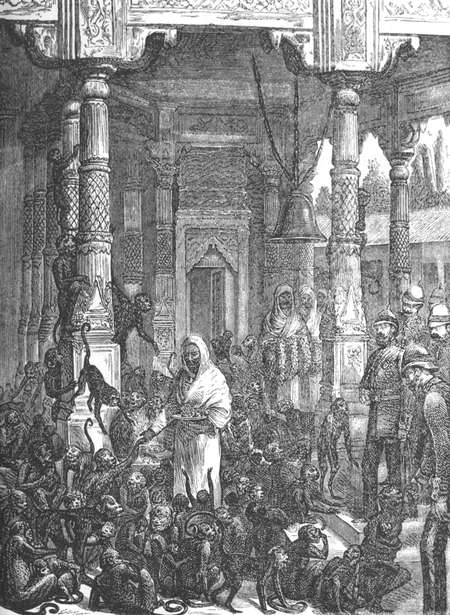
monkeys by the hundreds, capering about, particularly
in the Tarmarand trees, pulling and throwing
cocoa-nuts about, and as we moored at night the
trees would be swarmed, grimacing and yelling,
such an unearthly noise—add to this, all around
seemed spotted with fire from the innumerable fireflies,
while the chorus the monkeys made, and the
noise from the flocks of flying foxes, almost scares a
stranger. As the face of the country alters, so the
extent of the overflow can be best seen. In some
places, where the land is low, five or six miles in
breadth is covered with water; in others between
high rocky banks, confine its course, and here the flow
of water is very great, trying enough on the boats,
and the unfortunate men pulling them. At Benares
we stayed one day. This is the holy city of the Hindoos,
as Jerusalem to the Jews, or as Mecca to the
Mahommedan. This city contains from nine hundred
to one thousand temples, and thousands of images of
the many gods worshipped by its people. The highest
ambition of the Hindoo devotee is, although he may
be tottering with age or sickness, and almost crawling
on the earth through deformity, to visit the shrines
at Benares, and walk for fifty miles around its sacred
territory. Here they come from all parts of India, as
it is considered a sure passport to glory to die within
it. The temples have all their gods; some of them
ugly looking monsters. The people prostrate themselves
and strike a bell, which is in every one of them,
and then depart. At certain great festivals, thousands
assemble from the city on the banks of the river—a
great bell is struck—horns are blowed by the priests,
then these fanatics, thousands of them, men, women
and children, rush headlong into the deep water, and
hundreds are drowned. From Benares we went to
Allahabad. Here the waters of the Jumna unite
with the Ganges. This is also considered a very sacred
place; the water from here is taken to all parts
of Hindostan in bottles, as holy water. It was here
Lord Clive gained such a decisive victory over the
Great Mogul of Delhi, as secured Bengal to the East
India Company. From Allahabad, we proceeded to
Cawnpore, where we arrived on the fifteenth of October.
Disembarking, we went into tents, and soon
after joined the camp waiting for us. I merely rambled
through this city to get some things at the bazaars.
The goods were all exposed to view without
shop-windows, as at home. The merchant sitting,
tailor-fashion, on the boards. Of money changers
there was plenty; heaps of gold and silver coin on
small tables. The sugar dealers, or rather confectioners,
had large coppers boiling, making jillavies, a
mixture of butter and sugar. There is also a goodly
number of bungalos and gardens, residences of rich
merchants. Early in the morning, generally at three
o'clock, when the march of troops commences, one is
surprised at the number of animals required for the
several conveyances. Elephants and camels for tents
and baggage; bullock Hackerys for women and children.
Married soldiers are well provided for in India,
a fund provided by Lord Clive allows every woman
five, and every child three rupees per month, almost
enough to keep them comfortable. The first day's
march was over by eight o'clock in the morning,
when tents were pitched, and breakfast prepared by
black servants. After this, what time you don't
want for rest may be spent as one chooses. The weather
being intensely hot, we found shade under plenty
of orange and mango trees, occasionally issuing from
cover to shoot pigeon, or chase monkeys. Birds of
all plumage filled the air with their beautiful notes;
the mocking bird was particularly favourable to us
soldiers, as numbers of them followed us. We were
now on our march to Meerut, where the head quarters
of my regiment were stationed, and I felt more
than anxious till I joined them. On the fourth day
from Cawnpore we halted under a famous Banyan
tree, which on some previous occasion had shaded
five thousand troops. This idea may seem preposterous;
but when you take into consideration the
length of time it has been growing and spreading, it
seems simple enough, each branch on rising a certain
height, drops, takes root again, rises again, and again
drops, and so on for ages, until from the one parent
root, branches and roots covered acres of ground.
Meerut—regiment—Captain Havelock.
Meerut is at last reached on the 14th of November.
This is a frontier station. The military cantonments
were extended on an open plain three miles
in length. The most beautiful barracks, like villa
residences. The English Church side by side with
the Theatre, standing between cavalry and infantry
lines. Here I found my regiment, and having acted
as provost en route, I was introduced by Captain
Havelock—afterwards General—who came out with
us, to his brother Charles, who was adjutant of our
regiment.
Now commenced my service in India in earnest.
What was rumoured in England proved here a fact,
of an army being got ready for Afghanistan. Captain
Havelock left to join his regiment; all who had
known him, and experienced his kindness on board,
and on the march to this station, felt the parting
much, as he was invariably kind and very good to all
his men.
CHAPTER II.
Dost Mahomet usurps the throne of Afghanistan—Meerut division
ordered to assemble five miles from Delhi—The King inspects our
army—Pass through Maharajah Rimjut Sing's country—The Punjaub—Sir
H. Vane—Hindoo Koosh—General John Keene—Cross
the attack—Sufferings on the Sandy Plain—Valley of Shaul—Entrance
to Bolam Pass—Lieut. Imvariety—Candahar—Crowning
Shah-Soojah—Through the Pass—First sight of Dost's Army—Battle
of Ghuznee—Storming—Col. Sale—Citadel sacked—Feelings
after Battle—Natives—Orders received for Cabul—March—Cabul
Camp opposite city—Enter—Supposed some of the Lost Tribes of
Israel—Proof—Affecting scene at the Death of our Colonel Arnold—finding
of two old tombstones with date 1662—Russian ambition—Elphinstone
left to protect Shah-Soojah—Back to India through
the Kyber, swarming with Kyberees—Dost and his commanders
prisoners with us—General Avetavela escorts us through Peshwa—Punishment
of Robbers—Crossing the Boundary—Meerut—Memorial.
Meerut division.
The order for marching for active service at
last came, and on the 25th November, we
left Meerut to join the force assembling
under General Sir Henry Vane, to proceed
to Afghanistan to replace Shah-Soojah
on the throne usurped by Dost Mahomet.
The force he was to have under him consisted of
the entire Meerut division—three brigades of cavalry—three
of artillery—and three regiments of
infantry—the 16th Queen's Lancers were commanded
by Colonel Robert Arnold, and were eight
hundred strong.
Our route lay through the City of Delhi, so famous
in all Indian annals—the city, beautiful as we
passed through, must have been almost a paradise before
being sacked and plundered by Nider Shah, the
Persian adventurer—he and his army are reported to
have carried off one hundred and fifty camel loads of
treasure, consisting of gold and silver—jewels and
articles of great value. The principal street running
through the city is called Chan-de-la-gore, a stream
of water dividing it all through, with orange and
tamarand trees on each of its banks,—the bazaars
were crowded with people, and goods for sale, chiefly
jewellery, silverware, and in some, costly apparel,
such as the gorgeous Cashmere shawl, and elegant
Persian carpet. I must reserve a full description of
Delhi to another part of my experience.
The army, under the Commander-in-Chief was
to assemble on a plain five miles from Delhi, and
was to number thirty thousand men of all arms. To
this rendezvous we marched. The following day
we were reviewed before the King of Delhi, he and
his Court could not help but be well pleased with
the dashing fellows that passed before them, we
then continued our march through the protected
Sikh States, until we arrived at the Sutleg river,
where we halted until a formal permission to proceed
was secured from the Maharaja Runjiet Sing in
order to pass through his country, the Punjaub. At
this time the Maharaja or king was very powerful,
had a large army, with four French generals in his
service—Avitavula—Ventura—La Court and Belasses.
Permission was granted to pass through to
upper Scinde.
Sufferings on the sandy plain.
At this distance of time, and looking back on the
misery endured in that dreadful march. The country
is very sandy—the heat is intense, and days
without water. Eventually, after much suffering
we reached Attack, or the upper waters of the Indus
near Hyderabad. Here we halted a while and refreshed,
Sir Harry Vane refusing to proceed through
those sterile mountains of the Hindoo Koosh without
strong reinforcements to keep his communications
open with the rear. General Sir John Keene
was ordered up with a force from Bombay, consisting
of the 4th Light Dragoons, accompanied by artillery
and infantry. Sir Harry Vane, through illness,
not feeling able to continue in command, resigned,
left for home, but died on the passage.
Crossing the Attack river, on the 15th January,
new horrors presented themselves thick and fast;
the country still continued very sandy, in fact a
desert, no appearance of anything around or ahead
of us to instil a hope of comfort; again we had great
suffering through want of water. Before we proceeded
far it was deemed advisable to send back the elephants,
and as for the poor camels they dropped off
by scores for lack of food, the tents and a great part
of the baggage and forage had to be burnt, the men
were attacked with dysentery in its worst form, and
many died. This may be allowed was an auspicious
commencement of my military life in India. Did
our men regret, or get faint-hearted?—No. Did we
think of home and all its comforts, and the little
thought there of the endurance of her soldiers?—we
did; but there was no such thing as repining—though
we did think too much was expected. Endurance
has an end,—and that those who plan such
designs, should be obliged to accompany the army
through this country, and put up with, and be content
with all we had to put up with, without a sign
of discontent.
Candahar—crowning Shah-Soojah.
Through much suffering we reached the valley of
Shaul, through Beloochistan to the entrance of the
Bolan Pass. This gradually rises to an elevation of
something like 12,000 feet. It appears as if some
convulsion of nature—and I have no doubt of it—split
the mountain completely in two. At this time
no Doctor Russell or Archibald Forbes ever thought
of such a mad freak as to accompany an army—they
are free to do so now, because perhaps, in many
particulars the army is better equipped and provided
for—comforts unknown to us, are supplied now—and
so it should be—for the soldiers who fought for
England half a century ago, must have been hardier,
and possessed of greater endurance, to do as they
did on hard rations, and often half rations, with less
formidable arms, no possible comfort, and discipline
almost carried to extremes.
In passing through the valley we were obliged to
dismount, and actually pull or drive our horses along,
they were so used up. While camped in the Pass,
Lieutenant Inverrity strayed from his regiment,
was surprised by a party of Beloochees, and cut
and hacked to pieces. After losing many horses and
men, and having undergone much privation and
suffering, we arrived at Candahar, here we rested to
somewhat recruit our health—procure fresh horses,
and here we crowned Shah-Soojah. The rest we had
here was very acceptable, and after all we endured
on the sandy plains, and through the valley—the
refreshment, plentiful here for the inner man—was
in abundance—grapes and pears were very large,
and vegetables without stint—the cabbage here is
about the size of an ordinary wash-tub, very sweet
and good. The inhabitants vied with each other to
please us, as we were the first British troops they
ever saw. The city, like all places of note in India, is
very attractive, the houses flat-roofed—any woman
you meet in the street all belong to the low caste,
very heavily veiled—the High caste women are
never seen out.
On the 4th of June we broke up camp and started
for Ghuznee, our way lying through the Bolan Pass.
As we approach, its appearance is formidable, the
mountains at each side seem to reach to the clouds,
they have an ascent of 14,000 feet. Arriving at
Ghuznee on the 21st July, we observed on the hills,
Hadjie Khan the commander of Dost Mahomet's
army encamped with twenty thousand men. Ghuznee
is strongly fortified—cut out of solid rock, on
the slopes of a hill, surrounded by a moat. As the
enemy commenced firing on the 22nd with heavy
shot, our commander thought better to move the
camp back about two miles.
Battle of Ghuznee—storming.
On the morning of the 23rd, we moved up at three
o'clock, and got into position. One division of cavalry
opposite the gate on the Cabul road; one part
of our force moved off to our left, to watch the
enemy on the hills, and make a feint attack on their
position on the opposite side, so as to draw their
attention from us. We were occupied in placing
batteries so as to command the gate; at the same
time Colonel Thompson, of the Engineers, was laying
a chain cable to throw a bridge across the Moat.
When this was accomplished, a mine was laid under
the stone buttresses, and at a quarter to six o'clock
the mine was opening, and up went the gates
with a terrific crash. The storming party, consisting
of the 13th Light Infantry, under Colonel Robert
Sale; the 2nd or Queen's, under Sir Thomas Wiltshire;
when the bugle sounded, commenced their
attack under a heavy fire—the 13th had the honour
of leading. The enemy every where made a terrific
resistance. Colonel Sale was knocked off his horse
and trampled upon, still he ordered the bugler to
sound a retreat, instead of which, whether intentional
or not, the advance was sounded. Nothing could
daunt the ardour and bravery of the men. They
soon gained a footing inside, where hand to hand
encounters was carried on in its most relentless
form, and in half an hour, both regiments were firmly
established inside the walls. By day light the
British flag was mounted on the Citadel, many of
the enemy having thrown themselves therefrom,
rather than surrender, to the Moat below, a distance
of 150 feet. We were ordered to enter and seize
the horses, which were running wildly without
riders, which we did after some hard work, and
brought them to the prize agent outside. We were
annoyed, however, very much, through having to
encounter the worst of firing, as many of the
Afghans popped at us from loop-holes and windows
in every street of the city. When the sun rose on
the hills the Infantry could plainly be seen ascending
the greatest heights of the Citadel, far above the
city; here they got into the bank, and loaded
themselves with money. Many of the enemy were
trying to escape to the valley away on our left;
these, and the force on the mountains, kept our
troops in that direction busy. By 2 o'clock, p.m.,
all was over, and Ghuznee was in possession of the
British.
Feelings after battle.
When all opposition ceased, and one went
through the city, now filled with sounds of wailings,
he cannot but be struck with the dreadful havoc
war brings with it. This was my first general action,
and although when in the heat of it, I felt no
pity for any one, at least I cannot remember feeling
so, still, when the desolation is complete, and you
are met everywhere with its sad effects, property
destroyed, mutilation of brutes, horses, camels, &c.,
dead, and writhing in pain from wounds; wounded
men and women every where begging for mercy or
succour, the dead piled all round, the most hardened
must give way to sadness. Shah-Soojah, our newly
crowned king, was busy on our right, hanging and
shooting traitors, some of them leading Chiefs who
had fallen into his hands. The whole of the 24th
was occupied in burying the dead, and on the following
day Hadjee Kan came in, and gave up his
sword, a beautiful one, the hilt studded with costly
gems; for its possession the officers had a race, which
was won by the 4th Light Dragoons. The horses
captured, all of them valuable Arab or Turcoman
were sold by auction, the proceeds appropriated as
prize money.
We halted here three weeks, sending out detachments
to scour the country for Dost Mahomet's
troops. During this time the inhabitants began to
be much familiarized to us, and brought on all the
supplies we required. We had much trouble, however,
in striking bargains, as they do not speak
Hindoostanee; but this we did experience, their
great liking for us, over the regular Indian troops,
our Sepoys.
On the 2nd February we received orders to prepare
for an advance on Cabul. Colonel Cureton
was to proceed with two troops of the 16th Lancers
and three troops of heavy artillery as an advance,
my troop was one of these. On the 3rd, our way
lay through high rocky passes, these we had to ascend,
not without great difficulty, and on the second
day's advance, we came upon four guns planted so as
to command a lead in the road. They were loaded,
but abandoned. The artillery unloaded them,
blowing up the timbrels, one of the men through
accident having his arm blown off. Our march
through the gorges and passes was very tedious till
we arrived at Cabul, the capital.
Cabul—camp opposite city—enter.
As we approached, the inhabitants gathered to
greet us, and a right hearty welcome we got, as we
were the body guard of the King, and the first British
soldiers they ever saw. Encamping opposite the
main gate, we were supplied with all the dainties of
the city—milk, bread and fruit in any quantity.
They were very kind, particularly to us horsemen,
and would take no money in return. As we had
two days before the headquarters with General
Keene would arrive, I had many a stroll through the
city and the bazaars; but as Cabul has come
into great notoriety since I was there, and has
been described over and over again, I will not
enter into much detail. The inhabitants are mostly
Mahomedans, some Armenians and Hindoos, who
are generally merchants. They strike one on first
appearance with the Jewish type of features, and it
would not, perhaps, be risking too much to say they
are descendants of one of the lost tribes of Israel,
for we read in the 9th chapter, 1st Book of Kings,
that King Solomon gave to King Hiram, in exchange
for wood brought to build the Temple, twenty cities,
and he called them the land of Cabul unto this day.
We found at that time plenty of Russian money and
goods, showing that that nation then, as lately, had
an avaricious desire for possession of the country.
The people are mostly of fair complexion, and the
women are certainly very fine looking, of the Circassian
type. After the arrival of General Keene,
we commenced forming batteries and trenches. One
sad occurrence overtook our regiment, which caused
more profound regrets, more heart-felt sorrow, than
anything else that could possibly befall us, and that
was the death of our old esteemed Colonel Arnold.
He was fully half a century in the army, loved his
men as a father his children,—a splendid cavalry
officer, six feet two inches high. Feeling he
could not live much longer, he desired to see his
regiment before he died. His cot was brought out,
he, having all the appearance of death, propped in
it. The regiment was formed on foot, three deep.
We then marched slowly past him, giving one sorrowful
look, and that a long one, at our poor Colonel.
Tears filled all eyes. The officers, as their
troops passed, fell in at the side of the cot, and when
all had passed through, his lips were constantly
moving, seemingly muttering some farewell, he audibly
exclaimed "My poor, dear fellows," fell back and
expired. His remains were interred with great military
and masonic honours in the Moslem cemetery.
Elphinstone to protect Shah-Soojah.
While we remained at Cabul, his grave was often
visited, and many a deep regret was expressed over
it. While looking about the many stones marking
the place of the departed, I was struck with a stone
erected to the memory of two English people, dated
1662. How they came to Cabul, or anything about
them, no one could inform me. It was certainly an
early period—nearly two centuries ago.
The object of the expedition became now a matter
with which every one was acquainted. Shah-Soojah,
an ally of our Government, was placed on the
throne, to counteract Russian ambition to our Indian
Empire, Russia at the time was engaged in war in
Circassia.
Towards the end of September, leaving General
Elphinstone with a small force to protect the king,
the remainder of the troops, under Sir John Keene,
left Cabul on our march towards India, via the Guddulek
and Kyber Passes, taking Dost Mahomet and
his commander-in-chief as prisoners of war. The
16th Lancers acting as body-guard, had also the care
of the prisoners. The force now consisted of my
regiment, two troops Horse Artillery, one regiment
native infantry, with Skinner's Irregular Horse. Our
route lay towards the Gillum river; this our horses
had to swim. Colonel Curston, now commanding
the 16th, nearly lost his life. As his horse rolled
over in the current, one of his men ran along the
bank, and, although heavily booted and spurred,
jumped in, caught him by the hair, and thus pulled
him out.
The first week in October we entered the Kyber
Pass, and although the mountains on both sides
swarmed with Kyberees and Ghysaltees, they made no
hostile demonstration, and allowed us to pass. Had
there been any attempt at a rescue, we had previous
orders to shoot the king, now captive, and his commander-in-chief.
After a tedious march through the
rugged pass, we reached the fort of Jumrood, which
stands at the mouth of the Plains of Peshwa, and
the French General Avetavela was governor of that
district for the king of the Panjaub. He came to
meet us and pay his respects to Sir John Keene, and
escort us through the Province of Peshwa. Here
we halted five days, during which time I saw thirty
bodies hanging in trees, and was informed that was
the punishment meted out by the French General
to robbers, mostly hill tribe men.
Crossing the boundary—Meerut.
The Panjaub is a very fertile country, abounding
in game, wild boar, deer and pea fowl. We killed
no bullocks on our march, out of respect to the inhabitants,
as they are mostly Brahmins and worship
the bull as sacred. We crossed the Sutledge, the
British boundary, and arrived at Meerut in complete
rags, horses and men worn and jaded; what clothes
we had, patched with sheep and goat skin. We left
just sixteen months before, in all the ardour of
youth, bright scarlet and gold lace, now sad-looking
spectacles—brown as mahogany, and faces covered
with rough hair. Our losses during that time were
very great. Besides our Colonel, we left two hundred
officers and men behind, almost all through
hardship and fatigue. The loss during the campaign
in horses alone was 3,000, in camels 1,400. On arriving
at Meerut we subscribed a week's pay each,
had a handsome marble monument erected to our
departed comrades in the churchyard. We now required
some rest, and we had it. As the recruits
from England were awaiting us, they relieved us
from duty for awhile, and having a large amount of
pay and battier money due us, we gave ourselves up
to rest—recreation such as one can have in a hot
country—and general enjoyment. The area of India
is about 1,558,254 square miles. From the northern
extremity of the Punjaub to Cape Cormoran in the
south, it measures 1830 miles; its greatest breadth is
about the same; its population is about 270,000,000.
The prevailing religions.
The prevailing religions are Buddhism, Brahminism,
and Mahommedism. The first contains many
excellent moral precepts and maxims, but practically
it is a religion of Atheism. The doctrines of merit
teach its devotees to believe in the transmigration
of souls. "If any man sin" it tells him to build
a pagoda, or carve an idol, it threatens him with
degradation into a soulless brute, it leaves him without
hope, without a god in the world. Brahminism
is idolatry in its most debasing forms. It has three
hundred millions of gods, but no creed; sun, moon,
and stars are deified; sticks, stones, or a lump of
clay smeared with red paint, are convertible into
objects of superstitious reverence. The rites which
it imposes are impure, and sensual. Mahommedanism
differs from the other two in that it is not idolatrous.
It professes a reverence for the supreme
being, but like all human systems of religion it is
unsatisfactory, it recognizes no divine mediator between
God and man; maintained by the sword, it
exercises a cruel and despotic sway over the minds
of its votaries, it is remorslessly intolerant and persecuting,
deprives men of liberty, upholds slavery
and polygamy, and degrades women to the level of
the brutes. It is one of the most powerful anti-Christian
systems in the world, holding under its
iron sway one hundred and seventy-six millions of
the human race. A tradition prevails that Christianity
was first introduced by Saint Thomas the
Apostle. However that may be, when the Portuguese
arrived in India, A.D. 1500, they found a
large body of professing Christians with upwards of
a hundred churches, who traced their history for
thirteen hundred years through a succession of
bishops to the Patriarch of Antioch. The Hindoos
resisted all attempts of the Portuguese priests to convert
them to the Roman Catholic faith. "We are
Christians," said they, "and do not worship idols."
Many of them were seized and put to death as heretics.
Many missionaries went to India in the sixteenth
and seventeenth centuries. But the East
India Company did not encourage the mission work,
as they seemed to keep the natives ignorant of
Christianity, and by keeping the Hindoos and Mahomedans
antagonistic to each other it aided them
in their conquests and growing power. But recently
a great many colleges have been built in Bengal,
Bombay, and Madras by rich Parsee merchants, and
the Hindoo youth are deriving great benefit, and
since steam has opened up the rapid passage and the
voyage shortened through the Suez Canal they have
more frequent intercourse with the European, his
manners and customs.
CHAPTER III.
Native sobriety and European drunkenness—Hindoo Mahoram feast
Ceremony—Native habits—Shooting Sandgeese, Ducks, Parrots,
Monkeys—Report of death of Shah-Soojah—Akbar Khan assumes
the government—General Elphinstone retires—Mr. McNaughton
killed—Massacre in Guddulock Pass by Akbar Khan—44th foot
cut to pieces—A few escape to Jellelabad—Colonel Denny—Major
Havelock—Colonel Sale attacks Akbar—Denny killed—Havelock
in command—General Pollock pushes on from Bengal—Doctor
Brydon—His miraculous escape through the Pass—General Nott
ordered to Ghuznee—Pollock reinforces Sale—Lord Auckland succeeded
by Lord Ellenborough—The Gates of the Temple of Somnuth—The
Maharajah of Lahore pays his respects to Lord Ellenborough—Durbar
at Delhi—Review before the King and Indian
Princes—Meerut again—My comrade Jaco—The Spaniel and Jaco.
I have often been ashamed in India, when
called a Christian, to see an officer or a
man under the influence of liquor. Both
Mahomedans and Hindoos are very abstemious—never
touching anything that
intoxicates. I had now more proof of this than at
any other time, there being so many attendants
allowed soldiers, indeed as many followers as men,
I could well judge their aversion to drink. Of all
the native cooks, belt-wallas, scyses for horses, and
grass-cutters, I never knew one to drink ask them,
they grimace and turn away.
During the time we were recruiting our strength
the Hindoos had a festival called the Mahoram.
They assemble by thousands from all parts, with
richly dressed elephants and camels, and gorgeously
dressed Princes and Nabobs. The common folk go
through a sort of sham-fight with bladders. A large
image made of wicker work and filled with combustibles
is elevated some seventy feet high. Two
beautiful children are drawn in a car richly dressed
by two sacred bulls. These children fire two arrows
each at the image, and are then taken to the Temple,
and, as I was informed, sacrificed in the evening
amid a great display of fire-works.
Shooting sand-geese, ducks, etc.
All the natives sleep during the great heat of the
day, and are up all night around the fires made of
horse and cow manure, which keep off mosquitoes.
They make a horrid din, beating a drum called tum,
tum, and singing, so that with the noise all through
the bazaars, the drumming and the mosquito chorus,
a foreigner has little rest. Our men enjoyed plenty
of shooting, sand-geese, ducks, parrots, and peacocks;
although dangerous to shoot the latter, the Hindoos
holding them as sacred. We had almost everything
to beguile our time; drill and field-days at early
morning, besides a good library, ball-alley, racket,
quoits, cricket, and a theatre, named the Victoria.
Returning to quarters one evening, after a shooting
excursion, and the day having been intensely
hot, many were enjoying a cool nap on the cot outside
the door of the camp. Apart from all the rest,
by himself, was an old crusty sergeant, nicknamed
"Old Nick,"—a bath, there being plenty about for
the use of the men, stood near him, and after a moment's
consultation, as he snored away, we decided
to play him a trick. Our party being all of the same
rank, (four sergeants) even if we were discovered, it
would not be deemed so bad as if it were done by
inferiors, but this we thought nothing of. Lifting
him very carefully, and so gently as not to disturb
his heavy snoring, we conveyed our friend "Old
Nick" to the bath, laid him evenly and gently as
possible, looking round seeing each our way clear for
a good run—let go, and soused he fell into the water.
Splutter, splutter, occasionally as we ran, a fierce yell
and a curse. We were in bed in five minutes, in
fact before he had time to properly shake himself,
and although enquiry and enquiry was made, and a
reward for the miscreants offered by himself, no one
ever learned who did it for years after.
We were not to remain long at peace, war broke
out again on the death of Shah-Soojah. Akbar Khan
had seized the reins of government of Afghanistan,
shot Mr. McNaughton, the agent, had prevailed on
General Elphinstone to retire, who was weak enough
to do so, instead of holding his position until aid arrived;
and as soon as Akbar got him into the Guddulock
Pass, commenced an indiscriminate massacre.
The 44th Regiment was almost cut to pieces;
some were taken prisoners with the officers' wives,
including Lady Sale; some few escaped to Jellelabad,
at the entrance of the Kyber Pass, where General
Sale, Colonel Denny, and Major Havelock were with
the 13th Light Infantry. When the winter was far
enough advanced to march, Akbar wanted to attack
Sale, but he, not wishing to be caught, marched out
and met him in battle, and fully routed him and his
army. Poor Colonel Denny being killed, Havelock
then assumed the command.
Doctor Brydon—his miraculous escape.
In the early spring General Pollock was pushed
on with a force from Bengal.
Before I proceed farther I will here give the following
incident which occurred at the time of the
massacre in the Guddulock Pass, in 1842:—
When the slaughter was nearly complete, a Doctor
Brydon endeavoured to escape; among the survivors
was a native assistant, who, seeing Brydon sorely
pressed, called to him, saying, "Doctor Saib, I cannot
possibly escape, I am dying of cold and hunger,
take my pony and do the best you can for yourself."
Brydon tried to encourage him, but no, he was dying.
Brydon mounted, and through the confusion, forced
his way to the front. Reaching all safe, he found a
group of mounted officers, who knowing they were
just at the end of the Pass where it opens on the
plain where Jellelabad stands, determined to make
a bold push for life. Seeing Brydon on a wretched
pony, they declared they could not wait for him,
mounted as he was, and any delay would be sure to
cause their immediate destruction. On they went,
leaving Brydon slowly toiling after them. The Afghans
saw the group advancing at full swing, met
them and slew them every man, and thinking no one
else was coming, went back to the hills; just then
Brydon jogged past unobserved. News of Elphinstone's
force was anxiously waited for at Jellelabad.
Towards evening one man slowly riding a worn-out
pony was descried at the entrance of the Pass,—cavalry
were immediately sent to bring him in—it
was Brydon. As he entered the gate he fell senseless
from fatigue. When restoratives were applied,
at least such as were at hand, he revived, and the
first question he asked was about his pony, the pony
that had saved his life—it was dead. Brydon was
with General Sale during the gallant defence of Jellelabad,
and lived to take part in the defence of
Lucknow.
Gates of the temple of Somnuth.
Pollack pushed through the Kyber Pass to the
relief of Sale. Another force under General Nott
marched from Bombay towards Ghuznee, to the relief
of our troops hemmed in there—the two divisions
were to meet at Cabul as an avenging army.
Both pushed on as rapidly as possible, and after
long and arduous marches, reached Cabul, rescued
the prisoners, and burnt the capital to the ground.
General Elphinstone having died, completely broken
down through this sad disaster, Lord Auckland
was called home, and Lord Ellenborough replaced
him as Governor-General of India.
In January, 1843, an army of observation was
formed on the banks of the Sutledge, to meet Generals
Nott and Pollock on their return through the
Kyber Pass, bringing with them the gates of the
temple of Somnuth, from in front the Mahomedan
mosque, at Ghuznee,—carried off eight hundred
years before, on the conquest of India and subjugation
of the Hindoos—and now restored after that
lapse of time by British valour, and thereby conciliating
the original possessors of Hindostan.
These gates were made of sandal-wood, each one
drawn on a waggon by twelve bullocks; they were
also covered with crimson curtains fringed with
gold.
The Maharajah of Lahore came down with six
thousand cavalry as an escort to pay his respects
to Lord Ellenborough. We marched towards Delhi
on the first of February, through the protected Sikh
states. Arriving at Delhi we encamped on the race
course. Lord Ellenborough had summoned all the
Rajahs and petty princes to meet him and the king
at a Durbar; along with the King of Delhi was the
Rajah of Burtpoor, the Rajah of Jypoor, the Rajah
of Puttealea. All the Indian nobility gave a grand
dinner to the Governor-General, Lord Gough, and
all the British officers. A large place was built of
wicker-work, covered with flags, banners, streamers,
and variegated lamps; and tables were laid for five
hundred guests; the service was of silver and gold.
The Governor-General and staff went down in three
carriages, escorted by two troops 16th Lancers—my
troop happened to be one of them—when the
cavalcade arrived, a royal salute was fired, and salvo
after salvo almost shook the air; the crowd was so
dense we could almost ride over turbaned heads.
After dinner there was a grand presentation to Lord
Ellenborough,—a gold salver full of jewels, two elephants,
richly caparisoned, and four Arab horses—then
came such a display of fireworks as never has
been equalled since. It was twelve p.m. before we
started for camp.
Meerut again.
The day following all this display a grand field-day
was held, in order to show these native princes the
power of Britain, and what good soldiers she boasted
of. In all the movements, the troops sustained their
traditional name; the 16th made a dashing charge,
covering the infantry, who had fallen into square;
we astonished the king and the several princes by
the quickness of our movements, they calling us the
Lall Goral Wallas, or Bullam Wallas. We broke
up in a few days afterwards, each regiment marching
to their respective stations, the 16th back to
Meerut, where we arrived on the 4th of March.
My comrade Jaco.
I might have introduced to the reader before this
an inseparable companion I had while in cantonments,
and one who not only shared my bed and
board, but one who, during many hours of serious
thought and fretfulness about all at home, mother
and sisters, made me laugh and forget what I had
been thinking about a few moments before; this
creature was Jaco, my monkey; where he was born,
or where he originally sprung from, or his race, I
cannot tell. I am no Darwinian, but positively, the
amount of tact and knowledge displayed by Jaco,
often since has led me to consider our possible relationship
well. I purchased Jaco for a small sum
from a native, intending, if he remained with me, to
train him well and keep him as a companion; I took
him to my quarters, and as a first lesson to teach
him subjection and obedience, tied him to the handle
of my trunk; here, I kept him sufficiently long,
that, by kind treatment, I thought I had weaned
him from any bad tricks he had learned; he, of
course, got quite used to a sword, a carbine, and of
my dress; I made him a nice-fitting scarlet jacket,
blue pants, and a cap with gold lace, and, dear me,
how I laughed to see my tiny mock soldier strutting
about; this pleased him well. My comrade had a
spaniel dog. Jaco and the spaniel got quite friendly.
This creature was also very biddable, and on both,
my comrade and I commenced a series of drill, providing
Jaco with a wooden sword. In a short time
they got so advanced, that on the word "mount," Jaco
would stride the spaniel, and away out with either
of us to parade for guard mounting; this they continued
to do, till mounting guard became an every-day's
duty, creating a great amount of laughter, and
they were never absent. If I happened to be tired,
and lying down getting a little rest, Jaco would
jump on the table, make faces at himself in the glass,
then, to annoy me, or get me up, as he knew he was
disturbing me, get pen and ink, as he had seen me
do, and destroy any paper that lay about with his
scrawling; if I took no notice, and he found it was
no use teasing me that way, he usually licked the
pen, spitting out several times, made ugly faces,
all the time looking at me, I pretending to sleep. I
don't know that he had one bad habit, but thieving,
and this he was expert at; if I had received a paper,
or was sending one home, and left it on the table,
nothing pleased poor Jaco better than to make away
with it. His usual plan was to leap on my table,
watch me well for a time, to make sure I was asleep,
he gently came on the bed, above my head, put his
finger softly to my eyes and try to open them; this
was done, I suppose, to see if I would stir, then with
a bound away on the table, seize the package, and
away to the woods, where he generally remained
till night, when he quietly came back, getting into
bed at my feet.
Jaco was a great pet all over the cantonment. I
intended, if I had been fortunate enough in keeping
him, to bring him home: he, however, often got me
into blame for his thieving tricks, and one day returned
to my tent with a broken arm; how he got
it I could never make out; I applied splints, and he
seemed to recover the use of it, but I fancied the
pain drove him mad, for he went to the woods one
day, and never came back.
CHAPTER IV.
Rio Scinde having died, his throne usurped by the Rannie or Queen
of Gwalior—Ordered to join Lord Gough's Army at Agra—The
Palace of Agra—The ancient seat of the Moguls of Delhi—Lord
Ellenborough rewarding Pollock and Nott—The Targ or Marble
Tomb of Ackbar's favourite daughter—March through the country
of the Ryots—Grain-fields—Religious superstition—The white
bull—Women—The Chumble river crossed—No enemy in sight—Nature
of ground before Maharajpoor—Christmas morning—General
Grey and his Division to arrive at Gwalior—Disposition of Troops—March
to Battle—Wheat-shocks filled with Sharpshooters—Battle—Push
on to within fifteen miles of Gwalior—The Raumi comes
out to meet us—Unconditional surrender—Gwalior a formidable
Place—The Queen and her army surrender—Grey joins us 3rd
January—Reinstatement of the young King—Grand Review—Incident
on a Shooting Excursion—"Bob don't go, Bob don't
go"—Break up Camp, 3rd February—Ordered back to Meerut—Passage
of the Chumble—Frightened Game—A Chase with a Stag—Through
Agra and Delhi to Meerut.
Peace was not of long duration. The old
King of Rio Scinde having died, the
British Government, by treaty with him,
were bound to see his son established on
his throne. It was now usurped by the
Rannie of Gwalior, who deposed the rightful heir.
The 16th Lancers were ordered to join the army
summoned to assemble at Agra to meet the Governor-General
and Lord Gough, on the 15th November.
The Cawnpore division, under General Grey,
were moving up on the other side. The Meerut division
consisted of ourselves—three troops horse
artillery, 39th and 40th regiments, three regiments
of native infantry, a battery foot artillery, three
companies sappers and miners. We were received
by Lord Gough, who lately arrived from England
as Commander-in-Chief, with Sir Harry Smith as
Adjutant-General, and Colonel Havelock, my old
friend, as Persian interpreter.
Country of the Ryots.
Agra was at one time the summer residence of
the Moghul of Delhi—it stands on the Jumna
river, whose waters lave the walls of the Palace.
On the marble slab in front of the throne, where in
days gone by stood many a proud Mahometan,
when the Rajpoots lorded over the conquered Hindoos,
stood Lord Ellenborough, representative of
proud England, surrounded by her warriors and
heroes of many a hard-fought battle, and knighted
Generals Pollock and Nott by Her Majesty's command
for bravery. In Agra also is the tomb or Targ
of the great and mighty Ackbar's favourite daughter,
built of white marble, and looked upon as one
of the wonders of the world for its unsurpassing
grandeur—it was erected 700 years ago. Under the
immense dome are two slabs, covering the mausoleum,
inlaid with precious stones. The dome is
flanked by four marble minarets 150 feet in height—the
garden approaching the tomb is full of orange
and lemon trees—the sacred lotus flower perfumes
the air—every spot around it is sacred to the Mahometan.
The order to march was issued on the 20th of
November. This is the most delightful time of the
year in India—not so hot during the day—mornings
and evenings lovely and cool. The country of the
Ryots through which we marched is certainly a
beautiful one, judging at this time of the year.
They are mostly Hindoos, are quiet, harmless and
industrious. It looked strange to us, now so near
Christmas, to see hundreds of acres of golden wheat
ready for harvesting—no hedges or fencing here, but
as far as the eye can reach one field of waving yellow,
mixed with red poppy.
The Hindoos are firm believers in transmigration,
consequently never eat any animal food. The Brama
or Sacred Bull, mostly white, with a hump on his
shoulders, his head hung with garlands of flowers,
is allowed to range where he likes, and is fed out of
flour or sugar-barrels, and none dare molest him.
The women are most degraded—never educated,—they
are not supposed to possess souls—they never
eat with men, and among the high caste they are
not allowed to be seen by another man. After marriage,
which is contracted when about twelve years
of age, they are old and ugly when thirty is reached.
When I have seen a group of these girls waiting
with their lamps at the four corners of the road for
the bridegroom, I have often thought of the parable
of the Ten Virgins.
The Chumble river crossed.
Our march was generally finished by nine in
the morning. After guards and pickets have been
placed, I have nearly always visited the nearest village,
having learned some Hindoostanee. I could
make them understand. I always found them civil
and kind, but afraid of soldiers, some Europeans
being very insulting, and even I have heard complaints
of being robbed of fruit, poultry, or anything
suitable to them. The followers of an Indian army
being all natives, but of course of different parts of
India, are generally great thieves. Naturally an
army en route is very destructive, so many animals
to feed—elephants, camels, horses. The Government
profess to pay for everything used, especially if
camped in a grain or cotton field.
March to battle.
We arrived at the river Chumble on 24th December,
and moved as follows:—16th Lancers in front,
40th following, up to their armpits in water, next
the artillery, then the 39th, and so on. We had information
before crossing that the enemy would
probably oppose the landing, as they were in the
neighbourhood, but we saw none of them. We were
ordered to gallop to the front and reconnoitre. As
we advanced about five miles we saw the enemy's
camp at a distance between two villages. We halted
allowing the column to come up. The ground here
was very rough, and interspersed by ugly ravines.
Between us and them was a very deep Nulla, with
only two places to ford it, five miles apart. Wet as
we were from our recent fording the Chumla, I had
to go on in charge of the advance guard and remain
all night. Our baggage, or tents, not having come
up—what was worse the Commissariat had not arrived,
and we felt hungry. The enemy's cavalry
were reconnoitering on our front, and during the
night a very strict watch was kept up. Morning at
last dawned, beautiful as weather could make it—Christmas
morning and all—and a pretty plight
it found us in, hungry, wet clothes, and if we wanted
to drink we had plenty muddy water. About four
o'clock, p.m., I was ordered to mount again, take
twenty men, and strengthen the outlying pickets.
We had not taken off boots or clothes for four days,
nor had the saddles been off the horses during the
same time. I was further directed by the officer in
charge of the picket, after I had reported to him,
to take six troopers to the front as an extra look-out
on the ford, patrolling myself between my post
and the main picket every half-hour. About twelve
at night a rocket went up from a village within our
lines, and was answered immediately by a light from
the enemy's camp. The village was at once surrounded,
and every man in it made prisoners. I
suffered fearfully that night, being so long in the
saddle with wet trousers; my legs were as raw as a
piece of beef. Give me fighting—fair open fighting,
at once—in preference to such torture. We waited
here, without attacking, three days, expecting some
of General Grey's division, mainly from Cawnpore,
towards Gwalior.
On the night of the 28th we got orders quietly to
turn out at 4 o'clock in the morning, 29th December,
to march without baggage or other incumbrance,
with one day's cooked rations. We fell into line
exactly to time, when Lord Gough with Lord Ellenborough
and staff rode along the front, speaking
words of encouragement to each corps.
Battle.
Sir Joseph Thackwell, who had only one arm,
commanded the Light Division, consisting of the
16th Lancers, Body Guards, three troops Horse Artillery,
Outram's Irregulars. The centre division
was commanded by Colonel Vallient, comprised the
40th foot, two batteries Foot Artillery, two corps of
Native Infantry, one company of Engineers. The
Left Division consisting of 39th Foot, five Native
Cavalry, two regiments Native Infantry, and one
company of Sappers under Sir Harry Smith. Each
division crossed the ravine within one mile of each
other. They were in position between three villages—Maharajpoor
in the centre, Juna on the right, and
Chuna on the left. We marched until seven o'clock,
when we halted. The enemy at once opened fire
from their half-moon battery. Nothing could be
more welcome; we hurrahed several times and
shouted lustily, "There goes the Prize-Money," showing,
without doubt, the general feeling of our army,—there
was no such thing as failure. The trumpeter
now sounded for us "To Horse, To Horse," and away
we went at a swinging trot to the front, preceded
by Quarter-Master General Churchill, as it is that
officer's business to learn the position of an enemy,
and the nature of the ground, we advanced in close
column of troops. Our route lay through a cotton
plantation, and on nearing the enemy we were received
by a discharge from a six-gun battery. A
six-pound shot took my horse in the heart, and we
both rolled over. I was extricated by some Grenadiers
of a Native regiment just passing, much bruised.
I was not long without a horse, as peppering had
been going on by the advanced picket, a horse, minus
the rider, fully accoutred, which had belonged to the
enemy, passed. I seized it, and soon came up with
my troop. We formed in line, in front of us being
a field of wheat standing in shocks; these we found
occupied by the enemy's sharp-shooters, quite concealed.
A shot from one of these picked off General
Churchill; as he fell, Colonel Somerset, an aide, dismounted
to assist him; he was nearly as unfortunate,
as a shot from one of their batteries broke his leg,
killing his horse on the spot—poor Churchill died as
he was being taken to the rear. The battle now
became more fierce. The centre division, led by the
40th, under Colonel Vallient, charged, and at the
point of the bayonet took the Village of Maharajpoor.
Just then, the enemy's cavalry were coming
down like a dark cloud upon our guns, when the
16th, my regiment, and the Body Guards were ordered
to charge; this we were quite prepared to do,
as soldiers, at least so far as my experience teaches,
do not like to be onviewers, or watchers. Charge
we did, but to our astonishment, as soon as they saw
our movement, retreat was their order, and we afterwards
heard they never stopped until they reached
Gwalior. At noon the battle was over, the enemy
fled, leaving all their camp equipage, guns, and about
six thousand dead on the field. Their force was estimated
24,000, while ours only numbered 10,000, in
having left 4,000 to protect our camp and hospital.
Our loss was 2,500 officers, rank and file.
The Queen surrenders.
The following day we pushed on, halting some
fifteen miles from Gwalior. Here we camped for a
time. The Rannie, or Queen, came down with a
strong guard, four thousand cavalry, to pay her respects,
and make terms of peace with Lord Ellenborough.
He would not hear of any only an unconditional
surrender. The day after the Rannie's
visit we marched on the capital, reaching Gwalior
about nine a.m. Of all the fortified places ever I
had seen, this was the most formidable. A large
rock in the centre of an extensive plain, the city
built in the middle, and so surrounded by the rocky
wall, as to leave only one ascent, and that a zigzag
one. The walls all round were loop-holed and bristled
with cannon. Our first thought was—We are
done now. But, of course, engineering skill and
brave hearts laugh at stone walls. All was got ready
to storm, as if taken, it must be taken at a dash,
and as is always the case, a flag of truce was despatched
to warn of our intention of giving them
one hour to choose between unconditional surrender
or the consequence of a refusal. In half that time
the Ranee and her army marched out, a battalion of
our infantry entered, and hoisted the British flag on
the walls.
We remained in Gwalior until joined by General
Grey on January 3rd. This division had marched
from Cawnpore, and consisted of the 9th Lancers,
3rd Buffs, three regiments Native Infantry, 2 brigades
of Artillery, and the 50th Foot, under command
of Colonel Anderson. They had been engaged
with other portions of the enemy at Punneah on
the same day we were fighting at Maharajpoor.
On the 4th, the day following, the entire army
was paraded to do honour to the young king, who
had been reinstated on his throne, the ceremony being
performed before all the people, in front of
the city—and on the following day we were reviewed
by Lord Gough, in presence of His Majesty, Lord
Ellenborough, and the king's ministers. In the
Governor-General's address of thanks to the army,
he promised us a medal in shape of a star for the
capture of Gwalior, and the Ranee, though now deposed,
gave one crow of rupees. This was given directly,
and a squadron of the 9th and one of the
16th Lancers escorted it in bags, carried by fourteen
camels, to the Commander-in-Chief's camp.
In any part of India I have ever been, I have always
seen plenty of game, but the territory of Gwalior
can certainly boast of more than any other.
The gardens were laid out beautiful. Fruit of every
kind was abundant. The principal people here are
half Portuguese.
"Bob, don't go, Bob, don't go."
The following incident occurred on one of my
shooting excursions. Three of us went out looking
for pea-fowl, as they make a beautiful dish. We
reached a Mango grove, and sat under a tree. A
stream of water ran a few yards away from
us, beautiful in appearance to bathe in. Robert
Prichard, a corporal in the regiment, one of us, took
it into his head to bathe. I remonstrated with him,
urging probably the presence of venomous snakes
or serpents, very numerous in the Bengal Presidency.
He would go, and go he did. My last words
were: "Bob, don't you go." As he started, immediately
there came the same words—"Bob, don't you
go"—"Bob, don't you go," again came more rapidly.
Bob did turn back rather afraid, still he persuaded
himself he was no coward, away he went again, and
again the same words came thick and fast, "Bob,
don't you go," "Bob, don't you go." On looking up
we discovered a number of brown birds, similar in
appearance to thrushes, in the trees, and as we rose
to leave the cry went on, "Bob, don't you go," "Bob,
don't you go," but Bob did bathe, and was bitten by
a venomous snake, and died that evening.
I have previously stated that the Hindoos are
very superstitious, and do not kill anything—not
even the poisonous snake. This part of India is not
much travelled over by Europeans, and all sorts of
dangerous reptiles and wild beasts live on undisturbed
to kill man.
The 16th Lancers had by this time completed
twenty-two years' service in India, and naturally
enough, many looked forward for the order to bring
them back to England. It was not to be yet, however,
although we all thought that the 9th had come
out to relieve us.
On the third of February we broke up camp, and
commenced and marched back to our several cantonments.
On our way the time passed pleasantly
enough. After camp-pitching for the day, if a village
was within easy distance, I generally went thither,
accompanied by some companion. Generally
the villagers will shy away when they get a glimpse
of a soldier, they are afraid of being plundered, but
the most reasonable excuse is, I think, to be found
in their religion being insulted, at least here, for almost
everything is sacred. Their former rulers, the
Rajahs, plundered unmercifully, and allowed their
men to commit the vilest of crimes.
Frightened game.
So full is this country of game as we neared the
river Chumble, where I had on my way up got such
a severe wetting in crossing, as to fasten a severe
cold on me for some days. One morning at sunrise,
geese, duck, and other water-fowl rose off the water
in such a large dense cloud as to darken the air, as
if a thunder-storm were coming on. No one with
us ever saw such a multitude. Like every other living
thing, they are never disturbed, but live on and
multiply.
No matter what our position in life—either high
or low—or whatever our tastes for a variety of food,
no men feel the loss of satisfying this desire more
than soldiers on a campaign, always confined to the
same diet. I have heard old soldiers say they remembered
they had such an abhorrence for hard biscuit,
and such an appetite for fresh bread, impossible
to get at the time, that if a year's pay could get one
fresh loaf, they would give it. We felt now something
of this feeling, and all ranks longed for a
change of some sort, either in bread or meat. Here
was a fine opportunity, and it was availed of to the
full extent, as far as the animal food could do it.
Three of our officers, Captain Meek, Lieutenant Patterson,
and the Veterinary Surgeon, respectively
nicknamed—Meek, The Hair Trunk; Patterson,
Black Jack; and the veterinary, Hot-water Jack—were
sitting together engaged in mending their
jackets and pants, one occasionally rising to feed
the fire over which was pinioned on the sticks a leg
of a stag or of mutton, I could not say which, and
no doubt, as they felt hungry, anticipating a nice
feed, when all of a sudden we were startled by
shouts and hurrahs and roars of laughter. A dog had
stolen unawares, when they were engaged in their
tailoring, and making one bounce, seized the roasting
limb, and away with him. The three, with jackets
pants and flannels flying from their arms, after the
poor hungry brute, shouting with all their might—"Stop
thief! stop thief!" It was relished after all,
notwithstanding the extra handling and dog-bites
it got.
Through Agra and Delhi to Meerut.
After passing the river and ascending the hill on
the opposite bank, we came suddenly on a herd of
antelopes. So astonished did they seem, on perceiving
horsemen, they actually stood staring at us,
until nearing them, they started at a bound, some
dashing through the ranks of our squadron. One of
our men gave chase to a splendid buck, as he ran
towards a village, near which we knew was a pond.
The stag took to it; the man followed, having jumped
off his horse, and seized him by the horns. The stag
was the strongest, and dashed the man away in the
water; still he held on until an officer coming on the
scene, stabbed him, and, amid roars of laughter, the
corporal emerged, covered with green slime and
chick-weed. That day we had venison for twelve,
the officers taking the rest.
Agra and Delhi was at last reached, then Meerut
on the 4th March, having been five months on that
campaign, and lost fifty men from the regiment.
Here we passed the hot season, from the middle of
March to the beginning of May, as what are called
the hot winds blow from eight in the morning till
between four and five in the evening, no one in that
time can stir out of doors—not even the natives can
stand the scorching heat. The torment, the mosquitoes,
are busy humming all this time. I have
seen men almost blinded with their swollen faces;
however, there is one relief, every soldier can have
a native to fan him, and keep them off. Another
pest during this season is found in the numbers of
jackalls who run in packs at night, and actually
bold enough to get under the beds.
CHAPTER V.
Old companionship at Meerut—Arbuthnot and the 16th—Grand
turn out—A bet won—40th leave for home—9th Lancers for
Umballa—Natives with tattoo bring in fruit, vegetables—Description
of the Mango—Sedanna—The Begum or Queen, a pensioner
of the Company—Something of her life—Persuades the Rajah to
fly—Feigning assassination caused him to stab himself—Proclaimed
Queen by her Army—Marries a French adventurer—Visit to our
Camp—Her palace—Rumours of an invasion of our territory by the
Shieks near Ferozepoor—Lord Gough at Umballa—News from the
Punjaub—The Rannie or Queen had dethroned Dulep Sing—Ordered
to Punjaub—Sketch of the Sing dynasty—Three French officers
revolutionize the Army and bring it under the French model—They
possess the whole of the Punjaub Peshwa—An eye on Bengal—Advised
to become allies—Treaty with Lord Auckland—The Queen
makes away with the three eldest sons—Her paramour, Lal Sing—Confines
the youngest in the harem—Lord Gough at Mudkee—Sir
R. Sale killed—Ferusha—50th and 62nd Foot—Ignorance at Meerut
of all their movements—March on the Sutledge—Sad evidences en
route of late havoc.
General Arbuthnot and the 16th.
Old companionship of regiment is never
forgotten in the service. We had beside
us now in cantonment the Fortieth Foot,
a corps that had served in times gone by
with the 16th in the Peninsular wars
and at Waterloo. They had now been four years
in Afghanistan, were present at Kilat, Gilzie and
Candahar. Having plenty of money on hand, after
our late campaign, we often fraternized with them,
and indeed were boon companions as far as we
could in the pleasures and enjoyments of camp
life at Meerut. Dinners and parties, at which I
am sorry to add much intoxication prevailed, was
an every-day occurrence. So much was revelling
carried on that on General Arbuthnot coming to
the station to assume command, and when at dinner
with the Colonel, the state of the regiment
was the subject of discussion. This was the question,
"What would you do, Colonel, if your regiment
was required to-morrow morning for immediate
service; they are all drunk and wandering
about anywhere." This matter was soon settled
by a heavy wager—I suppose merely in name—by
the Colonel, who stated the regiment would
be out at daylight in the morning—it was then
ten o'clock—and if any man was absent, or should
fall off his horse, the bet was forfeited. The
Adjutant, Lieutenant Dynon, gave orders at once to
sound "boot and saddle," the regiment to turn out
half-an-hour before daylight. The trumpeters did
their duty, galloped all over the lines sounding the
alarm; the men tumbled in from all directions.
The hour named for the parade arrived—the
regiment, complete, not a man absent, stood out on
the plain awaiting the General and his staff. They,
accompanied by a number of ladies, put in an appearance.
The roll was called in front of them, and
with the exception of ninety-seven men, invalids in
hospital, every man of the corps was present. To
test the regiment more thoroughly, twenty-four
difficult movements were gone through at a gallop,
then we advanced in review order, every horse
covered with foam. The General, of course, could
do nothing after losing his wager, and witnessing
our splendid movements, but compliment us most
highly. As we marched back to cantonments we
were wildly cheered by native and European regiments,
and as a reward we received from the Colonel
a few more days' leave for enjoyment. Dinner parties
and suppers commenced again, and continued
well up to the time the Fortieth were ordered to
Calcutta, to embark for England.
9th Lancers for Umballa.
In July the rainy season commences. It falls in
torrents three weeks at a time, forming deep nullas
or ravines, which make it difficult, indeed dangerous,
to get about, and this lasts till after the middle of
August.
In November, the Ninth Lancers came up from
Cawnpore, and as we had not met them, or at least
the two regiments had not been together since
eighteen hundred and eighteen, what could be expected
than that another fraternization as had taken
place with the Fortieth would be repeated. This I
need hardly say occurred, and continued till the
9th marched for Umballa.
We now enter the months when fruit and vegetables
get ripe, and many a visit we had from the
natives to our camp, driving or rather leading their
tattoos on poneys laden with luxurious fruit. The
mango is here very plentiful, and it may be interesting
to describe it, the most delicious fruit in the
world. The tree is about the size of a large oak;
the fruit, when ripe, is of a greenish yellow, with
reddish cheeks, the skin, when removed, presents a
sort of jelly; a small stone, the size of a peach stone,
in the middle. We eat them out of a large pan, in
which is first placed some cold water. We had also
plentiful supplies of guava, custard fruit, plantain,
bananna, and water-melon of the size of an English
beer-barrel for three pice, or a penny.
Queen marries a French adventurer.
Some five miles from Meerut cantonments is a
town called Sedanna, where the Begum or Queen
resided, who was once the monarch of this district,
subject only to the once powerful Mogul of Delhi,
but at this time a pensioner of the East India Company.
There is a curious story told of this extraordinary
woman, and I will here give it. She was
the favourite of a Rajah who reigned some years
back. She was instrumental in raising a revolt, and
then urged him to fly, which he did. She, of course,
accompanied him, but carried in a palanquin. While
in this conveyance she pretended to stab herself, and
screamed wildly. When the Rajah heard it, thinking
she had been assassinated—not a very uncommon
thing in India—he plunged a poniard into his heart,
and died on the spot. No sooner was the Rajah
dead than she jumped on a horse, galloped back,
surrounded by her guards, collected the army,
harangued them, saying she would now lead them
to victory. They cheered. She did lead them
against a powerful enemy, and by her perseverance—a
second Joan of Arc—conquered. She was established
in the favour of her army, who confirmed
her Queen. Subsequently she married a French
adventurer, Sombra Dyce, and made him general.
He, being a Roman Catholic, converted her, at least
nominally, built a chapel, which I have been in, and
in which she had a tomb erected to the memory of
the old Rajah, her first husband. There is also
another to that of Sombra Dyce, her second. She
had two sons by her second marriage, who were
always at law with the old East India Company,
claiming some possessions of their mother; but I
could never learn the result, as the appeals were
frequent to the Home Government.
She was now getting old, but frequently came to
our cantonment, as she was friendly with our Colonel,
and loved to see the 16th Lancers. She has even
been to our theatre, and whenever, in passing, she
saw any children, always threw them handfuls of
silver coin. A number of her people had embraced
Christianity, who were ministered to by a regular
priest. Whenever we strolled out to her palace we
were received very kindly, were allowed the use of
her billiard tables, as all the furniture was of European
make, and many a good picnic we enjoyed in
the mango grove of the palace.
On Sunday, the thirteenth November, 1845, as we
were marching from church, news soon spread that
war had again broken out, and the Meerut division
were to make forced marches to join Lord Gough, who
had pushed on from Umballa, as the Sikhs had
crossed into our territory in large force near Ferozepoor.
The Cawnpore and Delhi divisions were also
to move up in haste. This was astounding news to
men so long in India as most of the 16th had been,
but nevertheless all felt glad—in fact rejoiced—at
the prospects of another good campaign, so eager
were our men for it that the sick in hospital, such
as were convalescent, would persuade the surgeon
they were well enough, and begged to be let go with
the regiment.
Sketch of the Sing dynasty.
Before starting, we had learned a civil war had
broken out in the Punjaub. The Rannie had dethroned
Dulep Sing, the rightful heir, the army was
divided—one half for her, and the other against—and
this state of things had been going on for several
months; we then, the army of Her Majesty, as is
always the case, had to set matters right. Before
entering upon any further particulars, a short history
of the Sing family will not be out of place.
Runjeit Sing was the founder of the dynasty; he
was a powerful chief, having conquered all the
smaller chiefs around him, established himself as
Maha Rajah at Lahore. In time, two French officers
came along from Persia, soldiers of fortune, as such
men are to be found everywhere, ready for anything
as long as they get good pay. These men had served
under the first Napoleon. One of them offered to
raise a regiment to imitate the old French Imperial
Guards, and the other made similar offers to raise
one of cavalry. The offer was accepted. Both regiments
were risen to the satisfaction of the Rajah; he
made the first a General, the second a Colonel. To
one, the General, he gave one of his daughters to
wife. Subsequently, another Frenchman came into
the county, named La Court, and his services were
accepted, so that between the three old French soldiers
the Rajah raised a powerful and well-equipped
force; and having defeated a powerful neighbouring
chief at Rungier, or the seven-hilled city, he became
master of the whole Punjaub, or country of five
rivers. After these successes he attacked the Afghans,
drove them out of Pesheva, and took possession
of the entrance of the Kyber, where he built the
fort alluded to previously in this work, called Junrood.
Runjeit Sing signifies, in their language,
Fierce Lion. When he succeeded thus far in his
conquests it became apparent he had an eye on Bengal,
and thought he could drive the British back to
the sea. His French generals, however, told him
different, advising him not to interfere with them,
or he might lose all. Craftiness, and perhaps fear,
caused him to become an ally, as he made a treaty
with Lord Auckland, signing it on the banks of the
Sutledge river, bringing very valuable presents to be
sent to our Queen. Four sons survived him, named
Currick Sing, Nunihall Sing, Sheer Sing, and Dulep
Sing. The first three were easily made away with
by assassination, by the favourite Queen, who had
the youngest, Dulep, placed in the harem, where old
Runjeit had five hundred wives and concubines.
Having accomplished all this, she united the contending
parties under her paramour, Lal Sing, meditating
an attack upon the East India Company territories.
They assembled at the fort of Umritsa seventy
thousand strong, crossed the Sutledge before our
Government were aware of their doings.
Lord Gough at Mudkee.
Sad evidences of late havoc.
Their first action was with Lord Gough, at Mudkee,
19th December, 1845, where he was encamped. The
men, when surprised, were preparing their morning
meal; they soon, however, got in fighting trim, some
in their shirt-sleeves. The 3rd Light Dragoons,
assisted by the fiftieth foot and others, gained a complete
victory over them. It was here General Sir R.
Sale got killed. Lord Gough pushed on that night,
21st December, and came on the main body encamped
at Ferusha, fought them all that day, 22nd,
and but for a ruse would have been surely defeated.
Ammunition falling short, a troop of Horse Artillery
galloped off to Ferospoor for a supply. The enemy's
cavalry, seeing them through a cloud of sand, imagined
their retreat was being cut off, panic-stricken,
they bolted, when the 3rd Light Dragoons and 4th
Native Cavalry charged under a heavy fusilade from
the infantry—50th and 62nd—completely routed
them from their position. In this charge, Colonel
Somerset, aide to Lord Gough, was killed. The Meerut
division knew nothing of all this until we arrived
at Muddkee on the 1st January, when the sights we
met confirmed our suspicion. At first we came
across dead camels, then, on approaching the
village, several of our native regiment soldiers came
out to greet us. A sad sight indeed—some bandaged
almost from head to foot; arms and legs off. All left
behind in the hurry to keep up with the enemy.
On laying out our picket guard with the Quarter-Master
General, as I was in the advanced guard, we
came upon a heap of sand, out of which part of a
man's hand projected; also, a little further on, part of
a hand and wrist, with so much of the cuff of a coat
as showed a 50th button. We, of course, performed
the duty of burying all such, as the pursuing army
had no time. Making a reconnaisance with my captain,
we entered a kind of park-like enclosure, and
here we found traces of the fearful work of Gough's
engagement. Men, horses, and camels lay in heaps
unburied, vultures in hundreds feasting on them;
none had been touched, all lay as they fell. The
Sikhs lay in heaps under their guns, the Light
Dragoons as they fell from their horses, the tents of
the blind half-hundred still standing, knapsacks
around in all directions. The guns we secured, and
fatigue parties performed the sickening duty of
burying the dead.
CHAPTER VI.
Hureka Gaut—Sir Harry Smith ordered to intercept Rungour Sing—Joined
by 77th foot—March—View of Buddural—Opened fire—16th
to hold ground while infantry push on—Too weak to fight
yet—Baggage cut off—Some of 31st foot made prisoners—Treatment
of their sergeant by the enemy—Push into Loodianna—News
of their retreat—Ordered to intercept—Arrival at fort—Harem—Finding
two bags of rupees—Reinforced and advance—Order of
troops—Battle of Aliwal commenced—Sir Harry's telescope cut in
two—"Lancers, three cheers for our Queen"—Charge—A square of
guards—Corporal Newsom—Bravery—Killed—Green flag in his
hand—"Immortalized 16th"—Fearful loss—Join another squadron—Pursuit
to river—Destruction—Wounded to village—March to
join Lord Gough—Two hundred cannon belching together—Sobraon
10th February—Description of battle—British flag planted—The
bridge blown up—Charge the entrenchments—Victory and end of
Sikh War—Losses—Labour—Chiefs bring out the young Maharajah—Reception
in Lord Hardinge's marquee—Terms—Crowning
the young King—Proud Shieks—Retort on our Sepoys.
Joined by the 77th Foot.
After this melancholy duty was performed,
we pushed on to the Sutledge river, to
overtake Lord Gough, and on the 5th
January reached Hureka Gaut, encamping
on the right of his Lordship's division.
We lay here till the 15th, when General Sir
Harry Smith was ordered to intercept Rungour
Sing, he having crossed the river higher up, and
burnt Loodianna, one of our stations. On the third
day's march Sir Harry sent back for reinforcements,
and the 16th Lancers, with a troop of artillery, was
sent to him. We made forced marches in order to
overtake him, which we did at Jugram; here we
were joined by the 77th, having been pushed up from
Calcutta. On the evening of the 20th we received
orders to leave all our tents and baggage; subsequently
the order to take all was given, and we
mounted at 3 o'clock next morning, stopping at eight
to roll our cloaks. As we were doing so, some of
the look-out descried the enemy's cavalry. We remounted,
and, as usual, I was sent on the advance
picket.
Arrival at fort.
A large body of cavalry-men were moving in front,
parallel with us. Soon we made a sand-hill, and on
going up it saw the Fort heavily mounted with
cannon, thousands of bayonets glittering in the
morning sun. This was Buddiwal, a village lying
between us and it. We halted till the body of the
regiment came up, when a battery opened on us.
The 31st foot behind could scarcely travel up—the
sand was so deep. Sir Harry rode to our colonel,
telling him to keep ground with the artillery till all
the infantry had passed on, as he did not intend to
fight them that day, but would pass on to Loodianna.
They were 20,000 strong, we only about 4,000. Here
was evidently some error, or some order neglected,
for the baggage was too far in rear instead of being
well up behind the column. As soon as these flying
columns of cavalry saw the unprotected state of the
baggage, they who had been seen moving parallel
with us, dashed like a thick cloud, cut off our camels
with the tents, bedding, money-chests, capturing also
the guard of the 31st regiment, a sergeant and
twelve men. That night was one of debauch over
the spoils. They cruelly treated their prisoners.
The Sikh soldiers run a red-hot iron through the
sergeant's body. This treatment they would all
have received, but it came to the ears of their General
who stopped it. We, pushing on, got to Loodianna,
and found great havoc had been committed. The
barracks and mess-house had been burned, after the
50th left to join the army. What few troops
we found there were our native soldiers, and they
were shut up in the fort. Here we remained till
the 23rd, until some of our elephants with tents and
baggage, who had escaped from the raid and gone a
long way round, came up. On 23rd January, Sir
Harry received intelligence; the enemy were in full
retreat from the fort, and cavalry and horse artillery
went off at a gallop to intercept them. Sir Harry
was too late; when we got to the fort it was
deserted—they had the start of us. Ordered to dismount
and enter the fort, we found they had burnt
the bedding, money-chests and tents, taking with
them all of value, and it was quite apparent they
hurried away, fearing we would come down on them
from Loodianna. The town also bore the marks
everywhere of a quick departure. On entering the
palace, we found it undisturbed, profusely furnished
with European furniture; and on going into one of
the best rooms, my comrade and I heard some women
scream. Rushing to where the sound proceeded
from—an adjacent room—we saw some of our
native cavalry ill-treating two women—Circassians—who
had belonged to the Rajah's harem. They
were forcing their jewellery off them. On seeing two
white soldiers, they ran to us. By persuasion, and
at times by threats, they showed us where some
money was hid. Taking us into the Seraglio, they
pointed out a black stone near a fire stove. The
floor of this apartment was made of marble, chequered
black and white. On lifting the stone pointed
out, we discovered two bags containing rupees.
Counting them in camp, one had three hundred, the
other four hundred and fifty. The girls were beautiful
Circassian slaves, and could not have cost less
than one thousand rupees each. They were much
obliged to us, saying, "Company Dewoy, thank you,
thank you." We had great fun that night in camp,
appropriating anything found of use. We killed
cows and sheep, made cakes, had plenty of milk, and,
besides, the two young Circassians attended on us.
Battle of Aliwal.
Reinforcements of infantry constantly arriving
from Lord Gough, on the 26th we numbered
10,000 fighting men, and on the 28th we were to
march to meet the enemy, who had re-crossed the
Sutledge, and added to their number 4,000 men,
making them 24,000 in all. We marched in solid
square; cavalry in front, then infantry, artillery in
centre, and cavalry in rear. The enemy were in
sight, as reported by our advance picket, at eight
o'clock. As we got near, they moved out of camp,
and deployed into line. The 16th Lancers, with the
5th native cavalry and two troops of horse artillery,
were ordered to the left. Two regiments of native
cavalry, with horse artillery and 31st and 50th foot
in centre, all flanked by four regiments of native
infantry. The enemy commenced the action at half-past
eight, opening a heavy cannonade from the
village of Aliwal, their centre—their line reaching
three miles from right to left. Very soon the 31st
and 50th stormed the village. Colonel Cureton, of the
16th, Brigadier of Cavalry, turned the enemy's left
by a rapid movement of cavalry and artillery. On
the right a large body of choice Sikh troops were
coming down through a wood to outflank us. On
this being apparent, our left wing—the 16th Lancers
and the 5th Native Cavalry—charged, putting
them to the route. I was acting as orderly to Sir
Harry, and just where we stood a shell from the
enemy, as it flew above us, burst overhead, a piece
falling and cutting his telescope in two, as he took
it from his eye. This seemingly vexed Sir Harry,
for he immediately despatched me to Major Smyth,
commanding the right wing, with orders to take that
battery. As I delivered the order I fell in with my
troop. In front was a battalion of the Rajah's
Guards in square. Major Smyth shouted, "Boys,
three cheers for the Queen."—"Lancers charge."
Away we went as fast as horses could gallop, right
through the square, and away to the battery of
guns, sabering the gunners, and captured and spiked
the guns. An incident is here worthy of recording.
The square was just broken by a corporal named
Newsome, leaping his horse right into it. As he
jumped he shouted, "Here goes, boys; death or a
commission!" Unfortunately for the country, and
the service, to which he was an ornament, he was
killed, and when found, after the square was broken,
he had nineteen bayonet stabs on his body, with the
green standard of Mahomet in the grasp of his hand.
My lieutenant was wounded, and the Cornet killed
here, the Sergeant-Major severely wounded. We were
separated from the wing. I gave the word "about,"
and as we came back, it was as bad as going to the
front. The enemy were scattered, firing in every
direction. Our Major fell from his horse wounded.
Him we brought to the rear, when we met the
General, who shouted: "Well done 16th, you have
immortalized yourselves to-day." Missing so many
officers, he added: "Where are your officers—all
wounded or dead?"
"Immortalized 16th."
On being informed, he desired me to take the remnant
of the troop and join the squadron going over
the hill there, pointing them out. I had 45 men out
of 87. We joined the other squadron just in time;
it was commanded by Major Beer, and was just about
charging another square, enfiladed by artillery; having
done so, a retreat of the whole enemy was the
result. We followed in pursuit to the river; our
guns cut their bridge of boats; the flying enemy
took to the water—and such a sight!—men, horses,
camels, artillery all swamping together. Our gunners,
in addition, shelling them from the shores. This
was the last of glorious Aliwal.
We formed on the bank, cavalry and artillery.
Sir Harry passed along our front as we gave a ringing
cheer, his hat in hand. "Men," said he, "it is I
should cheer you, for you did the work. Your
Queen and country shall know of it." Then another
ringer. And now for the melancholy part of the work.
Wounded to the village.
We had not tasted meat or drink since six o'clock
in the morning; it was now evening. We had five
miles to go over to collect the wounded, and bury
the dead. The carnage was fearful; horses, dead and
mutilated most fearfully, as they plunge very much
when wounded. Several were trying to get about
on three legs; we killed these outright. Where the
fighting was close, as in square, men's bodies were
thickest; wounded in all conceivable ways; jaws
shot away; often heads; some disemboweled. But
enough—it is not pleasant to remember, particularly
some who were near comrades; we lost in all seventy-six
officers and men killed, seventy-seven wounded,
and one hundred and sixty horses. Five thousand
of the enemy had been killed, besides a number
drowned in the river on the retreat. We captured
fifty pieces of artillery and all their camp. It was
laughable to see a man of the 31st lugging to his
camp an elephant, by a piece of rope tied to his
trunk, and another with three camels tied together.
In the evening I was ordered to take some wounded
to the hospital at the village, two miles back. On
getting there, the wounded were laid out on straw
down the centre street, the surgeons busy in their
shirt sleeves amputating arms and legs by the light
of torches. Riding back in the dark we could plainly
hear the groans of the wounded and dying Sikhs;
we could not help them, and even if we attempted,
they have been known, even when almost dead,
stretching out their hand and stabbing a Sepoy or
one of our own, who may have been near them.
However, all of ours were collected; when we got
back the army was preparing to bivouac for the
night on the field. The following day was spent in
preparing lists of wounded and killed, and seeing
the former as comfortable as possible under cover of
tents. On the 30th the wounded and the guns captured
were sent to Loodianna.
During the charge of the 16th Lancers through
the squares of the Imperial Guards, a sergeant of
my troop received a musket shot in the left side, and
his horse also was shot dead. Then he was attacked
by four Sikhs; he defended himself bravely with
his sword, having cut down three. The fourth was
about to finish him when a little Ghoorka at a distance
levelled his rifle and shot the foe, thus saving
the sergeant. Yet he died a few days after. These
Ghoorkas are small hill-tribe men. Under the
Company there are three battalions, officered by
British officers, and good soldiers they are, loyal and
brave. They carry three formidable knives in the
shape of a sickle, and they have been known to kill
a bear or tiger single-handed. They are recruited
from the tribes in the Himalaya Mountains beyond
Simla and Nina Tal. The officers and merchants, who
reside on the hills during the hot season, keep a number
of these small hill men as servants to carry the
jompam, or fetch wood and water, each family dressing
them in Highland costume. They are very honest
and industrious. Numbers of them come in from
the valleys with walnuts and other fruits for sale.
March to join Lord Gough.
The scenery at the stations on the hills north of
Bengal is grand. Simla and Missuri, 14,000 feet
above the sea level. The air is pure and bracing,
far above the mountains tower to 27,000 feet. When
the sun is setting in the west the view is splendid, as
you see the glaciers reflecting a thousand different
colours. Then to look down into the valleys below,
far below, the roads are cut around the sides of the
hills, and you journey up from hill to hill, like going
round so many sugar loaves. Rose trees grow here
to the size of oaks. The birds are of gorgeous plumage,
such as the Argus pheasant, the Mango bird. The
bantam fowl are numerous in the woods. Strawberries
and nectarines are in abundance, growing on
the sides of the hills. The natives bring in numbers
of leopard and bear skins, also bears' grease. Butterflies
are beautiful also; beetles of a large size,
such as the elephant and stag beetle. I have made
up cases of each that went at 16 rupees or 32 shillings.
The mule is the only carrying animal who
can travel round these roads with any safety. The
ladies are conveyed in jampanns, by four natives, a
sort of palanquin, which swings on a pole.
All being arranged, the following day we marched
to join Lord Gough, who with the main body are at
Hureka Gaut. As we marched along the villagers
generally welcomed us with salaams.
Battle of Sobraon.
Lord Ellenborough had been succeeded as Governor-General
by Lord Hardinge. He, with General
Gough, come out to meet Sir Harry and his division.
We halted, and both rode along our front, giving us
great praise for our victory at Aliwal on the 28th.
We marched into camp, and occupied a position on
the right of the Army. Here we waited five days,
worried with picket and guard duty, waiting for the
siege guns being brought from Delhi by elephants.
The enemy, we learned, were in a strong position,
well fortified, a sort of half-moon, each horn resting
on the Sutledge, with a bridge of boats in their rear,
either to bring up supplies with, or to retreat by—under
the command of Lall Sing, the Queen's
favourite general. On the morning of the tenth of
February we formed, an hour before daybreak, not a
sound of trumpet or drum being heard. All was done
silently. At daybreak our mortars opened the ball by
sending shell into the enemy's position. At six we
were answered, and over two hundred pieces of
ordnance roared away on both sides. A thirty-two
pound ball, spent, struck one of our elephants, and
as it was the first we saw wounded, we could not help
laughing—indeed, the entire army burst into laughter—though
to laugh in such a scene seems almost
incredible. He had been hit on the rump, and to see
him cantering and galloping over that field, upsetting
everything almost he came across was indeed a sight.
On the same field a fox started between the two
armies, and as the soldier's dog always follows him,
one followed the fox, but from the confusion at the
time I lost sight of them, though the fox stood some
time confined, not knowing what way to get clear.
At nine the infantry began their work by firing all
along the line—the 31st ordered to charge at a break
made by our guns. They did, and were repulsed by
a heavy discharge of grape and canister. The 10th
were then ordered to advance and take part, and in
a short time both regiments, vieing with each other,
made an entrance at the point of the bayonet, one
of the 31st mounted on the breastwork with the
British flag. It was completely perforated with shot,
yet the man was charmed, for he was not touched.
He afterwards got a commission. The 16th Lancers
with a battery of Artillery, were ordered up to command
the bridge. The battery put in red-hot shot
and destroyed the bridge. The centre boat forming
the bridge was filled with combustibles. It was their
intention, had they to retreat, to draw us away after
them, and then blow us up. Now commenced hot
work. We and the Infantry got into their intrenched
position. All fought like tigers, the Sikhs disputed
every inch of ground down to the river bank, and
into it while they could stand. They fought till
about two o'clock, when the battle was ours. The
river was all bloody and choked with bodies now
added to those that had by this time floated down
from Aliwal; and, strange, the water had risen two
feet through the jamming caused by this obstruction.
Thus ended the battle of Sobraon, and with it the
Sikh war of 1845-46.
Our loss was one hundred and fifty officers and
eight hundred rank and file. General Dick was
killed. The enemy left 16,000 dead and wounded
on the field.
Reception in Lord Hardinge's marquee.
Our Engineers, on the 12th of February, constructed
a bridge. We crossed over and marched towards
their capital, Lahore. The country was in a
deplorable state through the previous civil war. The
agricultural and mercantile classes were ruined. As
we neared the city, after a seven days' march, not
knowing how we would be received, the principal
chiefs and ministers made their appearance, bringing
the young heir, Dulep, a boy, with them, and to make
terms with the Governor-General they were received
in his Lordship's marquee, with a troop of the 9th
and one of the 16th around inside the tent. They
begged hard that the British flag should not float
on the walls of Lahore, when his Lordship asked
what compensation was to be had for the blood of
his countrymen shed, when they, without provocation,
invaded the Company's territory, "Yes," he
added, without reply, "the flag of England shall
float over your walls," he would crown the young
Maharajah and take the Doab, the territory on the
banks of the Sutledge up to Loodianna, as compensation
for the expense such acts had entailed. On
the 21st we marched on to the plain in front of the
city, and encamped opposite the gate called Delhi
gate. The city is surrounded by high walls flanked
by towers mounting one hundred guns of large
calibre, the whole surrounded by a deep moat. The
river Ravie flows through the city. The most beautiful
building was the Seraglio, the residence of the
Rungeets, six hundred concubines. Many a fair
woman was in there at that time, mostly from Circassia,
captured by the Turcoman horse, in their raids
among the Circassian villages, and brought to the
fairs held in India every seven years for that purpose
near the source of the Ganges.
Departure of the French officers.
On the 26th of February the young Maharajah
was crowned in the presence of the British Army
and an immense throng of natives. The day following,
Lall Sing came in with 10,000 of his troops
and surrendered. They laid down their arms as they
marched past us, our Sepoys boasting they had defeated
them. They retorted, saying, "No, you black
pigs, but it was the Europeans who had. The English
were brave, and they had fought them well."
The Sikhs are a fine body of men—tall, good
looking, and very proud. They had mostly been
organized and drilled by French officers in Rungeit
Sing's time, but after his death and the civil war
commenced, the Frenchmen left, crossing to the
Company's territories, some going home to France.
It is certain Avitavoolie took his wife, who was the
daughter of the Rungeit, and his daughter to Paris,
to have them educated.
CHAPTER VII.
Sir H. Lawrence—Orders for home—Re-cross Sutledge—Jerosha—Scenes
of previous engagement—Meerut—Leave for Calcutta—Down
Ganges—Col. Cureton's farewell—Dum Dum—Calcutta,
city, grand Ball—Sights—Embark for home—Bay of Bengal—Ascension—St.
Helena—Doru Cliffs—Boats coming off—Relatives—March
to Canterbury—Furlough—London—Meet Sisters and
Mother—Deal—Battle—Anniversary—Buckingham Palace—Reviewed
by Her Majesty—Claim Discharge—Causes—Take Ship for South Africa.
Orders for home.
Peace was proclaimed on the 4th March,
and Sir Henry Lawrence was appointed
to remain as Resident, with a few of our
troops, to protect the young king. On
the following day Sir Harry Smith told
us the Commander-in-Chief would now send us
home, and volunteering would be opened for two
regiments, the 3rd Light Dragoons and 9th Lancers.
Any of us who chose might remain, however. Under
the influence of arrick, a mad drink, the 9th
got one, and the 3rd got ninety, of our men. The
remnant, with the 31st Foot, left on the 8th of
March for Calcutta. Before leaving, we were highly
complimented by Lords Hardinge and Gough, and
wished a safe voyage. Our bands struck up "Home,
Sweet Home," and I remember how sweet the very
sound of that air seemed so far away from home,—when
one thought of the dear old land, and those
dearer still who were uncertain as to whether most
of us were living or dead.
Calcutta. Grand ball.
Pushing on now, on a different errand, we re-crossed
the well-known Sutledge River, came to Ferusha,
where we fought on the 22nd and 23rd December,
1845; and, after pitching tents, rambled over the
field, one we had left in hot pursuit of the enemy.
Words cannot be found to describe our horror on
finding all around was still as death; not a living
soul to be seen, the village completely deserted, heaps
of men, horses and camels lying there for three
months unburied; the infantry, just as they fell,
clothed complete; the dragoons the same way accoutred
and spurred; the horses and camels in the ditch
just as they fell. We did as much as we could, and
went on towards Meerut, where we arrived on the
2nd May, being met by the band of the 14th Light
Dragoons, who played us to the station. We were
seven weeks from Lahore. Giving up our horses, we
made all preparations for home by Calcutta, 900
miles from Meerut. We now sold our library, distributing
the proceeds, together with the benevolent
and canteen fund, among the men. This, with
our prize money, after being separately awarded,
was sent to our army agents in London, to be drawn
when we reached home. On the 8th of May we
started on foot for Gurmatesa Gaut, on the Ganges,
just three days' march, where we were to take boats
for Calcutta. Before embarking on the Ganges, a
despatch was received from Lord Gough appointing
our Colonel, Cureton, Adjutant-General of the Army
in Bengal. He bade us a sorrowful good-bye, saying
he came out with the regiment in 1822, hoped
to go home with them, but this promotion frustrated
that. "All the honours I have," said he, "and all the
promotions I have received, I attribute to the brave
men of the 16th." All shook hands with him, some
went so far as to embrace him, and tears were shed,
for he was a father to his men. We had a strange
voyage down the Ganges, the water being low at
this time of the year, and our men did almost as
they pleased, so joyful were they at the prospect of
going home. Few officers accompanied us, as many
went over land to England. Sailing at night was
dangerous, our boats were therefore moored; sandbars,
stumps of immense trees, and an accumulation
of rubbish met us everywhere. Our time was generally
passed shooting flying-foxes, monkeys, alligators.
We as often shot dead bodies as living, the
Hindoos consigning all the dead to the waters of
their goddess, Ganga. We reached Dum Dum,
twelve miles from Calcutta, on 29th July, 1846, and
as the ship at Calcutta was not ready, while she
was getting so we took up quarters in the Artillery
barracks at this station. Here we had a grand ball
given by the citizens, and at which our newly-appointed
Colonel and a sergeant's wife made the only
couple who came out with the regiment. We had
all the grandees of Calcutta up at it. Every tree
for miles was illuminated; dancing was kept up all
night. At this ball I met a young friend, who had
been a comrade of mine, when he was one of us, but
who, fortunately, had got married to a wealthy heiress,
and was now settled near Calcutta, in a most
beautiful mansion. I have introduced the reader
before to Calcutta, but it was only a bird's-eye view
from on board ship; now, however, as I had leisure
to visit it and walk through its streets, I may give
a more detailed description of it. Most of the
wealthy people live outside, in the suburbs, such as
the Dum Dum or Barrackpoor road. The city itself
covers an area of sixteen square miles, and has
some fine streets; the principal ones, at each corner
have stands, where you can hire a pallankeen for a
rupee, or two shillings, a day, to go shopping or visiting;
four waiters carry it, two in front and two behind.
They are beautifully got up, lined with silk
cushions and generally have a crimson blind. The
old city is of bamboo structure, thatched roofs,
mostly inhabited by the lower order of natives. In
the city proper the buildings are large and handsome,
built mostly of brick, some of stone and marble.
The brick houses seem very old, as if they had
been built at a very early period. It is quite common
to see elephants, mostly bearing some wealthy
Rajah in his howda, georgeously attired, towards the
water front. They are quite commonly used drawing
heavy burdens, logs, &c. It is hardly credible,
but they are so sagacious as to be used in bringing
messages. I mean such as going alone for water.
Camels may be met in strings bringing goods from
all points of India. In the evening, the mall of Calcutta
is the common cool resort. Here you may see
all the fashionables, and people from all parts of the
earth. The bazaars are very numerous; in any of
them you can purchase for a small sum any article
you require. There are also some very fine hotels.
THE MONKEY TEMPLE AT BENARES.
Embark for home.
March to Canterbury.
On the 14th of August we marched to Calcutta to
embark, two hundred and eighty-seven men all told.
This was the remnant of eight hundred who marched
to the Panjaub in 1845. The hottest day ever known
in India was the day we embarked. Twelve men
fell dead from the excess of heat; indeed, the authorities
were blamed for ordering us out on such a day, on
account of having some men who had been wounded,
and a number of women and children on board.
The captain put to sea at once, to avoid, if possible,
any further sickness. On the 19th we got clear into
the Bay of Bengal. The monsoons set in, and we
had a succession of storms for three weeks. We
cleared in good time Point de Galle; rounded Cape
of Good Hope in the beginning of October, and ran
for St. Helena. Here we took in fresh water. A
French man-of-war, with troops from the island of
Bourbon, anchored alongside of us. Of course, we
fraternized as well as we possibly could, but the associations
connected with St. Helena and England
were not then as well smoothed down as now. The
island stands alone like a large rock in mid-ocean.
Passing the island of Ascension, nothing particular
occurred till our arrival in the British Channel, on
23rd December, 1846. By daylight we looked on
the land we loved, and saw patches of snow here
and there, and as we had seen none for fifteen years,
it was a sight we enjoyed. We felt all warmed up,
and hearts beat high when we saw the white cliffs
of Dover. We waited off Deal for a pilot, and being
surrounded by bumboats, we found a difference in
the desire to cheat with exorbitant prices for bread,
butter or cheese, to what we had been used to by
native Indians. The Ramsgate tug came off and
took us to Gravesend, where we arrived on the evening
of the 28th. Hundreds of boats put off, filled
with relatives—mothers, sisters, brothers and old
sweethearts—to welcome the living heroes, or hear
some sad talk of the absent. The sight was heart-rending
in some instances. One poor mother, hearing
of her son having been killed at Sobraon, threw
herself into the water, frantic, and with difficulty
was rescued. In the afternoon two war steamers
took us aboard for Herne Bay, to save us the march,
as our station was Canterbury, and it was distant
from the bay only seven miles. On landing, one of
the men fell out, and actually knelt and kissed the
ground, a bystander in the crowd saying, "Bless his
soul, how he loves the old sod;" and many came
and shook hands, not only with him but with all
within reach. Omnibusses and waggons were ready
for the sick, and women and children. We got leave
to breakfast for a short time, and what a rush for the
hotels. Storming an enemy's fort was nothing to it.
Assembling at nine, we marched to Canterbury.
Here, the Mayor and Corporation, accompanied by
two bands, came to meet us. Between laurel branches
in profusion, music from two bands, crowds of ladies
and gentlemen in carriages, citizens on foot shouting,
huzzahing and handkerchief-waving, we got a right
royal reception in the famous old city; and as the
officers commanding considered it no use to close the
gates, or attempt to confine us within walls, we were
allowed two days' leave, to do as we pleased.
"Home, sweet home."
On the first of January I received my month's
furlough. I started for London. The day was very
cold and snowing; how pleasant for me, just home
from the hottest spot on earth. A cab soon brought
me to Westminster, where my parents resided; I
reached home at half-past eleven a.m. My sisters,
when I left, were children, in those few years had
grown women. One of them opened the door in answer
to my knock, and fainted on seeing one of the
16th, not perhaps that she recognized me, as I was
bronzed with the sun and heavily bearded. This
brought my mother; dear old mother, how one does
get fond of mother, when separated from her, and
away, as I was in India, from her kind care. Ah,
mother, I remember you yet, though I am old now,
as you fell into my arms, and almost swooned. My
sisters had to remove her, till by the aid of restoratives
they got her round; then, such a look, sadness
and joy combined. It was me, though the many reports
of the fearful suffering of my regiment, she
could believe until she saw me herself, whether her
eyes would ever see her son again. Yes, mother,
Thy image is still—the dearest impressed on my heart,
And the tablet so faithful—in death must be still
Ere a trace of that image departs.
My father was, of course, rejoiced to see me, and so
were all my old friends and acquaintances. The
charges of Aliwal and Sobraon were in every one's
mouth, and as I was the only man on leave near my
home, I had many an enquiry how I felt, and how
this and that was done.
In this way, a month, the extent of my furlough,
was not long in passing, and I had to rejoin my
regiment. I might have stated before, I was in full
charge of my troop all the way home; we had no
officers, and I was the senior sergeant. The reader
will therefore be as much surprised as I was, on
joining my corps, to find the vacancy of troop serjeant-major
filled by the promotion of a man from
the depôt, without any fault whatever to me, as I
was fully competent in every respect, but merely to
please the whim of some depôt officer. I was very
much stung to think I was the only serjeant left
alive at Aliwal, had brought my men home, and that
one who had never crossed the English Channel
should be promoted over me.
From Canterbury we went to Deal, as a riot was
feared at the election. Here we met our old comrades,
the 31st Foot, just home from India. In May,
1847, we were ordered to Brighton, in Sussex. Our
route lay through Battle, near Hastings, where William
the Conqueror defeated Harold, paying a visit
to the Abbey. Here the King (Harold) was buried;
his tomb is over-grown with ivy. An ancient painting
of the battle may be seen in the great hall, with
two statues of Saxon warriors on each side. We
reached Brighton on the seventh of May. In this
fashionable watering-place we commemorated the
second anniversary of Aliwal with a grand ball, at
which were the Duke of Wellington, Prince Albert,
the officers of all the Guards regiments, and the
fashionables from the Metropolis; the pavilion was
filled on the occasion—twenty of our troopers, medal-men,
lining the grand stairway. One entire
regiment went to the theatre, where Jenny Lind
sang.
Reviewed by Her Majesty.
Fearing a Chartist riot in London, at a great meeting
to be held on Kensington Common, we were
ordered up on the 10th April. We stopped two
days, and then proceeded, three troops to Ipswich,
five to Norwich. Here we remained till the spring
of 1849, breaking young horses, and getting ready
for a grand review by Her Majesty. In May we
got the route for Hounslow, one troop to Kensington,
to do Royal Escort duty. I had the honour of
being one of the escort of Her Majesty on the 24th
May, from Nine-Elms station to Buckingham Palace.
On the 26th following, before the Iron Duke, Prince
Albert, Her Majesty, and a host of the aristocracy,
we paraded and went through a field-day, charging
as we did at Aliwal, and only stopped with the
horses' heads over the carriage of Her Majesty. Here,
after the review, she pinned on our breasts the
Medals for the Punjaub.
Not feeling exactly pleased as to the way I was
treated, after many days' serious consideration, I determined
to leave the regiment, as I could now claim
a free discharge, having completed twelve years'
service. I might have remained till my time of
double service had expired, when I would be entitled
to a pension. Stung by seeing a man my serjeant-major
who should not be, and knowing I had earned
the step well, I applied for my discharge at once.
The Colonel met me with apologies and excuses,
promising to recommend me for a Commission, and
so on, but feeling the position, if I did get it, would
be more than I could manage, on the pay which I
would have to support my rank on, I declined, and
in time got what I asked for, leaving the corps almost
heart-broken.
Take ship for South Africa.
In July following I got the appointment of Steward,
East India United Service Club, in London, and
entered upon those duties immediately. In June,
1850, a gentleman whom I saw at the Club was
going to settle in South Africa. He intended to
breed horses, and had selected a large tract of land
at Georgetown, on the Nysena river, for that purpose.
With him I made an engagement, sailing on
the good ship Devonshire, on the 15th July, and as
I was fortunate in India to arrive on the breaking
out of hostilities, so the reader will find I was
equally fortunate on reaching the Cape, though a
civilian, to find men were wanted to stem the insurrection
and rebellious spirit of the Kaffirs, which is
portrayed in the next chapter.
CHAPTER VIII.
The religion of the Hindoos—Castes—Brahmins—Kshatriyas—Vaisyas—Sudras—Sub-division
by mixed marriages—The Triune Godhead:
Brahma the centre, Vishnu the preserver or sustainer, and
Siva, the destroyer—The Hindoo Pantheon—Brahmin place of
worship—The Sacred Cow—Transmigration of souls—Degrees of
punishment for various sins—The fate of the murderer, the adulterer,
the unmerciful.
Before proceeding further in this work,
it will be interesting to the reader to understand
something of the religion, what
it springs from, and the certain peculiarities
in the intermixture of the several
Hindoo families, giving rise to the several castes
and ranks to which each is born to, and in which
they must continue, or progress by marriage in the
higher scale when allowed by their code of laws.
I have been to a great deal of trouble in procuring
this information, as it is not found in many writings
of that country, and will, therefore, be new to a
great many.
Division of the Hindoo races.
From the earliest period of which any records are
extant, the Hindoo races have been divided as a
people into four distinct classes or castes, designated
Brahmins, Kshatriyas, Vaisyas and Sudras, originating
with the creation of the world. Brahmins, according
to their mythological creed, proceeding from
the mouth of Brahma, the creator, the chief person of
their theological belief—his mission was to rule and
instruct. He formed the caste distinguished by the
name Kshatriyas, which means sprung from the
arms—of Brahma: and this deity's duty was to protect.
Vaisyas, from his thighs; and the province
allotted to this emanation of the deity was to trade,
and cultivate the earth. Sudra, the most abject, as
produced from the feet of Brahma, was doomed to
be the servant or slave of the superior caste; the
four forming the yet existing classes or castes of
priests—soldiers, husbandmen or traders, and labourers.
The division of these four classes are, however,
extended; and in the fourteenth century B.C. the
number of mixed classes recognized by their laws of
Menu had become very considerable. Of these we
may mention the classes which have sprung from the
marriage of a man of the upper caste with a woman
of an inferior class.
1st, Murdhabhishicta, by a Brahmin with a woman
of the Kshatriya class: his duty is to teach
military exercises. 2nd, Ambastha, by a Brahmin
from a woman of the Vaisya class or caste: he is a
medicine man. 3rd, Nishadhu, by a Brahmin from
a woman of the Sudra class: his occupation is to
catch fish. 4th, Mahishya, by a Kshatriya from a
woman of the Vaisya class: his profession is music,
astronomy and attendance on cattle. 5th, Ugra, by
a Kshatriya from a woman of the Sudra class: his
duty, according to Menu, is to kill or confine such
animals as live in holes: he is also a bard or poet.
6th, Carana, by a Vaisya from a woman of the Sudra
class: he is an attendant on princes, or secretary.
Sub-division of the Hindoo races.
The classes which have sprung from a marriage
of a woman of the upper caste with a man of inferior
caste is again sub-divided, and the offspring of
such is considered inferior than the other, and also
illegitimate. 1st, we will say Sota, by a Kshatriya
from a woman of Brahmin rank: his occupation is
managing horses and driving carts. 2nd, Vaidscha,
by a Vaisya from a woman of the Brahmin class: his
occupation is a waiter on women. 3rd, Chandola,
by a Sudra from a woman of the Brahmin class: he
is regarded the most impure of the whole race, and
his business is to handle dead bodies, execute animals,
and to officiate in the most abject employment.
4th, Mahada, by a Vaisya from a Kshatriya woman:
his profession is, according to Menu, travelling with
merchandise; he is also an economist or bard. 5th,
Asygara, by a Sudra from a woman of the Vaisya
class; he is a carpenter. And there is another class,
Kohatti, by a Sudra from a Kshatriya woman: his
occupation is killing or confining animals who live
in trees. There are also other classes descending in
the scale of impurity from mixed marriages. One
of those most known is that of Pariahs; they are
subject to labour of agriculture and to the filthiest
duty of scavengers. With these there is no intercourse
allowed, nor can one show the least sympathy
for them, no matter how low or depressed they may
be.
Hindoo deities.
The faith of these several castes centres in a triune
godhead, Brahma the centre, Vishnu the preserver
or sustainer, and Siva the destroyer. Brahma,
the superior, always remains in holy solitude in
the distance of the caste profound of measureless
space, and is beyond the reach of superstition to profane
by even ideal similitude; Vishnu and Siva are
supposed to have been many times incarnate, and
hence the imagination of the Hindoo has clothed
them with a variety of visible forms, and each has
become a distinct deity, to whom worship is daily
addressed. The Hindoo Pantheon also includes a
host of inferior deities or divinities. Nothing can
be done without supernatural intervention, in consequence
of which the elements, and every variety of
animated nature, are placed under the immediate
guardianship of one of the crowd of deities that
throng the Brahmanical heaven. The goodly company
is further augmented by myriads of demi-gods,
many of whom are of the most wretched description.
Thus, a little red paint smeared over a block of
wood, a shapeless stone, or a lump of clay, makes it
a deity, and a number of such monstrocities collected
together indicate a Brahmin place of worship, and
invite to some act of worship as debasing in its nature
as its object is monstrous in conception. Among
the animals which are the objects of Hindoo worship
or adoration, and one that I shall have to refer to
often, is the cow. This is the most sacred in most
parts of India. The cow is frequently termed the
"Mother of the gods," and many are kept by the
well-to-do Hindoo for the sole purpose of worship.
Circumstances are, however, at times even stronger
than superstition itself, and then the poor, who derive
their chief support from the labour of this useful
animal so venerated, do not hesitate to work it
hard and to feed it very sparingly.
Besides the peculiar notions entertained by the
Hindoo relative to superior beings and the worship
to be paid them, those that refer to a future state
form a prominent part of their theological system.
Here the doctrine of transmigration of souls is a
distinguishing feature. No people appear to have
formed loftier ideas of its nature independently of
its connection with matter. They carry the idea to
so extravagant a height as to suppose the souls of
both men and brute animals to have been originally
portions of the Supreme mind, and consequently as
participating in its eternity. The highest destiny
to which a mortal can aspire is therefore reabsorbed
into the divine essence, where the Hindoo's idea of
supreme felicity receives its perfection, and the mind
reposes on an unruffled sea of bliss. But to such a
state only the most rigid ascetics who have spent a
life of self-inflicted torture can aspire, the best deeds
of an ordinary life cannot excite a hope of raising
their author higher than one of the various heavens
over which their multiplied divinities separately
preside. But few are allowed to cherish the expectation
of ascending to even the lowest of these,
and the great body of believers have only to anticipate
the consolations that flow from the transmigration
of souls.
Punishments for sins.
As regards punishment, a series have been devised
to suit the capabilities of the people and the irregular
propensities of life. The institutes of Menu affirm
that he who steals grain in the husk becomes a
rat—should he take water, he is to be a diver—if
honey, a large gnat, and if flesh, he is transformed
into a vulture. The next birth of one who steals a
deer or elephant is into a wolf, and if a carriage, the
thief is sure to become a camel. When once sunk
from the human to the brute creation, the Parana's
assert that he must pass through many millions of
births before he regains the human form. Their
system of punishment is not however confined to
these terrestrial transgressions. The all-multiplying
system of the Hindoo theology has created a hundred
thousand hells for those whom inferior evils
could not deter from the commission of more heinous
crimes. When the fatal moment arrives which
changes their present position, they are hurried away
through the space of 688,000 miles among the faithful
rocks and eternal snows of the Himalaya mountains
to the judgment seat of Yoma, where the god
messengers await to convey them to their respective
places of punishment, and here, too, the state of retribution
is adapted to the nature of the crime.
The murderer is fed on flesh and blood; the adulterer
is to be embraced by an image of red-hot iron,
and the unmerciful to be unceasingly bitten by
snakes. Having endured this state of "penal servitude"
for a period proportionate to the magnitude of
their crimes, the first step to restoration is to pass a
long series of ages in the form of some degraded
animal, whence they ascend to the scale of being
already described.
CHAPTER IX. — CALCUTTA.
Delhi the ancient capital of the Mogul Empire—General description,
population, &c.—The king's palace—Embattled walls and guns—Martello
towers—Jumna Musjeed, or chief mosque—The tombs of
the Humayoon, and of Sefjar Jung—The Shelima gardens—The ancient
Patons, or Afghan conquerors of India—The celebrated Cattab
Minar—The tomb of Humayoon—The aqueduct of Alikhan—College
for Orientals and Europeans.
Delhi being the ancient capital of the Mogul
Empire, I will here give a description
of it, as, having a few days leave from
cantonment, I found it in my visit. It
is situated on the eastern bank of the Jumna, and
some 950 miles from Calcutta. It is walled and fortified,
and has a population of somewhere near 200,000.
It is between seven and eight miles round it,
and may be about two miles across. The palace inhabited
by the King stands in a very commanding
position. The entire city is built on a rocky range
of hills, and, as said, is surrounded by embattled
walls and guns, with intervening Martello towers
facing along the whole extent with good masonry,
moats and glacis. Its chief houses are built of brick,
the streets narrow; the principal avenues all wide and
handsome, and for an Asiatic city, very clean. The
bazaars along the avenues look remarkably pretty; formerly
the city had some noble wide streets, but these
have been divided by buildings all along the centre,
and now spoil their appearance. The next principal
buildings to the Palace is the Jumna Musjeed, or
chief mosque. The tombs of the Emperor Humayoon,
and of Sefjar Jung, and Cuttub Menir; and
within the new city are the remains of many palaces.
These structures are nearly all of red granite
inlaid and ornamented with white marble; the general
style is elegant, yet simple. The Palace, as
seen from a distance, is very high, with gothic towers
and battlements rising above any other building.
It was built by Shah Jehan, and seems some sixty
feet high, with two noble gateways. It is allowed
by travellers to far surpass the Kremlin, in Moscow,
in magnificence, or any other kingly residence. I
thought, on looking at it, of our old Windsor Castle,
and asked did any of them making the comparison
ever see it. To my mind old Windsor surpasses it,
except in its material.
The Shelima gardens.
The gardens known as the Shelima, and mentioned
in Lalla Rookh, were formed by the same potentate,
and are said to have cost the immense sum
of 1,000,000 pounds; but they are now wild and allowed
to go in ruins. The Mosque-Musjeed is considered
the largest and most elegant temple of worship
in India, it cost sixty lakhs of rupees, and Shah
Jehan was six years in building it. It stands on a
rocky eminence scarped for the purpose. A flight of
thirty-five steps brings you to a beautiful gateway
of red stones, the doors of which are covered with
wrought brass. The terrace on which it is built is
about 1600 yards square, and surrounded by an
arched collonade with pavilions at convenient distances.
In the centre stands a large marble cistern
supplied by machinery with water from the canal.
On the west side of the Mosque proper, of an oblong
form, say 260 feet in length, its entire front is
coated with large slabs of white marble, and compartments
in the corner are inlaid with Arabic inscriptions
in black. The mosque is approached by
another flight, and surrounded by a marble dome at
the flanks, as at all mosques, are minarets about 150
feet high, each having three projecting galleries of
black marble and red stone alternately, their summits
crowned with light pavilions of white marble.
The ascent is by winding stairs of 180 steps of red
stone. It is truly a noble structure, well worth this
unequal description—for it must be seen to realize its
beauty. It is said this mosque is maintained by a
grant from our Government. Not far from the King's
palace is another of red stone, used I suppose by that
personage and his princes for intermediate times of
worship. This one is surmounted with three gilt
domes. Altogether there is some fifty mosques in
this city, of more or less grandeur, some bear marks
of great antiquity. One other, however, deserves a
note in passing, and that one was erected in 1710 by
the daughter of the great and mighty Arungzebee,
and in which she is buried. Perhaps the oldest is
the one erected by the ancient Patons or Afghan
conquerors of India. It is of dark coloured granite,
and of a different design, but exactly like the Arab
mosques.
Cattab Minar—the Paton.
The prospect south of the Shulnia gardens, as far
as the eye can reach, is covered with the remains of
extensive gardens, pavilions, sepulchres, all connecting
the town of Cattab with the capital, and through
their neglected appearance, exhibiting one of the
most striking scenes of desolation to be witnessed.
The celebrated Cattab Minar is a very handsome
round tower rising from a polygon of twenty-seven
sides, in five different stages, gradually diminishing
in circumference to the height of 250 feet, its summit
crowned with a majestic cupola rising from four
arcades of red granite is reached by a spiral staircase
of 384 steps, and between each stage a balcony
runs round the pillar. The Paton, erected by the
old conquerors is almost in ruins, it was once a solid
fortress, its architecture not sinking, but there remains
a high black pillar of metal of Hindoo construction,
originally covered with inscriptions. I
have before alluded to the tomb of Humayoon the
conqueror, which was erected by his daughter. It
is of gothic architecture, and stands in an immense
garden with terraces and numerous fountains; everything
about it bears marks of decay. The garden is
surrounded by an embattled wall and cloister, and
in its centre, on a platform ascended by a flight of
granite steps, is the tomb itself, a square building
with circular apartments, surrounded by a dome of
white marble. From the top of this building the
ruins all round can best be seen—where Indrapat
once stood—extending almost over a range of hills
seven or eight miles distant.
Manufactures of Delhi.
The soil in the neighbourhood of Delhi seems
singularly devoid of vegetation. The Jumna annually
overflows its banks during the rainy season, but
its waters, in this part of its course, are so much empregnated
with natron that the ground is almost
barren. In order to supply water to the royal gardens,
the acqueduct of Ali-Khan was constructed
through the chief avenue, by which the pure and
wholesome water was brought from the mountains,
over one hundred and twenty miles off. This channel,
during the troubles that followed the decline of
the Mogul Empire was stopped by rubbish, but
when the English got possession they cleared it, and
it is now the sole source of supply of Delhi. This
was done in 1820, and is still remembered by the
inhabitants with, I trust, some degree of gratitude.
It was, at least, on the opening of the channel, for
the inhabitants then turned out, with drums beating,
to welcome the water, throwing flowers, and ghee,
and sweetmeats in the current as it flowed along;
for this they called down all manner of blessings on
the British. But for this dearth of water, Delhi
would be a great inland mart for the interchange of
commodities between India and the countries west
and north. Cotton, cloth and indigo are manufactured
here, and there is also a large Persian shawl
factory, with weavers from Cashmere. The bazaars
rival any others in wealth and beauty. At the south
of the city stand the ruins of an observatory, erected
by Jye Singh; it formerly contained several instruments,
but, like the building, long ago partially destroyed.
There is also a college in this city, with
two departments—Orientals and English—and the
number of pupils are 270. I have dwelt rather long
on this description of the famous city, but I feel any
picture I can give will be far short of the reality. It
is said seven cities, at different times of the earth's
history, have stood on the same site. Indraput was
the first; then the Patons, or Afghans; then Sultan
Balun built and fortified one, after destroying the
Patons; then Mozes-ud-deem built another nearer
the Jumna; this destroyed, another nearer Cattal;
and lastly, Shah Jehan, towards the middle of the
seventeenth century, chose the present site for his
capital. I might add that the census of any place
in India is hardly ever taken, for the reason of so
much superstition in the inhabitants—they could
not be made to believe anything else but that it was
intended for their destruction. The estimate of the
population I have given was then considered as
nearly as possible correct.
The Black-hole.
Calcutta presents a remarkable instance of what
may arise from small beginnings, if I might so speak.
In 1640 the English obtained permission to erect a
factory at the ancient town of Hooghly, on the opposite
bank of the river. In 1696 the Emperor Aurungzcebee
allowed them to remove to the pretty
village of Govindpoor, and in the following year to
secure it by erecting a fort. So slow was the progress
of the new settlement that up to 1717 the site
of the present City of Palaces remained an assemblage
of huts, wretched indeed, with only a few
hundred inhabitants. In 1756 it had not more than
seventy houses in it occupied by the English. An
attempt had been made in 1742 to defend the place
from the invasion of the Maharattas, by surrounding
it with a ditch, a precaution, however, which availed
but little against the attack, in June, 1756, by Suradja-ud-douhal,
or Viceroy of Bengal. In consequence
of this attack, apparently a surprise, the
factory was deserted by the governor, the commandant
and many of the European functionaries and
residents. A memorable catastrophe of a most lamentable
nature ensued. Such of the English as
had remained for its defence were seized and thrust
into a small uninhabited dungeon called the Black-hole,
and of one hundred and forty-six individuals
who were thus shut up at night, one hundred and
twenty three perished under the most frightful
sufferings ere the arrival of morning. The black-hole
was afterwards converted into a warehouse, and
upon an obelisk, fifty feet high at its entrance, were
inscribed the names of the unhappy victims.
THE ASCENT TO THE TEMPLE OF PARBUTTEE, NEAR POONA.
Early in the following year a squadron of five
ships brought 2,400 troops under Lord Clive up
the Hooghly from Madras, they retook the town of
Calcutta, from which the garrison of the Subidhar
retired after an attack of only two hours duration.
The population now amounts to some 600,000.
CHAPTER X.
Cape of Good Hope—First sight of—Inhabitants—Descent and other
particulars—Sir Harry again—Sandicea in rebellion—War rumours—Join
a Volunteer Corps—Off for frontier—East London—Army
at Fort William—Join them—Gazetted Lieutenant—The Jungle—Kaffir
women—73rd Regiment—Arrangements—Enter the Gaika
tribe country—The huts—The kraal—43rd, 60th and 12th Lancers—General
Somerset—Fort Beaufort—Colonel Fordyce shot—Buffalo
Post—Capture cattle—Pursuit of Kaffirs—Sardillas' horse shot—Bridle
neck bush—Time-expired men—Back to recruit—The Hottentot—East
London again.
Favoured with beautiful weather, and
nothing having occurred to mar our
passage, we sighted the Cape on the
twentieth of October. As the high land
comes first to view, it has all the appearance
of a lion couchant—the flag-staff rising from
the lion's tail, creeping round the point to a narrow
entrance, the whale rock and Robin Island come in
view, then Cape Town stretches before you, in a sort
of basin. Table Mountain at the back, the town
sloping up from the bay, with the Blue Berg Mountains
away to the east. At this time of year summer
commences in the Cape. We had, therefore, a
summer Christmas before us. Landing on the twenty-sixth,
we took up quarters in the Pier hotel. Steamers
did not venture on such long voyages in those days,
and the influx of visitors was not so great as now.
Living we found very cheap; a bottle of wine, and
very good at that, cost fourpence; British brandy,
sixpence, it was called "Cape-smoke;" meat was
twopence per pound; peaches, pomegranates and
grapes, one shilling per basket—bushel. The villa
residences on the outskirts are very pretty—the
fences surrounding them are either rose or geranium
bushes, standing as high as six feet; or cactus, or
prickly pear. The inhabitants of the Colony are
mostly of Dutch descent, or Malays. Originally it
was a slave settlement. Hither they were brought
from Batavia—but on the British Government assuming
control, slavery was abolished. The descendants
of these are now the most industrious, as they
are the wealthiest inhabitants. Their principal occupation
is, or was then, whaling and seal-fishing,
with some tradesmen among them. The aborigines
of the Cape, or Hottentots, are a low, degraded, idle
class.
Sir Harry Smith again.
Gazetted Lieutenant.
Our old East Indian friend and General, Sir Harry
Smith, I found here as Governor-General and Commander-in-Chief
of the Colony of South Africa—and
it was here, and at such a time, too, such an experienced
soldier was required. Sandilla, a Gaika chief,
had commenced hostilities on the frontier, and his
Kaffirs had burnt over twenty farms, butchered the
farmers and their families, and carried off all their
cattle. Though now free from the service, it was
but natural, after my previous service, I should feel
interested in anything concerning military movements
or threatenings of war, and I soon made myself
acquainted with all the particulars. The entire
British force in the Colony consisted of three infantry
battalions. These were scattered in detachments
all over the country, only the head-quarters of the
73rd were at Cape Town. The Governor and his
staff, taking these, left for the scene of disturbance,
and levies were ordered all over. Besides the atrocities
mentioned, the Kaffirs had murdered all the
men in the three military villages of Auckland, Wobown
and Joanisburgh. I could not be expected to
remain long unknown, as, having seen service in the
Sixteenth Lancers in India, was surprised by a request
from the Colonial Secretary to assist in raising
levies, who offered me a command as lieutenant in
the Second Corps of Europeans. A draft of two
hundred men, with seventy-eight horses, was ordered
up to East London, and having given my consent, I
was sent in charge. On the first of February I went
on board the war steamer Hermies, with that number,
and left for the frontier. On reaching East London,
we found we could get no nearer than about two
miles. Anchoring, surf-boats were brought alongside,
and in these, after immense trouble, all were
safely landed. Well, I had seen many towns and
forts, and I have been in towns since called after our
beautiful capital, but such a place as this aspiring to
the great name, surprised me. The whole place consisted
of one building, called a hotel; four huts;
four commissariat houses; and a small fort, with a
dozen or so Kaffirs, apparently friendly, standing
round-about naked, fine, manly-looking fellows, copper
coloured, and all six feet high or thereabouts.
We found the army was encamped at Fort William,
eighteen miles from East London. I marched in
charge of my detachment of men and horses, to which
was added a convoy of thirty-six waggons loaded
with provisions. We halted at Fort Murry, half-way.
Captain McLean, of the 6th Foot, was in charge
here with one company. We were now in a friendly
chief's country; his name was Patto. Having been
detained longer than was expected by the slow
travel of the bullock waggons, it was late next afternoon
when we reached the camp at King William
Fort. The next day being Sunday, I was ordered to
parade my men before General Sir Harry Smith—after
which, and being quite satisfied with his inspection,
and some conversation about old times, he
ordered my rank to be confirmed as lieutenant, 2nd
Corps Cape Town Levies. Having had some time to
rest, I was enabled to scan about me, and see a little
of the place and people. Here I had an opportunity of
seeing that dreadful bush so much spoken of—Kaffir
land—and it is a bush—so dense, and thick, and so
full of the Momossa tree, with its long thorns, it is
almost impossible to penetrate. As one moved any
distance round, plenty of women and girls might be
seen; they come up the valleys with immense pumpkins,
corn, or milk, to exchange for beads, buttons, or,
in fact, anything strange. As they don't know the
use of money, an old brass ring would buy all one
wanted for a day. They were quite as oblivious of
dress as the men we had first seen, only a small apron
of deerskin around their waste. Some had blankets.
They looked horrible, so full of red clay for paint,
and they were disgustingly dirty. The Hottentots
or Aborigines' worth is all in cattle. The women feed
them, build their own houses, sow the corn, and do
all the drudgery. The men do nothing but hunt, and
in war time fight. The boys are not allowed to associate
with men until after circumcision, which takes
place at eighteen; then they may sit round the council
fire with the men.
Enter the Gaika tribe country.
I found our army composed of volunteers from
Cape Town district, Mossel Bay and Grahamstown—in
all some 20,000 Europeans, Hottentots and Fingoes,
besides the British 6th and 73rd regiments.
The Cape mounted riflemen had, a few days previous
to our arrival, most of them at least, gone over to the
enemy, taking their horses and arms. They had intended
to massacre all the 73rd regiment the night
previous, while they were asleep; this was frustrated
through a friendly chief giving information to Sir
Harry Smith, and it was thought strange that all
the Hottentots of Wesleyan mission stations remained
loyal, when those situated east, under missionaries
of other denominations, joined the insurgents;
these proved our worst foes, being such good
marksmen.
Buffalo post—capture cattle.
All arrangements being completed, we broke
camp and marched towards the river Kiskama, then
crossed into the Gaika territory to hunt up Sandilla.
Here we remained three weeks, engaged in skirmishing
and picket duty, the Kaffirs troubling us much
at night, firing from the bush. This kind of warfare
is most disliked by the soldier—every bush
containing an enemy, and no sooner you made one
than they were off to another. In fact, they were
always near us, particularly at night, and yet we
could get no chance of having a good shot at them.
The kraal, better known now than ever before, is a
collection of huts, made in the form of large beehives,
placed in a circle—the cattle in the middle—we
invariably burned them. They were erected
in some sheltered place, on the sides of hills or
mountains. We were now on the territory of the
most powerful chief, Sandilla, head of the Gaikas.
Reinforcements joined us here from England—the
43rd foot, 60th Rifles and 12th Lancers; and General
Sir Harry Smith, considering he had troops sufficient,
ordered an advance on Fuller's-hook, and the
Water-kloof where he had learned Sandilla had massed
some thirty-thousand warriors. General Somerset was
at this time at Fort Beaufort. At Fuller's-hook we
had some terrible bush fighting, but succeeded in
driving them into Water-kloof. The intricacies of this
place, and the dense bush, it is almost impossible to
describe. Here we remained some six weeks, and
were joined by the 74th from Grahamstown, under
Colonel Fordyce, who was shot on the top of the
kloof. Our advancement during that time in the
progress, of the war was very little, as we could get
no open field-fight, they proving as able as their opponents
in bushwhacking. Sir Harry, seeing little
progress marched us back to King Williamstown.
Here the General sent for me, and ordered a start
at twelve that night with 100 men—Fingoes—and
fifty of Armstrong's horse, to capture 800 head of
cattle in the Buffalo. Port Sandilla was said to be
with them. With my command, I made a rapid
march so as to reach before daybreak the place appointed,
and arrived at the foot of the mountain half-an-hour
before sunrise. The Buffalo Port I found
a deep basin in the hills, the ascent very difficult
and dense with bush. This basin had an outlet
called the Gether Goolie, or Wolf's throat. With
my men, I ascended the hill as best I could, leaving
some mounted men at the Pass to hold the cattle.
On the word "charge," down the hill we went, amid
a volley from the Kaffirs, who were almost indistinguishable.
I received a cut from an assaigai,
knocking me off my horse, stunning me for a time.
Soon, however, I recovered sufficient to stay the
wound—remounted and joined my men, who by this
time had joined the men below at the Pass. Here,
too, the Fingoes had the cattle. Handing them over
to the mounted men, we hurried on to the Yellow-wood—pursued
by the Kaffirs. On the following
morning we reached King Williamstown, having
lost two men killed and nine wounded. During that
day's engagement we were hard pressed. It, however,
nearly cost the Kaffirs their leader, Sandilla—as one
of our men had shot his horse, and nearly captured
himself. There was a £1,000 on his head. In July
I was ordered, with fifty Europeans and Lieutenant
Fielding with one hundred Hottentots Levy, to the
Bridle Neck bush, on the road to East London, to
protect convoys of prisoners coming by sea. The
enemy, knowing this, lay in ambush to attack the
waggons, and on returning we had to build stockades
by cutting huge trees and sinking them four
feet in the ground, leaving them four feet out, with
the waggons inside for the night. This was trying
work, and watching all night against a surprise.
However, the duty was well done, and the convoy
escorted safe through the dense bush.
Back to recruit.
The time of the men who had joined for six
months having more than expired, I was ordered to
take some five hundred of them to Cape Town, on
the war steamer Styx. I had orders to raise and
bring back as many mounted men as I could get, at
a bounty of twenty-three pounds and free rations,
finding their own horses, and rations were to be
given them. It was chiefly expected my contingent
would consist of farmers' sons, and such like, who,
for their own interests, would join the army formed
for the protection of their own homes. After seeing
the discharged men paid, I started on my recruiting
errand, and soon got together sixty men from
Wooster, Swellingdam and Clanwilliam, mostly
sons of Europeans. The Affricandas, as they are
called, are good riders and fine shots. When at
Clanwilliam, I stayed with Mr. Shaw, and while
out with him one day, we came across the greatest
herd of deer I ever saw. We came on the opening
of an immense plain, and for miles one could see
swarms of gnu, elands, heart-beasts, rye-buck,
bonti-buck, blue-buck, and other common deer. It
was explained to me when there is a drought and
scarcity of provisions in the Karoo they are driven
down to seek water and the Salt licks. They are as
bad as locusts to the farmer, not leaving a blade of
grass where they visit; consequently, they turn out
and destroy them as best they can, take their
skins off, remove the best of the beef to dry it for
home use, leaving the carcase for the wild dogs and
lions. The farmers in South Africa generally hold
from ten to twenty thousand acres of land, with
large flocks of sheep, and numbers of brood-mares;
in the eastern part, and in the western, they mostly
cultivate the grape for wine. There being no hotels
in the country parts, and the farm-houses conseqent
on their large holdings, very far apart, during
the long rides the screeching of the guinea fowl, together
with the cooing of the turtle-dove, constantly
salute the ear. When you stop under the shade of
some trees to make coffee, it is easy to have a dainty
bit of some wild bird to satisfy hunger, by going a
few yards and killing one. In my travels going east,
I have met dozens of waggons at a time going to
Cape Town with wool, hides, horns, bitter aloes, and
gums. The Hottentots employed as shepherds by
these farmers seem fit for nothing else, an idle, lazy,
indolent race. Some are squatted on every farm for
that purpose, acting as shepherds. On my journey
I came across packs of wild dogs. These animals
prove a great enemy to the farmer—worrying his
sheep. It may not seem truth, but there are in this
part of the country people of very small stature,
wild, almost savage, at least bordering on the brute
called Bosjesmen, living in holes in the rocks, who
are adepts with bow and arrow, the latter of which
they poison when at war. They live chiefly on the
wild dog; snakes do not come even amiss to them.
Europeans class them between the ape and the man.
Darwin may have founded his theory on them—evolution.
We will leave it with him, as beyond our
solution.
East London again.
As soon as I procured all the recruits I could, I
started for Cape Town, and embarked on board the
war steamer Styx, Captain Hall, for East London.
On arriving we were soon joined by one hundred
horses and men from Port Elizabeth, and again left
for headquarters with one hundred and twenty
waggons of stores and ammunition. While en route
we learned of the loss of the steamer Birkenhead,
as she was coming out of Simon's Bay with troops,
drafts mostly for our army. Very few escaped that
fearful wreck. Arriving at the headquarters of the
army, the corps was named the "Montague Horse,"
in compliment to the Colonial Secretary, Sir John
Montague. Many of these men were independent
farmers.
CHAPTER XI.
Transferred to Fingoe Service—Fingoe character—Ordered to Kye
river—Chief Krielle—Colonel Eyre—Through the bush—The
Chief's position—Battered by big guns—Cattle captured—On return
march—Harassed by enemy—One month on march bring in
500 head—Sir Harry called home—Sir George Cathcart—Sandilla
surrendered—Chief Moshusha—Attack his stronghold—Surrenders—Back
to Fort William—Disbanded—Off on elephant hunt—Provisions
for—Plan to capture—Kill four—Trading with Chiefs and
their wives—Precautions against lions—Elephant's spoor—Excursion
often fatal—Back to Grahamstown—Stiles' Hotel.
Cattle captured.
In February, 1852, I was transferred to the
Fort Peddie Fingoe Levy, under Captain
Fainton. The Fingoes are a tribe formerly
conquered and kept in bondage
by the Amagahekas, but released by the
British, and located at the Fort of that name, near
Grahamstown. They are very loyal, industrious,
and make fine farm servants to the Scotch settlers
on the frontier. So trustworthy are they, many
are employed as police. Understanding the traits
of the Kaffir character, they are very useful, particularly
as they hold a grudge against their old
oppressors. Sir Harry Smith, having learned the
enemy had sent all their cattle across the Kye
river to Chief Krielle, Colonel Eyre, of the 73rd,
was ordered, in conjunction with a squadron the
12th Lancers, under Major Tottenham, two troops
Montague horse, with all the infantry, consisting
of 73rd, 43rd, and 60th Rifles, and my company
of Fingoes, to capture them, punishing the Chief
Krielle for his deception, as he had given his
adhesion to the British. The Montague horse,
knowing the country so well, were advanced as
guides and picket, and hot work we had of it.
When we got to the Kye, our passage was strongly
opposed, even without any opposition. It looked a
fearful place. The river flowed rapidly down a deep
gully, between two rugged, jagged mountains, a dense
bush to the water's edge. One thousand good men
could keep twenty thousand from crossing if so disposed;
but as nothing ever stopped the progress of
British troops, if forward was the word, we forced
the passage, after some fighting, and the mounted
force, under Tottenham, pushed on to intercept the
cattle before they drove them to Zululand, where
Pandee was chief. After seven days' hard marching,
we reached the Umzuvoola river in front of them,
and now, as we had the river behind, and the cattle
in front coming up, we expected some severe bush
fighting. This we accomplished, seizing 30,000 head,
besides sheep and goats. Many of these cattle had
been stolen from our settlers, comprising their entire
wealth, and by capturing these we were injuring
our enemy as much as in actual war, as the less they
had the sooner would they make peace. On returning,
they were separated into three droves, with
infantry on the flanks, cavalry in rear, Fingoes
driving. One drove a day behind the other, one to
the left, one to the extreme right on account of the
grass, and when halting at night, we lighted fires all
around to prevent a stampede, the enemy following
us, firing all night, to get a run. In approaching the
river Kye, we had great trouble in keeping them
together. They had no water two days, and naturally
enough, the brutes were running over each other
to get at it. Then the rush down to the water, the
confusion caused by the presence of so many, the
shouting of all the men in their different dialects,
swimming across the river, clambering over rocks on
opposite side, the barking of dogs, sheep and goats
bleating, hundreds lying down dying, the chasing of
others along, trampling on the fallen—such a bedlam
and confusion of noises I never before experienced,
and heartily wished it all over. After one month's
marching, not all so bad, but nearly, as I have just
described, we reached headquarters at King William's
Town, short 5,000 cattle and sheep, eaten up by the
lions, wolves and wild dogs following in our track.
As soon as the saved were rested, and it became
known to the farmers, all were sold to the farmers
at a nominal sum.
Shortly after this affair, Sir Harry Smith was
called home, Sir George Cathcart having arrived to
take his place. Sandilla, feeling the immense loss
of the cattle, came in and surrendered.
Attack chief Moshusha's stronghold.
The relief which this movement of Sandilla occasioned
lasted only a few weeks, news arriving of the
uprising of another Chief, Moshusha, of the Basautees'
country. No news could be more unsatisfactory,
as the men hated bush fighting, never having a
chance of open, man to man warfare. Pleasant or
unpleasant, we marched for his territory. His stronghold
we found in a high hill, standing almost alone
in a plain, but so covered with prickly pears and
cactus as to seem almost impossible to reach. Getting
our big guns in position, we played on his fortress
with such good effect, it was soon abandoned,
and down they came on the plain where the 12th
Lancers, after some hard fighting, intercepted their
retreat to the Transvaal. Finding it was useless to
continue the struggle, their chief capitulated, terms
of peace were arranged, and the volunteers returned
to Fort William, were disbanded, and returned to
their respective homes.
Many had died of dysentery, brought on chiefly
through lack of flour for bread. Our living on this
route was chiefly on fresh meat and roasted corn
cobs—no vegetables, and bad water. One instance of
the filth and dirty habits of the Kaffirs I saw on
this expedition which I may mention. On the
slaughter of a bullock for our use, when the paunch
was exposed, filled with green food or fodder, it has
invariably been seized and devoured as a luxury,
just as it was, hot from the carcase.
Off on elephant hunt.
This last surrender of the Basantees' Chief put an
end to the war. All the native and European levies
were disbanded, the officers receiving six months'
pay for the losses of effects. Each farmer returned
to his farm, the merchant to his legitimate business,
and the local magistrate, as we had many with us
serving in the ranks, to his business. I, with five
others, planned an excursion to the Vaal river, intending
to trade with the natives for ivory, skins,
gum, or anything we could obtain of value, also intending
to try our hands at elephant shooting or
hunting. This we found easy to commence, as the
merchants of Grahamstown supply all necessary articles
for an outfit to the amount of two hundred
pounds, should the party pay one-half of the sum
provided on the return you trade the articles you
received with them. We were supplied with a waggon,
fourteen oxen loaded with articles to carry on
our traffic. Each man mounted a good nag, with a
rifle slung across the shoulder, and a Hottentot as a
driver of the waggon. We had in it a barrel of flour,
a case of brandy, also quinine. Our guns would supply
all the animal food required. On approaching
a tribe, our policy was to show great respect to the
chief, making first for his kraal, and as his wives
approached, giving them presents of trinkets, such
as a string of beads, or a piece of red cloth, this being
understood as a friendly offering. We found they
are always pleased to meet the trader, and will do
all they can to protect him, in hopes of his coming
again. Then, again, by acts of kindness such as these,
you secure a guide from the chief to conduct you to
the next.
After crossing the Vaal, it became necessary to
light fires at night, to protect our horses and ourselves
from the great number of lions in the country.
One always remained on watch, he being relieved
once during the night. It is well known lions
will not attack an animal tied up for fear of being
trapped, nor will they approach a fire, as it dazzles
their eyesight. They, however, use an expedient by
roaring terrifically, scaring any cattle or horses, expecting
a general stampede. This also we had to
prepare against, by being always ready to hold the
animal in fright.
On reaching the elephant track a bushranger is
procured. The best to be got are from the Macatee
tribe of Kaffirs. He starts on a hunt for the spoor
or footprint of the beast. We had two of these men,
who now took us to the ground most likely to find
the herds. On reaching their feeding ground we
outspan the oxen; two men stop to guard the waggon,
the remaining four start in pursuit of game.
As soon as we came on the herd, browsing in a sort
of park or plain, the males were on the outside, the
females and young in the centre. Our first care was
not to be scented; to avoid this we rode to the leeward,
and then we drew lots for our separate posts.
Number one goes in first; next number plants himself
near a tree in sight of number one, and within
reach if necessary; the next a certain distance from
number two, and so with the last, near number three.
Elephant hunting.
When all are posted, number one moves out stealthily,
as near as possible to the greatest male with large
tusks—previously I should have said, dismounted—and,
without any noise, delivers the shot at the most
vulnerable part of his body. As soon as hit, this
one blew his trumpet as an alarm and a defiance.
Number one then shows himself more distinctly in
front of him, he stamped his feet in wild rage and
made a charge. Number one was quickly on horseback,
leading on to number two, who delivers his
shot, then jumps his horse and leads on to number
three. The elephant each time going for the one
who last fired, and is on foot, thus follows all in succession,
giving the first who fired time to reload. He
now, having four different enemies, gets baffled, goes
for each separately, till tired, he crushes through
the jungle or dense bush on his way, and is easily
shot down, falling with an awful thud. Marking
the spot where he lays, the herd is followed, now
some miles away, and the same planning is gone
through till the hunters have all they require. This
is not done without a great deal of danger; coolness
is indespensable, also a good horse and guides. When
we had thus killed our fourth, we returned to each in
succession, cut out the tusks, loaded them on our
waggon, and left the carcase for the lions. Our larder,
while out, was supplied with plenty of antelope
and birds, which swarm in the African jungles. On
our return we again visit our tribes, gathering skins,
horns, or anything they have for barter, and made
tracks for Grahamstown.
The Hottentot holds that the lion never kills a
man at once when he has struck him down, unless
he is irritated. This would appear to be true, in
general, as the following incidents may prove. I
may add, there is nothing absolute in history on the
subject.
Precautions against lions.
My comrade had one day wounded a lion which
had been sneaking after our bullocks, and was in
the act of reloading when the lion sprung on him.
He stood on ground a little elevated, the animal
caught him on the shoulder, and both tumbled to
the ground, the lion bellowing heartily close to his
head; he then shook him with as much ease as a
terrier would a rat. He, remembering after, and as
he related it, this shaking produced a sort of stupor,
a sort of dreaminess in which he neither felt pain
nor terror, though quite conscious of his position
and all that was happening. Whatever was the
cause of this he could never make out—no sense of
horror whatever on seeing the beast, and he in his
power. It led me to think if this unconscious state
is produced on all animals who are killed by the
carnivora, it is a wise provision of Providence for
lessening pain. The animal's eye was directed towards
me, as I raised my piece to shoot him at a distance
of about fifteen yards. My gun missed in both
barrels as he sprang on me. Leaving his fallen victim
he was despatched by a spear in the hands of a
Kaffir, one of our attendants. A farmer told me
that while unyoking his oxen, a lion made a plunge
and killed two outright by breaking their spine.
Now it seems by this the lion takes quite a different
course in despatching the larger animals, and I
have thought what can be the reason. Man inspires
him with fear, and the lion's natural prudence causes
him to suspect some ambuscade, even when man is
in his power. Even the Africans allow themselves,
the lion's knowledge between the different colour of
Europeans and themselves, they are very cautious of
the whites.
These excursions often prove fatal to many. Numbers
have never been heard of. Whether they fell a
prey to the numerous wild animals, whether they
were prostrated by fevers so prevalent, or their oxen
got the tongue sick from the tyse flies or other insects
so numerous, I could never learn, but many
leaving on this sport have never returned.
Travelling in the wilds of Africa during the day
the scenery all around is grand in the extreme, and
so wild; the different-coloured foliage in the sunbeams,
the wild craggy hills covered with thick bush,
the roar of the lion occasionally as he scents some
antelope or zebra near a river or stream, birds of
every colour, monkeys innumerable, while the dense
gloom that settles on all at night in the great solitude
is indescribable.
On arriving at Grahamstown, our merchant received
all our articles, and we retired to Stile's hotel
to talk of our adventures and enjoy ourselves as
Christians should, making some arrangements as to
our future movements. While here we came across
many who lived in this way; they are called Winklere;
some, by continuing and being lucky, have realized
a considerable amount of money, while others,
as I have before stated, go, but have never returned.
Dutch Boers of South Africa.
The Kaffir's memory is remarkable. He will not
forget a bullock he has once seen, and two or three
years afterwards he will identify it at once, and
without difficulty; they will also remember a white
man the same. During the war a man of the Macomos
tribe was brought in a prisoner; two years after,
when I was through that part of the country and
visited Macom, that man recognized me, and spoke
of the good treatment he got when a prisoner.
The Dutch Boers of South Africa have become so
nomadic in their instincts that even when they are
permanently settled in villages they still sleep in
their clothes. Moreover, they never dream of indulging
in the luxury of candles, but turn in with the
setting sun, as they did in their waggons, and they
detest the British since the abolition of slavery.
They are truly patriarchal, living in large families,
and having large flocks of sheep, and herds of cattle.
The minister of the Lutheran Church travels from
place to place, stopping a month at each, when they
have camp-meetings. Then the neighbours assemble
from all the surrounding farms, bringing waggons,
women and children, also Hottentot servants with
them.
British heroes.
When my memory carries me back to the battles
in the north-west of India, and I think of the bravery
displayed by my comrades in arms, what need
to go back to Greek History for heroes. Where is
there a nation that has produced greater men than
Great Britain, on the field of battle, or in the council.
Go back to Poitiers and Agincourt, Blenheim
and Malplaquet. Then in the Peninsula, Generals
Moore, Nelson, Wellington, Picton, Ponsonby; then
again, in India: Lords Clive, Gough, Hardinge, Sir
Harry Smith, Havelock, Lawrence, Sir Colin Campbell—a
long list of heroes whose names are handed
down to future generations. Then go back to the
Crimea for a Cathcart, who fell at Inkerman; the
gallant charge of the 16th Lancers through three
squares of infantry, at Aliwal; and the Sikhs were
no mean foe; they acknowledged the prowess of the
British; also the death ride of the gallant 600 at
Balaclava; the Guards and Light Division, at Inkerman,
against fearful odds. The British soldiers have
in most critical times, been surrounded when there
seemed no hope of deliverance, yet they have cut their
way out, often with heavy loss. Let me remind
the reader of the Indian mutiny, of the rebels
that had been pampered by the East India
Company, how they massacred women and children
without mercy, and all hope of saving India seemed
gone. Yet that noble man Lawrence went and raised
a body of Sikhs and Afghans, our old foes, and with
them aided the few Europeans to crush the rebellion,
and at the siege of Delhi gained the crowning victory.
Yet there are other heroes as brave. The pioneers
in this new country, who have had to face innumerable
difficulties, such as the lurking Indian, the wolf,
bear and panther in the wild bush, opening up the
country and making the wilderness blossom as the
rose.
I have often been surprised during my residence
in Canada, at the little interest the people here take
in our affairs in other parts of the globe. Very few
seem to know the extent of the British Empire, or
the geographical positions of Bengal, Australia, or
the Cape Colony, and seem to forget that the settlers
in those other parts of the Empire are brothers of
the same flesh and blood, and all from the old sod,
English, Scotch and Irish, and that the sun never sets
on the British dominions, and the English language is
spoken in every land. Where shall we find the land
that has sent forth these heroes. Look at the map
of the world and you can hardly trace the little spots
called the British Isles; yet they are gems in the
ocean, and how many good Christian heroes have they
sent forth to every clime to battle for the Cross; and
the Word of God has been printed in every language.
CHAPTER XII.
West to Clanwilliam—Mr. Shaw—Productions of farm—Back to the
Cape—Open an hotel—Pleasures of Cape life—Ships put in for
Australia—Imports—Market day—Arrangements—Waggons—Fish—Lobsters—Off
to Port Elizabeth—Whale fishing—Sea elephants—Manner
of killing—The Penguin—Habits of the bird—Back
to the Cape—English Church at Newlands—The Bay—Wreck
of a Baltimore vessel—Loss of two children, captain's wife, and
the mate—Habits of Hottentots—Manner of living—A marriage—A
present and its return—Loss in business by partner absconding—Leave
the Cape—East India docks—Buckinghamshire—Relatives
at home—Station master—Accident detailed—Near Rugby—Exonerated
and promoted—Liverpool—Brighton—To Canada—Farewell
address.
I now left the East, after mature consideration,
and went west to Clanwilliam, where
I found Mr. Shaw, who has before been
introduced in these pages. He had been
engaged in the war, having three hundred Hottentots
under him. He was a magistrate, lived in
a fine brick house, had ten thousand acres of land,
was a bachelor, and a jolly good fellow at that.
On being asked how he could live alone, his answer
immediately was, "Jolly times, jolly times." "I
am monarch of all I survey." Visitors were constant
at his place from Cape Town on shooting
excursions, game being plentiful and choice on large
farms. Besides the raising of cattle, his farm produced
fine oranges, wheat, Indian corn, and grapes.
Home-made wine and brandy were in abundance.
Stopping with him three weeks I started again
for the Cape, stopping at night in farm houses,
where they gladly receive a visitor. Most of the
farms along to the Cape are wine farms, the soil
mostly sandy, and the weather being very hot, unfits
it for grazing land. I found, on arriving, that I
had been reported as killed in the Mackazana bush.
Not having any fixed purpose as to my future movements,
and meeting here with a comrade officer who,
like me, had nothing to do, we, after duly weighing
all matters, determined to erect and open an hotel.
At this time the Australian gold-fields were drawing
largely on the population of Europe, and as the Cape
would be the coaling and watering place for vessels
on passage, we christened it "The Australasian."
Soon after opening the Great Britain put into
port, with seven hundred passengers for Melbourne.
Of these we secured one hundred and seventy-six as
boarders for the time being. Next along came the
Sarah Sands from London, with three hundred,
after her, the West Wind from New York, with
six hundred. Of all these we had a good share of
boarders, giving them pleasure jaunts to the wine
farms of Constancia and the Pearl, and took them
around the mountain to see the beautiful scenery in
this land of the myrtle and the vine.
Imports—market day.
There is a weekly market held on Wednesday at
the Cape, at which articles brought from Europe are
sold. Wines and brandies from Spain and Portugal;
perfumes and silks from France; linens, calicoes,
and broadcloths, also, ready-made clothing from
England. This market commences at six in the
morning. Farmers' waggons arrive during the night
before. Everything is sold after the Dutch fashion.
Waggons are arranged in line according to the article
for sale. Grain, first line of waggons; vegetables,
second; and fruit of all kinds in the third line. The
Hottentot boys are the drivers of the yoke, having
for an ornament in their caps splendid ostrich feathers.
Ostrich eggs or feathers can be had from
these boys for sixpence each; they picking them
up on the sand can afford to sell cheap. Fish at the
Cape is very plentiful and good, and easily caught
by line. Lobsters, by dozens, can be brought up by
putting a piece of liver in a basket weighted with
stones, attached to a rope—lower, in five minutes
pull up. I have done this myself.
The penguin—habits of the bird.
Off Port Elizabeth a large business is done in
whale oil. Taking a trip in a boat belonging to a
firm engaged in this business, named Seawright, I
saw the whole process of catching and extracting
the oil. The Bird Islands are in the Mosambique
Channel, and here the sea elephant, as it is called, is
plentiful; the animal is amphibious. The men go
out at night when it is time for these animals to quit
the sea for the shore; when well up on the sand, they
noiselessly creep between them and the water, then
they are attacked with clubs and beaten to death;
if he escapes to water again he carries with him anything
in his way, but only to secure a good ducking.
Thirty or forty will thus be killed in one night
by eight or nine men; the blubber is boiled down
into oil, and sent to the Cape. These animals are
the size of a good land pig, with tusks like elephants—a
species of whale, though commonly called sea
elephants. The Island abounds with rabbits and
goats, and a curious bird may be found here called
the "Penguin." They never use their wings, but
march upright in flocks like a company of soldiers.
Seeing them at a distance, as they are large, and having
a red spot on the breast, they might be taken for
a company of soldiers. If, in walking, you meet with
a thousand they never get out of the way, you may
do as you please, but they only peck at you. I stayed
at the Islands three days while the ship was being
freighted with oil, and on returning to the Cape I
mightily enjoyed the sail on the beautiful calm sea
in this southern hemisphere—the whale spouting,
and the golden dolphin swimming around the boat.
As we neared the Cape, better known to me now,
and as it was after four in the afternoon, no one
could be seen on the streets, but many under the
stoops of their houses, in the cool, sleeping. All outdoor
work is over at ten in the morning; after five
in the evening all is bustle and life again—ladies
promenading the Kesingraf, or ladies' walk. The
road from the town leading to Newlands through
Rondebosch, is very pleasant—trees on both sides
for eight or nine miles. The clergyman of the English
Church at Newlands showed me a collection
of animals he had for the then Lord Derby, some
fine specimens of eland, giraffe, and gazelle, the
smallest of the deer species; he had also a lion and
a panther. The heavy rolls from the Atlantic set
in early in winter, and during the season no vessels
venture into the bay; if they got safely in there they
should remain until spring. The weather on land
is very pleasant during this time—much like an
English autumn. In November, a bark from Baltimore,
in the States, bound to Bombay, came ashore
on Robbin Island a wreck; a number went off to
assist the crew; on reaching the rocks the captain
and a number of sailors had got ashore—his wife,
two children, and the mate were missing. The
captain was nearly out of his mind through the loss,
they were found the next day—two beautiful girls—and
I can never forget the man's looks as he saw
them laid out for burial. The wife was found under
the keel of the vessel, and the mate jammed between
the casks of porter in the hold. It was a melancholy
funeral.
Habits of Hottentots
I will now revert to my travels in Kaffraria, to
mention some things interesting which I omitted
then. In commencing, I may say that the meaning
of Kaffir is thief, by calling men of some tribes who
know this, they are very indignant. They generally
have from three to six wives, who do all the laborious
work, even to building the hut for herself, my
lord going into which he pleases. They do all the
gardening, sow corn, plant pumpkins and other vegetables,
milk cows and cook, the boys helping, and
are never allowed to eat with the men; these latter
attend to the cattle until eighteen, when they are circumcised
and allowed to sit with the warriors and
hunt with them. When he has arrived at the period
of manhood to marry, he selects a wife, the chief
and councillors set a price on her according to her
charms, say, two cows or three heifers, and if he
does not possess so much he will steal from the
nearest settler or from another tribe; this occurring
often is the cause of much war between the several
tribes. One day a fine young fellow named Magesa,
a chief's son of the Patos tribe, came to me, pulling a
long face. He said he wanted a girl of another tribe,
but he had not her value, nor would his father give
him the cow and two heifers he required, as he
wanted to buy another wife for himself. This boy
previously had done me a good turn, and feeling for
him, as well as to prevent him from stealing, I got
the required cattle which he accepted. He brought
his bride afterwards to thank me. I was surprised,
however, when he made a request for a row of beads
to decorate her neck, and also for a plug of tobacco
with which to console himself. These I gave him,
and in return the high favour of kissing the newly
married lady was imposed upon me. Their clothing
being very scant, and all procured by hunting the
deer, don't cost much, but their begging propensities
are very great, for a chief with four wives and five
hundred head of cattle would beg as this lad had
done.
Leave the Cape.
There is very little emigration to the Cape, the
reason is, capital is required. Labour is so cheap, no
white man will engage in it for a living. Land can
be purchased, worked to advantage, either in grain,
or stock-farming, and this requires means. The
principal export is merino wool. The native sheep
are like goats, with hair. They have extraordinary
large tails, all fat. I have seen a tail as large as the
carcase.
In consequence of the loss of my wife and child
by small-pox, brought to the Cape in a slaver captured
on the west coast, and the defalcations of my
partner in the hotel business, through which he absconded
to Australia with one thousand pounds of
our money, I was compelled to resign my business
and return to England. A vessel on her way from
Calcutta, putting in for water, I took passage, and
bid good-bye to the Cape. The voyage was a rough
one, we encountered many storms, arriving safe at
the East India Docks on 24th March, 1855, after a
voyage of ten weeks. I immediately left for Buckinghamshire,
where my family had removed during
my absence, and found, to my great sorrow, my poor
mother had been dead just two months, her last
words were: "Oh, that I could but see my dear son
before I am called away." My father, feeling this
affliction deeply, having lived together some forty-six
years, soon followed her, and I had had that consolation
of being present when he died, and laid
him beside my dear angel mother. After arranging
some family matters at our old home, I left for London,
expecting to get a commission in the Turkish
contingent, from Lord Panmure. While waiting for
this, peace was proclaimed, and the troops ordered
home from the Crimea. Notwithstanding all the
excitement caused by that war, my services were
not forgotten, though, perhaps, in the eyes of some,
the famous charge of the Six Hundred, had eclipsed
Aliwal and Sobraon, still I had a good friend in the
Marquis of Chandos, who gave me the appointment
of station-master on the London and North-Western
Railway below Rugby, where I remained till 1859.
Railway catastrophy.
In the month of November, 1859, a serious accident
occurred on my section of this road, which
might have been more serious for me, as I was only
recently appointed, had I not used the caution on
the moment I did, showing my training as a soldier
was useful even on a railroad. About three in the
afternoon, the Midland Express, twenty minutes
overdue, a mineral train came along. I cautioned
the driver to get clear as quickly as possible, which
he did, till about three hundred yards from the station
he broke down. I immediately telegraphed
"line blocked." Soon the Express, late, came in
sight, thundering along under two engines—twelve
carriages and two guard vans. Trying all means, I
could not stop it, danger signal was up, waved red
flag, still on she came at a rate of seventy miles an
hour. As they passed me, still waving and shouting,
they screwed down to twenty miles; but on she
went into the mineral train, smashing the engine and
telescoping the carriages. Fortunately a down train
for Aylesbury had just passed the freight train, or
it would have been much worse. As it was, I felt
much worse than ever I did when charging up to
the mouth of a big gun at Magarajpoor, or charging
square of Sikhs, at Aliwal. There were many of
the passengers wounded, one, a lady's maid, was
killed. The wounded were removed to a gentleman's
residence near by. Lord and Lady Byron were
slightly injured. The Board of Directors of course
had an investigation to which I was summoned, but
completely exonerated from all blame, as it was
proved the station-master below me had neglected
his duty, in not seeing my telegraph "line blocked."
I received great praise from the London papers, and
was promoted by the Board to a more responsible
and lucrative post. Still I never could feel happy
on my post. My wife—having married again—constantly
fretted for fear of a repetition, and as it was
a worry to my mind, I resigned as I have before
stated, in 1859.
I then went to Liverpool to fill an appointment
as Drill Instructor to the Exchange corps of Volunteers,
under Captain Bright, and in that city I remained,
until the opening of the Great Exhibition,
in 1862, when I got an appointment in the first
great world's show. When it closed I went to
Hampstead, where I was college drill-master until
1869, when I left for Brighton, my birthplace, as
superintendent of the Grand Hotel. So many early
associations connected with this place, and as I had
lost all my relatives nearly, I made up my mind to
remove to America along with an old friend of mine,
who determined, like me, to anchor at last in the
New World.
Farewell address.
Having now reached the point of the story of
my life when I must bid farewell to my reader, I
feel refreshed—life renewed almost in having gone
over the history of my early connection with the
army, and the subsequent perils, combats, and adventures
in which I was engaged. I can scarcely
credit, on looking back, that all such has occurred,
and that I am the same who, so many years ago,
toiled under great disadvantages through the hot
sands of India, parched with thirst, and ill-provided
with food fit for such a climate. I sometimes think if
it is possible, or is a long-past dream—the charges on
Sikh squares at Aliwal and Sobraon, the storming
of huge works, the capture of citadels, the marching
in triumph through many a proud eastern city, after
teaching their arrogant rulers that treachery or
treason could not be tolerated by the British. Did
I once stand on the steps of the throne of the once
powerful Moguls of Delhi, and assist at the capture,
and escort, after toilsome marches, some of the turbulent
princes of India; and in all these had the
honour of serving under such soldiers as Hardinge,
Gough, Pollock, Nott, Smith, Havelock, and a Cathcart.
Apart from this, in another continent, hunting
the huge elephant in the jungles, the slow, stealthy
creep to the leeward of the beast—the shot—the
roar—the crash into the thicket—the double shot—and
eventually the heavy thud with which he falls
to the earth almost lifeless.
It has often been said, "Once a soldier, always a
soldier," and another common saying equally as true,
"It runs in the blood." These assertions are true as
far as my experience has led me to judge. I am
but a poor example of the truth. One has only to
read over the names of our country's heroes, and,
tracing them for generations back, their ancestors
have mostly belonged to either branch of Her Majesty's
service. I am now in the sere and yellow
leaf, but would to-morrow, if not so incapacitated
heartily join my old comrades—"The Pride of England—the
Terror of India," ready to go over the
same ground again. This cannot be, however. We
all have our day; young men are coming to the front
every day, animated with the same spirit, but, it
seems to me, possessed with more caution. They,
no doubt, when called, will emulate the example of
their predecessors in deeds of bravery.
The Peninsular war, ending at Waterloo, produced
brave and heroic men, who have left their names on
the scroll of fame. The Sikh war added another
long list, in which Aliwal and Sobraon heroes figure
conspicuously, as did also the Maharatta war. Again,
the Crimea, with its terrible charge of the Six Hundred,
and the dreadful sufferings through the severe
winter of 1854 and 1855, will never be forgotten.
Then the Indian Mutiny, where our countrymen's
names come in with those of Sir Colin and Havelock,
for a high meed of praise—all showing that in
the breasts of the sons of the "Three Kingdoms"
there is born a living fire, which, when kindled on
the cry of the oppressed or down-trodden of earth
will burn till liberty and freedom is enthroned.
God Save the Queen.
TRANSCRIBER'S NOTE
Obvious typographical errors and punctuation errors have been
corrected after careful comparison with other occurrences within
the text and consultation of external sources.
Except for those changes noted below, misspelling by the author,
and inconsistent or archaic usage, has been retained. For example,
body guard, body-guard; daylight, day light; everywhere, every where;
headquarters, head-quarters.
p. viii duplicate 'and' removed from 'this one and and'. p. xiii 'Incideut' replaced by 'Incident'. p. xiii, 61 'Wheat-shooks' replaced by 'Wheat-shocks'. p. 17 'eighteeen' replaced by 'eighteen'. p. 21 'Mauritus' replaced by 'Mauritius'. p. 23 'Governor General's' replaced by 'Governor-General's' for consistency. p. 24 'aligators' replaced by 'alligators'. p. 31 'though' replaced by 'through'. p. 33 'though' replaced by 'through'. p. 38, 66 'p. m.' replaced by 'p.m.' for consistency. p. 41 duplicate 'and' removed from 'city and and'. p. 43 'Shah Shojah' replaced by 'Shah-Soojah'. p. 43 'Elphinston' replaced by 'Elphinstone'. p. 52 'souse' replaced by 'soused'. p. 54 'couse' replaced by 'cause'. p. 55 'Khyber' replaced by 'Kyber' for consistency. p. 59 'make ugly' replaced by 'made ugly'. p. 75 '--' added after 'Jack'. p. 78 'Grand turnout' replaced by 'Grand turn out' for consistency. p. 98 'meet' replaced by 'meat'. p. 99 duplicate 'the' removed from 'squares of the the'. p. 109 'Ferosha' replaced by 'Ferusha'. p. 127 'Kshadriya' replaced by 'Kshatriya'. p. 130 'bath' replaced by 'birth'. p. 131 'baths' replaced by 'births'. p. 135 'lacks' replaced by 'lakhs'. p. 141 duplicate 'and' removed from 'and and twenty'. p. 147 'attrocities' replaced by 'atrocities'. p. 151, 152 'Gaiku' replaced by 'Gaika'. p. 172 'Poictiers' replaced by 'Poitiers'. p. 189 'Maharratta' replaced by 'Maharatta'.
Many occurences of 'Sing' have been retained; probably should be 'Singh'.
For consistency: several occurrences of 'Shah Soojah' replaced by 'Shah-Soojah'; several occurrences of 'Affghanistan' replaced by 'Afghanistan'; two occurrences of 'Alliwal' replaced by 'Aliwal'; two occurrences of 'Jellalabad' replaced by 'Jellelabad'.