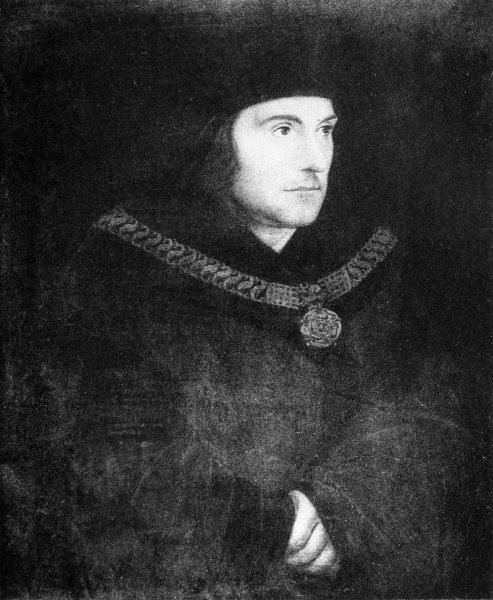
Of both More and Cromwell it has been observed
that historians do not greatly vary in their estimates,
when a reasonable allowance is made for Protestant
and anti-Protestant bias. That remark does not
hold good of King Henry. The popular idea of him
is more intimately associated with that of Bluebeard
than of any other hero of fiction or history. Mr.
Froude has created a legend of his own, wherein
the only doubt seems to be whether Henry quite
passed the dividing line between the mere hero and
the demi-god. Most commonly, he appears as a
brutal tyrant. Among the best informed living
authorities in England on the sixteenth century, one
distinguishes him as the most remarkable man who
ever sat on the English throne, and another has
characterised him as a weak-willed bully, always
depending for support on some stronger will than
his own; yet neither the one nor the other shows
signs of having been led to his conclusion by any
marked bias. The data for his reign, in the form of
documents calendared with exceptional skill, are
peculiarly ample; but the opportunities for drawing
divergent inferences therefrom are extensive. It
would be too much to call them unique, in a century
which gave birth also to Elizabeth and to Mary
Queen of Scots.
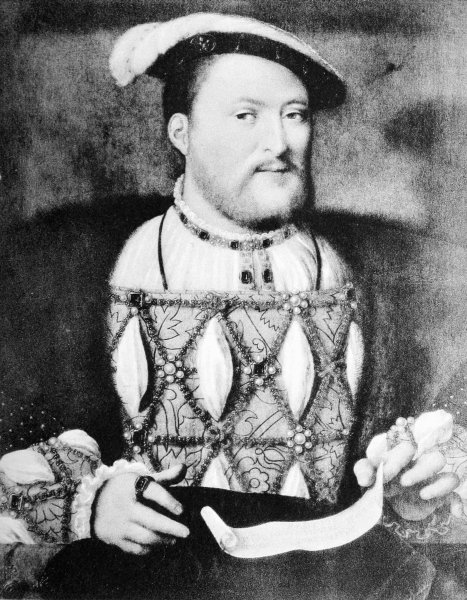
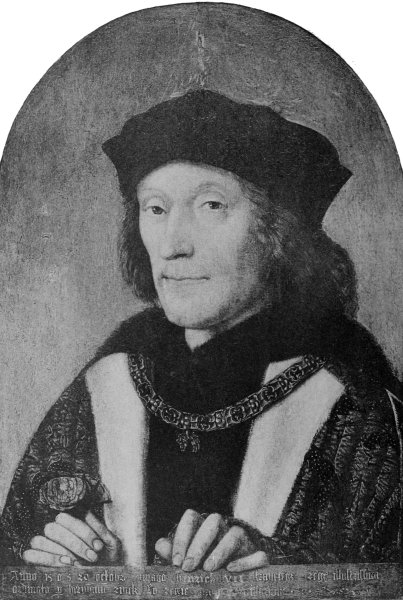
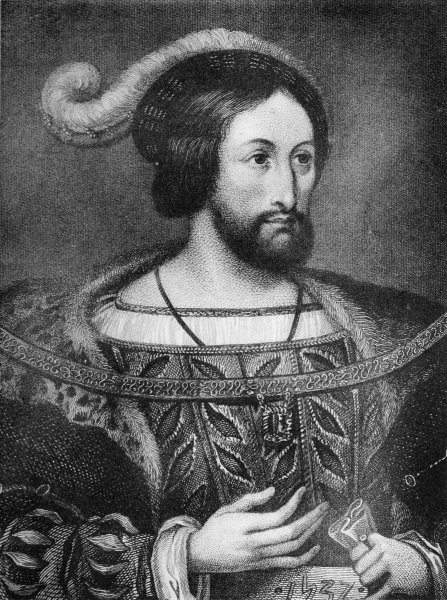
HENRY VIII.
From a Portrait by Jost van Cleef in the Royal Collection at
Hampton Court Palace
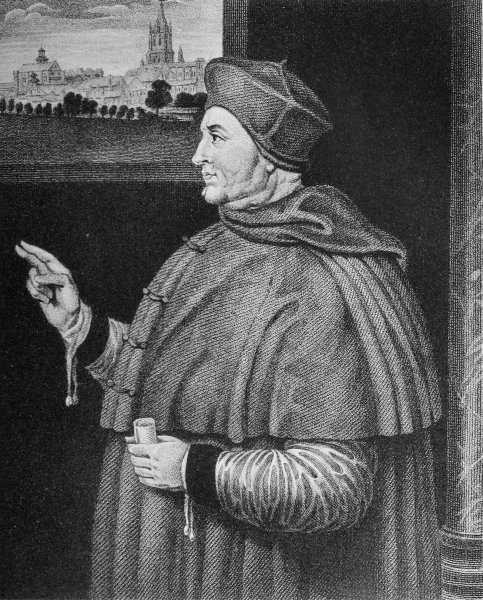
About the fourth year of Henry’s reign, Thomas
Wolsey came to the front and remained there for
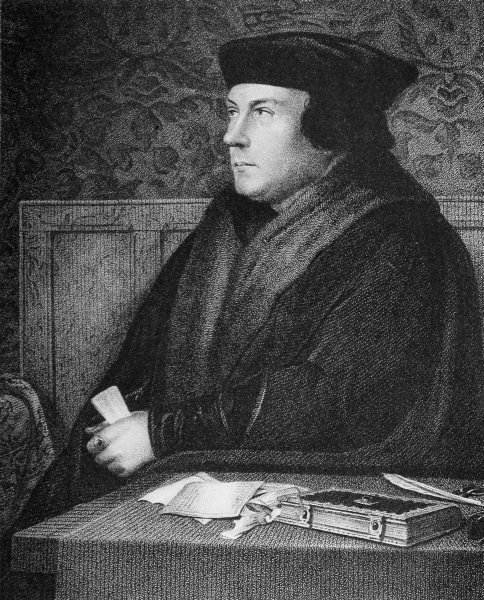
sixteen years. For another ten years, Thomas
Cromwell was in the king’s service. During this
period of something exceeding a quarter of a century,
did Henry or his ministers control policy? Great
events happened. Did he, in dealing with them,
show himself a great statesman? Or did he merely
play the part of a selfish and greedy libertine? One
can only express a personal opinion. The view
which seems most consonant with the facts may be
broadly stated thus. Like his daughter Elizabeth,
he had a keen eye for character and ability; he could
appreciate statesmanship in a servant, and he knew
how to get the utmost value out of the men he chose
to trust. In the main, he let them carry out their
designs in their own way; but he remained watchful,
and saw to it that if he happened to want anything
not included in their programme, the programme
should be altered. He did not initiate, but he did
adopt and make his own, the principles of Wolsey’s
foreign and Cromwell’s domestic policy. A time
came when he wanted from Wolsey something which
his minister’s genius was not adapted to provide;
and Wolsey vanished. By slow degrees Cromwell
emerged. A time came when Cromwell had given
him all that he could give, and was seeking to draw
his master into paths he did not choose to tread.
Cromwell went to the scaffold. In his remaining
years, the king showed no power of striking out for
himself a strong policy for good or for evil; he had
no minister whom he trusted to pilot the ship;
his own pilotage proved crude, and left to the succeeding
government a crop of difficulties with which it
was quite incompetent to cope. His father’s policy
had been his own creation; his ministers had never
been much more than clerks. The eighth Henry
chose ministers to create and carry out a policy for
him, but always under his own control. The peculiarity
of the Tudor genius, which he shared with his
father and his daughter, lay in the unfailing skill
with which they judged men, and their intuitive
appreciation of popular feeling, which kept them
from passing the bounds of acquiescence. Hence,
whatever we may think of their policy itself or of
particular acts, whether our moral judgment condemns
or applauds, whether we account their
measures far-sighted or short-sighted, they stand
out as great rulers, accomplishing what they meant
to accomplish, and displaying their activities on a
great scale.
Henry was his father’s second son. Tradition
says that his sire, ever thoughtful of economy,
destined him for the Archbishopric of Canterbury,
and had him educated accordingly. As the boy,
however, became, through his elder brother’s death,
heir apparent to the throne at the age of eleven, the
remarkable theological erudition which he displayed
in later years can hardly be attributed to his early
school-room studies—even if the tradition had any
more basis of fact than that it was at least ben
trovato. Whatever career was anticipated for him,
the utmost pains were bestowed on his education,
and he learnt to take a keen interest in intellectual
pursuits. Erasmus gives an agreeable picture of
him at the age of nine, and remarks on the extraordinary
intelligence of his letters a little later—an
intelligence which made the learned man believe
that the boy’s tutor wrote or revised them, till ocular
demonstration convinced him of the contrary.
Intellectual pursuits, however, did not absorb the
Prince of Wales. His father was not endowed with
any very striking physique, but the boy rather took
after his grandfather Edward IV., being decidedly
handsome, of very athletic frame, and excelling in
the sports of vigorous and healthy youth.
Two months before Henry completed his eighteenth
year, his father’s death placed him on the throne
of England—successor to a king whose later years
had been conspicuously sordid and gloomy. Spring
with its pulsing, generous life, followed the sapless
dreariness of winter. So men dreamed, and so
probably Henry reckoned, himself. Ugly things
like Empson and Dudley were to vanish into limbo;
the king would celebrate his marriage royally—and
follow that up by some splendid martial achievement.
It was still permitted to dream mediæval dreams;
might not the Crescent be once more rolled back
before the advancing Cross? Still, at eighteen there
was no great hurry about that, and meanwhile life
might be very much enjoyed. Kings have servants
about them to take the dull drudgery of politics
off their hands.
A most excellent state of things, in the eyes of the
veterans Ferdinand and Maximilian. The old king’s
martial ardour had resolved itself into occasional
campaigns on which no money was wasted, and in
which no blood was shed, but which somehow had
a trick of resulting in the transfer of hard cash from
somebody’s pocket to that of the English monarch.
But surely this open-hearted boy could be persuaded
that Henry V. set a more attractive precedent than
Henry VII., and that France was a good deal nearer
than Constantinople. To simplify matters he had
beside him a comely and capable wife, devoted to
the Spanish interest, and all the more likely to influence
him, at his age, for being a few years the
elder: and no young prince could have an adviser
half so shrewd as his quite disinterested father-in-law
of Aragon. So the unsophisticated Henry was
carefully manœuvred into war with France. From
which he learned two lessons: one that there was
frequently a very marked difference between the
words of kings and their deeds; the other, that military
glory or political success cannot be achieved without
close attention to detail. Incidentally, the young
king made another discovery; namely that the
comparatively insignificant ecclesiastic whom old
Bishop Fox had introduced into the Council was
as sharp-witted as Ferdinand himself, could do the
work of ten ordinary men, and always knew what
he was about.
Before the end of 1514, Ferdinand and Maximilian
were made painfully aware that Henry was not
going to be anybody’s tool, by the unexpected
alliance of England and France. The diplomatist
who had beaten them with their own weapons had
won the English king’s entire confidence, and there
was only one possible rival to him, in the person of
Henry’s brother-in-arms, Charles Brandon, newly
created Duke of Suffolk; nor was it long before
it became patent that the brother-in-arms, having
made himself brother-in-law into the bargain by
marrying the princess Mary, might remain the
favourite companion in the hunting field, and the
favourite antagonist in the tournament, but would
have very little to say to the king’s politics. Wolsey
had not only thoroughly impressed his master by
his immense administrative ability, his capacity for
hard work, and his astuteness; he had also succeeded
in giving a new turn to the king’s ambitions, making
them political rather than martial. The campaigns
of 1513 had restored the prestige of English soldiers
at least in a respectable degree; the outwitting of
the craftiest prince in Europe next year showed that
there was a worthy successor to Henry VII.; that
monarch was reputed to have left in the royal coffers
wealth so enormous as to be almost inexhaustible;
Scotland had suffered such a blow at Flodden that
she could not, for the time at least, hamper English
action. Henry therefore could now hold the balance
between the potentates of Europe, and become the
controlling factor in international affairs. Such a
position was much better worth working for than
reconquests of French soil, or even the recovery of
the French crown, which Henry V. had won but had
not lived long enough to wear. As for crusades,
Henry was old enough now to know that in the eyes
of a practical politician they were out of date.
Schemes for dominating Europe were much affected
by the fact that in 1514 many important changes in
the personality of the rulers were obviously impending.
Henry, twenty-three years old, was the only
young man among them. But on the next New
Year’s Day, France was to pass from Louis XII.
to young Francis of Angoulême, aged twenty. In
1516, Ferdinand was to be succeeded by his grandson
Charles, aged sixteen. In 1519, Maximilian was to
disappear; and, inasmuch as the Empire was not
technically hereditary, much would depend on the
Imperial election, in which, however, the chances
were that Ferdinand’s heir would prove to be
Maximilian’s heir also.
From 1514, the figure of Wolsey—very shortly
to become a Cardinal—completely dominated English
politics. The king resigned himself wholly to his
guidance, and for many years there was no more
talk of Henry leading victorious armies over the Continent.
The rival ambitions of Francis, Maximilian,
and others, chiefly concerned with the annexation
of Italian States by one potentate or another, the
playing off of rivals, the paying and withholding
of subsidies, were the main business in hand till the
demise of the emperor, early in 1519, opened the
great question, who was to wear the Imperial crown?
Young Charles was already king of all Spain, and
lord of the Burgundian heritage. He was also heir
to the Austrian and other German possessions of
Maximilian, who, like Ferdinand, had been his
grandfather. For some time, Habsburg had followed
Habsburg as emperor. There was no other of the
princes of Germany strong enough territorially to
bear the weight of empire, and Frederic of Saxony,
capax imperii, had no mind for the undertaking.
If Charles were elected he would wield enormous
powers. The French king, ambitious, and dreading
the further aggrandisement of a rival whose dominions
were already so great, came forward as a candidate:
his success would mean an accession of power to
France even more dangerous to the European
balance than that of Charles. Under these circumstances,
it is not incredible that Henry really meant
business in taking steps with a view to obtaining
the Imperial crown for himself. At twenty-eight,
he was quite young enough to believe that the thing
was really practicable: and if practicable, it would
be a magnificent fulfilment of his ambitions along the
very lines on which Wolsey had directed them. It
is not, however, credible that the Cardinal should
have taken that view; whether the king was or
was not merely playing with the idea, his minister
must have known that it was chimerical. The agent,
Richard Pace, very soon made it quite clear that it
would be sheer waste of energy and money for Henry
to enter seriously for the stakes, and Cuthbert
Tunstal was careful to point out that in burdening
himself with the responsibilities of the Empire, he
would be losing for the sake of a shadow the solid
substance of his power as King of England. Henry’s
candidature was withdrawn, and no one was any
the worse.
The episode, however, suggests certain conclusions.
It is almost impossible to doubt that the idea of
the candidature was Henry’s own; it is difficult to
doubt that he did contemplate it seriously. It was
consistent—in intention—with the conception of
political predominance as a more substantial object
of ambition than military laurels. It was of a
grandiosity which appealed to the imagination, but
not to the practical judgment of a far-sighted statesman.
That Henry should have taken it up is entirely
consistent with his character as we have conceived
it. On the other hand, if he had been merely a
monarch who allowed himself to be habitually
managed, but broke out in occasional fits of obstinacy—as
weak men do—he would have struggled
to the last for that election. In fact, he did interfere
with Wolsey the moment he thought he could better
the minister’s plans, but when he saw he had made
a mistake, but could retire without loss of dignity,
he did so without losing his temper. Later in life
he might have made himself unpleasant to somebody,
under like conditions. That would have depended
very much on how far he had set his heart on the
particular object he found himself called upon to
surrender. In the present case, Wolsey had ostensibly
done everything possible to make the scheme
succeed. He may never have attempted dissuasion,
relying on the inherent impracticability of the whole
thing to prevent any really awkward consequences.
At any rate, Henry’s confidence was in no way
diminished.
There was indeed little enough reason to be dissatisfied.
Western Europe was in the hands of
three young men, of whom the eldest, Henry, was
twenty-eight, and the youngest, Charles, was not
twenty. If Charles had the widest dominion, his
task was also the most complicated. He could only
pass to his Teutonic from his Spanish territories by
sea; French territory was continuous. If Charles
and Francis quarrelled, each would want the friendship
of England: for her enmity to Charles would
mean immense injury to the trade of Flanders, and
her enmity to France would mean serious military
embarrassments in the direction of Picardy. So for
some time to come both were eagerly seeking an
English alliance, while Wolsey’s skill was sufficiently
tasked, but not over-tasked, to keep the pair of them
in play; and to keep them at peace, since if they
once went to war it might prove exceedingly difficult
to avoid embroiling England.
In 1520 the competition between emperor and
king for English favour—which both took to mean
the Cardinal’s favour—was particularly lively, with
the result that the great meeting at the Field of the
Cloth of Gold took place, designed to signalise the
enthusiastic amity of Henry and Francis. Wolsey,
however, had manœuvred a less magnificent meeting
in England, only just before, between Henry and
the emperor; and no one could say that either of
the rivals had really won a lead over the other.
But it became increasingly difficult to prevent a
collision between them, and a year later, when Wolsey
was ostensibly making a great effort at the Conference
of Calais to effect a reconciliation, he was in
reality coming privately to terms with Charles. If
England was to be dragged into a war, she would be
on the Imperial side.
Why did England go to war with France, instead
of resolutely holding aloof? The Cardinal cannot
have seriously thought of the war as a means to the
recovery of the French crown: nor can he have
held it good for England that France should be
crippled, and the Emperor magnified. If he went
into the war of his own free will, if he urged it on
Henry, it can only have been with the purely personal
object of so binding Charles to him as to ensure
his own election to the Papacy at the next vacancy.
Yet at the time of the Calais Conference there was
no immediate likelihood of the reigning Pope’s
death; Wolsey was surely the last man to count on
the gratitude of princes for past favours as an
effective motive, and Charles had already shown a
thorough appreciation of the doctrine that promises
are made to be evaded. Moreover, so shrewd a man
as the Cardinal would presumably have felt extremely
doubtful whether the Papacy—with Charles
master of Europe—would be much worth having.
The only remaining suggestion is, that Wolsey
foresaw great domestic troubles, and took the time-honoured
course of trying to divert attention by
plunging the country in war. The obvious objection
to that is that there were no pressing signs of disturbance
at all.
The mere fact that the war was a regular reversal
of the methods Wolsey had hitherto followed, points
to its having been undertaken against his judgment.
But is it unreasonable to suppose that it was not
against the king’s judgment? That Henry for the
second time indicated the course which his minister
was to follow, and the minister obeyed rather than
resign? In those days, ministers did not resign,
unless they were exceptional people with consciences,
like Thomas More: and for Wolsey—whose political
existence, if not his life, depended entirely on the
king’s favour—to resign would have meant virtual
suicide. On the other hand, there were influences
which would affect Henry in favour of the war,
intelligibly enough. To him, the conquest of France
with the help of Charles may not have seemed absurd,
and he was not ashamed to avow it as his object
to Parliament, when asking for money. Apart from
that, there was always a military party headed by
men who felt themselves much more likely to achieve
honour and fame on the battlefield than in the
Cardinal’s ante-room: and if there was to be war
at all, there was a sort of standing sentiment in
favour of fighting the French. Lastly, the king
was still on good terms with his wife, and his wife
was a most determined advocate of her nephew’s
interests. Henry was even now only just thirty,
and the glamour of military achievement might still
tempt him. It certainly seems the most reasonable
conclusion that it was not Wolsey who dragged the
king into war, but the king who forced war on
Wolsey.
As a matter of fact, events proved that there was
very little to be made out of the war. After eight
years, Wolsey found himself compelled to call a
Parliament again, in order to get money—whereas
it had been his consistent policy to dispense with
Parliament altogether. The war was at any rate
not sufficiently unpopular to prevent the voting
of a substantial subsidy; but as time passed, such
favour as it had found with the public faded; the
Cardinal did not venture, when more money was
needed, to ask Parliament for it again, and when
he tried to raise what was called an Amicable loan,
the response was cold. The disaster of Francis at
Pavia, though it suggested more talk about recovering
the Crown of France, offered no opportunity for
material advantage to Henry, and it very soon
became evident that Charles was so much the master
of Europe that his career would only be held in check
by an Anglo-French alliance, which it became the
Cardinal’s business to contract in 1527.
This was precisely the time at which there is no
doubt that the question of divorcing Katharine of
Aragon was very much on the minds both of king
and Cardinal. In discussing that subject in the preceding
study of Wolsey, nothing was said of the
theory most adverse to Wolsey—that the idea
originated with him, and that he suggested it with
the specific intention of breaking the alliance with
Charles and substituting a French marriage, a French
alliance being now his object. On this theory it
is argued that the king’s intention of using the
divorce to marry Anne Boleyn was sprung on the
Cardinal as something quite new, on his return from
the French embassy; his absence having been
turned to account by his enemies, with the simple
object of wrecking his policy and ruining him. The
fact that Henry afterwards publicly acquitted Wolsey
of having instigated the divorce may not count for
much as evidence of his innocence; but there is
another grave objection to the theory. If Henry
told him that the divorce must be managed somehow,
he would doubtless have considered that the
least injurious result would be a French marriage;
but it is not easy to imagine that he would himself
have sought to bring about a step which would have
made so permanent a breach between Henry and
Charles. His own policy was to keep it always in
the power of England to shift from one side to the
other—to trim the balance between Charles and
Francis. The theory is put forward to square with a
particular view of Henry’s character—that he was
managed by any one who could get at him. But
it makes the Cardinal himself somewhat unintelligible—or
unintelligent.
The view advanced in these pages is, that for the
third time the king laid down a policy of his own
for the Cardinal to carry out. In the first place he
had two personal reasons for wanting the divorce—a
superstitious impression that the failure of Katharine
to supply him with a male heir was Heaven’s
punishment for a marriage which the Pope ought
never to have sanctioned; and a passion for Anne
Boleyn. In the second place, the policy of alliance
with Charles against Francis had worked out badly,
and a rupture with Charles must come in any case.
Wolsey should manage it, or should help: and if
he began with a belief that a French marriage might
be the outcome, there would be no harm done. The
policy, as before, was a deviation from Wolsey’s,
but did not seem superficially to run counter to the
broad principle on which it was based, that England
was to prove her effective predominance by throwing
her weight into the French or the Imperial scale
as circumstances might demand. But, as before,
the method was short-sighted. On the other hand,
we find Wolsey behaving also precisely as he did
before. If the king did elect to lay down a policy,
he must be the instrument through which it should
be carried out. He could not prevent it; he must
make the best of it, and as far as possible neutralise
the bad effects by skilful handling. He made his
attempt, failed, and fell. It would have been better
for his credit if he had fallen in open instead of in
covert opposition.
It remains in any case impossible to dogmatise;
the whole thing is a tangle, and there are difficulties
in the way of accepting each solution. To the theory
that the divorce was primarily a plan of Wolsey’s
in order to facilitate a French alliance, there is a
further objection that a negotiation was already on
foot for marrying the Princess Mary to Henry of
Orleans, the French king’s second son, who afterwards
became Henry II. The substitution of the
marriage of the king himself to a French princess
would have hardly been in itself a closer bond; yet
we should be compelled to believe that Wolsey
deliberately, with no greater advantage in view,
sought to make this change at the cost of a probably
irreparable breach with the emperor. The political
motive is inadequate. Whereas, for the king, who had
a powerful non-political motive thrown in, the plan
becomes intelligible enough. The divorce should
be so managed that Mary’s legitimacy should still
be secured, the marriage with Orleans could go
forward, and he himself would get the wife he
wanted. That in 1527 his passion for Anne was a
very powerful motive is not to be disputed—the
love-letters, uncertain as their dates are, cannot be
attributed to a still later time.
It is also tolerably clear that the king meant to
have the divorce in any case, whether it upset foreign
relations or not. Moreover, if the plan was Wolsey’s,
he would have been satisfied to leave the Cardinal
to work it out, which he was not. From the beginning
he appears to have suspected—if there was
not more than a suspicion—that his minister disliked
the whole idea, and would be only too pleased
if it were shelved; and he employed other agents
to get the thing done, behind Wolsey’s back. Wolsey
was very much in the position of a lawyer whose
client, with whom he cannot afford to quarrel, insists
on his adopting a certain course in defiance of his own
judgment. He devised ingenious expedients; he
tried to make his case as safe as possible; he gave
nothing away to the other side; but he was reluctant
throughout, while the king was invincibly obstinate.
Assuming then that it was Henry, not Wolsey, who
from the commencement sought the divorce, the
Cardinal’s consistency is restored. So far also the
consistency of Henry’s character is maintained.
He never laid out a great political scheme, calculating
for the future; but when Wolsey formulated
a large design, he readily recognised its merits, and
recognised Wolsey himself as the man to carry it
through. But three times he was moved with a
desire to obtain a particular end, without realising
that to do so would overturn the main scheme;
on each occasion the minister formally and officially
obeyed his master’s behest. Over the divorce,
however, Henry’s behaviour presents an interesting
psychological study.
There have been many statesmen, successful in
varying degree, who have quite deliberately ignored
moral considerations in their policy. They have
not admitted that unrighteous action as such carries
any penalty attached to it. Crime which shocks
public sentiment violently they may avoid; not
because it is criminal, but because public sentiment
cannot be ignored. The mere fact that a particular
course of action involves injustice or cruelty, or
otherwise over-rides the moral law, is not permitted
to weigh at all in judging of its expediency. Such
a one was Thomas Cromwell. There have been
others who would never allow any claim of mere
expediency to countervail against the dictates of
conscience. Such a one was Thomas More.
The average man is content to compromise: not
drawing the line very high, but still drawing it
somewhere. Henry belonged to the class who would
never violate conscience; but, when any particular
course presented itself to his mind as expedient or
desirable, he had a quite unique power of convincing
himself not only that the thing would not be wrong,
but that conscience positively clamoured that it
must be done: nothing was so monstrous that he
could not solemnly persuade himself that it was a
sad duty. There are men who are made that way.
They will rob the widow and swindle the orphan,
but they must and do first trick themselves into an
amazing belief that in so doing they are serving
heaven or society. Henry was much more dangerous
than a commonplace hypocrite who assumes a mask
to deceive the world, since he had to begin by
making the deception convincing to himself.
Thus it was in the matter of the divorce. It was
of real urgent importance that he should have a male
heir, and there was no hope of his wife giving him
one; he wanted very much to marry Anne, and he
could not do so while his wife was living; but with
what conscience could he get rid of that wife?
Henry’s conscience gave him the answer he wanted,
pat: it always did. Conscience pointed out that
the children of the marriage, except one girl, all
came to grief—were still-born, or died in a few weeks.
Surely, here was Heaven’s judgment on a sinful
union. True, the contracting parties had sinned
with a Pope’s benediction, and thinking there was
nothing wrong. But clearly the Pope must have
erred. Conscience therefore did not merely excuse,
it demanded, the dissolution of the unholy bond.
Conscience permitted Henry to declare fervently
that nothing would please him so much as to find
that his scruples were groundless; but nothing
would ever have persuaded him that they were so
except perhaps the death of Anne Boleyn. Having
once thoroughly satisfied himself that the divorce
was a duty, whatever any one might say to the
contrary, it followed that some legal method of
accomplishing it must exist. If the Pope did not
see the thing in the same light, there must be something
defective in the Papal authority after all.
The scruple of conscience gradually assumed an
axiomatic character to Henry; and the repudiation
of Clement, who regarded it as an extremely questionable
postulate, followed logically.
Until Clement revoked the cause to Rome—a
practical demonstration that he would not sanction
a verdict objectionable to the emperor—nothing
demanding revolutionary measures had occurred.
That event, however, changed the situation. There
would have to be a fight with the Papacy, which
could not be conducted under the Cardinal’s captaincy.
The Cardinal had failed badly; his behaviour
had been suspicious. It did not take the
conscientious monarch long to discover that advantage
had been taken of his own generous trustfulness,
that he had been warming a viper in his bosom.
Wolsey was thrown to the wolves. It is curiously
characteristic of Henry that the instrument by which
he shattered Wolsey was the charge of a breach of
Præmunire in accepting and exercising the legatine
authority. The mere fact that this had been done
with the king’s own licence, almost at his instigation,
would have checked any other monarch. Henry
found in it an additional cause of offence. The
Cardinal had not only broken the law—he, whose
business it was to see that the king did not accidentally
transgress, had actually inveigled the king into
transgression. A just man, tricked by his own
familiar friend into committing an act of injustice,
feels righteous indignation against the friend. Such
was the indignation of the king against the Cardinal,
as of Adam against Eve.
The fall of Wolsey marks, as the beginning of the
divorce proceedings really commences, the second
stage of Henry’s career. Had he died before 1529,
the Bluebeard legend would never have been applied
to him, and his connexion with the Reformation
would have been in effect limited to a controversial
pamphlet in favour of the extreme Papal claims,
directed against Luther. This was all that the uprising
of the great Reformer had evoked from the
prince who was expected to be the royal champion
of the Intellectuals. No one would have called him
a tyrant. It is true that Edmund de la Pole, Earl
of Suffolk, had been put to death at the beginning
of the reign—as tradition says, in fulfilment of the
advice of Henry VII. It is true also that Buckingham
had been executed, not so much because he
had committed any treason as because he was
thought dangerous; but the world would have been
content to leave that as one of the charges against
Wolsey. Henry would have passed with posterity
as a pleasure-loving monarch with a great taste for
extravagance, who cheerfully left the government
of the country to an able and unscrupulous minister,
and did absolutely nothing personally in the twenty
years of his reign to justify the high hopes with which
his accession was hailed. The reign would have
been recorded as the reign of the Cardinal, and our
ideas of the king himself would have been conveyed
mainly in the anecdotes of his personal vanity and
love of pageantry and popularity. It is the forcefulness,
energy, and resolution—or the violence, fickleness,
and obstinacy—displayed in the second period
which make us revise our judgment of the first, and
set us seeking therein for some appearance of these
same characteristics, and discovering in them the
explanation of some puzzles in the Cardinal’s policy.
The new stage of Henry’s career presents us with
a problem at the outset. Hitherto, he had followed
Wolsey’s counsels; very shortly, the Machiavellian
maxims of Cromwell guided his course; but there is
no one to bridge the gap between Wolsey and Cromwell.
Sir Thomas More succeeded the Cardinal
as Chancellor, but not as first minister—he never
made any secret, to the king, of his conviction that
the marriage with Katharine could not and should
not be invalidated. Nothing points to Norfolk or
Suffolk as guiding policy. The newly discovered
Cranmer had suggested a principle for dealing with
the divorce, but his appearance is merely in the
character of a University doctor, not of a statesman.
Precisely at this moment, before he knew anything
of Cromwell, with Wolsey, so to speak, hanging on
the very verge of the precipice, a Parliament is
called suddenly, which remains undissolved until
its seventh year. Since 1515 there had been only
one Parliament, that of 1523–1524. Between 1500
and 1515 Parliaments had been rare. Henry VII.,
when he no longer felt the need of constant Parliamentary
sanction, and Wolsey after him, had gone
steadily on the rule of accustoming the country to
have the government carried on almost without
Parliaments, and of establishing absolutism on those
lines. From this moment that attitude towards
Parliament disappears. For the rest of the reign,
there is no prolonged interval without one; Parliament
itself is converted into the instrument and the
buttress of despotism.
In the preceding study of Thomas Cromwell the
view was adopted that he was the real author of
what was one comprehensive design for establishing
the royal power high over everything else, including
therein the repudiation of Papal rivalry, and the
subordination of the clerical organisation; while
the method, of deliberately choosing to make Parliament
share the responsibility, was his also. Yet
the calling of this Parliament in 1529, and its initial
measures of ecclesiastical reform, cannot be attributed
to him. Henry did it out of his own head. It will
be found, however, that the apparent contradictions
are easily reconcilable.
Henry found, in 1529, that his determination to
have a divorce would involve either a fight with the
Papacy or a struggle to secure Papal support in
despite of the emperor. Also he felt that the
Cardinal was not to be depended on as the manager
of that struggle. He had no one ready to take the
Cardinal’s place, though Stephen Gardiner might
have done so had he been a layman. He had formulated
no plan of campaign beyond that of sending
the Earl of Wiltshire, Anne Boleyn’s father, with
Cranmer in his train, on an embassy to Bologna.
But he might find himself impelled to do more or
less questionable things; the precedent of his
father’s first years suggested that in that case it
would be useful to be able to say that he had acted
with the sanction of Parliament; and he had the
Tudor instinct of appreciating the value of conciliating
popular sentiment. Nothing would conciliate
popular sentiment so much as inducing his subjects
to believe that it was their interests and their
opinions he was consulting. So he summoned
Parliament.
Thus, Henry called the Parliament: Henry
authorised clerical reform: Henry meditated a
possible quarrel with the Pope. But it was Cromwell
who co-ordinated Henry’s ideas—clever enough
as far as they went, but not going far—into a single
far-reaching scheme, wherein the things his master
had thought of were nicely adjusted, gaps were
filled in, consequences calculated, and a systematic
evolution arranged in which every step should seem
the corollary of what had already been accomplished.
How far individual steps were invented by Henry,
and how far by Cromwell, it is not possible to gauge.
Cromwell never assumed the pose of Wolsey—the
pose which the Cardinal did indubitably adopt,
although it was erroneously inferred from the famous
if legendary phrase, Ego et rex meus. He was always
ostensibly the king’s instrument. In Wolsey’s time
a question had once arisen whether in sending certain
official despatches the full information should be
sent to him, and only general remarks to the king,
or vice versa. That would not have happened with
Thomas Cromwell. The full official despatch would
have gone to the king as a matter of course—but
Cromwell might have had a private unofficial commentary.
Henry, during the Cromwell régime, was
in constant evidence as the ruler of the country.
During Wolsey’s régime, he ostentatiously left the
management in Wolsey’s hands. But during both
periods we can at any rate form a shrewd guess
at the points on which king and minister were in
harmony, and those where the minister had to yield
to the king.
Beyond minor reforms of abuses, and the movement
for taking the opinion of the Universities on
the divorce, there was no immediate sign, after the
Cardinal’s fall, of a definitely anti-clerical or anti-Papal
policy. The first blow—the demand for a
ransom from the clergy under the Præmunire—would
have been entirely characteristic of either the king
or Cromwell: the idea was after all merely a very
much more audacious application of the method
adopted towards Wolsey. Whoever hit upon the
notion, it was made the first step in the systematic
grinding down of the clergy between the upper and
the nether millstones of financial spoliation and
political subjection. The Supplication against the
Ordinaries in Parliament, the Submission of the
Clergy, forced upon Convocation as the clause of the
“Supreme Head” had been, appear to be more
decisively Cromwell’s handiwork. There is no adequate
reason to suppose that Parliament had these
measures thrust down its throat: anti-clericalism
was not a new idea, and was usually popular; and
if the Supplication included matters about which
the general public cared very little, such as the right
of ecclesiastical legislation exercised by Convocation,
it also carefully embodied popular grievances, though
they may not have been as flagrant as was represented.
But on the other hand, if the Supplication emanated
from any one but Cromwell, it implies an elaboration
of organised action among private members which
there is nothing to corroborate. It must have been
what may be called a Government measure, which
on the whole had the support—possibly the enthusiastic
support—of the House. The Annates Act,
opposed by the bishops, was not enthusiastically
adopted by the Commons—not so much because
they objected to depriving the Pope of the impost
as because they saw no reason why the clergy should
be relieved of it. They did not realise that the king
and Cromwell had no intention of allowing it to
become an effective measure of relief at all.
In short, down to the pronouncement of the divorce,
Henry and Cromwell are clearly working in perfect
accord—whether minister or king devised the programme:
Convocation is being steadily compelled,
very much against its will, to endorse the propositions
of the Crown, and Parliament is at any rate
acquiescent. We may, however, suspect that Henry,
up to this point at least if not for nearly a year more,
inclined to hope that the Pope might yet give way;
whereas in the overtures to the Lutheran Princes
in 1533 we may see Cromwell working to make
doubly sure the assurance of complete severance from
Rome. The Lutheran alliance was unquestionably a
favourite scheme of Cromwell’s, but the king never
did more than dally with it. In his pet character of
theologian he could never bring himself to accept the
Augsburg Confession, or any compromise which
would have satisfied the Protestants.
Cromwell was always possessed with the belief
that a combination of Powers favourable to the
Papacy would be formed sooner or later for the
destruction of England and the Protestants on the
Continent: the coalition of Charles and Francis
was his bugbear. On the other hand, he saw no
hope of an effective union between England and
France; while he fancied that, if the bar between
Henry and Charles, irremovable while Katharine
lived, were once annulled by her death, the emperor—whose
troops had sacked Rome in 1527, and who
had in many respects evinced very little real regard
for the Pope’s authority—might be brought over
to the anti-Papal side. Therefore, whenever he
thought there was a prospect of effecting an Imperial
alliance, he let the idea of the Protestant alliance go;
whenever the Imperial alliance seemed hopeless,
the Protestant alliance re-appeared on his programme.
Henry, however, was not at one with Cromwell.
He looked askance at the idea of a Protestant alliance
because he did not consider himself a Protestant;
on the contrary, he accounted Lutheranism as
heresy, and himself as a pattern of orthodoxy. From
his point of view, the only quarrel with Rome lay
in the Pope’s assertion of usurped claims to jurisdiction,
which either Charles or Francis might find
themselves ready to repudiate in their own dominion
at any convenient moment. He remembered
Wolsey’s doctrine. Francis and Charles had so
many antagonistic interests that they could never
co-operate for long. The business of England was
to make each desire her alliance; to avoid the mistake
of committing herself too deeply to either. For a
short time—in 1539—he began to think that Cromwell
might be right about the danger of a coalition,
and accepted the plan of the Cleves marriage as a
defensive measure. The marriage was hardly accomplished
when a fresh breach between the rival princes
showed that his own view of the danger had been
right. There never was, either in his own time or
later, a Catholic coalition against England. At
the same time it is at least a tenable view that a
Protestant union, steadily maintained, might have
had great results; on which it is not uninteresting
to speculate, but the speculation is too much guesswork
to be profitable.
Henry’s views, then, on foreign policy, differed
from his minister’s, and it was Henry’s views that
prevailed, except in the episode of the Cleves
marriage; and in that particular case, there was
so startling an appearance of a real rapprochement
between Francis and Charles that the king’s deviation
along Cromwell’s lines can hardly be attributed to
weakness. And even so he took careful precautions,
as long as the thing was possible, to preserve a
loop-hole for his own withdrawal, however deeply
his minister might be committed.
In the ecclesiastical policy also, as it emerges after
the definite breach with Rome, Cromwell was evidently
more inclined to encourage the advanced
school than his master. Henry made Cranmer
Archbishop, wanting in that post a man who accepted
whole-heartedly the theory of Royal Supremacy.
As long as the reforms proposed were restricted to
dealing with notorious abuses of the kind which
Colet had freely denounced, and to the introduction
of an English Bible—which the Conservatives might
regard as dangerous, but could not denounce as in
itself heretical—Henry was prepared to give his
sanction; but whenever doctrines were in question
as to which the followers of the “Old Learning”
were in solid agreement, Henry consistently held with
them. Cromwell, on the other hand—not from
religious sentiment, but on purely political grounds—had
Lutheran proclivities, owing to his desire to
conciliate Continental Protestantism. He did not,
as Cranmer did, urge the acceptance of views to
which Henry objected; but his influence was always
in favour of “advanced” appointments, and of a
lax application of the laws which pressed hardly
upon that school. Henry’s personal affection for
Cranmer, a liking for Latimer, and an absence of
any such feeling towards Gardiner and Gardiner’s
colleagues, kept him from active interference in this
respect. But he saw to it that what the law laid
down should be unimpeachably orthodox, and
every attempt of Cromwell’s to draw nearer to the
Lutherans was countered by affirmations of a rigid
adherence to the Old Faith and denunciation of
innovations: culminating in the Act of the Six
Articles. The differences in the formularies of faith
issued from 1536 to 1540 are all in the direction of
increasing definiteness, of leaving fewer questions
open; and the definiteness is always in favour of
the old school. Although the minister officially
supported the Six Articles, while the Archbishop
made all the fight possible against it, the Act was
the king’s deliberate work, and the forcing of it
through was without any possible doubt a direct
set-back for Cromwell. At the same time, however,
Henry took occasion to impress on his Court, with
his usual vigour, that it would be extremely injudicious
for any one to act on the hypothesis that
it involved any diminution of the personal favour
in which Cranmer was held.
In the rest of the domestic policy—Treason Acts,
Supremacy Acts, Acts of Succession, Dissolution of
Monasteries, Attainders—there is no opposition
between king and minister. The edifice of absolutism
with the sanction of Parliament is steadily
reared, on the ruins of the ecclesiastical fabric and
of the last families round whom any sort of Yorkist
tradition can centre. When at last it had culminated
in the Royal Proclamations Act, Cromwell
ceased to be necessary; being no longer necessary,
he offended his master; and, offending him, fell as
Wolsey fell before him.
Down to this point, then, from 1513 to 1540, we
may believe that Henry was the puppet first of
Wolsey and then of Cromwell; or that both were
no more than the instruments of his supreme genius;
or that, having with a light heart delegated all his
duties and cares to the Cardinal, he resolved to rule
himself, upset the Cardinal, and used Cromwell as
a tool and scapegoat. Or we may judge that the
creative, designing brains were his ministers’; but
that he deliberately made their policy his own,
except when he had a fancy for diverging from it,
trusting to their pilotage just so long as it suited
him—that they, not he, were the pilots, but he was
emphatically the captain. We may even believe
that the ministers were responsible only for the
mistakes in execution, the king for the great designs.
But when Cromwell is gone no one takes the vacant
place. Gardiner and Norfolk are at the head of
the Council, which becomes a hotbed of intrigues;
but it is quite impossible to attribute the royal policy
either to any individual or to any clique. Hence,
in the king’s conduct of affairs during the remaining
six and a half years of his life, we ought to find clues
to the nature and extent of the control he really
exercised during the thirty years preceding.
The view here put forward has been, that Wolsey
diverted him from his first merely boyish dreams of
martial achievements, to take hold of the conception
of making England stand as the secure arbiter
between the great Powers of the Continent, wooed
by all—or both, when only two were left—and able
always to turn the scale if one or other threatened
to preponderate. His brain, however, being somewhat
more liable to inflation than the Cardinal’s,
he compelled the latter, in pursuit of this policy,
to diverge from the right path and commit the
country to the French war—possibly, though not
on the whole probably, with the notion that the old
grandiose idea of conquering France might become
practicable. Then, just as the blunder was in
course of being remedied, he became obsessed with
the determination to divorce Katharine; a proceeding
which could hardly fail to make friendly relations
with the emperor so impossible as to destroy the basis
of the balancing scheme, which demanded that the
two European rivals should both be anxious to court
English support. Then Cromwell showed him how
to use the divorce as a piece of the machinery by
which the power of the Crown might be made at
least as absolute as any known in European history.
He adopted Cromwell’s plan, but not what Cromwell
regarded as its corollary, the acceptance of the position,
and the alliance of the continental Protestants:
endeavouring to hold himself aloof from alliances,
and, after Katharine’s death, to regain the position
of balance-holder.
Now it has been argued that the policy of 1522
was Wolsey’s own, not the king’s policy forced on
him, because it was only when Wolsey was minister
that a “spirited foreign policy” was acted upon.
It is therefore to be noted that when Henry was left
to himself with neither Wolsey nor Cromwell to give
counsel, he did quite evidently take up the almost
defunct Plantagenet notion of imposing the sovereignty
of England on Scotland—which experience
had shown to be no more feasible than the conquest
of France: and he did again find himself drawn
into an Imperial alliance, and actually at war with
the French. These facts do not amount to a proof,
but they do afford a presumption that the talk about
recovering the French crown had not been altogether
wind, and that the first fighting alliance with
Charles was, like the second, the doing of the king.
Probably Henry’s main motive in going into this
later French war was to compel Francis to withdraw
his support from the Scots. He ought, however,
to have known by this time, first, that France
could not afford to stand by while Scotland was
robbed of the independence which was always a
practical and valuable asset for France when she
was at war with England: and, secondly, that
Charles would play for his own hand, and would find
some excuse for leaving his ally isolated the moment
his own needs were satisfied.
The Scots affair, by the way, supplies another
interesting example of the peculiarities of Henry’s
conscience. The head and front of the party in
Scotland who were most bitterly hostile to England
was Cardinal Beton: who was in close alliance with
Mary of Guise, the queen-mother. Henry was
ingenious enough to discover that Beton was a
rebel, who had secured himself above the reach of
the law, and that consequently his assassination
would be rather commendable. It is not surprising
that the Cardinal was murdered in due course, and
that the murderers looked to England for support.
The history of these later years, in short, lends
colour to the view that the political errors—in
foreign affairs—committed in Wolsey’s days were
forced on him by the king: and also that the king
himself did not formulate large political conceptions
on his own account. More than that, it shows him
capable of such serious blunders as the proposal to
re-assert the old fable of English suzerainty in Scotland,
and—what was in its own way hardly less
short-sighted—the wholesale debasement of the
coinage. It was not till he was left to manage things
with no strong counsellor to aid him that he gave
way completely to this most evil propensity of his
last years. The thing did incalculable mischief,
ruining credit, driving up prices, robbing creditors
for the benefit of debtors, and, of course, driving all
the sound coins out of circulation. It is to the credit
of Somerset in the next reign that, in spite of the
depleted treasury, he did not carry that disastrous
experiment further: it was left for Northumberland
to degrade the currency even more than Henry had
done. And it was Henry who had done it, not
Wolsey or Cromwell or Gardiner. These things
would seem to mean that, left to himself, it was his
tendency to resort to paltry and short-sighted tricks
and devices of a kind incompatible with the higher
statesmanship; tricks which seem at the moment
to effect their purpose, but are a mere evasion of the
difficulties with which they pretend to deal. In
these years, Henry’s statesmanship makes a poor display.
We may plead on his behalf that physical
disease weakened his intellectual powers, that
practically unchecked despotism produced moral
degeneration, that we cannot judge the qualities of
a man whose rule had been—for whatever reason—undeniably
powerful for a quarter of a century, by
the mismanagement of the years when he was
wearing into his grave. There is truth in the plea.
Yet from the degeneration we can infer the inherent
defects. The man who muddled his Scottish policy,
and left the arrangements for carrying on the government
at his death in a state of chaos, was not he
who planned, organised, and carried out the defiance
of the Papal power and the subjection of the Church;
but he may have been perfectly capable of appreciating
that vast scheme, and of playing a formidable
part in the execution of it. On the other
hand, had he been merely a vain tyrannical bully,
there was more than one man in his entourage
after Cromwell’s fall, who would have had the wit
to make a puppet of him—which no one certainly
succeeded in doing.
A study of Henry’s character, however brief,
would be incomplete if it omitted to touch on his
widely varied marital relations. The Blue Beard
legend may by this time be fairly looked upon as
exploded. He did not marry one wife after another
to gratify capricious passions, and, when he was weary
of the new toy, cut her head off and get himself
another. Except in the case of Anne Boleyn, and
possibly Jane Seymour, passion can have had very
little to say to his various ventures. His Court was
licentious; but the king himself does not appear to
have been worse than his neighbours, even if he was
no better. Political intriguers tried to obtain influence
through mistresses; there was certainly an
attempt to supplant Anne Boleyn by this means,
and the Earl of Surrey—who was probably innocent
enough of real treason but otherwise deserves very
little of the pity that has been wasted on him—tried
to persuade his own sister to establish herself at the
king’s ear in the same way. There is hardly a shadow
of doubt that Anne Boleyn’s elder sister Mary was
Henry’s mistress before he turned his eyes upon
Anne. Rumour declared, though the statement is
not substantiated, that Sir John Perrot, who did
good work in Ireland in Elizabeth’s day, was really
Henry’s son. It is probable, however, that there
were no children of his born out of wedlock except
the son of Elizabeth Blount, whom he made Duke
of Richmond and was credited with intending to get
legitimised, when there was no likelihood of a
legitimate male heir appearing. The state of the
Court was such that Chapuys declined to believe
in the otherwise unimpeached virtue of Jane Seymour,
merely on the general principle that no woman
could be supposed virtuous under the conditions
there prevalent—but Chapuys was writing at a
moment when he was feeling particularly hot against
the whole Court. An item in the royal accounts has
been supposed to indicate that Henry kept a sort of
harem, but that is based on what is almost certainly
a misinterpretation of the term “mistress.” Henry
was licentious enough, but there is no reason to
imagine him as a satyr, or as on the same plane
with Francis I. The kings of the sixteenth century,
bad or good, were not often clean livers. The way
to Henry’s favour was never through the good graces
of the favourite of the hour; and except in the case
of Anne Boleyn it never appears that he allowed any
passion to interfere with his politics.
At eighteen, as soon as he ascended the throne,
Henry married the wife secured for him by the diplomacy
of Henry VII. and Ferdinand and the complaisance
of the Pope. Katharine was four years
the elder, sufficiently good-looking, capable, and
fit to be a queen. She had already been the bride
of the young king’s elder brother, who had died
very shortly after the nuptials: but the Pope had
duly provided a dispensation to permit the second
marriage. She and her husband got on satisfactorily
enough for a time. In 1513, when he was displaying
his martial prowess in Picardy, she was occupied in
organising the Flodden campaign and wrote to him
in a tone implying that they were excellent friends:
yet it is possible to recognise a certain want of tact,
in the absence of that adroit flattery which Henry’s
vain soul loved, when she dwells on her own achievements
instead of praising those of her lord. Henry
soon grew cool—there is no reason to suppose that
he was ever her ardent lover—and already, when
babies died or were still-born, he seems to have
turned his mind to a divorce, though he dropped the
idea again. When the princess Mary was born
and did not die, the big jovial monarch made a great
pet of the child; and though he was unfaithful to
his wife, and had no compunction about it, the conventional
friendliness was maintained. There is no
doubt that the queen exercised active influence to
secure England’s favour for her nephew Charles V.;
and critics have found, in the desire of Henry and
Wolsey, a few years later, to break with Charles and
form an alliance with France, one of the leading
motives which recommended the divorce to them.
About 1522, Anne Boleyn came to Court; and
from this time, favours began to flow in the direction
of the Boleyn family. The probabilities are,
however, that as yet they were due rather to the
complaisance of the elder sister Mary than to the
attractions of the younger. Four years later, it is
clear that Anne had become the object of the king’s
pursuit; but, whether because she was more virtuous
or more ambitious than Mary, Anne would not
surrender herself. The king became the victim
of an absorbing passion, which made him determined
to procure the divorce from Katharine at any
cost—whether or no it was primarily responsible for
reviving the idea. Once embarked on it, Henry
was far too obstinate to allow anything to divert
him. Towards the end of 1532—as soon as Warham
was dead—he saw his way. Before the year was
out, Anne had become his mistress or his wife; a
marriage ceremony was performed in January—possibly
in November. It is not easy to believe—though
the evidence points that way—that Anne,
after holding out till the prize was actually in reach,
would have risked everything by yielding without
insisting on the ceremony first taking place.
The marriage was extremely unpopular; the new
queen was spiteful, flighty, undignified, if nothing
worse. In a very short time, Cranmer was the
only friend she had left; she lost her charm for her
husband, and she annoyed him by the same failure
to fulfil his expectations as Katharine. The old
idea cropped up again, that on this as on the previous
union the blessing of heaven did not rest. The
king found himself attracted by the somewhat
inconspicuous charms and persistent virtue of Jane
Seymour. Charges were brought against Anne,
which may or may not have been true; admissions
were made to Cranmer, the nature of which we can
only guess at; on the strength of the former, she
was condemned to death for treason, and on the
strength of the latter the marriage was declared void
ab initio. The unhappy woman was beheaded;
next day, according to Chapuys, the king married
Jane Seymour privately. The official marriage
was ten days later.
Jane appears to have been a pleasing, colourless,
irreproachable person; who, when she had given
birth to the much-desired son, departed to another
world without having suffered any estrangement
from her husband. He, however, was wife-hunting
again before long—not because he was attracted by
any one, but for purely political ends. Unfortunately
he was not satisfied by the possession of purely
political qualifications on the part of the ladies, but
offended their susceptibilities by wishing to inspect
them. At last Cromwell beguiled him into approving
the Cleves marriage; but when Anne came over, and
retreat seemed impossible, he first found that she
was not at all to his taste, and then that the political
reasons for wedding her had been quite inadequate.
So the ecclesiastical lawyers set to work again to
discover an excuse for annulling that marriage;
and in the meantime the Duke of Norfolk produced
a young niece of his own, Katharine Howard, who
took the king’s more than middle-aged fancy. Being
quit of Anne, he married the girl, who successfully
cajoled him for about a year: after which, the
faction opposed to Norfolk discovered and laid before
the unfortunate husband evidence of undoubted
immorality before and probable immorality after
her marriage. So Katharine Howard followed Anne
Boleyn to the block. The affair seems to have been a
really complete and very painful surprise to Henry.
By this time, the jibe attributed to the Duchess of
Milan when Henry was thinking of marrying her—“Had
I two heads, one should be at his majesty’s
disposal”—would have been quite excusable. Even
the ladies of his own Court were not covetous of the
queenly throne. Chapuys, ever cynical, hinted that
an Act passed at this time would quite account for
reluctance on their part: if the king should propose
to marry a subject, she must confess any improprieties
of which she had been guilty; otherwise, if they
were subsequently discovered, she would be held
guilty of treason. Still Henry discovered one more
lady who was willing to take the risks—a lady of
much conjugal experience, now a widow for the
second time. This was Katharine Parr, whose
last husband had been Lord Latimer. Her virtue,
however, was as much above suspicion as Jane
Seymour’s had been; she was sensible, careful, and
extremely tactful; and when an attempt was
made to set her husband against her as a
heretic, she satisfied him very easily, and her
accuser had to submit to one of Henry’s ratings.
She survived him, and married Admiral Thomas
Seymour.
The marriages with Katharine of Aragon and
Anne of Cleves were both avowedly and professedly
political. That with Anne Boleyn was one of passion;
that with Katharine Parr one of inclination. It is
extremely doubtful whether either was effectively
promoted by political intrigue. It is hardly at all
doubtful that in the two remaining cases it was
political intrigue which brought both Jane Seymour
and Katharine Howard under the king’s notice;
nevertheless, it is not likely that either of these
marriages affected the king’s policy, though the
disastrous termination of the second did so.
The end of Henry’s life was quite characteristic.
For some time beforehand every one knew that he
could not last long; and intrigues were rife to secure
power when he was gone. The Earl of Hertford,
Jane Seymour’s brother, was at the head of that
one of the two main factions whose leading ecclesiastic
was Cranmer; they were balanced by Gardiner,
with the old Duke of Norfolk and his son Henry Earl
of Surrey. A false move on Surrey’s part gave a
handle to the enemy; Surrey was executed; Norfolk
was attainted and his life saved only by Henry’s
own death; Gardiner’s name was excluded from the
council of “executors,” which is supposed to have
been intended by the king to balance the two parties.
Henry, left to himself, did not display wisdom in his
government, but he always at the worst held the
reins in a fast grip and sat firm in the saddle. His
arrangements for carrying on the government after
him were short-sighted, and his successor in the
saddle, Hertford, was as much his inferior in practical
mastery as he was superior in his ethical aims.
The results are discussed in another chapter. Henry
was almost in articulo mortis before any one ventured
to tell him that his hours were numbered. At last he
allowed Cranmer to be summoned. When he arrived,
the king was speechless; but being besought to give
some sign that he put his trust in Christ, wrung the
Archbishop’s hand. An hour afterwards, he was
dead.
Henry’s career leaves a pretty wide option for
forming a judgment of his character. After making
every possible allowance for flattery, we know that
he was exceptionally accomplished, cultured, athletic;
he could hold his own with any one, in an
argument or in the tilt-yard. His physical courage
has been impugned, principally because in respect
of infectious diseases he was notoriously a coward.
As a young man, if he was unfaithful to his wife he
at any rate observed the expected courtesies; it is
not surprising to find that as the divorce proceedings
went on his manner deteriorated, till his treatment
of Katharine, of his daughter Mary, of Anne Boleyn
when she lost her hold on him, can only be described
as blackguardly. No one, perhaps, would venture to
ascribe to him a fervent zeal for religion; but he
was intensely satisfied with the rigidity of his own
orthodoxy. It is one of the many ironies of his
career that his religiousness has been praised exclusively
by people whom he would have sent to the
stake as heretics without a moment’s hesitation. If
he let Cranmer have his way about an English Bible,
it was not from an enthusiastic admiration of the
Scriptures, but because he knew that some of the
clergy thought it would weaken their influence.
The nature of his own creed is conveyed in the Act
of the Six Articles. Of his “morality,” in the
restricted sense of that term, enough has already been
said; it was that of his age and his rank. For his
conception of honour, his applications of the Statute
of Præmunire, and the return he rendered to Wolsey
and Cromwell and More for their services, are sufficient
witness. In the case of More, by the way,
it was characteristic of him that when the report of
the ex-Chancellor’s execution was brought to him,
he turned on Anne Boleyn and told her it was all
her doing. For a high-minded man, his approval
of the schemes for getting James Beton kidnapped
when under a safe-conduct, and for the murder of
David Beton, seems a little peculiar; yet in those
times, it cannot be denied that similar schemes
found sanction in most unexpected quarters. As
far as politics were concerned, he kept his promises,
on the whole, a shade more loyally than Charles
and Francis and their successors. Ferdinand and
Maximilian, of course, had never begun to think that
promises could be looked upon as binding.
As a statesman: we must reject the theory that
he was merely a Roi Fainéant who liked to fancy that
he was running the machine while he was merely
dancing to the tune called by cleverer men than
himself: we reject also the theory that the policy
followed throughout was his own creation, and that
Wolsey and Cromwell stood in the same relation to
him as Morton and Fox to his father. He was not a
far-seeing man himself, but he knew a far-seeing man
when he found one, having an unfailing instinct for
judging other men’s capacities and limitations,
intellectual and moral. He was ready to recognise
their insight and foresight, their organising and
administrative powers, to lay the burden—and the
reproach—on their shoulders; but if they did not
convince his judgment, they had to obey his behests,
not he theirs. And yet there is one field wherein
credit, and very high credit, attaches to Henry—credit,
moreover, which appears to be entirely his
own. As Wolsey had his hobby, education, so
Henry had his hobby, the navy. A Royal Navy, a
fleet whose business was fighting, was practically his
creation. It may very well be that he was much
wiser than he knew himself in this matter—that
his ships were to him something of a toy. But what
he did went far to making the glories of his daughter’s
reign possible, as the army of Frederick I. of Prussia
made the army of Frederick II. possible.
Finally; although we have denied him personally
the greatest qualities of statesmanship displayed by
his ministers, he did possess in a very high degree
certain essential qualities of a successful ruler. No
mere blustering tyrant would have held England in
his grip for thirty-seven years; the annals of princes
of that type may be terrible, but they are brief.
The masses may be held in subjection by a powerful
upper class for an indefinite period; the continued
power of an individual tyrant—of an active and
resolutely aggressive autocratic ruler—depends on
his preserving the loyalty of the active part of his
subjects. That loyalty Henry retained; he never
had the smallest difficulty in stamping out every
attempt at resistance. Mere ruthlessness will not
account for it; ruthlessness by itself rouses new
enemies: a reign of sheer terror is brief. To the
instinct for gauging men he added the instinct of
gauging popular sentiment—a perception of the line
which must not be over-stepped; a knack of gracious
and timely withdrawal if ever he seemed to have
passed the danger-point. Withal, he recognised that
the surest method of getting his own way was to make
his subjects believe that it was their way too. His
figure is very, very far from being god-like; it is
quite remote from the heroic; it might, however,
have fairly been called Titanic, if that term did not
imply ultimate failure—for he did not fail. Neither
his intellectual nor his moral qualities permit us
to love him, to praise him, or to honour him; and
yet, if we have read him aright, it is impossible not
to admire.