PUNISHMENTS IN PROVINCIAL TOWNS IN THE OLDEN TIME.
The instruments most in vogue with our ancestors were three—the
cucking-stool, the brank, and the tumbrel.
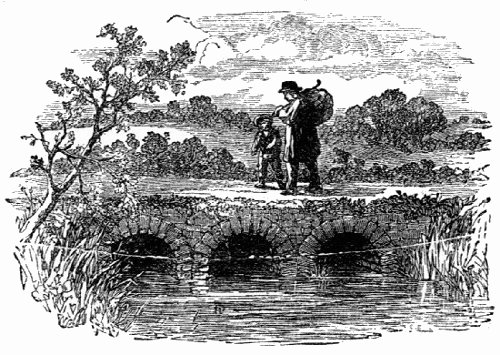
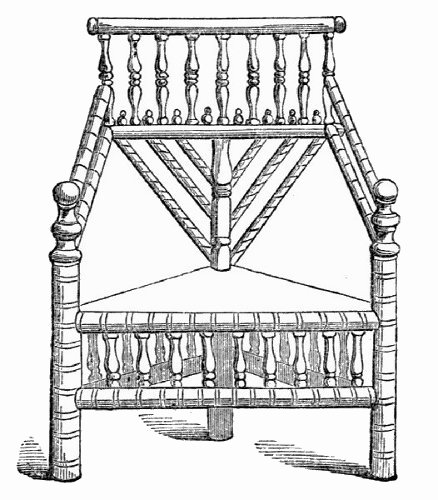
The Cucking-stool was used by the pond in many village greens
about one hundred years ago or little more, and then deemed the best
corrective of a scolding woman.
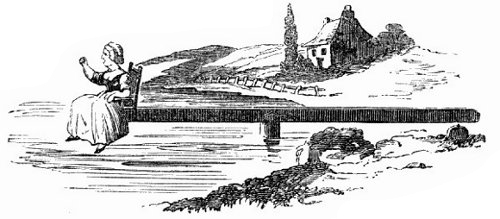
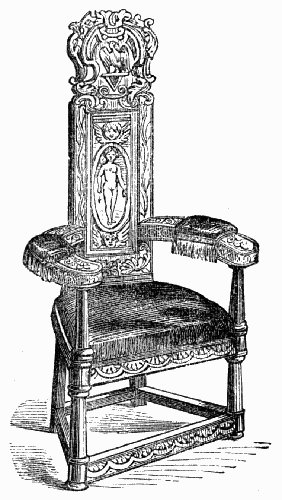
The CUCKING-STOOL.
By the sea, the quay offered a convenient spot. The barbican, at
Plymouth, was a locality, doubtless terrible to offenders, however careless
of committing their wordy nuisance of scolding. Two pounds
were paid for a cucking-stool at Leicester in 1768. Since that it has been
placed at the door of a notorious scold as a warning. Upon admission to
the House of Correction at Liverpool, a woman had to undergo the
severity of the cucking-stool till a little before the year 1803, when
Mr. James Neild wrote to Dr. Lettsom. The pump in the men's court
was the whipping-post for females, which discipline continued, though
not weekly.
Kingston-upon-Thames.
| |
|
s. |
d. |
| 1572, |
The making of the cucking-stool |
8 |
0 |
| |
Iron work for the same |
3 |
0 |
| |
Timber for the same |
7 |
6 |
| |
Three brasses for the same, and three wheels |
4 |
10 |
| |
|
—— |
—— |
| |
|
£1 3 |
4 |
At Marlborough, in 1625, a man had 4d. for his help at the cucking of
Joan Neal.
Gravesend.
| |
|
s. |
d. |
| 1636, |
The porters for ducking of Goodwife Campion |
2 |
0 |
| |
Two porters for laying up the ducking-stool |
0 |
8 |
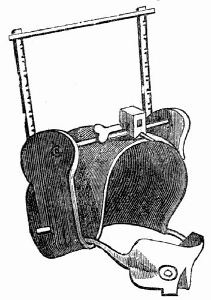
THE BRANK.
The Brank, for taming shrews, was
preferred to the cucking-stool in some
counties, and was used there for the
same purpose. The brank was in
favour in the northern counties, and
in Worcestershire, though there were,
notwithstanding, some of the other
instruments of punishment used, called
in that county gum-stools.
The brank was put over the head,
and was fastened with a padlock.
There are entries at Worcester about
mending the "scould's bridle and cords
for the same."
The cucking-stool not only endangered
the health of the party, but also
gave the tongue liberty 'twixt every
dip. The brank was put over the
head, and was fastened with a padlock.
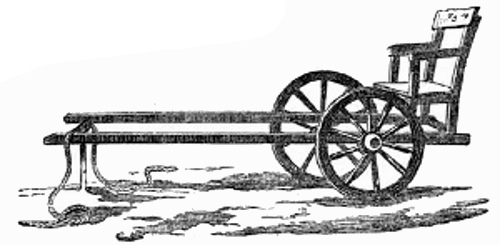
THE TUMBREL.
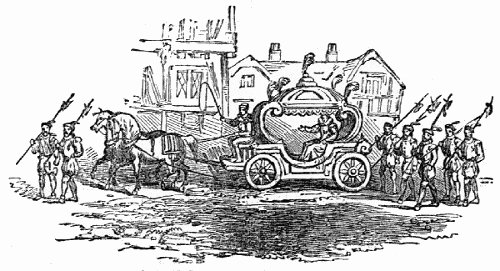
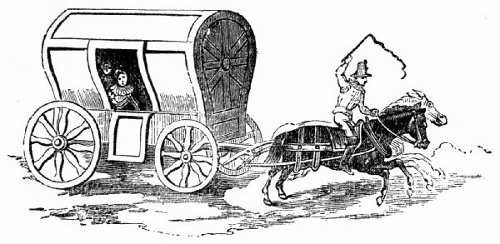
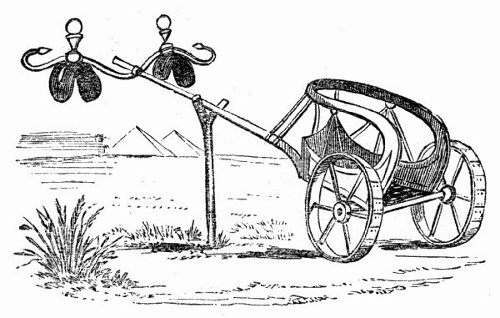
The tumbrel was a low-rolling cart or carriage (in law Latin, tumberella)
which was used as a punishment of disgrace and infamy. Millers,
when they stole corn, were chastised by the tumbrel. Persons were
sometimes fastened with an iron chain to a tumbrel, and conveyed bareheaded
with din and cry through the principal streets of towns.
Court of Hustings Book, 1581. (Lyme.)
"The jury present that the tumbrel be repaired and maintained from
time to time, according to the statute."
In 1583, Mr. Mayor was to provide a tumbrel before All Saints Day,
under a penalty of 10s.
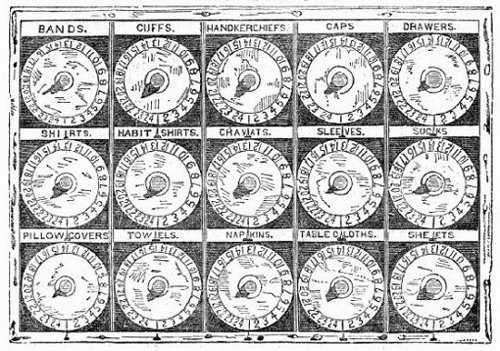
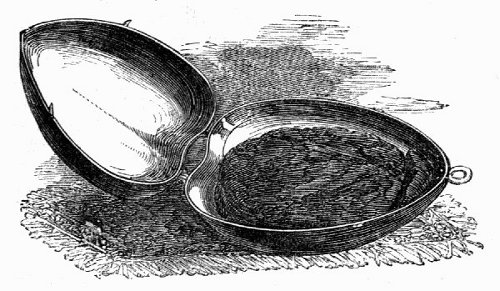
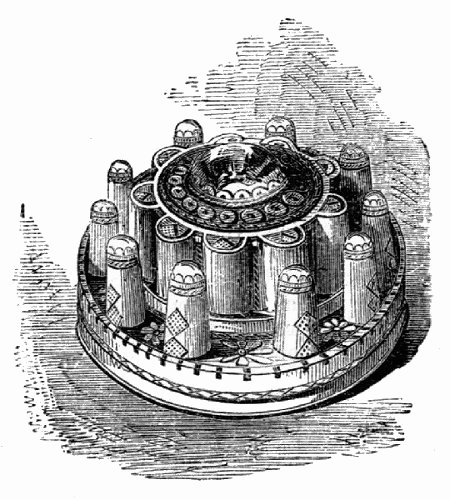
ANCIENT METHOD OF KEEPING A WASHING ACCOUNT.
Shakerley Marmion, in his "Antiquary," says:—
"I must rev'rence and prefer the precedent
Times before these, which consum'd their wits in
Experiments; and 'twas a virtuous
Emulation amongst them, that nothing
Which, might profit posterity should perish."
Without a full adherence to this dictum, we would nevertheless admit
that we are indebted to the past for the germ of many of our most important
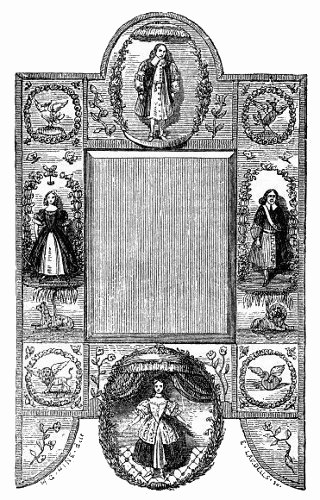
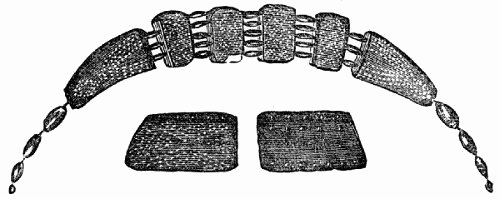
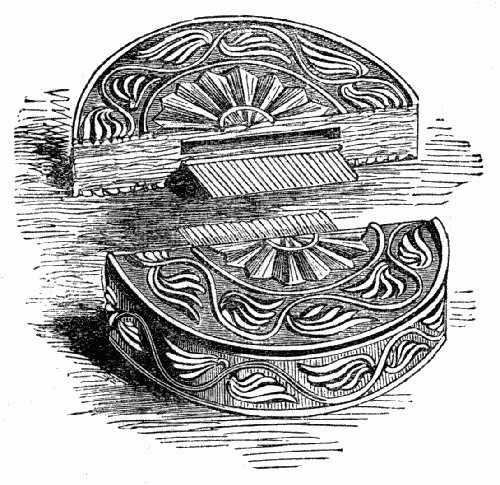
discoveries. The ancient washing tablet, although of humble
pretensions to notice, is yet a proof of the simple and effective means
frequently adopted in olden times for the economy of time and materials.
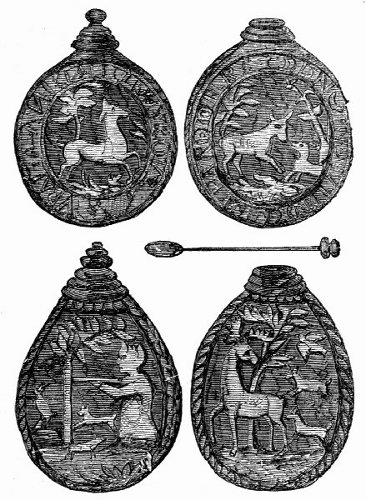
A reference to the engraving obviates a lengthened explanation. It
will there be seen that if the mistress of a family has fifteen pillow-covers,
or so many collars, or so many bands, to be mentioned in the
washing account, she can turn the circular dial, by means of the button
or handle, to the number corresponding with the rough mark at the
bottom of the dial, above which is written sheets, table-cloths, &c. This
simple and ingenious contrivance, obviates the necessity of keeping a
book.
The original "washing board," from which the engraving is taken,
was of a larger size, and showed the numbers very distinctly. Similar
dials may be made of either ivory or metal.
THE HAIR.
The quality and colour of the hair was a subject of speculative
theory for the ancients. Lank hair was considered indicative of pusillanimity
and cowardice; yet the head of Napoleon was guiltless of a curl!
Frizzly hair was thought an indication of coarseness and clumsiness. The
hair most in esteem, was that terminating in ringlets. Dares, the historian,
states that Achilles and Ajax Telamon had curling locks; such
also was the hair of Timon, the Athenian. As to the Emperor Augustus,
nature had favoured him with such redundant locks, that no hair-dresser
in Rome could produce the like. Auburn or light brown hair was
thought the most distinguished, as portending intelligence, industry, a
peaceful disposition, as well as great susceptibility to the tender passion.
Castor and Pollux had brown hair; so also had Menelaus. Black hair
does not appear to have been esteemed by the Romans; but red was an
object of aversion. Ages before the time of Judas, red hair was thought
a mark of reprobation, both in the case of Typhon, who deprived his
brother of the sceptre of Egypt, and Nebuchadnezzar who acquired it in
expiation of his atrocities. Even the donkey tribe suffered from this
ill-omened visitation, according to the proverb of "wicked as a red ass."
Asses of that colour were held in such detestation among the Copths, that
every year they sacrificed one by hurling it from a high wall.
THE FIRST COFFEE HOUSE IN LONDON.
Coffee is a native of Arabia, supposed by some to have been the chief
ingredient of the old Lacedemonian broth. The use of this berry was
not known in England till the year 1657, at which time Mr. D. Edwards,
a Turkey merchant, on his return from Smyrna to London, brought with
him one Pasquet Rossee, a Greek of Ragusa, who was used to prepare
this liquor for his master every morning, who, by the way, never wanted
company. The merchant, therefore, in order to get rid of a crowd of
visitants, ordered his Greek to open a coffee-house, which he did in
St. Michael's Alley, in Cornhill. This was the first coffee-house opened
in London.
EATING FOR A WAGER.
The handbill, of which the subjoined is a literal copy, was circulated
by the keeper of the public-house at which the gluttony was to happen,
as an attraction for all the neighbourhood to witness:—
"Bromley in Kent, July 14, 1726.—A strange eating worthy is to
perform a Tryal of Skill on St. James's Day, which is the day of our
Fair for a wager of Five Guineas,—viz.: he is to eat four pounds of
bacon, a bushel of French beans, with two pounds of butter, a quartern
loaf, and to drink a gallon of strong beer!"
FOX KILLED BY A SWAN.
At Peusey, a swan sitting on her eggs, on one side of the river,
observed a fox swimming towards her from the opposite side; rightly
judging she could best grapple with the fox in her own element, she
plunged into the water, and after beating him off for some time with
her wings, at length succeeded in drowning him.
HIGHWAYMEN IN 1782.
On Wednesday, the 9th January, 1782, about four o'clock in the afternoon,
as Anthony Todd, Esq., Secretary to the Post-office, was going in
his carriage to his house at Walthamstow to dinner, and another gentleman
with him, he was stopt within a small distance of his house by two
highwaymen, one of whom held a pistol to the coachman's breast, whilst
the other, with a handkerchief over his face, robbed Mr. Todd and the
gentleman of their gold watches and what money they had about them.
As soon as Mr. Todd got home all his men-servants were mounted on
horses, and pursued the highwaymen; they got intelligence of their passing
Lee-bridge, and rode on to Shoreditch; but could not learn anything
farther of them.
The same evening a gentleman going along Aldermanbury, near the
church, was accosted by a man with an enquiry as to the time; on which
the gentleman pulled out his gold watch. The man immediately said,
"I must have that watch and your money, sir, so don't make a noise."
The gentleman seeing nobody near, he delivered his gold watch and four
guineas, with some silver. The thief said he was in distress, and hoped
the gentleman would not take away his life if ever he had the opportunity.
Sunday, the 13th January, 1782, about twelve o'clock, a man was, by
force, dragged up the yard of the French-Horn Inn, High Holborn, by
some person or persons unknown, and robbed of his watch, four guineas,
and some silver; when they broke his arm and otherwise cruelly treated
him. He was found by a coachman, who took him to the hospital.
AN ARCHBISHOP WASHING THE FEET OF THE POOR.
In the Gentleman's Magazine, we find the following observance:—Thursday,
April 15, 1731.—Being Maunday-Thursday, there was distributed
at the Banquetting-house, Whitehall, to forty-eight poor
men, and forty-eight poor women (the King's age 48) boiled beef and
shoulders of mutton, and small bowls of ale, which is called dinner;
after that, large wooden platters of fish and loaves, viz., undress'd, one
large old ling, and one large dry'd cod; twelve red herrings, and nineteen
white herrings, and four half quartern loaves; each person had one
platter of this provision: after which was distributed to them shoes,
stockings, linnen and woolen cloath, and leathern bags, with one penny,
two penny, three penny, and four penny pieces of silver, and shillings:
to each about £4 in value. His Grace the Lord Archbishop of York,
Lord High Almoner, performed the annual ceremony of washing the
feet of a certain number of poor in the Royal Chapel, Whitehall, which
was formerly done by the Kings themselves, in imitation of our Saviour's
pattern of humility, &c. James II. was the last King who performed
this in person. His doing so was thus recorded in the Chapel Royal
Register.—"On Maunday Thursday April 16 1685 our gracious King
James ye 2d wash'd wip'd and kiss'd the feet of 52 poor men wth wonderful
humility. And all the service of the Church of England usuall
on that occasion was performed, his Maty being psent all the time."
A LUCKY FIND.
Sunday, April 1.—A few days ago, Sir Simon Stuart, of Hartley, in
Hampshire, looking over some old writings, found on the back of one of
them a memorandum noting that 1,500 broad pieces were buried in a
certain spot in an adjoyning field. Whereupon he took a servant, and
after digging a little in the place, found the treasure in a pot, hid there
in the time of the late civil wars, by his grandfather, Sir Nicholas
Stuart.—Gentleman's Magazine, 1733.
HOOPS IN 1740.
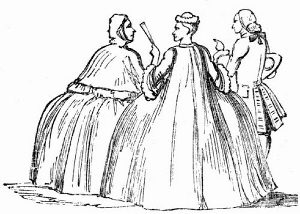
The monstrous appearance of the ladies' hoops, when viewed behind,
may be seen from the following cut, copied from one of Rigaud's
views. The exceedingly
small cap, at
this time fashionable,
and the close up-turned
hair beneath
it, give an extraordinary
meanness to
the head, particularly
when the liberality
of gown and
petticoat is taken into
consideration: the
lady to the left wears
a black hood with an
ample fringed cape,
which envelopes her
shoulders, and reposes on the summit of the hoop. The gentleman
wears a small wig and bag; the skirts of his coat are turned back, and
were sometimes of a colour different from the rest of the stuff of which
it was made, as were the cuffs and lappels.
SIEGE OF GIBRALTAR.
Gibraltar had been taken by a combined English and Dutch fleet in
1704, and was confirmed as a British possession, in 1713, by the peace of
Utrecht; but in 1779 it was assailed by the united forces of France and
Spain, and the siege continued till the 2nd of February, 1783. The chief
attack was made on the 13th September, 1782. On the part of the besiegers,
besides stupendous batteries on the land side, mounting two
hundred pieces of ordnance, there was an army of 40,000 men, under
the command of the Duc de Crillon. In the bay lay the combined fleets
of France and Spain, comprising forty-seven sail of the line, beside ten
battering ships of powerful construction, that cost upwards of £50,000
each. From these the heaviest shells rebounded, but ultimately two of
them were set on fire by red-hot shot, and the others were destroyed to
prevent them from falling into the hands of the British commander. The
rest of the fleet also suffered considerably; but the defenders escaped
with very little loss. In this engagement 8,300 rounds were fired by
the garrison, more than half of which consisted of red-hot balls.
During this memorable siege, which lasted upwards of three years, the
entire expenditure of the garrison exceeded 200,000 rounds,—8,000
barrels of powder being used. The expenditure of the enemy, enormous
as this quantity is, must have been much greater; for they frequently
fired, from their land-batteries, 4,000 rounds in the short space of
twenty-four hours. Terrific indeed must have been the spectacle as the
immense fortress poured forth its tremendous volleys, and the squadron
and land-batteries replied with a powerful cannonade. But all this
waste of human life and of property was useless on the part of the assailants;
for the place was successfully held, and Gibraltar still remains
one of the principal strongholds of British power in Europe.
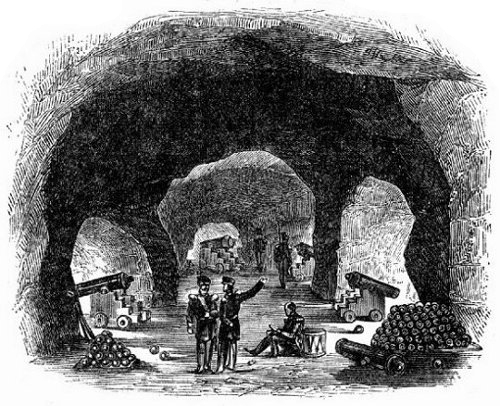
SAINT GEORGE'S HALL, GIBRALTAR.
During the progress of the siege, the fortifications were considerably
strengthened, and numerous galleries were excavated in the solid rock,
having port-holes at which heavy guns were mounted, which, keeping up
an incessant fire, proved very efficacious in destroying the enemy's encampments
on the land side. Communicating with the upper tier of
these galleries are two grand excavations, known as Lord Cornwallis's
and St. George's Halls. The latter, which is capable of holding several
hundred men, has numerous pieces of ordnance pointed in various directions,
ready to deal destruction on an approaching enemy.
KEEPING WHITSUNTIDE AT DURHAM CATHEDRAL.
The following curious account of the consumption of provisions in the
cathedral of Durham, during Whitsun week, in 1347, together with
the prices of the articles, is taken from the rolls of the cellarer, at present
in the treasury at Durham:—six hundred salt herrings, 3s.; four hundred
white herrings, 2s. 6d.; thirty salted salmon, 7s. 6d.; twelve fresh
salmon, 5s. 6d.; fourteen ling, fifty-five "kelengs;" four turbot,
23s. 1d.; two horse loads of white fish, and a "congr," 5s. 10d.;
"playc," "sparlings," and eels, and fresh water fish, 2s. 9d.; nine
carcases of oxen, salted, so bought, 36s.; one carcase and a quarter,
fresh, 6s. 11-3/4d.; a quarter of an oxe, fresh, bought in the town, 3s. 6d.;
seven carcases and a half of swine, in salt, 22s. 2-1/4d.; six carcases,
fresh, 12s. 9d.; fourteen calves, 28s. 4d.; three kids, and twenty-six
sucking porkers, 9s. 7-1/2d.; seventy-one geese with their feed, 11s. 10d.;
fourteen capons, fifty-nine chickens, and five dozen pidgeons, 10s. 3d.;
five stones of hog's lard, 4s. 2d.; four stones of cheese, butter, and milk,
6s. 6d.; a pottle of vinegar, and a pottle of honey, 6-1/2d.; fourteen pounds
of figs and raisins, sixteen pounds of almonds, and eight pounds of rice,
3s. 7d.; pepper, saffron, cinnamon, and other spices, 2s. 6d.; one
thousand three hundred eggs, 15s. 5d.—sum total, £11 4s. Similar
consumptions took place during the week of the feast of St. Cuthbert,
and other feasts, among the monks of Durham, for a long period of
years.
CURIOUS LAW.
The following curious law was enacted during the reign of Richard I.
for the government of those going by sea to the Holy Land:—"He who
kills a man on shipboard, shall be bound to the dead body and thrown
into the sea; if the man is killed on shore, the slayer shall be bound
to the dead body and buried with it. He who shall draw his knife to
strike another, or who shall have drawn blood from him, to lose his
hand; if he shall have only struck with the palm of his hand without
drawing blood, he shall be thrice ducked in the sea."
DECAPITATION BY THE GUILLOTINE.
A gentleman of intelligence and literary attainments, makes, in an
account of his travels on the continent, the following most singular remarks
on an execution he witnessed, in which the culprit was beheaded
by the guillotine:—"It appears," says he, "to be the best of all possible
modes of inflicting the punishment of death; combining the greatest
impression on the spectator, with the least possible suffering to the
victim. It is so rapid, that I should doubt whether there were any
suffering; but from the expression of the countenance, when the executioner
held up the head, I am inclined to believe that sense and consciousness
may remain for a few seconds after the head is off. The eyes seemed
to retain speculation for a moment or two, and there was a look in the
ghastly stare with which they stared upon the crowd, which implied
that the head was aware of its ignominious situation."
ALDERMAN BOYDELL.
It was the regular custom of Mr. Alderman Boydell, who was a very
early riser, at five o'clock, to go immediately to the pump in Ironmonger
Lane. There, after placing his wig upon the ball at the top of it, he
used to sluice his head with its water. This well-known and highly
respected character, who has done more for the British artist than all
the print-publishers put together, was also one of the last men who wore
a three-cornered hat.
FEATS OF STRENGTH IN 1739.
April 21.—The following notice was given to the public:—"For the
benefit of Thomas Topham, the strong man, from Islington, whose performances
have been looked upon by the Royal Society and several persons
of distinction, to be the most surprising as well as curious of any thing
ever performed in England; on which account, as other entertainments
are more frequently met with than that he proposes, he humbly hopes
gentlemen and ladies, &c., will honour him with their presence at the
Nag's Head, in Gateshead, on Monday the 23d of this instant, at four
o'clock, where he intends to perform several feats of strength, viz.:—He
bends an iron poker three inches in circumference, over his arm, and
one of two inches and a quarter round his neck; he breaks a rope that
will bear two thousand weight, and with his fingers rolls up a pewter
dish of seven pounds hard metal; he lays the back part of his head on
one chair, and his heels on another, and suffering four men to stand on
his body, he moves them up and down at pleasure; he lifts a table six
feet in length, by his teeth, with a half hundred weight hanging at the
further end of it; and, lastly, to oblige the publick, he will lift a butt
full of water." "Each person to pay one shilling." This "strong
man" fell a victim to jealousy, as is proved by the following:—"August
10th, 1749, died, Mr. Thomas Topham, known by the name of the strong
man, master of a publick house in Shoreditch, London. In a fit of
jealousy, he stabbed his wife, then cut his own throat and stabbed himself,
after which he lived two days."
ELEPHANTS FRIGHTENED AT PIGS.
"Then on a tyme there were many grete clerkes and rad of kyng
Alysaunder how on a tyme as he sholde have a batayle with ye kynge of
Inde. And this kynge of Inde broughte with hym many olyphauntes
berynge castelles of tree on theyr backes as the kynde of the is to haue
armed knyghtes in ye castell for the batayle, them ne knewe Alysaunder
the kynge, of the olyphauntes that they drad no thynge more than the
jarrynge of swyne, wherefore he made to gader to gyder all ye swyne that
myghte be goten, and caused them to be dryuen as ny the olyphauntes as
they myghte well here the jarrynge of the swyne, and thenne they made
a pygge to crye, and whan the swyne herde the pygges a none they made
a great jarrynge, and as soone as the olyphauntes herde that, they
began to fle eche one, and keste downe the castelles and slewe the
knyghtes that were in them, and by this meane Alysaunder had ye
vyctory."—Liber Festivalis, printed by W. Caxton in 1483.
A VISIT TO THE OBSERVATORY OF SIR ISAAC NEWTON.
The memory of a great and good man is imperishable. A thousand
years may pass away, but the fame that has survived the wreck of time
remains unsullied, and is even brighter with age.
"The actions of the just
Smell sweet, and blossom in the dust."
In an age of progress like our own we have frequently to regret the
destruction (sometimes necessary) of places associated with the genius of
the past; but in the case of Sir Isaac Newton we have several relics
existing, none of which, perhaps, are more interesting than the house in
which he resided, still standing in St. Martin's Street, on the south side
of Leicester Square. The engravings of the interior and exterior of this
building have been made from drawings made on the spot. The house
was long occupied as an hotel for foreigners, and was kept by a M.
Pagliano. In 1814 it was devoted to the purposes of education. The
Observatory, which is at the top, and where Sir Isaac Newton made his
astronomical researches, was left in a dilapidated condition until 1824,
when two gentlemen, belonging to a committee of the school, had it
repaired at their own expense, and wrote a brief memoir of the philosopher,
which was placed in the Observatory, with a portrait of him.
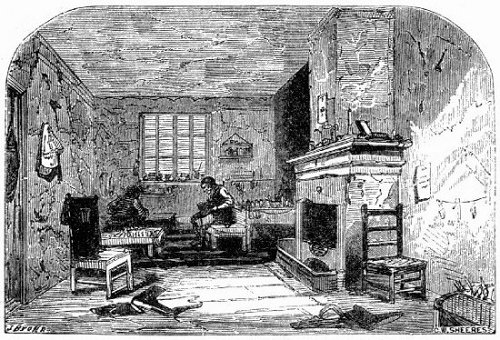
INTERIOR OF SIR ISAAC NEWTON'S OBSERVATORY.
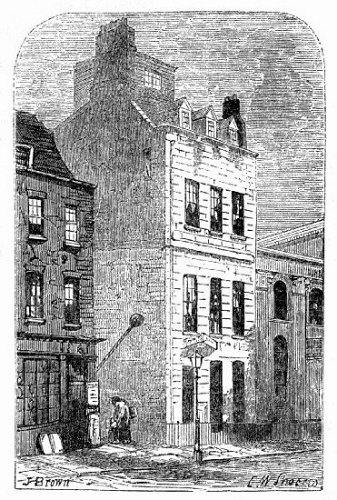
HOUSE OF SIR ISAAC NEWTON, ST. MARTIN'S
STREET, LEICESTER SQUARE.
In this house Sir Isaac Newton resided for many years; and it was
here, according to his biographer, that he dispensed, under the superintendence
of his beautiful niece, an elegant hospitality. Our sketch gives
a good idea of the appearance of the exterior of the house at the present
day; the front, it will be seen, has been well plastered, which, although
clean and pleasant-looking to some eyes, seems to us to destroy the character
of the building. The old doorway, with a projecting top, has
also been removed. The interior of the house is in excellent repair, and
has undergone very little change. The cornices, panelling, and the
spacious staircase, are not altered since the days of Newton. The rooms
are very large. Tradition states it was in the back drawing-room that
the manuscript of his work, the "New Theory of Light and Colours,"
was destroyed by fire, caused by a favourite little dog in Sir Isaac's absence.
The name of this canine incendiary was Diamond. The manner
in which the accident occurred is thus related:—The animal was
wantoning about the philosopher's study, when it knocked down a candle,
and set fire to a heap of manuscript calculations upon which he had been
employed for years. The loss was irretrievable; but Sir Isaac only exclaimed
with simplicity, "Ah, Diamond, Diamond, you little know what
mischief you have been doing!"
Passing upstairs, and looking slightly at the various rooms, which
are all well panelled, but which do not require particular notice, we
reached the little observatory shown in the engraving. There, in the
room in which Sir Isaac has quietly studied, and in which he may have
held conferences with the most distinguished of his contemporaries, we
found two shoemakers busily at work, with whom we had some pleasant
conversation. Our artist has represented the interior of the observatory,
with its laborious occupants, worthy sons of St. Crispin. Shoemakers
are well known to be a thoughtful class of men, although sometimes
they unfortunately do not make the best use of their knowledge. Brand,
the historian and author of the excellent book on "Popular Antiquities,"
was at one time a shoemaker; so was Bloomfield, the poet, who, when
working at the "last" in Bell Alley, near the Bank, strung together the
charming recollection of his plough-boy life. We could give a long list
of shoemakers who have been eminent for talents.
We have not the exact date at which Newton came to reside here, but
certainly he was living in this house, at intervals, after 1695, when he
was appointed Warder of the Mint, of which establishment he rose to be
Master in the course of three years. The emoluments of this office
amounted to £1200 a-year, which enabled him to live in ease and dignity.
In 1703 he was chosen President of the Royal Society—an honourable
post, to which he was annually elected until the time of his death.
POISONING THE MONARCH.
An idea of the popular notions about poisoning in the middle of the
seventeenth century, may be formed from the following extract from an
old tract, published in 1652, with the title of "Papa Patris, or the Pope
in his Colours":—"Anno Dom: 1596; one Edward Squire, sometimes a
scrivener at Grenewich, afterwards a deputy purveyor for the Queene's
stable, in Sir Francis Drake's last voyage was taken prisoner and carried
into Spaine, and being set at liberty, one Walpole, a Jesuite, grew
acquainted with him, and got him into the Inquisition, whence he returned
a resolved Papist, he persuaded Squire to undertake to poyson
the pummell of the Queene (Elizabeth's) saddle, and, to make him constant,
made Squire receive the Sacrament upon it; he then gave him the
poyson, showing that he should take it in a double bladder, and should
prick the bladder full of hoales in the upper part, when he should use it
(carrying it within a thick glove for the safety of his hand) should after
turne it downward, pressing the bladder upon the pummell of the
Queene's saddle. This Squire confest. Squire is now in Spaine, and for
his safer dispatch into England it was devised that two Spanish prisoners
taken at Cales should be exchanged for Squire and one Rawles, that it
might not be thought that Squire came over but as a redeemed captive.
The Munday sennight after Squire returned into England, he, understanding
the horses were preparing for the Queene's riding abroad, laid his hand,
and crushed the poyson upon the pummell of the Queene's saddle, saying,
'God save the Queene,' the Queene rode abroad, and as it should seem
laid not her hand upon the place, or els received no hurt (through God's
goodnesse) by touching it. Walpole, counting the thing as done, imparted
it to some principall fugitives there, but being disappointed of his
hope, supposing Squire to have been false, to be revenged on him sent
one hither (who should pretend to have stolne from thence) with letters,
wherein the plot of Squires was contained; this letter was pretended to
be stolne out of one of their studies. Squire, being apprehended, confessed
all without any rigor, but after denied that he put it in execution,
although he acknowledged he consented to it in the plot, at length he
confessed the putting it in execution also."
GRINNING FOR A WAGER.
June 9, 1786.—On Whit-Tuesday was celebrated at Hendon, in Middlesex,
a burlesque imitation of the Olympic Games. One prize was a
gold-laced hat, to be grinned for by six candidates, who were placed on
a platform, with horses' collars to exhibit through. Over their heads
was printed in capitals,—
Detur Tetriori; or
The ugliest grinner
Shall be the winner.
Each party grinned five minutes solus, and then all united in a grand
chorus of distortion. This prize was carried by a porter to a vinegar
merchant, though he was accused by his competitors of foul play, for
rinsing his mouth with verjuice. The whole was concluded by a hog,
with has tail shaved and soaped, being let loose among nine peasants;
any one of which that could seize him by the queue, and throw him
across his shoulders, was to have him for a reward. This occasioned
much sport: the animal, after running some miles, so tired his hunters
that they gave up the chase in despair. A prodigious concourse of
people attended, among whom were the Tripoline Ambassador, and
several other persons of distinction.
BITE OF THE TARANTULA SPIDER.
A Neapolitan soldier who had been bitten by a tarantula, though
apparently cured, suffered from an annual attack of delirium, after which
he used to sink into a state of profound melancholy; his face becoming
livid, his sight obscure, his power of breathing checked, accompanied by
sighs and heavings. Sometimes he fell senseless, and devoid of pulsation;
ejecting blood from his nose and mouth, and apparently dying.
Recourse was had to the influence of music; and the patient began to
revive at the sound, his hands marking the measure, and the feet being
similarly affected. Suddenly rising and laying hold of a bystander, he
began to dance with the greatest agility during an uninterrupted course
of four-and-twenty hours. His strength was supported by administering
to him wine, milk, and fresh eggs. If he appeared to relapse, the music
was repeated, on which he resumed his dancing. This unfortunate being
used to fall prostrate if the music accidentally stopped, and imagine that
the tarantula had again stung him. After a few years he died, in one of
these annual attacks of delirium.
BYGONE CHRISTMAS CUSTOMS.
——————"Now, too, is heard
The hapless cripple, tuning through the streets
His carol new; and oft, amid the gloom
Of midnight hours, prevail th' accustom'd sounds
Of wakeful waits, whose harmony (composed
Of hautboy, organ, violin, and flute,
And various other instruments of mirth),
Is meant to celebrate the coming time."
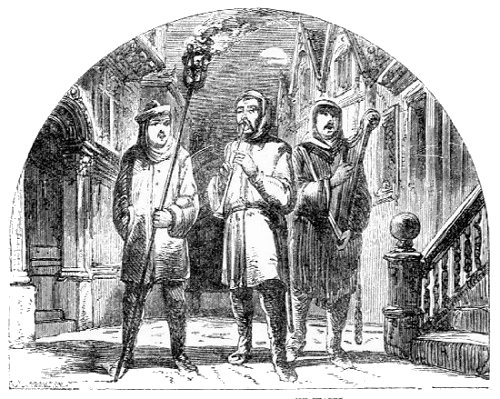
THE MUMMERS, OR ANCIENT WAITS.
The manner in which this period of the year has been observed has
often varied. The observances of the day first became to be pretty
general in the Catholic church about the year 300. By some of our
ancestors it was viewed in the double light of a religious and joyful
season of festivities. The midnight preceding Christmas-day every
person went to mass, and on Christmas-day three different masses were
sung with much solemnity. Others celebrated it with great parade,
splendour, and conviviality. Business was superseded by merriment and
hospitality; the most careworn countenance brightened on the occasion.
The nobles and the barons encouraged and participated in the various
sports: the industrious labourer's cot, and the residence of proud royalty,
equally resounded with tumultuous joy. From Christmas-day to
Twelfth-day there was a continued run of entertainments. Not only
did our ancestors make great rejoicings on, but before and after Christmas-day.
By a law in the time of Alfred, the "twelve days after the
nativity of our Saviour were made festivals;"
[1] and it likewise appears
from Bishop Holt, that the whole of the days were dedicated to feasting.
Our ancestors' various amusements were conducted by a sort of master
of the ceremonies, called the "Lord of Misrule," whose duty it was to
keep order during the celebration of the different sports and pastimes.
The universities, the lord mayor and sheriffs, and all noblemen and
gentlemen, had their "lords of misrule." These "lords" were first
preached against at Cambridge by the Puritans, in the reign of James I.,
as unbecoming the gravity of the university.
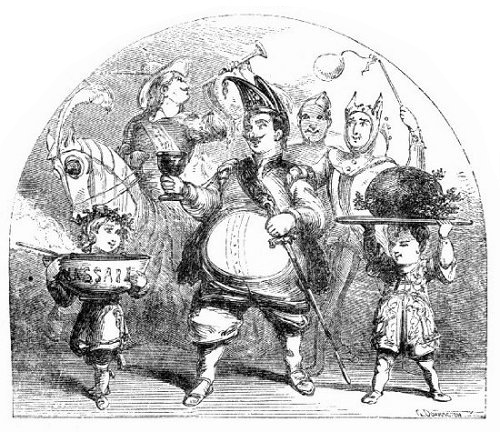
THE LORD OF MISRULE.
The custom of serving boars' heads at Christmas bears an ancient date,
and much ceremony and parade has been occasionally attached to it.
Henry II. "served his son (upon the young prince's coronation) at the
table as server, bringing up the boar's head with trumpets before it."
The custom of strolling from street to street with musical instruments
and singing seems to have originated from a very ancient practice which
prevailed, of certain minstrels who were attached to the king's court and
other great persons, who paraded the streets, and sounded the hour—thus
acting as a sort of watchmen. Some slight remains of these still
exist, but they no longer partake of the authoritative claim as they
originally did, as the "lord mayor's music," &c. It may not, perhaps,
be generally known, that even at the present day "waits" are regularly
sworn before the "court of burgesses" at Westminster, and act under
the authority of a warrant, signed by the clerk, and sealed with the
arms of the city and liberty; in addition to which, they were bound to
provide themselves with a silver badge, also bearing the arms of Westminster.
In the north they have their Yule log, or Yuletide log, which is a
huge log burning in the chimney corner, whilst the Yule cakes are
baked on a "girdle," (a kind of frying-pan) over the fire; little lads
and maidens assemble nightly at some neighbouring friends to hear the
goblin story, and join in "fortune-telling," or some game. There is a
part of an old song which runs thus:
"Now all our neighbours' chimneys smoke.
And Christmas logs are burning;
Their ovens they with baked meate choke,
And all their spits are turning."
Among the plants usual to Christmas are the rosemary, the holly,
and the mistletoe. Gay says:
"When rosemary and bays, the poet's crown,
Are bawled in frequent cries through all the town,
Then judge the festival of Christmas near—
Christmas, the joyous period of the year.
Now with bright holly all your temples strow,
With laurel green and sacred mistletoe."
A MERMAN.
"The wind being easterly, we had thirty fathoms of water, when at ten
o'clock in the morning a sea monster like a man appeared near our ship,
first on the larboard, where the master was, whose name is William
Lomone, who took a grappling iron to pull him up; but our captain,
named Oliver Morin, hindered him, being afraid that the monster would
drag him away into the sea. The said Lomone struck him on the back,
to make him turn about, that he might view him the better. The
monster, being struck, showed his face, having his two hands closed as
if he had expressed some anger. Afterwards he went round the ship:
when he was at the stern, he took hold of the helm with both hands,
and we were obliged to make it fast lest he should damage it. From
thence he proceeded to the starboard, swimming still as men do. When
he came to the forepart of the ship, he viewed for some time the figure that
was in our prow, which represented a beautiful woman, and then he rose out
of the water as if he had been willing to catch that figure. All this
happened in the sight of the whole crew. Afterwards he came again to
the larboard, where they presented to him a cod-fish hanging down with
a rope; he handled it without spoiling it, and then removed the length
of a cable and came again to the stern, where he took hold of the helm a
second time. At that very moment, Captain Morin got a harping-iron
ready, and took it himself to strike him with it; but the cordage being
entangled, he missed his aim, and the harping-iron touched only the
monster, who turned about, showing his face, as he had done before.
Afterwards he came again to the fore part, and viewed again the figure
in our prow. The mate called for the harping-iron; but he was
frightened, fancying that this monster was one La Commune, who had
killed himself in the ship the year before, and had been thrown into the
sea in the same passage. He was contented to push his back with the
harping-iron, and then the monster showed his face, as he had done at
other times. Afterwards he came along the board, so that one might
have given him the hand. He had the boldness to take a rope held up
by John Mazier and John Deffiete, who being willing to pluck it out of
his hands, drew him to our board; but he fell into the water and then
removed at the distance of a gun's shot. He came again immediately
near our board, and rising out of the water to the navel, we observed
that his breast was as large as that of a woman of the best plight. He
turned upon his back and appeared to be a male. Afterwards he swam
again round the ship, and then went away, and we have never seen him
since. I believe that from ten o'clock till twelve that this monster was
along our board; if the crew had not been frighted, he might have been
taken many times with the hand, being only two feet distant. That
monster is about eight feet long, his skin is brown and tawny, without
any scales, all his motions are like those of men, the eyes of a proportionable
size, a little mouth, a large and flat nose, very white teeth,
black hair, the chin covered with a mossy beard, a sort of whiskers under
the nose, the ears like those of men, fins between the fingers of his hands
and feet like those of ducks. In a word, he is a well-shaped man.
Which is certified to be true by Captain Oliver Morin, and John Martin,
pilot, and by the whole crew, consisting of two and thirty men."—An
article from Brest, in the Memoirs of Trevoux.—This monster was
mentioned in the Gazette of Amsterdam, October 12, 1725, where it is
said it was seen in the ocean in August, same year.
A SHAVED BEAR.
At Bristol I saw a shaved monkey shown for a fairy; and a shaved
bear, in a check waistcoat and trousers, sitting in a great chair as an
Ethiopian savage. This was the most cruel fraud I ever saw. The unnatural
position of the beast, and the damnable brutality of the woman-keeper
who sat upon his knee, put her arm round his neck, called him
husband and sweet-heart, and kissed him, made it the most disgusting
spectacle I ever witnessed! Cottle was with me.—Southey.
THE ORIGIN OF WIGS.
As for the origin of wigs, the honour of the invention is attributed to
the luxurious Sapygians in Southern Italy. The Louvain theologians,
who published a French version of the Bible, affected, however, to discover
the first mention of perukes in a passage in the fourth chapter of
Isaiah. The Vulgate has these words: "Decalvabit Dominus verticem
filiarum Sion, et Dominus crinem earum nudabit." This, the Louvain
gentlemen translated into French as follows: "Le Seigneur déchèvelera
les têtes des filles de Sion, et le Seigneur découvrira leurs perruques;"
which, done into English, implies that "The Lord will pluck the hair
from the heads of the daughters of Sion, and will expose their periwigs."
DRESS IN 1772.
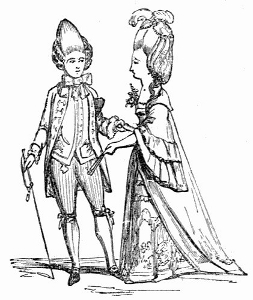
The year 1772 introduced a new style for gentlemen, imported by a
number of young men of fashion who had travelled into Italy, and
formed an association called the Maccaroni Club, in contradistinction to
the Beef-steak Club of London. Hence these new-fashioned dandies
were styled Maccaronies, a name that was afterwards applied to ladies
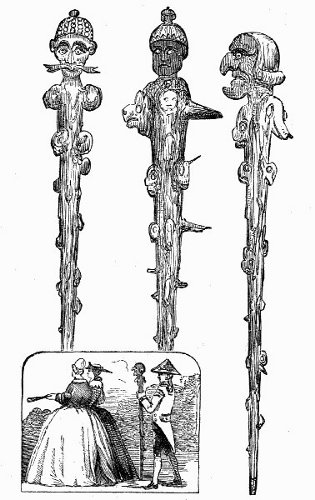
of the same genus. The accompanying
cut delineates the peculiarities
of both. The hair of
the gentleman was dressed in
an enormous toupee, with very
large curls at the sides; while
behind it was gathered and tied
up into an enormous club, or
knot, that rested on the back
of the neck like a porter's knot;
upon this an exceedingly small
hat was worn, which was sometimes
lifted from the head with
the cane, generally very long,
and decorated with extremely
large silk tassels; a full white
handkerchief was tied in a large
bow round the neck; frills from
the shirt-front projected from
the top of the waistcoat, which
was much shortened, reaching
very little below the waist, and
being without the flap-covered pockets. The coat was also short, reaching
only to the hips, fitting closely, having a small turn-over collar as
now worn; it was edged with lace or braid, or decorated with frog-buttons,
tassels, or embroidery; the breeches were tight, of spotted or striped
silk, with enormous bunches of strings at the knee. A watch was carried
in each pocket, from which hung bunches of chains and seals: silk
stockings and small shoes with little diamond buckles completed the
gentleman's dress. The ladies decorated their heads much like the gentlemen,
with a most enormous heap of hair, which was frequently surmounted
by plumes of large feathers and bunches of flowers, until the
head seemed to overbalance the body. The gown was open in front;
hoops were discarded except in full-dress; and the gown gradually spread
outward from the waist, and trailed upon the ground behind, shewing
the rich laced petticoat ornamented with flowers and needlework; the
sleeves widened to the elbow, where a succession of ruffles and lappets,
each wider than the other, hung down below the hips.
CHRISTMAS OBSERVANCES PUT DOWN BY THE PURITANS.
During the Commonwealth, when puritanical feelings held iron sway
over the rulers of the land, and rode rampant in high places, many
strong attempts were made to put down what they were pleased to term
superstitious festivals, and amongst these was that of Christmas Day.
So determined was the Puritan party to sweep away all vestiges of evil
creeds and evil deeds, that they were resolved to make one grand attempt
upon the time-honoured season of Christmas. The Holly and the
Mistletoe-bough were to be cut up root and branch, as plants of the Evil
One. Cakes and Ale were held to be impious libations to superstition;
and the Roundheads would have none of it.
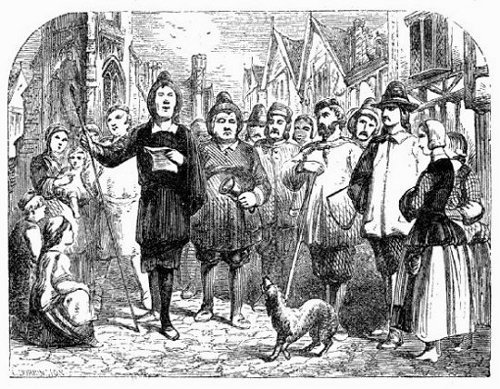
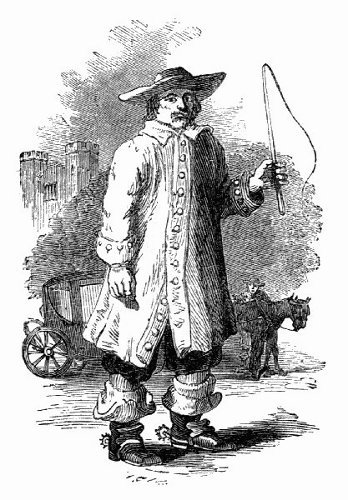
PROCLAIMING THE NON-OBSERVANCE OF CHRISTMAS.
Accordingly, we learn that, in the year 1647, the Cromwell party
ordered throughout the principal towns and cities of the country, by the
mouth of the common crier, that Christmas Day should no longer be
observed—it being a superstitious and hurtful custom; and that in place
thereof, and the more effectually to work a change, markets should be
held on the 25th day of December.
This was attacking the people, especially the country folks, in their
most sensitive part. It was hardly to be expected that they would
quietly submit to such a bereavement; nor did they, as the still-existing
"News-letters" of those days amply testify.
THE MANNER OF WATCHMEN INTIMATING THE CLOCK AT HERRENHUTH
IN GERMANY.
VIII. Past eight o'clock! O, Herrenhuth, do thou ponder;
Eight souls in Noah's ark were living yonder.
IX. 'Tis nine o'clock! ye brethren, hear it striking;
Keep hearts and houses clean, to our Saviour's liking.
X. Now, brethren, hear, the clock is ten and passing;
None rest but such as wait for Christ embracing.
XI. Eleven is past! still at this hour eleven,
The Lord is calling us from earth to heaven.
XII. Ye brethren, hear, the midnight clock is humming;
At midnight, our great Bridegroom will be coming.
I. Past one o'clock; the day breaks out of darkness:
Great Morning-star appear, and break our hardness!
II. 'Tis two! on Jesus wait this silent season,
Ye two so near related, will and reason.
III. The clock is three! the blessed Three doth merit
The best of praise, from body, soul, and spirit.
IV. 'Tis four o'clock, when three make supplication,
The Lord will be the fourth on that occasion.
V. Five is the clock! five virgins were discarded,
When five with wedding garments were rewarded.
VI. The clock is six, and I go off my station;
Now, brethren, watch yourselves for your salvation.
A DOG EXTINGUISHING A FIRE.
On the evening of the 21st February, 1822, the shop of Mr. Coxon,
chandler, at the Folly, Sandgate, in Newcastle, was left in charge of
his daughter, about nine years of age, and a large mastiff, which is
generally kept there as a safeguard since an attempt was made to rob
the shop. The child had on a straw bonnet lined with silk, which took
fire from coming too near the candle. She endeavoured to pull it off,
but being tied, she could not effect her purpose, and in her terror
shrieked out, on which the mastiff instantly sprang to her assistance,
and with mouth and paws completely smothered out the flame by pressing
the bonnet together. The lining of the bonnet and the child's hair only
were burnt.
CAMBRIDGE CLODS.
About sixty years since, two characters, equally singular in their
way, resided at Cambridge: Paris, a well-known bookseller, and Jackson,
a bookbinder, and principal bass-singer at Trinity College Chapel
in that University; these two gentlemen, who were both remarkably
corpulent, were such small consumers in the article of bread, that their
abstemiousness in that particular was generally noticed; but, to make
amends, they gave way to the greatest excess and indulgence of their
appetites in meat, poultry, and fish, of almost every description. So
one day, having taken an excursion, in walking a few miles from home,
they were overtaken by hunger, and, on entering a public-house, the
only provision they could procure was a clod of beef, weighing near fourteen
pounds, which had been a day or two in salt; and this these two
moderate bread consumers contrived to manage between them broiled,
assisted by a due proportion of buttered potatoes and pickles. The landlord
of the house, having some knowledge of his guests, the story got into
circulation, and the two worthies were ever after denominated the Cambridge
Clods!
WITCH-TESTING AT NEWCASTLE IN 1649.
March 26.—Mention occurs of a petition in the common council books
of Newcastle, of this date, and signed, no doubt, by the inhabitants,
concerning witches, the purport of which appears, from what followed,
to have been to cause all such persons as were suspected of that crime to
be apprehended and brought to trial. In consequence of this, the
magistrates sent two of their sergeants, viz.—Thomas Shevill and Cuthbert
Nicholson, into Scotland, to agree with a Scotchman, who pretended
knowledge to find out witches, by pricking them with pins, to come to
Newcastle, where he should try such who should be brought to him, and
to have twenty shillings a piece, for all he should condemn as witches,
and free passage thither and back again. When the sergeants had
brought the said witch-finder on horseback to town, the magistrates sent
their bellman through the town, ringing his bell and crying, all people
that would bring in any complaint against any woman for a witch, they
should be sent for, and tried by the person appointed. Thirty women
were brought into the town-hall, and stripped, and then openly had pins
thrust into their bodies, and most of them were found guilty. The said
reputed witch-finder acquainted Lieutenant-Colonel Paul Hobson,
deputy-governor of Newcastle, that he knew women whether they were
witches or no by their looks; and when the said person was searching of
a personable and good-like woman, the said colonel replied, and said,
surely this woman is none, and need not be tried, but the Scotchman
said she was, and, therefore, he would try her; and presently, in the
sight of all the people, laid her body naked to the waist, with her cloathes
over her head, by which fright and shame all her blood contracted into
one part of her body, and then he ran a pin into her thigh, and then
suddenly let her cloathes fall, and then demanded whether she had
nothing of his in her body, but did not bleed! but she being amazed,
replied little; then he put his hands up her cloathes and pulled out the
pin, and set her aside as a guilty person, and child of the devil, and fell
to try others, whom he made guilty. Lieutenant-Colonel Hobson, perceiving
the alteration of the aforesaid woman, by her blood settling in
her right parts, caused that woman to be brought again, and her cloathes
pulled up to her thigh, and required the Scot to run the pin into the
same place, and then it gushed out of blood, and the said Scot cleared
her, and said she was not a child of the devil. The witch-finder set
aside twenty-seven out of the thirty suspected persons, and in consequence,
fourteen witches and one wizard, belonging to Newcastle, were
executed on the town moor.
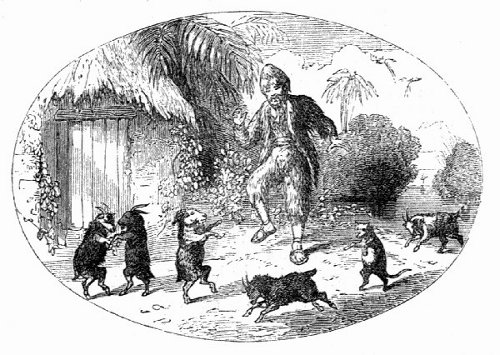
ALEXANDER SELKIRK AND THE DANCING GOATS.
The adventures of Alexander Selkirk, an English sailor, who, more
than one hundred and fifty years since, was left alone on the island of
Juan Fernandez are very wonderful.
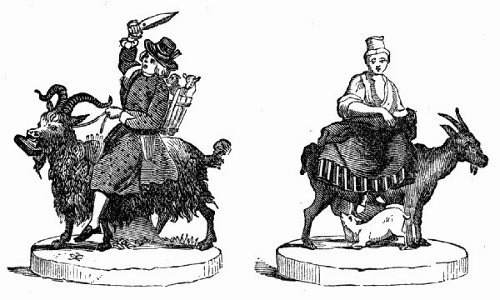
This extraordinary man sought to beguile his solitude by rearing kids,
and he would often sing to them, and dance with his motley group
around him. His clothes having worn out, he dressed himself in garments
made from the skins of such as run wild about the island; these
he sewed together with thongs of the same material. His only needle was
a long slender nail; and when his knife was no longer available, he made
an admirable substitute from an iron hoop that was cast ashore.
Upon the wonderful sojourn of this man, Defoe founded his exquisite
tale of "Robinson Crusoe," a narrative more extensively read and better
known than perhaps any other ever written.
JACOB BOBART.
A curious anecdote of Jacob Bobart, keeper of the physic garden at
Oxford, occurs in one of Grey's notes to Hudibras—"He made a
dead rat resemble the common picture of dragons, by altering its head
and tail, and thrusting in taper sharp sticks, which, distended the skin
on each side till it resembled wings. He let it dry as hard as possible.
The learned immediately pronounced it a dragon; and one of them sent
an accurate description of it to Dr. Magliabecchi, librarian to the Grand
Duke of Tuscany; several fine copies of verses were wrote on so rare a
subject; but at last Mr. Bobart owned the cheat. However, it was
looked upon as a masterpiece of the art; and, as such, deposited in the
Museum."
BLIND JACK.
The streets of London, in the reigns of Queen Anne and Georges I.
and II., were infested with all sorts of paupers, vagabonds, impostors,
and common adventurers; and many, who otherwise might be
considered real objects of charity, by their disgusting manners and
general appearance in public places, rather merited the interference of
the parish beadles, and the discipline of Bridewell, than the countenance
and encouragement of such persons as mostly congregated around common
street exhibitions. One-eyed Granny and Blind Jack were particular
nuisances to the neighbourhoods in which the first practised her
mad-drunk gambols, and the latter his beastly manner of performing on the
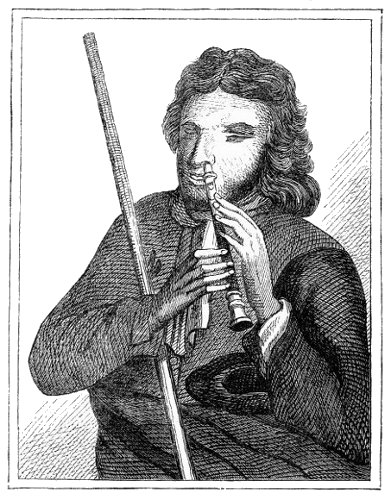
flageolet. John Keiling, alias Blind Jack, having the misfortune to lose
his sight, thought of a strange method to insure himself a livelihood.
He was constitutionally a hale, robust fellow, without any complaint,
saving blindness, and having learnt to play a little on the flageolet, he
conceived a notion that, by performing on that instrument in a different
way to that generally practised, he should render himself more noticed
by the public, and be able to levy larger contributions on their pockets.
The manner of Blind Jack's playing the flageolet was by obtruding
the mouthpiece of the instrument up one of his nostrils, and, by long
custom, he could produce as much wind as most others with their lips
into the pipe; but the continued contortion and gesticulation of his muscles
and countenance rendered him an object of derision and disgust, as
much as that of charity and commiseration.
THE YORKSHIRE TIKE.
Ah iz i truth a country youth,
Neean us'd teea Lunnon fashions;
Yet vartue guides, an' still presides,
Ower all mah steps an' passions.
Neea coortly leear, bud all sincere,
Neea bribe shall ivver blinnd me,
If thoo can like a Yorkshire tike,
A rooague thoo'll nivver finnd me.
Thof envy's tung, seea slimlee hung,
Wad lee aboot oor country,
Neea men o' t' eearth booast greter wurth,
Or mare extend ther boounty.
Oor northern breeze wi' uz agrees,
An' does for wark weel fit uz;
I' public cares, an' all affairs,
Wi' honour we acquit uz.
Seea gret a moind is ne'er confiand,
Tu onny shire or nation;
They geean meeast praise weea weel displays
A leearned iddicasion.
Whahl rancour rolls i' lahtle souls,
By shallo views dissarning,
They're nobbut wise 'at awlus prize
Gud manners, sense, and leearnin.
TWO OF THE FATHERS ON FALSE HAIR.
Tertullian says, "If you will not fling away your false hair, as hateful
to Heaven, cannot I make it hateful to yourselves, by reminding
you that the false hair you wear may have come not only from a
criminal, but from a very dirty head; perhaps from the head of one
already damned?" This was a very hard hit indeed; but it was not
nearly so clever a stroke at wigs as that dealt by Clemens of Alexandria.
The latter informed the astounded wig-wearers, when they knelt at
church to receive the blessing, that they must be good enough to recollect
that the benediction remained on the wig, and did not pass through
to the wearer! This was a stumbling-block to the people; many
of whom, however, retained the peruke, and took their chance as to the
percolating through it of the benediction.
FOOD OF ANIMALS.
Linnæus states the cow to eat 276 plants, and to refuse 218; the goat
eats 449, and declines 126; the sheep takes 387, and rejects 141; the
horse likes 262, and avoids 212; but the hog, more nice in its provision
than any of the former, eats but 72 plants, and rejects 171.
SLAVE ADVERTISEMENTS.
The following announcements are curious, as showing the merchandise
light in which the negro was regarded in America while yet a colony of
Great Britain:—
FRANCIS LEWIS, Has for SALE,
A Choice Parcel of Muscovado and Powder Sugars, in Hogsheads,
Tierces, and Barrels; Ravens, Duck, and a Negro Woman and
Negro Boy.—The Coach-House and Stables, with or without the Garden
Spot, formerly the Property of Joseph Murray, Esq; in the Broad Way,
to be let separately or together:—Inquire of said Francis Lewis.
New York Gazette, Apr. 25, 1765.
This Day Run away from John M' Comb, Junier, an Indian Woman,
about 17 Years of Age, Pitted in the face, of a middle Stature and
Indifferent fatt, having on her a Drugat, Wastcoat, and Kersey Petticoat,
of a Light Collour. If any Person or Persons, shall bring the said Girle
to her said Master, shall be Rewarded for their Trouble to their Content.
American Weekly Mercury, May 24, 1726.
A Female Negro Child (of an extraordinary good Breed) to be given
away; Inquire of Edes and Gill.
Boston Gazette, Feb. 25, 1765.
To be Sold, for want of Employ.
A Likely Negro Fellow, about 25 Years of Age, he is an extraordinary
good Cook, and understands setting or tending a Table very well,
likewise all Kind of House Work, such as washing, scouring, scrubbing,
&c. Also a Negro Wench his Wife, about 17 Years old, born in this
City, and understands all Sorts of House Work. For farther Particulars
inquire of the Printer.
New York Gazette, Mar. 21, 1765.
PRESERVATIVE POWER OF COAL-PIT WATER.
The following is extracted from the register of St. Andrew's, in Newcastle:—"April
24th, 1695, wear buried, James Archer and his son
Stephen, who, in the moneth of May, 1658, were drowned in a coal-pit in
the Galla-Flat, by the breaking in of water from an old waste. The
bodys were found intire, after they had lyen in the water 36 years and
11 months."
THE QUEEN BEE.
Reaumur relates the following anecdote of which he was a witness:—A
queen bee, and some of her attendants, were apparently drowned in a
brook. He took them out of the water, and found that neither the queen
bee, nor her attendants were quite dead. Reaumur exposed them to a
gentle heat, by which they were revived. The plebeian bees recovered
first. The moment they saw signs of animation in their queen, they approached
her, and bestowed upon her all the care in their power, licking
and rubbing her; and when the queen had acquired sufficient force to
move, they hummed aloud, as if in triumph!
DREAM OF KING HENRY I.
A singular dream, which happened to this monarch when passing over
to Normandy in 1130, has been depicted in a manuscript of Florence of
Worcester, in Corpus Christi College, Oxford. The rapacity and oppressive
taxation of his government, and the reflection forced on him by his
own unpopular measures, may have originated the vision. He imagined
himself to have been visited by the representatives of the three most
important grades of society—the husbandmen, the knights, and the
clergy—who gathered round his bed, and so fearfully menaced him, that
he awoke in great alarm,
and, seizing his sword,
loudly called for his attendants.
The drawings
that accompany this narrative,
and represent each
of these visions, appear
to have been executed
shortly afterwards, and
are valuable illustrations
of the general costume
of the period. One of
them is introduced in this
place.
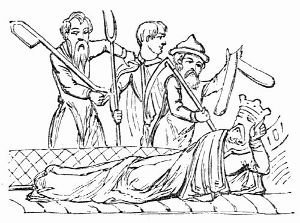
The king is here seen
sleeping; behind him
stand three husbandmen, one carrying a scythe, another a pitchfork,
and the third a shovel. They are each dressed in simple tunics, without
girdles, with plain close-fitting sleeves; the central one has a mantle
fastened by a plain brooch, leaving the right arm free. The beards of
two of these figures are as ample as those of their lords, this being an
article of fashionable indulgence within their means. The one with
the scythe wears a hat not unlike the felt hat still worn by his descendants
in the same grade: the scroll in his left hand is merely placed there
to contain the words he is supposed to utter to the king.
SEPULCHRAL BARROW OF THE ANGLO-SAXONS.
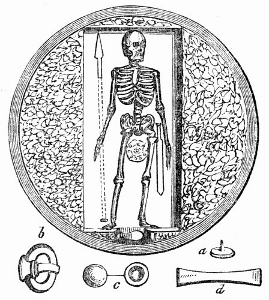
The engraving on the next page is copied from a plate in Douglas's Neniæ
and represents one of the most ancient of the Kentish barrows opened
by him in the Chatham Lines, Sept. 1779; and it will enable the reader
at once to understand the structure of these early graves, and the interesting
nature of their contents. The outer circle marks the extent of
the mound covering the body, and which varied considerably in elevation,
sometimes being but a few inches or a couple of feet from the level
of the ground, at others of a gigantic structure. In the centre of the
mound, and at the depth of a few feet from the surface, an oblong rectangular
grave is cut, the space between that and the outer circle being
filled in with chalk, broken into small bits, and deposited carefully and
firmly around and over the grave. The grave contained the body of a
male adult, tall and well-proportioned, holding in his right hand a
spear, the shaft of which was of wood, and had perished, leaving only
the iron head, 15 inches in length, and at the bottom a flat iron stud
(a), having, a small pin in the centre, which would appear to have been
driven into the bottom of the spear-handle; an iron knife lay by the
right side, with remains of the original handle of wood. Adhering to
its under side were very discernible impressions of coarse linen cloth,
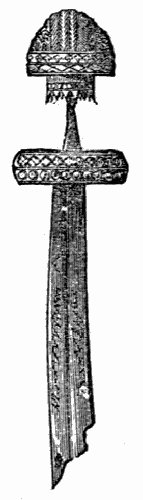
showing that the warrior was buried in full costume. An iron sword is on
the left side, thirty-five and
a quarter inches in its
entire length, from the point
to the bottom of the handle,
which is all in one piece, the
wood-work which covered
the handle having perished;
the blade thirty inches in
length and two in breadth,
flat, double-edged, and
sharp-pointed, a great portion
of wood covering the
blade, which indicates that
it was buried with a scabbard,
the external covering
being of leather, the internal
of wood. A leathern
strap passed round the waist,
from which hung the knife
and sword, and which was
secured by the brass buckle
(b), which was found near the
last bone of the vertebræ, or close to the os sacrum. Between the
thigh-bones lay the iron umbo of a shield, which had been fastened by
studs of iron, four of which were found near it, the face and reverse of
one being represented at (c.) A thin plate of iron (d), four and a half
inches in length, lay exactly under the centre of the umbo, having two
rivets at the end, between which and the umbo were the remnants of
the original wooden (and perhaps hide-bound) shield; the rivets of the
umbo having apparently passed through the wood to this plate as its
bracer or stay. In a recess at the feet was placed a vase of red earth,
slightly ornamented round the neck with concentric circles and zigzag lines.
AN OLD GANDER.
Willoughby states in his work on Ornithology, that a friend of his
possessed a gander eighty years of age; which in the end became so
ferocious that they were forced to kill it, in consequence of the havock it
committed in the barn-yard. He also talks of a swan three centuries
old; and several celebrated parrots are said to have attained from one
hundred to one hundred and fifty years.
EXTRAORDINARY SLEEPER.
M. Brady, Physician to Prince Charles of Lorraine, gives the following
particulars of an extraordinary sleeper:—
"A woman, named Elizabeth Alton, of a healthful strong constitution,
who had been servant to the curate of St. Guilain, near the town of
Mons, about the beginning of the year 1738, when she was about thirty-six
years of age grew extremely restless and melancholy. In the month
of August, in the same year, she fell into a sleep which held four days,
notwithstanding all possible endeavours to awake her. At length she
awoke naturally, but became more restless and uneasy than before; for
six or seven days, however, she resumed her usual employments, until
she fell asleep again, which continued eighteen hours. From that time
to the year 1753, which is fifteen years, she fell asleep daily about three
o'clock in the morning, without waking until about eight or nine at night.
In 1754 indeed her sleep returned to the natural periods for four months,
and, in 1748, a tertian ague prevented her sleeping for three weeks.
On February 20, 1755, M. Brady, with a surgeon, went to see her. About
five o'clock in the evening, they found her pulse extremely regular; on
taking hold of her arm it was so rigid, that it was not bent without
much trouble. They then attempted to lift up her head, but her neck
and back were as stiff as her arms. He hallooed in her ear as loud as his
voice could reach; he thrust a needle into her flesh up to the bone; he
put a piece of rag to her nose flaming with spirits of wine, and let it burn
some time, yet all without being able to disturb her in the least. At
length, in about six hours and a half, her limbs began to relax; in eight
hours she turned herself in the bed, and then suddenly raised herself up,
sat down by the fire, ate heartily, and began to spin. At other times,
they whipped her till the blood came; they rubbed her back with honey,
and then exposed it to the stings of bees; they thrust nails under her
finger-nails; and it seems these triers of experiments consulted more the
gratifying their own curiosity than the recovery of the unhappy object of
the malady."
A FAT ENGLISHMAN.
Keysler, in his travels, speaks of a corpulent Englishman, who in passing
through Savoy, was obliged to make use of twelve chairmen. He is
said to have weighed five hundred and fifty pounds, or thirty-nine stone
four pounds.
A HAPPY FAMILY.
A gentleman travelling through Mecklenburg, some years since,
witnessed a singular association of incongruous animals. After dinner,
the landlord of the inn placed on the floor a large dish of soup, and
gave a loud whistle. Immediately there came into the room a mastiff,
an Angora cat, an old raven, and a remarkably large rat, with a bell
about its neck. They all four went to the dish, and, without disturbing
each other, fed together; after which the dog, cat, and rat, lay
before the fire, while the raven hopped about the room. The landlord,
after accounting for the familiarity of these animals, informed his guest
that the rat was the most useful of the four; for the noise he made had
completely freed his house from the rats and mice with which it was
before infested.
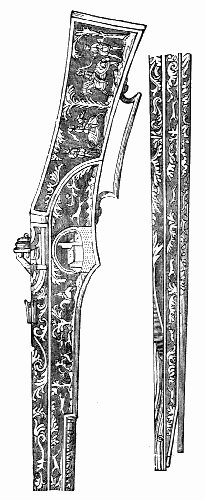
ANCIENT FIRE-ARMS IN THE TOWER OF LONDON ARMORY.
We have just now before us a drawing of an old piece of ordnance,
formed of bars of iron, strongly hooped with the same material, which
forms a striking contrast with the finely-wrought cannons which may
be seen in store at Woolwich Arsenal, and elsewhere, at the present day.
The exact date and manner of the introduction of cannon is a matter
which has caused much dispute. The earliest mention of the use of cannon
on shipboard is in Rymer's "Fœdera." It is an order to Henry
Somer, Keeper of the Private Wardrobe in the Tower, to deliver to Mr.
Goveney, Treasurer to Queen Philippa, Queen of Sweeden, Denmark,
and Norway, (who was then sent by her uncle, Henry the Fourth, to her
husband, in the ship called the Queen's Hall,) the following military
stores: 11 guns, 40 petras pro gunnes, 40 tumpers, 4 torches, 1 mallet,
2 fire-pans, 40 pavys, 24 bows, 40 sheaves of arrows.
After the old cannon composed of bars of iron, hooped together, had
been some time in use, hand-cannon, a simple tube fixed on a straight
stake, was used in warfare, charged with gunpowder and an iron bullet.
This was made with trunnions and casabel precisely like the large cannon.
In course of time, the touch-hole was improved, and the barrel cast in
brass. This, fixed to a rod, had much the appearance of a large sky-rocket.
What is now called the stock was originally called the frame of
the gun.
Various improvements were from time to time made in the hand-gun,
amongst which was a pan fixed for containing the touch-powder. In
rainy weather, this became a receptacle for water; to obviate which, a
small piece of brass made to turn on a pin was placed as a cover. This
done, there was a difficulty in preserving the aim in consequence of the
liability of the eye to be diverted from the sight by the motion of the
right hand when conveying the lighted match to the priming. This was,
to a certain extent, prevented by a piece of brass being fixed to the
breech and perforated. The improved plan for holding the lighted match
for firing the hand-guns is shown in the engraving of the Buckler and
Pistol; it consists of a thin piece of metal something in shape of an S
reversed, the upper part slit to hold the match, the lower pushed up by
the hand when entended to ignite the powder.
After the invention of the hand-cannon, its use became general in a
very short space of time in most parts of the civilized world.
Philip de Comines, in his account of the battle of Morat, in 1476,
says he encountered in the confederate army 10,000 arquebusiers.
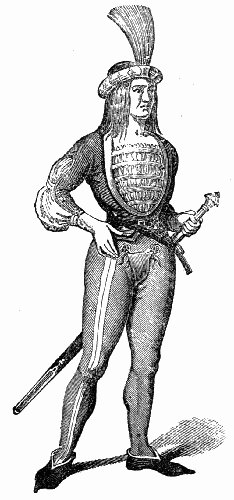
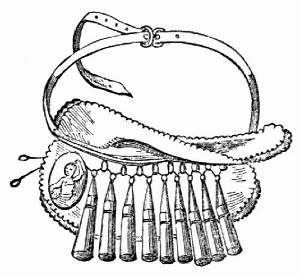
The arquebusiers in Hans Burgmain's plates of the "Triumph of
Maximilian the First," have suspended from their necks large powder
flasks or horns, a bullet bag on the right hip, and a sword on the left,
while they carry the matchlock in their hands.
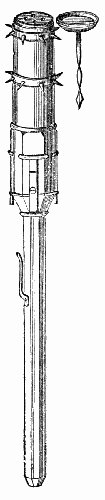
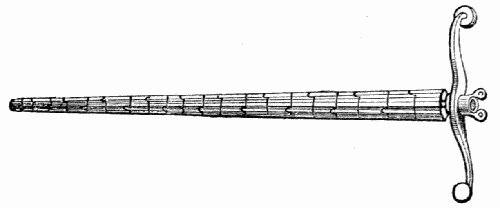
Henry the Eighth's Walking-stick, as the Yeomen of Guard at the
Tower call it, is a short spiked mace, in the head of which are three
short guns or pistols, which may be fired at very primitive touch-holes
by a match.
The Revolver has four barrels, and although clumsy in construction, is
not very different in principles from those recently introduced.
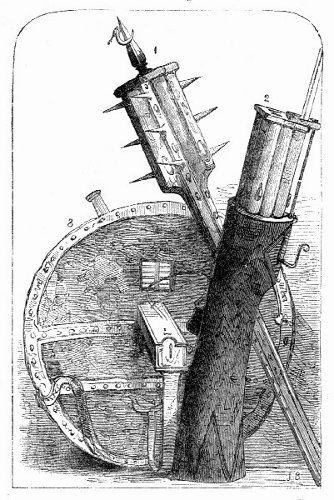
1. Henry the Eighth's Walking-stick. 2. A Revolver
of the Fifteenth century. 3. Buckler, with Pistol inserted.
The use of the pistol inserted inside the buckler is obvious as the latter
affords protection to the person while using the former.
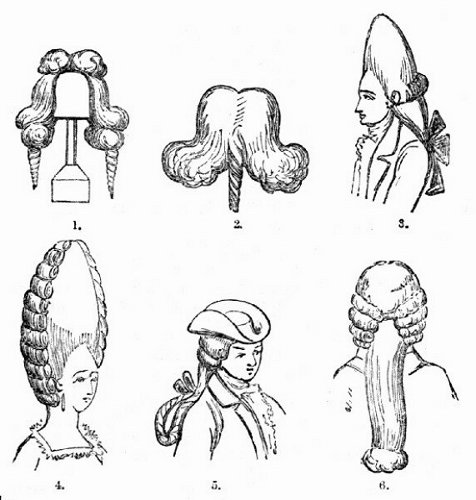
WIGS.
In 1772 the Maccaronies, as the exquisites of that time were called,
wore wigs similar to 1, 2, 3, with a large toupee, noticed as early as
1731, in the play of the Modern Husband: "I meet with nothing but a
parcel of toupet coxcombs, who plaster up their brains upon their periwigs,"
alluding to the pometum with which they were covered. Those
worn by the ladies in 1772 are given as 4, showing the rows of curls
at the sides. The pig-tails were worn hanging down the back, or tied
up in a knot behind, as in 5. About 1780 the hair which formed it
was allowed to stream in a long lock down the back, as in 6, and soon
afterwards was turned up in a knot behind. Towards the end of the
century, the wig, as a general and indispensable article of attire to
young and old, went out of fashion.
A FALSE FIND.
At Falmouth, some years ago, the sexton found coal in digging a grave;
he concluded it must be a mine, and ran with the news and the specimen
to the clergyman. The surgeon explained that they had stolen a French
prisoner who died, and filled his coffin with coal that the bearers might
not discover its emptiness.
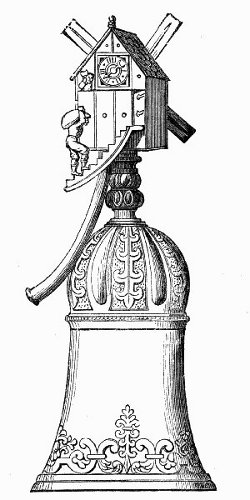
BELLS.
As far back as the Anglo-Saxon times, before the conclusion of the
seventh century, bells had been in use in the churches of this country,
particularly in the monastic societies of Northumbria; and were, therefore,
in use from the first erection of parish churches among us. Those
of France and England appear to have been furnished with several bells.
In the time of Clothaire II., King of France, and in the year 610, the
army of that king was frightened from the siege of the city of Sens, by
ringing the bells of St. Stephen's Church. They were sometimes composed
of iron in France; and in England, as formerly at Rome, they
were frequently made of brass. And as early as the ninth century many
were cast of a large size and deep note.
Weever, in his work on funeral monuments, says—"In the little sanctuary
at Westminster, King Edward III., erected a clochier, and placed
therein three bells, for the use of St. Stephen's Chapel. About the biggest
of them were cast in the metal these words:—
"King Edward made mee thirty thousand weight and three;
Take me down and wey mee, and more you shall find mee."
"But these bells being taken down in the reign of Henry VIII., one
wrote underneath with a coal:—
"But Henry the Eight,
Will bait me of my weight."
This last distich alludes to a fact mentioned by Stow, in his survey of
London—ward of Farringdon Within to wit—that near to St. Paul's
School stood a clochier, in which were four bells, called Jesus' bells, the
greatest in all England, against which Sir Miles Partridge staked an
hundred pounds, and won them of Henry VIII., at a cast of dice.
Matthew Paris observes, that anciently the use of bells was prohibited
in time of mourning. Mabillon adds, that it was an old practice to ring
the bells for persons about to expire, to advertise the people to pray for
them—whence our passing-bell. The passing-bell, indeed, was anciently
for two purposes—one to bespeak the prayers of all good Christians for a
soul just departing; the other to drive away the evil spirits who were
supposed to stand at the bed's foot.
This dislike of spirits to bells is mentioned in the Golden Legend, by
Wynkyn de Worde. "It is said, evill spirytes that ben in the regyon of
thayre, doubte moche when they here the belles rongen; and this is the
cause why the belles ben rongen when it thondreth, and when grete tempeste
and outrages of wether happen; to the ende that the fiends and
wycked spirytes shold be abashed and flee, and cease of the movynge of
tempeste." Another author observes, that the custom of ringing bells at
the approach of thunder is of some antiquity; but that the design was
not so much to shake the air, and so dissipate the thunder, as to call the
people to church, to pray that the parish might be preserved from the
terrible effect of lightning.
Warner, in his history of Hampshire, enumerates the virtues of a bell,
by translating the lines from the "Helpe to Discourse:—
"Men's death's I tell by doleful knell;
Lightning and thunder I break asunder.
On Sabbath all to church I call;
The sleepy head I raise from bed;
The winds so fierce I doe disperse;
Men's cruel rage I doe assuage."
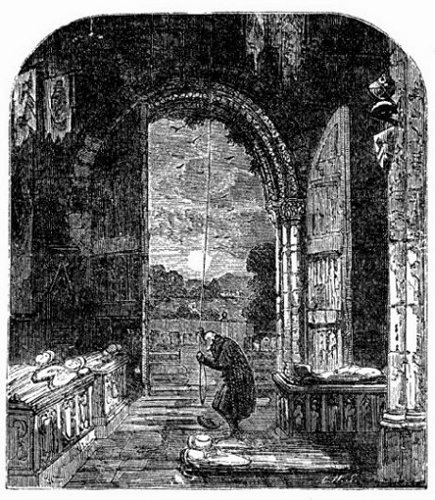
THE CURFEW BELL.
Four of the bells of the ancient Abbey of Hexham were dedicated or
baptised; and although the old bells no longer exist, the legends upon
the whole six have been preserved, and a free translation given by Mr.
Wright, is as follows:—
1. Even at our earliest sound,
The light of God is spread around.
2. At the echo of my voice,
Ocean, earth and air, rejoice.
3. Blend thy mellow tones with mine,
Silver voice of Catherine!
4. Till time on ruin's lap shall nod.
John shall sound the praise of God.
5. With John in heavenly harmony,
Andrew, pour thy melody.
6. Be mine to chant Jehovah's fame,
While Maria is my name.
These epigraphs or legends on bells, are not uncommon. The Rev.
W. C. Lukis, in his notices on church bells, read at the Wilts Archæological
Meeting, gave the following instances:—
At Aldbourne, on the first bell, we read, "The gift of Jos. Pizzie and
Wm. Gwynn.
"Music and ringing we like so well,
And for that reason we gave this bell."
On the fourth bell is,—
"Humphry Symsin gave xx pound to buy this bell,
And the parish gave xx more to make this ring go well."
A not uncommon epigraph is,—
"Come when I call
To serve God all."
At Chilton Foliatt, on the tenor, is,—
"Into the church the living I call,
And to the grave I summon all.
Attend the instruction which I give,
That so you may for ever live."
At Devizes, St. Mary, on the first bell, is,—
"I am the first, altho' but small.
I will be heard above you all."
And on the second bell is,—
"I am the second in this ring,
Therefore next to thee I will sing."
Which, at Broadchalk, is thus varied:—
"I in this place am second bell,
I'll surely do my part as well."
On the third bell at Coln is,—
"Robert Forman collected the money for casting this bell
Of well-disposed people, as I do you tell."
At Bath Abbey, on the tenth bell, is,—
"All you of Bath that hear me sound,
Thank Lady Hopton's hundred pound."
On the fifth bell at Amesbury is,—
"Be strong in faith, praise God well,
Frances Countess Hertford's bell."
And, on the tenor,—
"Altho' it be unto my loss,
I hope you will consider my cost."
At Stowe, Northamptonshire, and at St. Mary the Virgin, Oxford, we
find,—
"Be it known to all that doth me see,
That Newcombe, of Leicester, made me."
At St. Michael's, Coventry, on the fourth bell, is,—
"I ring at six to let men know
When to and from their work to go."
On the seventh bell is,—
"I ring to Sermon with a lusty bome,
That all may come and none can stay at home."
On the eighth bell is—
"I am and have been called the common bell
To ring, when fire breaks out to tell."
At St. Peter's-le-Bailey, Oxford, four bells were sold towards finishing
the tower, and in 1792 a large bell was put up, with this inscription:—
"With seven more I hope soon to be
For ages joined in harmony."
But this very reasonable wish has not yet been realized; whereas at St.
Lawrence's, Reading, when two bells were added to form a peal of ten, on
the second we find—
"By adding two our notes we'll raise,
And sound the good subscribers' praise."
The occasion of the erection of the Westminster Clock-tower, is said
to have been as follows:—A certain poor man, in an action for debt,
being fined the sum of 13s. 4d., Radulphus Ingham, Chief Justice
of the King's Bench, commiserating his case, caused the court roll to
be erased, and the fine reduced to 6s. 8d., which being soon after
discovered, Ingham was amerced in a pecuniary mulct of eight hundred
marks, which was employed in erecting the said bell-tower, in which was
placed a bell and a clock, which, striking hourly, was to remind the
judges in the hall of the offence of their brother. This bell was originally
called Edward; "but," says a writer in the "Antiquarian Repertory,"
"when the Reformation caused St. Edward and his hours to be but little
regarded; as other bells were frequently called Tom, as fancied to pronounce
that name when stricken—that at Lincoln, for instance, and that
at Oxford—this also followed the fashion, of which, to what I remember
of it before it was hung up, I may add another proof from a catch made
by the late Mr. Eccles, which begins—
"'Hark, Harry, 'tis late—'tis time to be gone,
For Westminster Tom, by my faith, strikes one."
Hawkins, in his "History of Music," says,—"The practice of ringing
bells in change, or regular peals, is said to be peculiar to England:
whence Britain has been termed the ringing island. The custom seems
to have commenced in the time of the Saxons, and was common before the
Conquest. The ringing of bells, although a recreation chiefly of the
lower sort, is, in itself, not incurious. The tolling of a bell is nothing
more than the producing of a sound by a stroke of the clapper against
the side of the bell, the bell itself being in a pendant position, and at
rest. In ringing, the bell, by means of a wheel and a rope, is elevated
to a perpendicular; in its motion, the clapper strikes forcibly on one side,
and in its return downwards, on the other side of the bell, producing at
each stroke a sound." There are still in London several societies of
ringers. There was one called the College Youths (bell-ringers, like post-boys,
never seem to acquire old age). Of this it is said Sir Matthew Hale,
Lord Chief Justice of the King's Bench, was, in his youthful days, a
member; and in the life of that upright judge, by Burnet, some facts
are mentioned which favour this relation. In England the practice of
ringing has been reduced to a science, and peals have been composed which
bear the names of their inventors; some of the most celebrated of these
were composed about fifty years ago by one Patrick. This man was a
maker of barometers. In the year 1684, one Abraham Rudhall, of the
city of Gloucester, brought the art of bell-founding to great perfection.
His descendants in succession have continued the business of casting
bells; and by a list published by them at Lady Day, 1774, the family, in
peals and odd bells, had cast to the amount of 3,594. The peals of St.
Dunstan's in the East, St. Bride's, London, and St. Martin's-in-the-Fields,
are among the number. The following "Articles of Ringing"
are upon the walls of the belfry in the pleasant village of Dunster, in
Somersetshire. They are dated 1787:—
"1. You that in ringing take delight,
Be pleased to draw near;
These articles you must observe,
If you mean to ring here.
"2. And first, if any overturn
A bell, as that he may,
He forthwith for that only fault
In beer shall sixpence pay.
"3. If any one shall curse or swear
When come within the door,
He then shall forfeit for that fault
As mentioned before.
"4. If any one shall wear his hat
When he is ringing here,
He straightway then shall sixpence pay
In cyder or in beer.
"5. If any one these articles
Refuseth to obey,
Let him have nine strokes of the rope,
And so depart away."
BILL OF SALE FOR A NEGRO IN 1770.
"Know all Men by these Presents, That I, Elizabeth Treat, of Boston,
in the county of Suffolk, widow, in consideration of the sum of £25
13s. 4d. to me in hand, paid before the ensealing hereof by Samuel
Breck, of Boston aforesaid, merchant, the receipt whereof I do hereby
acknowledge, have granted, bargained, and sold, and by these presents
do fully and absolutely grant, bargain, and sell unto the said Samuel
Breck, my Negro man named Harry, aged about forty years, with his
apparel, to have and to hold the said Negro man Harry, with his apparel,
unto the said Samuel Breck, his executors, administrators, and assigns,
to his and their only proper use, benefit, and behoof for ever; And I, the
said Elizabeth Treat, for myself, my heirs, executors, and administrators,
do covenant, that at the time of ensealing, and until the delivery hereof,
I am the true and lawful owner of the said Negro man, and that he is
free from all former sales, charges, and incumbrances whatsoever, and
that I will warrant and defend the said Negro man unto the said Samuel
Breck, his heirs, and assigns for ever, against the lawful claims and
demands of all persons whomsoever.
"Witness my hand and seal, this tenth day of October, Anno Domini,
one thousand seven hundred and seventy, in the tenth year of His
Majesty's reign.
"Signed, sealed, and delivered in presence of us.
"Thomas Melville.
"Mary White.
"Elizabeth Treat."
THE AZTEC CHILDREN.
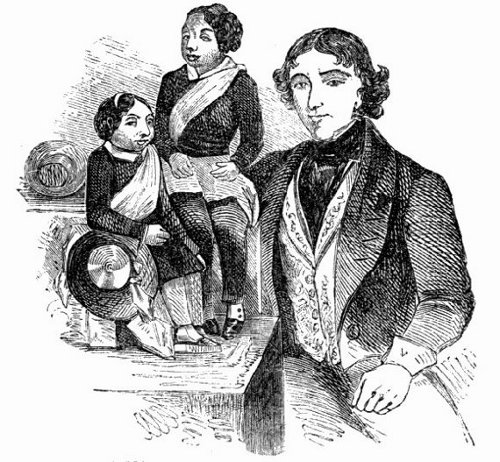
THE AZTEC CHILDREN, AS EXHIBITED IN ENGLAND.
Among the animated curiosities which are occasionally exposed to the
gaze of the wonder-loving public, we may prominently notice the Aztec
Children—two singular Lilliputians who were recently exhibited
throughout the kingdom. Maximo and Bartolo (for by these names the
two Aztec children have been baptized) are by some medical men supposed
to be of the respective ages of twenty-two and sixteen. Professor Owen,
stated them to be ten or twelve, and seven or nine in 1853. The height
of the boy (the elder is about three feet, and the girl does not reach quite
two feet six inches). Their limbs, though slender, are proportionate and
well formed, and the general development of their figures is remarkably
graceful. The cranium is peculiar, being narrower than that of any other
races of beings known to the world; and though the face is somewhat
prominent, the features are regular and the countenances agreeable, and,
after a short acquaintance, highly interesting. Each has a beautiful head
of jet black hair, which flows gracefully in curls. They are lively and
intelligent, showing considerable aptitude for mental training, and have
already learned to give utterance to several expressions which can be
readily understood by visitors.
Since the arrival of these prodigies from the United States, they have
been the objects of curious ethnological speculations. Dr. Latham does
not consider them as a new species of the genus homo. Professor Owen
regards them as instances of impeded development, and Dr. Conolly was
struck with their resemblance to idiots.
NOTICES TO TAR AND FEATHER.
The original handbills of the committee for Tarring and Feathering
subjoined, are of singular interest, as they were the earliest emanations
of the spirit that led to England's losing her American colonies, and the
consequent rise of the United States:—
To the Delaware Pilots.
The Regard we have
for your Characters, and our Desire to promote
your future Peace and Safety, are the Occasion of this Third
Address to you.
In our second Letter we acquainted you, that the Tea Ship was a
Three Decker; We are now informed by good Authority, she is not a
Three Decker, but an old black Ship, without a Head, or any Ornaments.
The Captain is a short fat Fellow, and a little obstinate withal.—So
much the worse for him.—For, so sure as he rides rusty, We shall heave
him Keel out, and see that his Bottom be well fired, scrubb'd and paid.—His
Upper-Works too, will have an Overhawling—and as it is said, he
has a good deal of Quick Work about him, We will take particular Care
that such Part of him undergoes a thorough Rummaging.
We have a still worse Account of his Owner;—for it is said, the Ship
Polly was bought by him on Purpose, to make a Penny of us: and that
he and Captain Ayres were well advised, of the Risque they would run,
in thus daring to insult and abuse us.
Captain Ayres was here in the Time of the Stamp-Act, and ought to
have known our People better, than to have expected we would be so
mean as to suffer his rotten TEA to be funnel'd down our Throats, with
the Parliament's Duty mixed with it.
We know him well, and have calculated to a Gill and a Feather, how
much it will require to fit him for an American Exhibition. And we
hope, not one of your Body will behave so ill, as to oblige us to clap him
in the Cart along Side of the Captain.
We must repeat, that the SHIP POLLY is an old black Ship, of about
Two Hundred and Fifty Tons burthen, without a Head, and without
Ornaments,—and, that CAPTAIN AYRES is a thick chunky Fellow.—As
such, Take Care to avoid THEM.
Your Old Friends,
The Committee for Tarring and Feathering.
Philadelphia, December 7, 1773.
To Capt. Ayres, of the Ship Polly, on a Voyage from London to
Philadelphia.
Sir,
We are informed that you have, imprudently, taken Charge of a Quantity
of Tea; which has been sent out by the India Company, under the
Auspices of the Ministry, as a Trial of American Virtue and Resolution.
Now, as your Cargo, on your Arrival here, will most assuredly bring
you into hot water; and as you are perhaps a Stranger to these Parts,
we have concluded to advise you of the present Situation of Affairs in
Philadelphia—that, taking Time by the Forelock, you may stop short
in your dangerous Errand—secure your Ship against the Rafts of combustible
Matter which may be set on Fire, and turned loose against her:
and more than all this, that you may preserve your own Person, from
the Pitch and Feathers that are prepared for you.
In the first Place, we must tell you, that the Pennsylvanians are, to a
Man, passionately fond of Freedom; the Birthright of Americans; and
at all Events are determined to enjoy it.
That they sincerely believe, no Power on the Face of the Earth has a
Right to tax them without their Consent.
That in their Opinion, the Tea in your Custody is designed by the
Ministry to enforce such a Tax, which they will undoubtedly oppose;
and in so doing, give you every possible Obstruction.
We are nominated to a very disagreeable, but necessary Service.—To
our Care are committed all Offenders against the Rights of America; and
hapless is he, whose evil Destiny has doomed him to suffer at our Hands.
You are sent out on a diabolical Service; and if you are so foolish and
obstinate as to compleat your Voyage; by bringing your Ship to Anchor
in this Port; you may run such a Gauntlet, as will induce you, in your
last Moments, most heartily to curse those who have made you the Dupe
of their Avarice and Ambition.
What think you Captain, of a Halter around your Neck—ten Gallons
of liquid Tar decanted on your Pate—with the Feathers of a dozen wild
Geese laid over that to enliven your Appearance?
Only think seriously of this—and fly to the Place from whence you
came—fly without Hesitation—without the Formality of a Protest—and
above all, Captain Ayres let us advise you to fly without the wild Geese
Feathers.
Your Friends to serve
The Committee as before subscribed.
Philadelphia, Nov. 27, 1773.
B. FRANKLIN'S CELEBRATED LETTER TO STRAHAN.
As a sequel to the foregoing notices, we give Dr. Franklin's celebrated
letter, written in the actual heat of the first outbreak.
Philadelphia, July 5, 1775.
Mr. Strahan,—You are a member of Parliament, and one of that
majority which has doomed my country to destruction. You have begun
to burn our towns, and murder our people. Look upon your hands!
They are stained with the blood of your relations! You and I were
long friends; you are now my enemy, and
I am, yours,
B. Franklin.
HENRY II. STRIPT WHEN DEAD.
1189. Immediately upon his death, those that were about him applied
their market so busilie in catching and filching awaie things that laie
readie for them, that the king's corps laie naked a long time, till a child
covered the nether parts of his body with a short cloke, and then it seemed
that his surname was fulfilled that he had from his childhood, which was
Shortmantell, being so called, because he was the first who brought short
clokes out of Anjou into England.
TRANSPLANTATION OF HAIR.
The Signor Dottore Domenico Nardo addressed a letter to the Academy
of Padua, in 1826, on the subject of the growth of hair after death, and
even after its separation from the body. The latter property had been
previously observed by Krafft. The Signor Nardo recounts the results
of experiments made on his own person in the transplantation of hair,
and relates, that by transplanting quickly a hair, with its root, from a
pore of his head, into a pore of his chest, easily to be accomplished by
widening the pore somewhat with the point of a needle, introducing the
root with nicety, and exciting within the pore itself, by friction, a slight
degree of inflammation, the hair takes root, continues to vegetate, and
grows; in due season changes colour, becomes white, and falls.
ANCIENT CANNON RAISED FROM THE SEA.
A fisherman of Calais some time since, drew up a cannon, of very
ancient form, from the bottom of the sea, by means of his nets. M. de
Rheims has since removed the rust from it, and on taking off the breech
was much surprised to find the piece still charged. Specimens of the
powder have been taken, from which, of course, all the saltpetre has disappeared
after a submersion of three centuries. The ball was of lead,
and was not oxidized to a depth greater than that of a line.
COFFEE-HOUSE ATTRACTIONS IN 1760.
The great attraction of Don Saltero's Coffee-house was its collection of
rarities, a catalogue of which was published as a guide to the visitors.
It comprehends almost every description of curiosity, natural and artificial.
"Tigers' tusks; the Pope's candle; the skeleton of a Guinea-pig;
a fly-cap monkey; a piece of the true Cross; the Four Evangelists'
heads cut on a cherry-stone; the King of Morocco's tobacco-pipe; Mary
Queen of Scot's pincushion; Queen Elizabeth's prayer-book; a pair of
Nun's stockings; Job's ears, which grew on a tree; a frog in a tobacco-stopper;"
and five hundred more odd relics! The Don had a rival, as
appears by "A Catalogue of the Rarities to be seen at Adams's, at the
Royal Swan, in Kingsland Road, leading from Shoreditch Church, 1756."
Mr. Adams exhibited, for the entertainment of the curious, "Miss Jenny
Cameron's shoes; Adam's eldest daughter's hat; the heart of the famous
Bess Adams, that was hanged at Tyburn with Lawyer Carr, January 18,
1736-7; Sir Walter Raleigh's tobacco-pipe; Vicar of Bray's clogs;
engine to shell green pease with; teeth that grew in a fish's belly;
Black Jack's ribs; the very comb that Abraham combed his son Isaac
and Jacob's head with; Wat Tyler's spurs; rope that cured Captain
Lowry of the head-ach, ear-ach, tooth-ach and belly-ach; Adam's key
of the fore and back door of the Garden of Eden, &c., &c." These are
only a few out of five hundred others equally marvellous.
A WOMAN TAKES THE LIGHTED MATCH FROM A BOMB.
During the siege of Gibraltar, in 1782, the Count d'Artois came to
St. Roch, to visit the place and works. While his highness was inspecting
the lines, in company with the Duke de Crillon, they both alighted
with their suite, and all lay flat upon the ground, to avoid the effects of
a bomb that fell near a part of the barracks where a Frenchwoman had
a canteen. This woman, who had two children in her arms at the time,
rushed forth with them, and having seated herself, with the utmost
sang-froid, on the bomb-shell, she put out the match, thus extricating
from danger all that were around her, many of whom witnessed this
courageous and devoted act. His highness rewarded this intrepid female
by bestowing on her a pension of three francs a day, and engaged to promote
her husband after the siege; while the Duke de Crillon, imitating
the generous example of the prince, ensured to her likewise a daily payment
of five francs.
THE SUMMERS MAGNET, OR LOADSTONE.
Among the great naval officers of Elizabeth's reign must be ranked
Sir George Summers, the discoverer of the Bermudas, often called the
Summers Islands from that circumstance. Here is a representation
given of what the descendants of Sir George Summers call the "Summers
magnet, or loadstone."
It is in the possession of
Peter Franklin Bellamy,
Esq., surgeon, second son
of Dr. Bellamy, of Plymouth.
The tradition in
the family is that the
admiral before going to
sea used to touch his
needle with it. The stone
is dark-coloured, the precise
geological formation
doubtful. This curious
stone, with armature of
iron, was probably an ancient talisman.
SWALLOWING LIZARDS.
Bertholin, the learned Swedish doctor, relates strange anecdotes of
lizards, toads, and frogs; stating that a woman, thirty years of age, being
thirsty, drank plentifully of water at a pond. At the end of a few
months, she experienced singular movements in her stomach, as if something
were crawling up and down; and alarmed by the sensation, consulted
a medical man, who prescribed a dose of orvietan in a decoction of
fumitory. Shortly afterwards, the irritation of the stomach increasing,
she vomited three toads and two young lizards, after which, she became
more at ease. In the spring following, however, her irritation of the
stomach was renewed; and aloes and bezoar being administered, she
vomited three female frogs, followed the next day by their numerous
progeny. In the month of January following, she vomited five more
living frogs, and in the course of seven years ejected as many as eighty.
Dr. Bertholin protests that he heard them croak in her stomach!
IMMENSE SEA SERPENT.
A species of sea-serpent was thrown on shore near Bombay in 1819.
It was about forty feet long, and must have weighed many tons. A
violent gale of wind threw it high above the reach of ordinary tides, in
which situation it took nine months to rot; during which process
travellers were obliged to change the direction of the road for nearly a
quarter of a mile, to avoid the offensive effluvia. It rotted so completely
that not a vestige of bone remained.
THE ROYAL TOUCH.
For many ages one of the regal prerogatives in this country was to
touch for the cure of regius morbus, or scrofula; a disease too well known
to need any description. At different periods hundreds of persons assembled
from all parts of the country annually to receive the royal
interposition. Lists of the afflicted were published, to afford a criterion
for determining as to its success; and from Edward the Confessor to the
reign of Queen Anne, its efficacy appears to have obtained a ready and
general belief.
The ceremony was announced by public proclamations; one of which
we copy from "The Newes," of the 18th of May, 1664. "His Sacred
Majesty" (Charles II.) "having declared it to be his royal will and
purpose to continue the healing of his people for the Evil during the
month of May, and then to give over until Michaelmas next, I am commanded
to give notice thereof, that the people may not come up to town
in the interim, and lose their labour."
An extract from the "Mercurius Politicus" affords additional information.
"Saturday," says that paper, "being appointed by His Majesty
to touch such as were troubled with the Evil, a great company of poor
afflicted creatures were met together, many brought in chairs and flaskets,
and being appointed by His Majesty to repair to the banqueting-house,
His Majesty sat in a chair of state, where he stroked all that were
brought unto him, and then put about each of their necks a white
ribbon, with an angel of gold on it. In this manner His Majesty stroked
above six hundred; and such was his princely patience and tenderness
to the poor afflicted creatures, that, though it took up a very long time,
His Majesty, who is never weary of well-doing, was pleased to make
inquiry whether there were any more who had not yet been touched.
After prayers were ended, the Duke of Buckingham brought a towel,
and the Earl of Pembroke a basin and ewer, who, after they had
made obeisance to His Majesty, kneeled down, till His Majesty had
washed."
This sovereign is said to have touched nearly one hundred thousand
patients.
With Queen Anne the practice was discontinued. But so late as the
28th of February, 1712, little more than two years before her death, the
following proclamation appeared in the "Gazette":—"It being Her Majesty's
royal intention to touch for the Evil on Wednesday, the 19th of
March next, and so to continue weekly during Lent, it is Her Majesty's
command that tickets be delivered the day before at the office in Whitehall;
and that all persons shall bring a certificate signed by the Minister
and Churchwardens of their respective parishes, that they have never
received the royal touch." Dr. Johnson, when an infant, was brought,
with others, for this purpose; "and when questioned upon the subject,
confessed he had a faint recollection of an old lady with something
black about her head."
A religious service, of which Dr. Heylin, Prebendary of Westminster,
in his "Examen Historicum," has given us the particulars, accompanied
the ceremony; which, as a document of pious interest, we transcribe:—"The
first Gospel is the same as that on the Ascension-day, Mark xvi. 14,
to the end. At the touching of every infirm person these words are
repeated: 'They shall lay their hands on the sick, and they shall
recover.' The second Gospel begins with the first of St. John, and ends
a these words: (John i. 14:) 'Full of grace and truth.' At the putting
the angel about their necks were repeated, 'That light was the true
light, which lighteth every man that cometh into the world.'
"'Lord, have mercy upon us.'
"'Christ have mercy upon us.'
"'Lord have mercy upon us. Our Father, &c.'
"'Minister.—O Lord, save thy servants:'
"'Response.—Which put their trust in thee.'
"'M.—Send unto them help from above:'
"'R.—And ever more defend them.'
"'M.—Help us, O God, our Saviour!'
"'R.—And for the glory of thy name sake deliver us: be merciful
unto us, sinners, for thy name sake!'
"'M.—O Lord, hear our prayer:'
"'R.—And let our cry come unto thee.'
"'The Collect.—Almighty God, the eternal health of all such as put
their trust in thee, hear us, we beseech thee, on the behalf of these thy
servants, for whom we call for thy merciful help; that they receiving
health, may give thanks unto thee in thy holy Church, through Jesus
Christ our Lord! Amen.'
"'The peace of God,' &c."
PEG TANKARDS.
The pegging, or marking the drinking cups, was introduced by St.
Dunstan, to check the intemperate habits of the times, by preventing
one man from taking a larger draught than his companions. But the
device proved the means of increasing the evil it was intended to remedy;
for, refining upon Dunstan's plan, the most abstemious were required to
drink precisely to a peg or pin, whether they could soberly take such a
quantity of liquor or not. To the use of such cups may be traced the
origin of many of our popular phrases. When a person is much elated,
we still say, "He is in a merry pin;" and, "He is a peg too low,"
when he is not in good spirits. On the same principle we talk of
"taking a man down a peg," when we would check forwardness.
NORMAN CAPS.
There is nothing more amusing to the traveller on the continent, than
to observe the extraordinary variety of those head-appendages, many of
them heirlooms for generations in some families, all more or less prized
according to the richness of materials employed upon them, and the
peculiarity of shape. There is no article of dress more important to the
Normande, whatever may be her means, than the cap which so jauntily
and triumphantly asserts the dignity of the wearer. The wives of
fermières who can afford such luxuries as expensive lace and trimmings,
spend a little income in the decoration of their caps. Many cost upwards
of three thousand francs for the materials and manufacture; and these,
as we have before observed, are handed from mother to daughter through
successive years, and are highly prized.
In the primitive villages of Normandy, on some holidays, it is a pleasing
sight to see the dense army of caps, with flaps fanning the air, and following
the gesticulatory movements of their talkative and volatile owners.
When the weather is doubtful, the cap-wearers take care to be provided with
a red umbrella of a clumsy construction, remarkably heavy, and somewhat
similar, perhaps, to the original with which Jonas Hanway braved
the jeers of a London populace in first introducing it.
NORTH AMERICAN INDIAN WAR DESPATCH.
The following is a facsimile of a gazette of a tribe of North American
Indians, who assisted the French forces in Canada, during the war
between France and England:—
Explanation of the Gazette, giving an account of one of their expeditions.
The following divisions explain those on the plate, as referred to
by the numbers:—
1. Each of these figures represents the number ten. They all signify,
that 18 times 10, or 180 American Indians, took up the hatchet, or
declared war, in favour of the French, which is represented by the
hatchet placed over the arms of France.
2. They departed from Montreal—represented by the bird just taking
wing from the top of a mountain. The moon and the buck show the
time to have been in the first quarter of the buck-moon, answering to
July.
3. They went by water—signified by the canoe. The number of huts,
such as they raise to pass the night in, shows they were 21 days on their
passage.
4. Then they came on shore, and travelled seven days by land—represented
by the foot and the seven huts.
5. When they arrived near the habitations of their enemies, at sunrise—shown
by the sun being to the eastward of them, beginning, as
they think, its daily course, there they lay in wait three days—represented
by the hand pointing, and the three huts.
6. After which, they surprised their enemies, in number 12 times 10,
or 120. The man asleep shows how they surprised them, and the hole
in the top of the building is supposed to signify that they broke into
some of their habitations in that manner.
7. They killed with the club eleven of their enemies, and took five
prisoners. The former represented by the club and the eleven heads,
the latter by the figures on the little pedestals.
8. They lost nine of their own men in the action—represented by the
nine heads within the bow, which is the emblem of honour among the
Americans, but had none taken prisoners—a circumstance they lay great
weight on, shown by all the pedestals being empty.
9. The heads of the arrows, pointing opposite ways, represent the battle.
10. The heads of the arrows all pointing the same way, signify the
flight of the enemy.
RECEIPTS FROM ALBERTUS MAGNUS.
If thou wylt make a Carbuckle stone, or a thyng shyning in the
nyght.—Take verye many of the lyttle beastes shyninge by nyghte, and
put them beaten smale in a bottel of glasse, and close it, and burye it in
hoate horses doung, and let it tarye xv dayes, afterwarde thou shalte
destyll water of them Peralembicum, which thou shalt put in a vessel
of Christal or glasse. It giueth so great clearnesse, that euery man may
reade and write in a darke place where it is. Some men make this
water of the gall of a snale, the gal of a wesel, the gall of a feret, and of
a water dogge: they burie them in doung and destyll water out of them.
If thou wylt see that other men can not see.—Take the gall of a male
cat, and the fat of a hen all whyte, and mixe them together, and
anoint thy eyes, and thou shalt see it that others cannot see.
If the hart, eye, or brayne of a lapwyng or blacke plover be hanged
vpon a mans necke it is profitable agaynste forgetfulnesse, and sharpeth
mans vnderstanding.—"Albertus Magnus." Black Letter: very old.
ADVERTISEMENT OF ROAST PIG IN 1726.
"On Tuesday next, being Shrove Tuesday, there will be a fine hog
barbyqu'd whole, at the house of Peter Brett, at the Rising Sun, in
Islington Road, with other diversions.—Note. It is the house where the
ox was roasted whole at Christmas last."
A hog barbecu'd is a West Indian term, and means a hog roasted
whole, stuffed with spice, and basted with Madeira wine. Oldfield, an
eminent glutton of former days, gormandised away a fortune of fifteen
hundred pounds a-year. Pope thus alludes to him,—
"Oldfield, with more than harpy throat endu'd,
Cries, 'Send me, O, gods, a whole hog barbecu'd!'"
DYING OF OLD AGE AT SEVENTEEN YEARS.
March 19th, 1754, died, in Glamorganshire, of mere old age and a
gradual decay of nature, at seventeen years and two months, Hopkins
Hopkins, the little Welchman lately shown in London. He never
weighed more than seventeen pounds, but for three years past no more
than twelve. The parents have still six children left, all of whom no
way differ from other children, except one girl of twelve years of age,
who weighs only eighteen pounds, and bears upon her most of the marks
of old age, and in all respects resembles her brother when at that age.
"WE HAE BEEN."
In Ayrshire there is a tradition, that the family motto of De Bruce—"We
have been," originated from a lady named Fullarton, married to a
cadet of the family of Cassilis. They had been gained to favour England
during the chivalrous achievements of Wallace, and still continued
zealous partisans of Edward. Before Bruce avowed his purpose to emancipate
his country, he came, disguised as a palmer, to acquaint himself
how far he could rely on aid from the people. A storm compelled him,
and a few faithful adherents, to take shelter on the coast of Ayrshire.
Extreme darkness, and the turbulence of the billows, deprived them of
all knowledge where they landed; and as, in those unhappy times, the
appearance of a few strangers would create alarm, the chiefs dispersed in
different directions. Bruce chanced to go into the house of Mr. Kennedy,
where the servants treated him with great reverence. The lady had
gone to bed, and the prince wished they would not disturb her, but permit
him to sit by the fire till day; however, one damsel had given her
immediate notice of the visitor. He was ushered into her presence. She
eyed him with scrutinizing earnestness. "We hae been—we hae been
fause," said she, in the Scottish dialect, "but a royal ee takes me back
to haly loyalty. I seid ye, mes royal de Bruce, I ken ye weel. We hae
been baith untrue to Scotland, but rest ye safe: and albiet a' that's
gane, Meg Fullarton wad dee in your cause."
ORIGIN OF THE PENNY POST.
The penny-post was devised in 1683, by one Mr. David Murray, an
upholder in Paternoster Row. It soon became an object of attention to
Government; but so low were its profits that one Dockwra, who succeeded
Murray, had a pension of only £200 a year given him in lieu of
it. This occurred in 1716.
A RAFFLE IN 1725.
May 8. The following copy of an advertisement, in the Newcastle
Courant of this date, may be considered curious:—"On Friday in the
race week, being the 28th of May, at the Assembly House, in Westgate,
will be raffled for, 12 fine Fans, the highest three guineas, the worst 5s., at
half a Crown per Ticket. Note: the lowest throw is to have the second
best Fan, value £3, the other according to the height of the numbers
which shall be thrown. There will be an assembly after for those who
raffle."
A VISIT TO THE RESIDENCE OF DR. JOHNSON, IN INNER TEMPLE LANE,
LONDON.
In one of the dreary, old-fashioned houses leading from the arched
entrance to the Temple, which almost every passenger through Temple
Bar must have remarked, whether he is a stranger, or a resident in the
metropolis, Dr. Johnson, who occupies one of the most distinguished
positions in the literature of our country, resided for several years.
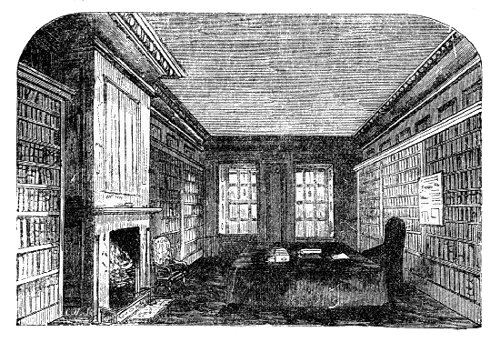
DR. JOHNSON'S RESIDENCE IN INNER TEMPLE LANE.
It was in this place that Dr. Johnson became acquainted with his
future biographer, Boswell, who thus describes their first meeting:—
"A few days afterwards I called on Davies, and asked him if he
thought I might take the liberty of waiting on Mr. Johnson at his chambers
in the Temple. He said I certainly might, and that Mr. Johnson
would take it as a compliment. His chambers were on the first floor of
No. 1, Inner Temple Lane, and I entered them with an impression given
me by the Rev. Dr. Blair, of Edinburgh, who described his having found
the giant in his den. He received me very courteously; but it must be
confessed, that his apartment, and furniture, and morning dress, were
sufficiently uncouth. His brown suit of clothes looked very rusty; he
had on a little, old, shrivelled, unpowdered wig, which was too small
for his head; his shirt neck and knees of his breeches were loose, his
black worsted stockings ill drawn up, and he had a pair of unbuckled
shoes by way of slippers;—but all these slovenly particulars were forgotten
the moment he began to talk."
The "den" in which the "giant" lived, the staircase leading to it,
and indeed the whole appearance of the locality, has recently undergone
demolition, and its interesting features knocked down to the highest
bidder, to be, let us hope, preserved in some museum or other place of
safety.
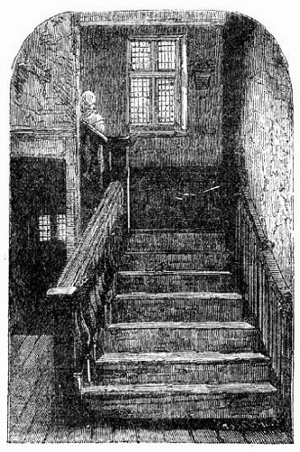
OLD STAIRCASE IN THE RESIDENCE OF DR. JOHNSON.
Dr. Johnson resided at various times in Holborn, the Strand, and
other places, and died, as it is well known, in No. 8, Bolt Court, Fleet
Street, in 1784. His remains were placed in a grave under the statue of
Shakspere, in Westminster Abbey, and near the resting-place of his
friend and companion, David Garrick.
ORIGIN OF THE STUFF BALL AT LINCOLN.
During the want of employment in the manufactories in 1801, Mrs.
Chaplain, of Blankney, in Lincolnshire, formed a patriotic institution
for the encouragement of the local trade of the district. A ball was given
at Lincoln for the benefit of the stuff manufactory, at which ladies were
admitted gratis, on their appearance in a stuff gown and petticoat,
spun, wove, and finished within the county, and producing a ticket
signed by the weaver and dyer at Louth, one of which tickets was
delivered with every twelve yards of stuff. The gentlemen were required
to appear without silk or cotton in their dress, stockings excepted. The
impulse thus given to trade, was of the most signal service in relieving
distress, and at the same time promoting habits of industry.
STEVENS'S SPECIFIC.
In the reign of Charles II., Dr. Jonathan Goddard obtained 5,000l.
for disclosing his secret for making a medicine, called "Guttæ Anglicanæ."
And in 1739, the Parliament of England voted 5,000l. to Mrs.
Stevens for a solvent for stone.
The celebrated David Hartley was very instrumental in procuring this
grant to Joanna Stevens. He obtained also a private subscription to the
amount of £1,356, published one hundred and fifty-five successful cases,
and, by way of climax to the whole, after eating two hundred pounds
weight of soap! David himself died of the stone.
AN IMPOSTOR.
From the Testament of Jerome Sharp, printed in 1786:—"I entered,"
says the narrator, "with one of my friends, and found a man resembling
an ourang-outang crouched upon a stool in the manner of a tailor. His
complexion announced a distant climate, and his keeper stated that he
found him in the island of Molucca. His body was bare to the hips,
having a chain round the waist, seven or eight feet long, which was fastened
to a pillar, and permitted him to circulate out of the reach of the spectators.
His looks and gesticulations were frightful. His jaws never ceased snapping,
except when sending forth discordant cries, which were said to be
indicative of hunger. He swallowed flints when thrown to him, but preferred
raw meat, which he rushed behind his pillar to devour. He
groaned fearfully during his repast, and continued groaning until fully
satiated. When unable to procure more meat, he would swallow stones
with frightful avidity; which, upon examination of those which he accidentally
dropped, proved to be partly dissolved by the acrid quality of
his saliva. In jumping about, the undigested stones were heard rattling
in his stomach."
The men of science quickly set to work to account for these feats, so
completely at variance with the laws of nature. Before they had hit upon a
theory, the pretended Molucca savage was discovered to be a peasant from
the neighbourhood of Besançon, who chose to turn to account his natural
deformities. When staining his face for the purpose, in the dread of
hurting his eyes, he left the eyelids unstained, which completely puzzled
the naturalists. By a clever sleight of hand, the raw meat was left
behind the pillar, and cooked meat substituted in its place. Some
asserted his passion for eating behind the pillar to be a proof of his
savage origin; most polite persons, and more especially kings, being
addicted to feeding in public. The stones swallowed by the pretended
savage were taken from a vessel left purposely in the room full of them;
small round stones, encrusted with plaster, which afterwards gave them
the appearance of having been masticated in the mouth. Before the discovery
of all this, the impostor had contrived to reap a plentiful harvest.
PERUVIAN BARK.
In 1693, the Emperor Kanghi (then in the thirty-second year of his
reign, and fortieth of his age) had a malignant fever, which resisted the
remedies given by his physicians; the emperor recollected that Tchang-tchin,
(Father Gerbillon), and Pe-tsin, (Father Bouret) two jesuit missionaries,
had extolled to him a remedy for intermittents, brought from
Europe, and to which they had given the name of chin-yo (two Chinese
words, which signify "divine remedies;") and he proposed to try it,
but the physicians opposed it. The emperor, however, without their
knowledge took it, and with good effect. Sometime afterwards, he experienced
afresh several fits of an intermittent, which, though slight,
made him uneasy; this led him to proclaim through the city, that any
person possessed of a specific for this sort of fever, should apply without
delay at the palace, where patients might also apply to get cured. Some
of the great officers of his household were charged to receive such
remedies as might be offered, and to administer them to the patients.
The Europeans, Tchang-tching, (Gerbillon) Hang-jo, (Father de Fontenay,
jesuit) and Pe-tsin, (Bouret) presented themselves among others,
with a certain quantity of quinquina, offered it to the grandees, and
instructed them in the manner of using it. The next day it was tried
on several patients, who were kept in sight, and were cured by it. The
officers, or grandees who had been appointed to superintend the experiment,
gave an account to the Emperor of the astonishing effect of the
remedy, and the monarch decided instantly on trying it himself, provided
the hereditary prince gave his consent. The prince, however, not only
refused, but was angry with the grandees for having spoken so favourably
of a remedy, of which only one successful trial had been made; at
last, after much persuasion, the Prince reluctantly grants his consent, and
the emperor takes the bark without hesitation, and permanently recovers.
A house is given by the emperor to the Europeans, who had made known
the remedy, and through the means of Pe-tsin (Father Bouret) presents
were conveyed to the King of France, accompanied with the information,
that the Europeans (that is, the French jesuits) were in high favour.—Histoire
Generale de la Chine, &c. tome xi. p. 168, 4to. Paris, 1780.
WHITE CATS.
In a number of "Loudon Gardener's Magazine," it is stated that
white cats with blue eyes are always deaf, of which extraordinary fact
there is the following confirmation in the "Magazine of Natural History,"
No. 2, likewise conducted by Mr. Loudon:—Some years ago, a white cat
of the Persian kind (probably not a thorough-bred one), procured from
Lord Dudley's at Hindley, was kept in a family as a favourite. The
animal was a female, quite white, and perfectly deaf. She produced, at
various times, many litters of kittens, of which, generally, some were
quite white, others more or less mottled, tabby, &c. But the extraordinary
circumstance is, that of the offspring produced at one and the
same birth, such as, like the mother, were entirely white, were, like her,
invariably deaf; while those that had the least speck of colour on their
fur, as invariably possessed the usual faculty of hearing.
A WOMAN DEFENDS A FORT SINGLY.
Lord Kames in his "Sketches of the History of Man," relates an extraordinary
instance of presence of mind united with courage.
Some Iroquois in the year 1690, attacked the fort de Verchères, in
Canada, which belonged to the French, and had approached silently,
hoping to scale the palisade, when some musket-shot forced them to retire:
on their advancing a second time they were again repulsed, in
wonder and amazement that they could perceive no person, excepting a
woman who was seen everywhere. This was Madame de Verchères, who
conducted herself with as much resolution and courage as if supported
by a numerous garrison. The idea of storming a place wholly undefended,
except by women, occasioned the Iroquois to attack the fortress
repeatedly, but, after two days' siege, they found it necessary to retire,
lest they should be intercepted in their retreat.
Two years afterwards, a party of the same nation so unexpectedly
made their appearance before the same fort, that a girl of fourteen, the
daughter of the proprietor, had but just time to shut the gate. With
this young woman there was no person whatever except one soldier, but
not at all intimidated by her situation, she showed herself sometimes in
one place, sometimes in another, frequently changing her dress, in order
to give some appearance of a garrison, and always fired opportunely. In
short, the faint-hearted Iroquois once more departed without success. Thus
the presence of mind of this young girl was the means of saving the fort.
INDENTURE OF A HORSE-RACE BETWIXT THE EARLS OF MORTON AND
ABERCORN AND THE LORD BOYDE.
As indicating the state of the English language amongst the nobility of
Scotland in 1621, the following is curious:—
"Ane Indentour of ane Horse-raise betuix my Lords Mortoun, Abercorne,
and Boyde.—The erle of Mortoun obleissis himselff to produce
George Rutherfuirdis Barb Naig: The erle of Abercorne obleissis him to
produce his gray Naig: My lord Boyd obleissis him to produce his bay
horse; Upone the conditions following. Thay ar to run the first Thursday
November nixtocum, thrie mett myleis of Cowper raise in Fyff. The
waidger to be for euery horse ten dowbill Anegellis. The foirmest horse
to win the hail thretty. Ilk rydare to be aucht scottis stanewecht. And
the pairtie not comperaud, or refuisand to consigne the waidger, sall
undergo the foirfaltour of this sowme, and that money foirfaltit salbe
additt to the staik to be tane away be the wynner. Forder, we declair
it to be lesum to ony gentilman to produce ane horse and the lyk waidger,
and thay salbe welcum. Subscrybith with all our handis, at Hammiltoune
the fyfteine day off August 1621. Morton, Abercorne, Boyde."
EARLY USE OF CHOCOLATE.
An advertisement in "The Public Adviser," from Tuesday, June 16th,
to Tuesday, June 23d, 1657, informs us that "in Bishopsgate-street, in
Queen's-head-alley, at a Frenchman's House, is an excellent West India
drink, called Chocolate, to be sold, where you may have it ready at any
time, and also unmade, at reasonable rates."
MATTHEW BUCKINGER.
Of all the imperfect beings brought into the world, few can challenge,
for mental and acquired endowments, any thing like a comparison to vie
with this truly extraordinary little man. Matthew Buckinger was a
native of Nuremberg, in Germany, where he was born, June 2, 1674,
without hands, feet, legs, or thighs; in short, he was little more than
the trunk of a man, saving two excrescences growing from the shoulder-blades,
more resembling fins of a fish than arms of a man. He was the
last of nine children, by one father and mother, viz. eight sons and one
daughter; after arriving at the age of maturity, from the singularity of
his case, and the extraordinary abilities he possessed, he attracted the
notice and attention of all persons, of whatever rank in life, to whom he
was occasionally introduced.
It does not appear, by any account extant, that his parents exhibited
him at any time for the purposes of emolument, but that the whole of
his time must have been employed in study and practice, to attain the
wonderful perfection he arrived at in drawing, and his performance on
various musical instruments; he played the flute, bagpipe, dulcimer,
and trumpet, not in the manner of general amateurs, but in the style of
a finished master. He likewise possessed great mechanical powers, and
conceived the design of constructing machines to play on all sorts of
musical instruments.
If Nature played the niggard in one respect with him she amply repaid
the deficiency by endowments that those blessed with perfect limbs could
seldom achieve. He greatly distinguished himself by beautiful writing,
drawing coats of arms, sketches of portraits, history, landscapes, &c.,
most of which were executed in Indian ink, with a pen, emulating in
perfection the finest and most finished engraving. He was well skilled
in most games of chance, nor could the most experienced gamester
or juggler obtain the least advantage at any tricks, or game, with cards
or dice.
He used to perform before company, to whom he was exhibited, various
tricks with cups and balls, corn, and living birds; and could play at
skittles and ninepins with great dexterity; shave himself with perfect
ease, and do many other things equally surprising in a person so deficient,
and mutilated by Nature. His writings and sketches of figures,
landscapes, &c., were by no means uncommon, though curious; it being
customary, with most persons who went to see him, to purchase something
or other of his performance; and as he was always employed in
writing or drawing, he carried on a very successful trade, which, together
with the money he obtained by exhibiting himself, enabled him to support
himself and family in a very genteel manner. The late Mr. Herbert,
of Cheshunt, in Hertfordshire, editor of "Ames's History of Printing,"
had many curious specimens of Buckinger's writing and drawing,
the most extraordinary of which was his own portrait, exquisitely done
on vellum, in which he most ingeniously contrived to insert, in the flowing
curls of the wig, the 27th, 121st, 128th, 140th, 149th, and the 150th
Psalms, together with the Lord's Prayer, most beautifully and fairly
written. Mr. Isaac Herbert, son of the former, while carrying on the
business of a bookseller in Pall-Mall, caused this portrait to be engraved,
for which he paid Mr. Harding fifty guineas.
Buckinger was married four times, and had eleven children, viz., one
by his first wife, three by his second, six by his third, and one by his
last. One of his wives was in the habit of treating him extremely ill,
frequently beating and other ways insulting him, which, for a long time,
he very patiently put up with; but once his anger was so much aroused,
that he sprung upon her like a fury, got her down, and buffeted her with
his stumps within an inch of her life; nor would he suffer her to arise
until she promised amendment in future, which it seems she prudently
adopted, through fear of another thrashing. Mr. Buckinger was but
twenty-nine inches in height, and died in 1722.
WONDERFUL PROVISION OF NATURE.
The insects that frequent the waters, require predaceous animals to
keep them within due limits, as well as those that inhabit the earth;
and the water-spider (Argyroneta aquatica) is one of the most remarkable
upon whom that office is devolved. To this end, her instinct
instructs her to fabricate a kind of diving-bell in the bosom of that
element. She usually selects still waters for this purpose. Her house
is an oval cocoon, filled with air, and lined with silk, from which threads
issue in every direction, and are fastened to the surrounding plants. In
this cocoon, which is open below, she watches for her prey, and even
appears to pass the winter, when she closes the opening. It is most
commonly, yet not always, under water; but its inhabitant has filled it
for her respiration, which enables her to live in it. She conveys the
air to it in the following manner: she usually swims on her back, when
her abdomen is enveloped in a bubble of air, and appears like a globe of
quicksilver. With this she enters her cocoon, and displacing an equal
mass of water, again ascends for a second lading, till she has sufficiently
filled her house with it, so as to expel all water. How these little
animals can envelope their abdomen with an air-bubble, and retain it
till they enter their cells, is still one of Nature's mysteries that has not
been explained. It is a wonderful provision, which enables an animal
that breathes the atmospheric air, to fill her house with it under water,
and by some secret art to clothe her body with air, as with a garment,
which she can put off when it answers her purpose. This is a kind of
attraction and repulsion that mocks all inquiries.
STOMACH BRUSH.
One of the Court Physicians, in the reign of Charles II., invented an
instrument to cleanse the stomach, and wrote a pamphlet on it; and
ridiculous as a chylopoietic-scrubbing-brush may appear, it afterwards
got a place among surgical instruments, and is described as the Excutor
Ventriculi, or cleanser of the stomach; but the moderns not having
stomach for it, have transferred it to the wine merchant, who more appropriately
applies it to the scouring the interior of bottles. Heister
gives a minute description of it, and very gravely enters on the mode and
manner of using it: the patient is to drink a draught of warm water, or
spirit of wine, that the mucus and foulness of the stomach may be
washed off thereby: then, the brush being moistened in some convenient
liquor, is to be introduced into the œsophagus, and slowly protruded
into the stomach, by twisting round its wire handle. When arrived in
the stomach, it is to be drawn up and down, and through the œsophagus,
like the sucker in a syringe, till it be at last wholly extracted. Some
recommend plentiful drinking in the operation, to be continued till no
more foulness is discharged. But though this contrivance is greatly
extolled, and said to prolong life to a great age, especially if practiced
once a week, month, or fortnight; yet, there are very few (probably,
because tried by very few) instances of its happy effects.
POPULAR AMUSEMENTS IN 1743.
In Merrie England of the Olden Time, we find the following copy of a
handbill announcing performances:—
By a company of English, French, and Germans, at Phillips's New
Wells, near the London Spa, Clerkenwell, 20th August, 1743.
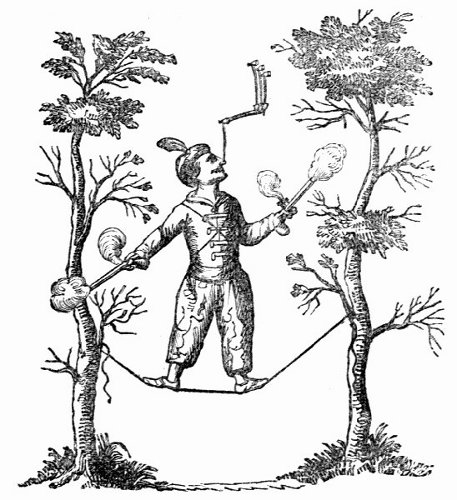
This evening, and during the Summer Season, will be performed
several new exercises of Rope-dancing, Tumbling, Vaulting, Equilibres,
Ladder-dancing, and Balancing, by Madame Kerman, Sampson Rogetzi,
Monsieur German, and Monsieur Dominique; with a new Grand Dance,
called Apollo and Daphne, by Mr. Phillips, Mrs. Lebrune, and others;
singing by Mrs. Phillips and Mrs. Jackson; likewise the extraordinary
performance of Herr Von Eeckenberg, who imitates the lark, thrush,
blackbird, goldfinch, canary-bird, flageolet, and German flute; a Sailor's
Dance by Mr. Phillips; and Monsieur Dominique flies through a hogshead,
and forces both heads out. To which will be added The Harlot's
Progress. Harlequin by Mr. Phillips; Miss Kitty by Mrs. Phillips.
Also, an exact representation of the late glorious victory gained over the
French by the English at the battle of Dettingen, with the taking of the
White Household Standard by the Scots Greys, and blowing up the
bridge, and destroying and drowning most part of the French army. To
begin every evening at five o'clock. Every one will be admitted for a
pint of wine, as usual.
DANCING ROOMS.
Dancing rooms were much frequented a century or so ago in London,
which was then pretty well supplied with this means of recreation. We
find that there were rare dancing doings at the original dancing room
| |
in the year |
| at the field-end of King-Street, Bloomsbury, |
1742 |
| Hickford's great room, Panton-Street, Haymarket, |
1743 |
| Mitre Tavern, Charing-Cross, |
1743 |
| Barber's Hall, |
1745 |
| Richmond Assembly, |
1745 |
| Lambeth Wells, |
1747 |
| Duke's long room, Paternoster Row, |
1748 |
| Large Assembly Room at the Two Green Lamps, near Exeter Change,
(at the particular desire of Jubilee Dickey!) |
1749 |
| The large room next door to the Hand and Slippers, Long-lane,
West Smithfield, |
1750 |
| Lambeth Wells, where a Penny Wedding, in the Scotch
manner, was celebrated for the benefit of a young couple, |
1752 |
| Old Queen's Head, in Cock-lane, Lambeth, |
1755 |
and at Mr. Bell's, at the sign of the Ship, in the Strand, where, in 1755,
a Scotch Wedding was kept. The bride "to be dressed without any
linen; all in ribbons, and green flowers, with Scotch masks. There will
be three bagpipes; a band of Scotch music, &c. &c. To begin precisely
at two o'clock. Admission, two shillings and sixpence."
ORIGIN OF THE USE OF TOBACCO.
"Maister John Nicot, Counsellor to the Kyng, beeyng Embassadour for
the Kyng in Portugall, in the yeres of our Lorde, 1559, 60, 61, wente one
daye to see the Prysons of the Kyng of Portugall, and a gentleman
beeyng the keeper of the saide Prisons presented hym this hearbe, as a
strange Plant brought from Florida; the same Maister Nicot, hauyng
caused the saide hearbe to be set in his garden, where it grewe and multiplied
marveillously, was vpon a tyme aduertised, by one of his Pages,
that a young man, a kinne to that Page, made a saye of that hearbe
bruised, both the herbe and the joice together upon an ulcer whiche he
had vpon his cheeke nere vnto his nose, coming of a Noli me tangere
whiche bega to take roote already at the gristles of the Nose, wherewith
he founde hym self marveillously eased. Therefore the said Maister
Nicot caused the sicke yong man to be brought before hym, causing the
said herbe to be continued to the sore eight or tenne daies, this saide
Noli me tangere, was vtterly extinguished and healed: and he had sent
it, while this cure was a working to a certaine Physition of the Kyng of
Portugall of the moste fame, for to see the further workyng and effect
of the said Nicotiane, and sending for the same yong man at the end of
tenne daies, the said Phisition seeyng the uisage of the said sicke yong
man certified, that the saide Noli me tangere was utterly extinguished,
as in deede he never felt it since. Within a while after, one of the
Cookes of the said Embassadour hauyng almost cut off his Thombe, with
a great choppyng knife, the steward of the house of the saide gentleman
ranne to the saide Nicotiane, and dresssed him there with fyve or sixe
times, and so in the ende thereof he was healed: from that time forwarde
this hearbe began to bee famous throughout all Lisborne, where the
court of the Kyng of Portugall was at that presente, and the vertue of
this saide hearbe was preached, and the people beganne to name it the
Ambassadour's hearbe! Wherefore there came certaine daies after, a
gentleman of the country, Father to one of the Pages of the Ambassadour,
who was troubled with an vlcer in his Legge, hauyng had the
same two yeres, and demaunded of the saide Ambassadour for his hearbe,
and vsing the same in suche order as is before written, at the ende of
tenne or twelve daies he was healed. From that time fourth the fame
of that hearbe encreased in such sorte, that manye came from all places
to have that same herbe. Emong all others there was a woman that had
her face covered with a Ringworme rooted, as though she had a Visour
on her face, to whom the saide L: Ambassadour caused the herbe to be
given her, and told how she should vse it, and at the ende of eight or
tenne daies, this woman was thoroughleye healed, she came and shewed
herself to the Ambassadour, shewing him of her healyng. After there
came a captain to presente his sonne, sick of the Kinges euill to the
saide L: Ambassadour, for to send him into France, vnto whom there was
saye made of the saide hearbe, whiche in fewe daies did beginne to
shewe greate signes of healing, and finally was altogether healed of the
kinges euill. The L: Ambassadour seeing so great effectes proceeding
of this hearbe, and hauing heard say that the Lady Montigny that was,
dyed at Saint Germans, of an vlcer bredde in her breast, that did turn
to a Noli me tangere, for which there could never be remedey bee founde,
and likewise that the Countesse of Ruffe, had sought for all the famous
Phisitions of that Realme, for to heale her face, unto whom they could
give no remedy, he thought it good to communicate the same into
Fraunce, and did send it to Kyng Fraunces the seconde; and to the
Queen Mother, and to many other Lords of the Courte with the maner
of governyng the same: and how to applie it vnto the said diseases,
even as he had found it by experience; and chiefly to the lorde of Jarnac
governour of Rogell, with whom the saide Lorde Ambassadour had
great amitie for the service of the Kyng. The whiche Lorde of Jarnac,
told one daye at the Queenes Table, that he had caused the saide Nicotiane
to be distilled, and caused the water to be dronke, mingled with water
Euphrasie, otherwise called eyebright, to one that was shorte breathed,
and was therewith healed."—Joyfvll News ovt of the newe found worlde,
&c., 1577.—Black Letter.
ANCIENT INSTRUMENTS OF PUNISHMENT AND TORTURE IN THE TOWER
OF LONDON.
There are few things among the valuable collection of antiquities preserved
in the Tower of London, which excite so much interest as the
grim-looking objects forming the group figured in the accompanying
engraving.
With the executioner's axe, that long list of unfortunates who have
met their fate within the walls of the Tower, or on Tower Hill, since the
time of Henry VIII., have been beheaded. Among them may be enumerated
Queen Anne Boleyn, whom Henry first presented to his people
as their Queen while standing with her on the Tower Stairs, after she
had been conveyed thither from Greenwich with every possible pomp.
Crowds of gilded barges, with gay banners waving at their sterns, then
lined the stream. The noblest of the land were in the young Queen's
train or were waiting to receive her. Loud rounds of cannon, and soft,
merry strains, announced her arrival; and the burly King stepped forward
to kiss her in the sight of the assembled multitude. On the same day,
three short years afterwards, she was led forth to execution within the
Tower walls. The good Sir Thomas More and the chivalrous Earl of Surrey,
Lady Jane Grey and her young husband, the gallant Raleigh, and a host
of others, also perished by that sad symbol of the executioner's office.
The block is said to be of less ancient date, but is known to have been
used at the execution of three Scotch lords—the unfortunate adherents
of the Pretender—a little more than a century ago. On the top part of
the block, there are three distinct cuts, two of them very deep and parallel,
and the other at an angle and less effective.
The horrible instrument of torture called the "Scavenger's Daughter,"
was, in the "good old days," used as a means of extorting confession. The
head of the culprit was passed through the circular hole at the top, and
the arms through those below. The whole of this part of the machine
opens in somewhat the same manner as a pair of tongs, the upper part
being fixed round the neck and arms, and the semicircular irons placed
on the legs. The body was then bent, and a strong iron bar was passed
through the irons connected with the head and arms, and those in which
the legs were placed. "The culprit would then," as one of the "Beefeaters"
who attends on visitors makes a point of observing, "be doubled
up into very small compass, and made exceedingly uncomfortable."
The Bilboes need little explanation, being only a strong rod of iron,
with a nob at one end, on which are two moveable hoops, for the purpose
of holding the legs; these being fixed, and a heavy iron padlock
put on the proper part—the wearer was said to be in a Bilboe. Instruments
of this description were much used on board of ship for the purpose
of securing prisoners of war.
The Iron Collar is a persuader of a formidable description, for it
weighs upwards of 14 lbs., and is so made that it can be fixed on the
neck and then locked. Such a necklace would, we think, be sufficiently
inconvenient; but it is rendered still more uncomfortable by sundry
prickles of iron knowingly placed.
The Thumb-screw, also preserved in the Tower, is a characteristic
example of a species of torture at one time much resorted to. The
engraved example has been constructed so as to press both thumbs;
nevertheless, it is a convenient little instrument, which might be easily
carried about in the pocket. We have met with varieties of the thumb-screw
in several collections—some for the accommodation of one thumb
only. In the Museum of the Royal Antiquarian Society of Scotland
there are some thumb-screws which are said to have been used upon the
Covenanters.
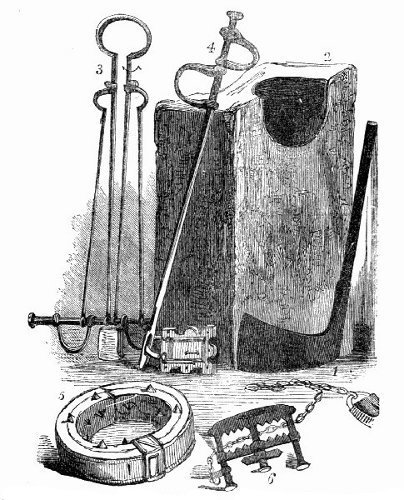
1. The Executioner's Axe. 2. The Block on which Lords Balmerino, Lovat, &c.,
were beheaded. 3. The Scavenger's Daughter. 4. Spanish Bilboes. 5. Massive
Iron Collar for the Neck. 6. Thumb-Screw.
Times have changed for the better since the "Scavenger's Daughter,"
and the other matters represented, were amongst the mildest of the
methods used for the purposes of punishment and intimidation. The
stocks, the public whipping-posts, boilings, and burnings in Smithfield
and elsewhere, the exhibition of dead men's heads over gateways, the
boot, the rack, the pillory, the practice of making men eat their own
books in Cheapside, drawing on hurdles to the place of execution, and
then hanging, drawing, and quartering, chopping off hands and ears,
and other revolting punishments, have gone out of use, and it is gratifying
to know that we are all the better for it.
A BEAU BRUMMELL OF THE 17TH CENTURY.
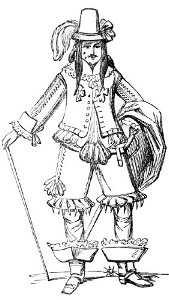
This very curious representation of a first-rate exquisite is copied from
a very rare broadside, printed in 1646, and styled The Picture of an
English Anticke, with a List of his ridiculous Habits and apish Gestures.
The engraving is a well-executed
copperplate, and the description
beneath is a brief recapitulation
of his costume: from which we
learn that he wears a tall hat, with
a bunch of riband on one side, and
a feather on the other; his face
spotted with patches; two love-locks,
one on each side of his head,
which hang upon his bosom, and
are tied at the ends with silk riband
in bows. His beard on the
upper lip encompassing his mouth;
his band or collar edged with lace,
and tied with band-strings, secured
by a ring; a tight vest, partly
open and short in the skirts, between
which and his breeches his
shirt protruded. His cloak was
carried over his arm. His breeches
were ornamented by "many dozen
of points at the knees, and above
them, on either side, were two
great bunches of riband of several
colours." His legs were incased
in "boot-hose tops, tied about the
middle of the calf, as long as a
pair of shirt-sleeves, double at the
ends like a ruff-band; the tops of
his boots very large, fringed with lace, and turned down as low as his
spurres, which gingled like the bells of a morrice-dancer as he walked;"
the "feet of his boots were two inches too long." In his right hand
he carried a stick, which he "played with" as he "straddled" along
the streets "singing."
PRAYING FOR REVENGE.
In North Wales, when a person supposes himself highly injured, it is
not uncommon for him to go to some church dedicated to a celebrated
saint, as Llan Elian in Anglesea, and Clynog in Carnarvonshire, and
there to offer his enemy. He kneels down on his bare knees in the
church, and offering a piece of money to the saint, calls down curses and
misfortunes upon the offender and his family for generations to come; in
the most firm belief that the imprecations will be fulfilled. Sometimes
they repair to a sacred well instead of a church.
A FEMALE SAMPSON: FROM A HANDBILL.
September 4th, 1818, was shown at Bartholomew Fair, "The strongest
woman in Europe, the celebrated French Female Hercules, Madame
Gobert, who will lift with her teeth a table five feet long and three feet
wide, with several persons seated upon it; also carry thirty-six weights,
fifty-six pounds each, equal to 2,016 lbs., and will disengage herself from
them without any assistance; will carry a barrel containing 340 bottles;
also an anvil 400 lbs. weight, on which they will forge with four hammers
at the time she supports it on her stomach; she will also lift with
her hair the same anvil, swing it from the ground, and suspend it in that
position to the astonishment of every beholder; will take up a chair by
the hind stave with her teeth, and throw it over her head, ten feet from
her body. Her travelling caravan, (weighing two tons,) on its road from
Harwich to Leominster, owing to the neglect of the driver, and badness
of the road, sunk in the mud, nearly up to the box of the wheels; the
two horses being unable to extricate it she descended, and, with apparent
ease, disengaged the caravan from its situation, without any assistance
whatever."
TREES THAT GROW SHIRTS.
"We saw on the slope of the Cerra Dnida," says M. Humboldt,
"shirt trees, fifty feet high. The Indians cut off cylindrical pieces two
feet in diameter, from which they peel the red and fibrous bark, without
making any longitudinal incision. This bark affords them a sort of
garment which resembles a sack of a very coarse texture, and without a
seam. The upper opening serves for the head, and two lateral holes are
cut to admit the arms. The natives wear these shirts of Marina in the
rainy season; they have the form of the ponchos and manos of cotton
which are so common in New Grenada, at Quito, and in Peru. As in
this climate the riches and beneficence of nature are regarded as the
primary causes of the indolence of the inhabitants, the missionaries do
not fail to say in showing the shirts of Marina, 'in the forests of
Oroonoko, garments are found ready made upon the trees.'"
A FEMALE VENTRILOQUIST.
A female ventriloquist, named Barbara Jacobi, narrowly escaped being
burnt at the stake in 1685, at Haarlem, where she was an inmate of the
public Hospital. The curious daily resorted thither to hear her hold &
dialogue with an imaginary personage with whom she conversed as if
concealed behind the curtains of her bed. This individual, whom she
called Joachim, and to whom she addressed a thousand ludicrous questions,
which he answered in the same familiar strain, was for some time
supposed to be a confederate. But when the bystanders attempted to
search for him behind the curtains, his voice instantly reproached them
with their curiosity from the opposite corner of the room. As Barbara
Jacobi had contrived to make herself familiar with all the gossip of the
city of Haarlem, the revelations of the pretended familiar were such as to
cause considerable embarrassment to those who beset her with impertinent
questions.
CALMUC OPINION OF LIGHTNING.
The Calmucs hold the lightning to be the fire spit out of the mouth of a
dragon, ridden and scourged by evil Dæmons, and the thunder they
make to be his roarings.
THE HEADING OF THE EXPIRING PENNSYLVANIA JOURNAL.
Journalism has had its trials and difficulties in England as well as in
America; but we do not remember to have ever seen a more quaint last
Number, than the subjoined facsimile exhibits:—
NOSTRUMS.
Unsuccessful gamesters used formerly to make a knot in their linen,
of late years they have contented themselves with changing their chair as
a remedy against ill-luck. As a security against cowardice, it was once
only necessary to wear a pin plucked from the winding sheet of a corpse.
To insure a prosperous accouchement to your wife, you had but to tie her
girdle to a bell and ring it three times. To get rid of warts, you were to
fold up in a rag as many peas as you had warts, and throw them upon
the high road; when the unlucky person who picked them up became
your substitute. In the present day, to cure a toothache, you go to
your dentist. In the olden time you would have solicited alms in honour
of St. Lawrence, and been relieved without cost or pain.
PRECOCIOUS CHILDREN.
Baillet mentions one hundred and sixty-three children endowed with
extraordinary talents, among whom few arrived at an advanced age. The
two sons of Quintilian, so vaunted by their father, did not reach their
tenth year. Hermogenes, who, at the age of fifteen, taught rhetoric to
Marcus Aurelius, who triumphed over the most celebrated rhetoricians of
Greece, did not die, but at twenty-four, lost his faculties, and forgot all
he had previously acquired. Pica di Mirandola died at thirty-two;
Johannes Secundus at twenty-five; having at the age of fifteen composed
admirable Greek and Latin verses, and become profoundly versed in
jurisprudence and letters. Pascal, whose genius developed itself at ten
years old, did not attain the third of a century.
In 1791, a child was born at Lubeck, named Henri Heinekem, whose
precocity was miraculous. At ten months of age, he spoke distinctly;
at twelve, learnt the Pentateuch by rote, and at fourteen months, was
perfectly acquainted with the Old and New Testaments. At two years
of age, he was as familiar with Ancient History as the most erudite
authors of antiquity. Sanson and Danville only could compete with him
in geographical knowledge; Cicero would have thought him an "alter
ego," on hearing him converse in Latin; and in modern languages he
was equally proficient. This wonderful child was unfortunately carried
off in his fourth year. According to a popular proverb—"the sword
wore out the sheath."
EFFECT OF MUSIC ON A PIGEON.
Bingley gives a singular anecdote of the effect of music on a pigeon,
as related by John Lockman, in some reflections concerning operas,
prefixed to his musical drama of Rosalinda. He was staying at a
friend's house, whose daughter was a fine performer on the harpsichord,
and observed a pigeon, which, whenever the young lady played the song
of "Speri-si," in Handel's opera of Admetus (and this only), would
descend from an adjacent dove-house to the room-window where she sat,
and listen to it apparently with the most pleasing emotions; and when
the song was finished it always returned immediately to the dove-house.
POWER OF FASCINATION IN SNAKES.
Some animals are held in universal dread by others, and not the
least terrible is the effect produced by the rattle-snake. Mr. Pennant
says, that this snake will frequently lie at the bottom of a tree, on
which a squirrel is seated. He fixes his eyes on the animal, and from
that moment it cannot escape: it begins a doleful outcry, which is so
well known that a passer by, on hearing it, immediately knows that
a snake is present. The squirrel runs up the tree a little way, comes
down again, then goes up and afterwards comes still lower. The
snake continues at the bottom of the tree, with his eyes fixed on the
squirrel, and his attention is so entirely taken up, that a person accidentally
approaching may make a considerable noise, without so much
as the snake's turning about. The squirrel comes lower, and at last
leaps down to the snake, whose mouth is already distended for its reception.
Le Vaillant confirms this fascinating terror, by a scene he witnessed.
He saw on the branch of a tree a species of shrike trembling
as if in convulsions, and at the distance of nearly four feet, on another
branch, a large species of snake, that was lying with outstretched neck
and fiery eyes, gazing steadily at the poor animal. The agony of the
bird was so great that it was deprived of the power of moving away,
and when one of the party killed the snake, it was found dead upon the
spot—and that entirely from fear—for, on examination, it appeared not
to have received the slightest wound. The same traveller adds, that a
short time afterwards he observed a small mouse in similar agonizing
convulsions, about two yards from a snake, whose eyes were intently
fixed upon it; and on frightening away the reptile, and taking up the
mouse, it expired in his hand.
SECOND SIGHT.
About the year 1725, the marvellous history of a Portuguese woman
set the whole world of science into confusion, as will be found by referring
to the "Mercure de France." This female was said to possess the gift
of discovering treasures. Without any other aid than the keen penetration
of her eyes, she was able to distinguish the different strata of earth,
and pronounce unerringly upon the utmost distances at a single glance.
Her eye penetrated through every substance, even the human body; and
she could discern the mechanism, and circulation of all animal fluids,
and detect latent diseases; although less skilful than the animal magnetisers,
she did not affect to point out infallible remedies. Ladies could
learn from her the sex of their forthcoming progeny.
The King of Portugal, greatly at a loss for water in his newly built
palace, consulted her; and after a glance at the spot, she pointed out an
abundant spring, upon which his Majesty rewarded her with a pension,
the order of Christ, and a patent of nobility.
In the exercise of her miraculous powers, certain preliminaries were
indispensable. She was obliged to observe a rigid fast; indigestion, or
the most trifling derangement of the stomach, suspending the marvellous
powers of her visual organs.
The men of science of the day were of course confounded by such
prodigies. But instead of questioning the woman, they consulted the
works of their predecessors; not forgetting the inevitable Aristotle. By
dint of much research, they found a letter from Huygens asserting that
there was a prisoner of war at Antwerp, who could see through stuffs of
the thickest texture provided they were not red. The wonderful man
was cited in confirmation of the wonderful woman, and vice versâ.
CHARACTER INDICATED BY THE EARS.
According to Aristotle, large ears are indicative of imbecility; while
small ones announce madness. Ears which are flat, point out the rustic
and brutal man. Those of the fairest promise, are firm and of middling
size. Happy the man who boasts of square ears; a sure indication of
sublimity of soul and purity of life. Such, according to Suetonius, were
the ears of the Emperor Augustus.
GROANING BOARDS.
Groaning boards were the wonder in London in 1682. An elm plank
was exhibited to the king, which, being touched by a hot iron, invariably
produced a sound resembling deep groans. At the Bowman Tavern, in
Drury Lane, the mantel-piece did the same so well that it was supposed
to be part of the same elm-tree; and the dresser at the Queen's Arm
Tavern, St. Martin le Grand, was found to possess the same quality.
Strange times when such things were deemed wonderful; even to
meriting exhibition before the monarch.
ANCIENT PLOUGHING AND THRESHING.
The ancient plough was light, the draught comparatively easy; but then
the very lightness required that the ploughman should lean upon it with
his whole weight, or else it would glide over the soil without making a
single furrow. "Unless," said Pliny, "the ploughman stoop forward, to
press down the plough, as well as to conduct it, truly it will turn aside."
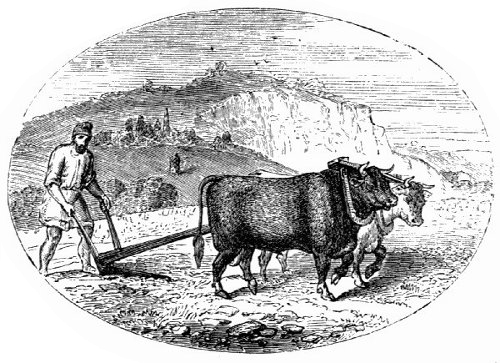
Oxen were anciently employed in threshing corn, and the same custom
is still retained in Egypt and the east. This operation is effected by
trampling upon the sheaves, and by dragging a clumsy machine, furnished
with three rollers that turn on their axles. A wooden chair is attached to
the machine, and on this a driver seats himself, urging his oxen backwards
and forwards among the sheaves, which have previously been thrown into
a heap of about eight feet wide and two in height. The grain thus beaten
out, is collected in an open place, and shaken against the wind by an
attendant, with a small shovel, or, as it is termed, a winnowing fan, which
disperses the chaff and leaves the grain uninjured:—
"Thus, with autumnal harvests covered o'er,
And thick bestrewn, lies Ceres' sacred floor;
While round and round, with never-wearied pain,
The trampling steers beat out th' unnumber'd grain."
Homer.
Horace further tells us, that the threshing floor was mostly a smooth
space, surrounded with mud walls, having a barn or garner on one side;
occasionally an open field, outside the walls, was selected for this purpose,
yet uniformly before the town or city gates. Such was the void place
wherein the king of Israel, and Jehoshaphat, king of Judah, sat each of
them on his throne, clothed in his robes, at the entering in of the gate of
Samaria, and all the prophets prophesied before them. In the marginal
reading we are informed, that this void space was no other than a threshing
floor; and truly the area was well adapted for such an assemblage,
being equally suited to accommodate the two kings and their attendants,
and to separate them from the populace.
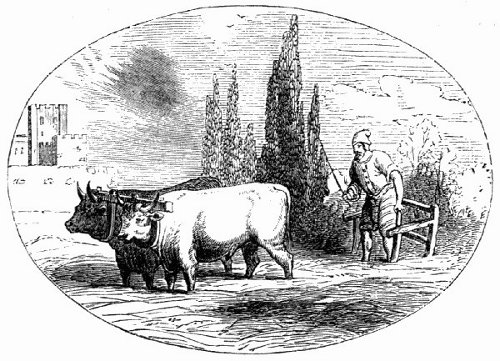
OXEN THRESHING CORN.
Eastern ploughshares were of a lighter make than ours, and those who
notice the shortness and substance of ancient weapons, among such as are
preserved in museums, will understand how readily they might be applied
to agricultural uses.
FROST FAIRS.
In 1788-9, the Thames was completely frozen over below London-bridge.
Booths were erected on the ice; and puppet-shows, wild beasts,
bear-baiting, turnabouts, pigs and sheep roasted, exhibited the various
amusements of Bartholomew Fair multiplied and improved. From
Putney-bridge down to Redriff was one continued scene of jollity during
this seven weeks' saturnalia. The last frost fair was celebrated in the
year 1814. The frost commenced on 27th December, 1813, and continued
to the 5th February, 1814. There was a grand walk, or mall, from
Blackfriars-bridge to London-bridge, that was appropriately named
The City Road, and lined on each side with booths of all descriptions.
Several printing-presses were erected, and at one of these an orange-coloured
standard was hoisted, with "Orange Boven" printed in large
characters. There were E O and Rouge et Noir tables, tee-totums, and
skittles; concerts of rough music, viz. salt-boxes and rolling-pins, gridirons
and tongs, horns, and marrow-bones and cleavers. The carousing
booths were filled with merry parties, some dancing to the sound of the
fiddle, others sitting round blazing fires smoking and drinking. A
printer's devil bawled out to the spectators, "Now is your time, ladies
and gentlemen,—now is your time to support the freedom of the press!
Can the press enjoy greater liberty? Here you find it working in the
middle of the Thames!"
MAGIC RAIN STONE.
The Indian magi, who are to invoke Yo He Wah, and mediate with
the supreme holy fire that he may give seasonable rains, have a transparent
stone of supposed great power in assisting to bring down the rain,
when it is put in a basin of water, by a reputed divine virtue, impressed
on one of the like sort, in time of old, which communicates it circularly.
This stone would suffer a great decay, they assert, were it even seen by
their own laity; but if by foreigners, it would be utterly despoiled of its
divine communicative power.
THE BOMBARDIER BEETLE.
The bombardier beetle (Carabus crepitans) when touched produces a
noise resembling the discharge of a musket in miniature, during which
a blue smoke may be seen to proceed from its extremity. Rolander says
that it can give twenty discharges successively. A bladder placed near
its posterior extremity, is the arsenal that contains its store. This is its
chief defence against its enemies; and the vapour or liquid that proceeds
from it is of so pungent a nature, that if it happens to be discharged
into the eyes, it makes them smart as though brandy had been
thrown into them. The principal enemy of the bombardier is another
insect of the same tribe, but three or four times its size. When pursued
and fatigued it has recourse to this stratagem; it lies down in the path
of its enemy, who advances with open mouth to seize it; but on the
discharge of the artillery, this suddenly draws back, and remains for a
while confused, during which the bombardier conceals itself in some
neighbouring crevice, but if not lucky enough to find one, the other
returns to the attack, takes the insect by the head, and bears it off.
THE PILLORY FOR EATING FLESH IN LENT.
Even in this kingdom, so late as the Reformation, eating flesh in Lent
was rewarded with the pillory. An instance of this occurs in the
"Patriot King," the particulars of which, quoted in "Clavis Calendaria,"
are somewhat amusing. Thomas Freburn's wife, of Paternoster-row,
London, having expressed a particular inclination for pig,
one was procured, ready for the spit; but the butter-woman who provided
it, squeamish as to the propriety of what she had done, carried a
foot of it to the Dean of Canterbury. The Dean was at dinner, and one
of his guests was Freburn's landlord, and Garter King at Arms, who
sent to know if any of his family were ill, that he ate flesh in Lent.
'All well,' quoth Freburn, (perhaps too much of a Dissenter for the
times,) 'only my wife longs for pig.' His landlord sends for the Bishop
of London's apparitor, and orders him to take Freburn and his pig before
Stocksly, the Bishop, who sent them both to Judge Cholmley; but
he not being at home, they were again brought back to the Bishop, who
committed them to the Compter. Next day, being Saturday, Freburn
was carried before the Lord Mayor, who sentenced him to stand in the
pillory on the Monday following, with one half of the pig on one shoulder,
and the other half on the other. Through Cromwell's intercession, the
poor man at last gained his liberty by a bond of twenty pounds for his
appearance. The mischief-making pig was, by the order of the Bishop,
buried in Finsbury-field, by the hand of his Lordship's apparitor; but
Freburn was turned out of his house, and could not get another in four
years. Hence we may infer his ruin.
HUGE CANNON AT THE SIEGE OF CONSTANTINOPLE.
In 1432, several kinds of artillery are mentioned, cannons, bombards,
vulgaires, coulverins. The vulgaires were ordinary artillery. In the
year 1460, James II. of Scotland was killed by the accidental bursting
of a cannon. The artillery of the Turks, in the year 1453, surpassed
whatever had yet appeared in the world. A stupendous piece of
ordnance was made by them; its bore was twelve palms, and the stone
bullet weighed about 600 lbs.; it was brought with great difficulty before
Constantinople, and was flanked by two almost of equal magnitude:
fourteen batteries were brought to bear against the place, mounting 130
guns; the great cannon could not be loaded and fired more than seven
times in one day. Mines were adopted by the Turks, and counter-mines
by the Christians. At this siege, which was in 1453, ancient and
modern artillery were both used. Cannons, intermingled with machines
for casting stones and darts, and the battering-ram was directed against
the walls. The fate of Constantinople could no longer be averted: the
diminutive garrison was exhausted by a double attack; the fortifications
were dismantled on all sides by the Ottoman cannon; a spirit of discord
impaired the Christian strength. After a siege of fifty-three days,
Constantinople, which had defied the power of Chosroes, the Chagan,
and the Caliphs, was subdued by the arms of Mahomet II.
A MAN IN A VAULT ELEVEN DAYS.
St. Benedict Fink.—"1673, April 23, was buried Mr Thomas Sharrow,
Cloth-worker, late Churchwarden of this parish, killed by an accidental
fall into a vault, in London Wall, Amen Corner, by Paternoster Row,
and was supposed had lain there eleven days and nights before any one
could tell where he was, Let all that read this take heed of drink."—Truly,
a quaint warning!
BLIND GRANNY.
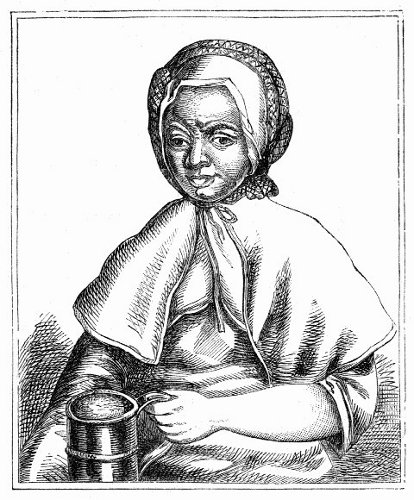
This miserable, wretched, drunken object, who was blind of one eye,
used to annoy the passengers in the streets of London, while sober, with
licking her blind eye with her tongue, which was of a most enormous
length, and thickness; indeed, it was of such a prodigious size, that her
mouth could not contain it, and she could never close her lips, or to use
a common expression, keep her tongue within her teeth. This wonderful
feat of washing her eye with her tongue was exhibited with a view
of obtaining money from such as crowded around her, and no sooner had
she obtained sufficient means, but she hastened to the first convenient
liquor-shop, to indulge her propensity in copious libations, and when
properly inspired, would rush into the streets with all the gestures of a
frantic maniac, and roll and dance about, until she became a little
sobered, which was sometimes accelerated by the salutary application of
a pail of water, gratuitously bestowed upon her by persons whose doorway
she had taken possession of, as shelter from the persecuting tormentings
of boys and girls who generally followed her.
ANCIENT FEMALE COSTUME.
A good specimen of the costume of a female
of the higher classes is here given, from an
effigy of a lady of the Ryther family, in
Ryther church, Yorkshire, engraved in Hollis's
Monumental Effigies. She wears a
wimple, covering the neck and encircling
the head, the hair of which is gathered in
plaits at the sides, and covered with a kerchief,
which falls upon the shoulders, and is secured
by a fillet passing over the forehead. The
sleeves of the gown hang midway from the
elbow and the wrist, and display the tight
sleeve with its rows of buttons beneath. The
mantle is fastened by a band of ribbon, secured
by ornamental studs. The lower part
of the dress consists of the wide gown, lying
in folds, and completely concealing the feet,
which have been omitted, in order to display
the upper part of this interesting effigy to
greater advantage.
CHILCOTT, THE GIANT.
1815. Died at Trenaw, in Cornwall, a person known by the appellation
of Giant Chilcott. He measured at the breast six feet nine inches,
and weighed four hundred and sixty pounds. One of his stockings held
six gallons of wheat.
DR. LETTSOM'S REASONS FOR DISMISSING A SERVANT.
The Doctor was in the practice of carrying the produce of his fees
carelessly in his coat-pocket. His footman being aware of this, used
to make free with a guinea occasionally, while it hung up in the passage.
The Doctor, having repeatedly missed his gold, was suspicious of the
footman, and took an opportunity of watching him. He succeeded in
the detection, and, without even noticing it to the other servants, called
him into his study, and coolly said to him, "John, art in want of money?"
"No;" replied John. "Oh! then, why didst thou make so free with my
pocket? And since thou didst not want money, and hast told me a lie,
I must part with thee. Now, say what situation thou wouldst like
abroad, and I will obtain it for thee; for I cannot keep thee; I cannot
recommend thee; therefore thou must go." Suffice it to say, the Doctor
procured John a situation, and he went abroad.
HANDBILL FROM PECKHAM FAIR IN 1726.
Our ancestors just 133 years ago had but limited opportunities for gratifying
a taste for Natural History if we may judge from the supply of
animals deemed sufficient to attract attention in 1726:—
"Geo. I. R.
"To the lovers of living curiosities. To be seen during the time of
Peckham Fair, a Grand Collection of Living Wild Beasts and Birds,
lately arrived from the remotest parts of the World.
"1. The Pellican that suckles her young with her heart's blood, from
Egypt.
"2. The Noble Vultur Cock, brought from Archangell, having the
finest tallons of any bird that seeks his prey; the fore part of his head is
covered with hair, the second part resembles the wool of a Black; below
that is a white ring, having a Ruff, that he cloaks his head with at night.
"3. An Eagle of the Sun, that takes the loftiest flight of any bird
that flies. There is no bird but this that can fly to the face of the Sun
with a naked eye.
"4. A curious Beast, bred from a Lioness, like a foreign Wild Cat.
"5. The He-Panther, from Turkey, allowed by the curious to be one
of the greatest rarities ever seen in England, on which are thousands of
spots, and not two of a likeness.
"6 & 7. The two fierce and surprising Hyænas, Male and Female,
from the River Gambia. These Creatures imitate the human voice, and
so decoy the Negroes out of their huts and plantations to devour them.
They have a mane like a horse, and two joints in their hinder leg more
than any other creature. It is remarkable that all other beasts are to be
tamed, but Hyænas they are not.
"8. An Ethiopian Toho Savage, having all the actions of the human
species, which (when at its full growth) will be upwards of five feet high.
"Also several other surprising Creatures of different sorts. To be
seen from 9 in the morning till 9 at night, till they are sold. Also, all
manner of curiosities of different sorts, are bought and sold at the above
place by John Bennett."
SOMNAMBULISM.
Some years ago a Hampshire Baronet was nearly driven to distraction
by the fact that, every night, he went to bed in a shirt, and every morning
awoke naked, without the smallest trace of the missing garment
being discovered.
Hundreds of shirts disappeared in this manner; and as there was no
fire in his room, it was impossible to account for the mystery. The
servants believed their master to be mad; and even he began to fancy
himself bewitched. In this conjuncture, he implored an intimate friend
to sleep in the room with him; and ascertain by what manner of mysterious
midnight visitant his garment was so strangely removed. The
friend, accordingly, took up his station in the haunted chamber; and lo!
as the clock struck one, the unfortunate Baronet, who had previously
given audible intimation of being fast asleep, rose from his bed, rekindled
with a match the candle which had been extinguished, deliberately
opened the door, and quitted the room. His astonished friend followed:
saw him open in succession a variety of doors, pass along several passages,
traverse an open court, and eventually reach the stable-yard;
where he divested himself of his shirt, and disposed of it in an old dung-heap,
into which he thrust it by means of a pitchfork. Having finished
this extraordinary operation, without taking the smallest heed of his
friend who stood looking on, and plainly saw that he was walking in his
sleep, he returned to the house, carefully reclosed the doors, re-extinguished
the light, and returned to bed; where the following morning he
awoke as usual, stripped of his shirt!
The astonished eye-witness of this extraordinary scene, instead of
apprising the sleep-walker of what had occurred, insisted that the following
night, a companion should sit up with him; choosing to have
additional testimony to the truth of the statement he was about to make;
and the same singular events were renewed, without the slightest change
or deviation. The two witnesses, accordingly, divulged all they had seen
to the Baronet; who, though at first incredulous, became of course convinced,
when, on proceeding to the stable-yard, several dozens of shirts
were discovered; though it was surmised that as many more had been
previously removed by one of the helpers, who probably looked upon the
hoard as stolen goods concealed by some thief.
KILLED BY EATING MUTTON AND PUDDING.
Teddington.—"James Parsons, who had often eat a shoulder of mutton
or a peck of hasty pudding, at a time, which caused his death, buried
March 7, 1743-4, aged 36."
CORAL REEFS.
Coral reefs are produced by innumerable small zoophytes, properly
called Coral-insects. The Coral insect consists of a little oblong bag of jelly
closed at one end, but having the other extremity open, and surrounded
by tentacles or feelers, usually six or eight in number, set like the rays of a
star. Multitudes of these diminutive animals unite to form a common stony
skeleton called Coral, or Madrepore, in the minute openings of which
they live, protruding their mouths and tentacles when under water; but
suddenly drawing them into their holes when danger approaches. These
animals cannot exist at a greater depth in the sea than about ten fathoms,
and as the Coral Islands often rise with great steepness from a sea more
than three hundred fathoms deep, it would seem that a great alteration
must have taken place in the depth of the ocean since the time when these
little architects commenced their labours. Throughout the whole range
of the Polynesian and Australasian islands, there is scarcely a league of
sea unoccupied by a coral reef, or a coral island; the former springing up
to the surface of the water, perpendicularly from the fathomless bottom,
"deeper than did ever plummet sound;" and the latter in various stages,
from the low and naked rock, with the water rippling over it, to an uninterrupted
forest of tall trees.
"Every one," says Mr. Darwin, "must be struck with astonishment
when he first beholds one of these vast rings of coral rock, often many
leagues in diameter, here and there surmounted by a low verdant island
with dazzling white shores, bathed on the outside by the foaming breakers
of the ocean, and on the inside surrounding a calm expanse of water,
which, from reflection, is of a bright but pale green colour. The naturalist
will feel this astonishment more deeply after having examined the soft
and almost gelatinous bodies of these apparently insignificant creatures;
and when he knows that the solid reef increases only on the outer edge,
which, day and night, is lashed by the breakers of an ocean never at rest."
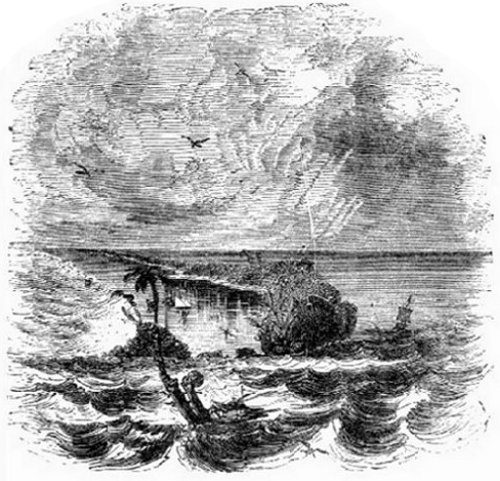
Coral being beautiful in form and colour, is sought after for purposes of
ornament; and its fishery or gathering gives employment to many persons
in the Red Sea, the Persian Gulf, the Mediterranean, and other places.
In the Straits of Messina, the rocks which yield coral are from about 350
to 650 feet below the surface of the water. The coral here grows to about
the height or length of twelve inches, and requires eight or ten years to
come to perfection. In the general mode of fishing for coral, the instrument
used consists of two heavy beams of wood, secured together at right
angles, and loaded with stones to sink them.
MILITARY HATS IN OLDEN TIME.
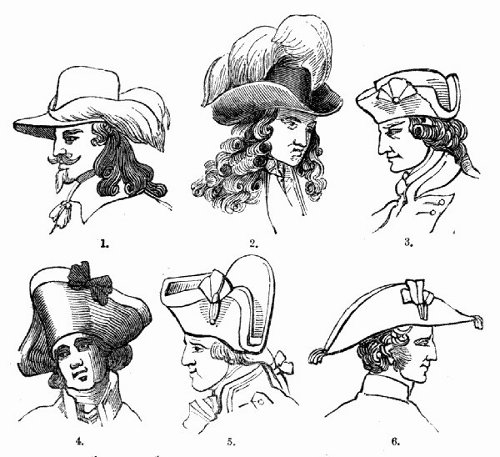
No. 1, Charles I. No. 2, William III. No. 3, Nivernois.
No. 4, Kevenhuller. No. 5, Ramilies. No. 6, Wellington.
WHY A MAN MEASURES MORE IN THE MORNING THAN IN THE
EVENING, &c.
There is an odd phenomenon attending the human body, as singular as
common: that a person is shorter standing than lying; and shorter in
the evening when he goes to bed, than in the morning when he rises.
This remark was first made in England, and afterwards confirmed at
Paris, by M. Morand, a member of the Royal Academy of Sciences in
France, and by the Abbot Fontana likewise.
The last-mentioned person found, from a year's experience, that
ordinarily in the night he gained five or six lines, and lost nearly as
much in the day.
The cause of which effect, so ancient, so common, but so lately perceived,
proceeds from the different state or condition of the intervertebral
annular cartilages.
The vertebræ, or joints of the spine, are kept separate, though joined
by particular cartilages, every one of which has a spring. These yield
on all sides, without any inflexion on the spine, to the weight of the
head and upper extremities; but this is done by very small and imperceptible
degrees, and most of all when the upper parts of the body are
loaded with any exterior weight. So that a man is really taller after
lying some time, than after walking, or carrying a burthen a great while.
For this reason it is that, in the day and evening, while one is sitting
or standing, the superior parts of the body that weigh or press upon the
inferior, press those elastic annular cartilages, the bony jointed work is
contracted, the superior parts of the body descend towards the inferior,
and proportionably as one approaches the other, the height of the stature
diminishes.
Hence it was, that a fellow enlisting for a soldier, by being measured
over-night, was found deficient in height, and therefore refused; but by
accident being gauged again the next morning, and coming up to the
stature, he was admitted.
On the contrary, in the night-time, when the body is laid a-bed, as it
is in an horizontal situation, or nearly so, the superior parts do not weigh,
or but very little, upon the inferior; the spring of the cartilages is
unbent, the vertebræ are removed from one another, the long jointed
work of the spine is dilated, and the body thereby prolonged; so that a
person finds himself about half an inch, or more, higher in stature in
the morning than when going to bed. This is the most natural and
simple reason that can be given, for the different heights of the same
person at different times.
A SENSIBLE DOG REFUSING TO BAIT A CAT.
A dustman of the name of Samuel Butcher, residing at Mile-end, who
kept a large dog, having taken it into his head to divert himself and
others, a few days ago, by the cruel sport of cat baiting, which the dog
refusing to perform to the satisfaction of his master, was beat by him in
a most brutal manner, when the animal at length, in retaliation, flew at
his unmerciful keeper, and inflicted very severe wounds about his face,
limbs, and body, in some instances tearing large mouthfuls of his flesh
quite clean out, and at one time clung so fast to the man, that before he
disengaged from him the animal's throat was obliged to be cut. The
man was promptly conveyed to the London Hospital, and there died of
the injuries he received.
A HORSE GETTING HIMSELF SHOD.
A horse having been turned into a field by its owner, Mr. Joseph
Lane, of Fascombe, in the parish of Ashelworth, was missed therefrom
the next morning, and the usual inquiries set afoot, as to what could
have become of him. He had, it seems, been shod (all fours) a few days
before, and as usual got pinched in a foot. Feeling, no doubt, a lively
sense of proper shoeing, and desirous of relieving the cause of pain, he
contrived to unhang the gate of his pasture with his mouth, and make
the best of his way to the smithy, a distance of a mile and a half from
Fascombe, waiting respectfully at the door until the bungling artist
got up. The smith relates that he found him there at opening his shed;
that the horse advanced to the forge and held up his ailing foot; and
that he himself, upon examination, discovered the injury, took off the
shoe, and replaced it more carefully, which having done, the sagacious
creature set off at a merry pace homewards. Soon after, Mr. Lane's
servants passed by the forge in quest of the animal, and upon inquiry,
received for answer—"Oh, he has been here and got shod, and is gone
home again."
MAN WITHOUT HANDS.
The following account is extracted from a letter sent to the Rev. Mr.
Wesley by a person named Walton, dated Bristol, October 14, 1788:—
"I went with a friend to visit this man, who highly entertained us at
breakfast, by putting his half-naked foot upon the table as he sat, and
carrying his tea and toast between his great and second toe to his mouth,
with as much facility as if his foot had been a hand, and his toes fingers.
I put half a sheet of paper upon the floor, with a pen and ink-horn: he
threw off his shoes as he sat, took the ink-horn in the toes of his left foot,
and held the pen in those of his right. He then wrote three lines, as well
as most ordinary writers, and as swiftly. He writes out all his own bills,
and other accounts. He then showed how he shaves himself with a razor
in his toes, and how he combs his own hair. He can dress and undress
himself, except buttoning his clothes. He feeds himself, and can bring
both his meat or his broth to his mouth, by holding the fork or spoon in
his toes. He cleans his own shoes; can clean the knives, light the fire,
and do almost every other domestic business as well as any other man.
He can make his hen-coops. He is a farmer by occupation; he can milk
his own cows with his toes, and cut his own hay, bind it up in bundles,
and carry it about the field for his cattle. Last winter he had eight heifers
constantly to fodder. The last summer he made all his own hay-ricks.
He can do all the business of the hay-field (except mowing), as fast and
as well, with only his feet, as others can with rakes and forks. He goes
to the field and catches his horse; he saddles and bridles him with his
feet and toes. If he has a sheep among his flock that ails anything, he
can separate it from the rest, drive it into a corner, and catch it when
nobody else can. He then examines it, and applies a remedy to it. He
is so strong in his teeth, that he can lift ten pecks of beans with them.
He can throw a great sledge-hammer as far with his feet as other men
can with their hands. In a word, he can nearly do as much without, as
others can with, their arms. He began the world with a hen and
chicken; with the profit of these he purchased an ewe; the sale of these
procured him a ragged colt (as he expressed it) and then a better; after
this he raised a few sheep, and now occupies a small farm."
THE THIEF CAUGHT IN HIS OWN TRAP.
A man having, some years since, stolen a sheep at Mitcham, in
Surrey, tied its hind legs together, and put them over his forehead to
carry it away, but in getting over a gate the sheep, it is thought, struggled,
and, by a sudden spring, slipped its feet down to his throat; for
they were found in that posture, the sheep hanging on one side of this
gate and the man dead on the other.
COSTUME OF THE LADIES IN THE TIME OF THE PLANTAGENETS.
The ladies' costume may be seen to advantage in the annexed engraving
from the Sloane MSS., No. 3983. A wimple or gorget is wrapped
round the neck, and is fastened by pins at the sides of the face, which
are covered above the ears; a gown of capacious size, unconfined at the
waist and loose in the sleeves, trails far behind in the dirt. The under-garment,
which is darker, has sleeves that fit closely; and it appears to
be turned over, and pinned up round the bottom. The unnecessary
amount of stuff that was used in ladies' robes rendered them obnoxious
to the satirists of that period.
In Mr. Wright's collection
of Latin stories, published by
the Percy Society, there is
one of the fourteenth century,
which is so curious an instance
of monkish satire, and
is so apt an illustration of the
cut before us, that I cannot
resist presenting it to my
readers. It runs thus:—
"Of a Proud Woman.—I
have heard of a proud woman
who wore a white dress with a
long train, which, trailing behind
her, raised a dust as far
as the altar and the crucifix.
But, as she left the church,
and lifted up her train on account
of the dirt, a certain
holy man saw a devil laughing;
and having adjured him to tell why he laughed, the devil said,
"A companion of mine was just now sitting on the train of that woman,
using it as if it were his chariot, but when she lifted her train up, my
companion was shaken off into the dirt: and that is why I was laughing."
CORPULENT MAN. NOTTINGHAM, 1819.
November 10.—Death of Mr. Henry Bucknall, confectioner, Chandlers-lane,
aged forty-nine. He was excessively corpulent, weighing more
than twenty-five stone, and died very suddenly, immediately after eating
a hearty breakfast. In Lord Howe's memorable engagement,
on the 1st of June, 1794, he had served as a marine on board the Brunswick.
His interment, at St. Mary's New Burial-ground, on the 14th,
drew together a large concourse of spectators. The coffin was of enormous
size, and nearly equalled the body in weight. It was made of
excellent oak, was 6 feet 8 inches in length, and 2 feet 11 inches across
the breast; the bottom was 2½ inches thick, the sides 1½, and the lid 1.
The whole, including the body, considerably exceeded five hundred-weight.
TAKING A MAN TO PIECES AND SETTING HIM UP AGAIN.
"Don John, of Austria," says Staveley, "Governor of the Netherlands
for Philip the 2d of Spain, dying at his camp at Buge (Bouges, a
mile from Namur), was carried from thence to the great church at
Havre, where his funeral was solemnised, and a monument to posterity
erected for him there by Alexander Farnese, the Prince of Parma.
Afterwards his body was taken to pieces, and the bones, packed in mails,
were privately carried into Spain, where being set together with small
wires, the body was rejointed again, which being filled or stuffed with
cotton, and richly habited, Don John was presented to the king entire,
leaning on his commander's staff. Afterwards the corpse being carried
to the church of St. Laurence, at the Escurial, was there buried near
his father, Charles V., with a fitting monument for him."
ORNAMENTS OF FEMALE DRESS IN THE TIMES OF THE ANCIENT BRITONS.
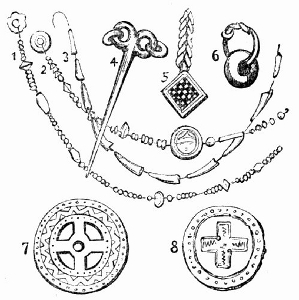
Fig. 1 is a necklace of beads, each bead being cut so as to represent
a group of several, and give the effect of many small round beads to
what are in reality long and narrow ones. Fig. 2 is a necklace of simpler
construction, consisting of a row of rudely-shaped beads, its centre
being remarkable for containing
a rude attempt at
representing a human face,
the only thing of the kind
Hoare discovered of so ancient
a date in Britain. Fig.
3 is another necklace, consisting
of a series of curious
little shells, like the
hirlas horn used by the Britons,
which are perforated
lengthways, and thus strung
together. Fig. 4 is a pin
of iron, supposed to have
been used as a fastening for
a mantle; it is ornamented
with two movable rings.
Fig. 5 is a small gold ornament,
checkered like a chessboard,
and suspended from
a chain of beautiful workmanship, which, in taste and execution, bears
a striking similarity to our modern curb-chains. Fig. 6 is an ear-ring,
a bead suspended from a twisted wire of gold. Fig. 7 is a brass ornament,
and Fig. 8 a similar one of gold: such ornaments are usually
found upon the breasts of the exhumed skeletons of our barrows, and
were probably fastened on their clothes as ornaments. Their cruciform
character might lead to a doubt of their high antiquity, if we were not
aware of the fact, that the symbol of the cross was worn, as an amulet
or ornament, ages before the Christian era.
LARGE EEL.
Lately, near Malden, an eel was taken, measuring five feet six inches
in length, seventeen in girth, and weighing 26 pounds, the largest of the
species ever caught, or described in natural history.
PERSEVERING DOG.
A boast being made of the obedience of a Newfoundland dog in fetching
and carrying, the master put a marked shilling under a large square
stone by the road side, and, having ridden on three miles, ordered the
dog to go back and fetch it. The dog set off, but did not return the
whole day. He had gone to the place, and being unable to turn the
stone, sat howling by it. Two horsemen came by and saw his distress,
and one of them alighting removed the stone, and finding the shilling,
put it in his pocket, not supposing that the dog could possibly be looking
for that. The dog followed the horses for upwards of twenty miles,
stayed in the room where they supped, got into the bed-room, got the
breeches in which the fatal shilling had been put, made his escape with
them, and dragged them through mud and mire, hedge and ditch, to
his master's house.
CURE FOR CORPULENCE.
A few years ago, a man of about forty years of age, hired himself as a
labourer, in one of the most considerable ale-breweries in the City: at
this time he was a personable man; stout, active, and not fatter than a
moderate-sized man in high health should be. His chief occupation was
to superintend the working of the new beer, and occasionally to set up
at night to watch the sweet-wort, an employment not requiring either
activity or labour; of course, at these times, he had an opportunity of
tasting the liquor, of which, it appears, he always availed himself;
besides this, he had constant access to the new beer. Thus leading a
quiet inactive life, he began to increase in bulk, and continued to enlarge,
until, in a very short time, he became of such an unwieldy size, as to be
unable to move about, and was too big to pass up the brewhouse staircase;
if by any accident he fell down, he was unable to get up again
without help. The integuments of his face hung down to the shoulders
and breast: the fat was not confined to any particular part, but diffused
over the whole of his body, arms, legs, &c., making his appearance such
as to attract the attention of all who saw him. He left this service to go
into the country, being a burthen to himself, and totally useless to his
employers. About two years afterwards he called upon his old masters
in very different shape to that above described, being reduced in size
nearly half, and weighing little more than ten stone. The account that
he gave of himself was, that as soon as he had quitted the brewhouse he
went into Bedfordshire, where having soon spent the money he had
earned, and being unable to work, he was brought into such a state of
poverty, as to be scarcely able to obtain the sustenance of life, often
being a whole day without food; that he drank very little, and that was
generally water. By this mode of living he began to diminish in size, so
as to be able to walk about with tolerable ease. He then engaged himself
to a farmer, with whom he stayed a considerable time, and in the
latter part of his service he was able to go through very hard labour,
being sometimes in the field ploughing and following various agricultural
concerns, for a whole day, with no other food than a small pittance of
bread and cheese. This was the history he gave of the means by which
this extraordinary change was brought about. He added, his health had
never been so good as it then was.
WORSHIP OF THE SUN AND MOON.
The Sun was first worshipped, probably, as a bright manifestation of
God, but soon began to be regarded as the Deity himself. The Moon, in
the absence of the Sun, and next in splendour, would succeed it in
superstitious attention. And so we find the Romans, as well as the
Saxons, dedicating the first and second days of the week respectively
to these "great lights." Formerly, festivals were held on the appearance
of a New Moon; and in some parts of England it is still customary
to bless it, and in Scotland at the same time to drop a courtesy. And
in times not long past, the influence of the Moon was considered to
be so great as to regulate the growth of air, and the effect of medicine,
and to cause steeples and other elevated buildings to bend from
their upright positions.
A SEA ABOVE THE SKY.
This belief is curiously illustrated by two legendary stories preserved
by Gervase of Tilbury. "One Sunday," he says, "the people of a
village in England were coming out of church on a thick cloudy day,
when they saw the anchor of a ship hooked to one of the tombstones;
the cable, which was tightly stretched, hanging down from the air. The
people were astonished, and while they were consulting about it, suddenly
they saw the rope move as though some one laboured to pull up
the anchor. The anchor, however, still held fast by the stone, and a
great noise was suddenly heard in the air, like the shouting of sailors.
Presently a sailor was seen sliding down the cable for the purpose of
unfixing the anchor; and when he had just loosened it, the villagers
seized hold of him, and while in their hands he quickly died, just as
though he had been drowned. About an hour after, the sailors
above, hearing no more of their comrade, cut the cable and sailed
away. In memory of this extraordinary event, the people of the
village made the hinges of the church doors out of the iron of the
anchor, and 'there they are still to be seen.'—At another time, a merchant
of Bristol set sail with his cargo for Ireland. Some time after
this, while his family were at supper, a knife suddenly fell in through
the window on the table. When the husband returned, he saw the
knife, declared it to be his own, and said that on such a day, at such an
hour, while sailing in an unknown part of the sea, he dropped the knife
overboard, and the day and hour were known to be exactly the time
when it fell through the window. These accidents, Gervase thinks, are
a clear proof of there being a sea above hanging over us."—St.
Patrick's Purgatory. By Thos. Wright. 1844.
THE PAPYRUS.
Paper as we now have it, that is to say, paper made of the pulp of
fibrous materials, pressed into thin sheets, dried, and, when intended
for writing or printing purposes, sized, is of comparatively modern introduction
to Europe and Western Asia; although the Chinese appear to
have formed paper out of silk pulp, mixed with the inner pith of the
bamboo, as early at least as 95 A.D.:—not from time immemorial, as
some authors have stated, because the circumstance is well attested, that
in the time of Confucius, the Chinese wrote with a style on the inner
bark of trees.
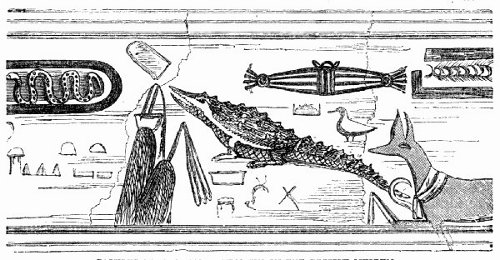
PAPYRUS ROLL, FROM A SPECIMEN IN THE BRITISH MUSEUM.
Before the invention of paper, the surfaces employed for writing upon
were numerous. Surfaces of lead or other metal; tables covered with
wax, skins of animals,—(parchment in fact)—all were used; but no one
of these was ever so extensively employed as the Egyptian papyrus,
whenever the latter material could be obtained. So soon, however, as
the Saracens in the seventh century conquered Egypt, the exportation of
papyrus was at an end; and writing surfaces became so scarce in Europe
that many ancient documents of great value were erased in order to
render them adapted for being written on once more. Thus perished
many treasures of antiquity.
As the Saracens closed the avenue of supply for the ancient papyrus,
so they compensated to Europe for this deprivation by discovering the
manufacture of ordinary paper—at least paper made in the ordinary
modern fashion,—though the material was cotton, not linen. This discovery
was made some time anterior to the year 706 A.D., for at that
period a manufactory of paper existed at Samarcand. In the eighth
century the Saracens conquered Spain, and introduced into the Peninsula,
amongst other arts, that of the manufacture of paper, which art
was a long time finding its way into other parts of Europe,—in Italy not
until the eleventh or twelfth century. The vast amount of papyrus
which must have been employed in Italy, may be inferred from the
number of rolls or scapi of this substance discovered in Herculaneum and
Pompeii; also from a perusal of many existing documents bearing
directly or indirectly on this branch of commerce. Even so late as the
commencement of the sixth century, Cassiodorus congratulated the
world on the abolition, by King Theodoric, of the high duty on papyrus
from Egypt; and he spoke in high flown terms of the great utility of the
material. The latest papyrus roll known is of the twelfth century, containing
a brief of Pope Paschal II., in favour of the Archiepiscopal see of
Ravenna.
SYRIAN PAPYRUS WITHOUT FLOWERS.
SYRIAN PAPYRUS WITH FLOWERS.
The various species of papyrus plants belong to the natural order
"Cyperaceæ," or sedges, of botanists; a main characteristic of which is
a certain triangularity of stem. The method of constructing a writing
surface from these stems was as follows:—The available portion being
cut off (it was seldom more than twelve inches in length), and split, or,
more properly speaking, unfolded into thin sheets, which were glued
together transversely in such a manner that the original length of the
papyrus stem became the breadth of the future sheet; the length of
which might be increased at the pleasure of the operator. Frequently
the manufactured scrolls were more than thirty feet long. As different
methods prevail in the manufacture of our ordinary paper, so in like
manner there were different processes of fashioning the papyrus into
shape. The rudest manufacture appears to have been that of Egypt, and
the best papyrus sheets appear to have been made in Rome during the
Augustine Æra. The preceding sketch represents a papyrus roll, copied
from a specimen in the Egyptian Room of the British Museum.
Considering the numerous pieces entering into the composition of the
roll, of which our illustration represents a portion, the lines of juncture
are remarkably well concealed, only a sort of grain being visible. The
surface, moreover, is smoothed, and its colour very much like that of
India paper. The hieroglyphics are coloured as is usual, red is the
predominant tint, and the colours are no less well demarcated and separate
than they would have been on glazed paper.
Our preceding wood-cuts represent the Sicilian or Syrian papyrus,
hitherto termed cyperus papyrus, in two states of development—one with
flowers, the other without. In order that inflorescence may take place,
the plant requires to be well supplied with water.
EXECUTION IN 1733.
Friday, March 9—Was executed at Northampton, William Alcock,
for the murder of his wife. He never own'd the fact, nor was at all
concerned at his approaching death; refusing the prayers and assistance
of any persons. In the morning he drank more than was sufficient, yet
sent and paid for a pint of wine, which being deny'd him, he would not
enter the cart before he had his money return'd. On his way to the
gallows he sung part of an old song of "Robin Hood," with the chorus,
"Derry, derry, down," &c., and swore, kick'd, and spurn'd at every
person that laid hold of the cart; and before he was turn'd off, took off
his shoes, to avoid a well known proverb; and being told by a person in
the cart with him, it was more proper for him to read, or hear somebody
read to him, than so vilely to swear and sing, he struck the book out
of the person's hands, and went on damning the spectators and calling
for wine. Whilst psalms and prayers were performing at the tree he did
little but talk to one or other, desiring some to remember him, others to
drink to his good journey, and to the last moment declared the injustice
of his case.
DOG FRIENDSHIP.
At Bishops Stortford there were two dogs, which belonged to nobody,
and lived upon the quay of the river or canal there. They took the
greatest delight in rat hunting, and when the maltsters went about at
night to see that all was safe, these dogs invariably followed them.
Their mode of proceeding was very ingenious. As soon as the door of
the malt-house was unlocked, one rushed in and coursed round the
warehouse, not chasing any rat which might start, but pursuing its
way among the malt. The other stood at the door and snapped at the
rats as they endeavoured to escape. The one standing at the door was
known to kill six rats, all of which had rushed to the door at the same
time. The next room they came to, they would change posts; the one
which hunted before, now standing at the door and seizing the prey.
By this means the dogs killed in the malting-houses of one maltster
alone, upwards of 2,000 rats in the course of one year. One of them
on one occasion killed sixty-seven in less than five minutes. They
seemed to pursue the sport simply for their amusement.
ALL HUMBUGS.
Just as a strolling actor at Newcastle had advertised his benefit, a
remarkable stranger, no less than the Prince Annamaboo, arrived, and
placarded the town that he granted audiences at a shilling a-head. The
stroller, without delay, waited on the proprietor of the Prince, and for a
good round sum prevailed on him to command his Serene Highness to
exhibit his august person on his benefit night. The bills of the day
announced that between the acts of the comedy Prince Annamaboo
would give a lively representation of the scalping operation, sound the
Indian war-whoop in all its melodious tones, practice the tomahawk
exercise, and dine à la cannibal. An intelligent mob were collected to
witness these interesting exploits. At the conclusion of the third act,
his Highness marched forward flourishing his tomahawk, and shouting,
"Ha, ha!—ho, ho!" Next entered a man with his face blacked, and a
piece of bladder fastened to his head with gum; the Prince, with an
enormous carving-knife, began the scalping part of the entertainment,
which he performed in a truly imperial style, holding up the piece of
bladder as a token of triumph. Next came the war-whoop, an unearthly
combination of discordant sounds; and lastly, the banquet,
consisting of raw beef-steaks, which he rolled up into rouleaus, and
devoured with right royal avidity. Having finished his delicate repast,
he wielded his tomahawk in an exulting manner, bellowed "Ha, ha!—ho,
ho!" and made his exit. The bénéficiaire strolling through the
market-place the following-day, spied the most puissant Prince Annamaboo
selling penknives, scissors, and quills, in the character of a Jew
pedlar. "What!" said the astonished Lord Townley, "my Prince, is
it you? Are you not a pretty circumcised little scoundrel to impose
upon us in this manner?" Moses turned round, and with an arch look,
replied, "Princh be d—d! I vash no Princh; I vash acting like you.
Your troop vash Lords and Ladies last night; and to-night dey vil be
Kings, Prinches, and Emperor! I vash humpugs, you vash humpugs,
all vash humpugs!"
REDUCING WEIGHT.
A gentleman, of great respectability in the mercantile world, who
weighed thirty-two stone nine pounds, put himself upon a strict diet of
four ounces of animal food, six ounces of bread, and two pounds of liquid,
in twenty-four hours. In one week he lost thirty pounds weight, and in
six months he was diminished the astonishing quantity of one hundred
and thirty-four pounds. His health and spirits were much improved, and
considering his remaining size of twenty-three stone, he was very active.
ANECDOTE OF A SERPENT.
Lord Monboddo relates the following singular anecdote of a serpent:—"I
am well informed of a tame serpent in the East Indies, which
belonged to the late Dr. Vigot, once kept by him in the suburbs of
Madras. This serpent was taken by the French, when they invested
Madras, and was carried to Pondicherry in a close carriage. But
from thence, he found his way back again to his old quarters, though
Madras was above one hundred miles distant from Pondicherry."
ENGLAND BEFORE THE ROMANS.
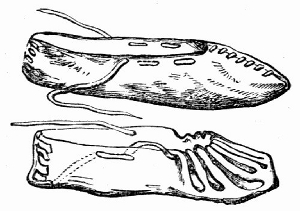
Before the Roman invasion, the dress of its chieftains consisted of a
close coat or covering for the body, called by Dio a tunic, and described
as checkered with various colours in divisions. It was open before, and
had long close sleeves to the wrist. Below were loose pantaloons, called
by the Irish brigis, and by the Romans brages and bracæ; whence the
modern term "breeches." Over their shoulders was thrown the mantle
or cloak, called by the Romans
sagum, and derived from the
Celtic word saic, which signified
a skin or hide, and which
was the original cloak of the
country. Diodorus tells us that
it was of one uniform colour,
generally either blue or black,
the predominating tint in the
checkered trousers and tunic
being red. On their heads they
wore a conical cap, which derived
its name from the "cab,"
or hut of the Briton, which was of similar form. On their feet were shoes
made of raw cow-hide, that had the hair turned outward, and which
reached to the ankles. Shoes so constructed were worn within the last
few years in Ireland; and we engrave two from specimens in the Royal
Irish Academy. One is of cow-hide, and drawn together by a string
over the foot; and the other has a leather thong, which is fastened beneath
the heel inside, and, passing over the instep, draws the shoe like a
purse over the foot. It is of untanned leather.
ROMANS IN BRITAIN—DRESS OF NATIVE FEMALES AT THAT PERIOD.
The British gwn, from whence comes the modern "gown," descended
to the middle of the thigh, the sleeves barely reaching to the elbows: it
was sometimes confined by a girdle. Beneath this a longer dress reached
to the ancles. The hair was trimmed after the Roman fashion; and
upon the feet, when covered, were sometimes worn shoes of a costly
character, of which we know the Romans themselves to have been fond.
An extremely beautiful pair was discovered upon opening a Roman
burial-place at Southfleet in
Kent, in 1802. They were
placed in a stone sarcophagus,
between two large glass urns
or vases, each containing a
considerable quantity of burnt
bones. They were of superb
and expensive workmanship,
being made of fine purple
leather, reticulated in the form of hexagons all over, and each hexagonal
division worked with gold, in an elaborate and beautiful manner.
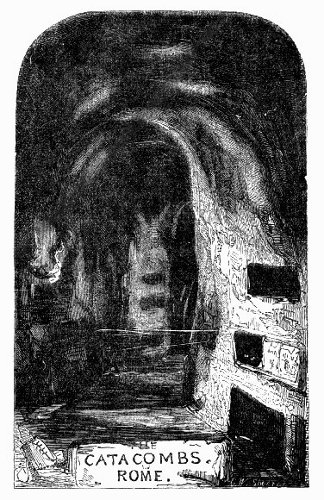
THE CATACOMBS.
ROME.
Amid the ruins of stately temples, and numerous remains of the "Eternal
City," there are no objects which have such great and general interest
as the subterranean churches, dwellings, and places of sepulchre of
the early Christians, which perforate, by a network of excavations, the
neighbourhood of Rome.
The great increase in the extent and magnificence of Rome during the
times of the Republic, led to the formation of quarries in the surrounding
parts. The peculiar nature of the soil has caused the excavations to be
made in a manner similar to that used in the working of coal, iron, stone,
lime, &c. The useful material has, in fact, been cleared away, leaving
long ranges of dark caves and passages. After the stone had been removed
from these underground quarries, it was, for many centuries,
customary to work out the sand for the purpose of making cement.
Vitruvius has stated that the sand obtained from the Esquiline pits was
preferable to any other. Ultimately the quarries and sandpits extended
to a distance of upwards of fifteen miles on one side of Rome. Parts of
this large range of excavations were from time to time used as burial-grounds
by such of the Romans as could not afford the cost of burning
the bodies of their dead relations. And, in addition, the Esquiline hills
became infested by banditti, and was from these various causes rendered
almost impassable.
In these excavations, it is said, that not only persons, but cattle, contrived
to support existence; and although it was well known that large
numbers were lodged in these dismal dwellings, their intricacy and numberless
entrances rendered them a comparatively secure retreat. It is
related that attempts were made to cover the galleries with earth, in
order to destroy those who were concealed within.
In course of time the catacombs became,
with the exception of one or two, neglected
and filled up with rubbish, and remained
for a period of upwards of one thousand
years untouched and almost unknown. In
the sixteenth century the whole range of
the catacombs were reopened, and numerous
inscriptions and other matters connected with
the struggles and hardships of the early
Christians brought to light. The annexed
brief memorial will show the general style of the lettering.
OBSOLETE MODES OF PUNISHMENT.
Ante page 60, we gave representations of some ancient instruments of
punishment and torture, all more or less terrible in their character, the
use of which, for many a long year, has been happily abandoned. As a
companion to this group, we have engraved a few of the instruments of
punishment by which criminals of a vulgar character were sought to be
reformed. The first of these is the felon's brand, the mark of which
rendered a man infamous for life. Figure 1, p. 90 represents the
instrument itself. Figure 2, the mark branded in, which latter
has been engraved the exact size. The device, which is deeply cut
into the metal, is a gallows, such as was used before the invention of the
Drop and the Wheel for Execution and torture.
The Stocks and Whipping-post, although long since removed from
London Bridge, may be met with in retired country places. We have
noticed some characteristic examples in the Forest of Dean, Gloucestershire,
where some of the may-poles, day-wheels, and other curious relics,
may still be seen.
[2] In some instances the Stocks and Whipping-posts
were richly carved, and clamped with iron work of an ornamental character.
We remember seeing the stocks used within the last thirty years,
once at Newcastle-on-Tyne, and once at Gateshead, the adjoining town.
The culprit in the one instance was an elector, who, in the excess of zeal
and beer, during an old-fashioned contested election, rushed into one of
the churches during the Sunday's service, and shouted out, "Bell (one of
the candidates) for ever." He was speedily taken hold of, and placed for
several hours in the stocks in the churchyard; and, as the stimulating
effect of the strong drink passed away, he looked a deplorable object,
decked as he was with numerous cockades, the "favours" of the candidate,
whose cause he so indiscreetly supported.
The punishment of the barrel we should think to have been adapted
for drunkards who could preserve a perpendicular position.
In the histories of London, it is mentioned that bakers and other
dealers caught giving false weight, or in any other ways cheating the poor,
were exhibited occasionally in this manner; but more frequently they
were placed in the parish dung-cart, and slowly drawn through the
streets of the district.
The Whirligig, a circular cage which could be moved swiftly round on
a pivot, was, in bygone days, in use for offenders in the English army.
There was another instrument used for the same purpose called the Horse,
which was made in rude resemblance of the animal whose name it bore.
The body was composed of planks of wood, which formed a sharp angle
along the back. On this the soldier was seated, and his legs fastened
below to several heavy muskets. This is said to have been a very severe
and dangerous punishment. In addition to the above, and flogging, imprisonment,
&c., there were three ancient methods of punishment in the
English army—viz., beheading, hanging, and drowning. The latter of
these, according to Grose, was in use only in the reign of Richard I. This
author observes that, some centuries ago, capital punishment was rare in
our army, the men having generally property, which was confiscated in
case of ill conduct. He, however, refers to some terrible means which
were resorted to for the purpose of preserving discipline. Hanging was
chiefly confined to spies; who were taken to a tree in sight of the camp,
and yet sufficiently distant, and there hung up. In many instances,
when a corps or a considerable body of men were guilty of crime, for
which the established punishment was death, to prevent too great a weakening
of the army, the delinquents, Grose says, "were decimated, that is,
only every tenth man was taken. A number of billets, equal to that of
the body to be decimated, were put into a helmet, every tenth billet being
marked with the letter D, or some other character signifying death; the
helmet was then shaken, in order to mix them, and the soldiers, filing off
singly from the right, passed by the commanding officers, before whom,
on a table, stood the helmet; as they passed, each drew a billet and presented
it to an officer placed to receive them. If the billet had the fatal
mark; the soldier was seized and marched into the rear."
This wholesale method of capital punishment must have been a solemn
affair. At times, it was customary to punish the man at the right hand
of companies; without giving them the chance of the billet—on the principal
that these were the most influential persons, and must, from their
companionship with the others, have been acquainted with and have possessed
the means of checking or giving information, which would prevent
dangerous offences.
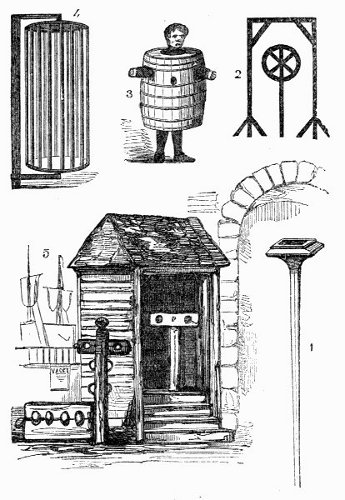
1. Brand for Marking Felons. 2. Impression of Brand. 3. Punishment for
Drunkards, formerly in use at Newcastle-on-Tyne. 4. The Whirligig, a military
method of punishment. 5. Pillory, Stocks, and Whipping Post, formerly on London
Bridge.
The regulations of the English army during the time of Henry VIII.,
and previous reigns, may be met with in "Grose's Military Antiquities."
ORIGIN OF THE TERM "HUMBUG."
This, now, common expression, is a corruption of the word Hamburgh,
and originated in the following manner:—During a period when war
prevailed on the Continent, so many false reports and lying bulletins
were fabricated at Hamburgh, that at length, when any one would
signify his disbelief of a statement, he would say, "You had that from
Hamburgh;" and thus, "That is Hamburgh," or Humbug, became a
common expression of incredulity.
MARRIAGE LOTTERY.
It has often been said figuratively that marriage is a lottery; but we
do not recollect to have met with a practical illustration of the truth of
the simile, before the following, which is a free translation of an advertisement
in the Louisiana Gazette:—"A young man of good figure and
disposition, unable, though desirous to procure a wife, without the preliminary
trouble of amassing a fortune, proposes the following expedient
to attain the object of his wishes. He offers himself as the prize of a
lottery to all widows and virgins under 32. The number of tickets to
be 600, at 50 dollars each. But one number to be drawn from the
wheel, the fortunate proprietor of which is to be entitled to himself and
the 30,000 dollars."
CHINESE DAINTIES.
The common people of the country seem to fare hardly and sparingly
enough, but one of our envoys praises much of the good cheer he found at
the tables of the great men. They had pork, fish, and poultry, prepared
in a great variety of ways, and very nice confectionery in abundance.
The feasts, moreover, were served up in a very neat and cleanly manner.
But there was one dainty which much offended their nostrils, and nearly
turned their stomachs when it was named to them. It was not stewed
dog or fricaséed pup. No; it consisted of three bowls of hatched eggs!
When the Englishmen expressed some surprise at the appearance of this
portion of the repast, one of the native attendants observed that hatched
eggs formed a delicacy beyond the reach of the poor—a delicacy adapted
only for persons of distinction! On inquiry, it was found that they cost
in the market some thirty per cent. more than fresh eggs. It seems that
they always form a distinguished part of every great entertainment, and
that it is the practice, when invitations are sent out, to set the hens to
hatch. The feast takes place about the tenth or twelfth day from the
issuing the invitations,—the eggs being then considered as ripe, and
exactly in the state most agreeable and pleasant to the palate of a
Chinese epicure.
RECEIPTS FROM ALBERTUS MAGNUS.
"Bubo a shrick owle, is a byrd wel inough knowen, which is called
Magis of the Chaldes, and Hysopus of the Greekes. There bee maruaylous
vertues of this Fowle, for if the hart and ryght foote of it be
put upon a man sleeping, hee shall saye anone to thee whatsoever thou
shalt aske of him. And thys hath beene prooued of late tyme of our
brethren. And if any man put thys onder his arme hole, no Dog wyll
barke at hym, but keepe silence. And yf these thynges aforesayde
ioyned together with a wyng of it be hanged up to a tree, byrdes wyl
gather together to that tree."
"When thou wylt that thy wyfe or wenche shewe to thee all that shee
hath done, take the hart of a Doove, and the heade of a Frog, and drye
them both, and braie them vnto poulder, and lay them vpon the brest of
her sleeping, and shee shall shew to thee all that shee hath done, but
when shee shall wake, wipe it awaye from her brest, that it bee not
lifted vp."
"Take an Adders skyn, and Auri pigmentum, and greeke pitch of
Reuponticum, and the waxe of newe Bees, and the fat or greace of an
Asse, and breake them all, and put them all in a dull seething pot full
of water, and make it to seeth at a slowe fire, and after let it waxe cold,
and make a taper, and euery man that shall see light of it shall seeme
headlesse."—The Secreetes of Nature, set foorth by Albertus Magnus in
Latine, newlye translated into English. Imprinted at London by me
Wyllyam Copland. No date. Black letter, very old.
THE MAGPIE STONING A TOAD.
There is a story told of a tame magpie, which was seen busily employed
in a garden, gathering pebbles, and with much solemnity, and a studied
air, dropping them in a hole, about eighteen inches deep, made to receive
a post. After dropping each stone, it cried, Currack! triumphantly,
and set off for another. On examining the spot a poor toad was found in
the hole, which the magpie was stoning for his amusement.
ADAPTATION OF BONES TO AGE IN THE HUMAN FRAME.
Growth produces in the species a somewhat remarkable change in the
mechanical qualities of the bones. This important part of our organism
consists of three constituents—fibre, cartilage, and the earthy matter
already mentioned called phosphate of lime. From the fibre they derive
their toughness; from the cartilage their elasticity; and from the lime
their hardness and firmness. Nothing can be more admirable in the
economy of our body than the manner in which the proportion of these
constituents adapts itself to the habitudes of age. The helpless infant,
exposed by a thousand incidents to external shocks, has bones, the chief
constituents of which being gristly and cartilaginous, are yielding and
elastic, and incur little danger of fracture. Those of the youth, whose
augmented weight and increased activity demand greater strength, have
a larger proportion of the calcareous and fibrous elements, but still enough
of the cartilaginous to confer upon the solid framework of his body the
greatest firmness, toughness, and elasticity. As age advances, prudence
and tranquil habits increasing, as well as the weight which the bones
have to sustain, the proportion of the calcareous constituent increases,
giving the requisite hardness and strength, but diminishing the toughness
and elasticity.
While the bones thus change their mechanical qualities as age advances,
they diminish in number, the frame consequently having fewer joints
and less flexibility. The bones of a child, whose habits require greater
bodily pliability, are more numerous than those of an adult, several of
the articulations becoming ossified between infancy and maturity. In
like manner, the bones at maturity are more numerous than in advanced
age, the same progressive ossification of the joints being continued.
It has been ascertained by anatomists that, on attaining the adult
state, the number of bones constituting the framework of the human
body is 198; of which 52 belong to the trunk, 22 to the head, 64 to the
arms, and 60 to the legs.
TOWER OF THE THUNDERING WINDS.
The Great Wall is certainly a wonderful monument of ancient times; but
it is almost the only one that we read of in China, except a famous Temple,
or Tower, partly in ruins, which stands on an eminence in the neighbourhood
of Hang-chow-foo. It is called the "Tower of the Thundering
Winds," and is supposed to have been built about 2,500 years ago.
DR. MONSEY BEQUEATHS HIS OWN BODY.
This eccentric person died at the great age of 96, and was for half a
century, physician to Chelsea Hospital. He left his body for dissection,
and a few days before he died, wrote to Mr. Cruikshanks, the Anatomist,
begging him to know, whether it would suit his convenience to do it, as
he felt he could not live many hours, and Mr. Forster, his surgeon, was
then out of town. He died as he predicted, and his wishes with respect
to his body, were strictly attended to.
TEA.
A folio sheet of the time of Charles II. entitled "An Exact Description
of the Growth, Quality, and Virtues of the Leaf Tea, by
Thomas Garway, in Exchange Alley, near the Royal Exchange,
in London, Tobacconist, and Seller and Retailer of Tea and Coffee,"
informs us that "in England it hath been sold in the leaf for six
pounds, and sometimes for ten pounds the pound weight; and in respect
of its former scarceness and dearness, it hath been only used as a regalia
in high treatments, and entertainments, and presents made thereof to
princes and grandees till the year 1657. The said Thomas Garway did
purchase a quantity thereof, and first publikely sold the said Tea in
leaf and drink, made according to the direction of the most knowing
merchants and travellers in those eastern countries: and upon knowledge
and experience of the said Garway's continued care and industry,
in obtaining the best Tea, and making drink thereof, very many noblemen,
physicians, merchants, and gentlemen of quality, have ever since
sent to him for the said leaf, and daily resort to his house, in Exchange
Alley, to drink the drink thereof."
IT'S MUCH THE SAME NOW.
The following lines, from the Gentleman's Magazine of 1733, will
give us some idea of what fashionable life was at that period:—
The Town Lady's Answer to,—"What tho' I am a Country Lass."
What tho' I am a London dame,
And lofty looks I bear, a?
I carry, sure, as good a name,
As those who russet wear, a.
What tho' my cloaths are rich brocades?
My skin it is more white, a
Than any of the country maids
That in the fields delight, a.
What tho' I to assemblies go,
And at the Opera's shine, a?
It is a thing all girls must do,
That will be ladies fine, a:
And while I hear Faustina sing,
Before the king and queen, a
By Eyes they are upon the wing,
To see, if I am seen, a.
My Peko and Imperial Tea
Are brought me in the Morn, a.
At Noon Champaign and rich Tokay
My table do adorn, a.
The Evening then does me invite
To play at dear Quadrille, a:
And sure in this there's more delight,
Than in a purling rill, a.
Then since my Fortune does allow
Me to live as I please, a;
I'll never milk my father's cow
Nor press his coming cheese, a.
But take my swing both night and day,
I'm sure it is no sin, a:
And as for what the grave ones say,
I value not a pin, a.
BARBERS.
The barber's pole, one of the popular relics of Merrie England, is still
to be seen in some of the old streets of London and in country towns,
painted with its red, blue, and yellow stripes, and surmounted with
a gilt acorn. The lute and violin were formerly among the furniture of
a barber's shop. He who waited to be trimmed, if of a musical turn,
played to the company. The barber himself was a nimble-tongued,
pleasant-witted fellow. William Rowley, the dramatist, in "A Search
for Money, 1609," thus describes him:—"As wee were but asking the
question, steps me from over the way (over-listning us) a news-searcher,
viz. a barber: hee, hoping to attaine some discourse for his next patient,
left his baner of basons swinging in the ayre, and closely eave-drops our
conference. The saucie treble-tongu'd knave would insert somewhat of
his knowledge (treble-tongu'd I call him, and thus I prove't: hee has a
reasonable mother-tonger, his barber-surgions tongue; and a tongue
betweene two of his fingers, and from thence proceeds his wit, and 'tis a
snapping wit too). Well, sir, hee (before hee was askt the question,) told
us that the wandring knight (Monsier L'Argent) sure was not farre off;
for on Saterday-night hee was faine to watch till morning to trim some of
his followers, and its morning they went away from him betimes. Hee
swore hee never clos'd his eyes till hee came to church, and then hee
slept all sermon-time; (but certainly hee is not farre afore, and at yonder
taverne showing us the bush) I doe imagine hee has tane a chamber." In
ancient times the barber and the tailor, as news-mongers, divided the
crown. The barber not only erected his pole as a sign, but hung his
basins upon it by way of ornament.
BEES OBEDIENT TO TRAINING.
Though it is customary in many rural districts of England, when bees
are swarming, to make a clanging noise with metal implements, under the
impression—an erroneous one we believe—that it will induce the swarm
to settle, it is not generally supposed that bees are susceptible of being
trained to obey in many respects the orders of their teacher. Such,
however, is the fact, and an instance of it occurs in the following advertisement,
which we have copied from an old newspaper. We give it as
we find it, but it is not very clear what locality is meant by "their
proper places":—
"At the Jubilee Gardens, Dobney's, 1772. Daniel Wildman rides,
standing upright, one foot on the saddle, and the other on the horse's
neck, with a curious mask of bees on his face. He also rides, standing
upright on the saddle, with the bridle in his mouth, and, by firing a
pistol, makes one part of the bees march over a table, and the other part
swarm in the air, and return to their proper places again."
A MAN SELLING HIS OWN BODY.
Anatomists and surgeons have frequently incurred the odium of being
precipitate in their post mortem examinations. It has been charged
upon the illustrious Vessalius, and, in more modern times, on Mons. de
Lassone, and others; nay, credulity has gone so far, as to suppose, that
subjects have occasionally been kept till wanted; nor is such a notion
altogether extravant, when we find an article of this kind offered to
Joshua Brookes, the anatomical lecturer, in the following terms:—
"Mr. Brooke, i have taken it into consideration to send this poor man
to you, being greatly in distress, hopeing you will find sum employment
for him in silling the dead carcases; and if you can find him no employment,
the berer of this wishes to sill himself to you, as he is weary of
this life. And I remain your humble servant,
"John Davis."
THE FIRST LOCOMOTIVES.
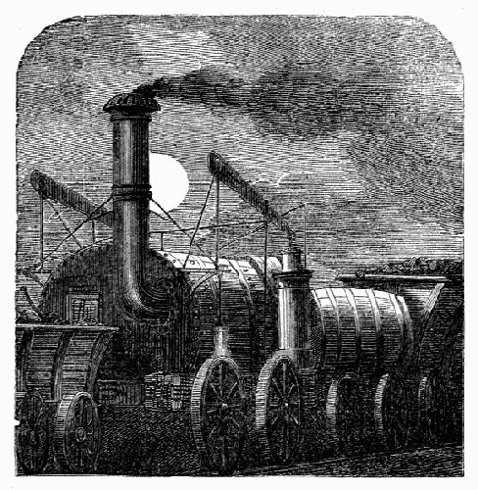
THE FIRST LOCOMOTIVE.
It is little more than thirty years ago, when, on the river Tyne, a large
fleet of peculiarly-formed vessels was to be seen daily employed in the
carriage of coals to the ships from the "staiths," which projected into
the river from the various colliery tramways. At that period, there was
only one very small and ill-constructed steam-packet for the conveyance
of passengers between Newcastle and Shields, and against which so much
prejudice existed, that the majority of persons preferred the covered
wherries, which, for some centuries before, had been in use; yet so slow
and uncertain was this means of transit between the two towns, that
persons in a hurry often found it advisable to walk the intervening distance,
which is about eight miles.
THE PRESENT LOCOMOTIVE AND TRAIN.
The collieries situated away from the river had tramways of wood let
into the ordinary roads, in such a manner as to form wheel-tracks for
carriages. These, drawn by horses, were the only means thought of for
bringing the coals to the river bank. Some of these tramways were
nearly as old as the times of Queen Elizabeth or James I., when the
increase of London and other causes began to overcome the prejudice
against the use of "sea-coal." Many of the tramways passed amid
green and shadowy woods and other pleasant places, and we have often
thought when wandering through them, of the difficulties that beset
travellers at that time. Even at a more recent date, in 1673, day coaches
were considered dangerous, and it was suggested that the multitude of
them in London should be limited, and not more than one be allowed to
each shire, to go once a week backwards and forwards, and to perform the
whole journey with the same horses they set out with, and not to travel
more than thirty miles a day in summer, and twenty-five in winter.
The arguments advanced in favour of these proposals were, that coaches
and caravans were mischievous to the public, destructive to trade, and
prejudicial to the land—because, firstly, they destroyed the breed of good
horses, and made men careless of horsemanship; secondly, they hindered
the breed of watermen, who were the nursery of seamen; thirdly, they
lessened the revenue.
In 1703, the road from Petworth to London (less than 50 miles) was so
bad that the Duke of Somerset was obliged to rest a night on the road.
In March, 1739 or 1740, Mr. Pennant, the historian, travelled by the
stage, then no despicable vehicle for country gentlemen, and in the first
day, with "much labour," got from Chester to Whitechurch—twenty
miles; and, after a "wondrous effort," reached London before the commencement
of the sixth night.
Without entering into an account of the rapid improvement of the
English roads soon after the time of Pennant, we may mention that, at
about the date 1765, the colliery tramways underwent considerable
improvement, by plating the wooden rails in many parts with iron:
stone-ways were tried in some instances, but were not found successful;
and in course of time the old tramways were covered with cast-iron rails
laid on the old foundations. Inclined planes, with fixed steam-engines,
also came into use; and at the same time the idea of a locomotive engine
was attracting attention in various directions. In 1805 a machine was
used on a tramway near Merthyr Tydvil, and soon after this the "Iron
Horse," shown in the engraving, was placed upon the wagon way of the
Wylam Colliery, from Wylam to Newburn, on the Tyne, near Newcastle,
and greatly astonished all who saw it drawing along, at the rate of three
miles and a half per hour, from fifteen to twenty wagons of coals, making
all the while a horrible and snorting noise, difficult to describe, and sending
forth at the same time fire and dense clouds of black smoke. George
Stephenson was then beginning to make way, and had provided several
improved locomotives for Heaton Colliery. In 1816-1817, patents for
improvements in locomotives were taken out by George Stephenson, in
connexion with Messrs. Dodd and Losh; and in 1825 the projection of
the Liverpool and Manchester Railway afforded a further opportunity for
their development. The opposition to the use of steam-engines on this
line of railway seems singular enough at the present day; still it was
very great. The use of horses was, however, found to be too expensive,
and George Stephenson having stated that he could work a locomotive
with safety at a rate of from six to eight miles an hour ("I knew," said
he, "that if I told them more than that, they would look upon me as
more fit for a lunatic house than to give evidence in the House of
Commons"), a reward of 500l. was offered for the best locomotive engine.
A trial took place in October, 1829—only twenty-seven years ago!—of
the steam locomotive engines which were offered in competition. Of
these, one was withdrawn at the commencement of the experiment. The
"Novelty," by Braithwait and Ericsson, met with an accident; and the
"Sanspareil," by Hackworth, attained a velocity of fifteen miles an hour,
with a gross load of nineteen tons, but at length gave way, owing to an
accident; the remaining engine, constructed by Robert Stephenson and
Mr. Booth, succeeded in performing more than was stipulated.
The contrast between the date mentioned at the commencement of our
article and the present time is remarkable: the old and clumsy fleet has
vanished from the Tyne; a railway carries passengers from Newcastle to
Shields in a few minutes; numerous steam vessels sail upon the river,
some of large size; which travel to various and distant ports. On the
colliery railway hundreds of locomotives are at work, and hundreds of
thousands of miles of iron rails spread over a wide extent of the civilized
world; and, in addition to other wonders, the electric telegraph will, ere
long, outrival the power of Puck, the fairy, and "put a girdle round the
world in (less than) forty minutes."
SIR WILLIAM WALLACE THE HERO OF SCOTLAND.
1305.—This year was marked by the capture of Sir William Wallace.
It appears that the King of England had anxiously sought to discover his retreat,
and that, tempted by the prospects of the rewards his baseness might
earn for him, Ralph de Haliburton, one of the prisoners taken a short
time previously at Sterling, had proffered his services for that purpose.
Upon being seized, he was conveyed to the castle of Dumbarton, and
thence to England. He was brought to London, "with great numbers
of men and women," says Stow, "wondering upon him. He was lodged
in the house of William Delect, a citizen of London, in Fenchurch-street.
On the morrow, being the eve of St. Bartholomew, he was
brought on horseback to Westminster, John Segrave and Geoffrey,
knights, the mayor, sheriffs, and aldermen of London, and many others,
both on horseback and on foot, accompanying him; and in the great hall
at Westminster, he being placed on the south bench, crowned with
laurel—for that he had said in times past that he ought to bear a crown
in that hall, as it was commonly reported—and being appeached for a
traitor by Sir Peter Malorie, the king's justice, he answered, that he was
never traitor to the king of England, but for other things whereof he
was accused, he confessed them." These circumstantial and minute
details, inartificially as they are put together, and homely or trivial as
some of them may be thought, are yet full of interest for all who would
call up a living picture of the scene. Wallace was put to death as a
traitor, on the 23rd of August, 1305, at the usual place of execution—the
Elms in West Smithfield. He was dragged thither at the tails of
horses, and there hanged on a high gallows, after which, while he yet
breathed, his bowels were taken out and burnt before his face. The
barbarous butchery was then completed by the head being struck off,
and the body being divided into quarters. The head was afterwards
placed on a pole on London-bridge; the right arm was sent to be set up
at Newcastle, the left arm to Berwick, the right foot and limb to Perth,
and the left to Aberdeen.
AN ELEPHANT DETECTS A ROBBER.
An officer in the Bengal army had a very fine and favourite elephant,
which was supplied daily in his presence with a certain allowance of
food, but being compelled to absent himself on a journey, the keeper of
the beast diminished the ration of food, and the animal became daily
thinner and weaker. When its master returned, the elephant exhibited
the greatest signs of pleasure; the feeding time came, and the keeper
laid before it the former full allowance of food, which it divided into
two parts, consuming one immediately, and leaving the other untouched.
The officer, knowing the sagacity of his favourite, saw immediately the
fraud that had been practiced, and made the man confess his crime.
MAY-POLES.
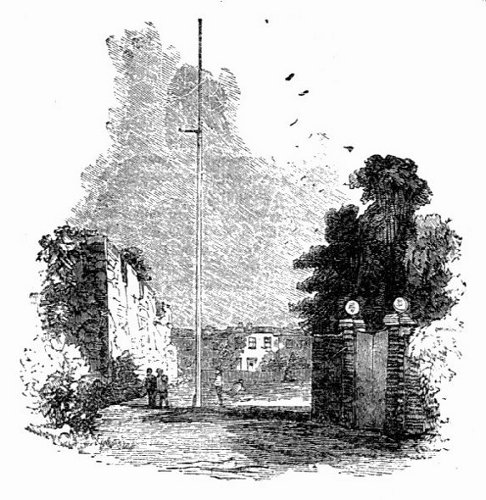
The May-pole, decked with garlands, round which the rustics used to
dance in this month, yet stands in a few of our villages through the whole
circle of the year. A May-pole formerly stood in the Strand, upon the
site of the church by Somerset House, but was taken down in 1717. The
village May-pole we engrave still remains by the ruins of St. Briavel
Castle, Forest of Dean, Gloucestershire, and forms an object of considerable
interest to the visitor. Several in the village could remember the
May-day dancers, and the removal and setting up of the May-pole. No
notice whatever of this old English festival has, however, been taken for
some years. The May-pole is about sixty feet high; about half-way up
is the rod to which it was usual to fasten the garlands and ribbons. Let
us observe, that in many parts of Dean Forest, those who love to trace
the remains of old manners and customs will find ample employment.
The people are civil and hospitable; their manner of address reminds us
of the wording of the plays of Shakspere's times; and in most houses,
if a stranger calls, cider and bread are offered, as in the olden time.
THE OLD DOG WHEEL.
About a century and a half ago, the long-backed "turnspit" dog, and
the curious apparatus here shown, yclept the "Old Dog Wheel," were
to be found in most farm houses; simple machinery has, however, now
been substituted for the wheel which the dog was made to turn round,
like the imprisoned squirrels and white mice of the present day; and not
only the dog wheels, but also the long-backed "turnspit" dog have
almost disappeared. That which we engrave, however, still exists, and
may be seen by the curious, at the Castle of St. Briavel, which stands
on the borders of the Forest of Dean, in Gloucestershire.
ABRAHAM AND SARAH.
The Talmudists relate that Abraham, in travelling to Egypt, brought
with him a chest. At the custom-house the officers exacted the duties.
Abraham would have readily paid them, but desired they would not
open the chest. They first insisted on the duties for clothes, which
Abraham consented to pay; but then they thought by his ready acquiescence
that it might be gold. Abraham consents to pay for gold. They
now suspect it might be silk. Abraham was willing to pay for silk, or
more costly pearls—in short, he consented to pay as if the chest contained
the most valuable of things. It was then they resolved to open and
examine the chest; and, behold, as soon as the chest was opened, that
great lustre of human beauty broke out which made such a noise in the
land of Egypt—it was Sarah herself! The jealous Abraham, to conceal
her beauty, had locked her up in this chest.
AGES OF CELEBRATED MEN.
Hippocrates, the greatest physician the world has ever seen, died at
the age of one hundred and nine, in the island of Cos, his native country.
Galen, the most illustrious of his successors, reached the age of one
hundred and four. The three sages of Greece, Solon, Thales, and Pittacus,
lived for a century. The gay Democritus outlived them by two
years. Zeno wanted only two years of a century when he died. Diogenes
ten years more; and Plato died at the age of ninety-four, when the
eagle of Jupiter is said to have borne his soul to heaven. Xenophon, the
illustrious warrior and historian, lived ninety years. Polemon and
Epicharmus ninety-seven; Lycurgus eighty-five; Sophocles more than a
hundred. Gorgias entered his hundred and eighth year; and Asclepiades,
the physician, lived a century and a half. Juvenal lived a hundred
years; Pacuvius and Varro but one year less. Carneades died at
ninety; Galileo at sixty-eight; Cassini at ninety-eight; and Newton at
eighty-five. In the last century, Fontenelle expired in his ninety-ninth
year; Buffon in his eighty-first; Voltaire in his eighty-fourth. In the
present century, Prince Talleyrand, Goethe, Rogers, and Niemcewicz are
remarkable instances. The Cardinal du Belloy lived nearly a century;
and Marshal Moncey lately terminated a glorious career at eighty-five.
EFFECT OF A NEW NOSE.
Van Helmont tells a story, of a person who applied to Taliacotius to
have his nose restored. This person, having a dread of an incision being
made in his own arm, for the purpose of removing enough skin therefrom
for a nose, got a labourer, who, for a remuneration, suffered the skin for
the nose to be taken from his arm. About thirteen months after, the
adscitious nose suddenly became cold, and, after a few days, dropped
off, in a state of putrefaction. The cause of this unexpected occurrence
having been investigated, it was discovered that, at the same moment in
which the nose grew cold, the labourer at Bologna expired.
FRENCH DRESS.
Sigebert was buried in St. Medrad's church, at Soissons, where his
statue is still seen in long clothes, with the mantle, which the Romans
called chlamys. This was the dress of Colvil's children, whether as more
noble and majestic, or that they looked on the title of Augustus as hereditary
in their family. However it be, long clothes were, for several
ages, the dress of persons of distinction, with a border of sable, ermine,
or miniver. Under Charles V. it was emblazoned with all the pieces of
the coat of arms. At that time, neither ruffs, collars, nor bands were
known, being introduced by Henry II. 'Till this time the neck of the
French king was always quite bare, except Charles the Wise, who is
everywhere represented with an ermin collar. The short dress anciently
worn in the country and the camp, came to be the general fashion
under Louis XI. but was laid aside under Louis XII. Francis I. revived
it, with the improvement of flashes. The favourite dress of Henry II.
and his children was a tight, close doublet, with trunk hose, and a cloak
scarce reaching the waist. The dress of French ladies, it may be supposed,
had likewise its revolutions. They seem for nine hundred years,
not to have been much taken up with ornament. Nothing could require
less time or nicety than their head-dress, and the disposition of their hair.
Every part of their linen was quite plain, but at the same time extremely
fine. Laces were long unknown. Their gowns, on the right
side of which was embroidered their husband's coat of arms, and on the
left that of their own family, were so close as to shew all the delicacy of
their shape, and came up so high as to cover their whole breast, up to
their neck. The habit of widows was very much like that of the nuns.
It was not until Charles VI. that they began to expose their shoulders.
The gallantry of Charles the VII.'s Court brought in the use of bracelets,
necklaces, and ear-rings. Queen Anne de Bretagne despised those
trinkets; and Catherine de Medicis made it her whole business to invent
new.
A LAST CHANCE.
John Jones and Jn. Davis, condemn'd for robberries on the highway,
were executed at Tyburn. Davis feign'd himself sick, and desir'd
he might not be ty'd in the cart: But when he came to the tree, while
the hangman was fastening the other's halter, he jumpt out of the
cart, and ran over two fields; but being knock'd down by a countryman,
was convey'd back and hang'd without any more ceremony.
Jones confessed he had been confederate in several robberies with Gordon,
lately executed.—Gentleman's Magazine 1733.
A convict running away over two fields at Tyburn, and then being
caught by a countryman! How strange this seems, when we look at the
streets and squares which now cover the locality, and when the only
countrymen now seen there are those who come up from the rural districts!
YELLOW HAIR IN THE TIME OF THE PLANTAGENETS.
Yellow hair was at this time esteemed a beauty, and saffron was used
by the ladies to dye it of a colour esteemed "odious" by modern ladies.
Elizabeth also made yellow hair fashionable, as hers was of the same
tint. In the romance of King Alisaunder, we are told of Queen Olympias:—
"Hire yellow hair was fair atyred
With riche strings of gold wyred,
And wryen hire abouten all
To hire gentil myddel small."
THE CITY OF THE SULTAN.
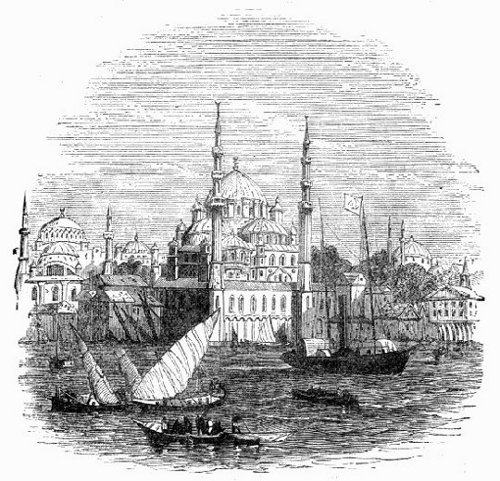
THE MOSQUE OF ST. SOPHIA.
The Mosques of Constantinople are the most wonderful objects of that
renowned city. More than 300 are picturesquely distributed in conspicuous
parts, and form a most attractive feature to the eye of the traveller.
The city itself is built upon seven gentle hills, which is the main cause
not only of its grandeur of appearance, but also of its salubrity and comparative
cleanliness. There are fourteen chief or imperial mosques, all
lofty, and magnificent in their general dimensions, and built from base
to dome, of enduring materials, chiefly of white marble, slightly tinged
with grey. Some of these have two, some four, and one (that of Sultan
Achmet) has even six of those light, thin, lofty, arrowy, and most graceful
towers called minarets. The mosque of Santa Sophia was once a
Christian cathedral, and is rich in historical recollections. This mosque
ranks as one of the grandest edifices. The ridge of the first hill on which
the city stands, setting out from the north eastern part, is covered by the
Serai or palace of the Sultan, behind which, a little on the reverse of the
hill, the dome of Santa Sophia shows itself. The colleges and hospitals,
which are generally attached to or near the great mosques, offer no striking
architectural features; but some of the detached chapels or sepulchres
(turbés), where sultans, viziers, and other great personages repose,
are handsome.
GOLD MASK FROM THE BANKS OF THE EUPHRATES.
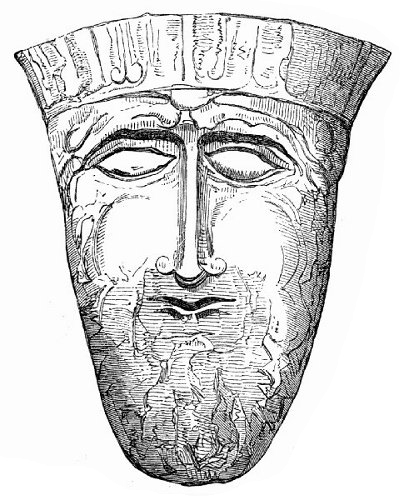
MASK OF NEBUCHADNEZZAR.
This interesting relic of remote antiquity is at present preserved in the
Museum of the East India Company. It was found by Colonel Rawlinson
while engaged in prosecuting the discoveries commenced by Layard
and Botta, at Nineveh and Babylon; and is supposed to have belonged to
King Nebuchadnezzar. In exhuming from the mounds of these long-lost
rival cities, the instructive remains of this once gigantic Power, the
Colonel discovered, in a perfect state of preservation, what is well believed
to be the mummy of Nebuchadnezzar. The face of the rebellious
monarch of Babylon, covered by one of those gold masks usually found
in Assyrian tombs, is described as very handsome—the forehead high
and commanding, the features marked and regular. The mask is of
thin gold, and independent of its having once belonged to the great
monarch, has immense value as a relic of an ancient and celebrated
people.
The Arab tribes encamping about Wurka and other great mounds
search in the loose gravel with their spears for coffins. Gold and silver
ornaments, which have been buried in these graves for centuries, are
worn by the Arab women of the present day; and many a rare object
recovered from them is sold and melted by the goldsmiths of the East. The
Arabs mention the discovery, by some fortunate shepherd, of Royal
tombs, in which were crowns and sceptres of solid gold.
FROST FAIR ON THE THAMES.
"I went crosse the Thames," says Evelyn, January 9, 1683-4, "on
the ice, which now became so thick as to bear not only streetes of
boothes, in which they roasted meate, and had divers shops of wares,
quite acrosse as in a towne, but coaches, carts, and horses passed over.
So I went from Westminster Stayres to Lambeth, and din'd with the
Archbishop. I walked over the ice (after dinner) from Lambeth Stayres
to the Horseferry.
"The Thames (Jany 16) was filled with people and tents, selling all
sorts of wares as in a citty. The frost (Jany 24) continuing more and
more severe, the Thames before London was still planned with boothes in
formal streetes, all sorts of trades and shops furnished and full of commodities,
even to a printing-presse, where the people and ladyes took a
fancy to have their names printed on the Thames. This humour took so
universally, that 'twas estimated the printer gained £5 a-day, for
printing a line only, at sixpence a day, besides what he got by ballads,
&c. Coaches plied from Westminster to the Temple, and from several
other staires to and fro, as in the streetes, sleds, sliding with skeates, a
bull-baiting, horse and coach races, puppet playes and interludes,
cookes, tipling, and other lewd places, so that it seem'd to be a bacchanalian
triumph, or carnival on the water."
"It began to thaw (Feb. 5), but froze againe. My coach crossed from
Lambeth to the Horseferry at Millbank, Westminster. The booths were
almost all taken down; but there was first a map, or landskip, cut in
copper, representing all the manner of the camp, and the several actions,
sports, and pastimes thereon, in memory of so signal a frost."
THE CHARACTER OF THE MOUTH.
We give the following extract from a very old work; not only because
it contains several shrewd observations, but also because it is a good
specimen of the spelling and diction which prevailed in the sixteenth
century, at which period there is internal evidence that the book was
written, though it bears no date on the title page:—
"The mouth greate and wyde betokeneth wrath, boldnes and warre.
And such men are commonly glottons. A wyde mouth withoute meesure,
as thought it were cutte and stretched out, sygnifieth ravening inhumanitie,
wickednes, a warlyke hart and cruell, like unto beastes of the
sea. Such men are greate talkers, boasters, babblers, enuious, lyars,
and full of follye. The mouthe that hathe but a lyttle closynge and a
lyttle openynge, sygnyfyeth a fearful man, quyet, and yet unfaithfull.
The mouthe that is verye apparent and rounde with thycknes of lyppes,
sygnyfyeth vnclenlynes, follye, and cruelltye. The mouth whyche hath
a quantitie in his sytuation with a lyttle shutting, and smylynge eyes
wyth the reste of the face, sygnyfyeth a carnall man, a lover of daunces,
and a greate lyar. When the mouthe turneth in speakinge it is a sygne
that it is infected with some catarre or murre as is manyfest ynough.
The long chynne declareth the man to be very lyttle subiecte to anger,
and of a good complexion: and yet he is somewhat a babbler and a
boaster of hymselfe. They that have a lyttle chinne, are much to be
avoyded and taken heede of, for besydes all vices with the whyche they
are fylled they are full of impietye and wyckednes and are spyes, lyke
unto serpents. If the ende of the chynne be round it is a sygne of feminine
maners and also it is a sygne of a woman. But the chynne of a man
muste be almoste square."—"The most excellent, profitable, and pleasant
booke of the famous doctour and expert Astrologien Arcandam or Aleandrin."
***. Now ready turned out of French into our vulgare tonge,
by Will. Warde. Black letter. No date. Printed by J. Rowbothum.
EXECUTION OF EARL FERRERS FOR MURDER, 1760.
Lord Ferrers was hung for the deliberate and cruel murder of his
steward, Mr. Johnson, and his execution at Tyburn furnishes a curious
instance of the exhibition of egregious vanity in a man who was just
about to meet an ignominious death, and of misplaced pride in his family
who could actually decorate the scaffold with the emblems of respectful
mourning.
His lordship was dressed in his wedding-clothes, which were of light
colour, and embroidered in silver. He set out from the Tower at nine
o'clock, amidst crowds of spectators. First went a large body of constables,
preceded by one of the high constables; next came a party of
grenadiers and a party of foot; then the sheriff, in a chariot and six, the
horses dressed with ribbons; and next, Lord Ferrers, in a landau and
six, escorted by parties of horse and foot. The other sheriff's carriage
followed, succeeded by a mourning-coach and six, conveying some of the
malefactor's friends; and lastly, a hearse and six, provided for the purpose
of taking the corpse from the place of execution to Surgeons' Hall.
The procession was two hours and three-quarters on its way. Lord
Ferrers conversed very freely during the passage. He said, "the apparatus
of death, and the passing through such crowds of people, are ten
times worse than death itself; but I suppose they never saw a lord
hanged, and perhaps they will never see another." He said to the
sheriff. "I have written to the king, begging that I might suffer where
my ancestor, the Earl of Essex, the favourite of Elizabeth, suffered, and
was in great hopes of obtaining that favour, as I have the honour of
being allied to his Majesty, and of quartering part of the royal arms. I
think it hard that I must die at the place appointed for the execution of
common felons."
The scaffold was hung with black by the undertaker, at the expense
of Lord Ferrers' family. His lordship was pinioned with a black sash,
and was unwilling to have his hands tied, or his face covered, but was
persuaded to both. On the silken rope being put round his neck, he
turned pale, but recovered instantly. Within seven minutes after leaving
the landau, the signal was given for striking the stage, and in four
minutes he was quite dead. The corpse was subjected to dissection.
STRANGE FUNERAL OBSEQUIES.
The following, taken from an old magazine, is a singular manifestation
of eccentricity in a person who, from the books he selected to be buried
with him, was evidently a man of an educated and refined mind:—
Died, May 4, 1733, Mr. John Underwood, of Whittlesea, in Cambridgeshire.
At his burial, when the service was over, an arch was turn'd over
the coffin, in which was placed a small piece of white marble, with this
inscription, "Non omnis moriar, 1733." Then the six gentlemen who
follow'd him to the grave sung the last stanza of the 20th Ode of the
2d book of Horace. No bell was toll'd, no one invited but the six gentlemen,
and no relation follow'd his corpse; the coffin was painted
green, and he laid in it with all his cloaths on; under his head was
placed Sanadon's "Horace," at his feet Bentley's "Milton;" in his
right hand a small Greek Testament, with this inscription in gold
letters, "eimientôbaus [Greek: ei mi en tô bausa], J. U," in his left hand a little edition of
"Horace" with this inscription, "Musis Amicus, J. U.;" and Bentley's
"Horace" under his back. After the ceremony was over they went back
to his house, where his sister had provided a cold supper; the cloth
being taken away the gentlemen sung the 31st Ode of the 1st Book of
"Horace," drank a chearful glass, and went home about eight. He
left about 6,000l. to his sister, on condition of her observing this his
will, order'd her to give each of the gentlemen ten guineas, and desir'd
they would not come in black cloaths. The will ends thus, "Which
done I would have them take a chearful glass, and think no more of
John Underwood."
QUICK TRAVELLING IN OLD TIMES.
Saturday, the seventeenth day of July, 1619, Bernard Calvert, of
Andover, about three o'clock in the morning, tooke horse at St. George's
Church in Southwarke, and came to Dover about seaven of the clocke the
same morning, where a barge, with eight oares, formerly sent from
London thither, attended his suddaine coming: he instantly tooke barge,
and went to Callice, and in the same barge returned to Dover, about
three of the clocke the same day, where, as well there as in diverse other
places, he had layed sundry swift horses, besides guides: he rode back
from thence to St. George's Church in Southwarke the same evening, a
little after eight o'clock, fresh and lusty.—Stow's Annals.
EDDYSTONE LIGHTHOUSE.
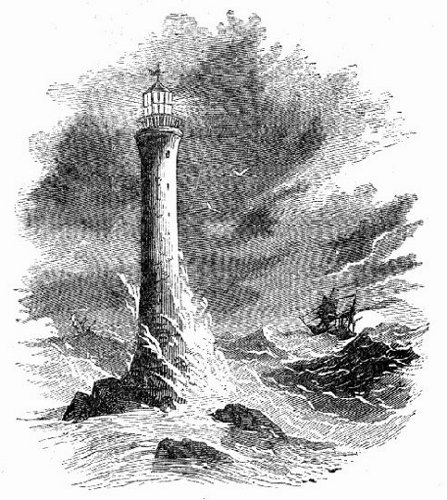
THE EDDYSTONE LIGHTHOUSE.
As the arts and sciences improved, so did the construction of Lighthouses,
until one of the greatest accomplishments of engineering skill,
ever attempted upon such works, was exhibited in the construction of the
Eddystone Lighthouse, which is, indeed, much more entitled than the
Pharos of Alexandria to be considered one of the wonders of the world.
The rock on which this tower is built is placed about twelve miles south-west
of Plymouth, and consists of a series of submarine cliffs, stretching
from the west side (which is so precipitous that the largest ship can ride
close beside them) in an easterly direction, for nearly half a mile. At
the distance of about a quarter of a mile more is another rock, so that a
more dangerous marine locality can hardly be imagined. Both these
rocks had proved the cause of many fatal shipwrecks, and it was at last
resolved to make an attempt to obviate the danger. In the year 1696, a
gentleman of Essex, named Winstanley, who had a turn for architecture
and mechanics, was engaged to erect a lighthouse upon the Eddystone
rock, and in four years he completed it. It did not, however, stand long,
for while some repairs were in progress under his direction in 1703, on
the 26th November, a violent hurricane came on which blew the lighthouse
down, and Mr. Winstanley and all his workmen perished—nothing
remaining of the edifice but a few stones and a piece of iron chain.
In the spring of 1706 an Act of Parliament was obtained for rebuilding
the lighthouse, and a gentleman named Rudyerd, a silk mercer, was the
engineer engaged. He placed five courses of heavy stones upon the rock
and then erected a superstructure of wood. The lighthouse on the Bell
Rock, off the coast of Fife, and the one placed at the entrance of the
Mersey on the Black Rock, are similarly constructed, so that there seemed
to be good reason for adopting the principle. Mr. Smeaton thought that
the work was done in a masterly and effective manner; but in 1755 the
edifice was destroyed by fire, and he was next retained as the engineer
for this important building.
The result of his labours has justly been considered worthy of the admiration
of the world, for it is distinguished alike for its strength, durability,
and beauty of form. The base of the tower is about twenty-six
feet nine inches in diameter, and the masonry is so formed as to be a part
of the solid rock, to the height of thirteen feet above the surface, where
the diameter is diminished to nineteen feet and a half. The tower then
rises in a gradually diminishing curve to the height of eighty-five feet,
including the lantern, which is twenty-four feet high. The upper extremity
is finished by a cornice, a balustrade being placed around the base
of the lantern for use as well as ornament.
The tower is furnished with a door and windows, and the whole edifice
outside bears the graceful outline of the trunk of a mighty tree, combining
lightness with elegance and strength. Mr. Smeaton commenced his
labours in 1756, and completed the building in four years. Before commencing
operations he took accurate drawings of the exterior of the rock,
and the stones, which were brought from the striking and romantic district
of Dartmoor, were all formed to fit into its crevices, and so prepared
as to be dovetailed together, and strung by oaken plugs. When put into
their places, and then firmly cemented, the whole seemed to form, and
does indeed constitute, a part of the solid rock.
SWEATING SICKNESS.
The Sweating Sickness first visited England Anno Dom. 1483, and
repeated its visitations 1485, 1506, 1517, 1528, and last of all, 1551.
This epidemic disease raged with such peculiar violence in England,
and had so quick a crisis, that it was distinguished by the name of
Ephemera Britannica. This singular fever seems to have been of the
most simple, though of the most acute kind, and notwithstanding princes
and nobles were its chief victims, the physicians of the day never agreed
upon the method of treating it.
The splendid French embassy, which arrived in England in 1550, found
the court-festivities damped by a visitation of that strange and terrific
malady.
"This pestilence, first brought into the island by the foreign mercenaries
who composed the army of the Earl of Richmond, afterwards
Henry VII., now made its appearance for the fourth and last time in
our annals. It seized principally, it is said, on males, on such as were
in the prime of their age, and rather on the higher than the lower
classes: within the space of twenty-four hours, the fate of the sufferer
was decided for life or death. Its ravages were prodigious; two princes
died of it; and the general consternation was augmented, by a superstitious
idea which went forth, that Englishmen alone were the destined
victims of this mysterious minister of fate, which tracked their steps,
with a malice and sagacity of an evil spirit, into every distant country
of the earth whither they might have wandered, whilst it left unassailed
all foreigners in their own."
AN AMERICAN ADVERTISEMENT.
The following is an early specimen of that system of poetical advertising
which in recent times has become so common. It is always interesting
to note the origin of customs with which we subsequently become
familiar:—
Notice to the Public, and especially to Emigrants, who wish to settle
on Lands.—The Subscriber offers for Sale, several Thousand Acres of
Land, situated in well settled Front Townships, in Lots to suit
Purchasers.
Particulars about Location,
May be known by application.
For quality of soil, and so forth,
Buyers to see, on Nag must go forth.
This much I'll tell ye plainly,
Of big trees ye'll see mainly.
'Bout Butter Nut and Beach,
A whole week I could preach;
But what the plague's the use of that?
The lands are nigh, low, round, and flat.
There's rocks and stumps, no doubt enough,
And bogs and swamps, just quantum-suff
To breed the finest of Musquitoes;
As in the sea are bred Bonitos,
No lack of fever or of ague;
And many other things to plague you.
In short, they're just like other people's,
Sans houses, pigsties, barns, or steeples
What most it imports you to know,
'S the terms on which I'll let 'em go.
So now I offer to the Buyer,
A Credit to his own desire,
For butter, bacon, bread, and cheese,
Lean bullocks, calves, or ducks and geese,
Corn, Tates, flour, barley, rye,
Or any thing but Punkin-Pie.
In three, four years, Aye, five or six,
If that won't do, why let him fix.
But when once fix'd, if payment's slack,
As sure as Fate, I'll take 'em back.
THOMAS DALTON.
Kingston Brewery, (Canada,) Nov. 2, 1821.
MAGNIFICENCE OF FORMER TIMES.
Account how the Earl of Worcester lived at Ragland Castle in Monmouthshire,
before the Civil Wars, which began in 1641.
At eleven o'clock in the forenoon, the Castle gates were shut, and the
tables laid; two in the dining-room; three in the hall; one in Mrs.
Watson's apartment, where the chaplains are, (Sir Toby Mathews being
the first;) and two in the housekeeper's room for the lady's women.
The Earl came into the dining-room attended by his gentlemen. As
soon as he was seated, Sir Ralph Blackstone, Steward of the house,
retired. The Comptroller, Mr. Holland, attended with his staff, as did
the Sewer, Mr. Blackburne; the daily waiters, Mr. Clough, Mr. Selby,
and Mr. Scudamore; with many gentlemen's sons, from two to seven
hundred pounds a year, bred up in the Castle; my Lady's Gentleman
Usher, Mr. Harcourt; my Lord's Gentlemen of the Chamber, Mr.
Morgan and Mr. Fox.
At the first table sat the noble family, and such of the nobility as came.
At the second table, in the dining-room, sat Knights and Honourable
Gentlemen, attended by footmen.
In the hall, at the first table sat Sir Ralph Blackstone, Steward; the
Comptroller, Mr. Holland; the Secretary; the Master of the Horse, Mr.
Delewar; the Master of the Fish Ponds, Mr. Andrews; my Lord Herbert's
Preceptor, Mr. Adams; with such Gentlemen as came there under the
degree of a Knight, attended by footmen, and plentifully served with wine.
At the second table in the hall, (served from my Lord's table, and with
other hot meats,) sat the Sewer, with the Gentlemen Waiters and Pages,
to the number of twenty-four.
At the third table in the hall, sat the Clerk of the Kitchen, with the
Yeomen Officers of the House, two Grooms of the Chamber, &c.
Other Officers of the Household were, Chief Auditor, Mr. Smith; Clerk
of the Accounts, Mr. George Wharton; Purveyor of the Castle, Mr.
Salsbury; Ushers of the Hall, Mr. Moyle and Mr. Croke; Closet Keeper,
Gentleman of the Chapel, Mr. Davies; Keeper of the Records; Master of the
Wardrobe; Master of the Armoury; Master Groom of the Stable for the War
Horses; Master of the Hounds; Master Falconer; Porter and his man.
Two Butchers; two Keepers of the Home Park; two Keepers of the
Red Deer Park.
Footmen, Grooms, and other menial Servants, to the number of 150.
Some of the footmen were brewers and bakers.
Out Officers.—Steward of Ragland, William Jones, Esq.; the Governor
of Chepstow Castle, Sir Nicholas Kemys, Bart.; Housekeeper of Worcester
House, in London, James Redman, Esq.
Thirteen Bailiffs.
Two Counsel for the Bailiffs to have recourse to.
Solicitor, Mr. John Smith.
SADLER'S WELLS.
"T. G., Doctor in Physic," published, in 1684, a pamphlet upon this
place, in which he says:—"The water of this well, before the Reformation,
was very much famed for several extraordinary cures performed
thereby, and was thereupon accounted sacred, and called Holywell.
The priests belonging to the priory of Clerkenwell using to attend there,
made the people believe that the virtue of the water proceeded from the
efficacy of their prayers; but at the Reformation the well was stopped,
upon the supposition that the frequenting of it was altogether superstitious;
and so by degrees it grew out of remembrance, and was wholly
lost until then found out; when a gentleman named Sadler, who had
lately built a new music-house there, and being surveyor of the highways,
had employed men to dig gravel in his garden, in the midst
whereof they found it stopped up and covered with an arch of stone."
After the decease of Sadler, Francis Forcer, a musician of some eminence
in his profession, became proprietor of the well and music-room; he was
succeeded by his son, who first exhibited there the diversions of rope-dancing
and tumbling, which were then performed in the garden. The
rural vicinity of the "Wells," long made it a favourite retreat of the
pleasure-seeking citizens.
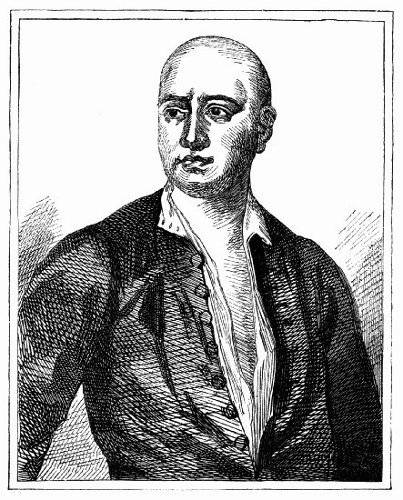
CHAMPION FIGG.
James Figg, a native of Thame, in Oxfordshire, was a man of remarkable
athletic strength and agility, and signalized himself greatly over any
of his country competitors in the art of cudgel-playing, single-stick,
and other gymnastic exercises. Having acquired a considerable knowledge
of the broadsword, he came to London, and set up as master in
that science, undertaking to teach the nobility and gentry of his day the
noble art of self defence; and championed himself against all comers.
He took a waste piece of ground, the corner of Wells and Castle-streets,
Oxford-road, and erected a wooden edifice, which, in imitation of the
Romans, he denominated an amphitheatre; and established here a
regular academy, to train pupils in the practice of cudgeling, broadsword,
&c. &c., as well to use it, on fixed occasions, for the exhibition
of prizefighting. He had many followers, and we find him commemorated
and praised by most of the wits of his time. "The Tattler,"
"Guardian," and "Craftsman," have equally contributed to preserve
his memory, as have several writers. Bramstone, in his "Man of Taste"
tells us:—
"In Figg the prize-fighter by day delight,
And sup with Colley Cibber every night."
Another writer notices him in the following lines:—
"To Figg and Broughton he commits his breast,
To steel it to the fashionable test."
Sutton, the pipe-maker of Gravesend, was his rival, and dared the
mighty Figg to the combat. Twice they fought, with alternate advantage;
but, at the third trial, a considerable time elapsed before victory
decided for either party; at length the palm of victory was obtained by
Figg. In short, neither Ned Sutton, Tom Buck, nor Bob Stokes, could
resist, or stand against his skill and valour. He was never defeated but
once, and then by Sutton, in one of their previous combats, and that was
generally supposed to have been in consequence of an illness he had on
him at the time he fought.
When Faber engraved his portrait from a painting by Ellys, he was
at a loss what he should insert, as an appropriate motto, and consulting
with a friend what he should put, was answered, "A Figg for the
Irish." This was immediately adopted, and the print had a rapid sale.
Figg died in 1734. William Flander a noted scholar of his, fought
at the amphitheatre, in 1723, with Christopher Clarkson, from Lancashire,
who was called the Old Soldier. The fashion of attending prizefighting
matches had attained its highest zenith in Figg's time, and it
was looked upon as a very great proof of self-denial in an amateur if he
failed a meeting on those occasions.
From Figg's theatre he will not miss a night,
Though cocks, and bulls, and Irish women, fight.
Figg left a widow and several children; so recently as 1794 a daughter-in-law
of his was living, and resided in Charles-street, Westminster,
where she kept a house, and supported herself very decently by letting
lodgings, aided by a very small income.
DRESS IN 1573.
The wardrobe of a country gentleman is thus given from a will, dated
1573, in the Prerogative Court of Canterbury, in Brayley and Britton's
Graphic Illustrator—"I give unto my brother Mr. William Sheney
my best black gown, garded and faced with velvet, and my velvet cap;
also I will unto my brother Thomas Marcal my new shepe colored gowne,
garded with velvet and faced with cony; also I give unto my son Tyble
my shorte gown, faced with wolf (skin), and laid with Billements lace;
also I give unto my brother Cowper my other shorte gowne, faced with
foxe; also I give unto Thomas Walker my night gown, faced with cony,
with one lace also, and my ready (ruddy) colored hose; also I give unto
my man Thomas Swaine my doublet of canvas that Forde made me, and
my new gaskyns that Forde made me; also I give unto John Wyldinge
a cassock of shepes colour, edged with ponts skins; also I give unto John
Woodzyle my doublet of fruite canvas, and my hose with fryze bryches;
also I give unto Strowde my frize jerkin with silke buttons; also I give
Symonde Bisshoppe, the smyth, my other frize jerkyn, with stone buttons;
also I give to Adam Ashame my hose with the frendge (fringe), and lined
with crane-coloured silk; which gifts I will to be delivered, immediately
after my decease."
ORIGIN OF THE CREST OF THE PRINCE OF WALES.
The loss of the French at the battle of Creçy was immense. There fell
1,200 knights; 1,400 esquires; 4,000 commissioned officers; 30,000 rank
and file; Dukes of Lorraine and Bourbon; Earls of Flanders, Blois, Harcourt,
Vaudemont, and Aumale; the King of Bohemia; the King of Majorca.
The English lost one esquire, three knights, and less than one
hundred rank and file. Here did they first use field artillery; and on
this battle-field did the young Prince of Wales adopt the ostrich plumes
and motto of the slain King of Bohemia, who, being blind, desired to be
led at a gallop between two knights into the thick of the fight, and thus
met death. Those feathers and the two words "Ich dien," "I serve,"
are to this day the heraldic bearings of the Prince of Wales, whom God
preserve! So much for Creçy or Cressy!
SINGULAR DISCOVERY OF A THIEF IN 1822.
On February 20, as a servant in the employ of J. L. King, Esq., of
Stogumber, was entering a field, his attention was attracted by a magpie,
which appeared to have escaped from a neighbouring house. The
bird spoke so uncommonly plain that the man was induced to follow it.
"Cheese for Marget, Cheese for Marget," was its continual cry, as it
hopped forward, till it stopped behind a hay-stack, and began to eat.
On inspection, a number of hams, a quantity of cheese, &c., were discovered,
which had been stolen, a short time previously, from Mr.
Bowering, of Williton. The plunder was deposited in sacks, on one of
which was marked the name of a person residing in the neighbourhood,
which led to the apprehension of four fellows, who have been committed
to Wilton gaol.
EFFECT OF VINEGAR ON THE SKIN.
By the use of vinegar the Spanish General Vitellis, made his skin hang
about him like a pelisse; but of the wonderful dilatability of the skin, no
instance equals the Spaniard who showed himself to Van-Horn, Silvius,
Piso, and other learned men at Amsterdam. Taking up with his left
hand the skin of his right shoulder, he would bring the same up to his
mouth: again he would draw the skin of his chin down to his breast like
a beard, and presently put it upwards to the top of his head, hiding both
his eyes therewith; after which, the same would return orderly and
equally to its proper place.
ADVERTISEMENT OF A DYING SPEECH BOOK IN 1731.
Newgate literature was more popular in the last century than it is now.
The following is an advertisement in the Gentleman's Magazine of the
above date:—
"A General History of Executions for the year, 1730. Containing the
lives, actions, dying speeches, confessions and behaviour, of sixty malefactors
executed at Tyburn, and elsewhere; particularly three unfortunate
young gentlemen, viz., Mr. Goodburn, a Cambridge scholar,
Mr. Johnston, and Mr. Porter, son to the late Lord Mayor of Dublin:
and of several notorious highwaymen, foot-pads, street-robbers, and
housebreakers, as Dalton, Everet, Doyle, Newcomb, &c., and of the five
young highwaymen taken at Windsor, said to have formed a design to
rob the Queen there. To which is added, the trial of William Gordon
at Chelmsford for a robbery on the highway; an account of the incendiaries
at Bristol, and the apprehending John Power, for sending
threatening letters, and firing Mr. Packer's house; also the life of
Col. Ch—s. Together with an alphabetical list of all the persons indicted
or tried at the Old Bailey, the year past. With the judgment of
the court respectively passed upon each, referring to the pages in the
session books for the trials at large. Printed for R. Newton at St.
John's Gate, and sold by the booksellers price bound 2s. 6d."
ADVERTISEMENT OF A FLEET PARSON.
In the last century, when marriages were allowed to be transacted—we
cannot say solemnized—in the Fleet Prison, and the adjacent
taverns, the profligate wretches who disgraced their sacred profession by
taking part in such iniquities, were obliged to bid against one another
for custom—here is one of their advertisements:—
G. R.
At the true Chapel
at the old Red Hand and Mitre, three doors from Fleet Lane and
next Door to the White Swan;
Marriages are performed by authority by the Reverend Mr. Symson educated at
the University of Cambridge, and late Chaplain to the Earl of Rothes.
N.B. Without Imposition.
THE ASS.
In all countries, this sure-footed and faithful animal is adopted as an
emblem of stupidity, from the patience with which it submits to punishment
and endures privation. A pair of ass's ears is inflicted upon a child
in reproof of his duncehood; and through life we hear every blockhead
of our acquaintance called an ass. Whereas the ass is a beast of great
intelligence; and we often owe our safety to its sure and unerring foot
beside the perilous precipice, where the steps of the man of science would
have faltered.
The Fathers of the Church, and the Disciples of the Sorbonne, persuaded
of the universal influence of the Christian faith, believed the dark
cross on the back of the ass to date only from the day on which our
Saviour made his entry into Jerusalem. The ass of the desert was an
animal of great price. Pliny mentions that the Senator Arius paid for
one the sum of four hundred thousand sesterces. Naturalists have frequently
remarked the extraordinary dimensions of an ass's heart, which
is thought an indication of courage; and it is the custom of the peasantry
of some countries to make their children wear a piece of ass's skin about
their person. The ass's skin is peculiarly valuable, both for the manufacture
of writing-tablets and drums; which may be the reason why a
dead ass is so rarely seen. It is too valuable to be left on the highway.
In many places, the ass serves as a barometer. If he roll in the dust,
fine weather may be expected; but if he erect his ears, rain is certain.
Why should not these animals experience the same atmospheric influences
as man? Are we not light-hearted in the sunshine, and depressed in a
heavy atmosphere?
CHOICE RECEIPTS FROM "PHYSICK FOR THE POOR. LONDON, 1657."
To make any one that Sleepeth answer to whatsoever thou ask.—Take
the heart of an oul, and his right legg, and put them upon the breast of
one that sleepeth, and they shall reveal whatsoever thou ask them.
To know any Man or Woman's minde when they are Asleep.—Take
the hart of a dove, and the legg of a frog, dry it well, and beat them to
powder in a morter, put this up in a linnen cloth, with three or four
round pibble stones, as big as wallnuts, then lay this upon the parties
pit of their stomach, and they shall tell you all things that they have
done, if there is anything remarkable that troubles them.
To make the Nose Bleed.—Take the leaves of yerrow, put it up in thy
nose; this will make the nose bleed immediately.
To make a Tooth Drop out.—Mizaldus saith that if you make a powder
of earth-worms and put it in the hollow of a rotten tooth, it will immediately
drop out.
How strange must have been the education and intelligence of the period,
when people could write, publish, and practice such incredible trash!
SHOCKING DEPRAVITY.
The following account, from an old magazine, affords a strange and
lamentable instance of a wretch just about to die, being only intent with
his latest breath to defame his own mother:—
Mary Lynn, condemn'd last Assizes for the County of Norfolk, was
burnt to ashes at a stake, for being concern'd in the murder of her mistress;
and Smith, the principal, was hang'd for the same fact. She
deny'd her being guilty, and said Smith could clear her if he would.
She behaved with decency, and died penitent. Smith was drunk at the
gallows; and seem'd to have but little sense either of his crime or
punishment; however, desired all masters to pay their servants' wages
on Saturday night, that they might have money to spend, and not run
in debt. Said, "My mother always told me I should die in my shoes,
but I will make her a liar;" so threw them off.
PERSONAL CHARMS DISCLAIMED.
If any human being was free from personal vanity, it must have been
the second Duchess d'Orleans, Charlotte Elizabeth of Bavaria. In one
of her letters (dated 9th August, 1718), she says, "I must certainly be
monstrously ugly. I never had a good feature. My eyes are small, my
nose short and thick, my lips broad and thin. These are not materials
to form a beautiful face. Then I have flabby, lank cheeks, and long
features, which suit ill with my low stature. My waist and my legs are
equally clumsy. Undoubtedly I must appear to be an odious little
wretch; and had I not a tolerable good character, no creature could
endure me. I am sure a person must be a conjuror to judge me by my
eyes that I have a grain of wit."
CADER IDRIS.
On the very summit of Cader Idris there is an excavation in the solid
rock, resembling a couch; and it is said that whoever should rest a night
in that seat, will be found in the morning either dead, raving mad, or
endued with supernatural genius.
OLD LONDON SIGNS.
Some notion of the houses and shops of old London may be gathered
by a visit to Bell Yard, near Temple Bar; Great Winchester Street, near
the Bank; the wooden houses near Cripplegate Church; and a few other
districts which were spared by the Great Fire of 1666. In Bell Yard, for
instance, the national feeling for improvement has from time to time
effected changes; the lattices of diamond-shaped lead-work, carved
pendants, and the projecting signs of the various tradesmen, have disappeared,
and here and there sheets of plate glass have been used, to give
a somewhat modern appearance to the places of business. Still the projecting
and massive wood-work of the shops, and the peculiar picturesque
appearance of the houses, cannot be altogether disguised; and if any of
our readers, who may be curious in such matters, will walk up Bailey's
Court, on the west side of Bell Yard, he will there see a group of wooden
buildings exactly like the great mass which was cleared by the fire. In
some of the pictures of London of about this time, the shops of the
various tradesmen were chiefly unglazed, and above the door of each was
suspended the silver swans; the golden swans; the chained swans; the
golden heads; mitres; bells—black, red, white, and blue; rising and
setting suns; moons of different phases; men in the moon; sceptres;
crowns, and many other devices, which, even at that time, were necessary
to distinguish one shop from another. The chequers; St. George and
the dragon; royal oaks; king's heads; and double signs, such as the
horseshoe and magpie; bell and crown; bell and horns, and such like,
were more particularly set apart for the use of the various hostelries.
Everyone, however, who had a London shop of any kind or consequence,
had his sign. Many of them were well carved in wood, and ornamented
with emblazonry and gilding.
No doubt if it were possible to find at the present time the same
picturesque architectural displays as were to be met with in London in
Queen Elizabeth's days, our artistic friends would be able to pick up
many a nice subject for their pencils, but in those days there were plenty
of drawbacks; the pavement was bad, the drainage was worse, and from
the eaves of the houses and pents of the shops, streams of water ran down
in wet weather upon the wayfarers, and, by lodging in the thoroughfares,
made the London streets something in the same state as those of Agar
Town and some other neglected parts of the metropolis. We must not
forget that in the days to which we allude there were no flagged footpaths,
and that the only distinction from the horse and cart roads, and
that for the foot passengers, was a separation by wooden posts, which, in
genteel places, were made supports for chains. People, however, got
tired of this bad state of things, and measures were taken to put a stop
to the streams of water from the roofs, &c. After the Great Fire, an
enactment was made for an alteration in the spouts, &c.; all barbers
poles, and projecting signs, and other projections were to be done away
with, and other changes made for the better. Up to the reign of Queen
Anne, we find, by reference to views of Cheapside and the neighbourhood
of the Monument, that the projecting signs were still in use; and that
even at that recent date, many of the London shops in the important
neighbourhoods above mentioned were without glazing, and looked much
like some of the greengrocers' sheds in use now in Bermondsey and some
other places.
Severe measures seem to have been at length taken against the projecting
signs, and most of them disappeared, and then it became a most
difficult matter either to address letters, or find a man's shop. In Dr.
Johnson's day, he and other persons gave the address "over against" a
particular sign, or so many doors from such a sign. In consequence of
this uncertainty, many houses in London, which from their association
with eminent men would possess much interest now, cannot be pointed
out; and it was a wonderful benefit to the metropolis when the plan of
numbering the houses in each street was hit upon. But for this,
considering that the population has doubled in the last fifty years, it is
difficult to know how the genius of Rowland Hill would have worked his
plan of London post-office delivery, or business could be carried on with
any kind of comfort.
The booksellers and publishers seem to have been the last, with the
exception of the tavern-keepers, to give up the old signs. After the
Great Fire, some of the ancient signs which were cut in stone, and which
had escaped the conflagration, were got out of the ruins, and afterwards
placed in the front of the plain, yet solid, brick buildings which were
erected after that event. Some of these—the "Chained Bear," the
"Collared Swan," the "Moon and Seven Stars," and "Sun," in Cheapside,
and some others which we now engrave—are still preserved. The
carved wooden sign of the "Man in the Moon," in Wych Street, Strand,
is a rare example; and the "Horse-shoe and Magpie," in Fetter Lane,
is one of the last of the suspended signs to be now found in the City.
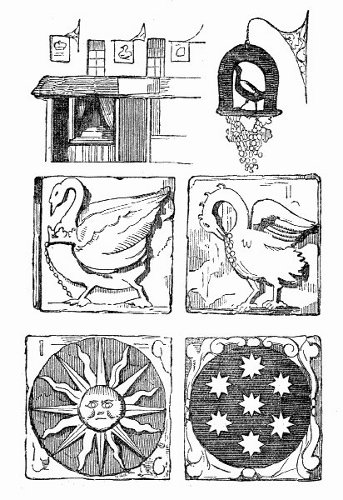
Amongst the painted signs of London taverns worth notice, is one in
Oxford-street (nearly opposite Rathbone-place), said to have been painted
by Hogarth. The subject is "a man loaded with mischief." He has a
stout woman on his shoulders, together with a monkey, magpie, etc. The
male figure shown in this street picture seems to bear up pretty well under
his burden.
NARROW ESCAPE.—CALM RELIANCE ON PROVIDENCE.
In the year 1552, Francis Pelusius, of sixty-three years old, digging
a well forty foot deep in the hill of St. Sebastian, the earth above him
fell in upon him to thirty-five foot depth; he was somewhat sensible before
of what was coming, and opposed a plank, which by chance he had with
him, against the ruins, himself lying under it; by this means he was
protected from the huge weight of earth, and retained some room and
breath to himself, by which he lived seven days and nights without food or
sleep, without any pain or sorrow, being full of hope, which he placed in God
only. Ever and anon he called for help, as being yet safe, but was heard
by none, though he could hear the motion, noise and words of those that
were above him, and could count the hours as the clock went. After the
seventh day, he being all this while given for dead, they brought a bier
for his corpse, and when a good part of the well was digged up, on a
sudden they heard the voice of one crying from the bottom. At first
they were afraid, as if it had been the voice of a subterranean spirit; the
voice continuing, they had some hope of his life, and hastened to dig
to him, till at last, after they had given him a glass of wine, they drew
him up living and well, his strength so entire that to lift him out he
would not suffer himself to be bound, nor would use any help of another.
Yea, he was of so sound understanding, that, jesting, he drew out his
purse and gave them money, saying He had been with such good hosts,
that for seven days it had not cost him a farthing.
CEILING OF WHITEHALL.
The celebrated painting on the roof of the Banqueting House, has been
restored, re-painted, and refreshed, not fewer than three times. In the
reign of James II., 1687, Parrey Walton, a painter of still life, and the
keeper of the king's pictures, was appointed to re-touch this grand work
of art, which had then (as appears by the Privy Council Book) been
painted only sixty years. Walton was paid £212 for its complete restoration,
which sum was considered by Sir Christopher Wren, "as very
modest and reasonable." It was restored a second time by the celebrated
Cipriani; and for a third time by a painter named Rigaud.
BUNYAN'S BIBLE.
John Bunyan's Bible (printed by Bill and Barker) bound in morocco,
and which had been his companion during his twelve years' unjustifiable
confinement in Bedford gaol, where he wrote his "Pilgrim's Progress,"
was purchased at the sale of the library of the Rev. S. Palmer, of
Hackney, March, 1814, for the late Samuel Whitbread, Esq., for the
sum of £21. This Bible, and the "Book of Martyrs," are said to have
constituted the whole library of Bunyan during his imprisonment.
SPECIMENS OF ROYAL GRANTS.
In 1206, King John grants to W. de Camville a licence to destroy
game in any of the royal forests, which proves the origin of the Game
Laws.
1238. Henry III. gave 500l. to Baldwyn, Emperor of Constantinople.
1342. King Edward III. forgives to the mayor and citizens of London
the indignation and rancour of mind that he had conceived against them.
1344. The king grants to Adam Thorp, the trimmer of his beard,
certain lands at Eye, near Westminster. The scrupulous attention which
Edward III. paid to that ornament of his face, may be seen in his bronze
effigy in Westminster Abbey, which was taken from a mask after his
death.
1409. The king settles on Joan of Navarre, his queen, 10,000l. per
annum.
1417. Henry V. grants to Joan Warin, his nurse, an annuity of 20l.
during life.
1422. The jewels which had belonged to King Henry V., and were
valued at so large a sum as 40,000l., were delivered to Sir Henry Fitz
Hugh, and his other executors, for the payment of his personal debts.
1422. The "Pysane," or great collar of gold and rubies, was pawned
by the king to his uncle, Cardinal Beaufort, who is supposed, at the time
of his death, to have amassed more wealth than any subject in England.
COFFEE AND TEA.
The bill for attendance at the Dorchester Assizes in 1686 of Mr. John
Bragge, the town-clerk of Lyme, presents this novelty—the article
coffee is charged 2d. This may have been drunk at a coffee-house.
Coffee was introduced from Turkey in 1650.
An advertisement in the "Mercurius Politicus," Sept. 30, 1658,
instructs how "That excellent and by all physitians approved China
drink, called by the Chineans Tcha, by other nations, tay alias tee, is
sold at the Sultana's Head Coffee-house, in Sweeting's-rents, by the
Exchange, London.—"
There was a "cophee-house" in St. Michael's-alley, Cornhill, about
1657. Tea, coffee, and chocolate were placed under the excise. There
was no tax upon these commodities when imported, but when made into
drink, as tea was, at 8d. a gallon, and sold at these houses.
REMARKABLE PRESERVATION OF HUMAN HAIR SINCE THE NORMAN PERIOD.
In 1839 a coffin was discovered in the abbey church of Romsey, which
had originally contained the body of a female of the above early time. The
bones had entirely decayed, but the hair, with its characteristic indestructibility,
was found entire, and appeared as if the skull had only
recently been removed from it, retaining its form entire, and having
plaited tails eighteen inches in length. It is still preserved in a glass
case, lying upon the same block of oak which has been its pillow for
centuries.
PUBLIC TASTE FOR CONJURING IN 1718.
One of the amusements of 1718 was the juggling exhibition of a fire-eater,
whose name was De Hightrehight, a native of the valley of Annivi
in the Alps. This tremendous person ate burning coals, chewed
flaming brimstone and swallowed it, licked a red-hot poker, placed a red-hot
heater on his tongue, kindled coals on his tongue, suffered them to
be blown, and broiled meat on them, ate melted pitch, brimstone, bees-wax,
sealing-wax, and rosin, with a spoon; and, to complete the business,
he performed all these impossibilities five times per diem, at the
Duke of Marlborough's Head, in Fleet-street, for the trifling receipts of
2s. 6d., 1s. 6d., and 1s. Master Hightrehight had the honour of exhibiting
before Lewis XIV., the Emperor of Germany, the King of Sicily,
the Doge of Venice, and an infinite number of princes and nobles—and
the Prince of Wales, who had nearly lost this inconceivable pleasure by
the envious interposition of the Inquisition at Bologna and in Piedmont,
which holy office seemed inclined to try their mode of burning on his body,
leaving to him the care of resisting the flames and rendering them
harmless; but he was preserved from the unwelcome ordeal by the interference
of the Dutchess Royal Regent of Savoy and the Marquis
Bentivoglia.
THE TRIUMPHS OF SCIENCE AND PERSEVERANCE.
Distance seems not to have entered into the calculations of the
engineers who built those monuments of human skill—carriage-roads
over the Alps. They were after a certain grade, and they obtained it,
though by contortions and serpentine windings that seem almost
endless. Thus the Simplon averages nowhere more than one inch
elevation to a foot, and, indeed, not quite that. Thirty thousand men
were employed on this road six years. There are six hundred and
eleven bridges in less than forty miles, ten galleries, and twenty houses
of refuge, while the average width of the road is over twenty-five feet.
The Splugen presents almost as striking features as the Simplon. From
these facts, some idea may be gathered of the stupendous work it must
be to carry a carriage-road over the Alps.
CHRISTMAS PIE.
The following appeared in the Newcastle Chronicle, 6th January,
1770:—
"Monday last was brought from Howick to Berwick, to be shipped for
London, for Sir Henry Grey, bart., a pie, the contents whereof are as
follows:—2 bushels of flour, 20 lbs. of butter, 4 geese, 2 turkeys, 2
rabbits, 4 wild ducks, 2 woodcocks, 6 snipes, 4 partridges, 2 neats'
tongues, 2 curlews, 7 blackbirds, and 6 pigeons: it is supposed a very
great curiosity, was made by Mrs. Dorothy Patterson, housekeeper at
Howick. It was near nine feet in circumference at bottom, weighs about
twelve stones, will take two men to present it at table; it is neatly fitted
with a case, and four small wheels to facilitate its use to every guest
that inclines to partake of its contents at table."
THE UPAS, (POISON) TREE.
We give here an instance of the extravagancies of ancient travellers, this
tissue of falsehoods being taken from "Foersch's Description of Java:"—
The Bohon Upas is situated in the Island of Java about twenty-seven
leagues from Batavia, fourteen from Soulis Charta, the seat
of the Emperor, and between eighteen and twenty leagues from Tinkjoe,
the present residence of the Sultan of Java. It is surrounded on all
sides by a circle of high hills and mountains; and the country round
it, to the distance of ten or twelve miles from the tree, is entirely
barren. Not a tree, nor a shrub, nor even the least plant or grass is to
be seen. I have made the tour all around this dangerous spot, at
about eighteen miles distant from the centre, and I found the aspect of
the country on all sides equally dreary. The easiest ascent of the hills
is from that part where the old Ecclesiastick dwells. From his house the
criminals are sent for the poison, into which the points of all warlike
instruments are dipped. It is of high value, and produces a considerable
revenue to the Emperor. The poison which is procured from this
tree is a gum that issues out between the bark and the tree itself, like
the camphor. Malefactors, who for their crimes are sentenced to die, are
the only persons who fetch the poison; and this is the only chance they
have of saving their lives. After sentence is pronounced upon them by
the Judge, they are asked in Court, whether they will die by the hands
of the executioner, or whether they will go to the Upas-tree for a box of
poison? They commonly prefer the latter proposal, as there is not only
some chance of preserving their lives, but also a certainty, in case of
their safe return, that a provision will be made for them in future by the
Emperor. They are also permitted to ask a favour from the Emperor,
which is generally of a trifling nature, and commonly granted. They
are then provided with a silver or tortoise-shell box, in which they are
to put the poisonous gum, and are properly instructed how to proceed
while they are upon their dangerous expedition. They are always told
to attend to the direction of the wind, as they are to go towards the tree
before the wind; so that the effluvia from the tree is always blown from
them. They go to the house of the old ecclesiastick who prepares them
by prayers and admonitions for their future fate; he puts them on a long
leathern cap with two glasses before their eyes, which comes down as far
as their breast; and also provides them with a pair of leather gloves.
They are conducted by the priest, and their friends, and relations, about
two miles on their journey. The old Ecclesiastick assured me that in
upwards of thirty years, he had dismissed above seven hundred criminals
in the manner described, and that scarcely two out of twenty have returned.
All the Malayans consider this tree as an holy instrument of
the great prophet to punish the sins of mankind, and, therefore, to die
of the poison of the Upas is generally considered among them as an
honourable death. This, however, is certain, that from fifteen to eighteen
miles round this tree, not only no human creature can exist, but no
animal of any kind has ever been discovered, there are no fish in the
waters, and when any birds fly so near this tree that the effluvia reaches
them, they drop down dead.
DEATH CAUSED BY SUPERSTITION.
In Hamburg, in 1784, a singular accident occasioned the death of a
young couple. The lady going to the church of the Augustin Friars,
knelt down near a Mausoleum, ornamented with divers figures in marble,
among which was that of Death, armed with a scythe, a small piece of
the scythe being loose, fell on the hood of the lady's mantelet. On her
return home, she mentioned the circumstance as a matter of indifference
to her husband, who, being a credulous and superstitious man, cried out
in a terrible panic, that it was a presage of the death of his dear wife.
The same day he was seized with a violent fever, took to his bed, and
died. The disconsolate lady was so affected at the loss, that she was
taken ill, and soon followed him. They were both interred in the same
grave; and their inheritance, which was very considerable, fell to some
very distant relations.
ST. PAUL AND THE VIPER.—THE CHURCH AT MALTA.
Not far from the old city of Valetta, in the island of Malta, there is
a small church dedicated to St. Paul, and just by the church, a miraculous
statue of the Saint with a viper on his hand; supposed to be
placed on the very spot on which he was received after his shipwreck on
this island, and where he shook the viper off his hand into the fire,
without being hurt by it. At which time the Maltese assure us, the
Saint cursed all the venomous animals of the island, and banished them
for ever; just as St. Patrick treated those of his favourite isle. Whether
this be the cause of it or not, we shall leave to divines to determine,
though if it had, St. Luke would probably have mentioned it in the Acts
of the Apostles; but the fact is certain, that there are no venomous
animals in Malta.
THE FIRST HERMITS—WHY SO-CALLED.
Hermits, or Eremites, (from the Greek [Greek: erêmos], a desert place,) were
men who retired to desert places to avoid persecution; they lodged in
caves and cells:—
"Where from the mountain's grassy side,
Their guiltless feast they bring;
A scrip with herbs and fruit supply'd,
And water from the spring."
The first hermit was Paul, of Thebes, in Egypt, who lived about the
year 260; the second, was St. Anthony, also of Egypt, who died in 345,
at the age of 105.
ST. JAMES'S SQUARE.
The author of A Tour through the Island of Great Britain (Daniel
Defoe), second edition, 1738, gives us the following particulars of this
aristocratic locality:—"The alterations lately made in St. James's
Square are entitled to our particular notice. It used to be in a very
ruinous condition, considering the noble houses in it, which are inhabited
by the first quality. But now it is finely paved all over with heading-stone;
a curious oval bason full of water, surrounded with iron rails on
a dwarf wall, is placed in the middle, mostly 7 feet deep and 150
diameter. In the centre is a pedestal about fifteen feet square, designed
for a statue of King William III. The iron rails are octagonal, and at
each angle without the rails, is a stone pillar about 9 feet high, and a
lamp on the top. The gravel walk within the rails is about 26 feet broad
from each angle to the margin of the basin. It was done at the expense
of the inhabitants by virtue of an act of parliament. The house that
once belonged to the Duke of Ormond, and since to the Duke of Chandos,
is pulled down and makes three noble ones, besides fine stables and coach-houses
behind, and two or three more good houses in the street leading
to St. James's Church. This noble square wants nothing but to have the
lower part of it, near Pall Mall, built of a piece with the rest, and the
designed statue to be erected in the middle of the basin.
"His Royal Highness the Prince of Wales has taken the Duke of
Norfolk's house, and another adjoining to it, which are now (October,
1737), actually repairing for his town residence; Carlton House being too
small for that purpose."
THE MORAYSHIRE FLOODS.
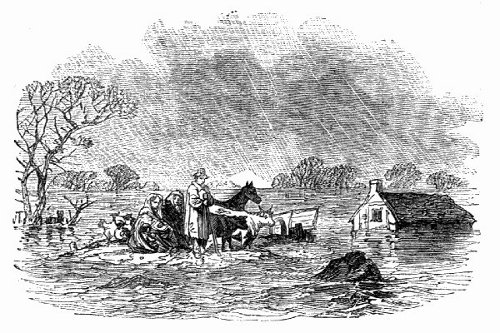
In the month of August, 1829, the province of Moray and adjoining
districts were visited by a tremendous flood. Its ravages were most
destructive along the course of those rivers which have their source in
the Cairngorm mountains. The waters of the Findhorn and the Spey,
and their tributaries, rose to an unexampled height. In some parts of
their course these streams rose fifty feet above their natural level. Many
houses were laid desolate, much agricultural produce was destroyed, and
several lives were lost. The woodcut in our text represents the situation
of a boatman called Sandy Smith, and his family, in the plains of Forres.
"They were huddled together," says the eloquent historian of the Floods,
"on a spot of ground a few feet square, some forty or fifty yards below
their inundated dwelling. Sandy was sometimes standing and sometimes
sitting on a small cask, and, as the beholders fancied, watching with
intense anxiety the progress of the flood, and trembling for every large
tree that it brought sweeping past them. His wife, covered with a
blanket, sat shivering on a bit of a log, one child in her lap, and a girl of
about seventeen, and a boy of about twelve years of age, leaning against
her side. A bottle and a glass on the ground, near the man, gave the
spectators, as it had doubtless given him, some degree of comfort. About
a score of sheep were standing around, or wading or swimming in the
shallows. Three cows and a small horse, picking at a broken rick of
straw that seemed to be half-afloat, were also grouped with the family."
The account of the rescue of the sufferers is given with a powerful
dramatic effect, but we cannot afford space for the quotation. The
courageous adventurers who manned the boat for this dangerous enterprise,
after being carried over a cataract, which overwhelmed their boat,
caught hold of a floating hay-cock, to which they clung till it stuck
among some young alder-trees. Each of them then grasping a bough,
they supported themselves for two hours among the weak and brittle
branches. They afterwards recovered the boat under circumstances
almost miraculous, and finally succeeded in rescuing Sandy and his
family from their perilous situation.
TREATMENT AND CONDITION OF WOMEN IN FORMER TIMES.
From the subversion of the Roman Empire, to the fourteenth or fifteenth
century, women spent most of their time alone, almost entire
strangers to the joys of social life; they seldom went abroad, but to
be spectators of such public diversions and amusements as the fashions
of the times countenanced. Francis I. was the first who introduced
women on public days to Court; before his time nothing was to be seen
at any of the Courts of Europe, but grey-bearded politicians, plotting
the destruction of the rights and liberties of mankind, and warriors
clad in complete armour, ready to put their plots in execution. In the
thirteenth and fourteenth centuries elegance had scarcely any existence,
and even cleanliness was hardly considered as laudable. The use of
linen was not known; and the most delicate of the fair sex wore woollen
shifts. In Paris they had meat only three times a week; and one hundred
livres, (about five pounds sterling,) was a large portion for a young
lady. The better sort of citizens used splinters of wood and rags dipped
in oil, instead of candles, which, in those days, were a rarity hardly to
be met with. Wine was only to be had at the shops of the Apothecaries,
where it was sold as a cordial; and to ride in a two-wheeled cart, along
the dirty rugged streets, was reckoned a grandeur of so enviable a
nature, that Philip the Fair prohibited the wives of citizens from enjoying
it. In the time of Henry VIII. of England, the peers of the
realm carried their wives behind them on horseback, when they went to
London; and in the same manner took them back to their country seats
with hoods of waxed linen over their heads, and wrapped in mantles of
cloth to secure them from the cold.
HOMER IN A NUTSHELL.
Huet, Bishop of Avranches, thus writes in his autobiography:—"When
his Highness the Dauphin was one day confined to his bed by
a slight illness, and we who stood round were endeavouring to entertain
him by pleasant conversation, mention was by chance made of the person
who boasted that he had written Homer's Iliad in characters so minute,
that the whole could be enclosed in a walnut shell. This appearing incredible
to many of the company, I contended not only that it might be
done, but that I could do it. As they expressed their astonishment at
this assertion, that I might not be suspected of idle boasting, I immediately
put it to the proof. I therefore took the fourth part of a common
leaf of paper, and on its narrower side wrote a single line in so small
a character that it contained twenty verses of the Iliad: of such lines
each page of the paper could easily admit 120, therefore the page would
contain 2400 Homeric verses: and as the leaf so divided would give
eight pages it would afford room for above 19,000 verses, whereas the
whole number in the Iliad does not exceed 17,000. Thus by my single
line I demonstrated my proposition."
AUTOBIOGRAPHY OF CHARING CROSS AND CHEAPSIDE CROSS.
The following interesting "Autobiographies" of the Old London
Crosses, are extracted from Henry Peacham's Dialogue between the Crosse
in Cheap and Charing Cross, confronting each other, as fearing their
fall in these uncertaine times, four leaves, 4to. 1641.
"Charing Cross.—I am made all of white marble (which is not perceived
of euery one) and so cemented with mortar made of the purest
lime, Callis sand, whites of eggs and the strongest wort, that I defie all
hatchets and hammers whatsoever. In King Henry the Eighth's daies I
was begged, and should have been degraded for that I had:—Then in
Edward the Sixe, when Somerset-house was building, I was in danger;
after that, in the reign of Queen Elizabeth, one of her footmen had like
to have run away with me; but the greatest danger of all I was in, when
I quak'd for fear, was in the time of King James, for I was eight times
begged:—part of me was bespoken to make a kitchen chimney for a
chiefe constable in Shoreditch; an inn-keeper in Holborn had bargained
for as much of me as would make two troughes, one to stand under a
pumpe to water his guests' horses, and the other to give his swine their
meate in; the rest of my poore carcase should have been carried I know
not whither to the repaire of a decayed stone bridge (as I was told) on
the top of Harrow-hill. Our royall forefather and founder, King Edward
the First you know, built our sister crosses, Lincolne, Granthame,
Woburne, Northampton, Stonie-Stratford, Dunstable, Saint Albanes,
and ourselves here in London, in the 21st yeare of his raigne, in the
yeare 1289."
"Cheapside Cross.—After this most valiant and excellent king had
built me in forme, answerable in beauty and proportion to the rest, I fell
to decay, at which time one John Hatherley, maior of London, having
first obtained a licence of King Henry the Sixt, anno 1441, I was repaired
in a beautiful manner. John Fisher, a mercer, after that gave
600 markes to my new erecting or building, which was finished anno
1484, and after in the second yeare of Henry the Eighth, I was gilded
over against the coming in of Charles the Fift Emperor, and newly then
gilded against the coronation of King Edward the Sixt, and gilded againe
anno 1554, against the coronation of King Philip. Lord, how often have
I been presented by juries of the quest for incombrance of the street,
and hindring of cartes and carriages, yet I have kept my standing; I
shall never forget how upon the 21st of June, anno 1581, my lower
statues were in the night with ropes pulled and rent down, as in the
resurrection of Christ—the image of the Virgin Mary, Edward the Confessor,
and the rest. Then arose many divisions and new sects formerly
unheard of, as Martin Marprelate, alias Penrie, Browne, and sundry
others, as the chronicle will inform you. My crosse should have been
taken quite away, and a Piramis errected in the place, but Queen
Elizabeth (that queen of blessed memory) commanded some of her privie
councell, in her Majesties name, to write unto Sir Nicholas Mosely, then
Maior, to have me againe repaired with a crosse; yet for all this I stood
bare for a yeare or two after: Her Highness being very angry, sent
expresse word she would not endure their contempt, but expressly commanded
forthwith the crosse should be set up, and sent a strict command
to Sir William Rider, Lord Maior, and bade him to respect my antiquity;
for that is the ancient ensigne of Christianity, &c. This letter was dated
December 24, anno 1600. Last of all I was marvellously beautified and
adorned against the comming in of King James, and fenced about with
sharp pointed barres of iron, against the rude and villainous hands of
such as upon condition as they might have the pulling me down, would
be bound to rifle all Cheapside."
It is scarcely necessary to say that both crosses have long since disappeared,
and their sites become uncertain, although the name of Charing
Cross still distinguishes an important London district.
SOMETHING LIKE A FEAST.
Leland mentions a feast given by the Archbishop of York, at his
installation, in the reign of Edward IV. The following is a specimen:—300
quarters of wheat, 300 tuns of ale, 100 tuns of wine, 1,000 sheep,
104 oxen, 304 calves, 304 swine, 2,000 geese, 1,000 capons, 2,000 pigs,
400 swans, 104 peacocks, 1,500 hot venison pasties, 4,000 cold, 5,000
custards hot and cold. Such entertainments are a picture of manners.
EGYPTIAN TOYS IN THE BRITISH MUSEUM.
The truth of the old proverb, that "there is nothing new under the
sun," will be recognised on an examination of the interesting group
which forms the subject of our engraving. Here are dolls of different
shapes, some of them for good children, and some, perhaps, for bad;
foot-balls, covered with leather, &c., the stitches in parts still firmly
adhering; models of fishes and fruit; and round pellets, which the
"small boys" of the present day would call "marbles." These toys
have been played with by little Egyptians who have been dead and
buried three or four thousand years.
Many of the toys that hold places in the English and other markets
are, so far as fashion is concerned, of considerable antiquity, having
been made, without any alteration in pattern, by certain families for
several generations. In the mountainous districts of the Savoy and
Switzerland, large numbers, both of children and grown persons, are
constantly employed in the manufacture of Noah's-arks, milkmaids &c.
Some of the animals carved in wood, and sold here for small prices,
show considerable skill in the imitation of the forms of nature, and
could only be produced at their present cost, owing to the cheapness of
living in those districts, and to the systematic division of labour.
Near the birthplace of Prince Albert is a very large manufactory of
military toys, such as drums, trumpets, helmets, &c.; and in parts of
Holland—
"——The children take pleasure in making
What the children of England take pleasure in breaking."
THE PYRAMIDS OF EGYPT.
The Pyramids of Egypt, especially the two largest of the Pyramids of
Jizeh, are the most stupendous masses of building, in stone, that human
labour has ever been known to accomplish. The Egyptian Pyramids, of
which, large and small, and in different states of preservation, the
number is very considerable, are all situated on the west side of the
Nile, and they extend, in an irregular line, and in groups, at some distance
from each other, from the neighbourhood of Jizeh, in 30° N. lat. as
far south as 29° N. lat., a length of between 60 and 70 miles. All the
Pyramids have square bases, and their sides face the cardinal points.
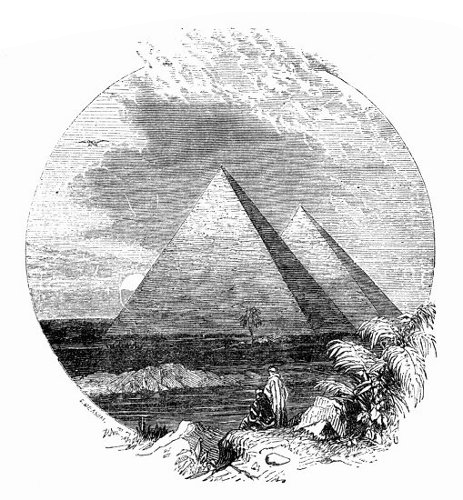
The Pyramids of Jizeh are nearly opposite to Cairo. They stand on a
plateau or terrace of limestone, which is a projection from the Libyan
mountain-chain. The surface of the terrace is barren and irregular,
and is covered with sand and small fragments of rock; its height, measured
from the base of the Great Pyramids, is 164 feet above the Nile in its
low state, taken at an average of the years 1798 to 1801. The north-east
angle of the Great Pyramid is 1700 yards from the canal which runs
between the terrace and the Nile, and about five miles from the Nile itself.
Herodotus was informed by the priests of Memphis that the Great
Pyramid was built by Cheops, King of Egypt, about 900 B. C., or about
450 years before Herodotus visited Egypt. He says that 100,000 men
were employed twenty years in building it, and that the body of Cheops
was placed in a room beneath the bottom of the Pyramid, surrounded by
a vault to which the waters of the Nile were conveyed through a subterranean
tunnel. A chamber under the centre of the Pyramid has indeed
been discovered, but it does not appear to be the tomb of Cheops. It is
about 56 feet above the low-water level of the Nile. The second Pyramid
was built, Herodotus says, by Cephren, or Cephrenes, the brother
and successor of Cheops; and the third by Mycerinus, the son of Cheops.
TEST OF COURAGE IN A CHILD.
In the education of their children, the Anglo-Saxons only sought to
render them dauntless and apt for the two most important occupations
of their future lives—war and the chase. It was a usual trial of a child's
courage, to place him on the sloping roof of a building, and if, without
screaming or terror he held fast, he was styled a stout herce, or brave
boy.—Howel.
EXECUTION OF RAVILLIAC, WHO ASSASSINATED HENRY THE FOURTH
OF FRANCE.
The scene is thus described in a volume published in 1728:—
"This Francis Ravilliac was born in Angoulesme, by profession a
lawyer, who, after the committing of that horrid fact, being seized and
put upon the rack, May 27; the 25th he had sentence of death passed
on him, and was executed accordingly in the manner following. He
was brought out of prison in his shirt, with a torch of two pound weight
lighted in one hand, and the knife wherewith he murdered the king
chained to the other; he was then set upright in a dung-cart, wherein
he was carried to the greve or place of execution, where a strong scaffold
was built; at his coming upon the scaffold he crossed himself, a sign
that he dyed a Papist; then he was bound to an engine of wood made
like St. Andrew's cross; which done, his hand with the knife chained
to it was put into a furnace, then flaming with fire and brimstone,
wherein it was in a most terrible manner consumed, at which he cast
forth horrible cries yet would he not confess any thing; after which the
executioner having made pincers red hot in the same furnace, they did
pinch the brawn of his arms and thighs, the calves of his legs, with
other fleshy parts of his body, then they poured into the wounds scalding
oil, rosin, pitch, and brimstone melted together; but to make the
last act of his tragedy equal in torments to the rest, they caused
four strong horses to be brought to tear his body in pieces, where
being ready to suffer his last torment, he was again questioned, but
would not reveal any thing, and so died without calling upon God, or
speaking one word concerning Heaven: his flesh and joints were so
strongly knit together, that these four horses could not in a long time
dismember him, but one of them fainting, a gentleman who was present,
mounted upon a mighty strong horse, alighted, and tyed him to one of
the wretch's limbs, yet for all this they were constrained to cut the
flesh under his arms and thighs with a sharp razor, whereby his body
was the easier torn in pieces; which done, the fury of the people was so
great, that they pulled his dismembered carcass out of the executioner's
hands, which they dragged up and down the dirt, and, cutting off the
flesh with their knives, the bones which remained were brought to the
place of execution, and there burnt, the ashes were cast in the wind,
being judged unworthy of the earth's burial; by the same sentence all
his goods were forfeited to the king. It was also ordained that the
house where he had been born should be beaten down, a recompence
being given the owner thereof, and never any house to be built again
upon that ground; that within fifteen days after the publication of the
sentence, by sound of trumpet in the town of Angoulesme, his father
and mother should depart the realm, never to return again; if they did,
to be hanged up presently: his brethren, sisters, and other kindred were
forbidden to carry the name of Ravilliac, but to take some other, and
the substitute of the king's attorney-general had charge to see the
execution of the sentence at his peril."
KNIVES AND FORKS.
"In all ancient pictures of Eating, &c. knives are seen in the hands
of the guests, but no Forks."—Turner's Saxons.
"Here I will mention a thing," says Coryat in his 'Crudities,' "that
might have been spoken of before in the discourse of the first Italian
toun. I obserued a custome in all those Italian cities and townes through
which I passed, that is not vsed in any other country that I saw in my
traules, neither doe I think that any other nation of Christendome doth
vse it, but only Italy. The Italians, and also most strangers that are
commorant in Italy, doe alwaies at their meales vse a little forke when
they cut their meate. For while with their knife, which they hold in
one hand, they cut their meate out of the dish, they fasten their forke,
which they hold in their other hand, upon the same dish, so that whatsoever
he be that sitting in the company of others at meate, should vnaduisedly
touch the dish of meate with his fingers from which all at the
table doe cut, he will give occasion of offence unto the company, as
hauing transgressed the laws of good manners, in so much that for his
error he shall be at the least broue-beaten, if not reprehended in words.
This form of feeding, I vnderstand, is generally vsed in all places of
Italy, their forkes being for the most part made of yron or steele, and
some of siluer; but those are used only by gentlemen. The reason of
this their curiosity is, because the Italian cannot by any means indure
to have his dish touched with fingers, seeing all men's fingers are not
alike clean. Hereupon I myself thought good to imitate the Italian
fashion by this forked cutting of meate, not only while I was in Italy,
but also in Germany, and oftentimes in England, since I came home:
being once quipped for that frequent vsing of my forke, by a certain
gentleman, a familiar friend of mine, one Mr. Laurence Whitaker, who
in his merry humour doubted not to call me at table furcifer, only for
vsing a forke at feeding, but for no other cause."—Coryat's Crudities,
1611.
Even when Heylin published his Cosmography, (1652,) forks were
still a novelty. See his Third Book, where having spoken of the ivory
sticks used by the Chinese, he adds, "The use of silver forks, which is
by some of our spruce gallants taken up of late, came from thence into
Italy, and from thence into England."—Antiquarian Repertory.
CHINESE PUNISHMENT OF THE KANG OR WOODEN COLLAR.
The Chinese are very quiet and orderly; and no wonder, because they
are afraid of the great bamboo stick.
The mandarins (or rulers of towns) often sentence offenders to lie
upon the ground, and to have thirty strokes of the bamboo. But the
wooden collar is worse than the bamboo stick. It is a great piece of
wood with a hole for a man to put his head through. The men in
wooden collars are brought out of their prisons every morning and
chained to a wall, where everybody passing by can see them. They
cannot feed themselves in their wooden collars, because they cannot
bring their hands to their mouths; but sometimes a son may be seen
feeding his father, as he stands chained to the wall. There are men also
whose business it is to feed the prisoners. For great crimes men are
strangled or beheaded.
CASCADE DES PELERINES.
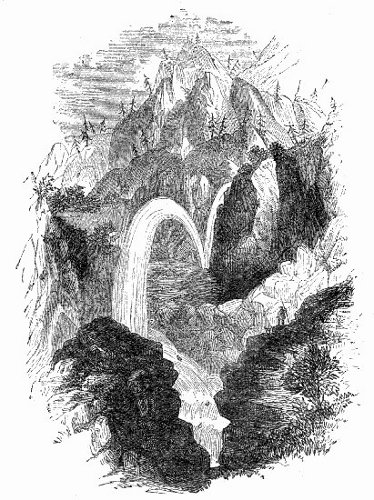
There is a waterfall in Chamouni which no traveller should omit
going to see, called the Cascade des Pelerines. It is one of the most
curious and beautiful scenes in Switzerland. A torrent issues from
the Glacier des Pelerines, high up the mountain, above the Glacier
du Bossons, and descends, by a succession of leaps, in a deep gorge,
from precipice to precipice, almost in one continual cataract; but
it is all the while merely gathering force, and preparing for its last
magnificent deep plunge and recoil of beauty. Springing in one round
condensed column out of the gorge, over a perpendicular cliff, it strikes,
at its fall, with its whole body of water, into a sort of vertical rock basin,
which one would suppose its prodigious velocity and weight would split
into a thousand pieces; but the whole cataract, thus arrested, at once
suddenly rebounds in a parabolic arch, at least sixty feet into the air;
and then, having made this splendid airy curvature, falls with great
noise and beauty into the natural channel below. It is beyond measure
beautiful. It is like the fall of divine grace into chosen hearts, that
send it forth again for the world's refreshment, in something like such a
shower and spray of loveliness, to go winding its life-giving course afterwards,
as still waters in green pastures. The force of the recoil from the
plunge of so large a body of water, at such a height, is so great, that
large stones, thrown into the stream above the fall, may be heard amidst
the din striking into the basin, and then are instantly seen careering in
the arch of flashing waters. The same is the case with bushes and pieces
of wood, which the boys are always active in throwing in, for the
curiosity of visitors, who stand below, and see each object invariably
carried aloft with the cataract, in its rebounding atmospheric gambols.
When the sun is in the right position, the rainbows play about the fall
like the glancing of supernatural wings, as if angels were taking a
shower-bath. If you have "the head and the legs of a chamois,"
you may climb entirely above this magnificent scene, and look out
over the cliff right down into the point where the cataract shoots like
the lightning, to be again shot back in ten thousand branching jets of
diamonds.
INTERESTING INCIDENT CONNECTED WITH THE BAROMETER.
In navigation, the barometer has become an important element of
guidance, and a most interesting incident is recounted by Capt. Basil
Hall, indicative of its value in the open sea. While cruising off the
coast of South America, in the Medusa frigate, one day, when within the
tropics, the commander of a brig in company was dining with him. After
dinner, the conversation turned on the natural phenomena of the region,
when Captain Hall's attention was accidentally directed to the barometer
in the state-room where they were seated, and to his surprise he observed
it to evince violent and frequent alteration. His experience told him to
expect bad weather, and he mentioned it to his friend. His companion,
however, only laughed, for the day was splendid in the extreme, the sun
was shining with its utmost brilliance, and not a cloud specked the deep
blue sky above. But Captain Hall was too uneasy to be satisfied with
bare appearances. He hurried his friend to his ship, and gave immediate
directions for shortening the top hamper of the frigate as speedily
as possible. His lieutenants and the men looked at him in mute surprise,
and one or two of the former ventured to suggest the inutility of the
proceeding. The captain, however, persevered. The sails were furled;
the topmasts were struck; in short, everything that could oppose the wind
was made as snug as possible. His friend, on the contrary, stood in
under every sail.
The wisdom of Captain Hall's proceedings was, however, speedily evident;
just, indeed, as he was beginning to doubt the accuracy of his
instrument. For hardly had the necessary preparations been made, and
while his eye was ranging over the vessel to see if his instructions had
been obeyed, a dark hazy hue was seen to rise in the horizon, a leaden
tint rapidly overspread the sullen waves, and one of the most tremendous
hurricanes burst upon the vessels that ever seaman encountered
on his ocean home. The sails of the brig were immediately torn to
ribbons, her masts went by the board, and she was left a complete wreck
on the tempestuous surf which raged around her, while the frigate was
driven wildly along at a furious rate, and had to scud under bare poles
across the wide Pacific, full three thousand miles, before it could be said
that she was in safety from the blast.
ARCHBISHOP CRANMER'S DIETARY.
In this curious document, quoted by Warton (Hist. of Poet, iii., 177,
edit. 1840) an archbishop is allowed to have two swans or two capons in
a dish, a bishop one; an archbishop six blackbirds at once, a bishop five,
a dean four, an archdeacon two. If a dean has four dishes in his first
course, he is not afterwards to have custards or fritters. An Archbishop
may have six snipes, an archdeacon two. Rabbits, larks, pheasants, and
partridges, are allowed in these proportions. A canon residentiary is to
have a swan only on a Sunday; a rector of sixteen marks, only three
blackbirds in a week.
THE KING'S COCK CROWER.
A singular custom, of matchless absurdity, formerly existed in the
English Court. During Lent, an ancient officer of the crown, styled
the King's Cock Crower, crowed the hour each night within the precincts
of the Palace. On the Ash Wednesday, after the accession of the house
of Hanover, as the Prince of Wales (afterwards George II) sat down to
supper, this officer abruptly entered the apartment, and in a sound resembling
the shrill pipe of a cock, crowed past ten o'clock! The astonished
prince, at first conceiving it to be a premeditated insult, rose to resent
the affront, but upon the nature of the ceremony being explained to him,
he was satisfied. Since that period, this silly custom has been discontinued.
CHINESE DELICACIES.
The Chinese eat, indiscriminately, almost every living creature which
comes in their way; dogs, cats, hawks, owls, eagles and storks, are regular
marketable commodities: in default of which a dish of rats, field-mice,
or snakes, is not objected to. Cockroaches, and other insects and
reptiles are used for food or for medicine. Their taste for dogs' flesh
is quite a passion. Young pups—plump, succulent, and tender—fetch
good prices at the market-stalls, where a supply is always to be found.
A dish of puppies, prepared by a skilful cook, is esteemed as a dish fit
for the gods. At every grand banquet it makes its appearance as a hash
or stew. A young Englishman attached to our Canton factory, dining
one day with a wealthy Hong merchant, was determined to satisfy his
curiosity in Chinese gastronomy by tasting all or most of the numerous
dishes which were successively handed round. One dish pleased him so
well that he ate nearly all that was put before him. On returning homewards
some of his companions asked him how he liked the dinner, and
how such and such dishes; and then began to imitate the whining and
barking of half a dozen puppies. The poor young man then understood,
for the first time, that he had been eating dog, and was very angry,
and very sick at the stomach. Other Europeans, however, have been
known to declare that they succeeded in conquering a prejudice, and that
a six weeks old pup, properly fattened upon rice, and dressed à la Chinoise,
was really a bonne bouche.
A GREAT MARVEL SEEN IN SCOTLAND.
The following strange and almost incredible account is given by Lindsay,
of Pitscottie:—"About this time (the beginning of the sixteenth
century) there was a great marvel seen in Scotland. A bairn was born,
reckoned to be a man-child, but from the waist up was two fair persons,
with all members pertayning to two bodies; to wit, two heads, well-eyed,
well-eared, and well-handed. The two bodies, the one's back was
fast to the other's, but from the waist down they were but one personage;
and it could not be known by the ingene of men from which of the
bodies the legs, &c., proceeded. Notwithstanding the King's Majesty
caused great care and diligence on the up-bringing of both bodies; caused
nourish them, and learn them to sing and play on instruments of music.
Who within short time became very ingenious and cunning in the art of
music, whereby they could play and sing two parts, the one the treble,
and the other the tenor, which was very dulce and melodious to hear;
the common people (who treated them also) wondered that they could
speak diverse and sundry languages, that is to say, Latin, French,
Italian, Spanish, Dutch, English, and Irish. Their two bodies long
continued to the age of twenty-eight years, and the one continued long
before the other, which was dolorous and heavy to the other; for which,
when many required of the other to be merry, he answered, "How can
I be merry which have my true marrow as a dead carrion about my
back, which was wont to sing and play with me: when I was sad he
would give me comfort, and I would do the like to him. But now I
have nothing but dolour of the having so heavy a burthen, dead, cold,
and unsavoury, on my back, which taketh all earthly pleasure from me
in this present life; therefore I pray to God Allmighty to deliver me out
of this present life, that we may be laid and dissolved in the earth,
wherefrom we came, &c."
Buchanan, who relates the same strange tale, avers that he received
it from "many honest and credible persons, who saw the prodigy with
their own eyes." He adds that the two bodies discovered different tastes
and appetites; that they would frequently disagree and quarrel, and
sometimes would consult each other, and concert measures for the good
of both; that when any hurt was done to the lower parts, each upper
body felt pain; but that when the injury was above the junction, then
one body only was affected. This monster, he writes, lived twenty-eight
years, but died wretchedly; one part expiring some days before the
other, which, half-putrified, pined away by degrees.
THE KING OF KIPPEN.
The following anecdote is valuable, inasmuch as it gives us an idea of
the manners which a King of Scotland could practice without offence to
his subjects:—
King James V. was a very sociable, debonnaire prince. Residing at Stirling
in Buchanan of Arnpryor's time, carriers were very frequently
passing along the common road with necessaries for the use of the king's
family. One of these being near Arnpryor's house, and he having some
extraordinary occasion, ordered him to leave his load at his house and
he would pay him for it; which the carrier refused to do, telling him he
was the king's carrier, and his load was for his majesty's use. To which
Arnpryor seemed to have small regard, compelling the carrier, in the
end, to leave his load; telling him, if King James was King of Scotland,
he was king of Kippen, so that it was reasonable he should share with
his neighbour king in some of these loads so frequently carried that road.
The carrier representing this usage, and telling the story as Arnpryor
spoke it, to some of the king's servants, it came at length to his majesty's
ears, who, shortly thereafter, with a few attendants, came to visit his
neighbour king, who was, in the meantime, at dinner. King James
having sent a servant to demand access, was denied the same by a tall
fellow with a battle-axe, who stood porter at the gate, telling him there
could be no access till dinner was over. This answer not satisfying the
king, he sent to demand access a second time; upon which he was desired
by the porter to desist, otherwise he would find cause to repent his rudeness.
His majesty finding this method would not do, desired the porter
to tell his master that the good man of Ballangeich desired to speak with
the King of Kippen. The porter telling Arnpryor so much, he, in all
humble manner, came and received the king, and having entertained
him with much sumptuousness and jollity, became so agreeable to King
James, that he allowed him to take so much of any provision he found
carrying that road as he had occasion for; and, seeing he made the first
visit, desired Arnpryor in a few days to return him a second at Stirling,
which he performed, and continued in very much favour with the king,
always thereafter being termed King of Kippen while he lived.
AN ECCENTRIC TOURIST.
Sir Hildebrand Jacob, of Yewhall, in Oxfordshire, died at Malvern
in 1790. He succeeded his grandfather, Sir John, 1740, his father,
Hildebrand, having died in 1739. He was a very extraordinary
character. As a general scholar, he was exceeded by few; in his knowledge
of the Hebrew language he scarcely had an equal. In the earlier
part of his life, one custom which he constantly followed was very remarkable.
As soon as the roads became pretty good, and the fine weather
began to set in, his man was ordered to pack-up a few things in a portmanteau,
and with these his master and himself set off, without knowing
whither they were going. When it drew towards evening, they enquired
at the first village they saw, whether the great man in it was a lover of
books, and had a fine library. If the answer was in the negative, they
went on farther; if in the affirmative, Sir Hildebrand sent his compliments,
that he was come to see him; and there he used to stay till time
or curiosity induced him to move elsewhere. In this manner Sir Hildebrand
had, very early, passed through the greatest part of England,
without scarcely ever sleeping at an inn, unless where the town or village
did not afford one person in it civilized enough to be glad to see a gentleman
and a scholar.
HANGING A MAYOR.
On the right of the road leading towards Caergwrle, and about a mile
from Mold, is an old structure, which presents a singular specimen of
the style of domestic architecture during the ages of lawless violence in
which it was erected: it consists of an ancient square tower of three
stories, and appears to have been designed as a place of fortified habitation.
During the wars between the houses of York and Lancaster, it
was inhabited by Reinallt ab Gruffydd ab Bleddyn, who was constantly
engaged in feuds with the citizens of Chester. In 1495, a considerable
number of the latter came to Mold fair, and a fray arising between the
hostile parties, great slaughter ensued on both sides; but Reinallt, who
obtained the victory, took the mayor of Chester prisoner, and conveyed
him to his mansion, where he hung him on the staple in his great hall.
To avenge this affront, a party of two hundred men was despatched
from Chester to seize Reinallt, who, retiring from his house into the
adjoining woods, permitted a few of them to enter the building, when,
rushing from his concealment, he blocked up the door, and, setting fire
to the house, destroyed them in the flames; he then attacked the remainder,
whom he pursued with great slaughter; and such as escaped
the sword were drowned in attempting to regain their homes. The staple
on which the mayor was hung still remains fixed on the ceiling of the
lower apartment.
MATERNAL AFFECTION IN A DUMB WOMAN.
Mary, Countess of Orkney, was both deaf and dumb; she was married
in the year 1753, by signs. Shortly after the birth of her first child,
the nurse, with considerable astonishment, saw the mother cautiously
approach the cradle in which the infant was sleeping, evidently full of
some deep design. The Countess, having perfectly assured herself that
the child really slept, raised an immense stone which she had concealed
under her shawl, and, to the horror of the nurse, (who was an Irishwoman,
and like all persons of the lower orders in her country, and
indeed in most countries, was fully impressed with an idea of the peculiar
cunning and malignity of "dumbies,") lifted it with an apparent
intent to fling it down vehemently. Before the nurse could interpose,
the Countess had flung the stone,—not, however, as the servant had apprehended,
at the child, but on the floor, where, of course, it made a
great noise. The child immediately awoke, and cried. The Countess,
who had looked with maternal eagerness to the result of her experiment,
fell on her knees in a transport of joy. She had discovered that her
child possessed the sense which was wanting in herself. She exhibited
on many other occasions similar proofs of intelligence, but none so
interesting.
THE PERILS OF INVENTORS.
The dangers which inventors have frequently to encounter are very
great. Among many instances we may mention the following:—
Mr. Day perished in a diving bell, or diving boat of his own construction,
at Plymouth, in June, 1774, in which he was to have continued for
a wager, twelve hours, one hundred feet deep in water, and probably,
perished from his not possessing all the hydrostatic knowledge that was
necessary. Mr. Spalding was professionally ingenious in the art of constructing
and managing the diving bell, he had practised the business
many years with success. He went down, accompanied by one of his
young men, twice to view the wreck of the Imperial East Indiaman,
at Kish Bank, in Ireland; on descending the third time, in June, 1783,
they remained about an hour under water, and had two barrels of air
sent down to them, but on the signals from below not being repeated,
after a certain time, they were drawn up by their assistants, and both
found dead in the bell.
BRIBERY.
The triumphant exposure and punishments of corrupt bribe-takers on
a grand scale belongs to the close of the seventeenth century. In 1695
Sir John Trevor, the Speaker of the House of Commons, was compelled
to put the question himself that he should be expelled. A bill for
securing the right application to poor orphans of freemen of London of
funds belonging to them could not be carried without purchasing the
support of influential members and of the Speaker himself, at a bribe for
the latter of 1,000 guineas!
Sir Thomas Cook, the governor of the East India Company, paid
£167,000 in one year for bribes to members of the House, of which Sir
Basil Firebrace took for his share £40,000. Corruption was universal,
therefore deemed venial.
LEGALISED GAMBLING.
The following statement shows the extent to which lotteries encouraged
a spirit of gambling among the people, and we may hence appreciate the
soundness of the policy which dictated their suppression:—
The Post Boy of December 27, says:—"We are informed that the Parliamentary
Lottery will be fixed in this manner:—150,000 tickets will
be delivered out at 10l. each ticket, making in all the sum of 1,500,000l.
sterling; the principal whereof is to be sunk, the Parliament allowing
nine per cent. interest for the whole during the term of 32 years, which
interest is to be divided as follows: 3,750 tickets will be prizes from
1,000l. to 5l. per annum during the said 32 years; all the other tickets
will be blanks, so that there will be 39 of these to one prize, but then
each blank ticket will be entitled to fourteen shillings a year for the
term of 32 years, which is better than an annuity for life at ten per
cent. over and above the chance of getting a prize." Such was the
eagerness of the publick in subscribing to the above profitable scheme,
that Mercers'-hall was literally crowded, and the Clerks were found incompetent
to receive the influx of names. 600,000l. was subscribed
January 21; and on the 28th of February, the sum of 1,500,000l. was
completed.
ONE OF THE EFFECTS OF MANUFACTURES.
How greatly does the introduction of a manufacturing establishment
into a town where none previously existed, alter its whole character and
condition!
It is said that the burgh of Lanark was, till very recent times, so poor
that the single butcher of the town, who also exercised the calling of a
weaver, in order to fill up his spare time, would never venture upon the
speculation of killing a sheep till every part of the animal was ordered
beforehand. When he felt disposed to engage in such an enterprise, he
usually prevailed upon the minister, the provost, and the town-council,
to take shares; but when no person came forward to bespeak the fourth
quarter, the sheep received a respite till better times should cast up.
The bellman or skellyman, as he is there called, used often to go through
the streets of Lanark with advertisements such as are embodied in the
following popular rhyme:—
"Bell-ell-ell!
There's a fat sheep to kill!
A leg for the provost,
Another for the priest,
The bailies and deacons,
They'll tak the neist;
And if the fourth leg we connot sell,
The sheep it maun leeve and gae back to the hill!"
PÂTÉS DE FOIES GRAS.
Strasbourg is the great market for pâtés de foies gras, made, as it is
known, of the livers of geese. These poor creatures are shut up in coops,
so narrow they cannot turn round in them, and then stuffed twice a day
with Indian corn, to enlarge their livers, which have been known to
swell till they reached the enormous weight of two pounds and a half.
Garlick, steeped in water, is given them, to increase their appetites.
This invention is worthy of the French nation, where cooks are great as
nobles.
INSCRIPTION IN CONWAY CHURCH.
Here lyeth the body of Nicholas Hookes, of Conway, gentleman,
(who was the forty-first child of his father, Wm. Hookes, Esq., by
Alice, his wife,) the father of twenty-seven children, who died the 27th
day of March, 1637.
DROPPING-WELLS.
If you journey through Yorkshire, be sure to stop opposite the ruins of
Knaresborough Castle, because, on the south-west bank of the river Nidd,
you will observe the petrifying spring of Knaresborough,—the celebrated
dropping-well—where the peasants and the needy crowd to make their
humble fortunes by afterwards retailing small sprigs of trees, such as
the elder or ash, or pieces of the elegant geranium, the wild angelica, or
the lovely violet, turned into "obdurate stone."
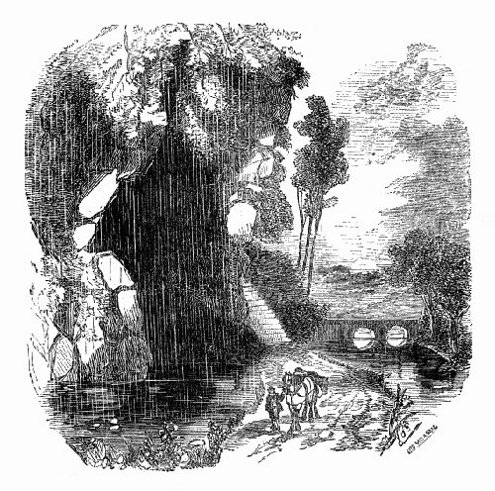
Every spring does not possess the petrifying properties of that of
Knaresborough; but there are, doubtless, many dropping-wells distributed
over the earth's crust; and some of these are well known to
possess the property of petrifying various objects submitted to the action
of their waters. For example: we have seen birds' nests, with the eggs,
and delicate sprigs of moss surrounding them, and even the fibres of
wool turned into stone, aye, and delicate flowers. Whence is this extraordinary
power? From the soil over which the waters flow! The limpid
streams absorb the silicious particles, and deposit them in the intimate
structure of the materials submitted to the action of the waters; and
thus we find the materials of which the earth's crust is composed, always
undergoing a change.
Twenty gallons are poured forth every minute from the top of the
Knaresborough cliff, and the beauty of the scene can only be appreciated
by those who have stood upon the margin of those "stony waters" and
beheld the crystal fluid descend from above with metallic fall.
CHINESE IVORY BALLS.
Nothing can afford a greater proof of the patience and perseverance, as
well as of the taste of a Chinese handicraftsman, than one of these elegant
baubles, each ball being exquisitely carved, and no two alike in pattern.
Each of the balls rolls freely within that which encloses it, and is visible
through apertures; so that however many there be, the beauties of each
can be examined, and the number of the whole counted. Much time is
spent upon the carving of these toys, for the cleverest artist will employ a
whole month in the execution of each separate ball; consequently the
labour of two years is not unfrequently bestowed on the production of
a single toy, which is formed out of a solid globe of ivory, and has no
junction in any part. The outside of this globe is first carved in some
very open pattern, and is then carefully cut with a sharp, fine instrument,
through the openings, till a complete coating is detached from the
solid part inside, as the peel of an orange might be loosened with a scoop
from the fruit, without being taken off. One hollow ball is thus formed,
with a solid one inside of it. The surface of the inner ball is then carved
through the interstices of the outer one, and when finished, is subjected
to the same operation as the first; and thus a second hollow ball is produced,
still with a solid one of smaller dimensions inside. This process
is repeated again and again, the difficulties increasing as the work proceeds,
till at length only a small ball, of the size of a marble, is left in
the centre, which is also ornamented with figures cut upon it, and then
the ingenious but useless bauble is complete. This process is said to be
performed under water.
CREDULITY OF THE ANCIENTS.
The credulity of even the learned men in the early ages may be judged
of by the following facts:—
Marcus Varro writeth, that there was a town in Spain undermined
with rabbits; another likewise in Thessaly by moles or molewharps. In
Africa the people were compelled by locusts to leave their habitations;
and out of Gyaros, an island, one of the Cyclades, the islanders were
forced by rats and mice to fly away; moreover in Italy the city of
Amyclæ was destroyed by serpents. In Ethiopia there is a great country
lies waste and desert, by reason it was formerly dispeopled by
scorpions; and if it be true that Theophrastus reporteth, the Treriens
were chased away by certain worms called scolopendres. Annius
writes, that an ancient city situate near the Volscian Lake, and
called Contenebra, was in times past overthrown by pismires,
and that the place is thereupon vulgarly called to this day, the Camp of
Ants. In Media, saith Diodorus Siculus, there was such an infinite
number of sparrows that eat up and devoured the seed which was cast
into the ground, so that men were constrained to depart from their old
habitations, and remove to other places.
CLOCK PRESENTED TO CHARLEMAGNE.
The French historians describe a clock sent to Charlemagne in the
year 807, by the famous eastern caliph, Haroun al Raschid, which was
evidently furnished with some kind of wheelwork, although the moving
power appears to have been produced by the fall of water. This clock
was a rather wonderful affair, and excited a great deal of attention at
the French court. In the dial of it were twelve small doors forming the
divisions for the hours, each door opened at the hour marked by the
index, and let out small brass balls, which, falling on a bell, struck the
hours—a great novelty at that time. The doors continued open until the
hour of twelve, when twelve figures representing knights on horseback
came out and paraded round the dial plate.
REMARKABLE EVENTS, INVENTIONS, &c.
Memnon, the Egyptian, invents the letters, in the year 1822, before
Christ.
The Alexandrian library, consisting of 400,000 valuable books, burnt
by accident, B. C. 52.
Silk first brought from India, 274: the manufactory of it introduced
into Europe by some monks, 551: first worn by the clergy in England,
in 1534.
Glass invented in England by Benalt, a monk, A. C. 400.
The University of Cambridge founded A. C. 915.
Paper made of cotton rags was in use, 1000; that of linen rags in
1170: the manufactory introduced into England, at Dartford, 1588.
Musical notes invented, 1070.
Justices of the Peace first appointed in England in 1076.
Doomsday-book began to be compiled by order of William, from a
survey of all the estates in England (and finished in 1086), 1080.
Glass windows began to be used in private houses in England in 1186.
Surnames now began to be used, first among the nobility, in 1200.
The houses of London and other cities in England, France, and Germany,
still thatched with straw in 1233.
Tallow candles so great a luxury, that splinters of wood were used
for lights, 1298.
Wine sold by apothecaries as a cordial, 1298.
Gunpowder and guns first invented by Swartz, a monk of Cologn,
1340; Edward 3rd had four pieces of cannon, which contributed to gain
him the battle of Cressy, 1346; bombs and mortars were invented in
the same year.
Cards invented in France for the king's amusement in 1391.
Windsor Castle built by Edward 3rd, 1386.
Guildhall, London, built 1410.
About 1430, Laurentius, of Haarlem, invented the art of Printing,
which he practised with separate wooden types. Guttenburg afterwards
invented cut metal types: but the art was carried to perfection by Peter
Schoeffer, who invented the mode of casting the types in matrices. Frederick
Corsellis began to print at Oxford, in 1468, with wooden types;
but it was William Caxton who introduced into England the art of printing
with fusile types, in 1474.
Shillings first coined in England, 1505.
Silk stockings first worn by the French King, 1543; first worn in England
by Queen Elizabeth in 1561.
Tobacco first brought from Virginia into England, 1583.
Watches first brought into England from Germany, in 1597.
Regular Posts established from London to Scotland, Ireland, &c., 1635.
The Plague rages in London, and carries off 68,000 persons, 1665.
The great fire of London began, September 2nd, and continued three
days, in which were destroyed 13,000 houses, and 400 streets, 1666.
Tea first used in England, 1666.
The Habeas Corpus act passed, 1678.
William Penn, a Quaker, receives a charter for planting Pennsylvania,
1680.
Bank of England established by King William 1693.
The first public Lottery was drawn same year.
The first British Parliament, 1707.
The Cathedral Church of St. Paul, London, rebuilt by Sir Christopher
Wren, in 37 years, at one million expense, by a duty on coals, 1710.
Westminster Bridge, consisting of 15 arches, begun 1738, finished
in 1750, at the expense of 389,000l., defrayed by parliament.
Commodore Anson returns from his voyage round the world, 1774.
The British Museum erected at Montagu House, 1753.
149 Englishmen are confined in the black-hole at Calcutta, in the
East Indies, by order of the Nabob, and 123 found dead next morning,
1755.
LEGENDS AMONG SAVAGE NATIONS.
It is curious to note how savages endeavour to account for the prodigies
of nature. In the island of Samoa, one of the Sandwich group,
there is the following legend.
Mafuie is their god of earthquakes, who was deemed to possess great
power, but has, according to the Samoans, lost much of it. The way in
which they say this occurred is as follows:—One Talago, who possessed a
charm capable of causing the earth to divide, coming to a well-known
spot, cried, "Rock, divide! I am Talago; come to work!" The earth
separating at his command, he went down to cultivate his taro patch.
His son, whose name was Tiitii, became acquainted with the charm, and
watching his father, saw him descend, and the earth close after him.
At the same spot, Tiitii said, "Rock, divide! I am Talago; come to
work!" The rock did not open, but on repeating the words and stamping
his foot violently, the earth separated, and he descended. Being a
young man, he made a great noise and bustle, notwithstanding the
advice of his father to be quiet, lest Mafuie would hear him. The son
then asked, "Who is Mafuie, that I should be afraid of him?" Observing
smoke at a distance, he inquired the cause of it. Talago said,
"It is Mafuie heating his oven." Tiitii determined to go and see, notwithstanding
all the persuasions of his father, and met Mafuie, who
inquired who he was, "Are you a planter of taro, a builder, or a
twister of ropes?" "I am a twister of ropes," said Tiitii; "give me your
arm, and I shall show you." So, taking the arm of Mafuie, he twisted
it off in a moment. Such a practical illustration of his powers soon
made Mafuie cry out, "Na fia ola, na fia ola!"—I desire to live, I
desire to live! Tiitii then took pity upon him, and let him go. The
natives, on feeling an earthquake, exclaim, "Thanks that Mafuie has
but one arm! if he had two, he would shake the earth to pieces."
ORIGIN OF THE WORD LADY.
It was the custom at the time of the Plantagenets, and previously, for
ladies of distinction and wealth regularly to distribute money or food to
the poor. The title of lady, is derived from the Anglo-Saxon, and
literally signifies giver of bread. The purse, with similar meaning, was
named as a receptacle for alms, and not as an invention for the preservation
of money.
ANECDOTES IN SERMONS.
The fashion which once prevailed of introducing historical anecdotes
into addresses from the pulpit, is illustrated by the following extract
from a sermon by the Martyr Bishop Ridley:—
Cambyses was a great emperor, such another as our master is; he
had many lord-deputies, lord-presidents, and lieutenants under him.
It is a great while ago since I read the history. It chanced he had
under him, in one of his dominions, a briber, a gift-taker, a gratifier of
rich men; he followed gifts as fast as he that followed the pudding, a
hand-maker in his office, to make his son a great man; as the old saying
is, "Happy is the child whose father goeth to the devil." The cry of
the poor widow came to the emperor's ear, and caused him to flay the
judge quick, and laid his skin in his chair of judgment, that all judges
that should give judgment afterward should sit in the same skin.
Surely it was a goodly sign, a goodly monument, the sign of the judge's
skin: I pray God we may once see the sign of the skin in England.
STATE OF LONDON IN 1756.
The state of the police regulations in the metropolis at the above date,
is exhibited in the following extract from an old magazine:—
"At one o'clock this morning (Oct. 4, 1756), the Hon. Captain Brudenel
was stopped in his chair, just as it entered Berkeley-square, from the
Hay-hill, by two fellows with pistols, who demanded his money; he gave
them five-sixpences, telling them he had no more, which having taken,
they immediately made off. The captain then put his purse and watch
under the cushion, got out, drew his sword, and being followed by one
of the chairmen with his pole, and the watchman, pursued them up the
hill, where the Hon. Captain West, who was walking, having joined
them, one of the fellows having got off, they followed the other into
Albemarle-mews, where finding himself closely beset, he drew a pistol,
and presented it, upon which the captain made a lunge at him, and ran
him through the body. The fellow at the same time fired his pistol,
which, the captain being still stooping, went over his head and shot the
watchman through the lungs; at the instant the pistol was discharged,
while the fellow's arm was extended, the chairman struck it with his pole
and broke it; he was then seized and carried with the watchman to the
round-house in Dover-street, where Mr. Bromfield and Mr. Gataker, two
eminent surgeons, came; but the captain would not suffer the villain to
be dressed, till he discovered who he and his confederates were; when he
acknowledged they were both grenadiers in Lord Howe's company. The
poor watchman died in half an hour after he was shot; and the soldier
was so disabled by his wound that he was carried in a chair to Justice
Fielding, who sent him to New Prison, where he died."
FROM A HANDBILL OF BARTHOLOMEW FAIR IN 1700.
The following extract is worth notice, inasmuch as it shows that in the
matter of amusement, the tastes of the lower orders of the present day
are not much improved since the last century:—
"You will see a wonderful girl of ten years of age, who walks backwards
up the sloping rope driving a wheelbarrow behind her; also you
will see the great Italian Master, who not only passes all that has yet
been seen upon the low rope, but he dances without a pole upon the
head of a mast as high as the booth will permit, and afterwards stands
upon his head on the same. You will be also entertained with the merry
conceits of an Italian scaramouch, who dances on the rope with two
children and a dog in a wheelbarrow, and a duck on his head."
PASSAGE THROUGH THE ISTHMUS OF PANAMA SUGGESTED THREE
HUNDRED TEARS AGO.
Ancient Globe.—In the Town Library (Stadt Bibliothek) of Nuremberg
is preserved an interesting globe made by John Schoner, professor
of mathematics in the Gymnasium there, A.D. 1520. It is very remarkable
that the passage through the Isthmus of Panama, so much
sought after in later times, is, on this old globe, carefully delineated.
HEIGHT OF MOUNTAINS.
The perpendicular height of Snowdon is, by late admeasurements,
1,190 yards above the level of the sea. This makes it, according to
Pennant, 240 yards higher than Cader Idris. Some state Whernside, in
Yorkshire to be the highest mountain in South Britain, and more than
4,000 feet. Helvellyn is 3,324 feet, Ben Lomond 3,262. Mont Blanc
rises 15,680 feet; the American Chimborazo is 20,909 feet, the highest
ground ever trodden by man; and the mountains of Thibet above 25,000
feet, the highest at present known.
INTRODUCTION OF THE WEEPING WILLOW INTO ENGLAND.
The Salix Babylonica, that is the Willow of Babylon, or our English
weeping Willow, is a native of the Levant, the coast of Persia, and
other places in the East. The manner of its introduction into England
is curious; the account is as follows: Pope, the celebrated poet, having
received a present of Turkey figs, observed a twig of the basket, in which
they were packed, putting out a shoot. The twig he planted in his garden:
it soon became a fine tree, and from this stock, all our weeping
Willows have descended. This species of Willow is generally planted
by a still pool, to which it is a beautiful appropriate ornament; and
when in misty weather, drops of water are seen distilling from the extremities
of its branches, nothing can be more descriptive than the title
it has obtained of the weeping Willow.
FINE FOR INSULTING A KING.
The use of gold and silver was not unknown to the Welsh in 842,
when their laws were collected. The man who dared to insult the King
of Aberfraw, was to pay (besides certain cows and a silver rod) a cup,
which would hold as much wine as his majesty could swallow at a
draught; its cover was to be as broad as the king's face; and the whole
as thick as a goose's egg, or a ploughman's thumb-nail.
CARRONADES.
This species of great gun, so much used on board of ships, is generally
accounted a modern invention, taking its name from the Carron
foundry where they were made. In the patent office, however, will be
found a notice dated September, 1727, to the following effect: "That
his Majesty was pleased to grant to Henry Brown, Esquire, a patent for
the sole use and benefit of his new invention of making cannon and
great guns, both in iron and brass, which will be much shorter and
lighter, and with less powder will carry farther than those of equal bore
now in use, and which, it is said, will save great expense to the public."
EXTRAVAGANCE AT ELECTIONS.
On the death of Sir James Lowther, his son William stood for the shire
of Cumberland, and entertained 3,650 gentlemen freeholders at a dinner,
at which were consumed 768 gallons of wine, 1,454 gallons of ale, and
5,814 bottles of punch. Sir James appears to have been eccentric in some
of his habits, for after his decease £30,000 in bank notes were discovered
in a closet, and £10,000 in the sleeve of an old coat.
MARTIN LUTHER'S TANKARD.
This interesting relic of the great Reformer is of ivory, very richly
carved, and mounted in silver gilt. There are six medallions on its
surface, which consist, however, of a repetition of two subjects. The
upper one represents the agony in the garden, and the Saviour praying
that the cup might pass from Him; the base represents the Lord's
Supper, the centre dish being the incarnation of the bread. This tankard,
now in the possession of Lord Londesborough, was formerly in the
collection of Elkington of Birmingham, who had some copies of it
made. On the lid, in old characters, is the following inscription—"C.
M. L., MDXXIIII." This drinking vessel, which, independent of its
artistic merit, was no doubt highly valued as a mere household possession,
brings to mind many recollections of the life of him who raised
himself from a very lowly position to one of great power and usefulness.
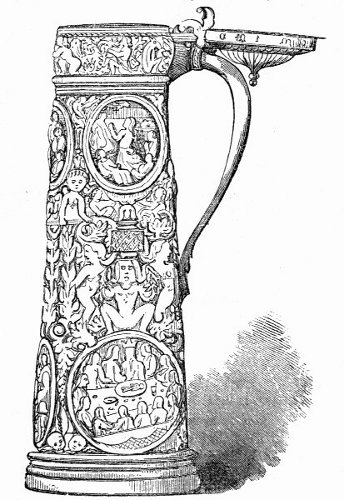
Martin Luther, who was the son of John Lotter or Lauther (which
name our Reformer afterwards changed to Luther) and Margaret Lindenen,
was born in the little town of Islebern, in Saxony, on November
10th, 1483. His father was a miner. Luther died in 1546, and
princes, earls, nobles, and students without number, attended the funeral
of the miner's son in the church of Islebern. On this occasion,
Melancthon delivered the funeral oration.
HOT CROSS BUNS.
How strange the following reads from an old journal! and how odd the
state of things to give rise to such an intimation!
1793.
Wednesday, 27th March.
ROYAL BUN HOUSE, CHELSEA, GOOD FRIDAY.
No Cross Buns.
Mrs. Hand respectfully informs her friends, and the public, that in
consequence of the great concourse of people which assembled before
her house at a very early hour, on the morning of Good Friday; by
which her neighbours (with whom she has always lived in friendship and
repute,) have been much alarmed and annoyed; it having also been
intimated, that to encourage or countenance a tumultuous assembly at this
particular period, might be attended with consequences more serious
than have hitherto been apprehended; desirous, therefore, of testifying
her regard and obedience to those laws by which she is happily protected,
she is determined, though much to her loss, not to sell Cross Buns on
that day, to any person whatever; but Chelsea Buns as usual.
Mrs. Hand would be wanting in gratitude to a generous public, who,
for more than fifty years past, have so warmly patronized and encouraged
her shop, to omit so favourable an opportunity of offering her sincere
acknowledgments for their favours; at the same time, to assure them
she will, to the utmost of her power, endeavour to merit a continuance
of them.
LOCUSTS.
The locusts are remarkable for the hieroglyphic that they bear upon
the forehead. Their colour is green throughout the whole body, excepting
a little yellow rim that surrounds their head, and which is lost at
the eyes. This insect has two upper wings, pretty solid. They are green,
like the rest of the body, except that there is in each a little white spot.
The locust keeps them extended like great sails of a ship going before
the wind. It has besides two other wings underneath the former, and
which resemble a light transparent stuff pretty much like a cobweb, and
which it makes use of in the manner of smack sails, that are along a
vessel. But when the locust reposes herself, she does like a vessel that
lies at anchor; for she keeps the second sails furled under the others.
QUEEN ELIZABETH'S LAWS.
The following extract from a very old book is truly curious:—
"Queene Elizabeth, in the xiiii and xviii yeres of hir gracious rayne,
two Actes were made for ydle vagrante and maisterlesse persons, that
vsed to loyter, and would not worke, should for the first offence haue a
hole burned through the gristle of one of his eares of an ynch compasse.
And for the second offence committed therein, to be hanged. If these
and such lyke lawes were executed iustlye, treulye, and severelye (as they
ought to be,) without any respect of persons, favour, or friendshippe, this
dung and filth of ydlenesse woulde easily be reiected and cast oute of
thys Commonwealth, there woulde not be so many loytering ydle persons,
so many Ruffians, Blasphemers, Swinge-Buckelers, so many
Drunkards, Tossepottes, Dauncers, Fydlers, and Minstrels, Dice-players,
and Maskers, Fencers, Theeves, Enterlude-players, Cut-purses,
Cosiners, Maisterlesse Seruantes, Jugglers, Roges, sturdye
Beggars, counterfaite Egyptians, &c., as there are, nor yet so manye
Plagues to bee amongst vs as there are, if these Dunghilles and filthe in
Commonweales were remooued, looked into, and cleane caste oute, by
the industrie, payne, and trauell of those that are sette in authoritie,
and haue gouernment."—"A Treatise against Dicing, Dauncing, Vaine
playes or Enterluds." Black Letter; no date.
THE INVENTION OF TYPES.
The honour of the invention of movable types has been disputed by
two cities, Haarlem and Mentz. The claims of Haarlem rest chiefly
upon a statement of Hadrien Junius, who gave it upon the testimony of
Cornelius, alleged to be a servant of Lawrence Coster, for whom the invention
is claimed. The claims of Mentz, which appear to be more conclusive,
are in favour of Peter Schæffer, the assistant and son-in-law of
John Faust, better known as Dr. Faustus. The first edition of the
Speculum humanæ salvationis was printed by Coster at Haarlem, about
the year 1440, and is one of the earliest productions of the press of which
the printer is known. The celebrated Bible, commonly known as the
Mentz Bible, without date, is the first important specimen of printing
with moveable metal types. This was executed by Gutenberg and Faust,
or Fust, as it is sometimes spelt, between the years 1450 and 1455.
The secret of the method then becoming known, presses were speedily
established in all parts of Europe, so that before the year 1500 there
were printing-offices in upwards of 220 different places in Austria,
Bavaria, Bohemia, Calabria, the Cremonese, Denmark, England, Flanders,
France, Franconia, Frioul, Geneva, Genoa, Germany, Holland, Hungary,
Italy, Lombardy, Mecklenburg, Moravia, Naples, the Palatinate, Piedmont,
Poland, Portugal, Rome, Sardinia, Upper and Lower Saxony,
Sicily, Silesia, Spain, Suabia, Switzerland, Thessalonica, Turkey, Tuscany,
the Tyrol, Venice, Verona, Westphalia, Wurtemberg, &c.
This vast and rapid extension of the art, combined with the skill
which the earlier printers displayed in it, seems to be totally incompatible
with the date assigned to the invention, and it is more than probable,
that the art having been long practised in private under continued attempts
at secrecy, it at length broke into publicity after it had already
attained a considerable degree of perfection.
THE PROTEUS ANGUINUS.
It has been satisfactorily proved that the polypus cannot see its prey,
but is only aware of its presence by the actual agitation of the water,
from its remaining altogether passive when a thin piece of glass is interposed
between them. There are many Monads, which, without possessing
any trace of an eye, are yet susceptible of light. An equally
extraordinary phenomenon presents itself in the Proteus Anguinus.
This singular animal is found in the subterranean lakes of the interminable
stalactital caverns in the limestone range of the Carniolan
Alps, where the author saw it. In appearance it is between a fish and
a lizard; it is of a flesh-colour, and its respiratory organs, which are
connected with lungs, so as to enable it to breathe above or below the
water, form a red crest round the throat, like a cock's comb. It has no
eyes, but small points in the place of them, and light is so obnoxious to
it, that it uses every effort to exclude it, by thrusting its head under
stones. It is reported also to exist in Sicily, but is known nowhere else.
BUMPER.
The jolly toper is so fond of the thing we call a bumper, that he
troubles not himself about the name, and so long as the liquor is but
fine and clear, cares not a farthing in how deep an obscurity the etymology
is involved. The sober antiquarian, on the contrary, being
prone to etymology, contemplates the sparkling contents of a full glass
with much less delight than he does the meaning, the occasion, and the
original of the name.
The common opinion is, that
the bumper took its name from the grace-cup; our
Roman Catholic ancestors, say they, after their
meals, always drinking the Pope's health in this
form, au bon Pere. But there are great objections
to this; the Pope was not the bon Pere, but the
Saint Pere; amongst the elder inhabitants of this
kingdom, the attribute of sanctity being in a manner
appropriated to the Pope of Rome, and his see.
Again, the grace-cup, which went round of course,
after every repast, did not imply anything extraordinary,
or a full glass. Drinking-glasses were not
in use at the time here supposed, for the grace-cup
was a large vessel, proportioned to the number of
the society, which went round the table, the guests
drinking out of one cup, one after another.
COFFEE.
From a number of the "Public Advertiser," of May 19 to May 26,
1657, we have 'In Bartholomew-lane, on the back side of the Old
Exchange, the drink called Coffee is advertised as to be sold in the
morning, and at three of the clock in the afternoon.'
QUAINT RECEIPTS.
The following Receipts are taken from a work entitled, "New
Curiosities in Art and Nature, or a Collection of the most valuable
Secrets in all Arts and Sciences. Composed and Experimented by Sieur
Lemery, Apothecary to the French King. London: John King, Little
Britain. 1711."
To make one Wake or Sleep.—You must cut off dexterously the head
of a toad alive, and at once, and let it dry, in observing that one eye be
shut, and the other open; that which is found open makes one wake,
and that shut causes sleep, by carrying it about one.
Preservative against the Plague.—Take three or four great toads,
seven or eight spiders, and as many scorpions, put them into a pot well
stopp'd, and let them lye some time; then add virgin-wax, make a
good fire till all become a liquor, then mingle them all with a spatula,
and make an ointment, and put it into a silver box well stopp'd, the
which carry about you, being well assured that while you carry it about
you, you will never be infected with the plague.
We give the above as indicating the delusions which prevailed with
respect to certain nostrums as late as the year 1711.
EXECUTION OF GOVERNOR WALL IN 1802.
As the following account, by a gentleman who witnessed the scene,
avoids all disgusting details, we give it as containing a description of
some of the circumstances which attended the execution, at the commencement
of the present century, of a criminal of the higher class. The
wretched man was hung for murder and barbarity: his victims were the
men he had under his charge as Governor of the Island of Goree:—
"As we crossed the Press-yard, a cock crew; and the solitary clanking
of a restless chain was dreadfully horrible.
"The prisoner entered. He was death's counterfeit, tall, shrivelled, and
pale; and his soul shot so piercingly through the port-holes of his head
that the first glance of him nearly petrified me. I said in my heart,
putting my pencil in my pocket, God forbid that I should disturb thy
last moments! His hands were clasped, and he was truly penitent.
After the yeoman had requested him to stand up, 'he pinioned him,' as
the Newgate phrase is, and tied the cord with so little feeling that the
governor, who had not given the wretch the accustomed fee, observed 'You
have tied me very tight;' upon which Dr. Ford, the chaplain, ordered
him to slacken the cord, which he did, but not without muttering,
'Thank you, sir,' said the governor to the doctor: 'it is of little moment.'
He then observed to the attendant, who had brought in an immense iron
shovel-full of coals to throw on the fire, 'Ay, in one hour that will be a
blazing fire,' then turning to the doctor, questioned him: 'Do tell me,
sir: I am informed I shall go down with great force; is it so?' After
the construction and action of the machine had been explained, the
doctor questioned the governor as to what kind of men he had at Goree:—'Sir,'
he answered, 'they sent me the very riff-raff.' The poor
soul then joined the doctor in prayer; and never did I witness more
contrition at any condemned sermon than he then evinced.
"The sheriff arrived, attended by his officers, to receive the prisoner
from the keeper. A new hat was then partly flattened on his head, for
owing to its being too small in the crown, it stood many inches too high
behind. As we were crossing the Press Yard, the dreadful execrations
of some of the felons so shook his frame that he observed, the clock had
struck; and quickening his pace, he soon arrived at the room where the
sheriff was to give a receipt for his body, according to the usual custom.
Owing, however, to some informality in the wording of this receipt, he
was not brought out as soon as the multitude expected; and it was this
delay which occasioned a partial exultation from those who betted as to
a reprieve, and not from any pleasure in seeing him executed.
"After the execution, as soon as I was permitted to leave the prison, I
found the Yeoman selling the rope with which the malefactor had been
suspended, at a shilling an inch; and no sooner had I entered Newgate-street,
than a lath of a fellow, passed threescore years and ten, who had
just arrived from the purlieus of Black Boy Alley, woe-begone as Romeo's
apothecary, exclaimed, 'Here is the identical rope at sixpence an inch.'"
STAGE-COACH IN 1760.
Ayscough's Nottingham Courant of this date, contained the following
advertisement:—The flying machines on steel springs set off from the
Swan with Two Necks Inn, Lad-lane, London, and from the Angel Inn
in Sheffield, every Monday and Thursday morning at five o'clock, and
lies the first night from London at the Angel Inn in Northampton, the
second at the Blackmoor's Head Inn, Nottingham, and the third at
Sheffield. Each passenger to pay 1l. 17s., and to be allowed fourteen
pounds of luggage. Performed (if God permit) by John Hanforth and
Samuel Glanville.
BLIND WORKMAN.
A young man, in Greenock, of the name of Kid, who was blind
from his infancy, finished the model of a sixty-four gun ship,
of about five feet keel, planked from the keel, with carriages for the guns,
and every necessary material and apparelling of a ship of that rate, without
any assistance whatever, or other instrument than a small knife and
hammer.
SPORTS OF THE LOWER CLASSES IN 1749.
The following handbill is curious, on account of the light it sheds on
what was considered attractive to the million a hundred years ago:—
"According to Law. September 22, 1749. On Wednesday next, the
27th inst., will be run for by Asses (!!) in Tothill Fields, a purse of
gold, not exceeding the value of Fifty Pounds. The first will be entitled
to the gold; the second to two pads; the third to thirteen pence half-penny;
the last to a halter fit for the neck of any ass in Europe. Each
ass must be subject to the following articles:—
"No person will be allowed to run but Taylors and Chimney-sweepers;
the former to have a cabbage-leaf fixed in his hat, the latter a plumage
of white feathers; the one to use nothing but his yard-wand, and the
other a brush.
"No jockey-tricks will be allowed upon any consideration.
"No one to strike an ass but the rider, lest he thereby cause a retrograde
motion, under a penalty of being ducked three times in the river.
"No ass will be allowed to start above thirty years old, or under ten
months, nor any that has won above the value of fifty pounds.
"No ass to run that has been six months in training, particularly
above stairs, lest the same accident happen to it that did to one nigh a
town ten miles from London, and that for reasons well known to that
place.
"Each ass to pay sixpence entrance, three farthings of which
are to be given to the old clerk of the race, for his due care and
attendance.
"Every ass to carry weight for inches, if thought proper."
Then follow a variety of sports, with "an ordinary of proper victuals,
particularly for the riders, if desired."
"Run, lads, run! there's rare sport in Tothill Fields!"
STATE COACH AT THE PROROGATION OF PARLIAMENT IN 1796.
Never was a greater assemblage of persons collected together than on
this occasion: in the Park and in Parliament-street there were at least 20,000
people. By the repair of the state coach, which has undergone several
material alterations since the damage it received at the opening of the
last session, the king is now secluded from the sight. Hitherto, the
upper pannels of it had always been of glass, so that the multitude could
see the king in all directions, through the front, through the sides, as
well as through the windows in the doors: it has been newly glazed,
and the whole of the carriage is lined with sheet copper, musket proof;
between the crimson lining of the carriage is a wadding of fine wool,
coated with buffalo skin, the nature of which is so close that no bullets
can penetrate it.
HISTORICAL ANECDOTE.
On the dollars, stivers, &c., coined at the town of Dordrecht in Holland,
is the figure of a milk-maid sitting under her cow, which figure is also exhibited
in relievo on the water-gate of the place. The occasion was as
follows: In the noble struggle of the United Provinces for their liberties,
the Spaniards detached a body of forces from the main army, with the
view of surprising Dordrecht. Certain milkmaids, belonging to a rich
farmer in the vicinity of the town, perceived as they were going to milk,
some soldiers concealed under the hedges. They had the presence of
mind to pursue their occupation without any symptoms of alarm. On
their return home they informed their master of what they had seen, who
gave information to the Burgomaster, and the sluices were let loose, by
which great numbers of the Spaniards were drowned, and the expedition
defeated. The States ordered the farmer a handsome revenue for the loss
he sustained by the overflowing of his lands, rewarded the women, and
perpetuated the event in the manner described.
TOMB OF JOHN BUNYAN.
"Who has not read the "Pilgrim's Progress," "that wonderful book,"
writes Mr. Macaulay, "which, while it obtains admiration from the most
fastidious critics, is loved by those who are too simple to admire it?"
We can remember our own delight on reading, for the first time, the precious
volume. This was in the days of our childhood, when we were
deeply imbued with the fairy lore which at that time was so plentifully
supplied, and so eagerly devoured.
John Bunyan was buried in Bunhill Fields burying-ground, City-road;
and the tablet on his tomb, which the engraving very correctly represents
is as follows:—"Mr. John Bunyan, author of the 'Pilgrim's
Progress,' ob. 12 Aust. 1688, æt. 60." Formerly there were also the following
lines:—
"The Pilgrim's Progress now is finished.
And death has laid him in his earthly bed."
Bunhill Fields burying-ground was opened as a suburban cemetery in
1665, in the time of the great plague, and was a favourite burying-place
with the Dissenters. Here are buried Daniel Defoe; Dr. Isaac Watts;
Joseph Ritson the antiquary; Dr. Thomas Goodwin, the chaplain who attended
Cromwell's death-bed; George Fox, the founder of the Quakers;
the mother of John Wesley; Lieut.-General Fleetwood, son-in-law of
Oliver Cromwell; Thomas Stothard, R.A., and other eminent men.
SPIDERS FOND OF MUSIC.
Spiders hear with great acuteness, and it is affirmed that they are
attracted by music. Disjonval relates the instance of a spider which
used to place itself on the ceiling of a room over the spot where
a lady played the harp, and which followed her if she removed to
another part; and he also says that the celebrated violinist Berthome,
when a boy, saw a spider habitually approach him as soon as he began
to play, and which eventually became so familiar that it would fix itself
on his desk, and on his arm. Bettina noticed the same effect with a
guitar, on a spider which accidentally crossed over it as she was playing.
BREAKFASTING HUT IN 1745.
This quaint announcement, in a handbill of the time, shows how cheaply
those who lived a century or so past could enjoy suburban pleasures in
merrie Islington:—
"This is to give notice to all Ladies and Gentlemen, at Spencer's
original Breakfasting-Hut, between Sir Hugh Middleton's Head and St.
John Street Road, by the New River side, fronting Sadler's Wells, may
be had every morning, except Sundays, fine tea, sugar, bread, butter,
and milk, at fourpence per head; coffee at threepence a dish. And in
the afternoon, tea, sugar, and milk, at threepence per head, with good
attendance. Coaches may come up to the farthest garden-door next to
the bridge in St. John Street Road, near Sadler's Wells back gate.—Note.
Ladies, &c., are desired to take notice that there is another person
set up in opposition to me, the next door, which is a brick-house, and
faces the little gate by the Sir Hugh Middleton's, and therefore mistaken
for mine; but mine is the little boarded place by the river side, and my
backdoor faces the same as usual; for
I am not dead, I am not gone,
Nor liquors do I sell;
But, as at first, I still go on,
Ladies, to use you well.
No passage to my hut I have,
The river runs before;
Therefore your care I humbly crave,
Pray don't mistake my door.
"Yours to serve,
S. Spencer."
SPONTANEOUS COMBUSTION.
In Leroux's Journal de Medicine, is an account of a very fat woman,
twenty-eight years of age, who was found on fire in her chamber, where
nothing else was burning. The neighbours heard a noise of something
like frying, and when the body was removed it left a layer of black
grease. The doctor conceives that the combustion began in the internal
parts, and that the clothes were burnt secondarily.
MOTHER MAPP THE BONE-SETTER.
She was the daughter of a man named Wallis, a bone-setter at Hindon,
in Wiltshire, and sister to the celebrated "Polly Peachem," who
married the Duke of Bolton. Upon some family quarrel, Sally Wallis
left her professional parent, and wandered up and down the country in a
miserable manner, calling herself "Crazy Sally," and pursuing, in her
perambulations, a course that fairly justified the title. Arriving at last at
Epsom, she succeeded in humbugging the worthy bumkins of that place,
so decidedly, that a subscription was set on foot to keep her among them;
but her fame extending to the metropolis, the dupes of London, a numerous
class then as well as now, thought it no trouble to go ten miles to
see the conjuror, till at length, she was pleased to bless the afflicted of
London with her presence, and once a week drove to the Grecian Coffee-house,
in a coach and six with out-riders! and all the appearance of
nobility. It was in one of these journeys, passing through Kent-street,
in the Borough, that being taken for a certain woman of quality from
the Electorate in Germany, a great mob followed and bestowed on her
many bitter reproaches, till Madame, perceiving some mistake, looked out
of the window, and accosted them in this gentle manner, "Confound
you, don't you know me? I am Mrs. Mapp, the bone-setter!" upon
which, they instantly changed their revilings into loud huzzas.
TWO CERTIFICATES OF GRETNA-GREEN MARRIAGES AT DIFFERENT DATES.
"This is to sartfay all persons that my be consernid, that A B from
the parish of C in the County of D and E F from the parish of G and in
the county of H and both comes before me and declayred themseless both
to be single persons, and now mayried by the form of the Kirk of Scotland,
and agreible to the Church of England, and givine ondre my hand,
this 18th day of March 1793."
"Kingdom of Scotland
"County of Dumfries
"Parish of Gretna
"These are to certify, to all whom it may concern, that John N....
from the parish of Chatham in the County of Kent, and Rosa H....
from the Parish of St. Maries in the County of Nottingham, being both here
now present and having declared to me that they are single persons, but
have now been married conformable to the Laws of the Church of England,
and agreeable to the Kirk of Scotland. As witness our hands at
Springfield this 4th day of October 1822.
"Witness"Witness me.
Jane RaeDavid Lang.
John Ainslie."John N....
Rosa H...."
THE WOMEN OF ENGLAND.
The women here are generally more handsome than in other places,
sufficiently endowed with natural beauties, without the addition of
adulterate sophistications. In an absolute woman, say the Italians, are
required the parts of a Dutch woman, from the girdle downwards; of a
French woman, from the girdle to the shoulders: over which must be
placed an English face. As their beauties, so also their prerogatives are
greater than any nation; neither so servilely submissive as the French,
nor so jealously guarded as the Italians; but keeping so true a decorum,
that as England is termed the Pergatorie of Servants, and the Hell of
Horses, so is it acknowledged the Paradise of Women. And it is a
common by-word amongst the Italians, that if there were a bridge built
across the narrow seas, all the women in Europe would run into England.
For here they have the upper hand in the streets, the upper place at
the table, the thirds of their husband's estates, and their equal share of
all lands; privileges with which other women are not acquainted. They
were in high esteem in former times amongst foreign nations, for the modestie
and gravitie of their conversation; but of late so much addicted to
the light garb of the French, that they have lost much of their ancient
honour and reputation amongst knowing and more sober men of foreign
countries who before admired them.—Peter Heylin's Cosmographie, 1652.
PRICES FOR SEATS AT CORONATIONS.
On consulting Stowe, Speed, and other antiquaries, it appears that the
price of a good place at the coronation of William the Conqueror was a
blank; and probably the same at that of his son William Rufus. At that
of Henry I. it was a crocard, and at King Stephen's and Henry the
Second's a pillard. At King Richard's and King John's, it was a fuskin;
and rose at Henry the Third's to a dodkin. In the reign of Edward I.
the coins began to be more intelligible; and we find that for seeing his
coronation a Q was given, or the half of a ferling, or farthing, which was,
as now, the fourth part of a sterling, or penny. At the coronation of
Edward II. it was a farthing; and at that of Edward III. a halfpenny,
which was very generally given. In the reign of Richard II. it was a
penny, and continued the same at that of Henry IV. But at that of
Henry V. it was two pennies, or half of a grossus, or groat; and the same
at that of Henry VI. and of Edward IV.; nor do we find it raised at the
coronation of Richard III. or that of Henry VII.
At that of Henry VIII. it was the whole grossus, or groat, nor was
the price altered at those of Edward VI. and Queen Mary; but at Queen
Elizabeth's it was a teston, tester, or sixpence. At those of James I.
and Charles I. a shilling was given; which sum was advanced to half
a crown at the coronations of Charles and James II. At King William's
and Queen Anne's, it was a crown; and at George the First's the show
was seen by many at the same price.
At the coronation of George II. some gave half a guinea; but at that
of George III. and Queen Charlotte, anno 1761, curiosity seems to have
risen to an amazing height. On this occasion the price given for single
seats were almost incredible; in some houses ten guineas, and in ordinary
houses five guineas. Great and universal anxiety prevailed to see this
grand spectacle, from the reflection how improbable it was that many
who were there could ever have an opportunity of witnessing the like
again. As an instance of this extreme anxiety, it is confidently related,
that a gentleman was prevailed on to take a room for his lady, at the
price of one hundred and forty guineas; but the appointment of the
solemnity of the coronation falling unluckily at the exact time when she
expected to be delivered, she actually further prevailed on her husband
to let a skilful man-midwife, nurse, &c., attend her, and to hire another
room, lest the hurry of the day should bring on her labour, when it
might be impossible for her to be removed without endangering her life.
ANCIENT HOUSE AT BLACKWALL—SAID TO BE THE RESIDENCE OF
SIR WALTER RALEIGH.
The house shown in the engraving is interesting from two causes; first,
that it was the house in which Sir Walter Raleigh smoked his first pipe
of tobacco in England, and secondly, that it is one of the few relics
remaining of those picturesque old houses of the days of Queen Bess.
The house is built of strongly framed timber, which, in recent years, has
been plastered over; and the carved heads that ornament the gables, and
which are good both in design and execution, show that this house is at
least 350 years old.
At the present time a tavern has been built between this house and the
river. Formerly, however, there was, no doubt, a trimmed garden and
terrace towards the Thames, from which the inhabitants may have watched
the progress of Queen Elizabeth from the Tower to her palace at
Greenwich.
It is singular to notice the fashion of these old houses, arising from the
value of space within walled towns; each floor projects over the other, so
that the upper apartments have more room than the lower. While, in an
artistic point of view, we cannot help regretting the disappearance of the
venerable and quaint gables, for sanitary and other reasons we must be
content with the change.
AMBASSADORS—WHY HELD BY THE ARMS AT THE OTTOMAN COURT.
A dervise addressed Bajazet, emperor of the Turks, 1495, for alms,
and while the charitable Sultan searched for his money, the treacherous
beggar wounded him with a dagger, and was instantly slain by the
royal attendants. This incident is rendered memorable by its having
occasioned the ungracious restraint under which even the ambassadors
of Christian powers were subject to in former times when they received
an audience from the Ottoman Emperor.
They were held by the arms by two attendants, when they approached
the throne, nor were their arms loosed till they had quitted the presence.
TRAVELLING IN 1760.
The nobility and gentry were accustomed to make their long journeys
in ponderous family-carriages, drawn by four horses. These vehicles
would be laden at the top with an array of trunks and boxes, while
perhaps six or seven persons, with a lapdog, would be stowed within.
The danger of famine on the road was averted by a travelling larder of
baskets of various condiments; the risk of thirst would be provided
against by bottles of usquebaugh, black cherry-brandy, cinnamon-water,
sack, port, or strong beer: while the convoy would be protected by a
basket-hilted sword, an old blunderbuss, and a bag of bullets and a great
horn of gunpowder.
OLD ST. PAUL'S.
In the old cathedral was a tower of stone, in height from the ground
260 feet, on which was a spire of wood, covered with lead, 274 feet high.
In the tower was a celebrated peal of bells; and somewhat above the
stone-work was a "faire dial," from which there was order taken in the
eighteenth year of Edward III. that the rich chasing and gilding should
be always kept in good preservation. On this dial was the figure of an
angel pointing to the hours of both day and night—a device more appropriate
than most of the clock-hands in present use. From this lofty
steeple, which formed such an important feature of old London, the
chimes rung merrily on saints' days and holidays; and at times the
choristers mounted up aloft and chaunted forth their orisons at dawn
and sunset—a custom still observed at Durham Cathedral. Before the
fire of London, the spire of St. Paul's was more than once destroyed or
damaged by fire and lightning.
On Candlemas Eve, 1444, about two o'clock in the afternoon, the lightning
fired the steeple. The citizens came forth and succeeded in overcoming
the fire; it, however, broke forth again at night, and but little
of the spire was saved. In the year 1561, in the month of June, there
fell a prodigious quantity of rain, attended with thunder and lightning.
St. Paul's steeple was struck within a yard of the top. At first, a little
fire appeared, resembling the light of a torch, and in eight minutes the
weather-cock fell; and the wind rising high, the fire within an hour
afterwards destroyed the steeple down to the very battlements, and then,
in consequence of the mass of burning timber that fell from the spire,
burnt so violently that the iron-work and the bells melted and fell upon
the stairs in the church; the east and west roofs catching fire communicated
with the north and south, and destroyed them all. Much damage
was also done to other parts.
The spire was again reared, and the damaged bells properly replaced.
In addition to the bells in the tower of old St. Paul's there was a common
bell, the property of the city, hung in a suitable building, closely adjoining
to the Cathedral, which was rung that the inhabitants might
assemble at wardmotes and other important occasions. Another fire
damaged the ancient church, and then the great fire of 1666, swept
steeples, bells, churches, and all before it.
THE BEDFORD MISSAL.
In January, 1786, when the Bedford Missal was on sale, with the rest
of the Duchess of Portland's collection, King George III. sent for his
bookseller, and expressed his intention to become the purchaser. The
bookseller ventured to submit to his majesty, that the article in question,
as one highly curious, was likely to fetch a high price. "How high?"
exclaimed the king. "Probably two hundred guineas," replied the bookseller.
"Two hundred guineas for a Missal!" exclaimed the Queen,
who was present, and lifted up her hands with astonishment. "Well,
well," said his Majesty, "I'll have it still; but since the Queen thinks
two hundred guineas so enormous a price for a Missal, I'll go no further."
The biddings for the royal library did actually stop at that point; and
Mr. Edwards carried off the prize by adding three pounds more. The
same Missal was afterwards sold at Mr. Edwards's sale, in 1815, and
purchased by the Duke of Marlborough, for £637 15s.
FORMATION OF THE VOLCANO OF JORULLO.
The Mexican volcanoes of Orizaba, Popocatepetl, Jorullo, and Colima
appear to be connected with each other, being placed in the direction
of a line running transverse to the former, and passing east and west from
sea to sea.
As was first observed by Humboldt, these mountains are all situated
between north latitude 18° 59' and 19° 12'. In an exact line of direction
with the other volcanoes, and over the same transverse fissure, Jorullo
was suddenly elevated on the 29th of September, 1759. The circumstances
attending the production of this volcano are so remarkable, that
we shall here notice them in some detail.
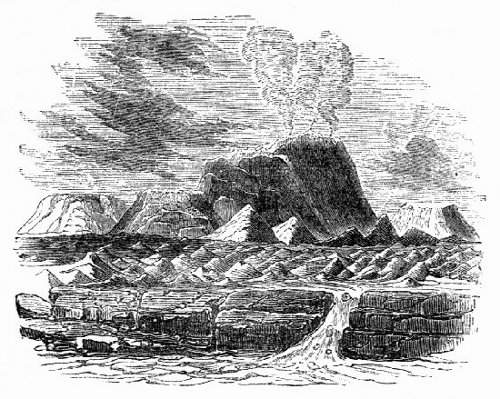
VOLCANO OF JORULLO, MEXICO.
An extensive plain, called the Malpays, was covered by rich fields of
cotton, sugar-cane, and indigo, irrigated by streams, and bounded by
basaltic mountains, the nearest active volcano being at the distance of
eighty miles. This district, situated at an elevation of about 2600 feet
above the level of the sea, was celebrated for its beauty and extreme fertility.
In June, 1759, alarming subterranean sounds were heard, and
these were accompanied, by frequent earthquakes, which were succeeded
by others for several weeks, to the great consternation of the neighbouring
inhabitants. In September tranquillity appeared to be re-established,
when, in the night of the 28th, the subterranean noise was again heard,
and part of the plain of Malpays, from three to four miles in diameter,
rose up like a mass of viscid fluid, in the shape of a bladder or dome, to a
height of nearly 1700 feet; flames issued forth, fragments of red-hot
stones were thrown to prodigious heights, and, through a thick cloud of
ashes, illumined by volcanic fire, the softened surface of the earth was
seen to swell up like an agitated sea. A huge cone, above 500 feet high,
with five smaller conical mounds, suddenly appeared, and thousands of
lesser cones (called by the natives hornitos, or ovens,) issued forth from
the upraised plain. These consisted of clay intermingled with decomposed
basalt, each cone being a fumarolle, or gaseous vent, from which
issued thick vapour. The central cone of Jorullo is still burning, and on
one side has thrown up an immense quantity of scoriaceous and basaltic
lavas, containing fragments of primitive rocks. Two streams, of the temperature
of 186° of Fahrenheit, have since burst through the argillaceous
vault of the hornitos, and now flow into the neighbouring plains. For
many years after the first eruption, the plains of Jorullo were uninhabitable
from the intense heat that prevailed.
CRATER OF VESUVIUS IN 1829.
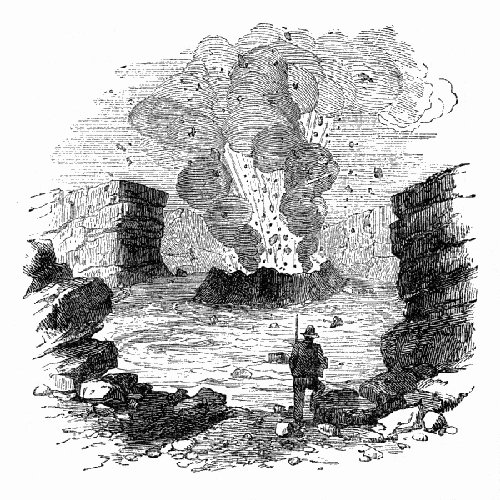
The crater Stromboli, which has been in activity since the most ancient
times, presents at present the same appearances as those which were described
by Spallanzani, in 1788. It is constantly filled with lava in a
state of fusion, which alternately rises and falls in the cavity. Having
ascended to ten or twelve yards below the summit of the walls, this boiling
fluid is covered with large bubbles, which burst with noise, letting
enormous quantities of gas escape from them, and projecting on all sides
scoriaceous matter. After these explosions, it again subsides, but only
to rise again and produce like effects—these alternations being repeated
regularly at intervals of some minutes. In craters where the lava is less
fluid than in that of Stromboli, new cones are sometimes formed in the
midst of the Crater, which first rise in the form of a dome, and then burst
out so as to form a small active volcano in the middle of the crater of the
great one. This phenomenon is often presented within the crater of
Vesuvius, and was more particularly witnessed in 1829.
LOAF SUGAR.
In 1553 a sugar-loaf was presented to Mr. Waldron, of Bovey House,
which weighed 7 lbs., at 1s. 1d. per lb. (7s. 7d.)
The late Lord Rolle married the last of that branch of the Waldron
family. The house remains about ten miles west of Lyme. The sugar-loaf
was charged at a high rate, considering the greater value of money
in Queen Mary's reign. This article began to be highly prized. The
sugar-cane, which had been grown from the year 1148 in Sicily, had
been imported into Madeira A.D. 1419. About the year 1503 the art of
refining sugar, before called "blanch powdre," was discovered by a
Venetian; before which the juice, when selected instead of honey for
sweetening, was used as it came from the cane. Only twenty-seven
years from this date, in 1526, it was imported from St. Lucar in Spain
by Bristol merchants. Let not the present of the Mayor of Lyme be
considered as a cheap article produced in abundance in the islands of the
West Indies. The sugar-cane was not imported thither into Barbadoes
from the Brazils till the year 1641. How surprising the result of
official inquiries in the year 1853 into the consumption of sugar! It
amounted to 7,523,187 cwts., or 30 lbs. each individual of the United
Kingdom.
SUSPENSION BRIDGES AT FREYBOURG.
There are two suspension bridges in Freybourg; one remarkable for its
great length, the other for its extreme beauty. The latter connects the
top of two mountains, swinging over a frightful gulf that makes one
dizzy to look down into. There are no buttresses or masonwork in sight
at a little distance; shafts are sunk in the solid rock of the mountains,
down which the wires that sustain it are dropped. There it stretches, a
mere black line, nearly three hundred feet in the heavens, from summit
to summit. It looks like a spider's web flung across a chasm; its delicate
tracery showing clear and distinct against the sky. While you are
looking at the fairy creation suspended in mid-heaven, almost expecting
the next breeze will waft it away, you see a heavy waggon driven on it;
you shrink back with horror at the rashness that could trust so frail a
structure at that dizzy height; but the air-hung cobweb sustains the
pressure, and the vehicle passes in safety. Indeed, weight steadies it;
while the wind, as it sweeps down the gulf, makes it swing under you.
The large suspension bridge is supported on four cables of iron wire, each
one composed of one thousand and fifty-six wires. As the Menai bridge
of Wales is often said to be longer than this, I give the dimensions of both
as I find them in Mr. Murray:—Freybourg: length, nine hundred and
five feet; height, one hundred and seventy-four feet; breadth, twenty
eight feet. Menai: length, five hundred and eighty feet; height, one
hundred and thirty feet; breadth, twenty-five feet. A span of nine
hundred and five feet, without any intermediate pier, seems impossible at
first, and one needs the testimony of his own eyes before he can fully
believe it.
WONDERFUL CLOCK.
Towards the end of the last century, a clock was constructed by a
Genevan mechanic named Droz, capable of performing a variety of surprising
movements, which were effected by the figures of a negro, a
shepherd, and a dog. When the clock struck, the shepherd played six
tunes on his flute, and the dog approached and fawned upon him. This
clock was exhibited to the King of Spain, who was highly delighted with
the ingenuity of the artist. The king, at the request of Droz, took an
apple from the shepherd's basket, when the dog started up and barked
so loud that the king's dog, which was in the same room, began to bark
also. We are moreover informed that the negro, on being asked what
hour it was, answered the question in French, so that he could be understood
by those present.
MANDRIN THE SMUGGLER, 1757.
Mandrin was the son of a peasant in Dauphiny who dealt in cattle.
His first employment was buying and selling horses, by which he subsisted
several years. But having on some occasion committed a murder,
he was obliged to fly from justice, and in his absence was condemned by
the Parliament of Grenoble to be broken on the wheel. Being now a
fugitive, and destitute of employment, he learned to counterfeit money,
and by this fraud made considerable gain, till, being discovered, the
officers of the Mint at Lyons issued a warrant for apprehending him, and
he was again obliged to quit the country. While he was wandering
about from place to place, and hiding himself in caves and woods, he became
acquainted with a gang of smugglers, and associating with them
was, after some time, made their captain. As this gang was very numerous,
he was less cautious of being seen, and having at length lost his
sense of fear by habitual danger, he frequently entered towns and cities,
raised contributions on the king's officers by force, and spread the same
terror among others that others had brought upon him. But in proportion
as he became more formidable he was, in fact, less secure; for the
Government found it necessary to detach after him such a force as he
could not resist, and the Farmers-General offered 48,000 livres reward
for taking him. After many times attacking his party in a running
fight, in which several were cut off, Mandrin, with eight of his men, took
shelter in a castle on the frontiers of Savoy. They were closely pursued
by several detachments, under the command of Colonel de Molière, who
entered the King of Sardinia's territory after him, without having first
obtained leave. Molière was immediately opposed by a great number of
peasants: whether they were instigated by Mandrin, or whether they
were jealous of their privilege, is not known; but all his expostulations
being fruitless, and being determined not to relinquish his prey, for whom
he hoped to receive so considerable a reward, he forced his way against
them, killing twelve and wounding many others. Mandrin waited the
issue of this contest in his castle, where he was soon besieged by 150 men,
who attacked the place with great vigour. Mandrin and his partisans
defended themselves like men who had nothing to fear in a battle equal
to being taken alive; and after several of them were killed, and the
castle gates burst open, they retreated, fighting from chamber to chamber,
and from story to story, till, reaching the garret, and being able to proceed
no further, they were at last overpowered by numbers, having killed
twenty of their adversaries, and spent all their ammunition. Mandrin,
with those that survived of his little party, were carried prisoners to
Valence in Dauphiny. * * * Mandrin was examined every day
from the 13th of May to the 25th, in order to discover his accomplices.
In the mean time several of his associates were put to the torture to discover
what they knew of him, and were afterwards broken on the wheel,
that death might give a sanction to their testimony.
He himself was subjected to torture, but without eliciting anything
further than he had previously revealed. Throughout he steadfastly refused
to betray his comrades, and conducted himself with much dignity
and heroism. On the day of his execution he received absolution from
Father Gasperini, a Jesuit, who had administered to him the consolations
of religion during his confinement.
Before he was led out of the prison, his shoes and stockings were taken
from him; but, though barefooted, he walked along with great firmness
and a good grace. When he came to the cathedral to perform the amende
honorable, he asked forgiveness of the monks and priests for his want of
respect to their order, and was then conducted to the scaffold. He
mounted with great composure, and addressed himself in a short and pathetic
exhortation to the spectators, especially the young persons of both
sexes; he then sat down on the nave of the wheel, and loosened the
buttons of his shirt-sleeves himself. Then he entreated pardon of the
custom-house officers, whom he had so often and so grossly injured; and
turning to the penitents who surrounded the scaffold—with his confessor
and two other eminent persons of his order—he earnestly recommended
himself as the object of their prayer, and immediately delivered himself
up to the executioner. He received eight blows on his arms and legs,
and one on his stomach, and was intended to have been left to expire of
the wounds; but as the executioner was going down from the scaffold, an
order came to strangle him; the bishop and all the considerable persons
at Valence having interceded for this mitigation of his punishment.
Mandrin was twenty-nine years of age, about five feet five inches high,
well made, had a long visage, blue eyes, and sandy chesnut hair; he had
something rough in his countenance, and a strong robust port; he was
perpetually smoking tobacco, with which he drank plentifully of any
liquor that was at hand, and ate till the last with a good appetite.
SUDDEN RECOVERY FROM MADNESS.
The following extraordinary account is taken from the Gentleman's
Magazine of 1784:—"About six years since, a seafaring person was
taken into the Asylum for Maniacs at York; during the space of five
years and six months he never expressed any desire for sustenance, and
was fed in the manner of an infant. The servants undressed him at
night, and dressed him in the morning; he never spoke, and remained
with his body bent all day, and was regarded by all about him as an
animal nearly converted into a vegetable. About the middle of May,
1783, he suddenly astonished the people round him with saying, 'Good
morrow to you all.' He then thanked the servants for the care they had
taken of him, and appeared perfectly sane. A few days after, he wrote a
letter to his wife, in which he expressed himself with great propriety.
On the 28th of May following he was allowed to leave the hospital, and
return to his family; and has now the command of a ship in the Baltic
trade, and is in full enjoyment of perfect health, both in mind and body.
This very singular case is attested by Dr. Hunter, F.E.S., of York, in a
letter to Dr. Percival, of Manchester, and by the servants now at the
Asylum in York."
SUMMARY OF THE BIBLE.
The following table is published, as containing accurate particulars
of the English version of the Bible:—
| In the Old Testament. |
In the New Testament. |
Total. |
| Books, |
39 |
Books, |
27 |
Books, |
66 |
| Chapters, |
929 |
Chapters, |
260 |
Chapters, |
1,189 |
| Verses, |
23,214 |
Verses, |
7,959 |
Verses, |
31,173 |
| Words, |
592,493 |
Words, |
181,253 |
Words, |
773,746 |
| Letters, |
2,728,100 |
Letters, |
838,380 |
Letters, |
3,566,480 |
The middle chapter and the shortest in the Bible is the hundred and
seventeenth Psalm; the middle verse is the eighth of the hundred and
eighteenth Psalm. The twenty-first verse of the seventh chapter of
Ezra, in the English version, has all the letters of the alphabet in it.
The nineteenth chapter of the second book of Kings and the thirty-seventh
chapter of Isaiah are alike.
THE LEPROSY.—LAZARS.—LAZAR-HOUSES.
That loathsome disorder, leprosy, was introduced into England in the
reign of Henry I., and was supposed to have been brought out of Egypt,
or perhaps the East, by means of the crusaders. To add to the horror,
it was contagious, which enhanced the charity of a provision for such
miserables, who were not only naturally shunned, but even chased by
royal edict, from the society of their fellow-creatures.
Lepers, or Lazars, were sick persons removed out of monasteries to
cells or hospitals, always built out of cities and towns. Their usual
maintainence was, from liberty allowed them to go upon every market-day,
to the market, where with a dish, called a clap dish, they would beg
corn.
Their sickness and loathsome appearance giving great disgust, many
withheld their charity, upon which account they were afterwards restrained
from begging at large, but permitted to send the proctor of the
hospital, who came with his box one day in every month to the churches,
and other religious houses, at time of service; and there received the
voluntary charity of the congregations. This custom is said to be the
origin of the present practice of collecting briefs.
The leprosy was much more common formerly, in this part of the
globe, than at present. It is said, that there were in Europe fifteen
thousand hospitals founded for them. Perhaps near half the hospitals
that were in England were built for lepers.
Lepers were so numerous in the twelfth century, that by a decree of
the Lateran Council under pope Alexander III., A.D. 1179, they were
empowered to erect churches for themselves, and to have their own ministers
to officiate in them. This shows at once how infectious and offensive
their distemper was.
And on this account, "In England where a man was a leper, and
was dwelling in a town, and would come into the churches, or among
his neighbours when they were assembled, to talk to them to their annoyance
or disturbance, a writ lay De Leproso amovendo."—What follows is
remarkable. The writ is for those lepers "who appear to the sight of all
men, they are lepers, by their voice and their sores, the putrefaction of
their flesh, and by the smell of them."
And so late as the reign of Edward VI. multitudes of lepers seem to
have been in England; for in 1 Edw. 6. c. 3. in which directions are
given for carrying the poor to the places where they were born, &c. we
read the following clause: "Provided always, that all leprous and poor
bed-red creatures may, at their liberty, remain and continue in such
houses appointed for lepers, or bed-red people, as they now be in."
1184 to 1191.—The leprosy was at this period, and long after, a cruel
epidemic in our country, possibly brought by the crusaders from the Holy
Land, and spread here by filth and bad diet. It was supposed to be
infectious, and was shunned as the plague; so that, had it not been for
these pious institutions, multitudes must have perished under this loathsome
disorder.
Among other wild fancies of the age, it was imagined that the persons
afflicted with leprosy, a disease at that time (1327, Edward II.) very
common, probably from bad diet, had conspired with the Saracens to
poison all springs and fountains; and men being glad of any pretence
to get rid of those who were a burthen to them, many of those unhappy
people were burnt alive on the chimerical imputation.
Every one of the lazar-houses had a person, called a fore-goer, who
used to beg daily for them.
THE CONDOR IN PERU.
Dr. Pickering, of the United States Antarctic Expedition of 1839, being
in the vicinity of the Andes, attempted the ascent of one of the summits;
by noon he had reached a high elevation, and looking up, he espied a huge
condor soaring down the valley. He stopped to observe the majestic
bird as it sailed slowly along. To his surprise it took a turn around
him, then a second and a third, the last time drawing so near that he
began to apprehend that it meditated an attack. He describes himself
as being in the worst possible condition for a fight, his strength being
exhausted by climbing, and his right hand having been lamed for some
days from a hurt. The nature of the ground, too, was anything but
favourable for defence; but there was nothing left but to prepare for a
fight, and with this intent he took a seat and drew his knife. At the
instant, as if intimidated by the sight of the weapon, the bird whirled
off in another direction. Dr. Pickering confessed, however humiliating
the acknowledgment, that he was at the time very well satisfied with
the condor's determination to let him alone.
COST OF SIR CHRISTOPHER WREN'S CHURCHES.
The following is an account of what the undermentioned churches cost
building, the designs for which were furnished by Sir Christopher
Wren :—
| |
£ |
s. |
d. |
| St. Paul's |
736,752 |
2 |
3¼ |
| Allhallows the Great |
5,641 |
9 |
9 |
| —— Bread-street |
3,348 |
7 |
2 |
| —— Lombard-street |
8,058 |
15 |
6 |
| St. Alban's, Wood-street |
3,165 |
0 |
8 |
| St. Anne and Agnes |
2,448 |
0 |
10 |
| St. Andrew's, Wardrobe |
7,060 |
16 |
11 |
| —— Holborn |
9,000 |
0 |
0 |
| St. Antholin's |
5,685 |
5 |
10¾ |
| St. Austin's |
3,145 |
3 |
10 |
| St. Benet, Grailchurch |
3,583 |
9 |
5¼ |
| —— Paul's Wharf |
3,328 |
18 |
10 |
| —— Fink |
4,129 |
16 |
10 |
| St. Bride's |
11,430 |
5 |
11 |
| St. Bartholomew's |
5,077 |
1 |
1 |
| Christ Church |
11,778 |
9 |
6 |
| St. Clement, Eastcheap |
4,365 |
3 |
4½ |
| —— Danes |
8,786 |
17 |
0½ |
| St. Dionis Back Church |
5,737 |
10 |
8 |
| St. Edmund the King |
5,207 |
11 |
0 |
| St. George, Botolph-lane |
4,509 |
4 |
10 |
| St. James, Garlick-hill |
5,357 |
12 |
10 |
| —— Westminster |
8,500 |
0 |
0 |
| St. Lawrence, Jewry |
11,872 |
1 |
9 |
| St. Michael, Basinghall |
2,822 |
17 |
1 |
| —— Royal |
7,455 |
7 |
9 |
| St. Michael, Queenhithe |
4,354 |
3 |
8 |
| —— Wood-street |
2,554 |
2 |
11 |
| —— Crooked-lane |
4,641 |
5 |
11 |
| —— Cornhill |
4,686 |
5 |
11 |
| St. Martin, Ludgate |
5,378 |
18 |
8 |
| St. Matthew, Friday-str |
2,301 |
8 |
2 |
| St. Margaret Pattens |
4,986 |
10 |
4 |
| —— Lothbury |
5,340 |
8 |
1 |
| St. Mary, Abchurch |
4,922 |
2 |
4½ |
| —— Magdalen |
4,291 |
12 |
9¼ |
| —— Somerset |
6,579 |
18 |
1¼ |
| —— at Hill |
3,980 |
12 |
3 |
| —— Aldermanbury |
5,237 |
3 |
6 |
| —— le Bow |
8,071 |
18 |
1 |
| —— le Steeple |
7,388 |
8 |
7¾ |
| St. Magnus, Lond. bridge |
9,579 |
19 |
10 |
| St. Mildred, Bread-street |
3,705 |
13 |
6¼ |
| —— Poultry |
4,654 |
9 |
7¾ |
| St. Nicholas Cole Abbey |
5,042 |
6 |
11 |
| St. Olav, Jewry |
5,580 |
4 |
10 |
| St. Peter's, Cornhill |
5,647 |
8 |
2 |
| St. Swithin, Canon-street |
4,687 |
4 |
6 |
| St. Stephen, Wallbrook |
7,652 |
13 |
8 |
| —— Coleman-str |
4,020 |
16 |
6 |
| St. Vedast, Foster-lane |
1,853 |
15 |
6 |
EARLY CLOCKS.
The first clock which appeared in Europe, was probably that which
Eginhard (the secretary of Charlemagne), describes as sent to his royal
master by Abdalla, King of Persia. "A horologe of brass, wonderfully
constructed, for the course of the twelve hours, answered to the hourglass,
with as many little brazen balls, which drop down on a sort of
bells underneath, and sounded each other."—The Venetians had clocks
in 872, and sent a specimen of them that year to Constantinople.
SINGULAR SPECIMEN OF ORTHOGRAPHY IN THE SIXTEENTH CENTURY.
The following letter was written by the Duchess of Norfolk to Cromwell,
Earl of Essex. It exhibits a curious instance of the monstrous
anomalies of our orthography in the infancy of our literature, when a
spelling book was yet a precious thing:—
"My ffary gode lord,—her I sand you in tokyn hoff the neweyer, a
glasse hoff Setyl set in Sellfer gyld, I pra you tak hit in wort. An
hy wer babel het showlde be bater. I woll hit war wort a m crone."
Thus translated:—
"My very good lord,—Here I send you, in token of the new year, a
glass of setyll set in silver gilt; I pray you take it in worth. An I were
able it should be better. I would it were worth a thousand crown."
DEATH OF THE EARL OF KILDARE.
In 1513, died the most powerful baron and active soldier of his age,
Fitzgerald, Earl of Kildare. He had been, during thirty years, at
different times, chief governor of Ireland, and was too potent to be set
aside, otherwise his strong attachment to the house of York would probably
have been his ruin. The untameable spirit of the earl sometimes
involved him in trouble, from which he was extricated by a lucky bluntness;
as when once, when charged before Henry VIII. with setting fire
to the cathedral of Cashel, "I own it," said the earl, "but I never
would have done it had I not believed that the archbishop was in it."
The king laughed, and pardoned the ludicrous culprit. The Bishop of
Meath was his bitterest foe. He accused him to Henry of divers misdeeds,
and closed his accusation with "Thus, my liege, you see that all
Ireland cannot rule the earl." "Then," said the perverse monarch,
"the earl shall rule all Ireland," and instantly made him lord-deputy.
The English loved the earl because he was brave and generous, and
because his good humour equalled his valour. Once, when he was in a
furious paroxysm, a domestic who knew his temper, whispered in his
ear, "My lord, yonder fellow has betted me a fine horse, that I dare not
take a hair from your lordship's beard; I pray, my lord, win me that
wager." The earl's features relaxed, and he said to the petitioner,
"Take the hair, then, but if thou exceedest thy demand, my fist shall
meet thy head."
THE BRITANNIA TUBULAR BRIDGE.
This is one of the most remarkable structures in the world, the design
of the celebrated architect, Sir R. Stephenson. This bridge is on the
line of the Chester and Holyhead Railway, crossing the Menai Straits,
within sight of Telford's Chain Suspension Bridge. It is made of cast
iron of a tubular form, in the tube of which the railway passes. Four
of these span the Strait, and are supported by piles of masonry; that on
the Anglesea side is 143 feet 6 inches high, and from the front to the
end of the wing walls is 173 feet. These wing walls terminate in
pedestals, on which repose colossal lions of Egyptian character. The
Anglesea pier is 196 feet high, 55 feet wide, and 32 feet long. In the
middle of the Strait is the Britannia Rock, from which the bridge derives
its name; on this the Britannia pier is raised. It is equi-distant from
the Anglesea and Carnarvon piers, being 460 feet in the clear from each,
and sustains the four ends of the four long tubes, which span the
distance from shore to shore. There are two pairs of short and two of long
tubes, the lengths of these pairs being 250 feet and 470 respectively.
The Egyptian lions are 25 feet 6 inches long, 12 feet 6 inches high, 8
feet wide, and weigh 80 tons. Two thousand cubic feet of stone were
required for each lion. The total quantity of stone in the bridge is
1,400,000 cubic feet. The weight of malleable iron in the tubes is
10,000 tons; of cast iron, 1,400 tons. The whole length of the entire
bridge, measuring from the extreme front of the wing walls, is 1,833
feet, and its greatest elevation at Britannia pier, 240 feet above low-water-mark.
The total cost of the structure is £601,865. This wonderful
structure was begun April 13, 1846, and completed July 25, 1850;
opened for traffic Oct. 21, 1850.
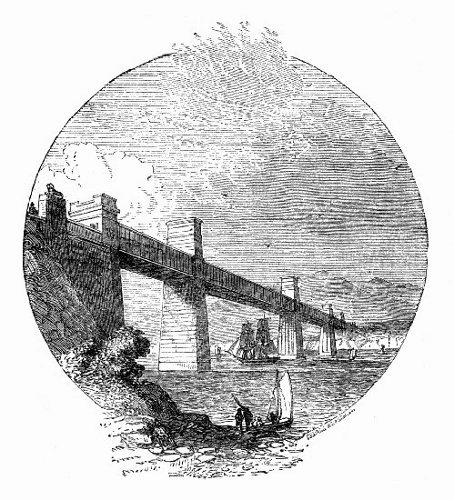
DAFFEY'S ELIXIR.
In the Postboy, Jan. 1, 1707-8, is the following curious advertisement:—"Daffey's
famous Elixir Salutis by Catherine Daffey, daughter
of Mr. Thomas Daffy, late rector of Redmile, in the valley of Belvoir,
who imparted it to his kinsman, Mr. Anthony Daffy, who published the
same to the benefit of the community and his own great advantage. The
original receipt is now in my possession, left to me by my father. My
own brother, Mr. Daniel Daffy, apothecary in Nottingham, made the
Elixir from the said receipt, and sold it there during his life. Those
who know it, will believe what I declare; and those who do not,
may be convinced that I am no counterfeit, by the colour, taste, smell,
and operation of my Elixir. To be had at the Hand and Pen, Maiden-Lane,
Covent Garden."
JENNY'S WHIM.
"This was a tea garden, situated, after passing over a wooden bridge
on the left, previous to entering the long avenue, the coach way to where
Ranelagh once stood. This place was much frequented, from its novelty,
being an inducement to allure the curious, by its amusing deceptions,
particularly on their first appearance there. Here was a large garden, in
different parts of which were recesses; and if treading on a spring, taking
you by surprise, up started different figures, some ugly enough to frighten
you—a harlequin, a Mother Shipton, or some terrific animal. In a large
piece of water, facing the tea alcoves, large fish or mermaids, were showing
themselves above the surface. This queer spectacle was first kept by
a famous mechanist, who had been employed at one of the winter
theatres, there being then two."—Angelo's Pic Nic or Table Talk, p. 106.
Horace Walpole, more than once alludes to this place of entertainment
in his Letters; and in 1755 a 4to. satirical tract appeared entitled
Jenny's Whim; or a Sure Guide to the Nobility, Gentry, and other
Eminent Persons, in this Metropolis.
ANECDOTE RELATIVE TO THE MASKED EXECUTIONER OF CHARLES I.
It is universally known, that, at the execution of King Charles I., a
man in a vizor performed the office of executioner. This circumstance
has given rise to a variety of conjectures and accounts. In the Gentleman's
Magazine for November, 1767, and January, 1768, are accounts
of one William Walker, who is said to be the executioner. In the same
magazine for June, 1784, it is supposed to be a Richard Brandon, of
whom a long account is copied from an Exeter newspaper. But William
Lilly, in his "History of his Life and Times," has the following remarkable
passage:—"Many have curiously inquired who it was that cut off
his [the king's] head: I have no permission to speak of such things: only
thus much I say, he that did it is as valiant and resolute a man as lives,
and one of a competent fortune." To clear up this passage, we shall
present our readers with Lilly's examination (as related by himself)
before the first parliament of King Charles II. in June, 1660.
"At my first appearance, many of the young members affronted me
highly, and demanded several scurrilous questions. Mr. Weston held a
paper before his mouth; bade me answer nobody but Mr. Prinn; I
obeyed his command, and saved myself much trouble thereby, and when
Mr. Prinn put any difficult or doubtful query unto me, Mr. Weston
prompted me with a fit question. At last, after almost one hour's
tugging, I desired to be fully heard what I could say as to the person
that cut Charles I.'s head off. Liberty being given me to speak, I
related what follows, viz.:—
"That the next Sunday but one after Charles I. was beheaded,
Robert Spavin, Secretary to Lieutenant-General Cromwell at that time,
invited himself to dine with me, and brought Anthony Pearson, and
several others, along with him to dinner. That their principal discourse
all dinner-time was only who it was that beheaded the king; one said it
was the common hangman; another, Hugh Peters; others were also
nominated; but none concluded. Robert Spavin, so soon as dinner was
done, took me by the hand, and carried me to the south window: saith
he. 'These are all mistaken; they have not named the man that did the
fact; it was Lieutenant-Colonel Joice. I was in the room when he fitted
himself for the work, stood behind him when he did it; when done, went
in with him again. There is no man knows this but my master, viz.,
Cromwell, Commissary Ireton, and myself.'—'Doth Mr. Rushworth
know it?' saith I.—'No, he doth not know it,' saith Spavin. The same
thing Spavin since has often related to me when we were alone."
WHIPPING PRISONERS.
Mr. Ellesdon, Mayor of Lyme, in 1595, paid for—
| |
s. |
d. |
| Four yards of canvas to make a coat to whip the rogues in |
3 |
0 |
| Making the same |
0 |
6 |
| Whipping of three of the ship boys for stealing of Mr.
Hassard's salmon fish in the Cobb |
1 |
0 |
| (N.B.—Salmon was
plentiful in the west at this epoch.) |
The charge of fourpence made for whipping a boy continued for many
years the same. The whipping of a woman who was a stranger was
little more costly; but the inflicting such a punishment upon a townswoman
was remunerated at a higher rate, as may well be supposed,
from a consideration of several circumstances. To take a violent, noisy
woman from her chamber, tie madam to the tumbrel and whip her round
the town, was an undertaking that demanded assistance and protection
to the official or hireling that wielded the thong. In the Town Accompt
Book are found such entries as those which are given in illustration:—
| |
|
s. |
d. |
| 1625. |
For whipping William Wynter's boy |
0 |
4 |
| |
"
Agnes Abbott twice |
2 |
4 |
| 1644. |
Paid two soldiers to attend the whipping of a woman |
2 |
6 |
| |
Paid to whipping four women |
4 |
0 |
THE INIQUITIES OF THE SLAVE TRADE.
We may form some idea of the temptations which the trade in human
beings held out, even to people who held an honourable position in the
world, from the fact that the captain of a frigate, within a few
years before the slave trade was abolished, was known to purchase
slaves in the West India market, have them entered as able seamen, and
compel the artificers to teach them a trade; so that when the ship
returned each was sold at a high rate as a valuable piece of property.
The worst, however, has to be told. Upon sailing from Portsmouth,
some of the best men were sent away upon duty in a ship's boat, in
order that they might be returned "run," by which they lost pay and
clothes, but made room for the negroes lately kidnapped, who were
entered, though they did no work for the ship, as able seamen! We
have all heard of a naval officer who had his pocket picked at a Westminster
election, and who openly professed his vow, which he rigidly
performed, of flogging every Londoner that joined his ship for this act.
This, it is said, was no idle vow!
DISCOVERY OF THE BODY OF CANUTE THE GREAT.
In June 1766, some workmen who were repairing Winchester Cathedral
discovered a monument, wherein was contained the body of King
Canute. It was remarkably fresh, had a wreath round the head, and
several other ornaments of gold and silver bands. On his finger was a
ring, in which was set a large and remarkably fine stone; and in one of
his hands a silver penny. Archæologia, vol. iii. The penny found in
the hand is a singular instance of a continuance of the pagan custom of
always providing the dead with money to pay Charon.
M.P.'S AND MAYORS PRIVATEERS.
William Morfote, who represented Winchelsea in Parliament in 1428,
was a privateer with a hundred men under him. He found it necessary
to obtain the king's pardon in 1435, by the advice of Parliament, there
being a legal difficulty about his having broken prison at Dover Castle.
Two merchants of Sherborne in Dorsetshire were robbed of their cargo,
worth £80, A.D. 1322, by Robert de Battyle. This transaction did not
lose him the good opinion of his townsmen, who chose him Mayor of
Winchelsea a few years later.
ALGERINE INVASION OF IRELAND.
The Algerines landed in Ireland in 1627, killed 50 persons, and
carried off about 400 into slavery. One vessel captured by them was
worth £260,000. They made purchases of stores and provisions they
wanted in the western parts of Ireland by Baltimore, and in 1631
carried off 100 captives from that town. They landed their poor captives
at Rochelle, and marched them in chains to Marseilles. Twenty-six
children are said to have been carried off at one time from Cornwall.
In 1633, Lord Wentworth, appointed lord deputy of Ireland, named
noted pirate vessels off the coast of Ireland and their captures. Persons
in their wills used to leave sums of money for redeeming well-known
captives from bondage in Algiers and other places.
WILLIAM JOY, THE ENGLISH SAMPSON.
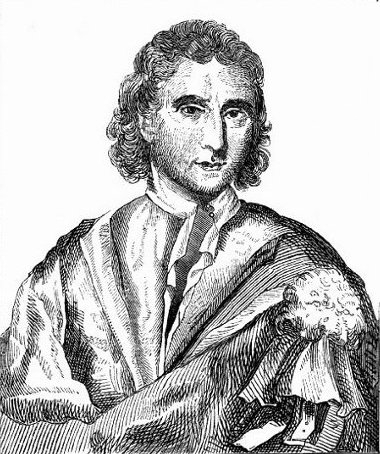
William Joy was a native of Kent, and born May 2, 1675, at St. Lawrence,
a small village one mile from Ramsgate, in the Isle of Thanet.
When very young, he distinguished himself among his juvenile companions
and playmates, by his amazing superiority in strength, over any
antagonist that dare to come in competition with his power, whether in
play or earnest When about twenty-four years of age, he first began
to exhibit in public his astonishing feats, in a display of personal prowess
inferior to none but the Hebrew champion recorded in holy writ. Among
many other of this man's extraordinary performances may be recorded:—1.
A strong horse, urged by the whip to escape his powerful rein, is
restrained and kept from escape solely by the check of his pull, aided by
a strong rope, and this without any stay or support whatever. 2. Seated
upon a stool, with his legs horizontally elevated, solely by muscular
power, he jumps clearly from his seat. 3. To prove the agility and
flexibility of his joints, he places a glass of wine on the sole of his foot,
and, in an erect posture, without the least bending of his head or body,
raises the glass to his mouth, and drinks the contents, turning his foot
with both hands, to accommodate his draught. 4. Aided by a strong
leather girdle, or belt, and supporting himself by pressing his arms on a
railing, he lifts from the ground a stone of the enormous weight of
2,240 lbs. 5. A rope fastened to a wall, which had borne 3,500 lbs. weight,
without giving way, is broke asunder by his amazing strength. The
celebrity of this man attracted the curiosity of King William III., before
whom he exhibited at Kensington Palace; likewise before George, Prince
of Denmark, and his royal consort, the Princess, afterwards Queen Anne,
and their son William, Duke of Gloucester, called the Hope of England.
He also went through a regular course of performances at the Duke's
Theatre, in Dorset-gardens, Salisbury-square, which was attended by the
first nobility and gentry in the kingdom.
PRICE OF SHELL-FISH IN 1675.
A bill for shell-fish enables us to ascertain the prices paid in
Charles II.'s reign for these delicacies. Mr. Walter Tucker, mayor
of Lyme, Dorset, paid for the judges, for—
| 30 lobsters |
£1 |
10 |
0 |
| 6 crabs |
0 |
6 |
0 |
| 100 scallops |
0 |
5 |
0 |
| 300 oysters |
0 |
4 |
0 |
| 50 oranges |
0 |
2 |
0 |
| |
— |
— |
— |
| |
£2 |
7 |
0 |
DISTRIBUTING HAND-BILLS.
The month of July 1736 afforded a singular popular explosion, contrived
in the following strange manner:—A brown paper parcel, which
had been placed unobserved near the side-bar of the Court of King's-bench,
Westminster-hall, blew up during the solemn proceedings of the
Courts of Justice assembled, and scattered a number of printed bills,
giving notice, that on the last day of Term five Acts of Parliament
would be publicly burnt in the hall, between the hours of twelve and
one, at the Royal Exchange, and at St. Margaret's hill, which were the
Gin Act, the Smuggling Act, the Mortmain Act, the Westminster Bridge
Act, and the Act for borrowing 600,000l. on the Sinking fund.
One of the bills was immediately carried to the Grand Jury then
sitting, who found it an infamous libel, and recommended the offering
of a reward to discover the author.
RANZ DES VACHES.
The "Ranz des Vaches," which is commonly supposed to be a single
air, stands in Switzerland for a class of melodies, the literal meaning of
which is cow-rows. The German word is Kureihen—rows of cows. It
derives its origin from the manner the cows march home along the Alpine
paths at milking time. The shepherd goes before, keeping every
straggler in its place by the tones of his horn, while the whole herd wind
along in Indian file, obedient to the call. From its association it always
creates home-sickness in a Swiss mountaineer, when he hears it in a
foreign land. It is said, these melodies are prohibited in the Swiss
regiments attached to the French army, because it produces so many
desertions. One of the "Ranz des Vaches" brings back to his imagination
his Alpine cottage—the green pasturage—the bleating of his mountain
goats—the voices of the milkmaids, and all the sweetness and innocence
of a pastoral life; till his heart turns with a sad yearning to the
haunts of his childhood, and the spot of his early dreams and early happiness.
The Swiss retain their old fondness for rifle-shooting, and there is
annually a grand rifle match at some of the large towns, made up of the
best marksmen in all Switzerland. There are also yearly contests in
wrestling, called Zwing Feste, the most distinguished wrestlers at which
are from Unterwalden, Appenzel, and Berne.
MONSOONS.
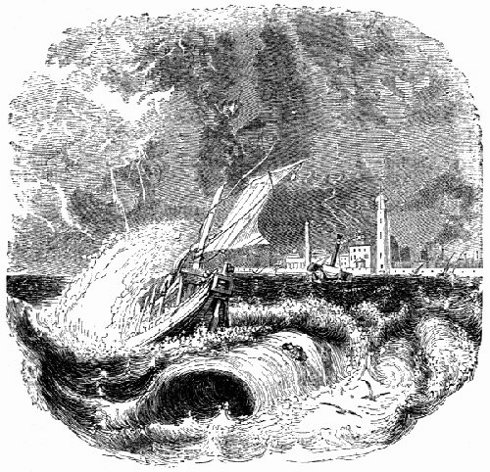
These are periodical winds which blow over the Indian Ocean, between
Africa and Hindustan for nearly six months from the north-east,
and during an equal period from the south-west. The region of the
monsoons lies a little to the north of the northern border of the trade-winds,
and they blow with the greatest force and with most regularity
between the eastern coast of Africa and Hindustan. When the sun is
in the southern hemisphere a north-east wind, and when it is in the
northern hemisphere, a south-west wind blows over this sea. The north-east
monsoon blows from November to March. It extends one or two
degrees south of the equator. It becomes regular near the coasts of
Africa sooner than in the middle of the sea, and near the equator sooner
than in the vicinity of the coasts of Arabia. This wind brings rain on
the eastern coasts of Africa. The south-west monsoon does not extend
south of the equator, but usually begins a short distance north of it. It
blows from the latter end of April to the middle of October. Along the
coast of Africa, it appears at the end of March; but along the coast of
Malabar, not before the middle of April; it ceases, however, sooner in
the former than in the latter region. The rainy season on the west coast
of Hindustan commences with the first approach of the south-west monsoon.
The monsoons prevail also on the seas between Australia and China.
The effect of the struggle which precedes the change in the direction
of the wind in this part of the world is thus described in "Forbes's
Oriental Memoirs." The author was encamped with the English troops:
"The shades of evening approached as we reached the ground, and
just as the encampment was completed, the atmosphere grew suddenly
dark, the heat became oppressive, and an unusual stillness presaged the
immediate setting-in of the monsoon. The whole appearance of external
nature resembled those solemn preludes to earthquakes and hurricanes in
the West Indies, from which the East in general is providentially free.
We were allowed very little time for conjecture. In a few minutes the
heavy clouds burst over us. I had witnessed seventeen monsoons in
India, but this surpassed them all in its awful appearance and dreadful
effects. Encamped in a low situation on the borders of a lake formed to
collect the surrounding water, we found ourselves in a few hours in a
liquid plain; tent-pins giving way in a loose soil—the tents fell down—and
left the whole army exposed to the contending elements. It requires
a lively imagination to conceive the situation of a hundred thousand
human beings of every description, with more than two hundred thousand
elephants, camels, horses, and oxen, suddenly overwhelmed by this
dreadful storm in a strange country, without any knowledge of high or
low ground, the whole being covered by an immense lake, and surrounded
by thick darkness, which rendered it impossible for us to distinguish a
single object except such as the vivid glare of the lightning occasionally
displayed in horrible forms. No language can adequately describe the
wreck of a large encampment thus instantaneously destroyed, and
covered with water, amid the cries of old men and helpless women, terrified
by the piercing shrieks of their expiring children, unable to afford
them relief. During this dreadful night more than two hundred persons
and three thousand cattle perished miserably, and the morning dawn
exhibited a shocking spectacle!"
UNUSUAL LOCALITY FOR SAYING PRAYERS.
Francis Atkins was porter at the palace gate, at Salisbury, from the
time of Bishop Burnet to the period of his death in 1761, at the age of
104 years. It was his office every night to wind up the clock, which he
was capable of performing regularly till within a year of his decease,
though on the summit of the palace. In ascending the lofty flight of
stairs, he usually made a halt at a particular place and said his evening
prayers. He lived a regular and temperate life, and took a great deal of
exercise; he walked well, and carried his frame upright and well balanced
to the last.
BILLY IN THE SALT BOX.
Political caricatures are generally well worth preserving, they familiarize
us with the features and peculiarities of celebrated men, and they
tell us what was the popular feeling of the day. We regret that in
general they are too large for
our pages, but now and then we
meet with a small one which
we are glad to present to our
readers.
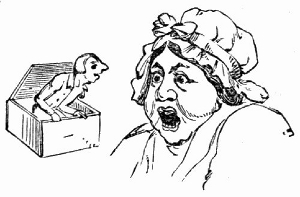
Mr. Pitt's budget of 1805 was
not allowed to pass without
severe remarks, and a heavily
increased duty on salt excited
general dissatisfaction. People
said that the grand contriver of
taxes had visited every corner
of the house above stairs, and that he had now descended into the
kitchen; and the annexed caricature, by Gilray, which was published
at this period, represents the premier alarming the poor cook by popping
his head out of the salt-box, with the unexpected salutation—"How
do you do, cookey?" The person thus apostrophised cries out in consternation,
"Curse the fellow, how he has frightened me!—I think, on
my heart, he is getting in everywhere!—who the deuce would have
thought of finding him in the salt-box?"
DANGEROUS FEAT.
An extraordinary instance of the rash feats which men with cool heads
and courageous hearts will sometimes perform, was witnessed at Nottingham
on January 22, 1789.—The vane at the top of St. Peter's spire, which
was placed there in 1735, and measured thirty-three inches in length,
having become insecure, the parish officers agreed with Mr. Robert
Wooton, of Kegworth, to take it down and reinstate it.
This venturous man, henceforth known as "the steeple climber," commenced
his undertaking by placing a ladder against the steeple, and
securing it to the wall with tenters: he then mounted that with another
on his shoulder, which he fastened above it in like manner; and so on
till he reached the top. To prevent himself falling, he was girded
round with belts, which he connected with the ladders by means of
hooks. In this manner he replaced the vane and cock, and rebuilt four
yards of the steeple.
The celerity with which the man placed the ladders was remarkable.
He began to affix the first at eleven in the morning, and brought the
vane down in triumph by two in the afternoon. The bells were then set
a-ringing, the congregation of people became very great, and Wooton
re-ascended the spire, to exhibit his daring. He extended himself on its
summit, only thirteen inches in diameter, and spread out his arms and
legs. He afterwards balanced himself on the uppermost stave of the
top ladder, and for a quarter of an hour capered about in every
imaginable posture, the admiring crowd beneath expecting momentarily
to witness his descent in a manner much less agreeable than precipitate.
Subsequently, when his undertaking was accomplished, to excite
admiration and obtain money, he again balanced himself on the apex of
the spire, beat a drum, and drank a bottle of ale, in the sight of thousands
of people, on a market-day; but the reprobation of the man's
temerity so far preponderated over public approval, as in a considerable
degree to diminish his expected reward.
POST-HASTE ONE HUNDRED YEARS AGO.
Glasgow is now within one minute of London; in the last century it
was scarcely within a fortnight of it. It is a positive fact that when the
post arrived there a hundred years ago, the firing of a gun announced
its coming in. The members of the clubs who heard it tumbled out of
bed, and rushed down to the club-room, where a tankard of hot herb
ale, or a beverage which was a mixture of rum and sugar, was ready
for them before breakfast. How forcibly do these things bring before us
the size of Glasgow at that time, and the habits of its citizens.
EXECUTION OF ADMIRAL BYNG.
The horrid details of the execution of criminals are wholly unfitted
for our pages, but Admiral Byng was not a criminal; his life was sacrificed
to party spirit and party interests, and an account of his murder—for
such it really was—is therefore highly interesting, as it enables us
to see the dauntless manner in which a brave man can meet a dreadful
fate, which he knew to be wholly undeserved. The execution took
place on board the "St. George," man-of-war in Portsmouth harbour,
on the 14th of March, 1757. The Admiral, accompanied by a
clergyman who attended him during his confinement, and two gentlemen,
his relations, walked out of the great cabin to the quarterdeck,
where he suffered, on the larboard side, a few minutes before
twelve o'clock. He was dressed in a light grey coat, white waistcoat,
and white stockings, and a large white wig, and had in each
hand a white handkerchief. He threw his hat on the deck, kneeled
on a cushion, tied one handkerchief over his eyes, and dropped the other
as a signal, on which a volley from six marines was fired, five of whose
bullets went through him, and he was in an instant no more. The sixth
went over his head. From his coming out of his cabin could not be two
minutes till he fell motionless on his left side. He died with great resolution
and composure, not showing the least sign of timidity. The
Ramillies, the ship the admiral had in the Mediterranean, was riding at
her moorings in the harbour, and about half an hour before he suffered,
she broke her mooring chain, and only held by her bridle, which is
looked on as a wonderful incident by people who do not consider the
high wind at that time.
EXTRAORDINARY TREE.
The Samoan group of islands in the South Sea lies between the latitudes
of 13° 30' and 14° 30' S, and the longitudes of 168° and 173° W.
In some of these islands there is a most remarkable tree which well deserves
a place in our roll of extraordinary productions. It is a species of
banyan (Ficus religiosa), and is called by the natives Ohwa. Our sketch
gives a good idea of some of these trees. The pendant branches of many
of them take root in the ground to the number of thousands, forming stems
from an inch to two feet in diameter, uniting in the main trunk more
than eighty feet above the ground, and supporting a vast system of
horizontal branches, spreading like an umbrella over the tops of the
other trees.
THE PLAGUE IN ENGLAND.
The Register of Ramsay, in Huntingdonshire, mentions 400 people
who died there of the plague, in or about February 1665, and that it was
introduced into the place by a gentleman, who first caught the infection
by wearing a coat, the cloth of which came from London: the tailor who
made the coat, with all his family, died, as did no less than the number
above mentioned.
But the ravages made by the plague in London, about 1665, are
well known: it was brought over from Holland, in some Levant
goods, about the close of the year 1664: its progress was arrested, in
a great degree, by a hard frost which set in in the winter; but
as the spring of 1665 advanced, its virulence advanced. Infected
houses were shut up and red crosses painted on the doors, with this inscription,
"Lord have mercy upon us." Persons going to market took
the meat off the hooks themselves, for their own security, and for the
Butcher's, dropped their money into pans of vinegar; for it was supposed
that even their provisions were tainted with the infection. In the
months of August and September the greatest mortality occurred; for the
deaths of one week have been estimated at 10,000! It may be supposed,
that no great accuracy existed in the Registers, to afford a correct estimate;
for, in the parish of Stepney, it is said they lost, within the year,
116 sextons, grave-diggers and their assistants; and, as the disorder
advanced, the churchyards were incapable of holding more bodies, and
large pits were therefore dug in several parts, to which the dead were
brought by cartloads, collected by the ringing of a bell and the mournful
cry of "Bring out your dead." Add to this, that these carts worked in the
night, and no exact account was kept, as the clerks and sextons were
averse to a duty exposing them to such dangerous consequences, and
often carried off before such accounts as they had taken were delivered
in. All the shops were shut up, grass grew in the most public streets,
until about December 1665, when the plague abated, and the citizens
who had left their abodes for the country, crowded back again to their
residences. The computation is, that this horrible disease carried off
100,000 persons in London: it is singular, that the only parish quite
exempt from infection was St. John the Evangelist, in Watling Street.
LANDSLIP AT COLEBROOK, SHROPSHIRE.
A most remarkable circumstance happened there in the morning of the
27th of May, 1773, about four o'clock. Near 4,000 yards from the river
Severn stood a house, where a family dwelt; the man got up about three
o'clock, heard a rumbling noise, and felt the ground shake under him, on
which he called up his family. They perceived the ground begin to
move, but knew not which way to run; however, they providentially
and wonderfully escaped, by taking an immediate flight, for just as they
got to an adjacent wood, the ground they had left separated from that on
which they stood. They first observed a small crack in the ground about
four or five inches wide, and a field that was sown with oats to heave up
and roll about like waves of water; the trees moved as if blown with
wind, but the air was calm and serene; the Severn (in which at that
time was a considerable flood) was agitated very much, and the current
seemed to run upwards. They perceived a great crack run very quick
up the ground from the river. Immediately about thirty acres of land,
with the hedges and trees standing (except a few that were overturned),
moved with great force and swiftness towards the Severn, attended with
great and uncommon noise, compared to a large flock of sheep running
swiftly. That part of the land next the river was a small wood, less
than two acres, in which grew twenty large oaks; a few of them were
thrown down, and as many more were undermined and overturned;
some left leaning, the rest upright, as if never disturbed. The wood was
pushed with such velocity into the channel of the Severn (which at that
time was remarkably deep), that it forced the waters up in columns a
considerable height, like mighty fountains, and drove the bed of the
river before it on the opposite shore, many feet above the surface of the
water, where it lodged, as did one side of the wood; the current being
instantly stopped, occasioned a great inundation above, and so sudden a
fall below, that many fish were left on dry land, and several barges were
heeled over, and when the stream came down were sunk, but none were
damaged above. The river soon took its course over a large meadow
that was opposite the small wood, and in three days wore a navigable
channel through the meadow. A turnpike road was moved more than
thirty yards from its former situation, and to all appearance rendered for
ever impassable. A barn was carried about the same distance, and left
as a heap of rubbish in a large chasm; the house received but little
damage. A hedge that was joined to the garden was removed about
fifty yards. A great part of the land was in confused heaps, full of
cracks, from four inches to more than a yard wide. Several very long
and deep chasms were formed in the upper part of the land, from about
fourteen to upwards of thirty yards wide, in which were many pyramids
of earth standing, with the green turf remaining on the tops of some of
them. Hollows were raised into mounts, and mounts reduced into
hollows. Less than a quarter of an hour completed this dreadful scene.
CURIOUS CUSTOM AT STRASBOURG.
At Strasbourg they show a large French horn, whose history is as follows:—About
400 years ago, the Jews formed a conspiracy to betray the
city, and with this identical horn they intended to give the enemy notice
when to attack.
The plot, however, was discovered; many of the Jews were burnt alive,
the rest were plundered of their money and effects, and banished the
town; and this horn is sounded twice every night from the battlements
of the steeple in gratitude for the deliverance.
The Jews deny the fact of this story, except the murdering and pillaging
their countrymen. They say the whole story is fabricated to furnish
a pretext for these robberies and murders, and assert that the steeple of
Strasbourg, as has been said of the Monument of London,—
"Like a tall bully lifts the head and lies."
DOWN AMONG THE DEAD MEN.
The following is an extraordinary instance of the recklessness of
sailors when in the pursuit of what they call pleasure. In the year
1779, a Mr. Constable, of Woolwich, passing through the churchyard
there at midnight, heard people singing jovially. At first he thought
they were in the church, but the doors were locked, and it was all silent
there:—on looking about he found some drunken sailors who had got
into a large family vault, and were regaling with bread, cheese, tobacco,
and strong beer. They belonged to the Robust, man of war, and having
resolved to spend a jolly night on shore, had kept it up in a neighbouring
alehouse till the landlord turned them out, and then they came here to
finish their evening. They had opened some of the coffins in their dare-devil
drunkenness and crammed the mouth of one of the bodies with
bread, and cheese, and beer. Constable, with much difficulty, prevailed
on them to return to the ship. In their way one fell down in the mud,
and was suffocated, as much from drunkenness as the real danger. The
comrades took him on their shoulders, and carried him back to sleep in
company with the honest gentlemen with whom he had passed the
evening.
CHAIR BROUGHT OVER TO AMERICA IN THE MAYFLOWER BY THE
PILGRIM FATHERS.
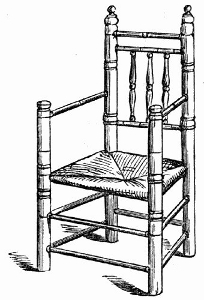
How frequently do we obtain, from the ordinary articles of domestic
life which they were accustomed to use, a correct idea of the habits and
tastes of whole communities which
have long since passed away.
A striking instance of this is the chair,
of which the above is a correct
sketch. It belonged to John Carver,
who was one of the band of single-hearted
men who constituted the
Pilgrim Fathers, and who after first
setting out from Holland, eventually
sailed from Plymouth in England,
in August, 1620. They landed in
Cape Cod Harbour, New England,
on the 9th of November following.
Carver, was one of the chief spirits
of the band, and the chair which we
have sketched was one of his best
articles of furniture, which he took
with him in the Mayflower. He was
elected the first governor of the
community, and died in the year
following his election. How forcibly
does it show the simplicity of taste,
and the freedom from pomp and
vanity which characterised the devoted
and fearless men who left their native shores, and sought "freedom
to worship God" in a land to them unknown, that they should have
selected as their first governor, an individual, the best chair in whose
house was the homely article which we have here depicted.
A HARMLESS ECCENTRIC.
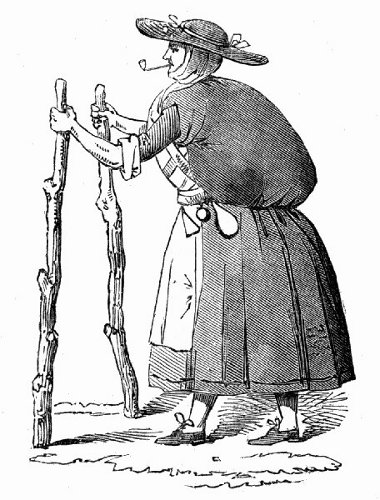
The annexed cut represents a singular character who was well known
about the year 1790 in the southern part of the county of Cumberland.
Her appearance is thus described by a correspondent of the Gentleman's
Magazine of that date:—"Though I have seen her at various times, and
frequently conversed with her, for these 20 years, I have never been
able to learn any particulars respecting her family, friends, or name.
The country people know her by the appellation of Jenny Darney, from
the manner, I presume, in which she used to mend her clothes. Her
present garb is entirely of her own manufacture. She collects the small
parcels of wool which lie about the fields in sheep farms, spins it on a
rock and spindle of her own making; and as she cannot find any other
method of making the yarn into cloth, she knits it on wooden needles,
and by that means procures a warm comfortable dress. In the lifetime
of the late Charles Lutwidge, Esq., of Holm Rook, she took possession
of an old cottage, or rather cow-house, on his estate, in which she has
ever since been suffered to continue. Her intellects seem at certain times
greatly deranged, but her actions are harmless, and her language inoffensive.
On that score she is caressed by all the villagers, who supply
her with eatables, &c., for money she utterly refuses. She seems a person
in her lucid intervals, of much shrewdness, and her understanding is
above the common level. This has also been improved by a tolerable
education. Her appearance has been much the same for these 20 years,
so that she must now be nearly 90 years of age; but of this, as well as
her family and name, she is always silent. She seems to have chosen out
the spot where she now lives, to pass the remainder of her days unknown
to her friends, and in a great measure from a distaste of a wicked world,
to 'prepare herself,' as she often in her quiet hours says, 'for a better.'"
THE RULING PASSION.
A remarkable instance of the irresistible strength of the ruling passion
was to be seen a few years ago in a Londoner, who had kept are retail
spirit-shop, and retired into the adjoining county when he had made a
fortune, to enjoy himself. This man used to amuse himself by having
one puncheon filled with water, and measuring it off by pints into
another. There was also another retired cit who used every day to
angle in his round wash-hand-basin sized fish-pond for gold-fish. One
fish he knew, because it had once lost its eye in being caught—and
he used to say "Confound that fellow, this is the fifth, sixth, &c.,
time that I have caught him this season." It used to provoke him.
INTERESTING REPORT WRITTEN BY SIR CHRISTOPHER WREN.
In the history of public buildings and monuments, it is always curious
to note the original plans of those who designed them, and to mark the
different proposals and suggestions which were taken into consideration.
On this account our readers will no doubt be gratified by perusing the
following Report of Sir Christopher Wren, on the ornament which it
would, in his opinion, be most desirable to place on summit of the Monument,
on Fish Street-hill. The Report was drawn up for the use of
the Committee of City Lands:—
"In pursuance of an Order of the Comittee for City Landes, I doe
heerwith offer the several designes which some monthes since I showed
His Mtie. for his approbation; who was then pleased to thinke a large
Ball of metall, gilt, would be most agreeable, in regard it would give an
Ornament to the Town at a very great distance; not that His Mtie. disliked
a statue; and if any proposall of this sort be more acceptable to
the City, I shall most readily represent the same to His Mtie.
"I cannot but comend a large Statue, as carrying much dignitie with
it, and that wch would be more valewable in the eyes of Forreiners and
strangers. It hath been proposed to cast such a one in Brasse, of 12
foot high for £1,000. I hope (if it be allowed) wee may find those who
will cast a figure for that mony of 15 foot high, wch will suit the greatnesse
of the pillar, & is (as I take it) the largest at this day extant,
and this would undoubtedly be the noblest finishing that can be found
answerable to soe goodly a worke in all men's judgements.
"A Ball of Copper, 9 foot diameter, cast in severall peeces with the
Flames and gilt, may well be don with the iron worke and fixing for
350lb., and this will be most acceptable of any thing inferior to a statue,
by reason of the good appearance at distance, and because one may goe
up into it, & upon occasion use it for fireworkes.
"A Phœnix was at first thought of, & is the ornament in the wooden
modell of the pilar wch I caused to be made before it was begun; but
upon second thoughtes I rejected it, because it will be costly, not easily
understood at that highth, and worse understood at a distance, and
lastly dangerous, by reason of the sayle, the spread winges will carry
in the winds.
"The Belcony must be made of substantial well forged worke, there
being noe need at that distance of filed worke, and I suppose (for I
cannot exactly guesse the weight) it may be well performed and fixed according
to a good designe for fourscore & ten poundes, including painting,
All wch is humbly submitted to your consideration.
"July 28, 1675.
"Chr. Wren."
CHANGE OF SEX.
Connected with the plumage of birds is an extraordinary problem
which has baffled all research, and towards the solution of which not the
slightest approach has been made. Among certain of the gallinaceous
birds, and it has been observed in no other family, the females occasionally
assume the male plumage. Among pheasants in a wild state,
the hen thus metamorphosed, assumes with the livery a disposition to
war with her own race, but in confinement she is spurned and buffeted
by the rest. From what took place in a hen pheasant in the possession
of a lady, a friend of the late Sir Joseph Banks, it would seem probable
that this change arises from some alteration in the temperament at a
late period of the animal's life. This lady had paid particular attention
to the breeding of pheasants. One of the hens, after having produced
several broods, moulted, and the succeeding feathers were exactly those
of a cock. This animal never afterwards laid an egg. The pea-hen,
has sometimes been known to take the plumage of the cock bird. Lady
Tynte had a favourite pea-hen, which at eight several times produced
chicks. Having moulted when about eleven years old, the lady and
her family were astonished by her displaying the feathers peculiar to
the other sex, and appearing like a pied peacock. In this process the
tail, which was like that of the cock, first appeared. In the following
year she moulted again, and produced similar feathers. In third year
she did the same, and then had also spurs resembling those of the cock.
The bird never bred after this change of her plumage.
TILBURY FORT.
The chief fame of Tilbury rests on the formation of the camp here, in
the reign of Queen Elizabeth, to defend London against the Spanish invasion.
Although it is unnecessary to recount the well-known circumstances
which led to the formation of the Tilbury camp, it may not be
out of place to give the famous speech of Queen Elizabeth on the occasion
of her visit:—
"My loving People,—We have been persuaded by some that are careful
of our safety, to take heed how we trust ourselves to armed multitudes
for fear of treachery; but assure you I do not desire to live to distrust
my faithful and loving people. Let tyrants fear. I have always so behaved
myself that under God I have placed my chiefest strength and safeguard
in the loyal hearts and goodwill of my subjects; and therefore I
am come among you at this time, not as for my recreation or sport, but
being resolved, in the midst and heat of the battle, to live or die amongst
you all—to lay down for my God, and for my kingdom, and for my
people, my honour and my blood even in the dust. I know that I have
but the body of a weak and feeble woman, but I have the heart of a king,
and a king of England too; and I think foul scorn that Parma or Spain,
or any prince of Europe, should dare to invade the borders of my realms
to which, rather than any dishonour shall grow by me, I will myself take
up arms—I myself will be your general, judge, and rewarder of every one
of your victories in the field."
The most full description of Elizabeth's reception at Tilbury is printed
in a sort of doggrel poem, headed, "Elizabetha Triumphans, briefly,
truly, and effectually set forth, declared, and handled by James Aske."
The poem mentions, that when about 20,000 well-appointed men had
arrived at Tilbury, orders were sent to the various shires to cause the
troops in each to remain until further notice; and so great was the desire
to meet the enemy, that one thousand men of Dorsetshire offered £500
to be allowed to march to the camp at Tilbury.
The alarm of the Spanish invasion was, however, not the last to threaten
the Londoners, and direct attention to Tilbury.
On the 8th of June, 1667, Ruyter, the Dutch admiral, sailed out of the
Texel with fifty ships, and came to the mouth of the Thames, from whence
he detached Vice-Admiral Van Ghent, with seventeen of his lightest
ships and some fire-ships. Van Ghent in the same month sailed up the
Medway, made himself master of the fort of Sheerness, and, after burning
a magazine of stores to the value of £40,000, blew up the fortifications.
This action alarmed the City of London; so that to prevent similar
mischief, several ships were sunk, and a large chain put across the
narrowest part of the Medway. But by means of an easterly wind and a
strong tide, the Dutch ships broke through the chain, and sailed between
the sunk vessels. They burnt three ships, and carried away with them
the hull of the "Royal Charles," besides burning and damaging several
others. After this they advanced as far as Upnor Castle, and burnt the
"Royal Oak," the "Loyal London," and the "Great James." Fearing
that the whole Dutch fleet would sail to London Bridge, the citizens
caused thirteen ships to be sunk at Woolwich, and four at Blackwall,
and platforms furnished with artillery to defend them were raised in
several places. The consternation was very great, and the complaints
were no less so. It was openly said the king, out of avarice, had kept
the money so generously given to him to continue the war, and left his
ships and subjects exposed to the insults of the enemy. After this exploit,
Ruyter sailed to Portsmouth, with a design to burn the ships in
that harbour; but finding them secured, he sailed to the west, and took
some ships in Torbay. He then sailed eastward, beat the English force
before Harwich, and chased a squadron of nineteen men-of-war, commanded
by Sir Edward Spragg, who was obliged to retire into the Thames.
In a word, he kept the coasts of England in a continual alarm all July,
till he received news of the conclusion of peace.
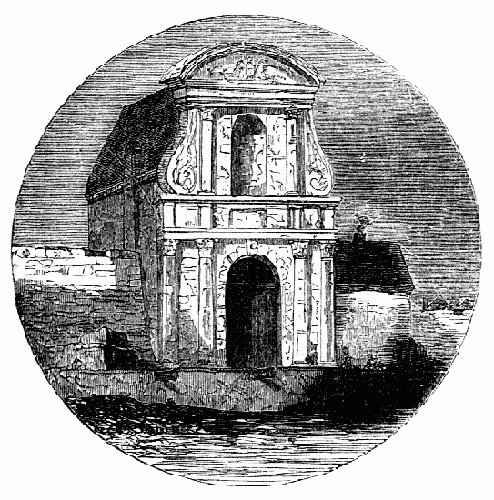
WATER-GATE OF TILBURY FORT.
This daring attack was no doubt the cause of Tilbury Fort being made
to assume its present form. It is now a regular fortification, and may be
justly looked upon as the key to the City of London. The plan of the
building was laid out by Sir Martin Beckman, chief engineer to Charles II.,
who also designed the works at Sheerness. The foundation is laid upon
piles driven down, two on end of each other, till they were assured they
were below the channel of the river, and that the piles, which were
pointed with iron, entered into the solid chalk rock. On the land side,
the works are complete; the bastions are faced with brick. There is a
double ditch, or moat, the innermost of which is 180 feet broad, with a
good counterscarp, and a covered way marked out with ravelins and
tenailles. There are some small brick redoubts; the chief strength, however,
of this part of the fort consists in being able to lay the whole level
under water, and, by that means, make it impossible for an enemy to
carry on approaches that way. On the river side is a very strong curtain,
with the picturesque water-gate shown in our engraving in the middle.
Before this curtain is a platform, in the place of a counterscarp, on which
are planted cannon of large size. These completely command the river,
and would no doubt cripple the ships of an enemy attempting to pass in
this direction. A few years ago there were placed on the platform 106
cannon, carrying from 24 to 46 pounds each, besides smaller ones planted
between them. The bastions and curtains are also planted with guns.
The circular tower shown in the engraving was in existence in the
time of Queen Elizabeth, and was called the Block-house.
RINGING THE CHANGES.
It is curious to note the number of changes which may be rung on
different peals. The changes on seven bells are 5,040; on twelve
479,001,600, which it would take ninety-one years to ring at the rate
of two strokes in a second. The changes on fourteen bells could not be
rung through at the same rate in less than 16,575 years: and upon four-and-twenty,
they would require more than 117,000 billions of years.
DISGRACEFUL STATE OF THE LONDON POLICE IN 1724.
That notorious burglar, Jack Sheppard, finished his disgraceful career
at Tyburn in the year 1724, and we notice the event, not with the view
of detailing the disgusting particulars of an execution, but because the
outrages which were allowed to take place after the dreadful scene was
over, exhibit in a striking light the miserable police regulations which
existed at that period, and the manner in which the mob were allowed
to have it nearly all their own way. The Sheriff's officers, aware
of the person they had to contend with, thought it prudent to
secure his hands on the morning of execution. This innovation
produced the most violent resistance on Sheppard's part; and the
operation was performed by force. They then proceeded to search
him, and had reason to applaud their vigilance, for he had contrived to
conceal a penknife in some part of his dress. The ceremony of his
departure from our world passed without disorder; but, the instant the
time expired for the suspension of the body, an undertaker, who had
followed by his friends' desire with a hearse and attendants, would have
conveyed it to St. Sepulchre's churchyard for interment; but the mob,
conceiving that surgeons had employed this unfortunate man, proceeded
to demolish the vehicle, and attack the sable dependants, who escaped
with difficulty. They then seized the body, and, in the brutal manner
common to those wretches, beat it from each to the other till it was
covered with bruises and dirt, and till they reached Long-acre, where
they deposited the miserable remains at a public-house called the Barley-mow.
After it had rested there a few hours the populace entered into
an enquiry why they had contributed their assistance in bringing Sheppard
to Long-acre; when they discovered they were duped by a bailiff,
who was actually employed by the surgeons; and that they had taken
the corpse from a person really intending to bury it. The elucidation of
their error exasperated them almost to phrensy, and a riot immediately
commenced, which threatened the most serious consequences, The inhabitants
applied to the police, and several magistrates attending, they
were immediately convinced the civil power was insufficient to resist the
torrent of malice ready to burst forth in acts of violence. They therefore
sent to the Prince of Wales and the Savoy, requesting detachments of
the guards; who arriving, the ringleaders were secured, the body was
given to a person, a friend of Sheppard, and the mob dispersed to attend
it to the grave at St. Martin's in the fields, where it was deposited in an
elm coffin, at ten o'clock the same night, under a guard of soldiers, and
with the ceremonies of the church.
A TRIUMPH OF ENERGY.
After the accession of Tippoo Saib to the throne of Mysore in 1782, the
English made overtures for a termination of the war which had been
commenced by his father; but flushed by the possession of a large army,
a well-filled treasury, a passion for war, and an inordinate sense of his
own importance, Tippoo refused all terms of pacification, and left the
English no alternative but to battle against him as they could. Lord
Macartney, who was at that time the Governor of Madras, on becoming
acquainted with the determination of Tippoo, resolved to prosecute hostilities
with the greatest vigour, and having placed Col. Fullerton at the
head of his force, he provided him with an army, collected from various
parts, of 16,000 good troops, and afforded that excellent officer all available
assistance in carrying the war into Tippoo's territory. Fullerton
laid his plans with considerable skill; he encouraged the natives
to bring and sell provisions to him on his march, effectually checked
devastation and plundering, scrupulously respected the religious opinions
of the Hindus, consolidated and improved the mode of march, and
availed himself of the subtle cunning and nimble feet of the natives
to establish a remarkably complete courier-system, whereby he could receive
and communicate intelligence with a rapidity never before attained
by any European officer in India. He had to choose between two systems
of strategy—either to march through the Mysore territory, and frustrate
Tippoo in his siege of Mangalore; or boldly to attack Seringapatam, in
order to compel Tippoo to leave Mangalore as a means of defending his
own capital. The colonel decided on the adoption of the latter course, as
promising more fruitful results. Being at Daraporam, 200 miles south of
Seringapatam, Fullerton resolved to divert the route, and take a circuit
nearer the western coast, where the capture of the strong fort of Palagatcherry
would afford him a valuable intermediate depôt, commanding one
of the chief roads from the Malabar to the Coromandel coasts. On the
18th of October he started. After capturing a few small forts, he ascended
to high ground, where dense forests, deep ravines, and tortuous water
courses embarrassed every yard of his progress: to fill up the ravines
before he could drag his artillery over them, to throw trees across them
where the depth was too great for filling up, to clear gaps through forests
with the axe, to contend against tremendous rains—were only part of the
difficulties he had to meet; but he met them like a skilful commander,
reached Palagatcherry on the 5th of November, and captured the fort on
the 15th, obtaining with it a welcome supply of money, grain, guns,
powder, shot, and military stores. When the difficulties which Colonel
Fullerton had to encounter, and the triumphant manner in which he
overcame them, are taken into consideration, it will be readily admitted,
we think, that his enterprise is well deserving of being recorded as a
striking example of what may be accomplished by a union of professional
skill and invincible energy. Our engraving represents one of the devices
which Colonel Fullerton employed for the purpose of enabling his
forces to pass over a mountain torrent.
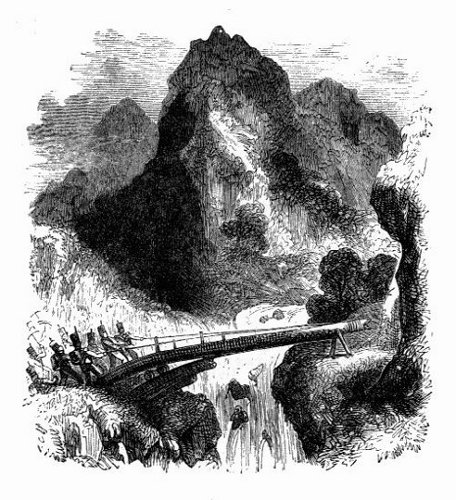
STORMING OF THE BASTILLE AT PARIS.
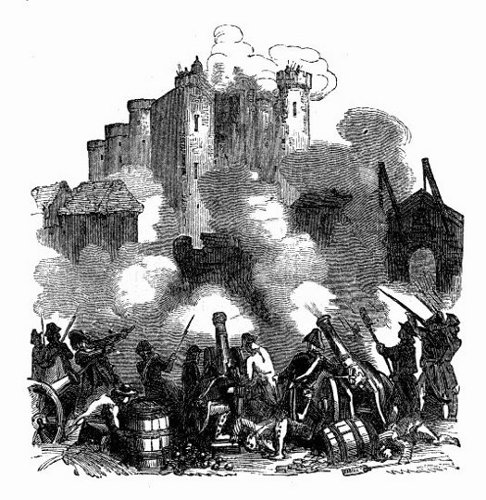
The great Revolution in France, at the close of the last century, was
full of wonderful events, many of which might be appropriately recorded
in our pages. One of the most striking among them was the storming
and capture of the Bastille, a vast state-prison which was begun to be
built in 1369 by Charles V., and finished by his successor in 1383. The
demolition of this fortress was the first triumph of the armed populace of
Paris, and it rendered the progress of the revolution irresistible. As
the day closed in on the evening of Monday, the 14th of July, 1789, a
reckless multitude of rioters, after seizing 30,000 muskets and several
pieces of artillery at the Hotel des Invalides, rushed in wild excitement
to the Bastille, rendered hateful to the people by the political imprisonment
of many hapless men in past times, although less frequently
applied to similar purposes under the milder rule of Louis XVI. An
armed mob of at least 100,000 men, aided by troops who joined them in
whole regiments at a time, had not long to contend against the old
fortress. The governor, De Launay, made such a defence as a brave
officer might at such a juncture; but his few troops were bewildered and
wavering; he received orders from the Hotel de Ville which he knew not
whether to obey or resist, but no instructions from the court or the
ministers; and the military aid to the mob became stronger than any
force he could bring to bear against them. The chains of three drawbridges
were broken by hatchets; straw, wood, oil, and turpentine were
brought and kindled, to burn down the gates; and after many volleys
from the mob had been answered by a few from the fortress, De Launay,
seeing no hope of succour, resolved to blow up the place rather than yield.
In this he was prevented by the Swiss guards, who formed a part of the
small garrison, and who, after a parley with the insurgents, opened the
gates, and surrendered. The Bastille was taken. The ruffians, heeding
nothing but their own furious passions, disregarded the honourable rules
of capitulation; they beheaded De Launay in a clumsy and barbarous
manner, and putting his head on a spike, carried it through the streets
shouting, laughing, and singing; they were prevented only by an accidental
interruption from burning alive a young lady whom they found
in one of the court-yards; they hung or maltreated many of the Swiss
and invalid soldiers; and they fearfully hacked the bodies of three
or four officers in the endeavour to decapitate them. The prisoners
within, only seven in number, were liberated, and treated with a drunken
revel; while the Châtelet and other prisons became scenes of renewed
disorders. The sketch which we give above, of the attack on the Bastille,
is taken from a medallion by Andrieu.
DURATION OF LIFE AMONG ARTISTS.
In Gould's Dictionary of Artists, published in 1839, the names, with
the ages, of 1,122 persons are given; which furnish the following remarkable
facts as to the longevity of this class of men. Died under 60 years
old, 474; 60 years and under 70, 250; 70 years and under 80, 243; 80
years and under 90, 134; 90 years and under 100, 19; above 100, 1.
The mean age at death of the whole number being 55 years; from which
it would appear that the pursuit of the fine arts has a tranquilizing effect
upon the spirits, and a tendency to moral refinement in the habits and
manners of its professors extremely favourable to the prolongation of life.
CHANGE IN THE VALUE OF LAND.
At Brighton, within the present century, a spot of ground was offered
to a hair-dresser in fee, upon condition of shaving the possessor for life.
The terms were declined, and the land soon became of immense value.
UNACCOUNTABLE ANTIPATHIES.
The following are a few of the more striking manifestations of that
unaccountable feeling of antipathy to certain objects, to which so many
persons are subject, and with instances of which—in a modified form
perhaps—most people are acquainted with:—
Erasmus, though a native of Rotterdam, had such an aversion to fish,
that the smell of it threw him into a fever.
Ambrose Paré mentions a gentleman, who never could see an eel without
fainting.
There is an account of another gentleman, who would fall into convulsions
at the sight of a carp.
A lady, a native of France, always fainted on seeing boiled lobsters.
Other persons from the same country experienced the same inconvenience
from the smell of roses, though they were particularly partial to the
odour of jonquils or tuberoses.
Joseph Scaliger and Peter Abono never could drink milk.
Cardan was particularly disgusted at the sight of eggs.
Uladislaus, king of Poland, could not bear to see apples.
If an apple was shown to Chesne, secretary to Francis I., he bled at
the nose.
A gentleman, in the court of the emperor Ferdinand, would bleed at
the nose on hearing the mewing of a cat, however great the distance might
be from him.
Henry III. of France could never sit in a room with a cat.
The Duke of Schomberg had the same aversion.
M. de Lancre gives an account of a very sensible man, who was so
terrified at seeing a hedgehog, that for two years he imagined his bowels
were gnawed by such an animal.
The same author was intimate with a very brave officer, who was so
terrified at the sight of a mouse, that he never dared to look at one unless
he had his sword in his hand.
M. Vangheim, a great huntsman in Hanover, would faint, or, if he
had sufficient time, would run away at the sight of a roasted pig.
John Rol, a gentleman in Alcantara, would swoon on hearing the word
lana, wool, pronounced, although his cloak was woollen.
The philosophical Boyle could not conquer a strong aversion to the
sound of water running through a pipe.
La Mothe le Vayer could not endure the sound of musical instruments,
though he experienced a lively pleasure whenever it thundered.
The author of the Turkish Spy tells us that he would rather encounter
a lion in the deserts of Arabia, provided he had but a sword in his hand,
than feel a spider crawling on him in the dark. He observes, that there
is no reason to be given for these secret dislikes. He humorously attributes
them to the doctrine of the transmigration of the soul; and as regarded
himself, he supposed he had been a fly, before he came into his
body, and that having been frequently persecuted with spiders, he still
retained the dread of his old enemy.
LONDON RESORTS A HUNDRED YEARS AGO.
In addition to the regular theatres, there were many places of amusement,
such as the Vauxhall and Ranelagh Gardens, the site of the latter
being now occupied by the houses that hem in Chelsea College; the
Rotunda, famous for its music, its gardens, and its piece of water; Bell-size
House and Gardens on the Hampstead Road, where tea, coffee, and
other refreshments could be had, together with music, from seven in the
morning,—with the advantage of having the road to London patrolled
during the season by twelve "lusty fellows," and of being able to ride to
Hampstead by coach for sixpence a-head; Perrot's inimitable grotto,
which could be seen by calling for a pot of beer; Jenny's Whim, at the
end of Chelsea Bridge, where "the royal diversion of duck-hunting"
could be enjoyed, "together with a decanter of Dorchester" for sixpence;
Cuper's Gardens, in Lambeth, nearly opposite Somerset House, through
which the Waterloo Road was ruthlessly driven; the Marble Hall, at
Vauxhall, where an excellent breakfast was offered for one shilling;
Sadler's Wells, celebrated both for its aquatic and its wire-dancing attractions;
the Floating Coffee-House, on the river Thames, the Folly
House at Blackwall, Marybone Gardens, the White Conduit House, and
a multitude of others, to enumerate which would be tedious and unprofitable.
On Sunday, we are told, the "snobocracy," amused themselves
by thrusting their heads into the pillory at Georgia, by being
sworn at Highgate, or rolling down Flamstead Hill in Greenwich Park.
Some regaled their wives and families with buns at Chelsea and Paddington;
others indulged in copious draughts of cyder at the Castle in
the pleasant village of Islington; while the undomestic cit, in claret-coloured
coat and white satin vest, sipped his beer and smoked his pipe
at Mile End, or at the "Adam and Eve" in Pancras, or "Mother Red
Cap's" at Camden.
QUEEN ELIZABETH'S STATE COACH.
The accompanying engraving is taken from a very old print representing
the state procession of Queen Elizabeth on her way to open
Parliament on 2nd April, 1571. This was the first occasion on which a
state coach had ever been used by a Sovereign of England, and it was
the only vehicle in the procession; the Lord Keeper, and the Lords
Spiritual and Temporal, all attending on horseback. It was drawn by
two palfreys, which were decked with trappings of crimson velvet; and,
according to an old authority, the name of the driver was William
Boonen, a Dutchman, who thus became the first state coachman.
THE ORIGIN OF EATING GOOSE ON MICHAELMAS DAY.
Queen Elizabeth, on her way to Tilbury Fort on the 29th of September,
1589, dined at the ancient seat of Sir Neville Umfreville, near
that place; and as British Bess had much rather dine off a high-seasoned
and substantial dish than a simple fricassee or ragout, the knight thought
proper to provide a brace of fine geese, to suit the palate of his royal
guest. After the Queen had dined heartily, she asked for a half-pint
bumper of Burgundy, and drank "Destruction to the Spanish Armada."
She had but that moment returned the glass to the knight who had done
the honours of the table, when the news came (as if the Queen had been
possessed with the spirit of prophecy) that the Spanish fleet had been
destroyed by a storm. She immediately took another bumper, in order
to digest the goose and good news; and was so much pleased with the
event, that she every year after, on that day, had the above excellent
dish served up. The Court made it a custom, and the people the same,
ever since.
PRE-ADAMITE BONE CAVERNS.
Among the wonders of the world, the bone caves of the pre-Adamite
period deserve a prominent place. It is to this period that the extensive
remains of Mammiferæ found in the strata of the Pampas of
Buenos Ayres, and in the caverns which are scattered in such vast
numbers over the continents of Europe and America, and even in Australia,
are to be ascribed. We regret that we can find room for a
description of only one of these caverns, but it is a most extensive one,
and among the first which attracted attention. It is situated at Baylenreuth,
in Franconia, and the engraving which we here give represents
a section of it.
The entrance of this cave, about seven feet in height, is placed on the
face of a perpendicular rock, and leads to a series of chambers from fifteen
to twenty feet in height, and several hundred feet in extent, in a deep
chasm. The cavern is perfectly dark, and the icicles and pillars of stalactite
reflected by the torches present a highly picturesque effect. The
floor is literally paved with bones and fossil teeth, and the pillars and
corbels of stalactite also contain osseous remains. Cuvier showed that
three-fourths of the remains in this and like caverns were those of bears,
the remainder consisting of bones of hyenas, tigers, wolves, foxes, gluttons,
weasels, and other Carnivora.
HOW DISTANT AGES ARE CONNECTED BY INDIVIDUALS.
Mr. Robert Chambers, in a curious and interesting chapter in the
"Edinburgh Journal," entitled "Distant Ages connected by Individuals,"
states, in 1847, "There is living, in the vicinity of Aberdeen,
a gentleman who can boast personal acquaintance with an individual
who had seen and conversed with another who actually had been present
at the battle of Flodden Field!" Marvellous as this may appear, it is not
the less true. The gentleman to whom allusion is made was personally
acquainted with the celebrated Peter Garden, of Auchterless, who died
in 1775, at the reputed age of 131, although there is reason to believe
that he was several years older. Peter, in his young days, was servant
to Garden, of Troup, whom he accompanied on a journey through the
north of England, where he saw and conversed with the famous Henry
Jenkins, who died 1670, at the age of 169. Jenkins was born in 1501,
and was of course twelve years old at the period of the battle of Flodden
Field; and, on that memorable occasion, bore arrows to an English nobleman
whom he served in the capacity of page. "When we think of
such things," adds Mr. Chambers, "the ordinary laws of nature seem to
have undergone some partial relaxation; and the dust of ancient times
almost becomes living flesh before our eyes."
THE EARTHQUAKE AT LISBON.
On the 1st of November, 1755, a few minutes before 10 a.m. the inhabitants
of Lisbon were alarmed by several violent vibrations of the ground
which then rose and fell several times with such force that hundreds of
houses came toppling into the streets, crushing thousands of people. At
the same time the air grew pitchy dark from the clouds of dust that rose
from the crumbling edifices. Many persons ran down to the river side,
in the hope of escaping to the shipping; but the water suddenly rose some
yards perpendicularly, and swept away everything before it. The quay,
with nearly 200 human beings standing on it, all at once disappeared.
Large ships, which were lying high and dry, floated off, and were dashed
against each other or carried down the river. In every direction the
surface of the water was overspread with boats, timber, casks, household
furniture and corpses. The scene on dry land was yet more horrifying.
Churches, government buildings, and private houses, were all involved
in the same ruin. Many thousands of trembling fugitives had collected
in the great square, when it was discovered that flames were spreading in
every quarter. Taking advantage of the universal panic and confusion,
a band of miscreants had fired the city. Nothing could be done to stay
the progress of the flames, and for eight days they raged unchecked.
Whatever the earthquake had spared fell a prey to this new calamity.
"It is not to be expressed by human tongue," writes an eye-witness,
"how dreadful and how awful it was to enter the city after the fire was
abated; and looking upwards, one was struck with horror in beholding
dead bodies, by six or seven in a heap, crushed to death, half buried and
half burnt; and if one went through the broad places or squares, nothing
was to be met with but people bewailing their misfortunes, wringing their
hands, and crying, 'The world is at an end.' If you go out of the city,
you behold nothing but barracks, or tents made with canvass or ship's
sails, where the poor inhabitants lye."
Another eye-witness is still more graphic. "The terror of the people
was beyond description: nobody wept,—it was beyond tears;—they ran
hither and thither, delirious with horror and astonishment—beating their
faces and breasts—crying 'Misericordia, the world's at an end;' mothers
forgot their children, and ran about loaded with crucifixed images. Unfortunately,
many ran to the churches for protection; but in vain was
the sacrament exposed; in vain did the poor creatures embrace the
altars; images, priests, and people, were buried in one common ruin.
* * * The prospect of the city was deplorable. As you passed along the
streets you saw shops of goods with the shopkeepers buried with them,
some alive crying out from under the ruins, others half buried, others
with broken limbs, in vain begging for help; they were passed by crowds
without the least notice or sense of humanity. The people lay that night
in the fields, which equalled, if possible, the horrors of the day; the city
all in flames; and if you happened to forget yourself with sleep, you
were awakened by the tremblings of the earth and the howlings of the
people. Yet the moon shone, and the stars, with unusual brightness.
Long wished-for day at last appeared, and the sun rose with great splendour
on the desolated city. In the morning, some of the boldest, whose
houses were not burnt, ventured home for clothes, the want of which
they had severely felt in the night, and a blanket was now become of
more value than a suit of silk."
STRANGE CURE FOR RHEUMATISM.
Bridget Behan, of Castle-waller, in the county of Wicklow, Ireland, retained
the use of all her powers of body and mind to the close of her long
life, 110 years, in 1807. About six years preceding her death she fell down
stairs, and broke one of her thighs. Contrary to all expectation, she not
only recovered from the effects of the accident, but actually, from thence,
walked stronger on this leg, which, previously to the accident, had been
a little failing, than she had done for many years before. Another remarkable
circumstance relating to this fracture was, that she became perfectly
cured of a chronic rheumatism of long standing, and from which
on particular occasions she had suffered a good deal of affliction. A
short while before her death she cut a new tooth.
SILVER TEA SERVICE WHICH BELONGED TO WILLIAM PENN.
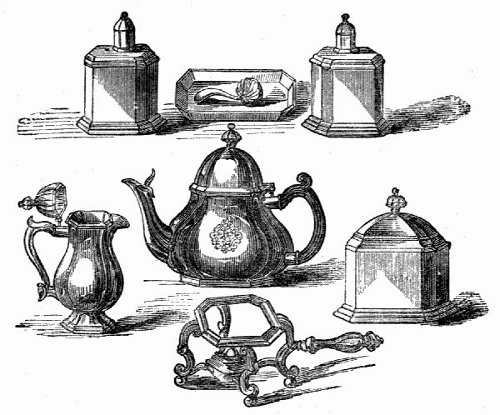
Articles of ordinary use, however small may be their intrinsic value,
which have once been the property of men who have been good and
great—how rare the conjunction!—are always invested with a peculiar
interest. They often afford a clue to the tastes of those who once
possessed them. On this account we have great pleasure in laying
before our readers a representation of the silver tea-service which
belonged to the celebrated William Penn, the founder and legislator of
Pennsylvania, whom Montesquieu denominates the modern Lycurgus.
He was the son of Admiral Penn, was born at London in 1644, and was
educated at Christchurch, Oxford. At college he imbibed the
principles of Quakerism, and having endeavoured to disseminate them
by preaching in public, he was thrice thrown into prison. It was during
his first imprisonment that he wrote "No Cross, no Crown." In March,
1680-81, he obtained from Charles II. the grant of that territory which
now bears the name of Pennsylvania. In 1682 he embarked for his new
colony; and in the following year he founded Philadelphia. He returned
to England in 1684, and died in July, 1718. He was a philosopher, a
legislator, an author, the friend of man, and, above all, a pious
Christian. In addition to the reasons above given, the sketch of the
tea-service is an object of curiosity, as showing the state of silversmith's
work in England, at the close of the seventeenth century, for articles of
domestic use.
CURIOUS FIGURES ON A SMALL SHRINE.
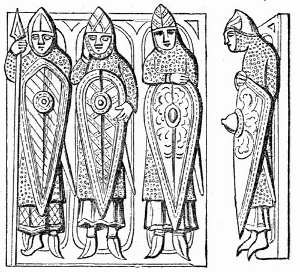
The figures here given are copied from a curious little bronze, strongly
gilt, which was engraved in the "Gentleman's Magazine" for 1833, accompanied
with a description, by A. J. Kempe, Esq., the author of the letterpress
to "Stothard's Monumental Effigies," whose intimate knowledge
in these matters enables him to well authenticate dates; and he considers
this relic may safely be attributed to the early part of the twelfth
century; it was discovered in the Temple Church, and had originally
formed a portion of a pyx, or small shrine, in which the consecrated
host was kept. Our engraving is more than half the size of the original,
which represents the soldiers watching the body of Our Lord, who
was, in mystical form, supposed to be enshrined in the pyx. They wear
scull-caps of the Phrygian form, with the nasal like those in the Bayeux
Tapestry; and the mailles
or rings of the hauberk
appear, as in the armour
there, sewn down, perhaps,
on a sort of gambeson,
but not interlaced.
They bear kite-shaped
shields, raised to
an obtuse angle in the
centre, and having large
projecting bosses: the
third of these figures is
represented beside the cut
in profile, which will enable
the reader more
clearly to detect its peculiarities.
On two of these
shields are some approaches
to armorial bearings;
the first is marked with four narrow bendlets; the second is
fretted, the frets being repeated in front of his helmet, or chapelle de fer:
all the helmets have the nasal. A long tunic, bordered, and in one instance
ornamented with cross-lines, or chequered, appears beneath the
tunic. The sword is very broad, and the spear carried by the first
figure, obtuse in the head,—a mark of its antiquity. The shoes are
admirable illustrations of that passage of Geoffry of Malmesbury, where,
representing the luxury of costume in which the English indulged at the
time when Henry I. began his reign, he says: "Then was there flowing
hair, and extravagant dress; and then was invented the fashion of shoes
with curved points: then the model for young men was to rival women
in delicacy of person, to mimic their gait, to walk with loose gesture,
half-naked." The curvature of the points of the shoes in the little relic
before us, in conformity with the custom censured by Malmesbury, is
quite remarkable. One turns up, another down; one to the left, another
to the right; and scarcely any two in the same direction.
THE QUEEN'S SHARKS.
The harbour of Trincomalee swarms with gigantic sharks, and
strange to relate, they are all under British protection; and if any
one is found molesting or injuring them, the fine is £10, or an imprisonment!
How this ridiculous custom originated, it is hard to
say; but we are told, that in the early days of British conquest
in the East, sailors were apt to desert, and seek refuge in the then
inaccessible wilds of the interior; and of later years, when civilisation
has unbarred the gates of Cingalese commerce to all nations
of the world, the soldiers of the regiment stationed at Trincomalee, discontented
with their lot in life, were wont to escape from the thraldom of
the service, by swimming off to American and other foreign vessels,
preferring chance, under a strange flag, to a hard certainty under their
own. Thus the Queen's sharks are duly protected as a sort of water-police
for the prevention of desertion both from the army and navy.
OLD VERSES ON QUEEN ELIZABETH.
The following quaint and curious verses are taken from a very old
volume, entitled A Crowne Garland of Goulden Roses, Gathered out
of England's Royall Garden, &c., &c. By Richard Johnson.
A SHORT AND SWEET SONNET MADE BY ONE OF THE MAIDES OF HONOR UPON THE DEATHE
OF QUEENE ELIZABETH, WHICH SHE SOWED UPON A SAMPLER IN RED SILKE.
To a new tune, or "Phillida flouts me."
Gone is Elizabeth,
Whom we have lov'd so deare;
She our kind mistres was
Full foure and forty yeare.
England she govern'd well,
Not to be blamed;
Flanders she govern'd well
And Ireland tamed.
France she befrended,
Spaine she hath foiled,
Papists rejected,
And the Pope spoyled.
To princes powerfull,
To the world vertuous,
To her foes mercifull,
To her subjects gracious.
Her soule is in heaven,
The world keeps her glory,
Subjects her good deeds,
And so ends my story.
RANELAGH.
Ranelagh, of which no traces now remain, was situated on part of
Chelsea Hospital garden, between Church Row and the river, to the east
of the Hospital. It takes its name from a house erected in 1691, by
Viscount Ranelagh. This house, in which the Viscount had resided
from the period of its being built, was sold in 1733 to an eminent builder
named Timbrell for £3,200, who advertised it for sale in the following
year, as a freehold with garden, kitchen garden, and offices, and a
smaller house and garden with fruit trees, coach-houses, &c., &c.
These were the first vicissitudes of Ranelagh, preparatory to its conversion
into a place of public amusement.
Walpole, in one of his entertaining letters to Mann, April 22nd, 1742,
thus speaks of the gardens, which were then unfinished:—
"I have been breakfasting this morning at Ranelagh Garden; they
have built an immense ampitheatre, with balconies full of little alehouses;
it is in rivalry to Vauxhall, and cost above twelve thousand
pounds. The building is not finished, but they got great sums by
people going to see it and breakfasting in the house: there were yesterday
no less than three hundred and eighty persons, at eighteen-pence a
piece." Again, under the date May 26th, 1742, he writes to his friend
as follows:—
"Two nights ago, Ranelagh Gardens were opened at Chelsea; the
prince, princess, duke, much nobility, and much mob besides were there.
There is a vast ampitheatre, finely gilt, painted, and illuminated; into
which everybody that loves eating, drinking, staring, or crowding, is
admitted for twelve pence. The building and disposition of the gardens
cost sixteen thousand pounds. Twice a week there are to be ridottos at
guinea tickets, for which you are to have a supper and music. I was
there last night, but did not find the joy of it. Vauxhall is a little
better, for the garden is pleasanter, and one goes by water."
"The only defect in the elegance and beauty of the ampitheatre at
Ranelagh," says the London Chronicle for August, 1763, "is an improper
and inconvenient orchestra, which, breaking into the area of that
superb room about twenty feet farther than it ought to do, destroys the
symmetry of the whole, and diffuses the sound of music with such
irregular rapidity, that the harmonious articulations escape the nicest
ear when placed in the most commodious attitude; it also hurts the eye
upon your first entry.
"To remedy these defects, a plan has been drawn by Messrs. Wale
and Gwin, for adding a new orchestra, which being furnished with a
well-proportioned curvature over it, will contract into narrower bounds
the modulations of the voice, and render every note more distinctly
audible. It will, by its form, operate upon the musical sounds, in the
same manner as concave glasses affect the rays of light, by collecting
them into a focus. The front of this orchestra being planned so as to
range parallel to the balustrade, the whole area also will be disencumbered
of every obstruction that might incommode the audience in their
circular walk. There is likewise provision made in this plan for a stage
capable of containing 30 or 40 performers, to officiate as chorus-singers,
or otherwise assist in giving additional solemnity on any extraordinary
occasion."
"At Ranelagh House, on the 12th of May, 1767," says the Gentleman's
Magazine, "were performed (in the new orchestra) the much
admired catches and glees, selected from the curious collection of the
Catch Club; being the first of the kind publickly exhibited in this or
any other kingdom. The entertainments consisted of the favourite
catches and glees, composed by the most eminent masters of the last and
present age, by a considerable number of the best vocal and instrumental
performers. The choral and instrumental parts were added, to give the
the catches and glees their proper effect in so large an amphitheatre;
being composed for that purpose by Dr. Arne."
The Rotunda, or amphitheatre, was 185 feet in diameter, with an
orchestra in the centre, and tiers of boxes all round. The chief amusement
was promenading (as it was called) round and round the circular
area below, and taking refreshments in the boxes while the orchestra and
vocalists executed different pieces of music. It was a kind of 'Vauxhall
under cover,' warmed with coal fires. The rotunda is said to have been
projected by Lacy, the patentee of Drury Lane Theatre. "The coup
d'œil," Dr. Johnson declared, "was the finest thing he had ever seen."
The last great event in the history of Ranelagh was the installation
ball of the knights of the Bath, in 1802, shortly after which the place
was pulled down.
THE FIRST EAST INDIA HOUSE.
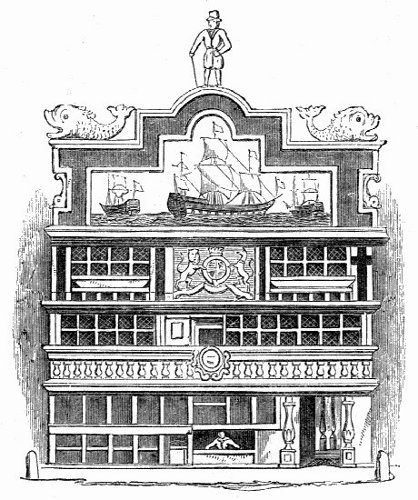
The tradition is, that the East India Company, incorporated December
31st, 1600, first transacted their business in the great room of the Nag's
Head Inn, opposite St. Botolph's Church, Bishopsgate Street. The maps
of London, soon after the Great Fire of 1666, place the India House on a
part of its present site in Leadenhall Street. Here originally stood the
mansion of Alderman Kerton, built in the reign of Edward VI., rebuilt
on the accession of Elizabeth, and enlarged by its next purchaser,
Sir W. Craven, Lord Mayor in 1610. Here was born the great Lord
Craven, who, in 1701, leased his house and a tenement in Lime Street
to the Company at £100 a year. A scarce Dutch etching, in the British
Museum, of which the annexed engraving is a correct copy, shows this
house to have been half timbered, its lofty gable surmounted with two
dolphins and a figure of a mariner, or, as some say, of the first governor;
beneath are mecrhant ships at sea, the royal arms, and those of the
Company. This grotesque structure was taken down in 1726, and upon
its site was erected the old East India House, portions of which yet
remain; although the present stone front, 200 feet long, and a great part
of the house, were built in 1798 and 1799, and subsequently enlarged by
Cockerell, R.A., and Wilkins, R.A.
ADVERTISEMENTS IN THE LAST CENTURY.
The following strange advertisements have been culled at random from
magazines and newspapers circa 1750. They give us a good idea of the
manners and tastes of that period:—
"Whereas a tall young Gentleman above the common size, dress'd in
a yellow-grounded flowered velvet (supposed to be a Foreigner), with a
Solitair round his neck and a glass in his hand, was narrowly observed
and much approved of by a certain young lady at the last Ridotto. This
is to acquaint the said young Gentleman, if his heart is entirely disengaged,
that if he will apply to A. B. at Garaway's Coffee House in
Exchange Alley, he may be directed to have an interview with the said
young lady, which may prove greatly to his advantage. Strict secresy
on the Gentleman's side will be depended on."
"A Lady who had on a Pink-coloured Capuchin, edged with Ermine,
a black Patch near her right eye, sat in a front seat in the next Side Box
but one to the Stage on Wednesday night at Drury Lane Playhouse; if
that Lady is single and willing to treat on terms of honour and generosity
of a married state, it would be deemed a favour to receive a line directed
to C. D., at Clifford's Inn Old Coffee House, how she may be address'd,
being a serious affair."
"To be seen this week, in a large commodious room at the George Inn,
in Fenchurch-street, near Aldgate, the Porcupine Man and his Son, which
has given such great satisfaction to all that ever saw them: their solid
quills being not to be numbered nor credited till seen; but give universal
satisfaction to all that ever saw them; the youth being allowed by all
to be of a beautiful and fine complexion, and great numbers resort daily
to see them."
"A Bullfinch, that pipes 'Britons rouse up your great magnanimity,'
at command, also talks, is to be sold at the Cane Shop facing New Broad
street, Moorfields; likewise to be sold, two Starlings that whistle and
talk extremely plain.
"Great variety of fine long Walking Canes."
THEODORA DE VERDION.
This singular woman was born in 1744, at Leipsic, in Germany, and
died at her lodgings, in Upper Charles-street, Hatton Garden, London,
1802. She was the only daughter of an architect of the name of Grahn,
who erected several edifices in the city of Berlin, particularly the Church
of St. Peter's. She wrote an excellent hand, and had learned the mathematics,
the French, Italian, and English languages, and possessed a complete
knowledge of her native tongue. Upon her arrival in England she
commenced teaching of the German language, under the name of Dr.
John de Verdion.
In her exterior, she was extremely grotesque, wearing a bag wig, a
large cocked hat, three or four folio books under one arm, and an umbrella
under the other, her pockets completely filled with small volumes,
and a stick in her right hand. She had a good knowledge of English
books; many persons entertained her for her advice relative to purchasing
them. She obtained a comfortable subsistence from teaching
and translating foreign languages, and by selling books chiefly in foreign
literature. She taught the Duke of Portland the German language, and
was always welcomed to his house, the Prussian Ambassador to our
Court received from her a knowledge of the English language; and
several distinguished noblemen she frequently visited to instruct them
in the French tongue; she also taught Edward Gibbon, the celebrated
Roman Historian, the German language, previous to his visiting that
country. This extraordinary female has never been known to have appeared
in any other but the male dress, since her arrival in England,
where she remained upwards of thirty years; and upon occasions she
would attend court, decked in very superb attire; and was well remembered
about the streets of London; and particularly frequent in attending
book auctions, and would buy to a large amount, sometimes a coachload.
Here her singular figure generally made her the jest of the company.
Her general purchase at these sales was odd volumes, which she
used to carry to other booksellers, and endeavour to sell, or exchange for
other books. She was also a considerable collector of medals and foreign
coins of gold and silver; but none of these were found after her decease.
She frequented the Furnival's Inn Coffee-house, in Holborn, dining there
almost every day; she would have the first of every thing in season,
and was as strenuous for a large quantity, as she was dainty in the
quality of what she chose for her table. At times, it is well-known, she
could dispense with three pounds of solid meat; and we are very sorry
to say, she was much inclined to the dreadful sin of drunkenness. Her
death was occasioned by falling down stairs, and she was, after much
affliction, at length compelled to make herself known to a German physician,
who prescribed for her, when the disorder she had, turned to a
dropsy, defied all cure, and finished the life of so remarkable a female.
DRIVING STAGS LIKE CATTLE.
Buried at Disley, Cheshire, June 2nd, 1753, Mr. Joseph Watson, in
the 105th year of his age. He was born at Moseley Common, in the
parish of Leigh, in the county of Lancaster; and married his wife from
Etchells, near Manchester, in the said county. They were an happy
couple 72 years. She died in the 94th year of her age. He was park-keeper
to the late Peter Leigh, Esq., of Lime, and his father used
to drive and show red deer to most of the nobility and gentry
in that part of the kingdom, to the general satisfaction of all who
ever saw them; for he could have driven and commanded them at his
pleasure, as if they had been common horned-cattle. In the reign of
Queen Anne, Squire Leigh was at Macclesfield, in Cheshire, in company
with a number of gentlemen, amongst whom was Sir Roger Mason, who
was then one of the members for the said county; they being merry and
free, Squire Leigh said his keeper should drive 12 brace of stags to the
Forest of Windsor, a present to the Queen. Sir Roger opposed it with
a wager of 500 guineas, saying that neither his keeper, nor any other
person, could drive 12 brace of red deer from Lime Park to Windsor
Forest on any account. So Squire Leigh accepted the wager from Sir
Roger, and immediately sent a messenger to Lime for his keeper, who
directly came to his master, who told him he must immediately prepare
himself to drive 12 brace of stags to Windsor Forest, for a wager of 500
guineas. He gave the Squire, his master, this answer, that he would,
at his command, drive him 12 brace of stags to Windsor Forest, or to
any part of the kingdom by his worship's direction, or he would lose his
life and fortune. He undertook, and accomplished this most astonishing
performance, which is not to be equalled in the annals of the most
ancient history. He was a man of low stature, not bulky, of a fresh
complexion, pleasant countenance, and he believed he had drank a gallon
of malt liquor a day, one day with another, for above sixty years of his
time.
ECCENTRIC WILL.
The following will, as an exhibition of strange eccentricity, is not
inappropriate to our pages. Mr. Tuke, of Wath, near Rotherham,
who died in 1810, bequeathed one penny to every child that attended
his funeral (there came from 600 to 700); 1s. to every poor woman
in Wath; 10s. 6d. to the ringers to ring one peal of grand bobs,
which was to strike off while they were putting him into the grave.
To seven of the oldest navigators, one guinea for puddling him up
in his grave. To his natural daughter, £4 4s. per annum. To his
old and faithful servant, Joseph Pitt, £21 per annum. To an old
woman who had for eleven years tucked him up in bed, £1 1s.
only. Forty dozen penny loaves to be thrown from the church leads at
twelve o'clock on Christmas day for ever. Two handsome brass chandeliers
for the church, and £20 for a set of new chimes.
EXTRAORDINARY FROST.
As an instance of great rarity in England of the severity of a frost, it
is worth notice, that in January, 1808, the rain froze as it fell, and in
London the umbrellas were so stiffened that they could not be closed.
Birds had their feathers frozen so that they could not fly, and many
were picked up as they lay helpless on the ground.
ANCIENT SNUFF-BOXES.
These ancient snuff-boxes furnish proof of the love of our ancestors for
the titillating powder. An admiring writer of the last century, reflecting
on the curious and precious caskets in which snuff was then imprisoned,
asks—
"What strange and wondrous virtue must there be,
And secret charm, O snuff! concealed in thee,
That bounteous nature and inventive art,
Bedecking thee thus all their powers exert."
But every age, since snuff was in use, appears to have cherished great
regard for the beauty and costliness of its snuff boxes, and even at the
present time, the snuff box is the recognised vehicle of the highest
honour a corporation can bestow. Those here represented are not so
much boxes as bottles. They are richly and elaborately ornamented
with sporting subjects, and no doubt once belonged to some famous
personage. Judging of their very antique form and figures, we are
inclined to think they must have been in use earlier than it is generally
supposed that snuff was introduced into this country.
SEEING THE FIRST AND THE LAST OF TWO GENERATIONS.
Frances Barton, of Horsley, Derbyshire, died 1789, aged 107. She
followed the profession of a midwife during the long period of eighty
years. Her husband had been sexton of the parish seventy years; so
that this aged pair frequently remarked, that she had twice brought into
the world, and he had twice buried, the whole parish. Her faculties, her
memory in particular, were remarkably good, so that she was enabled
well to remember the Revolution in 1688, and being present at a merry
making on that glorious occasion.
THE EARLIEST HACKNEY-COACH.
The above is a correct representation of one of the earliest forms in
which coaches for hire were first made. They were called Hackney,
not, as is erroneously supposed, from their being first used to carry the
citizens of London to their villas in the suburb of Hackney, but from the
word "hack," which signifies to offer any article for sale or hire. Hackney
coaches were first established in 1634, and the event is thus mentioned
in one of Strafford's Letters, dated April in that year:—
"One Captain Bailey hath erected some four Hackney-coaches, put his
men in livery, and appointed them to stand, at the May-pole in the
Strand, giving them instructions at what rates to carry men into several
parts of the town, where all day they may be had. Other hackney-men
seeing this way, they flock to the same place, and perform their
journeys at the same rate. So that sometimes there is twenty of them
together, which disperse up and down; that they and others are to be
had everywhere, as watermen are to be had by the water-side. * * *
Everybody is much pleased with it."
A UNIQUE LIBRARY.
A singular library existed in 1535, at Warsenstein, near Cassel; the
books composing it, or rather the substitutes for them, being made of
wood, and every one of them is a specimen of some different tree. The
back is formed of its bark, and the sides are constructed of polished
pieces of the same stock. When put together, the whole forms a box;
and inside of it are stored the fruit, seed, and leaves, together with the
moss which grows on the trunk, and the insects which feed upon the
tree; every volume corresponds in size, and the collection altogether has
an excellent effect.
DRESS FORTY YEARS AGO.
Caricature, even by its very exaggeration, often gives us a better idea
of many things than the most exact sketches could do. This is more
especially the case with respect to dress, a proof of which is here given
by the three caricatures which we
now lay before our readers. They
are copied from plates published
at the period to which they refer,
and how completely do they convey
to us a notion of the fashions
of the day!
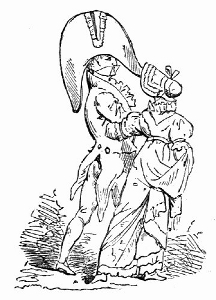
With the peace of 1815 commenced
a new era in English history;
and within the few years
immediately preceding and following
it, English society went
through a remarkably rapid change;
a change, as far as we can see, of a
decidedly favourable kind. The
social condition of public sentiment
and public morals, literature,
and science, were all improved.
As the violent internal
agitation of the country during
the regency increased the number
of political caricatures and satirical
writings, so the succession of fashions,
varying in extravagance,
which characterised the same
period, produced a greater number of caricatures on dress and on
fashionable manners than had been seen at any previous period. During
the first twelve or fifteen years of the present century, the general character
of the costume appears not to have undergone any great change.
The two figures here given represent the mode in 1810.
A few years later the fashionable costume furnished an extraordinary
contrast with that just represented. The waist was again shortened, as
well as the frock and petticoat, and, instead of concealment, it seemed
to be the aim of the ladies to exhibit to view as much of the body as possible.
The fops of 1819 and 1820 received the name of dandies, the
ladies that of dandizettes. The accompanying cut is from a rather
broadly caricatured print of a dandizette of the year 1819. It must be
considered only as a type of the general character of the foppish costume
of the period; for in no time was there ever such a variety of forms in
the dresses of both sexes as at the period alluded to.
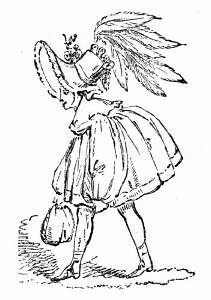
DANDIZETTE.
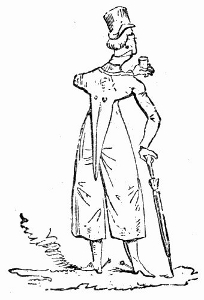
DANDY.
We give with the same reservation, a figure of a dandy, from a caricature
of the same year. The number of caricatures on the dandies and
dandizettes, and on their fopperies and follies, during the years 1819,
1820, and 1821, was perfectly astonishing.
FASHIONABLE DISFIGUREMENT.
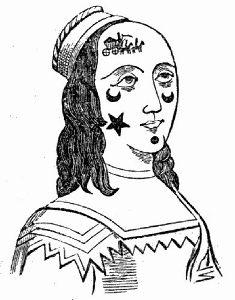
The extent to which people may be led to disfigure themselves by a
blind compliance with the fashion of the day, was never more strikingly
displayed than in the custom of dotting
the face with black patches of different
patterns.
It might easily be supposed
that the annexed sketch is a caricature,
but such is not the case; it is a
correct likeness of a lady of the time of
Charles the First, with her face in full
dress. Patching was much admired
during the reign of that sovereign, and
for several succeeding years. Some
authors think that the fashion came
originally from Arabia. No sooner was
it brought to England and France, than
it became an absolute fureur. In the
former country, old and young, the
maiden of sixteen and the grey-haired
grandmama, covered their faces with
these black spots, shaped like suns,
moons, stars, hearts, crosses, and lozenges; and some even, as in the
instance before us, carried the mode to the extravagant extent of shaping
the patches to represent a carriage and horses.
A REMARKABLE OLD MAN.
Mr. Ingleby, of Battle Abbey, Sussex, died 1798, aged 117. He had
been for upwards of ninety-five years a domestic in the family of Lady
Webster. The following narrative of this remarkable man is by a gentleman
who visited him in the autumn of 1797:—
"To my great surprise," he says, "I found Mr. Ingleby in a situation
very far removed from the luxuries of life, or the place which might be
deemed necessary for his years. He was in an antique outbuilding, near
the Castle Gate, where his table was spread under an arched roof; nearly
the whole of the building being filled with billet-wood, and scarcely
affording room for the oaken bench on which this wonder of longevity
was reclining by the fire. His dress was a full-bottomed wig, and a
chocolate-coloured suit of clothes with yellow buttons. His air and demeanour
was pensive and solemn; though there was nothing in his look
which impressed the mind with the idea of a person more than fourscore
years old, except a slight falling of the under jaw, which bespoke a more
advanced age. We were introduced by a matron, who served as a sort
of interpreter between us—Mr. Ingleby's deafness not permitting any
regular conversation. When the nurse explained our errand, he replied,
in a very distinct but hollow voice, 'I am much obliged to the gentlemen
for the favour they do me; but I am not well, and unable to converse
with them.' He then turned his face to the higher part of the bench on
which he reclined, and was silent. In each of his withered hands he
held a short, rude, beechen walking stick, about three feet high, by the
help of which he was accustomed not only to walk about the extensive
premises in which he passed the most part of his life, but also to take
his little rambles about the town; and once (for, occasionally, the old
gentleman was irascible,) he set out on a pedestrian excursion to Hastings,
to inquire for another situation in service, because his patroness
desired him to be more attentive to personal neatness. It is but justice
to the lady alluded to, to add, that the uncouth abode in which Mr.
Ingleby dwelt was the only one in which he could be persuaded to reside,
and which long familiarity had rendered dear to him. The choice appeared
very extraordinary; but such persons, in their conduct, are seldom
governed by the fixed and settled rules by which human life is
ordinarily regulated."
CURIOUS MANUSCRIPT.
A very curious manuscript was presented to the Antiquarian Society
of Yorkshire in 1828. It contains sundry rules to be observed by
the household of Henry the 8th, and enjoins the following singular
particulars:—"None of his Highness's attendants to steal any locks,
or keys, tables, forms, cupboards, or other furniture, out of noblemen's,
or gentlemen's, houses where he goes to visit. No herald, minstrel,
falconer, or other, to bring to the Court any boy or rascal; nor
to keeps lads or rascals in Court to do their business for them. Master
cooks not to employ such scullions as shall go about naked, or lie all
night on the ground before the kitchen fire. Dinner to be at ten, and
supper at four. The Knight Marshal to take care that all such unthrifty
and common women as follow the Court be banished. The proper
officers are, between six and seven o'clock every morning, to make the
fire in and straw his Highness's Privy Chamber. Officers of his Highness's
Privy Chamber to keep secret every thing said or done, leaving
hearkening or inquiring where the King is or goes, be it early or late,
without grudging, mumbling, or talking of the King's past time, late or
early going to bed, or any other matter. Coal only allowed to the
King's, Queen's, and Lady Mary's Chambers. The Queen's Maids of
Honour to have a chet loaf, a manchet, a gallon of ale, and a chine of
beef, for their breakfasts. Among the fishes for the table is a porpoise,
and if it is too big for a horse-load, a further allowance is made for it to
the purveyor." The manuscript ends with several proclamations. One
is "to take up and punish strong and mighty beggars, rascals, and
vagabonds, who hang about the Court."
WONDERFUL ESCAPE.
In 1809, a barge was going along the new cut from Paddington
with casks of spirits and barrels of gunpowder. It is supposed that one
of the crew bored a hole in a powder-barrel by mistake, meaning to steal
spirits; the gimlet set fire to the powder, and eleven other barrels were
driven to the distance of 150 yards; but only the single barrel exploded.
DAVID HUME ON HIS OWN DEATH.
The letter which we here lay before our readers was addressed by
David Hume to the Countess de Boufflers, and is supposed to be the last
that was ever written by that great historian, as he died only five days
afterwards, August 25th. With what calmness did that illustrious philosopher
contemplate the rapid approach of his own death!
The letter was torn at the places where the words are printed in italics:
"Edinburgh, 20th of August, 1776.
"Tho' I am certainly within a few weeks, dear Madam, and perhaps
within a few days, of my own death, I could not forbear being struck with
the death of the Prince of Conti, so great a loss in every particular.
My reflection carried me immediately to your situation in this melancholy
incident. What a difference to you in your whole plan of life!
Pray, write me some particulars; but in such terms that you need not
care, in event of decease, into whose hands your letter may fall.
"My distemper is a diarrhœa, or disorder in my bowels, which has
been gradually undermining me these two years; but within these six
months has been visibly hastening me to my end. I see death approach
gradually without any anxiety or regret. I salute you with great affection
and regard for the last time.
"David Hume."
SCRIPTURAL ANTIQUITIES.
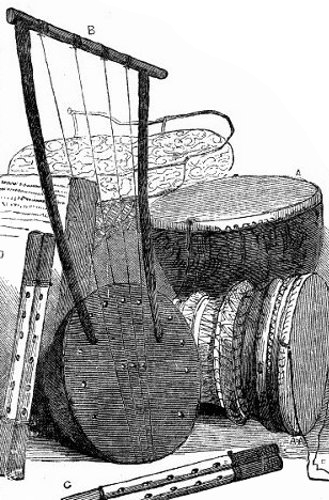
A. Drum, or Timbrel, of Baked Potter's Clay.
—AA. Drum in use in the East.—B.
Harp.—C. Lutes.—D. Inscribed Stone.—E. Sandals.
The rude musical instruments here represented, have been collected by
modern travellers, and are but little changed from the ancient forms.
The drum or timbrel marked A, is made of thin baked clay, something in
the shape of a bottle, with parchment stretched over the wider part. On
being struck with the finger, this instrument makes a remarkably loud
sound. These relics are lodged in the London Scriptural Museum, and are
all ticketed with the texts they serve to illustrate. This arrangement is
very judicious, and gives a great additional interest to the sacred objects
while under inspection.
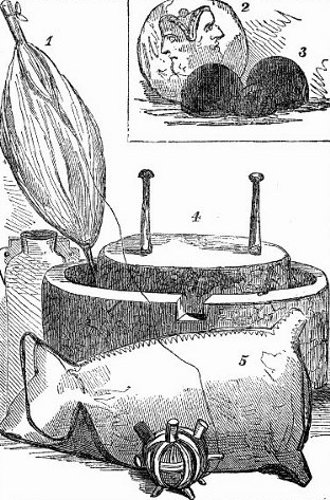
1. Distaff.—2. Roman Farthing.—3.
Stone Money Weights.—4. Hand Mill. 5. Eastern Wine and Water
Bottles.
The distaff was the instrument which wrought the materials for the
robes of the Egyptian Kings, and for the "little coat" which Hannah
made for Samuel; by it, too, were wrought the cloths, and other fabrics
used in Solomon's temple. By reference to the above engraving, it will
be seen that nothing can be more simple than this ancient instrument,
which is a sort of wooden skewer, round which the flax is wrapped; it is
then spun on the ground in the same manner as a boy's top, and the
thread wrought off, and wound upon a reel shown in the foreground of
the picture. "Querns," or stone hand-mills of various sizes, similar to
that represented in our engraving, have been repeatedly found in connection
with Roman, Saxon, and other ancient remains in this country.
They are still to be met with in constant use over the greater part of
India, in Africa, and also those districts of the East which are more particularly
associated with Holy Writ. It may be worth while to mention
that this description of mill is an improvement upon the method of simply
crushing the corn laid on a flat stone with another held in the hand.
The "Quern" is a hard stone roughly rounded, and partly hollowed,
into which another stone, which has a handle, is loosely fitted. The
corn required to be ground is placed in the hollow receptacle, and the
inner stone is moved rapidly round, and, in course of time, by immense
labour, the wheat &c. is ground into flour. The Scripture prophecies mention
that of two women grinding at the mill, one shall be left, and the other
taken—the two-handled mill will explain the meaning of this passage.
CHRONOLOGICAL TABLE OF REMARKABLE EVENTS.
- The following curious table is extracted literatim from Arthur
Hopton's Concordancie of Years, 1615:—
- 1077.—A blazing star on Palm Sunday, nere the sun.
- 1100.—The yard (measure) made by Henry I.
- 1116.—The moone seemed turned into bloud.
- 1128.—Men wore haire like women.
- 1180.—Paris in France, and London in Englande, paued, and thatching
in both left, because all Luberick was spoiled thereby with fire.
- 1189.—Robin Hood and Little John lived. This yeare London obtained
to be gouerned by sheriffes and maiors.
- 1205.—By reason of a frost from January to March wheate was sold
for a marke the quarter, which before was at 12 pence. Anno
Regni 6. John.
- 1209.—London bridge builded with stone; and this yeare the citizens of
London had a grant to choose them a maior.
- 1227.—The citizens of London had libertie to hunt a certain distance
about the citie, and to passe toll-free through England.
- 1231.—Thunder lasted fifteen daies; beginning the morrow after St.
Martin's day.
- 1233.—Four sunnes appeared, beside the true sunne, of a red colour.
- 1235.—The Jews of Norwich stole a boy and circumcised him, minding
to have crucified him at Easter.
- 1247.—The king farmed Queene-hiue for fifty pounds per annum, to the
citizens.
- 1252.—Great tempests upon the sea, and fearful; and this year the king
(Henry III.) granted, that wheretofore the citizens of London
were to present the maior before the king, wheresoeuer he were,
that now barons of the exchequer should serue.
- 1292.—The Jewes corrupting England with vsury, had first a badge
giuen them to weare, that they might be knowne, and after were
banished to the number of 150,000 persons.
[Pg 219]
- 1313.—This yeare the king of France burned all his leporous and pocky
people, as well men as women: for that he supposed they had
poysoned the waters, which caused his leprosie. About this
time, also, the Jews had a purpose to poyson all the Christians,
by poysoning all their springs.
- 1361.—Men and beasts perished in diuers places with thunder and lightning,
and fiends were seene speake unto men as they trauelled.
- 1372.—The first bailiffes, in Shrewsbury.
- 1386.—The making of gunnes found; and rebels in Kent and Essex,
who entred London, beheaded all lawyers, and burnt houses and
all bookes of law.
- 1388.—Picked shooes, tyed to their knees with siluer chaines were vsed.
And women with long gownes rode in side-saddles, like the
queene, that brought side-saddles first to England; for before
they rode astrid.
- 1401.—Pride exceeding in monstrous apparrell.
- 1411.—Guildhall in London begun.
- 1417.—A decree for lantherne and candle-light in London.
- 1427.—Rain from the 1st of Aprill to Hollontide.
- 1510.—St. John's College in Cambridge being an ancient hostell, was
conuerted to a college by the executors of the Countesse of Richmond
and Derby, and mother of Henry VII., in this yeare, as
her will was.
- 1552.—The new service book in English.
- 1555.—The first use of coaches in England.
- 1606.—The cawsies about London taken down.
- 1610.—Britaines Bursse builded. Hix Hall builded. Aldgate builded
new. Sutton's Hospitall founded. Moore fields new railed and
planted with trees. Westminster palace paued.
COCK-FIGHTING AT SCHOOLS.
Many years ago the scholars at our large schools had regular cock-fights,
which would appear to have been an affair of the school,
recognised by the masters, and the charges for which were defrayed by
them, to be afterwards paid by the parents, just as some innocent excursions
and festivities are managed now a days. The credit of the school
was, without doubt, often involved in the proper issue of the fight.
Sir James Mackintosh, when at school at Fortrose in 1776-7, had this
entry in his account, in which books were charged 3s. 6d.:—
To cocks'-fight dues for 2 years, 2s. 6d. each, 5s.
Associated are three months' fees at the dancing-school, minuet,
country-dances, and hornpipe, &c. Cock-fighting up to the end of the
last century was a very general amusement, and an occasion for gambling.
It entered into the occupations of the old and young. Travellers
agreed with coachmen that they were to wait a night if there was a
cock-fight in any town through which they passed. A battle between
two cocks had five guineas staked upon it. Fifty guineas, about the
year 1760, depended upon the main or odd battle. This made the decision
of a "long main," at cock-fighting an important matter. The
church bells at times announced the winning of a "long main." Matches
were sometimes so arranged as to last the week. When country gentlemen
had sat long at table, and the conversation had turned upon the relative
merits of their several birds, a cock-fight often resulted, as the
birds in question were brought for the purpose into the dining-room.
COMMON TRAVELLING.
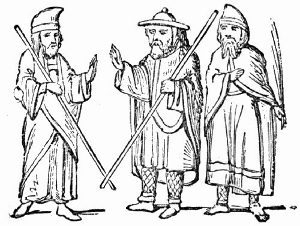
We have here the common travelling dress in use at the commencement
of the 12th century, tempus Henry I. and Stephen. The
original is intended for the Saviour meeting the two disciples on the
road to Emmaus. The Saviour wears an under tunic, and his mantle,
fastened by a narrow band across the chest, is held up by the right
hand. The figures of the disciples are, however, the most curious, the
central one particularly so, as he would seem to wear a dress expressly
invented for travelling: his large round hat, with its wide brim, seems
to be the original of the pilgrim's hat so well known in later times, and
which formed so distinguishing a mark in their costume.
His short
green tunic, well adapted for journeying, is protected by a capacious
mantle of skin, provided
with a "capa" or cowl, to
draw over the head, and
which was frequently used
instead of a hat. He wears
white breeches ornamented
with red cross-stripes; they
end at the ankle, where they
are secured by a band or
garter, the foot being covered
by close shoes. His companion
wears the common cap
so frequently met with, and
he has his face ornamented
to profusion by moustaches
and beard, each lock of which appears to be most carefully separated and
arranged in the nicest order. He has an under-tunic of white, and an
upper one of red, and a white mantle bordered with gold; he also wears the
same kind of breeches, reaching to the ankle, but he has no shoes, which
frequently appears to have been the case when persons were on a journey.
FASHIONABLE DANCES OF THE LAST CENTURY.
The style of dancing which was fashionable at the latter part of the
last century, may be seen from the following advertisement from a
dancing-master, which we have copied from a newspaper of the year
1775:—
"At Duke's Long Room, in Paternoster Row, Grown Gentlemen or
Ladies are taught a Minuet, or the Method of Country Dances, with the
modern Method of Footing; and that in the genteelest, and most expeditious,
and private Manner. And for the greater expedition of such
gentlemen, as chuse to dance in company, there's a complete Set of Gentlemen
assembled every Monday and Wednesday evening for the said purpose.
Gentlemen or Ladies may be waited on at their own Houses by
favouring me with a line directed as above. Likewise to be had at my
House, as above, a Book of Instructions for the figuring part of Country
Dances, with the Figure of the Minuet annex'd thereon, drawn out in
Characters, and laid down in such a Manner, that at once casting your
Eye on it, you see the Figure directly form'd as it is to be done; so that
a person, even that had never learnt, might, by the help of this book,
soon make himself Master of the figuring Part. Such as reside in the
Country, I doubt not, would find it of immediate Service, as they have
not always an Opportunity of having Recourse to a Dancing Master.
Price 10s. 6d. N. Dukes, Dancing Master."
PREACHING FRIARS.
In the romance of "St. Graal," executed in the fourteenth
century, we have this representation of one of these preaching friars
in his rude portable pulpit.
From the contrast
afforded by their mendicancy,
and enthusiasm
in teaching, to the pride
and riches of the higher
clergy, and their constant
mixing with the
people, they became excessively
popular. The
preacher in the cut has
a crowded and attentive
audience (though one lady
seems inclined to nap);
the costume of the entire
body, who are all seated,
after a primitive fashion,
on the bare ground, is
worthy of note, and may be received as a fair picture of the commonalty
of England about the year 1350.
THE ECCENTRIC LADY LEWSON.
Mrs. Jane Lewson, widow, of No. 12, Coldbath Square, London, died
1816, aged 116. Mrs. Lewson, from the very eccentric style of her dress,
was almost universally recognised as Lady Lewson. She was born in
Essex Street, Strand, in the year 1700, during the reign of William and
Mary; and was married at an early age to a wealthy gentleman then
living in the house in which she died. She became a widow at the early
age of 26, having only one child, a daughter, living at the time. Mrs.
Lewson being left by her husband in affluent circumstances, though she
had many suitors, preferred to remain in a state of widowhood. When
her daughter married, being left alone, she became very fond of retirement,
and rarely went out or permitted the visits of any person. For
the last thirty years of her life she had kept no servant, except one old
female, who died in 1806; she was succeeded by the old woman's granddaughter,
who was married about 1813; and she was followed in the
situation by an old man, who attended the different houses in the square
to go on errands, clean shoes, &c. Mrs. Lewson took this man into her
house, and he acted as her steward, butler, cook, and housemaid; and
with the exception of two old lap-dogs and a cat, he was her only companion.
The house she occupied was elegantly furnished, but after the
old style; the beds were kept constantly made, although they had not
been slept in for about fifty years. Her apartment was only occasionally
swept out, but never washed; the windows were so encrusted with dirt
that they hardly admitted a ray of light to pass through them. She had
used to tell her acquaintances that if the rooms were wetted, it might be
the occasion of her taking cold; and as to cleaning the windows, she
observed that many accidents happened through that ridiculous practice;
the glass might be broke, and the person wounded, when the expense of
repairing the one, and curing the other, would both fall upon her. A
large garden at the rear of the house was the only thing connected with
her establishment to which she really paid attention. This was always
kept in good order; and here, when the weather permitted, she enjoyed
the air, or sometimes sat and read by way of pastime; or else chatted on
times past with any of the few remaining acquaintances whose visits she
permitted. She seldom visited any person except Mr. Jones, a grocer at
the corner of the square, with whom she dealt. She was so partial to
the fashions prevailing in her youthful days, that she never changed the
manner of her dress from that worn by ladies in the reign of George the
First. She always wore powder with a large toupée made of horsehair
on her head, nearly half a foot high, over which her front hair was turned
up; a cap over it, which knotted under the chin, and three or four curls
hanging down her neck. She generally wore silk gowns, the train long
with a deep flounce all round, a very long narrow waist, very tightly
laced up to her neck, round which was a ruff or frill. The sleeves of her
gown, to which four or five large ruffles were attached, came below the
elbow; a large straw bonnet, quite flat, high-heeled shoes, a full-made
black silk cloak trimmed round with lace, and a gold-headed cane, completed
her every-day costume for the last eighty years of her life, and in
which habiliments she occasionally walked round the square, when she
was uniformly spoken of by all spectators as Lady Lewson. She never
practised ablutions of any kind, or hardly in any degree, because, as she
alleged, those persons who washed themselves were always taking cold,
or laying the foundation of some dreadful disorder. Her method was to
besmear her face and neck all over with hog's lard, because that was soft
and lubricating; and then, because she required a little colour in her
cheeks to set off her person to advantage, she had used to paint them with
rose-pink. Her manner of living was so methodical, that she would not
take her tea out of any other than a favourite cup. She was equally
particular with respect to her knives, forks, plates, &c. At breakfast she
arranged, in a particular manner, the paraphernalia of her table: at
dinner she always observed a particular rule as to the placing of the two
or three empty chairs, by which the table was surrounded, but herself
always sat in one favourite chair. She constantly enjoyed an excellent
state of health; assisted at all times in regulating the affairs of her
household; and never, until a little previous to her decease, had an hour's
illness. She entertained the greatest aversion to medicine; and, what is
remarkable, cut two new teeth at the age of 87, and was never troubled
with the toothache. Towards the close of her life her sight failed her.
She lived in five reigns, and was believed to be the most faithful living
chronicler of the age. A few days previous to her decease, an old lady
who was her neighbour died suddenly, which had such an effect upon her
that she frequently said her time was also come, and she should soon
follow. She enjoyed the use of all her faculties till that period, when she
became weak and took to her bed; but steadily refused all medical aid.
Her conduct to a few relations was extremely capricious; and she would
never see any of them; and it was not until a few hours before her dissolution
that any relaxation in her temper was manifested. She was interred
in Bunhill Fields burying-ground.
WHEN FIRE ENGINES WERE FIRST MADE.
The Phœnix was the first fire-office established, in 1682. There were
used, in towns, squirts or syringes, for extinguishing fire, which did not
exceed two or three feet in length. These yielded to the Fire Engine,
with leathern pipes, which was patented in 1676. Water-tight, seamless
hose was made in Bethnal Green in 1720. About this date—
| |
£ |
s. |
d. |
| A fire engine and pipe for Lyme cost |
6 |
0 |
0 |
| A square pipe, 23 feet long |
1 |
18 |
0 |
| 12 leather fire-buckets |
2 |
3 |
3 |
A Fire Engine was considered an appropriate present for an aspirant
to a borough. At Lewes, in 1726, T. Pelham, Esq., gave one, and
having been chosen representative in 1731, he presented a second.
EXTRAORDINARY CATARACT.
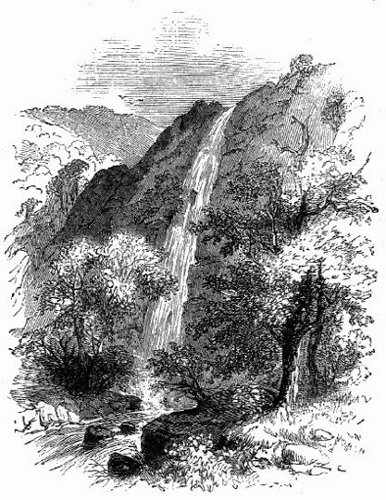
In the Island of Pulo Penang, in the Straits of Malacca, there is a
cataract which is surpassed by very few in the four quarters of the earth.
It is rarely visited, and, therefore, has been but seldom described; but
those who have been fortunate enough to witness it all agree in the
opinion that it forms one of the wonders of the world. The stream
which supplies it is of considerable volume, and after traversing a long
tract of comparatively level country, is suddenly precipitated almost
without a break into a ravine nearly two hundred feet below the
summit of the fall. The annexed engraving gives an excellent
representation of the scene. The stream descends with a mighty
roar, and rushes on with a lightning speed. If you take the
trouble of bringing a small looking-glass in your pocket, and come
here about an hour before noon, you will be able to produce some
very beautiful artificial rainbows. But, whatever you do, never
attempt to clamber to the top of the rocks; for though, doubtless,
the scenery is very sublime up there, the pathway is slippery and
dangerous in the extreme; and the guides can tell how two hapless
youths, officers belonging to a regiment stationed here some twenty
years ago, clambered up that hill, and how they shouted with
triumph on reaching yon summit, and waved their handkerchiefs
bravely; but they can also tell the gloomy and disastrous end of all
this; how the wild screams echoed far and wide, as both slipped and fell
headlong into the surging torrent, and the sun shone brightly upon the
bright red uniforms as they were hurried over the precipice, and
dashed from rock to rock; and, whilst yet the horror-stricken spectators
gazed with speechless agony and terror, the bodies of the poor
young men were borne away and hid by the blood-stained waters
from human recovery.
DANCES OF THE NATIVES IN NEW SOUTH WALES.
The manners and customs of the uncivilized are always legitimate
objects of wonder and curiosity to the civilized. It is on this account
that we give the above sketch of one of the festival dances of the natives
of Australia.
These dances are not only the usual close of their combats, but are
frequent in time of peace. They appear almost necessary to stir up
their blood; and under the excitement they produce, the whole nature
of the people seems to be changed. To a spectator the effect of one of
these exhibitions almost equals that of a tragic melo-drama.
A suitable place for the performance is selected in the neighbourhood
of their huts. Here a fire is built by the women and boys, while such
of the men as are to take a share in the exhibition, usually about twenty
in number, disappear to arrange their persons. When these preparations
are completed, and the fire burns brightly, the performers are seen
advancing in the guise of as many skeletons. This effect is produced by
means of pipe clay, with which they paint broad white lines on their
arms and legs, and on the head, while others of less breadth are drawn
across the body, to correspond to the ribs. The music consists in beating
time on their shields, and singing, and to it the movements of the dancers
conform. It must not be supposed that this exhibition is a dance in our
sense of the word. It consists of violent and odd movements of the arms,
legs, and body, contortions and violent muscular actions, amounting
almost to frenzy. The performers appear more like a child's pasteboard
supple-jack than anything human in their movements.
This action continues for a time, and then the skeletons, for so they
appear to be, since they truly resemble them, suddenly seem to vanish and
reappear. The disappearance is effected by merely turning round, for
the figures are painted only in front, and their dusky forms are lost by
mingling with the dark background. The trees, illuminated by the
fire, are brought out with some of the figures in bold relief, while others
were indistinct and ghost-like. All concurs to give an air of wildness
to the strange scene. As the dance proceeds, the excitement
increases, and those who a short time before appear only half alive,
become full of animation, and finally are obliged to stop from
exhaustion.
A PUDDING AS AN ADVERTISEMENT.
The following fact is interesting, inasmuch as it gives us an insight
into the popular tastes of the period, and the power of mob-law:—
In 1718, James Austin, inventor of the Persian ink powder, invited
his customers to a feast. There was a pudding promised, which was to
be boiled fourteen days, instead of seven hours, and for which he allowed
a chaldron of coals. It weighed 900 pounds. The copper for boiling it
was erected at the Red Lion in Southwark Park, where crowds went to
see it; and when boiled, it was to be conveyed to the Swan Tavern, Fish
Street Hill, to the tune of "What lumps of pudding my mother gave
me." The place was changed to the Restoration Gardens in St. George's
Fields, in consequence of the numerous company expected, and the
pudding set out in procession with banners, streamers, drums, &c., but
the mob chased it on the way and carried all off.
THE DESOLATION OF EYAM.
The ancient custom of hanging a garland of white roses, made of
writing paper, and a pair of white gloves over the pew of the unmarried
villagers who die in the flower of their age, prevailed up to the year 1837
in the village of Eyam, and in most other villages and little towns in the
Peak of Derbyshire. In the year 1665, the plague was conveyed to this
unfortunate village, which for a time had been chiefly confined to London.
The infection, it appears, was carried in a box of woollen clothes;
the tailor, to whom they were directed was, together with his family, the
immediate victims of this fatal importation; and a few days sufficed to
confirm the fact, that the entire hamlet was deeply infected. A general
panic ensued, the worthy and truly christian Rector, the Rev. William
Mompesson, at this eventful and awful crisis, summoned the parish, and
after energetically stating the case, and declaring his decided intention of
remaining at his post, induced his hearers to adopt the measures he was
about to propose, if not for their own preservation, at least for the more
important cause, the preservation of the surrounding country. Eyam,
from this moment, like a besieged city, was cut off from the living world,
and to the zeal and fidelity of this ever-to-be-respected minister was confided
the present, as well as eternal welfare of those who were about to
prove to posterity, that devotion to their country, as well as to their God,
was combined in the truly christian creed taught them by this reverend
man. But alas! it was the will of the Almighty that the ranks of this
devoted flock should be rapidly thinned, though Mr. and Mrs. Mompesson
had been hitherto spared; but in August, the latter was carried off by
the fatal disease, in the 27th year of her age; her monument may still
be seen at no great distance from the chancel door. A number of grave-stones,
bearing date 1666, in the churchyard, show that for a time, at
least, the dead had been deposited there in the usual manner. Soon after
the death of Mrs. Mompesson, the disorder began to abate, and in about
two months might be said to have entirely ceased. The pious and
amiable Rector was graciously preserved.
CURIOUS PLAY BILL.
The following remarkable theatrical announcement is worth preservation,
inasmuch as it forms a curious effusion of vanity and poverty, in the
shape of an appeal to the taste and feelings of the inhabitants of a town
in Sussex:—
(Copy.)
At the old theatre in East Grinstead, on Saturday, May 5th, 1758, will
be represented (by particular desire, and for the benefit of Mrs. P.) the
deep and affecting Tragedy of Theodosius, or the Force of Love, with
magnificent scenes, dresses, &c.
Varanes, by Mr. P., who will strive, as far as possible, to support the
character of this fiery Persian Prince, in which he was so much admired
and applauded at Hastings, Arundel, Petworth, Midworth, Lewes, &c.
Theodosius, by a young gentleman from the university of Oxford, who
never appeared on any stage.
Athenais, by Mrs. P. Though her present condition will not permit
her to wait on gentlemen and ladies out of the town with tickets, she
hopes, as on former occasions, for their liberality and support.
Nothing in Italy can exceed the altar, in the first scene of the play.
Nevertheless, should any of the Nobility or Gentry wish to see it ornamented
with flowers, the bearer will bring away as many as they choose
to favour him with.
As the coronation of Athenais, to be introduced in the fifth act, contains
a number of personages, more than sufficient to fill all the dressing
rooms, &c., it is hoped no gentlemen and ladies will be offended at being
refused admission behind the scenes.
N.B. The great yard dog, that made so much noise on Thursday night,
during the last act of King Richard the Third, will be sent to a neighbour's
over the way; and on account of the prodigious demand for places,
part of the stable will be laid into the boxes on one side, and the granary
be open for the same purpose on the other.
Vivat Rex.
THE EAR OF BIRDS NOT TO BE DECEIVED.
The sense of hearing in birds is singularly acute, and their instinct
leads them instantly to detect the slightest variation in the song of
those of their own kind. The following is a laughable instance of this:—
A bird-catcher, wishing to increase his stock of bullfinches, took out
his caged bird and his limed twigs, and placed them in such a situation
of hedge and bush as he judged favourable to his success. It so happened
that his own bird was one of education, such as is usually termed
a piping bullfinch. In the first instance a few accidentally thrown out
natural notes, or calls, had attracted three or four of his kindred
feather, which had now taken their station not far distant from the cage.
There they stood in doubt and curiosity, and presently moving inch by
inch, and hop by hop towards him and the fatal twigs, they again
became stationary and attentive. It was in this eager and suspended
moment that the piping bullfinch set up the old country-dance of
"Nancy Dawson." Away flew every astounded bullfinch as fast as
wings could move, in such alarm and confusion as bullfinches could feel
and they only can venture to describe.
FLYING COACH.
If the Exeter Flying Stage arrived from London at Dorchester in two
days, and at Exeter at the end of the third day, about 1739, the speed
must have been considered surprising. Those who made use of such a
conveyance were doubtless looked upon as presumptuous, neck-or-nothing
mortals.
There was a "Devizes chaise" from London at this time which took a
route through Reading, Newbury, and Marlborough.
There is a good house at Morcomb Lake, east of Charmouth, now no
longer in the road, owing to this having been diverted. This was a
road-side inn, where the judges slept. The Fly Coach from London to
Exeter slept there the fifth night from town. The coach proceeded the
next morning to Axminster, where it breakfasted, and there a woman
barber shaved the coach.
AN AGED SPIRIT DRINKER.
Daniel Bull M'Carthy, of the county of Kerry, Ireland, died 1752, aged
111. At the age of eighty-four he married a fifth wife, a girl little more
than fourteen years of age, by whom he had twenty children—one every
subsequent year of his life. It was remarked that he was scarcely ever
seen to expectorate; nor did any extent of cold ever seem to affect him.
For the last seventy years of his life, when in company, he drank plentifully
of rum and brandy, which he always took neat; and, if in compliance
with solicitations he took wine or punch, always drank an equal
sized glass of rum or brandy, which he designated a wedge. The temperature
of his body was generally so hot that he could bear but little clothing,
either by day or night upon his person.
GIANT TREE.
There are few trees in the world like the giant tree in the island of
Pulo Penang, of which the annexed engraving is a correct representation.
It is one of the various kinds of palm, and some idea may be formed of
its height from the fact that it is twice as tall, and quite as straight, as
the mainmast of a line-of-battle ship; there are no branches, no twigs
anywhere to be seen, save just at the very summit, and here they bend
over gracefully, something like what one would imagine a large-sized
palm-tree to be if gazed at through Lord Rosse's telescope. It is a
only specimen of its kind to be met with in the whole island.
PUNISHING FALSE ACCUSERS.
Wisdom may sometimes be learned at a Quarter Sessions, and it
would be advantageous if we occasionally took a hint from our ancestors.
The magistrates at sessions in Charles the First's reign could and did
address themselves to questions arising between parties moving in humble
life, very important to them, and who could now-a-day in vain seek redress
in the same quarter. A modern Bridget might continue to charge
men with a breach of promise of marriage without legal measures being
available against her. This was not so in 1626. Her case was considered,
and her injurious conduct and mode of life were duly estimated,
with what result we shall learn from the following entry in the minute
book of a quarter sessions in Devonshire of that date:—"Forasmuch
as it hath appeared unto this Court that Bridget Howsley of Langton,
spinster, liveth idly and lewdly at home, not betaking herself to any
honest course of life, and hath lately falsely and scandalously accused
one [left blank in the original] of Honiton, in Devon, challenging
a promise of marriage from him, which tended much to his disgrace, and
that she is a continual brawler and sower of strife and debate between
her neighbours, inhabitants of Langton aforesaid, this court doth therefore
think fit and order that the said Bridget Howsley be forthwith committed
to the House of Correction, there to be set on work and remain
for the space of six whole months, and from thenceforth until she shall
find very good sureties for her appearance at the next Sessions, after the
said six months shall be expired, or until she shall procure a master that
will take her into service."
A PHASE OF THE SOUTHCOTTIAN DELUSION.
One of the most remarkable cases on record of combined knavery,
credulity, and superstition, is the belief which so extensively prevailed
about fifty years ago in the mission and doctrines of Joanna Southcott,
and of which, strange to say, some traces remain even to the present day.
Is it not astonishing that so recently as the year 1814, August 3rd, the
following paragraph—which we believe gives a correct statement of the
facts—should have appeared in the Courier newspaper? "Joanna
Southcott has lately given out that she expects in a few weeks to become
the mother of the true Messiah. She is nearly seventy years of age. A
cradle of most expensive and magnificent materials has been bespoken by
a lady of fortune for the accouchement, and has been for some days exhibited
at the warehouse of an eminent cabinet maker in Aldersgate-street.
Hundreds of genteel persons of both sexes have been to see this cradle, in
which her followers believe the true Messiah is to be rocked. The following
has been given us as a correct description: 'A child's crib, three feet
six inches, by two feet, of satin wood, with brass trellis, side and foot
board; turned feet, carved and gilt, on castors; a swing cot, inside
caned, to swing on centre; at each end gilt mouldings, top and bottom
for gold letters; a canopy cover, with blue silk; carved and gilt under
it, a gold ball, and dove, and olive branch; green stars at each corner,
gilt; blue silk furniture; an embroidered celestial crown, with Hebrew
characters, gold letters; a lambs'-wool mattress, with white fustian
down bed, down pillow, and two superfine blankets.'"
HOUSEHOLD EXPENSES OF KING EDWARD THE FIRST.
Edward the First kept three Christmasses at Rhuddlan castle, in Flintshire;
and it is a fact not generally known, that his queen Eleanor, exclusively
of the young prince Edward, born at Caernarvon, was delivered of a
princess there in 1283. This shows that his entire household must have been
transferred into Wales, at the time his policy was directed to complete
the annexation of the principality of Wales to that of England. In an
ancient record in the tower of London, dated 1281-2, and translated by
Samuel Lysons, Esq., is a curious roll of Edward's expenses when at
Rhuddlan. It consists of four sheets, containing the particulars, under
proper heads, of the sums of money paid for the maintenance of his
household. The sum of the expenses in this roll is £1,395 10s., which
sum, with the expenses of the other roll of the queen's household is
£2,220 2s. 10-1/2d. The roll is very curious, but too long to be inserted
here. We append the following as a specimen of the various items it
contains:—
| Paid on the day of the queen's churching in oblations to mass |
£0 |
3 |
0 |
| The queen's gift to divers minstrels attending her churching |
10 |
0 |
0 |
| The queen's gift to a female spy |
0 |
1 |
0 |
| A certain female spy, to purchase her a house as a spy |
1 |
0 |
0 |
| For the brethren at the hospital at Rhuddlan |
0 |
1 |
1 |
| For a certain player as a gift |
0 |
8 |
0 |
| For the celebration of mass for the soul of William de Bajor |
0 |
1 |
10 |
| For the messenger carrying letters to the king at London,
to be sent to the court of Rome, for his expenses |
0 |
1 |
0 |
| Paid sundry bailiffs at the castle |
0 |
4 |
10 |
| For the carriage of 80 casks of wine from the water to
the castle |
0 |
22 |
0 |
| For a cart bringing lances and cross bows from Ruthlan
to Hope |
0 |
1 |
4 |
| For the carriage of £3,000 from the king's wardrobe to
the queen's wardrobe |
0 |
10 |
5 |
| For 600 turves, to place about the queen's stew pond in
the castle |
0 |
1 |
0 |
| Carriage of figs and raisins to Aberconway |
0 |
0 |
1 |
| Paid wages for 1,060 archers at twopence, with 53 captains
at fourpence, with 10 constables of cavalry at 12d. a day |
68 |
8 |
6 |
| Paid the same for 1,040 archers, &c. &c. |
67 |
4 |
0 |
GARRICK'S CUP.
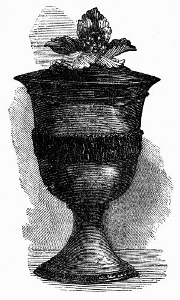
This celebrated Shakspearean relic was presented to David Garrick, by
the Mayor and Corporation of Stratford-upon-Avon, in September,
1769, at the Jubilee which he
instituted in honour of his favourite
Bard.
It measures about
11 inches in height. The tree
from which it is carved was
planted by Shakspeare's own
hand, in the year 1609, and after
having stood 147 years, was, in
an evil hour, and when at its
full growth and remarkably
large, cut down, and cleft to
pieces for fire-wood, by order of
the Rev. Francis Gastrell, to
whom it had become an object
of dislike, from its subjecting
him to the frequent importunities
of travellers. Fortunately,
the greater part of it fell into
the possession of Mr. Thomas
Sharp, a watchmaker of Stratford,
who, "out of sincere veneration"
for the memory of its
immortal planter, and well knowing
the value the world set upon
it, converted the fragments to
uses widely differing from that
to which they had been so sacrilegiously
condemned. Garrick
held this cup in his hand at
the Jubilee, while he sung the
beautiful and well-known air, which he had composed for the occasion,
beginning
"Behold this fair goblet, 'twas carved from the tree,
Which, O my sweet Shakspeare, was planted by thee;
As a relic I kiss it, and bow at the shrine,
What comes from thy hand must be ever divine!
All shall yield to the Mulberry tree,
Bend to thee,
Blest Mulberry;
Matchless was he
Who planted thee,
And thou like him immortal be!"
QUICK WORK.
Mr. John Coxetter, of Greenham Mills, Newbury, had two South
down sheep shorn at his factory exactly at five o'clock in the morning,
from the wool of which, after passing its various processes, a complete
damson coloured coat was made, and worn by Sir John Throckmorton,
at a quarter past six in the evening, being two and three-quarter hours
within the time allotted, for a wager of 1,000 guineas. The sheep were
roasted whole, and a sumptuous dinner given by Mr. Coxetter.
ORIGIN OF THE GREAT WALL OF CHINA.
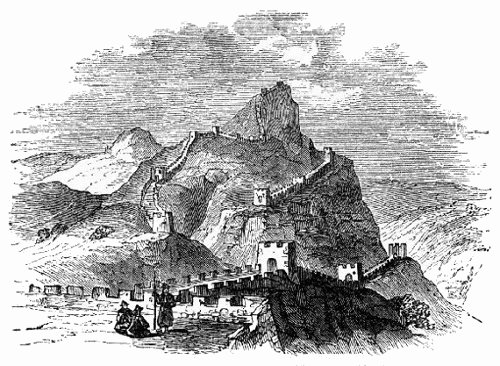
As has been invariably the case in the early history of all the leading
nations of the earth, great confusion and civil discord existed in the
empire of China in its first stages. It was divided into petty princedoms,
each prince striving to outwit the other, and all anxiously aiming
at the supreme power of the land, till the Emperor Chi-hoang-ti, who
came to the throne about three hundred years before the Christian era,
conquered the whole of the jealous petty princes, and united their states
into one vast empire. But no sooner had he achieved this, than the
Tartars began to be troublesome, and, hoping effectually to exclude their
invasions, this emperor caused to be constructed the often-read-of great
wall of China, a stupendous work of masonry, extending from the sea
to the western province of Shensee and carried over a tract of fifteen
hundred miles, comprising high mountains, deep valleys, and broad
rivers, the wall being supported over the latter by gigantic arches.
Fortified towers were erected at every hundred yards, and its summit
admitted of six horsemen riding abreast. This sovereign is said to be
the founder of the Hau dynasty. The wall proved an insignificant
barrier to the Huns or Tartars, who harassed the princes of the Hau
dynasty, and were a very scourge to the farmers of the frontier provinces.
About the year 264, the Hau dynasty gave way to the Tsin,
which latter was founded by a lineal descendant, through many generations,
of the builder of the great wall. In the sketch which we have
given, our chief object has been to show the extraordinary inflexibility
of the Chinese in carrying their wall strictly along their frontier line,
in spite of the stupendous obstacles which, intervened in the shape of
mountains and valleys.
PRIVY PURSE EXPENSES OF CHARLES II.
Malone, the well known editor of Shakespeare, possessed a curious
volume—an account of the privy expenses of Charles II, kept by Baptist
May. A few extracts from this MS., taken from Malone's transcripts,
are here offered:—
| |
£ |
s. |
d. |
| My Lord St. Alban's bill |
1,746 |
18 |
11 |
| Lady Castlemaine's debts |
1,116 |
1 |
0 |
| Sir R. Viner, for plate |
850 |
0 |
0 |
| For grinding cocoa-nuts |
5 |
8 |
0 |
| Paid Lady C., play money |
300 |
0 |
0 |
| For a band of music |
50 |
0 |
0 |
| To the footman that beat Teague |
5 |
7 |
6 |
| To Mr. Pears, for the charges of a body dissected before the king |
5 |
1 |
0 |
| Lady C., play money |
300 |
0 |
0 |
| To the Morrice Dancers at Ely |
1 |
1 |
0 |
| Lady C., play money |
300 |
0 |
0 |
| Mr. Knight for bleeding the king |
10 |
10 |
0 |
| For a receipt of chocolate |
227 |
0 |
0 |
| Mr. Price, for milking the asses |
10 |
0 |
0 |
| To one that showed tumblers' tricks |
5 |
7 |
6 |
| For weighing the king |
1 |
0 |
0 |
| Paid Hall for dancing on the rope |
20 |
0 |
0 |
| The Queen's allowance |
1,250 |
0 |
0 |
| Paid Lord Lauderdale for ballads |
5 |
0 |
0 |
| To a bone-setter attending the Duchess of Monmouth |
10 |
0 |
0 |
| Paid Terry for waiting on the king swimming |
10 |
0 |
0 |
| For 3,685 ribbons for the healing |
107 |
10 |
4 |
| Mrs. Blague, the king's valentine |
218 |
0 |
0 |
| Nell Gwyn |
100 |
0 |
0 |
| Lost by the king at play on Twelfth-night |
220 |
0 |
0 |
| Paid what was borrowed for the Countess of Castlemaine |
1,650 |
0 |
0 |
COLOUR OF THE HAT FOR CARDINALS.
Innocent IV. first made the hat the symbol or cognizance of the cardinals,
enjoining them to wear a red hat at the ceremonies and processions,
in token of their being ready to spill their blood for Jesus Christ.
SEVERITY OF THE LAWS A HUNDRED YEARS AGO.
Two lads were hanged for stealing a purse containing two shillings and
a brass counter. Of ten criminals convicted at one sessions, four were
hanged and six transported. Very often half a dozen were sentenced to
death at a single sessions. On the 17th March, 1755, eight malefactors
were hanged together at Tyburn. It was recorded as a matter of surprise,
that, "only six convicts received sentence of death at Gloucester Assizes."
One of these was a woman named Anne Ockley, who was executed on the
following day, on the charge of murdering an illegitimate child. To the
last she denied her guilt, except in not having called in medical advice
for her infant after a bad fall. She took the Sacrament, and begged for
more time to prepare herself for the change; this favour being denied,
she remained praying for two hours on the drop before she would give
the signal.
MARKING THE KING'S DISHES WITH THE COOK'S NAMES.
King George II. was accustomed every other year to visit his German
dominions, with the greater part of the officers of his household, and especially
those belonging to the kitchen. Once on his passage at sea, his
first cook was so ill with the sea-sickness, that he could not hold up his
head to dress his majesty's dinner; this being told to the king, he was
exceedingly sorry for it, as he was famous for making a Rhenish soup,
which his majesty was very fond of; he therefore ordered inquiry to be
made among the assistant-cooks, if any of them could make the above
soup. One named Weston (father of Tom Weston, the player) undertook
it, and so pleased the king, that he declared it was full as good as
that made by the first cook. Soon after the king's return to England,
the first cook died; when the king was informed of it, he said, that his
steward of the household always appointed his cooks, but that he would
now name one for himself, and therefore asking if one Weston was still
in the kitchen, and being answered that he was, "That man," said he,
"shall be my first cook, for he makes most excellent Rhenish soup."
This favour begot envy among all the servants, so that, when any dish
was found fault with, they used to say it was Weston's dressing: the
king took notice of this, and said to the servants, it was very extraordinary
that every dish he disliked should happen to be Weston's; "In
future," said he, "let every dish be marked with the name of the cook
that makes it." By this means the king detected their arts, and from
that time Weston's dishes pleased him most.
This custom was kept up till late in the reign of George III.
PARLOUS DAYS.
Bloodletting, considered during the last century to be necessary for
every one in health or not, at spring and fall, was an operation performed
by the country surgeons on the labourers on a Sunday morning, at a
charge of 6d. each. Bleeding in bed by a barber was, in the reign of
Charles II., sometimes charged, for a lady, so high as 10s., and for a
gentleman, 1s. and 2s. 6d. The operator perhaps barboured the patient
at an additional charge. Barbouring by the year was charged 16s.
Superstition had marked certain days in each month as dangerous for
bloodletting, which were called parlous days. In July, the 1st, 7th,
13th, 12th, 25th, and 20th were of the above kind.
As the whole population had recourse to bloodletting twice a year,
bleeders or barbers were in constant demand.
A FUNERAL APPROPRIATELY CONDUCTED.
During the year 1700, the minister of a parish in Kent was interred at
the age of 96 years; the gentleman who preached his funeral sermon was
82; he who read the service 87; the clerk of the parish was the same
age; the sexton was 86; in addition to which list of aged persons, there
were several present from the adjacent parishes 100 years old each, and
upwards.
ANCIENT NUT-CRACKERS.
The two quaint instruments pictured in our engraving, of about the
time of Charles I. or II., are made of hard wood rather rudely carved;
and look as if in their time they had seen good service. The grotesque
heads, with the mouth, affording the means of cracking the nuts, are
examples of the fitness of design for a particular purpose, which characterize
many of the objects in domestic use in the middle ages, and up to
the reign of Queen Anne, after which ornamental art for household uses
seems almost to have been disused. Even in the time of George III., our
chairs, tables, side-boards, &c., were made heavy, very ugly, and without
any attempt at appropriate pattern.
NELL GWYNNE'S LOOKING-GLASS.
This glass is in the possession of Sir Page Dicks, of Port Hall. It
bears the likeness of Nell Gwynne and King Charles, which are modelled
in wax; and also the supporters, or crest, which Nell assumed, namely,
the lion and the leopard. The whole is curiously worked in coloured
glass beads, and the figures, with the dresses, made to project in very
high relief; indeed, they are merely attached to the groundwork. In
the upper compartment is Charles in his state dress; and the bottom
one, that of Nell Gwynne, in her court dress—the pattern of which is
very tasteful. On the right is Charles in his hunting dress. The beads
have retained their colours, which are very appropriate to the subject,
and must have been a work of considerable time and patience; but
whether done by Nell or not, there is no record.
A REMARKABLE HIGHLANDER.
In August, 1827, John Macdonald expired in his son's house, in the
Lawnmarket, Edinburgh, at the advanced age of one hundred and seven
years. He was born in Glen Tinisdale, in the Isle of Skye, and, like the
other natives of that quarter, was bred to rural labour. Early one
morning in his youth, when looking after his black cattle, he was surprised
by the sight of two ladies, as he thought, winding slowly round a
hill, and approaching the spot where he stood. When they came up,
they inquired for a well or stream, where a drink of water could be obtained.
He conducted them to the "Virgin Well," an excellent spring,
which was held in great reverence on account of its being the scene of
some superstitious and legendary tales. When they had quenched their
thirst, one of the ladies rewarded Macdonald with a shilling, the first
silver coin of which he was possessed. At their own request he escorted
them to a gentleman's house at some distance, and there, to his great
surprise and satisfaction, he learned that the two "ladies" were Flora
Macdonald and Prince Charles Stewart.
This was the proudest incident in Macdonald's patriarchal life; and,
when surrounded by his Celtic brethren, he used to dilate on all the relative
circumstances with a sort of hereditary enthusiasm, and more than
the common garrulity of age. He afterwards turned joiner, and bore a
conspicuous part in the building of the first Protestant church which was
erected in the island of North Uist. He came to Edinburgh twenty-three
years before his death, and continued to work at his trade till he
was ninety-seven years of age.
Macdonald was a temperate, regular-living man, and never paid a
sixpence to a surgeon for himself, nor had an hour's sickness in the
whole course of his life. He used to dance regularly on New-year's day,
along with some Highland friends, to the bagpipe. On New-year's day,
1825, he danced a reel with the father, the son, the grandson, and great-grandson,
and was in more than his usual spirits. His hearing was nothing
impaired, and till within three weeks of his demise he could have
threaded the finest needle with facility, without glasses.
CATS WITH KNOTTED TAILS.
We extract the following paragraph from the narrative of a voyager in
the Indian Ocean, because it contains an account of a rarity in natural
history with which few, we believe, are acquainted.
"The steward is again pillowed on his beloved salt fish, and our only
companion is a Malacca cat, who has also an attachment for the steward's
pillow. Puss is a tame little creature, and comes rubbing herself mildly
against our shoes, looking up in our faces, and mewing her thoughts.
Doubtless she is surprised that you have been so long looking at her
without noticing the peculiarity in her tail, which so much distinguishes
her from the rest of the feline race in other quarters of the globe. Take
her up in your lap, and see for yourself. Did you ever observe such a
singular knot—so regular, too, in its formation? Some cruel monster
must have tied it in a knot whilst puss was yet a kitten, and she has
outlived both the pain and inconvenience. But here comes a kitten, all
full of gambols and fun, and we find that her tail is in precisely the
same condition. So, then, this is a remarkable feature amongst the
whole race of Malayan cats, but for which, no one we meet with, is able
to give us a satisfactory explanation."
CURIOUS FEATS.
In 1553, the following extraordinary exhibition was performed in the
presence of Queen Mary, in her passage through London to Westminster.—It
is thus described by Holinshed, in his "Chronicle,"
printed 1577:—"When shee didd come to Sainte Paule's churchyarde,
Maister Haywood sat in a pageant under a vine, and made to her an
oration in Latine; and then there was one Peter, a man of Holland, who
didd stand upon the weathercocke of St. Paule's steeple, holdyng a
streamer in his handes of five yardes long, and waving thereof. Hee
sometimes stood on one foot and shock the other, and then hee kneeled on
his knees to the verie grate marvel of al the people. Hee hadd made
two scaffolds under him—one above the cross, having torches and
streamers sett upon it, and another over the ball of the cross, likewise
sett with streamers and torches which could not burne, the wind was so
greate." Our chronicler further informs us, that "Peter didd have
xvi pounds xiii shillings and iii pence given to him by the citie of London
for his costes and pains, and for all his stuffe."
IMPUDENCE OR CANDOUR, WHICH IS IT?
The following advertisement appeared in the St. James's Chronicle of
1772. "Wanted immediately, fifteen hundred, or two thousand pounds,
by a person not worth a groat; who, having neither houses, land, annuities,
or public funds, can offer no other security than that of simple bond,
bearing simple interest, and engaging the repayment of the sum
borrowed in five, six, or seven years, as may be agreed on by the parties.
Whoever this may suit, (for it is hoped it will suit somebody), by directing
a line for A. Z. in Rochester, shall be immediately replied to, or
waited on, as may appear necessary."
THE SOUTH STACK LIGHTHOUSE.
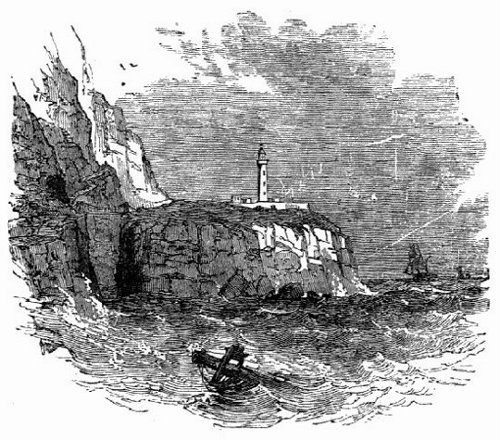
Though not so celebrated as the Eddystone, the South Stack Lighthouse
is unquestionably one of the marvels of science, and as such may
be appropriately described in our pages. It is erected on the summit
of an isolated rock, three or four miles westward from Holyhead, and
separated from the main land by a chasm ninety feet in width. This
splendid structure was raised in the year 1808. The elevation of the
summit of the rock on which it is erected is 140 feet above the level of
the sea at high-water mark; the height of the tower, from the base to
the gallery, is sixty feet; and the lantern is twelve feet high from the
gallery; making the total elevation of the light 212 feet above high-water
mark. The light is produced by twenty-one brilliant lamps, with
powerful reflectors, placed on a revolving triangular frame, displaying a
full-faced light every two minutes, which, in clear weather, is distinctly
visible at a distance of ten leagues. Latterly there has been an addition
of three red lights placed at the rock, which are more distinctly
visible in foggy weather than the lighthouse lights. The rough sea
caused by the strong tides about the head rendered the communication
by boat very precarious. In order to obviate the danger, a passage was
contrived by means of two ropes thrown across the gulf, along which the
individual was drawn in a box or cradle, by the assistance of pulleys
affixed at each end. This plan was superseded by a bridge of ropes,
which was used some years after, though always considered unsafe, on
account of the constant wear of the ropes. In 1827, a modern suspension
chain-bridge was thrown over the sound, the span of which is
110 feet, the chains being firmly bolted in the rock on each side, and
carried over two massive stone pillars erected for the purpose. The
chain supports a platform of timber five feet wide, and seventy feet
above high-water mark. The bridge is attained by descending the
Holyhead mountain in a zigzag direction by a flight of 380 steps.
BRASS MEDAL OF OUR SAVIOUR.
In 1702, the late Rev. H. Rowlands, author of Mona Antiqua, while
superintending the removal of some stones, near Aberfraw, Wales, for
the purpose of making an antiquarian research, found a beautiful brass
medal of our Saviour, in a fine state of preservation, which he forwarded
to his friend and countryman, the Rev. E. Llwyd, author of the
Archeologiæ Britannica, and at that time keeper of the Ashmolean
library at Oxford.
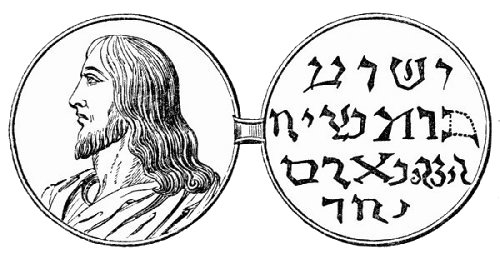
This medal, of which an engraving is subjoined, has on one side
the figure of a head exactly answering the description given by Publius
Lentulus of our Saviour, in a letter sent by him to the emperor Tiberius
and the senate of Rome. On the reverse side, it has the following legend
or inscription, written in Hebrew characters, "This is Jesus Christ, the
Mediator or Reconciler;" or "Jesus, the Great Messias, or Man Mediator."
And being found among the ruins of the chief Druids resident
in Anglesea, it is not improbable that the curious relic belonged to some
Christian connected with Brân the Blessed, who was one of Caractacus's
hostages at Rome from A.D. 52 to 59, at which time the Apostle Paul
was preaching the gospel of Christ at Rome. In two years afterwards,
A.D. 61, the Roman General Suetonius extirpated all the Druids in the
island. The following is a translation of the letter alluded to, a very
antique copy of which is in the possession of the family of Kellie, afterwards
Lord Kellie, now represented by the Earl of Mar, a very ancient
Scotch family—taken from the original at Rome:—
"There hath appeared in these our days, a man of great virtue, named
Jesus Christ, who is yet living among us, and of the Gentiles is accepted
as a prophet, but his disciples call him 'the Son of God.' He raiseth
the dead, and cures all manner of diseases; a man of stature somewhat
tall and comely, with very reverend countenance, such as the beholders
both love and fear; his hair the colour of chesnut, full ripe, plain to
his ears, whence downwards it is more orient, curling, and waving about
his shoulders. In the midst of his head is a seam or a partition of his
hair after the manner of the Nazarites; his forehead plain and very
delicate; his face without a spot or wrinkle, beautified with the most
lovely red; his nose and mouth so formed that nothing can be reprehended;
his beard thickish, in colour like his hair, not very long but
forked; his look, innocent and mature; his eyes, grey, clear, and quick.
In reproving, he is terrible; in admonishing, courteous and fair spoken;
pleasant in conversation, mixed with gravity. It cannot be remarked
that any one saw him laugh, but many have seen him weep. In proportion
of body, most excellent; his hands and arms most delicate to
behold. In speaking, very temperate, modest, and wise. A man, for
his singular beauty, surpassing the children of men!"
The representation of this sacred person which is in the Bodleian
library, somewhat resembles that of the print of this medal, when compared
together. It was taken from a likeness engraved in agate, and
sent as a present from the sultan for the release of his brother, who was
taken prisoner. There is a well-executed drawing of this at the Mostyn
library, much worse for age.
MONSTROUS HEAD-DRESS.
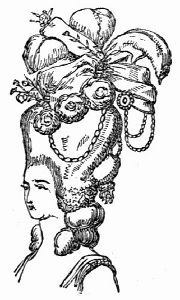
At no period in the history of the world was anything more absurd
in head-dress worn than that here depicted, which was in vogue
with the fashionables of 1782.
The body of this erection was
formed of tow, over which the hair was
turned, and false hair added in great curls,
bobs, and ties, powdered to profusion; then
hung all over with vulgarly-large rows of
pearls, or glass beads, fit only to decorate a
chandelier; flowers as obtrusive were stuck
about this heap of finery, which was surmounted
by broad silken bands and great
ostrich-feathers, until the head-dress of a
lady added three feet to her stature, and the
male sex, to use the words of the Spectator,
"became suddenly dwarfed beside her." To
effect this, much time and trouble was wasted,
and great personal annoyance was suffered.
Heads, when properly dressed, "kept for
three weeks," as the barbers quietly phrased
it; that they would not really "keep" longer
may be seen by the many recipes they give for
the destruction of insects which bred in the
flour and pomatum so liberally bestowed upon
them. The description of "opening a lady's head," after a three weeks'
dressing, given in the magazines of this period, it would be imagined,
would have taught the ladies common sense; but fashion could reconcile
even the disgust that must have been felt by all.
PRICE OF HUMAN HAIR.
Long flaxen hair was bought from the head at 10s. the ounce, and any
other fine hair at 5s. or 7s. the ounce in 1662.
Within the present century the heads of hair of whole families in
Devonshire were let out by the year at so much rent per poll. An Exeter
perriwig maker went round periodically, cut the locks, and oiled the
numskull of each thus left in stubble.
INTERESTING AND FANCIFUL RELIQUE.
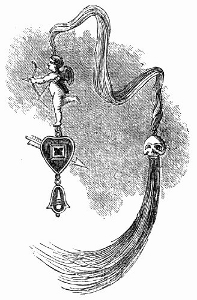
The enamelled jewel, of which we give an engraving, was presented
by Mary, Queen of Scots, to George Gordon, fourth Earl of Huntley.
The precise period at which the gift was made is not now known, though
the time was not improbably during the residence of the Queen in France,
when the Order of St. Michael was conferred on the Duke of Chatelherault,
the Earl of Huntley, and several other Scottish nobles,
about 1548.
The lock of Mary's
hair which is attached to the
small ivory skull, is of a light
auburn, inclining to a gold-colour;
and if allowance be made
for some fading in the course of
years, and for the hair of the
Queen having generally become
darker as she advanced in life,
the accuracy of Melvil will be
confirmed, when, in speaking of
her after her return to Scotland,
he says, "her hair was light
auburn; Elizabeth's more red
than yellow." In this particular
little reliance can be placed
upon the portraits of Queen
Mary; since it is well known,
that in the latter part of her
life, it was a fashionable practice
to wear false hair of various
hues, though in some of her pictures
the colour of the locks is
nearly similar to the hue of that
represented in the present. The
skull, from which it issues is
connected by a twisted skein of
silk with the figure of a Cupid shooting an arrow, standing on
a heart enamelled red, transfixed with a dart. On one side the
heart is a setting for a precious stone, now vacant; and, on the other,
in white letters, the words "Willingly Wounded." From the point of
the heart is a pendant, containing on one side a small ruby, and
having the other enamelled blue with an ornament in white. Our
engraving represents one side of the jewel, of the exact size of the
original.
FASTIDIOUSNESS IN DRESS AT AN OLD AGE.
Jonn Benbow, of Northwood, in the parish of Prees, Salop, died 1806,
aged 107. His occupation was that of a maker of clocks and watches.
His steadiness of hand, clearness of intellect, and complete command of
all his faculties, were such that, till within a very few years of his decease,
he was enabled to execute the most intricate and delicate manipulations
connected with his business. He lived in three centuries; and,
at the time of his decease, had a son, a grandson, and several great-grandchildren,
living in the house with him. He was remarkable for
industry, sobriety, early rising, and soon retiring to rest, and was universally
respected for his integrity and ingenuity. His favourite beverage
was "small beer" brewed of molasses. To the very close of his life
he was remarkable for his extreme attention to his dress and everything
relating to his personal appearance, as will be seen by the following
anecdote. About three years before his death, his tailor brought him
home a new coat; on examining which he discovered that the man,
either through not being provided with the necessary material or inadvertence,
had substituted a cloth collar for a velvet one, which he was
accustomed to have added to his garment. Mortified at this circumstance,
and learning that the tailor had not velvet of the necessary quality by
him, he took up his walking-stick and straitway went off to Whitchurch,
a distance of seven miles, to purchase the materials proper to make a new
collar, and, to the astonishment of all his family, returned home in a few
hours.
SUPERSTITION OF THE JAVANESE.
Nowhere has superstition a greater power over the human mind than
among the inhabitants of Java.
When the proper chord is touched, there is scarcely anything too gross
for the belief of these islanders. Mr. Crawfurd relates that some years
since, it was almost accidentally discovered, that the skull of a buffalo
was superstitiously conveyed from one part of the island to another. The
point insisted upon was, never to let it rest, but to keep it in constant
progressive motion. It was carried in a basket, and no sooner was one
person relieved from the load than it was taken up by another; for the
understanding was, that some dreadful imprecation was denounced
against the man who should let it rest. In this manner, the scull was
hurried from one province to another, and after a circulation of many
hundred miles, at length reached the town of Samarang, the Dutch
governor of which seized it and threw it into the sea, and thus the spell
was broken. The Javanese expressed no resentment, and nothing further
was heard of this unaccountable transaction. None could tell how or
where it originated.
The same writer relates a still more extraordinary instance of infatuation.
During the occupation of Java by the English, in the month of
May 1814, it was unexpectedly discovered, that, in a remote but populous
part of the island, a road, leading to the top of the mountain of
Sumbeng, one of the highest in Java, had been constructed. An enquiry
being set on foot, it was discovered that the delusion which gave rise to
the work had its origin in the province of Banyunas, in the territories of
the Susunan, and that the infection had spread to the territory of the
Sultan, and thence extended to that of the Europeans. On examination
a road was found constructed twenty feet broad, and from fifty to sixty
miles long, and it was wonderfully smooth and well made. One point
which appears to have been considered necessary, was, that this road
should not cross rivers, and in consequence it wound in a thousand ways.
Another point as peremptorily insisted on was, that its straight course
should not be interrupted by any private rights; and in consequence trees
and houses were overturned to make way for it. The population of whole
districts, occasionally to the amount of five or six thousand labourers,
were employed on the road, and, among a people disinclined to active exertion
the laborious work was nearly completed in two months—such was
the effect of the temporary enthusiasm with which they were inspired.
It was found in the sequel that the whole work was set in motion by an
old woman, who dreamt, or pretended to have dreamt, that a divine
personage was about to descend from heaven on the mountain in question.
Piety suggested the propriety of constructing a road to facilitate his descent;
and it was rumoured that divine vengeance would pursue the
sacrilegious person who refused to join in the meritorious labour. These
reports quickly wrought on the fears and ignorance of the people, and
they heartily joined in the enterprise. The old woman distributed slips
of palm-leaves to the labourers, with magic letters written upon them,
which were charms to secure them against sickness and accidents. When
this strange affair was discovered by the native authorities, orders were
issued to desist from the work, and the inhabitants returned without a
murmur to their wonted occupations.
SIZE OF THE BRITISH ISLANDS.
The exact size of our own country is a legitimate object of curiosity.
We believe the following will be found strictly accurate:—
| The area of |
England is estimated at |
31,929,340 |
acres. |
| " |
Wales |
4,320,000 |
" |
| " |
Scotland |
16,240,000 |
" |
| " |
S. Isles adjacent to the coast |
1,055,080 |
" |
| " |
W. Isles |
851,200 |
" |
| " |
Orkneys |
153,606 |
" |
| " |
Shetlands |
643,840 |
" |
CASE CONTAINING THE HEART OF LORD EDWARD BRUCE.
Lord Edward Bruce was eldest son of Sir Edward, baron of Kinloss, so
created by James I. in 1603, to whom the king gave the dissolved abbey
of Kinloss, in Ayrshire, after he had been instrumental in his succession
to the crown of England; whither accompanying the king, he was made
master of the Rolls in 1604, died in 1610, and was buried in the Rolls
chapel. His son, the lord Edward, killed in duel by Sir Edward Sackville
in 1613, was succeeded by his brother, who was created Earl of
Elgin in 1633, and an English baron in 1641.
Sir Edward Sackville, by whose hand the Lord Edward Bruce fell,
was younger brother to Richard Sackville, Earl of Dorset, on whose death
he succeeded to the title. He was lord president of the council, a joint
lord keeper, and filled several other distinguished offices under Charles I.,
to whom he adhered, by whose side he fought at the battle of Edge-hill,
and whose death he took so much to heart, that he never afterwards
stirred out of his house in Salisbury-court, but died there on the 17th of
July, 1652.
Between these noblemen there arose a quarrel, which terminated in
their duel; and all that is, or probably can be known respecting it, is
contained in the following correspondence, preserved in a manuscript in
Queen's college library, Oxford.
A Monsieur, Monsieur Sackvile.
"I that am in France, hear how much you attribute to yourself in
this time, that I have given the world leave to ring your praises; and
for me, the truest almanack, to tell you how much I suffer. If you call
to memory, when as I gave you my hand last, I told you I reserved the
heart for a truer reconcilliation. Now be that noble gentleman, my love
once spoke, and come and do him right that could recite the tryals you
owe your birth and country, were I not confident your honour gives you
the same courage to do me right, that it did to do me wrong. Be
master of your own weapons and time; the place wheresoever, I will
wait on you. By doing this, you shall shorten revenge, and clear the
idle opinion the world hath of both our worths.
"Ed. Bruce."
A Monsieur, Monsieur Baron de Kinloss.
"As it shall be always far from me to seek a quarrel, so will I always
be ready to meet with any that is desirous to make tryal of my valour,
by so fair a course as you require. A witness whereof yourself shall be,
who, within a month, shall receive a strict account of time, place and
weapon, where you shall find me ready disposed to give honourable
satisfaction, by him that shall conduct you thither. In the mean time,
be as secret of the appointment, as it seems you are desirous of it.
"E. Sackvile."
A Monsieur, Monsieur Baron de Kinloss.
"I am at Tergose, a town in Zeland, to give what satisfaction your
sword can render you, accompanied with a worthy gentleman for my
second, in degree a knight. And, for your coming, I will not limit you
a peremptory day, but desire you to make a definite and speedy repair,
for your own honour, and fear of prevention; at which time you shall
find me there.
Tergose, 10th of August, 1613.
"E. Sackvile.""
A Monsieur, Monsieur Sackvile.
"I have received your letter by your man, and acknowledge you have
dealt nobly with me; and now I come, with all possible haste, to meet
you.
"E. Bruce."
The combat was fierce, and fatal to Lord Bruce.
It has always been presumed that the duel was fought under the walls
of Antwerp; but the combatants disembarked at Bergen-op-Zoom, and
fought near that town, and not Antwerp.
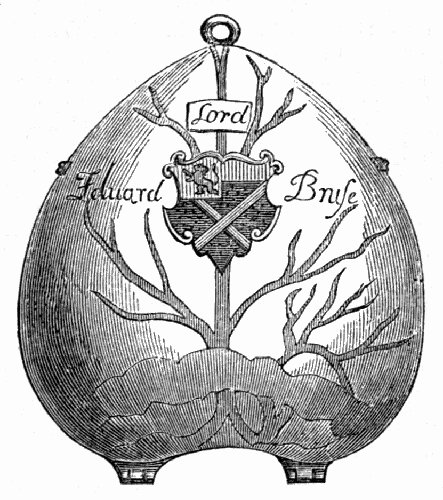
In consequence of a tradition, that the heart of Lord Edward Bruce
had been sent from Holland, and
interred in the vault or burying-ground
adjoining the old abbey
church of Culross, in Perthshire,
Sir Robert Preston directed a
search in that place in 1808, with
the following result:—
Two flat
stones, without inscription, about
four feet in length and two in
breadth, were discovered about
two feet below the level of the
pavement, and partly under an
old projection in the wall of the
old building. These stones were
strongly clasped together with
iron; and when separated, a
silver case, or box, of foreign
workmanship, shaped like a heart,
was found in a hollow or excavated
place between them.
Its lid was engraved with the arms and name "Lord Edward Bruse;"
it had hinges and clasps; and when opened, was found to contain a
heart, carefully embalmed, in a brownish coloured liquid. After drawings
had been taken of it, as represented in the present engravings, it was
carefully replaced in its former situation. There was a small leaden box
between the stones in another excavation; the contents of which, whatever
they were originally, appeared reduced to dust.
Some time after this discovery, Sir Robert Preston caused a delineation
of the silver case, according to the exact dimensions, with an inscription
recording its exhumation and re-deposit, to be engraved on a
brass plate, and placed upon the projection of the wall where the heart
was found.
It is a remarkable fact, that the cause of the quarrel between Lord
Bruce and Sir Edward Sackville has remained wholly undetected, notwithstanding
successive investigations at different periods. Lord Clarendon,
in his "History of the Rebellion," records the combat as an
occurrence of magnitude, from its sanguinary character and the eminence
of the parties engaged in it. He does not say any thing respecting the
occasion of the feud, although Lord Bruce's challenge seems to intimate
that it was a matter of public notoriety.
The exact day of the duel is not known, but it was certainly in 1613,
and most probably in August from the date of one of the above letters.
EXTRAORDINARY FEMALE INTREPIDITY.
Early on the 24th of January, 1822, the turnpike-house, about four
miles from Basingstoke, on this side of Overton, was attacked, with intent
to enter, by two men, who had taken off some tiles at the back part of
the premises (the roof being very low) to effect their purpose. These
villains knew, it would appear, that a lone woman, Mrs. Whitehouse,
received the tolls at this gate, and that her husband attended a gate as
far distant as Colebrook. Mrs. Whitehouse, however, very fortunately
possessed three loaded pistols, one of which she fired—then a second, and
a third, without effect. These determined ruffians (notwithstanding
being thrice fired at) were, it appears, resolved not to depart without
accomplishing the projected robbery. Mrs. Whitehouse's little boy,
only 11 years of age, in the mean time had re-loaded a brace of pistols,
one of which Mrs. Whitehouse fired, and wounded one of the desperadoes
full in the face—he fell, and the blood flowed profusely; yet,
strange to relate, the accomplice had hardihood enough to drag away the
wounded robber! On observing this, Mrs. Whitehouse fired the fifth
pistol at them, but missed them. The fellow who received the contents
of the fourth pistol being supposed to have been killed, and some persons
residing at a considerable distance from the spot having heard of the circumstance,
assembled, and made diligent search at daybreak to discover
the body of the deceased; but, although the blood could be traced some
distance from the house, the body could not be found; nor were those
concerned in the attack ever found out. The successful resistance,
however, deserves to be recorded.
GIGANTIC BONES.
Whenever any bones of unusual magnitude were discovered, it was
invariably the custom to ascribe them to some giant. This was always
so up to recent years, and no wonder it was intensely the case at the
early period of 1660. About that period, when the brook or rivulet
from which the town of Corbridge, in the north of England, derives
its name, had been worn away by some impetuous land-flood, a
skeleton, supposed to be that of a man of extraordinary and prodigious
size, was discovered. The length of the thigh bone was nearly six feet,
and the skull, teeth, and other parts proportionably monstrous, so that
the length of the whole body was computed at twenty-one feet. It is
conjectured, by the more enlightened men of modern times, that these
strange bones belonged to some large animal that had been sacrificed
by the Romans at the altar dedicated to Hercules, which was found
here some years ago. Notwithstanding that the superstition of our
forefathers has lost nearly all its credit and influence, a singularly
large bone found here is now exhibited in the Keswick Museum as
the rib of the giant Cor.
NEW STYLE OF ADVERTISEMENT.
The following editorial announcement is taken from the Philadelphia
Weekly Mercury, of November 30, 1752, because it forms a complete
novelty in its way, and also affords us an insight into the degree of communication
which existed at that period between the large towns and the
provinces in America. It is, moreover, a curious jumble of information,
strangely mixing up the starting of the stage coach with the news of
the day:—
On Monday next the Northern Post sets out from New-York, in order
to perform his Stage but once a Fortnight, during the Winter
Quarter; the Southern Post changes also, which will cause this Paper to
come out on Tuesdays during that Time. The Colds which have infested
the Northern Colonies have also been troublesome here, few Families
having escaped the same, several have been carry'd off by the Cold,
among whom was David Brintnall, in the 77th Year of his Age; he was
the first Man that had a Brick House in the City of Philadelphia, and
was much esteem'd for his just and upright dealing. There goes a
Report here, that the Lord Baltimore and his Lady are arrived in
Maryland, but the Southern Post being not yet come in, the said Report
wants Confirmation.
MAKING A CANDLESTICK OF GUNPOWDER.
A marvellous escape from destruction is related in the MS. Life of
Alderman Barnes.—"One of his brother-in-law's (Alderman Hutchinson's)
apprentices, stepping up into the back-lofts to fetch somewhat
he wanted, in his heedlessness and haste, stops his candle into a barrel
of gunpowder whose head was struck off, to serve instead of a candlestick.
But the man reflecting what he had done, was struck with
affrightment, his heart failed him, nor durst he stay any longer, but
running down stairs, leaves the candle burning in the gunpowder cask,
and with horror, trembling, and despair, tells the family what indiscretion
he had committed; they were all immediately as their wits' end,
and well they might, for the lofts were three stories high, very large, and
stowed full with whatever is combustible, as brandy, oil, pitch, tar, rosin,
flax, alum, hops, and many barrels of gunpowder. Had the candle
fallen to one side, or had the least spark fallen from the snuff into the
cask, the whole town had been shaken, and the whole of the house
immediately blown up and in a blaze; but one of the labourers, a stout
fellow, ran forthwith into the loft, and joining both his hands together,
drew the candle softly up between his middlemost fingers, so that if any
snuff had dropped, it must have fallen into the hollow of the man's hand,
and by this means was Newcastle saved from being laid in ashes." This
must have happened about the year 1684.
THE CAMDEN CUP.
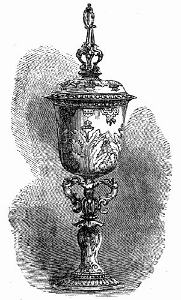
The subjoined engraving represents the Silver-gilt Standing Cup and
Cover bequeathed by the celebrated historian, William Camden, Clarenceux
King at Arms, to the Worshipful Company of Painter Stainers'.
Camden's will is recorded in the Prerogative Court of Canterbury (in
the register designated III Swann 3, probate granted November 10,
1623), and it has been printed by
Hearne in his Collection of Curious
Discourses, Ox. 1720.
After directing the sum of eight
pounds to be given "to the
poore of that place (Chislehurst)
when it shall please God to call
me to his mercie," Camden continues—"I
bequeath to Sir
Foulke Greville, Lord Brooke,
Chancellor of the Exchequer, who
preferred me gratis to my Office,
a peece of plate of ten pounds;
Item, to the Company of Painter-Stainers
of London, to buy them
a peece of plate in memoriall of
mee, sixteene pounds;" the inscription
upon which is directed
to be—"Guil. Camdenus Clarenceux,
filius Sampsonis, Pictoris
Londinensis, dono dedit."
This stately and richly-decorated
cup and cover is used on
Corporation Festivals, in memory
of the illustrious donor. In
height, it is altogether twenty-three
inches and a quarter, the
cover only being eight inches and
three-quarters; and the cup, independent
of the stand, five inches
and a-half, its greatest diameter being five inches and a-half. The inscription
encircles the upper rim of the cup; and directly under it is an
engraved escutcheon of Camden's arms; Or, a fess engrailed, between six
cross crosslets fitchée, Sable. The cover presents an object of much
elegance, a richly ornamented open pyramid, based on the heads of birds,
the breasts bending gracefully with cartouche ornaments: the pinnacle
of the pyramid surmounted by a female figure, the right hand resting
on a shield, charged with the same arms as shown on the side of the cup.
The birds' heads have apparently a reference to the phœnix heads in the
second and third quarters of the armorial ensigns, and to the crest of the
Company of Paper-Stainers.
RICHARDSON, THE SHOWMAN.
This eccentric individual, who died in 1836, left behind him upwards
of £20,000. He was born in the workhouse of Marlow, Bucks, but ran
away from that place in order to seek his fortune in London. After
various vicissitudes, he became the landlord of the Harlequin public-house,
in Drury-lane, where he saved some money, which he embarked
in fitting up a portable theatre, and was known for forty years as the
"Prince of Showmen," and used frequently to boast that Edmund Kean
and several other eminent actors were brought out by him. His property,
after various legacies to the itinerant company which had attended him
for many years, descended to two nephews and a niece, and he desired
by his will to be buried in Marlow churchyard, in the same grave as his
favourite "spotted boy," a lad who, some years before, was exhibited by
him, and attracted great notice in consequence of the extraordinary
manners in which he was marked on various parts of his body. Some
years since the scenery, dresses, and decorations of Richardson's theatre
were exposed for auction by Mr. George Robins, and £2,000 were bid
for them. They were bought in; the "old man," as he was technically
denominated, considering them to be worth at least £3,000.
PRESERVATION OF DEAD BODIES.
There is an arched vault, or burying-ground, under the church of
Kilsyth, in Scotland, which was the burying-place of the family of
Kilsyth, until the estate was forfeited, and the title became extinct in
the year 1715; since which it has never been used for that purpose,
except once. The last Earl fled with his family to Flanders, and,
according to tradition, was smothered to death about the year 1717,
along with his lady and an infant child, and a number of other unfortunate
Scottish exiles, by the falling in of the roof of a house in which
they were assembled. What became of the body of the Earl is not
known, but the bodies of Lady Kilsyth and her infant were emboweled
and embalmed, and soon afterwards sent over to Scotland. They were
landed, and lay at Leith for some time in a cellar, whence they were
afterwards carried to Kilsyth, and buried in great pomp in the vault
above mentioned. In the spring of 1796, some rude regardless young
men, having paid a visit to this ancient cemetery, tore open the coffin of
Lady Kilsyth and her infant. With astonishment and consternation,
they saw the bodies of Lady Kilsyth and her child as perfect as in the
hour they were entombed. For some weeks this circumstance was kept
secret, but at last it began to be whispered in several companies, and
soon excited great and general curiosity.
"On the 12th of June," says the Minister of the parish of Kilsyth,
in a letter to J. Garnet, M.D., "when I was from home, great crowds
assembled, and would not be denied admission. At all hours of the
night, as well as the day, they afterwards persisted in gratifying their
curiosity. I saw the body of Lady Kilsyth soon after the coffin was
opened; it was quite entire. Every feature and every limb was as full,
nay, the very shroud was as clear and fresh, and the colours of the
ribbons as bright, as the day they were lodged in the tomb. What rendered
this scene more striking and truly interesting was, that the body
of her son and only child, the natural heir of the title and estates of
Kilsyth, lay at her knee. His features were as composed as if he had
been only asleep. His colour was as fresh, and his flesh as plump and
full, as in the perfect glow of health; the smile of infancy and innocence
sat on his lips. His shroud was not only entire, but perfectly
clean, without a particle of dust upon it. He seems to have been only
a few months old. The body of Lady Kilsyth was equally well preserved;
and at a little distance, from the feeble light of a taper, it
would not have been easy to distinguish whether she was dead or alive.
The features, nay the very expression of her countenance, were marked
and distinct; and it was only in a certain light that you could distinguish
anything like the ghastly and agonizing traits of a violent
death. Not a single fold of her shroud was decomposed nor a single
member impaired.
"Let the candid reader survey this sketch; let him recal to mind the
tragic tale it unfolds; and say, if he can, that it does not arrest the
attention and interest the heart. For my own part, it excited in my
memory a thousand melancholy reflections; and I could not but regret
that such rudeness had been offered to the ashes (remains) of the dead,
as to expose them thus to the public view.
"The body seemed to have been preserved in some liquid, nearly of
the colour and appearance of brandy. The whole coffin seemed to have
been full of it, and all its contents saturated with it. The body had
assumed somewhat the same tinge, but this only served to give it a
fresher look. It had none of the ghastly livid hue of death, but rather
a copper complexion. It would, I believe, have been difficult for a chemist
to ascertain the nature of this liquid; though perfectly transparent;
it had lost all its pungent qualities, its taste being quite vapid.
"The head reclined on a pillow, and, as the covering decayed, it was
found to contain a collection of strong-scented herbs. Balm, sage, and
mint were easily distinguished; and it was the opinion of many, that
the body was filled with the same. Although the bodies were thus entire
at first, I confess I expected to see them crumble into dust; especially
as they were exposed to the open air, and the pure aromatic fluid had
evaporated; and it seems surprising that they did not. For several
weeks they underwent no visible change, and had they not been sullied
with dust and drops of grease from the candles held over them, I am
confident they might have remained as entire as ever; for even a few
months ago (many months after), the bodies were as firm and compact
as at first, and though pressed with the finger did not yield to the touch,
but seemed to retain the elasticity of the living body. Even the shroud,
through torn by the rude hands of the regardless multitude, is still
strong and free from rot.
"Perhaps the most singular phenomenon is, that the bodies seem not
to have undergone the smallest decomposition or disorganization. Several
medical gentlemen have made a small incision into the arm of the infant;
the substance of the body was quite firm, and every part in its original
state." To the above remarkable instance we may add the following:—The
tomb of Edward the First, who died on the 7th July, 1307, was
opened on the 2nd of January, 1770, and after the lapse of 463 years,
the body was found not decayed; the flesh on the face was a little
wasted, but not putrid.
The body of Canute the Dane, who got possession of England in the
year 1017, was found very fresh in the year 1766, by the workmen repairing
Winchester Cathedral. In the year 1522, the body of William
the Conqueror was found as entire as when first buried, in the Abbey
Church of St. Stephen, at Caen; and the body of Matilda, his wife, was
found entire in 1502, in the Abbey Church of the Holy Trinity in the
same city.
No device of art, however, for the preservation of the remains of the
dead, appears equal to the simple process of plunging them over head
and ears in peat-moss.
In a manuscript by one Abraham Grey, who lived about the middle
of the 16th century, now in the possession of his representative, Mr.
Goodbehere Grey, of Old Mills, near Aberdeen, it is stated, that in
1569, three Roman soldiers in the dress of their country, fully equipped
with warlike instruments, were dug out of a moss of great extent, called
Kazey Moss. When found, after a lapse of probably about fifteen hundred
years, they "were quite fresh and plump."
PERFUMES.
So perfect were the Egyptians in the manufacture of perfumes, that
some of their ancient ointment, preserved in an alabaster vase in the
Museum at Alnwick, still retains a very powerful odour, though it must
be between 2,000 and 3,000 years old.
FRENCH ASSIGNATS—THEIR ORIGIN.
Extraordinary devices for raising money are legitimate subjects for our
pages. Of these devices, the French Assignats are not the least remarkable.
They originated thus—in the year 1789, at the commencement of
the great Revolution in France, Talleyrand proposed in the National
Assembly a confiscation of all church property to the service of the state.
The Abbé Maury opposed this project with great vehemence, but being
supported by Mirabeau, it received the sanction of the Assembly by an
immense majority on the 2nd of November. The salaries fixed for the
priesthood were small, and, moreover, were not sufficiently guaranteed;
whence originated much misery to all classes of priests,
from the archbishops down to the humble cures; and as monastic
institutions were treated in the same way, monks and nuns were
suddenly placed in precarious circumstances regarding the means of subsistence.
Here, however, an unexpected difficulty sprang up; the
National Assembly were willing to sell church property, but buyers were
wanting; conscience, prudence, and poverty combined to lessen the
number of those willing to purchase; and thus the urgent claims of the
treasury could not be satisfied. Applications for loans were not responded
to; taxes had been extinguished; voluntary donations had dwindled
almost to nothing; and 400,000,000 of livres were necessary for the vast
claims of the year 1790. The municipalities of Paris and other cities
sought to ameliorate the state of affairs by subscribing for a certain
amount of church property, endeavouring to find private purchasers for
it, and paying the receipts into the national exchequer. This, however,
being but a very partial cure for the enormity of the evils, the National
Assembly fell upon the expedient of creating state-paper or bank-notes,
to have a forced currency throughout the kingdom. Such was the birth
of the memorable assignats. Four hundred millions of this paper were
put in circulation; and a decree was passed that church property to that
amount should be held answerable for the assignats. Our sketch represents
several of the different forms in which the Assignats were issued to
the public.
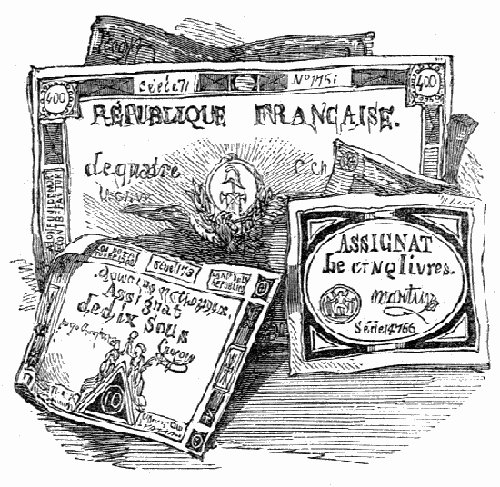
EXECUTION OF LOUIS XVI.
The judicial murder of Louis XVI. was the climax of the Revolution
in France. The Convention voted his death at three o'clock on the
morning of the 20th January, 1793, and he was taken to execution in
twenty-six hours afterwards.
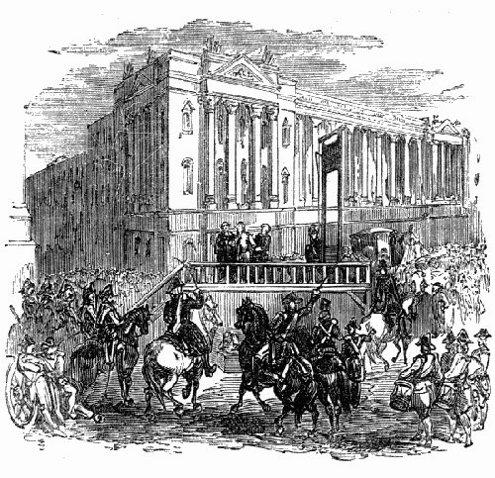
The guillotine was erected in the middle of the Place Louis XV., a
large open square, having the Champs Elysées on one side, and the gardens
of the Tuileries on the other. The Place bristled with artillery, and
every street and avenue leading to it was crowded with troops and armed
multitudes, who had cannon with them charged with grape-shot; while
the carriage was surrounded by picked men, who had orders to despatch
the king with their carbines in case of any rescue being attempted. At
about half-past ten, the king, who had been engaged in prayer during the
ride, arrived at the spot; he descended from the coach, and his confessor
followed him. Three executioners approached to remove his upper
garments, but he put them back, and performed that simple office for
himself. He resisted somewhat the indignity of having his hands tied,
and only yielded on the entreaty of his confessor; and had also to yield
on the subject of cutting off his back hair. He ascended the steps that
led to the platform with a firm bearing, still followed by M. Edgeworth.
When on the top, he made a sudden movement towards the edge of the
scaffold, and exclaimed with a loud and firm voice: "Frenchmen, I die
innocent; it is from the scaffold, and when about to appear before my
God, that I tell you so. I pardon my enemies; I pray that France"——Here
Santerre, on horseback, raised his right hand, and cried: "Drums!
Executioners, do your duty!" Several drummers immediately began by
their noise to drown the sound of the king's voice: and six executioners
brought him to the centre of the scaffold. He exclaimed again: "I die
innocent; I ever desired the good of my people;" but his voice could be
heard only by the executioners and the priest. He then knelt down, in
order to place his head in the appointed spot; the confessor, bending over
him said: "Son of St. Louis, ascend to heaven!" The spring of the
machine was touched, the heavy axe descended in its grooves, and the
once royal head was severed from the body. Samson, the chief executioner,
took up the bleeding head by the hair, and walked three times
round the scaffold, holding it up at arm's-length to show it to the people.
The troops and the spectators shouted: "Vive la République!" put their
hats and caps upon their bayonets and pikes, and waved them in the air,
with prolonged and re-echoing cries of "Vive la République!" "Vive la
Nation!" "Vive la Liberte!" Many of the savage men standing near
the scaffold dipped their pike-heads into the king's blood, and others their
handkerchiefs—not as a sacred memento, but as a symbol of the downfall
of all kings; they even paraded these gore-stained objects before the
windows of the Temple, that perchance the queen and her children might
see them. The headless trunk of Louis was put into a large wicker-basket,
placed in the coach, and carried to the cemetery of La Madeleine;
where, without coffin or shroud, it was thrown into a deep pit, partly
filled up with quicklime. On that same morning, one Benoit Leduc, a
tailor, who had on some occasions worked for Louis, presented a petition
to the Convention, praying to be allowed, at his own expense, to bury
the body of the king by the side of his father, Louis XV., and under the
monument raised to that prince by the city of Sens; but the Convention
rejected his petition, and ordered the executive council to see that
Louis was buried like other criminals.
A MAN AGED ONE HUNDRED YEARS CLAIMING A BOTTLE OF WINE.
John Bull, of London, stock-broker, died 1848, aged 100 years. When
at the age of about 93, and in the employ of Messrs. Spurling, stock-brokers,
he left by mistake in the office of the accountant of the Bank of
England, a large number of bank notes. On discovering his loss, after
diligently searching for the missing parcel, he went back to the accountant's
office, partly to acquaint Mr. Smee with the circumstance, and
partly as a last hope that he might there find the missing treasure. To
his great joy he found the parcel safe in the accountant's possession,
whom he earnestly implored to keep the secret, lest his employers should
think his faculties were failing. Mr. Smee of course gave him the required
assurance, and goodnaturedly added, that when Mr. Bull should
attain the age of 100 years, he would treat him to the finest bottle of
wine in his cellar. Some time before his becoming a centenarian, he was
pensioned off by his employer, and Mr. Smee had, in all probability, quite
forgotten the affair; when, true to the engagement, the venerable, but
still active old clerk, made his appearance at the bank on the important
day, and claimed the promised bottle of wine. The claim was promptly
allowed; and the last birthday of the aged official was one of the happiest
among his friends of the long list of such events which had been its precursor.
After continuing vigorous and active, and almost free from indisposition
up to this time, he, along with many other aged persons, fell
a victim to that fatal influenza which prevailed so extensively throughout
the country, and more especially in London and its suburbs, during
the autumn of 1847 and the winter of 1848.
CHARITY REWARDED BY A RICH AND LIBERAL MENDICANT.
Within the present century, a beggar in Moorfields used daily to
have a penny given him by a merchant on his way to the Exchange.
The penny was withheld, and the appearance of the merchant manifested
his embarrassment and distress. The beggar at length spoke to
him, offered him a loan of £500, and another of the same sum if it
were required. It re-established his affairs.
HACKNEY COACHMAN OF THE TIME OF CHARLES II.
The print from which the engraving on next page is taken, is one of a
set published by Overton, at the sign of the "White Horse" without
Newgate; and its similarity to the figures given by Francis Barlow in his
Æsop's Fables, and particularly in a most curious sheet-print etched by
that artist, exhibiting Charles the Second, the Duke of York, &c., viewing
the Races on Dorset Ferry, near Windsor, in 1687, sufficiently
proves this Hackney Coachman to have been of the reign of that monarch.
The early Hackney Coachman did not sit upon the box as the present
drivers do, but upon the horse, like a postillion; his whip is short for
that purpose; his boots, which have large open broad tops, must have
been much in his way, and exposed to the weight of the rain. His coat
was not according to the fashion of the present drivers as to the numerous
capes, which certainly are most rational appendages, as the shoulders
never get wet; the front of the coat has not the advantage of the present
folding one, as it is single breasted.
His hat was pretty broad, and so far he was screened from the weather.
Another convincing proof that he rode as a postillion is, that his boots
are spurred. In that truly curious print representing the very interesting
Palace of Nonsuch, engraved by Hoefnagle, in the reign of Queen
Elizabeth, the coachman who drives the royal carriage in which the
Queen is seated, is placed on a low seat behind the horses, and has a
long whip to command those he guides. How soon, after Charles the
Second's time, the Hackney Coachmen rode on a box we have not been able
to learn, but in all the prints of King William's time the coachmen are
represented upon the box, though by no means so high as at present; nor
was it the fashion at the time of Queen Anne to be so elevated as to
deprive the persons in the carriage of the pleasure of looking over their
shoulders.
In 1637, the number of Hackney Coaches in London was confined to
50, in 1652 to 200, in 1654 to 300, in 1662 to 400, in 1694 to 700, in
1710 to 800, in 1771 to 1,000, and in 1802 to 1,100. In imitation of
our Hackney Coaches, Nicholas Sauvage introduced the Fiacres at
Paris, in the year 1650. The hammer-cloth is an ornamental covering
of the coach-box. Mr. S. Pegge says, "The coachman formerly used
to carry a hammer, pincers, a few nails, &c., in a leather pouch hanging
to his box, and this cloth was devised for the hiding of them from public
view."
It is said that the sum of £1,500, arising from the duty on Hackney
Coaches, was applied to part of the expense in rebuilding Temple Bar.
A LONDON WATER-CARRIER IN OLDEN TIMES.
The conduits of London and its environs, which were established at
an early period, supplied the metropolis with water until Sir Hugh Middleton
brought the New River from Amwell to London, and then the
conduits gradually fell into disuse, as the New River water was by degrees
laid on in pipes to the principal buildings in the City, and, in the
course of time, let into private houses.
When the conduits afforded a supply, the inhabitants either carried
their vessels, or sent their servants for the water as they wanted it; but
we may suppose that at an early period there were a number of men who
for a fixed sum carried the water to the adjoining houses.
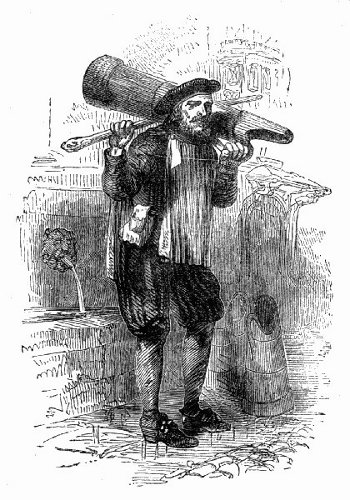
The figure of a Water-carrier in the following engraving, is copied
from one of a curious and rare set of cries and callings of London, published
by Overton, at the "White Horse" without Newgate. The figure
retains the dress of Henry the Eighth's time; his cap is similar to that
usually worn by Sir Thomas More, and also to that given in the portrait
of Albert Durer, engraved by Francis Stock. It appears by this print,
that the tankard was borne upon the shoulder, and, to keep the carrier
dry, two towels were fastened over him, one to fall before him, the
other to cover his back. His pouch, in which we are to conclude he
carried his money, has been thus noticed in a very curious and rare
tract, entitled, Green's Ghost, with the merry Conceits of Doctor
Pinch-backe, published 1626: "To have some store of crownes in his
purse, coacht in a faire trunke flop, like a boulting hutch."
EXPENSES OF A ROYAL PRISONER TWO HUNDRED YEARS AGO.
The following curious document is a return, by the Parliamentary
Committee of Revenue, of the expenses of Charles the First and his
retinue, during a residence of twenty days, at Holdenby, in Northamptonshire,
in the year 1647, commencing February the 13th and ending
March the 4th inclusive. Sir Christopher Hatton had built a splendid
mansion at Holdenby in the time of Queen Elizabeth, and to it King
Charles was conveyed a prisoner by the Parliamentary Commissioners,
after he had been given up to them by the Scottish army:—
| His Majestie's diet of xxviij dishes at xxxl. per diem |
£700 |
| The Lords' diet of xx days |
520 |
| For the Clarke of the green cloth, kitchen, and spicery,
a messe of vij dishes |
40 |
| Dyetts for the household and chamber officers, and the guard |
412 |
| Board wages for common houshold servants, pott and scourers,
and turnbroaches |
36 |
| Badges of Court and riding wages |
140 |
| For linnen for his Majestie's table, the lords and other diets |
273 |
| For wheat, wood, and cole |
240 |
| For all sorts of spicery store, wax-lights, torches,
and tallow-lights |
160 |
| For pewter, brasse, and other necessaries incident to all
officers and carriages |
447 |
WOMAN'S CLEVERNESS.
It is a singular fact that on one occasion the lives of thousands, probably,
of the Irish Protestants, were saved by a clever device, which the
unaided wit and presence of mind of a woman enabled her to plan and
execute.
At the latter end of Queen Mary's reign, a commission was signed
for the purpose of punishing the heretics in that kingdom, and Dr. Cole,
Dean of St. Paul's, was honoured with this humane appointment, to
execute which, he set off with great alacrity. On his arrival at Chester,
he sent for the mayor to sup with him, and in the course of conversation
related his business; then going to his cloak-bag, he took out the box
containing the commission, and having shewn it, with great joy exclaimed,
'This will lash the heretics of Ireland.' Mrs. Edmonds, the
landlady, overheard this discourse, and having several relations in Ireland,
who were Protestants as well as herself, resolved to put a trick
upon the doctor; and while he went to attend the magistrate to the
door, took the commission out of the box, and in its room placed a pack
of cards, with the knave of clubs uppermost. The zealous doctor, suspecting
nothing of the matter, put up his box, took shipping, and,
arriving safe in Dublin, went immediately to the Viceroy. A council
was called; and, after a speech, the doctor delivered his box, which
being opened by the secretary, the first thing that presented itself was
the knave of clubs. This sight surprised the Viceroy and the council,
but much more the doctor, who assured them that he had received a
commission from the Queen, but what was come of it, he could not tell.
'Well, well,' replied the Viceroy, 'you must go back for another, and we
will shuffle the cards in the mean time.' The doctor accordingly hastened
across the channel; but at Holyhead he received the intelligence of the
Queen's death, and the accession of Elizabeth, who settled on Mrs.
Edmonds a pension of forty pounds a year, for saving her Protestant
subjects in Ireland.
DRESS IN THE PROVINCES IN 1777.
In the days when mail-coaches had not begun to run, and when railroads
and telegraphs had not entered into the imagination of man, the
style of dress in the provinces was often very different to what it was in
London, and on this account the following paragraph is deserving of
record. We have taken it from a copy of the Nottingham Journal, of
September 6, 1777, where it is headed "Ladies undress."—"The ladies'
fashionable undress, commonly called a dishabille, to pay visits in the morning,
also for walking in the country, on account of its being neat, light, and
short, consists of a jacket, the front part of which is made like a sultana;
the back part is cut out in four pieces; the middle part is not wider at the
bottom than about half an inch; the sides in proportion very narrow.
The materials most in vogue are, white muslins with a coloured printed
border chintz pattern, printed on purpose, in borders about an inch deep.
The silks, which are chiefly lutestrings, are mostly trimmed with gauze.
The gauze is tuckered upon the bottom of the jacket, and edged with
different-coloured fringes. The petticoat is drawn up in a festoon, and
tied with a true lover's knot, two tassels hanging down from each festoon.
A short gauze apron, striped or figured, cut in three scollops at the
bottom, and trimmed round, with a broad trimming closely plaited; the
middle of the apron has three scollops reversed. The cuffs are puckered
in the shape of a double pine, one in the front of the arm, the other
behind, but the front rather lower. To complete this dress for summer
walking, the most elegant and delicate ladies carry a long japanned
walking-cane, with an ivory hook head, and on the middle of the cane
is fastened a silk umbrella, or what the French call 'a parasol,' which
defends them from the sun and slight showers of rain. It opens by a
spring, and it is pushed up towards the head of the cane, when expanded
for use. Hats, with the feathers spread, chiefly made of chip, covered
with fancy gauze puckered, variegated artificial flowers, bell tassels, and
other decorations, are worn large."
A GROUP OF RELICS.
The Dagger of Raoul de Courcy, of which a representation is included
in the cut over leaf, is an interesting relic, and its authenticity can
be relied upon. Raoul de Courcy, according to the old French chroniclers
was a famous knight, the lord of a noble castle, built upon a
mountain that overlooks the Valée d'Or, and the descendant of that
haughty noble who took for his motto: "Neither king, nor prince, nor
duke, nor earl am I, but I am the Lord of Courcy"—in other words,
greater than them all. He fell in love with the wife of his neighbour,
the Lord of Fayel, and the beautiful Gabrielle loved him in return. One
night he went as usual to meet her in a tower of the Château of Fayel,
but found himself face to face with her lord and master. Raoul escaped,
and Gabrielle was ever after closely guarded. Still they found the opportunity
for numerous interviews, at which they interchanged their vows of
love. At length, Raoul, like a true knight, set out to fight beneath the
banner of the Cross, for the possession of the Holy Sepulchre. Ere he
went, at a stolen meeting, he bade the fair Gabrielle adieu, giving to her
"a silken love-knot, with locks of his own hair worked in with the
threads of silk." She gave him a costly ring, which she had always
worn, and which he swore to wear till his last breath. What tears were
shed—what kisses were exchanged at this last meeting!—for the Holy
Land was very far from France in the Middle Ages.
On his arrival in Syria, Ralph de Courcy became known as the "Knight
of Great Deeds," for it seems he could only conquer his love by acts of
daring valour. After braving every danger, he was at length wounded
in the side by an arrow, at the siege of Acre. The king of England
took him in his arms with respect, and gave him the kiss of hope, but the
arrow was a poisoned one, Raoul felt that he had little time to live. He
stretched out his arms towards France, exclaiming, "France, France!
Gabrielle, Gabrielle!"
He resolved to return home, but he was hardly on board the ship that
was to waft him there, ere he summoned his squire, and begged of him
after he was dead, to carry his heart to France, and to give it the Lady
Fayel, with all the armlets, diamonds, and other jewels which he possessed,
as pledges of love and remembrance.
The heart was embalmed, and the squire sought to deliver his precious
legacy. He disguised himself in a mean dress, but unluckily met with
the Lord of Fayel, and, not knowing him, applied to him for information
as to how admittance into the château could be gained. The Lord of
Fayel at once attacked and disarmed the poor squire, who was wounded
in the side with a hunting-hanger. The precious packet was soon torn
open, and the heart discovered. The Lord of Fayel hastened home, and,
giving it to his cook, desired that it might be dressed with such a sauce
as would make it very palatable.
Raoul's heart was served up at table, and the fair Gabrielle partook of
it. When she had finished eating, the Lord of Fayel said—"Lady, was
the meat you eat good?" She replied, that the meat was good. "That
is the reason I had it cooked," said the Castellan; "for know that
this same meat, which you found so good, was the heart of Raoul de
Courcy."
"Lord of Fayel," said Gabrielle, "the vengeance you have taken corresponds
with the meanness of your soul; you have made me eat his
heart, but it is the last meat I shall ever eat. After such noble food I
will never partake of any other."
She fainted, and only recovered her consciousness a few minutes
before death. Such is the history of Raoul de Courcy and the Lady Gabrielle,
as told in the language of the old chroniclers.
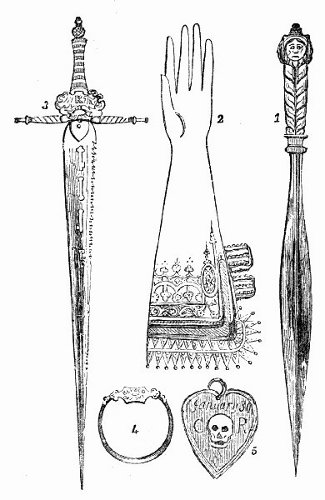
1. Dagger of Raoul de Courcy. 2. Embroidered Glove, presented by Mary
Queen of Scotland, on the Morning of her Execution, to one of her Attendants. 3.
Spanish Dagger of the Sixteenth Century. 4. Ring, with Inscription, "Behold
the End," formerly the Property of Charles I. 5. Silver Locket, in Memory of the
Execution of Charles I.
The glove shown in the engraving is said to have been presented by
the unfortunate Queen Mary, on the morning of her execution, to a lady
of the Denny family. The embroidery is of tasteful design, and may
be useful as a contrast with many of the patterns for needlework at present
in fashion. Moreover, the sight of this memorial brings to recollection
a few particulars in connection with this somewhat important
part of both male and female costume.
The ancient Persians wore gloves, and the Romans, towards the decline
of the empire, began to use them. In England they seemed to have
been introduced at a very early period. In the Anglo-Saxon literature
we meet with glof, a covering for the hand, and in the illuminated MSS.
of that period the hands of bishops and other dignitaries are shown encased
in gloves which, in many instances, were ornamented with costly
rings; while on the tombs of kings and queens, &c., the hands are
shown almost invariably covered.
It is related of the patron Saint of Brussels, who lived in the sixth
century, that she was famous for only two miracles: one consisted in
lighting a candle by means of her prayers, after it had been extinguished;
the other happened in this way—the fair saint being in a
church barefooted, a person near, with respectful gallantry, took off his
gloves and attempted to place them under her feet. This comfort she
declined; and, kicking the gloves away, they became suspended at some
height in the church for the space of an hour.
On opening the tomb of Edward the First, some years ago, in Westminster
Abbey, the antiquaries assembled on that occasion were surprised
to find no traces of gloves. It has been suggested that in this
instance linen or silk gloves had been used at the burial of the king, but
which are supposed to have perished with age.
The practice of throwing down a glove as a challenge, is mentioned by
Matthew Paris as far back as 1245; and a glove was worn in the hat or
cap as a mistress's favour, as the memorial of a friend, and as a mark to
be challenged by an enemy.
At a time when the Borders were in a state of incessant strife, Barnard
Gilpin, who has been so justly called "the Apostle of the North,"
wandered unharmed amid the confusion. On one occasion, entering a
church (we believe that of Rothbury, Northumberland,) he observed a
glove suspended in a conspicuous place, and was informed that it had
been hung up as a challenge by some horse-trooper of the district. Mr.
Gilpin requested the sexton to remove it; who answered, "Not I sir, I
dare not do it." Then Gilpin called for a long staff, took down the
glove, and put it in his bosom, and in the course of his sermon, said,
"I hear that there is one among you who has even in this sacred place
hung up a glove in defiance;" and then producing it in the midst of the
congregation, he challenged them to compete with him in acts of
Christian charity.
Gloves, in former times, were common amongst other gifts offered to
friends at the new year; and they were received without offence by the
ministers of justice. It is related that Sir Thomas More, as Lord Chancellor,
decreed in favour of Mrs. Crooker against the Earl of Arundel.
On the following New-year's day, in token of her gratitude, she presented
Sir Thomas with a pair of gloves containing forty angels. "It
would be against good manners," said the chancellor, "to forsake the
ladies' New-year's gift, and I accept the gloves; the lining you may
bestow otherwise."
The custom of the presentation by the sheriff of a pair of white gloves
to the judge on the occasion of a maiden assize is still in vogue; and,
judging from the reports in the newspapers, such presents appear to be
of frequent occurrence.
"Gloves, as sweet as damask roses," were highly prized by Queen
Elizabeth, and, in her day, formed such an important item of a lady's
expenses, that a sum was generally allowed for "glove money."
The old fashioned gloves have now a considerable value amongst the
curious. At the sale of the Earl of Arran's goods in 1759, the gloves
given by Henry VIII. to Sir Anthony Denny, sold for 38l. 17s.; those
given by James I. to Edward Denny, sold for 22l. 4s.; and the mitten
given by Queen Elizabeth to Sir Edward Denny's lady, for 25l. 4s.
Some of the English towns which formerly were famous for the manufacture
of gloves, still keep up their character. Amongst these Woodstock,
Yeovil, Leominster, Ludlow, and Worcester may be mentioned.
The Spanish dagger formerly belonged to a governor of Castile, in the
sixteenth century, as is shown by the perforated fetter-lock on the blade;
and although the initials are engraven there also, we have not been able
to discover any particulars of the original owner. The workmanship
and style of the dagger are of great beauty.
The little ring with the inscription "Behold the end," was once the
property of Charles I., and was presented by him to Bishop Juxon on
the morning of his execution. The silver lockets, on which are the
emblems of death, were extensively manufactured and sold after the
execution of Charles I. They generally bore the date of the king's
death.
THE HAMSTER RAT.
There are various kinds of rats, and one of these is the Hamster, of
the genus Cricetus of Cuvier. Though rare in Europe to the west of
the Rhine, it is widely spread from that river to the Danube on the
south-west, and north-easterly through a vast extent of country into
Siberia. We notice it in our pages on account of its extraordinary
habits. Its life appears to be divided between eating and fighting. It
seems to have no other passion than that of rage, which induces it to
attack every animal that comes in its way, without in the least
attending to the superior strength of its enemy. Ignorant of the art of
saving itself by flight, rather than yield, it will allow itself to be beaten
to pieces with a stick. If it seizes a man's hand, it must be killed before
it will quit its hold. The magnitude of the horse terrifies it as little as
the address of the dog, which last is fond of hunting it. When the
hamster perceives a dog at a distance, it begins by emptying its cheek-pouches
if they happen to be filled with grain; it then blows them up
so prodigiously, that the size of the head and neck greatly exceed that
of the rest of the body. It raises itself on its hind legs, and thus darts
upon the enemy. If it catches hold, it never quits it but with the loss
of its life; but the dog generally seizes it from behind, and strangles it.
This ferocious disposition prevents the hamster from being at peace with
any animal whatever. It even makes war against its own species.
When two hamsters meet, they never fail to attack each other, and the
stronger always devours the weaker. A combat between a male and a
female commonly lasts longer than between two males. They begin by
pursuing and biting each other, then each of them retires aside, as if
to take breath. After a short interval, they renew the combat, and
continue to fight till one of them falls. The vanquished uniformly
serves for a repast to the conqueror.
KNAVERY OF THE PRIESTS IN BURMAH.
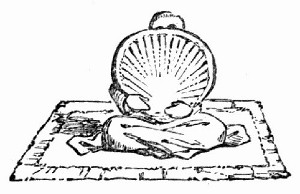
BURMESE PRIEST PREACHING.
The manner in which an uncivilized people will calmly submit to be
duped by the extortionate rascality of their priests, is strongly exhibited
in the kingdom of Burmah. The people who are there held
in the highest estimation are the priests. Any one who pleases
may be a priest.
The priests pretend to be poor, and go out
begging every morning with their empty dishes in their hands; but
they get them well filled, and then return
to their handsome houses, all shining
with gold, in which they live together in
plenty and in pride. They are expected
to dress in rags, to show that they are
poor; but not liking rags, they cut up
cloth in little pieces, and sew the pieces
together to make their yellow robes; and
this they call wearing rags. They pretend
to be so modest, that they do not
like to show their faces, and so hide
them with a fan, even when they preach; for they do preach in their
way, that is, they tell foolish stories about Buddha. The name they
give him is Guadama, while the Chinese call him Fo. They have five
hundred and fifty stories written in their books about him; for they say
he was once a bird, a fly, an elephant, and all manner of creatures, and
was so good whatever he was, that at last he was born the son of a king.
Is it not marvellous that a whole people should, for generation after
generation, not only submit to be thus scandalously cheated, but should
also hold those who cheat them in the highest esteem? A curious fact,
indeed, in the history of mankind.
MIRACULOUS ESCAPE.
One of the most singular circumstances occurred a few years ago that
ever came within our observation. Mr. Charlton, surgeon, of Wylam,
near Newcastle-on-Tyne, having at a late hour been called upon in
haste to give his attendance at Ovingham, borrowed a spirited horse of
a friend, that he might proceed with the least possible delay. He had
not gone above half a mile when he perceived his horse stumble, and he
immediately threw himself from the saddle. It was fortunate he did so,
for the next instant his horse had fallen down a precipice of near seventy
feet; and, incredible as it may seem, the animal sustained no injury, but
immediately dashed into the Tyne, and swam to the opposite side.
Search was made after him, and hearing his master's voice, he was heard
to neigh even across the water in token of recognition, and was ultimately
restored without speck or blemish.
A NATIONAL TASTE FOR GAMING.
It is a remarkable fact that a taste for gaming appears in some cases
to pervade a whole people, and to become one of the chief national characteristics.
No where is this more manifest than among the inhabitants
of the Asiatic Islands.
Games of hazard are the favourites of these islanders. Some of them
they have learned of the Chinese, the most debauched of gamesters, and
others of the Portuguese. The only game of hazard, of native origin,
among the Javanese consists in guessing the number of a certain kind of
beans which the players hold in their hands.
But of all the species of gaming that to which the Indian islanders are
most fondly addicted is betting on the issue of the combats of pugnacious
animals, and particularly the cock. The breed in highest estimation is
the produce of Celebes. The people of Java fight their cocks without
spurs; but the Malays and natives of Celebes with an artificial spur, in
the shape of a small scythe, which, notwithstanding its barbarous appearance,
is in reality less destructive than the contrivance employed among
ourselves.
Quail fighting also is extremely common in Java. The most famous
breed of this bird is found in the island of Lombok; and it is a singular
fact, that the female is used in these bitter but bloodless combats, the
male being comparatively small and timid. Neither do the Javanese
hesitate to bet considerable sums on a battle between two crickets, which
are excited to the conflict by the titillation of a blade of grass judiciously
applied to their noses. They will likewise risk their money on the
strength and hardness of a nut, called kamiri; and much skill, patience
and dexterity, are exercised in the selection and the strife. At other
times two paper kites decide the fortune of the parties; the object of
each in this contest being to cut the string of his adversary. On a
favourable day fifty or sixty kites, raised for this purpose, may sometimes
be seen hovering over a Javanese city.
A FRIEND TO PHYSIC.
Mr. Samuel Jessup, who died at Heckington, Lincolnshire, in 1817,
was an opulent grazier and of pill-taking memory. He lived in a very
eccentric way, as a bachelor, without known relatives, and at his decease
was possessed of a good fortune, notwithstanding a most inordinate
craving for physic, by which he was distinguished for the last thirty
years of his life, as appeared on a trial for the amount of an apothecary's
bill, at the assizes at Lincoln, a short time before Mr. Jessup's death,
wherein he was defendant. The evidence on the trial affords the following
materials for the epitaph of the deceased, which will not be transcended
by the memorabilia of the life of any man. In twenty-one years (from
1791 to 1816) the deceased took 226,934 pills (supplied by a most highly
respectable apothecary and worthy person of the name of Wright, who
resided at Bottesford), which is at the rate of 10,806 pills a year, or
29 pills each day; but as the patient begun with a more moderate appetite,
and increased it as he proceeded, in the last five years preceding
1816, he took the pills at the rate of 78 a-day, and in the year 1814, he
swallowed not less than 51,590. Notwithstanding this, and the addition
of 40,000 bottles of mixture, and juleps and electuaries, extending altogether
to fifty-five closely written columns of an apothecary's bill, the
deceased lived to attain the advanced age of sixty-five years.
AN INCULPATORY EPITAPH.
The following epitaph at West Allington, Devon, is deserving a place
in our record of curiosities, inasmuch as it appears to be a successful attempt
in making a monumental stone, both a memorial of the deceased,
and also a means of reproving the parson of the parish:—
"Here lyeth the Body of
Daniel Jeffery the Son of Michael
Jeffery and Joan his Wife he
was buried ye 22 day of September
1746 and in ye 18th year of his age.
This Youth When In his sickness lay
did for the minister Send + that he would
Come and With him Pray + But he would not atend
But When this young man Buried was
The minister did him admit + he should be
Caried into Church + that he might money geet
By this you See what man will dwo + to geet
money if he can + who did refuse to come
pray + by the Foresaid young man."
HUNTING A SHEEP KILLER.
It has been remarked, that when once a dog acquires wild habits, and
takes to killing sheep, he does far more mischief than a wild beast, since
to the cunning of the tamed animal he adds the ferocity of the untamed.
A remarkable case of this sort is mentioned in the following paragraph,
which we have copied from the Newcastle Courant of the year 1823. It
is also curious to note the account of the chase, and of the joy which the
whole country-side seems to have manifested at the slaughter of
the animal.—September 21—A few days ago a dog of a most destructive
nature infested the fells of Caldbeck, Carrock, and High Pike,
about sixteen miles south of Carlisle. Little doubt remains of its
being the same dog which has been so injurious to the farmers in the
northern parts of Northumberland, as no less than sixty sheep or
upwards have fallen victims to its ferocity. It was thought proper to
lose no time in attempting to destroy it, and Tuesday last was fixed
upon. Sir H. Fletcher, Bart., of Clea Hall, offered his pack of hounds,
and several other dogs with about fifty horsemen set out from Hesket
New-market. Several persons with firearms were stationed at different
parts. The dog was descried upon an eminence of Carrock-fell, and on
sight of the pursuers set off by way of Hesket New-market, Stocklewath,
and Barwick-field, then returned by Cowclose, Castle Sowerby, and
attempted to gain the fells again, when Mr. Sewell, farmer at Wedlock,
lying in ambush at Mossdale, fired, and succeeded in shooting him. He
appears to be of the Newfoundland breed, of a common size, wire-haired,
and extremely lean. During the chase he frequently turned upon the
dogs which were headmost, and so wounded several as obliged them to
give up the pursuit. The joy manifested on this occasion was uncommon,
insomuch that on the day following about thirty persons sat down to a
dinner provided at Mr. Tomlinson's, Hesket New-market. Upon the
most moderate computation, excluding the various windings, the chase
could not be less than thirty miles, and occupied no less than six
hours.
LONGEVITY.
Henry Jenkins, of Ellerton-upon-Swale, Yorkshire, died 1670, aged
169. He remembered the battle of Flodden Field, fought between the
English and the Scotch, September 9, 1513, when he was about twelve
years old. He was then sent to Northallerton with a cartload of arrows,
but an older boy was employed to convey them to the army. At Ellerton
there was also living, at the same time, four or five other old men,
reputed to be of the age of one hundred years and thereabouts, and they
all testified that Jenkins was an elderly man when first they knew him.
Jenkins was once butler to Lord Conyers; he perfectly remembered the
Abbot of Fountain's Dale before the dissolution of the monasteries. In
the last century of his life he was a fisherman, and often swam in the
river after he was a hundred years old. In the King's Remembrancer
Office in the Exchequer, there is a record of a deposition in a cause,
taken April, 1665, at Kettlewell, Yorkshire, where Henry Jenkins, of
Ellerton-upon-Swale, labourer, aged 157 years, was produced, and made
deposition as a witness. He was buried at Bolton, Yorkshire. In 1743,
a monument, with a suitable inscription, was erected to perpetuate his
memory.
THE PULPIT OF JOHN KNOX AT ST. ANDREW'S.
John Knox, the great precursor of the Protestant Reformation, having
been driven from Edinburgh by the threats of his opponents, reluctantly
withdrew to St. Andrew's, in the county of Fife, where he continued with
undiminished boldness to denounce the enemies of the reformed faith. It
was in that place that he had first discoursed against the degeneracy of
the Church of Rome, and there he occupied the Pulpit represented in the
accompanying engraving; and the following curious and characteristic
anecdote connected with his preaching in it, is related in the Manuscript
Diary of James Melville, then a student at the college of St. Andrew's,
and subsequently Minister of Anstruther. "Of all the benefits I haid
that year (1571) was the coming of that maist notable profet and apostle
of our nation, Mr. Jhone Knox, to St. Andrew's: who, be the faction
of the Queen occupying the castell and town of Edinburgh, was compellit
to remove therefra, with a number of the best, and chusit to come
to St. Andrew's. I heard him teache there the Prophecies of Daniel
that simmer, and the winter following; I haid my pen and my little
buike, and tuk away sic things as I could comprehend. In the opening
up of his text he was moderat the space of an half houre; but when he
onterit to application, he made me so to grew (thrill) and tremble, that
I could not hold a pen to wryt. He was very weak. I saw him every
day of his life go hulie and fear (hoolie and fairly—slowly and warily)
with a furring of marticks, (martins) about his neck, a staffe in the ane
hand, and gud godlie Richard Ballanden, his servand, haldin up the
uther oxier (arm-pit), from the Abbey to the Parish-Kirk; and be the
said Richart and another servant lifted up to the Pulpit, whar he behovit
(was obliged) to lean at his first entry: bot er he had done with his
sermone he was sa active and vigourous, that he was lyk to ding the
pulpit in blads (beat it into shivers) and flie out of it."
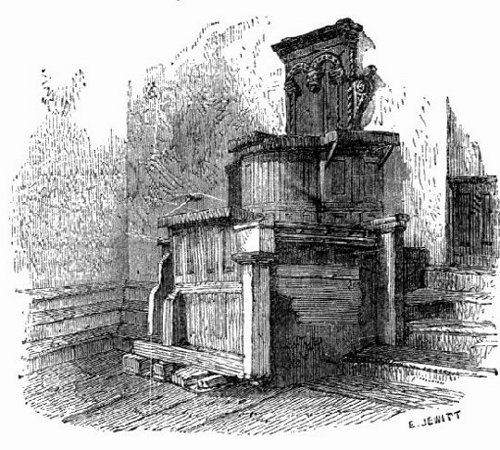
The interesting relique commemorated in this curious extract, is of
that stately style of carving which was introduced towards the close of
the sixteenth century in Protestant preaching-places; and continued,
though of a more heavy character, throughout the whole of the succeeding
century. A scroll-bracket remaining on the preacher's left
hand, and some broken pieces at the top of the back, appear to indicate
that it was once more extended, and had probably a canopy or sounding-board.
THE BIBLE USED BY KING CHARLES THE FIRST ON THE SCAFFOLD.
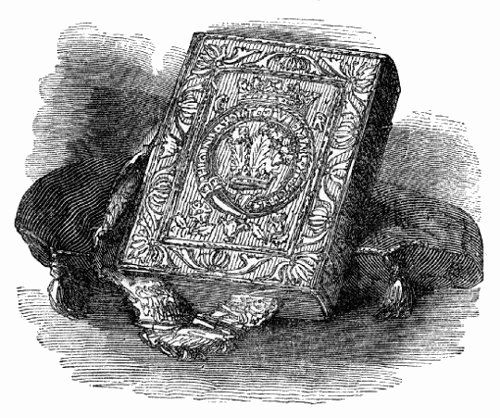
There is so much external evidence of the genuineness of this very
beautiful and interesting relique, that no doubt can exist as to its perfect
authenticity, though the circumstance of the King having a Bible
with him on the scaffold, and of presenting it to Dr. Juxon, is not mentioned
in any contemporaneous account of his death. The only notice
of such a volume, as a dying gift, appears to be that recorded by Sir
Thomas Herbert, in his narrative, which forms a part of the Memoirs of
the last Two Years of the Reign of that unparalleled Prince of ever-blessed
memory, King Charles I. London, 1702, 8vo, p. 129, in the
following passage:—"The King thereupon gave him his hand to kiss:
having the day before been graciously pleased under his royal hand, to
give him a certificate that the said Mr. Herbert was not imposed upon
him, but by his Majesty made choice of to attend him in his bed-chamber,
and had served him with faithfulness and loyal affection. His
Majesty also delivered him his Bible, in the margin whereof he had with
his own hand, written many annotations and quotations, and charged
him to give it to the Prince so soon as he returned." That this might
be the book represented in our engraving, is rendered extremely probable,
by admitting that the King would be naturally anxious, that his
son should possess that very copy of the Scriptures which had been provided
for himself when he was Prince of Wales. It will be observed
that the cover of the volume is decorated with the badge of the Principality
within the Garter, surmounted by a royal coronet in silver gilt,
inclosed by an embroidered border; the initials C. P. apparently improperly
altered to an R., and the badges of the Rose and Thistle, upon
a ground of blue velvet: and the book was therefore bound between the
death of Prince Henry in 1612, and the accession of King Charles to
the throne in 1625, when such a coronet would be no longer used by
him. If the Bible here represented were that referred to by Herbert,
the circumstance of Bishop Juxon becoming the possessor of it might be
accounted for, by supposing that it was placed in his hands to be transmitted
to Charles II. with the George of the Order of the Garter belonging
to the late King, well known to have been given to that Prelate
upon the scaffold, January 30th, 1648-9.
LAMBETH WELLS, THE APOLLO GARDENS, AND FINCH'S GROTTO.
Among the numerous public places of amusement which arose upon
the success of Vauxhall Gardens, which were first opened about 1661,
was one in Lambeth Walk, known as Lambeth Wells. This place was
first opened on account of its mineral waters, which were sold at a penny
per quart. The music commenced at seven o'clock in the morning, and
the price of admission was three pence. A monthly concert under the
direction of Mr. Starling Goodwin, organist of St. Saviour's Church
Southwark, was afterwards held here, and Erasmus King, who had been
coachman to the celebrated Dr. Desaguliers, read lectures and exhibited
experiments in natural philosophy, the price of admission being raised
to sixpence.
This place was open before 1698, and existed as late as 1752, when
"A Penny Wedding after the Scotch fashion, for the benefit of a young
couple," was advertised to be kept there.
Lambeth Wells at length becoming a public nuisance, the premises were
shut up, and ultimately let as a Methodist Meeting-house. The music
gallery was used as a pulpit; but the preacher being greatly disturbed in
his enthusiastic harangues, he was obliged to quit, when the premises
were converted to various purposes, except the dwelling, which is now
known by the sign of the Fountain public-house.
On the site of Messrs. Maudslay's factory, in the Westminster Road,
formerly stood the Apollo Gardens. This place of amusement was
opened in 1788, by an ingenious musician named Clagget, who published,
in 1793, a small quarto pamphlet, entitled "Musical Phenomena: An
Organ made without Pipes, Strings, Bells, or Glasses; the only Instrument
in the world that will never require to be re-tuned. A Cromatic
Trumpet, capable of producing just Intervals, and regular Melodies in
all Keys, without undergoing any change whatever. A French Horn
answering the above description of the Trumpet."
The Apollo Gardens had one spacious room elegantly fitted up, and
decorated in taste suitably to its intention. The gardens consisted of a
number of elegant pavilions or alcoves, well adapted for the accommodation
of different companies; they were ornamented chiefly with a succession
of paintings, relating to romantic histories, particularly the
different adventures of Don Quixote. It had a fine orchestra erected in
the centre of the gardens. The place being ultimately converted into a
receptacle for loose and dissolute characters, the magistracy very properly
suppressed it about the year 1799.
In Gravel Lane, Southwark, was Finch's Grotto, a public garden
and place of amusement, so named from William Finch, the proprietor.
The Grotto was opened to the public in 1770 upon the plan of Vauxhall
gardens. An orchestra and a band of musicians, added to the rural
character of the place, and drew a numerous body of visitors.
Very little is known about the Grotto, but it is supposed to have been
closed early in the present century.
THE DUCK-BILLED PLATYPUS, OR, ORNITHORYNCHUS PARADOXUS.
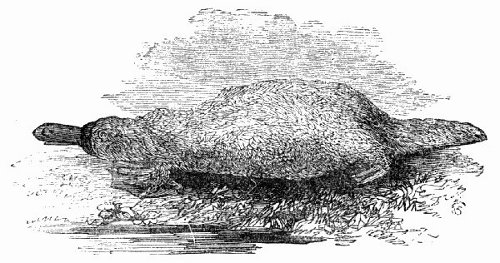
Of the genus Ornithorynchus only one species—the Paradoxus—has
yet been discovered in the whole world, and it is, therefore, one of the
great curiosities of animal life. It appears to be a union of a quadruped
and a bird, and is only to be found in New Holland, where it
inhabits the reeds by the side of rivers. Our engraving represents it
very accurately. It is about twenty inches long, having a flattened
body, somewhat like the otter, and is clothed with a dark soft fur. The
elongated nose very much resembles the beak of a duck, like which
these animals feed upon water insects, shell-fish, and aquatic plants.
The feet are five-toed and webbed, and in the fore-feet this membrane
extends beyond the nails: the male is armed with a spur on each hind
leg. This curious animal, in which a duck's beak is united to the body
of a quadruped, rolls itself up like a hedgehog, when it sleeps in its
burrows on the banks of the streams whence its food is derived.
ORIGIN OF BOLTON ABBEY.
About midway up the Vale of Bolton, amidst the gloomy recesses of the
woods, the Wharfe, which is otherwise a wide and shallow river, is suddenly
contracted by two huge rocks, which approach each other so nearly,
that the country folk, or rather the villagers, call it the Strid, because
adventurous people stride or leap from one rock to the other. In ancient
days, the whole of this valley belonged to Baron Romillie, whose eldest
son having died, left a younger brother, of the name of Egremont, sole
heir of the domains and inheritance of this family. One day, however,
when this young man, familiarly called the "Boy of Egremont," was
returning from hunting with the hounds in the leash, he, as he had
done many times before, was going to leap the Strid, when, just as he
had attempted it, the hounds held back, and precipitated him headlong
into the deep and awful chasm, which the impetuous fall of water (thus
produced by the sudden contraction of the river) had worn in the base
of the two rude rocks, and he was never seen afterwards. The Baron,
being now left childless, built the Abbey, and endowed it with the
domains of Bolton.
LENGTH OF LIFE WITHOUT BODILY EXERCISE.
The Rev. William Davies, Rector of Staunton-upon-Wye, and Vicar
of All Saints, Hereford, died 1790, aged 105. The life of this gentleman
displays one of the most extraordinary instances of departure from all
those rules of temperance and exercise, which so much influence the lives
of the mass of mankind, that is, probably to be found in the whole records
of longevity. During the last thirty-five years of his life, he never
used any other exercise than that of just slipping his feet, one before the
other, from room to room; and they never after that time were raised,
but to go down or up stairs, a task, however, to which he seldom subjected
himself. His breakfast was hearty; consisting of hot rolls well
buttered, with a plentiful supply of tea or coffee. His dinner was substantial,
and frequently consisted of a variety of dishes. At supper he
generally eat hot roast meat, and always drank wine, though never to
excess. Though nearly blind for a number of years, he was always
cheerful in his manners, and entertaining in his conversation, and was
much beloved by all who knew him. He had neither gout, stone, paralysis,
rheumatism, nor any of those disagreeable infirmities which mostly
attend old age; but died peaceably in the full possession of all his faculties,
mental and corporeal, save his eyesight. Like most long livers he
was very short of stature.
EXTRAORDINARY FASHION IN CIGARS.
A taste for tobacco in some form or other seems to extend over the
whole inhabitable globe. In this respect it matters not whether nations
are civilized or uncivilized; and however completely they may differ from
each other in everything else, they all agree in a fondness for "the
weed." In the mode, however, of indulging in the luxury, there is the
greatest diversity, and no where is this more strikingly manifested than
in the Philippine Islands.
"It is not till evening that the inhabitants of the higher class begin
to stir; till that time they are occupied in eating, sleeping, and smoking
tobacco, which is no where more general than on the island of Luzon;
for children, before they can walk, begin to smoke segars. The women
carry their fondness for it to a greater height than the men; for, not
content with the usual small segars, they have others made for them,
which are a foot long and proportionably thick. These are here called
the women's segars, and it is a most ludicrous sight to see elegant ladies
taking their evening walk, with these burning brands in their mouths."
How widely does the fashion in Luzon differ from the fashion at
Paris!
NOVEL WAY OF PURCHASING A HUSBAND.
The following paragraph, which we have copied from a magazine of
1790, not only gives us a curious instance of female determination in
the pursuit of a husband, but tells us of the price which human hair
was worth at the period when ladies wore such monstrous head-dresses
of false curls.
"An Oxfordshire lass was lately courted by a young man of that
country, who was not willing to marry her unless her friends could
advance 50l. for her portion; which they being incapable of doing, the
lass came to London to try her fortune, where she met with a good
chapman in the Strand, who made a purchase of her hair (which was
delicately long and light), and gave her sixty pounds for it, being 20
ounces at 3l. an ounce; with which money she joyfully returned into the
country, and bought her a husband."
GLOVES.—ORIGIN OF "PIN MONEY."
Gloves were very common as New Year's gifts. For many hundreds
of years after their introduction into England in the 10th century,
they were worn only by the most opulent classes of society, and hence
constituted a valuable present. They are often named in old records.
Exchange of gloves was at one period a mode of investiture into possession
of property, as amongst the ancient Jews was that of a shoe or
sandal; and "glove-money" is to this day presented by High Sheriffs
to the officers of their courts, upon occasion of a maiden assize, or one
in which no cause is tried. Pins, which at the commencement of the
sixteenth century displaced the wooden skewers previously in use, became
a present of similar consequence; and at their first introduction
were considered of so much importance in female dress, that "pin-money"
grew into the denomination of dower, which, by the caution of
parents, or justice of a consort, was settled upon a lady at her marriage.
HABITS AND HABITATIONS OF THE DYAKS OF BORNEO.
It is impossible to appreciate properly the courage, determination,
and skill which have been displayed by the gallant Sir James Brooke,
unless we make ourselves acquainted with the character and habits
of the extraordinary race of men over whom he triumphed. The
Dyaks are a savage people who inhabit Borneo. They lived there before
the Malays came, and they have been obliged to submit to them.
They are savages indeed. They are darker than the Malays; yet they
are not black; their skin is only the colour of copper. Their hair is
cut short in front, but streams down their backs; their large mouths
show a quantity of black teeth, made black by chewing the betel-nut.
They wear but very little clothing, but they adorn their ears and arms,
and legs, with numbers of brass rings. Their looks are wild and fierce,
but not cunning like the looks of the Malays. They are not Mahomedans;
they have hardly any religion at all. They believe there are some
gods, but they know hardly anything
about them, and they do not
want to know.
They neither make
images to the gods, nor say prayers
to them. They live like the beasts,
thinking only of this life; yet they
are more unhappy than beasts, for
they imagine there are evil spirits
among the woods and hills, watching
to do them harm. It is often hard
to persuade them to go to the top of
a mountain, where they say evil
spirits dwell. Such a people would
be more ready to listen to a missionary
than those who have idols,
and temples, and priests, and sacred
books.
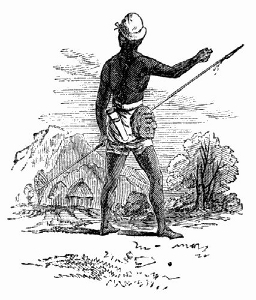
DYAK WITH HEADS.
Their wickedness is very great.
It is their chief delight to get the
heads of their enemies. There are
a great many different tribes of
Dyaks, and each tribe tries to cut off the heads of other tribes. The
Dyaks who live by the sea are the most cruel; they go out into the
boats to rob and bring home, not slaves, but HEADS!! And how do
they treat a head when they get it?
They take out
the brains, and then they dry it in the smoke, with
the flesh and hair still on; then they put a string
through it, and fasten it to their waists. The evening
that they have got some new heads, the warriors
dance with delight,—their heads dangling by their
sides;—and they turn round in the dance, and gaze
upon their heads,—and shout,—and yell with
triumph! At night they still keep the heads near
them; and in the day they play with them, as
children with their dolls, talking to them, putting
food in their mouths, and the betel-nut between their
ghastly lips. After wearing the heads many days,
they hang them up to the ceilings of their rooms.
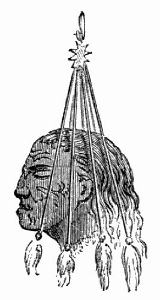
HEAD OF A DYAK.
No English lord thinks so much of his pictures, as
the Dyaks do of their heads. They think these heads
are the finest ornaments of their houses. The man
who has most heads, is considered the greatest man.
A man who has no heads is despised! If he wishes to be respected, he
must get a head as soon as he can. Sometimes a man, in order to get a
head, will go out to look for a poor fisherman, who has done him no
harm, and will come back with his head. When the Dyaks fight against
their enemies, they try to get, not only the heads of men, but also the
heads of women and children. How dreadful it must be to see a poor
baby's head hanging from the ceiling! There was a Dyak who lost all
his property by fire, but he
cared not for losing anything,
so much as for losing his precious
heads; nothing could console
him for his loss; some of
them he had cut off himself,
and others had been cut off by
his father, and left to him!
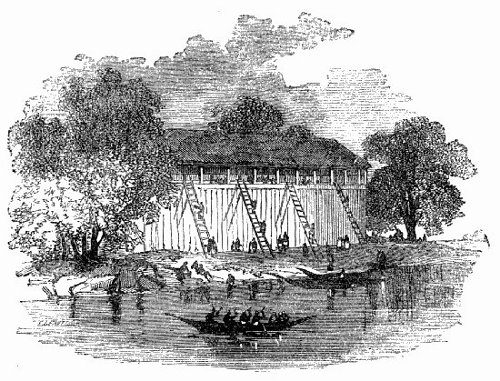
HOUSE OF SEA DYAKS.
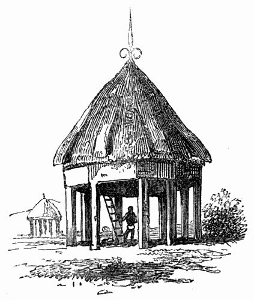
SKULL HOUSE.
People who are so bent on
killing, as these Dyaks are,
must have many enemies.
The Dyaks are always in fear of
being attacked by their enemies.
They are afraid of living
in lonely cottages; they think
it a better plan for a great
many to live together, that
they may be able to defend
themselves, if surprised in the
night.
Four hundred Dyaks
will live together in one house.
The house is very large. To
make it more safe, it is built upon very high posts, and there are ladders
to get up by. The posts are sometimes forty feet high; so that when you
are in the house, you find yourself as high as the tall trees. There is one
very large room, where all the men and women sit, and talk, and do
their work in the day. The women pound the rice, and weave the mats,
while the men make weapons of war, and the little children play about.
There is always much noise and confusion in this room. There are a
great many doors along one side of the long room; and each of these
doors leads into a small room where a family lives! the parents, the babies,
and the girls sleep there, while the boys of the family sleep in the large
room, that has just been described.
The Hill Dyaks do not live in houses quite so large. Yet several
families inhabit the same house. In the midst of their villages, there
is always one house where the boys sleep. In this house all the heads of
the village are kept. The house is round, and built on posts, and the
entrance is underneath, through the floor. As this is the best house in
the village, travellers are always brought to this house to sleep. Think
how dreadful it must be, when you wake in the night to see thirty or
forty horrible heads, dangling from the ceiling! The wind, too, which
comes in through little doors in the roof, blows the heads about; so that
they knock against each other, and seem almost as if they were still
alive. This is the Dead-house. Such are the men whom the Rajah
Brooke subdued!
SCOTTISH WILD CATTLE.
The wild white cattle, a few of which are still to be found in Chatelherault
Park, belonging to the Duke of Hamilton, in Lanarkshire, are
great objects of curiosity, inasmuch as they are identical with the
primitive source of all our domestic cattle.
The following description of their habits is abridged from an article by
the Rev. W. Patrick, in the Quarterly Journal of Agriculture:—
"I am inclined to believe that the Hamilton breed of cattle is the
oldest in Scotland, or perhaps in Britain. Although Lord Tankerville
has said they have 'no wild habits,' I am convinced, from personal
observation, that this is one of their peculiar features. In browsing their
extensive pasture, they always keep close together, never scattering or
straggling over it, a peculiarity which does not belong to the Kyloe, or
any other breed, from the wildest or most inhospitable regions of the
Highlands. The white cows are also remarkable for their systematic
manner of feeding. At different periods of the year their tactics are
different, but by those acquainted with their habits they are always found
about the same part of the forest at the same hour of the day. In the
height of summer, they always bivouac for the night towards the northern
extremity of the forest; from this point they start in the morning, and
browse to the southern extremity, and return at sunset to their old
rendezvous; and during these perambulations they always feed en masse.
"The bulls are seldom ill-natured, but when they are so they display
a disposition more than ordinarily savage, cunning, pertinacious, and
revengeful. A poor bird-catcher, when exercising his vocation among
the 'Old Oaks,' as the park is familiarly called, chanced to be attacked
by a savage bull. By great exertion he gained a tree before his assailant
made up to him. Here he had occasion to observe the habits of the
animal. It did not roar or bellow, but merely grunted, the whole body
quivered with passion and savage rage, and he frequently attacked the
tree with his head and hoofs. Finding all to no purpose, he left off the
vain attempt, began to browse, and removed to some distance from the
tree. The bird-catcher tried to descend, but this watchful Cerberus was
again instantly at his post, and it was not till after six hours' imprisonment,
and various bouts at 'bo-peep' as above, that the unfortunate man
was relieved by some shepherds with their dogs. A writer's apprentice,
who had been at the village of Quarter on business, and who returned by
the 'Oaks' as a 'near-hand cut,' was also attacked by one of these savage
brutes, near the northern extremity of the forest. He was fortunate,
however, in getting up a tree, but was watched by the bull, and kept
there during the whole of the night, and till near two o'clock the
next day.
"These animals are never taken and killed like other cattle, but are
always shot in the field. I once went to see a bull and some cows
destroyed in this manner—not by any means for the sake of the sight,
but to observe the manner and habits of the animal under peculiar circumstances.
When the shooters approached, they, as usual, scampered
off in a body, then stood still, tossed their heads on high, and seemed to
snuff the wind; the manœuvre was often repeated, till they got so hard
pressed (and seemingly having a sort of half-idea of the tragedy which
was to be performed), that they at length ran furiously in a mass, always
preferring the sides of the fence and sheltered situations, and dexterously
taking advantage of any inequality in the ground, or other circumstances,
to conceal themselves from the assailing foe. In their flight, the bulls,
or stronger of the flock, always took the lead! a smoke ascended from
them which could be seen at a great distance; and they were often so
close together, like sheep, that a carpet would have covered them. The
cows which had young, on the first 'tug of war,' all retreated to the
thickets where their calves were concealed; from prudential motives, they
are never, if possible, molested. These and other wild habits I can testify
to be inherent in the race, and are well known to all who have an opportunity
of acquainting themselves with them."
BELLS OF THE ANCIENTS.
Bells were known in the earliest ages of which we have any certain
account. But the bells of the ancients were very small in comparison
with those of modern times, since, according to Polydore Virgil, the
invention of such as are hung in the towers, or steeples of Christian
churches, did not occur till the latter end of the fourth, or beginning of
the fifth century; when they were introduced by Paulinus, Bishop
of Nola. The Jews certainly employed bells, since they are spoken of
in Scriptures; and the mention of them by Thucydides, Diodorus Siculus,
Suidas, Aristophanes, and other ancient writers, proves that they were
used in Greece; while Plautus, Ovid, Tibullus, Statius, and a variety of
Latin authors, speak of bells as in use among the Romans. But these
bells of the ancients were all made for the hand; or were of a size to be
affixed to other musical instruments, like those which were occasionally
appended to the drum. Whether, when detached from other instruments,
they were used on other occasions, or only in particular ceremonies, or
as signals, is not known; nor have we any clue by which to guess whether
they were tuned in concordance with any scale, or whether they
were unisons to each other, or not formed to any particular pitch, but
merely used as sonorous auxiliaries to other instruments, without any
regard to their agreement of tone, either with one another, or with the
instruments they accompanied.
EARTHQUAKE AT NOTTINGHAM IN 1816.
Earthquakes are providentially occurrences of great rarity in England.
The one which took place on the 17th of March, 1816, was one of the
most dangerous that has ever been experienced in this kingdom. It extended
over a vast area of country, and in some localities its effects were
felt very severely. As a proof of this, we have copied the following paragraph
from a Nottingham paper of the day:—
Nottingham, in common with a great part of the North Midland
district, experienced a smart shock of an earthquake. It was felt at
half-past twelve p.m., and as Divine service, it being Sunday, was
not over at the churches, great alarm was expressed by the congregations.
At St. Peter's and St. Nicholas's, the consternation was so
great, that service had to be suspended for a few seconds, and one lady
was borne out in a state of insensibility. The pillars supporting St.
Mary's tower shook very visibly, but, fortunately, the attention of the
crowded congregation was so engrossed by the eloquence of the sheriff's
chaplain, and the presence of the Judge and his retinue, that the alarm
was but slight, or the rush and loss of life might have been great. In
various parts of the town and neighbourhood, glasses were shaken off
of shelves, articles of domestic use displaced, window-casements thrown
open, and other indications manifest of the influence of the subterranean
movement.
SINGULAR STATE OF PRESERVATION OF A DEAD BODY.
According to a statement in Holinshed, in 1495, while digging for a
foundation for the church of St. Mary-at-hill, in London, the body of Alice
Hackney was discovered. It had been buried 175 years, and yet the
skin was whole, and the joint pliable. It was kept above ground
four days without annoyance, and then re-interred.
ASYLUM FOR DESTITUTE CATS.
Of all the curious charitable institutions in the world, the most curious
probably is the Cat Asylum at Aleppo, which is attached to one of the
mosques there, and was founded by a misanthropic old Turk, who
being possessed of large granaries, was much annoyed by rats and
mice, to rid himself of which he employed a legion of cats, who so
effectually rendered him service, that in return he left them a sum
in the Turkish funds, with strict injunctions that all destitute and
sickly cats should be provided for, till such time as they took themselves
off again. In 1845, when a famine was ravaging in all
North Syria—when scores of poor people were dropping down in
the streets from sheer exhaustion and want, and dying there by
dozens per diem before the eyes of their well-to-do fellow creatures, men
might daily be encountered carrying away sack loads of cats to be fed
up and feasted on the proceeds of the last will and testament of that
vagabond old Turk, whilst fellow creatures were permitted to perish.
TOMB OF SAINT GEORGE.
The tomb of Saint George, England's patron-saint, is situated in the Bay
of Kesrouan, between the Nahr-et-Kelb
and Batroun, surrounded by
luxuriant gardens and groups of
romantic-looking villages and convents.
The Arabs venerate St.
George, whom they style Mar
Djurios, and point to a small ruined
chapel (as in our engraving), originally
dedicated to him to commemorate
his victory over the
dragon, which, they say, took place
near to the spot. The tradition is,
that the dragon was about to devour
the king of Beyrout's daughter,
when St. George slew him, and thus
saved the lady fair; and the credulous
natives point to a kind of
well, upwards of sixty feet deep,
where they stoutly affirm that the
dragon used to come out to feed
upon his victims.
All this is very curious, inasmuch
as it gives an Arabian
interest to the career of the patron
saint of England, whose portrait,
in the act of slaying the dragon,
constitutes the reverse of most
English coin, and is regarded as the embodiment of English valour.
BEGGARS SELECTED AS MODELS BY PAINTERS.
Michael Angelo Buonarotti often drew from beggars; and report says,
that in the early part of his life, when he had not the means of paying
them in money, he would make an additional sketch, and, presenting
it to the party, desire him to take it to some particular person, who
would purchase it. Fuseli, in his life of Michael Angelo, says that
"a beggar rose from his hand the patriarch of poverty." The same
artist, in one of his lectures, delivered at the Royal Academy, also observes,
that "Michael Angelo ennobled his beggars into Patriarchs and
Prophets, in the ceiling of the Sistine Chapel."
Annibal Caracci frequently drew subjects in low life. His Cries of
Bologna, etched by Giuseppe Maria Mitelli: pub. 1660, in folio, are
evidently from real characters. It will also be recollected, that some of
the finest productions of Murillo, Jan Miel, and Drogsloot, are beggars.
Callot's twenty-four beggars are evidently from nature; and among
Rembrandt's etchings are to be found twenty-three plates of this description.
Sir Joshua Reynolds frequently painted from beggars, and from these
people have originated some of his finest pictures, particularly his
"Mercury as a Pickpocket," and "Cupid as a Link-boy." His Count
Ugolino was painted from a paviour, soon after he had left St. George's
Hospital, from a severe fever. Mr. West painted the portrait of a beggar,
on the day when he became a hundred years old; and considered
him as a pensioner for several years afterwards. The same person was
used also as a model, by Copley, Opie, &c. Who can forget the lovely
countenance of Gainsborough's "Shepherd's Boy," that has once seen
Earlom's excellent engraving from it? He was a lad, well known as a
beggar to those who walked St. James's-street seventy years ago. The
model for the celebrated picture of the "Woodman," by the same artist,
died in the Borough, at the venerable age of 107.
Mr. Nollekens, in 1778, when modelling the bust of Dr. Johnson, who
then wore a wig, called in a beggar to sit for the hair. The same artist
was not equally fortunate in the locks of another great character; for
on his application to a beggar for the like purpose, the fellow declined to
sit, with an observation that three half-crowns were not sufficient for the
trouble.
SUPPLY OF WATER FOR OLD LONDON.
Leaden pipes conveyed spring water to London city from Tyburn in
1236; and in 1285 the first great conduit of lead was begun there. In
1442 Henry VI. granted to John Hatherley, Mayor, license to take up
200 fother of lead. The pipes from Highbury brought in the water in
1483. We may learn how much was thought of this useful work by
the fact that the Lord Mayor, Aldermen, and many worshipful persons
used to ride and view the conduit heads at Tyburn; and after dinner
there, somewhat different from recent sportsmen, they hunted a fox.
The water-works at London Bridge were established in 1512. In 1534,
two-fifteenths were granted by the Common Council for defraying the
expense of bringing water from Hackney to Aldgate to a conduit. But
Peter Morris did not bring his supply of water to the highest parts of
London till the year 1569, and Sir Hugh Middleton's far-famed New
River was only rendered available in 1618, that is, a space of sixty-eight
years after the introduction of a stream of pure water into the western
parts of the town of Lyme in Dorset.
COMBINATION OF INSTINCT AND FORCE OF HABIT IN A DOG.
A dog which had been accustomed to go with his master regularly for
some time to Penkridge church, still continued to go there by himself
every Sunday for a whole year, while the edifice was under repair, and
divine service was not held. Whenever he could, he would get into the
family pew and there pass the proper time. His instinct enabled him to
perceive the occasion, and to measure the regular time, but it could carry
him no further. A remarkable exemplification of the difference between
instinct and reason.
YORKSHIRE IN THE LAST CENTURY.
Anecdotes which are apparently trifling in themselves, are often of importance,
as exhibiting in a striking light the dialect and social condition
of the people, and the period they refer to. An instance of this is
the following, which has been recorded as the bellman's cry at Ripon, on
the occasion of a great frost and fall of snow, about 1780:—
"I is to gie notidge, that Joanie Pickersgill yeats yewn to neit, to
moarn at moarn, an to moarn at neit, an nea langer, as lang as storm
hods, 'cause he can git na mare eldin."
The Translation.
I am to give notice, that John Pickersgill heats his oven to-night,
to-morrow morning, and to-morrow at night, and no longer as long as
the storm lasts, because he can get no more fuel.
INSTANCE OF MANY AGED PERSONS DYING ABOUT THE SAME DATE.
The following is taken from a copy of Nile's "Weekly Register,"
published at Baltimore, in the month of January, 1823. It is the list of
deaths which had been notified to the paper within one week, and we
give it, as a singular instance of the decease of so many persons above
one hundred years old being announced in the same paragraph.
"In Franklin co. Pennsylvania, Elizabeth Campbell, aged 104—several
of her relatives had reached 100.—At Troy, N. Y., Ann Fowler, 100.—At
Tyngsboro', N. Y., Abigail Hadlock, 104.—At Somers, N. Y.,
Michael Makeel, 103.—At Rutland, Oswego, N. Y., Mrs. Buroy, 110.—At
Brunswick, Maine, Gen. James W. Ryan, 107—his wife is yet living,
aged 94; they were married together 75 years before his death.—At
Georgetown, Col. Yarrow, a Moor, (supposed) 135!—At the city of New
York, a woman, a native of St. Domingo, 106. At Sargus, Mass., Mrs.
Edwards, 101.—In Edgecomb county, N. C., William Spicer, aged about
112.—In Boston, William Homer, 116."
CORPSE BEARERS DURING THE PLAGUE.
Of all the calamities with which a great city is infested, there can be
none so truly awful as that of a plague, when the street doors of the
houses that were visited with the dreadful pest were padlocked up, and
only accessible to the surgeons and medical men, whose melancholy duty
frequently exposed them even to death itself; and when the fronts of
the houses were pasted over with large bills exhibiting red crosses, to
denote that in such houses the pestilence was raging, and requesting the
solitary passenger, to pray that the Lord might have mercy upon those
who were confined within. Of these bills there are many extant in the
libraries of the curious, some of which have borders engraved on wood
printed in black, displaying figures of skeletons, bones, and coffins
They also contain various recipes for the cure of the distemper. The
Lady Arundel, and other persons of distinction, published their methods
for making what was then called plague-water, and which are to be
found in many of the rare books on cookery of the time; but happily
for London, it has not been visited by this affliction since 1665, a circumstance
owing probably to the Great Fire in the succeeding year,
which consumed so many old and deplorable buildings, then standing in
narrow streets and places so confined, that it was hardly possible to know
where any pest would stop.
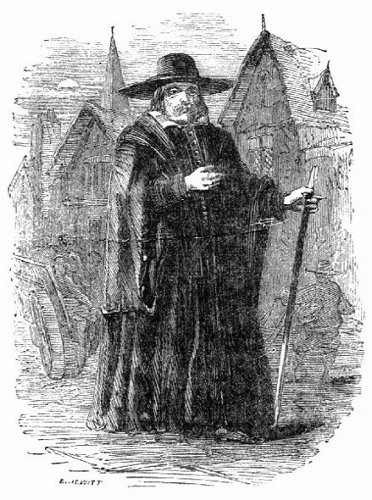
Every one who inspects Agas's Plan of London, engraved in the reign
of Elizabeth, as well as those published subsequently to the rebuilding of
the City after the fire, must acknowledge the great improvements as to
the houses, the widening of the streets, and the free admission of fresh
air. It is to be hoped, and indeed we may conclude from the very great
and daily improvements on that most excellent plan of widening streets,
that this great city will never again witness such visitations.
When the plague was at its height, perhaps nothing could have been
more silently or solemnly conducted than the removal of the dead to the
various pits round London, that were opened for their reception; and it
was the business of Corpse Bearers, such as the one exhibited in the
preceding engraving, to give directions to the carmen, who went through
the city with bells, which they rang, at the same time crying "Bring
out your Dead." This melancholy description may be closed, by observing
that many parts of London, particularly those leading to the Courts
of Westminster, were so little trodden down, that the grass grew in the
middle of the streets.
A MEMENTO-MORI WATCH.
The curious relic, of which we herewith give an engraving, was presented
by Mary, Queen of Scots, to her Maid of Honour, Mary Seaton,
of the house of Wintoun, one of the four celebrated Maries, who were
Maids of Honour to her Majesty.
"Yestreen the Queen had four Maries,
The night she'll hae but three;
There was Marie Seaton, and Marie Beaton,
And Marie Carmichael and me."
The watch is of silver, in the form of a skull. On the forehead of
the skull is the figure of Death, with his scythe and sand-glass; he
stands between a palace on the one hand, and a cottage on the other,
with his toes applied equally to the door of each, and around this is the
legend from Horace "Pallida mors æquo pulsat pede pauperum tabernas
Regumque turres." On the opposite, or posterior part of the skull, is a
representation of Time, devouring all things. He also has a scythe,
and near him is the serpent with its tail in its mouth, being an emblem
of eternity; this is surrounded by another legend from Horace, "Tempus
edax rerum tuque invidiosa vetustas." The upper part of the skull is
divided into two compartments: on one is represented our first parents
in the garden of Eden, attended by some of the animals, with the
motto, "Peccando perditionem miseriam æternam posteris meruere."
The opposite compartment is filled with the subject of the salvation of
lost man by the crucifixion of our Saviour, who is represented as suffering
between the two thieves, whilst the Mary's are in adoration below;
the motto to this is "Sic justitiæ satisfecit, mortem superavit salutem
comparavit." Running below these compartments on both sides, there
is an open work of about an inch in width, to permit the sound to come
more freely out when the watch strikes. This is formed of emblems
belonging to the crucifixion, scourges of various kinds, swords, the
flagon and cup of the Eucharist, the cross, pincers, lantern used in the
garden, spears of different kinds, and one with the sponge on its point,
thongs, ladder, the coat without seam, and the dice that were thrown
for it, the hammer and nails, and the crown of thorns. Under all these
is the motto, "Scala cæli ad gloriam via."
The watch is opened by reversing the skull, and placing the upper
part of it in the hollow of the hand, and then lifting the under jaw
which rises on a hinge. Inside, on the plate, which thus may be called
the lid, is a representation of the Holy Family in the stable, with the
infant Jesus laid in the manger, and angels ministering to him; in the
upper part an angel is seen descending with a scroll on which is written,
"Gloria excelsis Deo, et in terra pax hominibus bonæ volu——" In the
distance are the shepherds with their flocks, and one of the men is in
the act of performing on a cornemuse. The works of the watch occupy
the position of the brains in the skull itself, the dial plate being on a
flat where the roof of the mouth and the parts behind it under the base
of the brain, are to be found in the real subject. The dial plate is of
silver, and it is fixed within a golden circle richly carved in a scroll pattern.
The hours are marked in large Roman letters, and within them
is the figure of Saturn devouring his children, with this relative legend
round the outer rim of the flat, "Sicut meis sic et omnibus idem."
Lifting up the body of the works on the hinges by which they are
attached, they are found to be wonderfully entire. There is no date,
but the maker's name, with the place of manufacture, "Moyse, Blois,"
are distinctly engraven. Blois was the place where it is believed watches
were first made, and this suggests the probability of the opinion that the
watch was expressly ordered by Queen Mary at Blois, when she went
there with her husband, the Dauphin, previous to his death. The watch
appears to have been originally constructed with catgut, instead of the
chain which it now has, which must have been a more modern addition.
It is now in perfect order, and performs wonderfully well, though it requires
to be wound up within twenty-six hours to keep it going with
tolerable accuracy. A large silver bell, of very musical sound, fills the
entire hollow of the skull, and receives the works within it when the
watch is shut; a small hammer set in motion by a separate escapement,
strikes the hours on it.
This very curious relic must have been intended to occupy a stationary
place on a prie-dieu, or small altar in a private oratory, for its weight is
much too great to have admitted of its having been carried in any way
attached to the person.
A MONSTER.
It is almost incredible that such a monster, as the one we are about to
describe should have been allowed to continue his wicked career for some
years, in a civilized country like France, little more than a hundred
years ago, but the following paragraph is copied from a Paris journal of
that period—1755, January the 17th—and there is every reason to
believe that it is strictly correct. "What was his fate we do not know,
but can hardly doubt.—The Marquis de Plumartin, whose execrable
crimes are known over all France, has at last been taken in his castle,
by 300 men of the King's Own regiment of foot, and carried to Poitiers,
loaded with irons. The king is going to appoint a commission to try
him. This monster turned away his wife some years ago, and became
the terror of Poitou. Neither woman nor man durst appear in the neighbourhood.
Having one day lost a cause in one of the king's courts, he
caused the usher and his man, who came to intimate the sentence to him,
to be burnt alive. Some days after, having drawn six of his creditors
into his castle, where he had shut himself up with several of his crew,
he ordered some of his people to drag them into a pond, tied to the tails
of horses, and afterwards fastened them to a stake near a great fire,
where three expired, and the other three died a few days after. Thirty
of the Marshalsea guards, who were sent to apprehend him, having beset
his castle, he barricaded the doors and fired on them from the garret
window, killing the commanding officer and five others. After which
he left the kingdom, but absurdly imagining that his crimes were forgot,
he lately returned."
PERSEVERANCE REWARDED BY FORTUNE.
We have copied the following paragraph from the pages of a local historian,
because it gives us a striking instance of what perseverance and
good fortune will accomplish, in raising a man to comparative distinction
from the humblest walks of life.
August 26, 1691—Sir John Duck, bart., departed this life, being Wednesday
at night, and was buried upon the Monday after, being the 31st
of August. The wealthiest burgess on the civic annals of Durham. Of
Sir John's birth, parentage, and education, the two first have hitherto
remained veiled in impenetrable obscurity; as to the third, he was bred
a butcher under John Heslop, in defiance of the trade and mystery of
butchers, in whose books a record still exists, warning John Heslop that
he forbear to sett John Ducke on worke in the trade of a butcher. John
Duck however grew rich, married the daughter of his benefactor, and
was created a baronet by James II. He built a splendid mansion in
Silver-street, where a panel still exists recording his happy rise to fortune.
The baronet, then humble Duck, cast out by the butchers, stands near a
bridge in an attitude of despondency; in the air is seen a raven bearing in
his bill a piece of silver, which according to tradition fell at the feet of the
lucky John, and was naturally calculated to make a strong impression on his
mind. He bought a calf, which calf became a cow, and which cow being
sold enabled John to make further purchases in cattle, and from such
slender beginnings, to realise a splendid fortune. On the right of the
picture is a view of his mansion in Silver-street, and he seems to point at
another, which is presumed to be the hospital he endowed at Lumley.
He died without issue, and was buried at St. Margaret's, where his wife,
Pia—— Prudens—— Felix, lies buried beside him.
On Duck the Butchers shut the door;
But Heslop's Daughter Johnny wed:
In mortgage rich, in offspring poor,
Nor son nor daughter crown'd his bed.
TRAVELLING IN THE UNITED STATES EXACTLY ONE HUNDRED YEARS AGO.
The American advertisement, of which we here give a literal copy, is
deserving of preservation on account of the quaintness of the inn-signs,
the peculiarity of the spelling and diction, the "shifting" of the passengers
which it announces, and the general idea it gives us of the way in
which travelling was performed in America at the time when it was
issued.
Philadelphia STAGE-WAGGON, and New-York STAGE BOAT
performs their Stages twice a Week.
John Butler, with his waggon, sets out on Mondays from his
House, at the Sign of the Death of the Fox, in Strawberry ally,
and drives the same day to Trenton Ferry, when Francis Holman meets
him, and proceeds on Tuesday to Brunswick, and the passengers and
goods being shifted into the waggon of Isaac Fitzrandolph, he takes
them to the New Blazing-Star to Jacob Fitzrandolph's the same day,
where Rubin Fitzrandolph, with a boat well suted, will receive them,
and take them to New-York that night. John Butler returning to
Philadelphia on Tuesday with the passengers and goods delivered to him
by Francis Holman, will again set out for Trenton Ferry on Thursday,
and Francis Holman, &c. will carry his passengers and goods, with the
same expedition as above to New-York.
Weekly Mercury.
March 8, 1759.
FÊTE OF THE FEDERATION. PARIS 1790.
The leading events of the great Revolution in France, may be fairly
classed with the marvellous, and among our "Ten Thousand Wonderful
Things" there will be found few more wonderful than the civic festival
of the general federation of the National Guards of France, which took
place on the 14th of July, 1790, and of which the above is a correct representation,
taken from a view by Duplessis Bertaux. The proceedings
of that memorable day had in them a mixture of religious
celebration apparently singular among a people who had lately so
much trampled on religion; but as this celebration was more pagan
than Christian in its character, the singularity becomes less marked.
On the preceding evening, a Hiérodrame was performed at the cathedral
of Nôtre Dame—a kind of sacred drama, made up by M. Désaugiers of
scraps from the Bible mixed with other matter, and set to music; it professed
to tell the story of the taking of the Bastille, and to typify the
sadness, trouble, confusion, joy, and alarm of the Parisians. Then succeeded
a Te Deum, chanted in presence of some of the principal federal
and municipal bodies. Early in the morning of the 14th, amid dense
clouds and heavy rain, the National Guards from all the eighty-three
departments of France, together with deputations from the state army
and navy, began to assemble, and speedily formed an immense line from
the Porte St. Antoine to the Porte St. Martin; whence they marched,
with bands playing and colours flying, to the Champ de Mars, regaled
and cheered by the Parisians on the route. On reaching the great square
of the Tuileries, the procession was headed by the municipality of Paris
and the members of the National Assembly, and followed by a body of
gray-headed veterans. The procession traversed the Seine by one of the
bridges, greeted by salvos of artillery drawn up on the quays, and entered
the Champ de Mars under a triumphal arch almost hidden by flags and
patriotic inscriptions. One o'clock had arrived before the various bodies
forming the procession had taken their destined places in the enclosed
parallelogram, surrounded by nearly 300,000 spectators on the raised
terraces, most of whom were by this time drenched by the continuous
rain. In the centre of the area was a lofty altar, half pagan, half
Catholic in its adornments; and around this altar the provincial National
Guards danced and sang in very excited fashion. The royal family appeared
at three o'clock. In an immense gallery near the altar, the
National Assembly were seated, with the king and the president on two
chairs of state exactly equal in height and richness, and the queen and
the rest of the court seated behind—a significant interpretation of the
decree just announced. At the instant of the king taking his seat, the
air was rent with cries of Vive le Roi! Vive la Nation! The banners
were unfurled; 1,800 musicians burst forth with jubilant strains; cannon
poured out continuous volleys; Talleyrand, as bishop of Autun, assisted
by sixty chaplains of the Paris National Guards, performed mass at the
altar; and the banners were blessed by sprinkling with holy-water.
Then Lafayette, dismounting from his white charger, received from the
hands of the king a written form of oath; he swore to this oath at the
altar, and with his raised arm gave a signal for the countless host to do
likewise—every one raising his right hand, and saying Je le jure! The
king took the oath prescribed to him; and the queen held up the dauphin
in her arms, as if to denote that he also, poor child, had sworn to defend
the national liberties. At five o'clock the royal family retired, and the
crowd began to leave the Champ de Mars. Twenty-five thousand federates
or provincial deputies went to a royal château about a mile distant, where
a dinner had been prepared for them by order of the municipality of Paris,
with Lafayette as chairman of the banquet. At night all Paris was
illuminated; and for three or four days the feastings, reviews, and celebrations
were numerous, including a grand dance on the site of the demolished
Bastille. On the 18th, Lafayette reviewed the provincial or
federate National Guards, and on the 19th they were reviewed by the
king. Paris was intoxicated for an entire week, each man displaying
at once his delight and his vanity.
A MAN CARRIES HIS HOUSE ON HIS HEAD.
Simeon Ellerton, of Craike, Durham, died 1799, aged 104. This man,
in his day, was a noted pedestrian, and before the establishment of
regular "Posts," was frequently employed in walking commissions, from
the northern counties to London and other places, which he executed
with singular fidelity and despatch. He lived in a neat stone cottage of
his own erecting; and what is remarkable, he had literally carried his
house on his head; it being his constant practice to bring back with him
from every journey which he undertook, some suitable stone, or other
material for his purpose, and which, not unfrequently, he carried 40 or
50 miles on his head.
IGNORANCE AND FEAR.
In the year 1712, Whiston predicted that the comet would appear on
Wednesday, 14th October, at five minutes after five in the morning,
and that the world would be destroyed by fire on the Friday following.
His reputation was high, and the comet appeared. A number of persons
got into boats and barges on the Thames, thinking the water the safest
place. South Sea and India stock fell. A captain of a Dutch ship
threw all his powder into the river, that the ship might not be endangered.
At noon, after the comet had appeared, it is said that more than
one hundred clergymen were ferried over to Lambeth, to request that
proper prayers might be prepared, there being none in the church service.
People believed that the day of judgment was at hand, and acted some
on this belief, more as if some temporary evil was to be expected.
There was a prodigious run on the bank, and Sir Gilbert Heathcote,
at that time the head director, issued orders to all the fire offices in
London, requiring them to keep a good look out, and have a particular
eye upon the Bank of England.
ARABIAN HORSES.
It is a singular circumstance, that it is to the Arabian that England is
indebted for her improved, and now unrivalled, breed of horses for the
turf, the field, and the road.
The Arabian horses are divided into two great branches; the Kadischi
whose descent is unknown, and the Kochlani, of whom a written genealogy
has been kept for 2000 years. These last are reserved for riding
solely, they are highly esteemed and consequently very dear. They are
said to derive their origin from King Solomon's studs. However this may
be they are fit to bear the greatest fatigues, and can pass whole days
without food. They are also said to show uncommon courage against an
enemy. It is even asserted, that when a horse of this race finds himself
wounded and unable to bear his rider much longer, he retires from the
fray, and conveys him to a place of security. If the rider falls upon
the ground, his horse remains beside him, and neighs till assistance is
brought. The Kochlani are neither large nor handsome but amazingly
swift. The whole race is divided into several families, each of which has
its proper name. Some of these have a higher reputation than others on
account of their more ancient and uncontaminated nobility.
We may not believe, perhaps, all that is told us of the Arabian. It has
been remarked that there are, on the deserts which his horse traverses, no
milestones to mark the distance, or watch to calculate the time; and the
Bedouin is naturally given to exaggeration, and most of all when relating
the prowess of the animal which he loves as dearly as his children;
yet it cannot be denied that at the introduction of the Arabian into the
European stables, there was no other horse comparable to him.
HEAD-QUARTERS OF PRINCE RUPERT AT EVERTON, DURING THE
SIEGE OF LIVERPOOL, IN 1644.
Prince Rupert, assisted by the Earl of Derby, having taken Bolton by
storm, and refreshed his army there for some days, advanced on Liverpool,
where the Parliament had a strong garrison under the command of
Colonel More, of Bank-hall; and finding on his approach to the town,
the high ground near it favourable to his design, compared it to a crow's
nest, probably imagining it would be taken with as little difficulty; but
the resistance he met with, induced him to declare it was more like an
eagle's nest, or a den of lions.
The siege began about the 2nd of June, and the view exhibits his
head-quarters from that time till the reduction of the place. His main
camp was established round the beacon, about a mile from the town, and
his officers were placed in the adjoining villages, from whence a detachment
marched every day, being relieved every twenty-four hours, to
open trenches and erect batteries. From these advances Prince Rupert
frequently attacked the besieged and their works in the way of storm,
but was constantly repulsed with great slaughter of his men. At length,
Colonel More, finding the town must of necessity surrender, and desirous
of ingratiating himself with the Prince, for the preservation of his house
and effects at Bank Hall, gave such orders for his soldiers to retire, that
the works on the enemy's side were abandoned, and the royalists entered
the town at three o'clock in the morning of June 26, putting to the
sword all they met with, till they arrived at the High Cross, which then
stood on the site where the Exchange now stands. Here the soldiers of
the Castle, drawn up in line, beat a parley, and demanded quarter,
which, on their submitting as prisoners of war, and surrendering the
Castle to the Prince, was granted. The soldiers were then sent to the
tower, St. Nicholas's Church, and other places of security; but the Parliament-army,
soon after the siege, repossessed themselves of the Castle,
and appointed Col. Birch, as governor.
FIRE AT BURWELL, CAMBRIDGESHIRE. 1727.
Some strollers brought down a puppet-show, which was exhibited in
a large thatched barn. Just as the show was about to begin, an idle
fellow attempted to thrust himself in without paying, which the people
of the show preventing, a quarrel ensued. After some altercation, the
fellow went away, and the door being made fast, all was quiet; but the
same man, to gain admittance privately, got over a heap of hay and
straw, which stood near to the barn, and accidentally set it on fire. The
spectators of the show, alarmed by the flames, which had communicated
to the barn, rushed to the door; but it happened unfortunately that it
opened inwards, and the crowd pressing violently against the door, there
could be no escape. Thus the whole company, consisting of more than
160 persons, were kept confined till the roof fell in, and covered them
with fire and smoke: six only escaped with life; the rest, among whom
were several young ladies of fortune, were reduced to one undistinguishable
heap of mangled bodies, totally disfigured. The friends of the
dead, not knowing which were the remains they sought, caused a large
hole to be dug in the churchyard, and all the bodies were promiscuously
interred together, and a tablet erected in the church to perpetuate this
most melancholy event.
AN APPARENT SINGULARITY ACCOUNTED FOR.
It is generally well known that birds are very active agents in the
extension of vegetation, and that fruit and flowers are, to a great
extent, rendered prolific by the insects which visit their blossoms; but
few people are aware of the means through which fish are formed in
lakes and ponds, which are not connected with other waters. Here, also,
an insect is the principal agent. The large water-beetle, which is in
the habit of feeding upon the spawn of fish, occasionally in the evening
climbs up the stems of rushes, &c. out of the water, sufficiently high to
enable it to take wing; in these circumstances it has been caught, and,
putting it into water, has been found to give out the spawn with which
it had gorged itself previous to taking flight, both in a digested and
undigested state; so that, on trial, it has been found that it produced
fish of various kinds.
EUROPEAN BALANCING EQUAL TO THE INDIAN JUGGLERS.
The astonishing dexterity of the Indian jugglers is known to all, but
many years ago a Spaniard named Cadenas made himself equal, if
not superior to them. He may be truly said to be superior to them,
inasmuch as several of his feats have never been attempted by them.
Don Cadenas extended himself flat on his back on a large table. He then
elevated his legs until they were at right angles with his body; he was
assisted in keeping this position by a sort of pyramidal cushion, which
was placed under him, a little below the lower end of his back. His feet
and ankles were covered with boots, on which were many small castanets
and little bells. The tranca, which is a round piece of wood, about 8
feet long and five inches in diameter, handsomely painted, was then laid
horizontally on the soles of his feet, his legs being perpendicular.
Having exactly balanced the tranca, he alternately struck his feet
against it, the castanets, &c., keeping time with the music. In proportion
to the strength with which he struck the tranca, with one foot
or both feet, was the height to which he elevated it, always catching it,
in its descent, with great accuracy, on the soles of his feet. Sometimes
by bending his knees and then striking out with his limbs, he threw the
tranca several feet into the air, catching it, in its descent, on his feet,
with as much neatness and more certainty than the Indian jugglers used to
catch the brass balls in their hands. He concluded the performance with
the tranca, by exactly balancing it on the sole of his left foot, and then
by repeated strokes of his right foot set it rapidly in motion like a
horizontal fly-wheel.
MOB-WISDOM.
A singular instance of a mob cheating themselves by their own
headlong impetuosity, is to be found in the life of Woodward, the
comedian. On one occasion, when he was in Dublin, and lodged opposite
the Parliament House, a mob who were making the members swear to
oppose an unpopular bill, called out to his family to throw them a Bible
out of the window. Mr. W. was frightened, for they had no such book in
the house, but he threw out a volume of Shakespere, telling the mob they
were welcome to it. They gave him three cheers, swore the members upon
this book, and afterwards returned it without discovering its contents.
COMMUNICATION BETWEEN ANIMALS.
The means by which animals contrive to communicate their ideas to
each other is a phenomenon which has never been satisfactorily explained.
The two following instances of it are very curious. A gentleman
who was in the habit of occasionally visiting London from a distant
county performed the journey on horseback, accompanied by a favourite
little terrier dog, which he left at an inn at some distance from
London till his return. On one occasion on calling for his dog the
landlady told him that it was lost; it had had a quarrel with the great
house dog, and had been so worried and bit that it was thought he
would never recover, but at the end of a few days he crawled out of the
yard, and no one saw him for almost a week, when he returned with
another dog bigger than his enemy, on whom they both fell and nearly
destroyed him. This dog had actually travelled to its own home at
Whitmore in Staffordshire, had coaxed away the great dog in question,
which followed him to St. Alban's to assist in resenting the injury of
his friend. The following story is related of a little spaniel which had
been found lame by a surgeon at Leeds. He carried the poor animal
home, bandaged up his leg, and after two or three days turned him out.
The dog returned to the surgeon's house every morning till his leg was
perfectly well. At the end of several months, the spaniel again presented
himself in company with another dog, which had also been
lamed; and he intimated, as well as piteous and intelligent looks could
intimate, that he desired the same assistance to be rendered to his
friend as had been bestowed upon himself. The combination of ideas
in this case, growing out of the recollection of his own injury, and
referring that to the cure which had been performed; the compassion
he had for his friend to whom he communicated the occurrence, and
induced to seek relief under his guidance, together with the appeal to
the humane surgeon, is as extraordinary a piece of sagacity as can be
found in all the annals of animals.
STRANGE CUSTOM ABOUT NAMES.
The following anecdote forcibly illustrates the absurd custom which
prevailed many years ago in America, of giving children names, made
up of Scripture sentences. We record the anecdote as being descriptive
of a curious local custom. About the beginning of the present century
a New England sea captain having some business at a public office,
which required him to sign his name, was rather tedious in performing
the operation, which did not escape the observation of the officer, who
was a little impatient at the delay, and curious withal to see what sort
of a name it could be that required so long a time to spread it upon
paper. Perhaps the captain had a long string of titles to grace it,
such as honorable, esquire, colonel of militia, selectman of the town
of ——, &c., which he chose to make an ostentatious parade of; or
perhaps it was his whim to subscribe the place of his nativity and that
of his residence, together with his age, height, and complexion. He
was mistaken; for the captain had subscribed nothing but simply his
name, which, when he had done, the officer, after some trouble in
decyphering, found to read thus:—Through-Much-Tribulation-We-Enter-Into-the-Kingdom-of-Heaven
Clapp. "Will you please to tell
me, Captain Clapp," said he, with as demure a face as his violent inclination
to indulge in a hearty laugh would allow him to put on,
"what might your mother have called you in your infancy, to save
herself the trouble of repeating a sermon whenever she had occasion
to name her darling?" "Why, sir," replied Captain Clapp, with
laughable simplicity, "when I was little they used to call me Tribby,
for shortness."
DRESS IN LONDON DURING THE LAST CENTURY.
The seven illustrations which accompany this article represent the
progress of dress in London from 1690 to 1779. They speak for themselves,
and tell their own tale far better than any description in words
could tell it for them. The scale in society to which the persons depicted
in the engravings belong, is what may be called the upper middle
class, and we thus obtain a more correct idea of the general style of
dress, than we should have done had we confined our observations solely
to the higher ranks.
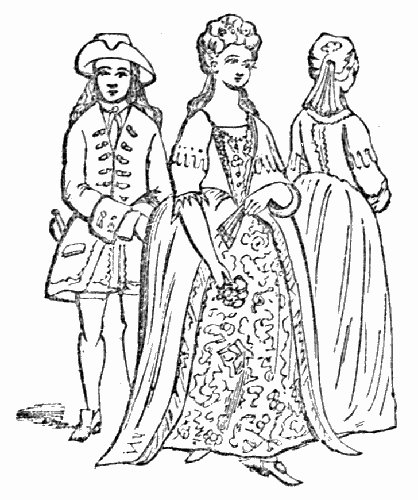
DRESS 1690-1715.
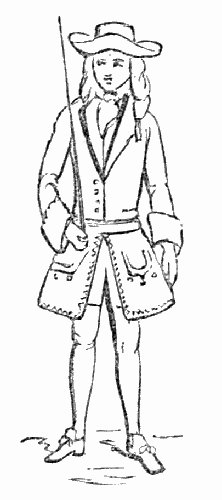
DRESS 1721.
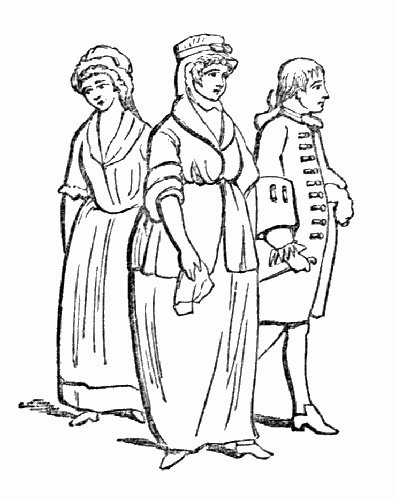
DRESS, 1735—COMMON LIFE.
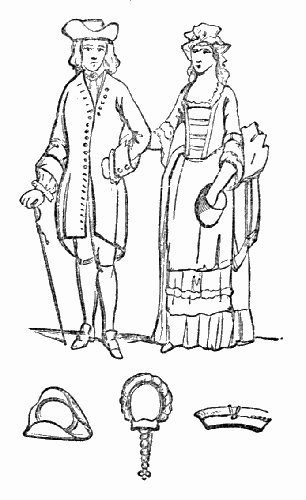
DRESS, 1738.
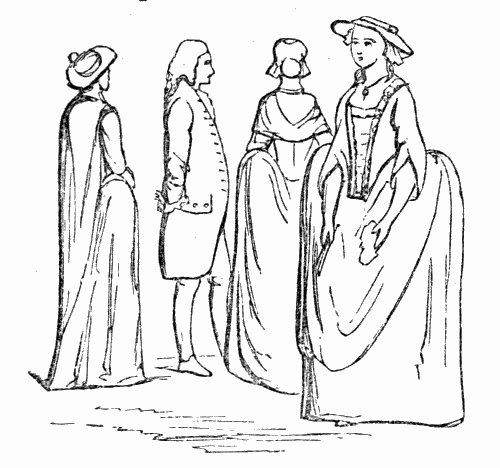
DRESS, 1752.
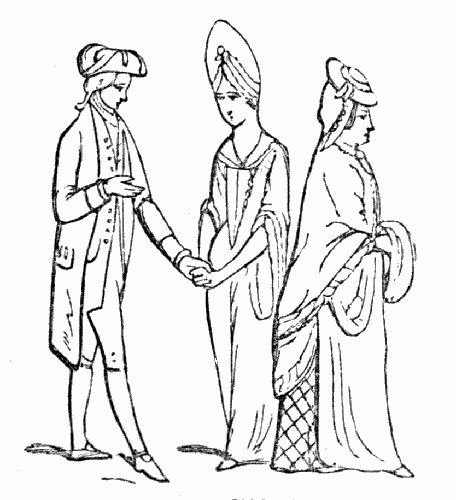
DRESS CIRCA 1773, 1778.
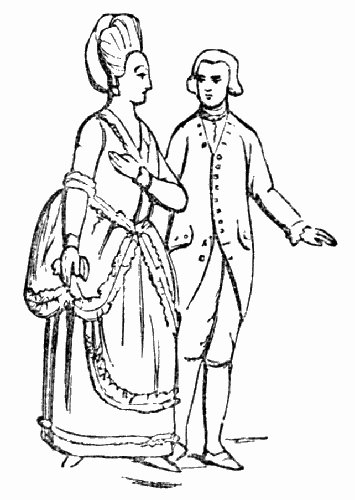
DRESS, 1779.
It is, however, very curious to notice the value placed upon dress
during the period indicated; and how frequently its loss is recorded.
Thus we find it mentioned that Lady Anderson, whose house was
robbed at a fire in Red Lion Square in 1700, lost a gown of orange
damask, lined with, striped silk. The family of George Heneage,
Esq., at the same time, and by the same casualty, lost "a head,
with very fine looped lace of very great value, a Flanders' laced
hood, a pair of double ruffles and tuckers, two laced aprons, one
edged with point lace, and a large black scarf embroidered with
gold." At the same period the ladies wore Holland petticoats,
embroidered in figures with different coloured silks and gold, with
broad orrice at the bottom. In 1702 diamond stomachers adorned the
ladies; they were composed of that valuable stone set in silver, and sewed
in a variety of figures upon black silk. The men imported the Champaign
wig from France. They were made very full, curled, and eighteen
inches in length to the point, with drop locks. In the Post Boy, of
November 15, 1709, there were advertised as stolen, "A black silk petticoat,
with red and white calico border, cherry-coloured stays, trimmed
with blue and silver, a red and dove-coloured damask gown, flowered
with large trees; a yellow satin apron, trimmed with white Persian, and
muslin head-clothes, with crow-foot edging; a black silk furbelowed
scarf, and a spotted hood." Black and beaver hats for ladies were advertised
in 1719, faced with coloured silks, and trimmed with gold and
silver lace. A man of fashion in 1720 wore the full flowing curled wig,
which fell in ringlets half-way down his arms and back, a laced coat,
straight, formal, with buttons to the very bottom, and several on the
pockets and sleeves; his shoes were square at the toes, had diminutive
buckles, a monstrous flap on the instep, and high heels, a belt secured
the coat and supported the sword. Perukes were a highly important article
of dress in 1734. Fans were much used, ladies seldom appeared
without this useful ornament in their hands. The hoop underwent many
important changes; sometimes it projected at the sides only, or, like its
ancestor, the fardingale, it spread itself all round in imposing majesty.
High-heeled shoes maintained their place. In 1740 tight sleeves with
full ruffles, small pointed waists, enclosed in whalebone, loose gowns,
called sacques, and cloaks with hoods, named cardinals, were la grande
monde. Among the gentlemen's costumes, the most striking was the
Ramilies tail, which was a plaited tail to the wig, with an immense bow
at the top and one at the bottom. Claret coloured clothes were considered
as handsome; and light blue with silver button-holes, and silver garters
to the knees, was very fashionable between 1740 and 1751. The change
to wearing the natural hair instead of wigs took place about 1765. From
that date the female dress altered by degrees: the cap was enlarged to
an enormous size, and the bonnet swelled in proportion. Hoops were
entirely discontinued. Hats and bonnets of straw, chip, and beaver, became
well proportioned, and velvet pelisses, shawls and silk spencers
were contrived to improve rather than injure the form. The male dress
also insensibly changed from formality to ease, and thus, by degrees, the
fashion became what our illustrations represent it to have been in 1779.
ATTAR OF ROSES.
Lieutenant Colonel Polier gives a full history of extracting this
essential oil, in vol i. p. 332, of the Asiatic Researches. The roses
grow, cultivated near Lucknow, in fields of eleven acres each. The
oil is procured by distillation; the petals of the flowers only are
used; and in that country no more than a quantity of about two
drachms can be procured from an hundred-weight of rose leaves, and even
that in a favourable season, and by the process being performed with the
utmost care. The oil is by accident of different colours; of a bright
yellow, of a reddish hue, and a fine emerald. It is to the mother of
Mebrul Nessa Begum, afterwards called Nourjehan Begum, or, Light of
the World, that the fair sex is indebted for this discovery. On this occasion
the emperor of Hindostan rewarded the inventress with a string of
valuable pearls. Nourjehan Begum was the favourite wife of Jehangir,
and her game the fiercest of India. In a hunting party she killed four
tigers with a matchlock, from her elephant, and her spouse was so delighted
at her skill, that he made her a present of a pair of emerald bracelets,
valued at a lack of rupees, and bestowed in charity a thousand
mohurs.
FLEET MARRIAGES ABOUT 1740.
Many of the early Fleet weddings were really performed at the chapel of
the Fleet; but as the practice extended, it was found more convenient
to have other places within the Rules of the Fleet, (added to which the
Warden was compelled by act of parliament not to suffer them,) and
thereupon many of the Fleet parsons and tavern-keepers in the neighbourhood
fitted up a room in their respective lodgings or houses as a
chapel. The parsons took the fees, allowing a portion to the plyers, &c.,
and the tavern-keepers, besides sharing in the fees, derived a profit
from the sale of liquors which the wedding party drank. In some
instances the tavern-keepers kept a parson on their establishment at a
weekly salary of twenty shillings; while others, upon a wedding-party
arriving, sent for any clergyman they might please to employ, and
divided the fee with him. Most of the taverns near the Fleet kept their
own registers, in which (as well as in their own books,) the parsons
entered the weddings.
EFFECTS OF THE GREAT EARTHQUAKE AT LISBON.
The earthquake happened on November the 1st, 1755, and its
sphere of action embraced many cities and states. St. Ubes was
totally destroyed. At Cadiz the sea broke down the outer wall, flooded
the town, and drowned some hundreds of persons. The Cathedral of
Seville was seriously damaged, several houses overthrown, and many
persons injured. The shock was felt, indeed, throughout the whole of
Spain, except in Catalonia, and also in Germany. In many parts of
Great Britain the water in lakes and ponds was violently upheaved, and
ebbed and flowed over the banks. A solemn Fast was consequently commanded
to be observed on the 6th of February next ensuing, in the hope
to avert, by prayer and penitence, a similar calamity from this country.
A ship at sea, 100 leagues to the westward of Lisbon, had her cabin
windows shattered to fragments, and many vessels in deep water quivered
as if they had struck against a rock. In Morocco the effects of the shock
were most disastrous. In Mequinez two-thirds of the houses were destroyed,
and above 300 in Fez. A caravan of 200 persons going along the
coast from Sallee to Morocco were overwhelmed by the sea, and a still
more numerous caravan was swept away by the sudden rise of the inland
rivers. In France and Holland earthquakes were repeatedly felt during
the entire month of November, and occasionally even in December.
SNAKE-CHARMERS.
In the East Indies, the Pambatees, or snake-charmers, come from the
mountains called the Ghauts. They make a trade of catching serpents,
training them and exhibiting them for money. These reptiles are commonly
the cobra-di-capello, the hooded or spectacle serpent, and of other
similar species. A Pambatee will sometimes carry eight or more of them
in a low round basket, in which the serpents lie coiled round one another.
As soon as the lid is removed from the basket, the serpent creeps out
of it. The master plays on an instrument somewhat resembling the bagpipe,
and the snakes are taught to mark the cadence by the motion of
their heads, till at length they fall asleep. In order to rouse them, the
Pambatee suspends his music and shakes a ring round his arm to which
a piece of red cloth is fastened. The irritated serpent darts at the ring;
but as the master has taken care to extract the pouch containing the
poison, and to file his teeth, he can do no harm.
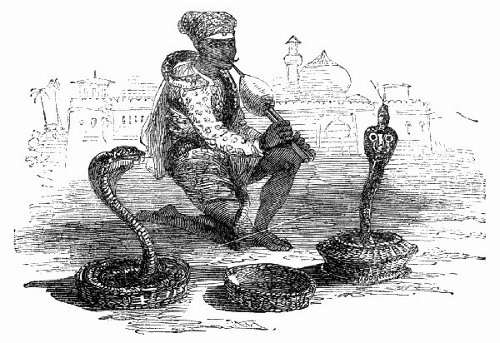
The musical instrument just mentioned is called magootee. It is composed
of a hollow calebash, to one end of which is fitted a mouthpiece
similar to that of the clarinet. To the other extremity is adapted a tube
perforated with several holes, which are successively stopped by the
fingers, like those of the flute, while the player blows into the mouthpiece.
In the middle of the instrument is a small mirror, on which the
serpents fix their eyes while dancing. The above engraving will convey
a correct idea of the Pambatee and his instrument.
WONDERFUL ESCAPE.
In 1785, at Winster, in Derbyshire, a show being exhibited at a
public-house, some gunpowder being scattered on the floor of an upper
chamber, took fire, and communicated to the remainder of a barrel, by
which the whole upper part of the house was blown up; about sixty
persons were below, and not one hurt.
FAC-SIMILE OF THE FIRST STEAM BOAT.
The triumph of steam navigation is one of the wonders of science; and,
traversed in all directions as the navigable waters of the earth now are,
by vessels propelled by steam, it is not a little curious to look at the
first rude effort, and to examine the attempt which has been followed by
such extraordinary success.
The world stands indebted, not for the discovery, but for the successful
application of steam power to navigation, to Robert Fulton, who was
born in Pennsylvania in 1765, being the son of a poor Irish labourer
who had emigrated to America. He came to London in 1786, and subsequently,
in the character of an inventor and projector, proceeded to
Paris, where, however, he did not meet with much success or encouragement.
It is evident, from the following letter to a friend, that while
residing in the French capital, that his attention was even then turned
to the subject of propelling vessels by mechanical power:—
Paris, the 20th of September, 1802.
To Mr. Fulner Skipwith.
Sir,—The expence of a patent in France is 300 livers for three years,
800 ditto for ten years, and 1500 ditto for fifteen years; there can be no
difficulty in obtaining a patent for the mode of propelling a boat which
you have shewn me; but if the author of the model wishes to be assured
of the mirits of his invention before he goes to the expence of a patent,
I advise him to make the model of a boat, in which he can place a clock
spring which will give about eight revolutions; he can then combine the
movements so as to try oars, paddles, and the leaves which he proposes;
if he finds that the leaves drive the boat a greater distance in the same
time than either oars or paddles, they consequently are a better application
of power. About eight years ago the Earl of Stanhope tried an
experiment on similar leaves in Greenland Dock, London, but without
success. I have also tried experiments on similar leaves, wheels, oars,
paddles, and flyars similar to those of a smoak jack, and found oars to
be the best. The velocity with which a boat moves, is in proportion as
the sum of the surfaces of the oars, paddles, leaves, or other machine is
to the bow of the boat presented to the water, and in proportion to the
power with which such machinery is put in motion; hence, if the sum of
the surfaces of the oars is equal to the sum of the surfaces of the leaves,
and they pass through similar curves in the same time, the effect must
be the same; but oars have this advantage, they return through air to
make a second stroke, and hence create very little resistance; whereas
the leaves return through water, and add considerably to the resistance,
which resistance is increased as the velocity of the boat is augmented:
no kind of machinery can create power; all that can be done is to apply
the manuel or other power to the best advantage. If the author of the
model is fond of mechanics, he will be much amused, and not lose his
time, by trying the experiments in the manner I propose, and this
perhaps is the most prudent measure, before a patent is taken.
I am, Sir, with much respect, yours,
Robt. Fulton.
In the following year, 1803, he appears to have made an experiment
in France of propelling a vessel by mechanism, and though it failed in
consequence of the timbers of the boat being too weak, it served to convince
him so completely of ultimate success, that he immediately gave
instructions to Watt and Boulton to prepare a suitable steam engine for
him, and send it to New York. Having returned to that city in 1806,
he set about building a boat, and having received the engines he had
ordered, he successfully started the first steam-boat in the world on her
trial trip to Albany from New York in August, 1807. Her name was
the "Clermont," and the above engraving is a correct representation of
her. She was in length 133 feet, in depth 7, and in breadth 18.
SEVERE ENACTMENT AGAINST BEGGARS.
At the commencement of the reign of Edward VI., a most severe and
extraordinary statute was made for the punishment of vagabonds and
relief of poor persons. It does not appear who were the contrivers of
this instrument, the preamble and general spirit of which were more in
accordance with the tyrannical and arbitrary measures of the preceding
reign, than with the mild and merciful character of the infant sovereign,
who is well known to have taken a very active part in the affairs of
government. It repeals all the former statutes on this subject, and
enacts, that if any beggar or other person, not being lame or impotent,
and after loitering or idly wandering for the space of three days or
more, shall not offer himself to labour, or being engaged in any person's
service, shall run away or leave his work, it shall be lawful for the
master to carry him before a justice of peace, who, on proof of the
offence, shall cause the party to be marked with a hot iron with the
letter V on the breast, and adjudge him to be his master's slave for the
space of two years, who shall feed him "on bread and water, or at his
discretion, on refuse of meat, and cause the said slave to work by beating,
chaining, or otherwise in such work or labour (how vile soever it
be) as he shall put him unto." If the slave should run away or absent
himself for a fortnight without leave, the master may pursue and punish
him by chaining or beating, and have his action of damage against any
one who shall harbour or detain him. On proof before the justice of the
slave's escape, he is to be sentenced to be marked on the forehead or ball
of the cheek with a hot iron with the letter S, and adjudged to be his
master's slave for ever; and for the second offence of running away, he
is to be regarded as a felon and suffer death. The children of beggars
to be taken from them, and, with other vagrant children, to be apprenticed
by the magistrate to whoever will take them; and if such children
so apprenticed run away, they are to be retaken, and become slaves till
the age of twenty in females, and twenty-four in males, with punishment
by chains, &c., and power to the master to let, sell, or bequeath
them, as goods and chattels, for the term aforesaid. If any slave should
maim or wound the master, in resisting correction, or conspire to wound
or murder him, or burn his house or other property, he is to suffer death
as a felon, unless the master will consent to retain him as a slave for
ever; and if any parent, nurse, or bearer about of children, so become
slaves, shall steal, or entice them away from the master, such person
shall be liable to become a slave to the said master for ever, and the
party so stolen or enticed away restored. If any vagrant be brought to
a place, where he shall state himself to have been born, and it shall be
manifest that he was not so born there, for such lie he shall be marked
in the face with an S, and become a slave to the inhabitants or corporation
of the city for ever. Any master of a slave may put a ring of iron
about his neck, arm, or leg, for safe custody, and any person taking
or helping to take off such ring, without consent of the master, shall
forfeit the sum of ten pounds.
This diabolical statute, after remaining for two years, was repealed,
on the ground that, from its extreme severity, it had not been enforced.
JUDGES IN THEIR ROBES ATTENDING PUBLIC BALLS.
That the ideas of good taste and propriety which now prevail are
greatly in advance of those which our ancestors entertained, is strikingly
manifested by the fact, that the dreadful scenes which followed the last
business of a county assize did not prevent a festive beginning of the
same. On the commission day at each county town was held an assize
ball. The judges attended in black silk gowns with band and two-curl
bob-wig. They did not dance, but usually played at whist. What
would be thought now-a-days of judges who went to a public ball room
on commission day, and played at whist in their robes?
ST. WINIFRED'S WELL.
The most copious spring in Great Britain is St. Winifred's Well, near
the town of Holywell, in Flintshire. The well is an oblong square,
about twelve feet by seven. The water passes into a small square court
through an arch; it has never been known to freeze, and scarcely ever
varies in quantity either in drought or after the greatest rains. The
water thrown up is not less than eighty-four hogsheads every minute.
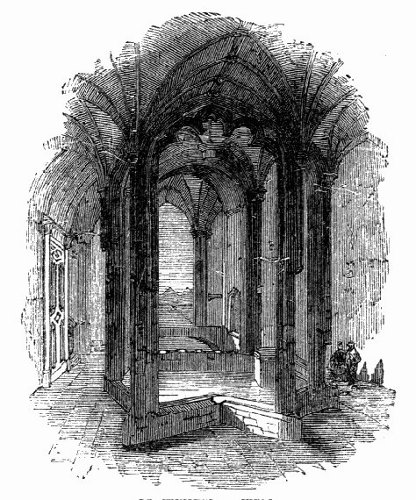
ST. WINIFRED'S WELL.
This sacred well is the object of many pilgrimages, even in the present
day, and several modern miracles are related of the influence of its waters.
Pope Martin V. especially enjoined such pilgrimages, and the monks of
Basingwerk were furnished with pardons and indulgences to sell to the
devotees. James the 2nd visited the well in 1686, and Leopold, King of
the Belgians, in 1819. Apart from all superstitious notions, its waters
doubtless possess many curative properties.
Over the well, Queen Margaret, the mother of Henry VII., erected a
beautiful chapel, whose elegantly fretted roof, and graceful columns
and arches, are generally admired as examples of good architecture. Our
engraving is a correct representation of the interior.
INSTANCE OF ASSIDUITY AND PERSEVERANCE.
The Rev. Wm. Davy, a Devonshire curate, in the year 1795, begun a
most desperate undertaking, viz., that of printing himself twenty-six
volumes of sermons, which he actually did, working off page by page,
for fourteen copies; and continuing this almost hopeless task for twelve
years, in the midst of poverty! Such wonderful perseverance almost
amounts to a ruling passion.
PHENOMENON AT THE POWERSCOURT FALL.
The Powerscourt Fall, of which the annexed is an engraving, is formed
by the river Dargle, and is situated in the county of Wicklow. When
the river is full, it presents a very grand appearance. The stream precipitates
itself over a nearly perpendicular cliff, 300 feet in height, and falls
into a natural basin or reservoir, encircled by rocky masses of considerable
magnitude, whilst the whole
scene is backed by mountains.
This fall exhibits rather a singular
phenomenon, in the different
degrees of velocity with
which the water descends in
different parts of the cascade.
Thus, on one side, the water
may be observed to pour down
with considerable velocity;
while, on the other side, the
fall, in the upper part, presents
the appearance of a continued
stream of frothy foam, gliding
slowly down the face of the
cliff, though the lower part
moves with greater velocity.
This circumstance is, however,
readily accounted for; being,
in fact, mainly attributable to
the comparatively small body
of water which forms the cascade.
The water, on the one
side, that which descends with
the greater velocity (and this
forms by far the larger portion
of the cascade) meets with no
interruption in its descent, but
falls, almost from the top, to the
bottom in an unbroken sheet.
On the other side, however, the cliff in the upper part deviates
from the perpendicular, and the consequence is, that, owing to the
slope or inclination of the rock over which it flows, the progress of
the water is checked in that particular part, though lower down,
where the cliff is again perpendicular, it regains its velocity. If the
body of water in this cascade were greater, this phenomenon would
not occur.
HOW CHESS ORIGINATED IN INDIA.
By the unanimous consent of all nations, chess holds the first place
among social amusements. The history of this game has exercised many
able pens. According to Sir William Jones, it is decidedly of Hindoo
invention. "If," says he, in a learned memoir on this subject inserted in
the second volume of the Asiatic Researches, "evidence were required to
prove this fact, we may be satisfied with the testimony of the Persians,
who, though as much inclined as other nations to appropriate the ingenious
inventions of a foreign people, unanimously agree that the game
was imported from the west of India in the sixth century of our era.
It seems to have been immemorially known in Hindoostan by the name
of Cheturanga, the four angas, or members of an army, which are elephants,
horses, chariots, and foot-soldiers; and in this sense, the word
is frequently used by epic poets in their description of real armies. By
a natural corruption of the pure Sanscrit word, it was changed by the
old Persians into chetrang; but the Arabs, who soon after took possession
of their country, had neither the initial nor the final letter of that word
in their alphabet, and consequently altered it farther into shetranj, which
presently found its way into the modern Persian, and at length into the
dialects of India, where the true derivation of the name is known only to the
learned. Thus has a very significant word in the sacred language of the
Brahmins been transformed by successive changes into axedrez,
scacchi, echecs, chess, and by a whimsical concurrence of circumstances
given birth to the English word check, and even a name to the exchequer
of Great Britain."
Of the origin of this game various accounts are given. Some Hindoo
legends relate, that it was invented by the wife of Ravanen, king of
Lanca, or Ceylon, to amuse her husband with an image of war, when
Rama, in the second age of the world, was besieging his capital. The
high degree of civilization which the court of Ravanen had attained at so
remote a period is worthy of notice. An ancient Hindoo painting represents
his capital regularly fortified with embattled towers. He there
defended himself with equal skill and valour, whence he and his subjects
were denominated magicians and giants. Ravanen seems to have
been the Archimedes of Lanca; and his science must have appeared
supernatural to the invader, Rama, and his wild horde of mountaineers,
who were termed in derision satyrs or apes, whence the fable of the
divine Hanooman.
According to another account, the occasion of this invention was as
follows:—Behub, a young and dissolute Indian prince, oppressed his
people in the most cruel manner. Nassir, a Brahmin, deeply afflicted by
his excesses, and the lamentations of his subjects, undertook to recal the
tyrant to reason. With this view he invented a game, in which the
king, impotent by himself, is protected only by his subjects, even of the
lowest class, and frequently ruined by the loss of a single individual.
The fame of this extraordinary invention reached the throne, and the
king summoned the Brahmin to teach him the game, as a new amusement.
The virtuous Brahmin availed himself of this opportunity to
instil into the mind of the young tyrant the principles of good government,
and to awaken him to a sense of his duties. Struck by the truths
which he inculcated, the prince conceived an esteem for the inventor of
the new game, and assured him of his willingness to confer a liberal
remuneration, if he would mention his own terms. Nassir demanded as
many grains of wheat as would arise from allowing one for the first
square, two for the second, four for the third, and so on, doubling for
each square of the sixty-four on the chessboard. The king, piqued at
the apparently trivial value of the demand, desired him somewhat
angrily to ask a gift more worthy of a monarch to bestow. When, however,
Nassir adhered to his first request, he ordered the required quantity
of corn to be delivered to him. On calculating its amount, the
superintendents of the public granaries, to their utter astonishment,
found the demand to be so enormous, that not Behub's kingdom only,
but even all Hindoostan would have been inadequate to the discharge of
it. The king now admired the Brahmin still more for the ingenuity of
his request than for the invention, appointed him his prime-minister,
and his kingdom was thenceforward prosperous and happy.
The claim of the Hindoos to the invention of chess has been disputed
in favour of the Chinese; but as they admit that they were unacquainted
with the game till 174 years before Christ, and the Hindoos unquestionably
played it long before that time, the pretensions of the latter must
naturally fall to the ground.
DISORDERS CURED BY FRIGHT.
Fabritius makes mention of a gentleman, with whom he was familiar,
who, being unjustly suspected, was tortured upon the rack, and, when
released, found himself quite cured of the gout, which was, before this
violent remedy, rather troublesome. Again, we have instances of disorders
being cured by fright. We find, in the Journal de Henri IV.,
that, "On Friday, June the 9th, 1606, as Henry IV. of France, and his
Queen, were crossing the water in the ferry-boat of Neuilly, the Duke of
Vendome being with them, they were all three in great danger of being
drowned, especially the queen, who was obliged to drink a great deal
more than was agreeable to her; and had not one of her footmen, and a
gentleman called La Chatagnieraie, who caught hold of her hair, desperately
thrown themselves into the water to pull her out, she would have
inevitably lost her life. This accident cured the king of a violent toothache;
and, after having escaped the danger, he diverted himself with it,
saying he had never met with so good a remedy for that disorder before,
and that they had ate too much salt meat at dinner, therefore they had
a mind to make them drink after it."
THE WINGLESS BIRD OF NEW ZEALAND.
One of the chief wonders of the world of Ornithology is the Apteryx,
a bird which is found only in New Zealand, and even there, is rapidly
becoming extinct. It is a creature so strange, that no imagination could
have fancied a bird without wings or tail, with robust legs, and with
claws which are suited for digging, and are actually used in forming
excavations, in which this singular bird lays its eggs, and hatches its
young. If the Apteryx were to become extinct, and all that remained
of it, after the lapse of one or two centuries, for the scrutiny of the
naturalist were a foot in one Museum, and a head in another, with a few
conflicting figures of its external form, the real nature and affinities of
this most remarkable species would be involved in as much obscurity
and doubt, and become the subject of as many conflicting opinions among
the ornithologists of that period, as are those of the Dodo in the present day.
The Apteryx is not larger than a full-grown fowl, and has only a rudimentary
wing, so covered with the body feathers as to be quite concealed;
the terminating slender claw may, however, be discerned on examination.
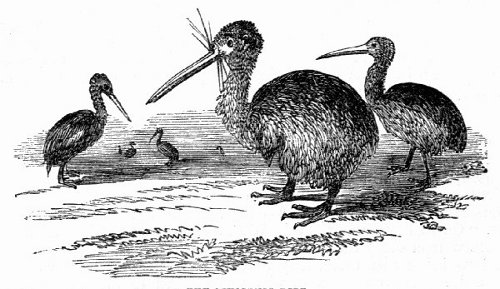
THE WINGLESS BIRD.
The bill is long and slightly curved, having the nostrils at the extremity;
its feathers, the sides of which are uniform in structure, do not
exceed four and a-half inches in length, and are much prized as material
for mantles or cloaks by the chiefs. It is a nocturnal bird, using its
long bill in search of worms, upon which it principally feeds; it kicks
with great power, and burrows at the root of the rata, at the base of
which tree is also found the extraordinary Sphæria Robertsia, a species
of vegetating caterpillar. Retaining the form of the caterpillar, the
fungus pervades the whole body, and shoots up a small stem above the
surface of the ground, the body of the caterpillar being below the earth
in an erect position. The Apteryx frequently leans with its bill upon the
earth—one of its chief characteristics—and thus, when viewed from a
distance, appears to be standing on three legs.
By the natives of New Zealand, these birds are called Kiwis, from
the cry they utter, and they are frequently caught by a cunning imitator
of their tone, who, when they approach, dazzles and frightens them with
a light previously concealed, and throwing his blanket over them thus
secures them.
A FLOATING CITY.
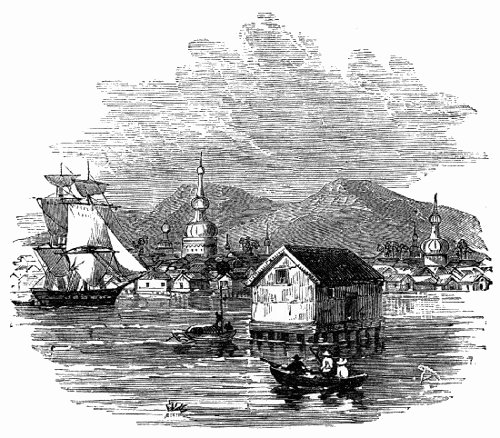
FLOATING CITY OF BANKOK.
One of the most wonderful cities in the world is Bankok. It is the
capital of Siam, and is situated on—or rather in—the great river Meinam.
Our engraving represents a portion of this unique metropolis, and we
find the following graphic account of it in a volume of recent travels—"The
capital of Siam! Did you ever witness such a sight in
your life? On either side of the wide, majestic stream, moored in
regular streets and alleys, and extending as far as the eye can reach, are
upwards of seventy thousand neat little wooden houses, each house floating
on a compact raft of bamboos; and the whole intermediate space
of the river presents to our astonished gaze one dense mass of ships,
junks, and boats, of every conceivable shape, colour, and size. As we
glide along amongst these, we occasionally encounter a stray floating
house, broken loose from its moorings, and hurrying down the stream with
the tide, amidst the uproar and shouts of the inhabitants and all the
spectators. We also observe that all the front row of houses are neatly
painted shops, in which various tempting commodities are exposed for
sale; behind these again, at equal distances, rise the lofty and elegant
porcelain towers of the various watts and temples. On our right-hand
side, far away as we can see, are three stately pillars, erected to the
memory of three defunct kings, celebrated for some acts of valour and
justice; and a little beyond these, looming like a line-of-battle ship
amongst a lot of cockle-shells, rises the straggling and not very elegant
palace of the king, where his Siamese Majesty, with ever so many wives
and children, resides. Right ahead, where the city terminates, and the
river, making a curve, flows behind the palace, is a neat-looking-fort,
surmounted with a tope of mango-trees, over which peep the roofs of
one or two houses, and a tall flag-staff, from which floats the royal
pendant and jack of Siam—a flag of red groundwork, with a white
elephant worked into the centre. That is the fort and palace of the prince
Chou Fau, now king of Siam, and one of the most extraordinary and
intellectual men in the East. Of him, however, we shall see and hear
more, after we have bundled our traps on shore, and taken a little rest.
Now, be careful how you step out of the boat into the balcony of the
floating house, for it will recede to the force of your effort to mount, and
if not aware of this, you lose your balance and fall into the river. Now
we are safely transhipped, for we cannot as yet say landed; but we now
form an item, though a very small one, of the vast population of the city
of Bangkok.
We take a brief survey of our present apartments, and find everything,
though inconveniently small, cleanly and in other respects comfortable.
First, we have a little balcony which overhangs the river, and is about
twenty yards long by one and a half broad. Then we have an excellent
sitting-room, which serves us for parlour, dining-room, and all; then
we have a little side room for books and writing; and behind these, extending
the length of the other two, a bed-room. Of course we must
bring or make our own furniture; for, though those houses inhabited by
the Chinese are pretty well off on this score, the Siamese have seldom anything
besides their bedding materials, a few pots and pans to cook with,
a few jars of stores and fishing-net or two. Every house has a canoe
attached to it, and no nation detests walking so much as the Siamese;
at the same time they are all expert swimmers, and both men and women
begin to acquire this very necessary art at a very early age. Without
it a man runs momentary risk of being drowned, as, when a canoe upsets,
none of the passers-by ever think it necessary to lend any aid, supposing
them fully adequate to the task of saving their own lives. Canoes are
hourly being upset, owing to the vast concourse of vessels and boats
plying to and fro; and, owing to this negligence or carelessness in
rendering assistance, a Mr. Benham, an American missionary, lost his
life some twelve years ago, having upset his own canoe when it was just
getting dusk, and though surrounded by hundreds of boats, not one
deemed it necessary to stop and pick the poor man up."
BEQUESTS FOR LIGHTING THE STREETS.
There cannot be a greater contrast than between the present and the
ancient mode of lighting the streets of London. What a picture do the
two following bequests present to us of the state of things a hundred
years ago!
John Wardall, by will, dated 29th August, 1656, gave to the Grocers'
Company a tenement called the White Bear, in Walbrook, to the intent
that they should yearly, within thirty days after Michaelmas, pay to the
churchwardens of St. Botolph, Billingsgate, £4, to provide a good and
sufficient iron and glass lantern, with a candle, for the direction of passengers
to go with more security to and from the water-side, all night
long, to be fixed at the north-east corner of the parish church of St.
Botolph, from the feast-day of St. Bartholomew to Lady-Day; out of
which sum £1 was to be paid to the sexton for taking care of the lantern.
This annuity is now applied to the support of a lamp in the place prescribed,
which is lighted with gas.
John Cooke, by will, dated 12th September, 1662, gave to the churchwardens,
&c., of St. Michael's, Crooked Lane, £76, to be laid out to the
most profit and advantage, for various uses, and amongst them, for the
maintenance of a lantern and candle, to be eight in the pound at least,
to be kept and hanged out at the corner of St. Michael's Lane, next
Thames Street, from Michaelmas to Lady-Day, between the hours of
nine and ten o'clock at night, until the hours of four or five in the
morning, for affording light to passengers going through Thames Street,
or St. Michael's Lane.
EXTRAORDINARY INSTANCE OF CREDULITY.
To the honour of the lords of the creation, there are some husbands
who so grieve at the death of their partners, that they will not part with
them when actually dead; and even go so far as to wish, and try hard,
for their resurrection; witness Sir John Pryse, of Newtown, Montgomeryshire,
who married three wives, and kept the first two who died, in his
room, one on each side of his bed; his third lady, however, declined the
honour of his hand till her defunct rivals were committed to their proper
place. Sir John was a gentleman of strange singularities. During the
season of miracles worked by Bridget Bostock, of Cheshire, who healed
all diseases by prayer, faith, and an embrocation of fasting spittle, multitudes
resorted to her from all parts, and kept her salivary glands in full
employ. Sir John, with a high spirit of enthusiasm, wrote to this
wonderful woman to make him a visit at Newtown Hall, in order to restore
to him his third and favourite wife (above mentioned), now dead.
His letter will best tell the foundation on which he built his strange hope,
and very uncommon request:—
Purport of Sir J. Pryse's letter to Mrs. Bridget Bostock, 1748.
Madam,—Having received information, by repeated advices, both public
and private, that you have, of late, performed many wonderful cures,
even where the best physicians have failed, and that the means used
appeared to be very inadequate to the effects produced, I cannot but
look upon you as an extraordinary and highly-favoured person; and why
may not the same most merciful God, who enables you to restore sight to
the blind, hearing to the deaf, and strength to the lame, also enable you
to raise the dead to life? Now, having lately lost a wife, whom I most
tenderly loved; my children an excellent step-mother, and our acquaintances
a very dear and valuable friend, you will lay us all under the
highest obligations; and I earnestly entreat you, for God Almighty's
sake, that you will put up your petitions to the Throne of Grace, on our
behalf, that the deceased may be restored to us, and the late dame
Eleanor Pryse be raised from the dead. If your personal attendance
appears to you to be necessary, I will send my coach and six, with proper
servants, to wait on you hither, whenever you please to appoint. Recompense
of any kind, that you could propose, would be made with the
utmost gratitude; but I wish the bare mention of it is not offensive to
both God and you.
I am, madam, your obedient, &c.
John Pryse.
(Pennant's Wales, vol. 3, p. 190.)
HIGH PRICE OF FISH IN LONDON.
It is on record that on January 4, 1809, there being only four cod-fish
in Billingsgate, a fishmonger gave fourteen guineas for them, and
salmon soon after was sold at a guinea a pound!
THE GREAT AQUEDUCT OF PONT DU GARD.
The remains of Roman aqueducts, of great extent and massiveness,
occur in various parts of Europe, over which the Roman dominion once
extended. Among these, the most celebrated are the Pont du Gard,
near Nismes, in the Department du Gard, in the south of France; the
aqueduct over the Moselle, near Metz; and the aqueduct of Segovia, in
Old Castile. The Pont du Gard (of which we here give an engraving)
was designed to convey the waters of the fountain of Aure to the town
of Nismes, the ancient Nemausus. This aqueduct crosses the beautiful
valley, and the stream of the river Gardon, uniting two steep hills, by
which the valley is bounded at this place. It consists of two tiers of
large arches, the lower of which are eighty feet in span, and a third tier
of small arches, which support the trunk of the aqueduct. The channel
for the water is above four feet wide, and five deep, and is lined with
cement three inches thick, and covered with a thin coating of red clay.
The whole work, with the exception of the above-mentioned channel for
the water, is built without mortar or any other cement; and its elevation
above the bed of the river Gardon, is not less than a hundred and
fifty feet. The extremities of this splendid structure are in a dilapidated
condition, but the remainder is in a very good state of preservation.
EXTRAORDINARY SITUATION FOR A TREE.
The Lower and Middle Lakes at Killarney are separated by a peninsula,
upon which stands the ruin of the Abbey of Muckross, which was
founded in 1440, and re-edified in 1602. The ruin, which consists of
parts of the convent and church, is not remarkable either for extent, or
for beauty of workmanship, but its preservation, seclusion, beauty of
situation, and accompanying venerable trees, render it one of the most
interesting abbey remains in Ireland. The entire length of the church
is about 100 feet, its breadth 24. The cloister, which consists of
twenty-two arches, ten of them semicircular, and twelve pointed, is
the best preserved portion of the abbey. In the centre grows a magnificent
yew-tree, as represented in our engraving, which covers as a roof
the whole area; its circumference is thirteen feet, and its height in proportion.
It is more than probable that the tree is coeval with the abbey,
and that it was planted by the hands of the monks who first inhabited
the building. It is believed by the common people that any person
daring to pluck a branch, or in any way attempting to injure this tree,
will not be alive on that day twelvemonth.
PRAYING BY MACHINERY.
Mr. Moorcroft informs us, in his "Journey to Lake Manasawara, in
Undés, a province in Little Thibet," that the inhabitants used the following
most extraordinary way of saying their prayers:—It is done by
motion, which may be effected by the powers of steam, wind, or water.
A large hollow cylinder, like a drum, is erected, within which is inclosed
all the written prayers the people choose to offer, and then it is set going,
by being whirled round its own axis; thus saving the trouble of repeating
them. Mr. Turner, whose travels in Thibet are before the public,
corroborates the account of these whirligigs. They are common, also,
among the Monguls, the Calmucs, and the Kalkas; so that the engineers
for these pious wheels must have a tolerably extensive trade, as
this national mode of worship is naturally liable to wear out. But even
this mode is innocence itself, compared with that of a set of savages, who
pray people to death; for Lisiansky, in his Voyage round the World,
gives us an account of an extra-religious sect, in the Sandwich Islands,
who arrogate to themselves the power of praying people to death. Whosoever
incurs their displeasure, receives notice that the homicide-litany
is about to begin; and such are the effects of imagination, that the very
notice is frequently sufficient, with these weak people, to produce the
effect, or to drive them to acts of suicide.
TOPING IN THE LAST CENTURY.
At a Somersetshire hunt dinner, seventy years since, thirteen toasts
used to be drunk in strong beer; then every one did as he liked. Some
members of the hunt occasionally drank a glass of wine at the wind up,
who were not themselves previously wound up. In country towns, after
a dinner at one o'clock P.M., friends used to meet to discuss the local
news over their glasses of strong beer, the merits of which furnished a
daily theme. At Bampton one knot of gentlemen took four times the
duration of the Trojan war, and even then failed to settle which of the
party brewed the best beer.
A FINE OLD SOLDIER.
Jeremiah Atkins, of the Scar, near Bromyard, Herefordshire, died in
1796, aged 102. He had been a soldier through all the earlier periods of
his manhood, and had seen much service; was present at the taking of
Martinico, and at the Havannah; and, on one occasion, being taken
prisoner by the Indians of North America, was very near being scalped,
as he was only rescued at the moment they were about to perform the
operation. He was likewise at the taking of Crown Point, in America,
and in the battle of Fontenoy with the Duke of Cumberland, whom he
also accompanied in his resistance to the advance of the Scotch rebels,
being in several of the skirmishes and battles fought on that occasion.
He afterwards went again to America, and took part in the storming of
Quebec, when Wolfe was killed. The last battle in which he was engaged
was that of Tournay, in Flanders. This extraordinary man retained
the full use of all his natural faculties, save hearing, to the very
close of his life.
POPULAR FALLACY OF THE VIRTUES OF A SEVENTH SON.
It is believed that a seventh son can cure diseases, but that a seventh
son of a seventh son, and no female child born between, can cure the
king's evil. Such a favoured individual is really looked on with veneration.
An artist visiting Axminster in 1828, noticing the indulgence
granted to one urchin in preference to others, and seeing something particular
in this child, addressed his mother as follows:—"This little man
appears to be a favourite: I presume he is your little Benjamin."
"He's a seventh son, sir," said the mother. Affecting an air of surprise,
I expressed myself at the instant as being one very anxious to know what
a seventh son could do? The mother, a very civil woman, told me that
"she did think, to cure all diseases, should be the seventh son of a
seventh son; but many folk do come to touch my son." In April, 1826,
a respectable looking woman was engaged in collecting a penny from
each of thirty young women, unmarried; the money to be laid out in
purchasing a silver ring, to cure her son of epileptic fits. The money
was to be freely given, without any consideration, or else the charm
would have been destroyed. The young women gave their pence, because
it would have been a pity for the lad to continue afflicted if the
charm would cure him.
SELF-NOURISHMENT.
That animals may sometimes be kept alive for a long time solely on
nourishment supplied from their own bodies, is evident from the fact
that after a great fall of earth on one occasion from the cliff at Dover,
which buried a whole family, a hog was found alive five months and
nine days after it had thus been buried! It weighed about seven
score when the accident happened, and had wasted to about thirty
pounds, but was likely to do well.
CHINESE METHOD OF FISHING.
There is nothing more extraordinary in the history of the different
nations of the world than the ingenuity of the Chinese. They are the
most handy people on the face of the earth, and the lower orders are just
as clever as the higher. A proof of this may be seen at a fishing village
which is contiguous to the town of Victoria, in Hong Kong. It remains
in much the same state as that in which it existed prior to the British
occupation of the island. Old worn-out boats, and torn mat-sails, bamboos
and dried rushes,—these are the principal materials employed in
the construction of their domiciles. The fishing boats are most ingeniously
built. Each of these has a long projecting bamboo, which is
rigged out from the stem in the form of a bowsprit, only working on a
pivot. From the extremity of this outrigger, a strong rope communicates
with a balance-board, that exactly poises the bamboo outrigger,
when the net is immersed in water, and the fisherman has
only to walk up and down this plank to raise the net and let it
drop again in the water. But opposite to the island, and on many
of the little insular rocks which constitute the "ten thousand isles,"
of which the emperor of China, amongst his vast pretensions to titles,
lays claim to be lord, fishing is conducted on a larger scale, though
worked upon the same principles. Huge poles are driven into the ground
where the water is comparatively shallow, and leading ropes, which pass
over a block-wheel inserted in the tops of these poles, communicate at
one end with large circular nets, (constructed somewhat in the shape of
a funnel, the upper rim being attached to floats, whilst from the centre
are pendant weights,) the other end being fastened on shore to a balance
plank, which the weight of one man suffices to work.
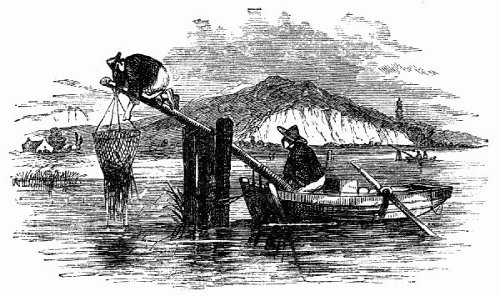
CHINESE METHOD OF FISHING.
MOSQUE OF OMAR.
The opposite engraving represents the Great Mosque at Jerusalem. It
is built on the exact site of Solomon's Temple, and takes its name from
its original founder, the Caliph Omar. It is a Turkish edifice, and is
devoted to the worship of Mahomet.
Titus having taken Jerusalem in the second year of Vespasian's reign,
not one stone was left upon another of that Temple where Christ had
done such glorious things, and the destruction of which he had predicted.
When the Caliph Omar took Jerusalem, in 636 A.D., it appears
that the site of the Temple, with the exception of a very small part,
had been abandoned by the Christians. Said-Eben-Batrick, an Arabian
historian, relates that the Caliph applied to the Patriarch Sophronius,
and enquired of him what would be the most proper place at Jerusalem
for building a mosque. Sophronius conducted him to the ruins of Solomon's
Temple. Omar, delighted with the opportunity of erecting a
mosque on so celebrated a spot, caused the ground to be cleared, and
the earth to be removed from a large rock, where God is said to have
conversed with Jacob. From that rock the new mosque took its name
of Gameat-el-Sakhra, and became almost as sacred an object to the
Mussulmans, as the mosques of Mecca and Medina. The Caliph El-Oulid
contributed still more to the embellishment of El-Sakhra, and
covered it with a dome of copper, gilt, taken from a church at Balbeck.
In the sequel, the crusaders converted the Temple of Mahomet into a
sanctuary of Christ; but when Saladin re-took Jerusalem, he restored
this edifice to its original use.
GREAT MOSQUE AT JERUSALEM.
The form is an octagon, either side being seventy feet in width; it is
entered by four spacious doors, the walls are white below, intermingled
with blue, adorned with pilasters, but above, it is faced with glazed
tiles of various colours. The interior is described as paved with grey
marble, the plain walls are covered with the same material in white. It
contains many noble columns, in two tiers. The dome is painted, and
gilt in arabesque, whence depend antique vessels of gold and silver; immediately
beneath it stands a mass of limestone, reported to have fallen
from heaven when the spirit of prophecy commenced. On this sat the
destroying angel, during the slaughter caused by David's numbering the
people. From this Mahomet ascended to heaven. Within the storied
walls, moreover, are the scales for weighing the souls of men, the shield
of Mahomet, and other relics, besides the entrance to the infernal
regions; seventy thousand angels ever guard the precious stone.
Entrance to this hallowed edifice has been gained only by two or
three Europeans; indeed, the Turks will not allow infidels to approach
the sacred enclosure around it, which measures about sixteen hundred
feet in length, by one thousand in width, and is adorned with fountains,
orange, cypress, and other trees.
The mosque itself is esteemed the finest piece of Saracenic architecture
in existence, far surpassing St. Sophia in beauty. Its view, combined
with the distinguished monuments in the City of the Sultan, in
Egypt, Greece, and Italy, strongly induces a belief in the accuracy of
an able article in the Quarterly Review, in which the origin of the five
predominant styles of architecture throughout the world, viz., the Byzantine,
Chinese, Egyptian, Grecian, and Gothic are assigned respectively
to the convex and concave curves, to the oblique, horizontal, and
perpendicular lines.
A COUPLE OF ECCENTRICS.
Mr. Day, the eccentric founder of Fairlop fair, had a housekeeper, who
had lived with him for thirty years, and was equally eccentric. She had
two very strong attachments; one to her wedding-ring and garments,
and the other to tea. When she died, Mr. Day would not permit her
ring to be taken off; he said, "If that was attempted, she would come
to life again;" and directed that she should be buried in her wedding-suit,
and a pound of tea in each hand; and these directions were literally
obeyed.
THE UNIVERSALITY OF TAXATION.
The following extract, from the Edinburgh Review, is not inappropriate
to our pages, inasmuch as it is both a rare specimen of effective
composition, and also serves to show us what the state of taxation was
in England even within the last forty years.—Taxes upon every article
which enters into the mouth, or covers the back, or is placed upon the
feet—taxes upon every thing which it is pleasant to see, hear, feel, smell,
or taste—taxes upon warmth, light, and locomotion—taxes on everything
on earth, and the waters under the earth—on every thing that
comes from abroad, or is grown at home—taxes on the raw material—taxes
on every fresh value that is added to it by the industry of man—taxes
on the sauce which pamper's man's appetite, and the drug that
restores him to health—on the ermine which decorates the judge, and the
rope which hangs the criminal—on the poor man's salt, and the rich
man's spice—on the brass nails of the coffin, and the ribands of the bride
at bed or board, couchant or levant, we must pay;—the schoolboy whips
his taxed top—the beardless youth manages his taxed horse, with a taxed
bridle, on a taxed road:—and the dying Englishman, pouring his medicine,
which has paid seven per cent., into a spoon that has paid fifteen
per cent., flings himself back upon his chintz bed, which has paid twenty-two
per cent.—makes his will on an eight-pound stamp, and expires in
the arms of an apothecary, who has paid a license of an hundred pounds
for the privilege of putting him to death. His whole property is then
immediately taxed from two to ten per cent. Besides the probate, large
fees are demanded for burying him in the chancel; his virtues are
handed down to posterity on taxed markle; and he is then gathered to
his fathers—to be taxed no more.
SHAM PROPHETS.
William Hackett, a fanatic of the sixteenth century, after a very ill
life, turned prophet, and signified the desolation of England. He prophesied
at York and at Lincoln; where, for his boldness, he was whipped
publicly, and condemned to be banished. He had an extraordinary
fluency of speech, and much assurance in his prayers; for he said, that
if all England should pray for rain, and he should pray to the contrary,
it should not rain. Hackett had two brother-prophets joined with him,
Edward Coppinger, named the prophet of mercy, and Henry Arthington,
the prophet of judgment. Coppinger, the merciful prophet, declared that
Hackett was the sole monarch of Europe; and at length they proclaimed
him, July 16, 1592. On the 28th of the same month, however, the
monarch of the whole earth, who had also personated divinity, was
hanged and quartered. Coppinger famished himself in prison, and Arthington
was pardoned. Fitz Simon relates, that in a quarrel Hackett
had at Oundle, "He threw down his adversary, and bit off his nose; and,
instead of returning it to the surgeon, who pretended to set it on again,
while the wound was fresh, ate it." Hackett, on the scaffold, made a blasphemous
prayer, which is recorded by Fitz Simon and Camden, too horrid
to be repeated. He hated Queen Elizabeth, and tried to deprive her of
her crown; he confessed to the judges that he had stabbed the effigies of
this princess to the heart, with an iron pin; and a little before he was
hanged, being an accomplished swearer, he cursed her with all manner of
imprecations.
HOOKING A BOY INSTEAD OF A FISH.
About five and thirty years ago, as Mr. George Moor was fishing in the
river Tyne at Pipewellgate, Gateshead, he espied something in the water
which seemed like a drowned dog, but the day being clear, and the sun
shining, he thought he perceived a face, upon which he threw his line
to it (which had but three hairs at the hook) and hooked a coat, by which
he found it was a boy, but the hook loosing hold, he again cast his line
and struck him in the temple and drew him to the shore, and in less
than quarter of an hour he revived.
CHILDREN OF AGED PARENTS.
Margaret Krasiowna, of the village of Koninia, Poland, died 1763, aged
108. The following extraordinary circumstances are stated, by Eaton,
as connected with the life of this woman:—"At the age of ninety-four
she married her third husband, Gaspard Raycolt, of the village of Ciwouszin,
then aged one hundred and five. During the fourteen years they
lived together she brought him two boys and a girl; and, what is very
remarkable, these three children, from their very birth, bore evident
marks of the old age of their parents—their hair being grey, and a vacuity
appearing in their gums, like that which is occasioned by the loss of
teeth, though they never had any. They had not strength enough, even
as they grew up, to chew solid food, but lived on bread and vegetables,
they were of a proper size for their age, but their backs were bent, their
complexions sallow, with all the other external symptoms of decrepitude.
Though most of these particulars," he adds, "may appear fabulous, they
are certified by the parish registers. The village of Ciwouszin is in the
district of Stenzick, in the palatinate of Sendonier. Gaspard Raycolt,
the father, died soon after, aged 119."
SEPULCHRAL VASE FROM PERU.
The vessel of which the annexed is an engraving, was taken from the
tomb of one of the ancient inhabitants of Peru; the subjects of the Incas,
or princes who ruled over that
country before it was conquered
by the Spaniards.
Vases of this
sort were probably placed in the
sepulchres of the Peruvians to
contain the ashes of the dead, or
offerings to their disembodied
spirits;—usages which are familiar
to us through the frequent
allusions to them which we meet
with in the works of the poets of
ancient Rome, and the discovery
of urns and lachrymatories in
Roman tombs which have been
in our own and other cemeteries.
The specimen which we have
engraved is quadruple, but forms one vessel.
FIRST IRON CANNON.
The first cannon was cast in Sussex in 1535. In after years bonds
were taken in £1,000 from the owners of the charcoal furnaces, that
none should be sold till a license for the sale or issue of the ordnance had
been procured. Fears were entertained that the enemy would purchase
them.
PROLIFIC AUTHOR.
No one need despair, after the following instance, of shining in quantity,
if not in quality:—"Hans Sacks was a Nuremberg shoemaker, born
there in 1494; he was instructed, by the master-singers of those days,
in the praiseworthy art of poetry; he, therefore, continued to make verses
and shoes, and plays and pumps, boots and books, until the seventy-seventh
year of his age; when he took an inventory of his poetical stock
in trade, and found, according to his narrative, that his works filled
thirty folio volumes, all written with his own hand; and consisted of
four thousand two hundred mastership songs, two hundred and eight
comedies, tragedies, and farces (some of which were extended to seven
acts), one thousand seven hundred fables, tales, and miscellaneous poems,
and seventy-three devotional, military, and love songs; making a sum
total of six thousand and forty-eight pieces, great and small." Out of
these, we are informed, he culled as many as filled three massy folios,
which were published in the year 1558-61; and, another edition being
called for, he increased this three volumes folio abridgement of his works,
in the second, from his other works. None but Lope de Vega exceeded
him in quantity of rhyme-making.
THE ART OF POTTERY IN CHINA.
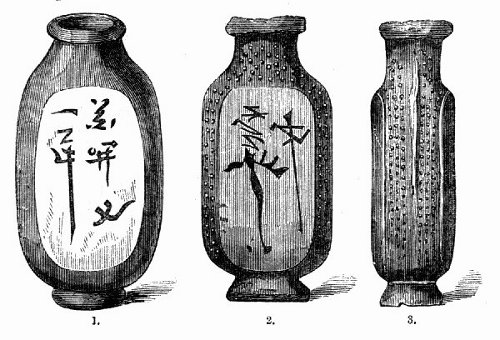
The Chinese traditions carry back the practice of the potter's art to a
very remote epoch. Father Entrecolles, a French missionary, resided in
China at the beginning of the last century, and his letters published in
Paris, in 1741, supply some curious and interesting information on this
subject. Writing in 1712, he says that at that time ancient porcelain was
very highly prized, and bore large prices. Articles were extant which
were reputed to have belonged to the Emperors Yao and Chun, two of
the most ancient mentioned in the Chinese annals. Yao reigned in
2357 and Chun in 2255 before Christ. Other authorities place the
reign of Chun in 2600 before Christ. It appears from the researches of M.
Stanislaus Julian that, from the time of the Emperor Hoang-ti, who
reigned 2698 to 2599 before Christ, there had always existed a public
officer bearing the title of the Intendant of Pottery, and that it was
under the reign of Hoang-ti that the potter's art was invented by Kouen-ou.
It is also certain that porcelain, or fine pottery, was common in
China in the time of the Emperors Han, 163 B.C.
In digging the foundations of the palaces, erected by the dynasties of
Han and Thang, from 163 B.C. to 903 A.D. great quantities of ancient
vases were found which were of a pure whiteness, but exhibited little
beauty of form or fabrication. It was only under the dynasty of Song,
that is to say, from 960 to 1278 A.D., that Chinese porcelain began to
attain a high degree of perfection.
Further evidence of the antiquity of the potter's art in China, as well
as of the existence of intercommunication between that country and
Egypt, is supplied by the discoveries of Rossellina, Wilkinson, and others,
who found numerous vases of Chinese fabrication, and bearing Chinese
inscriptions, in the tombs at Thebes. Professor Rossellini found a small vase
of Chinese porcelain with a painting of a flower on one side, and on the
other Chinese characters not differing much from those used at the present
day. The tomb was of the time of the Pharaohs, a little later than
the eighteenth dynasty.
This vase, with its Chinese inscription, is represented in Fig. 1, from
an exact cast made by Mr. Francis Davis.
Another of the Chinese vases, found in the Theban tombs, is represented
in Fig. 2. This is preserved in the Museum of the Louvre. The
shape of the vase is that of a flat-sided flask. A side view is given in
Fig. 3.
These flasks are very small. The engravings represent them of their
proper dimensions. Mr. Wilkinson thinks it probable that they were
brought to Egypt from India, the Egyptians having had commercial
relations with that country at a very remote epoch, and that they
came not as pieces of porcelain, but as vessels containing some articles
of importation.
STRONG ATTACHMENT TO SMOKING.
The following is a curious case of extreme fondness for smoking in a
very poor and very old man. In the year 1810, there died in Dartford
workhouse, aged 106, one John Gibson. He had been an inmate of the
house for ten years, and till within two months of his death used daily to
perambulate the town. His faculties were entire to the last. He was
so much attached to smoking, that he requested his pipe, together with
his walking-stick, might be placed in his coffin, which request was
complied with.
EXTRAORDINARY LETTER.
The following strange and curious epistle, we are assured, was sent to
a surgeon of eminence by a malefactor who had been sentenced to death.
It has a degree of character and quaintness about it which is rarely
found in the letters of convicts. Whether or not the surgeon complied
with his request we do not know.
"Sir,—Being informed that you are the only surgeon in this county,
in the habit of dissecting dead bodies—being very poor, I am desirous
of passing what remains to me of life, with as much comfort as my unhappy
condition admits of. In all probability I shall be executed in the course
of a month; having no friend to intercede for me, nor even to afford
me a morsel of bread, to keep body and soul together till the fatal moment
arrives, I beg you will favour me with a visit; I am desirous of
disposing of my body, which is healthy and sound, for a moderate sum
of money. It shall be delivered to you on demand, being persuaded
that on the day of general resurrection, I shall as readily find it in your
laboratory, as if it were deposited in a tomb. Your speedy answer will
much oblige your obedient servant,
James Brown."
A MATTRESS FOR A BANK.
In the month of April, 1822, Mrs. Motley, broker, Bedford-street,
North Shields, purchased an old mattress for 2s. from a shipowner, who
was going to reside with his daughter; in arranging some papers a few
days ago, he found a document in the hand-writing of his deceased wife,
not intended for his perusal, but that of her son by a former husband,
in which it was stated that property to a considerable amount was deposited
in the said mattress. His daughter in consequence waited on
Mrs. Motley, and offered her a few shillings to return it. Mrs. M.
naturally supposed that this seeming generosity was not without a cause,
but having sold it to a Mrs. Hill for 3s., for a small consideration she
regained possession of the prize, but on entering her house the original
proprietor and a constable were ready to receive her, and without
ceremony cut open the mattress, when a purse, said to contain 100gs.,
two gloves filled with current silver coin, several valuable rings, trinkets,
silver spoons, &c., were discovered. Mrs. Hill had considerably reduced
the mattress to fit a small bedstead without finding the hidden treasure.
ARCHITECTURE FOR EARTHQUAKES.
Sumatra is one of the largest islands in the Indian Archipelago, and
the houses of the inhabitants are deserving of notice, inasmuch as they
furnish a correct and curious specimen of the style of building, which
the frequent occurrence of earthquakes renders the safest in the countries
where such visitations are common.
The frames of the houses are of wood, the under-plates resting on
pillars six or eight feet high, which have a sort of capital, but no base,
and are wider at top than at bottom. The people appear to have no
idea of architecture as a science, though much ingenuity is often shown
in working up their materials. The general appearance of their houses
is accurately represented in the annexed plate. For the floorings they
lay whole bamboos, four or five inches in diameter, close to each other,
and fasten them at the ends to the timbers. Across these are laid laths
of split bamboo, about an inch wide and of the length of the room, which
are tied down with filaments of the rattan, and over these are usually
spread mats of different kinds. This sort of flooring has an elasticity
alarming to strangers when they first tread on it.
The sides of the houses are generally closed in with bamboo, opened
and rendered flat by notching or splitting the circular joints on the outside,
chipping away the corresponding divisions within, and laying it to
dry in the sun pressed down with weights. This is sometimes nailed to
the upright timbers or bamboos, but in the country parts it is more commonly
interwoven or matted in breadths of six inches, and a piece or
sheet formed at once of the size required. In some places they use for
the same purpose the inner bark procured from some particular trees.
When they prepare to take it, the outer bark is first torn or cut away;
the inner is then marked out with a proper tool to the requisite size,
usually three cubits by one; it is afterwards beaten for some time with
a heavy stick to loosen it from the stem, and being peeled off, laid in the
sun to dry, care being taken to prevent its warping. The bark used in
building has nearly the texture and hardness of wood; but the pliable
and delicate bark of which clothing is made is procured from a bastard
species of the bread-fruit.
The most general mode of covering houses is with the leaf of a kind of
palm called nipah. These, before they are laid on, are formed into
sheets about five feet long, and as deep as the length of the leaf will admit,
which is doubled at one end over a slip or lath of bamboo. They
are then disposed on the roof so that one sheet shall lap over the other,
and are tied to the bamboos which serve for rafters.
THE NOSS IN SHETLAND.
Off Bressay is the most remarkable of the rock phenomena of Shetland,
the Noss, a small high island, with a flat summit, girt on all sides by
perpendicular walls of rock. It is only 500 feet in length, and 170
broad, and rises abruptly from the sea to the height of 160 feet. The
communication with the coast of Bressay is maintained by strong ropes
stretched across, along which a cradle or wooden chair is run, in which
the passenger is seated. It is of a size sufficient for conveying across a
man and a sheep at a time. The purpose of this strange contrivance is
to give the tenant the benefit of putting a few sheep upon the Holm, the
top of which is level, and affords good pasture. The animals are
transported in the cradle, one at a time, a shepherd holding them upon
his knees in crossing.
CRADLE OF NOSS.
The temptation of getting access to the numberless eggs and young
of the sea-fowl which whiten the surface of the Holm, joined to the
promised reward of a cow, induced a hardy and adventurous fowler,
about two centuries ago, to scale the cliff of the Holm, and establish a
connexion by ropes with the neighbouring main island. Having driven
two stakes into the rock and fastened his ropes, the desperate man was
entreated to avail himself of the communication thus established in
returning across the gulf. But this he refused to do, and in attempting
to descend the way he had climbed, he fell, and perished by his foolhardiness.
SWALLOWED UP BY AN EARTHQUAKE AND THROWN OUT AGAIN.
A tombstone in the island of Jamaica has the following inscription:—
"Here lieth the body of Lewis Galdy, Esq., who died on the 22nd of
September, 1737, aged 80. He was born at Montpellier, in France,
which place he left for his religion, and settled on this island, where, in
the great earthquake, 1672, he was swallowed up, and by the wonderful
providence of God, by a second shock was thrown out into the sea, where
he continued swimming until he was taken up by a boat, and thus miraculously
preserved. He afterwards lived in great reputation, and
died universally lamented."
CUSTOMS OF THE BORDER BETWEEN ENGLAND AND SCOTLAND.
In the courts held by the lords wardens of the Marches, a jury was
established: the English lord chose six out of Scotland, and the Scotch
six out of England. The defendant, upon the trials, was acquitted upon
his own oath; these oaths are singular: we transcribe them.—1. Juror's
Oath. You shall clean no bills worthy to be fouled: you shall foul no
bills worthy to be cleaned; but shall do that which appeareth with truth,
for the maintenance of truth, and suppressing of attempts. So help you
God.—2. Plaintiff's Oath. You shall leile (little) price make, and
truth say, what your goods were worth at the time of their taking, to
have been bought and sold in the market, taken all at one time, and that
you know no other recovery but this. So help you God.—3. Defendant's
Oath. You shall swear, by heaven above you, hell beneath you, by
your part in Paradise, by all that God made in six days and seven nights,
and by God himself, you are whart and sackless, of art, part, way, witting,
ridd, kenning, having, or reciting, of any of the goods and chattles
named in this bill. So help you God. These oaths and proceedings
arose from the frequent incursions of both Scotch and English, on both
sides the wall, to where they had no right.
TURKISH MODE OF REPARATION.
On April 25th, 1769, at Constantinople, the Turks were removing the
standard of Mahomet, making a grand procession through the city; all
Christians, upon this occasion, were forbid to appear in the streets or at
their windows. But the wife and daughter of the Imperial minister,
being excited by curiosity, placed themselves at a secret window to observe
the procession; which was no sooner discovered by the Turks, than
they attacked the ambassador's house, and endeavoured to force an entrance.
But the servants of the minister opposing them, well-armed, a
dreadful fray ensued, in which no less than one hundred persons lost
their lives, and the ambassador's lady was very severely treated. Some
of the rioters dragged her down into the court-yard, and made preparations
to strangle her; when a party of Janissaries, who were despatched
to her assistance by an aga in the neighbourhood, happily came and preserved
her. Upon complaint being made of this outrage, by her husband,
to the grand vizier, that minister expressed great sorrow for the insult
that had been offered, and assured him he should have all the reparation
it was possible to procure. A few hours after the vizier sent the Imperial
minister a rich present of jewels for his lady, and a bag, which was
found to contain the heads of the three principal rioters.
HAIR TURNED GREY BY FRIGHT.
There is an interesting anecdote of a boy, in one of the rudest parts of
the County of Clare, in Ireland, who, in order to destroy some eaglets,
lodged in a hole one hundred feet from the summit of a rock, which rose
four hundred feet perpendicular from the sea, caused himself to be suspended
by a rope, with a scimitar in his hand for his defence, should he
meet with an attack from the old ones; which precaution was found
necessary; for no sooner had his companions lowered him to the nest,
than one of the old eagles made at him with great fury, at which he
struck, but, unfortunately missing his aim, nearly cut through the rope
that supported him. Describing his horrible situation to his comrades,
they cautiously and safely drew him up; when it was found that his
hair, which a quarter of an hour before was a dark auburn, was changed
to grey.
MEMORABLE SNOW-STORM.
The following characteristic account is taken literatim from the parish
register of the village of Youlgrave in Derbyshire:—"This year 1614-5
Jan. 16 began the greatest snow which ever fell uppon the earth, within
man's memorye. It cover'd the earth five quarters deep uppon the playne.
And for heapes or drifts of snow, they were very deep, so that passengers,
both horse and foot, passed over yates hedges and walles. It fell at ten
severall tymes, and the last was the greatest, to the greate admiration and
fear of all the land, for it came from the foure pts of the world, so that all
c'ntryes were full, yea, the south p'te as well as these mountaynes. It continued
by daily encreasing until the 12th day of March, (without the sight
of any earth, eyther uppon hilles or valleys) uppon wch daye, being the
Lordes day, it began to decrease; and so by little and little consumed
and wasted away, till the eight and twentyth day of May, for then all
the heapes or drifts of snow were consumed, except one uppon Kinder-Scout,
wch lay till Witson week."
ROADS IN 1780.
A squire from the neighbourhood of Glastonbury, journeying to Sarum
in his carriage, about 1780, took care that his footman was provided with
a good axe to lop off any branches of trees that might obstruct the progress
of the vehicle.
WONDERFUL PEDESTRIAN FEAT.
Captain Cochrane, who set out from St. Petersburg in May, 1820, to
walk through the interior of Russia to the east of Asia, with a view of
ascertaining the fact of a north-east cape, travelled at the rate of forty-three
miles a day for one hundred and twenty-three successive days. He
afterwards walked upwards of four hundred miles without meeting a
human being. Wherever he went he seems to have accommodated himself
to the habits of the people, however rude and disgusting. With the
Kalmucks, he ate horse-flesh, elks, and wolves; and with the Tchutski
he found as little difficulty in pasturing upon bears, rein-deer, and raw
frozen fish, the latter of which he considered a great delicacy.
BOOK-SHAPED WATCH.
The unique curiosity, of which the annexed is an accurate representation,
was one of the choicest rarities of the Bernal collection, and
is, therefore, highly appropriate
to our pages.
It once belonged
to, and was made for, Bogislaus
XIV., Duke of Pomerania, in
the time of Gustavus Adolphus.
On the dial-side there is an engraved
inscription of the Duke
and his titles, with the date
1627, and the engraving of his
armorial bearings; on the back
of the case there are engraved
two male portraits, buildings,
&c.; the dial-plate is of silver,
chased in relief; the insides are
chased with birds and foliage.
This watch has apparently two
separate movements, and a large
bell; at the back, over the bell,
the metal is ornamentally pierced
in a circle, with a dragon and
other devices, and the sides are
pierced and engraved in scrolls. It bears the maker's name, "Dionistus
Hessichti."
THE RULING PASSION.
Mr. Henry Stribling, farmer, who died at Goodleigh, near Barnstaple,
August 1st, 1800, in the eightieth year of his age, was one of the greatest
fox-hunters in Devonshire, and had collected such a number of foxes
pads, all of which he had himself cut off when in at the death, that they
entirely covered his stable door and door-posts. At his own particular
request, a pad was placed in each of his hands in his coffin, and he was
attended to the grave by the huntsmen and whippers-in of the packs
with which he had hunted.
EDICTS AGAINST FIDDLERS.
An idea may be formed of the strictness with which all popular amusements
were prohibited when the Puritans had the ascendancy, from the
fact that in 1656-7 Oliver Cromwell prohibited all persons called fiddlers or
minstrels from playing, fiddling, or making music in any inn, alehouse,
or tavern, &c. If they proffered themselves or offered to make music,
they were to be adjudged to be rogues, vagabonds, and sturdy vagabonds,
and were to be proceeded against as such.
SCENE OF DESOLATION.
The pass of Keim-an-eigh is one of the numerous wonders of nature.
It is situated on the road from Macroom to Bantry, in the county of
Cork, and winds through a deep and narrow rocky defile, about two
English miles in length. Its name means, in Irish, "The Path of the
Deer." Perhaps, in no part of the kingdom, is there to be found a
place so utterly desolate and gloomy. A mountain has been divided by
some convulsion of nature, and the narrow pass is overhung on either
side, as seen in our engraving, by perpendicular cliffs clothed in wild
ivy and underwood, with, occasionally, a stunted yew-tree or arbutus
growing among them. At every step advance seems impossible—some
huge rock jutting out into the path, or sweeping round it, seeming to conduct
only to some barrier still more insurmountable; while from all sides
rush down the "wild fountains," and forming for themselves a rugged
channel, make their way onward, the first tributary to the gentle and
fruitful Lee. Nowhere has Nature assumed a more apalling aspect, or
manifested a more stern resolve to dwell in her own loneliness and grandeur,
undisturbed by any living thing; for even the birds seem to shun
a solitude so awful, and the hum of bee or chirp of grasshopper is never
heard within its precincts.
THE FIRST ENGLISH NUN.
Face, widow of Edwin, king of Northumberland, is said to have been
the first English nun; and the first nunnery in England appears to have
been at Barking, in Essex, which was founded by Erkenwald, Bishop
of London, wherein he placed a number of Benedictine or black nuns.
The most rigid nuns are those of St. Clara, of the order of St. Francis,
both of which individuals were born and lived in the same town: the
nuns are called poor Clares, and both they and the monks wear grey
clothes. Abbesses had formerly seats in parliament. In one, held in
694, says Spelman, they sat and deliberated, and several of them subscribed
the decrees made in it. They sat, says Ingulphus, in a parliament
held in 855. In the reigns of Henry III. and Edward I. four of
them were summoned to a national council, viz. those of Shaftesbury,
Barking, Winchester, and Wilton.
PRESENCE OF MIND—ESCAPE FROM A TIGER.
In 1812, a party of British naval and military officers were dining in
a jungle at some distance from Madras, when a ferocious tiger rushed in
among them, seized a young midshipman, and flung him across his back.
In the first emotion of terror, the other officers had all snatched up their
arms, and retired some paces from their assailant, who stood lashing his
sides with his tail, as if doubtful whether he should seize more prey, or
retire with that which he had already secured. They knew that it is
usual with the tiger, before he seizes his prey, to deprive it of life, by a
pat on the head, which generally breaks the skull; but this is not his
invariable practice. The little midshipman lay motionless on the back
of his enemy; but yet the officers, who were uncertain whether he had
received the mortal pat or not, were afraid to fire, lest they should kill
him together with the tiger. While in this state of suspense, they perceived
the hand of the youth gently move over the side of the animal,
and conceiving the motion to result from the convulsive throbs of death,
they were about to fire, when, to their utter astonishment, the tiger
dropped stone dead; and their young friend sprung from the carcass,
waving in triumph a bloody dirk drawn from the heart, for which he
had been feeling with the utmost coolness and circumspection, when the
motion of his hand had been taken for a dying spasm.
COST OF ARTICLES IN THE FOURTEENTH CENTURY.
The following article is taken from Martin's History of Thetford. It
is copied from an original record in that borough, when John le Forester
was mayor, in the tenth year of Edward the Third, A.D. 1336. It is so
far curious, as it exhibits an authentic account of the value of many
articles at that time; being a bill, inserted in the town book, of the expenses
attending the sending two light-horsemen from Thetford to the
army, which was to march against the Scots that year.
| |
£ |
s. |
d. |
| To two men chosen to go into the army against Scotland |
1 |
0 |
0 |
| For cloth, and to the tailor for making it into two gowns |
0 |
6 |
11 |
| For two pair of gloves, and a stick or staff |
0 |
0 |
2 |
| For two horses |
1 |
15 |
0½ |
| For shoeing these horses |
0 |
0 |
4 |
| For two pair of boots for the light-horsemen |
0 |
2 |
8 |
| Paid to a lad for going with the mayor to Lenn (Lynn),
to take care of the horses (the distance between Thetford and Lynn is 53 miles) |
0 |
0 |
3 |
| To a boy for a letter at Lenn (viz., carrying it thither) |
0 |
0 |
3 |
| Expenses for the horses of two light-horsemen for four
days before they departed |
0 |
1 |
0 |
LAW AND ORDER IN THE STREETS OF LONDON IN 1733.
What an extraordinary state of things does the following extract from
the Weekly Register of December 8th, 1733, disclose! The stages and
hackney-coaches actually made open war upon private carriages. "The
drivers," says the paragraph, "are commissioned by their masters to
annoy, sink, and destroy all the single and double horse-chaises they can
conveniently meet with, or overtake in their way, without regard to the
lives or limbs of the persons who travel in them. What havoc these industrious
sons of blood and wounds have made within twenty miles of
London in the compass of a summer's season, is best known by the articles
of accidents in the newspapers: the miserable shrieks of women and children
not being sufficient to deter the villains from doing what they call
their duty to their masters; for besides their daily or weekly wages, they
have an extraordinary stated allowance for every chaise they can reverse,
ditch, or bring by the road, as the term or phrase is." Verily, we who
live in the present day have reason to rejoice that in some things there
is a decided improvement upon "the good old times."
NEVER SLEEPING IN A BED.
Christopher Pivett, of the city of York, died 1796, aged 93. He was a
carver and gilder by trade; but during the early part of his life served
in the army, and was in the retinue of the Duke of Cumberland, under
whose command he took part in the battle of Fontenoy, as he did at the
battle of Dettingen under the Earl of Stair; he was likewise at the siege
of Carlisle, and the great fight of Culloden. His house, after he had
settled at York, being accidentally burnt down, he formed the singular
resolution of never again sleeping in a bed, lest he should be burned to
death whilst asleep, or not have time sufficient, should such a misfortune
again befall him, to remove his property; and this resolution he rigidly
acted upon during the last forty years of his life. His practice was to repose
upon the floor, or on two chairs, or sitting in a chair, but always
with his clothes on. During the whole of this period he lived entirely
alone, cooked his own victuals, and seldom admitted any one into his
habitation: nor would he ever disclose to any the place of his birth, or
to whom he was related. He had many singularities, but possessed, politically
as well as socially, a laudable spirit of independence, which he
boldly manifested on several trying occasions. Among other uncommon
articles which composed the furniture of his dwelling, was a human skull,
which he left strict injunctions should be interred with him.
AMULET BROTCHE.
The subjoined engraving represents an ancient Gaelic Brotche, which
was made in the reign of Queen Elizabeth, and once belonged to a Highland
Chief, Maclean of Lochbuy in the Isle of Mull, being formed of silver
found on his estate. It is of circular form, scolloped, and surrounded by
small upright obelisks, each set with a pearl at top; in the centre is a
round crystalline ball, considered a magical gem; the top may be taken off,
showing a hollow, originally for reliques. On the reverse side of the
brotche are engraved the names of the three kings of Cologne, with the
word consummation. It was probably a consecrated brotche, and worn
not only for the purpose of fastening the dress, but as an amulet.
THE GOLYNOS OAK.
This wonderful tree grew on the estate from which it takes its name,
about four miles from Newport, Monmouth. It was purchased by Thomas
Harrison, Esq., in the year 1810, for 100 guineas, and was felled and
converted by him the same year. Five men were twenty days stripping
and cutting it down; and a pair of sawyers were employed 138 days in
its conversion. The expense of stripping, felling, and sawing was £82.
The trunk of the tree was 9½ feet in diameter, and no saw could be found
long enough to cut it down; two saws were therefore brazed together.
The rings in its butt being reckoned, it was discovered that this tree had
been improving upwards of 400 years! and, as many of its lateral branches
were dead, and some broken off, it is presumed it must have stood a
century after it had attained maturity. When standing it overspread
452 square yards of ground, and produced 2,426 feet of timber. When all
its parts were brought to market they produced nearly £600.
CARFAX CONDUIT.
In the grounds at Nuneham Courtenay, near Oxford, belonging to
Mr. Harcourt, on one of the slopes that ascend directly from the river
Thames, stands the ancient and far-famed Carfax Conduit, which formerly
stood as a kind of central point to the four principal streets of
Oxford. Certain alterations requiring its removal, it was, with the most
perfect propriety, presented to the Earl Harcourt.
It was built in 1610, by Otho Nicholson—a liberal and enterprising
gentleman—in order to supply the city with pure water, brought from a
hill above North Hinksey; and although the conduit is removed, the
pipes still remain, and afford a partial supply that will be superseded by
the new City Waterworks. It is a square, decorated in accordance with
the taste of the time—mermaids holding combs and mirrors, and dragons,
antelopes, unicorns, being scattered about, while the Empress Maude is
introduced riding an ox over a ford, in allusion to the name of the city.
The letters O. N., the initials of the founder, are conspicuous; while
above the centres of the four arches are the cardinal virtues—Justice,
Temperance, Fortitude, and Prudence.
Carfax is from a Bishop of that name, who presided over the diocese
of Tours in France, and died in the year 399. He was canonized, and
is the tutelar saint of Carfax, or St. Martin's church, in the city of
Oxford.
DESTRUCTION OF LIBRARIES IN THE TIME OF HENRY VIII., AT THE
DISSOLUTION OF THE MONASTERIES.
It is a circumstance well known, to every one at all conversant in
English history, that the suppression of the lesser monasteries by that
rapacious monarch Henry the Eighth took place in 1536. Bishop
Fisher, when the abolition was first proposed in the convocation,
strenuously opposed it, and told his brethren that this was fairly shewing
the king how he might come at the great monasteries. "And so
my lords," continued he, "if you grant the king these smaller monasteries,
you do but make him a handle whereby he may cut down all the
cedars within your Lebanon." Fisher's fears were borne out by the
subsequent act of Henry, who, after quelling a civil commotion
occasioned by the suppression of the lesser monasteries, immediately
abolished the remainder, and in the whole suppressed six hundred and
forty-five monasteries, of which twenty-eight had abbots who enjoyed
seats in Parliament. Ninety colleges were demolished; two thousand
three hundred and seventy-four charities and free chapels, and one
hundred and ten hospitals. The havoc that was made among the
libraries cannot be better described than in the words of Bayle, Bishop
of Ossory, in the preface to Leland's "New Year's Gift to King Henry
the Eighth."
"A greate nombre of them whyche purchased those superstychouse
mansyons (monesteries) reserved of those librarye bookes, some to serve
theyr jokes, some to scoure thyr candlestyckes, and some to rubbe theyr
bootes. Some they solde to the grossers and sope-sellers, and some they
sent over see to the book bynders, not in small nombre, but at tymes
whole shyppes full to the wonderynge of foren nacyons: yea ye
universytes of thys realme are not alle clere in this detestable fact,
but cursed is that bellye whych seketh to be fedde with suche ungodlye
gaynes, and so depelye shameth hys natural conterye. I knowe a
merchant manne whyche shall at thys tyme be namelesse, that boughte
ye contentes of two noble lybraryes for forty shyllinges pryce: a shame
it is to be spoken: Thys stuffe hath he occupyed in the stede of grey
paper by the space of more than these ten yeares and yet he hath store
ynoughe for as manye yeares to come. A prodygyouse example is thys
to be abhorred of all men whych love thyr nacyon as they shoulde do.
The monkes kept them undre dust, ye ydle headed prestes regarded them
not, theyr latter owners have most shamefully abused them, and ye
covetouse merchantes have solde them awaye into foren nacyons for
moneye."
CURIOUS MENTAL AFFECTION.
Singular faculties have been developed during somnambulism in the
mental condition. Thus a case is related of a woman in the Edinburgh
infirmary who, during her paroxysm, not only mimicked the manner of
the attendant physicians, but repeated correctly some of their prescriptions
in Latin.
Dr. Dyce, of Aberdeen, describes the case of a girl, in which this affection
began with fits of somnolency, which came upon her suddenly during
the day, and from which she could at first be roused by shaking or by
being taken into the open air. During these attacks she was in the
habit of talking of things that seemed to pass before her like a dream,
and was not at the time sensible of anything that was said to her. On
one occasion she repeated the entire of the baptismal service, and concluded
with an extempore prayer. In her subsequent paroxysms she
began to understand what was said to her, and to answer with a considerable
degree of consistency, though these replies were in a certain
measure influenced by her hallucination. She also became capable of
following her usual employment during her paroxysm. At one time she
would lay out the table for breakfast, and repeatedly dress herself and
the children, her eyes remaining shut the whole time. The remarkable
circumstance was now discovered, that, during the paroxysm, she had a
distinct recollection of what had taken place in former attacks, though
she had not the slightest recollection of it during the intervals. She was
taken to church during the paroxysm, and attended the service with
apparent devotion, and at one time was so affected by the sermon that
she actually shed tears; yet in the interval she had no recollection whatever
of the circumstance, but in the following paroxysm she gave a most
distinct account of it, and actually repeated the passage of the sermon
that had so much affected her. This sort of somnambulism, relating distinctly
to two periods, has been called, perhaps erroneously, a state of
double consciousness.
This girl described the paroxysm as coming on with a dimness of sight
and a noise in the head. During the attack, her eyelids were generally
half shut, and frequently resembled those of a person labouring under
amaurosis, the pupil dilated and insensible. Her looks were dull and
vacant, and she often mistook the person who was speaking to her. The
paroxysms usually lasted an hour, but she often could be roused from
them. She then yawned and stretched herself like a person awakening
from sleep, and instantly recognised those about her. At one time, Dr.
Dyce affirms, she read distinctly a portion of a book presented to her,
and she would frequently sing pieces of music more correctly and with
better taste than when awake.
DECORATIVE DRINKING VESSEL.
The above represents a German decorative drinking vessel of the
early part of the seventeenth century. It is a stork bearing in its beak
an infant; in accordance with the old German nursery tale that the king
of the Storks is the bringer and protector of babies. It is of silver,
chased all over; the eyes are formed of rubies; and one wing takes off
that liquid may be placed in the body, and imbibed through the neck,
by a hole in the crown of the bird. It was probably a quaint fancy for
some German noble nursery.
EXAMPLES OF ANCIENT VASES.
The Vases which are grouped in the annexed engraving are highly
deserving of a place in our collection of curiosities, inasmuch as they are
truly unique and beautiful specimens of the degree of perfection to which
the art of glass-making had been carried at the period when Rome was
mistress of the world. They all belong to that period, and in elegance
of form and skill of workmanship they equal—we had almost said, surpass,
the most artistic productions of the present day.
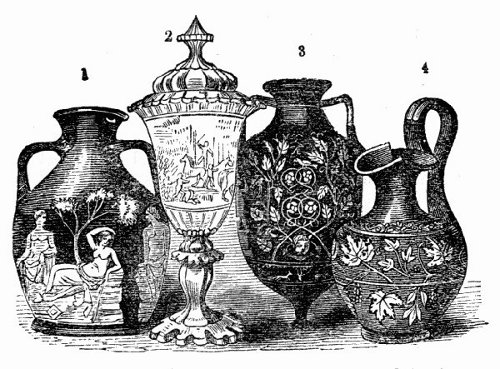
Figure 1 is that celebrated vase which for more than two centuries
was the principal ornament of the Barberini palace at Rome. It was
thence generally known as the "Barberini Vase;" but having been purchased
by Sir W. Hamilton, and then sold by him to the Duchess of
Portland, it was at her death munificently presented by her son, the
Duke of Portland, to the British Museum, where it has ever since
remained as one of its choicest gems, and is now known as the "Portland
Cinerary Vase." It was found about the middle of the sixteenth century,
enclosed in a marble sarcophagus, within a sepulchral chamber under
the Monte del Grane, two miles and a half from Rome, on the road to
Frascati. The tomb is believed to have been that of the Emperor Alexander
Severus, and his mother Mammæa. The vase is made of purple
glass, ornamented with white opaque figures in bas-relief. The execution
of the design is most admirable. In the first place, the artist must
have had the aptitude to blow in purple glass a beautiful form of vase,
with handles attached: and, even thus far, this is considered in our day
a masterpiece of skill at our best glass-houses. Secondly, with the oxide
of tin forming an opaque white glass, the artist managed to cover the
whole of the purple vase with this white opaque glass, to at least the
thickness of a quarter of an inch. The artist then, in the manner of
cutting a cameo on the onyx stone, cut the opaque glass away, leaving
the white figures and allegory embossed upon the purple. The figures in
relief are in two groups: in the former of these, a female is represented
in a recumbent posture, with a cupid hovering above her head, and a
serpent in her lap; a young man on one side supporting her stretched out
arm, and on the other a bearded personage of more mature age, attentively
regarding her. The latter group, on the opposite side of the vase,
consists of a female reclining on a pile of tablets, with her right hand
placed on her head, and holding in her hand a lighted torch with the
flame downwards—a young man being seated on a pile on one side of
her, and a female, holding a rod or staff in the right hand, sitting on the
other. The subject of the bas-relief has created much difference of
opinion, but it is generally supposed to have reference to the birth of
Severus. A few years ago this vase was broken by a madman, but it
has since been repaired in a most artistic manner.
Figure 2 is the "Alexandrian Vase," of the Museo Borbonico, Naples.
Figure 3 is the "Pompeii Vase," also of the Museo Borbonico. It was
discovered in a sepulchre of Pompeii in 1839, and is of the same character
in the colours and quality of the glass as the Portland Vase, but of a
more recent date. It is probably the production of Greek artists working
in Rome.
Figure 4 is the "Aldjo Vase," which was found in 1833 at Pompeii,
in the house of the Fauna. The ground of the vase is of a deep sapphire
blue, on which, in opaque white glass, the ornaments are cut. It was
found broken. Part is in the possession of Mr. Auldjo; the other in the
British Museum. The shape of this vase is elegant, the handle and lip
of exquisite form, and the taste and execution of the ornamental work
in the purest style.
MINUTENESS OF INSECT LIFE.
As the telescope enables the eye of man to penetrate into far-distant
space, and reveals to him myriads of suns and systems which otherwise
would have remained for ever hidden from his natural sight, so the
microscope opens up a world of life everywhere around us, but altogether
unsuspected, astounding us as much by the inappreciable minuteness of
its discoveries, as the former by the stupendous magnitude and remoteness
of the objects. If we go to any ditch or pool which the summer sun has
covered with a mantle of stagnant greenness, and lift from it a minute
drop of water, such as would adhere to the head of a pin, we shall find
it, under a high magnifying power, swarming with living beings, moving
about with great rapidity, and approaching or avoiding each other with
evident perception and will.
"Vain would it be," observes Professor Jones, "to attempt by words
to give anything like a definite notion of the minuteness of some of these
multitudinous races. Let me ask the reader to divide an inch into 22,000
parts, and appreciate mentally the value of each division: having done
so, and not till then, shall we have a standard sufficiently minute to enable
us to measure the microscopic beings upon the consideration of which
we are now entering. Neither is it easy to give the student of nature,
who has not accurately investigated the subject for himself, adequate
conceptions relative to the numbers in which the Infusoria sometimes
crowd the waters they frequent; but let him take his microscope, and
the means of making a rough estimate, at least, are easily at his disposal.
He will soon perceive that the animalcule-inhabitants of a drop of putrid
water, possessing, as many of them do, dimensions not larger than the
2,000th part of a line, swim so closely together, that the intervals
separating them are not greater than their own bodies. The matter,
therefore, becomes a question for arithmetic to solve, and we will pause
to make the calculation.
"The Monas termo, for example—a creature that might be pardonably
regarded as an embodiment of the mathematical point, almost literally
without either length, or breadth, or thickness—has been calculated to
measure about the 22,000th part of an inch in its transverse diameter;
and in water taken from the surface of many putrid infusions, they are
crowded as closely as we have stated above. We may therefore safely
say, that, swimming at ordinary distances apart, 10,000 of them would
be contained in a linear space one inch in length, and consequently a
cubic inch of such water will thus contain more living and active organized
beings than there are human inhabitants upon the whole surface!
However astounding such a fact may seem when first enunciated, none is
more easily demonstrated with the assistance of a good microscope."
The term Infusoria has been by some naturalists applied to these
diminutive animals, because they are invariably found in the infusions
of vegetable or animal substances. They can thus be obtained at all
times, by simply steeping a little hay, or chaff, or leaves or stems of any
plant, in a vessel of water, and placing the infusion in the sun for a week
or ten days.
LEGENDS OF JUDAS ISCARIOT.
It was believed in Pier della Valle's time, that the descendants of
Judas Iscariot still existed at Corfu, though the persons who suffered
this imputation stoutly denied the truth of the genealogy.
When the ceremony of washing the feet is performed in the Greek
Church at Smyrna, the bishop represents Christ, and the twelve apostles
are acted by as many priests. He who personates Judas must be paid
for it, and such is the feeling of the people, that whoever accepts this
odious part, commonly retains the name of Judas for life (Hasselquist,
p. 43).
Judas serves in Brazil for a Guy Faux to be carried about by the
boys, and made the subject of an auto-da-fe. The Spanish sailors hang
him at the yard arm. It is not long since a Spaniard lost his life at
Portsmouth, during the performance of this ceremony, by jumping overboard
after the figure.
The Armenians, who believe hell and limbo to be the same place, say
that Judas, after having betrayed our Lord, resolved to hang himself,
because he knew Christ was to go to limbo, and deliver all the souls
which he found there, and therefore he thought to get there in time.
But the Devil was cunninger than he, and knowing his intent, held him
over limbo till the Lord had passed through, and then let him fall plum
into hell. (Thevenot.)
QUEEN ELIZABETH'S SIDE-SADDLE.
In a retired part of the county of Essex, at a short distance from the
road, in a secluded and lovely spot, stands the picturesque residence
called Horeham Hall. The mansion is in the parish of Thaxted, and is
about two miles south-west of the church. It was once in the possession
of the important family of the De Wauton's; it afterwards belonged to
Sir John Cutts, and eventually it became the property of Sir W. Smijth,
of Hill Hall, in whose family it has remained up to the present time.
Of the learned Sir Thomas Smijth, the secretary to King Edward VI.
and Queen Elizabeth, there is still preserved an ancient portrait on
panel, which is let into a circle over the carved fire-place of one of the
parlours. It is remarkable as being one of the very few portraits
painted by Titian.
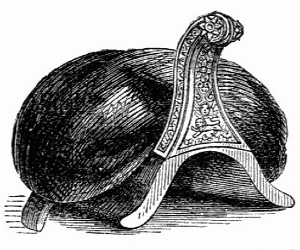
Another interesting relic is represented in the annexed cut. It is preserved
in the Great Hall, and is
the side-saddle of Queen Elizabeth;
the pommel is of wrought
metal, and has been gilt; the ornament
upon it is in the then fashionable
style of the Renaissance; the
seat of velvet is now in a very
ruinous condition; but it is carefully
kept beneath a glass case, as
a memento of the Queen's visits to
this place. When princess, Elizabeth
retired to Horeham as a place
of refuge during the reign of her
sister Mary; the loveliness of the
situation and its distance from the metropolis rendered it a seclusion
befitting the quietude of one anxious to remain unnoticed in troublous
times. A room on the first floor in the square tower is shown as that in
which Queen Elizabeth resided. She found the retirement of Horeham
so agreeable, that often after she had succeeded to the throne she took a
pleasure in re-visiting the place.
THE WINFARTHING OAK, IN NORFOLK.
A writer in the "Gardener's Magazine" gives the following account
of this remarkable tree:—"Of its age I regret to be unable to give any
correct data. It is said to have been called the 'Old Oak' at the time
of William the Conqueror, but upon what authority I could never
learn. Nevertheless, the thing is not impossible, if the speculations of
certain writers on the age of trees be at all correct. Mr. South, in one of
his letters to the Bath Society (vol. x.) calculates that an oak tree forty-seven
feet in circumference cannot be less than fifteen hundred years
old; and Mr. Marsham calculated the Bentley Oak, from its girting
thirty-four feet, to be of the same age. Now, an inscription on a brass
plate affixed to the Winfarthing Oak gives us the following as its
dimensions:—'This oak, in circumference, at the extremities of the
roots, is seventy feet; in the middle, forty feet, 1820.' Now, I see no
reason, if the size of the rind is to be any criterion of age, why the
Winfarthing should not, at least, equal the Bentley oak; and if so, it
would be upwards of seven hundred years old at the Conquest; an age
which might very well justify its then title of the 'Old Oak.' It is
now a mere shell, a mighty ruin, bleached to a snowy white; but it is
magnificent in its decay. The only mark of vitality it exhibits is on
the south side, where a narrow strip of bark sends forth a few branches,
which even now occasionally produce acorns. It is said to be very
much altered of late; but I own I did not think so when I saw it about
a month ago (May 1836); and my acquaintance with the veteran is of
more than forty years' standing: an important portion of my life, but a
mere span of its own."
CURIOUS PIECE OF ANCIENT ARMOUR.
The above engraving represents a helmet, of the time of Richard II.,
which was termed by ancient armourers a bascinet. This extremely
rare specimen was obtained from Her von Hulshoff, at his castle, near
Munster, in Westphalia. The visor lifts upward on a hinge, and its
position may be further regulated by the screw which slips in the groove
above it. The row of holes on the lower edge of the bascinet was made
to secure the camail, or tippet of chain-mail which covered the neck of
the wearer.
EXTRAORDINARY ECHO.
Beneath the suspension-bridge across the Menai Strait in Wales, close
to one of the main piers, is a remarkably fine echo. The sound of a blow
on the pier with a hammer, is returned in succession from each of the
cross beams which support the roadway, and from the opposite pier, at a
distance of 576 feet; and in addition to this, the sound is many times
repeated between the water and the roadway. The effect is a series of
sounds, which may be thus described:—The first return is sharp and
strong from the roadway overhead, the rattling which succeeds dies
rapidly away; but the single repercussion from the opposite pier is very
strong, and is succeeded by a faint palpitation, repeating the sound at
the rate of twenty-eight times in five seconds, and which, therefore,
corresponds to a distance of 180 feet, or very nearly the double interval
from the roadway to the water. Thus it appears, that in the repercussion
between the water and the roadway, that from the latter only affects the
ear, the line drawn from the auditor to the water being too oblique for
the sound to diverge sufficiently in that direction. Another peculiarity
deserves especial notice,—viz., that the echo from the opposite pier is
best heard when the auditor stands precisely opposite to the middle of
the breadth of the pier, and strikes just on that point. As it deviates
to one or the other side, the return is proportionably fainter, and is
scarcely heard by him when his station is a little beyond the extreme
edge of the pier, though another person stationed on the same side of the
water, at an equal distance from the central point, so as to have the pier
between them, hears it well.
JUGGLERS OF MODERN EGYPT.
Performers of sleight-of-hand tricks, who are called hhowa'h (in the
singular, hha'wee) are numerous in Cairo. They generally perform in
public places, collecting a ring of spectators around them; from some of
whom they receive small voluntary contributions during and after their
performances. They are most frequently seen on the occasions of public
festivals; but often also at other times. By indecent jests and actions,
they attract as much applause as they do by other means. The hha'wee
performs a great variety of tricks, the most usual of which we will here
mention. He generally has two boys to assist him. From a large leather
bag, he takes out four or five snakes, of a largish size. One of these he
places on the ground, and makes it erect its head and part of its body;
another he puts round the head of one of the boys, like a turban, and
two more over the boy's neck. He takes these off, opens the boy's mouth,
apparently passes the bolt of a kind of padlock through his cheek, and
locks it. Then, in appearance, he forces an iron spike into the boy's
throat; the spike being really pushed up into a wooden handle. He
also performs another trick of the same kind as this. Placing the boy
on the ground, he puts the edge of a knife upon his nose, and knocks the
blade until half its width seems to have entered. The tricks which he performs
alone are more amusing. He draws a great quantity of various-coloured
silk from his mouth, and winds it on his arm; puts cotton in his
mouth, and blows out fire; takes out of his mouth a great number of round
pieces of tin, like dollars; and, in appearance, blows an earthen pipe-bowl
from his nose. In most of his tricks he occasionally blows through a large
shell (called the hha'wee's zoomma'rah), producing sounds like those of a
horn. Most of his sleight-of-hand performances are nearly similar to
those of exhibitors of the same class in our own and other countries.
Taking a silver finger-ring from one of the bystanders, he puts it in a
little box, blows his shell, and says, "'Efree't change it!" He then
opens the box, and shows, in it, a different ring: shuts the box again;
opens it, and shows the first ring: shuts it a third time: opens it, and
shows a melted lump of silver, which he declares to be the ring melted,
and offers to the owner. The latter insists upon having his ring in its
original state. The hha'wee then asks for five or ten fud'dahs to recast
it; and having obtained this, opens the box again (after having closed
it, and blown his shell), and takes out of it the perfect ring. He next
takes a larger covered box; puts one of his boy's skull-caps in it, blows
his shell, opens the box, and out comes a rabbit: the cap seems to be
gone. He puts the rabbit in again; covers the box; uncovers it, and
out run two little chickens. These he puts in again, blows his shell,
uncovers the box, and shows it full of fatee'rehs (or pancakes), and
koona'feh (which resembles vermicelli): he tells his boys to eat its contents;
but they refuse to do it without honey. He then takes a small
jug, turns it upside-down, to show that it is empty; blows his shell, and
hands round the jug full of honey. The boys, having eaten, ask for
water to wash their hands. The hha'wee takes the same jug, and hands
it filled with water, in the same manner. He takes the box again, and
asks for the cap; blows his shell, uncovers the box, and pours out from
it, into the boy's lap (the lower part of his shirt held up), four or five
small snakes. The boy, in apparent fright, throws them down, and
demands the cap. The hha'wee puts the snakes back into the box;
blows his shell, uncovers the box, and takes out the cap. Another of
his common tricks is to put a number of slips of white paper into a tinned
copper vessel (the tisht of a seller of sherbet), and to take them out dyed
of various colours. He pours water into the same vessel; puts in a piece
of linen; then gives to the spectators, to drink, the contents of the
vessel, changed to sherbet of sugar. Sometimes he apparently cuts in
two a muslin shawl, or burns it in the middle, and then restores it
whole. Often he strips himself of all his clothes, excepting his drawers;
tells two persons to bind him, hands and feet, and put him in a sack.
This done, he asks for a piaster; and some one tells him that he shall
have it if he will put out his hand and take it. He puts out his hand
free; draws it back, and is then taken out of the sack, bound as at first.
He is put in again, and comes out unbound, handing to the spectators a
small tray, upon which are four or five little plates filled with various
eatables; and, if the performance be at night, several small lighted
candles placed round. The spectators eat the food.
ORIGIN OF ATTAR OF ROSES.
"In the Histoire Generale de l'Empire du Mogol, (T. 1, p, 327,)
compiled by Catrou the Jesuit, from Manouchi's papers, this perfume is
said to have been discovered by accident. Nur-Jahan, the favorite wife
of the Mogul Jahan-Ghur, among her other luxuries, had a small canal
of rose water. As she was a walking with the Mogul upon its banks,
they perceived a thin film upon the water,—it was an essential oil made
by the heat of the sun. They were delighted with its exquisite odour,
and means were immediately taken for preparing by art a substance like
that which had been thus fortuitously produced."
A MAGICIAN'S MIRROR AND BRACELET.
A strange blending of pure science and gross superstition is remarkably
illustrated in the history of the celebrated Dr. Dee. Born in London
in 1527, John Dee raised himself at an early age to a great reputation
for his learning, in the mathematical sciences especially, in the most
celebrated universities in his own country and of the continent. He is
said to have imbibed a taste for the occult sciences while a student at
Louvain, but there was evidently in his temper much of an enthusiastic
and visionary turn, which must have given him a taste for such mysterious
pursuits, without the necessity of an external impulse. One of
the oldest and most generally credited of magical operations, was that of
bringing spirits or visions into a glass or mirror, a practice which has
continued to exist in the East even to the present day, and which prevailed
to a very considerable extent in all parts of Western Europe during
the sixteenth century. The process was not a direct one, for the magician
did not himself see the vision in the mirror, but he had to depend
upon an intermediate agent, a sort of familiar, who in England was
known by the name of a skyrer, and whose business it was to look into
the mirror and describe what he saw. Dr. Dee's principal skyrer was
one Edward Kelly, and during his connexion with him, Dee kept an
exact diary of all his visions, a portion of which was printed in a folio
volume by Merio Casaubon in 1659. In this journal more than one
magical mirror is evidently mentioned, and that which we here engrave
is believed to have been of the number. It is now in the collection of
Lord Londesborough.
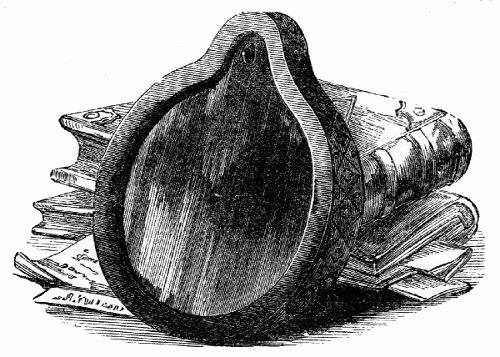
It is a polished oval slab of black stone, of what kind we have not
been able to ascertain, but evidently of a description which was not then
common in Western Europe, and Dr. Dee, who died in 1608, may have
considered it as extremely precious, and as only to be obtained by some
extraordinary means. It was one of the ornaments of the museum of
Horace Walpole at Strawberry Hill; and Walpole has attached to it a
statement of its history in his own hand-writing, from which we learn
that it was "long" in the possession of the Mordaunts, earls of Peterborough,
in whose catalogue it was described as "the black stone into
which Dr. Dee used to call his spirits." It passed from that collection to
Lady Elizabeth Germaine, from whom it went to John Campbell, Duke
of Argyll, whose son, Lord Frederick Campbell, presented it to Horace
Walpole. This interesting relic was bought at the Strawberry Hill sale
for the late Mr. Pigott; and at the more recent sale of that gentleman's
collection, it passed into the hands of Lord Londesborough. Its history
and authenticity appear, therefore, to be very well made out. The family
of the Mordaunts held a prominent place in English history during the
whole of the seventeenth century, and it is hardly probable that they
would have received an object like this without having good reason for
believing that its history was authentic. It is believed that Butler
alluded to this identical stone in his well-known lines:—
"Kelly did all his feats upon
The devil's looking-glass or stone,
When, playing with him at bo-peep,
He solv'd all problems ne'er so deep."
Hudibras. Part II. Canto 3.
The regular fitting out of the magician at this period was a complicated
process. He required his implements of various kinds, and, in
addition to these, various robes, made especially for the occasion, with
girdles and head-pieces, and magical rings and bracelets. A very
curious example of the last-mentioned article of the magician's
accoutrements, is represented in the preceding cut, about one-third the
size of the original. It was purchased by Lord Londesborough in 1851,
and had formerly been in the possession of Charles Mainwaring, Esq.,
of Coleby, near Lincoln. It is of silver, the letters of the inscription
round the bracelet being engraved and filled with niello. This inscription
may be distinctly read as follows:—
+ IONA + IHOAT + LONA + HELOI + YSSARAY + || +
MEPHENOLPHETON + AGLA + ACHEDION + YANA +
BACHIONODONAVALI M[*] ILIOR + || BACHIONODONAVALI M[**] ACH +
Some explanation of this mysterious inscription might, no doubt, be
obtained by a diligent comparison of some of the numerous works on
magic compiled in the age of Dr. Dee, and in the seventeenth century.
The bracelet has had four pendants on it, of which three still remain,
with the silver setting of the fourth. One of the pendants which remain
is a brownish pebble, secured by three flat bands of silver; another is
an oval cage of strong silver wire, containing a nut of some kind and
some other vegetable substance; the third has on one side a circular
convex pebble set in silver, and on the back three smaller pebbles.
LUNAR INFLUENCE IN DEATH.
Many modern physicians have stated the opinions of the ancients as
regards lunar influence in diseases, but none have pushed their inquiries
with such indefatigable zeal as the late Dr. Moseley; he affirms that
almost all people in extreme age die at the new or at full moon, and this
he endeavours to prove by the following records:—
Thomas Parr died at the age of 152, two days after the full moon.
Henry Jenkins died at the age of 169, the day of the new moon.
Elizabeth Steward, 124, the day of the new moon.
William Leland, 140, the day after the new moon.
John Effingham, 144, two days after full moon.
Elizabeth Hilton, 121, two days after the full moon.
John Constant, 113, two days after the new moon.
The doctor then proceeds to show, by the deaths of various illustrious
persons, that a similar rule holds good with the generality of mankind:
Chaucer, 25th October, 1400, the day of the first quarter.
Copernicus, 24th May, 1543, day of the last quarter.
Luther, 18th February, 1546, three days after the full.
Henry VIII., 28th January, 1547, the day of the first quarter.
Calvin, 27th May, 1564, two days after the full.
Cornaro, 26th April, 1566, day of the first quarter.
Queen Elizabeth, 24th March, 1603, day of the last quarter.
Shakspeare, 23rd April, 1616, day after the full.
Camden, 2nd November, 1623, day before the new moon.
Bacon, 9th April, 1626, one day after last quarter.
Vandyke, 9th April, 1641, two days after full moon.
Cardinal Richelieu, 4th December, 1642, three days before full moon.
Doctor Harvey, 30th June, 1657, a few hours before the new moon.
Oliver Cromwell, 3rd September, 1658, two days after full moon.
Milton, 15th November, 1674, two days before the new moon.
Sydenham, 29th December, 1689, two days before the full moon.
Locke, 28th November, 1704, two days before the full moon.
Queen Anne, 1st August, 1714, two days after the full moon.
Louis XIV., 1st September, 1715, a few hours before the full moon.
Marlborough, 16th June, 1722, two days before the full moon.
Newton, 20th March, 1726, two days before the new moon.
George I., 11th June, 1727, three days after new moon.
George II., 25th October, 1760, one day after full moon.
Sterne, 13th September, 1768, two days after new moon.
Whitfield, 18th September, 1770, a few hours before the new moon.
Swedenburg, 19th March, 1772, the day of the full moon.
Linnæus, 10th January, 1778, two days before the full moon.
The Earl of Chatham, 11th May, 1778, the day of the full moon.
Rousseau, 2nd July, 1778, the day after the first quarter.
Garrick, 20th January, 1779, three days after the new moon.
Dr. Johnson, 14th December, 1784, two days after the new moon.
Dr. Franklin, 17th April, 1790, three days after the new moon.
Sir Joshua Reynolds, 23rd February, 1792, the day after the new moon.
Lord Guildford, 5th August, 1722, three days after the full moon.
Dr. Warren, 23rd June, 1797, a day before the new moon.
Burke, 9th July, 1797, at the instant of the full moon.
Macklin, 11th July, 1797, two days after full moon.
Wilkes, 26th December, 1797, the day of the first quarter.
Washington, 15th December, 1790, three days after full moon.
Sir W. Hamilton, 6th April, 1803, a few hours before the full moon.
The doctor winds up this extract from the bills of mortality by the
following appropriate remark: "Here we see the moon, as she shines on
all alike, so she makes no distinction of persons in her influence:
"——æquo pulsat pede pauperum tabernas,
Regumque turres."
GLUTTONY OF THE MONKS.
King John, pointing to a fat deer said, "See how plump he is, and
yet he has never heard mass!" John might have alluded to the
gluttony of the monks, which was notorious in his days; for Giraldus
Cambrensis says, that from the monks of St. Swithin's, Winchester,
Henry II. received a formal complaint against the abbot for depriving
his priests of three out of thirteen dishes at every meal. The monks of
Canterbury exceeded those of St. Swithin; they had seventeen dishes
every day, and each of these cooked with spices and the most savoury
and rich sauces.
ANCIENT BELL-SHRINE.
The annexed engraving represents one of the most valuable and curious
ecclesiastical relics of the early Christian Period that has ever been discovered.
It consists of a bronze bell-shrine and bell, found about the
year 1814, on the demolition of the ruined wall at Torrebhlaurn farm,
in the parish of Kilmichael-Glassrie, Argyleshire, and now one of the
most valued treasures in the Museum of the Scottish Antiquaries.
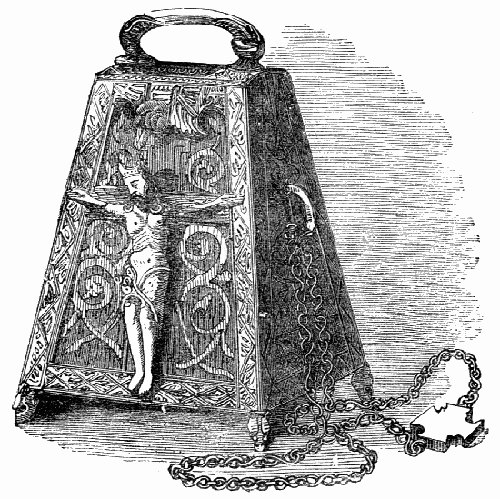
That it must have been deposited in the wall where it was found, for
the purpose of concealment at a period of danger and alarm, seems abundantly
obvious; but of the occasion of this concealment no tradition has
been preserved. Within the beautiful case is a rude iron bell, so greatly
corroded that its original form can only be imperfectly traced; yet this,
and not the shrine, was obviously the chief object of veneration, and
may, indeed, be assumed, with much probability, to be some centuries
older than the ornamental case in which it is preserved. Whether it
shall be thought to have been an ancient reliquary or a mass-bell, or
whatever else may be conjectured of its nature and use, it may fairly be
presumed to have remained in the neglected spot in which it was found
since the subversion of the Roman Catholic worship in the sixteenth century,
when the favoured objects of external adoration and reverence,
under the former superstition, came to be regarded with impatient contempt
and abhorrence.
It is deserving of attention that the figure of our crucified Saviour in
invested with a regal crown, and not with a crown of thorns, as is usually
the case. The brass chain or collar, of rude workmanship, about three
feet six inches long, now attached to the case, and the extremities of
which are connected with a small cross of the same metal, was discovered
at the same time, not far from the case.
EGYPTIAN GARDEN.
The diagram which accompanies this article is an Egyptian sketch of
an Egyptian garden; and it is expressly curious, both as an example of
the pictorial art of the period, and as giving us an idea of the pleasure-gardens
of Egypt in its most flourishing days.
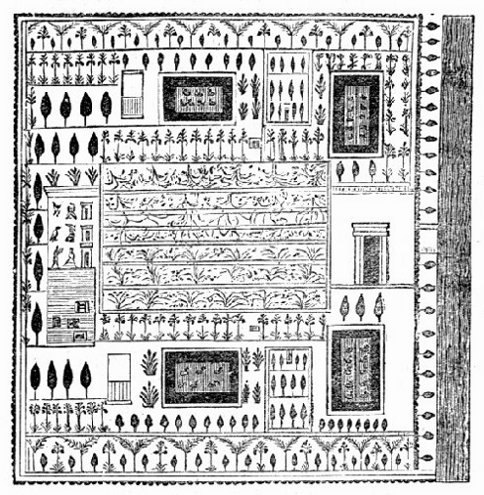
The garden here represented stood beside a canal of the Nile, with an
avenue of trees between it and the bank, on which side was the entrance.
It was surrounded by an embattled wall, through which a noble gateway
gave access to the garden. The central space was occupied by the vineyard,
surrounded by its own wall, in which the vines were trained on
trellises supported by slender pillars. At the further end of the vineyard
was a building of three storeys, the windows from which opened
over the luxurious foliage and purple clusters, regaling the senses both
of sight and smell. Four large tanks of water kept the vegetation well
supplied with nutritive moisture; and, with the smooth and verdant
turf which borders them, the water-fowl that sported over the surface,
and the lotus-flowers that sprang from their clear depths, added a new
beauty to the scene. Near the tanks stood summer-houses, overlooking
beds of various flowers, and sheltered from the sun by surrounding trees.
Two enclosed spaces between the tanks, being filled with trees, were
probably devoted to some species of particular rarity, or remarkable for
the excellence of their fruit. Rows of date trees and Theban palms,
alternating with other trees, bordered the whole garden, and environed
the vineyard wall.
The very numerous allusions to gardens in the Sacred Scriptures show
that the Hebrews inherited the same taste as the Egyptians. In these
allusions we find the same characteristics that are so observable in those
depicted on the monuments; such as the absolute necessity of water, the
custom of having pools in them, the advantage of a situation by the side
of a river, the practice of enclosing them from intrusion, and appropriation
of enclosures to particular productions.
With the early Egyptians the love of flowers seems to have been almost
a passion; they appear to have been in constant request in offerings to
the gods, and as ornaments of the person, as decorations of furniture; as
graceful additions to several entertainments, they occur at every turn.
Flowers were painted on walls, furniture, dresses, chairs, boxes, boats,
and, in short, on whatever was wished to be ornamental. Wreaths and
chaplets were likewise in common use among the Egyptians, and artificial
flowers were not uncommon.
STATE OF THE MIND DURING SLEEP.
The following is an instance of phantasms being produced by our
associations with bodily sensations, and tends to show how alive our
faculties continue during sleep to the highest impressions:—
The subject of this observation was an officer in the expedition to
Louisburg in 1758, who had this peculiarity in so remarkable a degree,
that his companions in the transport were in the constant habit of
amusing themselves at his expense. They could produce in him any
kind of dream by whispering in his ear, especially if this was done by a
friend with whose voice he had become familiar. One time they conducted
him through the whole progress of a trial, which ended in a duel;
and when the parties were supposed to have met, a pistol was put into
his hand, which he fired, and was awakened by the report. On another
occasion they found him asleep on the top of a locker in the cabin, when
they made him believe he had fallen overboard, and exhorted him to
save himself by swimming. They then told him that a shark was pursuing
him, and entreated him to dive for his life. He instantly did so,
and with so much force as to throw himself from the locker upon the
cabin floor, by which he was much bruised, and awakened of course.
After the landing of the army at Louisburg, his friends found him one
day asleep in his tent, and evidently annoyed by the cannonading. They
then made him believe that he was engaged, when he expressed great
fear, and showed an evident disposition to run away. Against this
they remonstrated, but at the same increased his fears by imitating the
groans of the wounded and the dying; and when he asked, as he often
did, who was hit, they named his particular friends. At last they told
him that the man next himself in his company had fallen, when he instantly
sprung from his bed, rushed out of the tent, and was only roused
from his danger and his dream by falling over the tent-ropes. A remarkable
thing in this case was, that after these experiments he had no
distinct recollection of his dreams, but only a confused feeling of oppression
or fatigue, and used to tell his friends that he was sure they had
been playing some trick upon him. It has been observed that we seldom
feel courageous or daring in our dreams, and generally avoid danger
when menaced by a foe, or exposed to any probable peril.
MUSIC OF THE SEA.
The mysterious music that is heard in the bay at West Pascagoula, is
described by those who have listened to it as being singularly beautiful.
"It has, for a long time," says Mrs. Child, an American authoress,
"been one of the greatest wonders of the south-west. Multitudes have
heard it, rising, as it were, from the water, like the drone of a bagpipe,
then floating away, away, away, in the distance, soft, plaintive, and
fairy-like, as if Æolian harps sounded with richer melody through the
liquid element; but none have been able to account for the beautiful
phenomenon. There are several legends touching these mysterious
sounds; but in these days few things are allowed to remain mysterious."
These strange sounds, which thus assume the beauty and the harmony
of regular music, are stated to proceed from the cat-fish. A correspondent
of the Baltimore Republican thus explains the phenomenon:—"During
several of my voyages on the Spanish main, in the neighbourhood of
Paraguay and San Juan de Nicaragua, from the nature of the coast, we
were compelled to anchor at a considerable distance from the shore; and
every evening, from dark to late night, our ears were delighted with
Æolian music, that could be heard beneath the counter of our schooner.
At first I thought it was the sea-breeze sweeping through the strings of
my violin (the bridge of which I had inadvertently left standing); but
after examination I found it was not so. I then placed my ear on the
rail of the vessel, when I was continually charmed with the most
heavenly strains that ever fell upon my ear. They did not sound as
close to us, but were sweet, mellow, and aerial, like the soft breathings
of a thousand lutes, touched by fingers of the deep sea nymphs, at an
immense distance. Although I have considerable "music in my soul,"
one night I became tired, and determined to fish. My luck, in half-an-hour,
was astonishing. I had half filled my bucket with the finest
white cat-fish I ever saw; and it being late, and the cook asleep, and
the moon shining, I filled my bucket with water, and took fish and all
into my cabin for the night. I had not yet fallen asleep, when the same
sweet notes fell upon my ear; and, getting up, what was my surprise to
find my cat-fish discoursing sweet sounds to the sides of my bucket! I
examined them closely, and discovered that there was attached to each
lower lip an excrescence, divided by soft wiry fibres. By the pressure of
the upper lip thereon, and by the exhalation and discharge of breath, a
vibration was created, similar to that produced by the breath on the
tongue of the Jews' harp."
THE ROCK OF CASHEL.
Any work which professed to be a record of what is rare and curious,
would surely be incomplete if it did not contain an account of the celebrated
Rock of Cashel; for the venerable buildings which crown its
summit are, from their number, variety, preservation, and site, decidedly
the most interesting ruins in the Emerald Isle, and, to use the words of
Sir Walter Scott, "such as Ireland may be proud of." Cashel, which
is distant about one hundred miles from Dublin, appears to be a place of
high antiquity, and was long the residence of the kings of Munster; but
as its early history is involved in much obscurity, it is uncertain at what
period it became a diocesan site. It is stated that previous to the year 1101
the buildings on the Rock were occupied as a royal residence, and that
in that year the hitherto royal seat was dedicated solely to ecclesiastical
uses.
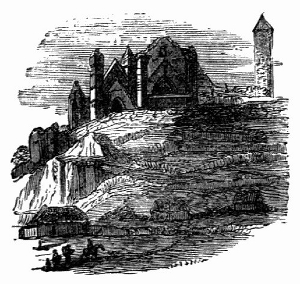
The buildings consist of a round tower, Cormack's chapel, cathedral,
castle and monastery; the latter
is a few yards detached, and the
least remarkable of the number;
all the former are closely connected.
The Round Tower, the
date and uses of which are in common
with those of all other similar
structures involved in much obscurity,
raises its tall and yet
scarce dilapidated head far above
its younger and more decaying
companions. It is fifty-six feet
in circumference, and ninety feet
in height. Cormack's Chapel,
which, with the exception of the
Round Tower, is the most ancient
structure of the group, was built
by Cormack M'Carthy, king of Munster, in 1136. It is roofed with
stone, and in its capitals, arches, and other features and details, the
Norman style is distinctly marked. The numerous ornaments, grotesque
heads, and other curious sculptures, which adorn the arches, columns,
and pilasters, are all in uniformity of style. The building altogether is
a perfect gem, and the architectural antiquary and the artist will find in
it a most valuable addition to their studies. The cathedral is a noble
remnant of what is usually termed the pointed Gothic, and contains
many interesting relics.
The rock, which is here presented as it appears from the plain below,
has the buildings we have just mentioned on its very summit; it rises
abruptly from a widely extended fertile country, to a considerable height
above the town, and from many parts at a distance it forms a very
striking object. On the top of the rock, and around the ruins, an area
of about three acres has been enclosed, which is open to the public.
INSTANCE OF INCREMATION.
Last night (26th September, 1769), say the chronicles of the day,
the will of Mrs. Pratt, a widow lady, who lately died at her house in
George Street, Hanover Square, was punctually fulfilled, by the burning
of her body to ashes in her grave, in the new burying-ground adjoining
to Tyburn turnpike.
THE HAWTHORNDEN SWORD.
The great antiquity of the Scottish claymore is proved by its being
figured in the sculptures both of Iona and Oronsay, with considerable
variety of details. In some the blade is highly ornamented, and the
handle varies in form, but all present the same characteristic, having
the guards bent back towards the blade. A curious variety of this peculiar
form is seen in a fine large two-handed sword preserved at Hawthornden,
the celebrated castle of the Drummonds, where the Scottish poet
entertained Ben Johnson during his visit to Scotland in 1619. It is
traditionally affirmed to have been the weapon of Robert Bruce, though
little importance can be attached to a reputation which it shares with
one-half the large two-handed swords still preserved. Our engraving
is a correct representation of it.
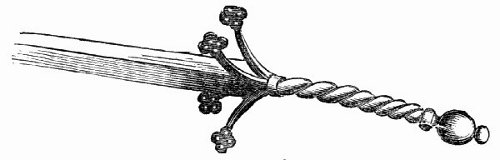
The handle appears to be made from the tusk of the narwhal, and it
has four reverse guards, as shown in the cut. The object aimed at by
this form of guard, doubtless, was to prevent the antagonist's sword
glancing off, and inflicting a wound ere he recovered his weapon, and,
in the last example especially, it seems peculiarly well adapted for the
purpose.
INSTINCT IN A CAT.
The following anecdote almost places the cat on a level with the dog:—"A
physician of Lyons was requested to inquire into a murder that
had been committed on a woman of that city. In consequence of this
request he went to the habitation of the deceased, where he found her
extended lifeless on the floor, weltering in her blood. A large white
cat was mounted on the cornice of a cupboard, at the far end of the
apartment, where he seemed to have taken refuge. He sat motionless,
with his eyes fixed on the corpse, and his attitude and looks expressing
horror and affright. The following morning he was found in the same
station and attitude, and when the room was filled with officers of justice,
neither the clattering of the soldiers' arms, nor the loud conversation
of the company, could in the least degree divert his attention. As
soon, however, as the suspected persons were brought in, his eyes glared
with increased fury, his hair bristled, he darted into the middle of the
apartment, where he stopped for a moment to gaze at them, and then
precipitately retreated under the bed. The countenances of the assassins
were disconcerted, and they were now, for the first time, abandoned by
their atrocious audacity."
A TRANCE.
Mrs. Godfrey, sister to the Duke of Marlborough, had nearly been
buried alive; the physicians all declaring that the breath of life was
irrecoverably gone. Her husband, Colonel Godfrey, had, however, the
pleasure to see her revive, seven days after (that day week, and same
hour), and what is more, she never knew till the day of her death the
length of her trance, or sleep.
THE NUMBER SEVEN.
The number is composed of the first two perfect numbers, equal and
unequal, 3 and 4; for the number 2, consisting of repeated unity, which
is no number, is not perfect, it comprehends the primary numerical
triangle or trine, and square or quartile conjunction, considered by the
favourers of planetary influence as of the most benign aspect. In six
days creation was completed, and the 7th was consecrated to rest. On
the 7th day of the 7th month, a holy observance was ordained to the
children of Israel, who feasted 7 days, and remained 7 days in tents; the
7th year was directed to be a Sabbath of rest for all things; and at the
end of 7 times 7 years commenced the grand jubilee. Every 7th year
the land lay fallow; every 7th year there was a general release from all
debts, and all bondmen were set free. From this law may have originated
the custom of our binding young men to 7 years' apprenticeship,
and punishing incorrigible offenders by transportation for 7, twice 7,
and three times 7, years. Every 7 years the law was to be read to the
people. Jacob served 7 years for the possession of Rachael; and also
other 7. Noah had 7 days' warning of the flood, and was commanded
to take the fowls of the air in by 7, and the clean beasts by 7. The
ark touched ground on the 7th month; and in 7 days the dove was sent
out, and again in 7 days after. The 7 years of plenty, and 7 years of
famine were foretold in Pharaoh's dream by 7 fat and 7 lean beasts, and
the 7 full and 7 blasted ears of corn. Nebuchadnezzar was 7 years a
beast; and the fiery furnace was 7 times hotter to receive Shadrach, &c.
A man defiled was, by the Mosaic law, unclean 7 days; the young of
both animals was to remain with the dam 7 days, and at the end of the
7th was to be taken away. By the old law, man was commanded to
forgive his offending brother 7 times; but the meekness of the revealed
law extended his humility to 70 times 7: if Cain shall be avenged 7
times, truly Lamech 70 times 7. In the destruction of Jericho, 7 priests
bore 7 trumpets 7 days; on the 7th they surrounded the wall 7 times;
after the 7th, the walls fell. Balaam prepared 7 years for a sacrifice;
and 7 of Saul's sons were hanged to stay a famine. Laban pursued
Jacob 7 days' journey. Job's friends sat 7 days and 7 nights, and
offered 7 bullocks and 7 rams, as an atonement for their wickedness.
In the 7th year of his reign, King Ahazuerus feasted 7 days, and on the
7th deputed his 7 chamberlains to find a queen, who was allowed 7
maidens to attend her. Miriam was cleansed of her leprosy by being
shut up 7 days. Solomon was 7 years in building the Temple, at
the dedication of which he feasted 7 days; in the Temple were 7 lamps;
7 days were appointed for an atonement upon the altar, and the priest's
son was ordained to wear his father's garments 7 days. The children of
Israel eat unleavened bread 7 days. Abraham gave 7 ewe-lambs to
Abimelech, as a memorial for a well. Joseph mourned 7 days for Jacob.
Naaman was cleansed of his leprosy by bathing 7 times in Jordan. The
Rabbins say that God employed the power of this number to perfect the
greatness Of Samuel, his name answering the value of the letters in the
Hebrew word, which signifies 7; whence Hannah his mother, in her
thanksgiving, says, the barren hath brought forth 7. In Scripture are
enumerated 7 resurrections: the widow's son, by Elias; the Shunamite's
son, by Elisha; the soldier who touched the bones of the prophet; the
daughter of the ruler of the synagogue; the widow's son of Nain;
Lazarus, and our Lord. The apostles chose 7 deacons. Enoch, who was
translated, was the 7th from Adam; and Jesus Christ was the 77th in a
direct line. Our Lord spoke 7 times on the cross, on which he
was 7 hours; he appeared 7 times; and after 7 times 7 days
sent the Holy Ghost. In the Lord's prayer are 7 petitions,
contained in 7 times 7 words, omitting those of mere grammatical connexion;
within this number are concealed all the mysteries of apocalypse
revealed to the 7 churches of Asia. There appeared seven golden
candlesticks and 7 stars in the hand of him that was in the midst;
7 lambs before the 7 spirits of God; the book with 7 seals; the lamb
with 7 horns and 7 eyes; 7 angels with 7 trumpets; 7 kings; 7
thunders; 7,000 men slain. The dragon with 7 heads and 7 crowns;
and the beast with 7 heads; 7 angels bearing 7 plagues, and 7 vials of
wrath. The vision of Daniel was of 70 weeks and the elders of Israel
were 70. There were also 7 heavens, 7 planets (query), 7 stars, 7 wise
men, 7 champions of Christendom, 7 notes in music, 7 primary colours,
7 deadly sins, and 7 sacraments in the Catholic church. The 7th son
was considered as endowed with pre-eminent wisdom; and the 7th son
of a 7th son is still thought to possess the power of healing diseases
spontaneously. Perfection is likened to gold 7 times purified in the
fire; and we yet say you frightened me out of my 7 senses. The
opposite sides of a dice make 7, whence the players at hazard make
7 the main. Hippocrates says the septenary number, by its occult
virtues, tends to the accomplishment of all things, to be the dispense
of life, and fountain of all its changes; and, like Shakespeare, he
divided the life of man into 7 ages; for as the moon changes her phases
every seven days, this number influences all sublunary beings. The teeth
spring out on the 7th month, and are shed and renewed in the 7th year,
when infancy is changed into childhood; at twice 7 years puberty begins;
at three times 7 the faculties are developed, and manhood commences, and
we are become legally competent to all civil acts; at four times 7 man is
in full possession of all his strength; at five times 7 he is fit for the
business of the world; at six times 7 he becomes grave and wise, or
never: at 7 times 7 he is in his apogee, and from that time decays; at
eight times 7 he is in his first climacterick; at nine times 7, or 63, he
is in his last or grand climacterick, or year of danger; and ten times 7,
or three score and ten, has, by the royal prophet, been pronounced the
natural period of human life.
SUPERSTITIOUS LEGEND.
We are told that when St. Helena, of pious memory, had discovered
the true Cross of Christ, she permitted various fragments to be taken
from it, which were encased, some in gold, and some in gems, and conveyed
to Europe, leaving the principal or main part of the wood in the
charge of the Bishop of Jerusalem, who exhibited it annually at Easter,
until Chosroes, king of Persia, plundered Jerusalem in the reign of the
emperor Phocas, and took away this holy relic.
Before this fatal event we are taught to believe, by Rigordus, an historian
of the thirteenth century, that the mouths of Christians used to be
supplied with 30, or in some instances, no doubt according to their faith,
with 32 teeth; but that after the Cross was stolen by the infidels no
mortal has ever been allowed more than 23!
ORÆFA MOUNTAIN IN ICELAND.
This mountain, which is the loftiest in Iceland, has been rendered
celebrated by an eruption which took place about a century ago. Nothing
can be more striking than the account given of this calamity by the aged
minister of the parish. He was in the midst of his service on the Sabbath,
when the agitation of the earth gave warning that some alarming
event was to follow. Rushing from the church, he saw a peak of the
neighbouring mountain alternately heaved up and sinking; till at last,
the stone, of which this portion of the mountain was composed, ran down
in a melted state into the plain, like melted metal from a crucible, filling
it to such a height, that no more of the mountain, which formerly towered
to such a height, remains, than about the size of a bird; volumes of
water being in the meantime thrown forth in a deluge from the crater,
and sweeping away whatever they encountered in their course. The
Oræfa then broke forth, hurling large masses of ice to a great distance;
fire burst out in every direction from its side; the sky was darkened by
the smoke and ashes, so that the day could hardly be distinguished from
the night. This scene of horror continued for more than three days,
during which the whole region was converted into utter desolation.
THE SETON SWORD.
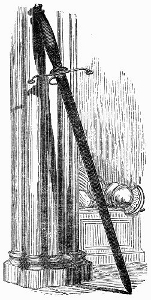
The two-handed sword, which was introduced later than the claymore,
though still so familiar to us, is perhaps the most interesting, in an
archaeological point of view, of all the military relics pertaining to the
Medieval Period. The huge, ponderous, and unwieldy weapon, seems
the fittest emblem that could be devised, of the rude baron of the thirteenth
century, who lived by "the good old rule" of physical force, and
whose hardy virtues, not unsuited
to an illiterate age—are strangely
mistaken for a chivalry such as
later ages have not seen.
Calmly
reasoning from this characteristic
heirloom, we detect in it the evidence
of just such hardy, skilless,
overbearing power, as history informs
us was the character of the
medieval baron, before the rise of
the burgher class readjusted the
social balance by the preponderance
of rival interests. The weapon
figured here is a remarkably
fine and unusually large specimen
of the old Scottish two-handed
sword, now in the possession of
George Seton, Esq., representative
of the Setons of Cariston. It
measures forty-nine inches in the
blade, five feet nine inches in entire
length, and weighs seven and
a half pounds. But the chief interest
of this old relic arises from
the well-authenticated family traditions
which associate it with
the memory of its first knightly
owner, Sir Christopher Seton of
that Ilk, from whom some of the
oldest scions of the Scottish peerage
have been proud to trace their
descent. He was married to Christian,
sister of King Robert the
Bruce, whom he bravely defended
at the battle of Methven. He was shortly after taken prisoner by Edward
I., and basely hanged as a traitor.
STYLE OF LIVING IN THE SIXTEENTH CENTURY.
The most perfect notion of the living and domestic arrangements of the
old English nobility and gentry will be found in the entries of what were
called the Household Books of the times. One of the most celebrated of
these records is the Northumberland Household Book, being the regulations
of the establishment of the fifth earl of Northumberland, at his
castles of Wrenill and Lekinfield, in Yorkshire, begun in 1512. No
baron's family was on a nobler or more splendid footing. It consisted of
one hundred and sixty-six persons, masters and servants; fifty-seven
strangers were reckoned upon every day; on the whole two hundred and
twenty-three. During winter they fed mostly on salt meat and salt fish;
and with that view there was a provision of one hundred and sixty
gallons of mustard per year; so that there cannot be any thing more
erroneous than the magnificent ideas formed of "the roast beef of Old
England." On flesh days, (that is, when meat was not forbidden by the
Catholic religion), through the year, breakfast for my lord and lady was
a loaf of bread, two manchets, a quart of beer, a quart of wine, half a
chine of mutton, or a chine of beef boiled. On meagre days (or when
meat was forbidden), a loaf of bread, two manchets, a quart of beer, a
quart of wine, a dish of butter, a piece of salt fish, or a dish of buttered
eggs. During Lent, a loaf of bread, two manchets, a quart of beer, a
quart of wine, two pieces of salt fish, six baconed herrings, four white
herrings, or a dish of sprats. There was as little variety in other meals,
except on festival days; and this way of living was, at the time, high
luxury. There were but two cooks to dress victuals for two hundred
persons; and fowls, pigeons, plovers, and partridges were prohibited as
delicacies, except at my lord's table. The table-cloth was washed about
once a month; no sheets were used; and only forty shillings were
allowed for washing throughout the year. The family rose at six in the
morning, dined at ten, and supped at four in the afternoon; and the
castle gates were shut at nine. Mass was said in the chapel at six
o'clock, that all the servants might rise early. The earl passed the year
at three country seats, but he had furniture only for one: he carried
every thing along with him, beds, tables, chairs, kitchen utensils; and
seventeen carts and one waggon conveyed the whole: one cart sufficed
for all his kitchen utensils, cooks' beds, &c. There were in the establishment
eleven priests, besides seventeen persons, chanters, musicians, &c.,
belonging to the chapel. No mention is made of plate, but only of the
hiring of pewter vessels. Wine was allowed in abundance for the lord's
table, but the beer for the hall was poor indeed, only a quarter of malt
being allowed for two hogsheads. The servants seem all to have bought
their own clothes from their wages. Every thing in the household was
done by order, with the pomp of proclamation; and laughable as it may
now seem, an order was issued for the right making of mustard, beginning
"It seemeth good to us and our council."
ANECDOTE OF A TERRIER.
A terrier, known to Professor Owen, was taught to play at hide and
seek with his master, who summoned him, by saying "Let us have a
game;" upon which the dog immediately hid his eyes between his paws,
in the most honourable manner, and when the gentleman had placed a
sixpence, or a piece of cake in a most improbable place, he started up
and invariably found it. His powers were equalled by what was called
a fox-terrier, named Fop, who would hide his eyes, and suffer those at
play with him to conceal themselves before he looked up. If his play-fellow
hid himself behind a window-curtain, Fop would, for a certain
time, carefully pass that curtain, and look behind all the others, behind
doors, etc., and when he thought he had looked long enough, seize the
concealing curtain and drag it aside in triumph. The drollest thing,
however, was to see him take his turn of hiding; he would get under a
chair, and fancy that he was not seen; of course, those at play with him
pretended not to see him, and it was most amusing to witness his agitation
as they passed. When he was ill he had been cured by some
homœopathic globules, and ever after, if anything were the matter with
him, he would stand near the medicine box, and hold his mouth open.
CUTTING A WIFE OFF WITH A SHILLING.
In the year 1772, died at Lambeth, J—— G——e, Esq. In his will
was found the following remarkable clause:—"Whereas, it was my
misfortune to be made very uneasy by Elizabeth G——, my wife, for
many years, from our marriage, by her turbulent behaviour; for she was
not content with despising my admonitions, but she contrived every
method to make me unhappy; she was so perverse in her nature, that
she would not be reclaimed, but seemed only to be born to be a plague to
me; the strength of Sampson, the knowledge of Homer, the prudence of
Augustus, the cunning of Pyrrhus, the patience of Job, the subtlety of
Hannibal, and the watchfulness of Hermogenes, could not have been
sufficient to subdue her; for no skill or force in the world would make
her good; and, as we have lived several years separate, and apart from
each other eight years, and she having perverted her son to leave and
totally abandon me; therefore I give her one shilling only."
WEALTH OF THE JEWS.
About the year 1707, the Jews offered Lord Godolphin, Minister of
Queen Anne, to pay £500,000, (and they would have made it a million,)
if the government would allow them to purchase the town of Brentford,
with leave of settling there entirely, with full privileges of trade, &c.
Lord Godolphin did not comply with the request, and a curious reason is
assigned by Dean Lockier, because it would provoke two of the most
powerful bodies in the nation, the clergy and the merchants. The Jews
had better success with Oliver Cromwell: they offered him £60,000 to
have a synagogue in London. He took the money, and they had their
temple.
GAMBLING EXTRAORDINARY.
The following instance of frantic or drunken gambling appeared in the
Times of April 17, 1812:—
"On Wednesday evening an extraordinary investigation took place at
Bow Street. Croker, the officer, was passing the Hampstead Road; he
observed at a short distance before him two men on a wall, and directly
after saw the tallest of them, a stout man about six feet high, hanging
by his neck from a lamp-post, attached to the wall, being that instant
tied up and turned off by the short man. This unexpected and extraordinary
sight astonished the officer; he made up to the spot with all
speed, and just after he arrived there, the tall man who had been hanged,
fell to the ground, the handkerchief with which he had been suspended
having given way. Croker produced his staff, said he was an officer, and
demanded to know of the other man the cause of such conduct; in the
mean time the man who had been hanged recovered, got up, and on
Croker interfering, gave him a violent blow on the nose, which nearly
knocked him backward. The short man was endeavouring to make off;
however, the officer procured assistance, and both were brought to the
office, when the account they gave was, that they worked on canals.
They had been together on Wednesday afternoon, tossed up for money,
and afterwards for their clothes, the tall man who was hanged won the
other's jacket, trowsers and shoes; they then tossed up which should
hang the other, and the short one won the toss. They got upon the
wall, the one to submit, and the other to hang him on the lamp-iron.
They both agreed in this statement. The tall one who had been hanged
said, if he won the toss, he would have hanged the other. He said, he
then felt the effects on his neck at the time he was hanging, and his eyes
was so much swelled that he saw double. The magistrates expressed
their horror and disgust, and ordered the man who had been hanged to
find bail for the violent and unjustifiable assault upon the officer, and
the short one for hanging the other. Not having bail, they were committed
to Bridewell for trial."
OLD BOOKS.
The Pentateuch and the history of Job are the most ancient books in
the world; and in profane literature the works of Homer and Hesiod.
The first book known to have been written in our own vernacular was
"The Confessions of Richard, Earl of Cambridge," temp. 1415; and the
earliest English ballad is supposed to be the "Cuckoo Song," which commences
in the following style:—
"Sumer is icumen in
Lhudé sing cuccu,
Groweth sed, and bloweth med,
And springth ye wedé nu:
Singe cuccu."
FOSSIL REPTILE; THE PTERODACTYLUS.
The pterodactylus was a flying animal. It had the wings of a bat,
and the structure of a reptile; jaws with sharp teeth, and claws with
long hooked nails. The power which it had of flying was not by means
of its ribs, nor by wings without fingers, as in birds, but by wings
supported by one very elongated toe, the others being short and furnished
with claws. The remains of this animal were brought under
examination by M. Collini, director of the Museum of the Elector
Palatine at Manheim. There was at first some discussion as to the
actual character of the animal. M. Blumenbach supposed it to be a
bird, and M. de Soemmering classed it among the bats. M. Cuvier,
however, maintained that it was a reptile, and showed that all its bones,
from the teeth to the claws, possessed the characters which distinguish
that class of animals. But still it differed from all other reptiles in
possessing the capability of flying. It is probable that it could at
pleasure fold up its wings in the same manner as birds, and might suspend
itself on branches of trees by its fore toes, though it possessed the
power of sitting upright on its hind feet. This is the most anomalous
of all the fossil reptiles.
TIGER CAVE AT CUTTACK.
The geographical distribution of the rock-cut caves of the Buddhists
in India is somewhat singular, more than nine-tenths of those now
known being found within the limits of the Bengal Presidency. The
remainder consist of two groups, those of Behar and Cuttack, neither of
which are important in extent, in Bengal; one only, that of Mahavellipore,
in Madras; and two or three not very important groups which
have been traced in Afghanistan and the Punjaub.
One of the most remarkable of these caves is that at Cuttack, which is
called the Tiger cave—being in fact a large mass of rock, carved into a
form intended to represent the head of that animal, whose extended
jaws form the verandah leading into a small apartment excavated in the
interior of the skull: our engraving is a correct representation of it.
Generally speaking, these single
cells have a porch of two pillars to
protect the doorway, which leads
into a small room, 10 or 12 ft.
square, constituting the whole
cave. Buildings on precisely
the same plan are still very
common in India, except that
now, instead of being the abode
of a hermit, the cell is occupied
by an image of some god or
other, and is surmounted by a
low dome, or pyramidal spire,
converting it into a temple of
some pretensions. The lower part,
however, of these small temples
is very similar to the rock-cut
hermitages of which we are
speaking.
THE JEWS IN ENGLAND.
William the Conqueror permitted great numbers of Jews to come over
from Rouen, and to settle in England in the last year of his reign.
Their number soon increased, and they spread themselves throughout
most of the cities and capital towns in England where they built
synagogues. There were fifteen hundred at York about the year 1189.
At Bury, in Suffolk, is a very complete remain of a Jewish synagogue of
stone in the Norman style, large and magnificent. Hence it was that
many of the learned English ecclesiastics of those times became
acquainted with their books and their language. In the reign of William
Rufus, the Jews were remarkably numerous at Oxford, and had acquired
considerable property; and some of their Rabbis were permitted to
open a school in the university, where they instructed not only their own
people, but many Christian students in Hebrew literature, about the
year 1094. Within 200 years after their admission or establishment by
the Conqueror, they were banished from the kingdom. This circumstance was
highly favourable to the circulation of their learning in England. The
suddenness of their dismission obliged them for present subsistence, and
other reasons, to sell their moveable goods of all kinds, among which
were large quantities of all Rabbinical books. The monks in various
parts availed themselves of the distribution of these treasures. At
Huntingdon and Stamford there was a prodigious sale of their effects,
containing immense stores of Hebrew manuscripts, which were immediately
purchased by Gregory of Huntingdon, Prior of the abbey of
Ramsey. Gregory speedily became an adept in the Hebrew, by means
of these valuable acquisitions, which he bequeathed to his monastery
about the year 1250. Other members of the same convent, in consequence
of these advantages, are said to have been equal proficients in
the same language, soon after the death of Prior Gregory, among whom
were Robert Dodford, Librarian of Ramsey, and Laurence Holbech,
who compiled a Hebrew Lexicon. At Oxford a great number of their
books fell into the hands of Roger Bacon, or were bought by his
brethren the Franciscan friars of that university.
GAME PRESERVES AT CHANTILLY.
The establishment at Chantilly, which formerly belonged to the great
family of Condé, included 21 miles of park, and 48 miles of forest. The
horses, when the family were at that place, were above 500. The dogs,
60 to 80 couple: the servants, above 500. The stables the finest and
best in Europe. We shall now present to the sporting and un-sporting
reader, for both will lift up their eyes, a list of game killed, year by
year, through a series of thirty-two years—beginning with the year
1748, ending with the year 1779:—
List of the Game.
| |
54,878 |
24,029 |
37,209 |
19,932 |
| |
37,160 |
27,013 |
42,902 |
27,164 |
| |
58,712 |
26,405 |
31,620 |
30,429 |
| |
39,892 |
33,055 |
25,994 |
30,859 |
| |
32,470 |
50,812 |
18,479 |
25,813 |
| |
39,893 |
40,234 |
18,550 |
50,666 |
| |
32,470 |
26,267 |
26,371 |
13,304 |
| |
16,186 |
25,953 |
19,774 |
17,566 |
Now let us give (of birds and beasts) their bill of mortality; that is
the numbers, in detail, of each specific description, registered as below,
and detailed to have been killed at Chantilly, in the above-mentioned
series of years. Hares, 77,750; rabbits, 587,470; partridges, 117,574;
red ditto, 12,426; pheasants, 86,193; quails, 19,696; rattles (the male
quail), 449; woodcocks, 2,164; snipes, 2,856; ducks, 1,353; wood-piquers,
317; lapwings, 720; becfique (small birds like our wheatear), 67;
curlews, 32; oyes d'Egypte, 3; oyes sauvage, 14; bustards, 2; larks,
106; tudells, 2; fox, 1; crapeaux, 8; thrushes, 1,313; guynard, 4;
stags, 1,712; hinds, 1,682; facons, 519; does, 1,921; young does, 135;
roebucks, 4,669; young ditto, 810; wild boars, 1,942; marcassins (young
boars), 818. A magnificent list of animal slaughter, carefully and
systematically recorded as achievements.
BRITISH PEARLS.
The river Conway, in North Wales, was of considerable importance,
even before the Roman invasion, for the pearl mussel (the Mya Margaritifera
of Linnæus) and Suetonius acknowledged that one of his
inducements for undertaking the subjugation of Wales was the pearl
fishery carried forward in that river. According to Pliny, the mussels,
called by the natives Kregindilin, were sought for with avidity by the
Romans, and the pearls found within them were highly valued; in
proof of which it is asserted that Julius Cæsar dedicated a breastplate
set with British pearls to Venus Genetrix, and placed it in her temple at
Rome. A fine specimen from the Conway is said to have been presented
to Catherine, consort of Charles II., by Sir Richard Wynne, of Gwydir;
and it is further said that it has since contributed to adorn the regal
crown of England. Lady Newborough possessed a good collection of
the Conway pearls, which she purchased of those who were fortunate
enough to find them, as there is no regular fishery at present. The
late Sir Robert Vaughan had obtained a sufficient number to appear at
Court with a button and loop to his hat, formed of these beautiful productions,
about the year 1780.
FUNERAL ORATION OF FRANCIS THE FIRST.
Pierre Duchatel, in a funeral oration on the death of Francis I., published
1547, took upon himself to affirm, that the soul of the king had
gone direct to Paradise. This passing over of purgatory gave offence to
the doctors of the Sorbonne, who sent a deputation to warn him of his
error. The prelate being absent, one of his friends received them, and,
in reply, gaily said—"Be not uneasy, gentlemen, every one knows that
the late king, my master, never stopped long in any one place, however
agreeable. Supposing, then, that he went to purgatory, be assured that
his stay would be very short." This pleasantry disarmed the severity of
the doctors, and the affair went no farther.
GRAVES OF THE STONE PERIOD.
Stone Chambers, which once formed places of interment, are frequently
discovered within large barrows of earth raised by the hands of man.
They are to be referred to the period of the Danish Invasion, which is
generally termed among antiquaries the "Stone Period," because the use
of metals was then in a great measure unknown; and while a few are to
be found in Great Britain, there are many more of them in Denmark.
These tombs, which are covered with earth, have most probably contained
the remains of the powerful and the rich. They are almost all provided
with long entrances, which lead from the exterior of the mound of earth
to the east or south side of the chambers. The entrances, like the chambers,
are formed of large stones, smooth on the side which is turned
inwards, on which very large roof-stones are placed. The chambers, and
even the entrances, which are from sixteen to twenty feet in length, are
filled with trodden earth and pebbles, the object of which, doubtless, was
to protect the repose of the dead in their graves, and the contents which
are found in them consist of unburnt human skeletons (which were occasionally
placed on a pavement of flat or round stones), together with
implements and weapons, and tools of flint or bone, ornaments, pieces of
amber, and urns of clay. In some cases smaller chambers have been
discovered, annexed to one side of the passage which leads to the larger
chamber, and one of these smaller chambers we have engraved as a
specimen of the sort of tombs we are now describing.
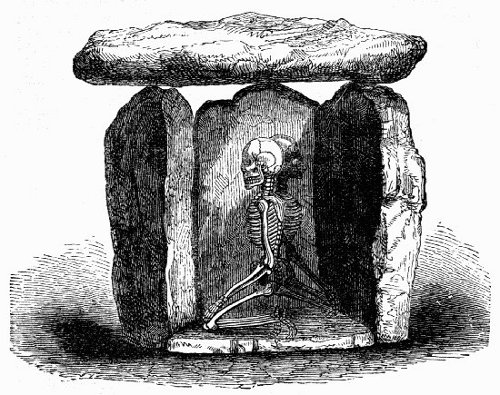
The above sketch represents a chamber which was discovered in a
barrow, situated near Paradis, in the parish of the Vale, in the island of
Guernsey. On digging into the mound, a large flat stone was soon discovered;
this formed the top, or cap-stone, of the tomb, and on removing
it, the upper part of two human skulls were exposed to view. One was
facing the north, the other the south, but both disposed in a line from
east to west. The chamber was filled up with earth mixed with limpet-shells,
and as it was gradually removed, while the examination was
proceeding downwards into the interior, the bones of the extremities
became exposed to view, and were seen to greater advantage. They were
less decomposed than those of the upper part; and the teeth and jaws,
which were well preserved, denoted that they were the skeletons of
adults, and not of old men. The reason why the skeletons were found
in this extraordinary position it is impossible to determine. Probably
the persons who were thus interred were prisoners, slaves, or other subordinates,
who were slain—perhaps buried alive—on occasion of the
funeral of some great or renowned personage, who was placed in the
larger chamber at the end of the passage; and this view of the case is
considerably strengthened by the fact that the total absence of arms,
weapons, or vases, in the smaller chamber, denotes that the quality of the
persons within it was of less dignity or estimation.
WAR CHARIOT OF ANCIENT EGYPT.
This chariot, which is mentioned in various parts of Scripture, and
more especially in the description of the pursuit of the Israelites by
Pharaoh, and of his overthrow in the Red Sea, was a very light structure,
consisting of a wooden framework strengthened and adorned with metal,
and leather binding, answering to the descriptions which Homer has
given of those engaged in the Trojan war.
The sides were partly, and the back wholly open; and it was so low
that a man could easily step into it from behind; for there was no seat,
the rider always standing in war or hunting, though when wearied he
might occasionally sit on the sides, or squat, in eastern fashion, on his
heels. The body of the car was not hung on the axle in equilibrio, but
considerably forward, so that the weight was thrown more upon the
horses. Its lightness, however, would prevent this from being very
fatiguing to them, and this mode of placing it had the advantage of
rendering the motion more easy to the driver. To contribute further to
this end, the bottom or floor consisted of a network of interlaced thongs,
the elasticity of which in some measure answered the purpose of modern
springs.
The Egyptian chariots were invariably drawn by two horses abreast,
which were richly caparisoned; it is, perhaps, to the extreme
elegance and magnificence of their trappings, no less than to their own
beauty, that allusion is made in the Song of Songs (1-9), where the
royal bridegroom addresses his spouse thus: "I have compared thee, O
my love, to a company of horses in Pharaoh's chariots." The chariot of
Egypt ordinarily carried two persons, one of whom acted as the warrior,
the other as the charioteer. Occasionally we find three persons in a
chariot, as when two princes of the blood, each bearing the royal sceptre,
or flabellum, accompanying the king in a state procession, requiring a
charioteer to manage the reins.
PEACOCKS.
India, says Mr. Pennant, gave us peacocks, and we are assured by
Knox, in his "History of Ceylon," that they are still found in the wild
state, in vast flocks, in that island and in Java. So beautiful a bird
could not be permitted to be a stranger in the more distant parts; for so
early as the days of Solomon (1 Kings, x. 22) we find among the articles
imported in his Tarshish navies, apes and peacocks. A monarch so conversant
in all branches of natural history, would certainly not neglect
furnishing his officers with instructions for collecting every curiosity in
the country to which they made voyages, which gave him a knowledge
that distinguished him from all the princes of his time. Ælian relates
that they were brought into Greece from some barbarous country, and
that they were held in such high estimation that a male and female were
valued at Athens at 1,000 drachmæ, or £32 5s. 10d. Their next step
might be to Samos, where they were preserved about the temple of Juno,
being the birds sacred to that goddess; and Gellius, in his "Noctes
Atticæ" commends the excellency of the Samian peacocks. It is, therefore
probable that they were brought there originally for the purposes of
superstition, and afterwards cultivated for the uses of luxury. We are
also told, when Alexander was in India, he found vast numbers of wild
ones on the banks of the Hyarotis, and was so struck with their beauty
as to appoint a severe punishment on any person that killed them.
Peacocks' crests, in ancient times, were among the ornaments of the
kings of England. Ernald de Aclent (Acland) paid a fine to King John
in a hundred and forty palfries, with sackbuts, lorains, gilt spurs, and
peacocks' crests, such as would be for his credit.—Some of our regiments
of cavalry bear on their helmets, at present, the figure of a peacock.
ROMAN THEATRE AT ORANGE.
One of the most striking Roman provincial theatres is that of Orange,
in the south of France. Perhaps it owes its existence, or at all events
its splendour, to the substratum of Grecian colonists that preceded the
Romans in that country. Its auditorium is 340 ft. in diameter, but
much ruined, in consequence of the princes of Orange having used this
part as a bastion in some fortification they were constructing.
The stage is tolerably preserved. It shows well the increased extent
and complication of arrangements required for the theatrical representations
of the age in which it was constructed, being a considerable advance
towards the more modern idea of a play, as distinguished from the
stately semi-religious spectacle in which the Greeks delighted. The
noblest part of the building is the great wall at the back, an immense
mass of masonry, 340 ft. in extent, and 116 ft. in height, without a
single opening above the basement, and no ornament except a range of
blank arches, about midway between the basement and the top, and a
few projecting corbels to receive the footings of the masts that supported
the velarium. Nowhere does the architecture of the Romans shine so
much as when their gigantic buildings are left to tell their own tale by
the imposing grandeur of their masses. Whenever ornament is
attempted, their bad taste comes out. The size of their edifices, and the
solidity of their construction, were only surpassed by the Egyptians, and
not always by them; and when, as here, their mass stands unadorned
in all its native grandeur, criticism is disarmed, and the spectator stands
awe-struck at its majesty, and turns away convinced that truly "there
were giants in those days." This is not, it is true, the most intellectual
way of obtaining architectural effect, but it is the easiest and the
most certain to secure the desired result.
A PISCATORIAL DOG.
Mr. Jukes, in his "Excursions in and about Newfoundland," speaks
of a dog which appeared to be of the pure breed, and which he thought
to be more intelligent than the mixed race. This animal caught his
own fish, for which purpose he sat on a projecting rock, beneath a fish
stage, on which the fish were laid to dry, watching the water, the depth
being from six to eight feet, and the bottom quite white with fish-bones.
On throwing a piece of cod-fish into the water, three or four heavy,
clumsy-looking fish, called in Newfoundland sculpins, would swim to
catch it. The instant one turned his broadside towards him, he darted
down, and seldom came up without the fish in his mouth. He regularly
carried them as he caught them to a place a few yards off, where he
deposited them, sometimes making a pile of fifty or sixty in the day. As
he never attempted to eat them, he appeared to fish for his amusement.
PHENOMENA OF SOUND.
In the gardens of Les Rochas, once the well-known residence of
Madame de Sevigné, is a remarkable echo, which illustrates finely the
conducting and reverberating powers of a flat surface. The Château des
Rochas is situated not far from the interesting and ancient town of Vitre.
A broad gravel walk on a dead flat conducts through the garden to the
house. In the centre of this, on a particular spot, the listener is placed
at the distance of about ten or twelve yards from another person, who,
similarly placed, addresses him in a low and, in the common acceptation
of the term, inaudible whisper, when, "Lo! what myriads rise!" for
immediately, from thousands and tens of thousands of invisible tongues,
starting from the earth beneath, or as if every pebble was gifted with
powers of speech, the sentence is repeated with a slight hissing sound,
not unlike the whirling of small shot passing through the air. On
removing from this spot, however trifling the distance, the intensity of
the repetition is sensibly diminished, and within a few feet ceases to be
heard. Under the idea that the ground was hollow beneath, the soil has
been dug up to a considerable depth; but without discovering any clue
to the solution of the mystery.
ANTIQUE WATCH.
The above engraving represents a fancy silver watch of the time of Queen
Elizabeth. It is shaped like a duck; the feathers chased. The lower
part opens, and the dial plate, which is also of silver, is encircled with a
gilt ornamental design of floriated scrolls and angels' heads. The wheels
work on small rubies. It has no maker's name. It is preserved in the
original case of thin brass, covered with black leather, and ornamented
with silver studs, as represented in the woodcut below. It forms one of
the curiosities in the Museum of Lord Londesborough.
HORSES FEEDING ONE ANOTHER.
M. de Bossanelle, captain of cavalry in the regiment of Beauvilliers,
relates in his "Military Observations," printed in Paris, 1760, "That,
in the year 1757, an old horse of his company, that was very fine and full
of mettle, had his teeth all on a sudden so worn down, that he could
not chew his hay and corn; and that he was fed for two months, and
would still have been so had he been kept, by two horses on each side
of him, that ate in the same manger. These two horses drew hay
from the rack, which they chewed, and afterwards threw before the old
horse; that they did the same with the oats, which they ground very
small, and also put before him. This (adds he) was observed and
witnessed by a whole company of cavalry, officers and men."
CROSS OF MUIREDACH.
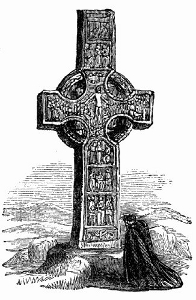
From the rude pillar-stone marked with the symbol of our faith, enclosed
within a circle, the emblem of Eternity, the finely-proportioned
and elaborately-sculptured crosses of a later period are derived. In the
latter, the circle, instead of being simply cut on the face of the stone, is
represented by a ring, binding, as it were, the shaft, arms, and upper
portion of the cross together. There are two beautiful specimens of this
style of cross at Monasterboice, near Drogheda, about thirty-five
miles from Dublin. The smaller, more beautiful, and more perfect of
these we here engrave.
The figures and ornaments with which its various
sides are enriched appear to have
been executed with an unusual
degree of artistic skill. It is now
almost as perfect as it was when,
nearly nine centuries ago, the artist,
we may suppose, pronounced his
work finished, and chiefs and abbots,
bards, shanachies, warriors,
and ecclesiastics, and, perhaps,
many a rival sculptor, crowded
round this very spot full of wonder
and admiration for what they must
have considered a truly glorious,
and, perhaps, unequalled work. An
inscription in Irish upon the lower
part of the shaft, desires "A prayer
for Muiredach, by whom was made
this cross," and there is reason for
assigning it to an abbot of that
name who died in the year 924. Its
total height is exactly fifteen feet,
and it is six in breadth at the arms.
The shaft, which at the base measures in breadth two feet six inches,
and in thickness one foot nine inches, diminishes slightly in its ascent,
and is divided upon its various sides by twisted bands into compartments,
each of which contains either sculptured figures, or tracery of very intricate
design, or animals, probably symbolical.
CHINESE THERAPEUTICS.
In the treatment of disease, the Chinese, so fond of classification, divide
the medicinal substances they employ into heating, cooling, refreshing,
and temperate: their materia medica is contained in the work called the
Pen-tsaocang-mou in fifty-two large volumes, with an atlas of plates;
most of our medicines are known to them and prescribed; the mineral
waters, with which their country abounds, are also much resorted to;
and their emperor, Kang-Hi, has given an accurate account of several
thermal springs. Fire is a great agent, and the moxa recommended in
almost every aliment, while acupuncture is in general use both in China
and Japan; bathing and champooing are also frequently recommended,
and bloodletting is seldom resorted to.
China has also her animal magnetisers, practising the Cong fou, a
mysterious manipulation taught by the bonzes, in which the adepts produce
violent convulsions.
The Chinese divide their prescriptions into seven categories:
1. The great prescription.
2. The little prescription.
3. The slow prescription.
4. The prompt prescription.
5. The odd prescription.
6. The even prescription.
7. The double prescription.
Each of these receipts being applied to particular cases, and the ingredients
that compose them being weighed with the most scrupulous
accuracy.
Medicine was taught in the imperial colleges of Pekin; but in every
district, a physician, who had studied six years, is appointed to instruct
the candidate for the profession, who was afterwards allowed to practise,
without any further studies or examination; and it is said, that, in
general, the physician only receives his fee when the patient is cured.
This assertion, however, is very doubtful, as the country abounds in
quacks, who, under such restrictions as to remuneration, would scarcely
earn a livelihood. Another singular, but economical practice prevails
amongst them—a physician never pays a second visit to a patient unless
he is sent for. Whatever may be the merits of Chinese practitioners
both in medicine and surgery, or their mode of receiving remuneration,
it appears that they are as much subject to animadversion as in other
countries:—A missionary having observed to a Chinese, that their
medical men had constantly recourse to fire in the shape of moxa, red-hot
iron, and burning needles; he replied, "Alas! you Europeans are
carved with steel, while we are martyrized with hot iron; and I fear
that in neither country will the fashion subside, since the operators do
not feel the anguish they inflict, and are equally paid to torment us or to
cure us!"
MARY QUEEN OF SCOTS TO SIR FRANCIS KNOLLYS, FROM BOLTON,
SEPT. 1ST, 1568: HER FIRST LETTER IN ENGLISH.
(MS. Cotton. Calig. C. I. fol. 161 b. Orig.)
Mester Knoleis, y heuv har (I have heard) sum neus from Scotland;
y send zou the double off them y vreit (wrote) to the quin (queen) my
gud Sister, and pres (pray) zou to du the lyk, conforme to that y spak
zesternicht vnto zou, and sut hesti ansur y refer all to zour discretion,
and wil lipne beter in zour gud delin (dealing) for mi, (me) nor y kan
persuad zou, nemli in this langasg (language) excus my ivil vreitin
(writing) for y neuver vsed it afor, and am hestit (hasted). Ze schal si
my bel (bill) vhuilk (which) is opne, it is sed Seterday my unfrinds wil
be vth (with) zou, y sey nething bot trests weil, and ze send oni to zour
wiff ze mey asur schu (she) wald a bin weilcom to apur (poor) strenger
hua (who) nocht bien (not being) aquentet vth her, wil nocht bi ouuer
bald (bold) to vreit bot for the aquentans betuix ous (us: i. e. herself
and Sir Francis Knolles). Y wil send zou letle tokne (token) to
rember (remember) zou off the gud hop y heuu (have) in zou guef
(gif—if) ze fend (find) a mit (meet) mesager y wald wish ze bestouded
(bestowed) it reder (rather) apon her non (than) ani vder; thus effter my
commendations y prey God heuu zou in his kipin.
"Zour asured gud frind.
"Marie R.
"Excus my ivel vreitin thes furst tym."
PHILOSOPHY OF THE BRAMINS.
The order of creation, which is described in the Institutes of Menu
(c. 1, pp. 75-8), is remarkable. "First emerges the subtle ether, to
which philosophers ascribe the quality of conveying sound: from ether,
effecting a transmutation in form, springs the pure and potent air, a
vehicle of all scents; and air is held endued with the quality of touch:
then from air, operating a change, rises light, or fire, making objects
visible, dispelling gloom, spreading bright rays; and it is declared to
have the quality of figure: but from light, a change being effected,
comes water, with the quality of taste: and from water is deposited
earth, with the quality of smell; such were they created in the beginning."
This passage bears at least as strong a resemblance to the
chemical philosophy of our days, as certain parts of the Hindoo fables
bear to the mysteries of the Christian religion. But it is more difficult
to account for the philosophy, (if, indeed, it be any thing more than mere
theory,) than to explain how the distorted traces of Christianity found
their way into the fables of Hindostan.
FOREIGNERS IN LONDON IN 1567.
"We learn from the Bishop of London's certificate, that, in December,
1567, there were then in London and its immediate vicinity, or places
which are now included in the word 'London,' 3838 Dutchmen;
720 Frenchmen; 137 Italians; 14 Venetians; 56 Spaniards; 25 Portuguese;
2 Grecians; 2 Blackamores; 1 Dane; and but 58 Scots!
making a total of 4851 foreigners."
CHANGES OF FORTUNE.
In 1454, Sir Stephen Forster was Lord Mayor of London. He had
been long in prison and penury, on account of his inordinate profuseness.
It chanced that a most fantastical widow, who knew not how to get rid
of her immense wealth, saw him begging at the gate; she admired his
fine person, learnt his history, paid his debts, and married him; asking
of him only this one favour, that he would lavish away her fortune as
fast as he could. Forster, probably from perverseness, became a sober
husband and a prudent manager, and only expended large sums in
adding a chapel and other advantageous appendages to Ludgate, where
he had suffered so many hardships.
ROMAN VASES IN BLACK WARE.
The principal subjects represented on vases of ancient Roman pottery
of black ware are hunting scenes—such as dogs chasing stags, deer,
hares,—also, dolphins, ivy wreaths, and engrailed lines; and engine-turned
patterns. In a few instances men with spears are represented,
but in a rude and debased style of art. The principal form is the cup of
a jar shape, sometimes with deep oval flutings, as on one found at Castor;
but dishes, cups, plates, and mortars are not found in this ware.
Some of the vases of this ware have ornaments, and sometimes letters
painted on them in white slip upon their black ground, as represented in
our engraving.
They are generally
of a small size, and of the
nature of bottles or cups, with
inscriptions, such as AVE, hail!
VIVAS, may you live! IMPLE,
fill; BIBE, drink; VINVM,
wine; VIVA, life; VIVE BIBE
MVLTIS; showing that they
were used for purposes purely
convivial. Such are the vases
found at Etaples, near Boulogne,
the ancient Gessoriacum, and at
Mesnil.
Some rarer and finer specimens
from Bredene, in the department of Lis, have a moulding round the foot.
Great quantities are found in England, Holland, Belgium, and France.
It is found on the right bank of the Rhine. A variety of this ware has
been lately found at a spot called Crockhill, in the New Forest, together
with the kilns in which it was made, and a heap of potter's sherds, or
pieces spoilt in the baking. The paste was made of the blue clay of the
neighbourhood, covered with an alkaline glaze of a maroon colour, perhaps
the result of imperfect baking; for the pieces when submitted again
to the action of the fire, decrepitated and split. They were so much
vitrified as to resemble modern stone ware, yet as all of them have proofs
of having been rejected by the potters, it is probable that this was not
the proper colour of the ware. Almost all were of the pinched up fluted
shape, and had no bas-reliefs, having been ornamented with patterns laid
on in white colour. The kilns are supposed to be of the third century of
our era, and the ware was in local use, for some of it was found at
Bittern.
FRENCH BIBLE.
There was a French Bible, printed at Paris in 1538, by Anthony
Bonnemere, wherein is related "that the ashes of the golden calf which
Moses caused to be burnt, and mixed with the water that was drank by
the Israelites, stuck to the beards of such as has had fallen down before
it; by which they appeared with gilt beards, as a peculiar mark to
distinguish those which had worshipped the calf." This idle story is
actually interwoven with the 32nd chapter of Exodus. And Bonnemere
says, in his preface, this French Bible was printed in 1495, at the
request of his most Christian Majesty Charles VIII.; and declares
further that the French translator "has added nothing but the genuine
truths, according to the express terms of the Latin Bible; nor omitted
anything but what was improper to be translated!" So that we are to
look upon this fiction of the gilded beards as matter of fact; and another
of the same stamp, inserted in the chapter above mentioned, viz., that,
"Upon Aaron's refusing to make gods for the Israelites, they spat upon
him with so much fury and violence that they quite suffocated him."
SARDONYX RING WITH CAMEO HEAD OF QUEEN ELIZABETH, IN THE
POSSESSION OF REV. LORD THYNNE.
This is said to be the identical ring given by Queen Elizabeth to
Essex, and so fatally retained by
Lady Nottingham.
It has descended
from Lady Frances Devereux,
Essex's daughter, in unbroken
succession from mother and
daughter to the present possessor.
The ring is gold, the sides engraved,
and the inside of blue enamel; the
execution of the head of Elizabeth
is of a high order, and whether this be the ring or not, it is valuable as
a work of art.
CURIOUS WAGERS.
There have been travelling wagers, and none of the least singular of
such was that of Mr. Whalley, an Irish gentleman (and who we believe
edited Ben Johnson's works), who, for a very considerable wager (twenty
thousand pounds, it was said,) set out on Monday the 22nd of September,
1788, to walk to Constantinople and back again in one year. This wager,
however whimsical, is not without a precedent. Some years ago a
baronet of good fortune (Sir Henry Liddel) laid a considerable wager
that he would go to Lapland, bring home two females of that country,
and two rein-deer, in a given time. He performed the journey, and
effected his purpose in every respect. The Lapland women lived with
him about a year, but desiring to go back to their own country, the
baronet furnished them with means and money.
CONFECTIONERY ART IN 1660.
The following is extracted from a work on Cookery, by Robert May,
published in 1660. It is entitled the "Accomplisht Cook, &c., &c.
"Triumphs and Trophies in Cookery, to be used in Festival Times, as
Twelfth Day, &c.:—Make the likeness of a ship in pasteboard with flags
and streamers, the guns belonging to it of kickses, bind them about with
pack-thread and cover them with paste proportionable to the fashion of
a cannon with carriages; lay them in places convenient, as you see them
in ships of war, with such holes and trains of powder that they may all
take fire. Place your ships firm in a great charger; then make a salt
round about it, and stick therein egg-shells full of sweet water; you may
by a great pin take out all the meat out of the egg by blowing, and then
fill it with rose-water. Then in another charger have the proportion of
a stag made of coarse paste, with a broad arrow in the side of him, and
his body filled up with claret wine. In another charger at the end of
the stag have the proportion of a castle with battlements, percullices,
gates, and drawbridges, made of pasteboard, the guns of kickses, and
covered with coarse paste as the former; place it at a distance from the
ship to fire at each other. The stag being placed betwixt them, with
egg-shells full of sweet water (as before) placed in salt. At each side of
the charger wherein is the stag, place a pie made of coarse paste, in one
of which let there be some live frogs, in the other live birds; make these
pies of coarse paste, filled with bran, and yellowed over saffron, or yolks
of eggs: gild them over in spots, as also the stag, the ship and castle;
bake them, and place them with gilt bay leaves on the turrets and
tunnels of the castle and pies; being baked make a hole in the bottom of
your pies, take out the bran, put in your frogs and birds, and close up
the holes with the same coarse paste; then cut the lids neatly up to be
taken off by the tunnels. Being all placed in order upon the table, before
you fire the trains of powder, order it so that some of the ladies may be
persuaded to pluck the arrow out of the stag; then will the claret wine
follow, as blood running out of a wound. This being done with admiration
to the beholders, after some short pause, fire the train of the castle,
that the pieces all of one side may go off; then fire the trains of one side
of the ship as in a battle; next turn the chargers, and by degrees fire
the trains of each other side, as before. This done, to sweeten the stink
of the powder, the ladies take the egg-shells full of sweet waters, and
throw them at each other, all dangers being seemed over, and by this
time you may suppose they will desire to see what is in the pies; when
lifting first the lid off one pie, out skip some frogs, which makes the
ladies to skip and shriek; next after the other pie, whence comes out
the birds; who by a natural instinct flying at the light, will put out the
candles; so that what with the flying birds and skipping frogs, the one
above, the other beneath, will cause much delight and pleasure to the
whole company: at length the candles are lighted and a banquet brought
in, the music sounds, and every one with much delight and content
rehearses their actions in the former passages. These were formerly the
delights of the nobility, before good house-keeping had left England,
and the sword really acted that which was only counterfeited in such
honest and laudable exercises as these."
SUSPENDED ANIMATION.
David Beck, the celebrated portrait painter, and pupil of Vandyke,
travelling through Germany, was suddenly taken ill, and to all appearance
died, and was laid out as a corpse. His servants, sitting round the
bed, grieved heartily for the loss of so good a master; and, as grief is
thirsty, drank as heartily at the same time. One of them, becoming
more fuddled than the rest, then addressed his companions thus: "Our
master when alive was fond of his glass, let us now, out of gratitude,
then give him one now he is dead." Assent was given, the head of the
dead painter was raised up, and some wine poured down or spilt about,
the fragrance or spirit of which caused Beck to open his eyes; upon
which the servant, who, being drunk, half forgetting his master was
dead, forced down the remainder of the glass. The painter gradually
revived, and thus escaped a living interment.
FUNERAL OF MARAT.
The funeral of Marat was celebrated at Paris, July 17th, 1793, with
the greatest pomp and solemnity. All the sections joined the procession.
An immense crowd of people attended it. Four women bore the bathing
machine in which Marat was standing when he was assassinated; his
shirt, stained with blood, was carried by a fury, in the shape of a
woman, at the top of a pike. After this followed a wooden bedstead, on
which the corpse of Marat was carried by citizens. His head was uncovered,
and the gash he had received could be easily distinguished.
The procession was paraded through several streets, and was saluted on
its march by several discharges of artillery.
EXECUTION OF ANNE BOLEYN.
In Houssaie's "Memoirs," Vol. I. p. 435, a little circumstance is
recorded concerning the decapitation of the unfortunate Anne Boleyn,
which illustrates an observation of Hume. Our historian notices that
her executioner was a Frenchman of Calais, who was supposed to have
uncommon skill; it is probable that the following incident might have
been preserved by tradition in France, from the account of the executioner
himself. Anne Boleyn being on the scaffold, would not consent to
have her eyes covered with a bandage, saying that she had no fear of
death. All that the divine who assisted at her execution could obtain
from her was, that she would shut her eyes. But as she was opening
them at every moment, the executioner could not bear their tender and
mild glances. Fearful of missing his aim, he was obliged to invent an
expedient to behead the queen. He drew off his shoes, and approached
her silently; while he was at her left hand, another person advanced at
her right, who made a great noise in walking, so that this circumstance
drawing the attention of Anne, she turned, her face from the executioner,
who was enabled by this artifice to strike the fatal blow without
being disarmed by that pride of affecting resignation which shone in the
eyes of the lovely Anne Boleyn.
MEXICAN TENNIS.
The Mexicans had one singular law in their play with the ball. In
the walls of the court where they played certain stones, like mill-stones
were fixed, with a hole in the middle, just large enough to let the ball
pass through; and whoever drove it through, which required great
skill, and was, of course, rarely effected, won the cloaks of the lookers-on.
They, therefore, took to their heels to save their cloaks, and others
pursued to catch them, which was a new source of amusement.
CURIOUSLY-SHAPED VESSEL.
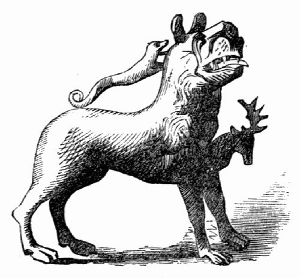
There is a singular class of Northern relics, of the Christian Period, of
which analogous types have been found in Scotland, which well deserve
our attention. The relics of which we speak consist of a curious variety of
vessels, presumed to have been designed for holding liquors, but invariably
made in the form of some animal or monstrous hybrid.
The annexed figure represents one of these, in the collection of
Charles Kirkpatrick Sharp, Esq., and found by him among a hoard
of long-forgotten family heirlooms, in a vault of his paternal mansion
of Hoddam Castle, Dumfriesshire. Of its previous history nothing
is known. It is made of bronze.
The principal figure is a lion,
without a tail, measuring fourteen
inches in length, and
nearly fourteen inches in greatest
height. On the back is perched
a nondescript animal, half greyhound,
half fish, apparently intended
for a handle to the whole,
while from the breast projects a
stag's head with large antlers.
This has a perforation in the
back of the neck, as if for the
insertion of a stop-cock, and it
appears probable was designed
for running off the liquid contained
within the singular vessel
to which it is attached. A small square lid on the top of the lion's head,
opening with a hinge, supplies the requisite aperture for whatever liquor
it was designed to hold. A similar relic, possessed by Sir John Maxwell,
Bart., was dug up a few years since on the Pollock estate; and another,
in the collection of the late E. W. A. Drummond Hay, Esq., was also in
the form of a lion.
A SENSIBLE DOG.
Professor Owen was walking with a friend, the master of the dog, by
the side of a river, near its mouth, on the coast of Cornwall, and picked
up a small piece of seaweed. It was covered with minute animals, and
Mr. Owen observed to his companion, throwing the weed into the water,—"If
this small piece afforded so many treasures, how microscopically
rich the whole plant would be! I should much like to have one!" The
gentleman walked on; but hearing a splashing in the water, turned
round and saw it violently agitated. "It is Lion!" both exclaimed.
"What can he be about? He was walking quietly enough by our side
a minute ago." At one moment they saw his tail above the water, then
his head raised for a breath of air, then the surrounding element shook
again, and at last he came ashore, panting from his exertions, and laid a
whole plant of the identical weed at Mr. Owen's feet. After this proof
of intelligence, it will not be wondered at, that when Lion was joyfully
expecting to accompany his master and his guest on an excursion, and
was told to go and take care of and comfort Mrs. Owen, who was ill,
that he should immediately return to the drawing-room, and lay himself
by her side, which he never left during the absence of his owner;
his countenance alone betraying his disappointment, and that only for a
few minutes.
THE CROWN OF CHARLEMAGNE.
As the emblem of sovereignty which once adorned the brows of one of
earth's mightiest men, and as a unique specimen of the state at which
the goldsmith's art had arrived as
early as the ninth century, we here
present our readers with an engraving
of the crown of Charlemagne.
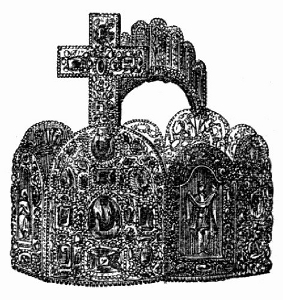
This great man was the eldest son
of Pepin the Short, and grandson of
Charles Martel, and was born at the
castle of Ingelheim, near Metz, in
the year 742. His father dying in
768 he succeeded to the crown in
conjunction with his brother Carloman,
whose death in 771 left him
sole monarch of the Franks. By
his alliances, negociations, and principally
by his numerous and glorious
wars, he so enlarged his dominions,
that at length they extended from
the Ebro to the mouth of the Elbe, from the Atlantic to the mountains
of Bohemia and the Saal, and from the British Channel to the Volturno.
In the year 800 he was crowned at Rome, as Emperor of the West, by
Pope Leo III., and died of a pleurisy in 814, at Aix-la-Chapelle, in the
cathedral of which city he was buried with extraordinary magnificence.
Equally illustrious in the cabinet and in the field, a wise legislator, and
a great warrior, the patron of men of letters, and the restorer of learning,
Charlemagne has united in his favour the suffrages of statesmen and
soldiers, and of ecclesiastics, lawyers, and men of letters, who have all
vied with one another in bestowing the homage of their praise on the
celebrated founder of the Western Empire.
The crown of this illustrious man, of which our engraving is a correct
representation, is now preserved at Vienna in the Imperial Treasury.
It is composed of eight plates of gold, four large and four small, connected
by hinges. The large ones, studded with precious stones, form
the front, the back, and the intermediate points of the crown; the small
ones, placed alternately with these, are ornamented with enamels representing
Solomon, David, King Hezekiah seated on his throne, and Christ
seated between two flaming seraphim, such as the Greeks usually represent
them. The costume of the figures resembles that of the Emperors
of the Lower Empire, and although the inscriptions which accompany
the figures are in Latin, the whole bears the impress of Greek workmanship.
The ground of the figures is formed by the metal itself, which
has been hollowed out to receive the enamel; but all the details of the
design are traced out with fine fillets of gold. The flesh-tints are in
rose-coloured enamel; the colours employed in the draperies and
accessories are deep and light blue, red, and white. The crown has
unquestionably been retouched at various periods, but yet there is
nothing to invalidate the tradition which assigns the more ancient
portions to the time of Charlemagne. The enamels must belong to the
same early period.
SPENT BY THE CORPORATION OF COVENTRY AT THE ENTERTAINMENT OF
KING JAMES II. IN HIS PROGRESS THROUGH COVENTRY, 1687.
(Mr. Richard Haywood, Treasurer.)
| |
£ |
s. |
d. |
| Gave a gold cup |
171 |
17 |
6 |
| Mr. Septimus Butt, mayor, for sweetmeats |
27 |
17 |
0 |
| Meat |
13 |
14 |
0 |
| Wine |
21 |
12 |
6 |
| Homage fee |
41 |
6 |
8 |
| King's cook |
10 |
0 |
0 |
| City cook |
9 |
8 |
6 |
| Steward Fielding, for making a speech to his Majesty |
5 |
7 |
6 |
| For linen spoiled, borrowed of Mrs. Smith, Spon-street |
2 |
12 |
6 |
| The aldermen that went to Worcester to invite him |
3 |
18 |
9 |
| Several companies for waiting on the King |
27 |
9 |
4 |
| Alderman Webster, for meat |
3 |
6 |
0 |
| Alderman Bradney for corn |
3 |
5 |
6 |
| His Majesty's clerk of the market |
1 |
1 |
6 |
| The King's trumpeters |
2 |
0 |
0 |
| Richard Howcott, for carrying the city streamer |
0 |
7 |
0 |
| The city bailiff's bill for fish, fowl, and wine |
88 |
18 |
2 |
|
—— |
—— |
—— |
|
£434 |
2 |
9 |
|
—— |
—— |
—— |
TRAVELLING EXPENSES IN THE THIRTEENTH CENTURY.
Of travelling expenses in the thirteenth century, a roll is in existence,
and is too interesting to be passed over. It contains a steward's
accompts of the daily expenses of a person of rank in the reign of
Edward I, on a journey from Oxford to Canterbury, and during his
sojourn in London, about the year 1289; while the record throws much
light upon the mode of our ancestors' living, at a period concerning
which we have very few similar memorials. One day's expenses are as
follow: "In bread, sixpence. Two gallons of wine, a gift of hospitality
from the rector of Berton. Item in bread, sixpence. Two gallons of
wine, a gift of hospitality from the rector of Mistern. Beer, sixpence.
Herrings, threepence. Stockfish, fourpence. Porpoise and fish,
fourpence. Perch and roach, seven-pence. Large eels, seven-pence.
Vegetables, threepence farthing. Figs and raisins, twopence. Fuel,
five-pence. A bed for two nights, twopence. Hay for seven horses,
seven-pence. A bushel of oats, twenty-pence. Apples, a halfpenny.
Sum, six shillings and eight-pence halfpenny." The most expensive
day in the roll is on a Sunday, "in expenses of my lord at Westminster,
when he held a breakfast there for knights, clerks, and squires. Bread,
two shillings. Beer, twelve-pence. Wine, three shillings and eight-pence.
Half a salmon, for the standard, with the chine, three shillings
and eight-pence. A fresh conger eel, three shillings. Three fat pikes,
five fat eels, and twenty-seven fat roaches, twelve shillings and fourpence.
Half a hundred lamprorns, twelve-pence. Oysters, threepence.
Vegetables, twopence. The hire of a boy to prepare the breakfast, one
penny. Fare to Westminster, one penny. A basket, one penny farthing.
On the same day at the inn: bread, five-pence farthing. Beer from the
store. Two gallons of beer for the boys, twopence. Fish from the
store. Candles, a halfpenny. Fuel, a halfpenny. Hay bought, five-pence
three farthings. Straw, sixpence. Two bushels of oats, eight-pence.
Two pair of shoes for my lord, twelve-pence. Sum, thirty
shillings and threepence farthing."
DUNS IN THE MAHRATTA COUNTRY.
The Mahratta mode of recovering debts is curious. When the creditor
cannot get his money, and begins to see the debt as rather desperate, he
sits dhurna upon his debtor; that is, he squats down at the door of the
tent, and becomes, in a certain mysterious degree, the master of it. No
one goes in or out without his approbation. He neither eats himself,
nor suffers his debtor to eat; and this famishing contest is carried on till
the debt is paid, or till the creditor begins to feel that want of food is a
greater punishment than the want of money. This curious mode of
enforcing a demand is in universal practice among the Mahrattas;
Scindiah himself, the chieftain, not being exempt from it. The man who
sits the dhurna, goes to the house, or tent, of him whom he wishes to
bring to terms, and remains there till the affair is settled; during which
time, the one under restraint is confined to his apartment, and not
suffered to communicate with any persons but those whom the other may
approve of. The laws by which the dhurna is regulated are as well defined
and understood as those of any other custom whatever. When it
is meant to be very strict, the claimant carries a number of his followers,
who surround the tent, sometimes even the bed of his adversary, and deprive
him altogether of food; in which case, however, etiquette prescribes
the same abstinence to himself: the strongest stomach, of course, carries
the day. A custom of this kind was once so prevalent in the province
and city of Benares, that Brahmins were trained to remain a long time
without food. They were then sent to the door of some rich individual,
where they made a vow to remain without eating, till they should obtain
a certain sum of money. To preserve the life of a Brahmin is so absolutely
a duty, that the money was generally paid; but never till a good struggle
had taken place, to ascertain whether the man was staunch or not; for
money is the life and soul of all Hindoos.
VAUXHALL.
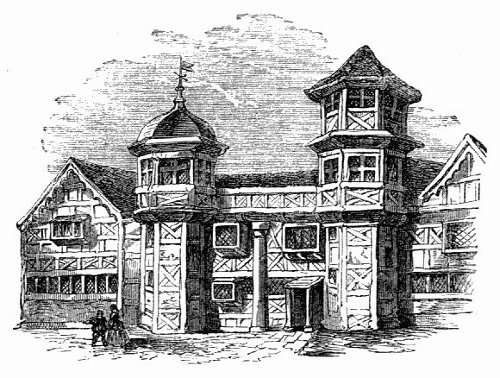
The trees seen above the houses at the foot of the Surrey side of
Westminster Bridge are those of Vauxhall Gardens, the site of which will
soon be covered with buildings. These grounds were once the glory of
English pleasure-gardens, frequented by the highest in the land from
the gay days of Charles II. to those of "the Regency," and were celebrated
in musical history for talent of the highest kind here introduced.
In the old orchestra, whose towering summit may be seen from the
Thames, the greatest musical celebrities have sung. Handel, Dr. Arne,
and Hook superintended its concerts; and Hogarth decorated its walls
with paintings. It obtained its name from a very old mansion that once
stood near it. This old manor-house of Fawkes Hall, as it existed in
the reign of Charles I., is shown in our engraving; at that time it was
described as a "fair dwelling-house, strongly built, of three stories
high, and a pier staircase breaking out from it nineteen feet square." This
staircase occupied one of the towers, in accordance with the ancient
plan, and the house was a curious specimen of the old timber houses of
the gentry in the sixteenth century.
It appears to have obtained its name from Foukes de Breut, who
married the heiress of the manor, the Countess of Albemarle, sister to
Baldwin, Archbishop of Canterbury; and it was granted by the name of
the manor of Foukeshall, by Edward III. to his favourite Hugh le
Despenser. In 1615 the records of the Duchy of Cornwall prove the
premises known as Vauxhall Gardens to have been the leasehold property
of Jane Vaux, widow of John Vaux, citizen and vintner of London, and
a benefactor to the parish of Lambeth. It has always remained, with
the manor of Kennington, as the property of the crown, and belongs to
the Prince of Wales as part of his Duchy of Cornwall. Vauxhall Gardens
closed for ever on July 25th, 1859, with an al fresco fête.
EGYPTIAN TOILET BOXES.
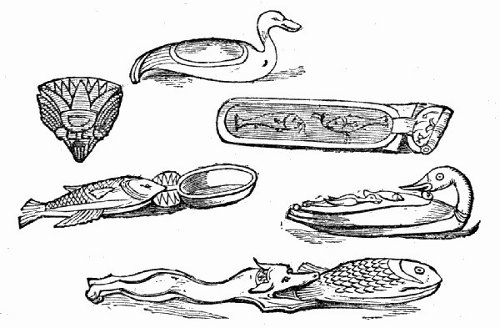
The ladies of ancient Egypt were very fond of having their apartments
set off with a profusion of knick-knacks, and among other articles of
that sort, they usually had several different kinds of toilet-boxes on their
dressing-tables. The above engraving represents a group of them. They
have been found in considerable numbers among the ruins of the palaces,
and they form interesting objects among the Egyptian curiosities in
many of our museums. They were made of wood, or of ivory, often inlaid,
and always elaborately carved. Sometimes they partook of the
nature of spoons, the containing part being shallow, at the end of a long
solid handle; the handle was carved into the most fanciful forms—a grotesque
human figure, a woman, a fox, or a fish—and the spoon part was
generally covered with a lid, which turned on a pivot. In one of those
in the engraving, the spoon takes the form of a fish, the cover being
carved to resemble its scales, while another, also in the form of a fish,
has two cavities, the one covered, the other permanently open. Sometimes
the body of a goose formed the box, either trussed for the table, or
in the posture of life, and other forms were devised from the fancy of the
artist. Some of these shallow boxes are supposed to have been used for
holding small quantities of ointments and cosmetics upon the toilet-table.
SPACIOUS KITCHEN.
One of the most spacious kitchens in England is that of Raby Castle,
the magnificent seat of the Duke of Cleveland. It is a square of thirty
feet, having three chimneys, one for the grate, a second for stoves, and
the third, (now stopped up,) for the great cauldron. The roof is arched,
with a small cupola in the centre: it has likewise five windows, from
each of which steps descend, but only in one instance to the floor; and a
gallery runs round the whole interior of the building. The ancient oven
is said to have allowed a tall person to stand upright in it, its diameter
being fifteen feet. It has since been converted into a wine cellar, the
sides being divided into ten parts, and each holding a hogshead of wine
in bottles. Vast as is this kitchen, it must have been but suitable to the
hospitality of former ages: for, in one of the apartments of Raby Castle,
seven hundred knights are stated to have been entertained at one time.
THE HAWTHORNDEN CAVES.
In almost every country on the earth there are natural or artificial
caves, which have supplied hiding-places, retreats for anchorites, and
even permanent native dwellings. Such caves abound in Scotland, and
especially along the coast, but in general their interest arises rather
from the associations of popular traditions, than from any intrinsic peculiarity
of character pertaining to them. Few such retreats are more remarkable,
either for constructive art, or historic associations, than the
well-known caves beneath the old tower of Hawthornden, near Edinburgh.
They have been hewn, with great labour and ingenuity, in the
rocky cliff which overhangs the river Esk. No tradition preserves the
history or date of their execution, but concealment was evidently the
chief design of the excavators. The original entrance is most ingeniously
made in the shaft of a very deep draw-well, sunk in the court-yard
of the castle, and from its manifest utility as the ordinary and indispensable
appendage of the fortress, it most effectually conceals its
adaptation as a means of ingress and communication with the rock
chambers beneath. These are of various forms and sizes, and one in
particular is pierced with a series of square recesses, somewhat resembling
the columbaria of a Roman tomb, but assigned by popular tradition
as the library of its later owner, Drummond, the Scottish poet. Whatever
was the purpose for which these were thus laboriously cut, the example
is not singular. A large cave in Roxburghshire, hewn out in the
lofty cliff which overhangs the Teviot, has in its sides similar recesses,
and from their supposed resemblance to the interior of a pigeon-house,
the cavern has received the name of the Doo-cave. Authentic notices of
the Hawthornden caves occur so early as the reign of David II., when a
daring band of Scottish adventurers made good their head-quarters there,
while Edward held the newly-fortified castle of Edinburgh, and the
whole surrounding district. In the glen of the little river Ale, which
falls into the Teviot at Ancrum, extensive groups of caves occur, all indicating,
more or less, artificial adaptation as human dwellings; and in
many other districts similar evidences may be seen of temporary or permanent
habitation, at some remote period, in these rude recesses. Along
the coast of Arran there are several caves of various dimensions, one of
which, at Drumandruin, or Drumidoon, is noted in the older traditions
of the island as the lodging of Fin M'Coul, the Fingal of Ossian, during
his residence in Arran. Though low in the roof, it is sufficiently capacious
for a hundred men to sit or lie in it. In this, as in other
examples, we find evidences of artificial operations, proving its connexion
with races long posterior to those with whose works we have chiefly to
do in this section of archaeological inquiry. In the further end a large
detached column of rock has a two-handed sword engraved on it, surmounted
by a deer, and on the southern side of the cave a lunar figure is
cut, similar in character to those frequently found on the sculptured
pillars and crosses which abound in Scotland. It is now more frequently
styled the king's cave, and described as the retreat of Robert the Bruce,
while he lurked as a fugitive in the Western Isles; but, like many other
traditions of the Bruce, this seems to be of very recent origin. Other
caves in the same island are also of large dimensions, and variously
associated with popular traditions, as, indeed, is generally the case where
subterranean retreats of any considerable extent occur. Some are the
supposed dwellings of old mythic chiefs, whose names still live in the
traditional songs of the Gael. Others are the retreats which the primitive
confessors of Scotland excavated or enlarged for their oratories or
cells. Of the latter class are the caves of St. Molio, on the little island
of Lamlash, or the Holy Isle, on the east coast of Arran; of St. Columba
and St. Cormac, on the Argyleshire coast; of St. Ninian, in Wigtonshire;
of St. Serf, at Dysart, on the Fifeshire coast; and the celebrated "ocean
cave of St. Rule, in Saint Andrew's Bay." This last oratory consists of
two chambers hewn out of the sandstone cliffs of that exposed coast. The
inner apartment is a plain cell, entered from the supposed oratory of the
Greek saint. The latter is nearly circular, measuring about ten feet in
diameter, and has a stone altar hewn in the solid rock on its eastern side.
MONKISH PRAYERS.
The Monks used to pray heartily, or rather say their prayers no less
than seven times in the twenty-four hours. We will give their names:—
1st.—Nocturnal, at cock-crowing, or two o'clock in the morning.
2nd.—Matins, at six o'clock in the morning.
3rd.—Tierce, at nine o'clock in the morning.
4th.—Sext, at twelve o'clock at noon.
5th.—None, at three o'clock in the afternoon.
6th.—Vespers, at six o'clock in the afternoon.
7th.—Compline, soon after seven.
Quarles has a neat epigram on the subject:—
For all our prayers th' Almighty does regard
The judgment of the balance, not the yard;
He loves not words, but matter; 'tis his pleasure
To buy his wares by weight, and not by measure.
THE TRAP-DOOR SPIDER.
There are few insects of such extraordinary habits as the Trap-door
Spider, and the following account of it by Professor Jones is so interesting,
that we are glad to extract it from his excellent work on insect
Architecture:—
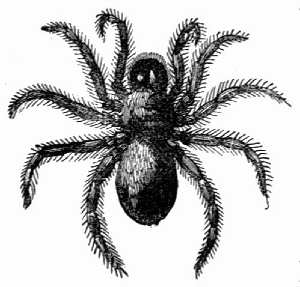
TRAP-DOOR SPIDER.
In the Ionian islands, and also in the West Indies [as well as in the
south of France, and in Corsica], there are found certain spiders (Cteniza)
commonly known as Trap-door Spiders, which make a cylindrical nest in
the earth, and cover the entrance with a door of their own construction,
framed of alternate layers of silk and earth, and fastened to the opening
by a hinge of stout silk.
These spiders also line their nests throughout
with numerous layers of silken web to the thickness of stout cartridge
paper, and finish it with the greatest care. This beautiful lining is yet
further strengthened in particular parts, where the nest is likely to be
exposed to danger. But the greatest amount of skill and care is bestowed
upon the trap-door and its silken hinge.
The door is about the eighth
of an inch thick, rough on the outside,
not much unlike an oyster-shell, which
it also resembles in being thick and
strong near the hinge, but thinner towards
the circumference. The breadth
of this hinge is various, but sometimes
it is very considerable, as shown in the
figure accompanying. It also possesses
great elastic force, so that, on being
opened, it closes again of itself. This
is principally accomplished by a fold
or doubling of the web, at each end
of the hinge, which permits the door
to be opened nearly to a right angle
with the aperture, but no further, unless
violence be used. The underside
of the door is perfectly smooth and firm, being shaped so as to fit
accurately, and yet to offer no resistance when pushed open by the insect.
SECTION OF NESt.
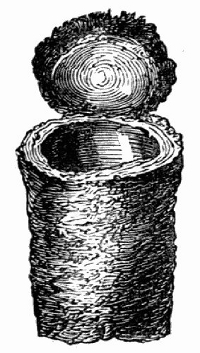
NEST OF TRAP-DOOR SPIDER.
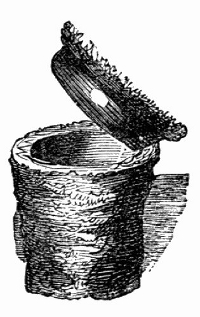
TRAP-DOOR OPENING BY A LEVER
As might be expected, there are varieties in the shape and size of these
nests. Some specimens found in the island of Zante had the silken layers
of the lid extended into a sort of handle, or lever, just above the hinge,
on pressing which, in ever so slight a degree, the trap-door opened. From
this it would appear, that the entrance to such a nest could be effected as
easily by the enemies of the spider as by the spider itself; this, however,
is not the case; for repeated observation has shown that the spider keeps
guard at the entrance, and actually holds the door with her fore-feet and
palpi, while the hind-feet are extended down the side of the nest, and
the mandibles are thrust into the opposite side near the door. By this
means the insects gets such power as to resist with considerable force the
opening of the door. If it be asked how this is known, we are able to refer
to the experiments of careful observers, who extracted a number of nests
from the ground, and opening them at the lower end, looked up, and saw
the spider so occupied. A section view of the nest will show that the
curved form of the cover, and the shape of the side walls, must favour
this method of keeping the door shut. In some cases, small hollows were
formed round the interior edge of the lid, into which the spider thrust
its feet when keeping guard. It is a curious fact, that when several of
these spiders enclosed in their nests were kept as a matter of curiosity in
a box of earth, and the doors frequently opened to examine their proceedings,
one or two of them, as if wearied at these repeated interruptions,
effectually closed their doors by weaving a piece of silken tapestry, which
was spread over the interior of the opening, and rounded like the inside
of a thimble. This was so strongly attached to the door and to the side
walls, that no opening could be made without destroying the nest.
PRICES OF GREEK VASES.
In the ancient times of Rome the vases of Greek pottery bore a high
value, and sold for enormous sums to connoisseurs, which has also been
the case in modern times. Cleopatra spent daily, on the fragrant or
flowery ware of Rhossus, a Syrian town, six minæ. Of the actual prices
paid for painted vases, no positive mention occurs in classical authorities,
yet it is most probable that vases of the best class, the products of eminent
painters, obtained considerable prices. Among the Greeks, works
of merit were at all times handsomely remunerated, and it is probable
that vases of excellence shared the general favour shown to the fine arts.
For works of inferior merit only small sums were paid, as will be seen
by referring to the chapter on inscriptions, which were incised on their
feet, and which mentioned their contemporary value. In modern times
little is known about the prices paid for these works of art till quite a
recent period, when their fragile remains have realised considerable sums.
In this country the collections of Mr. Townley, Sir W. Hamilton, Lord
Elgin, and Mr. Payne Knight, all contained painted vases. A sum of
£500 was paid in consideration of the Athenian vases in Lord Elgin's
collection, which is by no means large when the extraordinary nature of
these vases is considered, as they are the finest in the world of the old
primitive vases of Athens. £8,400 were paid for the vases of the
Hamilton collection, one of the most remarkable of the time, and consisting
of many beautiful specimens from southern Italy. The great
discoveries of the Prince of Canino, in 1827, and the subsequent sale of
numerous vases, gave them, however, a definite market value, to which
the sale of the collection of Baron Durand, which consisted almost entirely
of vases, affords some clue. His collection sold in 1836 for 313,160
francs, or about £12,524. The most valuable specimen in the collection
was the vase representing the death of Crœsus, which was purchased for
the Louvre at the price of 6,600 francs, or £264. The vase with the
subject of Arcesilaus brought 1,050 francs. Another magnificent vase,
now in the Louvre, having the subject of the youthful Hercules strangling
the serpents, was only secured for France after reaching the price of 6,000
francs, or £240: another, with the subject of Hercules, Dejanira, and
Hyllus, was purchased for the sum of 3,550 francs, or £142. A crater,
with the subject of Acamas and Demophoon bringing back Æthra, was
obtained by M. Magnoncourt for 4,250 francs, or £170. A Bacchic
amphora, of the maker Execias, of the archaic style, was bought by the
British Museum for 3,600 francs, or £142 in round numbers. Enough
has, however, been said to show the high price attained by the most
remarkable of these works of art. The inferior vases of course realised
much smaller sums, varying from a few francs to a few pounds; but high
prices continued to be obtained, and the sale by the Prince of Canino in
1837, of some of his finest vases, contributed to enrich the museums of
Europe, although, as many of the vases were bought in, it does not
afford a good criterion as to price. An œnochoe, with Apollo and the
Muses, and a hydria, with the same subject, were bought for 2,000 francs,
or £80 each. A cylix, with a love scene, and another with Priam
redeeming Hector's corpse, brought 6,600 francs, or £264. An amphora
with the subject of Dionysius, and a cup with that of Hercules, sold for
8,000 francs, or £320 each. Another brought 7,000 francs, or £280. A
vase with the subject of Theseus seizing Helen, another with the arming of
Paris, and a third with Peleus and Thetis, sold for 6,000 francs, or £240.
Nor can the value of the finest specimens of the art be considered to
have deteriorated since. The late Mr. Steuart was offered 7,500 francs
for a large crater, found in southern Italy, ornamented with the subject
of Cadmus and the dragon; 3,000 francs, or £120, were paid by the
British Museum for a fine crater ornamented with the exploits of Achilles:
2,500 francs, or £100, for an amphora of Apulian style, with the subject
of Pelops and Œnomaus at the altar of the Olympian Zeus. For another
vase, with the subject of Musæus, 3,000 francs, or £120 were paid, and
2,500 francs, or £100, for the Athenian prize vase, the celebrated Vas
Burgonianum, exhumed by Mr. Burgon. At Mr. Beckford's sale, the
late Duke of Hamilton gave £200 for a small vase, with the subject of
the Indian Bacchus.
The passion for possessing fine vases has outstripped these prices at
Naples; 2,400 ducats, or £500, was given for the vase with gilded figures
discovered at Cumæ. Still more incredible, half a century back, 8,000
ducats, £1,500, was paid to Vivenzio for the vase in the Museo Borbonico
representing the last night of Troy; 6,000 ducats, or £1,000, for the one
with a Dionysiac feast; and 4,000 ducats, or £800, for the vase with the
grand battle of the Amazons, published by Shultz. But such sums will
not be hereafter realised, not that taste is less, but that fine vases are
more common. No sepulchre has been spared when detected, and no vase
neglected when discovered; and vases have been exhumed with more
activity than the most of precious relics.
OLD WALKING STICKS.
It would seem that at the present time the fashion of carrying walking-sticks
has to a considerable extent "gone out." So great is the
bustle in our city thoroughfares, that the use of a staff, except by those
who are lame, is seldom adopted by business people. Professional men
still affect the custom, however; and your City man, although he may
repudiate the use of a walking-stick in town, straps a good sapling to
his portmanteau whenever he has a chance of getting amongst the woods
and green fields. About a century and a-half ago everybody carried a
cane. Dr. Johnson, Oliver Goldsmith, and a host of others, considered
a good stick as necessary as a coat; and a collection of these staves
would, if they could be had at the present day, be valuable, not only as
relics, but also as an indication of the characters of the owners, perhaps.
In former times, a golden-mounted stick or staff was commonly used
by both the male and female heads of families. Queen Elizabeth carried
one of these towards the end of her life. They were then more frequently
used, however, as a sign of authority than for any other purpose.
The staff was a weapon long before flint-headed arrows and such-like
instruments were invented. Sheriffs, and others high in authority, have
wands or staffs borne before them on important occasions; the bishops'
pastoral staff is as old as episcopal authority.
In former times the running footmen, who, in a body of half-a-dozen,
on each side of a carriage ran to alarm robbers and to assist the lumbering
vehicle out of the ruts, were well armed with stout staves. At the present
time they are still carried by the Plush family, although the use of them
is not so clear. In the royal state processions, the footmen with their
staves walk as in former days, and we should be sorry were these little
bits of ceremony dispensed with, inasmuch as they bring to recollection
a former condition of things, which makes us feel comfortable by comparison.
The monstrous sticks shown in the engraving are drawn from specimens
which have been preserved by dealers in London, and put as a
sort of sign at the doors of umbrella and walking-stick dealers. These
were, however, a century ago, common enough, and might have been
seen by the hundred together, borne by tall footmen behind ladies
dressed in the old hooped dresses which we are trying now to imitate.
At that time there was also a taste for various kinds of monsters, in
China, wood, and other materials. Monkeys and pug-dogs were made
pets of, and the sticks of the footmen fashioned into such ugly forms as
no modern bogey ever dreamed of.
These clubs, sticks, maces, or whatever they may be called, were
about six feet high, and were in parts painted and gilt. The centre one
is an elm-sapling, and the natural bumps have been taken advantage of
by the artist to model a sort of Moorish head, with ornamental covering;
lower down, the knobs are fashioned into terrible heads, in which are
mounted glass eyes of various and impossible colours.
No doubt before long these staffs, which might be necessary for the
protection of the ladies from the "Mohawks" of the time, will have
disappeared, and people will look with curiosity at Hogarth's representation
of them. Perhaps good specimens of such objects, which have
passed out of use, would be worthy of a place in our national museum.
One of the old-fashioned tinder-boxes would be a curiosity there now.
Although but a few years have passed since the introduction of lucifer
matches, it is no easy matter to get one of those old-fashioned machines.
THE SANCHI TOPE.
Under the name of topes are included the most important class of
Buddhist architecture in India. They consist of detached pillars, towers,
and tumuli, all of a sacred or monumental character. The word is a
corruption of the Sanscrit sthupa, meaning a mound, heap, or cairn.
By far the finest as well as the most perfect tope in India is that of
Sanchi, the principal one of those opened near Bilsah, in Central India.
It is uncertain whether it ever contained relics or not, as it had been
dug into in 1819 by Sir Herbert Maddock, since which time it has
remained a ruin, and may have been plundered by the natives. At any
rate it must have been a spot of peculiar sanctity, judging both from its
own magnificence, and from the number of subordinate topes grouped
around it. In fact there are a greater number of these monuments on
this spot, within a space not exceeding 17 miles, than there are, so far
at least as we now know, in the whole of India from the Sutlej to Cape
Comorin.
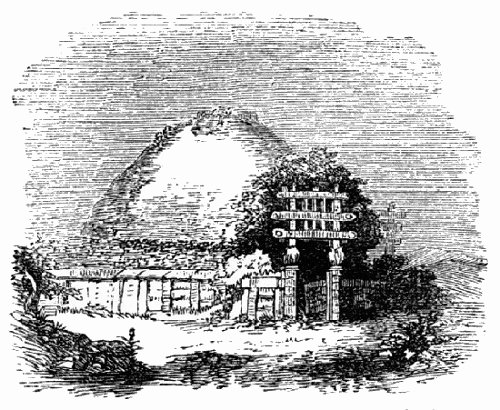
The general appearance of the Sanchi Tope will be understood from
the annexed view of it. The principal building consists of a dome
somewhat less than a hemisphere, 106 feet in diameter, and 42 feet in
height, with a platform on the top 34 feet across, which originally
formed the basis of the tee or capital, which was the invariable finish of
these monuments.
The dome rests on a sloping base, 14 feet in height by 120 in diameter,
having an offset on its summit about 6 feet wide. This, if we may
judge from the representations of topes on the sculptures, must have
been surrounded by a balustrade, and was ascended by a broad double
ramp on one side. It was probably used for processions encircling the
monument, which seem to have been among the most common Buddhist
ceremonials. The centre of this great mound is quite solid, being composed
of bricks laid in mud; but the exterior is faced with dressed
stones. Over these was laid a coating of cement nearly 4 inches in
thickness, which was, no doubt, originally adorned either with painting
or ornaments in relief.
The fence by which this tope is surrounded is extremely curious. It
consists of stone posts 8 ft. 8 in. high, and little more than 2 ft. apart.
These are surmounted by a plain architrave, 2 ft. 4 in. deep, slightly
rounded at the top. So far this enclosure resembles the outer circle at
Stonehenge; but between every two uprights three horizontal cross-pieces
of stone are inserted of an elliptical form, of the same depth as the
top piece, but only 9 in. thick in the thickest part. This is the only
built example yet discovered of an architectural ornament which is found
carved in every cave, and, indeed, in almost every ancient Buddhist
building known in India. The upright posts or pillars of this enclosure
bear inscriptions indicating that they were all given by different individuals.
But neither these nor any other inscriptions found in the
whole tope, nor in the smaller topes surrounding it (though there are as
many as 250 inscriptions in all), contain any known name, or any clue
to their age.
Still more curious, however, than even the stone railing are the four
gateways. One of these is shown in our view. It consists of two square
pillars, covered with sculptures, with bold elephant capitals, rising to a
height of 18 ft. 4 in.; above this are three lintels, slightly curved
upwards in the centre, and ending in Ionic scrolls; they are supported
by continuations of the columns, and three uprights inserted in the
spaces between the lintels. They are covered with elaborate sculptures,
and surmounted by emblems. The total height is 33 ft. 6 in. One
gateway has fallen, and if removed to this country would raise the character
of Indian sculpture, as nothing comparable to it has yet been
transported from that part of the world to Europe.
BURIAL PLACES OF DISTINGUISHED MEN.
Chaucer was buried in the cloisters of Westminster Abbey, without the
building, but removed to the south aisle in 1555; Spenser lies near him.
Beaumont, Drayton, Cowley, Denham, Dryden, Howe, Addison, Prior,
Congreve, Gray, Johnson, Sheridan, and Campbell, all lie within Westminster
Abbey. Shakspeare, as every one knows, was buried in the
chancel of the church at Stratford, where there is a monument to his
memory. Chapman and Shirley are buried at St. Giles'-in-the-Fields;
Marlow, in the churchyard of St. Paul's, Deptford; Fletcher and Massinger,
in the churchyard of St. Saviour's, Southwark; Dr. Donne, in
Old St. Paul's; Edward Waller, in Beaconsfield churchyard; Milton, in
the churchyard of St. Giles', Cripplegate; Butler, in the churchyard of
St. Paul's, Covent Garden; Otway, no one knows where; Garth, in the
churchyard at Harrow; Pope, in the church at Twickenham; Swift, in
St. Patrick's, Dublin; Savage, in the churchyard of St. Peter's, Dublin;
Parnell, at Chester, where he died on his way to Dublin; Dr. Young, at
Welwyn, in Hertfordshire, of which place he was the rector; Thomson, in
the churchyard at Richmond, in Surrey; Collins, in St. Andrew's Church,
at Chichester; Gray, in the churchyard at Stoke-Pogis, where he conceived
his "Elegy;" Goldsmith, in the churchyard of the Temple Church;
Falconer, at sea, with "all ocean for his grave;" Churchill, in the churchyard
of St. Martin's, Dover; Cowper, in the church at Dereham; Chatterton,
in a churchyard belonging to the parish of St. Andrew's, Holborn;
Burns, in St. Michael's churchyard, Dumfries; Byron, in the church of
Hucknall, near Newstead; Crabbe, at Trowbridge; Coleridge, in the
church at Highgate; Sir Walter Scott, in Dryburgh Abbey; Southey, in
Crosthwaite Church, near Keswick.
A REGAL HUNTING PARTY.
The following is an account of the destruction of game in Bohemia, by
a hunting party of which the Emperor Francis made one, in 1755.
There were twenty-three persons in the party, three of whom were ladies;
the Princess Charlotte of Lorraine was one of them. The chase lasted
eighteen days, and during that time they killed 47,950 head of game,
and wild deer; of which 19 were stags, 77 roebucks, 10 foxes, 18,243
hares, 19,545 partridges, 9,499 pheasants, 114 larks, 353 quails, 454
other birds. The Emperor fired 9,798 shots, and the Princess Charlotte
9,010; in all, there were 116,209 shots fired.
ANTIPATHIES.
Certain antipathies appear to depend upon a peculiarity of the senses.
The horror inspired by the odour of certain flowers may be referred to
this cause. Amatus Lusitanus relates the case of a monk who fainted
when he beheld a rose, and never quitted his cell when that flower was
blooming. Scaliger mentions one of his relations who experienced a
similar horror when seeing a lily. In these instances it is not the agreeableness
or the offensive nature of the aroma that inspires the repugnance;
and Montaigne remarked on this subject, that there were men who
dreaded an apple more than a musket-ball. Zimmerman tells us of a
lady who could not endure the feeling of silk and satin, and shuddered
when touching the velvety skin of a peach. Boyle records the case of a
man who felt a natural abhorrence to honey. Without his knowledge,
some honey was introduced in a plaster applied to his foot, and the accidents
that resulted compelled his attendants to withdraw it. A young
man was known to faint whenever he heard the servant sweeping.
Hippocrates mentions one Nicanor who swooned whenever he heard a
flute: our Shakspeare has alluded to the effects of the bagpipe. Julia
daughter of Frederick, king of Naples, could not taste meat without
serious accidents. Boyle fainted when he heard the splashing of water;
Scaliger turned pale at the sight of water-cresses; Erasmus experienced
febrile symptoms when smelling fish; the Duke d'Epernon swooned on
beholding a leveret, although a hare did not produce the same effect.
Tycho Brahe fainted at the sight of a fox, Henry the Third of France at
that of a cat, and Marshal d'Albert at a pig. The horror that whole
families entertain of cheese is generally known. Many individuals cannot
digest, or even retain certain substances, such as rice, wine, various
fruits, and vegetables.
A YOUNG BUT CRUEL MURDERESS.
On the 3d of July, 1772, was executed at Lisbon, pursuant to her
sentence, Louisa de Jesus, for the murder of the thirty-three infants,
that were at different times committed to her care by the Directors of
the Foundling Hospital at Coimbra; for which (as appears by the sentence
published) she had no other inducement but six hundred reals in
money, a coverda of baize, and a cradle, that she received with each of
them. She was but twenty-two years of age when executed. Going to
execution, she was pinched with hot irons, and at the gallows her hands
were struck off; she was then strangled, and her body burnt.
BECTIVE ABBEY.
Bective Abbey, the ruins of which form the subject of the annexed
engraving differs in its general arrangement
from every other monastic
structure in the kingdom. It
was, in fact, a monastic castle, and,
previous to the use of artillery,
must have been regarded as a place
of great strength. It is for this
reason that we select it as one of
our "Wonderful Things."
The ruins are in the immediate
neighbourhood of Trim, and about
thirty miles from Dublin.
The ruins combine a union of ecclesiastical with military and domestic
architecture in a remarkable degree. Their chief feature is a strong
battlemented tower, the lower compartment of which is vaulted, placed
at the south-west corner of the quadrangular space occupied by the various
buildings, and in the centre of which the cloisters remain in excellent
preservation. The cloister arches are late in the first pointed style, and
are cinque-foiled. The featherings are mostly plain, but several are ornamented
with flowers or leaves, and upon one a hawk-like bird is sculptured.
A fillet is worked upon each of the clustered shafts, by which
the openings are divided, and also upon their capitals. The bases, which
are circular, rest upon square plinths, the angles of which are ornamented
with a leaf, as it were, growing out of the base of the moulding.
Of the church there are scarcely any remains. As the northern wall
of the cloister is pierced with several windows, which have now the appearance
of splaying externally, it is extremely probable that it also
served as the south wall of the church, no other portion of which can at
present be identified. Those buildings which were for the most part
devoted to domestic purposes are for the most part situated upon the east
side of the quadrangle. Their architectural details are of a character
later than those of the tower and of the other portions, but additions and
alterations have evidently been made.
NOVEL MODE OF CELEBRATION.
Upon the occasion of the christening of the 21st child of Mr. Wright,
of Widaker, near Whitehaven, by the same woman, in the year 1767,
the company came from 21 parishes, and the entertainment consisted of
21 pieces of beef, 21 legs of mutton and lamb, 21 gallons of brandy,
three times 21 gallons of strong ale, three times 21 fowls, roasted and
boiled, 21 pies, &c.
ANTIQUE HEAD ORNAMENT.
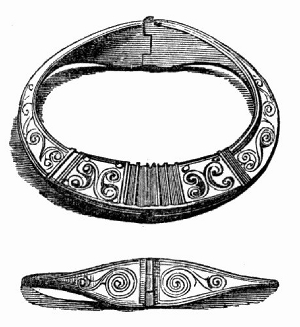
The annexed engraving represents an exceedingly beautiful bronze
relic, apparently of the class of head
rings, in the collection of the Society
of Antiquaries of Scotland, which
was discovered in the year 1747,
about seven feet below the surface,
when digging for a well, at the east
end of the village of Stitchel, in the
county of Roxburgh.
It bears a resemblance
in some respects to relics
of the same class in the Christiansborg
Palace, yet nothing exactly
similar to it has yet been found
among Scandinavian relics; while
some of its ornamental details closely
correspond to those which characterize
the British horse furniture
and other native relics of this period.
One of its most remarkable peculiarities
is, that it opens and shuts by means of a hinge, being clasped
when closed by a pin which passes through a double catch at a line intersecting
the ornament; and so perfect is it that it can still be opened
and secured with ease. It is probable that this also should rank among
the ornaments of the head, though it differs in some important respects
from any other object of the same class. The oval which it forms is not
only too small to encircle the head, but it will be observed from the engraving
that its greatest length is from side to side, the internal measurements
being five and nine-tenth inches by five and one-tenth inches.
RELICS.
At the commencement of the seventeenth century there was a crucifix
belonging to the Augustine friars at Burgos in Spain, which produced
a revenue of nearly seven thousand crowns per annum. It was
found upon the sea, not far from the coast, with a scroll of parchment
appended to it, descriptive of the various virtues it possessed. The
image was provided with a false beard and a chesnut periwig, which its
holy guardians declared were natural, and they also assured all pious
visitors that on every Friday it sweated blood and water into a silver
basin. In the garden of this convent grew a species of wheat, the grain
of which was peculiarly large, and which its possessors averred was
brought by Adam out of Paradise. Of this wheat they made small cakes
called pançillos, kneaded with the aforesaid blood and water, and sold
them to the credulous multitude for a quartillo a piece. These cakes
were an infallible remedy for all disorders, and over those who carried
them the devil had no power. They sold also blue ribands of the exact
length of the crucifix, for about a shilling each, with this inscription in
silver letters, "La madi del santo crucifisco de Burgos." These ribands
were a sovereign cure for the headache.
LONG MEG AND HER DAUGHTERS.
As there is something remarkable or out of the way in this family of
heavy stone, we present it to the reader. This venerable Druidical
monument, which is by the country-people called Long Meg and her
Daughters, stands near Little Salkeld, in the county of Cumberland. It
consists of 67 massy stones, of different sorts and sizes, ranged in a circle
of nearly 120 paces diameter; some of these stones are granite, some blue
and grey limestone, and others flint; many of them are ten feet high,
and fifteen or sixteen feet in circumference: these are called Long Meg's
Daughters. On the southern side of this circle, about seventeen or
eighteen paces out of the line, stands the stone called Long Meg, which
is of that kind of red stone found about Penrith. It is so placed, that
each of its angles faces one of the cardinal points of the compass; it
measures upwards of eighteen feet in height, and fifteen feet in girth;
its figure is nearly that of a square prism; it weighs about sixteen tons
and a half. In the part of the circle the most contiguous, four large
stones are placed in a square form, as if they had been intended to support
an altar; and towards the east, west, and north, two large stones
stand a greater distance from each other than any of the rest, seemingly
to form the entrances into a circle. It is remarkable that no stone-quarry
is to be found hereabouts. The appearance of this circle is much
hurt by a stone wall built across it, that cuts off a considerable segment,
which stands in the road. The same ridiculous story is told of these
stones, as of those at Stonehenge, i. e., that it is impossible to count
them, and that many persons who have made the trial, could never find
them amount twice to the same number. It is added, that this was a
holy place, and that Long Meg and her Daughters were a company of
witches transformed into stones, on the prayers of some saint, for venturing
to prophane it; but when, and by whom, the story does not say.
Thus has tradition obscurely, and clogged with fable, handed down the
destination of this spot, accompanied with some of that veneration in
which it was once undoubtedly held, though not sufficiently to protect
its remains from the depredations of avarice; the inclosure and cultivation
of the ground bidding fair to destroy them. These stones are mentioned
by Camden, who was either misinformed as to, or mis-reckoned their
number; unless, which seems improbable, some have been taken away.
"At Little Salkeld, (says he,) there is a circle of stones seventy-seven in
number, each ten feet high; and before these, at the entrance, is a single
one by itself, fifteen feet high. This the common people call Long Meg,
and the rest her Daughters; and within the circle, are two heaps of
stones, under which they say there are dead bodies buried; and, indeed,
it is probable enough that this has been a monument erected in memory
of some victory." The history of the British Druidical Antiquities
having been thoroughly investigated, since Camden's time, these circles
are now universally agreed to have been temples and places of judgment,
and not sepulchral monuments. Indeed his editor has, in some measure,
rectified his mistake, by the following addition: "But, as to the heaps
in the middle, they are no part of the monument, but have been gathered
off the ploughed lands adjoining; and (as in many other parts of the
county) thrown up here in a waste corner of the field; and as to the
occasion of it, both this, and the Rolrick stones in Oxfordshire, are supposed
by many, to have been monuments erected at the solemn investiture
of some Danish Kings, and of the same kind as the Kingstolen in
Denmark, and Moresteen in Sweden; concerning which, several large
discourses have been written."
CURIOUS PARTICULARS RELATIVE TO DRESS AT THE COMMENCEMENT OF
THE FIFTEENTH CENTURY.
Cloth of gold, satin, and velvet, enriched by the florid decorations of
the needle, were insufficient to satisfy the pride of nobles; robes formed
of these costly materials were frequently ornamented with embroidery
of goldsmiths' work, thickly set with precious stones; and the most
absurd and fantastic habits were continually adopted, in the restless
desire to appear in new inventions. John of Ghent is represented in a
habit divided straight down the middle, one side white, the other half
dark blue; and his son, Henry IV., on his return from exile, rode in
procession through London in a jacket of cloth-of-gold, "after the
German fashion." The dukes and earls who attended his coronation
wore three bars of ermine on the left arm, a quarter of a yard long, "or
thereabouts;" the barons had but two: and over the monarch's head
was borne a canopy of blue silk, supported by silver staves, with four
gold bells, "that rang at the corners." "Early in the reign of
Richard II. began," says Stowe, "the detestable use of piked shoes,
tied to the knees with chains of silver gilt; also women used high attire
on their heads with piked horns and long training gowns. The commons
also were besotted in excesse of apparel; in wide surcoates reaching to
their loines; some in a garment reaching to their heels, close before and
sprowting out at the sides, so that on the backe they make men seeme
women, and this they call by a ridiculous name—gowne. Their hoodes
are little, and tied under the chin."
ECCENTRIC FUNERAL.
Mr. John Oliver, an eccentric miller of Highdown Hill, in Sussex,
died, aged eighty-three, the 27th of May, 1793. His remains were
interred near his mill, in a tomb he had caused to be erected there for
that purpose, near thirty years ago; the ground having been previously
consecrated. His coffin, which he had for many years kept under his
bed, was painted white; and the body was borne by eight men clothed
in the same colour. A girl about twelve years old read the burial
service, and afterwards, on the tomb, delivered a sermon on the occasion,
from Micah 7, 8, 9, before at least two thousand auditors, whom curiosity
had led to see this extraordinary funeral.
EGYPTIAN STANDARDS.
The engraving which we here lay before our friends, represents a group
of Egyptian standards, as they were used in the army in the time of
Pharaoh.
Each regiment and company had its own peculiar banner or standard,
which were therefore very numerous, and various in their devices. A
beast, bird, or reptile, a sacred boat, a royal name in a cartouche, or a
symbolic combination of emblems, were the most common forms. As
they appear to have been objects of superstitious veneration that were
selected for this purpose, they must have contributed greatly to the enthusiasm
so highly valued in battle; and instances are common in all
history of desponding courage revived, and prodigies of valour performed,
on behalf of those objects which were so identified with national and
personal honour.
Allusions to standards, banners, and ensigns are frequent in the Holy
Scriptures. The four divisions in which the tribes of Israel marched
through the wilderness had each its governing standard, and tradition
has assigned to these ensigns the respective forms of the symbolic cherubim
seen in the vision of Ezekiel and John—that of Judah being a lion,
that of Reuben a man, that of Ephraim an ox, and that of Dan an eagle.
The post of standard-bearer was at all times of the greatest importance,
and none but officers of approved valour were ever chosen for such a service;
hence Jehovah, describing the ruin and discomfiture which he was
about to bring on the haughty King of Assyria, says, "And they shall
be as when a standard-bearer fainteth."
THE SHREW ASH.
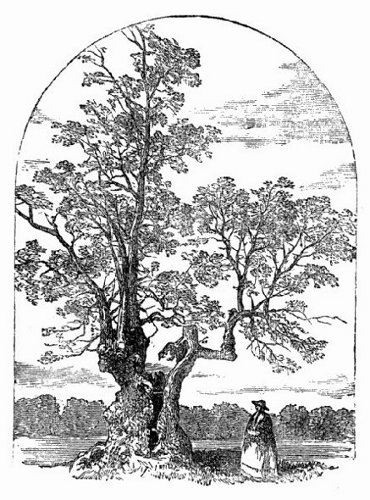
At that end of Richmond Park where a gate leads to Mortlake, and
near a cottage in which resides one of the most estimable gentlemen of
the age—Professor Owen—there still lives and flourishes a tree that has
been famous for many ages: it is the Shrew Ash, and the above is a correct
engraving of it. It stands on rising ground, only a few yards
beyond the pond which almost skirts the Professor's lawn. White, in
his Natural History of Selborne, describes a shrew-ash as an ash whose
twigs or branches, when gently applied to the limbs of cattle, will immediately
relieve the pains which a beast suffers from the running of a
shrew-mouse over the part affected; for it is supposed that a shrew-mouse
is of so baleful and deleterious a nature, that wherever it creeps
over a beast, be it horse, cow, or sheep, the suffering animal is afflicted
with cruel anguish, and threatened with the loss of the use of the limb.
Against this evil, to which they were continually liable, our provident
forefathers always kept a shrew-ash at hand, which, when once medicated,
would maintain its virtue for ever. A shrew-ash was made potent
thus:—Into the body of a tree a deep hole was bored with an auger, and
a poor devoted shrew-mouse was thrust in alive, and plugged in, no
doubt with several quaint incantations, long since forgotten. The shrew-ash
in Richmond Park is, therefore, amongst the few legacies of the kind
bequeathed to their country by the wisdom of our ancestors.
Our readers will perceive that across the hollow of the tree near the
top there is a little bar of wood. The legend runs that were this bar
removed every night, it would be replaced in the same spot every morning.
The superstition is, that if a child afflicted with what the people
in the neighbourhood call "decline," or whooping-cough, or any infantine
disease, is passed nine times up the hollow of that tree, and over
the bar, while the sun is rising, it will recover. If the charm fails to
produce the desired effect, the old women believe that the sun was too
far up, or not up enough. If the child recovers, of course, the fame of
the tree is whispered about. There is a sort of shrew-mother to every
shrew-ash, who acts as guide and teacher to any young mother who has
an afflicted child and believes in the charm. The ash in Richmond Park
is still used, and still firmly believed in.
A DRUM MADE OF HUMAN SKIN.
John Zisca, general of the insurgents who took up arms in the year
1419 against the Emperor Sigismund, to revenge the deaths of John
Huss, and Jerome of Prague, who had been cruelly burnt to death for
their religious tenets, defeated the Emperor in several pitched battles.
He gave orders that, after his death, they should make a drum of his
skin; which was most religiously obeyed, and those very remains of the
enthusiastic Zisca proved, for many years, fatal to the Emperor, who,
with difficulty, in the space of sixteen years, recovered Bohemia, though
assisted by the forces of Germany, and the terror of Crusades. The insurgents
were 40,000 in number, and well disciplined.
EARTHQUAKE IN JAMAICA.
The Earthquake of Jamaica, in 1692, is one of the most dreadful that
history has to record. It was attended with a hollow rumbling noise
like that of thunder, and in less than a minute all the houses on one
side of the principal street in the town of Port Royal sank into a fearful
gulf forty fathoms deep, and water came roaring up where the houses
had been. On the other side of the street the ground rose up and down
like the waves of the sea, raising the houses and throwing them into
heaps as it subsided. In another part of the town the street cracked
along all its length, and the houses appeared suddenly twice as far apart
as they were before. In many places the earth opened and closed again,
so that several hundred of these openings were to be seen at the same
time; and as the wretched inhabitants ran out of their tottering dwellings,
the earth opened under their feet, and in some cases swallowed
them up entirely; while in others, the earth suddenly closing, caught
them by the middle, and thus crushed them to death. In some cases
these fearful openings spouted up cataracts of water, which were attended
by a most noisome stench. It is not possible for any place to exhibit a
scene of greater desolation than the whole island presented at this
period. The thundering bellowing of the distant mountains, the dusky
gloom of the sky, and the crash of the falling buildings gave unspeakable
horror to the scene. Such of the inhabitants as were saved sought
shelter on board the ships in the harbour, and remained there for more
than two months, the shocks continuing with more or less violence every
day. When, at length, the inhabitants were enabled to return, they
found the whole face of the country changed. Very few of the houses
which had not been swallowed up were left standing, and what had been
cultivated plantations were converted into large pools of water. The
greater part of the rivers had been choked up by the falling in of detached
masses of the mountains, and spreading over the valleys, they had
changed what was once fertile soil into morasses, which could only be
drained by cutting new channels for the rivers; while the mountains
themselves had changed their shapes so completely, that it was conjectured
that they had formed the chief seat of the earthquake.
CURIOUS EXTRACTS FROM THE HOUSEHOLD BOOK OF LADY MARY,
DAUGHTER OF THE KING, IN VARIOUS YEARS, FROM THE 28TH TO
THE 36TH OF HENRY VIII. ROYAL MSS. BRIT. MUS.
"Item, geven to George Mountejoye drawing my Layde's Grace to his
Valentine, xls.
"Item, geven amongs the yeomen of the King's guard bringing a
Leke to my Lady's Grace on Saynt David's Day, xvs.
"Item, geven to Heywood playeng an enterlude with his children
before my Lady's Grace, xls.
"Item, payed for a yerde and a halfe of damaske for Jane the fole, vijs.
"Item, for shaving of Jane fooles hedde, iiijd.
"Payed for a frountlet lost in a wager to my Lady Margaret, iiijli.
"Item, payed for a brekefast lost at bolling by my Lady Mary's
Grace, xs."
GIVING DOLES.
A bishop of Durham, in the reign of Edward III, had every week
eight quarters of wheat made into bread for the poor, besides his alms-dishes,
fragments from his table, and money given away by him in
journeys. The bishop of Ely, in 1532, fed daily at his gates two
hundred poor persons, and the Lord Cromwell fed the same number.
Edward, earl of Derby, fed upwards of sixty aged poor, besides all
comers, thrice a week, and furnished, on Good Friday, two thousand
seven hundred people with meat, drink, and money. Robert Winchelsey,
archbishop of Canterbury, gave, besides the daily fragments of his house,
on Fridays and Sundays, to every beggar that came to his door, a loaf of
bread of a farthing value; in time of dearth he thus gave away five
thousand loaves, and this charity is said to have cost his lordship five
hundred pounds a year. Over and above this he gave on every festival
day one hundred and fifty pence to as many poor persons, and he used to
send daily meat, drink, and bread unto such as by age and sickness
were not able to fetch alms from his gate; he also sent money, meat,
apparel, &c., to such as he thought wanted the same, and were ashamed
to beg; and, above all, this princely prelate was wont to take compassion
upon such as were by misfortune decayed, and had fallen from wealth to
poor estate. Such acts deserve to be written in letters of gold.
FEMALE ORNAMENT OF THE IRON PERIOD.
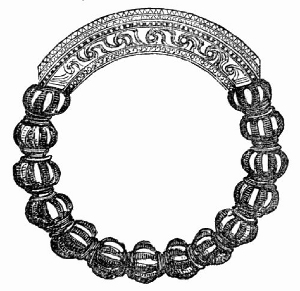
One of the most beautiful neck ornaments of the Teutonic or Iron
Period ever found in Scotland is a beaded torc, discovered by a labourer
while cutting turf in Lochar Moss, Dumfriesshire, about two miles to the
north of Cumlongan Castle; and exhibited by Mr. Thomas Gray, of
Liverpool, at the York meeting of the Archæological Institute. We
here annex an engraving of it.
The beads, which measure rather
more than an inch in diameter,
are boldly ribbed and grooved
longitudinally. Between every
two ribbed beads there is a small
flat one formed like the wheel of
a pulley, or the vertebral bone of
a fish. The portion which must
have passed round the nape of the
neck is flat and smooth on the
inner edge, but chased on the
upper side in an elegant incised
pattern corresponding to the ornamentation
already described as
characteristic of this period, and
bearing some resemblance to that
on the beautiful bronze diadem found at Stitchel in Roxburghshire,
figured on a subsequent page. The beads are disconnected, having apparently
been strung upon a metal wire, as was the case in another
example found in the neighbourhood of Worcester. A waved ornament,
chased along the outer edge of the solid piece, seems to have been designed
in imitation of a cord; the last tradition, as it were, of the string
with which the older necklace of shale or jet was secured. Altogether
this example of the class of neck ornaments, to which Mr. Birch has
assigned the appropriate name of beaded torcs, furnishes an exceedingly
interesting illustration of the development of imitative design, in contradistinction
to the more simple and archaic funicular torc, which, though
continued in use down to a later period, pertains to the epoch of primitive
art.
CURIOUS LANTERN.
In 1602, it is related that Sir John Harrington, of Bath, sent to
James VI King of Scotland, at Christmas, for a new year's gift, a dark
lantern. The top was a crown of pure gold, serving also to cover a
perfume pan; within it was a shield of silver, embossed, to reflect the
light; on one side of which were the sun, moon, and planets, and on the
other side, the story of the birth and passion of Christ, as it was engraved
by David II King of Scotland, who was a prisoner at Nottingham.
On this present, the following passage was inscribed in Latin—"Lord,
remember me when thou comest into thy kingdom."
ANCIENT SCANDINAVIAN BROOCH.
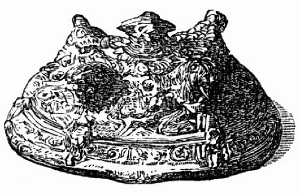
The characteristic and beautiful ornament, usually designated the
shell-shaped brooch, and equally familiar to Danish and British antiquaries,
belongs to the Scoto-Scandinavian Period. In Scotland many
beautiful examples have been found, several of which are preserved in
the Museum of Scottish Antiquaries. From these we select the one represented
in the annexed engraving, as surpassing in beauty of design
and intricacy of ornament any other example of which we are aware.
It consists, as usual, of a convex plate
of metal, with an ornamental border,
surmounted by another convex
plate of greater depth, highly ornamented
with embossed and perforated
designs, the effect of which
appears to have been further
heightened by the lower plate being
gilded so as to show through the
open work. In this example the
gilding still remains tolerably perfect.
On the under side are the projecting plates, still retaining a fragment
of the corroded iron pin, where it has turned on a hinge, and at
the opposite end the bronze catch into which it clasped. The under side
of the brooch appears to have been lined with coarse linen, the texture of
which is still clearly defined of the coating of verd antique with which
it is now covered. But its peculiar features consist of an elevated central
ornament resembling a crown, and four intricately-chased projections
terminating in horses' heads. It was found in September, 1786, along
with another brooch of the same kind, lying beside a skeleton, under a
flat stone, very near the surface, above the ruins of a Pictish house or
burgh, in Caithness. It measures nearly four and a half inches in length,
by three inches in breadth, and two and two-fifth inches in height to
the top of the crown. Like many others of the same type, it appears to
have been jewelled. In several examples of these brooches which we have
compared, the lower convex plates so nearly resemble each other, as to
suggest the probability of their having been cast in the same mould,
while the upper plates entirely differ.
STREET CRIES OF MODERN EGYPT.
The cries of the street hawkers in Egypt at the present day are very
singular, and well deserve a place in our repertory of curiosities. The
seller of tir'mis (or lupins) often cries "Aid! O Imba'bee! aid!" This
is understood in two senses: as an invocation for aid to the sheykh
El-Imba'bee, a celebrated Moos'lim saint, buried at the Imba'beh, on
the west bank of the Nile, opposite Cairo; in the neighbourhood of
which village the best tir'mis is grown; and also as implying that it is
through the aid of the saint above mentioned that the tir'mis of Imba'beh
is so excellent. The seller of this vegetable also cries, "The tir'mis of
Imba'beh surpasses the almond!" Another cry of the seller of tir'mis
is, "O how sweet are the little children of the river!" This last cry,
which is seldom heard but in the country towns and villages of Egypt,
alludes to the manner in which the tir'mis is prepared for food. To deprive
it of its natural bitterness, it is soaked, for two or three days, in a
vessel full of water; then boiled, and, after this, sewed up in a basket
of palm-leaves (called furd), and thrown into the Nile, where it is left
to soak again, two or three days; after which, it is dried, and eaten
cold, with a little salt. The seller of sour limes cries, "God make them
light [or easy of sale]! O limes!" The toasted pips of a kind of melon
called 'abdalla'wee, and of the water-melon, are often announced by the
cry of "O consoler of the embarrassed! O pips!" though more commonly,
by the simple cry of "Roasted pips!" A curious cry of the seller of a
kind of sweetmeat (hhala'wee), composed of treacle fried with some
other ingredients, is, "For a nail! O sweetmeat!" He is said to be half
a thief: children and servants often steal implements of iron, &c., from
the house in which they live, and give them to him in exchange for his
sweetmeat. The hawker of oranges cries, "Honey! O oranges! Honey!"
and similar cries are used by the sellers of other fruits and vegetables;
so that it is sometimes impossible to guess what the person announces for
sale; as, when we hear the cry of "Sycamore-figs! O grapes!" excepting
by the rule that what is for sale is the least excellent of the fruits,
&c., mentioned; as sycamore-figs are not so good as grapes. A very
singular cry is used by the seller of roses: "The rose was a thorn: from
the sweat of the Prophet it opened [its flowers]." This alludes to a
miracle related of the Prophet. The fragrant flowers of the hhen'na-tree
(or Egyptian privet) are carried about for sale, and the seller cries,
"Odours of paradise! O flowers of the hhen'na!" A kind of cotton
cloth, made by machinery which is put in motion by a bull, is announced
by the cry of "The work of the bull! O maidens!"
THE BLACK PESTILENCE.
The black pestilence of the fourteenth century caused the most terrific
ravages in England. It has been supposed to have borne some resemblance
to the cholera, but that is not the case; it derived its name from
the dark, livid colour of the spots and boils that broke out upon the
patient's body. Like the cholera, the fatal disease appeared to have
followed a regular route in its destructive progress; but it did not, like
the cholera, advance westward, although, like that fearful visitation, it
appears to have originated in Asia.
The black pestilence descended along the Caucasus to the shores of the
Mediterranean, and, instead of entering Europe through Russia, first
appeared over the south, and, after devastating the rest of Europe, penetrated
into that country. It followed the caravans, which came from
China across Central Asia, until it reached the shores of the Black Sea;
thence it was conveyed by ships to Constantinople, the centre of commercial
intercourse between Asia, Europe, and Africa. In 1347 it reached
Sicily and some of the maritime cities of Italy and Marseilles. During
the following year it spread over the northern part of Italy, France,
Germany, and England. The northern kingdoms of Europe were invaded
by it in 1349, and finally Russia in 1351—four years after it had appeared
in Constantinople.
The following estimate of deaths was considered far below the actual
number of victims:—
| Florence |
lost |
|
60,000 |
inhabitants |
| Venice |
" |
|
10,000 |
" |
| Marseilles |
" |
in one month |
56,000 |
" |
| Paris |
" |
" |
50,000 |
" |
| Avignon |
" |
" |
60,000 |
" |
| Strasburg |
" |
" |
16,000 |
" |
| Basle |
" |
" |
14,000 |
" |
| Erfurth |
" |
" |
16,000 |
" |
| London |
" |
" |
100,000 |
" |
| Norwich |
" |
" |
50,000 |
" |
Hecker states that this pestilence was preceded by great commotion in
the interior of the globe. About 1333, several earthquakes and volcanic
eruptions did considerable injury in upper Asia, while in the same year,
Greece, Italy, France, and Germany suffered under similar disasters.
The harvests were swept away by inundations, and clouds of locusts destroyed
all that floods had spared, while dense masses of offensive insects
strewed the land.
As in the recent invasion of cholera, the populace attributed this scourge
to poison and to the Jews, and these hapless beings were persecuted and
destroyed wherever they could be found. In Mayence, after vainly
attempting to defend themselves, they shut themselves up in their quarters,
where 1,200 of them burnt to death. The only asylum found by
them was Lithuania, where Casimir afforded them protection; and it is,
perhaps, owing to this circumstance that so many Jewish families are
still to be found in Poland.
THE DUCHESS OF LAUDERDALE.
Few mansions are more pleasantly situated than Ham House, the
dwelling of the Tollemaches, Earls of Dysart. It stands on the south
bank of the Thames, distant about twelve miles from London, and immediately
opposite to the pretty village of Twickenham. It was erected
early in the seventeenth century; the date 1610 still stands on the door
of the principal entrance. Its builder was Sir Thomas Vavasour, and it
subsequently came into the possession of Katherine, daughter of the
Earl of Dysart, who married first Sir Lionel Tollemache, and for her
second husband Earl, afterwards Duke, of Lauderdale.
The Duchess of Lauderdale was one of the "busiest" women of the
busy age in which she lived. Burnet insinuates that, during the life
time of her first husband, "she had been in a correspondence with
Lord Lauderdale that had given occasion for censure." She succeeded
in persuading him that he was indebted for his escape after "Worcester
fight" to "her intrigues with Cromwell. She was a woman," continues
the historian, "of great beauty, but of far greater parts. She had a
wonderful quickness of apprehension, and an amazing vivacity in conversation.
She had studied, not only divinity and history, but mathematics
and philosophy. She was violent in everything she set about,—a
violent friend, but a much
more violent enemy. She had a
restless ambition, lived at a vast
expense, and was ravenously covetous,
and would have stuck at nothing
by which she might compass
her ends." Upon the accession of
her husband to political power after
the Restoration, "all applications
were made to her. She took upon
her to determine everything; she
sold all places; and was wanting in
no method that could bring her
money, which she lavished out in a
most profuse vanity."
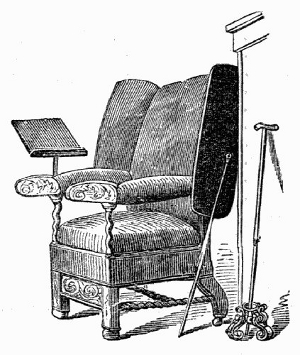
This Duchess of Lauderdale—famous
during the reigns of four
monarchs—the First and Second
James, and the First and Second
Charles, and through the Protectorship
of Cromwell—refurnished the
house at Ham, where she continued to reside until her death at a very
advanced age.
Among other untouched relics of gone-by days, is a small ante-chamber,
where, it is said, she not only condescended to receive the
second Charles, but, if tradition is to be credited, where she "cajoled"
Oliver Cromwell. There still remains the chair in which she used to sit,
her small walking cane, and a variety of objects she was wont to value
and cherish as memorials of her active life, and the successful issue of a
hundred political intrigues.
MODERN EGYPTIAN MUSICAL INSTRUMENTS.
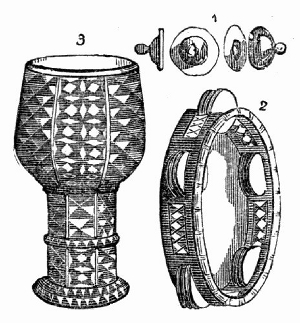
Sa'ga't (1), Ta'r (2), and Dar'abook'keh (3).
The durwee'shes, who constitute a sort of religious mendicant order in
Egypt, often make use of, in their processions and in begging, a little
tubl, or kettle-drum, called ba'z; six or seven inches in diameter;
which is held in the left hand, by a little projection in the centre of the
back, and beaten by the right hand, with a short leather strap, or a stick.
They also use cymbals, which are called ka's, on similar occasions. The
ba'z is used by the Moosahh'hhir, to attract attention to his cry in the
nights of Rum'ada'n. Castanets of brass, called sa'ga't are used by the
public female and male dancers. Each dancer has two pairs of these
instruments. They are attached, each by a loop of string, to the thumb
and second finger, and have a more pleasing sound than castanets of wood
or ivory. There are two instruments which are generally found in the
hharee'm of a person of moderate wealth, and which the women often
use for their diversion. One of these is a tambourine, called ta'r, of
which we insert an engraving.
It is eleven inches in diameter. The
hoop is overlaid with mother-of-pearl,
tortoise-shell, and white bone,
or ivory, both without and within,
and has ten circular plates of brass
attached to it, each two pairs having
a wire passing through their
centres. The ta'r is held by the
left or right hand, and beaten with
the fingers of that hand and by the
other hand. The fingers of the
hand which holds the instrument,
striking only near the hoop, produce
higher sounds than the other
hand, which strikes in the centre.
A tambourine of a larger and more
simple kind than that here described,
without the metal plates,
is often used by the lower orders. The other instrument alluded to in
the commencement of this paragraph is a kind of drum, called dar'abook'keh.
The best kind is made of wood, covered with mother-of-pearl
and tortoise-shell, &c. One of this description is here represented with
the ta'r. It is fifteen inches in length, covered with a piece of fishes'
skin at the larger extremity, and open at the smaller. It is placed
under the left arm; generally suspended by a string that passes over
the left shoulder; and is beaten with both hands.
REMARKABLE OAKS.
The oaks most remarkable for their horizontal expansion, are, according
to Loudon, the following:—"The Three-shire Oak, near Worksop,
was so situated, that it covered part of the three counties of York,
Nottingham, and Derby, and dripped over seven hundred and seventy-seven
square yards. An oak between Newnham Courtney and Clifton
shaded a circumference of five hundred and sixty yards of ground,
under which two thousand four hundred and twenty men might have
commodiously taken shelter. The immense Spread Oak in Worksop
Park, near the white gate, gave an extent, between the ends of its
opposite branches, of an hundred and eighty feet. It dripped over an
area of nearly three thousand square yards, which is above half an
acre, and would have afforded shelter to a regiment of nearly a thousand
horse. The Oakley Oak, now growing on an estate of the Duke of
Bedford, has a head of an hundred and ten feet in diameter. The oak
called Robur Britannicum, in the Park, at Rycote, is said to have been
extensive enough to cover five thousand men; and at Ellerslie, in Renfrewshire,
the native village of the hero Wallace, there is still standing
'the old oak tree,' among the branches of which, it is said, that he and
three hundred of his men hid themselves from the English."
CURIOUS ADVERTISEMENT.
A few years ago the following actually appeared in one of the London
papers: certainly a most economical speculation for the use of soul and
body:—
"Wanted, for a family who have bad health, a sober, steady person,
in the capacity of doctor, surgeon, apothecary, and man-midwife. He
must occasionally act as butler, and dress hair and wigs. He will be
required sometimes to read prayers, and to preach a sermon every Sunday.
A good salary will be given."
CHANGES OF MOUNT ETNA.
Signor Maria Gemmellario has given, from a meteorological journal
kept at Catania, a very interesting view of the successive changes of
Mount Etna, at a period in which it was in the phase of moderate
activity; and no description could convey so accurate a conception of
the ever-changing phenomena.
On the 9th of February, 1804, there was a sensible earthquake. Etna
smoked ninety-seven days, but there was no eruption nor any thunder.
On the 3rd of July, 1805, there was an earthquake. Etna smoked
forty-seven days, and emitted flame twenty-eight days. There was an
eruption in June, but no thunder.
There were earthquakes on the 27th of May and 10th of October,
1806. The mountain smoked forty-seven days, flamed seven, and
detonated twenty-eight: little thunder.
On the 24th of February and 25th of November, 1807, there were
earthquakes. Etna smoked fifty-nine days: little thunder.
In August, September, and December, 1808, earthquakes were frequent.
Etna smoked twelve days, flamed one hundred and two, and
often detonated. Thunder storms were frequent.
From January to May, and during September and December, 1809,
there were thirty-seven earthquakes. The most sensible shock was on
the 27th of March, when the mountain ejected lava on the western side.
This eruption lasted thirteen days, and part of the Bosco di Castiglione
was injured. The mountain smoked one hundred and fifty-two days,
flamed three, and detonated eleven. Little thunder.
On the 16th and 17th of February, 1810, there were four earthquakes.
On the 27th of October, Etna was in a state of eruption on the eastern
side, and the lava flowed into the Valle del Bue. There were about
twenty thunder storms.
1811, no earthquakes, but the mountain continued until the 24th of
April to eject lava from the east. At this time the Mount St. Simon was
formed. No thunder.
Earthquake on the 3rd and 13th of March, 1813. The mountain
smoked twenty-eight days. On the 30th of June, and on the 5th of
August, St. Simon smoked. There were twenty-one thunder storms.
On the 3rd of November, 1814, there was an earthquake, preceded by
a discharge of sand from that part of the mountain called Zoccolaro.
There were twelve thunder storms.
On the 6th of September, 1815, there was an earthquake. The mountain
smoked forty-two days, and there were eleven thunder storms. On
the 6th, 7th, and 11th of January the lightning was tremendous.
1816, no earthquakes. On the 13th of August a part of the interior
side of the crater fell in. Ten thunder storms.
There was an earthquake on the 18th of October, 1817. The mountain
smoked twenty-two days. There were eight thunder storms.
During 1818 there were twenty-five earthquakes. The most violent
was in the neighbourhood of Catania, on the 20th of February. The
mountain smoked twenty-four days. No thunder.
CHARITY INSTEAD OF POMP.
According to the "Annual Register" for August, 1760, there were
expended at the funeral of Farmer Keld, of Whitby, in that year, one
hundred and ten dozen of penny loaves, eight large hams, eight legs of
veal, twenty stone of beef (fourteen pounds to the stone), sixteen stone
of mutton, fifteen stone of Cheshire cheese, and thirty ankers of ale,
besides what was distributed to about one thousand poor people, who
had sixpence each in money given them.
THE BEDFORD MISSAL.
One of the most celebrated books in the annals of bibliography, is the
richly illuminated Missal, executed for John, Duke of Bedford, Regent
of France, under Henry VI.; by him it was presented to that king, in
1430. This rare volume is eleven inches long, seven and a-half wide,
and two and a-half thick; contains fifty-nine large miniatures, which
nearly occupy the whole page, and above a thousand small ones, in circles
of about an inch and a-half diameter, displayed in brilliant borders of
golden foliage, with variegated flowers, etc.; at the bottom of every
page are two lines in blue and gold letters, which explain the subject of
each miniature. This relic, after passing through various hands, descended
to the Duchess of Portland, whose valuable collection was sold
by auction, in 1786. Among its many attractions was the Bedford
Missal. A knowledge of the sale coming to the ears of George III., he
sent for his bookseller, and expressed his intention to become the purchaser.
The bookseller ventured to submit to his majesty the probable
high price it would fetch. "How high?" exclaimed the king. "Probably,
two hundred guineas," replied the bookseller. "Two hundred guineas
for a Missal!" exclaimed the queen, who was present, and lifted her
hands up with astonishment. "Well, well," said his majesty, "I'll
have it still; but since the queen thinks two hundred guineas so enormous
a price for a Missal, I'll go no further." The biddings for the
Royal Library did actually stop at that point; a celebrated collector,
Mr. Edwards, became the purchaser by adding three pounds more. The
same Missal was afterwards sold at Mr. Edwards' sale, in 1815, and purchased
by the Duke of Marlborough, for the enormous sum of £637 l5s.
sterling.
CALICINATED RINGS.
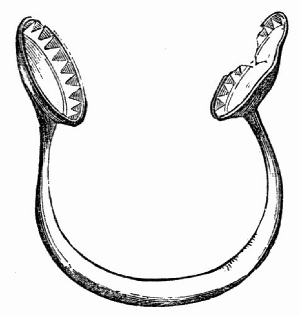
There is a particular class of antique gold ornaments, belonging to the
Bronze Period, which is deserving of especial attention, from the circumstance
that the British Isles is the only locality in which it has yet been
discovered. These ornaments consist of a solid cylindrical gold bar, beat
into a semicircle or segmental arc, most frequently tapering from the
centre, and terminated at both ends with hollow cups, resembling the
mouth of a trumpet, or the expanded calix of a flower. A remarkable
example of these curious native relics is engraved in the "Archæological
Journal." The cups are formed merely by hollows in the slightly dilated
ends; but it is further interesting from being decorated with the style of
incised ornaments of most frequent
occurrence on the primitive British
pottery.
It was dug up at Brahalish,
near Bantry, county Cork, and
weighs 3 oz. 5 dwts. 6 grs. In contrast
to this, another is engraved in
the same journal, found near the entrance
lodge at Swinton Park, Yorkshire,
scarcely two feet below the
surface. In this beautiful specimen
the terminal cups are so unusually
large, that the solid bar
of gold dwindles into a mere connecting-link
between them. The
annexed figure of a very fine example
found by a labourer while
cutting peats in the parish of
Cromdale, Inverness-shire, somewhat
resembles that of Swinton Park in the size of its cups. It
is from a drawing by the late Sir Thomas Dick Lauder, and represents
it about one-half the size of the original. Similar relics of
more ordinary proportions have been brought to light, at different
times, in various Scottish districts.
EXTRAORDINARY CRICKET MATCHES.
Every day in summer wagers are made at Lord's cricket ground, upon
matches there to be played; but there have been more extraordinary
matches elsewhere relative to this exercising game; for a cricket match
was played on Blackheath, in the year 1766, between eleven Greenwich
pensioners who had lost each an arm, and eleven others who had lost
each a leg. The former won with ease. And again, on the 9th of
August, 1796, a cricket match was played by eleven Greenwich pensioners
with one leg, against eleven with one arm, for one thousand
guineas, at the new cricket ground, Montpelier gardens, Walworth. At
nine o'clock the men arrived in three Greenwich stages; about twelve
the wickets were pitched, and they commenced. Those with but one leg
had the first innings, and got 93 runs; those with but one arm got but
42 runs during their innings. The one-leg commenced their second
innings, and six were bowled out after they had got 60 runs; so that
they left off one hundred and eleven more than those with one arm.
Next morning the match was played out; and the men with one leg beat
the one-arms by one hundred and three runs. After the match was
finished the eleven one-legged men ran a sweep-stakes of one hundred
yards distance for twenty guineas, and the three first had prizes.
MUMMY CASES.
The annexed engraving represents a set of Egyptian mummy cases,
several of which were used for the interment of one body, the smaller
one being enclosed within the larger.
On the death of a king in Egypt,
"three score and ten days" was the
period that intervened from his departure
to the termination of the
embalming operations; the earlier
and more important of which, exclusive
of the soaking in natron,
occupied forty days. The coffin, or
wooden case, in which the embalmed
body of Joseph was preserved, till at
the exodus it was carried from Egypt,
was, doubtless, of such a form and
appearance as those with which we
are familiar at our museums. An
account of some specimens of these,
and of the internal shells which
were considered requisite for persons
of rank, will be read with interest.
Before the better kind of mummies were put into their wooden cases,
they were placed in a shell in the following manner:—Nine thick layers of
hempen or linen cloth were well gummed together, so as to make a strong
flexible kind of board, something like a piece of papier mâché. This
was formed into the shape of the swathed mummy, which was inserted
in it by means of a longitudinal aperture on the under side, reaching
from the feet to the head. The two sides of this long aperture were then
drawn together by a coarse kind of stitching, done with a large needle
and thin hempen cord. The inside of this hempen case was covered with
a thin coating of plaster, and the outside was also covered with a similar
sort of plaster, on which were painted rude figures of beetles, ibides, &c.,
&c., apparently with ochrous earths tempered with water; they could be
easily rubbed off with the finger, except where they were fixed by an
outer coating of gum. On the upper part of this case a human face was
represented, and for the purpose of giving additional strength and firmness
to that part of the hempen covering, a considerable quantity of earth
and plaster was stuck on the inside, so that it would be more easy to
mould the material on the outside, while still flexible, into a resemblance
of the human form. The face was covered with a strong varnish,
to keep the colour fixed. The outer case was generally made of the
Egyptian fig-sycamore wood, and the parts of it were fastened together
with wooden pegs. This wood was used by the Egyptians for a variety
of purposes, as we find even common domestic utensils made of it. The
pegs of the sycamore cases were not always of the sycamore wood, which,
when cut thin, would hardly be so suitable as some more closely-grained
wood; the pegs, therefore, of the inner cases were of a different wood,
generally of cedar. Bodies embalmed in the highest style of fashion,
had, in addition to the inner coffin which we have described, an outer
wooden box, such as Herodotus mentions, with a human face, male or
female, painted on it. Some of these cases were plain, and others highly
ornamented with figures of sacred animals, or with paintings representing
mythological subjects.
The wooden case which contained the body was sometimes cut out of
one piece of wood, and the inside was made smooth, and fit for the reception
of the painted figures, by laying on it a thin coat of fine plaster.
This plaster was also used as a lining for the wooden cases which were
not made of a single piece. There was often a second wooden case, still
more highly ornamented and covered with paintings secured by a strong
varnish. These paintings were intended to embody the ideas of the
Egyptians as to the state of death, the judgment or trial which preceded
the admission into the regions below, and other matters connected with
the ritual of the dead and the process of embalming.
The upper part of each of the wooden cases was made to represent a
human figure, and the sex was clearly denoted by the character of the
head-dress, and the presence or absence of the beard. Both the head-dress
and the ornaments about the neck, as far as the bosom, were exactly
of the same character as those which we see on the sculptures and paintings.
The brief remark of Herodotus, that the friends put the swathed
mummy "into a wooden figure made to resemble the human form," is
amply borne out.
INSTINCT OF ANIMALS.
Gall and various observers of animals have fully ascertained that the
attention of dogs is awakened by our conversation. He brought one of
these intelligent creatures with him from Vienna to Paris, which perfectly
understood French and German, of which he satisfied himself by
repeating before it whole sentences in both languages. A recent anecdote
has been related of an old ship-dog, that leaped overboard and
swam to shore on hearing the captain exclaim, "Poor old Neptune! I
fear we shall have to drown him!" and such was the horror which that
threat inspired, that he never afterwards would approach the captain or
any of the ship's company, to whom he had previously been fondly
attached. It must, however, be observed that in the brute creation, as
in ours (sometimes more brutal species), peculiar attributes, that do not
belong to the race, distinguish individuals gifted with what in man we
might call a superior intellect, but which in these animals shows a
superiority of what we term instinct. Spurzheim relates an instance of
a cow belonging to Mr. Dupont de Nemours, which, amongst the whole
kindred herd, was the only one that could open the gate leading to their
pastures; and her anxious comrades, when arriving at the wished-for
spot, invariably lowed for their conductor. It is also related of a hound,
who, unable to obtain a seat near the fire without the risk of quarrelling
with the dozing occupants that crowded the hearth, was wont to run out
into the court-yard barking an alarm that brought away his rivals in
comfort, when he quietly re-entered the parlour, and selected an eligible
stretching-place. This animal displayed as much ingenuity as the
traveller who, according to the well-known story, ordered oysters for his
horse for the purpose of clearing the fireside.
BELL OF ST. MURA.
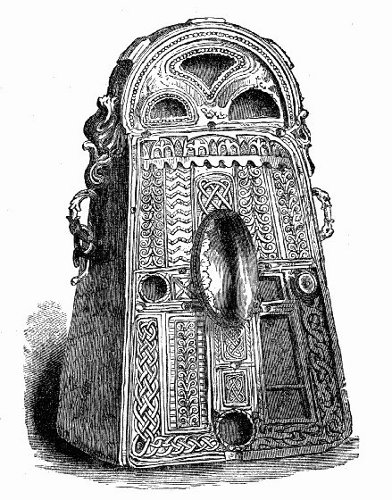
This curious relic, engraved over leaf, two-thirds the size of the original,
is remarkable as a work of art, as well as a genuine relic of the most
venerable antiquity; it was formerly regarded with superstitious reverence
in Ireland, and any liquid drunk from it was believed to have
peculiar properties in alleviating human suffering; hence, the peasant
women of the district in which it was long preserved, particularly used
it in cases of child-birth, and a serious disturbance was excited on a
former attempt to sell it by its owner. Its legendary history relates that
it descended from the sky ringing loudly; but as it approached the concourse
of people who had assembled at the miraculous warning, the
tongue detached itself and returned towards the skies; hence it was
concluded that the bell was never to be profaned by sounding on earth,
but was to be kept for purposes more holy and beneficent. This is said
to have happened on the spot where once stood the famous Abbey of
Fahan, near Innishowen (County Donegal), founded in the seventh
century by St. Mura, or Muranus, during the reign of Abodh Slaine.
For centuries this abbey was noted as the depository of various valuable
objects, which were held in especial veneration by the people. Amongst
these were several curious manuscripts written by St. Mura, his crozier,
and this bell; which ultimately came into the possession of a poor peasant
residing at Innishowen, who parted with it to Mr. Brown, of Beaumaris,
at whose sale in 1855 it was purchased by Lord Londesborough. The material
of the bell is bronze, and its form quadrangular, resembling other
ancient Irish bells, and leading to the conclusion that it is the genuine
work of the seventh century. The extreme feeling of veneration shown towards
it in various ages is proved by the ornament with which it is encased.
By the accidental removal of one portion of the outer casing, a series of
earlier enrichments were discovered beneath, which were most probably
placed there in the ninth century. The portion disclosed (the lower
right hand corner) consists of a tracery of Runic knots wrought in brass,
and firmly attached to the bell by a thin plate of gold;—whether the
remainder of these early decorations, now concealed, be similar, cannot
be determined without removing the outer plates. These exterior ornaments
consist of a series of detached silver plates of various sizes
diversely embossed in the style known to have prevailed in the eleventh
century. The centre is adorned with a large crystal, and smaller gems
have once been set in other vacant sockets around it, only one of amber
remaining. The two large spaces in front of the arched top were also
most probably filled with precious stones, as the gold setting still remains
entire. The best workmanship has been devoted to these decorations;
the hook for suspending the bell is of brass, and has been covered with
early bronze ornament which has been filled in with niello, the intervening
space being occupied by silver plates ornamented like the rest of
the later decorations which cover its surface. From the absence of any
traces of rivets on the back or sides of the bell, the decoration it has
received may have been restricted to the casing of the handle and the
enrichment of the front of this venerated relic.
CURIOUSLY-SHAPED DRINKING CUP.
Drinking cups of a fantastic shape were very much in vogue in the
sixteenth century. Sometimes they assumed the shape of birds, sometimes
of animals. In general it is the head that takes off, and serves as
a lid or cover; but sometimes the orifice is in another part of the body,
as, for example, on the back. The specimen now before us is from Lord
Londesborough's collection.
The stag is of silver, gilt all over; the collar set with a garnet. Silver
bands encircle this curious figure, to which are appended many small
silver escutcheons engraved with the arms and names of distinguished
officers of the Court of Saxe Gotha, the latest being "Her Von Maagenheim,
Camer Juncker und Regierung Assessor in Gotha, d. 15 Augusti,
Ao 1722." It has probably been a prize for shooting, successively won
by those persons whose arms decorate it.
BANQUETS TO QUEEN ELIZABETH.
Few English sovereigns were so well acquainted with their dominions
as was Queen Elizabeth: she may be said to have visited every corner of
her empire, and in these royal journeys or "progresses," as they are
called, her loyal subjects strove to outvie each other in the splendour of
their receptions. Nothing could surpass the magnificence of the entertainments
thus planned for the queen's gratification, either as respects
the splendour of show, or the costliness of the more substantial banquet.
These occasions are too numerous to mention; and we can only notice
one of the queen's visits to the palace at Greenwich, as described by a
German, who travelled in England in 1598. It was Sunday, and after
attending service in the chapel, the queen prepared for dinner. A gentleman
entered the room bearing a rod, and with him another bearing a
table-cloth, which, after they had both kneeled three times, he spread
upon the table, and after kneeling again, they both retired: then came
two others, one with the rod again, the other with a salt-cellar, a plate,
and bread, which, after kneeling, they also placed on the table: then
came an unmarried and a married lady, bearing a tasting-knife, and
having stooped three times gracefully, they rubbed the table with bread
and salt. Then came the yeomen of the guard, bringing in, at each
time, a course of dishes, served in plate, most of it gilt; these dishes
were received by a gentleman, and placed upon the table, while the
lady-taster gave to each guard a mouthful to eat of the particular dish
he had brought, for fear of any poison. During the time that this guard
(which consisted of the tallest and stoutest men that could be found in
all England, being carefully selected for this service) were bringing
dinner, twelve trumpets and two kettle-drums made the hall ring for
half an hour together. After this a number of unmarried ladies appeared,
who lifted the meat from the table, and conveyed it to the queen's inner
and more private chamber, where, after she had chosen for herself, the
rest was sent to the ladies of the court. The queen dined and supped
alone, with very few attendants.
THE GREAT FOG OF 1783.
It prevailed over the adjoining continent, and produced much fear
that the end of all things was at hand. It appeared first at Copenhagen
on the 29th of May, reached Dijon on the 14th June, and was perceived
in Italy on the 16th. It was noticed at Spydberg, in Norway, on the
22nd, and at Stockholm two days later; the following day it reached
Moscow. On the 23rd it was felt on the St. Gothard, and at Buda. By
the close of that month it entered Syria; and on the 18th of July,
reached the Altai Mountains. Before its appearance at these places the
condition of the atmosphere was not similar; for in this country it
followed continued rains; in Denmark it succeeded fine weather of some
continuance; and in other places it was preceded by high winds. The
sun at noon looked rusty-red, reminding one of the lines of Milton. The
heat was intense during its continuance, and the atmosphere was highly
electric. Lightnings were awfully vivid and destructive. In England
many deaths arose from this cause, and a great amount of property was
lost. In Germany public edifices were thrown down or consumed by it;
and in Hungary one of the chief northern towns was destroyed by fires,
caused by the electric fluid, which struck it in nine different places. In
France there were hailstones and violent winds. In Silesia there were
great inundations. The dry fogs of 1782-83 were accompanied by influenza;
at St. Petersburgh 40,000 persons were immediately attacked by
it, after the thermometer had suddenly risen 30 degrees. Calabria and
Sicily were convulsed by earthquakes; in Iceland a volcano was active,
and about the same time one sprung out of the sea off Norway. The
co-existence of dry fogs with earthquakes and volcanic eruptions had
been previously observed—e.g., in the years 526, 1348, 1721; and since
then, in 1822 and 1834.
A somewhat similar fog overspread London before the cholera of 1831,
and the influenza of 1847. Hecker ("Epidemics of the Middle Ages")
has collected notices of various phenomena of this kind, which have preceded
the great continental plagues, and have often been characterised
by offensive odours.
MONKEYS DEMANDING THEIR DEAD.
Mr. Forbes tells a story of a female monkey (the Semnopithecus
Entellus) who was shot by a friend of his, and carried to his tent.
Forty or fifty of her tribe advanced with menacing gestures, but stood
still when the gentleman presented his gun at them. One, however,
who appeared to be the chief of the tribe, came forward, chattering and
threatening in a furious manner. Nothing short of firing at him
seemed likely to drive him away; but at length he approached the tent
door with every sign of grief and supplication, as if he were begging for
the body. It was given to him, he took it in his arms, carried it away,
with actions expressive of affection, to his companions, and with them
disappeared. It was not to be wondered at that the sportsman vowed
never to shoot another monkey.
BARA.
Mr. Howel, in his descriptive travels through Sicily, gives a particular
account of the magnificent manner in which the festival of the Assumption
of the Virgin is kept by the Sicilians under the title of Bara, which,
although expressive of the machine he describes, is also, it appears,
generally applied as a name of the feast itself. An immense machine of
about 50 feet high is constructed, designing to represent Heaven; and
in the midst is placed a young female personating the Virgin, with an
image of Jesus on her right hand; round the Virgin 12 little children
turn vertically, representing so many Seraphim, and below them 12
more children turn horizontally, as Cherubim; lower down in the
machine a sun turns vertically, with a child at the extremity of each of
the four principal radii of his circle, who ascend and descend with his
rotation, yet always in an erect posture; and still lower, reaching
within about 7 feet of the ground, are placed 12 boys, who turn horizontally
without intermission around the principal figure, designing
thereby to exhibit the 12 apostles, who were collected from all corners of
the earth, to be present at the decease of the Virgin, and witness her
miraculous assumption. This huge machine is drawn about the principal
streets by sturdy monks; and it is regarded as a particular favour
to any family to admit their children in this divine exhibition.
CRADLE OF HENRY V.
Most of our readers have probably seen, in the illustrated newspapers
of the day, sketches of the magnificently artistic cradles which have been
made for the children of our good
Queen, or for the Prince Imperial of
France. It will be not a little
curious to contrast with those elaborately
beautiful articles the cradle
of a Prince of Wales in the fourteenth
century. We here give a
sketch of it.
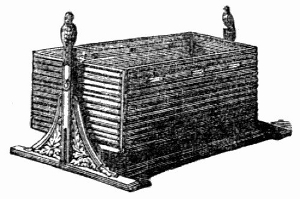
It was made for the use of Henry
Prince of Wales, afterwards King
Henry V, generally called Henry of
Monmouth, because he was born in
the castle there in the year 1388. He was the son of Henry IV of
Bolingbroke, by his first wife Mary de Bohun. He was educated at
Queen's College, Oxford, under the superintendence of his half uncle,
the great Cardinal Henry Beaufort. On the accession of his father to
the throne, he was created Prince of Wales, and, at the early age of
sixteen, was present at the battle of Shrewsbury, where he was badly
wounded in the face. After having greatly distinguished himself in the
war against Owen Glendour, he spent some years idleness and dissipation,
but on his coming to the throne, by the death of his father,
April 20, 1413, he threw off his former habits and associates, chose his
ministers from among those of tried integrity and wisdom in his father's
cause, and seemed everywhere intent on justice, on victory over himself,
and on the good of his subjects. After a short but glorious reign of ten
years, in which the victory of Agincourt was the principal event, he
expired at the Bois de Vincennes, near Paris, on the last day of August,
1422, in the thirty-fourth year of his age. He was engaged at the time
in a war with the Dauphin of France. His heart was warm as his head
was cool, and his courage equal to his wisdom, which emboldened him
to encounter the greatest dangers, and surmount the greatest difficulties
His virtues were not inferior to his abilities, being a dutiful son, a fond
parent, an affectionate brother, a steady and generous friend, and an
indulgent master. In a word, Henry V., though not without his failings,
merits the character of an amiable and accomplished man, and a
great and good king. Such was the sovereign, for whose infant years
the plain, but still not tasteless, cradle was made, which we have here
engraved, as it is preserved in the castle of Monmouth, his birthplace.
THE FONT AT KILCARN.
The venerable old church at Kilcarn, near Navan, in the county of
Meath, contains a font of great rarity, and we have selected it as a fitting
object for our work, inasmuch as it is a striking instance of the union of
the beautiful with the curious.
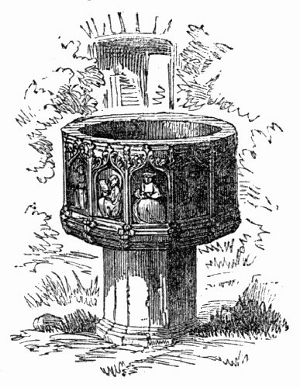
Placed upon its shaft, as represented
in the cut, it measures in
height about three feet six inches;
the basin is two feet ten inches in
diameter, and thirteen inches deep.
The heads of the niches, twelve in
number, with which its sides are
carved, are enriched with foliage of
a graceful but uniform character,
and the miniature buttresses which
separate the niches are decorated
with crockets, the bases resting
upon heads, grotesque animals, or
human figures, carved as brackets.
The figures within the niches are
executed with a wonderful degree
of care, the drapery being represented
with each minute crease or
fold well expressed. They are evidently
intended to represent Christ,
the Virgin Mary, and the twelve apostles. All the figures are seated.
Our Saviour, crowned as a King, and holding in his hand the globe and
cross, is in the act of blessing the Virgin, who also is crowned, the
"Queen of Heaven." The figures of most of the apostles can easily be
identified: Saint Peter by his key; Saint Andrew by his cross of peculiar
shape; and so on. They are represented barefooted, and each holds
a book in one hand.
THE BLOOD-SUCKING VAMPIRE.
Captain Stedman, who travelled in Guiana, from 1772 to 1777, published
an account of his adventures, and for several years afterwards it
was the fashion to doubt the truth of his statements. In fact, it was a
general feeling, up to a much later period than the above, that travellers
were not to be believed. As our knowledge, however, has increased,
and the works of God have been made more manifest, the reputation of
many a calumniated traveller has been restored, and, among others, that
of Captain Stedman. We shall, therefore, unhesitatingly quote his
account of the bite of the vampire:—"On waking, about four o'clock
this morning, in my hammock, I was extremely alarmed at finding
myself weltering in congealed blood, and without feeling any pain whatever.
Having started up and run to the surgeon, with a firebrand in
one hand, and all over besmeared with gore, the mystery was found to
be, that I had been bitten by the vampire or spectre of Guiana, which is
also called the flying dog of New Spain. This is no other than a bat of
monstrous size, that sucks the blood from men and cattle, sometimes
even till they die; knowing, by instinct, that the person they intend to
attack is in a sound slumber, they generally alight near the feet, where,
while the creature continues fanning with his enormous wings, which
keeps one cool, he bites a piece out of the tip of the great toe, so very
small indeed, that the head, of a pin could scarcely be received into the
wound, which is consequently not painful; yet, through this orifice
he contrives to suck the blood until he is obliged to disgorge. He then
begins again, and thus continues mucking and disgorging till he is
scarcely able to fly, and the sufferer has often been known to sleep from
time into eternity. Cattle they generally bite in the ear, but always in
those places where the blood flows spontaneously. Having applied
tobacco-ashes as the best remedy, and washed the gore from myself and
my hammock, I observed several small heaps of congealed blood all
around the place where I had lain upon the ground; upon examining
which, the surgeon judged that I had lost at least twelve or fourteen
ounces during the night. Having measured this creature (one of the
bats), I found it to be, between the tips of the wings, thirty-two inches
and a-half; the colour was a dark brown, nearly black, but lighter
underneath."
LUXURY IN 1562.
The luxury of the present times does not equal, in one article at least,
that of the sixteenth century. Sir Nicholas Throckmorton, the Queen's
ambassador at Paris, in a letter to Sir Thomas Chaloner, the ambassador
at Madrid, in June, 1562, says,
"I pray you good my Lord Ambassador sende me two paire of parfumed
gloves, parfumed with orrange flowers and jacemin, th'one for my
wives hand, the other for mine owne; and wherin soever I can pleasure
you with any thing in this countrey, you shall have it in recompence
thereof, or els so moche money as they shall coste you; provided alwaies
that they be of the best choise, wherein your judgment is inferior to
none."
SINGULAR PHENOMENON—PHOSPHORESCENCE OF THE SEA.
The sea has sometimes a luminous appearance, a phenomenon that has
been observed by all sailors, who consider it the forerunner of windy
weather. It is said to occur most frequently in the summer and autumn
months, and varies so much in its character, as to induce a doubt
whether it can always be attributed to the same cause. Sometimes the
luminous appearance is seen over the whole surface of the water, and the
vessel seems as though floating upon an ocean of light. At other times,
the phosphorescence is only seen immediately around the ship. A portion
of water taken from the sea does not necessarily retain its luminous
appearance, but its brilliance will generally continue as long as the water
is kept in a state of agitation. Some naturalists imagine the phosphorescence
of the sea to arise from the diffusion of an immense number
of animalculæ through the medium, and others attribute it to electricity.
Dr. Buchanan has given an account of a very remarkable appearance of
the sea, observed by him during a voyage from Johanna to Bombay.
About eight o'clock in the evening of the 31st of July, 1785, the sea
had a milk-white colour, and upon it were floating a multitude of
luminous bodies greatly resembling that combination of stars known as
the milky way, the brightest of them representing the larger stars of a
constellation. The whiteness, he says, was such as to prevent those on
board from seeing either the break or swell of the sea, although, from
the motion of the ship and the noise, they knew them to be violent, and
the light was sufficiently intense to illuminate the ropes and rigging.
This singular phenomenon continued till daylight appeared. Several
buckets of water were drawn, and in them were found a great number
of luminous bodies, from a quarter of an inch to an inch and a half in
length, and these were seen to move about as worms in the water.
There might be, he said to Dr. Buchanan, four hundred of these animals
in a gallon of water. A similar appearance had been observed before in
the same sea by several of the officers, and the gunner had seen it off
Java Head, in a voyage to China.
MARRIAGE VOW.
The matrimonial ceremony, like many others, has undergone some
variation in the progress of time. Upwards of three centuries ago, the
husband, on taking his wife, as now, by the right hand, thus addressed
her:—"I. N. undersygne the N. for my wedded wyfe, for better, for
worse, for richer, for porer, yn sickness, and in helthe, tyl dethe us
departe, (not "do part," as we have erroneously rendered it, the ancient
meaning of "departe," even in Wickliffe's time, being "separate") as
holy churche hath ordeyned, and thereto I plygth the my trowthe." The
wife replies in the same form, with an additional clause, "to be buxom
to the, tyl dethe us departe." So it appears in the first edition of the
"Missals for the use of the famous and celebrated Church of Hereford,
1502," fol. In what is called the "Salisbury Missal," the lady pronounced
a more general obedience: "to be bonere and buxom in bedde
and at the borde."
LOVE OF GARDENS.
Louis XVIII., on his restoration to France, made, in the park in Versailles,
the facsimile of the garden at Hartwell; and there was no more
amiable trait in the life of that accomplished prince. Napoleon used to
say that he should know his father's garden in Corsica blindfolded, by
the smell of the earth! And the hanging-gardens of Babylon are said
to have been raised by the Median Queen of Nebuchadnezzar on the flat
and naked plains of her adopted country, to remind her of the hills and
woods of her childhood. We need not speak of the plane-trees of Plato—Shakspeare's
mulberry-tree—Pope's willow—Byron's elm? Why describe
Cicero at his Tusculum—Evelyn at Wotton—Pitt at Ham Common—Walpole
at Houghton—Grenville at Dropmere? Why dwell on
Bacon's "little tufts of thyme," or Fox's geraniums? There is a spirit
in the garden as well as in the wood, and the "lilies of the field" supply
food for the imagination as well as materials for sermons.
ANCIENT DANISH SHIELD.
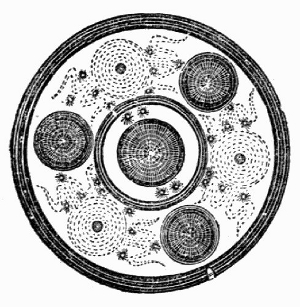
In Asia, from whence the greater number, probably all, of the
European nations have migrated, numerous implements and weapons of
copper have been discovered in a particular class of graves; nay, in some
of the old and long-abandoned mines in that country workmen's tools
have been discovered, made of copper, and of very remote antiquity.
We see, moreover, how at a later period attempts were made to harden
copper, and to make it better suited for cutting implements by a slight
intermixture, and principally of tin.
Hence arose that mixed metal to
which the name of "bronze" has
been given. Of this metal, then,
the Northmen of "the bronze period"
formed their armour, and among numerous
other articles, three shields
have been discovered which are made
wholly of bronze; and we here give
a sketch of the smallest of them,
which is about nineteen inches in
diameter, the other two being twenty-four.
These shields are formed of
somewhat thin plates of bronze, the
edge being turned over a thick wire
metal to prevent the sword penetrating
too deeply. The handle is formed of a cross-bar, placed at the
reverse side of the centre boss, which is hollowed out for the purpose of
admitting the hand.
SACRED GARDENS.
The origin of sacred gardens among the heathen nations may be
traced up to the garden of Eden. The gardens of the Hesperides, of
Adonis, of Flora, were famous among the Greeks and Romans. "The
garden of Flora," says Mr. Spence (Polymetis, p. 251), "I take to have
been the Paradise in the Roman mythology. The traditions and traces
of Paradise among the ancients must be expected to have grown fainter
and fainter in every transfusion from one people to another. The
Romans probably derived their notions of it from the Greeks, among
whom this idea seems to have been shadowed out under the stories of the
gardens of Alcinous. In Africa they had the gardens of the Hesperides,
and in the East those of Adonis, or the Horti Adonis, as Pliny
calls them. The term Horti Adonides was used by the ancients to
signify gardens of pleasure, which answers to the very name of Paradise,
or the garden of Eden, as Horti Adonis does to the garden of the Lord."
ANCIENT CHAIR OF DAGOBERT.
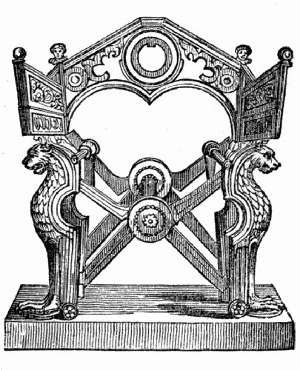
The chair which we here engrave claims to be regarded as a great
curiosity, on two separate grounds: it is the work of an artist who was
afterwards canonized, and it was used by Napoleon I. on a most important
occasion. Towards the close of the sixth century the artists of France
were highly successful in goldsmith's work, and Limoges appears to have
been the principal centre of this industry.
It was at this time that Abbon
flourished—a goldsmith and mint-master, with whom was placed the
young Eloy, who rose from a simple artizan to be the most remarkable
man of his century, and whose virtues were rewarded by canonization.
The apprentice soon excelled his master, and his fame caused him to be
summoned to the throne of Clotaire II., for whom he made two thrones
of gold, enriched with precious stones, from a model made by the king
himself, who had not been able to
find workmen sufficiently skilful to
execute it. The talents and probity
of St. Eloy also gained him the affection
of Dagobert I., who entrusted
him with many important works, and
among them, with the construction
of the throne, or chair of state which
is the subject of this article.
It is made of bronze, carved and gilded,
and is a beautiful specimen of workmanship.
The occupant of the chair
would sit upon a cloth of gold suspended
from the two side bars. For
a long time it was preserved in the
sacristy of the royal church of St.
Denis, at Paris; but it was subsequently
removed to the Great Library,
where it now is. It was
upon this chair that Napoleon I.,
in August, 1804, distributed the crosses of the Legion of Honour to the
soldiers of the army assembled at Boulogne for the invasion of England.
Napoleon caused the chair to be brought from Paris for the express
purpose.
ST GEORGE'S CAVERN.
Near the town of Moldavia, on the Danube, is shown the cavern where
St. George slew the Dragon, from which, at certain periods, issue
myriads of small flies, which tradition reports to proceed from the carcass
of the dragon. They respect neither man nor beast, and are so
destructive that oxen and horses have been killed by them. They are
called the Golubacz's fly. It is thought when the Danube rises, as it
does in the early part of the summer, the caverns are flooded, and the
water remaining in them, and becoming putrid, produces this noxious
fly. But this supposition appears to be worthless, because, some years
ago, the natives closed up the caverns, and still they were annoyed
with the flies. They nearly resemble mosquitoes. In summer they
appear in such swarms as to look like a volume of smoke; and they
sometimes cover a space of six or seven miles. Covered with these
insects, horses not unfrequently gallop about until death puts an end to
their sufferings. Shepherds anoint their hands with a decoction of
wormwood, and keep large fires burning to protect themselves from
them. Upon any material change in the weather the whole swarm is
destroyed thereby.
ENGLISH LETTER BY VOLTAIRE.
The subjoined letter is copied literally from the autograph of Voltaire,
formerly in the possession of the Rev. Mr. Sim, the editor of Mickle's
Poems:—
"Sir,
"j wish you good health, a quick sale of yr burgundy, much latin,
and greeke to one of yr Children, much Law, much of cooke, and littleton,
to the other. quiet and joy to mistress brinsden, money to all. when
you'll drink yr burgundy with mr furneze pray tell him j'll never forget
his favours.
But dear john be so kind as to let me know how does my lady Bollingbroke.
as to my lord j left him so well j dont doubt he is so still.
but j am very uneasie about my lady. if she might have as much health
as she has Spirit and witt, sure She would be the strongest body in england.
pray dear sr write me Something of her, of my lord, and of you.
direct yr letter by the penny post at mr Cavalier, Belitery Square by the
R. exchange. j am sincerely and heartily yr most humble most obedient
rambling friend
"Voltaire.
"to
"john Brinsden, esq.
"durham's yard
"by charing cross."
THE GOLDEN CHALICE OF IONA.
A chalice, as used in sacred ceremonies, is figured on various early
Scottish ecclesiastical seals, as well as on sepulchral slabs and other
medieval sculptures. But an original Scottish chalice, a relic of the
venerable abbey of St. Columba, presented, till a very few years since, an
older example of the sacred vessels of the altar than is indicated in any
existing memorial of the medieval Church. The later history of this
venerable relic is replete with interest. It was of fine gold, of a very
simple form, and ornamented in a style that gave evidence of its belonging
to a very early period. It was transferred from the possession of
Sir Lauchlan MacLean to the Glengarry family, in the time of Æneas,
afterwards created by Charles II. Lord Macdonell and Arross, under the
circumstances narrated in the following letter from a cousin of the celebrated
Marshal Macdonald, Duke of Tarentum, and communicated by a
clergyman (Rev. Æneas M'Donell Dawson), who obtained it from the
family of the gentleman to whom it was originally addressed:—
"The following anecdote I heard from the late bishop, John Chisholm,
and from Mr. John M'Eachan, uncle to the Duke of Tarentum, who died
at my house at Irin Moidart, aged upwards of one hundred years:—
"Maclean of Duart, expecting an invasion of his lands in Mull, by his
powerful neighbour the Earl of Argyll, applied to Glengarry for assistance.
Æneas of Glengarry marched at the head of five hundred men to
Ardtornish, nearly opposite to Duart Castle, and crossing with a few of
his officers to arrange the passage of the men across the Sound of Mull,
Maclean, rejoicing at the arrival of such a friend, offered some choice
wine in a golden chalice, part of the plunder of Iona. Glengarry was
struck with horror, and said, folding his handkerchief about the chalice,
'Maclean, I came here to defend you against mortal enemies, but since,
by sacrilege and profanation, you have made God your enemy, no human
means can serve you.' Glengarry returned to his men, and Maclean
sent the chalice and some other pieces of plate belonging to the service of
the altar, with a deputation of his friends, to persuade him to join him;
but he marched home. His example was followed by several other chiefs,
and poor Maclean was left to compete, single-handed, with his powerful
enemy."
Such was the last historical incident connected with the golden chalice
of Iona, perhaps, without exception, the most interesting ecclesiastical
relic which Scotland possessed. Unfortunately its later history only
finds a parallel in that of the celebrated Danish golden horns. It was
preserved in the charter-chest of Glengarry, until it was presented by
the late Chief to Bishop Ronald M'Donald, on whose demise it came into
the possession of his successor, Dr. Scott, Bishop of Glasgow. Only a few
years since the sacristy of St. Mary's Roman Catholic Church in that
city, where it was preserved was broken into, and before the police could
obtain a clue to the depredators, the golden relic of Iona was no longer a
chalice. Thus perished, by the hands of a common felon, a memorial of
the spot consecrated by the labours of some of the earliest Christian missionaries
to the Pagan Caledonians, and which had probably survived
the vicissitudes of upwards of ten centuries. In reply to inquiries made
as to the existence of any drawing of the chalice, or even the possibility
of a trustworthy sketch being executed from memory, a gentleman in
Glasgow writes:—"I have no means of getting even a sketch from which
to make a drawing. Were I a good hand myself, I could easily furnish
one, having often examined it. It was a chalice that no one could look
on without being convinced of its very great antiquity. The workmanship
was rude, the ornamental drawings or engravings even more hard
than medieval ones in their outlines, and the cup bore marks of the original
hammering which had beaten it into shape."
NEW MODE OF REVENGE.
Monkeys in India are more or less objects of superstitious reverence,
and are, consequently, seldom or ever destroyed. In some places they
are even fed, encouraged, and allowed to live on the roofs of the houses.
If a man wish to revenge himself for any injury committed upon him,
he has only to sprinkle some rice or corn upon the top of his enemy's
house, or granary, just before the rains set in, and the monkeys will
assemble upon it, eat all they can find outside, and then pull off the
tiles to get at that which falls through the crevices. This, of course,
gives access to the torrents which fall in such countries, and house, furniture,
and stores are all ruined.
CURIOUS SUPERSTITION.
The ring of which we here give a sketch has been selected by us as a
subject for engraving and comment, because it
embodies a curious superstition which was very
prevalent in England in the fifteenth and sixteenth
centuries.
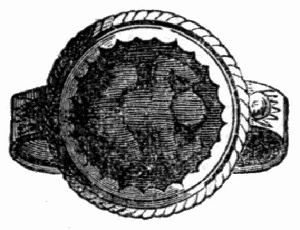
The setting is of silver, and the jewel which it
carries is called a toadstone. This stone was
popularly believed to be formed in the heads of
very old toads, and it was eagerly coveted by
sovereigns, and by all persons in high office,
because it was supposed to have the power of indicating to the person
who wore it the proximity of poison, by perspiring and changing colour.
Fenton, who wrote in 1569, says—"There is to be found in the heads of
old and great toads a stone they call borax or stelon;" and he adds—"They,
being used as rings, give forewarning against venom." Their
composition is not actually known; by some they are thought to be a
stone—by others, a shell; but of whatever they may be formed, there
is to be seen in them, as may be noticed in the engraving, a figure
resembling that of a toad, but whether produced accidentally or by
artificial means is not known, though, according to Albertus Magnus,
the stone always bore the figure on its surface, at the time it was taken
out of the toad's head. Lupton, in his "1000 Notable Things," says—"A
toadstone, called crepaudina, touching any part envenomed, hurt, or
stung with rat, spider, wasp, or any other venomous beast, ceases the
pain or swelling thereof." The well known lines in Shakespeare are
doubtless in allusion to the virtue which Lupton says it possesses:—
"Sweet are the uses of adversity;
Which like a toad, ugly and venomous,
Wears yet a precious jewel in his head."
Ben Jonson also in the Fox, has,—
"Were you enamoured on his copper rings,
His saffron jewel, with the loadstone in't?"
And Lyly, in his Euphues—
"The foule toad hath a faire stone in his head."
The ring we have engraved is a work of the fifteenth century; it
forms one of the many rare curiosities of the Londesborough Collection,
and is considered to be a very perfect specimen.
ANCIENT ARMLET.
In May, 1840, some workmen were employed at Everdale, near Preston,
in carrying earth to replace the soil which had been washed away
from behind a wall formerly built to protect the banks of the river Ribble.
In digging for this purpose, they discovered, at a distance of about forty
yards from the banks, a great number of articles, consisting of ingots of
silver, a few ornaments, some silver armlets, and a large quantity of
coins. An attentive examination of all these, and especially of the coins,
leads to the conclusion that this mass of treasure was deposited about the
year 910, and the articles must be considered such as were worn at the
time of King Alfred, or perhaps somewhat earlier.
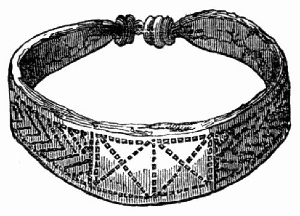
The armlets, which were all of silver, vary in breadth from a quarter
of an inch to an inch and a quarter, and perhaps more. They are generally
ornamented, and almost all the
ornaments are produced by punching
with tools of various forms.
The patterns
are numerous, but the forms of
the punches are very few, the variations
being produced by combining the
forms of more punches than one, or by
placing the same or differently-formed
punches at a greater or less distance
from each other, or by varying their
direction. In the specimen which we
have here engraved the punch has had a small square end, and the ornament
is formed by a series of blows in transverse or oblique lines. Patterns
of the period and localities to which these ornaments belong are
scarcely ever found finished by casting or chasing. It would appear,
also that the use of solder to unite the various parts of objects was either
little known or little practised; for the ends of these ornaments are tied
together, and, upon other occasions where union is necessary, rivets are
employed.
CHINESE MIRRORS.
There is a puzzling property in many of the Chinese mirrors which
deserves particular notice, and we may give it, together with the
solution furnished by Sir David Brewster:—"The mirror has a knob
in the centre of the back, by which it can be held, and on the rest of
the back are stamped in relief certain circles with a kind of Grecian
border. Its polished surface has that degree of convexity which gives
an image of the face half its natural size; and its remarkable property
is, that, when you reflect the rays of the sun from the polished surface,
the image of the ornamental border and circles stamped upon the back,
is seen distinctly reflected on the wall," or on a sheet of paper. The
metal of which the mirror is made appears to be what is called Chinese
silver, a composition of tin and copper, like the metal for the specula of
reflecting telescopes. The metal is very sonorous. The mirror has a
rim (at the back) of about 1-4th or 1-6th of an inch broad, and the
inner part, upon which the figures are stamped, is considerably thinner.
"Like all other conjurors (says Sir David Brewster), the artist has
contrived to make the observer deceive himself. The stamped figures
on the back are used for this purpose. The spectrum in the luminous
area is not an image of the figures on the back. The figures are a copy
of the picture which the artist has drawn on the face of the mirror,
and so concealed by polishing, that it is invisible in ordinary lights,
and can be brought out only in the sun's rays. Let it be required, for
example, to produce the dragon as exhibited by one of the Chinese
mirrors. When the surface of the mirror is ready for polishing, the
figure of the dragon may be delineated upon it in extremely shallow
lines, or it may be eaten out by an acid much diluted, so as to remove
the smallest possible portion of the metal. The surface must then be
highly polished, not upon pitch, like glass and specula, because this
would polish away the figure, but upon cloth, in the way that lenses
are sometimes polished. In this way the sunk part of the shallow lines
will be as highly polished as the rest, and the figure will only be visible
in very strong lights, by reflecting the sun's rays from the metallic
surface."
THE CADENHAM OAK.
Amongst the many remarkable trees in the New Forest in Hampshire,
is one called the Cadenham Oak, which buds every year in the depth of
winter. Gilpin says, "Having often heard of this oak, I took a ride to
see it on the 29th of December, 1781. It was pointed out to me among
several other oaks, surrounded by a little forest stream, winding round
a knoll on which they stood. It is a tall straight plant, of no great
age, and apparently vigorous, except that its top has been injured, from
which several branches issue in the form of pollard shoots. It was
entirely bare of leaves, as far as I could discern, when I saw it, and
undistinguishable from the other oaks in its neighbourhood, except that
its bark seemed rather smoother, occasioned, I apprehended, only by
frequent climbing. Having had the account of its early budding confirmed
on the spot, I engaged one Michael Lawrence, who kept the
White Hart, a small alehouse in the neighbourhood, to send me some of
the leaves to Vicar's Hill, as soon as they should appear. The man,
who had not the least doubt about the matter, kept his word, and sent
me several twigs on the morning of the 5th of January, 1782, a few
hours after they had been gathered. The leaves were fairly expanded,
and about an inch in length. From some of the buds two leaves had
unsheathed themselves, but in general only one. One of its progeny,
which grew in the gardens at Bulstrode, had its flower buds perfectly
formed so early as the 21st of December, 1781.
"This early spring, however, of the Cadenham oak, is of very short
duration. The buds, after unfolding themselves, make no further progress,
but immediately shrink from the season and die. The tree continues
torpid, like other deciduous trees, during the remainder of the
winter, and vegetates again in the spring, at the usual season. I have
seen it in full leaf in the middle of the summer, when it appeared, both
in its form and foliage, exactly like other oaks."
Dean Wren, speaking of this tree, says, "King James could not be
induced to believe the [Greek: to toi] (reason) of this, till Bishop Andrewes, in
whose diocese the tree grew, caused one of his own chaplaines, a man of
known integritye, to give a true information of itt, which he did; for
upon the eve of the Nativitye he gathered about a hundred slips, with
the leaves newly opened, which he stuck in claye in the bottom of long
white boxes, and soe sent them post to the courte, where they deservedly
raised not only admiration, but stopt the mouth of infidelitye and contradiction
for ever. Of this I was both an eye-witness, and did distribute
many of them to the great persons of both sexes in court and
others, ecclesiastical persons. But in these last troublesome times a
divelish fellow (of Herostratus humour) having hewen itt round at the
roote, made his last stroke on his own legg, whereof he died, together
with the old wondrous tree; which now sproutes up againe, and may
renew his oakye age againe, iff some such envious chance doe not hinder
or prevent itt; from which the example of the former villaine may perchance
deterr the attempt. This I thought to testifie to all future
times, and therefore subscribe with the same hand through which those
little oakye slips past."
SCHOOL EXPENSES IN THE OLDEN TIME.
Of the expenses incurred for schoolboys at Eton early in the reign of
Elizabeth, we find some curious particulars in a manuscript of the time:
the boys were sons of Sir William Cavendish, of Chatsworth, and the
entries are worth notice, as showing the manners of those days. Among
the items, a breast of roast mutton is charged ten-pence; a small
chicken, fourpence; a week's board, five shillings each; besides the
wood burned in their chamber; to an old woman for sweeping and
cleaning the chamber, twopence; mending a shoe, one penny; three
candles, nine-pence; a book, Esop's Fables, fourpence; two pair of
shoes, sixteen-pence; two bunches of wax lights, one penny; the sum
total of the payments, including board paid to the bursars of Eton College,
living expenses for the two boys and their man, clothes, books,
washing, &c., amounts to twelve pounds twelve shillings and seven-pence.
The expense of a scholar at the university in 1514 was but five pounds
annually, affording as much accommodation as would cost sixty pounds,
though the accommodation would be far short of that now customary at
Eton.
AN EVENTFUL LIFE.
It is much to be feared that on the field of battle and naval actions
many individuals, apparently dead, are buried or thrown overboard. The
history of François de Civille, a French captain, who was missing at the
siege of Rouen, is rather curious. At the storming of the town he was
supposed to have been killed, and was thrown, with other bodies, in the
ditch, where he remained from eleven in the morning to half-past six in the
evening; when his servant, observing some latent heat, carried the body
into the house. For five days and five nights his master did not exhibit
the slightest sign of life, although the body gradually recovered its
warmth. At the expiration of this time, the town was carried by assault,
and the servants of an officer belonging to the besiegers, having found
the supposed corpse of Civille, threw it out of the window, with no other
covering than his shirt. Fortunately for the captain, he had fallen upon
a dunghill, where he remained senseless for three days longer, when his
body was taken up by his relatives for sepulture, and ultimately brought
to life. What was still more strange, Civille, like Macduff, had
"been from his mother's womb untimely ripp'd," having been
brought into the world by a Cæsarean operation, which his mother did
not survive; and after his last wonderful escape he used to sign his
name with the addition of "three times born, three times buried,
and three times risen from the dead by the grace of God."
FIRST BRIDGE OVER THE THAMES.
The humble village bridge which we here engrave is well deserving
of a place in our pages as being the first of that grand series of bridges
whose last member is London-bridge. What a contrast between the
first bridge over the Thames and the last! Thames Head, where the
river rises, is in the county of Gloucester, but so near to its southern
border, that the stream, after meandering a mile or two, enters Wiltshire,
near the village of Kemble. On leaving this village, and proceeding
on the main road towards the rustic hamlet of Ewen, the traveller
passes over the bridge which forms the subject of our woodcut. It has
no parapet, and is level with the road, the water running through three
narrow arches. Such is the first bridge over the mighty Thames.
THE VENETIANS.
The Venetians were the first people in Italy who had printed books.
They originated a Gazette in the year 1600, and the example was followed
at Oxford in 1667, and at Vienna in 1700. They also undertook the
discovery of America, and the passage to India by the Cape of Good Hope.
MEDMENHAM ABBEY.
On descending the river Thames, from Henley, after passing Culham
Court and Hambledon Lock, the adjacent country become exceedingly
beautiful, varied by alternate mills, islands, meadows, and hills, with
every now and then ornamental forest trees hanging over the stream, and
giving pleasant shade to the current on its downward flow. The wood
of Medmenham soon comes in sight; the ruined Abbey is seen among the
trees, and close beside it is a pretty ferry, with the pleasant wayside inn
of Mrs. Bitmead—a domicile well known to artists, her frequent guests,
one of whom, who has since become famous, painted a sign-board which
hangs over the door, and is of so good a quality that it might grace the
exhibition of the Royal Academy. The Abbey has been pictured a
hundred times, and is a capital subject seen from any point of view; the
river runs close beside it; there is a hill adjacent—Dane's Hill; dark
woods and green meadows are at hand; gay boats and traffic barges are
continually passing; the ferry is always picturesque, and the artist is
constantly supplied on the spot with themes for pictures; especially he
has before him the venerable ruin—"venerable," at least, as far as the
eye is concerned. Time has touched it leniently; some of its best "bits"
are as they were a century ago, except that the lichens have given to
them that rich clothing of grey and gold which the painter ever loves,
and added to it, here and there, a green drapery of ivy.
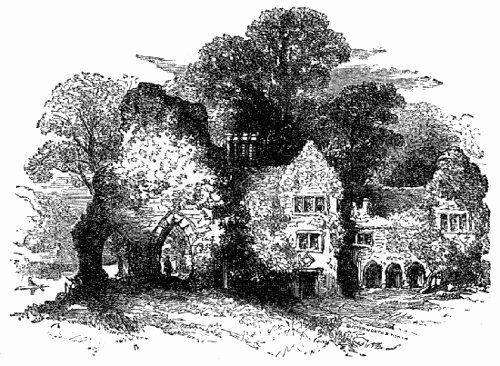
The manor of Medmenham was, in the reign of King Stephen, given
by its lord, Walter de Bolebec, to the Abbey of Cistercian Monks he had
founded at Woburn in Bedfordshire; and in 1204 the monks placed some
of their society here, on this pleasant bank of the Thames. Here arose
a small monastery, being rather—as the writers of the order express
themselves—"a daughter than a cell to Woburn." In 1536 it was annexed
to Bisham. At the Dissolution, according to returns made by the
commissioners, "the clear value of this religious house was 20l. 6s.; it
had two monks designing to go to houses of religion; servants, none;
woods, none; debts, none; its bells worth 2l. 1s. 8d.; the value of its
moveable goods 1l. 3s. 8d.; and the house wholly in ruin." It must have
undergone considerable repair early in the sixteenth century, and probably
very little of the original structure now exists, although relics of
antiquity may be traced in many of its remains. That portion which
fronts the Thames is kept in proper repair, and a large room is used for
the convenience of pleasure parties. The property belongs to the Scots of
Danesfield, a mansion that crowns a neighbouring hill. Medmenham
derives notoriety from events of more recent date than the occupation of
its monks, without goods and without debt. Here, about the middle of
the last century, was established, a society of men of wit and fashion,
who assumed the title of the Monks of St. Francis, and wore the habit
of the Franciscan order. Although it is said that the statements contained
in a now forgotten but once popular novel—"Chrysal; or the
Adventures of a Guinea,"—were exaggerated, the character which the
assumed monks bore in the open world was sufficiently notorious
to justify the worst suspicions of their acts in this comparative
solitude. Their principal members were Sir Francis Dashwood
(afterwards Lord Le Despencer), the Earl of Sandwich, John Wilks,
Bubb Doddington, Churchill, and Paul Whitehead, the poet. The motto—"Fay
ce que voudras," indicative of the principle on which the society
was founded—still remains over the doorway of the Abbey House. Tradition
yet preserves some anecdotes illustrative of the habits of the
"order," and there can be little doubt that this now lonely and quiet
spot was the scene of orgies that were infamous.
PERSECUTION.
Grotius, an historian celebrated for moderation and caution, has computed
that in the several persecutions promoted by Charles V., no less
than a hundred thousand persons perished by the hands of the executioner.
In the Netherlands alone, from the time that his edict against
the reformers was promulgated, he states that there had been fifty thousand
persons hanged, beheaded, buried alive, or burned, on account of
their religion. Indeed, during the reign of Philip the Second, the Duke
of Alva boasted that in the space of nine years he had destroyed, in the
Low Countries, 36,000 persons by the hands of the executioner alone. At
the massacre of Paris, on the feast of St. Bartholomew, King Charles the
Ninth of France assisted in person, and boasted that he had sacrificed
in one night 10,000 of his subjects; for that massacre the Pope had
"Te Deum" sung in the chapel of the Vatican and issued a bull for a
jubilee to be celebrated throughout France on the 7th December, 1512,
in commemoration of what he termed the happy success of the king
against his heretic subjects, and concluded by writing with his own hand
a letter to Charles the Ninth, exhorting him to pursue this salutary and
blessed enterprise. In the short reign of Queen Mary, there were in
this realm burned at the stake one archbishop, four bishops, twenty-one
ministers, and nearly three hundred persons of all classes, of whom
fifty-five were women, and four were children, one of whom sprang from
its mother's womb while she was consuming, and was flung into the
flames by the spectators. In 1640 the same spirit of papal bigotry occasioned
in Ireland the butchery of 40,000 Protestants, under circumstances
of aggravated atrocity which a Christian will shudder to peruse.
Lewis XIV., the most Christian king and eldest son of the church,
starved a million Huguenots at home, and sent another million grazing
in foreign countries.
INNKEEPER'S BILL IN 1762.
The following innkeeper's bill was sent in to the Duke de Nivernois,
who supped and breakfasted at an inn in Canterbury, in 1762; and
considering the value of money at that time, must be deemed extremely
moderate:—
| |
£ |
s. |
d. |
| Tea, coffee, and chocolate |
1 |
4 |
0 |
| Supper for self and servant |
15 |
10 |
0 |
| Bread and beer |
3 |
0 |
0 |
| Fruit |
2 |
15 |
0 |
| Wine and punch |
10 |
8 |
8 |
| Wax candles and charcoal |
3 |
0 |
0 |
| Broken glass and china |
2 |
10 |
0 |
| Lodging |
1 |
7 |
0 |
| Tea, coffee, and chocolate |
2 |
0 |
0 |
| Chaise and horse, for next stage |
2 |
16 |
0 |
There were only twelve persons in the whole company.
SPONTANEOUS COMBUSTION.
Joseph Battaglia, a surgeon of Ponte Bosio, relates the following case:
Don. G. Maria Bertholi, a priest of Mount Valerius, went to the fair of
Filetto, and afterwards visited a relation in Fenilo, where he intended to
pass the night. Before retiring to rest, he was left reading his breviary;
when, shortly afterwards, the family were alarmed by his loud cries and
a strange noise in his chamber. On opening the door, he was lying prostrate
on the floor, and surrounded by flickering flames. Battaglia was
immediately sent for, and on his arrival the unfortunate man was found
in a most deplorable state. The integuments of the arms and the back
were either consumed or detached in hanging flaps. The sufferer was
sufficiently sensible to give an account of himself. He said that he felt,
all of a sudden, as if his arm had received a violent blow from a club,
and at the same time he saw scintillations of fire rising from his shirt-sleeves,
which were consumed without having burned the wrists; a
handkerchief, which he had tied round his shoulders, between the shirt
and the skin, was intact. His drawers were also sound; but, strange
to say, his silk skull-cap was burnt while his hair bore no marks
of combustion. The unfortunate man only survived the event four days.
The circumstances which attended this case would seem to warrant the
conclusion that the electric fluid was the chief agent in the combustion.
SHOOTING FISH.
HORNED CHÆTODON.
Our shores have produced a few specimens of a richly-coloured fish
called Ray's Sea Bream (Brama Rayi), interesting because it represents
a family, almost confined to the tropical seas, of very singular forms and
habits. The family is named Chætodontidæ, from the principal genus in
it. They are very high perpendicularly, but thin and flattened sidewise;
the mouth in some projects into a sort of snout, the fins are frequently
much elevated, and send off long filaments.
They are generally adorned
with highly-contrasted colours, which run in perpendicular bands. They
are often called scaly-finned fishes, because the dorsal and anal are
clothed, at least in part,
with scales, so as not to
be distinguished from the
body. The tubular snout
of some, as of a little species
which we here represent,
is applied to an extraordinary
use, that of
shooting flies! The fish
approaches under a fly
which it has discovered,
resting on a leaf or twig,
a few feet above the water,
taking care not to
alarm it by too sudden a
motion; then, projecting
the tip of its beak from
the surface, it shoots a
single drop at the insect
with so clever an aim, as very rarely to miss it, when it falls into the
water and is devoured. Being common in the Indian seas, it is often
kept by the Chinese in vases, as we keep golden-fish, for the amusement
of witnessing this feat. A fly is fastened at some distance, at which the
fish shoots, but, disappointed of course, and wondering that its prey does
not fall, it goes on to repeat the discharge for many times in succession,
without seeming to take in a fresh stock of ammunition, and scarcely ever
missing the mark, though at a distance of three or four feet.
EXTRAORDINARY EARTHQUAKES.
Around the Papandayang, one of the loftiest mountains in Java, no
less than forty villages were reposing in peace. But in August 1772, a
remarkable luminous cloud enveloping its top aroused them from their
security. But it was too late; for at once the mountain began to sink
into the earth, and soon it had disappeared, with the forty villages and
most of the inhabitants, over a space fifteen miles long and six broad.
Still more extraordinary, the most remarkable on record was an eruption
in Sumbawa, one of the Molucca islands, in 1815. It began on the fifth
day of April, and did not cease till July. The explosions were heard in
one direction nine hundred and seventy miles, and in another seven
hundred and twenty miles. So heavy was the fall of ashes at the distance
of forty miles that houses were crushed and destroyed. The floating
cinders in the ocean, hundreds of miles distant, were two feet thick,
and vessels were forced through with difficulty. The darkness in Java,
three hundred miles distant, was deeper than the blackest night; and,
finally, out of the twelve thousand inhabitants of the island, only
twenty-six survived the catastrophe.
BEAUTIFUL ARCH.
One of the rarities of architecture is the beautiful arch in the choir of
Cannistown Church, not far from Bective,
near Trim, in Ireland.
Down to the very latest period of Gothic
architecture, the original plan of a
simple nave, or nave and chancel, was
followed, and the chief or only difference
observable in churches of very
late date, from those of the sixth and
seventh centuries, consists in the form
of the arch-heads, the position of the
doorway, the style of the masonry,
which is usually much better in the
more ancient examples, and the use
of bell-turrets, the cloigeteach, or
detached round tower, having answered
this purpose during the earlier ages.
A beautiful and highly characteristic
example of an early pointed church is
that at Cannistown. As usual, it consists
of a nave and chancel, and there are the remains of a bell-turret
upon the west gable, the usual position. The choir arch is represented in
the annexed cut.
There are numerous examples of churches of this style scattered over
Ireland, but they are usually plain, and the choir arch is generally the
plainest feature in the building. As example, we can refer our readers
to the churches of Kilbarrack, Dalkey, Kinsale, and Rathmichael, all in
the immediate neighbourhood of Dublin.
THOMAS CONECTE.
There was a Carmelite friar, Thomas Conecte, who, previous to his
being burnt as a heretic at Rome, in 1434, excited the admiration of all
Flanders by his vehement sermons against the luxury of the women.
His satire was chiefly levelled against their head-dresses, which rose to
so enormous a height, that the most exalted head-dresses of a late day
were but dwarfs to them. Juvenal des Ursins, who lived at that period,
declares that, notwithstanding the troubles of the times, the maidens
and married ladies rose to prodigious excess in their attire, and wore
hair of a surprising height and breadth, having on each side two ears
of so unaccountable a size, that it was impossible for them to pass
through a door. Their dresses were the hennins of Flanders, which the
worthy Carmelite was so inveterate against. He made them dress
themselves in a more modest manner. But, alas no sooner had Friar
Thomas left the country than the head-dresses shot up to a greater
height than ever. They had only bowed their heads like bullrushes
during the storm. Poor Thomas attacked the infallible church itself,
and they, in default of better arguments, burnt him.
CURIOUS COINCIDENCES.
On the 21st of April, 1770, Lewis XVI. was married.
21st of June, 1770, fifteen hundred people were trampled to death at
the fête.
21st of January, 1782, fête for the birth of the Dauphin.
21st of June, 1791, the flight to Varennes.
21st of September, 1792, the abolition of royalty.
21st of January, 1793, the unfortunate monarch's decapitation.
AMPHITHEATRES.
The deficiency of theatres erected by the Romans is far more than
compensated by the number and splendour of their amphitheatres, which,
with their baths, may be considered as the true types of Roman art. It
seems almost certain that they derived this class of public buildings from
the Etruscans. At Sutri there is a very noble one cut out of the tufa
rock, which was no doubt used by that people for festal representations
long before Rome attempted anything of the kind. It is uncertain
whether gladiatorial fights or combats of wild beasts formed any part of
the amusements of the arena in those days, though boxing, wrestling,
and contests of that description certainly did; but whether the Etruscans
actually proceeded to the shedding of blood and slaughter is more than
doubtful.
Even in the remotest parts of Britain, in Germany, and Gaul,
wherever we find a Roman settlement, we find the traces of their
amphitheatres. Their soldiery, it seems, could not exist without the
enjoyment of seeing men engage in doubtful and mortal combats—either
killing one another, or torn to pieces by wild beasts. It is not to
be wondered at that a people who delighted so much in the bloody
scenes of the arena should feel but very little pleasure in the mimic
sorrows and tame humour of the stage. It fitted them, it is true, to be
a nation of conquerors, and gave them the empire of the world, but it
brought with it feelings singularly inimical to all the softer arts, and
was perhaps the great cause of their debasement.
As might be expected, the largest and most splendid of these buildings
is that which adorns the capital; and of all the ruins which Rome
contains, none have excited such universal admiration as the Flavian
amphitheatre. Poets, painters, rhapsodists, have exhausted all the
resources of their arts in the attempt to convey to others the overpowering
impression this building produces on their own minds. With the single
exception, perhaps, of the Hall at Karnac, no ruin has met with such
universal admiration as this. Its association with the ancient mistress
of the world, its destruction, and the half-prophetic destiny ascribed to
it, all contribute to this. Still it must be confessed that
"The gladiator's bloody circus stands
A noble wreck in ruinous perfection,"
and worthy of all or nearly all the admiration of which it has been the
object. Its interior is almost wholly devoid of ornament, or anything
that can be called architecture—a vast inverted pyramid. The exterior
does not possess one detail which is not open to criticism, and indeed to
positive blame. Notwithstanding all this, its mass, its form, and its
associations, all combine to produce an effect against which the critic
struggles in vain.
The length of the building, measured along its greatest diameter, is
620 ft., its breadth 513, or nearly in the ratio of 6 to 5, which may be
taken as the general proportion of these buildings, the variations from it
being slight, and apparently either mistakes in setting out the work in
ancient times, or in measuring it in modern days, rather than an
intentional deviation. The height of the 3 lower stories is 120 ft.; the
total height as it now stands, 157 ft. The arena itself measures 287 ft.
in length by 180 in breadth, and it is calculated that the building
would contain 80,000 spectators; 50,000 or 60,000 would be much
nearer the truth, at least according to the data by which space is calculated
in our theatres and public places.
HUNDRED FAMILIES' LOCK.
A common Chinese talisman is the "hundred families' lock," to
procure which a father goes round among his friends, and, having
obtained from a hundred different parties a few of the copper coins of
the country, he himself adds the balance, to purchase an ornament or
appendage fashioned like a lock, which he hangs on his child's neck, for
the purpose of locking him figuratively to life, and making the hundred
persons concerned in his attaining old age.
THE DUKE DE REICHSTADT.
At the Imperial Palace of Schönbrun, about five English miles from
Vienna, is shown the window fractured by the bullet of the enthusiastic
student who shot at Napoleon while he was reviewing the Imperial
Guard, and also the apartment he occupied when he made this his head-quarters,
instead of entering the city. An additional interest is
imparted to the place, by the circumstance of the Duke de Reichstadt
having, when taken ill, chosen the identical chamber and spot in
which his father Napoleon had slept, to close his mortal career: and by
a singular coincidence, the remains of the young prince were subjected
to a post-mortem examination upon the same table at which the
Emperor had held his councils. In imitation of the military hardihood
of his sire, the young duke was in the habit of exposing himself to all
weathers, and keeping guard during successive nights, a practice which
often called forth from his surgeon, Dr. Malfati, the expressive words,
'Rappelez vous, mon Prince, que vouz avez un Cœur de Fer dans un
Corp de Verre.'
MARY QUEEN OF SCOTS' CANDLESTICK.
Almost every article, however trifling its intrinsic value, and however
homely its appearance, which once belonged
to a celebrated individual, is
always regarded as an object of interest,
and we have, therefore, no hesitation in
presenting our readers with the annexed
engraving of one of a pair of candlesticks
which were once the property of the unfortunate
Mary, Queen of Scots.
They are made of brass, each of them of
eleven and a-half inches in height. They
are of French manufacture; the sunk parts
are filled up with an inlay of blue, green,
and white enamel, very similar to that done
at Limoge. These extremely elegant and
curious articles are the property of Lord
Holland, and are preserved at Holland
House, Kensington.
Holland House is associated "with the
costly magnificence of Rich, with the loves
of Ormond, the councils of Cromwell, and
the death of Addison." It has been for
nearly two centuries and a-half the
favourite resort of wits and beauties, of
painters and poets, of scholars, philosophers,
and statesmen. In the lifetime of
the late Lord Holland, it was the meeting-place
of "the Whig Party;" and his liberal
hospitality made it "the resort, not only
of the most interesting persons composing
English society—literary, philosophical,
and political, but also to all belonging to
those classes who ever visited this country
from abroad."
EXTRAORDINARY INSTANCES OF INHUMANITY.
In 1534, in the wars of Edward III. with France, Fordun relates that
a Frenchman purchased from the Scots several English prisoners, and
that he beheaded them to avenge the death of his father. This sentimental
cruelty can perhaps be paralleled by that of Coccinas, who, at the
massacre of Paris, bought many Huguenots, that he might torture them
to death for his private satisfaction. Philip Galeas Visconti, Duke of
Milan, was a man of a nature so timid, that thunder threw him into
agonies; yet was he so inhuman, that he could enjoy the shrieks of a
female stretched upon a rack. Wenceslaus, the German Emperor, say
Mezeray, Voltaire, and others, roasted his cook alive, for dressing his
dinner amiss; and never had so intimate a friend in Prague as the common
executioner; and even him he put to death at last, for not taking
him at his word, when he once had bid him cut his head off, and actually
knelt down to receive the stroke.
ANCIENT ROMAN LAMPS.
The earliest lamps fabricated by the potters of ancient Rome have an
open circular body, with a curved projecting rim to prevent the oil from
spilling, and occur both in terra-cotta, and also in the black glazed ware
found in the sepulchres of Nola. Many have a projecting hollow pipe in
the centre, in order to fix them to a stick on the top of a candelabrum.
These lamps have no handles. They may have been placed in the sacella
or lararia, and were turned on the potter's wheel.
The shoe-shaped is the most usual, with a round body, a projecting
spout or nozzle having a hole for the wick, and a small annular handle,
which is more or less raised.
A singular variety of lamp, well
adapted for a table, was fitted into
a kind of small altar, the sides of
which were ornamented with reliefs.
Several however, from their
unusual shape, maybe considered
as fancy ware, the upper part, or
the whole lamp, being moulded
into the resemblance of some object.
Such are lamps in the British
Museum in the shape of a
female head surmounted by a
flower, or of the head of a negro or Nubian with open jaws, through
which the wick was inserted.
Most of these lamps appear to have been made between the age of
Augustus and that of Constantine. The style, of course best at the
earlier period of the empire, degenerates under the later emperors, such
as Philip and Maximus, and becomes at last Byzantine and bad.
Most lamps had only one wick, but the light they afforded must have
been feeble, and consequently some have two wicks, the nozzle for which
project beyond the body of the lamp. In the same manner were fabricated
lamps of three, five, and seven wicks. If more were required the
nozzles did not project far beyond the body of the lamp, which was then
moulded in a shape adapted for the purpose, and especially the favourite
one of a galley. Sometimes a conglomeration of small lamps was manufactured
in a row, or in a serrated shape, which enabled the purchaser to
obtain what light he required; still the amount of illumination must have
been feeble. As many as twenty wicks have been found in some lamps.
The greater number average from three to four inches long, and one
inch high; the walls are about one-eighth of an inch thick, and the
circular handles not more than one inch in diameter. Some of the larger
lamps, however, are about nine inches or a foot long, with handles eight
or nine inches high.
AN ECCENTRIC ENGLISHMAN.
Mr. Henry Hastings, a most singular character, and genuine sportsman
lived in the time of James and Charles I. Mr. Hastings was second son
to the Earl of Huntingdon; and inherited a good estate in Dorsetshire
from his mother. He was one of the keepers of New Forest, Hampshire;
and resided in the lodge there during a part of every summer season.
But his principal residence was at Woodlands, in Dorsetshire, where he
had a capital mansion. One of his nearest neighbours, was the Lord
Chancellor Cooper, first Earl of Shaftesbury. Two men could not be more
opposite in their disposition and pursuits. They had little communication
therefore; and their occasional meetings were rendered more disagreeable
to both from their opposite sentiments in politics. Lord Shaftesbury,
who was the younger man, was the survivor; and the following account of
Mr. Hastings is said to have been the production of his pen. "Mr.
Hastings was low of stature, but very strong, and very active; of a
ruddy complexion, with flaxen hair. His clothes were always of green
cloth. His house was of the old fashion; in the midst of a large park,
well stocked with deer, rabbits, and fish-ponds. He had a long narrow
bowling-green in it; and used to play with round sand-bowls. Here,
too, he had a banqueting-room built, like a stand in a large tree. He
kept all sorts of hounds, that ran buck, fox, hare, otter, and badger; and
had hawks of all kinds, both long and short-winged. His great hall was
commonly strewed with marrow-bones; and full of hawk-perches,
hounds, spaniels, and terriers. The upper end of it was hung with fox-skins
of this and the last year's killing. Here and there a pole-cat was
intermixed; and hunter's poles in great abundance. The parlour was a
large room, completely furnished in the same style. On a broad hearth,
paved with bricks, lay some of the choicest terriers, hounds, and spaniels.
One or two of the great chairs had litters of cats in them, which were
not to be disturbed. Of these, three or four always attended him at
dinner; and a little white wand lay by his trencher, to defend it, if they
were too troublesome. In the windows, which were very large, lay his
arrows, cross-bows, and other accoutrements. The corners of the room
were filled with his best hunting and hawking poles. His oyster-table
stood at the lower end of the room, which was in constant use twice a
day, all the year round; for he never failed to eat oysters both at dinner
and supper; with which the neighbouring town of Poole supplied him.
At the upper end of the room stood a small table with a double desk;
one side of which held a church Bible; the other, the Book of Martyrs.
On different tables of the room lay hawks' hoods; bells, old hats with
their crowns thrust in, full of pheasants' eggs, tables, dice, cards, and a
store of tobacco pipes. At one end of this room was a door, which
opened into a closet, where stood bottles of strong beer and wine, which
never came out but in single glasses, which was the rule of the house;
for he never exceeded himself, nor permitted others to exceed. Answering
to this closet was a door into an old chapel, which had been long disused
for devotion; but, in the pulpit, as the safest place, was always to be
found a cold chine of beef, a venison pasty, a gammon of bacon, or a
great apple-pie with thick crust, well baked. His table cost him not
much, though it was good to eat at. His sports supplied all but beef
and mutton, except on Fridays, when he had the best of fish. He never
wanted a London pudding; and he always sang it in with, "My part
lies therein-a." He drank a glass or two of wine at meals; put syrup of
gilly-flowers into his sack; and had always a tun-glass of small-beer
standing by him, which he often stirred about with rosemary. He lived
to be an hundred; and never lost his eyesight, nor used spectacles. He
got on horseback without help; and rode to the death of the stag, till he
was past fourscore."
PERFUMED BANQUETS OF THE ANCIENTS.
A very remarkable peculiarity in the banquets of the ancients was,
their not confining the resources of the table to the gratification of one
sense alone. Having exhausted their invention in the confection of
stimulants for the palate, they broke new ground, and called in another
sense to their aid; and by the delicate application of odours and richly-distilled
perfumes, these refined voluptuaries aroused the fainting appetite,
and added a more exquisite and ethereal enjoyment to the grosser
pleasures of the board. The gratification of the sense of smelling (a
sense held by us in very undeserved neglect, probably on account of its
delicacy) was a subject of no little importance to the Romans. However
this may be, it is certain that the Romans considered flowers as forming
a very essential article in their festal preparations; and it is the opinion
of Bassius, that at their desserts the number of flowers far exceeded that
of fruits. When Nero supped in his Golden House, a mingled shower of
flowers and odorous essences fell upon him; and one of Heliogabalus'
recreations was to smother his courtiers with flowers, of whom it may be
said, they "died of a rose in aromatic pain." Nor was it entirely as an
object of luxury that the ancients made use of flowers; they were considered
to possess sanative and medicinal qualities. According to Pliny,
Athenæus, and Plutarch, certain herbs and flowers were of sovereign
power to prevent the approaches of ebriety, or, as Bassius less clearly
expresses it, clarify the functions of the brain.
CHINESE BRIDGES.
Of Chinese bridges, some have been very much exaggerated in the
accounts by Du Halde and the missionaries, as it appears from the later
reports concerning the bridge at Foo-chow-foo, visited during the
unsuccessful commercial voyage of the ship "Amherst," in 1832, and
since the war become familiar to our countrymen. This same bridge,
which proved a very poor structure after all, had been extolled by the
Jesuits as something quite extraordinary. A bridge of ninety-one
arches, being in fact a very long causeway, was passed by Lord Macartney
between Soo-chow and Hang-chow, and near the Lake called
Tae-hoo. The highest arch, however, was supposed to be between
twenty and thirty feet in height, and the whole length of the causeway
half a mile. It was thrown across an arm of the lake, on the eastern
side of the canal. The late Sir George Staunton observed a bridge
between Peking and Tartary, built across a river which was subject to
being swelled by mountain floods. This was erected upon caissons of
wattles filled with stones. It appeared to have been built with expedition,
and at small cost, where the most solid bridge would be
endangered by inundations. The caissons were fixed by large perpendicular
spars, and over the whole were laid planks, hurdles, and
gravel. It was only in Keâng-nan that solid bridges were observed to
be thrown over the canal, being constructed of coarse grey marble, or
of a reddish granite. Some of the arches were semicircular, others the
transverse section of an ellipse, and others again approached the shape
of a horseshoe, or Greek Ω, the space being widest at top. In the
ornamental bridges that adorn gardens and pleasure-grounds, the arch
is often of height sufficient to admit a boat under sail, and the bridge is
ascended by steps.
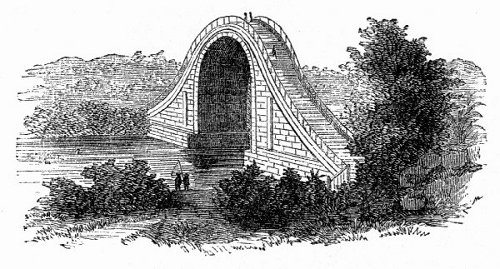
All the stones of a Chinese arch are commonly wedge-shaped, their
sides forming radii which converge towards the centre of the curve. It
is observable that, according to the opinion of Captain Parish, who
surveyed and made plans of the Great Wall, no masonry could be
superior to it. The arched and vaulted work was considered by him as
exceedingly well turned. The Chinese, therefore, must have understood
the construction and properties of the arch long before the Greeks
and Romans, whose original and most ancient edifices consisted of
columns, connected by straight architraves, of bulk sufficient to support
the incumbent pressure of solid masonry.
SOCIABLE WEAVER-BIRD.
There are some birds whose social instinct impels them to live in company,
and to unite their powers in the construction of a common edifice:
in this respect resembling the Beaver among quadrupeds, and the Bee
among insects. Among these we may mention the Ani (Crotophaga ani)
of the West Indies; the Pensile Grosbeak (Loxia pensilis) of West Africa;
and the Bottle-nested Sparrow of India: but more remarkable than any
of these is the Sociable Grosbeak (Loxia socialis) of South Africa, whose
habits are described by Le Vaillant.
"Figure to yourself," says this enterprising traveller, "a huge, irregular,
sloping roof, with all the eaves completely covered with nests,
crowded close together, and you will have a tolerably correct idea of these
singular edifices." The birds commence this structure by forming the
immense canopy of a mass of grass, so compact and firmly basketed
together as to be impenetrable to the rain. This sometimes surrounds a
large tree, giving it, but for the upper branches, somewhat the form of a
mushroom. Beneath the eaves of this canopy the nests are formed; the
upper surface is not used for this purpose, but as it is sloping, with a
projecting rim, it serves to let the rain-water run off, and preserves each
little dwelling from the wet. Le Vaillant procured one of these great
shelters, and cut it in pieces with a hatchet: the chief portion consisted
of Boshman's grass, so compact as to be impenetrable by rain. Each nest
is three or four inches in diameter, which is sufficient for the bird; but,
as they are all close together around the eaves, they appear to the eye to
form but one building, and, in fact, are distinguishable from each other
only by a little external aperture, which serves as an entrance to the
nest. This large nest contained 320 inhabited cells.
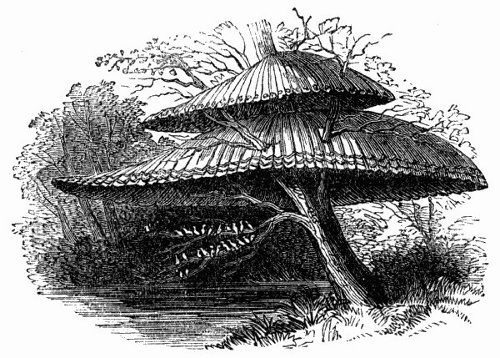
NEST OF SOCIABLE WEAVER BIRD.
WOLVES IN ENGLAND.
King Edward the First commissioned Peter Corbet to destroy the
wolves in the counties of Gloucester, Worcester, Hereford, Salop, and
Stafford; and ordered John Gifford to hunt them in all the forests of
England.
The forest of Chiltern was infested by wolves and wild bulls in the
time of Edward the Confessor. William the Conqueror granted the
lordship of Riddesdale, in Northumberland, to Robert de Umfraville,
on condition of defending that part of the country against enemies and
wolves. King John gave a premium of ten shillings for catching two
wolves.
In the reign of King Henry the Third Vitalis de Engaine held the
manors of Laxton and Pitchley, in the county of Northampton, by the
service of hunting the wolf, whenever the king should command him.
In the reign of Edward the First, it was found by inquisition that John
de Engaine held the manor of Great Gidding, in the county of Huntingdon,
by the service of hunting the hare, fox, wild cat, and wolf, within
the counties of Huntingdon, Northampton, Buckingham, Oxford, and
Rutland. In the reign of Edward the Third, Thomas de Engaine held
certain manors by the service of finding, at his own proper cost, certain
dogs for the destruction of wolves, foxes, martins, and wild cats in the
counties of Northampton, Rutland, Oxford, Essex, and Buckingham.
TEMPLES OF BRAMBANAM.
In the island of Java, and not far from the ruins of Boro Buddor, are
situated the Buddhist temples of Brambanam; certainly one of the most
extraordinary groups of buildings of its class, and very unlike anything
we now find in India; though there can scarcely be a doubt but that
the whole is derived from an Indian original now lost.
The great temple is a square building above 45 ft. square, and 75 ft.
high, terminating upwards in an octagonal straight-lined pyramid. On
each face of this is a smaller temple of similar design joined to the great
one by corridors; the whole five thus constituting a cruciform building.
It is raised upon a richly ornamented square base. One of the smaller
temples serves as an entrance-porch. The building itself is very
curiously and richly ornamented with sculpture; but the most remarkable
feature of the whole group is the multitude of smaller temples
which surround the central one, 239 in number. Immediately beyond
the square terrace which supports the central temple stand 28 of these,
forming a square of 8 on each side, counting the angular ones both
ways. Beyond these, at a distance of 35 ft., is the second square, 44 in
number; between this and the next row is a wide space of above 80 ft.,
in which only 6 temples are situated, two in the centre of the north and
south faces, and one on each of the others. The two outer rows of
temples are situated close to one another, back to back, and are 160 in
number, each face of the square they form being about 525 ft. All these
239 temples are similar to one another, about 12 ft. square at the base,
and 22 ft. high, all richly carved and ornamented, and in every one is a
small square cell, in which was originally placed a cross-legged figure,
probably of one of the Jaina saints, though the drawings which have
been hitherto published do not enable us to determine whom they represent—the
persons who made them not being aware of the distinction
between Buddhist and Jaina images.
The date given to these monuments by the natives is about the 9th or
10th century, at which time the Jains were making great progress at
Guzerat and the western parts of India; and if the traditions are to be
relied upon, which bring the Hindu colonists of Java from that quarter,
it is almost certain that they would have brought that religion with
them. If the age, however, that is assigned to them be correct, they
are specimens of an earlier date and form than anything we now find in
India, and less removed from the old Buddhist type than anything that
now remains there.
GRAHAM ISLAND.
The most recent instance of subaqueous eruption, with which we are
acquainted is that which produced Hotham or Graham Island, in the
year 1831. This island was thrown up in the Mediterranean, between
the south-west coast of Sicily and the African coast, in latitude
37° 8' 30" north, and longitude 12° 42' 15" east. The eruption seems
to have been first observed by John Corrao, the captain of a Sicilian
vessel, who passing near to the spot on the 10th of July, observed an
immense column of water ejected from the sea to the height of sixty
feet, and about eight hundred yards in circumference.
On the 16th of July, Corrao again passed the same spot, and he found
that a small island had been formed, twelve feet high, with a crater in
the centre, from which immense columns of vapour and masses of
volcanic matter were ejected.
The island was afterwards visited by several scientific gentlemen, and
is said to have been two hundred feet high, and three miles in circumference,
on the 4th of August. But from this time the island decreased
in size; for being composed of loose scoriæ and pumice, it was rapidly
acted upon by the water; and on the 3rd of September, when carefully
measured by Captain Wodehouse, was only three-fifths of a mile in
circumference, and one hundred and seven feet high. At the end of
October the island had entirely disappeared, except one small point composed
of sand and scoriæ. Captain Swinburne examined the spot in the
beginning of the year 1832, and found an extensive shoal to occupy the
place where the island had once been. In 1833 there was a dangerous
reef, of an oval form, three-fifths of a mile in circumference.
A ROYAL SPORTSMAN.
When the King of Naples (the greatest sportsman in Europe) was in
Germany, about the year 1792, it was said in the German papers, that
in the different times he had been shooting in Austria, Bohemia, and
Moravia, he had killed 5 bears, 1,820 wild boars, 1,968 stags, 13 wolves,
354 foxes, 15,350 pheasants, 1,121 rabbits, 16,354 hares, 1,625 she-goats,
1,625 roebucks, and 12,435 partridges.
LIFE IN DEATH.
The wife of the consul of Cologne, Retchmuth, apparently died of the
plague, in 1571; a ring of great value, with which she was buried,
tempted the cupidity of the grave-digger, and was the cause of many
future years of happiness. At night the purloiner marched to his plunder,
and she revived. She lived to be the mother of three children, and,
when deceased in reality, was re-buried in the same church, where a
monument was erected, reciting the particulars above stated in German
verse. A woman of Poictiers, being buried with four rings, tempted the
resurrection-man, who awoke the woman in the attempt, as he was
rather rude in his mode of possessing them. She called out; he, being
frightened, fled. The lady walked home, recovered, and had many
children afterwards.
ROCK-CUT MONUMENTS OF ASIA MINOR.
The engraving below represents an example of rock-cut monuments
which are found at Doganlu, in Asia Minor. They are placed on the
rocky side of a narrow valley, and unconnected apparently with any
great city or centre of population. Generally they are called tombs,
but there are no chambers nor anything about them to indicate a
funereal purpose, and the inscriptions which accompany them are not on
the monuments themselves, nor do they refer to such a purpose. Altogether,
they are certainly among the most mysterious remains of antiquity,
and, beyond a certain similarity to the rock-cut tombs around
Persepolis, it is not easy to point out any monuments that afford even a
remote analogy to guide us in our conjectures. They are of a style of
art clearly indicating a wooden origin, and consist of a square frontispiece,
either carved into certain geometric shapes, or prepared apparently
for painting; at each side is a flat pilaster, and above a pediment terminating
in two scrolls. Some, apparently the more modern, have pillars
of a rude Doric order, and all indeed are much more curious than beautiful.
When more of the same class are discovered, they may help us to
some historic data: all that we can now say of them is, that, judging
from their inscriptions and the traditions in Herodotus, they seem to
belong to some Indo-Germanic race from Thessaly, or thereabouts, who
had crossed the Hellespont and settled in their neighbourhood; and their
date is possibly as far back as 1000, and most probably before 700 B.C.
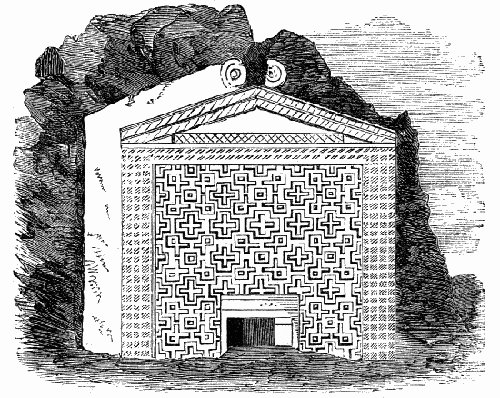
ARCH OF TRAJAN AT BENEVENTUM.
Triumphal arches were among the most peculiar forms of art which
the Romans borrowed from those around them, and used with that
strange mixture of splendour and bad taste which characterises all their
works.
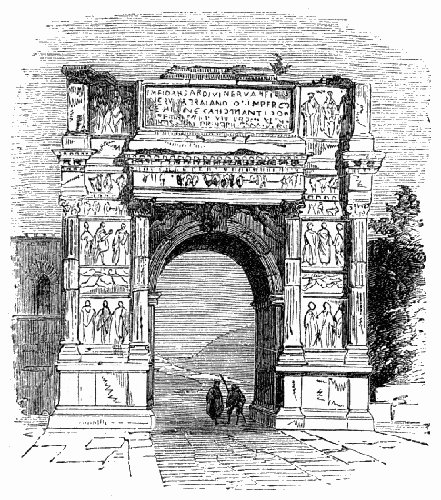
These were in the first instance no doubt borrowed from the Etruscans,
as was also the ceremony of the triumph with which they were ultimately
associated. At first they seem rather to have been used as
festal entrances to the great public roads, whose construction was considered
as one of the most important benefits a ruler could confer on his
country. There was one erected at Rimini in honour of an important
restoration of the Flaminian Way by Augustus; another at Susa in
Piedmont, to commemorate a similar act of the same Emperor. Trajan
built one on the pier at Ancona, when he restored that harbour, and
another at Beneventum, when he repaired the Via Appia, represented in
the woodcut here given. It is one of the best preserved as well as most
graceful of its class in Italy. The arch of the Sergii at Pola in Istria
seems also to have been erected for a like purpose. That of Hadrian at
Athens, and another built by him at Antinoë in Egypt, were monuments
merely commemorative of the benefits which he had conferred on those
cities by the architectural works he had erected within their walls. By
far the most important application of these gateways, in Rome at least,
was to commemorate a triumph which may have passed along the road
over which the arch was erected beforehand, for the triumphal procession
to pass through, of which it would remain a memorial.
JUDGES' SALARIES.
In the reign of Henry III. the King's Justices enjoyed a salary of ten
marks per annum, which, in the twenty-third year of that King, was
augmented to twenty pounds, and soon after to more. Under Henry IV.
the Chief Justices of the King's Bench and Common Pleas had forty
pounds, and one of the judges of Common Pleas had fifty-five marks.
In 1466, the salary of Thomas Littleton, judge of the King's Bench,
amounted to £136 13s. 4d. modern money; besides about £17 7s. for his
fur-gown, robes, &c.
EXTRAORDINARY OAK.
Gilpin, in his "Forest Scenery," says, "Close by the gate of the
water-walk at Magdalen College, in Oxford, grew an oak, which perhaps
stood there a sapling when Alfred the Great founded the university.
This period only includes a space of nine hundred years, which is no
great age for an oak. It is a difficult matter indeed to ascertain the age
of a tree. The age of a castle or abbey is the object of history; even a
common house is recorded by the families that built it. All these objects
arrive at maturity in their youth, if I may so speak. But the tree,
gradually completing its growth, is not worth recording in the early
part of its existence. It is then only a common tree; and afterwards,
when it becomes remarkable for its age, all memory of its youth is lost.
This tree, however, can almost produce historical evidence for the age
assigned to it. About five hundred years after the time of Alfred,
William of Wainfleet, Dr. Stukely tells us, expressly ordered his college
to be founded near the Great Oak; and an oak could not, I think,
be less than five hundred years of age to merit that title, together with
the honour of fixing the site of a college. When the magnificence of
Cardinal Wolsey erected that handsome tower which is so ornamental to
the whole building, this tree might probably be in the meridian of its
glory, or rather, perhaps, it had attained a green old age. But it must
have been manifestly in its decline at that memorable era when the
tyranny of James gave the fellows of Magdalen so noble an opportunity
of withstanding bigotry and superstition. It was afterwards much
injured in Charles the Second's time, when the present walks were laid
out. Its roots were disturbed, and from that period it declined fast,
and became reduced by degrees to little more than a mere trunk. The
oldest members of the university can scarcely recollect it in better
plight. But the faithful records of history have handed down its
ancient dimensions. Through a space of sixteen yards on every side
from its trunk, it once flung its boughs, and under its magnificent
pavilion could have sheltered with ease three thousand men, though in
its decayed state it could for many years do little more than shelter
some luckless individual whom the driving shower had overtaken in his
evening walk. In the summer of 1788, this magnificent ruin fell to the
ground, alarming the college with its rushing sound. It then appeared
how precariously it had stood for many years. Its grand tap-root was
decayed, and it had hold of the earth only by two or three roots, of
which none was more than a couple of inches in diameter. From a part
of its ruins a chair has been made for the President of the College,
which will long continue its memory."
ECCENTRIC ADVERTISEMENT.
The following strange advertisement is copied from the Harleian MSS.:
"In Nova fert Animus. These are to give notice, (for the benefit of the
public,) that there is newly arrived from his travels, a gentleman, who,
after above forty years' study, hath, by a wonderful blessing on his
endeavours, discovered, as well the nature as the infallible cure of several
strange diseases, which (though as yet not known to the world) he will
plainly demonstrate to any ingenious artist, to be the greatest causes of
the most common distempers incident to the body of man. The names
of which take as follow:
The strong fives
The marthambles
The moon-pall
The hockogrocle.
"Now, though the names, natures, symptoms, and several cures of
these diseases, are altogether unknown to our greatest physicians, and
the particular knowledge of them would (if concealed) be a vast advantage
to the aforesaid person; yet, he well knowing that his country's
good is to be preferred to his private interest, doth hereby promise all
sorts of people, a faithful cure of all or any of the diseases aforesaid, at
as reasonable rates as our modern doctors have for that of any common
distemper.
"He is spoken with at the ordinary hours of business, at the Three
Compasses, in Maiden-lane."
MODERN EGYPTIAN FEMALE ORNAMENTS.
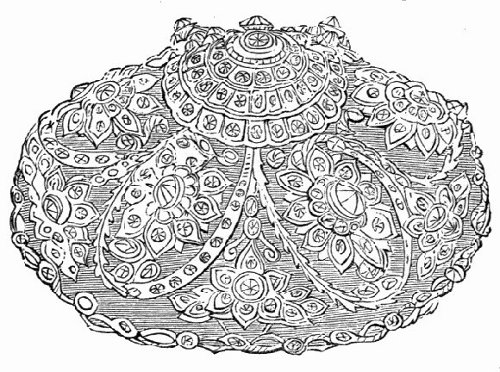
Among the many ornaments which the women of Egypt in modern
times are so fond of wearing, none is more curious or more generally
worn than the Ckoo'r. It is a round convex ornament, commonly about
five inches in diameter, of which there are two kinds. The first that we
shall describe, and which is the only kind worn by ladies, or by the wives
of tradesmen of moderate property, is the ckoor's alma's, or diamond
ckoor's. This is composed of diamonds set generally in gold; and is
open work, representing roses, leaves, &c. The diamonds are commonly
of a very poor and shallow kind; and the gold of this and all other
diamond ornaments worn in Egypt is much alloyed with copper. The
value of a moderately handsome diamond ckoor's is about a hundred and
twenty-five, or a hundred and fifty pounds sterling. It is very seldom
made of silver; and I think that those of gold, when attached to the
deep red turboo'sh, have a richer effect, though not in accordance with
our general taste. The wives even of petty tradesmen sometimes wear
the diamond ckoor's: they are extremely fond of diamonds, and generally
endeavour to get some, however bad. The ckoor's, being of considerable
weight, is at first painful to wear; and women who are in the habit of wearing
it complain of headache when they take it off: hence they retain it day
and night; but some have an inferior one for the bed. Some ladies have one
for ordinary wearing, another for particular occasions, a little larger and
handsomer; and a third merely to wear in bed. The other kind of
ckoor's, ckoor's dah'ab (or, of gold), is a convex plate of very thin embossed
gold, and almost always a false emerald (a piece of green glass),
not cut with facets, set in the centre. Neither the emerald nor the ruby
are here cut with facets: if so cut, they would generally be considered
false. The simple gold ckoor's is lined with a thick coat of wax, which
is covered with a piece of paper. It is worn by many women who cannot
afford to purchase diamonds; and even by some servants.
ANTIQUE ROMAN MEDICINE STAMP.
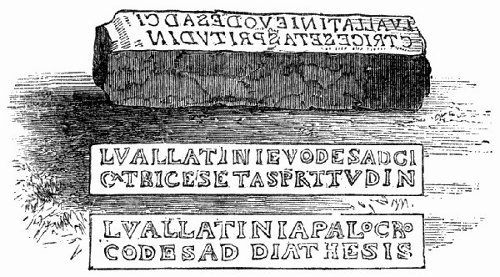
By far the most remarkable of the recently discovered remains of the
Roman occupants of Scotland is a medicine stamp, acquired by the
Society of Antiquaries of Scotland, along with a very valuable collection
of antiquities, bequeathed to them by E. W. A. Drummond Hay, Esq.,
formerly one of the secretaries of the society. From his notes it appears
that it was found in the immediate vicinity of Trenent Church, East
Lothian, in a quantity of débris, broken tiles, and brick-dust, which may
not improbably have once formed the residence and laboratory of Lucius
Vallatinus, the Roman oculist, whose name this curious relic supplies.
It consists of a small cube of pale green stone, two and three-fifth inches
in length, and engraved on two sides as in the annexed woodcut; the
letters being reversed for the purpose of stamping the unguents or other
medicaments retailed by its original possessor. The inscriptions admit
of being extended thus on the one side: L. VALLATINI EVODES AD
CICATRICES ET ASPRITUDINES, which may be rendered—The evodes of
Lucius Vallatinus for cicatrices and granulations. The reverse, though
in part somewhat more obscure, reads: L. VALLATINI A PALo CRoCODES
AD DIATHESES—The crocodes, or preparation of saffron, of L. Vallatinus,
of the Palatine School, (?) for affections of the eyes. Both the Euodes
and the Crocodes are prescriptions given by Galen, and occur on other
medicine stamps. Several examples have been found in England, and
many in France and Germany, supplying the names of their owners and
the terms of their preparations. Many of the latter indicate their chief
use for diseases of the eye, and hence they have most commonly received
the name of Roman oculists' stamps. No example, however, except the
one figured here, has ever occurred in Scotland; and amid legionary
inscriptions, military votive altars, and sepulchral tablets, it is peculiarly
interesting to stumble on this intelligent memento, restoring to us the
name of the old Roman physician who ministered to the colonists of
the Lothians the skill, and perchance also the charlatanry, of the healing
art.
CANDLES IN THE CHURCH.
In the formulæ of Marculphus, edited by Jerome Bignon, he tells us,
with respect to lights, that the use of them was of great antiquity in the
church; that the primitive Christians made use of them in the
assemblies which they held before day out of necessity; and that afterwards
they were retained even in daylight, as tokens of joy, and in
honour of the Deity. Lactantius says, speaking of the absurdities of
the wax lights in Romish churches, "They light up candles to God, as
if he lived in the dark; and do they not deserve to pass for madmen
who offer lamps and candles to the author and giver of light?" It is
really astounding to our ideas that wax candles as long as serjeants'
pikes should be held as necessary in the worship of God. That it is
so held, and that by a large class of Christians, every one must allow,
for they may have occular demonstration of the singular fact. The
show is however extremely imposing. Thirty-five thousand seven hundred
and fifty pounds of wax lights were burned every year, for nine
hundred masses said in the castle of Wittemburgh! Philip Melancthon
speaks of a Jesuit who said that "he would not extinguish one taper,
though it were to convert all the Huguenots" (Protestants).
A RICH AND CRUEL CRIMINAL.
John Ward, Esq. of Hackney, Member of Parliament, being prosecuted
by the Duchess of Buckingham, and convicted of forgery, was first expelled
from the House, and then stood on the pillory on the 17th of March,
1727. He was suspected of joining in a conveyance with Sir John
Blount, to secrete £50,000 of that director's estate, forfeited to the
South Sea Company by Act of Parliament. The Company recovered the
£50,000 against Ward; but he set up prior conveyances of his real
estate to his brother and son, and concealed all his personal, which was
computed to be £150,000. These conveyances being also set aside by a
bill in chancery, Ward was imprisoned, and hazarded the forfeiture of
his life, by not giving in his effects till the last day, which was that of
his examination. During his confinement, his amusement was to give
poison to dogs and cats, and see them expire by slower or quicker torments.
To sum up the worth of this man, at the several eras of his life;
at his standing in the pillory, he was worth above £200,000; at his commitment
to prison, he was worth £150,000.
FOOD OF THE ANCIENTS.
The diversity of substances which we find in the catalogue of articles
of food is as great as the variety with which the art or the science of
cookery prepares them. The notions of the ancients on this most important
subject are worthy of remark. Their taste regarding meat was
various. Beef they considered the most substantial food: hence it constituted
the chief nourishment of their athletæ. Camels' and dromedaries'
flesh was much esteemed, their heels most especially. Donkey-flesh
was in high repute: Mæcenas, according to Pliny, delighted in it;
and the wild ass, brought from Africa, was compared to venison. In
more modern times we find Chancellor Dupret having asses fattened for
his table. The hog and the wild boar appear to have been held in great
estimation; and a hog was called "animal propter convivia natum;"
but the classical portion of the sow was somewhat singular—"vulvâ nil
dulcius amplâ." Their mode of killing swine was as refined in barbarity
as in epicurism. Plutarch tells us that the gravid sow was actually
trampled to death, to form a delicious mass fit for the gods. At other
times, pigs were slaughtered with red-hot spits, that the blood might not
be lost. Stuffing a pig with assafœtida and various small animals, was a
luxury called "porcus Trojanus;" alluding, no doubt, to the warriors
who were concealed in the Trojan horse. Young bears, dogs, and foxes,
(the latter more esteemed when fed upon grapes,) were also much admired
by the Romans; who were also so fond of various birds, that some
consular families assumed the names of those they most esteemed. Catius
tells us how to drown fowls in Falernian wine, to render them more
luscious and tender. Pheasants were brought over from Colchis, and
deemed at one time such a rarity, that one of the Ptolemies bitterly
lamented his never having tasted any. Peacocks were carefully reared
in the island of Samos, and sold at such a high price, that Varro informs
us they fetched yearly upwards of £2,000 of our money.
THE EARLIEST ENGLISH BIBLE.
The first translation of any part of the Holy Scriptures into English
that was committed to the press was the New Testament, translated
from the Greek, by William Tyndale, with the assistance of John Foye
and William Roye, and printed first in 1526, in octavo.
Tyndale published afterwards, in 1530, a translation of the Five
Books of Moses, and of Jonah, in 1531, in octavo. An English translation
of the Psalter, done from the Latin of Martin Bucer, was also
published at Strasburgh in 1530, by Francis Foye, in octavo. And the
same book, together with Jeremiah and the Song of Moses, were likewise
published in 1534, in duodecimo, by George Joye, sometime Fellow
of Peter-House in Cambridge.
The first time the whole Bible appeared in English was in the year
1535, in folio. The translator and publisher was Miles Coverdale, afterwards
Bishop of Exeter, who revised Tyndale's version, compared it
with the original, and supplied what had been left untranslated by Tyndale.
It was printed at Zurich, and dedicated to King Henry the
Eighth. This was the Bible, which by Cromwell's injunction of September,
1536, was ordered to be laid in churches.
GREAT ERUPTION OF MOUNT ETNA.
One of the most remarkable eruptions of this mountain was that
which occurred in the year 1669, which was so violent that fifteen
towns and villages were destroyed, and the stream was so deep that the
lava flowed over the walls of Catania, sixty feet in height, and destroyed
a part of the city. But the most singular circumstance connected with
this eruption was the formation of a number of extensive fissures, which
appeared as though filled with intumescent rock. At the very commencement
of the volcanic excitement, one was formed in the plain of
St. Lio, twelve miles in length and six feet broad, which ejected a vivid
flame, and shortly after five others were opened. The town of Nicolosi,
situated twenty miles from the summit of Etna, was destroyed by earthquake;
and near the place where it stood two gulfs were formed, from
which so large a quantity of sand and scoriæ was thrown, that a cone,
called Mount Rossi, four hundred and fifty feet high, was produced in
about three months.
AMULETS WORN BY MODERN EGYPTIAN FEMALES.
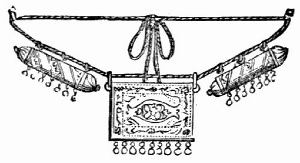
One of the most remarkable traits in modern Egyptian superstition is
the belief in written charms. The composition of most of these amulets
is founded upon magic, and occasionally employs the pen of almost every
village schoolmaster in Egypt. A person of this description, however,
seldom pursues the study of magic further than to acquire the formulæ
of a few charms, commonly consisting, for the greater part, of certain
passages of the Koran, and names of God, together with those of spirits,
genii, prophets, or eminent saints, intermixed with combinations of
numerals, and with diagrams, all of which are supposed to have great
secret virtues.
The amulet thus composed, or hhega'b, as it is called, is
covered with waxed cloth, to preserve
it from accidental pollution,
and enclosed in a case of thin
embossed gold or silver, which is
attached to a silk string, or a
chain, hung on the right side,
above the girdle, the string or
chain being passed over the left
shoulder. Sometimes these cases
bear Arabic inscriptions, such
as "Ma´sha-lla´h" ("God's will") and "Ya´cha´dee el-hhaga´t" ("O
decreer of the things that are needful!") We here insert an engraving
of three hhega'bs of gold, attached to a string, to be worn together.
The central one is a thin, flat case, containing a folded paper: it is
about a third of an inch thick; the others are cylindrical cases, with
hemispherical ends, and contain scrolls: each has a row of burck along
the bottom. Hhega´bs such as these, or of a triangular form, are worn
by many children, as well as women; and those of the latter form are
attached to a child's head-dress.
PERSONAL ORNAMENTS OF THE ANCIENT EGYPTIANS.
The passion of the Egyptians for decorative jewellery was indeed excessive.
Men as well as women delighted thus to adorn themselves; and
the desire was not confined to the higher ranks, for though the subordinate
classes could not afford the sparkling gems and precious metals which
glowed upon the persons of their superiors, their vanity was gratified by
humbler imitations, of bronze, glass, and porcelain.
"Costly and elegant ornaments," observes Professor Rosselini,
"abounded in proportion as clothing in general was simple and scarce among
the Egyptians. Girdles, necklaces, armlets, ear-rings, and amulets of
various kinds suspended from the neck, are found represented in the painting,
and in fact still exist on the mummies. Figures of noble youths are
found entirely devoid of clothing, but richly ornamented with necklaces
and other jewels."
An immense number of these
"jewels of silver and jewels of
gold" have been found in the
tombs, and on the persons of mummies,
and are deposited in profusion
in every museum. The accompanying
engravings will give an
idea of the style and form of some
of them.
The ear-rings generally worn by
the ladies were large, round, single
hoops (as a) from 1½ inches to 2-1/3
inches in diameter; and frequently
of a still greater size; or made of
six rings soldered together (as b);
sometimes an asp, whose body was
of gold, set with precious stones,
was worn by persons of rank as a
fashionable caprice. Figures c, d,
of gold bear the heads of fanciful
animals; e, also of gold, is remarkable
for its singularity of form, and
for the delicacy of its workmanship;
and f for its carrying two
pearls and being double in its construction.
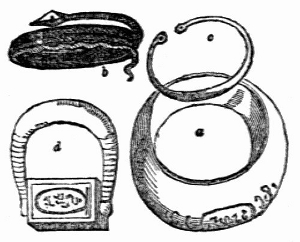
Bracelets, armlets, and anklets were worn by men as well as by women;
they were usually of gold, frequently set with precious stones, or inlaid with
enamel.
The one marked a in the annexed cut is now in the Leyden Museum:
it is of gold, 3 inches in diameter,
and 1½ inches in height, and is interesting,
because it belonged to the
Pharaoh whom we conclude to have
been the patron and friend of Joseph,
Thothmes III., whose name it bears.
The armlet b is of gold, and represents
a snake; the other, c, is of
bronze. Rings were worn in profusion,
gold being the material chiefly
selected. Some resemble watch seals
of the present day—sometimes the
stone having four flat sides, all engraved,
turned on a pivot, like some seals seen at present. One of this
character, which Sir J. G. Wilkinson estimates to contain 20l. worth of
gold, is represented at d in the above engraving. It consists of a massive
ring of gold, bearing an oblong plinth of the same metal, an inch in
length, and more than half an inch in its greatest width. On one side is
engraved the hieroglyphic name of Storus, the successor of Amunoph III.;
the three others contain respectively a scorpion, a crocodile, and a
lion.
GREAT PEAR TREE.
The most remarkable pear tree in England stands on the glebe of the
parish of Holme Lacy, in Herefordshire. When the branches of this
tree, in its original state, became long and heavy, their extremities
drooped till they reached the ground. They then took root; each branch
became a new tree, and in its turn produced others in the same way.
Eventually it extended itself until it covered more than an acre of
ground, and would probably have reached much further if it had been
suffered to do so. It is stated in the church register, that "the great
natural curiosity, the great pear tree upon the glebe, adjoining to the
vicarage-house, produced this year (1776) fourteen hogsheads of perry, each
hogshead containing one hundred gallons." Though now much reduced
in size, it is still healthy and vigorous, and generally produces from two to
five hogsheads. The liquor is not of a good quality, being very strong
and heating. An idea of the superior size of this tree, when in its prime,
over others of the same kind, may be formed from the fact, that in the
same county, an acre of ground is usually planted with thirty trees,
which, in a good soil, produce annually, when full grown, twenty
gallons of perry each. So large a quantity as a hogshead from one tree
is very unusual. The sorts principally used for perry are such as have
an austere juice.
LAW OF THE MOZCAS.
A very remarkable law prevailed among the Mozcas, one of the tribes
of the Nuevo Reyno de Granada. There, as among more advanced
nations, the king could do no wrong; but the subordinate chiefs could.
These chiefs were men, the people reasoned, like themselves; they could
not be punished by their vassals, for there would be a natural unfitness
in that; the king, it seems, was not expected to interfere, except in
cases of state offences; the power of punishment, therefore, was vested
in their wives; and a power it was, says Piedrahita, which they
exercised famously whenever it fell to them to be judges of their poor
husbands. The conqueror Quesada calling one morning upon the chief
of a place called Suesca, found him under the hands of his nine wives,
who were tying him, and having done so, proceeded, in spite of
Quesada's intercession, to flog him one after the other. His offence was,
that some Spaniards the night before had lodged in his house, and he
had partaken too freely of their Spanish wine. Drunkenness was one of
the sins which fell under the cognizance of his wives: they carried him
to bed that he might sleep himself sober, and then awoke him in the
morning to receive the rigour of the law.
LARGEST METAL STATUE IN THE WORLD.
Arona is an island on the Lago Maggiore, and has a strong castle.
Upon an eminence is a statue of bronze to St. Charles Borromeo, from
whom the hill is called, Monte di S. Carlo. The statue was erected by
the Pope in 1624, in memory of the Saint, who was Archbishop of Milan.
The pedestal of the statue is thirty-six feet high. It is the largest
metal statue in existence; and the height of the statue itself is seventy-two
feet, making a total of 108 feet. Fifteen persons may get into the
saint's head, which will also accommodate four persons and a table on
which they can dine. The cost is said to have been one million one
hundred Milanaise livres.
THE OAK OF MAMRE.
In one remarkable instance the Jews, the Christians, and the pagan
Arabs united in religious feelings. This was in their reverence for the
Oak of Mamre, where the angels appeared to Abraham: for Abraham's
sake the Jews held the place holy; the Arabs for the angels'; the
Christians, because, in their ignorance of their Scriptures, they affirmed
that the Son of God had accompanied those angels to destroy Sodom and
Gomorrah. An annual fair was held there, and every man sacrificed
after the manner of his country; nor was the meeting ever disgraced by
any act of intemperance or indecency. Nothing had been done to injure
the venerable antiquity of the place. There was nothing but the well
which Abraham had dug, and the buildings which he had inhabited,
beside the oak. These remains were destroyed by order of Constantine,
in abhorrence of the impious toleration exhibited there! A church was
built upon the spot, and Mamre, so interesting to the poet, the
philosopher, and the pious man, became a mere den of superstition.
STRANGE ADVERTISEMENT.
The following appeared in the Evening Post, May 23rd, 1730:—
"I, Elizabeth, duchess dowager of Hamilton, acknowledge I have for
several months been ill in my health, but never speechless, as certain
penny authors have printed; and so, to confute these said authors and
their intelligence, it is thought by my most intimate friends, it is the
very last thing that will happen to me. I am so good an Englishwoman,
that I would not have my countrymen imposed upon by purchasing false
authors; therefore, have ordered this to be printed that they may know
what papers to buy and believe, that are not to be bribed by those who
may have private ends for false reports. The copy of this is left in the
hands of Mr. Berington, to be shown to any body who has a curiosity to
see it signed with my own hand.
"E. Hamilton."
INTERMITTENT SPRINGS.
One of the most remarkable of these is at Bolder-Born in Westphalia.
After flowing for twenty-four hours, it entirely ceases for the space of six
hours. It then returns with a loud noise, in a stream sufficiently powerful
to turn three mills very near its source. Another spring of the same
nature occurs at Bihar in Hungary, which issues many times a day, from
the foot of a mountain, in such a quantity as in a few minutes to fill the
channel of a considerable stream.
The Lay Well near Torbay, ebbs and flows sixteen times in an hour:
and in Giggleswick Well in Yorkshire, the water sometimes rises and
falls in ten or fifteen minutes.
St. Anthony's Well, on Arthur's Seat, near Edinburgh, has a similar
movement, but on a smaller scale.
In Savoy, near the lake of Bourget, is another spring of this kind, but
it differs from those which have been already mentioned in being very
uncertain in its intervals.
CURIOUS JEWEL WHICH BELONGED TO JAMES I.
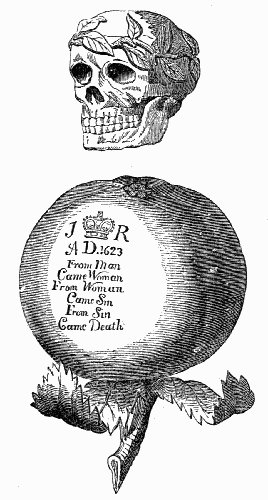
In former times it was a common practice with princes and nobles to
have elaborate articles of jewellery constructed in such forms as had a
religious and emblematical signification.
An inventory of the Dukes of
Burgundy, made in 1396,
speaks of a fleur-de-lys which
opened, and contained inside
a picture of the Crucifixion.
In 1416, the Duke of Berri
had "a fair apple," which
opened, and contained within
on one side the figure of Christ,
and on the other that of the
Virgin. Among the jewels of
the Dukes of Burgundy in 1392
there were two pears of gold,
enamelled, each containing an
image of Our Lady. We find
similar entries in the other different
inventories of the Dukes
of Burgundy: An apple of silver,
enamelled, containing in
the inside a picture of St. Catherine,
in 1400; a pine-apple
of gold, which contained figures
of the birth of Christ, and of
the three kings, in 1467; and,
in the same year, two apples of
gold, one containing, on the
opposite halves, Our Lady and
St. Paul, the other, St. Peter
and St. Paul—the latter suspended
by three small chains.
These kinds of devices continued
in fashion till a much
later period, and a very curious
example, from the collection of
Lord Londesborough, which
appears to have belonged to
King James I., is here engraved.
The whole is of silver, and the leaves appear to have been painted
green. On opening it we find in the inside the small skull here represented
above the apple. The top of the skull opens like a lid, and inside
are two small paintings, representing the Creation and the Resurrection,
with the inscription, "Post Mortem, vita eternitas." The external
inscription is not gallant. To give the apple externally a more natural
appearance, there are marks of two bites on the side opposite that here
represented, showing a large and small set of teeth.
STRANGE CURIOSITIES.
In the Anatomy Hall of Leyden is a drinking cup of the skull of a
Moor, killed in the beleaguring of Haerlem. Also a cup made of a
double brain pan. We observe also that No. 51 is the skin of a woman,
and No. 52 the skin of a woman, prepared like leather; No. 53 the skin
of a Malacca woman, above 150 years old, presented by Richard Snolk,
who probably had her flayed.
THE CROSS OF CONG.
The cross, of which the following is a correct representation, possesses
eminent claims to a place among our
curiosities, since it constitutes the gem
of the Museum of the Royal Irish Academy.
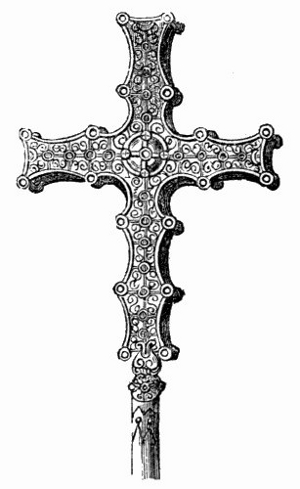
This cross was made at Roscommon, by
native Irishmen, about the year 1123,
in the reign of Turlogh O'Connor, father
of Roderick, the last monarch of Ireland,
and contains what was supposed to be a
piece of the true cross, as inscriptions in
Irish, and Latin in the Irish character,
upon two of its sides record. The engraving
affords a correct idea of the original,
as the extremely minute and elaborate
ornaments with which it is completely
covered, and a portion of which is
worked in pure gold, could not possibly
be expressed on so reduced a scale. The
ornaments generally consist of tracery
and grotesque animals fancifully combined,
and similar in character to the
decorations found upon crosses of stone
of about the same period. A large crystal, through which a portion of
the wood which the cross was formed to enshrine is visible, is set in the
centre.
FOOT-RACING IN 1699.
A remarkable foot-race was run about the year 1699, which is thus
described in the manuscript journal of a lady who was one of the
spectators:—"I drove through the forest of Windsor to see a race run
by two footmen, an English and a Scotch, the former a taller bigger
man than the other. The ground measured and cut even in a round was
about four miles; they were to run it round so often as to make up
twenty-two miles, which was the distance between Charing Cross and
Windsor Cross, that is, five times quite round, and so far as to make
up the odd miles and measure. They ran a round in twenty-five
minutes. I saw them run the first three rounds and half another in an
hour and seventeen minutes, and they finished it in two hours and a
half. The Englishman gained the start the second round, and kept it
at the same distance the five rounds, and then the Scotchman came up to
him and got before him to the post. The Englishman fell down within
a few yards of the post. Many hundred pounds were won and lost about
it. They ran both very neatly, but my judgment gave it to the Scotchman,
because he seemed to save himself to the last push."
THE CHERRY TREE.
The Cherry Tree was introduced into Great Britain before A.D. 53.
The earliest mention of the fruit being exposed to sale by hawkers in
London is in Henry the Fifth's reign, 1415. New sorts were introduced
from Flanders, by Richard Haines, Henry the Eighth's fruiterer, and
being planted in Kent were called "Flanders," or "Kentish Cherries,"
of which Gerard (1597) says, "They have a better juice, but watery,
cold, and moist." Philips says, "There is an account of a cherry-orchard
of thirty-two acres in Kent, which, in the year 1540, produced
fruit that sold in those early days, for 1,000l.; which seems an
enormous sum, as at that period good land is stated to have let at one
shilling per acre." Evelyn tells us, that in his time (1662) an acre
planted with cherries, one hundred miles from London, had been let at
10l. During the Commonwealth (1649), the manor and mansion of
Henrietta Maria, Queen of Charles I., at Wimbledon, in Surrey, were
surveyed previously to being sold, and it appears that there were
upwards of two hundred cherry trees in the gardens. Since that time
the cherry tree has found universal admission into shrubberies, gardens,
and orchards.
INSTRUCTIONS TO A CHAPLAIN.
The following, and we believe they are unique, are Sir John Wynne
of Gwedir's instructions to his chaplain, the Rev. John Pryce. "First,
you shall have the chamber I showed you in my gate, private to yourself,
with lock and key, and all necessaries. In the morning, I expect
you should rise, and say prayers in my hall, to my household below,
before they go to work, and when they come in at night, that you call
before you all the workmen, specially the youth, and take account of
them of their belief, and of what Sir Meredith taught them. I beg you
to continue for the most part in the lower house: you are to have onlye
what is done there, that you may inform me of any disorder there.
There is a bayliff of husbandry and a porter, who will be commanded by
you. The morning after you be up, and have said prayers, as afore, I
would you to bestow in study on any commendable exercise of your
body. Before dinner you are to come up and attend grace or prayers,
if there be any publicke; and to sit up if there be not greater strangers
above the chyldren, who you are to teach in your own chamber. When
the table from half downwards is taken up, then you are to rise and to
walk in the alleys near at hand until grace time, and to come in then
for that purpose. After dinner, if I be busy, you may go to bowles,
shuffel bord, or any other honest, decent recreation, until I go abroad.
If you see me void of business, and go to ride abroad, you shall command
a gelding to be made ready by the grooms of the stable, and to go with
me. If I go to bowles or shuffel bord, I shall lyke of your company, if
the place be not made up with strangers. I would have you to go every
Sunday in the year to some church hereabouts, to preache, giving
warnynge to the parish, to bring the yowths at after noon to the church
to be catechysed; in which poynt is my greatest care that you should
be paynfull and dylygent. Avoyd the alehouse, to sytte and keepe
drunkard's company ther, being the greatest discredit your function can
have."
TWO MISERS.
In the year 1778 died, at a village near Reading, John Jackson, aged
ninety-three, and James Jackson, aged eighty-seven. These two
brothers were old bachelors, and afforded a striking instance of the
insufficiency of wealth to create happiness. Though these old men
had been blest with great riches ever since they were twenty years of
age, they absolutely denied themselves the common necessaries of life;
and lived in the village for fifty years past as poor men, and often
accepted of charity from rich persons who resided near them. They
never suffered any woman or man to come into their apartment (which
was only one shabby room), and were both taken ill, and languishing a
short time, they expired on the same day, within one hour of each other.
It is computed, by the writings left behind them, that they died worth
£150,000.
ANECDOTE OF THE HOUSE OF BRUNSWICK.
The following anecdote relating to the august House of Brunswick is
taken from the "Annual Register" of 1765:—"The late Duchess of
Blakenburgh, great grandmother to the hereditary prince, who died some
years since in a very advanced age, had the singular happiness to reckon
amongst her posterity, sixty-two princes and princesses; (fifty-three of
whom she saw at one time alive;) and amongst them three emperors, two
empresses, two kings, and two queens; a circumstance that, probably,
no sovereign house but that of Brunswick ever produced anything like it."
AMUSEMENTS OF SOME LEARNED AUTHORS.
Tycho Brahe polished glass for spectacles, and made mathematical
instruments. D'Andilly delighted, like our Evelyn, in forest-trees;
Balzac, with the manufacturing of crayons; Pieresc, with his medals
and antiques; the Abbé de Marolles, with engravings; Rohault's greatest
recreation was in seeing different mechanics at their labour; Arnauld
read the most trashy novels for relaxation; as did our Warburton, the
late Lords Loughborough and Camden; Montaigne fondled his cat;
Cardinal Richelieu, in jumping and leaping. Grumm informs us that the
Chevalier de Boufflers would crow like a cock, and bray like an ass; in
both of which he excelled, not metaphorically but literally.
EARLY GERMAN DRINKING CUP.
The above, taken from the Londesborough collection, is a good
example of the German drinking cups of fanciful shape, which were so
much in fashion in that country in the sixteenth and seventeenth centuries.
The specimen before us is of silver, and dated 1619. The mill
and scroll ornament on the cup are gilt. It was held in the hand to be
filled, and could not be set down until emptied; the drinker, blowing
through the tube into the mill, set the sails in motion, and reversed the
cup on the table.
THE KING'S STONE.
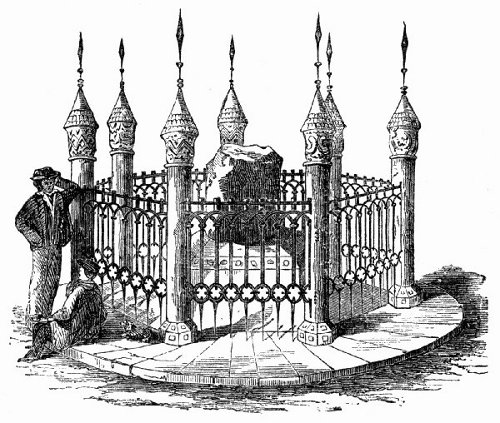
Kingston-on-Thames is among the oldest of English towns; and is said
to have been "the metropolis of the Anglo-Saxon kings:" certainly it
was a famous place when the Romans found and conquered the Britons in
this locality: there are indeed arguments for believing that the "ford"
which Cæsar crossed was here, and not at Walton; and indications of
barrows, fosses, and ramparts of Roman origin, are to be found in many
places in the neighbourhood. It is more than probable that a bridge was
constructed by the Romans here, and that a fortress was erected for its
protection. The Saxons followed in due course, and here they had many
contests with their enemies the Danes; but A.D. 838, Egbert convened at
Kingston an assembly of ecclesiastics and nobles in council, and here, undoubtedly,
many of the Saxon kings were crowned: "The townish men,"
says Leland, "have certen knowledge that a few kinges were crounid
afore the Conqueste." Its first charter was from King John, and many
succeeding sovereigns accorded to it various grants and immunities.
During the war between Charles I. and the Parliament, Kingston was
the scene of several "fights," being always on the side of the king. The
town is now populous and flourishing, although without manufactures of
any kind. Since the establishment of a railway, villa residences have
largely increased in the neighbourhood; and the two suburbs, Surbiton
and Norbiton, are pretty and densely-crowded villages of good houses.
The church has suffered much from mutilation and restoration; it is a
spacious structure, and was erected about the middle of the fourteenth
century, on the site of an earlier edifice. Amongst the monuments is a
fine brass, to a civilian and his wife, of the year 1437. Of existing
antiquities there are but few: county historians, however, point out the
sites of the ancient Saxon palace, "the castle," the Jews' quarter, and
the Roman town, Tamesa; and the game of "foot-ball," it is said, is
still practised by the inhabitants on Shrove Tuesday, in commemoration
of the feats of their ancestors, by whom the head of a king-assassin was
"kicked" about the town. But perhaps the most interesting object now
to be found in Kingston is "The King's Stone." It had long remained
neglected, though not unknown, among disregarded heaps of débris in
"the new court-yard," when it occurred to some zealous and intelligent
antiquaries that so venerable a relic of remote ages was entitled to some
show of respect. It was consequently removed from its degraded position,
planted in the centre of the town, and enclosed by a "suitable" iron
railing. It is now, therefore, duly and properly honoured, as may be
seen by the preceding engraving.
TRANCE AT WILL.
Colonel Townsend possessed the remarkable faculty of throwing himself
into a trance at pleasure. The heart ceased apparently to throb
at his bidding, respiration seemed at an end, his whole frame assumed
the icy chill and rigidity of death; while his face became colourless
and shrunk, and his eye fixed, glazed, and ghastly. His mind itself
ceased to manifest itself, for during the trance it was as utterly devoid
of consciousness as his body of animation. In this state he would
remain for hours, when these singular phenomena wore away, and he
returned to his usual condition. Medical annals furnish no parallel to
this extraordinary case. Considered whether in a physiological or
metaphysical point of view, it is equally astonishing and inexplicable.
DESTRUCTIVE FORCE OF RATS.
The amount of destructive force possessed by rats cannot be better
exemplified than in the report given to the French Government, relating
to the removal of the horse slaughter-houses, situated at Montfaucon, to
a greater distance from Paris; one great objection being the disastrous
consequences which might accrue to the inhabitants of the neighbourhood,
if these voracious creatures were suddenly deprived of their
usual sustenance. It is well known that the mischief which they occasion
is not confined to what they eat; but they undermine houses,
burrow through dams, destroy drains, and commit incalculable havoc in
every place and in everything.
The report states, that the carcases of horses killed one day, and
amounting to thirty-five, would be found the next morning with the
bones picked clean. A person of the name of Dusaussois, belonging to
the establishment, made this experiment. A part of his yard was
enclosed by solid walls, at the foot of which, several holes were made for
the entrance and exit of the rats. Into this enclosure he put the bodies
of three horses, and in the middle of the night he stopped up all the
holes as quietly as he could; he then summoned several of his workmen,
and each, armed with a torch and a stick, entered the yard, and carefully
closed the door. They then commenced a general massacre; in
doing which, it was not necessary to take aim, for wherever the blow
fell it was sure to knock over a rat, none being allowed to escape by
climbing over the walls. This experiment was repeated at intervals of a
few days, and at the end of a month, 16,050 rats had been destroyed.
In one night they killed 2,650; and yet this cannot give an entirely
adequate idea of their number, for the yard in question did not cover
more than a twentieth part of the space allotted to killing horses. The
rats in this place have made burrows for themselves, like catacombs;
and so great is their number, that they have not found room close by
the slaughter-houses. They have gone farther; and the paths to and
from their dwellings may be traced across the neighbouring fields.
ORDEAL OF THE CROSS.
When a person accused of any crime had declared his innocence upon
oath, and appealed to the cross for its judgment in his favour, he was
brought into the church before the altar. The priest previously prepared
two sticks exactly like one another, upon one of which was carved a
figure of the cross. They were both wrapped up, with great care and
many ceremonies, in a quantity of fine wool, and laid upon the altar, or
on the relics of the saints. A solemn prayer was then offered up to
God, that he would be pleased to discover, by the judgment of his holy
cross, whether the accused person were innocent or guilty. A priest
then approached the altar, and took up one of the sticks, and the assistants
unswathed it reverently. If it was marked with the cross, the
accused person was innocent; if unmarked, he was guilty. It would be
unjust to assert, that the judgments just delivered were in all cases
erroneous; and it would be absurd to believe that they were left altogether
to chance. Many true judgments were doubtless given, and, in
all probability, most conscientiously; for we cannot but believe that the
priests endeavoured beforehand to convince themselves by strict inquiry
and a strict examination of the circumstances, whether the appellant
were innocent or guilty, and that they took up the crossed or uncrossed
stick accordingly. Although, to all other observers, the sticks, as
enfolded in the wool, might appear exactly similar, those who enwrapped
them could, without any difficulty, distinguish the one from the other.
KING JOHN AND POPE INNOCENT.
When Cardinal Langton was made Archbishop of Canterbury, by the
intrigues of the Pope, whose creature he was, in despite of King John,
to appease the latter, his Holiness presented him with four gold rings,
set with precious stones, and enhanced the value of the gift (mark that,
jewellers!) by informing him of the many mysteries implied in it. He
begged of him (John) to consider seriously the form of the rings, their
number, their matter, and their colour. Their form, he said, being
round, shadowed out eternity, which had neither beginning nor end,
and he ought thence to learn the duty of aspiring from earthly objects
to heavenly, from things temporal to things eternal. The numbers four,
being a square, denoted steadiness of mind, not to be subverted either
by prosperity or adversity, fixed for ever in the basis of the four cardinal
virtues. Gold, which is the matter, being the most precious of metals,
signified wisdom, which is the most precious of all accomplishments, and
justly preferred by Solomon to riches, power, and all exterior attainments.
The blue colour of the sapphire represented faith; the verdure
of the emerald hope; the richness of the ruby charity; and the
splendour of the topaz good works.
DRUID'S SEAT.
The singular pile of stones which we have sketched here is popularly
called the "Druid's Judgment Seat," and stands near the village of
Killiney, not far from Drogheda,
near the Martello Tower.
It was
formerly enclosed within a circle of
great stones and a ditch. The
former has been destroyed, and the
latter so altered that little of its
ancient character remains. The
"Seat" is composed of large, rough,
granite blocks, and if really of the
period to which tradition refers it,
an unusual degree of care must have
been exercised for its preservation.
The following are its measurements:
Breadth, at the base, eleven feet and
a half; depth of the seat, one foot
nine inches; extreme height, seven
feet.
BOOTS AN OBJECT OF HONOUR.
Among the Chinese no relics are more valuable than the boots which
have been worn by an upright magistrate. In Davis's interesting description
of the empire of China, we are informed, that whenever a judge of
unusual integrity resigns his situation, the people all congregate to do
him honour. If he leaves the city where he has presided, the crowd
accompany him from his residence to the gates, where his boots are
drawn off with great ceremony, to be preserved in the hall of justice.
Their place is immediately supplied by a new pair, which, in their turn,
are drawn off to make room for others before he has worn them five
minutes, it being considered sufficient to consecrate them that he should
have merely drawn them on.
SAINT LAWRENCE.
In the south aisle of the church at Tuxford, beneath a flowery arch
is a very rude relief of St. Lawrence placed on the gridiron. By him is
a fellow with a pair of bellows, blowing the fire, and the executioner
going to turn him. The zealous Fox, in his "Martyrology," has this
very thought, and makes the martyr say, in the midst of his sufferings,
"This side is now roasted; turn me, O tyrant dear."
PARIS GARDEN AT BLACKFRIARS.
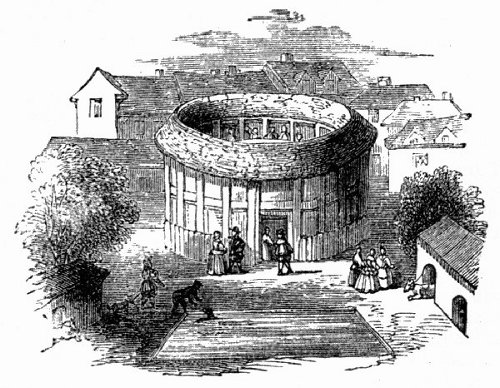
The Blackfriar's Road now passes over the site of Paris Garden where,
in the sixteenth century, bear and bull-baiting rejoiced the citizens, the
gala days being usually Sundays. Our cut is copied from the rare woodcut
map in the time of Henry VIII., in the library at Guildhall, and
exhibits in the foreground the kennels for the dogs, and the tanks in
which they were washed. A graphic description of the place has been
left by Paul Hentzner, a German, who visited it in 1598. He says it
was "built in the form of a theatre, for the baiting of bulls and bears:
they are fastened behind, and then worried by great English bull-dogs;
but not without great risk to the dogs, from the horns of the one and the
teeth of the other; and it sometimes happens they are killed upon the
spot: fresh ones are immediately supplied in the place of those that are
wounded or tired. To this entertainment there often follows that of
whipping a blinded bear, which is performed by five or six men,
standing circularly with whips, which they exercise upon him without
any mercy, as he cannot escape from them because of his chain. He
defends himself with all his force and skill, throwing down all who come
within his reach, and are not active enough to get out of it, and tearing
the whips out of their hands, and breaking them. At these spectacles,
and everywhere else, the English are constantly smoking tobacco.
Fruits, such as apples, pears, and nuts, according to the season, are
carried about to be sold, as well as ale and wine."
CANVASS OF AN INSURANCE AGENT.
The Manchester agent of an Insurance Company, gives the following
curious results of a personal canvass at 1,349 houses, in seventy streets
in the district of Hulme and Charlton, chiefly rentals from £12 to £24
per annum. The inquiry showed that there were 29 insured; 8 persons
too old; 11 who never heard of life assurances, and who were anxious to
have it explained to them; 471 who had heard of it, but did not understand
it; 419 who were disinclined to assure; 19 favourable, if their
surplus incomes were not otherwise invested; 89 persons who had it
under consideration, with a view to assure, as soon as their arrangements
were completed, and who appointed times for the agent to call again;
21 refused the circulars, or to allow an explanation; 175 doors not answered;
102 houses empty; 3 had sufficient property not to require it;
1 favourable, but afraid of litigation; 1 preferred the saving's bank;
1 used abusive language; 2 would trust their families to provide for
themselves; and 1 had been rejected by an office, although he never was
unwell, and was consequently afraid to try again, although very anxious.
TERRA-COTTA WRITINGS.
The Assyrians, unlike any other nation of antiquity, employed pottery
for the same objects, and to the same extent as papyrus was used in
Egypt. Thus bulletins recording the king's victories, and even the
annals of his reign, were published on terra-cotta cylinders, shaped like
a rolling-pin, and usually hollow, and on hollow hexagonal prisms.
These are of a remarkably fine material, sometimes unpolished or unglazed,
and at others covered with a vitreous siliceous glaze, or white
coating. On the cylinders the inscriptions are engraved lengthwise; on
the prisms they are in compartments on each face. Each wedge is about
one-eighth of an inch long, and the complicity with which the characters
(a cuneiform writing-hand) are arranged is wonderful, and renders
them extremely difficult for a tyro to read. Those hitherto published
or known, contain the annals of the reign of Sennacherib, and the précis
of the reign of another king.
There are the Shergat cylinder, containing the History of Tiglath
Pileser; a cylinder of Sargon; Sennacherib's cylinders; Esarhaddon's
cylinder.
Sales of land and other title-deeds were also incised on pieces of this
polished terra-cotta, and, in order to prevent any enlargement of the
document, a cylinder was run round the edges, leaving its impression in
relief; or if the names of witnesses were affixed, each impressed his oval
seal on the wet terra-cotta, which was then carefully baked in the kiln.
The celebrated cylinders of carnelian, chalcedony, and other substances,
were in fact the official or private seals by which the integrity of these
documents was attested. These title-deeds are portable documents of
four or five inches square, convex on each side, and occasionally also at
the edges. Their colour varies, being a bright polished brown, a pale
yellow, and a very dark tint, almost black. The paste of which they
are made is remarkably fine and compact. The manner in which the
characters were impressed on the terra-cotta barrels and cylinders is not
known; those on the bricks used for building were apparently stamped
from a mould, but those on the deeds and books were separately incised,
perhaps with a prismatic stick, or rod, or, as others have conjectured,
with the edge of a square rod of metal. In some instances, where this
substance was used for taking accounts, it seems just possible that the
moist clay, rolled up like paste, may have been unrolled and incised
with rods. The characters are often so beautifully and delicately made,
that it must have required a finely constructed tool to produce them.
Some small fragments of a fine reddish-grey terra-cotta which have
been found among the ruins, appear to contain calculations or inventories,
whilst others are perhaps syllabaries or vocabularies, to guide the
Assyrian readers of these difficult inscriptions. A large chamber, or
library, of these archives, comprising histories, deeds, almanacks, and
spelling-books, was found in the palace of Sennacherib at Kouyunjik.
It is supposed that altogether about 20,000 of these clay tablets or
ancient books of the Assyrians, containing the literature of the country,
have been discovered. Some of the finer specimens are covered with a
pale straw-covered engobe, over which has been thrown a glaze. Some
horoscopes have been already found on stone, and careful examination
has now detected the records of some astronomer royal of Babylon or
Nineveh inscribed on a brick. Thus, while the paper and parchment
learning of the Byzantine and Alexandrian schools has almost disappeared
after a few centuries, the granite pages of Egypt, and the clay
leaves of Assyria, have escaped the ravages of time and the fury of
barbarism.
In Egypt some receipts and letters have been discovered written on
fragments of tile, and on the fine porcelain of the Chinese are often
found extracts of biographical works, snatches of poetry, and even
whole poems; but the idea of issuing journals, title-deeds, inventories,
histories, prayers, and poems, not from the press, but from the kiln, is
startling in the nineteenth century.
WONDERFUL FORMATION OF THE EYE IN INSECTS.
The perfection which is bestowed on the organs of sense in insects,
especially when we consider their minuteness, is calculated to fill us with
adoring admiration of the skill of "the Great Workmaster." Take an
example from the eyes, which are of several kinds, evidently designed
for distinct modes of vision, of which we, who have but one sort of eyes,
can form no adequate notion. The bee and many other insects have on
the crown of the head a number, usually three, of simple glassy eyes,
set like "bull's-eyes" in a ship's deck; and besides these a great compound
eye on each side, consisting of a multitude of lenses aggregated
together upon the same optic nerve. The microscope reveals to us that
the compound eye of an ant contains fifty lenses; that of a fly, four
thousand; that of a dragon-fly, twelve thousand; that of a butterfly,
seventeen thousand; and that of a species of Mordella (a kind of beetle),
the amazing number of twenty-five thousand. Every one of these regular,
polished, and many-sided lenses; is the external surface of a distinct
eye, furnished with its own iris and pupil, and a perfect nervous apparatus.
It will thus be seen that each hexagonal facet forms a transparent
horny lens, immediately behind which is a layer of pigment
diminishing to a point in the centre, where it forms a pupil; that
behind this a long six-sided prism, answering to the crystalline and
vitreous humours in the human eye, extends, diminishing to its lower
extremity, where it rests upon the retina, or network expansion of the
optic nerve. Some of the minuter details of this exquisite organisation
are still matters of conflicting opinion; but these we omit, as our purpose
is rather to convey to our readers a general idea of the structure of
this complex organ of vision. "This also cometh forth from the Lord
of Hosts, which is wonderful in counsel and excellent in working."
FIRST COIN WITH BRITANNIA ON IT.
In process of clearing away the foundations of Old London Bridge
many antiquities were discovered; it had been the great highway over
the Thames from the Roman era, and numerous relics were obtained,
varying in date from that period to our own. We here engrave such
specimens of Roman coins that were found as belong to the Britannic
series. The large central coin is one struck by Hadrian, and remarkable
for the figure of Britannia, the first time impersonated as an armed female
seated on a rock. It is the prototype of the more modern Britannia,
reintroduced by Charles II., and which still appears on our copper money.
The smaller coins are such as were struck, during the reign of Constantine
the Great, in the City of London, and are marked with the letters
P. LON., for "Pecunia Londinensis," money of London.
EXTRAORDINARY FORMATION OF THE TWIN-WORM.
An extraordinary creature was discovered by Dr. Nordman, infesting
the gills of one of our commonest river fishes—Cyprinus Brama—and to
which he gave the appropriate appellation of the Twin-worm (Diplozoon
paradoxum). It is not more than one-fourth of an inch in length, but
consists of two bodies, precisely resembling each other, united by a central
band, exactly in the manner of the Siamese youths, whose exhibition
excited so much attention in England and America a few years ago.
We might have supposed that, like the human monstrosity in question,
the Twin-worm was formed by the accidental union of two individuals,
if abundant observation had not proved that this is the common mode of
life belonging to the species.
Each portion of the animal is complete in all its organs and economy;
possessing its own sets of suckers, its own mouth, its own digestive canal,
with its tree-like ramifications, its own perfect generative system, and
its own elaborate series of vascular canals,—every organ or set of organs
in the one-half finding its exact counterpart in the other.
It scarcely detracts from the marvellous character assumed by this
"Twin-worm," that, according to recent observations, the two halves
have already enjoyed a phase of existence as distinct individuals. The
organic union, or "fusion" of two such individuals, is necessary to the
development of the generative system, which, up to that event, is wanting
in each constituent half.
MILL AT LISSOY.
The above picturesque sketch represents the "busy mill" at Lissoy,
better known as "Sweet Auburn—loveliest village of the plain"—the
scene of Goldsmith's beautiful poem of the "Deserted Village." Lissoy,
about six miles from Athlone, stands on the summit of a hill at the base
of which is the mill that forms the subject of our sketch. The wheel is
still turned by the water of a small rivulet, converted, now and then, by
rains, into a sufficient stream. The mill is a mere country cottage, used
for grinding the corn of the neighbouring peasantry, and retains many
tokens of age. Parts of the machinery are, no doubt, above a century old,
and are probably the very same that left their impress on the poet's memory.
A CASTLE BUILT FOR A GROAT.
The castle of Monkstown, near Cork, is reported by popular tradition
to have been built in 1636, at the cost of only a groat. To explain the
enigma, the following story is told:—Anastatia Goold, who had become
the wife of John Archdeken, determined, while her husband was
abroad, serving in the army of Philip of Spain, to give him evidence of
her thrift on his return, by surprising him with a noble residence which
he might call his own. Her plan was to supply the workmen with provisions
and other articles they required, for which she charged the
ordinary price; but, as she had made her purchases wholesale, upon
balancing her accounts, it appeared that the retail profit had paid all
the expenses of the structure except fourpence! The Archdekens were
an Anglo-Irish family, who "degenerating" became "Hibernices quam
Hiberniores"—more Irish than the Irish themselves—and assumed the
name of Mac Odo, or Cody. They "forfeited," in 1688, having followed
the fortunes of James II.
BATTLE OF WATER-SNAKES.
The following story is narrated by Mr. St. John, in his "Letters of an
American Farmer." After describing the size and strength of some
hemp-plants, around which a wild vine had formed natural arbours, he
thus proceeds:—"As I was one day sitting, solitary and pensive, in this
primitive arbour, my attention was engaged by a strange sort of rustling
noise at some paces distance. I looked all around without distinguishing
anything, until I climbed up one of my great hemp-stalks; when, to my
astonishment, I beheld two snakes of a considerable length, the one pursuing
the other with great celerity through a hemp-stubble field. The
aggressor was of the black kind, six feet long; the fugitive was a water
snake, nearly of equal dimensions. They soon met, and in the fury of
their first encounter, appeared in an instant firmly twisted together;
and whilst their united tails beat the ground, they mutually tried, with
open jaws, to lacerate each other. What a fell aspect did they present!
Their heads were compressed to a very small size; their eyes flashed fire;
but, after this conflict had lasted about five minutes, the second found
means to disengage itself from the first, and hurried towards the ditch. Its
antagonist instantly assumed a new posture, and, half-creeping, half-erect,
with a majestic mien, overtook and attacked the other again, which placed
itself in a similar attitude, and prepared to resist. The scene was uncommon
and beautiful; for, thus opposed, they fought with their jaws,
biting each other with the utmost rage; but, notwithstanding this
appearance of mutual courage and fury, the water snake still seemed
desirous of retreating towards the ditch, its natural element. This was
no sooner perceived by the keen-eyed black one, than, twisting its tail
twice round a stalk of hemp, and seizing its adversary by the throat,
not by means of its jaws, but by twisting its own neck twice round that
of the water snake, he pulled it back from the ditch. To prevent a
defeat, the latter took hold likewise of a stalk on the bank, and, by the
acquisition of that point of resistance, became a match for his fierce
antagonist. Strange was this to behold; two great snakes strongly
adhering to the ground, mutually fastened together by means of the
writhings which lashed them to each other, and stretched at their full
length; they pulled, but pulled in vain; and in the moments of greatest
exertion, that part of their bodies which was entwined seemed extremely
small, while the rest appeared inflated, and now and then convulsed
with strong undulations rapidly following each other. Their eyes
appeared on fire, and ready to start out of their heads. At one time the
conflict seemed decided; the water snake bent itself into great folds,
and by that operation rendered the other more than commonly outstretched;
the next minute the new struggles of the black one gained an
unexpected superiority; it acquired two great folds likewise, which
necessarily extended the body of its adversary in proportion as it had
contracted its own. These efforts were alternate; victory seemed
doubtful, inclining sometimes to one side, sometimes to the other, until
at last the stalk to which the black snake was fastened suddenly gave
way, and, in consequence of this accident, they both plunged into the
ditch. The water did not extinguish their vindictive rage, for by their
agitations I could still trace, though I could not distinguish, their
attacks. They soon reappeared on the surface, twisted together, as in
their first onset; but the black snake seemed to retain its wonted
superiority, for its head was exactly fixed above that of the other, which
it incessantly pressed down under the water, until its opponent was
stifled, and sank. The victor no sooner perceived its enemy incapable of
further resistance, than, abandoning it to the current, it returned to the
shore and disappeared."
FATES OF THE FAMILIES OF ENGLISH POETS.
It is impossible to contemplate the early death of Byron's only child
without reflecting sadly on the fates of other females of our greatest
poets. Shakspeare and Milton, each died without a son, but both left
daughters, and both names are now extinct. Shakspeare's was soon so.
Addison had an only child—a daughter, a girl of some five or six years
at her father's death. She died, unmarried, at the age of eighty or more.
Farquhar left two girls, dependant on the friendship of his friend
Wilkes, the actor, who stood nobly by them while he lived. They had
a small pension from the Government, and having long outlived their
father, and seen his reputation unalterably established, both died unmarried.
The son and daughter of Coleridge both died childless. The
two sons of Sir Walter Scott died without children—one of two daughters
died unmarried, and the Scotts of Abbotsford and Waverley are now
represented by the children of a daughter. How little could Scott foresee
the sudden failure of male issue? The poet of the "Fairie Queen"
lost a child when very young by fire, when the rebels burned his house
in Ireland. Some of the poets had sons and no daughters. Thus we
read of Chaucer's son,—of Dryden's sons,—of the sons of Burns,—of
Allan Ramsey's son,—of Dr. Young's son,—of Campbell's son,—of
Moore's son,—and of Shelley's son. Ben Johnson survived all his children.
Some, and those amongst the greatest, died unmarried—Butler,
Cowley, Congreve, Otway, Prior, Pope, Gay, Thompson, Cowper, Akenside,
Shenstone, Collins, Gray, Goldsmith, and Rogers, who lately died.
Some were unfortunate in their sons in a sadder way than death could
make them. Lady Lovelace has left three children—two sons and a
daughter. Her mother is still alive to see, perhaps, with a softened
spirit, the shade of the father beside the early grave of his only child.
Ada's looks, in her later years—years of suffering, borne with gentle and
womanly fortitude—have been happily caught by Mr. Henry Phillips,
whose father's pencil has preserved to us the best likeness of Ada's father.
JEFFERY HUDSON, THE DWARF OF THE COURT OF CHARLES I.
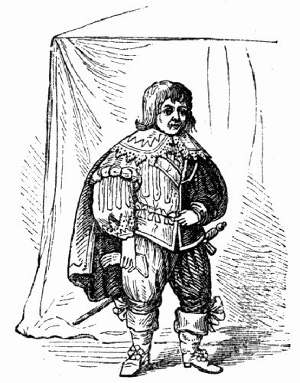
The celebrated dwarf of whom we here give a sketch, was born at Oakham
in Rutlandshire in 1619, and about the age of seven or eight, being
then but eighteen inches high, was
retained in the service of the Duke
of Buckingham, who resided at Burleigh-on-the-Hill.
Soon after the
marriage of Charles I., the king and
queen being entertained at Burleigh,
little Jeffery was served up at table
in a cold pie, and presented by the
duchess to the queen, who kept him
as her dwarf. From seven years of
age till thirty he shot up to three feet
nine inches, and there fixed. Jeffery
became a considerable part of the entertainment
of the court. Sir William
Davenant wrote a poem on a
battle between Jeffery and a turkey
cock, and in 1638 was published a
very small book, called a "New Year's
Gift," presented at court by the
Lady Parvula to the Lord Minimus
(commonly called Little Jeffery) her
Majesty's servant, &c. &c., written by Microphilas, with a little print of
Jeffery prefixed. Before this period Jeffery was employed on a negotiation
of great importance; he was sent to France to fetch a midwife
for the queen; and on his return with this gentlewoman and her
majesty's dancing-master, and many rich presents to the queen from her
mother, Mary de Medicis, he was taken by the Dunkirkers. This was
in 1630. Besides the presents he was bringing for the queen, he lost
to the value of £2,500 that he had received in France on his own account
from the queen-mother and ladies of that court.
Jeffery thus made of consequence, grew to think himself really so.
He had borne with little temper the teasing of the courtiers and domestics,
and had many squabbles with the king's gigantic porter. At
last, being provoked by Mr. Crofts, a young gentleman of family, a
challenge ensued; and Mr. Crofts coming to the rendezvous armed only
with a squirt, the little creature was so enraged that a real duel ensued;
and the appointment being on horseback, with pistols, to put them more
on a level, Jeffery, with the first fire, shot his antagonist dead on the
spot. This happened in France, whither he had attended his royal
mistress in the troubles.
He was again taken prisoner by a Turkish rover, and sold into Barbary.
He probably did not long remain in slavery; for at the beginning
of the civil war, he was made a captain in the royal army, and in 1644
attended the queen to France, where he remained till the restoration.
At last, upon suspicion of his being privy to the Popish Plot, he was
taken up in 1682 and confined in the Gate-house, Westminster, where
he ended his life in the sixty-third year of his age.
CHURCH AT NEWTON, IRELAND.
The ancient doorway, of which, on account of its singular beauty, we
give a sketch, belongs to the church which was built by the first of the
Montgomeries at Newtown in Ireland. Though the church is a fine and
beautiful example of architecture, no attempt whatever has been made
to preserve it from sinking into ruin. The Montgomeries, ancient lords
of this district, were the descendants of that Montgomery who accidentally
killed Henry II., of France, at a tournament. Some years after the sad
event, which was confessedly a mischance, he was taken by Catherine of
Medicis, put to the torture and beheaded; with the additional penalty of
having his children degraded to villeinnage; on his way to execution, he
pronounced this noble and memorable sentence, in reference to the punishment
inflicted on his children, "If they have not the virtue to raise
themselves again, I consent to their degradation."
INTERESTING CALCULATION.
Some years ago, an eminent zoologist gave the following table as his
estimate of the probable number of existing species of animals, deduced
from facts and principles then known. Later discoveries tend to increase
rather than to diminish the estimate.
| Quadrupeds |
1,200 |
|
Worms |
2,500 |
| Birds |
6,800 |
|
Radiata |
1,000 |
| Reptiles |
1,500 |
|
Polypes, etc. |
1,530 |
| Fishes |
8,000 |
|
Testacea |
4,500 |
| Insects |
550,000 |
|
Naked Testacea |
600 |
making an aggregate of 577,600 species.
VITALITY OF SUPERSTITION.
In the "Annual Register" for 1760, an instance of the belief in
witchcraft is related, which shows how superstition lingers. A dispute
arose in the little village of Glen, in Leicestershire, between two old
women, each of whom vehemently accused the other of witchcraft. The
quarrel at last ran so high that a challenge ensued, and they both agreed
to be tried by the ordeal of swimming. They accordingly stripped to
their shifts—procured some men, who tied their thumbs and great toes
together, cross-wise, and then, with a cart-rope about their middle,
suffered themselves to be thrown into a pool of water. One of them sank
immediately, but the other continued struggling a short time upon the
surface of the water, which the mob deeming an infallible sign of her
guilt, pulled her out, and insisted that she should immediately impeach
all her accomplices in the craft. She accordingly told them that, in the
neighbouring village of Burton, there were several old women "as much
witches as she was." Happily for her, this negative information was
deemed sufficient, and a student in astrology, or "white-witch," coming
up at the time, the mob, by his direction, proceeded forthwith to Burton
in search of all the delinquents. After a little consultation on their
arrival, they went to the old woman's house on whom they had fixed
the strongest suspicion. The poor old creature on their approach locked
the outer door, and from the window of an upstairs room asked what
they wanted. They informed her that she was charged with being
guilty of witchcraft, and that they were come to duck her; remonstrating
with her at the same time upon the necessity of submission to the ordeal,
that, if she were innocent, all the world might know it. Upon her persisting
in a positive refusal to come down, they broke open the door and
carried her out by force, to a deep gravel-pit full of water. They tied
her thumbs and toes together and threw her into the water, where they
kept her for several minutes, drawing her out and in two or three times
by the rope round her middle. Not being able to satisfy themselves
whether she were a witch or no, they at last let her go or more properly
speaking, they left her on the bank to walk home by herself, if she ever
recovered. Next day they tried the same experiment upon another
woman, and afterwards upon a third; but fortunately, neither of the
victims lost her life from this brutality. Many of the ringleaders in the
outrage were apprehended during the week, and tried before the justices
at quarter-sessions. Two of them were sentenced to stand in the pillory
and to be imprisoned for a month; and as many as twenty more were
fined in small sums for the assault, and bound over to keep the peace for
a twelvemonth.
SMALL FEET OF THE CHINESE LADIES.
The compression of ladies' feet to less than half their natural size is
not to be regarded as a mark, or as a consequence, of the inferiority of
the sex; it is merely a mark of gentility. Various accounts are given of
the origin of this custom. One is, that an emperor was jealous of his
wife, and to prevent her from gadding abroad, put her feet in iron stocks.
Another is, that a certain empress, Tan-ke (B.C. 1100), was born with
club-feet, and that she caused the emperor to issue an edict, adopting
her foot as the model of beauty, and requiring the compressing of female
infants' feet so as to conform to the imperial standard. While a third
account is, that the Emperor Le-yuh (A.D. 961) was amusing himself one
day in his palace, when the thought occurred to him that he might improve
the appearance of the feet of a favourite concubine. He caused her
feet to be so bent as to raise the instep into an arch, to resemble the new
moon. The figure was much admired by the courtiers, who soon began
to introduce it into their families. It is said that another emperor, two
hundred years later, placed a stamp of the lotus-flower (water-lily) on
the sole of the small shoe of his favorite concubine, so that at every step
she took she left on the ground the print of the flower; hence girls with
small feet are complimented at the present day as "the golden lilies."
The operation of bandaging and compressing the feet is very painful;
children cry very much under it. Mortification of the feet has been
known to result from the cruel practice. Custom, however, imposes it as
a necessary attraction in a woman. An old gentleman at Canton, being
asked the reason why he had bandaged his daughter's feet, replied, that
if she had large feet she could not make a good marriage.
WONDERFUL CONSTRUCTION OF THE SEA-URCHIN.
Professor Forbes informs us that in a moderate-sized Urchin there are
sixty-two rows of pores in each of the ten avenues, and as there are
three pairs of pores in each row, the total number of pores is 3,720; but
as each sucker occupies a pair of pores, the number of suckers is 1,860.
He says, also, that there are above three hundred plates of one kind, and
nearly as many of another, all dovetailing together with the greatest
nicety and regularity, bearing on their surfaces above 4,000 spines, each
spine perfect in itself, and of a complicated structure, and having a free
movement in its socket. "Truly," he adds, "the skill of the Great
Architect of Nature is not less displayed in the construction of a Sea-urchin
than in the building up of a world!"
IVORY SCEPTRE OF LOUIS XII.
The above engraving represents an ivory sceptre, or Main de Justice,
which was made at the early part of the sixteenth century for Louis
XII., King of France. The three parts 1, 2, 3, screw together and form
the sceptre. Fig. 4 is the hand on the top of the sceptre, given on a larger
scale, showing the ring set with a small pearl, worn on the third finger.
Fig. 5 is the inscription on the sceptre; it is engraved in relievo upon
three of the convex decorations, and commences on the lowest one.
TOMB OF CÆCILIA METELLA.
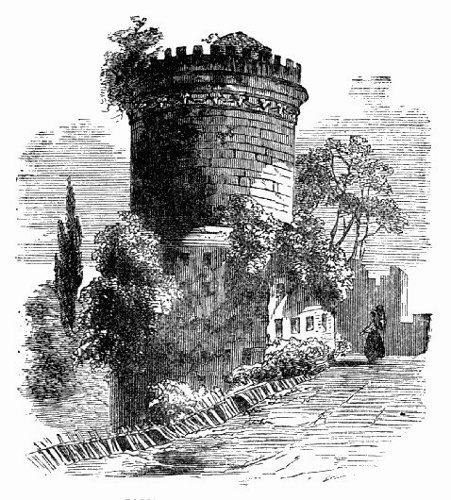
Of the tombs of Consular Rome nothing remains except perhaps the
sarcophagus of Scipio; and it is only on the eve of the Empire that we
meet with the well-known one of Cæcilia Metella, the wife of Crassus,
which is not only the best specimen of a Roman tomb now remaining to
us, but the oldest building of the imperial city of which we have an
authentic date. It consists of a bold square basement about 100 ft.
square, which was originally ornamented in some manner not now intelligible.
From this rose a circular tower about 94 ft. in diameter, of
very bold masonry, surmounted by a brace of ox-skulls with wreaths
joining them, and a well-profiled cornice: 2 or 3 courses of masonry
above this seem to have belonged to the original work; and above this,
almost certainly, in the original design rose a conical roof, which has
perished. The tower having been used as a fortress in the middle ages,
battlements have been added to supply the place of the roof, and it has
been otherwise disfigured, so as to detract much from its beauty as now
seen. Still we have no tomb of the same importance so perfect, nor one
which enables us to connect the Roman tombs so nearly with the
Etruscan. The only addition in this instance is that of the square
basement or podium, though even this was not unknown at a much
earlier period, as for instance in the tomb of Aruns. The exaggerated
height of the circular base is also remarkable. Here it rises to be a
tower instead of a mere circular base of stones for the earthen cone of
the original sepulchre. The stone roof which probably surmounted the
tower was a mere reproduction of the original earthen cone.
POGONIAS.
These vocal fish differ from the umbrinas in having their jaws tagged
laterally with many, in place of carrying but one barbel at the
symphysis. Schœff reports of them that they will assemble round the
keel of a vessel at anchor, and serenade the crew; and Mr. John
White, lieutenant in the navy of the United States, in his voyage to
the seas of China, relates to the same purpose, that being at the mouth
of the river of Cambodia, the ship's company were "astonished by
some extraordinary sounds which were heard around the bottom of the
vessel. They resembled," he says, "a mixture of the bass of the
organ, the sound of bells, the guttural cries of a large frog, and the
tones which imagination might attribute to an enormous harp; one
might have said the vessel trembled with it. The noises increased, and
finally formed a universal chorus over the entire length of the vessel
and the two sides. In proportion as we went up the river the sounds
diminished, and finally ceased altogether." As the interpreter told
Captain White, the ship had been followed by a "troop of fish of an
oval and flattened form," they were most probably pogonias. Humboldt
met with a similar adventure in the South Sea, but without suspecting
its cause. "On February 20th, 1803, at seven P.M., the whole
crew was astounded by a very extraordinary noise, resembling drums
beaten in the air; we at first attributed it to the breakers; speedily it
was heard all over the vessel, especially towards the poop, and was like
the noise which escapes from fluid in a state of ebullition; we began to
fear there might be some leak in the bottom. It was heard synchronously
in all parts of the vessel, but finally, about nine P.M., ceased altogether."
How these fish manage to purr in the deep, and by means of
what organ they communicate the sound to the external air, is wholly
unknown. Some suppose it to proceed from the swim-bladder; but if
that be the drum, what is the drumstick that beats upon it? And
cushioned as it is in an obese envelope and without issue, the swim-bladder
cannot be a bagpipe or wind instrument.
CURIOUS ADVERTISEMENT.
The following appeared in the public papers of January 24th, 1737:—"Whereas
Frances, wife of the Right Honourable the Lord Viscount
Vane, has, for some months past, absented herself from her husband,
and the rest of her friends:—I do hereby promise to any person or persons
who shall discover where the said lady Vane is concealed, to me, or
to Francis Hawes, esq. her father, so that either of us may come to the
speech of her, the sum of £100, as a reward, to be paid by me on demand
at my lodgings in Piccadilly. I do also promise the name of the person,
who shall make such discovery, shall be concealed, if desired. Any
person concealing or lodging her after this advertisement, will be prosecuted
with the utmost rigour; or, if her ladyship will return to me, she
may depend upon being kindly received. She is about twenty-two years
of age, tall, well-shaped, has light-brown hair, is fair-complexioned,
and has her upper teeth placed in an irregular manner. She had on,
when she absented, a red damask French sacque, and was attended by a
French woman, who speaks very bad English.
"Vane."
THE EYE OF THE CHAMELEON.
A most extraordinary aspect is communicated to chameleons by the
structure and movements of their eyes. In the first place, the head is
enormous, and, being three-sided, with projecting points and angles,
makes a sufficiently uncouth visage; but the eyes which illuminate this
notable head-piece must, indeed, to borrow for the nonce the phraseology
of Barnum, "be seen to be appreciated." There is on each side an
immense eye-ball, full and prominent, but covered with the common
shagreened skin of the head, except at the very entre, where there is a
minute aperture, corresponding to the pupil. These great punctured
eye-balls roll about hither and thither, but with no symmetry. You
cannot tell whether the creature is looking at you or not; he seems to
be taking what may be called a general view of things—looking at
nothing in particular, or rather, to save time, looking at several things
at once. Perhaps both eyes are gazing upwards at your face; a leaf
quivers behind his head, and in a moment one eye turns round towards
the object, while the other retains its upward gaze: presently a fly
appears; one eye rapidly and interestedly follows all its movements,
while the other leisurely glances hither and thither, or remains steady.
Accustomed as we are to see in almost all animals the two eyes move in
unison, this want of sympathy produces an effect most singular and
ludicrous.
DIVING FOR A WIFE.
In many of the Greek islands, the diving for Sponge forms a considerable
part of the occupation of the inhabitants, as it has done from the
most remote antiquity. Hasselquist says:—"Himia is a little, and
almost unknown island directly opposite Rhodes. It is worth notice, on
account of the singular method the Greeks, inhabitants of the island,
have to get their living. In the bottom of the sea the common Sponge
is found in abundance, and more than in any other place in the Mediterranean.
The inhabitants make it a trade to fish up this Sponge, by
which they get a living far from contemptible, as their goods are always
wanted by the Turks, who use an incredible number of Sponges at their
bathings and washings. A girl in this island is not permitted by her
relations to marry before she has brought up a certain quantity of
Sponges, and before she can give proof of her agility by taking them
from a certain depth." In other islands the same custom prevails, but
with reversed application, as in Nicarus, where the father of a marriageable
daughter bestows her on the best diver among her suitors,—"He
that can stay longest in the water, and gather the most Sponges, marries
the maid."
KNIGHT'S COSTUME OF THE THIRTEENTH CENTURY.
The engraving represents a knight's costume of the year 1272, taken
from the library of MSS. at Paris.
It is that of a Count Hohenschwangen,
of the family of Welf, and depicts the
wearer in a long sleeveless, dark blue
surcoat, with his armorial device; a white
swan on a red field with a light red
border. Under his coat he wears a cap-a-pié
suit of mail. The helmet is original,
very like the Greek, with the furred
mantle as we see it in the seal of Richard
King of England, of the date of 1498.
This helmet does not appear to be a tilting
helmet, which usually rests upon the
shoulders; but this kind of helmet would
be fastened, like the vizor with the mailed
hood, by an iron throat-brace, and a
leather thong. Upon the covered helmet
he wears the swan as a crest. The sword-hilt
is of gold, the sheath black, the girdle
white, the furred mantle is red, lined
with white.
Chivalry began in Europe about A. D.
912. From the twelfth to the fifteenth
century it had considerable influence in
refining the manners of most of the
nations of Europe. The knight swore to
accomplish the duties of his profession as
the champion of God and the ladies. He
devoted himself to speak the truth, to
maintain the right, to protect the distressed,
to practise courtesy, to fulfil
obligations, and to vindicate in every
perilous adventure his honour and character.
Chivalry, which owed its origin
to the feudal system, expired with it.
The origin of the title of knight, as a
military honour, is said to be derived
from the siege of Troy, but this solely
depends on a passage or two in Homer, and the point is disputed by
several learned commentators.
CURIOUS CIRCUMSTANCE.
Button, in his Life, tells us of one of his ancestors, a trooper, who,
seeing a young girl at the river-side, lading water into her pail, cast a
large stone with design to splash her; but not being versed in directing
a stone so well as a bullet, he missed the water, and broke her head; he
ran off. Twelve years afterwards, he settled at Derby, courted a young
woman, and married her. In the course of their conversations he proved
to be the very man who had cast the stone, and she the girl with the
broken head.
FUNEREAL JAR.
The term "funereal" has been erroneously applied to all pottery found
in tombs, even where the utensils have no relation to funereal purposes,
but were probably in common use. There have been found, however, in
Corsica vessels of earthenware, which may strictly be called "funereal."
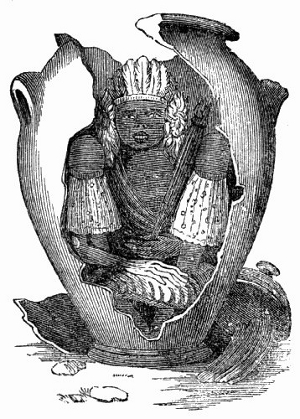
Though the precise period of the fabrication of the funereal vessels
found in Corsica is not ascertained, they must be considered of very
ancient date. These vessels, when
found entire, at first appear completely
closed up, and no trace of
joining can be discovered. But it
has been ascertained that they are
composed of two equal parts, the
end of one fitting exactly into the
other, and so well closed that the
body, or at least the bones which
they contain, appear to have been
placed within them before they were
baked upon the kiln. Diodorus
Siculus, in speaking of the usages
of the Balearic Isles, states that
these people were in the habit of
beating, with clubs, the bodies of
the dead which, when thus rendered
flexible, were deposited in vessels
of earthenware. This practice
of the Corsicans coincides singularly
with that of the Coroados
Indians, who inhabit a village on
the Paraïba river, near Campos, in
the Brazils. They use large earthen vessels, called camucis, as funereal
urns. The bodies of their chiefs, reduced to mummies, are placed in
them in a bent posture, decked with their ornaments and arms, and are
then deposited at the foot of the large trees of the forest.
The cut which we here give speaks for itself. It represents the funereal
jar containing the chief as described; the animal at his feet appears to
be a panther or tiger cat.
WRITING MATERIALS.
The materials used for writing on have varied in different ages and
nations. Among the Egyptians slices of limestone, leather, linen, and
papyrus, especially the last, were universally employed. The Greeks
used bronze and stone for public monuments, wax for memorandums
and papyrus for the ordinary transactions of life. The kings of Pergamus
adopted parchment, and the other nations of the ancient world
chiefly depended on a supply of the paper of Egypt. But the Assyrians
and Babylonians employed for their public archives, their astronomical
computations, their religious dedications, their historical annals, and
even for title-deeds and bills of exchange, tablets, cylinders, and
hexagonal prisms of terra-cotta. Two of these cylinders, still extant,
contain the history of the campaign of Sennacherib against the kingdom
of Judah; and two others, exhumed from the Birs Nimroud, give a
detailed account of the dedication of the great temple by Nebuchadnezzar
to the seven planets. To this indestructible material, and to the happy
idea of employing it in this manner, the present age is indebted for a
detailed history of the Assyrian monarchy; whilst the decades of Livy,
the plays of Menander and the lays of Anacreon, confided to a more
perishable material, have either wholly or partly disappeared amidst the
wreck of empires.
CURIOUS DISPUTE AND APPROPRIATE DECISION.
Fuller, in his 'Holy State,' p. 170, gives a very apposite story; a poor
man in Paris, being very hungry, went into a cook shop, and staid there
so long, (for the master was dishing-up meat,) that his appetite being
lessened by the steam, he proposed to go without his meal; the cook insisted
upon payment all the same. At length, the altercation was agreed
to be referred to the first person that passed the door; that person happened
to be a notorious idiot. Having heard the complaint, he decreed
that the poor man's money should be placed between two empty dishes,
and that the cook should be recompensed with the jingling of his cash,
as the other was with the fumes of the meat; and this little anecdote is
literally matter of fact.
THE TEA-POT.
No specimen of the ceramic art possesses greater variety of form than
the tea-pot. On none has the ingenuity of the potter been more fully
exercised, and it is worthy of remark, that the first successful production
of Böttcher in hard porcelain was a tea-pot. The so-called Elizabethan
tea-pots must be of a later date, for tea was not known in England until
the time of Charles II; but it is interesting to trace the gradual increase
in the size of the tea-pot, from the diminutive productions of the Elers,
in the time of Queen Anne and George I., when tea was sold in apothecaries'
shops, to the capacious vessel which supplied Dr. Johnson with
"the cup that cheers but not inebriates."
Mr. Croker, in his edition of Boswell's Life, mentions a tea-pot that
belonged to Dr. Johnson which held two quarts; but this sinks into insignificance
compared with the superior magnitude of that in the possession
of Mrs. Marryat, of Wimbledon, who purchased it at the sale of Mrs.
Piozzi's effects at Streatham. This tea-pot, which was the one generally
used by Dr. Johnson, holds more than three quarts. It is of old Oriental
porcelain, painted and gilded, and from its capacity was well suited to
the taste of one "whose tea-kettle had no time to cool, who with tea
solaced the midnight hour, and with tea welcomed the morn." George
IV. had a large assemblage of tea-pots, piled in pyramids, in the Pavilion
at Brighton. Mrs. Elizabeth Carter was also a collector of tea-pots,
each of which possessed some traditionary interest, independently of its
intrinsic merit; but the most diligent collector of tea-pots was the late
Mrs. Hawes. She bequeathed no less than three hundred specimens to
her daughter, Mrs. Donkin, who has arranged them in a room appropriated
for the purpose. Among them are several formerly belonging to
Queen Charlotte. Many are of the old Japan; one with two divisions,
and two spouts for holding both black and green tea; and another of
a curious device, with a small aperture at the bottom to admit the water,
there being no opening at the top, atmospheric pressure preventing the
water from running out. This singular Chinese toy has been copied in
the Rockingham ware.
PROTRACTED SLEEP.
One of the most extraordinary instances of excessive sleep is that of
the lady at Nismes, published in 1777, in the "Memoirs of the Royal
Academy of Sciences at Berlin." Her attacks of sleep took place
periodically, at sunrise and about noon. The first continued till within
a short time of the accession of the second, and the second continued
till between seven and eight in the evening—when she awoke, and
continued so till the next sunrise. The most extraordinary fact connected
with this case is, that the first attack commenced always at
daybreak, whatever might be the season of the year, and the other
always immediately after twelve o'clock. During the brief interval of
wakefulness which ensued shortly before noon, she took a little broth,
which she had only time to do when the second attack returned upon
her, and kept her asleep till the evening. Her sleep was remarkably
profound, and had all the character of complete insensibility, with
the exception of a feeble respiration, and a weak but regular movement
of the pulse. The most singular fact connected with her remains to be
mentioned. When the disorder had lasted six months, and then ceased,
the patient had an interval of perfect health for the same length of
time. When it lasted one year, the subsequent interval was of equal
duration. The affection at last wore gradually away; and she lived,
entirely free of it, for many years after. She died in the eighty-first
year of her age, of dropsy, a complaint which had no connexion with
her preceding disorder.
ANCIENT SUIT OF MAIL.
The two figures depicted on next page represent Henry of Metz receiving
the oriflamme from the hands of St. Denis, derived from a painted
window in the church of Nôtre Dame de Chartres. The oriflamme was
a red banner attached to a staff, and cut in the manner shown in our
engraving. Henry of Metz was Marshal of France, and is here represented
in a complete suit of mail, his hood being thrown back upon his
shoulders. This suit is perfect, even to the extremities; and it is to be
remarked that the defence for the hands is divided in the manner of a
common glove. Over the mail is worn a loose surcoat, on which is
emblazoned the cross, traversed by a red baton—the type of his high
office.
THE POISON CUP.
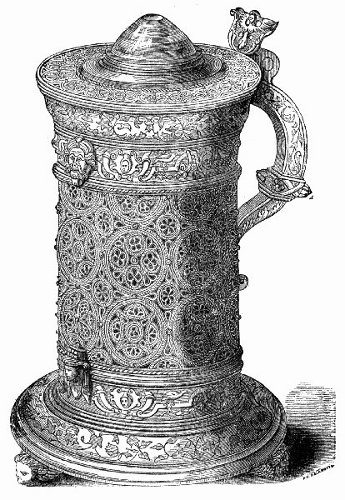
In the time of James I. poison was too frequently resorted to,
especially on the Continent, as a means of getting rid of individuals
who had rendered themselves obnoxious to certain parties who were
prosecuting their own private ends; and so extensively did this infamous
practice prevail that there was a class of persons who were
known to have studied the art of secret poisoning, and whose services
could be engaged for a high reward. In order to counteract the operations
of the poisoners, various devices were employed, and among them was
the art which the pretended magicians of those days professed to have
discovered, of making a kind of glass which would fly in pieces if poison
was poured into any vessel that was formed of it. The cut at the head
of our article represents a tankard of this sort, in which the glass is
mounted in silver gilt arabesque and silver filagree. It was believed
that the large crystal which is seen standing out at the centre of the
lid would become discoloured at the approach of poison. The tankard
is a work of the sixteenth century, and was presented to Clare Hall,
Cambridge—where it is still preserved—by Dr. William Butler, an
eminent physician in the time of James I.
PORCELAIN FINGER-RINGS.
The porcelain finger-rings of ancient Egypt are extremely beautiful; the
band of the ring being seldom above one-eighth of an inch in thickness.
Some have a plate on which, in bas-relief, is the god Set, or Baal, full face,
or playing on the tambourine, as the inventor of Music; others have their
plates in the shape of the right symbolical eye, the emblem of the Sun;
of a fish, of the perch species; or of a scarabæus, which is said to have been
worn by the military order. Some few represent flowers. Those which
have elliptical plates with hieroglyphical inscriptions, bear the names of
Amen-Ra, and of other gods and monarchs, as Amenophis III.,
Amenophis IV., and Amenanchut, of the Eighteenth and Nineteenth
dynasties. One of these rings has a little bugle on each side, as if it
had been strung on the beaded work of a mummy, instead of being
placed on the finger. Blue is the prevalent colour, but a few white and
yellow rings, and some even ornamented with red and purple colours
are found. It is not credible that these rings, of a substance finer and
more fragile than glass, were worn during life. Neither is it likely that
they were worn by the poorer classes, for the use of the king's name on
sepulchral objects seems to have been restricted to functionaries of state.
Some larger rings of porcelain of about an inch diameter, seven-eighths
of an inch broad, and one-sixteenth of an inch thick, made in open
work, represent the constantly repeated lotus flowers, and the god Ra,
or the Sun, seated, and floating through the heaven in his boat. Common
as these objects were in Egypt, where they were employed as substitutes
for the hard and precious stones, to the Greeks, Etruscans, and Italian
Greeks they were articles of luxury, just as the porcelain of China was
to Europeans some centuries ago. The Etruscans set these bugles, beads,
and amulets in settings of their exquisite gold filigree work, intermixed
with gold beads and precious stones. Strung as pendants they hung
round the necks of the fair ones of Etruria. In one of the tombs already
alluded to at the Polledrara, near Vulci, in Italy, was found a heap of
annular and curious Egyptian bugles, which had apparently formed a
covering to some bronze objects, but the strings having given way, the
beads had dropped to pieces. These, as well as the former, had been
obtained from some of the Egyptian markets, like that at Naucratis: or
from the Phoenician merchants, in the same manner as the flasks. One
of the most remarkable of these personal ornaments is a bracelet, composed
of small fish strung together and secured by a clasp.
PIGEON CATCHING NEAR NAPLES.
Between La Cava and Naples, about half a mile from the town, are
certain Bluebeard-looking towers, several centuries old, erected for the
purpose of snaring wood-pigeons; with which view the gentlemen of
the neighbourhood, who are generally expert and practised slingers,
assemble and man the towers in May. A long line of nets, some
quarter of a mile in circuit, held up in a slanting position by men concealed
in stone sentry-boxes placed here and there along the enceinte, is
spread in front. As the pigeons are seen advancing (the time of their
approach is generally looked for at early dawn, when they are making
for the woods), the nearest slingers commence projecting a succession of
white stones in the direction of the nets. These the birds no sooner behold,
then attracted, or alarmed (for the motive does not certainly appear),
they swoop down upon them, and when sufficiently near to fall within
reach of the nets, the persons holding let go, rush from their ambush,
and secure the covey. Thousands of wood-pigeons are thus, we have
been told by a proprietor, annually taken, and transmitted for presents
to distant friends; as we used to send out game, before the sale of it
was legalised. Thus birds, as well as fish, and fish as well as man,
often get entangled and caught in their headlong pursuit of a pleasure
that still eludes them.
FRAME REQUISITE TO SUPPORT THE DRESS.
James I., and his subjects who wished to clothe themselves loyally,
wore stupendous breeches. Of course the "honourable gentleman" of
the House of Commons were necessarily followers of the fashion. But
it led to inconveniences in the course of their senatorial duties. It was
an old mode revived; and at an earlier day, when these nether garments
were ample enough to have covered the lower man of Boanerges, the
comfort of the popular representative was thus cared for:—"Over the
seats in the parliament-house, there were certain holes, some two inches
square, in the walls, in which were placed posts to uphold a scaffold
round about the house within, for them to sit upon who used the wearing
of great breeches stuffed with hair like wool-sacks, which fashion being
left the eighth year of Elizabeth, the scaffolds were taken down, and
never since put up." So says Strutt; but doubtless the comforts of the
members were not less cared for when the old fashion again prevailed.
PRICES OF SÈVRES PORCELAIN.
As one of the curiosities of luxury and taste it is worth while to note
the high prices for which some portions of the very choice collection of
Sèvres porcelain at Stowe were sold:—A small coffee cup, which weighed
scarcely three ounces, realised 46 guineas; and another, similar, but
somewhat inferior, sold for 35 guineas. A chocolate cup and saucer,
Bleu de Roi, with beautiful miniatures of two ladies of the Court of Louis
XV., and four paintings of Cupids, though slightly injured during the
view, realised 45 guineas. The prices obtained for most of the cups and
saucers were from 10 to 12 guineas. A beautiful specimen of a Bleu de
Roi cup, saucer and cover, jewelled in festoons, cameos, and imitation of
pearls, sold for £35 10s.; and another, somewhat inferior, for 21 guineas.
A salver, mounted in a table with ormolu ornaments, sold for 81 guineas;
the companion piece for £100.
HENRY THE EIGHTH'S CHAIR.
In the earlier half of the sixteenth century a large proportion of the
furniture used in this country, as well as of the earthenware and other
household implements during the greater part of that century, was
imported from Flanders and the Netherlands. Hence, in the absence
of engravings at home, we are led to look at the works of the Flemish
and German artists for illustrations of domestic manners at this period.
The seats of that day were termed joint (or joined) stools and chairs.
A rather fine example of a chair of this work, which was, as was often
the case, three-cornered, is preserved in the Ashmolean museum, at
Oxford, where it is reported to have been the chair of Henry VIII.
We here annex a sketch of it.
MULLET AND TURBOT WITH THE ROMANS.
The Romans were enthusiastic for the mullet. It was for them the
fish, par excellence. It was sometimes served up six pounds in weight,
and such a fish was worth £60 sterling. It was cooked on the table, for
the benefit and pleasure of the guests. In a glass vessel filled with brine
made from water, the blood of the mackerel, and salt, the live mullet,
stripped of all its scales, was enclosed; and as its fine pink colour passed
through its dying gradations, until paleness and death ensued, the convives
looked on admiringly, and lauded the spectacle.
The turbot was next in estimation, but as, occasionally, offending
slaves were flung into the turbot preserves for the fish to feed upon, some
gastronomists have affected to be horror-stricken at the idea of eating a
turbot a la Romaine; quite forgetting that so many of our sea-fish, in
their domain, feed largely on the human bodies which accident, or what
men call by that name, casts into the deep.
"TOO LATE," QUOTH BOICE.
The history of the ancient castle of Maynooth is one of much interest;
abounding in incidents akin to romance. In the reign of Henry the
Eighth, during the rebellion of "Silken Thomas," one of the bravest
and most heroic of the Geraldines, it was taken by treachery. In the
absence of its lord, the governorship was entrusted to "Christopher
Parese," his foster-brother. This "white-livered traitor resolved to
purchase his own security with his lord's ruin;" and therefore sent a letter
to the lord-deputy, signifying that he would betray the castle, on conditions;
"and here the devil betrayed the betrayer, for in making terms
for his purse's profit, he forgot to include his person's safety." The lord-deputy
readily accepted his offer, and, accordingly, the garrison having
gained some success in a sally, and being encouraged by the governor in
a deep joyous carouse, the ward of the tower was neglected—the traitorous
signal given, and the English scaled the walls. They obtained possession
of the strong-hold, and put the garrison to the sword—"all except
two singing men, who, prostrating themselves before the deputy, warbled
a sweet sonnet called dulcis amica, and their melody saved their lives."
Parese, expecting some great reward, with impudent familiarity presented
himself before the deputy, who addressed him as follows:—"Master
Parese, thou hast certainly saved our lord the king much
charge, and many of his subjects' lives, but that I may better know to
advise his highness how to reward thee, I would ascertain what the Lord
Thomas Fitzgerald hath done for thee?" Parese, highly elevated at this
discourse, recounted, even to the most minute circumstance, all the
favours that the Geraldine, even from his youth up, had conferred on
him, to which the deputy replied, "And how, Parese, couldst thou find
it in thy heart to betray the castle of so kind a lord? Here, Mr. Treasurer,
pay down the money that he has covenanted for; and here, also, executioner,
without delay, as soon as the money is counted out, cut off his
head!" "Oh," quoth Parese, "had I known this, your lordship should
not have had the castle so easily." Whereupon Mr. Boice, a secret friend
of the Fitzgerald, a bystander, cried out "Auntraugh," i. e. "too late,"
which occasioned a proverbial saying, long afterwards used in Ireland—"Too
late, quoth Boice." The castle is said by Archdall to have been
erected by John, the sixth Earl of Kildare, early in the fifteenth century;
but in that case it must have been preceded by some other defensive
structure; for it is certain that the Kildare branch of the Geraldines
resided at Maynooth at a much earlier period. The first Earl of Kildare,
John Fitz Thomas, was created by patent, dated 14th May, 1316.
SUPPRESSED BIBLES.
1538.—An English Bible, in folio, printed at Paris, unfinished.
1542.—Dutch Bible by Jacob Van Leisvelt. The sixth and best edition
given by Leisvelt, and famous as being the cause of this printer
being beheaded.
1566.—French Bible by Rene Benoist, Paris, 1566, folio, 3 vols. completed.
1622.—Swedish Bible, printed at Lubeck, in 4to., very defective.
1666.—A German Bible, printed at Helmstedt, in part only, 4to.
1671.—A French Bible, by Marolles, in folio, containing only the
books of Genesis, Exodus, and the first twenty-three chapters of Leviticus.
EXTRAORDINARY REPRODUCTIVE POWER OF THE HYDRA.
One of the fresh-water Polypes, from its power of perpetual reproduction,
has received the name of Hydra, by which it is known among
naturalists: as if it realised the ancient monster of fabulous story, whose
heads sprouted anew as fast as they were cut off by Hercules.
Most curious monstrosities were produced by the experiments of
philosophers on these animals, especially by partial separations. If a
polype be slit from the summit to the middle, one will be formed having
two heads, each of which will capture and swallow food. If these again
be slit half-a-dozen times, as many heads will be formed surmounting
the same body. If now all these be cut off, as many new ones will
spring up in their place, while each of the severed heads becomes a new
polype, capable of being, in its turn, varied and multiplied ad infinitum;—so
that in every respect our little reality exceeds its fabulous namesake.
The polypes may be grafted together. If cut-off pieces be placed in
contact, and pushed together with a gentle force, they will unite and
form a single one. The head of one may be thus planted on the trunk
of another.
Another method of uniting them, perhaps still more wonderful, is by
introducing one within the other; the operator forced the body of the
one into the mouth of the other, pushing it down so that the heads were
brought together. After forcibly keeping it for some time in this state,
the two individuals at length united, and a polype was formed, distinguishable
only by having twice the usual number of tentacles.
There is one species which can actually be turned inside out like a
glove, and yet perform all the functions of life as before, though that
which was the coat of the stomach is now the skin of the body and vice
versâ. If it should chance that a polype so turned had young in the act
of budding, these are, of course, now within the stomach. If they have
arrived at a certain degree of maturity, they extend themselves towards
the mouth of the parent, that they may thus escape when separated.
But those which are less advanced turn themselves spontaneously inside
out, and thus place themselves again on the exterior of the parent.
A multitude of other variations, combinations, and monstrosities, have
been, as it were, created by the ingenuity of philosophers; but these are
sufficient to give a notion of the extraordinary nature of these animals;
and to account for the wonder with which they were regarded.
EGYPT.
Egypt was the land visited by Abraham in search of food, when there
was a famine in his own country;—the land to which Joseph was carried
as a slave, and which he governed as prime minister. From Egypt,
Moses led the Israelites through the waters of the Red Sea. Here Jeremiah
wrote his Lamentations. Here Solon, Pythagoras, Plato, and
many other Greek philosophers, came to study. Here Alexander the
Great came as conqueror; and here the Infant Saviour was brought by
his parents to avoid the persecution of Herod. Egyptian hieroglyphics,
in which the characters are taken from visible objects, are the earliest
form of writing; and the Hebrew and Greek alphabets were both borrowed
from them. Egypt taught the world the use of paper—made from
its rush, the papyrus. In Egypt was made the first public library, and
first college of learned men, namely, the Alexandrian Museum. There
Euclid wrote his Elements of Geometry, and Theocritus his Poems, and
Lucian his Dialogues. The beauty of Cleopatra, the last Egyptian
Queen, held Julius Cæsar, and then Marc Antony, captive. In Egypt
were built the first monasteries; the Christian fathers, Origen and
Athanasius, lived there. The Arien and Athanasian controversy began
there.
The buildings which now remain are the oldest buildings in the world,
and the largest in the world. On the banks of its great river may be seen
the oldest arch, and the oldest column. Up this noble river sailed Herodotus,
the most entertaining of travellers, and Strabo, the most judicious.
Indeed, as the country is little more than the narrow strip that is
watered by the Nile's overflow, from the river may be seen almost all its
great cities and temples.
ABYSSINIAN LADIES.
The women of Abyssinia are dressed quite as decently as any women
in the world, without having a particle of the trouble of the ladies of
more civilised nations. There is a distinguishing costume for young
girls, and for those who, from being married or otherwise, are no longer
considered as such. The dress of the former is indeed rather slight,
though far more picturesque than that of the latter. In one part of the
country (about Shiré) the girls merely wear a piece of cotton stuff
wrapped round the waist and hanging down almost to the knee, and
another (or the end of the former, if it be long enough) thrown over the
left shoulder, so as to leave the right arm and breast exposed. In other
parts of Tigrè, a black goat-skin, ornamented with cowries, is often
substituted for this latter. An ordinary woman wears a large loose shirt
down to the feet, with sleeves made tight towards the wrist. This, with
a "quarry" similar to those of the men, but worn rather differently,
and a parasol when out of doors, is a complete suit. A fine lady,
however, as in our engraving, has a splendid "mergeff quarry,"
and her shirt is made probably of calico from Manchester, instead of
the country fabric, and richly embroidered in silk of divers colours
and various patterns round the neck, down the front, and on the cuffs.
She will also, of course, own a mule; and then may choose to wear
(alas, that it should be so, even in Abyssinia!) the inexpressibles.
These are made of calico, and rather loose, but getting gradually tighter
at the ankle, where they are embroidered like the shirt.
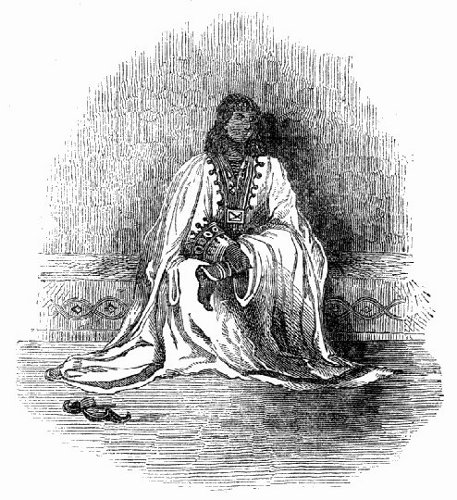
The fair sex all over the world are fond of ornaments. In Abyssinia
they wear a profusion of silver, in the shape of chains, bracelets, &c.,
or, to be more explicit, a well-dressed lady will hang three or four sets
of amulets about her neck, as well as her blue cord, and a large flat
silver case (purporting to contain a talisman, but more often some
scented cotton) ornamented with a lot of silver bells hanging to the
bottom edge of it, and the whole suspended by four chains of the same
metal. Three pairs of massive silver and gilt bracelets are on her wrists,
and a similar number of "bangles" on her ankles; while over her insteps
and to her heels are a quantity of little silver ornaments, strung
like beads on a silk cord. Her fingers (even the upper joints) are
covered with plain rings, often alternately of silver and silver-gilt, and
a silver hair-pin, something similar to those now worn by English
ladies, completes her decoration. Women of the poorer class, and ladies
on ordinary occasions, wear ivory or wooden pins neatly carved in
various patterns, and stained red with henna-leaves. The Abyssinian
ladies, like those of most Eastern nations, stain their hands and feet
with henna, and darken their eyelids with antimony.
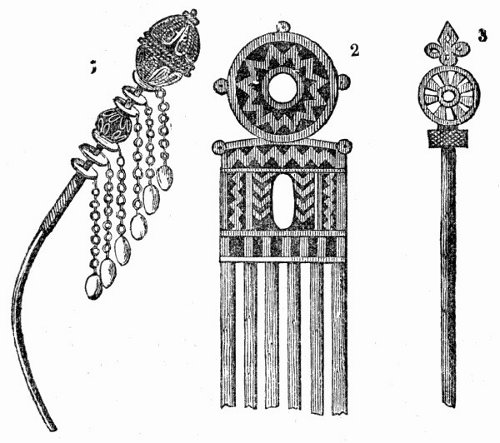
1, 2. Hair-pins made of hard wood, and stained
with henna. 3. Ditto, of silver and
fil-et-grain work. (About one-half usual size.)
TREATMENT OF LEPERS IN ENGLAND.
According to the tenor of various old civil codes and local enactments,
when a person became affected with leprosy, he was looked upon as
legally and politically dead, and lost the privileges belonging to his right
of citizenship. By the laws of England, lepers were classed with idiots,
madmen, outlaws, &c., as incapable of being heirs. But it was not by
the eye of the law alone that the affected was looked upon as defunct,
for the church also took the same view, and performed the solemn ceremonials
of the burial of the dead over him, on the day on which he was
separated from his fellow creatures, and confined to a lazar house. The
various forms and ceremonies which were gone through on this occasion
are described by French authors; but it is highly probable that the
same observances were common in our own country.
A priest, robed with surplice and stole, went with the cross to the
house of the doomed leper. The minister of the church began the
necessary ceremonies, by exhorting him to suffer, with a patient and
penitent spirit, the incurable plague with which God had stricken him.
He then sprinkled the unfortunate leper with holy water, and afterwards
conducted him to the church, the usual burial services being sung during
their march thither. In the church, the ordinary habiliments of the
leper were removed; he was clothed in a funeral pall, and, while placed
before the altar, between trestles, the libera was sung, and the mass for
the dead celebrated over him. After this service he was again sprinkled
with holy water, and led from the church to the house or hospital
destined for his future abode. A pair of clappers, a barrel, a stick,
cowl, and dress, &c., were given him. Before leaving the leper, the
priest solemnly interdicted him from appearing in public without his
leper's garb,—from entering inns, churches, mills, and bakehouses,—from
touching children, or giving them ought he had touched,—from
washing his hands, or any thing pertaining to him, in the common
fountains and streams,—from touching, in the markets, the goods he
wished to buy, with any thing except his stick,—from eating and drinking
with any others than lepers,—and he specially forbade him from
walking in narrow paths, or from answering those who spoke to him in
roads and streets, unless in a whisper, that they might not be annoyed
with his pestilent breath, and with the infectious odour that exhaled
from his body,—and last of all, before taking his departure, and leaving
the leper for ever to the seclusion of the lazar house, the official of the
church terminated the ceremony of his separation from his living fellow-creatures,
by throwing upon the body of the poor outcast a shovelful of
earth, in imitation of the closure of the grave.
According to the then customary usage, Leper Hospitals were always
provided with a cemetery for the reception of the bodies of those who
had died of the malady.
LUMINOUS APPEARANCE OF THE RED SEA.
All who have frequented the Red Sea, have observed the luminous
appearance or phosphorescence of its waters. "It was beautiful," says
a picturesque writer, who sailed from Mocha to Cosseir, "to look down
into this brightly transparent sea, and mark the coral, here in large
masses of honeycomb-rock, there in light branches of a pale red hue,
and the beds of green seaweed, and the golden sand, and the shells, and
the fish sporting round the vessel, and making colours of a beauty to the
eye which is not their own. Twice or thrice we ran on after dark for an
hour or two; and though we were all familiar with the sparkling of the
sea round the boat at night, never have I seen it in other waters so
superlatively splendid. A rope dipped in it and drawn forth came up as
a string of gems; but with a life, and light, and motion, the diamond
does not know." Those sea-lights have been explained by a diversity
of causes; but the singular brilliancy of the Red Sea seems owing to fish
spawn and animalculæ, a conjecture which receives some corroboration
from the circumstance that travellers who mention it visited the gulf
during the spawning period—that is, between the latter end of December
and the end of February. The coral-banks are less numerous in the
southern parts. It deserves notice, that Dr. Shaw and Mr. Bruce have
stated—what could only be true, so far as their own experience went—that
they observed no species of weed or flag; and the latter proposes to
translate Yam Zuph "the Sea of Coral"—a name as appropriate as that
of Edom.
RECENT PRICES OF SLAVES.
Prices of course vary at Constantinople according to the vigilance
of Russian cruisers, and the incorruptibility of Russian agents at
Trebizond, Samsoon, and Sinope. The following is the average price in
Circassia:—
| A man of |
30 years |
of |
age, |
£10 |
| " |
20 |
" |
|
10 to £30 |
| " |
15 |
" |
|
30 " 70 |
| " |
10 |
" |
|
20 " 50 |
| " |
5 |
" |
|
10 " 30 |
| A woman of |
50 years |
of |
age, |
£10 to £30 |
| " |
40 |
" |
|
30 " 40 |
| " |
30 |
" |
|
40 " 70 |
| " |
20 to 25 |
" |
|
50 " 100 |
| " |
14 " 18 |
" |
|
50 " 150 |
| " |
8 " 12 |
" |
|
30 " 80 |
| " |
5 |
" |
|
20 " 40 |
TATTOOED ABYSSINIAN LADY.
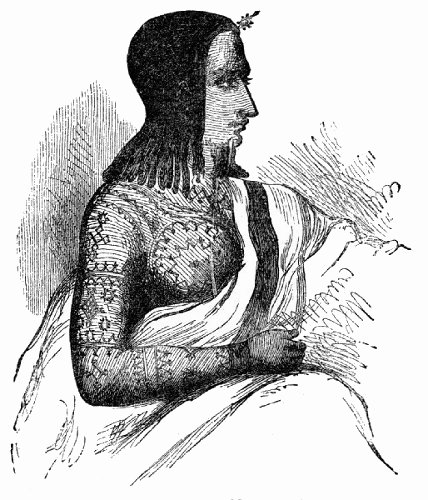
The annexed cut is a sketch of an Abyssinian lady, tattooed in the
height of the fashion. The following extract from that interesting work
"Parkyns's Abyssinia" gives a good account of the custom as it prevails
in the larger cities there, and of the manner in which the operation
is performed. "The men seldom tattoo more than one ornament on the
upper part of the arm, near the shoulder, while the women cover nearly
the whole of their bodies with stars, lines, and crosses, often rather
tastefully arranged. I may well say nearly the whole of their persons,
for they mark the neck, shoulders, breasts, and arms, down to the
fingers, which are enriched with lines to imitate rings, nearly to the
nails. The feet, ankles, and calves of the legs, are similarly adorned,
and even the gums are by some pricked entirely blue, while others have
them striped alternately blue and the natural pink. To see some of
their designs, one would give them credit for some skill in the handling of
their pencil; but, in fact, their system of drawing the pattern is purely
mechanical. I had one arm adorned; a rather blind old woman was
the artist; her implements consisted of a little pot of some sort of
blacking, made, she told me, of charred herbs; a large home-made iron
pin, about one-fourth of an inch at the end of which was ground fine;
a bit or two of hollow cane, and a piece of straw; the two last-named
items were her substitutes for pencils. Her circles were made by dipping
the end of a piece of a cane of the required size into the blacking,
and making its impression on the skin; while an end of the straw, bent
to the proper length, and likewise blackened, marked all the lines,
squares, diamonds, &c., which were to be of equal length. Her design
being thus completed, she worked away on it with her pin, which she
dug in as far as the thin part would enter, keeping the supply of
blacking sufficient, and going over the same ground repeatedly to ensure
regularity and unity in the lines. With some persons, the first effect of
this tattooing is to produce a considerable amount of fever, from the
irritation caused by the punctures; especially so with the ladies, from the
extent of surface thus rendered sore. To allay this irritation, they are
generally obliged to remain for a few days in a case of vegetable matter,
which is plastered all over them in the form of a sort of green poultice. A
scab forms over the tattooing, which should not be picked off, but allowed
to fall off of itself. When this disappears, the operation is complete,
and the marks are indelible; nay more, the Abyssinians declare that
they may be traced on the person's bones even after death has bared
them of their fleshy covering."
BULGARIAN FISHERMEN.
The following interesting account of the Bulgarian fishermen on the
shores of the Black Sea is taken from the translation of a narrative of a
boat excursion made in 1846 by M. Xavier Hommaire, along part of the
northern coast of the Black Sea:—
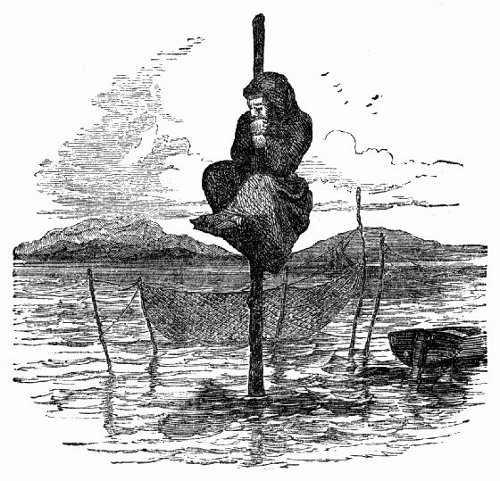
"The fishermen are, almost without exception, Bulgarians—a population
at once maritime and agricultural, very closely resembling, in race
and costume, the Bretons of France—and they enjoy a monopoly of all
the fisheries in the Bosphorus and the adjacent parts of the Black Sea.
Their elegant barks appeared on stated days and hours, shooting along
with extraordinary rapidity through the waters of the Gulf of Buyuk
Déreh, which appears to be their head-quarters, and sustaining the test
of comparison even with the famous caiques of Constantinople. The
most important object of their fishery is a delicious kind of small thunny,
called palamede. They are Bulgarians, also, who own the singular
fisheries which form such admirable subjects for the artist's sketch-book.
They are found throughout the Bosphorus, from Bechiktusch and
Scutari to the lighthouses of Europe and Asia. They might be called
dog-kennels, but rickety and worm-eaten with antiquity, and are suspended
by means of cords, pegs, and tatters to the top of an indescribable
framework of props. There on high, petrified in motionless and uninterrupted
silence, in company with some old pots of mignionette (where
will not the love of flowers find a home!), a man, with the appearance
of a wild beast or savage, leans over the sea, at the bottom of which he
watches the passage of its smallest inhabitants, and the capricious variations
of the current. At a certain distance is arranged, in the form of a
square, a system of nets, which, at the least signal from the watcher, fall
on the entire shoal of fish. A contrivance yet more primitive than these
airy cells, if not so picturesque, was that of simple posts, which we encountered
some time before in the channel of the Bosphorus, rising
about fifteen feet above the surface of the water. Half-way up is perched,
crouching (one cannot see how), something having the human form, and
which is found to be a Bulgarian. For a long time I watched them
without being able to make them out, either pole or its tenant; and
often have I seen them in the morning, and observed them again in the
evening, not having undergone the least change of posture.
"On returning to our encampment, the commandant of the fort, to
whom we paid a visit, gave us a very different report of the fishermen
of the morning, whom he described as an assemblage of all the vagabonds
of the neighbourhood. Convinced even that the fact of their having
fallen in with us must have inspired them with the project of coming to
prowl by night round our camp, he wished us to accept some of the men
in his garrison as a guard."
HORSES OF THE ARABS.
Arabs make intimate friends of their horses, and so docile are these
creatures that they are ridden without a bit, and never struck or spurred.
They share their owner's diet, and are as well cared for as a child.
They divide their horses, however, into two kinds: The one they call
kadischi, that is, horses of an unknown birth; the other, they call kochlani,
that is, horses whose genealogy is known for thousands of years.
They are direct descendants, so they say, of the stud of Solomon. The
pedigree of an Arabian horse is hung round his neck soon after his birth,
which is always properly witnessed and attested.
The following is the pedigree of a horse purchased by a French officer
in Arabia:—"In the name of God, the merciful and compassionate, and
of Saed Mahomed, agent of the high God, and of the companions of
Mahommed, and of Jerusalem. Praised be the Lord, the Omnipotent
Creator. This is a high-bred horse, and its colt's tooth is here in a bag
about his neck, with his pedigree, and of undoubted authority, such as
no infidel can refuse to believe. He is the son of Rabbamy, out of the
dam Labadah, and equal in power to his sire of the tribe of Zazhalah;
he is finely moulded, and made for running like an ostrich. In the
honours of relationship, he reckons Zuluah, sire of Mahat, sire of Kallac,
and the unique Alket sire of Manasseh, sire of Alsheh, father of the race
down to the famous horse, the sire of Lahalala; and to him be ever
abundance of green meat, and corn, and water of life, as a reward from the
tribe of Zazhalah; and may a thousand branches shade his carcass from
the hyæna of the tomb, from the howling wolf of the desert; and let the
tribe of Zazhalah present him with a festival within an enclosure of
walls; and let thousands assemble at the rising of the sun in troops
hastily, where the tribe holds up under a canopy of celestial signs within
the walls, the saddle with the name and family of the possessor. Then
let them strike the bands with a loud noise incessantly, and pray to God
for immunity for the tribe of Zoab, the inspired tribe."
DILEMMA.
Protagoras, an Athenian rhetorician, had agreed to instruct Evalthus
in rhetoric, on condition that the latter should pay him a certain sum
of money if he gained his first cause. Evalthus when instructed in all the
precepts of the art, refused to pay Protagoras, who consequently brought
him before the Areopagus, and said to the Judges—"Any verdict that
you may give is in my favour: if it is on my side, it carries the condemnation
of Evalthus; if against me, he must pay me, because he gains
his first cause." "I confess," replied Evalthus, "that the verdict will
be pronounced either for or against me; in either case I shall be equally
acquitted: if the Judges pronounce in my favour, you are condemned; if
they pronounce for you, according to our agreement, I owe you nothing,
for I lose my first cause." The Judges being unable to reconcile the
pleaders, ordered them to reappear before the Court a hundred years
afterwards.
ORIENTAL EXTRAVAGANCE.
Mr. Forbes has given a curious picture of the kind of magnificence affected
by Asuf ul Dowlah, who succeeded his father on the throne of Oude.
This nabob was fond of lavishing his treasures on gardens, palaces,
horses, elephants, European guns, lustres, and mirrors. He expended
annually about £200,000 in English manufactures. He had more than
one hundred gardens, twenty palaces, one thousand two hundred
elephants, three thousand fine saddle horses, one thousand five hundred
double-barrel guns, seventeen hundred superb lustres, thirty thousand
shades of various forms and colours; seven hundred large mirrors,
girandoles and clocks. Some of the latter were very curious, richly set
with jewels, having figures in continual movement, and playing tunes
every hour; two of these clocks only, cost him thirty thousand pounds.
Without taste or judgment, he was extremely solicitous to possess all
that was elegant and rare; he had instruments and machines of every
art and science, but he knew none; and his museum was so ridiculously
arranged that a wooden cuckoo-clock was placed close to a superb timepiece
which cost the price of a diadem; and a valuable landscape of
Claude Lorraine suspended near a board painted with ducks and drakes.
He sometimes gave a dinner to ten or twelve persons, sitting at their
ease in a carriage drawn by elephants. His jewels amounted to about
eight millions sterling. Amidst this precious treasure, he might be seen
for several hours every day handling them as a child does his toys.
ANCIENT SCOTTISH CHIEFTAIN.
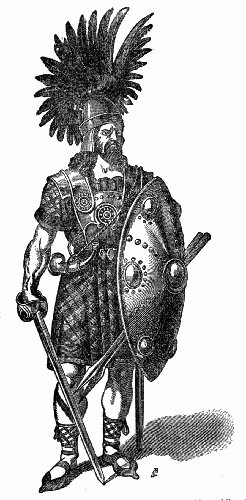
Annexed is a Scottish costume of the eighth or ninth century, after
a drawing on parchment, extracted from an old book, which, according
to the characters on the back,
appears to have been written in
Gaelic or Erse.
According to
the assertion of the possessor,
this Caledonian document was
brought to Germany in the year
1596, during the devastating
Reformation in Scotland, when
all cloisters and religious endowments
were destroyed, and a perfect
victory obtained over the
episcopacy, so that many persons
took refuge with their treasures,
on the Continent, where the
Scottish monks possessed many
religious houses; some being at
Nuremberg. Our figure represents
a Highland chief, whose
dress is picturesque and extremely
beautiful. The Scottish tunic or
blouse, checkered or striped in
light and dark green, with violet
intermixed, and bordered with
violet stripes, is covered with a
steel breastplate, accompanied
by a back-piece, judging from
the iron brassarts—positively a
bequest of the Romans, by whom
the Scots were once subjugated;
this, indeed, is also attested by
the offensive weapon the javelin;
the sword, however, must be excepted,
for it is national and like
that of the present time. The
strong shield may also have descended
from the Romans, as well
as the helmet, which is decorated
with an eagle's wing; these, together
with the hunting-horn,
give to the figure a very imposing appearance. The national plaid is
wanting, this was borne by attendants or squires. We are involuntarily
reminded of the heroes of Fingal and Ossian, and we might almost think
that this figure belonged to the time of the Scottish king, Kenneth the
Second, grandson of King Achaias, and the sister of the Pictish king,
Hang.
GREEK VASES.
Vases of various shapes have been found in the sepulchres of Greece,
such as the œnochoe, or jug; the askos, or wine-skin; the phiale omphalotos,
or saucer having a boss in the centre; rhyta, or jugs, imitated from
the keras, or horn, as well as some moulded in the shape of the human
bust. Vases of this class, however, occur more frequently in Italy than
in Greece. Some are of remarkable shape. One in the Durand collection
has its interior receded, and in the centre a medallion of the Gorgon's
head; at the edge is the head of a dog or fox, and to it is attached a long
handle terminating in the head of an animal. Similar handles are often
found. Another vase from Sicily, also in the same collection, with a
conical cover, is ornamented externally with moulded subjects of
wreaths, heads of Medusa, &c., painted and gilded.
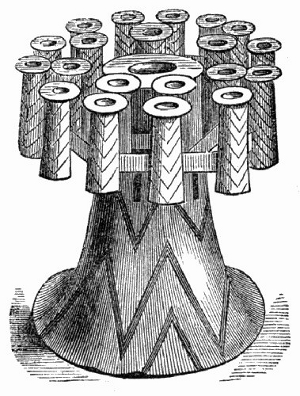
Many of the vases intended for ornamental
purposes are covered with
a white coating, and painted with
colours of the same kind as those used
on the figures before described, but
with few and simple ornaments, plain
bands, mæanders, chequered bands
and wreaths. A vase found at
Melos affords a curious example.
We here annex a sketch of it. It
consists of a number of small vases
united together and arranged in a
double circle round a central stand.
This kind of vase is supposed to be
the kernos, used in the mystic ceremonies
to hold small quantities of
viands. By some persons, however,
it is thought to have been intended
for eggs or flowers. It is covered
with a white coating of clay, and
the zigzag stripes are of a maroon
colour. Such vases might have been used for flower-pots, and have
formed small temporary gardens like those of Adonis, or have been
employed as lamps.
QUEEN ELIZABETH'S DRESSES.
The list of the Queen's wardrobe, in 1600, shows us that she had
then only 99 robes, 126 kirtles, 269 gowns (round, loose, and French),
136 foreparts, 125 petticoats, and 27 fans, not to mention 96 cloaks,
83 save guards, 85 doublets, and 18 lap mantles.
Her gowns were of the richest materials—purple, gold tissue,
crimson satin, cloth of gold, cloth of silver, white velvet, munsy
cloth, tawney satin, horse-flesh coloured satin, Isabella coloured satin
dove coloured velvet, lady blush satin, drake coloured satin, and [...] coloured satin.
The cloaks are of perfumed leather, black taffety; the petticoats of
blue satin; the jupes of orange coloured satin; the doublets of straw
coloured satin; the mantles of white blush, striped with red swan's
down.
The most characteristic dresses are the following:—
A frock of cloth of silver, checquered with red silk, like bird's eyes,
with demi sleeves, a cut of crimson velvet twisted on with silver, lined
with crimson velvet.
A mantle of white lawn, cut and turned in, embroidered all over
with works of silver, like pomegranates, roses, honeysuckles, and
acorns.
One French kirtle of white satin, cut all over, embroidered with
loops, flowers, and clouds of Venice gold, silver, and silk.
One round kirtle of white satin, embroidered all over with the work
like flames, peascods, and pillars, with a border likewise embroidered
with roses.
The stomacher (fore part) of white satin, embroidered very fair with
borders of the sun, moon, and other signs and planets of Venice gold,
silver, and silk of sundry colours, with a border of beasts beneath,
likewise embroidered.
Other gowns we find adorned with bees, spiders, flies, worms, trunks
of trees, pansies, oak leaves, and mulberries; so that "Bess" must
have looked like an illustrated edition of Æsop's Fables.
In one case she shines in rainbows, clouds, flames of fire, and suns;
in another, with fountains and trees, snakes, and grasshoppers; the
buttons themselves, in one instance, assume the shape of butterflies, in
another of birds of Paradise.
The fans were of white and coloured feathers, with gold handles set
with precious stones, or of crystal and heliotrope; one of them contained
a looking-glass, another Leicester's badge of the bear and ragged
staff. Her swords had gilt handles and blood-stone studs; her poniards
were gold and ivory, ornamented with tassels of blue silk; her slippers
of cloth of silver, and of orange-coloured velvet, embroidered with
seed pearls; her parasol was of crimson velvet damask, striped with
Venetian gold and silver lace, the handle mother-of-pearl.
Her jewels were both numerous and curious: the head ornaments
resembling a white lion with a fly on his side, a golden fern-branch
with a lizard, ladybird, and a snail upon it, an Irish dart of gold set
with diamonds, a golden rose with a fly and spider upon it, a golden
frog set with jewels, a golden daisy, and emerald buttons, gown studs
of rubies and pearls, and a chain of golden scallop shells, with chains
of agate and jet. A sumptuous magnificence was the characteristic of
the costume of this reign. When Elizabeth visited the Earl of Hertford,
at Elvetham, that nobleman met her with 3,000 followers, with
black and yellow feathers in their hats, and most of them wearing gold
chains. When she visited Suffolk, 200 bachelors in white velvet, with
as many burghers in black velvet coats and gold chains, and 1800
serving-men received on horseback. For the French ambassador's
amusement, in 1559, 1400 men-at-arms, clad in velvet, with chains of
gold, mustered in arms in Greenwich Park; and on another occasion
there was a tournament on Midsummer (Sunday) Night at the palace of
Westminster, between ten knights in white, led by the Earl of Essex,
and ten knights in blue, led by the Earl of Rutland.
CARE OF THE BEARD.
The Mahometans are very superstitious touching the beard. They
bury the hairs which come off in combing it, and break them first, because
they believe that angels have charge of every hair, and that they
gain them their dismissal by breaking it. Selim I. was the first Sultan
who shaved his beard, contrary to the law of the Koran. "I do it,"
said he apologetically to the scandalized and orthodox mufti, "to prevent
my vizier leading me by it." He cared less for it than some of our
ancestors, two centuries ago, did for their own. They used to wear
pasteboard covers over them in the night, lest they should turn upon
them and rumple them in their sleep!
The famous Raskolniki schismatics had a similar superstition to the
Mahometan one mentioned above. They considered the divine image in
man to reside in the beard.
DOLE IN CONSEQUENCE OF A DREAM.
At Newark-upon-Trent, a curious custom, founded upon the preservation
of Alderman Clay and his family by a dream has prevailed
since the days of Cromwell. On 11th March every year, penny-loaves
are given away to every one who chooses to appear at the Town Hall
and apply for them, in commemoration of the Alderman's deliverance,
during the siege of Newark by the Parliamentary forces. This gentleman,
by will, dated 11th December, 1694, gave to the Mayor and
Aldermen, one hundred pounds, the interest of which was to be given
to the Vicar yearly, on condition of his preaching an annual sermon.
Another hundred pounds were also appropriated for the behoof of the
poor, in the way above-mentioned. The origin of this bequest is
singular. During the bombardment of Newark by Oliver Cromwell's
forces, the Alderman dreamed three nights successively that his house
had taken fire, which produced such a vivid impression upon his mind,
that he and his family left it, and in a few days the circumstances of
his vision actually took place, by the house being burned down by the
besiegers.
GLOVE MONEY.
Gloves were popular new-year's gifts, or sometimes "glove-money"
in place of them; occasionally, these gloves carried gold pieces in them.
When Sir Thomas More was Chancellor, he decided a case in favour of
Mrs. Croaker against Lord Arundel; the former, on the following new-year's
day, gratefully presented the judge with a pair of gloves with
forty angels in them. "It would be against good manners," said the
Chancellor, "to forsake a gentlewoman's new-year's gift, and I accept
the gloves. The lining you will elsewhere bestow."
GLAIVES.
The glaive was derived from the Celtic
custom of placing a sword with a hollow
handle at the end of a pole, called by the
natives of Wales "llavnawr"—the blade
weapon, and takes its name from the
Cleddyv, or Gleddyv, of the Welsh.
In an
abstract of the grants of the 1st of
Richard III., among the Harleian MSS.,
No. 443, is a warrant to Nicholas Spicer,
authorising him to impress smiths for
making 2,000 Welsh glaives; and 20s. 6d.
are charged for 30 glaives, with their staves,
made at Abergavenny and Llanllolved. In
the romaunt of Guy, Earl of Warwick, by
Walter of Exeter, written in the time of
Edward II., also in the Harleian Library
of the British Museum, they are called
gleves; thus—
"Grant coupes de gleves trenchant
Les escurs ne lur vailut gans."
"Such powerful strokes from cutting gleves,
That the shields were not worth a glove."
They were also in frequent use on the Continent,
and the "Chronicle of Flanders"
mentions an instance of the cavalry having
armed themselves with glaives, which they
ornamented with pennoncels. The specimen
which we have here engraved is one which
was made for the Doge of Venice, during
the time that the Emperor Charles V. had
the command there, in compliment to whom
the centre ornament is the Austrian eagle.
Upon this the arms of the succeeding Doge,
Francisco Veneri, who held the office from
1554 to 1556, have been deeply incised, no
doubt to commemorate the expulsion of
the Germans. The pole, at the top of
which the weapon was fixed, is omitted in
our engraving.
CRUELTY OF FRANCIS CARRARA.
Francis Carrara, the last Lord of Padua, was famous for his cruelties.
They shew (at Venice) a little box for a toilette, in which are six little
guns, which are so ordered with springs, and adjusted in such a manner,
that upon the opening of the trunk, the guns fired and killed the lady
to whom Carrara sent it for a present. They show also with this, some
little pocket cross-bows and arrows of steel, with which he took pleasure
to kill those he met, so secretly, that they could hardly either perceive
the blow, or him that gave it.
IRISH PIPES.
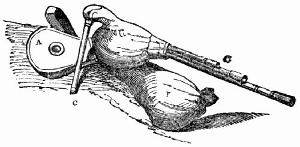
COMMON BAGPIPES.
The accompanying figures represent the Irish bagpipes in their
primitive and improved
forms.
We have here
the earliest pipes, originally
the same as the
Scotch, as appears from a
drawing made in the sixteenth
century, and given
in Mr. Bunting's work;
but they now differ, in
having the mouthpiece
supplied by the bellows A,
which, being filled by the motion of the piper's arm, to which it is fastened,
fills the bag B; whence, by the pressure of the other arm, the wind is
is conveyed into the
chanter C, which is
played on with the
fingers, much like a
common pipe. By
means of a tube, the
wind is conveyed into
drones a, a, a, which,
tuned at octaves to
each other, produce a
kind of cronan, or
bass, to the chanter.
The second cut represents
the improved, or
union pipes, the drones
of which, tuned at
thirds and fifths by
the regulator, have keys attached to them, which not only produce
the most delightful accords, but enable the player to perform parts of
tunes, and sometimes whole tunes, without using the chanter at all.
Both drones and chanter can be rendered quiescent by means of stops.
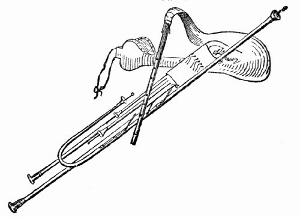
UNION PIPES.
The pipers were at one period the "great originals" of Ireland. The
race is gradually departing, or at least "sobering" down into the ranks
of ordinary mortals; but there was a time when the pipers stood out
very prominently upon any canvas that pictured Irish life. Anecdotes
of their eccentricities might be recorded that would fill volumes. For
many years past their power has been on the wane; temperance committed
sad havoc on their prospects; and at length the introduction of
"brass bands" effectually destroyed the small balance that remained to
them of hope.
NOVEL WAY OF CURING VICIOUS HORSES.
Burckhardt tells us of a strange mode of curing a vicious horse. He
has seen, he says, vicious horses in Egypt cured of the habit of biting by
presenting to them, while in the act of doing so, a leg of mutton just
taken from the fire. The pain which the horse feels in biting through
the hot meat causes it to abandon the practice.
GROUND ICE.
Every one who has watched the freezing of a lake or pond, or any
other collection of still water, must be well aware that the ice begins to
form on the surface in thin plates or layers, which on the continuance of
the frost gradually become thicker and more solid, until the water is
affected in a downward direction, and becomes, perhaps, a solid mass of
ice. This is universally the case in stagnant water, but it has been
repeatedly proved that in rapid and rugged streams the process of
freezing is often very different. In direct opposition, as it would seem,
to the laws of the propagation of heat, the ice in running water frequently
begins to form at the bottom of the stream instead of the top;
and this fact, while it is received with doubt by some, even among the
scientific, is frequently attested by those whose business leads them to
observe the phenomenon connected with rivers. Millers, fishermen, and
watermen find that the masses of ice with which many rivers are crowded
in the winter season rise from the bottom or bed of the stream. They
say that they have seen them come up to the surface, and have also
borne them up with their hooks. The under part of these masses of ice
they have found covered with mud or encrusted with gravel, thus bearing
plain marks of the ground on which the ice had rested. The testimony
of people of this class in our country agrees with that of a
similar class in Germany, where there is a peculiar term made use of to
designate floating ice, i. e. grundeis (ground-ice).
A striking example of the formation of ground-ice is mentioned by
the Commander Steenk, of Pillau. On the 9th of February, 1806,
during a strong south-east wind, and a temperature a little exceeding
34° Fahr., a long iron chain, to which the buoys of the fair-way are
fastened, and which had been lost sight of at Schappeiswrack in a depth
of from fifteen to eighteen feet, suddenly made its appearance at the
surface of the water and swam there; it was, however, completely
encrusted with ice to the thickness of several feet. Stones, also, of from
three to six pounds' weight, rose to the surface; they were surrounded
with a thick coat of ice. A cable, also, three and a half inches thick,
and about thirty fathoms long, which had been lost the preceding summer
in a depth of thirty feet, again made its appearance by swimming
to the surface; but it was enveloped in ice to the thickness of two feet.
On the same day it was necessary to warp the ship into harbour in face
of an east wind; the anchor used for that purpose, after it had rested an
hour at the bottom, became so encrusted with ice, that it required not
more than half the usual power to heave it up.
M. Hugi, president of the Society of Natural History at Soleure,
observed, in February, 1827, a multitude of large icy tables on the river
Aar. These were continually rising from the bottom, over a surface of
four hundred and fifty square feet, and the phenomenon lasted for a
couple of hours. Two years afterwards he witnessed a similar occurrence.
On the 12th of February, 1829, at sunrise, and after a sudden
fall in the temperature, the river began to exhibit numerous pieces of
floating ice, although there was no sign of freezing on the surface, either
along the banks, or in shady places where the water was calm. Therefore
it could not be said that the floating masses were detached from the
banks. Nor could they have proceeded from any large sheet of ice
farther up the river, because, higher up, the river exhibited hardly any
ice. Besides, flakes of ice commenced soon to rise up above the bridge;
towards mid-day, islands of ice were seen forming in the centre of the
river; and by the next day these were twenty-three in number, the
largest being upwards of two hundred feet in diameter. They were
surrounded with open water, resisting a current which flowed at the
rate of nearly two hundred feet in a minute, and extending over a space
of one-eighth of a league. M. Hugi visited them in a small boat. He
landed, examined them in every direction, and discovered that there
was a layer of compact ice on their surface a few inches in thickness,
resting on a mass having the shape of an inverted cone, of a vertical
height of twelve or thirteen feet, and fixed to the bed of the river.
These cones consisted of half-melted ice, gelatinous, and much like the
spawn of a frog. It was softer at the bottom than at the top, and was
easily pierced in all directions with poles. Exposed to the open air, the
substance of the cones became quickly granulated, like the ice that is
formed at the bottom of rivers.
In the same year the pebbles in a creek of shallow water, near a very
rapid current of the Rhine, were observed to be covered with a sort of
transparent mass, an inch or two in thickness, and which, on examination,
was found to consist of icy spicula, crossing each other in every
direction. Large masses of spongy ice were also seen in the bed of the
stream, at a depth of between six or seven feet. The watermen's poles
entered these with ease, and often bore them to the surface. This kind
of ice forms most quickly in rivers whose bed is impeded with stones and
other foreign bodies.
HINDOO COMPUTATION.
The Hindoos call the whole of their four ages a divine age; a thousand
divine ages form a calpa, or one of Brahma's days, who, during that
period, successively invested fourteen menus, or holy spirits, with the
sovereignty of the earth. The menu transmits his empire to his posterity
for seventy-one divine ages, and this period is called manawantara, and
as fourteen manawantara make but nine hundred and ninety-four divine
ages, there remain six, which are the twilight of Brahma's day. Thirty
of these days form his month; twelve of these months one of his years;
and one hundred of these years the duration of his existence. The
Hindoos assert that fifty of these years have already elapsed, so that we
are in the first day of the first month of the fifty-first year of Brama's
age, and in the twenty-eighth divine age of the seventh manawantara.
The first three human ages of this age, and five thousand years of
the fourth are past. The Hindoos therefore calculate that it is
131,400,007,205,000 years since the birth of Brahma, or the beginning of
the world.
CHINESE TOMB.
Like all people of Tartar origin, one of the most remarkable characteristics
of the Chinese is their reverence for the dead, or, as it is usually
called, their ancestral worship. In consequence of this, their tombs are
not only objects of care, but have frequently more ornament bestowed
upon them than graces the dwellings of the living.
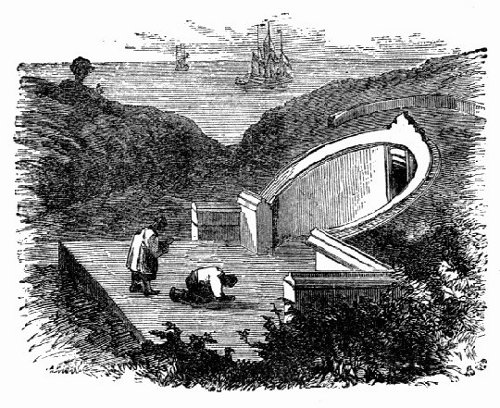
Their tombs are of different kinds; but the most common arrangement
is that of a horseshoe-shaped platform, cut out of the side of a
hill, as represented in our engraving. It consequently has a high back,
in which is the entrance to the tomb, and slopes off to nothing at the
entrance to the horseshoe, where the wall generally terminates with two
lions or dragons, or some fantastic ornament common to Chinese architecture.
When the tomb is situated, as is generally the case, on a hillside,
this arrangement is not only appropriate, but elegant. When the
same thing is imitated on a plain, it is singular, misplaced, and unintelligible.
Many of the tombs are built of granite, finely polished, and
carved with a profusion of labour that makes us regret that the people
who can do such things should have so great a predilection for ephemeral
wooden structures, when capable of employing the most durable
materials with such facility.
ABYSSINIAN ARMS.
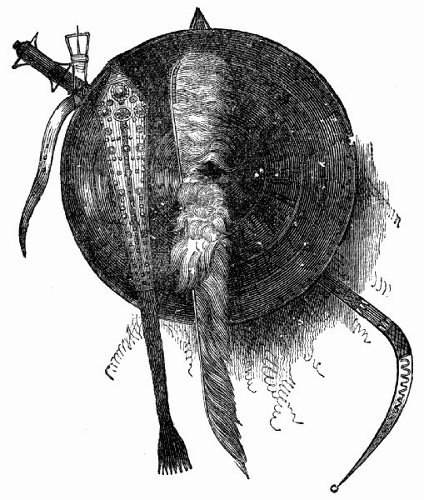
The above engraving represents a group of Abyssinian arms. The
sword, spear, and shield are essentially the weapons of the Abyssinians,
firearms being only of comparatively recent introduction, and not
generally used. The shields are round, and nearly a yard in diameter;
they are very neatly made of buffalo's hide, and of the form most calculated
to throw off a lance-point; namely, falling back gradually from
the boss or centre (which protrudes) to the edges. At the centre, in the
inside, is fixed a solid leather handle, by which the shield is held in the
hand when fighting, or through which the arm is passed to the elbow,
for convenience of carrying on a journey. The edge is perforated with
a number of holes, through which leather loops are passed, and by these
it is hung up in the houses. The face of the shield is often ornamented
in various ways, according to the wealth or fancy of the owner. Some
have simply a narrow strip of lion's skin on each side of the boss, but
crossing each other above and below it, the lower ends being allowed to
hang at some length; others have a large broad strip of the mane down
the centre of the shield, and hanging several inches below it. This is,
of course, usually made of two or three pieces stitched together, as it
would be difficult to get a single piece of sufficient length and beauty
of fur. Others to this add a lion's paw or tail, fastened on the left side
of the mane, and often highly adorned with silver. The beautiful long
black and white fur of a sort of monkey, called "goréza," occasionally
supplies the place of that of the nobler yet scarcely so beautiful animal.
A shield almost completely covered with plates and bosses of silver, is
usually the mark of the chief of some district. Those similarly plated
in brass were likewise formerly used only by chiefs, though now they
are carried by every soldier who can afford to buy them. The plated
shield is called "tebbora." Those in brass are not much approved of,
as they usually cover a bad skin; for a man possessed of a good handsome
shield would never think of thus hiding its intrinsic beauties.
In former times a beautiful crooked knife was used in Tigrè, the
sheath and handle of which were profusely enriched with silver and
gilt. These, however, are never worn now, the long "shotel" in
Tigrè, and the European-shaped sword among the Amhàra and most of
the soldiers, have entirely superseded them.
The "shotel" is an awkward-looking weapon. Some, if straight,
would be nearly four feet long: they are two-edged, and curved to a
semicircle, like a reaper's sickle. They are principally used to strike
the point downwards over the guard of an adversary, and for this the
long curved shape is admirably adapted. It is, however, a very clumsy
weapon to manage. The sheath is of red morocco leather, its point being
often ornamented with a hollow silver ball, called "lomita," as large as
a small apple. Many of the swords used are made in Europe, and are
such as would be carried by the light cavalry, though lighter than ours.
Being, however, cheap, showy articles, they are apt to break, and therefore
the Abyssinians are getting tired of them, preferring those made of
soft iron in their own country. These they make also with the faible
considerably broader than the forte, to give force to the blow. Of
course, they bend on the least stress; but, in defence of this failing,
their owners say that, if a sword breaks, who is to mend it?—while, if
it bends, you have only to sit on it, and it gets straight again. The
handles of both this and the "shotel" are made of the horn of the
rhinoceros. They are cut out of the horn at great loss of material, and
hence they fetch a good price. It should be remembered that the heart
of the horn is black, outside of which there is a coating, not quite an
inch thick, of a semi-transparent white colour. To make a sword-handle,
a piece of horn of the requisite length is first sawn off. This is
then re-sawn longitudinally into three pieces, of which the inner one
only is eligible for handles. This piece is about an inch and a half
thick, four or five inches broad at the broader extremity, and three at
the narrower. As it lies sawn flat before us we can distinctly see the
black stripe in the centre, with the white on each side. Next, a nearly
semicircular piece is cut out at each side, leaving only four points of the
white as four corners, and the grasp black. The handle is then finished,
bored for the shank of the blade, and polished. The shank is usually
clinched over a half-dollar beaten convex; a fil-et-grain boss, called
"timbora," is, however, sometimes substituted. A sword-hilt thus
made is obviously a very clumsy one to handle, as the points are parallel
to the edge, and those farthest from the blade are longest.
GEORGIANS AS TOPERS.
It is as unsurpassable topers, as well as for their military qualities,
which have always been acknowledged, that the Georgians have acquired
notoriety. At their frequent drinking parties it is said they will pass
several days and nights, almost without intermission, in quaffing the
productions of the vineyards of Kakheti, a district in the mountains
east of Tiflis. This wine is by no means of bad quality; it is of a deep
red colour, so deep that one fancies it has been tinged with some dye to
produce so intense a hue. They are said to consume incredible quantities
of wine on these occasions, and in a fashion that would put to shame the
drinking triumphs of Ireland, recorded by Sir Jonah Barrington, in
days of old, when intoxication was the standard of spirit. The drinking
vessel is a cow's horn, of considerable length, and the point of honour is
to drain it at a draught. The brethren and convivial rivals of the
Georgians in the neighbouring provinces of Imeretia and Mingrelia,
instead of a horn, use a delicately-hollowed globe of walnut tree, with
a long narrow tube at the orifice. It holds fully a pint, and like its
companion, the horn, the contents are consumed at a single gulp. How
these globes are hollowed is as great a marvel as the construction of the
ingenious Chinese puzzle of ball within ball.
STAG-HUNT IN THE SIXTEENTH CENTURY.
The following vivid picture of a stag-hunt is taken from the page of
an old author, and refers to the days of the unfortunate Mary Queen of
Scots:—"In the year 1567, the Earl of Athol, a prince of the blood royal,
had, with much trouble and vast expense, a hunting-match for the entertainment
of our most illustrious and gracious queen. Our people
called this a royal hunting. I was then a young man, and present on
that occasion. Two thousand Highlanders, or wild Scotch, as you call
them, were employed to drive to the hunting-ground all the deer from
the woods and hills of Athol, Badenoch, Marr, Murray, and the counties
about. As these Highlanders use a light dress, and are very swift of
foot, they went up and down so nimbly, that in less than two months'
time, they brought together two thousand red deer, besides roes and
fallow deer. The queen, the great men, and a number of others, were in
a glen when these deer were brought before them. Believe me, the
whole body moved forward in something like battle order. The sight
delighted the queen very much; but she soon had cause for fear. Upon
the earl—(who had been accustomed from his early days to such
sights)—addressing her thus:—'Do you observe that stag who is foremost
of the herd? There is danger from that stag; for if either fear
or rage should force him from the ridge of that hill, let every one look
to himself, for none of us will be out of the way of harm; for the
rest will follow this one, and having thrown us under foot, they will
open a passage to this hill behind us.' What happened a moment after
confirmed this opinion; for the queen ordered one of the best dogs to
be let loose on one of the deer: this the dog pursues; the leading stag
was frighted; he flies by the same way he had come there; the rest
rush after him, and break out where the thickest body of Highlanders
are; they had nothing for it but to throw themselves flat on the heath,
and allow the deer to pass over them. It was told the queen that
several of the Highlanders had been wounded, and that two or three
had been killed outright; and the whole body had got off, had not
the Highlanders, by their skill in hunting, fallen upon a stratagem to
cut off the rear from the main body. It was of those that had been
separated that the queen's dogs and those of the nobility made
slaughter. There were killed that day three hundred and sixty deer,
besides some roes."
TIME WASTED IN TAKING SNUFF.
A vast quantity of valuable time is wasted by the votaries of tobacco,
especially by the smokers; and that the devotees of snuff are not
greatly behind in this respect, will be shown by the following singular
calculation of Lord Stanhope:—
"Every professed, inveterate, and incurable snuff-taker," says his
lordship, "at a moderate computation, takes one pinch in ten minutes.
Every pinch, with the agreeable ceremony of blowing and wiping the
nose and other incidental circumstances, consumes one minute and a
half. One minute and a half out of every ten, allowing sixteen hours
to a snuff-taking day, amounts to two hours and twenty-four minutes
out of every natural day, or one day out of ten. One day out of every
ten, amounts to thirty-six days and a half in a year. Hence, if we
suppose the practice to be persisted in forty years, two entire years of
the snuff-taker's life will be dedicated to tickling his nose, and two
more to blowing it. The expense of snuff, snuff-boxes, and handkerchiefs,
will be the subject of a second essay, in which it will appear
that this luxury encroaches as much on the income of the snuff-taker
as it does on his time; and that by proper application of the time and
money thus lost to the public, a fund might be constituted for the
discharge of the national debt."
VALUE OF A LONG PSALM.
Formerly a psalm was allowed to be sung at the gallows by the culprit,
in case of a reprieve. It is reported of one of the chaplains to the
famous Montrose, that being condemned in Scotland to die, for attending
his master in some of his glorious exploits, and being upon the ladder,
ordered to set out a psalm, he expecting a reprieve, named the 119th
Psalm (with which the officer attending the execution complied, the
Scotch Presbyterians being great psalm-singers): and it was well for him
he did so, for they had sung it half through before the reprieve came:
any other psalm would have hanged him.
ANCIENT INCENSE CHARIOT.
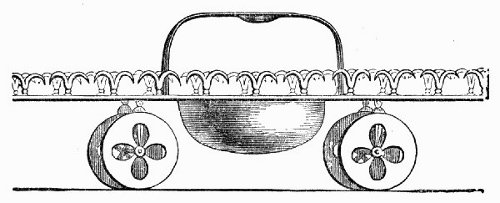
The implement which we have engraved was found in a tomb at Cervetri
in Etruria, and unquestionably belongs to a very remote date of the
archaic period. It was used in the ritual services of the ancients, and
seems to have been destined for burning incense. The perfume was,
no doubt, placed in the concave part, and the fact of the whole being
mounted upon four wheels proves that it was intended to be moved
about, which, in religious services, may have been a great convenience.
The borders are adorned by a row of flower-shaped ornaments, the graceful
forms of which will be appreciated in the side-view we have given of
it. It must be confessed, indeed, that this monument, which is marked
by the stamp of an antiquity so exceedingly remote, displays within the
limits of its archaic character much elegance, conveying the idea of a
highly refined taste, suitable to a person of dignified position, as the
priest or king may be supposed to have been, to whom the article belonged.
TOO MUCH PARENTAL AUTHORITY.
All the world over, the current of natural affection flows strongly
downwards to posterity. Love for children, in most nations, seems to be
stronger than the love for parents. But in China, the current of natural
affection is thrown back towards parents with undue strength. The love
of posterity is in danger of being checked and weakened by their excessive
veneration for parents. The father has absolute power, even the
power of life and death, over his children. A few years ago, a Chinese
father said to his wife, "What shall we do with our young son? He is
undutiful and rebellious, and will bring disgrace on our family name;
let us put him to death." Accordingly, having tied a cord round the
boy's neck, the father pulled one end of it, and the mother the other, and
thus they strangled their son. The magistrates took no notice of the
occurrence. A wealthy Chinese gentleman at Ningpo shut up one of his
orphan grandchildren and starved her to death. He could not be troubled
rearing her up. Another man at the same place, having commanded two
of his sons one day to follow him, entered a boat, and rowed out to the
middle of the stream. He then deliberately tied a stone to the neck of
one of his sons, and threw him into the river. The other lad was compelled
to assist his father in the cruel proceeding. These facts are well
known to the missionaries at that place. They heard the cries of the poor
girl, and rescued her sister from a similar fate, and they saw the youth
drowned by his father. But the authorities never thought of interfering.
POPULAR PASTIMES.
The popular pastimes of the time of James the First are enumerated
in the following lines, in a little work entitled "The Letting of Humour's
Blood in the Head-vaine; with a New Morisco daunced by seven Satyres
upon the bottome of Diogenes' tubbe:" 8vo, Lond. 1611.
"Man, I dare challenge thee to Throw the Sledge,
To jump or Leape over ditch or hedge,
To Wrastle, play at Stooleball, or to Runne:
To Pitch the Barre, or to Shoote Off a Gunne:
To play at Loggets, Nine Holes, or Ten Pinnes:
To try it out at Foot-ball by the shinnes:
At Ticktacke, Irish Noddie, Maw, and Ruffe,
At Hot-cockles, Leap-frog, or Blindman-buffe;
To drinke halfe-pots, or deale at the whole can:
To play at Base, or Pen-and-Ynkhorne Sir Juan;
To daunce the Morris, play at Barley-breake,
At all exploytes a man can thinke or speake;
At Shove-groate, Venter-poynt, or Crosse & Pile,
At Beshrow him that's last at yonder style;
At Leaping o'er a Midsommer-bon-fier,
Or at the Drawing Dun out of the myer:
At any of those, or all these presently,
Wagge but your finger, I am for you, I!"
VACILLATING NEWSPAPERS.
The newspapers of Paris, submitted to the censorship of the press, in
1815, announced in the following terms, Bonaparte's departure from the
Isle of Elba, his march across France, and his entry into the French
Capital:—9th March—The Cannibal has escaped from his den. 10th—The
Corsican ogre has just landed at Cape Juan. 11th—The Tiger has
arrived at Gap. 12th—The Monster has passed the night at Grenoble.
13th—The Tyrant has crossed Lyons. 14th—The Usurper is directing
his course towards Dijon, but the brave and loyal Burgundians have
risen in a body, and they surround him on all sides. 18th—Bonaparte
is sixty leagues from the Capital; he has had skill enough to escape from
the hands of his pursuers. 19th—Bonaparte advances rapidly, but he
will never enter Paris. 20th—To-morrow, Napoleon will be under our
ramparts. 21st—The Emperor is at Fontainebleau. 22nd—His Imperial
and Royal Majesty last evening made his entrance into his Palace
of the Tuileries, amidst the joyous acclamations of an adoring and faithful
people.
PRESSING TO DEATH, AND PRAYING AND FASTING.
In a number of Oliver Cromwell's Newspaper, "The Perfect Account
of the Daily Intelligence," dated April 16th, 1651, we find this horrid
instance of torture:—
"Mond. April 14th.—This session, at the Old Bailey, were four men
pressed to death that were all in one robbery, and, out of obstinacy and
contempt of the court, stood mute and refused to plead; from whence
we may perceive the exceeding great hardness some men are grown unto,
who do not only swerve from instructions, exhortations, and goodnesse,
but become so lewd and insolent that they render themselves the proper
subjects for whom severe laws were first invented and enacted."
The very next paragraph in the paper is to the following effect:—
"Those of the congregate churches, and many other godly people in
London and parts adjacent, have appointed Friday, the 25th instant, as
a day of solemn fasting and prayer, for a blessing upon the armies at
land, the fleet at sea, and negociations abroad."
THE FIRST WATCHES IN ENGLAND.
In 1584 watches began to come from Germany, and the watchmaker
soon became a trader of importance. The watches were often of
immense size, and hung in a rich case from the neck, and by fops
wound up with great gravity and ceremony in Paul's or at the ordinary
dinner. Catgut mainsprings must have been slightly affected by
changes of weather, and sometimes a little out of time in wet Novembers;
but, Sessa, let the world live! An early specimen of the watch that
we have seen engraved was, however, not larger than a walnut, richly
chased, and enclosed in a pear-shaped case. It had no minute hand,
but was of beautiful workmanship. Country people, like Touchstone,
sometimes carried pocket dials, in the shape of brass rings, with a slide
and aperture, to be regulated to the season.
EXTRAORDINARY CIRCUMSTANCE.
Jesse, in his interesting "Gleanings in Natural History," gives the
following remarkable instance of an extraneous substance being found
imbedded in the solid timber of an ash:—"A person on whose accuracy
and veracity I can place every reliance, informed me that hearing from
some of his brother workmen, that in sawing up the butt of a large
ash-tree, they had found a bird's nest in the middle of it; he immediately
went to the spot, and found an ash cut in two longitudinally on
the saw-pit, and the bird's nest nearly in the centre of the tree. The nest
was about two-thirds of a hollow globe, and composed of moss, hair, and
feathers, all seemingly in a fresh state. There were three eggs in it,
nearly white and somewhat speckled. On examining the tree most
minutely with several other workmen, no mark or protuberance was
found to indicate the least injury. The bark was perfectly smooth and
the tree quite sound." In endeavouring to account for this curious fact,
we can only suppose that some accidental hole was made in the tree
before it arrived at any great size, in which a bird had built its nest,
and forsaken it after she had laid three eggs. As the tree grew larger,
the bark would grow over the hole, and in process of time the nest
would become embedded in the tree.
PORT COON CAVE.
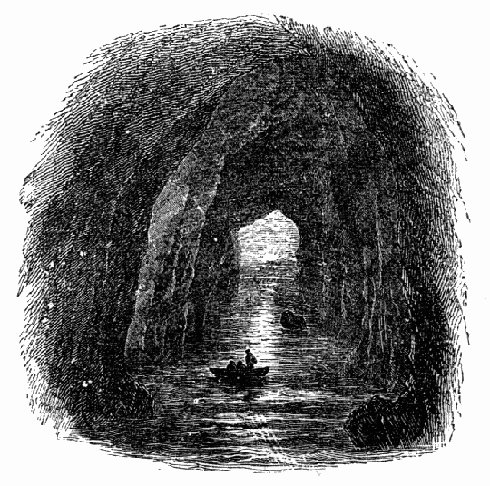
The above is a sketch of a cave which well deserves a place among
our collection of Wonders. It is called Port Coon Cave, and is in the
line of rocks near the Giants' Causeway. It may be visited either by
sea or by land. Boats may row into it to the distance of a hundred yards
or more, but the swell is sometimes dangerous; and although the land
entrance to the cave is slippery, and a fair proportion of climbing is
necessary to achieve the object, still the magnificence of the excavation,
its length, and the formation of the interior, would repay greater exertion;
the stones of which the roof and sides are composed, and which are
of a rounded form, and embedded, as it were, in a basaltic paste, are
formed of concentric spheres resembling the coats of an onion; the innermost
recess has been compared to the side aisle of a Gothic cathedral;
the walls are most painfully slimy to the touch; the discharge of a loaded
gun reverberates amid the rolling of the billows, so as to thunder a most
awful effect; and the notes of a bugle, we are told, produced delicious
echoes.
ANECDOTE IN PORCELAIN.
The finest specimens of Dresden porcelain were undoubtedly made
previously to the Seven Years' War, when no expense was spared, and
when any price might be obtained. Count Brühl, the profligate minister
of Augustus III., whose splendid palace and terrace is the great ornament
of Dresden, was importuned by his tailor to be allowed to see the
manufactory, admission to which was strictly prohibited. At length he
consented, and the tailor upon his entrance was presented with the two
last new pieces made, which were—one a grotesque figure, a portrait of
himself mounted upon a he-goat, with the shears, and all his other
implements of trade; and the other, his wife upon a she-goat, with a
baby in swaddling clothes. The poor tailor was so annoyed with these
caricatures, that he turned back without desiring to see more. These
pieces, known as Count Brühl's Tailor and his Wife, are now much
sought after, from their historical interest. They were made in 1760,
by Kändler.
ANGLO-SAXON FEASTS.
It is a mark of Anglo-Saxon delicacy, that table-cloths were features
at Anglo-Saxon feasts; but, as the long ends were used in place of napkins,
the delicacy would be of a somewhat dirty hue, if the cloth were
made to serve at a second feast. There was a rude sort of display upon
the board; but the order of service was of a quality that would strike
the "Jeameses" of the age of Victoria with inexpressible disgust. The
meat was never "dished," and "covers" were as yet unknown. The
attendants brought the viands into the dining-hall on the spits, knelt to
each guest, presented the spit to his consideration; and, the guest having
helped himself, the attendant went through the same ceremony with the
next guest. Hard drinking followed upon these same ceremonies; and
even the monasteries were not exempt from the sins of gluttony and
drunkenness. Notwithstanding these bad habits, the Anglo-Saxons
were a cleanly people; the warm bath was in general use. Water, for
hands and feet, was brought to every stranger on entering a house
wherein he was about to tarry and feed; and, it is said that one of the
severest penances of the church was the temporary denial of the bath,
and of cutting the hair and nails.
HOUSEHOLD RULES IN THE SIXTEENTH CENTURY.
From Sir J. Harrington's (the translator of Ariosto) rules for servants,
we obtain a very clear conception of the internal government of a
country gentleman's house in 1566.
A servant who is absent from prayers to be fined. For uttering an
oath, 1d.; and the same sum for leaving a door open.
A fine of 2d., from Lady Day to Michaelmas, for all who are in bed
after six, or out after ten.
The same fine, from Michaelmas to Lady Day, for all who are in bed
after seven, or out after nine.
A fine of 1d. for any bed unmade, fire unlit, or candle-box uncleaned
after eight.
A fine of 4d. for any man detected teaching the children obscene
words.
A fine of 1d. for any man waiting without a trencher, or who is
absent at a meal.
For any one breaking any of the butler's glass, 12d.
A fine of 2d. for any one who has not laid the table for dinner by
half-past ten, or the supper by six.
A fine of 4d. for any one absent a day without leave.
For any man striking another, a fine of 1d.
For any follower visiting the cook, 1d.
A fine of 1d. for any man appearing in a foul shirt, broken hose,
untied shoes, or torn doublet.
A fine of 1d, for any stranger's room left for four hours after he be
dressed.
A fine of 1d. if the hall be not cleansed by eight in winter and seven
in summer.
The porter to be fined 1d. if the court-gate be not shut during meals.
A fine of 3d. if the stairs be not cleaned every Friday after dinner.
All these fines were deducted by the steward at the quarterly payment
of the men's wages. If these laws were observed, the domestic
discipline must have been almost military in it.
THE QUEEN OF SHEBA.
Belkis, according to the Arabs, was the famous Queen of Sheba or
Saba, who visited, and afterwards married, Solomon, in the twenty-first
year of her reign. Tabari has introduced her story with such gorgeous
embellishments as to resemble a fairy tale rather than episode in serious
narrative. She is said to have been subdued by the Jewish monarch,
who discovered her retreat among the mountains, between Hejaz and
Yemen by means of a lapwing, which he had despatched in search of
water during his progress through Arabia. This princess is called
Nicolaa by some writers. The Abyssinians claim the same distinction
for one of their queens; and have preserved the names of a dynasty
alleged to have been descended from her union with Solomon.
SUPERSTITION IN FRANCE.
In France, superstition at this day is even more prevalent than it
is in England. Garinet, in his history of Magic and Sorcery in that
country, cites upwards of twenty instances which occurred between the
years 1805 and 1818. In the latter year no less than three tribunals
were occupied with trials originating in this humiliating belief: we
shall cite only one of them. Julian Desbourdes, aged fifty-three, a
mason, and inhabitant of the village of Thilouze, near Bourdeaux, was
taken suddenly ill, in the month of January 1818. As he did not know
how to account for his malady, he suspected at last that he was bewitched.
He communicated this suspicion to his son-in-law Bridier,
and they both went to consult a sort of idiot, named Boudouin, who
passed for a conjuror or white-witch. This man told them that
Desbourdes was certainly bewitched, and offered to accompany them to
the house of an old man named Renard, who, he said, was undoubtedly
the criminal. On the night of the 23rd of January all three proceeded
stealthily to the dwelling of Renard, and accused him of afflicting persons
with diseases by the aid of the devil. Desbourdes fell on his knees
and earnestly entreated to be restored to his former health, promising
that he would take no measures against him for the evil he had done.
The old man denied in the strongest terms that he was a wizard; and
when Desbourdes still pressed him to remove the spell from him, he said
he knew nothing about the spell, and refused to remove it. The idiot
Boudouin, the white-witch, now interfered, and told his companions that
no relief for the malady could ever be procured until the old man confessed
his guilt. To force him to confession they lighted some sticks of
sulphur which they had brought with them for the purpose, and placed
them under the old man's nose. In a few moments he fell down suffocated
and apparently lifeless. They were all greatly alarmed; and
thinking that they had killed the man, they carried him out and threw
him into a neighbouring pond, hoping to make it appear that he had
fallen in accidentally. The pond, however, was not very deep, and the
coolness of the water reviving the old man, he opened his eyes and sat
up. Desbourdes and Bridier, who were still waiting on the bank, were
now more alarmed than before, lest he should recover and inform against
them. They therefore waded into the pond, seized their victim by the
hair of the head, beat him severely, and then held him under water till
he was drowned.
They were all three apprehended on the charge of murder a few days
afterwards. Desbourdes and Bridier were found guilty of aggravated
manslaughter only, and sentenced to be burnt on the back, and to work
in the galleys for life. The white-witch Boudouin was acquitted on the
ground of insanity.
HELMET OF SIR JOHN CROSBY.
We here present our readers with a sketch of the helmet of Sir John
Crosby, as it originally appeared when suspended over his tomb in St.
Helen's Church, Bishopsgate. He was an eminent merchant of London;
but is represented upon his tomb in a full suit of armour. He died in
1475. The extreme height of the crown of the helmet resembles that
on the tomb of the Earl of Warwick, in the Beauchamp Chapel at
Warwick; and was intended to support the crest of the wearer, the
holes for affixing it being still visible.
EARTHQUAKE PANIC.
A panic terror of the end of the world seized the good people of Leeds
and its neighbourhood in the year 1806. It arose from the following
circumstances. A hen, in a village close by, laid eggs, on which were
inscribed the words, "Christ is coming." Great numbers visited the
spot, and examined these wondrous eggs, convinced that the day of
judgment was near at hand. Like sailors in a storm, expecting every
instant to go to the bottom, the believers suddenly became religious,
prayed violently, and flattered themselves that they repented them of
their evil courses. But a plain tale soon put them down, and quenched
their religion entirely. Some gentlemen, hearing of the matter, went
one fine morning and caught the poor hen in the act of laying one of her
miraculous eggs. They soon ascertained beyond doubt that the egg had
been inscribed with some corrosive ink, and cruelly forced up again, into
the bird's body. At this explanation, those who had prayed, now
laughed, and the world wagged as merrily as of yore.
OLD ENGLISH SACK-POT.
Sack was such a national beverage of the jolly old England of the
seventeenth century, that we are sure our readers
will thank us for giving them an idea of the vessel
in which it was commonly used.
The bottle
here engraved, and inscribed "Sack," was found
in Old Tabley Hall, Cheshire, and is a veritable
specimen of the sort of vessel from which the
topers of the "good old times" poured into their
cups the drink with which they so loved to warm
their heart-strings. It is of a dull-white, with
blue letters, and it is in the possession of the
Hon. Robert Curzon, jun., author of the interesting
work on the Monasteries of the Levant.
Two old English bottles of similar character,
one lettered Sack, the other Claret, dated 1646,
were sold at Strawberry Hill.
AGE OF TREES.
Mr. Twining was engaged, in the year 1827, in measuring and inspecting
a large lot of hemlock timber cut from the north-eastern slope
of East Rock, New Haven (America), and destined for the foundation of a
wharf. While thus employed he took particular notice of the successive
layers, each of which constitutes a year's growth of the tree, and which
in that kind of wood are very distinct. These layers were of various
breadths, and plainly showed that in some seasons the trees made a
much greater advance than in others, some of the layers being five or six
times broader than others. Every tree had thus preserved a record of
the seasons for the period of its growth, whether thirty years or two
hundred—and what was worthy of notice, every tree told the same story.
Thus, by beginning at the outer layer of two trees, the one young the
other old, and counting back twenty years, if the young tree indicated,
by a full layer, a growing season for that kind of timber, the other tree
indicated the same.
"I had then before me," (says this intelligent observer) "two or three
hundred meteorological tables, all of them as unerring as nature; and by
selecting one tree from the oldest, and sawing out a thin section from its
trunk, I might have preserved one of the number to be referred to afterwards.
It might have been smoothed on the one side by the plane, so as
to exhibit its record to the eye with all the neatness and distinctness of
a drawing. On the opposite side might have been minuted in indelible
writing the locality of the tree, the kind of timber, the year and month
when cut, the soil where it grew, the side and point which faced the
north, and every other circumstance which can possibly be supposed ever
to have the most remote relation to the value of the table in hand. The
lover of science will not be backward to incur such trouble, for he knows
how often, in the progress of human knowledge, an observation or an
experiment has lost its value by the disregard of some circumstance
connected with it, which at the time was not thought worthy of notice.
Lastly, there might be attached to the same section a written meteorological
table compiled from the observations of some scientific person, if
such observations had been made in the vicinity. This being done, why,
in the eye of science, might not this natural, unerring, graphical record
of seasons past deserve as careful preservation as a curious mineral, or a
new form of crystals?"
THE CAMEL AS A SCAPE-GOAT.
A very singular account of the use to which a camel is sometimes put,
is given by the traveller Bruce. He tells us that he saw one employed to
appease a quarrel between two parties, something in the same way as the
scape-goat was used in the religious services of the Jewish people. The
camel being brought out was accused by both parties of all the injuries,
real or supposed, which belonged to each. All the mischief that had
been done, they accused this camel of doing. They upbraided it with
being the cause of all the trouble that had separated friends, called it by
every opprobious epithet, and finally killed it, and declared themselves
reconciled over its body.
SUSPENDED VOLITION.
A young lady, an attendant of the Princess ——, after having been
confined to her bed for a great length of time with a violent nervous
disorder, was at last, to all appearance, deprived of life. Her lips were
quite pale, her face resembled the countenance of a dead person, and
the body grew cold.
She was removed from the room in which she lay, was put in a coffin,
and the day of her funeral fixed on. The day arrived, and, according
to the custom of the country, funeral songs and hymns were sung before
the door. Just as the people were about to nail on the lid of the coffin,
a kind of perspiration was observed to appear on the surface of her body.
It grew greater every moment, and at last a kind of convulsive motion
was observed in the hands and feet of the corpse. A few minutes after,
during which time fresh signs of returning life appeared, she at once
opened her eyes and uttered a most pitiable shriek. Physicians were
quickly procured, and in the course of a few days she was considerably
restored.
The description which she gave of her situation is extremely remarkable,
and forms a curious and authentic addition to psychology.
She said it seemed to her, as if in a dream, that she was really dead;
yet she was perfectly conscious of all that happened around her in this
dreadful state. She distinctly heard her friends speaking, and lamenting
her death, at the side of her coffin. She felt them pull on the
dead-clothes, and lay her in them. This feeling produced a mental
anxiety which is indescribable. She tried to cry, but her soul was
without power, and could not act on her body. She had the contradictory
feeling as if she were in her body, and yet not in it, at one and
the same time. It was equally impossible for her to stretch out her arm
or to open her eyes, or to cry, although she continually endeavoured to
do so. The internal anguish of her mind was, however, at its utmost
height when the lid of the coffin was about to be nailed on. The
thought that she was to be buried alive was the one that gave activity
to her soul, and caused it to operate on her corporeal frame.
FASHIONS FOR THE DEAD.
The following advertisement appeared in a Glasgow paper about the
middle of the last century. "James Hodge, who lives in the first close
above the Cross, on the west side of the street, Glasgow, continues to
sell burying Crapes ready made; and his wife's niece, who lives with
him, dresses dead Corpses at as cheap a rate as was formerly done by her
aunt, having been educated by her, and perfected at Edinburgh, from
whence she is lately arrived, and has all the newest and best fashions."
COMMON USE OF PLATE IN THE TIME OF HENRY VIII.
A writer in the early part of the sixteenth century tells us that in his
time, in the reign of Henry the Eighth, the luxury of the table had
descended even to citizens, and that there were few whose tables were
not daily provided with spoons, cups, and a salt-cellar of silver. Those
of a higher sphere affected a greater profusion of plate; but the quantity
accumulated by Cardinal Wolsey, though the precious metals are now so
copious, still continues to excite our surprise. At Hampton Court, where
he feasted the French ambassadors and their splendid retinue in 1528,
two cupboards, extending across the banquet chambers, were piled to the
top with plate and illuminated; yet, without encroaching on these ostentatious
repositories, a profuse service remained for the table. Two hundred
and eighty beds were provided for the guests; every chamber had
a bason and ewer of silver, beside other utensils.
DIOGENES IN A PITHOS, NOT TUB.
A pithos is a description of earthen vessel or jar, distinguished from
the amphora by its large mouth, and comparatively flattened base. Its
shape was more that of a gourd, or pot; its size large enough to have
rendered it applicable to the purposes of a cistern, or water butt.
Such, indeed, appear in some instances to have been its dimensions,
that it has long been a matter of dispute amongst the learned whether,
if Diogenes dwelt in a tub at all (a point by no means settled), his
humble habitation were of wood or earthenware. Brougniart adopts
the latter opinion, and has illustrated it by a partial copy from a print
in Winckelmann. In the original, the philosopher is shown holding
his well-known chat with Alexander the Great, at the gate of the
Metroum, or Temple of the Mother of the Gods at Athens; but his tub
has there the addition of a dog lying on the outside, above his master's
head, evidently on the watch to defend him, if necessary, against any
attack from the royal warrior. Winckelmann's engraving, which we
here present, is taken from a bas-relief discovered in the Villa Albani;
in which the cynic's tub is clearly of earthenware, having a large
fracture on one side, which has been repaired with some other material
dovetailed across the crack. This, Winckelmann concludes to have
been lead (commesso col piombo), simply, however, upon the authority
of the following lines in Juvenal:—
"Si Fregeris, altera fiet
Cras domus, aut eadem plumbo commissa manebit."
Sat. xiv 310.
Be all this, however, as it may, the controversy is not without its value
in connexion with the ceramic productions of the period. If the
"dolia" and "[Greek: pithaknê]." of the ancients had not been of sufficient
capacity, however kennel-like, to have served as a dwelling, or shelter,
for the philosopher, the tale would hardly have existed. Nor does it
seem probable that Juvenal, in allusion to the story, would have used the
term testâ (testâ cum vidit in illâ magnum habitatorem), or have dwelt
upon their fragility, or have said that they would not burn (dolia nudi
non ardent Cynici), if vessels of the sort had not been commonly of
earthenware. These vessels, both ancient and modern, have a thickness
and strength which enables them to be rolled on a ladder to and from the
top of the kiln, where they are baked, without injury.
CHINESE SCHOOL.
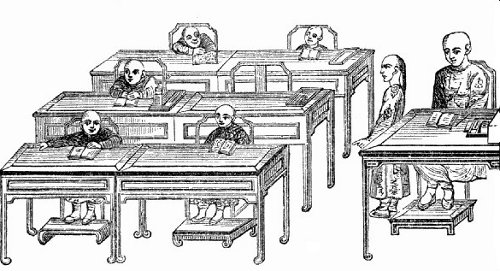
The annexed engraving is a curiosity both in itself and in what it represents.
It is taken from a sketch by a native Chinese artist, and depicts
the internal arrangements of a native Chinese school. The extraordinary
nature of the Chinese language renders it impossible for a schoolmaster
to instruct more than a very few scholars at a time, since the meaning of
the words actually depends on their correct intonation. Every vocable
in the language is capable of being pronounced in six different tones of
voice, and of conveying six meanings, totally different from each other,
according to the tone given to it. Pronounced in one tone, it conveys
one meaning, and is represented by one written character; pronounced
in another tone, it conveys an entirely distinct meaning, and is represented
in writing by another character altogether different. The correct
and distinct enunciation of these tones is the chief difficulty in learning
to speak the language. These tones are stereotyped and fixed, and must
be learned, as part of the word, at the same time that its form and signification
are mastered. Moreover, they are all arranged upon system,
like the notes in a gamut, and when thoroughly mastered, the theory of
the tones is really beautiful. If a wrong tone, then, is given to a word
in reading or in conversation, it grates upon a Chinese ear like a false
note in playing the fiddle. Further, if the voice be not correctly modulated,
and the words correctly intoned, not only is a jarring note pronounced,
but actually a wrong word is uttered, and a different meaning
conveyed from what was intended. A missionary to the Chinese, therefore,
should be possessed of a musical ear. Without this, the acquisition
of the spoken language will be attended by very arduous labour; and,
perhaps, after years of toil, he will find that he still frequently fails in
correctly conveying his meaning.
LONDON LOCALITIES IN THE SIXTEENTH CENTURY.
At Ludgate was a gaol, where the prisoners clamoured for alms at the
barred grate; and it was here that Sir Thomas Wyatt had been repulsed.
The city wall that joined this gate to its other fellow gates
ran from the Tower through the Minories to Aldgate, Houndsditch, and
Bishopsgate, through Cripplegate to Aldersgate, and so past Christ's
Hospital by Newgate and Ludgate to the Thames.
Pimlico was a country place where citizens used to repair to eat
"pudding pies" on a Sunday, as they did to Islington or Hogsden to
take tobacco and drink new milk; as Islington was famous for its dairy,
where Sir Walter Raleigh is said to have lived in an old house still
standing, so Holloway was famous for its cheese cakes; and it is these
peculiarities that, after all, confer immortality upon a place. Chelsea
was the mere village of Chelsea, known from Sir Thomas More's house,
where Henry VIII. had walked with his arm round that great statesman's
doomed neck; as Holborn was then a country road leading to
the pleasant village of St. Giles, and trending on to the way that led
to Oxford and to fatal Tyburn, so called from its burn or brook, then
well known to patient city anglers. The triple tree or gallows stood
at the corner of the present Edgware Road. The same Oxford Street
led also, if you turned up one side of the Hampstead Road, to the
Tottenham Court, which stood there alone far in the country, and
Primrose Hill was an untrodden hillock, surrounded by wide paths and
ditches between this court and Hampstead.
A cheerful little stream, known by the pleasant name of the Fleet,
rose near Hampstead Hill, and joined by the Old Bourne and recruited
by sparkling Clerken Well, emptied itself in the Thames. Though even
then merely a sewer, it was open, and had four bridges of its own,
while the Thames had but one; and these were known as Holborn
Bridge, Fleet-lane Bridge, Fleet Bridge, and Bridewell Bridge.
Spitalfields was a grassy open space, with artillery grounds and a
pulpit and cross, where fairs were held and sermons preached. There
were also Tothill Fields, and Finsbury Fields, and Moor Fields, just
outside the city walls, laid out in walks, and planted, as far as Hoxton.
Round these squares there were windmills and everything equally rural.
As for Piccadilly, it was everywhere known as a road to Reading, and
by many herbalists, as harbouring the small wild foxglove in its dry
ditches.
Outside Temple Bar, before the wooden gatehouse was built, lay the
Strand, the road leading from the city to the houses of Court. This
river bank was the chosen residence of the nobility, whose gardens
stretched to the edge of the then undefiled river. The sky then was pure
and bright, for our ancestors burnt wood fires, and the water was gay
with thousands of boats. Each house had its terrace, its water stairs,
and garden. The street houses were so scattered that the river could
be seen between them, and there were three water courses there
traversed by bridges, besides two churches and a maypole. Here stood
York House, where Bacon was born, and Durham Place, where Raleigh
lived, with his study in a turret overlooking the river; there also were
Arundel House and Essex House, where great men pined and plotted.
At Whitehall stood Wolsey's Palace, enlarged by Henry VIII., and
Elizabeth's favourite residence when not at Nonsuch in Surrey,
Windsor, Greenwich, or Richmond. The tilt-yard stood where the
Horse Guards now stands. St. James's Palace, also built by Henry
VIII., where the Queen's melancholy-bigot sister had died, was seldom
inhabited by the Court; but the park was even then existing. As for
the old palace of Richard III. (Baynard's Castle), that had been let to
the Earl of Pembroke, and the same king's dwelling of Crosby Hall
had fallen into the hands of an alderman.
WARWICK THE KING-MAKER.
On the right-hand side of Newgate-street are various streets and
courts leading into Paternoster-row. Of these, Warwick and Ivy lanes,
Panyer-alley, and Lovel's-court, merit the attention of the lover of
literary and historical antiquities. Warwick-lane, now the abode of
butchers and tallow-chandlers, took its name from the inn or house of
the celebrated Warwick, the king-maker.
Stow mentions his coming to London in the famous convention of
1458, with 600 men, all in red jackets, embroidered, with ragged staves,
before and behind, and was lodged in Warwick-lane; "in whose house
there was often six oxen eaten at a breakfast, and every taverne was full
of his meate, for hee that had any acquaintance in that house, might
have there so much of sodden and roaste meate, as he could pricke and
carry upon a long dagger."
The memory of the earl was long preserved by a small stone statue,
placed in the side front of a tobacconist's, at the corner of this lane;
and there is a public-house which has the earl's head for its sign.
THANKSGIVING DAY IN 1697.
The following is an extract from the "Post Boy" of the above date:—
"Thursday, December 2, 1697. Thursday being appointed for the
day of Thanksgiving, the same was ushered in with ringing of bells; the
king went to the Chapel Royal, where, &c., and at night we had bonfires
and illuminations. The fine fireworks in St. James's Square were
lighted after this manner:—About twelve o'clock, the Foot Guards
lined the avenues; the rockets and all things being fixed on the rails
the day before: a little after six, the king, attended by his guards, came
to the Earl of Romney's house, from whence soon after a signal was given,
by firing a rocket, for the fireworks to go off, which were immediately
lighted; the performance was extraordinary fine, and much applauded;
the same continued somewhat better than half an hour, and there
were divers sorts of fireworks; some had the king's name, others
the arms of England; in a word, they were very curious. There was a
man and a woman unfortunately killed, and divers others hurt by the
falling down of sticks. About half an hour after, His Majesty went to
St. James's there being a fine ball."
THE GREY MAN'S PATH.
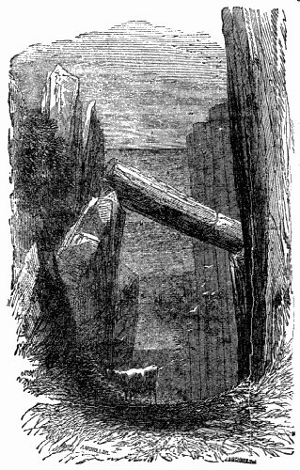
The annexed sketch depicts a scene in the coast rocks at Fairhead, near
Ballycastle in Ireland.
Fhir Leith, or "The Grey Man's Path," (a fissure in
the precipice,) viewed either
from land or sea, is never
to be forgotten: it seems
as though some supernatural
power, determined to
hew for itself a pathway
through the wonderful formations
that tower along
the coast—so that it might
visit or summon the spirits
of the deep, without treading
a road made by mortal
hands—had willed the fearful
chasm that divides the
rocky promontory in two.
The singular passage, in
its narrow part, is barred
across by the fragment of
a pillar, hurled, as it were,
over the fissure, and supported
on both sides at a
considerable elevation. If
you descend, you perceive
the passage widens, and
becomes more important;
its dark sides assume greater
height, and a more wild
and sombre magnificence;
and at last they extend
upwards, above 220 feet,
through which the tourist
arrives at the massive débris which crowd the base of the mighty promontory,
where the northern ocean rolls his threatening billows. From
the cragsmen and boatmen of this wild coast you hear no tales of Faery,
no hints of the gentle legends and superstitions collected in the south, or
in the inland districts of the north; not that they are a whit less superstitious,
but their superstition is, as the superstition of the sea kings, of
a bold and peculiar character; their ghosts come from out the deep,
before or after the rising of the moon, and climb, or rather stalk up the
rocks, and, seated upon those mysterious pillars, converse together; so
that, in the fisherman's huts, they say, "it thunders." Even mermaids
are deemed too trifling in their habits and manners for this stupendous
scenery, where spirits of the gigantic world congregate, and where the
"Grey Man" of the North Sea stalks forth, silently and alone, up his
appropriate path, to witness some mighty convulsion of nature.
ANCIENT JET NECKLACE.
Various interesting ornaments, belonging to the Archaic, or Bronze
period in Scotland, are preserved in the Museum of Scottish Antiquaries,
and one set in particular, found enclosed in an urn within a rude stone
cist, on the demolition of a tumulus near the Old House of Assynt, Rossshire,
in 1824, we here engrave. They include a necklace of irregular
oval jet beads, which appear to have been strung together like a common
modern string of beads, and are sufficiently rude to correspond with the
works of a very primitive era. The other ornaments which are represented
here about one-fourth the size of the original, are curiously
studded with gold spots, arranged in patterns similar to those with which
the rude pottery of the British tumuli are most frequently decorated, and
the whole are perforated with holes passing obliquely from the back
through the edge, evidently designed for attaching them to each other
by means of threads.
JUGGLERS IN JAPAN.
The perfection of jugglery in Japan entitles it to be ranked amongst
the fine arts. An eye-witness thus describes the performance of a
Japanese juggler. "Here are some of his feats:—No. 1. He took an
ordinary boy's top, spun it in the air, caught it on his hand, and then
placed it (still spinning) upon the edge of a sword, near the hilt. Then
he dropped the sword point a little, and the top moved slowly towards
it. Arrived at the very end, the hilt was lowered in turn, and the top
brought back. As usual, the sword was dangerously sharp. No. 2 was
also performed with the top. He spun it in the air, and then threw the
end of the string back towards it with such accuracy that it was caught
up and wound itself all ready for a second cast. By the time it had done
this it had reached his hand, and was ready for another spin. No. 3 was
still performed with the top. There was an upright pole, upon the top
of which was perched a little house, with a very large front door. The
top was spun, made to climb the pole, knock open the said front door,
and disappear. As well as I remember, the hand end of the string was
fastened near the door, so that this was almost a repetition of the self-winding
feat. But feat No. 4 was something even more astonishing
than all this. He took two paper butterflies, armed himself with the
usual paper fan, threw them into the air, and, fanning gently, kept
them flying about him as if they had been alive. 'He can make them
alight wherever you wish! Try him!' remarked the Kami (Prince),
through the interpreter. Mr. H—— requested that one might alight
upon each ear of the juggler. No sooner expressed than complied with.
Gentle undulations of the fan waved them slowly to the required points,
and there left them comfortably seated. Now, whether this command
over pieces of paper was obtained simply by currents of air, or by the
power of a concealed magnet, Mr. H—— could not tell or ascertain.
One thing, however, was certain, the power was there."
may-fair play bill in the time of william iii.
WILLIAM REX.
MAY-FAIR.
MILLER'S,
or the Loyal Association Booth,
at the upper end of
Brook-field Market,
near Hyde Park Corner.
During the time of MAY-FAIR, will be presented
an excellent droll, called
KING WILLIAM'S HAPPY DELIVERANCE
and Glorious Triumph over his Enemies,
or the Consultation of the
POPE, DEVIL, FRENCH KING, and the GRAND TURK,
with the whole Form of the Siege of Namur,
and the humours of a Renegade FRENCH MAN
and BRANDY JEAN,
with the conceits of Scaramouch and Harlequin,
together with the best Singing and Dancing that was
ever seen in a Fair, also a Dialogue song.
VIVAT REX.
BELLS.
Bells were formerly a prolific source of superstition. There is a valley
in Nottinghamshire, where a village is said to have been swallowed up
by an earthquake, and it was the custom on Christmas Day morning for
the people to assemble in this valley and listen to the fancied ringing of
the church bells underground. At Abbot's Morton there is a tradition
that the silver bells belonging to the abbot are buried in the site of his
old residence there. At Ledbury, a legend relates that St. Katharine
had a revelation that she was to travel about, and not rest at any place,
till she heard the bells ringing of their own accord. This was done by
the Ledbury bells on her approaching that town. When the church at
Inkberrow was rebuilt on a new site in ancient days, it was believed that
the fairies took umbrage at the change, as they were supposed to be
averse to bells; they accordingly endeavoured to obstruct the building,
but, as they did not succeed, the following lamentation was occasionally
heard by the startled rustics:
"Neither sleep, neither lie,
For Inkbro's ting-tangs hang so nigh."
Many years ago the twelve parish churches in Jersey each possessed a
beautiful and valuable peal of bells; but during a long civil war, the
states determined on selling these bells to defray the heavy expenses of
their army. The bells were accordingly collected, and sent to France for
that purpose; but, on the passage, the ship foundered, and everything
was lost, to show the wrath of Heaven at the sacrilege. Since then,
before a storm, these bells ring up from the deep; and, to this day, the
fishermen of St. Ouen's Bay always go to the edge of the water before
embarking, to listen if they can hear "the bells upon the wind;" and,
if those warning notes are heard, nothing will induce them to leave the
shore; if all is quiet they fearlessly set sail. As a gentleman, who has
versified the legend, says:
"'Tis an omen of death to the mariner,
Who wearily fights with the sea;
For the foaming surge is his winding sheet,
And his funeral knell are we:
His funeral knell our passing bells beat,
And his winding sheet the sea."
BRIBING THE DEMONS.
The rich inhabitants of the Celestial Empire, it is almost needless to
say, make an exorbitant display at funerals. They invite as many relations
and friends as they can, in order to muster an imposing procession,
and the mourning dresses worn by the whole party are at the cost of the
family of the deceased, who are also bound to provide them for several
days together with splendid repasts. A great number of musicians are
hired for the occasion, and also of weepers, for though most people in
China are pretty well skilled in the art of shedding tears, there exist
mourners by profession, who have carried it to still greater perfection,
and are absolutely inimitable at sobs and groans. They follow the coffin
in long white robes, hempen girdles, and dishevelled hair; and their
lamentations are accompanied by the beating of gongs, by the sharp and
discordant sounds of rude instruments of music, and the discharge of
fireworks. The sudden explosion and the smell of the powder are supposed
to be efficacious in frightening away the demons, and hindering
them from seizing on the soul of the defunct, which never fails to follow
the coffin; and as these malevolent spirits have also the reputation of
being extremely covetous and fond of money, people endeavour to get on
their weak side. They let fall, for this purpose, all along the road,
sapecks and bank-notes, that the wind carries away in all directions;
and as the demons in China are by no means so cunning as the men,
they are taken in by this device, and fall into the trap with charming
simplicity, though, the supposed bank-notes are in fact only bits of white
paper. Whilst they are engaged in pursuing these deceitful appearances
of riches, the soul of the defunct proceeds quietly and comfortably after
its coffin without any danger of its being stopped by the way.
HOLY-WATER SPRINKLER.
To sprinkle the holy water was, in ancient times,
the cant phrase for fetching blood, which will account
for the appellation of a certain class of weapons, as
there is no resemblance whatever between them and
the aspergillum used by Roman Catholics.
The specimen we have here sketched is a demi holy-water-sprinkler—to
speak in the language of the time—"with
gonnes at the ende." This awkward weapon,
prior, in point of date, to the invention of the matchlock,
and, therefore, not later than the time of
Edward IV., was made to hang at the saddle-bow
instead of a mace. The iron cap at the end is furnished
with a spear-like blade, and opens on an
hinge, or is held in its place by a hook. It contains
four short barrels, each of which is fired by a match,
and its touch-hole is protected by a sliding piece of
wood.
In using this weapon the intention was first to fire
at the enemy with the "gonnes at the ende," and then
to club him on coming to close quarters. To effect all
this, however, in a satisfactory manner, much time
must have been lost, and many accidents, no doubt,
were liable to happen to the person who used such a
weapon as this, which was almost as dangerous to the
man who possessed it, as to the enemy against whom
he directed it. The lid at the top must first have been
opened, and not only so, but must have been kept
open all the time the weapon was used as a gun, and
then, previously to closing with the foe, it must have
been necessary to secure it, lest, in brandishing the
instrument as a club, the open lid should strike against
the head of the man who wielded it. No wonder that
this dangerous compound of club and gun soon went
out of fashion, and survived its invention only a very
few years.
FIRST TEA-DRINKERS PUZZLED.
The first brewers of tea were often sorely perplexed with the preparation
of the new mystery. "Mrs. Hutchinson's great grandmother was
one of a party who sat down to the first pound of tea that ever came into
Penrith. It was sent as a present, and without directions how to use it.
They boiled the whole at once in a bottle, and sat down to eat the leaves
with butter and salt, and they wondered how any person could like such
a diet."
COLUMN AT CUSSI.
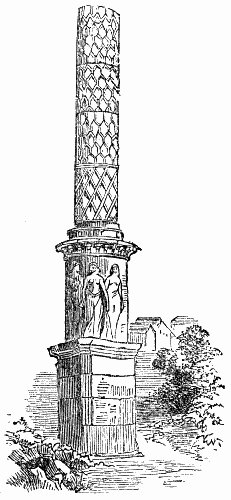
The great object of the erection of pillars of victory was to serve as
vehicles for sculpture; though, as we now see them, or as they are
caricatured at Paris and elsewhere,
they are little more than instances of
immense labour bestowed to very little
purpose. In the original use of these
pillars, they were placed in small
courts surrounded by open porticos,
whence the spectator could at two, or
perhaps at three different levels examine
the sculpture at his leisure at a
convenient distance, while the absurdity
of a pillar supporting nothing
was not apparent, from its not being
seen from the outside.
A good specimen
of this class is that at Cussi, near
Beaune, in France. It is represented
in the annexed cut. It probably belongs
to the time of Aurelian, and no
doubt was first erected within a court;
but it is not known either by whom it
was erected, or what victory it was
designed to celebrate. Still that it is
a pillar of victory is certain, and its
resemblance to pillars raised with the
same object in India is quite striking.
The arrangement of the base, serving
as a pedestal for eight statues, is not
only elegant, but appropriate. The
ornament which covers the shaft takes
off from the idea of its being a mere
pillar, and, at the same time, is so
subdued as not to break the outline or
interfere with constructive propriety.
The capital of the Corinthian order is
found in the neighbourhood, used as the mouth of a well. In its
original position it no doubt had a hole through it, which being enlarged
suggested its application to its present comparatively ignoble purpose,
the hole being no doubt intended either to receive or support the statue
or emblem that originally crowned the monument, but of that no trace
now remains.
STYLE OF LIVING AMONG THE NOBILITY OF THE FIFTEENTH CENTURY.
The ordinary meals were now increased to four a day—breakfast at
seven in the morning, dinner at ten, supper at four in the afternoon, and
"liveries," which were taken in bed, between eight and nine at night.
These latter, as well as the breakfast, were of no light or unsubstantial
character, consisting of good beef and mutton (or salt fish in Lent), with
beer and wine in the morning; and of a loaf or two, with a few quarts
of mulled wine and beer, at nights. At dinner the huge oaken table,
extending the whole length of the great hall, was profusely covered with
joints of fresh and salt meat, followed by courses of fowl, fish, and
curious made-dishes. The Lord took his seat on the dais or raised floor
at the head; his friends and retainers were ranged above or below the
salt, according to their rank. As forks were not yet in use, the fingers
were actively employed, whilst wine and beer in wooden or pewter
goblets were handed round by the attendants. Over head the favourite
hawks stood upon their perches, and below the hounds reposed upon the
pavement.
The dinner generally lasted for three hours, and all pauses were filled
up by the minstrels, jesters, or jugglers, or by the recitation of some
romance of chivalry. At the end of each course they sometimes introduced
a dish called subtlety, composed of curious figure in jellies or confectionery,
with a riddling label attached for the exercise of social wit.
The monasteries were especially noted for their good dinners, and the
secular clergy, not to be outdone in their hospitality invented glutton-masses
in honour of the Virgin. These were held five times a year in
the open churches, whither the people brought food and liquor, and vied
with each other in this religious gormandizing. The general diet of the
common people continued, however, to be coarse and poor, and severe
famines not unfrequently occurred.
ORIGIN OF THE TITLE "SFORZA."
James Sforza, the father of Francis the first duke, was the founder of
the house of Sforza, which gave six dukes to Milan, and was allied with
almost every sovereign in Europe during the fifteenth and sixteenth
centuries. He was born in 1369, at Catignuola, near Faenza; his
father, according to tradition, was a day labourer, and to others, a
shoemaker, but probably wrought as both. Perceiving some soldiers
pass, he was struck with the desire of bearing arms. "I will go,"
said he to himself, "and dart my hatchet against that tree, and if it
stick fast in the wood I will immediately become a soldier." The
hatchet stuck fast, and because, says the Abbot of Choisi, he threw the
axe with all his force, he assumed the supposed fortunate name of
Sforza, as his real name was Giacomuzzo, or James Attendulo.
MAY-POLE IN THE STRAND.
During the austere reign of the Puritans, when theatres were closed,
and every sort of popular amusement was considered sinful, the May-poles
fell into disrepute, and were pulled down in various parts of London.
Among the rest, the famous May-pole in the Strand came to the
ground. With the restoration of the monarchy, the people saw the restoration
of their ancient sports; and on the very first May-day after the
return of Charles II., the May-pole in the Strand was set up again, amid
great popular rejoicing. The following account of the ceremony is taken
from a rare tract of the times, entitled "The Citie's Loyaltie displayed.
London, 4to., 1641," and quoted in the first volume of Hone's "Every-Day
Book," page 557:—
"Let me declare to you the manner in general," says the loyal author,
"of that stately cedar erected in the Strand, 134 feet high, commonly
called the May-pole, upon the cost of the parishioners there adjacent, and
the gracious consent of His Sacred Majesty, with the illustrious Prince
the Duke of York. This tree was a most choice and remarkable piece,
'twas made below bridge, and brought in two parts up to Scotland Yard,
near the King's Palace, and from thence it was conveyed, April 14th, to
the Strand, to be erected. It was brought with a streamer flourishing
before it, drums beating all the way, and other sort of music. It was
supposed to be so long that landsmen, as carpenters, could not possibly
raise it. Prince James, the Duke of York, Lord High Admiral of England,
therefore commanded twelve seamen to come and officiate the
business; whereupon they came, and brought their cables, pulleys, and
other tackling, with six great anchors. After these were brought three
crowns, borne by three men bareheaded, and a streamer displaying all the
way before them, drums beating, and other music playing, numerous
multitudes of people thronging the streets, with great shouts and acclamations
all day long.
"The May-pole then being joined together, and hooped about with
bands of iron, the crown and vane, with the King's arms, richly gilded,
was placed on the head of it: a large top, like a balcony, was about the
middle of it. This being done, the trumpets did sound, and in four
hours' space it was advanced upright; after which being established fast
in the ground, again great shouts and acclamations did the people give,
that rang throughout all the Strand. After that came a morris-dance,
finely decked with purple scarfs, in their half shirts, with a tabor and
pipe, the ancient music, and danced round about the May-pole, and after
that danced the rounds of their liberty. Upon the top of this famous
standard is likewise set up a royal purple streamer, about the middle of
it are placed four crowns more, with the King's arms likewise. There is
also a garland set upon it, of various colours, of delicate rich favours,
under which are to be placed three great lanthorns, to remain for three
honours, that is, one for Prince James, Duke of York, Lord High Admiral
of England; the other for the Vice-Admiral; the third for the
Rear-Admiral. These are to give light on dark nights, and to continue
so as long as the pole stands, which will be a perpetual honour for seamen.
It is placed as near hand as they could guess in the very same pit
where the former stood, but far more glorious, higher, and bigger, than
ever any one that stood before it; and the seamen themselves do confess
that it could not be built higher, and there is not such an one in Europe
besides, which doth highly please His Majesty and the illustrious Prince,
Duke of York. Little children did much rejoice, and ancient people did
clap their hands, saying that golden days began to appear. I question
not but it will ring like melodious music throughout every county in
England when they read this story exactly penned. Let this story
satisfy for the glories of London, that other loyal subjects may read what
we here do see."
COSTUME OF A GERMAN NOBLE.
The annexed cut represents the dress of a young noble of the year
1443, from the extremely interesting genealogical history of the baronial
family of Haller von Halleostein.
The figure is that of Franz Haller
von Halleostein, who died unmarried
in the above year. He wore an open
jerkin of a greenish colour, and very
finely plaited chemisette. The jerkin
has a white silk trimming with
a black border throughout, and is
held together by fine white silk
ribbons, beneath which appears the
white shirt. The sword-couple and
sheath, are black, hilt and mountings
are of the colour of steel. The
stockings are vermilion, and on the
right leg is a white and yellow stripe.
The shoes are black, turned with
white. The hair is long, and over
it is worn a neat cap with lappets
and a golden agraffe and love-knot,
to support the hair.
At the period of this costume very
great attention was bestowed by the
German nobility to their dress. The
sums they expended on it were enormous,
and in many instances families
were reduced to ruin by the extravagant
decorations of their person.
Jewellery, furs, silks, and laces, all
of which were far more expensive
and difficult to be obtained than they
are now, were used in reckless profusion,
and one nobleman vied with
another in the magnificence, novelty,
and expensiveness of their attire.
The illustrated books of that period
abound in sketches of the most beautiful
costumes, and are a fund of interest to those who are curious in
such matters.
ABSURDITIES OF THE TOILET.
The ladies of Japan are said to gild their teeth, and those of the Indies
to paint them red, while in Guzerat the test of beauty is to render them
sable. In Greenland, the women used to colour their faces with blue
and yellow. The Chinese must torture their feet into the smallest possible
dimensions—a proof positive of their contracted understandings.
The ancient Peruvians, and some other Indian tribes, used to flatten
their heads: and among other nations, the mothers, in a similar way,
maltreat the noses of their offspring.
AN EGYPTIAN DINNER.
The complicated, and, at first sight, somewhat incomprehensible sketch
which we here lay before our readers, was taken from an interior wall of
a palace in Egypt. It is, of course,
by Egyptian artists, and the subject
of it is no other than an Egyptian
dinner-table set out and adorned for
a banquet.
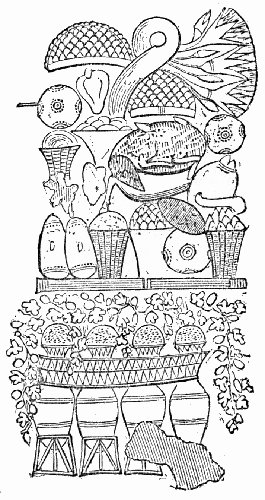
At a dinner in ancient Egypt,
small and low circular tables were
used, standing on a single pillar,
with a dilated base; sometimes one
of these was apportioned to every
guest, the viands being brought
round by the servants successively,
from a larger pillar-table which had
been brought in readily set out by
two men. The accompanying engraving
shows a table thus laid out,
requiring, however, a little allowance
for the lack of perspective. Round
and oblong cakes of bread flattened
and pricked in patterns, a goose, a
leg of a kid or antelope, baskets of
figs and other fruit, are crowned
by a huge bunch of the lotus-lily.
Under the table are bottles of wine
placed on stands in a series, and
crowned with a lotus-garland, upon
which is thrown a long withe of
what seems from the tendrils a vine,
loaded with clusters of grapes, as
well as thickly set with foliage.
ELEPHANT-GOD OF BURMAH.
A white elephant is a great rarity, and whenever one is caught, the
Burmese treat it as a god and pay worship to it. Captain Yule thus
describes the white elephant of 1855, and his palace at Amarapoora, the
capital of Burmah:—
"In the area which stretches before the Hall of Audience are several
detached buildings. A little to the north is the "Palace," or state
apartment, of the Lord White Elephant, with his highness's humbler
every-day residence in rear. To the south are sheds for the vulgar herd
of the same species, and brick godowns in which the state carriages and
golden litters (the latter massive and gorgeous in great variety of design)
are stowed away. Temporary buildings, used as barracks and gunsheds,
run along the wall. The present white elephant has occupied his post
for at least fifty years. I have no doubt he is the same as Padre San-germano
mentions as having been caught in 1806, to the great joy of the
King, who had just lost the preceding incumbent, a female, which died
after a year's captivity. He is a very large elephant, close upon ten
feet high, with as noble a head and pair of tusks as I have ever seen.
But he is long-bodied and lanky, and not otherwise well made as an
elephant. He is sickly and out of condition, and is, in fact, distempered
during five months of the year, from April to August. His eye, the iris
of which is yellow with a reddish outer annulus, and a small clear black
pupil, has an uneasy glare, and his keepers evidently mistrust his temper.
We were always warned against going near his head. The annulus
round the iris of the eye is pointed out as resembling a circle of the nine
gems. His colour is almost uniform all over; nearly the ground-tint of
the mottled or freckled part of the trunk and ears of common elephants,
perhaps a little darker. He also has pale freckles in the same parts.
On the whole, he is well entitled to his appellation of white. His royal
paraphernalia, which are set out when visitors are expected, are sufficiently
splendid. Among them was a driving-hook about three feet
long, the stem of which was a mass of small pearls, girt at frequent intervals
with bands of rubies, and the hook and handle of crystal tipped
with gold. His headstall was of fine red cloth, plentifully studded with
fine rubies, and near the extremity having some valuable diamonds. To
fit over the two bumps of the forehead were circles of the nine gems,
which are supposed to be charms against evil influences. When caparisoned
he also wore on the forehead, like other Burmese dignitaries,
including the King himself, a golden plate inscribed with his titles, and
a gold crescent set with circles of large gems between the eyes. Large
silver tassels hung in front of his ears, and he was harnessed with bands
of gold and crimson set with large bosses of pure gold. He is a regular
"estate of the realm," having a woon or minister of his own, four gold
umbrellas, the white umbrellas which are peculiar to royalty, with a
suite of attendants said to be thirty in number. The Burmese who
attended us removed their shoes before entering his 'Palace.' The
elephant has an appanage or territory assigned to him 'to eat,' like
any other dignitary of the empire. I do not know where his estate
is at present, but in Burney's time it was the rich cotton district of
Taroup Myo."
SUPERSTITION IN 1856.
In April, 1856, a poor woman, residing in a village about three
miles from Pershore, acting upon the advice of her neighbours, brought
her child, who was suffering from whooping cough, to that town,
for the purpose of finding out a married couple answering to the names
of Joseph and Mary, and soliciting their interference on behalf of her
afflicted child, as she had been informed that if two married persons
having those names could but be induced to lay their hands on her
child's head, the whooping cough would be immediately cured. After
scouring the town for a considerable time in search of "Joseph and his
fair lady," they were at length discovered in the persons of a respectable
tradesman and his wife residing in Bridge Street, to whom the poor
silly woman made known her foolish request, which at first excited a
smile from the good woman of the house, but was quickly followed, not
by "the laying on of hands," but by good advice, such as mothers only
know how to give in these matters. The poor mother then thankfully
departed a wiser woman.
PRAYING BY WHEEL AND AXLE.
The Japanese, like the inhabitants of Thibet, are not content with
devout prayers, pilgrimages, prostrations, offerings to the gods in order
to secure blessings here and hereafter; they also pray by machine, by
wheel and axle. There is a square post, nearly eight feet in length, and
near the centre, at a convenient height to be reached by the hand, is
fixed vertically a wheel, which moves readily on an axle passed through
the post. Two small rings are strung upon each of three spokes of the
wheel. Every person who twists this instrument in passing is supposed
to obtain credit in heaven for one or more prayers inscribed on the post,
the number being graduated according to the vigour of the performer's
devotion, and the number of revolutions effected. The jingle of the
small iron rings is believed to secure the attention of the deity to the
invocation of the devout, and the greater the noise, the more certain of
its being listened to. Some of the inscriptions on this post are worth
remembering:—"The great round mirror of knowledge says, 'wise men
and fools are embarked in the same boat;' whether prospered or afflicted,
both are rowing over the deep lake; the gay sails lightly hang to catch
the autumnal breeze; then away they straight enter the lustrous clouds,
and become partakers of heaven's knowledge."
"He whose prescience detects knowledge says:—'As the floating grass
is blown by the gentle breeze, or the glancing ripples of autumn
disappear when the sun goes down, or as the ship returns home to her
old shore, so is life: it is a smoke, a morning tide.'"
"Others are more to the point—as to the machine—'Buddha himself
earnestly desires to hear the name of this person (who is buried), and
wishes he may go to life.'"
NOVEL WAY OF DESIGNATING A HOUSE.
In the "New View of London," published in 1708, it is mentioned as
a remarkable circumstance attaching to the history of Prescott Street,
near the Strand, that instead of signs, the houses were distinguished by
numbers, as the stair-cases in the Inns of Court, and Chancery. The
following advertisement, taken from newspapers a century and a half
old, is interesting at this distance of time, as it shows the shifts to which
advertisers were reduced, to point out their houses to their customers:—
"Doctor James Tilborgh, a German doctor, states that he liveth at
present over against the New Exchange, in Bedford Street, at the sign of
the 'Peacock,' where you shall see at night two candles burning within
one of the chambers before the balcony; and a lanthorn with a candle in
it upon the balcony: where he may be spoke with all alone, from 8 in
the morning till 10 at night."
DYAK WAR-BOAT IN BORNEO.
The Malay war-boat, or prahu, is built of timber at the lower part;
the upper is of bamboo, rattan, and kedgang (the dried leaf of the Nepa
palm). Outside the bends, about a foot from the water line, runs a
strong gallery, in which the rowers sit cross-legged. At the after-part
of the boat is a cabin for the chief who commands, and the whole of the
vessel is surmounted by a strong flat roof, upon which they fight, their
principal weapons being the kris and spear, both of which, to be used
with effect, require elbow-room.
The Dyak war-boat, as represented in the annexed sketch, is a long-built
canoe, more substantially constructed than the prahu of the Malays,
and sufficiently capacious to hold from seventy to eighty men. This also
has a roof to fight from. They are generally painted, and the stern
ornamented with feathers.
Both descriptions of war-boats are remarkably swift, notwithstanding
such apparent top-weight.
WAR-DANCE OF THE DYAKS OF BORNEO.
Almost every savage nation has its peculiar war-dance, and the different
steps, movements, and cries, in each depict different stages in the
supposed fight. An account of the various kinds of dances would form
an interesting work, and as a contribution to it we here call attention to
the following description of a war-dance which was practised for the entertainment
of the officers of the Semarang, on the occasion of their
visiting a Dyak Chief. It is taken from Captain Marryat's "Borneo:"—
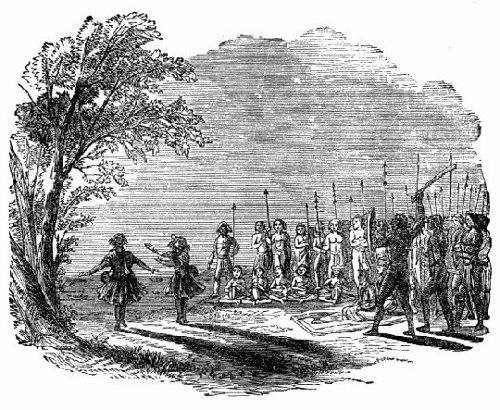
"A space was cleared in the centre, and two of the oldest warriors
stepped into it. They were dressed in turbans, long loose jackets, sashes
round their waists descending to their feet, and small bells were attached
to their ankles. They commenced by first shaking hands with the rajah,
and then with all the Europeans present, thereby giving us to understand,
as was explained to us, that the dance was to be considered only
as a spectacle, and not to be taken in its literal sense, as preparatory to
an attack upon us, a view of the case in which we fully coincided with
them.
"This ceremony being over, they rushed into the centre, and gave a
most unearthly scream; then poising themselves on one foot, they described
a circle with the other, at the same time extending their arms
like the wings of a bird, and then meeting their hands, clapping them
and keeping time with the music. After a little while the music became
louder, and suddenly our ears were pierced with the whole of the natives
present joining in the hideous war-cry. Then the motions and screams
of the dancers became more violent, and every thing was worked up to
a state of excitement, by which even we were influenced. Suddenly, a
very unpleasant odour pervaded the room, already too warm, from the
numbers it contained. Involuntarily we held our noses, wondering what
might be the cause, when we perceived that one of the warriors had
stepped into the centre, and suspended round the shoulders of each
dancer a human head in a wide-meshed basket of rattan. These heads
had been taken in the late Sakarron business, and were therefore but a
fortnight old. They were encased in a wide network of rattan, and
were ornamented with beads. Their stench was intolerable, although, as
we discovered upon after examination, when they were suspended against
the wall, they had been partially baked and were quite black. The teeth
and hair were quite perfect, the features somewhat shrunk, and they
were altogether very fair specimens of pickled heads; but our worthy
friends required a lesson from the New Zealanders in the art of preserving.
The appearance of the heads was the signal for the music to play
louder, for the war-cry of the natives to be more energetic, and for the
screams of the dancers to be more piercing. Their motions now became
more rapid, and the excitement in proportion. Their eyes glistened with
unwonted brightness. The perspiration dropped down their faces, and
thus did yelling, dancing, gongs, and tom-toms become more rapid and
more violent every minute, till the dancing warriors were ready to drop.
A farewell yell, with emphasis, was given by the surrounding warriors;
immediately the music ceased, the dancers disappeared, and the tumultuous
excitement and noise was succeeded by a dead silence. Such was
the excitement communicated, that when it was all over we ourselves
for some time remained panting to recover our breath. Again we
lighted our cheroots, and smoked for a while the pipe of peace."
WONDERFUL FISH.
The Greek Church of Baloukli contains an extraordinary instance of
the credulity of superstition. Some wonderful fish are there preserved,
which are thus described by Mr. Curzon in his admirable book on the
"Monasteries of the Levant:"—
"The unfortunate Emperor Constantine Paleologus rode out of the
city alone to reconnoitre the outposts of the Turkish army, which was
encamped in the immediate vicinity. In passing through a wood he
found an old man seated by the side of a spring, cooking some fish on a
gridiron for his dinner; the emperor dismounted from his white horse,
and entered into conversation with the other; the old man looked up at
the stranger in silence, when the emperor inquired whether he had heard
anything of the movement of the Turkish forces: 'Yes,' said he, 'they
have this moment entered the city of Constantinople.' 'I would believe
what you say,' replied the emperor, 'if the fish which you are broiling
would jump off the gridiron into the spring.' This, to his amazement,
the fish immediately did, and, on his turning round, the figure of the
old man had disappeared. The emperor mounted his horse and rode
towards the gate of Silivria, where he was encountered by a band of the
enemy, and slain, after a brave resistance, by the hand of an Arab or a
Negro.
"The broiled fishes still swim about in the water of the spring, the
sides of which have been lined with white marble, in which are certain
recesses in which they can retire when they do not wish to receive company.
The only way of turning the attention of these holy fish to the
respectful presence of their adorers is accomplished by throwing something
glittering into the water, such as a handful of gold or silver coin:
gold is the best; copper produces no effect; he that sees one fish is
lucky, he that sees two or three goes home a happy man; but the custom
of throwing coins into the spring has become, from its constant practice,
very troublesome to the good monks, who kindly depute one of their
community to rake out the money six or seven times a day with a
scraper at the end of a long pole. The emperor of Russia has sent presents
to the shrine of Baloukli, so called from the Turkish word Balouk,
a fish. Some wicked heretics have said that these fishes are common
perch: either they or the monks must be mistaken; but of whatever
kind they are, they are looked upon with reverence by the Greeks, and
have been continually held in the highest honour from the time of the
siege of Constantinople to the present day."
CURIOUS MARRIAGE CUSTOM.
At Petzé, in the department of Finisterre, in France, the following
singular marriage custom still prevails:—"On an appointed day, the
paysannes, or female pretenders to the holy state of matrimony, assemble
on the bridge of the village, and, seating themselves upon the parapet,
there patiently await the arrival of the intended bridegrooms. All the
neighbouring cantons contribute their belles to ornament this renowned
bridge. There may be seen the peasant of Saint Poliare, her ruddy
countenance surrounded by her large muslin sleeves, which rise up and
form a kind of framework to her full face; by her may be seated the
heavy Touloisienne, in her cloth caline, or gown; the peasant of la Léonarde,
in a Swiss boddice, bordered with different coloured worsted
braid, and a scarlet petticoat, may next appear, presenting a gaudy contrast
to her neighbour from Saint Thegonnec, in her nun-like costume.
On one side extends la coulie de Penhoat, bordered with willows, honeysuckles,
and the wild hop; on the other, the sea, confined here like a
lake, between numerous jets of land covered with heath and sweet broom;
and below the bridge, the thatched town, poor and joyous as the beggar
of Carnouailles. The bay is here so calm, that the whole of this gay
scene is reflected in its still waters; and a few scenes of rural festivity
present a more animated or diverting picture.
"The arrival of the young men, with their parents, is the signal for
silence among the candidates for a husband. The gentlemen advance,
and gravely parade up and down the bridge, looking first on this side,
and then on that, until the face of some one of the lasses strike their
fancy. The fortunate lady receives intimation of her success by the
advance of the cavalier, who, presenting his hand, assists her in descending
from her seat, making at the same time a tender speech; compliments
are exchanged, the young man offers fruit to his intended bride,
who remains motionless before him, playing with her apron strings. In
the mean while the parents of the parties approach each other, talk over
the matter of their children's marriage, and if both parties are agreeable
they shake hands, and this act of friendly gratulation is considered a
ratification of the treaty between them, and the marriage is shortly afterwards
celebrated."
FOREIGN COSTUME IN 1492.
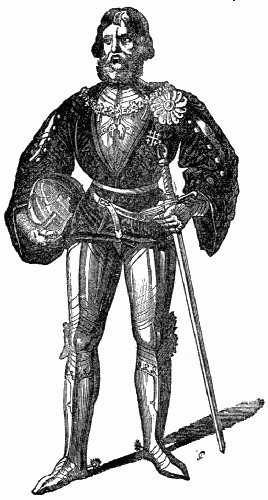
The nobleman portrayed here is Count Eberhard the elder, first Duke
of Wurtemberg, in a festival habit at Stuttgardt, in the year 1492, on the
occasion of his receiving the order
of the Golden Fleece, the first which
Austria instituted for herself (King
Maximilian inherited it from Burgundy)
and which he received together
with King Henry VIII. of
England.
His costume is taken
from an old illumination which, in
the year 1847, was copied for
King William of Wurtemberg, and
which is now preserved in his
private library at Stuttgardt. This
exemplifies the quilled doublet,
made of a kind of damasked black
velvet, which appears to have been
worn over the defensive armour
improved by King Maximilian.
Upon the black surcoat appear the
orders of the Golden Fleece and
the Holy Sepulchre. According
to contemporary statues and monuments,
Georg von Ekingen and
Heinrich von Wællwerth, officers
of the court of Eberhard, wore this
kind of doublet. The former, according
to a portrait, of a red
colour; the latter authority is in
the Wællwerth Chapel, in the
cloister of Lorch near Schw.
Gmuend.
PETER THE GREAT AT ZAANDAM.
We learn from authentic records that Peter the Great, Czar of Russia,
entered himself, in the year 1697, on the list of ship's carpenters at the
Admiralty Office of Amsterdam, in Holland. This is true; but before
Peter so enrolled himself, he had made an attempt to fix his abode, for
the purpose of study, at Saardam, or Zaandam, a little town situated on
the river Zaan, about half an hour's voyage, by steam, from the populous
and wealthy city of Amsterdam.
Zaandam, though then, as now, one of the most primitive, original
little towns in Europe, had for some time held important commercial intercourse
with Russia; and Peter had long seen the advantage to be derived
from studying at its head-quarters the art which he felt sure would
elevate his country in an extraordinary way. He therefore opened a
private correspondence with some trusty friends in Holland, and set
forth, with his hand of intelligent companions, early in the summer of
1697; in the autumn of the same year he disembarked at Zaandam, and,
alone and unattended, sought an humble lodging from a man of the
name of Gerrit Kist, who had formerly been a blacksmith in Russia, and
who, as may well be imagined, was astonished at the "imperial apparition;"
indeed he could not believe that Peter really wished to hire so
humble an abode. But the Czar persevered, and obtained permission to
occupy the back part of Kist's premises, consisting of a room and a little
shed adjoining, Kist being bound to secresy as to the rank of his lodger:
Peter's rent amounted to seven florins (about eleven shillings) a week.
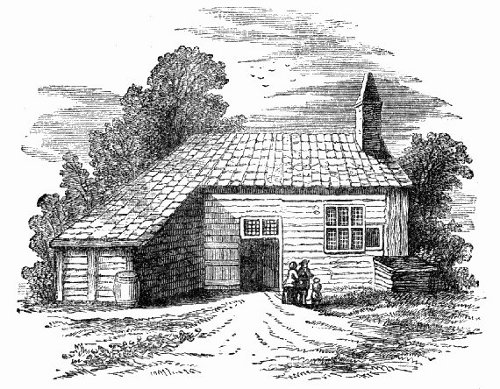
The maisonnette, or hut, of Peter the Great now stands alone, and has
been encased in a strong wooden frame in order to preserve it. It is in
much the same state as when occupied by the Czar. The chief apartment
is entered by the door you see open, the projecting roof covers the
room probably occupied by Peter's servant, and on the left of the larger
room is the recess or cupboard in which Peter slept. Formerly the rear
of this abode was crowded with inferior buildings; it is now an airy
space, with trees waving over the wooden tenement, and a garden full of
sweet-scented flowers embalms the atmosphere around it. A civil old
Dutchwoman is the guardian of the property, which is kept up with some
taste, and exquisite attention to cleanliness.
The maisonnette has but one door. In Zaandam the old Dutch custom
of closing one entrance to the house, except on state occasions, is
still kept up; the purpose of the other, the porte mortuaire, or mortuary
portal, is sufficiently explained by its name.
After Peter's departure, his dwelling passed from hand to hand, and
would have fallen into oblivion had not Paul the First of Russia accompanied
Joseph the Second of Austria and the King of Sweden to Zaandam,
on purpose to visit the Czar's old abode. After this it became a sort of
fashion to make pilgrimages to the once imperial residence; and it acquired
a still greater celebrity when the Emperor Alexander visited it in
1814, and made a great stir in the waters of the Zaan with a fleet of
three hundred yachts and innumerable barges, gaily decked with flying
pennons. In 1818, William the First of Holland purchased the property,
and gave it to his daughter-in-law, the Princess of Orange and a royal
Russian by birth: it is to her care the building owes its present state of
preservation. Her royal highness appointed a Waterloo invalid as first
guardian of the place.
Bonaparte brought Josephine here in 1812. Poor Josephine had no
idea of old associations; she jumped from the sublime to the ridiculous
at once on entering the "mean habitation," and startled the then proprietor
by a burst of untimely laughter.
Many royal and illustrious names may be read on the walls of the
principal chamber, and in the book in which the traveller is requested
to write his name. Verses and pictures challenge, somewhat impertinently,
the attention of the wayfarer; but as we sat down in the triangular
arm-chairs, and turned from the dark recess in which Peter slept,
to the ingle-nook of the deep chimney, and from the ingle to the dark
recess again, we could realize nothing but Peter in his working dress of
the labours of the day. There he was in the heat of an autumnal evening
still at work, with books and slates, and instruments connected with
navigation, before him on the rude deal table, and he plodding on, as
diligently as a common mechanic, in pursuit of that knowledge by which
nations are made great.
SUPPLY OF WATER FOR LONDON IN OLDEN TIMES.
In 1682 the private houses of the metropolis were only supplied with
fresh water twice a-week. Mr. Cunningham, in his "Handbook of
London," informs us that the old sources of supply were the Wells, or
Fleet River, Wallbrook and Langbourne Waters, Clement's, Clerk's,
and Holy Well, Tyburn, and the River Lea. Tyburn first supplied the city
in the year 1285, the Thames not being pressed into the service of the city
conduits till 1568, when it supplied the conduit at Dowgate. There were
people who stole water from the pipes then, as there are who steal gas now.
"This yere" (1479), writes an old chronicler of London, quoted by Mr.
Cunningham, "a wax charndler in Flete-stre had bi craft perced a pipe
of the condite withynne the ground, and so conveied the water into his
celar; wherefore he was judged to ride through the citee with a condite
upon his hedde." The first engine which conveyed water into private
houses, by leaden pipes, was erected at London-bridge in 1582. The
pipes were laid over the steeple of St. Magnus; and the engineer was
Maurice, a Dutchman. Bulmer, an Englishman, erected a second engine
at Broken Wharf. Previous to 1656, the Strand and Covent Garden,
though so near to the river, were only supplied by water-tankards,
which were carried by those who sold the water, or by the apprentice, if
there were one in the house, whose duty it was to fill the house-tankard at
the conduit, or in the river. In the middle of the seventeenth century,
Ford erected water-works on the Thames, in front of Somerset House;
but the Queen of Charles II.—like the Princess Borghese, who pulled
down a church next to her palace, because the incense turned her sick,
and organ made her head ache—ordered the works to be demolished,
because they obstructed a clear view on the river. The inhabitants of
the district depended upon their tankards and water-carriers, until the
reign of William III., when the York-buildings Waterworks were
erected. The frequently-occurring name of Conduit-street, or Conduit-court,
indicates the whereabout of many of the old sources whence our
forefathers drew their scanty supplies.
DRINKING BOUTS IN PERSIA.
In their drinking parties the Persians are reported, among even the highest
classes, to exceed all bounds of discretion. Half a dozen boon companions
meet at night. The floor is covered with a variety of stimulating
dishes to provoke drinking, for which no provocation whatever is required;
among these are pickles of every possible variety, and salted
prawns or cray-fish from the Persian Gulf—a food which ought to be an
abomination to a true Sheeah. Singers and dancing-boys enliven the
scene. A Persian despises a wine-glass; a tumbler is his measure. He
has an aversion to "heeltaps," and he drains his glass to the dregs, with
his left hand under his chin to catch the drops of wine, lest he should
be detected next morning in respectable society by the marks on his
dress. They begin with pleasant conversation, scandal, and gossip;
then they become personal, quarrelsome, abusive, and indecent, after
the unimaginable Persian fashion. As the orgies advance, as the mirth
waxes fast and furious, all restraint is thrown aside. They strip themselves
stark naked, dance, and play all sorts of antics and childish
tricks. One dips his head and face into a bowl of curds, and dances a
solo to the admiring topers; while another places a large deeg, or
cooking-pot, on his head, and display his graces and attitudes on the
light fantastic toe, or rather heel.
GERMAN COSTUMES OF THE SIXTEENTH CENTURY.
The costume-sketch which we give on next page, is taken from an
original drawing, having the following superscription:—
"Varium et mutabile semper foemina
Faec suo quem amat scripsit.
Georgius Wolfgang Von Kaltenthal. 1579."
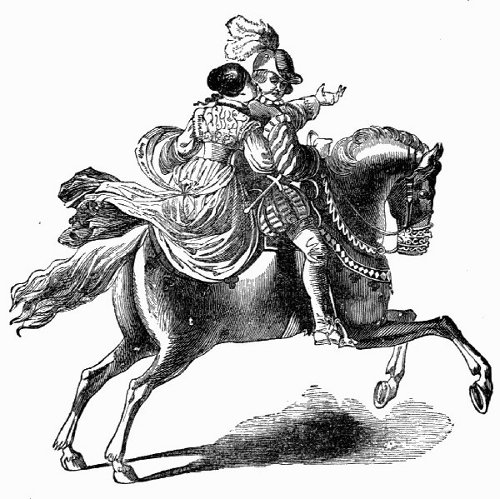
The group represents the above-named young knight, with his youthful
wife, taking a ride. She wears a blue silken dress, with a boddice of
gold brocade, trimmed with fur, and a rose-coloured silk scarf; the
head-dress is quite plain, the hair being fastened with a golden dagger
set in jewels. The knight's dress consists of a light green doublet,
with dark green stripes; slashed hose, edged with white; yellowish
leather surcoat without sleeves, riding boots of untanned leather, and
grey felt hat with red and white plume, dagger, and sword. The
accoutrements of the horse are simply black, with some metal ornaments.
The young lady is the beautiful Leonora Caimingen, who was
at that time a great favourite of the Court at Wurtemberg. In travelling
thus (which was at that time the only mode), females of the higher rank
only were accustomed to make use of masks, or veils, for the preservation
of their complexions, that custom being generally unusual. The
ancestral castle of the knights of Kaltenthal was situated between
Stuttgardt and Boeblingen, on the summit of a rock overhanging the
valley of Hesslach. It exists no longer.
ANCIENT TRIPOD.
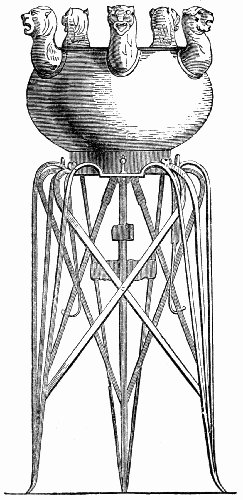
Tripods are, next to vases, the most ancient furniture in the world; the
imagination of the ancients invested them with fanciful forms, and we
meet with designs which,
although very simple, show
already the power exercised
by the re-productive faculties
of the mind upon the objects
surrounding these ancient
nations. Representations of
the kind were, however, exceedingly
rare till the last
forty years, and it must be
considered an especial piece
of good fortune that the excavations
made in several
parts of Etruria, have afforded
more than one example
of this description.
The specimen engraved was
found in the Gailassi Regulini
tomb of Cervetri, in
Etruria, and in it we see a
large vessel placed on the
tripod, from the edge of
which five lions' heads start
forth with hideous expression.
These monsters lend
to the whole that fanciful
aspect distinguishing objects
of the archaic period. When
we imagine to ourselves this
kettle boiling, and these cruel
animals wreathed and enveloped
in smoke, we can understand
how the fancy of
superstitious worshippers,
who were wont to make use
of these implements in their
religious ceremonies, may
have found in them an allusion
to the spirits of the victims
whose remains were exposed to the destructive fire glowing underneath.
To us, at least, this representation may illustrate the terrific
but grand passage of Homer, where the bodies of the slaughtered sun
bulls become once more instinct with life, demanding vengeance with
fearful cries: Odyssey, Book xii, verse 395.
"The skins began to creep, and the flesh around the spits bellowed,
The roasted as well as the raw. And thus grew the voice of the oxen."
The careful construction of the three-legged mechanism which lends a
firm support to this fire-stand, has been restored according to the indication
of some fragments found on the spot. It presents a graceful
aspect, and forms, in some respects, a remarkable contrast to the heavy
character of the vessel occupying so lofty a position, as the proportions
of the legs are exceedingly slender, and the feet themselves, instead of
being broad and shapeless, are all composed of a great many fine articulations.
FONDNESS OF THE ROMANS FOR PEARLS.
Of all the articles of luxury and ostentation known to the Romans,
pearls seem to have been the most esteemed. They were worn on all
parts of the dress, and such was the diversity of their size, purity, and
value, that they were found to suit all classes, from those of moderate
to those of the most colossal fortune. The famous pearl ear-rings of Cleopatra
are said to have been worth about £160,000, and Julius Cæsar is
said to have presented Servilia, the mother of Brutus, with a pearl for
which he had paid above £48,000; and though no reasonable doubt can
be ascertained in regard to the extreme exaggeration of these and similar
statements, the fact that the largest and finest pearls brought immense
prices is beyond all question. It has been said that the wish to become
master of the pearls with which it was supposed to abound, was one of
the motives which induced Julius Cæsar to invade Britain. But, though
a good many were met with in various parts of the country, they were
of little or no value, being small and ill-coloured. After pearls and
diamonds, the emerald held the highest place in the estimation of the
Romans.
THE BLACK STONE AT MECCA.
Near the entrance of the Kaaba at Mecca, at the north-eastern
corner, is the famous Black Stone, called by the Moslems Hajra el
Assouad, or Heavenly Stone. It forms a part of the sharp angle of the
building, and is inserted four or five feet above the ground. The shape
is an irregular oval, about seven inches in diameter. Its colour is now
a deep reddish brown, approaching to black; and it is surrounded by a
border of nearly the same colour, resembling a cement of pitch and
gravel, and from two to three inches in breadth. Both the border and
the stone itself are encircled by a silver band, swelling to a considerable
breadth below, where it is studded with nails of the same metal. The
surface is undulated, and seems composed of about a dozen smaller
stones, of different sizes and shapes, but perfectly smooth, and well
joined with a small quantity of cement. It looks as if the whole had
been dashed into many pieces by a severe concussion, and then re-united—an
appearance that may perhaps be explained by the various disasters
to which it has been exposed. During the fire that occurred in the time
of Yezzid I. (A.D. 682), the violent heat split it into three pieces; and
when the fragments were replaced, it was necessary to surround them
with a rim of silver, which is said to have been renewed by Haroun el
Raschid. It was in two pieces when the Karmathians carried it away,
having been broken by a blow from a soldier during the plunder of
Mecca. Hakem, a mad sultan of Egypt, in the 11th century, endeavoured,
while on the pilgrimage, to destroy it with an iron club
which he had concealed under his clothes; but was prevented and slain
by the populace. Since that accident it remained unmolested until
1674, when it was found one morning besmeared with dirt, so that
every one who kissed it returned with a sullied face. Though suspicion
fell on certain Persians, the authors of this sacrilegious joke were never
discovered. As for the quality of the stone, it does not seem to be
accurately determined. Burckhardt says it appeared to him like a lava,
containing several small extraneous particles of a whitish and yellowish
substance. Ali Bey calls it a fragment of volcanic basalt, sprinkled
with small-pointed coloured crystals, and varied with red feldspar upon
a dark black ground like coal, except one of its protuberances, which is
a little reddish. The millions of kisses and touches impressed by the
faithful have worn the surface uneven, and to a considerable depth.
This miraculous block all orthodox Mussulmans believe to have been
originally a transparent hyacinth, brought from heaven to Abraham
by the angel Gabriel; but its substance, as well as its colour, have
long been changed by coming in contact with the impurities of the
human race.
PARAGRAPH FROM THE "POSTMAN" IN 1697.
"Yesterday being the day of thanksgiving appointed by the States-General
for the peace, His Excellency, the Dutch ambassador, made a
very noble bonfire before his house in St. James's Square, consisting of
about 140 pitch barrels placed perpendicularly on seven scaffolds, during
which the trumpets sounded, and two hogsheads of wine were kept continually
running amongst the common people."
LORD MAYOR'S FEAST IN 1663.
Pepys gives a curious account of a Lord Mayor's dinner in 1663. It
was served in the Guildhall, at one o'clock in the day. A bill of fare
was placed with every salt-cellar, and at the end of each table was a list
of the persons proper there to be seated. Here is a mixture of abundance
and barbarism. "Many were the tables, but none in the hall,
but the Mayor's and the Lords' of the Privy Council, that had napkins
or knives, which was very strange. I sat at the merchant-stranger's
table, where ten good dishes to a mess, with plenty of wine of all sorts;
but it was very unpleasing that we had no napkins, nor change of
trenchers, and drank out of earthen pitchers and wooden dishes. The
dinner, it seems, is made by the Mayor and two Sheriffs for the time
being, and the whole is reckoned to come to £700 or £800 at most."
Pepys took his spoon and fork with him, as was the custom of those days
with guests invited to great entertainments. "Forks" came in with
Tom Coryat, in the reign of James I.; but they were not "familiar"
till after the Restoration. The "laying of napkins," as it was called,
was a profession of itself. Pepys mentions, the day before one of his
dinner-parties, that he went home, and "there found one laying of my
napkins against to-morrow, in figures of all sorts, which is mighty
pretty, and, it seems, is his trade, and he gets much money by it."
THE CUPID OF THE HINDOOS.
Among the Hindoo deities Camdeo, or Manmadin differs but little
from the Cupid of the ancients. He is also called Ununga, or, without
body; and is the son of Vishnu and Lacshmi. Besides his bow and
arrows, he carries a banner, on which is delineated a fish: his bow is a
sugar-cane; the cord is formed of bees; the arrows are of all sorts of
flowers; one only is headed, but the point is covered with a honeycomb—an
allegory equally just and ingenious, and which so correctly
expresses the pleasures and the pangs produced at one and the same time
by the wounds of love. Manmadin is represented, as in the annexed
plate, riding on a parrot.
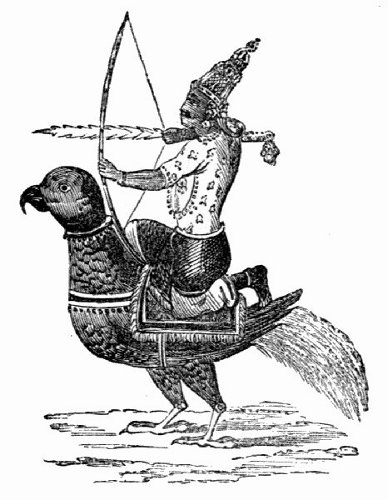
One day, when Vishnu, to deceive Sheeva, had assumed the figure of
a beautiful young female, Manmadin discharged an arrow, which pierced
the heart of the formidable deity, and inflamed it with love of the
nymph. The latter fled, and at the moment when Sheeva had overtaken
her, Vishnu resumed his proper form. Sheeva, enraged at the trick
played upon him, with one flash of his eyes burned and consumed the
imprudent Manmadin, who hence received the name of Ununga. He
was restored to life by a shower of nectar, which the gods in pity poured
upon him: but he remained without body and is the only Indian deity
who is accounted incorporeal. Camdeo is particularly worshipped by
females desirous of obtaining faithful lovers and good husbands.
OLD DIAL AND FOUNTAIN IN LEADENHALL-STREET.
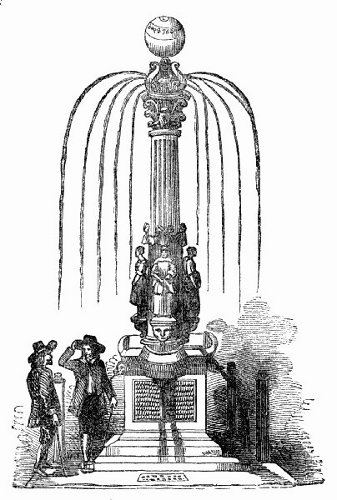
The above sketch is taken from an old work on astronomy and geography
by Joseph Moxon, and printed by him, and sold "at his Shop on
Cornhill, at the signe of Atlas, 1659." We cannot do better than give
Moxon's own words with reference to the dial:—"To make a dyal
upon a solid ball or globe, that shall show the hour of the day without
a gnomon. The equinoctial of this globe, or (which is all one) the
middle line must be divided into 24 equal parts, and marked with
1, 2, 3, 4, &c., and then beginning again with 1, 2, 3, &c. to 12. Then
if you elevate one of the poles so many degrees above an horizontal line
as the pole of the world is elevated above the horizon in your habitation,
and place one of the twelves directly to behold the north, and the other to
behold the south, when the sun shines on it, the globe will be divided into
two halfs, the one enlightened with the sunshine, and the other shadowed;
and where the enlightened half is parted from the shadowed half, there
you will find in the equinoctial the hour of the day, and that on two
places on the ball, because the equinoctial is cut in two opposite points
by the light of the sun. A dyal of this sort was made by Mr. John Leak
and set up on a composite columne at Leadenhall Corner, in London, in
the majoralty of Sir John Dethick, knight. The figure whereof I have
inserted because it is a pretty peece of ingenuity, and may, perhaps,
stand some lover of the art in stead either for imitation or help of invention."
MAGNIFICENCE OF MADYN, THE CAPITAL OF PERSIA, WHEN INVADED
BY THE SARACENS, A.D. 626.
The invaders could not express their mingled sensations of surprise
and delight, while surveying in this splendid capital the miracles of
architecture and art, the gilded palaces, the strong and stately porticoes,
the abundance of victuals in the most exquisite variety and profusion,
which feasted their senses, and courted their observation on every side.
Every street added to their astonishment, every chamber revealed a new
treasure; and the greedy spoilers were enriched beyond the measure of
their hopes or their knowledge. To a people emerging from barbarism,
the various wonders which rose before them in all directions, like the
effect of magic, must have been a striking spectacle. We may therefore
believe them when they affirm, what is not improbable, that the different
articles of merchandise—the rich and beautiful pieces of manufacture
which fell a prey on this occasion—were in such incalculable abundance,
that the thirtieth part of their estimate was more than the imagination
could embrace. The gold and silver, the various wardrobes and precious
furniture, surpassed, says Abul-feda, the calculation of fancy or numbers;
and the historian Elmacin ventured to compute these untold and
almost infinite stores at the value of 3,000,000,000 pieces of gold.
One article in this prodigious booty, before which all others seemed to
recede in comparison, was the superb and celebrated carpet of silk and
gold cloth, sixty cubits in length, and as many in breadth, which decorated
one of the apartments of the palace. It was wrought into a paradise
or garden, with jewels of the most curious and costly species; the
ruby, the emerald, the sapphire, the beryl, topaz, and pearl, being
arranged with such consummate skill, as to represent, in beautiful
mosaic, trees, fruits, and flowers, rivulets and fountains; roses and
shrubs of every description seemed to combine their fragrance and their
foliage to charm the sense of the beholders. This piece of exquisite
luxury and illusion, to which the Persians gave the name of Baharistan
or the mansion of perpetual spring, was an invention employed by their
monarchs as an artificial substitute for that loveliest of seasons. During
the gloom of winter they were accustomed to regale the nobles of their
court on this magnificent embroidery, where art had supplied the absence
of nature, and wherein the guests might trace a brilliant imitation of her
faded beauties in the variegated colours of the jewelled and pictured
floor. In the hope that the eyes of the Caliph might he delighted with
this superb display of wealth and workmanship, Saad persuaded the
soldiers to relinquish their claims. It was therefore added to the fifth of
the spoil, which was conveyed to Medina on the backs of camels. But
Omar, with that rigid impartiality from which he never deviated, ordered
the gaudy trophy to be cut up into small pieces, and distributed among
the chief members of the Mohammedan commonwealth. Such was the
intrinsic value of the materials, that the share of Ali alone, not larger
than the palm of a man's hand, was afterwards sold for 20,000 drachms
(£458 6s. 8d.), or, according to others, for as many dinars (£9,250). Out
of this vast store the Caliph granted pensions to every member of his
court in regular gradation, from the individuals of the Prophet's family to
the lowest of his companions, varying from £275 to £4 11s. per annum.
The military part of the booty was divided into 60,000 shares, and
every horseman had 12,000 dinars (£5,550); hence, if the army consisted
of 60,000 cavalry, their united shares would amount to the incredible
sum of £333,000,000 sterling.
COURTSHIP OF WILLIAM THE CONQUEROR.
The following extract from the life of the wife of the Conqueror, is
exceedingly curious, as characteristic of the manners of a semi-civilized age
and nation:—"After some years' delay, William appears to have become
desperate; and, if we may trust to the evidence of the 'Chronicle of
Ingerbe,' in the year 1047 way-laid Matilda in the streets of Bruges, as
she was returning from mass, seized her, rolled her in the dirt, spoiled
her rich array, and, not content with these outrages, struck her repeatedly,
and rode off at full speed. This Teutonic method of courtship,
according to our author, brought the affair to a crisis; for Matilda,
either convinced of the strength of William's passion, by the violence of
his behaviour, or afraid of encountering a second beating, consented to
become his wife. How he ever presumed to enter her presence again,
after such a series of enormities, the chronicler sayeth not, and we are
at a loss to imagine."
BRAMA, THE HINDOO DEITY.
Brama, Birmah, or Brouma, is one of the three persons of the Indian
Trinity, or rather the Supreme Being under the attribute of Creator.
Brama, the progenitor of all rational beings, sprung from a golden egg,
sparkling like a thousand suns, which was hatched by the motion imparted
to the waters by the Supreme Being. Brama separated the
heavens from the earth, and placed amid the subtle ether the eight
points of the universe and the receptacle of the waters. He had five
heads before Vairevert, one of Sheeva's sons, cut off one of them. He is
delineated floating on a leaf of the lotus, a plant revered in India. The
Bramins relate, that the fifteen worlds which compose the universe were
each produced by a part of Brama's body. At the moment of our birth
he imprints in our heads, in characters which cannot be effaced, all that
we shall do, and all that is to happen to us in life. It is not in our
power, nor in that of Brama himself, to prevent what is written from
being fulfilled.
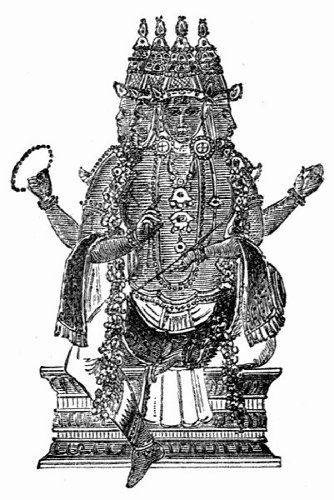
Brama, according to the vulgar mythology, takes but little notice of
human affairs. Identified with the sun, he is adored by the Bramins in
the gayatri, the most sacred passage of the vedas (or sacred books), which
is itself ranked among the gods, and to which offerings are made. One
of the most important attributes of Brama is that of father of legislators;
for it was his ten sons who diffused laws and the sciences over the world.
He is considered as the original author of the vedas, which are said to
have issued from his four mouths; though it was not till a later period,
that is, about fourteen hundred years before Christ, that they were collected
and arranged by Vyasa, the philosopher and poet. The laws
which bear the name of Menu, the son of Brama, and the works of the
other richeys, or holy persons, were also re-copied, or perhaps collected
from tradition, long after the period when they are said to have been
published by the sons of Brama.
Brama, the father of the legislators of India, has a considerable resemblance
to the Jupiter of the Greek poets, the father of Minos, whose
celebrated laws were published in the very same century that Vyasa
collected the vedas. Jupiter was worshipped as the sun, by the name of
Anxur or Axur, and Brama is identified with that luminary. The most
common form in which Brama is represented, is that of a man with four
heads and four hands; and it is remarkable that the Lacedæmonians
gave four heads to their Jupiter. Lastly, the title of Father of Gods
and Men is equally applicable to Brama and to Jupiter.
Brama is delineated, as in the engraving, holding in one hand a
ring, the emblem of immortality; in another, fire, to represent force;
and with the other two writing on olles, or palm-leaves, the emblem of
legislative power.
JAMES II. AND THE CHURCH OF DONORE.
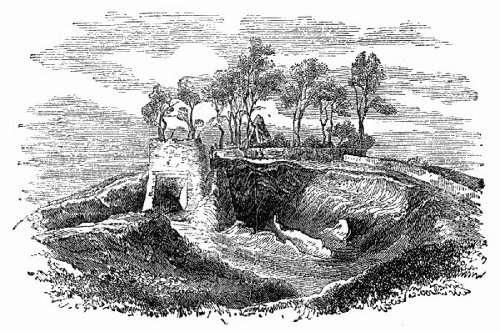
The annexed engraving represents a celebrated locality. It is the ruin
of the little church on the hill at Donore, in the county of Meath, the
spot where James II. was stationed when he beheld the overthrow of his
army and the ruin of his cause at the battle of the Boyne, Tuesday, July
1st, 1690. The Boyne is a very beautiful and picturesque river; it winds
through the fertile valleys of Meath, and from its richly-wooded banks
the hills rise gradually; there are no lofty mountains in the immediate
neighbourhood. The depth, in nearly all parts, is considerable, and the
current, consequently, not rapid; its width, near the field of battle,
varies little, and is seldom less than fifty or sixty yards. James had
the choice of ground, and it was judiciously selected. On the south
side of the river, in the county of Meath, his army was posted with considerable
skill: on the right was Drogheda; in front were the fords of
the Boyne, deep and dangerous, and difficult to pass at all times; the
banks were rugged, lined by a morass, defended by some breastworks,
with "huts and hedges convenient for infantry;" and behind them was
an acclivity stretching along the whole of "the field." James fixed his
own tent upon the summit of a hill close to the little church of Donore,
now a ruin; it commanded an extensive view of the adjacent country,
and the opposite or south side of the river—the whole range, indeed, from
Drogheda to Oldbridge village—and looked directly down upon the
valley, in which the battle was to be fought, and the fords of the Boyne,
where there could be no doubt the troops of William would attempt a
passage. From this spot, James beheld his prospering rival mingling in
the thick of the mêlée, giving and taking blows; watched every turn of
fortune, as it veered towards or against him; saw his enemies pushing
their way in triumph, and his brave allies falling before the swords of
foreigners—a safe and inglorious spectator of a battle upon the issue of
which his throne depended. The preceeding night he had spent at
Carntown Castle, from whence he had marched, not as the leader, but as
the overseer, of the Irish army; having previously given unequivocal
indications of his prospects, his hopes, and his designs, by despatching a
commissioner to Waterford, "to prepare a ship for conveying him to
France, in case of any misfortune."
HANGING GARDENS OF BABYLON.
When Babylon the Great was in the zenith of her glory, adjoining
the grand palace, and within the general enclosure, the Hanging
Gardens were constructed by the king to gratify his wife Amytis,
who being a native of Media (she was the daughter of Astyages, the
king of Media), desired to have some imitation of her native hills and
forests.
"Within the walls was raised a lofty mound,
Where flowers and aromatic shrubs adorn'd
The pensile garden. For Nebassar's queen,
Fatigued with Babylonia's level plains,
Sigh'd for her Median home, where nature's hand
Had scooped the vale, and clothed the mountain's side
With many a verdant wood: nor long she pined
Till that uxorious monarch called on Art
To rival Nature's sweet variety.
Forthwith two hundred thousand slaves uprear'd
This hill—egregious work; rich fruits o'erhang
The sloping vales, and odorous shrubs entwine
Their undulating branches."
These gardens, as far as we learn from ancient accounts, contained a
square of above 400 feet on each side, and were carried up in the manner
of several large terraces, one above the other, till the height equalled
that of the walls of the city. The ascent from terrace to terrace was by
stairs ten feet wide. The whole pile was sustained by vast arches,
raised on other arches one above another, and was defended and condensed
by a wall, surrounding it on every side, of twenty-two feet in
thickness. On the top of the arches were first laid large flat stones,
sixteen feet long and four broad; over these was a layer of weeds mixed
and cemented with a large quantity of bitumen, on which were two
rows of bricks closely cemented together with the same material. The
whole was covered with thick sheets of lead, on which lay the mould of
the garden. And all this floorage was so contrived as to keep the
moisture of the mould from running away through the arches. The
earth laid thereon was so deep that large trees might take root in it:
and with such the terraces were covered, as well as with the [...]
plants and flowers proper to adorn an eastern pleasure-garden. The
trees planted there are represented to have been of various kinds. Here
grew the larch, that, curving, flings its arms like a falling wave;
and by it was seen the grey livery of the aspen; the mournful solemnity
of the cypress and stately grandeur of the cedar intermingled with the
elegant mimosa; besides the light and airy foliage of the silk-tasselled
acacia, with its vast clusters of beauteous lilac flowers streaming in the
wind and glittering in the sun; the umbrageous foliage of the chesnut,
and ever-varying verdure of the poplar; the birch, with its feathered
branches light as a lady's plumes—all combined with the freshness of
the running stream, over which the willow waved its tresses.—
"And the jessamine faint, and the sweet tuberose,
The sweetest flower for scent that blows;
And all rare blossoms from every clime
Grew in that garden in perfect prime."
All these varied delights of nature were ranged in rows on the side
of the ascent as well as on the top, so that at a distance it appeared to
be an immense pyramid covered with wood. The situation of this
extraordinary effort of human skill, aided by human wealth and perseverance,
adjoining the river Euphrates, we must suppose that in the
upper terrace was an hydraulic engine, or kind of pump, by which the
water was forced up out of the river, and from thence the whole
gardens were watered, and a supply of the pure element furnished to
the fountains and reservoirs for cooling the air. In the spaces between
the several arches, on which the whole structure rested, were large and
magnificent apartments, very lightsome, and commanding the most
beautiful prospects that even the glowing conceptions of an eastern
imagination could dream to exist.
THE GREAT BELL OF BURMAH.
At a temple in the environs of Amarapoora, the capital of Burmah,
there is an enormous bell, which is thus described by Captain Yule:—"North
of the temple, on a low circular terrace, stands the biggest bell
in Burmah—the biggest in the world, probably, Russia apart. It is
slung on a triple beam of great size, cased and hooped with metal; this
beam resting on two piers of brickwork, enclosing massive frames of
teak. The bell does not swing free. The supports were so much shaken
by the earthquake, that it was found necessary to put props under the
bell, consisting of blocks of wood carved into grotesque figures. Of
course no tone can now be got out of it. But at any time it must have
required a battering-ram to elicit its music. Small ingots of silver (and
some say pieces of gold) may still be traced, unmelted, in the mass, and
from the inside one sees the curious way in which the makers tried to
strengthen the parts which suspend it by dropping into the upper part of
the mould iron chains, round which the metal was run. The Burmese report
the bell to contain 555,555 viss of metal (about 900 tons). Its principal
dimensions are as follow:—External diameter at the lip, 16 feet 3 inches;
external diameter 4 feet 8 inches above the lip, 10 feet; interior height,
11 feet 6 inches; exterior ditto, 12 feet; interior diameter at top, 8 feet
6 inches. The thickness of metal varies from six inches to twelve, and
the actual weight of the bell is, by a rough calculation, about eighty
tons, or one-eleventh of the popular estimate. According to Mr. Howard
Malcolm, whose authority was probably Colonel Burney, the weight is
stated in the Royal Chronicle at 55,500 viss, or about ninety tons. This
statement is probably, therefore, genuine, and the popular fable merely
a multiplication of it by ten."
This monster Burmese bell is, therefore, fourteen times as heavy as
the great bell of St. Paul's, but only one-third of that given by the
Empress Anne to the Cathedral of Moscow.
BANDOLIERS.
We here engrave a set of bandoliers, a species of weapon much in
vogue about the close of the sixteenth century. The specimen before us
consists of nine tin cases covered with leather, with caps to them, each
containing a charge of powder, and suspended by rings from a cord
made to pass through other rings.
The caps are retained in their places
by being contrived so as to slip up
and down their own cords. Two flaps
of leather, on each side, are intended
to protect the bandoliers from rain,
and attached to one of these may be
perceived a circular bullet-purse,
made to draw with little strings.
This specimen was buckled round
the waist by means of a strap; others
were worn round the body and over
the shoulder. The noise they made,
agitated by the wind, but more
especially the danger of all taking fire from the match-cord, occasioned
their disuse, as Sir James Turner tells us, about the year 1640.
TOMB OF DARIUS.
Among the most remarkable tombs of the ancients, may be noticed the
sepulchre carved out of the living rock, by order of Darius, the warrior
and conqueror king of Persia, for the reception of his own remains; and
which is existing to this day at Persepolis, after a duration of twenty-three
centuries.
The portico is supported by four columns twenty feet in height, and
in the centre is the form of a doorway, seemingly the entrance to the
interior, but it is solid; the entablature is of chaste design. Above
the portico there is what may be termed an ark, supported by two rows
of figures, about the size of life, bearing it on their uplifted hands, and
at each angle a griffin—an ornament which is very frequent at Persepolis.
On this stage stands the king, with a bent bow in his hand,
worshipping the sun, whose image is seen above the altar that stands
before him, while above his head hovers his ferouher, or disembodied
spirit. This is the good genius that in Persian and Ninevite sculpture
accompanies the king when performing any important act. On each
side the ark are nine niches, each containing a statue in bas-relief. No
other portion of the tomb was intended to be seen, excepting the sculptured
front; and we must, therefore, conclude that the entrance was
kept secret, and that the avenues were by subterranean passages, so
constructed that none but the privileged could find their way. We are
told by Theophrastus, that Darius was buried in a coffer of Egyptian
alabaster; and also that the early Persians buried their dead entire,
preserving their bodies with honey or wax.
THE GATE ON OLD LONDON BRIDGE.
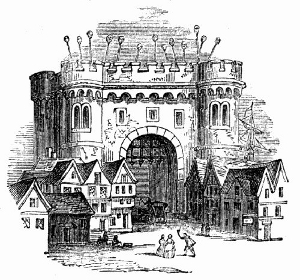
In the reign of Queen Elizabeth, a strongly embattled gate protected
the entrance from Southwark to Old London Bridge, and it was usually
garnished with traitors'
heads in "rich abundance,"
as may be seen
in the accompanying cut,
which is copied from Visscher's
view, in 1579.
The bridge was at that period
covered with houses, a narrow
road passing through
arcades beneath them, and
they abutted on props over
the river on either side.
The bridge was proudly
spoken of by our ancestors.
Thus, in the translation of
Ortelius, published by J.
Shaw, in 1603, he says of
the Thames:—"It is beautified
with statelye pallaces,
built on the side thereof; moreover, a sumptuous bridge sustayned on
nineteen arches, with excellent and beauteous housen built thereon."
Camden, in his great work, the "Britannica," says, "It may worthily
carry away the prize from all the bridges in Europe," being "furnished
on both sides with passing faire houses, joining one to another in the
manner of a street."
EXTRAORDINARY PONDS AND FISH.
The ponds in the department of Ain in France are 1667 in number.
The industry and ingenuity of man have converted the marshes into
fertile plains and productive ponds, by constructing dykes from one hill
to the other, for the plateaux are covered with small hills. When the
proprietor of one of these ponds wishes to cultivate it, he draws off the
water into the dyke attached to it. Wheat, barley, and oats are then
sown, and the seed thus fertilised by the slime produces a crop double
that produced by the land in the vicinity. After the harvest is collected,
the water is permitted to return to its former bed, and carp, tench, and
roach are then thrown into it. Some of these ponds will support 100,000
of carp, and 100 pounds of little tench and roach. In the course of two
years these carp, which weighed only one ounce and a-half, will have
attained the size of two pounds and a half. The fishing begins in April,
and is continued until November. The increase of the fish is as one to
five.
THE CEREMONIAL OF MAKING THE KING'S BED.
The following account of the old ceremony of making the King's bed
in the time of Henry the Eighth, was sent to the Society of Antiquaries,
in 1776, by Mr. J. C. Brooke, of the Heralds' College, F.S.A. &c. In a
letter to the president, he says,—
"It is extracted from an original manuscript, elegantly written, beautifully
illuminated, and richly bound, which was some time in the library
of Henry, Duke of Norfolk, earl marshal of England, to whom it came
by descent from Thomas, the great Duke of Norfolk, beheaded in the
reign of Queen Elizabeth; who married Mary, daughter and coheir of
Henry Fitz-Alan, Earl of Arundel, lord chamberlain to King Henry the
Eighth. It contains the whole duty of the lord chamberlain, and of the
officers in his department; is the original copy kept for the information
of that earl; and had been compiled by order of, and approved by, the
King himself in council."
"The oolde ordre of Makynge the Kynges Bedd not to used nor done,
but as Hys Grace woll comaund and apoynte from tyme to tyme
herafter.
"Furste, a groome or a page to take a torche, and to goo to the warderobe
of the kynges bedd, and bryng theym of the warderobe with the
kynges stuff unto the chambr for makyng of the same bedde. Where as
aught to be a gentylman-usher, iiii yomen of the chambr for to make
the same bedde. The groome to stande at the bedds feete with his torch.
They of the warderobe openyng the kinges stuff of hys bedde upon a
fayre sheete, bytwen the sayde groome and the bedds fote, iii yeomen, or
two at the leste, in every syde of the bedde; the gentylman-usher and
parte commaundyng theym what they shall doo. A yoman with a dagger
to searche the strawe of the kynges bedde that there be none untreuth
therein. And this yoman to caste up the bedde of downe upon that, and
oon of theym to tomble over yt for the serche thereof. Then they to bete
and tufle the sayde bedde, and to laye oon then the bolster without
touchyng of the bedd where as it aught to lye. Then they of the warderobe
to delyver theym a fustyan takyng the saye therof. All theys
yomen to laye theyr hands theroon at oones, that they touch not the
bedd, tyll yt be layed as it sholde be by the comaundement of the ussher.
And so the furste sheet in lyke wyse, and then to trusse in both sheete
and fustyan rownde about the bedde of downe. The warderoper to
delyver the second sheete unto two yomen, they to crosse it over theyr
arme, and to stryke the bedde as the ussher shall more playnly shewe
unto theym. Then every yoman layeing hande upon the sheete, to laye
the same sheete upon the bedde. And so the other fustyan upon or ii
with such covervnge as shall content the kynge. Thus doon, the ii
yomen next to the bedde to laye down agene the overmore fustyan, the
yomen of the warderobe delyverynge theym a pane sheete, the sayde
yoman therewythall to cover the sayde bedde. And so then to laye
down the overmost sheete from the beddes heed. And then the sayd ii
yomen to lay all the overmost clothes of a quarter of the bedde. Then
the warderoper to delyver unto them such pyllowes as shall please the
kynge. The sayd yoman to laye theym upon the bolster and the heed
sheete with whych the sayde yoman shall cover the sayde pyllowes. And
so to trusse the endes of the sayde sheete under every ende of the bolster.
And then the sayd warderoper to delyver unto them ii lyttle small pyllowes,
werwythall the squyres for the bodye or gentylman-ussher shall
give the saye to the warderoper, and to the yoman whych have layde on
hande upon the sayd bedde. And then the sayd ii yomen to lay upon
the sayde bedde toward the bolster as yt was bifore. They makyng a
crosse and kissynge yt where there handes were. Then ii yomen next
to the feete to make the feers as the ussher shall teche theym. And so
then every of them sticke up the aungel about the bedde, and to lette
down the corteyns of the sayd bedde, or sparver.
"Item, a squyer for the bodye or gentylman-ussher aught to sett the
kynges sword at hys beddes heed.
"Item, a squyer for the bodye aught to charge a secret groome or
page, to have the kepynge of the sayde bedde with a lyght unto the time
the kynge be disposed to goo to yt.
"Item, a groome or page aught to take a torche, whyle the bedde ys
yn makyng, to feche a loof of brede, a pott wyth ale, a pott wyth
wine, for them that maketh the bedde, and every man.
"Item, the gentylman-ussher aught to forbede that no manner of
man do sett eny dysshe upon the kynge's bedde, for fere of hurtying of
the kynge's ryche counterpoynt that lyeth therupon. And that the sayd
ussher take goode heede, that noo man wipe or rubbe their handes uppon
none arras of the kynges, wherby they myght bee hurted, in the chambr
where the kynge ys specially, and in all other."
ORIGIN OF SANDWICHES.
To the memory of "Lord Sandwich" belongs the name of that edible.
Being, during his administration (as was very usual with him), at a
gambling-house, he had, in the fascination of play, for more than five
and twenty hours forgotten fatigue and hunger, when suddenly, feeling
disposed to break his fast, though still riveted to the table, he called to
bid some one bring anything that was to be had to eat, which happened
to prove a slice of beef, and two pieces of bread. Placing them together
for the sake of expedition, he devoured them with the greatest relish.
The most ecstatic encomiums published his discovery, and giving it his
name, bequeathed it as a memento to his country, as one of the most
important acts of his administration.
THE TREATY-STONE AT LIMERICK.
The city of Limerick is very famous in history. Before it, in 1651,
Ireton "sate down;" there he continued to "sit" for six months; and
underneath its walls the fierce republican died of plague. Greater
celebrity, and higher honour, were, however, obtained by Limerick in
1690. Early in August, William summoned it to surrender; the French
general, Boileau, who commanded the garrison—"rather for the King
of France than the King of England"—returned for answer, that "he
was surprised at the summons, and thought the best way to gain the
good opinion of the Prince of Orange was to defend the place for his
master King James." The siege was at once commenced. The flower of
the Irish army were within its walls, or in its immediate neighbourhood;
the counties of Clare and Galway were open to them, from which
to draw supplies; and a French fleet rode triumphantly in the Shannon.
The garrison, however, were little disposed to act in concert: the
jealousy of the commanders
of the French and
Irish had spread to their
troops; and they cherished
feelings of contempt or
hatred towards each other,
that argued ill for their
success in opposing the
steady and disciplined forces
of William.
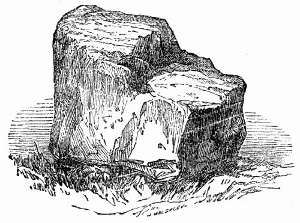
Yet the Irish succeeded;
the siege was raised
on the 30th of August.
But, in the autumn of
1691, it endured a second,
which occupied about six
months; when the garrison, wearied of a struggle from which they
could derive nothing but glory, on the 23rd of September, a cessation of
hostilities took place; an amicable intercourse was opened between the
two armies; and articles of capitulation were, after a few brief delays,
agreed upon. The "violated treaty" was signed on the 3rd of October,
1691; it consisted of two parts, civil and military. It is said to
have been signed by the several contracting parties on a large stone, near
to Thomond Bridge, on the county of Clare side of the river. The stone
remains in the position it occupied at the period, and is an object of
curiosity to strangers, as well as of interest to the citizens of Limerick.
We, therefore, thought it desirable to procure a drawing of the relic,
which retains its name of "the Treaty Stone."
THE TEMPLARS' BANNER CALLED BEAUSEANT.
When Constantine the Great was on the eve of a battle with Maxentius,
we are told that a luminous standard appeared to him in the sky
with a cross upon it, and this inscription:—"In hoc signo vinces—By
this sign you shall conquer;" and that this sign so encouraged Constantine
and his soldiers that they gained the next day a great victory.
When Waldemar II. of Denmark was engaged in a great battle with
the Livonians in the year 1219, it is said that a sacred banner fell from
heaven into the midst of his army, and so revived the courage of his
troops, that they gained a complete victory over the Livonians; and in
memory of the event, Waldemar instituted an order of knighthood,
called "St. Danebrog," or the strength of the Danes, and which is still
the principal order of knighthood in Denmark. Now, taking these
legends for as much as they are worth, and no more; what do they
prove? Not that this miraculous standard and cross came to the assistance
of Constantine; not that this miraculous banner came to the aid of
Waldemar; but they prove that such was the paramount importance
attached to the sacred banner among the forces, that wherever it was
present, it was a great means of inspiriting the men with increased
confidence and courage, and so contributed to the victory.
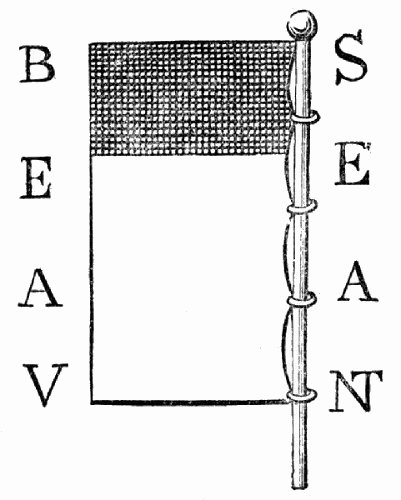
The great importance attached to the banner in the middle ages is not
to be wondered at, when we consider that it was a kind of connecting
link between the military and the clergy; it was a religious symbol
applied to a military purpose, and this was the feeling which animated
the Crusaders and the Templars in their great struggle against the
enemies of Christianity. The contest then was between the crescent and
the cross—between Christ and Mahomet. The Knights Templars had a
very remarkable banner, being simply divided into black and white,
the white portion symbolising peace to their friends, the black portion
evil to their enemies, and their dreaded war cry, "Beauseant."
SWORD-FISH v. WHALES.
So boundless is the sword-fish's rage and fury against whales in particular,
that many observers imagine his sallies against rocks and timber
to originate in an error of judgment, that all these lunges are intended
to punish leviathan, and are only misdirected in consequence of the
imperfect vision which prevents this scomber, like many of his family,
from accurately distinguishing forms. Whenever a supposed whale is
descried, our savage sabreur rushes forward to intercept his progress,
and suddenly flashing before his victim, either alone or in conjunction
with some other unfriendly fish, instantly proceeds to the attack. Relations
of such sea-fights, attested by credible eye-witnesses, are not
uncommon; we content ourselves with the citation of one of unimpeachable
accuracy. Captain Crow, cited by Mr. Yarrell, relates that
in a voyage to Memel, on a calm night, just off the Hebrides, all hands
were called up to witness a strange combat between some thrashers
(carcharias vulpes) and a sword-fish leagued together against a whale;
as soon as the back of the ill-starred monster was seen rising a little
above the water, the thrashers sprang several yards into the air, and
struck him with their descending tails, the reiterated percussions of
which sounded, we are told, like a distant volley of musketry. The
sword-fish meanwhile attacked the whale from below, getting close
under his belly, and with such energy and effect that there could be
little doubt of the issue of a fray, which the necessity of prosecuting
their voyage prevented the crew from watching to its close. The sword-fish
is not less remarkable for strength than pugnacity, the depôt of its
great physical powers being, as in most scombers, in the tail.
WEALTH OF SPAIN UNDER THE MOORS.
The Moors, whose conquest and expulsion were attended with such
atrocities, and such triumphs to the Catholic church, were by far the
most industrious and skilful part of the Spanish population, and their
loss was a blow to the greatness and prosperity of that kingdom from
which it has never recovered. The literary activity and commercial
enterprise of the Arabs, which the wise policy of their Caliphs encouraged,
contributed both to enrich and adorn their adopted country.
Cordova, the seat of the Ommiades, was scarcely inferior, in point of
wealth and magnitude, to its proud rival on the banks of the Tigris.
A space of twenty-four miles in length, and six in breadth, along the
banks of the Guadalquiver, was occupied with palaces, streets, gardens,
and public edifices; and for ten miles the citizens could travel by the
light of lamps along an uninterrupted extent of buildings. In the
reign of Almansor it could boast of 270,000 houses, 80,455 shops, 911
baths, 3,877 mosques, from the minarets of which a population of
800,000 were daily summoned to prayers. The seraglio of the Caliph,
his wives, concubines, and black eunuchs, amounted to 6,300 persons;
and he was attended to the field by a guard of 12,000 horsemen, whose
belts and scimitars were studded with gold. Granada was equally
celebrated for its luxury and its learning. The royal demesnes extended
to the distance of twenty miles, the revenues of which were set apart to
maintain the fortifications of the city. Of the duty on grain, the king's
exchequer received about £15,000 yearly, an immense sum at that
time, when wheat sold at the rate of sixpence a bushel. The consumption
of 250,000 inhabitants kept 130 water-mills constantly at work in
the suburbs. The population of this small kingdom under the Moors is
said to have amounted to 3,000,000, which is now diminished perhaps
to one-fifth of that number. Its temples and palaces have shared the
same decay. The Alhambra stands solitary, dismantled, and neglected.
The interior remains of the palace are in tolerable preservation, and
present a melancholy picture of the romantic magnificence of its former
kings. Seville, which had continued nearly 200 years the seat of a
petty kingdom, enjoyed considerable reputation as a place of wealth
and commerce. The population in 1247 was computed at 300,000
persons, which, in the sixteenth century, had decreased one-third. It
was one of the principal marts for olives in the Moorish dominions; and
so extensive was the trade in this article alone that the axarafe, or
plantations round the suburbs, employed farm-houses and olive-presses
to the amount of 100,000, being more than is now to be found in the
whole province of Andalusia.
THE FIRST OPERA.
The first composer who tried his hand at setting an opera to music
was Francisco Bamirino, an Italian artist; and the piece to which he
lent the charm of a melodious accompaniment, was the "Conversion
of St. Paul," which was brought out at Rome in 1460.
RUINS OF EUROPA.
Lady Sheil, in her "Life in Persia," thus describes some wonderful
ruins which she saw about thirty miles from Tehran:—
"From near Verameen a most remarkable antiquity still survives the
lapse of twenty centuries, that is, if what we hear be true. It consists
of an immense rampart, twenty or thirty feet in height, and of proportional
thickness, including a space of about half a mile in length and
nearly the same in breadth. It is in the form of a square; the rampart
is continuous, and at short intervals is strengthened by bastions of prodigious
size. The whole is constructed of unbaked bricks of large
dimensions, and is in a state of extraordinary preservation. The traces
of a ditch of great size, though nearly filled up, are evident in front of
the rampart. No buildings are found inside, where nothing is visible
excepting a few mounds,—not a single habitation or human being. The
solitude of this striking vestige of antiquity adds to its solemnity. It
stood alone; Elboorz, distant only a few miles, gazing down on its hoary
walls, with Demawend, in its garments of snow, to complete the scene.
From no place have I had a finer view of this grand mountain, which
seemed to lie exactly to the north. I am informed that these magnificent
ruins represent Europa, a city built by Seleucus, which, if true,
would make it upwards of two thousand years old. On seeing the
perfect state of the ruins, and the materials of which they are composed,
one feels no hesitation in crediting so venerable an antiquity. Seleucus
chose the spot well. The district of Verameen is renowned for its
fertility, though not at this period for the salubrity of its climate. The
surrounding country is covered with earthen mounds, denoting former
edifices, which, if explored, might reveal objects worthy of the erudition
and intellect of even Sir Henry Rawlinson."
CELEBRATED GUN.
The gun, of which the annexed
is a sketch, is one of the many
curiosities of the Londesborough
Museum. It once formed part of
the collection of Prince Potemkin,
and was originally the property of
Charles IX. of France; it is traditionally
reported to have been the
gun he used in firing on his Huguenot
subjects, from one of the
windows of the Louvre, during the
massacre of St. Bartholomew. The
barrel is richly chased in high relief,
with a stag-hunt amid foliage.
The stock is inlaid with ivory,
sculptured into a series of hunting
scenes, knights on horseback.
The dreadful massacre of Saint
Bartholomew commenced at Paris
on the night of the festival of that
saint, August 24th, 1572. Above
500 persons of rank, and 10,000 of
inferior condition, perished in Paris
alone, besides those slaughtered in
the provinces. The king, who had
been persuaded that the destruction
of the Huguenots to the last man
was necessary to the safety of his
throne, beheld the slaughter from
a window, and being carried away
by the example of those whose
murderous doings he witnessed,
ordered some long arquebusses to
be brought, and on their being
loaded, and handed to him one
after another, he for some time
continued to fire on the unfortunate
fugitives as they passed, crying
at the same time with a loud
voice, "Kill, kill." He afterwards
went and inspected the bodies of
the slain, and expressed his satisfaction
at the effective manner in
which his orders had been executed.
TOMB OF RAFFAELLE.
The great painter Raffaelle died at Rome, April 7th 1520, at the early
age of thirty-seven. He was buried in the Pantheon, in a chapel which was
afterwards called Raffaelle's Chapel. For more than a century and a half
his tomb had only a plain epitaph, but Carlo Maratti desired to place a
more striking memorial of Raffaelle's resting-place than the simple inscription,
and accordingly, in the year 1764, a marble bust of the painter,
executed by Paolo Nardini, was placed in one of the oval niches on each
side of the chapel. The epitaph to Maria Bibiena (Raffaelle's betrothed)
was removed to make way for Maratti's new inscription; and it was currently
believed that the skull of Raffaelle was removed; at least such was
the history given of a skull shown as the painter's, religiously preserved
by the Academy of St. Luke, and descanted on by phrenologists as indicative
of all the qualities which "the divine painter" possessed. But
scepticism played its part; doubts of the truth of this story led to doubts
of Vasari's statement respecting the exact locality of Raffaelle's tomb.
Matters were brought to a final issue by the discovery of a document
proving this skull to be that of Don Desiderio de Adjutorio, founder of
the society called the Virtuosi, in 1542. Thereupon, this society demanded
the head of its founder from the Academy of St. Luke; but they
would neither abandon that, nor the illusion that they possessed the
veritable skull of the great artist. Arguments ran high, and it was at
length determined to settle the question by an examination of the spot,
which took place on the 13th of September 1833, in the presence of the
Academies of St. Luke and of Archæology, the Commission of the Fine
Arts (including Overback and others), the members of the Virtuosi, the
governor of Rome (Monsignor Grimaldi), and the Cardinal Zurla, the
representative of the pope.
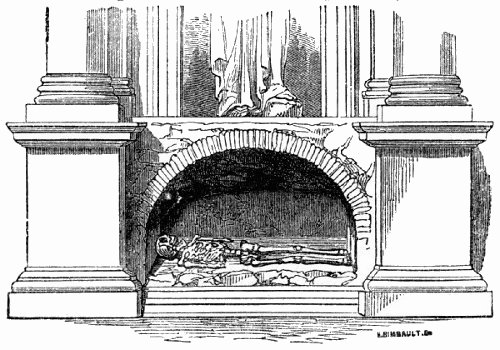
The result will be best given in the words of an eye-witness, Signor
Nibby (one of the Commission of Antiquities and Fine Arts), who thus
described the whole to M. Quatremere de Quincy, the biographer of
Raffaelle:—"The operations were conducted on such a principle of exact
method as to be chargeable with over nicety. After various ineffectual
attempts in other directions, we at length began to dig under the altar
of the Virgin itself, and taking as a guide the indications furnished by
Vasari, we at length came to some masonry of the length of a man's body.
The labourers raised the stone with the utmost care, and having dug
within for about a foot and a half, came to a void space. You can hardly
conceive the enthusiasm of us all, when, by a final effort, the workmen
exhibited to our view the remains of a coffin, with an entire skeleton in
it, lying thus as originally placed, and thinly covered with damp dust.
We saw at once quite clearly that the tomb had never been opened, and
it thus became manifest that the skull possessed by the Academy of St.
Luke was not that of Raffaelle. Our first care was, by gentle degrees,
to remove from the body the dust which covered it, and which we religiously
collected, with the purpose of placing it in a new sarcophagus.
Amongst it we found, in tolerable preservation, pieces of the coffin,
which was made of deal, fragments of a painting which had ornamented
the lid, several bits of Tiber clay, formations from the water of the river,
which had penetrated into the coffin by infiltration, an iron stelletta, a
sort of spur, with which Raffaelle had been decorated by Leo X, several
fibulæ, and a number of metal anelli, portions of his dress." These small
rings had fastened the shroud; several were retained by the sculptor
Fibris, who also took casts of the head and hand, and Camuccini took
views of the tomb and its precious contents; from one of these our cut
is copied.
On the following day the body was further examined by professional
men: the skeleton was found to measure five feet seven inches, the
narrowness of the coffin indicated a slender and delicate frame. This
accords with the contemporary accounts, which say he was of a refined
and delicate constitution; his frame was all spirit; his physical strength
so limited that it was a wonder he existed so long as he did. The investigation
completed, the body was exhibited to the public from the 20th
to the 24th, and then was again placed in a new coffin of lead, and that
in a marble sarcophagus presented by the pope, and taken from the antiquities
in the Museum of the Vatican. A solemn mass was then announced
for the evening of the 18th of October. The Pantheon was then
illuminated, as for a funeral; the sarcophagus, with its contents, was
placed in exactly the same spot whence the remains had been taken.
The presidents of the various academies were present, with the Cavalier
Fabris at their head. Each bore a brick, which he inserted in the
brickwork with which the sepulchre was walled in. And so the
painter awaits "the resurrection of the just," and the fellowship of saints
and angels, of which his inspired pencil has given us the highest realisation
on earth.
ANTIMONY.
The origin of the use of anti-moine, or antimony, is a remarkable
circumstance. Basil Valentin, superior of a college of religionists,
having observed that this mineral fattened the pigs, imagined that it
would produce the same effect on the holy brotherhood. But the case
was seriously different; the unfortunate fathers, who greedily made use
of it, died in a short time, and this is the origin of its name, according
to the pure French word. In spite of this unfortunate beginning,
Paracelsus resolved to bring this mineral into practice; and by mixing
it with other preparations make it useful. The Faculty at Paris were
on this occasion divided into two parties, the one maintaining that
antimony was a poison; the other affirmed that it was an excellent
remedy. The dispute became more general, and the Parliament and
the College of the Sorbonne interfered in the matter; but sometime
afterwards people began to judge rightly concerning this excellent
mineral; and its wonderful and salutary effects have occasioned the
Faculty to place it among their best medicines.
PERSONAL APPEARANCE OF MAHOMET.
For the personal appearance and private life of Mahomet, we must
rely on the Arabian writers, who dwell with fond and proud satisfaction
on the graces and intellectual gifts with which nature had endowed him.
He was of a middle stature, of a clear, fair skin, and ruddy complexion.
His head and features, though large, were well proportioned; he had a
prominent forehead, large dark-brown eyes, an aquiline nose, and a
thick bushy beard. His mouth, though rather wide, was handsomely
formed, and adorned with teeth white as pearls, the upper row not closely
set, but in regular order—which appeared when he smiled, and gave an
agreeable expression to his countenance. He had a quick ear, and a
fine sonorous voice. His dark eyebrows approached each other without
meeting. His hair fell partly in ringlets about his temples, and partly
hung down between his shoulders. To prevent whiteness, the supposed
effect of Satanic influence, he stained it, as the Arabs often do still, of
a shining reddish colour. His frame was muscular and compact—robust
rather than corpulent. When he walked, he carried a staff, in imitation
of the other prophets, and had a singular affectation of being thought to
resemble Abraham. The assertion of the Greeks and Christians, that
he was subject to epilepsy, must be ascribed to ignorance or malice.
STIRRUPS.
From every information we have been able to collect, we believe that
the appendage of stirrups were not added to saddles before the sixth
century. It is said, that previous to the introduction of stirrups, the
young and agile used to mount their horses by vaulting upon them,
which many did in an expert and graceful manner; of course, practice
was essential to this perfection. That this should be afforded, wooden
horses were placed in the Campus Martius, where this exercise was performed
of mounting or dismounting on either side; first, without, and
next with arms. Cavalry had also occasionally a strap of leather, or a
metallic projection affixed to their spears, in or upon which the foot
being placed, the ascent became more practicable. Respecting the period
of this invention, Montfaucon has presumed that the invention must
have been subsequent to the use of saddles; however, opposed to this
opinion, an ingenious argument has been offered, that it is possible they
might have been anterior to that invention; because, it is said, they
might have been appended to a girth round the body of the horse. Both
Hippocrates and Galen speak of a disease to which the feet and ancles
were subject, from long riding, occasioned by suspension of the feet without
a resting-place. Suetonius, the Roman, informs us that Germanicus,
the father of Caligula, was wont to ride after dinner, to strengthen his
ancles, by the action of riding affording the blood freer circulation in
the part.
THE GREAT SHOEMADOO PAGODA.
The Buddhist temple of which we here give an engraving is the great
Shoëmadoo Pagoda at Pegu. Among other things it is interesting as
being one of the earliest attempts at that class of decoration, which consists
in having at the base of the building a double range of small
pagodas, a mode of ornamentation that subsequently became typical in
Hindu architecture; their temples and spires being covered, and indeed
composed of innumerable models of themselves, clustered together so as
to make up a whole.
The building stands on two terraces, the lower one about 10 ft. high,
and 1391 ft. square: the upper one, 20 ft. in height, is 684 ft. square;
from the centre of it rises the pagoda, the diameter of whose base is 395 ft.
The small pagodas are 27 ft. high, and 108 or 110 in number; while the
great pagoda itself rises to the height of 331 ft. above its terrace, or
361 ft. above the country, thus reaching a height nearly equal to St.
Paul's Cathedral; while the side of the upper terrace is only 83 ft. less
than that of the great Pyramid.
Tradition ascribes its commencement to two merchants, who raised it
to the height of 12 cubits at an age slightly subsequent to that of
Buddha himself. Successive kings of Pegu added to this from time to
time, till at last it assumed its present form, most probably about three
or four centuries ago.
PEST HOUSE DURING THE PLAGUE IN TOTHILL FIELDS.
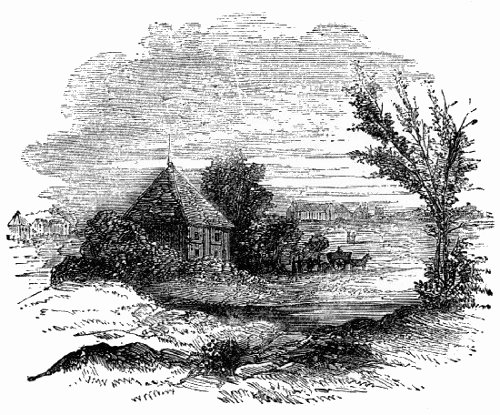
Tothill Fields, a locality between Pimlico and the Thames, was anciently
the manor of Tothill, belonging to John Maunsel, chancellor, who
in 1256, entertained here Henry III. and his court at a vast feast in
tents and pavilions. Here were decided wagers of battle and appeals
by combat. Necromancy, sorcery and witchcraft were punished here;
and "royal solemnities and goodly jousts were held here." In Culpeper's
time the fields were famous for parsley. In 1642 a battery and breastwork
were erected here. Here also were built the "Five Houses," or
"Seven Chimneys," as pest-houses for victims of the plague. One of
these pest-houses is given in the above engraving, taken from an old
print. In the plague time of 1665, the dead were buried "in the open
Tuttle Fields." In Queen Anne's reign here was William Well's head
garden on the site of Vincent-square. The Train Bands were drawn out
here in 1651. In the last century the fields were a noted duel-ground,
and here, in 1711, Sir Cholmeley Deering, M.P., was killed by the first
shot of Mr. Richard Thornhill, who was tried for murder and acquitted,
but found guilty of manslaughter and burnt in the hand.
THE THUGS.
The following account of these horribly extraordinary men is taken from
Dr. Hooker's Himalayan Journals; writing at Mirzapore, he says:—"Here
I had the pleasure of meeting Lieutenant Ward, one of the suppressors
of Thuggee (Thuggee, in Hindostan, signifies a deceiver; fraud, not
open force, being employed). This gentlemen kindly showed me the
approvers, or king's evidence of his establishment, belonging to those
three classes of human scourges, the Thug, Dakoit, and Poisoner. Of
these the first was the Thug, a mild-looking man, who had been born
and bred to the profession: he had committed many murders, saw no
harm in them, and felt neither shame nor remorse. His organs of
observation and destructiveness were large, and the cerebellum small.
He explained to me how the gang waylay the unwary traveller, enter
into conversation with him, and have him suddenly seized, when the
superior throws his own girdle round the victim's neck and strangles
him, pressing the knuckles against the spine. Taking off his own
girdle, he passed it round my arm, and showed me the turn as coolly as
a sailor once taught me the hangman's knot. The Thug is of any
caste, and from any part of India. The profession have particular
stations, which they generally select for murder, throwing the body of
their victim into a well.
"Their origin is uncertain, but supposed to be very ancient, soon after
the Mahommedan conquest. They now claim a divine original, and are
supposed to have supernatural powers, and to be the emissaries of the
divinity, like the wolf, the tiger, and the bear. It is only lately that
they have swarmed so prodigiously—seven original gangs having
migrated from Delhi to the Gangetic provinces about 200 years ago,
from whence all the rest have sprung. Many belong to the most
amiable, intelligent, and respectable classes of the lower and even
middle ranks: they love their profession, regard murder as sport, and
are never haunted with dreams, nor troubled with pangs of conscience
during hours of solitude, or in the last moments of life. The victim is
an acceptable sacrifice to the goddess Davee, who by some classes is
supposed to eat the lifeless body, and thus save her votaries the necessity
of concealing it.
"They are extremely superstitious, always consulting omens, such as
the direction in which a hare or a jackal crosses the road; and even far
more trivial circumstances will determine the fate of a dozen of people,
and perhaps of an immense treasure. All worship the pickaxe, which
is symbolical of their profession, and an oath sworn on it binds closer
than on the Koran. The consecration of this weapon is a most elaborate
ceremony, and takes place only under certain trees. The Thugs rise
through various grades: the lowest are scouts; the second, sextors;
the third, are holders of the victim's hands; the highest, stranglers.
"Though all agree in never practising cruelty, or robbing previous to
murder—never allowing any but infants to escape (and these are
trained to Thuggee), and never leaving a trace of such goods as may be
identified—there are several variations in their mode of conducting
operations: some tribes spare certain castes, others none; murder of
woman is against all rules; but the practice crept into certain gangs,
and this it is which led to their discountenance by the goddess Davee,
and the consequent downfall of the system. Davee, they say, allowed
the British to punish them, because a certain gang had murdered the
mothers to obtain their daughters to be sold to prostitution.
"Major Sleeman has constructed a map demonstrating the number of
'bails,' or regular stations for committing murder, in the kingdom of
Oude alone, which is 170 miles long by 100 broad, and in which are
274, which are regarded by the Thug with as much satisfaction and
interest as a game preserve is in England; nor are these 'bails' less
numerous than in other parts of India. Of twenty assassins who were
examined, one frankly confessed to having been engaged in 931 murders,
and the least guilty of the number in 24. Sometimes 150 persons
collected into one gang, and their profits have often been immense, the
murder of six persons on one occasion yielding 82,000 rupees, upwards
of £8,000."
ENGLISH EARTHENWARE AND SHAKSPEARE'S JUG.
Much uncertainty exists regarding the period when the manufacture
of fine earthenware was first introduced into England. Among the
documents in the Fœdera, occur various lists of articles, ordered to be
purchased in England for several foreign potentates, and permitted to be
exported for their use without paying the Custom duties. One of these
lists, dated in 1428, enumerates many objects as then shipped for the
use of the King of Portugal and the Countess of Holland, among which
are "six silver cups, each of the weight of six marks (or four pounds),
a large quantity of woollen stuffs, and 2000 plates, dishes, saucers, and
other vessels of electrum."
As these articles were, no doubt, the produce of the country, it would
appear that utensils for domestic use were then made of metal, and not
of pottery; and it was not till some time afterwards that the latter was
introduced by the Dutch, whose manufactory at Delft probably existed
as early as the fifteenth century, and who sent large quantities of their
ware to England. The skill and excellence of the English artizans
consisted in the manufacture of silver and other metals. Of this,
instances are recorded in the correspondence of La Mothe Fénelon, the
French ambassador at the Court of Queen Elizabeth; and in the travels
of Hentzner, who visited England in 1598. Both describe in glowing
colours the silver plate which adorned the buffets, as well as the magnificent
furniture and decorations of the palaces of that sumptuous queen.
Still Elizabeth, who so highly prided herself upon the state and splendour
of her establishment, and who was in constant intercourse with the
Court of France and the Low Countries, was not likely to have remained
altogether satisfied without possessing, among the manufactures of her
own kingdom, something similar to the fine Fayence then in use in every
foreign court. Though it is probable that Delft ware procured from
Holland was first used, it may reasonably be presumed that the ware
called by her name was afterwards manufactured, under her immediate
patronage, for the use of the court and the nobility; and although there
is no record of the fact, it is supposed that Stratford-le-Bow was the
site of the manufactory.
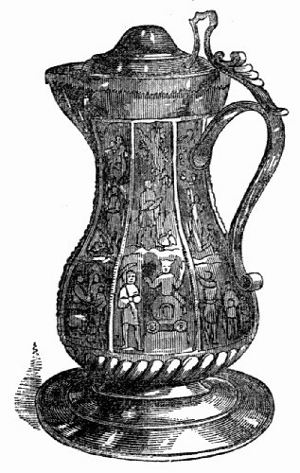
Shakspeare's Jug, of which we
here give an engraving, which has
been carefully preserved by the descendants
of the immortal bard since
the year 1616, is, perhaps, the most
remarkable example of the Elizabethan
pottery now existing. The
shape partakes very much of the
form of the old German or Dutch
ewer, without, however, the usual
top or cover; the one now attached
to the jug being a modern addition
of silver, with a medallion bust of
the poet in the centre, beautifully
executed and inscribed "Wm. Shakspeare,
at the age of forty." It
is about ten inches high, and sixteen
inches round at the largest part, and
is divided lengthwise into eight compartments,
having each a mythological
subject in high relief. All of
these, although executed in the
quaint style of the period, possess
considerable merit. Some of them,
indeed, manifest much masterly
grouping of both human figures and animals; and such is the admirable
state of preservation of this very interesting old English relic, that as
correct a judgment may be formed of its workmanship, as in the days of
its first possessor; at all events, as regards the degree of perfection to
which English Pottery had attained in the Elizabethan age; an inspection
of this jug will justify the presumption, that her Court was not less
tastefully provided in that respect than those of the Continent, notwithstanding
the obscurity in which the precise locality and extent of the
manufactory is unfortunately involved.
PRICE OF MACKAREL.
The price of mackarel, in May, 1807, in the Billingsgate market, was
as follows:—Forty guineas for every hundred of the first cargo, which
made the fish come to seven shillings apiece! The next supplies were
also exorbitant, though much less so than the first, fetching thirteen
pounds per hundred, or two shillings apiece. The very next year the
former deficiencies were more than made up, for it appears that during
the season 1808, mackarel were hawked about the streets of Dover, at
sixty for a shilling, or five for a penny; whilst they so blockaded the
Brighton coast that on one night it became impossible to land the multitudes
taken, and at last both fish and nets went to the bottom together.
POPE'S CHAIR.
In one of the rooms at that
stately and picturesque baronial
hall, Audley End, the seat of Lord
Braybrooke, there is preserved the
interesting relic which forms the
subject of the annexed engraving.
Its history is thus told on a brass
plate inserted in the back—"This
chair, once the property of Alexander
Pope, was given as a keep-sake
to the nurse who attended
him in his illness; from her descendants
it was obtained by the
Rev. Thomas Ashley, curate of the
parish of Binfield, and kindly presented
by him to Lord Braybrooke,
in 1844, nearly a century after the
poet's decease." It is apparently
of Flemish workmanship, and of
rather singular design; in the
centre medallion is a figure of
Venus holding a dart in her right
hand, and a burning heart in her
left. The narrow back and wide-circling
arms give a peculiarly
quaint appearance to this curious
relic of one of our greatest poets.
FIRST WIND-MILLS.
Mabillon mentions a diploma of the year 1105, in which a convent in
France is allowed to erect water and windmills, molendina ad ventum.
Bartolomeo Verde proposed to the Venetians in 1332, to build a wind-mill.
When his plan had been examined, he had a piece of ground
assigned him, which he was to retain if his undertaking succeeded
within a specified time. In 1373, the city of Spires caused a wind-mill
to be erected, and sent to the Netherlands for a person acquainted with
the method of grinding by it. A wind-mill was also constructed at
Frankfort, in 1442; but it does not appear to have been ascertained
whether there were any there before.
About the twelfth century, in the pontificate of Gregory, when both
wind and water-mills became more general, a dispute arose whether
mills were titheable or not. The dispute existed for some time between
the persons possessed of mills and the clergy; when neither would yield.
At length, upon the matter being referred to the pope and sacred college,
the question was (as might have been expected when interested persons
were made the arbitrators) determined in favour of the claims of the
church.
THE "HAPPY DISPATCH" IN JAPAN.
The Hari-kari, or "Happy Dispatch," consists in ripping open their
own bowels with two cuts in the form of a cross—after the artistic
dissector's fashion. Officials resort to it under the fear of the punishment
which they may expect; for it is a leading principle that it is more
honourable to die by one's own hand than by another's. Princes and
the high classes receive permission to rip themselves up as a special
favour, when under sentence of death: their entire family must die
with the guilty. Sometimes, by favour, the nearest relative of the
condemned is permitted to perform the function of executioner in his
own house. Such a death is considered less dishonourable than by the
public executioners, aided by the servants of those who keep disreputable
houses.
But the Japanese, for the most part, always ask permission to rip
themselves; and they set about it with astonishing ease, and not without
evident ostentation. The criminal who obtains this favour assembles all
his family and his friends, puts on his richest apparel, makes an eloquent
speech on his situation, and then, with a most contented look, he bares his
belly, and in the form of a cross rips open the viscera. The most odious
crimes are effaced by such a death. The criminal thenceforward ranks
as a brave in the memory of men. His family contracts no stain, and
his property is not confiscated.
It is curious that the Romans and the Japanese should hit upon crucifixion
as a mode of punishment. These coincidences often startle us in
reviewing the manners and customs of men. Vainly we strive to conjecture
how such a mode of punishment could have suggested itself to
the mind of man. The in terrorem object scarcely accounts for it.
Constantine abolished it amongst the Romans, in honour of Him who
was pleased to make that mode of dying honourable in the estimation of
men.
The Hari-kari, or happy dispatch, is still more incomprehensible. We
shudder at the bare idea of it. To commit suicide by hanging, by
drowning, by poison, by firearms, by a train in rapid motion—all these
modes are reasonable in their madness; but to rip open our bowels!—and
with two cuts! We are totally at a loss to imagine how such a
mode of self-murder could have been adopted; we cannot but wonder at
the strength of nerve which enables it to be accomplished: but we feel
no doubt of the everlasting force of national custom—especially amongst
the Orientals—in the continuance of this practice. Montesquieu said,
"If the punishments of the Orientals horrify humanity, the reason is,
that the despot who ordains them feels that he is above all laws. It is
not so in Republics, wherein the laws are always mild, because he who
makes them is himself a subject." This fine sentiment, thoroughly
French, is evidently contradicted by the institutions of Japan, where the
Emperor himself, the despot, is a subject: besides, Montesquieu would
have altered his antithesis had he lived to see the horrors of the Reign of
Terror in the glorious French Republic.
PURITAN ZEAL.
The following is a copy of the order issued by Government for the
destruction of Glasgow Cathedral:—"To our traist friendis,—Traist
friendis, after most hearty commendacion, we pray you fail not to pass
incontinent to the kirk, (of Glasgow, or elsewhere, as it might be) and
tak down the hail images thereof, and bring furth to the kirk-zyard, and
burn them openly. And sicklyke cast down the altaris, and purge the
kirk of all kynd of monuments of idolatrye. And this ze fail not to do,
as ze will do us singular emplesure; and so commitis you to protection
of God.
(Signed)Ar. Argyle.
James Stewart.
Ruthven.
From Edinburgh the XII. of Aug. 1560.
"Fail not, but ze tak guid heyd that neither the dasks, windows, nor
duris, be ony ways hurt or broken, uthe glassin wark, or iron wark."
FREDERICK THE GREAT AT TABLE.
The table of the great Frederic of Prussia was regulated by himself.
There were always from nine to a dozen dishes, and these were brought
in one at a time. The King carved the solitary dish, and helped the
company. One singular circumstance connected with this table was,
that each dish was cooked by a different cook, who had a kitchen to himself!
There was much consequent expense, with little magnificence.
Frederic ate and drank, too, like a boon companion. His last work,
before retiring to bed, was to receive from the chief cook the bill of fare
for the next day; the price of each dish, and of its separate ingredients,
was marked in the margin. The monarch looked it cautiously through,
generally made out an improved edition, cursed all cooks as common
thieves, and then flung down the money for the next day's expenses.
ARTIFICIAL SWEETS.
Professor Playfair, in an able lecture delivered in the Great Exhibition,
and since published, has raised a curtain, which displays a rather
repulsive scene. He says, the perfume of flowers frequently consists of
oils and ethers, which the chemist can compound artificially in his laboratory.
Singularly enough these are generally derived from substances
of an intensely disgusting odour. A peculiarly fetid oil, termed the
"fusel" oil, is formed in making brandy. This fusel oil distilled with
sulphuric acid and acetate of potass, gives the oil of pears (?). The oil
of apples is made from the same fusel, by distillation with the same
acid and chromate of potass. The oil of pineapples is obtained from
the product of the action of putrid cheese on sugar! or by making a soap
with butter. The artificial oil of bitter almonds is now largely employed
in perfuming soap confectionary; extracted by nitric acid and
the fetid oil of gas tar. Many a fair forehead is damped with eau de
mille fleurs without the knowledge that its essential ingredient is derived
from the drainage of cow-houses!
TEUTONIC HUT-SHAPED VASES.
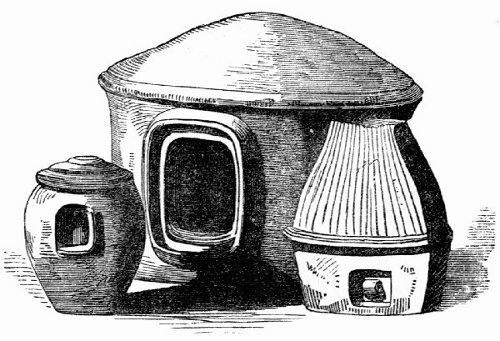
Some remarkable sepulchral urns, of which we give a sketch, resembling
those of the early inhabitants of Alba Longa, in Italy, have
been found in Germany, and are distinctly Teutonic. They occur in the
sepulchres of the period when bronze weapons were used, and before the
predominance of Roman art. One found at Mount Chemnitz, in Thuringen,
had a cylindrical body and conical top, imitating a roof. In this
was a square orifice, representing the door or window, by which the ashes
of the dead were introduced, and the whole then secured by a small
door fastened with a metal pin. A second vase was found at Roenne; a
third in the island of Bornholm. A similar urn exhumed at Parchim
had a shorter body, taller roof, and door at the side. Still more remarkable
was another found at Aschersleben, which has its cover modelled in
shape of a tall conical thatched roof, and the door with its ring still
remaining. Another, with a taller body and flatter roof, with a door at
the side, was found at Klus, near Halberstadt. The larger vases were
used to hold the ashes of the dead, and are sometimes protected by a
cover, or stone, or placed in another vase of coarser fabric. The others
are the household vessels, which were offered to the dead filled with
different viands. Some of the smaller vases appear to have been toys.
Extraordinary popular superstitions have prevailed amongst the
German peasantry as to the origin and nature of these vases, which in some
districts are considered to be the work of the elves,—in others, to grow
spontaneously from the ground like mushrooms—or to be endued with
remarkable properties for the preservation of milk and other articles of
food. Weights to sink nets, balls, discs, and little rods of terra-cotta,
are also found in the graves.
LYNCH'S CASTLE, GALWAY.
The house in the town of Galway, still known as "Lynch's Castle,"
although the most perfect example now remaining, was at one period by
no means a solitary instance of the decorated habitations of the Galway
merchants. The name of Lynch, as either provost, portreve, sovereign,
or mayor of Galway, occurs no fewer than ninety-four times between the
years 1274 and 1654; after that year it does not appear once. The house
here pictured was the residence of the family for many generations. It
had, however, several branches, whose habitations are frequently pointed
out by their armorial bearings, or their crest, a lynx, over the gateway.
One of its members is famous in history as the Irish Junius Brutus. The
mere fact is sufficiently wonderful without the aid of invention; but it
has, as may be supposed, supplied materials to a host of romancers. The
story is briefly this:—
James Lynch Fitzstephen was mayor or warden of Galway in 1493;
he traded largely with Spain, and sent his son on a voyage thither to
purchase and bring back a cargo of wine. Young Lynch, however, spent
the money entrusted to him, and obtained credit from the Spaniard,
whose nephew accompanied the youth back to Ireland to be paid the
debt and establish further intercourse. The ship proceeded on her homeward
voyage, and as she drew near the Irish shore, young Lynch conceived
the idea of concealing his crime by committing another. Having
seduced, or frightened, the crew into becoming participators, the youth
was seized and thrown overboard. The father and friends of Lynch
received the voyager with joy; and the murderer in a short time became
himself a prosperous merchant. Security had lulled every sense of danger,
and he proposed for a very beautiful girl, the daughter of a wealthy
neighbour, in marriage. The proposal was accepted; but previous to the
appointed day, one of the seamen became suddenly ill, and in a fit of
remorse summoned old Lynch to the dying-bed, and communicated to
him a full relation of the villany of his only and beloved son. Young
Lynch was tried, found guilty, and sentenced to execution—the father
being his judge. The wretched prisoner, however, had many friends
among the people, and his relatives resolved with them that he should
not die a shameful death. They determined upon his rescue. We copy
the last act of the tragedy from "Hardiman's History of Galway."
"Day had scarcely broken when the signal of preparation was heard
among the guards without. The father rose, and assisted the executioner
to remove the fetters which bound his unfortunate son. Then unlocking
the door, he placed him between the priest and himself, leaning upon an
arm of each. In this manner they ascended a flight of steps lined with
soldiers, and were passing on to gain the street, when a new trial assailed
the magistrate for which he appears not to have been unprepared. His
wretched wife, whose name was Blake, failing in her personal exertions
to save the life of her son, had gone in distraction to the heads of her
own family, and prevailed on them, for the honour of their house, to
rescue him from ignominy. They flew to arms, and a prodigious concourse
soon assembled to support them, whose outcries for mercy to the
culprit would have shaken any nerves less firm than those of the mayor
of Galway. He exhorted them to yield submission to the laws of their
country; but finding all his efforts fruitless to accomplish the ends of
justice at the accustomed place, and by the usual hands, he, by a
desperate victory over parental feeling, resolved himself to perform the
sacrifice which he had vowed to pay on its altar. Still retaining a hold
of his unfortunate son, he mounted with him by a winding stair within
the building, that led to an arched window overlooking the street, which
he saw filled with the populace. Here he secured the end of the rope—which
had been previously fixed round the neck of his son—to an iron
staple, which projected from the wall, and after taking from him a last
embrace, he launched him into eternity. The intrepid magistrate expected
instant death from the fury of the populace; but the people
seemed so much overawed or confounded by the magnanimous act, that
they retired slowly and peaceably to their several dwellings. The
innocent cause of this sad tragedy is said to have died soon after of
grief, and the unhappy father of Walter Lynch to have secluded himself
during the remainder of his life from all society except that of his
mourning family. His house still exists in Lombard Street, Galway,
which is yet known by the name of 'Dead Man's Lane;' and over the
front doorway are to be seen a skull and cross-bones executed in black
marble, with the motto, 'Remember Deathe—vaniti of vaniti, and all is
but vaniti.'"
The house in which the tragedy is said to have occurred was taken
down only so recently as 1849; but the tablet which contains the
"skull and cross-bones" bears the date 1624—upwards of a century
after the alleged date of the occurrence.
WASHINGTON.
It is something singular, that Washington drew his last breath, in the
last hour, of the last day, of the last week, of the last month, of the last
year, of the last century. He died on Saturday night, twelve o'clock,
December 31st, 1799.
ANCIENT BANNERS AND STANDARDS.
Banners have been in use from the earliest ages. Xenophon gives us
the Persian standard as a golden eagle, mounted on a pole or spear. We
find banners very early in use among the nations of Europe. In this
country the introduction of banners was clearly of a religious origin.
Venerable Bede says, that when St. Augustin and his companions came
to preach Christianity in Britain in the latter part of the sixth century,
and having converted Ethelbert, the Bretwalda of the Anglo-Saxons
(his Queen Bertha had already embraced the Christian faith) the monk
and his followers entered Canterbury in procession, chanting, "We
beseech thee O Lord, of thy mercy, let thy wrath and anger be turned
away from this city, and from thy Holy Place, for we have sinned.
Hallelujah." And they carried in their hands little banners on which
were depicted crosses. The missionaries were allowed to settle in the
Isle of Thanet, and Canterbury became the first Christian church.
The raven has been regarded from very early ages as an emblem of
God's providence, no doubt from the record in Holy Writ of its being
employed to feed Elijah the Prophet, in his seclusion by the brook
Cherith; and it was the well-known ensign of the Danes, at the time
of their dominion in this country. In the year 742, a great battle was
fought at Burford, in Oxfordshire, and the Golden Dragon, the standard
of Wessex, was victorious over Ethelbald, the King of Mercia. The
banners of several of the Saxon kings were held in great veneration,
especially those of Edmund the Martyr, and of Edward the Confessor.
The latter king displayed as an ensign a cross flory between five martlets
gold, on a blue field, and which may still be seen on a very ancient
shield in the south aisle of Westminster Abbey. When William the
Norman set out to invade England he had his own ensign, the two lions
of Normandy, depicted on the sails of his ships; but on the vessel in
which he himself sailed, besides some choice relics, he had a banner at
the mast-head with a cross upon it, consecrated by the Pope, to give
sanctity to the expedition. Indeed it has been the practice in every
age for the Pope to give consecrated banners wherever he wished success
to any enterprise, numerous instances of which might be cited in very
recent times. And in our own army down to the present day, whenever
any regiment receives new banners (or colours, as the modern term is),
the regiment is drawn out in parade, the colours are then blessed by the
prayers of several clergymen of the Church of England, and afterwards
presented to the regiment by the fair hand of a lady of rank.
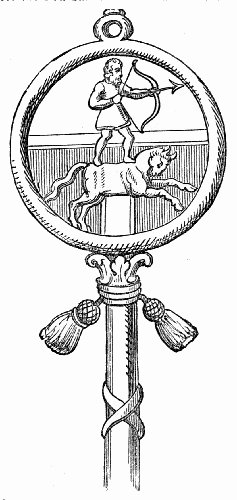
Cæsar has recorded a fine example of patriotism, to the credit of one
of his own officers, when he attempted to land his Roman forces on our
shores, and meeting with a warmer reception than they anticipated from
the Britons, considerable hesitation arose among his troops; but the
standard-bearer of the Tenth Legion, with the Roman eagle in his hand,
invoking the gods, plunged into the waves, and called on his comrades
to follow him, and do their duty to their general and to the republic;
and so the whole army made good their landing.
We have in the Nineveh sculptures some highly interesting specimens
of the ancient Assyrian standards, consisting principally of two varieties,
which are here given. The principal archer appears to be drawing his
bow, while the standard-bearer elevates the standard in front of the
chariot.
ANCIENT MANNERS OF THE ITALIANS.
About the year 1238, the food of the Italians was very moderate, or,
rather scanty. The common people had meat only three days a week.
Their dinner consisted of pot-herbs, boiled with meat; their supper, the
cold meat left from dinner. The husband and wife eat out of the same
dish; and they had but one or two cups in the house. They had no
candles made of wax or tallow; but, a torch, held by one of the children,
or a servant, gave them light at supper. The men, whose chief pride was
in their arms and horses, wore caps made with iron scales, and cloaks of
leather, without any other covering. The women wore jackets of stuff,
with gowns of linen, and their head-dresses were very simple. Those
who possessed a very small sum of money, were thought rich; and the
homely dress of the women required only small marriage portions. The
nobles were proud of living in towers; and thence the cities were filled
with those fortified dwellings.
AMUSEMENTS OF THE LOWER ORDERS IN THE FIFTEENTH CENTURY.
The most popular amusements of the lower orders were wrestling,
bowling, quoit and ninepin playing, and games at ball. In wrestling
the Cornwall and Devonshire men excelled, and a ram, or sometimes a
cock, was the prize of the victor. Bowling alleys were commonly
attached to the houses of the wealthy, and to places of public resort.
Among the games at ball we find tennis, trap-ball, bat and ball, and the
balloon-ball, in which a large ball filled with air was struck from one
side to the other by two players with their hands and wrists guarded by
bandages. Archery was now on the decline, owing to the introduction
of firearms; nor could all the legislative enactments of the day revive
its constant use. The quarter-staff was also a favourite weapon of
sportive fence, which was a staff about five or six feet long, grasped in
the middle with one hand, while the other slid up and down as it was
required to strike or to ward a blow.
The citizens of London enjoyed themselves in winter by skating on the
Thames, (the old shankbones of sheep having now been superseded by
regular skates, probably introduced from the Netherlands,) and in
summer with sailing and rowing. Dice and cards, prisoner's base, blind
man's buff, battledoor and shuttlecock, bull-baiting, and cock-fighting,
a rude species of mumming, the dancing of fools at Christmas, and other
games, completed the gratifications of the populace.
NOVEL MODE OF TAKING VENGEANCE.
The Chinese have a book entitled Si-yuen, that is to say, "The Washing
of the Pit," a work on medical jurisprudence, very celebrated all
over the empire, and which should be in the hands of all Chinese magistrates.
It is impossible to read the Si-yuen without being convinced
that the number of attempts against life in this country is very considerable,
and especially that suicide is very common. The extreme
readiness with which the Chinese are induced to kill themselves, is
almost inconceivable; some mere trifle, a word almost, is sufficient to
cause them to hang themselves, or throw themselves to the bottom of a
well; the two favourite modes of suicide. In other countries, if a man
wishes to wreak his vengeance on an enemy, he tries to kill him; in
China, on the contrary, he kills himself. This anomaly depends upon
various causes, of which these are the principal:—In the first place,
Chinese law throws the responsibility of a suicide on those who may be
supposed to be the cause or occasion of it. It follows, therefore, that if
you wish to be revenged on an enemy, you have only to kill yourself to
be sure of getting him into horrible trouble; for he falls immediately
into the hands of justice, and will certainly be tortured and ruined, if
not deprived of life. The family of the suicide also usually obtains, in
these cases, considerable damages; so that it is by no means a rare case
for an unfortunate man to commit suicide in the house of a rich one,
from a morbid idea of family affection. In killing his enemy, on the
contrary, the murderer exposes his own relatives and friends to injury,
disgraces them, reduces them to poverty, and deprives himself of funeral
honours, a great point for a Chinese, and concerning which he is extremely
anxious. It is to be remarked also, that public opinion, so far
from disapproving of suicide, honours and glorifies it. The conduct of a
man who destroys his own life, to avenge himself on an enemy whom he
has no other way of reaching, is regarded as heroic and magnanimous.
PERSECUTION IN THE REIGN OF QUEEN MARY.
The total number of persons who perished in the flames for their religion
during this reign has been variously reckoned at 277 and 288,
amongst whom were 5 bishops, 21 divines, 8 gentlemen, 84 artificers,
100 husbandmen, servants, and labourers, 26 wives, 20 widows, 9 unmarried
women, 2 boys, and 2 infants, of which last one was whipped to
death by the savage Bonner, and the other, springing out of its mother's
womb, at the stake, was mercilessly thrown back into the fire. The
number of those that died in prison was also very great. Yet England
may be considered as comparatively free from persecution during this
period, for all over the continent the victims of bigotry were reckoned,
not by hundreds, but by thousands, and in the Netherlands alone 50,000
persons are said to have lost their lives in the religious wars of the
Spaniards.
WAYSIDE MONUMENTS.
The sketch on next page represents a curious custom which still prevails
in the neighbourhood of Cong, near Oughterard in Ireland. It is well
described in the following account of their tour by Mr. and Mrs. S. C.
Hall:—"On the way to Joyce's Country we saw heaps of piled-up stones
on either side of the road; these heaps continuing for above a mile, after
their commencement a short distance from the western entrance to the
town. The artist may convey a better notion of their peculiar character
than any written description can do. We left our car to examine them
minutely; and learned they were monuments to the memory of "deceased"
persons, "erected" by their surviving friends. Upon death occurring, the
primitive tumulus is built,—if that may be called building which consists
in placing a few large stones upon a spot previously unoccupied. Each
relative of the dead adds to the heap; and in time it becomes a "mountain"
of tolerable size. Each family knows its own particular monument;
and a member of, or a descendant from it, prays and leaves his offering
only at that especial one. The custom has endured for many generations:
some of the heaps bore tokens of great age; and one was pointed out to
us of which there were records, in the transferred memories of the people,
for at least 500 years. The bodies are in no instance buried here—it is
not consecrated earth; the monuments are merely memorials, and no
doubt originated at a period when a Roman Catholic was, according to
the provisions of a law equally foolish and cruel, interred, without form
or ceremony, in church ground—the ground that had been the property
of their ancestors. None of these stone cairns have any masonwork,
and they are generally of the rudest forms, or rather without any form,
the stones having been carelessly cast one upon another. Upon one of
them only could we discover any inscription—this one is introduced into
the print; it is built with far more than the usual care; it contained an
inscription; "Pray for ye soule of John Joyce, & Mary Joyce, his wife,
died 1712;" some of them, however, seem to have been constructed with
greater care than others, and many of them were topped with a small
wooden cross. We estimated that there were at least 500 of these
primitive monuments—of all shapes and sizes—along the road. In each
of them we observed a small hollow, which the peasants call a "window;"
most of these were full of pebbles, and upon inquiry we learned
that when one of the race to whom the deceased belonged kneels by the
side of this record to his memory and offers up a prayer for the repose of
his soul, it is customary to fling a little stone into this "cupboard;" the
belief being that gradually as it fills, so, gradually, the soul is relieved
from punishment in purgatory; when completely full the soul has entered
paradise. We have prolonged our description of this singular and interesting
scene, because it seems to have been altogether overlooked by
travellers, and because we believe that nothing like it is to be met with
in any other part of Ireland; although similar objects are to be found in
several other places about Connemara, none of them, however, are so
extensive as this which adjoins Cong."
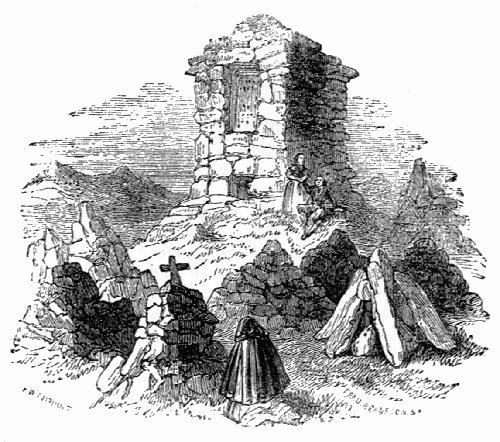
HINDOO ADORATION OF THE SÁLAGRÁM.
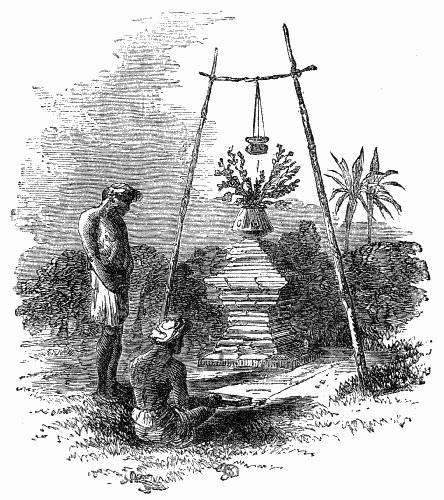
Among the many forms which Vishnu is believed by his Hindoo worshippers
to have assumed is that of the Sálagrám—an ammonite-stone,
found in the river Gandaká and other streams flowing from the Himalayas.
The reason for the worship of this is stated in one of the sacred books.
"Vishnu created the nine planets to preside over the fates of men. Sani
(Saturn) proposed commencing his reign by taking Brahma under his
influence for twelve years. The matter was referred to Vishnu, who
being equally averse to be placed under the inauspicious influence of this
planet, requested him to call the next day. The next day Saturn could
nowhere discover Vishnu, but perceived that he had united himself to
the mountain Gandaká; he entered the mountain in the form of a worm
called Vajrakita (the thunderbolt worm). He continued to afflict the
mountain-formed Vishnu for twelve years, when Vishnu assumed his
proper shape, and commanded that the stones of this mountain should be
worshipped, and become proper representatives of himself; adding that
each should have twenty marks in it, similar to those on his body, and
that its name should be Sálagrám."
The Sálagrám is usually placed under a tulasi-tree, which is planted
on the top of a pillar in the vicinity of a temple of Vishnu, or near a
house. Tulasi, a female, desired to become Vishnu's wife, but was metamorphosed
by Lakshmi into a tree, a small shrub, called therefore Tulasi,
or holy basil (Ocymum Sanctum). Vishnu, however, promised to assume
the form of a Sálagrám, and always continue with her. The Vaishnaya
priests, therefore, keep one leaf of the shrub under and another over the
Sálagrám, and thus pay their adorations to the stone and the tree. In
the evening a lamp is placed near it. In the month of May it is watered
from a pot suspended over it, as appears in the engraving, which represents
a person engaged in the worship at this singular shrine.
TOMB OF THE EMPEROR MAXIMILIAN AT INSPRUCK.
This majestic tomb is placed in the centre of the middle aisle of the
church, upon a platform approached by steps of red marble. The sides
of the tomb are divided into twenty-four compartments, of the finest
Carrara marble, on which are represented, in bas-relief, the most
interesting events of the emperor's warlike and prosperous career. The
workmanship of the tablets is exquisite; and, taken in connexion with
the lofty deeds they record, they form the most princely decorations
ever seen. Each of the tablets contributing to this splendid lithobiography
is in size 2 feet 4 inches by 1 foot 8 inches; and every
object contained therein is in the most perfect proportion, while the
exquisite finish of the heads and draperies requires a magnifying glass
to do it justice. The tomb is surmounted by a colossal figure in bronze
of the emperor, kneeling in the act of prayer; and around it are four
allegorical figures, of smaller size, also in bronze.
But, marvellous as is the elaborate beauty of this work, it is far
from being the most remarkable feature of this imperial mausoleum.
Ranged in two long lines, as if to guard it, stand twenty-eight colossal
statues in bronze, of whom twenty are kings and princes, alliances of
the house of Hapsburg, and eight their stately dames. Anything more
impressive than the appearance of these tall dark guardians of the
tomb, some clad in regal robes, some cased in armour, and all seeming
animated by the mighty power of the artist, it would be difficult to
imagine.
In the death-like stillness of the church, the visitor who, for the first
time, contemplates this tomb and its gloomy guard, is struck by a
feeling of awe, approaching to terror. The statues, with life-like
individuality of attitude and expression—each solemn, mournful, dignified,
and graceful; and all seeming to dilate before the eye into
enormous dimensions, and, as if framed to scare intruders, endowed by
a power more than mortal, to keep watch and ward round the mighty
dead. They appear like an eternal procession of mourners, who, while
earth endures, will cease not to gaze on, mourn over, and protect the
relics of him who was the glory of their noble, long since fallen race.
THE FAYENCE OF HENRY II. OF FRANCE.
The earliest known fabric of this earthenware is that mysterious and
unique manufacture of the "Renaissance," the fine Fayence of Henry II.
The manufacture of this ware, which was at once carried to a high
degree of perfection, seems to have been suddenly and unaccountably
lost, without leaving any record of where or by whom it was produced.
By many it is supposed to be of Florentine manufacture, and to have
been sent by some of the relations of Catherine de Medicis as a present to
Henry II.; but it differs too essentially from Italian Majolica, both in
the paste of which it is composed, and in the style in which it is decorated,
to warrant such a conjecture. Italy does not possess in her
museums a single specimen of this ware, and of the thirty-seven pieces
extant, twenty-seven have been traced as coming from Touraine and La
Vendée. Many antiquaries, therefore, infer that the manufacture was at
Thouars, in Touraine, although the Fayence may have been the work of
an Italian artist.
But if the place of its manufacture is unknown, the pieces extant
clearly attest the period of its fabrication. The Salamander, and other
insignia of Francis I., are met with on the earlier specimens of this
pottery; but upon the majority of pieces, upon those more pure in design
and more beautiful in execution than the preceding, we find the arms
of Henry II., with his device, the three crescents, or his initial H, interlaced
with the two D's of the Duchesse de Valentinois. Indeed, so
constantly do her emblems appear upon the pieces, that the ware, though
usually designated as "Faïence de Henri II.," is sometimes styled
"Faïence de Diane de Poitiers." Even her widow's colours, black and
white, are the two which are employed in some of the finest pieces.
They were the fashionable colours of the court, Henry wore no others
during his life, and was attired in them in the fatal tournament in which
he fell. Her impresa, the crescent of Diana, is conspicuous on his
palaces, and he even caused it to be engraved upon his coins. From
these circumstances we must, therefore, conclude that the manufacture
of this ware began at the end of the reign of Francis I., was continued
under that of Henry II., and, as we find upon it the emblems of these
two princes only, we may naturally infer that it is of French origin.
The paste of which this Fayence is composed is equally distinct from
Majolica and Palissy ware. The two latter are both soft, whereas this,
on the contrary, is hard. It is a true pipeclay, very fine, and very white,
so as not to require, like the Italian Fayence, to be concealed by a thick
enamel, and the ornaments with which it is enriched are simply covered
with a thin, transparent, yellowish varnish.
The style of decoration in this ware is unique. Patterns or arabesques,
are engraved on the paste, and the indentures filled with
coloured pastes, so as to present an uniform, smooth surface, of the
finest inlaying, or resembling, rather, a model of Cellini's silver work,
chiselled and worked in niello. Hence it is sometimes styled "Faïence
a niellure." These patterns are sometimes disposed in zones of yellow
ochre, with borders of dark brown, sometimes of a pink, green, violet,
black, or blue; but the dark yellow ochre is the predominant colour.
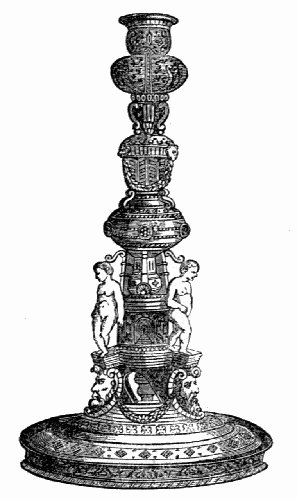
The collection of the late M. Préaux was the richest in the world in
the most beautiful examples of Fayence; it was disposed of by auction
about twelve years ago, in consequence of the death of the proprietor,
and the choicest specimen in it was the candlestick, of which we give a
figure, and which was purchased by
Sir Anthony de Rothschild for about
£220, duty included. The surface
is exquisitely enriched with arabesque
patterns, either in black upon
a white ground, or in white upon a
black. The form is monumental,
and in the finest style; three figures
of genii support escutcheons, bearing
the arms of France, and the double
D. These genii stand upon masks,
which are united by garlands enamelled
in green. The top of the
candlestick terminates in the form
of a vase, and bears inscribed the
fleurs-de-lys and the monogram of
our Saviour. This piece, for delicacy
of detail and beauty of execution, is
unequalled by any specimen known
of this exquisite Fayence. Sir Anthony
de Rothschild also purchased
at M. Préaux's sale a small cup, decorated
in the same style, with the
descents interlaced, for which he
gave 1300 francs. He, therefore,
now is fortunate in having the finest
collection known of this ware, as, in
addition to the specimens already mentioned, he possesses two exquisite
ewers of the Henry II. Fayence. One he purchased at the sale of the
Comte de Monville for 2300 francs; the other, with a curious handle of
elaborate workmanship, he bought for nineteen guineas at Strawberry
Hill, where he also purchased a tripod salt-cellar, supported with scroll
ornaments for £21.
REFRESHMENTS FOR THE PULPIT.
In the books of Darlington parish church, the following items appear,
showing that, in the olden time, provision was made for comforting the
inner man: "Six quarts of sack to the minister who preached when he
had no minister to assist, 9s. For a quart of sack bestowed on Jillett,
when he preached, 2s. 6d. For a pint of brandy when Mr. George Bill
preached here, 1s. 4d. For a stranger who preached, a dozen of ale.
When the Dean of Durham preached here, spent in a treat in the house,
3s. 6d." This would hardly be considered orthodox at the present day.
BEDESMEN IN THE TIME OF HENRY VII.
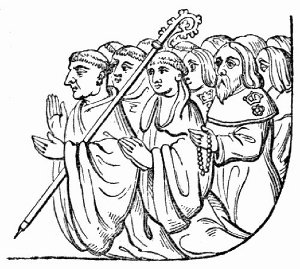
Most of the monasteries in former times had hospitals of poor men and
women attached to them; generally either within the precincts or near
adjoining. Thus, at St. Edmund's Bury, there was St. John's Hospital,
or God's House, without the South Gate, and St. Nicholas' Hospital without
the East Gate, and St. Peter's Hospital without the Risby Gate, and
St. Saviour's Hospital without the North Gate,—all founded by abbots
of St. Edmund's. At Reading there was the Hospital of St. Mary Magdalene
for twelve leprous persons and chaplains, and the Hospital of St.
Lawrence for twenty-six poor people, and for the entertainment of
strangers and pilgrims, both founded by abbots of Reading. One at the
gate of Fountains' Abbey for poor
persons and travellers; one at
Glastonbury, under the care of
the almoner, for poor and infirm
persons.
Thirteen was a favourite
number for the inmates of a hospital.
From the initial letter of
a deed in the British Museum
(Harl. 1498), by which King
Henry VII. founded a fraternity
of thirteen poor men in Westminster
Abbey, who were to be
under the governance of the
monks, we take the accompanying
illustration, which represents the
abbot and monks before the king, with a group of the king's bedesmen,
each of whom has the royal badge, a rose surmounted by a crown, on the
shoulder of his habit.
CHINESE GAMBLERS PLAYING FOR FINGERS.
The following strange account is taken from Hue's "Chinese
Empire:—
"The Chinese are industrious and economical, but their cupidity,
their immoderate love of lucre, and their decided taste for stockjobbing
and speculation, easily tempts them to gambling, when they are not
engaged in traffic. They seek eagerly for strong excitements, and when
once they have got into the habit of gambling they seldom or never
recover from it. They cast aside every obligation of station, duty, and
family, to live only for cards and dice; and this fatal passion gains such
an empire over them, that they proceed even to the most revolting extremities.
When they have lost all their money they will play for their
houses, their land, and their wives even, whose destiny often depends
on a cast of the dice. Nay, the Chinese gambler does not stop here, for
he will stake the very clothes he has on for one game more, and this
horrible custom gives rise to scenes that would not be credible, did we
not know that the passions always tend to make men cruel and inhuman.
"In the northern provinces, especially in the environs of the Great
Wall, you may sometimes meet, during the most intense cold of winter,
men running about in a state of complete nudity, having been driven
pitilessly from the gaming-houses when they had lost their all. They
rush about in all directions like madmen to try and save themselves
from being frozen, or crouch down against the chimneys, which in those
countries are carried along the walls of the houses, on a level with the
ground. They turn first one side towards the warmth, then the other,
while their gambling companions, far from trying to help them, look on
with ferocious and malignant hilarity. The horrible spectacle seldom
lasts long, for the cold soon seizes the unfortunate creatures, and they
fall down and die. The gamblers then return to their table, and begin
to play again with the most perfect composure. Such facts as these will
appear fabulous to many persons, but having resided several years in
the north of China, we can testify to their perfect authenticity.
"These excesses seem surprising enough, but the truth is, that Chinese
gamblers have invented still more extraordinary methods of satisfying
their passion, which is really carried to absolute madness. Those who
have nothing more to lose will collect round a table and actually play
for their fingers, which they will cut off reciprocally with frightful
stoicism. We had thought to pass over these revolting particulars, for
we do not like to put the confidence of our readers to too great a trial.
We have a strong objection to relating things that, although we know
them to be strictly true, have an improbable appearance. But these
facts concerning Chinese gamblers were known, and commented upon,
by the Arab travellers in the ninth century. Here is a passage on the
subject from the 'Chain of Chronicles,' from which we have already
quoted more than once:—
"'Amongst men of a volatile and boastful character, those who belong
to the lower classes, and who have no money, will sometimes play for
the fingers of their hands. During the game, they keep by them a vase
containing nut, or sesame oil, for olive oil is not known in this country.
A fire is kept burning under it, and between the two players is placed a
small but very sharp hatchet. The one who wins then takes the hand
of the loser, places it on a stone and cuts off one of his fingers with the
hatchet; the piece falls, and the vanquished party immediately dips his
hand into the hot oil, which cauterises the wound. This operation does
not prevent the players from beginning again. Some will take a match,
dip it in oil, place it on their arms, and set fire to it; the match burns,
and you can smell the odour of the consuming flesh, but the man goes on
with his game, and exhibits no sign of pain.'"
ENTRY OF THE FRENCH AMBASSADOR INTO LONDON, IN 1698.
The following is an extract from the "Flying Post," of May 17,
1698:—
"Yesterday, (Monday, May 16,) in the afternoon, Count Tallard, the
French Ambassador, made his public entry. The Earl Marshal's men
came first, then followed the Earl of Macclesfield's footmen, after them
twenty of the Ambassador's footmen, in red liveries with gold lace; then
came two of the Ambassador's gentlemen and six pages on horseback;
next came two heralds before His Majesty's coach, in which His Excellency
the Ambassador, the Earl of Macclesfield, and some others of
quality: after them came three of His Royal Highness the Prince of
Denmark's coaches, and next, three of the Ambassador's coaches, the
first of them very rich, and drawn by eight horses; then followed His
Grace the Duke of Norfolk's coach, with about forty-seven more, drawn
by six horses each. There was a splendid entertainment prepared for
His Excellency at Ossulston House, in St. James's Square."
EXPENSES AT CORONATIONS.
The quantity of provisions consumed at the feasts given by some of
our early Kings, was extraordinarily great. For that of King Edward I.
February 10th, 1274, the different Sheriffs were ordered to furnish
butcher meat at Windsor, in the following proportions:—
|
|
Oxen. |
Swine. |
Sheep. |
Fowls. |
| Sheriff of |
Gloucester, |
60 |
101 |
60 |
3,000 |
| " |
Bucks and Bedford |
40 |
66 |
40 |
2,100 |
| " |
Oxford |
40 |
67 |
40 |
2,100 |
| " |
Kent |
40 |
67 |
40 |
2,100 |
| " |
Surrey and Sussex |
40 |
67 |
40 |
2,100 |
| " |
Warwick and Leicester |
60 |
98 |
40 |
3,000 |
| " |
Somerset and Dorset |
100 |
176 |
110 |
5,000 |
| " |
Essex |
60 |
101 |
60 |
3,160 |
|
|
—— |
—— |
—— |
—— |
|
Total, twelve counties |
440 |
743 |
430 |
22,560 |
In the year 1307, King Edward II. issued an order to the seneschal of
Gascony, and constable of Bordeaux, to provide a thousand pipes of good
wine, and send them to London, to be used at the approaching coronation.
The purchase and freight were to be paid by a company of Florentine
merchants, who farmed the revenues of Gascony. The coronation oath
was first taken by Ethelred II., A. D. 979; that now used in 1377. It
was amended in 1689. The first coronation sermon was preached in
1041. The following statement of the prices given for seats, to obtain a
view of passing objects during the coronations of former times, may,
perhaps, prove interesting:—
The price of a good place at the coronation of William the Conqueror,
was a blank; at that of his son, William Rufus, the same. At
Henry I's., it was a crocard; at Stephen's and Henry II.'s, it was a
pollard. At Richard's, and King John's, it was a fuskin. It rose at
the 3d. Henry's, to a dodkin. In the reign of Edward, the coin begins
to be more intelligible; and we find that, for a seat, to view his coronation,
a Q was given, or the half of a ferling, or farthing, the fourth part
of a sterling, or penny. At the 2d. Edward's, it was a farthing; and at
his son's, Edward III. a halfpenny. At Richard II.'s it was a penny,
and continued the same to that of Henry IV. inclusive. At the 5th
Henry's, it was two pennies; and similar prices were paid at the coronations
of Henry VI., Edward IV., Edward V., Richard III., and
Henry VII. At that of Henry VIII. it was a grossus, or groat; and
the same was paid at that of Edward VI. and Queen Mary's. At Queen
Elizabeth's, it rose to a testoon, or tester. At those of James I. and
Charles I. a shilling was given; which was advanced to half-a-crown,
at those of Charles II. and James II. At King William's and Queen
Anne's it was a crown, and the same at that of George I. At George
II.'s half-a-guinea, and, afterwards, at George III.'s a guinea was the
common charge. But, at that of George IV, as high as forty guineas
were given for a single seat.
CURIOUS ANTIQUE SWORD.
The engraving which accompanies this article is a sketch
of the upper part of an antique Danish sword, which was
found, together with several other weapons, by the labourers
who were engaged in the construction of the railway from
Dublin to Cashel.
The discovery of the weapons was made at a locality
called Island Bridge, and many of them were fortunately
secured for the Museum of the Royal Irish Academy,
where they may now be seen. The swords are long and
straight, formed for cutting as well as thrusting, and terminate
in points formed by rounding off the edge towards
the back of the blade. The hilts are very remarkable in
form, and in one or two instances, like the example we
have engraved, are highly ornamented. The mountings
are generally of a kind of brass, but several richly plated
with silver were found, and it is said that one of them had
a hilt of solid gold. The spears are long and slender, and
similar in form to the lance-heads used in some of the
cavalry corps.
All these weapons, with one exception, are composed of
a soft kind of iron. Many of the swords were found
doubled up, a circumstance for which it is difficult to assign
a reason, as they had evidently been purposely bent. The sword we
have represented in our engraving, is remarkable for the unusual degree
of ornament which appears upon its hilt, and also for its material, steel.
DINNER IN CHINA.
It is certain that a real Chinese dinner would be a very odd thing in
the eyes of a stranger, especially if he were one of those who think, as
some people do, that there is only one way of living. To begin dinner
with the dessert, and end it with the soup; to drink the wine smoking
hot, out of little china cups, and have your food brought to you ready
cut up into small pieces, and to be presented with a couple of sticks,
instead of a knife and fork, to eat it with; to have, instead of napkins,
a provision of little bits of silk paper by the side of your plate, which, as
you use, the attendants carry off; to leave your place between the
courses, to smoke or amuse yourself; and to raise your chop-sticks to your
forehead, and then place them horizontally upon your cup, to signify
that you have finished your dinner;—all these things would doubtless
seem very odd, and create the curiosity of Europeans. The Chinese, on
the other hand, can never get over their surprise at our way of dining.
They ask how we can like to drink cold fluids, and what can have put it
into our heads to make use of a trident to carry food to our mouths, at
the risk of pricking our lips or poking our eyes out. They think it very
droll to see nuts put on the table in their shell, and ask why our servants
cannot take the trouble to peel the fruit, and take the bones out of the
meat. They are themselves certainly not very difficult in the nature of
their food, and like such things as fried silkworms and preserved larvæ,
but they cannot understand the predilection of our epicures for high
game, nor for cheese that appears to belong to the class of animated
beings.
CISTERN OF MAJOLICA WARE.
We have engraved the annexed, as it affords at once both a beautiful
specimen of the potter's art, and also
an example of the taste and luxury
of the present day in articles of expensive
ornament.
It is a cistern made
of Majolica, or the enamelled pottery
of Italy, the most beautiful specimens
of which were made in the sixteenth
century. The one before us came to
England from the collection of the
Borghese Palace; and at the great
sale at Stowe, the seat of the Duke
of Buckingham, was disposed of by auction for sixty-four guineas, and
this although it was much broken.
THEATRES IN THE TIME OF SHAKSPEARE.
In Blackfriars was a theatre, the memory of which with the one or
the other shore of the river at Bankside, enjoys the honour of having
been used for the first representations of many of Shakspeare's plays,
and where the bard himself performed in them. The whole district
becomes classic, from the remembrance. The following interesting
description of the theatres in London at that time, and which applies
to the Blackfriars' theatre as we well as the rest, is taken from a short
memoir of Shakspeare, by the Rev. Alexader Dyce, prefixed to the
Aldine edition of Shakspeare's poems: "Nearly all these buildings, it is
probable, were constructed of wood. Those which, for some undiscovered
reason, were termed private theatres, were entirely roofed in
from the weather, while the public theatres were open to the sky, except
over the stage and galleries. On the outside of each was exhibited a
sign indicative of its name; and on the roof, during the time of performance,
was hoisted a flag. The interior arrangements resemble those
of the present day. There were tiers of galleries or scaffolds; beneath
these the boxes or rooms, intended for persons of the higher class, and
which at the private theatres were secured with locks, the keys being
given to the individuals who engaged them; and there was the centre
area, (separated, it seems, from the stage by pales), at the private theatres,
termed the pit, and furnished with seats; but at the public theatres,
called the yard, and affording no such accommodation. Cressets, or
large open lanterns, served to illuminate the body of the house; and two
ample branches, of a form similar to those now hung in churches, gave
light to the stage. The band of musicians, which was far from numerous,
sat, it is supposed, in an upper balcony, over what is now called the
stage box: the instruments chiefly used were trumpets, cornets, hautboys,
lutes, recorders, viols, and organs. The amusements of the audience
previous to the commencement of the play, were reading, playing at
cards, smoking tobacco, drinking ale, and eating nuts and apples. Even
during the performance it was customary for wits, critics, and young
gallants, who were desirous of attracting attention, to station themselves
on the stage, either lying on the rushes or seated on hired stools, while
their pages furnished them with pipes and tobacco. At the third sounding,
or flourish of trumpets, the exhibition began. The curtain, which
concealed the stage from the audience, was then drawn, opening in the
middle, and running upon iron rods. Other curtains, called traverses,
were used as a substitute for scenes. At the back of the stage was a
balcony, the platform of which was raised about eight or nine feet from
the ground; it served as a window, gallery, or upper chamber. From it
a portion of the dialogue was sometimes spoken, and in front of it curtains
were suspended to conceal, if necessary, those who occupied it, from
the audience. The internal roof of the stage, either painted blue or
adorned with drapery of that colour, was termed the heavens. The stage
was generally strewed with rushes, but on extraordinary occasions was
matted. There is reason to believe that, when tragedies were performed,
it was hung with black. Moveable painted scenery there was assuredly
none. A board, containing the name of the place of action in large
letters, was displayed in some conspicuous situation. Occasionally,
when some change of scene was necessary, the audience was required to
suppose that the performers, who had not quitted the boards, had retired
to a different spot. A bed thrust forth showed that the stage was a bed-chamber;
and a table, with pen and ink, indicated that it was a counting-house.
Rude contrivances were employed to imitate towers, walls of
towns, hell-mouths, tombs, trees, dragons, &c. Trap-doors had been
early in use; but to make a celestial personage ascend to the roof of the
stage was more than the machinists of the theatre could always accomplish.
The price of admission appears to have varied according to the
rank and estimation of the theatres. A shilling was charged for a place
in the best boxes; the entrance-money to the pit and galleries was the
same—sixpence, twopence, and a penny. The performance commenced
at three in the afternoon."
OLD CUSTOM RELATING TO CRIMINALS.
The custom of offering doomed criminals a last earthly draught
of refreshment is undoubtedly one of considerable antiquity. The right
of offering wine to criminals, on their passage to the scaffold, was often a
privilege granted to religious communities. In Paris, the privilege was
held by the convent of Filles-Dieu, the nuns of which kept wine prepared
for those who were condemned to suffer on the gibbet of Montfaucon.
The gloomy procession halted before the gate of the monastery, the
criminal descended from the cart, and the nuns, headed by the Lady
Abbess, received him on the steps with as much, perhaps more, heartfelt
ceremony than if he had been a king. The poor wretch was led to a
crucifix near the church door, the feet whereof he humbly kissed. He
then received, from the hands of the Superior, three pieces of bread (to
remind him of the Trinity), and one glass of wine (emblem of Unity).
The procession then resumed its dread way to the scaffold.
ALE TOO STRONG.
A memorial signed by nineteen inhabitants of Bayton, in Worcestershire,
was sent to the Sessions in the year 1612, setting forth "that John
Kempster and John Byrd do not sell their ale according to the law, but
doe sell a pynte for a penny, and doe make ytt soe extraordynarye strong
that itt draweth dyvers ydle p'sons into the said alehouses, by reason
whereof sondrye assaults, affrayes, blodshedds, and other misdeameanors,
are there daylie comytted by idle and dronken companie which doe
thither resort and there contineue in their dronckenes three days and
three nights together, and also divers men's sonnes and servants do often
resort and contineue drinking in the said houses day and night, whereupon
divers disorders and abuses are offered to the inhabitants of Bayton
aforesaid, as in pulling down styles, in carrying away of yertes, in
throwing men's waynes, plowes, and such like things, into pooles, wells,
and other bye places, and in putting their yokes for their oxen into lakes
and myery places, &c." A nice picture of young England in the seventeenth
century.
A CHAPTER-HOUSE IN THE TIME OF HENRY VII.
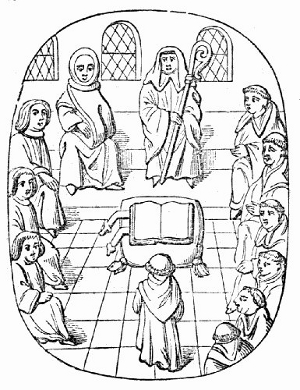
In abbey-churches of the olden time the Chapter-house was always on
the east side of the court. In establishments of secular canons it seems
to have been always multisided, with a central pillar to support its groining,
and a lofty, conical, lead-covered roof. In these instances it is
placed in the open space eastward of the cloister, and is usually approached
by a passage from the east side of the cloister court. In the
houses of all the other orders the chapter-house is rectangular, even
where the church is a cathedral. Usually, then, the chapter-house is a
rectangular building on the east side of the cloister, and frequently its
longest apsis is east and west—at Durham it has an eastern apsis. It was
a large and handsome room, with a good deal of architectural ornament;
often the western end of it is divided off as a vestibule or ante-room; and
generally it is so large as to be divided into two or three aisles by rows
of pillars. Internally, rows of stalls or benches were arranged round the
walls for the convent; there was a higher seat at the east end for the
abbot or prior, and a desk in the middle from which certain things were
read. Every day after the service called Tierce, the convent walked in
procession from the choir to the chapter-house, and took their proper
places. When the abbot had taken his place, the monks descended one
step and bowed; he returned their salutation, and all took their seats.
A sentence of the rule of the order was read by one of the novices from
the desk, and the abbot, or in his absence, the prior, delivered an explanatory
or hortatory sermon upon it; then, from another portion of the
book was read the names of brethren, and benefactors, and persons who
had been received into fraternity, whose decease had happened on that
day of the year; and the convent prayed a requiescat in pace for their
souls, and the souls of all the faithful departed this life.
Then members
of the convent who had been
guilty of slight breaches of
discipline confessed them,
kneeling upon a low stool in
the middle, and on a bow
from the abbot, intimating
his remission of the breach,
they resumed their seats. If
any had a complaint to make
against any brother, it was
here made and adjudged.
Convent business was also
transacted. The woodcut
gives an example of the kind.
Henry VII. had made grants
to Westminster Abbey, on
condition that the convent
performed certain religious
services on his behalf; and
in order that the services
should not fall into disuse,
he directed that yearly, at a
certain period, the chief
justice, or the king's attorney,
or the recorder of London,
should attend in chapter, and the abstract of the grant and agreement
between the king and the convent should be read. The grant which was
thus to be read still exists in the British Museum; it is written in a
volume superbly bound, with the royal seals attached in silver cases; it
is from the illuminated letter at the head of one of the deeds that our
woodcut is taken. It rudely represents the chapter-house, with the
chief-justice and a group of lawyers on one side, the abbot and convent
on the other, and a monk reading the grant from the desk in the midst.
ANNE BOLEYN's GLOVES.
Anne Boleyn was marvellously dainty about her gloves. She had a
nail which turned up at the side, and it was the delight of Queen Catharine
to make her play at cards, without her gloves, in order that the
deformity might disgust King Hal. The good Queen Bess was extravagant,
fastidious, and capricious in the extreme, about her gloves. She
used to display them to advantage in playing the virginal, and gloves at
that time were expensive articles.
DELLA ROBBIA WARE.
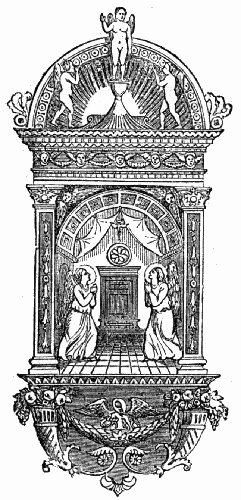
Luca della Robbia, born in 1388, was an eminent sculptor in marble
and bronze, and worked both at Florence and at Rimini. Having abandoned
his original employment for that of modelling in terra cotta, he
succeeded, after many experiments, in making a white enamel, with
which he coated his works, and thus rendered them durable. Vasari
writes of him, "che faceva l'opere di
terra quasi eterne."
His chief productions
are Madonnas, Scripture subjects,
figures, and architectural ornaments:
they are by far the finest works ever
executed in pottery. He adorned the
Italian churches with tiles, as well
as with altar-pieces, in terra cotta
enamelled; and he is the founder of
a school which produced works not
much inferior to his own. The "Petit
Château de Madrid," in the Bois de
Boulogne, near Paris, received the appellation
of "Château de Fayence,"
from having been ornamented with enamelled
tiles, the work of an Italian
artist, named Girolamo della Robbia, a
grand nephew of Luca, whom Francis I.
brought from Italy. This château is
now wholly destroyed. The tiles seem
to have been introduced into portions of
the architectural composition, rather as
accessory ornaments than as a "lining"
or revêtement of the walls. Analogous
ornaments, the work of Luca de Maiano,
1521, were to be seen in the old gate,
Whitehall, and at Hampton Court.
Luca della Robbia sometimes, though
rarely, used a coloured instead of white
enamel in his compositions. The above cut represents the altar-piece
of San Miniato, near Florence, by him. The ground is blue, the figures
white, the fruits, &c., gold colour, and the garlands green.
VOLCANIC ERUPTION IN JAPAN.
The peninsula of Wountsendake, and the greater part of Kewsew,
bristle with volcanic mountains, some extinct, others still acting as
safety-valves to the incomprehensible excitements of mother Earth; but
of all the manifestations of her internal throes and torment, and their
consequent desolation inflicted on the habitations of her children, that of
1792 was the most terrible for ages before.
"On the eighteenth day of the first month of that year," says the
Annals of Japan, "the summit of the mountain was seen to crumble
suddenly, and a thick smoke rose in the air. On the sixth of the following
month there was an eruption in a spur on the eastern slope of the mountain.
On the second of the third month an earthquake shook the whole
island. At Simabara, the nearest town to the mountain, all the houses
were thrown down, amidst a general terror and consternation, the shocks
following each other with frightful rapidity. Wountsendake incessantly
sent forth a hail-storm of stones, showers of ashes, and streams of lava,
which devastated the country for many leagues round. At length, on
the first day of the fourth month, there was a new commotion, which
increased in intensity from moment to moment.
"Simabara was now a vast heap of ruins. Enormous blocks of rock,
tumbling from the top of the mountain, crushed and ground to atoms all
beneath them. Thunder rolled overhead, and dreadful sounds rumbled
beneath the feet at one and the same time. All of a sudden, after an
interval of calm, when men thought the scourge had passed over, the
northern spur of Wountsendake, the Moikenyamma, burst forth with a
tremendous detonation. A vast portion of that mountain was blown into
the air. Colossal masses fell into the sea. A stream of boiling water
rushed forth foaming from the cracks of this new volcano, and sped to
the ocean, which at the same time advanced and flooded the land."
Then was seen a sight never seen before, intensifying the terror of the
innumerable witnesses of that terrible day, which might well seem a
Day of Judgment come. From the conflict of the boiling waters of the volcano
with the cold waters of the tempestuous ocean, suddenly mingled, there
arose waterspouts which ravaged the land in their devouring gyrations.
The disasters caused by this accumulation of catastrophes, earthquakes,
volcanic eruptions, waterspouts, inundations, united together, exceed
belief. Not a single house of Simabara and its environs was spared:
only the citadel remained, whose Cyclopean walls were formed of gigantic
blocks of stone. The convulsions of nature on that day so changed the
coast-line, that the most experienced mariners could not recognise its
once familiar shape and bendings.
Fifty-three thousand persons perished on that fatal day.
ORIGIN OF THE HOUSE OF MULGRAVE.
The first diving bell was nothing but a very large kettle, suspended
by ropes, with the mouth downwards, and planks to sit on fixed in the
middle of its concavity. The Greeks at Toledo, in 1588, made an experiment
before the Emperor Charles V. with it, when they descended with
a lighted candle to a considerable depth. In 1683 William Phipps, the
son of a blacksmith, formed a project for unloading a rich Spanish ship,
sunk at Hispaniola; Charles II. gave him a ship, with every necessary
for the undertaking; but being unsuccessful, Phipps returned in great
poverty. He then endeavoured to procure another vessel, but failing,
he got a subscription, to which the Duke of Albemarle contributed. In
1687, Phipps set sail in a ship of 200 tons, having previously engaged to
divide the profits according to the twenty shares of which the subscription
consisted. At first all his labours proved fruitless, but at length,
when he seemed almost to despair, he was fortunate enough to bring up
so much treasure that he returned to England with £200,000 sterling.
Of this sum he got about £20,000, and the Duke of Albemarle £90,000.
Phipps was knighted by the king, and laid the foundation of the present
house of Mulgrave.
SHRINE OF ST. SEBALD AT NUREMBURG.
The city of Nuremberg—the birthplace of Albert Durer—is enriched
with many works of high art. The most remarkable is the bronze shrine
of St. Sebald, the work of Peter Vischer and his five sons, which still
stands in all its beauty in the elegant church dedicated to the saint. The
sketch on next page is a correct representation of it.
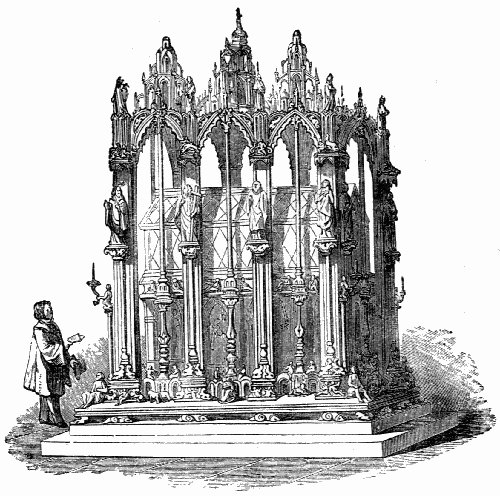
The shrine encloses, amid the most florid Gothic architecture, the oaken
chest encased with silver plates, containing the body of the venerated saint:
this rests on an altar decorated with basso-relievos, depicting his miracles.
The architectural portion of this exquisite shrine partakes of the characteristics
of the Rennaissance forms engrafted on the mediæval, by the
influence of Italian art. Indeed, the latter school is visible as the leading
agent throughout the entire composition. The figures of the Twelve
Apostles and others placed around it, scarcely seem to belong to German
art; they are quite worthy of the best Transalpine master. The
grandeur, breadth, and repose of these wonderful statues, cannot be excelled.
Vischer seems to have completely freed his mind from the conventionalities
of his native schools: we have here none of the constrained,
"crumpled draperies," the home studies for face and form so strikingly
present in nearly all the works of art of this era, but noble figures of the
men elevated above the earthly standard by companionship with the
Saviour, exhibiting their high destiny by a noble bearing, worthy of
the solemn and glorious duties they were devoted to fulfil. We gaze on
these figures as we do on the works of Giotto and Fra Angelico, until we
feel human nature may lose nearly all of its debasements before the
"mortal coil" is "shuffled off," and that mental goodness may shine
through and glorify its earthly tabernacle, and give an assurance in time
present of the superiorities of an hereafter. Dead, indeed, must be the
soul that can gaze on such works unmoved, appealing, as they do, to our
noblest aspirations, and vindicating humanity from its fallen position, by
asserting its innate, latent glories. Here we feel the truth of the scriptural
phrase—"In his own image made he them."
The memory of Peter Vischer is deservedly honoured by his townsmen.
The street in which his house is situated, like that in which Durer's stands,
has lost its original name, and is now only known as Peter Vischer's
Strasse; but these two artists are the only ones thus distinguished.
Vischer was born in 1460, and died in 1529. He was employed by the
warden of St. Sebald's, and magistrate of Nuremberg, Sebald Schreyer,
to construct this work in honour of his patron saint; he began it in
1506, and finished it in 1519. Thirteen years of labour were thus devoted
to its completion, for which he received seven hundred and seventy
florins. "According to this tradition, Vischer was miserably paid for
this great work of labour and art; and he has himself recorded, in an
inscription upon the monument, that 'he completed it for the praise of
God Almighty alone, and the honour of St. Sebald, Prince of Heaven, by
the aid of pious persons, paid by their voluntary contributions.'" The
elaboration of the entire work is marvellous; it abounds with fanciful
figures, seventy-two in number, disposed among the ornaments, or acting
as supporters to the general composition. Syrens hold candelabra at
the angles; and the centre has an air of singular lightness and grace.
It is supported at the base by huge snails. At the western end there is
a small bronze statue of Vischer; he holds his chisel in his hand, and in
his workman's dress, with capacious leather apron, stands unaffectedly
forth as a true, honest labourer, appealing only to such sympathies as
are justly due to one who laboured so lovingly and so well.
A GREAT RESULT FROM TRIVIAL CIRCUMSTANCES.
That magnificent institution of active benevolence, Guy's Hospital, is
one among a numerous list of instances where trifling events have produced
most disproportionate consequences.
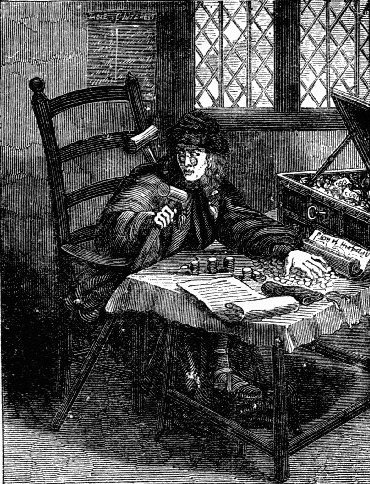
Thomas Guy, of whom the above is a sketch, taken from an old print,
was the son of Thomas Guy an Anabaptist, lighterman and coal-dealer,
in Horsleydown, Southwark. He was put apprentice in 1660 to a
bookseller in the porch of Mercer's Chapel, and set up trade with a
stock of about two hundred pounds, in the house that forms the angle
between Cornhill and Lombard-street. The English Bibles being at
that time very badly printed, Mr. Guy engaged with others in a scheme
for printing them in Holland and importing them; but this being put a
stop to, he contracted with the University of Oxford for their privilege of
printing them, and carried on a great Bible trade for many years to considerable
advantage. He thus began to accumulate money, and his
gains rested in his hands, for being a single man, and very penurious,
his expenses were very trifling. His custom was to dine on his shop
counter, with no other table-cloth than an old newspaper; he was also as
little nice in regard to his dress. The bulk of his fortune, however, was
acquired by the less reputable purchase of seamen's tickets during
Queen Anne's wars, and by the South Sea stock in the memorable year
1720.
In proof of what we said at the outset, it is a fact that the public are
indebted to a most trifling incident for the greatest part of his immense
fortunes being applied to charitable uses. Guy had a maid-servant whom
he agreed to marry; and preparatory to his nuptials he had ordered the
pavement before his door to be mended as far as a particular stone
which he marked. The maid, while her master was out, innocently
looking on the paviours at work, saw a broken place they had not repaired,
and mentioned it to them; but they told her that Mr. Guy had
desired them not to go so far. "Well," says she, "do you mend it;
tell him I bade you, and I know he will not be angry." It happened,
however, that the poor girl presumed too much on her influence over
her wary lover, with whom the charge of a few shillings extraordinary
turned the scale against her, for Guy, enraged to find his orders exceeded,
renounced the matrimonial scheme, and built hospitals in his
old age. In 1707 he built and furnished three wards on the north side
of the outer court of St. Thomas's Hospital, and gave one hundred
pounds to it annually for eleven years preceding the erection of his own
hospital.
Sometime before his death he erected the stately gate with the large
houses on each side, at the expense of about three thousand pounds.
He was seventy-six years of age when he formed the design of building
the hospital near St. Thomas's, which bears his name. The charge of
erecting this vast pile amounted to £18,793, besides £219,499 which he
left to endow it, and he just lived to see it roofed in.
He erected and endowed an almshouse and library at Tamworth, the
place of his mother's nativity, and which he represented in Parliament.
It contains fourteen poor men and women, and the fund provides also
for the apprenticing of poor children. He also bequeathed four hundred
pounds a-year to Christ's Hospital.
Mr. Guy died December 17th, 1724 in the eighty-first year of his age,
and his will bears date September 4th, in the same year.
PHAROS AT ALEXANDRIA.
To render the harbour safe of approach at all times, Ptolemy Soter,
who, on the death of Alexander, obtained the government of Egypt,
determined on erecting a lighthouse on the eastern extremity of the isle
of Pharos, the celebrity of which has given the same name to all other
lighthouses.
This "pharos" was in height 450 feet, and could be seen at a distance
of 100 miles. It was built of several stories, decreasing in dimension
towards the top, where fires were lighted in a species of lantern. The
ground-floor and the two next above it were hexagonal; the fourth
was a square with a round tower at each angle; the fifth floor was
circular, continued to the top, to which a winding staircase conducted.
In the upper galleries some mirrors were arranged in such a manner as
to show the ships and objects at sea for some considerable distance. On
the top a fire was constantly kept, to direct sailors into the bay, which
was dangerous and difficult of access.
The whole of this masterpiece of art was exquisitely wrought in
stone, and adorned with columns, balustrades, and ornaments, worked
in the finest marble. To protect the structure from the ocean storms, it
was surrounded entirely by a sea wall. Ancient writers say the
building of this tower cost 800 talents, which is equivalent to £165,000,
if Attic talents; but if Alexandrian, double that sum.
The building was not completed during the reign of the first Ptolemy,
but was finished in the reign of his son Ptolemy Philadelphus, who
put this inscription upon it:—
"King Ptolemy, to the Gods the Saviours, for the benefit of sailors."
Sostratus the architect, wishing to claim all the glory of the building,
engraved his own name on the solid marble, and afterwards coated it
with cement. Thus, when time had decayed the mortar Ptolemy's name
disappeared, and the following inscription became visible:—
"Sostratus the Cnidian, to the Gods the Saviours, for the benefit
of sailors."
Of this remarkable tower not a vestige remains, and history gives us
no further information than we have here: of its gradual decay or of
its violent destruction we have no record; but that such a structure as
described stood there, there can be not a shadow of doubt, from the
fact that all buildings for like purposes among the Greeks and Romans
derive their designation from this.
SEPULCHRAL VASES OF ANCIENT EGYPT.
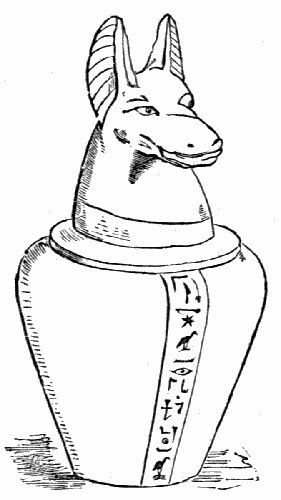
In ancient Egypt terra-cotta pottery was extensively made use of for
vases or jars to hold the entrails of the dead. In order to preserve the
body effectually, it was necessary to remove the softer portions, such as
the thoracic and abdominal viscera, and these were embalmed separately.
In some instances they were returned into the stomach, with wax models
of four deities, commonly called the four genii of the Ament or Hades.
It was, however, usual in the embalmment of the wealthier classes to
soak them carefully in the requisite preparations, tie them up in neat
cylindrical packets, and deposit them in vases having the shape of the
four genii. The bodies of these deities, which were usually represented
as mummied, formed the bodies of the vases, and were cylindrical below
and rounded above. The mouths of the jars were sometimes countersunk
to receive the lower part of the covers which fitted into them like
a plug. The jar of the first genius, whose name was Am-set, "the
devourer of filth," held the stomach and large intestines, and was
formed at the top like a human head. This genius typified, or presided
over the southern quarter of the compass. He was the son of Osiris
or of Phtha Socharis Osiris, the pygmean god of Memphis. The second
vase of the series was in the shape of the genius Hapi, the "concealed."
Its cover was shaped like the head of a cynocephalus, and it held the
smaller viscera. This genius presided over the north, and was also the
son of Osiris. The third vase was that of the genius Trautmutf, "the
adorer of his mother." We here annex an engraving of it. It had a cover
in shape of the head of a jackal, and held the lungs and heart. This genius
presided over the East, and was brother of the preceding. The last was
that of the genius Kebhsnuf, the refresher of his brethren.
It had a
cover shaped like the head of a sparrow-hawk,
and held the liver and
gall-bladder. This genius presided
over the west, and was also brother
of the preceding. Three vases of a
set, in the British Museum, have all
human-shaped heads, and are provided
with handles at the sides of the
bodies. Specimens of a very unusual
kind are also to be found in the same
collection, having the whole body
formed without a cover, in the shape
of a dome above, and surmounted by
a rudely modelled figure of a jackal,
couchant upon a gateway, formed of a
detached piece. The entrails were
introduced by the rectangular orifice
in the upper part. In some other instances
the covers appear to have been
secured by cords passing through
them to the body of the vase. When
secured, the vases were placed in a
wooden box, which was laid on a
sledge and carried to the sepulchre,
where they were often taken out and
placed, two on each side of the coffin.
It was only the poorer classes that used pottery for these purposes. The
viscera of high officers of state were embalmed in jars of fine white limestone,
and the still more valuable oriental alabasters or arragonite,
obtained from the quarries of Tel El Amarna, or the ancient Alabastron.
THE SACRO CATINO.
The celebrated "Sacro Catino," part of the spoil taken by the Genoese
at the storming of Cesarea, which was believed to be cut from a single
emerald, and had, according to tradition, been presented by the Queen of
Sheba to Solomon, was for ages the pride and glory of Genoa, and an
object of the greatest devotional reverence at the yearly exhibitions,
which were attended with great pomp and ceremony. Such was the
opinion of its intrinsic value, that on many occasions the republic
borrowed half a million of ducats upon the security of this precious relic.
When the French armies, during the first Revolution, plundered Italy
of its treasures, it was sent with other spoils to Paris. Upon examination,
it was, instead of emerald, proved to be composed of glass, similar
to that found in the Egyptian tombs, of which country it was, no doubt,
the manufacture. At the Restoration the Sacro Catino was returned in
a broken state, and now lies shorn of all its honours, a mere broken glass
vessel, in the sacristy of the Church of San Lorenzo.
DINNER PARTY IN THE SEVENTEENTH CENTURY.
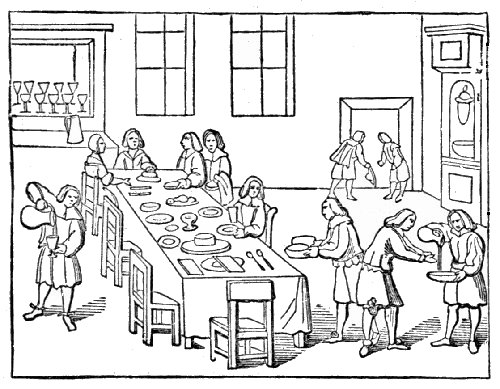
The cut which we here present to our readers is taken from the
English edition of the Janua Linguarum of Comenius, and represents
the forms of dining in England under the Protectorate. It will be
best described by the text which accompanies it in the book, and in
which each particular object is mentioned. "When a feast is made
ready," we are told, "the table is covered with a carpet and a table-cloth
by the waiters, who, besides, lay the trenchers, spoons, knives,
with little forks, table napkins, bread, with a salt-cellar Messes are
brought in platters, a pie in a plate. The guests being brought in by
the host, wash their hands out of a laver or ewer, over a hand-basin,
or bowl, and wipe them with a hand towel: they then sit at the table
on chairs. The carver breaketh up the good cheer, and divideth it.
Sauces are set amongst roste-meat in sawsers. The butler filleth strong
wine out of a cruse, or wine-pot, or flagon, into cups or glasses, which
stand on a cupboard, and he reacheth them to the master of the feast,
who drinketh to his guests." It will be observed here that one salt-cellar
is here placed in the middle of the table. This was the usual
custom; and, as one long table had been substituted for the several
tables formerly standing in the hall, the salt-cellar was considered to
divide the table into distinct parts, guests of more distinction being
placed above the salt, while the places below the salt were assigned
to inferiors and dependents. This usage is often alluded to in the old
dramatists. Thus, in Ben Jonson, it is said of a man who treats his
inferiors with scorn, "he never drinks below the salt, i. e. he never
exchanges civilities with those who sit at the lower end of the table."
And in a contemporary writer, it is described as a mark of presumption
in an inferior member of the household "to sit above the salt."
SAND-COLUMNS IN AFRICA.
Of this remarkable phenomenon, we extract the following interesting
account from the Rev. N. Davis's "Evenings in my Tent";—
"The heat, during the last day or two, has been intense. The thermometer
in my tent, during day and night, has been almost stationary
at 100 degrees. My men have done, and still do, everything in their
power to keep the tent cool, by erecting a high palm-branch fence around
it, and by a constant immersion of the ground, but all this to very little
effect. The wind, during this day, has been as hot as the flames issuing
from a furnace; and the clouds of sand it raised, and carried along in
its furious march, have been immense. In the distance could be seen
numbers of sand columns; but these did not retain their form any considerable
length of time. A contrary blast brought them in collision
with each other; and these, blending their contents, raised a complete
and dense barrier between us and the country beyond. I am no lover of
danger; but, I must confess, I had an inward desire to see this phenomenon—one
of the horrors of the desert—in greater perfection. I believe
Bruce witnessed one of the most stupendous exhibitions of sand
columns or sand spouts, caused by circular or whirl-winds, on record.
In his journey through the desert of Senaar, his attention was attracted
to a number of prodigious pillars of sand, at different distances, moving
at times with great celerity, at others, stalking on with majestic slowness:
at intervals, he thought they were coming in a very few minutes
to overwhelm him and his companions. Again they would retreat, so as
to be almost out of sight, their tops reaching to the very clouds. There
the tops often separated, from the bodies; and these, once disjoined, dispersed
in the air, and appeared no more. Sometimes they were broken
near the middle, as if struck with a large cannon-shot. About noon,
they began to advance with considerable swiftness upon them, the wind
being very strong at north. Eleven of these awful visitors ranged alongside
of them, at about the distance of three miles. The greatest diameter
of the largest appeared to him, at that distance, as if it would measure
ten feet. They retired from them, with a wind at south-east, leaving an
impression upon the mind of our intrepid traveller to which he could
give no name, though he candidly admits that one ingredient in it was
fear, with a considerable deal of wonder and astonishment. He declares
it was in vain to think of flying; the swiftest horse, or fastest sailing
ship, could be of no use to carry them out of this danger,—and the full
persuasion of this riveted him to the spot where he stood. Next day
they were gratified by a similar display of moving pillars, in form and
disposition like those already described, only they seemed to be more in
number, and less in size. They came several times in a direction close
upon them; that is, according to Mr. Bruce's computation, within two
miles. They became, immediately after sunrise, like a thick wood, and
almost darkened the sun, his rays, shining through them for near an
hour, gave them an appearance of pillars of fire. At another time they
were terrified by an army of these sand pillars, whose march was constantly
south, a number of which seemed once to be coming directly
upon them, and, though they were little nearer than two miles, a considerable
quantity of sand fell around them. On the 21st of November,
about eight in the morning, he had a view of the desert to the westward
as before, and saw the sands had already begun to rise in immense twisted
pillars, which darkened the heavens, and moved over the desert with more
magnificence than ever. The sun shining through the pillars, which
were thicker, and contained more sand apparently than any of the preceding
ones, seemed to give those nearest them an appearance as if
spotted with stars of gold. A little before twelve, the wind at north
ceased, and a considerable quantity of fine sand rained upon them for
an hour afterwards."
ANTIQUITY OF INTOXICATING DRINKS.
It is a common belief that wine was the only inebriating liquor
known to antiquity, but this is a mistake. Tacitus mentions the use of
ale or beer as common among the Germans of his time. By the
Egyptians, likewise, whose country was ill adapted to the cultivation of
the grape, it was employed as a substitute for wine. Ale was common
in the middle ages, and Mr. Park states that very good beer is made, by
the usual process of brewing and malting, in the interior of Africa.
The favourite drink of our Saxon ancestors was ale or mead. Those
worshippers of Odin were so notoriously addicted to drunkenness, that
it was regarded as honourable rather than otherwise; and the man who
could withstand the greatest quantity was looked upon with admiration
and respect: whence the drunken songs of the Scandinavian scalds:
whence the glories of Valhalla, the fancied happiness of whose inhabitants
consisted of quaffing draughts from the skulls of their
enemies slain in battle. Even ardent spirit, which is generally supposed
to be a modern discovery, probably existed from a very early period.
It is said to have been first made by the Arabians in the middle ages,
and in all likelihood may lay claim to a still remoter origin. The
spirituous liquor called arrack has been manufactured in the island of
Java, as well as in the continent of Hindostan, from time immemorial.
Brandy was made in Sicily at the commencement of the fourteenth
century. As to wine, it was so common in ancient times as to have a
tutelar god appropriated to it; Bacchus and his companion Silenus are
as household words in the mouths of all, and constituted most important
features of the heathen mythology. We have all heard of the Falernian
and Campanian wines, and of the wines of Cyprus and Shiraz. Indeed,
there is reason to believe that the ancients were in no respect inferior to
the moderns in the excellence of the vinous liquors, whatever they may
have been in the variety. Wine was so common in the eastern nations
that Mahomet, foreseeing the baleful effects of its propagation, forbade
it to his followers, who, to compensate themselves, had recourse to
opium. The Gothic or dark ages seem to have been those in which it
was the least common; in proof of this it may be mentioned that, so
late as 1298, it was vended as a cordial by the English apothecaries.
At the present day it is little drunk, except by the upper classes, in
those countries which do not naturally furnish the grape. In those that
do, it is so cheap as to come within the reach of even the lowest.
RUINS OF CLONMACNOIS.
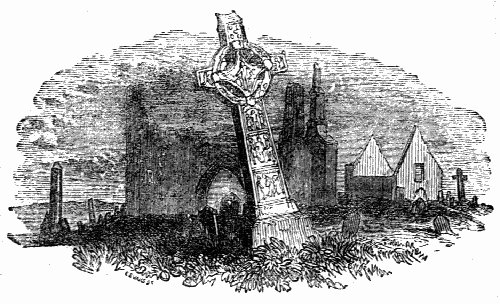
A few miles south of Athlone are the famous ruins of Clonmacnois, the
school where, according to Dr. O'Connor, "the nobility of Connaught
had their children educated, and which was therefore called Cluan-mac-nois,
'the secluded recess of the sons of nobles.'" It was also, in ancient
times, a renowned cemetery of the Irish kings; and for many centuries
it has continued a favourite burial-place, the popular belief enduring to
this day, that all persons interred here pass immediately from earth to
heaven. The abbey is said to have been founded by St. Kieran about
the middle of the sixth century, and soon became "amazingly enriched,"
so that, writes Mr. Archdall, "its landed property was so great, and the
number of cells and monasteries subjected to it so numerous, that almost
half of Ireland was said to be within the bounds of Clonmacnois." The
ruins retain marks of exceeding splendour. In the immediate vicinity
there are two "Round Towers." The above engraving represents one of
the many richly-carved stone crosses that are scattered in all directions
among the ruins.
THE BRICKS OF BABYLON.
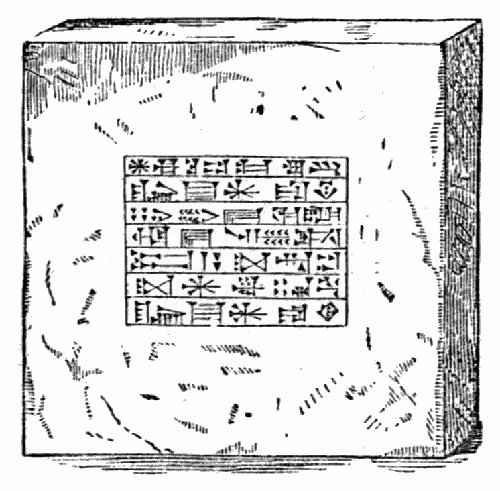
Besides sun-dried bricks, remains of kiln-baked or burnt bricks are
found in all the principal ruins of ancient Babylonia, and were used
for the purpose of revetting or casing the walls. Like the sun-dried
bricks they are made of clay mixed with grass and straw, which have,
of course, disappeared in the baking, leaving, however, traces of the
stalks or stems in the clay. Generally they are slack-burnt, of a pale
red colour, with a slight glaze or polish. The finest sort, according to
Mr. Rich, are white, approaching more or less to a yellowish cast, like
our Stourbridge, or fire-brick; the coarsest are red, like our ordinary
brick. Some have a blackish cast, and are very hard. The finest are
those which come from the ruins of the Akerkuf. The general measurement
of the kiln-dried bricks, at the Birs Nimrúd, is 1 ft. 1 in. square,
and 3 in. thick. Some are submultiples, or half of these dimensions.
A few are of different shapes for particular purposes, such as rounding
corners. Those at the Akerkuf measured a trifle less, or 12½ in. square,
and 2¾ in. thick, and are placed at the base of the monument. The
bricks of Al Hymer, on the eastern bank, measure 14 in. long, 12¾ in.
broad, 2½ in. thick, and are of fine fabric. There are bricks of two
dimensions at this ruin of the Birs Nimrúd; those on the northern brow,
a little way down it, measure 12 in. square, and 3¼ in. thick; they are
of a pale red colour, and used for revetting the monument. Lower
down to the east of this, they are 4¾ in. broad, and 12¾ in. long.
Similar bricks were found at the Mujellibe, and in one place was an entire
wall of them 60 feet thick. The whole plain here is covered with masses
of brick work, and on one of the mounds the bricks are so red, that it
looks one bright gleaming mass. The bricks from the Mujellibe or Kasr
are described as very hard, and of a pale yellow colour; and this edifice
presents a remarkable appearance of freshness. We have seen only one
fragment of a brick from Niffer; it is of a white, or rather yellowish
white colour, and sandy, gritty texture. This spot, it will be remembered,
is supposed to be the site of old Babylon. All these bricks
are made by the same process as those of Assyria, namely, stamped out
of a wooden or terra-cotta mould, and are also impressed with several
lines of cuneiform character. This impression is always sunk below the
superficies, rectangular, and often placed obliquely on the brick, with
that disregard to mechanical symmetry which is so usual on works of
ancient art. The stamp is generally about 6 inches long, by 4 inches
wide, and the number of lines varies from three to seven: an arrangement
quite different from that observed on the bricks of Assyria, and
rather resembling that adopted by the brick-makers of Egypt. The
engraving on previous page is of a brick stamped with the name of Nebuchadnezzar,
which is now in the possession of the Royal Society of
Literature. The inscriptions sometimes commence with the figure of a
lion, a bull, or what may be intended for an altar. These read, according
to Sir H. Rawlinson,—
[of] Nebuchadnezzar,
the king of Babylon,
founder of Beth Digla, or Saggalu,
and of Beth Tzida
son of Nebopalasar [I am].
A TURKISH BAZAAR.
A Turkish bazaar is one of the most wonderful sights in the world,
and well deserves a place in our record of curiosities. We cannot do
better than quote the description which Mr. Albert Smith gives of one
of these extraordinary places in his "Month at Constantinople:"—
"Smyrna had, in some measure, prepared me for the general appearance
of an oriental bazaar; but the vast extent of these markets at Constantinople
created a still more vivid impression. To say that the covered
rows of shops must altogether be miles in length—that vista after vista
opens upon the gaze of the astonished stranger, lined with the costliest
productions of the world, each collected in its proper district—that one
may walk for an hour, without going over the same ground twice, amidst
diamonds, gold, and ivory; Cashmere shawls, and Chinese silks; glittering
arms, costly perfumes, embroidered slippers, and mirrors; rare
brocades, ermines, Morocco leathers, Persian nick-nacks; amber mouthpieces,
and jewelled pipes—that looking along the shortest avenue, every
known tint and colour meets the eye at once, in the wares and costumes,
and that the noise, the motion, the novelty of this strange spectacle is at
first perfectly bewildering—all this, possibly, gives the reader the notion
of some kind of splendid mart, fitted to supply the wants of the glittering
personages who figure in the Arabian Nights' Entertainments; yet it
can convey but a poor idea of the real interest which such a place calls
forth, or the most extraordinary assemblage of treasures displayed there,
amidst so much apparent shabbiness. No spot in the world—neither the
Parisian Boulevards, nor our own Regent-street—can boast of such an
accumulation of valuable wares from afar, as the great bazaar at Constantinople.
Hundreds and thousands of miles of rocky road and sandy
desert have been traversed by the moaning camels who have carried
those silks and precious stones from Persia, with the caravan. From
the wild regions of the mysterious central Africa, that ivory, so cunningly
worked, in the next row, has been brought—the coal-black people
only know how—until the Nile floated it down to Lower Egypt. Then
those soft Cashmere shawls have made a long and treacherous journey to
Trebizond, whence the fleet barks of the cold and stormy Euxine at last
brought them up the fairy Bosphorus to the very water's edge of the
city. From the remote active America; from sturdy England; from
Cadiz, Marseilles, and all along the glowing shores of the Mediterranean,
safely carried over the dark and leaping sea, by brave iron monsters that
have fought the winds with their scalding breath, these wares have
come, to tempt the purchasers, in the pleasant, calm, subdued light of
the bazaars of Stamboul."
VARNISH-TREE OF THE JAPANESE.
The urusi or varnish-tree, of which they make so extensive a use, is a
noble tree when grown to its full size. On incision it yields a rich,
milky, glutinous juice, out of which the Japanese make the celebrated
varnish, known by the name of Japan. With this varnish they cover
and coat all their household furniture, all their dishes and plates, and all
their drinking-vessels, whether made of wood or of paper. The use of
plate, or porcelain, or glass appears to be very limited, and is probably
interdicted by some rule of nationality or religion: from the emperor
down to the meanest peasant, all make use of the light varnished or
japanned cups and dishes, the inner substance of which is wood or paper,
or what we term papier-maché.
Another tree, called forasi, renders a varnish of an inferior quality.
TORTURE-CHAMBER AT NUREMBERG.
Nuremberg, being a "free city," was governed by its own appointed
magistrates, having independent courts of law. The executive
council of state consisted of eight members, chosen from the
thirty patrician families, who, by the privilege granted to them from the
thirteenth century, ruled the city entirely. In process of time these
privileges assumed the form of a civic tyranny, which was felt to be intolerable
by the people, and occasionally opposed by them. The fierce
religious wars of the sixteenth century assisted in destroying the monopoly
of power still more; yet now that it is gone for ever, it has left
fearful traces of its irresponsible strength. All who sigh for "the good
old times," should not moralise over the fallen greatness of the city, and
its almost deserted but noble town-hall; but descend below the building
into the dark vaults and corridors which form its basement; the terrible
substructure upon which the glorious municipal palace of a free imperial
self-ruled city was based in the middle ages, into whose secrets none
dared pry, and where friends, hope, life itself, were lost to those who
dared revolt against the rulers. There is no romance-writer who has
imagined more horrors than we have evidences were perpetrated under
the name of justice in these frightful vaults, unknown to the busy citizens
around them, within a few feet of the streets down which a gay wedding
procession might pass, while a true patriot was torn in every limb, and
racked to death by the refined cruelty of his fellow-men. The heart
sickens in these vaults, and an instinctive desire to quit them takes possession
of the mind, while remaining merely as a curious spectator within
them. The narrow steps leading to them are reached through a decorated
doorway, and the passage below receives light through a series of gratings.
You shortly reach the labyrinthine ways, totally excluded from
external light and air, and enter, one after another, confined dungeons,
little more than six feet square, cased with oak to deaden sounds, and to
increase the difficulty of attempted escape. To make these narrow places
even more horrible, strong wooden stocks are in some, and day and night
prisoners were secured in total darkness, in an atmosphere which seems
even now too oppressive to bear. In close proximity to these dungeons
is a strong stone room, about twelve feet wide each way, into which you
descend by three steps. It is the torture-chamber, which we here engrave.
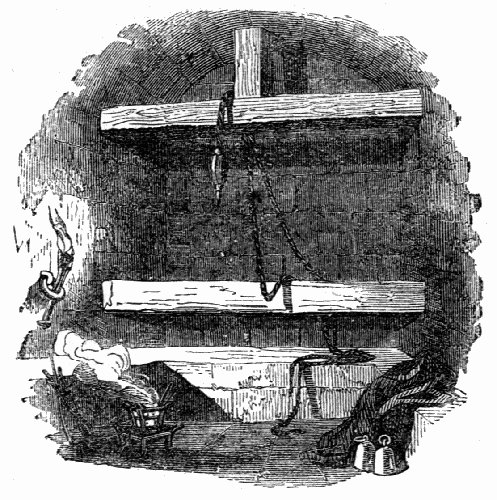
The massive bars before you are all that remain of the perpendicular
rack, upon which unfortunates were hung with weights attached to their
ankles. Two such of stone, weighing each fifty pounds, were kept here
some years back, as well as many other implements of torture since removed
or sold for old iron. The raised stone bench around the room was
for the use of the executioner and attendants. The vaulted roof condensed
the voice of the tortured man, and an aperture on one side gave
it freedom to ascend into a room above, where the judicial listeners
waited for the faltering words which succeeded the agonising screams of
their victim.
SEPULCHRAL VASES OF GREEK POTTERY.
The number of these vases deposited in the great public museums of
Europe is very large, and from calculations derived from catalogues, or
from observations made on the spot, may be stated in round numbers as
follows:—The Museo Borbonico, at Naples, contains about 2,100; the
Gregorian Museum in the Vatican, about 1,000; Florence has about
700; and at Turin there are 500. On the side of the Alps, the Imperial
Museum of Vienna possesses about 300; Berlin has 1,690; Munich about
1,700; Dresden, 200; Carlsruhe, 200; the Louvre, at Paris, about
1,500; while 500 more may be found in the Bibliothèque Imperiale.
The British Museum has about 2,600 vases of all kinds. Besides the
public collections, several choice and valuable specimens of ancient art
belong to individuals. The most important of these private collections
are those of the Duc de Luynes, the Duc de Blacas, the Count de
Pourtales-Gorgier, the Jatta collection, that belonging to M. St. Angela
at Naples, and a fine and choice one belonging to the Marquis Campana
at Rome. In England, the collections of Mr. Hope, of Mr. Jekyll, of
the Marquis of Northampton, and of Mr. Hertz, contain several interesting
examples. In addition to these, several thousand more vases
are in the hands of the principal dealers, as S. Barone, of Naples; and
the heirs of S. Basseggio, Capranesi and Messrs. Sotheby, in London.
The total number of vases in public and private collections probably
amounts to 15,000 of all kinds.
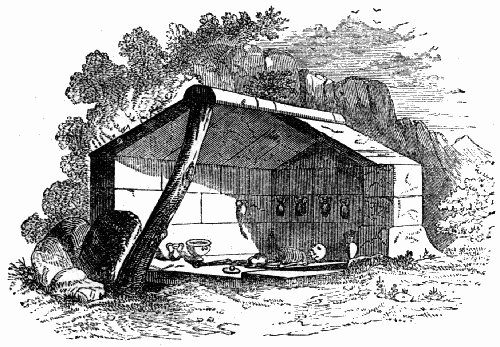
All these were discovered in the sepulchres of the ancients, but the
circumstances under which they were found differ according to locality.
In Greece, the graves are generally small, being designed for single
corpses, which accounts for the comparatively small size of the vases
discovered in that country. At Athens, the earlier graves are sunk
deepest in the soil, and those at Corinth, especially such as contain the
early Corinthian vases, are found by boring to a depth of several feet
beneath the surface. The early tombs of Cività Vecchia and Cære, or
Cervetri, in Italy, are tunnelled in the earth; and those at Vulci and in
the Etruscan territory, from which the finest and largest vases have been
extracted, are chambers hewn in the rocks. In Southern Italy, especially
in Campania, they are large chambers, about 5¼ palms under the surface.
The engraving on previous page will convey an idea of the manner in
which the vases are arranged round the bodies of the dead in the tombs
of Veii, Nola, and Cumæ.
The tomb there represented is constructed of large blocks of stone,
arranged in squared masses, called the Etruscan style of wall, in contradistinction
to the Cyclopean. The walls are painted with subjects,
the body is laid upon the stone floor, and the larger vases, such as the
oxybapha and craters are placed round it. The jugs are hung upon nails
round the walls.
GAMES WITH CARDS IN THE SIXTEENTH CENTURY.
Cards were used by every one. The game of Gleek was played by
three persons. The dealer dealt twelve cards and left eight on the
table for stock, seven were bought, and the ace turned up for the dealer;
if it was Tiddy (four of trumps) such player gave four to the dealer.
The ace was called Tib, the knave Tim, the fifth Towser, and the sixth
Tumbler. The players then begin bidding for the stock in hopes of
bettering their game, the buyer taking in seven cards and putting out
seven. If Tib was turned up, it counted fifteen to the dealer. The
players then picked for Ruff, the one having most of a suit winning
it—unless any one had four aces, which always carried it. The first
then said, "I'll vie the Ruff;" the next, "I'll see it:" the third,
"I'll see it, and revie it;" the first again, "I'll see your revie;" and
the middle, "I'll not meddle with it." They then showed their cards,
and he that had most of a suit won six of him that held out longest,
and forty of him who said he could see it, and then refused to meddle
with it.
Ombre, Basset, Whist, Costly Colours, and Five Cards, were, we
believe, of later introduction. Of our period, are Ruff, Bone, Ace,
Pult. The great game in the West of England was Post and Pair, as
All Fours was in Kent, and Five Cards in Ireland. In Post and Pair,
the ace of trumps was the best card; at Post the best cards were one
and two, but a pair of court cards one. The daring of the game consisted
in the vye, or the adventuring upon the goodness of your hand
to intimidate your antagonist.
RESCUED RELICS.
The following is a list—translated from the original in the chartulary
of the University of Glasgow; of the relics which were carried away
from Glasgow Cathedral, by the Archbishop, before the work of demolition
began, in 1560:—
The image of Christ in gold, and those of the twelve apostles in silver,
with the whole vestments belonging to the church.
A silver cross, gilt in the upper part, and adorned with precious stones
in the lower part, with a small portion of the cross of our Saviour!
Another silver cross, adorned with precious stones, with several other
portions of the cross of Christ!
A silver casket, gilt, containing the hair of the blessed Virgin!
A square silver coffer, containing several of the scourges of St. Kentigern,
and St. Thomas of Canterbury, and a portion of the hair garment
worn by the former saint!!
Another silver casket, gilt, containing part of the skin of Bartholomew,
the apostle!!
A silver casket containing a bone of St. Ninian!
A silver casket, containing part of the girdle of the Virgin Mary!!
A crystal case, containing a bone of some saint and of St. Magdalene!!
A small vial of crystal, containing the milk of the blessed Virgin,
and part of the manger of Christ!!!
A small phial of a saffron colour, containing the fluid which formerly
flowed from the tomb of St. Mungo!
A phial, containing several of the bones of St. Eugene, and of St.
Blaze!
A phial, containing a part of the tomb of St. Catherine the virgin!
A small hide, with a portion of the cloak of St. Martin!
A precious hide, with portions of the bodies of St. Kentigern and St.
Thomas of Canterbury!!
Some other hides, with bones of saints and other relics!
A wooden chest, containing many small relics!
Two linen bags, with the bones of St. Kentigern, St. Thanew, and
other deceased saints!!
PAPER.
With respect to the paper now in use, Dr. Blair says, the first paper-mill
(in England, we suppose) was erected at Dartford, in the year 1588,
by a German of the name of Speillman; from which period we may,
perhaps, date its manufacture in this country.
It appears, however, that it was known in the East much earlier; it
being observed that most of the ancient manuscripts in Arabic and other
Oriental languages, were written upon cotton paper, and it is thought
the Saracens first introduced it into Spain.
Anderson, in his "History of Commerce," says that, till the year 1690,
there was scarcely any paper made in England but the coarse brown
sort. Paper was previously imported from France, Genoa, and Holland.
However, the improvement of this article in England, in consequence of
the French war, produced a saving to the country of £100,000 annually,
which had been paid to France for paper alone.
LOTTERIES.
If the antiquity of a practice could justify its existence, lotteries might
claim peculiar reverence. The Romans, we are told, used to enliven
their Saturnalia with them, by distributing tickets, all of which gained
some prize. Augustus instituted lotteries, that consisted, however, of
things of little value. Nero also established lotteries, for the people, in
which 1,000 tickets were daily distributed, and several of those who
were favoured by fortune got rich by them. The first lottery of which
we find any record in our annals, was in the year 1659, which, according
to Stow, consisted of 40,000 lots, at 10s. each. The prizes were
plated; and the profits were to be applied to the purpose of repairing the
havens of the kingdom. This lottery was drawn at the west door of St.
Paul's cathedral; and began on the 11th July, 1569, and continued incessantly,
day and night, till the 6th May following. The tickets were
three years in being disposed of. In the year 1612, King James granted
a lottery to promote the plantation of English colonies in Virginia,
which was also drawn at St. Paul's.
TEMPLE AT SIMONBONG.
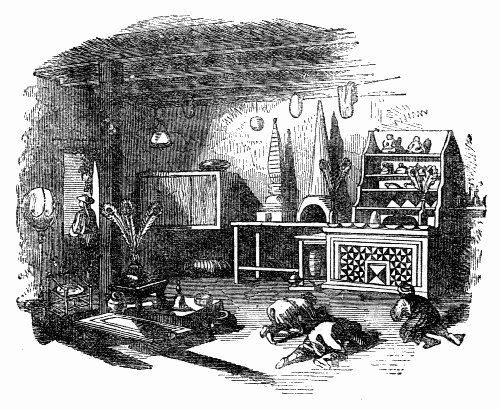
The above is a correct representation of the great Lepcha temple
at Simonbong, in Sikkim, a district of India near Thibet. We take
the following account of it from the Journal of Dr. Hooker, who
visited it in 1848:—"Simonbong is one of the smallest and poorest
goompas, or temples, in Sikkim, being built of wood only. It consists
of one large room, raised on a stone foundation, with small sliding
shutter windows, and roofed with shingles of wood; opposite the door
a wooden altar was placed, rudely chequered with black, white, and
red; to the right and left were shelves, with a few Tibetan books,
wrapped in silk; a model of Symbonath temple in Nepal, a praying-cylinder,
and some implements for common purposes, bags of juniper,
English wine-bottles and glasses, with tufts of Abies Webbina, rhododendron
flowers, and peacock's feathers, besides various trifles, clay
ornaments and offerings, and little Hindoo idols. On the altar were
ranged seven little brass cups, full of water; a large conch-shell, carved
with the sacred lotus; a brass jug from Lhassa, of beautiful design,
and a human thigh-bone, hollow, and perforated through both condyles.
"Facing the altar was a bench and a chair, and on one side a huge
tambourine, with two curved iron drumsticks. The bench was covered
with bells, handsomely carved with idols, and censers with juniper-ashes;
and on it lay the dorge, or double-headed thunderbolt. Of all
these articles, the human thigh-bone is by much the most curious; it is
very often that of a Lama, and is valuable in proportion to its length.
As, however, the Sikkim Lamas are burned, these relics are generally
procured from Tibet, where the corpses are cut in pieces and
thrown to the kites, or thrown into the water."
IMPLEMENTS USED IN BUDDHIST TEMPLES.
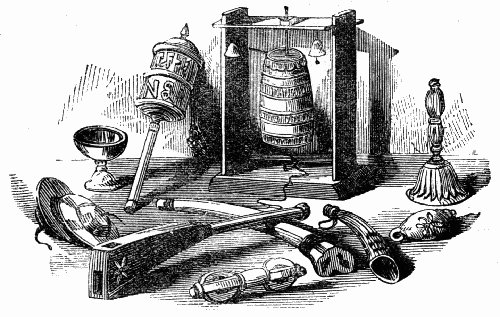
The above sketch places before us the implements generally used in
the Buddhist temples of India:—a praying cylinder in stand, another
to be carried in the hand, cymbals, bell, brass cup, three trumpets (one
of them made of a human thigh-bone), conch, and dorje, or double-headed
thunderbolt, which the Lama, or high-priest, holds in his hand
during service. The praying cylinder is made to revolve by means of
an axle and string, and a projecting piece of iron strikes a little bell at
each revolution. Within such cylinders are deposited written prayers,
and whoever pulls the string properly is considered to have said his
prayers as often as the bell rings. The worshippers, on entering the
temple, walk up to the altar, and, before or after having deposited their
gifts, they lift both hands to the forehead, fall on their knees, and touch
the ground three times with head and hands. They then advance to
the head Lama, kotow similarly to him, and he blesses them, laying
both hands on their heads, and repeating a short formula. Sometimes
the dorje is used in blessing, as the cross is in Europe, and when a
number of people request a benediction, the Lama pronounces it from
the door of the temple with outstretched arms, the people all being
prostrate, with their foreheads touching the ground.
PROCLAMATION FOR THE PERSON OF GEORGE II.
On the young Pretender landing in Scotland, Government issued a
proclamation, offering a reward of £30,000 for his head, alive or dead.
In opposition to this, the following curious paper was issued by the
Prince and his council, which, Mr. Beloe says, "is so rare, that I never
heard of any other than that which accident lately deposited in the
British Museum."
"Charles, Prince of Wales, &c.
Regent of the Kingdoms of Scotland, France, and Ireland, and the
Dominions thereunto belonging,
Whereas, we have seen a certain scandalous and malicious paper,
published in the style and form of a proclamation, bearing date the 1st
instant, wherein, under pretence of bringing us to justice, like our Royal
Ancestor, King Charles I. of blessed memory, there is a reward of
£30,000 sterling promised to those who shall deliver us into the hands of
our enemies, we could not but be moved with a just indignation at so
insolent an attempt; and though, from our nature and principles, we
abhor and detest a practice so unusual among Christian Princes, we
cannot but, out of just regard to the dignity of our person, promise a
like reward of £30,000 sterling to him, or those, who shall seize and
secure till our further orders, the person of the Elector of Hanover,
whether landed, or attempting to land, in any part of his Majesty's
dominions. Should any fatal accident happen from hence, let the blame
be entirely at the door of those who first set the infamous example.
"Charles, P. R.
"Given at our Camp, at Kinlockeill, August 22, 1745.
"By his Highness's Command.
"John Murray."
DOGS IN JAPAN.
Dogs or common curs they have, and in superfluous numbers. These
dogs are as much the pest of the towns of Japan as they are of Constantinople
and the other foul cities and towns of the Ottoman Empire. This
vast increase of the canine species, and the encouragement and immunity
accorded to it, arose (according to the popular account) out of a curious
superstition and an extravagant imperial decree. An Emperor who
reigned at the close of the eighteenth century chanced to be born under
the Sign of the Dog, the Dog being one of the twelve celestial signs of
the Japanese Zodiac. For this reason the Emperor had as great an
esteem for dogs as the Roman Emperor Augustus is reported to have
entertained for rams. When he ascended the throne, he willed and
ordained that dogs should be held as sacred animals; and, from that
time, more puppies saw the light, and were permitted to live in Japan
than in any other country on the face of the earth, Turkey, perhaps,
excepted. These dogs have no masters, but lie and prowl about the
streets, to the exceeding great annoyance of passengers, especially if
they happen to be foreign travellers, or Christians in Christian dresses.
If they come round you in packs, barking, snarling, and showing their
teeth; nay, even if they fall upon you and bite you, you must on no
account take the law into your own hands, and beat them off or shoot
them. To kill one of them is a capital crime, whatever mischief the
brute may have done you. In every town there are Guardians of the
Dogs, and to these officers notice must be given in case of any canine
misdemeanour, these guardians alone being empowered to punish the
dogs. Every street must keep a certain number of these animals, or at
least provide them with victuals; huts, or dog-hospitals, stand in all
parts of the town, and to these the animals, in case of sickness, must be
carefully conveyed by the inhabitants. The dogs that die must be
brought up to the tops of mountains and hills, the usual burying-places
of men and women, and there be very decently interred. Old Kæmpfer
says:—"The natives tell a pleasant tale on this head. A Japanese, as
he was carrying the carcase of a dead dog to the top of a steep mountain,
grew impatient, grumbled, and cursed the Emperor's birthday and
whimsical command. His companion bid him hold his tongue and be
quiet, and, instead of swearing, return thanks to the gods that the
Emperor was not born under the Sign of the Horse, for, in that case, the
load would be heavier."
LAGMI, AND THE USE MADE OF IT.
Mohammed, we are told, prohibited the use of wine, owing to a
drunken quarrel among the chiefs of his army, which produced great
disorder and confusion in his affairs, and almost caused the prophet's
death in one of his daring military engagements. He, therefore, addressed
his followers in these words: "The devil desires to sow dissensions
among you, through wine and games of chance, to divert you from
remembering God, and praying to him. Abandon wine and games of
chance. Be obedient to God and the prophet, his apostle, and take heed
unto yourselves." But the prophet, who could so minutely delineate the
furniture of heaven, and the instruments of torture of hell—who could
describe the mysterious occurrences before the creation was formed into
its present shape, and predict stupendous events to happen in thousands
of years to come—could not forsee that man would stupify himself by any
other beverages besides "wine." The believers in the Koran at Tozar,
a city near the Great Desert, in Africa, certainly abstain from wine, and
thus obey the prophet's precept, but then they indulge freely in lagmi, or
the juice of the palm-tree, which, when fermented, is as pernicious in
its effect, when taken in excess, as the wine possibly can be. This juice
is easily obtained, and more easily still prepared. An incision is made
in the tree, just beneath the branches, and a jar so fastened that it receives
every drop of liquid flowing out. During a night they procure
from a tree "in a producing condition" (in which it is not always) from
a quart to three pints of lagmi. When drunk immediately it tastes
like genuine rich milk, and is perfectly harmless; but when allowed to
stand one night, or, at most, twenty-four hours, it partakes (with the
exception of the colour, which is whitish,) of the quality and flavour of
champagne, and that of a far superior sort than is usually offered in the
British markets. This date-tree wine, (for so it may be called,) procured
at so little trouble and expense, is to be found in every house, and
has its victims reeling through the streets of Tozar, just as the stupifying
porter has in the streets of English cities. But the curious part in
connexion with this is, that "the faithful" persist in their justification
that they do not transgress their prophet's precept! "Lagmi is not
wine," they say, "and the prophet's prohibition refers to wine."
ANGLO-SAXON UMBRELLA.
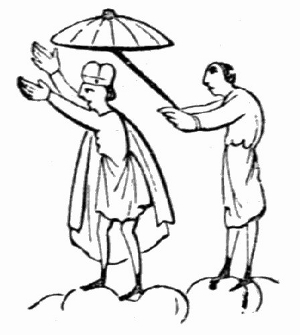
In Anglo-Saxon times the traveller always wore a covering for his
head, which, though in various shapes, in no instance resembled our hat,
though it was characterised by the general term
hæt. He seems to have been further protected
against the inclemency of the weather by a cloak
or (mentel).
One would be led to suppose that
this outer garment was more varied in form and
material than any other part of the dress from
the great number of names which we find applied
to it, such as—basing, hæcce, hæcla, or hacela,
poell, pylca, scyccels, wæfels, &c. The writings
which remain throw no light upon the provisions
made by travellers against rain; for the dictionary
makers who give scur-scead (shower-shade) as
signifying an umbrella are certainly mistaken. Yet that umbrellas were
known to the Anglo-Saxons is proved beyond a doubt by a figure in the
Harleian MSS. which we have engraved above. A servant or attendant
is holding an umbrella over the head of a man who appears to be covered
at the same time with the cloak or mantle.
THE HEJIRA.
The Hejira, Hegira, or Hejra. The flight of Mohammed from Mecca
to Medina is the epoch of the Mohammedan nations. Omar, the second
Caliph, instituted the Hegira in imitation of the Christians, who counted
their years from their persecution by Diocletian, (A.D. 284,) and who
called it the era of the martyrs. Thus the Mohammedans wished to
commence their calculation of time from the period of the most memorable
persecution they had suffered. The learned Mohammedan astronomers
have been divided in opinion on the exact year of the Christians
which corresponds with the Hegira. But the generality of writers place
this epoch on Friday, the 16th of July, A.D. 622. The ancient Arabs
counted time by solar months; these months always returned in the same
season, and their names correspond with the employments which the
seasons rendered necessary. Since the epoch of the Hegira was fixed
the Mohammedans count time by lunar months, the Arabian year consisting
of 354 days, eight hours, and forty-eight minutes. The intercalary
days are adjusted by a cycle of thirty lunar years, of which
nineteen are of 354 days, and eleven of 355 days. The years of excess
are in the following order:—2, 5, 7, 10, 13, 15, 18, 21, 24, 26, 29.
CHINESE PAILOOS.
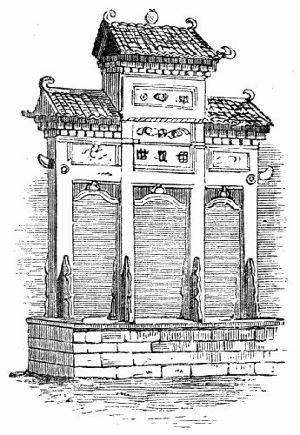
The Pailoos, or, as they are commonly but erroneously called, triumphal
arches, form an object of Chinese architecture which, from its
constant recurrence in views of Chinese scenery, is almost as familiar to
us as the pagoda. They are, in fact, monuments to deceased persons of
distinction, generally of widows who have not married a second time,
or of virgins who have died unmarried.
The smaller and less
important ones consist merely of
two upright posts of wood or
granite, supporting a flat board
with an inscription, like, both in
purpose and design, to the wooden
rails which are used as substitutes
for tombstones in some districts
in England. The more
important Pailoos have three
openings, supported by several
boards, with more or less ornament
and carving. Sometimes
they are wholly of wood; in
others no material is used but
stone, generally granite; and
these two materials are combined
in various proportions in other
examples. Sometimes they are
raised on platforms as in the
annexed example, from a peculiarly
graceful one near Canton.
At other times they are placed
on the ground, and even across
roads, so as to form arches, if they may be called, though certainly not
triumphal ones.
REMARKABLE GROTTO, AND STORY CONNECTED WITH IT.
Near Lunel, in France, on the eastern bank of the river Hérault, is
the grotto, known in this part of the country as la Baume de las
Donmaisellas, or des Fées. This grotto consists of many large, deep
apartments, some of which are indeed inaccessible; the second (and they
are all one below the other), presents to the eye of the beholder four
beautiful pillars, about thirty feet high, terminating at the top like palm
trees; they are detached from the roof, which is only to be accounted
for by supposing that the bottom, or floor, has, in some concussion of
nature, sunk from its original level: the third chamber, still descending,
and like the former only to be reached by ropes and ladders, presents, at
the farther end, one vast curtain of crystal, to which the lights, carried
on such occasions, give the appearance of all manner of precious stones.
Some of the stalactites of this apartment are solid and white as alabaster,
some clear and transparent as glass; they are of every fantastic form
and description, as well as displaying perfect representations of cascades,
trees, festoons, lances, pillars, fruits, flowers, and even the regular
arrangement of architecture in a cathedral. The fourth chamber is a
long gallery covered with fine sand: beyond this three great pillars present
themselves, and behind, there is a lake of thick muddy water. All
these grottoes have been long known to the peasantry, but another was
lately penetrated, in which every former variety of stalactite was seen, but,
in addition to these was found an altar, white, like fine china, having
regular steps to it, of the same material: it is composed apparently of
layers of the opaque stalactite, of a dazzling white and exquisite polish:
four twisted columns, of a yellow colour and transparent, whose height is
lost in the vast roof; an obelisk, perfectly round, of a reddish colour, of
a great height, and a colossal figure of a woman, holding two children in
her arms, and placed upon a pedestal, completed the astonishment of the
daring explorers of this subterraneous cavern. But alas! this astonishment
was changed into feelings of a more melancholy description, when
they recalled the circumstance, still current in the neighbourhood, that,
during the religious wars, a family (whether Protestant or Catholic is
not ascertained), consisting of a father and mother and one or two children,
sought refuge in these subterraneous grottoes from the persecution
of their enemies, and there preserved a miserable existence, far from the
cruelty of
Man, whom Nature formed of milder clay,
With every kind emotion in his heart,
And taught alone to weep.
For some years they supported themselves with berries, and now and
then they were seen endeavouring to secure a stray kid or goat for food.
The solitude and silence of their almost inaccessible dwelling, imbued
them and their fate with an awful character; and from being objects of
pity, they became at length objects of terror, to the neighbouring
peasantry, who told strange stories of the unfortunate beings thus consigned
to cold and hunger, and compelled to seek a wretched home
within the bowels of the earth. Their spare forms, their pale countenances,
their tattered garments waving in the breeze, all threw a mystic
feeling over their appearance, and they were transformed into fairies and
spectres. The shepherds fled when they appeared, and the children, as
they clung affrighted to their parents, with strained eyes and parted
lips, followed the rapid movements of the mountaineers, as they in their
turn, alarmed at the sight of their fellow-creatures, fled from height to
height, until they gained their rocky asylum. Such an accumulation of
suffering and misery was not, however, calculated to prolong existence:
terror and fear destroyed the mind, as hunger and cold destroyed the
body, and after the lapse of a few years, one by one, these spectres disappeared:
but still they figure in all the local stories and traditions peculiar
to the neighbourhood, under the form of witches, fairies, and
sorcerers. The question is, whether the altar and the figure are not the
work of these unfortunate beings, who might find in this employment a
transitory solace for their misery.
CRUELTY OF HINDOO RITES.
We extract the following account from "The Land of the Veda," as
it affords an extraordinary instance of the lengths to which the fanaticism
of a gross superstition will induce men to proceed:—
"To satisfy ourselves of the sanguinary character of some of the
Hindoo deities, and of the influence they exert over the deluded victims
of superstition, we must witness some of the cruel practices which the
popular goddess, Kali, imposes on her worshippers. The most remarkable
festival is the one called Charak Puja.
"This festival derives its name from chakra, a wheel or discus; in
allusion to the circle performed in the act of rotating, when suspended
from the instrument of this horrible superstition. Being desirous of
witnessing the ceremony in all its parts, I went to the spot where one of
these ceremonies was about to take place. An upright pole, twenty or
thirty feet in height, was planted in the ground, across the top of which,
moving on a pivot, a long pole was placed. From one end of this transverse
beam a long rope was suspended and left to hang loosely, whilst a
shorter rope was attached to the other end, bearing a couple of strong
iron hooks. A good-looking man, perhaps thirty years of age, came from
the midst of the crowd, and doing obeisance beneath the instrument of
torture, presented himself as a candidate for the honour he aspired to.
The attendant, before whom he stood erect, struck a smart blow on the
small of the back, and fixed one of the hooks in the flesh, and then did
the same on the other side. The man then laid hold of the rope just
above the hooks and held it, whilst certain persons in the crowd, seizing
the loose rope, pulled him up, by depressing the other end of the beam.
As he rose he relinquished his hold of the rope by which he was suspended,
and resigned himself to the rotary motion, by which he was
whirled round and round in mid air, suspended by the flesh of his own
body. Whilst he was thus enduring the torture incident to this horrid
service, at once gratifying the cruel goddess Kali and the crowd of
admiring spectators, he drew from his girdle fruits and flowers, which he
scattered among the attendants. These were picked up by the crowd,
with the greatest eagerness, as precious relics that might avail as charms
in cases of personal or domestic extremity. This wretched dupe of a
foul superstition remained in the air at least a quarter of an hour, and,
of course, in his own estimation and in that of the spectators, gained by
this brief infliction a large amount of merit, and consequent title to
certain rewards to be reaped in a future state of being. No sooner had
he descended, than another was ready for the ceremony. These cruel
practices are carried on in various parts of the native town, from day to
day, as long as the festival lasts. It not unfrequently happens that the
ligaments of the back give way, when the man, tossed to an immense
distance, is dashed to pieces. In such cases, the inference is, that the
victim of such accident, by virtue of demerit in a former state of existence,
was not merely unworthy of the privileges attached to this privileged
ceremonial, but destined to expiate his evil deeds by this dreadful
accident."
CURIOUS MUSICAL INSTRUMENT.
The musical instrument which we engrave below, is used in the
Burman empire, and is thus described by Captain Yule, in his "Mission
to Ava," writing from the town of Magwé, in Burmah. The Captain
says;—
"This evening the members of the mission made their first acquaintance
with the Burmese drama; an entertainment which from this time
would occupy a very large place in the daily history of our proceedings
if all were registered.
"The Governor had provided both a puppet play and a regular dramatic
performance for our benefit, and on this first occasion of the kind the
Envoy thought it right that we should visit both.
"Each performance was attended by a full Burmese orchestra. The
principal instruments belonging to this are very remarkable, and, as far
as I know, peculiar to Burmah.
"The chief instrument in size and power is that called in Burmese
pattshaing, and which I can only name in English as a drum-harmonicon.
It consists of a circular tub-like frame about thirty inches high and four
feet six inches in diameter. This frame is formed of separate wooden
staves fancifully carved, and fitting by tenon into a hoop which keeps
them in place. Round the interior of the frame are suspended vertically
some eighteen or twenty drums, or tom-toms, graduated in tone, and in
size from about two and a-half inches diameter up to ten. In tuning the
instrument the tone of each drum is modified as required by the application
of a little moist clay with a sweep of the thumb, in the centre of the
parchment. The whole system then forms a sort of harmonicon, on which
the performer, squatted in the middle, plays with the natural plectra of
his fingers and palms, and with great dexterity and musical effect."
BURMESE MUSICAL INSTRUMENTS.
The two Burmese musical instruments which we here engrave are thus
described by Captain Yule in his "Mission to Ava:"—
"The bamboo harmonicon or staccato is a curious example of the production
of melody by simple and unexpected means. Its use, though
unknown in India, extends throughout the Eastern Archipelago; and
something similar is possessed, I believe, by the negro slaves in Brazil.
Eighteen to twenty-four flat slips of bamboo, about an inch and a half
broad, and of graduated length, are strung upon a double string and
suspended in a catenary over the mouth of a trough-like sounding box.
The roundish outside of the bamboo is uppermost, and whilst the extremities
of the slips are left to their original thickness, the middle part of each
is thinned and hollowed out below. The tuning is accomplished partly
by the regulation of this thinning of the middle part. The scale so formed
is played with one or two drumsticks, and the instrument is one of very
mellow and pleasing tone. Though the materials are of no value, a good
old harmonicon is prized by the owner, like a good old Cremona, and he
can rarely be induced to part with it.
"There was one example at the capital, of a similar instrument formed
of slips of iron or steel. It was said to have been made by the august hands
of King Tharawadee himself, who, like Louis Seize, was abler as a smith
than as a king. The effect was not unpleasing, and strongly resembled
that of a large Geneva musical box, but it was far inferior in sweetness
to the bamboo instrument.
"Another instrument used in these concerts is a long cylindrical guitar
of three strings, shaped like an alligator and so named. It is placed on
the ground before the performer."
DRESS REGULATED BY ACT OF PARLIAMENT.
The foreign knights and visitors who came to Windsor in Edward the
First's reign, and brought with them a continual succession of varying
fashions, turned the heads of the young with delight, and of the old with
disgust. Douglas, the monk of Glastonbury, is especially denunciative
and satirical on this point. He says that in the horrible variety of costume,—"now
long, now large, now wide, now straight,"—the style of
dress was "destitute and devert from all honesty of old arraye or good
usage." It is all, he says, "so nagged and knibbed on every side, and
all so shattered and also buttoned, that I with truth shall say, they seem
more like to tormentors or devils in their clothing, and also in their
shoying and other array, than they seemed to be like men." And the
old monk had good foundation for his complaint; and the Commons
themselves having, what the Commons now have not, a dread of becoming
as extravagant as their betters in the article of dress, actually
sought the aid of Parliament. That august assembly met the complaint
by restricting the use of furs and furls to the royal family and nobles
worth one thousand per annum. Knights and ladies worth four hundred
marks yearly, were permitted to deck themselves in cloths of gold and
silver, and to wear certain jewellery. Poor knights, squires, and damsels
were prohibited from appearing in the costume of those of higher
degree. As for the Commons themselves, they could put on nothing
better than unadorned woollen cloth; and if an apprentice or a milliner
had been bold enough to wear a ring on the finger, it was in peril of a
decree that it should be taken off,—not the finger, but the ring,—with
confiscation of the forbidden finery.
The consequence was that the Commons, being under prohibition to
put on finery, became smitten with a strong desire to assume it; and
much did they rejoice when they were ruled over by so consummate a
fop as Richard of Bordeaux. All classes were content to do what many
classes joyfully do in our own days,—dress beyond their means; and we
find in old Harding's "Cronicle" that not only were
"Yemen and gromes in cloth of silk arrayed,
Sattin and damask, in doublettes and in gownnes."
but that all this, as well as habits of "cloth of greene and scarleteen,—cut
work and brodwar, was all," as the Chronicler expresses it, "for
unpayed;" that is, was not paid for. So that very many among us do
not so much despise the wisdom afforded us by the example of our ancestors
as didactic poets and commonplace honest writers falsely allege them
to do. And those ancestors of Richard the Second's time were especially
given to glorify themselves in parti-coloured garments of white
and red, such being the colours of the King's livery (as blue and white
were those of John of Gaunt); and they who wore these garments, sometimes
of half-a-dozen colours in each, why they looked, says an old
writer, "as though the fire of St. Anthony, or some such mischance,"
had cankered and eaten into half their bodies. The long-toed shoes,
held up to the knee by a chain and hook, were called crackowes, the
fashion thereof coming from Cracrow in Poland. The not less significant
name of "devil's receptacles" were given to the wide sleeves of this
reign, for the reason, as the Monk of Evesham tells us, that whatever
was stolen was thrust into them.
A CAT-CLOCK.
The following curious incident is to be found in Huo's "Chinese
Empire:—
"One day when we went to pay a visit to some families of Chinese
Christian peasants, we met, near a farm, a young lad, who was taking a
buffalo to graze along our path. We asked him carelessly, as we passed,
whether it was yet noon. The child raised his head to look at the sun,
but it was hidden behind thick clouds, and he could read no answer
there. "The sky is so cloudy," said he; "but wait a moment;" and
with these words he ran towards the farm, and came back a few minutes
afterwards with a cat in his arms. "Look here," said he, "it is not
noon yet;" and he showed us the cat's eyes, by pushing up the lids
with his hands. We looked at the child with surprise, but he was evidently
in earnest; and the cat, though astonished, and not much pleased
at the experiment made on her eyes, behaved with most exemplary complaisance.
"Very well," said we; "thank you;" and he then let go
the cat, who made her escape pretty quickly, and we continued our
route.
To say the truth, we had not at all understood the proceeding; but we
did not wish to question the little pagan, lest he should find out that we
were Europeans by our ignorance. As soon as ever we reached the
farm, however, we made haste to ask our Christians whether they could
tell the clock by looking into the cat's eyes. They seemed surprised at
the question; but as there was no danger in confessing to them our
ignorance of the properties of the cat's eyes, we related what had just
taken place. That was all that was necessary; our complaisant neophytes
immediately gave chase to all the cats in the neighbourhood.
They brought us three or four, and explained in what manner they
might be made use of for watches. They pointed out that the pupil of
their eyes went on constantly growing narrower until twelve o'clock,
when they became like a fine line, as thin as a hair, drawn perpendicularly
across the eye, and that after twelve the dilation recommenced.
When we had attentively examined the eyes of all the cats at our
disposal, we concluded that it was past noon, as all the eyes perfectly
agreed upon the point.
We have had some hesitation in speaking of this Chinese discovery, as
it may, doubtless, tend to injure the interest of the clock-making trade,
and interfere with the sale of watches; but all considerations must give
way to the spirit of progress. All important discoveries tend in the first
instance to injure private interests, and we hope, nevertheless, that
watches will continue to be made, because, among the number of persons
who may wish to know the hour, there will, most likely, be some who
will not give themselves the trouble to run after the cat, or who may
fear some danger to their own eyes from too close an examination of
hers."
EARLY ENGLISH HELMET.
The above is a correct representation of a helmet of the latter part
of the twelfth century, resembling those seen on the great seals of
Richard I. The aventaille, or moveable grating for covering the face,
has been lost, but the hinges, staples, and other means of fastening it
still remain. Its form may be seen on the great seals of Henry III.
and Edward I.
ILLUSTRIOUS FARMERS.
Adam was a farmer while yet in Paradise, and after his fall was commanded
to earn his bread by the sweat of his brow. Job, the honest,
upright, and patient, was a farmer, and his firm endurance has passed
into a proverb. Socrates was a farmer, and yet wedded to the glory of
his immortal philosophy. Cincinnatus was a farmer, and the noblest
Roman of them all. Burns was a farmer, and the Muse found him at
his plough, and filled his soul with poetry. Washington was a farmer,
and retired from the highest earthly station to enjoy the quiet of rural
life, and present to the world a spectacle of human greatness. To these
names may be added a host of others, who sought peace and repose in
the cultivation of their earth. The enthusiastic Lafayette, the steadfast
Pickering, the scholastic Jefferson, the fiery Randolph, all found an
El Dorado of consolation from life's cares and troubles, in the green and
verdant lawns that surrounded their homestead.
ANCIENT COUTEAU-DE-CHASSE.
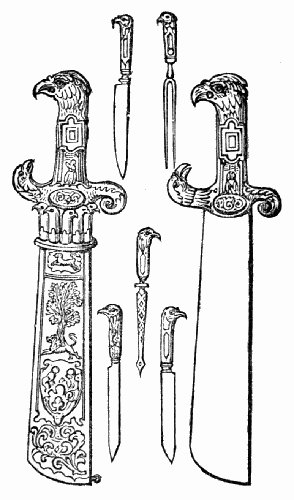
As the chase was regarded as the honourable and most instructive
occupation of an age in which warlike prowess was deemed the principal
object of emulation and applause, every respectable mansion had, in
former times, its hall decorated with hunting implements. One of
these we here present to our
readers.
It is a couteau-de-chasse
of the time of William III. The
left-hand figure represents it in its
sheath, which is highly ornamented;
the other figures represent
the blade drawn, and the
three knives, fork, and bodkin,
which the sheath also contains.
The form is precisely like those
engraved in the "Triumph of
Maximilian," which shows that no
variation had taken place since
the commencement of the sixteenth
century. Erasmus, in his "Praise
of Folly," thus alludes to this
weapon, Kennet translating it "a
slashing hanger." Speaking of
those engaged in the chase, he
says, "When they have run down
their game, what strange pleasure
they take in cutting it up! Cows
and sheep may be slaughtered by
common butchers, but what is
killed in hunting must be broke
up by none under a gentleman,
who shall throw down his hat, fall
devoutly on his knees, and drawing
a slashing hanger (for a common knife is not good enough), after
several ceremonies, shall dissect all the parts as artistically as the best
skilled anatomist; while all that stand round shall look very intently
and seem to be mightly surprised with the novelty, though they have
seen the same an hundred times before; and he that can but dip his
finger and taste of the blood shall think his own bettered by it."
DIVISION OF TIME IN PERSIA.
Time is of no value in Persia, from which reason it must be that so
complicated a system has been maintained as that of counting by solar
time, lunar time, and the Toork cycle. The first is observed by
astronomers, and was in general use in Persia until it was superseded by
Mahommed's lunar year. It consists of twelve months of thirty days
each, with the required number of intercalary days. The second, which
is now in general use, consisting of three hundred and fifty-four days,
is therefore perpetually changing: an event commemorated in one year
will come round ten days earlier the succeeding year. The third is a
curious method of counting introduced by the Toorks into Persia, but
which we are told has been forgotten in Turkey. They divide time into
cycles of twelve years, each year having a separate name, but they have
no designation for the cycles. Thus, if they wanted to describe an
event which happened sixty-five years ago, they could only mention
the name of the fifth year. These years are solar, and are thus
designated:—
| Sichkan eel |
Year of the |
Mouse. |
| Ood eel |
" |
Bull. |
| Bars eel |
" |
Leopard. |
| Tavishkan eel |
" |
Hare. |
| Looee eel |
" |
Crocodile. |
| Eelan eel |
" |
Snake. |
| Yoont eel |
" |
Horse. |
| Kooree eel |
" |
Ram. |
| Beechee eel |
" |
Monkey. |
| Tekhakoo eel |
" |
Cock. |
| Eet eel |
" |
Dog. |
| Tenkooz eel |
" |
Hog. |
It seems strange their number should be twelve, as if there were a
zodiac of years, instead of months.
This method of marking time is preserved only in government documents,
such as firmans, grants, &c. No one seems able to account for
its origin, excepting that, according to tradition, the Toorks of old
brought it from Tartary.
DIFFERENT SORTS OF HORSES IN THE SIXTEENTH CENTURY.
The different sorts of horses in use among the nobility and others, may
be collected from the following entry in the Northumberland household-book,
first printed in the year 1768. It is entitled the regulations and
establishment of Algernon Percy the Earl of Northumberland, 1512.
"This is the ordre of the chequir roule of the nombre of all the horsys
of my lordis and my ladys, that are apoynted to be in the charge of the
hous verely, as to say gentill hors, palfreys, hobys, naggis, clothsek hors.
"First, gentill hors, to stand in my lordis stable, six. Item, palfreys
of my ladys, to wit, oone for my lady, and two for her gentill-women, and
oone for her chamberer. Four hobys and naggis for my lordis oone
saddill, viz. oone for my lorde to ride, oone to led for my lorde, and oone
to stay at home for my lorde. Item, chariot hors to stand in my lordis
stable yerely: Seven great trottynge hors to draw in the chariott, and a
nagg for the chariott-man to ryde, eight. Again, hors for my lorde
Percy, his lordis sonne. A great doble trottynge hors to travel on in
winter. Item, double trottynge hors, called a curtal, for his lordship to
ryde on out of townes. Another trottynge gambaldyn hors, for his lordship
to ryde upon when he comes into townes. An amblynge hors, for
his lordship to journey on daily. A proper amblyng little nag, for his
lordship when he gaeth on hunting or hawkin. A gret amblyng gelding
to carry his male."
The gentill horse was one of superior breed, so called in contrast to
such as were of ordinary extraction.
Palfreys, were an elegant and easy sort of horses, used upon common
occasions by knights, and others, who reserved their great and managed
horses for battle and the tournament.
Hobys, were strong, active horses, of rather a small size. They are
said to be originally natives of Ireland.
Nags were of the same description.
Clothseck, was a cloak-bag horse; as a male horse was one that carried
the portmanteau. Horses to draw the chariots, were waggon horses; from
the French word charrette, whence, the English word cart.
A great double trottynge horse, was a tall, broad horse, whose best
pace was the trot, being too unwieldly to be able to gallop.
A curtail, was a horse whose tail was cut, or shortened.
A gambaldynge horse, was one of shew and parade; a managed horse.
An amblynge horse, received this appellation, from the ease and smoothness
of its pace. In former times almost all saddle horses were broke to
perform it.
THE NAORA.
The Oasis of Tagius or Wodian, in the Desert of Sahara, in Africa,
comprehends these villages—D'kash, Krees, Wozorkan, Owlad, Majed,
Sedadah, Zowiat Elarab, and Sidy Bohlan.
These villages are situated at short distances from each other, numbering
together a population of between 25,000 and 30,000, whose chief
employment consists in cultivating the palm, or date tree. At Kreez
they have an excellent spring, but which does not suffice to water all
their plantations, and hence they are forced to have recourse to the
naora, so common on the coast. The naora is the name given to the
rude, though ingenious contrivance, by means of which, through the
agency of either a camel, a mule, or a horse, water is raised from a deep
well in earthen jars, which, as soon as they have emptied their contents
into a wooden trough, descend for fresh supplies. The water from the
trough is then conducted by the planters into channels and trenches, as
occasion requires. These are again easily diverted, and as soon as it is
considered that the trees in one particular direction have had a sufficient
supply, fresh trenches are opened in another direction, and in this manner
the whole plantation receives the requisite moisture and nourishment.
We here engrave the naora.
The pain and labour which the inhabitants of such an oasis take with
their vast date plantations are immense, but their toil is amply repaid
by the "lord of the vegetable world." Independent of its picturesque
appearance, grateful shade, luscious fruit, and agreeable beverage, it
supplies them with fuel, and wood for the construction of their houses.
From its leaves they manufacture baskets, ropes, mats, bags, couches,
brushes, brooms, fans, &c. From the branches they make fences, stools,
and cages. The kernels, after being soaked in water for two or three
days, are eagerly eaten by camels.
Every palm-tree shoots forth a number of suckers, which are removed
at the proper season and transplanted. With care, these will produce
fruit in about ten years, whereas those raised from kernels will only
yield dates when they reach to the age of twenty. The tree reaches its
vigour at thirty, and continues so till a hundred years old, when it begins
to decline, and decays about the end of its second century. During
its vigorous years, a good tree will produce between twenty and thirty
clusters, each weighing about thirty pounds.
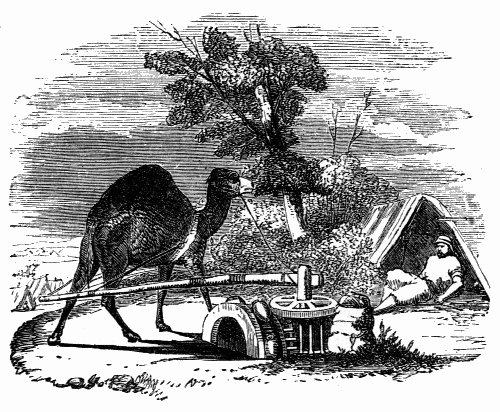
Mr. Morier relates an anecdote, which greatly illustrates how highly
the date-tree is appreciated by those who are from their infancy taught
to value it. An Arab woman who had been in England, and who returned
in the suite of the English ambassador to Persia, on her reaching
home, told her countrywomen of the riches and beauty of the country
she had visited, and described the roads, the carriages, the scenery, the
splendour of the cities, and the fertility of the well-cultivated soil.
Her audience were full of admiration, and had almost retired in envy,
when she happened to mention that there was but one thing wanting to
make the whole almost a Paradise. "And what is that?" said they.
"Why, it has not a single date-tree. All the time that I was there, I
never ceased to look for one, but I looked in vain." The charm was instantly
broken; the Arabs turned away in pity for men, who, whatever
might be their comforts, or their magnificence, were doomed to live in a
country where there are no date-trees.
PRIMITIVE PAIR OF BELLOWS.
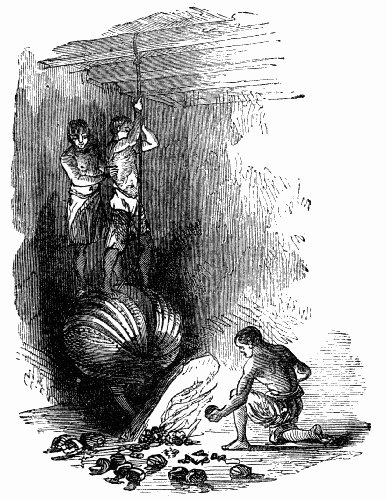
Atmospheric denudation and weathering have produced remarkable
effects on the lower part of the Nonkreem valley, in the Khasia mountains,
in India, which is blocked up by a pine-crested hill, 200 feet
high, entirely formed of round blocks of granite, heaped up so as to
resemble an old moraine; but, like the Nunklow boulders, these are not
arranged as if by glacial action. The granite is very soft, decomposing
into a course reddish sand, that colours the Boga-panee. To procure
the iron sand, which is disseminated through it, the natives conduct
water over the beds, and as the lighter particles are washed away, the
remainder is removed to troughs, where the separation of the ore is
completed. The smelting is very rudely carried on in charcoal fires,
blown by enormous double-action bellows, worked by two persons, who
stand on the machine, raising the flaps with their hands, and expanding
them with their feet, as shown in our cut. There is neither furnace nor
flux used in the reduction. The fire is kindled on one side of an upright
stone (like the head-stone of a grave), with a small arched hole close to
the ground: near this hole the bellows are suspended: and a bamboo
tube from each of its compartments meets in a larger one, by which the
draft is directed under the hole in the stone to the fire. The ore is run
into lumps as large as two fists, with a rugged surface: these lumps are
afterwards cleft nearly in two to show their purity.
PRESERVATION OF DEAD BODIES.
About a mile distant from Palermo in Sicily, is a celebrated Monastery
of Capuchins, in which there is a vault made use of as a receptacle for
the dead. It consists of four wide passages, each forty feet in length,
into which the light is admitted by windows, placed at the ends. Along
the sides of these subterraneous galleries are niches, in which the bodies
are placed upright, and clothed in a coarse dress, with their heads, arms,
and feet bare. They are prepared for this situation by broiling them
six or seven months upon a gridiron, over a slow fire, till all the fat and
moisture are consumed. The skin which looks like pale-coloured leather,
remains entire, and the character of the countenance is, in some degree
preserved.
THE CAGOTS.
In the Department of the Hautes Pyrénées in France is sometimes to
be met with a creature about four feet high, with an enormous head,
stiff, long hair, a pale countenance, a dead-looking eye, legs that have
the appearance of being in the last stage of a dropsy, and an enormous
goitre on the neck, which sometimes hangs down below the stomach.
This unhappy being begs for charity by extending his hand, smiling
vaguely, and by uttering inarticulate sounds or suppressed cries, which
his desolate and degraded situation alone interprets. These Cagots, for
so they are here called, live isolated from the rest of the world; twenty
years ago, if any one of these unfortunate beings left his hut, and ventured
into the towns or villages, the children would exclaim—Cagot!
Cagot! and this cry would bring the smith from his forge, the shopkeeper
from his counter, the private individual from his fireside; and, if
the poor being did not hasten his flight, and slow was his progress, he
not unfrequently lost his life by the stones that were flung after him.
There was, however, one day in the week—Sunday, the Lord's day—and
one asylum—the church, the Lord's house—that was free to them; yet
man there made a distinction between him and his fellow man. A
narrow door, through which no one passed but the Cagots, a chapel,
which no one entered but these unhappy Cagots, was reserved for their
sole use, where they offered up their imperfect prayers, without seeing
or being seen by any one. Even in these days, they are still considered
an outcast race; and an alliance of a peasant girl of the plains with a
Cagot, would excite as much commotion among the inhabitants of the
valleys of the Pyrénées, as the famed one between Idamore and Néala, in
M. Delavigne's celebrated tragedy of the Paria. Yet it is strange that
these deformities do not show themselves until a child has passed the age
of six or seven: he is before this period like other healthy children; his
complexion is fresh, his eye lively, and his limbs in proportion; but at
twelve, his head has increased prodigiously, his complexion has become
sallow, his teeth have lost their whiteness, his eye its fire. Three years
later his skin is shrivelled, his teeth open with difficulty, and he pronounces
all the consonants with a whistling indistinctness, that renders
his language unintelligible to strangers. His mind partakes of the
deformity and weakness of his body, for he is, at fifteen, little better
than an idiot. Such are the Cagots of the Pyrénées.
DISCONTINUANCE OF TORTURE.
Torture had been applied, down to the close of Elizabeth, to the
investigation of all kinds of crime; but after that time it was chiefly
confined to state offences. Its favourite instrument was the dreadful
rack, or break, traditionally said to have been introduced under
Henry VI. by John, Duke of Exeter, constable of the Tower, whence it
was called the Duke of Exeter's daughter. A milder punishment was
inflicted by Skevington's gyves, which compressed the victim closely
together, whilst the rack distended his whole frame in the most painful
manner. In 1588 the manacles were introduced, and soon became the
most usual mode of torture, but their precise character is not well understood.
A variety of instruments of torture are still shown in the Tower,
taken, it is said, out of the Spanish Armada, but at all events admirably
suited to the gloomy dungeon wherein they appear, and in which half-starvation,
and the horrid cells called Little Ease and Rat's Dungeon
(the latter placed below high water mark, and totally dark, so that the
rats crowded in as the tide rose,) added to the sufferings of the poor
victim when released for a brief space from the fell grasp of the prison-ministers.
Torture was not abolished in Scotland till 1708; in France
till 1789; in Russia till 1801; in Bavaria and Wurtemberg till 1806;
in Hanover till 1822; nor in the Grand Duchy of Baden till 1831.
THE MODERN NAMES OF REGIMENTS.
The modern names of regiments were first given to them in the reign
of Charles II., the Coldstreams or Foot Guards being formed in 1660,
when two regiments were added to one raised about ten years before by
General Monk at Coldstream on the borders of Scotland; to these were
added the 1st Royal Scots, brought over from France at the Restoration.
The Life Guards were raised in 1661, with the Oxford Blues (so called
from the first commander, Aubrey, Earl of Oxford); and also the 2nd or
Queen's Foot. The 3rd or Old Buffs were raised in 1665, and the 21st
Foot or Scotch Fusileers (from their carrying the fusil, which was lighter
than the musket), in 1678. In that year the Grenadiers (so named from
their original weapon, the hand grenade) were first brought into our
service, and in 1680 the 4th or King's Own were raised. James II.
added to the cavalry the 1st or King's Regiment of Dragoon's Guards,
and the 2nd or Queen's ditto in 1685; and to the infantry, in the same
year, the 5th and 7th, or Royal Fusileers; and in 1688 the 23rd or
Welsh Fusileers.
WATCH PRESENTED BY LOUIS THE THIRTEENTH OF FRANCE TO CHARLES
THE FIRST OF ENGLAND.
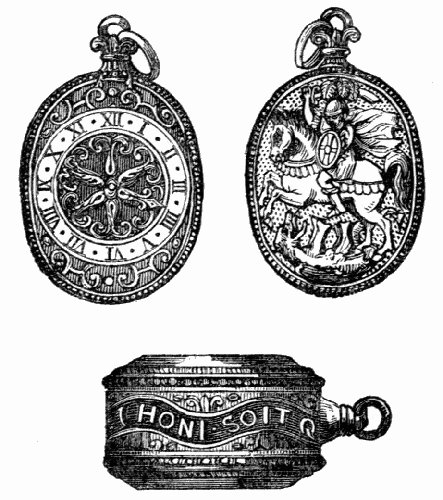
The annexed engraving represents the watch which was made for
Louis XIII. to present to King Charles I. It is of silver, richly gilt,
the ornaments covered with transparent enamel in white, red, green,
blue, and yellow. The numbers are on a band of deep blue; the wheel-like
ornament in the centre on a ruby ground. The back is chased in
high relief with a figure of St. George conquering the Dragon; the
horse is covered with white enamel; the flesh tints on St. George are
also of enamel; his tunic is red, and his scarf blue. On the side of the
watch is the motto of the Order of the Garter; the fleurs-de-lys above
and below it on a ruby ground. The interior of the case is enriched by
a delicately executed arabesque filled with black enamel upon a dotted
ground. The entire works take out of the case, being secured thereto by
springs, and are all more or less decorated with engraving, the whole
interior being chased and gilt. The maker's name is S. Vallin.
A WEDDING A HUNDRED YEARS AGO.
On the 7th June, 1750, was married at Rothbury, Mr. William Donkin,
a considerable farmer, of Tosson, in the county of Northumberland, to
Miss Eleanor Shotten, an agreeable young gentlewoman, of the same
place. The entertainments on this occasion were very grand, there being
provided no less than one hundred and twenty quarters of lamb, forty
quarters of veal, twenty quarters of mutton, a large quantity of beef,
twelve hams, with a suitable number of chickens, which was concluded
with eight half ankers of brandy made into punch, twelve dozen of
cider, and a great many gallons of wine. The company consisted of five
hundred ladies and gentlemen, who were diverted with the music of
twenty-five fiddlers and pipers; and the evening was spent with the
utmost unanimity.
GRACE KNIVES.
There is a curious class of knives, of the sixteenth century, the blade,
of which have on one side the musical notes to the benediction of the
table, or grace before meat, and on the other the grace after meat. We
here engrave a specimen.
The set of these knives usually consisted of four. They were kept in
an upright case of stamped leather, and were placed before the singer
according to the adaptation of each part to the voice indicated upon them.
GARDEN AT KENILWORTH WHEN IN ITS PRIME.
Gossiping Laneham is very eloquent about the Kenilworth Garden, at
which he took a timid and surreptitious peep. It was an acre or more
in extent, and lay to the north of the stately castle: a pleasant terrace,
ten feet high, and twelve feet broad, even under foot and fresh with
trim grass, ran beside it along the castle wall. It was set with a goodly
show of obelisks and spheres, and white bears of stone, raised upon
goodly bases. At each end was a fine arbour, redolent with sweet
trees and flowers. The garden-plot near had fair alleys of turf, and
others paved with smooth sand, pleasant to walk on as the sea-shore
when the wave has just retired. The enclosure was divided into four
even quarters: in the midst of each, upon a base of two feet square,
rose a porphyry square pilaster, with a pyramidical pinnacle fifteen
feet high, pierced and hollowed, and crowned with an orb. All around
was covered with redolent herbs and flowers, varied in form, colour,
and quantity, and mixed with fruit trees.
In the midst, opposite the terrace, stood a square aviary, joined to
the north wall, in height twenty feet, thirteen long, and fourteen broad;
it had four great windows, two in front and two at each end, and each
five feet wide. These windows were arched, and separated by flat
pilasters, which supported a cornice. The roof was of wire net, of
meshes an inch wide; and the cornice was gilded and painted with
representations of precious stones. This great aviary had also eaves in
the wall, for shelter from sun and heat, and for the purpose of building.
Fair holly trees stood at each end, on which the birds might perch and
pounce. They had a keeper to attend to their seeds and water, and to
clean out their enclosure. The birds were English, French, and
Spanish. Some were from America; and Laneham is "deceived" if
some were not from the Canary Islands.
In the centre of this miniature Paradise stood a fountain with an
octagonal basin rising four feet high; in the midst stood the figures of
two Athletes, back to back, their hands upholding a fair marble bowl,
from whence sundry pipes distilled continual streams into the reservoir.
Carp, tench, bream, perch, and eel disported in the fresh falling water;
and on the top of all the ragged staff was displayed; on one side
Neptune guided his sea-horses with his trident, on another stood Thetis
with her dolphins. Here Triton and his fishes, there Proteus and his
herds, Doris and her daughter, and half the Nereids, disported in sea
and sand, surrounded by whales, sturgeons, tunnies, and conch shells,
all engraven with exquisite device and skill. By the sudden turn of a
tap, the spectator could be drenched at the pleasure of any wit.
EGYPTIAN ANTIQUITIES.
It appears from a paper recently read in the Academy of Archæology,
at Rome, that Father Secchi has found a new interpretation of the Egyptian
hieroglyphics, which enables him to declare, that most of them are
not mere tombstone inscriptions, as is generally assumed, but poems.
He has given several of his readings, which display great ingenuity, and
professes to be able to decipher the inscriptions on the Obelisk of Luxor,
at Paris.
THE BAYEUX TAPESTRY.
The cathedral at Bayeux is a gothic building, dedicated to the Virgin.
The portal and three belfries, which belong to it, are objects of curiosity.
It is in this cathedral that the celebrated tapestry, denominated of
Bayeux, is kept. Its length is one hundred and thirty-two feet; its
breadth, seven and a half. "I had," says Dr. Ducarel, "the satisfaction
of seeing that famous piece of furniture, which, with great exactness,
though in barbarous needlework, represents the history of Harold,
King of England; and of William, Duke of Normandy; from the embassy
of the former to Duke William, at the command of Edward the
Confessor, to his overthrow and death, at the battle fought near Hastings.
The ground of this piece of work is a white linen cloth, or canvas. The
figures of men, horses, &c. are in their proper colours, worked in the
manner of the samplers, in worsted, and of a style not unlike what we
see upon the China and Japan ware; those of the men, particularly,
being without the least symmetry or proportion. There is a small border,
which runs at the top and the bottom of the tapestry; with several figures
of men, beasts, flowers, and even fables, which have nothing to do with
the history, but are mere ornaments. At the end of every particular
scene there is a tree, by way of distinction; and over several of the principal
figures there are inscriptions, but many of them obliterated. It is
annually hung up on St. John's day, and goes round the nave of the
church, where it continues eight days; and at all other times it is carefully
kept locked up in a strong wainscot press, in a chapel on the south
side of the cathedral, dedicated to Thomas à Becket. By tradition it is
called, Duke William's toilet, and is said to be the work of Matilda, his
queen, and the ladies of her court, after he had obtained the crown of
England." Mr. Strutt, in his "Complete View of the Dresses and
Habits of the People of England," affirms, that it is the work of half a
century later than the time of the Conqueror.
ROMAN STAMP.
This curiosity is preserved in the British Museum. It is the very
earliest specimen we possess of printing, by means of ink or any similar
substance. It is made of metal, a sort of Roman brass; the ground of
which is covered with a green kind of verdigris rust, with which antique
medals are usually covered. The letters rise flush up to the elevation of
the exterior rim which surrounds it. Its dimensions are, about two
inches long, by one inch broad. At the back of it is a small ring for the
finger, to promote the convenience of holding it. As no person of the
name which is inscribed upon it is mentioned in Roman History, he is
therefore supposed to have been a functionary of some Roman officer, or
private steward, and who, perhaps, used this stamp to save himself the
trouble of writing his name. A stamp somewhat similar, in the Greek
character, is in the possession of the Antiquarian Society, of Newcastle-on-Tyne.
TYRIAN PURPLE.
The shell-fish portrayed on next page is that from which the Tyrian purple
dye is obtained. The ancients were very devoid of chemical knowledge;
their list of adjective dye-stuffs was therefore restricted, and all the
most celebrated dyes of antiquity belonged to the substantive division,
of which Tyrian purple was undoubtedly the chief. The purple dye of
Tyre, which admits with great propriety of being included amongst the
dyes of Greece and Rome, was discovered about fifteen centuries before
the Christian era, and the art of using it did not become lost until the
eleventh century after Christ. It was obtained from two genera of one
species of shell-fish, the smaller of which was denominated buccinum,
the larger purpura, and to both the common name murex was applied.
The dye-stuff was procured by puncturing a vessel in the throat of the
larger genus, and by pounding the smaller entire. Having been thus
extracted, salt was added, also a certain amount of water. The whole
was then kept hot about eight or ten days in a vessel of lead or tin, the
impurities as they rose being assiduously skimmed off. The dye-stuff
was now ready to receive the texture to be dyed (wool, universally), and
the operation of dyeing was simple enough; nothing further being
required than the immersion of the whole for a sufficient time, when, at
the expiration of a certain period, the whole of the colouring matter
was found to have been removed, and to have combined with the textile
fabric.
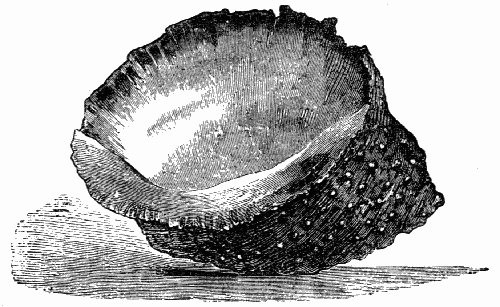
The tints capable of being imparted by this material were various—representing
numerous shades between purple and crimson. Amongst
these a very dark violet shade was much esteemed, but the right
imperial tint, we are informed, was that resembling coagulated blood.
The discovery of Tyrian purple dye is referred to the fifteenth century
before Christ. That it was known to the Egyptians, in the time of
Moses, is sufficiently obvious from the testimony of more than one
scriptural passage. Ultimately, in later ages, a restrictive policy of the
eastern emperors caused the art to be practised by only a few individuals,
and at last, about the commencement of the twelfth century,
when Byzantium was already suffering from attacks without, and dissensions
within, the secret of imparting the purple dye of Tyre
became lost.
The re-discovery of Tyrian purple as it occurred in England was
made by Mr. Cole of Bristol. About the latter end of the year 1683,
this gentleman heard from two ladies residing at Minehead, that a
person living somewhere on the coast of Ireland, supported himself by
marking with a delicate crimson colour the fine linen of ladies and
gentlemen sent him for that purpose, which colour was the product of
some liquid substance taken out of a shell-fish. This recital at once
brought to the recollection of Mr. Cole the tradition of Tyrian purple.
He, without delay, went in quest of the shell-fish, and after trying
various kinds without success, his efforts were at length successful.
He found considerable quantities of the buccinum on the sea-coast of
Somersetshire, and the opposite coast of South Wales. The fish being
found, the next difficulty was to extract the dye, which in its natural
state is not purple, but white, the purple tint being the result of
exposure to the air. At length our acute investigator found the dye
stuff in a white vein lying transversely in a little furrow or cleft next
to the head of the fish.
THE INCARNATIONS OF VISHNU.
There is a part of the mythology of India which seems to be blended
with the history of that country. It relates to the different avatars of
Vishnu, or his incarnations and appearances on earth.
The first of these avatars has reference to that general deluge of
which all nations have preserved some traditions. Vishnu, we are told,
metamorphosed himself into a fish.
The second incarnation is that of Kourma, or the tortoise. The gods
and the giants, wishing to obtain immortality by eating amourdon,
delicious butter, formed in one of the seven seas of the universe, which
the Indians call sea of milk, transported, by Vishnu's advice, the mountain
of Mandreguivi into that sea: they twisted round it the serpent
Adissechen, and alternately pulling, some by his hundred heads, others
by the tail, they made the mountain turn round in such a manner, as to
agitate the sea and to convert it into butter; but they pulled with such
rapidity, that Adissechen, overcome with weakness, could no longer
endure it. His body shuddered; his hundred trembling mouths made
the universe resound with hisses; a torrent of flames burst from his
eyes; his hundred black pendent tongues palpitated, and vomited forth
a deadly poison, which immediately spread all around. The gods and
giants betook themselves to flight. Vishnu, bolder than the rest, took
the poison, and with it rubbed his body, which became quite blue. It is
in memory of this event, that this colour is given to his image in almost
all the temples.
The gods and the giants, encouraged by Vishnu's example, fell to
work again. After they had laboured a thousand years, the mountain
was on the point of sinking in the sea, when Vishnu, in the form of
a tortoise, quickly placed himself beneath, and supported it. At length
they saw the cow Camadenu, the horse with seven heads, and the
elephant with three trunks, coming out of the sea of milk; also the
tree calpaga vrutcham; Lacshmi, goddess of riches, wife of Vishu;
Saraswadi, goddess of the sciences and of harmony, married to Brama;
Mondevi, goddess of discord and misery, whom nobody would have, and
who is represented riding on an ass, and holding in her hand a banner,
on which a raven is delineated; and, lastly, Danouvandri, the physician,
carrying a vessel full of amourdon, which the gods instantly seized, and
greedily devoured, without leaving a morsel. The giants, disappointed
in their expectations, dispersed over the earth, prevented mankind from
paying worship to the gods, and strove to obtain adoration for themselves.
Their insolence occasioned the subsequent incarnations of
Vishnu, who endeavoured to destroy this race, so inimical to the gods.
He is adored in this second metamorphosis, by the name of Kourma
Avatara. The followers of Vishnu believe that this god, though omnipresent,
resides more particularly in the vaicondom, his paradise, amidst
the sea of milk, reclined, in contemplative slumber, on the serpent
Adissechen, which serves him for a throne: in this state he is called
Siranguan. In all the temples of Vishnu is to be seen the figure of this
god; but as the serpent on which he lies cannot be represented with his
hundred heads, he is delineated with only five.
There are altogether ten incarnations of Vishnu; nine of these have
already been fulfilled, and one is yet to be manifested, it is expected
about ninety thousand years hence. The account of many of the transformations
is exceedingly extraordinary, but we have room for no more
than the one we have given.
ORIGIN OF LONG-TOED SHOES.
Long-toed shoes were invented by Fulk, Count of Anjou, to hide an
excrescence on one of his feet. These toes were so long as to be fastened
to the knees with gold chains, and carved at the extreme point with
the representation of a church window, a bird, or some fantastic device.
THE HOUSE OF HEN'S FEATHERS.
There exists at Pekin a phalanstery which surpasses in eccentricity all
that the fertile imagination of Fourier could have conceived. It is
called Ki-mao-fan—that is, "House of the Hen's Feathers." By dint
of carrying out the laws of progress, the Chinese have found means to
furnish to the poorest of the community a warm feather-bed, for the
small consideration of one-fifth of a farthing per night. This marvellous
establishment is simply composed of one great hall, and the floor of this
great hall is covered over its whole extent by one vast thick layer of
feathers. Mendicants and vagabonds who have no other domicile come
to pass the night in this immense dormitory. Men, women, and children,
old and young, all without exception, are admitted. Communism
prevails in the full force and rigour of the expression. Every one settles
himself and makes his nest as well as he can for the night in this ocean
of feathers; when day dawns he must quit the premises, and an officer
of the company stands at the door to receive the rent of one sapeck each
for the night's lodging. In deference no doubt to the principle of
equality, half-places are not allowed, and a child must pay the same as
a grown person.
On the first establishment of this eminently philanthropic and moral
institution, the managers of it used to furnish each of the guests with a
covering, but it was found necessary to modify this regulation, for the
communist company got into the habit of carrying off their coverlets to
sell them, or to supply an additional garment during the rigorous cold
of winter. The shareholders saw that this would never do, and they
should be ruined, yet to give no covering at all would have been too
cruel, and scarcely decent. It was necessary therefore to find some
method of reconciling the interests of the establishment with the comfort
of the guests, and the way in which the problem was solved was this.
An immense felt coverlet, of such gigantic dimensions as to cover the
whole dormitory, was made, and in the day time suspended from the
ceiling like a great canopy. When everybody had gone to bed, that is
to say, had lain down upon the feathers, the counterpane was let down
by pulleys; the precaution having been previously taken to make a number
of holes in it for the sleepers to put their heads through, in order to
escape the danger of suffocation. As soon as it is daylight, the phalansterian
coverlet is hoisted up again, after a signal has been made on the
tam-tam to awaken those who are asleep, and invite them to draw their
heads back into the feathers, in order not to be caught by the neck and
hoisted into the air with the coverlet. This immense swarm of beggars
is then seen crawling about in the sea of dirty feathers, and inserting
themselves again into their miserable rags, preparatory to gathering into
groups, and dispersing about the various quarters of the town to seek by
lawful or unlawful means their scanty subsistence.
THE USEFUL AND THE BEAUTIFUL.
The tomb of Moses is unknown; but the traveller slakes his thirst at
the well of Jacob. The gorgeous palace of the wisest and wealthiest of
monarchs, with cedar, and the gold, and ivory, and even the great
Temple of Jerusalem, hallowed by the visible glory of the Deity himself,
are gone; but Solomon's reservoirs are as perfect as ever. Of the ancient
architecture of the Holy City, not one stone is left upon another, but the
Pool of Bethsaida commands the pilgrim's reverence, at the present day.
The columns of Persepolis are mouldering into dust; but its cistern and
aqueducts remain to challenge our admiration. The golden house of
Nero is a mass of ruins, but the Aqua Claudia still pours into Rome its
limpid stream. The Temple of the Sun, at Tadmore, in the wilderness,
has fallen, but its fountain sparkles in its rays, as when thousands of
worshippers thronged its lofty colonnades. It may be that London will
share the fate of Babylon, and nothing be left, to mark it, save mounds
of crumbling brickwork. The Thames will continue to flow as it does
now. And if any work of art should rise over the deep ocean, time, we
may well believe, that it will be neither a palace nor a temple, but some
vast aqueduct or reservoir; and if any name should flash through the
mist or antiquity, it would probably be that of the man, who in his day,
sought the happiness of his fellow men, rather than glory, and linked
his memory to some great work of national utility or benevolence. This
is the true glory which outlives all others, and shines with undying
lustre from generation to generation, imparting to works some of its
own immortality, and in some degree rescuing them from the ruin which
overtakes the ordinary monument of historical tradition or mere magnificence.
CROMWELL'S BRIDGE AT GLENGARIFF.
The village of Glengariff, near Bantry Bay, consists of but a few
houses. The only "antiquity" in the immediate neighbourhood is the
old bridge, now a picturesque ruin, which, in ancient times, was on the
high road to Berehaven; it is called "Cromwell's Bridge." It is
accurately represented in the above engraving. History being silent as
to the origin of the name, we must have recourse to tradition. When
Oliver was passing through the glen, to "visit" the O'Sullivans, he had
so much trouble in getting across the narrow but rushing river, that he
told the inhabitants, if they did not build him a bridge by the time he
returned, he would hang up a man for every hour's delay he met with.
"So the bridge was ready agin he come back," quoth our informant;
"for they knew the ould villian to be a man of his word."
THE TURBAN IN ARABIA.
A fashionable Arab will wear fifteen caps one above another, some of
which are linen, but the greater part of thick cloth or cotton. That
which covers the whole is richly embroidered with gold, and inwrought
with texts or passages from the Koran. Over all there is wrapped a
sash or large piece of muslin, with the ends hanging down, and ornamented
with silk or gold fringes. This useless encumbrance is considered
a mark of respect towards superiors. It is also used, as the
beard was formerly in Europe, to indicate literary merit; and those
who affect to be thought men of learning, discover their pretensions by
the size of their turbans. No part of Oriental costume is so variable as
this covering for the head. Niebuhr has given illustrations of forty-eight
different ways of wearing it.
STONEWARE.
Stoneware was made at a very early period in China, and is much
used as a basis on which a paste of porcelain is laid, to save the expenditure
of the latter material, as well as to give strength and solidity to
the piece. Most of the larger pieces of Oriental production are found to
be thus formed. The red Japan ware is a very fine unglazed stoneware,
and has raised ornaments, which are sometimes gilt. A curious coffee-pot
of this ware, imitating a bundle of bamboo canes, and not unlike the
Chinese musical instrument called a mouth-organ, from the collection of
the late Mr. Beckford, is here represented.
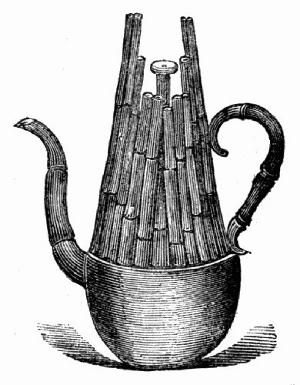
Stoneware is supposed to have
been made at a very early period in
England by Dutch and German
workmen; and from this circumstance
it is almost impossible to distinguish
the earlier fabrics of these
respective countries. The discovery,
in 1690, of an economical process of
glazing this ware by means of common
salt, which made it impermeable
to liquids, soon brought it into
general use, and displaced all the
manufactures of the Delft and soft
paste fabrics. A mottled-brown
stoneware, known to collectors, is
stated to be the manufacture of the
age of Edward VI., in consequence of
some of the specimens having a silver mounting of the make and fashion
of the period of Elizabeth's reign. There is also a large flagon in the
Museum of Economic Geology, ornamented with the royal arms of Elizabeth
in relief, with the date 1594. These specimens cannot, however,
be deemed conclusive of so early a manufacture in England. The first-mentioned
specimens, though the mounting is English, may have been
of German manufacture, as pieces of similar description of ware are to
be seen in various collections of German pottery abroad. The latter
specimen may either have been made at Cologne for the use of the Queen's
household, or if of English manufacture, it must, in the opinion of a
very eminent manufacturer, have been made at a much later period than
the date upon it. In a letter received, he states "that it is a common
practice even now among potters to use moulds of all dates and styles,
which have been got up originally for very different kinds of ornamental
work, and that he is strongly inclined to think that the mould from
which the devices on this vessel have been pressed, was modelled many
years before the vessel was made, and that the vessel itself is comparatively
modern." Stoneware, ornamented with devices in white clay,
was made in the seventeenth century at Fulham, also at Lambeth, and
subsequently at Staffordshire; but there is no satisfactory evidence of
any earlier manufactory in England.
Towards the end of the seventeenth century, some specimens of red
Japan ware were imported into Europe. Both Dutch and English manufacturers
attempted to imitate them, but failed for want of the proper
clay. About this period, two brothers of the name of Elers, from Nuremberg,
discovered at Bradwell, only two miles distant from Burslem, a bed
of fine compact red clay, which they worked in a small manufactory,
established in a retired situation upon the bed itself. They took every
precaution to prevent any one seeing their process or learning their
secret. They went so far as to employ none but the most ignorant and
almost idiot workmen they could find. Astbury, the elder, had the
talent to counterfeit the idiot, and, moreover, the courage to persevere in
this character for some years during which he continued in their employ.
From memory he made notes of the processes, and drawings of the
machinery used. In consequence of the secret being thus discovered,
numerous establishments arose in competition with that of the Elers,
and, owing to the general prejudice against them as foreigners, they
were finally compelled, in 1720, to quit their establishment. They retired
to the neighbourhood of London, and, it is supposed, contributed
by their skill and industry to the establishment of the Chelsea Porcelain
Manufactory.
GREAT BELL OF ROUEN.
The grand entrance to the cathedral of Rouen is flanked by two towers,
the one was erected by St. Romain; the expense for constructing the
other, which bears the whimsical name of Tour-de-beurre, was raised by
the product arising from permissions granted to the more wealthy and
epicurean part of the inhabitants of the city, to eat butter in Lent. It
was in this tower that the celebrated bell, the largest in the world, was
erected; it weighed 40,000 lbs.; it was converted into cannon in the year
1793. The founder of this bell died of joy on seeing its completion. It
went by his name, that of George D'Amboise, and round it was the
following distich in gothic characters:—
"Je suis nomme George d'Amboise,
Qui bien trente-six-mille poise,
Et celui qui bien me pesera,
Quarante mille trouvera."
VARIATIONS IN THE COINAGE.
Henry VIII. greatly debased both his gold and silver coins, which he
alloyed with copper to a great extent. The proportions of the pound,
indeed, in 1546, amounted to 8 oz. of alloy to 4 oz. of silver, which constituted,
a positively base coin, the old allowance having been but 18
pennyweights of alloy to 11 oz. and 2 pennyweights of silver. His depreciations
were equally daring, for out of the pound of silver he now coined
576 pennies or 48s. The gold coins of this monarch were sovereigns,
half-sovereigns or rials, half and quarter rials, angels, half and quarter
angels, George nobles, and forty-penny pieces. In this reign the immemorial
privileges of the sees of Canterbury, York, and Durham, for coining
small money, was abandoned, the last Bishop that used it being
Wolsey's successor, Edward Lee.
Edward VI. carried both depreciation and debasement still farther;
but towards the close of his reign he was obliged to restore the currency
to something like the ancient standard. He was the first that issued
crowns, half-crowns, and sixpences. Little alterations were made by
Mary, beyond striking coins with her husband's head as well as her own;
but under Elizabeth the coinage was, at length, completely recovered
from its debasement, the old proportion of 18 pennyweights of alloy
being restored, which has continued to the present day. The number of
shillings struck out of a pound of silver was not lessened, however, for
it continued to be sixty, as in the preceding reign, till 1601, when it
was increased to sixty-two, at which rate it went on to 1816, when it
was raised to sixty-six, at which it now remains. Her gold coins are
much the same as before, but are distinguished by having the edges
milled for the first time. Shortly before her death she had intended to
coin farthings and other small pieces of copper, a metal which had not
yet been made use of in this country.
CHAFFINCH CONTEST.
At the town of Armentières, in France, there is a fête du pays, called
hermesse, or ducasse d'Armentières, in which the chaffinch and its fellows
are the chief actors and objects of attraction. Numbers of these birds are
trained with the greatest care, and no small share of cruelty, for they are
frequently blinded by their owners, that their song may not be interrupted
by any external object. The point upon which the amusement,
the honour, and the emolument rests, is, the number of times which a
bird will repeat his song in a given time. A day being fixed, the amateurs
repair to the appointed place, each with his bird in a cage. The
prize is then displayed, and the birds are placed in a row. A bird-fancier
notes how many times each bird sings, and another verifies his notes.
In the year 1812, a chaffinch repeated his song seven hundred times in
one hour. Emulated by the songs of each other, they strain their little
"plumed throats," as if conscious that honour was to result from their
exertions.
EXPENSIVENESS OF DRESS IN THE TIME OF JAMES I.
Dress, indeed, must have swallowed up almost every thing at a time
when James and his courtiers set the fashion of appearing in a new garb
almost every day. When the Duke of Buckingham was sent to France to
bring over Henrietta Maria, he provided, amongst others, one suit of
white uncut velvet, and a cloak set all over with diamonds, valued at
£80,000; besides a feather made of great diamonds, and sword, girdle,
hat-band, and spurs, thick set with the same. Another suit of purple
satin, embroidered all over with pearls, was valued at £20,000. At the
marriage of the Princess Elizabeth with the Palatine, Lady Wotton wore
a gown profusely ornamented with embroidery that cost £50 a yard;
and Lord Montague spent £1,500 on the dresses of his two daughters for
that occasion. By this account it would seem that the ladies were, at
all events, not more expensive in their attire than gentlemen.
INGENUITY OF THE TUNISIANS.
A stranger visiting a city like Tunis, cannot but be struck with the
various peculiarities, which present themselves to his view, wherever he
turns. In their government, mercantile pursuits, professions and trades,
the Tunisians are centuries behind. But, with all their disadvantages,
the traveller, in traversing their crowded sooks (market places) and serpentine
streets, finds numerous illustrations of the proverb, "Necessity
is the mother of invention." In every workshop some tool, or implement,
presents itself, which is as curious in its formation as it is strange
to see the peculiar use for which it is intended, and the manner in which
it is employed. We may illustrate this by a sketch of a turner.
The extraordinary ingenuity here exhibited by the remarkable use
which the artisan makes of his feet and toes, as well as of his hands,
cannot fail to attract attention; and the display of his lathe and tools
is equally curious.
SHÁNÁR MUSICAL INSTRUMENT.
Two acts seem essential to the demon worship of the Shánárs of Tin-nevelly
(a portion of the aborigines of India)—dancing and bloody
sacrifices. They have no priest. The person who conducts the ceremony,
which is undertaken from choice, is called the rotator of the demon.
The head man of the village, or any other person, male or female, may
officiate. The dress is grotesque, consisting of a sort of coat of various
colours, a cap, and other vestments, arranged so as to strike the spectators
with their comic appearance. In this service several musical instruments
are used, but the most notable among them is one called a bow. It consists
of a bow strung and ornamented with bells. This is placed on a
brazen vessel of a globular form. The bow is struck with a plectrum,
and the bass is produced by the application of an instrument to the
brazen pot, another person keeping time by playing a pair of cymbals,
as seen in the annexed cut.
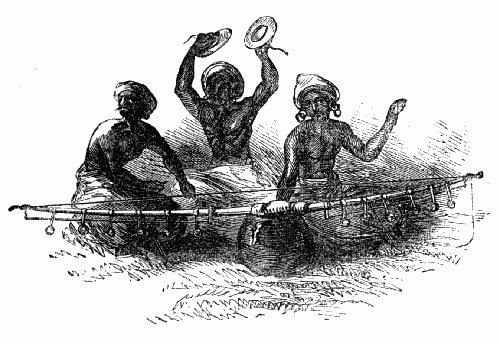
The jarring, discordant, uproarious and cacophonous character of this
musical accompaniment exceeds description, and when the parties are
vieing with each other for pre-eminence, it is indeed the most horrid din
that can be produced. At first the movements of the dancer may be
slow, but as the music waxes louder and takes effect, he becomes gradually
more excited, urging himself to phrenzy by striking himself violently,
and applying his mouth to the neck of the decapitated sacrificial
victim, he drinks its blood, and possibly a potation of ardent spirits.
The afflatus thus acquired, its effects become visible in the frantic glare
and the convulsive gesticulations of the possessed. This is greeted by
the spectators with the loudest acclamations. The dancer is now deified or
demonized, and he is consulted by the eager and delighted worshippers
who do him homage. Each one puts his questions as his fancy or his
needs may dictate. The possessed or demonized dancer, being more like
a maniac than aught else, and subject to various contortions of body,
utters his oracles with much indistinctness, rendering it necessary that
some one initiated into these mysteries should interpret his wild and
incoherent utterances. His ambiguous sayings and curious innuendos are
so indefinite as to need interpretation.
SINGULAR LOCAL CUSTOMS.
In the department of the Hautes Alpes of France, in the commune of
Guillaume-Perouse, at the village of Andrieux, where the inhabitants
are deprived during one hundred days of the bright beams of the sun,
there is a fête, called Le retour du soleil, on the 10th of February. At
the dawn of day, four shepherds announce, to the sound of fifes and
trumpets, the commencement of this joyous day. Every cottager having
prepared an omelette, the eldest inhabitant of the village, to whom the
title of Vénérable is given, leads the way to the square; here they form
a chain and dance the ferandola round him: after the dance is concluded,
he leads the way to a stone bridge at the entrance of the village, the
shepherds playing upon their rural instruments the while. Every one
having deposited his omelette on the stone coping, they repair to a
neighbouring meadow, where the dancing re-commences and continues
until the first rays of the sun gleam athwart the velvet turf: the dance
then instantly ceases, each one hastens for his pancake, and holding it
up, presents it as an offering to the god of day; the Vénérable holds his
up with both his hands. As soon as the sun shines upon the village the
procession returns to the square, where the party separates, and every
one repairs to his own home, to eat his pancake with his family. This
ceremony cannot fail to recal the heathen mythology to the reader, who
must see in it the offerings made to Apollo; or, perhaps, it may be the
remains of some Druidical superstition, as the Druids paid particular
devotion to the sun; at any rate, it is a curious vestige of some religion
long since gone by. In some of the communes of this department the
dead are wrapped in a winding-sheet, but are not inclosed in a coffin.
In the valleys of Queyras and of Grave, the dead are suspended in a
barn during five months in the winter, until the earth be softened by
the sun's rays, when the corpse is consigned to its native element. All
funereal ceremonies are closed by eating and drinking. In some communes
the people carry a flagon of wine to the churchyard; and on the
return of the guests to the home of the deceased, it becomes a scene of
bacchanalian revels, in which the groans and sighs of the mourners
mingle with the songs and jests of the inebriated guests. At Argentiere,
after the burial, the tables are set out round the churchyard; that of
the curate and the mourning family over the grave itself. The dinner
concluded, the nearest relation takes a glass; his example is followed by
the rest, repeating with him, A la santé du pauvre mort.
SEVERITY OF RUSSIAN PUNISHMENTS.
The Russians are remarkable for the severity and variety of their
punishments, which are both inflicted and endured with a wonderful
insensibility. Peter the Great used to suspend the robbers upon the
Wolga, and other parts of his dominions by iron hooks fixed to their ribs,
on gibbets, where they writhed themselves to death, hundreds, nay
thousands, at a time. The single and double knoute were lately inflicted
upon ladies, as well as men of quality. Both of them are excruciating,
but in the double knoute, the hands are bound behind the prisoner's
back; and the cord being fixed to a pulley, lifts him from the ground,
with the dislocation of both his shoulders, and then his back is in a
manner sacrificed by the executioner, with a hard thong, cut from a
wild ass's akin. This punishment has been so often fatal, that a surgeon
generally attends the patient to pronounce the moment that it should
cease. Another barbarous punishment practised in Russia is, first boring
the tongue of the criminal through with an hot iron, and then cutting it
out: and even the late Empress Elizabeth, though she prohibited capital
punishments, was forced to give way to the necessity of those tortures.
From these particulars, many have concluded that the feelings of the
Russians are different from those of mankind in general.
FIRST RHINOCEROS IN EUROPE.
The first rhinoceros ever seen in Europe was that of which Pliny speaks
as having been presented by Pompey to the Roman people. According
to Dion Cassius, Augustus caused another to be killed in the Roman
circus, when celebrating his triumph over Cleopatra. Strabo states that
he saw one at Alexandria, and he has left a description of it. All these
were of the one-horned species. At a later period the two-horned species
were introduced, as appears from medals bearing their effigies struck in
the reign of Domitian. During the time known as the dark ages, investigations
in natural history and every other department of science
and learning were utterly neglected, and the rhinoceros was as mythical
to Europe as the phœnix or the salamander. On the revival of letters,
however, and the extension of maritime discovery, a lively interest was
manifested in the productions of foreign countries. In 1513 the king of
Portugal presented the Roman Pontiff with a rhinoceros captured in
India; but, unfortunately, the ship was wrecked on its way to Italy:
the pope lost his present, and the rhinoceros his life. All that was preserved
was a rough sketch, engraved by Albert Durer; and down to a
very recent date, nearly all our representations were taken from this
rough draft.
In 1685 a rhinoceros was captured and brought to England. In 1739
and 1741 two others were exhibited in various parts of Europe. In
1800 a young one was brought from India, intended for a menagerie at
Vienna, but died at London on the way, and was dissected by Mr.
Thomas, who published the results of his investigations, and thus gave
the public a better idea of the animal than they ever had before.
TURKISH CARRIAGE.
The curiously-shaped vehicle which we have engraved on the next page, is a
Turkish araba, a carriage chiefly used by ladies. An account of one of
them is pleasantly introduced by Mr. Albert Smith in his "Month at
Constantinople" when describing the visit of the Sultan to one of the
mosques:—
"Every Friday the Sultan goes to mosque publicly. It is not known
until the very morning which establishment he means to patronise; but
your dragoman has secret channels of information, and he always informs
you in time to 'assist' at the ceremony.
"The first time I went, Abdul Medjid had selected for his devotions
the mosque of Beglerbeg, a village on the Asiatic side of the Bosphorus,
the temple of which stands in the same relation and bearing to St.
Sophia—to use a very familiar simile—as Rotherhithe Church does to St.
Paul's. It was a perfect English morning—foggy and cold (Oct. 7)
with muddy streets and spitting rain. I crossed into Asia—one learns
to speak of Asia, at Constantinople, as he would do of the borough—in a
two-oared caique, and on landing went up to the mosque, which is close
to the shore.
A crowd of people, consisting principally of females, had collected
before the mosque, and a square space was kept by the soldiers. Some
little courtesy was shown to visitors, as the Franks were permitted to
cross this enclosure to a corner close to the door, by which the Sultan
was to enter.
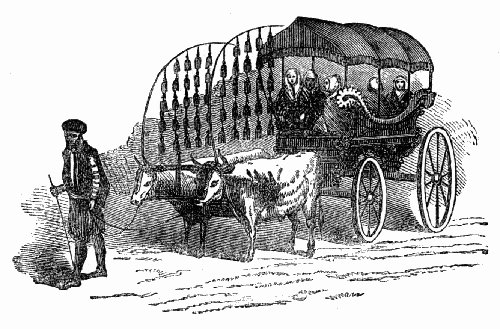
He was not very punctual to his time, but there was enough to amuse
the visitors; more especially in the arrival of the women, who came up
as near as they could to the building, in all sorts of odd vehicles. Several
were like those I had seen on the bridge at Pera, but one was very fine
indeed. It was more like a waggon than a carriage, and painted bright
blue, with red wheels and awning. In it were five ladies of the Sultan's
harem, very gaily dressed, and laughing loudly as the vehicle shook
them about over the rugged road. It was drawn by two buffaloes, and
they had a singular arrangement of worsted tufts over their heads, of
various bright colours. This was the first waggon of the kind I had
seen, but I afterwards found them very common. Other women were on
foot, and a number of these had collected upon a hillock under a tree,
where they talked and quarrelled incessantly. One very pale and handsome
girl arrived alone, in a car, preceded by two or three attendants:
and, whilst trying to pass a narrow thoroughfare amongst the other
vehicles, the wheel of her own got smashed to pieces. She was then close
to the Frank visitors, and, as she appeared likely to be overturned, two
or three gentlemen from Misseri's hotel, ran forward to offer their assistance.
In a minute they were put back by the attendants, who could not
think of allowing their mistress to be touched, even from chance, by a
Christian. The carriage was propped up, as well as it could be; and its
inmate, who had remained perfectly tranquil during the accident, fixed
her large eyes on the enclosure, and never moved them again, to the
right or left."
CURIOUS INDIAN COMB.
At the foot of the Himalayas, and not far from the European station
of Darjeeling, there is a tract of country which is still inhabited by a
tribe of very ancient origin, called the Mechs; they are rapidly degenerating,
and indeed may be said to be even now almost worn out as a
distinct tribe. They are but rarely visited by Europeans; but Dr.
Hooker inspected their district in 1850, and gives the following brief
description of its appearance:—
"We arrived on the third day at the Mechi river, to the west of
which the Nepal Morung begins, whose belt of Sal forest loomed on the
horizon, so raised by refraction as to be visible as a dark line, from the
distance of many miles. It is, however, very poor, all the large trees
having been removed. We rode for several miles into it, and found the
soil dry and hard, but supporting a prodigious undergrowth of gigantic
harsh grasses that reached to our heads, though we were mounted on
elephants. Tigers, wild elephants, and the rhinoceros are said to be
found here; but we saw none.
"The old and new Mechi rivers are several miles apart, but flow in
the same depression, a low swamp many miles broad, which is grazed at
this season, and cultivated during the rains. The grass is very rich,
partly owing to the moisture of the climate, and partly to the retiring
waters of the rivers; both circumstances being the effects of proximity
to the Himalayas. Hence cattle (buffaloes and the common humped cow
of India) are driven from the banks of the Ganges 300 miles to these
feeding grounds, for the use of which a trifling tax is levied on each
animal. The cattle are very carelessly herded, and many are carried off
by tigers."
We give a sketch on previous page of a pocket-comb which Dr. Hooker
obtained from one of the natives: it is, at all events, much more tasteful
in its form and ornamentation than the usual run of English pocket-combs.
SINGULAR HINDOO VOW.
The following extraordinary vow is performed by some of the Hindoo
at their festival of Charak Puja:—Stretching himself on the earth on
his back, the devotee takes a handful of moist earth, and placing this on
his under lip, he plants in it some mustard-seed, and exposes himself to
the dews of the night and the heat of the day till the seed germinates.
In this posture the man must lie in a fixed motionless condition, without
food or drink, till the vegetable process liberates him, which will generally
be about the fourth day.
THE ARRANGEMENT OF ABBEY BUILDINGS.
At the dissolution of the Abbeys in England, under King Henry VIII.,
190 were dissolved, of from £200 to £35,000 a year; amounting to an
aggregate sum of £2,853,000 per annum. The principal buildings of an
Abbey, were, first, the church, differing little from one of the cathedrals
of the present day. Attached to one side of the nave, commonly the
southern, was, secondly, the great cloister, which had two entrances to
the church, at the eastern and western ends of the aisles of the nave, for
the greater solemnity of processions. Over the western side of the
cloister, was, thirdly, the dormitory of the monks; a long room, divided
into separate cells, each containing a bed, with a mat, blanket, and rug,
together with a desk and stool, and occupied by a monk. This apartment
had a door, which opened immediately into the church, on account
of midnight offices. Attached to the side of the cloister, opposite to the
church, was fourthly, the refectory, where the monks dined; near to
which, was the locutorium, or parlour, an apartment answering to the
common room of a college, where in the intervals of prayer and study,
the monks sat and conversed. Beyond, was the kitchen and its offices;
and, adjoining to it, the buttery, &c. On the eastern side of the cloisters
was, in the centre, the chapter-house, where the business of the Abbey
was transacted; and near it, the library, and scriptorium, where the
monks employed themselves in copying books. On this side, also, was
the treasury, where the costly plate and church ornaments were kept.
The abbot and principal officers of the convent, had all separate houses,
to the eastward of the cloister; in which part of the building, were
usually the hostelry and question hall—rooms for the entertainment of
strangers; and, also, the apartment of novices. Westward of the cloister
was an outward court, round which was the monks' infirmary, and the
almery. An embattled gatehouse led to this court, which was the principal
entrance of the Abbey. The whole was surrounded with a high
wall, including in its precincts, gardens, stables, granary, &c. Some of
the great Abbeys—as Glastonbury, and Furness—covered sixty acres of
ground. The situation chosen for the site of an Abbey was as different
from that of the castle as the purpose to which it was applied. The one
meant for defence stands boldly on the hill; the other, intended for
meditation, is hid in the sequestered valley. The abbots were originally
laymen and subject to the bishop.
TAME FISH.
In sailing down the river Irawadi, in the neighbourhood of Amarapoora,
the capital of the empire of Burmah, Captain Yule met with some
tame fish, which he thus describes:—
"Having gone over the little island, I returned to my boat, where a
sight awaited me, that I confess astonished me more than anything I
have ever seen before.
"On nearing the island as we descended the river, the headman in
the boat had commenced crying out tet-tet! tet-tet! as hard as he could,
and on my asking him what he was doing, he said he was calling the
fish. My knowledge of Burmese did not allow me to ask him further
particulars, and my interpreter was in the other boat, unwell. But, on
my coming down to the boat again, I found it surrounded on both sides
with large fish, some three or four feet long; a kind of blunt-nosed,
broad-mouthed dog-fish. Of these there were, I suppose, some fifty.
In one group, which I studied more than the others, there were ten.
These were at one side of the boat, half their bodies, or nearly half, protruded
vertically from the water, their mouths all gaping wide. The
men had some of the rice prepared for their own dinners, and with this
they were feeding them, taking little pellets of rice, and throwing these
down the throats of the fish. Each fish, as he got something to eat, sunk,
and having swallowed his portion, came back to the boatside for more.
The men continued occasionally their cry of tet-tet-tet! and, putting
their hands over the gunnel of the boat, stroked the fish on the back,
precisely as they would stroke a dog. This I kept up for nearly half an
hour, moving the boat slightly about, and invariably the fish came at
call, and were fed as before. The only effect which the stroking down
or patting on the back of the fish seemed to have, was to cause them to
gape still wider for their food. During March, I am told, there is a
great festival here, and it is a very common trick for the people to get
some of the fish into the boat, and even to gild their backs by attaching
some gold leaf, as they do in the ordinary way to pagodas, &c. On one
of these fish remains of the gilding were visible. I never was so amused
or astonished. I wished to have one of the fish to take away as a specimen,
but the people seemed to think it would be a kind of sacrilege, so I
said nothing more on the point. The Phoongyis are in the habit of
feeding them daily, I was informed. Their place of abode is the deep
pool formed at the back of the island, by the two currents meeting round
its sides. And it is, it appears, quite a sight, which the people from
great distances come to see, as well as to visit the Pagoda, which is said
to be very ancient and much venerated."
ANCIENT WEAPON.
The formidable weapon which we here
engrave, is a concealed ranseur of the
time of Henry VIII., from Genoa. It
forms one long instrument, but our limits
have compelled us to divide into three
parts. 1, is the butt: 2, the middle; and
3, the point. The upper part is an iron
cylinder, with a cap on the top. This is
opened by touching the bolt seen a little
below it in front, and then, by giving the
weapon a jerk forwards, the blades fly
out, and produce the form of the partisan.
Upon those, on each side, is written, "Al
Segno Del Cor"—"To the mark of the
heart." When in the state seen in the
engraving, the blades are held so firmly
that they cannot be thrust back; and the
only mode of returning them into the
cylinder is by striking the butt end
against the ground, when they instantly
fall in.
This weapon, we apprehend, must have
been more formidable in appearance than
useful in action. Once let a man get a
fair thrust with it at his enemy, and, it is
true, the effect of that one stroke would
be fatal, but in battle it would most probably
prove fatal also to the man who
wielded the weapon, for before he could
have time to draw it back, a comrade of
the wounded man would have plenty of
opportunity to rush in and cut the striker
of the blow down. On seeing this and
other clumsy weapons which were so much
in vogue in former times, we cannot be
surprised that none of them have continued
in use to the present day. Weapons
such as the one we here engrave, have long
been thrown aside, and short weapons
are now only used for all hand to hand
encounters.
THE BABES OF BETHLEHEM.
It is an ancient custom at Norton, near Evesham, Worcestershire, on
the 28th of December (Innocents' Day) to ring a muffled peal, in token
of sorrow for the slaughter of the hapless "babes of Bethlehem," and,
immediately afterwards, an unmuffled peal, in manifestation of joy for
the deliverance and escape of the infant Saviour.
GAUNTLET OF HENRY PRINCE OF WALES.
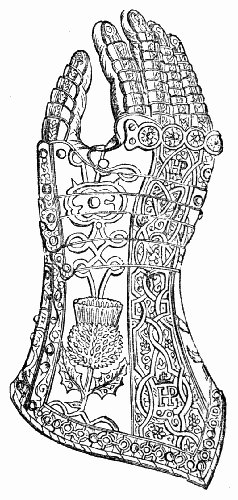
The highly interesting relic of which we here give a sketch is of a
russet colour, engraved and gilt, the ornamental parts being sunk
lower than the surface. The initials of the owner, surmounted by a
coronet, occur in two places, as do also the rose and thistle. Henry
was born on the 19th of February,
1594 and was nine years of age
when his father ascended the throne
of England.
When seven, he commenced
the acquirement of martial
exercises—as the use of the bow,
pike, firearms, and the art of riding;
and at ten applied to Colonel Edmondes
to send him a suit of armour
from Holland. On the discovery of
the Gunpowder Plot, Lord Spencer
made him a present of a sword and
target; and, in 1607, Louis, the
Dauphin, son of Henry IV. of
France, sent him a suit of armour,
well gilt and enamelled, together
with pistols and a sword of the same
kind, and the armour for a horse.
His martial and romantic disposition
displayed itself on the occasion of his
being created Prince of Wales in
1610, when he caused a challenge to
be given to all the knights in Great
Britain, under the name of Mæliades,
Lord of the Isles; and on the day
appointed, the Prince, assisted only
by the Duke of Lenox, the Earls of
Arundel and Southampton, Lord
Hay, Sir Thomas Somerset, and Sir
Richard Preston, who instructed his
Highness in arms, maintained the
combat against fifty-six earls, barons,
knights, and esquires. Henry himself
gave and received thirty-two
pushes of the pike, and about three
hundred and sixty strokes of the sword, not being yet sixteen years of
age. From the size of the gauntlet, the initials H. P., and a prince's
coronet, if not made on this occasion, it could not have been much
anterior; and, from most of his armour being sent from abroad, the
impression would be that it is of foreign manufacture. Yet there is in
the State Paper Office an original warrant ordering the payment of
£200, the balance of £340, for a rich suit of armour made for Henry
Prince of Wales, dated July 11, 1614, he having died on the 6th of
November, 1612. This document is directed by King James I. to the
Commissioners for the exercise of the office of High Treasurer of
England, and states that, "Whereas there was made, in the office of
our armory of Greenwich, by William Pickeringe, our master workman
there, one rich armour with all peeces compleate, fayrely gilt and graven,
by the commaundement of our late deere sonne Prince Henry, which
armour was worth (as we are informed) the somme of three hundred
and forty poundes, whereof the said William Pickeringe hath receaved
of our said late deere sonne the somme of one hundred and forty
poundes only, soe as there remayneth due unto him the somme of two
hundred poundes"—therefore they are ordered to discharge the same
forthwith.
THE SIMOOM.
Arabia is frequently visited by the terrible simoom, called by the
natives shamiel, or the wind of Syria, under whose pestilential influence
all nature seems to languish and expire. This current prevails chiefly
on the frontiers, and more rarely in the interior. It is in the arid plains
about Bussora, Bagdad, Aleppo, and in the environs of Mecca, that it is
most dreaded, and only during the intense heats of summer. The Arabs,
being accustomed to an atmosphere of great purity, are said to perceive
its approach by its sulphureous odour, and by an unusual redness in the
quarter whence it comes. The sky, at other times serene and cloudless,
appears lurid and heavy; the sun loses his splendour, and appears of a
violet colour. The air, saturated with particles of the finest sand, becomes
thick, fiery, and unfit for respiration. The coldest substances change
their natural qualities; marble, iron, and water, are hot, and deceive
the hand that touches them. Every kind of moisture is absorbed; the
skin is parched and shrivelled; paper cracks as if it were in the mouth
of an oven. When inhaled by men or animals, the simoom produces a
painful feeling as of suffocation. The lungs are too rarefied for breathing,
and the body is consumed by an internal heat, which often terminates in
convulsions and death. The carcases of the dead exhibit symptoms of
immediate putrefaction, similar to what is observed to take place on
bodies deprived of life by thunder, or the effect of electricity.
When this pestilence visits towns or villages, the inhabitants shut themselves
up, the streets are deserted, and the silence of night everywhere
reigns. Travellers in the desert sometimes find a crevice in the rocks;
but if remote from shelter, they must abide the dreadful consequences.
The only means of escaping from these destructive blasts, is to lie flat on
the ground until they pass over, as they always move at a certain height
in the atmosphere. Instinct teaches even animals to bow down their
heads, and bury their nostrils in the sand. The danger is most imminent
when they blow in squalls, which raise up clouds of sand in such
quantities, that it becomes impossible to see to the distance of a few
yards. In these cases the traveller generally lies down on the lee side of
his camel; but as the desert is soon blown up to the level of its body,
both are obliged frequently to rise and replace themselves in a new position,
in order to avoid being entirely covered. In many instances,
however, from weariness, faintness, or sleepiness, occasioned by the
great heat, and often from a feeling of despair, both men and animals
remain on the ground, and in twenty minutes they are buried under a
load of sand. Caravans are sometimes swallowed up; and whole armies
have perished miserably in these inhospitable deserts.
BOILING TO DEATH.
One Rouse, who had attempted to poison Fisher, Bishop of Rochester,
who was afterwards murdered in his 77th year, (by Henry VIII.)—was
actually boiled to death in Smithfield, for his offence. The law which
thus punished him, was afterwards repealed.
SIKKIM PRIESTS.
The Sikkim country is situated on the frontiers of Thibet and Nepal
and on a portion of the Himalayas. Dr. Hooker, who visited it a few
years ago, gives the following account in his Journal of some of its
scenery:—"January 1st, 1849.—The morning of the new year was
bright and beautiful, though much snow had fallen on the mountains;
and we left Sunnook for Pemiongchi, situated on the summit of a lofty
spur on the opposite side of the Ratong.
"The ascent to Pemiongchi was very steep, through woods of oaks,
chesnuts, and magnolias, but no tree-fern, palms, pothos, or planntain,
which abound at this elevation on the moister outer ranges of Sikkim.
The temple is large, eighty feet long, and in excellent order, built upon
the lofty terminal point of the great east and west spur, that divides
the Kulhait from the Ratong and Rungbee rivers; and the great
Changachelling temple and monastery stands on another eminence of
the same ridge, two miles further west.
"The view of the snowy range from this temple is one of the finest
in Sikkim; the eye surveying at once glance the vegetation of the
tropics and the poles. Deep in the valleys the river beds are but
3,000 feet above the sea, and are choked with fig-trees, plantains,
and palms; to these succeed laurels and magnolias; and still
higher up, oaks, chesnuts, birches, &c.; there is, however, no marked
line between the limits of these two last forests, which form the prevailing
arboreous vegetation between 4,000 and 10,000 feet, and give a
lurid hue to the mountains. Fir forests succeed for 2,000 feet higher,
when they give place to a skirting of rhododendron and barberry. Among
these appear black naked rocks, between which are gulleys, down which
the snow now descended to 12,000 feet. The mountain flanks are much
more steep and rocky than those at similar heights on the outer ranges,
and cataracts are very numerous, and of considerable height, though
small in volume.
"Pemiongchi temple, the most ancient in Sikkim, is said to be 400
years old; it stands on a paved platform, and is of the same form and
general character as that of Tassisuding. Inside, it is most beautifully
decorated, especially the beams, columns, capitals, and architraves, but
the designs are coarser than those of Tassisuding. The square end of
every beam in the roof is ornamented either with a lotus flower, or with
a Tibetan character, in endless diversity of colour and form, and the
walls are completely covered with allegorical paintings of Lamas and
saints with glories round their heads, mitred, and holding the dorje and
jewel.
"The principal image is a large and hideous figure of Sakya-thoba
in a recess under a blue silk canopy, contrasting with a calm figure of
the late Rajah, wearing a cap and coronet.
"Pemiongchi was once the capital of Sikkim, and called the Sikkim
Durbar: the Rajah's residence was on a curious flat to the south of the
temple, and a few hundred feet below it, where are the remains of (for
this country) extensive walls and buildings. During the Nepal war,
the Rajah was driven east across the Teesta, whilst the Ghorkas
plundered Tassisuding, Pemiongchi, Changachelling, and all the other
temples and convents to the west of that river. It was then that the
famous history of Sikkim, compiled by the Lamas of Pemiongchi, and
kept at this temple, was destroyed, with the exception of a few sheets,
with one of which Dr. Campbell and myself were each presented. We
were told that the monks of Changachelling and those of this establishment
had copied what remained, and were busy compiling the rest
from oral information, &c.: whatever value the original may have
possessed, however, is irretrievably lost. A magnificent copy of the
Buddhist Scriptures was destroyed at the same time; it consisted of 400
volumes, each containing several hundred sheets of Daphne paper."
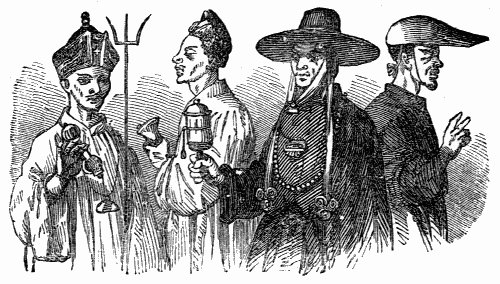
Of the figures given in our article, the one on the extreme left is a
Lama, or Sikkim priest, having in his hand a dorge, or double-headed
thunderbolt; next to him, a monk; next to the monk, a priest, with a
praying cylinder; and at the extreme right, another monk.
A HEAD-BREAKER.
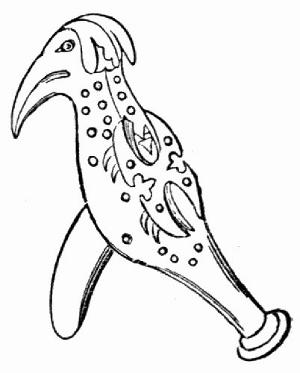
With many savage nations it is a custom when prisoners have been
captured in war, to keep them in confinement for some time, till the
preparations for a grand festival have been
completed, and then to put them to death
in the presence of the great men and chief
priests of the country.
They were
slaughtered, sometimes as offerings to the
gods, sometimes as sacrifices to the spirits
of those slain in the war in which they
were captured, and at other times as incentives
to the young warriors who were to be
the future defenders of the nation. In all
these cases, appropriate and peculiar ceremonies
were prescribed, and the victims
were generally despatched by a particular
official, whose especial duty it was to
perform the bloody deed. A particular
weapon was also used, and one of these is
sketched at the head of our article. It was used by one of the tribes
which inhabit the shores of Nootka Sound. It is intended to represent
the sacred bird of their nation, and is made of wood, inlaid with mother-of-pearl,
with a blade of basalt. The lower end is hollow for the insertion
of a handle.
ANCIENT STONE COLLARS.
Perhaps the most singular relics of that Pagan period in Scotland
when the use of metals was in a great measure unknown, are two stone
collars, found near the celebrated parallel roads of Glenroy, and now
preserved at the mansion of Tonley, Aberdeenshire. We here give an
engraving of them.
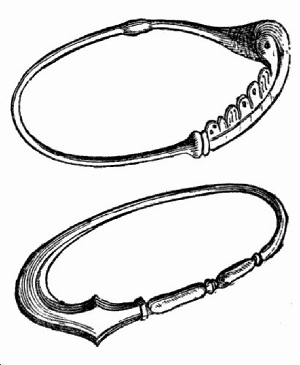
They are each of the full size of a
collar adapted to a small Highland
horse; the one formed of trap or whin-stone,
and the other of a fine-grained
red granite. They are not, however,
to be regarded as the primitive substitutes
for the more convenient materials
of later introduction; on the
contrary, a close imitation of the details
of a horse collar of common materials
is attempted, including the folds, the
leather, nails, buckles, and holes for
tying particular parts together. They
are finished with much care and a high
degree of polish, and are described as
obviously the workmanship of a skilful
artist. Mr. Skene, who first drew
attention to these remarkable relics, suggests the peculiar natural features
of Glenroy having led to the selection of this amphitheatre for the scene
of ancient public games, and that these stone collars might commemorate
the victor in the chariot race, as the tripods, still existing, record the
victor in the Choragic games of Athens. But no circumstances attending
their discovery are known which could aid conjecture either as to the
period or purpose of their construction.
THE OFFSPRING OF DRUNKENNESS.
From an interesting lecture on drunkenness, and on popular investments,
recently delivered by the Rev. J. B. Owen, M.A., of Bilston, we
select this impressive enumeration of the crimes mainly springing from
drunkenness. Drink was the desolating demon of Great Britain. They
had spent in intoxicating drinks during the present century as much as
would pay the national debt twice over! There were 180,000 gin
drinkers in London alone, and in that city three millions a year are
spent in gin! In thirteen years 249,006 males and 183,921 females
were taken into custody for being drunk and disorderly. In Manchester
no less than a million a-year were spent in profligacy and crime. In
Edinburgh there were 1,000 whisky shops—160 in one street—and yet
the city contained only 200 bread shops. Of 27,000 cases of pauperism,
20,000 of them were traceable to drunkenness. In Glasgow the poor
rates were £100,000 a-year. "Ten thousand," says Alison, "get drunk
every Saturday night—are drunk all day Sunday and Monday, and not
able to return to work till Tuesday or Wednesday." Glasgow spends
£1,200,000 annually in drink, and 20,000 females are taken into custody
for being drunk. And what were some of the normal results of such
appalling statistics? insanity, pauperism, prostitution, and crime. As
to the insanity affiliated on drink, the Bishop of London stated, that of
1,271 maniacs, whose previous histories were investigated, 649, or more
than half of them, wrecked their reason in drinking. As to its pauperism,
it is estimated that not less than two-thirds of our paupers were the
direct or indirect victims of the same fatal vice. As to its prostitution,
its debauching influence was remotely traceable in the 150,000 harlots of
London, and in their awful swarms in all our large towns and cities.
Its relation to crime was equally conclusive. In Parkhurst prison, it
was calculated, that 400 out of 500 juvenile prisoners, were immured
there, as the incidental results of parental debauchery. The Chaplain
of the Northampton County Gaol, lately informed the lecturer, that,
"of 302 prisoners in this gaol, during the last six months, 176 attributed
their ruin to drunkenness; 64 spent from 2s. 6d. to 10s. a week in
drink; 15 spent from 10s. to 17s.; and 10 spent all their savings. Is it
not remarkable," he added, "that out of 433 prisoners in this gaol, I
have not had one that has had one sixpence in a saving's bank, nor
above six that ever had sixpence in one? On the contrary, I have many
members of friendly societies, of course of unsound ones, which with
two or three exceptions, all met at public houses; and there they learned
to drink, and became familiarised with crime." Judge Erskine declared
at the Salisbury Assizes in 1844, that 96 cases out of every 100 were
through strong drink. Judge Coleridge added, at Oxford, that he never
knew a case brought before him, which was not directly or indirectly
connected with intoxicating liquors; and Judge Patteson capped the
climax, at Norwich, by stating to the grand jury, "If it were not for
this drinking, you and I should have nothing to do!" Of the 7,018
charges entered at Bow Street Police Office, in the year 1850, half of them
were for being drunk and incapable; and if they added to these the
offences indirectly instigated by intoxication, the proportion rose at least
to 75 per cent.
AN OLD PIKE.
In the year 1497 a giant "Jack-killer" was captured in the vicinity
of Mannheim, with the following announcement in Greek appended to
his muzzle:—"I am the first fish that was put into this pond by the
hands of the Emperor Frederic the Second, on this 3rd day of October,
1262." The age of the informant, therefore, if his lips spoke truth (and
the unprecedented dimensions of the body left little doubt on that
point), was more than two hundred and thirty-five years. Already he
had been the survivor of many important changes in the political and
social world around, and would have swam out perhaps as many more
had the captors been as solicitous to preserve his life as they were to
take his portrait. This, on the demise of the original, was hung up in
the castle of Lautern, and the enormous carcase (which, when entire,
weighed three hundred and fifty pounds, and measured nineteen feet)
was sent to the museum at Mannheim, where, deprived of its flesh, and
caparisoned de novo, it hung, and haply yet hangs, a light desiccated
skeleton, which a child might move.
BURMESE BOAT.
The curious boat which is here depicted in full sail is one of those
which is used by the Burmese on the river Irawadi. They are called
hnau, and Captain Yule gives the following description of them in his
"Mission to Ava:"—
"The model is nearly the same for all sizes, from the merest dinghy
upwards. The keel-piece is a single tree hollowed out, and stretched by
the aid of fire when green, a complete canoe, in fact. From this, ribs
and planking are carried up. The bow is low with beautiful hollow lines,
strongly resembling those of our finest modern steamers. The stern rises
high above the water, and below the run is drawn out fine to an edge.
A high bench or platform for the steersman, elaborately carved, is an
indispensable appendage. The rudder is a large paddle lashed to the
larboard quarter, and having a short tiller passing athwart the steerman's
bench.
"The most peculiar part of the arrangement of these vessels is in the
spars and rigging. The mast consists of two spars; it is, in fact, a pair
of shears, bolted and lashed to two posts rising out of the keel-piece, so
that it can be let down, or unshipped altogether, with little difficulty.
Above the mainyard the two pieces run into one, forming the topmast.
Wooden rounds run as ratlines from one spar of the mast to the other,
forming a ladder for going aloft.
"The yard is a bamboo, or a line of sliced bamboos, of enormous length,
and, being perfectly flexible, is suspended from the mast-head by numerous
guys or halyards, so as to curve upwards in an inverted bow. A
rope runs along this, from which the huge mainsail is suspended, running
on rings like a curtain outwards both ways from the mast. There is a
small topsail of similar arrangement.
"The sail-cloth used is the common light cotton stuff for clothing. Of
any heavier material it would be impossible to carry the enormous spread
of sail which distinguishes these boats. At Menh'lá one vessel was lying
so close to the shore that I was enabled to pace the length of the half-yard.
I found it to be 65 feet, or for the length of the whole spar,
neglecting the curve, 130 feet. The area of the mainsail in this case
could not have been very much less than 4,000 square feet, or one-eleventh
of an acre.
"These boats can scarcely sail, of course, except before the wind. But
in ascending the Irawadi, as on the Ganges during the rainy season, the
wind is almost always favourable. A fleet of them speeding before the
wind with the sunlight on their bellying sails has a splendid though
fantastic appearance. With their vast spreading wings and almost
invisible hulls, they look like a flight of colossal butterflies skimming the
water."
DANCING DERVISHES.
The Dancing Dervishes at Constantinople are a remarkable instance of
the lengths to which superstition and credulity will proceed. The
saltatory ceremony which they perform at their religious services is thus
admirably described by Mr. Albert Smith in his "Month at Constantinople:"—
"I have said it was Friday; and so, on my return, I had an opportunity
of seeing the Dancing Dervishes at Pera. They exhibit—for it is
rather a sight than a solemnity—on this day, as well as on Tuesday, in
every week. Their convent is facing the scrap of burying-ground on the
road from Galata to Pera, and any one may witness their antics. Having
put off our shoes, we entered an octagonal building, with galleries running
round it, and standing places under them, surrounding the railed
enclosure in which the Dervishes were to dance, or rather spin. One
division of this part of the building was put aside for Christians, the
others were filled with common people and children. When I arrived,
one old Dervish, in a green dress, was sitting at one point of the room,
and twenty-four in white, were opposite to him. A flute and drum
played some very dreary music in the gallery. At a given signal they
all fell flat on their faces, with a noise and precision that would have
done honour to a party of pantomimists; and then they all rose and
walked slowly round, with their arms folded across their breasts, following
the old green Dervish, who marched at their head, and bowing twice
very gravely to the place where he had been sitting, and to the spot opposite
to it. They performed this round two or three times. Then the old
man sat down, and the others, pulling off their cloaks, appeared in a
species of long petticoat, and one after the other began to spin. They
commenced revolving precisely as though they were waltzing by themselves;
first keeping their hands crossed on their breast, and then extending
them, the palm of the right hand and the back of the left being
upwards. At last they all got into play, and as they went round and
round, they put me in mind of the grand party we have seen on the top
of an organ, where a cavalier seul revolves by himself, and bows as he
faces the spectators.
"They went on for a long time without stopping—a quarter of an hour,
perhaps, or twenty minutes. There was something inexpressibly sly
and offensive in the appearance of these men, and the desire one felt to
hit them hard in the face became uncomfortably dominant. At the end
of their revolutions they made another obeisance to the old man, and all
this time the players in the orchestra howled forth a kind of hymn.
This ceremony was repeated three or four times, and then they all sat
down again and put their cloaks on, whilst another Dervish, who had
walked round and round amongst the dancers, whilst they were spinning,
sang a solo. During this time their faces were all close to the ground.
This done, they rose and marched before the old green Dervish once
more, kissing his hand as they passed, and the service concluded, occupying
altogether about three-quarters of an hour."
EXTRAORDINARY MALADY.
Digne, the principal town in the department of the Basses Alpes in
France might be passed by the traveller without exciting one observation,
its walks and its warm mineral waters being the only objects
worthy of notice. Its inhabitants do not now exceed 3,500; but, in
the year 1629, 10,000 industrious citizens followed their numerous avocations
within its precincts. At that period, however, an extraordinary
plague broke out, in the month of June, which lasted till October, committing
the most awful ravages, so that in that short space of time the
wretched inhabitants were reduced to the number of 1,500, among
whom six only had escaped this very singular malady, the effects of which
are thus described by a French writer:—"This malady strangely affected
the invalids; some fancied they could fly; others, climb from one object
to another like squirrels; some sunk into a profound lethargy, even for
so long a time as six days; and one young woman who had been hastily
interred in a vineyard, rose three days afterwards, for the grave-diggers
were content just to cover the bodies. During these four months the
town was covered with a thick fog: the heat was suffocating, accompanied
by frequent and dreadful storms; and in order to complete the
horrors of such a situation, the parliament forbade any of the inhabitants
to quit the city, or the small territory belonging to it. Guards placed
upon the Bléonne fired upon those who attempted to escape. The magistrates
abandoned their functions; the clocks no longer sounded the hours;
the neighbouring springs dried up, so that the mills could not work; and
famine began to add its fearful horrors to the miseries which already
desolated the city, now become a living sepulchre, for the dead bodies
lay in the streets unburied, and the few remaining persons who still
paraded the streets appeared more like the spectres of those departed
than living beings. Many persons not only prepared but put on the
habiliments of death, and quietly awaited the approach of the king of
terrors. A new edict condemned the pestilential city to the flames; but
this inhuman decree was countermanded, after the destruction of one
country house, with all its inhabitants. The disease having somewhat
abated in the surrounding villages, humanity at length dictated the
necessity of making some efforts to save the remaining few, who had
escaped the contagion, from the no less frightful evil of famine. The
scene that presented itself was appalling; several little children, whose
parents were dead, were found sucking goats; in short, the desolation
was so great that, although two centuries have passed away since this
fatal scourge devastated the country, Digne has never recovered its
effects."
QUACKERY IN THE OLDEN TIME.
In the reign of Henry VIII. many of the medical practitioners were
mere horse-farriers. A distinguished patient, the great Lord Burghley,
secretary of state to Queen Elizabeth, was addressed by one Audelay, on
a certain occasion, in this wise, "Be of goode comfort, and plucke up a
lustie, merrie hearte, and then shall you overcome all diseases: and
because it pleased my good Lord Admiral lately to praise my physicke,
I have written to you such medicines as I wrote unto him, which I have
in my boke of my wyffe's hand, proved upon herselfe and mee both:
and if I can get anything that may do you any goode, you may be well
assured it shall be a joye unto me to get it for you." "A good medicine
for weakness or consumption:—Take a pig of nine days olde, and slaye
him, and quarter him, and put him in a skillat, with a handfull of spearment,
and a handfull of red fennell, a handfull of liverwort, half a handfull
of red neap, a handfull of clarge, and nine dates, cleaned, picked,
pared, and a handful of great raisins, and picke out the stones, and a
quarter of an ounce of mace, and two stickes of goode cinnamon, bruised
in a mortar, and distill it with a soft fire, and put it in a glass, and set it
in the sun nine days, and drinke nine spoonfulls of it at once when you
list!" "A compost:—item—take a porpin, otherwise called an English
hedgehog, and quarter him in pieces, and put the said beast in a still,
with these ingredients: item—a quart of redde wyne, a pinte of rose-water,
a quarter of a pound of sugar—cinnamon and two great raisins."
"If thore be any manner of disease that you be aggrieved withal, I pray
you send me some knowledge thereof, and I doubt not but to send you
an approved remedie. Written in haste at Greenwiche, ye 9 of May,
1553, by your trewe heartie friend, John of Audelay."
A POISON WEAPON.
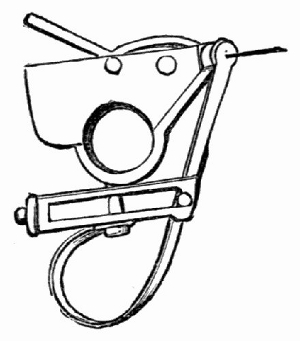
The instrument sketched forms one of the curiosities in the splendid
museum of the late Sir S. R. Meyrick, and is a singular instance of that
refinement of cruelty which is too prominent
a characteristic of the sixteenth century.
It is a weapon for throwing poisoned needles
among a crowd. Where the lid at the top
is seen lifted up, is the chamber in which
the needles are kept stuck into a cork at the
bottom. On the opposite side a needle is
seen put through a hole in a strong spring,
held in its place by a catch above, which,
when pressed by the thumb disengages it
and ejects the needle with considerable force.
As the fore-finger goes through the centre
ring, and the thumb is at the top, the weapon
is almost entirely concealed by the hand.
The spring can be adjusted by a screw at the side. This cruel instrument
was used by men on horseback, or from a window, and as the needles
were poisoned, many painful injuries must have been inflicted without
the sufferers being able to discover by whom their wounds were caused.
ANCIENT SWORD-BREAKER.
The immense two-handed swords of former times were most fearful
weapons, and far more easily used than the appearance of them would
lead us to suppose. They were admirably poised, and the position in
which they were held may be learned from various writers of their times.
One hand was placed close to the cross-bar, while the other held the
pommel. De Grassi, in 1594, tells us that those who use them contrive
to "amase with the furie of the sword, and deliver great edge blows
down-right and reversed, fetching a full circle or compass therein with
exceeding great swiftness, staying themselves upon one foote, sometimes
on the other, utterlie neglecting to thrust, and persuading themselves
that the thrust serveth to amaze one man onlie, but those edge
blows are of force to incounter many. The hand towards the enemie
must take hold fast of the handle neere the crosse and underneath, the
other hand above and near the pomell."
Silver, in his "Paradox" gives the following as the proportions of a
two-handed sword in his day: "The perfect length of your two-handed
sword is the blade to the length and hilt of your single sword."
The instrument which we have sketched on previous page, was used in
the time of Henry VIII., for the purpose, not only of defence against
one of those "great edge-blows down-right" but of catching the blade
between the teeth, and then breaking it by a sharp turn of the wrist.
ORIGIN OF THE BALLOT.
The origin of electing members by balls may be traced to the Grecians.
When a member was to be elected, every one threw a little pellet of
bran, or crumb of bread into a basket, carried by a servant on his head
round the table, and whoever dissented flattened their pellet at one side.
ANCIENT DAGGER.
The weapon which forms the subject
of the woodcut is a dagger of the time
of Philip and Mary, ornamented with
engraving.
After being thrust into a
person, by pulling a little catch, it is
made to open within him, and the prolongation
of the blade allows means for
a second blow. The two small hooks
at the inner side of the two blades would
admit of the dagger being thrust deeper
in, but would prevent its being drawn
out.
At the period these daggers were most
in vogue, personal combats were very
sanguinary and determined, seldom
terminating without the death of one,
and in some cases of both, of the parties
engaged. They first used the long
sword, and when that weapon was
broken, they closed with one another,
and used their daggers by stabbing at
the most mortal part of their foe they could manage to reach.
THE TEMPLE OF POU-TOU.
Pou-tou is an island of the great archipelago of Chusan, on the coasts
of the province of Tche-kiang. More than 100 monasteries, more or less
important, and two of which were founded by Emperors, are scattered
over the sides of the mountains and valleys of this picturesque and
enchanting island, which nature and art have combined to adorn with
their utmost magnificence. All over it you find delightful gardens, full
of beautiful flowers,—grottoes cut in the living rock, amidst groves of
bamboo and other trees, with aromatic banks. The habitations of the
Bonzes are sheltered from the scorching rays of the sun by umbrageous
foliage, and scattered about in the prettiest situations imaginable.
Thousands of winding paths cross the valleys in various directions, and
the brooks and rivulets, by means of pretty bridges of stone or painted
wood, and for the communications between the scattered dwellings. In
the centre of the island rise two vast and brilliant edifices—Buddhist
temples—the yellow bricks of which announce that their construction is
due to imperial munificence. The religious architecture of the Chinese
does not at all resemble ours. They have no idea of the majestic, solemn,
and perhaps somewhat melancholy style, that harmonizes so well with
the feelings which ought to be inspired by a place devoted to meditation
and prayer. When they wish to build a pagoda, they look out for the
most gay and smiling site they can find on the declivity of a mountain or
in a valley; they plant it with great trees of the evergreen species; they
trace about it a number of paths, on the sides of which they place flowering
shrubs, creeping plants, and bushes. It is through these cool and
fragrant avenues you reach the building, which is surrounded by galleries,
and has less the air of a temple than of a rural abode charmingly
situated in the midst of a park or garden.
The principal temple of Pou-tou is reached by a long avenue of grand
secular trees, whose thick foliage is filled with troops of crows with white
heads; and their cawings and flapping of wings keep up a continual
clamour. At the end of the avenue is a magnificent lake, surrounded
with shrubs that lean over its waters like weeping willows. Turtle and
gold-fish gleam through them; and mandarin-ducks, in their gaily-coloured
plumage, play over their surface, amidst the splendid water-lilies
whose rich corollas rise majestically upon tender green stalks
spotted with black. Several bridges of red and green wood are thrown
over this lake, and lead to flights of steps, by which you ascend to the
first of the temple buildings—a kind of porch, supported upon eight
enormous granite columns. On the right and left are stationed, like
sentinels, four statues of colossal size, and two side gates lead to the
vestibule of the principal nave, where is enthroned a Buddhist Trinity,
representing the Past, the Present, and the Future. These three statues
are entirely gilt, and, although in a crouching posture, of gigantic dimensions—at
least twelve feet high. Buddha is in the midst, his hands
interlaced, and gravely placed on his majestic abdomen. He represents
the Past, and the unalterable and eternal quiet to which it has attained;
the two others, which have the arm and the right hand raised, in sign of
their activity, the Present and Future. Before each idol is an altar
covered with little vases for offerings, and cassolets of chiselled bronze,
where perfumes are constantly burning.
A crowd of secondary divinities are ranged round the hall, the ornaments
of which are composed of enormous lanterns of painted paper or
horn—square, round, oval—indeed, of all forms and colours; and the
walls are hung with broad strips of satin, with sentences and maxims.
The third hall is consecrated to Kouang-yu, whom the greater number
of accounts of China persist in regarding as a goddess of porcelain, and
sometimes also of fecundity. According to the Buddhist mythology,
Kouang-yu is a person of the Indian Trimourti, or Triune God, representing
the creative power.
Finally, the fourth hall is a pantheon, or pandemonium, containing a
complete assortment of hideous idols, with ogres' and reptiles' faces.
Here you see, huddled together pell-mell, the gods of heaven and earth;
fabulous monsters, patrons of war, of the silk manufacture, of agriculture,
and of medicine; the images of the saints of antiquity, philosophers,
statesmen, warriors, literary men—in a word, the most heterogeneous
and grotesque assembly conceivable.
ORACLES OF APOLLO IN FRANCE.
Towards the frontiers of Auvergne and Velay, upon the high rock of
Polignac, there was formerly a temple of Apollo, famous for its oracles.
The time of its foundation ascends to the first years of the Christian era,
since, in the year 47, the Emperor Claudius came hither in great pomp,
to acknowledge the power of the god; and he left proofs of his piety and
munificence. The débris and mysterious issues that are found even now
upon the rock, in the heart of its environs, reveal the secret means employed
by the priests to make their divinities speak, and to impose upon
the people. At the bottom of the rock was an ædicula: it was on this
spot that the pilgrims took up their first station, and deposited their
offerings and made their vows. A subterranean passage communicated
from this ædicula to the bottom of a great excavation, pierced, in the
form of a tunnel, from the base to the summit of the rock. It was by
this enormous opening that the vows, the prayers and questions, pronounced
in the very lowest voice by the pilgrims, reached instantly the
top of the rock, and were there heard and collected by the college of
priests; the answers were then prepared, while the believers, by a
sinuous and long path, slowly arrived at the end of their pilgrimage.
The answers being ready, the priests commissioned to transmit them
repaired to profound and deep apartments, contiguous to a well, the
orifice of which terminated in the temple. This well, crowned by an
altar, being enclosed by a little hemispherical roof, supported in its
external parts the colossal figure of Apollo; the mouth of this statue
being half open, in the middle of a large and majestic beard, appeared
always ready to pronounce the supreme decrees. It was also through
this opening, by the means of a long speaking-trumpet, that the priests
at the bottom of this den of mystery and superstition made known those
famous oracles so imposing and so powerful in their effects upon the
human soul as to impede for centuries the substitution of the more pure
and holy precepts of the gospel.
BEST POSITION FOR SMOKING OPIUM.
Opium is not smoked in the same manner as tobacco. The pipe is a
tube of nearly the length and thickness of an ordinary flute. Towards
one end of it is fitted a bowl of baked clay or some other material, more
or less precious, which is pierced with a hole communicating with the
interior of the tube. The opium, which before smoking is in the form of
a blackish viscous paste, is prepared in the following manner:—A portion,
of the size of a pea, is put on a needle, and heated over a lamp
until it swells and acquires the requisite consistence. It is then placed
over the hole in the bowl of the pipe, in the form of a little cone that has
been previously pierced with a needle so as to communicate with the
interior of the tube. The opium is then brought to the flame of the
lamp, and after three or four inspirations the little cone is entirely burnt,
and all the smoke passes into the mouth of the smoker, who then rejects
it again through his nostrils. Afterwards the same operation is repeated,
so that this mode of smoking is extremely tedious. The Chinese prepare
and smoke their opium lying down, sometimes on one side, sometimes on
the other, saying that this is the most favourable position; and the
smokers of distinction do not give themselves all the trouble of the operation,
but have their pipes prepared for them.
EXECUTIONER'S SWORD.
The weapon engraved below forms one of the curiosities in the superb
collection of ancient armour belonging to the late Sir Samuel R. Meyrick, at
Goodrich Court, Herefordshire. It is the sword of an executioner,
having on it the date 1674. The blade is thin, and exceeding sharp at
both edges; and engraved on it is a man impaled, above which are the
words, in German, of which the following is a translation:—
"Let every one that has eyes
Look here, and see that
To erect power on wickedness
Cannot last long:"
a man holding a crucifix, his eyes bandaged, and on his knees; the
executioner, with his right hand on the hilt, and his left on the pommel,
is about to strike off his head; above is written—
"He who ambitiously exalts himself,
And thinks only of evil,
Has his neck already encompassed
By punishment."
On the other side, a man broken on the wheel; over which is—
"I live, I know not how long;
I die, but I know not when:"
and a man suspended by the ribs from a gibbet, with the inscription—
"I move, without knowing whither;
I wonder I am so tranquil."
ORIGIN OF EXCHEQUER BILLS.
In the year 1696 and 1697, the silver currency of the kingdom being
by clipping, washing, grinding, filing, &c., reduced to about half its
nominal value, Acts of Parliament were passed for its being called in
and recoined, and whilst the recoinage was going on, Exchequer bills
were first issued to supply the demands of trade.
ANCIENT ETRURIAN BUST.
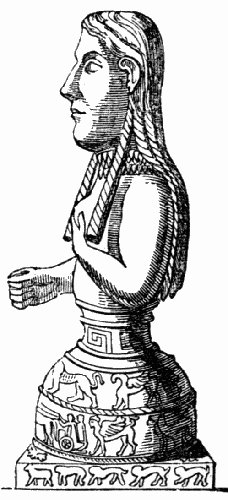
If we look backwards to the most remote times of Greek industry,
we find that long before fire-casting became customary, almost every
kind of work was carried out by the simple means of the hammer and
tongs, wielded by skilful hands. Even products of art were created
in this manner; and as statues, vases, and the like could not be put
together by the process of soldering, nails were used for the purpose, as
we learn not only from ancient writers, but even from monuments
which have lately been discovered in Etruria, and the most important
specimens of which are now possessed by the British Museum.
In one
of the tombs belonging to the vast necropolis
of Vulci were discovered, about twenty
years ago, a great many bronzes of this
very ancient workmanship; one of them
represents a bust placed on a basement
covered with thin copper plates, and adorned
by a row of figures, which are likewise
chased; long curls fall down over the neck
and shoulders, and these parts especially are
formed in the most simple manner: one
would be tempted to call it child-like, did not
the whole composition show a certain character
which enables the experienced eye of
the art-philosopher to distinguish in these
rude attempts at plastic metal work the very
germ of those wonderfully-styled productions
of a later period. The engraving here
annexed, giving a side view of this remarkable,
and as yet unique monument, is
intended to show the arrangement of the
hair, which, in spite of its simple treatment,
presents as a whole some trace of grace, and
principles of fine proportions. We perceive
that the curls are formed by rolling and
twining together small strips of bronze plate, connected with the head
itself by the mechanical means we have alluded to. There is no trace
of soldering; and we may be sure that we possess in this figure a good
specimen of those hammer-wrought sculptures of old which were spoken
of by the Greeks themselves as belonging to a fabulous period.
THE HAIRY WOMAN OF BURMAH.
The following account of this remarkable freak of nature is taken from
Captain Yule's "Mission to Ava." Writing from the city of Amarapoora,
the capital of Burmah, the Captain says:—
"To-day we had a singular visitor at the residency. This was Maphoon,
the daughter of Shwé-maong, the "Homo hirsutus" described
and depicted in Crawfurd's narrative, where a portrait of her, as a young
child, also appears. Not expecting such a visitor, one started and exclaimed
involuntarily as there entered what at first-sight seemed an
absolute realization of the dog-headed Anubis.
"The whole of the Maphoon's face was more or less covered with hair.
On a part of the cheek, and between the nose and mouth, this was confined
to a short down, but over all the rest of the face was a thick silky
hair of a brown colour, paling about the nose and chin, four or five inches
long. At the alea of the nose, under the eye, and on the cheek-bone,
this was very fully developed, but it was in and on the ear that it was
most extraordinary. Except the extreme upper tip, no part of the ear
was visible: all the rest was filled and veiled by a large mass of silky
hair, growing apparently out of every part of the external organ, and
hanging in a dependent lock to a length of eight or ten inches. The hair
over her forehead was brushed so as to blend with the hair of the head,
the latter being dressed (as usual with her countrywomen) à la Chinoise.
It was not so thick as to conceal altogether the forehead.
"The nose, densely covered with hair so as no animal's is that I know
of, and with long fine locks curving out and pendent like the wisps of a
fine Skye terrier's coat, had a most strange appearance. The beard was
pale in colour, and about four inches in length, seemingly very soft and
silky.
"Poor Maphoon's manners were good and modest, her voice soft and
feminine, and her expression mild and not unpleasing, after the first
instinctive repulsion was overcome. Her appearance rather suggested
the idea of a pleasant-looking woman masquerading than that of anything
brutal. This discrimination, however, was very difficult to preserve
in sketching her likeness, a task which devolved on me to-day
in Mr. Grant's absence. On an after-visit, however, Mr. Grant made a
portrait of her, which was generally acknowledged to be most successful.
Her neck, bosom, and arms appeared to be covered with fine pale down,
scarcely visible in some lights. She made a move, as if to take off her
upper clothing, but reluctantly, and we prevented it. Her husband and
two boys accompanied her. The elder boy, about four or five years old,
had nothing abnormal about him. The youngest, who was fourteen
months old and still at the breast, was evidently taking after his mother.
There was little hair on the head, but the child's ear was full of long
silky floss, and it could boast a moustache and beard of pale silky down
that would have cheered the heart of many a cornet. In fact, the appearance
of the child agrees almost exactly with what Mr. Crawford says
of Maphoon herself as an infant. This child is thus the third in descent
exhibiting this strange peculiarity; and in this third generation, as in
the two preceding, this peculiarity has appeared only in one individual.
Maphoon has the same dental peculiarity also that her father had—the
absence of the canine teeth and grinders, the back part of the gums presenting
merely a hard ridge. Still she chews pawn like her neighbours.
Mr. Camaretta tells some story of an Italian wishing to marry her and
take her to Europe, which was not allowed. Should the great Barnum
hear of her, he would not be so easily thwarted.
According to the Woundouk, the King offered a reward to any man
who would marry her, but it was long before any one was found bold
enough or avaricious enough to venture. Her father, Shwé-maong, was
murdered by robbers many years ago."
A TRAVELLER'S PASSPORT.
The following document, included among the rolls, is dated 1680, from
Whitehall:—
"Dame Mary Yate, having asked his majesty's permission to pass beyond
the seas, for the recovery of her health, his majesty was most
graciously pleased to grant her request, under the usual clauses and provisoes,
according to which ye said Dame Mary Yate having given security
not to enter into any plott or conspiracy against his majesty or
his realms, or behave herself in any such manner as may be prejudicial
to his majesty's government, or the religion here by law established, and
that she will not repaire to the city of Roome, or return unto this kingdome
without first acquainting one of his majesty's principal secretaries
of state, and obtaining leave for the same, in pursuance of his majesty's
commands in council hereby will and require you to permit and suffer
the said Dame Mary Yate to imbarque with her trunkes of apparel and
other necessaries not prohibited at any port of this kingdom, and from
thence to pass beyond the seas, provided that shee departe this kingdom
within 14 days after the date hereof."—April 14.
If the above refers to the celebrated Lady Mary Yate (a daughter of
the house of Pakington) who is commemorated on a monument in Chaddesley
Church, Worcestershire, as having died in 1696, at the age of 86,
she must have been 70 years old when these precautions were taken by
the Government against the poor old lady attempting to invade the
country, or to comfort the Pope with her presence and support. Dame
Mary Yate was no doubt a Roman Catholic, and the permission above
referred to was granted under the seventh section of the statute 3rd James
I, chap. 5, which was virtually repealed by the statute 33rd George III,
chap. 30, which exempted Roman Catholics from all the penalties and
restrictions mentioned and enjoined in the older acts, if in one of the
Courts at Westminster or at the Quarter Sessions they made a declaration
which to them was unobjectionable.
CURIOUS PROVINCIAL DANCE IN FRANCE.
The inhabitants of Roussillon are passionately fond of dancing; they
have some dances peculiar to themselves. The men generally commence
the country dance by a contre-pas, the air of which is said to be of
Greek origin; the women then mingle in the dance, when they jointly
perform several figures, passing one among the other, and occasionally
turning each other round. At a particular change in the air, the male
dancer must dexterously raise his partner and place her on his hand in a
sitting posture. Accidents sometimes happen upon these occasions, and
the lady falls to the ground amidst the jokes and laughter of her companions.
One of these dances, called lo salt, is performed by four men
and four women. At the given signal, the cavaliers simultaneously
raise the four ladies, forming a pyramid, the caps of the ladies making
the apex. The music which accompanies these dances consists of a
lo flaviol, a sort of flageolet, a drum, two hautboys, prima and tenor,
and the cornemuse, called in the country lo gratla: this instrument, by
its description, must somewhat resemble the bagpipes. The dance called
Segadilles is performed with the greatest rapidity: at the end of every
couplet, for the airs are short and numerous, the female dancers are
raised, and seated on the hands of their partners.
ANCIENT INSTRUMENT OF PUNISHMENT.
The instrument which we here engrave is a whip of steel that was
made and used as an engine of punishment and torture about the middle
of the sixteenth century. It is composed of several truncated cones,
grooved with sharp edges, and held in opposite directions, so as to give
sufficient oscillation without rising so far as to strike the hand of the
executioner. It seems to have been held by a strap; but its barbarity
is evident.
PUNISHING BY WHOLESALE.
Henry VIII. is recorded, in the course of his reign, to have hanged
no fewer than 72,000 robbers, thieves, and vagabonds. In the latter
days of Elizabeth scarcely a year passed without 300 or 400 criminals
going to the gallows. In 1596, in the county of Somerset alone, 40 persons
were executed, 35 burnt in the hand, and 37 severely whipped.
MONKS AND FRIARS.
There was a distinction between the Monks and Friars, which caused
the latter to become the object of hatred and envy. Both the monastic,
or regular, and parochial clergy, encouraged the attacks made upon them.
The Monks were, by most of their rules, absolutely forbidden to go out
of their monasteries, and, therefore, could receive only such donations as
were left to them. On the contrary, the Friars, who were professed
mendicants, on receiving notice of the sickness of any rich person, constantly
detached some of their members, to persuade the sick man to
bequeath alms to their convent; thus often, not only anticipating the
Monks, but, likewise the parochial clergy. Besides, as most of them
were professed preachers, their sermons were frequently compared with
those of the clergy, and in general, not to the advantage of the latter.
In these sermons, the poverty and distress of their order, were topics
that, of course, were neither omitted, nor slightly passed over. Considering
the power of the Church, before the Reformation, it is not to be
supposed that any of the Poets, as Chaucer, &c., would have ventured to
tell those rediculous stories of the Friars, with which their works abound,
had they not been privately protected by the superior clergy.
CURIOUS TURKISH CONTRIVANCE.
Wonderful are the appliances by which ingenuity contrives to supply
the evasions of idleness. We give one of them, as described by Mr.
Albert Smith, in his "Month at Constantinople."
"Passing some cemeteries and public fountains, we came to the outskirts
of the city, which consist chiefly of gardens producing olives,
oranges, raisins and figs, irrigated by creaking water-wheels worked by
donkeys. To one of these the droll contrivances which attracted our notice
was affixed. The donkey who went round and round was blinded, and in
front of him was a pole, one end of which was fixed to the axle and the
other slightly drawn towards his head-gear and there tied: so that, from
the spring he always thought somebody was pulling him on. The guide
told us that idle fellows would contrive some rude mechanism so that a
stick should fall upon the animal's hind quarters at every round, and so
keep him at work whilst they went to sleep under the trees."
FIGURES OF DOGS ON ANCIENT TOMBS.
In attempting to assign a reason for the frequent occurrence of dogs at
the feet of tombs, we shall most probably be right if we simply attribute
the circumstance to the affection borne by the deceased for some animal
of that faithful class. That these sculptured animals were sometimes
intended for likenesses of particular dogs is evident. Sir Bryan Stapleton,
on his brass at Ingham, Norfolk, rests one foot on a lion, the other
on a dog; the name of the latter is recorded on a label, Jakke. Round
the collar of a dog at the feet of an old stone figure of a knight, in
Tolleshunt Knight's Church, Essex, letters were formerly traced which
were supposed to form the word Howgo.
In a dictionary of old French terms, we find that the word Gocet
means a small wooden dog, which it was customary to place at the foot
of the bed. Now it has been thought that something of this kind was
intended in the representation of dogs on tombs, and that this support
of the feet merely indicates the old custom of having that sort of wooden
resting-place for the feet when in a recumbent position. But our first
supposition appears the more natural, and is supported by the fact that
a large proportion of these sculptured dogs, instead of being placed
beneath the feet, are seated on the robe or train, looking upwards with
the confidence of favourite animals. Judith, daughter of the Emperor
Conrad, is represented on her tomb (1191) with a little dog in her right
hand.
On the tomb of Sir Ralph de Rochford, in Walpole Church, Norfolk,
his lady is by his side, dressed in a reticulated head-dress and veil,
a standing cape to her robe, long sleeves buttoned to her wrists, a
quatrefoil fastens her girdle, and a double necklace of beads hangs from
her neck. At her feet is a dog looking up, and another couchant. In
the chancel at Shernborne, Norfolk, the figure of Sir Thomas Shernborne's
lady (1458) has at the right foot a small dog sitting, with a
collar of bells.
On a large antique marble in the chancel at Great Harrowden, Northamptonshire,
are the portraits of a man in armour, and his wife in a
winding sheet. The man stands on a greyhound, and the woman has at
her feet two little dogs looking upwards, with bells on their collars.
This monument is that of William Harwedon and Margery, daughter of
Sir Giles St. John of Plumpton. She died in the twentieth year of
Henry VI.
THE FATE OF THE LAST MAY-POLE IN THE STRAND.
The May-pole, which had been set up in 1641, having long been in a
state of decay, was pulled down in 1713, and a new one, with two gilt
balls and a vane on the top of it, was erected in its stead. This did not
continue long in existence; for, being in 1718 judged an obstruction, to
the view of the church then building, orders were given by the parochial
authorities for its removal. Sir Isaac Newton begged it of the parish,
and it was conveyed to Wanstead Park, where it long supported the
largest telescope in Europe, belonging to Sir Isaac Newton's friend, Mr.
Pound, the rector of Wanstead. It was 125 feet long; and presented to
Mr. Pound by Mr. Huson, a French member of the Royal Society.
MEANS OF ATTRACTING CUSTOM.
Before houses were numbered, it was a common practice with tradesmen
not much known, when they advertised, to mention the colour of their
next neighbour's door, balcony, or lamp, of which custom the following
copy of a handbill will present a curious instance:—
"Next to the Golden Door, opposite Great Suffolk Street, near Pall
Mall, at the Barber's Pole, liveth a certain person, Robert Barker, who
having found out an excellent method for sweating or fluxing of wiggs;
his prices are 2s. 6d. for each bob, and 3s. for every tye wigg and pigtail,
ready money."
MUSIC OF THE HINDOOS.
Among the fine arts of India, music holds a distinguished place; and
although its cultivation has declined, and but few are now found who
have attained to eminence either in the science or art of this unequalled
source of recreation, refinement, and pleasure, yet no people are more
susceptible of its charms than the Hindoos. Reading is with them invariably,
as with the Arabians and other Eastern nations, a species of
recitativo, a sort of speaking music, delivered in dulcet though not
measured tones. The recitation of lessons in a school or academy always
takes this form. The man at the oar, women beating lime, the labourer
engaged in irrigation, alike accompany their toil with song.
The word sangíta, symphony, as applied to music by the Hindoos,
conveys the idea of the union of voices, instruments, and action. Musical
treatises accordingly treat of gáná, vádya, uritya, or song, percussion,
and dancing; the first comprising the measures of poetry; the second,
instrumental sounds; and the third, theatrical representation. The
ancient dramas of the Hindoo exhibited the union of these in their
unequalled poetry, modulated with the accompaniments of voice, and
instruments, and the attractions of appropriate scenery.
The music of the Hindoos includes eighty-four modes, each supposed
to have a peculiar expression, capable of moving some particular sentiment
or affection. The modes take their denomination from the seasons,
or from the hours of day or night. Musical composition is supposed
capable of adaptation to the different periods of the day, and therefore
its provisions are regulated by the hours. The ideas of the Hindoos on
music, as promoting the pleasures of imagination, may be inferred from
the names applied by ancient authors to their musical treatises. One is
called Rágárnava, the Sea of the Passions; another, Rágaderpana, the
Mirror of Modes; and a third, Sóbhavinóda, the Delight of Assemblies;
a fourth, Sangítaderpana, the Mirror of Song; and another, Rágavibódha,
the Doctrine of Musical Modes. Some of these works explain the law
of musical sounds, their divisions and succession, variations of scales by
temperament, and the enunciation of modes; besides a minute description
of the different vínás (lute), and the rules for playing them. This is a
fretted instrument of the guitar kind, usually having seven wires or
strings, and a large gourd at each end of the finger-board. Its extent
is two octaves, and its invention is attributed to Náredá, the son of
Brahma. There are many varieties, named according to the number of
their strings. Of one of them we give an engraving below.
Music, like everything else connected with India, is invested with
divine attributes. From the sacred Veda was derived the Upaveda, or
subsidiary Veda of the Gandharbas, the heavenly choristers. The art
was communicated to mortals by Sarasvati, the consort of Brahma.
She, as before stated, is the patroness of the fine arts, the goddess of
speech. Their son, an ancient lawgiver and astronomer, invented the
Víná. The first inspired man, Bherat, invented the Drama.
PRINTED BY WILLIAM CLOWES AND SONS, LIMITED, LONDON AND DECCLES.