CAPTURED BY PIRATES
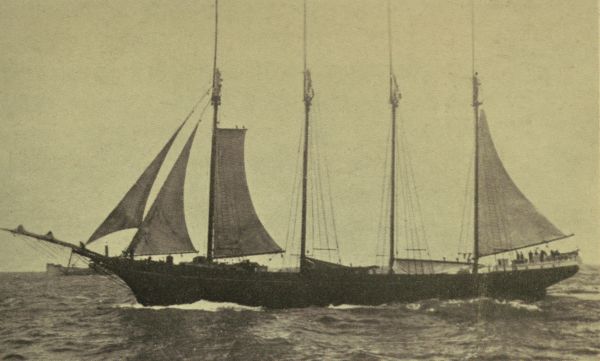
Little did I dream when I sailed away from San Francisco in the little
bark Beluga that I should finish my voyage, not in Australia after a
two months' trip, but in Denmark, on the other side of the world, after
a ten months' experience that has never before been equalled in the
annals of sea-going history.
My story could well be called "An Escape from the Jaws of Hell"—for
a prisoner's life in Germany under the present conditions is surely a
hell on earth. During my six weeks' stay in Denmark I have interviewed
neutral sailors who have been sent out of Germany, and old men who have
been passported out on account of extreme old age; also prisoners who
have escaped over the border into Denmark via the coal-train route, and
these men one and all paint a picture of a prisoner's life in Germany
as being a veritable hell on earth.
We sailed from San Francisco on the 15th day of May, 1917, with a cargo
of 15,000 cases of benzine, for Sydney, Australia. After letting go
the tug boat and getting sail on the ship, we all settled down for a
quiet and uneventful passage. Seldom have I gone to sea under more
favourable circumstances. A tight little vessel, a good deep water
crew of Scandinavian sailor men, plenty of good wholesome provisions
and a cook who knew his business. Both the first and second mates were
officers of the old school, with years of experience, so it seemed that
I was fortunate in getting so evenly balanced a crew, as owing to the
frenzied state of shipping along the Pacific Coast at that time the
master was indeed fortunate who found on getting to sea that half of
this crew could box the compass, much less hand, reef and steer.
Even under these favourable circumstances there was a "fly in the
ointment." On counting noses I made the discovery that the entire
ship's company amounted to thirteen (an unlucky number, as every "salt"
will testify). A ship's crew of eleven, counting myself, and two
passengers, my wife and little daughter. When I called this fact to
my wife's attention she laughed at me, saying that was "old sailor's
tommyrot" and that we were living in the twentieth century and should
have outgrown such silly superstitions. Nevertheless, owing to a strain
of Scotch blood in my veins, the superstition remained in my mind for
many days until, owing to the humdrum uneventfulness of our progress,
this thought died a natural death.
I crossed the equator well to the westward, passing the Fiji Islands
and hoping that when I ran out of the southeast trade winds I would get
a favourable wind and cut close by the southern ends of New Caledonia.
I had a hunch, and if I had been lucky and had two days' favourable
wind this story would never have happened. But unfortunately,
unfavourable winds were encountered, forcing me to the southward and
into the regular sailing vessel route.
My wife, an Australian girl by birth, had not been home to see her
family since she left them something over ten years ago, and naturally
was very anxious to get home and see her many brothers and sisters who
had grown up and married since she left. In fact, she had talked of
nothing else for the past several years. Each year I promised that we
would make the visit "next year," but something or other would show
up and spoil my plans. I had given up the sea about six years ago for
a "shore job," and was so well pleased with the change that I did not
care to go back to the sea again, fearing that I would not be able to
change from the sea to the shore life again, as there is something
about the sea that gets into the blood and makes it difficult to
stay away from it. It was only then an unusual chain of circumstances
that left me foot loose at this particular time to take charge of the
Beluga on this trip. The fact is, it was what my wife called the
"Scotch Jew" in me that finally decided me to take this means of making
money out of visiting the mother-in-law.
Each day at noon when I placed the vessel's position on the chart, my
wife was a very interested spectator and used to measure the distances
that remained for us to go. Then she would figure out just how long it
would take, under various weather conditions, before she would be able
to see her beloved Australia again. Some days when we had a favourable
wind and had made a good day's run in the right direction, she would be
as happy as could be and singing all the time, but other days when we
had made but little progress she would be away down in the dumps, and
it would be extremely difficult to get a smile.
On July 9th I was having some work done aloft on one of the masts,
when about two o'clock in the afternoon Fritz, a Norwegian sailor
working aloft, shouted down, "Smoke, oh, on the port beam." I had a
look through my binoculars, and, sure enough, on the horizon to the
southwest I could make out the smoke of a steamer. The weather at
this time was fine and clear, with a light breeze from the south and
we were making only about four knots per hour. In a short time it
became evident that the steamer was coming in our direction, as she
was gradually getting larger and more plainly seen. I shouted down the
cabin skylight to my wife to come on deck and see the steamer, as she
was the only vessel of any description we had seen since leaving San
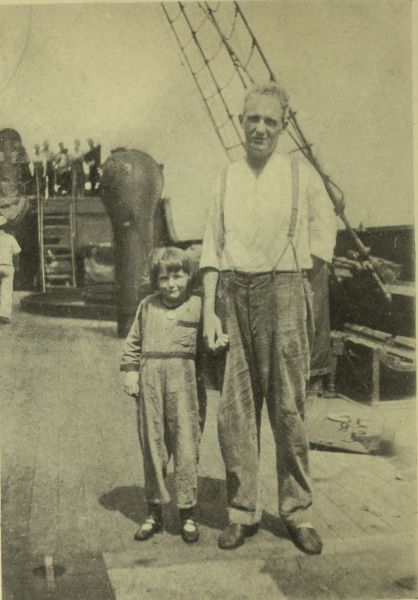
Francisco, almost two months before. She and Juanita, my six-year-old
daughter, scampered on deck and were very much interested in watching
her. It soon became evident that the steamer was going to pass close to
us, and thinking it just possible that she would speak us, my wife and
Nita went below to change their frocks.
The steamer was getting closer by this time and her hull was plainly
visible. The old superstition regarding the unlucky number "thirteen"
flashed through my mind but was instantly dismissed. To all appearances
she was the ordinary black-painted, dingy-looking ocean tramp. I
studied her intently through the glass, trying to discover some detail
that would show her nationality, and had just about concluded that she
must be a Jap when Mr. Buckert, my Chief Officer, came along to where I
was standing and asked if I could make her out. I told him she appeared
to be either a British or Jap tramp, and handed him the binoculars so
that he could have a look. After studying her for a while he said,
"By God, Captain, I don't know her nationality, but she carries the
largest crew I have ever seen." I snatched the glasses out of his hand
and had a look. Sure enough, by this time the rails both forward and
aft were black with men in the regulation man-of-war jumpers. Even at
this time I did not think she was a German, but possibly a British
armed merchantman, or a British converted auxiliary cruiser, sent from
Australia to some of the South Sea islands for patrol duties. However,
she soon showed her true colours.
Suddenly she changed her course, heading to pass directly under my
stern. At this moment she broke out the German Imperial Navy Ensign
at her jackstaff aft and at her signal yard amidships she showed the
letters G.T.E., which interpreted from the International Signal Code
means "Heave to and I will send a boat on board." After giving me time
to read this signal, possibly two minutes, the steamer dropped her
bulwarks forward, uncovering her guns, and fired a shot across the
Beluga's bow. This dispelled any lingering doubt I had in my mind as
to what was wanted, and it didn't take us long to clew up our light
sails and throw the main yard about.
It was only then that I actually realised that my little vessel had
been stopped by a German raider in the South Pacific Ocean almost
fifteen thousand miles from the war zone. I stepped to the forward
end of the quarterdeck and looked down at the crew on the main deck
to see how they seemed to be taking it. These Scandinavian sailor men
were standing on the waist, smoking their pipes and discussing the
appearance of the steamer, just as if to be captured by an enemy's
raider were an every-day occurrence. For myself, I knew that this day
marked a crisis in the lives of any of us that were American or British
born, and as for my wife and child—God, the thought was like a stab
in the heart and seemed to leave me numb and cold. In a moment there
flashed through my mind all the accounts I had read in the papers
of the German atrocities towards women and children in Belgium and
barbarisms practised along the Russian front, and the thought of my
wife and child being at the mercy of these people nearly drove me crazy.
On walking aft I saw my wife leaning up against the wheelhouse, her
face absolutely bloodless and a look of horror in her eyes that fairly
chilled my blood. God! For months after I could see this expression in
her eyes every time I closed my eyes. Even now, when I think of it, it
makes me feel cold all over. When she saw me she came over and took my
hand in hers, looking all the time into my eyes and not saying a word.
We stood there for what seemed a century. Presently I called Juanita
to us and the three of us went down below to the cabin. We sat on the
settee, never saying a word, and poor little Nita started to sob,
feeling something sinister in the air, which she did not understand.
In a minute the mate came to the cabin skylight and sang out that the
launch would be alongside in a minute. I answered "All right." My wife
got up and walked over to the bed and took one of my revolvers (I had
two) from under the mattress and handed it to me.
Suddenly she threw both her arms around my neck and drew my head into
such a position that she could look into my eyes, and said, "Stanley, I
want you to promise me that they will never get Juanita." I threw both
my arms round her, hugging her tight to myself, and said, "Mamie, I
promise; but you must leave it to me." And with a sob I left her and
started on deck. When passing through the wheelhouse, I stopped for a
moment to pull myself together. On going on deck I saw a small motor
launch just arriving alongside, crowded with German bluejackets, armed
to the teeth. A moment more, and a young lieutenant sprang onto the
deck and came aft to the quarterdeck where I was standing. Coming to a
stand in front of me he saluted and asked in excellent English, with
an American accent, "Are you the captain of this vessel?" I answered,
"Yes." "Where are you from?" was his next question. I told him San
Francisco to Sydney, Australia, fifty-two days out. "Captain," he said,
"I take charge of your vessel in the name of the German Imperial Navy."
He gave an order in German and two German sailors sprang to the flag
halyards and hauled down the Stars and Stripes and ran up the German
Ensign. They carefully saved the American flag and the Company's
burgee and took them aboard the Wolf afterwards as trophies. Our crew
meantime had been lined up and searched for weapons. Among the things
the boarding crew brought on board was a black case containing twenty
pairs of handcuffs and three large bombs to blow the vessel to pieces
with. They didn't need the handcuffs, however.
After the lieutenant had gone through the ship's papers and found out
all particulars regarding the Beluga's cargo, he had his signal
men wigwag the information to the Commander of the Wolf, which was
standing by. The Commander, on finding out that I had a cargo of
benzine, decided not to sink the vessel immediately, but to take on
board some three hundred cases for use in their hydroplane, as their
supply was getting low.
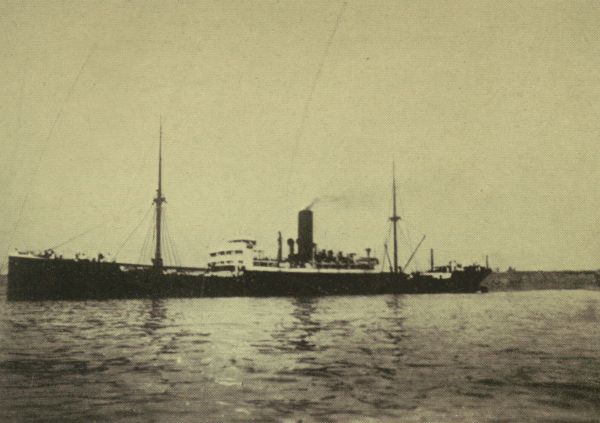
THE GERMAN AUXILIARY CRUISER, RAIDER AND MINE LAYER "WOLF" LEAVING KIEL
ON HER FIFTEEN-MONTH CRUISE, NOVEMBER 21ST, 1916
In a short while we received instructions from the Wolf to proceed
due east for sixty miles and wait there for them. The Wolf then left
us, going off at right angles. I learned from some of the German
sailors that there was a large steamer approaching and that the Wolf
would probably run along parallel with her during the night and capture
her in the morning. About nine-thirty that night this steamer passed us
about a mile and a half off, heading to the southward and westward.
She was apparently a large steamer of about seven or eight thousand
tons, heavily loaded. She resembled in appearance the type of vessel
used on the Pacific Coast as an oil tanker, having the high forecastle
head, long bunk deck amidships, and her engines and stack away aft; she
was probably a freighter of this description belonging to New Zealand,
bound from San Francisco to Australia. When she came abreast of us she
signalled by Morse Code, asking what vessel we were; but the German
prize crew took good care that none of us could answer or make any
signals of any kind. I can use both Continental and Morse and had a
signal lamp on board, so that if I had had an opportunity I could have
warned this steamer that there was a raider about.
One of the first official acts by Lieutenant Zelasko after taking
charge of my vessel was to call the cook up on the quarterdeck where he
was standing and give him instructions to cook a good large meal for
his men, and not to forget to have plenty of white bread. To assist him
in preparing this meal for the unwelcome addition to our family, he
assigned one of his men as an assistant in the kitchen.
In the meantime the balance of his crew were searching the vessel and
making an itemized list of everything that they thought would be worth
transferring to the Wolf. I had a chance to look over this list later
on and was surprised to find how complete and businesslike it was. It
gave the name of the article, the amount, where located, and a remark
as to how best to remove it, whether in the original package, to be
repacked, or carried in bulk in large canvas sacks, furnished by the
Wolf for that purpose. This is only one incident showing the method
and thoroughness with which even the minor details of their business
were carried out.
During the evening I had a chance to get acquainted with Lieutenant
Zelasko, the prize officer, and found him a very decent chap indeed.
He, and all the rest of the Wolf's officers, excepting the Commander
and the Artillery Lieutenant, were members of the Imperial Marine, or
Naval Reserve, men that in peace time commanded and served as officers
in the merchant service, like myself. In fact, I found that Lieutenant
Zelasko had served part of his time as able-bodied seaman on the
American ship Roanoke, a vessel that I had been in some years before.
He had the second class Iron Cross which he had won at Antwerp.
Lieutenant Zelasko assured me on his word of honour that my family
would receive nothing but the best of care possible under the
circumstances on board the Wolf. In fact, after finding out that the
Wolf was manned by ex-merchant marine officers and men, my fears
for the safety of my wife and little girl subsided greatly. My wife
herself cheered up a great deal after hearing this, thinking that
people from our own walk of life could not be as barbarous as we had
been led to believe.
Early in the morning of the tenth we arrived at the position where
we were to wait for the Wolf. Here we hove to, and the prize crew,
assisted by my sailors, who were forced to do all the work pertaining
to the handling of the ship, took off the hatches and took on deck
three hundred cases of benzine, ready to be transported to the Wolf
when she showed up. During all this time there were always five or six
guards or sentries posted at various positions around the ship, and
also the balance of the prize crew always wore their side arms, whether
they were working or not.
The navigating officer of Zelasko's prize crew and the bo'swain were
both American navigators, one having been, prior to the war, master of
a sailing vessel plying on the Atlantic Coast, and the other a Chief
Mate, also in sail, on the Atlantic. At the outbreak of the war both
resigned their positions and went home to lend Kaiser Bill a hand.
These fellows received eighteen marks per month and have a rating
of only "over matrosa," or just one step higher than that of common
sailor. Several months later, after we had got better acquainted, I
asked this ex-American skipper if he did not think it rather a scurvy
trick to sail as Master on American ships during peace times and as
soon as war was declared to leave America and help sink the very class
of ships that he had hitherto made his living on. He replied by saying
that at the time he resigned and went home to enlist America was not
in the war, but even had she been, he would have gone just the same.
From conversations I had with other ex-American seamen, I am led to
believe that at the outbreak of hostilities the German Consuls at the
port where their vessels hailed from ordered these men to resign and
go home to the Fatherland. I also believe that their fare and expenses
were paid. There are many, many cases similar to this, and I believe
it would be a good thing for the American shipowners to remember when
employing officers and captains to man their vessels after the war is
over.
The German prize crew made a great fuss over Juanita, she being quite
a novelty to them, and I am sure that she had the time of her life.
Nobody on board the Wolf had seen a woman or a child for nearly nine
months. My wife and little girl were the first woman and child they had
taken prisoner.
On July 11th, early in the morning, the Wolf picked us up again. It
seems that the steamer we saw got away from them. The Wolf put four
large life-boats on the water and took off some three hundred cases of
benzine and all the provisions and ship's stores we had on board the
Beluga.
When the vessel was taken charge of by the German prize officer, he
told me that I would be allowed to take only a few absolute necessities
aboard the Wolf when I was transferred; but later, on the 11th,
when the Wolf picked us up, Commander Nerger sent over word that
I was to be allowed to take everything I wanted. Unfortunately the
permission came almost too late, because by this time the German crew
had ransacked my quarters very thoroughly and many articles that I
would have taken with me for the comfort of my family were gone. Weeks
later some of these were recovered. For instance, I had a pair of
rubber-soled, leather-topped yachting shoes. Some weeks after joining
the Wolf I noticed a man with these shoes on his feet. I called the
attention of one of the officers to it and told him that they were
formerly my property. The following morning those shoes were just
outside my stateroom door, nicely polished.
Among the things I took on the Wolf was the wife's sewing machine,
which proved of great value later on, as she had to make under and over
garments for both herself and Nita. My nautical instruments, books and
charts were taken from me, but I was told that they would be returned
to me on my arrival in Germany.
At 1:20 we got into the boats and said a last farewell to the poor
little Beluga, and she did look little in comparison with this big
black brute of a raider. As we were being rowed over, the Wolf's
rails were lined with grinning faces, and not one of them that I could
see had the least trace of sympathy. Not that I wanted sympathy for
myself, but it seemed strange to me, at the time, that out of over
three hundred German sailors and officers there was not one whose face
showed any sympathy for the position a woman and little child were in.
We climbed on board by means of a Jacob's ladder, myself first with
Nita on my back, and my wife next. Many offered to lend her a hand,
but she managed to make it without any help. There was a certain
satisfaction in this, as afterwards I found out that the Germans
anticipated a lot of trouble in getting her aboard, as there was quite
a bit of sea running.
On arriving on deck we were met by the Chief Officer, Captain Schmell,
whose first words were, "Tell your wife and little girl that they have
nothing to fear, that we are not the Huns you probably think we are."
He took us aft under the poop and showed us an ex-storeroom which some
men were cleaning out for our use. This room was in the centre of the
prisoners' quarters and had absolutely no ventilation, and there were
Negroes, Indians and various other nationalities passing up and down
to the hell hole, before the door, in various stages of décolleté, to
say the least. The Chief told me that we three could have this room
together, or my wife and child could have a more comfortable room on
the berth deck amidships, but that I would have to remain down below
and that I would be allowed to visit my family two hours daily. My wife
would not hear of this latter arrangement, saying that we would live in
a pig-sty together rather than be separated. Just then Commander Nerger
came along and spoke to us, saying that he was very sorry to find that
the Beluga had a woman and child on board, and had he known that
such was the case he would have passed right on; but that once he had
shown himself to be a raider, to protect himself he would have to keep
us prisoners until such time when he could land us at a place where
it would not jeopardise the safety of his vessel or crew; and that in
the meantime he would make us as comfortable as possible under the
circumstances. He then gave orders that we three should be given one of
the deck officers' staterooms on the berth deck and that we were to be
given the freedom on the side our room was on, and that as long as I
paid attention to my own business only and did not talk to any of the
sailors, I was to continue to enjoy this privilege; but just as soon as
I gave them cause to believe that I was trying to gather information,
I was to be sent down into the hell-hole aft—as the prisoners called
their well-named quarters. Needless to say, I gladly agreed to his
proposition, knowing myself to be lucky not to be separated from my
family. At 4:30 P.M. a man (who was afterwards my orderly)
came to our room with cotton batting to put in our ears, as they were
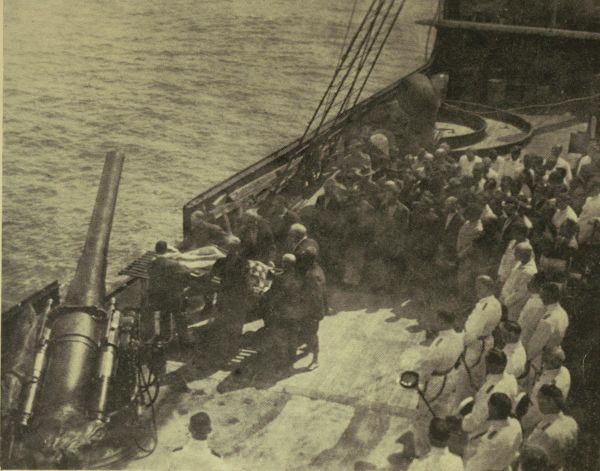
going to sink the Beluga by gun fire. I was granted permission to go
onto the boat deck and watch. They fired nineteen shots at her with
the six-inch gun forward, and the nineteenth shell hit her amidships.
The other eighteen were clean misses—rotten shooting, as the target
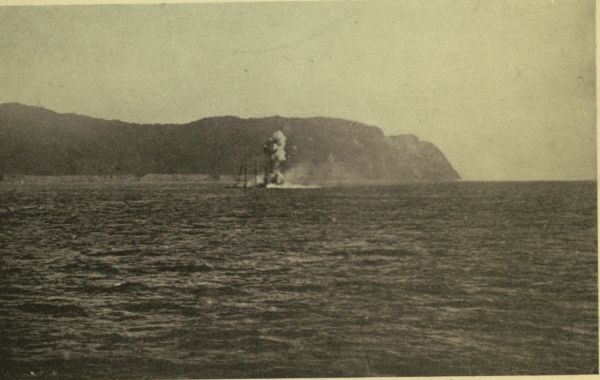
was only two and a half miles off. Beluga burst into flames and
immediately when she caught fire the benzine exploded, making one of
the most wonderful sights I have ever seen. The sea for miles around
us was covered with burning petrol, the weather was almost calm, and
occasionally a "cat's-paw" of wind would come along and cause this
flaming field of oil to run in various directions, opening a path of
black water through a sea of flames. As soon as this "cat's-paw" of
wind was over the flames would run together again. When the spars fell
out of the ship the splash was not of water but a veritable cataract of
flames. Even the Germans were impressed by the picture of three square
miles of burning sea, flames leaping thirty feet high and raging for
hours. God! It was a wonderful thing. In fact, the sight was so great
that I did not realise for some minutes that it was my own little home
that was going up in flames. My wife could not, of course, stand this
sight, and had remained in her room.
On account of there being no place ready for us to sleep, we were given
temporary quarters in the forward end of the deckhouse, immediately
over the pump room on the main deck. There was only one very narrow
bunk here, possibly eighteen inches wide, which my wife and Nita
occupied. For myself I picked out a nice soft iron plate on the floor
and slept on that. The only means of ventilation here was a square
hole in the roof or ceiling, probably eight inches square. There was,
I believe, some kind of ventilator attached to this opening outside.
There was an iron-bound rule enforced at all times on the Wolf,
that no light from any source should be visible on the deck. All
doors were fitted with a patent mechanism so that when the door was
opened the electric light current was broken and consequently the
light went out. Immediately on closing the door the light would come
on again. This made it necessary to sit in the dark if we wanted to
have either the port hole or door open for fresh air, and if the door
was closed, in a very short time the air became actually suffocating.
On several occasions the temperature, with the door and port hole
open, was 104° F. at night, so it can be imagined just how hot it was
when the door had been closed for ten or twenty minutes. The first
night none of us slept a wink, owing to the excitement of the day and
the incessant hammering and knocking of the air pumps and ice-making
machines immediately under our feet. This made the fourth night since
we had been captured that my wife did not get a wink of sleep. Fearing
complications from this loss of sleep, I called on the German doctor
and finally made him understand the situation. He gave me a powder for
her and asked if he should visit her. Thinking possibly that under the
circumstances the near approach of a German, even a doctor, would do
more harm than good, I told him I did not think it necessary.
Doctor Hausfelt, the senior surgeon of the Wolf, prior to the
outbreak of the war, was a specialist in women's nervous diseases
and was the head of a clinic at the Hanover University. The doctor
spoke French and Italian fluently but could not speak the English
language, although he read it very well. He insisted that we be moved
the following morning further down the deck, to a room similar to the
one we were in, but much quieter. In reality, although quieter, this
room was hotter than the one forward. The bunks, of which there were
two, one for the wife and one for Nita, were fastened to the iron
engine room bulkhead, and the mattresses that lay up against this wall
absorbed a great deal of this heat, making them very uncomfortable. I
slept on the floor, which was concrete laid over the iron deck, and
although very hard was really cooler, by a good deal, than the bunks.
Early in the morning after making this change I had to go down to the
Antiseptic Department and have my trunks very minutely searched and
my clothes disinfected. In fact, I had to appeal to the Second Doctor
to escape being run through the dis-lousing plant. Here anything that
proved of interest to the prisoner officer was taken away from me, with
the promise that it would be returned later. My books, letters and
paper clippings were religiously read and returned. I had a 3A Eastman
Kodak which they seized, and imagine my surprise some days later when
a roll of films—half of which had been exposed by me—was handed to
me by the officer in charge of the photographic department. They had
taken this roll of films out of my camera and developed them, just for
curiosity, I suppose.
From here I was taken to the Recording Lieutenant's office and put
through a rigid examination, being asked innumerable questions
regarding my movements in the past five years, also questions
regarding my parents' origin, occupation and present standing. All
this fuss because one of the prize crew had found in my quarters a
pamphlet giving information regarding the United States Naval Reserve
requirements. I thought I had got rid of all this junk, but evidently I
must have overlooked something.
My officers and sailors were taken to the regular prisoners' quarters
aft, and I was not allowed to see or speak to them.
Now comes what I consider the most awful period of my experience. My
wife, who is naturally of a highly strung and courageous disposition,
broke down under the preceding five days' strain and loss of sleep.
Luckily Doctor Hausfelt, the Wolf's senior surgeon, had been in
private life a woman's specialist, and owing to his skill and untiring
services my wife pulled through. She lay in her berth, packed in ice,
for three weeks, absolutely delirious. Owing to the experience I had
undergone during the past few days my own nerves were all ragged
and upset; and the continual raving and shrieking of my wife, who
imagined herself undergoing the most awful torture, drove me nearly
crazy. Some days and nights seemed never to come to an end. During this
time, on July 17th, to be exact, Wolf captured and set on fire the
American schooner Encore, Captain Oleson, bound from Columbia River
to Australia with a cargo of lumber, but owing to my state of mind I
remember it only as an incident; it seemed trivial to me at the time.
During all this time my wife had been gradually sinking until she had
come to the place where she either had to make a turn for the better or
pass into the Great Beyond.
Commander Nerger, at the doctor's request, during this crisis, gave
orders that all traffic on our side of the berth deck should stop, and
guards were placed at each end to see that his orders were carried
out. On the night of August 2nd Doctor Hausfelt told me that, barring
accident, my wife would recover. I have often wondered whether a
physician realises just what it means to an anxious husband when he
tells him, "The crisis is past and your wife will recover." I know they
were the most welcome words I had ever heard! During all this time I
never gave a thought as to where we were going or how we were going to
get there. I didn't give a damn what happened, only that my wife pulled
through.
However, after my wife had passed the critical point and commenced
to get better, a load seemed to be lifted off my shoulders, and the
mere fact of being a prisoner on board a German raider seemed of no
consequence. I then commenced to take an interest in things around me.
My continual silence, with nobody to talk to, and the long periods
of darkness, from 7:10 P.M. to 6:30 A.M., it being
winter in the South Pacific, grew very irksome. On account of the
extreme heat in the cabin when the door was closed and the light on, I
was unable to sit inside and read, so the only thing left was to sit
outside my door on the deck and think, and God knows I didn't have
many very agreeable things to think about. At this time my wife was
still too weak to talk, and anyway I didn't want to get her asking
questions, thinking it would only make her worry, which I knew was not
good for her. My days were usually taken up in washing clothes and
nursing the wife. I never knew there were so many clothes in the world,
and to think that they came from one sick wife and a perfectly healthy
six-year old kiddie! I, like a darn fool, kept putting on clean white
frocks and all the other white fixings that go with it. When the Missis
got on the job again, Miss Juanita got a pair of overalls on week days
and a dress on Sundays, all this going to prove that as a nurse maid I
was a fizzle. I came a Steve Brodie on the wife's hair also, letting it
get into such a mess that I couldn't comb the rats' nests out of it and
had to cut the whole business off short. However, this didn't make much
difference, as it all came out itself anyway.
At all times on the Wolf the fresh water situation was of great
importance, as we were on a strict allowance of drinking water, which
they condensed and purified themselves. We were also allowed a minute
quantity of semi-condensed water for washing purposes. I used to save
up for several days and get enough for a bath, all of us using the same
water. After bathing, this water was used to wash clothes in. On other
mornings we had to be content with a salt water bath, which is very
refreshing but has little cleansing quality. Every effort was made to
catch all the rain water possible, and then everybody had the big wash.
During a heavy rain it was customary for all hands to strip and stand
out in the rain and have a good rain water bath. It was quite odd to
see from one hundred and fifty to three hundred men taking their bath
in this manner. It makes one think of the Garden of Eden before Eve
showed on the job.
I used to look forward to the evening when the prize officer,
Lieutenant Zelasko, used to come to my quarters and talk for half an
hour. His talk usually was of the war, and it was interesting to get
the German view of it. Of course, from their viewpoint "poor Germany"
was the defendant, and they figure they are fighting to protect their
homes and not in a war of conquest.
Many of the crew of the Wolf had seen service on the various fronts
and in Belgium and had some very interesting experiences to tell. These
stories were always from the German viewpoint. One chap in particular
had a unique and unenviable experience, having been wounded in six
places at six different times. He was shot once through the shoulder on
the Russian front. On two occasions, while on service in France, he was
shot, once through the arm and on another occasion through the leg. At
the storming of Antwerp he was wounded on the head by a flying piece of
shell, and later on, while trying to storm a bridge, he was bayoneted.
While serving as a member of the prize crew on the S.S. Melunga,
after her capture by the Wolf, he lost an eye, while knocking off
the head of a beer bottle, a piece of the glass striking him in the
eye. The bottle of beer was "Gambe Carlsburger," a Danish beer, and as
this accident happened on an Australian steamer in the Indian Ocean, I
don't know just exactly who should get the credit for this, although I
think that Denmark should be credited with an asset.
One of the officers, a lieutenant, was in the sailors' foot regiment
the first time the Germans entered Antwerp, and told of the civil
populace throwing large rocks, flat irons and cooking utensils down on
the soldiers' heads while they were marching into the town, and spoke
as if this was a grave breach of the Marquis of Queensbury's rules as
to how to conduct a war. After many of the brave Teuton soldiers had
been wounded in this undignified and unwarlike manner, they withdrew
and the artillery bombardment followed. From other sources I have heard
that this regiment marched up the street taking pot shots at anybody,
male or female, who happened to look out of a window or door. I judged
from this man's conversation that this sailor regiment shipped to stop
bullets and not flat irons and other nameless weapons.
One afternoon I asked Commander Nerger for permission to talk to some
of the men, saying it was not healthy for a man to sit around all day
and not say a word to anybody. This he granted, so after that I could
hold short conversations with a good many members of the crew, and in
a short time had practically the run of the ship. It was absolutely
forbidden, however, for me to talk to any of the other prisoners who
had been on board the Wolf for a long time and knew of its various
mine-laying activities.
Our meals were served in our cabin, on dishes taken from the Beluga;
in fact, for the first month a good deal of our food was Beluga's
food. Little delicacies that I had bought for our own use, such as
potted meats, jellies, crackers and a case of wine, were reserved
for our own use by the purser of the Wolf at Commander Nerger's
suggestion. One of the most valuable foods to us, taken from the
Beluga and reserved for our use, was four cases of canned milk of
the liquid variety, which proved very beneficial to the wife during
her sickness, and also was greatly appreciated by Nita. The doctor,
thinking probably that the black bread would prove too strong for
Nita's stomach, endeavoured to have the ship's baker make a small
quantity of white bread for her, but unfortunately the baker could not
make a success of the wheat bread and the effort was given up. As far
as I could see, this black bread, while being far from palatable, was
very wholesome and nourishing.
I should like to state here that my family and myself were treated with
the utmost courtesy and consideration by the Commander himself and
his officers while we were prisoners. I am not speaking for the poor
devils down below aft, nor of our treatment while under the charge of
Lieutenant Rose on the Jap prize ship Hitachi Maru, or later on the
Spanish prize Igotz Mendi, which was decidedly different.
On the Wolf our meals were regular and methodically worked out, so
that at the end of each day a person had received just so much rationed
nourishment. Myself and family received the same food as that served in
the Officers' mess. Our breakfast usually consisted of "near" coffee,
syrup or treacle and three slices of black bread. I have seen the
cook's department roasting this alleged "coffee," and believe it to be
nothing more nor less than wheat roasted until it is scorched or burnt,
the larger kernels being saved for this purpose. Some years ago I was
on a sailing vessel and the supply of coffee gave out. The cook used
to take burnt bread and make a substitute for coffee from it that was
identical in taste with this coffee on the Wolf.
Dinner at midday consisted of a soup, a meat-ball composed of canned
beef ground fine and mixed with bread crumbs, plenty of preserved peas
and carrots. Monday, Wednesday and Friday we had a dessert, usually
stewed prunes or a corn-starch mixture. For supper we had tea, bread,
and sardine paste, or pickled, cold corned beef. Quite often rice in
various disguises was given instead of the "bully beef" at noon. But
on Sunday—oh, joy!! A regular, honest-to-Grandma dinner, consisting
of asparagus soup, real fresh meat from the refrigerator, evaporated
potatoes, a vegetable, prunes and a sweet. This for a regular menu,
day in and day out, doesn't look very good, but considering that we
were prisoners I don't believe we had any cause to complain. The food
we received was the same as that which the Commander and deck officers
had, and superior to that of the warrant officers and seamen.
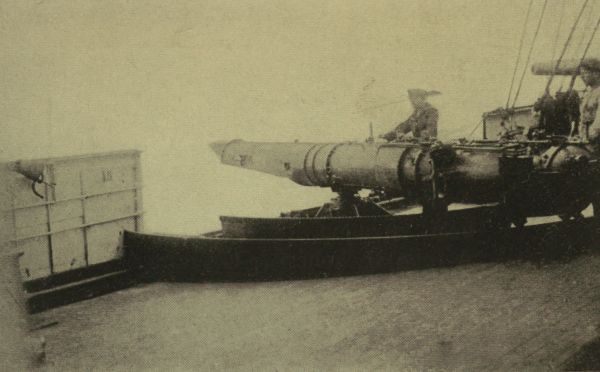
SHOWING "MANNLICHER" TYPE TORPEDO TUBE, PORTSIDE FORWARD ON "WOLF".
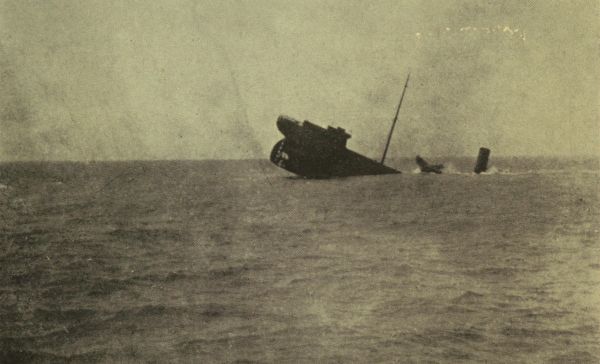
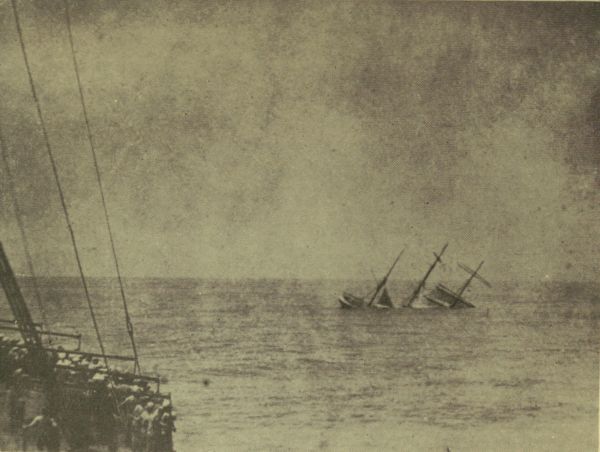
FINAL DIVE OF JAPANESE STEAMER "HITACHI MARU." 6558 GROSS TONS. CAPT.
KOKMOA. CAPTURED SEPTEMBER 26TH OFF MALDIVA ISLANDS, INDIAN OCEAN. SUNK
BY BOMBS NOVEMBER 7TH.
The German auxiliary cruiser and minelayer Wolf was formerly
a freighter belonging to the Hansa Line, a subsidiary of the
Hamburg-American Line; of 6,728 gross tons; single screw, one funnel;
two well decks, two telescoping masts, equipped with wireless, double
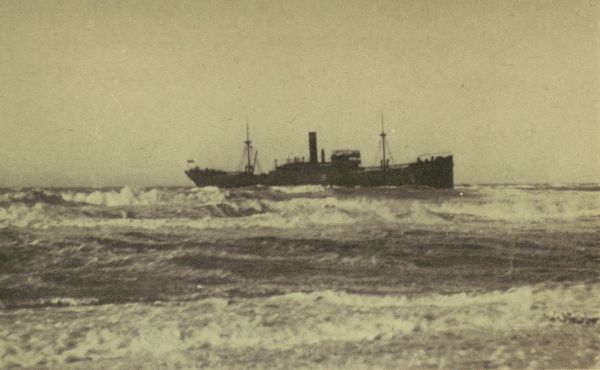
bridge; two Sampson posts on poop and four sets of cargo booms. On
the poop rigged from the Sampson posts were two faked cargo booms whose
real purpose was to disguise a six-inch gun mounted there. On her boat
deck she showed three life-boats, working boats from each side. The
vessel was painted all black and had no particular distinguishing marks.
Wolf carried two six-inch ordinary guns, one mounted forward
under the forecastle head and the other on top of the poop; four
4.7 ordinaries, two forward and two aft mounted on the well deck.
The bulwark or rails at these guns, as at the six-inch forward gun,
were fitted with hinges and spring catches, so that by one blow of a
hammer they dropped down, giving the guns ample room for action. Under
ordinary circumstances nothing of these guns could be seen above the
rail. She was further armed with four torpedo tubes, two forward and
two aft, on the well decks. The torpedoes forward were "Red Heads"
and especially effective for short distances, while those aft were
"Mannlichers" and used for long distance work. She also had four
machine guns mounted, two on each end of the boat deck in such a manner
that they could control the decks and the prisoners' quarters aft.
On leaving Kiel Wolf had a crew of three hundred and seventy-five
men, including one Commander and Corvette Captain, one Lieutenant
Commander, three senior and six junior Lieutenants, two Surgeons and
twelve Warrant Officers, including gun mechanics, torpedo mechanics,
mine experts, navigating sub-lieutenants and boatswains. She had a
wireless crew of seven men, including one wireless expert. The signal
corps consisted of six signal men in charge of a code expert, who had
had several years of training at a school in deciphering various codes.
I am led to believe from what I saw that this man was able to decipher
naval and private codes used in the South Pacific, but was unable to
handle codes used in the North Atlantic.
On leaving Kiel Wolf had on board five hundred mines, seventy-five
hundred tons of Westphalian coal, three thousand tons of water, and
twenty-five hundred tons of food and ammunition. This heavy cargo
over-loaded the Wolf. I understand she was drawing over two feet
more than her normal loaded draft when she left Kiel, and on getting
safely through the blockade she encountered a very heavy series of
gales in the North Atlantic, causing the vessel to labour heavily.
This labouring strained her hull and topside and she dropped a good
many rivets. As soon as she ran out of this bad weather repairs
were made and all her topsides double riveted. Something like nine
thousand rivets were driven, this work being done by her crew as the
Wolf proceeded down the Atlantic. Among her mechanics she seemed
to have representatives from almost every trade, and apparently an
inexhaustible supply of materials for making repairs or new additions
to her equipment.
Wolf was equipped with a triple expansion engine and three boilers
and one auxiliary donkey boiler. Her power plant was unique in that
she could steam seven knots per hour on a consumption of eighteen tons
of coal per diem, and eleven and a half knots per hour, her maximum,
on twenty-eight tons of coal per diem. I have heard it said that she
had one of the most efficient power plants out of Europe, having a
fuel consumption of 1.2 per I.H.P. Wolf was further equipped with a
powerful searchlight, situated abaft the bridge, on a tower that could
be raised or lowered at will. When not in use this light could not be
seen above the top of the house. Wolf sailed from Kiel on November
21, 1916.
The Commander of the Wolf, Corvette Captain Nerger, of the Imperial
German Navy, was a man of probably thirty-five years of age, of
moderate height and slim build. He was immaculate in all things
pertaining to his person, and was a strict disciplinarian. I was in
Commander Nerger's quarters one day. I had visited him to thank him for
the courtesy he had extended to my family and to myself, and found him
a very agreeable man to talk to; a thorough gentleman and apparently
anxious to do anything he could to make our lot bearable. In talking
with him I found nothing to denote the arrogant Prussianism which is
said to predominate in the higher branches of the German Navy.
And yet Commander Nerger was a man "all alone." He kept absolutely to
himself; took no man into his confidence. No man ever knew an hour
ahead what his plans or the vessel's plans were. He was the only one
who knew when we started for home. On the fifteen months' cruise of
the Wolf Nerger was in full charge and ran his vessel as a "one man
ship." He lived in comfortable quarters on the boat deck, just under
the bridge, and had his meals served in his private dining room. In the
five months I was on the Wolf I do not think I saw him on the berth
deck more than a dozen times, and then only on an inspection trip of
some kind. He always had the appearance of having just stepped out
of a bandbox, he was so immaculate in his dress. I was told by his
officers that Nerger never gets excited; always remains cool under
all circumstances. They tell a story of his being in command of a
light cruiser in the battle off the Dogger Banks, and throughout this
engagement he calmly passed back and forth on the bridge, with a cigar
in his mouth, giving his orders as calmly as if at some gun practice or
manœuvres. His officers and men all respected him, which to my mind
is a good enough recommendation.
One of the peculiarities of the Wolf's cruise was that nobody,
excepting the Commander, knew where she was going, when she was going,
and how long she was to be away. The majority of the officers, thinking
she would probably try to duplicate the raider Moewe's operations,
took only enough clothes to last them about three months, and only
augmented their supply from the various vessels captured. From one of
the captured steamers they got several rolls or bolts of heavy dress
goods, but unfortunately for them, they didn't have enough cotton
thread to make them up into wearing apparel, although some of them,
in more need than the rest, sewed their new suits with ordinary sail
twine, similar to that which the grocer uses to tie up his parcels. The
cloth was all dark goods, and it looked odd to see the coarse white
string stitches against the dark background. Many of the suits were
very well cut and fitted in the regular naval style.
The Wolf's method of getting away from Kiel was unique. Each day
about eleven o'clock in the forenoon, she would up anchor and steam
out of Kiel harbour, manœuvring outside and having gun practice,
returning each night to anchor in the harbour. This procedure was kept
up for over three weeks, until finally one night the Wolf failed to
return. During these three weeks nobody was allowed ashore or to hold
any communication with the shore. Even the German naval authorities did
not know the date she was to sail, until she had gone. All this goes to
prove that the German Naval Department had considerable respect for
the Allied Intelligence Department.
On leaving Kiel the Wolf went through what is known as the "Big
Belt," a passage through Denmark into the Kattegat, from there along
the Danish coast across the Norwegian coast, and out to the Atlantic
between the Farrows and Iceland. On returning to Germany she merely
retraced her course, the only difference being that she passed through
the "Little Belt," a very narrow piece of water, one-half of which is
German territorial water and the other half Danish.
From where I used to sit on deck outside my quarters I could see the
other prisoners aft on the poop, at that time some two hundred of
them. Over half of them had no shoes, socks or overshirts, and fully
one-fifth of them wore no undershirt. I asked a couple of them why they
did not wear a shirt in that blazing tropical sun. They told me that
they had only one shirt apiece and that the sweat rotted them so fast,
that they were going without shirts at present and saving them till
the weather got cold. Three times a day each squad flunkey (a squad
consisted of fourteen prisoners) would troop up to the galley amidships
and get their rations for the meal—a kettle of alleged tea or coffee,
black bread, and at noon a kettle of goulash, resembling a soft stew.
I had been on board the Wolf for some time before I finally got the
chance to sneak down below aft and see what the prisoners' quarters
were like and have a talk with some of the men.
The prisoners' quarters on the Wolf were located aft in the cargo
hold, and had their only entrance under the poop, on the main deck. The
quarters themselves were reached by means of a narrow ladder only, and
this ladder was built in such a manner that not more than two persons
could pass up or down at the same time, or one person up and one down
simultaneously, thereby guarding against a concerted rush in event of
an escape being planned.
Over the entrance or hole in the deck leading to these stairs was
slung a heavy iron hatch or cover, in such a manner that it could be
dropped into place instantaneously by one of the guards. This hatch
would effectually close the only exit from the quarters where there
were over two hundred prisoners confined. Also the closing of this
hatch would cut off nearly one-half the air supply; during the times
when this hatch was closed, when the Wolf was passing through some
danger, the suffering in the hold from lack of air was often intense.
Even under normal conditions the air supply was inadequate. It was
probably 8:30 P.M. when I was there, and I would judge the
temperature to have been between 118 and 120 degrees Fahrenheit, and
the reek of feet, breath and bodies was something awful. On this
particular night, I should judge from one-quarter to three-eighths of
an inch of sweat was on the floor, and when the vessel rolled there
would be a thin scum of liquid running from side to side. The walls and
ceiling were literally running water, which was caused by moisture
drawn from the bodies of the men by the hot iron sides of the ship and
the deck overhead. Combine stale tobacco smoke with this atmosphere,
and it was a wonder to me that a human being could exist in it.
At this time everybody was herded into the one compartment—captains,
mates, engineers, firemen, sailors, cooks and flunkies, all
together—white men, niggers, Turks, Greeks and Japanese. At night
everybody slept in hammocks and during the day these hammocks were
"made up" and piled away in one corner, thus leaving enough room for
several rough plank tables and benches to be set up. There were no
lockers or any compartments where a man could put his spare clothing
or shaving gear, therefore no man's gear was safe from theft. A man
who didn't have a shirt would steal one from a man who had two; this
made it impossible for a man to have any more clothes than just what he
stood in. Later on many of the men were given empty cases or boxes and
fixed them up to keep their spare gear in.
The sanitary arrangements at this time were very poor, there being
only three toilets for all hands. Certain squads of men would take
turns in keeping these quarters clean, the whole place being thoroughly
scrubbed out three times a week. I mean thoroughly in the full sense
of the word. Everything moveable, excepting the clothing boxes, was
taken on deck, then the room scrubbed with heavy brushes and sand. Next
the tables and benches were scoured with sand and canvas, the hammocks
scrubbed and the various tin dishes used for food were scoured bright.
After everything was dry it was put back in place and the prisoner
officer made an inspection. It was very seldom that he found anything
to complain of, as the men seemed to welcome this house-cleaning as it
gave them something to do to occupy their time. Reading material was
very scarce, so the time passed very slowly.
There was supposed to be a regular daily routine; but owing to the many
interruptions, such as gun practice, fire drill, boarding drill and
drills with small arms, this routine was not always carried out. At
5:30 A.M. all the prisoners were waked up and by six o'clock
all the hammocks were made up and stowed away. Then the tables were
set up in place and the table laid for breakfast. At seven o'clock
the squad flunkies would get their gear ready, and promptly at 7:20
breakfast would be ready. Immediately after breakfast the dishes were
cleaned and the quarters given their regular daily clean up. Usually
during the forenoon, after their work was done, the prisoners were
allowed to go up on deck and enjoy the fresh air. Dinner at 12:30 noon,
coffee at 3:30 P.M., and supper at 6:30. Very seldom was
anybody allowed on deck after coffee. At 8:00 P.M. all lights
were extinguished excepting three, one over the steps at the exit and
two at the back of the quarters.
The distribution of the fresh water was also very poor. Each prisoner
was allowed half a gallon per day for washing, drinking and bathing
purposes. This amount, properly conserved, will answer the purpose,
but unfortunately the method of distribution was so poor that not all
got their regular allowance; and the loss of this water caused the
unfortunate ones great inconvenience, especially during the time that
the Wolf was in the tropics. Many of the men used tea to brush their
teeth in; and I have heard of cases where tea had been used for shaving
purposes, but imagine these cases to be rare.
While there, a Captain of a big British oil tank steamer that had been
captured and sunk told me the following piece of history. I afterwards
verified this and can vouch for its truth. While the Wolf was lying
at Sunday Island undergoing repairs to her boilers, the prisoners were
furnished with fish hooks and line and a couple of jolly boats and
allowed to row into the rocks and catch fish. Each boat, of course, was
in charge of an armed sentry. After fishing they would return to the
Wolf each night. On the night before the Wolf was to sail two men,
the chief mate and first assistant engineer of the S.S. Turitella,
dropped overboard and swam for the shore. Before leaving the vessel
these men had secreted on their persons a supply of fish hooks and
lines, a small hunter's hatchet, two large sheath knives each, matches
and a good supply of tobacco. The matches and tobacco were securely
wrapped in waterproof oilcloth. Just at dusk, as the prisoners were
being ordered below, these two men slipped over the side, sliding down
a rope into the water. They then swam under the stern and climbed up on
the rudder and sat there in such a manner that they could not be seen
from on deck. A confederate in the meantime had taken care of the line
hanging over the side. About nine o'clock, when it was good and dark,
they again slipped into the water and swam for the shore some half a
mile distant. There is a strong current setting parallel with the shore
in this particular locality and, as the water is infested with sharks,
the betting among the men was two to one that neither of them would
make it.
Later on, from some of the officers that had been on shore at Sunday
Island, I found out there had formerly been a family living there,
but at this particular time they were away on a visit, probably to
New Zealand, as they had left their house fully furnished and with
quite a supply of provisions on hand. Everything indicated that they
intended returning at a later date. A calendar hanging on the wall
indicated that this family had left there between April 17th and 23d.
When the loss of the prisoners was finally discovered there was a
great rumpus, and as a punishment all the prisoners were kept below
for twenty-eight days, being allowed on deck for only one hour each
day, weather permitting, for exercise. The British captain said that
those were the most awful days he ever experienced in his life and that
each day he and the rest were getting perceptibly thinner. Just about
this time I got the sign from the sentry that the prisoner officer
was coming and I had to beat a retreat. Afterwards I found out that it
was not the prisoner officer but the mine officer, Lieutenant Dedrick,
who proved to be a humane officer and a champion of the prisoners.
Dedrick came down below into the hell hole and got one good lungful
of the rotten atmosphere and went immediately to the Commander and
reported conditions. Commander Nerger at once called both doctors and
accompanied them aft on a tour of inspection. The next day everybody
was chased on deck and the "Hell Hole" below was cleaned out and better
ventilation arranged for; it was also painted; also the captured
captains and ships' officers were given quarters to themselves, while
the whites and blacks were separated. On the whole the conditions
for these two hundred men were improved one hundred per cent. The
prisoner officer was confined to his room for five days for allowing
such conditions to exist. Nerger had inspected these quarters before,
but only when the men were on deck and the place freshly cleaned out.
Personally I do not think he knew how bad conditions were.
Along in the first part of January I learned by wireless that of
the two men who swam for shore at Sunday Island the first assistant
engineer was drowned, while the other reached shore in an exhausted
condition. He and his companion while swimming ashore became separated
in the dark and the mate did not know for a certainty whether his chum
was taken by a shark or drowned from exhaustion. He stayed on the
island for somewhat over two months, living on the provisions that were
left in the house and on fruit, of which there was a great abundance.
He was finally taken off by a Japanese cruiser whose attention was
attracted by his signal fire, which he kept burning day and night. The
cruiser finally landed him in New Zealand.
All this time we were steaming in a northerly and westerly direction.
When we arrived at the southernmost end of New Guinea we stopped and
lay to for a couple of days. I soon learned that we were waiting
for a steamer and expected her any minute. During these days the
Wolf's hydroplane would go up to reconnoitre three times a day. It
would travel fifty or sixty miles on clear days, and from a height of
three thousand metres it had a vision of ninety miles, so the Germans
claimed. One of the German sailors told me that in another day or so
we should have plenty of beer—that they had picked up a wireless
message stating that the Australian steamer Matunga would soon arrive
in Rabul with five hundred tons of coal and three hundred tons of
foodstuffs, so many hundred cases of beer, etc., for the Government.
Sure enough, on the morning of August 4th I was awakened by my
orderly with the usual supply of cotton batting for our ears. Shortly
thereafter there was a bang from one of the cannons and the Matunga
stopped. Lieut. Rose and the prize crew went on board and took charge.
In about an hour the launch came back with the Matunga's captain,
Donaldson, and his officers and crew, also sixteen Australian soldiers
who were en route to the Islands. Both steamers then proceeded north,
arriving on August 10th at a place in northern New Guinea that we named
Pirate Cove.
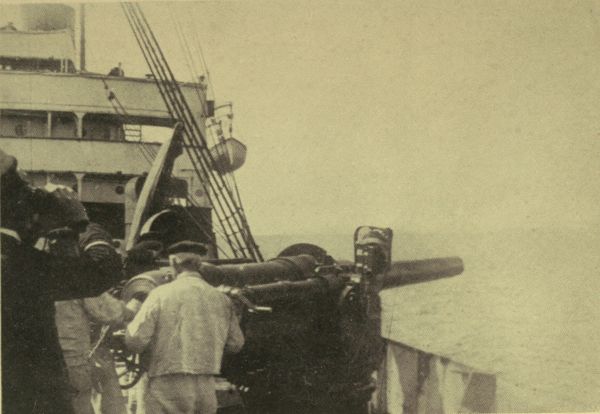
SHOWING 4.7 "ORDINARY" PORTSIDE GUN FORWARD ON "WOLF."
LIEUT. ROSE WITH BINOCULARS.
On the way to Pirate Cove Commander Nerger practised all kinds of naval
manœuvres with the Wolf and the Matunga. At one time he would
engage her in battle and finally after a fierce encounter, by superior
manœuvring he would destroy her. The next time the Matunga would
be an enemy's merchant vessel and the Wolf would sneak up to her,
suddenly dropping her ports, and make the capture. This manœuvre was
carried out quite realistically, the boarding crew supposedly meeting
resistance and finally taking charge of her after a fight on deck, in
which the boarding crew's bayonet drill would come in handy. At another
time the Matunga would be a German cruiser and Nerger would direct
her attack against the enemy. At this time he was probably anticipating
being made an Admiral on his return to Germany and was getting what
practice he could.
At Pirate Cove naked New Guineans, men, women and children, came out to
the Wolf in thirty feet long canoes for tobacco, which was the only
understandable word they could say. They offered to swap parrots, pigs,
cocoanuts, sugar cane, bits of coral, woven mats of garish colours and
queer pattern, showing whales, birds and primitive human figures. The
Wolf's officers got first whack at the bargains and went in strong
for the fancy mattings, but when they got them aboard found them full
of native vermin. These souvenirs for their wives and sweethearts were
promptly turned over to the antiseptic department and cleaned, for the
Wolf had on board a complete dis-lousing plant through which all new
prisoners were put, whether they needed it or not. The German sailors
had second choice after their officers and went in strong for parrots
and cocoanuts. The prisoners, who could buy tobacco at the Wolf's
canteen, if they had any money, had last choice of the New Guinea
merchandise. I had no money on the Beluga, having sent mine by draft
to Sydney, but I had stacks of clothes, and to get a little ready
"canteen" money I sold some of them, the Wolf's officers paying me
$25.00 for second-hand suits and $3.00 for second-hand shoes.
The natives were cleaned out by the Wolf. Among the purchases was an
alleged New Guinea pig, which had the legs and body of a deer and the
head of a porker—and it had fur, too. God! I never saw anything like
it. It didn't have an orthodox corkscrew tail but a compromise between
a pig's and a deer's tail. The pig mascot was given the freedom of the
Wolf and dashed if it didn't lick every dog on the ship. We had seven
dogs on board, taken from sunken ships—dachshunds, fox terriers, all
sorts—and the pugnacious deer-pig cleaned them all up. But the Germans
were too much for it. After two months in German company the pig
couldn't stand it any longer and, after the slaughter of the Hitachi
Maru, of which it was an eyewitness, it committed suicide by leaping
down an open hatch to its death fifty feet below. The Germans buried
the pig at sea with military honours.
While we were lying in Pirate Cove the cargo and coal of the Matunga
were transferred to the Wolf; also nine of the Matunga's passengers
and the balance of her crew. Quarters were provided for these prisoners
on the same deck where I was. There was a Colonel and a Major with
his wife, belonging to the Australian medical corps; three Australian
military captains; three civilian planters, who were en route for the
plantations on the Island, and the stewardess of the Matunga. This
addition of prisoners to the top side was a welcome change to myself
and family, as it gave us somebody else to talk to, and I was also
able to get news of the war from another source than the German. I was
anxious to learn what steps America had taken or contemplated taking.
To hear those Australian chaps talk you would have thought that the war
was a high lark, and that just as soon as Great Britain got around to
it she, ably assisted by the Australian forces, would chase Fritzy off
the map.
The addition of these passengers to the top deck squad made it
necessary for Commander Nerger to make certain rules and regulations
to be observed regarding the distance we could go from our rooms. We
were allowed a seventy-foot run-way. Also when anything was going on,
such as gun practice, boarding drill, fire and boat drill, we were
chased into our rooms. This caused a lot of grumbling but no doubt it
was justified. I may add that there was nearly always something doing
on the Wolf. They drilled and practised almost continually—practised
sinking imaginary ships, indulged in "battle practice," and even
practised abandoning the Wolf in boats and sinking their own ship.
While lying at Pirate Cove we had an exciting experience. It seems
that some of the Germans had a suspicion that some of the prisoners
were going to try to escape by swimming ashore. They doubled the
guards both below and on deck and in addition had twenty-four Marines
sleep on the afterdeck with their muskets alongside of them. On this
particular night the German sailors had stolen a couple of cases of
whiskey from the cargo of the Matunga and many of them were pretty
badly intoxicated. At 11:30 P.M. one of the guards down below
aft imagined that he saw someone making a sneak for the stairs leading
on deck. Next moment he shouted "Help! Help!" and blazed away with
his revolver in the general direction of the stairway. Naturally the
prisoners sleeping on the far side of the stairs made a rush to get out
of the line of fire. The guard saw this crowd rushing his way and ran
on deck immediately. A general alarm was sounded and men and officers
poured on deck from all directions. Just then a shoal of fish some
little distance away in the water made a disturbance and the German
crew, thinking that somebody was attempting to swim ashore, opened fire
on the fish with two machine guns. Also everybody who had a rifle or
a revolver opened fire at something. One officer, who stood in front
of my room, emptied his revolver into the air, just shooting because
everybody else was doing it. Meanwhile, Chief Officer Schmell and three
sailors had jumped into the launch and also mistaking the shoal of
fish for prisoners trying to swim ashore, made for the spot—and were
enthusiastically fired upon by the German machine guns in the dark.
It sure was bum team work and a miracle that Schmell and his men were
not killed. The launch was punctured in several places. As soon as
the big searchlight was put into commission, it became apparent that
there was nobody in the water. All the prisoners were then mustered
out and counted, and as there were none missing, the Germans decided
that it must have been a false alarm and everybody blamed everybody
else. When Schmell got back on the Wolf he was raving mad at having
been fired at by the machine guns. He wasn't red, but green with anger,
and he talked so fast that I couldn't make out what he said, but I
heard afterwards that he wanted to court-martial everybody, including
the cook. It always will remain a miracle to me that some of our own
fellows weren't shot as the frenzied guard emptied his gun before
running on deck.
On account of the high hills surrounding our anchorage the Wolf's
wireless was not of much account, so the members of the wireless squad
erected a station on the top of one of the highest hills. Here they
would pick up any news that was flying around and transfer it to the
Wolf by means of an ordinary flash light. This was easily readable
with a pair of glasses, but unfortunately there was nothing of interest
excepting the "press"; however, it gave me an insight of just how much
reliance to put into the press reports that the Germans would let us
see from time to time. This, of course, was all British press and
reports were given as to advances and repulses on the various fronts
and also the weekly sinkings. Should the Allied forces advance or the
Germans lose a position, their press did not note it, but on the other
hand, if the Germans had a victory or there were any political reports
in their favour, the news was given us in full detail.
From one of the officers who had been ashore I learned that the native
settlement, which at one time evidently had been quite large, must have
been visited by some dreadful plague, as the houses in the village were
deserted, not a single native living on that side of the bay. He also
said that in many of the houses the skeletons of the dead still lay,
some inside and some outside of the huts, leading a person to believe
that this sickness struck them down suddenly and that they died nearly
instantly, as on the porch of one of these huts there was a skeleton
with some kind of a dish alongside of it, making it appear that death
had come suddenly.
Here at Pirate Cove the doctors were greatly worried on account of
fever and malaria and dosed us vigorously with quinine. Lord! I ate
enough quinine to last me the rest of my life. There were no capsules
on board and we had to eat the raw article, and there was no way of
dodging it. Each morning and evening all hands, officers, crew and
prisoners, were marched past the hospital steward's office and each
was handed his little bit on a spoon, with a glass of water to wash it
down. The only satisfaction I had was that it tasted just as rotten to
the Germans as it did to me. Strangely my little girl did not dislike
it a great deal and I was greatly pleased as I anticipated a riot when
she got a taste of the first dose. My wife's share, she being still
confined to her room, I used to throw overboard, giving her only an
occasional small dose. The quinine used to cause a drumming in my ear
and make me halfway deaf.
Undoubtedly it had the same effect on the German sailors yet they
were forced to work transferring coal from one vessel to the other.
They usually worked three shifts in the twenty-four hours. They would
go down in the hold with nothing but a breech cloth on and when they
came up they would resemble negroes and their bare bodies would be
just running in sweat. At these times I used to feel sorry for them;
then they would sink one of our vessels and I would wish them doomed to
eternal labour of this kind.
Among the Matunga's heterogeneous cargo were two large horses and
one small pony. These were taken care of by the butcher department and
I suppose I ate my share. I afterwards told my wife about her eating
horse flesh and nearly lost a handful of hair for my information.
On August 26th both Wolf and Matunga proceeded to sea and at 1:20
P.M. the Matunga was sunk by three bombs. From the time of
the first explosion until she disappeared beneath the waves was just
six and a half minutes. She sank stern first, and as she made the final
dive the rush of air below decks blew out the forecastle bulkhead,
making it appear as if there had been a fourth bomb concealed there.
Here I am convinced was the only time during the eight months that
I was a prisoner on the Wolf that there was ever any serious
thought on Nerger's part regarding landing the women, children and
medical officers. Before taking the Matunga to sea to sink her,
they transferred one of her large life-boats to the Wolf, also a
small gasoline launch. These were hoisted on deck and placed in such a
manner that they could be put overboard again easily, also they were
in such a position that it interfered with the movements of the gun
crew, thus proving that they were there only temporarily. One of the
officers asked me if I had ever had any experience with gas engines
and was familiar with this particular make. I told him I was, having
owned at one time an engine of this make. After giving the officer this
information he was overheard by one of the womenfolk repeating it to
the Chief Officer. We top side prisoners were some worked up, believe
me. We had it all "doped out" that after sinking the Matunga we
should proceed off some island that was inhabited but had no wireless
or cable connections, there the women, children and medicos would
be put in the life-boat and I would tow them with the launch to some
nearby harbour.
This would have been the logical thing to do if Commander Nerger wanted
to conform to the articles of the Geneva Convention, which specifically
states that medical officers in event of capture shall be set free at
the first available opportunity. Nerger also told me and my wife that
he would land us in some safe place at the first opportunity, provided
he could do so without jeopardising his own safety. He also told the
medical officers and the rest of the women the same thing. I maintain
that at this time Nerger could have landed us with perfect safety to
himself and his ship—as the Wolf was about to leave the Pacific
Ocean, having finished her activities in that locality. At that time
nobody had information regarding the Wolf's previous movements nor
any knowledge of her mine-laying operations. However, at the last
minute he must have concluded that this was too "humane" a procedure
and ordered the boats over the side; they were fastened to the
Matunga and went down with her. I claim this to have been the acme of
inhumanity. He might just as well have condemned the women and children
to death right there, because at that time there were ninety-nine and
a half chances to a hundred that they would be either killed in action
or drowned. I don't believe that there were five men in all the crew
of the Wolf, officers included, who ever expected the Wolf to win
safely into Germany. There is another point to consider: why did Nerger
and his officers continually assure us that the womenfolk should be
landed shortly? If he had told the truth like an officer and a man
and said he had no intention to land us, then we would have had more
respect for him and would not have suffered the bitter disappointment
that we did.