In the second and third centuries three mighty Hindoo kings were renowned
for their cookery. They were Nala, the king of Nishadhades, whose
fame for dressing and preparing excellent dishes made his kingdom famous.
He reigned in the second age.
The second was Bhima, who reigned in the third age. He was so devoted
to the culinary art that for a whole year he served in the capacity of Valala, or
cook to Virat Rajah, King of Panchala Nagur.
The third was King Pakasasana, who was not only superintendent of the
preparation of celestial food, but was also a distinguished chef.
The secret of the cuisine of these noted cooks was a mysterious powder,
which, when added to their dishes, cured disease, as well as appeased the appetite.
Those who partook of their food died only of extreme old age or by accident.
No record can be found where the fevers of the country carried them off.
In an ancient cookery book printed in the Sanscrit language, are preserved
many of the formulas and recipes used by these kingly cooks and their successors.
The “mysterious powders” which they used were a combination of various fruits,
spices, condiments, roots, seeds, etc., which were either pounded together dry or
worked to a paste and dried afterwards. There were hundreds of these preparations
which were used in different dishes; each dish had its own separate powder.
They are known to modern civilization as Curry powders.
To-day almost every nation has its own appropriate Curry powder and its
own Curry formulas.
The Curry powders of England are particularly suited to the damp, foggy
weather of that country, but they are no more suited for this climate than are
the heavily brandied Champagnes which are of a necessity used in England
and Russia.
A short time ago the members of the famous New York Chafing Dish Club
decided to hold a series of practical sessions in Curry cookery, with a view to
determining which Curry powder on the New York market was the most appropriate
for the United States, at the same time was made of the purest and most
wholesome ingredients.
Over forty different Curry powders were tasted. A number of distinguished
English epicures were present and took part in the contest, with a view to
demonstrate that the English preparations were the best. The different bottles
were wrapped in paper so that the labels of the powders could not be seen. Each
package was numbered, and it was the universal opinion of the experts that
Number 7 was the best of the lot. When the wrapper was removed Number 7
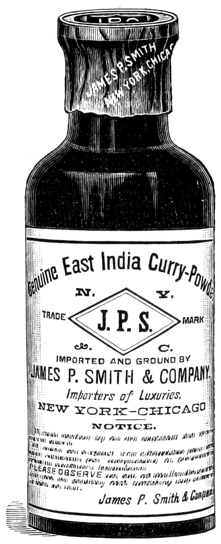
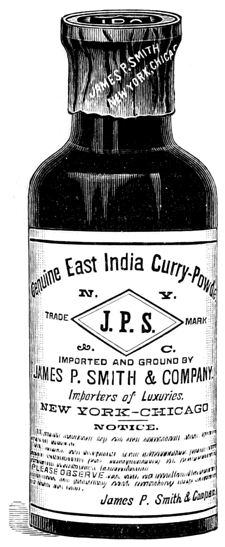
was found to be the Curry powder of JAMES P. SMITH & COMPANY,
Park Place, New York.
THE AUTHOR.