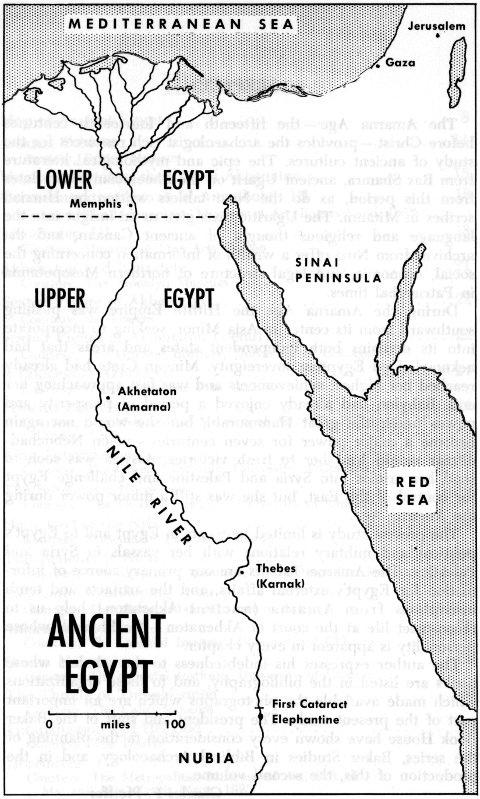
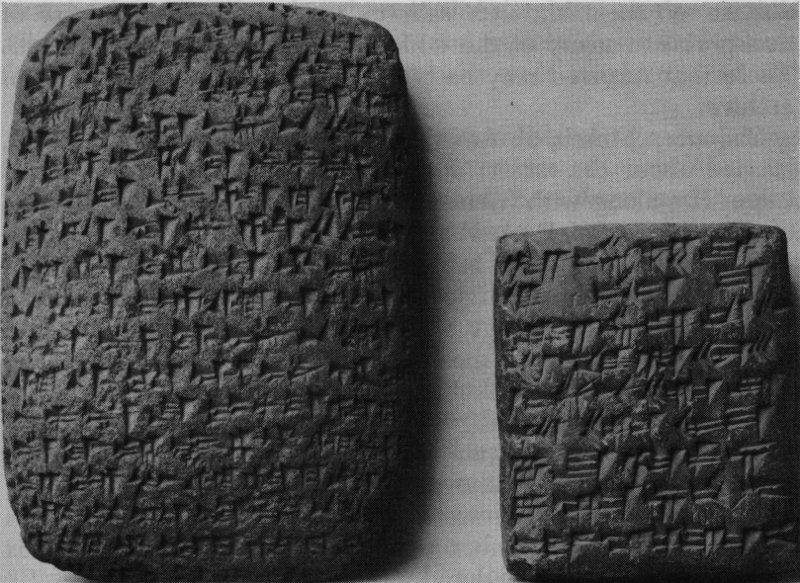
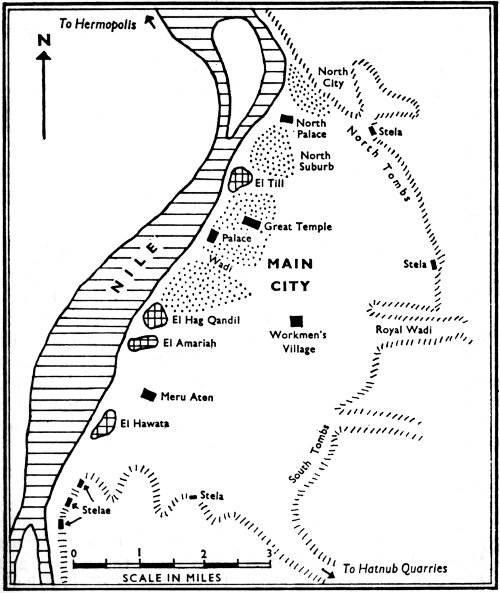
The Amarna tablets enable us to see evidences of the decline
of Egyptian power and prestige during the latter years of the
reign of Amenhotep III and throughout the reign of Amenhotep
IV (Akhenaton). About forty of them record correspondence
between the rulers of Egypt and the rulers of the major powers
of the Amarna Age. We find letters from the Kassite kings
Kadashman-Enlil I and Bumaburiash II of Babylon, from Ashuruballit
I of Assyria, from Tushratta of Mitanni, from the Hittite
king Suppiluliumas, and from an unnamed king of Alashia
(Cyprus).
In upper Mesopotamia, Egypt had an ally in Mitanni, a kingdom
comprised largely of Hurrians (Biblical Horites), with an
Indo-Aryan ruling class. The Mitannian kingdom was established
about 1500 B.C. and at the height of its power reached from
Nuzi and Arrapkha in Assyria to Alalakh in Syria. Its capital,
Wassukkanni, was on the upper Habur River. A major threat
both to Mitanni and, ultimately, to Egypt, came from the rising
Hittite Empire with its capital at Hatusa (modern Bogazkoy) on
the great bend of the Halys River in Asia Minor. Babylon had
suffered an eclipse since the empire of Hammurabi and during
the Amarna age it was ruled by a mountain people known as
Kassites. Assyria, north of Babylon, had been subject to Mitanni
until the Hittite conquest of Mitanni gave the Assyrians an opportunity
to free themselves and develop an independent state.
The kings of Mitanni sent daughters to grace the harems of
the Pharaohs of Egypt, and desired gold in exchange. The
Amarna tablets include seven letters from Tushratta of Mitanni
45
to Amenhotep III, one to his widow Queen Tiy, and three to
Amenhotep IV (Akhenaton). In a typical communication he
writes to Amenhotep III:
Let my brother send gold in very great quantity, without measure—that
is what my brother should send me—and let my brother
send more gold than (he sent) to my father, for in my brother’s
land gold is as plentiful as dust. May the gods so direct that,
although now gold is so plentiful in my brother’s land, he may
have gold ten times more plentiful than now. Let not the gold
which I desire trouble the heart of my brother, and let not my
brother grieve my heart. So let my brother send me gold, without
measure, in very great quantity.[28]
Although Tushratta’s lust for gold may not have been appreciated
in Thebes, Egypt valued her Mitannian allies who served as
a check on the ambitious Hittites, thereby helping Egypt maintain
control over Syria and Palestine. Not only were princesses
from Mitanni welcome in Egypt, but the Mitannian gods might
be of help to the Egyptians. During the illness of Amenhotep
III, Tushratta sent a statue of the goddess Ishtar from Nineveh
to bless the ailing Pharaoh:
Thus saith Ishtar, mistress of all the lands, “To Egypt, to the
land which I love I will go; I will return.” Verily I have now sent
her, and she is gone. Indeed in the time of my father the
mistress (Ishtar) went to that land, and inasmuch as she was revered
when she formerly resided there, so now may my brother
tenfold more than formerly honor her. May my brother honor
her and joyfully send her back, and may she return. May Ishtar,
mistress of heaven, protect my brother and me one hundred thousand
years, and may our lady give to us both great joy.[29]
Tushratta looked to Egypt for help against Suppiluliumas
and the emerging Hittite Empire, but neither gold nor troops
came. Akhenaton was singing the praises of Aton in Akhetaton
when the Hittites succeeded in entering and sacking the Mitannian
capital (ca. 1370 B.C.) and Tushratta was slain by one
of his own sons. The former king’s exiled brother and rival,
Artatama, seems to have seized control in the confusion that
followed. Tushratta’s son Mattiwaza (who may have been his
father’s murderer) fled to the Hittites, and Shutarna, son of
Artatama, sought the friendship of the Assyrians in his bid for
the throne.
The Mitannian Empire was at an end. Mattiwaza gained
Hittite support and took the throne of Mitanni with the aid of
46
Suppiluliumas’ army. He remained a vassal of the Hittites, however,
and his marriage to a daughter of Suppiluliumas further
strengthened Hittite power in Mitanni. At the same time Ashuruballit
of Assyria took advantage of the situation to seize the
portion of Mitanni nearest to him. Assyria had been controlled
alternately by Mitanni from the west and by Babylon from the
south, but Ashuruballit determined to head an independent
state.
To strengthen his position, Ashuruballit sent messengers to
Akhenaton with a present of two white horses and a silver
chariot. The letter accompanying these gifts[30] asks nothing in
return, but a second letter[31] mentions a new palace that Ashuruballit
is building, with the suggestion, “If thou art very friendly
disposed, then send much gold.”
Evidently the Assyrian embassy was received with courtesy in
the court of Akhenaton, for Burnaburiash of Babylon was unhappy
at the thought that Egypt would deal with a people who
had been subject to Babylon. In anger he dispatched a letter:
To Niphururia (i.e., Akhenaton), king of Egypt, say. Thus says
Burnaburiash, king of Karduniash (i.e., Babylon), brother. I
am well. May it be well with you, your house, your wives, your
sons, your land, your chief men, your horses, your chariots. Since
my fathers and your fathers established friendly relations with
one another they sent rich presents to one another, and they
refused not any good request one of the other. Now my brother
has sent (only) two minas of gold as a present. But now, if
gold is plentiful send me as much as your fathers, but if it is
scarce send half of what your fathers did. Why did you send
(only) two minas of gold. Now, since my work on the House of
God is great, and I have undertaken its accomplishment vigorously,
send much gold. And you, whatsover you desire from my
land, write and it shall be brought to you. In the time of Kurigalzu,
my father, the Canaanites as one man wrote to him saying,
“We will go against the border of the land (i.e., Egypt), and
we will stage an invasion, and we will make an alliance with
you.” But my father wrote to them saying, “Cease speaking of
an alliance with me. If you are hostile against the king of Egypt,
my brother, and ally yourself with another, I will come and will
plunder you for he is in alliance with me.” My father did not
listen to them for the sake of your father. Now, concerning the
Assyrians, my subjects, have I not written to you? If you love
me you will not do business with them. Let them accomplish
nothing. As a present I have sent to you three minas of beautiful
lapis-lazuli, and five span of horses for five wooden chariots.[32]
47
The Egyptians, however, did not give serious attention to their
Asian Empire until the reigns of Seti I (1318-1299 B.C.) and
Rameses II (1299-1232 B.C.). During the half century following
the fall of Mitanni the Hittites met no serious opposition in their
desire to control the whole of northern Mesopotamia and the
Mediterranean coastal region of Syria. Not only was a daughter
of Suppiluliumas married to the ruler of the vassal kingdom of
Mitanni, but a son, Telepinus, was installed as ruler of Aleppo
in Syria. The Amorites who had been vassals to Egypt were
glad to welcome Hittite aid in establishing their independence.
North Syria, or Amurru, became a hotbed of anti-Egyptian feeling,
and Amorite princes served as unconscious pawns of Suppiluliumas
in weakening Egyptian control in the area and preparing
the way for Hittite domination.
Most of the Amarna letters were written by princes of city
states in Syria, Phoenicia, and Canaan who acknowledged
sovereignty but expressed the fear that rival princes or alien
peoples might gain the upper hand. Some of the letters represent
factional disputes among leaders both of whom protest
their loyalty to Egypt. Among the rulers in Syria and Palestine
we find letters from Akizzi of Qatna, Abdi-Ashirta and his son
Aziru of Amurru (i.e., the Amorites), Rib-Addi of Byblos, Ammunira
of Beirut, Zimrida of Sidon, Abimilki of Tyre, and Abdi-Khepa
of Jerusalem. Other letters were sent from Hazor, Akko,
Megiddo, Gezer, Ashelon, and Lachish. In some instances
minor Egyptian officials wrote the letters.
Rib-Addi of Byblos was threatened by Abdi-Ashirta and his
son Aziru, Amorite rulers who followed the Hittite “party line”
in seeking to remove northern Syria from the Egyptian sphere
of influence. Gebal, or Gubla, was the ancient name of Byblos,
a city which carried on commerce with Egypt as early as 3000
B.C. Excavations have produced a cylinder from the Thinite
period of Egyptian history when the earliest Pharaohs occupied
the throne. Vases discovered at Byblos bear the names of ancient
Pharaohs including Mycerinus (twenty-seventh century B.C.),
Unis and Pepi (twenty-fourth century B.C.). From the port of
Byblos, Egypt imported cedars and spruce for use in building
ships. Ships of Byblos also carried jars of oil, spices, wine, and
leather.
48
Although Rib-Addi wished to continue to serve as a loyal
vassal of Egypt, the chaos of the political situation pressed
heavily upon him. The Amarna collection includes fifty-three
letters which he addressed to Amenhotep II and Akhenaton
warning them of the difficulty of the situation. In one of them
he notes:
Abdi-Ashirta has written to the warriors, “Assemble yourselves
in the house of Ninib, and we will fall upon Byblos.”... Thus
have they formed a conspiracy with one another, and thus have
I great fear that there is no man to rescue me out of their hand.
Like birds that lie in a net, so am I in Byblos. Why do you hold
yourself back in respect to your land? Behold, thus I have written
to the palace, and you have paid no attention to my word....
What shall I do in my solitude? Behold, thus I ask day and
night.[33]
Abdi-Ashirta and his son Aziru also wrote letters to Egypt
affirming their loyalty. Two of them were addressed by Aziru to
Dudu, an officer of the Egyptian court with a Semitic name.
Evidently Dudu occupied a place in the court of Akhenaton
comparable to that which Joseph occupied some years before
(Gen. 41:37-57). Aziru wrote:
To Dudu, my lord, my father.
So says Aziru, your son your servant:
At the feet of my father I will fall down. May my father be well.
Dudu, behold I have performed the wish of the king, my lord,
and whatever may be the wish of the king, my lord, let him write
and I will perform it. Further: Behold, you are there, my father,
and whatever is the wish of Dudu, my father, write, and I will
indeed perform it. Behold you are my father and my lord, and I
am your son. The lands of Amurru are your lands, and my house
is your house, and all your wish, write, and indeed I will perform
your wish. And indeed you are sitting before the king, my
lord. Enemies have spoken slanderous words to my father before
the king, my lord. But do not admit them. May you sit before
the king, my lord, when I arise, and do not admit against me
slanderous words. I am a servant of the king, my lord, and I will
never depart from the words of the king, my lord, and from the
words of Dudu my father. But if the king, my lord, does not love
me but hates me, what shall I then say?[34]
There can be no doubt that Rib-Addi, and not Aziru, was
truly loyal to Egypt, for Aziru had made an alliance with Egypt’s
enemies, the Hittites. Writing to the Egyptian Pharaoh, Rib-Addi
complained:
I have written to the king, my lord: “They have taken all my
cities. The son of Abdi-Ashirta is their lord. Byblos is the only
49
city that belongs to me.” And have I not sent my messenger to
the king, my lord? But you did not send soldiers, and you did not
permit my messenger to leave.... Send him with auxiliaries.
If the king hates his city, then I will abandon it, and if he permits
me, an old man, to depart, then send your man that he
may protect it. Why was nothing given to me from the palace?
I have heard of the Hati people (i.e. the Hittites) that they burn
the lands with fire. I have repeatedly written but no answer has
come to me. All lands of the king, my lord, are conquered, and
my lord holds himself back from them, and behold, now they
bring soldiers from the Hati lands to conquer Byblos. Therefore
care for thy city.[35]
Rib-Addi stood alone in defending Byblos, but the force
of the enemy proved too much. He fled to Beirut where he
found refuge in the palace of its prince, Ammunira, with whom
he was related by marriage. Byblos fell, but Rib-Addi still
hoped for aid from Egypt to win it back. From Beirut he wrote:
If the king holds back in respect to the city, all the cities of
Canaan (Kinahni) will be lost to him.... But let the king, my
lord, quickly send archers that they may take the city at once.[36]
Finally Egypt did act. Aziru was apprehended and taken to
Egypt where he was evidently detained for some time. A son
of Aziru addressed a letter to the Egyptian official Dudu begging
him for his father’s release:
Aziru is your servant. Do not detain him there. Send him back
quickly that he may protect the lands of the king, our Lord.
He goes on to mention “the Sudu people” who were taking
advantage of Aziru’s absence to further their own ends:
And all lands and all Sudu-people have said, “Aziru does not
come from Egypt.” And now the Sudu steal out of the lands
and exalt themselves against me, saying, “Your father dwells in
Egypt, so we will make hostility with you.”[37]
We do not know what happened to Rib-Addi. By his own
testimony he was an old man, but whether he died of natural
causes or was a casualty in the battles of his generation we do
not know. There seems to be a poetic justice in the fate of Aziru.
As he had terrorized the Phoenician countryside, so his Amorite
lands were terrorized by other tribes which were seeking a place
for themselves in a time of general chaos. While Suppiluliumas
backed Aziru, the Hittites were really only using him as a pawn
to weaken Egyptian control in Asia and prepare the way for
Hittite domination.
50
The troublemaker in the region around Shechem was a man
named Lab‘ayu who, in league with the ‘Apiru people, sought
to control the central hill country of Canaan. Like Aziru, farther
north, Lab‘ayu sent letters to Egypt affirming his loyalty:
Behold, I am a faithful servant of the king, and I have not
committed a crime, and I have not sinned, and I do not refuse
my tribute, and I do not refuse the demand of my deputy. Behold,
I have been slandered and evil entreated but the king,
my lord, has not made known to me my crime.[38]
Biridya of Megiddo, however, saw things differently:
To the king, my lord and my sun, say: Thus says Biridya, the
faithful servant of the king. At the feet of the king, my lord and
my sun, seven and seven times I fall. Let the king know that
ever since the archers returned, Lab‘ayu has carried on hostilities
against me, and we are not able to pluck the wool, and we are
not able to go outside the gate in the presence of Lab‘ayu since
he has learned that you have not given archers, and now his
face is set to take Megiddo, but let the king protect his city
lest Lab‘ayu seize it. Indeed, the city is destroyed by death from
pestilence and disease. Let the king give one hundred garrison
troops lest Lab‘ayu seize it. Verily there is no other purpose in
Lab‘ayu. He seeks to destroy Megiddo.[39]
Biridya succeeded in capturing Lab‘ayu, and plans were made
to send him to Egypt. He was turned over to Zurata of Akko, an
ally of Biridya, who was to send him to Egypt by ship. Zurata,
however, accepted a bribe and released Lab‘ayu.[40] His freedom
was brief for Lab‘ayu was murdered before he could reach
home, but lawlessness continued as the sons of Lab‘ayu continued
to terrorize the countryside.[41]
At least seven letters were addressed to the Pharaoh by Abdi-Khepa
of Jerusalem, asking help in resisting the encroachments
of a people known as ‘Apiru. He notes:
As sure as there is a ship in the midst of the sea, the mighty arm
of the king conquers. Nahrim and Kapasi, but now the ‘Apiru
are taking the cities of the king. There is not a single governor
remaining to the king, my lord. All have perished.[42]
Abdi-Khepa tends to classify all his enemies as ‘Apiru, a word
which in such contexts is practically synonymous with outlaw,
or bandit. Things are so bad, Abdi-Khepa states, that the tribute
51
which he sent to Egypt was captured by these marauders on the
plain of Ajalon.[43] This may have happened, but reports concerning
Abdi-Khepa himself suggest that it would not have been
beneath his dignity to concoct such a story to avoid paying
tribute.
A neighboring king, Suwardata, thought to have been ruler
of Hebron, complained:
And the king, my lord, should know that Abdi-Khepa has taken
my city out of my hand. Further, let the king, my lord, ask if I
have taken a man, or even an ox or an ass from him.... Further,
Lab‘ayu who had taken our cities is dead, but verily Abdi-Khepa
is another Lab‘ayu and he takes our cities.[44]
On other occasions, however, Suwardata and Abdi-Khepa
were allied against a common foe, the ‘Apiru. Suwardata wrote:
The king, my lord, should know that the ‘Apiru have arisen in
the land which the god of the king, my lord, has given me, and
they have attacked it, and the king my lord, should know that
all my brothers have abandoned me. I and Abdi-Khepa alone are
left to fight against the ‘Apiru, and Zurata, the prince of Akko,
and Indurata the prince of Achsaph, were the ones who hastened
to my help.[45]
The petty kings in Canaan were permitted their own armed
forces comprising chariots, owned by the aristocracy, and footmen
drawn from the peasant classes. Egypt did not interfere in
local rivalries as long as her revenues continued to come and her
commissioners were able to carry on the royal projects. When a
local ruler had a grievance against his fellows, he could plead
his case showing that the interests of Egypt would be best served
by enabling him to defeat his rivals. This usually meant a request
for troops—particularly bowmen. Egypt tolerated the perpetual
squabbles of her subject states, and it may even have been a
policy to allow such quarrels rather than to permit one state to
gain enough power that it could forge an empire of its own.
Many of the strongholds held by the rulers of Canaanite city
states had been fortified in Hyksos times. Egyptian control,
however, was maintained through commissioners appointed by
the Pharaoh to collect taxes and supervise the compulsory labor
groups which worked on roads, tended the Lebanon forest preserves,
or worked in the Valley of Esdraelon where wheat was
52
grown for the royal court. Under strong Pharaohs, the interests of
the Empire were carefully guarded, but the Amarna Age was
a period during which Egyptian prestige was in eclipse and
local rivalries became increasingly bitter. Only in extreme
instances did Egypt interfere, and then it was usually too late to
rectify matters.
A brief letter from Biridya of Megiddo indicates that forced
labor (corvée) was expected of the subject states. Many, however,
sensing the loss in Egyptian power failed to provide
laborers for the royal projects:
To the king, my lord and my sun, say: Thus Biridya, the true
servant of the king, my lord and my sun, seven times and seven
times I fall. Let the king be informed concerning his servant and
concerning his city. Behold I am working in the town of Shunama,
and I bring men of the corvée, but behold the governors who
are with me do not as I do; they do not work in the town of
Shunama; and they do not bring men for the corvée, but I alone
bring men for the corvée from the town of Yapu. They come from
Shunama and likewise from the town of Nuribda. So let the king
be informed concerning his city.[46]
The identity of the ‘Apiru (also written in cuneiform SA GAZ)
has puzzled scholars since the discovery of the Amarna tablets.
Some categorically affirmed that the ‘Apiru are identical with
the Biblical Hebrews, or Israelites, and that the Amarna tablets
reflect the Canaanite version of events described in the Biblical
book of Joshua.[47] Most scholars now agree that the ‘Apiru cannot
be identified with the Biblical Hebrews, although many suggest
that the peoples are related. A strong argument against identification
comes from the fact that ‘Apiru appear in a wide variety
of places of which there is no hint in the Biblical narrative. They
appear in Sumer during the Ur III dynasty (ca. 2050 B.C.), in
Larsa during the reigns of Warad-Sin and Rim-Sin (ca. 1770-1698 B.C.),
in Hammurabi’s Babylon (ca. 1728-1686 B.C.), in
Mari during the reign of Zimri Lim (ca. 1730-1700 B.C.). They
are mentioned in the large bodies of texts from Nuzi, Ugarit, and
Bogazkoy. None of these references bear any relationship to the
people of Israel.
In the Mari tablets the ‘Apiru are described as a semi-nomadic
people settled in the area between the Habur and the Balikh
53
rivers, north of the Euphrates. The tablets from Alalakh mention
that King Idrimi lived seven years among ‘Apiru soldiers.
Studies in the personal names of individuals designated ‘Apiru
in the Amarna and the Nuzi tablets have shown that they do not
belong to any one ethnic group, although West Semitic names
are most common in the Amarna texts.
There is considerable evidence that the ‘Apiru were regarded
as a social rather than an ethnic group. At Bogazkoy they are
listed among the social classes and appear to have been classified
between freemen and slaves. Wherever they appear they
have one common trait—they are beyond the jurisdiction of the
established authority. They frequently appear as a landless people
who enter into dependent status as agricultural workers or
soldiers in exchange for maintenance. The ‘Apiru of the Amarna
tablets are never described as invaders. They are people within
the land who occupy areas not controlled by the larger towns.
In a time of weak central government they sought to profit from
the general confusion by challenging the city-states. Whatever
their ethnic origins, they were doubtless joined by a variety of
peoples from the oppressed elements of the population. To the
rulers of Canaan, the ‘Apiru were lawless bandits, a menace
to society. Although ‘Apiru is a much more inclusive term than
Israel, the citizens of the city-states of Canaan probably thought
of Joshua’s army much as they regarded the ‘Apiru of the Amarna
Age.
Although the place names of the Amarna texts are parallel to
those of the Old Testament, the personal names are totally different.
In Joshua we read of Adoni-zedek, not Abdi-Khepa, as
king of Jerusalem, and a number of other kings are named for
the period of the conquest (cf. Josh. 10:3). Meredith G. Kline,
who holds to the early date of the Exodus (1440 B.C.) has suggested
that the conquest of Canaan by Joshua precedes the
Amarna Age and that the ‘Apiru of the Amarna letters may
actually be the forces of Cushan Rishathaim, Israel’s first oppressor
during the time of the Judges. He concludes that the
‘Apiru are not to be associated with Israel, but rather must be
regarded as oppressors—the first of a series of such oppressors
described in the Book of Judges.[48]
Most contemporary scholars date the conquest of Canaan after
the Amarna Age, suggesting some time around 1280 B.C., as the
54
probable date of the Exodus.[49] This would place the Amarna
Age in the period between Joseph and Moses. Aside from the
fact that Israel was in Egypt during this time, and that they lost
the favored position which they enjoyed in the days of Joseph,
Scripture passes over this period with complete silence.
While we may not be able to pinpoint the exact chronology,
the description of events in Canaan during the Amarna Age
lends perspective to Biblical history during the years before the
Monarchy. Local and tribal loyalties were more meaningful than
imperial government, and centralized government was looked
upon with suspicion (cf. Judg. 9:7-15).
55