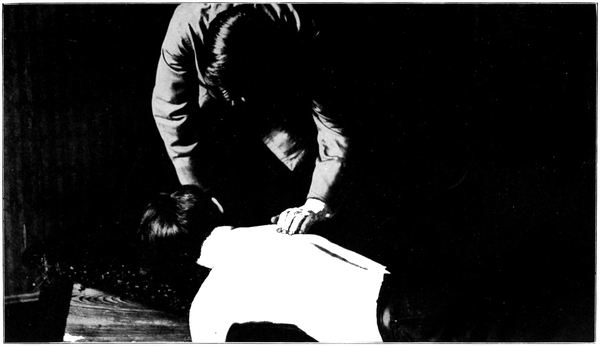
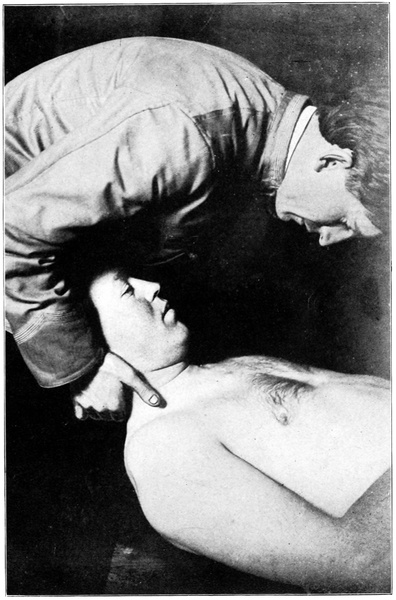
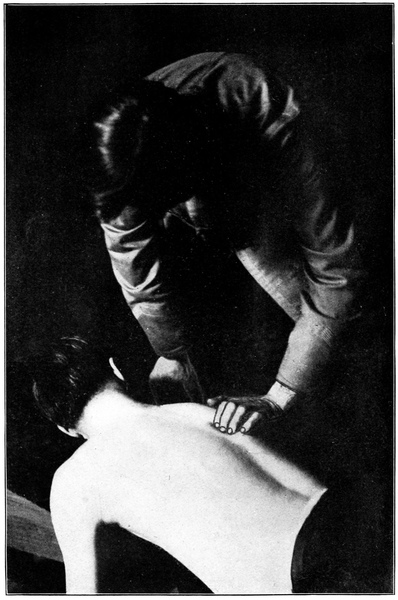
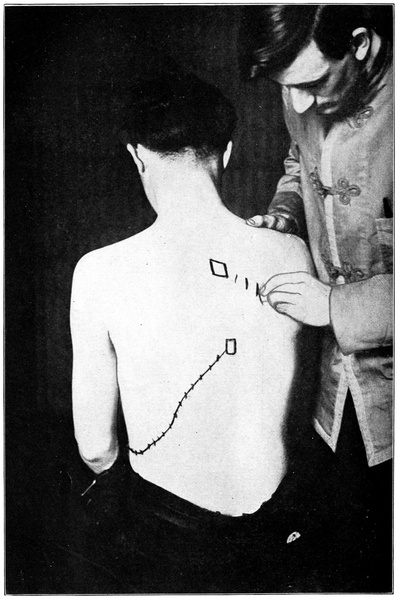
Vertebral Adjusting is the art of correcting by hand
the malpositions of subluxated vertebrae.
A Vertebral Adjustment, strictly speaking, should mean
the complete restoration of normal relation between previously
subluxated vertebrae. As used in Chiropractic, it
means either a partial or complete restoration of such normal
relation.
Maladjustment, as used in the profession, designates any
movement of vertebrae by hand which produces or increases
subluxation.
It will be well for the student to master first the general
rules and principles which govern vertebral adjustment and
then to proceed to a detailed investigation of each movement,
in turn, before practicing it. The art of adjusting
can only be acquired by practice, and a high degree of excellence
in it only by long-continued practice. However, the
rapidity with which it can be mastered depends largely upon
the formation of a clear pre-conception of the work to be
done and the manner of its doing.
As the student progresses in the art he finds himself
occasionally guilty of errors which mar, in some degree,
the efficiency of his work. These may arise from unconscious
modification of the technic first learned or from
unconscious repetition of some necessary modification demanded
by a special peculiarity in one or more cases.
This section is intended to furnish the proper pre-conception
and also to serve as a monitor to adjusters who, by
reference to the precepts herein set down, may discover and
remedy their own errors. It is not intended to furnish
sufficient education to warrant practice without clinical instruction,
which is unwarrantable, but rather to accelerate
the education which practice alone can furnish.
The vertebral subluxation being an abnormality of
relation between vertebrae, it is obvious that its correction
must be a return of normal relation. This can only be accomplished
by bringing about a change of relative position.
Movement of a section of the spine composed of several
vertebrae is not, in the true sense, an Adjustment. It is the
single vertebra which must be moved.
The movement should be one calculated to bring the
vertebra to its normal position in the most direct manner
possible. Such a movement should be used as will reverse
the direction of the forces which subluxated the vertebra.
It should be applied to the transverse or spinous processes,
or to the lamina, as is sometimes done in the case of the
Atlas, according to the kind of subluxation. Different subluxations
require different handling. Cases vary. Select
the move best suited to the case. This can be determined
most properly by correct palpation which fixes in the mind
of the adjuster the position of every part of the vertebra,
its relation to its fellows, the points of greatest nerve impingement,
etc., all of which should suggest the best method
for correction.
The prime object of adjustment is the removal of impingement
from nerves.
The movement used in adjusting has been variously
described. Many writers and teachers have used the term
“thrust” to describe the movement of the hands, and the
term is correctly applied to the movement used by many
Chiropractors. But a careful study of the methods of applying
force in use among the most successful adjusters,
those who have attained the greatest results with the slightest
percentage of failures and a minimum of pain to the
patient, discloses the fact that the chief element of their
adjustment is transmitted shock.
The hand is held in close contact with the vertebra to be
adjusted and the arms and shoulders describe such movements
as to deliver the required amount of force with the
slightest possible change in the position of the hands. The
vertebra bounds away from the contact hand. In the delivery
of a thrust the hand would follow the vertebra, forcing each
portion of the movement. The real effect of a thrusting
motion, since the hand cannot enter the body as a sharp
instrument would, is that of pushing. Pushing neither
subluxates nor adjusts vertebrae so readily as does a rapidly
applied shock.
Let us illustrate with a common experiment in physics.
Suspend a number of ivory balls by cords of equal length
in such a manner that each is in contact with its fellow and
all are in a straight line. When the balls are properly adjusted
a straight line should connect their centers. Hold one
end ball firmly in the hand or with an instrument which
renders it absolutely fixed. Then strike sharply with a
light hammer. The balls will all remain stationary except
the one on the opposite end which will fly off to a distance
exactly measurable according to the force of the blow.
How does this occur?
A shock is transmitted through the molecules of the ivory
until it reaches the end ball, which is not held back by another.
Here the transmitted force is expended in molar
motion, the ball leaping away from its fellows as if it had
been hung alone and had been struck with the same force.
It is well known that by placing an elbow firmly against
a man’s jaw and then sharply striking the closed fist with
the other hand, open, a very heavy blow can be given; yet
the forearm, through which the shock is transmitted, does
not move.
Now ivory is very like human bone. Further, it has been
demonstrated that the law illustrated by the above experiment
is equally applicable to the movement of vertebrae.
The pushing or thrusting movement may move a specific
vertebra, but it is probable that the chief factor in so doing
is the element of transmitted shock contained in the movement
and delivered at the instant of release of the hand from
the spine at the end of the movement.
On the other hand it is obvious that a pushing or
thrusting movement may move several vertebrae in addition
to the one directly in contact with the adjusting hand, in
consequence of the way in which the spinal segments are
closely bound together. If a steady strain is used, in which
muscles and ligaments have time to act, one of three results
may occur: (a) the specific adjustment; (b) the movement
of several vertebrae at one time, which does not constitute
an adjustment; (c) the giving way of the spine at
its weakest point, which may be some distance from the
point of contact with the adjusting hand, the ligaments and
muscles having communicated and diffused the strain
throughout a large area. In the latter contingency the
result is usually a new subluxation or the increase of an
old one, instead of an adjustment.
Thus Speed becomes an important factor in correct adjustment.
A good illustration of the value of speed may be taken
from a pile of stakes bound together by a cord. If a man
with a hammer desires to remove the center stake of the
group, and attempts to do so with a slow pushing movement,
the result is a change of position of many stakes, which
adhere to the center stake and to each other. If, on the
contrary, he strikes a sharp, quick blow with his hammer,
meeting squarely the center of balance of the one stake, it
will fly straight from its position leaving the others unmoved.
This is exactly what we desire to accomplish with an adjustment.
By the speed of the movement we expect to
move one vertebra before adhesion or the contraction of
muscles or inelasticity of ligaments can diffuse the force.
In order to accomplish the transmitted shock it would
seem wisest, at first thought, to draw back the hand and
strike the vertebra sharply. On the contrary, it has been
found advisable to place the hand carefully in close and
immediate contact with the vertebra to be adjusted. Nature
herself shows us the way in the delicate shock-transmitting
mechanism of the tympanum.
Also the hand of the adjuster will cover much more
than merely the spinous or transverse process which is used
as a lever and to which it is desired to transmit the shock,
unless carefully placed so that only a small portion is in
contact; by such a contact diffusion of the shock is prevented
and its efficiency within a limited area is increased. A carpenter
wishing to countersink a nail places in contact with
the nail head a small instrument called a countersink, which
he then strikes sharply with a hammer. The contact hand
of the adjuster represents the countersink and is used by the
two arms as a passive instrument for transmitting shock.
The close contact of the hand, which remains passive,
renders the adjustment much less painful to the patient than
it would otherwise be, and one of the prime objects in the
mind of the adjuster should be the minimizing of pain inflicted,
by any means which does not lessen the resulting
benefit. Also any drawing back of the hand before the
movement warns the patient and tends to induce involuntary
muscular contraction which interferes with adjustment.
In an adjustment it is necessary to overcome two kinds
of resistance—the passive resistance of inertia, of ligaments,
or of superincumbent weight, and the active resistance of
muscular contraction. It is important that both forms be
minimized.
The first may be lessened through the position of the
patient’s body; he is placed so that the vertebra to be adjusted
is in the freest possible position. The second is reduced
to the least possible quantity, amounting to no more
than muscle tonus, by using two methods: (a) Oral Suggestion,
and (b) Muscular Suggestion.
Explain to the patient the need for relaxation. Make it
clear to him that less force will be required if his muscles
are passive. Remind him frequently of this and assume that
he desires to relax. A word immediately before the adjustment
often induces a temporary relaxation during which
the adjustment is given. Anything which detracts the
attention from the coming shock is an aid. Sometimes asking
the patient to inhale and exhale slowly and deeply will
sufficiently take his attention from the adjustment. Experience
will teach him that he suffers less pain when relaxed
and presently relaxation becomes a habit. Instructing
patients to think of sleep, turning the eyeballs upward, has
been effective with some.
This can only be given by maintaining a state of relaxation
in one’s own muscles, which in itself is desirable in
most cases, for reasons to be presently explained. In handling
Cervical vertebrae move the head gently from side to
side with your own hands relaxed as much as possible. The
lazy motion suggests relaxation. Then when it is felt that
the neck is thoroughly relaxed, vary the motion with a quick
adjusting movement.
In Dorsal and Lumbar regions after the hands are in
correct position the adjuster should pause a moment both
to be sure that the direction of movement and his purpose
to move are clearly fixed in his mind and to be certain that
both himself and the patient are relaxed. The adjustment is
given instantly and from a perfectly lax muscle, as a boxer
strikes.
An added advantage is the greater amount of speed and
control which may be commanded in this way. The lax
arm, being in a neutral state as regards motion, can be contracted
in any desired direction without loss of force or of
time, whereas a taut muscle cannot further effect motion of
the arm without relaxation of its antagonistic muscles, which
takes time.
Considerable contral over one’s own muscles is necessary
in order perfectly to relax arm and shoulder muscles
just before the adjustment and then to utilize a measured
and determined quantity of force in a desired direction. To
acquire this much practice is necessary—practice on the living
subject. The desired end may be hastened, however, by
acquiring the abstract property of muscular control or by
developing control already gained.
Many different forms of exercise will aid in the acquisition
of muscular control and the ability to relax and
then to follow the relaxation with an instantaneous whiplike
contraction in a given direction. The best of these is
without doubt bag-punching. The movements employed
with a punching-bag, especially the lateral quadruple movement
with both elbows and both hands, tend to develop
precisely the sort of control needed for correct adjusting.
The beginner can do no better than to practice in this way,
by which, it must be remembered, only a necessary property,
and not by any means the exact movement, may be acquired.
The amount of force used in an adjustment varies so
much in different spines and in different parts of the same
spine that it is quite impossible to state any correct estimate
of it in terms of physical units. In general the Cervicals
move with least resistance, then the Dorsals, then the Lumbars,
and finally the Sacrum and Ilia as hardest of all to
displace or replace.
In developing additional force when it is found that
the force first used on any vertebra has been insufficient to
move it, remember this law: Work equals one-half Mass
times the square of the Velocity. In other words, doubling
the speed of the movement increases its effectiveness four-fold;
tripling it, nine-fold.
The increase in force should never be effected by increasing
the weight or pressure upon the patient’s body, for
reasons which should be clear from a study of previous
pages, but always by increasing the speed of the movement.
The names herein employed to indicate certain movements,
each a well-defined method of procedure for the
accomplishment of some special end, are the names or descriptive
terms which seem to be in the most general use at
this time. Few of these movements have arrived suddenly;
most of them are the result of gradual growth and evolution:
so with the terms by which they are known; they have
gradually become a part of the common language of the
profession. Usage sanctions them, though some of them are
cumbersome, unwieldy, or entirely inappropriate.
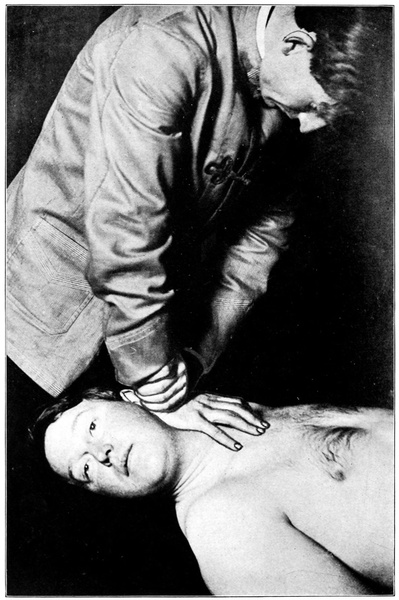
Fig. 7. Morikubo Move. For correction of a lateral and rotated
Atlas (L. A.). Pisiform contact with anterior transverse.
A movement for the correction of a lateral and rotated
Atlas, indicated for use only when the Atlas is recorded as
R. A. or L. A. The position of the patient’s head renders
the transverse process inaccessible unless it be anterior on
the side from which adjustment is to be given.
Place two sections of the bifid bench together so as to
secure the effect of a solid bench with an upward sloping
front. Have patient lying on back with back of head resting
firmly on bench, chin slightly uptilted. Then turn patient’s
head so that it faces sidewise and rests flatly on the side of
the least prominent transverse. This exposes the anterior
transverse in front of the tendons of the sterno-mastoid
muscle.
Stand leaning over head of bench and carefully place
the pisiform bone of adjusting hand upon the tip of the
transverse process, being careful to push aside the sterno-mastoid
tendons if they interpose themselves between the
pisiform and the process. The fingers of the adjusting
hand extend downward toward the clavicle and rest lightly,
very lightly, upon the patient’s neck. With the other hand
firmly grip the wrist of the adjusting hand, fitting the pisiform
of the upper hand into the hollow below the styloid
process of the radius.
This is delivered straight downward toward the bench.
It should be light and quick and the hand should not follow
the process in its movement.
This movement is painful and should not be used if
avoidable. When used it requires the utmost care and a
careful measuring of force. Err, if at all, on the side of
overcaution. The technic will be better understood after
study of the more detailed description of “The Recoil”,
since the position and use of hands, arms, and shoulders is
much the same for both.
Indicated for rotation of a Cervical vertebra in which one
transverse process is anterior to its normal position or more
anterior than its fellow which may also be somewhat, though
less, anterior.
As for the Morikubo Move place the patient in the dorsal
recumbent posture with head resting on bench and chin
uptilted. Turn patient’s face slightly away from the side of
the selected anterior transverse and steady the head with the
free hand while palpating.

Fig. 8. Pisiform anterior Cervical move.
Palpate downward from the Atlas transverse along the
posterior margin of the sterno-mastoid, dipping deeply into
the neck and exploring with the tips of the first three fingers
until the offending process is felt as a nodule of bone plainer
to the touch than those above and below. Always reach
across the neck to the selected transverse; if it be the right,
stand on the patient’s left and use left hand for palpating
and for contact hand as well.
Having found the process, gently move aside any tissues
which tend to interpose between the finger and the bone,
change hands so that the palpating hand is free and the
other holds the contact spot clear of interposed tissue and
plainly points it out, then place pisiform bone of contact
hand gently but firmly against the front of the process so
that a mass of bone is felt between the pisiform and the
bench when downward pressure is made.
It will be noted here that the head is unstable and tends
to rock with slight pressure or movement of the contact
hand. Steady the head by placing the knee upon head of
bench and against side of patient’s head, not roughly but
so that the head cannot move further toward the adjuster.
Now reinforce the contact hand by gripping the wrist
with the other, press slightly downward to tighten the contact
and avoid slipping, and you are ready for
which is directed sharply downward toward the bench. This
move rotates the vertebra around its vertical axis and puts
a strain in a backward direction on the whole column at
this point.
Care must be used, because the move at best is painful.
It is easy to slip across the end of the transverse. Take every
precaution to avoid imprisoning a muscle, nerve, or blood-vessel
between the contact hand and the vertebra. Rightly
used this move is valuable, perhaps most valuable of all
anterior Cervical moves, but it requires nice judgment.
This movement differs from the preceding one in two
important particulars; the contact hand must be so selected
with relation to the side of vertebra adjusted that the fingers
will extend upward toward the patient’s head, and the opposing
hand supports the head instead of reinforcing the contact
hand.
As for preceding move. The head will remain in this
position only until the contact is made, after which it will be
raised by the supporting hand until a tight contact is felt and
the neck muscles drawn fairly taut.
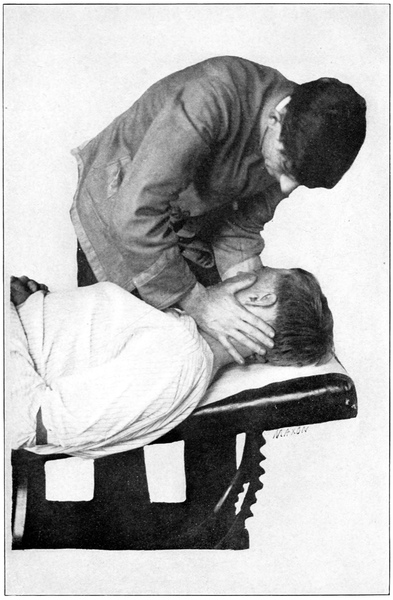
Fig. 9. Last finger contact for anterior Cervical.
Palpate with left hand if standing on patient’s left to
adjust a right, anterior subluxation. Find the offending
anterior transverse, draw tissues away with middle finger of
palpating hand, change to middle finger of free hand which
marks and holds the point of contact. Now place (with
care) the base of the little finger of the hand which was
used for palpating, at a point just below the condyle of the
last metacarpal and a little to the palmar side, in direct contact
with the front of the transverse. The last finger will be
flexed toward the radial side and a shallow depression thus
left for the contact.
Hold contact lightly and slip the free hand under the
patient’s head, which faces slightly toward the adjuster.
Raise the head, bending the neck away from the adjusting
hand and toward patient’s chest until it is felt that the
contact is secure and that further movement would put the
neck upon a strain. You are ready for
which is delivered entirely with contact hand, downward
and toward the back of the neck. The delivery is difficult
because the force arm is flexed at the elbow and the position
awkward. Practice, however, will soon render one adept.
For rotated vertebrae which have one transverse anterior
to the other, Cervicals only. This move gives a slightly less
advantageous force angle than the preceding, but is less
likely to be painful.
Place patient supine on bench so that his head extends
beyond the end of bench and is supported by the upraised
knee of the palpater. Stand at head of bench so as to face
patient’s feet.
Differing from their use in the preceding moves the
hands are so placed that the adjusting hand for a right,
anterior subluxation will be right hand, for a left anterior
the left hand. The opposite hand supports the head after
contact is made.
Contact point on hand is second metacarpal at the end of
the condyle, or second metacarpo-phalangeal joint. This is
placed in front of the offending transverse, the head having
been rotated away from that side and other tissues drawn
carefully aside from the bone. The back of the hand is
downward toward the clavicle, fingers semi-flexed on palm,
thumb resting on jaw.
The following position is the correct one for supporting
the head in all Cervical adjustments delivered in the above
position of patient and adjuster.
Cup the supporting hand slightly and fit the patient’s
ear into the cupped palm. Let fingers extend toward the
base and back of the neck, the finger position varying according
to the amount of rotation of the head so that the
fingers are in all cases directly under the head weight. The
wrist then flexes on the hand, and wrist and forearm are
brought up across the patient’s forehead so that a force
delivered from the opposite side cannot cause the head to roll
or move upon the supporting hand. After placing both
hands draw the head so that the chin is tilted upward until
it is felt that contact is snug and tight. This supporting
position is invaluable and much neglected by adjusters, who
might save themselves much annoyance and many failures
by its constant use. In the study of succeeding Cervical
moves refer to this description frequently. We shall call it
the Hook Support, because the arm and hand resemble a
hook which grasps the under side of the head and curves
over the upper.
This is delivered entirely with contact hand and in a
direction as much posterior as can be achieved without
slipping past the end of the process. If the head is sufficiently
rotated away from the contact side the angle of force is
better than with a straight lateral adjustment, which it somewhat
resembles, but not so good for anteriors as either of
the two preceding moves. It is chiefly useful when the other
two fail.
To move an Atlas so disposed that its one side is posterior
while the whole vertebra is laterally displaced in the same
direction; to move, for instance, an Atlas R. P.
Have patient lying on back in position C with head projecting
beyond bench and supported by adjuster’s knee.
Place the first three fingers of one hand under the most
laterally prominent transverse so as to hold it firm, first
placing the first finger carefully just behind and against the
end of that transverse and then reinforcing it with the
second and third fingers, slightly tensed, and resting their
tips on the lamina close underneath the occipital bone.
Next place the other hand so that the thumb rests
firmly upon the patient’s jaw and the first finger extends
backward along the lower margin of the occipital bone.
To complete the position rotate the head gently toward
the side of the laterally prominent Atlas, until it rests, face
toward the side, and is supported by the three fingers of the
one hand and the heel and wrist of the same hand. It will
be noted that when the head is rotated the first finger of
supporting hand slips to a position directly upon the tip of
the transverse process and the other two take its place
against the posterior aspect of the tip of the transverse. The
Atlas now rests with its intertransverse line almost vertically
upward from supporting fingers, which hold it against further
rotation.
When the neck muscles have been thoroughly relaxed by
slight and gentle movement, throw the upper elbow sharply
away from your body, which has the effect of transmitting
force through the thumb to the jaw and sharply rotating
the head still further, loosening its articulation with the now
firmly held Atlas. The condyloid joints thus loosened tend
to settle into their proper relations, the weight of the head
causing it to slip downward—laterally upon the Atlas.
This is really a movement of the head rather than of
the Atlas and is an easy movement when practicable. It
requires complete relaxation and will often fail. It is
probable that many apparent Atlas subluxations are really
subluxations of the head upon that bone which leave Atlas
and Axis in normal relation. This move is most used to
loosen the Atlas when it resists ordinary adjustments.
The principle involved in this and the three succeeding
moves is the same. The contact is made with the end of the
laterally prominent transverse process of a Cervical vertebra
other than the Atlas, and the movement is directed entirely
from side to side. It is to be used only for lateral and not
for rotary or anterior or posterior subluxations, a point to
be remembered as it is just as easy to produce as to correct
subluxation with this move.
Have patient lying on back in position C, with head
projecting beyond bench and supported by adjuster’s knee.
Following a record previously made count downward to a
subluxated vertebra and palpate both transverses with the
two hands at once to find if one is prominent laterally, remembering
that the record indicates merely the position of
the spinous process.
Having found the laterally prominent transverse, place
the tip of the finger of the corresponding hand on the spinous
of the subluxated vertebra; that is, if a right subluxation,
use right hand and if a left, use left hand. Then draw the
hand around until the middle of the proximal phalanx of the
first finger rests against the end of the transverse. The tip
of the finger will be freed from the spinous by this movement.
Hold the adjusting hand tense, edgewise to the neck,
fingers together and pointing downward. The thumb may
rest against the patient’s jaw or may be free; the essential
thing is the snug contact of the first finger against the
transverse.
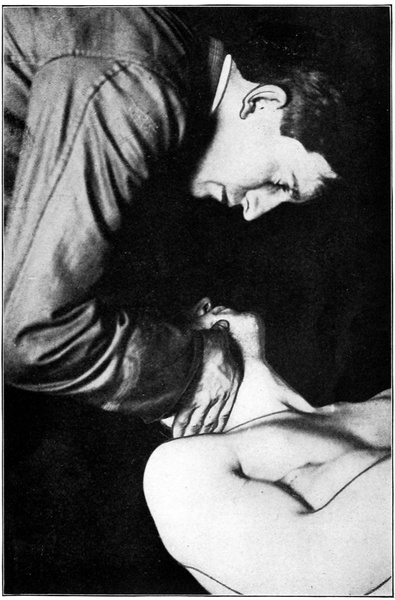
Fig. 10. “The Break,” No. 1, from right. Contact; first phalanx
with end of right transverse.
With the hand in position and the head supported by the
Hook Support, bend the head laterally, keeping the face upward,
until it is felt that further movement would strain
the muscles.
Deliver the movement in a straight lateral direction,
quickly and entirely with the contact hand.
For the Atlas only, and for straight lateral displacement
of that vertebra.
Position of patient’s head and of supporting hand exactly
as in using Break No. 1. Contact is made with the end
of the Atlas transverse on the laterally prominent side. Contact
point on hand is second metacarpo-phalangeal joint, or
rather, the condyle of the second metacarpal.
As for Break No. 1.
Have patient sitting erect on bench or stool and stand
before him. For a right subluxation use left hand and for
a left, right hand. Contact point is the middle of the proximal
phalanx of the first finger and the fingers reach backward
and downward, thumb upward so as to be out of the
way.
Force should be applied entirely with the contact hand
to avoid the possibility that movement of the head may bring
about movement of some other vertebra than the desired one.
But in practice the force is usually divided between the head
and the vertebra. The Hook Support cannot be used in this
position.
The use of this position for the Break avoids the necessity
for the patient to lie down again in a new position after
having Dorsals and Lumbars adjusted. It is extremely
convenient. But on the other hand it is undeniably harder
for the patient to relax his muscles when sitting up with
head flexed sidewise and a sense of lost equilibrium than
when lying down. The Break No. 1 will be found the better
for the average case.
Same as Break No. 3 except that adjuster stands behind
patient and rests the thumb upon the base of the neck posteriorly
while the fingers extend downward and forward toward
the clavicle. As with No. 3, the supporting hand rests
against the opposite side of the head and forces it sidewise
to tighten the contact.
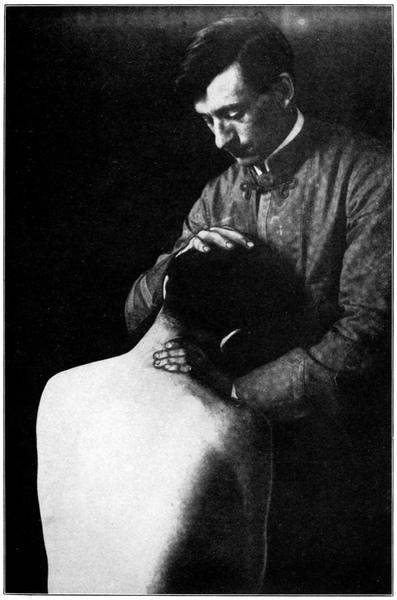
Fig. 11. “The Break,” No. 3.
Properly, a quick lateral movement of contact hand
while the head is firmly held by the opposing hand.
Note: “The Break” is unfortunately named and it
would be well if some less suggestive term were generally
substituted.
For the correction of rotation only, and usable in the
Cervicals from 2 to 7 inclusive.
A study of the Cervical articulations will make it clear
that if a force be applied laterally to the spinous process
the probable result will be a rotation of the vertebra, which
swings one articular process back from its fellow but leaves
the other in close, but modified, contact. Thus the spinous
process may appear to the left while the left articular process
is fitted firmly against that of the adjacent vertebra, while
those on the right are separated. Similar rotation, modified
only by the difference in shape of the vertebrae, occurs in the
Lumbar region.
A movement applied to the spinous process might correct
this condition or might complicate it according to the manner
of application. But the most direct line of force for correction
is along a line which would pierce the separated
articular processes almost in an antero-posterior direction.
The Rotary approaches this very closely. It is a setting
forward of the articular process against its fellow by applying
a movement directly to the transverse process, which
lies very close to the articular process.
The great safety of the movement lies in the fact that it
is impossible with any reasonable amount of force to move
the transverse process too far. If the vertebra is not subluxated
so as to indicate this movement, gentle attempts to
use it will fail. The deceptive bent spinous process may
sometimes be detected in this way.
The chief objection to Rotary Nos. 1 and 2 is that the
Dorsals and Lumbars cannot be adjusted in this position
and the patient must rise from the bench and lie down again
to have his Cervicals adjusted. This is obviated if No. 3 is
used but the latter position fails to secure the perfect relaxation
of muscles of Nos. 1 and 2, and is therefore recommended
as an alternative only.
The commonest obstacle to the use of this move is the
voluntary or involuntary contraction of the neck muscles.
The Hook Support, q. v., will limit this resistance by affording
a sense of perfect security to the patient. If muscles are
contractured a slight “check” will be felt as the head reaches
a certain degree of rotation, and beyond this point it will
refuse to move though easily movable within the radius
limited by the “check.” It is as if the head were held by an
inelastic cord. It is best when contracture is present not
to attempt moving the head too far but to deliver the movement
with the muscles as much relaxed as possible.
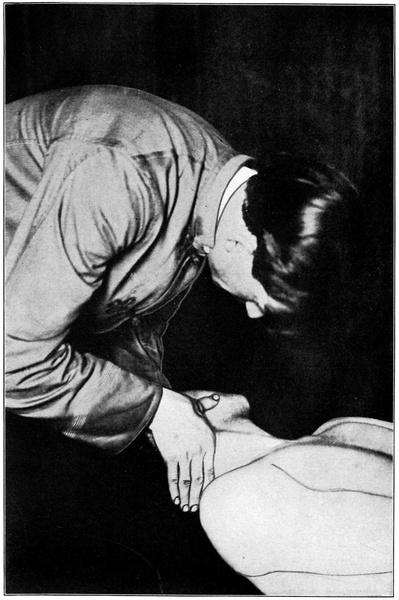
Fig. 12. The Rotary, No. 1. Ready for the movement.
Place patient in position C as described under Technic of
Palpation. Stand at head of bench with patient’s head supported
by one knee and perhaps also by one hand. Palpate
chiefly to discover the numbers of vertebrae, following a
record previously made. Finish palpation with the tip of
the first finger of either hand resting upon the spinous process
of the vertebra to be adjusted.
Consider here which way the vertebra is to be moved; if
toward the right use right hand and if toward the left use
left hand for adjusting. Draw the adjusting hand straight
around until the first finger, about the middle of the proximal
phalanx, rests against and behind the transverse process.
It is important that the finger be drawn straight around,
and not upward or downward, except with the second Cervical
with which the finger may pass slightly upward to the
transverse. To insure correct placing of finger let patient’s
head be absolutely at rest, supported by the Hook Support
with face turned slightly away from the adjusting hand.
Reinforce contact finger with the other three fingers held
close together behind it. The thumb may or may not be
placed against patient’s jaw as desired, but one must be
careful not to lose exact contact by drawing adjusting hand
upward from a lower Cervical in an attempt to reach the
jaw.
Meanwhile the other hand supports the head and holds
its weight as described under the Hook Support, q. v.
Next, holding the first finger gently but firmly pressed
against the transverse process, turn the head in the direction
of the subluxation and away from the adjusting hand. That
is, if the vertebra be subluxated to the right turn the face
toward the right, the use of the terms “right” or “left”
referring to the spinous process.
When the head is drawn around so that the vertebrae
are thoroughly separated on the side toward which movement
is to be directed, and the patient’s muscles are thoroughly
relaxed though it is felt that further rotation of the
head would put them upon a tension, give the movement. It
consists in a quick throw of the adjusting hand, force transmitted
from shoulder through an outward fling of the elbow,
directed upward and inward against the transverse process.
It replaces the articular process against its fellow, moving
one vertebra, smoothly and easily.
All force should be delivered with contact hand. The
hand moves through very little space. The principle of the
movement is transmitted shock.
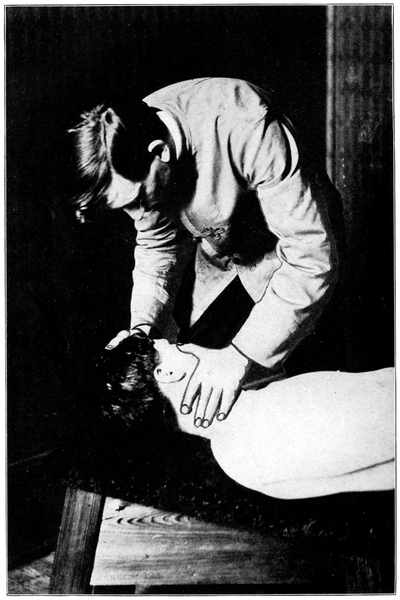
Fig. 13. The Rotary, No. 2.
A transition in technic between No. 1 and No. 3.
Patient lies face upward on closed table, head resting
upon forward section. Adjuster stands at side of patient,
choosing the side according to the subluxation so as to face
across the table in the direction toward which spinous process
is to move. Palpation is difficult in this position on
account of the increase in the curve of the Cervicals, so that
it is best to follow a record previously made.
Having found the subluxation make contact as follows.
Reach across patient’s neck with right hand for a right
subluxation or left hand for a left, and find spinous process.
Then draw the middle finger straight around until the palmar
surface of the middle finger just below the second joint
fits snugly behind the transverse process. Place the other
hand under the head and with both hands working together
turn the head toward you, chin upraised, and draw the neck
into a greater flexion until it is felt that contact is firm and
close.
The movement is a quick drawing toward the adjuster
of the second, or contact, finger, which has been, as it were,
hooked over the transverse. The transverse is thus drawn
sharply forward and the vertebra rotates around its vertical
axis so that the spinous follows, or tends to follow, the transverse
in the same arc of movement.
Patient sitting erect, both feet evenly on floor and hands
not braced. Stand in front of the patient but to one side or
the other as for Rotary No. 2. Use right hand for adjusting
right subluxations and left hand for lefts.
As for No. 2, contact is with palmar surface of second
finger but may be shifted to third finger for the lower vertebrae
if desired. The thumb is usually placed on the mandible
and aids the opposite hand, placed on the other side of the
head, in turning and otherwise controlling the head.
Turn the head away from the adjusting hand until the
neck muscles feel taut as a result of position and not of
contraction. The movement then is given as a sharp jerk of
the contact hand forward.
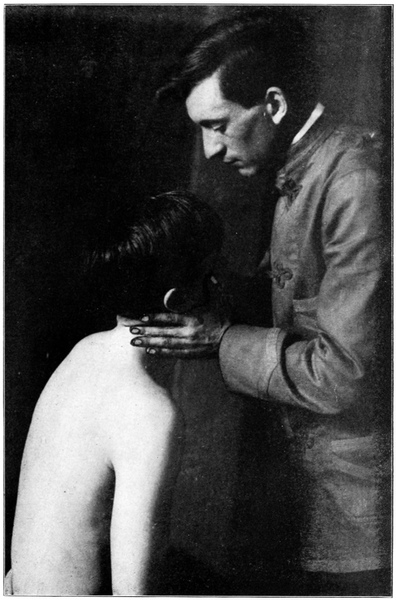
Fig. 14. The Rotary, No. 3.
It is held that a vertebra often loses its proper relation
with the vertebra below, and consequently with all the vertebrae,
or the entire column of the spine below, without being
disturbed in its relation to the one, or ones, above; that, in
other words, the column may be divided into two sections
by subluxation, the upper section set askew upon the lower.
With this reasoning it would clearly be desirable to so adjust
the spine as to move a given vertebra, and with it all vertebra
above, so to speak, upon the vertebra below. To do
this all vertebrae above the one to which force is applied
must needs be firmly anchored to prevent strain between
them.
Such a move has been devised by Bunn for Cervical
use and is here described from the author’s few observations
only. Further study may modify the technic somewhat.
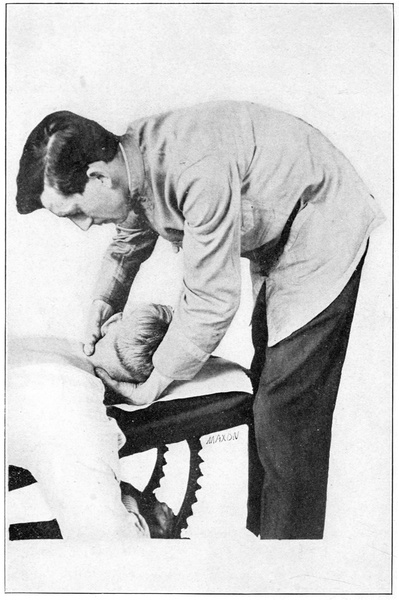
Fig. 15. “Anchor Move,” No. 1. For a P. L. subluxation.
Patient is placed as for Dorsal and Lumbar adjustments
in position B. Move is applied to rotated, postero-rotary,
and antero-rotary subluxations and face turned toward
side from which move is to be made. Adjuster, after
palpation which discovers the vertebra to be moved and the
direction of movement, stands at the head of table facing
patient’s feet.
With the palms of both hands resting against the side of
the neck and thumbs extended at right angles to hands,
make contact with both thumbs on one vertebra as follows:
If vertebra is to be rotated toward patient’s left, place
right thumb against spinous process on its left side and
left thumb upon right transverse process from behind it.
Press firmly with the palm and fingers of each hand against
the vertebrae above, gripping around neck and base of skull
so as to hold all parts together.
The move is delivered simultaneously with the two
hands, forcing spinous process toward the right and transverse
in an anterior direction. The head must be raised
from the bench and wholly supported by the hands and the
head turns with the vertebra.
A powerful comparatively easy move which has the advantage
of wide applicability and of avoiding the change
of posture of the patient which mars many Cervical moves.
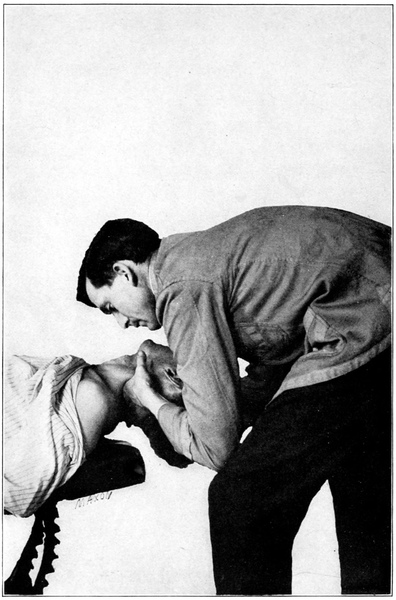
Fig. 16. Posterior Cervical move.
Same as for No. 1.
For a left subluxation to be moved toward the right,
place the left thumb upon the right side of the spinous
process so that it hooks over the spinous in position to draw
or pull the spinous. Place right thumb against the end of
the left transverse as much on the anterior side as possible
so that it may exert a prying force in a posterior direction.
Simultaneous application of force with the thumbs tends
to rotate the vertebra as does No. 1, but unlike No. 1 the
tendency is to bring the vertebra out in a posterior direction
instead of driving it more anteriorly.
This move is applied to rotated Cervicals which are
anterior, more on one side than on the other.
For a posterior Cervical below the Atlas. The common
and careless practice of moving such a vertebra with the
Rotary, or the dangerous practice of using the Recoil may
be avoided by this move and much better results obtained.
Patient in position C, head projecting well beyond bench
so as to allow for a dropping backward of the head. Palpate
as for the Rotary and hold palpating finger on tip of
spinous process of posterior vertebra while contact is made.
Contact point is middle of radial surface of first phalanx
of first finger and is placed against the tip of the spinous
process, directly between it and the floor, as the patient lies.
Hand is held rigid and edgewise, fingers together so that
the contact finger is well supported.
Use the free hand to hold the head with the Hook Support,
q. v. Turn the patient’s chin slightly away from the
adjusting hand and drop the elbow of adjusting arm down
until a straight line could pass through elbow, spinous process,
and patient’s chin. It may be well to crouch and rest
the elbow against one knee for solidity. Then allow the
head to drop backward until chin is elevated and further
backward flexion would strain the muscles. You are ready
for the movement.
A quick throwing movement upward and inward, or toward
patient’s chin. As nearly as may be the force should
tend to pass along the spinous process in a direction exactly
anterior to the (then) plane of the vertebra.
Note: Either hand may be used with this movement.
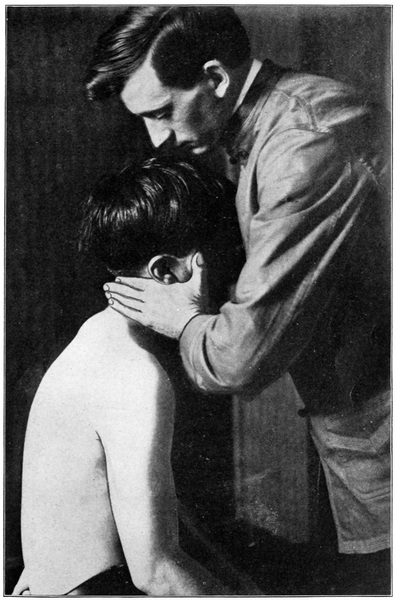
Fig. 17. Movement for correction of a lateral Atlas whose
prominent transverse is posterior.
This is indicated for postero-rotary or postero-lateral
subluxations. Its line of force is a bisector of the angle between
the straight anterior and the straight lateral movement.
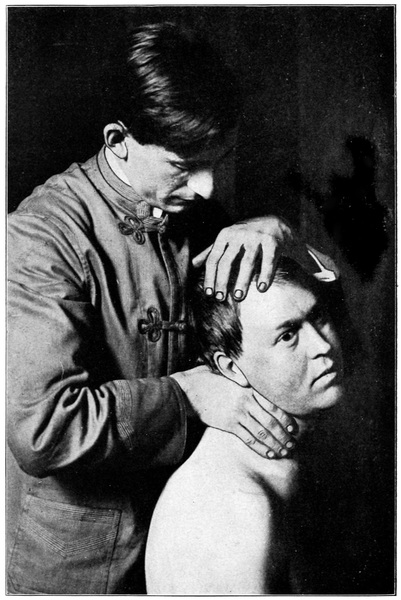
Fig. 18. A movement for Atlas when laterally displaced. Contact:
metacarpo-phalangeal joint with end of prominent
transverse.
There are two points of contact, both on the first finger,
one (first secured) on the radial side of the second phalanx
and the other on the radial side of the proximal phalanx.
The first contact point is placed against the tip of the
spinous, the other behind the transverse process.
Press slightly against the two processes with the finger so
as to feel them plainly.
Hold the head with the Hook Support and turn the face
away from the adjusting hand (right hand for a P. R., left
hand for a P. L.). Drop elbow low and hold it well away
from your body so that there appears an obtuse angle between
wrist and forearm with the point of the angle toward
you. Be careful of this point as the tendency is to make an
angle with the point away from you—a weak position.
Drop head backward until firm resistance is felt.
Force is delivered in an antero-lateral direction as above
described, entirely with adjusting hand.
For subluxations listed R or L but not Posterior and
upon C 6, C 7, D 1, and D 2 only. This movement applies
a lateral force to the spinous process so as to correct rotation
of the vertebra, but I repeat that it is inappropriate for
posterior or postero-lateral subluxations.
Patient lying in position B as for Dorsal adjustment.
Find the subluxation by following the record and perceiving
that the count assumed to be correct permits the subluxations
to correspond to those recorded and that a vertebra in this
region is R or L, R. A. or L. A., R. S. or L. S., R. I. or L. I.
The laterality of the spinous process determines the next
step.
For a right subluxation turn the face toward the left
and use right hand for contact hand. For a left subluxation
turn the face to the right and use left hand for contact hand.
Thumb of contact hand is placed upon and against the
side of the spinous process so that it presses firmly. The
thumb is extended almost at right angles to the hand which
rests upon the patient’s shoulder with fingers extending, and
gripping, over the clavicle. Be sure of the solidity of the
position.
Next place the other hand upon the patient’s forehead
and press the head backward, or toward the side of the contact
hand, until the neck is well flexed and the tissues tightened
between the now opposing hands.
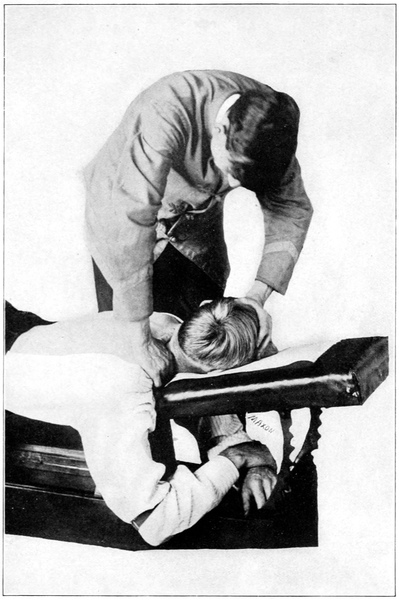
Fig. 19. The “T. M.,” No. 1.
When this tightened condition is reached a quick decisive
movement of both hands in opposite directions, but chiefly
of the hand applied to the head, will secure an easy movement
of the vertebra.
This move is a very valuable adaptation of the old crude
and other dangerous “T. M.,” of which No. 2, below, is
another, more like the original move but possessing several
“safety” features.
The patient sits erect on a flat seat with both feet resting
upon the floor as during palpation.
After careful palpation and selection of a vertebra to be
adjusted in this way, stand directly behind the patient. If
the vertebra is subluxated to the right use right hand for
adjusting (or contact) hand, if to the left use left hand.
Hold the hand so that the thumb is at right angles to the
hand and tense and firm. Place the palmar surface of the
end of the thumb against and upon the tip of the spinous
process and grasp the neck firmly with the fingers, which
extend over the base of the neck and toward the clavicle.
The other hand is placed easily on the top of the head.
The completing of position after contact has been made
is governed by two considerations; the need for relaxing the
neck muscles and for so supporting the vertebrae above
the contact that movement will take place only at the point
of contact. If the neck muscles are contracted the movement
is almost always defeated and should always be abandoned
to avoid strain.
To secure the desired position ask the patient to relax his
muscles and allow you to place his head as desired. If he
seeks to place it himself the necessary muscular contraction
on his part will defeat the movement. The movements of
the head must be passive.
With thumb and remainder of adjusting hand properly
placed, use the other hand upon the head as follows: First
flex the head forward on the chest as far as possible, then
rotate it slightly so that the face is turned a little toward
adjusting hand. Then flex the head sidewise until a resisting
pull of muscles indicates that they have been stretched
taut. It is well during the third movement described to let
the forearm swing down at right angles to the hand so that
it presses firmly against the ends of all the Cervical transverses,
distributing the force among them.
Or, after placing contact hand rest the elbow in the
angle at the base of the neck and let the forearm extend upward
along the side of the neck. Then flex the wrist until
the hand will rest upon the patient’s head and perform the
movements of the head as described above.
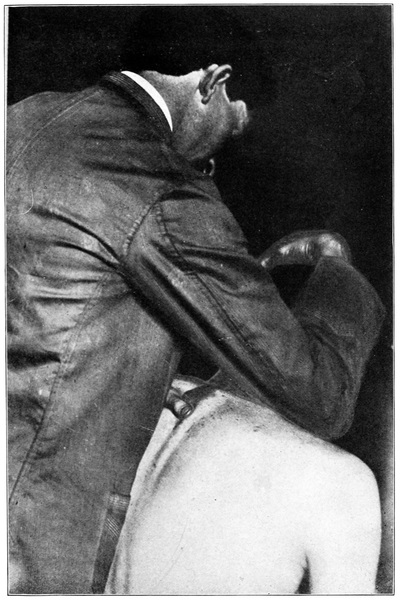
Fig. 20. The “T. M.,” No. 2. Note position of right arm and
hand of adjuster.
A quick, simultaneous movement of both hands in opposite
directions, two-thirds of which is given with the hand
which holds the head. The thumb in contact with the spinous
process moves slightly inward toward the median line but
its chief use is to hold the vertebra very firmly. To this
end part of its force is directed forward against the shoulder
and through the ball of the thumb.
Failure to place the head properly or in securing sufficient
flexion of the neck before move is attempted are the
chief causes of failure. Force must be delivered quickly
and sharply and the best adjustment of this kind is usually
the one in which the head and hands move through the least
space.
This movement is obviously useful only for the correction
of rotation, since the force is directed sidewise against the
spinous process.
The “T. M.” was originally intended as a Cervical adjustment,
but its greatest use is now from C 6 to D 2 inclusive.
Above the sixth its use is questionable because of the
possibility of moving more than one vertebra or some other
than the one desired.
This movement is best given on bifid bench of the type
commonly known to the profession. Place patient on forward
section so that its rear edge rests just below the axilla;
this may be ascertained by passing a hand under patient’s
arm after he is in position, when the edge of the bench
should be felt about an inch below the hanging arm. The
thighs should rest on rear section so that the pubic symphysis
is free of the bench. The semicircular pubic cut is
an advantage in that it avoids injury without making necessary
too great a suspension between sections.
Thus the abdomen and the lower part of the thorax are
suspended between sections. Under them an abdominal
support may be used but it must have the quality of elasticity
in a high degree and must lie always below the plane of the
other two sections or it will interfere with a perfect adjustment.
For adjustment of the last two Cervicals or any Dorsal
down to the sixth, it is best to turn patient’s head toward
the direction of the subluxation. This curves that section
of the spine into an arc toward the convex side of which
movement may be made more easily than toward the concave.
The patient’s hands may lie under the table, loosely, or
may reach back and rest upon the buttocks, palm upward.
Whichever position secures best relaxation is to be used in
any case.
This movement may be used with the roll. (See Fig. 30
and p. 285.)
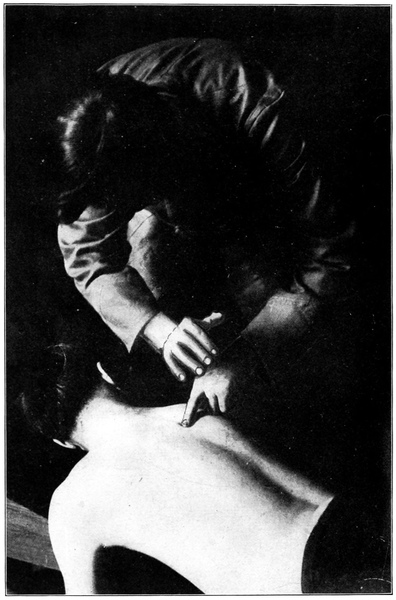
Fig. 21. After palpation. Finger ready to guide contact hand
to a spinous process.
Stand on either side of patient, feet apart for base and
poise. The direction of the feet and position of body will
vary according to the direction of the adjustment, by the
following two rules:
Rule 1. For movement of a vertebra away from the side
on which you stand, place your arms and hands in such a
position that the pisiform bone of adjusting hand, both elbows,
and both shoulder joints (shoulders being dropped
loosely forward) will fall in the same plane and that the
plane of direction in which the vertebra is to be moved. In
other words, let the force be applied in a line straight from
your body through the vertebra. Always shift your feet to
a proper position from which to direct the movement.
Rule 2. To move a vertebra toward the side on which
you stand, step close to patient’s body and support yourself
with one knee against the adjusting table at the most convenient
point. Then place arms so that contact point, elbows,
shoulders, and the mid-point of the body’s base, between
the feet, are all in the same plane. This insures balance during
and after the movement and is the attitude from which
the greatest and most carefully measured force can be delivered.
It will be seen that the desire is always to deliver all
force in one plane and thus avoid conflict of forces and
waste or misdirection through the predominance of one
force over the other, and to use both arms with equal facility
in the move. There are at least a hundred ways to hinder
this movement by varying the preliminary positions. And
no one can know the real efficiency of the move who has not
become instinctively adept at taking position.
Use of hands for palpation has been described. (P. 46.)
The palpating hand comes to rest with the middle finger
on the spinous process of the vertebra to be adjusted. The
heel of the hand is raised, the first and third fingers doubled
back, and the heel lowered again. Now the middle finger
alone is a slender pointer guiding to the contact point.
Place pisiform bone of other hand snugly against the
process to be moved. The hand should rest in a slight arch,
pisiform against spinous, fingers rigid and flexed on hand,
last finger firmly anchored, or pressed into the flesh, to
prevent slipping. (Fig. 22 shows the position.)
The anchoring fingers must always extend away from the
adjuster. To turn the fingers back across the spine, in moving
a vertebra toward you, is always an error, and the price
is partial loss of use of one arm.
With the adjusting hand satisfactorily placed, grasp its
wrist firmly with the other hand so that the pisiform of the
supporting hand rests in the hollow between the wrist and
the metacarpal bone of the extended thumb. By this contact
force is driven directly through the chain of bones
across the wrist and to the pisiform bone without spreading.
In grasping the wrist let the thumb extend around the forearm
in one direction and the four fingers in the other. Beware
of gripping only with thumb and first finger in which
case the edge of the supporting hand will rest on the back
of the contact hand and spread the delivered force too
widely.
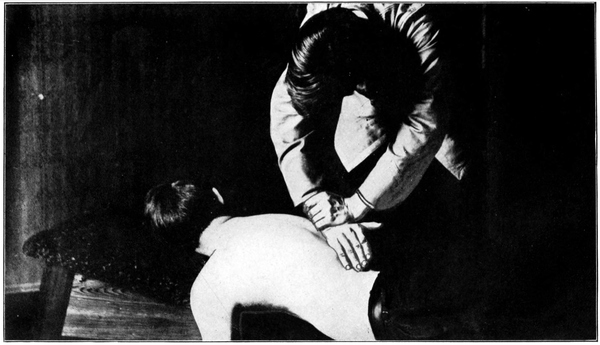
Fig. 22. “The Recoil.” Ready for the movement.
I have said, but have not sufficiently emphasized the
command, that the shoulders must be dropped loosely forward.
Let me add that just before the movement is given
the head should be allowed to sag downward and the muscles
to become relaxed. This movement given with stiff
shoulders and upraised head becomes a push.
The desired movement is a throwing movement.
Force is released from both shoulders at once, concentrated
at the same instant by a slight shifting forward of
the elbows, and strikes the spinous process as one force,
which is the resultant of the two meeting at the wrist of
contact hand and being united there. The two arms use the
contact hand as a passive instrument for driving the vertebra.
The objective point, the distance to which the movement
is mentally thrown at the instant of delivery, should be the
center of mass of the vertebra, varying according to the
section of the spine.
The exact contact point of hand with vertebra varies. If
the vertebra is to be moved toward the right the pisiform
rests against (not upon) the left side of the spinous; if toward
the left and inferior, against the right side and just
above, in the notch between it and the next superior process.
The rule is to so place hand that the spinous process is between
the pisiform and the direction to which movement is
given.
On the hand the contact may be said to vary, according
to the direction of subluxation and position of adjuster, so
as to describe a circle around the pisiform in the course of
the various changes of position necessary to the use of this
movement. No error could be greater than to attempt to
use always the same face of the pisiform and to adapt the
position of hands and arms to this end, when any face or
aspect of the little bone is equally good with any other.
When standing on patient’s right use left hand for palpating
hand and right hand for contact with the vertebra,
using left hand again to grip and reinforce the contact hand.
Exception to this is made by introducing an extra change of
hands with C 6, or 7, D 1, L 4 or 5, and Sacrum. The
change is necessitated by the insecurity of the usual position
or the fact that it cramps the wrist of contact hand. To
make the change: palpate as usual, hold subluxation with
second finger of palpating hand, substitute second finger of
other hand and withdraw palpating hand, which is then
free to make the contact.
When standing on left side exactly reverse the use of
hands. Palpate with the same hand which would be used if
patient were sitting. Introduce no unnecessary move into
the placing of the hands. This will be found to produce
better results than any other technic for this portion of the
move.
In using this movement it is perhaps best to deliver
nearly equal force with both hands; certainly whatever
forces are released by the arms should be simultaneous. It
is possible, however, to allow one arm to preponderate in
the movement without marring its efficiency, but the amateur
adjuster will do well to balance his forces at first.
Speed is a prime essential. By its employment a very
ordinary amount of muscular strength can be made to accomplish
a large amount of work and very difficult adjustments
may be accomplished.
Concentration of mind at the instant of adjustment, so
as to secure muscular control and perfect co-ordination of
the two arms as well as to direct and concentrate the forces
used at a given and strictly limited area, is also essential.
For ordinary adjustments of Dorsal or Lumbar subluxations,
excepting the middle four Dorsals, for breaking
ankyloses by repeated applications of force, and for overcoming
muscular resistance in patients who are unable to
relax at all, this form or style of adjusting is probably the
best. It is most useful in the Dorsals. In many instances
Lumbar vertebrae will move better by application of a
slightly slower force, especially if a roll is used. The Recoil
may be used with the roll.
While it is easily possible to move any Cervical in this
way, making no change in the technic except to use the ulnar
side of the fifth metacarpal bone for the contact instead of
the pisiform, it is inadvisable in most cases above the sixth,
and in some instances absolutely unpardonable. The shock
to the nervous system and the danger of moving two or
more vertebrae or of subluxating a normal one are too great.
In at least one instance hemiplegia instantly followed the
use of this move on the Axis, and headaches and nerve
exhaustion are frequent sequelae.
For these reasons it is probably best never to use “The
Recoil” above the sixth Cervical. For every form of subluxation
there is an easier and safer mode of correction.
This has been called “The Recoil” because of a belief
that if force be applied to a vertebra in the form of a very
rapidly transmitted shock the vertebra will rebound to the
shock and settle in its normal position, the intelligence within
the body utilizing the force thus blindly applied to bring
about this result.
This belief is erroneous. First the vertebra and all surrounding
tissues are misshapen to fit their abnormal position
and relation and this shape gives them a tendency, if rapidly
loosened, to settle into the old abnormal position. Second,
there is no such conscious intelligence which has power to
replace a subluxated vertebra. If this supposition were
correct, then the Innate Intelligence would do well to utilize
those jars and shocks which ordinarily produce subluxation
to bring about normality and keep the spine perfectly
aligned.
There is no such internal rebound or recoil as stated
above. The chief value of the movement lies in its speed,
according to principles equally applicable to other moves,
and in accord with the Law of Momentum.
This movement as described above contains many essential
principles which follow Parker and Palmer, developers
of “The Recoil,” but the technic is considerably
modified to suit the author’s own views. It cannot be claimed,
therefore, that this is “The Recoil” as now taught by Palmer,
since the chief stress is here laid upon the movement
of the vertebra in a predetermined direction and not upon
the withdrawal of the hands to let “Innate” do the work.
The name “Recoil” is really inappropriate for the move as
described.
A movement for the adjustment of posterior, postero-superior,
or postero-inferior subluxations in the Dorsal
region (except middle four) and in the Lumbar. May also
be used for postero-laterals when laterality is very slight.
Given with patient in position B. Contact point, heel of hand
with spinous process.
By the “heel of the hand” is here meant the depression
between the scaphoid and pisiform bones. This hollow
forms a natural receiver for a spinous process and thus
avoids lateral slipping.
The four fingers of adjusting hand are spread out and
anchored upon the patient’s body. The wrist is held at a
right angle to hand and the arm straightened, the elbow
being outrotated until it “locks,” that is until it will move no
farther. The other hand grasps the wrist of the adjusting
hand.
The rule is to use the right hand for adjusting hand if
standing on patient’s right and palpating with left, or to
use left hand if on left side and palpating with right. The
fingers are to be directed toward the patient’s feet. Exception
to this rule is made with the last two Lumbars, where
it is more convenient to change hands and direct the fingers
toward the head.
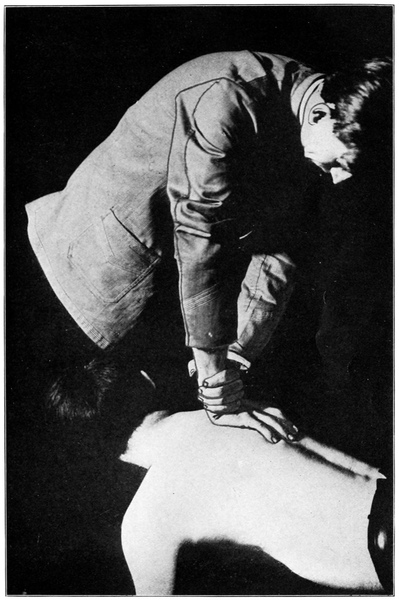
Fig. 23. “Heel contact.”
This is given almost entirely with adjusting arm; that
is, with the arm whose hand is in contact with the vertebra.
The supporting hand serves merely to guide the force to a
definite point as if a straight rod were working through a
fixed circlet. Indeed, the force in this movement is delivered
almost straight down from the shoulder. Shoulder
should be dropped well out of its socket so as to secure
play for a sudden downward movement without raising the
hand from its contact. If the shoulder is stiff or the head
of the humerus remains in the glenoid cavity the movement
cannot be properly given without raising the hand. Movement
is quick, sharp, and deep, i. e., directed to the center of
mass of the vertebra.
It may be directed straight toward floor to correct a
posterior, inclined slightly toward the head or feet to correct
approximation, or—as some aver—slightly sidewise to
correct a mild degree of rotation.
An adjustment to be used only in the Dorsals from
fourth to ninth inclusive, for posterior or postero-rotary subluxations.
It is probably best to use this movement only for
straight posterior subluxations and to apply either the Pisiform
Single Transverse or the Two Finger Double Transverse
to the rotary displacements in this region.
Both pisiform bones, each upon a transverse process
and both upon the same vertebra.
With patient in position B and the adjuster standing
upon his left the contact should be made by the following
exact method. Palpate with right hand, which comes to
rest upon the spinous process of the subluxated vertebra.
Note if it be P. R. or P. L., because this fact will govern
the next movement. Let the first finger of palpating hand
reach outward about one inch and upward to a point opposite
the tip of the next superior spinous process, which point
will approximate the position of the transverse. This
first upon the side of the posterior transverse, which will be
the right with a left subluxation or the left with a right
one. Let second and third fingers, now abandoning the
spinous, follow the first and rest over the assumed position
of the transverse.
Now palpate with a deep, limited, massage movement
until the club-shaped extremity of the transverse is felt
under the middle finger. Hold this point with the middle
finger, drawing away the other two, and guide the free hand
to an exact contact upon the transverse. Thus if standing
on the left, as predicated, the left hand will be first to make
contact and with the most posterior transverse, with which
most exact contact is necessary.
With pisiform placed, let the fingers extend away from
your body; if on the side of the spine opposite you, let them
extend downward so as to follow the curve of the rib and to
be anchored upon the rib connected with the transverse of
contact; if on the same side, let fingers extend downward
parallel with the column.
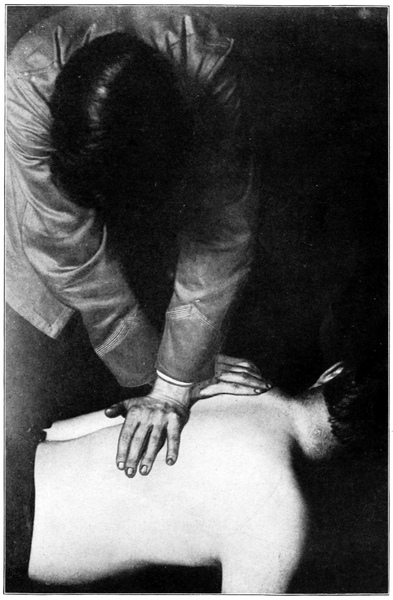
Fig. 24. Pisiform double transverse adjustment as it should be
given, elbows locked.
Now—still using the original palpating hand—palpate
on the other side from the first contact until the other transverse
is discovered. Mark its tip with a quick, deep pressure
and a sharp withdrawal of the fingers, so that a spot
of anaemia appears momentarily. Carefully place the pisiform
of the palpating hand in contact, guided by the anaemic
spot. If this second contact is on the side on which you
stand the fingers will be toward the head; if on the opposite
side, they will follow the rib curve outward and downward.
Re-read the above directions carefully. It will be seen
that the technic is quite free from unnecessary movements.
The two hands are now placed almost exactly at right
angles to each other, arched fingers anchored to prevent
slipping.
If you stand on the patient’s right the use of hands is, of
course, exactly reversed, the left hand being palpating hand,
and making the first contact.
When hands are in position and adjuster standing so as
to face directly across the spine, the arms are rotated outward
until the elbows “lock.” The adjuster leans over so
as to have shoulders directly over the spine, draws the body
back from the shoulder girdle to secure freest play in the
shoulder joints, and drops head loosely between the shoulders
so as to relax the trapezius and prevent any checking of the
force.
Directly downward from the shoulders through straight,
stiff arms. The force is delivered separately with the two
arms and yet simultaneously. If the vertebra is straight
posterior, equal force must be applied on the two sides; if
it is posterior and slightly rotated (P. R. or P. L.), most
force must be applied to the more posterior transverse.
Considerable practice and looseness of shoulder are required
to use this movement properly. It is a regrettable
fact that few adjusters do use it correctly, most of them
giving a thrust instead of a transmitted shock.
This modification of the pisiform double transverse move
is here described because of its popularity rather than because
the author wishes to recommend it. The position is
the same as for No. 1, and the uses also, except that it tends
to correct postero-inferior subluxations and is not at all
adapted for use with superiors.
Both pisiforms below the two transverses (caudad).
After palpation which discloses the posterior transverse the
hands are placed as follows: Palpating hand rests always
on the side of the spine next the operator; opposite hand
crosses the spine. Both are slanted upward so that the
fingers point toward the head with the axes of the hand
slightly diverging above. The wrists are thus crossed in
such a way as to force the forearms to be somewhat flexed
on the arms and to slant away from the wrists at an obtuse
angle. This with the contact below the transverses, renders
it impossible not to force the vertebra in an upward (superior)
direction when movement is given.

Fig. 25. Two-finger double transverse.
A comparatively slow thrusting movement, which tends
to spring the spine. The merit of this method lies in its
comparative painlessness. Its technic is not attractive.
A movement for posterior or postero-rotary displacements
from fourth to ninth Dorsal inclusive. It serves the
same purpose as the Pisiform Double Transverse but is less
painful and often easier of delivery. The palmar surface of
the fingers, with the flesh of the patient’s back, make a compound
cushion which acts as a shock-absorber.
The usual downward gliding movement of left hand if
standing on right or of right hand if standing on left will
serve for the discovery of the vertebra listed for adjustment.
The gliding hand stops with the second finger indicating the
spinous process. The first finger reaches upward and outward
to the assumed location of the transverse on the side
nearest the adjuster; then the second finger reaches to a
similar point on the other side, both fingers pointing toward
patient’s head. Now the fingers are rolled a little to make
sure that they are in contact with the ends of the transverse,
the palmar surface of the tip of each finger being the proper
contact point. The heel of the contact hand rests near, but
not on, the surface of the body over the midspinal line.
The ulnar edge of the free hand is now placed across
the tips of the two contact fingers so that it rests directly
above the ends of the transverses but separated from them
by the finger tips. The upper arm is then straightened and
the elbow outrotated until it locks firmly so that the arm
makes a straight line directly above the transverses. The
body is drawn away from the shoulder girdle, pulling the
head of the humerus out of its socket as far as possible to
allow free play, for all force is to be given by this straight
arm.
If the subluxation is a straight posterior the force is
driven directly downward so as to be distributed equally to
the two contact points. If it be a postero-rotary, most force
is directed to the more prominent (posterior) transverse.
Force should be delivered quickly, keeping in mind the principle
of transmitted shock.
Contrary to the general belief, as much force can be
developed with this move as is needful for any ordinary
adjustment. The fact that it is often recommended for use
with children or with sensitive or frail patients has led to
the belief that it is a relatively ineffective move, whereas its
value in such cases lies only in the fact that it inflicts less
pain than some others.
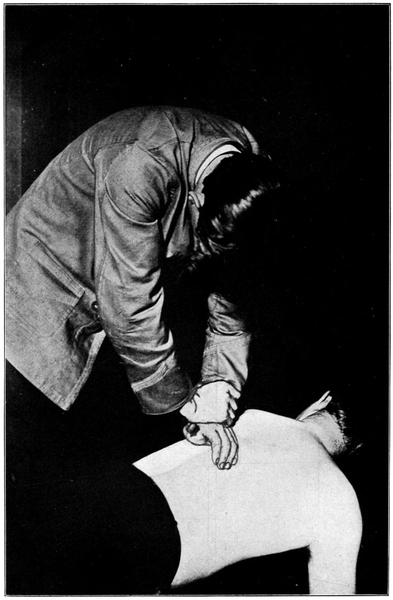
Fig. 26. Pisiform single transverse move, No. 1.
Like the movement just described, this adjustment may
be used in the Dorsals from fourth to ninth inclusive. It
should be limited to those subluxations which are rotated
without being posterior. In such an instance the spinous
process appears to be laterally displaced without being posterior,
or may appear slightly anterior because it is describing
an arc about a fixed center of rotation in the body
of the vertebra. One transverse process appears anterior
and the other posterior to the line of their fellows.
Palpate as for the Recoil and use the same adjusting
hand as in that movement, i. e., right hand if standing on
right side and palpating with left, or left hand if standing
on left and palpating with right. When the palpating fingers
have discovered the subluxated spinous process, the first
finger seeks a point even with the tip of the next superior
spinous process and about an inch to the side on which is
the posterior (prominent) transverse. The second and
third fingers follow and, dipping inward with a rolling or
massage motion, discover the end of the transverse.
Now the adjusting hand is placed with its pisiform resting
directly upon the blunt end of the transverse. If the
contact is on the same side of the spine with the adjuster
the fingers of adjusting hand extend across the spine and
are anchored on the other side, the hand arching sharply
and fingers extending somewhat downward. If contact is
on opposite side of spine the fingers follow the rib curve
downward and outward and are similarly anchored. In
every case the fingers should extend away from, and never
toward, the adjuster’s body. To violate this rule renders
one arm almost useless through its position.
At this juncture the palpating hand becomes a reinforcing
hand, to grip the wrist of the other and to aid in the movement.
The force is directed in a straight anterior direction,
quickly and decisively, as if a spinous process were the
lever used. Remember that contact must always be made
with the posterior transverse. To drive this anterior is to
rotate the vertebra around its vertical axis and to bring the
spinous process toward the median line, while the opposite,
and more anterior, transverse becomes more posterior, as it
should be.
For rotated first or second Dorsals with which, for any
reason, the “T. M.” fails. This move involves a use of the
head as a lever, as does the “T. M.” No. 2. Inadvisable unless
the posterior transverse of the rotated vertebra can be
palpated—but often used in cheerful disregard of this detail
by those sublimely capable adjusters who do not need to
find a vertebra before moving it.
Palpate as for No. 1 above. Very deep palpation will
be necessary because the spinous process here is nearly
horizontal to the body and the transverse is very deeply
placed, overlaid with heavy muscles.
When process is found place pisiform bone of free hand
upon it, pressing the muscles aside as much as possible to
avoid bruising and resting a considerable amount of weight
upon the contact hand. Fingers of contact hand may extend
across the spine or downward and parallel with the
spine. Or, the hands may be changed so that the palpating
hand becomes the contact hand and is placed with the fingers
gripped over the base of the neck toward the clavicle.
The free hand is now placed upon the forehead and the
head, which faces toward the contact hand, is flexed backward
until the muscles seem taut.
Is a quick, but fairly gentle, movement of both hands
together, so that the head is rocked still further backward
at the instant an anteriorly directed force is applied to the
prominent transverse. The result is rotation of the vertebra—unless
there be a loose articulation in the Cervicals which
gives way under the force applied to the head.
This movement has various names. The name “Point
2 Contact” is handed down from the days when Palmer
used three contact points and three moves and designated
the middle of the ulnar side of the fifth metacarpal bone as
“Point 2.” The name “Edge Contact” was applied later,
during the improvements in its technic when the hooking
of the thumbs stiffened its efficiency and made it very valuable.
It has since been rediscovered (though in constant
use) and re-named “Knife Move.”
A movement which uses the spinous process as a lever
and is applicable to D 2, 3, or 4, and to any Dorsal or Lumbar
from D 8 down, when posterior, postero-superior, or postero-inferior.
It does not correct rotation except insofar as the
shape of articular processes may aid an anteriorly directed
move in rotating the vertebra.
Some Chiropractors have used the Edge Contact in the
Cervicals but this is always improper, as it is practically
impossible in some, and difficult in all, cases to cover only one
spinous process when the head is resting on its side.
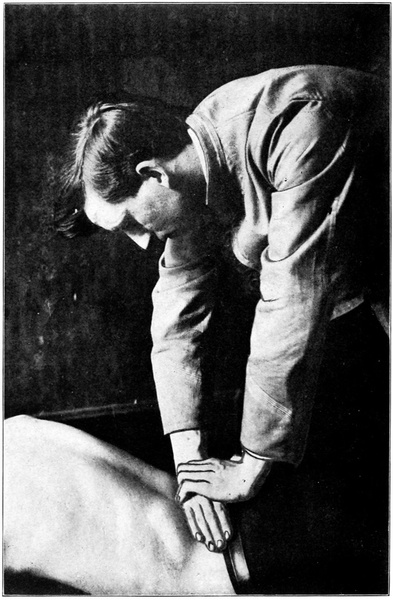
Fig. 27. The edge contact in Lumbar region.
Same as for Recoil or Heel Contact, q. v.
Using the same adjusting hand as for the Heel Contact,
place the middle of the ulnar edge of the fifth metacarpal
bone in contact with the spinous process. If the vertebra
be superior, place the edge of hand above, if inferior, place
the hand below. This contact is especially good for S or I
vertebrae.
The fingers of adjusting hand cross the spine at a right
angle to its long axis. The back of hand will be toward
patient’s head except in adjusting the last two Lumbars,
with which a change of hands is made necessary by the
upward slant of the lower half of the Lumbar curve.
The palpating hand now grips the adjusting hand so
that the fingers of the upper hand, held close together, press
against and reinforce the lower on its dorsum and just
above the contact point. The thumbs are hooked together
as shown in Fig. 27, so that the hands may be stiffened and
their tendency to roll avoided.
The elbows are outrotated and locked as in the Pisiform
Double Transverse Move and both shoulders are
loosened.
This is chiefly delivered with the upper arm, using upper
hand to drive the lower. Force should be quickly delivered
when patient is relaxed. The direction of force should be
determined by the direction of subluxation and by the slant
of the spinous process. Thus, when patient lies prone upon
a bifid bench and sways downward against a lax abdominal
support, the spinous processes of the lower dorsal make an
acute angle with the plane of the floor. If one be superior,
contact above it and force driven straight toward the floor
will tend to correct the subluxation. There is a slightly
different force angle for every subluxation correctable by
this move.
This move is less painful than the pisiform contact and
may often be used to advantage, especially in the Lumbar
region.
For the correction of a rotated Lumbar. Best used on
second and third. This movement should never be attempted
unless the transverse process can be palpated. Lumbar
transverses are sometimes short or fragile, and unless they
can be distinctly felt no force should be applied where they
are believed to lie.
Pisiform bone with posterior transverse.
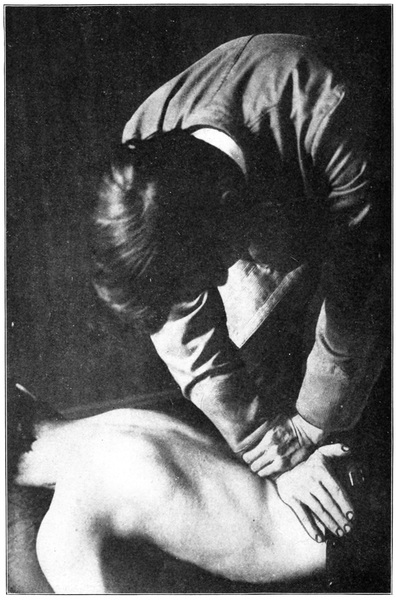
Fig. 28. Lumbar single transverse move.
Palpating as if for other movements, pause with the
second finger of palpating hand indicating the spinous process
of the vertebra to be moved. Note that if the spinous
process be to the right of the median line the left transverse
will be posterior, if to the left, the right transverse.
The transverse may then be found as in the Dorsals; it
should lie even with the interspace above the spinous process,
deeply overlaid with strong muscles. When the transverse
has been located by a deep, probing movement of the
fingers, place adjusting hand, pisiform on transverse, close
to the spinous process for greater solidity and fingers extending
downward and outward from the midspinal line
parallel with the lower rib curve.
If the adjuster stands on the side of the patient opposite
to the transverse to be moved the hand opposite the palpating
hand becomes the contact hand, as in other moves. But if
the posterior transverse is on the same side with the adjuster,
a change of hands is made and the palpating hand becomes
contact hand. To accomplish this the adjuster must turn
and face away from the patient with arm extended straight
downward to the contact. After contact is made the remaining
hand reinforces the adjusting hand by gripping the
wrist.
In making the contact press downward, deeply and
firmly, so as to crowd the muscles aside and place the pisiform
directly upon the transverse. Movement is given after
the patient’s body has been swung downward for a considerable
distance, and is sharp and decisive, directed
straight toward the floor.
A movement sometimes applied to posterior or postero-rotary
Lumbars.
From the spinous, find first the more posterior transverse
and make contact with it, since most force must be directed
there. Stand facing patient’s head and place right hand on
right transverse and left hand on left.
Contact point in this move is the tuberosity of the
scaphoid with the posterior surface of the transverse. Fingers
curve away from median line so as to avoid the rib curve.
After heavy, steady pressure downward, force is delivered
with a quick, throwing movement, most force on
the posterior side.
Upon the theory that when two forces are simultaneously
applied, the one to drive some vertebra cephalad (by its
spinous process) and the other to drive some lower vertebra
caudad, the intervening vertebrae tend, if anterior, to be
drawn outward or toward a more posterior position, this
move is predicated.
The author does not believe that it accomplishes its
purpose, but will briefly describe it for the benefit of those
who do.
Patient is placed over a roll which rests under the thighs
so as to flex thighs and pelvis on the Lumbar spine, or an
adjustable table is so tilted, both sections sloping downward
from the middle, as to accomplish the same result.
The usual method, if only a single vertebra is anterior,
is to make contact with the vertebrae immediately adjacent,
crossing the hands and having fingers of upper hand pointing
toward head and of lower hand toward Sacrum. But
some adjusters use this move differently, making contact
with Sacrum and with the mid-dorsal region in general
and applying a slow force with both hands. Contact is with
heel of hand upon spinous process.
The adjustment of the comparatively fixed sacrum is
difficult at best and requires a very considerable force, violently
applied. It is probable that nine-tenths of all attempts
to move sacra fail. In children, when sacrum does
not articulate properly with the ilia, and in adults in whom
the sacrum has been loosened by trauma and remains in
an abnormal relation to surrounding structures, it can be
moved.
The sacrum is described as being posterior at the base
or at the apex, and its axis for rotation is believed to be a
transverse line through the sacroiliac articulations. Force
for its adjustment is applied at right angles to the curve of
the sacrum at the point of contact. The best contact is with
the heel of the hand against a part of the sacrum, the wrist
of the adjusting hand being gripped and reinforced by the
other hand. If standing on patient’s left, the right hand
becomes adjusting hand for sacrum as for the last two Lumbars,
if on the right, the left hand.
Another contact is with the pisiform and adjacent soft
part of hand upon the sacral base, the pisiform hooking
against the first sacral spinous process.
Do not mistake an anterior fifth Lumbar for a posterior
sacral base. Discriminate between iliac and sacral subluxations
by noting that with the latter both sacroiliac articulations,
and with the former only one seems abnormal.
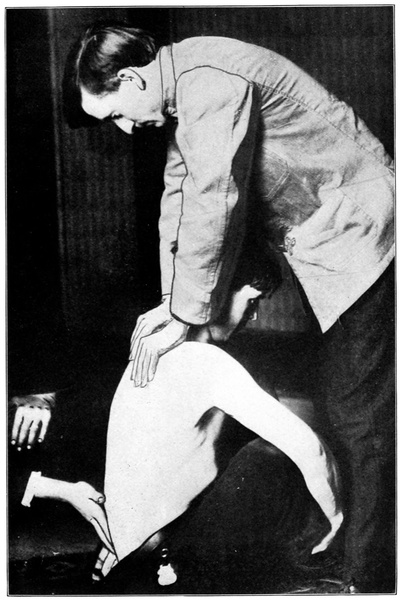
Fig. 29. “Bohemian Move” for correction of anterior fifth Lumbar
by transmitting shock through spine.
With patient sitting erect on flat surface, feet on floor,
stand behind and examine both sacroiliac articulations at
once with the palmar surfaces of the fingers of both hands.
If the two articulations are similar in every line neither
ilium is subluxated, though the sacrum may be rotated on
its transverse axis between the ilia, so as to be posterior or
anterior at base or apex.
But no examination of the ilia is complete without investigating
also the lumbosacral articulation. It sometimes
happens that though the first sacral spinous process naturally
completes the lumbar curve and there is no lumbosacral
subluxation the crests of both ilia appear much posterior to
their normal relation to the upper part of sacrum: this is
a double iliac displacement.
Usually the ilia are both normally articulated; this is
one of the most difficult joints to weaken and is seldom
affected except by the most extreme force. When iliac
subluxation exists one side is affected alone nine times out
of ten. The tenth case may show double subluxation.
Nine-tenths of the so-called “iliac adjustments” are
quite amusingly ineffective. The force required really to move
an ileum (save in joint disease or in children) is tremendous
and not to be commanded by the ordinary adjuster. The
light jars applied as a routine procedure by so many Chiropractors
are in reality nothing more than single percussion
strokes which stimulate the sacral nerves.
Place patient in position B and apply the hands to a
posterior ilium as to a posterior sacrum, making contact
with the most prominent portion of crest or posterior border
and driving in a direction which would represent a part of
the circumference of a circle of which the transverse sacral
axis of rotation touches the center, or the center of fixation
in the sacroiliac joint.
Place patient on an angle table, i. e., one which rises in
the center and slopes away toward either end. Separate
the thighs slightly, patient lying face down, and insert the
rubber-covered second finger, palmar surface upward, very
carefully into the rectum. The tip of the coccyx may then
be felt and its movability and position determined. Unless
it is immovably fixed in an abnormal position it should not be
molested; the movable coccyx responds to mere muscle
tension by changes of position and cannot act as a primary
cause of nerve impingement.
Usually this examination will be rendered unnecessary
by the external palpation which may disclose the movability
of the coccyx and at once render further exploration superfluous.
When the coccyx is anteriorly subluxated and ankylosed
in that position it may be a factor in producing constipation,
hemorrhoids, etc., but its influence in other diseases, especially
of the nervous system, has been greatly overrated by
those who have not yet fully accepted the doctrine that
nerve impingement is the primary cause of all disease.
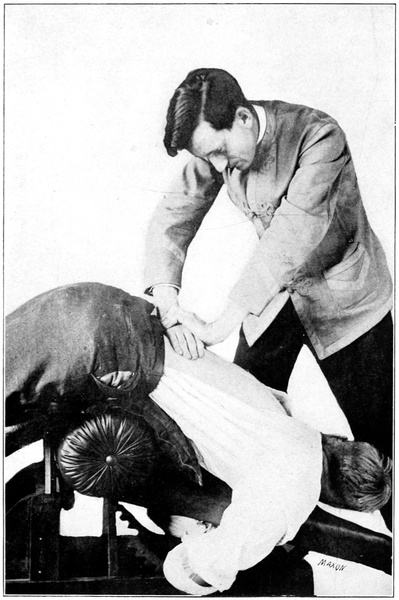
Fig. 30. Edge contact with “Roll,” q. v. Attitude of patient
for coccygeal adjustment.
When it has been decided that the coccyx must be
moved, the position and use of hand is the same as for the
palpation. The finger hooks under the tip of the coccyx,
draws upon it until a tight contact is secured and then
jerks sharply backward upon it with a view to its abrupt
fracture. No mitigation of the jerk in the hope of
previously loosening or gradually replacing the bone is of
value for osseous tissue must be broken before any movement
may take place.
This movement is painful and the region of the newly
fractured coccyx may remain sore for a period ranging
from a few days to several weeks. It is wise to warn the
patient of the facts before proceeding.
The fractured coccyx may be absorbed, or may be reankylosed
in a proper position or in a new abnormal position,
or may remain loose and movable.
We have previously discussed in detail the nature and
discovery of curvatures. A few words should be said here
about their correction.
If the sole object of the adjustment is to correct the
curvature it is best to select for adjustment those vertebrae
which are most subluxated in the direction of the curvature.
According to the length of the curvature a series of from
two to six, separated by some distance, are chosen. These
are adjusted until they cease to be the most prominent ones
in the curvature and then others, then most prominent, are
chosen and adjusted until they in turn cease to be most
prominent. In this way the curvature may eventually be
straightened, or nearly so. It is doubtful if any curvature
can be absolutely eradicated, although it may be straightened
until unnoticeable except by the expert.
To overcome a curvature it may be necessary to break
every rule which governs ordinary adjusting and to invent
new ways of placing the hands or of delivering force. No
two require exactly the same measures and he is most successful
with curvatures who is most adaptable to changing
conditions.
One rule may be safely laid down. Do not alternate
from day to day, loosening at the same time many vertebrae,
but choose the ones most in need of adjustment and follow
your choice as long as it is indicated. The chief vertebra is
nearly always the one at the angle or point of the curvature.
The sharp, angular curve of Potts’ Disease, involving
two or three vertebrae, should warn against adjustment,
usually, since in this disease the vertebrae are fragile and
easily fractured. If a case has not progressed too far a
cure may be effected, but great caution in taking such cases
must be exercised. Every Chiropractor should be well
informed on the diagnosis of Potts’ Disease, or spinal caries.
Many months are usually required for the straightening
of a curvature—how many can scarcely be estimated in
advance of the experiment with any case. Often the case
which seems simplest requires the longer time, while a very
pronounced curvature, as in some cases of rachitis, may
yield in a few months.
The selection of the move with which to correct each
subluxation depends upon the adjuster’s concept of the kind
and direction of the subluxation and of the mechanics of
the different corrective moves in his repertoire. The move
used should be one in which the application of force is
exactly along opposite lines to the lines of force which
originally produced the subluxation.
Omitting involved explanations as to the elements of
each displacement and the manner of change in bone,
muscle, ligament, cartilage, etc., and presupposing a comprehension
of the principles of each adjustment named,
there follows here a list of possible subluxations of each
vertebra in turn, from Atlas down, with a simple statement
of the RIGHT MOVE for that subluxation.
In each instance there are other moves than the one
listed which would move the vertebra and some which would
partially correct it, but none which would quite so definitely
tend to correct the displacement. Unfortunately it is not a
fact that every movement of a vertebra is an adjustment. If
this were true subluxations would not exist, because they
could never have been produced. Too often the adjuster
uses a move because it is easy, because its use has become
habitual with him, rather than because it is indicated by the
conditions of the case—then blames Chiropractic because his
results are negative or bad.
The move which is suited to a certain kind of subluxation
of one vertebra may be quite out of place with another,
in a different part of the spine. Thus the Recoil is quite
proper for a posterior Lumbar and is contraindicated with
a posterior middle Dorsal.
If all vertebrae were shaped exactly alike, if all were
equal in size, if subluxation were possible only in one direction,
then one method of adjustment would be quite sufficient.
Diversity of technic is demanded, but a discriminating
diversity, with a good reason for every move used.
| First Cervical |
| Subluxation. |
Adjustment. |
| Right—R. |
Break, or straight lateral. |
| Right, posterior—R. P. |
Rotary lateral. |
| Right, anterior—R. A. |
Morikubo. |
| Right, superior—R. S. |
Break. |
| Right, inferior—R. I. |
Break. |
| Right, posterior, superior—R. P. S. |
Rotary lateral. |
| Right, posterior, inferior—R. P. I. |
Rotary lateral. |
| Right, anterior, superior—R. A. S. |
Morikubo. |
| Right, anterior, inferior—R. A. I. |
Morikubo. |
| Left—L. |
Break. |
| Left, posterior—L. P. |
Rotary lateral. |
| Left, anterior—L. A. |
Morikubo. |
| Left, superior—L. S. |
Break. |
| Left, inferior—L. I. |
Break. |
| Left, posterior, superior—L. P. S. |
Rotary lateral. |
| Left, posterior, inferior—L. P. I. |
Rotary lateral. |
| Left, anterior, superior—L. A. S. |
Morikubo. |
| Left, anterior, inferior—L. A. I. |
Morikubo. |
| Anterior (entire Atlas)—A. |
Morikubo (both sides). |
| Posterior (entire Atlas)—P. |
Rotary lateral (both sides). |
| Note.—All right subluxations adjusted from right side, all left from left side. |
| Second Cervical |
| Posterior—P. |
Posterior Cervical move. |
| Posterior, right—P. R. |
Double contact on right side. |
| Posterior, left—P. L. |
Double contact on left side. |
| Posterior, right, inferior—P. R. L. |
Double contact on right. |
| Posterior, right, superior—P. R. S. |
Double contact on right. |
| Posterior, left, inferior—P. L. I. |
Double contact on left side. |
| Posterior, left, superior—P. L. S. |
Double contact on left side. |
| Right (lateral)—R. |
Break (Same if R. I. or R. S.) |
| Right (rotary)—R. |
Rotary (Same if R. I. or R. S.) |
| Left (lateral)—L. |
Break (Same if L. I. or L. S.) |
| Left (rotary)—L. |
Rotary (Same if L. I. or L. S.) |
| Superior—S. |
Posterior Cervical move. |
| Inferior—I. |
Posterior Cervical move. |
| Anterior (entire Vertebra)—A. |
Ventral transverse contact on most anterior side. |
| Anterior, right (lateral)—A. R. |
Second metacarpal contact from right. |
| Anterior, right (rotary)—A. R. |
Pisiform Ant. Cerv. contact on right. |
| Anterior, left (lateral)—A. L. |
Second metacarpal contact from left. |
| Anterior, left (rotary)—A. L. |
Pisiform Ant. Cerv. contact on left. |
| Third Cervical |
| Same as second. |
| Fourth Cervical |
| Same as second. |
| Fifth Cervical |
| Same as second. |
| Sixth Cervical |
| Posterior—P. |
The Recoil, hands reversed. |
| Posterior, right—P. R. |
Recoil, hands reversed. |
| Posterior, left—P. L. |
Recoil, hands reversed. |
| Posterior, right, superior—P. R. S. |
Recoil, hands reversed. |
| Posterior, right, inferior—P. R. I. |
Recoil, hands reversed. |
| Posterior, left, superior—P. L. S. |
Recoil, hands reversed. |
| Posterior, left, inferior—P. L. I. |
Recoil, hands reversed. |
| Right (lateral)—R. |
Break (Same if R. I. or R. S.) |
| Right (rotary)—R. |
Rotary (Same if R. I. or R. S.) |
| Left (lateral)—L. |
Break, from left (Same if L. I. or L. S.) |
| Left (rotary)—L. |
Rotary (Same if L. I. or L. S.) |
| Superior—S. |
Edge contact move. |
| Inferior—I. |
Edge contact move. |
| Anterior (entire vertebra)—A. |
Pisiform Ant. Cerv. contact on most anterior side. |
| Anterior, right (lateral)—A. R. |
Second metacarpal contact from right. |
| Anterior, right (rotary)—A. R. |
Pisiform Ant. Cerv. contact on right. |
| Anterior, left (lateral)—A. L. |
Second metacarpal contact from left. |
| Anterior, left (rotary)—A. L. |
Pisiform Ant. Cerv. contact on left. |
| Seventh Cervical |
| Same as sixth Cervical, except that T. M. may be used on right or left rotary subluxations. |
| First Dorsal |
| Posterior—P. |
Recoil, hands reversed. |
| Posterior, right—P. R. |
Recoil, hands reversed. |
| Posterior, right, superior—P. R. S. |
Recoil, hands reversed. |
| Posterior, right, inferior—P. R. I. |
Recoil, hands reversed. |
| Posterior, left—P. L. |
Recoil, hands reversed. |
| Posterior, left, superior—P. L. S. |
Recoil, hands reversed. |
| Posterior, left, inferior—P. L. I. |
Recoil, hands reversed. |
| Posterior, superior—P. S. |
Heel contact. |
| Posterior, inferior—P. I. |
Edge contact. |
| Superior—S. |
Heel contact. |
| Inferior—I. |
Edge contact. |
| Right—R. |
T. M. (Same if R. S. or R. I.) |
| Left—L. |
T. M. (Same if L. S. or L. I.) |
| Anterior—A. |
No correction. |
| Second Dorsal |
| Posterior—P. |
Heel contact. |
| Posterior, superior—P. S. |
Heel contact. |
| Posterior, inferior—P. I. |
Edge contact. |
| Posterior, right—P. R. |
Recoil. |
| Posterior, right, superior—P. R. S. |
Recoil. |
| Posterior, right, inferior—P. R. I. |
Recoil. |
| Posterior, left—P. L. |
Recoil. |
| Posterior, left, superior—P. L. S. |
Recoil. |
| Posterior, left, inferior—P. L. I. |
Recoil. |
| Left—L. |
T. M. (Same if L. S. or L. I.) |
| Right—R. |
T. M. (Same if R. S. or R. I.) |
| Anterior—A. |
No correction. |
| Third Dorsal |
| Posterior—P. |
Heel contact. |
| Posterior, superior—P. S. |
Heel contact. |
| Posterior, inferior—P. I. |
Edge contact. |
| Posterior, right—P. R. |
Recoil. |
| Posterior, right, superior—P. R. S. |
Recoil. |
| Posterior, right, inferior—P. R. I. |
Recoil. |
| Posterior, left—P. L. |
Recoil. |
| Posterior, left, superior—P. L. S. |
Recoil. |
| Posterior, left, inferior—P. L. I. |
Recoil. |
| Right—R. |
Pisiform single transverse (on left) (Same if R. S. or R. I.) |
| Left—L. |
Pisiform single transverse (on right) (Same if L. S. or L. I.) |
| Anterior—A. |
No correction. |
| Fourth Dorsal |
| Same as third Dorsal. |
| Note.—While the Recoil is here, the preferred move for posterior and postero-lateral subluxations, the pisiform double transverse or the two finger double transverse may be used if both transverses are palpable. |
| Fifth Dorsal |
| Posterior—P. |
Double transverse move. |
| Posterior, superior—P. S. |
Heel contact. |
| Posterior, inferior—P. I. |
Double transverse. |
| Posterior, right—P. R. |
Double transverse. |
| Posterior, right, superior—P. R. S. |
Double transverse. |
| Posterior, right, inferior—P. R. I. |
Double transverse. |
| Posterior, left—P. L. |
Double transverse. |
| Note.—The pisiform double transverse and the two-finger double transverse, apply force in exactly similar directions and may therefore be used interchangeably. The latter is preferable for children. |
| Posterior, left, superior—P. L. S. |
Double transverse. |
| Posterior, left, inferior—P. L. I. |
Double transverse. |
| Right—R. |
Pisiform single transverse (Same if R. S. or R. I.) |
| Left—L. |
Pisiform single transverse. (Same if L. S. or L. I.) |
| Anterior—A. |
No correction. |
| Sixth Dorsal |
| Same as Fifth Dorsal. |
| Seventh Dorsal |
| Same as Fifth Dorsal. |
| Eighth Dorsal |
| Same as Fifth Dorsal. |
| Ninth Dorsal |
| Same as Fifth Dorsal. |
| Tenth Dorsal |
| Posterior—P. |
Heel contact. |
| Posterior, superior—P. S. |
Edge contact. |
| Posterior, inferior—P. I. |
Edge contact. |
| Posterior, right—P. R. |
Recoil. |
| Posterior, right, superior—P. R. S. |
Recoil. |
| Posterior, right, inferior—P. R. I. |
Recoil. |
| Posterior, left—P. L. |
Recoil. |
| Posterior, left, superior—P. L. S. |
Recoil. |
| Posterior, left, inferior—P. L. I. |
Recoil. |
| Right—R. |
Recoil (Same if R. S. or R. I.)A |
| Left—L. |
Recoil (Same if L. S. or L. I.)A |
| Anterior—A. |
No correction. |
| Note.—The use of this move is not quite mechanically correct, but it is advised because of the possible danger of using the transverse processes as levers. |
| Eleventh Dorsal |
| Same as Tenth Dorsal. |
| Twelfth Dorsal |
| Same as Tenth Dorsal. |
| First Lumbar |
| Posterior—P. |
Heel contact. |
| Posterior, superior—P. S. |
Heel contact. |
| Posterior, inferior—P. I. |
Heel contact. |
| Posterior, right, superior—P. R. S. |
Recoil. |
| Posterior, right, inferior—P. R. I. |
Recoil. |
| Posterior, left—P. L. |
Recoil. |
| Posterior, left, superior—P. L. S. |
Recoil. |
| Posterior, left, inferior—P. L. I. |
Recoil. |
| Right—R. |
Lumbar single transverse move, if transverse is palpable, otherwise Recoil. (Same if R. S. or R. I.) |
| Left—L. |
Lumbar single transverse move, if transverse is palpable, otherwise Recoil. (Same if L. S. or L. I.) |
| Anterior—A. |
No correction. |
| Second Lumbar |
| Same as First Lumbar. |
| Third Lumbar |
| Same as First Lumbar. |
| Fourth Lumbar |
| Posterior—P. |
Heel contact. |
| Posterior, superior—P. S. |
Heel contact. |
| Posterior, inferior—P. I. |
Heel contact. |
| Posterior, right—P. R. |
Recoil, hands reversed. |
| Posterior, right, superior—P. R. S. |
Recoil, hands reversed. |
| Note.—The Heel contact may be substituted for the Recoil above if force be carefully directed in the proper direction in delivery. |
| Posterior, right, inferior—P. R. I. |
Recoil, hands reversed. |
| Posterior, left—P. L. |
Recoil, hands reversed. |
| Posterior, left, superior—P. L. S. |
Recoil, hands reversed. |
| Posterior, left, inferior—P. L. I. |
Recoil, hands reversed. |
| Right—R. |
Lumbar single transverse move, if transverse is palpable, otherwise Recoil. (Same if R. S. or R. I.) |
| Left—L. |
Lumbar single transverse, if transverse is palpable, otherwise Recoil. (Same if L. S. or L. I.) |
| Anterior—A. |
No correction. |
| Fifth Lumbar |
| Posterior—P. |
Heel contact. |
| Posterior, superior—P. S. |
Edge contact. |
| Posterior, inferior—P. I. |
Edge contact. |
| Posterior, right—P. R. |
Recoil. |
| Posterior, right, superior—P. R. S. |
Recoil. |
| Posterior, right, inferior—P. R. I. |
Recoil. |
| Posterior, left—P. L. |
Recoil. |
| Posterior, left, superior—P. L. S. |
Recoil. |
| Posterior, left, inferior—P. L. I. |
Recoil. |
| Right—R. |
Recoil (Same if R. S. or R. I.) |
| Left—L. |
Recoil (Same if L. S. or L. I.) |
| Anterior—A. |
“Bohemian” anterior fifth Lumbar move. (Not always advisable.) |
| Sacrum |
| Posterior base—B. of S.—P. |
Heel contact on base. |
| Posterior apex—A. of S.—P. |
Heel contact on apex. |
| Entire Sacrum posterior Sac. P. |
Heel contact between sacroiliac articulations. |
| Coccyx |
| To be adjusted only when ankylosed in an abnormal position and then by leverage of finger through rectum. |
Some useful information pertaining to adjustment will
be found in section entitled, “Practice,” q. v.
After a careful and painstaking study of the foregoing
pages it will still be found that the student is not by any
means equipped for the work. He must practice these
things to learn them. We learn to do by doing. The chief
use of this section will be as a reference and guide during
the practice of adjusting.