Such a strange thing had happened! One
of the brand-new pillow-cases was missing!
This was Saturday morning and Hulda had
been changing the bedding. Marm announced
her loss at the breakfast table. Hulda wasn’t
certain whose pillow the slip had been missing
from, but she thought it was Mr. Brent’s.
“I can’t think where it has got to,” lamented
Marm. “You don’t know where it is,
do you, Ned?”
Ned observed her frankly and gravely.
“I do not,” he replied. “And I don’t believe
it was mine. At least, I had both last
night.”
“Did you? Well, then it must have been lost
this morning. Perhaps Hulda dropped it somewhere.”
“I hope she didn’t drop it on the stairs,”
said Spud anxiously.
“Why?” asked Marm.
“I might slip on it,” was the sober reply.
Marm wondered why the fellows laughed
and had to have the joke explained to her by
Hoop.
“Maybe,” The Fungus began, “the same
person swiped the pillow-case that took Ned’s
eight—”
But he stopped there, pretending to choke on
a mouthful of baked potato. It had been agreed
last evening that there was no use in troubling
Marm about Ned’s loss.
“Fungus,” said Sandy in his blandest tones,
“do you realize that you sometimes talk too
much?”
“At least,” defended Dutch with a chuckle,
“he knows when to shut up!”
“I guess,” said Ned to Sandy when they left
the table, “that I’m just as curious as Marm
is about where that pillow-case has got to.”
“Pshaw,” replied Sandy, “never mind
about that. What bothers me is that money of
yours. That’s a very funny thing, Ned. Nothing
like it has ever happened in West House
since I’ve been here. You don’t suppose—”
he hesitated—“you don’t think that Cal
knows anything about it, do you?”
“Cal? Of course not,” replied Ned emphatically.
“I’d trust him anywhere.”
“Well, he doesn’t seem that sort to me,
either,” said Sandy. “I like the chap. Only
he did know the money was there, and then
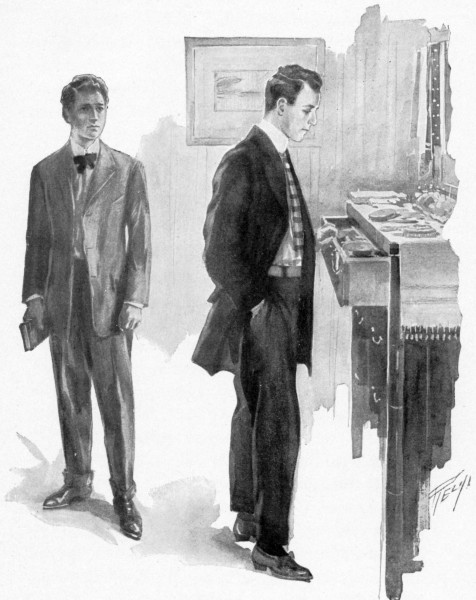
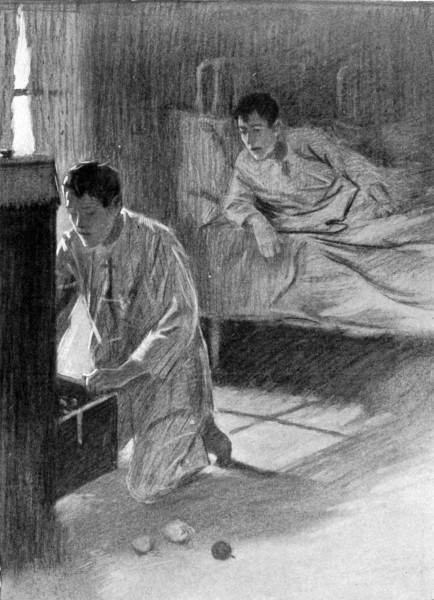
Spud is certain that he saw someone in front
of your bureau; someone who wore a nightgown.
And excepting Cal and Clara the rest
of us all wear pajamas.”
“Oh, rot,” said Ned. “Spud was half
asleep, probably. Anyway, it’s a fair guess he
couldn’t tell whether the person wore a nightgown
or a—a potato sack. I’ll bet he imagined
the whole thing; dreamed it, probably.
I wouldn’t be surprised if I came across the
money somewhere, after all,” he added carelessly.
“Well, I hope you do. I’d hate to think that
there was any fellow here who would steal.”
“I don’t believe it was stolen, Sandy.”
“But you said last night—”
“I know, but I’ve been thinking it over. I’m
pretty careless with things, you know. I dare
say I stuck it somewhere and forgot about it.
We won’t say anything more about it, especially
outside the house.”
“Not likely!” said Sandy.
Being Saturday there was no school. Ned
had said something two or three days before
about walking to Indian Head this morning
and Cal had eagerly agreed to accompany him.
Indian Head was a favorite resort with those
who liked walking and lay five miles away
across country. In Revolutionary times a
block-house had stood there and had been the
scene of an Indian massacre. Even yet relics
were sometimes found and almost every fellow
was the proud possessor of an arrow head purporting
to have been dug up on the site of the
old fort. Most of them had been purchased
from the enterprising merchant who sold post-cards
and curiosities in a little log-cabin at the
foot of the hill and looked suspiciously new.
Since the affair of last night Cal expected that
the excursion would be dropped. But Ned
sought him out after breakfast and reminded
him in an off-hand way that he had agreed
to go.
“Hoop and The Fungus are going, too,” he
said. “We’re going to start in about ten minutes.”
“All right,” said Cal after a moment of
hesitation. But when he had thought it over
he changed his mind. His grievance against
Ned still held good, and, he decided, he didn’t
want to go walking with a fellow who secretly
believed him a thief. So he told Ned he cal’lated
he wouldn’t go. And Ned said “Very
well” quite indifferently and the three went
off about half-past nine. Cal watched them
from his window and felt some regret. It was
a wonderful morning and he loved to walk.
When he went downstairs the house was
deserted, the rest of the inhabitants having
taken themselves off toward school. Cal put
his hands in his pocket and considered. It was
too fine a day to stay indoors. He cal’lated
he’d better follow the others over to the field
and see what was going on. Perhaps there’d
be a ball game, for base-ball at Oak Park was
played until snow came. Then his eyes fell on
the tennis court and he went in and found a
racket and for a half-hour amused himself
knocking balls across the net. After that he
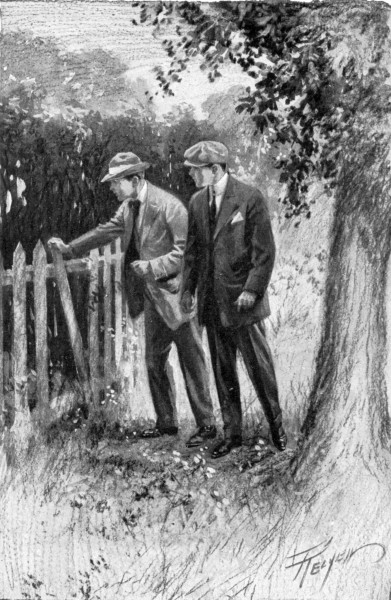
wandered to the gate and through it and started
down the road past the Curtis place in the general
direction of town with a half-formed idea
of working back to the field by way of the cross
road, which would mean a two mile stroll. But
he wasn’t destined to get his walk this morning,
for when he came in sight of the carriage gate
beyond the white farm house he saw that the
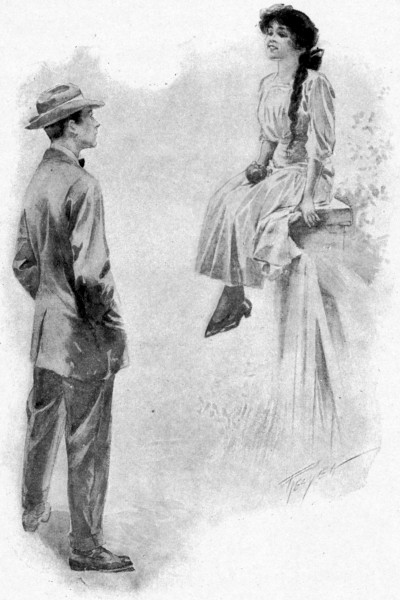
nearer post was occupied. On it, swinging her
feet and munching an apple, sat the girl they
had seen last evening. Cal didn’t know very
much about the usages of society and wondered
whether he ought to take off his cap to the
young lady or speak to her. She was already
aware of his approach and it wouldn’t look well
to turn back, although he would have much preferred
that solution of his quandary. He cal’lated
he’d just say “Good morning,” and not
bother about his cap. But the matter was decided
for him.
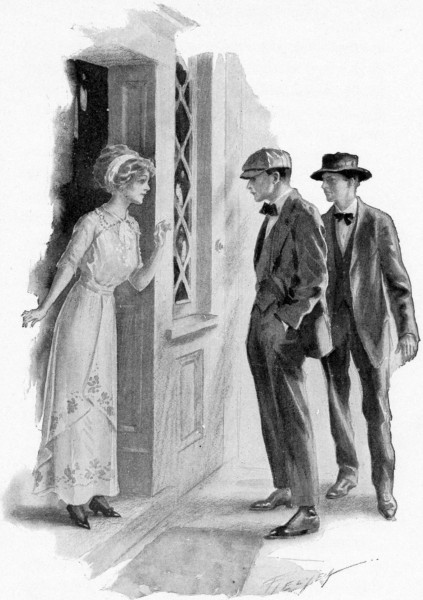
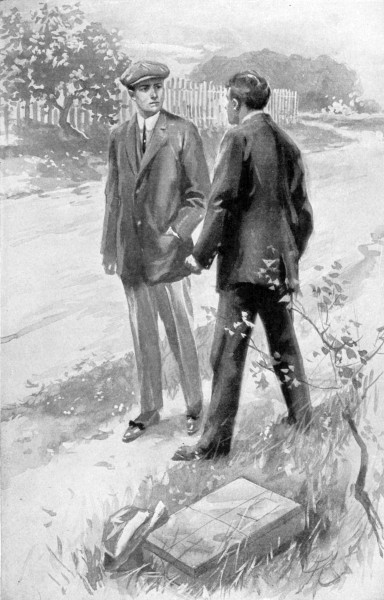
“Hello,” said the girl. “Want an apple?”
“No, thanks,” answered Cal. He still had
several yards to go before he would be up to
her and he searched for something further to
say; it was too late now for the “Good morning”
he had contemplated.
“Don’t you like apples?” she asked.
“Yes, but I ain’t hungry.” He was up to
her now and past and he breathed easier.
“These are Ghost apples,” said the girl.
Cal stopped and turned.
“They’re wha-what?” he stammered. The
girl put her head back and laughed merrily.
Then,
“Ghost apples,” she repeated. “They come
in pillow-cases.”
She smiled mischievously down at his
alarmed and puzzled face. Cal glanced apprehensively
toward the house.
“What do you know about pillow-cases?”
he blurted.
“Lots! Want to know what I know?” Cal
nodded.
“Pillow-cases,” said the girl, “are used to
cover pillows so that they won’t get soiled.”
She paused and looked at him with dancing
eyes. Cal grunted.
“What else?” he demanded.
“They are also used to—to gather apples
in.”
“Look here, did you see us—I mean them—I
mean—”
She nodded gayly.
“You and them both,” she laughed.
“What’s your name?”
“John Boland,” answered Cal. Then he
added, thinking that perhaps it was the correct
thing to do: “What’s yours?”
“Molly Elizabeth Curtis.” She made a
little backward movement with her head.
“They’re my aunts, you know. I live in New
York when I’m at home but I’m going to be
here all winter. Isn’t that awful?”
“Why, aren’t they good to you?”
“Of course they are, silly. But I guess it’s
going to be very dull after New York. Still,
I’ve had a pretty good time so far; especially
the night before last.”
Cal had drawn near and now he stood and
frowned at the tormentful young person on the
gate post and strove to consider what course
to pursue. It was evident to him that the young
person wasn’t going to tell all she knew until
she was quite ready to. Spud, he reflected, had
called her “a fresh kid,” and he cal’lated Spud
was about right. Still, she looked nice and was
quite pretty, Cal decided, as girls went. She
was slender and had a very clear complexion,
with cheeks in which the color had a way of
coming and going just as though she was able
to turn it on or off at her convenience. Her
hair, worn in a braid that hung to her neck and
was caught up again with a blue satin ribbon,
was deeply brown and her eyes were brightly
blue. Not that Cal observed all these things at
this time, however. About all he thought was
that she was pretty for a girl and looked as
though she was too jolly and nice to willingly
get anyone into trouble. As for her age, he
had guessed pretty near right, he told himself;
she was probably thirteen; not more than fourteen
at the most. Cal didn’t know much about
girls and was at a loss how to handle the present
situation. He was determined, however, to
get at the truth before he left there. So he
began by saying sternly:
“Look here, now, you’d better tell me what
you know about the other night.”
“Dear me!” said Miss Molly Elizabeth Curtis,
arching her eyebrows and looking fearfully
alarmed.
“Because if you don’t—”
“Then what?” she asked as he hesitated.
“Well, you better had,” he ended lamely.
She laughed.
“Don’t you think, Mister John Something,
that you’d better be nice to me instead of making
threats? Supposing—just supposing,
now—I was to show Aunt Matilda what I have
hidden in my trunk.”
“What—what is it?” asked Cal uneasily.
Molly leaned down and whispered dramatically:
“A pillow-case marked ‘West House’ in
black ink on the hem!”
“You—you wouldn’t do that, though,” said
Cal, half questioningly. “You’re too nice a
girl.”
The nice girl put her head back and laughed
harder and merrier than ever, until Cal looked
again toward the house and wondered if Miss
Matilda could hear.
“You’re—you’re awfully funny,” she
gasped finally. “Aren’t you?”
“I cal’late so, maybe,” answered Cal, willing
to agree for the sake of diplomacy. “Is
that pillow-case in a good safe place, Miss?
You know if Miss Matilda got hold of it
she’d show it to our principal and he’d—
I don’t know what he’d do; suspend us,
likely.”
“She won’t ever see it,” replied Molly reassuringly.
“It’s in my trunk and my trunk’s
locked and here’s the key.” She tugged at a
little blue ribbon around her neck and drew
forth the key in proof. “I’m keeping it as a
trophy, you know. I mean the pillow-case. My,
but it was fun!”
“It wasn’t you, was it?” cried Cal. Molly
nodded with sparkling eyes.
“Yes. Want me to tell you all about it?”
“Yes, I do,” answered Cal.
“Beg my pardon for saying what you said,
then,” she commanded.
“What did I say?” muttered Cal.
“That I’d better tell you or—or something!
Don’t you know that you mustn’t threaten a
lady? Besides,” she added thoughtfully, “it
just makes them stubborner.”
“All right,” said Cal grudgingly. “I won’t
do it again.”
“But go ahead.”
“Go ahead—what?” he asked.
“Beg my pardon. You haven’t yet, you
know.”
“Oh, well—all right. I do.”
“But you don’t!” she exclaimed impatiently.
“You just stand there and say you
do and you don’t!”
“Seems to me you’re mighty particular,”
he grumbled.
“I guess you don’t want to know about it,
after all,” she said indifferently.
“Yes, I do, honest! I—I beg your pardon,
Miss.”
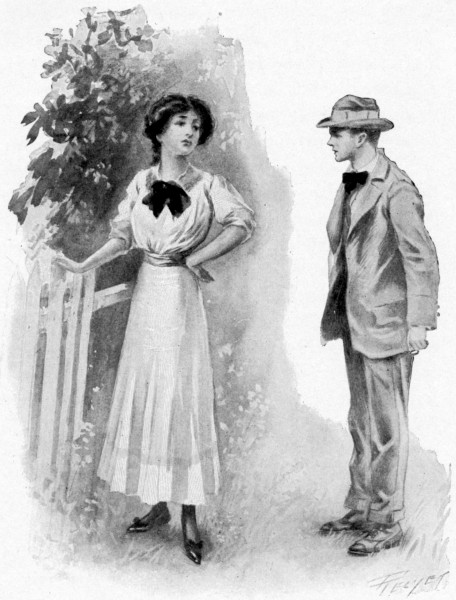
“Well, but please don’t call me Miss. I’m
only thirteen and you’re not a miss until you
have long dresses. Call me Molly. What do
they call you? Jack?”
“No, Cal.”
“Cal? That’s a funny name. Is it your
middle name?”
“No, it’s just—just a—a nickname.”
“Oh, all right.” She folded her hands in
her lap, having finished with her apple, and
considered her narrative. “Well, it all happened
like this,” she began after a moment.
“You see, there’s just me here and no one to
play with. Of course I don’t mind that so very
much because I like to read books and stories.
But it would be nicer if I knew somebody,
wouldn’t it? That’s what I told Aunt Lydia
and she said it was too bad I wasn’t going to
school because I’d meet lots of girls there.
You see, father doesn’t want me to go to school
this winter because I’m pretty well along anyhow
and then my eyes got bad last spring. I
told Aunt Lydia I guessed I’d like to know
some of the boys next door, but she just held
up her hands in horror. Did you know, Cal,
that you are awfully bad? Aunt Matilda says
so. She says you’re a—a— Oh, what was
it? A ‘parcel of young varmints,’ that’s it!”
Cal grinned and Molly smiled back at him.
“I guess Aunt Matilda doesn’t like boys
very well, though,” she continued extenuatingly.
“Anyhow, she said I mustn’t think of
playing with any of you. But I used to hear
you across the hedge and one day I thought
I’d like to see what a ‘varmint’ looked like.
So I went over there and peeped through. You
were playing tennis, some of you, and some of
you were on the porch. And just then two—I
think you were one of them, Cal—came
over toward the hedge and I heard you talking.”
Cal grunted. The mystery was clearing up.
“I remember,” he said. “We were talking
about getting through the hedge.”
“And stealing—I mean helping yourself to
the apples.”
“I guess stealing’s the word,” he said with
a smile.
“The other boy saw me or heard me or something,
don’t you remember? I got down on the
grass and hid until you’d gone. Then I thought
what fun it would be to surprise you. I didn’t
want to tell because—oh, because I should
think it would be rather fun to steal apples.
Isn’t it?”
“I don’t know. It wasn’t very much fun the
other night!”
“Oh, yes, it was—for me!” cried Molly.
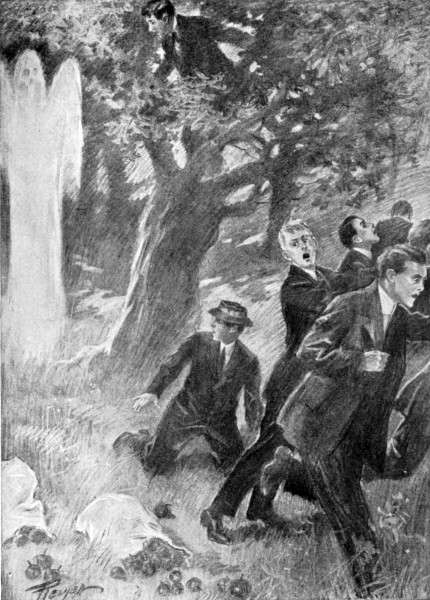
“I—we thought you were a ghost,” said
Cal a trifle shamefacedly.
“I meant you to!”
“I don’t see, though, how you did it.”
“I’ll tell you. It was a—an inspiration, I
guess! You see, I didn’t mind you taking all
the apples you wanted, because there are just
bushels and bushels of them and my aunts
would never miss them a tiny bit, but I did
want to have some fun. At first I thought I’d
wait for you at the hedge and threaten to tell
if you didn’t take me along with you. But I
didn’t know any of you, you see. Then I just
decided that I’d have fun my own way. So I
got a sheet out of the linen-closet and a broom
from the kitchen. I did that before supper and
hid them under the bed in my room. What
made it very difficult was that they insist on
my going to bed every night at half-past nine.
At home I always stay up until ten. So I had
to go to bed as usual, though, of course, I didn’t
really take all my clothes off. Aunt Lydia
always puts her head in my door and says good
night to me. That’s my room on the side. See
the two windows over the porch? That’s how
I got out. I was afraid to go downstairs because
my aunts would be certain sure to hear
me. So after Aunt Lydia said good night I
crept out of bed and dropped the broom and
the sheet out of the window. Then I came
down after them.”
“I don’t see how you did it,” said Cal with
a trace of admiration. “You didn’t jump, did
you?”
“No, there’s a rain-spout on the other side;
you can’t see it from here. I got down by that
and I got back the same way. It isn’t hard at
all. You stand on the porch rail and then you
put one foot on the thing that holds the spout
up and the other on top of the dining-room
window, and then you can get your knee over
the edge of the roof and you’re all right. I
made sure I could do it before supper, though.
After I got down I took the sheet and the broom
to the wagon-shed back there and got ready.
I waited and waited and thought you weren’t
coming after all. Then I could see you moving
down by the hedge. So I crept out and went
around through the blackberry patch until I
was at the edge of the orchard. But you were
all so busy you wouldn’t have seen me, anyway.
When you did see me, though, it was
just too funny for anything!”
Molly laughed merrily at the memory of it
and Cal said “Huh!” in a disgusted tone and
looked bored.
“It was a silly trick to play,” he said severely.
“Because you were fooled,” responded
Molly serenely. “I guess I must have looked
pretty—pretty ghastly! Anyway, you all
yelled like anything and just ran! I was glad
you got your apples, though. I suppose you
were all too scared to drop them!”
“I didn’t get mine,” said Cal grimly.
“Mine were under the tree.”
“Then it’s your pillow-case I found!” exclaimed
Molly, clapping her hands gleefully.
Cal nodded. Then he grinned.
“I was up in the tree,” he said. Molly
frowned.
“When?”
“After—the others left.”
“You never were!”
“Yes, I was. And you came right underneath
and I was—well, I was pretty frightened.”
Molly giggled. “You’d have been,
too,” he added defensively.
“Of course I would,” she owned. “I guess
I’d have fallen right out of the tree. I wish,
though, I’d known you were up there, Cal,”
she went on regretfully. “I’d have stayed
there, I guess. Did you see me dancing?”
“Was that what you were doing? I couldn’t
see very well on account of the leaves, but sometimes
you looked about ten feet tall and sometimes
you weren’t any higher than that.” Cal
put his hand a couple of feet from the sidewalk.
“It was the broom made me look tall. And
I guess when I wasn’t any higher than that I
was stooping down emptying the apples out
of that pillow-case. I do wish I’d known you
were up there, though.”
“I’m glad you didn’t,” said Cal with a
laugh. “It was bad enough as it was. What
did you dance for?”
“Oh, just—just for fun,” answered Molly
vaguely. “It was a Dance of Triumph.”
“Where did you go to? It seemed to me you
just—just vanished.”
“I suppose that was because I took the sheet
off. I had a dark dress on.” She smiled reminiscently.
“It was lots and lots of fun,
Cal.”
“Maybe it was for you,” he grumbled.
“We didn’t think it was very funny. We
thought it was a ghost for sure. I cal’late the
fellows will be glad to find out what it really
was. Spud said last night he was pretty sure
you knew something about it.”
“Was he the boy who came with you for
the apples?” Cal nodded. “Do you think
they’ll be very—very angry with me?” she
asked. “It was just a joke, you know.”
“No, I cal’late not,” answered Cal. Molly
gave a little shriek of triumph.
“Now I know why they call you Cal!” she
exclaimed. “It’s because you’re always saying
‘cal’late.’”
Cal reddened. “That’s why,” he confessed.
“They make a lot of fun of me. I don’t see
why cal’late ain’t just as good a word as—as
any other.”
“I suppose it hasn’t the sanction of usage,”
replied Molly glibly. Cal blinked.
“I cal’late—I mean I guess that’s it,” he
murmured. Molly laughed.
“You said it again, you know.”
“Yes,” answered Cal, “I’m trying to get
out of it, but I keep forgetting.” There was
a moment’s pause, and then, “Mrs. Linn
missed her pillow-case this morning,” he announced
carelessly.
“Did she?”
“Yes. I cal—I guess if I had it I could
get it back and she wouldn’t know.”
“I suppose you could—if you had it,”
agreed Molly.
Cal eyed her askance.
“You might give it back to me, I think.”
But Molly shook her head.
“No, it’s—it’s spoils of war. Besides, I
shall keep it and make you all do just what I
want.”
“What?” exclaimed Cal uneasily. “What—sort
of things?”
“Oh, I haven’t decided yet. Not fully, that
is. There’s one thing you must do, though. I
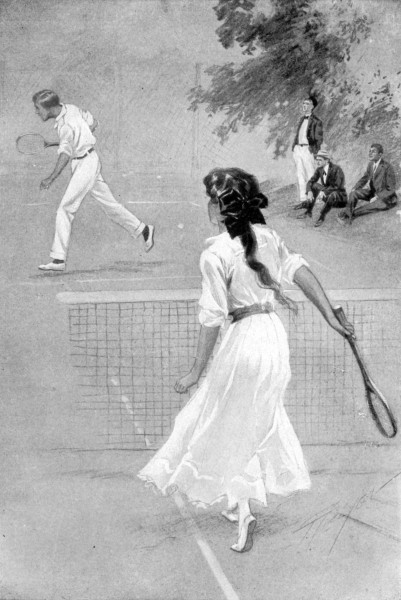
want to learn to play tennis. I guess one of
you can teach me that. And I want to see a
football game.”
“Oh!” said Cal gloomily. Then, brightening
up, “But your aunts won’t let you have
anything to do with us,” he said hopefully.
“But they will after awhile,” answered the
young lady with a slight toss of her head.
“You—you’re the wedge.”
“The what?” gasped Cal.
“The wedge, the entering wedge. Aunt
Lydia has been watching us out of the sewing-room
window for a long time, and she will tell
Aunt Matilda and Aunt Matilda will scold.
Then I shall tell her what a nice, polite boy
you are and that you invited me to play tennis
with you—”
“I didn’t!” cried Cal indignantly.
“But you’re going to,” returned Molly
calmly.
“I’m not either! I—I don’t play tennis.”
“Never mind. You’ll take me over some
day and one of the other boys will show me
how.”
“I guess girls aren’t allowed at West
House,” said Cal desperately.
“Oh, fiddle! You don’t guess anything of
the sort.”
“Well, anyhow, I won’t have anything to
do with it,” declared Cal with decision. Molly
looked regretful.
“I’m sorry,” she said, “because I’m so
afraid Aunt Matilda will make trouble when
she sees that pillow-case.”
“You—you wouldn’t show it to her!” he
gasped.
“I wouldn’t want to,” she answered gently,
with a shake of her head.
Cal considered a minute. Finally,
“All right,” he muttered ungraciously,
“I’ll see about it.”
“Thank you,” she murmured. “And you
do want me to play tennis with you, don’t
you?”
“I cal’late I’ve got to,” he replied. Then
the humor of it reached him and he chuckled.
“You’re a pretty smart girl, you are,” he said
in grudging admiration. Molly accepted the
tribute gravely, but there was a glint of laughter
in her blue eyes.
“I cal’late I’ve got some sense,” she replied
demurely.
Cal flushed. “If you make fun of me I won’t
do it,” he declared aggrievedly.
“I didn’t mean to make fun of you, truly,”
she assured him contritely. “And—and I
think ‘cal’late’ is a very nice word. I guess
you’d better go now, though, because Aunt
Matilda’s coming.”
“Where?” he asked in alarm. Molly
nodded down the road.
“In the buggy. She’s been to the village.
Oh, you needn’t run, because she’s
seen you already. But if you just walk
off you’ll get away before she can say anything.”
“But—but she’ll scold you, won’t she?”
he asked, pausing indecisively in flight.
“Yes, but I don’t mind. Besides, she doesn’t
really scold; she just ‘expostulates for my own
good.’ Good-by. Come to the hole in the
hedge this afternoon at half-past five and I’ll
tell you when I can play tennis with you. Don’t
forget!”
“I won’t,” called Cal, hurrying toward
home and safety.
“You do want me to play tennis, don’t
you?” she called after him.
“Yes, indeed!” he shouted back. Then he
plunged through West House gate with a deep
sigh of relief.