After our hearty commendations. Whereas, the united company of merchants
of England trading to the East Indies, have, by the annexed petition,
humbly prayed us to grant them, in pursuance of an Act passed the last
session of Parliament, a licence to take out of their warehouses a
quantity of teas, equal in weight to one thousand seven hundred large
chests of Bohea tea, which quantity will not in the whole exceed six
hundred thousand pounds weight, without the same having been exposed to
sale in this kingdom, and to export such tea discharged from the payment
of any customs or duties whatsoever, to the British colonies or
plantations in America. And it appearing to us by the annexed affidavit,
that there will be left remaining in their warehouses a quantity of tea
not less than ten millions of pounds weight, as by the said Act is
provided and directed. Now we, having taken the said application and the
several matters and things therein set forth into our consideration, do
think fit to comply with the request of the said petitioners. And in
pursuance of the powers given unto us by the said Act, we do hereby
authorise, permit and grant licence to the said Company to take out of
their warehouses the said quantity of tea, not exceeding in the whole
six hundred thousand pounds weight, without the same having been exposed
to sale in this kingdom, and to export such teas discharged from the
payment of any customs or duties whatsoever, to any of the British
colonies or plantations in America. Nevertheless, you are therein to
take especial care, that all and every the rules, regulations &
restrictions and orders directed by the said recited Act, relating to
the exportation of such teas, or any ways concerning the same, be in
all and every respect fully obeyed and observed. And for so doing, this
shall be as well to you as to the said Company, and to all other
officers & persons whatsoever herein concerned, a sufficient warrant.
 LORD NORTH.
Given under our hands and seals at the Treasury Chambers, Whitehall, the
20th day of August, one thousand seven hundred and seventy three; in
the thirteenth year of the reign of our sovereign lord, George the
Third, King of Great Britain, France and Ireland, and so forth.
North.
C. Townshend.
C.J. Fox.
To our very loving friends the Commissioners, for managing His Majesty's
Revenues of Customs and Excise, now and for the time being, and to all
other officers and persons herein concerned.
East India Company, Licence to Export Teas
Hon'ble Sirs:
We have the ship Eleanor, James Bruce, about 250 tons, (a constant
trader,) which we intend for Boston, and should be much obliged for the
freight of the teas you intend exporting to that place.
We have no ship bound to South Carolina, but are much obliged for the
preference given us. We are, sirs,
Your most h'ble serts.
Lane, Son & Fraser.
Nicholas Lane, 6th Augst 1773.
The Hon'ble the Court of Directors, &c., &c.
John Dorrien, Esqr. recommends for Boston, the Beaver, Captn Coffin.
Sir:
I wrote you under date of the 5th instt that you would be pleased to
inform the Committee of Warehouses, whether you had a constant trader
ready to sail for Boston or South Carolina, but should have said to
Boston only. I am therefore to desire the favor of an answer whether you
have a constant trader ready for that colony.
I am, &c., &c.,
Wm. Settle.
East India Ho. Augt 10, 1773.
Alex. Champion, Esqr.
Sir:
In answer to your esteemed of the 5th and 10th current, am obliged by
the favor intended, but at present have only one ship under my care
bound to Boston, who will depart in a very few days, but she is not a
constant trader. It is not, therefore, in my power to accept of the
offer.
I am, sir,
Your most hum. servt.
Alexander Champion.
Bishopgate Street, Augt 10, 1773.
Mr. Wm. Settle.
Hon'ble Sir:
Being informed you have some teas to ship to America, I have now a
vessel, British built, burthen about 160 tons, which should be glad to
lett to your honors for the above purpose.
I am, with due regard, hon'ble sirs,
Your most obedt servtt,
Thos. Walters.
Carolina Coffee House,
Birchen Lane, 17th Augt 1773.
The Elizabeth, John Scott, for any part of America.
To the Hon'ble Directors of
the East India Company.
Mr. Abraham Dupies, in Gracechurch Street, will become obligated for
Richard Clarke & Sons, of Boston.
Gentlemen:
I have a vessel in this port, which will be ready to return to America
in a few days, therefore take the opportunity to acquaint you that I am
willing to take on board her 600 chests of tea, either for New York or
Philadelphia, at the a customary freight given from hence to those
places.
I am, gentln your most hum. servant,
Joseph Cabot.
Threadneedle Street, 24 Augt 1773.
To the Hon'ble Committee of Warehouses.
London, Augt 26, 1773.
Sir:
We pray you to inform the Comtee of Warehouses for the Hon'ble the East
India Company that we have a ship, river built, called the Nancy,
commanded by Captain Colville, compleately fitted and ready to receive
the tea for New York, which we beg leave to recommend to the Committee.
We are, sir,
Your most obedient and humble servants,
John Blackburn.
Pigou & Booth.
Wm. Kelly & Co.
Mr. Wm. Settle.
Sir:
Please to acquaint the Hon'ble Committee of Warehouses, that we have
taken up the Polly, Capt Ayres, for Philadelphia, to carry the
Company's tea to that port, which vessel lays at Princes Stairs,
Rotherhith, and was built at Ipswich, in the year 1765. She is now ready
to take in.
We are, sirs,
Your most h'ble servts.
Pigou & Booth,
For selves & George Browne,
Samuel Wharton & Gilbert Barkley.
Mark Lane, 31st Augt 1773.
Mr. Wm. Settle.
Sir:
Your remarks to the bond offered you, relative to the 600 chests of tea,
which are to be exported to New York, have been laid before the
Committee of Warehouses, and they are of opinion that the said bond is
according to the agreement made with the several gentlemen for the
different Colonies, and the merchants who are concerned for the tea to
Boston, have executed their bonds agreeable thereto, and Messrs.
Wharton, Pigou & Barkley have agreed also to execute on Thursday
morning. Therefore, I am to desire you to inform me whether you will
please likewise to execute the said bond.
I am, sir,
Your most h'ble servt
Wm. Settle.
East India House, 31st Augt 1773.
To John Blackburn, Esqr.
William Kelly, Esqr.
Sir:
As the several gentlemen mentioned in your polite note of this day have
executed the bond, I shall with pleasure follow their example, and on
Thursday next I propose waiting on you for that purpose. I am sir,
Your most h'ble servt
John Blackburn.
Scot's Yard, 31st Augt 1773.
Mr. Wm. Settle.
Sir:
Last evening I had the pleasure to receive your favor of yesterday,
relative to the bond which I am to sign for New York, and the objections
made to its draught by Mr. Blackburn, Pigou and myself, which at the
time appeared resonable to us, but as others have signed in the form
shewn to me, I don't mean to be particular, and therefore shall conform,
relying on the honor of the Comtee in all future matters.
Tomorrow I am indispensably obliged to go out of town shall return on
Saturday next, wait on you, & execute the bond. I am, sir,
Your most obedit & most hum. servt
Wm. Kelly.
Crescent, Sep. 1st 1773.
Mr. Wm. Settle.
Freight of 568 whole, & 130 half chests of Tea, shipped on the Polly,
Capt Saml Ayres, for Philadelphia:
| feet. |
| 568 chests cong | for freight, | 8748.6 |
| 130 quarter do. | do | 656.9 |
| ——— |
| 9405.3 |
| ——— |
| 9405.3 at 1s. 6d. pr foot, Philadelphia currency, is | £705 7 10½ |
| tons. | —————— |
| Primage on | 2351/3 at 2s. sterlg pr ton, is £23 10 3 |
Freight of Tea on the London, to South Carolina:
| feet. |
| 182 | chests | measure | 2644.3 | at 1s. pr foot | £132 4 3 |
| 75 | do. | do. | 345.9 | do. | 17 5 9 |
| —— | | ———— |
| 257 | | 149 10 0 |
| Primage, 5 pr cent | 7 10 0 |
| ———— |
| £157 0 0 |
Freight of Tea shipped on the William, for Boston:
| feet. |
| 58 chests measure | 585.11, | at 1s. 4d. pr foot, | £39 1 3 L.M. |
| Primage, | 1 9 6 sterlg. |
Freight of 698 chests Tea on the Nancy, for New York:
| feet. |
| 698 chests measure | 9264.8, | at 2s. 3d. pr foot, is |
| Currency, | £1042 5 4 |
| Sterling, £30 8 2 | Primage, 5 pr ct. | 52 2 3 |
| ———— |
| £1094 7 7 |
| ———— |
Freight of 114 chests Tea on the Eleanor, for Boston:
| feet. |
| 114 chests measure | 1383.4, | at 1s. 4d. | £92 4 5 L.M. |
| Primage, | | £3 9 0 |
Freight of 112 chests Tea on the Beaver, for Boston:
| feet. |
| 112 | chests measure | 1375, | at 1s. 4d., is | £91 13 10 | l.m. |
| 34½ tons at 2s. pr ton primage, | £3 17 0 |
Whitehall, Decr 17th 1773.
Lord Dartmouth presents his compliments to Mr. Wheler, and requests the
favor to see him at his office, at Whitehall, on Monday morning next, at
eleven o'clock, on the subject of some advices Lord Dartmouth has lately
received from America, respecting the importation of tea from England.
LETTER TO SUNDRY AMERICAN MERCHANTS.
Sir:
The Comtee of Warehouses of the E.I. Comy desire you would please to
inform them whether you have receivd any advices from Boston relative
to the said Comys exportation of tea to that colony, and if you have,
to communicate the purport thereof to the Committee. I am, sir,
Your most obe. sert
Wm. Settle.
East India House, 20th Decr 1773.
| To | Mr. Wm. Palmer, | } | Boston. |
| Brook Watson, |
| Wm. Greenwood, | } | South Carolina. |
| Jo. Nutt, |
| Jno. Blackburn, | } | New York. |
| Wm. Kelly, |
| Fredk Pigou, Junr. New York & Philadelphia. |
| Geo. Browne, | } | Philadelphia. |
| Saml Wharton, |
LETTER TO SUNDRY AMERICAN MERCHANTS.[39]
Sir:
The Commtee of Warehouses desire the favor of an answer under your hand
to my letter of yesterday, relative to the exportation of tea to
Boston. I am, sir,
Your most obdt servant,
Wm. Settle.
East India House, 21st Decr 1773.
| Brook Watson, Esqr. Boston. |
| Wm. Greenwood, Esqr. | } | South Carolina. |
| John Nutt, Esqr. |
| John Blackburn, Esqr. New York. |
| Geo. Browne, Esqr. Philadelphia. |
LETTERS FROM SUNDRY AMERICAN MERCHANTS,
With Enclosures Of Advices From The Several Colonies.
BOSTON.
From Mr. Palmer.
Mr. Palmer has received no material advices from Boston since the
consignment has taken place, but has letters of as late a date from
thence as the 3d of Novemr, one of which mentions there was no tea
then to be bought.
East India House, 21st Decr 1773
Garlick Hill, 22d Decemr 1773.
To the Hon'ble the Committee of Warehouses, East India House.
Gentm:
In compliance with your request, we send you enclosed extracts from the
letters which we have lately received from Boston relative to the Comys
teas sent there.
We are, gentm
Your most hum. servts
Watson & Rashleigh.
Extract of a Letter dated Boston, 18th Octor., 1773:
"But what difficulties may arise from the disaffection of the merchants
and importers of tea to this measure of the India Company, I am not yet
able to say. It seems at present to be a matter of much speculation, and
if one is to credit the prints, no small opposition will be made
thereto. However, I am in hopes it will be otherwise, and taking it for
granted that the tea should arrive, and no obstacle happen to prevent
its being landed and disposed of, agreeably to the instructions of the
Company, then I am to add that you may be assured I shall strictly
conform to the instructions which I may jointly receive respecting it,
paying all due regard to the contents of your letter.
"I know not how to write more fully hereon until the tea arrives, and
what may possibly be the consequences attending it. My friends seem to
think it will subside; others are of a contrary opinion."
Extract of a Letter dated Boston, 30 Octr., 1773:
"I omitted a letter to you in particular when I wrote to your house the
10th inst., because I thought it was probable, both from the contents
of your letter then received, as well as from the public reports, that
the tea you mention as coming from the India Comy might every day be
expected to arrive, as you say 4 Augt they intended shipping 300 chests
immediately, but by my letter, this day received by a vessel from
London, it is not to be sent.
"I perceive by the prints, that the clamour is still continued against
this measure of the India Company, and seems to be pursued with rather
more warmth in some of the Southern Colonies than in this. For my own
part I am not sufficiently skilled in politicks to see the pernicious
consequences which 'tis said must arise therefrom. If they would prevent
the Tea Act being enforced, or the payment of the revenue arising
therefrom to Government, methinks they should either not import any tea,
or rather not consume any, and then the end would be answered at once.
But while there is such a vast quantity exported every year by so
considerable a number of persons, who all pay the duty thereof on its
arrival, I do not see why every importer, nay, every consumer thereof,
do not as much contribute to inforce the Tea Act as the India Compy
themselves, or the persons to whom they may think proper to consign
their tea for sale. Nor can I but be of opinion that the uneasiness is
fomented, if not originated, principally by those persons concerned in
the Holland trade, and thereby introduce large quantities of tea, which,
paying no duty, by that means they can afford to undersell those who do
pay it, and this trade, I am informed, is much more practiced in the
Southern Governments than this way.
"To what lengths the opposition to this tea's being brought or landed,
or disposed of, may be carried, must be left to time to determine."
Extract of a Letter dated Boston, 4 Novr., 1773:
"Thus far I had wrote you with intentions to forward by first
conveyance, when I found there was to be a muster of the people, to
demand that the persons who are to be employed as agents for disposing
of the tea which may come from the India Company, would resign their
commissions & swear (under Liberty Tree) to return the tea by the same
or first vessels for London, &c. You will be fully acquainted of their
unreasonable proceedings. After the time had elapsed which was fixed
upon for the gentlemen to appear and resign, on their not complying with
the order, they marched down in a body to Mr. Clarke's store, where we
were, and not receiving such an answer as they demanded, they began an
attack upon the store and those within, breaking down doors, flinging
about mud, &c., for about an hour, when they began to disperse, and a
number of gentln, friends of those agents coming to their assistance,
they left the store and went upon change, but met with no further
insult, tho' there is much threatening. As the tea is not arrived, and
it is uncertain when it may, I purpose to write you again speedily.
"In the interim, I am, &c."
SOUTH CAROLINA.
Letter from Mr. Greenwood.
Sir:
In answer to your letter of the 20th inst., I beg you would be pleased
to inform the Comtee of Warehouses that I have yet received no advices
from South Carolina, relative to the Compy's exportation of tea. When I
do, they may depend I will take the earliest opportunity to communicate
the same to them.
I am, sir,
Your most obet servt
Wm. Greenwood
Queen Street, 22d Decr., 1773.
Mr. Settle.
From Mr. Nutt.
Gentlemen:
In compliance with your desire, intimated to me by Mr. Settle,
respecting any information received from South Carolina, concerning the
teas exported by the East I. Comy to that Colony, I have the honor to
acquaint you that the vessel in which they were shipped did not sail
from England before the 18th October, and the latest dates from thence
are only the 1st Novr., so that we cannot expect for some time to
hear of her arrival. I have the honor to be, gentn.,
Your most obedt hum. servt.,
John Nutt.
Broad Street, 22nd Decemr, 1773.
To the Comtee of Warehouses, &c., &c., &c.
NEW YORK.
Letter from Mr. Blackburn.
Sir:
I am honored with your two letters of the 20th & 21st currt, desiring
me to inform the Comtee of Warehouses if I have received any advices
from New York relative to the Com's exportation of tea to that Colony.
The vessel wherein the tea was shipped was not arrived when the last
letters were dispatched from thence, consequently no precise judgment
can be formed whether or not it would be permitted to be landed; but I
flatter myself from the disposition of the principal gentlen of New
York, who are men of moderation, candour and prudence, and as firmly
attached to the Government and laws of this Kingdom as any of his
Majesty's subjects; that they will, by their example and influence, be
able to suppress every riot and disturbance occasioned by the opposers
of this measure.
I expect a ship from New York, which was to depart about the 26th
Novemr, by which I shall receive some fresh intelligence relative to
this business, and if I should be furnished with any advices that regard
the interest of the Company, I shall not fail to wait on the Directors
immediately. I have the honor to be, sir,
Your most obedt & hum. sert
John Blackburn.
Scots Yard, 22nd Decr, 1773.
Mr. Wm. Settle.
Extract of a Letter from a merchant in New York, to Wm. Kelly, of
London, dated 5th Novr, 1773:
"The introduction of the East India Company's tea is violently opposed
here, by a set of men who shamefully live by monopolizing tea in the
smuggling way."
Extract of a Letter from Abraham Lott, Esqr., of New York, to Wm.
Kelly,[40] of London, dated New York, 5th Novr., 1773, & received with
the above mentioned Extract of Mr. Kelly, 22d Decr., 1773:
"Herewith you will receive several papers relating to the importation of
the India Comy's tea. If it comes out free of a duty here on
importation, things I believe may go quiet enough, tho' you will
observe much is said against it even on that supposition. But if it
should be subject to a duty here, I am much in doubt whether it will be
safe, as almost every body in that case speaks against the admission of
it, so that, altho' I am well assured that the Governor will not suffer
the laws to be trampled on, yet there will be no such thing as selling
it, as the people would rather buy so much poison, than the tea with the
duty thereon, calculated (they say) to enslave them and their posterity,
and therefore are determined not to take what they call the nauseous
draft. A little time will determine how matters will terminate, that is,
if the tea comes out. If it does, I hope it may come free of duty, as by
that means much trouble and anxiety will be saved by the agents. I do
assure you they have all been very uneasy, tho' at the same time
determined to do their duty, but in the most prudent & quiet manner. It
is now two o'clock, p.m., when I received the paper signed Cassius, in
which you will find Mr. L—— R——de handsomely complimented, and
yourself severely handled, on a supposition that you should have spoken
words to the import, as asserted in the paper. Mr. R——e's name is not
mentioned, but there is no doubt but he is the person alluded to, as
upon the arrival of the London ships, who refused to bring the tea. It
was currently reported that he had wrote his partner nearly in the same
words as mentioned in the paper. You are the best judge of the truth of
the assertion, but whether true or not, his conduct is ungenerous and
mean. If the paper speaks truth, that he was offered part of the
consignment of tea, he must be a man of great influence to have so great
an offer made him, when so many other people of weight were applying for
it and could not obtain it."
From Mr. Fredk Pigou, Junr.
Sir:
Please to acquaint the Comtee of Warehouses of the Hon'ble the East
India Company, that from the advices I have received from
Philadelphia, I should be of opinion the tea sent to that place will,
if landed, meet with much difficulty in being disposed of.
At New York, I am of opinion it will meet with less opposition, and may
possibly be sold in that city. It would have been fortunate if the New
York vessel could have arrived as soon or before the Philadelphia ship.
I am, sir, your most hum. servt
Fred'k Pigou, Junr.
Mark Lane, 21st Decr., 1773.
To Mr. Settle.
PHILADELPHIA.
Letter from Mr. Geo. Browne.
Sir:
The advice I have from my brother at Philadelphia, relative to the
Comy's consignment of tea, is, that it was very doubtful how it would
be received there, the measure being looked upon in an unfavorable view
in general. He had only just received an account (from another hand) of
his being nominated one of the agents, and refers me to the public
prints for an account of the resolutions entered into by the people in
opposition to it. I am, sir,
Your most obedit sert
Geo. Browne.
Mr. Settle.
From Mr. Saml Wharton.
Sir:
I understand that Mr. Walpole, of Lincolns Inn Fields, had received some
advices from my brother, respecting the teas sent to Philadelphia. I
applied to him for them, and he requested that I would send them to you,
with what intelligence I had myself received. I am, sir,
Your very hum. servt
Samuel Wharton.
Argyle Street, Decemr 23, 1773.
Mr. Settle.
Extract of a Letter from Thomas Wharton,[41] Esqr. of Philadelphia,
dated Oct. 5, 1773, to Saml Wharton, in London:
"I have closely attended to the course of your arguments, and think they
are of great weight, but you know it is impossible always to form a true
judgment from what real motives an opposition springs, as the smugglers
and London importers may both declare that this duty is stamping the
Americans with the badge of slavery, and notwithstanding the Directors
of the East India Company have a just right to send their teas where
they think proper, yet the Americans allege they may and ought to refuse
to purchase and use it.
"A little time after the ship's arrival we shall know what is to be
done, and I expect we shall before that time have a conference with the
agents from New York, which I proposed, that our conduct might be
uniform, and as much as possible answer the end of our appointment."
Extracts of two Letters from Thos. Warton, Esqr., of Philadelphia,
dated Oct. 5 and Oct. 30, 1773, to the Hon'ble Thos. Walpole, of
London:
"About a week before the arrival of the September mail, a letter reached
this city, informing us that particular persons (tho' not all of them
the proper ones) were nominated agents for the East India Directors.
This gave the inhabitants a knowledge of the intention of the Directors,
and some persons immediately declared, that as the duty was still
retained, that, tho' small, yet it as implicitly fixed the power and
established the badge of slavery, as if it had been greater. The same
sentiments, I am told, are expressed in letters from New York. At
present, therefore, it is impossible to say what measures the people
will take on this occasion, but I should expect they will not hinder the
tea being landed, if they insist on its not being sold, till the duty is
taken off by Act of Parliament, or the East India Directors satisfy the
Commissioners of the Customs in London. For, notwithstanding, it may
justly be urged that the Directors of the East India Compy have a right
to export their teas to North America, yet, as it is said, the
inhabitants have also a right of judgment respecting the purchase and
consumption. I should expect, that if the opposition takes place, it
will rest with their adherence to an engagement of this kind.
"I can have no doubt that the India Comy would find their sales
lucrative, and that an extension of trade would certainly take place, by
comprehending the articles of pepper, spices, and silks in their
exports; great quantities of the two first articles have certainly been
introduced in the Continent from Holland and thro' the West Indies, and
therefore it is that I apprehend the London merchants are mistaken when
they say they already ship as much as the Continent can consume, for
through them are imported only such quantities of spices, &c., as the
merchant here can vend, after the run goods are sold, they being
imported cheaper than those from England, are naturally first sold. But
if the East India Company should think proper to extend their trade, I
cannot doubt it would in a great measure put a stop to the importation
from Holland and the Dutch Islands, and large sums would annually pass
from America to London for those commodities. But perhaps little more
should be said until it is known in what manner our fellow countrymen
shall view this scheme of trade."
"Philadelphia, Oct. 30, 1773.
"I shall endeavor to communicate a more full state of the sentiments of
my fellow citizens than I could in my last letter. I could then only
conjecture what might be the result of their judgments respecting the
Hon'ble the Directors of the East I. Comy sending their teas to this
Continent. A communication of sentiments, taking place between the New
Yorkers & the Philadelphians, soon produced a number of pieces in the
public prints and otherwise, most absolutely asserting the rights of the
Americans, and denying the power of Parliament respecting the internal
taxation of the Colonies, which led into many comparisons, endeavoring
to shew that the agency of the tea was equally odious & dangerous as
the execution of the Stamp Act would have been. I may say with great
truth, that I do not believe one man in a hundred was to be met with who
approved of the sending the tea, while the duty was to be paid here. Yet
a great number of people acknowledged the right of the East India
Directors to export their teas to America, and declared that nothing
less than a confirmed belief that the admitting this mode of taxation
would render the assemblies of the people mere cyphers, could have
induced them to proceed in the manner they have done; for when it was
mentioned to them that by refusing to admit the tea to be landed, they
did as much deprive the India Company of the natural rights of English
merchants, as the subjecting us to the payment of duty possibly could
affect us, they replyed that the Act of Parliament hindered the tea from
being landed until the duty was first paid or secured, and
consequently as the Directors knew this, and the opposition heretofore
given by the Americans, they must take what followed.
"You will perceive by the resolution formed and entered into on the
18th, into what a situation the agents were driven, there being no
possibility of persuading the people to wait till we knew the real state
of facts. The meeting at the State House consisted, (it is said) of 6 or
700, and be assured, they were as respectable a body of inhabitants as
has been together on any occasion; many of the first rank. The whole
of their proceedings were conducted with the greatest decency and
firmness, and without one dissenting voice. After the resolution had
passed, they appointed a Comtee of 12 persons, who, on the 18th inst.,
about 12 o'clock, called on James and Drinker, and then came down to my
house, where they conducted themselves with great decency, read the
resolution, and informed me they were appointed by their fellow citizens
to demand of Thos. & Isaac Wharton, whether we would execute the trust
if the duty was to be paid here? We told them it involved us in a
difficulty which we could not solve, because we had not received the
least intimation from the Directors, and therefore it was impossible to
know the exact state the tea was to be shipped in, but that we would, on
being acquainted with the situation under which it came, openly
communicate the same, and that we would do nothing to injure the
property of the India Comy or enslave America. This answer they
received with great satisfaction, and in the evening they reported to a
unanimous body of citizens the answers they had received, who gave
Thos. and Isaac Wharton very evident marks of their approbation for the
candid answer they gave.
"Should the tea be sent subject to the payment of the duty, I am
satisfied it will not be suffered to be landed, and that it must return
to London, (unless the India Directors have in such case directed the
captain where to proceed with it,) which intimation may be in time to
secure the property by insurance should they incline."
Copies of the above advices were, by order of the Comtee of Warehouses,
sent to Lord Dartmouth in the manner directed by their minute of the
——
BOSTON.
LETTER FROM Mr. JONATHAN CLARKE TO EDWARD WHELER, Esqr.
Boston, New England, 17th Novr., 1773.
Sir:
After a long detention in the English channel, and a pretty long
passage, I arrived here this morning from England, and there being a
vessel to sail for London within a few hours, gives me an opportunity of
writing you a few lines on the subject of the consignment of tea, made
to our house by the Hon'ble East India Company, in which I had your
friendly assistance, and of which I shall always retain a grateful
sense.
I find that this measure is an unpopular one, and before my arrival some
measures have been taken to oblige my friends to make a resignation of
the trust, which they have not thought fit to comply with. They have
wrote to our friend, Mr. Abraham Dupuis, very particularly, respecting
the measures that have been adopted, and to that account I must beg
leave to refer you, as I have not time to repeat it by this opportunity,
but I shall keep the Company fully advised in future.
I fully see that we shall meet with difficulty in executing this trust,
but our utmost endeavors shall be exerted to fulfill the orders we may
receive from the Company.
I am, very respectfully sir, your most obliged h'ble servt
Jona Clarke.
Edward Wheler, Esqr.
Received from the Deputy Chairman, 5th Janry, 1774.
LETTER TO Mr. ABRAHAM DUPUIS.
Sir,
Mr. Wheler, chairman of the East India Company, having received a letter
from Jonathan Clarke, Esqr., dated Boston, 17th November last, wherein
he begs leave to refer him to you for the measures that have been
adopted at Boston, relative to the Company's exportation of tea to that
Colony, I am directed by the chairman to desire you would be pleased to
communicate to him the advices you have received from Messrs. Clarke &
Sons, for the information of the Court of Directors of the East India
Company, which will be a favor conferred on him. I am, sir,
Your most obdt servt,
Wm. Settle.
East India House, 5th Jany, 1774.
Abraham Dupuis, Esqr., Gracechurch Street.
LETTER FROM Messrs. CLARKE & SONS, at Boston TO Mr. ABRM DUPUIS,
Referred to in Mr. Clarke's Letter to the chairman, of the 17th Novr,
1773.
Boston, Novr., 1773.
Mr. Abraham Dupuis.
Sir:
We now embrace the first leisure we have, to give you an account of the
proceedings of some of the inhabitants of this town, relative to the
expected importation of teas into this port from the Hon'ble East India
Company. As soon as it was known here that the Company had determined on
this measure, and that certain gentlemen of this town were fixed upon as
factors, there appeared a dissatisfaction in many persons. But at first
there did not appear any resentment against the supposed factors, nor
was there, as far as we ever heard, any mention made of a design to
bring them under any obligations not to execute their trust, but the
general voice among the opposers of the Company's plan was, that the
teas must not be landed, or, if landed, not sold. About three or four
weeks ago, a printed anonymous address to the Company's factors was
brought to this place by the post, either from New York or Philadelphia,
but whether it was fabricated at either of those places, or this, we
cannot determine. The design of it was, to represent a number of
gentlemen, who cannot justly be considered in any other light than
commercial factors, as Crown officers, and they, in the said paper, are
expressly put on the same footing with the late stamp officers,
doubtless with a design to render them odious to the people, and much is
said in it to dissuade or intimidate them from executing their expected
trust. Soon after this, a second anonymous address, but much more
inflammatory, appeared here in one of the newspapers from New York. Both
these were printed in one or more of the newspapers of this town, and
several other pieces were also published here, to rouse the people to an
opposition to the Company's design, and their rage against us and the
other gentlemen, factors for the Company in this place. As things were
then circumstanced in this place, we judged it might tend to undeceive
many persons that were misled, to publish some observations on the
Company's plan, to answer the objections that were made against it, and
to point out some of the beneficial consequences attending the execution
of it. Accordingly we, by the assistance of a friend, got printed in
Messrs. Fleet's Evening Post, of the 24th October, a piece signed
Z[42], in which this affair is canvassed with as much freedom as the
temper of the times would bear, and altho' this was penned in haste, and
under the restriction of the afore-hinted shackle, we have the
satisfaction to find, that in the opinion of the most judicious amongst
us here, every objection that has been started against the Company's
plan is fully answered, and altho' this publishment does not seem to
have had its designed effect as yet, it is to be hoped, when the
people's temper is become more cool, that the aforesaid piece, with
what has since, and may hereafter be published on this subject, may not
entirely fail of the design proposed.
Besides these paper skirmishes, we would inform you that we were told
that there were about two or three weeks since, several nightly
meetings, held in various parts of the town, of a large number of
persons, to consult and conclude on some method to prevent the execution
of the Company's plan, but what was fixed at these meetings we could not
learn. But we were not lost in this uncertainty long, for in the morning
of the 2nd instant, about one o'clock, we were roused out of our sleep
by a violent knocking at the door of our house, and on looking out of
the window we saw (for the moon shone very bright) two men in the
courtyard. One of them said he had brought us a letter from the country.
A servant took the letter of him at the door, the contents of which were
as follows:
"Boston, 1st Nov., 1773.
Richard Clarke & Son:
The Freemen of this Province understand, from good authority, that there
is a quantity of tea consigned to your house by the East India Company,
which is destructive to the happiness of every well-wisher to his
country. It is therefore expected that you personally appear at Liberty
Tree, on Wednesday next, at twelve o'clock at noon day, to make a public
resignation of your commission, agreeable to a notification of this day
for that purpose.
Fail not upon your peril.
O.C."
Two letters of the same tenor were sent in the same manner to the other
factors. On going abroad we found a number of printed notifications
posted up in various parts of the town, of which the following is a
copy:
"To the Freemen of this and the other Towns in the Province.
Gentlemen:
You are desired to meet at Liberty Tree, next Wednesday, at twelve
o'clock at noon day, then and there to hear the persons to whom the tea,
shipped by the East India Company, is consigned, make a public
resignation of their office as consignees, upon oath. And also swear
that they will reship any teas that may be consigned to them by the said
Company, by the first vessel sailing for London.
Boston, Novr. 1st, 1773.
O.C., Secrey."
In this you may observe a delusory design to create a public belief that
the factors had consented to resign their trust on Wednesday, the 3d
inst., on which day we were summoned by the above-mentioned letter to
appear at Liberty Tree, at 11 o'clock, a.m. All the bells of the
meeting-houses for public worship were set a-ringing and continued
ringing till twelve; the town cryer went thro' the town summoning the
people to assemble at Liberty Tree. By these methods, and some more
secret ones made use of by the authors of this design, a number of
people, supposed by some to be about 500, and by others more, were
collected at the time and place mentioned in the printed notification.
They consisted chiefly of people of the lowest rank, very few reputable
tradesmen, as we are informed, appeared amongst them. There were indeed
two merchants, reputed rich, and the selectmen of the town, but these
last say they went to prevent disorder. The gentlemen who are supposed
the designed factors for the East India Compy, viz: Mr. Thos.
Hutchinson, Mr. Faneuil, Mr. Winslow & Messrs. Clarke, met in the
forenoon of the 3rd instant, at the latter's warehouse, the lower end
of King Street. Mr. Elisha Hutchinson was not present, owing to a
misunderstanding of our intended plan of conduct, but his brother
engaged to act in his behalf. You may well judge that none of us ever
entertained the least thoughts of obeying the summons sent us to attend
at Liberty Tree. After a consultation amongst ourselves and friends, we
judged it best to continue together, and to endeavour, with the
assistance of a few friends, to oppose the designs of the mob, if they
should come to offer us any insult or injury. And on this occasion, we
were so happy as to be supported by a number of gentlemen of the first
rank. About one o'clock, a large body of people appeared at the head of
King Street, and came down to the end, and halted opposite to our
warehouse. Nine persons came from them up into our counting-room, viz:
Mr. Molineux, Mr. Wm. Dennie, Doctor Warren, Dr. Church, Major Barber,
Mr. Henderson, Mr. Gabriel Johonnot, Mr. Proctor, and Mr. Ezekiel
Cheever. Mr. Molineux, as speaker of the above Comtee, addressed
himself to us, and the other gentlemen present, the supposed factors to
the East India Comy, and told us that we had committed an high insult
on the people, in refusing to give them that most reasonable
satisfaction which had been demanded in the summons or notice which had
been sent us, then read a paper proposed by him, to be subscribed by
the factors, importing that they solemnly promise that they would not
land or pay any duty on any tea that should be sent by the East I.
Comy, but that they would send back the tea to England in the same
bottom, which extravagant demand being firmly refused, and treated with
a proper contempt by all of us, Mr. Molineux then said that since we had
refused their most reasonable demands, we must expect to feel, on our
first appearance, the utmost weight of the people's resentment, upon
which he and the rest of the Comtee left our counting-room and
warehouse, and went to and mixed with the multitude that continued
before our warehouse. Soon after this, the mob having made one or two
reverse motions to some distance, we perceived them hastening their pace
towards the store, on which we ordered our servant to shut the outward
door; but this he could not effect, although assisted by some other
persons, amongst whom was Nathaniel Hatch,[43] Esqr., one of the
Justices of the inferior Court for this country, and a Justice of the
Peace for the county. This genm made all possible exertions to stem the
current of the mob, not only by declaring repeatedly, and with a loud
voice, that he was a magistrate, and commanded the people, by virtue of
his office, and in his Majesty's name, to desist from all riotous
proceedings, and to disperse, but also by assisting in person; but the
people not only made him a return of insulting & reproachful words, but
prevented his endeavors, by force and blows, to get our doors shut,
upon which Mr. Hatch, with some other of our friends, retreated to our
counting-room. Soon after this, the outward doors of the store were
taken off their hinges by the mob, and carried to some distance;
immediately a number of the mob rushed into the warehouse, and
endeavored to force into the counting-room, but as this was in another
story, and the stair-case leading to it narrow, we, with our
friends—about twenty in number—by some vigorous efforts, prevented
their accomplishing their design. The mob appeared in a short time to be
dispersed, and after a few more faint attacks, they contented themselves
with blocking us up in the store for the space of about an hour and a
half, at which time, perceiving that much the greatest part of them were
drawn off, and those that remained not formidable, we, with our friends,
left the warehouse, walked up the length of King Street together, and
then went to our respective houses, without any molestation, saving some
insulting behavior from a few despicable persons. The night following, a
menacing letter was thrust under Mr. Faneuil's door, to be communicated
to the other consignees, with a design to intimidate them from executing
their trust, and other methods have since been made use of in the public
papers and otherwise, for the same purpose. The next day, being the 4th
inst., a notification was sent thro' the town, by order of the
selectmen, for the inhabitants of the town to meet on this affair the
next day, a transcript of which, and the proceedings of the town
thereon, at their meetings on the 5th and 6th inst., you have a full
account of in the enclosed newspapers, which, being long, we shall only
copy the message of the town to us, and our answer, which are as
follows:
—
"Voted, That a Comtee be immediately chosen to wait on those gentlen
who, it is reported, are appointed by the East India Comy to receive
and sell said tea, and request them, from a regard to their own
character, and the good order and peace of the town and province,
immediately to resign their appointments. And the following gentm,
viz.: the Moderator of the Meeting, Mr. Henderson Inches, Benjn Austin,
Esqr., and Mr. John Mason, & the select men of the town, were appointed
a comtee accordingly."
These gentm, all except Mr. Mason, came to our house about one o'clock,
p.m., but not having an authenticated copy of the Town's vote, we
desired to be favored with one, which was accordingly sent us, in a
short time, from the moderator, John Hancock, Esqr., to which we
returned the following answer, viz.:—
"Boston, Novr 5, 1773.
Sir:
It is impossible for us to comply with the request of the Town,
signified to us this day by their Comtee, as we know not on what terms
the tea, if any of it should be sent to our care, will come out, nor
what obligations, either of a moral or pecuniary nature, we may be under
to fulfil the trust that may be devolved on us. When we are acquainted
with these circumstances, we shall be better qualified to give a
definite answer to the request of the Town.
We are, sir, your most humble servants,
Richd Clarke & Sons,
Benjn Faneuil, for self & Joshua Winslow, Esqr.
Hon'ble John Hancock, Esqr.,
Moderator of a Town Meeting
at Faneuil Hall."
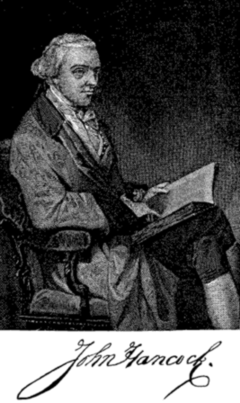
John Hancock's Reply to Washington's Letter to Congress, Recommending
the Bombardment of the Town of Boston.
"It is true, sir, nearly all the property I have in the world is in
houses and other real estate in Boston; but if the expulsion of the
British army from it and the liberties of our country require their
being burnt to ashes, issue the order for the purpose immediately."
This answer, you'll see by the enclosed news paper, was unanimously
voted to be not satisfactory to the Town, and the next day, on Mr.
Hutchinson's sending into the Town Meeting an answer of the same
purport, both his and ours were voted to be daringly affrontive to the
Town, but upon what reasons this vote was founded they have not been
pleased to declare. You may observe that the Town has resolved that they
will, by all means in their power, prevent the sale of the teas exported
by the East India Company, and in the preamble to this vote it is
asserted that the quantities of teas imported into this place since a
certain agreement, which we presume they designed should be understood
to commence in the fall of 1770, at which time the non-importation
agreement ceased, had been very small in proportion to what had been
usual before said agreement, and that by a few persons only. In order to
set those facts in a clear light, we obtained from the custom house an
account of teas imported into this place from the beginning of the year
1768, at which time the first teas that paid the American duty arrived
to this time, and got the same printed in the enclosed news paper, by
which it appears that the fact has been grossly misrepresented,
especially considering that this year's importation would probably be
encreased at the end of the year two or three hundred chests, if the
expected exportation on account of the East India Company had not
prevented it. Besides the public transactions relative to this affair,
before recited, we have repeated accounts of the continual nocturnal
meetings of the leaders of the mob, and we are informed that they are
determined to make the utmost efforts to prevent the sale of the teas;
that their present scheme, or part of it, is to endeavor, by all
methods, even the most brutal, to force the consignees to give up their
trust, and if they should fail in this, it is by some persons publickly
asserted that the tea shall not be landed, or if it should be, that it
shall be burnt.[44]
In our present unexpected and difficult situation, we have only to
desire you to assure the gentlemen, who may have consigned any part of
the Company's teas to our house, whom we cannot at present write to, as
we have not been advised who the gentlemen are, that we shall make use
of the best advice, and exert our utmost endeavors to carry into
execution the Company's design, which, as far as we are acquainted with
it, we judge to be beneficial to the Colonies, and to this Town and
Province especially, but whether it will finally be in our power to
accomplish our design, we are not at present certain. We beg the favor
of you, sir, to communicate the foregoing to the gentlemen who may have
had the direction of this affair. We are, with the greatest esteem and
highest sense of our obligations to them and you, sir,
Your most obedient & most humble servants,
Richard Clarke & Sons.
P.S.—Mr. Faneuil writes to his friend, Mr. Brook Watson, by this
opportunity, advising him of the transactions relating to this affair.
In case of miscarriage of his letter, we desire you to communicate this
letter to Mr. Watson.
EXTRACT OF Mr. FANEUIL'S LETTER TO BROOK WATSON, Esqr.
Mentioned in Mr. Clarke's Postscript.
Mr. Faneuil, after giving an account of the proceedings of the
inhabitants of the 3rd instant, entirely agreeing in substance with Mr.
Clarke's relation, goes on—
"By comparing this account with what Mr. Clarke writes his friend, Mr.
Dupuis, of London, you will come at the exact state of the affair. The
Governor has given my Lord Dartmouth an account of the conduct of his
Council. I will only say that next day they voted that the
Attorney-General be ordered to prosecute the persons concerned in this
riot. The consequence, I suppose, will be, the grand jury will not find
a bill against them, and there the affair will end."
On Thursday, a letter, of which the following is a copy, was found in my
entry:
"Gentlemen: It is currently reported that you are in the extremest
anxiety respecting your standing with the good people of this Town and
Province, as commissioners of the sale of the monopolized and dutied
tea. We do not wonder in the least that your apprehensions are terrible,
when the most enlightened humane & conscientious community on the earth
view you in the light of tigers or mad dogs, whom the public safety
obliges them to destroy. Long have this people been irreconcilable to
the idea of spilling human blood, on almost any occasion whatever; but
they have lately seen a penitential thief suffer death for pilfering a
few pounds from scattering individuals. You boldly avow a resolution to
bear a principal part in the robbery of every inhabitant of this
country, in the present and future ages, of every thing dear and
interesting to them. Are there no laws in the Book of God and nature
that enjoin such miscreants to be cut off from among the people, as
troublers of the whole congregation. Yea, verily, there are laws and
officers to put them into execution, which you can neither corrupt,
intimidate, nor escape, and whose resolution to bring you to condign
punishment you can only avoid by a speedy imitation of your brethren in
Philadelphia. This people are still averse to precipitate your fate, but
in case of much longer delay in complying with their indispensable
demands, you will not fail to meet the just rewards of your avarice &
insolence. Remember, gentn, this is the last warning you are ever to
expect from the insulted, abused, and most indignant vindicators of
violated liberty in the Town of Boston.
Thursday evening, 9 o'clock.
Nov. 4, 1773.
O.C., Secy, pr order.[45]
To Messrs. the Tea Commissioners.
Directed to B—— F—— Esqr."
On Friday we had a Town Meeting. What was done there, together with our
answers and their resolves, you'll see in the enclosed news paper. Just
before the meeting broke up, several gentn, on my telling the purport
of our answer, advised me to leave the town for that night; but I have
not yet slept out of my own house, nor do I propose to do it, till I
find it absolutely necessary. I thought it best, however, to conceal
myself for two or three hours. But nothing took place more that evening
than is usual on the 5th Novr. On Friday, we received an information,
which was repeated yesterday, that a number of picked men are determined
to break into our house one night this week. I can hardly believe it,
but these continued alarms are very disagreeable. I am, gentlemen,
Your most obedt servt,
Benjn Faneuil, Junr.[46]
PROCEEDINGS OF THE INHABITANTS OF THE TOWN OF BOSTON, ON THE 5TH & 6TH
NOVEMBER, 1773,
Referred to by Messrs. Richard Clarke & Sons, & Benjn Faneuil, Junr.,
in their above mentioned Letters, from the news papers enclosed.
[From the Massachusetts Gazette of Thursday, Nov. 11, 1773.]
The following notification was issued on Thursday last:
The freeholders and other inhabitants of the Town of Boston, qualified
as the law directs, are hereby notified to meet at Faneuil Hall, on
Friday, the 5th day of November instant, at ten o'clock in the
forenoon, then and there to consider the petition of a number of the
inhabitants, setting forth, "that they are justly alarmed at the report
that the East India Company, in London, are about shipping a cargo or
cargoes of tea into this and the other Colonies, and that they esteem it
a political plan of the British administration, whereby they have reason
to fear, not only the trade upon which they depend for subsistence, is
threatened to be totally destroyed, but what is much more than any thing
in life to be dreaded, the tribute laid on the foundation of that
article will be fixed and established, and our liberties, for which we
have long struggled, will be lost to them and their posterity, and
therefore praying that a meeting of the freeholders and other
inhabitants, may be immediately called, that so the sense of the matter
may be taken, and such steps be pursued as to their safety and well
being shall appertain."
By order of the Select men,
William Cooper, Town Clerk.
Boston, Novr 4th, 1773.
On Friday last there was a very full meeting of the freeholders, and
other inhabitants of this town, in Faneuil Hall, agreeable to a
notification issued by the Select men, when the Hon'ble John Hancock,
Esqr., was chosen moderator, and the Town, after due deliberation, came
into the following resolutions, viz.:
Whereas, it appears by an Act of the British Parliament, passed in the
last session, that the East India Company, in London, are by the said
Act allowed to export their teas into America in such quantities as the
Lords of the Treasury shall think proper. And some persons, with an evil
intent to amuse the people, and others thro' inattention to the true
design of the Act have so construed the same as that the tribute of
three pence on every pound of tea is to be exacted by the detestable
task masters here. Upon the due consideration thereof,—
Resolved, That the sense of this Town cannot be better expressed than in
the words of certain judicious resolves, lately entered into by our
worthy brethren of Philadelphia. Wherefore,
Resolved, That the disposal of their own property is the inherent right
of freemen; that there can be no property in that which another can, of
right, take from us without our consent; that the claim of Parliament to
tax America is, in other words, to claim a right to levy contributions
on us at pleasure.
2d. That the duty imposed by Parliament upon tea landed in America, is
a tax upon the Americans, or levying contributions on them without their
consent.
3d. That the express purpose for which the tax is levied on the
Americans, namely, for the support of government, administration of
justice, and the defence of His Majesty's dominions in America, has a
direct tendency to render assemblies useless, and to introduce arbitrary
government and slavery.
4th. That a virtuous and steady opposition to this ministerial plan of
governing America is absolutely necessary to preserve even the shadow of
liberty, and it is a duty which every free man in America owes to his
country, to himself and to his posterity.
5th. That the resolution lately agreed to by the East India Company, to
send out their tea to America, subjected to payment of duties on its
being landed here, is an open attempt to enforce the ministerial plan,
and a violent attack upon the liberties of America.
6th. That it is the duty of every American to oppose this attempt.
7th. That whoever shall, directly or indirectly, countenance this
attempt, or in any wise aid or abet in unloading, receiving or vending
the tea sent or to be sent out by the East India Company, while it
remains subject to the payment of a duty here, is an enemy to America.
8th. That a committee be immediately chosen to wait on those
gentlemen, who, it is reported, are appointed by the East India Company
to receive and sell said tea, and request them, from a regard to their
own characters, and the peace and good order of this Town and Province,
immediately to resign their appointments.
And the following gentlemen, viz., the Moderator, Mr. Henderson Inches,
Benjamin Austin, Esqr., and the Select men of the Town, were appointed
a committee accordingly.
At the same time, the Town passed the following resolves, viz.:
Whereas, the merchants of this Continent, did enter into an agreement to
withhold the importation of teas until the duty laid thereon mould be
repealed, which agreement, as we are informed, has been punctually
observed by the respectable merchants in the Southern Colonies, while,
by reason of the peculiar circumstances attending the trade of this
place, some quantities, tho' very small in proportion to what had been
usual before said agreement, have been imported by some of the merchants
here. And whereas, it now appears probable to this Town, that the
British Administration have taken encouragement, even from such small
importations, to grant licenses to the East India Company, as aforesaid,
therefore,—
Resolved, That it is the determination of this Town, by all means in
their power, to prevent the sale of teas exported by the East India
Company, and as the merchants here have generally opposed this measure,
it is the just expectation of the inhabitants of this town that no one
of them will, upon any pretence whatever, import any tea that shall be
liable to pay the duty from this time, and until the Act imposing the
same shall be repealed.
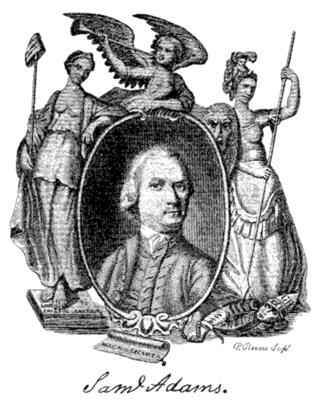
Governor Gage, through Col. Fenton, to Samuel Adams, 1773.
"Mr. Adams, you have displeased His Majesty, made yourself liable to be
sent to England, and tried for treason. Change your political course,
you will receive personal advantages, and also make your peace with the
King."
Mr. Adams' Reply: "I have long since made my peace with the King of
Kings. No personal consideration shall induce me to abandon the
righteous cause of my country. Tell Gov. Gage it is the advice of Samuel
Adams, to him, no longer to insult the feelings of an already
exasperated people."
And then the Town adjourned till three o'clock in the afternoon.
At 3 o'clock, there was again a very full assembly, and the committee
reported to the Town that they had waited on Richard Clarke, Esqr. and
Son, and Benjamin Faneuil, Esqr., said to be factors of the East India
Company, and communicated to them the resolve of the Town, whereby they
were requested, immediately, to resign their appointment, and that said
gentlemen informed the committee, that as Messrs. Thomas & Elisha
Hutchinson, (who are also reported to be factors of the said Company,)
were at Milton, and not expected in town 'till Saturday evening, and as
they chose to consult them, they could not return an answer to the Town
'till Monday morning.
Then another committee was chosen viz., Mr. Samuel Adams, Mr. Wm.
Molineux and Dr. Joseph Warren, to acquaint Messrs. Clarke & Faneuil,
that as they were not joint factors for the East India Company with the
Hutchinson's, it was supposed they could determine for themselves, and
therefore it was the expectation of the Town that they return an
immediate answer to the message, and this committee reported to the Town
that an answer might be expected in half an hour.
A motion was then made that a committee be appointed to repair to
Milton, and acquaint Messrs. Thomas and Elisha Hutchinson, with the
request of the Town, that they immediately resign their appointment, and
John Hancock, Esqr., Mr. John Pitts, Mr. Samuel Adams, Mr. Samuel
Abbott, Dr. Joseph Warren, Mr. Wm. Powell, and Mr. Nathl Appleton, were
appointed for that purpose.
A letter was brought into the hall, signed by Richard Clarke & Son, &
Benjamin Faneuil, for himself & Joshua Winslow, Esqr., and directed to
the Moderator, to be communicated to the Town, viz:
"Boston, 5th Novmr., 1773.
Sir:
It is impossible for us to comply with the request of the Town,
signified to us this day by the committee, as we know not what terms the
tea, if any part of it should be sent to our care, will come out on, and
what obligations, either of a moral or pecuniary nature, we may be
under, to fulfil the trust that may be devolved on us. When we are
acquainted with these circumstances, we shall be better qualified to
give a definitive answer to the request of the Town. We are, sir,
Your most h'ble servts,
Richard Clarke & Son,
Benjamin Faneuil, for self & Joshua Winslow, Esqr.
Hon'ble John Hancock, Esqr.,
Moderator of a Town Meeting, assembled at Faneuil Hall."
This letter was read, and unanimously voted to be not satisfactory to
the Town, and then the meeting adjourned 'till the next day, at eleven
o'clock, to receive the report of the committee appointed to wait on the
Hutchinsons.
The Town met by adjournment, on Saturday, (the meeting still continuing
very full,) and the committee reported, that they had seen Mr. Thomas
Hutchinson only, (his brother being neither at Milton or Boston,) and
that the Town might expect an answer from him immediately.
The following letter was soon after sent in to the Moderator, signed
Thomas Hutchinson, which was read, and unanimously voted to be an
unsatisfactory answer, viz.:
"Sir:
I know nothing relative to the teas referred to in the request or vote
of the Town, except that one of my friends has signified to me by
letter, that part of it, he had reason to believe, would be consigned to
me and my brother jointly. Under these circumstances, I can give no
other answer to the Town at present, than that if the teas should
arrive, and we should be appointed factors, we shall then be
sufficiently informed to answer the request of the Town. I am, for my
brother and self, sir,
Your h'ble servt,
Thos. Hutchinson, Junr.
Hon'ble John Hancock, Esqr.,
Moderator of a Town Meeting, now assembled.
It was then voted, that the letter, signed Richard Clarke & Son,
Benjamin Faneuil, for self and Joshua Winslow, Esqr., and also the
letter signed Thomas Hutchinson, which had been read, were daringly
affrontive to the Town, and the meeting was immediately dissolved.
AN ACCOUNT OF TEA IMPORTED AT BOSTON,
Referred to above, in Mr. Clarke's Letter, from the same.
Mr. Draper:
Please to publish the following account of the importation of teas from
Great Britain, from the commencement of the year 1768, to the present
time, for the information of such of your readers as desire to be
acquainted therewith:
| Chests. |
| In | 1768, | | 942 | by | 82 | difft persons. |
| 1769, | | 340 | | 33 | do. |
| 1770, | | 167 | | 22 | do. |
| 1771, | | 890 | | 103 | do. |
| 1772, | | 375 | | 70 | do. |
| 1773, | | 378 | | 61 | do. |
N.B.—The merchants in London, not having executed the orders for tea
this fall, on account of the expected exportation from the East India
Company, greatly lessens the quantity of the present year.
Q.
HALIFAX.
Mr. Michell presents his compliments to Mr. Watson, and by order
acquaints him, that the Court of Directors of the East India Company
have agreed that the Company's teas, which may be rejected at Boston,
and other places in America, should be sent to Halifax, in the manner
with which Mr. Watson was acquainted by the Committee, with whom he this
day conferred, and Mr. Michell is to desire Mr. Watson will, as soon as
may be, name to him the other house here, which is to join in that
business, and the other gentleman at Halifax, to be concerned in the
agency there with Mr. John Butler, that the necessary dispatch may be
given to the advices, to go from hence tomorrow, at 10 in the forenoon,
to the plantation office, and be there forwarded to America. He is also
to request Mr. Watson, will by that time, convey hither such letters as
he intends should go under the Company's cover, by the same dispatch to
Halifax, relating to this business
East India House,
Friday evening, 7th Jany, 1774.
| Joshua Mauger, Esqr., Member of Poole, in £10,000. |
| Brook Watson, | } | of London, merchants, and in £10,000. |
| Robt Rashleigh, |
Joint security for the due execution of the commission for the disposal
of the Company's teas by John Butler, Esqr., and Thos Cochran, of
Halifax.
NEW YORK.
THE AGENTS OF NEW YORK, THEIR PETITION TO THE GOVERNOR,
Referred to in their Letter of the 1st Decr.
To His Excellency William Tryon, Esqr., Captain-General and Governor in
Chief in and over the Province of New York, and Territories depending
thereon, in America, Chancellor and Vice-Admiral of the same.
The Memorial of Henry White, Abram Lott, & Benjm Booth, of the City
of New York, merchants.
Humbly sheweth:
That your memorialists have, by the last packet, received advices of
their being appointed agents by the East India Comy. for the sale of
certain teas by them shipped and daily expected to arrive in this port.
That your memorialists are informed by letter from the Directors of the
said Company, that they have given security in double the value of the
tea, that a certificate of its being duly landed shall be returned to
the custom house, in London.
That as the said tea, on its importation, will be subject to the
American duty, and as there is on that account a general and spirited
opposition to its being sold, and being well convinced from the nature
of the opposition, that so considerable a property of the Company will
not be safe unless Government takes it under protection, your
memorialists therefore humbly pray that your Excellency will be pleased
to direct such steps to be taken for the preservation of the said tea,
as your Excellency in your wisdom shall think most conducive to that
end.
Henry White.[47]
Abrm Lott.
Benjm Booth.
New York, 1st Decr., 1773.
BOSTON.
Proceedings of the inhabitants of the town of Boston, on the 18th
Novr., 1773, referred to by the agents in their letter of the 2d
Decr., are missing, supposed to be transmitted to Lord Dartmouth.[48]
PETITION OF THE AGENTS, & PROCEEDINGS OF THE COUNCIL OF BOSTON THEREON,
Referred to by the Agents in their Letter of the 2d Decemr.
To His Excellency the Governor and the Hon'ble His Majesty's Council.
The Petition of Richd Clarke & Sons, of Benjn Faneuil, & Thos. &
Elisha Hutchinson.
That the Hon'ble East India Company, in London, have shipped a
considerable quantity of tea for the port of Boston, and as your
petitioners are made to understand, will be consigned to their address
for sale.
That some of your petitioners have in consequence of this been cruelly
insulted in their persons and property; that they have had insulting and
incendiary letters left and thrown into their houses in the night; that
they have been repeatedly attacked by a large body of men; that one of
the houses of your petitioners was assaulted in the night by a
tumultuous and riotous assembly of people, and violent attempts made to
force the house for the space of two hours, that have greatly damaged
the same; that they are threatened in their persons and property, and
further with the destruction of the said tea on its arrival into the
port; and that the resolves and proceedings of the Town, in their
meetings on the 5th and 18th inst., are intended to be expressive of
the general sense of the Town, to which we beg leave to refer your
Excellency and the Honorable Board.
Your petitioners therefore beg leave to resign themselves, and the
property committed to their care, to your Excellency and Honors, as the
guardians and protectors of the people, humbly praying that measures may
be directed to, for the landing and securing the teas, until your
petitioners can be at liberty, openly and safely, to dispose of the
same, or until they can receive directions from their constituents.
| Signed, | Richd Clarke, |
| Benjn Faneuil, Junr. |
| Thos & Elisha Hutchinson. |
A true copy from the original.
Petition on file. Attest:
Signed, Thos. Flucker, Secy.
PROCEEDINGS OF THE COUNCIL THEREON,
At a Council held at the Council Chamber, in Boston, upon Friday, Novr
19, 1773.
Present:
His Excellency Thomas Hutchinson, Esqr., Governor.
| Isaac Royal,[49] | } | | James Bowdoin, | } | | James Pitts, |
| John Erving, | Esqrs. | James Russell, | Esqrs. |
| Wm. Brattle,[50] | | James Otis, | | Saml Dexter, Esqrs. |
His Excellency represented to the Council the tumults and disorders
prevailing in the town of Boston, and required their advice upon
measures proper for preserving the peace, and for supporting the
authority of Government. Whilst the Council were debating on the
subject, a petition from Richd Clarke, Benjn Faneuil, and Messrs.
Thos. and Elisha Hutchinson, to the Governor and Council was presented,
setting forth that the Hon'ble East India Comy, in London, have ship'd
a considerable quantity of tea for the port of Boston, which they are
made to understand, will be consigned to their address, for sale, and
that some of them have, in consequence of this, been cruelly insulted in
their persons and property. They therefore beg leave to resign
themselves, and the property committed to their care, to the Governor
and Council, as the guardians and protectors of the people, and pray
that measures may be directed to, for the landing and securing the teas,
until they can be at liberty, openly and safely, to dispose of the same,
or until they can receive directions from their constituents. After long
debate, it was proposed and agreed that his Excellency be desired to
appoint a future day for the Council to sit, and he appointed the 23d
inst., and the Council adjourned the further consideration to that time
accordingly.
November 23d, 1773. Present in Council: His Excellency Thos.
Hutchinson, Esqr., Governor.
Isaac Royal,
John Erving, | } | Esqrs. | James Bowdoin,
James Russell,
James Otis, | } | Esqrs. | James Pitts,
John Winthrop, Esqrs. |
His Excellency directed the Council to proceed in the consideration of
the petition of Richd Clarke, Esqr., and others, as entered the 19th
inst., for which purpose he had ordered them to sit at this time, and a
debate being had thereupon, it was moved to his Excellency that the
Council might sit on a further day, there being only a bare quorum
present, to which his Excellency agreed; advised that all those members
of the Council who live within 40 miles of the town of Boston be
summoned then to attend, which was done accordingly, to meet on
Saturday, the 27th inst.
Novemr 27th. Present in Council: His Excellency Thos. Hutchinson,
Esqr., Governor.
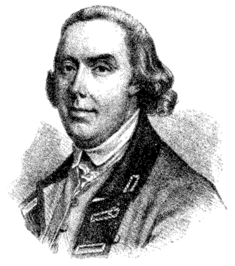 THOMAS GAGE, THE LAST ROYAL GOVERNOR.
Samuel Danforth,[51]
Isaac Royal,
John Erving,
James Bowdoin. | James Russel,
James Pitts,
Samuel Dexter, | James Humphrey,
Artemas Ward,
John Winthrop, Esqrs.
George Leonard. |
His Excellency, after representing to the Council the disorders
prevailing in the town of Boston, recommended to them to proceed on the
petition of Richd Clarke, and others, relative to those disorders, and
required their advice. After a long debate, it was moved to his
Excellency that a Comtee of the Council be appointed to prepare the
result of the said debate, to be laid before his Excellency, to which he
consented, and James Bowdoin, Saml Dexter, and John Winthrop, Esqrs.,
were appointed accordingly. Mr. Bowdoin made a report, which was
considered and debated by the Council, and it was moved to his
Excellency that he would adjourn the Council to a future day for further
consideration, and he appointed Monday, the 29th for that purpose.
Novemr 29th, 1773. Present in Council: His Excellency Thos.
Hutchinson, Esqr., Governor.
Samuel Danforth, Esqr.
Isaac Royal,
John Erving, |
James Bowdoin,
James Russell,
James Pitts,
Samuel Dexter, Esqrs. |
Geo. Leonard,
Artemas Ward,
John Winthrop, |
His Excellency directed that the Council proceed upon the business for
which it stands adjourned. After debate upon the report of the Comtee
the question whether it should be accepted was put, which passed
unanimously in the affirmative as the advice of the Council to his
Excellency, in the words following, viz.:
Previous to the consideration of the petition before the Board, they
would make a few observations occasioned by the subject of it. The
situation of things between Great Britain and the Colonies has been for
some years past very unhappy. Parliament, on the one hand, has been
taxing the Colonies, and they, on the other hand, have been petitioning
and remonstrating against it, apprehending they have constitutionally an
exclusive right of taxing themselves, and that without such a right,
their condition would be but little better than slavery.
Possessed of these sentiments, every new measure of Parliament tending
to establish and confirm a tax on them renews and increases their
distress, and it is particularly encreased by the Act lately made,
empowering the East India Company to ship their tea to America. This
Act, in a commercial view, they think introductive of monopolies, and
tending to bring on them the extensive evils thence arising. But their
great objection to it is from its being manifestly intended (tho' that
intention is not expressed therein,) more effectually to secure the
payment of the duty on tea, laid by an Act of Parliament passed in the
7th year of his present Majesty, entitled, "An Act for granting certain
duties in the British colonies and plantations in America," which Act in
its operation deprives the colonists of the right above mentioned (the
exclusive right of taxing themselves), which they hold to be so
essential a one that it cannot be taken away or given up, without their
being degraded, or degrading themselves below the character of men.
It not only deprives them of that right, but enacts that the monies
arising from the duties granted by it may be applied "as his Majesty or
his successors shall think proper or necessary for defraying the charges
of the administration of justice and the support of the civil
government, in all or any of the said colonies or plantations."
This clause of the Act has already operated in some of the colonies, and
in this colony in particular, with regard to the support of civil
government, and thereby has operated in diminution of its charter rights
to the great grief of the good people of it, who have been and still are
greatly alarmed by repeated reports, that it is to have a further
operation with respect to the defraying the charge of the administration
of justice, which would not only be a further diminution of those
rights, but tend in all constitutional questions, and in many other
cases of importance to bias the judges against the subject. They humbly
rely on the justice and goodness of his Majesty for the restitution and
preservation of those rights.
This short statement of facts the board thought it necessary to be given
to shew the cause of the present great uneasiness which is not confined
to this neighbourhood, but is general and extensive. The people think
their exclusive right of taxing themselves by their representatives,
infringed and violated by the Act above mentioned. That the new Act
empowering the East India Company to import their tea into America
confirms that violation, and is a new effort, not only more effectually
to secure the payment of the tea duty, but lay a foundation for
enhancing it, and in a like way, if this should succeed, to lay other
taxes on America. That it is in its attendants and consequences ruinous
to the liberties and properties of themselves and their posterity; that
as their numerous petitions for relief have been rejected, the said New
Act demonstrates an indisposition in ministry that Parliament should
grant them relief; that this is the source of their distress, a distress
that borders upon dispair, and that they know not where to apply for
relief.
These being the sentiments of the people, it is become the indispensible
duty of this Board to mention them that the occasion of the late demands
on Mr. Clarke and others, the agents of the East India Company, and of
the consequent disturbances, the authors of which we have advised should
be prosecuted, but to give a just idea of the rise of them.
On this occasion, justice impels us to declare that the people of this
Town and Province, tho' they have a high sense of liberty derived from
the manners, the example and constitution of the mother country, have,
'till the late parliamentary taxation of the Colonies, been as free from
disturbances as any people whatever.
This representation the Board thought necessary to be made prior to
their taking notice of the petition of the agents above mentioned, to
the consideration of which they now proceed.
The petitioners beg leave "to resign themselves, and the property
committed to their care, to his Excellency and the Board, as guardians
and protectors of the people, praying that measures may be directed to
for the landing and securing the tea," &c.
With regard to the personal protection of the petitioners, the Board
have not been informed that they have applied for it to any of the
justices of the peace, they being vested by law with all the authority
necessary for the protection of his Majesty's subjects. In the principal
instance of abuse of which they complain, the Board have already advised
that the authors of it should be prosecuted according to law, and they
do advise the same in the other instances mentioned in their petition.
With regard to the tea committed to the care of the petitioners, the
Board have no authority to take either that or any other merchandize out
of their care, and should they do it, or give any order or advice
concerning it, and a loss ensue, they apprehend they should make
themselves responsible for it. With respect to the prayer of the
petition, that measures may be directed to "for the landing and securing
the tea," the Board would observe on it, that the duty on the tea
becomes payable, and must be paid or secured to be paid on its being
landed, and should they direct or advise to any measure for landing it,
that would of course advise to a measure for procuring the payment of
the duty, and therefore by advising to a measure inconsistent with the
declared sentiment of both houses in the last winter session of the
General Court, which they apprehend to be altogether inexpedient and
improper.
The Board, however, on this occasion assure your Excellency that as they
have seen, with regret, some late disturbances, and have advised to the
prosecuting the authors of them, so they will in all legal methods
endeavor to the utmost of their power to prevent them in future.
Whereupon advised that his Excellency renew his orders to his majesty's
justices of the peace, sheriffs, and other peace officers, to exert
themselves to the utmost for the security of his Majesty's subjects; the
preservation of peace and good order, and for preventing all offences
against the laws.
His Excellency thereupon demanded of the Council whether they would give
him no advise upon the disorders then prevailing in the town of Boston,
and it was answered in general that the advise already given was
intended for that purpose.
A true copy from the minutes of the Council.
Attest:
Thos. Flucker, Secy.
PROCEEDINGS OF THE TOWN OF BOSTON ON THE 29TH & 30TH NOVEMBR, 1773,
Referred to by the Agents there, in their Letter of the 2d December,
1773.
At a meeting of the people of Boston and the neighbouring towns, in
Faneuil Hall, in said Boston, on Monday, 29th Novemr, 1773, nine
o'clock, a.m., and continued by adjournment to the next day, for the
purpose of consulting, advising, and determining upon the most proper
and effectual method to prevent the unloading, receiving or vending the
detestable tea sent out by the East India Company, part of which being
just arrived in this harbour, in order to proceed with due regularity,
it was moved that a moderator be chosen, and Jonathan Williams, Esqr.,
was then chosen moderator of the meeting.
A motion was made, that as the Town of Boston had determined, at a late
meeting, legally assembled, that they would, to the utmost of their
power, prevent the landing of the tea, the question being put whether
this body be absolutely determined that the tea now arrived, in Capt.
Hall's ship, shall be returned to the place from whence it came, at all
events, and the question being accordingly put, it passed in the
affirmative, nem. con.
It appearing that the hall could not contain the people assembled, it
was voted that the meeting be immediately adjourned to the Old South
meeting-house, leave having been obtained for this purpose.
The people met at the Old South, according to adjournment.
A motion was made, and the question put, viz.: Whether it is the firm
resolution of this body, that the tea shall not only be sent back, but
that no duty shall be paid thereon, and passed in the affirmative, nem.
con.
It was moved, that in order to give time to the consignees to consider
and deliberate before they sent in proposals to this body, as they had
given reason to expect would have been done at the opening of the
meeting, there might be an adjournment to 3 o'clock, p.m., and the
meeting was accordingly adjourned for that purpose.
Three o'clock, p.m. Met according to adjournment.
A motion was made whether the tea now arrived in Capt Hall's ship,
shall be sent back in the same bottom. Passed in the affirmative, nem.
con.
Mr. Rotch, the owner of the vessel, being present, informed that body
that he should enter his protest against their proceedings.
It was then moved and voted, nem. con., that Mr. Rotch be directed not
to enter this tea, and that the doing of it will be at his peril.
Also voted, that Capt. Hall, the master of the ship, be informed that,
at his peril, he is not to suffer any of the tea brought by him, to be
landed.
A motion was made, that in order for the security of Capt. Hall's ship
and cargo, a watch may be appointed, and it was voted that a watch be
accordingly appointed, to consist of 25 men.
Capt. Edward Proctor was appointed by the body to be capt. of the
watch for this night, and the names were given in to the moderator of
the townsmen who were volunteers upon the occasion.
It having been observed to the body that Governor Hutchinson had
required the justices of the peace in this town to meet and use their
endeavours to suppress any routs, or riots, &c., of the people, that
might happen, it was moved and the question put, whether it be not the
sense of this meeting that the Governor's conduct herein carries a
designed reflection upon the people here met, and is solely calculated
to serve the views of administration. Passed in the affirmative, nem.
con.
The people being informed by Colonel Hancock that Mr. Copley, son-in-law
to Mr. Clarke, senr., had acquainted him that the tea consignees did
not receive their letters from London 'till last evening, and were so
dispersed that they could not have a joint meeting early enough to make
their proposals at the time intended, and therefore are desirous of a
further space for that purpose.
[It is necessary to note that Mr. Copley, and some others, our friends
informing us, that to prevent immediate outrage, it was necessary for us
to send something in writing to the Select men, which we then did,
absolutely refusing to do what they had before informed us the people
expected; but Mr. Copley, on his return to town, fearing the most
dreadful consequences, thought best not to deliver our letter to the
Select men, he returned to us at night representing this. We then wrote
the letter you see printed in this paper.]
The meeting, out of great tenderness to these persons, and from a strong
desire to bring this matter to a conclusion, notwithstanding the time
they had hitherto expended upon them, to no purpose, were prevailed upon
to adjourn to the next morning, 9 o'clock.
Thursday morning, nine o'clock.
Met according to adjournment.
The long-expected proposals were at length brought into this meeting,
not directed to the moderator, but to John Scollay, Esqr., one of the
Select men. It was, however, voted that the same should be read, and
they were, as follows, viz.:
"Monday, Novr 29th, 1773.
Sir:
We are sorry that we could not return to the Town satisfactory answers
to their two late messages to us respecting the teas. We beg leave to
acquaint the gentlemen, Select men, that we have since received our
orders from the Hon'ble East India Comy.
We still retain a disposition to do all in our power to give
satisfaction to the Town; but, as we understood from you and the other
gentlemen, Select men, at Messrs. Clarke's interview with you last
Saturday, that this can be effected by nothing less than our sending
back the teas, we beg leave to say that this is utterly out of our power
to do, but we do now declare to you our readiness to store the teas
until we shall have an opportunity of writing to our constituents, and
shall receive their further orders respecting them, and we do most
sincerely wish that the Town, considering the unexpected difficulties
devolved upon us, will be satisfied with what we now offer. We are, sir,
Your most humble servants,
Thos. & Elisha Hutchinson.[52]
Benjn Faneuil, Junr., for self and
Joshua Winslow, Esqr.,
Richard Clarke & Sons.
To John Scollay, Esqr."
Mr. Sheriff Greenleaf came into the meeting, and begged leave of the
moderator that a letter, he had received from the Governor, requiring
him to read a proclamation to the people here assembled, might be read,
and it was accordingly read.
Whereupon it was moved, and the question put, whether the sheriff should
be permitted to read the proclamation, which passed in the affirmative,
nem. con.
The proclamation is as follows, viz.:
"Massachusetts Bay.
By the Governor.
To Jonathan Williams, Esqr., acting as Moderator of an assembly of
people, in the Town of Boston, and to the people so assembled:
Whereas, printed notifications were on Monday, the 29th inst., posted
in divers places in the town of Boston, and published in the news papers
of this day, calling upon the people to assemble together for certain
unlawful purposes, in such notifications mentioned; and whereas, great
numbers of persons belonging to the town of Boston, and divers others
belonging to several other towns in the Province, did assemble in the
said town of Boston, on the said day, and did then and there proceed to
chuse a moderator, and to consult, debate, and resolve upon ways and
means for carrying such unlawful purposes into execution, openly
violating, defying and setting at naught the good and wholesome laws of
the Province, and the constitution of government under which they live;
and whereas, the people thus assembled, did vote or agree to adjourn, or
continue their meeting to this the 30th inst., and great numbers of
them are again met or assembled together for the like purpose, in the
said town of Boston:
In faithfulness to my trust, and as his Majesty's representative within
the Province, I am bound to bear testimony against this violation of the
laws, and I warn and exhort you and require you, and each of you thus
unlawfully assembled forthwith, to disperse and to surcease all further
unlawful proceedings at your utmost peril.
Given under my hand, at Milton, in the Province aforesaid, the 30th day
of Novr., 1773, and in the fourteenth year of his Majesty's reign.
T. Hutchinson.
By his Excellency's command.
Thos. Flucker, Secy."
And the same being read by the sheriff,[53] there was, immediately
after, a loud and very general hiss.
A motion was then made, and the question put whether the assembly would
disperse and surcease all further proceedings, according to the
Governor's requirement. It passed in the nege, nem. con.
A proposal of Mr. Copley was made, that in case he could prevail with
the Messrs. Clarkes to come into this meeting, the question might now be
put, whether they should be treated with civility while in the meeting,
though they might be of different sentiments with this body, and their
persons be safe, until their return to the place from whence they should
come. And the question being accordingly put, passed in the affirmative,
nem. con.
Another motion of Mr. Copley's was put, whether two hours shall be given
him, which also passed in the affirmative.
Adjourned 'till two o'clock, p.m.
Two o'clock, p.m. Met according to adjournment. A motion was made and
passed, that Mr. Rotch and Captn Hall be desired to give their
attendance. Mr. Rotch appeared, and upon a motion made, the question was
put, whether it is the firm resolution of this body, that the tea
brought by Captn Hall shall be returned by Mr. Rotch to England, in the
bottom in which it came, and whether they accordingly now require the
same, which passed in the affirmative, nem. con.
Mr. Rotch then informed the meeting, that he should protest against the
whole proceedings, as he had done against the proceedings on yesterday,
but that, tho' the returning the tea is an act in him, he yet considers
himself as under a necessity to do it, and shall therefore comply with
the requirement of this body.
Captain Hall being present, was forbid to aid or assist in unloading the
teas at his peril, and ordered, that if he continues master of the
vessel, he carry the same back to London, who replied, he should comply
with these requirements.
Upon a motion, resolved, that John Rowe, Esqr., owner of part of Capt.
Bruce's ship, expected with tea, as also Mr. Timmins, factor for Capt.
Coffin's brig, be desired to attend.
Mr. Ezekiel Cheever was appointed captain of the watch for this night,
and a sufficient number of volunteers gave in their names for that
service.
Voted, that the captain of this watch be desired to make out a list of
the watch for the next night, and so each captain of the watch for the
following nights, until the vessels leave the harbour.
Upon a motion made, voted, that in case it should happen that the watch
should be any ways molested in the night, while on duty, they give the
alarm to the inhabitants by the tolling of the bells, and that if any
thing happens in the day time, the alarm be by ringing of the bells.
Voted, that six persons be appointed, to be in readiness, to give due
notice to the country towns, when they shall be required so to do, upon
any important occasion, and six persons were accordingly chosen for that
purpose.
John Rowe, Esqr., attended, and was informed that Mr. Rotch had
engaged, that his vessel should carry back the tea she brought, in the
same bottom, and that it was the expectation of this body that he does
the same by the tea, expected in Capt. Bruce, whereupon he replied,
that the ship was under the care of the said master, but that he would
use his utmost endeavor, that it should go back as required by this
body, and that he would give immediate advice of the arrival of said
ship.
Voted, that it is the sense of this body, that Capt. Bruce shall, on
his arrival, strictly conform to the votes passed respecting Capt.
Hall's vessel, as they had all been passed in reference to Capt.
Bruce's ship.
Mr. Timmins appeared and informed, that Capt. Coffin's brig, expected
with tea, was owned in Nantucket. He gave his word of honor that no tea
should be landed while she was under his care, nor touched by any one,
until the owner's arrival.
It was then voted, that what Mr. Rowe and Mr. Timmins had offered, was
satisfactory to the body.
Mr. Copley[54] returned, and acquainted the body, that as he had been
obliged to go to the castle, he hoped that if he had exceeded the time
allowed him, they would consider the difficulty of a passage by water at
this season, as an apology. He then further acquainted the body, that he
had seen all the consignees, and though he had convinced them that they
might attend this meeting with safety, and had used his utmost endeavors
to prevail on them to give satisfaction to the body, they acquainted
him, that believing nothing would be satisfactory short of reshipping
the tea, which was out of their power, they thought it best not to
appear, but would renew their proposal of storing the tea, and
submitting the same to the inspection of a committee, and that they
could go no further without incurring their own ruin; but as they had
not been active in introducing the tea, they should do nothing to
obstruct the people in their procedure with the same.
It was then moved, and the question put whether the return made by Mr.
Copley from the consignees be in the least degree satisfactory to this
body. It passed in the negative, nem. con.
Whereas, a number of merchants in this Province have inadvertently
imported tea from Great Britain, while it is subject to the payment of a
duty, imposed upon it by an Act of Parliament, for the purpose of
raising a revenue in America, and appropriating the same, without the
consent of those who are required to pay it, Resolved, that in thus
importing said tea, they have justly incurred the displeasure of our
brethren in the other Colonies.
And resolved further, that if any person or persons shall hereafter
import tea from Great Britain, shall take the same on board, to be
imported to this place, until the said unrighteous Act shall be
repealed, he or they shall be deemed by this body an enemy to his
country, and we will prevent the landing and sale of the same, and the
payment of any duty thereon, and we will effect the return thereof to
the place from whence it shall come.
Resolved, that the foregoing vote be printed and sent to England, and
all the sea ports in this Province.
Upon a motion made, voted that fair copies be taken of the whole
proceedings of this meeting, and transmitted to New York and
Philadelphia, and that Mr. Samuel Adams, Hon'ble John Hancock, Esqr.,
William Phillips, Esqr., John Rowe, Esqr., Jonathan Williams, Esqr.,
be a committee to transmit the same.
Voted, That it is the determination of this body to carry their votes
and resolutions into execution, at the risque of their lives and
property.
Voted, That the committee of correspondence for this town be desired to
take care, that every other vessel with tea that arrives in this
harbour, have a proper watch appointed for her; also,
Voted, That those persons who are desirous of making a part of these
nightly watches, be desired to give in their names at Messrs. Edes &
Gill's printing office.
Voted, That our brethren in the country be desired to afford their
assistance upon the first notice given, especially if such notice be
given upon the arrival of Captn Loring, in Mr. Clarke's brigantine.
Voted, That those of this body who belong to the town of Boston, do
return their thanks to their brethren who have come from the
neighbouring towns, for their countenance and union with this body, in
this exigence of our affairs.
Voted, That the thanks of this meeting be given to Jonathan Williams,
Esqr., for his good services as moderator.
Voted, That this meeting be dissolved, and it was accordingly dissolved.
LETTER ADDRESSED TO GEO. DUDLEY, Esqr.,
Enclosing 3 news papers and an advertisement, in the name of the
people, threatening vengeance on those who favored the tea scheme.
Sir:
The state and condition of the Hon'ble Company's tea in America is as
you will find in the enclosed papers. Unless the Tea Act is repealed,
no tea can be sold in America. Repeal the Act, and you may dispose of
all your teas. The Americans will not be slaves, neither are they to be
trapped under the notion of cheap teas. Death is more desirable to them
than slavery,—it is impossible to make the Americans swallow the tea.
The ministry may amuse the Company, by telling them their tea shall be
sold, and the Act preserved, but they are grossly mistaken. None of it
is yet landed, neither shall it be.
Your humble servant,
Anglo Americanus.
Boston, New England,
Decr 13th, 1773.
The papers enclosed contain an account of the proceedings of the town of
Boston, on the 29th & 30th November, and of the resolves of some of
the neighboring towns. (The papers are in the miscellany bundle.)
LETTER ADDRESSED TO GEO. DUDLEY, Esqr.,
Enclosing a Boston news paper of the 16th Decr., 1773.
Boston, New England, 17th Decr., 1773.
Gentlemen:
Your tea is destroyed, which was brought in three ships, Capts. Bruce,
Hall and Coffin, and the brig with tea is cast away. If the tea is got
on shore, it will share the same fate. Every possible means has been
used to send it home safe again to you, but the tea consignees would
not send it; then application was made to the commissioners of the
customs to clear out the vessel,—they would not do it, then to the
Governor to grant a pass, which he refused, and finally the people were
obliged to destroy it, (se defendendo,) or else, by an unlawful
unrighteous Act, imposing a duty this tea would have destroyed them.
This whole province, of some hundred thousand people, and the other
provinces on the continent, are determined neither to use it, or suffer
it to be landed, nor pay the duty. Force can never make them, and if the
Company can ever expect to sell any tea in America, they must use all
their interest to get this Tea Act repealed, otherwise they will never
sell one ounce.
There is the utmost detestation of tea; even some of our country towns
have collected all the tea they had by them, and burnt it in their
public common, as so much chains and slavery. Get the Tea Act repealed,
and you'll sell all your tea, otherwise you must keep all. The people
will risk life and fortune in this affair,—the very being of America
depends on it. I am sorry the Company are led into such a scrape by the
ministry, to try the American's bravery, at the expence of their
property. The artifice of the ministry is to dispose of your tea, and
preserve the vile Tea Act; but they'll miss their aim,—the Americans
will not swallow cheap tea, which has a poison in the heart of it. They
see the hook thro' the bait. I am a well wisher to the Company, and also
to America; but death to an American is more desirable than slavery.
I am, gentlemen, with all due respect,
Your honors most obedient, humble servant,
Anglo Americanus.
AN ACCOUNT OF THE DESTRUCTION OF THE TEA AT BOSTON,
As contained in the Boston news paper of the 16th Decr.
Boston, Thursday, Decr 16th, 1773.
It being understood that Mr. Rotch, owner of the ship Dartmouth, rather
lingered in his preparations to return her to London, with the East
India Company's tea on board, there was, on Monday last P.M., a meeting
of the committee of the several neighboring towns in Boston, and Mr.
Rotch was sent for and enquired of, whether he continued his resolution
to comply with the injunctions of the body on Monday and Tuesday
preceding. Mr. Rotch answered that in the interim he had taken the
advice of the best counsel, and found that in case he went on of his own
motion to send that ship to sea in the condition she was then in, it
must inevitably ruin him, and therefore he must beg them to consider
what he had said at that meeting to be the effect of compulsion, and
unadvised, and in consequence that he was not holden to abide by it,
when he was now assured that he must be utterly ruined in case he did.
Mr. Rotch was then asked whether he would demand a clearance for his
ship in the custom house, and in case of a refusal enter a protest, and
then apply in like manner for a pass, and order her out to sea? To all
which he answered in the negative. The committee, doubtless informing
their constituents of what had passed, a very full meeting of the body
was again assembled at the Old South meeting-house, on Tuesday
afternoon, and Mr. Rotch being again present, was enquired of as before,
and a motion was made and seconded that Mr. Rotch be enjoined forthwith
to repair to the collectors and demand a clearance for his ship, and ten
gentn were appointed to accompany him, as witnesses of the demand. Mr.
Rotch then proceeded with the committee to Mr. Harrison's lodgings, and
made the demand. Mr. Harrison observed he could not give an answer 'till
he had consulted the comptroller, but would, at office hours next
morning, give a decisive answer. On the return of Mr. Rotch and the
committee to the body with this report, the meeting was adjourned to
Thursday morning, at ten o'clock.
Thursday.
Having met on Thursday morning at ten o'clock, they sent for Mr. Rotch,
and asked him if he had been to the collector, and demanded a clearance.
He said he had; but the collector said that he could not, consistent
with his duty, give him a clearance 'till all the dutiable articles were
out of his ship. They then demanded of him whether he had protested
against the collector; he said he had not. They ordered him, upon his
peril, to give immediate orders to the captain, to get his ship ready
for sea to-day, enter a protest immediately against the custom house,
and then proceed directly to the Governor, (who was at his seat at
Milton, 7 miles off,) and demand a pass for his ship to go by the
castle. They then adjourned 'till three o'clock, p.m., to wait Mr.
Rotch's return.
Having met according to adjournment, there was the fullest meeting ever
known. (It was reckoned that there were 2000 men from the country.)
They waited very patiently 'till 5 o'clock.
When they found Mr. Rotch did not return, they began to be very uneasy,
called for a dissolution of the meeting, and finally obtained a vote for
it. But the more moderate part of the meeting, fearing what would be the
consequences, begged that they would reconsider their vote, and wait
'till Mr. Rotch's return, for this reason, that they ought to do
everything in their power to send the tea back, according to their
resolves.
They obtained a vote to remain together one hour longer. In about
three-quarters of an hour Mr. Rotch returned, his answer from the
Governor was, that he could not give a pass 'till the ship was cleared
by the custom house. The people immediately, as with one voice, called
for a dissolution, which having obtained, they repaired to Griffin's
wharf, where the tea vessels lay, proceeded to fix tackles and hoist the
tea upon deck, cut the chests to pieces, and threw the tea over the
side. There were two ships and a brig, Capts. Hall, Bruce and Coffin,
each vessel having 114 chests of tea on board. They began upon the two
ships first, as they had nothing on board but the tea; then proceeded to
the brig, which had hauled to the wharf but the day before, and had but
a small part of her cargo out. The captain of the brig begged they would
not begin with his vessel, as the tea was covered with goods belonging
to different merchants in the town. They told him the tea they wanted,
and the tea they would have; but if he would go into his cabin quietly,
not one article of his goods should be hurt. They immediately proceeded
to remove the goods, and then to dispose of the tea.
(See page LVII.)
Mr. Pownall[55] presents his compliments to Mr. Wheler, and sends him,
by Lord Dartmouth's directions, extract of a letter received yesterday
from the Lieutenant-Governor of South Carolina. If the India Company
have received any advices, Lord Dartmouth will be obliged to him for a
communication thereof.
Whitehall, 29th Jan., 1774.
EXTRACT OF A LETTER FROM GOV. BULL,[56]
Dated Charles Town, 24 Decr., 1773, to the Earl of Dartmouth.
On the 2d inst., Capt. Curling arrived here with 257 chests of tea,
sent by the East India Company, with the same instructions to agents
appointed here as at Boston, New York and Philadelphia. The spirit which
had been raised in those towns with great threats of violence to hinder
the landing and disposing of the tea there, was communicated to this
Province by letters, gazettes, and merchants. Several meetings of the
inhabitants of Charles Town were held, to consider of measures to effect
the like prohibitions here, but tho' the warmth of some were great, many
were cool, and some differed in the reasonableness and utility thereof.
The gentlemen who were appointed agents for the East India Comy were
prevailed upon by threats and flattery to decline the trust, and in
imitation of the northern towns, declarations were made that it should
not be landed.
The tea was all this time kept on board the ship, the captain being
apprehensive of some violence on his attempting to land it, and there
being no persons empowered to take charge of it. When the period of 20
days after his arrival approached, at which time the collector of his
Majesty's customs, by his instructions, is required to seize goods
liable to pay duty, to secure the payment thereof, tho' the merchants of
the town had generally disagreed to this measure of prohibiting the
landing the tea, yet some warm, bold spirit, took the dangerous measure
of sending anonymous letters to Capt. Curling and some of his friends,
and the gentleman who owned the wharf where the ship lay, requiring
Curling to carry his ship from the wharf to the middle of the river,
threatening great damages on failure.
These letters being communicated to me, I summoned his Majesty's
council, that I might do everything in my power to prevent any such
dangerous attempts to disturb the public peace, and interrupt the
seizure and landing and storing by the collector. I accordingly, by
their advice, gave orders to the sheriff to be ready at the call of the
collector, (but not to move without,) with all his officers, to support
the collector, in landing it, and to seize and to bring to justice any
persons who should dare to interrupt him in the execution of his duty.
It being known that some measures were taken, tho' the extent thereof
was carefully concealed, the collector, on the 22d, seized, landed, and
stored the teas in stores under the Exchange, without one person's
appearing to oppose him. The tea is to remain in store 'till the
collector shall receive further orders relative thereto.
Various were the opinions of men on the subject; some were for drinking
no tea that paid duty, and were confident of a supply of such; others
were for putting every dutied article on the same footing, as wine, &c.;
but others considered wine as a necessary of life. It is my opinion that
if the merchants who viewed this measure of importing tea in a
commercial rather than in a political light, had shewn their
disapprobation of the intended opposition to land it, by action rather
than by a refusal to subscribe to a proposed association, and a contempt
of the public meetings on this occasion, and the agents of the East
India Company had not been so hasty in their declining to accept their
trusts, all might have gone on well, according to the plan of the East
India Company, and to our benefit in purchasing that article, now become
one of the necessaries of life, at a much cheaper rate than at present.
COPY OF A LETTER FROM Mr. JOHN MORRIS,
At Charles Town, South Carolina, to his Brother, at London.
Charles Town, 22d Decr., 1773.
Dear Brother:
Capt. Curling arrived here the 2d inst., with 257 chests of tea. There
were many meetings of the merchants and planters, but by the result they
came to no determination; the gentlemen that the tea was consigned to
refuse receiving it. The tea staid on board 20 days. We then gave the
captain a permit to land it by sunrise. In the morning I went on board,
and called the captain out of his bed, begged he would begin to get the
tea out of his vessel. I expected that he would not have been permitted
to land it, but we immediately got six chests into the warehouse, and
the sailors hard at work hoisting out the rest. We began about 7
o'clock, and had by 12 about half the tea in the warehouse, and the rest
before the door. There was not the least disturbance; the gentlemen that
came on the wharf behaved with their usual complaisance and good nature
to me, and I believe the same to the rest of the officers that were
there. I thought it my duty to exert myself on this occasion, which I
did with great pleasure, (as I was serving my old masters,) as well as
doing my duty as a revenue officer.
I am, &c., &c.,
John Morris.[57]
Corbyn Morris, Esqr.,
Custom House.
LETTER FROM Capt. ELLIS,
Of the New York Establishment, to the Chairman.
Cox & Mair's Office, 4th Feby.
Sir:
By the English papers I learn you are fully apprised of the proceedings
of the people of Philadelphia and Boston, and the resolves of the New
Yorkers. I have, notwithstanding, sent you the latest papers. The ship
with the teas bound to Charles Town, is made the property of the
customs, having neglected the usual forms of office in that port. This
intelligence I had by a ship from Carolina to New York, the 1st Jany.,
and may be depended on. I left New York the 2d ultimo; the ship bound
to that port was not then arrived.
I have the honor to be, sir,
Your very humble servant,
J.J. Ellis,
18th Regt.
BOSTON.
Castle William, 7th Decr., 1773.
QUESTIONS PROPOSED BY FRANCIS ROTCH, an Owner, and JAMES HALL, Master of
the Ship Dartmouth,
Who has now the Tea on board, consigned to Messrs. Richard Clarke &
Sons, Mr. Benjn Faneuil, Messrs. Thos. & Elisha Hutchinson, and Mr.
Joshua Winslow, with the Answers of the Consignees, except Mr. Winslow,
who was absent. Referred to by the Consignees in their Letter of the
7th Jan., 1774.
Question 1st.
By Capt. Hall and F. Rotch, to the gentlemen, consignees, in writing:
We are now ready to deliver the tea, and beg to know if you, gentlemen,
are ready to receive it, and will produce the requisites usual and
necessary to the landing or delivering the said tea alongside the ship,
either in your own persons or by your agents?
Answer.
Gentlemen: We understand that there was a large body of people assembled
in Boston on the 29th & 30th November, who voted that the tea shipped
by the East India Company, and consigned to us, should not be landed;
that the duty should not be paid, and that the tea should be returned in
the same ship that brought it out. It also appears by the printed
proceedings of that assembly, that you consented it should go back in
your ship. We also understand that there is continually on board your
ship a number of armed men, to prevent it being landed. We therefore
judge it out of our power to receive it at present, but when it shall
appear to us to be practicable, we will give the necessary orders
respecting it.
Question 2d.
As your reply to our first question, gentn., appears to us not to the
point, we must and do demand a categorical answer whether you will or
will not immediately, either by yourselves or your order, or otherwise,
qualify any other person or persons to receive the teas consigned to you
now on board our ship, as we are now entirely ready, and will, if in our
power, deliver the said teas immediately, if application is made?
Answer.
Gentlemen: It appears to us that the answer we have made to your first
question is a full reply to the second.
Question 3d.
As you, gentlemen, by the tenor of your first and second reply, refuse
to give us a direct answer to our questions, whether you will or will
not receive the teas mentioned therein, we now demand our bill of lading
given by Capt. Hall, in consequence of his receiving those teas on
board in London River, and the amount of the freight of the said tea,
say ninety-one pounds seven shillings and seven pence lawful money?
Answer.
Gentlemen: We shall not deliver up Captain Hall's bill of lading, nor
pay the freight of the teas until we can receive them.
| [Copy.] | Francis Rotch. |
| James Hall. |
| Thos. & Elisha Hutchinson. |
| Richard Clarke & Sons. |
| Benjn Faneuil, Junr. |
[Copy.]
At Castle William, in New England,
11th Decr., 1773.
QUESTIONS PROPOSED BY JAMES BRUCE,
Master of the ship Eleanor, burthen about 250 tons, now lying in the
harbour of Boston, in New England, with part of her cargo, from London,
consisting of one hundred and fourteen chests of tea, consigned to
Messrs. Richard Clarke & Sons, Thos. & Elisha Hutchinson, Benjn
Faneuil and Joshua Winslow, of said Boston, Merchants.
Question 1st, by Capn Bruce, to the Consignees aforesaid, in behalf of
Himself and Owners.
Gentlemen: I am now ready to deliver the tea consigned to you on board
my ship, and beg to know if you, gentlemen, are ready and willing to
receive it, as I can produce the requisites usual and necessary for
landing or delivering the said teas alongside the ship, either by
yourselves, your agents or assigns; and as my cargo of lumber is ready
for shipping on discharge of the said tea, I demand an immediate and
positive answer to my question.
Answer.
Sir: It appearing by the printed accounts of a number of people
assembled, at Boston, on the 29th and 30th Novr., that they voted the
teas shipped by the East India Company should not be landed, but that
they should be returned to England in the same bottoms in which they
came. And it further appearing that John Rowe, Esqr., part owner of the
ship of which you are commander, was present at said meeting, and did
promise to use his utmost endeavors that the teas brought in your vessel
should be sent back, and was also chosen one of a comtee by the said
meeting, and as you now tell us that you have received orders from
certain persons, called a comtee of safety, not to land any part of
said tea, and that a number of armed men have been and still are kept
aboard or near your vessel. We reply, that for the reasons mentioned, we
think it at present out of our power to receive the teas, but that as
soon as it shall appear practicable, we will give the necessary orders
for doing it.
2d Question.
As I have no control upon, nor influence with, the people in Boston who
may oppose the landing of the teas, I cannot be chargeable with their
conduct. My business is with you, gentlemen, and it is to you only I can
and do make application for directions how to dispose of the said teas,
and you will oblige me and my owners, and I desire you would let me know
whether you will or will not receive or dispose of the said tea, either
on shore or otherwise?
Answer.
As we see nothing in your second question essentially different from
your first, we must refer you to our answer already given.
3rd Question.
Will you, gentlemen, or either of you, deliver the bills of lading,
which I signed for said tea at London, and pay me the freight for
bringing it to Boston?
Answer.
Sir: We will not deliver the bills of lading, nor pay the freight of the
teas, until we can receive them.
| [Copy.] | Jas. Bruce. |
| Richd Clarke & Sons. |
| Thos. & Elisha Hutchinson |
| Witness: | Benjn Faneuil, Junr. |
Signed, Jno. Munro, Not. Pub.
PROTEST.
Capt. James Bruce, of the Eleanor, against the Consignees, for
refusing to receive the teas at Boston, in New England, on the 11th day
of December, 1773, and in the fourteenth year of His Majesty's reign.
Personally appeared before me, John Monro, Notary Public, by royal
authority, duly admitted and sworn. James Bruce, master of the ship
Eleanor, burthen about two hundred and fifty tons, then lying at
Griffin's wharf, with part of her cargo from London on board, amongst
which were eighty whole and thirty-four half chests of tea, consigned to
Messrs. Richard Clarke & Sons, Thomas & Elisha Hutchinson, Benjamin
Faneuil, and Joshua Winslow, of said Boston, merchants. And the said
James Bruce, having requested me, the said Notary Public, to attend him
to Castle William, in the harbour of said Boston, we went on the said
day, and then and there, the annexed questions and answers were entered.
Written questions were put by the said James Bruce, and the respective
answers were made in writing (also annexed) by the consignees then
present, and in my presence, and in the presence of each other,
inter-changeably subscribed and delivered by the said James Bruce and
the said Richard Clarke & Sons, Thomas and Elisha Hutchinson, and
Benjamin Faneuil, and declared by them to be their sentiments and
determinations.
Wherefore, the said James Bruce, on behalf of himself, and all others
concerned, did, and I, the said Notary Public at his request, and on
behalf as aforesaid, do by these presents, solemnly protest against the
said consignees, and such of them aforesaid, for all and all manner of
damages whatsoever, already suffered, and which may, can or shall be
suffered, by their neglecting and refusing to receive, demand and take
possession of the tea aforesaid, agreeable to his request, made and
written, and annexed to these presents.
Thus done, protested and given under my notarial seal of office, in
presence of Robert Garland Cranch and John Dyer.
In testimoniam veritas,
| Signed, | Signed, Jno. Monro, |
Jas. Bruce,  | Not. Pub., 11th Jany., 1774. |
LETTER FROM Mr. ROTCH TO THE CONSIGNEES,
Referred to in their Letter of the 8th of Jany., 1774.
Boston, 6th Jany., 1774.
Gentlemen:
Annexed you have an account of the freight of 80 whole and 34 half
chests of tea, shipped by the Hon'ble East India Company, on our ship
Dartmouth, James Hall, master, from London, consigned to you, with the
damages we have sustained by the said tea being kept in our ship by your
not giving the necessary orders or directions about it, or by your not
qualifying yourselves, or otherwise, for receiving the same.
The charge of demurrage of the ship, &c., may possibly at first sight
appear extravagant, but when you consider the consequences of a ship
regularly established in any trade, (which, in the present case will, I
expect, eventually be of near two hundred guineas damage,) by the loss
of freight from London in the spring, when you consider this, with the
extra loss on a perishable commodity, as hers was of oil, the extra
stowage of three-quarters of that cargo, and the difference of advance
of the season, I cannot but think you must be reconciled to the
propriety of the charges I have made.
I enclose you a copy of Capt. Cooke's and our cooper's requests, to
support the charges of demurrage of the sloop Triton, and the wages and
expences of those coopers, and beg to know by the bearer (who will wait
your answer) whether you will or will not pay the amount of this
account, say, £289 19s. 6d. lawful money.
I am, very respectfully,
Your assured friend,
Francis Rotch.
To Richard Clarke & Sons,
Thos. & Elisha Hutchinson,
Benjamin Faneuil, Junr., and
Joshua Winslow.
Owners, Shippers, Consignees, or concerned in 80 whole and 34 half
chests of Teas, shipped from London by the Hon'ble East India Company,
for Boston, consigned to Richard Clarke & Sons, Thomas & Elisha
Hutchinson, Benjn Faneuil, Junr., and Joshua Winslow.
To the Owners of the Dartmouth, James Hall, Dr.
1773.
| To freight of 80 whole and 34 half chests of tea from London, | £91 17 7 |
| To demurrage of the ship from 7 to 20 Decr.,13 days. |
| Deduct 2 days for gravg the ship, 2 days, 11 at £12, | 132 0 0 |
| To Capt. James Hall, and his mate's wages, 11 days, | 3 18 3 |
| To demurrage sloop Triton, from 9 to 20 Decr., 12 days, at 48s., | 28 16 0 |
| To the captain's wages, 6 days, | 12 0 |
| To the mate's and 4 hands' wages and victuals, 12 days each, | 7 9 8½ |
| To Jas. Smith and 2 journeymen coopers from Dartmouth, their wages and expences from 7th to 20th December, 13 days, at 6s., | 11 14 0 |
| To cash paid Samson, S. Blowers,[58] and John Adams, Esqr's advice, | 7 4 0 |
| To wharfage the ship and sloop, 23 days, at 6s. 8d. per week, | 1 2 0 |
| To cash paid for Protests, &c., £3 19s. 6d. sterling, | 5 6 0 |
| ————— |
| £289 19 6½ |
| ————— |
Boston, 31st December, 1773.
Errors excepted.
In behalf of myself and the owners of the ship.
Francis Rotch.
PROTEST.
Mr. Francis Rotch, Pardon Cook, and Wm. Hayden, against Consignees and
Tea, at Boston, in New England, on the 10th day of December, in the
year of our Lord 1773, and in the fourteenth year of His Majesty's
reign.
Personally appeared before me, John Monro, Notary Public by royal
authority, duly admitted and sworn, Pardon Cook, master, and Wm. Hayden,
mate of the sloop Triton, burthen about seventy-five tons, and Francis
Rotch, one of the owners of the said sloop, and they, the said Pardon,
Willm. and Francis, being by the people called Quakers, solemnly
affirmed, and each of them for himself, doth affirm in manner following,
that is to say, the said Pardon and William affirm and say they sailed
from Dartmouth, in New England, with the said vessel, on the 28th day
of last month, then loaded with spermaceti oil, and bound for said
Boston, where they arrived on the 8th inst., and made application to
the said Francis to have the said cargo discharged on board the ship
Dartmouth, as agreeable to their orders and directions. And the said
Francis Rotch affirms that he could not in person, nor by his servants,
or any other, unload and reship the said cargo of oil on board the ship
aforesaid by reason of her not being cleared of a certain quantity of
teas shipped at London, and consigned to Messrs. Richard Clarke & Sons,
Thomas and Elisha Hutchinson, Benjn Faneuil and Joshua Winslow, of said
Boston, merchants, who have all and each of them, except Joshua Winslow,
neglected to demand and refused to accept the said teas, by which the
said ship is detained in the harbour of said Boston, and unfit to
receive the said oil as intended by the said owner, master and mate;
wherefore, the said Francis Rotch, and the master aforesaid, did, on
behalf of themselves and all others concerned, and I, the said Notary
Public, at their request, and on behalf aforesaid, do by these presents
solemnly protest against the said consignees, and each of them, and
against the said tea, and against all others concerned, for all and all
manner of damages already suffered, and to be suffered, on account of
the said oils not being shipped as aforesaid, contrary to the intention
and strict meaning of the said owner and master, &c.
Thus done, protested, and given under my notarial seal of office, in
presence of Robert Garland Cranch and John Dyar.
In testimoniam veritas,
Jno. Monro,
Not. Pub., 11 Jan., 1774.
Francis Rotch.
Pardon Cook.
Wm. Hayden.
PROTEST.
Capt. James Bruce, of the Eleanor, against the Committee at Boston,
and others, who Prevented the Landing the Teas.
At Boston, in New England, on the 11th day of Decemr., in the year of
Our Lord 1773, and in the 14th year of his Majesty's reign, personally
appeared before me, John Monro, Notary Public by royal authority, duly
admitted and sworn, James Bruce, master of the ship Eleanor, burthen
about 250 tons, and he being sworn on the Holy Evangelists of Almighty
God, deposed and doth depose and say, that on the 1st day of this
instant Decemr., he arrived with the said ship at Boston aforesaid,
then loaded with sundry goods or merchandize from London, amongst which
were 84 whole and 34 half chests of tea, consigned to Messrs. Richard
Clarke & Sons, Thos. and Elisha Hutchinson, Benjamin Faneuil and Joshua
Winslow of Boston, merchants, that on the 2d inst., the deponent was
ordered to attend at 11 o'clock in the forenoon of the next day, on a
committee of the people of the said town, and he having attended
accordingly, was then and there commanded by Mr. Samuel Adams and
Jonathan Williams, Esqr., in presence of, and assembled with, John
Rowe, John Hancock, Wm. Phillips and John Pitts, Esqrs., and a great
number of others, in Faneuil Hall, not to land any of the said tea at
his peril, but to proceed to Griffin's wharf, in said Boston, and there
discharge the rest of his cargo. And that the said deponent was obliged
to comply with the said orders, and was and is nightly watched by 25
armed men on board the said ship, appointed, as he supposes and verily
believes, to prevent the said teas from being landed.
Wherefore, the said James Bruce, on behalf of himself and all others
concerned in the said ship or cargo, did, and I, the said notary public,
at his request, and on behalf as aforesaid, do by these presents
solemnly protest against the said committee and each of them above
mentioned, and against all others voluntarily acting, watching, and
proceeding by their directions, and all persons whatsoever opposing and
forbidding the landing the tea aforesaid for all, and all manner of
damage and damages suffered and to be suffered, by means of the
commands, watchings, opposition and prohibition aforesaid. Thus done,
protested, and given under my notarial seal, in the presence of Robt.
Garland Cranch and John Dyar.
In testimoniam veritas,
Jno. Monro,
Not. Pub., 11 Jan., 1774.
James Bruce.
PROTEST OF Capt. JAMES BRUCE,[59]
Of the Eleanor, against the Destroyers of the Tea.
At Boston, in New England, on the 17th day of December, in the year of
our Lord, 1773, and in the 14th year of his Majesty's reign, personally
appeared before me, John Monro, Notary Public by royal authority, duly
admitted and sworn, James Bruce, master, Jas. Bruce, junr., mate, and
John Tinney, boatswain, of the ship Eleanor, burthen about 250 tons, and
the said James Bruce, junr., and John Tinney, being sworn on the Holy
Evangelists of Almighty God, severally deposed, and each of them doth
depose and say, that on the evening of the 16th inst., they, these
deponents, were on board the said ship, then lying at Griffin's wharf,
at said Boston, and part of her cargo from London on board, amongst
which were 80 whole chests and 34 half chests of tea, consigned to
Messrs. Richd. Clarke & Sons, Thos. and Elisha Hutchinson, Benjn
Faneuil, and Joshua Winslow, of said Boston, merchants. That about the
hours of 6 or 7 o'clock in the same evening, about one thousand unknown
people came down the said wharf, and a number of them came on board the
said ship, some being dressed like Indians, and they having violently
broke open the hatches, hoisted up the said chests of tea upon deck, and
then and there stove and threw the said chests with their contents
overboard into the water, where the whole was lost and destroyed.
Wherefore, the said James Bruce, master of the said ship, on behalf of
himself and owners of the said ship, and all others concerned, did, and
I, the said notary public, at his request, and on behalf as aforesaid,
do by these presents solemnly protest against the said unknown persons
or people, and against all others whatsoever and however concerned, for
all and all manner of damage or damages already suffered, and which
hereafter may, can, or shall be suffered by the violence and proceedings
of the said unknown people, and the destruction of the tea as aforesaid.
Thus done, protested, and given under my notarial seal of office, in
presence of Robert Garland Cranch and John Dyar.
In testimoniam veritas,
(Signed,)
Jno. Monro,
Not. Pub., 11 Jan., 1774.
James Bruce.
James Bruce, Junr.,
John  Tinney.
Capt. Hezekiah Coffin,[60] Master Jethro Coffin, mate, and Mr. Wm.
Hewkey, mariner, of the brig Beaver, and Mr. Francis Rotch, part owner,
James Hall, master, and Alexr. Hodgdon, mate of the Dartmouth, made the
like protest, which are among the American papers.
LETTER FROM THE AGENTS AT NEW YORK, TO Capt. LOCKYER,
Referred to in their Letter of the 27th Decr., 1773.
New York, Decr 27, 1773.
Sir:
It is our intention that this letter should meet you below, at the Hook,
that you may be apprised of the danger of bringing your ship into this
port.
All the tea shipped by the Hon'ble East India Company to Boston has been
destroyed on board the vessels that brought it. The ship Polly, Capt.
Ayres, arrived lately at Philadelphia with the tea destined for that
port, and was compelled to return with it without being suffered to come
into the harbour, and there are advices in town that Charles Town has
made the same determination with respect to the tea arrived at South
Carolina, and you may be assured the inhabitants of this city have
adopted the same sentiments, and are fully determined to carry them into
execution.
We therefore think it is a duty we owe to the said Company, as we can
neither receive the tea or pay the duty, to apprize you of your danger,
and to give you our opinion, that for the safety of your cargo, your
vessel, and your persons, it will be most prudent for you to return, as
soon as you can be supplied with such necessaries as you may have
occasion for on the voyage. Certain we are that you would fully concur
with us in the propriety of this advice were you as well acquainted with
the people's sentiments as we are, which you will learn from the
enclosed papers. We shall be glad to hear from you in answer hereto, and
to render you any services we can in your critical situation.
We are, your most obdt servts,
Henry White,
Abraham Lott & Co.
Pigou & Booth.
To Capt. Benjn Lockyer, of the ship Nancy.
LETTER FROM Capt. LOCKYER TO THE AGENTS, TENDERING THE CARGO.
With their Reply, referred to in their Letter of the 22d.
April, 1774.
New York, April 20th, 1774.
Gentlemen:
Having considered the circumstances mentioned in your
letters, which I received on my arrival, I have left the
ship and cargo at Sandy Hook, for their safety. Have now
waited on you with a tender of the cargo of tea shipped by
the Hon'ble East India Company, and consigned to you. I am
therefore ready to deliver the said cargo according to the
bill of lading.
I am, &c.,
Benjamin Lockyer.
Messrs. White, Lott & Booth.
New York, April 20, 1774.
Sir:
We have received your letter of this date, tendering to us
the cargo of tea shipped on board the Nancy, under your
command, by the Hon'ble East India Company, to our address,
in reply to which we have only to observe that we some time
ago acquainted the Hon'ble Court of Directors how violently
opposed the inhabitants in general were to the landing or
vending the tea in this Colony, while subject to the
American duty, and that any attempts in us, either to effect
one or the other would not only be fruitless, but expose so
considerable a property to inevitable destruction. Under
these circumstances it would be highly imprudent in us to
take any steps to receive your cargo, and therefore we
cannot take charge of the same, or any part thereof, under
our case. We are, sir,
Your most obedt servts,
Henry White.
Abrm Lott & Co.
Pigou & Booth.
Capt. Benjn Lockyer.
PHILADELPHIA.
AN ACCOUNT OF THE PROCEEDINGS OF THE INHABITANTS OF PHILADELPHIA,
On the Measure of the Company's Exporting Tea to that Place.
[Taken from a Philadelphia news paper.]
Monday Decr 27, 1773.
Upon the first advice of this measure a general dissatisfaction was
expressed, that at a time when we were struggling with this oppressive
Act, and an agreement subsisting not to import tea while subject to the
duty, our fellow subjects in England should form a measure so directly
tending to enforce the Act, and again embroil us with our parent state.
When it was also considered that the proposed mode of disposing of the
tea tended to a monopoly, ever odious in a free country, a universal
disapprobation shewed itself through the city. A public meeting of the
inhabitants was held at the State House, on the 18th October, at which
great numbers attended, and the sense of the following resolves (which
are entered in page 296, the people of Boston having formed the same
resolutions).
In consequence of these resolutions, a committee waited upon the
gentlemen in this city who had been appointed consignees of the expected
cargo. They represented to them the detestation and abhorrence in which
this measure was held by their fellow citizens, the danger and
difficulties which must attend the execution of so odious a task, and
expressed the united desire of the city that they would renounce the
commission, and engage not to intermeddle with the ship or cargo in any
shape whatever. Some of the commissioners resigned in a manner that gave
general satisfaction, others in such equivocal terms as desired further
explanation. However, in a few days the resignation was complete. In
this situation things remained for a few days.
In the mean time the general spirit and indignation rose to such a
height that it was thought proper to call another general meeting of the
principal citizens to consider and resolve upon such further steps as
might give weight and secure success to the unanimous opposition now
formed. Accordingly a meeting was held for the above purpose, at which a
great number of respectable inhabitants attended, and it appeared to be
the unanimous opinion that the entry of the ship at the custom house, or
the landing any part of her cargo would be attended with great danger
and difficulty, and would directly tend to destroy that peace and good
order which ought to be preserved. An addition of twelve other gentlemen
was then made to the former committee, and the general meeting adjourned
'till the arrival of the tea-ship. Information being given of that, the
price of tea was soon advanced, though this was owing to a general
scarcity of that article, yet all the possessors of tea, in order to
give strength to the opposition, readily agreed to reduce the price and
sell what remained in their hands at a reasonable rate.
Nothing now remained but to keep up a proper correspondence and
connection with the other Colonies, and to take all prudent and proper
precautions on the arrival of the tea-ship.
It is not easy to describe the anxiety and suspense of the city in this
interval; sundry reports of her arrival were received, which were
premature, but on Saturday evening last an express came up from Chester
to inform the town that the tea-ship, commanded by Capt. Ayres, with
her detested cargo, was arrived there, having followed another ship up
the river so far. The committee met early the next morning, and being
apprized of the arrival of Mr. Gilbert Barkley, the other consignee, who
came passenger in the ship, they immediately went in a body to request
his renunciation of the commission. Mr. Barkley politely attended the
committee at the first request, and being made acquainted with the
sentiments of the city, and the danger to which the public liberties of
America were exposed by this measure, he, after expressing the
particular hardship of his situation, also resigned the commission in a
manner that affected every one present.
The committee then appointed three of their members to go to Chester,
and two others to Gloucester Point, in order to have the earliest
opportunity of meeting Capt. Ayres, and representing to him the sense
of the public respecting his voyage and cargo. The gentlemen who had set
out for Chester receiving intelligence that the vessel had weighed
anchor about 12 o'clock, and proceeded to town, returned. About 2
o'clock she appeared in sight of Gloucester Point, where a number of the
inhabitants from the town had assembled, with the gentlemen from the
committee, and as she passed along she was hailed, and the captain
requested not to proceed further, but to come on shore. This the captain
complied with, and was handed thro' a lane made by the people to the
gentlemen appointed to confer with him. They represented to him the
general sentiment, together with the danger and difficulties that would
attend his refusal to comply with the wishes of the inhabitants, and
finally desired him to proceed with them to town, where he would be more
fully informed of the temper and resolution of the people. He was
accordingly accompanied to town by a number of persons, where he was
soon convinced of the truth and propriety of the representations that
had been made to him, and agreed that, upon the desire of the
inhabitants being publicly expressed, he would conduct himself
accordingly. Some small rudeness being offered to the capt. afterwards
in the street by some boys, several gentlemen interposed and suppressed
it, before he received the least injury. Upon an hour's notice this
morning, a public meeting was called, and the State House not being
sufficient to hold the numbers assembled, they adjourned into the
square. This meeting is allowed by all to be the most respectable, both
in number and rank of those who attended, it that has been known in this
city. After a short introduction, the following resolutions were not
only agreed to, but the public approbation testified in the warmest
manner:
Resolved 1st. That the tea on board the ship Polly, Capt. Ayres, shall
not be landed.
2d. That Capt. Ayres shall neither enter nor report his vessel at the
Custom House.
3d. That Capt. Ayres shall carry back the tea immediately.
4th. That Capt. Ayres shall immediately send a pilot on board his
vessel, with orders to take charge of her, and proceed with her to Reedy
Island, next high water.
5th. That he shall be allowed to stay in town 'till to-morrow, to
provide necessaries for his voyage.
6th. That he shall then be obliged to leave the town and proceed to his
vessel, and make the best of his way out of our river and bay.
7th. That Capt. Heysham, Capt. R. White, Mr. Benjamin Loxley and Mr.
A. Donaldson be a committee to see these resolutions carried into
execution.
The captain was then asked if he would conform himself to these
resolutions. He answered that he would.
The assembly were then informed of the spirit and resolution of New
York, Charles Town, South Carolina, and the conduct of the people in
Boston, whereupon it was unanimously resolved:
8th. That this assembly highly approve of the conduct and spirit of the
people of New York, Charles Town and Boston, and return their hearty
thanks to the people at Boston for their resolution in destroying the
tea rather than suffer it to be landed.
The whole business was conducted with a decorum and order worthy the
importance of the cause. Capt. Ayres being present at this meeting,
solemnly and publicly engaged that he would literally comply with the
sense of the city, as expressed in the above resolutions.
A proper supply of necessaries and fresh provisions being then procured
in about 2 hours, the tea-ship weighed anchor from Gloucester Point,
where she lay within sight of the town, and proceeded with her whole
cargo on her return to the East India Comy.
The public think the conduct of those gentlemen whose goods are returned
on board the tea-ship, ought not to pass unnoticed, as they have upon
this occasion generously sacrificed their private interest to the public
good.
Thus this important affair, in which there has been so glorious an
exertion of public virtue and spirit, has been brought to a public
issue, by which the force of law, so obstinately persisted in, to the
prejudice of the national commerce, for the sake of the principle on
which it is founded, (a right of taxing the Americans without their
consent,) has been effectually broken, and the foundation of American
liberty more deeply laid than ever.
N.B.—It was computed by two different persons, unknown to each other,
that there were 8000 persons assembled, besides many hundreds who were
on their way, but did not reach the meeting in time, owing to the
shortness of the notice. Capt. Ayres and Mr. Barkley, late one of the
consignees, left Arch wharf on board a pilot boat (having been 46 hours
in town,) to follow the ship to Reedy Island. They were attended to the
wharf by a concourse of people, who wished them a good voyage.
FINIS.