A learned Dutchman's opinion of tea—Two hundred cups
a day recommended—Tea the universal panacea—Tea-merchants
greedy as hell—Degeneracy of the
race through tea-drinking—Appeal to women—Tea
a slow poison—Experiment upon a dog—John Wesley's
attack upon tea—Why he preached against it—Dr.
Lettsom's thesis—Accuses tea of leading to
intemperance—The essential principle of tea—The
value of experiments upon animals—Tea-drinking
among women—The Anti-Teapot Society—The benefits
of tea-drinking—Dr. Richardson's condemnation—The
Dean of Bangor as a joker—Life without
stimulants—Dr. Poore's description of the good and
bad effects of tea-drinking—Injurious to children—A
properly controlled appetite the safest guide.
Like tobacco, tea received on its introduction
very different treatment by different people.
It was extravagantly praised by some, and
extravagantly denounced by others. "Some
ascribe such sovereign virtues to this exotic,"
remarks one author, "as if 'twas able to
eradicate or prevent the spring of all diseases....
Others, on the contrary, are equally
severe in their censures, and impute the
most pernicious consequences to it, accounting
it no better than a slow but efficacious
poison, and a seminary of diseases." A
learned Dutchman pronounced it the infallible
cure for bad health, and declared that
"if mankind could be induced to drink a
sufficient quantity of it, the innumerable ills
to which man is subject would not only be
diminished, but entirely unknown." He
went so far as to express his conviction that
200 cups daily would not be too much. It
is scarcely surprising, therefore, to find the
Dutch East India Company liberally rewarding
this eloquent apostle of the new drink.
Scarcely less enthusiastic was the professor
of physic in a German University, who declared
tea "the defence against the enemies
of health; the universal panacea which has
long been sought for." This opinion, indeed,
prevailed very extensively in the East.
The following notice is copied from the
"Relation of the Voyage to Siam by Six
Jesuits, in 1685:"—"It is a civility amongst
them to present betel and tea to all that
visit them. Their own country supplies
them with betel and areca, but they have
their tea from China and Japan. All the
Orientals have a particular esteem for it,
because of the great virtues they find to be
in it. Their physicians say that it is a
sovereign medicine against the stone and
pains of the head, that it allays vapours,
that it cheers the mind, and strengthens the
stomach. In all kinds of fevers they take
it stronger than commonly, when they begin
to feel the heat of the fit, and then the
patient covers himself up to sweat, and it
hath been very often found that this sweat
wholly drives away the fever." A similar
belief in the virtues of opium existed until
very recently in the minds of the people of
the Fen counties.
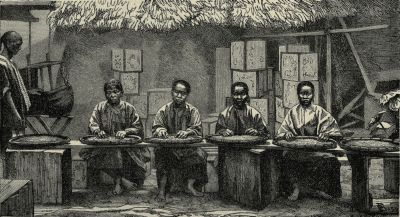
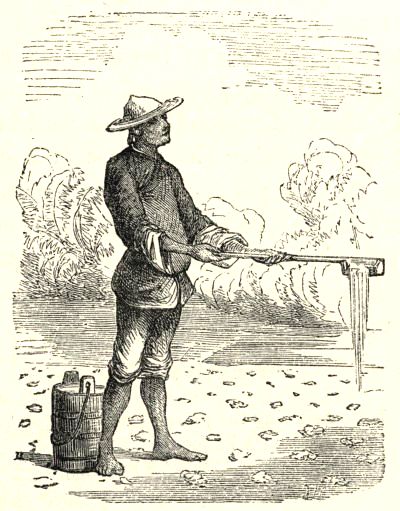
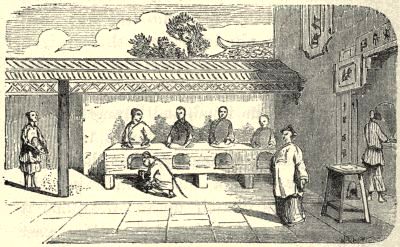 DRYING THE TEA-LEAVES.
The enemies of tea appear to have been
quite as active as its friends. A German
physician declared it a cause of dropsy and
diabetes, and the introducer of foreign
diseases, and he charged the merchants with
"inexpressible frauds, calling them greedy
as hell, the vilest of usurers, who lie in wait
for men's purses and lives." According to
Mr. Mattieu Williams, drunkenness serves
one useful purpose; for it helps to get rid
of the surplus population. A French physician
held similar views of the use of tea
and coffee; for, writing at the close of the
seventeenth century, he expressed his belief,
"that they are permitted by God's providence
for the lessening the number of mankind by
shortening life, as a kind of silent plague."
Coming down to more recent times, the
most remarkable production against tea
appeared in 1722. The mind of the author
seems to have been seriously disturbed at
the prospect of the deterioration of the race,
which would inevitably follow indulgence in
tea. His treatise, which is addressed to
ladies, is entitled "An Essay on the Nature,
Use, and Abuse of Tea, in a Letter to a Lady;
with an Account of its Mechanical Operation.
London: printed by J. Bettenham for James
Lacy at the Ship, between the Two Temple
Gates, Fleet Street, 1722. Price 1s." This
book contains some curious information
about the diseases liable to follow the use of
tea. The author begins:—
"Madam,—an earnest desire, which all ages have
shown, to serve your sex will, I hope, be sufficient
warrant for my troubling you with these papers. To be
assisting towards the preservation of that form and beauty
with which God has adorned you, is certainly a work not
less pious than pleasant; for while we indulge ourselves
in our greatest pleasure (which is to serve your sex), would
also show our love and gratitude to the Almighty Being,
whose form you so nearly represent, and to whom we are
so much indebted for the blessing we received when He
gave man so agreeable an helpmate. Though the value
which we ought to set on this blessing is a sufficient
motive to us to endeavour by all means to dissuade you
from anything which may be to your detriment, yet there
are other motives which oblige us to have a more particular
regard to the health of your sex. For when by
any means you ignore your constitutions and impair your
healths, though you yourselves suffer too severely for it,
yet the tragedy does not end here, for the calamity is
entailed on succeeding ages, perhaps to the third and
fourth generations."
The author then notes the fact that Lycurgus
thought the Spartan women not in
the least unworthy of his care and direction,
and proceeds to remark:—
"If this lawgiver lived in these our days, what a mean
opinion, what a little hope, would he have of the next
age, when the women of this age fell so very short of that
regularity and healthy way of living, which he looked on
as necessary for the preservation of a state! With what
an uneasiness would he have seen the many errors which
we daily commit!—errors which are introduced by luxury,
suffered through ignorance, and supported by being fashionable.
He would soon have condemned the exorbitant use
of tea, and upon the first observing its ill effects would
certainly have prohibited the importation of it. But the
present age has other considerations: tea pays too great a
duty, and supports too many coaches, not to be preferred
to the health of the public. Tea has too great interest
to be prohibited, and I wish reason itself may be sufficient
to dissuade the world from the use of it. I must confess
I have so little hope from these papers, that though (to
me and some others, who have had the perusal of them)
they seem just and satisfactory, yet I should never have
presented them to the public, had not I thought it an
indispensable duty to acquaint the world with the many
disorders which may possibly arise from its too frequent
use."
This worthy benefactor of his species contends
that tea is a slow but sure poison,
and that it is "not less destructive to the
animal economy than opium, or some other
drugs which we have at present learned to
avoid with more caution." He does not deny
that tea is "useful as physic," but lays down
the following propositions, which he endeavours
to prove. First, that tea may
attenuate the blood to any degree necessary
to the production of any disease, which may
arise from too thin a state of the blood.
Secondly, that tea may depauper the blood,
or waste the spirits, to any degree necessary
to produce any disease, which may arise from
too poor a blood. Third, that tea may bring
on any degree whatsoever of a plethora
necessary to the production of any disease,
which may arise from a plethoric state of
body. From an experiment upon a dog the
author concludes that "tea abounds with a
lixiviate salt, by whose assistance it attenuates
the blood." The author draws some terrible
pictures of the evils of tea-drinking, but does
not presume to dictate how his readers should
act. "Whether or not we ought to abandon
the use of what may possibly be of so vast
injury to us, I leave to every reasonable man
to judge, having myself done the duty of a
man and Christian in warning them of what
dangers they may fall into."
On the other hand, Thomas Frost, M.D.,
wrote a "Discourse on Tea, with Plain and
Useful Rules for Gouty People," in 1750. In
this he contended that,—
"A moderate use of tea of a due strength seems better
adapted to the fair sex than men, for they, naturally being
of a more lax and delicate make, are more liable to a fulness
of blood and juices; as also because they have less exercise
or head-labours, than which nothing braces better, or
gives the fibres a greater springiness; and because they
are less accustomed to drink wine, whose astringency corrugates
the fibres, and enables the vessels to act with
greater briskness and force, so in some measure answers
the end of the labour."
He holds that tea in a dietetic point of
view seems in general not only harmless, but
very useful, but considers it impossible to
say "beforehand with what healthy persons
tea will disagree, till they have used it;
where it disagrees, it should immediately be
left off, for there is no altering or compelling
a constitution. However, where it agrees,
it excels all other vegetables, foreign or
domestic, for preventing sleepiness, drowsiness,
or dulness, and taking off weariness or
fatigue, raising the spirits safely, corroborating
the memory, strengthening the judgment,
quickening the invention, &c.; but then
it should be drank moderately, and in the
afternoon chiefly, and not made too habitual."
John Wesley, a few years later, attacked the
use of tea. In 1748 he published a small tract,
"Letter to a Friend concerning Tea," in
which he accused tea of impairing digestion,
unstringing the nerves, involving great and
useless expense, and in his own case, and that
of others, inducing symptoms of paralysis.
But, in the first instance, he preached against
tea, not because he thought it injurious, but
because he wanted money. The whole of the
London Methodists were at that time very
poor. The Rev. L. Tyerman, in his "Life
and Times of the Rev. John Wesley," says,—
"The number of members in the London Society on
the 12th of April, 1746, was 1939, and the amount of
their quarterly contributions 113l. 9s., upon an average
fourteenpence per member. Considering the high price
of money, and that nearly the whole of the London
Methodists were extremely poor, the amount subscribed
was highly creditable. Wesley also believed its use to be
injurious. He tells us that when he first went to Oxford,
with an exceedingly good constitution, and being otherwise
in health, he was somewhat surprised at certain
symptoms of a paralytic disorder. His hand shook, especially
after breakfast; but he soon observed that if for
two or three days he intermitted drinking tea, the shaking
ceased. Upon inquiry, he found tea had the same effect
upon others, and particularly on persons whose nerves
were weak. This led him to lessen the quantity he took,
and to drink it weaker; but still for above six and twenty
years he was more or less subject to the same disorder.
In July, 1746, he began to observe that abundance of the
people of London were similarly affected; some of them
having their nerves unstrung, and their bodily strength
decayed. He asked them if they were hard drinkers;
they replied, 'No, indeed, we drink scarce anything but
a little tea morning and night!' ... Having set the example
(of abstinence from tea) Wesley recommended the
same abstinence to a few of his preachers; and a week later
to above a hundred of his people, whom he believed to be
strong in faith, all of whom, with two or three exceptions,
resolved by the grace of God to make the trial without
delay. In a short time he proposed it to the whole
society. Objections rose in abundance. Some said, 'Tea
is not unwholesome at all.' To these he replied that
many eminent physicians had declared it was, and that, if
frequently used by those of weak nerves, it is no other
than a slow poison. Others said, 'Tea is not unwholesome
to me; why then should I leave it off?' Wesley
answered, 'To give an example to those to whom it is
undeniably prejudicial, and to have the more wherewith
to feed the hungry, and to clothe the naked.' Others said,
'It helps my health, nothing else will agree with me.'
To such Wesley's caustic reply was, 'I suppose your
body is much of the same kind with that of your grandmother,
and do you think nothing else agreed with her,
or with any of her progenitors? What poor, puling,
sickly things must all the English then have been till
within these hundred years! Besides, if, in fact, nothing
else will agree with you—if tea has already weakened
your stomach, and impaired your digestion to such a
degree, it has hurt you more than you are aware. You
have need to abhor it as deadly poison, and to renounce
it from this very hour.' What was the result of Wesley's
attempt to form a tea-total society? We can hardly tell,
except that he himself abstained from tea for the next
twelve years, until Dr. Fothergill ordered him to resume
its use. Charles Wesley began to abstain, but how long
his abstinence lasted we are not informed. About 100
of the London Methodists followed the example of their
leader; and, besides these, a large number of others
began to be temperate and to use less than they had
previously."
"This was, to say the least," adds Mr.
Tyerman, "an amusing episode in Wesley's
laborious life. All must give him credit for
the best and most benevolent intentions, and
it is right to add that, ten days after his
proposal was submitted to the London Society,
he had collected among his friends thirty
pounds for a lending stock, and that this
was soon made up to fifty, by means of
which, before the year was ended, above 250
destitute persons had received acceptable
relief."
The most noteworthy opponent after
Wesley was Jonas Hanway, who, in 1756,
wrote a bulky volume under the title of "A
Journal of Eight Days' Journey from Portsmouth
to Kingston-upon-Thames, to which
is added an Essay on Tea, considered as Pernicious
to Health, obstructing Industry, and
impoverishing the Nation." The effects of
tea-drinking formed the subject of Dr. Lettsom's
inaugural thesis, when he sought the
medical doctorate of the University of Leyden
in 1767. He accused tea of inducing "excess
in spirituous liquors, by reason of the weakness
and debility of the system brought on
by the daily habit of drinking tea, seeking
a temporary relief in some cordial; of producing
in some excruciating pains about the
stomach, involuntary trembling and fluttering
of the nerves, destruction of half your
teeth at the age of twenty, without any hopes
of getting new ones, depression, loss of
memory, tremblings and symptoms of paralysis;
and of bringing on a gradual debility
and impoverished condition of the entire
system."
Tea contains an active principle called
theine, which, according to Dr. Sinclair, was
discovered so recently as 1827. Adopting
one of the methods of the opponents of
tobacco, the enemies of tea conclude it to be
a deadly poison from its effect upon animals.
A New York dentist is reported to have
boiled down a pound of young Hyson tea
from a quart to half a pint, ten drops of
which killed a rabbit three months old; and
when boiled down to one gill, eight drops
killed a cat of the same age in a few minutes.
"Think of it!" exclaims an opponent of tea,
"most persons who drink tea use not less
than a pound in three months, and yet a
pound of Hyson tea contains poison enough
to kill, according to the above experiment,
more than 17,000 rabbits, or nearly 200 a
day! and if boiled down to a gill, it contains
poison enough to kill 10,860 cats in the same
space of time! How can any one in his
senses believe that any human being can take
poison enough into the stomach in one day to
kill 185 rabbits and not suffer from it?—or
that the uses of this poison can be continued
from day to day without injury to health
and life?"[5]
The Americans appear the most energetic
in their opposition to tea. An organization
called the "American Health and
Temperance Association" was formed in
1879 against tobacco, tea, and coffee; and,
according to one of its publications, has a
membership of more than 10,000. It believes
that more harm is done at the present time
by tobacco, tea, and coffee, than by all forms
of alcoholic drinks combined, and "the tee-total
pledge of the association requires
abstinence from alcohol, tobacco, tea, coffee,
opium, and all other narcotics and stimulants."
The "Good Health Publishing Company,"
at Battle Creek, also issues tracts on
the "Evil Effects of the Use of Tea and
Coffee," in which it is contended that these
beverages waste vital force, and injure digestion
and the nervous system; and that they
irritate the temper, and encourage gossip and
scandal.[6]
A New York magazine, the Herald of
Health, is equally unsparing in its attacks
on tea-drinking:—"The habit of tea-drinking
among women is one of the worst
with which the hygienic physician has to
contend. Very few women, comparatively,
among civilized peoples are free from this
vice—for vice it is—and as pronounced in its
effects as either whisky or tobacco.... It
is a common custom among women who do
hard manual labour to depend upon their cup
of tea, when they are tired, to rest them, as
they say, and thus the wearied nerves are
lulled to sleep and the warning voice of
nature hushed, that the work may be done
and the system taxed to the utmost that it
is able to bear without complete exhaustion.
Is it any wonder that women once broken
down are so hard to restore to health again?
"On women and children its worst consequences
fall. To the use of tea may be
traced directly most of the prostrating
nervous headaches with which so many
women are afflicted; also most of the neuralgic
and nervous affections. Of course
children inherit the tendency to these and
similar conditions, and many a puny, emaciated
nervous little one is so because its
mother was a tea-drunkard, and its whole
system has been narcotized from the time
its being began."
In England the opposition against tea has
never taken an organized form, but a good
deal has been said and written on the question.
In 1863 or 1864 an Anti-Teapot
Society was formed, but not against tea-drinking.
It published a quarterly magazine
called the Anti-Teapot Review. A correspondent
of Notes and Queries stated that it
was no enthusiastic wish to convert tea-topers
into anything else that called this body
into existence; it was rather a desire to
oppose and to cast scorn on the narrowness
of mind that seems to be encouraged in
circles which, by no very violent figure of
speech, may be described around a teapot.
In other words, he says, the A. T. S. was
a combination against modern Pharisaism,
and he quotes the following extract from
No. 1 of the Review, May, 1864, as proving
his point:—
"Many persons either do not, or pretend not to, know
what teapotism is. In consequence of this ignorance or
affectation we shall, in a few words, try to describe the
leading features of the male and female teapot. Teapotism
is a magnificent profession, but a very sorry practice! It
professes a large-hearted liberality, unbounded piety, and
the enunciation of true principles; but its practice is that
of a narrow-minded clique, who condemn all who go not
with them. Its piety consists in hero-worship and the
circulation of illiterate tracts, calculated to attract the
strong and to confound the weak; it is bounded on the
north by the platform and meeting-house, and on the
south by scandal, hassocks and tea, whence the name of
teapots, &c."
The article ends with the assurance that
"The society will go on as it began: it
will remain strictly private, enforce the same
rules, and show that it is the enemy, not of
tea, but of teapots." The Review professed
to be edited by members of the universities,
and written only by members of the Anti-Teapot
Society of Europe. The qualifications
for membership were, to read the rules,
to fill up the form of admission to be had
in English, French, German, Dutch, and
other languages; to be nominated and
seconded by any two officers; "the latter
(sic) wholesome rule was introduced so that
inquisitive people might be prevented from
joining the society out of sheer curiosity."
The society appears to have made no converts,
and had but a very short existence.
Tea-parties have always been popular
institutions among Dissenting bodies, and
it is therefore not surprising to find ministers
taking part in meetings advocating a reduction
of the tea duties. In 1848 the Rev.
Dr. Hume, attending a meeting in Liverpool
for this purpose, warmly defended tea, on the
ground of health, and quoted with great
satisfaction the evidence of Dr. Sigmond,
given before the Committee of the House of
Commons. Asked what had been the result
of the medical inquiries into the effect of
tea upon the human frame, Doctor Sigmond
replied, "I think it is of great importance
in the prevention of skin disease, in comparison
with any fluid we have been in the
habit of drinking in former years, and also
in removing glandular affections. I think
scrofula has very much diminished in this
country since tea has been so largely used.
To those classes of society who are not of
labouring habits, but who are of sedentary
habits, and exercise the mind a good deal,
tea is of great importance."
On the other hand, a famous physician of
our time takes an entirely opposite view of
the question. At the Sanitary Congress last
year Dr. Richardson delivered an address
on "Felicity as a Sanitary Research," and
charged tea with being a promoter of infelicity.
"As a rule," he says, "all agents
which stimulate—that is to say, relax—the
arterial tension, and so allow the blood a
freer course through the organs, promote for
a time felicity, but in the reaction leave depression.
The alkaloid in tea, theine, has this
effect. It causes a short and slight felicity. It
causes in a large number of persons a long
and severe and even painful sadness. There
are many who never knew a day of felicity,
owing to this one destroying cause. In our
poorer districts, amongst the poor women of
our industrial populations, our spinning, our
stocking-weaving women, the misery incident
to their lot is often doubled by this one
agent."
The Dean of Bangor is the latest clerical
opponent of tea-drinking. Speaking at a
meeting held to further the establishment of
courses of instruction in practical cookery in
the elementary schools, he said that if he
had his own way there would be much less
tea-drinking among people of all classes.
Oatmeal and milk produced strong, hearty,
good-tempered men and women; whereas
excessive tea-drinking created a generation
of nervous, discontented people, who were
for ever complaining of the existing order of
the universe, scolding their neighbours, and
sighing after the impossible. Good cooking
would, he firmly believed, enable them to
take far higher and more correct views of
existence. In fact, he suspected that too
much tea-drinking, by destroying the calmness
of the nerves, was acting as a dangerous
revolutionary force among us. Tea-drinking,
renewed three or four times a day, made men
and women feel weak, and the result was
that the tea-kettle went before the gin-bottle,
and the physical and nervous weakness,
that had its origin in the bad cookery
of an ignorant wife, ended in ruin, intemperance,
and disease.
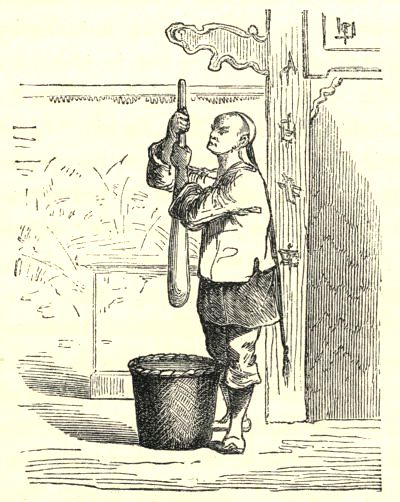
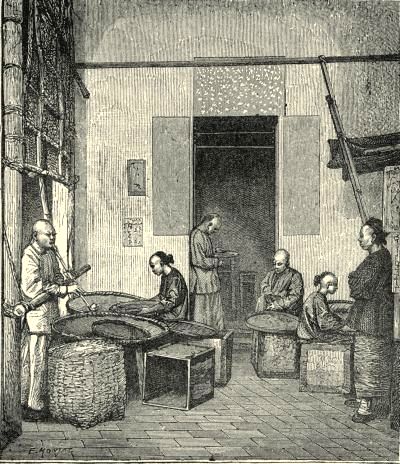 SIFTING TEA.
The worthy Dean's denunciation of tea-drinking
formed the subject of numerous
leading articles in the press, followed by
letters from correspondents, several of whom
referred to the difficulty of finding any satisfactory
substitute for the fragrant and refreshing
beverage which, during the present
century; has come to be regarded almost as
a necessary of life in English homes, both
rich and poor. One gentleman pathetically
describes his feelings on being presented one
afternoon in a drawing-room, where he had
been in the habit of being served with "at
least three cups of supernatural tea," with
"a glass brimful of a dim, opaque, greyish-white
liquid," which turned out to be cold
barley-water.
Admitting that tea-drinking leads to indigestion,
the St. James's Gazette points out
that "tea-drinking is still, in itself, better
than drunkenness; and there is always a
chance that the first factor in the fatal series
may not lead to the second, nor the second
to the third. What numbers of persons of
both sexes every one must know who drink
tea three times a day—morning, afternoon,
and evening—without ever getting drunk at
all! Every one, again, must have met with
cases in which men have brought themselves
to utter grief through the abuse of spirituous
liquors; but who ever heard of a man
ruining himself or his family through excessive
indulgence in tea? The confirmed
tea-drinker never commits murder in his cups—never
even goes home in a frantic condition
to beat his wife. It is certain, on the
other hand, that tea drunk in immoderate
quantities does not good, but harm; and it
is very desirable that, both in drinking and
eating, people should on all occasions be
temperate. It is difficult, however, to get
through existence without stimulants of
some kind; and tea is probably as little
injurious as any yet discovered. 'Life without
stimulants,' as a modern philosopher has
remarked, 'would be a dreary waste.'"
Reviewing the discussion, the Lancet
doubted whether the abuse of tea-drinking is
prevalent in the country, and maintained
that hard-worked minds and fatigued bodies
are the better for some gentle stimulant that
rouses into activity the nerves, and which
ministers to animal life and comfort. The
editor concluded that the worthy dean's
"conclusions are drawn from insufficient
premises, which in their turn can scarcely
be regarded as scientific truths."
The latest medical contribution to the
literature of the question is a lecture on
"Coffee and Tea," by Dr. Poore, Vice-Chairman
of the Council of the Parkes Museum,
given at the Parkes Museum on the 6th of
December, 1883. He thus describes the
good and bad effects of these luxuries:—
"The peculiar effects of tea and coffee are due to the
alkaloid. These effects are of a refreshing character. The
circulation of the blood is increased; the elimination of
CO2 by the lungs is heightened. The reflex excitability of
the nerve centres is roused, thereby increasing the impressionability
of the consumer, and great wakefulness
results; it also excites the peristalsis of the intestines.
Tea and coffee, then, are stimulants; they rouse the
tissues to increased action, make us insensible to fatigue,
and enable us to do more work than we otherwise could.
The differences between these stimulants and alcoholic
stimulants are worth noticing. Tea and coffee keep us
awake and attentive; and those who have taken either for
the purposes of midnight study, will know how under
their influence the receptive powers of the brain seem to
be at its maximum. They cause no mental 'elevation,'
and do not rouse the imaginative faculties as a glass of
wine seems to do. They enable a man to work, and often
rob him of sleep, and do not, like a glass of wine, tend to
increase the power of sleep after the work has been accomplished.
The tannic acid in tea is doubtless one of the
causes why it is as a drink so attractive. It is slightly
astringent, and clean in the mouth, and does not 'cloy the
palate,' an expression for which I can find no scientific
equivalent; tannic acid is also one of the dangers and
drawbacks of tea. It is largely present in the common
teas used by the poor.... Excessive tea-drinkers are more
common than excessive coffee-drinkers, because the heavier
coffee more easily produces satiety than the lighter tea;
and it is not possible for ordinary stomachs to tolerate
more than a certain amount of coffee, even when pure, and
only a very small amount of the thick, sweet, adulterated
stuff which too often passes for coffee in this country....
Tea is more of a pure beverage than coffee, has less dietetic
value, and is less stimulating; it is more capable of being
used as a pure luxury (it is indeed the tobacco of women),
but its great astringency is one reason which makes its
excessive use highly undesirable."
The question of the action of tea, as well
as of tobacco and other stimulants, has
occupied the attention of Professor Mantegazza,
an Italian physiologist of high repute.
This eminent scholar places tea amongst
the nervous foods; and his enthusiasm for
it is unbounded. He credits it with the
power of dispelling weariness and lessening
the annoyances of life. He considers it the
greatest friend to the man of letters, enabling
him to work without fatigue; an aid to
conversation, rendering it pleasant and easy.
His own experience of tea is, that it revives
drooping intellectual activity; and he regards
it the best stimulus to exertion.
"Without its aid," he says, "I should be
idle." His general conclusions are that it
is beneficial to adults, but injurious to children;
and he pronounces it one of the
greatest blessings of Providence.
Whatever may be urged in favour of tea,
it is undeniable that excess is injurious, and
that children would be better without it. It
contains no strength, and therefore ought to
be forbidden to the young. In an inquiry
into the sickly condition of the children in
many of the cotton factories of Lancashire,
Dr. Ferguson, of Bolton, found that children
between thirteen and sixteen years of age,
who had been brought up on tea or coffee,
increased in weight only about four pounds
a year, while those fed on milk increased at
the rate of about fifteen pounds a year. For
this evil the blame rests entirely upon the
mothers, who exceed the bounds of moderation
in the use of tea. Though doctors
differ widely in their views of the action of
tea, they all agree that few things are more
certain to produce "flatulence in the overworked
female" than this beverage. Their
views are shared by other authorities. Miss
Barnett, speaking at the National Health
Society's Exhibition last year, said, "I am
constantly preaching against tea, as it is
taken by the vast majority of the working
women of England. They drink it at every
meal, and suffer from indigestion before they
come to middle age. They try to get the
blackest fluid out of the tea, and in doing so
draw out the tannin, which, though it has its
virtues, acts upon the coats of the stomach
and produces indigestion by middle life."
But the argument that tea shortens the
life of every man who drinks it is absurd.
"It is said," remarked Wm. Howitt, "that
Mithridates could live and flourish on poisons,
and, if it is true that tea or coffee is a poison,
so do most of us. Wm. Hutton, the shrewd
and humorous author of the histories of
Birmingham and Derby, and also of a life
of himself, scarcely inferior to that of Franklin
in lessons of life-wisdom, said that he
had been told that coffee was a slow poison,
and he added that he had found it very
slow, for he had drunk it more than sixty
years without any ill effect. My experience
of tea, as well as coffee," added Howitt,
"has been the same." Howitt's experience
is the experience of tens of thousands
of people. The moral in this, as in other
matters, is that people must judge for themselves
whether tea is injurious or beneficial.
As Dr. Poore candidly admits, "a properly
controlled appetite, or instinct, is as safe a
guide in the matters of diet as a physiologist
or a moralist."