CHAPTER I. INTRODUCES TATTERED TOM.
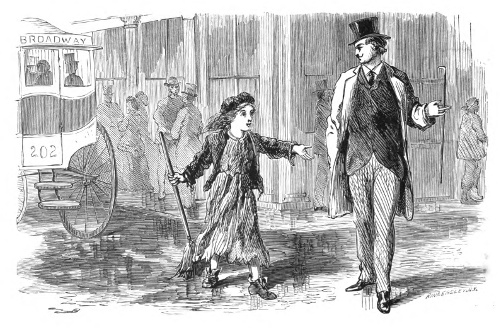
Mr. Frederic Pelham, a young gentleman very
daintily dressed, with exquisitely fitting kids and
highly polished boots, stood at the corner of Broadway
and Chambers Streets, surveying with some dismay
the dirty crossing, and speculating as to his
chances of getting over without marring the polish
of his boots.
He started at length, and had taken two steps,
when a dirty hand was thrust out, and he was saluted
by the request, “Gi’ me a penny, sir?”
“Out of my way, you bundle of rags!” he
answered.
10“You’re another!” was the prompt reply.
Frederic Pelham stared at the creature who had
dared to imply that he—a leader of fashion—was a
bundle of rags.
The street-sweeper was apparently about twelve
years of age. It was not quite easy to determine
whether it was a boy or girl. The head was surmounted
by a boy’s cap, the hair was cut short, it
wore a boy’s jacket, but underneath was a girl’s
dress. Jacket and dress were both in a state of
extreme raggedness. The child’s face was very dark
and, as might be expected, dirty; but it was redeemed
by a pair of brilliant black eyes, which were fixed
upon the young exquisite in an expression half-humorous,
half-defiant, as the owner promptly retorted,
“You’re another!”
“Clear out, you little nuisance!” said the dandy,
stopping short from necessity, for the little sweep had
planted herself directly in his path; and to step out
on either side would have soiled his boots irretrievably.
“Gi’ me a penny, then?”
“I’ll hand you to the police, you little wretch!”
11“I aint done nothin’. Gi’ me a penny?”
Mr. Pelham, provoked, raised his cane threateningly.
But Tom (for, in spite of her being a girl, this was
the name by which she was universally known;
indeed she scarcely knew any other) was wary. She
dodged the blow, and by an adroit sweep of her
broom managed to scatter some mud on Mr. Pelham’s
boots.
“You little brat, you’ve muddied my boots!” he
exclaimed, with vexation.
“Then why did you go for to strike me?” said
Tom, defiantly.
He did not stop to answer, but hurried across the
street. His pace was accelerated by an approaching
vehicle, and the instinct of self-preservation, more
powerful than even the dictates of fashion, compelled
him to make a détour through the mud,
greatly to the injury of his no longer immaculate
boots. But there was a remedy for the disaster on
the other side.
“Shine your boots, sir?” asked a boot-black, who
12had stationed himself at the other side of the crossing.
Frederic Pelham looked at his boots. Their glory
had departed. Their virgin gloss had been dimmed
by plebeian mud. He grudged the boot-black’s fee,
for he was thoroughly mean, though he had plenty
of money at his command. But it was impossible to
walk up Broadway in such boots. Suppose he should
meet any of his fashionable friends, especially if
ladies, his fashionable reputation would be endangered.
“Go ahead, boy!” he said. “Do your best.”
“All right, sir.”
“It’s the second time I’ve had my boots blacked
this morning. If it hadn’t been for that dirty sweep
I should have got across safely.”
The boy laughed—to himself. He knew Tom well
enough, and he had been an interested spectator of
her encounter with his present customer, having an
eye to business. But he didn’t think it prudent to
make known his thoughts.
The boots were at length polished, and Mr. Pelham
13saw with satisfaction that no signs of the street
mire remained.
“How much do you want, boy?” he asked.
“Ten cents.”
“I thought five cents was the price.”
“Can’t afford to work on no such terms.”
Mr. Pelham might have disputed the fee, but he
saw an acquaintance approaching, and did not care
to be caught chaffering with a boot-black. He therefore
reluctantly drew out a dime, and handed it to
the boy, who at once deposited it in the pocket of a
ragged vest.
He stood on the sidewalk on the lookout for another
customer, when Tom marched across the street,
broom in hand.
“I say, Joe, how much did he give you?”
“Ten cents.”
“How much yer goin’ to give me?”
“Nothin’!”
“You wouldn’t have got him if I hadn’t muddied
his boots.”
“Did you do it a-purpose?”
Tom nodded.
14“What for?”
“He called me names. That’s one reason. Besides,
I wanted to give you a job.”
Joe seemed struck by this view, and, being alive
to his own interest, did not disregard the application.
“Here’s a penny,” he said.
“Gi’ me two.”
He hesitated a moment, then diving once more into
his pocket, brought up another penny, which Tom
transferred with satisfaction to the pocket of her dress.
“Shall I do it ag’in?” she asked.
“Yes,” said Joe. “I say, Tom, you’re a smart
un.”
“I’d ought to be. Granny makes me smart
whenever she gets a chance.”
Tom returned to the other end of the crossing, and
began to sweep diligently. Her labors did not extend
far from the curbstone, as the stream of vehicles
now rapidly passing would have made it dangerous.
However, it was all one to Tom where she swept.
The cleanness of the crossing was to her a matter of
comparative indifference. Indeed, considering her
own disregard of neatness, it could hardly have been
15expected that she should feel very solicitous on that
point. Like some of her elders who were engaged
in municipal labors, she regarded street-sweeping as
a “job,” out of which she was to make money, and
her interest began and ended with the money she
earned.
There were not so many to cross Broadway at this
point as lower down, and only a few of these seemed
impressed by a sense of the pecuniary value of Tom’s
services.
“Gi’ me a penny, sir,” she said to a stout gentleman.
He tossed a coin into the mud.
Tom darted upon it, and fished it up, wiping her
fingers afterwards upon her dress.
“Aint you afraid of soiling your dress?” asked
the philanthropist, smiling.
“What’s the odds?” said Tom, coolly.
“You’re a philosopher,” said the stout gentleman.
“Don’t you go to callin’ me names!” said Tom;
“’cause if you do I’ll muddy up your boots.”
“So you don’t want to be called a philosopher?”
said the gentleman.
16“No, I don’t,” said Tom, eying him suspiciously.
“Then I must make amends.”
He took a dime from his pocket, and handed it to
the astonished Tom.
“Is this for me?” she asked.
“Yes.”
Tom’s eyes glistened; for ten cents was a nugget
when compared with her usual penny receipts. She
stood in a brown study till her patron was half across
the street, then, seized with a sudden idea, she darted
after him, and tugged at his coat-tail.
“What’s wanted?” he asked, turning round in
some surprise.
“I say,” said Tom, “you may call me that name
ag’in for five cents more.”
The ludicrous character of the proposal struck him,
and he laughed with amusement.
“Well,” he said, “that’s a good offer. What’s
your name?”
“Tom.”
“Which are you,—a boy or a girl?”
“I’m a girl, but I wish I was a boy.”
“What for?”
17“’Cause boys are stronger than girls, and can fight
better.”
“Do you ever fight?”
“Sometimes.”
“Whom do you fight with?”
“Sometimes I fight with the boys, and sometimes
with granny.”
“What makes you fight with your granny?”
“She gets drunk and fires things at my head; then
I pitch into her.”
The cool, matter-of-fact manner in which Tom
spoke seemed to amuse her questioner.
“I was right,” he said; “you’re a philosopher,—a
practical philosopher.”
“That’s more’n you said before,” said Tom; “I
want ten cents for that.”
The ten cents were produced. Tom pocketed them
in a business-like manner, and went back to her
employment. She wondered, slightly, whether a
philosopher was something very bad; but, as there
was no means of determining, sensibly dismissed the
inquiry, and kept on with her work.
CHAPTER II TOM GETS A SQUARE MEAL.
18
About twelve o’clock Tom began to feel the pangs
of hunger. The exercise which she had taken, together
with the fresh air, had stimulated her appetite.
It was about the time when she was expected to go
home, and accordingly she thrust her hand into her
pocket, and proceeded to count the money she had
received.
“Forty-two cents!” she said, at last, in a tone of
satisfaction. “I don’t generally get more’n twenty.
I wish that man would come round and call me
names every day.”
Tom knew that she was expected to go home and
carry the result of her morning’s work to her
granny; but the unusual amount suggested to her
another idea. Her mid-day meal was usually of the
plainest and scantiest,—a crust of dry bread, or a
cold sausage on days of plenty,—and Tom sometimes
19did long for something better. But generally
it would have been dangerous to appropriate a sufficient
sum from her receipts, as the deficit would
have been discovered, and quick retribution would
have followed from her incensed granny, who was a
vicious old woman with a pretty vigorous arm.
Now, however, she could appropriate twenty cents
without danger of discovery.
“I can get a square meal for twenty cents,” Tom
reflected, “and I’ll do it.”
But she must go home first, as delay would be dangerous,
and have disagreeable consequences.
She prepared for the visit by dividing her morning’s
receipts into two parcels. The two ten-cent
scrips she hid away in the lining of her tattered
jacket. The pennies, including one five-cent scrip,
she put in the pocket of her dress. This last was
intended for her granny. She then started homewards,
dragging her broom after her.
She walked to Centre Street, turned after a while
into Leonard, and went on, turning once or twice,
until she came to one of the most wretched tenement
houses to be found in that not very choice locality.
20She passed through an archway leading into an
inner court, on which fronted a rear house more
shabby, if possible, than the front dwelling. The
court was redolent of odors far from savory; children
pallid, dirty, and unhealthy-looking, were playing
about, filling the air with shrill cries, mingled with
profanity; clothes were hanging from some of the
windows; miserable and besotted faces were seen at
others.
Tom looked up to a window in the fourth story.
She could descry a woman, with a pipe in her
mouth.
“Granny’s home,” she said to herself.
She went up three flights, and, turning at the top,
went to the door and opened it.
It was a wretched room, containing two chairs and
a table, nothing more. On one of the chairs was
seated a large woman, of about sixty, with a clay
pipe in her mouth. The room was redolent of the
vilest tobacco-smoke.
This was granny.
If granny had ever been beautiful, there were no
traces of that dangerous gift in the mottled and
21wrinkled face, with bleared eyes, which turned
towards the door as Tom entered.
“Why didn’t you come afore, Tom?” she demanded.
“I’m on time,” said Tom. “Clock aint but just
struck.”
“How much have you got?”
Tom pulled out her stock of pennies and placed
them in the woman’s outstretched palm.
“There’s twenty-two,” she said.
“Umph!” said granny. “Where’s the rest?”
“That’s all.”
“Come here.”
Tom advanced, not reluctantly, for she felt sure
that granny would not think of searching her jacket,
especially as she had brought home as much as usual.
The old woman thrust her hand into the child’s
pocket, and turned it inside-out with her claw-like
fingers, but not another penny was to be found.
“Umph!” she grunted, apparently satisfied with
her scrutiny.
“Didn’t I tell you so?” said Tom.
Granny rose from her chair, and going to a shelf
22took down a piece of bread, which had become dry
and hard.
“There’s your dinner,” said she.
“Gi’ me a penny to buy an apple,” said Tom,—rather
by way of keeping up appearances than
because she wanted one. Visions of a more satisfactory
repast filled her imagination.
“You don’t want no apple. Bread’s enough,”
said granny.
Tom was not much disappointed. She knew
pretty well beforehand how her application would
fare. Frequently she made sure of success by buying
the apple and eating it before handing the proceeds
of her morning’s work to the old woman. To-day
she had other views, which she was in a hurry to
carry out.
She took the bread, and ate a mouthful. Then she
slipped it into her pocket, and said, “I’ll eat it as I
go along, granny.”
To this the old woman made no objection, and
Tom went out.
In the court-yard below she took out her crust,
and handed it to a hungry-looking boy of ten, the
23unlucky offspring of drunken parents, who oftentimes
was unable to command even such fare as Tom
obtained.
“Here, Tim,” she said, “eat that; I aint hungry.”
It was one of Tim’s frequent fast days, and even
the hard crust was acceptable to him. He took it
readily, and began to eat it ravenously. Tom
looked on with benevolent interest, feeling the satisfaction
of having done a charitable act. The satisfaction
might have been heightened by the thought
that she was going to get something better herself.
“So you’re hungry, Tim,” she said.
“I’m always hungry,” said Tim.
“Did you have any breakfast?”
“Only an apple I picked up in the street.”
“He’s worse off than me,” thought Tom; but she
had no time to reflect on the superior privileges of
her own position, for she was beginning to feel hungry
herself.
There was a cheap restaurant near by, only a few
blocks away.
Tom knew it well, for she had often paused before
the door and inhaled enviously the appetizing odor
24of the dishes which were there vended to patrons
not over-fastidious, at prices accommodated to scantily
lined pocket-books. Tom had never entered,
but had been compelled to remain outside, wishing
that a more propitious fortune had placed it in her
power to dine there every day. Now, however, first
thrusting her fingers into the lining of her jacket to
make sure that the money was there, she boldly
entered the restaurant and took a seat at one of the
tables.
The room was not large, there being only eight
tables, each of which might accommodate four persons.
The floor was sanded, the tables were some of
them bare, others covered with old newspapers, which
had become greasy, and were rather worse than no
table-cloth at all. The guests, of whom perhaps a
dozen were seated at the table, were undoubtedly plebeian.
Men in shirt-sleeves, rough-bearded sailors
and ’long-shore men, composed the company, with one
ragged boot-black, who had his blacking-box on the
seat beside him.
It was an acquaintance of Tom, and she went and
sat beside him.
25“Do you get dinner here, Jim?” she asked.
“Yes, Tom; what brings you here?”
“I’m hungry.”
“Don’t you live along of your granny?”
“Yes; but I thought I’d come here to-day. What
have you got?”
“Roast beef.”
“Is it good?”
“Bully!”
“I’ll have some, then. How much is it?”
“Ten cents.”
Ten cents was the standard price in this economical
restaurant for a plate of meat of whatever kind.
Perhaps, considering the quality and amount given,
it could not be regarded as very cheap; still the sum
was small, and came within Tom’s means.
A plate of beef was brought and placed before
Tom. Her eyes dilated with pleasure as they rested
on the delicious morsel. There was a potato besides;
and a triangular slice of bread, with an infinitesimal
dab of butter,—all for ten cents. But Tom’s ambition
soared higher.
“Bring me a cup o’ coffee,” she said to the waiter.
26It was brought,—a very dark, muddy, suspicious-looking
beverage,—a base libel upon the fragrant
berry whose name it took; but such a thought did not
disturb Tom. She never doubted that it was what
it purported to be. She stirred it vigorously with
the spoon, and sipped it as if it had been nectar.
“Aint it prime just?” she exclaimed, smacking
her lips.
Then ensued a vigorous onslaught upon the roast
beef. It was the first meat Tom had tasted for
weeks, with the exception of occasional cold sausage;
and she was in the seventh heaven of delight as she
hurriedly ate it. When she had finished, the plate
was literally and entirely empty. Tom did not believe
in leaving anything behind. She was almost
tempted to “lick the platter clean,” but observed
that none of the other guests did so, and refrained.
“Bring me a piece of apple pie,” said Tom, determined
for once to have what she denominated a
“good square meal.” The price of the pie being
five cents, this would just exhaust her funds. Payment
was demanded when the pie was brought, the
27prudent waiter having some fears that his customer
was eating beyond her means.
Tom paid the money, and, vigorously attacking the
pie, had almost finished it, when, chancing to lift her
eyes to the window, she saw a sight that made her
blood curdle.
Looking through the pane with a stony glare that
meant mischief was her granny, whom she had supposed
safe at home.
CHAPTER III CAUGHT IN THE ACT.
28
It was Tom’s ill luck that brought granny upon
the scene, contrary to every reasonable expectation.
After smoking out her pipe, she made up her mind
to try another smoke, when she found that her stock
of tobacco was exhausted. Being constitutionally
lazy, it was some minutes before she made up her
mind to go out and lay in a fresh supply. Finally
she decided, and made her way downstairs to the
court, and thence to the street.
Tim saw her, and volunteered the information,
“Tom gave me some bread.”
“When?” demanded granny.
“When she come out just now.”
“What did she do that for?”
“She said she wasn’t hungry.”
The old woman was puzzled. Tom’s appetite was
usually quite equal to the supply of food which she
29got. Could Tom have secreted some money to buy
apples? This was hardly likely, since she had carefully
searched her. Besides, Tom had returned the
usual amount. Still, granny’s suspicions were
awakened, and she determined to question Tom when
she returned at the close of the afternoon.
The tobacco shop where granny obtained her
tobacco was two doors beyond the restaurant where
Tom was then enjoying her cheap dinner with a zest
which the guests at Delmonico’s do not often bring to
the discussion of their more aristocratic viands. It
was only a chance that led granny, as she passed, to
look in; but that glance took in all who were seated
at the tables, including Tom.
Had granny received an invitation to preside at a
meeting in the Cooper Institute, she would hardly
have been more surprised than at the sight of Tom,
perfidiously enjoying a meal out of money from which
she had doubtless been defrauded.
“The owdacious young reprobate!” muttered the
old woman, glaring fiercely at her unconscious
victim.
But Tom just then happened to look up, as we
30have seen. Her heart gave a sudden thump, and she
said to herself, “I’m in for a lickin’, that’s so.
Granny’s mad as blazes.”
The old woman did not long leave her in doubt as
to the state of her feelings.
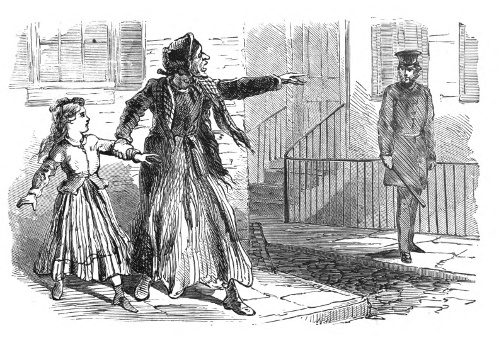
She strode into the eating-house, and, advancing to
the table, seized Tom by the arm.
“What are you here for?” she growled, in a hoarse
voice.
“To get some dinner,” said Tom.
By this time she had recovered from her temporary
panic. She had courage and pluck, and was toughened
by the hard life she had led into a stoical endurance
of the evils from which she could not escape.
“What business had you to come?”
“I was hungry.”
“Didn’t I give you a piece of bread?”
“I didn’t like it.”
“What did you buy?”
“A plate of beef, a cup o’ coffee, and some pie.
Better buy some, granny. They’re bully.”
“You’re a reg’lar bad un. You’ll fetch up on the
gallus,” said granny, provoked at Tom’s coolness.
31So saying, she seized Tom by the shoulder roughly.
But by this time the keeper of the restaurant thought
fit to interfere.
“We can’t have any disturbance here, ma’am,” he
said. “You must leave the room.”
“She had no right to get dinner here,” said
granny. “I won’t let her pay for it.”
“She has paid for it already.”
“Is that so?” demanded the old woman, disappointed.
Tom nodded, glad to have outwitted her guardian.
“It was my money. You stole it.”
“No it wa’n’t. A gentleman give it to me for
callin’ me names.”
“Come out of here!” said granny, jerking Tom from
her chair. “Don’t you let her have no more to eat
here,” she added, turning to the keeper of the restaurant.
“She can eat here whenever she’s got money to
pay for it.”
Rather disgusted at her failure to impress the
keeper of the restaurant with her views in the matter,
32granny emerged into the street with Tom in her
clutches.
She gave her a vigorous shaking up on the sidewalk.
“How do you like that?” she demanded.
“I wish I was as big as you!” said Tom, indignantly.
“Well, what if you was?” demanded the old
woman, pausing in her punishment, and glaring at
Tom.
“I’d make your nose bleed,” said Tom, doubling
up her fist.
“You would, would you?” said granny, fiercely.
“Then it’s lucky you aint;” and she gave her
another shake.
“Where are you going to take me?” asked
Tom.
“Home. I’ll lock you up for a week, and give you
nothin’ to eat but bread once a day.”
“All right!” said Tom. “If I’m locked up at
home, I can’t bring you any money.”
This consideration had not at first suggested itself
to the vindictive old woman. It would cut off all
33her revenue to punish Tom as she proposed; and this
would be far from convenient. But anger was more
powerful just then than policy; and she determined
at all events to convey Tom home, and give her a
flogging, before sending her out into the street to
resume her labors.
She strode along, dragging Tom by the arm; and
not another word was spoken till they reached the
rear tenement house.
“What’s the matter with the child?” asked Mrs.
Murphy, who had just come down into the court after
one of her own children.
“She stole my money,” said granny; “and was
eatin’ a mighty fine dinner out of it.”
“It was my money, Mrs. Murphy,” said Tom. “I
gave granny twenty-two cents when I came home.”
“I hope you won’t go to hurt the child,” said kind-hearted
Mrs. Murphy.
“I’ll be much obliged to you, Mrs. Murphy, if
you’ll mind your own business,” said granny, loftily.
“When I want your advice, mum, I’ll come and ask
it; begging your pardon, mum.”
“She’s a tough craythur,” said Mrs. Murphy to
34herself. “She beats that poor child too bad entirely.”
Granny drew Tom into the room with no gentle
hand.
“Now you’re goin’ to catch it,” said she, grimly.
Tom was of the same opinion, and meant to defend
herself as well as she knew how. She had all her
wits about her, and had already planned out her
campaign.
On the chair was a stout stick which granny was
accustomed to use on such occasions as the present.
When wielded by a vigorous arm, it was capable of
inflicting considerable pain, as Tom very well knew.
That stick she determined to have.
Accordingly when granny temporarily released her
hold of her, as she entered the room, Tom sprang
for the chair, seized the stick, and sent it flying out
of the window.
“What did you do that for?” said granny,
fiercely.
“I don’t want to be licked,” said Tom, briefly.
“You’re going to be, then.”
“Not with the stick.”
35“We’ll see.”
Granny poked her head out of the window, and
saw Tim down in the court.
“Bring up that stick,” she said; “that’s a good
boy.”
Tim picked up the stick, and was about to obey the
old woman’s request, when he heard another voice—Tom’s—from
the other window.
“Don’t you do it, Tim. Granny wants to lick
me.”
That was enough. Tim didn’t like the old woman,—no
one in the building did,—and he did like Tom,
who, in spite of being a tough customer, was good-natured
and obliging, unless her temper was aroused
by the old woman’s oppression. So Tim dropped the
stick.
“Bring it right up,” said granny, angrily.
“Are you goin’ to lick Tom?”
“None of your business! Bring it up, or I’ll lick
you too.”
“No, you don’t!” answered Tim. “You must
come for it yourself if you want it.”
Granny began to find that she must do her own
36errands. It was an undertaking to go down three
flights of stairs to the court and return again, especially
for one so indolent as herself; but there seemed to
be no other way. She inwardly resolved to wreak additional
vengeance upon Tom, and so get what satisfaction
she could in this way. Muttering imprecations
which I do not care to repeat, she started downstairs,
determined to try the stick first upon Tim.
But when she reached the court Tim had disappeared.
He had divined her benevolent intentions, and
thought it would be altogether wiser for him to be out
of the way.
Granny picked up the stick, and, after a sharp
glance around the court, commenced the ascent. She
did not stop to rest, being spurred on by the anticipated
pleasure of flogging Tom. So, in a briefer
space of time than could have been expected, she
once more arrived at her own door.
But Tom had not been idle.
No sooner was the door closed than Tom turned
the key in the lock, making herself a voluntary prisoner,
but having in the key the means of deliverance.
37Granny tried the door, and, to her inexpressible
wrath, discovered Tom’s new audacity.
“Open the door, you trollop!” she screamed.
“You’ll lick me,” said Tom.
“I’ll give you the wust lickin’ you ever had.”
“Then I shan’t let you in,” said Tom, defiantly.
CHAPTER IV THE SIEGE.
38
“Open the door,” screamed granny, beside herself
with rage, “or I’ll kill you.”
“You can’t get at me,” said Tom, triumphantly.
The old woman grasped the knob of the door and
shook it vigorously. But the lock resisted her
efforts. Tom’s spirit was up, and she rather enjoyed
it.
“Shake away, granny,” she called through the
key-hole.
“If I could only get at you!” muttered granny.
“I won’t let you in till you promise not to touch
me.”
“I’ll skin you alive.”
“Then you can’t come in.”
The old woman began alternately to pound and
kick upon the door. Tom sat down coolly upon a
chair, her dark eyes flashing exultingly. She knew
39her power, and meant to keep it. She had not reflected
how it was to end. She supposed that in the
end she would get a “lickin’,” as she had often done
before. But in the mean while she would have the
pleasure of defying and keeping the old woman at
bay for an indefinite time. So she sat in placid enjoyment
in her stronghold until she heard something
that suggested a speedy raising of the siege.
“I’m goin’ for a hatchet,” said granny, through
the key-hole.
“If you break the door, you’ll have to pay for it.”
“Never you mind!” said the old woman. “I know
what I’m about.”
She heard the retreating steps of granny, and,
knowing only too well her terrible temper, made up
her mind that she was in earnest. If so, the door
must soon succumb. A hatchet would soon accomplish
what neither kicks nor pounding had been able
to effect.
“What shall I do?” thought Tom.
She was afraid of something more than a lickin’
now. In her rage at having been so long baffled,
the old woman might attack her with the hatchet.
40She knew very well that on previous occasions she
had flung at her head anything she could lay hold of.
Tom, brave and stout-hearted as she was, shrunk
from this new danger, and set herself to devise a
way of escape. She looked out of the window; but
she was on the fourth floor, and it was a long distance
to the court below. If it had been on the second
floor she would have swung off.
There was another thing she could do. Granny
had gone down below to borrow a hatchet. She
might unlock the door, and run out upon the landing;
but there was no place for hiding herself, and no
way of getting downstairs without running the risk
of rushing into granny’s clutches. In her perplexity
her eyes fell upon a long coil of rope in one corner.
It was a desperate expedient, but she resolved to
swing out of the window, high as it was. She managed
to fasten one end securely, and let the other
drop from the window. As it hung, it fell short of
reaching the ground by at least ten feet. But Tom
was strong and active, and never hesitated a moment
on this account. She was incited to extra speed, for
41she already heard the old woman ascending the stairs,
probably provided with a hatchet.
Tom got on the window-sill, and, grasping the
rope, let herself down rapidly hand over hand, till
she reached the end of the rope. Then she dropped.
It was rather hard to her feet, and she fell over. But
she quickly recovered herself.
Tim, the recipient of her dinner, was in the court,
and surveyed her descent with eyes and mouth wide
open.
“Where’d you come from, Tom?” he asked.
“Can’t you see?” said Tom.
“Why didn’t you come downstairs?”
“’Cause granny’s there waitin’ to lick me. I must
be goin’ before she finds out where I am. Don’t you
tell of me, Tim.”
“No, I won’t,” said Tim; and he was sure to keep
his promise.
Tom sped through the arched passage to the
street, and did not rest till she had got a mile away
from the home which had so few attractions for her.
Beyond the chance of immediate danger, the young
Arab conjured up the vision of granny’s disappointment
42when she should break open the door, and find
her gone; and she sat down on the curbstone and
laughed heartily.
“What are you laughing at?” asked a boy, looking
curiously at the strange figure before him.
“Oh, it’s too rich!” said Tom, pausing a little,
and then breaking out anew.
“What’s too rich?”
“I’ve run away from granny. She wanted to lick
me, and now she can’t.”
“You’ve been cutting up, I suppose.”
“No, it’s granny that’s been cuttin’ up. She’s at
it all the time.”
“But you’ll catch it when you do go home, you
know.”
“Maybe I won’t go home.”
It was not a street-boy that addressed her; but a
boy with a comfortable home, who had a place in a
store near by. He did not know, practically, what
sort of a thing it was to wander about the streets,
friendless and homeless; but it struck him vaguely
that it must be decidedly uncomfortable. There was
something in this strange creature—half boy in
43appearance—that excited his interest and curiosity,
and he continued the conversation.
“What sort of a woman is your granny, as you
call her?” he asked.
“She’s an awful old woman,” was the answer.
“I shouldn’t think you would like to speak so of
your grandmother.”
“I don’t believe she is my grandmother. I only
call her so.”
“What’s your name?”
“Tom.”
“Tom!” repeated the boy, in surprise. “Aint
you a girl?”
“Yes; I expect so.”
“It’s hard to tell from your clothes, you know;”
and he scanned Tom’s queer figure attentively.
Tom was sitting on a low step with her knees
nearly on a level with her chin, and her hands
clasped around them. She had on her cap of the
morning, and her jacket, which, by the way, had
been given to granny when on a begging expedition,
and appropriated to Tom’s use, without special reference
to her sex. Tom didn’t care much. It made
44little difference to her whether she was in the fashion
or not; and if the street boys chaffed her, she was
abundantly able to give them back as good as they
sent.
“What’s the matter with my clothes?” said Tom.
“You’ve got on a boy’s cap and jacket.”
“I like it well enough. As long as it keeps a
feller warm I don’t mind.”
“Do you call yourself a feller?”
“Yes.”
“Then you’re a queer feller.”
“Don’t you call me names, ’cause I won’t stand
it;” and Tom raised a pair of sharp, black eyes.
“I won’t call you names, at least not any bad
ones. Have you had any dinner?”
“Yes,” said Tom, smacking her lips, as she recalled
her delicious repast, “I had a square meal.”
“What do you call a square meal?”
“Roast beef, cup o’ coffee, and pie.”
The boy was rather surprised, for such a dinner
seemed beyond Tom’s probable resources.
“Your granny don’t treat you so badly, after all.
That’s just the kind of dinner I had.”
45“Granny didn’t give it to me. I bought it.
That’s what she wants to lick me for. All she give
me was a piece of hard bread.”
“Where did you get the money? Was it hers?”
“That’s what she says. But if a feller works all
the mornin’ for some money, hasn’t she got a right to
keep some of it?”
“I should think so.”
“So should I,” said Tom, decidedly.
“Have you got any money?”
“No, I spent it all for dinner.”
“Then here’s some.”
The boy drew from his vest-pocket twenty-five
cents, and offered it to Tom.
The young Arab felt no delicacy in accepting the
pecuniary aid thus tendered.
“Thank you,” said she. “You can call me names
if you want to.”
“What should I want to call you names for?”
asked the boy, puzzled.
“There was a gent called me names this mornin’,
and give me twenty cents for doin’ it.”
“What did he call you?”
46“I dunno; but it must have been something awful
bad, it was so long.”
“You’re a strange girl, Tom.”
“Am I? Well, I reckon I am. What’s your
name?”
“John Goodwin.”
“John Goodwin?” repeated Tom, by way of fixing
it in her memory.
“Yes; haven’t you got any other name than
Tom?”
“I dunno. I think granny called me Jane once.
But it’s a good while ago. Everybody calls me Tom,
now.”
“Well, Tom, I must be getting back to the store.
Good-by. I hope you’ll get along.”
“All right!” said Tom. “I’m goin’ into business
with that money you give me.”
CHAPTER V TOM GAINS A VICTORY.
47
Granny mounted the stairs two at a time; so eager
was she to force a surrender on the part of the rebellious
Tom. She was a little out of breath when
she reached the fourth landing, and paused an instant
to recover it. Tom was at that moment half-way
down the rope; but this she did not suspect.
Recovering her breath, she strode to the door.
Before making an assault with the hatchet, she decided
to summon Tom to a surrender.
“Tom!” she called out.
Of course there was no answer.
“Why don’t you answer?” demanded granny,
provoked.
She listened for a reply, but Tom remained obstinately
silent, as she interpreted it.
“If you don’t speak, it’ll be the wuss for ye,”
growled granny.
48Again no answer.
“I’ll find a way to make you speak. Come and
open the door, or I’ll break it down. I’ve got a
hatchet.”
But the old woman had the conversation all to
herself.
Quite beside herself now with anger, she no longer
hesitated; but with all her force dealt a blow which
buried the hatchet deep in the door.
“Jest wait till I get in!” she muttered. “Will
ye open it now?”
But there was no response.
While she was still battering at the door one of the
neighbors came up from below.
“What are you doin’, Mrs. Walsh?” for such was
granny’s name.
“I’m tryin’ to get in.”
“Why don’t you open the door?”
“Tom’s locked it. She won’t let me in,” said
granny, finishing the sentence with a string of profane
words which had best be omitted.
“You’ll have a good bill to pay to the landlord,
Mrs. Walsh.”
49“I don’t care,” said granny. “I’m goin’ to get
at that trollop, and beat her within an inch of her
life.”
Another vigorous blow broke the lock, and the
door flew open.
Granny rushed in, after the manner of a devouring
lion ready to pounce upon her prey. But she stopped
short in dismay. Tom was not visible!
Thinking she might be in the closet, the old woman
flung open the door: but again she was balked.
“What has ’come of the child?” she exclaimed, in
bewilderment.
“She got out of the window,” said the neighbor,
who had caught sight of the rope dangling from the
open casement.
Granny hastened to the window, and the truth
flashed upon her. Her prey had escaped her!
It was a deep disappointment to the vindictive
old woman, whose hand itched to exercise itself in
punishing Tom.
“She’s a bold un,” said the neighbor, with some
admiration of Tom’s pluck.
Granny answered with a strain of invective, which
50gave partial vent to the rage and disappointment she
felt.
“If I could only get at her!” she muttered between
her teeth; “I’d give her half-a-dozen lickin’s
in one. She’d wish she hadn’t done it.”
Not a doubt entered granny’s mind that Tom would
return. It never occurred to her that her young
servant had become tired of her bondage, and had
already made up her mind to break her chains. She
knew Tom pretty well, but not wholly. She did not
realize that the days of her rule were at an end; and
that by her tyranny she had driven from her the girl
whose earnings she had found so convenient.
If there had been much chance of meeting Tom
outside, granny would have gone out into the streets
and hunted for her. But to search for her among the
numerous streets, lanes, and alleys in the lower part
of the city would have been like trying to find a
needle in a haystack. Then, even if she found her,
she could not very well whip her in the street. Tom
would probably come home at night as usual, bringing
money, and she could defer the punishment till
then.
51Fatigued with her exercise and excitement, the old
woman threw herself down on her rude pallet, first
drawing the contents of a jug which stood in the
closet, and was soon in a drunken sleep. Leaving
her thus, we go back to Tom.
She had made up her mind not to go back to sweeping
the streets; partly, indeed, because she no longer
had her broom with her. Moreover, she thought that
she would in that case be more likely to fall into the
clutches of the enemy she so much dreaded. With
the capital for which she was indebted to her new boy
acquaintance she decided to lay in a supply of evening
papers, and try to dispose of them. It was not
a new trade to her; for there was scarcely one of the
street trades in which the young Arab had not more
or less experience.
She bought ten copies of the “Express,” and selected
the corner of two streets for the disposal of her
stock in trade.
“Here’s the ‘Express,’—latest news from the seat
of war!” cried Tom; catching the cry from a boy
engaged in the same business up on Broadway.
52“What’s the news?” asked one of two young men
who were passing.
“The news is that you’re drafted,” said Tom,
promptly. “Buy the paper, and you’ll find out all
about it.”
It was in the midst of the draft excitement in New
York; and as it so happened that the young man had
actually been drafted, his companion laughed.
“You must buy a paper for that, Jack,” he
said.
“I believe I will,” said the first, laughing. “Here’s
ten cents. Never mind about the change.”
“Thank you,” said Tom. “Come round to-morrow,
and I’ll sell you another.”
“You’ll have me drafted again, I am afraid. Perhaps
you will go as my substitute?”
“I would if I was old enough,” said Tom.
“You’re a girl,—aint you? Girls can’t fight.”
“Try me and see,” said Tom. “I can fight any
boy of my size.”
The two young men passed on, laughing.
Tom soon had an opportunity to test her prowess.
The corner where she had stationed herself was
53usually occupied by a boy somewhat larger than Tom,
who considered that it belonged to him by right. He
came up rather late, having a chance to carry a
carpet-bag for a guest at French’s Hotel to the Hudson
River station. Tom had disposed of half her
papers when he came blustering up:—
“Clear out of here!” he said, imperiously.
“Who was you speakin’ to?” asked Tom, coolly.
“To you. Just clear out!”
“What for?” asked Tom.
“You’ve got my stand.”
“Have I?” said Tom, not offering to move.
“Yes, you have.”
“Then I’m goin’ to keep it. ’Ere’s the ‘Express,’—latest
news from the seat of war.”
“Look here!” said the newsboy, menacingly, “if
you don’t clear out, I’ll make you.”
“Will you?” said Tom, independently, taking his
measure, and deciding that she could fight him. “I
aint afraid of you!”
Her rival advanced, and gave her a push which
nearly thrust her from the sidewalk into the street.
54But he was rather astonished the next moment at
receiving a blow in the face from Tom’s fist.
“If you want to fight, come on!” said Tom, dropping
her papers and squaring off.
He was not slow in accepting the defiance, being
provoked by the unexpected blow, and aimed a blow
at Tom’s nose. But Tom, who had some rudimental
ideas of boxing, while her opponent knew nothing of
it, fended off the blow, and succeeded in getting in
another.
“Ho! ho!” laughed another boy, who had just
come up; “you’re licked by a gal.”
Bob, for this was the newsboy’s name, felt all the
disgrace of the situation. His face reddened, and he
pitched in promiscuously, delivering blow after blow
wildly. This gave a decided advantage to Tom,
who inflicted considerably more damage than she
received.
The fight would have gone on longer if a gentleman
had not come up, and spoken authoritatively:
“What is all this fighting about? Are you not
ashamed to fight with a girl?”
55“No, I aint,” said Bob, sullenly. “She took my
place, and wouldn’t give it up.”
“Is that true?” turning to Tom.
“I’ve got as much right to it as he,” said Tom.
“I’ll give it to him if I am a gal.”
“Don’t you know it is wrong to fight?” asked the
gentleman, this time addressing Tom.
“No, I don’t,” said Tom. “Wouldn’t you fight
if a feller pitched into you?”
This was rather an embarrassing question, but the
gentleman said, “It would be better to go away than
to get into a fight.”
“He fit me.”
“It is bad enough for boys to fight, but it is worse
for girls.”
“Don’t see it,” said Tom.
Had Tom been in a higher social position, it might
have been suggested to her that to fight was not ladylike;
but there was such an incongruity between
Tom’s appearance and anything lady-like, that such
an appeal would have been out of place. The fact is,
Tom claimed no immunity or privilege on the score
of sex, but regarded herself, to all intents and purposes,
56as a boy, and strongly wished that she were
one.
The gentleman looked at her, rather puzzled, and
walked away, satisfied with having stopped the fight.
Bob did not seem inclined to renew hostilities, but
crossed the street, and took his stand there. Tom,
by right of conquest, held her place until she had
sold out her whole stock of papers.
CHAPTER VI AN UNFASHIONABLE HOTEL.
57
Tom found at the end of the afternoon that her
capital had increased from twenty-five to fifty cents.
“Granny won’t get none of this,” she soliloquized,
complacently. “It’s all mine.”
Sitting on a doorstep she counted over the money
with an entirely different feeling from what she had
experienced when it was to be transferred to granny.
Now it was all her own, and, though but fifty cents, it
made her feel rich.
“What shall I do with it?” thought Tom.
She had a square meal in the middle of the day;
but several hours had passed since then, and she felt
hungry again; Tom did not see any necessity for
remaining hungry, with fifty cents in her possession.
She made her way, therefore, to another eating-house,
where the prices were the same with those at the one
before mentioned, and partook of another square
58meal, leaving out the pie. This reduced her capital
to thirty cents. She felt that she ought to save this,
to start in business upon in the morning. As a
street-sweeper she required no capital except her
broom; but though Tom was not troubled with pride,
she preferred to sell papers, or take up some other
street vocation. Besides, she knew that as a street-sweeper
on Broadway, she would be more likely to be
discovered by the old woman whom she was now
anxious to avoid.
After eating supper Tom went out into the streets,
not knowing exactly how to spend her time.
Usually, she had gone down into the court, or
the street, and played with the children of her
own and neighboring tenement houses. But now
she did not care to venture back into the old
locality.
So she strolled about the streets aimlessly, until
she felt sleepy, and began to consider whereabouts
to bestow herself for the night. She might have
gone to the “Girls’ Lodging House,” if she had
known of such an institution; but she had never
59heard of it. Chance brought her to a basement,
on which was the sign,—
This attracted Tom’s attention. If it had not
been a cold night, she would have been willing
to sleep out, which would have been cheaper; but
it was a damp and chilly evening, and her dress
was thin.
“Five cents won’t bust me!” thought Tom.
“I’ll go in.”
She went down some steps, and opened a door
into a room very low-studded, and very dirty.
A stout woman, in a dirty calico loose-gown,
was sitting in a chair, with a fat, unhealthy-looking
baby in her lap.
“What you want, little gal?” she asked.
“Where’s your lodgin’?” asked Tom.
“In back,” answered the woman, pointing to an
inner room, partially revealed through a half-open
door. It was dark, having no windows, and dirtier,
if possible, than the front room. The floor was
covered with straw, for beds and bedsteads were
60looked upon as unnecessary luxuries in this
economical lodging-house.
“Is that the place?” asked Tom.
“Yes. Do you want to stop here to-night?”
Tom had not been accustomed to first-class
hotels, still the accommodations at granny’s were
rather better than this. However, the young Arab
did not mind. She had no doubt she could sleep
comfortably on the straw, and intimated her
intention of stopping.
“Where’s your money?” asked the woman.
The invariable rule in this establishment was
payment in advance, and, perhaps, considering the
character of the customers, it was the safest rule
that could be adopted.
Tom took out her money, and counted out five
cents into the woman’s palm. She then put back
the remainder in her pocket. If she had been
less sleepy, she might have noticed the woman’s
covetous glance, and been led to doubt the safety
of her small fortune. But Tom was sleepy, and
her main idea was to go to bed as soon as
possible.
61“Lay down anywhere,” said the landlady,
dropping the five cents into her pocket.
Tom’s preparation for bed did not take long.
No undressing was required, for it was the custom
here to sleep with the day’s clothes on. Tom
stowed herself away in a corner, and in five minutes
was asleep.
It was but little after eight o’clock, and she was,
at present, the only lodger.
No sooner did her deep, regular breathing
indicate slumber, than the landlady began to
indulge in various suspicious movements. She
first put down her baby, and then taking a lantern,—the
only light which could safely be carried into
the lodging-room, on account of the straw upon the
floor,—crept quietly into the inner room.
“She’s fast asleep,” she muttered.
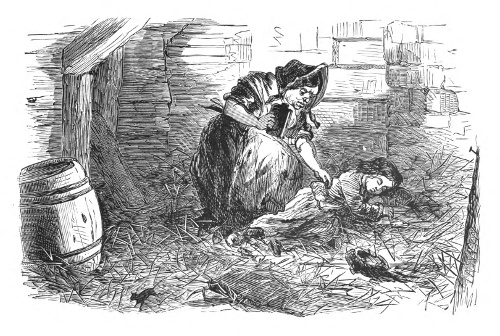
She approached Tom with cautious step. She
need not have been afraid to awaken her. Tom was
a good sleeper, and not likely to wake up, unless
roughly awakened, until morning.
Tom was lying on her side, with her face resting
on one hand.
62The woman stooped down, and began to look
for the pocket in which she kept her money; but
it was in that part of her dress upon which she
was lying. This embarrassed the woman somewhat,
but an idea occurred to her. She took up
a straw, and, bending over, gently tickled Tom’s
ear. Tom shook her head, as a cat would under
similar circumstances, and on its being repeated
turned over, muttering, “Don’t, granny!”
This was what her dishonest landlady wanted. She
thrust her hand into Tom’s pocket, and drew out the
poor girl’s entire worldly treasure. Tom, unconscious
of the robbery, slept on; and the woman went back
to the front room to wait for more lodgers. They
began to come in about ten, and by twelve the room
was full. It was a motley collection, and would have
been a curious, though sad study, to any humane
observer. They were most of them in the last stages
of ill-fortune, yet among them was more than one who
had once filled a respectable position in society. Here
was a man of thirty-five, who ten years before had
filled a good place, with a fair salary, in a city bank.
But in an evil hour he helped himself to some of the
63funds of the bank. He lost his situation, and, though
he escaped imprisonment, found his prospects blasted.
So he had gone down hill, until at length he found
himself reduced to such a lodging-house as this,
fortunate if he could command the small sum needful
to keep him from a night in the streets.
Next him was stretched a man who was deserving
still more pity, since his misfortunes sprang rather
from a want of judgment than from his own fault.
He was a scholar, with a fair knowledge of Latin and
Greek, and some ability as a writer. He was an
Englishman who had come to the city in the hope of
making his acquisitions available, but had met with
very poor encouragement. He found that both
among teachers and writers the demand exceeded the
supply, at least for those of moderate qualifications;
and, having no influential friends, had sought for employment
almost in vain. His small stock of money
dwindled, his suit became shabby, until he found
himself, to his deep mortification and disgust, compelled
to resort to such lodging-houses as this, where
he was obliged to herd with the lowest and most
abandoned class.
64Next to him lay a mechanic, once in profitable employment.
But drink had been his ruin; and now he
was a vagabond, spending the little money he earned,
at rum-shops, except what was absolutely necessary
for food.
There is no need of cataloguing the remainder of
Meg Morely’s lodgers. Her low rates generally
secured her a room-full, and a dozen, sometimes
more, were usually packed away on the floor. On
the whole she found it a paying business, though her
charges were low. Sixty cents a day was quite a
respectable addition to her income, and she had occupied
the same place for two years already. Tom’s
experience will show that she had other, and not
quite so lawful, ways of swelling her receipts, but she
was cautious not to put them in practice, unless she
considered it prudent, as in the present instance.
It was seven o’clock when Tom awoke. She looked
around her in bewilderment, thinking at first she
must be in granny’s room. But a glance at the
prostrate forms around her brought back the events
of the day before, and gave her a realizing sense of
her present situation.
65“I’ve had a good sleep,” said Tom to herself,
stretching, by way of relief from her constrained
position. “I guess it’s time to get up.”
She rubbed her eyes, and shook back her hair, and
then rising, went into the front room. Her landlady
was already up and getting breakfast.
“What time is it?” asked Tom.
“It’s just gone seven,” said Meg, looking sharply
at Tom to see if she had discovered the loss of her
money. “How did you sleep?”
“Tip-top.”
“Come ag’in.”
“All right!” said Tom. “Maybe I will.”
She climbed up the basement stairs to the street
above, and began to think of what the day had in store
for her. Her prospects were not brilliant certainly;
but Tom on the whole felt in good spirits. She had
thrown off the yoke of slavery. She was her own
mistress now, and granny’s power was broken. Tom
felt that she could get along somehow. She had confidence
in herself, and was sure something would
turn up for her.
“Now, what’ll I do first?” thought Tom.
66With twenty-five cents in her pocket, and a good
appetite, breakfast naturally suggested itself.
She dove her hand into her pocket, but the face of
the little Arab almost instantly expressed deep dismay.
Her money was gone!
CHAPTER VII. TOM MAKES A FRIEND.
67
Twenty-five cents is not a large sum, but it was
Tom’s entire fortune. It was all she had, not only to
buy breakfast with, but also to start in business.
She had an excellent appetite, but now there was no
hope of satisfying it until she could earn some more
money.
Tom hurried back to the lodging, and entered,
looking excited.
“Well, what’s wanted?” asked Meg, who knew
well enough without asking.
“I’ve lost some money.”
“Suppose you did,” said the woman, defiantly,
“you don’t mean to say I took it.”
“No,” said Tom, “but I had it when I laid down.”
“Where was it?”
“In my pocket.”
68“Might have tumbled out among the straw,” suggested
Meg.
This struck Tom as not improbable, and she went
back into the bedroom, and, getting down on her
hands and knees, commenced poking about for it.
But even if it had been there, any of my readers who
has ever lost money in this way knows that it is very
difficult to find under such circumstances.
Tom persevered in her search until her next-door
neighbor growled out that he wished she would clear
out. At length she was obliged to give it up.
“Have you found it?” asked Meg.
“No,” said Tom, soberly.
“How much was it?”
“Twenty-five cents.”
“That aint much.”
“It’s enough to bust me. I don’t believe it’s in
the straw.”
“What do you believe?” demanded Meg, whose
guilty conscience made her scent an accusation.
“I think some of them took it while I was asleep,”
said Tom, indicating the other lodgers by a jerk of
her finger.
69“Likely they did,” said Meg, glad to have suspicion
diverted elsewhere.
“I wish I knew,” said Tom.
“What’ud you do?”
“I’d get it back again,” said Tom, her black eyes
snapping with resolution.
“No, you wouldn’t. You’re nothin’ but a babby.
You couldn’t do nothin’!”
“Couldn’t I?” returned Tom. “I’d let ’em know
whether I was a baby.”
“Well, you go along now,” said Meg. “Your
money’s gone, and you can’t get it back. Next time
give it to me to keep, and it’ll be safe.”
Being penniless, Tom was in considerable uncertainty
when she would again be mistress of so large a
sum. At present she felt in no particular dread of
being robbed. She left the lodgings, realizing that
the money was indeed gone beyond hope of recovery.
There is some comfort in beginning the day with a
good breakfast. It warms one up, and inspires hope
and confidence. As a general rule people are good-natured
and cheerful after a hearty breakfast. For
ten cents Tom might have got a cup of coffee, or
70what passed for such, and a plate of tea-biscuit.
With the other fifteen she could have bought a few
morning papers, and easily earned enough to pay for
a square meal in the middle of the day. Now she
must go to work without capital, and on an empty
stomach, which was rather discouraging. She would
have fared better than this at granny’s, though not
much, her breakfast there usually consisting of a
piece of stale bread, with perhaps a fragment of cold
sausage. Coffee, granny never indulged in, believing
whiskey to be more healthful. Occasionally, in moments
of extreme good nature, she had given Tom a
sip of whiskey; but the young Arab had never got to
like it, fortunately for herself, though she had accepted
it as a variation of her usual beverage,
cold water.
In considering what she should do for the day, Tom
decided to go to some of the railway stations or
steamboat landings, and try to get a chance to carry
a carpet-bag. “Baggage-smashing” required no capital,
and this was available in her present circumstances.
Tom made her way to the pier where the steamers
71of the Fall River line arrive. Ordinarily it would
have been too late, but it had been a windy night,
the sound was rough, and the steamer was late, so
that Tom arrived just in the nick of time.
Tom took her place among the hackmen, and
the men and boys who, like her, were bent on
turning an honest penny by carrying baggage.
“Clear out of the way here, little gal!” said a
stout, overgrown boy. “Smash your baggage,
sir?”
“Clear out yourself!” said Tom, boldly. “I’ve
got as much right here as you.”
Her little, sharp eyes darted this way and that
in search of a possible customer. The boy who had
been rude to her got a job, and this gave Tom a
better chance. She offered her services to a lady,
who stared at her with curiosity and returned no
answer. Tom began to think she should not get
a job. There seemed a popular sentiment in favor
of employing boys, and Tom, like others of her
sex, found herself shut out from an employment for
which she considered herself fitted. But, at length,
she saw approaching a big, burly six-footer, with
72a good-natured face. There was something about
him which inspired Tom with confidence, and, pressing
forward, she said, “Carry your bag, sir?”
He stopped short and looked down at the queer
figure of our heroine. Then, glancing at his carpet-bag,
which was of unusual size and weight, the
idea of his walking through the streets with Tom
bending beneath the weight of his baggage, struck
him in so ludicrous a manner that he burst into a
hearty laugh.
“What’s up?” demanded Tom, suspiciously.
“Who are you laughin’ at?”
“So you want to carry my carpet-bag?” he
asked, laughing again.
“Yes,” said Tom.
“Why, I could put you in it,” said the tall man,
his eyes twinkling with amusement.
“No, you couldn’t,” said Tom.
“Do you think you could carry it?”
“Let me try.”
He set it down, and Tom lifted it from the
ground; but it was obviously too much for her
strength.
73“You see you can’t do it. Have you found
anything to do this morning?”
“No,” said Tom.
“Business isn’t good, hey?”
“No,” said Tom, “but I wouldn’t mind so much
if I hadn’t had my money stole. I’m bust!”
“How’s that? Did the bank break or have you
been speculating?”
“Oh, you’re gasin’! I aint got nothing to do
with banks. Somebody stole two shillin’s I had,
so I’ve had no breakfast.”
“Come, that’s bad. I guess I must give you
a job, after all. You can’t carry my bag, but you
can carry this.”
He had under his arm something wrapped in a
paper, making a small bundle. He handed it to
Tom, and she trudged along with it after him.
“You couldn’t guess what that is, I suppose?”
said her companion, sociably.
“No,” said Tom; “it feels soft.”
“It’s a large wax doll, for my little niece,” said
her patron. “You haven’t got any dolls, I
suppose?”
74“I had one once,” said Tom. “It was made
of rags. But granny threw it into the fire.”
“I suppose you were sorry.”
“I was then; but I’m too old for dolls now.”
“How old are you?”
“I aint sure. Somewheres about twelve.”
“You live with your granny, then?”
“No, I don’t,—not now.”
“Why not?”
“She wanted to lick me, so I run away.”
“Then where do you live now?”
“Nowhere.”
“You have no home?”
“I don’t want no home. I can take care of
myself,” said Tom, briskly.
“I see you are an independent, young woman.
Now, if you were a boy, I’d give you a chance
on board my ship.”
“Have you got a ship?” asked Tom, becoming
interested.
“Yes, I am a sea-captain, and go on long
voyages. If you wasn’t a girl, I’d take you along
with me as cabin-boy.”
75“I wish you would,” said Tom, eagerly.
“But you are a girl, you know? You couldn’t
climb a mast.”
“Try me,” said Tom. “I’m strong. I fit with
a boy yesterday, and licked him.”him.”
Captain Barnes laughed, but shook his head.
“I see you’re spunky, if you are a girl,” he
said. “But I never heard of a girl being cabin-boy,
and I don’t think it would do.”
“I’d put on a boy’s clothes,” suggested Tom.
“You’ve begun to do it already,” said the captain,
glancing at the cap and jacket. “I didn’t know at
first but you were a boy. What makes you wear
a cap?”
“Granny gave it to me. I like it better than a
bonnet.”
They had by this time reached Broadway.
“You may steer across the Park to French’s
Hotel,” said the sailor. “It’s too late to get
breakfast at my sister’s.”
“All right,” said Tom.
They crossed the Park, and the street beyond,
76and reached the door of the brick hotel on the
corner of Frankfort Street.
“I’ll go down into the restaurant first,” said
Captain Barnes. “I feel like laying in a cargo
before navigating any farther.”
“Here’s your bundle,” said Tom.
He took it, and handed Tom twenty-five cents,
which she received with gratification, not having expected
so much for carrying so small a bundle.
“Stay a moment,” said the sailor, as she was
about to go away. “You haven’t had any breakfast,
I think you said.”
“No.”
“Then you shall come in, and breakfast with
me.”
This invitation astonished Tom not a little. It
was the first invitation she had ever received to
breakfast with a gentleman. French’s restaurant
being higher priced than those which her class were
in the habit of patronizing, she entered with some
hesitation, not feeling quite sure how her entrance
would be regarded by the waiters. She was not
77generally wanting in self-possession, but as she descended
the stairs and entered the room, she felt
awkward and out of her element.
CHAPTER VIII. AT FRENCH’S HOTEL.
78
“Clear out of here!” said a waiter, arresting
Tom’s progress, and pointing to the steps by which
she had descended from the sidewalk.
If Tom had been alone, she would have felt bound
to obey the summons; but being under the protection
of Captain Barnes, who, she reflected, looked a good
deal stronger than the waiter, she stood her ground.
“Did you hear what I said?” demanded the
waiter angrily, about to take Tom by the shoulder.
“Avast there!” put in the captain, who thought
it time to interfere; “is that the way you treat your
customers?”
“She aint no customer.”
“She is going to take breakfast here, my friend,
and I should like to know what you have got to say
about it.”
The waiter seemed taken aback by this unexpected
79championship of one whom he had supposed to be an
unprotected street girl.
“I didn’t know she was with you,” he stammered.
“Well, you know it now. Come, child, you can
sit down here.”
Tom enjoyed her triumph over the waiter, and
showed it in a characteristic manner, by putting her
thumb to her nose.
Captain Barnes sat down on one side of a table at
one of the windows, and motioned Tom to sit opposite.
“I don’t think you told me your name,” he
said.
“Tom.”
“Then, Tom, let me suggest that you take off your
cap. It’s usual in the best society.”
“I never was there,” said Tom; but she removed
her cap. This revealed a mop of hair, tangled it is
true, but of a beautiful brown shade. Her black
eyes sparkled from beneath, giving a bright, keen
look to her face, browned by exposure to all weathers.
I regret to say that the face was by no means clean.
80If it had been, and the whole expression had not
been so wild and untamed, Tom would certainly have
been considered pretty. As it was, probably no one
would have wasted a second glance upon the little
street girl.
“What will you have, sir, you and the young
lady?” asked the waiter, emphasizing the last word,
with a grin at Tom.
“What will you have, Tom?” asked the captain.
“Beefsteak, cup o’ coffee, and bread-and-butter,”
said Tom, glibly.
Her knowledge of dishes was limited; but she had
tried these and liked them, and this guided her in the
selection.
“Very good,” said Captain Barnes; “the same for
me, with fried potatoes and an omelet.”
Tom stared at this munificent order. She fixed
her black eyes meditatively upon her entertainer, and
wondered whether he always indulged in such a
superlatively square meal.
“What are you thinking about, Tom?” questioned
the captain.
81“You must be awful rich,” said Tom.
Captain Barnes laughed.
“What makes you think so?”
“It’ll cost you a lot for breakfast.”
“But you know I don’t always have company to
breakfast.”
“Do you call me company?”
“Of course I do.”
“I shouldn’t think you’d want to have me eat with
you.”
“Why not?”
“You’re a gentleman.”
“And you’re a young lady. Didn’t you hear the
waiter call you so?”
“He was chaffin’.”
“You may be a lady some time.”
“’Taint likely,” said Tom.
“Why not?”
“I haven’t got no good clothes to wear, nor don’t
know nothin’.”
“Can you read?”
“A little, but I don’t like to. It’s too hard work.”
“Makes your head ache, eh?”
82“Yes,” said Tom, seriously.
Captain Barnes looked attentively at the odd little
creature opposite him. He wondered what would be
her fate. She was quick, sharp, pretty, but withal
an untamed Arab of the streets. The chances seemed
very much against her in the warfare of life. Society
seemed leagued against her, and she was likely to
be at war with it.
“I’ll make an effort to save her,” he thought.
But of this he did not speak to Tom at present,
more especially as the waiter was seen advancing
with the breakfast ordered.
He deposited the various dishes, some before Tom,
and the remainder before the captain.
Tom was not used to restaurants of the better
class, and did not see the necessity of an empty
plate in addition to the dish which contained the
meat. Such ceremony was not in vogue at the ten-cent
restaurants which she had hitherto patronized.
She fixed her eyes eagerly upon the beefsteak, which
emitted a very savory odor.
“Pass your plate, Tom, and I will give you some
meat.”
83Tom passed her plate, nothing loath, and the
captain transferred to it a liberal supply of
meat.
Tom waited for no ceremony, but, seizing her
knife, attacked the meat vigorously.
“How is it?” asked her companion, amused.
“Bully!” said Tom, too busy to raise her eyes
from her plate.
“Let me help you to a little of the omelet.”
Tom extended her plate, and a portion of the
omelet was placed upon it.
Tom raised a little to her lips, cautiously, for it
was a new dish to her, and she did not know
whether she would like it. It seemed to be satisfactory,
however, none being left upon her plate
when she had finished eating.
Not much conversation went on during the meal.
Tom’s entire energies were given to disposing of the
squarest meal in which she had ever indulged, and
the captain’s attention was divided between his
breakfast and the young waif upon whom he was
bestowing perfect bliss.
At length Tom’s efforts relaxed. She laid down
84her knife and fork, and heaved a sigh of exquisite
enjoyment.
“Well,” said the captain, “would you like some
more?”
“No,” said Tom, “I’m full.”
“Did you enjoy your breakfast?”
“Didn’t I, just?” and Tom’s tone spoke volumes.
“I’m glad of that. I think it’s very good myself.”
“You’re a brick!” said Tom, in a tone of grateful
acknowledgment.
“Thank you,” said Captain Barnes, his eyes
twinkling a little; “I try to be.”
“I wonder what granny would say if she knowed
where I was,” soliloquized Tom, aloud.
“She’d be glad you had enjoyed your breakfast.”
“No, she wouldn’t. She’d be mad.”
“You don’t give your grandmother a very good
character. Doesn’t she like you?”
“No; she hates me, and I hate her. She takes
all my money, and then licks me.”
“That’s unpleasant, to be sure. Then you don’t
want to go back to her?”
85“Not for Joe!” said Tom, shaking her head
very decidedly.
“Then you expect to take care of yourself? Do
you think you can?”
Tom nodded confidently.
“What are you going to do this morning, for
instance?”
“Buy some papers with the money you give
me.”
“What a self-reliant spirit the little chit has!”
thought Captain Barnes. “I’ve known plenty of young
men, who had less faith in their ability to cope with
the world, and gain a livelihood, than she. Yet she
has next to no clothes, and her entire capital consists
of twenty-five cents. There is a lesson for the timid
and despondent in her philosophy.”
Tom had no idea of what was passing in the
mind of her companion. If she had been able to
read his thoughts, it is not likely she would have
understood them. Her own thoughts had become
practical. She had had a good breakfast,—thanks
to the kindness of her new friend,—but for dinner
she must depend upon herself. She felt that it was
86quite time to enter upon the business of the
day.
She put on her cap and rose to her feet.
“I’m goin’,” she said, abruptly.
“Where are you going?”
“To buy some papers. Thank you for my
breakfast.”
It was probably the first time Tom ever thanked
anybody for anything. I am not quite sure whether
anybody before this had given her any cause for
gratitude. Certainly, not granny, who had bestowed
far less than she had received from the child, upon
whom she had not been ashamed to be a selfish
dependent. There was something, possibly, in her
present companionship with a kind-hearted gentleman,
something, perhaps, in her present more
respectable surroundings, which had taught Tom this
first lesson in good manners. She was almost
surprised herself at the expression of gratitude to
which she had given utterance.
“Stop a minute, Tom!” said the captain.
Tom had got half way to the door, but she
stopped short on being called back.
87“You haven’t asked me whether I have got
through with you.”
Tom looked surprised. She knew of no further
service in which she could make herself useful to
her companion.
“Haven’t you got through with me?” she asked.
“Not quite. I’m not going to stop here, you
know,—I am going to my sister’s.”
“Where does she live?”
“In Sixteenth Street.”
“Do you want me to carry your carpet-bag?”
asked Tom.
“Well, no; I think you couldn’t manage that.
But you can carry the bundle.”
“All right!” said Tom.
It was all one to her whether she sold papers, or
carried bundles. The main thing was to earn the
small amount of money necessary to defray her daily
expenses. Of the two she would rather go up to
Sixteenth Street; for as she had seldom found occasion
to go up town, the expedition promised a little
novelty.
Captain Barnes paid his bill, and left the restaurant,
with Tom at his heels.
CHAPTER IX. MRS. MERTON.
88
“We’ll go across Broadway, and take the Sixth
Avenue cars, Tom,” said the captain.
“Are we goin’ to ride?” asked Tom, surprised.
“Yes, you don’t catch me lugging this heavy
carpet-bag up to Sixteenth Street.”
Tom was rather surprised at this. She did not
understand why her services were required to carry
the bundle if they were going to ride. However, she
very sensibly remained silent, not feeling called upon
to comment on her employer’s arrangements.
At this time in the day there was no difficulty in
obtaining a seat in the cars. Tom, however, was not
disposed to sit down quietly:—
“I’ll stand outside,” she said.
“Very well,” said Captain Barnes, and he drew
out a copy of a morning paper which he had purchased
on leaving the hotel.
89Tom took her position beside the driver. She
rather enjoyed the ride, for, though she had lived in
the city for years, she had seldom been on the car
as a passenger, though she had frequently stolen a
ride on the steps of a Broadway omnibus.
“Well, Johnny, are you going up town to look
after your family?” asked the driver, good-naturedly.
“I’d have to look a long time before I found ’em,”
said Tom.
“Haven’t you got any relations, then?”
“There’s an old woman that calls herself my
granny.”
“Does she live up on Fifth Avenue?”
“Yes,” said Tom; “next door to you.”
“You’ve got me there,” said the driver, laughing.
“Give my respects to your granny, and tell her she’s
got a smart grand-daughter.”
“I will, when I see her.”
“Don’t you live with her?”
“Not now. She aint my style.”
Here the conductor tapped Tom on the shoulder.
“He pays for me,” said Tom, pointing back at Captain
Barnes.
90“I suppose he’s your grandfather,” said the driver,
jocosely.
“I wish he was. He’s a trump. He gave me a
stunnin’ breakfast.”
“So you like him better than your granny?”
“You can bet on that.”
Captain Barnes, sitting near the door, heard a part
of this conversation, and it amused him.
“I wonder,” he thought, “whether my sister will
be willing to assume charge of this wild little girl?
There’s enough in her to make a very smart woman, if
she is placed under the right influences and properly
trained. But I suspect that will require not a little
patience and tact. Well, we shall see.”
After a while the car reached Sixteenth Street, and
the captain left it, with Tom following him. They
turned down Sixteenth Street from the avenue, and
finally stopped before a fair-looking brick house.
Captain Barnes went up the steps, and rang the bell.
“Is Mrs. Merton at home?” he asked.
“Yes,” said the servant, looking hard at Tom.
“Then I’ll come in. Tell her her brother wishes
to see her. Come in, Tom.”
91Tom followed the captain, the servant continuing
to eye her suspiciously. They entered the parlor,
where Captain Barnes took a seat on the sofa, motioning
Tom to sit beside him. Tom obeyed, surveying
the sofa with some curiosity. The families in the
tenement house with whom she had been on visiting
terms did not in general possess sofas. She had
sometimes seen them in furniture stores, but this
was the first time she had sat upon one.
“What are you thinking of, Tom?” asked the
captain, desiring to draw her out.
“Does your sister live here?”
“Yes.”
“She’s rich, isn’t she?”
“No, she makes a living by keeping boarders.
Perhaps you’d like to board with her.”
Tom laughed.
“She don’t take the likes of me,” she said.
“Suppose you were rich enough, wouldn’t you
like to board here?”
“I don’t know,” said Tom, looking round. “It’s
dark.”
92“All the rooms are not dark. Besides, you’d get
three square meals every day.”
“I’d like that,” said Tom, seriously.
Their further conversation was interrupted by the
entrance of the captain’s sister, Mrs. Merton. She
was rather a stout woman, but there was an expression
of care on her face, which was not surprising, for
it is no light thing to keep a New York boarding-house.
“When did you arrive in the city, Albert?” she
asked, giving him her hand cordially.
“Only just arrived, Martha. How does the world
use you?”
“I can’t complain, though it’s a wearing thing looking
after a household like this. Have you had any
breakfast?”
“I took some down town.”
Just then Mrs. Merton’s eye fell for the first time
upon Tom. She started in surprise, and looked
doubtfully at her brother.
“Who is this?” she asked. “Did she come with
you?”
93“It’s a young friend of mine. She met me at the
wharf, and wanted to carry my carpet-bag.”
“You didn’t let her do it?”
“Bless you, no. It’s big enough to pack her away
in. But I employed her to carry a bundle. Didn’t
I, Tom?”
“What did you call her?” asked his sister.
“Tom. That’s her name, so she says.”
“What made you bring her here?” asked Mrs.
Merton, who evidently regarded her brother’s conduct
as very queer.
“I’ll tell you, but not before her. Tom, you can
go out into the entry, and shut the door behind you.
I’ll call you in a few minutes.”
Tom went out, and Captain Barnes returned to the
subject.
“She’s got no relations except an intemperate old
grandmother,” he said. “I’ve taken a fancy to her,
and want to help her along. Can’t you find a place
for her in your kitchen?”
“I take a girl from the street!” ejaculated Mrs.
Merton. “Albert, you must be crazy.”
“Not at all. I am sure you can find something
94for her to do,—cleaning knives, running of errands,
going to market, or something of that kind.”
“This is a very strange proposal.”
“Why is it? At present she lives in the street,
being driven from the only home she had, by the ill-treatment
of a vicious grandmother. You can see
what chance she has of growing up respectably.”
“But there are plenty such. I don’t see that it’s
our business to look after them.”
“I don’t know why it is, but I’ve taken a fancy to
this little girl.”
“She looks perfectly wild.”
“I won’t deny that she is rather uncivilized, but
there’s a good deal in her. She’s as smart as a steel
trap.”
“Smart enough to steal, probably.”
“Perhaps so, under temptation. I want to remove
the temptation.”
“This is a very strange freak on your part,
Albert.”
“I don’t know about that. You know I have no
child of my own, and am well off, so far as this
world’s goods are concerned. I have long thought I
95should like to train up a child in whom I could take
an interest, and who would be a comfort to me when
I am older.”
“You can find plenty of attractive children without
going into the street for them.”
“I don’t want a tame child. She wouldn’t interest
me. This girl has spirit. I’ll tell you what I want
you to do, Martha. I’m going off on a year’s voyage.
Take her into your house, make her as useful as you
can, civilize her, and I will allow you a fair price for
her board.”
“Do you want her to go to school?”
“After a while. At present she needs to be civilized.
She is a young street Arab with very elementary
ideas as to the way in which people live. She
needs an apprenticeship in some house like this. My
little niece must be about her age.”
“Mary? How can I trust her to the companionship
of such a girl?”
“Tom isn’t bad. She is only untrained. She will
learn more than she will teach at first. Afterwards
Mary may learn something of her.”
96“I am sure I don’t know what to say,” said Mrs.
Merton, irresolutely.
Here the captain named the terms he was willing
to pay for Tom’s board. This was a consideration
to Mrs. Merton, who found that she had to calculate
pretty closely to make keeping boarders pay.
“I’ll try her,” she said.
“Thank you, Martha. You can let her go into the
kitchen at first, till she is fit to be promoted.”
“She must have some clothes. She had on a boy’s
jacket.”
“Yes, and cap. In fact she is more of a boy than
a girl at present.”
“I am not sure but some of Mary’s old dresses may
fit her. Mary must be a little larger than she is.”
“That reminds me I brought a doll for Fanny.
She has not grown too large for dolls yet.”
“No, she is just the age to enjoy them. She will
be delighted.”
“I think we may call in Tom now, and inform
her of our intention.”
“She must have another name. It won’t do to
call a girl Tom.”
97“She said her name used to be Jenny, but she has
been nicknamed Tom.”
The door was opened, and Captain Barnes called in
Tom.
“Come in, Tom,” he said.
“All right!” said Tom. “I’m on hand!”
“We’ve been talking about you, Tom,” pursued the
captain.
“What have you been sayin’?” asked Tom, suspiciously.
“I’ve been telling my sister that you had no home,
and were obliged to earn your own living in the
streets.”
“I don’t care much,” said Tom. “I’d rather do
that than live with granny, and get licked.”
“But wouldn’t you like better to have a nice home,
where you would have plenty to eat, and a good bed
to sleep in?”
“Maybe I would.”
“I’ve been asking my sister to let you stay here
with her. Would you like that?”
Tom regarded Mrs. Merton attentively. The face
was careworn, but very different from granny’s. On
98the whole, it inspired her with some degree of confidence.
“If she wouldn’t lick me very often,” she said.
“How about that, Martha?” he asked.
“I think I can promise that,” said Mrs. Merton,
amused in spite of herself.
“Of course you will have to work. My sister will
find something for you to do.”
“I aint afraid of work,” said Tom, “if I only get
enough to eat, and aint licked.”
“You see, Tom, I feel an interest in you.”
“You’re a brick!” said Tom, gratefully.
“Little girl,” said Mrs. Merton, shocked, “you
mustn’t use such language in addressing my brother.”
“Never mind, Martha; she means it as a compliment.”
“A compliment to call you a brick!”
“Certainly. But now about clothes. Can’t you
rig her out with something that will make her presentable?”
“She needs a good washing first,” said Mrs. Merton,
surveying Tom’s dirty face and hands with
disfavor.
99“A very good suggestion. You won’t mind being
washed, I suppose, Tom?”
“I’d just as lives,” said Tom.
In fact she was quite indifferent on the subject.
She was used to being dirty, but if she could oblige
her new protector by washing, she was quite willing.
“I’ve got to go out for an hour or two,” said Captain
Barnes, “but I will leave my carpet-bag here,
and come back to lunch.”
“Of course, Albert. When do you sail?”
“In three days at farthest.”
“Of course you will remain here up to the day
of sailing.”
“Yes, if you can find a spare corner to stow me
in.”
“It would be odd if I couldn’t find room for my
only brother.”
“So be it, then. You may expect me.”
He rose and taking his hat left the house. Tom
and Mrs. Merton were now alone.
CHAPTER X. TOM DROPS HER TATTERS.
100
“Now, what is your name, little girl?” asked Mrs.
Merton, surveying Tom doubtfully, half sorry that
she had undertaken the care of her.
“Tom.”
“That’s a boy’s name.”
“Everybody calls me Tom,—sometimes Tattered
Tom.”
“There’s some reason about the first name,”
thought Mrs. Merton, as her glance rested on the
ragged skirt and well-ventilated jacket of her
brother’s protegée.
“As you are a girl, it is not proper that you should
have a boy’s name. What is your real name?”
“I think it’s Jenny. Granny used to call me so
long ago, but I like Tom best.”
“Then I shall call you Jenny. Now, Jenny, the
101first thing to do, is to wash yourself clean. Follow
me.”
Mrs. Merton went up the front stairs, and Tom
followed, using her eyes to good advantage as she
advanced.
The landlady led the way into a bath-room. She
set the water to running, and bade Tom undress.
“Am I to get into the tub?” asked Tom.
“Yes, certainly. While you are undressing, I will
try and find some clothes that will fit you.”
Though she did not at first fancy the idea of bathing,
Tom grew to like it, and submitted with a good
grace. Mrs. Merton took care that it should be
thorough. After it, she dressed Tom in some clothes,
still very good, which had been laid aside by her
daughter Mary. Then she combed Tom’s tangled
locks, and was astonished by the improvement it
made in the appearance of the little waif.
I have already said that Tom had elements of
beauty, but it took sharp eyes to detect them under
the rags and dirt which had so effectually disguised
her. She had very brilliant dark eyes, and a clear
olive complexion, with cheeks that had a tinge of red
102instead of the pallor usually to be found in those
children who have the misfortune to be reared in a
tenement house. In her new clothes she looked positively
handsome, as Mrs. Merton thought, though she
did not see fit to say so to Tom herself.
When her toilet was concluded she turned Tom to
the glass, and said, “There, Jenny, do you know
who that is?”
Tom stared in open-eyed wonder at the image
which she saw. She could hardly believe the
testimony of her eyes.
“Is that me?” she asked.
“I believe so,” said Mrs. Merton, smiling.
“It don’t look like me a bit,” continued Tom.
“It doesn’t look like ‘Tattered Tom,’ certainly.
Don’t you like it better?”
“I dunno,” said Tom, doubtfully. “It looks too
much like a girl.”
“But you are a girl, you know.”
“I wish I wasn’t.”
“Why?”
“Boys have more fun; besides, they are stronger,
and can fight better.”
103“But you don’t want to fight?” said Mrs. Merton,
scandalized.
“I licked a boy yesterday,” said Tom, proudly.
“Why did you do that?”
“He sassed me, and I licked him. He was
bigger’n I was, too!”
“I can’t allow you to fight in future, Jenny,” said
Mrs. Merton. “It isn’t at all proper for girls, or
indeed for boys, to fight; but it is worse for girls.”
“Why is it?” asked Tom.
“Because girls should be gentle and lady-like.”
“If you was a girl, and a boy should slap you in
the face, what would you do?” asked Tom, fixing her
bright eyes upon her mentor.
“I should forgive him, and hope he would become
a better boy.”
“I wouldn’t,” said Tom. “I’d give him Hail
Columby.”
“You’ve got some very wrong ideas, Jenny,” said
Mrs. Merton. “I fear that your grandmother has
not brought you up properly.”
“She did not bring me up at all. I brought
104myself up. As for granny, she didn’t care as long
as I brought her money to buy whiskey.”
Mrs. Merton shook her head. It was very evident
to her that Tom had been under very bad influences.
“I hope you will see the error of your ways after
a while, Jenny. My brother takes an interest in you,
and for his sake I hope you will try to improve.”
“If he wants me to, I will,” said Tom, decidedly.
Arab as she was, she had been impressed by the
kindness of Captain Barnes, and felt that she should
like to please him. Still, there was a fascination in
the wild independence of her street life which was
likely for some time to interfere with her enjoyment
of the usages of a more civilized state. There was
little prospect of her taming down into an average
girl all at once. The change must come slowly.
“My brother will be very much pleased if he finds
that you have improved when he returns from his
voyage.”
“When is he goin’ to sea?”
“In two or three days.”
“I asked him to take me with him,” said Tom;
“but he wouldn’t.”
105“You would only be in the way on a ship,
Jenny.”
“No, I shouldn’t. I could be a cabin-boy.”
“But you are not a boy.”
“I could climb the masts as well as a boy. If
there was only a pole here, I’d show you.”
“What a child you are!”
“Did you ever read about the female pirate captain?”
asked Tom.
“No.”
“Jim Morgan told me all about it. He’d read it
in some book. It was a bully story.”
“Such stories are not fit to read.”
“I’d like to be a pirate captain,” said Tom,
thoughtfully.
“You mustn’t talk so, Jenny,” said Mrs. Merton,
shocked.
“But I would, though, and carry two pistols and a
dagger in my belt, and then if anybody sassed me
I’d give ’em all they wanted.”
“My brother wouldn’t like to hear you talk so,
Jenny. I’m sure I don’t know what has got into you
to say such dreadful things.”
106“Then I won’t,” said Tom. “I wonder what
granny would say if she saw me in these fixin’s.
She wouldn’t know me.”
“When my brother comes, you shall go down and
open the door for him, and see if he knows you.”
“That will be bully.”
“Now I must be thinking what I can find for you
to do. You will be willing to help me?”
“Yes,” said Tom, promptly.
“Do you know how to make beds?”
“I can learn,” said Tom.
“Didn’t your grandmother ever teach you?” asked
Mrs. Merton, who, though for a long time a resident
of New York, had a very imperfect knowledge of
how the poorest classes lived.
“Granny never made her bed,” said Tom. “She
just gave it a shake, and tumbled into it.”
“Bless me, how shiftless she must be!” ejaculated
Mrs. Merton, in surprise.
“Oh, granny don’t mind!” said Tom, carelessly.
“Did you ever sweep?”
“Lots of times. That’s the way I got money to
carry to granny.”
107“Were you paid for sweeping, then?” asked Mrs.
Merton.
“Yes, people that came along would give me
money. If they wouldn’t I’d muddy their boots.”
“What do you mean, child? Where did you
sweep?”
“Corner of Broadway and Chambers’ Streets.”
“Oh, you swept the crossing, then.”
“In course I did. If you’ll give me a broom, I’ll
go out and sweep front of your house; but I guess
there aint so many people come along here as in
Broadway.”
“I don’t want you to do that,” said Mrs. Merton,
hastily. “I want you to sweep the rooms in the
house. Sarah, the chambermaid, will show you how,
and also teach you to make beds.”
“All right,” said Tom. “Bring her on, and I’ll
help her.”
“We will defer that till to-morrow. Now you may
come down to the kitchen with me, and I’ll see if I
can find anything for you to do there.”
Tom felt ready for any enterprise, and started to
follow Mrs. Merton downstairs, but rather startled
108the good lady by making a rapid descent astride the
banisters.
“Don’t you do that again, Jenny,” she said reprovingly.
“Why not?” asked Tom. “It’s jolly fun.”
CHAPTER XI THE MISTAKES OF A MORNING.
109
On the way to the kitchen they met Sarah, the
chambermaid, going upstairs to make the beds.
“Sarah,” said Mrs. Merton, “here is a little
girl who is going to stay with me, and help about the
house. You may take her upstairs, and show her
how to help you make the beds.”
If Tom had been in her street costume, Sarah
would have preferred to dispense with her assistance,
but she looked quite civilized and respectable now,
and she accepted the offer. Tom accompanied her
upstairs to the second floor. The first chamber was
that of Mr. Craven,—a gentleman in business down
town. It was of course vacant, therefore.
Tom looked about her curiously.
“Now,” said Sarah, “do you know anything about
making beds?”
“No,” said Tom.
110“Then stand on one side, and I will tell you what
to do.”
Tom followed directions pretty well, but, as the
task was about finished, an impish freak seized her,
and she caught the pillow and threw it at Sarah’s
head, disarranging that young lady’s hair, and knocking
out a comb.
“What’s that for?” demanded Sarah, angrily.
Tom sat down and laughed boisterously.
“It’s bully fun!” she said. “Throw it at me.”
“I’ll give you a shaking, you young imp,” said
Sarah. “You’ve broke my comb.”
She picked up the comb, and dashed round the bed
after Tom, who, seeing no other way for escape,
sprang upon the bed, where she remained standing.
“Come down from there,” demanded Sarah.
“Let me alone, then!”
“I’ll tell the missis, just as sure as you live!”
“What’ll she do? Will she lick me?”
“You’ll see.”
This would not have checked Tom, but it occurred
to her, all at once, that her freak would be reported
to the captain, and might displease him.
111“I’ll stop,” said she. “I was only in fun.”
By this time, Sarah had ascertained that the comb
was not broken, after all, and this made her more inclined
to overlook Tom’s offence.
“Now behave decent!” she said.
She gave Tom further directions about the proper
way of doing chamber-work, which Tom followed
quite closely, being resolved apparently to turn over
a new leaf. But her reformation was not thorough.
She caught sight of Mr. Craven’s shaving materials,
which he had carelessly left on the bureau, and before
Sarah anticipated her intention, she had seized the
brush and spread the lather over her cheeks.
“What are you doing, you little torment?” asked
Sarah.
“I’m goin’ to shave,” said Tom. “It must feel
funny.”
“Put that razor down!” said Sarah, approaching.
Tom brandished the razor playfully, in a manner
that considerably startled the chamber-maid, who
stopped short in alarm:—
“I’ll go and tell the missis how you cut up,” said
she, going to the door.
112This was unnecessary, however, for at this moment
Mrs. Merton, desirous of learning how Tom was getting
along, opened the door. She started back in
dismay at the spectacle which greeted her view, and,
in a tone unusually decided for so mild a woman,
said, “Jenny, put down that razor instantly, and
wipe the soap from your cheeks. Not so,” she
added hastily, seeing that Tom was about to wipe it
off upon her skirt. “Here, take the towel. Now,
what do you mean by such conduct?”
“Wouldn’t he like it?” asked Tom, somewhat
abashed.
“Do you mean my brother?”
“Yes, the sailor man.”
“No, he would be very angry.”
“Then I won’t do so again;” and Tom seemed quite
decided in her repentance.
“What possessed you to touch those things,
Jenny?”
“That isn’t all she did, mum,” said Sarah. “She
threw the pillow at me, and almost druv the comb
into my head. She’s the craziest creetur’ I ever sot
eyes on.”
113“Did you do that?” asked Mrs. Merton.
“Yes,” said Tom. “I told her she might pitch it
at me. It’s bully fun.”
“I can’t allow such goings-on,” said Mrs. Merton.
“If you do so again, I must send you back to your
grandmother.”
“You don’t know where she lives,” said Tom.
“At any rate I won’t keep you here.”
Tom thought of the three square meals which she
would receive daily, and decided to remain. She continued
quiet, therefore, and really helped Sarah in
the remaining rooms. When this task was completed
she went downstairs. At this moment a ring was
heard at the door-bell. Thinking that it might be the
captain, Tom answered the summons herself. She
opened the door suddenly, but found herself mistaken.
A young gentleman was the visitor.
“Can I see Mrs. Merton?” he inquired.
“Yes,” said Tom; “come in.”
He stepped into the hall.
“Come right along. I’ll show you where she is.”
She knew that the landlady was in the kitchen, and
114supposed that this was the proper place to lead the
visitor.
The latter followed Tom as far as the head of the
stairs, and then paused.
“Where are you leading me?” he asked.
“She’s down in the kitchen. Come right along.”
“No, I will stay here. You may tell her there
is a gentleman wishes to see her.”
Tom went down, and found the landlady.
“There’s a feller upstairs wants to see you,” she
said. “He wouldn’t come down here. I asked
him.”
“Good gracious! You didn’t invite him down into
the kitchen?”
“Why not?” said Tom.
“You should have carried him into the parlor.”
“All right!” said Tom. “I’ll know better next
time.”
Mrs. Merton smoothed her hair, and went upstairs
to greet her visitor, who proved to be an applicant for
board.
Only fifteen minutes later Tom had a chance to improve
on her first mistake. Again the door-bell rang,
115and again Tom opened the door. A wrinkled old
woman, with a large basket, stood before her.
“I’m a poor widder,” she whined, “with four childer
that have nothing to ate. Can’t you give me a
few pennies, and may the blessings of Heaven rest
upon you!”
“Come in,” said Tom.
The old woman stepped into the hall.
“Come right in here,” said Tom, opening the door
of the parlor.
The old beggar, not accustomed to being received
with so much attention, paused doubtfully.
“Come in, if you’re comin’,” said Tom, impatiently.
“The lady told me to put everybody in
here.”
The old woman followed, and took a seat on the
edge of a sofa, placing her basket on the carpet. Before
Tom had a chance to acquaint her mistress with
the fact that a visitor awaited her, the bell rang
again. This time Tom found herself confronted by a
fashionably dressed and imposing-looking lady.
“I wish to see Mrs. Merton,” she said.
116“All right!” said Tom. “Just you come in, and
I’ll call her.”
The visitor entered, and was ushered also into the
parlor. Leaving her to find a seat for herself, Tom
disappeared in pursuit of the landlady.
Mrs. Courtenay did not at first observe the other
occupant of the room. When her eyes rested on the
old crone sitting on the sofa, with her basket, which
was partly stored with cold victuals, resting on the
carpet, she started in mingled astonishment and disgust.
Her aristocratic nostrils curved, and, taking a
delicate handkerchief, she tried to shut out the unsavory
presence. The old woman saw the action,
and fidgeted nervously, feeling that she ought not to
be there. While the two guests were in this uncomfortable
state of feeling, Mrs. Merton, quite unsuspicious
of anything wrong, opened the door.
“Is this Mrs. Merton?” asked Mrs. Courtenay.
“Yes, madam.”
“I called to inquire about a servant who referred
me to you,” continued Mrs. Courtenay, haughtily;
“but I didn’t anticipate the company I should find
myself in.”
117Following her glance, Mrs. Merton was struck with
dismay, as she saw the second visitor.
“How came you here?” she demanded hastily.
“The little gal brought me. It wasn’t my fault
indeed, mum,” whined the old woman.
“What do you want?”
“I’m a poor widder, mum. If you could be so
kind as to give me a few pennies.”
“I have nothing for you to-day. You can go,”
said Mrs. Merton, who was too provoked to be charitable,
as otherwise she might have been. She
pointed to the door, and the applicant for charity
hobbled out hastily, feeling that she was not likely
to obtain anything under present circumstances.
“I must beg your pardon,” said Mrs. Merton,
“for the mistake of an inexperienced child, who has
never before waited upon the door; though, how she
could have made such an absurd blunder, I cannot
tell.”
Mrs. Courtenay deigned to be appeased, and
opened her business. When she had left the house,
Mrs. Merton called Tom.
118“Jenny,” she said, “how came you to show that
beggar into the parlor?”
“She asked for you,” said Tom, “and you told me
to take everybody that asked for you into the parlor.”
“Never take such a woman as that in.”
“All right!” said Tom.
“That comes of taking a girl in from the street,”
thought Mrs. Merton. “I wish I hadn’t agreed to
take her.”
CHAPTER XII THE VANQUISHED BULLY.
119
Notwithstanding Tom’s mistake, she was still
intrusted with the duty of answering the bell. At
length, to her satisfaction, she opened the door to her
friend of the morning.
He looked at her in surprise.
“What, is this Tom?” he asked.
“Yes,” she said, enjoying his surprise. “Didn’t
you know me?”
“Hardly. Why, you look like a young lady!”
“Do I?” said Tom, hardly knowing whether or
not to feel pleased at the compliment, for she fancied
she should prefer to be a boy.
“Yes, you are much improved. And how have
you been getting on this morning?”
“I’ve been cutting up,” said Tom, shaking her
head.
“Not badly, I hope.”
120“I’ll tell you what I did;” and Tom in her own
way gave an account of the events related in the
previous chapter.
The captain laughed heartily.
“You aint mad?” questioned Tom.
“Did you think I would be?”
“She said so,” said Tom.
“Who is she?”
“Your sister.”
The captain recovered his gravity. He saw that
his merriment might encourage Tom in her pranks,
and so increase the difficulties his sister was likely to
find with her.
“No, I am not angry,” he said, “but I want you
very much to improve. You will have a good home
here, and I want you to do as well as you can, so that
when I get home from my voyage I may find you
very much improved. Do you think I shall?”
Tom listened attentively.
“What do you want me to do?” she asked.
“To learn, as fast as you can, both about work and
study. I shall leave directions to have you sent to
school. Will you like that?”
121“I don’t know,” said Tom. “I’m afraid I’ll be
bad, and get licked.”
“Then try not to be bad. But you want to know
something when you grow up,—don’t you?”
“Yes.”
“Then you will have to go to school and study.
Can you read?”
“Not enough to hurt me,” said Tom.
“Then, if you find yourself behind the rest, you
must work all the harder. Will you promise me to
do it?”
Tom nodded.
“And will you try to behave well?”
“Yes,” said Tom. “I’ll do it for you. I wouldn’t
do it for granny.”
“Then do it for me.”
Here Mrs. Merton appeared on the scene, and Tom
was directed to go downstairs to assist the cook.
“Well, what do you think of her, Martha?”
“She’s a regular trial. I’ll tell you what she did
this morning.”
“I know all.”
“Did she tell you?” asked his sister, in surprise.
122“Yes, she voluntarily told me that she had been
‘cutting up;’ and, on my questioning her, confessed
how. However, it was partly the result of ignorance.”
“I wish I hadn’t undertaken the charge of her.”
“Don’t be discouraged, Martha. There’s some
good in her, and she’s as smart as a steel trap. She’s
promised me to turn over a new leaf, and do as well
as she can.”
“Do you rely upon that?”
“I do. She’s got will and resolution, and I believe
she means what she says.”
“I hope it’ll prove so,” said Mrs. Merton, doubtfully.
“I find she knows very little. I should like to
have her sent to school as soon as possible. She
can assist you when at home, and I will take care
that you lose nothing by it.”
To this Mrs. Merton was brought to agree, but
could not help expressing her surprise at the interest
which her brother took in that child. She was a
good woman, but it was not strange if the thought
should come to her that she had two daughters of her
123own, having a better claim upon their uncle’s money
than this wild girl whom he had picked up in the
streets. But Captain Barnes showed that he had not
forgotten his nieces, as two handsome dress-patterns,
sent in from Stewart’s during the afternoon, sufficiently
evinced.
Tom had not yet met Mrs. Merton’s daughters,
both being absent at school. They returned home
about three o’clock. Mary, a girl of about Tom’s
age, had rather pretty, but insipid, features, and was
vain of what she regarded as her beauty. Fanny,
who was eight, was more attractive.
“Children, can’t you speak to your uncle?” said
Mrs. Merton; for the captain declared himself tired,
and did not go out after lunch.
“How do you do, uncle?” said Mary, advancing
and offering her hand.
“Why, Mary, you have become quite a young
lady,” said her uncle.
Mary simpered and looked pleased.
“And Fanny too. Martha, where is that doll I
brought for her?”
The doll was handed to the delighted child.
124“I suppose you are too old for dolls, Mary,” said
the captain to his eldest niece.
“I should think so, Uncle Albert,” answered Mary,
bridling.
“Then it’s lucky I didn’t bring you one. But I’ve
brought you a playmate.”
Mary looked surprised.
Tom was passing through the hall at the moment,
and her guardian called her.
“Come in, Tom.”
Mary Merton stared at the new-comer, and her
quick eyes detected that the dress in which she appeared
was one of her own.
“Why, she’s got on my dress,” she said.
“She is about your size, Mary, so I gave her your
dress.”
“Didn’t she have any clothes of her own?”
“Were you unwilling to let her have that dress?”
asked her uncle.
Mary pouted, and Captain Barnes said, “Martha,
I will put money in your hands to supply Jenny with
a suitable wardrobe. I had intended to give Mary
125new articles for all which been appropriated to Tom’s
use; but I have changed my mind.”
“She can have them,” said Mary, regretting her
selfishness, from an equally selfish motive.
“I won’t trouble you,” said her uncle, rather
coldly.
Tom had listened attentively to this conversation,
turning her bright eyes from one to the other.
“Come here, Tom, and shake hands with these two
little girls.”
“I’ll shake hands with her,” said Tom, indicating
Fanny.
“And won’t you shake hands with Mary?”
“I don’t want to.”
“Why not?”
“I don’t like her.”
“Shake hands with her, for my sake.”
Tom instantly extended her hand, but now it was
Mary who held back. Her mother would have forced
her to give her hand, but Captain Barnes said, “It
don’t matter. Leave them to become friends in their
own time.”
Two days afterwards the captain sailed. Tom renewed
126her promise to be a good girl, and he went
away hopeful that she would keep it.
“I shall have somebody to come home to, Jenny,”
he said. “Will you be glad to see me back?”
“Yes, I will,” she said; and there was a heartiness
in her tone which showed that she meant what she
said.
The next day Tom went to school. She was provided
with two or three books such as she would
need, and accompanied Fanny; for, though several
years older, she was not as proficient as the latter.
In the next street there was a boy, whose pleasure
it was to bully children smaller than himself. He
had more than once annoyed Fanny, and when the
latter saw him a little in advance, she said, nervously,
“Let us cross the street, Jenny.”
“Why?” asked Tom.
“There’s George Griffiths just ahead.”
“What if he is?”
“He’s an awful bad boy. Sometimes he pulls
away my books, and runs away with them. He likes
to plague us.”
“He’d better not try it,” said Tom.
127“What would you do?” asked Fanny, in surprise.
“You’ll see. I won’t cross the street. I’m goin’
right ahead.”
Fanny caught her companion’s arm, and advanced,
trembling, hoping that George Griffiths might not see
them. But he had already espied them, and, feeling
in a bullying mood, winked to a companion and said,
“You’ll see how I’ll frighten these girls.”
He advanced to meet them, and took off his hat
with mock politeness.
“How do you do this morning, young ladies?” he
said.
“Go away, you bad boy!” said little Fanny, in a
flutter.
“I’ll pay you for that,” he said, and tried to
snatch one of her books, but was considerably
startled at receiving a blow on the side of the head
from her companion.
“Just let her alone,” said Tom.
“What have you got to say about it?” he demanded
insolently.
“You’ll see.”
128Hereupon he turned his attention to Tom, and
tried to snatch her books, but was rather astounded
when his intended victim struck him a sounding blow
in the face with her fist.
“Take my books, Fanny,” she said, and, dropping
them on the sidewalk, squared off scientifically.
“Come on, if you want to!” said Tom, her eyes
sparkling with excitement at the prospect of a
fight.
“I don’t want to fight with a girl,” he said, considerably
astonished at vigorous resistance where he
had expected timid submission.
“You’re afraid!” said Tom, triumphantly.
“No, I’m not,” said George, backing out all the
while; “I don’t want to hurt you.”
“You can’t do it,” said Tom; “I can lick you any
day.”
“How could you do it?” asked Fanny, as the
dreaded bully slunk away. “How brave you are,
Jenny! I’m awful afraid of him.”
“You needn’t be,” said Tom, taking her books.
“I’ve licked boys bigger’n him. I can lick him, and
he knows it.”
129She was right. The story got about, and George
Griffiths was so laughed at, for being vanquished by
a girl, that he was very careful in future whom he
attempted to bully.
CHAPTER XIII GRANNY IS COMPELLED TO EARN HER OWN LIVING.
130
Leaving Tom in her new home, we return to Mrs.
Walsh, which was the proper designation of the old
woman whom she called granny. Though Tom had
escaped from her clutches, granny had no idea that
she intended to stay away permanently. She did not
consider that all the advantages of the connection
between them had been on her side, and that Tom
had only had the privilege of supporting them both.
If she had not carried matters so far our heroine
would have been satisfied to remain; but now she had
fairly broken away, and would never come back
unless brought by force.
When six o’clock came granny began to wonder
why Tom did not come back. She usually returned
earlier, with whatever money she had managed to
obtain.
131“She’s afraid of a lickin’,” thought granny.
“She’ll get a wuss one if she stays away.”
An hour passed, and granny became hungry; but
unfortunately she was penniless, and had nothing in
the room except a crust of hard bread which she intended
for Tom’s supper. Hunger compelled her to
eat this herself, though it was not much to her taste.
Every moment’s additional delay irritated her the
more with the rebellious Tom.
“I wish I had her here,” soliloquized granny, spitefully.
When it was half-past seven granny resolved to go
out and hunt her up. She might be on the sidewalk
outside playing. Perhaps—but this was too daring
for belief—she might be spending her afternoon’s
earnings on another square meal.
Granny went downstairs, and through the archway
into the street. There were plenty of children, living
in neighboring tenement houses, gathered in groups
or playing about, but no Tom was visible.
“Have you seen anything of my gal, Micky
Murphy?” asked granny of a boy whom she had
often seen with Tom.
132“No,” said Micky. “I haven’t seen her.”
“Haven’t any of you seen her?” demanded Mrs.
Walsh, making the question a general one.
“I seen her sellin’ papers,” said one boy.
“When was that?” asked granny, eagerly.
“’Bout four o’clock.”
“Where was she?”
“Greenwich Street.”
This was a clue at least, but a faint one. Tom
had been seen at four o’clock, and now it was nearly
eight. Long before this she must have sold her
papers, and the unpleasant conviction dawned upon
granny that she must have spent her earnings upon
herself.
“If I could only get hold of her!” muttered
granny, vengefully.
She went as far as the City Hall, and followed
along down by the Park fence, looking about her in
all directions, in the hope that she might espy Tom.
But the latter was at this time engaging lodgings for
the night, as we know, and in no danger of being
caught.
Unwilling to give up the pursuit, Mrs. Walsh
133wandered about for an hour or more, occasionally
resting on one of the seats in the City Hall Park, till
the unwonted exertion began to weary her, and she
realized that she was not likely to encounter Tom.
There was one chance left. Tom might have got
home while she had been in search of her. Spurred
by this hope, Mrs. Walsh hurried home, and mounted
to her lofty room. But it was as desolate as when
she left it. It was quite clear that Tom did not
mean to come back that night. This was provoking;
but granny still was confident that she would return
in the course of the next day. So she threw herself
on the bed,—not without some silent imprecations
upon her rebellious charge,—and slept till morning.
Morning brought her a new realization of her loss.
She found her situation by no means an agreeable
one. Her appetite was excellent, but she was without
food or money to buy a supply. It was certainly
provoking to think that she must look out for herself.
However, granny was equal to the occasion. She
did not propose to work for a living, but decided that
she would throw herself upon charity. To begin
with, she obtained some breakfast of a poor but
134charitable neighbor, and then started on a walk up
town. It was not till she got as far as Fourteenth
Street that she commenced her round of visits.
The first house at which she stopped was an English
basement house. Granny rang the basement bell.
“Is your mistress at home?” she asked.
“Yes; what’s wanted?”
“I’m a poor widder,” whined granny, in a lugubrious
voice, “with five small children. We haven’t got
a bit of food in the house. Can’t you give me a few
pennies?”
“I’ll speak to the missis, but I don’t think she’ll
give any money.”
She went upstairs, and soon returned.
“She won’t give you any money, but here’s a loaf
of bread.”
Mrs. Walsh would much have preferred a small
sum of money, but muttered her thanks, and dropped
the loaf into a bag she had brought with her.
She went on to the next block, and intercepted a
gentleman just starting down town to his business.
“I’m a poor widder,” she said, repeating her whine;
135“will you give me a few pennies? and may the Lord
bless you!”
“Why don’t you work?” asked the gentleman,
brusquely.
“I’m too old and feeble,” she answered, bending
over to assume the appearance of infirmity. This did
not escape the attention of the gentleman, who answered
unceremoniously, “You’re a humbug! You
won’t get anything from me! If I had my way, I’d
have you arrested and locked up.”
Granny trembled with passion, but did not think it
politic to give vent to her fury.
Her next application was more successful, twenty-five
cents being sent to the door by a compassionate
lady, who never doubted the story of the five little
children suffering at home for want of food.
Granny’s eyes sparkled with joy as she hastily
clutched the money. With it she could buy drink
and tobacco, while food was not an object of barter.
“The missis wants to know where you live,” said
the servant.
Mrs. Walsh gave a wrong address, not caring to
receive charitable callers, who would inevitably find
136out that her story was a false one, and her children
mythical.
At the next house she got no money; but on declaring
that she had eaten nothing for twenty-four
hours, was invited into the kitchen, where she was
offered a chair, and a plate of meat and bread was
placed before her. This invitation was rather an embarrassing
one; for, thanks to her charitable neighbor,
granny had eaten quite a hearty breakfast not long
before. But, having declared that she had not tasted
food for twenty-four hours, she was compelled to
keep up appearances, and eat what was set before
her. It was very hard work, and attracted the attention
of the servants, who had supposed her half
famished.
“You don’t seem very hungry,” said Annie, the
cook.
“It’s because I’m faint-like,” muttered granny.
At this moment her bag, containing the loaf of bread,
tumbled on the floor.
“What’s that?” asked the cook, suspiciously.
“It’s some bread I’m goin’ to carry home to the
childers,” said Mrs. Walsh, a little confused. “They
137was crying for something to ate when I come
away.”
“Then you’d better take it home as soon as you
can,” said Annie, surveying the old woman with
some suspicion.
Granny was forced to leave something on her plate,
nature refusing the double burden she sought to impose
upon it, and went out with an uncomfortable
sense of fulness. Resuming her rounds, she was repulsed
at some places, at others referred to this or
that charitable society, but in the end succeeded in
raising twenty-five cents more in money. Fifty cents,
a loaf of bread, and a little cold meat represented her
gains of the morning, and with these she felt tolerably
well satisfied. She had been compelled to walk
up town, but now she had money and could afford to
ride. She entered a Sixth Avenue car, therefore, and
in half an hour or thereabouts reached the Astor
House. She walked through the Park, looking about
her carefully, in the hope of seeing Tom, who would
certainly have fared badly if she had fallen into the
clutches of the angry old woman. But Tom was
nowhere visible.
138So granny plodded home, and, mounting to her
room, laid away the bread and meat, and, throwing
herself upon the bed, indulged in a pipe. Tom was
not at home, and granny began to have apprehensions
that she meant to stay away longer than she had at
first supposed.
“But I’ll come across her some day,” said granny,
vindictively. “When I do I’ll break every bone in
her body.”
The old woman lay on the bed two or three hours,
and then went out, with the double purpose of investing
a part of her funds in a glass of something
strong, and in the hope that she might fall in with
Tom. Notwithstanding the desire of vengeance, she
missed her. She had not the slightest affection for
the young girl who had been so long her charge, but
she was used to her companionship. It seemed
lonely without her. Besides, granny had one of
those uncomfortable dispositions that feel lost without
some one to scold and tyrannize over, and, although
Tom had not been so yielding and submissive
as many girls would have been under the same circumstances,
139Mrs. Walsh had had the satisfaction
of beating her occasionally, and naturally longed for
the presence of her customary victim.
So, after making the purchase she intended,
granny made another visit to the Park and Printing
House Square, and inspected eagerly the crowds of
street children who haunt those localities as paper-venders,
peddlers, and boot-blacks. But Tom, as we
know, was by this time an inmate of Mrs. Merton’s
boarding-house,—the home found for her by her
friend, the sea-captain. This was quite out of Mrs.
Walsh’s beat. She had not anticipated any such
contingency, but supposed that Tom would be forced
to earn her living by some of those street trades
by means of which so many children are kept from
starvation. It did not enter her calculations that, so
soon after parting from her, Tom had also ceased to
be a street Arab, and obtained a respectable home.
Of course, therefore, disappointment was again her
portion, and she was forced to return home and go to
bed without the exquisite satisfaction of “breaking
every bone in Tom’s body.”
140Granny felt that she was ill-used, and that Tom
was a monster of ingratitude; but on that subject
there may, perhaps, be a difference of opinion.
CHAPTER XIV TOM IS CAPTURED BY THE ENEMY.
141
We pass over two months, in which nothing of
striking interest occurred to our heroine, or her affectionate
relative, who continued to mourn her loss
with more of anger than of sorrow. My readers may
be interested to know how far Tom has improved in
this interval. I am glad to say that she has considerably
changed for the better, and is rather less of an
Arab than when she entered the house. Still Mrs.
Merton, on more than one occasion, had assured her
intimate friend and gossip, Miss Betsy Perkins, that
Tom was “a great trial,” and nothing but her promise
to her brother induced her to keep her.
Tom was, however, very quick and smart. She
learned with great rapidity, when she chose, and was
able to be of considerable service in the house before
and after school. To be sure she was always getting
into hot water, and from time to time indulged in impish
142freaks, which betrayed her street-training. At
school, however, she learned very rapidly, and had
already been promoted into a class higher than that
which she entered. If there was one thing that Tom
was ashamed of, it was to find herself the largest
and oldest girl in her class. She was ambitious to
stand as well as other girls of her own age, and, with
this object in view, studied with characteristic energy,
and as a consequence improved rapidly.
She did not get along very well with Mary Merton.
Mary was languid and affected, and looked down
scornfully upon her mother’s hired girl, as she called
her; though, as we know, money was paid for Tom’s
board. Tom did not care much for her taunts, being
able to give as good as she sent; but there was one
subject on which Mary had it in her power to annoy
her. This was about her defective education.
“You don’t know any more than a girl of eight,”
said Mary, contemptuously.
“I haven’t been to school all my life as you have,”
said Tom.
“I know that,” said Mary. “You were nothing
but a beggar, or rag-picker, or something of that kind.
143I don’t see what made my uncle take you out of the
street. That was the best place for you.”
“I wish you had to live with granny for a month,”
retorted Tom. “It would do you good to get a
lickin’ now and then.”
“Your grandmother must have been a very low
person,” said Mary, disdainfully.
“That’s where you’re right,” said Tom, whose affection
for granny was not very great.
“I’m glad I haven’t such a grandmother. I should
be ashamed of it.”
“She wasn’t my grandmother. She only called
herself so,” said Tom.
“I’ve no doubt she was,” said Mary, “and that
you are just like her.”
“Say that again, and I’ll punch your head,” said
Tom, belligerently.
As Mary knew that Tom was quite capable of
doing what she threatened, she prudently desisted,
but instead taunted her once more with her ignorance.
“Never mind,” said Tom, “wait a while and I’ll
catch up with you.”
Mary laughed a spiteful little laugh.
144“Hear her talk!” she said. “Why, I’ve been ever
so far in English; besides, I am studying French.”
“Can’t I study French too?”
“That would be a great joke for a common street
girl to study French! You’ll be playing the piano
next.”
“Why not?” asked Tom, undauntedly.
“Maybe your granny, as you call her, had a
piano.”
“Perhaps she did,” said Tom; “but it was to the
blacksmith’s to be mended, so I never saw it.”
Tom was not in the least sensitive on the subject
of granny, and however severe reflections might be
indulged in upon granny’s character and position, she
bore them with equanimity, not feeling any particular
interest in the old woman.
Still she did occasionally feel a degree of curiosity
as to how granny was getting along in her absence.
She enjoyed the thought that Mrs. Walsh, no longer
being able to rely upon her, would be compelled to
forage for herself.
“I wonder what she’ll do,” thought Tom. “She’s
145such a lazy old woman that I think she’ll go round
beggin’. Work don’t agree with her constitution.”
It so happened that granny, though in her new
vocation she made frequent excursions up town, had
never fallen in with Tom. This was partly because
Tom spent the hours from nine to two in school, and
it was at this time that granny always went on her
rounds. But one Saturday forenoon Tom was sent
on an errand some half a mile distant. As she was
passing through Eighteenth Street her attention was
drawn to a tall, ill-dressed figure a few feet in advance
of her. Though only her back was visible,
Tom remembered something peculiar in granny’s
walk.
“That’s granny,” soliloquized Tom, in excitement;
“she’s out beggin’, I’ll bet a hat.”
The old woman carried a basket in one hand, for
the reception of cold victuals, for, though she preferred
money, provisions were also acceptable, and
she had learned from experience that there were some
who refrained from giving money on principle, but
would not refuse food.
Tom was not anxious to fall into the old woman’s
146clutches. Still she felt like following her up, and
hearing what she had to say.
She had not long to wait.
Granny turned into the area of an English basement
house, and rang the basement bell.
Tom paused, and leaned her back against the railing,
in such a position that she could hear what
passed.
A servant answered the bell.
“What do you want?” she asked, not very ceremoniously.
“I’m a poor widder,” whined granny, “with five
small children. They haven’t had anything to eat
since yesterday. Can’t you give me something? and
may the Lord bless you!”
“She knows how to lie,” thought Tom. “So
she’s got five small children!”
“You’re pretty old to have five small children,”
said the servant, suspiciously.
“I aint so old as I look,” said Mrs. Walsh. “It’s
bein’ poor and destitoot that makes me look old
before my time.”
“Where’s your husband?”
147“He’s dead,” said granny. “He treated me bad;
he used to drink, and then bate me and the children.”
“You look as if you drank, yourself.”
“I’d scorn the action,” said granny, virtuously.
“I never could bear whiskey.”
“Aint she doin’ it up brown?” thought Tom.
“Haven’t I seen her pourin’ it down though?”
“Give me your basket,” said the servant.
“Can’t you give me some money,” whined granny,
“to help pay the rint?”
“We never give money,” said the servant.
She went into the kitchen, and Shortly returned
with some cold meat and bread. Granny opened it
to see what it contained.
“Haven’t you got any cold chicken?” she asked,
rather dissatisfied.
“She’s got cheek,” thought Tom.
“If you’re not satisfied with what you’ve got, you
needn’t come again.”
“Yes,” said granny, “I’m satisfied; but my little
girl is sick, and can’t bear anything but chicken, or
maybe turkey.”
148“Then you must ask for it somewhere else,” said
the servant. “We haven’t got any for you here.”
Having obtained all she was likely to get, granny
prepared to go.
Tom felt that she, too, must start, for there might
be danger of identification. To be sure she was now
well-dressed,—quite as well as the average of girls
of her age. The cap and jacket, indeed all that had
made her old name of “Tattered Tom” appropriate,
had disappeared, and she was very different in appearance
from the young Arab whom we became
acquainted with in the first chapter. In other respects,
as we know, Tom had not altered quite so
much. There was considerable of the Arab about
her still, though there was a prospect of her eventually
becoming entirely tamed.
Granny just glanced at the young girl, whose back
only was visible to her, but never thought of identifying
her with her lost grand-daughter. Sometimes,
however, she had obtained money from compassionate
school-girls, and it struck her that there might be
a chance in this quarter.
She advanced, and tapped Tom on the shoulder.
149“Little gal,” she dolefully said, “I’m a poor
widder with five small children. Can’t you give me a
few pennies? and may the Lord reward you!”
Tom was a little startled, but quite amused, by this
application from granny. She knew there was
danger in answering; but there was a fascination about
danger, and she thought that, even if identified, she
could make her escape.
“Where do you live?” she asked, trying to disguise
her voice, and looking down.
“No. 417 Bleecker Street,” said granny, at random,
intentionally giving the wrong address.
“I’ll“I’ll get my aunt to come round to-morrow and
see you,” said Tom.
“Give me a few pennies now,” persisted granny,
“to buy some bread for my children.”
“How many have you got?”
“Five.”
It was very imprudent, but Tom obeyed an irresistible
impulse, and said, “Isn’t one of them named
Tom?” and she looked up in her old way.
Granny bent over eagerly, and looked in her face.
She had noticed something familiar in the voice, but
150the dress had prevented her from suspecting anything.
Now it flashed upon her that the rebellious Tom was
in her clutches.
“So it’s you, is it?” she said, with grim delight,
clutching Tom by the arm. “I’ve found you at last,
you trollop! Come along with me! I’ll break every
bone in your body!”
Tom saw that she had incautiously incurred a great
peril; but she had no idea of being dragged away
unresisting. She was quick-witted, and saw that, if
she chose to deny all knowledge of the old woman,
granny would find it hard to substantiate her claims.
“Stop that, old woman!” she said, without the
least appearance of fear. “If you don’t let go, I’ll
have you arrested!”
“You will, will you?” exclaimed granny, giving
her a shake viciously. “We’ll see about that.
Where’d you get all them good clothes from? Come
along home.”
“Let me alone!” said Tom. “You’ve got nothing
to do with me.”
“Got nothing to do with you? Aint I your
granny?”
151“You must be crazy,” said Tom, coolly. “My
grandmother don’t go round the streets, begging for
cold victuals.”
“Do you mean to say I’m not your granny?” demanded
the old woman, astounded.
“I don’t know what you mean,” said Tom, coolly.
“You’d better go home to your five small children in
Bleecker Street.”
“O you trollop!” muttered granny, giving her a
violent shaking; which reminded Tom of old times in
not the most agreeable manner.
“Come, old woman, that’s played out!” said Tom.
“You’d better stop that.”
“You’re my gal, and I’ve a right to lick you,”
said Mrs. Walsh.
“I’ve got nothing to do with you.”
“Come along!” said granny, attempting to drag
Tom with her.
But Tom made a vigorous resistance, and granny
began to fear that she had undertaken rather a hard
task. The distance from Eighteenth Street to the
tenement house which she called home was two miles,
probably, and it would not be very easy to drag Tom
152that distance against her will. A ride in the horse-cars
was impracticable, since she had no money with
her.
The struggle was still going on, when Tom all at
once espied a policeman coming around the corner.
She did not hesitate to take advantage of his opportune
appearance.
“Help! Police!” exclaimed Tom, in a loud voice.
This sudden appeal startled granny, whose associations
with the police were not of the most agreeable
nature, and she nearly released her hold. She glared
at Tom in speechless rage, foreseeing that trouble
was coming.
“What’s the matter?” asked the officer, coming
up, and regarding the two attentively.
“I think this woman must be crazy,” said Tom.
“She came up and asked me for a few pennies, and
then grabbed me by the arm, saying she was my
granny. She is trying to drag me home with her.”
“What have you to say to this?” demanded the
policeman.
“She’s my gal,” said granny, doggedly.
153“You hear her,” said Tom. “Do I look as if I
belonged to her? She’s a common beggar.”
“O you ungrateful trollop!” shrieked granny,
tightening her grip.
“She hurts me,” said Tom. “Won’t you make
her let go?”
“Let her go!” said the policeman, authoritatively.
“But she’s my gal.”
“Let go, I tell you!” and granny was forced to
obey. “Now where do you live?”
“340 Bleecker Street.”Street.”
“You said it was 417 just now,” said Tom, “and
that you had five small children. Was I one of
them?”
Granny was cornered. She was afraid that Bleecker
Street might be visited, and her imposture discovered.
It was hard to give up Tom, and so have the girl,
whom she now hated intensely, triumph over her.
She would make one more attempt.
“She’s my gal. She run away from me two months
ago.”
“If you’ve got five small children at home, and
154have to beg for a living,” said the officer, who did not
believe a word of her story, “you have all you can
take care of. She’s better off where she is.”
“Can’t I take her home, then?” asked granny,
angrily.
“You had better go away quietly,” said the policeman,
“or I must take you to the station-house.”
Mrs. Walsh, compelled to abandon her designs
upon Tom, moved off slowly. She had got but a few
steps, when Tom called out to her, “Give my love to
your five small children, granny!”
The old woman, by way of reply, turned and shook
her fist menacingly at Tom, but the latter only laughed
and went on her way.
“Aint she mad, though!” soliloquized Tom.
“She’d lick me awful if she only got a chance. I’m
glad I don’t live with her. Now I get square meals
every day. I’d like to see granny’s five small children;”
and Tom laughed heartily at what she thought
a smart imposture. That Tom should be very conscientious
on the subject of truth could hardly be
expected. A street education, and such guardianship
as she had received from granny, were not likely to
155make her a model; but Tom is more favorably situated
now, and we may hope for gradual improvement.
CHAPTER XV GRANNY READS SOMETHING TO HER ADVANTAGE.
156
After her unsuccessful attempt to gain possession
of Tom, granny returned home, not only angry but
despondent. She had been deeply incensed at Tom’s
triumph over her. Besides, she was tired of earning
her own living, if begging from door to door can
properly be called earning one’s living. At any rate
it required exertion, and to this Mrs. Walsh was
naturally indisposed. She sighed as she thought of
the years when she could stay quietly at home, and
send out Tom to beg or earn money for her. She
would like, since Tom was not likely to return, to
adopt some boy or girl of suitable age, upon whom
she could throw the burden of the common support.
But such were not easy to be met with, and Mrs.
Walsh was dimly aware that no sane child would
voluntarily select her as a guardian.
So granny, in rather low spirits, sought her elevated
157room, and threw herself upon the bed to sleep off
her fatigue.
On awaking, granny seated herself at the window,
and picked up mechanically the advertising sheet of
the “Herald,” in which a loaf of bread had been
wrapped that had been given to her the day previous.
It was seldom that Mrs. Walsh indulged in reading,
not possessing very marked literary tastes; but to-day
she was seized with an idle impulse, which she obeyed,
without anticipating that she would see anything that
concerned her.
In glancing through the advertisements under the
head “Personal,” her attention was drawn to the
following:—
/#
“If Margaret Walsh, who left Philadelphia in the year 1855,
will call at No. — Wall Street, Room 8, she will hear of something
to her advantage.”
#/
“Why, that’s me!” exclaimed granny, letting the
paper fall from her lap in surprise. “It’s my name,
and I left Philadelphy that year. I wonder what it’s
about. Maybe it’s about Tom.”
There were circumstances which led Mrs. Walsh to
think it by no means improbable that the inquiries to
158be made were about Tom, and this made her regret
more keenly that she had lost her.
“If it is,” she soliloquized, “I’ll get hold of her
somehow.”
There was one part of the advertisement which particularly
interested granny,—that in which it was
suggested that she would hear something to her advantage.
If there was any money to be made,
granny was entirely willing to make it. Considering
the unpromising state of her prospects, she felt that
it was a piece of extraordinary good luck.
Looking at the date of the paper, she found that it
was a fortnight old, and was troubled by the thought
that it might be too late. At any rate no time was
to be lost. So, in spite of the fatigue of her morning
expedition, she put on her old cloak and bonnet, and,
descending the stairs, sallied out into the street. She
made her way down Nassau Street to Wall, and, carefully
looking about her, found without difficulty the
number mentioned in the advertisement. It was a
large building, containing a considerable number of
offices. No. 8 was on the third floor. On the door
was a tin sign bearing the name:—
159“EUGENE SELDEN,
Attorney and Counsellor.”
Mrs. Walsh knocked at the door; but there was no
response. She knocked again, after a while, and then
tried the door. But it was locked.
“The office closes at three, ma’am,” said a young
man, passing by. “You will have to wait till to-morrow.”
Mrs. Walsh was disappointed, being very anxious
to ascertain what advantage she was likely to receive.
She presented herself the next morning at nine, only
to find herself too early. At last she found the
lawyer in. He looked up from his desk as she
entered.
“Have you business with me?” he asked.
“Are you the man that advertised for Margaret
Walsh?” asked granny.
“Yes,” said Mr. Selden, laying down his pen, and
regarding her with interest. “Are you she?”
“Yes, your honor,” said granny, thinking her
extra politeness might increase the advantage
promised.
“Did you ever live in Philadelphia?”
160“Yes, your honor.”
“Were you in service?”
Mrs. Walsh answered in the affirmative.
“In what family?”
“In the family of Mrs. Lindsay.”
“What made you leave her?” asked the lawyer,
fixing his eyes searchingly upon Margaret.
Granny looked a little uneasy.
“I got tired of staying there,” she said.
“When you left Philadelphia, did you come to
New York?”
“Yes, your honor.”
“Did you know that Mrs. Lindsay’s only child disappeared
at the time you left the house?” inquired
the lawyer.
“If I tell the truth will it harm me?” asked
granny, uneasily.
“No; but if you conceal the truth it may.”
“Then I took the child with me.”
“What motive had you for doing this wicked
thing? Do you know that Mrs. Lindsay nearly
broke her heart at the loss of the child?”
161“I was mad with her,” said granny, “that’s one
reason.”
“Then there was another reason?”
“Yes, your honor.”
“What was it?”
“Young Mr. Lindsay hired me to do it. He
offered me a thousand dollars.”
“Are you ready to swear this?”
“Yes,” said granny. “I hope you’ll pay me
handsome for tellin’,” she added. “I’m a poor—woman,”
she was on the point of saying “widder
with five small children;” but it occurred to her that
this would injure her in the present instance.
“You shall receive a suitable reward when the
child is restored. It is living, I suppose?”
“Yes,” said granny.
“With you?”
“No, your honor. She ran away two months ago;
but I saw her this morning.”
“Why should she run away? Didn’t you treat her
well?”
“Like as if she was my own child,” said
granny. “I’ve often and often gone without anything
162to eat, so that Tom might have enough. I took
great care of her, your honor, and would have
brought her up as a leddy if I hadn’t been so
poor.”
“I thought it was a girl.”
“So it was, your honor.”
“Then why do you call her Tom?”
“’Cause she was more like a boy than a gal,—as
sassy a child as I ever see.”
“So you have lost her?”
“Yes, your honor. She ran away from me two
months since.”
“But you said you saw her yesterday. Why did
you not take her back?”
“She wouldn’t come. She told the policeman she
didn’t know me,—me that have took care of her since
she was a little gal,—the ungrateful hussy!”
Granny’s pathos, it will be perceived, terminated
in anger.
The lawyer looked thoughtful.
“The child must be got back,” he said. “It is
only recently that her mother ascertained the
treachery by which she was taken from her, and now
163she is most anxious to recover her. If you will bring
her to me, you shall have a suitable reward.”
“How much?” asked granny, with a cunning
look.
“I cannot promise in advance, but it will certainly
be two hundred dollars,—perhaps more. Mrs. Lindsay
will be generous.”
The old woman’s eyes sparkled. Such a sum
promised an unlimited amount of whiskey for a considerable
time. The only disagreeable feature in the
case was that Tom would benefit by the restoration,
since she would obtain a comfortable home, and a
parent whose ideas of the parental relation differed
somewhat from those of Mrs. Walsh. Still, two
hundred dollars were worth the winning, and granny
determined to win them. She suggested, however,
that, in order to secure the co-operation of the police,
she needed to be more respectably dressed; otherwise
her claim would be scouted, provided Tom undertook
to deny it.
This appeared reasonable, and as the lawyer had
authority to incur any expense that he might consider
likely to further the successful prosecution of the
164search, he sent out some one, in whom he had confidence,
to purchase a respectable outfit for Mrs.
Walsh. He further agreed to allow her three dollars
a week for the present, that she might be able to devote
all her time to hunting up Tom. This arrangement
was very satisfactory to Mrs. Walsh, who felt
like a lady in easy circumstances. Her return to the
tenement house, in her greatly improved dress, created
quite a sensation. She did not deign to enlighten
her neighbors upon the cause of her improved fortunes,
but dropped hints that she had come into a
legacy.
From this time Mrs. Walsh began to frequent the
up-town streets, particularly Eighteenth Street, where
she had before encountered Tom. But as she still
continued to make her rounds in the morning, it was
many days before she caught a glimpse of the object
of her search. As her expenses were paid in the
mean time, she waited patiently, though she anticipated
with no little pleasure the moment which should
place Tom in her power. She resolved, before restoring
her to her mother, to inflict upon her late ward a
165suitable punishment for her rebellion and flight, for
which granny was not likely ever to forgive her.
“I’ll give her something to remember me by,”
muttered granny. “See if I don’t!”
CHAPTER XVI TOM IN TROUBLE.
166
The reader has already obtained some idea of the
character of Mary Merton. She was weak, vain,
affected, and fond of dress. There was not likely to
be much love lost between her and Tom, who was in
all respects her opposite. Whatever might have
been the defects of her street education, it had at all
events secured Tom from such faults as these.
Mary sought the society of such of her companions
as were wealthy or fashionable, and was anxious to
emulate them in dress. But unfortunately her
mother’s income was limited, and she could not
gratify her tastes. She was continually teasing Mrs.
Merton for this and that article of finery; but, though
her mother spent more for her than she could well
afford, she was obliged in many cases to disappoint
her. So it happened that Mary was led into temptation.
167One morning she was going downstairs on her way
to school. The door of Mr. Holland’s room (who
occupied the second floor front) chanced to be open.
It occurred to Mary that the large mirror in this
room would enable her to survey her figure to advantage,
and, being fond of looking in the glass, she
entered.
After satisfactorily accomplishing the object of her
visit, Mary, in glancing about, caught sight of a
pocket-book on the bureau. Curiosity led her to
approach and open it. It proved to contain four
five-dollar bills and a small amount of change.
“I wish the money was mine,” said Mary to herself.
There was a particular object for which she wanted
it. Two of her companions had handsome gold
pencils, which they wore suspended by a cord around
their necks. Mary had teased her mother to buy
her one, but Mrs. Merton had turned a deaf ear to
her request. Finally she had given up asking, finding
that it would be of no avail.
“If I only had this money, or half of it,” thought
168Mary, “I could buy a pencil for myself, and tell
mother it was given me by one of my friends.”
The temptation, to a vain girl like Mary, was a
strong one.
“Shall I take it?” she thought.
The dishonesty of the act did not so much deter
her as the fear of detection. But the idea unluckily
suggested itself that Tom would be far more
likely to be suspected than she.
“Mr. Holland is rich,” she said to herself; “he
won’t feel the loss.”
She held the pocket-book irresolutely in her hand,
uncertain whether to take a part of the contents or
the whole. Finally she opened it, drew out the bills,
amounting to twenty dollars, hastily thrust them into
her pocket, and, replacing the pocket-book on the
bureau, went downstairs.
She met her mother in the lower hall.
“I am afraid you will be late to school, Mary,” she
said.
“I couldn’t find my shoes for a long time,” said
Mary, flushing a little at the thought of the money in
her pocket.
169Mr. Holland’s room had already been attended
to, and was not again entered until half-past five in
the afternoon, when Mr. Holland, who was a clerk in
a down-town office, returned home.
He had missed the pocket-book shortly after
leaving the house in the morning, but, being expected
at the office at a certain hour, had not been
able to return for it. He had borrowed money of a
fellow-clerk to pay for his lunch.
As he entered the room, he saw his pocket-book
lying on the bureau.
“There it is, all safe,” he said to himself, quite
relieved; for, though in receipt of a handsome salary,
no one would care to lose twenty dollars.
He was about to put the pocket-book into his
pocket unexamined, when it occurred to him to open
it, and make sure that the contents were untouched.
He was startled on finding less than a dollar, where
he distinctly remembered that there had been nearly
twenty-one dollars.
“Some one has taken it,” he said to himself. “I
must see Mrs. Merton about this.”
He did not get an opportunity of speaking to the
170landlady until after dinner, when he called her aside,
and told her of his loss.
“Are you quite sure, Mr. Holland,” she asked,
considerably disturbed, “there were twenty dollars in
the pocket-book?”
“Yes, Mrs. Merton. I remember distinctly having
counted the money this morning, before laying it
on the bureau. It must have been taken by some
one in the house. Now, who was likely to enter the
room? Which of your servants makes the bed?”
“It was Jenny,” said Mrs. Merton, with a sudden
conviction that Tom was the guilty party.
“What, that bright little girl that I have seen
about the house?”
“Yes, Mr. Holland, I am afraid it is she,” said
Mrs. Merton, shaking her head. “She is not exactly
a servant, but a child whom my brother took
out of the streets, and induced me to take charge of
while he is away. She has been very ill-trained, and
I am not surprised to find her dishonest. More than
once I have regretted taking charge of her.”
“I am sorry,” said Mr. Holland. “I have noticed
171that she is rather different from most girls. I wish I
had not exposed her to the temptation.”
“She must give up the money, or I won’t keep her
in the house,” said Mrs. Merton, who had become
indignant at Tom’s ingratitude, as she considered it.
“My brother can’t expect me to harbor a thief in the
house, even for his sake. It would ruin the reputation
of my house if such a thing happened again.”
“She will probably give it back when she finds
herself detected,” said Mr. Holland.
“I will tax her with it at once,” said the landlady.
“Stay here, Mr. Holland, and I will call her.”
Tom was called in. She looked from one to the
other, and something in the expression of each led
her to see that she was to be blamed for something,
though what she could not conceive.
“Jane,” said Mrs. Merton, sternly, “my brother
will be very much grieved when he learns how badly
you have behaved to-day.”
“What have I been doing?” asked Tom, looking
up with a fearless glance, not by any means like a
girl conscious of theft.
172“You have taken twenty dollars belonging to Mr.
Holland.”
“Who says I did it?” demanded Tom.
“It is useless to deny it. You cleared up his room
this morning. His pocket-book was on the bureau.”
“I know it was,” said Tom. “I saw it there.”
“You opened it, and took out twenty dollars.”
“No, I didn’t,” said Tom. “I didn’t touch it.”
“Do not add falsehood to theft. You must have
done it. There was no one else likely to do it.”
“Wasn’t the door unlocked all day?” demanded
Tom. “Why couldn’t some one else go in and take
it as well as I?”
“I feel sure it was you.”
“Why?” asked Tom, her eyes beginning to flash
indignantly.
“I have no doubt you have stolen before. My
brother took you from the street. You were brought
up by a bad old woman, as you say yourself. I ought
not to be surprised at your yielding to temptation. If
you will restore the money to Mr. Holland, and promise
not to steal again, I will overlook your offence,
173and allow you to remain in the house, since it was my
brother’s wish.”
“Mrs. Merton,” said Tom, proudly, “I didn’t take
the money, and I can’t give it back. I might have
stolen when I lived with granny, for I didn’t get
enough to eat half the time, but I wouldn’t do it
now.”
“That sounds well,” said Mrs. Merton; “but somebody
must have taken the money.”
“I don’t care who took it,” said Tom, “I didn’t.”
“You are more likely to have taken it than any one
else.”
“You may search me if you want to,” said Tom,
proudly.
“Perhaps she didn’t take it,” said Mr. Holland,
upon whom Tom’s fearless bearing had made an
impression.
“I will inquire if any of the servants went into
your room,” said Mrs. Merton. “If not, I must conclude
that Jane took it.”
Inquiry was made, but it appeared evident that no
servant had entered the room. Tom had made the
bed and attended to the chamber-work alone. Mrs.
174Merton was therefore confirmed in her suspicions.
She summoned Tom once more, and offered to forgive
her if she would make confession and restitution.
“I didn’t steal the money,” said Tom, indignantly.
“I’ve told you that before.”
“Unless you give it up, I cannot consent to have
you remain longer in my house.”
“All right!” said Tom, defiantly. “I don’t want
to stay if that’s what you think of me.”
She turned and left Mrs. Merton. Five minutes
later she was in the street, going she knew not whither.
She was so angry at the unfounded suspicions which
had been cast upon her, that she felt glad to go. But
after a while she began to think of the sudden change
in her fortunes. For three months she had possessed
a comfortable home, been well fed and lodged, and
had been rapidly making up the deficiencies in her
education. She had really tried to soften the roughness
and abruptness of her manners, and become a
good girl, hoping to win the approbation of her good
friend, the captain, when he should return from his
voyage. Now it was all over. She had lost her
175home, and must again wander about with no home
but the inhospitable street.
“It isn’t my fault,” thought Tom, with a sigh.
“I couldn’t give back the money when I didn’t take
it.”
CHAPTER XVII THE GOLD PENCIL.
176
Mrs. Merton was taken by surprise when she found
that Tom had actually gone. Her conviction remained
unshaken that she had stolen Mr. Holland’s money,
and she considered that she had been forbearing in
not causing her arrest.
“Your uncle cannot blame me,” she said to Mary,
“for sending her away. He cannot expect me to keep
a thief in my house.”
“To be sure not,” said Mary, promptly. “I am
glad she has gone. You couldn’t expect much from
a girl that was brought up in the streets.”
“That is true. I don’t see, for my part, what your
uncle saw in her.”
“Nor I. She’s a rude, hateful thing.”
“She denied taking the money.”
“Of course,” said Mary. “She wouldn’t mind
lying any more than stealing.”
177Mary felt very much relieved at the way things
had turned out. After taking the money, she had
become frightened lest in some way suspicion might
be directed towards herself. As she had hoped, her
fault had been laid to Tom, and now she felt comparatively
safe. She had not yet dared to use the money,
but thought she might venture to do so soon.
She went up to her bedroom, and, after locking the
door, opened her trunk. The four five-dollar bills
were carefully laid away in one corner, underneath a
pile of clothes. Mary counted them over with an air
of satisfaction. Her conscience did not trouble her
much as long as the fear of detection was removed.
“Mr. Holland won’t miss the money,” she thought,
“and everybody’ll think Jane took it.”
The thought of her own meanness in depriving
Tom of a good home, and sending her out into the
street without shelter or money, never suggested itself
to the selfish girl. She felt glad to be rid of her,
and did not trouble herself about any discomforts or
privations that she might experience.
Three days later Mary felt that she might venture
to buy the pencil which she had so long coveted.
178Tom’s disappearance was accepted by all in the house
as a confirmation of the charge of theft, and no one
else was likely to be suspected. Not knowing how
much the pencil was likely to cost, Mary took the
entire twenty dollars with her. She stopped on her
way from school at a jewelry store only a few blocks
distant from her mother’s house. She was unwise in
not going farther away, since this increased the
chances of her detection.
“Let me look at your gold pencils,” she asked,
with an air of importance.
The salesman produced a variety of pencils, varying
in price.
Mary finally made choice of one that cost twelve
dollars.
She paid over the money with much satisfaction,
for the pencil was larger and handsomer than those
belonging to her companions, which had excited her
envy. She also bought a silk chain, to which she attached
it, and then hung it round her neck.
Though Mary was not aware of it, her entrance
into the jewelry store had been remarked by Mrs.
Carver, a neighbor and acquaintance of her mother’s.
179Mrs. Carver, like some others of her sex, was gifted
with curiosity, and wondered considerably what
errand had carried Mary into the jeweller’s.
Bent upon finding out, she entered the store and
approached the counter.
“What did that young girl buy?” she asked.
“You mean that one who just went out?”
“Yes.”
“A gold pencil-case.”
“Indeed,” said Mrs. Carver, looking surprised.
“How expensive a pencil did she buy?”
“She paid twelve dollars.”
“Will you show me one like it?”
A pencil, precisely similar, was shown Mrs. Carver,
the clerk supposing she wished to purchase. But she
had obtained all the information she desired.
“I won’t decide to-day,” she said. “I will come
in again.”
“There’s some mystery about this,” said Mrs.
Carver to herself. “I wonder where Mary got so
much money; surely, her mother could not have given
it to her. If she did, all I have to say is, that she is
180very extravagant for a woman that keeps boarders for
a living.”
Mrs. Carver was one of those women who feel a
very strong interest in the business of others. The
friends with whom she was most intimate were most
likely to incur her criticism. In the present instance
she was determined to fathom the mystery of the
gold pencil.
Mary went home with her treasure. Of course she
knew that its possession would excite surprise, and
she had a story prepared to account for it. She felt
a little nervous, but had little doubt that her account
would be believed.
As she anticipated, the pencil at once attracted
her mother’s attention.
“Whose pencil is that, Mary?” she asked.
“Mine, mother.”
“Yours? Where did you get it?” inquired her
mother, in surprise.
“Sue Cameron gave it to me. She’s my bosom
friend, you know.”
“Let me see it. It isn’t gold—is it?”
“Yes, it’s solid gold,” said Mary, complacently.
181“But I don’t understand her giving you so expensive
a present. It must have cost a good deal.”
“So it did. Sue said it cost twelve dollars.”
“Then how came she to give it to you?”
“Oh, her father’s awful rich! Besides, Sue has
had another pencil given to her, and she didn’t want
but one; so she gave me this.”
“It looks as if it were new.”
“Yes, she has had it only a short time.”
“When did she give it to you?”
“This morning. She promised it to me a week
ago,” said Mary, in a matter-of-fact manner which
quite deceived her mother.
“She has certainly been very kind to you. She
must like you very much.”
“Yes, she does. She likes me better than any of
the other girls.”
“Why don’t you invite her to come and see you?
You ought to be polite to her, since she is so kind.”
This suggestion was by no means pleasing to Mary.
In the first place Sue Cameron was by no means the intimate
friend she represented, and in the next, if she
called and Mrs. Merton referred to the gift, it would
182at once let the cat out of the bag, and Mary would
be in trouble. Therefore she said, “I’ll invite her,
mother, but I don’t think she’ll come.”
“Why not?”
“She lives away up on Fifth Avenue, and is not
allowed to make visits without some one of the family.
The Camerons are very rich, you know, and
stuck up. Only Sue is not.”
“You’d better invite her, however, Mary, since she
is such a friend of yours.”
“Yes, I will, only you must not be surprised if she
does not come.”
The next afternoon Mrs. Carver dropped in for a
call. While she was talking with Mrs. Merton, Mary
came into the room. Her gold pencil was ostentatiously
displayed.
“How do you do, Mary?” said the visitor.
“What a handsome pencil-case you have!”
“One of her school friends gave it to her,” explained
Mrs. Merton.
“Indeed!” returned Mrs. Carver, with an emphasis
which bespoke surprise.
“Yes,” continued Mrs. Merton, unconsciously. “It
183was a Miss Cameron, whose father lives on Fifth
Avenue. Her father is very rich, and she is very
fond of Mary.”
“I should think she was—uncommonly,” remarked
Mrs. Carver.
“There’s some secret here,” she thought. “I must
find it out.”
“Mary, my dear,” she said, aloud, “come here, and
let me look at your pencil.”
Mary advanced reluctantly. There was something
in the visitor’s tone that made her feel uncomfortable.
It was evident that Mrs. Carver did not accept the
account she had given as readily as her mother.
“It is a very handsome pencil,” said Mrs. Carver,
after examination. “You are certainly very lucky,
Mary. My Grace is not so fortunate. So this Mrs.
Cameron lives on Fifth Avenue?”
“Yes, ma’am.”
“And her father sends her to a public school.
That’s rather singular,—isn’t it?”
“So it is,” said Mrs. Merton. “I didn’t think of
that. And the family is very proud too, you say,
Mary?”
184Mary by this time was quite willing to leave the
subject, but Mrs. Carver was not disposed to do so.
“I don’t know why it is,” said Mary. “I suppose
they think she will learn more at public schools.”
“Now I think of it,” said Mrs. Carver, meditatively,
“this pencil looks very much like one I saw
at Bennett’s the other day.”
The color rushed to Mary’s face in alarm. Her
mother did not observe it, but Mrs. Carver did. But
she quickly recovered herself.
“Perhaps it was bought there,—I don’t know,”
she said.
“She carries it off well,” thought Mrs. Carver.
“Never mind, I’ll find out some time.”
Mary made some excuse for leaving the room, and
the visitor asked:—
“How is that girl getting along whom your brother
left with you?”
Mrs. Merton shook her head.
“She’s turned out badly,” she said.
“What has she done?”
“She stole twenty dollars from Mr. Holland’s
185room. He left his pocket-book on the bureau, and
she took out the money.”
“Did she confess it?”
“No, she stoutly denied it. I told her, if she
would confess, I would forgive her, and let her stay
in the house. But she remained obstinate, and went
away.”
“Are you convinced that she took it?” asked
Mrs. Carver, who now suspected where the gold
pencil came from.
“It could have been no one else. She was in the
room, making the beds, and sweeping, in the morning.
“Still, she may have been innocent.”
“Then who could have taken the money?”
“Somebody that wanted a gold pencil,” returned
Mrs. Carver, nodding significantly.
“What!” exclaimed Mrs. Merton, aghast. “You
don’t mean to hint that Mary took it?”
“I mean this, that she bought the pencil herself at
Bennett’s, as I happen to know. Where she got the
money from, you can tell better than I can.”
186“I can’t believe it,” said Mrs. Merton, very much
perturbed.
“Didn’t you see how she flushed up when I said I
had seen a pencil like it at Bennett’s? However, you
can ask her.”
Mrs. Merton could not rest now till she had ascertained
the truth. Mary was called, and, after an
attempt at denial, finally made confession in a flood
of tears.
“How could you let me send Jane away on account
of your fault?” asked her mother, much disturbed.
“I didn’t dare to own it. You won’t tell,
mother?”
“I must return the money to Mr. Holland.”
“You can tell him that it was accidentally
found.”
This Mrs. Merton finally agreed to do, not wishing
to expose her own child. She was really a kind-hearted
woman, and was very sorry for her injustice
to Tom.
“What will your uncle say?” she inquired, after
Mrs. Carver had gone.
187“Don’t tell him,” said Mary. “It’s better for
Jane to go, or he would be making her his heiress.
Now I shall stand some chance. You can tell him
that Jane went away of her own accord.”
Mrs. Merton was human. She thought it only fair
that one of her daughters should inherit their uncle’s
money in preference to a girl taken from the streets,
and silently acquiesced. So the money was restored
to Mr. Holland, and he was led to think that Tom
had left it behind her, while the real perpetrator of
the theft retained her gold pencil, and escaped exposure.
CHAPTER XVIII IN SEARCH OF A PLACE.
188
Tom went out into the street angry, and justly so,
at the unfounded charge which had been made
against her. The change in her circumstances had
been so sudden, that she hardly realized, as she
walked along, that she must return to her old street
life. When she did realize it, it was with a feeling
of disappointment, not unmixed with apprehension.
Tom had only been living at Mrs. Merton’s for three
months, but this short time had wrought a considerable
change in her. She was no longer the wild, untamed
girl who once swept the crossing. She had
begun to feel the advantages of respectability, and
had become ambitious of acquiring a good education.
This feeling originated in the desire of surprising
Captain Barnes with her improvement; but she soon
began to feel an interest in learning for its own
189sake. She was still spirited and independent, but in
a different way. Her old life looked far less attractive,
since she had acquired such different tastes.
Now to be suddenly thrust back into it seemed rather
hard to Tom.
One thing at least could be said, she was no longer
“Tattered Tom.” Her old rags had been cast aside,
and she was now dressed as well as most school-girls.
She no longer looked like a child having no home but
the street, but would be supposed by any who noticed
her to belong to some family in good circumstances.
Now, good clothes exert more influence upon the
wearer than we may at first suppose. So it was
with Tom. When she wore her old tatters she was
quite ready to engage in a fight with any boy who
jeered at her, provided he was not too large. Now
she would hesitate before doing it, having an undefined
idea that her respectable dress would make
such a scene unbecoming.
There was one question that presented itself to
Tom as she walked along, and demanded her earnest
attention. This was, “How was she to live?”
She could no longer sweep the crossing; she was
190too well-dressed for that. Indeed she was likely to
attract attention if she engaged in any of the street
occupations to which she had in former times been
accustomed. But something must be done. Her
whole stock of money consisted of five cents, and
this was not likely to last very long. It was far too
little to buy such a meal as she got at Mrs. Merton’s.
It was doubtful, Tom reflected with a sigh, when
she would get another square meal.
Suddenly the thought came to Tom, could she
not hire out to do chamber-work? She had learned
to do this at Mrs. Merton’s. It would be a great
deal better than sweeping the crossing, or selling
papers.
Tom did not know how such situations were
obtained, but it occurred to her that she could go
from one house to another, and apply.
With this plan in her mind, she turned round, and
walked up town again. When she reached Twenty-First
Street she decided to try her luck. Accordingly
she went up to the front door of a handsome
house with a brown stone front, and rang the bell.
The door was opened by a servant, who waited
191respectfully for her to announce her errand, supposing
her to be a school-mate of one of the children of
the family. Her neat dress favored this mistake.
“Is the lady of the house at home?” inquired
Tom.
“Who shall I say wishes to see her?” asked the
servant, doubtfully.
“Does she want to hire a girl to do chamber-work?”
continued Tom.
“Who wants the place?”
“I do,” said Tom.
“Then, she don’t want any,” said the girl, preparing
to shut the door, with an entire change of manner.
“Don’t you know better than to come to the front
door? There’s the basement door below.”
“One door’s as good as another,” said Tom, independently.
“Both are too good for you,” said the servant,
angry that under the influence of a mistake she
had at first treated Tom with the respect due to
a visitor.
“How much are you paid extra for your politeness?”
asked Tom.
192“Never you mind! You needn’t call again.”
Such was the result of Tom’s first application.
However, she was not discouraged. She reflected
that there were a good many streets in the city, and
a good many houses in each street. So she walked
on, and rang the bell at the next house. She concluded
to take the hint which had excited her indignation,
and rang the basement bell.
“Do you want a girl to do chamber-work?” she
asked.
Now it so happened that a chamber-maid was
wanted here, and an order had been sent to an intelligence
office for one. It was naturally supposed
that Tom had come in answer to the application.
“Come in,” said the servant. “I’ll tell the
missis that you are here.”
She went upstairs, and shortly reappeared.
“You’re to come up,” she said.
Tom followed her upstairs, and took a seat in the
hall.
Soon a lady came downstairs, with a languid
step.
193“Are you the girl that has applied to do chamberwork?”
she said.
“Yes, ma’am,” answered Tom.
“You seem very young. How old are you?”
“Twelve,” answered Tom.
“Only twelve? I am surprised that so young a
girl should have been sent to me. Have you any
experience?”
“Yes, ma’am.”
“Where have you lived?”
“At Mrs. Merton’s, No. — Sixteenth Street.”
“How long were you there?”
“Three months.”
“Have you a recommendation from her?”
“No,” answered Tom.
“Why did you leave?” asked the lady, suspiciously.
“Because she said I took some money, when I
didn’t,” replied Tom, promptly.
A change came over the lady’s face,—a change
that betokened little encouragement to Tom.
“I shall not be able to take you,” she said. “I
194wonder they should have sent you from the intelligence
office.”
“They didn’t send me.”
“You were not sent from the office? How did you
know I wanted a chamber-maid?”
“I didn’t know,” said Tom. “I thought you
might.”
“If I had known that, I should have refused you
at once. You can go downstairs, and the servants
will let you out at the basement door,—down those
stairs.”stairs.”
“All right,” said Tom. “I can find the way; you
needn’t come with me.”
This last remark led the lady to stare at Tom,
uncertain whether she meant to be impudent or not.
But Tom looked so unconscious of having said anything
out of the way that she passed it over in
silence.
Tom made two more applications, which proved
equally unsuccessful. She began to think it would
be more difficult to obtain a situation than she had
supposed. At any rate, she resolved to defer further
195applications till the morrow. Something might turn
up then, she reflected with something of her old
philosophy.
CHAPTER XIX THE OLD APPLE-WOMAN.
196
When Tom had got through her unsuccessful applications
for a place, it was already nearly five
o’clock. She started on her way down town. Her
old street life had been spent in the neighborhood of
the City Hall Park. The offices of the leading daily
and weekly papers may be found within a radius of a
furlong from it. It is within this limit that hundreds
of homeless young Arabs swarm, and struggle for a
precarious living. In returning to her old life, Tom
was drawn, as by a magnet, to this centre.
She walked down Fourth Avenue, and afterwards
down the Bowery. It was three months since she
had been in this street, which had once been so
familiar to her. As she drew near the scene of her
old life, she began to see familiar faces. She passed
boot-blacks and newsboys whom she had once known
and still remembered; but none of them appeared to
197recognize her. This surprised Tom at first, until she
remembered what a change there was in her dress.
Neatly dressed, she looked very different from the
Tom who had roamed the streets in rags and tatters.
She seemed to have cut adrift from her former life
and from the sympathies of her old companions.
This was not a pleasant thought, since she must now
go back to it. Poor Tom began to regret that she
had experienced anything better, since it seemed
doubtful whether she would ever again be satisfied
with a street life.
She did not make herself known to any of her old acquaintances,
but walked slowly along till she reached
the City Hall Park. She entered the inclosure and
sat down on a seat. By this time she felt hungry as
well as tired. She therefore purchased, before sitting
down, two apples for three cents, thus diminishing
her cash capital to two. The apples were
large, and satisfied her appetite tolerably well. Still
it was not like the dinner she would have got at Mrs.
Merton’s.
Supper was provided, but it would soon be night,
and she must lodge somewhere. Tom had more than
198once slept out, like hundreds of other street children,
and not minded it; but now, after being accustomed
to a good chamber and a comfortable bed,
she did not feel like doing this. Besides, her clothes
would be spoiled, and Tom wanted to look respectable
as long as she could.
She might go back to granny, but had no disposition
to do that. Whatever she might be called upon
to suffer, she felt that she should be better off alone
than in the power of the bad old woman who had so
maltreated her.
“I wish I could earn a few pennies,” said Tom to
herself. “I might buy some papers if I only had
money enough.”
While she was thinking, a boot-black had been
surveying her curiously. It was Mike Murphy, an
old acquaintance of Tom’s. He thought he recognized
her face, but her dress puzzled him. Where
could Tattered Tom have procured such a stunning
outfit? That was the mystery, and it made him uncertain
of her identity. However, the face looked so
familiar that he determined to speak.
“Is that you, Tom?” he asked.
199Tom looked up, and recognised Mike at once. It
seemed good to speak to an old acquaintance.
“Yes, Mike, it’s me,” said Tom, whose grammar
was not yet quite faultless.
“Where’d you get them clo’es? You aint going to
be married, be you?”
“Not that I know of,” said Tom.
“Where’ve you been this long time? I haven’t
seen you round anywhere.”
“I’ve been livin’ up in Sixteenth Street,” said
Tom. “A sailor-man took me to his sister’s, and
got her to keep me.”
“Did you like it?”
“Yes,” said Tom. “I had three square meals
every day. I went to school too.”
“Did he buy you them clo’es?”
“Yes.”
“Are you there now?”
“No, I left to-day.”
“What for?”
“The old woman said I stole some money, and
told me I must give it back or leave the house.”
“How much did you steal?” asked Mike.
200“Look here, Mike Murphy,” said Tom, indignantly,
“don’t you say that again!”
“Didn’t you take anything then?”
“Of course I didn’t.”
“What made her think so?”
“I don’t know. Somebody took it, I s’pose, and
she thought it was me.”
“So you had to leave?”
“Yes.”
“What are you goin’ to do now?”
“I don’t know,” said Tom. “I haven’t got but
two cents, and I don’t know where to sleep.”
“Where’s the old woman you used to live with?”
“I shan’t go back to her,” said Tom, firmly. “I
hate her.”
“You’ve got some good clo’es,” said Mike. “I didn’t
know you, at first. I thought you was a young lady.”
“Did you?” asked Tom, rather pleased.
The time had been when she did not want to look
like a young lady,—when she would have preferred
to be a boy. But her tastes had changed considerably
since then. Something of the instinct of her sex had
sprung up in her, as she was brought to a closer knowledge
201of more refined ways of life. She was no longer
a young Arab in her feelings, as before. Three months
had wrought a great change in Tom.
“If you haven’t any place to sleep, Tom,” said
Mike, “you can come along of me.”
“Can I?” asked Tom. “What’ll your mother
say?”
“Oh, she won’t mind. Only you’ll maybe have to
sleep on the floor.”
“I don’t mind,” said Tom. “It’ll be better than
sleeping in the street. Where do you live?”
“In Mulberry Street.”
“I guess I’ll get something to do to-morrow,” said
Tom.
“What did you use to do?”
“Sweep the crossings sometimes. I won’t do that
again. It’s too dirty.”
“It would sp’ile them nice clo’es of yours.”
“Yes,” said Tom. “Besides, I wouldn’t want Mrs.
Merton, or Mary, to see me doin’ that.”
“Who’s Mary?”
“It’s her child.”
“Did you like her?”
202“No, I didn’t. She hated me too.”
“Well, I’m goin’ home. Come along, Tom.”
Tom got up from her seat with alacrity, and prepared
to accompany Mike. It was a great burden
off her mind to think she was likely to have a shelter
for the night. Perhaps something would turn up for
her the next day. This thought brought back some
of her old courage and confidence.
Mike Murphy’s home was neither elegant nor spacious.
Mulberry Street is not an aristocratic locality,
and its residents do not in general move in fashionable
society. Mrs. Murphy was a retail merchant, being
the proprietor of an apple-stand on Nassau, near
Spruce Street. Several years’ exposure to the weather
had made her face nearly as red as the apples she dealt
in, and a sedentary life had enlarged her proportions
till she weighed close upon two hundred pounds. In
nearly all weathers she was to be found at her post,
sometimes sheltered by a huge cotton umbrella, whose
original color had been changed by the sun to a pale
brown. Though she had not yet been able to retire
from trade upon a competence, she had earned enough,
with Mike’s assistance, to support a family of six children,—in
203Mulberry Street style, to be sure, but they
had never been obliged to go to bed hungry, and
the younger children had been kept at the public
school.
When Mike entered, his mother was already at
home. She usually closed up her business about
five o’clock, and went home to get supper.
She looked up as Mike entered, and regarded his
companion with some surprise.
“What young leddy have you got with you, Mike?”
asked Mrs. Murphy.
“She thinks you are a young lady, Tom,” said
Mike, laughing.
“Don’t you know me, Mrs. Murphy?” asked Tom,
who had known Mike’s mother for several years.
“By the powers, if it aint Tom. Shure and you’ve
had a rise in the world, I’m thinkin’. Why, you’re
dressed like a princess!”
“Maybe I am,” said Tom; “but if I was one I’d
be richer’n I am now.”
“Tom was took up by a lady,” explained Mike;
“but she’s sent her away, and she’s got nothing
204barrin’ her clo’es. I told her you’d let her sleep
here to-night, mother.”
“To be sure I will,” said the kind-hearted woman.
“It isn’t much of a bed I can offer you, Tom, but it’s
better than sleepin’ out.”
“I can lie on the floor,” said Tom. “I don’t mind
that.”
“But why did the leddy turn you out?” inquired
the apple-merchant.
Tom told her story, which Mrs. Murphy never
thought of doubting.
“She’s a hard, cruel woman. I’ll say that for her,
Tom dear,” said Mrs. Murphy. “But never you
mind. You’re welcome to stay here, though it’s a
poor place. We’re going to have some supper directly,
and you must take some with us.”
“I’ve eaten supper,” said Tom.
“What did you have?”
“Two apples.”
“I don’t say nothin’ ag’in’ apples, for it’s them I
live by, but tay and toast is better for supper. Biddy,
toast the bread, and I’ll set the table. When a body’s
205tired, a cup of tay goes to the right spot, and you’ll
find it so, Tom dear.”
The good-hearted woman bustled about, and set
the table, while Biddy, a girl of ten, toasted a large
number of slices of bread, for the young Murphys
were all blessed with good appetites. The tea soon
diffused a fragrant aroma about the little room. Mrs.
Murphy, humble as were her means, indulged in one
solitary extravagance. She always purchased the
best quality of “tay,” as she called it, no matter what
might be the price.
“It’s a dale chaper than whiskey,” she used to say,
in extenuation of her extravagance. “It’s mate and
drink to me both, and warms me up besides, when
I’ve got chilled by rason of stayin’ out all day.”
There was a plate of cold meat placed on the table.
This, with the tea and toast, constituted Mrs. Murphy’s
evening repast.
“You can sit by me, Tom dear,” she said, her face
beaming with hospitality. “It isn’t much I’ve got, but
you are heartily welcome to what there is. Children,
set up to the table, all of you. Mike, see that Tom has
enough to ate. There’s one thing I can give you, and
206that’s a cup of illigant tay, that a quane might not
turn up her nose at.”
In spite of the two apples, Tom made room for a
fair share of Mrs. Murphy’s supper. Once more she
felt that she had a home, humble enough, to be sure,
but made attractive by kindness.
“I wish I could stay here,” thought Tom; and it
occurred to her that she might be able to make such
an arrangement with the old apple-woman, on condition
of paying a certain sum towards the family
expenses.
CHAPTER XX TOM SPECULATES IN GOLD.
207
During the evening some of the neighbors came
in, and received a hearty greeting from Mrs.
Murphy.
“And who is this young leddy?” asked Mrs.
O’Brien, looking at Tom.
“It’s a friend of mine,” said Mrs. Murphy.
“Don’t you know me?” asked Tom, who, in the
days of her rags and tatters, had known Mrs. O’Brien.
“Shure and it isn’t Tom?” said Mrs. O’Brien, in
surprise.
“Did ye iver see such a change?” said Mrs.
Murphy. “Shure and I didn’t know her meself when
she came in wid my Mike.”
“It’s mighty fine you’re dressed, Tom,” said Mrs.
O’Brien. “Your granny aint come into a fortun’,
has she?”
“I don’t live with granny now,” answered Tom.
208“She’s a bad old woman, and she isn’t my granny
either.”
“It was only yesterday I saw her, and fine she was
dressed too, wid a nice shawl to her back, and quite
the leddy, barrin’ a red nose. She says she’s come
into some money.”
Tom opened wide her eyes in astonishment. She
had speculated more than once on granny’s circumstances,
but it had never entered her thoughts that she
had taken a step upwards in respectability.
“Where did you see her?” asked Tom.
“She was gettin’ out of a Third Avenue car. She
said she had just come from up town.”
“She was lookin’ after me, it’s likely,” said
Tom.
“Where did she get her new clothes from?” Tom
wondered.
“Maybe she’s been adopted by a rich family in
Fifth Avenoo,” remarked Mike,—a sally which
nearly convulsed his mother with laughter.
“Shure, Mike, and you’ll be the death of me some
time,” she said.
209“She’d make an interestin’ young orphan,” continued
Mike.
“Hadn’t you better marry her, Mike? and then
you’d be my grandfather,” suggested Tom.
“Such a beauty aint for the likes of me,” answered
Mike. “Besides, mother wouldn’t want her for a
daughter-in-law. She’d likely get jealous of her good
looks.”
“O Mike, you’re a case!” said Mrs. Murphy, with a
smile on her broad, good-humored face.
So the evening passed, enlivened with remarks, not
very intellectual or refined, it is true, but good-natured,
and at times droll. Tom enjoyed it. She
had a home-feeling, which she had never had at Mrs.
Merton’s; and above all she was cheered by the
thought that she was welcome, though the home was
humble enough.
By and by the callers departed, and the family
made preparations for bed.
“I can’t give you a very nice bed, Tom,” said
Mrs. Murphy, “but I’ll fix you up a place to slape
on the floor wid my Biddy.”
210“That’ll be jolly,” said Tom. “If it wasn’t for
you, I’d have to sleep out in the street.”
“That would be a pity, entirely, as long as I have
a roof over me. There’s room enough for you, Tom,
and it won’t be robbin’ any of us.”
Tom slept comfortably. Her bed was not one of the
softest; but she had never been used to beds of down,
sleeping on a hard straw bed even at Mrs. Merton’s.
She woke, feeling refreshed, and in much better spirits
than when she set out from Mrs. Merton’s.
When breakfast was over, Mrs. Murphy set out for
her place of business, and Mike for his daily occupation.
Biddy remained at home to take charge of the
younger children. With the rest Tom went too.
“Come back to-night, Tom,” said Mrs. Murphy.
“I should like to,” said Tom, “if you’ll let me
pay for my board.”
“Shure we won’t quarrel about that. And
what are you goin’ to do, Tom, the day?”
“I don’t know,” said Tom. “If I had any money
I’d buy some papers.”
“How much wud you want?”
“Twenty-five cents would give me a start.”
211Mrs. Murphy dived into the recesses of a capacious
pocket, and drew out a handful of currency.
“I’ll lind it to you,” she said. “Why didn’t you
ask me before?”
“Thank you,” said Tom. “I’ll bring it back to-night.
You’re very kind to me, Mrs. Murphy,” she
added, gratefully.
“It’s the poor that knows how to feel for the poor,”
said the apple-woman. “It’s I that’ll trust you,
Tom, dear.”
Three months before Tom would have told Mrs.
Murphy that she was a trump; but though some of her
street phrases clung to her, she was beginning to use
less of the slang which she had picked up during her
long apprenticeship to a street life. Though her position,
even at Mrs. Merton’s, had not been as favorable
as it might have been elsewhere, the influences
were far better than in the home (if it deserved the
name) in which she had been reared, and the association
of the school which she attended had, likewise,
been of advantage to her. I do not wish it to be understood
that Tom had in three months changed from
a young Arab into a refined young lady. That would
212be hardly possible; but she had begun to change, and
she could never again be quite the wild, reckless girl
whose acquaintance we made at the street-crossing.
Tom went out with Mrs. Murphy, helping her to
carry her basket of apples. Leaving her at her accustomed
stand, she went to the newspaper offices,
and laid in a small supply. With these she went to
Fulton Ferry, partly because she fancied that there
was no danger of granny’s coming there in pursuit of
her. Even if the encounter did take place she was
resolved not to go back. Still it was better to avoid
it altogether.
Tom was rather late in the field. Most of her competitors
had been selling papers for an hour, and
some had already sold quite a number. However,
not being in the least bashful, she managed to obtain
her share of the trade that remained. The boats
came in at frequent intervals, loaded down with passengers,—clerks,
shop-boys, merchants, bankers,
book-keepers, operatives, who made a home in
Brooklyn, but spent the day in the busy metropolis.
“Morning papers, sir?” asked Tom, to a rather
portly gentleman, who did business in Wall Street.
213“Yes; give me the ‘Herald.’”
He drew a coin from his pocket, and handed to
Tom.
“Never mind about the change,” he said.
Tom was about to put it in her pocket, supposing
from the size that it was a five-cent piece; but,
chancing to glance at it more particularly, she saw
that it was a five-dollar gold piece.
Her eyes sparkled with joy. To her it was an immense
fortune. She had never, in all her life, had so
much money before. “But did he mean to give her
so much?” was the question that suggested itself to
her immediately. He had, to be sure, told her to
keep the change, but Tom knew too much of human
nature and the ways of the world to think it likely
that anybody would pay five dollars in gold for a
morning paper, without asking for a return of the
change.
Now I am quite aware that in three cases out of
four the lucky news-vender would have profited by
the mistake, and never thought of offering to correct
it. Indeed, I am inclined to think that Tom herself
would have done the same three months before. Even
214now she was strongly tempted to do so. But she
remembered the false charge that had been made
against her by Mrs. Merton the day before, and the
indignation she felt.
“If I keep this, and it’s ever found out, she’ll be
sure I took the twenty dollars,” thought Tom. “I
won’t do it. I won’t let her call me a thief. I’ll give
it back.”
The purchaser of the paper was already half
through Fulton Market before Tom made up her mind
to return the money. She started on a run, afraid her
resolution might give way if she stopped to consider.
She easily recognized the man who had paid her
the money.
“Mister,” said Tom, touching him to attract his
attention.
“What’s wanted?” he inquired, looking at our
heroine.
“Did you mean to give me this?” and Tom displayed
the gold piece.
“Did I give it to you?”
“Yes, you bought a ‘Herald,’ you know, and told
me to keep the change.”
215“Well, why didn’t you?” he asked, in some curiosity.
“I thought you made a mistake.”
“I shouldn’t have found it out. Didn’t you want
to keep it?”
“Yes,” said Tom, unhesitatingly.
“Why didn’t you?”
“I thought it would be stealing.”
“You’re a natural phenomenon!”
“Is that a bad name?” demanded Tom.
“No, not in this case. So I told you to keep the
change, did I?”
“Yes, sir.”
“Then you’d better do it.”
“Do you mean it?” asked Tom, astonished.
“To be sure. I never break my word.”
“Then I’ll do it,” said Tom. “Aint I in luck this
morning, though?”
“Yes, I think you are. As I probably know more
of business than you, my young friend, will you permit
me to give you a piece of advice?”
“All right,” said Tom.
“Then, as gold is at a premium, you had better
216sell that gold piece, and take the value in currency.”
“Where can I sell it?” asked Tom.
“I don’t, in general, solicit business, but, if you
have confidence in my integrity, you may call at my
office, No. — Wall Street, any time to-day, and I
will give you the market value of the gold.”
“I don’t understand all them big words,” said
Tom, rather puzzled, “but I’ll go as soon as I have
sold my papers.”
“Very good. You may ask for Mr. Dunbar. Can
you remember the name?”
Tom said she could, repeating it two or three
times, to become familiar with it.
An hour later she entered the broker’s office, looking
about her for her acquaintance of the morning.
“Ah, there you are,” said the broker, recognizing
her.
“So you want to sell your gold?”
“Yes, sir.”
“Gold sells at 141 to-day. Will that be satisfactory?”
“Yes, sir.”
217“Mr. Johnson,” said Mr. Dunbar, addressing a
clerk, “give that young lady value in currency for
five dollars in gold.”
Tom handed in the gold, and received in return
seven dollars and five cents. She could hardly credit
her good luck, not being familiar with the mysteries
of banking.
“Thank you, sir,” said she gratefully, to the
broker.
“I hope you will favor us with any future business
you may have in our line,” said Mr. Dunbar, with a
friendly smile.
“Yes, sir,” answered Tom, rather mystified by his
manner, but mentally deciding that he was one of the
jolliest gentlemen she had ever met.
When Tom emerged from the office, and was once
more in the hurry and bustle of Wall Street, it is
very doubtful whether, in that street of millionnaires
and men striving to become such, there was a single
one who felt so fabulously wealthy as she.
CHAPTER XXI TOM FALLS INTO THE ENEMY’S HANDS.
218
Tom found herself the possessor of seven dollars
and fifty cents, including the quarter which she owed
to Mrs. Murphy for money advanced. It was not yet
eleven o’clock. She decided to call on Mrs. Murphy,
pay back the loan, and inform her of her good luck.
Mrs. Murphy was seated at her stand, keeping a
sharp lookout for customers, when she espied Tom
approaching.
“Have you sold your papers, Tom?” she asked.
“Yes, Mrs. Murphy. Here’s the money I borrowed
of you.”
“Keep it longer; you’ll maybe nade it. I aint
afraid to trust you.”
“I don’t need it. I have been lucky. See there!”
and Tom displayed a roll of bills.
“Where’d ye get all them?” asked the apple-woman,
in amazement.
219“A gentleman paid me a gold piece for a ‘Herald,’
and wouldn’t take any change.”
“Is it truth you’re tellin’, Tom?”
“Of course it is. Do you think I’d tell you a
lie?”
“Tell me all about it, Tom.”
Tom did so, to the intense interest of Mrs. Murphy,
who, after ejaculations as to Tom’s luck, added,
“I wish he’d buy some apples of me, and trate me
in the same way. And what are you goin’ to do wid
your money, Tom, dear?”
“I’m going to get a square meal pretty soon, Mrs.
Murphy. If you’ll come along, I’ll treat you.”
“Thank you, Tom, all the same, but I can’t lave
my business. You’d better put it in the savings-bank,
where it’ll be safe. Maybe you might lose
it.”
“Have you got any money in the savings-bank?”
“No, Tom, dear. It takes all I earn for the rint,
and atin’ for the childers.”
“I want to live with you, Mrs. Murphy, if you’ll
take me.”
220“Shure and I’d be glad to have you, Tom, if you’ll
put up wid my poor room.”
“I’d rather be there than at Mrs. Merton’s,” said
Tom.
After some negotiation, Mrs. Murphy agreed to
take Tom as a boarder, furnishing her with lodging,
breakfast and supper, for a dollar and a half a week.
It seemed a small sum, but it would be a welcome
addition to the apple-woman’s weekly income, while
it would take Tom from the streets, and give her a
cheerful and social home.
“I’ll pay you now for a week,” said Tom. “Then
I’ll be all right even if I lose the money.”
After some persuasion, Mrs. Murphy was induced
to accept the payment in advance.
“Now I’ll go and get some dinner,” said Tom.
Tom directed her steps to the Belmont House
Restaurant, on Fulton Street. It has two rooms,—one
for ladies, the other for gentlemen; and is well-patronized
by a very respectable class, chiefly clerks
and business men. It was of a higher grade than
the restaurants which those in Tom’s line of business
were accustomed to frequent. Her dress, however,
221prevented any surprise being felt at her entrance.
She sat down at a table, and looked over a bill of
fare. She observed that roast turkey was marked
forty cents. This was rather a large price for one in
her circumstances to pay. However, she had been in
luck, and felt that she could afford an unusual outlay.
“Roast turkey and a cup of coffee!” ordered Tom,
as the waiter approached the table.
“All right, miss,” said that functionary.
Soon the turkey was set before her, with a small
dish of cranberry sauce, and a plate of bread and
butter. Two potatoes and the cup of coffee made up
Tom’s dinner. She surveyed it with satisfaction, and
set to with an appetite.
“I should like to live this way every day,” thought
Tom; “but I can’t afford it.”
The waiter brought a check, and laid it beside her
plate. It was marked 45 cents.
Tom walked up to the desk near the door, and paid
her bill in an independent manner, as if she were
accustomed to dine there every day. In making the
payment she had drawn out her whole stock of
money, and still held it in her hand as she stood on
222the sidewalk outside. She little guessed the risk she
ran in doing so, or that the enemy she most dreaded
was close at hand. For just at the moment Tom
stood with her face towards Broadway, granny
turned the corner of Nassau and Fulton Streets, and
bore down upon her, her eyes sparkling with joy and
anticipated triumph. She was not alone. With her
was a man of thirty-five, bold and reckless in expression,
but otherwise with the dress and appearance of
a gentleman.
“There’s the gal now!” said granny, in excitement.
“Where?” said her companion, sharing her excitement.
“There, in front of that eating-house.”
“The one with her back towards us?”
“Yes. Don’t say a word, and I’ll creep up and
get hold of her.”
Tom was about to put back her money in her
pocket, when she felt her arm seized in a firm grasp.
Turning in startled surprise, she met the triumphant
glance of her old granny.
223“Let me alone!” said Tom, fiercely, trying to
snatch away her arm.
“I’ve got you, have I?” said granny. “I knowed
I’d get hold of you at last, you young trollop! Come
home with me, right off!”
“I won’t go with you,” said Tom, resolutely. “I
don’t want to have anything to do with you. You
haven’t got anything to do with me.”
“Haven’t I, I should like to know? Aint I your
granny?”
“No, you aint.”
“What do you mean by that?” demanded Mrs.
Walsh, rather taken aback.
“You aint any relation of mine. I don’t know
where you got hold of me; but I won’t own such an
old drunkard for a granny.”
“Come along!” said granny, fiercely. “You’ll
pay for this, miss.”
“Help!” exclaimed Tom, finding that she was
likely to be carried away against her will, at the same
time struggling violently.
“What’s the matter?” asked a gentleman, who
had just come out of the restaurant.
224“It’s my grand-child, sir,” said Mrs. Walsh, obsequiously.
“She run away from me, and now she
don’t want to go back.”
“She hasn’t got anything to do with me,” said
Tom. “Help!”
This last exclamation was intended to attract the
attention of a policeman who was approaching.
“What’s the trouble?” he demanded, authoritatively.
Mrs. Walsh repeated her story.
“What is the child’s name?” asked the policeman.
“Jane,” answered the old woman, who was at first
on the point of saying “Tom.”
“How long has she lived with you?”
“Ever since she was born, till a few weeks ago.”
“What do you say to this?” asked the officer.
“I did live with her; but she beat me, so I left her.
She says she is my granny, but she isn’t.”
“Where do you live now?”
“With Mrs. Murphy, in Mulberry Street.”
This intelligence rather astonished granny, who
heard it for the first time.
225“Is the child related to you?” asked the officer.
“She’s my grandchild, but she’s always been a
wild, troublesome child. Many’s the time I have
kept awake all night thinkin’ of her bad ways,” said
granny, virtuously. “It was only yesterday,” she
added, with a sudden thought suggested by the sight
of the money which she had seen Tom counting,
“that she came to my room, and stole some money.
She’s got it in her pocket now.”
“Have you taken any money from your grandmother?”
demanded the policeman.
“No, I haven’t,” said Tom, boldly.
“I saw her put it in her pocket,” said granny.
“Show me what you have in your pocket.”
“I’ve got some money,” said Tom, feeling in rather
a tight place; “but it was given me this morning by
a gentleman at Fulton Ferry.”
“Show it,” said the officer, authoritatively.
Tom was reluctantly compelled to draw out the
money she had left,—a little over five dollars. Granny’s
eyes sparkled as she saw it.
“It’s the money I lost,” said she. “Give it to
me;” and she clutched Tom’s hand.
226“Not for Joe!” said Tom, emphatically. “It’s
mine, and I’ll keep it.”
“Will you make her give it up?” asked granny,
appealing to the policeman. “It’s some of my hard
earnings, which that wicked girl took from me.”
“That’s a lie!” retorted Tom. “You never saw
the money. There was a gentleman down to Fulton
Ferry that give it to me this morning.”
“That’s a likely story,” said granny, scornfully.
“If you don’t believe it you can ask him. He’s got
an office on Wall Street, No. —, and his name is Mr.
Dunbar. Take me round there, and see if he don’t
say so.”
“Don’t believe her,” said granny. “She can lie
as fast as she can talk.”
“Ask Mrs. Murphy then. She keeps an apple-stand
corner of Nassau and Spruce Streets.”
“You are sure she took this money from you?”
inquired the policeman.
“Yes,” said Mrs. Walsh. “I put it in my drawer
yesterday forenoon, and when I come to look for it
it was gone. Mrs. Molloy, that lives on the next
floor, told me she saw Tom, I mean Jane, come in
227about three o’clock, when I was out to work. It was
then that she took it.”
If granny had been dressed in her old fashion, she
would have inspired less confidence; but it must be
remembered that, through money advanced by the
lawyer, she was now, in outward appearance, a very
respectable old woman; and appearances go a considerable
way. The officer was, therefore, disposed to
believe her. If he had any doubt on the subject it was
settled by the interference of Mr. Lindsay, who had
hitherto kept aloof, but who now advanced, saying,
“I know this woman, Mr. Officer, and I can assure
you that her story is correct. The child has been wild
and rebellious, and stolen money. But her grandmother
does not wish to have her arrested, as she
might rightfully do. She prefers to take her back,
and do what she can to redeem her.”
Mr. Lindsay was in outward appearance a gentleman.
His manner was quiet, and calculated to inspire
confidence.
“That is sufficient,” said the officer, respectfully.
“Hark you,” he added, addressing Tom, “you had
228better go away quietly with your grandmother, or I
shall advise her to give you in charge for theft.”
Granny had conquered. Tom saw that further
immediate resistance would be unavailing; without a
word, therefore, she allowed herself to be led away,
mentally resolving, however, that her stay with
granny would be brief.
CHAPTER XXII THE LAWYER AND HIS CLIENT.
229
Mr. Selwyn, the lawyer who has already been
introduced to the reader, sat in his office with a pile
of papers before him, when a knock was heard at the
door. His clerk being absent, he arose and opened
it. A lady stood before him.
“Will you enter, madam?” he said.
“Is this Mr. Selwyn?” she asked.
“That is my name, madam.”
“My name will probably be familiar to you. I
am Mrs. Lindsay.”
“I am glad to see you, madam. Will you be
seated?”
She sat down, and the lawyer regarded with interest
the client whom he now saw for the first time.
She was still young, less than forty probably, and,
though her face bore the impress of sorrow, she was
still beautiful.
230“I suppose you have no news for me,” she said.
“I am sorry to say that I have as yet no trace of
the child. Margaret Walsh is on the lookout for her,
and, as you have made it worth her while, I do not
doubt that she will eventually find her for you.”
“Do you think my child is still in the city?” asked
Mrs. Lindsay, anxiously.
“I have no doubt of it. A child, bred as she has
been, does not often leave the city voluntarily, unless
in the case of those children who are from time to
time carried away to homes in the West, through the
agency of the Children’s Aid Society.”
“But may she not be of the number of these?”
“I thought it possible, and have accordingly inquired
particularly of the officers of the society
whether any child answering to her description has
been under their charge, and I am assured that this
is not the case. She is probably earning a living for
herself somewhere in the streets, though we cannot
tell in what way, or in what part of the city. Having
run away from Mrs. Walsh, whom I suspect
she did not like, she probably keeps out of the way,
to avoid falling again into her hands.”
231“It is terrible to think that my dear child is compelled
to wander about the streets homeless, and no
doubt often suffering severe privations,” said Mrs.
Lindsay, with a sigh.
“Have good courage, madam,” said the lawyer.
“I am convinced that we shall find her very soon.”
“I hope indeed that your anticipations may be
realized,” said the mother. “But I have not yet
told you what brings me to New York at this time.”
Mr. Selwyn bowed and assumed an air of attention.
“It is not pleasant,” said Mrs. Lindsay, after a
slight pause, “to speak ill of a relative; but I am
obliged to tell you that the worst foe I have is my
brother-in-law, a younger brother of my late husband.
It was he who in the first place contrived the abduction
of the child, and, though he witnessed my distress,
he has never relented, though it was doubtless
in his power, at any time, to restore her to me.”
“How lately have you become aware of his connection
with the affair?”
“Only a few months since. One day I opened a
desk belonging to him, in search of an envelope,
232when I accidentally came upon a letter from Margaret
Walsh, written some years since, giving an
account of her arrival in New York with my dear
child, and claiming from him a sum of money which
it appears he had promised as a compensation for her
services. This discovery astounded me. It was the
first intimation I had of my brother-in-law’s perfidy.
He had always offered me such a delicate and unobtrusive
sympathy, and appeared to share so sincerely
in my sorrow, that I could scarcely believe the testimony
of my senses. I read the letter three times
before I could realize his treachery. Of course I
did not make known to him the discovery I had
made, but, calling on a lawyer, I asked him to
recommend to me some trustworthy gentleman in his
profession in this city. Your name was suggested,
and I at once authorized him to communicate with
you, and employ you in the matter.”
“I trust I shall prove worthy of the recommendation,”
said the lawyer, inclining his head.
“There is one question which I should like to ask,”
he continued. “In what manner would your brother-in-law
233be likely to derive advantage from your child’s
disappearance?”
“My husband left a large property,” said Mrs.
Lindsay. “Half of this was bequeathed to me, the
remaining half I was to hold in trust for my child.
If, however, she should die before reaching her majority,
my brother-in-law, Mr. James Lindsay, was to
receive my child’s portion.”
“That constitutes a very powerful motive,” said
the lawyer. “The love of money is the root of all
evil, you know.”
“I do not like to suspect my brother-in-law of such
baseness,” said Mrs. Lindsay, “but I fear I must.”
“How are his own means? Has he considerable
property?”
“He had. Both my husband and himself inherited
a large property; but I have reason to think that, at
the time I speak of, he had lost large sums by gambling.
He had passed two years abroad, and I heard
from acquaintances, who met him there, that he
played for high stakes at Baden Baden and other
German gambling resorts, and lost very heavily. I
234suspect that he must have reduced his means very
much in this way.”
“You are probably correct, and this supplies what
we lawyers always seek—the motive. I can quite
understand that to a man so situated a hundred
thousand dollars must have been a powerful temptation.
I must ask you another question. Has Mr.
James Lindsay derived any advantage from your
child’s property thus far?”
“He has, though it was legally decided that he
could not come into absolute possession, since my
child’s death was not definitely ascertained; at least,
until such time as, if living, she would have attained
her majority, it was decreed that the income derived
from the property should be paid to him, this payment
to cease only in case of Jenny’s restoration.”
“And has this been done?”
“It has.”
“Then Mr. James Lindsay has for the last six
years received the income of a hundred thousand
dollars.”
Mrs. Lindsay inclined her head.
235“And you never suspected his agency in the affair,
in spite of all this?”
“Never. I knew James profited by my dear
child’s loss, but I was not prepared to suspect him of
such baseness.”
“I should have thought of it at once; but then we
lawyers see so much of the bad side of human nature
that we are prone to suspect evil.”
“Then I should not wish to be a lawyer. It pains
me to think ill of others.”
“I respect you for the sentiment, madam, though
in my profession I am compelled to repudiate it.
May I inquire whether your brother-in-law yet suspects
that you have discovered his complicity in the
plot against your child?”
“It is that which brings me to see you to-day. I
feel sure that in some way he has gained a knowledge
of my secret, though I endeavored to conceal
it from him.”
“That is not surprising. He might accidentally
have seen the advertisement for Margaret Walsh,
which, under your directions, I inserted in the leading
New York daily papers.”
236“He must have found out in this way.”
“He will now doubtless do what he can to prevent
your recovering possession of her.”
“I fear he has already commenced. Three days
since, he told me that he was about to go to Washington,
and possibly further south for a few weeks.
He added that, having much business to occupy him,
he doubted if he should be able to write often. I
supposed this to be true, until yesterday I heard that,
instead of taking the cars to Baltimore, he had
bought a ticket for New York. This attempt to
deceive me convinces me that he has penetrated my
secret.”
“Do you know where he is staying in New
York?”
“No, I do not. I only reached the city to-day,
and came at once to your office to inform you of the
new danger which menaced our cause.”
“The information is important, Mrs. Lindsay,”
said the lawyer, thoughtfully. “I must endeavor to
guard against his machinations. No doubt he will
first try to find out Margaret Walsh, and when he has
found her will seek to buy her over to his interest.
237From what I know of the woman, he will have no difficulty
in succeeding.”
“What can we do?” asked Mrs. Lindsay, anxiously.
“I don’t care to bid against him, for, having such
large interests at stake, he will take care to go as high
as we. We must do what we can to keep them
apart.”
“Will that be possible?”
“We can at least try. I must have time to think
what methods are to be used.”
“When shall you see Margaret?”
“To-morrow, probably. That is the day on which
she has been accustomed to come for her weekly allowance,
and I must do her the justice to say that she
has never yet failed to present herself punctually.
You will remain in New York?”
“Yes,” said Mrs. Lindsay. “In my present state
of mind I could not be contented away from here.”
“What will be your address?”
“I have not thought.”
“Let me advise you not to stop at a hotel. Your
arrival would in that way become known to Mr.
238James Lindsay, as it would probably be published in
the ‘Evening Express.’”
“Can you recommend me a good boarding-house,
Mr. Selwyn?”
“I know an excellent one on West Twenty-Fifth
Street, where you will have a fine room and every
comfort. I will, if you desire it, give you a letter to
Mrs. Thurston, with whom I once boarded myself.”
“I shall feel much indebted to you, Mr. Selwyn, if
you will do so.”
The lawyer turned to his desk, and wrote a brief
note, which he handed to his client. She took it, and
rose from her seat, saying, “May I hope to see you
this evening, Mr. Selwyn? I am sorry to trespass
upon your time to such an extent, but you will appreciate
a mother’s anxiety.”
“I can and I do,” said the lawyer; “and you may
rest assured that my best energies shall be devoted to
your service.”
Within two hours Mrs. Lindsay found herself installed
in a handsome apartment at Mrs. Thurston’s
boarding-house.
“I shall feel better,” she reflected, “now that I am
239in the city where my child in all probability is leading
a life of poverty and privation. God grant that
she may be restored to me, and that I may be able to
make up to her the care of which she has so cruelly
been deprived for six long years!”
CHAPTER XXIII HOW GRANNY AND TOM BECAME SEPARATED.
240
It will be understood why Mr. Lindsay had visited
New York, and opened communication with Margaret
Walsh. The knowledge that his sister-in-law had
discovered his agency in the disappearance of her
child, and the fear that she might recover her, and so
deprive him of the large property for which he had
intrigued, alarmed him, and led him to exert himself
to frustrate, if possible, his sister’s plans.
Only two days after reaching the city, he had met
Margaret in the street. He recognized her at once,
and discovered without much difficulty the steps Mrs.
Lindsay had this far taken. He at once offered
Margaret double the reward if she would serve his
interests; and granny consented, nothing loth. The
first object was still to get possession of Tom. How
that was effected has already been told. We will
241now resume our story where we left it at the end of
the twenty-first chapter.
Tom walked quietly away with granny, feeling that
there was no chance of immediate escape. She meant
to bide her time, and break away as soon as she
could. Mr. Lindsay walked on the other side of
granny until they reached the Astor House.
“Stop here a minute,” he said, “I will go in and
inquire when the next train starts on the Erie
Road.”
The old woman did as directed. Tom could not
help wondering how there should be an acquaintance
between granny and a well-dressed gentleman like
Mr. Lindsay. It seemed strange, yet there was an
evident understanding between them.
Mr. Lindsay came out in less than five minutes.
“A train starts in an hour,” he said. “We had
better go to the depot at once.”
Granny made some objection to the short notice, but
he overruled it.
“It must be done,” he said, decidedly. “It is
the only safe way.”
“I aint used to travellin’,” said Margaret.
242“You’ve got a tongue in your head,” he said
roughly. “All you’ve got to do is to inquire when
you are in doubt. I will go to the depot with you,
and buy your tickets.”
Mrs. Walsh made no further objection, and they
took their way to the depot.
“I wonder what’s up,” thought Tom.
They reached the depot and went into the reception-room.
Mr. Lindsay went out, and returned
shortly with two strips of tickets, which he gave to
granny, explaining in what way they would be called
for. He then took out a roll of bills, and gave her.
Then ensued a whispered conversation, of which Tom
only heard detached words, from which she was unable
to gather a definite idea. Then they entered the
cars, and Mr. Lindsay left them, with a last injunction,
“Mind she don’t escape.”
“I’ll take care,” nodded granny.
Soon the cars were on their way. It was the first
time within her remembrance that Tom had ridden in
the cars, and she looked out of the window with great
interest, enjoying the rapid motion and the changing
243views. At last, yielding to curiosity, she turned and
addressed the old woman.
“Where are we goin’, granny?”
“Never you mind!” said granny.
“But I do mind. Are we goin’ far?”
“None of your business!”
“Who was that man that gave you money? Has
he got anything to do with me?”
“No,” said granny.
“Why did he give you money?”
“Because he’s a relation of mine,” said granny.
“He’s my nephew.”
Tom was not in the least deceived. She knew that,
if granny had a nephew, he would be a far different
man from Mr. Lindsay. However, she had a curiosity
to hear what granny would say, and continued
asking questions.
“Then he’s a relation of mine,” said Tom.
“No he isn’t,” said granny, sharply.
“Why isn’t he? Aint you my granny?”
Mrs. Walsh could not gainsay this argument.
“He’s a little of a relation to you,” she said. “He’s
244give me some money, so I can live with you out
West. You won’t have to sweep streets no longer.”
The mystery seemed to deepen. What truth there
might be in granny’s representations Tom could not
tell. One thing was clear, however. Relation or not,
this man had given granny money, and would probably
give her more. Probably, if Tom remained with
her, she would not fare as hard as formerly; but this
she did not intend to do. She had come to dislike
granny, who, she felt instinctively, was not really her
relation, and still cherished the intention of running
away as soon as there was a good opportunity.
Meanwhile the cars sped on till seventy-five miles
separated them from the city. Broad fields extended
on either side the railway track. To Tom, who was a
true child of the city, who had rarely seen green
grass, since the round of her life had been spent within
a short distance of City Hall Park, it seemed
strange. She wondered how it would seem to live in
the country, and rather thought she should not like
it.
At length they came to a station where supper was
245to be obtained. Granny was hungry and rose with
alacrity.
“Shall I go with you?” asked Tom.
“No,” said Mrs. Walsh, “set right here. I’ll go
and buy something for you.”
They were so far away from the city now that
granny had no fear of Tom’s escaping, particularly as
she had no money.
Tom retained her seat, therefore, and granny
entered the station-house, where some of her fellow-passengers
were already hurrying down their
suppers.
She stepped up to the counter, and soon was
engaged in a similar way.
“Will you have a cup of coffee, ma’am?” inquired
the waiter.
“Haven’t you got some whiskey?” inquired the
old woman.
“No, we don’t keep it.”
Granny looked disappointed. She was very fond
of whiskey, and, having plenty of money, saw no
reason why she should be deprived of her favorite
beverage.
246“Aint there any to be got near by?” she asked.
“There’s a saloon a few rods up the road,” was the
reply.
“Could I find it easy?”
“Yes, there’s a sign outside. It’s a small one-story
building. You can’t miss it.”
Mrs. Walsh hastily bought a couple of cakes for
Tom, and hurried out of the building. There stood
the cars, liable to start at any time. It was the part
of prudence to get in, and granny hesitated. But the
desire for a dram was strong within her, and she
thought she could run over and get a glass, and be
back in time. The train stopped ten minutes for
refreshments, and she had not consumed more than
five. The temptation proved too strong for her to
resist.
She reached the saloon, and, entering, said, “Give
me a glass of whiskey, quick. I’m going right off in
the train.”
The whiskey was poured out, and granny drank it
with a sense of exquisite enjoyment.
“Give me another,” she said.
Another was poured out, and she had half drunk
247it, when the whistle was heard. This recalled the
old woman to the risk she incurred of being left by
the train. Setting down the glass hastily, she was
hurrying out of the saloon, when she was stopped
by the bar-tender.
“You haven’t paid for your drinks, ma’am,” he
said bluntly.
Granny saw the train just beginning to move.
“I can’t stop,” she said desperately. “I shall be
left.”
“That don’t go down!” said the bar-tender,
roughly; “you must pay for your drinks.”
“I’ll send it to you,” said granny, trying to break
away.
“That trick won’t work,” said the man, and he
clutched the old woman by the arm.
“I’ve got a gal aboard,” screamed granny, desperately,
trying at the same time to break away.
“I don’t care if you’ve got forty gals aboard, you
must pay.”
Mrs. Walsh drew a bill from her pocket, and, throwing
it down, rushed for the train without waiting for
the change. But too much time had already been
248lost. The cars were now speeding along at a rate
which made it quite impossible for her to catch them,
and get aboard.
“Stop!” she shrieked frantically, running with a
degree of speed of which she would have been
thought incapable. “I’ve got a gal aboard. I shall
lose her.”
Some of the passengers saw her from the windows,
and were inclined to laugh rather than sympathize
with her evident distress.
“Serves her right!” said a grouty old fellow.
“Why didn’t she come back in time?”
“There’s a woman left behind,” said another passenger
to the conductor.
He shrugged his shoulders, and said, indifferently,
“That’s her lookout. If she didn’t choose to come
to time, she must take the consequences.”
“Couldn’t you stop the train?” asked a kind-hearted
little woman.
“No ma’am. Quite impossible. We’re behind
time already.”
So the train sped on, leaving granny frantic and
249despairing, waving her arms and screaming hoarsely,
“Stop! I’ve got a gal aboard!”
“What would Mr. Lindsay say?” she could not
help thinking. Only four hours had passed since
Tom had been placed in her charge, and they were
separated. She cared little or nothing for Tom, or
her welfare, but for her own interests, which were
likely to be seriously affected, she cared a great deal.
She was to have a comfortable annuity as long as she
kept Tom safe in custody, and that was at an end
unless she could manage to get her back.
She went into the station-house, and inquired when
the next train would leave. She learned that several
hours must elapse. Having plenty of time, therefore,
she went back to the saloon, and recovered the change
due her, taking an additional glass of whiskey, to
drown her chagrin and disappointment.
CHAPTER XXIV TOM’S ADVENTURES.
250
Among those who looked out of the window, and
witnessed granny’s frantic gesticulations was Tom.
“Aint that rich?” she uttered, in high delight.
“What’s the matter?” asked an old lady, who sat
just in front, bending over and speaking to Tom.
“It’s my granny,” said Tom, laughing afresh.
“She’s left behind. You ought to see her shakin’ her
fist at the cars.”
“Are you laughing at your grandmother’s disappointment?”
asked the old lady’s daughter, a prim-visaged
maiden lady. “For shame, child!”
“I’m glad to get rid of her,” said Tom, coolly.
“She aint my granny; she only pretends to be.”
“Hasn’t she had the care of you?”
“No,” said Tom. “I’ve had the care of her. She
took all the money I earned, and spent it for rum.”
251“What are you going to do?” inquired the old
maid.
“I don’t know,” said Tom, her attention being now
first called to the embarrassment of her situation.
She was nearly eighty miles from New York, and
this distance was fast increasing. She had no railway
ticket and no money. What was she to do?
“Have you had any supper, child?” asked the old
lady.
“No,” answered Tom. “Granny went out to get
some.”
“Priscilla,” said the old lady, “haven’t you got
some of them cookies left?”
“Yes, ma,” said the daughter.
“You’d better give some of them to the child.”
The younger lady took several hard seed-cakes
from a paper bag, and offered them to Tom, who accepted
and ate them with avidity.
Meanwhile she was considering what was best to
be done. She wanted to get back to New York,
where she felt at home. Then she could go back to
Mrs. Murphy’s, whom she had paid for a week’s board
in advance. She had no money, for granny had
252forcibly taken from her what she had left after
paying for her dinner. How she was to get back
seemed rather a problem. One thing, however,
appeared evident: every moment carried her farther
away from the city. So Tom concluded that the
sooner she got off, the better.
When the cars reached the next stopping-place,
Tom got up and went to the door.
“Where are you going?” asked the old lady.
“I’m going to look out,” answered Tom, fearing
that some impediment might be placed in her way.
“Don’t you get off, or you may get lost too.”
“All right.”
Tom stepped on the platform, and, quietly jumping
from the cars, ran round the depot, to escape notice.
The stop was a short one, and directly she heard the
noise of the departing train. When it was fairly on
the way, Tom began to look around her and consider
her situation.
It was a small station, and there was scarcely a
house near the depot. It was already twilight, and
to Tom, who was accustomed to the crowded city, it
appeared very lonely and desolate. She knew not
253where she should pass the night. She had often been
in that position in the city, and it did not trouble her.
Here, however, she was rather startled at the unwonted
solitude. Besides, being wholly ignorant of
the country, it occurred to her that she might meet
some wild animal prowling around.
Just as this thought came into her mind, she saw
advancing towards her a cow, followed by a farmer’s
boy, about two years older than herself. Now Tom was
brave enough constitutionally, but this was the first
cow she had ever seen, and the branching horns led
her to suppose it fierce and dangerous, like a lion, for
example.
She rushed with headlong speed to a stone wall
and climbed over.
“Ho! ho!” laughed the boy; “are you afraid of a
cow?”
“Won’t she kill me?” asked Tom, a little reassured.
“She wouldn’t kill a fly. Didn’t you ever see a
cow afore?”
“No, I didn’t,” said Tom. “I thought it was something
like a lion.”
254“Where’ve you lived all your life?” asked the boy,
astonished at Tom’s greenness, as he considered it.
“In New York.”
“I thought everybody’d seen cows. Where are
you going?”
“I don’t know,” answered Tom.
“You aint stoppin’ to Doctor Simpson’s, be
you?”
“I’m stoppin’ on this fence,” said Tom, rather
humorously.
“Taint a fence; it’s a stone wall.”
“What’s the odds?”
“How did you come here?”
“By the cars,” said Tom. “I got left.”
“You did? Where are you going to sleep to-night?”
“I don’t know.”
“There’s a tavern in the village.”
“What’s that?”
“A tavern. Don’t you know? A hotel.”
“I haven’t got any money.”
“That’s queer,” said the boy, staring. “Where
are you goin’ to sleep?”
255“On the grass,” said Tom; “only I’m afraid of the
wild animals.”
“Pooh! there aint no wild animals round here.
But you mustn’t sleep out-doors. You’ll catch cold.
If you’ll come home with me, mother’ll let you sleep
in our house.”
“Thank you,” said Tom. “You’re a brick.”
“You talk queer for a girl. What’s your name?”
“Tom.”
“Tom? That’s a boy’s name.”
“They call me so. My right name is Jane.”
“Well, Jane, come along, and I’ll show you where
we live.”
The two walked together, soon becoming sociable.
The boy, James Hooper, was amazed at Tom’s ignorance
of the most common things pertaining to
country life, but found that in other ways she was
sharp enough.
“You talk just like a boy,” he said.
“Do I?” said Tom. “I used to wish I was a boy,
but I don’t know now. I think I’d like to grow up a
lady,—a tip-top one, you know,—and dress fine.”
256“Are all the girls in New York like you?” asked
James, curiously.
“No,” said Tom. “There’s Mary Merton, she
isn’t a bit like me. This is the way she walks,” and
Tom imitated Mary’s languid, mincing gait.
“I like you best,” said JohnJohn. “But here we are.
Do you see that house down the lane?”
“Yes,” said Tom.
“That’s where we live.”
It was a large, square, comfortable farm-house,
such as we often see in farming towns. The farmer’s
wife, a stout, comely woman, stood at the door.
“Who’ve you got with you, James?” she asked.
“It’s a girl that got left by the train,” said James.
“She’s got no money to pay for her lodging. I told
her you would let her sleep here.”
“Of course I will. Come right in, child. How
did you get left?”
“I just got out a minute,” said Tom, “and the
cars went off and left me.”
“What a pity! Who was travelling with you?”
“My granny,” answered Tom.
“What’ll she do? She’ll be very much frightened.”
257“I expect she will,” said Tom, who had made up
her mind not to tell too much.
“Were you going back to the city?”
Tom answered in the affirmative. I do not mean
to defend the lie, for a lie it was, but I have not represented
Tom as perfect in any respect. In the future
she will improve, I hope, when placed under more favorable
circumstances. Her object in saying what
she did was to prevent any opposition being made to
her return to the city.
“You haven’t had any supper, have you?” asked
Mrs. Hooper.
“I ate a few cakes,” answered Tom.
“That isn’t hearty enough for a growing girl,”
said the good woman. “You must take some supper
with us.”
The family supper had been eaten, but a tempting
array of dishes was soon set before Tom, whose appetite
was always ready to answer any reasonable
demands upon it.
In the evening Tom’s best course was discussed.
She expressed a strong desire to return at once to the
city, saying she would be all right there.
258“If your grandmother would not feel anxious
about you,” said Mrs. Hooper, “we should be glad
to have you stop with us a day or two.”
“I guess I’d better go back,” said Tom, for,
knowing that granny had been left by the cars only
five miles away, she was under some apprehensions
that she might find her way thither.
“You can take the nine-o’clock train to-morrow
morning,” said James, “and get to the city before
night.”
“Before night? She’ll get there by one o’clock,”
said his mother.
“I haven’t got any money to buy a ticket,” said
Tom.
“We will lend you the necessary amount,” said the
farmer, “farmer, “and your grandmother can pay it back
whenever it is convenient.”
Tom felt a little reluctant to accept this money, for
she knew that there was no hope of repayment by
granny; but she determined to accept it, and work
hard till she could herself save up money enough to
pay the debt incurred. She felt grateful to the farmer’s
259family for their kindness, and was resolved that
they should not suffer by it.
In the evening they gathered in the plain sitting-room,
covered with a rag-carpet. Tom helped James
make a kite. She was ignorant, but learned readily.
In her interest, she occasionally let slip some street
phrases which rather surprised James, who was led
to wonder whether Tom was a fair specimen of New
York girls. He had always fancied that he should
feel bashful in their society; but with Tom he felt
perfectly at home.
In the morning he accompanied Tom to the depot,
and paid for her ticket, being supplied with money
for the purpose by his mother.
“Good-by,” he said, shaking her hand as she entered
the cars.
“Good-by, old fellow,” said Tom. “I’ll pay you
back that money if granny don’t.”
The train started and was soon whirling along at
the rate of twenty miles an hour. Half-way between
this and the next station they passed a train bound
in an opposite direction. Looking through the
window on the side towards the other train, Tom
260caught a glimpse of granny’s face. The old woman
had been compelled to stop till morning, and had
taken the first train bound westward. She did not
see Tom, who quickly moved her head from the
window.
“Sold again!” thought Tom, in high delight.
“When granny catches me again, she’ll know it.”
CHAPTER XXV TOM FINDS HER MOTHER.
261
Tom sat back in her seat and enjoyed the prospect
from the windows, as the train sped along. She felt
in unusually good spirits, knowing that she had put
granny entirely off the track, and that there was no
immediate chance of her recapture.
“If I only had that money granny took from me,
I’d be all right,” she said to herself. However, her
board and lodging were paid at Mrs. Murphy’s for a
week in advance, and that was something.
About forty miles from New York a number of
passengers got into the cars. The seats were mostly
occupied, but the one beside Tom was untaken. A
gentleman advanced up the aisle with a lady, looking
about him for a seat.
“Is this seat engaged?” he inquired of Tom.
“No,” answered Tom.
“Then you had better sit here, Rebecca,” said the
262gentleman. “I think you will have no trouble. You
won’t forget where you are to go,—Mrs. Thurston’s,
West Twenty-Fifth Street. I can’t recall the number,
but a glance in the Directory will settle that.”
“I wish you knew the number,” said the lady.
“It was very careless of me to lose it, I confess.
Still, I think you will have no trouble. But good-by,
I must hurry out, or I shall be left.”
“Good-by. Let me see you soon.”
The gentleman got out, and the lady settled down
into her seat, and looked about her. Finally her
glance rested on her young companion. She was
inclined to be social, and accordingly opened a conversation
with Tom.
“Are you going to New York?” she inquired.
“Yes, ma’am.”
“I suppose you live there?”
“Yes.”
“I have never been there, and know nothing at all
about the city.”
“It’s a big place,” remarked Tom.
“Yes, I suppose so. I have always lived in the
country, and I am afraid I shan’t feel at home there.
263But my sister, who is boarding with a Mrs. Thurston,
who keeps a large boarding-house on West Twenty-Fifth
Street, has invited me to come up and spend a
few weeks, and so I have got started.”
“I guess you’ll like it,” said Tom.
“Do you live anywhere near West Twenty-Fifth
Street?”
“Not now,” said Tom. “I did live in West
Sixteenth Street, but I don’t now.”
“Are you travelling alone?”
“Yes,” said Tom.
“I suppose you live with your father and
mother?”
“I haven’t got any,” answered Tom, laconically.
“I suppose you are well acquainted with the
city?”
“Yes,” said Tom. “I know it like a book.”
The fact was, that Tom knew it a great deal better
than a book, for her book-knowledge, as we very well
know, was by no means extensive.
“Do you board?”
“Yes,” said Tom. “I board with Mrs. Murphy,
in Mulberry Street.”
264It struck the lady that Murphy was an Irish name,
but the name of the street suggested nothing to her.
She judged from Tom’s appearance that she belonged
to a family in comfortable circumstances.
“I wish I knew the number of Mrs. Thurston’s
house,” said the lady rather anxiously. “I’m so
afraid I shan’t find it.”
“I’ll tell you what,” said Tom, “I’ll go with you,
if you want me to.”
“I wish you would,” said the lady, much relieved.
“It would be a great favor.”
“I s’pose you won’t mind givin’ me a quarter,”
added Tom, with a sharp eye to the main chance; not
unreasonably, since she was penniless.
“I’ll give you double that amount,” said the lady,
“and thank you into the bargain. I’m not much
used to travelling, and feel as helpless as a child.”
“I’ll take care of you,” said Tom, confidently.
“I’ll take you to Mrs. Thurston’s right side up with
care.”
“She talks rather singularly,” thought the lady;
but Tom’s confident tone inspired her with corresponding
confidence, and she enjoyed the rest of her
265journey much more than she would otherwise have
done. Tom’s request for compensation did not surprise
her, for she reflected that children have always
a use for money.
At length they reached the city, and Tom and her
companion got out of the cars.
“Come right along,” said Tom, taking the lady
by the hand as if she were a child.
“Carriage, ma’am?” asked several hackmen.
“Perhaps I’d better take a carriage,” said the
lady, whose name, by the way, was Mrs. Parmenter.
“Just as you say,” said Tom.
“I’ve got a nice carriage, ma’am. This way,
please,” said a burly driver.
“Look here, mister, what are you going to
charge?” demanded Tom.
“Where do you want to go?”
“To Mrs. Thurston’s, West Twenty-Fifth street.”
“Whereabouts in the street? What number?”
“The lady don’t know.”
“Then how am I to carry you there?”
“Look into the Directory,” said Tom. “If it’s
too much trouble for you, we’ll take another man.”
266The hackman made no further objections, but resolved
to increase his charge to compensate for the
extra trouble. But here again Tom defeated him,
compelling him to agree to a price considerably less
than he at first demanded.
“Young lady,” said he, paying an involuntary tribute
to Tom’s shrewdness, “you’re about as sharp as
they make ’em.”
“That’s so,” said Tom. “You’re right the first
time.”
Mrs. Parmenter and Tom entered the carriage, and
the driver mounted his box.
“I don’t see how you dared to talk to that man
so,” said the lady. “I should have paid him whatever
he asked.”
“Then you’d have got awfully cheated,” said Tom.
“I know their tricks.”
“I’m sure I’m much obliged to you. I don’t know
how I should have got along without you.”
“I’ve always lived in the city,” said Tom; “so
I’ve got my eye-teeth cut. They can’t cheat me
easy.”
“I’m afraid I’m selfish in taking you with me,”
267said Mrs. Parmenter. “I hope your friends won’t be
alarmed at your coming home late.”
“I don’t think they will,” said Tom, laughing.
“You said you had no relatives living in the
city?”
“Not now. My granny’s just left New York.
She’s travellin’ for her health,” added Tom, with a
burst of merriment, at which Mrs. Parmenter was
rather surprised.
“Where has she gone?”
“Out West. I went a little way with her, just to
oblige. She was awful sorry to part with me, granny
was;” and Tom laughed again in a manner that quite
puzzled her companion, who mentally decided that
Tom was a very odd girl indeed.
“After we get to Mrs. Thurston’s,” said Mrs. Parmenter,
“I’ll tell the driver to carry you home.
Shall I?”
Tom fancied the sensation she would produce in
Mulberry Street, if she should drive up to the door of
the humble tenement house in which she boarded, and
declined the offer. She might have accepted, for the
joke of it, but she saw that the hackman took her for
268a young lady, and she did not wish to let him discover
the unfashionable locality in which she made her
home.
“Never mind,” said Tom. “I’d just as lieves ride
in the cars.”
They stopped at a drug-store, and the driver, going
in, ascertained without difficulty, by an examination
of the Directory, the number of Mrs. Thurston’s
boarding-house. A few minutes later, he drew up
in front of a very good-looking house, and, jumping
from the box, opened the door.
“Is this Mrs. Thurston’s?” asked Mrs. Parmenter.
“Yes, ma’am; it’s the number that’s put down in
the Directory.”
“I’ll ring the bell and see,” said Tom.
She ran up the steps, and rang a loud peal, which
was quickly answered.
“Is this Mrs. Thurston’s?” she asked.
“Yes.”
“Then here’s a lady that’s coming in,” said Tom.
“It’s the right place,” she added, going back to the
carriage where Mrs. Parmenter was engaged in paying
the driver.
269“Now, my dear,” said Mrs. Parmenter, “I hope
you’ll accept this for your kindness in guiding me.”
She drew a dollar from her purse, and handed it to
Tom.
“Thank you,” said Tom, quite elated. “I’m glad
I come with you.”
Mrs. Parmenter was about to enter the house, when
another lady descended the steps. It was Mrs. Lindsay,
who had been recommended to this house, as
the reader may remember, by the Wall Street lawyer.
She no sooner saw Tom than she became excited, and
grasped the balustrade for support.
“Child,” she said, eagerly, “what is your name?”
“Tom,” answered our heroine, surprised.
“Tom?”
“That’s what they call me. Jane is my real
name.”
“Do you know a woman named Margaret Walsh?”
continued Mrs. Lindsay, her emotion increasing.
“Why, that’s my granny,” said Tom, surprised.
There was no more room for doubt. Mrs. Lindsay
opened her arms.
270“Found at last!” she exclaimed. “My dear, dear
child!”
“Are you my mother?” asked Tom, in amazement.
“Yes, Jenny, your own mother, never again, I
hope, to be separated from you;” and Mrs. Lindsay
clasped the astonished girl to her arms.
“You don’t look a bit like granny,” she said, scanning
the refined and beautiful features of her mother.
“You mean Margaret,” said Mrs. Lindsay, with
a shudder. “She is a wicked woman. It was she
who stole you away from me years ago.”
“I played such a trick on her,” said Tom, laughing.
“She wanted to carry me off out West; but I
left her, and she’s goin’ on alone.”
“Come in, my darling,” said Mrs. Lindsay.
“Your home is with your mother henceforth. You
have much to tell me. I want to know how you have
passed all these years of cruel separation.”
She took Tom up to her own chamber, and drew
from her the whole story. Many parts gave her pain,
as Tom recounted her privations and ill-treatment;
but deep thankfulness came at the end, because the
child so long-lost was at last restored.
271“To-morrow I must buy you some new clothes,”
said she. “Are these all you have?”
“Yes,” said Tom, “they are a good deal nicer than
I used to wear.”
“You shall have better still. I will try to make
up to you for your past privations.”
“I want to go out a little while,” said Tom. “I’d
like to tell Mrs. Murphy what’s happened to me. You
see, I paid her for a week’s board, and she’ll wonder
where I am.”
“I can’t trust you out of my sight,” said Mrs.
Lindsay; “but I’ll go with you if you wish it.”
“Yes, I should like that.”
Great was the astonishment of worthy Mrs. Murphy,
when Tom came up to her stand with a handsomely
dressed and stylish lady, whom she introduced
as her mother. I will not attempt to repeat the ejaculations
in which she indulged, nor her delight when
Mrs. Lindsay bought one of her apples for Tom, and
paid for it with a ten-dollar bill, refusing change.
“Shure, your mother’s a rale leddy, Tom dear,”
she said; “and it’s I that’s glad of it, for your sake.”
Mrs. Lindsay ordered dinner for herself and Tom
272in her own room, not wishing to introduce her to her
fellow-boarders until she had supplied her with a
more suitable wardrobe, for Tom’s dress was by this
time soiled and dirty. When the lawyer came up in
the evening, his surprise was great to find the child,
whom he had exhausted his legal skill to discover,
already restored to her mother. He offered his sincere
congratulations, and, it may here be remarked,
was handsomely paid for the trouble he had taken in
the matter.
By the next post, at Tom’s request, a letter was
sent by Mrs. Lindsay to the farmer’s wife who had
sheltered Tom, enclosing the amount of money paid
for the railroad ticket, and thanking her earnestly for
the kindness shown to her child. Much to Tom’s delight,
an extra ten dollars was enclosed as a present
to James Hooper from her.
CHAPTER XXVI CONCLUSION.
273
When Tom was suitably dressed, it was easy to
perceive a strong resemblance between her mother
and herself. This resemblance was affected, to be
sure, by a careless, independent expression produced
by the strange life she had led as a street Arab. No
doubt her new life would soften and refine her
manners, and make her more like girls of her own
age.
Having no further occasion to remain in New York,
Mrs. Lindsay took the train for Philadelphia the next
day, where Tom, whom we must now call Jane Lindsay,
found herself in an elegant home, surrounded by
all that wealth could supply. Her mother lost no
time in supplying her with teachers, that the defects
of her education might be remedied. These were
great, as we know, but Jane—I had nearly said
Tom—was quick, and her ambition was excited, so
274that the progress which she made was indeed remarkable.
At the end of the year she was as far advanced
as most girls of her age.
At first our heroine found the change in her life
not altogether agreeable. She missed the free life
of the streets, which, in spite of all its privations and
discomforts, is not without a charm to the homeless
young Arabs that swarm about the streets. But in a
short time she acquired new tastes, never, however,
losing that fresh and buoyant spirit, and sturdy independence,
which had enabled her to fight her way
when she was compelled to do so. It was evident
that Jane, whether from her natural tendencies or her
past experiences, was not likely to settle down into
one of those average, stereotyped, uninteresting
young ladies that abound in our modern society.
Nature was sure to assert itself in a certain piquancy
and freshness of manner, which, added to her personal
attraction, will, I think, eventually make Tom—the
name slipped from my pen unintentionally—a
great favorite in society. Her faults, at some of
which I have hinted, she did not at once get rid
275of; but the influence of an excellent mother will, I
am convinced, in time eradicate most of them.
When James Lindsay learned that his sister-in-law
had recovered her child, he went abroad without seeing
her, being ashamed no doubt to meet one whom
he had so deeply injured, and there was no difficulty
in reclaiming the property, the income of which had
for some years been wrongly diverted to his use.
Such of my readers as have conceived an admiration
for granny may be interested to learn that she
kept on in her western journey, hoping to come upon
Tom somewhere; but of course she was disappointed.
She arrived at length in Chicago, and, having a considerable
sum of money in her possession, decided to
stay there. She did not venture to open communication
with James Lindsay, lest he should take from
her the money she had at present, on account of her
careless guardianship. Hiring a room, she gave herself
up to the delights of drinking and smoking.
The last habit proved fatal, when, one afternoon, she
lay down with her lighted pipe in her mouth. Falling
asleep, the pipe fell upon the bed, setting on fire
the bedclothes, and next the clothing of Margaret
276herself. Whether she was suffocated before awakening,
or whether she awoke too late for rescue, was
never ascertained. Certain it is, however, that when
the smell of smoke called in the neighbors, granny
was quite dead, expiating by her tragical end the sins
of her miserable career.
I must sketch one more scene, and then this
chronicle of Tom’s adventurous life will close.
Fifteen months after Tom made the acquaintance
of Captain Barnes, that worthy officer returned to
New York. He at once repaired to the house of his
sister, Mrs. Merton, expecting to find Tom. He had
thought of her very often while at sea, and pictured
with pleasure the improvement which she would
exhibit after a year’s training and education.
“I have no child. I probably shall never have
one,” he said to himself. “If Jenny has become
such a girl as I hope, I will formally adopt her, and
when I have become too old to go to sea, we will
make a pleasant and cosey little home together, and
she shall cheer my declining years.”
Such thoughts as these warmed the heart of the
sailor, and made him anxious for the voyage to close.
277He had heard nothing from his sister since he left,
and was, therefore, ignorant of the fact that Tom was
no longer in her charge.
When he reached his sister’s house, and had kissed
her and his nieces, he inquired eagerly:—
“Where’s Jane? Has she improved?”
“Then you haven’t heard, Albert,” said his sister,
not without embarrassment, for she was about to
deceive him.
“Heard! What is there to hear?” he said impatiently.
“Jane has not been with me for a year.”
“What has become of her?”
“Indeed I don’t know. She remained with me
three months after you left, and then suddenly disappeared.
She must have got tired of a life so
different from that she had been accustomed to lead,
and determined to go back to her street life.”
“I am deeply grieved to hear it,” said Captain
Barnes. “I have anticipated meeting her with so
much pleasure. And have you never seen her
since?”
“Never.”
278“I thought you might accidentally have met her in
the street.”
“No.”
“Had she improved while she did stay?”
“Yes,” said Mrs. Merton, with hesitation, “that is,
a little. She was not quite so wild and rude as at
first; but I don’t think she would ever have made up
the deficiencies of her early training.”
Captain Barnes paced the floor, deeply disturbed.
His disappointment was a great one.
“I shall try to trace her,” he said at length. “I
will apply to the police for help.”
“That’s the best thing to do, uncle,” said Mary,
with a sneer. “Very likely you’ll find her at Blackwell’s
Island.”
“For shame, niece,” said her uncle, sternly. “You
might have a little more charity for a poor girl who
has not had your advantages.”
Mary was abashed, and regretted that she had
spoken so unguardedly, for she hoped to produce a
favorable impression upon her uncle, in the hope of
becoming his heiress.
279The silence was broken by the stopping of a carriage
before the door. Mary flew to the window.
“O mother,” she said, “there’s a beautiful carriage
at the door, with a coachman in livery, and there’s
a lady and a young girl, elegantly dressed, getting
out.”
Quite a sensation was produced by the intelligence.
A moment later, and the servant brought in the
cards of Mrs. Lindsay and Miss Lindsay.
“I don’t remember the name,” said Mrs. Merton,
“but you may show the ladies in, Hannah.”
Directly afterwards Mrs. Lindsay and our heroine
entered the room. They were visiting friends in
New York, and Jane had induced her mother to call
at the house where she had learned her first lessons in
civilization. She was very different now from the
young Arab of fifteen months since. She was now a
young lady in manners, and her handsome dress set
off a face which had always been attractive. Neither
Mrs. Merton nor Mary dreamed of associating this
brilliant young lady with the girl whom they had
driven from the house by a false charge.
280“Good-morning, Mrs. Lindsay,” said Mrs. Merton,
deferentially. “Won’t you and the young lady take
seats?”
“You are no doubt surprised to see me,” said Mrs.
Lindsay, “but my daughter wished me to call. She
was for three months, she tells me, a member of your
family.”
“Indeed,” said Mrs. Merton, in surprise, “I think
there must be some mistake. I don’t remember that
Miss Lindsay ever boarded with me.”
“Don’t you remember Tom?” asked Jane, looking
up, and addressing Mrs. Merton in something of her
old tone.
“Good gracious! You don’t mean to say—”
ejaculated the landlady, while Mary opened wide her
eyes in astonishment and dismay.
“For years,” explained Mrs. Lindsay, “my
daughter was lost to me through the cruel schemes
of one whom I deemed a faithful friend; but, thank
God, she was restored to me within a week after she
left your house.”
“Was that the reason of your leaving, Jane?”
asked Captain Barnes.
281“Mother,” said Jane, cordially grasping the hand
of the captain, “this is the kind gentleman who first
found me in the street, and provided me with a
home.”
“Accept a mother’s gratitude,” said Mrs. Lindsay,
simply, but with deep feeling.
“I was sure you would turn out right, Jane,” said
the captain, his face glowing with pleasure. “Then
you left my sister, because you found your mother?”
“No, that was not the reason,” said Jane, looking
significantly at Mrs. Merton, who, knowing that she
had suspected her of what was really her daughter’s
fault, felt confused and embarrassed.
“There was a—a little misunderstanding,” she
stammered, “for which I hope Miss Lindsay will
excuse me. I found out my mistake afterwards.”
No further explanation was then given, but Captain
Barnes required and obtained an explanation
afterwards. He blamed his sister severely, and
Mary even more, and that young lady’s prospects of
becoming her uncle’s heiress are now very slender.
“I hope, Captain Barnes,” said Mrs. Lindsay,
“you will come to Philadelphia and pass a few days
282at my house. Nothing would please my daughter
more, nor myself.”
The good captain finally accepted this invitation,
though with diffidence, and henceforth never arrived
in port without visiting his former protegée, where he
always found a warm welcome.
And so my story ends. My heroine is now a
young lady, not at all like the “Tattered Tom” whose
acquaintance we first made at the street-crossing.
For her sake, her mother loses no opportunity of
succoring those homeless waifs, who, like her own
daughter, are exposed to the discomforts and privations
of the street, and through her liberality and
active benevolence more than one young Arab has
been reclaimed, and is likely to fill a respectable
place in society.
The next story of this series will be
PAUL, THE PEDDLER;
OR,
The Fortunes of a Young Street Merchant.
283The Breakwater Series.
By VIRGINIA F. TOWNSEND.
Price $1.00 per Volume.
I. JOANNA DARLING; or, The Home at
Breakwater.
The story of a little orphan girl of twelve, told in so touching
a manner as to never fade from your memory.
II. THE BOY FROM BRAMLEY.
The story of a shy, ill-treated orphan boy of twelve, whose
whole life is changed by a few kind words, and a small gift from
a benevolent gentleman. As a newsboy on a railroad train he
does a heroic act in a collision, and you rejoice in his upward
steps to position and fortune.
III. HOPE DARROW. A Little Girl’s Story.
Hope, a little girl of nine, and her big brother Lewis, are
orphans living in an isolated farm-house, all in all to each
other. A railroad accident to a city lad introduces them to a
wider circle, and no story written is more touching.
IV. MAX MEREDITH’S MILLENNIUM.
A manly lad of twelve is the hero of this the best story for
boys you ever read. Try the opening chapter, and you won’t
close the book till the end is reached.
Miss Townsend has a great reputation as a writer of mature
books, and this series for boys and girls from ten upward has
won her a host of readers. Each of these books are “Heart
Stories,” that move you strangely, and make everything from
her pen eagerly sought after.
Sunday-school librarians say these books wear out in service,
they are such favorites.
284VERONICA;
Or, the Light House Keeper.
Handsome cloth. Price, 75 cents.
Veronica’s father was lost at sea. She lived with her
grandparents, on the English coast.
The fairy story of a Magic Horn, if heard at sea, would
banish all sorrow, so impressed her that she got into a boat
and fell asleep listening for this welcome sound. She drifted
from the English to the French Coast, was picked up by
a Light House Keeper, and long years elapsed before she
was found and restored, with her lost father, to the mourning
ones at home.
A prettier story for a little boy or girl is not published.
COUNTESS KATE.
By MISS YONGE.
Author of “The Heir of Redcliffe,” etc.
Handsome cloth binding. 2 Illustrations. Price, $1.25.
Girls, from ten upward, will thank this gifted English
authoress for another story as good as “The Heir of Redcliffe,”
which won for her the foremost place in the hearts of
every reader of books in America.
The evil and discomforts of pride is the lesson of this
lovely story. As soon as it gets known, thousands of copies
will be sold, and every home or Sunday-School library will
find it among the books most read. It is second only to
“Faith Gartney.”
THE BOYS AT CHEQUASSET.
By MRS. A. D. T. WHITNEY. Author of “Faith Gartney’s Girlhood.”
Handsome cloth. Price, $1.25.
This is the book which first won for this distinguished
authoress her great reputation. It is written for boys from
ten upward.
A city boy moves into the country, and enters whole-souled
into the freedom and novelty this life offers him.
Great projects are undertaken, but a lack of perseverance
and order proves a serious drawback to his enjoyment.
The mania for collecting birds’ eggs seizes him, and the
necessity of order to preserve what he won by such hard
labor is “the little leaven” which in time “leavened the
whole lump.”
285THE FRENCH ROBINSON CRUSOE;
JEAN BELIN.
A COMPANION TO SWISS FAMILY ROBINSON.
4 Illustrations. Handsome Cloth. Price, $1.25.
One of the most fascinating, and one of the best Juvenile Books
written.
It tells the story of a little waif picked up in Paris streets,
cared for by a kind family, employed in a factory, joining a colony
of emigrants, wrecked on the African coast, his Crusoe life and
adventures there, held by savages, and, at last, return to Paris,
bringing wealth, and gaining what to him was still higher. Every
boy praises it.
MILLY;
Or, The Hidden Cross.
A Story of School-Girl Life.
Handsome Cloth binding. Price $1.00.
Boarding-School Life!
In this book we have a perfect photograph of a bevy of
lovely, positive girls, enthusiastic, jolly, jealous, cliquish, true to
their favorites, preparing and participating in the closing examination
and public exhibition. The picture is perfect. Milly, the
heroine of this book, is a noble character, pure, lovely, religious,—a
leader. She wore a “hidden cross,” which was once, through
anger and jealousy of one of her companions, rudely exposed and
jeered at, wounding her to the quick. She bore a “hidden cross”
unknown to all, even to her widowed mother, till in death’s cold
clasp she revealed it, and through the “Cross” she won immortal
glory, leaving behind her a memory so sweet, an influence
no one of her companions ever forgot.
Every school-girl in the land should read this lovely story.
JUDGE NOT; or, Hester Powers’ Girlhood.
Handsome Cloth binding. Price, $1.00.
In the lovely English village of “West Oakland,” a costly monument
bearing this inscription, “JUDGE NOT,” arrests the attention,
and excites the curiosity of every summer tourist. Hester
Powers, a village beauty, is the heroine, and this striking monument,
with its simple yet eloquent inscription, is the atonement
made by her high-born companion for the hasty judgment that
crushed her. Don’t fail to read it.
Errors deemed most likely to be the printer’s have been corrected, and
are noted here. The references are to the page and line in the original.
The following issues should be noted, along with the resolutions.
| 75.5 |
and licked him.[”] |
Added. |
| 149.13 |
“I’[ll] get my aunt to come round to-morrow |
Restored. |
| 153.11 |
“340 Bleecker Street.[”] |
Added. |
| 194.11 |
down those stairs.[”] |
Added. |
| 256.6 |
“I like you best,” said [John]. |
sic: James. |
| 258.16 |
farmer,[” / “]and your grandmother can pay it back |
Replaced. |