The general rout of Zveri's forces ended only when their last camp
had been reached and even then only for part of the command, for as
night fell it was discovered that fully twenty-five percent of the men
were missing, and among the absentees were Zora and Romero. As the
stragglers came in, Zveri questioned each about the girl, but no one
had seen her. He tried to organize an expedition to go back in search
of her, but no one would accompany him. He threatened and pleaded, only
to discover that he had lost all control of his men. Perhaps he would
have gone back alone, as he insisted that he intended doing; but he was
relieved of this necessity when, well after dark, the two walked into
camp together.
At sight of them Zveri was both relieved and angry. "Why didn't you
remain with me?" he snapped at Zora.
"Because I cannot run so fast as you," she replied, and Zveri said no
more.
From the darkness of the trees above the camp came the now familiar
warning. "Desert the whites!" A long silence followed this, broken only
by the nervous whisperings of the blacks, and then the voice spoke
again. "The trails to your own countries are free from danger, but
death walks always with the white men. Throw away your uniforms and
leave the white men to the jungle and to me."
A black warrior leaped to his feet and stripped the French uniform
from his body, throwing it upon a cooking fire that burned near him.
Instantly others followed his example.
"Stop that!" cried Zveri.
"Silence, white man!" growled Kitembo.
"Kill the whites!" shouted a naked Basembo warrior.
Instantly there was a rush toward the whites, who were gathered near
Zveri, and then from above them came a warning cry. "The whites are
mine!" it cried. "Leave them to me."
For an instant the advancing warriors halted; and then he, who had
constituted himself their leader, maddened perhaps by his hatred and
his blood lust, advanced again grasping his rifle menacingly.
From above a bow string twanged. The black, dropping his rifle,
screamed as he tore at an arrow protruding from his chest; and, as
he fell forward upon his face, the other blacks fell back, and the
whites were left alone, while the negroes huddled by themselves in a
far corner of the camp. Many of them would have deserted that night,
but they feared the darkness of the jungle and the menace of the thing
hovering above them.
Zveri strode angrily to and fro, cursing his luck, cursing the
blacks, cursing every one. "If I had had any help, if I had had any
cooperation," he grumbled, "this would not have happened, but I cannot
do everything alone."
"You have done this pretty much alone," said Romero.
"What do you mean?" demanded Zveri.
"I mean that you have made such an overbearing ass of yourself that you
have antagonized every one in the expedition, but even so they might
have carried on if they had had any confidence in your courage—no man
likes to follow a coward."
"You call me that, you yellow greaser," shouted Zveri, reaching for his
revolver.
"Cut that," snapped Romero. "I have you covered. And let me tell you
now that if it weren't for Señorita Drinov I would kill you on the spot
and rid the world of at least one crazy mad dog that is threatening
the entire world with the hydrophobia of hate and suspicion. Señorita
Drinov saved my life once. I have not forgotten that; and because,
perhaps, she loves you, you are safe, unless I am forced to kill you in
self-defense."
"This is utter insanity," cried Zora. "There are five of us here alone
with a band of unruly blacks who fear and hate us. Tomorrow, doubtless,
we shall be deserted by them. If we hope ever to get out of Africa
alive, we must stick together. Forget your quarrels, both of you, and
let us work together in harmony hereafter for our mutual salvation."
"For your sake, Señorita, yes," said Romero.
"Comrade Drinov is right," said Ivitch.
Zveri dropped his hand from his gun and turned sulkily away; and
for the rest of the night peace, if not happiness, held sway in the
disorganized camp of the conspirators.
When morning came the whites saw that the blacks had all discarded
their French uniforms, and from the concealing foliage of a nearby
tree other eyes had noted this same fact—gray eyes that were touched
by the shadow of a grim smile. There were no black boys now to serve
the whites, as even their personal servants had deserted them to
fore-gather with the men of their own blood, and so the five prepared
their own breakfast, after Zveri's attempt to command the services of
some of their boys had met with surly refusal.
While they were eating, Kitembo approached them, accompanied by the
headmen of the different tribes that were represented in the personnel
of the expedition. "We are leaving with our people for our own
countries," said the Basembo chief. "We leave food for your journey
to your own camp. Many of our warriors wish to kill you, and that
we cannot prevent if you attempt to accompany us, for they fear the
vengeance of the ghosts that have followed you for many moons. Remain
here until tomorrow. After that you are free to go where you will."
"But," expostulated Zveri, "you can't leave us like this without
porters or askaris."
"No longer can you tell us what we can do, white man," said Kitembo,
"for you are few and we are many, and your power over us is broken. In
everything you have failed. We do not follow such a leader."
"You can't do it," growled Zveri. "You will all be punished for this,
Kitembo."
"Who will punish us?" demanded the black. "The English? The French? The
Italians? You do not dare go to them. They would punish you, not us.
Perhaps you will go to Ras Tafari. He would have your heart cut out and
your body thrown to the dogs, if he knew what you were planning."
"But you can't leave this white woman alone here in the jungle without
servants, or porters, or adequate protection," insisted Zveri,
realizing that his first argument had made no impression upon the black
chief, who now held their fate in his hands.
"I do not intend to leave the white woman," said Kitembo. "She is going
with me," and then it was that, for the first time, the whites realized
that the headmen had surrounded them and that they were covered by many
rifles.
As he had talked, Kitembo had come closer to Zveri, at whose side stood
Zora Drinov, and now the black chief reached out quickly and grasped
her by the wrist. "Come!" he said, and as he uttered the word something
hummed above their heads, and Kitembo, chief of the Basembos, clutched
at an arrow in his chest.
"Do not look up," cried a voice from above. "Keep your eyes upon the
ground, for whosoever looks up dies. Listen well to what I have to say,
black men. Go your way to your own countries, leaving behind you all of
the white people. Do not harm them. They belong to me. I have spoken."
Wide-eyed and trembling, the black headmen fell back from the whites,
leaving Kitembo writhing upon the ground. They hastened to cross the
camp to their fellows, all of whom were now thoroughly terrified;
and before the chief of the Basembos ceased his death struggle, the
black tribesmen had seized the loads which they had previously divided
amongst them and were pushing and elbowing for precedence along the
game trail that led out of camp toward the west.
Watching them depart, the whites sat in stupefied silence, which was
not broken until after the last black had gone and they were alone.
"What do you suppose that thing meant by saying we belong to him?"
asked Ivitch in a slightly thickened voice.
"How could I know?" growled Zveri.
"Perhaps it is a man-eating ghost," suggested Romero with a smile.
"It has done about all the harm it can do now," said Zveri. "It ought
to leave us alone for awhile."
"It is not such a malign spirit," said Zora. "It can't be, for it
certainly saved me from Kitembo."
"Saved you for itself," said Ivitch.
"Nonsense!" said Romero. "The purpose of that mysterious voice from
the air is just as obvious as is the fact that it is the voice of a
man. It is the voice of some one who wanted to defeat the purposes
of this expedition, and I imagine Zveri guessed close to the truth
yesterday when he attributed it to English or Italian sources that were
endeavoring to delay us until they could mobilize a sufficient force
against us."
"Which proves," declared Zveri, "what I have suspected for a long time;
that there is more than one traitor among us," and he looked meaningly
at Romero.
"What it means," said Romero, "is that crazy, hare-brained theories
always fail when they are put to the test. You thought that all
the blacks in Africa would rush to your standard and drive all the
foreigners into the ocean. In theory, perhaps, you were right, but in
practice one man, with a knowledge of native psychology which you did
not have, burst your entire dream like a bubble, and for every other
hare-brained theory in the world there is always a stumbling block of
fact."
"You talk like a traitor to the cause," said Ivitch threateningly.
"And what are you going to do about it?" demanded the Mexican. "I am
fed up with all of you and your whole rotten, selfish plan. There isn't
an honest hair in your head nor in Zveri's. I can accord Tony and
Señorita Drinov the benefit of a doubt, for I cannot conceive either of
them as knaves. As I was deluded, so may they have been deluded, as
you and your kind have striven for years to delude countless millions
of others."
"You are not the first traitor to the cause," cried Zveri, "nor will
you be the first traitor to pay the penalty of his treason."
"That is not a good way to talk now," said Mori. "We are not already
too many. If we fight and kill one another, perhaps none of us will
come out of Africa alive. But if you kill Miguel, you will have to kill
me, too, and perhaps you will not be successful. Perhaps it is you who
will be killed."
"Tony is right," said the girl. "Let us call a truce until we reach
civilization." And so it was that under something of the nature of an
armed truce, the five set forth the following morning on the back trail
toward their base camp; while upon another trail, a full day ahead of
them, Tarzan and his Waziri warriors took a short cut for Opar.
"La may not be there," Tarzan explained to Muviro, "but I intend to
punish Oah and Dooth for their treachery and thus make it possible for
the high priestess to return in safety, if she still lives."
"But how about the white enemies in the jungle back of us, Bwana?"
asked Muviro.
"They shall not escape us," said Tarzan. "They are weak and
inexperienced to the jungle. They move slowly. We may always overtake
them when we will. It is La who concerns me most, for she is a friend,
while they are only enemies."
Many miles away, the object of his friendly solicitude approached a
clearing in the jungle, a man-made clearing that was evidently intended
for a camp site for a large body of men, though now only a few rude
shelters were occupied by a handful of blacks.
At the woman's side walked Wayne Colt, his strength now fully regained,
and at their heels paced Jad-bal-ja, the golden lion.
"We have found it at last," said the man; "thanks to you."
"Yes, but it is deserted," replied La. "They have all left."
"No," said Colt, "I see some blacks over by those shelters at the
right."
"It is well," said La, "and now I must leave you." There was a note of
regret in her voice.
"I hate to say good-bye," said the man, "but I know where your heart is
and that all your kindness to me has only delayed your return to Opar.
It is futile for me to attempt to express my gratitude, but I think
that you know what is in my heart."
"Yes," said the woman, "and it is enough for me to know that I have
made a friend, I who have so few loyal friends."
"I wish that you would let me go with you to Opar," he said. "You are
going back to face enemies, and you may need whatever little help I
should be able to give you."
She shook her head. "No, that cannot be," she replied. "All the
suspicion and hatred of me that was engendered in the hearts of some of
my people was caused by my friendship for a man of another world. Were
you to return with me and assist me in regaining my throne, it would
but arouse their suspicions still further. If Jad-bal-ja and I cannot
succeed alone, three of us could accomplish no more."
"Won't you at least be my guest for the rest of the day?" he asked. "I
can't offer you much hospitality," he added with a rueful smile.
"No, my friend," she said. "I cannot take the chance of losing
Jad-bal-ja; nor could you take the chance of losing your blacks, and I
fear that they would not remain together in the same camp. Good-bye,
Wayne Colt. But do not say that I go alone, at whose side walks
Jad-bal-ja."
From the base camp La knew the trail back to Opar; and as Colt watched
her depart, he felt a lump rise in his throat, for the beautiful girl
and the great lion seemed personifications of loveliness, and strength,
and loneliness.
With a sigh he turned into camp and crossed to where the blacks lay
sleeping through the midday heat. He awoke them, and at sight of him
they were all very much excited, for they had been members of his own
safari from the Coast and recognized him immediately. Having long
given him up for lost, they were at first inclined to be a little bit
frightened until they had convinced themselves that he was, indeed,
flesh and blood.
Since the killing of Dorsky they had had no master, and they confessed
to him that they had been seriously considering deserting the camp and
returning to their own countries; for they had been unable to rid their
minds of the weird and terrifying occurrences that the expedition had
witnessed in this strange country, in which they felt very much alone
and helpless without the guidance and protection of a white master.
Across the plain of Opar, toward the ruined city, walked a girl and a
lion; and behind them, at the summit of the escarpment which she had
just scaled, a man halted, looking out across the plain, and saw them
in the distance.
Behind him a hundred warriors swarmed up the rocky cliff. As they
gathered about the tall, bronzed, gray eyed figure that had preceded
them, the man pointed. "La!" he said.
"And Numa!" said Muviro. "He is stalking her. It is strange, Bwana,
that he does not charge."
"He will not charge," said Tarzan. "Why, I do not know; but I know that
he will not because it is Jad-bal-ja."
"The eyes of Tarzan are like the eyes of the eagle," said Muviro.
"Muviro sees only a woman and a lion, but Tarzan sees La and
Jad-bal-ja."
"I do not need my eyes for those two," said the ape-man. "I have a
nose."
"I, too, have a nose," said Muviro, "but it is only a piece of flesh
that sticks out from my face. It is good for nothing."
Tarzan smiled. "As a little child you did not have to depend upon your
nose for your life and your food," he said, "as I have always done,
then and since. Come, my children, La and Jad-bal-ja will be glad to
see us."
It was the keen ears of Jad-bal-ja that caught the first faint warning
noises from the rear. He halted and turned, his great head raised
majestically, his ears forward, the skin of his nose wrinkling to
stimulate his sense of smell. Then he voiced a low growl, and La
stopped and turned back to discover the cause of his displeasure.
As her eyes noted the approaching column, her heart sank. Even
Jad-bal-ja could not protect her against so many. She thought then to
attempt to outdistance them to the city; but when she glanced again at
the ruined walls at the far side of the valley she knew that that plan
was quite hopeless, as she would not have the strength to maintain a
fast pace for so great a distance, while among those black warriors
there must be many trained runners who could easily outdistance her.
And so, resigned to her fate, she stood and waited; while Jad-bal-ja,
with flattened head and twitching tail, advanced slowly to meet the
oncoming men; and as he advanced, his savage growls rose to the tumult
of tremendous roars that shook the earth as he sought to frighten away
this menace to his loved mistress.
But the men came on; and then, of a sudden, La saw that one who came in
advance of the others was lighter in color, and her heart leaped in her
breast; and then she recognized him, and tears came to the eyes of the
savage high priestess of Opar.
"It is Tarzan! Jad-bal-ja, it is Tarzan!" she cried, the light of her
great love illuminating her beautiful features.
Perhaps at the same instant the lion recognized his master, for the
roaring ceased, the eyes no longer glared, no longer was the great head
flattened as he trotted forward to meet the ape-man. Like a great dog,
he reared up before Tarzan. With a scream of terror little Nkima leaped
from the ape-man's shoulder and scampered, screaming, back to Muviro,
since bred in the fiber of Nkima was the knowledge that Numa was always
Numa. With his great paws on Tarzan's shoulder Jad-bal-ja licked the
bronzed cheek, and then Tarzan pushed him aside and walked rapidly
toward La; while Nkima, his terror gone, jumped frantically up and down
on Muviro's shoulder calling the lion many jungle names for having
frightened him.
"At last!" exclaimed Tarzan, as he stood face to face with La.
"At last," repeated the girl, "you have come back from your hunt."
"I came back immediately," replied the man, "but you had gone."
"You came back?" she asked.
"Yes, La," he replied. "I travelled far before I made a kill, but at
last I found meat and brought it to you, and you were gone and the rain
had obliterated your spoor and though I searched for days I could not
find you."
"Had I thought that you intended to return," she said, "I should have
remained there forever."
"You should have known that I would not have left you thus," replied
Tarzan.
"La is sorry," she said.
"And you have not been back to Opar since?" he asked.
"Jad-bal-ja and I are on our way to Opar now," she said. "I was lost
for a long time. Only recently did I find the trail to Opar, and then,
too, there was the white man who was lost and sick with fever. I
remained with him until the fever left him and his strength came back,
because I thought that he might be a friend of Tarzan's."
"What was his name?" asked the ape-man.
"Wayne Colt," she replied.
The ape-man smiled. "Did he appreciate what you did for him?" he asked.
"Yes, he wanted to come to Opar with me and help me regain my throne."
"You liked him then, La?" he asked.
"I liked him very much," she said, "but not in the same way that I like
Tarzan."
He touched her shoulder in a half caress. "La, the immutable!" he
murmured, and then, with a sudden toss of his head as though he would
clear his mind of sad thoughts, he turned once more toward Opar.
"Come," he said, "the Queen is returning to her throne."
The unseen eyes of Opar watched the advancing column. They recognized
La, and Tarzan, and the Waziri, and some there were who guessed the
identity of Jad-bal-ja; and Oah was frightened, and Dooth trembled, and
little Nao, who hated Oah, was almost happy, as happy as one may be who
carries a broken heart in one's bosom.
Oah had ruled with a tyrant hand, and Dooth had been a weak fool, whom
no one longer trusted; and there were whisperings now among the ruins,
whisperings that would have frightened Oah and Dooth had they heard
them, and the whisperings spread among the priestesses and the warrior
priests, with the result that when Tarzan and Jad-bal-ja led the Waziri
into the courtyard of the outer temple there was no one there to resist
them; but instead voices called down to them from the dark arches of
surrounding corridors pleading for mercy and voicing earnest assurance
of their future loyalty to La.
As they made their way into the city, they heard far in the interior of
the temple a sudden burst of noise. High voices were punctuated by loud
screams, and then came silence; and when they came to the throne room
the cause of it was apparent to them, for lying in a welter of blood
were the bodies of Oah and Dooth, with those of a half dozen priests
and priestesses who had remained loyal to them; and, but for these, the
great throne room was empty.
Once again did La, the high priestess of the Flaming God, resume her
throne as Queen of Opar.
That night Tarzan, Lord of the Jungle, ate again from the golden
platters of Opar, while young girls, soon to become priestesses of the
Flaming God, served meats and fruits, and wines so old that no living
man knew their vintage, nor in what forgotten vineyard grew the grapes
that went into their making.
But in such things Tarzan found little interest, and he was glad when
the new day found him at the head of his Waziri crossing the plain of
Opar toward the barrier cliffs. Upon his bronzed shoulder sat Nkima,
and at the ape-man's side paced the golden lion, while in column behind
him marched his hundred Waziri warriors.
It was a tired and disheartened company of whites that approached their
base camp after a long, monotonous and uneventful journey. Zveri and
Ivitch were in the lead, followed by Zora Drinov, while a considerable
distance to the rear Romero and Mori walked side by side, and such had
been the order in which they had marched all these long days.
Wayne Colt was sitting in the shade of one of the shelters, and the
blacks were lolling in front of another, a short distance away, as
Zveri and Ivitch came into sight.
Colt rose and came forward, and it was then that Zveri spied him. "You
damned traitor!" he cried. "I'll get you if it's the last thing I do on
earth," and as he spoke he drew his revolver and fired point blank at
the unarmed American.
His first shot grazed Colt's side without breaking the skin, but Zveri
fired no second shot, for almost simultaneously with the report of his
own shot another rang out behind him, and Peter Zveri, dropping his
pistol and clutching at his back, staggered drunkenly upon his feet.
Ivitch wheeled about. "My God, Zora, what have you done?" he cried.
"What I have been waiting to do for twelve years," replied the girl.
"What I have been waiting to do ever since I was little more than a
child."
Wayne Colt had run forward and seized Zveri's gun from the ground where
it had fallen, and Romero and Mori now came up at a run.
Zveri had sunk to the ground and was glaring savagely about him. "Who
shot me?" he screamed. "I know. It was that damned greaser."
"It was I," said Zora Drinov.
"You!" gasped Zveri.
Suddenly she turned to Wayne Colt as though only he mattered. "You
might as well know the truth," she said. "I am not a Red and never have
been. This man killed my father, and my mother, and an older brother
and sister. My father was—well, never mind who he was. He is avenged
now." She turned fiercely upon Zveri. "I could have killed you a
dozen times in the last few years," she said, "but I waited because I
wanted more than your life. I wanted to help kill the hideous schemes
with which you and your kind are seeking to wreck the happiness of the
world."
Peter Zveri sat on the ground, staring at her, his wide eyes slowly
glazing. Suddenly he coughed and a torrent of blood gushed from his
mouth. Then he sank back dead.
Romero had moved close to Ivitch. Suddenly he poked the muzzle of a
revolver into the Russian's ribs. "Drop your gun," he said. "I'm taking
no chances on you either."
Ivitch, paling, did as he was bid. He saw his little world tottering,
and he was afraid.
Across the clearing a figure stood at the edge of the jungle. It had
not been there an instant before. It had appeared silently as though
out of thin air. Zora Drinov was the first to perceive it. She voiced
a cry of surprised recognition; and as the others turned to follow the
direction of her eyes, they saw a bronzed white man, naked but for a
loin cloth of leopard skin, coming toward them. He moved with the easy,
majestic grace of a lion and there was much about him that suggested
the king of beasts.
"Who is that?" asked Colt.
"I do not know who he is," replied Zora, "other than that he is the man
who saved my life when I was lost in the jungle."
The man halted before them.
"Who are you?" demanded Wayne Colt.
"I am Tarzan of the Apes," replied the other. "I have seen and heard
all that has occurred here. The plan that was fostered by this man,"
he nodded at the body of Zveri, "has failed and he is dead. This girl
has avowed herself. She is not one of you. My people are camped a
short distance away. I shall take her to them and see that she reaches
civilization in safety. For the rest of you I have no sympathy. You may
get out of the jungle as best you may. I have spoken."
"They are not all what you think them, my friend," said Zora.
"What do you mean?" demanded Tarzan.
"Romero and Mori have learned their lesson. They avowed themselves
openly during a quarrel when our blacks deserted us."
"I heard them," said Tarzan.
She looked at him in surprise. "You heard them?" she asked.
"I have heard much that has gone on in many of your camps," replied the
ape-man, "but I do not know that I may believe all that I hear."
"I think you may believe what you heard them say," Zora assured him. "I
am confident that they are sincere."
"Very well," said Tarzan. "If they wish they may come with me also, but
these other two will have to shift for themselves."
"Not the American," said Zora.
"No? And why not?" demanded the ape-man.
"Because he is a special agent in the employ of the United States
Government," replied the girl.
The entire party, including Colt, looked at her in astonishment. "How
did you learn that?" demanded Colt.
"The message that you sent when you first came to camp and we were here
alone was intercepted by one of Zveri's agents. Now do you understand
how I know?"
"Yes," said Colt. "It is quite plain."
"That is why Zveri called you a traitor and tried to kill you."
"And how about this other?" demanded Tarzan, indicating Ivitch. "Is he,
also, a sheep in wolf's clothing?"
"He is one of those paradoxes who are so numerous," replied Zora. "He
is one of those Reds who is all yellow."
Tarzan turned to the blacks who had come forward and were standing,
listening questioningly to a conversation they could not understand. "I
know your country," he said to them in their own dialect. "It lies near
the end of the railroad that runs to the Coast."
"Yes, master," said one of the blacks.
"You will take this white man with you as far as the railroad. See
that he has enough to eat and is not harmed, and then tell him to get
out of the country. Start now." Then he turned back to the whites.
"The rest of you will follow me to my camp." And with that he turned
and swung away toward the trail by which he had entered the camp.
Behind him followed the four who owed to his humanity more than they
could ever know, nor had they known could have guessed that his great
tolerance, courage, resourcefulness and the protective instinct that
had often safeguarded them sprang not from his human progenitors, but
from his lifelong association with the natural beasts of the forest
and the jungle, who have these instinctive qualities far more strongly
developed than do the unnatural beasts of civilization, in whom the
greed and lust of competition have dimmed the luster of these noble
qualities where they have not eradicated them entirely.
Behind the others walked Zora Drinov and Wayne Colt, side by side.
"I thought you were dead," she said.
"And I thought that you were dead," he replied.
"And worse than that," she continued, "I thought that, whether dead or
alive, I might never tell you what was in my heart."
"And I thought that a hideous gulf separated us that I could never span
to ask you the question that I wanted to ask you," he answered in a low
tone.
She turned toward him, her eyes filled with tears, her lips trembling.
"And I thought that, alive or dead, I could never say yes to that
question, if you did ask me," she replied.
A curve in the trail hid them from the sight of the others as he took
her in his arms and drew her lips to his.
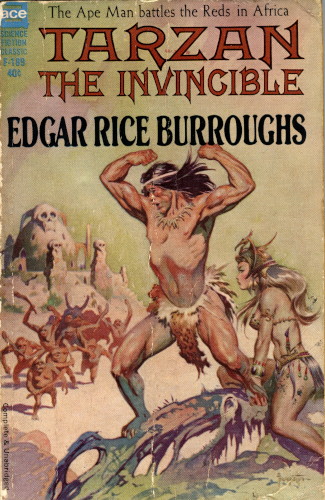
TARZAN THE INVINCIBLE
Africa, the hunting ground of savage beasts, primitive men, and the
hidden fragments of ancient civilizations, was the target of a clever
Red scheme to create chaos and take it over.
It was in the oldest ruins of all, the lost city of lost Atlantis,
Opar, that this newest of world conquerors chose to make the point of
attack.
There was only one defender of freedom who knew the location of Opar
and that was Tarzan of the Apes. And so the contest of wits and skill
and jungle cunning was met—to make TARZAN THE INVINCIBLE one of Edgar
Rice Burroughs' best.