The
Philosopher’s
Place
The evening came at last; the burning calm was followed
by a breeze breathing of life, and on the sky sailed, as if it
were wafted by that gentle breeze, the evening star. The
lifeless silence of the desert now began to be broken by a
variety of sounds, wild and sad enough in themselves, but
softening by distance, and not ill suited to that declining hour
which is so natural an emblem of the decline of life. The
moaning of the shepherd’s horn; the low of the folding herds;
the long, deep cry of the camel; even the scream of the vulture
wheeling home from some recent wreck on the shore, and
the howl of the jackal venturing out on the edge of dusk, came
with no unpleasing melancholy upon the wind. We stood gazing
impatiently from the tent door, at the west, that still
glowed like a furnace of molten gold.
“Will that sun never go down?” I exclaimed. “We must
wait his leisure, and he seems determined to tantalize us.”
“Yes; like a rich old man, determined to try the patience
of his heirs, and more tenacious of his wealth the more his
powers of enjoyment decay,” said the Jewess.
“Philosophy from those young lips! Yet the desert is the
place for a philosopher.”
“That I deny,” said my sportive companion. “Philosophy
is good for nothing where it has nothing to ridicule, and where
it will be neither fed nor flattered. Its true place is the world,
as much as the true place of yonder falcon is wherever it can
find anything to pounce upon. Here your philosopher must
labor for himself and laugh at himself—an indulgence in
which he is the most temperate of men. In short, he is fit
only for the idle, gay, ridiculous, and timid world. The desert
is the soil for a much nobler plant. If you would train a
poet into flower, set him here.”
“Or a plunderer.”
“No doubt. They are sometimes much the same.”
“Yet the desert produces nothing—but Arabs.”
“There are some minds, even among Arabs, and some of
their rhapsodies are beauty itself. The very master of this
tent, who fought and killed, I dare not say how many, to secure
so precious a prize as myself, and who, after all his
heroism, would have sold me into slavery for life, spent half
his evenings sitting at this door chanting to every star of
heaven, and riming, with tears in his eyes, to all kinds of
tender remembrances.”
“But perhaps he was a genius, a heaven-born accident, and
his merit was the more in being a genius in the midst of such
a scene.”
“No—everything round us this hour is poetry. The silence—those
broken sounds that make the silence more striking as
they decay—those fiery continents of cloud, the empire of that
greatest of sheiks, the sun, lord of the red desert of the air—the
immeasurable desert below. Vastness, obscurity, and terror,
the three spirits that work the profoundest wonders of the
poet, are here in their native region. And now,” she said,
with a look that showed there were other spells than poetry
to be found in the desert, “to release you, I know, by signs
infallible, that the sun is setting.”
I could not avoid laughing at the mimic wisdom with which
she announced her discovery, and asked whence she had acquired
the faculty of solving such rare problems.
A Daughter of
the Desert
“Oh, by my incomparable knowledge of the stars.” She
pointed to the eastern sky, on which they began to cluster in
showers of diamond. “I have to thank the desert for it;
and,” she added, with a slight submission of voice, “for everything.
I am a daughter of the desert; the first sight that I
saw was a camel; my early, my only accomplishments were
to ride, sing Bedouin songs, tell Bedouin stories, and tame
a young panther. But my history draws to a close. While
I was supreme in the graces of a savage, had learned to sit a
dromedary, throw the lance, make haiks, and gallop for a
week together, love, resistless love, came in my way. The
son of a sheik, heir to a hundred quarrels and ten thousand
sheep, goats, and horses, claimed me as his natural prey. I
shrank from a husband even more accomplished than myself,
and was meditating how to make my escape, whether into the
wilderness or into the bottom of the sea, when a summons
came which, or the money that came with it, the sheik found
irresistible. And now my history is at an end.”
“And so,” said I, to provoke her to the rest of her narrative,
“your story ends, as usual, with marriage. You, of
course, finding that you had nothing to prevent your leaving
the desert, took the female resolution of remaining in it, and
as you might discard the young sheik at your pleasure, refused
to have any other human being.”
“Can you think me capable of such a horror?”
She stamped her little foot in indignation on the ground;
then turning on me with her flashing eye, penetrated the
stratagem at once by my smile.
Naomi
Continues Her
Story
“Then hear the rest. I instantly mounted my dromedary,
galloped for three days without sleep, and at length saw the
towers of Jerusalem—glorious Jerusalem. I passed through
crowds that seemed to me a gathering of the world; streets
that astonished me with a thousand strange sights; and,
overwhelmed with magnificence, delight, and fatigue, arrived
at a palace, where I was met by a host of half-adoring domestics,
and was led to the most venerable and beloved of
wise and holy men, who caught me to his heart, called me his
Naomi, his child, his hope, and shed tears and blessings on
my head, as the sole survivor of his illustrious line.” She
burst into tears.
The recollection of the good and heroic high priest was
strong with us both, and in silence I suffered her sorrows to
have their way. A faint echo of horns and voices roused me.
“Look to the hills!” I exclaimed, as I saw a long black line
creeping, like a march of ants, down the side of a distant
ridge of sand.
“Those are our Arabs,” said she, without a change of countenance.
“They are, of course, coming to see what the angel,
or demon, who visited them to-day has left in witness of his
presence. But from what I overheard of their terrors, no
Arab will venture near the tents till night; night, the general
veil of the iniquities of this amusing and very wicked world.”
“Yet how shall we traverse the sands on foot?”
“Forbid it, the spirit of romance,” said she. “I must see
whether the gallantry of the sheik has not provided against
that misfortune.”
She flew into the tent, and, drawing back a curtain, showed
me two mares, of the most famous breed of Arabia.
The Spirited
Steeds
“Here are the Koshlani,” said she, with playful malice
dancing in her eyes; “I saw them brought in, in triumph,
last night, stolen from the pastures of Achmet Ben Ali himself,
first horse-stealer and prince of the Bedouins, who is
doubtless by this time half dead of grief at the loss of the two
gems of his stud. I heard the achievement told with great
rejoicings, and a very curious specimen of dexterity it was.
Come forth,” said she, leading out two beautiful animals,
white as milk; “come forth, you two lovely orphans of the
true breed of Solomon—princesses with pedigrees that put
kings to shame, unless they can go back two thousand years;
birds of the Bedouin, with wings to your feet, stars for
eyes, and ten times the sense of your masters in your little
tossing heads.”
She sprang upon her courser, and winded it with the delight
of practised skill. The Arabs were now but a few miles off
and in full gallop toward us. I urged her to ride away at
once, but she continued curveting and maneuvering her spirited
steed, that, enjoying the free air of the desert after
having been shut up so long, threw up its red nostrils and
bounded like a stag.
“A moment yet,” said she; “I have not quite done with
the Arab. It is certainly bad treatment for his hospitality to
have plundered him of his dinner, his money, and his horses.”
“And of his captive, a loss beyond all reparation.”
“I perfectly believe so,” was the laughing answer; “but I
have been thinking of making him a reparation which any
Arab on earth would think worth even my charms. I have
been contriving how to make his fortune.”
“By returning his shekels?”
“Not a grain of them shall he ever see. No, he shall not
have the sorrow to think that he entertained only a princess
and a philosopher. As a spirit you came, and as a spirit you
shall depart, and he shall have the honor of telling the tale.
The national stories of such matters are worn out; he shall
have a new one of his own, and every emir in the kingdoms
of Ishmael—through the fiery sands of Ichama, the riverless
mountains of Nejd; Hejaz, the country of flies and fools; and
Yemen, the land of locusts, lawyers, and merchants, will rejoice
to have him at his meal. Thus the man’s fortune is
made, for there is no access to the heart like that of being
necessary to the dinners and dulness of the mighty.”
“Or on the strength of the wonder,” said I, “he may make
wonders of his own, turn charlatan of the first magnitude,
profess to cure the incurable, and get solid gold for empty
pretension; sell health to the epicure, gaiety to the old, and
charms to the repulsive; defy the course of nature, and live
like a prince upon the exhaustless revenue of human absurdity.”
The Blazing
Tents
A cloud of smoke now wreathed up from the sheik’s tent;
fire followed; and even while we looked on, the wind, carrying
the burning fragments, set the whole camp in a blaze.
The Arabs gave a universal shriek and fled back, scattering
with gestures and cries of terror through the sands.
“There—there,” said my companion, clapping her delicate
white palms in exultation; “let them beware of making women
captives in future. In my final visit to the tent I put a
firebrand into the very bundle of carpets in which I played
the part of slave.”
“Not to be your representative, I presume.”
Forward!
“Yes, with only the distinction that in time I should have
been much the more perilous of the two. If that unlucky
sheik had dared to keep me a week longer in his detestable
tent, I should have raised a rebellion in the tribe, dethroned
him, and turned princess on my own account. As to burning
him out, there was no remedy. But for those flames the tribe
would have been upon our road. But for those flames we
might even have been mistaken for mere mortals; and your
spirits always vanish as we do, in fire and smoke. How
nobly those tents blaze! Now, forward!”
She gave the reins to her barb, flung a triumphant gesture
toward the burning camp, and under cover of a huge sheet of
fiery vapor we darted into the wilderness.
Our flight lay toward Masada. The stars were brilliant
guides, and the coolness of the Arabian night, which forms so
singular a contrast to the overpowering ardors of the day, relieved
us from the chief obstacle of desert travel. At daybreak
we reached a tract, whose broken and burnt-up ground
showed that there had lately encamped the army the sound of
whose march had startled my reveries in the island.
It was evening when I caught the glimpse of the fortress.
My heart trembled at the sight. An impression of evil was
upon me. Yet I must go on or die.
“There,” said I, “you see my home, and yours while you
desire it. You will find friends delighted to receive you, and
a protection that neither Roman nor Arab can insult. Heaven
grant that all may be as when I left Masada!”
The fair girl gratefully thanked me.
Naomi’s
Gratitude
“I have been long,” said she, “unused to kindness, and its
voice overpowers me. But if the duty, the gratitude, the
faithful devotedness of the orphan to her generous preserver
can deserve protection, I shall yet have some claim. Suffer
me to be your daughter.”
She bowed her head before me with filial reverence. I took
the outstretched hand, that quivered in mine, and pressed it
to my lips. The sacred compact was pledged in the sight of
the stars. More formal treaties have been made, but few sincerer.
We rapidly advanced to the foot of the ridge that, now defining
and extending, showed its well-known features in all
their rugged grandeur. But to come within reach of the
gates, I had still one of the huge buttresses of the mountain
to go round. My companion, with the quick sympathy that
makes one of the finest charms of women, already shared in
my ominous fears, and rode by my side without a word. My
eyes were fixed on the ground. I was roused by a clash of
warlike music. The suspense was terribly at an end.
Signs
of Defeat
The spears of a legion were moving in a glittering line
down the farther declivity. Squadrons of horses in marching
order were drawn up on the plain. The baggage of a little
army lay under the eye, waiting for the escort now descending
from the fortress. The story of my ruin was told in that
single glance. All was lost!
The walls of the citadel, breached in every direction, gave
signs of a long siege. The White Stag of Naphtali no longer
lifted its blazon on the battlements; dismantling and desolation
were there. But what horrors must have been wrought
before the Romans could shake the strength of those walls!
First and most fearful, what had been the fate of Miriam
and my children? In what grave was I to look for my noble
brother and my kinsmen?
Conscious that to stay was to give myself and my trembling
companion to the cruel mercy of Rome, I yet was unable to
leave the spot. I hovered round it, as the spirit might hover
round the tomb. Maddening with bitter yearnings of heart,
that intense eagerness to know the worst which is next to
despair, I spurred up the steep by an obscure path that led
me to a postern. There was no sound within. I dashed
through the streets. Not a living being was to be seen; piles
of firewood lighted under the principal buildings and at the
gates showed that the fortress was destined to immediate
overthrow. War had done its worst. The broad, sanguine
plashes on the pavements showed that the battle had been
fought, long and desperately, within the walls. The famous
armory was a heap of ashes. Ditches dug across the streets
and strewed with broken weapons, and the white remnants of
what once was man; walls raised within walls, and now broken
down; stately houses loopholed and turned into little fortresses;
fragments of noble architecture blocking up the
breaches; graves dug in every spot where the spade could
open a few feet of ground; fragments of superb furniture
lying half burnt where the defenders had been forced out by
conflagration—all gave sad evidence of the struggle of brave
men against overpowering numbers.
But where were they who had made the prize so dear to the
conquerors? Was I treading on the clay that once breathed
patriotism and love? Did the wreck on which I leaned, as I
gazed round this mighty mausoleum, cover the earthly tenement
of my kinsmen, and, still dearer, the last of my name?
Was I treading on the grave of those gentle and lovely natures
for whose happiness I would rejoicingly have laid down
the scepter of the world?
Salathiel
Meets Jubal
In my agitation I cried aloud. My voice rang through the
solitude round me, and returned on the ear with a startling
distinctness. But living sounds suddenly mingled with the
echo. A low groan came from a pile of ruins beside me. I
listened, as one might listen for an answer from the sepulcher.
The voice was heard again. A few stones from the shattered
wall gave way, and I saw thrust out the withered, bony hand
of a human being. I tore down the remaining impediments,
and beheld pale, emaciated, and at the point of death by famine,
my friend, my fellow soldier, my fellow sufferer—Jubal!
Joy is sometimes as dangerous as sorrow. He gave a
glance of recognition, struggled forward, and, uttering a wild
cry, fell senseless into my arms. On his recovering, before
I could ask him the question nearest my heart, it was answered.
“They are safe—all safe,” said he. “On the landing of
fresh troops from Italy, the first efforts of the legions were
directed against the fortress. The pirates, in return for the
victory to which you led them, had set me at liberty. I made
my way through the enemy’s posts; Eleazar, ever generous
and noble, received me, after all my wanderings, with the
heart of a father, and we determined on defending this glorious
trophy of your heroism, to the last man. But with the
wisdom that never failed him, he knew what must be the result,
and at the very commencement of the siege sent your
family away to Alexandria, where they might be sure of protection
from our kindred.”
Salathiel’s
Family
“And they went by sea?” I asked shudderingly, while the
whole terrible truth dawned upon my mind. They were in
the fleet which I had followed.
“It was the only course. The country was filled with the
enemy.”
“Then they are lost! Wretched father, now no father!—man
marked by destiny!—the blow has fallen at last! They
perished—I saw them perish. Their dying shrieks rang in
these ears. I was their destroyer. From first to last I have
been their undoing!”
Jubal looked on me with astonishment. My adopted
daughter, without any idle attempt at consolation, only
bathed my hand with her tears.
“There must be some misconception in all this,” said
Jubal. “Before we left that accursed dungeon, they had
embarked with a crowd of females from the surrounding
country in one of the annual fleets for Egypt. Before we
sailed from the pirates’ cavern they were probably safe in
Alexandria.”
“No! I saw them perish. I heard their dying cry. I
drove them to destruction,” was the only answer that my
withering lips could utter. I remembered the horrors of the
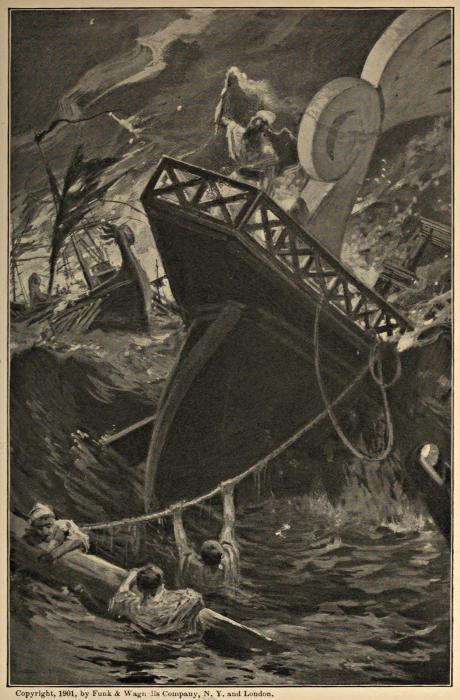
storm; the desperate efforts of the merchant galley to escape;
its fatal disappearance. Faintly, and with many a successive
agony, I gave the melancholy reasons for my belief. My
auditors listened with fear and trembling.
“There is now no use in sorrow,” said Jubal sternly, “and
as little in struggle. I too have lived until the light that
brightened my dreary hours is extinguished. I too have
known the extremities of passion. If suffering could have
atoned for my offenses, I have suffered. A thousand years
of existence could not teach me more. Here let us die.”
He unsheathed his poniard.
My young companion, in the anxiety of the moment, forgetting
the presence of a stranger, flung back the veil which
had hitherto covered her face and figure, and clasping my
raised arm, said in a tone so low, yet penetrating, that it
seemed the whisper of my own conscience:
Naomi’s
Reprimand
“Has death no fears?” She fixed her eyes on me and
waited breathlessly for the answer.
“Daughter of beauty,” said Jubal, as a smile of admiration
played on his sad features, “thoughts like ours are not for the
lovely and the young. May the Heaven that has stamped
that countenance be your protection through many a year!
But to the weary, rest is happiness, not terror. Prince of
Naphtali, this fair maiden’s presence forbids darker thoughts;
we must speed her on her way to security before we can think
of ourselves and our misfortunes.”
“The daughter of Ananus,” said she, in atone of heroic
pride, “has no earthly fears. The boldest warrior of Israel
never died more boldly than that venerable parent. Within
his sacred robes was the heart of a soldier, a patriot, and a
king. Let me die for a cause like his; at the foot of the
altar, let my blood be poured out for my country; let this
feeble form sink in the ruins of the Temple, and death will
be of all welcome things the most welcome. But I would not
die for a fantasy, for idleness, for nothing. Put up that
weapon, warrior, and let us go forth and see whether great
things are not yet to be done.”
She significantly pointed toward Jerusalem.
“It is too late,” said Jubal, glancing with a sigh at his own
wasted form.
“What?” said the heroine; “is it too late to be virtuous,
but not too late to be guilty? Too late to resist the enemies of
our country, but not too late to make ourselves worthless to
our holy cause? If Heaven demands an account of every
wasted talent and misspent hour, what fearful account will
be theirs who make all talents and all hours useless at a
blow?”
“Maiden, you have not known what it is to lose everything
that made earth a place of hope,” said I, gazing with wonder
and pity on the fine enthusiasm that the world is so fatally
empowered to destroy. “May not the tired traveler hasten
to the end of his journey without a crime?”
“May not the slave,” said Jubal, “weary of his chain, escape
unchidden from his captivity?”
Words of
Wisdom
“And may not the soldier quit his post when caprice disgusts
him with his duty?” was the maiden’s answer, with a
lofty look. “Or, may not the child break loose from the place
of instruction and plead his dislike to discipline? As well
may man, placed here for the service of the highest of beings,
plead his own narrow will against the supreme command,
daringly charge Heaven with the injustice of setting him a
task above his strength, and madly insult Its power under
the pretext of relying on Its compassion.”
She paused, as if surprised at her own earnestness, and
blushing, said: “This wisdom is not my own. It was the
last gift of an illustrious parent, when in my agony at the
sight of his mortal wounds I longed to follow him. ‘Live,’
said he, ‘while you can live with virtue. The God who has
placed us on earth best knows when and how to recall us. If
self-destruction were no crime in one instance, it would be no
crime to universal mankind; the whole frame of society would
be overthrown by a permission to evade its duties on the easy
penalty of dying. Our obligations to country, family, man,
and Heaven would be perpetually flung off, if they were to
be held at the caprice of human nature.’”
Jubal looked intently on the young oracle, and tho bending
with Oriental deference, was yet unconvinced.
“Is there to be no end to the mind’s anxiety but the tardy
decay of the frame? Is there no time for the return of the
exile, or what is this very feeling of despair but a voice within—an
unwritten command to die?”
Naomi turned to me with a look imploring my aid. But
I was broken down by the tidings that had now reached me.
Jubal wrapped his cloak round him, and was striding into the
shadow of the ruin. Naomi, terrified at the idea of death,
seized the corner of his mantle.
“Will you shrink from the evils of life,” she adjured,
“and yet have the dreadful courage to defy the wrath of
Heaven? Shall worms like us, shall creatures covered with
weaknesses and sins, whose only hope must be in mercy, commit
a crime that by its very nature disclaims supplication and
makes repentance impossible?”
With the energy of terror she threw back the folds of the
cloak and arrested the hand, with the dagger already uplifted.
She led back the reluctant, yet unresisting, step, and
said in a voice still trembling: “Prince of Naphtali, save
your brother!”
Naomi’s
Triumph
I held out my arms to Jubal; the sternness of his soul was
past, and he fell upon my neck. Naomi stood, exulting in
her triumph, with the countenance that an angel might wear
at the return of a sinner.
“Prince of Naphtali,” said she, “if those who were dear to
you have perished—which Heaven avert!—you may have been
thus but the more marked out for the instrument of solemn
services to Israel. The virtues that might have languished
in the happiness of home may be summoned into vigor for
mankind. Warrior,” and she turned her glowing smile on
Jubal, “this is not the time for valor and experience to shrink
from the side of our country. Perfidy may still be repelled
by patriotism; violence put down by wisdom; the power of
the people roused by the example of a hero; even the last
spark of life may be made splendid by mingling with the last
glories of the people of God.”
Jubal’s wasted cheek reddened with the theme; but his
emotion was too deep for language. He led the way; we
passed in silence through the deserted streets, and without seeing
the face of a human being, reached the dismantled gates
of Masada.
Jubal guided us down the declivities among ramparts and
trenches, and after long windings, where every step reminded
me of havoc, brought us to a little hamlet in the recesses of
the valley, so secluded that it seemed never to have heard the
sound of war. The thunder of the falling masses of fortification,
as the fire reached their props, kept us awake all night,
and I arose from my humble couch to breathe the delicious
air that makes the summer night of Asia the time of refreshment
alike to the frame and to the mind. I found Jubal
already abroad and gazing on the summit of the mountain,
where the sullen glare of the sky and the crash of buildings
showed that the work of devastation was rapidly going on.
Details of a
Siege
He gave me some details of the siege. The Romans had
found the fortress so hazardous to the advance of their reenforcements
that its possession was essential to the conquest
of Judea. Cestius, my old antagonist, solicited the command
to wipe off his disgrace, and the whole force of the legions
was brought up. But the generalship of Eleazar and the
intrepidity of the garrison baffled every assault, with tremendous
loss of the enemy. The siege was next turned into
a blockade. Famine and disease were more formidable than
the sword; and the brave defenders were reduced to a number
scarcely able to man the walls.
“We now,” said Jubal, “fought the battle of despair; we
saw the enemy’s camp crowded every day with fresh troops,
and the provisions of the whole country brought among them
in profusion, while we had not a morsel to eat, while our
fountains ran dry, and while our few troops were harassed
with mortal fatigue. Yet no man thought of surrender.
Eleazar’s courage—a courage sustained by higher thoughts
than those of the soldier, the fortitude of piety and prayer—inspired
us all, and we went to our melancholy duties with
the calmness of men to whom the grave was inevitable.
The Final
Attack
“At last, when our reduced numbers gave the enemy a
hope, we were attacked by their whole force. But, if they
expected to conquer us at their ease, never were they more
deceived. When the walls gave way before their machines,
they were fought from street to street, from house to house,
from chamber to chamber. Eleazar, as active as he was wise,
was everywhere; we fought in ruins—in fire. Multitudes of
the enemy perished, and more deaths were given by the knife
than the spear, for our arms were long since exhausted. The
last effort was made on the spot where you found me. When
every defense was mastered by the constant supply of fresh
troops, Eleazar, passing through the subterranean to attack
the Roman rear, left me in command of the few who survived.
We entrenched ourselves in the armory. For three days we
fought without tasting food, without an hour’s sleep, without
laying the weapons out of our hands. At length the final
assault was given. In the midst of it we heard shouts which
told us that our friends had made the concerted attack, but
we were too few and feeble to second it. The shouts died
away; we were overpowered, and my first sensation of returning
life was the combined agony of famine, wounds, and suffocation,
under the ruins that I then thought my living
grave.”
“By dawn,” said I, “we must set out for Jerusalem.”
“It has been closely invested,” was the answer, “for the
last three months;[42] and famine and faction are doing their
worst within the walls. Titus is without, at the head of a
hundred thousand of the legionaries and auxiliaries. To enter
will be next to impossible, and when once entered, what
will be before you but the madness of civil discord, and
finally, death by the hands of an enemy utterly infuriated
against our nation?”
“To Jerusalem, at all risks,” I exclaimed; “my fate is
mingled with that of the last stronghold of our fallen people.
What matters it to one whose roots of happiness are cut up
like mine, in what spot he struggles with man and fortune?
As a son of Judea my powers are due to her cause, and every
drop of my blood, shed for any other, would be treason to the
memory of my fathers. The dawn finds me on my way to
Jerusalem.”
“Spoken like a prince of Naphtali,” sighed Jubal; “but there
I must not follow you. The course of glory is cut off for me;
alone, something may still be done by collecting the fugitives
of the tribes and harassing the Roman communications. But
Jerusalem, tho every stone of her walls is precious to my
soul, must not receive my guilty steps. I have horrid recollections
of things seen and done there. Onias, that wily
hypocrite, will be there to fill me with visions of terror.
There, too, are others.” He was silent, but suddenly resuming
his firmness: “I have no hostility to Constantius; I even
honor him; but my spirit is still too feverish to bear his presence—I
must live and die, far from all whom I have ever
known.”
He hid his face in his mantle, but the agitation of his form
showed his anguish, more than clamorous grief. He walked
forth into the darkness. I was ignorant of his purpose, and
lingered long for his return—I saw him no more.
The Arrival of
Roman Cavalry
Disturbed and pained by his loss, I had scarcely thrown
myself on the cottage floor, my only bed, when I was roused
by the cries of the village. A squadron of Roman cavalry
marching to Jerusalem had entered, and was taking up its
quarters for the night. The peasantry could make no resistance,
and attempted none. I had only time to call to my
adopted daughter to rise, when our hut was occupied and we
were made prisoners.
This was an unexpected blow; yet it was one to which, on
second thoughts, I became reconciled. In the disturbed state
of the country, traveling was totally insecure, and even to
obtain a conveyance of any kind was a matter of extreme difficulty.
The roving plunderers who hovered in the train of the
camp were, of all plunderers, the most merciless; while, falling
into the hands of the legionaries, we were at least sure of
an escort; I might obtain some useful information of their
affairs, and once in sight of the city, might escape from the
Roman lines with more ease as a prisoner than I could pass
them as an enemy.
The cavalry moved at daybreak, and before night we saw
in the horizon the hills which surround Jerusalem. We had
full evidence of our approach to the center of struggle by the
devastation that follows the track of the best-disciplined
army—groves and orchards cut down, cornfields trampled,
cottages burned, gardens and homesteads ravaged. Farther
on, we traversed the encampments of the auxiliaries, barbarians
of every color and language within the limits of the
mightiest of empires.
Salathiel Views
the Soldier of
Barbarism
To the soldier of civilized nations, war is a new state of existence;
to the soldier of barbarism, war is but a more active
species of his daily life. It requires no divorce from his old
habits, and even encourages his old objects, cares, and pleasures.
We found the Arab, the German, the Scythian, and
the Ethiop hunting, carousing, trafficking, and quarreling, as if
they had never stirred from their native regions. The hordes
brought with them their families, their cattle, and their trade.
In the rear of every auxiliary camp was a regular mart
crowded with all kinds of dealers. Through the fields the
barbarians were following the sports of home. Trains of
falconers were flying their birds at the wild pigeon and heron.
Half-naked horsemen were running races, without saddle
or rein, on horses as wild and swift as the antelope. Groups
were lying under the palm-groves asleep, with their spears
fixed at their heads; others were seen busily decorating themselves
for battle; crowds were dancing, gaming, and drinking.
As we advanced, we could hear the variety of clamors and
echoes that belong to barbarian war—the braying of savage
horns, the roars of mirth, rage, and feasting; the shouts of
clans moving up to reenforce the besiegers; the screams and
lamentations of the innumerable women, as the wains and litters
brought back the wounded; the barbarian howlings over
the hasty grave of some chieftain; the ferocious revelry of the
discoverers of plunder, and the inextinguishable sorrows of
the captives.
We passed through some miles of this boisterous and bustling
scene, in which even a Roman escort was scarcely a sufficient
security. The barbarians thronged round us, brandished
their spears over our heads, rode their horses full gallop
against us, and exhausted the whole language of scorn, ridicule,
and wrath upon our helpless condition.
But the clamor gradually died away, and we entered upon
another region,—a zone of silence and solitude interposed between
the dangerous riot of barbarism and the severe regularity
of the legions. Far within this circle, we reached the
Roman camp—the world of disciplined war! The setting
sun threw a flame on the long vistas of shield and helmet
drawn out, according to custom, for the hour of exercise before
nightfall. The tribunes were on horseback in front of
the cohorts, putting them through that boundless variety of
admirable movements in which no soldiery were so dexterous
as those of Rome.
The Perfection
of Discipline
But all was done with characteristic silence. No sound
was heard but the measured tramp of the maneuver and the
voice of the tribune. The sight was at once absorbing to
the eye of one like me, an enthusiast in soldiership, and appalling
to the lover of his country. Before me was the great
machine, the resistless energy that had leveled the strength
of the most renowned kingdoms. With the feeling of a man
who sees the tempest at hand, in the immediate terror of the
bolt, I could yet gaze with wonder and admiration at the
grandeur of the thunder-cloud! Before me was at once the
perfection of power and the perfection of discipline. Here
were no rambling crowds of retainers, no hurrying of troops
startled by sudden rumor, no military clamors. All was calm,
regular, and grand. In the center of the most furious war
ever waged, I might have thought that I saw but a summer
camp in an Italian plain.
As the night fell, the legions saluted the parting sun with
homage, according to a custom which they had learned in
their eastern campaigns. Sounds less of war than of worship
arose; flutes breathed in low and sweet harmonies from
the lines; and this iron soldiery, bound on the business of
extermination, moved to their tents in the midst of strains made
to wrap the heart in softness and solemnity.
I rose at dawn. But was I in a land of enchantment? I
looked for the immense camp—it had vanished. A few soldiers
collecting the prisoners sleeping about the field were all
that remained of an army. Our guard explained the wonder.
An attack on the trenches, in which the besiegers had been
driven in with serious loss, determined Titus to bring up his
whole force. The troops had moved with that habitual silence
which eluded almost the waking ear. They were now
beyond the hills, and the hour was come when the prisoners
were ordered to follow them. But where was the daughter
of Ananus? I had placed her in a tent with some captive
females of our nation. The tent was struck, and its inmates
were gone! On the spot where it stood a flock of sheep were
already grazing, with a Roman soldier leaning drowsily on his
spear for their shepherd.
To what alarms might not this fair girl be exposed? Dubious
and distressed, I followed the guard, in the hope of
discovering the fate of an innocent and lovely being, who
seemed, like myself, marked for misfortune.
The
Equipment of
Soldiers
In this march we traversed almost the whole circuit of the
hills surrounding Jerusalem, and I thus had, for three days,
the opportunity that I longed for, of seeing the nature of the
force with which we were to contend. The troops were admirably
armed. There was nothing for superfluity; yet
those who conceived the system knew the value of show,
and the equipment of the legions was superb. The helmets,
cuirasses, and swords were frequently inlaid with precious
metals, and the superior officers rode richly caparisoned
chargers, purchased at an enormous price from the finest studs
of Europe and Asia. The common soldier was proud of the
brightness of his shield and helmet; on duty both were covered,
but on their festivals the most cheering moment was
when the order was given to uncase their arms. Then nothing
could be more magnificent than the aspect of the legion.
The Methods of Warriors
One striking source of its pomp was the multitude of its
banners. Every emblem that mythology could feign, every
animal, every memorial connected with the history of soldiership
and Rome, glittered above the forest of spears. Gilded
serpents, wolves, lions, gods, genii, stars, diadems, imperial
busts, and the eagle paramount over all, were mingled with
vanes of purple and embroidery. The most showy pageant of
civil life was dull and colorless to the crowded splendor of the
Roman line.
Their system of maneuver gave this magnificence its full
development. With the modern armies the principle is the
avoidance of fire. With the ancient armies the principle was
the concentration of force. All was done by impulse. The
figure by which the greatest weight could be thrown against
the enemy’s ranks, was the secret of victory. The subtlety
of Italian imagination, enlightened by Greek science, and fertilized
by the experience of universal war, was occupied in the
discovery; and the field exercise of the legions displayed every
form into which troops could be shaped for victory. The Romans
always sought to fight pitched battles. They left the
minor services to their allies, and haughtily reserved themselves
for the master strokes by which empires are lost or
won. The humbler hostilities, the obscure skirmishings and
surprises, they disdained; observing that, while “to steal
upon men was the work of a thief, and to butcher them was
the habit of a barbarian, to fight them was the act of a soldier.”
The Track of
Invasion
At the close of a weary day we reached our final station,
upon the hill of Scopas, seven furlongs from Jerusalem.
Bitter memory was busy with me there. From the spot on
which I flung myself in heaviness of heart, huddled among a
crowd of miserable captives, and wishing only that the evening
gathering over me might be my last, I had once looked
upon the army of the oppressors marching into my toils and
exulted in the secure glories of myself and my country.
But the prospect now beneath the eye showed only the
fiery track of invasion. The pastoral beauty of the plain was
utterly gone. The innumerable garden-houses and summer
dwellings of the Jewish nobles, gleaming in every variety of
graceful architecture, among vineyards and depths of aromatic
foliage, were leveled to the ground; and the gardens were
turned into a sandy waste, cut up by trenches and military
works in every direction. In the midst rose the great Roman
rampart, which Titus, in despair of conquering the city by the
sword, drew round it, to extinguish its last hope of provisions
or reenforcements—a hideous boundary, within which all was
to be the sepulcher.
I now saw Jerusalem only in her expiring struggle.[43] Others
have given the history of that most memorable siege. My
knowledge was limited to the last hideous days of an existence
long declining, and finally extinguished in horrors beyond
the imagination of man.
A Fight in a Tempest
I knew her follies, her ingratitude, her crimes; but the love
of the city of David was deep in my soul; her lofty privileges,
the proud memory of those who had made her courts glorious,
the sage, the soldier, and the prophet, lights of the world, to
which the boasted illumination of the heathen was darkness,
filled my spirit with an immortal homage. I loved her then—I
love her still.
To mingle my blood with that of my perishing country was
the first wish of my heart. But I was under the rigor of the
confinement inflicted on the Jewish prisoners. My rank was
soon known; but while it produced offers of new distinction
from my captors, it increased their vigilance. To every temptation
I gave the same denial, and occupied my hours in
devices for escape. Meanwhile I saw with terror that the
wall of circumvallation was closing, and that a short period
must place an impassable barrier between me and the city.
I was aroused at midnight by the roaring of one of those
tempests which sometimes break in so fiercely upon an Eastern
summer. The lightning struck the tower in which I was
confined, and I found myself riding on a pile of ruins. Escape,
in the midst of a Roman camp, seemed as remote as
ever. But the storm which shook walls made its way at will
among tents, and the whole encampment was broken up. A
column of infantry passed where I was extricating myself
from the ruins. They were going to reenforce the troops in
the trenches, against the chance of an attack during the tempest.
I followed them. The night was terrible. The lightning
that blazed with frightful vividness, and then left the
sky to tenfold obscurity, alone led us through the lines. The
column was too late, and it found the besieged already mounted
upon the wall of circumvallation, and flinging it down in huge
fragments. The assault and defense were alike desperate.
At the moment of our arrival the night had grown pitchy
dark, and the only evidence that men were round me was the
clang of arms.
Salathiel Rescues Constantius
A sudden flash showed me that we had reached the foot of
the rampart. The besieged, carried away by their native impetuosity,
poured down in crowds. Their leader, cheering
them on, was struck by a lance and fell. The sight rallied
the Romans. I felt that now or never was the moment for
my escape. I rushed in front, and called aloud my name.
At the voice the wounded leader uttered a cry which I well
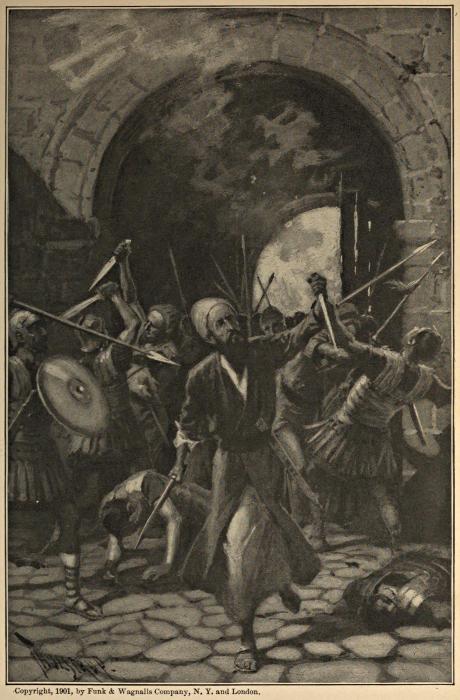
knew. I caught him from the ground. A gigantic centurion
darted forward and grasped my robe. Embarrassed with my
burden, I was on the point of being dragged back; the centurion’s
sword glittered over my head. With my only weapon,
a stone, I struck him a furious blow on the forehead. The
sword fell from his grasp; I seized it, and keeping the rest at
bay, and in the midst of shouts from my countrymen, leaped
the trench, with the nobler trophy in my arms—I had rescued
Constantius!
Jerusalem was now verging on the last horrors. I could
scarcely find my way through her ruins. The noble buildings
were destroyed by conflagration and the assaults of the various
factions. The monuments of our kings and tribes were
lying in mutilation at my feet. Every man of former eminence
was gone. Massacre and exile had been the masters of
the higher ranks; and even the accidental distinctions into
which the humbler were thrown by the few past years, involved
a fearful purchase of public hazard. Like men in an
earthquake, the elevation of each was only a sign to him of
the working of an irresistible principle of ruin. But the most
formidable characteristic was the change wrought in the popular
mind.
A single revolution may be a source of public good, but a
succession of great political changes is always fatal, alike to
public and private virtue. The sense of honor dies in the
fierce pressures of personal struggle. Humanity dies in the
sight of hourly violences. Conscience dies in the conflict
where personal safety is so often endangered that its preservation
at length usurps the mind. Religion dies where the
religious man is so often the victim of the unprincipled.
Violence and vice are soon found to be the natural instruments
of triumph in a war of the passions; and the more relentless
atrocity carries the day, until selfishness—the mother
of treachery, rapine, and carnage—is the paramount principle.
Then the nation perishes, or is sent forth in madness and misery,
an object of terror and infection, to propagate evil through
the world.
The Wrecks of Pillage
The very features of the popular physiognomy were changed.
The natural vividness of the countenance was there, but hardened
by habitual ferocity. I was surrounded by a multitude,
in each of whom I was compelled to see the assassin. The
keen eye scowled with cruelty; the cheek wore the alternate
flush and paleness of desperate thoughts. The hurried gatherings,
the quick quarrel, the loud blasphemy, told me the infuriate
temper that had fallen, for the last curse, on Jerusalem.
Scarcely a man passed me of whom I could not have
said: “There goes one from a murder or to a murder.”
But even more open evidences startled me, accustomed as I
was to scenes of military violence. I saw men stabbed in
familiar greetings in the streets; mansions set on fire and
burned in the face of day, with their inmates screaming for
help, and yet unhelped; hundreds slain in rabble tumults, of
which no one knew the origin. The streets were covered with
the wrecks of pillage, sumptuous furniture plundered from the
mansions of the great, and plundered for the mere love of
ruin; mingled with the more hideous wrecks of man—unburied
bodies, left to whiten in the blast or to be torn by the
dogs.
Three factions divided Jerusalem, even while the Roman
battering-rams were shaking her colossal towers; three armies
fought night and day within the city. Streets undermined,
houses battered down, granaries burned, wells poisoned, the
perpetual shower of death upon each other from the roofs,
made the external hostility trivial; and the Romans required
only patience to have been bloodless masters of a city which
yet they would have found only a tomb of its people.
“I had rescued Constantius.”
[see page 355.

Copyright, 1901, by Funk & Wagnalls Company, N. Y. and London.
Salathiel Apostrophizes
I wandered day by day, an utter stranger, through Jerusalem.
All the familiar faces were gone. At an early period
of the war, many of the higher ranks, foreseeing the event,
had left the city; at a later, my victory over Cestius, by
driving back the enemy, had given a free passage to a crowd
of others. It was at that time remarked that the crowd were
chiefly Christians, and a singular prophecy of their Master was
declared to be the warning of their escape. It is certain that
of His followers, including many even of our priests and
learned men, scarcely one remained.[44] They said that the evil
day, menaced by the divine Wisdom, through Moses (may
he rest in glory!) was come; that the death of their Master
was the consummate crime; and that the Romans, the predicted
nation of destroyers, the people “of a strange speech,”
flying on “eagle wings from the ends of the earth,” were already
commissioned against a land stained with the blood of
the Messiah.
Fatally was the word of the great prophet of Israel accomplished;
fearfully fell the sword, to smite away root and
branch; solemnly, and by a hand which scorned the strength
of man, was the deluge of ruin let loose against the throne of
David. And still through almost two thousand years, the
flood of desolation is at the full; no mountain-top is seen rising
above; no spot is left clear for the sole of the Jewish
foot; no dove returns with the olive.
Eternal King, shall this be forever? Wilt Thou utterly reject
the children of him whom thy right hand brought from
the land of the idolater? Wilt Thou forever hide Thy glory
from the tribes whom it led through the burning wilderness?
Wilt Thou never raise the broken kingdom of Thy servant
Israel? Still we wander in darkness, the tenants of a prison,
whose chains we feel at every step; the scoff of the idolater,
the captive of the infidel. Have we not abided without king
or priest, or ephod or teraphim, “many days”—when are
those days to be at an end?
Yet is not the captivity at last about to close? Is not the
trumpet at the lip to summon Thy chosen? Are not the
broken tribes now awaiting but Thy command to come from
the desert, from the dungeon, from the mine, like the light
from darkness? I gaze upon the stars and think, countless
and glorious as they are, such shall yet be thy multitude and
thy splendor, people of the undone! The promise of the
King of Kings is fulfilling, and even now, to my withered
eyes, to my struggling prayer, to the deeper agonies of a supplication
that no tongue can utter, there is a vision and an
answer. On the flint, worn by kneeling, I hear the midnight
voice; and weeping, wait for the day that will come,
tho heaven and earth shall pass away.
My first object was to ascertain the fate of my family.
From Constantius I could learn nothing, for the severity of
his wound had reduced him to such a state that he recognized
no one. I sat by him day after day, watching with bitter
solicitude for the return of his senses. He raved continually
of his wife, and of every other name that I loved. The affecting
eloquence of his appeals sometimes plunged me into
the deepest depression—sometimes drove me out to seek relief
from them, even in the horrors of the streets. I was the most
solitary of men. In those melancholy wanderings, none spoke
to me; I spoke to none. The kinsmen whom I had left under
the command of my brave son were slain or dispersed, and on
the night when I saw him warring with his native ardor, the
men whom he led to the foot of the rampart were an accidental
band, excited by his brilliant intrepidity to choose him
at the instant for their captain. In sorrow, indeed, had I
entered Jerusalem.
The
Devastation of
Jerusalem
The devastation of the city was enormous during its tumults.
The great factions were reduced to two, but in the
struggle a large portion of the Temple had been burned.
The stately chambers of the priests were dust and embers.
The cloisters which surrounded the sanctuary were beaten
down or left naked to the visitation of the seasons, which
now, as by the peculiar wrath of heaven, had assumed a fierce
and ominous inclemency. Tremendous bursts of tempest constantly
shook the city, and the popular mind was kept in perpetual
alarm at the accidents which followed those storms.
Fires were frequently caused by the lightning; deluges of rain
flooded the streets, and falling on the shattered roofs, increased
the misery of their famishing inhabitants; the sudden severity
of winter in the midst of spring added to the sufferings of a
people doubly unprovided to encounter it, by its unexpectedness
and by their necessary exposure on the battlements and
in the field.
Within the walls all bore the look of a grave, and even that
grave shaken by some great convulsion of nature. From the
battlements the sight was absolute despair. The Roman
camps covered the hills, and we could see the soldiery sharpening
the very lances that were to drink our blood. The fires
of their night-watches lighted up the horizon round. We
hourly heard the sound of their trumpets and their shouts,
as the sheep in the fold might hear the roaring of the lion
and the tiger, ready to leap their feeble boundary. Yet the
valor of the people was never wearied out. The vast mound,
whose circle was to shut us up from the help of man or the
hope of escape, was the grand object of attack and defense;
and tho thousands of my countrymen covered the ground
at its foot with their corpses, the Jew was still ready to
rush on the Roman spear. This valor was spontaneous, for
subordination had long been at an end. The names of John
of Giscala, and Simon, influential as they were in the earlier
periods of the war, had lost their force in the civil fury and
desperate pressures of the siege. No leaders were acknowledged
but hatred of the enemy, iron fortitude, and a determination
not to survive the fall of Jerusalem!
In this furious warfare I took my share with the rest;
handled the spear, and fought and watched without thinking
of any distinction of rank. My military experience, and the
personal strength which enabled me to render prominent services
in those desultory attacks, often excited our warriors to
offer me the command; but ambition was dead within me.
A Universal
Outcry
I was one day sitting beside the bed of Constantius, and
bitterly absorbed in gazing on what I thought the progress of
death, when I heard a universal outcry, more melancholy than
human voices seemed ever made to utter. My first thought
was that the enemy had forced the gates. I took my sword
down and prepared to go out and die. I found the streets
filled with crowds hurrying forward without any apparent
direction, but all exhibiting a sorrow amounting to agony;
wringing their hands, beating their bosoms, tearing their hair,
and casting dust and ashes on their heads. A large body of
the priesthood came rushing from the temple with loud
lamentations. The Daily Sacrifice had ceased![45] The perpetual
offering, which, twice a day, burned in testimonial of
the sins and the expiation of Israel, the peculiar homage of
the nation to Heaven, was no more! The siege had extinguished
the resources of the Temple; the victims could no
longer be supplied, and the people must perish without the
power of atonement! This was the final cutting off—the declaration
of the sentence—the seal of the great condemnation.
Jerusalem was undone!
Overpowered by this fatal sign, I was sadly returning to
my worse than solitary chamber, for there lay, speechless and
powerless, the noblest creature that breathed in Jerusalem—when
I was driven aside by a new torrent of the people, exclaiming
“The prophet! the prophet! wo to the city of
David!”
Wo, Wo, Wo
They rushed on in haggard multitudes, and in the midst of
them came a maniac bounding and gesticulating with indescribable
wildness. His constant exclamation was “Wo!—wo!—wo!”
uttered in a tone that searched the very
heart. He stopped from time to time, flung out some denunciation
against the popular crimes, and then recommenced his
cry of “Wo!” and bounded forward again.
He at length came opposite to the spot where I stood, and
his features struck me as resembling those I had seen before.
But they were full of a strange impulse—the grandeur of inspiration
mingled with the animal fierceness of frenzy. The
eye shot fire under the sharp and hollow brows; the nostrils
contracted and opened like those of an angry steed, and every
muscle of a singularly elastic frame was quivering and exposed
from the effects alike of mental violence and famine.
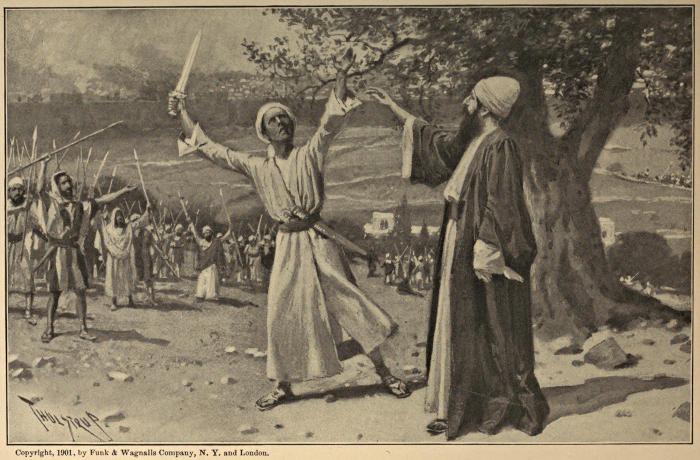
“Ho, Prince of Naphtali! we meet at last!” was his instant
outcry. His countenance fell, and tears gushed from
lids that looked incapable of a human feeling. “I found
her,” said he, “my beauty, my bride! She was in the dungeon.
The ring that I tore from that villain’s finger was
worth a gold-mine, for it opened the gates of her prison.
Come forth, girl!”
Sabat the Ishmaelite
With these words he caught by the hand and led to me a
pale creature, with the traces of loveliness, but evidently in
the last stage of mortal decay. She stood silent as a statue.
In compassion, I took her hand, while the multitude gathered
round us in curiosity. I now remembered Sabat, the Ishmaelite,
and his story.
“She is mad,” said Sabat, shaking his head mournfully,
and gazing on the fading form at his side. “Worlds would
not restore her senses. But there is a time for all things.”
He sighed, and cast his large eyes on heaven. “I watched
her day and night,” he went on, “until I grew mad too. But
the world will have an end, and then—all will be well.
Come, wife, we must be going. To-night there are strange
things within the walls, and without the walls. There will
be feasting and mourning; there will be blood and tears; then
comes the famine—then comes the fire—then the sword; and
then all is quiet, and forever!”
He paused, wiped away the tears, then began again wilder
than ever: “Heaven is mighty! To-night there will be wonders;
watch well your walls, people of the ruined city! To-night
there will be signs; let no man sleep but those who
sleep in the grave. Prince of Naphtali, have you too sworn,
as I have, to die?” He lifted his meager hand. “Come,
thunders! come, fires! vengeance cries from the sanctuary.
Listen, undone people! listen, nation of sorrow! the ministers
of wrath are on the wing. Wo!—wo!—wo!”
In pronouncing those words with a voice of the most sonorous
yet melancholy power, he threw himself into a succession
of strange and fearful gestures; then beckoning to the female,
who submissively followed his steps, plunged away among the
multitude. I heard the howl of “Wo!—wo!—wo!” long
echoed through the windings of the ruined streets, and
thought that I heard the voice of the angel of desolation.
The Sickness
of the Heart
The seventeenth day of the month Tamuz, ever memorable
in the sufferings of Israel, was the last of the Daily Sacrifice.
Sorrow and fear were on the city, and the silence of the night
was broken by the lamentations of the multitude. I returned
to my chamber of affliction, and busied myself in preparing
for the guard of the Temple, to withdraw my mind from the
gloom that was beginning to master me. Yet when I looked
round the room, and thought of what I had been, of the opulent
enjoyments of my palace, and of the beloved faces which
surrounded me there, I felt the sickness of the heart.
The chilling air that blew through the dilapidated walls,
the cruse of water, the scanty bread, the glimmering lamp,
the comfortless and squalid bed, on which lay in the last
stages of weakness a patriot and a hero—a being full of fine
affections and abilities, reduced to the helplessness of an infant,
and whom in leaving for the night I might be leaving
to perish by the poniard of the robber—unmanned me. I
cast the simitar from my hand, and sat down with a sullen
determination there to linger until death, or that darker vengeance
which haunted me, should do its will.
The night was stormy, and the wind howled in long and
bitter gusts through the deserted chambers of the huge mansion.
But the mind is the true place of suffering, and I felt
the season’s visitation in my locks drenched about my face,
and my tattered robes swept by the freezing blasts, as only
the natural course of things.
I was sitting by the bedside, moistening the fevered lips of
Constantius with water, and pressing on him the last fragment
of bread which I might ever have to give, when I, with
sudden delight, heard him utter for the first time articulate
sounds. I stooped to catch accents so dear and full of hope.
But the words were a supplication—he prayed to the Christian’s
God!
The Prayer of
Constantius
I turned away from this resistless conviction of his belief.
But this was no time for debate, and I was won to listen
again. His voice was scarcely above a whisper, but his language
was the aspiration of the heart. His eyes were closed,
and, evidently unconscious of my presence, in his high communion
with Heaven, he talked of things of which I had but
imperfect knowledge or none; of blood shed for the sins of
man; of a descended Spirit to guide the servants of Heaven;
of the unspeakable love that gave the Son of God to mortal
suffering for the atonement of that human guilt which nothing
but such a sacrifice could atone. He finished by the names
dear to us both; and praying “for their safety if they still
were in life, or for their meeting beyond the grave, declared
himself resigned to the will of his Lord.”
I waited in sacred awe until I saw, by the subsiding motion
of the lips, that the prayer was done, and then, anxious to
gain information of my family, questioned him. But with
the prayer the interval of mental power had passed away.
The veil was drawn over his senses once more, and his answers
were unintelligible. Yet even the hope of his restoration
lightened my gloom; my spirits, naturally elastic, shook off
their leaden weight; I took up the simitar, and pressing the
cold hand of my noble fellow victim, prepared to issue forth
to the Temple. The storm was partially gone, and the moon,
approaching to the full, was high in heaven, fighting her way
through masses of rapid cloud. The wind still roared in long
blasts, as the tempest retired, like an army repulsed, and indignant
at being driven from the spoil. But the ground was
deluged, and a bitter sleet shot on our half-naked bodies. I
had far to pass through the streets of the upper city, and
their aspect was deeply suited to the melancholy of the hour.
Vast walls and buttresses of the burned and overthrown
mansions remained, that in the spectral light looked like
gigantic specters. Ranges of inferior ruins stretched to the
utmost glance; some yet sending up the smoke of recent conflagration,
and others beaten down by the storms or left to
decay. The immense buildings of the hierarchy, once the
scene of all but kingly magnificence, stood roofless and windowless,
with the light sadly gleaming through their fissures,
and the wind singing a dirge of ruin through their halls. I
scarcely met a human being, for the sword and famine had
fearfully reduced the once countless population.
But I often startled a flight of vultures from their meal; or,
in the sinking of the light, stumbled upon a heap that uttered
a cry, and showed that life was there; or from his horrid morsel,
a wretch glared upon me, as one wolf might glare upon
another, that came to rob him of his prey; or the twinkling
of a miserable lamp in the corner of a ruin glimmered over a
knot of felony and murder, reckoning their hideous gains and
carousing with the dagger drawn. Heaps of bones, whitening
in the air, were the monuments of the wasted valor of my
countrymen, and the oppressive atmosphere gave the sensation
of walking in a sepulcher.
The Avenues
of Death
I dragged my limbs with increased difficulty through those
long avenues of death that, black, silent, and split into a
thousand shapes of ruin, looked less like the streets of a city
than the rocky defiles of a mountain shattered by lightnings
and earthquakes. On the summit of the hill I found a crowd
of unhappy beings, who came, like myself, actuated by zeal to
defend the Temple from the insults to which its sanctity was
now nightly exposed. Faction had long extinguished the native
homage of the people. Battles had been fought within
its walls, and many a corpse loaded the sacred floors, that
once would have required solemn ceremonies to free them
from the pollution of an unlicensed step.
And what a band was assembled there! Wretches mutilated
by wounds, worn with sleeplessness, haggard with want
of food; shivering together on the declivity, whose naked
elevation exposed them to the whole inclemency of the night;
flung like the dead, on the ground, or gathered in little knots
among the ruined porticos, with death in every frame and
despair in every heart.
Salathiel Views the Pomp of War
I was sheltering myself behind the broken columns of the
Grand gate, from the bitter wind which searched every fiber,
and was sinking into that chilling torpor which benumbs body
and mind alike, when a clash of military music and the tramp
of a multitude assailed my ear. I started up and found my
miserable companions mustered, from the various hollows of
the hill, to our post on the central ground of Mount Moriah,
whence the view was boundless on every side. A growing
blaze rose up from the valley and flashed upon the wall of
circumvallation. The sounds of cymbal and trumpet swelled;
the light advanced rapidly; and going the circuit of the wall,
helmets and lances of the cavalry were seen glittering through
the gloom; a crowd of archers preceded a dense body of the
legionary horse, at whose head rode a group of officers. On
this night the fatal wall had been completed, and Titus was
going its round in triumph. Every horseman carried a torch,
and strong divisions of infantry followed, bearing lamps and
vessels of combustible matter on the points of their spears.
As the whole moved, rolling and bending with the inequalities
of the ground, I thought that I saw a mighty serpent,
coiling his burning spires round the prey that was never to be
rescued by the power of man.
But the pomp of war below and the wretchedness round
me, raised reflections of such bitterness that when Titus and
his splendid troop reached the mountain of the Temple, one
outcry of sorrow and anticipated ruin burst from us all. The
conqueror heard it, and, from the instant maneuvering of his
troops, was evidently alarmed; he had known the courage of
the Jews too long not to dread the effect of their despair.
And despair it was, fierce and untamable!
I started forward, exclaiming: “If there is a man among
you ready to stake his life for his country, let him follow
me.”
To the last hour the Jew was a warrior! The crowd seized
their spears, and we sprang down the cliffs. As we reached
the outer wall of the city, I restrained their exhaustless spirit
until I had singly ascertained the state of the enemy. Titus
was passing the well-known ravine near the fountain-gate,
where the ground was difficult for cavalry, from its being
chiefly divided into gardens. I flung open the gate, and led
the way to the circumvallation. The sentinels, occupied
with looking on the pomp, suffered us to approach unperceived;
we mounted the wall, overthrew everything before us,
and plunged down upon the cavalry, entangled in the ravine.
It was a complete surprise.
The bravery of the legions was not proof against the fury
of our attack. Even our wild faces and half-naked forms, by
the uncertain glare of the torches, looked scarcely human.
Horse and man rolled down the declivity. The arrival of
fresh troops only increased the confusion; their torches made
them a mark for our pikes and arrows; every point told, and
every Roman that fell, armed a Jew. The conflict now became
murderous, and we stabbed at our ease the troopers of
the Emperor’s guard, through their mail, while their long
lances were useless.
The defile gave us incalculable advantages, for the garden
walls were impassable by the cavalry, while we bounded over
them like deer. All was uproar, terror, and rage. We actually
waded through blood. At every step, I trod on horse or
man; helmets and bucklers, lances and armor, lay in heaps,
and the stream of the ravine soon ran purple with the proudest
gore of the legions.
The Roman
Charge
At length, while we were absolutely oppressed with the
multitude of dead, a sudden blast of trumpets and the shouts
of the enemy led me to prepare for a still fiercer effort. A
tide of cavalry poured over the ground; Titus, a gallant figure,
cheering them on, with his helmet in his hand, galloped
in their front; I withdrew my wearied followers from the exposed
situation into which their success had led them, and
posting them behind a rampart of Roman dead, awaited the
charge. It came with the force of thunder; the powerful
horses of the imperial squadron broke over our rampart at the
first shock and bore us down like stubble. Every man of us
was under their feet in a moment; and yet the very number
of our assailants saved us. The narrowness of the place gave
no room for the management of the horse; the darkness assisted
both our escape and assault; and even lying on the
ground, we plunged our knives in horse and rider, with terrible
retaliation.
The cavalry at length gave way, but the Roman general, a
man of the heroic spirit that is only inflamed by repulse,
rushed forward among the disheartened troops, and roused
them by his cries and gestures to retrieve their honor. After
a few bold words, he again charged at their head. I singled
him out, as I saw his golden helmet gleam in the torch-light.
To capture the son of Vespasian would have been a triumph
worth a thousand lives. Titus[46] was celebrated for personal
dexterity in the management of the horse and lance, and I
could not withhold my admiration of the skill with which he
penetrated the difficulties of the field, and the mastery with
which he overthrew all that opposed him.
Salathiel
Attacks Titus
Our motley ranks were already scattering, when I cried out
my name and defied him to the combat. He stooped over his
charger’s neck to discover his adversary, and seeing before
him a being as blackened and beggared as the most dismantled
figure of the crowd, gave a laugh of fierce derision, and was
turning away, when our roar of scorn recalled him. He
struck in the spur, and couching his lance, bounded toward
me. To have waited his attack must have been destruction;
I sprang aside, and with my full vigor flung my javelin; it
went through his buckler. He reeled, and a groan rose from
the legionaries who were rushing forward to his support. He
stopped them with a fierce gesture, and casting off the entangled
buckler, charged again. But the hope of the imperial
diadem was not to be thus cheaply hazarded. The whole circle
of cavalry rolled in upon us; I was dragged down by a hundred
hands, and Titus was forced away, indignant at the zeal
which had thwarted his fiery valor.
In the confusion I was forgotten, burst through the concourse,
and rejoined my countrymen, who had given me over
for lost, and now received me with shouts of victory. The
universal cry was to advance, but I felt that the limit of triumph
for that night was come; the engagement had become
known to the whole range of the enemy’s camps, and troops
without number were already pouring down. I ordered a retreat,
but there was one remaining exploit to make the night’s
service memorable.
Leaving a few hundred pikemen outside the circumvallation,
to keep off any sudden attempt, I set every hand at work to
gather the dry weeds, rushes, and fragments of trees from
the low grounds into a pile. It was laid against the rampart.
I flung the first torch, and pile and rampart were soon alike
in a blaze. Volumes of flame, carried by the wind, rolled
round its entire circuit. The Romans rushed down in multitudes
to extinguish the fire. But this became continually
more difficult. Jerusalem had been roused from its sleep,
and the extravagant rumors that a great victory was obtained,
Titus slain, and the enemy’s camp taken by storm, stimulated
the natural spirit of the people to the most boundless confidence.
Every Jew who could find a lance, an arrow, or a
knife hurried to the gates, and the space between the walls
and the circumvallation was crowded with an army which, in
that crisis of superhuman exultation, perhaps no disciplined
force on earth could have outfought.
Nothing could now save the rampart. Torches innumerable,
piles of faggots, arms, even the dead, all things that
could burn, were flung upon it. Thousands, who at other
times might have shrunk, forgot the name of fear, leaped
into the very midst of the flames, and tearing up the blazing
timbers, dug to the heart of the rampart and filled
the hollows with sulfur and bitumen; thousands struggled
across the tumbling ruins, to throw themselves among the
Roman spearsmen and see the blood of an enemy before
they died.
The Rampart’s
Illumination
War never had a bolder moment. Human nature, roused
to the wildest height of enthusiasm, was lavishing life like
dust. The ramparts spread a horrid light upon the havoc;
every spot of the battle, every group of the furious living, and
the trampled and deformed dead, was keenly visible. The
ear was deafened by the incessant roar of flame, the falling
of the huge heaps of the rampart, and the agonies and exultations
of men, reveling in mutual slaughter.
The Phenomenon in the Sky
In that hour came one of those solemn signs that marked
the downfall of Jerusalem. The tempest, that had blown at
intervals with tremendous violence, died away at once; and a
surge of light ascended from the horizon and rolled up rapidly
to the zenith. The phenomenon instantly fixed every eye.
There was an indefinable sense in the general mind that a sign
of power and providence was about to be given. The battle
ceased; the outcries were followed by utter silence; the armed
ranks stood still, in the very act of rushing on each other; all
faces were turned on the heavens.
The light rose pale and quivering like the meteors of a summer
evening. But in the zenith, it spread and swelled into a
splendor that distinguished it irresistibly from the wonders of
earth or air. It swiftly eclipsed every star. The moon vanished
before it; the canopy of the sky seemed to be dissolved,
for a view into a bright and infinite region beyond, fit for the
career of those mighty beings to whom man is but the dust on
the gale.
As we gazed, this boundless field was transformed into a
field of battle; multitudes seemed to crowd it in the fiercest
combat; horsemen charged and died under their horses’ feet;
armor and standards were trampled in blood; column and line
burst through each other. At length the battle stooped toward
the earth, and with hearts beating with indescribable
feelings we recognized in the fight the banners of the tribes.
It was Jew and Roman struggling for life; the very countenances
of the combatants became visible, and each man below
saw a representative of himself above. The fate of Jewish
war was there written by the hand of Heaven; the fate of
the individual was there predicted in the individual triumph
or fall. What tongue of man can tell the intense interest
with which we watched every blow, every movement, every
wound, of those images of ourselves?
The light now illumined the whole horizon below. The
legions were seen drawn out in front of the camps, ready for
action—every helmet and spear-point glittering in the radiance;
every face turned up, gazing in awe and terror on the
sky. The tents spreading over the hills; the thousands and
tens of thousands of auxiliaries and captives; the little groups
of the peasantry, roused from sleep by the uproar of the
night, and gathered upon the knolls and eminences of their
fields—all were bathed in a flood of preternatural luster.
But the wondrous battle approached its close. The visionary
Romans seemed to shake, column and cohort gave way,
and the banners of the tribes waved in victory over the
celestial field. Then human voices dared to be heard. From
the city and the plain burst forth one mighty shout of
triumph!
A Dreadful
Sign
But our presumption was soon to be checked. A peal of
thunder that made the very ground tremble under our feet
rolled from the four quarters of the heaven. The conquering
host shook, broke, and fled in utter confusion over the sapphire
field. It was pursued, but by no semblance of the
Roman.
An awful enemy was on its steps. Flashes of forked fire,
like myriads of lances, darted after it; cloud on cloud deepened
down, as the smoke of a mighty furnace; globes of light
shot blasting and burning along its track. Then amid the
double roar of thunder rushed forth the chivalry of heaven.
Shapes of transcendent beauty, yet with looks of wrath that
withered the human eye—armed sons of immortality descending
on the wing by millions—mingled with shapes and instruments
of ruin, for which the mind has no conception. The
circle of the heaven was filled with the chariots and horses of
fire. Flight was in vain; the weapons were seen to drop from
the Jewish host; their warriors sank upon the splendid field.
Still the immortal armies poured on, trampling and blasting,
until the last of the routed were consumed.
The angry pomp then paused. Countless wings were
spread, and the angelic multitudes, having done the work of
vengeance, rushed upward, with the sound of ocean in the
storm. The roar of trumpets and thunders was heard, until
the splendor was lost in the heights of the empyrean.
We felt the terrible warning. Our strength was dried up
at the sight; despair seized upon our souls. We had seen the
fate of Jerusalem. No victory over man could now save us
from the coming of final ruin!
Despair
Thousands never left the ground on which they stood; they
perished by their own hands, or lay down and died of broken
hearts. The rest fled through the night, that again wrapped
them in tenfold darkness. The whole multitude scattered
with soundless steps, and in silence like an army of specters.
In the deepest dejection that could overwhelm the human
mind, I returned to the city, where one melancholy care still
bound me to existence. I hastened to my comfortless shelter,
but the battle had fluctuated so far around the walls that I
found myself perplexed, among the ruins of a portion of the
lower city, a crowd of obscure streets which belonged almost
wholly to strangers and the poorer population.
In
the Darkness
of Night
The faction of John of Giscala, composed chiefly of the
more profligate and beggared class, had made the lower city
their stronghold, before they became masters of Mount Moriah;
and some desperate skirmishes, of which conflagrations were
the perpetual consequence, laid waste the principal part of a
district built and ruined by the haste and carelessness of
poverty. To find a guide through this scene of dilapidation
was hopeless, for every living creature, terrified by the awful
portents of the sky, had fled from the streets. The night
was solid darkness. No expiring gleam from the burned rampart,
no fires of the Roman camps, no torch on the Jewish
battlements, broke the pitchy blackness. Life and light
seemed to have perished together.
To proceed soon became impossible, and I had no other
resource than to wait the coming of day. But to one accustomed
as I was to hardships, this inconvenience was trivial.
I felt my way along the walls, to the entrance of a house that
promised some protection from the night, and flinging myself
into a corner, vainly tried to slumber. But the rising of the
storm and the rain pouring upon my lair drove me to seek a
more sheltered spot within the ruin. The destruction was
so effectual that this was difficult to discover, and I was hopelessly
returning to take my chance in the open air when I
observed the glimmer of a lamp through a crevice in the upper
part of the building. My first impulse was to approach and
obtain assistance. But the abruptness of the ascent gave me
time to consider the hazard of breaking in upon such groups
as might be gathered at that hour, in a period when every
atrocity under heaven reigned in Jerusalem.
My patience was put to but brief trial, for in a few minutes
I heard a low hymn. It paused, as if followed by
prayer. The hymn began again, in accents so faint as evidently
to express the fear of the worshipers. But the
sounds thrilled through my soul. I listened, in a struggle of
doubt and hope. Could I be deceived? and if I were, how
bitter must be the discovery. I sat down at the foot of the
rude stair, to feed myself with the fancied delight before it
should be snatched from me forever.
A Sudden
Reunion
But my perturbation would have risen to madness had I
stopped longer. I climbed up the tottering steps; half-way I
found myself obstructed by a door; I struck upon it, and
called aloud. After an interval of miserable delay, a still
higher door was opened, and a figure enveloped in a veil
timidly looked out and asked my purpose. I saw, glancing
over her, two faces that I would have given the world to see.
I called out “Miriam!” Overpowered with emotion, my
speech failed me. I lived only in my eyes. I saw Miriam
fling off the mantle with a scream of joy, and rush down the
steps. I saw my two daughters follow her with the speed of
love; the door was thrown open, and I fell fainting into their
arms.
Tears, exclamations, and gazings were long our only language.
My wife hung over my wasted frame with endless
embraces and sobs of joy. My daughters fell at my feet,
bathed my cold hands with their tears, smiled on me in
speechless delight, and then wept again. They had thought
me lost to them forever. I had thought them dead, or
driven to some solitude which forbade us to meet again on
this side of the grave. For two years, two dreadful years,
a lonely man on earth, a wifeless husband, a childless father,
tried by every misery of mind and body; here—here I
found my treasure once more! On this spot, wretched and
destitute as it was, in the midst of public misery and
personal wo, I had found those whose loss would have
made the riches of mankind, beggary to me. My soul overflowed.
Words were not made to tell the feverish fondness,
the strong delight that quivered through me. I wept
with woman’s weakness; I held my wife and children at
arm’s length, that I might enjoy the full happiness of gazing
on them; then my eyes grew dim, and I caught them to my
heart, and in silence, the silence of unspeakable emotion,
tried to collect my thoughts and to convince myself that my
joy was no dream.
The night passed in mutual inquiries. The career of my
family had been deeply diversified. On my capture in the
great battle with Cestius, in which it was said that I had
fallen, they were on the point of coming to Jerusalem to ascertain
their misfortune. The advance of the Romans to
Masada precluded this. They sailed for Alexandria, and
were overtaken by a storm.
The Terror
of a Memory
“In that storm,” said Miriam, with terror painted on her
countenance, “we saw a sight that appalled the firmest heart
among us, and which to this hour recalls fearful images.
The night had fallen intensely dark. Our vessel, laboring
through the tempest during the day and greatly shattered,
was expected to go down before morn, and I had come upon
the deck, prepared to submit to the general fate, when I saw
a flame in the distance, and pointed it out to the mariners;
but they were paralyzed by weariness and fear, and instead
of approaching what I conceived to be a beacon, they left the
vessel to the mercy of the wind. I watched the light; to my
astonishment, I saw it advancing over the waves. It was a
large ship on fire, and rushing down upon us. Then, indeed,
there was no insensibility among our mariners; they were like
madmen, through excess of fear—they did everything but
make an effort to escape the danger.
“The blazing ship came toward us with terrific rapidity.
As it approached, the figure of a man was seen on the deck,
standing unhurt, in the midst of the burning. The Syrian
pilot, hitherto the boldest of our crew, at this sight cast the
helm from his hands in despair, and tore his beard, exclaiming
that we were undone. To our questions, he would give
no other answer than by pointing to the solitary being who
stood calmly in the center of the conflagration, more like a demon
than a man.
The
Solitary Figure
Accursed
“I proposed that we should make some effort to rescue this
unfortunate man. But the pilot, horror-struck at the thought,
then gave up the tale that it cost him agonies even to utter.
He told us that the being whom our frantic compassion would
attempt to save, was an accursed thing; that for some crime,
too inexpiable to allow of his remaining among creatures capable
of hope, he was cast out from men, stricken into the nature
of the condemned spirits, and sentenced to rove the ocean
in fire, ever burning and never consumed!”
I felt every word, as if that fire was devouring my flesh.
The sense of what I was, and what I must be, was poison.
My head swam; mortal pain overwhelmed me. And this
abhorred thing I was; this sentenced and fearful wretch I
was, covered with wrath and shame; this exile from human
nature I was; and I heard my sentence pronounced and my
existence declared hideous by the lips on which I hung for
confidence and consolation against the world.
Flinging my robe over my face to hide its writhings, I
seemed to listen, but my ears refused to hear. In my perturbation,
I once thought of boldly avowing the truth, and
thus freeing myself from the pang of perpetual concealment.
But the offense and the retribution were too real and too
deadly to be disclosed, without destroying the last chance of
happiness to those innocent sufferers. I mastered the convulsion,
and again bent my ear.
“Our story exhausts you,” said Miriam; “but it is done.
After a long pursuit, in which the burning ship followed us
as if with the express purpose of our ruin, we were snatched
from a death by fire, only to undergo the chance of one by the
waves, for we were sinking. Yet it may have been owing
even to that chase that we were saved. The ship had driven
us toward land. At sea we must have perished, but the shore
was found to be so near, that the country people, guided by
the flame, saved us, without the loss of a life. Once on
shore, we met with some of the fugitives from Masada, who
brought us to Jerusalem, the only remaining refuge for our
unhappy nation.”
To prevent a recurrence of this torturing subject, I mastered
my emotion so far as to ask some question of the siege.
But Miriam’s thoughts were still busy with the sea. After
some hesitation, and as if she dreaded the answer, she said:
A Cry of
Recognition
“One extraordinary circumstance made me take a strong
interest in the fate of that solitary being on board the burning
vessel. It once seemed to have the most striking likeness
to you. I even cried out to it under that impression, but
fortunate it was for us all that my heedless cry was not answered,
for when it approached us I could see its countenance
change; it threw a sheet of flame across our vessel that
almost scorched us; and then perhaps thinking that our destruction
was complete, the human fiend ascended from the
waters in a pillar of intense fire.”
I felt deep pain at this romantic narrative. My mysterious
sentence was the common talk of mankind. My frightful
secret, that I had thought locked up in my own heart, was
loose as the air. This was enough to make life bitter. But
to be identified in the minds of my family with the object of
universal horror, was a chance which I determined not to
contemplate. My secret there was still safe; and my resolution
became fixed, never to destroy that safety by any frantic
confidence of my own.
While, with my head bent on my knees, I hung in the
misery of self-abhorrence, I heard the name of Constantius
sorrowfully pronounced beside me. The state in which he
must be left by my long absence flashed upon my mind; I
raised my eyes, and saw Salome. It was her voice that
sounded, and I then first observed the work of wo in her
form and features. She was almost a shadow; her eye was
lusterless, and the hands that she clasped in silent prayer
were reduced to the bone. But before I could speak, Miriam
made a sign of silence to me, and led the mourner away;
then returning, said:
“I dreaded lest you might make any inquiries before Salome,
for her husband. Religion alone has kept her from the grave.
On our arrival here, we found our noble Constantius worn out
by the fatigue of the time, but he was our guardian spirit in
the dreadful tumults of the city. When we were burned out
of one asylum, he led us to another. It is but a week since
he placed us in this melancholy spot, but yet the more secure
and unknown. He himself brought us provisions, supplied
us with every comfort that could be obtained by his impoverished
means, and saved us from famine. But now,”—the
tears filled her eyes and she could not proceed.
“Yes—now,” said I, “he is a sight that would shock the
eye; we must keep Salome in ignorance as long as we can.”
The Fate of
Constantius
“The unhappy girl knows his fate but too well. He left us
a few days since, to obtain some intelligence of the siege.
We sat, during the night, listening to the frightful sounds of
battle. At daybreak, unable any longer to bear the suspense
or sit looking at Salome’s wretchedness, I ventured to the
fountain-gate, and there heard what I so bitterly anticipated—our
brave Constantius was slain!”
She wept aloud, and sobs and cries of irrepressible anguish
answered her from the chamber of my unhappy child.
A False Report
The danger of a too sudden discovery prevented me from
drying those tears, and I could proceed only by offering conjectures
on the various chances of battle, the possibility of his
being made prisoner, and the general difficulty of ascertaining
the fates of men in the irregular combats of a populace. But
Salome sat fixed in cold incredulity. Esther sorrowfully
kissed my hand, for my disposition to give them a ray of
comfort; Miriam gazed on me with a sad and searching look,
as if she felt that I would not tamper with their distresses,
yet she was deeply perplexed for the issue. At last the delay
grew painful to myself, and taking Salome to my arms, and
pressing a kiss of parental love on her pale cheek, I whispered,
“He lives!”
I was overwhelmed with transports and thanksgivings.
Precaution was at an end. If battle had been raging in the
streets, I could not now have restrained the generous impatience
of friendship and love. We left the mansion. There
was not much to leave besides the walls; but such as it was,
the first fugitive was welcome to the possession. Night was
still within the building, which had belonged to some of the
Roman officers of state, and was massive and of great extent.
But at the threshold the gray dawn came quivering over the
Mount of Olives.
We struggled through the long and winding streets, which
even in the light were nearly impassable. From the inhabitants
we met with no impediment; a few haggard and fierce-looking
men stared at us from the ruins,[47] but we, wrapped up
in rude mantles and hurrying along, wore too much the livery
of despair to be disturbed by our fellows in wretchedness.
With a trembling heart I led the way to the chamber, where
lay one in whose life our general happiness was centered.
Fearful of the shock which our sudden appearance might give
his enfeebled frame, and not less of the misery with which he
must be seen, I advanced alone to the bedside. He gave no
sign of recognition, tho he was evidently awake, and I was
about to close the curtains and keep, at least, Salome from
the hazardous sight of this living ruin, when I found her beside
me. She took his hand and sat down on the bed, with
her eyes fixed on his hollow features. She spoke not a word,
but sat cherishing the wasted hand in her own and kissing it
with sad fondness. Her grief was too sacred for our interference,
and in sorrow scarcely less poignant than her own, I led
apart Miriam and Esther, who, like me, believed that the
parting day was come.
Such rude help as could be found in medicine—at a time
when our men of science had fled the city, and a few herbs
were the only resource—had not been neglected even in my
distraction. But life seemed retiring hour by hour, and if I
dared to contemplate the death of this beloved being, it was
almost with a wish that it had happened before the arrival of
those to whom it must be a renewal of agony.
Salathiel Faces
Difficulties
Still, the minor cares, which make so humble yet so necessary
a page in the history of life, were to occupy me. Food
must be provided for the increased number of my inmates,
and where was that to be found in the circle of a beleaguered
city? Money was useless, even if I possessed it; the friends
who would once have shared their last meal with me were
exiled or slain, and it was in the midst of a fierce populace,
themselves dying of hunger, that I was to glean the daily
subsistence of my wife and children. The natural pride of the
chieftain revolted at the idea of supplicating for food, but
this was one of the questions that show the absurdity of
pride, and I must beg if I would not see them die.
The dwelling had belonged to one of the noble families extinguished,
or driven away, in the first commotions of the war.
The factions which perpetually tore each other, and fought
from house to house, had stripped its lofty halls of everything
that could be plundered in the hurry of civil feud, and
when I took refuge under its roof it looked the very palace
of desolation. But it was a shelter, undisturbed by the riots
of the crowd, too bare to invite the robber; and even in its
vast and naked chambers, its gloomy passages and frowning
casements, congenial to the mood of my mind. With Constantius
insensible and dying before me, and with my own
spirit darkened by an eternal cloud, I loved loneliness and
darkness. When the echo of the winds came round me, as I
sat during my miserable midnights, watching the countenance
of my son, and moistening his feverish lip with the water
that even then was becoming a commodity of rare price in
Jerusalem, I had communed with memories that I would not
have exchanged for the brightest enjoyments of life. I welcomed
the sad music, in which the beloved voices revisited
my soul; what was earth now to me but a tomb? Pomp—nay,
comfort—would have been a mockery. I clung to the
solitude and obscurity that gave me the picture of the grave.
But the presence of my family made me feel the wretchedness
of my abode. When I cast my eyes round the squalid
and chilling halls, and saw wandering through them those
gentle and delicate forms, and saw them trying to disguise, by
smiles and cheering words, the depression that the whole scene
must inspire, I felt a pang that might defy a firmer philosophy
than mine—the despair that finds its only relief in scorn.
The Palace
of the Winds
“Here,” said I to Miriam, as I hastened to the door, “I
leave you mistress of a palace. The Asmonean blood once
flourished within these walls; and why not we? I have seen
the nobles of the land crowded into these chambers. They
are not so full now, but we must make the most of what we
have. Those hangings, that I remember, the pride of the
Sidonian who sold them, are left to us still; if they are in
fragments, they will but show our handiwork the more. We
must make our own music; and in default of menials, serve
with our own hands. The pile in that corner was once a
throne sent by a Persian king to the descendant of the Maccabee;
it will serve us at least for firing. The walls are thick;
the roof may hold out a few storms more; the casements, if
they keep out nothing else, keep out the daylight, an unwelcome
guest, which would do anything but reconcile us to the state
of the mansion, and now, farewell for a few hours.”
Miriam caught my arm, and said, in that sweet tone which
always sank into my heart:
Miriam Chides
Salathiel
“Salathiel, you must not leave us in this temper. I would
rather hear your open complaints of fortune than this affectation
of contempt for your calamities. They are many and
painful, I allow, tho I will not, dare not, repine. They may
even be such as are beyond human cure, but who shall say
that he has deserved better—or if he has, that suffering may
not be the determined means of exalting his nature? Is gold
the only thing that is to be tried in the fire?”
She waited my answer with a look of dejected love.
“Miriam, I need not say that I respect and honor your
feelings, but no resignation can combat the substantial evils
of life. Will the finest sentiments that ever came from human
lips make this darkness light, turn this bitter wind into
warmth, or make these hideous chambers but the dungeon?”
“My husband, I dread this language,” was the answer, with
more than usual solemnity; “it is—must I say it?—even unwise.
Shall the creatures of the Power by whom we are
placed in life either defy His wrath or disregard His mercy?
Might we not be more severely tasked than we are? Are
there not thousands at this hour in the world who, with at least
equal claims to the divine benevolence (I tremble when I use
the presumptuous phrase), are undergoing calamities to which
ours are happiness? Look from this very threshold; are there
not thousands within the walls of Jerusalem, groaning in the
pangs of unhealed wounds, mad, starving, stripped of every
succor of man, dying in hovels, the last survivors of their
wretched race? and yet we, still enjoying health, with a roof
over our heads, with our children round us safe, when the
plague of the first-born has fallen upon almost every house in
Judea, can complain! Be comforted, my love; I see but one
actual calamity among us; and if Constantius should survive,
even that one would be at an end.”
I left my gentle despot, and hurried through the echoing
halls of this palace of the winds. As I approached the great
avenues leading from the gates to the Temple, unusual sounds
struck my ears. Hitherto nothing in the sadness of the besieged
city was sadder than its silence. Death was lord of
Jerusalem, and the numberless ways in which life was
extinguished had left but the remnant of its once proud and
flourishing population.
Gathering at Jerusalem
But now shouts, and still more, the deep and perpetual
murmur that bespeaks the movements and gatherings of a
crowded city, astonished me. My first conception was that
the enemy had advanced in force, and I was turning toward
the battlements to witness, or repel the general fate, when I
was involved in the multitude whose voices had perplexed
me.
It was the season of the Passover. The Roman barrier had
hitherto kept back the tribes; but the victory that left it in
embers opened the gates; and from the most death-like solitude,
we were once more to see the sons of Judea filling the
courts of the city of cities.
Nothing could be more unrestrained than the public rejoicing.
The bold myriads that soon poured in, hour by hour,
many of them long acquainted with Roman battle and distinguished
for the successful defense of their strongholds,
many of them even bearing arms taken from the enemy, or
displaying honorable scars, seemed to have come, sent by
Heaven. The enemy, evidently disheartened by their late
losses and the destruction of the rampart which had cost
them so much labor, remained collected in their camps, and
access was free from every quarter. The rumors of our triumph
had spread with singular rapidity through the land,
and even the fearful phenomenon that wrote our undoing in
the skies stimulated the national hope. No son of Abraham
could believe, without the strongest repugnance, that Heaven
had interposed, and yet interposed against the chosen people.
The Living
Torrent
A living torrent had come, swelling into the gates, and the
great avenues and public places were quickly impassable with
the multitude. Jerusalem never before contained so vast a
mass of population. Wherever the eye turned were tents, fires,
and feasting; still the multitude wore an aspect not such as
in former days. The war had made its impression on the inmost
spirit of our country. The shepherds and tillers of the
ground had been forced into the habits of soldiership, and I
saw before me, for the gentle and joyous inhabitants of the
field and garden, bands of warriors made fierce by the sullen
necessities of the time.
The ruin in which they found Jerusalem increased their
gloom. Groups were seen everywhere climbing among the
fallen buildings to find out the dwelling of some chief of their
tribe, and venting furious indignation on the hands that had
overthrown it. The work of war upon the famous defenses of
the city was a profanation in their eyes. Crowds rushed
through the plain to trace the spot where their kindred fell
and gather their bones to the tardy sepulcher. Others rushed
exultingly over the wrecks of the Roman soldiery, burning
them in heaps, that they might not mix with the honored
dead.
But it was the dilapidation of the Temple that struck
them with the deepest emotion. The singularly nervous sensibility
and unequaled native reverence of the Jew were fully
awakened by the sight of the humiliated sanctuary. They
knelt and kissed the pavements, stained with the marks of civil
feud. They sent forth deep lamentations for the dismantled
beauty of gate and altar. They wrapped their mantles round
their heads, and, covering themselves with dust and ashes,
chanted hymns of funereal sorrow over the ruins. Hundreds
lay embracing pillar and threshold as they would the corpse
of a parent or a child; or, starting from the ground, gathered
on the heights nearest to the enemy and poured out curses
upon the “Abomination of desolation”—the idolatrous banner
that flaunted over the Roman camps, and by its mere
presence polluted the Temple of their fathers.
Gloom
and Festivity
In the midst of this sorrow—and never was there more real
sorrow—was the strange contrast of an extravagant spirit of
festivity. The Passover, the grand celebration of our law,
had been until now marked by a grave homage. Even its
recollections of triumphant deliverance and illustrious promise
were but slightly suffered to mitigate the general awe. But
the character of the Jew had undergone a signal change.
Desperate valor and haughty contempt of all power but
that of arms were the impulse of the time. The habits of
the camp were transferred to every part of life, and the reckless
joy of the soldier when the battle is done, the eagerness
of the multitude of the dissolute for immediate indulgence,
and the rude and unhallowed resources to while away, the
heavy hour of idleness, were powerfully and repulsively prominent
in this final coming-up of the nation.
The Varied Scene
As I struggled through the avenues in search of the remnant
of my tribe, my ears were perpetually startled by sounds
of riot. I saw, beside the spot where relations were weeping
over their dead, crowds drinking, dancing, and clamoring.
Songs of wild exultation were mingled with the laments for
their country; wine flowed, and the board, loaded with careless
profusion, was surrounded by revelers, with whom the
carouse was invariably succeeded by the quarrel. The pharisee
and scribe, the pests of society, were once more as busy as
ever, bustling through the concourse with supercilious dignity,
canvassing for hearers in the market-places as of old, offering
up their wordy devotions where they might best be seen, and
quarreling with the native bitterness of religious faction.
Blind guides of the blind, vipers and hypocrites, I think
that I see them still, with their turbans pulled down over
their scowling brows; their mantles gathered round them,
that they might not be degraded by a profane touch; and
every feature of their acrid and worldly physiognomies
wrinkled with pride, put to the torture by the assumption of
humility.
Minstrels, far unlike those who once led the way with
sacred song to the gates of the holy city, now flocked round
the tents, and companies of Greek and Syrian mimes, dancers,
and flute-players, the natural and fatal growth of a period of
military relaxation, were erecting their pavilions as in the
festivals of their own profligate cities.
Deepening the shadows of this fearful profanation, stood
forth the traders in terror: the exorcist, the soothsayer, the
magician girdled with live serpents, the pretended prophet,
naked and pouring out furious rhapsodies; impostors of every
color and pursuit, yet some of those abhorred and frightful
beings probably the dupes of their own imposture; some
utterly frenzied; and some declaring, and doing, wonders that
showed a power of evil never learned from man.
In depression of heart I gave up the effort to urge my way
through scenes that, firm as I was, terrified me, and turned
toward my home through the steep path that passed along
the outer court of the Temple. There all wore the mournful
silence suited to the sanctuary that was to see its altars kindled
no more. But the ruins were crowded with kneeling and
wo-begone worshipers, who, from morning until night, clung
to the sacred soil and wept for the departing majesty of Judah.
I now knelt with them and mingled my tears with theirs.
Prayer calmed my spirit, and before I left the height I
stopped to look again upon the wondrous expanse below. The
clear atmosphere of the East singularly diminishes distance,
and I seemed to stand close by the Roman camps. The valley
at my feet was living with the new population of Jerusalem,
clustering thick as bees, and sending up the perpetual hum of
their mighty hive. The sight was superb, and I involuntarily
exulted in the strength that my country was still able to display
in the face of her enemies.
Here were the elements of mutual havoc, but might they
not be the elements of preservation? The thought occurred
that now might be the time to make an effort for peace. We
had, by the repulse of the legionaries, shown them the price
which they must pay for conquest. Even since that repulse, a
new national force had started forward, armed with an enthusiasm
that would perish only with the last man, and increasing
tenfold the difficulties of the war.
The Sanhedrin
Acts
I turned again to the ruins, where I joined some venerable
and influential men, who alike shuddered at the excesses of
the crowd below and the catastrophe that prolonged war must
bring. My advice produced an impression. The remnant of
the Sanhedrin were speedily collected, and my proposal was
adopted that a deputation should immediately be sent to
Titus to ascertain how far he was disposed to an armistice.
The regular pacification might then follow with a more solemn
ceremonial.
Titus Receives Jewish Envoys
From the top of Mount Moriah we anxiously watched the
passage of our envoys through the multitude that wandered
over the space from Jerusalem to the foot of the enemy’s
position. We saw them pass unmolested and enter the
Roman lines, and from the group of officers of rank who
came forward to meet them we gladly conjectured that their
reception was favorable. Within an hour we saw them moving
down the side of the hill on their return, and at some
distance behind, a cluster of horsemen slowly advancing. The
deputation had executed its task with success. It was received
by Titus with Italian urbanity.[48] To its representations
of the power subsisting in Judea to sustain the war he fully
assented, and giving high praise to the fortitude of the people,
only lamented the necessary havoc of war. To give the
stronger proof of his wish for peace, his answer was to be
conveyed formally by a mission of his chief councilors and
officers to the Sanhedrin.
The tidings were soon propagated among the people, and
proud of their strength, and irritated against the invader as
they were, the prospect of relief from their innumerable privations
was welcomed with undisguised joy. The hope was as
cheering to the two prominent leaders of the factions as to
any man among us. John of Giscala had been stimulated into
daring by circumstances alone; nature never intended him for
a warrior. Wily, grasping, and selfish, cruel without personal
boldness, and keen without intellectual vigor, his only
purpose was to accumulate money and to enjoy power. The
loftier objects of public life were beyond his narrow capacity.
He had been rapidly losing even his own objects; his followers
were deserting him, and a continuance of the war involved
equally the personal peril which he feared, and the
fall of that tottering authority whose loss would leave him to
insulted justice.
Simon, the son of Gioras, was altogether of a higher class
of mankind. He was by nature a soldier, and, in other times,
might have risen to a place among the celebrated names of
war. But the fierceness of the period inflamed his spirit into
savage atrocity. In the tumults of the city he had distinguished
himself by that unhesitating hardihood which values
neither its own life nor the lives of others, and his daring threw
the hollow and artificial character of his rival deeply into the
shade. But he found a different adversary in the Roman. His
brute bravery was met by intelligent valor; his rashness was
baffled by the discipline of the legions; and weary of conflicts
in which he was sure to be defeated, he had long left the
field to the irregular sallies of the tribes, and contented himself
with prowess in city feud and the preservation of his
authority against the dagger.
The Meaning
of Peace
Peace with Rome would thus have relieved both John and
Simon from the danger which threatened to overwhelm them
alike; to the citizens it would have given an instant change
from the terrors of assault to tranquillity; and to the nation,
the hope of an existence made splendidly secure by its having
been won from the master of the world.
The movement of the Roman mission through the plain
was marked by loud shouts. As it approached the gates, our
little council descended from the temple porch to meet it,
where one of the open places in the center of the city was appointed
for the conference. The applauding roar of the people
followed the troops through the streets, and when the tribunes
and senators entered the square, and gave us the right hand
of amity, universal acclamation shook the air. A gleam of
joy revisited my heart, and I was on the point of ascending
an elevation in the center, to announce the terms of this fortunate
armistice, when to my astonishment I saw the spot
preoccupied.
An Intruder
Whence came the intruder no one could tell, but there he
stood, a figure that fixed the universal eye. He was of
gigantic stature, brown as an Indian, and thin as one worn
to the last extremity by disease or famine. Conjecture was
busy. He seemed alternately the fugitive from a dungeon—one
of the half-savage recluses that sometimes came from
their dens in the wilderness, to exhibit among us the last humiliation
of mind and body—a dealer in forbidden arts, attempting
to impose on the credulity of the populace, and a
prophet armed with the fearful knowledge of our approaching
fall. To me there was an expression in his countenance that
partook of all; yet there was a something different from all
in the glaring eye, the livid scorn of the lip, and the wild
and yet grand outline of features which appeared alike overflowing
with malignity and majesty.
The Tempest of a Soul
No man thought of interrupting him. A powerful interest
hushed every voice of the multitude, and the only impulse
was eagerness to hear the lofty wisdom or the fatal tidings
that must be deposited with such a being. He himself seemed
to be overwhelmed with the magnitude of the thoughts that
he was commissioned to disclose. He stood for a while with
the look of one oppressed by a fearful dream, his bosom heaving,
his teeth gnashing, every muscle of his meager frame
swelling and quivering. He clasped his bony arms across his
breast, as if to repress the agitation that impeded his words;
he stamped on the ground, in apparent wrath at the faculties
which thus sank under him at the important moment; at last
the tempest of his soul broke forth:
“Judah! thou wert as a lion—thou wert as the king of the
forest, when he went up to the mountains to slay, and from
the mountains came down to devour. Thou wert as the garden
of Eden; every precious stone was thy covering; the sardine,
the topaz, and the beryl were thy pavements; thy fountains
were of silver, and thy daughters who walked in thy
groves were as the cherubim and the seraphim.
“Judah! thy temple was glorious as the sun-rising, and
thy priests were the wise of the earth. Kings came against
thee, and their bones were an offering; the fowls of the air
devoured them; the foxes brought their young, and feasted
them upon the mighty.
“Judah! thou wert as a fire in the midst of the nations—a
fire upon an altar; who shall quench thee? A sword over
the neck of the heathen; who shall say unto thee, Smite no
more! Thou wert as the thunder and the lightning; thou
camest from thy place, and the earth was dark. Thou didst
thunder, and the nations shook, and the fire of thy indignation
consumed them.”
The voice in which this extraordinary being uttered those
words was like the thunder. The multitude listened with
breathless awe. The appeal was to them a renewal of the
times of inspiration, and they awaited with outstretched
hands and quivering countenances the sentence that their passions
interpreted into the will of Heaven.
The figure lifted up his glance, which had hitherto been
fixed on the ground; and whether it was the work of fancy or
reality, I thought that the glance threw an actual beam of fire
across the upturned visages of the myriads that filled every
spot on which a foot could rest—roof, wall, and ground.
Bowing his head, and raising his hands in the most solemn
adoration toward the Temple, he pursued, in a voice scarcely
above a whisper, yet indescribably impressive:
“Sons of Abraham, of Isaac, and of Jacob! people elect
and holy! will you suffer that house of holiness to be the
scoff of the idolater? Will you see the polluted sacrifice laid
upon its altars? Will you be slaves in the presence of the
house of David?”
The Outcry
of the
Multitude
A rising outcry of the multitude showed how deeply they
felt his words. A fierce smile lightened across his features at
the sound. He erected his colossal form, and cried out like
the roar of a whirlwind:
“Then, men of Judah! be strong, and follow the hand that
led you through the sea and through the desert. Is that hand
shortened that it cannot save? Break off this accursed league
with the sons of Belial. Fly every man to arms, for the glory
of the mighty people. Go, and let the sword that smote the
Canaanite smite the Roman.”
He was answered with furious exultation. Swords and
poniards were brandished in the air. The safety of the Roman
officers became endangered, and I, with some of the elders,
dreading a result which must throw fatal obstacles in the way
of pacification, attempted to control the popular violence by
reason and entreaty. But the spirit of the Romans, haughty
with conquest and long contempt of the multitude, disdained
to take precautions with a mob, and they awaited with palpable
contempt the subsiding of this city effervescence. This
silent scorn, which probably stung the deeper for its silence,
was retorted to by clamors of unequivocal rage. The mysterious
disturber saw the storm coming, and flinging a furious
gesture toward the Roman camps, which lay glittering in the
sunshine along the hills, he rushed into the loftiest language
of malediction.
“Take up a lament for the Roman,” he shouted. “He
comes like a leviathan; he troubleth the waters with his presence,
and the rivers behold him and are afraid.
The Prophecy
of Doom
“Thus saith the king, He who holdeth Israel in the hollow
of His hand: I will spread My net over thee, and My people
shall drag thee upon the shore; I will leave thee to rot upon
the land; I will fill the beasts of the earth with thee, until
they shall come and find thee, dry bones and dust—even thy
glory turned into a taint and a scorn.
“Lift up a cry over Rome and say, Thou art the leopard;
thy jaws are red with blood, and thy claws are heavy because
of the multitude of the slain; thy spots are glorious,
and thy feet are like wings for swiftness. But thy time is at
hand. My arrow shall smite through thee; My sword shall
go through thee; I will lay thy flesh upon the hills; thy
blood shall be red in the rivers; the pits shall be full of thee.
“For thus saith the king: I have not forsaken My children.
For My pleasure I have given them over for a while to the
hands of the oppressor; but they have loved Me—they have
come before Me, and offered up sacrifices; and shall I desert
the land of the chosen, the sons of the glorious, My people
Israel!”
A universal outcry of wrath and triumph followed this allusion
to the national vengeance.
“Ho!” exclaimed the figure. “Men of Israel, hear the
words of wisdom. The burden of Rome. By the swords of
the mighty will I cause her multitude to fall; the terrible and
the strong shall be on thee, city of the idolater; they shall
hew off thy cuirasses as the hewer of wood, and of thy
shields they shall make vessels of water. There shall be fire
in thy palaces, and the sword. Thy sons and thy daughters
shall they consume, and thy precious things shall be a spoil
when the king shall give the sign from the sanctuary.”
He paused, and, lifting up his fleshless arm, stood like a
giant bronze pointing to the Temple.
To the utter astonishment of all, a vapor was seen to
ascend from the summit of Mount Moriah, wreathing and
white like the smoke that used to mark the daily sacrifice.
Our first conception was that this great rite was resumed,
and the shout of joy was on our lips. But the vapor had
scarcely parted from the crown of the hill when it blackened
and began to whirl with extraordinary rapidity; it thenceforth
less ascended than shot up, perpetually darkening and distending.
The horizon grew dim; the cloudy canopy above
continued to spread and revolve; lightning began to quiver
through, and we heard, at intervals, low peals of thunder.
But no rain fell, and the wind was lifeless. Nothing could
be more complete than the calm; not a hair of our heads was
moved, yet the heart of the countless multitude was penetrated
with the dread of some impending catastrophe that restrained
every voice, and the silence itself was awful.
In the climate of Judea we were accustomed to the rapid
rise and violent devastations of tempests. But the rising of
this storm, so closely connected with the appearance of the
strange summoner that it almost followed his command, invested
a phenomenon, at all times fearful, with a character
that might have struck firmer minds than those of the enthusiasts
round him. To heighten the wonder, the progress
of the storm still seemed faithful to the command. Wherever
this man of mystery waved his arm, there rushed a sheet of
cloud. The bluest tract of heaven was as black as night, at
the moment when he turned his ominous presence toward it,
until there was no more sky to be obliterated, and but for the
fiery streaks that tore through, we should have stood under a
canopy of solid gloom.
At length the whirlwind, that we had seen driving and
rolling the clouds like billows, burst upon us, scattering fragments
of the buildings far and wide, and cutting a broad way
through the overthrown multitude. Then superstition and
terror were loud-mouthed. The populace, crushed and dashed
down, exclaimed that a volcano was throwing up flame from
the mount of the Temple; that sulfurous smokes were rising
through the crevices of the ground; that the rocking of an
earthquake was felt; and still more terrible, that beings, not
to be looked on, nor even to be named, were hovering round
them in the storm.
A Wild Panic
The general rush of the people, in which hundreds were
trampled and in which nothing but the most violent efforts
could keep any on their feet, bore me away for a while. The
struggle was sufficient to absorb all my senses, for nothing
could be more perilous. The darkness was intense, the peals
of the storm were deafening, and the howlings and fury of
the crowd, trampling and being trampled on, and fighting for
life in blindness and despair, with hand, foot, and dagger,
made an uproar louder than that of the storm. In this conflict,
rather of demons than of men, I was whirled away in
eddy after eddy, until chance brought me again to the foot of
the elevation.
There I beheld a new wonder. A column of livid fire stood
upon it, reaching to the clouds. I could discern the outline
of a human form within. But while I expected to see it drop
dead or blasted to a cinder, the flame spread over the ground,
and I saw its strange inhabitant making signs like those of
incantation. He drew a circle upon the burning soil, poured
out some unguent which diffused a powerful and rich odor,
razed the skin of his arm with a dagger, and let fall some
drops of blood into the blaze.
I shuddered at the sight of those palpable appeals to the
power of Evil, but I was pressed upon by thousands, and retreat
was impossible. The strange being then, with a ghastly
smile of triumph, waved the weapon toward the Roman
camps.
The Beginnings
of Vengeance
“Behold,” he cried, “the beginnings of vengeance!”
A thunder-roll that almost split the ear echoed round the
hills. The darkness passed away with it. Above Jerusalem
the sky cleared, and cleared into a translucence and blue
splendor unrivaled by the brightest sunshine. The people,
wrought up to the highest expectancy, shouted at this
promise of a prouder deliverance, and exclaiming, “Goshen!
Goshen!” looked breathlessly for the completion of the
plague upon the more than Egyptian oppressor. They were
not held long in suspense.
The Bursting of the Storm
The storm had cleared away above our heads, only to gather
in deeper terrors round the circle of hills on which we could
see the enemy in the most overwhelming state of alarm. The
clouds rushed on, ridge over ridge, until the whole horizon
seemed shut in by a wall of night towering to the skies. I
heard the deep voice of the orator; at the utterance of some
strange words, a gleam played round his dagger’s point, and
the wall of darkness was instantly a wall of fire. The storm
was let loose in its rage. While we stood in daylight and in
perfect calm, the lightning poured like sheets of rain or
gushes of burning metal from a furnace upon the enemy.
The vast circuit of the camps was instantly one blaze. The
wind tore everything before it with irresistible violence. We
saw the tents swept off the ground and driven far over the
hills in flames like meteors; the piles of arms and banners
blown away; the soldiery clinging to the rocks, flying together
in helpless crowds, or scattering, like maniacs, with
hair and garments on fire; the baggage and military machines,
the turrets and ramparts, sinking in flames; the beasts of
burden plunging and rushing through the lines, or lying in
smoldering heaps where the lightning first smote them. All
was conflagration!
The Roman
Embassy
Grows Indignant
The Roman embassy had hitherto remained in stern composure.
The visitations of nature they were accustomed to
sustain; the perturbations of a Jewish mob were beneath the
notice of the universal conquerors. But the sight of the havoc
among their countrymen shook their stoicism, and the cavalry
that formed the escort burst into indignant murmurs at the
exultation of the multitude, until the commander of the
troop, whose arms and bearing showed him to be of the highest
rank, unable to restrain his feelings, spurred to the front
of the embarrassed mission.
“How long, senators,” exclaimed he, “shall we stand here
to be scoffed at by these wretches? The imperial guard feels
itself disgraced by such a service. Will you have the squadron
openly mutiny? If they should ride away and leave us to
ourselves, who could blame them? What will the noble Titus
say, when we return to tell him that we stood by and listened
to the taunts of those cooped-up slaves, on him, the army, and
Rome? But how long shall we be suffered even to listen?
Linger here, and before the day is out your lives will be at
the mercy of those assassins. And by the immortal gods,
richly shall we all deserve our fate, for having come into this
den but as masters riding over the necks of those lost and
lowest of mankind.”
It was fortunate for the speaker that he spoke in a language
but little known to our bold peasantry. The senators held
their peace, and waited for the subsiding of the popular effervescence.
“The Roman rushed at him with his drawn falchion.”
[see page 397.

Copyright, 1901, by Funk & Wagnalls Company, N. Y. and London.
“Noble Æmilius!” exclaimed the fiery youth, to a grave
and lofty-countenanced man at the head of the mission, “to
remain here is only to risk your safety and the honor of the
Emperor. Treaty with this people is out of the question.
Give me the order to disperse this rabble, and a single charge
will decide the affair.”
He threw himself forward on his horse’s neck, and fixed
his look eagerly on the senator’s countenance. But the old
Roman was immovable. The man of prophecy, who had stood
with his robe wrapped round his arms in an attitude of contemptuous
ease, awaiting the result of the demand, burst into
loud laughter. The young soldier’s indignation was roused
by this new object. He turned to the scorner, and crying out,
“Ho! is it you, miscreant? You at least shall not escape me,”
flung his lance full against his bosom. I saw the weapon
strike with prodigious force, but it might as well have struck
a rock. It flew into splinters.
The Roman rushed at him with his drawn falchion. His
strange antagonist stood without moving a limb, and only
raised his cold, large eye. The charger, in his fiercest bound,
instantly swerved, and had nearly unseated his rider. Nothing
could bring him forward again. Spur and voice were useless.
The animal, a magnificent jet black, of the largest Arab breed,
strong as a bull and bold as a lion, could not abide that stern
eye. He galloped madly round and round, but the attempt to
force him against the stranger stopped him as if he were
stabbed. Then with every muscle in his frame palpitating,
his broad chest heaving, his nostrils breathing out vapor,
and the foam flying over his front like snow, he would plunge
and rear until, mastering his powerful rider, he wheeled
round and darted away.
A Marvel of
Marvels
The shouts of scorn that rose from the populace at every
fresh failure, doubly enraged the young Roman. He made a
final effort, and grasping the bridle in both hands, and dashing
in the spur, at length succeeded in forcing the wearied
charger on. The noble creature, at one immense leap, reached
the fatal spot. But there he was fixed as if some power had
transformed him into stone. He no longer staggered nor
swerved, but crouching down, with his feet thrust forward,
his crest stooped, his nostrils on the ground, and his bright
eye strained and filmy, as if he were growing blind, stood
gazing with a look of almost human horror. The furious rider
struck him on the head with the flat of his falchion. The
charger gathered up his limbs at the blow, reared straight as
a column, and bellowing, plunged upon his head. There was
a general cry of terror, even among the multitude, and they
rushed forward to help him to rise. But he rose no more. He
rolled over and over his rider, and, stretching out his limbs in
a convulsion, died.
The tumult was on the point of being renewed, for the
soldiery pushed forward to bear away their officer, who lay
like a corpse; but the crowd had already covered the ground,
and blows were given on both sides. Indignant at the interruption
of the armistice, and the injury that threatened the
sacred person of ambassadors, I forced my way through the
crowd; by exerting a strength with which few could cope,
rescued the young Roman, and delivering him to the mission,
protested against their construing the casual violence of rioters
into the determination of the people.
Salathiel
Calms Resentment
I had partially succeeded in calming their resentment, and
in restraining the bloodthirsty weapons that were already
glittering in numberless hands, when a sound like that of a
trumpet, distant but blown with tremendous force, struck
every ear at once.
I looked involuntarily to the man who had already been
our disturber. He pointed to the heavens. A fragment of
cloud, that seemed to have escaped from the mass of the tempest,
was floating along the zenith. He took up his parable:
“Have I not covered the heavens with a cloud? saith the
Mighty One. Have I not said to the sun, Be dark; and to the
moon and stars, Be ashamed? Have I not hidden Mine enemies
in the shroud, and said to the whirlwind, Go forth and
slay?”
His gesture turned all eyes to the wrecks of the Roman
camp, where the whirlwind continued to ravage and the
thunders still roared. Then throwing himself forward with a
look full of wild grandeur, and in a voice hollow and appalling
as the storm, he exclaimed:
“Behold! this day shall a wonder be wrought among you—this
day shall a mighty thing be brought to pass. Kings
shall see it and tremble; yea, the heathen shall melt before
thee. Their strength shall be as water and their hearts as the
burning flax. Sorrow shall be on them, as the locust on the
green field, and they shall flee as from a lion. Behold! in a
cloud shall a sword be brandished before thee; in smoke and
in fire shalt thou conquer. For His angel shall come, and the
sword and the flame shall at this hour be a sign unto Israel!”
Whether by the proverbial sagacity of the wanderers of the
desert, by one of those coincidences which so curiously come
to sustain the credit of daring conjecture, or by knowledge
from some darker sources, the little orbed vapor began to
lengthen and rapidly assumed the shape of a sword.
Dreading the popular power of imposture, and the uses to
which it would inevitably be applied, I was glad that this
extraordinary being had thus put himself upon his trial; and
I stood gazing in eager expectation that some passing gust
would dissipate at once the cloud and the reputation of the
prophet. Yet utterly scorning the common pretensions of
the rambling practisers of forbidden arts, I knew that awful
things had been done; that most of all, in these latter days
of our country, strange influences were let loose, perhaps to
plunge into deeper ruin a people guiltily prone to take refuge
in delusions. I had heard prophecies, hideous and unholy,
which were never taught by man; I had seen a command of
the elements that utterly defied philosophy to account for
it; if in the last vengeance of Heaven, evil spirits were
ever suffered to go forth and give their power to evil men,
for the purpose of binding in the faster chains of falsehood a
race who loved a lie, it was in those hours of signs and wonders
which might, if possible, deceive the very elect.
The Flaming
Sword
To my astonishment, the cloud suddenly changed its color;
from white it became intensely red; and in a few moments
more it burst into a flame that threw a broad reflection upon
the whole atmosphere. It was a vast falchion of fire. And
from that hour to the last of the glorious and unhappy city
of David, that flaming sword—the sign of a wrath predicted
a thousand years before—blazed day and night over Jerusalem!
Its instant effect was terrible. The multitude, already indignant
against the Romans, and restrained only by my
desperate efforts, were now roused to the highest pitch of
presumption. To doubt of the help of Heaven was impiety,
after this open wonder; to spare an hour between this divine
command and the extermination of the idolater was sacrilege.
They poured round the unfortunate troop and instantly overwhelmed
them, as an earthquake would have overwhelmed
them. A mass of human life, dense as the ground it trod
upon, broke over them. The Romans struggled heroically; I
saw their charges often make fearful way, and their swords
and lances dripping with blood every time they were whirled
round their heads. But the conflict was too unequal; one by
one those brave men were torn down; I saw them swept along
by the torrent, fewer and fewer, still above the living wave;
gradually separated more widely from each other; each man
faintly struggling for himself, flinging his feeble arms to the
right and left, till, dizzy with fatigue and despair, at last he
went down, and the roaring tide closed over him.
Superstition
and Inexpiable
Murder
All perished, and a day of hope was closed in superstition,
treachery, and inexpiable murder.
The dreadful uproar sank as suddenly as it had risen. The
Roman troop lay a heap of dead. I turned away from the
sight, but at the instant of turning I saw the prophet of evil,
whether impostor or magician, whether man or demon, spring
into their midst with a roar of laughter. I shrank away. But
I heard that terrible laugh ringing through all the streets of
Jerusalem!
It was night, and the greater portion of the city lay between
me and home. To traverse it was still a matter of
danger. Furious festivity had succeeded to furious conflict;
the roving mountaineers made little difference between a
stranger and an enemy, and whether inflamed with wine or
triumph, the carousers on that night were the masters of
Jerusalem.
I kept my course through the less frequented ways, and
leaving on either side the great avenues, crowded with tents
and glittering with illumination, committed myself to the
quiet light of the moon.
But in choosing the more solitary streets, I was, without
recollecting it, led into the open place where the late disturbance
had begun, and I felt some vague dread of passing a
spot on which had appeared a being so singular as the leader
of the tumult.
A Wounded
Soldier
By a compromise with my prudence, I kept as far from the
hillock as possible, and was moving rapidly by the wall of one
of the huge buildings of Herod, when I heard a groan. In
the nervousness of the time, and doubtful from what region
of earth or air my antagonist, in that place of spells, might
come, I drew my dagger with a sensation that I had never
felt in the field, and setting my back against the wall, stood
on my defense. But a wounded man, the utterer of the
groan, now tottered into the light and fell before me. I recognized
the commander of the escort. The dying struggles of
his charger had crushed him, and the multitude had abandoned
him to his fate.
To leave him where he was, was to leave him to perish.
I owed something to the survivor of the unfortunate mission,
and my short consultation closed by carrying him on my
shoulders to the door of my comfortless dwelling.
The Roman had learned to distrust Jewish fidelity. The
gloom inside the entrance looked the very color of secret
murder. Even the dismantled appearance of the exterior was
enough for suspicion, and he firmly ordered that I should
terminate my good offices at the threshold. Irritated by his
obvious meaning, I left him to his wish, and placing him in
the fullest enjoyment of such security as the open street and
the moonlight could give, took my farewell, bidding him in
future to have a better opinion of mankind.
Yet I was to be startled in my turn. As I climbed the
broken staircases, I saw an unusual light in the chambers
above. Accustomed as I was to reverses, I felt tenfold alarm
from the preciousness of my stake. The ferocious bands that
crowded the streets, inflamed with wine and blood, could
have no scruples where plunder tempted them; and in the
strong persuasion that some misfortune had happened in my
long absence, I lingered in doubt whether I should not return
to the streets, collect what assistance I could find among the
passersby, and crush the robbers by main force. But sudden
exclamations and hurried feet above left me no time; I
darted up the shattered steps and breathlessly threw open the
door.
Messengers of
Good Tidings
Well might I wonder. I saw a superb room, hung with
tapestry, a table in the center covered with plate and viands,
a rich lamp illuminating the chamber, stately furniture, a
fire blazing on a tripod and throwing a cheering warmth and
delicious odor round; yet, to enjoy all this, not a living
creature. But whatever my anxieties might be, they were delightfully
scattered by the voice of Esther, who came flying
toward me with outstretched arms and a face bright with
joy. From an inner chamber followed more messengers of
good tidings—Miriam and Salome leading Constantius! They
had watched over him from the time of my departure with a
sickly alternation of hope and fear; as the evening approached
he seemed dying. Salome, with the jealousy of deep sorrow,
desired to be left alone with him; and the two sad listeners
at the door expected at every moment the burst of agony announcing
her irreparable loss. They heard a cry of joy; the
torpor was gone, and Constantius was sitting up, raised to
new life, wondering at all round him, and uttering the raptures
of gratitude and love.
The sound that had impelled me to my abrupt entrance
was the joy of my family at bringing the recovered patient in
triumph from his weary bed into view of the comforts provided
for him and for me. The change wrought in the chamber
itself was explained by the presence of two old domestics
who, in the flight of the former possessors, had been overlooked,
and suffered to hide, rather than live, in a corner of
the ruin. They had contrived in the general spoliation to
secrete some of the precious things which the haste of plunder
had not time to seize. The presence of a noble family under
the honored roof once more brought out their feelings and
treasures together, and by the graceful dexterity of Miriam
and Esther were those naked walls converted into an apartment
not unworthy to be inhabited by themselves.
While I was indulging in the luxury which those gentle
ministers provided, the thought of the unfortunate Roman
occurred to me. I slightly mentioned him, and every voice
was raised to have him brought in from the hazards of the
night. Constantius, feeble as he was, rose from his couch to
assist in this work of hospitality; but he was under a fond
tyrant, who would not suffer her commands to be questioned.
Salome’s orders were obeyed; and to one of the old domestics
and me was destined the undivided honor.
Salathiel Goes
to a Roman’s
Aid
I found the wounded officer lying on the spot where I had
parted with him, gazing on the moon and humming a gay air
of Italy in a most melancholy tone. He had made up his
reckoning with this world, and calmly waiting until some
Jewish knife should put an end to his troubles, he determined
to save himself from the trouble of thinking, and die like a
man who had nothing better to do. But the struggle was
against nature, and as I slowly felt my way along the obscure
passages, I had time to hear the song flutter and now
and then a groan supersede it altogether. My step now caught
his quick ear, and I heard in return the ringing of a sword
plucked sharply from the scabbard.
The bold Roman, reckless as he was of life, was evidently
resolved not to let it go without its price, and it was probably
fortunate for me, or my old and tottering fellow philanthropist,
that the ruinous state of the passages compelled
us to take time in our advance.
“Two of them,” I heard him mutter as we gradually
worked our way toward the light; “two, and perhaps twenty
at their backs.”
He tried to raise himself, leaning on one hand, and with
the other feebly pointing the falchion to keep us off.
“Thieves,” said he, “let us understand each other. If you
must cut my throat, you must fight for it, and, after all, I
have nothing to make it worth your trouble. By Jove and
Venus,” and he laughed with the strange jocularity that
sometimes besets the bold in the last peril, “the cleverest
robber in Jerusalem could make nothing of me.”
I stood in the shadow, while he again tried his expostulation.
The Roman
Negotiates
“My clothes would not sell for the smallest coin in your
sashes; I could not furnish out a scarecrow—yet Jewish
patriots, or thieves, or saints, or all together, I will tell you
how you can make money of me. Take me to the Roman
camp, and I answer for your fortune on the spot.”
I laughed in my turn.
“By all that’s honest, I never was more serious in my
life,” said he; “far be it from me to trifle with heroes of your
profession. You shall have my helmetful of gold Vespasians.”
“Well, then,” said I, coming forward, “you shall live at
least for to-night; but there is one condition which I can not
give up——”
“Of course, that I give you two helmetsful instead of
one. Agreed.”
“The condition from which nothing can make me recede
is——”
“Three times the money, or ten times the money?”
I pondered. The old domestic stared at us both.
“Why, you extravagant Jew, have you no conscience?
Recollect how little the lives of half the generals in the
service are worth half the sum. But say anything short of
the military chest—out with the condition at once.”
“That you come instantly with me—to supper.”
The formidable stipulation was gaily acceded to. The old
domestic and I supported him up the stairs, whose condition,
as he afterward allowed, led him still to nurture shrewd
doubt of Jewish hospitality. But when I opened the door of
the chamber and he saw the striking preparations within, he
uttered a cry of surprise, and turning, bowed with Italian
grace, in tacit acknowledgment of the wrong that he had done
me.
Septimius
Recognized
As I led him forward and the light fell on his features, I
saw Esther’s countenance glow with crimson. The Roman
pronounced her name and flew over to her. Miriam—we all
in the same moment recognized the stranger, and every lip at
once uttered “Septimius!”
A few campaigns in the imperial guard had changed the
handsome Italian boy, the friend and favorite of Constantius,
into the showy officer, the friend and favorite of everybody;
with the elegance of the court, and the freedom of the camp,
he had inherited from nature the easy lightness and animation
of temper that neither can give. Nothing could be more amusing
than the restless round of anecdote that he kept up
through the night. The circle in which he found himself,
contrasted with the wretchedness of the few hours before, let
his recollections flow with wild vivacity. His stories of the
imperial tent were new to us, and he told them with the
taste of a man of high breeding and the sarcastic finish of a
keen observer of the absurdities that will creep in even
among the mighty and the wise of the world.
In our several ways he delighted us all. Constantius
seemed to gain new health in laughing at the histories of his
military friends. Salome’s face glistened with the vividness
so long chased away by sorrow, as the manners of Rome passed
before her in the liveliest colors of pleasantry. Esther
treasured every word with an emotion that fluctuated across
her beauty like the opening and shutting of a rose under the
evening breeze. I was interested by the pungent sketches of
public character that started up in the midst of sportive description.
Miriam alone was reluctant, and her glance frequently
rested with pain on Esther’s hectic cheek. But even
Miriam at times gave way to the voice of the charmer; her
fears were forgotten, and she joined in the general smile.
When the women retired, we held a short consultation on
the means of restoring our guest to his friends. In the immediate
temper of the city, to be seen was certain death, and
no pacific intercourse with the besiegers could be expected
after our enormous infraction of treaty. Constantius urged
the despatch of a private messenger to the camp with the proposal
of a plan for his escape. To my surprise, and certainly
to my gratification, Septimius himself flatly negatived the
measure.
A Precarious
Position
“It has too much hazard for my taste,” said he sportively.
“Your messenger will probably be caught by the people and
as probably hanged; or if he reach the camp, he will be hanged
there inevitably. Jewish credit, I regret to say, will not
stand high within these twelve hours, with my countrymen.
If the fellow die here like a woman, with a story in his
mouth, you will all be brought under the justice of your
sovereign lord the mob. If my countrymen inflict the ax,
you are not the safer, for every peasant about the camp is a
spy, and the news will travel here in the next half-hour, and
after all, your trouble will be thrown away. Titus has good-nature
enough, and probably would not wish to see me hoisted
on the top of a pike on your gates; but he is a furious disciplinarian,
swears by the law of honor and arms, and is, I
can well believe, chafing like a roused lion against every one
who has had a share in this day’s business. I myself should
have a chance of hanging, for an example, if I returned before
his imperial displeasure had time to cool. So I must
trespass on your hospitality for a day or two.”
“But what is to be finally done?” said I. “The armistice
can never be tried again.”
“Why not? Do you think that the loss of a few troopers
can make any difference? Out of twenty thousand cavalry,
we can easily spare a hundred. Those things have happened
once a week since the beginning of the campaign. They agree
with our notions admirably. The survivors get promotion,
and whatever libation they may offer for their good luck; it
is certainly not tears. A stupid officer, and on this occasion I
fairly reckon myself among the number, is taken off the
muster-roll, before he might have the opportunity of doing
mischief by some blunder on a larger scale. Experience is
gained; we are entrapped no more, at least in the same
way; and a group of unfortunates, who have spent half their
lives in being browbeaten by their superiors, suddenly start
into rank, become superiors themselves, and learn to browbeat
in their turn. You will have the armistice again in a
week.”
This confession of soldiership repelled me a little, but its
air of frankness and disregard of chance and care carried it
off showily. I, too, was but a peasant-soldier, with my heart
in everything. The man before me was a son of the camp,
the professional warrior, whose business it was to stifle all
feelings but those of the camp. Yet heroism and hard-heartedness—I
could not join them. I had still something to learn,
and the gay philosopher of the sword lost ground with me.
I was retiring for the night when I felt the soft hand of
Miriam on my shoulder.
“I have been anxious,” she said, “to ask your opinion about
this Roman.”
Her fine countenance, that reflected every emotion of her
spirit like a mirror, showed that the subject was one of deep
interest. “Is misfortune always to pursue us, Salathiel?”
“In what new shape now?” said I. “We have spent some
hours, as amusing as I ever remember. What can have occurred
since this morning, when your philosophy made so
light of our actual evils?”
Miriam’s Suspicion
“For external evils I have but little feeling,” was her
answer; “but I see in the chance that brought the Roman
here to-night something of the fate which you have so often
thought to follow your house. I tremble for Esther’s peace
of mind. What if she should be attracted by this idolater?”
“Esther! my darling Esther! love an alien, a Roman, an
idolater? What an abyss you open before me!” I exclaimed,
with a sudden sense of evil.
There was a pause; my wife again spoke.
“While Septimius remained among us in the mountains, I
saw with terror that Esther’s beauty attracted him. His Italian
elegance was even then a dangerous charm for a mind so
inexperienced and so sensitive as hers. I knew the impossibility
of their union, and rejoiced when his recovery allowed
of his leaving the palace. But for a long period after, Esther
was evidently unhappy; her cheerfulness gave way; she became
fonder of solitude, and I believe that nothing but extreme
care and the change of scene which followed, preserved
her from the grave.”
“Miriam! I have no comfort to offer. I am a stricken man;
misfortune must be my portion. But if anything were to bereave
me of that girl, I feel that my heart would break. We
must delay no longer. By the first light the Roman shall quit
this house—this city. He shall not stay another hour to
poison the peace of my family—the only peace that I now
can possess in this world.”
“Yet rashness must not disgrace what is true wisdom, my
Salathiel. The Roman is here protected by the laws of courtesy.
You can not send him forth without giving him over to
the horrid temper of the populace. A few days may make
that escape easy which would now be impossible. Besides, I
may have done him injustice, and mistaken the common
pleasure of seeing unexpected friends for the attempt to mislead
the affections of our innocent and ardent child.”
Salathiel on
His Guard
“No! By the first light he leaves this roof. The truth
glares on me. I might have seen it in his looks. His language,
however general, was perpetually directed to Esther
by some personal allusion. His voice lost its ease when he
answered a syllable of hers. After she spoke he affected abstraction—an
old artifice. His manner is too well calculated
to disturb the mind of woman—and most of all of woman
cursed with feeling and genius. Esther has already exalted
this showy stranger into a wonder. I must break the spell.
What is to become of her, of me, man of misery? By the
first dawn the Roman takes his departure.”
The Ominous
Sword Appears
In the bitterness of soul I turned from the chamber, where
the lamp was still burning and the glittering table looked too
bright for the gloomy spirit of the hour. The cool air that
breathed through a casement led me toward it, and disinclined
to speak and holding Miriam’s gentle hand, I listened
to the confused murmurs of the city far below. I suddenly
felt the hand in mine tremble convulsively. Miriam’s face
was pale with fear; she stood with lips apart and breathless,
brows raised, eyes straining upward. In utter alarm I asked
the cause. She lifted the hand, which had fallen by her side,
and slowly, like the staff of the soothsayer, pointed it to the
heavens. The cause was there. The ominous sword had for
the first time met her eye. The blaze, which even in noonday
was fearfully visible, in midnight was tremendous. A blade
of the deepest hue of gore stretched to the horizon, pouring
from its edge perpetual showers of crimson flame, that looked
like showers of fresh blood. Boundless slaughter was in
the emblem. Beyond it the circle of the sky was wan; the
stars sickened, and the moon, tho at the full, hung like an
orb of lead. The mighty falchion, the pledge of an inevitable
judgment,[49] extinguished all the beneficent splendors of
heaven.
“There, there is the sign that I have seen for months in
my dreams,” said Miriam in an awed voice; “that has haunted
me when I laid my head upon the pillow; that has been before
my mind in the day wherever I moved; that I have seen
coloring every object, every moment of my life since I entered
these fated walls. I have struggled to drive away the horrid
image; I have wept and prayed. But it was where nothing
could unfix it. It was pictured on my soul, and with it came
other images, fearful, tho they brought me no terrors—melancholy
sights to those who have no hope but here, yet
glorious to the servants of the truth, Salathiel. I have had
warnings. I must never leave the city of David.”
She knelt in the deep prayer of the soul. Her words came
on me with the power of prophecy.
“King and protector of Israel!” I exclaimed, “is this to be
the suffering of Thy people? On me let Thy wrath be done,
but spare her who now kneels before Thee. Are the pure to be
given into the hands of the merciless and Thy children to be
trampled as the ashes of the unholy?”
My impatient voice caught Miriam’s ear, and she rose with
a countenance beaming piety and love.
“Salathiel, we must not murmur. Even that sight of awe,
that terrible emblem, has taught me the selfishness of my
anxieties. What are our personal sorrows to the weight of
affliction figured in that instrument of supreme justice? The
wo of millions, the blood of a nation, the ruin of the glorious
Law, built by the hands of the Eternal, for the glory and
good of mankind, are written in words of flame before our
eyes; and can I complain of the perils which may fall to my
share? Henceforth, my husband and my love”—and she
threw herself into my willing arms—“you shall never be disturbed
with my sorrows; exercise your own powerful understanding,
guard against evil by your talents and knowledge of
life, as far as it can be guarded against by man, and beyond
that, cease to repine or fear. In my supplication I have committed
our darling child into the hands of Him who sitteth
within the circle of eternity!”
Miriam Comforts
Salathiel
Quivering with every finer feeling of the heart, maternal
love, matron faith, and grateful adoration, she hung upon my
neck, until as if a portion of her noble spirit had passed into
mine, I felt a confidence and a consolation like her own.
I was spared the ungraciousness of urging the young
soldier’s departure, for when I met him on the next morning
his first topic was escape. He had been since daybreak examining
from my turrets the accessible passages of the fortifications,
and had even, by the help of a peasant, despatched
a letter to his friends, requesting either a formal demand of
his person from the Jews, or some private effort to extricate
him.
But this glow of society was transient. In the fall of his
charger he had been violently bruised. He now complained of
inward suffering, and his pallid face and feeble words gave
painful proof that he had much still to undergo, tho, even
if he was perfectly recovered, the crowded battlements and
the popular rage showed the impossibility of immediate return.
Vexed and Suspicious
Three days passed thus drearily. At home I was surrounded
by sickness or vexed by suspicion—the worst sickness of the
mind. Septimius lay in his chamber, struggling to laugh,
talk, and read away the heavy hours, and finally, like all
such strugglers, giving up the task in despair. His thoughts
were in the Roman camp. He professed gratitude of the deepest
nature for the service that I had done him now for the
second time, if saving so unimportant a life was a service
either to him or any one else. Yet he almost wished that he
had been left where he was found.
At such times his voice sank, and he was evidently thinking
of subjects near to his heart.
Then his soldiership would come again—a man could not
finish his course better than among his gallant comrades; and
with all his anxiety to return, he felt no trivial concern as
to the view which Titus might take of the whole unfortunate
affair. Of justice he was secure; but to be questioned for his
military conduct was in itself a degradation. The loss of
Sempronius, too, the most confidential friend and counselor
of the Emperor, would weigh heavily—while there was nothing
but his own testimony to sustain his honor against the crowd
of secret enemies that every man of military rank was certain
to have.
“In short,” said he, “on my sleepless couch I have turned
true penitent for the foolish curiosity which prompted me to
solicit the command of an escort, which would have been by
right put under the care of some mere tribune.”
I tried to cheer him by saying that his had been only the
natural desire of an active mind to see so singular a scene as
our city offered, or the honorable wish of a soldier to be foremost
wherever there was anything to be done.
Watched by a
Slave
“It was more than either,” said he; “there was actual
illusion in the case. I now feel that I was practised upon.
You know the strange concourse of all kinds of people that
follow a camp for all kinds of purposes—plunderers, traders,
and jugglers, crowding on our movements as regularly as the
vultures, and with nearly the same objects. For a week past
I had found myself beset by an old gibbering slave of this
class. Wherever I rode, the fellow was before my eyes; he
contrived to mingle with my servants, and became a sort of
favorite by selling them counterfeit rings and gems at ten
times their value. The wretch was clever, too, and as my
tent-hours began to be disturbed by the unusual gaiety of the
listeners to his lies, I ordered him to be flogged out of the lines.
But twelve hours had not passed before I found him gamboling
again, and was about to order the instant infliction of the
discipline, when he threw himself on the ground and implored
‘a moment of my secret ear.’ Conceive who the fellow was?”
“The impostor who harangued in the square!”
“The very man. He told me that there were certain contrivances
on foot to bring me into disfavor with the general,
which I knew to be the fact. He gave me the names of the
parties, which I felt to be sufficiently probable, and finished
by saying that, having so long eaten of my bread (a week), and
enjoyed my liberality (the scourge), he longed to show his
gratitude by giving me an opportunity of putting my enemies
to silence on the spot. This opportunity was to solicit the
command of the escort required for the mission. How he
gained his wisdom I know not, but I took the advice, went at
once to Titus, found that an armistice was being debated in
council, that there was some difficulty in the choice of an
officer for the service (by no means likely to be a sinecure in
point of either judgment or hazard), stepped forward, and, to
the surprise of everybody, disclaimed the privileges of my rank
and insisted on marching at the head of this handful, this
outpost-guard, into the formidable city of Jerusalem.”
“His object, of course,” said I, “was your destruction. I
now see the cause of the harangue that roused the people; he
was in the pay of the conspirators against you. Yet his appearance
was striking; there was a vigor about his look and
language, a fierce consciousness of power somewhere, that
distinguished him from his race. He came, too, and has disappeared,
without my being able to discover whence or
whither.”
Duped by a
Juggler
“Oh, the commonest contrivance of his trade,” was the
reply. “Those fellows always come and go in cloud, if they
can. He was probably beside you half the day before and
after. You saw how little he thought of the lance, that I sent
to bring out his hidden secrets. He doubtless wore armor;
otherwise there would have been one juggler the less in the
world. The truth is, I have been duped, but I have made up
my mind to think nothing about the dupery. The slave is
certainly clever, perhaps to an extraordinary degree—a villain
undoubtedly, and of the first magnitude. But he has the
secret of the cabal against me, and that secret makes him at
once fit to be employed, and dangerous to be provoked. The
blow of the lance yesterday showed him that I am not always
to be trifled with. In fact, prince, you might find it advantageous
to employ him occasionally yourself. It was he who
conveyed my letter to the camp this morning!”
My look probably expressed my dislike of this species of
envoy.
“You may rely on my honor,” said the Roman, “not to
involve you in any of the fellow’s inventions. Slippery as he
is, I have a hold on him, too, that he will not venture to
shake off. And now, to let you into full confidence, I expect
him back this very night, when he will relieve your city of an
inhabitant unworthy of remaining among so polished a people;
and your house, my prince, of an inmate than whom none on
earth can be more grateful for your hospitality.”
He concluded this mixture of levity, address, and frankness
with a smile, and in a tone of elegance, that compelled
me to take it all on the more favorable side. But against
suffering the step of his strange emissary to pollute the
threshold in which I lived, I expressed my plain determination.
Secret Preparations
for
Departure
“For that, too, I have provided,” said he. “My intercourse
with the reprobate is to take place at another quarter of the
city, as far as possible from this dwelling,” and he laughed,
“for reasons equally of mine and yours. I have managed matters
so as not to compromise any of my friends; and to make
my arrangements on that point still more secure, may I express
a wish that neither Constantius nor any other person of
your house may be acquainted with my intention of leaving
them, and I may sincerely say, leaving everything that could
gratify my best feelings—this very evening.”
This was an easy and graceful avoidance of the difficulties
which his longer residence threatened. I gave him the
promise of secrecy, cautioning him against reposing any dangerous
confidence in his emissary, of whom I had an irrepressible
abhorrence, and was about to leave the chamber when
he caught my hand and said in unusual emotion:
“Prince of Naphtali, I have but one word more to say. You
are a man of the world and can make allowance for the giddiness
of human passions. Some of them are uncontrollable,
or at least I have never learned to control them, and in me
perhaps they belong to inferiority of mind. But if on my departure
you should hear calumnies against me——”
“Impossible, my young friend; or if I should, you may
rely on my giving the calumniators a very brief answer.”
“Or if even yourself should be disposed to think severely
of me, you know the circumstances under which a man of
birth and fortune must be placed in our profession.”
“Fully, and am much more disposed to regret than to
wonder at the consequences.”
“If you should hear that I had been assailed in an evil
hour by an unexpected temptation which I had long labored
to resist, assailed by it under the most powerful circumstances
that ever yet tasked the human mind, circumstances to which,
from the beginning of the world, wisdom has been proverbially
folly, and resolution weakness; if it should have mastered my
whole being, soul and body; if I were willing to give up the
brightest prospects for its possession—to hazard life, hope,
honors——”
The thought of Esther smote me. I started from him where
he stood, with his fine head drooping like the Antinous and
his figure the very emblem of passionate dejection.
“Roman, you are here as my guest, and as such I have
listened to you with patience until now. But if any member
of my family is concerned in what you say, I demand in the
most distinct terms that the subject shall be mentioned no
more. The daughters of Israel are sacred. Never shall a
child of mine wed with those who now lord it over my unhappy
country.”
He spread his hands and eyes in the broadest astonishment.
Septimius
Misunderstood
“Prince, can it be possible that you have so totally mistaken
me? My perplexities are of an entirely different nature.
The chain with which I am bound is not of roses, but of iron;
a chain of invisible, yet stern influences, that haunt my night,
and even my day.”
His voice faltered, and he turned away with a shudder, as
from a visionary tormentor.
“What? Has that man of desperate arts, if he be man, involved
you, too, in his net? Dares the impostor soar so high?”
He clasped his hands.
“You saw how he defied, how he mocked me, how he
spurned me when my abhorrence rose to the madness of attempting
to strike him. I might as well have flung the
weapon at the clouds. You saw the instinctive terror of my
charger. That animal was celebrated in our whole cavalry for
its bold, nay, fierce courage. Yet before the eye of that man
of power and evil, it cowered like a hare and died of his
glance. By him the temptation has been offered; of its nature
I dare not speak; but it is dazzling, fearful, and must—I feel
it—finally be fatal.”
“Be a Man—a
Hero”
“Then cast it from you at once. Be a man—a hero.”
“It is hopeless—I must be the victim; I am bound irretrievably.
Farewell, prince; we shall see each other no
more.”
He flung himself upon the couch. I offered him assistance,
advice, consolation in vain. The spirit of the soldier was extinguished.
The victim of fantastic illusion lay before me.
I left him to the care of the old domestics, and when I closed
the door, thought that I had closed the door of the grave.
During this period the city presented the turbulent aspect
that must result from the concourse of vast warlike multitudes,
known only by hereditary bickerings. The clansman of
Judah looked down upon every human being; and his countrymen
among the rest. The Benjamite retorted it, boasted of
the inheritance of Jerusalem, and looked down upon the men
of the Galilees as rioters and plunderers. These, too, had
their objects of scorn, and the remnants of Dan and Ephraim
were held in merciless disdain as the descendants of rebels
and idolaters. To deepen those ancient feuds were thrown in
the mutual injuries of the factions of John and Simon. Their
leaders were now but the shadow of what they had been; yet
the memory of their mischiefs survived with a keenness aggravated
by the public discovery of the insignificance of the
instruments.
Genius in the tyrant offers the consolation that if the chain
has galled us, it has been bound by a hand made for supremacy.
But the last misery of the slave is to have been bound by a
creature even more contemptible than himself; to have given
to folly the homage due to talent; to have stooped before the
base and trembled under the feeble.
The Vanity of
Conquest
The obvious alarm of the enemy, who had now totally withdrawn
from the plain and were occupied with raising rampart
on rampart round their several camps; the triumph over the
unfortunate troop; and the excitement of a crowd of pretended
prophets and frantic visionaries, filled the populace with every
vanity of conquest. The constant exclamation in the streets
was: “Let us march to storm the camps and drive the idolater
into the sea!” But the new luxuries of the city were too
congenial not to act as formidable rivals to the popular ambition.
No leader appeared, the boastings passed away, and
the boiling temperament of the warrior had time to run into
the safer channel of words and wine.
Sabat’s
Wandering
Still one melancholy reminder was there. Through the
wildest festivity, through the groups of drinking, dancing,
bravadoing, and quarreling, Sabat the Ishmaelite moved day
after day, from dawn till evening, pouring out his sentences
of condemnation. Nothing could be more singular or more
awful than his figure as the denouncer of ruin hurried along,
like a being denuded of all objects in life but the one. The
multitude in their most extravagant excesses felt undissembled
fear before him. I have seen the most ferocious tumult
stilled by the sound of his portentous voice; the dagger instantly
sheathed; the head buried in the garment; the form
often prostrate until he passed by. Where he went the song
of license was dumb; the dance ceased; the cup fell from the
hand; and many a lip of violence and blasphemy quivered
with long-forgotten prayer.
How he sustained life none could tell. He was reduced to
a shadow; his eye had the yellow glare of blindness; his once
raven hair was of the whiteness of flax. He was an animated
corpse. But he strode onward with a force which, if few attempted
to resist, none seemed able to withstand; his gestures
were rapid and nervous to an extraordinary degree, and
his voice was overwhelming. It had the rush and volume of
a powerful blast. Even in the clamor of the day, through the
innumerable voices of the streets, it was audible from the remotest
quarters of the city. I heard it through the tread and
shouts of fifty thousand marching men. But in twilight and
silence the eternal “Wo!—wo!—wo!” howled along the
air with a sound that told of nothing human.
His unfortunate bride still followed him, never uttering a
word, never looking but on him. She glided along with him
in his swiftest course, as bound by a spell to wander where
he wandered, an unconscious slave; her form almost a shadow;
without a sound, a gesture, or a glance—her feet alone moved.
Salathiel’s Presentiment of Wo
I often attempted to render this undone pair some assistance.
Sabat recognized me, and returned brief thanks, and
perhaps I was the only man in Jerusalem to whom he vouchsafed
either thanks or memory. But he uniformly refused aid
of every kind, and reproaching himself for the moment given
to human recollections, burst away and again began his denunciation
of “Wo!—wo!—wo!”
The hope of treaty with the besiegers was now nearly
desperate; yet I felt so deeply the ruin that must follow protracted
war that I had labored with incessant anxiety to bring
the people to a sense of their situation. My name was high;
my decided refusal of all command gave me an influence
which threw more grasping ambition into the shade; and the
leading men of Jerusalem were glad to delegate their power
to me, with the double object of relieving themselves from an
effort to which they were unequal, and from a responsibility
under which even their covetousness had begun to tremble.
But Jerusalem was not to be saved;[50] there was an opposing
fatality—an irresistible, intangible power arrayed
against all efforts. I felt it at my first step. If I had been
treading on a volcano and heard it roar under me, I could not
have been made more sensible of the hollowness and hopelessness
of every effort to save the nation. In the midst of
our most according council some luckless impediment was
sure to start up. While we seemed on the verge of conciliating
and securing the most important interests, to that verge
we were suddenly forbidden all approach. Communications
actually commenced with the Roman general, and which
promised the most certain results, were broken off, none could
tell how. There was an antagonist somewhere, but beyond
our grasp; a hostility as powerful, as constant, and as little
capable of being counteracted as the hostility of the plague.
After my final conversation with Septimius, I had spent the
day in one of those perplexing deliberations, and was returning
with a weary heart when, in an obscure street leading into
the Upper City, I was roused from my reverie by the sound
of one of our mountain songs. Music has been among my
chief solaces through existence, and the song of Naphtali in
that moment of depression keenly moved me. I stopped to
listen in front of the minstrel’s tent, in which a circle of soldiers
and shepherds from the Galilees were sitting over their
cups. His skill deserved a higher audience. He touched his
little harp with elegance to a voice that reminded me of the
sportiveness and wild melody of a bird in spring. The moonlight
shone through the tent, and as the boy sat under its
large white folds in the fantastic dress of his art—a loose
vermilion robe, belted with sparkling stones, and turban of
yellow silk, that drooped upon his shoulder like a golden
pinion—he resembled the Persian pictures of the Peri embosomed
in the bell of the lily. The rude and dark-featured
listeners round him might well have sat for the swart demons
submissive to his will.
But thoughts soon returned that were not to be soothed by
music, and throwing some pieces of money to the boy, I
hastened on. The departure of the young Roman and the influence
that it might have on my family, and peculiarly on
the mind of a creature doubly endeared to me by a strange
and melancholy similitude to the temper of my own excitable
mind, deeply occupied me, and it was even with some presentiment
of evil that I reached home.
The first sound that I heard was the lamentation of the old
domestics. But I could not wait to solve their unintelligible
attempts to explain the disaster. I flew to my family.
Miriam was absorbed in profound sorrow; Salome was in loud
affliction. Dreading everything that could be told me, yet
with that sullen hardihood which long misfortune gives, I
took my wife’s hands and in a voice struggling for composure
desired her to tell me the worst at once.
“Esther is
Gone!”
“Esther is gone!” was her answer.
She could articulate no more; the effort to speak this shook
her whole frame. But Salome broke out into loud reprobation
of the baseness of the wretch who had turned our hospitality
into a snare, and whose life, twice saved, was employed only
to bring misery on his preserver.
The blow fell upon me with the keenness of a sword.
“Was Esther, was my daughter, my innocent, darling
Esther, consenting to this flight?”
“I know not,” said Miriam. “I dare not ask myself the
question. If she can have forgotten her duty to follow the
stranger; if she can have left her parents—no. It must have
been through some horrid artifice. But the thought is too
bitter. Raise no more such thoughts in my mind.”
She sank in silence. But Salome was not to be restrained.
She asserted the total impossibility of Esther’s having thrown
off her allegiance to religion and filial duty.
“She must have been,” said this generous and enthusiastic
being, “either subjected to those dreadful arts in which the
idolaters deal, or carried away by force. Constantius has gone
already in search of her; feeble as he is, he determined to
discover the robber, and tho his steps were weak and the
effort may hazard his life, he would not be restrained, nor
would I restrain him where I should have so much rejoiced to
hazard my own.”
I rose to depart. Miriam clung to me.
“Must I lose all, Salathiel?”
Salathiel Goes
to the Rescue
“I am the guilty one, wife! I should have guarded against
this. I alone am to blame. I will recover Esther. Without
her we all should be miserable. The Roman general is just.
I will demand her of Septimius in his presence. Miriam!
you shall see your child. Salome! you shall see your sister.
And now, come to my heart—come both; my last hope of
happiness, the remnant of all that once promised to fill my
declining days with peace and prosperity. Weep no more,
Miriam, Salome! I must not be unmanned at this time of
trial. Go to your chambers and pray for me. Farewell!”
It was nearly midnight and the city sounds were hushed,
except where the crowds, which still poured in, struggled for
their quarters. The very fear of being thus disturbed kept up
the disturbance of the population, and in the leading avenues
the tents showed fierce watchers against this violence sitting
round their tables, until wine either sent them to sleep or
roused them into daggers-drawing. Subordination was now
at an end; plunder and blood were to be dreaded by every
man who ventured among those champions of freedom and
property; and more than once this night I was compelled to
show that I wore a weapon.
Yet the disorder which left the city a seat of dissolute riot
was not suffered to interfere with its actual defense. That
singular mixture of rabble giddiness and sacred care which
distinguished my countrymen above all nations was fully displayed
in those final hours, and the walls that enclosed a
million of rioters and robbers were guarded with the solemn
vigilance of a sanctuary.
No argument could prevail with the peasantry at the gates
to let me pass. My rank, and even my public name, went for
little in the scale against the possibility of my renewing the
treaty with an enemy whom they now scorned, and I was
doubting whether I must not lose the night by the reluctance
of those rough but honest sentinels, when I was cheered by
seeing one of the head men of their tribe arrive. He had been
a furious partizan; honor and honesty were his declared worship,
and his horror of humbler motives was fierceness itself.
This was enough for me. I knew what public vehemence
means. I took him aside, without ceremony put gold into his
grasp, and saw the gate thrown open before me by the immaculate
hand of the patriotic Jonathan.
While I had scarcely congratulated myself on having
passed this formidable barrier and was still within the defenses,
the trampling of horse echoed on the road. The night
was clear, and there was no hope of avoiding them. A large
body of Idumean horsemen came on, escorting wagons of provision.
The foremost riders were half asleep, and I was in
strong hope of eluding them all when one of the drivers, in
the wantonness of authority, laid his whip on me. I rashly
returned the blow, and the man fell off his horse. I was surrounded,
charged with murder; was brought before their
chieftain, and found that chieftain Onias!
Salathiel’s Old
Enemy
My old enemy recognized me instantly, and with undying
revenge firing every feature demanded whither I was going.
“To the Roman camp,” was the direct answer.
“The purpose?”
“To have an interview with the Roman general.”
“You come deputed by the authorities?”
“By not one of them.”
The Right of
the Stronger
“I long ago knew you to be a daring fellow, but you exceed
my opinion. We can not spare heroes from Jerusalem at
this time; you must turn back with us.”
“By what right?”
“By the right of the stronger.”
“With what object?”
“That you may be hanged as a deserter. It will save you
the trouble of going to Titus, to be hanged as a spy.”
I disdained reply, and in the midst of a circle of barbarians
exulting over their capture, as if they had taken the chief
enemy of the state, was marched back to the walls.
There I was not the only person disturbed by the adventure.
The first glimpse of me caught by Jonathan exhibited
everything that could be ludicrous in the shape of consternation.
To the inquiries how I was suffered to pass he answered
by an appeal to his “honor,” which he again valued, in my
presence too, “as the most invaluable possession of the citizen
soldier.” He said the words without a blush, and I even
listened to them without a smile. He probably trembled a
little for his bribe; but he soon discovered by my look that I
considered the money as too far gone to be worth pursuing.
Yet Onias, who seemed to know him as well as I, fixed on
him a scrutinizing aspect, of all others the most hateful to a
delicate conscience, and his only resource was to heap opprobrium
upon me.
“How I had contrived to escape the guard,” said Jonathan,
“was totally inconceivable, unless it was by”—I gave him an
assuring glance—“by imposing on the credulity of some of
the ignorant peasants; possibly even by direct corruption.
But to put the matter out of future possibility he would proceed
to examine the prisoner’s person.”
He proceeded accordingly, and from my sash took my
purse, as a public precaution. He was a vigilant guardian of
the state, for the purse was never restored.
Onias looked at him during his harangue with a countenance
between contempt and ridicule.
“I must go forward now,” said he; “but, captain, see to
your prisoner. He must answer before the council to-morrow,
and as you have so worthily disabled him from operations
with the guard, your own head is answerable for his
safe-keeping.”
Salathiel
Confined in a
Tower
My enemy, to make all sure, himself saw me lodged within
the tower over the gate, comforted his soul by a parting
promise that my time was come, and rode off with his Idumeans—to
the boundless satisfaction of the scrupulous and
much-alarmed Jonathan.
The tower was massive, and there was no probability that
anything less than a Roman battering-ram would ever lay
open its solid sides. The captain had recovered his virtue at
the instant of my losing my purse, and I now could no more
dream of sapping his integrity than of sapping the huge
blocks of the tower. Whether I was to be prisoner for the
night, or for the siege, or to glut the ax by morning, were
questions which lay in the bosom of as implacable a villain
as long-delayed revenge ever made malignant; but what was
to become of my child, of my family, of my share in the
great cause, for which alone life was of value?
The chamber to which I was consigned was at the top of
the tower and overlooked a vast extent of country. Before me
were the Roman camps, seen clearly in the moonlight, and
wrapt in silence, except when the solitary trumpet sounded
the watch, or the heavy tread of a troop going its rounds was
heard. The city sounds were but the murmurs of the sinking
tide of the multitude. The spring was in her glory. The air
came fresh and sweet from the fields. All was tranquillity;
yet what a mass of destructive power was lying motionless
under that tranquillity! Fire, sword, and man were before
me—elements of evil that a touch could rouse into tempest,
not to be allayed but by torrents of blood and the ruin of
empires.
“‘Esther is gone!’ was her answer.”
[see page 420.

Copyright, 1901, by Funk & Wagnalls Company, N. Y. and London.
A Basket of
Wine
While my mind was wandering away in thoughts of the
madness of ambition in so brief a being as man, I heard a loud
clamor of voices in the chambers below. The rustic guards
had been enjoying themselves, but their wine was already
out, and they set their faces boldly against the discipline
which pretended to limit the wine of patriots so true and
thirsty. The clamor arose from the discovery that the cellars
of the tower had been examined by a previous guard, who
provided for the temperance of their successors by taking the
whole temptation to themselves. High words followed between
the abettors of discipline and the partizans of the
vintage, and if my door were but unbarred I might have expeditiously
relieved the captain of his charge. But its bolts
were enormous, and I tried them in vain. As I was giving
up the effort, a light footstep ascended the stairs; a key turned
in the ponderous wards, and the minstrel of the tent stood before
me.
“If you wish to escape from certain death,” he whispered,
“do as I bid you.”
A Minstrel’s Aid
He looked from the casement, sang a few notes, and on
being answered from without pulled up a rope, which we
hauled in together. The task was of some difficulty, but at
length a weighty basket appeared, loaded with wine. He
took a portion of the contraband freight in his hands and
without a word disappeared. I heard his welcome proclaimed
below with loud applause. Half the guard were instantly on
the stairs to assist him down with the remainder, but against
this he firmly protested, and threatened in case of a single
attempt to interfere with his operations that he would awake
the captain and publicly give back this incomparable private
store to the legitimate hand. The threat was effective; the
unlading of the basket was left to his own dexterity, and at
length but one solitary flask lay before us.
“You deserve some payment for your trouble,” said he,
with the careless and jovial air of his brethren. “Here’s to
your night’s enterprise, whatever it be,” pouring out a few
drops and tasting them, while he gave a large draft to my
feverish lips. “And now, good-night, my prince, unless you
love the tower too much to take leave of this gallant guard
by a window.”
“But, boy, if you should be detected in assisting my
escape?”
“I have no fear of that,” said he. “I have been detected
in all sorts of frolics in my time, and yet here I am. The
truth is, my prince, I have traveled in your country and have
an old honor for your name. No later than to-day you gave
me the handsomest present I have got since I came within the
walls. I know the noble captain of the guard to be a thorough
knave, and the mighty Onias to want nothing for wickedness
but the opportunity. In short, the thought occurred to me,
on seeing you, to help the honest revelers below to a little
more wine than was good for their understandings, the contraband
being a commodity in which, between ourselves, I
deal; and further to break the laws by assisting you to leave
captain, sentinels, and all behind.”
I asked what was to be done.
“If you value your life, be the substitute for the empty
flasks and make your way through the air like a bird. I shall
be safe enough. You need have no fears for me.”
I coiled the rope round a beam, forced myself through the
narrow casement, and launched out into air at a height of a
hundred feet. If I felt any distrust, it was brief. I was
rapidly lowered, passing the various casements, in which I
saw the successive watches of the guard drinking, sleeping,
singing, and discussing public affairs with village rationality.
Luckily no eye turned upon the fugitive, and the ground was
touched at last.
In another moment the minstrel came, rather flying than
sliding, down the rope. I said something in acknowledgment
of this service, but he laid his finger on his lip, and pointing
to a rampart, where a moving torch showed me that we were
still within observation, led on through paths beset with
thickets that no eye could penetrate, but, as he laughingly
said, “that of a supplier of garrisons with contraband.” But
their intricacy offered no obstruction to this stripling; and
after amusing himself with my perplexities he led me to the
verge of the plain.
“I have detained you,” said he, “in these brambles for the
double purpose of avoiding the lookout from the battlements
and of giving the moon time to hide her blushing beauties.”
She lay reddening with the mists on the horizon.
“She has been often called our mother, and as her children
the minstrels are allowed the privilege of keeping later hours
and being madder than the mob of mankind. But like other
children we are sometimes engaged in matters which would
dispense with the maternal eye, and to-night I wished that
she was many a fathom below the ocean. Mother,” said he,
throwing himself into an attitude, “take a child’s blessing
and begone.”
The words were spoken to a touch on his little harp—rambling,
but singularly sweet.
“Do you know,” said he with a sigh, as he turned and
saw me gazing in admiration of his skill, “I am weary to
death of my profession.”
“Then why not leave it? You are fit for better things.
Your skill is of the very nature that makes its way in the
world.”
The Freedom
of Singing
“Why not leave it? For a hundred reasons. In the first
place, I should be more wearied of every other. I should be
the bird in the cage, fed, sheltered, and possibly a favorite.
But what bird would not rather take the chance of the open
air, even to be scorched by the summer and frozen by the
winter? No; let me clap my pinions and sing my song under
the free canopy of the skies, or be voiceless, and wingless,
and—dead.”
“Boy, this is the natural language of your years. But the
time must come when the spirit sinks and man requires other
charms in life than the power of roaming.”
He hung his head over the harp and let his fingers stray
among the strings. The moon was now touching the mountains.
“We must begone,” said I. “I owe you something for
your night’s service, which shall be repaid by taking you
into my household should the siege be raised; if not, you are
but as you were.”
He was all nervous excitement at the offer—wept, laughed,
danced, played a prelude upon the strings, kissed my hand,
and finally bounded away before me. I called to him, repeating
my wish that he should go no farther.
The Minstrel
Guide
“Impossible,” said he; “you would be lost in a moment.
If I had not crossed the ground hundreds of times, I should
never be able to find my road. Half a mile forward it is all
rampart, trench, and ravine. You would be stopped by a
myriad of sentinels. Nothing on earth could get to the foot
of yonder hills, but an army—or a minstrel.”
He ran on before me, and ran with a rapidity that tasked
even my foot to follow. We soon came into the fortified
ground, and I then felt his value. He led me over fosse and
rampart, up the scarp and through the palisade, with the
sagacity of instinct. But this was not all. I repeatedly saw
the sentinels within a few feet of us, and expected to be
challenged every moment, but not a syllable was heard. I
passed with patrols of the legionary horse on either side of
me; still not a word. I walked through the rows of tents, in
which the troops were preparing for the duties of the morning.
Not an eye fell upon me, and I almost began to believe myself,
like a hero of the heathen fables, covered with a cloud.
Salathiel’s New Captors
The boy still continued racing along, until, on reaching the
summit of a mound at some distance in front of me, he uttered
a cry and fell. I had heard no challenge, and hurried toward
him. A flight of arrows whizzed over my head, and the black
visages of a mob of Ethiopian riders[51] came bounding up a
hollow between us. It was not my purpose to fight, even if I
had any hope of success against marksmen who could hit an
elephant’s eye. I surrendered in every language of which I
was capable. But the Ethiopians only shook their woolly
heads, laid hands on me, and began an investigation of my
riches creditable to polished society. Barbarians, with a
tongue and physiognomy worthy only of their kindred baboons,
probed every plait of my garments, with an accuracy
that could have been surpassed only in the most civilized
custom-houses of the empire. A succession of shrieks, which
I mistook for rage, but which were the mirth of those sons of
darkness, were the prelude to measures which augured more
formidable consequences. A rope was thrown over my arms,
and I was led toward the outposts.
Yet even the neighborhood of their Roman friends did not
seem the most congenial to my captors. More than one consultation
was held, in which their white teeth were bared to
the jaw with rage, and their simitars were whirled like so
many flashes of lightning about each other’s turbans, before
they could decide whether my throat was to be cut on the
spot, to get rid of an incumbrance, or whether they were to
try how far the emptiness of my purse might not be made up
by the reward for the capture of a spy in the trappings of a
chieftain.
I gave up remonstrance where, if I had all the tongues of
Babel, none of them seemed likely to answer my purpose, and
reserving the nice distinction between an ambassador and a
spy for more cultivated ears, quietly walked onward in the
midst of this troop of thieves; the more insensible to honesty
or argument, as they were privileged according to law. But
our approach to the camp bred another difficulty. The troop
felt an obvious disinclination to come too close to the legionaries.
Untutored as the negroes were, they had acquired a
knowledge of the official conscience, and they bowed to the
mastery of the white in plunder as among the accomplishments
of an advanced age!
All could not venture to the camp; yet who was to be entrusted
with receiving the reward? The discussion was carried
on chiefly by gesture, which sometimes proceeded to
blows, and at last was wound up to such vigor that a brawny
ruffian, to preserve the peace, seized the rope and, dragging
me out the circle, began sharpening his simitar, to extinguish
the controversy. But at the instant a horrid outcry arose, and
a figure, hideous beyond conception, not a foot high, blacker
than the blackest, and darting flames from its mouth, bounded
in among us, mounted upon a wild beast of a horse that
kicked and tore at everything. The Ethiopians shrieked with
terror and scattered on all sides at the first shock, but the
ground was so cut up by the military operations that they
stumbled at every step. Some were unhorsed; some probably
had their necks broken, and others carried home the tale, to
spread it through the land of lions. I heard it long after, exciting
the utmost amaze in a venerable circle round one of
the fountains of the Nile.
Salathiel’s
Appeal
I was now saved from being thus summarily made the
victim of peace, but was as far as ever from freedom. While
I was endeavoring to loose the rope, a patrol of the legionary
horse came galloping from the camp, and I was seized with
this badge of a bad character upon me. But the flying negroes
were the more amusing objects. There was just light enough
to see them rolling about the plain; turbans flying off in the
air; and the few riders who could boast of keeping their
seats, whirled away over brake and brier, at the mercy of
their frightened horses. This display, which had been at first
taken for the prelude to an assault on the lines, was now a
source of pleasantry, and the horsemanship of the savages
was honored with many a roar.
My case came next under consideration. “I was found at
the edge of the Roman entrenchments, where to be found was
to die; I was besides taken with the mark of reprobation
upon me.”
I pleaded my own merits loudly, and appealed to the rope
as evidence that I was not there by my own will. The legionaries
were better soldiers than logicians, and my defense perplexed
them until some one thought of inquiring what brought
me there at all. The troop flocked round to hear my answer
to this overwhelming question. I told my purpose in a few
words.
On the Point
of Death
The scale again turned in my favor, and I began to think
victory secure, when a young standard-bearer, who was probably
destined to rise in the state, declared, with a splenetic
tongue and brow of office, that “in this land of cheating too
much precaution could not be adopted against cheats of all
colors; that the more plausible my story was, the more likely
it was to be a falsehood; and finally, that as my escape might
do some kind of mischief, while my hanging could do none
whatever, it was advisable to hang me without delay.”
The orator spoke the words of popularity, and my fate was
sealed. But a new difficulty arose. By whom was the sentence
to be put in execution?—for the duty would have sullied
the legionary honor for life. A trampled African, who lay
groaning in a ditch beside me, caught the sound of the debate,
dragged himself out, and offered, mangled as he was, to perform
the office for any sum that their generosity might think
proper to give. Never was man nearer to paying the grand
debt than I was at that moment. The African recovered his
vigor as by magic, and the young statesman took upon himself
the superintendence of this service to his country. I
raised my voice loudly against this violence to a “negotiator”;
but the troopers of the imperial horse had been roused from
their sleep on my account, and they were not to return, liable
to the ridicule of having been roused by a false alarm. I still
endeavored to put off the evil hour, when the trampling of a
large body of cavalry was heard.
“The general!” exclaimed the young officer, who evidently
had an instinctive sensibility to the approach of rank.
“Let Titus come,” said I, “or any man of honor, and he
will understand me.”
I tore the badge of disgrace from my arms and stepped forward
to meet the great son of Vespasian. My confidence
alarmed the troop, and the standard-bearer made way for the
man who dared to speak to the heir of the throne. But the
general was not Titus; a broad, brutal countenance, red with
excess, glared haughtily round. I recognized Cestius. A
whisper from one of the officers put him in possession of the
circumstances, and he rode up to me.
“So, rebel! you are come to this at last! You have been
taken in the fact and must undergo your natural fate.”
Salathiel
Defies Cestius
“I demand to be led to your general. I scorn to defend
myself before inferiors.”
“Inferiors!” He bit his livid lip. “Traitor, you are not
now on the hill of Scopas at the head of an army.”
“Nor you,” said I, “on the plain at the head of an army—and
so much the more fortunate for both you and them. But
I scorn to talk to men whose backs I have seen. Lead me to
your master, fugitive!”
The troops, unaccustomed to this plain speaking, looked
on with wonder. Cestius himself was staggered, but the nature
of the man soon returned, and in a voice of fury he
ordered a body of Arab archers, who were seen moving at a
distance, to be brought up for the extinction of a “traitor unworthy
of a Roman sword.” The Arabs, exhilarated by the
prospect of employment, came up, shouting, tossing their
lances, and shooting their arrows. As a last resource, I solemnly
protested against this murder, which I pronounced to
be the work of a revenge disgraceful to the name of soldier;
and taunting Cestius with his defeat, demanded that, if he
doubted my honor, he should try on the spot “which of our
swords was the better.”
He answered only by a glare of rage and a gesture to the
archers, who instantly threw themselves into a half circle
round me, with the expertness of proficients in the trade of
justice, and bended their bows. Determined to resist to the
last, I flung out upbraidings and scorn upon the murderer,
which drove him to hide his head behind the troops. Another
disturbance arose. Simitars waved, turbans shook, horses
plunged; the deep order was broken, and at length a horseman,
magnificently appareled and mounted, burst into the
ring and looked fiercely round.
“What, you miscreants,” he shouted, “who dares to take
command out of my hands? Down with your bows! Commit
murder and I not present! The first man that pulls a string
shall leave an empty saddle. Draw off, cutthroats, or if you
want to do the world a service, shoot one another.”
A Meeting
With the
Captain
I seemed to remember the voice, but I gazed in vain on the
splendid figure. The turban that, blazing with gems, hung
down on his forehead, and the beard that, black as the
raven’s wing, curled full round his lip, completely baffled me.
He looked at me in turn, thrust out a sinewy hand, and,
clasping mine, exclaimed with a laugh:
“Prince, does the plumage make you forget the bird? What
can have brought you into the hands of my culprits? I
thought that you were drowned, burned, or a candidate for
the imperial diadem by this time.”
I now knew him.
“My friend of the free-trade!” said I in a low tone.
He spoke in a fearless tone. “By no means. I have reformed—am
a changed man—captain of the seas no more;
but a loyal plunderer—in the service of Vespasian, and in
command of a thousand Arab cavalry that will ride, run
away, and rob with any corps in the service; and the word is
a bold one.”
Our brief conference was broken up by the return of Cestius,
who, outrageous at the delay and coming to inquire the
cause, found fresh fuel for his wrath in the sight of the Arab
captain turned into my protector. With an execration he demanded
“why his orders had been disobeyed.”
The captain answered, with the most provoking coolness,
that “no Roman officer, let his rank be what it might, was
entitled to degrade the allies into executioners.”
The Roman grew furious with the slight in the face of the
troops, who highly enjoyed it. The Arab grew more sarcastic,
till Cestius was rash enough to lift his hand, and the Arab
anticipated the blow, by dashing his charger at him and leaving
the general and his horse struggling together on the
ground. An insult of this kind to the second in command
was, of course, not to be forgiven. The Arabs bent their bows
to make battle for their captain, but he forbade resistance;
and when the legionary tribune demanded his sword, he surrendered
it with a smile, saying that “he had done service
enough for one day in saving an honest man and punishing a
ruffian,” and that he should justify himself to Titus alone.
The Approach
of the Enemy
My fate was still undetermined. But the legionaries soon
had more pressing matters to think of. The clangor of horns
and shouts came in the direction of the city. The plain still
lay in shade, but I could see through the dusk immense crowds
moving forward like an inundation. The legions were instantly
under arms, and I stood a chance of being walked
over by two armies!
But I was not to encounter so distinguished a catastrophe.
Some symptoms of my inclination to escape attracted the eye
of the guard, and I was marched to the common repository of
malefactors in the rear of the lines.
Within Sound
of Battle
My new quarters were within the walls of one of those
huge country mansions which the pride of our ancestors had
built to be the plague of their posterity; for those the enemy
chiefly employed for our prisons. Their solid strength defied
desultory attack; time made little other impression on them
than to picture their walls with innumerable stains; and the
man must be a practised prison-breaker who could force his
way out of their depths of marble. But if my eyes were useless,
my ears had their full indulgence. Every sound of the
conflict was heard. The attack was furious, and must have
often been close to the walls of my dungeon. The various
rallying-cries of the tribes rang through its halls; then a
Roman shout, and the heavy charge of the cavalry would
roll along until, after an encountering roar and a long clashing
of weapons, the tumult passed away, to be rapidly renewed
by the obstinate bravery of my unfortunate countrymen.
I felt as a man and a leader must feel during scenes in
which he ought to take a part, yet to which he is virtually
as dead as the sleeper in the tomb. My life had been activity;
my heart was in the cause; I had knowledge, zeal, and
strength that might in the chances of battle turn the scale. I
even often heard my name among the charging cries of the
day. But here I lay within impassable barriers. A thousand
times during those miserable hours I measured their height
with my eye; then threw myself on the ground, and placing
my hands over my ears, labored to exclude thought from my
soul.
The Sons of Chance
But my fellow prisoners were practical philosophers to a
man; untaught in the schools, ’tis true, yet fully trained in
that great academy worth all that Philosophy ever dreamed
in—experience. In all my wanderings among mankind I
never before had so ample an opportunity of studying variety
of character. War is the hotbed that urges all our qualities,
good and evil, into their broadest luxuriance. The generous
become munificent; the mean darken into the villainous; and
the rude harden into brutality. The camp is the great inn at
which all the dubious qualities set up their rest, and a single
campaign perfects the culprit to the height of his profession.
There were round me in these immense halls about five hundred
profligates, any one of whose histories would have been
invaluable to a scorner of human nature.
Among the loose armies of the East those fellows exercised
their vocation as regular appendages; often lived in luxury,
and sometimes shot up into leaders themselves. But robbery
in the Roman armies required master-hands. The temptation
was strong, for the legionary was the grand ravager, and like
the lion, he left the larger share of the prey to the jackal.
Yet justice, inexorable and rapid, was his rule—in all cases
but his own; and the jackal, suspected of trespassing within
the legitimate distance from the superior savage, ran imminent
hazard of being disqualified for all encroachment to
come. Three-fourths of my associates had played this perilous
game, and its penalties were now awaiting only the first
leisure of the troops. Peace, at all times vexatious to their
trade, had thus a double disgust for them, and the most patriotic
son of Israel could not have taken a more zealous interest
in the defeat of the legions.
A Victim of Ingratitude
But philosophy still predominated; if hope was at an end,
hilarity took its place, and the prison rang with reckless exhibitions
of practical glee, riotous songs, and mockeries. In
the idleness of the lingering hours the professional talents of
those sons of chance were brought into play. The mimic collected
his audience, burlesqued the pompous officials of the
army, and gathered his pence and plaudits as if he were under
the open sky and could call his head his own. The nostrum-vender
had his secrets for the cure of every ill, and
harangued on the impotence of brand, scourge, and blade, if
the patient had but the wisdom to employ his irresistible
unguent. The soothsayer sold fate at the lowest price, and
fixed the casualties of the next four-and-twenty hours—an
easy task with the principal part of his audience. The minstrel
chanted the pleasures of a life unencumbered by care
or conscience; and the pilferer, with but an hour to live, exercised
his trade with an industry proportioned to the shortness
of his time.
In the whole gang I met with but one man thoroughly out
of spirits. He had obviously been no favorite of fortune, for
the human form could scarcely be less indebted to clothing.
His swarthy visage was doubly blackened by hunger and exhaustion,
and even his voice had a prison sound. Driven away
from the joyous groups by the natural repulsion which the
careless feel at visages that remind them of trouble, he took
refuge in the corner where I lay, tormented by every echo of
the battle. Not unwilling to forget the melancholy scenes in
which every moment was draining the last blood of my country,
I turned to the wretch beside me and asked the cause of
his sorrows.
“Ingratitude,” was the reply. “This is a villainous world;
a man may spend his life in serving others, and what will he
gain in the end? Nothing. There is, for instance, the prince
of Damascus wallowing in wealth; yet the greatest rogue
under this roof has not a more pitiful stock of honor. Witness
his conduct to me. He was out of favor with his uncle,
the late prince; was not worth more than the raiment on his
limbs, and as likely to finish his days on the gibbet as any
of the knot of robbers that helped him to scour the roads
about Sidon. In his distress he applied to me. I had driven
a handsome share of the free-trade between Egypt and the
north, and now and then gave him a handsome price for his
booty. The idea of bringing his uncle to terms was out of the
question. I named my price; it was allowed to be fair. I
made my way into the palace, was exalted to the honors of
cupbearer, and on my first night of office gave the old man a
cup which cured him of drunkenness forever. And what do
you think was my reward?”
Salathiel’s Interest
Roused
“I could name what it ought to have been.”
“You conclude half the old man’s jewels at the least. No;
not a stone—not a shekel. I was thrown into chains, and
finally kicked out of the city, with a promise, the only one
that he will ever keep, that if I venture there again I shall
leave it without my head! There’s gratitude! There’s honor
for you!
“My next example,” he continued, “was among the Romans.
It must be owned that they pay well for secret services. But
then, ingratitude infects them from top to toe. I had been
three years in their employment, and if I made free with a
few of their secrets in favor of others, it was only on the commercial
principle of having as many customers as one can
supply; still, I helped them to the knowledge of all that was
going on.”
He had found a listener, and indulged his recollection;
after a variety of events, in which he cheated everybody, he
came to one that had some interest for myself.
“At last a showy adventurer changed the scene,” he continued.
“Some insult had stirred up his blood, and in revenge
he sailed away with the prefect’s galley and set up on his
own account. Not a sail, from a shallop to a trireme, could
touch the water from the Cyclades to Cyprus without being
overhauled by the captain. I was set by the prefect upon his
track, and got into his good graces by lending him a little of
my information, of which he made such desperate use that
the Roman swore my destruction as a traitor. To make up
the quarrel I tried a wider game, and was bringing his fleet
upon the pirates in their very nest when ill luck came across
me. A pair whom to the last hour of my life nothing will
persuade me to think anything but demons, sent expressly to
do me mischief, spoiled one of the finest inventions that ever
came into the head of man.
Salathiel Becomes a Foil
“The consequence was that the pirates, instead of being attacked,
burned the Roman’s trireme round him, and would
have burned himself, if he had not thought a watery end
better than a fiery one, leaped overboard, and gone straight to
the bottom. The whole blame fell upon me, and my only payment
was the cropping of my ears and a declaration, sworn to
in the names of Romulus and Remus, that if I ever ventured
again within a Roman camp I should not get off so well. Ingratitude
again! Never was a man so unfortunate.”
“Quite the contrary. It appears to me that seldom was
man so lucky. If one in a hundred would have your tale to
tell, not one in a thousand would have lived to tell it.” I had
already recognized the Egyptian of the cavern.
“But justice, honor!”
“Say no more about them. Whatever the Romans may be
in the matter of justice, your case is an answer to all charges
on their mercy.”
He looked at me with a ghastly grimace, and as he threw
back the long and squalid locks that covered his countenance,
showed what beggary had done to the sleek features of the
once superbly clothed and jeweled sea-rover.
“But what,” said I, “threw a man of your virtue among
such a gang of caitiffs as are here?”
“Another instance of ingratitude. I had been for twenty
years connected with one of the leading men of Jerusalem,
and I will say that in my experience of mankind I have
known no individual less perplexed with weakness of conscience.
He had a difficult game to play between the Romans,
whom he served privately, the Jews, whom he served publicly,
and himself, whom he served with at least as much zeal
as either of his employers. The times were made for the success
of a man who has his eyes open and suffers neither the
fear of anything on earth nor the hope of anything after it
to shut them. He succeeded accordingly; got rid of some
rivals by the dagger; sent others to the dungeon; bribed
where money would answer his purpose; threatened where
threats would be current coin; and by the practise of those
natural means of rising in public affairs, became the hope of
a faction. But on his glory there was one cloud—the prince
of Naphtali!”
Onias and His Rival
I listened attentively. I had deeply known the early hostility
of Onias, but his devices were too tortuous for me to
trace, and until the past night I had lost sight of him for
years. I asked what cause of bitterness existed between
those personages.
“A hundred, as generally happens where the imagination
becomes a party and the accuser is the judge. The prince in
his youth and before he attained his rank had the insolence to
fall in love with the woman marked by Onias for his own.
He had the additional insolence to win her; and the completion
of his crimes was marriage. Onias thenceforth swore his
ruin. Public convulsions put off the promise, and while he
was driven to his last struggle to keep himself among the
living, he had the angry indulgence of seeing the young husband
shoot up without any trouble into rank, wealth, and renown.”
“But has not time blunted his hostility?” I asked.
“Time, as the proverb goes, blunts nothing but a man’s
wit, his teeth, and his good intentions,” said the knave, with
a sneer on his grim visage. “The next half of the proverb is
that it sharpens wine, women, and wickedness. What Onias
may have been doing of late I can only guess; but unless he
is changed by miracle, he has been dealing in every villainous
contrivance from subornation to sorcery. I had my own
affairs to mind. But unless Satan owes him a grudge, he is
now not far from his revenge.”
I thought of our meeting at the city gates, and alarmed at
the chance of his discovering my family, anxiously asked
whether Onias had obtained any late knowledge of his rival.
A Confessor’s Fear
“Of that I know but little,” said he; “yet quick as his revenge
may be, unless my honest employer manages with more
temper than usual, he will rue the hour when he set foot on
the track of the prince of Naphtali. If ever man possessed
the mastery of the spirits that our wizards pretend to raise,
the prince is that man. I myself have hunted him for years,
yet he always baffled me. I have laid traps for him that
nothing in human cunning could have escaped, yet he broke
through them as if they were spider’s webs. I saw him sent
to the thirstiest lover of blood that ever sat on a throne. Yet
he came back, aye, from the very clutch of Nero. I maddened
his friends against him, and he contrived to escape even from
the malice of his friends, a matter which you will own is
among the most memorable. I had him plunged into a dungeon,
where I kept him alive for certain reasons, while Onias
was to be kept to his bargain by the prisoner’s reappearance.
Yet he escaped, and my last intelligence of him is that he
is at this moment living in pomp in Jerusalem, the spot where
I have been for the last month in close pursuit of him. Time
or some marvelous power must have disguised him. And yet
if I were to meet him this night——”
“Look on me, slave!” I exclaimed, and grasping him by
the throat unsheathed my dagger. “You have found him,
and to your cost. Villain! it is to you then that I owe so
much misery. Make your peace with Heaven if you can,
for it would be a crime to suffer you to leave this spot
alive.”
He was dumb with terror. I held him with an iron grasp.
The thought that if he escaped me, it must be only to let loose
a murderer against my house, made me feel his death an act
of justice.
“Let me go,” he at last muttered; “let me live; I am not
fit to die. In the name of that Lord whom you worship, spare
me!” He fell at my feet in desperate supplication. “You
have not heard all; I have abjured your enemy. Spare me and
I will swear to pass my days in the desert, never to come
again before the face of man; to lie upon the rock, to live
upon the weed, to drink of the pool until I sink into the
grave!”
I paused in disgust at the abject eagerness for life in a
wretch self-condemned! While I held the dagger before him,
his senses continued bound up by fear. He gazed on it with
an eye that quivered with every quivering of the steel. With
one hand he grasped my uplifted arm as he knelt, and with
the other gathered his rags round his throat to cover it from
the blow. His voice was lost in horrid gaspings; his mouth
was wide open and livid. I sheathed the weapon, and his
countenance instantly returned into its old grimace. A
ghastly smile grew upon it as he now drew from his bosom a
small packet.
Salathiel’s
Hold upon
Onias
“If you had put me to death,” said the wretch, “you would
have lost your best friend. This packet contains a correspondence
for which Onias would give all that he is worth in the
world; and well he might, for the man who has it in his
hands has his life. The world is made up of ingratitude.
After all my services—slandering here, plundering there,
hunting down his opponents in every direction, till they either
put themselves out of the world or he saved them the trouble—he
had the baseness to throw me off. At the head of his
troops he kicked me from his horse’s side, ordering me to be
turned loose, ‘to carry my treachery to the Romans, if they
should be fools enough to think me worth the hire.’ I took
him at his word. I was watching my opportunity to enter
Jerusalem and stab him to the heart when I was taken by
some of the plunderers that hover round the camp, and am
now probably to suffer for the benefit of Roman morality, as
a robber and assassin, as soon as the legions shall have murdered
every man and robbed every mansion in Jerusalem.”
The packet contained a correspondence of Onias with the
Romans. A sensation of triumph glowed through me—I held
the fate of my implacable enemy in my hand. I could now,
with a word, strike to the earth the being whose artifices and
cruelties had waylaid me through life, and the traitor to my
country would perish by the same blow that avenged my own
wrongs. My nature was made for passion. In love and hatred,
in ambition, in revenge, my original spirit knew no bounds.
Time, sorrow, and the conviction of my own outcast state had
partially softened those hazardous impulses, and I found the
value of adversity. Misfortune comes with healing on its
wings to the burning temper of the heart, as the tempest
comes to the arid soil; it tears up the surface, but softens it
for the seeds of the nobler virtues; even in its feeblest work,
it cools the withering and devouring heat for a time. I had
yet to find with what fatal rapidity the heart gives way to its
old overwhelming temptations.
The Power of Gold
“I spare your life,” said I, “but on one condition—that
you henceforth make Onias the constant object of your vigilance;
that you keep him from all injury to me and mine; and
that when I shall seize him at last, you shall be forthcoming
to give public proof of his treachery.”
“This sounds well,” said the Egyptian as he cast his eyes
round the lofty hall, “but it would sound better if we were
not on this side of the gate. All the talking in the world will
not sink these walls an inch, nor make that gate turn on its
hinges, tho for that, and for every other too, there is one
master-key. Happy was the time”—and the fellow’s sullen
eye lighted up with the joy of knavery—“when I could walk
through every cabinet, chamber, and cell from the Emperor’s
palace in Rome down to the Emperor’s dungeon in Cæsarea.”
I produced a few coins which I had been enabled to conceal,
and flung them into his hand. The sum rekindled life in him;
avarice has its enthusiasts as well as superstition. He forgot
danger, prison, and even my dagger at the sight of his idol.
He turned the coins to the light in all possible ways; he tried
them with his teeth; he tasted, he kissed, he pressed them
to his bosom. Never was lover more rapturous than this last
of human beings at the touch of money in the midst of
wretchedness and ruin. His transports taught me a lesson,
and in that prison and from that slave of vice I learned long
to tremble at the power of gold over the human mind.
It was past midnight and the noise of the criminals round
me had already sunk away. The floor was strewn with sleepers,
and the only waking figure was the sentinel as he trod
wearily along the passages, when the Egyptian, desiring me
to feign sleep that his further operations might not be embarrassed,
drew himself along the ground toward him. The soldier,
a huge Dacian, covered with beard and iron, and going
his rounds with the insensibility of a machine, all but trod
upon the Egyptian, who lay crouching and writhing before
him. I saw the spear lifted up and heard a growl that made
me think my envoy’s career at an end in this world. He still
lay on the ground, writhing under the sentinel’s foot, as a
serpent might under the paw of a lion.
The Sentinel Bribed
I was about to spring up and interpose, but his time was
not yet come. The spear hung in air, gradually turned its
point upward, and finally resumed its seat of peace on the
Dacian’s shoulder. That art of persuasion which speaks to
the palm and whose language is of all nations had touched
the son of Thrace; I heard the sound of the coin on the marble;
a few words arranged the details. The sentinel discovered
that his vigilance was required in another direction, broke
off his customary round, and walked away. The Egyptian
turned to me with a triumphant smile on his hideous visage,
the gate rolled on its hinge, and he slipped out like a shadow.
At the instant my mind misgave me. I had put the fate of
my family into the hands of a slave, destitute of even the
pretense of principle. In my eagerness to save, might I not
have been delivering them up to their enemy? He had sold
Onias to me; might he not make his peace by selling me to
Onias? The gate was still open. A few steps would put me
beyond bondage. Yet I had come to claim Esther. If I left
the camp, what hope was there of my ever seeing this child
of my heart again? Would not every hour of my life be embittered
by the chance that she might be suffering the miseries
of a dungeon, or borne away into a strange land, or dying and
calling on her father for help in vain?
Those contending impulses passed through my mind with
the speed and almost with the agony of an arrow. The more
I thought of the Egyptian, the more I took his treachery for
certain. But the present ruin of all predominated over the
possible sufferings of one, and with a heart throbbing almost
to suffocation and a step scarcely able to move I dragged myself
toward the portal.
The War of
Extermination
I was not to escape! As I reached the gate a loud sound
of trampling feet and many voices drove me back. By that
curious texture of the feelings which prefers suffering to suspense
I was almost glad to have the question decided for me
by fortune, and flung myself on the ground among a heap of
the undone, who lay enjoying a slumber that might be envied
by thrones. The gate was thrown open and in another moment
in burst a living mass of horror, a multitude of beings in
whom the human face and form were almost obliterated;
shapes gaunt with famine, black with dust, withered with
deadly fatigue, and covered with gashes and gore.
The war had gone on from cruelty to cruelty. To the
Roman the Jew was a rebel, and he had a rebel’s treatment;
to the Jew the Roman was a tyrant, and dearly was the price
of his tyranny exacted. Quarter was seldom given on either
side. The natural generosity of the son of Vespasian had attempted
for a while to soften this furious system. But the
slaughter of the mission exasperated him; he declared the
Jews a people incapable of faith, and proclaimed a war of extermination.
The battle of the day had furnished the first
opportunity of sweeping vengeance.
Salathiel among the Wounded
The people, stimulated by the arrival of Onias, had made a
desperate effort to force the Roman lines. The attacks were
reiterated with more than valor—with rage and madness; the
Jews fought with a disregard of life that appalled and had
nearly overwhelmed even the Roman steadiness. The loss
of the legions was formidable; all their chief officers were
wounded, many were killed. Titus himself, leading a column
from the Decuman gate of the camp, was wounded by a blow
from a sling; and the state of its ramparts, as I saw them at
daybreak, torn down in immense breaches, and filling up the
ditch with their ruins, showed the imminent hazard of the
whole army. Another hour of daylight would probably have
been its ruin. But Judea would not have been the more
secure, for the factions, relieved from the presence of an
enemy, would have torn each other to pieces.
The loss of the Jews was so prodigious[52] as to be accounted
for only by their eagerness to throw away life. Not
less than a hundred thousand corpses lay between the camp
and Jerusalem. No prisoners were taken on either side, and
the crowds that now approached were the wounded, gathered
off the field, to be crucified in memory of the mission. The
coming of those victims put an end to the possibility or the
desire of sleep.
The immense and gloomy hall, one of those in use for the
stately banquets customary among the leaders of Jerusalem,
was suddenly a blaze of torches. The malefactors and captives
were thrown together in heaps, guarded by strong detachments
of spearmen that lined the sides, like ranges of iron
statues, overlooking the mixed and moving confusion of
wretched life between. Guilt, sorrow, and shame were there
in their dreadful undisguise. The roof rang to oaths and
screams of pain as the wounded tossed and rolled upon each
other; rang to bitter lamentation, and more bitter still, to
those self-accusing outcries which the near approach of violent
death sometimes awakens in the most daring criminals. For
stern as the justice was, it still was justice; the Jewish character
had fearfully changed. Rapine and bloodshed had become
the habits of the populace, and among the panting and
quivering wretches before me begging a moment of life I
recognized many a face that, seen in Jerusalem, was the sign
of plunder and massacre.
The Fury of the Condemned
Repulsive as my recollections were, I spent the greater part
of the night in bandaging their wounds and relieving the
thirst which scarcely less than their wounds wrung them.
There were women, too, among those wrecks of the sword,
and now that the frenzy of the day was past, they exhibited
a picture of the most heart-breaking dejection. Lying on the
ground wounded and with every lineament of their former
selves disfigured, they cried from that living grave alternately
for vengeance and for mercy. Then tearing their hair and
flinging it, as their last mark of hatred and scorn, at the
legionaries, they devoted them to ruin in the name of the
God of Israel. Then passion gave way to pain, and in floods
of tears they called on the names of parent, husband, and
child, whom they were to see no more!
It was known that at daybreak the prisoners were to die,
and the din of hammers and the creaking of wagons bearing
the crosses broke the night with horrid intimation. At length
the stillness terribly told that all was prepared. The night,
measured by moments, seemed endless, and many a longing
was uttered for the dawn that was to put them out of their
misery. Yet when the first gray light fell through the casements
and the trumpets sounded for the escort to get under
arms, nothing could exceed the fury of the crowd. Some
rushed upon the spears of the reluctant soldiery; some
bounded in mad antics through the hall; others fell on their
knees and offered up horrid and shuddering prayers; many
flung themselves upon the floor, and in the paroxysm of wrath
and fear perished.
Shocked and sickened by this misery, I withdrew from the
gate, where the tumult was thickest, as the soldiery were already
driving them out, and returned to my old lair, to await
the will of fortune. But I found it occupied. A circle of the
wounded were standing round a speaker, to whom they listened
with singular attention. The voice caught my ear; from the
crowd round him I was unable to observe his features, but
once drawn within the sound of his words, I shared the general
interest in their extraordinary power. He was a teacher
of the new religion.
The Teachers of Christianity
In my wanderings through Judea I had often met with
those Nazarenes. Their doctrines had a vivid simplicity that
might have attracted my attention as a philosopher, but
philosophy was cold to their power. The splendor and
strength of their preaching realized the boldest traditions of
oratory. Yet their triumph was not that of oratory; they disclaimed
all pretension to eloquence or learning, declaring that
even if they possessed them, they dared not sully by human
instruments of success the glory due to Heaven. They carried
this self-denial to the singular extent of divulging every circumstance
calculated to deprive themselves and their doctrines
of popularity. They openly acknowledged that they were of
humble birth and occupation, sinners like the rest of mankind,
and in some instances guilty of former excesses of blind
zeal, persecutors of the new religion, even to blood. Of their
Master they spoke with the same openness. They told of His
humble origin, His career of rejection, and His death by the
punishment of a slave. To the scoffer at their hopes of a kingdom
to be given by the sufferer of that ignominious death, they
unhesitatingly answered that their hope was founded expressly
upon His death, and that they lived and rejoiced in the expectation
that they were, like Him, to seal their faith with
their blood!
The Strength of the New Religion
I had often seen enthusiasm among my countrymen, but this
was a spirit of a distinct and a loftier birth. It had the vigor
of enthusiasm without its rashness; the gentleness of infancy,
with the wisdom of years; the solemn reverence of the Jew
for the divine Will, free from his jealous claims to the sole
possession of truth. The Law and the Prophets were perpetually
in their hands, and they often embarrassed our
haughty doctors and acrid Pharisees with questions and interpretations
to which no reply could be returned but a sneer
or an anathema. But in the power of conviction, in the
master art of striking the heart and understanding with sudden
light, like the bolt from heaven, I never heard, I never shall
hear, their equals. To call it eloquence was to humiliate this
stupendous gift; the most practised skill of the rhetorician
gave way before it, like gossamer, like chaff before the whirlwind.
It broke its way through sophistry by the mere weight
of thought. It had a rapid reality that swept the hearer along.
In its disdain of the mere decorations of speech, in the bold
and naked nerve of its language, there was an irresistible
energy—the energy of the tempest, giving proof in its untamable
rushings of its descent from a region beyond the
reach of man. I never listened to one of these preachers but
with a consciousness that he was the depository of mighty
knowledge. He had the whole mystery of the human affections
bare to his eye. Among a thousand hearts one word
sent conviction at the same instant. All their diversities
of feeling, sorrow, and error were shaken at once by that
universal language. It talked to the soul!
Of these overwhelming appeals, which often lasted for
hours together and to which I listened overwhelmed, nothing
is left to posterity but a few fragments, and those letters
which the Christians still preserve among their sacred writings—great
productions and giving all the impression that
it is possible to transmit to the future. But the living voice,
the illumined countenance, the frame glowing and instinct
with inspiration!—what can transmit them?
“Here,” said I, as I often stood and heard their voices
thundering over the multitude, “here is the true power that
is to shake the temples of heathenism. Here is a new element
come to overthrow or to renovate the world.”
I saw our holy law struggling to keep itself in existence,
compressed on every side by idolatry; a little fountain feebly
urging its way through its native rocks, but exhausted and
dried up at the moment it reached the plain. But here was
an ocean, an inexhaustible depth and breadth of power made
to roll round the world, and be, at the will of Providence, the
illimitable instrument of its bounty. I saw our holy law
feebly sheltering under its despoiled and insulted ordinances
the truth of Heaven. But here was a religion scorning a narrower
temple than the earth and the heaven!
“The Hour is Come”
Yet I turned away from those convictions. A thousand
times I was on the point of throwing myself at the feet of
the men who bore this transcendent gift and asking: “What
shall I do?” A thousand times I could have cried out: “Almost
thou persuadest me to be a Christian.” But oh, my
doubting heart! I make no attempt to account for myself or
my career—I have felt as strongly driven back as if there
were an actual hand forcing me away. The illusion was a
willing one, and it was suffered, like all such, to hold me in
its captivity. But even when I shrank away I have said:
“Whence had those men this knowledge? If angels from God
were to come down to reclaim the world, could they tell
us things different or tell us more?”
I looked round upon the labors of ancient wisdom, and I
saw how trivial a space its utmost vigor had cleared, and how
soon even that space was overrun by the rankness of the
world, and I said: “Here is the central fire, the mighty reservoir
of light, awaiting but the divine command to burst up
in splendor, consume the impurities of the world at once, and
regenerate mankind.” But the veil was upon my face. I
labored against conviction, and shutting out the subject from
my thoughts, sternly determined to live and die in the faith of
my fathers.
I now heard but the few and simple closing words of the
speaker in this group of the devoted. He was sorrowful that
the Gospel had been so long committed to his hands in vain.
He had, through fear of his own inadequacy, and in the remaining
deference to the prejudices of his people, suffered
the truth to decay, and seen the illustrious labors of the
apostles without following their example.
“But,” said he, “I was rebuked; the opportunity once neglected
was refused even to my prayers. I was thenceforth in
perils, in civil war, in domestic sedition. I am but now come
from a dungeon. But in my bonds it pleased Him, in whose
hand are the heavens, to visit me. I knelt and prayed,
acknowledging my sin, and beseeching Him that before I died
I might proclaim His truth before Israel. In that hour came
a voice, bidding me go forth; and lo! my chains fell from
my hands and I went forth. And when I came to the gates of
the dungeon, I willed to go forward to the city of David.
But I was forbidden, and my steps were turned here, to
awake my brethren to knowledge before they perish.”
The trumpets rang again as a new crowd were drained off
to execution. My heart sank at the melancholy sound, but
among the converts there was not a murmur.
“Kneel,” said the preacher; “the hour is come!”
They knelt and he poured out his spirit aloud in prayer
“Go Forth,
Redeemed
of the Lord”
“Now go forth,” he said, rising alone, “go forth, redeemed
of the Lord. This night have ye known that He is gracious.
Those things that God before hath shown by the mouth of
all His prophets that Christ should suffer, He hath fulfilled.
But ye have heard, but ye have been converted, that your sins
may be blotted out when the times of refreshing shall come.
But ye have been called—but ye have been justified—but ye
shall be glorified. Our hope of you is stedfast—knowing
that as you have been partakers of His cross, so shall ye be
of His kingdom. Now be grace unto you, and peace from
the King of Kings!”
He laid his hands upon the kneeling converts and went
slowly round, blessing them. His face had been hitherto
turned from me, and I was too much impressed by his words
and the awful circumstances in which he stood even to conjecture
who he was. At length in moving round he came before
me. To my inexpressible surprise and sorrow the teacher
was Eleazar! I had lost every trace of him since we parted
in the fortress, and with sorrow of heart had concluded him
a sacrifice to the common atrocities of our ferocious war. His
long absence was now explained, but no explanation could
account for the extraordinary change that had been wrought
upon his countenance. Always generous and manly, yet the
softness of a nature made for domestic life had concealed the
vigor of his understanding. He was the general reconciler in
the disputes of the neighboring districts, the impartial judge,
the unwearied friend, and his features had borne the stamp of
this quiet career.
But the man before me bore uncontrollable energy in every
tone and feature. The failing flame of the torch that burned
over his head was enough to show the transformation of his
countenance into grandeur; his glance was a living fire; the
hair that floated over it, changed by captivity to the whiteness
of snow, shaded a forehead that seemed to have suddenly
expanded into majesty. If I had met such a man in a desert,
I should have augured in him the founder or the subverter
of a throne.
While I stood absolutely awed by his presence, a cohort of
spearmen poured in to gather up the gleanings of the hall.
Then was renewed the scene of misery. Wretches whom I had
thought dead started from the ground and flung themselves at
their feet, or rushed against the ranks, tore the weapons out
of their hands, and broke them in fury through the hall.
Others dashed their foreheads against the walls and floor and
died upon the spot. Others sprang up the projections of the
sculpture and climbed with the agility of leopards to the roof,
to force the casements. But additional troops poured in, and
the crowd were overwhelmed and driven out to undergo their
destiny.
During this long tumult, the Christian converts continued
kneeling and evidently absorbed by thoughts that extinguished
fear. Even the sounds from without, that terribly told what
was going on, and every tone of which pierced me to the
heart, produced only a deeper supplication that light would
be given to the souls of the sufferers. This patience probably
induced the soldiery to leave them to the last, while they
drove out the more untractable at the point of the spear, like
cattle to the slaughter. I still stood aloof. The sacredness of
the moments that came before death were not to be interrupted.
The transformed Eleazar had already passed away
from the things of this world. I would not force them on him
again, nor vainly and cruelly disturb the holy serenity of one
at peace alike with man and Heaven.
At length the order came.
“Go to the
Kingdom of
Glory”
“Now, my beloved brothers, beloved in the Lord, go
forth,” said Eleazar, with a noble exultation glowing in his
countenance, “quit ye like men; be strong; fear not them
who can kill only the body. Even this night saw you still in
your sins—the wisdom that was before all worlds, hidden from
you. But He that calleth light out of darkness hath wrought
in you. He hath poured upon you that Spirit which is an
earnest of your inheritance, holy, incorruptible, eternal in the
heavens. Now, sons of Abraham, redeemed of Christ, kings
and priests of God forever, go where He is gone to prepare a
place for you—go to the house of many mansions—go to the
kingdom of glory!”
“‘Now, my beloved brothers, beloved in the Lord, go
forth,’ said Eleazar.”
[see page 452.
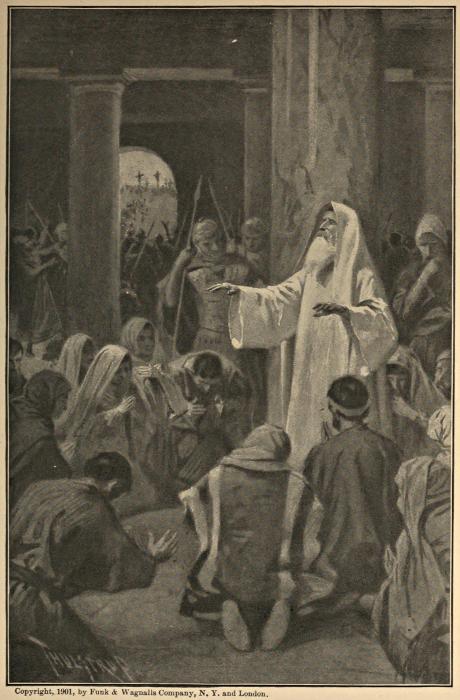
Copyright, 1901, by Funk & Wagnalls Company, N. Y. and London.
With tears and blessings Eleazar took water and baptized
the converts. They sang a hymn, and then rising, moved
toward the gate, the soldiers standing at a distance and looking
on at this more than heroic resignation with eyes of respect
and wonder.
Salathiel Confronts
Eleazar
I could restrain myself no longer. I grasped Eleazar; he
instantly recognized me, and the color that shot through his
cheek showed that with me came a tide of memory. I was
speechless; I embraced him; tears of old friendship dimmed
my eyes. He was overpowered like myself, and could only
exclaim:
“Salathiel, my brother! What misfortune has brought you
here? Where is Miriam? Where are your children? You
can not be a prisoner? Fly from this dreadful place!”
“Never, my brother, unless I can save you. The tyrants
shall have the curse of both upon their heads.”
“This is madness, Salathiel—impiety! Oh, that you were
this moment even as I am—in all but death! It is your duty
to live; you have many ties to the world.”
He paused, and with a look upward said in a tone of prayer:
“Oh, that you were at this moment awake to the truths, the
holy and imperishable consolations, that make the cross to me
more triumphant than a throne!”
The theme was a painful one. He instantly saw my perturbation
and forebore to urge me; but fixing his humid eyes
on heaven, and with uplifted hands, he gave me his parting
benediction.
“May the time come,” said he, “when the veil shall be
taken away from the face of my unhappy kindred and of my
undone country! When the days of the desolation of Israel
come to be accomplished, let her kneel before the altar!—let
her weep in sackcloth and repent of her iniquities; so shall
the sun of glory arise upon her once more.”
Then, as if a flash of knowledge had darted into his soul,
he fixed his solemn gaze on me.
A Day of Brightness
“Salathiel, you are not fit to die; pray that you may not
now sink into the grave. You have fierce impulses, of whose
power you have yet no conception. Supplicate for length of
years; rather endure all the miseries of exile; be alone upon
the earth—weary, wild, and desolate; but pray that you may
not die until you know the truths that Israel yet shall know.
Let it be for me to die, and seal my faith by my blood. Let
it be for you to live, and seal it by your penitence. But live
in hope. Even on earth, a day bright beyond earthly splendor,
lovely beyond all the visions of beauty, magnificent and powerful
beyond the loftiest thought of human nature, shall
come, and we, even we, my brother, shall on earth meet
again.”
Salathiel’s
Supplication
There was a thrilling influence in the words of Eleazar that
left me without reply, and for a while I stood absorbed.
When I raised my eyes again, I saw him following the melancholy
train down the valley of slaughter. I rushed after him.
He would not listen to my entreaties; he would suffer no ransom
to be offered for his life. I supplicated the tribune of
the escort for a moment’s delay until I could solicit mercy
from Titus. The officer, himself deeply pained by the service
on which he was ordered, had no authority, but sent a centurion
with me to the general commanding.
I hurried my guide through the immense force drawn up to
witness the offering to the shades of the Roman senators and
soldiers. The morning was stormy, and clouds covering the
ridges of the hills darkened the feeble dawn so much that
torches were necessary to direct the movement of the troops.
The wind came howling through the spears and standards, but
with it came the fiercer sounds of human agony. As we
reached the entrance of the valley, the centurion pointed to a
height where the general stood in the midst of a group of
mounted officers, wrapped in their cloaks against the snows
that came furiously whirling from the hills. I darted up the
steep with a rapidity that left my companion far below, and
implored the Roman humanity for my countrymen and for my
noble and innocent brother.
On my knee, that I had never before bowed to man, I besought
the muffled form, whom I took for the illustrious son
of Vespasian, to spare men “whose only crime was that of
having defended their country.” I adjured the heir of the
empire “to rescue from an ignominious fate, subjects driven
into revolt only by violences which he would be the first to
disown.”
“If,” exclaimed I, “you demand money for the lives of my
countrymen, it shall be given even to our last ounce of silver;
if you would have territory, we will give up our lands and go
forth exiles. If you must have life for life, take mine, and
let my brother go free!”
The form slowly removed the cloak and Cestius was before
me.
“So,” said he, with a malignant smile, “you can kneel,
Jew, and play the rhetorician; however, as you are here,
your having escaped me once is no reason why you should
laugh at justice a second time. Here, Torquatus,” he beckoned
to a centurion, “take this rebel to the crosses and bring me
an account of the way in which he behaves. You see, Jew,
that I have some care of your reputation. A fellow careless
as you are would probably have died like a slave in a skirmish;
but you shall now figure before your countrymen as a
patriot should, and die with the honors of a native rebel.”
The Valley of
the Crosses
I disdained to answer. The officer came up, attended by
his spearmen, and I was led down to the valley. A storm of
extraordinary violence, long gathering on the sky, broke forth
as I descended, and it was only by grasping the rocks and
shrubs on the side of the declivity that we could avoid being
blown away. We staggered along, blinded, and half frozen.
The storm fell heavily upon the legions, and the heights were
quickly abandoned for the shelter of the valley. The valley
itself was a sheet of snow, torn up by blasts that drifted it
hazardously upon the troops and threw everything into confusion.
But the sight that opened on me as I passed the first
gorge effaced storm and soldiery, and might have effaced the
world, from my mind. Through the whole extent of the naked
and rocky hollow were planted crosses. The ravine, dark even
in sunshine, was now black as midnight, and its only light was
from the scattered torches and the fires into which the bodies
of the victims were flung as they died, to make room for
others. On those crosses hung hundreds, writhing in miseries
made only to show the hideous capability of suffering that
exists in our frame. I was instantly recognized, and many a
hand was stretched out to me imploring that I should mercifully
hasten death. I heard my name called on as their prince,
their leader, their countryman; I heard voices calling on
me to remember and revenge! Horror-struck, I raved at the
legionaries and their tyrant master until I sank upon the
ground in exhaustion, covering my head with my mantle that
I might exclude alike sight and sound.
Salathiel Awed
by a Face
A voice at my side aroused me; a cross had just been fixed
on the spot, and at its foot stood, preparing for death, the
man who had spoken. I looked upon his face and gave an involuntary
cry. For seven-and-thirty years I had not seen that
face; but I had seen it on a NIGHT never to be erased from
my remembrance or my soul! I knew every feature of it
through all the changes of years!
Manhood had passed into age; the bold and sanguine countenance
was furrowed with cares and crimes. But I knew at
once the man who had on that night been foremost at my call;
the daring rabble-leader who had first shouted at my fatal
summons, and maddened the multitude, as I had maddened
myself and him. He turned his glance upon me at the cry.
His pale visage grew black as death. The past flashed upon
his soul. He shook from head to foot with keen convulsion.
He gasped and tried to speak, but no words came. He beat
his breast wildly and pointed to the cross with dreadful meaning.
The executioner, a brutal slave, scoffed at him as a dastard.
He heard nothing, but with his pallid eyes staring on
me and his hand pointed upward, stood stiffening. Life departed
as he stood! The executioner, impatient, laid his
grasp upon him, but he was beyond the power of man. He
fell backward like a pillar of stone!
I started from the corpse, and utterly unnerved, looked
wildly round for some way of escape from this scene of despair.
As I tried to penetrate the dusk toward the bottom of
the valley, Eleazar was seen at the head of his little band,
standing at the foot of a cross, surrounded by soldiers. I
thought no more of safety, and plunging into the valley, forced
my way through the rocks and snowdrifts until I reached the
foot of the declivity on which this true hero was about to die.
But there an impenetrable fence of spears stopped me. I implored,
execrated, struggled; Eleazar’s look fell on me, and
the smile on his uplifted countenance showed at once how
much he thanked me and how calmly he was prepared to bid
the world farewell. My struggles were useless, and I had but
one resource more. I flew with a swiftness that baffled pursuit
to the camp; passed the entrenchments by the breaches left
since the battle, and before I could be stopped or questioned,
entered the tent of Titus.
News from
Rome
The supper-lamps were burning, and three stately-looking
men still lingered over the table, one of the few unpopular
luxuries of the general. A large packet of letters was being
distributed by a page, and while I stood in the shade of the
tent-curtain a moment, until I should ascertain whether Titus
was among the three, I was made the unwilling sharer of the
secrets of Rome.
“All is going on well,” said one of the readers; “here, that
truest of courtiers, my showy friend, Statilius, sends, compiled
by his own hand, an endless list of the pomps and processions,
games and congratulations, in the Emperor’s progress
through Italy. The intelligence is not the newest in the
world, but it would break my courtly friend’s heart to think
that he had not the happiness of giving it first. So let him
think, and so let him worship the rising sun, until another
dynasty comes, and he discovers that if this sun has risen in
the East, a much finer one may rise in the West. Thus runs
the world.”
“War with the Britons,” read another; “they have
marched a hundred of their naked clans from the hills. The
remnant of the Druids are busy again with their incantations,
and it is more than suspected that the whole is stirred up by
our incomparable governor of western Gaul, who affects the
diadem, like all the ridiculous governors of the age.”
“Well then, he shall have his wish,” said a third, “the
Emperor will give him, of course, a court fit for a rebel: his
council, lictors; and his palace, the Mamertine. But as to
the Britons, I doubt if they care one of their own leather
pence whether he wears the diadem or the halter. The savages
have probably been vexed by some new attempt to
squeeze money from them—the quickest way to try the national
sensibilities. They have the spirit of trade in them already,
and are as keen in the barter of their wolf-skins and
bulls’-hides as if they supplied the world with Tyrian canopies
and Indian pearls.”
A Letter from
Sempronius
“A letter from Sempronius!” was the next topic; “its exquisite
intaglio and elaborate perfumes would betray it all the
world over; full of scandals, as usual, and full of discontent.
He seems quite dismantled, and complains that—the sex is
growing ugly, the seasons comfortless, and mankind dull; a
certain sign that my emptiest of friends and the best dresser
in Italy is growing old.”
“So much the better for his circle,” said another, sipping
his goblet. “As for himself, while he can flourish in curls
and calumny, he will be happy, the true man of high life, a
prey to tailors, a figure for actors to burlesque, and an inveterate
weariness to the world.”
“But here is a private despatch from the Emperor, and,
unfortunately for human eyes, written in his own most unreadable
hand.”
The speaker stood up to the lamp and gave me an opportunity
of observing him. His countenance and figure struck
me as what no other word could express than—princely.[53]
The features were handsome and strongly marked Italian,
and the form, tho tending to breadth and rather under the
usual stature, was eminently dignified. His voice, too, was
remarkable. I never heard one that more completely united
softness and majesty. Here I could have but the shadow of
a doubt that I had found Titus; yet I had that shadow. Our
meeting in the field, where we had fought hand to hand, gave
me no recollection of the man before me. Titus might not
even be among the three, and nothing but seizure and ruin could
be the consequence of discovering myself to subordinates.
“Good news, it is to be hoped,” said both the listeners together
as they deferentially watched his perusal.
“None whatever; a mere private chronicle in the Emperor’s
usual style; all kinds of oddities together. He laughs at me
for complaining of the want of intelligence from Rome, and
says that unless we send him some, the politicians of the city
will die of emptiness or raise a rebellion; and that he is the
most ill-used personage in the empire in being obliged to supply
brains for so many blockheads and keep up the reputation of
an honest man in the midst of so many knaves. But he mentions,
and for that I am deeply grateful, that he has just
erected the golden statue, which I vowed so long ago to the
memory of my unfortunate friend Britannicus, and is about
to dedicate a bronze equestrian one to me, to be placed in the
Circus. He concludes the epistle by saying that unless the
British insurrection speedily blows over, he shall be a beggar,
and must turn tribune for a livelihood; defends his impracticable
manuscript, which, he says, I am imitating as fast as
I can, and repeats his old jest, that if I were not born to be a
prince and an idler, I might have made my bread by my
talents for forgery.”
His hearers repaid the imperial merriment by its full tribute
of loyal laughter.
Doubt was now at an end, and I advanced. My step roused
the party, and they started up, drawing their swords. But
the quick eye of Titus recognized me, and satisfying his companions
by a gesture, I heard him pronounce to them: “My
antagonist, the prince of Naphtali.”
There was no time for ceremony, and I addressed him at
once.
Salathiel Appeals
to Titus
“Son of Vespasian, you are a soldier, and know what is
due to the brave. I come to solicit your mercy; it is the first
time that I ever stooped to solicit man. My brother, a chieftain
of Israel, is in your hands, condemned to the horrid death
of the cross; he is virtuous, brave, and noble; save him, and
you will do an act of justice more honorable to your name
than the bloodiest victory.”
Titus looked at me in silence, and was evidently perplexed;
then he returned to his chair, and having consulted with his
companions, hesitatingly said:
“Prince, you know not what you have asked. I am bound,
like others, by the Emperor’s commands, and they strictly are,
that none of your countrymen, taken after the offer of peace,
must live.”
“Hear this, God of Israel!” I cried; “King of Vengeance,
hear and remember!”
“You are rash, prince,” said Titus gravely; “yet I can
forgive your national temper. With others, even your venturing
here might bring you into hazard. But the perfidy of
your people makes truce and treaty impossible. They leave
me no alternative. I lament the necessity. It is the desire
of the illustrious Vespasian to reign in peace. But this is
now at an end.”
He paused, and advancing toward me, offered his hand with
the words: “I know that there are brave and high-minded
men among your nation. I have been astonished at the valor,
nay, I will call it the daring and heroic contempt of suffering
and death, that this siege has already shown. I have been
witness, too,” and he smiled, “of the prince of Naphtali’s
prowess in the field, and I would most willingly have such
among my friends.”
I waited for the conclusion.
The Offer of
Titus
“Why not come among us,” he said; “give up a resistance
that must end in ruin; abandon a cause that all the world
sees to be desperate; save yourself from popular caprice, the
violence of your rancorous factions, and the final fall of your
city? Be Cæsar’s friend, and name what possession, power,
or rank you will.”
The thought of deserting the cause of Jerusalem was profanation.
I drew back and looked at the majestic Roman as
if I saw the original tempter before me.
“Son of Vespasian, I am at this hour a poor man; I may
in the next be an exile or a slave. I have ties to life as strong
as ever were bound round the heart of man; I stand here a
suppliant for the life of one whose loss would embitter mine!
Yet not for wealth unlimited, for the safety of my family,
for the life of the noble victim that is now standing at the
place of torture, dare I abandon, dare I think the impious
thought of abandoning, the cause of the City of Holiness.”
The picture of her ruin rose before my eyes, and tears
forced their way; my strength was dissolved; my voice was
choked. The Romans fixed their looks on the ground, affected
by the sincerity of a soldier’s sorrow. I took the hand that
was again offered.
“Titus! in the name of that Being to whom the wisdom of
the earth is folly, I adjure you to beware. Jerusalem is
sacred. Her crimes have often wrought her misery—often
has she been trampled by the armies of the stranger. But she
is still the City of the Omnipotent, and never was blow inflicted
on her by man that was not terribly repaid. Hear me
a moment.”
Titus stood at this, and I continued:
The Passing of
Power
“The Assyrian came, the mightiest power of the world; he
plundered her Temple and led her people into captivity. How
long was it before his empire was a dream, his dynasty extinguished
in blood, and an enemy on his throne? The Persian
came; from her protector he turned into her oppressor, and
his empire was swept away like the dust of the desert! The
Syrian smote her; the smiter died in agonies of remorse, and
where is his kingdom now? The Egyptian smote her, and who
now sits on the throne of the Ptolemies? Pompey came—the
invincible conqueror of a thousand cities, the light of Rome,
the lord of Asia riding on the very wings of victory. But he
profaned her Temple, and from that hour he went down—down,
like a millstone plunged into the ocean! Blind counsel,
rash ambition, womanish fears were upon the great statesman
and warrior of Rome. Where does he sleep? What sands
were colored with his blood? The universal conqueror died a
slave by the hands of a slave! Crassus came at the head of
the legions; he plundered the sacred vessels of the sanctuary.
Vengeance followed him, and he was cursed by the curse of
God. Where are the bones of the robber, and his host? Go
tear them from the jaws of the lion and the wolf of Parthia—their
fitting tomb!
A Recognition and a Lie
“You, too, son of Vespasian, may be commissioned for the
punishment of a stiff-necked and rebellious people. You may
scourge our naked vice by the force of arms; and then you
may return to your own land, exulting in the conquest of the
fiercest enemy of Rome. But shall you escape the common
fate of the instrument of evil? Shall you see a peaceful old
age? Shall a son of yours ever sit upon the throne? Shall
not rather some monster of your blood efface the memory of
your virtues, and make Rome in bitterness of soul curse the
Flavian name?”
Titus grew pale, and shuddering, covered his eyes with his
mantle. His companions stood gazing on me with the aspect
of men gazing on the messenger of fate.
“Spare Eleazar,” was all that I could utter.
Titus made a sign to a tribune, who flew to bear, if not too
late, the command of mercy.
While we continued in a silence that none of us felt inclined
to break, a door opened behind me and an officer entered.
It was Septimius. I seized him by the throat.
“Villain!” I cried, “give me back my child; base hypocrite!
give up my innocent daughter. Where have you taken
her? Lead me to her, or die!”
Titus rose, in evident surprise and indignation.
“What do I hear, Septimius? Have you been guilty of this
offense? Prince, let him loose until his general shall hear
what he has to say for himself.”
Septimius affected the most extreme and easy ignorance.
“Most noble Titus, I have to thank you for having saved my
neck from the grasp of this hasty personage; but beyond that
I have nothing to say for myself or any one else. I never saw
this man before. I know no more of his daughter than of the
queen of Abyssinia, or the three-formed Diana; and by the
goddess, I swear that I believe him to be perfectly under her
influence, and either a lunatic or a most excellent actor. Be
honest, Jew, if you can, and acknowledge that you never saw
me before in your life.”
I stood in astonishment; his effrontery struck me dumb.
Warned of an Assassin
“You perceive, most noble Titus,” he went on, “how a
plain question puts an end to this public accuser’s charges.
But in his present state, whether affected or real, he should
not be suffered to go at large; suffer me to send him to my
quarters, where he shall be guarded, until we at least find out
what brought him here.”
“Ingrate,” I exclaimed, “you make me hate human nature!
Better that I had left you to be trampled like the viper that
you are.”
The dark eye of the general, again turned on Septimius,
seemed to require a graver explanation.
“Ingrate!” retorted he. “By Jupiter, the fellow’s insolence
is superb. For what should I be grateful? but for my escape
from his detestable hands. Very probably he figured among
the rabble that would have murdered me as they did the rest
of us; grateful, yes, I ought to be for the lesson never to
venture within his walls on the faith of the traitors that hold
them. But let me be allowed to say, most noble Titus, that
you condescend too much in listening to any of this rabble;
nay, that you hazard the safety of the state in hazarding your
person within the reach of one of a race of assassins.”
Titus smiled, and waved back his companions, who, on the
surmise, were approaching him.
“Let me be honored with your commands,” urged Septimius,
“to take this person in charge; felon or insane, I shall
speedily put him in the way of cure.”
A tribune, breathless with haste, came in at the moment
with a letter, which he gave to Titus, and retired to a distant
part of the tent to await the answer. The color rose to the
Roman’s cheek as he looked over the paper; he showed it to
his companions, and then put it into my hand. I read the
words:
“An assassin, hired by the chiefs of Jerusalem, yesterday
passed the gates. His object is the life of the Roman general.
He goes under the pretense of recovering one of his family,
supposed to be carried off from the city, but who has never
left his house. He has communications with the camp, by
which he can enter at pleasure, and the noble Titus can not be
too much on his guard.”
Held in Custody
The note was in an enclosure from Cestius, stating that it
had just been transmitted to him from a high authority in
Jerusalem. I flung it on the ground with the scorn due to
such an accusation, declaring that it was unnecessary for “my
enemy Cestius to have put his name to a document which so
easily revealed its writer.”
“You, of course, Septimius,” said the general, fixing his
penetrating gaze on him, “could know nothing of this letter.”
Septimius entered on his defense with seriousness, and
showed that from the time and circumstances no share in it
could be attached to him. Titus retired a few steps, and having
consulted with the officers, who I perceived were unanimous
for my being instantly put to death, addressed me in
that grave and silver-toned voice which characterized the singular
composure of his nature.
“We have exchanged blows and pledges of honor, prince,
and I will not suffer myself to believe that a man of your
rank and soldiership could stoop to the crime charged here.
In truth, were none but personal considerations in question, I
should instantly set you free. But there are weighty interests
connected with my life, which make it seem fitting to my
friends and advisers that in all cases precautions should be
taken which otherwise I should disdain. To satisfy their
minds, and the spirit of the Emperor’s orders, I must detain
you for a few days. Your treatment shall be honorable.”
Septimius advanced again to demand my custody, but a
look repelled the request, and I was directed to follow one of
the secretaries of Titus.
A Favored
Prisoner
A troop of cavalry were at the tent door. We set off
through the storm, and a few miles from the camp reached a
large building peopled with a crowd of high functionaries attached
to Titus as governor of Judea.
“You must be a prodigious favorite with the general,” said
my companion, as we passed through a range of magnificent
rooms furnished with Italian luxury, “or he would never have
sent you here. He had these chambers prepared for his own
residence, but your countrymen have kept him too busy, and
for the last month he is indebted to them for sleeping under
canvas.”
I observed that “peace was the first wish of my heart, but
that no people could be reproached with contending too boldly
for freedom.”
“The sentiment is Roman,” was the reply. “But let us
come to the fact. Titus, once fixed in the government, would
be worth all the fantasies that ever fed the declaimers on independence.
His character is peace, and if he ever comes to
the empire, he will make the first of monarchs. You should
try him and reap the first fruits of his talent for making
people happy. There, look round this room; you see every
panel hung with a picture, a lyre, or a volume; what does
that tell?”
“Certainly not the habits of a camp; yet he is distinguished
in the field.”
The Emperor
“No man more. There is not a rider in the legions who can
sit a horse or throw a lance better. He has the talents of a
general besides; and more than all, he has the most iron perseverance
that ever dwelt in man. If the two armies were to
slaughter each other until there was but half a dozen spearmen
left between them, Titus would head his remnant and
fight until he died. But whether it is nature or the poison
that he drank along with Britannicus, he wants the eternal
vividness of his father. Aye, there was the soldier for the
legions. Look, prince, at this picture,[54] and tell me what
you think of the countenance.”
He drew aside a curtain that covered a superb portrait of
the Emperor. I saw a countenance of incomparable shrewdness,
eccentricity, and self-enjoyment. Every feature told the
same tale, from the rounded and dimpled chin to the broad
and deeply veined forehead, overhung with its rough mat of
hair. The hooked nose, the deep wrinkles about the lips, the
thick dark eyebrows, obliquely raised as if some new jest was
gathering, showed the perpetual humorist. But the eye beneath
that brow—an orb black as charcoal, with a spot of intense
brightness in the center, as if a breath could turn that
coal into flame—belonged to the supreme sagacity and determination
that had raised Vespasian from a tent to the throne.
The secretary, whose jovial character strongly resembled
that of the object of his panegyric, could not restrain his admiration.
“There,” said he, “is the man who has fought more battles,
said more good things, and taken less physic than any emperor
that ever wore the diadem. I served with him from
decurion up to tribune, and he was always the same—active,
brave, and laughing from morn to night. Old as he is, day
never finds him in his bed. He rides, swims, runs, outjests
everybody, and frowns at nothing on earth but an old woman
and a physician. He loves money, ’tis true; yet what he
squeezes from the overgrown, he scatters like a prince. But
his mirth is inexhaustible; a little rough, so much for his
camp education; but the most curious mixture of justice,
spleen, and pleasantry in the world.”
My companion’s memory teemed with examples.
An Emperor’s Traits
“An Alexandrian governor was ordered to Rome to account
for a long course of extortion; immediately on his arrival
he pretended to be taken violently ill, which, of course,
put off the inquiry. The Emperor heard of this, expressed the
greatest interest in so meritorious a public servant, paid him
a visit the next day, disguised as a physician, ordered him a
variety of medicines, which the unfortunate governor was
compelled to take, renewed his visit regularly every day, and
every day charged him an enormous fee! Beggary stared the
governor in the face, and never was a complication of disorders
so rapidly cured!
“I was riding out in his attendance one day a few miles
from Rome when we saw a fellow beating his mule cruelly,
and on being called to, insisted on his right to torture the
animal. I was indignant and would have fought the mule’s
quarrel. But the Emperor laughed at my zeal, and after some
jesting with the brutal owner, bought the mule, only annexing
the condition that the fellow should lead it to the stable;
he actually sent him with the mule two hundred and fifty
miles on foot, to one of his palaces in Gaul, and with a lictor
after him to see that the contract was fairly performed.
“One of his chamberlains had been soliciting a place about
court, for, as he said, his brother. The Emperor found out the
fact that it was for a stranger, who was to lay down a large
sum. He sent for the stranger, ratified the bargain, gave him
the place, and put the money in his own pocket. The chamberlain
was in great alarm on meeting the Emperor some days
after. ‘Your dejection is natural enough,’ said Vespasian, ‘as
you have so lately lost your brother; but, then, you should
wish me joy, for he has become mine!’
“By the altar of Momus and the brass beard of the god
Ridiculous, I could tell you a hundred things of the same
kind,” continued the jovial and inexhaustible secretary; “take
but one more.
Betraying Court Secrets
“One of our great patricians, an Æmilian, and as vain
and insolent a beast as lives, had ordered a quantity of a
particular striped cloth, which it cost the merchant infinite
pains to procure. But the great man’s taste had altered in the
mean time, and he returned the cloth without ceremony,
threatening, besides, that if the merchant made any clamors
on the subject, his payment should be six months’ work in the
slave-mill. The man, on the verge of ruin, came, tearing his
hair and bursting with rage, to lay his complaint before the
Emperor, who, however, plainly told him that there was no
remedy, but desired him to send a dress of the same cloth to
the palace. Within the week the patrician was honored with
a message that the Emperor would dine with him, and the
message was accompanied with the dress and an intimation
that Vespasian wished to make it popular. Rome was instantly
ransacked for the cloth, but not a yard of it was to be
found but in the merchant’s hands. The patrician’s household
must be equipped in it, cost what it would. The dealer, in
pleasant revenge, charged ten times the value, and his fortune
was made in a day.
“Now Titus, with many a noble quality, is altogether another
man. He abhors the Emperor’s rough-hewn jocularity;
he speaks Greek better than the Emperor does his own tongue;
is a poet, and a clever one besides, in both languages; extemporizes
verse with elegance; is no mean performer on the lyre;
sings; is a picture-lover, and so forth. I believe from my
soul that, with all his talents for war and government, he
would rather spend his day over books and his evenings among
poets and philosophers, or telling Italian tales to the ears of
some of your brilliant orientals, than ride over the world
at the head of legions. And now,” said my open-hearted
guide, “having betrayed court secrets enough for one day, I
must leave you and return to the camp. Here you will spend
your time as you please until some decision is come to. The
household is at your service, and the officer in command will
attend your orders. Farewell!”
Captivity is wretchedness, even if the captive trod on cloth
of gold. My treatment was imperial; a banquet that might
have feasted a Roman epicure was laid before me; a crowd
of attendants, sumptuously habited, waited round the table;
music played, perfumes burned, and the whole ceremonial of
princely luxury was gone through, as if Titus were present instead
of his heart-broken prisoner. But to that prisoner bread
and water with freedom would have been the truer luxury.
I wandered through the spacious apartments, dazzled by
their splendor and often ready to ask: “Can man be unhappy
in the midst of these things?” yet answering the question
in the pang of heart which they were so powerless to soothe.
I took down the richly blazoned volumes of the Western
poets, and while at every line that I unrolled, I felt how much
richer were their contents than the gold and gems that encased
them, still I felt the inadequacy of even their beauty and vigor
to console the spirit stricken by real calamity. I strayed to
the crystal casements, through which the sunset had begun to
pour in a tide of glory. The landscape was beautiful—a
peaceful valley, shut in with lofty eminences, on whose marble
foreheads the sunbeams wrought coronets as colored and glittering
as ever were set with chrysolite and ruby. The snow
was gone as rapidly as it had come, and the green earth, in
the freshness of the bright hour, might almost be said “to
laugh and sing.” The air came, laden with the fragrance of
flowers. There was a light and joyous beauty in even the
waving of the shrubs as they shook off the moisture in sparkles
at every wave; birds innumerable broke out into song,
and fluttered their little wet wings with delight in the sunshine;
and the rivulet, still swelled with the snows, ran dimpling
and gurgling along with a music of its own.
Salathiel
Alone
But the true sadness of the soul is not to be scattered even
by the loveliness of external things. I turned from the sun
and nature to fling myself on my couch and feel that where
a man’s treasure is, there his heart is also.
“What might not in those hours be doing in Jerusalem?”
mused I; “what fanatic violence, personal revenge, or public
license might not be let loose while I was lingering among the
costly vanities of the pagan? My enemy at least was there
in the possession of unbridled authority”; and the thought
was in itself a history of evil. “And where was Esther, my
beloved, the child of my soul, the glowing and magnificent-minded
being whose beauty and whose thoughts were scarcely
mortal? Might she not be in the last extremity of suffering,
upbraiding me for having forgotten my child; or in the hands
of robbers, dragging her delicate form through rocks and
sands; or dying, without a hand to succor, or a voice to
cheer her in the hour of agony?”
Thought annihilates time, and I had lain one day thus
sinking from depth to depth, I know not how long, until I
was roused by the entrance of the usual endless train of attendants;
and the chief steward, a venerable man of my country,
whom Titus had generously continued in the office where
he found him, came to acquaint me that the banquet awaited
my pleasure. The old man wept at the sight of a chieftain
of Israel in captivity; his heart was full, and when I had dismissed
the attendants with their untasted banquet, he gave
way to his recollections.
In the Palace
of Ananus
The palace was once the dwelling of Ananus, the high
priest whose death under the cruelest circumstances was the
leading triumph of the factions and the ruin of Jerusalem.
In the very chamber where I sat he had spent the last day of
his life, and left it only to take charge of the Temple on the
fatal night of the assault by the Idumæans. He was wise and
vigorous, but what is the wisdom of man? A storm, memorable
in the annals of devastation, had raged during the night.
Ananus, convinced that all was safe from human hostility in
this ravage of the elements, suffered the wearied citizens to
retire from their posts. The gates were opened by traitors;
the Idumæans, furious for blood and spoil, rushed in; the
guard, surprised in their sleep, were massacred; and by daylight
eight thousand corpses lay on the sacred pavements of
the Temple, and among them the noblest and wisest man of
Judea, Ananus.
“I found,” said the old man, “the body of my great and
good lord under a heap of dead, but was not suffered to convey
it to the tomb of his fathers, in the valley of Jehoshaphat. I
brought his sword and his phylactery here, and they are now
the only memorials of the noblest line that perished since the
Maccabee. In these chambers I have remained since, and in
them it is my hope to die. The palace is large; the Roman
senators and officers reside in another wing, which I have not
entered for years, and shall never enter; mild masters as the
Romans have been to me, I can not bear to see them masters
within the walls of a chief of my country.”
The story of Naomi occurred to me, but she was so much
beyond my hope of discovery that I forbore to renew the old
man’s griefs by her name. A sound of trumpets and the trampling
of cavalry were now heard from the portal.
“It is but the nightly changing of the troops,” said the
steward, “or perhaps the arrival of officers from the camp;
they often ride here after nightfall to supper, spend a few
hours, and by daybreak are gone. But of them and their proceedings
I know nothing. No Jew enters, or desires to enter,
the banquet-hall of the enemies of his country.”
In Closer
Confinement
A knocking at the door interrupted him, and an officer appeared
with an order for the prisoner in the palace to be removed
into strict confinement. The venerable steward gave
way to tears at the new offense to a leader of his people. I felt
some surprise, but merely asked what new alarm had demanded
this harsh measure.
“I know no more,” replied the officer, “than that the general
has arrived here a few minutes since, and that as some
attempts have been lately made on his life, the council have
thought proper to put the Jewish poniards as much out of his
way as they can. The order is universal, and I am directed to
lead you to your apartment.”
“Then let them look to my escape,” said I; “I thank the
council for this service. While I continued above suspicion,
they might have thrown open every door in their dungeons.
But since they thus degrade me, you may tell them that their
walls should be high and their bolts strong to keep me their
prisoner. Lead on, sir.”
Salathiel’s New Quarters
The council seemed to have been aware of my opinion, for
my new chamber was in one of the turrets. The lower floor
being occupied by the guard, there could be no undermining;
the smallness of the building laid all the operations of the
fugitive open to the sentinel’s eye, and the height was of
itself an obstacle that, even if the bars were forced, might
daunt the adventurer. The steward followed me to my den,
wringing his hands. Yet the little apartment was not incommodious;
there were some obvious attempts at rendering it a
fitter place of habitation than usual, and a more delicate frame
than mine might have found indulgence in its carpets and
cushions. Even my solitary hours were not forgotten, and
some handsome volumes from the governor’s library occupied
a corner. There was a lyre, too, if I chose to sing my sorrows,
and a gilded chest of wine if I chose to drink them
away. The height was an inconvenience only to my escape,
but a lover of landscape and fresh air would have envied me,
for I had the range of the horizon and the benefit of every
breeze from its four quarters. A Chaldee would have chosen
it for his commerce with the lights of heaven, for every star,
from the gorgeous front of Aldebaran to the minutest diamond
spark of the sky, shone there in all its brightness. And a
philosopher would have rejoiced in the secluded comfort of
a spot which, in the officer’s parting pleasantry, was in every
sense “so much above the world.”
To me, the prison and the palace were the same. No believer
in fate, and a strong believer in the doctrine that in the
infinite majority of cases the unlucky have to thank only
themselves, I was yet irresistibly conscious of my own stern
exception. That there was an influence hanging over me I
deeply knew; that I might as well strive with the winds was
the fruit of my whole experience; and with the loftiest calculation
of the wonders that human energy may work, I abandoned
myself on principle to the chances of the hour. I was
the weed upon the wave, and whether above or below the
surface, I knew that the wave would roll on, and that I must
roll on along with it. I was the atom in the air, and whether
I should float unseen forever or be brought into sight by the
gilding of some chance sunbeam, my destiny was to float and
quiver up and down. I was the vapor, and whether, like the
evening cloud, my after-years were to evolve into glorious
shapes and colors, or I should creep along the pools and valleys
of fortune till the end of time—yet there I was, still in
existence, and that existence bound by laws incapable of the
choice or the caprices of man.
Salathiel’s
Burden
I had yet to learn the true burden of my great malediction,
for the circumstances of my life were adverse to its fated solitude
of soul; its bitter conviction that there was not a being
under the canopy of heaven whose heart was toward me. I
was still in the very tumult of life and battling with the boldest.
Public cares, personal interests, glowing attachments,
the whole vigorous activity of the citizen and the soldier
were mine. I was still husband, father, friend, and champion;
my task was difficult and grave, but it was ardent, proud, and
animating. I was made for this energy of the whole man;
master of a powerful frame that defied fatigue, and was proof
against the sharpest visitations of nature; and of an intellect
which, whatever might be its rank, rejoiced in tasking itself
with labors that appalled the multitude.
Idle as I knew the praise of man, and sovereign as was my
scorn for the meanness which stoops to the vulgar purchase
of popularity, I felt and honored the true fame—that renown
whose statue is devoted, not by suspicious and clamorous flattery
of the time, but by the solemn and voluntary homage of
the future, whose splendor, like that of a new-born star, if it
take ages to reach mankind, is sure to reach them at last, and
shines for ages after its fount is extinguished; whose essential
power, if it be coerced and obscured, like that of a man while
his earthly tenement still shuts him in, is thenceforth to develop
itself from strength to strength—the mortal putting on
immortality.
The Fetters of
a Soul
In the whirl of such thoughts I was often carried away, to
the utter oblivion of my peculiar fate, for the man and his associations
were strong within me, in defiance of the command.
The gloom often passed away from my soul, as the darkness
does from the midnight ocean in the dash and foam of its own
waters. Nature is perpetual and drives the affections, sleeping
or waking, as it drives the blood through the old channels.
It was only at periods, produced by strong circumstance, that
I felt the fetter, but then the iron entered into my soul! To
this partial pressure belongs the singular combination of such
a fate as mine with an interest in the world, with my loves
and hates, my thirst of human fame, my reluctance at the
prospect of the common ills and injuries of life. I was a man,
and this is the whole solution of the problem. For one remote
evidence that I was distinct from mankind, I had ten thousand,
direct and constant, that I was the same. But for the
partiality of the pressure there was a lofty reason.
The man who feels himself above the common fate is instantly
placed above the common defenses of mankind. He
may calumniate and ruin; he may burn and plunder; he may
be the rebel and the murderer. Fear is, after all, the great
defense. But what earthly power could intimidate him?
What were chains or the scaffold to him who felt instinctively
that time was not made for his being; that the scaffold was
impotent; that he should yet trample on the grave of his
judge, on the moldered throne of his king, on the dead
sovereignty of his nation? With his impassiveness, his
experience, his knowledge, and his passions, concocted and
blackened by ages, what breast could be safe against the dagger
of this tremendous exile? What power be secure against
the rebel machination or the open hostility of a being invested
with the strength of immortal evil? What was to hinder a
man made familiar with every mode of influencing human
passions—the sage, the sorcerer, the fount of tradition, the
friend of their worshiped ancestors—from maddening the
multitude at whose head he willed to march, clothed in the
attributes of almost a divinity?
But I was precluded or saved from this fearful career by
the providential feeling of the common repugnances, hopes,
and fears of human nature. Pain and disease were instinctively
as much shunned by me as if I held my life on the
frailest tenure; death was as formidable as my natural soldiership
would suffer it to be; and even when the thought occurred
that I might defy extinction, it threw but a darker
shade over the common terrors, to conceive that I must undergo
the suffering of death without the peace of the grave.
Man bears his agony for once, and it is done. Mine might be
borne to the bitterest extremity, but must be borne with the
keener bitterness of the knowledge that it was in vain.
A Message
from Septimius
I was recalled from those reveries to the world by a paper
dropped through a crevice in the rafters above my head. On
seeing its signature, “Septimius,” my first impulse was to tear
it in pieces, but Esther’s name struck me, and I read it through.
“You must not think me a villain, tho I confess appearances
are much in favor of the supposition. But I had no
choice between denying that I knew you and being instantly
beheaded. This comes of discipline. Titus is a disciplinarian
of the first order, and the consequence is that no man dares
acknowledge any little irregularity before him: so far, his
morality propagates knaves. But I must clear myself of the
charge of having acted disingenuously by your daughter. I
take every power that binds the soul to witness that I know
not what is become of her; nay, I am in the deepest anxiety
to know the fate of one so lovely, so innocent, and so high-minded.
A Lover’s
Confession
“And now, prince, that I am out of the reach of your
frown, let me have courage to disburden my heart. I have
long known Esther, and as long loved her. From the time
when I was first received within your palace in Naphtali—and
I have not forgotten that to your hospitality I then owed
my life—I was struck with her talents and her beauty. When
the war separated us and I returned to Rome, neither in
Rome nor in the empire could I see her equal. To solicit our
union I gave up the honors and pleasures of the court for the
campaign in your hazardous country. I searched Judea in
vain, and it was chiefly in the vague hope of obtaining some
intelligence of Esther that I solicited the command of our unfortunate
mission. There I felt all hazard more than repaid
by her sight, to me lovelier than ever. I will acknowledge
that I prolonged my confinement to have the opportunity of
obtaining her hand. But her religious scruples were unconquerable.
I implored her leave to explain myself to you.
Even this, too, she refused, ‘from her knowledge of your decision.’
What then was I to do? Loving to excess, bewildered
by passion, oppressed with disappointment, and seeing
but one object on earth, my evil genius prompted me to act
the dissembler.
“Under pretext of disclosing some secrets connected with
your safety I induced her to meet me, for the first and the
last time, on the battlements. There I besought her to fly
with me—to be my bride—to enjoy the illustrious rank and
life that belonged to the imperial blood; and when we were
once wedded, to solicit the approval of her family. I was sincere;
I take the gods to witness I was sincere. But my entreaty
was in vain; she repelled me with resolute scorn; she
charged me with treachery to you, to her, to faith, and to
sacred hospitality. I knelt to her—she spurned me. In distraction,
and knowing only that to live without her was
wretchedness, I was bearing her away to the gate when we
were surrounded by armed men. My single attendant fled; I
was overpowered, and I saw Esther, my lovely and beloved
Esther, no more.”
There was an honesty in this full confession that did more
for the writer’s cause than subtler language. The young
Roman had been severely tried, and who could expect from a
soldier the self-denial that it might have been hard to find
under the brow of philosophy? Stern as time and trial had
made me, I was not petrified into a contempt for the generous
weaknesses of earlier years; and to love a being like Esther—what
was it but to be just? While I honored the high sense
of duty which repelled a lover so dangerous to a woman’s
heart, I pitied and forgave the violence of a passion lighted
by unrivaled loveliness of form and mind.
It was growing late, and the steward, who made a virtue of
showing me the more respect the more I was treated with
severity, came in to arrange my couch for the night; he would
suffer no inferior hands to approach the person of one of the
leaders of his fallen country.
“In truth,” said he, “if I were not permitted to be your
attendant to-night, my prince might have been forgotten, for
every human being but myself is busy in the banquet-gallery.”
Sounds of instruments and voices arose.
Titus Gives a
Banquet
“There,” said he, “you may hear the music. Titus gives a
supper in honor of the Emperor’s birthday, and the palace will
be kept awake until daylight, for the Romans, with all their
gravity, are great lovers of the table, and Titus is renowned
for late sittings. Would you wish to see the banquet?”
So saying, he unbarred the shutters of a casement, commanding
a view along the gallery, of which every door and
window was thrown open for the breeze.
If an ancient Roman could start from his slumber into the
midst of European life, he must look with scorn on its absence
of grace, elegance, and fancy. But it is in its festivities,
and most of all in its banquets, that he would feel the incurable
barbarism of the Gothic blood. Contrasted with the fine
displays that made the table of the Roman noble a picture
and threw over the indulgence of appetite the colors of the
imagination, with what eyes must he contemplate the tasteless
and commonplace dress, the coarse attendants, the meager
ornament, the want of mirth, music, and intellectual interest—the
whole heavy machinery that converts the feast into the
mere drudgery of devouring!
Salathiel Views
the Scene
The guests before me were fifty or sixty splendidly attired
men, attended by a crowd of domestics equipped with scarcely
less splendor, for no man thought of coming to the banquet in
the robes of ordinary life. The embroidered couch, itself a
striking object, allowed the ease of position, at once delightful
in the relaxing climates of the south and capable of combining
with every grace of the human figure. At a slight distance
the table, loaded with plate, glittering under a profusion of
lamps and surrounded by couches covered with rich draperies,
was like a central source of light radiating in broad shafts of
every brilliant hue. All that belonged to the ornament of the
board was superb. The wealth of the patricians and their
perpetual intercourse with Greece made them masters of the
finest performances of the arts. The sums expended on plate
were enormous, but its taste and beauty were essential to the
refined enjoyment of the banquet. Copies of the most famous
statues and groups of sculpture in the precious metals, exquisite
trophies of Greek and Roman victory, models of the
celebrated temples, mingled with vases of flowers and burning
perfumes; and covering and coloring all was a vast scarlet
canopy, which combined the groups beneath the eye, and
threw the whole scene into the light that a painter would love.
But yet finer skill was shown in the constant prevention of
that want of topic which turns conversation into weariness.
There was a rapid succession of new excitements. Even the
common changes of the table were made to assist this purpose.
The entrance of each course was announced by music,
and the attendants were preceded by a procession of minstrels,
chaplet-crowned, and playing Grecian melodies. Between the
courses a still higher entertainment was offered in the recitations,
dramas, and pleasantries, read or acted by a class of
professional satirists, of the absurdities of the day.
The Amusements
of a
Feast
It is easy to imagine how fertile a source of interest this
must have been made by the subtle and splenetic Italian
moving through Roman life; the most various, animating, and
fantastic scene in which society ever shone. The recitations
were always looked to as the charm of the feast. They were
often severe, but their severity was reserved for public men
and matters. The court supplied the most tempting and popular
ridicule, but the reciter was a privileged person, and all
the better-humored Cæsars bore the castigation without a
murmur. No man in the empire was more laughed at than
Vespasian, and no man oftener joined in the laugh.
One of this morning’s sports was to collect the burlesques
of the night before, give them new pungency by a touch of
the imperial pen, and then despatch them to make their way
through the world. The strong-headed sovereign knew the
value of an organ of public opinion, and used to call their
perusal, “sitting for his picture.” The picture was sometimes
so strong that the courtiers trembled. But the veteran, who
had borne thirty years of battle, laid it up among “his portraits,”
laughed the insult away, and repeated his popular
saying, “that when he was old enough to come to years of
discretion and give up the emperor, he should become reciter
himself and have his turn with the world.”
The recitations again were varied by a sportive lottery, in
which the guests drew prizes—sometimes of value, gems and
plate—sometimes merely an epigram, or a caricature. The
banquet generally closed with a theatric dance by the chief
public performers of the day, and the finest forms and the
most delicate art of Greece and Ionia displayed the story of
Theseus and Ariadne, the flight of Jason, the fate of Semele,
or some other of their brilliant fictions. In the presence of
this vivid display sat, tempering its sportiveness by the majesty
of religion, the three great tutelar idols of Rome—Jove,
Juno, and Minerva, of colossal height, throned at the head of
the hall; completing, false as they were, the most singular
and dazzling combination that man ever saw, of the delight of
the senses with the delight of the mind.
To me human delight was always a source of enjoyment,
and in the sounds of the harps and flutes and the pleasant
murmur of cheerful voices I was not unwilling to forget the
spot from which I listened. But the prisoner can not long forget
his cell, and closing the casement I walked away.
The Steward
Tells of
Matthan
“Little I ever thought,” sighed the old steward, “of seeing
that sight. But all nations have fallen in their time, and perhaps
the only wonder is that Israel should have stood so long.
It is still stranger to my eyes to see that gallery as it is to-night.
It is fifteen years this very day since I saw the light
of lamp or the foot of man within those casements.”
“Yet,” said I, “the great Ananus lived as became his rank,
and there were then no dangers to disturb him in the midst of
his people.”
“But there was one terrible event which made those walls
unhallowed; nay, even in this spot I would not remain alone
through the night to have the palace for my own.”
A rich strain of music that ushered in some change in the
displays of the banquet interrupted my question, while the
old man’s countenance assumed something of the alarm which
he described.
“That sound,” said he, shuddering, “goes to my heart. It
is the same that I heard on the night of death. On that night
Matthan, the only son of my great master, was to be wedded
to the daughter of the prince of Hebron, and that gallery was
laid out for the wedding-feast. All the leaders of Jerusalem
were there, all the noble women, all the chief priesthood; all
the grandeur, wealth, and beauty of our tribe. But Matthan
was not the son of his father’s mind. He had fled from his
father’s roof years before, and taken refuge in the mountains.
The caravan passing through Galilee dreaded the name of
Matthan, for he was bold; the chief of the hills saw his followers
flying from his side, for deadly was the spear of Matthan;
but he was generous, and often the slave rejoiced in the
breaking of his chains, and the peasant saw his flocks cover
the valley again by the arm and the bounty of Matthan.
A Countenance of Wrath and Wo
“I saw him on the day when he returned; danger or sorrow
had wrought a change in him like the passing from youth
to age. His strength was gone, and his voice was broken, like
the voice of him that treads on the brink of the timely grave.
His noble father wept over him, but gave him welcome; and
the palace was filled with rejoicing for the coming back of the
first-born. Yet he took no delight in the feast, neither in the
praises of men nor in the voice of the singer. He wandered
through his father’s halls, even as the leopard, chained and
longing to escape to the desert and the prey again. Disturbances
were beginning to be heard in Jerusalem, and he fell
into the hands of the evil one. Onias, the man of blood, betrayed
him into the secret ways of conspiracy against our
conquerors. His heart was bold and his temper high, and he
was easily drawn into the desperate game by a villain who
stirred up the generous spirit of our nobles, only to sell their
blood to Rome.
“He grew more lonely day by day; withdrew from the
amusements of his rank, and shut himself up in the wing of
the palace, ending in this tower. In this room I have seen his
lamp burning through the livelong winter nights, and grieved
over the sleeplessness that showed he was among the unhappy.
The Strangeness of a Bridegroom
“At last a change was wrought upon him. He went forth;
he took delight in the horse and the chariot, in the chase,
and the feast, and the die. His father, that he might bless
his posterity before he died, counseled him to take to wife
Thamar, the noblest of the daughters of Hebron. The day of
the marriage was appointed. On that day I saw him come
from the council-hall, after receiving the congratulations of
his friends. I saw him passing along to his chamber, but I
dared not cross him on his way. He thought that he was
alone, and then he gave way to his agony. Never did I behold
such a countenance of wrath and wo. It was bloated
with prodigal living, and it was now flushed with wine. He
raved, he rent his bridal raiment and cast it from him; he
wept; he knelt and cursed the hour he was born. I remained
in my refuge, yet more in fear of his countenance than of his
sword. He took letters from his bosom, read them, and then
scattered their fragments in the air. He tottered toward me,
and I dreaded his rage, but I saw at a glance that his mind
was gone. He was talking to the air; he clasped his hands
wildly; his face was covered with tears; he implored for
mercy, and fell. I hastened to bear him to a couch; he saw
me not, but cried out against himself as a betrayer and a murderer,
the fugitive from honor, the criminal marked by the
hand of Heaven.
“I called for help. His mountaineers rushed in; they repulsed
me; and chiding him in their barbarian tongue, and
seeming accustomed to those fits of sorrow, carried away in
their arms the noble Matthan, crying like a child.
“The evening fell, and I saw him ride forth at the head of
his kindred to bring home the bride. The wretchedness of the
day had passed, and those who looked only on the lofty bearing
and heard the joyous language of the leader of that train
would have thought that sorrow had never touched his heart.
I watched for his return with anxiety, for I deemed him unhallowed.
The Coming of a Bride
“But all was well; the bridal train returned. Matthan,
glittering in jewels, came proudly, reining a steed white as
the snow. The harp and trumpet, the chorus of the singers,
the light of the torches, and the glitter of the youths and
maidens who danced before the bride made me forget everything
but the joy of seeing peace among us once more. But
at the banquet the wonder of all was the bridegroom himself.
Loud as the guests’ voices were, his voice was the loudest;
he laughed at everything, as if he had never known a care in
the world, or was never to know one again. The jest was
never out of his lips; and when he pledged the cup to the
health of the company or the fair bride—and often he pledged
it that evening—he always said something that raised shouts
of applause. I once or twice passed near him, but he had
wiped every sign of grief from his features, and if he seemed
to be mad with anything, it was with joy. The gallery rang
with admiration, and not less with surprise, for he had shut
himself up so long from the people that he was almost unknown,
and the world is generally good-natured enough to invent
a character for those who will take no trouble to make
one for themselves. Some had set him down for intolerable
haughtiness; others for fear of mixing in the growing tumults;
others for a dealer in the black arts; and still others for a
mere fool. But now opinions were altered, and every voice of
his tribe was loud in wonder at the talents he had so long hid
in retirement.
“I was standing in the train of the High Priest, near the
central casement, through which you may now see the throne
of Titus. My eyes, I know not why, strayed to this tower; I
marked a feeble lamp, a form rushing backward and forward
in gestures of violent sorrow. A foot beside me made me turn.
There stood Matthan with his eyes fixed upon the tower. But
his mind was gone. He looked like a man stricken into stone.
He saw me not; he saw not the guests; he saw nothing but
the feeble lamp, the hurrying form.
“The chorus of the singing women announced that the
bride was about to come. I looked up at the tower; the lamp
was twinkling its last, and the form was still seen wringing
its hands. The hymn began that denotes the veiling of the
bride; but my eyes were fixed on the dying light and the
form, which now held a cup in its hand. A shriek was heard,
so wild that the guests sprang from their seats in alarm and
astonishment. My eye turned upon Matthan, but he had
summoned up his strength, and tho I saw him shake in every
limb, his proud lip wore a smile.
“Clasping his hand upon his brow, he abruptly turned from
the window and demanded why the bridal attendants delayed
the coming of the princess of Hebron. The lamp had now
disappeared, and the tower was in darkness again. The portals
were at length thrown open and the bride was led up to
the canopy beneath which the bridegroom stood. He raised
the veil. His countenance was instantly transformed into
horror. He uttered no cry, but stood gazing. The bride let
fall the veil again, and taking his hand, led him slowly and
without a word down the hall.
Matthan’s Death
“None checked this strange ceremony; none dared to check
it. We were deprived of all power by astonishment. The
High Priest himself stood with his venerable hands lifted up
to heaven, as if he felt that evil was come upon his house.
The wedded pair walked in silence through the long range of
chambers to the tower, and as they passed, the numberless attendants
felt themselves bound by mysterious awe. But our
senses at length returned, and Ananus, in the full dread of
misfortune, yet bold to his dying hour, suffered none to go
before him. We found the door of the tower barred, and long
summoned Matthan to come forth and relieve our fears lest
some desperate invention of sorcery had been played upon
him. No answer was returned, and we forced the door.
“What a sight was there! Two corpses lay side by side.
The blood still trickled from the bosom of the unfortunate
Matthan. I raised the veil of the bride; the hue of poison
was upon the lips, but they were not the lips of the princess
of Hebron. The countenance was Arabian, and of exceeding
beauty, but wan and wasted by sorrow.”
“Who, then, was his strange companion in the hall?” I
asked.
The answer was given with a shudder. “I know not, but it
seemed scarcely a being of this world. A new confusion
arose. The mountaineers, on hearing of the death of their
lord and still more of that noble creature in whom they honored
the race of their chieftains, demanded vengeance: they
were too fierce to listen to reason, and our attempts to explain
the unhappy truth only kindled their rage. Simitars
were drawn, blood was shed, and tho the barbarians were
repelled, yet they plundered the wing of the palace and bore
off the infant offspring of their dead mistress, the last scion
of an illustrious tree that was itself so soon to feel the ax.
“I saw the unfortunate and guilty Matthan laid in the sepulcher
of his fathers—the last that ever slept there, for his
great sire, worthy of being laid in the monument of kings,
was denied the honors of the grave by his murderers. Yet
he sleeps in the noblest of all graves; his memory is treasured
in the love and sorrows of his country.
The Arabian Stranger
“It was discovered that Matthan, during his wanderings in
the desert, had wedded the daughter of a sheik. He loved
her with the violence of his nature, but the prospects which
opened to him on his return to his country made him shrink
from the acknowledgment of his Arabian bride. Yet to live
without her he found impossible, and he brought her to the
tower. Surrounded by his mountaineers, this portion of the
palace was inaccessible. His solitude and the lights seen
through the casements were often thought to imply studies of
the strange philosophy or evil superstitions that had begun to
infect the noble youth of Palestine.
“But the necessity of sustaining his ambition by an illustrious
marriage drove his fickle heart at last to treachery. The
Arabian knew the intended marriage, and pined away before
his eyes. Remorse and ambition alternately distracted him.
The bridal procession was seen by the unhappy wife, and she
swallowed poison. The rest is beyond my power to account
for. But it is rumored among the attendants that strange
sights have since been seen and sounds of a bridal throng
heard in the chambers through which their last melancholy
procession was made; tho, whether it be truth or the common
fear of the peasantry, I know not, nor indeed wish too
curiously to inquire.”
Confusion
among Guests
As the old man spoke, sounds arose not unsuited to his
tale. But my faith in the legend did not amount to so sudden
a realization, and I looked toward the banquet. There, from
whatever motive, everything was in sudden disturbance. The
guests were hurrying from the tables. Many had thrown the
military cloak over their festal robes; some were in the adjoining
apartments hastily equipping themselves with arms
and armor. A group was standing round Titus, evidently in
anxious consultation. In the spacious grounds below, horsemen
were mounting and attendants hurrying in all directions.
The calls of the clarion echoed through the courts; shortly
after a large body of cavalry came wheeling round to the
portal of the gardens, and Titus went forth, conspicuous
among the bustling crowd for his manly composure. He gave
some orders which were despatched by tribunes galloping as
for their lives; then mounting his charger, rode slowly through
the gates at the head of his stately company, himself the most
stately of them all.
The woods surrounding the palace soon intercepted the
view of the imperial troop; and after straining my eyes as
long as I could see the glitter of a helmet by the waning
moon, I turned to my casement to make that prayer for the
peace of Jerusalem which had been nightly on my lips from
the hour when they first could pronounce the name. From
the dungeon has that supplication risen; from the mine; from
the sands of the wilderness; from the shores of the farthest
ocean; from the bosom of the rolling waters; from the fires
of the persecutor; from the field before the battle; from the
field covered with its dead; from the living grave of the
monk; from the cavern of the robber; from the palace; even
from the scaffold!
The Red
Illumination
While I continued in this outpouring of the soul, with my
eyes fixed on the cloudy world above, a pale reflection spread
over the masses of rolling vapor; it lingered, faded, and night
covered the earth; suddenly a fierce luster turned the low and
heavy clouds into the color of conflagration.
“There is an attack on either the enemy’s camp or the
city,” I exclaimed to my companion. “Daybreak it can not be,
for the middle watch has not been half an hour sounded. Help
me to escape; be but my guide through the chambers, and
name your recompense.”
The steward wrung his helpless hands, and offered his life
to my service, but described the precautions of my jailers so
fully that I gave up the idea. Still I was tossed by anxious
thoughts. I heard the treading of the guard until its recurrence
irritated me. The moanings of the wind through the
trees told that a storm was rising, and to get rid of the uneasy
conflict between the desire of sleep and the difficulty of
shutting out thought, I rose and watched the progress of the
tempest.
The lightnings flashed in broad beams through the clouds,
and the rain fell with the violence of the southern storm.
But through the flash, deepening again, shone the red illumination
above the city, and neither the roar of the wind nor the
dash of the descending deluge could extinguish the shouts
that, remote as they were, I knew to be shouts of battle. I
measured the tower with my eye; I tried the strength of the
bars; but the attempt only served to disturb my companion,
who had survived his sorrows long enough to sleep as soundly
as if there were not a wo on earth.
“I am glad,” said he, “that you awoke me, for I was
dreaming the story of my unfortunate lord and his son over
again.”
“The natural result of your having so lately renewed its
recollection.”
“Titus rode at the head of his stately company, himself the most
stately of them all.”
[see page 487.
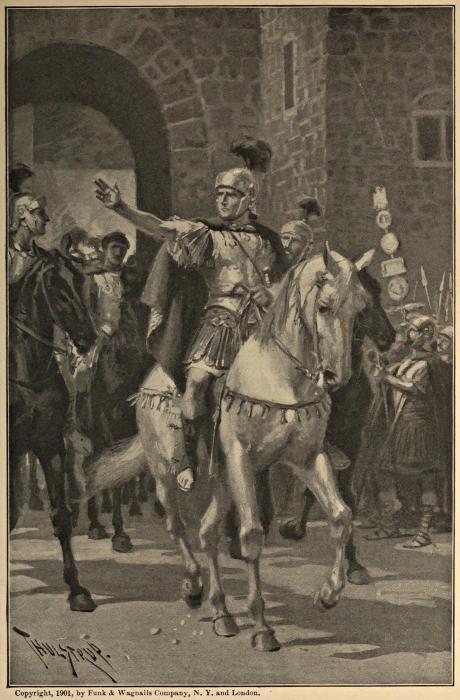
Copyright, 1901, by Funk & Wagnalls Company, N. Y. and London.
A Figure in the Gallery
“Aye, there is perhaps scarcely a room under the palace
roof where some heart is not trembling to-night with ghostly
fear, nor a peasant’s thatch where the death of Matthan and
the Arabian has not made pale faces; and where men tell of
the bridegroom stricken in his hour of pride. But—— powers
of Heaven preserve us! look there!”
I looked, but it was to the old man, whose countenance
alarmed me with the idea that he had wrought his imagination
to a hazardous extreme. I took his cold hand, and telling
him that I felt unable to sleep, gently laid his stiffened
limbs on the couch and bade him try to rest. But his eye
stared through the casement till I followed its direction, yet
with only the added belief that he was overcome by the common
terrors of the household; for to me tenfold darkness lay
upon every object from the ground to the battlements.
I accidentally glanced at the gallery, and there I saw a
figure, slight and shadowy, passing backward and forward in
front of a quivering lamp! My surprise was more startling
than I would venture to communicate to my companion, already
almost paralyzed with fear. But if I had conjured up a
phantom to give force to the tale, none could have been more
closely similar. The figure was enveloped in robes whose
richness I could perceive even across the court; the gestures,
the wild hurry of the pacings through the chamber, the general
air of wo and distraction, were not to be mistaken. In
the midst of the silence I heard the creaking of bolts and the
fall of chains that seemed to be at my side. A single word
followed, but that word was terribly comprehensive—“Death!”
The sound was uttered in a sepulchral tone, that left the imagination
free to shape the picture with what sullenness it willed!
But the sound was scarcely uttered when I heard a shriek,
wild as ever told of wo; saw the figure sink down, and the
lamp quiver and expire! The old man had seen what I had
seen, but the natural feebleness of age left him a mere helpless
prey to superstitious fear, and no attempt to explain
these singular coincidences could calm him. He was convinced
that the vengeance that had stricken his master’s house
was still abroad, and that he had beheld its minister. Remonstrance
was in vain, and he sank alternately into reveries
and the stupefaction of spiritual terror.
Naomi, the
Specter
I tended him with the more interest from my being not
altogether unimpressed with the possibility that his alarms
were just. I was no believer in the vulgar narratives of
superstition. But nature has her mysteries!
While I sat beside the couch and watched the ebb and flow
of life in a frame that I sometimes expected to see utterly
give way, a jarring of bolts again struck my ear. I listened
with a strange emotion. The old man had heard it, and in a
new convulsion grasped both my hands and held me close.
The sound returned; it increased; I saw the wall of the
tower open and the figure stand before me.
“It is she; it is she!” shudderingly murmured my companion,
fixing his eyes on it and holding me with the clasp of
agony.
The heart beat loud within me; but I interposed myself between
the corpse-like being whom I held in my arms and the
unearthly visitant, and demanded “for what purpose it had
come.” The figure started as I spoke; then gazing intently
on me as I turned to the light, threw the mantle from its forehead
and fell at my feet. The lovely Naomi was the specter!
Yet perfectly guiltless of the ghostly potency of her presence
and the unfilial alarm into which she had thrown her
adopted father, whom she was delighted to find, but whom
she candidly acknowledged “she never dreamed of finding
there.”
“The tower contains a prisoner,” said she tremblingly,
“who must be saved this night, for to-morrow at daybreak is
his dreadful hour. I knew that he would be condemned, and
we agreed on a signal, by which I was to learn when the time
was fixed. I have watched all night for it, and almost betrayed
myself by a cry of horror that I could not suppress at
the sight of that signal just now. I had no resource but to
bear my own message, and assist him myself in escaping from
this place of sorrow.”
“But, my child, who is the prisoner, or where is he?”
She blushed and said: “One who saved me when the world
was against me. He rescued me from the hands of barbarians—and
could I leave him to perish?”
Salathiel Finds
a Prisoner
“Lead on then, and without delay, for daybreak is not far.
But how shall we find our way to his dungeon?”
“I paid high,” said she, “for my knowledge of this tower,
and it has no concealments from me. Remove this bar.”
I drew out a slender iron rod; a door deep in the wall gave
way and disclosed a winding stair, by which we descended.
We found the prisoner writing, and so earnestly occupied that
our footsteps did not interrupt him.
“There,” soliloquized he as he ran his eye down the epistle.
“I think, my masters if not the better, some of you will be
the wiser for my labors. Home truths are the truths, after
all. Titus will learn what a set of incurable reprobates he
has about him, and by this time to-morrow, when I shall care
as little for mankind as mankind ever cared for me, I shall
do the state service; from my gibbet turn reformer and make
the scaffold popular. And now, for the farewell to my lady
and my love.”
He sighed and threw down the pen.
“No, my Naomi, I can say nothing half so fond or half so
bitter as my feelings would have me say at this moment.
Would that I had never seen you, if we are to part so soon.
Yet why should I regret to have known innocence and beauty
in their perfection? No, my love, rosy was the hour when I
first saw you, and proud is even the parting hour that tells me
I could have loved so noble a being—but all is better as it is.
How could I have borne to see you following the fortunes of
a wanderer, of a man without a country or a name? Then
farewell, my Naomi dearest, farewell; you were the gleam of
sunshine in my cloudy day, the star in my dreary night, and
while my heart beats you shall be there. Your name shall be
the last upon my lips, and if there be thought beyond the
grave, you shall be remembered, and—oh, how deeply—loved!”
The Arab Captain Recognized
I had been on the point of disturbing his meditation, but
Naomi, with the fine avarice of passion, would not lose a syllable.
She held me back, and implored me by her countenance
to let her have the full confession of her lover’s faith. That
beautiful countenance ran through all the shades of feeling,
and was covered with blushes and tears while the unconscious
worshiper poured out his devotion. But the time was flying; I
insisted on interrupting this epicureanism of the soul; and when
Naomi found that she must hear no more, she would allow
none but herself the pleasure of the surprise. A sigh which
swelled from the prisoner’s heart was echoed. He turned
suddenly, and pronounced her name with a loudness of delight
that nothing but the chance that protects the imprudent could
have prevented from bringing the guard upon us. His quick
eye soon caught me where I stood in shadow, and he sprang
forward to overpower the intruder. But the lamp saved us
from the encounter, and lifting his hands and eyes in amazement,
he laughed as loudly as he had spoken.
“In the name of all the wonders of the world,” exclaimed
he, “are you here too? Where are we to meet next? We
have met already in water, fire, and earth, and nothing is left
for us now but the clouds. Come, be honest, prince, and tell
me whether it was not for the sake of some such experiment
that you ventured here; for if another hour finds us within
these four walls, we shall know the grand secret as assuredly
as Titus wears a head and has a traitor at his elbow.”
It was the Arab captain! I was rejoiced to find that in attempting
to save the life of Naomi’s lover, I was discharging
a debt to the preserver of my own. To my mention of this
service he replied with soldierlike frankness that “I owed
him no obligation whatever; he had long hated the intolerable
cruelty of Cestius, and the debt was on his side, as I had
indulged him with an opportunity that every officer in the
service would have been happy to use.”
Naomi hung upon me, pale, and anxiously listening to every
sound abroad.
“This little trembler,” said he sportively, as he took her
passive hand, “I am destined to meet always in alarm. I first
found her flying from a troop of human brutes who were robbing
the baggage of the Roman camp; I thought her worth
something better than to keep goats on the Libanus and weave
turbans for some Syrian deserter; she was of the same opinion,
and fell in love with me on the spot.”
Attempts to
Escape
Naomi exclaimed against this version of the story.
“No matter for the mode,” said he; “I give the facts. I
dazzled her ambition by the promise of a palace—in the air;
bribed her avarice by the display of a purse unconscious of
gold; and bewitched her senses by a speech, a smile, and a
figure that for the first time in my life I found to be irresistible.”
Naomi again protested, and the dialog might have consumed
half the night without their discovering the lapse of
time, had I not interposed and inquired what further means of
escape were in our power. The lovely girl started from her
waking dream and pointed to a ring in the wall. I tried it,
but it resisted my force. At length we all strove at it together.
But no door opened. Naomi wrung her hands.
“The unfortunate lord of this tower in former times,” said
she, and the tears stood in her eyes, “always predicted that it
would be fatal to his family. To escape his own fate, he
pierced its walls with passages in every direction, but they
did not save my noble, my unfortunate father.”
She sat down weeping while I tore at the ring, which finally
broke off in my hands. The lover stood with folded arms,
gazing in sad delight on the beautiful being from whom he
was so soon to part forever, and whose face and form wore
almost the shadowy loveliness of a vision.
The chance of their escape now devolved on me solely, for
neither would have desired to disturb that strange and melancholy
luxury of contemplation. But as the concealed door
must be given up, the only resource was to return to my cell
and thence make our way through the passage by which
Naomi had arrived. A glance from the casement showed
me the court filled with soldiery and lights moving through
the palace. This hope was gone!
In the deepest doubt and fear I ventured up through the
tower to discover whether my cell was not already in possession
of the guard. I pushed back the door noiselessly; the
cell was empty; even the old steward was gone. Imagination
is a dangerous auxiliary in such a crisis, and it created out of
this trivial change a host of alarms. He must have fled to
give notice of my retreat, or to rouse the vigilance of the soldiery
by the stories of the wonders that he had seen. Escape
was hopeless. I even heard a confused whispering, which
proved that we had fallen into the snare.
Salathiel Discovers
a Door
There was now no alternative but to be seized and die, or to
make a bold rush for life and take our chances. I carried
the fainting Naomi up the stairs; and suppressing the infinite
risk of the attempt to penetrate through a building in which
its inmates were still awake and busy, and which was guarded
by the vigilance of Roman patrols, I advised that we should
do anything rather than remain where we were. She was
timid and submissive; but to my surprise the bold seaman,
the haughty leader of men, harder to be ruled than the elements,
the gallant despiser of death but a day past, was now
totally unnerved. The novelty of passion absorbed the spirit
of the man; he lingered near his mistress, and gazed on her
with an intenseness that told his world was there. To my
questions he gave no answer, but obeyed without a word, or
a glance turned from the exquisite countenance that sank and
blushed under his gaze. If the actual power of enchantment
had been wrought upon him, he could not have been more
fixed, helpless, and charmed.
Naomi Causes Consternation
I heard the voice of pain, and thought of the ancient follower
of the house of Ananus. My cooler judgment had acquitted
him of betraying me into the enemy’s hands. A part
of the cell was filled up with remnants of a canopy removed
from the statelier apartments. The groan came from behind
them. I flung them away, and saw a door open by which he
must have entered. I returned, desired the captain and Naomi
to follow, wrapped myself in a cloak, and sword in hand, led
the way through the darkness. I had not gone far when I
found myself treading on a human body. I sprang back, but
the figure, more startled than I, rolled down a succession of
steps before me, and falling against a door, burst it open. A
strong light from within flashed up the stairs, and taking
Naomi’s hand, I led her down this steep and narrow outlet of
the grand gallery. As she came toward the light, a wild cry
was given; a man rushed back, and exclaiming, “It is she
risen from the grave, the Arabian!” darted through the vast
hall, in which were still a number of domestics setting it in
order after the banquet. Every eye instantly turned to the
spot from which we emerged. Naomi’s white-robed form,
followed by her lover’s and mine wrapped to the brow in our
dark mantles, formidably verified the superstition.
The crowd were already prepared to witness a wonder on
this night of wo; they fled or fell on their faces. The man,
still rushing on, propagated terror before us; and through the
long vista of lighted chambers, where to be seen might have
been ruin, we moved unquestioned until we reached the portal.
It, too, had been thrown open by some of the fugitives; the
gardens were deserted; the troops had been drawn to another
quarter of the palace. Before us was welcome solitude, and
we were soon winding through the wood-paths by the light of
the stars.
The Flight
While we traversed the grounds, the heaving of the
branches under the wind, which rose in strong gusts from
time to time, and the rush of the rivulets from the hillsides,
which retained the swell of the melting snows, prevented our
hearing other sounds; but when we emerged from this little
forest of every plant that yields fruit or fragrance and began
to climb the surrounding ridge, the sights and sounds to which
I had been so long accustomed broke upon us. To the south
a long line of light showed where Jerusalem was struggling
against a midnight assault, and the uproar of battle came wildly
on the wind. The Roman camp-fires blazed round the promontory
Scopas, like the innumerable crevices of a huge volcanic
hill breathing flame from root to summit. But a more
immediate peril lay behind us. The first height from which
we could see the palace showed us the well-known fire-signals
of the enemy flaming on its battlements. Our escape had been
discovered. The signals were answered from every point of
the horizon. Where a signal was, there was an enemy’s post;
we could not advance a step without the most imminent
chance of seizure, and in those times, death by the shaft or the
sword was the instant consequence. The signals were followed
by the trumpet, and every blast from the palace roof was
answered for miles round.
The whole horizon was alive with enemies, and yet, if in
every call captivity and death had not been the language, this
circling echo of the noblest of all instruments of sound, coming
in a thousand various tones from the varied distances,
softened by the dewy softness of the night, and breathing
from sources invisible, as if they were inspired only by the
winds, or poured from the clouds, might have seemed sublime.
Tracked by
Bloodhounds
But a new alarm rose in the direction of the forest, which
now lay beneath us like a sea slightly silvered on its thousand
billows by the sinking moon. The trampling of cavalry was
distinctly heard in pursuit, and torches were seen rushing
through the trees. The pursuit had turned into the very path
by which we came, and the baying of a bloodhound up the
ridge was guiding the cavalry to our inevitable capture if we
remained. I was resolved not to be taken while I could fight
or fly, and pointing out to my fellow fugitives the horsemen,
as they scoured the foot of the hills, I plunged down into a
ravine, where I could expect to find only some torrent too
deep for us to pass. But it was at least protracted fate.
I had given Naomi into the hands of her lover, and while
they slowly descended the precipice, returned to its edge to
ascertain whether the enemy were still upon our steps. The
rock toward the summit was splintered into a number of little
pinnacles, grasping one of which, I clung, listening and gazing
with indescribable nervousness. The sounds of pursuit had
perished, or were so mingled with the common sounds of
nature as to be unheard, and I was congratulating myself
upon our total safety, and about to return to the spot where I
had left my companions, when the torch-light shot up from the
dell, immediately below me. I gave a hurried glance along
the ravine, but Naomi was not there. A detachment of
archers was climbing over the huge rocks that filled up its
depth, and flashing torches through every hollow where a
human being could lie.
To rescue my unfortunate charge was my first resolve, and
I began to let myself down the abrupt side of the hollow before
the torches disappeared. They at last seemed to be completely
gone, but as I hung within a few feet of the path, a
growl and a dash at my throat nearly overthrew my steadiness.
I knew that a precipice of immense depth lay underneath,
and in the utter darkness I could have no certainty
that my next step might not carry me over it.
Victims of the Cross
My sole expedient was to grasp the rock with one hand and
defend myself to the last with the other. The bloodhound
had tracked me, and he flew again at my throat; but I was
now prepared; I caught him in the bound and whirled him
down the ravine. His howl, as he fell from crag to crag, betrayed
me at once. A hundred torches rushed upward. I
climbed the pinnacle, sprang from its top into a pine thicket,
and winding over a long extent of broken ground, gradually
lost torches and outcries together.
After a pause, to consider in what quarter final escape was
most probable, a glimmering light through the thicket at a
considerable distance toward the city determined me. My
pursuers must be far behind; the loss of the bloodhound diminished
still more their chance of reaching my track through
a remarkably wild and broken district; and come what would,
whether that light was kindled by friends or enemies, I should
see them before they could discover me. I struggled on until
I reached the base of a ridge, on whose farther side the light
gleamed. To ascend it was beyond my powers, but by gliding
along the base I found a crevice, which, enlarged whether by
nature or the human hand, led through the hill. My way in
darkness was brief; I had not gone a third of the distance
when the light shone strongly through the cavern. At its
mouth I stood overwhelmed—I had strayed into the memorable
valley of the Crosses!
Thousands of men, besmeared with blood, dust, and clay,
half naked, brandishing weapons still dripping with gore;
whirling torches; shouting out roars of triumph; howling in
desperate lamentation; kneeling and weeping over the dead
with the most violent affliction; wrapping themselves in robes
and armor; tearing away their raiment, and flinging sword
and spear into the flames; throwing hundreds of corpses into
one promiscuous burning, round which they danced with furious
exultation; carrying away on litters of lances and branches,
corpses that they seemed to hallow as more than mortal;
every strange variety of human passion, wound up to its
wildest height, was pictured before me, and all was thrown
into the most living distinctness by the blaze of an immense
central heap of timber.
The Last of the Conflict
The horrid cruelties of the execution had been heard of in
Jerusalem, and the spirit of the people was roused to vengeance.
With that imperishable courage which distinguished
them above all nations, a scorn of hazard that in those unhappy
days only urged them to their ruin, they determined to
make the enemy pay in slaughter for the memory of their
warriors. A multitude without a leader, but among whom
served with the simple spear many a leader, poured out from
the gates to attack an enemy flushed with victory, and secured
in entrenchments, impregnable to the naked strength of my
unfortunate countrymen. They divided into two armies, one
of which assaulted the lines, while the other marched to the
valley of the Crosses. The assault on the lines was repelled
after long and desperate displays of intrepidity. It was the
intelligence of this attack that had broken up the banquet.
The Romans sustained heavy losses in the early part of the
night; their outposts in the plain were sacrificed, and the
chief part of their cantonments burned.
But the “army of vengeance,” a name given to it alike by
Jew and Roman, accomplished its purpose with dreadful
retribution. The legionaries posted to defend the valley were
trampled down and destroyed at the first charge. Troop
on troop, sent to extricate them, met with the same fate.
One of the few prisoners described the valley, when his
cohort reached its verge, as having the look of a living
whirlpool, a vast and tempestuous rolling and heaving of infuriate
life, into which the attempt to descend was instant
destruction.
“Every cohort that entered it,” said the centurion, “was
instantly engulfed and seen no more. Last night our legion,
the fifteenth, lay down in their tents five thousand strong; to-night
there are not ten of us on the face of the earth.”
The conflict was long, and the last of the enemy were under
the Jewish sword when I reached the mouth of the fissure.
But in the first intervals of the struggle, the remains of our
tortured people had been taken down from the accursed tree,
tended with solemn sorrow, and given up to their relatives
and friends to be borne back to Jerusalem. The crosses were
thrown into a heap and set on fire; the fallen legionaries underwent
the last indignities that could be inflicted by scorn
and rage; and when even those grew weary, were flung into
the blazing pile.
Salathiel
Burns a Cross
The fate of the noble Eleazar was still unknown, and to
obtain the certainty of his preservation or to render the last
honor to his remains, I forced my way toward the spot on
which I had seen him awaiting death. But my searches were
in vain; the witnesses on both sides were now where there is
no utterance. Guard, executioner, and victim were clay; the
battle had raged chiefly round that spot, and the ground,
trampled and deep in blood, gave melancholy evidence of the
havoc. There were painful and peculiar signs of the sacrifice
that had extinguished the little group of the converts, and I
poured oil and wine upon their hallowed ashes. A large
fragment of a cross still stood erect in the midst of them.
“Was it upon thee, accursed thing,” I exclaimed, “that the
life-blood of my brother was poured? Was it upon thee that
the last breath was breathed in torture from the lips of virtue,
heroism, and purity? Never shalt thou minister again to the
cruelty of the monsters that raised thee there.”
Indignantly I tore up the beam, and dragging it to the pile
by my single strength—to the wonder of the crowd, who
eagerly offered their help, but whom I would not suffer to
share in this imaginary yet consoling retribution—I rolled it
into the flames amid shouts and rejoicings.
Daybreak was now at hand, and the sounds of the enemy’s
movements made our retreat necessary. We heaped the last
Roman corpse on the pile, covered it with the broken spears,
helmets, and cuirasses of the soldiery, and then left the care
of the conflagration to the wind. From the valley to Jerusalem
our way was crowded with the enemy’s posts; but the
keen eye and agile vigor of the Jew eluded or anticipated the
heavy-armed legionaries, by long experience taught to dread
the night in Judea, and we reached the Grand Gate of Zion
as the sun was shooting his first rays on the pinnacles of the
Temple.
The Wild Host
In those strange and agitated days, when every hour produced
some extraordinary scene, I remember none more extraordinary
than that morning’s marching into the city. It
was a triumph, but how unlike all that bore the name! It
was no idle, popular pageant; no fantastic and studied exhibition
of trophies and treasures; no gaudy homage to personal
ambition; no holiday show to amuse the idleness or feed the
vanity of a capital secure in peace and pampered with the
habits of opulence and supremacy. It was at once a rejoicing,
a funeral, a great act of atonement, a popular preservation,
and a proud revenge on the proudest of enemies.
On the night before, not an eye had closed in Jerusalem.
The Romans, quick to turn every change to advantage, had
suffered the advance of our irregular combatants only until
they could throw a force between them and the gates. The
assault was made, and with partial success; but the population,
once roused, was terrible to an enemy fighting against
walls and ramparts, and the assailants were, after long
slaughter on both sides, drawn off at the sight of our columns
moving from the hills.
We thus marched in unassailed, a host of fifty thousand
men, as wild and strange-looking a host as ever trod to acclamations
from voices unnumbered. Every casement, roof,
battlement, and wall in the long range of magnificent mansions,
leading round by the foot of Zion to Mount Moriah, was
crowded with spectators. Man, woman, and child of every
rank were there straining their eyes and voices, and waving
hands, weapons, and banners in honor of their deliverers from
the terror of massacre. Our motley ranks had equipped themselves
with the Roman spoils wherever they could, and among
the ragged vestures, discolored turbans, and rude pikes, moved
masses of glittering mail, helmets, and gilded lances. Beside
the torn flags of the tribes, embroidered standards were tossing
with the initial of the Cæsars, or the golden image of some
deity, mutilated by our scorn of the idolater.
Ester’s Return
The Jewish trumpets had scarcely sent up their chorus,
when it was followed by the clanging of the Roman cymbal,
the long and brilliant tone of the clarion, or the deep roar of
the brass conch and serpent. Close upon ranks exulting and
shouting victory came ranks bearing the honored dead on litters
and bursting into bitter sorrow; then rolled onward thousands
bounding and showing the weapons that they had torn
from the enemy; then passed groups of the priesthood—for
they, too, had long taken the common share in the defense—singing
one of the glorious hymns of the Temple; then again
followed litters, surrounded by the wives and children of the
dead, wrapt in inconsolable grief. Bands of warriors, who
had none to care for, the habitual sons of the field; armed
women; chained captives; men covered with the stately
dresses of our higher ranks; biers heaped with corpses;
wagons piled with armor, tents, the wounded and the dead;
every diversity of human circumstance, person, and equipment
that belongs to a state in which the elements of society are let
loose—in that march successively moved before the eye.
With the men were mingled the captured horses of the legionaries;
the camels and dromedaries of the allies; herds of the
bull and buffalo, droves of goats and sheep; the whole one
mighty mass of misery, rejoicing nakedness, splendor, pride,
humiliation, furious and savage life, and honored and lamented
death; the noblest patriotism and the most hideous abandonment
to the excesses of our nature.
As soon as I could extricate myself from the concourse, I
hastened to appease the anxieties of my family, who had suffered
the general terrors of the night, with the addition of
their own stake in my peril and that of Constantius. My
first inquiry was for Esther. To my great delight, she had
returned, but was still in nervous alarm. On the night of
her being led through filial zeal to meet Septimius, she was
seized by a party of armed men and by them conveyed to a
dungeon, where questions had been put to her tending to
charge me at once with magic and correspondence with the
enemy. But this persecution ceased, and she found herself
as unexpectedly set at liberty as she had been seized. At the
gate of her prison the minstrel had met her, and through the
midst of the city, then in its fiercest agitation, had with singular
dexterity conducted her safely home.
A Minstrel’s Acquirements
A service of this kind was not to go unrewarded, and he had
been suffered to remain under our roof until my return. But
by that time he had made his ground secure by such zealous
service and so many graceful qualities, that even Miriam,
sensitive and sagacious as she was, desired that he should be
retained.
From his knowledge of the various dialects of Asia and his
means of unsuspected intercourse, few events could occur of
which he had not obtained some previous knowledge. His
adroitness in availing himself of his knowledge I had already
experienced in my escape from the gates, and it was to him
that was due the flight of the negroes. A stray charger, a
mask, and the common juggler’s contrivance of breathing
flames, made up the demon that defrauded the Ethiopian exchequer.
But his dexterity in the arts of elegance and taste
was singular; his pencil was dipped in nature, and the
sketches, which he was perpetually making of the wild and
picturesque population that now filled our streets, were incomparable.
He sculptured, he modeled, he wove; he wrought
the gold filigree and chainwork, for which our artists were
famous, with a skill that the most famous of them have
envied. His knowledge of languages seemed the natural result
of his wanderings, but it was extraordinarily various and
pure. The dance and song were part of his profession; but
from the little imperfect harp in use among the minstrels he
drew tones that none other had ever delighted me with—sounds
of such alternate spirit and sweetness, such tender
and heart-reaching power, that they were like an immediate
communication of mind with mind.
And the charm of those acquirements was enhanced by the
graceful carelessness with which he made his estimate of their
value. To my questions how he could at his age have mastered
so many attainments, his reply was that with his three
teachers “everything might be learned; common sense alone
excepted, the peculiar and rarest gift of Providence! Those
three teachers were Necessity, Habit, and Time. At his starting
in life Necessity had told him that, if he hoped to live,
he must labor; Habit had turned the labor into an indulgence;
and Time gave every man an hour for everything unless he
chose to sleep it away.”
Constantius’ Absence
But he had higher topics, and the sagacity of his views, in
a crisis that was made to shake the wisdom of the wise, often
held me in astonishment. The fate of Constantius deeply
perplexed me. He had now been absent long, and no tidings
of him could be heard among the returning warriors further
than that he had joined them in the march to the valley of
the Crosses, had distinguished himself by the intrepidity of
his attack on the legionary guard at the entrance, and was
seen for a short time with a captured standard in his hand
leading on the people. Unable to endure the silent anguish of
those round me, silent only through fear of giving me pain, I
had determined on passing the walls again to seek my brave
and unfortunate son among the fallen. But Miriam’s quick
affection detected me, and with weeping prayers she implored
that “I should not risk a life on which hung her own and
those of her children.”
The sound of the lyre came suddenly upon the air, and to
dissipate the cloud that was gathering on my mind, I wandered
to a balcony where, in the evening light and the pleasant
breathing of the breeze, the minstrel was touching the strings
to the song that had first attracted me. I flung my wearied
frame on a couch and listened until memory became too keen,
and I waved my hand to him to change the strain. He
obeyed, but his heart was in the harp no more; his touch faltered,
the song died away, and he approached me with a
soothingness of voice and manner that none would have
desired to resist.
“My prince,” said he, “you are unhappy, and if your sorrows
can be lightened by any service of mine, why not command
me?”
He waited; but I was too much absorbed in gloomy speculation.
“I can pass the gates,” he timidly continued, “if such be
my lord’s will.”
I made a sign of dissent, for the enemy, since their late
surprise, had begun to urge the siege with increased vigilance.
Yet my anxiety for the fate of Constantius, and
scarcely less for that of Naomi and her lover, must have
been visible.
Salathiel’s
Prejudices
He still lingered nigh, watching the indications which inward
struggle so forcibly paints upon the external man.
“Prince of Naphtali,” said he in a steadier tone, “among
my teachers I forgot to mention one, and that one the most
effective of all—Self-determination! not the mere disregard
of personal risk, but the intrepidity of the mind. I loved
knowledge, and I pursued it without fear. Nature is boundless,
wise, and wonderful—but prejudice bars up the gate of
knowledge. The man who would learn must despise the timidity
that shrinks from wisdom, as he must hate the tyranny
of opinion that condemns its pursuit. Wisdom is like beauty,
to be won only by the bold.”
I looked up at the young pronouncer of the oracle. His
countenance, animated by the topic, wore an expression of
power, in which I should never have recognized the delicate
and dejected being that he always appeared, except in some
moment of sportiveness, come and gone with the quickness of
lightning.
“Minstrel, apply this to our people or their bigoted and
ignorant leaders. I have no prejudices.”
“All men have them, my prince, and the only distinction
is that in some they are mean, dark, and malignant; in others
they are lofty, generous, and sensitive; yet they are but the
stronger for their nobleness. The mind itself struggles to
throw off the vile and naked fetter. But how many forget
the incumbrance of the chain of gold in its preciousness!”
He hesitated, and then, with a still more elevated air, again
began:
“You despise, for instance, the little ingenuities of our profession,
and I own that in general they deserve nothing else.
But if there were to come before you some true lover of
nature, a disciple of that sublimer philosophy which holds the
secrets of her operations, a master of those superb influences
which rule the frame of things, and yet more, guide the fates
of men and nations—would not your prejudices—and noble
ones they are—lead you to repel the offer of his mysteries?”
The Minstrel’s Attire
Thoughts tending to those mysteries had so often occurred
to me, and my mind was by its original constitution so fond of
the abstruse and the wild, that I listened with interest to the
romance of philosophy. The figure before me was not unsuited
to the illusion; slight, habited in the fanciful dress of
his art, a tunic of purple cloth, bound round the waist with a
girdle; the turban, a mere band of scarlet silk, lightly laid
upon his curls. There was in all this nothing that was not to
be seen at every hour in the streets, but round his waist, instead
of the usual girdle of the minstrels, he wore to-night a
large golden serpent, embossed and colored with a startling
resemblance to life, and a broad golden circlet wrought with
devices of serpents clasping his brow. The countenance was
vividness itself, not without that occasional wandering and
touch of melancholy that showed where early care has been,
yet redeeming the gloom by a smile that had the sweetness
and suddenness of the sunbeam across an April shower.
The evening music of the Roman camps roused me as their
ranks were drawn out for the customary exercise. I turned
from them to glance upon the battlements, that were now
crowded with stragglers of the tribes inhaling the air of the
fields and like myself gazing on the movements of the enemy.
The thought pressed on me how soon and how terribly all this
must end; what were the multitudes to be that now lived and
breathed beneath my glance? The thought was too painful.
I turned from earth to look upon the east, where the evening
star was lying on a rosy cloud, like a spirit sent to bring back
tidings from this troubled world.
“There, boy,” said I, “will your wisdom tell me the story
of that star? Are its people as mad as we? Is there ambition
on one side and folly on the other? Are their great men
the prey of a populace, and their populace the fools of their
great men? Have they orators to inflame their passions;
lawyers to beggar them in pursuit of justice; traders, to cheat
them; heroes, to give them laurels at the price of blood; and
philosophers, to be the worst plagues among them?”
The Rulers of the Empire
“Even that knowledge,” said the minstrel, “may not be
beyond the flight of the human intellect; but prejudices must
be first overcome; we must learn to scorn idle names, defy
idle fears, and use the powers of nature to give us the mastery
of nature! There are virtues in plants, in metals, even
in words, that to seek, alarms the feeble, but to possess, constitutes
the mighty. There are influences of the air, of the
stars, of even the most neglected and despised things, that
may be gifted to confer the sovereignty of mankind.”
I listened with the passive indulgence of one listening
under a spell; his voice had the sweetness and the flow of
song, and his language was made impressive by gestures of
striking intelligence and beauty. He pointed to the skies, to
the flowers, to the horizon, that glowed like an ocean of amber;
and his fine countenance assumed a changing character
of loftiness, loveliness, or repose as he gazed on the sublime
or the serene.
“Boy,” said I faintly, “are not such the studies by which
the pagan world is made evil?”
He smiled. “No! Light is not further from darkness
than wisdom from the superstition of the pagan. Rome is
filled with the madness that falls upon idolatry for its curse—that
has fallen since the beginning of the world—that shall
fall until its end. She is the slave of ghostly fear. This
hour, among the proudest, boldest, wisest, within the borders
of paganism, there lives not a man unenslaved by the lowest
delusion. The soothsayer, the interpreter of dreams, the
sacrificer, the seller of the dust of the dead, the miserable
pretender to magic—those are the true rulers of the haughty
empire—those are the scepter-bearers to whom the Emperor is
a menial—those are the men of might who laugh at authority,
set counsel at naught, and are sapping the foundations of the
state, were they deep as the center, by sapping the vigor of
the national mind.”
The King of Metals
While he spoke he was with apparent unconsciousness
sketching some outlines on one of the large marble slabs of
the wall. My eyes had followed the sun until the balcony,
darkened by an old vine, was in the depth of twilight. To
my surprise, the marble began to be covered with fire, but fire
of the softest and most silvery hue. The surprise was increased
by seeing this glowworm luster kindle into form. I
saw the portrait of Constantius, and by his side Naomi and
her lover. As the lines grew clearer still, I saw them in
chains and in a dungeon! The extraordinary information
which the minstrel had the means of obtaining made me demand
in real alarm whether the picture told the truth, and
that if it did, I should be instantly acquainted with whatever
might enable me to save them.
“And trifles like those fires can excite your astonishment?”
he replied; “what if I were to tell you of wonders such as it
has not entered into the mind of the world to imagine, yet
which are before us in every hour of our lives, are mingled
with everything, are grasped in our insensate hands, are trodden
by our careless feet? See these crystals”—he scraped a
portion of the niter exuding from the wall—“in these is hidden
a power to which the strength of man is but air—to which
the bulwarks round us are but as the leaf on the breeze—at
whose command armies shall vanish, mountains shake, empires
perish—the whole face of society shall change; yet by a
sublime contradiction, combining the greatest evil with the
greatest good—the most lavish waste of life with the most
signal provision for human security!”
“Judea must fall!”
[see page 511.
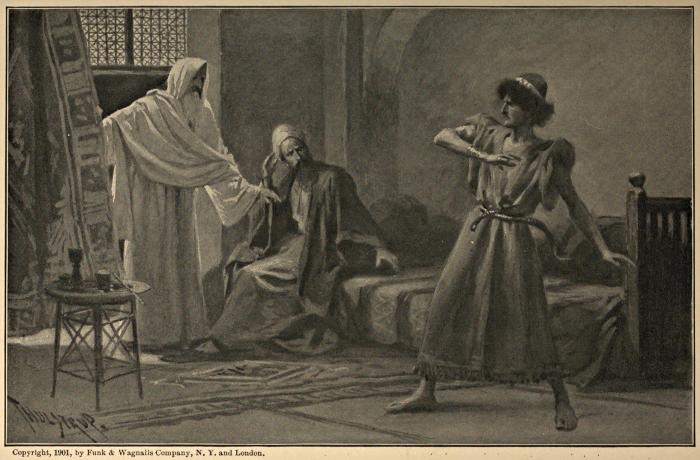
Copyright, 1901, by Funk & Wagnalls Company, N. Y. and London.
The Supremacy of Man
“Look on this metal,” said he, pointing to some of the
leaden ornaments of the balcony, “and think what is the
worth of human judgment. Who would give the pearl or the
diamond, the silver or the gold, for this discolored dross?
Yet here is the king of metals—the king of earth; for it can
create, subdue, and rule all that earth produces of power.
Within this dross are treasures hidden, more than earth could
buy—truth, knowledge, and freedom. It can give the dead a
new life and the living a new immortality. It can sink the
haughtiest usurper that ever sinned against man into the lowest
scorn. It can raise the humblest son of obscurity into
preeminence, and even without breaking in upon the seclusion
that he loves, set him forth to every future age crowned
with involuntary glory. It can flash light upon the darkest
corners of the earth—light never to be extinguished. It can
civilize the barbarian; it can pour perpetual increase of happiness,
strength, and liberty round the civilized. It can make
feet for itself that walk through the dungeon walls; wings
that the uttermost limits of the world can not weary; eyes to
which the darkest concealments of evil are naked as the day;
intellect that darts through the universe and solves the
mightiest secrets of nature and of mind! But in it, too, is a
fearful power of ruin.”
He gazed on me with a glance that seemed to shoot fire.
“Holding the keys of opulence and empire,” he continued,
“it can raise men and nations to the most dazzling height—but
it can stain, delude, and madden them until they become
a worse than pestilence to human nature.”
While he spoke, his form assumed a grandeur commensurate
with his lofty topics; the power of his voice awoke with the
awaking power of his mind. My faculties succumbed under
his presence, and I could only exclaim:
“More of those wonders; give me more of those noble evidences
of the supremacy of man!”
“Man!” said my strange enlightener; “look upon him as
he is, and what more helpless thing moves under the canopy
of heaven? The prey of folly, the creature of accident, the
sport of nature, the surge whirls him where it will; the wind
scorns his bidding; the storm crushes him; the lightning
smites him. But look upon man when knowledge has touched
him with her scepter.”
The circlet on his brow seemed to quiver and sparkle with
inward luster; the golden serpent that clasped his robe
seemed to writhe and revolve. I felt like one under fascination.
A strange sense of danger thrilled through me, yet
mixed with a dreamy and luxurious sense of enjoyment. The
air seemed heavy with fragrance, and I sat listening in powerless
homage to a lip molded by beauty and disdain.
“Man, the sport of nature!” said he, pointing to a bead of
dew that hung glittering on a leaf of the vine. “Say man, the
sovereign of nature! With but so feeble an instrument as
this dew-drop he might control and scorn the wind and the
wave! Or would you defy the storm in darkness, without sun
or star speed through the unknown ocean, and add a new
world to the old? Within this fragment lies the secret.”
He struck off a brown splinter from the stone of the balcony.
Exiled—Desperate—Undone
“Or would you behold regions to which the stars that now
blaze above our heads are but the portal,” he said; “kingdoms
of light never penetrated by mortal vision; generations of
worlds? By what splendid influence, think you, that the
miracle is to be wrought? Even by this dust!”
He took up a few grains of the sand at his feet and poured
them into my robe. He saw his time.
“Would you,” exclaimed he, “be master of those magnificent
secrets? Then bind this girdle round you and invoke the
name that I shall name.”
I shuddered; the arts of the diviner flashed upon me. But
I had listened too long not to be enfeebled by the temptation.
I felt the passion which lost us paradise—the thirst of forbidden
knowledge. Still I resisted. The young deceiver
pressed me with more distinct promises.
“In your fate,” said he, “the fate of your nation is bound
up. Has it not been declared that a great deliverer is to
come, by whom the face of the enemies of Judah is to be withered,
and the scepter of the earth given to the hand of
Israel? Pledge yourself to me and be that deliverer! You
shrink! Know then—that even while I speak, every creature
of your blood is in chains; your house is desolate; your fortunes
are overthrown; you are cut off root and branch; you
are exiled—desperate—undone!”
I felt a dreadful certainty that his words were true. My
heart bled at the picture of ruin. I wavered. The temptation
tingled through my veins.
“What were the sacrifice of myself,” thought I, “wretched
and sentenced as I was, to the preservation of beings made
for happiness? Or was I to hesitate, let the risk be what it
might, when virtue, patriotism, and boundless knowledge were
added to that preservation? For the trivial honors that man
could give to man, the highest intellects of the earth had been
influenced, but the honors of the restorer of Judah were an
immortal theme—the old splendors of triumph were pronounced
vain and dim, the old supremacy of thrones weakness,
to the domination and grandeur of the sovereign who
should sway the returning tribes of Zion.”
Judea Must
Fall
The figure approached me, and in a voice that sank with
subtle force through every nerve pronounced the vow that I
was to utter. I was terror-struck; a cloud came over my
sight; strange lights moved and glittered before me. I felt
the unspeakable dread that my faculties should betray me,
and that I should unconsciously yield to a temptation which
yet I had no strength to withstand.
While I sat helpless and almost blind, I was aroused by a
majestic voice. I looked up. Eleazar was at my side. I
would have flung myself into his arms; I would have cast
myself at his feet, but an indescribable sensation told me that
my noble brother was to be so approached no more.
“Well and wisely hast thou resisted,” were his solemn
words, “for in thee are the last fortunes of thy people.
Judea must fall; but fallen with her as thou shalt be, and
desolate, despairing, and wild as shall be thy sojourn, the last
blow of ruin to both would be given hadst thou yielded to the
adversary.”
I glanced at the minstrel. His visage was horror; he
stood deformed, like one dead in the moment of torture. I
closed my eyes against the hideous spectacle. A sound of
hurrying steps made me open them, after how long an interval
I know not. I was alone!
To the Tower
of Antonia
The sounds of the footsteps increased. Overwhelmed as I
was by the trial that my mind had just undergone, I sat
nearly unconscious of external things till I was roused by a
strong grasp from behind and saw myself surrounded by
armed men. I was passively bound; and indifferent to fortune,
was flung into a litter and conveyed to the Tower of
Antonia. In this vast circle of fortifications, the citadel of
the former Roman garrison, the Jewish government was now
held, or rather Onias lorded it over the population. He had
discovered my dwelling, and the first fruit of his knowledge
was my seizure and that of my family. He was now playing
the last throw of that desperate game to which his life had
been given. Power was within his reach, yet there I stood to
thwart him once more, and he was resolved to extinguish the
first source of his danger. Yet I was popular, and with all
his daring, he desired to cast the odium of my death on the
Sanhedrin. I was to be tried on the ground of treating with
the enemy; my family were seized, to shake my courage by
their peril, and I was to be forced to an ignominious confession
as the price of saving their lives.
At the mouth of a dungeon a torch was put into my hands.
I was left to make my way, and the iron door was closed that
had shut out many a wretch from light and life. At the bottom
of the steps I found a man sleeping tranquilly on the
stone. The glare of the torch disturbed him; he started up,
and, looking in my face, exclaimed in the buoyant and cheerful
tone by which I should have recognized him under any
disguise:
The Captain Tells of Constantius
“By Jupiter! I knew that we were to meet! If I had to
sleep to-night at the bottom of the sea, I should wager my
simitar to a straw that our bodies would be found lying side
by side. I presume we mount the scaffold together to-morrow
for the benefit of Jewish morality. Well, then, since our
fates are to be joined, let us begin by—supping together.”
It was the captain! He laid his store on the ground; but I
was heartsick, and could only question him of Naomi, and
the misfortune which had betrayed him into the hands of the
tyrant.
“Our history is the briefest in the world,” was the answer;
“we found ourselves pursued, and we fled. The pursuers followed
faster than my fair mistress could run, or I could carry
her. So we were overtaken before we could clear the rocks,
and our captors were forthwith carrying us to the Roman
camp, in great joy at their prize. But it was intended to be
an unlucky day for the legions. We came across a Jewish
troop, headed by a fine, bold fellow, who dashed upon the
captors and fluttered them like a flight of pigeons. Nothing
could promise better than the affair, for my new captor turned
out to be an old friend, and one of the most gallant that ever
commanded a trireme. Many a day the Cypriot and I chased
(Nemesis forgive us for it!) the pirates through the Cyclades:
I, however, did not know then what pleasant personages the
brothers of the free-trade might be.”
He smiled, and the sigh that followed the smile told how
little he had since found to compensate for his old adventures.
“A Cypriot. Your captor was my son, my Constantius!”
I exclaimed.
“The very man. When he had found me out under my
Arab trappings, he was all hospitality, and invited me to
share the honors of his princely father’s house. His troop
soon scattered every man to his home, and I was gazing at
the head of an incomparable knave and early acquaintance,
Jonathan, nailed up over the gate for some villainy which he
had not been as adroit as usual in turning to profit, when
Constantius, myself, and that lovely girl, whom I shall never
see more”—he bent his brows at the recollection—“were
seized by the guard, separated, and sent, I suppose, alike to
the dungeon.”
The Egyptian’s
Papers
Shortly after midnight I was brought before the tribunal.
Onias was my accuser, and I was astonished at the dexterity,
number, and plausibility of his charges—magic, treachery, the
betrayal of my army, the refusal to push the defeated enemy
to a surrender, lest by the cessation of the war my ambition
should be deprived of its object; and last and most astonishing,
the assassination of my kinsman, Jubal, through fear of
his testimony!
I made my defense with the fearlessness of one weary of
life. Some of the charges I explained; others I promptly repelled.
To the imputation of treachery I answered in a single
sentence.
“Read that correspondence with the enemy and judge which
is the traitor.”
I took the Egyptian’s papers from my sash and flung them
on the table. The aspect of my accuser at the words was one
that might have made his sternest hater pity him. He gasped,
he trembled, he gnashed his teeth in rage and terror, and
finally took refuge in the ranks of his followers. But the
judges themselves were in visible perplexity; they looked
over the papers, held them to the lamps, and examined them
in all imaginable ways, until the chief of the Sanhedrin rising,
with a frown that fixed all eyes on me, flung the papers at my
feet. The deepest silence was round me as I took up the rejected
proofs. To my astonishment they were utterly blank!
The Secret of the Signet
I now recollected that on my entrance I had been pressed
upon by the crowd. In that moment the false papers must
have been substituted. I saw the Egyptian gliding away
from the side of Onias, and saw by the countenance of my accuser
that the tidings of the robbery had just reached him.
He now declaimed against me with renewed energy. He was
eloquent by nature; the habit of public affairs had given his
speaking that character of practical vigor and reality which is
essential to great public impression; his fortunes hung in the
scale—perhaps his life; and he poured out the whole collected
impulse in a torrent of the boldest and most nervous declamation
upon my head. Still my name was high; my rank was
not to be lightly assailed; my national services were felt; and
even the corrupt judicature summoned for my ruin were not
so insensible to popular feeling as to violate the forms of law
to crush me. The trial lasted during the night. I had the
misery to see my wife, my children, Constantius, Naomi, my
domestics, my fellow warriors, every human being whom there
was a chance of perplexing, or terrifying into testimony,
brought forward against me.
As a last resource, on the secret suggestion of the Egyptian,
who had his own revenge to satisfy, the adventures of the
pirates’ cavern were declaimed upon, and the captain was
summoned from his cell. His figure and noble physiognomy
made him conspicuous, and a general murmur of admiration
arose on his advance to the tribunal. Miriam was at my side.
I felt her tremble; her color went and came, and she drank
in every tone of his voice with an intense anxiety. But when,
in answer to the questions of Onias, he detailed his story, and
in answer to the charge of his being an enemy denied that he
was either Roman or Greek, Miriam’s spirit hung upon every
word.
“A soldier’s best pedigree,” said he, concluding, “is his
sword. I know no more than that I was reared in the house
of a Cypriot noble, to whom I had been brought by a trader
of Alexandria. My protector made me a sailor, and would
have made me his heir, but Roman insolence disgusted me,
and I left my command, bearing with me no other inheritance
than a heart too proud for slavery, my simitar, and this signet,
which I have worn from my infancy.”
He took from his bosom a large sculptured gem fastened
to a chain of pearls. Miriam put forth her trembling hand
for it, read with a starting eye her own name and mine, and
exclaiming, “My son! my son!” tottered forward and fell
fainting into his arms.
Salathiel’s Farewell
I flew to them both, and never did a wo-worn heart beat
with keener joy than when I, too, clasped my son, my long-lost,
my first-born. Yet the cloud gathered instantly. Had
he not come to take the earliest embrace of his parents in the
crisis of their fate—the promise of an unbroken lineage, found
only in the day when my country was in the jaws of destruction—the
father awaking to those loveliest and happiest ties
of nature only when the ax of the traitor or the sword
of the enemy was uplifted to cut them asunder forever—the
prince, the patriot, the warrior, summoned to the first exercise
of his noble rights and duties—when in the next hour a
heap of dust might be all that was left of his family and his
people!
I clung to my son with a fondness thirsting to repay its
long arrear. His desertion in the hands of strangers; the
early hardships; the loss of a mother’s love and a father’s
protection; the insults and privations that the struggler
through the world must bear; the desperate hazards of his
life; even the errors into which necessity and circumstance
had driven him, rose up in judgment against me; I reproached
myself even for the accident, perhaps the irresistible accident,
that gave my infant to the roaring waters. But the tears and
exclamations of the people round us recalled us. I might
then have walked from the hall without any man’s daring to
lay a hand upon me, for the public feeling, touched by the
discovery of my son, was loud for my instant liberation. But
I was not to be satisfied with this imperfect justice, and I demanded
that the tribunal should proceed.
“Shed Not the Innocent Blood”
The presence of my family was felt too strong for the fears
of my persecutor, and he demanded that they should retire.
An impression, like the warning of a superior spirit, instantly
told me that the parting was forever! The same impression
was evidently on their minds, for their parting was like an
eternal farewell. The whole group at once gathered round
me. Constantius and Salome knelt before me for final forgiveness.
My son and his betrothed bowed their heads to ask
my blessing. Miriam and Esther came last, and silently
hung upon my neck, dissolved in tears of matchless anguish
and love. I lifted my eyes and heart to Heaven, and tho
oppressed with the terrible conviction of my own fate, put
forth my hands and blessed them in the name of the God of
Israel. I saw them pass away. My firmness could bear no
more; I wept aloud. But with my sorrow there was given a
hope—a light across the gloom of my soul. When I saw
their stately forms solemnly move along through the fierce
and guilty multitude, and the distant portal shut upon them,
I thought of the sons and daughters of the great patriarch
passing within the door of the ark from the midst of a condemned
world.
The night wore on; the people, exhausted by the length of
a trial, protracted for the purpose, had left the hall nearly
empty; and Onias, now secure of a tribunal that dreaded
nothing but the public eye, urged the decision. The judges
were his creatures through corruption or fear; his followers
alone remained. Sure to be crushed, the fluctuations of hope
were gone; and I listened to the powerful and high-wrought
harangue of my enemy without a feeling but of admiration
for his extraordinary powers, or of pity for their perverter.
While he stood, drinking in with ears and eyes the wonder
and homage of the audience, I myself called for sentence.
“Scorning,” said I, “to reason with understandings that
will not comprehend, and consciences that can not feel, I appeal
from the man of blood to the God of mercies; from the
worse than man of blood, from the corrupter of justice, to
Him who shall judge the judge; to Him who shall yet pass
sentence on all in the sight of earth and heaven.”
The chief of the tribunal rose; my condemnation was upon
a lip quivering and pale; he had already in his hand the border
of the robe which he was to rend, in sign that the accused
was rent from Israel.
A confusion at the portal checked him, and the words resounded:
“Shed not the innocent blood!” The voice was as
a voice from the sepulcher, melancholy, but searching to the
very heart. The guard gave way, and a man, covered from
head to foot with a sepulchral garment, rushed up the immense
hall. At the foot of the tribunal he flung off the garment,
and disclosed a face and form that well might have
ranked him among the dwellers of the grave.
“I have come from the tombs,” exclaimed he; “I had lain
down to die in the resting-place of my fathers, in the valley
of Jehoshaphat. A man in white raiment stood beside me
and commanded me to come and bear witness of the truth.
The Romans were round me—he led me through them; the
battlements were before me—he led me through them; riot,
fury, and frenzy stood in my path through your city—he led
me through them; and lo! here I come, and proclaim by his
command: ‘Shed not the innocent blood.’”
Onias
the Accused
Onias stood paralyzed. No memory of mine could recall
the haggard features of the stranger. The chief of the tribunal
in manifest confusion required his name.
“My name,” he answered, with a wild wave of his hand,
“is nothing—air—is gone. What I was, is past; what I
shall be, the tomb alone must tell; but what I am, is the witness,
commissioned to proclaim Onias the betrayer of the
blood of your nobles, the slave of Rome, the traitor to his
country, the apostate to his religion.”
All hands were lifted up in astonishment. Onias, sick at
heart, made a feeble gesture of denial.
“Dares the traitor deny his own handwriting?” was the indignant
reply. “Let him read his treason, committed within
these twelve hours.”
He stalked over to the guilty Onias and held his letters to
the Roman general before his shrinking eye.
While my eyes were fixed on the portal through which had
vanished my last hope of happiness, I was startled by an outcry,
and I saw the gleam of steel at my throat. Onias, in despair
of smiting me by the arm of the law, had made a frenzied
effort to destroy me by his own. Quick as lightning the
stranger threw himself between us and grasped the assassin;
they struggled—they were involved in the large and loose
robe and fell together. I sprang forward to separate them.
But the deed was done. Onias lay rolling upon the ground;
the dagger was in the stranger’s grasp, and it was crimson to
the hilt. I could feel no vindictiveness against the dying,
and I offered him my hand. He threw a violent expression
of scorn into his stiffening features, and cried at convulsive
intervals:
“No compassion—no hypocrisy for me—I die as I lived.
I hated you, for you thwarted me.—You have the best of the
game now; but if I had lived till to-morrow, I should have
been lord of Jerusalem.—The Romans will settle all.—You
and yours would have been in my power.—You shall perish.—That
boy is your son; he was brought to me in his infancy;
I hated you as my rival; and I swore that you should never
see your first-born again. I sold him to the Alexandrian.—You
shall not live to triumph over me; your dungeon shall be
your tomb; another night, and you sleep no more, or sleep
forever.”
He gathered his mantle over his face and died.
His followers, after the first consternation, demanded
vengeance on the stranger. But it was now my time to protect
him, and I declared that no man should strike him but
through me.
The Last of
Jubal
“This is noble and generous,” interrupted he, “but useless.
I, too, am dying; but I rejoice that I am dying by the wound
meant for you. Have I at last atoned? Have you forgotten?
Can you forgive? Then, prince of Naphtali, lay your hand
upon this heart, and while it beats believe that there you are
honored. Time has changed me; misery has extinguished the
last trace of what I was. Farewell, my kinsman, friend,
chieftain—and remember—Jubal.”
I caught him in my arms; my heart melted at his sufferings,
his generous attachment, his heroic devotion, his deep
repentance.
“You have more than atoned,” I exclaimed; “you are more
than forgiven. Live, my manly, kind, high-hearted Jubal;
live for the honor of your race—of your country—of human
nature.”
He looked up with a smile of gratitude, and faintly uttering,
“I die happy,” breathed in my arms the last breath of
one of the most gallant spirits that ever left the world.
Loud shouts abroad and blazes that colored the roof with
long columns of lurid light put an end to the deliberation of
the tribunal. The enemy were assaulting the citadel, and the
mockery of justice was summarily closed by returning me to
my dungeon, to await times fitter for the calmness of judicial
murder.
The Dungeon’s Heat
The assault continued for some hours; but to my cell, sunk
in the very foundations of the fortress, day never came; and
I lay, still buried in darkness, when I heard sounds like the
blows of pickaxes, and from time to time the fall of heavy
bodies, followed by a roar. The air grew close, and chill as
the dungeon had been, I experienced a sensation of heat still
more painful. The heat increased rapidly. I tried to avoid
it by shifting my place in the vault. But the evil was not to
be baffled—the air grew hotter and hotter. I flung myself on
the pavement to draw a cool breath from the stones; they
began to glow under me. I ran to the door of the dungeon;
it was iron, and the touch scorched me. I shouted, I tore at
the walls, at the massive rings in the floor, less perhaps from
the hope of thus escaping than from the vague eagerness to
deaden present pain by violent effort. But I tore up the
pavement and broke down the fragments of the walls in vain.
The walls themselves began to split with the heat; smoke
eddied through the crevices of the immense stones, and the
dungeon was filled with fiery vapor. My raiment encumbered
me; I tore it away, and on the floor saw it fall in ashes. I
felt the agonies of suffocation; and at last, helpless and hopeless,
threw myself down, like my raiment, to be consumed.
I had scarcely touched the stone when I felt it shake and
vibrate from side to side. A hollow noise like distant thunder
echoed through the vault; the walls shook, collapsed, opened,
and I was plunged down a chasm, and continued rolling for
some moments in a whirl of stones, dust, earth, and smoke.
When it subsided, I found myself lying on the green sward,
in noonday, at the bottom of a valley, with the tower of Antonia
covered with the legionaries, five hundred feet above
me. The remnants of huge fires round pillars of timber explained
the mystery. The enemy had undermined the wall,
and by burning the props, had brought it down at the moment
of the assault. Onias, the planner of the attack, for
which he was to be repaid with the procuratorship of Judea,
had placed me in the spot where ruin was to begin, and
cheered his dying moments with the certainty that, acquitted
or not, there I must be undone!
Preparations
I long lay confused and powerless beside my dungeon!
But the twilight air revived me, and I crept through the deserted
entrenchments of the enemy until I reached one of the
gates, where I announced my name, and was received with
rejoicings. The heart of my countrymen was heroic to the
last, and deeply was its heroism now demanded; for the
whole force of the enemy had been brought up for final assault,
and when I entered, every portion of the walls was the
scene of unexampled battle. Where the ground suffered the
approach of troops, the enemy’s columns, headed by archers
and slingers innumerable, rushed to the rampart, climbing up
the breaches, with their shields covering their heads. Against
the towers were wheeled towers filled with troops, who descended
on the wall and fought us hand to hand. We felt
the continued blows of the battering-rams, shaking the battlements
under our feet. Where the ground repelled direct assault,
there the military machines poured havoc, and those
were the most dreaded of all.
The skill of man, exerted for ages on the arts of compendious
slaughter, has scarcely produced the equals of those
horrible engines. They threw masses of unextinguishable
fire, of boiling water, of burning oil, of red-hot flints, of
molten metal, from distances that precluded defense, and
with a force that nothing could resist. The catapult shot
stones of a hundred-weight from the distance of furlongs,
with the straightness of an arrow, and with an impulse that
ground everything in their way to powder. The fortitude
that scorned the Roman spear, and exulted in the sight of the
columns mounting the scaling-ladders, as mounting to sure
destruction, quailed before the tremendous power of the catapult.
The singular and ominous cry of the watchers, who
gave notice of its discharge, “The son cometh,” was a sound
that prostrated every man upon his face, until the crash of
the walls told that the blow was given.
“Wo to the City!”
Every thought that I had now for earth was in the tower of
Antonia! But there the legions rendered approach impossible,
and I could only gaze from a distance and see, in the bitterness
of my soul, the enemy gradually forcing their way from
rampart to rampart. It was in vain that I strove to collect a
few who would join me in a desperate attempt to succor its
defenders. I was left alone, and sitting on the battlements,
I took the chance of some friendly spear or stone.
Through all the roar I heard the voice of Sabat, the Ishmaelite:
the eternal “Wo!—wo!—wo!” loud as ever, and in
appalling unison with the hour. He now came rushing along
the wall with the same rapid and vigorous stride as of old,
but his betrothed no longer followed him. She was borne in
his arms! The stones from the engines thundered against the
wall; they tore up the strong buttresses like weeds; they
struck away whole ranks of men, and whirled their remnants
through the air. They leveled towers and swept battlements
away with their defenders at a blow. But Sabat moved unshrinking
on his wild mission. His cry now was terrible
prophecy.
“A voice from the east, a voice from the west, a voice from
the four winds, a voice against Jerusalem and the holy house,
a voice against the bridegroom and the bride, a voice against
this whole people.”
He stopped before me, and pointing to the face of his bride,
said with a sudden faltering and tears: “She is gone; she is
dead. She died last night. I promised to die too. She follows
me no more. It is I that must follow her.”
Death was in his face, and my only wonder was that a
form so utterly reduced could live and move. I offered him
some provision from the basket of a dead soldier at my feet.
For the first time he took it, thanked me, and ate. Not less
to my surprise, he continued gazing round him on the movements
of the enemy, on the temple, the tower of Antonia,
and the hills. But his station was eminently perilous, and I
pointed out one of the military engines taking its position to
play upon the spot where we were. He refused to stir.
“The look may be long,” said he, “when a man looks his
last.”
The Conflict of Heaven and Earth
I heard the roar of the engine, and leaped from the rampart
to escape the discharge. Sabat stood, and again began
his cry: “Wo to the city, and to the holy house, and to the
people!” The discharge tore up a large portion of the battlement.
Sabat never moved limb or feature. The wall was cut
away on his right and left, as if it had been cut with an ax.
He stood calmly on the projecting fragment with his lips to
the lips of his bride. I saw the engine leveled again, and
again called to him to escape. He gave me no answer but a
melancholy smile; and crying out, with a voice that filled the
air: “Wo to myself!” stood. I heard the rush of the stone.
It smote Sabat and his bride into atoms![55]
The fall of our illustrious and unhappy city was supernatural.
The destruction of the conquered was against the
first principles of Roman polity, and to the last hour of our
national existence, Rome held out offers of peace, and lamented
our frantic determination to be undone. But the decree
was gone forth from a mightier throne. During the latter
days of the siege, a hostility to which that of man was as
the grain of sand to the tempest that drives it on, overpowered
our strength and senses.
Fearful shapes and voices in the air; visions startling us
from our short and troubled sleep; lunacy in its most hideous
forms; sudden death in the midst of vigor; the fury of the
elements let loose upon our unsheltered heads; we had every
terror and evil that could beset human nature, but pestilence;
the most probable of all in a city crowded with the famishing,
the diseased, the wounded, and the dead. Yet, tho
the streets were covered with the unburied, tho every wall
and trench was streaming with gore, tho six hundred thousand
corpses lay flung over the rampart, naked to the sun—pestilence
came not; for if it had come, the enemy would
have been scared away. But the “abomination of desolation,”
the pagan standard, was fixed, where it was to remain until
the plow passed over the ruins of Jerusalem!
The Last Sign
On one night, that fatal night! no man laid his head upon
his pillow. Heaven and earth were in conflict. Meteors
burned above us; the ground shook under our feet; the volcano
blazed; the wind burst forth in irresistible blasts, and
swept the living and the dead in whirlwinds, far into the
desert. We heard the bellowing of the distant Mediterranean,
as if its waters were at our side, swelled by a new deluge.
The lakes and rivers roared and inundated the land. The
fiery sword shot out tenfold fire. Showers of blood fell.
Thunder pealed from every quarter of the heaven. Lightning,
in immense sheets, of an intensity and duration that
turned the darkness into more than day, withering eye and
soul, burned from the zenith to the ground, and marked its
track by forests on flame, and the shattered summits of the
hills.
Defense was not thought of, for the mortal hostility had
passed from the mind. Our hearts quaked for fear, but it
was to see the powers of heaven shaken. All cast away the
shield and the spear, and crouched before the descending judgment.
We were conscience-smitten. Our cries of remorse,
anguish, and horror were heard through the uproar of the
storm. We howled to the caverns to hide us; we plunged
into the sepulchers to escape the wrath that consumed the
living; we would have buried ourselves under the mountains!
I knew the cause, the unspeakable cause, and knew that the
last hour of crime was at hand. A few fugitives, astonished
to see one man among them not sunk into the lowest feebleness
of fear, came round me, and besought me to lead them
to some place of safety, if such were now to be found on
earth. I told them openly that they were to die, and counseled
them to die in the hallowed ground of the Temple.
They followed me through streets encumbered with every
shape of human suffering, to the foot of Mount Moriah. But
beyond that, we found advance impossible. Piles of cloud,
whose darkness was palpable, even in the midnight in which
we stood, covered the holy hill. Still, not to be daunted by
anything that man could overcome, I cheered my disheartened
band, and attempted to lead the way up the ascent. But I
had scarcely entered the cloud when I was swept downward
by a gust that tore the rocks in a flinty shower round me.
“Let Us Go Hence”
Now came the last and most wondrous sign that marked the
fate of Israel. While I lay helpless, I heard the whirlwind
roar through the cloudy hill, and the vapors began to revolve.
A pale light, like that of the rising moon, quivered on their
edges, and the clouds rose and rapidly shaped themselves into
the forms of battlements and towers. The sound of voices
was heard within, low and distant, yet strangely sweet. The
luster brightened, and the airy building rose, tower on tower,
and battlement on battlement. In awe that held us mute, we
knelt and gazed upon this more than mortal architecture,
which continued rising and spreading, and glowing with a
serener light, still soft and silvery, yet to which the broadest
moonbeam was dim. At last it stood forth to earth and
heaven, the colossal image of the first Temple, the building
raised by the wisest of men, and consecrated by the visible
glory.
All Jerusalem saw the image, and the shout that, in the
midst of their despair, ascended from its thousands and tens
of thousands, told what proud remembrances were there.
But a hymn was heard that might have hushed the world.
Never fell on my ear, never on the human sense, a sound so
majestic, yet so subduing; so full of melancholy, yet of
grandeur. The cloudy portal opened, and from it marched a
host such as man had never seen before, such as man shall
never see but once again; the guardian angels of the city of
David!—they came forth glorious, but with wo in all their
steps; the stars upon their helmets dim; their robes stained;
tears flowing down their celestial beauty.
“Let us go hence,” was their song of sorrow; “Let us go
hence,” was answered by the sad echoes of the mountains.
“Let us go hence,” swelled upon the night to the farthest
limits of the land. The procession lingered long on the summit
of the hill. Then, the thunder pealed; and they rose at
the command, diffusing waves of light over the expanse of
heaven. Their chorus was heard, still magnificent and melancholy,
when their splendor was diminished to the brightness
of a star. The thunder roared again; the cloudy temple was
scattered on the winds; and darkness, the omen of her grave,
settled upon Jerusalem!
I was roused from my consternation by the voice of a
man.
A Glance toward the Temple
“What!” said he, “sitting here, when all the world is
stirring? Poring over the faces of dead men, when you
should be the foremost among the living? All Jerusalem in
arms, and yet you scorn your time to gain laurels?”
The haughty and sarcastic tone was familiar to my recollection;
but to see, as I did, a Roman soldier within a few
feet of me was enough to make me spring up, and draw my
simitar, careless of consequences.
“You ought to know me,” said he, without moving a
muscle; “for tho it is some years since we met, we have
not been often asunder. And so here you have been sitting
these twelve hours among corpses, to no better purpose than
losing your time and your memory together!”
I looked round; the sun was in his meridian. The little
band that I had led to the foot of the mountain were lying
dead, to a man.
“Are you not a Roman?” I exclaimed.
“No; but I conclude that nearly as much absurdity and
mischief may be committed under these trappings as under
any other, and therefore I wear them. But you may exchange
with me if you like. This cuirass and falchion will help you
to money, riot, violence, and vice—and what more do nine-tenths
of mankind ask for in their souls? Take my offer and
you will be on the winning side; another thing that men like.
But be expeditious, for before this sun dips his forehead in
the Asphaltites, the bloodshed and robbery will be over.”
His laugh, as he uttered the words, was bitterness itself,
and I felt my flesh instinctively shudder. But a glance
toward the Temple told me that the words were true. The
legions had forced their way to the foot of the third and
weakest rampart, which I now saw flying in pieces under the
blows of the battering-rams. They must have marched by the
very spot where I had sat since midnight, and I probably
escaped only by being taken for one of the dead. I wrung
my hands in agony. He burst into a wild roar of derision.
Salathiel Beholds Epiphanes
“What fools you lords of the creation are! What is the
loss of life to the naked wretches that you see running about
like frightened children on those battlements, or to the
clothed wretches that you see ready to massacre them, for the
honor and glory of a better-clothed wretch?—a dinner too
much will revenge them on the Emperor of the earth. The
spear or the arrow comes, and quick as thought their troubles
are at an end. Man!—the true misery is to live, to be constrained
to live, to feel the wants, wearinesses, and weaknesses
of life, yet to drag on existence; to be—what I am.”
He tore the helmet from his forehead, and, with a groan of
agony, flung it to a measureless distance in the air. In amaze
and terror I beheld Epiphanes! The same Greek countenance,
the same kingly presence, the same strength and heroic stature,
and the same despair, were before me that, in the early
years of my wo, I had seen on the shores of the Dead Sea.
“I told you,” said he, with a sudden return to calmness,
“that this day would come; and to tell you so required no
spirit of prophecy. There is a time for all things, long-suffering
among the rest; and your countrymen had long ago
come to that time. But one grand hope was still to be given;
they cast it from them! Ages on ages shall pass before they
learn the loftiness of that hope or fulfil the punishment of
that rejection. Yet, in the fulness of time, shall the light
break in upon their darkness. They shall ask, Why are we
the despised, the branded, the trampled, the abjured, of all
nations? Why are the barbarian and the civilized alike our
oppressors? Why do contending faiths join in crushing us
alone? Why do realms, distant as the ends of the earth, and
diverse as day and night—alike those who have heard our
history, and those who have never heard of us but as the sad
sojourners of the earth—unite in one cry of scorn? And what
is the universal voice of nature but the voice of the King of
nature?”
I listened in reverence to language that pierced my heart
with an intense power of truth, yet with a pang that made me
writhe. I longed, yet dreaded, to hear again the searching
and lofty accents of this being of unwilling wisdom.
“Man of terrible knowledge,” said I, “canst thou tell for
what crime this judgment shall come?”
Awe was written upon his mighty brow, and his features
quivered as he slowly spoke.
“Their crime? There is no name for it. The spirits of
heaven weep when they think of it. The spirits of the abyss
tremble. Man alone, the man of Judea alone, could commit
that horror of horrors.”
He paused and prostrated himself at the words; then rising,
rapidly uttered: “Judge of the crime by its punishment.
From the beginning, Israel was stubborn, and his stubbornness
brought him to sorrow. He rebelled, and he was warned by
the captivity of a monarch or the slaughter of a tribe. He
sinned more deeply, for he was the slave of impurity; then
was his kingdom divided; yet a few years saw him powerful
once more. He sinned more deeply still, for he sought the
worship of idols. Then came his deeper punishment, in the
fall of his throne and the long captivity of his people. But
even Babylon sent back the forgiven.
“Happy, I say to you, happy will be the hour for Israel—for
mankind, for creation—when he shall take into his
hand the records of his fathers, and, in tears, ask, What is
that greater crime than rebellion? than blasphemy? than impurity?
than idolatry? which, not seventy years, nor a thousand
years, of sorrow have seen forgiven; which has prolonged
his wo into the old age of the world—which threatens
him with a chain not to be broken but by the thunder-stroke
that breaks up the universe!”
“And still,” said I, trembling before the living oracle,—“still
is there hope?”
“Look to that mountain,” was the answer, as he pointed to
Moriah. Its side, covered with the legions advancing to the
assault, shone in the sun like a tide of burning brass. “It
is now a sight of splendid evil!” exclaimed he. “But upon
that mountain shall yet be enthroned a Sovereign before
whom the sun shall hide his head, and at the lifting of whose
scepter the heaven and the heaven of heavens shall bow down!
To that mountain shall man, and more than man, crowd for
wisdom and happiness. From that mountain shall light flow
to the ends of the universe, and the government shall be the
Everlasting!”
The Roar of
Assault
The roar of the assault began, and my awful companion
was recalled to the world.
In Front of the Sanctuary
“I must see the end of this battle,” said he, in his old
mixture of sarcasm and melancholy; “man’s natural talent
for making himself miserable may go far, but he is still the
better for a teacher. On the top of that hill there are twenty
thousand men panting for each other’s blood like tigers; and
yet without me they would leave the grand business undone,
after all.”
“But one word more,” I cried, giving my last look to the
tower of Antonia, on which the eagles now glittered.
He anticipated me.
“All are safe—they are in the hands of Septimius, who will
deal with them in honor. He solicited the command, that he
might provide for their security. They comfort themselves
with the hope that you will return. But return you never
will. They will be happy in the hope—until sorrow is too
long shut out to find room when it comes; they love you, and
will love you long, but there is an end of all things. And
now, farewell!”
“And now, onward,” said I. “But every spot is crowded
with the Roman columns. How am I to pass those spears?”
He laughed wildly, flung his arm round me, as of old, and
ran, with the speed of a stag, round the foot of the hill to an
unobstructed side. The ascent was nearly perpendicular; but
he bounded up the crags without drawing a breath, placed me
on a battlement, and was gone!
The Mark of Ruin
Below me war raged in its boundless fury. The enemy had
forced their way, and the exasperated Jews, contemptuous of
life, fought them with the rage of wild beasts. When the
lance was broken, the knife was the weapon; when the knife
failed, they tore with their hands and teeth. Masses of
stone, torches, even dead bodies, everything that could minister
to destruction, were hurled from the roofs on the assailants,
who were often repulsed with deadly havoc. But they
still made way; the courts of the Gentiles, of the Israelites,
and of the priests were successively stormed; and the legions
at length established themselves in front of the Sanctuary.
A howl of wrath, at the possible profanation of the Holy of
Holies, rose from the multitude. I rushed from the battlement,
and showing myself to the people, demanded “who
would follow me?” The crowd exulted at the sight of their
well-known chieftain; and in the impulse of the moment we
poured on the enemy, and drove them from the court of the
Sanctuary. Startled by the sudden reverse, the Roman generals
renewed their proposal for a surrender, and Titus himself,
at the most imminent hazard, forced his way to the
portal, and besought me to surrender and save the Temple.
But Jerusalem was marked for ruin. While I was in the
very act of checking the shower of spears, I heard the voice
of one of those extraordinary beings who, by mad predictions
of the certain succor of Heaven, kept up the resistance while
there was a man to be slaughtered. He was standing on the
roof of a vast cloister, surrounded by a crowd of unfortunate
men, whom his false prophecies were infuriating against the
offer of life. I recognized the impostor, or the demon, by
whom the Roman mission had been destroyed. The legionaries
pointed in vain to the flames already rising round the
cloisters. The predictions grew bolder still, and the words of
truth were answered by showers of missiles. The flames suddenly
burst out through the roof, and the whole of its defenders,
to the number of thousands, sank into the conflagration.
When I looked round after the shock, this fearful
being, without a touch of fire on his raiment, was haranguing
in a distant quarter, and whether man or fiend, urging the
multitude to their fate!
This was the day of days, the ninth day of the month Ab,
the anniversary of the burning of the Temple by the king of
Babylon. One thousand one hundred and thirty years, seven
months, and fifteen days were past, from its foundation by
our great King Solomon! My attack had repelled the legionaries,
and Titus, exhausted and dispirited, began to withdraw
the routed columns from the front of the Temple. It was the
fifth hour; the sun was scorching up their strength, and I
looked proudly forward to victory and the preservation of the
Temple!
The Enemy—Fire
As I was standing on the portal of the court of the Sanctuary,
and gazing at the rout of the troops toward the tower
of Antonia, I heard a voice close to my ear: “I told you that
this day would end in nothing without me.” I turned, but he
was already far away among the crowd; and before I could
even speak, I saw him, torch in hand, bound into the Golden
window, beside the veil of the Holy Place. The inner Temple
was instantly in a blaze. Our cries and the sight of the
flames brought back the enemy at full speed. I saw that
the fatal hour was come, and collecting a few brave men,
took my post before the veil, to guard the entrance with
my blood.
But the legions rushed onward, crying out that “they were
led by the Fates,” and that “the God of the Jews had given
His people and city into their hands.” The torrent was irresistible.
Titus rushed in at its head, exclaiming, that “the
Divinity alone could have given the stronghold into his power,
for it was beyond the hope and strength of man.” My devoted
companions were torn down in an instant. I was forced
back to the veil of the Holy of Holies, fighting at random in
the midst of the legionaries, who now saw no enemies but
each other. In the fury of plunder they deluged the Portico
and the Sanctuary with blood.
The golden table of Pompey, the golden vine, the trophies
of Herod, were instantly torn away. Subordination was lost.
The troops trampled upon their officers. Titus himself was
saved only by cutting his way through those madmen. But I
longed to die, and give my last breath and the last drop of my
veins to the seat of Sanctity and Glory. I fought—I taunted—I
heaped loud scorn on the profaners—I was covered from
head to foot with gore; but it was from the hearts of Romans—I
toiled for death; but I remained without a wound. Yet,
wo to the life that came within the sweep of my simitar.
The last blow that I struck was at an impious hand, put forth
to grasp the veil that shut the Holy of Holies from the human
gaze. The hand flew from the body, and the spoiler fell
groaning at my feet. He sent up an expiring look, and I
knew the countenance of my persecutor, Cestius!
The Ruin of the Temple
But a new enemy had come, conqueror alike of the victor
and the vanquished—fire.[56] I heard its roar round the sanctuary.
The Romans, appalled, fled to the portal; but they
were doomed. A wall of fire stood before them. They
rushed back, tore down the veil, and the Holy of Holies
stood open. The blaze melted the plates of the roof in a
golden shower above me. It calcined the marble floor; it
dissipated in vapor the inestimable gems that studded the
walls. All who entered lay turned to ashes. So perish the
profaners! But on the sacred Ark the flame had no power.
It whirled and swept in a red orb round the untouched symbol
of the throne of thrones. Still I lived, but I felt my strength
giving way: the heat withered my sinews—the flame extinguished
my sight.
Bleeding, blind, frantic, I still fought until I sank under a
heap of dead. In defiance of all prediction, I now believed
my death inevitable. At once I heard the shouts of the conquerors
and the fall of the pillars of the Temple. I welcomed
the living grave! In all the wildness of the uproar I
heard the voice: “Tarry thou till I come!” The world
disappeared from before me!
Here I pause. I had undergone that portion of my unhappy
career which was to be passed among my people. My life
as father, husband, and citizen was at an end. Thenceforth I
was to be a solitary being.
My fate had yet scarcely fallen upon me, but I was now to
feel it in the disruption of every gentler tie that held me to
life. I was to make my couch with the savage, the outcast,
and the slave. I was to see the ruin of the mighty and the
overthrow of empires. Yet in the tumult that changed the
face of the world, I was still to live and be unchanged.
Every sterner passion that disturbs our nature was to reign in
successive tyranny over my soul. And fearfully was the decree
fulfilled.
“I heard the shouts of the conquerors, and the fall of the pillars
of the Temple.”
[see page 532.

Copyright, 1901, by Funk & Wagnalls Company, N. Y. and London.
Salathiel the Eternal Wanderer
In revenge for the fall of Jerusalem, I traversed the globe
to seek out an enemy of Rome. I found in the northern
snows a man of blood; I stirred up the soul of Alaric and led
him to the rock of Rome. In revenge for the insults heaped
on the Jew by the dotards and dastards of the city of Constantine,
I sought out an instrument of compendious ruin: I
found him in the Arabian sands, and poured ambition into the
soul of the enthusiast of Mecca. In revenge for the pollution
of the ruins of the Temple, I roused the iron tribes of
the West, and at the head of the crusaders expelled the Saracens.
I fed full on the revenge, and I felt the misery of revenge!
A passion for the mysteries of nature seized me. I toiled
with the alchemist; I wore away years in perplexities of the
schoolmen; and I felt the guilt and emptiness of unlawful
knowledge.
A passion for human fame seized me. I drew my sword in
the Italian wars—triumphed—was a monarch—and learned
to curse the hour when I first dreamed of fame!
A passion for gold seized me. I felt the gnawing of avarice—the
last infirmity of the fallen mind. Wealth came, to my
wish and to my torment. In the midst of royal treasures I
was poorer than the poorest. Days and nights of misery were
the gift of avarice. I felt within me the undying worm.
In my passion I longed for regions where the hand of man
had never rifled the mine. I found a bold Genoese, and led
him to the discovery of a new world. With its metals I inundated
the old, and to my own misery added the misery of
two hemispheres!
But the circle of the passions, a circle of fire, was not to
surround my fated steps forever. Calmer and nobler aspirations
were to rise in my melancholy heart. I saw the birth of
true science, true liberty, and true wisdom. I lived with
Petrarch, among his glorious relics of the genius of Greece
and Rome. I stood enraptured beside the easel of Angelo and
Raphael. I conversed with the merchant kings of the Mediterranean.
I stood at Mentz beside the wonder-working
machine that makes knowledge imperishable and sends it with
winged speed through the earth. At the pulpit of the mighty
man of Wittenberg I knelt; Israelite as I was, and am, I
did voluntary homage to the mind of Luther!
The Future
But I must close these thoughts, as wandering as the steps
of my pilgrimage. I have more to tell—strange, magnificent,
and sad.
But I must wait the impulse of my heart. Or, can the
happy and the high-born, treading upon roses, have an ear
for the story of the Exile, whose path has for a thousand
years been in the brier and the thorn!
Finis