“Shhoo, shhoo, shhoo, you good-for-nothing
thing, we don’t want any
company to-day,” shouted the large, ruddy-faced
lady of the Parks Big House, to a handsome,
red and black game cock that jumped
upon the walk in front of the porch, flapped
his glossy wings and started to crow.
“Who you reckon’s comin’ here dis time
uv de week, an’ we so busy, Miss Jule?”
asked old Matt Miller, the family servant,
as she came around the corner of the house,
from the kitchen, on her way to the well, carrying
two water buckets, with her sleeves
rolled to her elbows, showing a pair of lithe,
black arms, well muscled and hard.
“I don’t know, Matt, but that rooster persists
in crowing in front of the door, and
that is a mighty good sign that some stranger’s
coming for a meal,” declared Miss Jule.
“Yes’m, an’ I’se done drap de dish rag
twice dis mornin’ an’ dat’s er sign dat don’t
fail, an’ de pusson whut comes is mos’ lakly
to be hongry, too.
“Maybe hits de new preacher?”
“No, Matt, I don’t think so, he’s never
said anything about coming, and he will go
and see all of the elders and deacons before
he starts around among the common folks.
He hasn’t been to see the Graves yet, and
they are pillars in Sharon.”
“Humph, Miss Jule, you don’t know dese
young preachers lak I doos. Hit ain’t de
elders an’ de deekins deyer arter so much as
hit’s de mens wid de money.
“Leastwise, dat de way hit is wid our people,
an’ human natur’ is ’bout de same whether
de skin’s white or black. I knows dis, ef
you hain’t gut de spondulicks you don’t git de
preacher.
“Ef hit ain’t de rocks hit’s de weemens dat
de young preachers is gut on deyer minds
dese days. Dat sho’ is de truf.
“Dat young feller, he’s done heered dat
Marse George’s gut las’ year’s cotton in de
shed, dat ain’t never been sold, an’ he’s des
’bout comin’ to spend de day.”
“What about our new preacher, Matt, do
you like his looks?” asked the lady of the
house, as she knitted.
“I ain’t seed ’im right good, but I don’t
lak de lef’ eye.”
“What’s the matter with it?”
“Yo’ maw, Miss Nancy, an’ she wuz er
pow’ful smart ’oman too, used to say:
‘Matt, don’t you marry no cock-eye man, ef
you do you’ll git cheated.’”
“And you believe it?”
“’Cose I do. Look at Marse George, one
uv de bestes’ horse traders in dese parts!
Whut do he say? ‘Don’t buy no white foot
horse or trade wid er cock-eye man.’
“But, Miss Jule, I ain’t sayin’ nothin’ ergin
yo’ preacher. I don’t lak to think bad ’bout
de men uv de pulpit, but I ain’t gut de faith
dat I used to have. No, chile, de older I
gits de wuss I is.”
Matt moved on, leaving her mistress to
think over what she had said.
Mrs. George Parks, although corpulent,
and misshapen, had pretty white hands, neat
and dainty feet and small, aristocratic ankles,
pretty soft, iron-gray hair, and bright, keen
gray eyes. Her every feature bespoke a
warm heart, a gentle and refined nature. As
she sat there that morning, in her own low
rocking chair, knitting away at a cotton sock,
she was a perfect picture of health and happiness.
She had put her house in shape for
the day, fed the early biddies just from the
eggshells, looked over her garden and was
resting on the long, cool front porch, overspread
by the limbs of two magnificent white
oaks.
After Matt had drawn the water and returned
to the kitchen, Charlie, the baby boy
of the Parks home, came running in from the
shop with a hoe in his hand, and dashed up
the steps, intending to go through the house
to the field in the rear, but was halted by his
mother, who said sharply: “Child, don’t
bring that hoe in here, it is bad luck to carry
a hoe in a house where one lives.”
The boy hurried back down the steps and
around the house.
The reader may imagine that he is at this
prosperous country home, in the Piedmont region
of the South, where cotton is king, and
hog and hominy the staff of life, and view the
scene.
It is springtime, a beautiful fair morning
in early June, and the grandfather clock, one
that had been in the family for several generations,
had just struck nine. Mrs. Parks
was at peace with the world. She had helped
to red up the house, to feed the poultry, strain
the fresh milk, churn and put away the butter
and written a letter to her oldest son, who
was off at college.
Old Matt, who served as cook, chambermaid,
milkmaid, dairymaid, and errand runner,
was preparing dinner.
“Have you put on your greens, Matt?”
asked Mrs. Parks, throwing back her head,
and calling over her shoulder.
“Yes’m, long ’go,” responded the faithful
Matt.
“What do you think about killing a
chicken? Do you reckon we’ll have company?”
“Des as shore, Miss Jule, as I’se livin’;
I’se done drap de dish rag ergin. Ef I wuz
you, I’d be skeered to risk it.”
“Well, I think so myself, for George took
butter this morning when he had butter on his
plate, and that is a pretty sure sign. When
the rooster crows in front of the house, and
the cook drops the dish rag three times, and
the head of the family takes butter when he’s
got butter, all of the signs point one way.
“I expect you had better call Charlie and
catch that little red rooster that stays in the
Irish potato patch, back of the garden.”
Mrs. Parks continued to knit, and ponder.
Her mind went from one thing to another.
One moment she was thinking of her dear
Tom, who would soon be home from the University,
and the next of Ned, who had gone to
Charlotte to get a new mowing machine.
Most of her thoughts were of her children.
Matt and Charlie chased the little red
rooster through Marse George’s prize cotton
patch, under the barn and out again, over the
fence, around the carriage house, finally hemming
him in a corner and catching him.
Matt put him in a pie and Charlie went to
carry water to the field hands, in response to
Big John Ardrey’s call: “Sonny, sonny,
sonny, ain’t you gwine to fetch de ole nigger
no water to-day? He’s so thirsty!”
The cotton and corn were beginning to
show well in the more fertile fields. Every
available man and woman on the place was
at work, either plowing or hoeing, thinning
the young truck to a stand, and making war
on General Green, the farmer’s faithful
enemy. Many fields were green with waving
grain. Here and there wheat was turning
yellow and would soon be ready for the
reaper.
To the right of the Big House, far out in
the twenty-four acre field, eight plows, drawn
by as many sturdy mules, still thin from hard
spring plowing, breaking lands, and brown
from the first scorching rays of the sun,
manned by lusty negroes, black and glossy
from eating rich Western-grown meat, were
going, running around the cotton, thinned to
a stand.
“Lawdy, lawdy, lawdy, lawdy,
It’s almos’ pay day, pay day,
An’ I’se gwine to git my honey er hat,”
sang Jerry, a loud-mouthed, animated young
negro, who plowed Kit, a four-year-old mule,
fifteen hands high, and valued by Squire
Parks at one-seventy-five. There was no meter
to his song, but it sounded well to him,
and the neighbors for two miles around could
hear it.
“Listen, Miss Jule,” said Matt, to Mrs.
Parks, who had gone to the kitchen to see
about dinner. “Dat big mouf Jerry can’t
keep quiet.
“Hear ’im singin’ ’bout his honey?
“He rakes ’roun’ all night, an’ hollers all
day ’bout his honey? He better be givin’
dat Runt somefin’, dat chile uv Mary’s.”
“Is that his child, Matt?”
“’Cose hit’s his’n.
“An’ he ain’t never as much as give it a
moufful uv nothin’—no, not nary moufful!
“De po’ little chile des runs ’roun’ while
Mary wuks, des lak it wuz er dog or hog. I
ain’t never seed sich neglect. But Mary
can’t hep it now; she’s gut to wuck fur er
livin’.”
“Well, I didn’t know that Runt was
Jerry’s child before.”
“Yon he is now!” exclaimed Matt, as she
turned and looked out of the window, toward
the hands, who were hoeing cotton in the Clay
Field, back of the orchard.
“Yes’m, Mary’s des hoein’ an’ wuckin’ lak
er dog, an’ keepin’ dat chile, while Jerry’s
spendin’ money on dat yaller Rose whut come
here wid dat nigger Rufus, who de pleesmens
tuck back to town an’ put on de chain-gang
fur stealin’ er cow.
“Po’ Runt, he don’t git much ’tenshun!
Dey never thought enough uv ’im to name
’im, an’ de foks, seein’ how little he wuz,
called ’im ‘Runt’ an’ ‘Runt’ he is. Ef anybudy
wanted him dey coul’ steal ’im an’ nobudy
woul’ make much fuss ’bout it. Ef it
wuz slavry time ergin, an’ Ole Brickhouse Jim
wuz livin’, he’d git ’im ’fo’ Sadday night.
Mary tote’s ’im to de fiel’ in de mornin’ an’
puts ’im down in de shade uv er tree an’ lets
’im stay dere.”
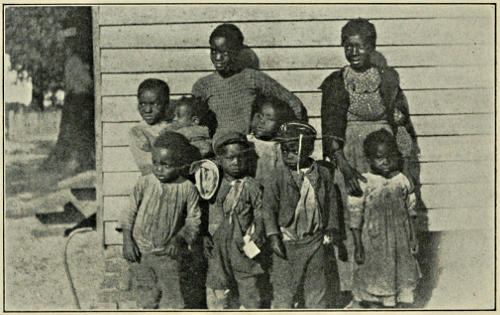
This same little negro, four years old, bow-legged,
flat-nosed, onery-looking and dirty,
clad in a single garment, which was torn, and
without buttons to hold it in place, was at
that very moment rambling about in the weeds
in the orchard, far from his mother, who,
with a dozen other hands, were chopping cotton.
If a dog or a calf or anything else came
along and toppled him over he cried until he
was exhausted, fell asleep and waked up refreshed.
No one seemed to love or care for
him; he weeded his own row.
Taking pity on him, on various and sundry
occasions, Miss Jule had sent Charlie with
buttered biscuits or pieces of pie to the four-year-old.
Although Runt was afraid of
Charlie, who often slipped up behind him,
turned his little shirt over his head and ran,
he was thankful for the hand-outs, without
knowing just where they came from. If he
saw the white boy coming he wanted to hide,
but was afraid to lest he miss a sweet morsel
for his tongue.
“Look, Miss Jule, don’t it beat all how
boys do? See Charlie teasing dat po’ little
nigger,” old Matt would say.
“Charlie! Charlie! You little scamp,
you! Quit worrying that child!” would follow,
and the youngster would laugh and run,
leaving Runt to think it over.
“Shhoo, shhoo, shhoo!
“There’s that old rooster again,” said
Mrs. Parks, as she turned and started for the
front porch again.
“We don’t want any company to-day.”
“Miss Jule, don’t you speck you’d better
spruce up er little, so ef de preacher do come
you’ll be ready fur ’im?”
“I will put on my new dress, I want
George to see it anyhow, and I can take it
off after dinner if nobody comes.”
“I speck you better.”
After the mistress of the house had resumed
her seat on the porch, having arrayed herself
in her pretty calico frock, Matt called out:
“Miss Jule, who is dat comin’ ’roun’ de fiel’
on dat big white hoss?”
“It looks like Capt. Brown, on old Roy,”
said Mrs. Parks.
“Yes’m, hit do, but he woul’n’t be comin’
here fur dinner, ’ceptin’ Miss Jane’s erway,”
declared Matt.
Sure enough, it was Capt. Brown, and he
rode up to the front gate.
“The tip of the day to you, Mrs. Parks!”
said the gallant fellow, lifting his hat.
“Good morning, Capt. Brown; won’t you
light?”
“No, thank you; I haven’t time.”
“You all well?”
“We’re up an’ about, but I’m not feeling
well. I have had a pain in my head for several
days.”
“Listen at Miss Jule,” said old Matt to
herself, as she peeped around the honeysuckle
vine, at the end of the porch to catch
what was said. “I ain’t never seed her look
better nor puttier.”
“How are you all, Capt. Brown?”
“Just tollerbly well, only; the old woman
is grunting a little this morning.”
“Which way is the ’Squire?”
“He’s in the Clay Field, back of the house,
where the hoe hands are at work.”
“Have you heard from Mrs. Marler to-day?”
“No, but Sam came by there last night,
late, on his way from the post office, and Reuben
told him that she was no better. I guess
she’s in a right bad way.”
“Yes, poor woman, she’s been a great sufferer
for a long time. I have been wanting
to go to see her, but the stock is busy now, and
then, too, I have not felt like riding. I get
dizzy every time I get in a buggy.”
“You heard about Mrs. Bill McGregor,
Mrs. Parks?”
“No; is it a boy or girl?”
“A ten-pound boy.”
“That’s fine! Five girls and three boys.
“Tell Mollie to come over. She needn’t
wait on me. I’m getting too old to travel
about much.”
“Thank you. You and George come.
“Well, I want to see the old man on a little
business; I will just ride around there.”
Capt. Brown and Squire Parks were the
best of neighbors and friends. Both were
influential in political affairs and substantial
business men. That morning they talked
over a private matter and Capt. Brown turned
and went back.
Dinner time came and no company arrived.
The greens, the chicken and strawberry pies
were all ready, but there was no one outside
of the family circle to eat them.
“I don’t believe in your signs, anyhow,”
declared Mr. Parks, “for, this morning, as
I went to the field, a red bird, a pretty one,
flew across the road in front of me, and I
have heard it said that that is the sign that
you are going to see your sweetheart, dressed
in her best clothes, and I know I haven’t seen
any sweetheart to-day.”
“O, yes, you is, Marse George,” said
Matt, as she handed him the greens for a second
help.
“Who? Where?”
“Here she is, Miss Jule, de onlies’ sweetheart
dat you ever had.”
“Don’t you believe that, Matt,” said Mrs.
Parks, fishing for a compliment.
“I guess you are right, Matt, and she’s
got on a new dress,” conceded the lord and
master of the Parks Big House.
Dinner and the hour of rest over, the hands
started for the field. Everybody, save Mary,
the mother of Runt, had gone, and she hunted
everywhere for the fatherless waif, but could
not find him. Squire Parks, Miss Jule, and
Matt organized themselves into a searching
party, but hunt where they would they could
not find the little negro. The big bell that
hung on the red oak in front of the lot gate
was sounded, and all the workmen came in,
knowing that the ringing of it meant a general
alarm, and were formed into groups and
sent to the fields to look for the missing child.
Aunt Matt took a mirror and reflected the
sun in the well, thinking that he might have
tumbled in there. Every nook and corner
about the barn and every wash, or gulley, or
weed patch about the place was examined, but
no trace of Runt was found.
“Somebudy done tuck an’ stole dat chile,”
said Matt. “Told you so. I knowed dat de
Lawd wuz gwine to let somebudy have ’im
dat woul’ care fur ’im.
“Po’ little chile, I hope dat nothin’ ain’t
happen to ’im.”
For two hours the hunt continued. Mary
was wailing and shouting like one possessed.
Jerry, the wayward negro of the plantation,
was racing everywhere, looking. When all
had about concluded that the boy had been
kidnaped, Miss Jule, who had become hot and
tired, moving about in the broiling sun, and
returned to the house, discovered a pair of
little black, dirty feet sticking out from under
a large hall table and, on making a closer
examination, found that Runt had stolen in,
crawled under the table and gone to sleep
on the floor. Having put a pillow under the
knappy head she notified the hunters and told
Mary to go to her work and leave the child
to her.
Matt was very much disappointed, for she
had looked into the well until she believed
that she could see the body of a child on the
bottom, and when Miss Jule called she was
preparing to announce that she had found the
little fellow; but, after seeing the feet and
bowlegs, as they protruded from the table,
was convinced that she was wrong.
“Yes, Miss Jule, an’ de signs done come
true,” declared the old darkey. “Dat’s de
hongry pusson dat wuz comin’; dat chile des
gut so hongry dat he couln’t stand hit no
longer an’ come in. Po’ little thing.”
“I am glad he made himself at home,
Matt, I will adopt him.”
“One thing, Miss Jule, I wuz glad to see
dat Jerry lookin’ sad-lak ’bout his boy. He
may not be so bad arter all. De Lawd put
good in everybudy.”
“Yes, and Jerry and Mary may marry
some day, and make Runt a home; you can’t
tell,” added Mrs. Parks.
Runt was treated as a guest of the house.
He slept unmolested for an hour, and when
he waked he was taken to the kitchen and
given the best the larder afforded. For a
month he remained there, waxing fat and
black and strong. Mary was delighted to be
rid of him under the circumstances.
The rooster had not given the clarion call
in vain.
One day two weeks later, Miss Jule sent
for Jerry, and they talked on the front steps.
The next day the young negro said to Squire
Parks: “Say, Marse George, I want’s you
to marry me an’ Mary. I’se done gut de
licenses.”
“Where did you get money to get license,
this time of year?” asked the justice of the
peace.
“Miss Jule give it to me.”
That was the day the signs failed not.