Author of “Squinty, the Comical Pig,” “Tum Tum,
the Jolly Elephant,” “Chunky, the Happy Hippo,”
“Sharp Eyes, the Silver Fox,” “Nero, the
Circus Lion,” etc.
“Here! Don’t you do that again, or
I’ll scratch you!”
“I didn’t do anything, Tamba.”
“Yes, you did! You stuck your tail into my
cage, and if you do it again I’ll step on it!
Burr-r-r-r!”
Tamba, the tame tiger, looked out between the
iron bars of the big circus-wagon cage where he
lived and glared at Nero, the lion who was next
door to him. Their cages were close together
in the circus tent, and Nero, pacing up and down
in his, had, accidentally, let his long, tufted tail
slip between the bars of the cage where Tamba
was.
“Take your tail out of my cage!” growled
Tamba.
“Oh, certainly! Of course I will!” said
Nero, and though he could roar very loudly at
times, he now spoke in a very gentle voice indeed;
that is, for a lion. Of course both Tamba
and Nero were talking in animal language, just
as your dog and cat talk to one another, by mewing
and barking.
“My goodness!” rumbled Tum Tum, the jolly
elephant of the circus, as he turned to speak to
Chunky, the happy hippo, who was taking a bath
in his tank of water near the camels. “My
goodness! Tamba is very cross to-day. I wonder
what the matter is with our tame tiger.”
“He isn’t very tame just now,” said Dido, the
dancing bear, who did funny tricks on top of a
wooden platform strapped to Tum Tum’s back.
“I call him rather wild!”
“So he is; but don’t let him hear you say it,”
whispered Tum Tum through his trunk. “It
might make him all the crosser.”
“Here! What’s that you’re saying about
me?” suddenly asked Tamba. He came over to
the side of his cage nearest Tum Tum. “I
heard you talking about me,” went on the tame
tiger, who was beautifully striped with yellow
and black. “I heard you, and I don’t like it!”
“Well, then you shouldn’t be so cross,” said
Tum Tum. He was not at all afraid of Tamba,
as some of the smaller circus animals—such as
the monkeys and little Shetland ponies—were.
“You spoke very unkindly to Nero just now,”
went on Tum Tum. “And, really, if his tail did
slip in between the bars of your cage, that didn’t
hurt anything, did it?”
Tamba, the tame tiger, sort of hung his head.
He was a bit ashamed of himself, as he had good
reason to be.
“We ought to be kind to one another—we circus
animals,” went on Tum Tum. “Here we
are, a good way from our jungle homes, most of
us. And though we like it here in the circus,
still we can’t help but think, sometimes, of how
we used to run about as we pleased in the woods
and the fields. So we ought to be nice to each
other here.”
“Yes, that’s right,” agreed Tamba. “I’m
sorry I was cross to you, Nero. You can put
your tail in my cage as much as you want.”
“I don’t want to!” growled the big lion. “My
own cage is plenty good enough for me, thank
you. I can switch my tail around in my own
cage as much as I please.”
“Oh, don’t talk that way,” said Tum Tum.
“Now that Tamba has said he is sorry, Nero,
you ought to be nice, too.”
“Yes,” went on Tamba. “Come on, Nero.
Put your tail in my cage. I won’t scratch it or
step on it. I’m sorry I was cross. But really I
am so homesick for my jungle, and my foot hurts
me so, that I don’t know what I’m saying.”
“Your foot hurts you!” exclaimed the big lion
in surprise. “Why, I didn’t know that. I’m
sorry! Did some one shoot you in your paw as
I was once shot in the jungle? I didn’t hear any
gun go off, except the make-believe ones the
funny clown shoots.”
“No, I am not shot in my foot,” answered
Tamba. “But I ran a big sliver from the bottom
of my cage in it, and it hurts like anything!
I can hardly step on it.”
“Poor Tamba! No wonder you’re cross!”
said the lion, in a purring sort of voice, for lions
and tigers can purr just as your cat can, only
much more loudly, of course. “How did you
get the sliver in your paw?” Nero went on.
“Oh, I was jumping about in my cage, doing
some of the new tricks my trainer is teaching me,
and I jumped on the sharp piece of wood. I
didn’t see the splinter sticking up, and now my
paw is very sore,” replied Tamba.
“Well, lick it well with your red tongue,” advised
Nero. “That’s what I did when the
hunter man in my jungle shot the bullet into my
paw. Perhaps your foot will get better soon.”
“Yes, I suppose it will,” admitted Tamba.
“But then I want to go back to the jungle to live,
and I can’t. I don’t like it in the circus any
more. I want to go to the jungle.”
“Well, I don’t believe you’ll ever get there,”
said Nero. “Here you are in the circus, and
here you must stay.”
It was just after the afternoon performance in
the circus tent, and the animals were resting or
eating until it should be time for the evening
entertainment. It was while they were waiting
that Nero’s tail had slipped into Tamba’s cage
and Tamba had become cross.
But now the striped tiger was sorry he had
acted so. He curled up in the corner of his cage
and began to lick his sore paw, as Nero had told
him to do. That is the only way animals have
of doctoring themselves—that and letting water
run on the sore place. And there was no running
water in Tamba’s cage just then.
“So our tame tiger wants to go back to his jungle,
does he?” asked Tum Tum of Nero, when
they saw that the striped animal had quieted
down.
“Yes, I guess he is getting homesick,” said
Nero in a low voice, so Tamba would not hear
him. “But his jungle is far, far away.”
“Did Tamba live in the same jungle with you,
Nero?” asked one of the monkeys who were
jumping about in their cage.
“Oh, no,” answered the big lion. “I came
from Africa, and there are no tigers there.
Tamba came from India. I’ve never been
there, but I think the Indian jungle is almost as
far away as mine is in Africa. Tamba will
never get there. He had much better stay in the
circus and be as happy as he can.”
But Tamba did not think so, and, as he curled
up in his cage, he looked at the iron bars and
wondered if they would ever break so he could
get out and run away.
“For that’s what I’m going to do if ever I get
the chance!” thought Tamba. “I’m going to
run back to my jungle!”
As he licked his sore paw, Tamba thought of
his happy home in the Indian jungle. He had
lived in a big stone cave, well hidden by trees,
bushes and tangled vines. In the same cave
were his father and mother and his brother and
sister tigers. Tamba had been caught in a trap
when a small tiger, and brought away from India
in a ship. Then he had been put in a circus,
where he had lived ever since.
Just before the time for the evening show some
of the animal men, or trainers, came into the tent
where the cages of Tamba, Nero and the other
jungle beasts were standing.
“Something is the matter with Tamba,” said
one of the keepers.
“What do you mean?” asked the man who
took care of Nero. “Did Tamba try to bite you
or scratch you?”
“No; but he isn’t acting right. He doesn’t do
his tricks as well as he used to. I think something
is the matter with one of his paws. I’m
going to have a look to-morrow.”
Of course Tamba did not understand what the
circus men were saying. He knew a little man-talk,
such as: “Get up on your stool!” “Stand
on your hind legs!” “Jump through the hoop!”
These were the things Tamba’s trainer said to
him when he wanted the tame tiger to do his
tricks. But, though Tamba did not know what
the men were saying, he guessed that they were
talking about him, for they stood in front of his
cage and looked at him. One of the men—the
one who put Tamba through his circus tricks—put
out his hand and touched, gently enough, the
sore paw of Tamba. The tiger sprang up and
growled fiercely, though he did not try to claw
his kind trainer.
“There! See what I told you!” said the man.
“That paw is sore, and that’s what makes Tamba
so cross. I’ll have to get the doctor to look at
him.”
Tamba did not do his tricks at all well that
evening in the circus tent, and no wonder.
Every time he jumped on his sore paw, the one
with the splinter in it, he felt a great pain. And
when the time came for him to leap through a
paper hoop, as some of the clowns leap when
they are riding around the circus rings on the
backs of horses, why, Tamba just wouldn’t do it!
He turned away and curled up in the corner of
his cage.
“Oh, how I wish I were back in my Indian
jungle!” thought poor, sick, lonesome Tamba.
“Well, there’s no use trying to make that tiger
do tricks to-night,” said the man who went in the
cage with Tamba. “Something is wrong. I
will look at his foot.”
And that night, after the show was over, the
animal doctor came to the tiger’s cage. They
tied Tamba with ropes, so he could not scratch
or bite, and they pulled his paw—the sore one—outside
the bars.
And then Tamba had an unhappy time. For
suddenly he felt a very sharp pain in his paw.
That was when the doctor cut out the splinter
with a knife. Tamba howled and growled and
whined. The pain was very bad, but pretty soon
the men, who were as kind to him as they could
be, put some salve on the sore place, took off the
ropes and let Tamba curl up in the corner of his
cage again.
“Oh, how my foot hurts!” thought Tamba.
“It is worse than before! I don’t like this circus
at all! I’m going to break out and run away
the first chance I get! I’m going back to my
jungle!”
Tamba did not know that now his paw would
get well, since the splinter had been taken out.
Night came. The circus began to move on
toward the next town, and Tamba was tossed
about in his cage. He could not sleep very
much. But in a few days his paw was much
better. During the time he was recovering he
did not have to do any tricks. All he had to do
was to stay in his cage and eat and sleep and let
the boys and girls, and the grown folk, too, look
at him when they came to the circus.
But, all the while, Tamba was trying to think
of a way to get loose and run back to his Indian
jungle. And one night he thought he had his
chance.
The circus was going along a country road,
from one town to another, and, as it was hot, the
wooden sides of the animal cages had been left
up, so Tamba, Nero and the other jungle beasts
could look out at the stars. They were the same
stars, some of them, that shone over the jungle.
Suddenly there was a bright flash of light and
a loud noise.
“We are going to have a thunder storm,” said
Nero, as he paced up and down in his moving
cage.
“It will be cooler after it, anyhow,” said Dido,
the dancing bear. “It is very hot, now.”
The lightning grew brighter and the thunder
louder as the circus went up and down hill to the
next town. Then, suddenly, it began to rain
very hard. The roads became muddy and slippery,
and the horses, pulling the heavy circus
wagons, had all they could do not to let them
slip.
Suddenly there was a loud crash of thunder,
right in the midst of the circus it seemed. The
lions and the tigers roared and growled, and the
elephants trumpeted, while men shouted and
yelled. There was great excitement. What
had happened was that a big tree, at the side of
the road, had been struck by lightning. Some
of the circus horses were so frightened that they
started to run away, pulling the wild animal
cages after them.
Tamba felt his cage rushing along very fast.
His horses, too, were running away. Then, all
at once, there was a great crash, and Tamba felt
his cage turning over. Next it was upside
down. The tiger was thrown on his back.
“Ha! Now is my chance to get away!”
Tamba thought. “My cage will break open
and I can get out! Now I can go back to my
jungle!”
CHAPTER II TAMBA’S FUNNY TRICK
Bang! Crack! Crash! went the thunder,
and the cage of Tamba, the tame
tiger, as it slid along the slippery, muddy
road, and struck a tree, made much the same
noise, only not so loud.
Tamba himself, inside the iron-barred cage,
was feeling much better than when he had had
the sliver in his paw. His foot was almost well
now, and he could step on it, though he limped a
little.
“When my cage goes to smash I’ll slip out and
run away,” thought Tamba. “I’m going to have
lots of fun when I get back to my jungle.”
Over and over rolled the cage, for the horses
had broken loose from it and were running away.
Many other of the circus animal cages were being
broken in the storm.
Tamba’s cage struck one tree, bounced away
from that and hit another. Then it came to a
stop, and Tamba, who had been rolling about inside,
being sometimes on his head and sometimes
on his feet, and again turning somersaults—Tamba,
at last, found himself quiet.
“Now is my chance to get away!” thought the
tame tiger, who wanted to be wild again and live
in a jungle. “Now I’ll get out of my cage!”
He surely thought the big wagon with the iron
bars on two sides—the cage in which he traveled—had
been broken so he could get out. But
when he tried, he found that this was not so.
The tiger’s cage was broken a bit, here and there,
but it was so strong that it had held together, and
when Tamba tried to force his way out he could
not. He was still a circus tiger, much as he
wanted to go to the jungle.
“Oh, this is too bad!” growled Tamba to himself,
as he tried to break out, first through one
side of the cage and then the other. “This is too
bad! I thought, when the storm wrecked the
circus, that I could get loose. Now I’ll have to
wait for another time.”
But if Tamba had not got out of his cage when
the great storm came, some of the circus animals
had. Nero, the circus lion, got loose, and he
had many adventures before he was caught again,
as I have told you in the book before this one.
But Tamba had to stay in his cage.
After a while, when the worst of the storm had
passed, the circus men began going about, getting
back on the road some of the cages, like that
of Tamba, that had rolled downhill.
“Tamba’s all right,” said a trainer, as he saw
the tame tiger. “He didn’t get loose, I’m glad
to say. I want to teach him some new, funny
tricks, now that his paw is well again.”
“No, Tamba didn’t get away,” remarked another
man; “but Nero, the big lion, did. We’ll
have to go out to hunt him.”
When morning came, and the circus was once
more in order—except for the broken cages and
the animals that had gotten away—Tamba felt,
more than ever, that he would like to be back in
his jungle.
“So Nero got away, did he?” thought the tame
tiger, as he saw the lion’s broken cage, and noticed
that Nero was no longer in it. “Well, I
wish I were with him. Now he can go back to
his jungle.”
But Nero did not do that, as those of you know
who have read the book about him. I’ll just
say, right here, that Nero had many adventures,
but, as this book is about Tamba, I must tell
about him, and the adventures the tame tiger
had.
A few days after this, when the circus was
traveling on again, though without Nero, who
had not been caught, it came to a large city,
where it was to stay nearly a week to give shows.
“And now will be a good chance for me to
teach Tamba some new and funny tricks,” said
the animal man who had charge of the tiger. “I
want him to make the people laugh when they
come to the circus. The boys and girls will like
to see Tamba do some funny tricks.”
And the next day, his paw being again well,
Tamba began to learn something new. When
his trainer entered the cage, Tamba, much as he
wanted to run away to the jungle, was glad to see
the man. For the man was kind to the tiger, and
patted him on the head, and gave him nice bits
of meat to eat.
“Now, Tamba,” said the trainer, speaking in
a kind voice, “you are going to learn something
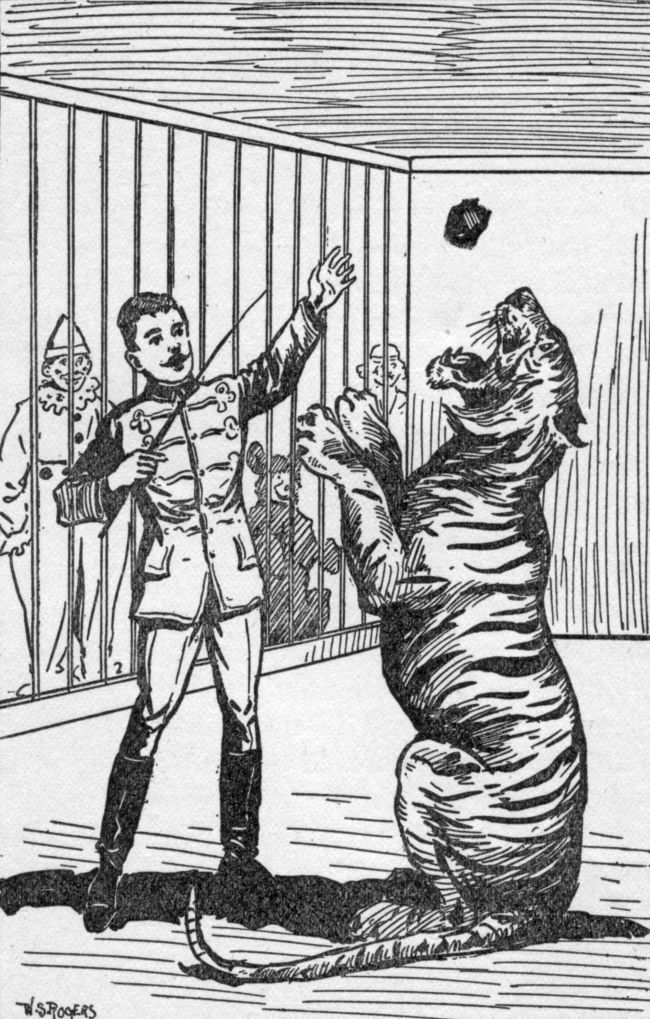
new. Sit up!” he cried, and he held a little stick
in front of Tamba.
The tiger knew what this meant, as he had
learned the trick some time before. When the
trainer spoke that way he meant that Tamba was
to sit up, just as your dog may do when you tell
him to “beg.”
“That’s very good,” said the man, when
Tamba had done as he was told. “Now that is
the first part of a new trick. Next I am going
to put a little cracker on your nose. It isn’t
really a cracker, it is a dog biscuit, and it has
some meat in it. As you like meat I think you’ll
like the dog biscuit.”
As the man spoke he took from his pocket one
of the square cakes called dog biscuit. I dare
say you have often given them to your dog.
The animal trainer broke off a bit of this biscuit
and put it on Tamba’s nose. Tamba could smell
that it was good to eat, and he quickly shook his
head a little, jiggled the piece of biscuit to the
floor of his cage, and the next minute the piece
of biscuit was gone. Tamba had eaten it.
“Well, that’s what I want you to do,” said the
man with a laugh, “but not just that way. This
is to be one of your new, funny tricks, but you
didn’t do it just right. I want you to hold the
piece of biscuit on your nose until I call ‘Toss!’
Then I want you to flip it into the air and catch
the piece of biscuit in your mouth. Now we’ll
try it again.”
Tamba did the same thing he had done the
first time, but the man was kind and patient, and,
after many trials, Tamba at last understood what
was wanted of him. He must hold the bit of
dog biscuit on his nose until the man said he
could eat it.
Then the tiger was to give his head a little jerk.
This would snap the bit of biscuit into the air,
and, if Tamba opened his mouth at the right
time, the biscuit would fall into it. That would
be the funny trick.
And, as I say, Tamba learned, after a while,
how to do it just right. But it took nearly a
week. At the end of that time his trainer could
put a bit of dog biscuit on the tiger’s black nose.
Then Tamba would sit up on his hind legs, very
still and straight, looking at his master.
“Now!” the man would suddenly call, and
Tamba would jerk his head, up the piece of biscuit
would fly, and into his mouth it would go.
“That’s fine!” cried the man, after the second
week, during which time Tamba had practiced
very hard. “Now we are ready to do the new
trick in the tent for the boys and girls.”
And when the trick was done the boys and
girls laughed very much and clapped their
hands. They liked to see Tamba do his tricks.
Nor was this the only new one he learned. His
master taught him several others.
Tamba would lie down and roll over when he
was told; he would walk around on his hind legs,
wearing a funny pointed cap; and he would turn
a somersault, just as he had done the night his
cage rolled downhill in the storm. All these
tricks were much enjoyed by the boys and girls
and by the men and women who came to the circus.
Tamba was a very smart tiger. But, for
all that, he never gave up the idea of running
away when he got the chance, and going back to
his jungle.
All this while Nero, the circus lion, had not
returned. He had been away since the night of
the storm, and Tum Tum, and his other friends,
missed Nero.
“But he is having a much better time than we
are, just the same,” said Tamba, as he paced back
and forth in his cage. “He is on the way back
to the jungle!”
If he could have seen Nero just then he never
would have said that. For the circus lion was
in the kitchen of a country farmhouse watching
a tramp eat ham, and—but there! This book is
about Tamba, not about Nero, though I have to
mention the lion once in a while.
About a week after Tamba had learned to do
several new and funny tricks, there was a sudden
noise at the entrance of the circus animal tent.
It was after the afternoon show had ended, and
not yet time for the evening performance.
“What’s the matter, Tum Tum?” asked
Tamba, who could not see very well from his
cage. “What has happened? Have some more
of our animals gotten away?”
“I think not,” answered the big elephant, who
could see the tent entrance. “I think they are
bringing in a new lion. Maybe he is to take the
place of Nero. We’ll soon know. Here they
come with him.”
CHAPTER III TAMBA PLAYS A JOKE
Just as Tum Tum had said, a lion’s cage was
being wheeled into the circus animal tent,
and in the cage was a big, tawny, yellow
animal, which Tamba knew, at once, was a lion.
But, to the surprise of the tame tiger and his
friends, it was not a new lion at all, but Nero
himself. There he was, looking almost the same
as when he had disappeared the night of the big
storm, the night when Tamba thought he could
get away.
“Why, Nero!” exclaimed the tiger, as his
friend’s new cage was wheeled in, “where in the
world have you been?”
“Oh, almost everywhere, I guess,” answered
Nero. “I’ve had a lot of adventures!”
“Ha! Then you’ll be put in a book,” said
Tum Tum quickly. And, as those of you who
have read the volume which comes just before
this one know, Nero was put in a book.
“Yes, I had adventures enough for a book,”
went on the big lion, who had been caught by
some circus men in a farmer’s woodshed and
brought back to the show. “I had a pretty good
time, too, while I was away, though I didn’t get
as much to eat as we do here in the circus. I
guess I’m glad to be back, my friends!” and he
curled up in his cage and got ready to go to
sleep.
“Ho! Glad to get back, are you?” asked
Tamba. “Well, I won’t say that if I get a
chance to run away! I’ll stay, when I go!”
“That’s what you think now,” said Nero.
“But really it isn’t as much fun as you’d think—running
away isn’t.”
“Couldn’t you find your jungle?” asked
Tamba.
“No,” answered Nero, “I couldn’t.”
“Well, I’ll find mine,” declared Tamba.
“That’s why I want to run away—so I can get
back to my jungle. And I’m going to do it,
too!”
Of course all this talk went on in animal language,
and none of the circus helpers or the
trainers could understand it. If they could,
they might have guarded Tamba more closely.
“Well, please don’t bother me now,” said
Nero, as he curled his paws under his chin, just
as your cat sometimes does when she goes to
sleep. “I am going to have a nap after all my
adventures and travels.”
“All right, go to sleep,” said Tum Tum. “We
won’t bother you, Nero. Only, some day, I hope
you’ll tell us more of your adventures.”
“I will,” promised Nero.
Tamba, the tame tiger, paced up and down in
his cage after Nero had gone to sleep.
“I wish I had had his chances!” thought
Tamba, as he looked over toward the sleeping
Nero. “I wouldn’t have let them catch me!
I’d have run on and on until I found my jungle,
no matter how far away it was.”
And then Tamba began to think of the life in
India and of the days when he, a little tiger cub,
was hiding in the deep, dark, green jungle. He
thought of how he had tumbled about in the
leaves, playing with his brother and sister, and of
his mother sitting in the mouth, or front door,
of the cave and watching her striped babies.
They had learned how to walk, and how to
jump and stick out their claws whenever they
wanted to catch anything. Their father and
mother had taught the little tiger cubs how to
hunt in the jungle for the meat they had to eat.
They could not go to the store and buy something
when they were hungry. Tigers, and other wild
animals, must hunt for what they eat.
Of course, after he had been caught and sent
to the circus, Tamba no longer had to hunt for
his food. It was brought to him by the circus
men, and thrust into his cage. Nor did he have
to hunt for water, the way the jungle animals
have to go sniffing and snuffing about in the forest
to find a pool or a spring. Tamba’s water
was brought to his cage in a tin pail, and very
glad he was to get it.
“But, for all that,” thought the tame tiger, as
he paced up and down, “for all that I’d rather be
loose and on my way back to the jungle instead
of being cooped up here. Much as I like the
things they give me to eat, I want to go home.
And I’m going to get loose, too, and run away as
Nero did. Only I won’t come back!”
The more Tamba thought of the green jungle,
so far away in India, the more sad, unhappy and
discontented the tame tiger became. He did not
do his tricks as well as he used to do, and he was
often cross in speaking to the other circus animals.
Sometimes he wouldn’t speak at all, but
only growl, or maybe grumble deep down in his
throat, and that isn’t talking at all.
“I declare! I don’t know what’s the matter
with Tamba,” said Tum Tum one day. “He
doesn’t seem at all happy any more. Dido, do
some of your funny dances and see if you can’t
cheer up Tamba!”
So the dancing bear did some of his tricks,
capering about in his cage, but Tamba would
hardly look at him. Some boys, though, who
had come to the circus, gathered in front of the
bear’s cage and laughed and laughed at his funny
antics. They liked Dido. The boys liked to
look at Tamba, also, but they were a little afraid
of the big, striped tiger.
One day, when the afternoon performance was
over, and Tamba, Nero and the other animals
who had done their tricks in the big tent were
brought back to the smaller one, where they were
kept between the times of the shows, Nero said:
“Now I am going to lie down and sleep, and
please don’t any one wake me up. I’m tired,
for I did a new trick to-day, and it was very hard,
and I want to rest so I can do better in the show
to-night. So everybody let me alone.”
“We will,” said Tum Tum, the jolly elephant.
Now the lion is called the “King of Beasts,”
and in the jungle he comes pretty near to being
that, for all the other animals, except perhaps the
elephant, are afraid of him.
So when a lion says he wants a thing done, it
generally is done. Of course Nero could not
have got out of his circus cage to make the other
animals do what he wanted them to do, but most
of them made up their minds that they wouldn’t
bother him, even though they knew he couldn’t
hurt them. Nero was still “King” in a way.
But that day Tamba was cross. Or perhaps I
might say he felt as though he wanted to “cut
up.” He wanted to play some tricks, make
some excitement. He wanted to do something!
I dare say you have seen your dog or cat act
the same way. For days at a time they may be
very quiet, eating and sleeping and doing only
the things they do every day. And then, all at
once, they will begin to race about and “cut up.”
Your dog may run away with your cap, and, no
matter how many times you call him, he’ll just
caper about and bark, or perhaps pretend to
come near you and then run off again. And
your cat may dig her claws into the carpet, jump
up on the window sill and knock down a plant
or a flower vase, and do all sorts of things like
that.
Well, this is just the way Tamba felt that day.
He wanted to do something, and when he saw
Nero sleeping so quietly in his cage the tame
tiger made up his mind to play a trick on the
lion.
“It isn’t fair that he should sleep so nicely
when I have to stay awake!” grumbled Tamba.
“He can dream of the good times he had when
he ran away and had adventures, and all I can
think of is how much I want to go back to my
jungle! It isn’t fair! I’m going to make Nero
wake up! I’ll play a trick on him!”
Of course this wasn’t right for Tamba to do,
but circus tigers don’t always do right any more
than boys, girls, or other animals.
Tamba’s cage was next to that of Nero, and
close beside it, instead of being at one end. The
cages were left that way when they were brought
in from the larger performing tent, after the animals
had done their tricks. So it happened that
Tamba could look out through the bars of his
cage in between the bars where Nero was kept.
And Tamba could stick his paws out through the
bars, but he could not quite reach over to the
sleeping lion.
“If I could reach him,” said Tamba to himself,
“I’d tickle him and wake him up. I
wouldn’t let him sleep!”
But Tamba’s paws were not quite long enough
to reach through the bars of the two cages.
Again and again the tiger tried it, but he could
not manage.
Then Tamba sat down on his haunches and
looked at the sleeping Nero. At last a tricky
idea came to Tamba.
“Ha!” exclaimed the tiger. “If I can’t reach
him with my paws I can reach him with my tail!
That’s what I’ll do! I’ll reach in between the
bars with my long, slender tail, and I’ll tickle
Nero on the nose!”
Tamba sort of laughed to himself as he
thought of this trick. And he had no sooner
thought of it than he began to try it. He turned
about, so his back was toward Nero. Standing
thus, Tamba’s long, slender tail easily reached
into Nero’s cage. Nearer and nearer the tip of
Tamba’s tail came to the big black nose of the
sleeping lion.
Tamba looked sideways over his back to see
where to put his tail. At last the fuzzy tip-end
of it touched Nero’s nose and tickled it. The
big lion twitched in his sleep, just as your cat
does, if you lightly touch one of her ears.
“Ha! I’ve found a good way to play a trick
on Nero!” laughed Tamba. “I’ll keep on tickling
him!”
He waved his tail to and fro, Tamba did, and
once again he let the tip of it touch Nero’s nose.
The sleeping lion raised his paw, and brushed it
over his face. He must have thought some bug
was crawling on his nose.
“Oh, this is lots of fun!” thought Tamba. So
it was, for him. But was it fun for Nero?
“Now for a good tickle!” thought Tamba, as,
once again, he put his tail over toward the sleeping
lion’s nose. And this time something was
going to happen.
CHAPTER IV TAMBA IN A WRECK
Down on the black nose of the sleeping
lion went the soft, fuzzy tip of Tamba’s
tail. And Tamba tickled Nero so hard
that the lion gave a big sneeze and awakened
with a jump.
Then Nero threw himself against the bars of
his cage until they shook where they were fastened
into the wood, and the lion roared in his
loudest voice:
“Where’s that fly? Where’s the tickling fly
that wouldn’t let me sleep? If I catch that fly
I’ll tickle him!” and Nero roared so loudly that
the ground seemed to tremble, as it always does
near a lion when he roars. I have often felt it
in the zoölogical park where I sometimes go to
look at the lions and the tigers.
“Where’s that fly? Where’s that fly?” roared
Nero. For you see he thought the tickling tip
of Tamba’s tail was a fly on his nose.
“What’s the matter here? What’s the trouble?”
cried one of the circus men, as he ran into
the animal tent, having heard Nero roar.
“Are some of the lions or tigers trying to get
loose?” asked another man.
“No, it seems to be Nero,” replied the first.
“What’s the matter, old boy?” he asked, as he
saw how angry Nero was. For the lion was
lashing his tail from side to side and roaring:
“Where’s that fly? Where’s that fly?”
Of course the circus men didn’t know exactly
what Nero was saying, but they could tell he was
angry, and they were afraid, if he bounded
against the bars of his cage much more, he might
break some.
“I don’t see what makes Nero act that way,”
said the man who had charge of the lion, and
who had taught him to do tricks. “Once before
he acted like this, but it was when a bee stung
him on the nose.”
“Maybe that is what happened this time,” said
the second man.
“I don’t see any bees flying around,” went on
the lion’s keeper. Just then Tamba, seeing that
he had awakened Nero, and had played all the
tricks he wanted to, pulled his tail out from between
the bars of the lion’s cage. And, just as
he did so, the keeper saw him.
“Oh, ho! I know what the matter was,” the
man said. “The tiger tickled the lion. Tamba
tickled Nero with his tail through the bars of the
cage. That’s what made Nero angry. Tamba,
you’re a bad, mischievous tiger!” and he shook
his finger at the striped animal. Tamba walked
over to the corner of his cage and curled up.
“Well, I had some fun, anyhow!” he thought.
“I waked Nero up all right!”
And so he had. And now Nero knew what
had happened, for Tum Tum, the jolly elephant,
had seen it all, and Tum Tum said:
“It wasn’t a fly on the end of your nose, Nero;
it was the fuzzy tip of Tamba’s tail. I saw him
tickle you!”
“Oh, you did, did you?” cried Nero, and this
time he did not roar. “Why did you tickle me,
Tamba?”
“Oh, I didn’t like to see you sleeping so nicely
when I couldn’t sleep, because I’m thinking so
much of the jungle,” answered the tiger. “Besides,
it was only a joke. I wanted to see if I
could make you think my tail was a fly on your
nose. I did.”
“Yes, you surely did,” admitted Nero. “I felt
the tickle, even in my sleep. But if it was only a
joke, Tamba, I won’t be angry. I like a joke as
well as any one,” and Nero laughed in his lionish
way. “But, after this, I’m going to sleep in
the far corner of my cage, where your tail won’t
reach me. A joke is all right, but sleep is better.
Now it will be my turn to play a joke on you,
Tamba.”
“Yes,” said Dido, the dancing bear, “you want
to look out for yourself, Tamba. A joke is a
joke on both sides.”
“Oh, well, I don’t care,” said Tamba, but he
was not as jolly about it as he might have been.
The circus men saw that something was wrong
between Tamba and Nero, so they moved the
cages farther apart, and then Nero and Tamba
could not have reached each other if their tails
had been twice as long. And then Nero went to
sleep, and so did Tamba, waiting for the evening
show to start. And as Tamba slept he dreamed
of the Indian jungle, and wished he could go
back there.
And soon something wonderful was going to
happen to him.
That night in the big tent, which was bright
with electric lights, Tamba did his tricks—catching
a piece of dog biscuit off his nose, leaping
through a paper hoop, and walking around on
his hind legs. Nero also did his tricks, one of
which was sitting up like a begging dog on a
sort of stool like an overturned wash tub.
And Dido, the dancing bear, did his funny
tricks on the wooden platform, which was
strapped on the back of Tum Tum, the jolly elephant.
So the boys and the girls, and the big
folks, too, who went to the circus had lots of fun
watching the animals.
But, all the while, Nero was watching for a
chance to play a trick on Tamba. And at last
he found a way. It was three or four days after
Tamba had tickled Nero with the tail tip, and
the circus had traveled on a railroad to a far-distant
town.
In the animal tent the lions, tigers, elephants,
monkeys and ponies had been given their dinners
and were being watered. Tamba was taking
a long drink from his tin of water, and wishing
it could be turned into a jungle spring, when,
all of a sudden:
Splash!
A lot of water spurted up into his face, and
some, getting into his nose, made him sneeze.
Then he looked and saw that a bone, off which
all the meat had been gnawed, had come in
through the bars of his cage and had fallen into
his water-pan. It was the falling of the dry
bone into the water that had made it splash
up.
“Who did that? Who threw that bone at
me?” growled Tamba. “Who made it splash
water all over me?”
“Oh, I guess I did that,” said Nero with a
loud, rumbling lionish laugh. “I wanted to see
if I could toss it from my cage into yours,
Tamba, and I did. So the water splashed on
you, did it?”
“Yes, it did! You know it did!” growled
Tamba. “It made me sneeze, too!”
“Oh, did it?” asked Nero. “Well, that was
just a little joke of mine, my tiger friend. I
wanted to see if I could tickle your nose the way
you tickled mine with your tail. It was only a
joke, splashing water on your nose. Only a
joke! Ha! Ha! Ha!”
“Yes, it was only a joke!” said Tum Tum and
all the other animals. “Only a joke, Tamba!
Ha! Ha! Ha!”
Of course the striped tiger had to laugh, too,
for really he had not been hurt, and he must
expect to have a joke played on him after he
had played one on Nero.
“Well, I’ll gnaw this bone after I take a
drink,” said Tamba, as he dried his nose on his
paw. “Much obliged to you for tossing it into
my cage, Nero.”
“Oh, you’re very welcome, I’m sure!” laughed
the lion. “Oh, you did jump and sneeze in such
a funny way, Tamba, when the water went up
your nose!” and Nero laughed again, as he
thought of it.
And “Ha! Ha! Ha!” echoed Tum Tum.
And so life went on for the circus animals,
something a little different happening every day.
Now and then Tamba played other tricks, and so
did Nero, and the first crossness of Tamba
seemed to wear off. He was still as anxious as
ever to go to the jungle, but he did not see how
he could get out of his cage. He watched carefully,
every day, hoping that some time the man
who came in to make him do his tricks would
forget to fasten the door when he went out.
“If he only left it open once,” thought Tamba,
“I could slip out and run away. Then I’d go
back to the jungle.”
But the trainer never left the door open. Besides,
it closed with a spring as soon as the man
slipped out, and, quick as he was, Tamba could
not have slipped out. However, he kept on the
watch, always hoping that some day his chance
would come.
And it did. I’ll tell you all about it pretty
soon.
Sometimes, as I have told you, the circus went
from town to town by the way of country roads,
the horses pulling the big wagons with the tents
on them and also the wagons in which the wild
beasts were kept. It took eight or ten horses to
pull some of the heavy wagons uphill.
At other times the wagons would all be put
on big railroad cars, and an engine would haul
them over the shiny rails. This was when it was
too far, from one town to the next, for the horses
to pull the wagons, or for the elephants and camels
to walk. For when the circus traveled by
country road these big animals—the camels and
elephants—always walked.
And one night after a stormy day the circus
wagons were loaded on the railroad cars for a
long journey to the next city in which the show
was to be given.
“Well, you haven’t gone to your jungle yet, I
see, Tamba,” said Tum Tum to the tiger. The
big elephant was moving about, pushing the
heavy wagons to and fro.
“No, I haven’t gone yet,” sadly said the beautifully
striped beast. “And, oh, how I wish I
could get loose!”
On through the night rumbled the long train
of circus cars. There was no moon, and the
stars did not shine. The night was very dark
after the storm.
Suddenly there were some loud whistles from
the train engine.
Toot! Toot! Toot! it went, and that meant
there was danger. The engineer had seen danger
ahead, but not in time to stop his train. One
of the circus trains had run off the track and
could not go on. It had come to a halt, and
another train that was running not far behind
the first one crashed into it.
There was a terrible noise, a clanging of iron
and a breaking of wood. The cars were
smashed, and so were some of the animal cages.
“What is it? What’s the matter? roared
Nero.
“We’re in a wreck!” trumpeted Tum Tum,
the elephant, who was not quite so jolly, now.
“The circus train is wrecked! I was in a wreck
once before. It’s very bad! I hope none of our
animal friends are hurt!”
But some were, I am sorry to say, and so were
some of the circus men.
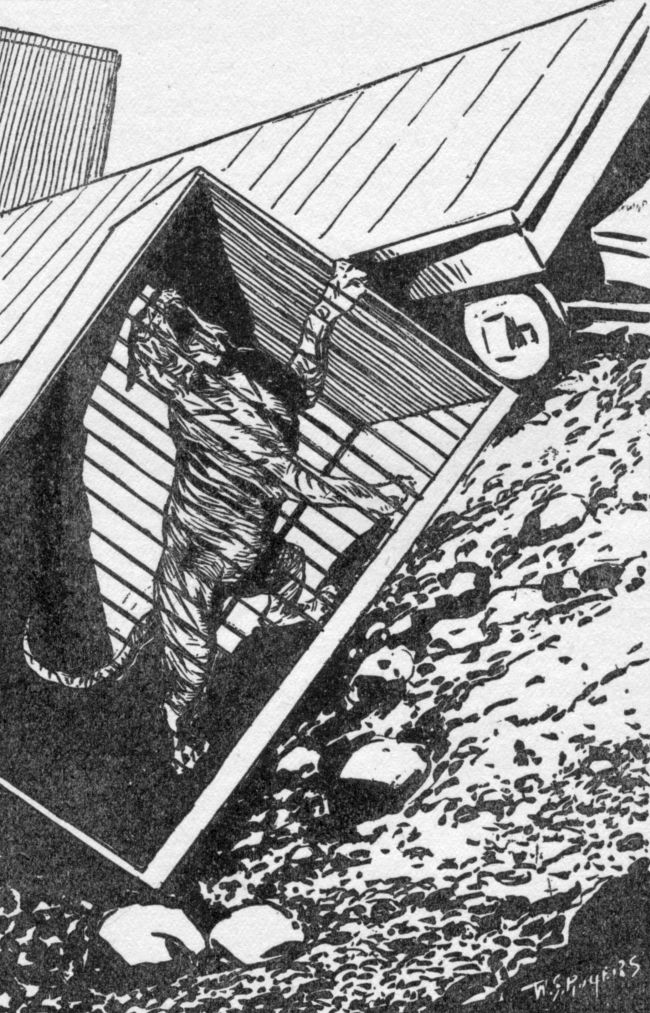
Tamba, the tame tiger, felt his cage slide off
the flat car on which it had been fastened. The
car was smashed and tossed to one side. Off slid
the tiger’s cage, and then it fell down the railroad
bank and into a ditch. Tamba’s cage broke
open, and the tiger was cut and bruised, but he
knew that he was free. He was no longer in the
cage.
“At last I am out!” he cried. “Now I can run
away to my jungle! Now I am free!”
With the smashed circus cars, the
broken animal cages, with some of the
jungle beasts, including the elephants,
cut and bruised, with shoutings, growlings, roarings
and tootings going on, the scene at the circus
train wreck was a terrible one. It was no wonder
that Tamba, the tame tiger, wanted to run
away from it all and get to a quiet place. And
this he did.
He crawled out of his cage, that had been
broken when it slipped off the smashed car, and
gave one last look at it in the darkness.
“Good-by, old cage!” said Tamba, softly, as he
turned to run away. “I’ve been in you for the
last time. I’m never coming back to the circus!”
Leaving the noise and confusion of the circus
wreck behind him, Tamba slunk off into the tall
grass that grew in the fields beside the railroad
track. The accident had happened at a lonely
place, and there were no houses near at hand.
“Ha! This is a little like the jungle where I
used to live!” thought Tamba, as he slunk
through the tall grass. “I can hide here until I
see which way to go to get back home.”
And Tamba was right. The grass grew long,
as it did in the jungle, but there were not so many
trees and tangled vines as in India. Only at
night it seemed a very quiet, restful place to the
tiger who had been so shaken up in the wreck.
Tamba walked on and on through the darkness,
not really knowing, and not much caring,
which way he went. All he wanted to do was to
get away and hide, and the tall grass was just the
place for this.
In a little while Tamba came to a place where
there was a small pool of water. It had leaked
from a pipe that filled the tank where the railroad
engines took their water. Tamba drank
some, and then, finding a place where the grass
was taller and thicker than any he had yet seen,
he made himself a sort of nest and curled up in
it.
“I can sleep here, and Nero, that big lion, can’t
splash any water into my nose and make me
sneeze,” thought Tamba, as he snuggled up.
At first he could not get to sleep. He had
been too much frightened by the train wreck,
though he was so far away now that he could not
hear the din, which still kept up. But at last
Tamba closed his eyes, and soon he was slumbering
as peacefully as your cat sleeps before the
fire.
It was daylight when Tamba awakened, and,
for a moment, he did not remember where he
was. He stretched out first one big paw after
another and then he called:
“Well, Tum Tum, what sort of day is it going
to be?”
Tamba used to do this in the circus tent, for
the jolly elephant was so big that he could look
over the tops of the cages and tell whether or not
the sun was going to shine. Most animals
awaken before the sun comes up—just as it begins
to get daylight, in fact.
But Tum Tum did not answer Tamba this
time. The jolly elephant was badly hurt in the
railroad accident, but of course the tiger did not
know this just yet. Tamba did know, however,
that he had made a mistake.
“Oh, I forgot!” he said to himself. “Tum
Tum isn’t here! I’m not in the circus any more.
I’m free, and I can go to my jungle. I must
start at once!”
Then Tamba arose, and stretched himself
some more. He liked to feel the damp earth
under his paws, and he liked the feeling of the
dry grasses as they rubbed against his sides.
“Why, I feel hungry!” suddenly said the tiger.
“I wonder where I can get anything to eat in this,
the beginning of the jungle.” You see, Tamba
still thought the jungle was close at hand, but, to
tell you the truth, it was far away, over the sea,
and Tamba could not get to it except in a ship.
The more Tamba thought about it the hungrier
he became. He knew no men would come
to him now with chunks of meat, as they had
used to come in the circus.
“I must hunt meat for myself, the same as I
did when I lived in the jungle with my father
and mother,” thought the tiger. “Well, I did
it once, and I can do it again. I wonder what
kind of meat I can find?”
Tamba did not have to wonder very long, for
he soon saw some big muskrats, and he made a
meal off them.
Then Tamba looked about him, and began to
think of what he would do to get to the deeper
part of the jungle—the part where the trees
grew. He wanted to be in the thick, dark
woods. All wild animals love the quiet darkness
when they are not after something to eat.
But it was now broad daylight, and Tamba
knew he must be careful how he went about.
Men could easily see him during the day. He
remembered he had been told this in the jungle,
years before, by his father. But in the jungle
Tamba was not so easy to see as he was on this
railroad meadow. The yellow and black stripes
of a tiger’s skin are so like the patches of light
and shadow that fall through the tangle of vines
in a jungle, that often the hunters may be very
close to one of the wild beasts and yet not see it.
The tiger looks very much like the leaves and
sunshine, mingled.
“But I guess if I slink along and keep well
down in the tall grass no one will see me,”
thought Tamba. “That’s what I’ll do! I’ll
keep hiding as long as I can until I get to my
jungle. Then I’ll be all right. I’ll be very
glad to see my father and mother again, and my
sister and brother. The circus animals were all
very nice, but still I like my own folks best.”
So Tamba slunk along, going very softly
through the tall grass. If you had been near the
place you would probably have thought that it
was only the wind blowing the reeds, so little
noise did Tamba make. Tigers and such cat-like
animals know how to go very softly.
All at once, as Tamba was slinking along, he
heard the sound of men’s voices talking. He
knew them at once, though of course he could
not tell what they were saying. Besides the
voices of the men, he heard queer clinking-clanking
sounds and the rattle of chains.
Tamba knew what the rattle of chains meant—it
meant that elephants were near at hand, for
the circus elephants wear clanking chains on
their legs, being made fast by them to stakes
driven into the ground.
“Ha! I had better look out,” thought Tamba.
“Maybe those are the circus men after me.”
The tame tiger was partly right and partly
wrong. The voices he heard were those of the
circus men, and the chains clanking were those
on the legs of elephants. The men were trying
to clear away what was left of the circus wreck.
Tamba had taken the wrong path, and had
walked right back to where he had started from.
“This won’t do!” he said to himself. “I must
get farther away and hide!”
He peered between the tall grasses and dimly
saw where the circus men were working along
the railroad tracks, lifting up some of the overturned
cars and cages. The elephants were
helping, for they were very strong.
“I’ll notice which way the sun is shining, and
then I’ll know which way to go to keep away
from the circus men,” thought Tamba. Then
he turned straight about and ran off the other
way.
On and on, over the big stretch of meadows
and lonely land near the railroad went the tiger
until he had placed many miles between himself
and the scene of the wreck. In all this time
Tamba did not see any men, or any living creatures
except some muskrats, many of which lived
in the swamp along the railroad. The muskrats
were not glad to see Tamba, for the tiger caught
a number of them for food, but it could not be
helped.
No one saw Tamba sneaking along through
the grass. If any one had seen him they would
have hurried to tell the circus men, for a general
alarm had been sent out, telling that some of the
wild animals, including a big, striped tiger, had
got loose after the wreck.
But no one saw Tamba, and he saw no one, at
least for a while. On and on he went until night
came again. Then he found another snug place
in among the dried grass where he curled up to
sleep.
“My jungle is farther away than I thought it
was,” said Tamba to himself, as he awoke on the
second morning of his freedom. “I must run
along faster to get there more quickly.”
After he had eaten and taken some water, he
started off once again, and then began a series
of very strange adventures for the tame tiger.
Toward the close of the afternoon of the second
day of his freedom Tamba stepped out of
a little patch of woods, into which he had gone
from the meadow, and there, in the light of the
setting sun, the tiger saw a red, wooden building
which he seemed to know.
“Why, there’s a barn!” said Tamba to himself.
“There’s a barn. I’ll go in there and stay for
the night. I wonder if there are any other animals
in it.”
The reason Tamba knew this was a barn was
because, when he had first joined the circus, he
had been taken to a barn, and there was taught
some tricks. The circus folk and the animals
lived in a big barn instead of tents during the
winter. So when Tamba saw this building he
knew, at once, that it was a barn.
Now it happened that this was a barn belonging
to a farmer, who also owned a house near by,
but which Tamba could not see on account of the
trees. So, making sure that no one was about,
Tamba walked toward the barn, and, one of the
doors being open, in walked the tiger.
He looked all around, as best he could, for it
was not very light, and he sniffed and smelled the
smell of animals.
“Maybe some of my friends are here,” thought
Tamba. “I’ll slink around and see.”
So he walked softly and slinkingly to the middle
of the barn floor, and peered about, and, right
after that, a very strange thing happened.
CHAPTER VI TAMBA MEETS TINKLE
At first when he went into the barn through
the door which was open, Tamba, the
tame tiger, could not see very much. It
was the same as when you go into a dark moving-picture
theater from the bright sunshine outside.
But, in a little while, Tamba’s eyes could see
better, and he noticed some piles of hay and straw
in the barn. That made him feel more at home.
“This is just like the circus barn where I used
to be before we started out with the tents,”
thought Tamba to himself. “That is hay, which
Tum Tum and the other elephants used to eat.
I don’t like it myself. I like meat and milk.
But I don’t see any elephants here.”
And for a very good reason, as you know.
Farmers don’t keep elephants and other circus
animals in their barns.
So Tamba looked about in the barn, and he
sniffed and smelled with his black nose, hoping
to smell something good to eat. But though
there was an animal smell about the place (because
there were cows and horses in the lower
part of the barn) still Tamba did not want to eat
any of them.
If he had been in the jungle he might have felt
like eating a cow, or, what is very much the same
thing, a water buffalo. But since he had been in
the circus he had been used to eating the same
kind of meat that you see in butcher shops. So,
though the tiger was quite hungry, and though
there were cows and hay in the farmer’s barn,
Tamba did not see much chance of getting a
meal.
“I’ll starve before I’ll eat hay,” he said. “It’s
all right for elephants and horses and ponies, like
the Shetland ponies we had in the circus, but hay
is not good for tigers.”
So Tamba walked farther into the barn, looking
about and sniffing about, and then, all at once,
he heard some one whistle. Tamba knew what
a whistle was, for often his own trainer or the
trainer of Nero would go about the circus tent
whistling. So, when Tamba, in the barn, heard
some one coming along whistling a merry tune
he at once thought to himself:
“Oh, perhaps that is one of the circus men
coming to take me back to my cage in the tent!
Well, I’m not going! I’m going to go back to
my jungle, and not to the circus! I’ll just hide
where they can’t find me!”
Now the big pile of hay in the barn seemed the
best place in the world for Tamba to hide in,
and, as the whistling sounds came nearer and
nearer, the tiger crept softly across the barn floor,
and soon was snuggling down in the hay.
“I remember once, when I lived in the jungle,
I hid in a pile of dry grass just like this hay,”
thought Tamba. “It was when I wanted to play
a trick on my brother Bitie. I jumped out at
him and scared him so he ran off with his tail between
his legs. Maybe I can jump out and scare
this circus man so he won’t want to take me
back.”
You see Tamba thought surely it was a circus
man coming into the barn whistling. But it
wasn’t at all. It was the boy who worked on the
farm. His father had sent him to the barn to
gather the eggs which the chickens had laid, and
this boy, whose name was Tom, nearly always
went about his chores whistling.
“I hope I get a lot of eggs to-day,” said Tom,
speaking aloud to himself, as he stopped whistling.
“Maybe I can get a whole basket full.
I’ll look in the hay for them. Hens like to lay
their eggs in the hay. It’s a good place for them
to hide.”
Now, if that farmer boy had only known it,
there was something else hidden in the hay besides
hens’ eggs. There was Tamba, the tame
tiger. Tamba had worked himself down into a
regular nest in the dried grass, and only his eyes
peered out. They were very bright and shining
eyes, and they watched every move of the farmer
boy.
Tamba saw the basket which the boy carried
in his hand so he might put the eggs in it, and,
seeing this basket, the tame tiger thought to himself:
“Well, if he expects to take me back to the circus
in that little basket he’s very much mistaken.
Why, it wouldn’t hold two of my paws!”
And then Tamba took a second look, and he
saw that the boy was not one of the circus keepers,
as the tiger had at first supposed.
“But he whistles just like one,” thought
Tamba. “I wonder what he wants.”
So the boy, not knowing anything about the
tiger in the hay, walked right toward Tamba,
hoping to gather eggs.
In another moment, just as the boy began poking
his hand down in the loose hay, hoping to
find a hen’s nest full of eggs there, Tamba made
up his mind it was time for him to do something.
“I’ll give this fellow, whoever he is, a good
scare!” said Tamba to himself. “I’ll teach him
to come looking for me with a basket! Look
out now, you whistling chap!” said Tamba to
himself.
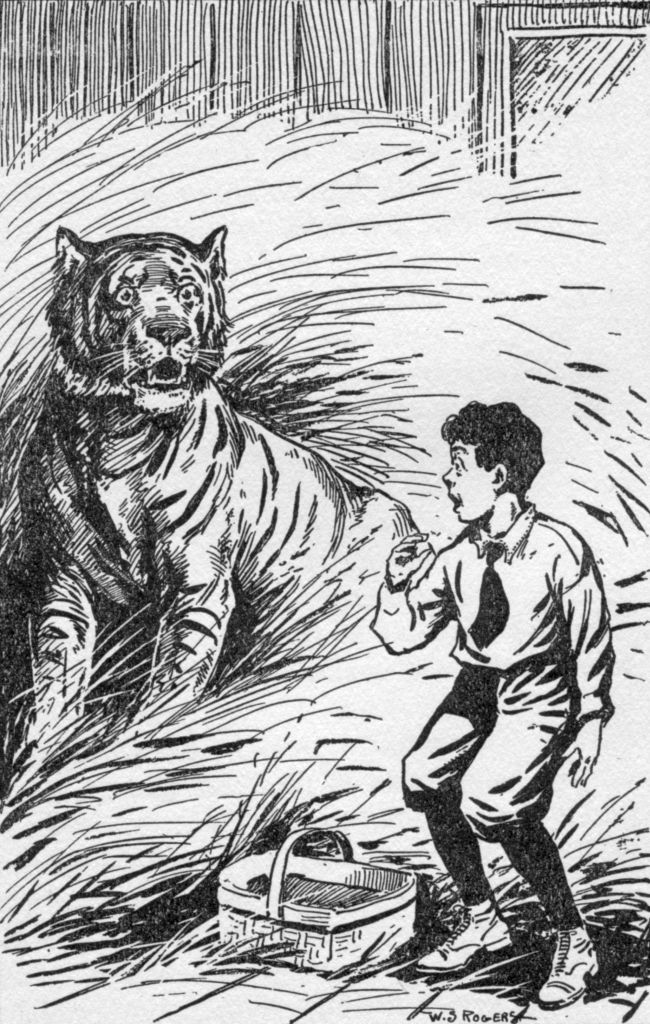
Then he gave a loud growl—one of his very
loudest—and he raised himself from his nest in
the hay, and stuck his head out.
Now if you had gone hunting hens’ eggs in
your father’s barn, and had, all of a sudden, seen
a great, big, striped tiger jump out at you from
the hay, giving a loud growl, I believe you
would have done just what this boy did. And
what he did was this.
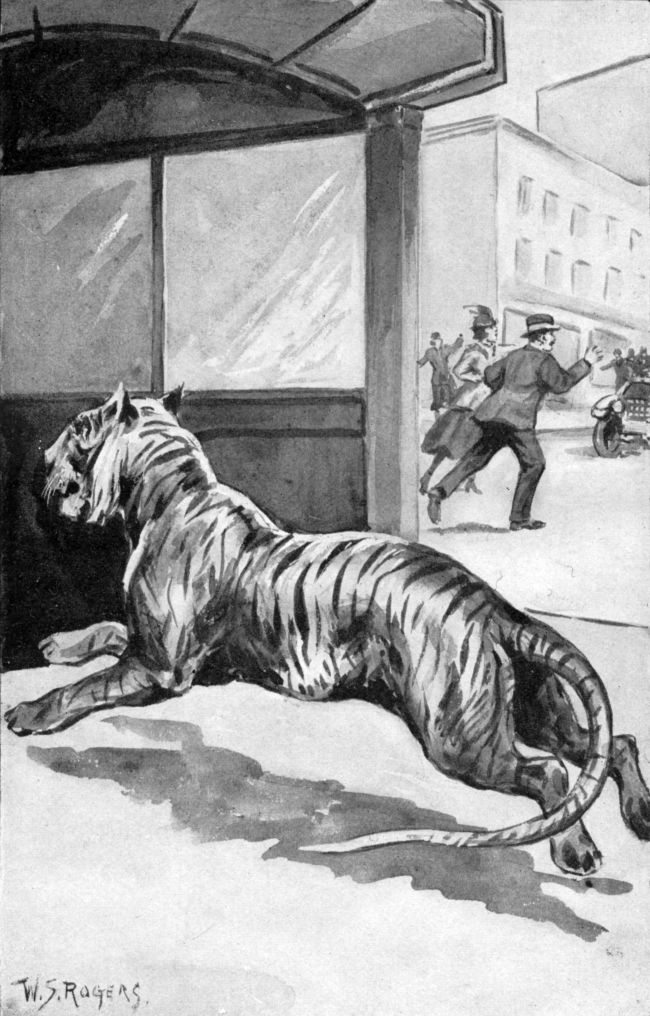
He dropped his basket, gave one look at
Tamba in the hay, and then uttered such a yell
that his father and mother in the farmhouse,
quite a distance off, heard him. And then that
boy ran out of the barn as fast as he could run.
That’s what this boy did, and I think you would
have done the same.
“Well, I guess he won’t come back right
away,” thought Tamba. “But there may be others
like him. If I stay here I may have to scare
a whole lot of them. I guess I’ll find a new hiding
place.”
So Tamba came out from his nest in the hay
and began moving about in the barn, looking for
a new place in which to snuggle, and perhaps
find something to eat. And the first thing he
knew he stepped right into a hen’s nest of eggs.
Right down among the eggs Tamba put his
paw.
Of course he broke some of the eggs, but he
took up his paw so quickly again that not many
of the shells were cracked. And, as his paw was
covered with the sticky whites and yellows of the
eggs, Tamba began licking it with his tongue to
make it clean.
“Hum! These eggs taste as good as the ones
I used to get in the jungle,” said the tiger to himself.
“Guess I’ll eat them. I’m hungry, and
they’ll be almost as good as meat.”
So Tamba carefully cracked the egg shells and
sucked out the whites and yellows. He ate a
whole dozen of eggs before he finished, and then
he felt better.
“Now I’ll go and find a new place to hide,”
he said to himself.
He found a stairway leading from the upper
part of the barn, where the hay was stored, to the
lower part, where were the stables of the cows
and horses. Down the stairs softly went Tamba,
and no sooner was he down there than he felt
right at home. For it smelled just like that part
of the circus where the horses were kept. And,
as a matter of fact, there were a number of horses
in the barn, and quite a few cows.
At first the horses were afraid of the tiger, and
pulled at the straps which held them fast in their
stalls. But Tamba, speaking in animal talk,
said:
“I am a tame tiger. I won’t hurt any of you.
I only want to hide here so the circus men won’t
find me. I am on my way back to the jungle.
I have run away from the circus.”
When Tamba spoke thus kindly the horses
were no longer afraid. One of them said
Tamba might hide in a pile of straw near his
stall, and this the tiger was glad to do. He
stretched out, and got ready to go to sleep.
Now I must tell you a little about the farmer
boy. When he saw the tiger rear up at him out
of the hay, and ran away, screaming with fear,
he did not know what to do. All he could yell
was:
“The tiger! The tiger! A big striped tiger
is in our barn!”
The boy’s father and mother heard him shouting
and yelling, and they ran out of the house to
see what the matter was. They saw that Tom
was very much frightened indeed.
“What is it?” they asked.
“Oh,” Tom answered, “I went to get some
eggs out of the hay, and I found a tiger there!
He had great big eyes, big teeth and a big
mouth!”
“Oh, Tom! Really?” asked his mother.
“Really and truly!” he answered. “You can
go and look for yourself!”
“No, I don’t believe I want to,” said Tom’s
mother. “But do you really think he did see a
tiger?” she asked her husband.
“Well, I don’t know,” he slowly answered.
“I read in the paper something about a circus
train having been wrecked, and maybe a tiger
or an elephant got loose and is roaming about.”
“It’s a tiger—not an elephant—and he’s in our
barn,” said Tom. “Come and see, Dad! But
you’d better bring your gun!”
“Yes,” agreed the farmer, “I think I had.
And I’ll call some of the men to help hunt the
tiger, too!”
But, as it happened, by the time the farmer
had called some neighbors in to help him and
they had gotten their guns, Tamba had left the
upper part of the barn, where the hay was, and
had gone downstairs among the horses and cows.
And as the farmer and his friends did not know
this, and as none of the horses or cows called out
to tell the men, they didn’t know where Tamba
was.
They looked in the hay, where the boy had
seen him, but Tamba was gone. The men even
found the place where Tamba had eaten the
eggs, but the jungle circus beast was not in
sight. He was well hidden downstairs in the
straw near the stall of the kind horse.
So the men hunted in vain, and some of them
thought the tiger had gone back to the circus,
while others thought he had run off to the woods,
perhaps. At any rate, they did not find him in
the barn, though he was there all the while they
were searching. A wild animal sometimes
knows better how to hide than you boys and girls
do when you are playing games.
And now I must tell you something that happened
to Tamba, as he still hid in the lower part
of the barn. He was snugly curled up in the
straw when suddenly there was a patter of little
hoofs on the floor, and a small pony trotted into
his small stall, which was near that of the big
horse, next to which Tamba was hiding.
“Well, friends, here I am back!” cried the little
pony. “I have been giving the boys and girls
a ride, and now I’ve come back to have something
to eat. Has anything happened while I
was out, hitched to the basket cart, giving rides
to the boys and girls? Has anything happened?”
“Yes,” answered the old horse, near whose
stall Tamba was hiding in the straw, “something
strange has happened. A big striped animal,
who calls himself a tiger, came into our barn.”
“A tiger!” cried the little pony. “Why, I’d
like to see him. I know something about
tigers.”
“Oh, do you?” asked Tamba himself, sticking
his head out of the straw, as he had stuck it out
of the hay at Tom. But the pony was not frightened.
“So you know something about tigers, do
you?” went on Tamba. “Well, what is your
name, if I may ask? Mine is Tamba.”
“Oh, ho! I know that very well!” neighed
the pony. “You don’t know me, Tamba, but I
have often seen you in the circus. I am Tinkle,
the trick pony. I was in the circus a short time
myself, but there were so many of us little Shetland
ponies that I don’t suppose you remember
me. But there were only a few tigers in the
show, and I remember you very well. Didn’t
you used to jump through a paper hoop as one of
your tricks?”
“Yes,” answered Tamba, “I did. And, now
that you speak of it, I believe I remember you.
You used to pull, around the ring, a little cart
with a funny clown in it, didn’t you?”
“Yes,” said Tinkle, “I did. Well, Tamba,
I’m glad to see you again. But what brings you
so far from the circus, and why are you hiding
here?”
“That,” said Tamba, “is a long story. I’ll tell
it to you!”
But, all of a sudden, one of the cows at the far
end of the stable mooed out:
“Quick, Tamba! Here comes the man to
milk us! Hide in the straw so he won’t see
you!”
CHAPTER VII TAMBA AND SQUINTY
Tamba did not need to be told twice
what to do. As soon as he heard the
kind words of the cow the tame tiger
ran softly on his padded feet and snuggled down
again in the straw. And the man came in,
milked the cows, and went out with the foaming
pails without knowing anything about the circus
tiger hiding in the lower part of the barn. He
thought the tiger had gone away.
“Now it’s all right—he’s gone and you may
come out,” said the cow to Tamba, and the tiger,
shaking the straw from his striped black and yellow
fur, walked out to talk some more to Tinkle,
the trick pony.
“You were going to tell us how it was you left
the circus, Tamba,” said Tinkle. “Make a
good, long story of it. I like stories.”
“I haven’t time to make it too long,” said
Tamba, “for I must be on my way. I want to
get back to my jungle. At first I thought the
long grass near the railroad was the place I
wanted. But I see it is not the jungle where I
used to live. So I must travel on a long way,
and the sooner I start the quicker I’ll be there.
But I’ll tell you how I got loose from the circus.”
So Tamba told Tinkle the story I have told
you—how the circus was wrecked in the railroad
accident, and how the cage burst open, letting
the tame tiger loose.
“And now I’m here,” finished Tamba. “But
tell me, Tinkle, how did you come to leave the
circus?”
“Well, I had many adventures,” said the trick
pony. “I used to live on a stockfarm, something
like this, only there were more horses on it. I
was taken away to live with a nice boy, who
taught me many tricks, and then a bad man, with
a big moving wagon, came along one day and
stole me away. He sold me to the circus, and it
was there I saw you, Tamba. I know Tum
Tum, too, and Dido, the dancing bear!”
“Yes, they are all friends of mine,” said
Tamba. “At least they were before I left.
Now, I suppose, I’ll never see them again, for I
am going to the jungle. But you haven’t yet
told me, Tinkle, how you came to leave the circus.”
“Oh, it’s all written down in a book,” answered
the trick pony.
“Oh, a book!” exclaimed Tamba. “I’ve
heard Tum Tum and Dido speak of being in
books, but I didn’t know what they meant. And
I haven’t time to learn now, so suppose you tell
me.”
“Well, there’s a book all about me and my
adventures,” said Tinkle, the trick pony. “But,
as long as you can’t read it, I’ll just tell you that,
one day, when I was in the circus doing my
tricks, George, the boy who used to own me before
I was stolen away, came to the show.
There he and his sister saw me and they knew me
again, and I was taken out of the circus and
given back to my little master. I’ve lived with
him ever since. We often come to this farm in
the summer, and I have just been giving him and
his sister and some of the other children a ride
in the pony cart. George is very nice to me, and
gives me lumps of sugar.”
“I hope he isn’t the boy whom I scared in the
hay,” said Tamba. “I would not want to scare
any friend of yours, Tinkle.”
“Oh, well, if you only scared him, and didn’t
scratch him, I guess it will be all right,” said
the trick pony. “But I don’t believe it was
George you frightened, as he was out driving me.
It must have been Tom, or one of the other boys.”
And so it was, as Tinkle learned later.
“And so you are going to the jungle, are you?”
asked Tinkle of Tamba, when they had talked a
while longer.
“Yes, I want to get back to my old home,” answered
the tiger. “I don’t like it in the circus.
But, still, there was one thing I liked in it, and
that was the good meals I had. I’m very hungry
right now.”
“Oh, excuse me!” exclaimed Tinkle. “I
should have thought of that before. I’m so
sorry! Won’t you have some of my hay or
oats?”
“Yes, and give him some of our bran,” added
the cow who had told about the man coming in
to milk.
“Oh, thank you, very much, Tinkle. And
you too, my cow friend,” replied the tiger gratefully.
“But I can’t eat hay, bran, or oats. We
tigers must have meat. I don’t suppose you eat
any of that?”
“No,” said Tinkle, “we don’t. It’s too bad!
I don’t know how we can give you anything to
eat. It’s no fun to be hungry, either.”
“I know how we can feed your tiger friend,”
said one of the big farm horses.
“How?” eagerly asked Tinkle. He felt just
as you would feel if some friend came to visit
you and you couldn’t give him anything to eat.
“How can I feed Tamba on the meat that he
likes?” asked Tinkle.
“I’ll tell you,” went on the horse. “You know
the big dog who drives the sheep to and from
the meadow?”
“Oh, yes, I know our sheep-dog very well,”
said Tinkle. “He is a friend of mine.”
“Well, he has company,” went on the horse.
“A dog named Don has come to see him and
spend the day. I came in just now from plowing
one of the fields, and I saw the farmer’s
wife put a big plate of meat and bones out near
the dog kennel. She said it would do for our
dog and his friend, Don.”
“Yes, but if the meat is for the dogs they’ll eat
it all up, and there won’t be any for Tamba,”
said Tinkle.
“Oh, but wait a minute!” neighed the horse.
“I didn’t finish. Don and our dog went off to
the woods. I heard them say they would be
gone for a long time, and maybe they would find
something to eat there. So if they don’t come
back to eat the bones and meat Tamba can have
it.”
“Yes,” said Tinkle, “I suppose he can. I
hope Don doesn’t come back.”
“I hope so, too,” said Tamba. “I’m getting
hungrier every minute.”
“I’ll go out and look,” said Tinkle. “It will
soon be dark, and if the plate of meat is still by
the dog kennel, you can sneak out and get it,
Tamba, and no one will see you. I’ll go and
look.”
Tinkle, the trick pony, was not kept tied in a
stall as were the other horses. He could roam
about as he liked, and so he trotted out of the
barn to where the farm dog had his house, or
kennel. There, surely enough, was a big plate
of meat and some large bones, large enough,
even, for a lion or a tiger.
“It’s all right,” said Tinkle, when he came
trotting back. “The meat is there, Tamba, and
I didn’t see anything of Carlo, our dog, nor his
friend, Don. Now if they don’t come back until
dark, why, you can go out and have a good
meal.”
“I will, thank you,” returned Tamba, and he
wished, with all his heart, that Don and the other
dog would not come back.
“Of course I don’t want to see them hungry,”
thought Tamba, “but they may get something to
eat in the woods, and perhaps I couldn’t do that.
There may be no muskrats there.”
Everything came out all right. The twilight
faded, and it became dark. Then Tamba, who
remained hidden in the stable, crept softly out
to the plate of meat and bones that had been left
for the dogs. He ate up everything and gnawed
the bones, and then he got a drink of water from
the horse trough and felt much better.
“And now, Tinkle, I will bid you and your
kind friends good-by and be on my way to get
back to the jungle,” said Tamba, after he had
eaten.
“Oh, are you going to run away?” asked the
trick pony. “You’ll be just like Don, the dog,
then. He ran away, too.”
“But he ran back again, as I have heard my
friend, Nero, the circus lion, say,” replied
Tamba. “I am not exactly running away from
you. I ran away from the circus, but I am only
leaving you after paying you a visit. And I
liked my visit very much. That meat, too, was
very good. Thank you, Tinkle.”
“I only wish there had been more of it,” said
the trick pony. “But, if you have to go, I suppose
you must leave. I hope you’ll get safely to
your jungle.”
But Tamba had many adventures ahead of
him before that time. He said good-by to Tinkle
and the farm animals, and then, looking out
of the barn and peering through the darkness, to
see that none of the farmer’s men were on the
watch with their guns, Tamba slunk out into the
night.
Once more he was on his way, traveling to find
his jungle. On through the dark woods and
over the fields went Tamba, taking care to keep
away from houses where people might live who
would see him and tell the circus men to come
and get him. Tamba did not want to be caught.
So, for several days, Tamba traveled on.
Often he was hungry and thirsty, but he managed
to find things to eat once in a while, and
now and again he came to springs of water or
streams where he drank. So, though he did not
have a very good time, he managed to live.
One evening, just as it was getting dark,
Tamba sniffed the air and smelled a smell which
told him he was near another stable and barn.
It was not the one where Tinkle lived, though.
“I wonder if I can get anything to eat here,”
thought Tamba.
Carefully and softly the tame tiger crept
around the corner of the carriage house. Near
by he saw what seemed to be a low building without
any roof a little way ahead of him, and from
this place came gruntings and squealings.
“Get over on your own side of the trough!
You’re eating all my sour milk!” said one squealy
voice.
“I am not, either, Squinty!” came the answer.
“I want something to eat just as much as you do!”
“Ha! Something to eat!” thought Tamba
who heard and understood this animal talk. “I
wonder who those chaps are, and who Squinty
is. And I wonder if they have enough for me
to eat. I’m going to see!”
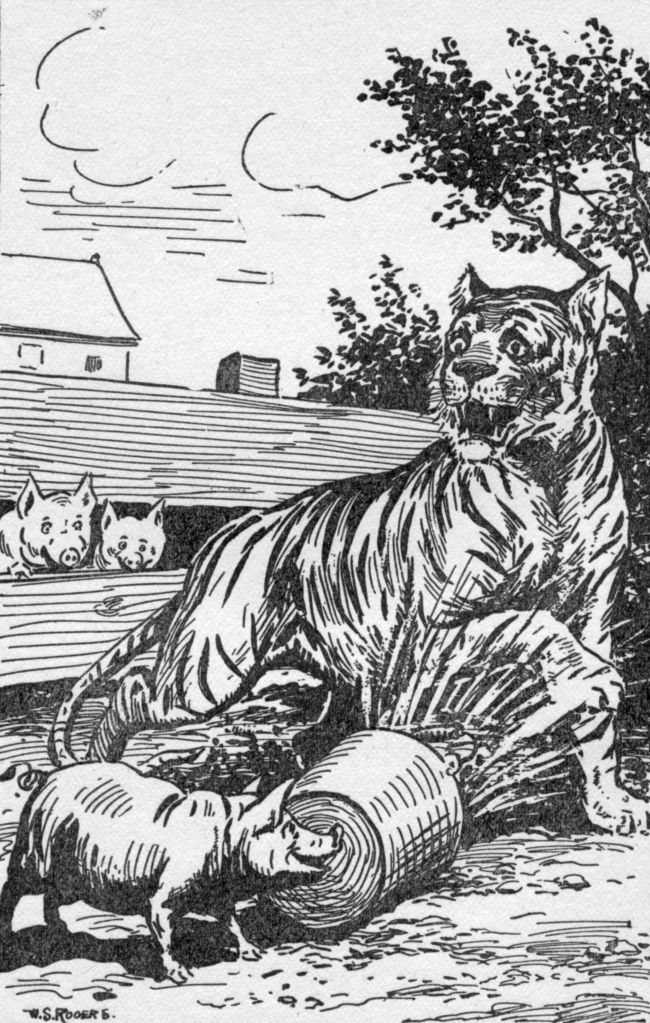
Up to the pen, which had no roof, went
Tamba, and, rising on his two hind legs, he
looked over the side and down in. There he saw
a number of pigs who were drinking sour milk
and bran from a trough.
One of the pigs, with a queer droop to one eye,
looked up and saw Tamba peering in.
“Hello!” grunted this pig. “Who are you,
and what’s the matter?”
“I’m Tamba, a tame tiger,” was the answer,
“and the matter is that I’m hungry. Who are
you?”
“Squinty, the comical pig!” was the grunting
reply. “And you had better travel on! We
have nothing here for tigers to eat!”
CHAPTER VIII TAMBA IN THE CITY
Tamba, the tame tiger, rearing up on
his hind legs to look down into the pig
pen, saw the funny look on the face of
the animal who had spoken to him.
“What’s that you say?” asked Tamba in a
growling voice.
“I said we didn’t have anything to give tigers,”
went on the comical pig, and really he was comical,
for his one eye had such a funny look as it
drooped toward one ear. It seemed to be looking
in two ways at once, and that is something
you don’t often see in a pig.
“Well, it seems to me I smell something very
good,” went on Tamba. “It smells like milk to
me.” When he was a little tiger Tamba had
liked milk very much, and now, even though he
was older, he knew it would be good when he
was hungry.
“Yes, you do smell milk,” went on Squinty.
“But it is sour.”
“Sour or sweet, it makes no difference to me,”
replied Tamba. “I am hungry enough to eat
anything.”
“Well, I don’t want to be cross or impolite,”
said Squinty, “but there is only enough sour milk
for us pigs. We can’t give you any.”
“Ha! Well, I simply must have something
to eat!” returned Tamba, and his voice was more
growly now. “If I can’t get milk I must have
meat. I remember once, in the jungle, eating
a little pig who looked something like you.
What’s to stop me taking a few bites off you, if
you won’t give me any of your milk?”
“Oh, ho! So you think you can bite me, do
you?” squealed Squinty. “Well, we’ll see about
that!”
Now Squinty was a brave little animal, and he
had seen more of the world than some of the
other small pigs in the pen. In fact, Squinty
had had a number of adventures, and those of
you who have read my first book entitled,
“Squinty, the Comical Pig,” know that Squinty
was not much afraid of anything.
So no sooner did he hear Tamba talk that way,
about taking bites, and so on, than Squinty ran
to where there was a loose board in the pen, and
out he popped.
“Ho! So you think because you’re a big, circus
tiger that you can scare me, do you?”
squealed Squinty. “Well, I’ll show you that
I’m not a bit afraid!”
Now, as it happened, near the pen, where the
farmer intended to use it the next day, was a
pail of whitewash. It was like thick, white
water, and the pail was full of it. Squinty gave
one look at the pail of whitewash, and a glance
at Tamba, who had taken his forepaws down off
the edge of the pen, and was standing on all four
feet looking at Squinty.
“There! Take that and see how you like it!”
squealed Squinty, and with his strong nose, made
for digging down under the ground after roots
and things, Squinty upset the pail of whitewash
and gave it a push toward Tamba.
“Now how do you like yourself?” asked
Squinty of Tamba, as he looked at the tame tiger
in the moonlight, for the moon was just coming
up. “If you try to bite me or any of my friends
I’ll splash some more whitewash on you!”
“You can’t,” said Tamba. “There isn’t any
more left in the pail. It’s empty; I can see for
myself. I guess I got most of it on me.”
“Well, if I can’t throw whitewash on you I’ll
throw something else!” threatened Squinty.
“You’ve got to leave us pigs alone!”
“Yes,” said Tamba, “I can see that I’d better.
I didn’t know you were such a fierce chap,
Squinty.”
“Well, I didn’t mean to be cross,” said the pig.
“But when you talked of biting me, why, I just
couldn’t help it. I’m sorry I spotted you with
white like that.”
“It’s all my fault,” returned Tamba. “I
shouldn’t have said anything about biting you.
Being splashed with whitewash serves me right.
But I am very hungry, and your sour milk
smelled very good!”
“I’m afraid there isn’t much left now,” said
Squinty. “The pigs were very hungry to-night.
But if you’ll come over to the side of the pen,
where I broke out to rush at you, I’ll see if there
is anything else. Sometimes they throw kitchen
table scraps into our trough, and there are bits of
meat which we small pigs don’t eat. You may
have that, if there is any. Tigers like meat, I’ve
heard.”
“Yes,” said Tamba, “I like meat very much.
It is about all I can eat, though I could manage
to drink some milk—sour or sweet.”
“Come, we’ll go see what there is,” went on
Squinty. “When I said we had nothing for tigers
I didn’t think about the meat scraps.”
So Squinty led Tamba back to the side of the
pen whence the little pig had pushed his way out.
Then Squinty explained to the other pigs what
had happened.
“Yes, here are some meat scraps,” said one of
the pigs, when Squinty had told how hungry
Tamba was. “It isn’t very much, though.”
“Even a little will keep me from starving,”
said Tamba. “When I get to my jungle I’ll
have all I want to eat, but just now it is pretty
hard to find enough. In the circus I had plenty.”
“Oh, so you’re from the circus, are you?”
asked Squinty. “I used to know some animals
in a circus. There was Mappo, the merry monkey.”
“Yes, I have heard of him, too,” said Tamba.
“But he isn’t with the show now. Ah, but this
meat tastes good!”
The tame tiger was now chewing the scraps
the pigs had brushed aside as they did not want
them. Tamba did not feel so hungry now, but
he did feel queer where the whitewash had
splashed on him.
“I’m sorry about that,” said Squinty. “If you
go down to the end of the meadow there is a
pond, and you can wash off the white splashes.
It’s warm enough to take a bath.”
“I’m not very fond of water,” said Tamba,
“though I do take a bath now and then. I guess
I can wash off the white stuff by dipping my
paws in the water and rubbing them over my
striped coat. I’ll do it.”
And that is what Tamba did after he had eaten
up all the meat scraps there were in the pigs’
pen. Then he said good-by to Squinty and the
others and started off again.
“I must get to my jungle,” said the tiger. “I
have been away from the circus quite a while
now, and, as yet, I have not come to the jungle.”
“But you have had lots of adventures,” said
Squinty, the comical pig, for Tamba had told of
some of the things that had happened to him.
“You have had almost as many adventures as I,
Tamba. I suppose you can call that an adventure,
when I splashed the whitewash on you.”
“Yes,” agreed Tamba, “I think that, most certainly,
was an adventure. I don’t want another
like it, though.”
So Tamba traveled on again. He thought, if
he went far enough, he must, some day or other,
come to the jungle where he used to live. But
he did not know which way to go, and, often as
not, he went wrong. However, as Squinty said,
the tame tiger was having many adventures.
He had a queer one the second night after he
had met Squinty, and this is the way it happened.
Tamba had been roaming along in the
night, after having caught something to eat in
the woods, and at last he came out on a road
which stretched far and away in the moonlight.
“That is a long road to travel,” thought
Tamba. “I think I will take a rest before I go
down it any farther. I’ll hide somewhere and
wait until morning.”
Tamba looked around for a place to hide, and
saw a big pile of hay. He knew it was hay, since
he had often seen it in the circus tent, and he
remembered having hidden in the hay in the
barn.
“But this hay isn’t in a barn,” said Tamba, as
he looked at the pile. “It seems to be on a
wagon, as my cage used to be.”
And that is just what it was. Tamba had
come to a farm, and a little way down the road
from the farmhouse was a wagon loaded with a
great pile of hay. The farmer had loaded the
hay on the wagon the evening before, so as to
have it all ready to hitch his horses to and pull it
into the city early in the morning. The farmer
was going to sell the hay in the big city.
“Well, that hay will make a nice place for me
to sleep,” thought Tamba. He gave a big jump,
and landed on top of the load of hay. There
were, as yet, no horses hitched to the wagon.
That would be done in the morning.
Tamba pawed out a nice, cozy bed for himself
on top of the load of hay, burrowed away down
in, pulled some hay over him as a covering, and
went to sleep.
How long he slept the tame tiger did not
know. But when he suddenly awoke, he saw the
sun shining, and he heard a rumble and roar all
about him.
“What’s this? Where am I? What has happened?”
thought Tamba.
He saw the hay all about him. He felt the
jolting and sway of the wagon. The roaring
sound became louder. Tamba looked out between
the wisps of hay. He saw a strange sight.
“Why, I’m in a big city!” thought the tiger.
“The load of hay has come to the city, and I
came with it! Oh, dear, I am farther than ever
from my jungle! What shall I do?”
CHAPTER IX TAMBA IN THE SUBWAY
Tamba, the tame tiger, had really come
to the city on a load of hay. I know it
sounds very strange to say that, but it
really happened. I have often seen dogs riding
along on a load of hay that had started to ride in
the country, at the farmhouse where they lived,
and had come all the way to the city. So if a
dog can ride on a load of hay I don’t see why a
tiger can’t, especially when he is a tame tiger.
Anyhow, that’s what Tamba did. He rode
along on the load of hay until it reached the big,
noisy city. But the funny part of it was that the
man who drove the load of hay didn’t know he
was giving a ride to a tiger. If he had known
that I don’t believe he would have guided his
horses along so easily, nor do I believe the horses
themselves would have gone so quietly.
But there Tamba was, snugly curled up in a
little nest on top of the load of hay, where no one
could see him. He could look out and down
at the city streets through which he was passing,
and he saw many strange sights. But he was
used to them, and he was not afraid of being in
the city. For he remembered having seen a city
like this many times before when he was in his
cage and the circus parade had gone up and
down the streets to show the animals, so that boys
and girls would be all the more anxious to come
to the performance.
“Well, I wonder what will happen to me
now,” thought Tamba, as the hay wagon rumbled
along the city streets. “I can’t stay here
much longer. Some one will be sure to see me,
and perhaps the man who owns this hay is taking
it to the very circus where I used to live. If that
happens they’ll get me back in a cage again, and
I don’t want that to happen. I must be very
careful!”
On and on went the load of hay, with Tamba
hiding at the top, and, pretty soon, the man drove
into a sort of big yard. There were trees, and
grass, and some buildings. But what made
Tamba sit up and sniff eagerly was the smell of
wild animals. I dare say you have often noticed
it yourself when you have gone to the circus.
Even with your eyes shut you can tell as soon as
you enter the wild animal tent.
“Dear me, this is very strange!” thought the
tame tiger. “Can the man, with his load of hay,
have brought me back to the very circus from
which I ran away? It smells so, but I don’t see
any of the big tents, nor yet the barn where I
used to live in winter. Besides, this is summer,
not winter. I wonder what it all means!”
The more Tamba thought about it and the
stronger the wild animal smell came to him, the
more the tame tiger was puzzled. The load of
hay, in which he was hidden, rumbled along,
down a little hill, and then Tamba heard the man
call:
“Whoa!”
That meant for the horses to stop. Tamba
had often heard the circus men call that to their
horses when they wanted them to stop pulling
the big cage wagons, and so the tiger understood.
“Now I wonder what will happen to me,”
thought Tamba. He raised his head up from
his snug nest in the hay and saw what he knew
to be a barn, though it was not like the one near
which he had met Squinty, the comical pig, nor
like the one where he had frightened the boy
Tom.
“But it’s a barn all right,” thought Tamba.
“And there must be some of my tiger, elephant
and lion friends near it, else there wouldn’t be
that wild animal smell. I wonder if Tum Tum,
Nero and Dido are here. Maybe they brought
them here after the train wreck.”
Tamba did not know what to think, but what
he wanted to do was to keep out of sight of any
men who might be around, until he could think
of what to do.
“For I’m not in my jungle, that’s sure,” said
Tamba to himself. “And how to get there I
don’t know. But I’m not going back to the circus
if I can help it.”
Tamba now felt some one pulling at the load
of hay, as if about to unload it from the wagon.
Then the tame tiger, giving a look over the side
and seeing no one, slipped and slid down, and,
noticing an open door in the barn, through it he
ran and hid in a dark corner.
“There! Now maybe they can’t find me!”
thought the tiger. “I’ll stay here until it’s dark,
and then run out. But where am I?”
Tamba asked himself this question over and
over again. Outside the barn he heard men
talking and horses moving about, and with the
wild animal smell came the sweet smell of new
hay—the hay on which he had ridden to the city.
“The man must be taking the hay off the
wagon,” thought Tamba. “I can’t ride on it
again. Well, perhaps I shall not need to. But
I should like to know where I am, and what all
this means.”
For some time Tamba remained hidden in a
dark corner of the barn, and then, suddenly, an
animal came running in and Tamba knew at
once what kind it was. For it was striped almost
the same as was the tiger himself—with yellow
and black—and it was a zebra.
“Oh, hello, my friend!” called Tamba, in animal
talk, from the place where he was hidden.
“Are you running away from the circus, too, Mr.
Zebra?”
“Circus? Why, no. I never was in a circus,
though I’ve heard about such things,” the zebra
answered. “But how did you get out of your
cage? I didn’t know any of the tigers were
loose.”
“Oh, I got out some time ago, in a train
wreck,” answered Tamba. “But what is the circus
doing here, and have they had the parade
yet?”
“Look here!” exclaimed the zebra, as he
chewed some wisps of hay he picked up from the
barn floor. “I guess we don’t either of us know
what the other is talking about. This isn’t a circus.
This is a zoölogical park, in a big city, and
I am one of the animals. Only, as I am very
tame, they let me run about the yard where the
barn is. We have some lions and tigers here,
but they are kept in cages. Are you one of the
zoo tigers?”
“No,” answered Tamba. “I was a circus
tiger. But I ran away, and I am going back to
my jungle. So this is the zoo. Now I understand.”
What had happened was this. The farmer,
on whose load of hay Tamba had hidden, gone to
sleep, and been given a ride to the city, had
brought the hay to the zoölogical park, to sell, as
he often did. He had driven it right up to the
barn to unload, and then it was that Tamba
slipped off and hid before any one saw him.
And the wild animal smell that Tamba noticed
was the smell of the animals in the park. I suppose
you have been to the zoölogical park near
your own city, perhaps, and have noticed that
smell. It is almost like a circus, so it is no wonder
Tamba was puzzled.
“So this is the zoo, is it?” he asked the zebra.
“Well, I don’t want to stay here, any more than
I want to stay in a circus. But how can I get
away?”
“Well, if you really belonged here, of course
it wouldn’t be right for me to tell you how to
get away,” said the zebra. “But as you are not
one of the zoo animals, it will be all right for
you to run off. You had better wait until it is
dark, though, and then you can crawl out
through the fence near the back of this barn.
But you will be in the middle of a big city, and
not in your jungle.”
“I know,” said Tamba, sadly. “But I’m used
to cities. I have been in parades in them often
enough. I’ll find my way out somehow, and
then I’ll go to my jungle. But I wish I had
something to eat. You haven’t a bone or a piece
of meat, have you?”
“I am sorry to say I have not,” replied the zebra.
“All I eat is hay and grains. But I can
show you where to get a drink of water.”
“I shall like that,” said the tame tiger, “as I
am very thirsty.”
So the zebra showed the tiger where, in the
barn, was a tub of water out of which the horses
who worked in the zoölogical park got their
drinks. There Tamba quenched his thirst and
felt better. Then he crawled back into the dark
corner to hide. The zebra had to go away, but
he promised to come back and let Tamba know
when it was dark enough for the tiger to run out
and start afresh on his journey to the jungle.
All that day Tamba remained hidden in the
barn. He saw none of the other wild animals,
and the zebra did not come back. Tamba was
getting hungrier and hungrier, but he knew he
dared not go out to look for anything to eat. If
he had the park men would have seen him and
chased after him, either catching him to put in
one of their cages, or else sending him back to
the circus. And Tamba did not want that.
After a while it became darker. Tamba
sneaked out and got another drink, and then in a
little while he heard the patter of the feet of his
zebra friend on the floor of the barn.
“Are you there, Tamba?” asked the zebra, in
animal talk.
“Yes,” answered the tiger.
“Well, it’s dark enough now for you to set
out,” went on the zebra. “Cut across the park
over the big field you’ll see as soon as you leave
this barn. That way will take you to a street
where there are not so many cars and wagons as
on the street nearest this side. It is quieter.”
“That’s what I want—to be quiet,” said
Tamba. “That’s why I want to go back to my
jungle.”
Tamba took another drink of water, for he did
not know when he would get any more, and then,
having said good-by to his friend, the striped
zebra, the tame tiger went softly out of the barn
into the night. He saw the big field and, on the
other side, a row of lights. At first they looked
like the lights around the circus tents when a
night-show is being given, but when Tamba
looked a second time he knew they were street
lights. He was still in the big city.
“Good-by!” called the zebra after him. “I
hope you soon come to your jungle.”
“Thank you! I hope so myself,” said Tamba.
He ran across the big park field in the darkness.
No one saw him, for few persons are in the
park at night. Tamba sniffed the air, and he
smelled water. There was such a strong smell
of water that Tamba knew it must come from a
big river or a lake.
“And it smells like salt water, too,” thought
the tame tiger. “I remember that smell of salt
water. I smelled it when they put me on a ship
and brought me away from my jungle. Perhaps
my jungle home is just across that salt
water. I am going to see.”
What Tamba smelled was the salt water of a
big river that flowed through the city down to
the ocean. And beyond the ocean lay the jungle.
This much Tamba had guessed.
“I am going toward that salt water,” said the
tiger to himself. “This is the first time I have
smelled it since I was on the ship. I believe,
after all, I shall at last get to my jungle.”
But there were quite a few adventures for
Tamba to have before he reached his old home.
On across the big field in the zoölogical park
ran Tamba. He was coming nearer and nearer
to the row of lights, nearer and nearer to the
smell of salt water, and, also, nearer and nearer
to a city street. It was this street that Tamba
feared most. Once he was across that, he
thought everything would be all right.
He came to a low, stone wall around the park.
He looked and listened as well as he could. He
did not see any one who he thought would try
to catch him.
With a leap and a bound Tamba cleared the
low, stone wall and found himself on the sidewalk
of a street. Just at this place, and at this
time, there did not happen to be any wagons,
street cars or automobiles. Tamba was beginning
to think everything was coming along
finely, and that he would easily get to the salt
water when, all of a sudden, he heard a woman
scream. Then a man, who was with her, cried:
“What’s the matter? What is it?”
“A tiger! A tiger! Look, there’s a tiger
loose in the street!”
“Why—why—so it is!” exclaimed the man,
who, with the woman, had come walking along
soon after Tamba leaped over the wall. “It’s
a real, live tiger! It must have escaped from the
zoo. I’ll drive it back!”
“Oh, don’t! He might bite or claw you!”
cried the woman. “Get a policeman!”
“I will,” answered the man, and he began to
call loudly.
“This is no place for me!” quickly thought
Tamba. “I must run and hide again.”
Of course he did not know what the man and
woman were saying, but he knew that they would
want to catch him, or call some one to do it, and
so Tamba knew he must hide.
He looked about for a good place to go. He
did not want to jump back into the park. Up
the street, a little way, he saw what he thought
was the opening to a big cave. True, it was
lighter than the entrance to the jungle cave
where Tamba used to live, but perhaps it might
do for a hiding place.
“I’ll go in there!” decided Tamba.
The tiger turned away from the man, who was
still shouting for the police, and from the
woman, who had covered her eyes with her
hands, and then Tamba ran for what he thought
was the doorway of a cave. At the entrance he
could see that it stretched away out in a sort of
dark tunnel.
“This is the place for me!” said Tamba to
himself, and the next moment he was running
down some stone steps. As he went down he
heard a loud rumbling and roaring.
“Ha! There is going to be a thunder storm,”
thought Tamba. “I came to this cave just in
time!”
And, back in the street, where they had first
seen the jungle beast, the man and woman cried:
“Oh, the tiger ran down into the subway!
The tiger is in the subway!”
CHAPTER X TAMBA AT THE DOCK
Queer as it may seem, Tamba had done
that very thing. He had run from the
street into the opening of a subway station
in a big city, thinking it was a cave. And
if you have ever been in a city where the street
cars run underground instead of on the surface,
as wagons and automobiles do, or instead of up
in the air, as the elevated trains run, then you
will understand how it was that Tamba made his
mistake. For it was a mistake to go down into
the subway, thinking it was a cave.
The rumbling and roaring sound Tamba
heard was a train coming along the subway, and,
being underground, it made much more noise
and racket than it would have done up on the
surface. So it is no wonder the tame tiger
thought it was a thunder storm.
Down the subway steps he ran. He saw a
dark tunnel stretching out both ways from the
station. It was light on the station platforms
where the subway trains stopped, but beyond
this place, at each side, the dark tunnel of the
subway stretched out.
Tamba saw crowds of persons getting on and
off the train, and as quick as a flash he hid behind
a candy counter and newspaper stand, where it
was partly dark. Tamba did not want any men
to see him now, for since he had smelled the salt
water he wished, more than ever, to get across
it and back to his jungle.
“Well,” thought the tame tiger as he crouched
in the darkness behind the candy stand, where
the boy tending it, busy selling evening papers,
did not notice him, “well, I don’t know what
this all is, nor what it’s about, but I guess this
isn’t the kind of cave I’m looking for. It isn’t
a jungle cave at all. It’s much too light and too
noisy. It’s as bad as the circus. I must get out
of here if I can.”
But Tamba knew better than to rush out when
so many people were coming and going. He
wanted to wait until they had gone. But there
were so many of them it seemed that they would
never go. And pretty soon a policeman, and
several excited men who did not wear blue suits
with brass buttons ran down the subway steps.
“He came right down here!” said one excited
man. “My wife and I were walking along the
stone wall by the park when the tiger jumped
over right in front of us. Then he ran down
these subway steps.”
“Then he must be here yet,” said the policeman.
“And if he is, we’ll catch him and send
him back to the zoo. If he came out of one of
the cages there he must be pretty tame, and he
won’t hurt any one. Come on, now, everybody!
We’ll have a tiger hunt in the subway!”
Of course Tamba did not know what all this
talk meant, but he knew enough to guess that the
policeman and the other men were trying to capture
him. So Tamba wanted to get to a better
place to hide than just behind a newspaper stand.
And he was lucky enough to find it.
The lower part of the stand was hollow, like
a big box. In it the newspaper boy kept his old
papers, empty candy boxes and the like, and
there was plenty of room for a tiger in there.
There was a door to this underneath place, and
the door happened to be open.
Tamba saw it, saw, too, that it was dark and
quiet underneath the stand, and so he crawled in
under there. A better place for a runaway tiger
could not have been found. Tamba curled
softly up among some bundles of old papers, and
there he stayed while the hunt was going on.
Up and down the subway station platforms the
policeman and the others looked for the tame
tiger. But they never thought of looking beneath
the hollow newspaper and candy stand,
and there Tamba stayed as snugly as you please.
“Well,” said the policeman at last to the man
whose wife had screamed so at the first sight of
Tamba, “I guess you made a mistake, my friend.
You didn’t see any tiger at all. You dreamed
it.”
“I’m sure I didn’t dream,” said the man. “I
wasn’t asleep. I saw that tiger come into this
subway as plain as anything.”
“Well, then he must have run up the steps on
the other side,” said the policeman. “He could
have done that before we got here. At any rate
the tiger is gone, and we may as well go out and
look for him somewhere else. He isn’t here!”
The excitement soon quieted down, the searchers
went upstairs, and Tamba was left to himself
in his hiding place beneath the newspaper and
candy stand.
He could hear people walking up and down
on the stone platform, and he could hear them
talking. They were talking about him, as it
happened, for the news of a tiger being loose
somewhere in that part of the city had spread.
But Tamba, of course, did not know what the
men and women subway passengers were saying.
He could hear the rumble and roar of the subway
trains, and they sounded something like the
trains on which the circus traveled from town to
town. But Tamba did not come out of his hiding
place to look at them. He stayed quietly in
the cubby-hole under the stand.
After a while, as the hours passed, it became
quieter in the subway. There were fewer trains,
and hardly any persons were traveling now. At
last, along about three o’clock in the morning,
no trains ran at all. The agent at the station
went to sleep in his little booth, and the newspaper
boy had gone home long ago. Tamba
thrust his head out of his hiding place. He
heard nothing and saw no one.
“Now is the time for me to run out and go to
the salt water,” said the tiger to himself. “This
time I shall surely get back to my jungle, I
hope.”
Up the same steps down which he had run
some hours before, Tamba now crept. He
reached the open air and could see the stars glittering
overhead. The night was clear and
warm. Tamba liked it very much. Eagerly he
sniffed the air and he smelled salt water. He
turned his face toward the river and began to
stalk slowly along. He wanted to cross the salt
water and get home to his jungle.
And as Tamba slunk along he began to remember
how hungry he was. Since leaving the
circus he had not eaten very much.
“Oh, if I could have a nice, juicy piece of
meat now, how good it would taste!” thought
Tamba. But of course no meat stores were open
at that hour, and, if there had been, Tamba could
not have gotten any meat from them. If the
tiger had strolled, no matter how quietly and
politely, into a meat shop, men would have
driven him away, or have caught him and shut
him up in a cage.
“But I do want something to eat!” sadly
thought the tiger.
Just then a smell came to his nose that made
him lick his lips with his red tongue and made
him sniff very hard with his black nose.
“I smell milk!” thought Tamba. “And it
isn’t sour milk, either, like that which Squinty,
the comical pig, was drinking. I smell fresh
milk, and I wish I had some!”
When Tamba smelled anything good he knew
how to find it, even if he could not see it. He
just had to “follow his nose” until he came to it.
All jungle animals, and even your dogs and cats,
do that. So when Tamba smelled the milk he
turned his nose toward it and walked along until
he came to it. And where do you suppose it
was?
Why, an early-morning milkman had left a
big can of milk in front of a grocery store, and
it was this milk—some of which had slopped out
from the can—that Tamba had smelled.
“Well, here’s milk all right, that’s sure,” said
Tamba to himself, as he sniffed around the can
in the doorway of the store. “But how can I
get it out? I can’t scratch or bite through this
tin can. And, oh, how hungry I am! A good,
big drink of milk would make me feel much better!”
Tamba walked up and down in front of the
can. It stood in the dark corner of a sheltered
doorway of a store on a main street, but at that
hour of the morning, after the milkman had
passed, hardly any one was ever out.
“I must have some of that milk!” thought the
hungry Tamba. He pawed and clawed at the
can, hoping he could find some way of getting
it open, when, all of a sudden, he knocked the
can right over. It fell to the sidewalk with a
clatter and a bang, and the cover came off.
Out gushed the white milk, and some of it
spilled right into the big, deep cover of the can
itself. That was enough for Tamba. Here he
had the milk, in a dish all ready for him to lap
it up with his red tongue, and that is just what
he did!
“My, but that’s good!” thought the tiger, as he
drank all the milk out of the can cover. “I am
having better luck than at first. There is even
enough milk for that pig Squinty, if he should
happen to come along.”
But of course Squinty was far away. Tamba
lapped up all the milk from the can cover, and
then he saw where a little puddle had formed in
a hole in the sidewalk. Tamba took that milk,
too, and then he felt better.
“Now to go down to the salt water and find
my jungle,” he said to himself, as he licked up
the last drops of milk.
So Tamba started off down the city streets
once more, and because every one was in bed and
asleep no one saw him.
But there was a very much surprised store-keeper
who, the next morning, went to take in
the big can of milk. It was upset and spilled.
“Ha! Some bad boys must have done this!”
thought the store-keeper. “I must tell the police!”
But wouldn’t he have opened wide his eyes in
surprise if he had known a tiger had drunk the
milk, and if he had seen Tamba doing it? Perhaps
it is just as well he did not.
But Tamba never knew what a sad trick he
had played on the store-keeper. The tame tiger
slunk along, coming nearer and nearer to the
smell of the salt water, and at last he came to the
river itself. It really was a river of salt water,
and ran down to the big ocean. But the river
was not like those in the jungle. It had no banks
of green vines, mud, and trees. Instead, all
along the river were big houses built on piers
with the water in between, and it was to one of
these docks that Tamba slunk down in the darkness.
Tied at the docks were big ships which would
soon steam down the river and cross the ocean.
Tamba knew what ships were. He had come
across the ocean in one when he was brought
away from the jungle.
“I think I have found the place I want at
last,” said Tamba to himself, as he walked slowly
along a pier. “It is the place of the salt water
where I landed when I first came to this country.
Now I have only to go back the other way
and I’ll be at my jungle. And how glad I shall
be! Now I will find a good place to hide until
morning, and then I’ll see what is best to do. I
am tired now, but I had a good drink of milk
and I can sleep.”
So Tamba found a quiet hiding place on the
ship dock and went to sleep.
CHAPTER XI TAMBA ON THE SHIP
The sun was brightly shining when
Tamba, the tame tiger, awakened in his
bed at the dock. I call it a “bed” for he
had snuggled down on a pile of bags between
some boxes and bales, and this is as good a bed
as ever a tiger asks for. Often they are glad
enough to sleep on the bare boards of the circus
cages, and even in their jungle caves they never
have more than a pile of dried leaves or grass.
Tamba could look out through the cracks between
the boxes and bales and see the yellow sunshine
on the dock. The sunshine made yellow
stripes, almost the color of Tamba’s tawny coat.
He could feel the soft, warm wind blowing in on
him, and he could also smell the salt water.
“I am in the right place at last,” thought
Tamba. “But I must be careful. I do not want
to be caught when I am so near my jungle.”
You see Tamba did not know just how far it
was down the big salt river and across the big,
salt ocean to his jungle home. All he knew was
that the salt water here smelled just as the salt
water had smelled when he was put on the ship,
to be brought away from his home in India.
And there were ships at the dock. Tamba
could see them, but he knew better than to run
out now and get on board one. For, now that it
was daylight, there were many men on the dock.
They were driving their wagons and drays about,
laden as they were with things to go on board the
ships, and Tamba knew that if he ran out, in
plain sight of these men, some of them would
chase him, and, perhaps, catch him.
“So I’ll just stay hidden here until it gets dark
again,” thought Tamba to himself. “Then I’ll
go on one of those big floating houses, which
Tum Tum says are called ships, and I’ll get back
to my jungle. If I wait until night no one will
see me, and then they can’t catch me to send me
back to the circus.”
So Tamba curled up in his snug little nest
among the boxes and barrels on the pier, and remained
hidden. Of course if men had come to
take away those particular boxes they would have
found Tamba, but, as it happened, they did not,
and so he was safe.
After a while, though, Tamba began to feel
hungry. Milk for a tiger, even though it happened
to be the full top of a can, is not enough.
He must have meat, and meat was what Tamba
wanted just then. He sniffed and smelled
around among the boxes and bales which formed
his nest, but no meat smell came to his nose. If
one of the boxes had happened to have meat in
it, perhaps Tamba might have clawed it open
and gotten a meal. But, as it was, there was
nothing for him to eat.
“Never mind,” he thought to himself; “perhaps
to-night, when I get on the ship, I can find
something good to eat.”
But Tamba was to have something before then.
About noon the dock on the edge of the salty
river, where many ships were tied, became a very
busy place. Though Tamba did not know it,
the ships were being loaded with things to be
taken across the sea and sold.
The dock was crowded with wagons, horses,
automobiles and men, all being driven or hurrying
to and fro, to get the big ships ready to sail.
For there were two ships in this dock, one on
either side of the pier, and Tamba was in a place
called a warehouse, in between the two vessels.
So, as I say, the dock and warehouse was a
very busy place at noon. And as men must eat,
as well as tigers, when the twelve o’clock whistles
blew some of the drivers tied their horses wherever
they happened to be, put nose-bags of oats
on the horses’ necks, and then the men went to get
their own dinners.
Now, as it happened, a wagon, with a load of
meat on it, was stopped by its driver near Tamba’s
place. The end of the wagon, which was
filled with big pieces of beef, pork, and mutton,
was near the hole among the boxes where the
tiger was hiding. And of course Tamba could
easily smell this meat. In fact, the smell of it
awakened him from a little sleep into which he
had fallen.
“Ha! What’s that?” asked the tiger of himself,
as he opened his eyes. He sniffed harder.
The meat smell became plainer. Then he
looked up. Right over his head was the end of
a big wagon, where the man driving it had
backed it to get it out of the way while he fed his
horses and went to get his own dinner. And on
the end of the wagon was some nice, juicy meat,
just the kind Tamba had been fed in the circus.
Only there was more meat than Tamba had ever
seen at one time before.
The meat, as I suppose you have guessed, was
to be put on board one of the ships to feed the
passengers and crew on its journey over the salty
sea. Of course Tamba did not know that. All
he knew was that he felt very hungry, and that
here was meat.
“Well, it was very kind of some one to bring
me so much meat,” thought the tiger to himself.
“I’m sure I’m much obliged to them. And they
left me to myself to eat it, too. They didn’t stay
to stare and watch me, as the folks do in the circus.
This is very nice.”
So Tamba rose up on his hind legs, and, hidden
as he was in his snug nest, where no one saw
him, and with the end of the meat wagon so
easily within reach, the tame tiger made a good
meal. Of course he chewed the ends off several
nice pieces of meat that were meant to go on
board the ship, but it did not completely spoil
them, and, after all, the tame tiger was very
hungry.
“My, but this tastes good!” thought the tiger,
as he took bite after bite of juicy beef. “This is
even better than the circus. I can have as much
as I want, and there are no bones to hurt my
teeth. Of course I like to gnaw a bone now and
then, but when I am as hungry as I am now I
want just plain chunks of meat.”
And Tamba had all he wanted. He just stood
there and ate and ate from the back of the wagon,
and then, licking his jaws to make them clean,
he curled up in his nest again, and went to sleep
once more.
And when the man came back, after having
had his lunch, to take the oat-bags from the heads
of his horses, he was in such a hurry to get his
wagon unloaded, was this man, that he never
noticed where Tamba had chewed the meat.
And it was not until some days later, when the
butcher on the ship was cutting up the meat,
that it was noticed that some of the pieces were
chewed as if by some animal.
“I guess the dock rats did it,” said the ship
butcher. And he never knew it was Tamba, any
more than the grocer knew it was a tiger that had
tipped over his can of milk.
After his good meal Tamba had a fine sleep,
and it was quite dark when he awoke again. He
peered out from between the boxes, barrels and
bales, and he saw that there were no men, horses
or drays at the dock. It was deserted and quiet.
But, over at one side, Tamba could still see the
ships, or “floating houses,” as he called them.
“Now if I can get on one of those ships I’ll
soon be back at my jungle,” thought Tamba to
himself. “But I wonder which one to go on?”
Carefully and quietly he slunk out of his hiding
place. He walked along until he came to
where a sort of bridge, which is called a gangplank,
led up to the deck of the ship. Here
Tamba smelled a smell that he very well knew.
It was a tiger smell—the smell of a wild beast.
“Ha! If there have been wild jungle animals
here, this is the very ship I want to go on,”
thought Tamba. “This must have come from
jungle-land. At no other place can I smell the
wild animal smell. This is the ship for me!
I’ll get on, hide away, and have a nice ride back
to my jungle.”
So, seeing no one about, Tamba walked softly
up the plank, and stepped softly to the deck of
the big ship. And he managed to crawl down
into a hole without any one seeing him. Down
in a hole, among some boxes and barrels, just like
those on the dock, Tamba hid himself.
“Now for my jungle!” he said to himself as he
curled up.
CHAPTER XII TAMBA IN THE JUNGLE
Tamba, the tame tiger, had hidden himself
away in the dark part of the ship
called the “hold.” It was there that the
cargo was stored—the place where boxes, barrels,
and big wooden cases of things sent across
the ocean were kept from the time the ship left
one dock, until it came to another to unload.
So Tamba had gone softly up the gangplank
in the soft darkness of the night from the pier, he
had dropped to the deck of the ship, and had
crawled down what is called a “hatchway” into
a hold. And there he hid.
And I must tell you how it happened that
Tamba smelled the wild animal odor on one
ship, and not on another.
It was because this ship had, a week or so before,
brought from India and Africa a cargo of
wild animals for a circus. There had been lions
and tigers and elephants and snakes on the ship,
and even though they had been taken off when
the ship reached New York, some of the smell
remained. And it was this which Tamba
smelled, and which made him feel sure that this
was a jungle-ship, or one that would take him
back to his Indian home.
All through the night Tamba slept in the hold
of the ship, among the boxes and the barrels, as
he had slept on the dock. When he awoke he
could see a little sunshine streaming through a
crack, and he knew another day had come.
Just then he felt a queer motion. It was as if
the whole ship, and he himself in it, had been
moved along. And that is just what was happening.
The ship was moving away from the
dock, getting ready for the voyage across the
ocean. Tamba knew what the motion meant.
He had felt it before on his first sea voyage, when
he had been brought away from the jungle.
“Well, at last I’m on my way back to the jungle,”
thought Tamba. “It’s lucky I found this
ship.”
And, indeed, Tamba was lucky in more ways
than one.
But, with all that, Tamba did not have a very
good time on board the ship. In the first place
he knew he had to stay in hiding, if he did not
want to be seen, and, perhaps, shut up in a cage
again, or, for all he knew, be sent back to the circus.
The tame tiger could not go out on deck,
as the passengers did, and breathe the fresh air
and see the sunshine. Poor Tamba had to stay
down in the dark hold, hiding among the boxes
and barrels.
And another thing was that he was hungry.
After the first day when the ship was at sea, the
tiger began to want more meat. Even though he
had taken a good meal from the pile of beef on
the wagon, that could not last very long.
So, after the second night Tamba began to
prowl about in the hold of the ship, looking for
something to eat. He caught some big rats and
ate them, and if the men who owned the ship had
known that they would have been glad. For rats
on ships do much damage, and eat some of the
cargo. So Tamba ate the rats, but they were
hardly enough. He wanted more.
Then, one day he got a meal very unexpectedly.
One of the sailors, who, perhaps, was as
hungry as Tamba, took a big piece of meat from
the “galley,” as the kitchen on a ship is called.
And the sailor, who had no right to take this
meat, stole away to eat it all by himself, so the
cook wouldn’t see him and scold him.
And, as it happened, the sailor picked out the
same hold in which Tamba was hiding to come
to eat his bit of meat which had been taken from
the galley.
Now Tamba was very hungry just about that
time, and when the sailor happened to sit down
on a barrel, behind which Tamba was hiding,
and began to eat the meat, the tame tiger smelled
it. The tiger very much wanted some for himself.
Tamba peered out and saw the sailor sitting
with the big chunk of cooked meat on the barrel
beside him.
“That’s more than he needs,” thought Tamba,
after the sailor had eaten a bit. “I’ll take the
rest. I don’t believe he’ll mind.”
So Tamba reached up his paw, hooked his
sharp claws into the meat, and pulled it down
toward his hungry mouth. The sailor turned
just in time to see his meat sliding off the barrel.
“Here! Come back with that!” he yelled.
“Sure, the rats are getting very bold when they
reach up and take your meat that way! Come
back with it!”
The sailor leaned over the edge of the barrel,
really thinking some bold rat had taken his meat,
and then the sailor saw Tiger Tamba, with his
glittering, green eyes, hiding down in the snug
nest, chewing the meat.
“Oh, my! Oh, what do I see!” cried the
frightened sailor. “Oh, ’tis a live tiger! Well,
it serves me right for taking meat I’d no business
to take! Oh, the tiger! The tiger!” and, shouting
and yelling in fright, the sailor ran up on
deck and never went down there again.
He did not dare tell the other sailors what he
had seen, for then he would have had to tell
about taking the meat, and he did not want to do
this.
As no one but the frightened sailor knew that
Tamba was on the ship, and this sailor was not
quite sure himself, Tamba was not found out.
The chunk of meat he took away from the sailor
was rather large, and it saved Tamba from
actually starving, though he was pretty hungry
before the ship got across the ocean. But he
managed to catch some big rats every day, and
this helped out.
Aside from this, and the trick he played on the
sailor, Tamba did not have many adventures on
the ship. He had to keep pretty closely to the
dark hold, not daring to come out.
Then one day the pitching and tossing came to
an end. The ship reached the end of her voyage
and was tied up at a dock, this time in far-off
India. Tamba was very lucky that he had gotten
on a vessel that took him right back to his
own jungle-land, though he was still many miles
from the place of the trees and tangled vines.
The night after the ship was tied up at the
dock in India, Tamba watched his chance, and,
when it was dark and quiet, he slipped up on
deck from the dark hold, and looked about. He
could see trees and houses, but there were not so
many houses as in New York, and there were
more trees. The air, too, had a different smell.
It had more the smell of the jungle, and as
Tamba sniffed it he said:
“My home can not be so very far away now.
I will run down off this ship and find my jungle,
and also my father and mother and my sister and
brother. Then I shall be happy. No more circus
for me!”
So down the same gangplank up which he had
walked from the dock in New York, Tamba ran,
and soon he was on the Indian wharf. There
were boxes and barrels there, too, but Tamba did
not stop to find a hiding place. He wanted to
run off to the jungle as soon as he could.
The tiger was hungry, so he sniffed about until
he found a place where the ship’s cook had
thrown overboard, on the dock, some scraps of
meat to some hungry dogs. The dogs had not
eaten it all, and there was a little left for Tamba.
Then, when he had found a drink of water at a
fountain in a street near the dock, Tamba was
ready to set off on his journey to find his former
jungle home.
It was a warm, Indian night. There was no
moon, and as there were not many lights near the
dock, Tamba was not seen as he slunk off the ship
and began to travel. He sniffed the warm,
moist air, and it reminded him of his jungle
home. He remembered it from the time when
he had been a little, baby tiger.
“Ah, that is good!” thought Tamba. “It was
nice in the circus, and I had many good friends—Tum
Tum, Dido, Chunky, the happy hippo,
and Nero. And I met many good friends after
I ran away—even Squinty was kind after he
found I did not hurt him. But still I will like
best to get back to my jungle.”
So Tamba traveled on through the dark night,
getting farther and farther away from the city
where the ship had docked. Strange as it may
seem, Tamba had made the trip all the way
across the ocean himself. It was a great thing
for a tiger to do, I think.
Now he was in India, and that country has
not so many large cities, nor were they as close
together as in the United States, where Tamba
had been in the circus. So, soon after leaving
the dock, the tame tiger found himself out in the
wild country. And it was not so far away to
the jungle, though the jungle, where Tamba had
formerly lived, was still many miles off.
“But at last I am free, I am not in the circus,
and I am out in the hot country that I love,”
thought Tamba, as he slunk along under the
trees and bushes. “Now all that I have to do is
to find the right jungle. I can eat and drink
now when I please. I shall not have to take
chunks of meat away from sailors, nor catch
rats.”
In this Tamba was right. All about him, in
the woods, were plenty of small animals on
which he could feed. And there were pools of
water here and there where he could drink. It
was not like being cooped up in the hold of a
ship, nor even like being in a circus cage.
Tamba liked very much to be free so he could
wander where he wished.
He traveled on and on for many nights, hiding
in the day-time when he came to a city or
village, but slinking along through the tall grass,
or among the trees, when he came to the open
country. He grew sleek and fat, for he had
plenty to eat. Then, too, he met other tigers
and some lions as well as a few elephants.
All these animals he asked where his former
jungle cave was, but none of them could tell
him. They did not know Tamba’s father or
mother, nor had they ever seen his sister or
brother.
For many miles Tamba roamed over India,
looking for his old home. He began to think
he would never find it, and he was getting lonesome
and homesick when, one evening, he came
to the edge of a deep wood. He crossed a field
of tall dried grass to reach the trees. He was
on the edge of a deep, dense jungle, and, somehow,
as he sniffed the air, to make sure there
were no hunters about, and no wild beasts that
might do him harm—somehow, Tamba felt that
he had been near this same jungle forest once
before.
“But it was many years ago,” he thought. “I
wonder if there is any one here who would know
where my father and mother are.”
Slowly he crossed through the dried grass and
reached the woods. In front of him he saw a
cave, and, at the sight of it, Tamba’s heart began
to beat faster. He had a strange feeling.
Out in front of the cave walked a big tiger—a
man tiger. He paced slowly up and down,
and, after a while, a tigress came out to keep him
company. Tamba looked past the cave and saw,
tumbling about in the dried leaves of the jungle,
a boy and a girl tiger. Then he heard the tigress
say:
“Well, our children are growing up. Soon
they will go away from our jungle cave.”
“Yes, I suppose so,” said the larger man tiger,
and Tamba thought the old tiger’s voice was
sad.
“Yes, they will go away,” went on the tigress.
“They will leave us as Tamba did!”
“Tamba!” thought the surprised circus tiger
to himself. “She knows my name!”
“Oh, but Tamba did not go away,” said the
old man tiger. “He was caught in a trap.
Well do I remember that night! We have
never seen him since.”
“No; and I don’t suppose we ever shall,” said
the tigress, and she, too, spoke sadly. “I would
give a great deal if I could only see my little
Tamba again.”
At that Tamba could wait no longer. Trembling
with eagerness he leaped through the
grass, and landed in front of the cave, right between
the other tigers.
“Ha! What is this? Who is this strange
tiger?” asked the old one.
“Yes, who are you, and what do you want?”
asked the tigress. “If you came to play with our
boy and girl, there they are rolling in the grass.
But you should not pounce in like that. It isn’t
very nice and—”
“Mother! Don’t you know me?” cried
Tamba, in tiger talk, of course. “Why, I’m
your own little boy tiger who was trapped and
taken away long ago! I have been in a circus
ever since, until I ran away, got on a ship, and
came back to my jungle. Here I am! Don’t
you know me, Father?”
The old tiger opened wide his eyes and peered
at the younger one.
“Why—why—it is Tamba!” he growled.
“Look, Mother, our tiger cub has come back to
us, almost full grown! Oh, what a fine tiger he
is! Here!” he called to Tamba’s brother and
sister. “Here is Tamba come back! Oh, how
glad I am!”
“And so am I!” cried Tamba’s mother, as she
purred and rubbed him with her paw. “Oh, to
think of having you back again after all these
years! I am so glad!”
“And I am glad to get back!” said Tamba.
“I had a lot of adventures before I got here,
though.”
“Oh, do tell us about them!” purred Tamba’s
sister. “I love to hear adventure stories.”
“So do I,” said Tamba’s brother. “Tell us
about the circus.”
“First, let him have something to eat,” suggested
Tamba’s mother. “You are hungry,
aren’t you?” she asked.
“Indeed I am,” said Tamba.
Then they brought him a big chunk of meat
from the cave, and when he had eaten that and
had taken a drink from the pool Tamba sat down
and began his story.
“I have been in many places,” he said, “but,
most of all, I like to be back in the jungle. I am
never going away again!”
“And to think you found us again, after all
these years!” said his mother.
“I think it is wonderful!” added his sister.
“Very clever, I call it,” said his father, sort of
laughing.
“Oh, let Tamba tell his adventures,” begged
his brother.
So Tamba told them, just as I have written
them here in this book. He told about the circus,
about how Squinty splashed whitewash on
him, and everything; and, my! the other jungle
tigers laughed at the funny pig’s trick.
It was late that night when Tamba had finished
the story of his adventures, and then, having
eaten some more, he was given a bed on the
dried leaves in the cave, where he curled up
with his father and mother and sister and
brother.
“Tamba,” asked his sister softly, as she
reached over in the darkness and touched him
with her paw, “do you think I would like it in a
circus?”
“No!” said Tamba. “You had better stay at
home in the jungle. There is no place like it.
I am glad to get back!”
And then he went to sleep.
THE END
STORIES FOR CHILDREN
(From four to nine years old)
THE KNEETIME ANIMAL STORIES
BY RICHARD BARNUM
In all nursery literature animals have
played a conspicuous part; and the reason
is obvious for nothing entertains a child
more than the antics of an animal. These
stories abound in amusing incidents such
as children adore and the characters are
so full of life, so appealing to a child’s
imagination, that none will be satisfied until
they have met all of their favorites—Squinty,
Slicko, Mappo, Tum Tum, etc.
SQUINTY, THE COMICAL PIG.
SLICKO, THE JUMPING SQUIRREL.
MAPPO, THE MERRY MONKEY.
TUM TUM, THE JOLLY ELEPHANT.
DON, A RUNAWAY DOG.
DIDO, THE DANCING BEAR.
BLACKIE, A LOST CAT.
FLOP EAR, THE FUNNY RABBIT.
TINKLE, THE TRICK PONY.
LIGHTFOOT, THE LEAPING GOAT.
CHUNKY, THE HAPPY HIPPO.
SHARP EYES, THE SILVER FOX.
NERO, THE CIRCUS LION.
TAMBA, THE TAME TIGER.
Cloth, Large 12mo, Illustrated, Per vol. 60 cents
For sale at all bookstores or sent (postage paid) on receipt of price by
the publishers.
BARSE & HOPKINS
Publishers 28 West 23rd Street New York
Transcriber’s Notes:
Punctuation and spelling inaccuracies were silently corrected.