Dr. Grenfell's voice died away. And I—Jack Dean, newsbroadcaster, who
had never dreamed of such strange news as this—slowly became aware of
my surroundings: the lounge-room of the Flying Cube; Dr. Grenfell at
his table, with the pages of Guy Palisse's message before him and the
Space-traveling cylinder at his feet; the other men, all sitting tense;
Jimmy Turk staring wide-eyed, breathless.
The spell broke. But still I saw those naked rain-swept copper
hills—the Mercutian Space-ship—its lighted cabin with the giant Croat
telling his son how he was about to raid the Earth!
How well this message explained what had already happened to us on
Earth! Croat had come, as Guy Palisse warned. Croat's Space-ship had
come faster than the cylinder; he had made his raid, captured some of
the desired Earth-girls. His ship had gone back to Mercury now. Croat
had been left on Earth perhaps; but in less than four months, his ship
would come again.
I became aware of a hand on my arm. I heard a sob. Rowena was sitting
staring with tear-filled eyes. I put my arm around her, and she yielded
like a child, clinging to me.
"Well," gasped Jimmy. "That explains it—by George, it does.
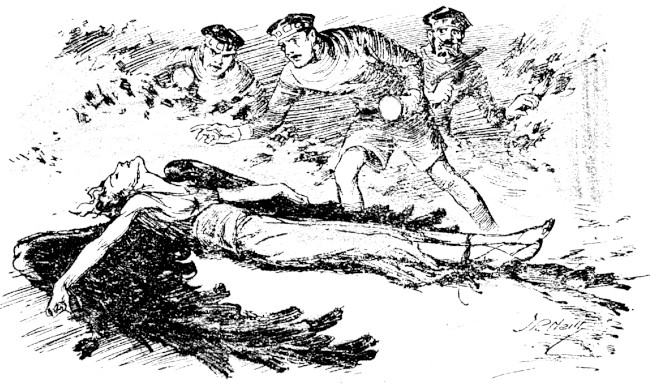
Everything. He even mentions the winged girl we shot at the camp.
Poor little thing—come to warn us, and we killed her! At the next
conjunction that ship will come again. Palisse says it plainly. A raid
in greater force!"
The men were all excitedly talking at once. Through the bull's-eye
pane in the floor, the Earth's surface showed under us—a spread of
mountains through a rift in the clouds; we were over the western United
States.
"Get back to the controls," Dr. Grenfell ordered. "Good heavens, we
might have dropped and smashed on those peaks for all we knew what we
were doing!"
We checked our descent and swept eastward. It was 1 A.M. on the morning
of September 6.
Dr. Grenfell was glancing through the other pages which Palisse had
sent. "He evidently hoped we would have a Space-ship ready. These
contain astronomical data concerning Mercury. Facts unknown to us of
Earth. Its size. Density. Inclination of its axis; orbital rotation
period; axial rotation—the scientists of that Hill City seem fully
as advanced as ourselves for all the primitive, decadent civilization
Palisse pictures. These notes will be of great interest—"
"To heck with that!" Jimmy muttered. "Dr. Grenfell, when is the next
conjunction of Mercury and the Earth—the time when they're closest
again?"
"The first week of December. That's three months from now."
"Doctor, that's when the Mercutians will come back! You said so—you
warned the Earth of that in your public statement."
"I did, Jimmy." Grenfell's gaze was still on the pages of notes. He
added slowly. "He has given us full landing instructions. How best to
approach Mercury; the location of the Hill City—there is a sketch
map here of all that section of the Light Country; and details of the
location of that valley where he wrote the message and dispatched the
cylinder."
I burst out: "Dr. Grenfell, we're going, aren't we? If we could get
there before the Mercutians are ready to start for Earth again—"
I felt Rowena's body grow tense. She sat erect, staring at Dr. Grenfell
with tear-filled eyes, but still she did not speak.
Dr. Grenfell smiled, a queer, grim smile. And as his gaze met mine I
saw that his dark eyes were smoldering.
"Oh, yes, we're going! Do you suppose, with the cube successful, as
undoubtedly it is, I would be content to make a futile trip to the
moon? We'll try for Mercury. Take what weapons we can and try to join
Palisse. He evidently did not come on Croat's ship or we would have
heard from him."
"When are we going?" Jimmy demanded. "How soon?"
"At once! I won't wait for the next conjunction. Twice as long a voyage
now—but what of that? If they're planning a raid upon the Earth for
next December—attacking our women—Palisse says 'Earth-women to
display to the men of his Cold Country'; and that's just what he's got.
We must go there at once!"
It was just before dawn of September 16 when the Bolton Flying Cube
left Earth for its voyage to Mercury. There is so much which of
necessity belongs in my narrative that I pass over these ten days of
preparation with only a summary.
It was soon decided that a considerable number of men aboard the cube
would be a hindrance rather than help. The multiplicity of supplies and
equipment needed, and the haste of this departure, made Dr. Grenfell
desire as much simplicity as possible.
There were but nine of us—the same nine who had been upon that trial
ascent after the cylinder. Dr. Grenfell, Jimmy, myself, Rowena. I was
not present when they tried to tell her it would be better for her not
to go; what she said I never knew, but she came back to me, white-faced
and grim—and it had been decided she was going!
Nor was she a handicap. Accustomed to working among busy scientists,
she was a help, not a hindrance. And those tears of thankfulness which
had overcome her when she heard her brother's message, learning after
all these years that he was not dead—never again did she show such
weakness.
The ten days of preparation were busy ones. Equipment had been prepared
for a voyage to the Moon. Apparatus for landing and maintaining life on
the airless, waterless Moon; and most of it was unsuitable for Mercury.
A multiplicity of details indeed! Things necessary to the vehicle's
operation for so long a flight: food; water; personal effects—I saw,
when I was given the task of checking them over, Dr. Grenfell's wisdom
in holding down our personnel to nine.
There were weapons; and a great variety of scientific instruments,
including the most modern wireless receivers and transmitters with
which we hoped communication with the Earth might be established.
A series of exasperating delays seemed to afflict us, with Mercury
daily adding tremendous distance to our voyage; but at last we were
ready.
Everywhere in the world during those ten days, the public eye was upon
us. There was no way of keeping the affair secret. The message from
Guy Palisse was given out in brief summary; the public knew that in
December the Mercutians probably would come again, and that we were
going to try to stop them.
We meant to capture Croat's Space-ship, kill Croat, smash his ship,
and thus end the menace. Yet such is the public mind—there were
learned discussions by self-styled experts who in reality knew nothing;
astrologers and every manner of publicity-hungry charlatan who read the
stars, or gazed in crystals, or dealt the mystic cards and solemnly
foretold what was going to happen. And there were newscasters with
facile tongues and silly wit who thought it clever to be humorous.
Two startling incidents occurred on Earth during those ten days. The
first was the experience of the Rev. Arthur T. Hoskins, of Westville,
Maine—a town about twenty miles from the White camp.
This report was never made public; I give it substantially as Dr.
Hoskins told it to the authorities the following day. He was not a
hysterical man, this middle-aged rector; nor a publicity seeker. A man
of matured, logical intellect—we could do no less than believe exactly
what he said.
On the evening of September 11, at about eight o'clock, he was sitting
alone in his study on the ground floor of the rectory. He was an ardent
lover of broadcasted music; he sat before his sound-grid, listening
to a Mozart minuet, which was a favorite of his. There was no one but
himself in the house; his wife was attending a meeting of one of the
ladies' church societies.
It was a cool night, but the rector, fond of fresh air, had his ground
floor window wide open. The strains of the minuet floated out that
window, and the rector was carried back into dreams of his boyhood.
Then abruptly the music was split by the peremptory oscillating wave of
the Boston Newscasting Studios. He did not tune them out; instead, he
listened, with the minuet fading, to an account of the Bolton Flying
Cube which shortly was to make an attempt to reach the planet Mercury.
The rector was presently aware of a figure standing in the dimness
of his garden outside the study window. A very tall man, apparently
listening to the radiotroned words.
The intruder saw that he was discovered—made a movement as though
about to go away, seemed to think better of it, and came slowly
forward. He presently stood head and shoulders in the window. The
rector's study light fell on him.
He was a man of really giant stature; bareheaded, with black hair
graying at the temples. It was queerly cut, this hair. Close-cropped to
the man's round skull; but gouged, as though the fellow had inexpertly
cut it himself. His face was hairless; massive of feature. A beak of a
nose; wide, thin lips; a heavy jaw; heavy black brows, with dark eyes
deep-set.
A foreigner, quite evidently. A tough-looking fellow. Yet his was, in
a way, an intellectural face. But of what nationality, the rector was
puzzled to determine. And he was more puzzled when the man spoke.
The rector said, "What do you want, my friend?"
"I was listening to that instrument you have." The heavy, thick voice
spoke good English with an indefinable accent. He spoke carefully, as
though with an effort to get it right. And the man repeated: "—that
instrument, there, which was talking to you."
The rector had shut off the receiver. He made a move to turn it on
again, but the stranger checked him. "I have heard enough."
Strangely commanding sentence! An unconscious command. The man's gaze
was on the table where the rector's habitual ten o'clock meal had been
placed by his wife. A little stack of biscuits and a glass of milk.
The stranger eyed it. "Food—-give me that—will you?"
It seemed, to the surprised Dr. Hoskins, that his visitor was about to
climb into the window. And the rector felt a thrill of fear. There was
something uncanny about this fellow—something unnatural. His clothes,
for instance; he wore a somewhat dilapidated suit which was far too
small for him. And his soiled linen shirt, open at the throat, strained
across his great chest muscles, causing a rip in the fabric.
He did not climb in the window, but he leaned far forward. "Give me
that."
Again it was a command; but made as though the man hardly realized his
tone.
The rector steadied his voice. "You are hungry, my man?"
"Yes. Very."
He wolfed down the biscuits which the rector handed him. The glass of
milk he eyed calculatingly, then smelled of it tentatively.
To Dr. Hoskins, with a vague shudder, now came the thought that this
man never had seen milk before.
At about this point realization swept upon the rector. It had been
growing on him with a shuddering fear, but now it swept him with
conviction: this man—not much under seven feet tall, the rector
estimated, as he loomed in the window—was not of this Earth!
Dr. Hoskins was no coward. But he had had no experience in deeds of
violence. He was unarmed. His first instinct was to escape from his
study. Then it flashed to him that he should make some effort to
capture this fellow—apprehend him, or at least set the authorities
upon him. There was a telephone across the room; but the rector,
transfixed by the shock of his realization, did not dare move.
The stranger drained his glass of milk, tossed it to the floor,
appeared surprised when the fragile glass was shattered. Looking up, he
met the rector's horrified gaze. He began what seemed words of thanks
for the milk; but they died on his lips.
He stepped back suddenly from the window.
"You—think that you know me?"
Dr. Hoskins found himself looking into the muzzle of a leveled weapon.
A strangely fashioned weapon, small and globular, with a mesh of wires
across its face. The man's huge gray arm, with his grotesquely short
coat-sleeve hanging halfway to his elbow, was extended; his hand held
the weapon with steady fingers. His voice was quiet, but now held a
grim menace.
"I want you to help me. I came for that. Do not move—make no noise!"
The rector sat frozen.
"Is that your flying car in the little house outside? I am not going to
hurt you. Answer me. Is it?"
The rector moistened his dry lips. "Yes."
"You are able to fly it?"
"Yes."
It was a small sport plane, given to Dr. Hoskins by the members of his
parish.
"Then, come out." The intruder stepped further back from the window,
but still held his weapon leveled. "Come out! I want you to show me how
to fly it. Come out, I say!"
Dr. Hoskins was somewhat rotund. And with his fright, he climbed over
the sill with difficulty. The stranger gripped him by the arm, helping
him; and, outside, stood gazing down at him with a faint smile. He was
indeed a gigantic man, head and shoulders above the rector. He cut a
grotesque figure, the cuffs of his trousers hanging far up his legs.
But he stood erect, commanding—and amused at his captive's fear.
"Stop shaking; I will not hurt you. If you shake like that you cannot
fly your little car. You will kill us both. Do not do that!"
Still Dr. Hoskins could not speak. The giant pushed him down the garden
path. Its shrubbery secluded it from the road; no one saw them. They
reached the little wooden hangar.
The rector found his voice at last. "What do you want me to do?"
"Take us up. Can I trust you not to wreck us? Or must I kill you—and
go away disappointed?"
Dr. Hoskins steadied himself. He gazed up to his captor's heavy gray
face, and he managed a smile. "You will be safe with me," he said.
"Where—where do you want to go?"
But that the man did not answer. They were presently in the little
barrel-winged Dinsler and away into the starlight. The rector sat at
the sticks; the stranger jammed beside him. There was barely room for
them both in the tiny pit.
Beneath them lay the Maine forests; the starry vault was overhead.
Dr. Hoskins, occupied with the controls, found his nerves steadying.
He demanded again, "Where do you want to go? It was unnecessary to
threaten me. It is not my custom to refuse a service to my fellow man."
"Just around here." The gray arm gestured north toward the valley of
the St. Lawrence with the distant mountains behind it. "Just around and
back. I want to learn how to sail your little car."
For an hour perhaps, the astounded rector explained how the Dinsler was
operated. The engine controls; and then the flying. His captor showed
remarkable intelligence, as though familiar with engines and flying
controls, though these were wholly strange to him in details.
"Let me try," he commanded at last.
Dr. Hoskins's heart was in his mouth as he yielded his place at the
sticks. But presently his captor had caught the knack of it.
"This is not difficult," the strange giant stated. "We will go back
now."
"You are going to land us?"
"Land you. It is the little car I want."
The rector was momentarily emboldened. "To go—where?"
"Back home." His companion turned and in his sunken dark eyes the
rector saw a gleam of irony. "I am trying to get—back home."
He said no more. He turned the Dinsler in an arc southward. A plane
passed overhead—a Greenland freight ship heading north from New York.
The stranger chuckled. "No one notices us? That is good." He gazed down
at the lights of a little town set in the dark stretches of forest.
"Those orange lights are the flying field?"
"Yes."
"I can read the number: M-4870. The 'M'—is that for Maine?"
"Yes."
"The number would tell us the town?"
"Yes."
"And you have maps here?"
The rector produced his field maps. Explained them.
"Yes—I understand. I, too, have maps." He touched his clothes. "I have
studied—been taught. And the landing fields of the other States are
lettered and numbered like this?"
"Yes. Look here, my man, what are you—"
"I shall not use the public fields. The attendants would be curious....
Is that your settlement?"
They were back within sight of the rector's village. "Yes," he said.
"Please take us down." He was trying to decide what he could do when
they landed. His captor seemed to read his thoughts.
"Not there—we will have to find a more secluded place."
He landed them, with what seemed an intuitive skill, in an empty field
near a neighboring town.
"Climb out."
The rector got out of the cockpit, stood on the ground. The field, with
no houses near it, was dim in the starlight. The rector saw that again
the strange weapon was leveled at him.
"You stand still until I have gone!" Again that gleam of irony shone in
the giant's dark eyes. "I ought to kill you. I suppose I shall be sorry
I did not. You will tell the officials all about me. That is your plan,
is it not?"
"Why, I—"
"Well, you may, if you like! What harm to me? Tell them what you like."
He leaned out of the pit. The engine was purring; his low voice seemed
to purr with it.
"You are what they call a man of God, are you not?"
It suddenly struck the rector that this amused, unhuman giant was
planning to kill him and then fly off. He stood stricken, clinging to
the side of the pit.
"Take your hands off that! Are you a man of God?"
"Yes. I—"
"Then you will not dare speak other than the truth. I have some
questions; I want the truth. Will you give it?"
"Yes," gasped the rector.
"There is a girl—a young woman. Her name is Palisse. Rowena Palisse.
Have you ever heard of her?"
"Yes."
"Do you know where she is now?"
"They say, in southern New Jersey."
"The same settlement near where they keep the Bolton Flying Cube?"
"Yes—I think so."
"In that town, where does she stay? Has the building a number?"
"I don't—don't know. I have no idea—"
"Then that is all I can get from you. I think I will not let you talk
about me."
The terrified rector felt his senses fading. The dim outlines of the
field whirled about him. He realized clearly his deadly danger. The
realization was too much for him. His pounding heart flung the blood
into his head; then it receded. He felt himself fainting; falling,
stricken by his own rush of terror.
And to this undoubtedly he owed life. Simultaneously with his fall,
he dimly saw a flash, heard a hiss, and felt a burning stab in his
shoulder.
Then the field went into black silence as his senses left him.
They found the unfortunate Dr. Hoskins lying in the field the following
morning. His shoulder was pierced by a hole burned into it. His
aërocar, with the mysterious man, had vanished. Undoubtedly as the
rector fell, the assailant believed he had killed him. He had left him
lying there for dead—and flown away in the Dinsler.
That was the first of the incidents. That this mysterious man was Croat
the Mercutian, we could not doubt. We recalled the giant figure who had
escaped that night at the White Summer Camp when we shot the Mercutian
man and the winged girl.
The forests had been constantly searched for that giant Mercutian,
but without success. The message from Guy Palisse, picturing Croat so
vividly, caused the search to be renewed with additional vigor. When it
continued unsuccessful, there were many—Dr. Grenfell among them—who
believed that Croat had got back to his Space-flyer. The Ayer, it was
thought, had never descended into the Earth's atmosphere. The small
silver ball—whether one or more was never determined—which had
brought the Mercutians down from their hovering ship and took them up
again with their captives, must have rescued Croat.
But now, after these many days, it was proven that Croat was still on
Earth—still in the general vicinity of the original raids. We could
picture how he must have been living—hiding in the depths of the
forest by day, prowling at night to steal what food he could. Stealing
clothes—trying to make himself less conspicuous—so that if seen he
could pass momentarily for a man of Earth. There had been reports
from various farmhouses of midnight disturbances. The authorities had
discredited them as the products of public hysteria; but they were
discredited no longer.
And Croat had been listening at windows, perhaps for the radiotroned
newscasters' voices. Hearing about the Bolton Flying Cube. Trying to
locate Rowena Palisse.
He had been unable to travel far on foot. But now he had Dr. Hoskins's
little aëro, and had disappeared in it.
The assault upon the rector was made on the evening of September 11.
The Dinsler was gone. All that day of the twelfth, by every means of
our scientific age, it was searched for. And Rowena, in a hotel of that
South Jersey town, was kept heavily guarded.
But the Dinsler had vanished. And no attack was made upon Rowena.
Then, at dawn of the 13th, came news of the Dinsler. It was sighted,
passing slowly over a village near Philadelphia, heading southwest, at
a considerable altitude. Pursuit planes were immediately sent up after
it. They fired at it; but not to hit it, for the orders were to take
Croat alive if possible.
The little Dinsler sailed serenely on. The police pilots overhauled it,
to find its controls lashed and its cockpit empty! Pilotless, it had
been launched and was riding the skies until its fuel would have been
exhausted.
That was the 13th. Three days later—just before dawn on the 16th—the
Bolton Flying Cube, carrying Dr. Grenfell, Jimmy Turk, myself, Rowena,
and five assistants, left the Earth upon our voyage to Mercury.