HOW much one who gives attention may learn in the vast
field of Nature! How varied are its attractions, how wonderful
its work, how indescribable its beauties! There is
a fascination in these studies, whatever may be the department
to which they are directed, and the more one learns the more
sensible they become of the limitations of their knowledge. I have
already told you I had within a year or two been awaking to a
realization of the value of ornamental foliage plants in giving an
abiding brightness and beauty to the window-garden and open border.
As humanity is ever prone to extremes I may become too
enthusiastic in this direction. I thought there was some danger of
it as I surveyed my array of pots filled with fine specimens of various
sorts. I will take them for my subject to-day, giving whatever
facts of interest I have been enabled to gather from various sources.
HOW much one who gives attention may learn in the vast
field of Nature! How varied are its attractions, how wonderful
its work, how indescribable its beauties! There is
a fascination in these studies, whatever may be the department
to which they are directed, and the more one learns the more
sensible they become of the limitations of their knowledge. I have
already told you I had within a year or two been awaking to a
realization of the value of ornamental foliage plants in giving an
abiding brightness and beauty to the window-garden and open border.
As humanity is ever prone to extremes I may become too
enthusiastic in this direction. I thought there was some danger of
it as I surveyed my array of pots filled with fine specimens of various
sorts. I will take them for my subject to-day, giving whatever
facts of interest I have been enabled to gather from various sources.
Everybody has heard of croton oil, but only a few of that same
everybody know anything about Crotons. The number of species
known is enormous, and they are found in many parts of the world,
but chiefly at the South Sea Islands. Some kinds are native to our
own country, mainly in the South and Southwest, but these are not
characterized by the brilliant markings of the foreign varieties.
Their leaves are often thick and large, but usually they are very
long and narrow and ribbed, veined, spotted and blotched with
crimson, scarlet and gold. They are a very interesting class of
ornamental plants, and their low price, twenty-five to fifty cents,
except for novelties, places them within reach of the common people.
They do best in a rich soil, with a little peat and sand; also
an abundance of water.
The specimens I have are these: Aucubæ Folium—leaves large,
dark green, blotched with golden yellow. Interruptum, very long
leaves, mid-rib bright scarlet, shading to gold—very graceful. Irregulare,
so named because of the irregularity of its leaves in shape
and color—two precisely alike being rare.
The handsomest however of my collection, is Croton Weismanni.
The ground color is a shining bright green, striped and mottled
with golden yellow. The leaves grow to a foot in length and three-fourths
of an inch wide. Among the more recent and high priced
novelties are Croton Evansianus and Princess of Wales. The
former is "distinguished by the peculiar form of its trilobate leaves
and the depth of coloring pervading the whole plant. The newest
formed leaves are light olive green with mid-ribs and veins of golden
yellow, and the interspaces spotted with the same color. As the
leaves become older, the green deepens and changes to a bright
bronzy crimson, and the golden yellow of the mid-ribs, veins and
spots becomes a rich orange scarlet." Princess of Wales is one of
the long-leaved drooping forms of Croton, and is very distinct in
character. The leaves are from one and one-half to two feet in
length. The ground color is green, and the variegations creamy-yellow,
very variable in color. The markings are of the maculate
style, with here and there large blotches of clear cream-yellow, and
and in other parts clouded markings of smaller confluent blotches
and spots. Occasionally these conditions are reversed.
The Croton Fenzii, recently offered in commerce by M. Solviati,
of Florence, is described as a jewel among the Crotons. It is
the result of a cross effected in the green-houses of Sesto, between
C. Veitchii and C. Weismanni, and has moderate sized oval acuminate
leaves, richly veined with golden yellow, the principal nerves
being purplish-red, which color extends to the stem and the petiole.
The habit is so dwarf and compact that plants only a foot high are
often seen with all their splendor, the yellow streaking then extending
to almost the whole surface of the leaf, and the red nerves
shining on the yellow ground. It is a variety especially fitted for
the decoration of small green-houses, as it requires very little room
to be able to develop all its charms. This variety has been dedicated
to the Chevalier E. O. Fenzi, President of the Royal Horticultural
Society of Tuscany.—London Florist.
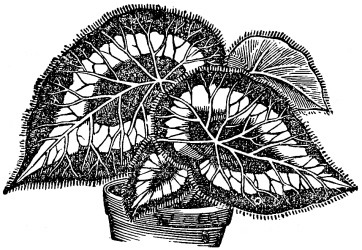
Of these the varieties are numerous, and the foliage very ornamental.
Those I have are Dr. Hondley; green ground, blotched
with rose, crimson center; Madame Houllette,—blush clusters and
white spots on green ground; Sagittæfolium pictum,—arrow-shaped
leaves prettily spotted with white; Madame Alfred Bleu,—the
ground color of the leaves is silvery white, which is blotched with
green, in some leaves very sparingly, in others, nearly half the surface;
the veins are prominent and of rich rosy crimson, bordered
by narrow bands of a lighter shade. Alfred Mame,—beautiful
deep carmine, richly marked with rosy spots and white leaf margin.
La Perle de Brazil,—ground color, green, reticulated all over with
pure white, like fine lace. These last three are from the collection
of Mr. John Saul of Washington, and are new.
Fancy Caladiums do best in somewhat shaded positions, in well
enriched soil, composed of finely decomposed manure, leaf mold
and sand, and a moist, warm temperature. Great care must be
had in their earliest stage of growth, to prevent decay of the tubers
by over-watering. They can be preserved in sand during the winter,
in a room sufficiently warm to prevent danger from frost.
Is the most striking and grand of the Ornamental Foliage Plants
for the lawn or flower garden. It will grow in any good soil, and
is very easy of cultivation. When of full size it stands about five
feet high, and its immense leaves often measure four feet in length
by two and a half in breadth; very smooth, of a light green color,
beautifully veined and variegated with dark green. When killed
down by frost in the autumn, the bulbs must be taken up and stored
in the cellar. The Caladium belongs to the family of "Jack in the
Pulpit," or Indian Turnip, and the Ethiopian or Egyptian Calla.
They rarely bloom in our Northern States. The flowers resemble
in shape the Calla Lily, only are much larger and narrower, are of
a rich cream color, very fragrant at first, but soon lose their odor,
which resembles the Magnolia.
These comprise a large genus valuable for their foliage and also
winter flowers, yet not very generally cultivated. Mine are labeled
Andersonii, "a handsome orchid-like flower, white, spotted with
red." Pictum, foliage prettily streaked with white, a strong, vigorous
grower; Tricolor, leaves prettily marked with pink and green;
Cooperi, has flowers white, prettily streaked with purple; El Dorado,
light green foliage, with golden veinings.
These are considered by florists as among the most elegant of
tropical plants, but like the Eranthemums, are not generally known.
They are all natives of tropical America, and require strong heat
with plenty of moisture. They are low-priced, and ought to be
more extensively cultivated. I think mine are very beautiful. Eximia,
upper surface of leaves striped with grayish-white; under,
purplish-violet. Leopordina, pale green with oblong blotches of
deep green. Mikans, shining green with a white feathery stripe.
Van den Heckii, dark glossy leaves, mid-rib silvery white. Makayana,
a very ornamental dwarf species; leaf-stalks slender reddish-purple,
blade of the leaf ovate, ground color, olive green, beautifully
and regularly blotched with creamy yellow of a transparent character;
on each side the mid-rib are oblong dark green blotches,
while the under side is rosy red. Tubispatha is an elegant and
very attractive species of erect habit of growth; leaves some nine
or ten inches long, light green, ornamented on each side the mid-rib
with oblong blotches of cinnamon brown. Veitchii, "The
leaves of this grand plant are upward of twelve inches in length;
the under surface of a rich purplish-wine color, the upper of a deep
shining green, blotched with conspicuous patches along each side,
of a yellowish-green, almost verging on gray. The contrast is very
marked, and the whole plant very beautiful."
Achyranthes, a genus of richly colored tropical plants, are better
known, and to a limited extent are found in many gardens, Verschaffelti,
with its dark crimson leaf, being the most common.
Brilliantissima, ruby red, is a new English variety; Wallisii is a
new dwarf, with small purple leaves; Lindeni Aurea Reticulata,
foliage netted with golden yellow, on a light green ground. These
plants are of the easiest cultivation, and endure strong sunshine
without injury.
Alternantheras are also very effective for bedding plants;
habit dwarf. Foliage is in some of a magenta-rose color, others,
yellow and red; Purpurea has a purplish tint, and Versicolor, crimson
and pink shadings. They are unsurpassed for ribbon or carpet
bedding.
Dieffenbachia, a genus of stove plants with very showy foliage.
Brasiliensis, a handsome variety, the leaves averaging eighteen
inches in length by eight or nine inches in width; the ground
color of the leaf is deep green, and the whole surface is mottled
with small blotches of greenish-yellow and white; Bausei is a
stocky-growing, broad-leaved variety, with yellowish-green leaves,
which are irregularly edged and blotched with dark green, and also
spotted with white, the markings being peculiarly effective; Weirie
is of dwarf habit, the foliage of a bright green color, thickly blotched
and spotted with pale yellow. One of the finest of the species.
They grow best in loam and peat equal quantities, with a little sand.
Require strong heat and frequent watering.
A few ornamental foliage plants of rare beauty received from
Mr. John Saul merit special notice:
Cyanaphyllum Spectandum is a grand plant with large, oblong,
lustrous leaves which have a rich, velvety appearance; they are
beautifully ribbed with whitish color.
Alocacia Macrorhiza Variegata, its large caladium-shaped leaves
are marbled and broadly splashed with white. Some leaves are
nearly all white; Zebrina, fine yellow leaf-stalk with distinct black
marks; Illustris, the leaf-stalks are erect, and have a brownish-purple
tint, color a rich green, marked between the principal veins by
broad patches of a blackish olive, and forming a striking contrast
with the brighter green portions of the leaf surface; Sedini, "A
very beautiful hybrid between A. Metallica and A. Lowii. The
form of the leaf is perfectly intermediate between the two parents,
whilst the coloring is a very striking and pleasing combination of
the metallic hue of one parent, with the dark green and prominent
white veins of the other." Alocasias require a moist heat during
their growing season. Soil, peat, with a small portion of loam,
sand and manure.
Acalypha Macafeeana is another of the rare and beautiful foliage
plants alluded to. It is considered the best Acalypha ever offered.
It is certainly very handsome with its "sub-cordate and serrate
leaves, eight inches long and six broad, frequently cut into many
forms, and very highly colored bright red, blotched with deep bronzy
crimson." It proves to be an admirable plant for bedding out.
Quite as attractive every way is Panax Laciniatum, "An elegant
and very distinct habited stove plant from the South Sea islands.
The leaves are tinted and indistinctly marked with pale olive brown,
and form a rather complicated mass of narrow segments; they are
bipinnate, nearly as broad as long, and have a drooping contour;
and the pinnules or segments are very variable in size and form,
presenting the appearance of a complex head of foliage in which
the lanceolate lobes or pinnules have the preponderancy."
Panax Fruiticosm has a very graceful fern-like foliage. These
plants belong to the Aralia family, a genus very ornamental, natives
of the South Sea Islands.
Another of my Washington collection, very graceful and beautiful,
is Paulinia Thalictrifolia. Its delicate cut leaves resemble the
fronds of a finely divided Maiden-hair Fern. The leaves are of a
rich shade of green. The young shoots and foliage are of a pinkish-brown
color. It is of slender growth and climbing habit, very
similar to Capsidium Filicifolium, which has long been a special
favorite of mine. Both of these are elegant, trained on a pot trellis.
Paulinia Thalictrifolia is a native of the southern Brazils, from
whence it was introduced to the nurseries of Messrs. Veitch &
Sons of Chelsea. If only required for decorative purposes there
should be no inclination to make the plants produce flowers which
are inconspicuous; therefore the main object should be to have
plenty of healthy foliage. To secure this, the plant should be
grown in a temperature of from 65° to 70°, and if one part of the
greenhouse is more adapted to its growth than another, it is the
dampest part. After this plant came into the possession of Messrs.
Veitch, and before its true value became known, some plants of it
were placed in a corner of an old, very damp, warm pit, in which
position they grew wonderfully strong, and quite surpassed in vigor
and beauty those that were, as was then supposed, placed under
more advantageous circumstances, i.e., in dryer and lighter parts
of other houses. Care is therefore now taken to keep them where
abundant atmospheric moisture can be supplied. A compost consisting
of two parts good substantial peat and one of loam, together
with some silver sand, suits it admirably.—Gardening Illustrated.
These form a very important part of the class of which we are
treating. They give a very beautiful and tropical appearance to
the lawn and the garden by their stately growth and broad massive
foliage, relieved by rich crimson, scarlet and orange-red flowers.
Their foliage comprises various shades of green, glaucous, chocolate
and purple tints, ribbed and striped, fitting them admirably for
grouping with other plants.
They are also very effective for large pot plants in the pleasure-ground,
or conservatory. Under rich cultivation they will attain
the height of five feet. They need water often. Among the
newer roots Creole, very dark foliage, grows to the height of about
six feet. Ornement du Grand Rond, very tall, with large bronzy-green
foliage, large scarlet flowers. Oriflamme has large lanceolate-green
leaves, with violet veins, a vigorous showy plant with
salmon-orange flowers.
The roots of Cannas must be taken up in the autumn. If wanted
singly, divide them, if a thick clump is desirable let them be planted
out as they are. They must be kept perfectly dry through the
winter; if the cellar is very damp they will do better packed in
sand.
This is a valuable genus of ornamental plants, specially fine for
the center of vases, and for pot culture. Although their culture is
on the increase, they are not so frequently grown as they deserve.
The species are very numerous, and are found in tropical countries,
especially in the islands of the tropics. Many of them assume the
proportions of trees. The largest specimen ever known was one
of Dracæna Draco, or the Dragon tree of Oratava in Teneriffe, one
of the Canary Islands. This tree was remarkable for its monstrous
dimensions and prodigious longevity. About ten years since, or in
the autumn of 1867, this magnificent specimen was destroyed by a
gale of wind. It was a special object of interest in the Canary
Islands, and received the attention and veneration of visitors, as do
the great Seguvia trees of California. Its trunk below the lowest
branches was eighty feet in height, and ten men holding hands
could scarcely encircle it; by one measurement this span around
it was seventy-nine feet. The trunk was hollow, and in the interior
was a winding stair-case, by which one might ascend as far as the
part from which the branches sprang. It is affirmed by tradition
that, when the island of Teneriffe was discovered in 1402, this tree
was as large, and the cavity in the trunk as great, as at the time of
its destruction. We are even assured that in the fifteenth century,
at the time of the conquest of the Canaries by the Normans and
Spaniards, they celebrated mass on a little altar erected in this
cavity. From the slow growth of the young Dragon trees in the
Canaries, it has been estimated that this monster tree before it was
destroyed, was the oldest plant upon the globe. A writer in describing
it says: "Long leaves pointed like swords, crowned the
extremities of the branches, and white panicles, which developed in
autumn, threw a mantle of flowers upon this dome of verdure."
The popular name of this species is Dragon's-blood Tree, because
of a resinous juice of a red color which exudes from the cracks in
its trunk. At one time this resin formed a considerable branch of
commerce, as it was used medicinally as an astringent, but it has
fallen into disuse.
The Dracænas belong to the Lily family, and they afford a remarkable
contrast to the palms and other arborescent endogens,
by their branching heads. The young trees of Dracæna Draco do
not, however, send out any branches, even in their native localities,
until they are thirty years old or more. The small plants of this
species, cultivated for ornament, have always a single, straight
stem; but are much more robust, and quickly assume more stately
proportions than those of the other kinds that will be mentioned.
The Dracæna is admired for its peculiar grace of form—it would
be in vain in common house culture to expect flowers. To admire
a plant for its well developed and graceful form, marks an
advancement in refined taste beyond that which would induce one
to exclaim, "Oh!" at the sight of a brilliantly colored flower.
Even in rearing a plant for flowers, the first object should be to
develop it to the fullest extent in size and shape and strength—to
make a beautiful object of the plant itself; just as the first and
main attention given to a child, for years, should be to develop and
build up its physical system.
The Dracæna is a good house plant, a good balcony and veranda
plant, good for the vase in the open air, and in a handsome pot is a
fine ornament for table decoration. Its culture is of the simplest
kind, adapting itself to any ordinarily good soil, it only requires to
be supplied moderately with moisture and to have a temperature
ranging upward from sixty-five degrees. It delights in a moist air,
and whenever possible, water should be kept where it will rapidly
evaporate, and thus ameliorate the atmosphere in this respect for
the plant. This condition, moreover, is conducive to the well-being
of most plants, and no good plant-grower can disregard it with impunity.
Washing the leaves and stem of the plant frequently with
a wet sponge, is favorable to its health and vigor, and one of the
best preventives of the attack of insects. With dust on the leaves
the plants look dingy, while frequent washing keeps them bright
and lustrous.
Dracæna indivisa has long, slender, dark green leaves, about
three-quarters of an inch or an inch in width, and from two and a
half feet to three feet in length, and the lower ones especially are
very much recurved or gracefully drooping. This species is among
the hardiest of the Dracænas, and is frequently wintered in the
open ground, with some protection in climates where the temperature
frequently descends several degrees below the freezing point.
Dracæna terminalis is the most popular of the whole family in this
country, and is worthy of all the admiration bestowed upon it.
The leaves are broader and more erect than those of the preceding
species, and of a dark green suffused with red, or having streaks of
a reddish color; the young leaves nearly pink, but assuming a dark
bronzy copper color afterward. It is a very distinct and showy
plant, and adapted to a great variety of ornamental purposes. The
propagation and sale of it is rapidly increasing every year, and it is
already widely disseminated. At the Sandwich Islands it is cultivated
to a considerable extent for its roots, which are baked and
eaten. A fermented beverage is also made from the juice, and its
leaves are employed as fodder for cattle, and for clothing and other
domestic purposes.
Dracæna Shepherdii is of a most noble form, and is one of the
finest yet in cultivation. It has long, spreading leaves, of a metallic
green, with stripes and border of bronzy-orange, and is a very free
grower. Unlike most of the forms already known, which color
most on the free young growth of vigorous plants, this plant takes
on its distinctive coloring gradually on the older leaves.
Dracæna cannæfolia is an interesting species. Its peculiarity
consists in the length of petiole, which is as long as the rest of the
leaf. The blade of the leaf is elliptical in form, from fifteen to
twenty inches in length, firm, and of a glaucous green.
Within a few years past much attention has been given by cultivators
in Great Britain and Europe to hybridizing the Dracæna,
and producing new varieties. The most remarkable success has
attended the efforts in this direction, of Mr. Bause, in the establishment
of Mr. Wills, of Anerly, England. The variety is wonderful—"broad-leaved,
medium-leaved and narrow-leaved; bronzy
and green, crimson, rose, pink, violet and white variegations;
drooping, spreading, and erect habits, are blended in all sorts of
combinations."
One of the sorts produced is described as "a most important acquisition,
having quite the habit and character of the well-known
favorite terminalis, but with white variegation. The ground color
is a bright green, with bold, white variegation, the upper leaves
being white, with here and there a bar of green."—Vick's Magazine.
Sent out in this country for the first time in 1880, is said to be
"one of the most magnificent ornamental foliage plants ever introduced,
and altogether unique in character and aspect. It is a native
of Western Tropical Africa. The plant is of erect habit, and
the stems are closely set with stalked spreading leaves, the petioles
of which are of a grayish color, terete with a narrow furrow along
the upper side, the base being dilated and sheathing the stem.
The blade of leaf is marbled and irregularly banded with dark green
and silver gray in alternate straight bands, the colors being about
equally distributed. The back of the unfolded leaves is a pale
reddish-purple or wine color, and the stem, where visible. It is,
without doubt, one of the most superb of ornamental stove plants."
When first sent out in London in 1878, its price was from five to
ten guineas per plant. We do not know the price in this country.
Mr. H. A. Dreer who has an illustration of it in his catalogue, furnishes
the price only on application, which is evidence that it is
costly. From the type given, it must be exceedingly handsome,
and wholly unlike any Dracæna before offered in America.
Dracænas, as we have noticed before, are particularly desirable
house plants, keeping in good condition for a long time, even in
rooms where gas is burned—places so unsuited to most plants.
They are liable to attacks of the Mealy Bug and the Red Spider if
neglected, but the syringing and sponging advised for them will
effectually prevent their gaining a foothold if frequently and thoroughly
performed. After a year or two the plants begin to lose
their lower leaves, and to get leggy, a state of things quite undesirable,
as the beauty and effectiveness of the plants depend upon
their being furnished with leaves down to the base of the stem.
When the plants have become unsightly from the loss of their
leaves, they can be renewed very quickly by a simple process. Cut
a notch in the stem, on one side, just below the lowest good leaves,
and take out a piece of the wood, then do the same on the other
side of the stem, but not exactly opposite the first notch. The
object is to check the flow of sap at this point and yet allow enough
of it to pass to maintain the head. Having cut the notches, take
some moss or sphagnum and bind about the stem, covering the
incisions and fastening it on securely with twine or fine wire; the
moss is to be kept gently moist, and in the course of two weeks
will have thrown out young roots above the notches. The head
can now be severed from the stem and potted in a medium-sized
pot. After keeping it a few days in the shade, it can be gradually
brought out into the full light, and will be found to be established.
Dracænas may also be multiplied by removing the thick, fleshy
root that may usually be found in the base of the plant. Those
tuberous roots can be potted, and if kept in a warm place will soon
start and make new plants. When plants are re-potted a favorable
opportunity is offered for taking off these roots, for the roots of
the old plants are actively at work and, with the fresh soil they
receive, will soon recover from any slight check they may have
received.
The most rapid method of propagating this plant is by cuttings of
the stem; the stem may be cut into pieces an inch in length, and
those pieces split in two, and all of those bits will root and become
plants. They should be placed in a light, sandy soil, and given a
brisk bottom heat of 70° or 80° degrees. They will break and start
into growth in a few days.—Vick's Magazine.
So fully does the foregoing express all that is needful regarding
the Dracæna, we have thought best to give it entire. We might
greatly enlarge on the subject of Ornamental Foliage Plants, and
speak of the beautiful Palms, so fine for decorative purposes, the
pretty Ferns and elegant Aralias, of which latter "Sieboldi is a
capital house plant, so enduring that it will live and keep its beautiful
dark green color for weeks almost in the dark." Then there
is the Euonymus, so bright with its glossy green leaves, long a
favorite whether for the border or window garden. Argentea has
striped foliage, and Japonicas aurea has its dark green foliage
diversified with golden variegations. Bicolor, foliage almost white,
and Tricolor, a rarer form, is marked with pink and white.
With the numerous varieties we have named, it will be apparent
how ornamental our gardens, whether within doors or without, may
be made by plants, the beauty of which is wholly independent of
flowers, and they do wonderfully enhance the effect of the bloomers.
The Centaureas and Cinerarias with their deeply lobed leaves of
white, are too well known to need any special mention. We do
not intend however to pass so lightly over another stately and
highly ornamental genus that comes within the reach of everyone.
Ricinus, the seed of which can be purchased for a dime, are magnificent
in foliage, and when combined with the brilliant colored
fruit of the giant varieties, the effect is very oriental. Ricinus
Africanus albidus is of recent introduction. It is white fruited,
and the stems and leaves are silvery; height eight feet. Borbaniensis
arboreus has very large and showy foliage; height fifteen
feet. Communis is the Castor Oil Plant. Sanguineus (Obermanii)
bears splendid red fruit in clusters, and is very ornamental. A
species from Phillippines has gigantic foliage; height ten feet.
These can be purchased in separate or mixed packets, and we
advise everyone who has a bit of ground to try them. We will
close with
I have just harvested my Ricinus or Castor Bean, which I raised
from the seed you sent me last spring. It was of mammoth growth,
attaining a height of fourteen and a half feet, and sixteen feet
across the branches of which there were seventeen after cutting
off five during the summer. Each of the branches contained a
cluster of burs, the center one having one hundred and thirty-four
burs, the other branches not so many. Many of the leaves measured
from thirty to thirty-two inches across from tip to tip or point of
leaves. When sawed off at the ground, the body measured five
inches and a half of wood in diameter, inside of the bark, which
was one-fourth of an inch thick. This is a big bean story but nevertheless
a true one.—T. G. T. in Vick's Magazine.