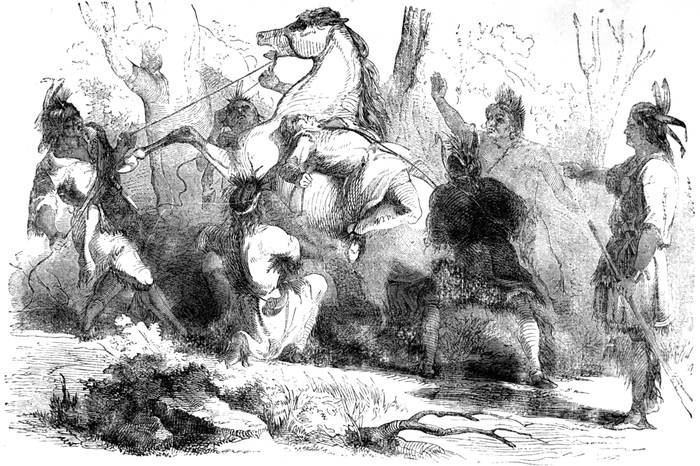
SIMON KENTON, AND HIS INDIAN TORTURE-RIDE.
5
Foremost among the wild and terrific scenes which arise before
our startled eyes when we turn the pages of border warfare, is the
ride of Simon Kenton—not that the cruelty of its devisers was so
atrocious, nor the final results so dreadful, as in many other instances;
but the novelty, the unique savageness of the affair, strikes upon the
imagination, as if it were one of those thrilling stories related of ages
and people which never were, instead of an event that actually occurred
to one of our own countrymen in one of our own territories.
In the early light of morning breaking through the trees which surround
them, a group of Indians are preparing to resume their march,
after a night of repose. They have with them a solitary prisoner.
Corraled about them are numbers of horses, the recovery of which
has been the object of the expedition. Before these are released and
the day's march resumed, the prisoner must be disposed of. While
his captors are deciding this important matter, we will discover who
he is and what has brought him into his present state.
About the first of September, 1778, Simon Kenton—the friend and
younger coadjutor of Boone, who had been with the latter for some
time at Boonesborough Station, employed in protecting the surrounding
country, and engaging in occasional skirmishes with the Indians—becoming
tired of a temporary inactivity which his habits of life
rendered insupportable, determined to have another adventure with
the Indians. For this purpose he associated with Alex. Montgomery
and George Clark, to go on an expedition for stealing horses from
the Shawnees.
6The three brave scouts reached old Chilicothe without meeting
with any thing exciting. There they fell in with a drove of Indian
horses, feeding on the rich prairie, and securing seven of the drove,
started on their return. Reaching the Ohio, they found the river
lashed into fury by a hurricane, and the horses refused to cross.
Here was an unlooked-for dilemma. It was evening; they felt sure of
being pursued; no time was to be lost. As the only resource, they
rode back to the hills, hobbled the animals, and then retraced their
steps to see if they were followed. Finding as yet no signs of pursuit,
they took what rest their anxiety would allow them. The next
morning, the wind having subsided, they sought their horses and
again attempted to cross the river, but with the same result; the
horses, from fright, refused to take to the water, and they were driven
to the alternative of parting with them. Selecting each one of the
best, they turned the others loose, and started for the Falls of the
Ohio, (now just below Louisville); but disliking thus to abandon the
fruits of their expedition, they unwisely returned again, to attempt to
retake and lead the others. This was by no means an easy task,
and while engaged in the endeavor, they were surprised by a party
of mounted savages, who had followed their trail with vengeful pertinacity.
The whites were separated; and Kenton, hearing a whoop
in the direction of his comrades, dismounted, creeping cautiously in
the direction of the sound, to discover, if possible, the force of the
enemy. Dragging himself forward on his hands and knees, he came
suddenly upon several Indians, who did not discover him at the
moment. Being surrounded, and thinking the boldest game the best,
he took aim at the foremost and pulled trigger, but his gun missed
fire. This, of course, discovered his position, and he was instantly
pursued. Taking advantage of some fallen timber, he endeavored
to elude his pursuers, by dodging them, and hiding in the underbrush,
where their horses could not follow; but they were too cunning,
or rather too many for him. Dividing their forces and riding
along either side the timber, they "beat it up," until, as he was
emerging at the further end, he was confronted by one of the savages,
who, the moment he discovered his white foe, threw himself
from his horse and rushed upon Kenton with his tomahawk.
Kenton drew back his arm to defend himself with the butt end of
7his gun; but as he was about to strike, another stalwart savage,
whom he had not observed, seized him in his powerful grasp, preventing
the descending blow. He was now a prisoner, compelled
to yield, with such grace as he could, to superior numbers. While
they were binding him, his companion, Montgomery, made his
appearance, firing at one of the savages, but missing his mark. He
was immediately pursued; in a few moments one of the pursuers
returned, shaking the bloody scalp of his friend in Kenton's face.
Clark succeeded in making his escape, and crossing the river, arrived
in safety at Logan's Station.
That night the Indians encamped on the banks of the river; in
the morning they prepared to return with their unfortunate prisoner,
who had passed an uneasy night, bound to the ground, and not
knowing precisely what vengeance his enemies might be pleased to
visit upon him. Some of them knew him well, and he realized that
there were long scores to be wiped off against him. However, the
red-man had a keen appreciation of bravery, and he did not anticipate
any severer fate upon that account. Some little time elapsed
before they succeeded in catching all their horses. The day had
well advanced before they were ready to march, and the annoyance
consequent upon this delay so exasperated them, that they determined
to make their captive pay the full penalty of the trouble he had
caused them. They therefore selected the wildest and most restive
horse among their number, and proceeded to bind Kenton upon his
back. Their mode of proceeding was as follows: a rope was first
passed round the under jaw of the horse, either end of which was
held by an Indian; yet even with this advantage, it required the
assistance of others to control the vicious beast, which was determined
not to receive its burden. Kenton was first seated upon the
horse with his face toward the tail, and his feet tied together under
the animal. Another rope confined his arms, drawing the prisoner
down upon his back. A third, secured about his neck, was fastened
to the horse's neck, thence extending longitudinally down his person
to the animal's tail, where it was secured, and answered well for a
crupper. In this way he was fastened to the wild and frantic steed,
beyond the possibility of escape. To make the matter sure against
contingencies, the now delighted savages passed another rope about
8his thighs, securing it to the one which served as a girth. They
then fastened a pair of moccasins upon his hands to prevent his defending
his face. During the time they were thus preparing him for
his Mazeppa-like ride, they taunted him by asking if he wanted to
steal any more horses. They danced around him, yelped and
screamed, and, in every possible manner, expressed their infernal
delight at the anticipated sufferings of their victim. The heart of
Simon Kenton seldom quailed before any danger; but it must have
been supernaturally strengthened not to have sickened during those
moments of preparation and anticipation. To be bound to unspoken
torture, which could end, at the last, only in death—death long deferred,
perhaps into hours and days, whose every minute and second
would be sharp with anguish—to be so helpless to resist the evils
which were sure to come, with the close rope strangling the breath
in his throat whenever he attempted to raise his head to see the cruelties
which he felt—to add all the mental miseries of suspense to
the horrible realities before him—this was enough surely to shake
even the sturdy spirit of the defiant pioneer. For a moment he was
inclined to beg of his tormentors to tomahawk him then and there;
but he knew that such an appeal would gratify their malice while it
would produce no other effect; and he closed his lips tightly, resolved
that they should enjoy no sign of fear or dismay to enhance
their inhuman delight. One glance at the blue sky smiling down
between the lightly-waving branches of the trees—one scornful look
into the demon-faces about him, and, for an instant, his eyes closed;
he felt like one falling from a precipice into terrific depths yawning
to receive him.
With stripes and demoniac yells they at length turned loose the
almost savage horse, which was goaded to desperation by the tumult
and the blows. The infuriated beast at once bounded away on its
aimless, erratic course, anxious only to rid itself of its strange
burden.
"'Twas scarcely yet the break of day,
And on he foamed—away!—away!—
The last of human sounds which rose,
As he was darted from his foes,
Was the wild shout of savage laughter
Which on the wind came roaring after."
9Frantic with fright, the noble animal went careering through the
woods, rearing and plunging in his madness, inflicting upon his tortured
rider countless wounds and blows as he endeavored to dash
him against the trees, or rushed through the tangled brush, lacerating
the flesh of both with innumerable thorns and briers. In one
of the mad dashes which the horse gave through the unpitying forest,
Kenton's arm came with such force against a tree that it was
broken—he knew it by its becoming so limp and helpless, as well as
from the knife-like pain which darted from it. The wretched man
could only hope that the horse would some time tire; that, wearied
out with its useless efforts to free itself from its burden, it would
subside into some quiet, which might give a moment's ease to his
aching and mangled limbs; but he hoped in vain!
"Each motion which he made to free
His swollen limbs from their agony,
Increased its fury and affright;
He tried his voice—'twas faint and low,
But yet it swerved, as from a blow;
And, starting at each accent, sprang
As from a sudden trumpet's clang.
Meanwhile the cords were wet with gore,
Which, oozing from his wounds, ran o'er;
And on his tongue the thirst became
A something fiercer far than flame."
Oh, that horrible thirst which takes possession of the person suffering
exquisite pain, until the torture seems to exceed that of the anguish
which causes it. None but those who have experienced this
extremity of mortal suffering can picture it; none but those who
have suffered the horrible pangs of thirst can sympathize with the
unutterable pain which Simon Kenton endured for the next few
hours. Yes, for hours! The harassed steed, at length, with wasted
strength and trembling limbs, returned to the point from which he
had started, with his now almost inanimate rider, who must have
sunk into insensibility long before, had not the fever of his pain kept
him from that blessed relief. The hunter hoped that now he would
either be killed outright, or relieved of his present position; but such
was not the intention of the red devils who had him in their power.
Worn out with fatigue, and satisfied of his inability to rid himself
of his unwelcome burden, the exhausted horse took his place in the
10cavalcade, which had already started for its home. The only mercy
they vouchsafed the prisoner was to give him, twice or thrice, some
water. His sufferings had only commenced—death, in its worst
form, would have been preferred to the ordeal through which he had
yet to pass. To feel certain of death—to count the lingering hours
as they pass—to know that each is but a step toward a certain doom—to
feel that doom impending day by day, and yet to see it postponed
through miserable stretches of suffering—to endure continually all
the anguish of which the human frame is capable, and all this time
to know that hope has fled beyond recall—that all this protracted
agony must end in inevitable death, is too terrible to contemplate.
All this Simon Kenton bore for three days and nights. It seems
incredible that life should have held out so long; but his previous
training in the schools of endurance seemed only to have fitted him
now to hold out through what no other man could have borne.
Through three nights he lay in his cradle of anguish; through three
days he was racked by the motion of the animal which bore him;
and when the Indians reached their village, he was still alive.
It had been the intention of the savages to procure his death by
means of the wanton torture they had instituted; but when he
reached his destination alive, owing to some custom or superstition
of their own, they delivered him over to the care of their squaws.
These took him from the rack, bathed his disfigured body, set his
broken arm, bandaged his wounds, made soothing and healing
washes from the herbs of the forest, nourished him with drinks and
food, and gradually restored him to health. Not only was his life
saved, but his iron constitution remained unbroken by the fearful
trial through which it had passed. As soon as his renewed strength
warranted the attempt, he set about planning the mode of his escape,
which he successfully accomplished, returning to the friends who had
long since given him up for lost, to relate to their almost incredulous
hearts the story of his sufferings.
This remarkable episode is but one of countless adventures in
which Simon Kenton was engaged. Our readers may hear from him
again in scenes equally thrilling. He was, without doubt, one of
the bravest and most interesting of the western pioneers; he was
excelled by none, and scarcely equaled by his precursor, Daniel
11Boone. His biography, as far as it has been preserved, will be read
with interest by all; his name will never be forgotten in the valley
of the great West. He was the coadjutor of Boone throughout the
protracted struggle for the occupancy of the rich forests and prairies
on either side of the Ohio. The almost incessant exposure and life
of self-denial which these resolute adventurers endured can scarcely
be appreciated by us of this generation who enjoy in peace the
fruits of their sufferings.
While the United States were British Colonies, and Kentucky and
Ohio still were primeval in their solitudes, filled with Indians, and
wholly destitute of white inhabitants, these two heroic men, Boone
and Kenton, as if moved by the finger of Providence, left the shades
of civilization, entire strangers to each other, and ventured into the
midst of a boundless wilderness, neither having any knowledge of
the purpose or movement of the other. Boone led the way from
North Carolina, crossed the mountains, and entered the valley of
Kentucky in 1769; Kenton followed from Virginia, in 1773. The
former emigrated from choice, to gratify his natural taste, after full
deliberation, and after having calculated the consequences. Not so
with Kenton; he fled to the wilderness to escape the penalty of a
supposed crime. He had, unfortunately, become involved in a quarrel
with a young man of his neighborhood, with whom he had lived
in habits of great intimacy and friendship, and, as he supposed, had
killed him in a personal conflict. To avoid the consequences of that
imaginary homicide, and to escape, if possible, from the distress of
his own feelings, he left home and friends, without waiting to ascertain
the result. Unaccompanied by any human being, he crossed
the mountains and descended into the valley of the Big Kanawha,
under the assumed name of Simon Butler. He retained that name
several years, until he received information that the friend whom he
supposed had fallen under his hand, had recovered from the blow,
and was alive and in health. He then resumed his proper name,
and disclosed the reason which had led him to assume that of Butler;
but a love for the wild life to which he had exiled himself had
now taken such strong hold of him that he made no effort to return
to the ties from which he had so hastily fled.
It is a matter of regret that so small a portion of the achievements
12of this interesting man have been perpetuated. This may be accounted
for by the fact that so large a portion of his life was spent
in the wilderness, either in solitude, or associated with others of the
same adventurous cast with himself; and it explains the reason why
we are not only without a connected record of his life, but have so
few of its isolated transactions preserved. It is known, however,
that, after he joined the adventurers in the district of Kentucky,
about two years before the Declaration of American Independence,
he engaged in most of the battles and skirmishes between the white
inhabitants and the savages which followed, during 1774 to 1783.
He became an enterprising leader in most of the expeditions against
the Indian towns north-west of the Ohio. These conflicts, indeed,
continued during the long period of twenty years, intervening between
their commencement and the decisive victory of "Mad
Anthony" Wayne at the rapids of the Maumee, in August, 1794,
which was followed by the celebrated treaty of Greenville, and peace
to the afflicted border. Kenton was always considered one of the
boldest and most active defenders of the western country, from the
commencement of its settlement until the close of Indian hostilities.
In all their battles and expeditions he took a conspicuous
part. He was taken prisoner several times and conveyed to the
Shawnee towns, but in every instance he made his escape and
returned to his friends.
On one occasion he was captured when on an expedition against
the Wabash (Miami) villages, and taken to one of the remote Indian
towns, where a council was held to decide on his fate. Again he
was fated to endure one of their cruel and peculiar modes of inflicting
punishment. He was painted black, tied to a stake, and suffered to
remain in this painful position for twenty-four hours, anticipating the
horrors of a slow and cruel death, by starvation or fire. He was
next condemned to run the gauntlet. The Indians, several hundred
in number, of both sexes, and every age and rank, armed with
switches, sticks, bludgeons and other implements of assault, were
formed in two lines, between which the unhappy prisoner was made
to pass; being promised that, if he reached the door of the council-house,
at the further end of the lines, no further punishment would
be inflicted. He accordingly ran, with all the speed of which his
13debilitated condition rendered him capable, dreadfully beaten by the
savages as he passed, and had nearly reached the goal, when he was
knocked down by a warrior with a club; and the demoniac set,
gathering around the prostrate body, continued to beat him until
life appeared to be nearly extinguished.
In this wretched condition, naked, lacerated and exhausted, he
was marched from town to town, exhibited, tortured, often threatened
to be burned at the stake, and compelled frequently to run the
gauntlet. On one of these occasions he attempted to make his
escape, broke through the ranks of his torturers, and had outstripped
those who pursued him, when he was met by some warriors on
horseback, who compelled him to surrender. After running the
gauntlet in thirteen towns, he was taken to the Wyandot town of
Lower Sandusky, in Ohio, to be burned. Here resided the white
miscreant, Simon Girty, who, having just returned from an unsuccessful
expedition against the frontiers of Pennsylvania, was in a
particularly bad humor. Hearing that there was a white prisoner
in town, the renegade rushed upon him, struck him, beat him to the
ground, and was proceeding to further atrocities, when Kenton had
the presence of mind to call him by name and claim his protection.
They had known each other in their youth; Kenton had once saved
the life of Girty; and deaf as was the latter, habitually, to every
dictate of benevolence, he admitted the claim of his former acquaintance.
Actuated by one of those unaccountable caprices
common among savages, he interceded for him, rescued him from
the stake, and took him to his own house, where, in a few days, the
prisoner recovered his strength. Some of the chiefs, however,
became dissatisfied; another council was held, the former decree
was reversed, and Kenton was again doomed to the stake.
From this extremity he was rescued by the intercession of Drewyer,
a British agent, who, having succeeded in obtaining his release,
carried him to Detroit, where he was received by the British commander
as a prisoner of war. From that place he made his escape,
in company with two other Americans; and, after a march of thirty
days through the wilderness, continually exposed to recapture, had
the good fortune to escape all perils, and to reach the settlements of
Kentucky in safety.
14Hall, from whose sketches of the West we have gathered this
account of his running the gauntlet, states that all those horrors were
endured upon the occasion of his captivity following his Mazeppa-like
ride, although Burnet, in his "Notes," speaks of it as upon another
and a future occasion.
After the fall of Kaskaskia, which took place in 1778, and in the
expedition against which Kenton took an active part, he was sent
with a small party to Kentucky with dispatches. On their way the
rangers fell in with a camp of Indians, in whose possession were a
number of horses, which the daring fellows took and sent back to
the army, then in great need of the animals.
Pursuing their way by Vincennes, they entered that French-Indian
town at night, traversed several of the streets, and departed without
being discovered, taking from the inhabitants two horses to each
man. When they came to White river, a raft was made on which
to cross, while the horses were driven in to swim the river. On the
opposite shore a party of Indians was encamped, who caught the
horses as they ascended the bank. Such are the vicissitudes of
border incident! The same horses which had been audaciously
taken only the night before from the interior of a regularly garrisoned
town, were lost by being accidentally driven by their captors into a
camp of the enemy! Kenton and his party, finding themselves in
the utmost danger, returned to the shore from which they had
pushed their raft, and concealed themselves until night, when they
crossed the river at a different place, reaching Kentucky in
safety.
The expedition against Kaskaskia was one of the earliest made by
the Americans beyond the Ohio. This place, as well as the posts
upon the Lakes, was then in possession of the British, with whom
we were at war. Being one of the points from which the Indians
were supplied with ammunition, and thus enabled to harass the
settlements in Kentucky, its capture was considered so important
that the legislature of Virginia were induced to raise a regiment for
the purpose. The command was given to Colonel George Rogers
Clarke, the young military hero, to whom, more than to any other
one person, Kentucky owes her successful foundation as a State. He
was, as a military leader, what Kenton was as a scout and skirmisher—one
15of those men who seemed raised up, providentially, to master
great difficulties.
The story of the campaign by which he took Kaskaskia is one of
the most interesting of our border experiences. With two or three
hundred men, mostly raised in Virginia, he crossed the mountains to
the Monongahela, and descended by water to the Falls of the Ohio,
where he was joined by some volunteers from Kentucky, among
whom was Simon Kenton. After a halt of a few days to refresh his
men, he proceeded down the Ohio to the neighborhood of Fort
Massac, a point about sixty miles above the mouth of that river,
where he landed and hid his boats, to prevent their discovery by the
Indians. He was now distant from Kaskaskia about one hundred
and thirty miles. The intervening country must have been, at that
time, almost impassable. His route led through a flat region, overflowed
by the backwater of the streams, and entirely covered with a
most luxuriant vegetation, which must have greatly impeded the
march of his troops. Through this dreary region, the intrepid young
leader marched on foot, at the head of his gallant band, with his
rifle on his shoulder and his provisions on his back. After wading
through swamps, crossing creeks by such methods as could be hastily
adopted, and sustaining two days' march after the provisions were
exhausted, he arrived in the night before the village of Kaskaskia.
Having halted and formed his men, he made them a speech, which
contained only the brief sentence: "The town must be taken at all
events." Accordingly it was taken, and that without striking a
blow; for, although fortified, the surprise was so complete that no
resistance was attempted. This exploit was followed up by a series
of the same character; in all of which Kenton played his part, being
chosen, as we have seen, after this expedition, to be the bearer of
important dispatches through a hostile country. In all emergencies
like this, his aid was invaluable.
Simon Kenton was a striking example of cool, deliberate bravery,
united with a tender, sympathizing heart. In times of danger and
conflict, all his energies were enlisted in the struggle. He fought for
victory, regardless of consequences; but the moment the contest
was over, and his feelings resumed their usual state, he could sit
down and weep over the misery he had assisted in producing.
16Doubtless this extreme sensibility was the cause of his being driven
into the wilds of the West—the wretchedness he suffered on account
of the blow he had dealt in a moment of passion being such as permitted
his mind no repose for a long period after the deed was
committed. Such tenderness of heart is not incompatible with the
sternest bravery—indeed, the most heroic are, usually, also the most
gentle and generous in times of repose. During a large portion of
his life, solitude, danger and want were his attendants; necessity
had so familiarized him to privation, that he could endure abstinence
from food, and subsist on as small a quantity of it, without detriment
to health or strength, as the savages themselves.
During his residence in the wilderness, the land-warrants issued
by the commonwealth of Virginia were easily obtained. After the
holders were permitted to locate them west of the mountains, he
found no difficulty in possessing himself of as many of them as he
desired; and having traversed the wilderness in every direction, his
topographical knowledge enabled him to select for location the best
and most valuable lands in the country. Well, too, had he earned
these estates, for his hand had opened them not only to himself but
for thousands of others to possess and enjoy. Had he possessed
the information necessary to enable him to make his entries sufficiently
special to stand the test of legal scrutiny, his locations would
have been the foundation of a princely fortune for himself and his
descendants. Unfortunately, however, he was uneducated; and,
although his locations were judicious, and his entries were made in
the expressive language suggested by a vigorous mind, yet they were
not sufficiently technical; in consequence of which the greater part
of them were lost, by subsequent entries more specifically and technically
made. He succeeded in retaining a few of them however,
and these were sufficient to make him entirely independent.
The first authentic information we have of him, after he left the
place of his nativity, is that he was engaged in the great battle fought
at the mouth of the Big Kanawha, between the Indians and the
troops of Lord Dinsmore, while he was Governor of the Province of
Virginia; in which he, Kenton, was distinguished for his bravery.
The next intelligence is, that in 1775, he was in the district of
Kentucky commanding a station, near the spot where the town of
17Washington now stands. Not long after that work was done, the
station was discovered, attacked and destroyed by the Indians, and
it does not appear that he made any effort to reoccupy it until the
year 1784, after the treaty of peace with Great Britain. In that year
he rebuilt his block-house and cabins, and proceeded to raise a crop;
and though frequently disturbed by the Indians, he continued to
occupy and improve it, until he removed his family to Ohio, some
eight or ten years after the treaty of Greenville.
At the commencement of the war of 1812, Kenton was a citizen
of Ohio, residing in the vicinity of Urbana. He then bore on his
person the scars of many a bloody conflict; yet he repaired to the
American camp and volunteered in the army of Harrison. His personal
bravery was proverbial; his skill and tact in Indian warfare
were well known; and as the frontier at that time abounded with
Indians, most of whom had joined the British standard, the services
of such an experienced Indian-fighter as Simon Kenton were highly
appreciated by General Harrison and Governor Meigs, each of whom
had known him personally for many years. His offer was promptly
accepted, and the command of a regiment conferred upon him.
While a portion of the army was stationed at Urbana, a mutinous
plan was formed by some of the militia to attack an encampment of
friendly Indians, who, threatened by the hostile tribes, had been
invited to remove their families within our frontier settlements for
protection. Kenton remonstrated against the movement, as being
not only mutinous, but treacherous and cowardly. He appealed to
their humanity, and their honor as soldiers. He told them that he
had endured suffering and torture at the hands of these people again
and again, but that was in time of war; and now, when they had
come to us under promise of safety, he should permit no treachery
toward them. Finding the mutineers still bent on their purpose, he
took a rifle and called on them to proceed, declaring that he should
accompany them to the encampment, and shoot down the first man
who attempted to molest it. Knowing that the veteran would keep
his promise, no one ventured to take the lead. Thus generous was
Kenton in times of peace; thus brave in times of war.
We have said that he secured enough land—despite of the entries
made after and upon his—to render him independent for life; but
18there were not wanting those, in his latter days, base enough to
defraud the confiding and noble old hero out of the remainder of
his affluence. In 1828 Congress granted him a pension, dating back
many years, which afforded him an ample support the remainder of
his life.
The records of such lives as his should be carefully preserved, that
the luxurious and effeminate young men of to-day, and those of the
future, may know by what courage and hardships their ease has
been secured to them.
MURPHY SAVING THE FORT.
Suddenly, through the clear stillness of an autumn morning
rung out the three rapid reports of an alarm-gun, which had been
agreed upon by the three frontier forts defending the valley of the
Schoharie, as a signal of danger. The faint flush in the eastern sky
was as yet not strong enough to tinge the white frost glittering over
leaf and grass; the deep repose of earliest dawn rested over all
things in that beautiful vale; but as the thunder of that alarm-gun
rolled sullenly along the air, every eye unclosed, every heart awoke
from the even pulse of sleep to the hurried beat of fear and excitement.
Not even the inhabitants of Gettysburg, nor the plundered, misused
people of East Tennessee, can imagine the appalling terrors
which beset our ancestors during those "days which tried men's
souls," when they fought for the liberties which now we are bound
to defend in all their sanctity against foes at home or abroad. When
we recall the price paid for our present position in the van of progress
and free government, well may our hearts burn with inextinguishable
resolve never to give up what was so nobly purchased.
Pardon the reflection, which has nothing to do with the story we
have to tell of Timothy Murphy, the celebrated rifleman of
Morgan's Corps. Only this we must say: our English neighbors,
who are so much shocked at the way we have managed our civil
war, ought to turn back to that disgraceful page of their history
19whereon is written the hideous record of Indian barbarities which
they employed against us—against our women and children, our firesides,
our innocent babes!
The signal was fired by the upper fort; but when those of the
middle fort sprung to the ramparts to ascertain the cause of alarm,
they found their own walls completely invested. A combined force
of British troops, Hessian hirelings and tories, with a body of Indians
of the Six Nations, under their war-chief, Joseph Brant—the whole
under the command of Sir John Johnson—passing the first fort
unobserved, had entered the valley. After the usual manner of
their warfare, the work of destruction upon peaceable inhabitants
immediately commenced. Farm-houses were in flames; women and
children, who ran from them, found refuge only in the tortures of
the savages waiting without; barns, filled with the plenty of autumn,
blazed up a few moments with the wild brightness of ruin, and then
sunk back, a smoldering heap, to tell of poverty and famine. While
this cruel work was progressing, a column of the enemy, with two
small mortars and a field-piece called a "grasshopper,"—from being
mounted upon legs instead of wheels—was sent to occupy a height
which commanded the middle fort. This, with its little garrison of
about two hundred men, was surrounded, and lay completely under
the enemy's fire.
Under these circumstances the men turned to their commander
for instructions. Unfortunately, Major Woolsey was a fallen star
amid that glorious galaxy to which we look back with such pride—he
was that pitiable object at which women blush—a coward in
epaulettes! Where was he in the emergency which ought to have
called forth all his powers? "Among the women and children in a
house of the fort!" says the historian, but the narrator does not
inform us whether or not the Major absolutely begged the shelter
of their skirts! And, "when driven out by the ridicule of his associates,
he crawled around the intrenchments upon his hands and
knees." There was one way in which this incident was of service
to the troops who awaited the orders of their commander. The
Major's cowardice was so utterly ridiculous that the jeers and
laughter it called forth restored courage to the men, who had been
so suddenly surprised as to be at first disheartened.
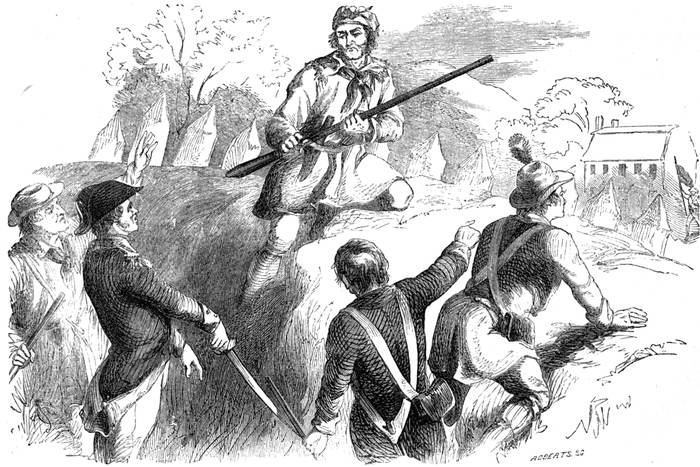
20Among those who shook with mingled wrath and laughter at sight
of the impotence of their leader was Murphy. At the first note of
danger he had sprung to the ramparts, his unerring rifle in hand,
his bright eye flashing fire. He should have been in the Major's
place. It is men like him who electrify their comrades with the
thrilling enthusiasm and reliance of their own courage—men who
know not fear, who think nothing of themselves and all of their
cause—cool, prompt, ready for any emergency. He should have
been the leader: but he was only a militiaman, whose term of service
had expired at that, and who was "fighting on his own account."
But he could not brook the disgrace of such leadership; when the
commander of the fort went creeping about on his hands, the militiaman
felt that it was time to take the reins in his own grasp, and he
did it. Implicit obedience from the soldier to the officer is a
necessity; but there are exceptions to all rules, and this was one of
them; to be mutinous then was to be true to duty and to honor.
Deeming the fort their own, the enemy sent out an officer with a
flag of truce. As soon as he came in sight, the relieved Major got
off his knees, commanding his men to cease all firing. Now it was
that this justifiable mutiny ensued. Murphy, from his position on
the ramparts, answered to the flag, warning it away, threatening in
event of its closer approach to fire upon it. This remarkable assumption
of authority confounded all within the fort. He was ordered
by the officers of the regular troops to forbear, but the militiamen,
whose hero he was, cheered him, and swore he should have his
way. Thus supported, as soon as the flag of truce came within
range, he fired purposely missing the messenger who bore it, when
the flag quickly retired. This "outrage" at once closed all avenues
to a peaceful surrender. The enemy's artillery opened upon the
fort. A continual fusillade was kept up by the mortars, the grasshopper,
and the rifles of the Indians, fortunately with little effect.
Many an Indian, who considered himself at a prudent distance, bit
the dust, as the smoke cleared away from the busy rifle of Timothy
Murphy. Hour after hour the attack continued. A number of
shells were thrown, but only two of them fell inside the walls; one
of these pierced the house within the palisades, and descending to
the first story, smothered itself in a feather-bed, without doing any
21fatal injury. The gallant Major commanding should have been
ensconced for safety in those feathers! The other shell set fire to
the roof, which was saved from destruction by a pail of water carried
by the intrepid Philip Graft, the sentinel who had first discovered
the approach of the British troops.
Many exciting events occurred during that long forenoon. A
large barn, filled with grain, and surrounded by several stacks of
wheat, stood a few hundred feet from the fort. It was several times
set on fire. As it was important to save its contents, Lieutenant
Spencer, with his band of forty men, sallied out on each occasion,
and extinguished the flames. This heroic party also made sorties,
whenever the enemy approached too near the fort, which could not
be properly protected, owing to a short supply of ammunition.
Now it was, also, that the courage of women—which the annals
of the Revolution set forth in such noble luster—shone resplendent
above the craven fear of the commander. Some of the women
armed themselves, avowing their determination to aid in the defense,
should the attack reach the walls. The supply of water threatening
to give out, a soldier was ordered to bring some from a well outside
the works. He turned pale and stood trembling in his shoes,
between the double danger of disobedience and exposure to the
enemy's fire.
"Give the bucket to me!" cried a girl, not over nineteen years of
age, her red lip curling slightly with scorn, as she took the bucket
from his yielding hand, and went forth after the much-needed necessary
of life.
A shout of enthusiasm broke from the spectators. With a smile
on her face and a clear luster in her eyes, inspiriting to see, she went
out on her dangerous journey. Without the least appearance of
trepidation, she filled her bucket and returned, passing within range
of the enemy's fire. This errand she performed several times in
safety.
All this time the rifle of Murphy was doing its appointed work.
In the course of the forenoon he saw a second flag approaching to
demand the surrender of the fort. Seeing him preparing to salute
it as he had the former, Major Woolsey ordered the independent
rifleman from the ramparts.
22"I shan't come down," said the sturdy patriot. "I'm going to
fire on that white rag."
"Then I shall be obliged to kill you on the spot," said the Major,
drawing his sword, and making a flourish.
Murphy only took one eye from the advancing flag; his weapon
was sighted; he was not sufficiently alarmed by this threat to lose
its position.
"Kill away, Major, if you think best. It won't better your situation
much. I know you, and what you will do. You will surrender
this fort. Yes, sir; in the hopes of saving your miserable skin,
you'll surrender! But you won't even save your own carcass. You
can believe what I tell you. I know them troops out thar, and
their way of fightin'. You won't make nothing by surrendering to
them, and Tim Murphy, for one, ain't going to surrender. No,
sir!"
Again the gallant militiamen applauded his sentiments, which were
no sooner uttered than the rifleman discharged his piece at the approaching
officer, missing him, as before, purposely. Of course, at
this, hostilities were renewed; but, as the rifleman said, he knew
which of two dangers was most to be dreaded; and, if he must
perish, he preferred to die in defense of what had been intrusted to
them rather than to be smote down after the humiliation of a surrender
by murderers who respected none of the laws of war. It is
true, that, to fire upon a flag of truce, was a breach of military
usage, and, in almost any circumstances, inexcusable; but not so
now, when the garrison would only meet with the most fatal
treachery as the result of any interview. The officers of the regulars,
however, did not so regard the affair. Brought up under the
stern discipline of military rule, they took sides with the Major,
and expostulated with Murphy upon his unwarrantable violation of
the laws of war.
"Don't talk," he cried, impatiently. "Jest come up here and
take a look at the smoke arising from the homes of defenseless citizens.
Take a look at the red-skins dancing around 'em, like devils
around the fires of hell. Hear the screams of them women and
children they are murderin' in cold blood. By the God above, if I
could get at them fiends, I'd stop that music!" His teeth were
23firmly set; his face hardened; his eyes shone like two coals of fire;
and, disdaining to argue his point at a moment like that, he settled
his weapon for the next victim who should venture within range.
The garrison could indeed hear, in the intervals of the cannon's
silence, the shrieks of helpless families smote down by the tomahawk.
"Do you hear it?" he cried again, as the shrill cry of a female
voice pierced the air. "That's the kind of enemy you've got to
deal with, and there you stand, balancing yourselves on a p'int of
law! If you open your gates and lay down your arms, you, nor
your wives and children, won't meet any better fate. If you want
to be tortured by red-skins, and your families given up to their devilment,
let 'em in, let 'em in! I shan't have a hand in it."
The signs of a final charge about to be given allowed no time for
farther argument. Sir John, drawing up his regular troops in the
rear of a frame building standing near the fort, prepared for an
assault, while the garrison within made what readiness they could
to repel it. The women, knowing how little they had to expect if
the place fell, grasped the weapons they had solicited and took their
stations near the men, resolved to deal such blows as they could in
self-defense. With pale cheeks, but hearts that had outgrown their
natural timidity, they awaited the expected blow.
At this moment of peril and suspense, for the third time a flag of
truce was seen approaching Fort Hunter. Again the undaunted
Murphy prepared to fire upon it; but this time, made desperate by
his very cowardice, Major Woolsey commanded his soldiers to arrest
the disobedient rifleman. The militia, however, gathered around
their hero, threatening any and all who should molest him; they
had confidence that the judgment of one so brave was superior to
that of the officer who had shown himself so unfit for his position.
In the mean time, precious time was being lost. In a moment more
Murphy would enrage the foe by again insulting their flag. The
commander ordered a white flag to be shown. A handkerchief was
placed on a staff and a soldier ordered to display it.
"The man who dares attempt it will be shot down by my own
rifle," thundered the inexorable militiaman, who thus braved the
regular authority. The men knew that he meant what he said, and
not one was found to attempt to execute the order of Woolsey.
24"Who commands here, you or I?" shouted the enraged Major.
"I reckon I do, as far as not givin' up goes," was the cool answer.
At this crisis, Captain Reghtmeyer, of the militia, feeling that their
commander was about to betray them all, took up his station by
the rifleman and ordered him to fire.
Exasperated by such contumacy, Woolsey drew his sword upon
the Captain, threatening to cut him down unless his orders were
obeyed. It was a strange time for persons associated in such imminent
peril to fall out among themselves; but the brave and unflinching
were not disposed to yield their fate into the hands of the
weak and vacillating. Captain Reghtmeyer, in answer to this threat,
clubbed his gun, and awaited the attack of the Major, resolved to
dash out his brains if he assaulted him; whereupon that officer,
thinking in this, as in other cases, that discretion was the better
part of valor, subsided into silence.
The flag-officer of the enemy, as soon as he came within range,
seeing Murphy bring his rifle to his shoulder, immediately turned
and ran back; he had no mind to encounter the sharp warning
which had been given his predecessors.
Then followed a moment of suspense. The little garrison expected
nothing better than an angry and overwhelming assault; the men
breathed heavily, grasping their muskets sternly, while the women's
faces grew like those of their fathers and husbands, settling into the
firm lines of resolve. Moment after moment crept away; a half-hour
sped, and yet the roar of artillery and the nearer shouts of the
expected assailants were not heard.
"You needn't give yourself no further oneasiness, Major," at
length spoke the gallant Murphy, contempt mingling with relief and
joy in his voice. He had kept his gaze fixed upon the movements
of the enemy, and now perceived that they were retiring. "The
red-coats and red-skins are takin' themselves off. It's jest as I told
you—the spunk we've shown makes 'em think us stronger than we
are, and they've made up their minds to back out."
And so, indeed, it proved! "The spunk we've shown" Murphy
modestly said; which was really the spunk he had shown. His
courage and persistence saved Fort Hunter. The British officers
naturally supposed their flag of truce would not be three times fired
upon unless that fort was to be defended to the death. They therefore
decided to withdraw, and to abandon the attempt for its capture.
25
Murphy Saving the Fort—Page 22.
27Thus was the fort, with all its precious lives, preserved by the
tact as well as the determination of a single man. However chagrined
the "gallant" Major may have been at the flagrant disobedience
of an inferior, the results were such as to nullify the consequences
of his anger. The fact that the fort was saved was the
mutineer's justification.
This affair occurred in 1780. It was not the first gallant exploit
of our hero—nor the last. He had already made himself famous by
deeds both of daring, dashing boldness, and deliberate courage.
Three years before the attack on Fort Hunter, at the battle of
Stillwater in 1777, he had killed the British General, Frazer, by a
ball from his unerring rifle. This is the first record we have of
him; but after that many instances were noted of his extraordinary
prowess, and many more, doubtless, of equal interest, never have
received a chronicle. He had a peculiar hatred of the Indians,
called forth by the many proofs of their treachery and cruelty. He
was a valuable acquisition to any party of scouts who might be out
after the red-skins; and many were the marvelous escapes he had.
As an instance of that obstinacy of his character exhibited in his
conduct at the attack upon Fort Hunter, we must give the reader an
account of another and quite different circumstance, in which he displayed
the same determination to have his own way—and in which
he had it! This little episode in the life of the celebrated rifleman
is not only interesting in itself, but also as showing under what difficulties
the little GOD OF LOVE will struggle and triumph.
"Love rules the court, the camp, the grove:"
and not the fiery sword of Mars himself can frighten him from his
universal throne.
After the attack upon Fort Hunter, Murphy, although his period
of enlistment had expired, still remained with the garrison. It was
not long after this that something besides duty to his country began
to bind him to the valley of the Schoharie. The heart which had
never quailed before an Indian or red-coat, was brought low by a
shaft from the bright eyes of a maiden of sixteen!
Not far from the fort dwelt a family by the name of Feeck, whose
28home had escaped destruction from the advent of the enemy. Their
daughter Margaret was a spirited and handsome girl, in whose dark
blue eyes laughed mischief and tenderness combined; her auburn
hair shaded cheeks rosy with health; her form was just rounding
into the fullness of maidenhood, with a grace all its own, acquired
from the fresh air and bountiful exercise to which she was accustomed.
The historian does not tell us how the first meeting occurred,
but certain it is that the indomitable heart of the rifleman was conquered
at last. Murphy was then twenty-eight years of age and
Margaret but sixteen. There is something in the nature of a woman
which does homage to bravery in a man. The man who has the
reputation of cowardice may be handsome and elegant, but she will
despise him; he alone who is famous for courage commands woman's
full respect and love. When the invincible rifleman, whose iron
nerves shrunk from no exposure, and whose energy was daunted by
no difficulties, betrayed to the young girl, by his faltering manner in
her presence, that she could do what armies could not—confuse and
master him—her breast thrilled with pride and delight. The disparity
of their ages was nothing to her; she felt honored at being
the choice of a brave man; her timid glance, usually so mischievous,
encouraged him to speak, and when he did he was not rejected.
Whether it was that Margaret's parents thought her too young, or
that there was too great a discrepancy in their ages, or that they had
some prejudice against Murphy, we are not advised; but they strenuously
opposed the intimacy, forbidding the lover to enter their
house. Then it was that he again questioned the authority of the
ruling powers. It was not in his nature to submit to this arbitrary
decree. As once before he had "had his own way" in defiance of
superiors, he was resolved to have it now. He loved the maiden
and she him; there was none who should keep them apart. When
he made a resolution it might be considered as carried out. Margaret,
drooping about the house, doing her work listlessly, instead of
with joyous singing, received a communication which brought back
the roses to her cheeks in fuller bloom than ever. A faithful friend
of Murphy, living not far from the Feeck family, on the Schoharie
creek, was the person who wrought this change in the young girl.
During a visit to the parents, he contrived to arrange a meeting at
29his own house with her lover. Thither she went one day on a pretended
errand, and found her lover awaiting her. During the interview
a plan was arranged for eluding the vigilance of her parents
and consummating their happiness by marriage.
There was some difficulty about this, for her father and mother
had instituted a close surveillance over all the "coming and going."
Margaret herself, though willing, was timid, shrinking from the danger
of detection and the anger of her parents.
"Pshaw!" said Murphy, squeezing the hand he held in his own
broad palm, "it's likely I can't take care of you, Maggie! I've
trailed too many Injuns, and dodged too many bullets, to think much
of carrying off my girl when I want her. Jest you be on the spot,
and leave the rest to me."
She promised, and they separated to wait impatiently for the appointed
evening. When it came, Margaret, under pretense of going
to milk, some distance from the house, stole away from home to
meet her intended husband. She dared not make the least change
in her apparel, lest suspicion should be excited; and when she made
her appearance at the appointed spot, she presented but little of the
usual semblance of an expectant bride. She was barefoot and bareheaded,
and wore the short gown and petticoat, so much the vogue
among females of that day as a morning or working-dress; but beneath
the humble garb beat a true and ingenuous heart, worth more
than outward trappings to any man. The form, arrayed in homespun,
was of a blooming and substantial beauty, which needed not
the "foreign aid of ornament."
She was first at the place of rendezvous, where she waited with
fear and impatience for her lover, but no lover came. Twilight was
fast fading into darkness, and yet he came not. From her little
nook of concealment, behind a clump of alders which grew on a
bend of the stream, out of sight of her home, she strained her eyes
to look for the approaching form, which still came not. The pink
tinge which flushed the silver water died off into the gray of evening;
every moment she expected to hear the stern voice of her father
calling her. What should she do? It would not answer to return
home, for she already had been gone too long. The cow had not
been milked, and if she went back now, her unusual absence must
30excite suspicions, which would prevent a future meeting with her
lover. This was her greatest dread. She had dwelt on their union
too fondly to endure the return now to a hopeless separation.
Margaret was not long in making up her mind what course to
pursue. Since Murphy had not come to her she would go to him!
She knew him brave and honorable, and that some important matter
must have kept him from the tryst. In order to reach the fort
she was obliged to ford the stream. About this she had no squeamishness,
as she had performed the feat one hundred times before;
the stream was shallow and not very wide. Evidently she was fortunate
in not being troubled with shoes and stockings in the present
emergency; it did not trouble her much to hold up her short skirts
from the water into which she waded; and, as her little feet felt
their cautious way across the creek, no doubt she looked as pretty to
her lover, in her attitudes of unconscious grace, as other brides have
done under more fortunate circumstances; for Murphy saw the
whole proceeding with a pleased eye, taking her advance as a proof
both of her love for, and faith in, himself. He had been detained
at the fort by some provoking duties, and had ridden up to the
brook just as Margaret began to cross.
Although in her heart she felt inwardly relieved to find him there,
the maiden began to pout at his tardiness, and to regret that she
had taken a step beyond the trysting-place to meet a lover who
would not take the trouble to be punctual to an appointment like this.
"I shall go home again, Tim," she cried, concealing her blushes
under a frown, which, though pretty, was not at all frightful.
"Not to-night, Maggie," he said, as, lifting her up behind him,
he sped away to the fort.
Murphy was a general favorite among the garrison; not an individual
there who would not willingly have aided and assisted him in
his nuptial enterprise. His plans were well known; and, as the
happy couple rode in at the gate, lighted by the last lingering gleam
of sunset in the west, they were received with three hearty cheers.
The circumstances were such as to call forth the warmest interest
of the female part of the population. The young maiden was taken
in charge by them. As there was no minister to perform the ceremony
of marriage, the couple would be obliged to take a trip to
31Schenectady, twenty-five miles distant. The evening was spent in
preparation. Various choice articles of apparel and ornament, some
of which, doubtless, had served a similar purpose on former occasions,
were brought forth; all went to work with a will to fit out
this impromptu bridal trousseau. By morning every thing was in
readiness except the proper dress. This, Murphy decided to procure
in Schenectady.
As time was precious they started at dawn, and made the whole
distance in four hours. A handsome silk dress was here purchased
and placed in the hands of a dressmaker and some friends, who
performed wonders which would astonish a modiste of to-day: they
completed the dress in the course of the afternoon! The couple
stopped at the house of friends, who did all they could to assist in
the pleasant project. Before dark the bride was arrayed in a manner
becoming the important occasion. A gay company, composed
of some of their acquaintances, accompanied the happy pair to the
residence of the Rev. Mr. Johnson, where the solemn ceremony
which united their lives in one was performed; after which they
returned to the house of their friends to spend the wedding-night.
We are afraid if some of the dainty belles of the present day had
to accomplish as much in one day as had been done by this bride,
before they could find themselves safely wedded to the object of
their choice, they would shrink away dismayed, and settle down into
old maids. To run away from home barefoot; to wade a creek; to
ride into a fort behind her lover; to ride twenty-five miles; to buy
and make a wedding-dress, and attire herself for the ceremony; to go
to the minister and get married, all in twenty-four hours, showed an
energy worthy of the times. Such kind of women were fit wives
for the men who bore the perils of the Revolution, and whose
strength of mind and heart, whose unconquerable love of liberty,
secured to us our inheritance.
On their return to Schoharie, the parents of the bride were exceedingly
wroth at the disobedience of their daughter, and at the
presumption of the daring rifleman. For a time they refused to be
reconciled; but, reflecting that no opposition could alter or recall the
act, they at length concluded to overlook all and receive the couple
to their love.
32The brave rifleman made a true husband. Margaret, who lived
with him happily for nearly thirty years, had no reason to regret
the hour when she forded Schoharie creek in search of her tardy
lover.
Despite of the eventful perils into which he was always flinging
himself, Murphy lived to see years of peace, dying of cancer in the
throat, in 1818, at the age of sixty-eight. He was an uneducated
man; but, possessed of a strong will and an amiable disposition, he
exerted an unbounded influence over the minds of a certain class of
men, who, like himself, were schooled in trial. His power was that
of originality, independence and courage—qualities which will make
any man a leader of the people among whom he moves. Men of
his stamp were a necessity of the times in which they lived; they
seemed to spring up in the hour of need, having patience, perseverance,
endurance and boldness to cope with the stealthy and murderous
foes who hung upon the path of our civilization. They
deserve to be embalmed in the annals of the country in whose guard
they fought.
BRANT AND THE BOY.
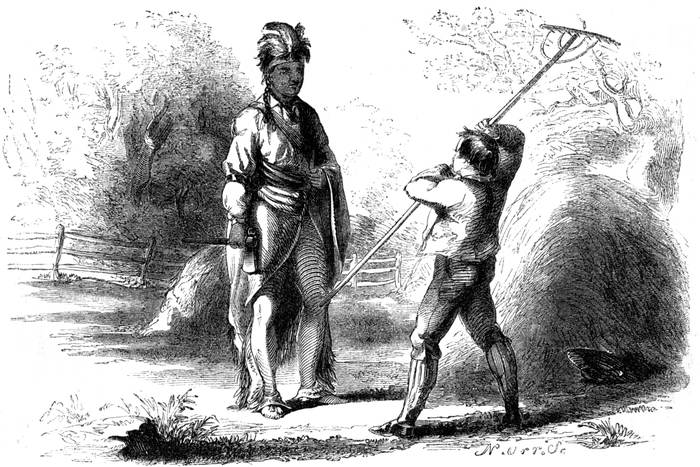
One bright summer morning, a lad by the name of M'Kown was
engaged in raking hay in a field some distance from any house, and—as
was the custom with all who labored abroad in those days of
danger and sudden surprise—was armed with a musket, which, however,
he had stood against a tree; but in the progress of his work
had advanced beyond its immediate proximity. While busily occupied,
and intent upon his work, he heard a slight jingling behind
him, and turning suddenly around, he beheld an Indian within three
feet of him, who bore in his mien and costume the appearance of a
chief; and although his position indicated peaceful intentions, the
tomahawk in his right hand betokened his readiness for hostilities
if occasion required it. Startled at this sudden and unexpected
apparition, the youth, with a natural impulse, raised his rake to
defend himself, thoughtless of the insufficiency of his weapon. His
fears were dissipated by the Indian, who remarked:
33
Brant and young M'Kown—Page 35.
35"Do not be afraid, young man; I shall not hurt you."
He then inquired of the lad if he could direct him to the residence
of a noted loyalist by the name of Foster. Young M'Kown
gave him the necessary directions to enable him to find that personage,
and then, emboldened by the apparent peaceable intentions of
the other, asked him if he knew Mr. Foster.
"I am partially acquainted with him," was the reply, "having
once met him at the half-way creek."
The Indian then entered into a familiar conversation with his
interrogator, in the course of which he asked him his name, and upon
being informed, he added:
"You are a son, then, of Captain M'Kown, who lives in the
north-east part of the town, I suppose. I know your father very
well; he lives neighbor to Captain M'Kean. I know M'Kean very
well, and a very fine fellow he is, too."
Thus the parties conversed together in a social manner for some
time, until the boy—emboldened by the familiarity which had been
established between them—ventured to ask the Indian his name in
turn. This he did not seem disposed to give him, hesitating for a
moment, but at length replied:
"My name is Brant."
"What! Captain Brant?" eagerly demanded the youth.
"No; I am a cousin of his," replied the Indian, at the same time
accompanying his assertion with a smile and expression of countenance
which intimated his attempt to deceive his interlocutor. It
was indeed the terrible Thayendanega himself, who was associated,
in the mind of the youth, with every possible trait of a fiendlike
character; and it is not to be wondered at, that he trembled as he
felt himself to be in the presence of one whose delight, it had been
represented to him, was to revel in slaughter and bloodshed. He
was somewhat reassured, however, by the thought, that, if his intentions
had been hostile toward him, he could easily have executed
them before; but he did not feel fully assured of his safety until the
Indian had taken his departure, and he had reached his home with
his life and scalp intact.
36This little incident is but one of many, told to prove that Brant
was not the bloodthirsty monster which, for many years after the
Revolution, he had the reputation of being. He was a Freemason:
and on several occasions, during the war, his fraternal feelings were
called into play, in behalf of prisoners who belonged to that order.
Among others we are told:
Jonathan Maynard, Esq.—afterward a member of the Massachusetts
Senate—who was actively engaged in the Revolutionary war,
was taken prisoner at one time by a party of Indians under the command
of Brant. The younger warriors of the party seemed disposed
to put him to death, in accordance with their determination to
exterminate the whites, as agreed upon by the tories and Indians in
that section of the country. Preparations had been made to carry
out their intentions, when, having been partially stripped of his
clothing, Brant observed the emblems of Masonry indelibly marked
upon the prisoner's arms, and feeling bound to him by a tie which
none but a brother can appreciate, he interposed his authority, saved
his life, and sent him to Canada, to keep him out of harm's way;
and he remained in durance for several months, until exchanged and
allowed to return home.
There is another incident, where Brant met one of his old schoolmates;
but where the circumstances of their early intimacy would
not have interfered between the white officer and death, had he not
saved himself by means of justifiable duplicity.
In the month of April, in 1780, it was the intention of Captain
Brant, the Indian chieftain, to make a descent upon the upper fort
of Schoharie, but which was prevented by an unlooked-for circumstance.
Colonel Vrooman had sent out a party of scouts to pass
over to the head-waters of the Charlotte river, where resided certain
suspected persons, whose movements it was their duty to watch. It
being the proper season for the manufacture of maple sugar, the men
were directed to make a quantity of that article, of which the garrison
were greatly in want. On the 2d of April this party, under
the command of Captain Harper, commenced their labors, which
they did cheerfully, and entirely unapprehensive of danger, as a fall
of snow, some three feet deep, would prevent, they supposed, the
moving of any considerable body of the enemy, while in fact they
37were not aware of any body of the armed foe short of Niagara. But
on the 7th of April they were suddenly surrounded by a party of
about forty Indians and tories, the first knowledge of whose presence
was the death of three of their party. The leader was instantly
discovered in the person of the Mohawk chief, who rushed up to
Captain Harper, tomahawk in hand, and observed: "Harper, I am
sorry to find you here!"
"Why are you sorry, Captain Brant?" replied the other.
"Because," replied the chief, "I must kill you, although we were
schoolmates in our youth"—at the same time raising his hatchet, and
suiting the action to the word. Suddenly his arm fell, and with a
piercing scrutiny, looking Harper full in the face, he inquired: "Are
there any regular troops in the fort in Schoharie?" Harper caught
the idea in an instant. To answer truly, and admit there were none,
as was the fact, would but hasten Brant and his warriors forward to
fall upon the settlements at once, and their destruction would have
been swift and sure. He therefore informed him that a reinforcement
of three hundred Continental troops had arrived to garrison the
forts only two or three days before. This information appeared very
much to disconcert the chieftain. He prevented the further shedding
of blood, and held a consultation with his subordinate chiefs. Night
coming on, the prisoners were shut up in a pen of logs, and guarded
by the tories, while among the Indians, controversy ran high whether
the prisoners should be put to death or carried to Niagara. The
captives were bound hand and foot, and were so near the council
that Harper, who understood something of the Indian tongue,
could hear the dispute. The Indians were for putting them to
death, but Brant exercised his authority to effectually prevent the
massacre.
On the following morning Harper was brought before the
Indians for examination. The chief commenced by saying that he
was suspicious he had not told him the truth. Harper, however,
although Brant was eyeing him like a basilisk, repeated his former
statements, without the improper movement of a muscle, or any
betrayal that he was deceiving. Brant, satisfied of the truth of the
story, resolved to retrace his steps to Niagara. But his warriors
were disappointed in their hopes of spoils and victory, and it was
38only with the greatest difficulty that they were prevented from putting
the captives to death.
Their march was forthwith commenced, and was full of pain,
peril and adventure. They met on the succeeding day with two
loyalists, who both disproved Harper's story of troops being at Schoharie,
and the Captain was again subjected to a piercing scrutiny; but
he succeeded so well in maintaining the appearance of truth and
sincerity as to arrest the upraised and glittering tomahawk. On the
same day an aged man, named Brown, was accidentally fallen in
with and taken prisoner, with two youthful grandsons; the day following,
being unable to travel with sufficient speed, and sinking
under the weight of the burden imposed upon him, the old man was
put out of the way with the hatchet. The victim was dragging
behind, and when he saw preparations making for his doom, took an
affectionate farewell of his little grandsons, and the Indians moved
on, leaving one of their number with his face painted black—the
mark of the executioner—behind with him. In a few moments
afterward, the Indian came up, with the old man's scalp dangling
from between the ramrod and the muzzle of his gun.
They constructed floats, and sailed down the Susquehanna to
the confluence of the Chemung, at which place their land-traveling
commenced. Soon after this, a severe trial and narrow escape befell
the prisoners. During his march from Niagara on this expedition,
Brant had detached eleven of his warriors, to fall once more upon
the Minisink settlement for prisoners. This detachment, as it subsequently
appeared, had succeeded in taking captive five athletic men,
whom they secured and brought with them as far as Tioga Point.
The Indians slept very soundly, and the five prisoners had resolved,
on the first opportunity, to make their escape. While encamped at
this place during the night, one of the Minisink men succeeded in
extricating his hands from the binding cords, and with the utmost
caution, unloosed his four companions. The Indians were locked in
the arms of deep sleep around them. Silently, without causing a
leaf to rustle, they each snatched a tomahawk from the girdles of
their unconscious enemies, and in a moment nine of them were quivering
in the agonies of death. The two others were awakened, and
springing upon their feet, attempted to escape. One of them was
39struck with a hatchet between the shoulders, but the other fled. The
prisoners immediately made good their own retreat, and the only
Indian who escaped unhurt returned to take care of his wounded
companion. As Brant and his warriors approached this point of
their journey, some of his Indians having raised a whoop, it was
returned by a single voice, with the death yell! Startled at this
unexpected signal, Brant's warriors rushed forward to ascertain the
cause. But they were not long in doubt. The lone warrior met
them, and soon related to his brethren the melancholy fate of his
companions. The effect upon the warriors, who gathered in a group
to hear the recital, was inexpressibly fearful. Rage, and a desire of
revenge, seemed to kindle every bosom, and light every eye as with
burning coals. They gathered around the prisoners in a circle, and
began to make unequivocal preparations for hacking them to pieces.
Harper and his men of course gave themselves up for lost. While
their knives were unsheathing, and their hatchets glittering, as they
were flourished in the sunbeams, the only survivor of the murdered
party rushed into the circle and interposed in their favor. With a
wave of the hand, as of a warrior entitled to be heard—for he was
himself a chief—silence was restored, and the prisoners were surprised
by the utterance of an earnest appeal in their behalf. He
eloquently and impressively declaimed in their favor, upon the ground
that it was not they who murdered their brothers; and to take the
lives of the innocent would not be right in the eyes of the Great
Spirit. His appeal was effective. The passions of the incensed
warriors were hushed, their eyes no longer shot forth the burning
glances of revenge, and their gesticulations ceased to menace immediate
and bloody vengeance.
True, it so happened, that this chief knew all the prisoners—he
having resided in the Schoharie canton of the Mohawks during the
war. He doubtless felt a deeper interest in their behalf on that
account. Still, it was a noble action, worthy of the proudest era of
chivalry, and in the palmy days of Greece and Rome, would have
crowned him almost with "an apotheosis and rights divine." The
interposition of Pocahontas, in favor of Captain Smith, before the
rude court of Powhatan, was, perhaps, more romantic; but when
the motive which prompted the generous action of the princess is
40considered, the transaction now under review exhibits the most of
genuine benevolence. Pocahontas was moved by the tender passion—the
Mohawk Sachem by the feelings of magnanimity, and the
eternal principles of justice. It is a matter of regret that the name
of this high-souled warrior is lost, as, alas! have been too many that
might serve to relieve the dark and vengeful portraiture of Indian
character, which it has so well pleased the white man to draw!
The prisoners themselves were so impressed with the manner of their
signal deliverance, that they justly attributed it to a direct interposition
of Providence.
After the most acute sufferings from hunger and exhaustion, the
party at last arrived at Niagara. The last night of their journey,
they encamped a short distance from the fort. In the morning the
prisoners were informed that they were to run the gauntlet, and
were brought out where two parallel lines of Indians were drawn
up, between which the prisoners were to pass, exposed to the whips
and blows of the savages. The course to be run was toward the
fort. Harper was the first one selected, and at the signal, sprung
from the mark with extraordinary swiftness. An Indian near the
end of the line, fearing he might escape without injury, sprung before
him, but a blow from Harper's fist felled him; the Indians, enraged,
broke their ranks and rushed after him, as he fled with the utmost
speed toward the fort. The garrison, when they saw Harper approaching,
opened the gates, and he rushed in, only affording sufficient
time for the garrison to close the gates, ere the Indians rushed
upon it, clamoring for the possession of their victim. The other
prisoners, taking advantage of the breaking up of the Indian ranks,
took different routes, and all succeeded in reaching the fort without
passing through the terrible ordeal which was intended for them.
This was in the April preceding the final attack upon the fort in
the Schoharie valley, which took place in the fall, as described in the
second article of this number; and at which Murphy, the rifleman,
so distinguished himself.
As further illustrating this magnanimity which—certainly at times—distinguished
Brant, it is said that at the horrible massacre of
Cherry Valley, Butler—the tory Captain, son of the Butler who fulfilled
his hideous part in the destruction of Wyoming—on entering a
41house, ordered a woman and child to be killed who were found in
bed. "What!" exclaimed Brant; "kill a woman and child? No!
that child is not an enemy to the king, nor a friend to Congress.
Long before he will be big enough to do any mischief, the dispute
will be settled."
The life of Brant was, to say the least, peculiar. An Indian, but
an educated and traveled one, with much of the tact of civilization,
and all the cunning and wild freedom of the savage, he made a
character for himself which always will occupy a niche in history.
Whether the conflicting statements in regard to him ever will be so
reconciled as to decide whether he was a generous and humane
enemy, or a most subtle and ferocious one, we know not; but this
is certain, he was our enemy, and a most efficient ally of the British
in their attempts to put out the rising fires of Liberty which were
kindling in our valleys, over our plains, and upon our hills. It was
a most unfortunate thing for the struggling colonists when Brant
took up the hatchet in behalf of the king, for his arm was more to
be dreaded than that of King George.
Joseph Brant was an Onondaga of the Mohawk tribe, whose
Indian name was Thayendanega—signifying, literally, a brant, or
wild-goose. The story that he was but a half-Indian, the son of a
German, has been widely spread, but is denied by his son, and is
now believed to be false. There are those, however, whose opinion
is of weight, who assert that he was the son of Sir William Johnson;
and such, all circumstances considered, is most likely to have been
the fact. He was of a lighter complexion than his countrymen in
general, and there are other evidences of his having been a half-breed.
He received a very good English education at Moore's charity-school,
in Lebanon, Connecticut, where he was placed by Sir William Johnson,
in July, 1761. This General Sir William Johnson was British
agent of Indian affairs, and had greatly ingratiated himself into the
esteem of the Six Nations. He lived at the place since named for
him, upon the north bank of the Mohawk, about forty miles from
Albany. Here he had an elegant country-seat, at which he often
would entertain several hundred of his red friends, sharing all things
in common with them. They so much respected him, that, although
they had the fullest liberty, they would take nothing which was not
42given to them. The faster to rivet their esteem, he would, at certain
seasons, accommodate himself to their mode of dress. He also, being
a widower, took as a companion Molly Brant, (a sister of Brant,)
who considered herself his wife, according to Indian custom, and
whom he finally married, to legitimize her children. He had
received honors and emoluments from the British Government; and
the Indians, through him, obtained every thing conducive to their
happiness. Hence, it is not strange that they should hold in reverence
the name of their "great father," the king; and think the few
rebels who opposed his authority, when the Revolution began, to be
inexcusable and unworthy of mercy.
Brant, by this time a man in the first flush of his strength, and
with as good an education as the majority of his white friends, went
to England in 1775, in the beginning of the great Revolutionary rupture,
where he was received with attention. Doubtless his mind
was there prepared for the part he acted in the memorable struggle
which ensued. He had a Colonel's commission conferred upon him
in the English army upon the frontiers; which army consisted of
such tories and Indians as took part against the country.
Upon his return from England—Sir William Johnson having died
the previous year—Brant attached himself to Johnson's son-in-law,
Guy Johnson, performing the part of secretary to him when transacting
business with the Indians. The Butlers, John and Walter—whose
names, with those of Brant, are associated with the horrid
barbarities of Wyoming and Cherry Valley—lived not far from the
village of Johnstown, and upon the same side of the Mohawk.
After the battle of Bunker Hill, General Schuyler compelled Guy
Johnson, and his brother-in-law, Sir John Johnson, to give their
word of honor not to take up arms against America; but this did
not prevent Guy from withdrawing into Canada and taking with him
Brant, with a large body of his Mohawks. Sir John also fled to
Canada, where he became a powerful adversary. The Butlers were
also in the train.
Here, having had some disagreement with Johnson, Brant returned
to the frontiers with his band of warriors. Some of the
peaceable Mohawks had been confined to prevent their doing injury,
as were some of the Massachusetts Indians in King Philip's war.
43Brant was displeased at this. He came with his band to Unadilla,
where he was met by the American General, Herkimer; and the two
had an interview, in which Brant said that "the king's belts were
yet lodged with them, and they could not falsify their pledge; that
the Indians were in concert with the king," etc. It has never been
explained why Herkimer did not then and there destroy the power
of Brant, which he could have done, for his men numbered eight
hundred and eighty, while Brant had but one hundred and thirty
warriors. It is supposed the American General did not believe that
the Mohawks actually would take up arms against the country. It
was a fatal mistake, which deluged hundreds of homes in blood, or
wrapped them in fire.
Thereafter followed a succession of bloody and terrible affairs, in
which Brant and the two Butlers were leaders. It has been said,
and with truth, that of those three, the white men were the most
ferocious; that they out-Heroded Herod; that Brant often spared
where they refused. Out of these isolated facts it is sought to build
up a reputation for generosity and magnanimity, to which Brant is
not entitled. Some moments of mercy he had; while those arch
fiends, the Butlers, never relaxed into the weakness of mercy; but
the name of Brant, nevertheless, is written too redly in the blood of
our ancestors for us ever to regard him with other feelings than
those of horror and dread. His knowledge of the detestation in
which the whites regarded the Indian modes of warfare, acted upon
his pride; he did not wish to be classed with the untutored of his
own race; so that his regard for appearances caused him frequently
to forbear the cruelties which his associates practiced.
The first affair of importance in which we hear of him is the battle
of Oriskany. It was on the 6th of August, 1777. Brant was
under the direction of General St. Leger, who detached him, with a
considerable body of warriors, for the investment of Fort Stanwix.
Colonel Butler was commander-in-chief of the expedition, with a
band of tories under his immediate charge. The inhabitants in the
valley of the Mohawk determined to march to the assistance of the
fort, which they did in two regiments, with General Herkimer at
their head. As is usual with militia, they marched in great disorder,
and through the inadvertence of General Herkimer—who, influenced
44by sneers at his cowardice in taking such a precaution, failed to throw
forward scouts as he should have done—were surprised by the Indians
as they were crossing an almost impassable ravine, upon a single
track of logs. The ambush selected by Brant could not have
been better fitted for his purpose. The ravine was semicircular, and
Brant and his forces occupied the surrounding heights.
The first intimation of the presence of the enemy was the terrifying
yells of the Indians, and the still more lasting impressions of
their rifles. Running down from every direction, they prevented the
two regiments from forming a junction—one of them not having
entered the causeway. A part of the assailants fell upon those
without, a part upon those within. The former fared worse than
the latter; for, in such a case a flight almost always proves a dismal
defeat, as was now the case. The other regiment, hemmed in as it
was, saw that
"To fight, or not to fight, was death."
They therefore, back to back, forming a front in every direction,
fought like men in despair. With such bravery did they resist, in
this forlorn condition, that the Indians began to give way, and but
for a reinforcement of tories, they would have been entirely dispersed.
The sight of this reinforcement increased the rage of the
Americans. The tory regiment was composed of the very men who
had left that part of the country at the beginning of the war, and
were held in abhorrence for their loyalty to the king. Dr. Gordon
says that the tories and Indians got into a most wretched confusion,
and fought one another; and that the latter, at last, thought it was a
plot of the whites to get them into that situation, that they might be
cut off. General Herkimer got forward an express to the fort, when
he was reinforced as soon as possible, and the remnant of his brave
band saved. He beat the enemy from the ground, and carried considerable
plunder to the fort; but two hundred Americans were lost,
and among them the General himself, who died, soon after, from the
effects of a wound received at the time.
In the early part of the contest, General Herkimer had been
struck by a ball, which shattered his leg and killed his horse. Undaunted
by this accident, and indifferent to the severity of the pain,
the brave old General continued on his saddle, which was placed on
45a little hillock, near a tree, against which he leaned for support,
while giving his orders with the utmost coolness, though his men
fell in scores about him, and his exposed position made him a
mark for the enemy. Amid the clashing of weapons, the roar of
artillery, and the yells of the combatants, all mingled in wild confusion,
General Herkimer deliberately took his pipe from his pocket,
lit it, and smoked with seeming composure. On being advised to
remove to a place of greater security, he said, "No; I will face the
enemy." It is said that Blucher, at the battle of Leipsic, sat on a
hillock, smoking, and issuing his orders; but Blucher was not
wounded.
General Herkimer's leg was amputated after the battle, but it was
done so unskillfully that the flow of blood could not be stopped.
During the operation he smoked and chatted in excellent spirits; and
when his departure drew nigh, he called for a Bible, and read aloud,
until his failing strength compelled him to desist. Such is the stuff
of which heroes are made.
The night which followed the battle was one of horror for the
prisoners taken by the enemy. As usual, the Indians slaked their
thirst for blood and torture, which the battle had awakened, in pitiless
cruelties upon their defenseless captives. It does not seem that
Brant here exercised, or caused to be exercised, any clemency.
Some of the doomed creatures begged of Butler, the British officer,
to use his influence with the Indians; and to their appeals were
joined the entreaties of the guard—the tories, in whose breasts some
humanity remained; but this fiend, more savage than the savages,
only cursed them for their folly in pleading for "infernal rebels."
All manner of tortures, including roasting, was practiced upon the
captives, as was testified to by one of their number, Dr. Younglove,
who, after enduring every thing but death, finally escaped from his
tormentors.
In June of the next year, 1778, Brant came upon Springfield,
which he burned, and carried off a number of prisoners. The
women and children were not maltreated, but were left in one house
unmolested. About this time great efforts were made to secure the
wary chief, but none of them were successful.
The next event of importance in which Brant was engaged was
46the destruction of Wyoming, that most heart-rending affair in all the
annals of the Revolutionary war. The events of that awful massacre,
the treachery of Butler, the ferocity of the savages, and the still more
hellish malignity of their white allies, are known to all. The wail
which then arose from innocent women and helpless babes, consumed
in one funeral pyre, together, will never die—its echoes yet ring upon
the shuddering senses of each successive generation. Of late years
an effort has been made to prove that Brant was not even present at
that massacre; but of this there is no proof. Campbell, the author
of "Gertrude of Wyoming," was so worked upon by the representations
of a son of Brant, who visited England in 1822, that he recalled
all he said of
"The foe—the monster Brant,"
and wished him, thereafter, to be regarded as a "purely fictitious
character."
One thing is certain. Brant was at the massacre of Cherry Valley,
which settlement, in the November following the destruction of
Wyoming, met a fate nearly similar. At this terrible affair was
repeated the atrocities of the former. A tory boasted that he killed
a Mr. Wells while at prayer. His daughter, a beautiful and estimable
young lady, fled from the house to a pile of wood for shelter, but
an Indian pursued her; and composedly wiping his bloody knife on
his leggin, seized her, and while she was begging for her life in the
few words of Indian which she knew, he ruthlessly killed her. But
why speak of one, where hundreds met a similar fate? It is said
that Brant, on this occasion, did exercise clemency; and that he was
the only one who did. It was shortly after this that Sullivan's army
was organized to march upon the Indian country and put a stop to
such outrages. Brant met it and was repulsed and fled. It has
been made a matter of complaint that our forces destroyed the Indian
villages and crops. But with such wrongs burning in their breasts,
who could ask of them the practice of extraordinary generosity
toward monsters who would not respect nor return it? The same
complaint is made to-day against the exasperated Minnesotians, who
claim the fullest vengeance of the law against the stealthy panthers,
and worse than wild beasts, who have recently ravaged their State.
They ask it, and should have it.
47In the spring of 1780, Brant renewed his warfare against our settlements.
He seems, in almost all cases, to have been successful,
uniting, as he did, the means of civilized warfare with all the art
and duplicity of the savage.
In later years Colonel Brant exerted himself to preserve peace
between the whites and Indians; and during the important treaties
which were made in 1793 he was in favor of settling matters amicably.
He had won from the British Government all the honors it was willing
to bestow upon a savage ally, and what were they? A Colonel's
commission, with liberty to do work for the king which British soldiers
did not care to do—the slaughter of women and children, and
the sacking of villages. It is quite probable that, after Wayne's
decisive castigation of the Indians, and British insolence had thereby
also received a blow, Brant retired from a service which he knew
must be worse than fruitless.
Colonel Brant was married, in the winter of 1779, to the daughter
of Colonel Croghan by an Indian woman. He had lived with her
some time, according to the Indian manner; but being present at
the wedding of Miss Moore, (one of the Cherry Valley captives,) he
took a fancy to have the "civilized" ceremony performed between
himself and his partner. King George III. conferred valuable lands
upon him, and he became quite wealthy. He owned, at one time,
thirty or forty negroes, to whom he was a most brutal master.
Brant professed to be a great admirer of Greek, and intended to study
that language so as to be able to make an original translation of the
New Testament into Mohawk.
He died in November, 1807, and was said to have been sixty-five
years old at the time of his death. He left several children, some
of whose descendants are wealthy and respectable people. His wife,
at his death, returned to her wild Indian life.
MRS. AUSTIN AND THE BEAR.
48
One of the great and almost insurmountable difficulties attendant
upon the settlement of a new country, is that of rearing farm stock,
and preserving it from the attacks of wild beasts. The experience
of the pioneers of civilization in the valley of the Ohio, on this point,
taught them that, until the country became more fully settled, and
the increase of inhabitants so great as to drive back the denizens of
the forest to more distant lairs, they must depend upon their rifles
alone for a supply of animal food for the table. On the principle
of recompense, perhaps, it was not so hard as it might otherwise
seem, for when pork and beef were scarce, "b'ar meat" was plenty—and
vice versa. But then, it was hard when one took a notion to
raise a pig or two to furnish his table in time of need, to find it missing
some bright morning, and know that all that pork had gone to
fill the greedy stomach of a bear or "painter." Many and frequent
were the encounters at the sty between the settler and his dusky
neighbor, the bear, in which the contest for the possession of the
pork was maintained with vigor and determination on the one side,
and on the other with a hungry energy, which was deserving of
commendation, if not of success.
Except when he could accomplish his object by stealth, however,
bruin seldom came off the victor. The first note of alarm was sufficient
to call from his pallet the watchful hunter, and the deadly
rifle generally sent the intruder off a cripple, or stretched his carcass
on the greensward, a trophy to the skill of his opponent. The
women, too, were not backward in defense of their porcine friends
when necessity called for exertion on their part to save them from
destruction, as is evidenced by several anecdotes of their intrepidity
on such occasions.
49

Mrs. Austin and the Bear—Page 51.
51A Mrs. John Austin, of Geneva Township, one day while her
husband was absent from home, was alarmed by the sound of an
unusual commotion among her pigs, and looking in the direction of
the sty, which stood just back of the cabin, she beheld a bear just
in the act of climbing over the inclosure among a group of three or
four promising shotes, which she fondly hoped would one day fill
the pork barrel and serve to supply her table with animal food during
the long dreary months of the next winter. For a period of
many weeks had she nursed, watched and fed them, in anticipation
of their future usefulness, and she could not bear the thought of parting
with them. But how to save them?—that was the question.
There was no one near to aid in their salvation, and she must
depend upon herself, or lose her pork. The danger was imminent,
and decisive action necessary. Her mind was soon made up; she'd
save her pigs or perish in the attempt. Calling her children, she
sent them up into the loft and took away the ladder, that they might
be safe in case she was unsuccessful or should be overcome by the
bear. Taking down her husband's rifle, which hung on its pegs
behind the door of the cabin, she carefully examined it to see if it
was loaded, but in her haste overlooked the priming. The increasing
confusion in the sty warned her that delays were dangerous, and
she sallied forth to encounter bruin, who was already on his way to
the forest with one of the pigs in his arms. The latter was giving
vent to his fears in the most piercing and pitiful tones, while his
captor, intent only on securing his prize, was marching off at a rapid
pace on his hind feet, holding the pig as a mother holds her babe,
and indifferent alike to his struggles and his pathetic appeals for
mercy and relief. A momentary tremor seized upon the frame of
the heroine, and the blood ran chill through her heart, as her gaze
revealed the figure of a bear of the largest size—an antagonist whom
many a stalwart hunter would have hesitated before attacking. No
time was given her, however, to deliberate, for the bear had discovered
her approach almost as soon as she turned the corner of the
cabin. Dropping his burden, he turned to face his enemy, and presented
a front which might have appalled a much stouter heart than
that of our heroine; while the pig—language fails me in the attempt
to describe the emotions which filled the breast of that now overjoyed
pig, as he took his way with hasty strides to his former quarters,
and snuggled down by the side of his companions, with many
a grunt of satisfaction at his escape from the jaws of impending
52death. I leave it to the imagination of my reader, with the aid of
the illustration, to supply a deficiency which my pen is utterly incapable
of doing.
Standing thus at bay, in an attitude which threatened an attack
on his part, the bear awaited the coming of his adversary. Fortunately,
between her and him there was a Virginia worm fence,
which formed a sort of breastwork, and offered a very eligible rest
for her rifle. Resting her weapon upon the upper rail of the fence,
she kneeled upon one knee, and took deliberate aim at the heart of
her savage enemy. For the space of a minute the two remained in
this position, until, assured of her aim, Mrs. Austin pulled the
trigger. To her horror and dismay, the steel emitted sparks, but no
report followed. The trusty rifle had missed fire. How shall I
describe the feelings which heaved her bosom, as her eye glanced
along the barrel until it rested upon the dark form of the bear, fearing
lest he should spring upon her and tear her limb from limb.
Her own life, and the lives of her children rested upon the success
of her shot, and should he change his position so as to present a less
vulnerable part to her aim, she felt that her hope was void and her
fate certain. The animal still remained in the same position, however,
and with as little movement as possible, she drew back the
hammer, and again aimed full at his breast. Again the piece missed
fire, and her heart sunk within her as she saw the bear move, as
though he disliked his ambiguous position, and desired to change it.
Not daring to lower her piece to examine it, and hoping that the
third attempt might be more effectual, she again essayed to discharge
it; but when, for the third time it failed to explode, she felt a sensation
of horror creep over her which seemed to curdle the life-blood
in her veins, and her limbs seemed palsied with terror as the bear—who
had by this time become disgusted with the idea of being made
a target of—and that, too, by a woman—dropped upon all fours, and
as she thought, prepared to spring upon her. Satisfied, however,
with his own exhibition of prowess—or, perhaps, fearful of attacking
one who had shown herself so brave, he turned on his heels, and
started off on a sidelong trot for the woods, the deep recesses of
which soon hid him from sight.
Perhaps it was fortunate for Mrs. Austin that her rifle failed to
53explode. Had she wounded the animal instead of killing him, or
failed to hit a vital part, no power on earth could have saved her
from his savage vengeance. A wounded bear is one of the most
terrific beasts to encounter, and the hunter will seldom attack one
of these dusky denizens of the forest unless he has other arms to
depend upon, should his rifle fail to strike the seat of life. She did
not stop to consider the subject, however, but hastening back to her
cabin, she threw herself upon the floor, and gave vent to her overwrought
feelings in a flood of tears. The excitement which had
gradually wrought her up to a fearful pitch of feeling was gone, and
the revulsion was so great as to completely unnerve her. She soon
rallied again, and her first act, on becoming more calm, was to offer
thanks to that Providence which had watched over and protected
her in her hour of need.
One of the most terrible bear-fights on record, which throws the
exploits of Davy Crockett, and even of "old Grizzly Adams" into
the shade, was that which took place some thirty years ago, between
a man by the name of John Minter, and one of the largest and most
ferocious of the species of black bears. Captain Minter was one of
the settlers of Ohio, and, in his youth, had been a great hunter,
spending most of his time in the woods in pursuit of game; and such
was his proficiency with the rifle, that he seldom failed to bring down
the fleetest-winged denizen of the air, or the swiftest-footed deer.
His last hunt, however, was the crowning glory of his exploits, brilliant
enough to satisfy his ambition, and induce him to "retire upon
his dignity;" in fact, his passion for hunting was suddenly changed
to disgust, and he gave up the rifle for the plow.
He had been out one day, as usual, with his rifle, in pursuit of a
flock of turkeys, but had been unsuccessful, and was returning home
in a surly mood, when he came, rather unexpectedly, upon a large
black bear, who seemed disposed to dispute his passage. Quick as
thought his piece was at his shoulder, and the bullet whizzed through
the air, striking the bear full in the breast, and he fell to the ground—as
Minter supposed—dead. Carefully reloading his rifle, not to
throw away a chance, he approached the bear, and poked his nose
with the muzzle, to see if any spark of life remained. Bruin was
only "playing 'possum" as it seems, for with far more agility than
54could be anticipated of a beast who had a rifle-ball through his body,
he reared upon his hind-feet and made at the hunter. Minter fired
again, but in his haste and trepidation, arising from the sudden and
unexpected attack, he failed to hit a vital part, and a second wound
only served to make the brute more savage and desperate. Drawing
his tomahawk, he threw that; and as the bear dodged it and sprung
upon him, he clubbed his rifle and struck him a violent blow across
the head with the butt, which resulted in shivering the stock, and,
if possible, increasing his rage. Springing back to avoid the sweep
of his terrible claws, Minter drew his long, keen hunting-knife, and
prepared for the fatal encounter which he knew must ensue. For a
moment the combatants stood gazing at each other, like two experienced
duelists, measuring each the other's strength. Minter was a
man of powerful frame, and possessed of extraordinary muscular
development, which, with his quick eye and ready hand, made him
a very athletic and dangerous enemy. He stood six feet high, and
was beautifully proportioned. The bear was a male of the largest
size, and, rendered desperate by his wounds, which were bleeding
profusely, was a fearful adversary to encounter under any circumstances;
more particularly so to Minter, who now had simply his
knife to depend upon, to decide the contest between them. As Bruin
advanced to seize him, he made a powerful blow at his heart, which,
had it taken effect, would have settled the matter at once; but the
other was too quick for him, and with a sweep of his tremendous
paw, parried the blow, and sent the weapon whirling through the
air to a distance of twenty feet; the next instant the stalwart hunter
was enfolded in the embrace of those fearful paws, and both were
rolling on the ground in a death-like grapple.
The woods were open, and free from underbrush to a considerable
extent, and in their struggles they rolled about in every direction.
The object of the bear was, of course, to hug his adversary to death,
which the other endeavored to avoid by presenting his body in such
a position as would best resist the vice-like squeeze, until he could
loosen his grasp; to accomplish which, he seized the bear by the
throat with both hands, and exerted all his energy and muscular
power to throttle him. This had the twofold effect of preventing
him from using his teeth, and compelling him to release the hug, to
55knock off the other's hands with his paws; thus affording Minter an
opportunity to catch his breath, and change his position. Several
times he thought he should be crushed under the immense pressure
to which he was subjected; but was buoyed up with the hope of
reaching his knife, which lay within sight, and toward which he endeavored
to fall every time they came to the ground. With the hot
breath of the ferocious brute steaming in his face, and the blood
from his own wounds mingling with that of the bear, and running
to his heels, his flesh terribly cut up and lacerated by his claws, he
still continued to maintain the struggle against the fearful odds, until
he was enabled to reach the weapon, which he grasped with joy,
and clung to with the tenacity of a death-grip. With his little remaining
strength, and at every opportunity between the tremendous
hugs, he plied the knife until the bear showed evident signs of weakness,
and finally bled to death from the numerous wounds from
whence flowed, in copious streams, his warm life's blood, staining
the leaves and greensward of a crimson hue.
Releasing himself from the embrace of the now inanimate brute,
Minter crawled to a decaying stump, against which he leaned, and
surveyed the scene. His heart sickened as he contemplated his own
person. He had gone into the battle with a stout, heavy hunting-shirt,
and underclothing; with buckskin leggins and moccasins; and
had come out of it with scarcely a rag upon him, except the belt
around his waist, which still held a few strips of tattered cloth, and
a moccasin on one foot. His body, from his neck to his heels, was
covered with great gaping wounds, many of which penetrated to the
bone, and the blood was flowing in torrents to the ground, covering
him with gore from head to foot. For a space of more than half an
acre, the ground was torn up, and had the appearance of a butcher's
shambles.
As soon as he had recovered his breath, he commenced to
crawl toward his home, where he arrived after nightfall, looking
more like a slaughtered beef than a human being. His wounds
were dressed by his family and friends, and after being confined to
his bed for many weeks, thanks to his healthy, rugged constitution,
he entirely recovered; but he bore to the grave the marks of his
terrible contest, in numerous cicatrices and welts which covered his
56back, arms and legs, where the bear's claws had left ineffaceable
marks of his strength and ferocity.
Speaking of Davy Crockett, reminds us that there was one of his
adventures which deserves to be classed with the "highly exciting"
experiences of which Captain Minter's was so good in its way. It
was during the Colonel's travels through Texas; he had left his
party, to give chase to a drove of mustangs over a prairie; he had
pursued them to the banks of the Navasola river, where they had
plunged into the stream, and where his own tough little animal had
fallen to the ground, apparently in a state of exhaustion. But we
must give Colonel Crockett's story in his own words, unless we wish
to rob it of its peculiar grace. He says:
"After toiling for more than an hour to get my mustang upon his
feet again, I gave it up as a bad job, as little Van did when he
attempted to raise himself to the moon by the waistband of his
breeches. Night was fast closing in, and as I began to think that
I had just about sport enough for one day, I might as well look
around for a place of shelter for the night, and take a fresh start in
the morning, by which time I was in hopes my horse would be
recruited. Near the margin of the river a large tree had been blown
down, and I thought of making my lair in its top, and approached
it for that purpose. While beating among the branches I heard a
low growl, as much as to say, 'Stranger, the apartments are already
taken.' Looking about to see what sort of a bedfellow I was likely
to have, I discovered, not more than five or six paces from me, an
enormous Mexican cougar, eyeing me as an epicure surveys the table
before he selects his dish, for I have no doubt the cougar looked
upon me as the subject of a future supper. Rays of light darted
from his large eyes, he showed his teeth like a negro in hysterics,
and he was crouching on his haunches ready for a spring; all of
which convinced me that unless I was pretty quick upon the trigger,
posterity would know little of the termination of my eventful career,
and it would be far less glorious and useful than I intend to make it.
"One glance satisfied me that there was no time to be lost, as
Pat thought when falling from a church steeple, and exclaimed,
'This would be mighty pleasant now, if it would only last,' but
there was no retreat either for me or the cougar, so I leveled my
57Betsy and blazed away. The report was followed by a furious
growl, (which is sometimes the case in Congress,) and the next moment,
when I expected to find the tarnal critter struggling with death,
I beheld him shaking his head as if nothing more than a bee had
stung him. The ball had struck him on the forehead and glanced
off, doing no other injury than stunning him for an instant, and
tearing off the skin, which tended to infuriate him the more. The
cougar wasn't long in making up his mind what to do, nor was I
neither; but he would have it all his own way, and vetoed my
motion to back out. I had not retreated three steps before he sprung
at me like a steamboat; I stepped aside, and as he lit upon the
ground, I struck him violently with the barrel of my rifle, but he
didn't mind that, but wheeled around and made at me again. The
gun was now of no use, so I threw it away, and drew my hunting
knife, for I knew we should come to close quarters before the fight
would be over. This time he succeeded in fastening on my left arm,
and was just beginning to amuse himself by tearing the flesh off with
his fangs, when I ripped my knife into his side, and he let go his
hold, much to my satisfaction.
"He wheeled about and came at me with increased fury, occasioned
by the smarting of his wounds. I now tried to blind him, knowing
that if I succeeded he would become an easy prey; so as he approached
me I watched my opportunity, and aimed a blow at his
eyes with my knife, but unfortunately it struck him on the nose, and
he paid no other attention to it than by a shake of the head and a
low growl. He pressed me close, and as I was stepping backward
my foot tripped in a vine, and I fell to the ground. He was down
upon me like a nighthawk upon a June bug. He seized hold of the
outer part of my right thigh, which afforded him considerable amusement;
the hinder part of his body was toward my face; I grasped
his tail with my left hand, and tickled his ribs with my hunting-knife,
which I held in my right. Still the critter wouldn't let go
his hold; and as I found that he would lacerate my leg dreadfully,
unless he was speedily shaken off, I tried to hurl him down the bank
into the river, for our scuffle had already brought us to the edge of
the bank. I stuck my knife into his side, and summoned all my
strength to throw him over. He resisted, was desperate heavy; but
58at last I got him so far down the declivity that he lost his balance,
and he rolled over and over till he landed on the margin of the
river; but in his fall he dragged me along with him. Fortunately,
I fell uppermost, and his neck presented a fair mark for my hunting
knife. Without allowing myself time even to draw breath, I aimed
one desperate blow at his neck, and the knife entered his gullet up
to the handle, and reached his heart. I have had many fights with
bears, but that was mere child's play; this was the first fight ever I
had with a cougar, and I hope it may be the last.
"I now returned to the tree-top to see if any one else would dispute
my lodging; but now I could take peaceable and quiet possession.
I parted some of the branches, and cut away others to make
a bed in the opening; I then gathered a quantity of moss, which
hung in festoons from the trees, which I spread on the litter, and
over this I spread my horse-blanket; and I had as comfortable a
bed as a weary man need ask for. I now took another look at my
mustang, and from all appearances, he would not live until morning.
I ate some of the cakes that little Kate of Nacogdoches had made
for me, and then carried my saddle into my tree-top, and threw myself
down upon my bed with no very pleasant reflections at the
prospect before me.
"I was weary, and soon fell asleep, and did not awake until daybreak
the next day. I felt somewhat stiff and sore from the wounds
I had received in the conflict with the cougar; but I considered
myself as having made a lucky escape. I looked over the bank,
and as I saw the carcass of the cougar lying there, I thought that it
was an even chance that we had not exchanged conditions; and I
felt grateful that the fight had ended as it did. I now went to look
after my mustang, fully expecting to find him as dead as the cougar;
but what was my astonishment to find that he had disappeared
without leaving trace of hair or hide of him! I first supposed that
some beasts of prey had consumed the poor critter; but then they
wouldn't have eaten his bones, and he had vanished as effectually as
the deposits, without leaving any mark of the course they had
taken. This bothered me amazing; I couldn't figure it out by any
rule that I had ever heard of, so I concluded to think no more about
it.
59"I felt a craving for something to eat, and looking around for
some game, I saw a flock of geese on the shore of the river. I shot
a fine, fat gander, and soon stripped him of his feathers; and gathering
some light wood, I kindled a fire, run a long stick through my
goose for a spit, and put it down to roast, supported by two sticks
with prongs. I had a desire for some coffee; and having a tin cup
with me, I poured the paper of ground coffee that I had received
from the bee-hunter into it, and made a strong cup, which was very
refreshing. Off of my goose and biscuit I made a hearty meal, and
was preparing to depart without clearing up the breakfast things, or
knowing which direction to pursue, when I was somewhat taken
aback by another of the wild scenes of the West. I heard a sound
like the trampling of many horses, and I thought to be sure the
mustangs or buffaloes were coming upon me again; but on raising
my head, I beheld in the distance about fifty mounted Comanches,
with their spears glittering in the morning sun, dashing toward the
spot where I stood at full speed. As the column advanced, it
divided, according to their usual practice, into two semicircles, and
in an instant I was surrounded. Quicker than thought I sprung to
my rifle, but as my hand grasped it, I felt that resistance against so
many would be of as little use as pumping for thunder in dry
weather.
"The chief was for making love to my beautiful Betsy, but I clung
fast to her, and assuming an air of composure, I demanded whether
their nation was at war with the Americans. 'No,' was the reply.
'Do you like the Americans?' 'Yes; they are our friends.'
'Where do you get your spear-heads, your rifles, your blankets, and
your knives from?' 'Get them from our friends, the Americans.'
'Well, do you think, if you were passing through their nation, as I
am passing through yours, they would attempt to rob you of your
property?' 'No, they would feed me, and protect me; and the
Comanche will do the same by his white brother.'
"I now asked him what it was had directed him to the spot where
I was, and he told me that they had seen the smoke from a great
distance, and had come to see the cause of it. He inquired what
had brought me there alone; and I told him that I had come to
hunt, and that my mustang had become exhausted and though I
60thought he was about to die, that he had escaped from me; at
which the chief gave a low, chuckling laugh, and said it was all a
trick of the mustang, which is the most wily and cunning of all
animals. But he said, that as I was a brave hunter, he would furnish
me with another; he gave orders, and a fine young horse was
immediately brought forward.
"When the party approached there were three old squaws at their
head, who made a noise with their mouths, and served as trumpeters.
"I now told the chief that, as I now had a horse, I would go for
my saddle, which was in the place where I had slept. As I approached
the spot, I discovered one of the squaws devouring the
remains of my roasted goose, but my saddle and bridle were nowhere
to be found. Almost in despair of seeing them again, I observed,
in a thicket at a little distance, one of the trumpeters kicking and
belaboring her horse to make him move off, while the sagacious
beast would not move a step from the troop. I followed her, and
thanks to her restive mustang, secured my property, which the
chief made her restore to me. Some of the warriors had by this
time discovered the body of the cougar, and had already commenced
skinning it; and seeing how many stabs were about it, I related to
the chief the desperate struggle I had had; he said, 'Brave hunter,
brave man,' and wished me to be adopted into his tribe, but I
respectfully declined the honor. He then offered to see me on my
way; and I asked him to accompany me to the Colorado river, if
he was going in that direction, which he agreed to do. I put my
saddle on my fresh horse, mounted, and we darted off, at a rate not
much slower than I had rode the day previous with the wild herd,
the old squaws at the head of the troop braying like young jackasses
the whole way."
The more we study the history of frontier life, the more we are
surprised at the characters of such men as Simon Kenton in one way
and David Crockett in another. It would seem as if they were made
to command the circumstances in which they were placed—indigenous
to the soil in which they grew—with traits which sprung up
to meet every emergency of their times and places. They were of
a new race, the like of which no other sun nor age had looked upon—Americans,
indeed, in the broadest sense—men sent to prepare the
61soil of civilization for the rich fruit and flowers which already cover
the furrows turned by their brave and vigorous arms.
David Crockett's grandparents were murdered by Indians; and he
was born and reared in the midst of those privations which helped
to make him what he was. It is quite delightful, in reading his "life"
to see with what ease and nonchalance he dispatches a few bears in
the course of a day, or does any other work which is thrown in his
way. As in the specimen we have quoted, he conquers his cougar,
and ingratiates himself with a roving band of Comanches, and "does
up" enough adventures in a chapter to satisfy any ordinary man, if
stretched through a long lifetime. Let us treasure up the records
of "Davy Crockett," for we shall never have another like him.
To show the perfect isolation in which some of the pioneers lived,
and the manner of their lives, we will give an anecdote of a Mr.
Muldrow, one of the settlers of Kentucky, whose name is still
attached to a range of savage precipices in the central part of the
State, called Muldrow's hill. The individual referred to settled here
at a time when there was not a single white man but himself in this
vicinity, and here he had resided for a year with his wife, without
having seen the face of any other human being. Perhaps, as it was his
choice to reside in a wilderness, isolated from his own species, he
might have thought it prudent to conceal his place of abode from
the Indians, by erecting his cabin in an inhospitable waste, difficult
of access, where there were no pastures to invite the deer or buffalo,
and no game to allure the savage hunter, and where his family
remained secure, while he roved with his gun over some hunting-ground
at a convenient distance.
After passing a year in this mode of life, he was one day wandering
through the woods in search of game, when he heard the barking
of a dog, and supposing that an Indian was near, concealed himself.
Presently a small dog came running along his track, with his
nose to the ground, as if pursuing his footsteps, and had nearly
reached his hiding-place, when it stopped, snuffed the air, and
uttered a low whine, as if to admonish its master that the object of
pursuit was near at hand. In a few minutes the owner of the dog
came stepping cautiously along, glancing his eyes jealously around,
and uttering low signals to the dog. But the dog stood at fault,
62and the owner halted within a few yards of our hunter and exposed
to view.
The new-comer was a tall, athletic man, completely armed with
rifle, tomahawk and knife; but whether he was a white man or an
Indian, could not be determined either by his complexion or dress.
He wore a hunting-shirt and leggins, of dressed deer-skin, and a hat
from which the rim was entirely worn away, and the crown elongated
into the shape of a sugar-loaf. The face, feet and hands,
which were exposed, were of the tawny hue of the savage; but
whether the color was natural, or the effect of exposure, could not
be ascertained even by the keen eye of the hunter; and the features
were so disguised with dirt and gunpowder, that their expression
afforded no clue by which the question could be decided whether
the person was a friend or foe. There was but a moment for scrutiny;
the pioneer, inclining to the opinion that the stranger was an
Indian, cautiously drew up his rifle, and took deliberate aim; but
the bare possibility that he might be pointing his weapon at the
bosom of a countryman induced him to pause.
Again he raised his gun, and again hesitated; while his opponent,
with his rifle half-raised toward his face, and his finger on the trigger,
looked eagerly around. Both stood motionless and silent—one
searching for the object of his pursuit, the other in readiness to fire.
At length the hunter, having resolved to delay no longer, cocked
his rifle—the click reached the acute ear of the other, who instantly
sprung behind a tree; the hunter imitated his example, and they
were now fairly opposed, each covered by a tree, from behind which
he endeavored to get a shot at his adversary without exposing his
own person.
And now a series of stratagems ensued, each seeking to draw the
fire of the other, until the stranger, becoming weary of suspense,
called out:
"Why don't you shoot, you etarnal cowardly varmint?"
"Shoot, yourself, you bloody red-skin!" retorted the other.
"No more a red-skin than yourself!"
"Are you a white man?"
"To be sure I am. Are you?"
"Yes; no mistake in me!"
63Whereupon, each being undeceived, they threw down their guns,
rushed together with open arms, and took a hearty hug. The
hunter now learned that the stranger had been settled, with his family,
about ten miles from him, for several months past, and that
each had frequently roamed over the same hunting-ground, supposing
himself the sole inhabitant of that region. On the following day
the hunter saddled his horse, and taking up his good wife behind
him, carried her down to make a call upon her new neighbor, who
doubtless received the visit with far more sincere joy than usually
attends such ceremonies.
There is a well-accredited bear-story which belongs to the early
history of Ohio, and which is of a little different type from most of the
adventures with these ugly animals. An old pilot of the Ohio was
once obliged to give a bruin a free ride—but he could hardly blame
the bear, after stopping so kindly to take him in. But we must let
him tell his own story. "Twenty odd year ago," said the pilot,
"there warn't a great many people along the Ohio, except Injins and
b'ars, and we didn't like to cultivate a clust acquaintance with either
of 'em; fer the Injins were cheatin', scalpin' critters, and the bears
had an onpleasant way with them. Ohio warn't any great shakes
then, but it had a mighty big pile of the tallest kind of land layin'
about, waitin' to be opened to the sunlight. 'Arly one mornin' when
my companions was asleep, I got up and paddled across the river
after a deer, for we wanted venison for breakfast. I got a buck and
was returnin', when what should I see but a b'ar swimmin' the Ohio,
and I put out in chase right off. I soon overhauled the critter and
picked up my rifle to give him a settler, but the primin' had got wet
and the gun wouldn't go off. I didn't understand b'ar as well then
as I do now, and I thought I'd run him down and drown him or
knock him in the head. So I put the canoe right eend on toward
him, thinkin' to run him under, but when the bow teched him, what
did he do but reach his great paws up over the side of the canoe and
begin to climb in. I hadn't bargained for that. I felt mighty onpleasant,
you may believe, at the prospect of sech a passenger. I
hadn't time to get at him with the butt of my rifle, till he came
tumbling into the dugout, and, as he seated himself on his starn,
showed as pretty a set of ivory as you'd wish to see. Thar we sot,
64he in one end of the dugout, I in t'other, eyein' one another in a
mighty suspicious sort of way. He didn't seem inclined to come
near my eend of the canoe, and I was principled agin goin' toward
his. I made ready to take to the water, but at the same time made
up my mind I'd paddle him to shore, free gratis for nothin' if he'd
behave hisself. Wal, I paddled away, the b'ar every now and then
grinnin' at me, skinnin' his face till every tooth in his head stood
right out, and grumblin' to hisself in a way that seemed to say, 'I
wonder if that chap's good to eat.' I didn't offer any opinion on
the subject; I didn't say a word to him, treatin' him all the time
like a gentleman, but kept pullin' for the shore. When the canoe
touched ground, he clambered over the side, climbed up the bank,
and givin' me an extra grin, made off for the woods. I pushed the
dugout back suddenly, and give him, as I felt safe agin, a double
war whoop, that astonished him. I learned one thing that morning—never
to try to drown a b'ar—'specially by running him down with
a dugout—it wont pay!"
66
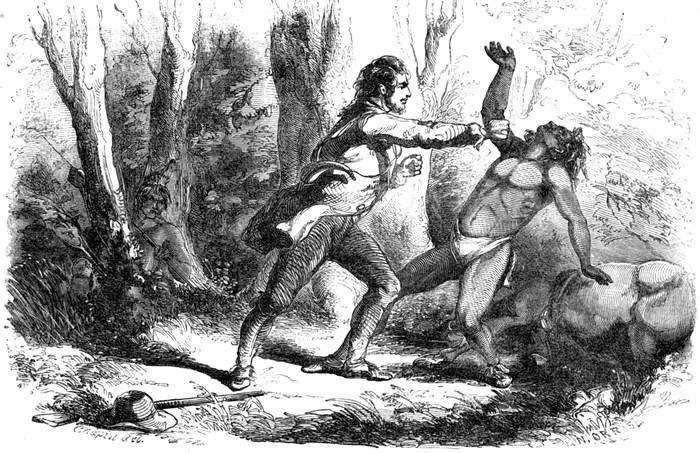
Big Joe Logston's Encounter with an Indian—Page 7.
67TALES,
Traditions and Romance
OF
BORDER AND REVOLUTIONARY TIMES.
BIG JOE LOGSTON.
DEBORAH, THE MAIDEN WARRIOR.
GEN. MORGAN'S PRAYER.
BRAVERY OF THE JOHNSON BOYS.
NEW YORK:
BEADLE AND COMPANY, PUBLISHERS,
118 WILLIAM STREET.
68Entered according to Act of Congress, in the year 1863, by
BEADLE AND COMPANY,
In the Clerk's Office of the District Court of the United States for
the Southern District of New York.
BIG JOE LOGSTON'S STRUGGLE WITH AN INDIAN.
69
We have plentiful stories of encounters between the white man and
the red, in which the fierce rivalry is contested with rifles, knives,
or the swift foot-race for life; but it is seldom we hear of a genuine
fist-fight between the hardy men of the forest and their implacable
foe. Only two or three such novel incidents occur in the history
of the Western border.
Joe Logston was one of the race of famous frontier men, the
"Hunters of Kentucky," whose exploits have been told in story and
sung in song. He could, to use his own words, "outrun, outhop,
outjump, throw down, drag out and whip any man in the country"—which
was saying a good deal for those days, when men like
Brady, Wetzel, M'Clelland, Adam Poe and Kenton sprung up to
face the dangers of the hour.
Joe was a powerful fellow of six foot three in his stockings, and
proportionately stout and muscular, with a handsome, good-natured
face, and a fist like a sledge-hammer. Fear was a word of which
he knew not the meaning, while to fight was his pastime, particularly
if his own scalp was the prize he fought for.
On one occasion he was mounted on his favorite pony, bound on
an expedition outside the fort. The pony was leisurely picking his
way along the trail, with his head down and half asleep, while his
rider was enjoying a feast on some wild grapes which he had
gathered as he passed along. Neither dreamed of danger, until the
crack of two rifles on either side the path killed the horse and
wounded the rider. A ball struck Joe, grazing the skin above
70the breast-bone, but without doing any material damage. The
other ball passed through his horse, just behind the saddle. In
an instant Joe found himself on his feet, grasping his trusty rifle,
which he had instinctively seized as he slipped to the ground, ready
for the foe. He might easily have escaped by running, as the guns
of the Indians were empty, and they could not begin to compete
with him in speed. But Joe was not one of that sort. He boasted
that he had never left a battle-field without making his "mark," and
he was not disposed to begin now. One of the savages sprung into
the path and made at him, but finding his antagonist prepared, he
"treed" again. Joe, knowing there were two of the varmints,
looked earnestly about him for the other, and soon discovered him
between two saplings, engaged in reloading his piece. The trees
were scarcely large enough to shield his person, and in pushing
down the ball, he exposed his hips, when Joe, quick as thought,
drew a bead, and firing, struck him in the exposed part. Now that
his rifle was empty, the big Indian who had first made his appearance,
rushed forward, feeling sure of his prey, and rejoicing in the
anticipated possession of the white man's scalp. Joe was not going
to resign this necessary and becoming covering to his head without
a struggle, and stood, calmly awaiting the savage, with his rifle
clubbed and his feet braced for a powerful blow. Perceiving this,
his foe halted within ten paces, and with all the vengeful force of a
vigorous arm, threw his tomahawk full at Joe's face. With the
rapidity of lightning it whirled through the air; but Joe, equally
quick in his movements, dodged it, suffering only a slight cut on the
left shoulder as it passed, when he "went in."
The Indian darted into the bushes, successfully dodging the blows
made at his head by the now enraged hunter, who, becoming excited
to madness at the failure of his previous efforts, gathered all his
strength for a final blow, which the cunning savage dodged as before,
while the rifle, which by this time had become reduced to the simple
barrel, struck a tree and flew out of Joe's hands at least ten feet
into the bushes.
The Indian sprung to his feet and confronted him. Both empty-handed,
they stood for a moment, measuring each the other's
strength; it was but a moment, for the blood was flowing freely
71from the wound in Joe's breast, and the other thinking him more
seriously wounded than he really was, and expecting to take advantage
of his weakness, closed with him, intending to throw him. In
this, however, he reckoned without his host. In less time than it
takes to recount it, he found himself at full length on his back, with
Joe on top. Slipping from under him with the agility of an eel
they were both on their feet again—and again closed. This time the
savage was more wary, but the same result followed—he was again
beneath his opponent. But having the advantage of Joe, in being
naked to his breech-cloth, and oiled from head to foot, he could easily
slip from the grasp of the hunter and resume his perpendicular.
Six different times was he thrown with the same effect; but victory—fickle
jade—seemed disposed to perch on the banner of neither of
the combatants. There were no admiring thousands looking on at
this exciting "mill"—no seconds to insist upon fairness and preserve
the rules of the ring—only one poor wounded spectator, and two
foes fighting not for fame but life.
By this time they had, in their struggles and contortions, returned
to the open path, and Joe resolved upon a change of tactics. He
was becoming sensibly weaker from loss of blood, while, on the
other hand, the savage seemed to lose none of his strength by the
many falls he had experienced. Closing again in a close hug, they
fell as before; this time, instead of endeavoring to keep his antagonist
down, Joe sprung at once to his feet, and, as his antagonist
came up, dealt him a blow with his fist between the eyes, which
felled him like an ox, at the same time falling with all his might
upon his body.
This was repeated every time he rose, and began to tell with fearful
effect upon the savage's body as well as his face, for Joe was no
light weight, and at every succeeding fall the Indian came up weaker,
seeming finally disposed to retreat; this his opponent decidedly objected
to; his "spunk was up;" he dealt his blows more rapidly,
until the savage lay apparently insensible at his feet. Falling upon
him, he grasped the Indian's throat with a grip like a vice, intending
to strangle him. He soon found that the savage was "playing possum,"
and that some movement was going forward, the purport of
which he could not immediately guess. Following with his eye the
72direction of the movement, Joe found that he was trying to disengage
his knife which was in his belt, but the handle of which was so
short that it had slipped down beyond reach, and he was working it
up by pressing on the point. Joe watched the effort with deep
interest, and when it was worked up sufficient for his purpose,
seized it, and with one powerful blow drove it to the owner's heart,
leaving him quivering in the agonies of death.
Springing to his feet the victor now bethought him of the other
red-skin, and looked around to discover him. He still lay, with his
back broken by Joe's ball, where he had fallen, and, having his
piece loaded, was trying to raise himself upright to fire it; but every
time he brought it to his shoulder he would tumble forward and
have again to renew the effort. Concluding that he had had enough
fighting for exercise, and knowing that the wounded Indian could
not escape, Joe took his way to the fort.
Although he presented a frightful sight when he reached there—his
clothes being torn nearly from his person, which was covered
with blood and dirt from his head to his feet—yet his account was
hardly believed by some of his comrades, who thought it one of
Joe's "big stories," which had the reputation of being as big as himself,
though not half so well authenticated. "Go and satisfy yourselves,"
said he; and a party started for the battle-ground, where
their suppositions were confirmed, as there were no Indians about,
and no evidence of them, except Joe's dead horse in the path. On
looking carefully about, however, they discovered a trail which led a
little way into the bushes, where they discovered the body of the
big Indian buried under the dead leaves by the side of a stump.
Following on, they found the corpse of the second, with his own
knife thrust into his heart and his grasp still upon it, to show that
he died by his own hand. Nowhere could they discover the knife
with which Joe had killed the big Indian. They found it at last,
thrust into the ground, where it had been forced by the heel of his
wounded companion, who must have suffered the most intense agony
while endeavoring to hide all traces of the white man's victory.
Joe got the credit for his story, while his comrades universally
lamented that they had not been spectators of this pugilistic encounter
between "big Indian" and "big Joe."
73Another one of the forest scenes which stand out so vividly in
pictures of American life, occurs to us. It is unique in its character,
and will excite a smile, as well as a feeling of admiration for the
tact and courage which enacted it.
In the early part of the Revolutionary war, a sargeant and
twelve armed men undertook a journey through the wilderness, in
the State of New Hampshire. Their route was remote from any
settlements, and they were under the necessity of encamping over
night in the woods. Nothing material happened the first day of
their excursion; but early in the afternoon of the second, they, from
an eminence, discovered a body of armed Indians advancing toward
them, whose number rather exceeded their own. As soon as the
whites were perceived by their red brethren, the latter made signals,
and the two parties approached each other in an amicable manner.
The Indians appeared to be much gratified with meeting the sargeant
and his men, whom they observed they considered as their protectors;
said they belonged to a tribe which had raised the hatchet
with zeal in the cause of liberty, and were determined to do all in
their power to repel the common enemy. They shook hands in
friendship, and it was, "How d'ye do, pro, how d'ye do, pro," that
being their pronunciation of the word brother. When they had
conversed with each other for some time, and exchanged mutual
good wishes, they at length separated, and each party traveled in a
different direction. After proceeding to the distance of a mile or
more, the sargeant, who was acquainted with all the different tribes,
and knew on which side of the contest they were respectively ranked,
halted his men and addressed them in the following words:
"My brave companions, we must use the utmost caution, or this
night may be our last. Should we not make some extraordinary
exertions to defend ourselves, to-morrow's sun may find us sleeping
never to wake. You are surprised, comrades, at my words, and
your anxiety will not be lessened, when I inform you, that we have
just passed our most inveterate foe, who, under the mask of pretended
friendship you have witnessed, would lull us to security, and
by such means, in the unguarded moments of our midnight slumber,
without resistance, seal our fate."
The men with astonishment listened to this short harangue; and
74their surprise was greater, as not one of them had entertained the
suspicion but they had just encountered friends. They all immediately
resolved to enter into some scheme for their mutual preservation
and destruction of their enemies. By the proposal of their
leader, the following plan was adopted and executed:
The spot selected for their night's encampment was near a
stream of water, which served to cover their rear. They felled a
large tree, before which on the approach of night, a brilliant fire was
lighted. Each individual cut a log of wood about the size of his
body, rolled it nicely in his blanket, placed his hat upon the extremity,
and laid it before the fire, that the enemy might be deceived,
and mistake it for a man. After logs equal in number to the sargeant's
party were thus fitted out, and so artfully arranged that they
might be easily mistaken for so many soldiers, the men with loaded
muskets placed themselves behind the fallen tree, by which time the
shades of evening began to close around. The fire was supplied in
fuel, and kept burning brilliantly until late in the evening, when it
was suffered to decline. The critical time was now approaching,
when an attack might be expected from the Indians; but the sargeant's
men rested in their place of concealment with great anxiety
till near midnight, without perceiving any movement of the enemy.
At length a tall Indian was discovered through the glimmering
of the fire, cautiously moving toward them, making no noise, and
apparently using every means in his power to conceal himself from
any one about the camp. For a time his actions showed him to be
suspicious that a guard might be stationed to watch any unusual
appearance, who would give the alarm in case of danger; but all
appearing quiet, he ventured forward more boldly, rested upon his
toes, and was distinctly seen to move his finger as he numbered each
log of wood, or what he supposed to be a human being quietly enjoying
repose. To satisfy himself more fully as to the number, he
counted them over a second time, and cautiously retired. He was
succeeded by another Indian, who went through the same movements,
and retired in the same manner. Soon after the whole party,
sixteen in number, were discovered approaching, and greedily eyeing
their supposed victims. The feelings of the sargeant's men can
better be imagined than described, when they saw the base and cruel
75purpose of their enemies, who were now so near that they could
scarcely be restrained from firing upon them. The plan, however,
of the sargeant, was to have his men remain silent in their places of
concealment till the muskets of the savages were discharged, that
their own fire might be more effectual, and opposition less formidable.
Their suspense was not of long duration. The Indians, in a
body, cautiously approached, till within a short distance; they then
halted, took deliberate aim, discharged their pieces upon inanimate
logs, gave the dreadful war-whoop, and instantly rushed forward with
tomahawk and scalping-knife in hand, to dispatch the living, and
obtain the scalps of the dead. As soon as they had collected in
close order, more effectually to execute their horrid intentions, the
party of the sargeant, with unerring aim, discharged their pieces, not
on logs of wood, but perfidious savages, not one of whom escaped
destruction by the snare into which they led themselves.
There must have been a touch of grim humor about that sargeant
as well as of cool courage.
Many instances are on record of those days of danger—where
either in battle or in the settlement of new countries, the cruel and
crafty red-man had to be encountered—where the minds of men have
been thrown from their balance by the sight of barbarities, or the
suffering of afflictions, which overthrow their shuddering reasons.
Some men have been called monomaniacs, from the fact of their restless
and rankling hatred of the race who had inflicted some great
misery upon them or theirs. But it is hardly strange that when
they saw those savages behave worse than tigers, they decided to
treat them like wild beasts, and that they were justified in the
attempt to exterminate them. There must be men in Minnesota, at
this day, who are monomaniacs on the subject of the red-skins. One
of the most noted of these Indian haters was John Moredock, of
Kentucky; and these are the circumstances which made him so, as
given in a fine paper on the early settlers, in Harper's Magazine for
1861:
Toward the end of the last century there lived at Vincennes a
woman whose whole life had been spent on the frontier. She had
been widowed four or five times by the Indians; her last husband,
76whose name was Moredock, had been killed a few years before the
time of which we speak. But she had managed to bring up a large
family in a respectable manner. Now, when her sons were growing
up, she resolved to better their condition by moving "West." The
whole of Illinois was a blooming waste of prairie land, except in a
few places where stood the trading-posts built a hundred years before
by the French.
The lower peninsula of Illinois was not of a nature to attract
emigrants when so much finer lands were to be found on the banks
of the Great River and its tributaries; nor was a land journey over
that marshy region, infested as it was by roving bands of savages, to
be lightly undertaken, when the two rivers furnished a so much more
easy though circuitous way to the delightful region beyond. Hence
it was usual for a company of those intending to make the journey
to purchase a sufficient number of pirogues, or keel-boats, in them
descend the Ohio, and then ascend the Mississippi to the mouth of
the Kaskaskia, or any other destined point. By adopting this mode
of traveling all serious danger of Indian attacks was avoided, except
at one or two points on the latter stream, where it was necessary to
land and draw the boats around certain obstructions in the channel.
To one of these companies the Moredock family joined itself—several
of the sons being sufficiently well-grown to take a part not
only in the ordinary labors of the voyage but in any conflict that
might occur. All went well with the expedition until they reached
the rock known as the "Grand Tower" on the Mississippi, almost
within sight of their destination. Here, supposing themselves to be
out of danger, the men carelessly leaped on shore to drag the boats
up against the current, which here rushed violently around the base
of the cliff. The women and children, fifteen or twenty in number,
tired of being cooped in the narrow cabins for three or four weeks,
thoughtlessly followed. While the whole party were thus making
their way slowly along the narrow space between the perpendicular
precipice on one hand, the well-known yell of savage onset rung in
their ears, and a volley of rifles from above stretched half a dozen
of the number dead in their midst, while almost at the same moment
a band of the painted demons appeared at each end of the
fatal pass. The experienced border men, who saw at a glance that
77their condition was hopeless, stood for one moment overwhelmed
with consternation; but in the next the spirit of the true Indian
fighter awoke within their hearts, and they faced their assailants
with hopeless but desperate valor.
The conflict that ensued was only a repetition of the scene which
the rivers and woods of the West had witnessed a thousand times
before, in which all the boasted strength and intelligence of the
whites had been baffled by the superior cunning of the red-men.
"Battle Rock," "Murder Creek," "Bloody Run," and hundreds of
similar names scattered throughout our land, are but so many characters
in that stern epitaph which the aborigines, during their slow
retreat across the continent toward the Rocky Mountains, and annihilation,
have written for themselves in the blood of the destroying
race. The history of Indian warfare contains no passage more fearful
than is to be found in the narrative of the massacre at the Grand
Tower of the Mississippi. Half armed, surprised, encumbered with
their women and children, and taken in so disadvantageous a situation,
being all huddled together on a narrow sand-beach, with their
enemies above and on either side, their most desperate efforts availed
not even to postpone their fate; and in the space of ten minutes
after the warning yell was heard, the mangled bodies of forty men,
women and children lay heaped upon the narrow strip of sand. The
conflict had ended in the complete destruction of the emigrant company—so
complete that the savages imagined not a single survivor
remained to carry the disastrous tidings to the settlements.
But one such wretched survivor, however, there was. John
Moredock, who, having fought like a young tiger until all hope of
saving even a part of the unfortunate company was lost, and who
then, favored by the smoke, and the eagerness of the assailants for
scalps, and the plunder of the boats, glided through the midst of the
savages and nestled himself in a cleft of the rocks. Here he lay for
hours, sole spectator of a scene of Indian ferocity which transformed
his young heart to flint, and awoke that thirst for revenge which
continued to form the ruling sentiment of his future life, and which
raged as insatiably on the day of his death, forty years later, when
he had become a man of mark, holding high offices in his adopted
State, as it did when crouching among the rocks of the Grand
78Tower; and, beholding the bodies of his mother, sisters and brothers
mangled by the Indian tomahawk, he bound himself by a solemn
oath never from that moment to spare one of the accursed race who
might come within reach of his arm; and especially to track the
footsteps of the marauding band who had just swept away all that
he loved on earth, until the last one should have paid the penalty of
life for life.
How long he remained thus concealed he never knew; but at
length, as the sun was setting, the Indians departed, and John Moredock
stepped forth from his hiding-place, not what he had entered
it, a brave, light-hearted lad of nineteen, the pride of a large family
circle and the favorite of a whole little colony of borderers, but an
orphan and an utter stranger in a strange land, standing alone amidst
the ghastly and disfigured corpses of his family and friends. He
had hoped to find some life still lingering amidst the heaps of carnage;
but all, all had perished. Having satisfied himself of this
fact, the lonely boy—now transformed into that most fearful of all
beings, a thoroughly desperate man—quitted the place, and, guiding
himself by the stars, struck across the prairie toward the nearest
settlement on the Kaskaskia, where he arrived the next morning,
bringing to the inhabitants the first news of the massacre which had
taken place so near their own village, and the first warning of the
near approach of the prowling band which had been for several
months depredating, at various points along that exposed frontier,
in spite of the treaties lately made by their nations with the Federal
Government.
John Moredock was by nature formed for a leader in times of
danger, and his avowed determination to revenge the massacre of
his friends and kindred by the extirpation of the murderous band
coincided so exactly with the feelings of the frontiersmen, that, in
spite of his lack of previous acquaintance, he in a few days found
himself at the head of a company of twenty-five or thirty young
men, whose lives had been spent in the midst of all kinds of perils
and hardships, and who now bound themselves to their leader by an
oath never to give up the pursuit until the last one of the marauding
band engaged in the attack at Grand Tower should be slain.
Stanch as a pack of blood-hounds this little company of avengers
79ranged the frontier from the Des Moines to the Ohio, now almost
within reach of their victims, and now losing all trace of them on
the boundless prairies over which they roamed, unconscious of the
doom by which they were being so hotly but stealthily pursued.
Once, indeed, the whites came up with their game on the banks of a
tributary of the Missouri, a hundred and fifty miles beyond the utmost
line of the settlements; but as the Indians, though unsuspicious
of any particular danger, had pitched their camp in a spot at
once easy to defend and to escape from, and as Moredock wished to
destroy and not to disperse them, he forbore striking a partial blow,
and resolved rather to postpone his revenge than to enjoy it incompletely.
Fortune, however, seemed to repay him for this act of self-restraint
by presenting the very opportunity he had sought, when, a few
weeks afterward, he discovered the whole gang of marauders encamped
for the night on a small island in the middle of the Mississippi.
After a hasty consultation with his companions, a course of
procedure was determined upon which strikingly displays both the
monomaniacal tendency of the leader and the desperate ascendancy
he had acquired over his followers. This was nothing less than to
shut themselves up on that narrow sand-bar and to engage the savages
in a hand-to-hand conflict—a conflict from which neither party
could retreat, and which must necessarily end in the total destruction
of one or the other. A most desperate undertaking truly, when
we reflect that the numbers of the combatants were about equal, and
that to surprise an Indian encampment was next to impossible. But
John Moredock, and, probably, more than one of his companions,
were monomaniacs, and considerations of personal danger never entered
into their calculations. Revenge, not safety, was their object,
and they took little thought of the latter when the opportunity of
compassing the former was presented.
Slowly and stealthily, therefore, the canoes approached the island
when all sounds there had ceased, and the flame of the camp-fire
had sunk into a pale-red glow, barely marking the position of the
doomed party among the undergrowth with which the central portion
of the little isle was covered. The Indians, confiding in their
natural watchfulness, seldom place sentinels around their camps; and
80thus Moredock and his band reached the island without being discovered.
A few moments sufficed to set their own canoes as well
as those of the Indians adrift, and then, with gun in hand and tomahawk
ready, they glided noiselessly, as so many panthers, into the
thicket, separating as they advanced so as to approach the camp
from different quarters. All remained still as death for many minutes
while the assailants were thus closing in around their prey, and
not a twig snapped, and scarcely a leaf stirred in the thick jungle
through which thirty armed men were making their way in as many
different directions, but all converging toward the same point, where
a pale glimmer indicated the position of the unsuspected savages.
But though an Indian camp may be easily approached within a certain
distance, it is almost impossible, if there be any considerable
number of them, to actually strike its occupants while asleep. As
savages, roaming at large over the face of the continent without
fixed habitations, and relying upon chance for the supply of their
few wants, they know nothing of that regularity of habit which devotes
certain fixed portions of time to the various purposes of life,
but each one eats, sleeps or watches, just as his own feelings may
dictate at the moment, without any regard to established usages of
time or place. Hence the probability of finding all the members of
an Indian party asleep at the same time is small indeed.
On the present occasion two or three warriors, who were smoking
over the embers, caught the alarm before the assailants had quite
closed in. Still the surprise gave the white men a great advantage,
and half a dozen of the savages were shot down in their tracks before
they comprehended the meaning of the hideous uproar, which
suddenly broke the midnight stillness as Moredock and his company,
finding their approach discovered, rushed in upon them. This fatal
effect of the first volley was a lucky thing for the adventurers; for
the Indians are less liable to panics than almost any other people,
and they closed with their assailants with a fury that, combined
with their superior skill in nocturnal conflict, would have rendered
the issue of the struggle a very doubtful matter had the number of
combatants been more nearly even. As it was, the nimble warriors
fought their way against all odds to the point where their canoes
had been moored. Here, finding their expected means of flight
81removed, and exposed upon the naked sand-beach, the survivors still
made desperate battle until all were slain except three, who plunged
boldly into the stream, and, aided by the darkness, succeeded in
reaching the main land in safety.
Twenty-seven of those engaged in the massacre at the Grand
Tower had been destroyed at a single blow. But three had escaped
from the bloody trap, and while these lived the vengeance of John
Moredock was unsatisfied. They must perish, and he determined
that it should be by his own hand. He therefore dismissed his
faithful band, and thenceforth continued the pursuit alone. Having
learned the names of the three survivors he easily tracked them
from place to place, as they roamed about in a circuit of three or
four hundred miles. Had the wretches known what avenger of
blood was thus dogging their tracks, the whole extent of the continent
would not have afforded space enough for their flight, or its
most retired nook a sufficiently secure retreat. But quite as relentless
Moredock pursued his purpose, and but few even of his acquaintances
knew the motive of his ceaseless journey along the frontiers
from Green Bay to the mouth of the Ohio, and far into the unsettled
wastes beyond the Mississippi.
At length, about two years after the massacre of his family at the
Tower, he returned to Kaskaskia, having completed his terrible task,
and bearing the scalp of the last of the murderers at his girdle.
Moredock lived to be a popular and leading man in his State, an
office-holder, a kind neighbor and beloved head of a family, yet he
never relaxed in his hatred of the race who had poisoned the fountain
of youthful hope for him.
DEBORAH SAMPSON, THE MAIDEN WARRIOR.
82
There comes to us, from the days of chivalry, in song and story,
legends of ladies who followed their lords to the distant field of
Palestine, hiding their soft hearts under the disguise of the page's
dress. Time, the romancer, has thrown his enchanting vail over
their adventures, surrounding them with the grace of mystery and
the glory of sentiment.
Perhaps in the far-away future of our immortal republic, young
men and maidens will dream over the story of Deborah Sampson,
the girl-soldier of that Revolution which won us our liberties. It
will not be said that she donned the uniform and shouldered the
musket for the sake of some dear lover, that she might ever be near to
watch over him in the hour of danger, and to nurse him if wounded,
with all the tender solicitude of woman's love; but it will be told
that she went into the service of her country because men were few
and her heart was in the cause. She had health and courage, and
that high patriotism which burned alike in manly and feminine
breasts. That she was brave, is proven by her being twice wounded
in battle. There is no need of putting any other construction than
that of pure patriotism upon her actions; the steadiness with which
she performed her duties show that it was no wild love of adventure
which possessed her.
Deborah Sampson was born in the county of Plymouth, Massachusetts.
Her parents were poor and vicious, and their children
were taken from them by the hand of charity, to be placed with different
families, where there was a prospect of their being better cared
for. Deborah found a home with a respectable farmer, by whom she
was treated as one of the family, except in the matter of education.
To overcome this deprivation she used to borrow the books of school
children, over which she pored until she learned to read tolerably
well. This simple fact reveals that her mind was no ordinary
one. She was a true child of New England, ambitious to be
83the equal of those by whom she was surrounded, and looking upon
ignorance almost as degradation. Many of our now famous minds
began their culture in this humble way, by the side of the kitchen
fire, perhaps with a pine-torch, by the light of which to pursue their
eager groping after knowledge.
As soon as the completion of her eighteenth year released her
from indenture, she hastened to seek a situation in which to improve
herself, and made arrangements with a family to work one-half her
time for her board and lodging, while, during the other half, she
attended the district-school. Her improvement was so rapid, that in
a comparatively short space of time she was thought competent to
teach, and by doing so for one term, the ambitious girl amassed the
sum of twelve dollars! In all this we see the remarkable energy
and force of character which enabled her to carry out the career she
afterward chose. The young bound-girl who so soon would raise
herself to the position of teacher, must have had in her elements,
which, had she been a man, would have urged her to the performance
of deeds that would have given her prominence in those stirring
days.
While Deborah was teaching her little summer school, the spirit
of resistance to tyranny which long had struggled toward the light,
burst forth over the whole country, never to be hid again. The
first battle had been fought at Lexington; the sound of the cannon
had rolled from Bunker Hill in echoes which would not die. They
thrilled and trembled along the air, in never-ending vibrations, smiting
the ears of patriots, and rousing their hearts to the duties and
perils of the hour. Deborah, in her little schoolroom, heard the
sound. For her it had a peculiar message; it called her—she could
not resist! Something in her courageous breast told her that she
was as well fitted to serve her beloved country as the young men,
who, with kindling eyes and eager feet, were rushing to its assistance.
Walking slowly home from her school, along the lonely road,
looking out at night from the little window of her chamber at the
stars, she pondered the voice in her heart. The more she thought,
the more earnest she became in her desire. There was no reason
why she should silence the resolution which called her. She was
accountable to none; was friendless, without kindred or home. Why
84was she given this vigorous and healthy frame, and this heroic heart,
if not for the service of her suffering country? Perhaps Providence
had loosened her from other ties, that she might attach herself solely
to this holy cause. With such arguments as these she quieted the
timidity which arose solely from maidenly fears that she might be
detected in her plans, and subjected to the embarrassment of being
refused or ridiculed on account of her sex.
With that humble wealth of twelve dollars she purchased the materials
for a suit of men's clothing. Upon the cloth she worked
secretly, as she found the opportunity, each article, upon completion,
being hidden in a stack of hay. When her arrangements
were completed she announced a determination to seek better wages,
and took her departure, without her real purpose being suspected.
When far enough away to feel secure, she donned her male attire,
and pursued her way to the American army, where she presented
herself in October, 1778, as a young man anxious to join his efforts
to those of his countrymen in their endeavors to oppose the common
enemy. She is described as being, at this time, of very prepossessing
features, and intelligent, animated expression, with a fine, tall form,
and such an air of modest courage and freshness as inspired confidence
and respect in those who had become associated with her.
She was gladly received, as a promising recruit, and enrolled in the
army under the name of Robert Shirtliffe, the period of her enlistment
being for the war.
While the company was recruiting she was an inmate of the Captain's
family, and, by her exemplary conduct, won the esteem of all.
A young girl, visiting in the family, was much in the company of
young "Robert;" and, being of a coquettish disposition—priding
herself, perhaps, on the conquest of the young soldier—she suffered
her partiality to be noticed. "Robert," having no objections to see
how easily a maiden's heart could be won, encouraged the feeling,
until the Captain's wife, becoming alarmed, took occasion to remonstrate
with the youth upon the subject. "Robert" took the matter
in good part, and the affair ended in the exchange of some few
tokens of remembrance at parting.
At the end of six or seven weeks, the company being full, was
ordered to join the main army, and Deborah's military life
85commenced in earnest. The record does not give all the details of her
career, though the record of a life in camp and on the field, under
such circumstances, must be full of interest. She herself has said
that volumes might be filled with her adventures. She performed
her duties to the entire satisfaction of her officers; was a volunteer
on several expeditions of a hazardous nature, and was twice wounded
severely; the first time by a sword-cut on the side of her head, and
the second by a bullet-wound through the shoulder. She served
three years, and, during all that time, her sex never was suspected,
though often in circumstances where detection seemed unavoidable.
The soldiers nicknamed her "Molly," in playful allusion to her want
of a beard; but little did they suspect that their gallant comrade
was, indeed, a woman.
The last wound which she received, of a bullet through her
shoulder, gave her great uneasiness, for fear that the surgeon, upon
dressing it, would discover the deception which had been so long
and so successfully practiced. She always described the emotion,
when the ball entered, to be one of mental, not of physical anguish—a
sickening terror at the probability of her sex being revealed. She
felt that death on the battle-field would be preferable to the shame
she would suffer in such a case, and prayed rather to die than to be
betrayed. Strange as it may appear, she again escaped undetected.
Recovering rapidly, she soon resumed her place in the ranks, as
brave and willing as ever.
Sickness, however, was destined to bring about the catastrophe
which the perils of the battle-field had never precipitated. She was
seized with brain fever, then prevailing among the soldiers. For the
few days that reason struggled with the disease her sufferings were
great; and these were intensely aggravated by her mental anxiety—that
ever-present fear, lest, during her unconsciousness, her carefully-guarded
secret should become known. She was carried to the hospital,
where the number of the patients and the negligent manner in
which they were attended still secured her escape. Her case was
considered hopeless, on which account she received still less attention.
She continued to sink, until consciousness was gone, and life
itself trembled on the faintest breath which ever held it.
One day, the surgeon of the hospital inquiring "how Robert
86was?" received assurance from the nurse that "poor Bob was gone."
Going to the bed, and taking the wrist of the youth, he found the
pulse still feebly beating. Attempting to place his hand on the
heart, he found a bandage bound tightly over the breast. Then it
was that the secret of the girl-soldier became known to the physician;
but if she had been his own daughter he could not have
guarded it more delicately. Deborah had fallen into good hands, in
this crisis of her affairs.
It was Dr. Birney, of Philadelphia, who was then in attendance at
the hospital. Without communicating his discovery to any one, he
gave his patient such care that she was raised from the grave, as it
were; and when sufficiently recovered to be removed, he had her
conveyed to his own house, where she was the recipient of every
kind attention from the family as long as she remained an invalid.
And now occurred another of those romantic episodes which give
an interest to the history of our hero-heroine. If Deborah Sampson
had indeed been the "Robert" she professed to be, she would have
been a favorite with the softer sex; since, without her seeking it,
twice the affections of fair maidens were laid at her feet. We may
conjecture, to the credit of the fair sex, that the purity and modesty
of "Robert"—his unassuming excellence and womanly goodness, had
much to do with success in this line.
A niece of the doctor's, a young and wealthy lady, became interested
in the youth whom she had aided in restoring to health, by
her attentions. "Pity," which is "akin to love," gradually melted
into that warmer feeling. The modest and handsome young man,
who shrunk from taking the slightest advantage of her kindness,
aroused all the compassion and sensibility of her heart. Lovely and
young, conscious that many, more influential than he, would be
honored to sue for her hand, she yet allowed her affections to turn
to the pale and unassuming, the humble and poor, soldier. The
uncle was warned of his imprudence in allowing the young couple
to be so much together, but he laughed in his sleeve at such suggestions,
tickling his fancy with the idea of how foolish the censorious
would feel when the truth should be made known. He had not
confided his knowledge even to the members of his own family. It
is not probable that he really believed his niece's feelings were
87becoming so warmly interested, or he would have given her a sufficient
caution; she was allowed to be with the convalescent as much
as she liked.
At first the heart of "Robert" opened to this innocent and lovely
girl, whom she loved as a sister, and whose gentle kindness was so
winning; she showed the gratitude which she felt, and perhaps even
confided to her some of the lonely emotions which had so long
remained unspoken in her breast; but it was not long before the
young soldier, warned by past experience, felt apprehensive of the
return of affection which she received, and strove, delicately, to
withdraw from the painful position in which she was being placed.
Taking this shrinking embarrassment for the sensitive modesty of
one who, friendless and poor, dared not aspire to the hand of one so
much above him in social position, the fair heiress, trusting the
evident goodness of his heart, and actuated alike by love and the
noblest generosity, made known her attachment to "Robert," and
signified her willingness to furnish him the means of fitting himself
for such a station, and then to marry him.
When Deborah beheld this guileless young creature, with blushes
and tears, making this unexpected and unwelcome avowal, she felt,
with bitter pain, the position in which she was placed. Then she
wished that she indeed was the Robert Shirtliffe she had assumed to
be, rather than wound the feelings of one to whom she was so much
indebted, by a refusal of what had been so timidly offered. Yet to
reveal her true character would be still more awkward and painful.
The wounded sensibility of the young girl did not, in that hour,
cause her so much suffering, as the remorse and regret of the false
"Robert" caused him.
Saying that they should meet again, and that, though ardently
desiring an education, she could not accept her noble offer, Deborah
endeavored to hurt the sensitive girl as little as possible, while withdrawing
from the dilemma in which she was placed. Shortly after,
she departed, taking with her several articles of clothing, such as in
those days were frequent gifts to the soldiers from the hands of fair
women, and which were pressed upon her acceptance by the young
lady.
The denouement rapidly followed her recovery. The physician
88had a conference with the commanding officer of the company with
which Robert had served, which was followed by an order to the
youth to carry a letter to General Washington. She now became
aware, for the first time, that her secret was known, and that detection
was no longer avoidable. She had suspected that Dr. Birney
knew more than he had given intimation of, but her most anxious
scrutiny of his words and countenance had never assured her of the
truth of her fears. Now that the worst was come, she had no way
but to meet it with that courage which was a part of her nature.
Yet she would rather have faced the fire of the British cannon than
to have confronted Washington with that letter in her hand.
Trembling and confused, she presented herself before the Commander-in-Chief,
who, noticing her extreme agitation, with his usual
kindness endeavored to restore her confidence; but finding her still
so abashed, bade her retire with an attendant, who was ordered to
procure her some refreshment, while the General read the letter of
which she had been the bearer.
When she was recalled to his presence, he silently put into her
hand a discharge from service, along with a brief note of advice, and
a sum of money sufficient to bear her to some place where she
might find a home. Very glad and grateful was she to escape thus
unrebuked out of that presence.
After the war she married; and while Washington was President
she paid a visit to the seat of Government on his invitation. She
was received with every attention. Congress was then in session,
and passed a bill granting her a pension for life. She lived in
comfortable circumstances, passing from the stage of human life at an
advanced age.
It is probable that, after several generations of historians, poets
and romance writers have embellished the story of Deborah Sampson,
she will become invested, to the eyes of our descendants, with
a glory like that which encircles the memory of the Maid of Orleans.
There is an incident of a most romantic and touching nature,
connected with the history of the brave Sergeant Jasper, of Marion's
brigade. A young girl, in this instance, followed the fortunes of
war, not out of patriotic motives, like those which inspired Deborah
Sampson, but impelled by a love which no wildest romance of the
olden time can more than match. The page who drew the poison
from her lover's wound, on the distant plains of the Holy Land,
proved not so devoted as this young American girl, throwing her
tender bosom between Jasper's heart and death.
89
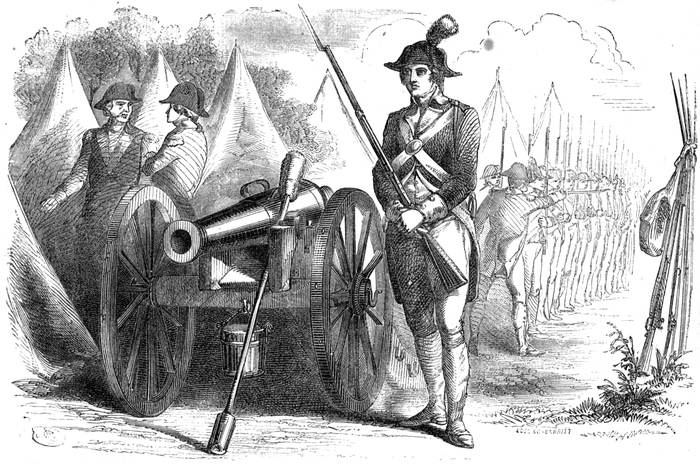
Deborah Sampson, the Maiden Warrior.
91Sergeant Jasper was one of the bravest of Marion's men, possessing
remarkable talents as a scout, and often chosen for such expeditions.
He was one of those of whom Bryant says:
"Our band is few, but true and tried,
Our leader frank and bold;
The British soldier trembles
When Marion's name is told.
Our fortress is the good greenwood,
Our tent the cypress tree;
We know the forest 'round us,
As seamen know the sea.
We know its walls of thorny vines,
Its glades of reedy grass,
Its safe and silent islands
Within the dark morass."
Sometime just before, or about the beginning of the war, Jasper
had the good fortune to save the life of a young, beautiful, and dark-eyed
Creole girl, called Sally St. Clair. Her susceptible nature was
overcome with gratitude to her preserver, and this soon ripened into
a passion of love, of the most deep and fervent kind. She lavished
upon him the whole wealth of her affections, and the whole depths
of a passion nurtured by a Southern sun. When he was called upon
to join the ranks of his country's defenders, the prospect of their
separation almost maddened her. Their parting came, but scarcely
was she left alone, ere her romantic nature prompted the means of
a reunion. Once resolved, no consideration of danger could dampen
her spirit, and no thought of consequences could move her purpose.
She severed her long and jetty ringlets, and provided herself with
male attire. In these she robed herself, and set forth to follow the
fortunes of her lover.
A smooth-faced, beautiful and delicate stripling appeared among
the hardy, rough and giant frames who composed the corps to
which Jasper belonged. The contrast between the stripling and
these men, in their uncouth garbs, their massive faces, embrowned
and discolored by sun and rain, was indeed striking. But none
92were more eager for the battle, or so indifferent to fatigue, as the
fair-faced boy. It was found that his energy of character, resolution
and courage amply supplied his lack of physique. None ever suspected
him to be a woman. Not even Jasper himself, although she
was often by his side, penetrated her disguise.
The romance of her situation increased the fervor of her passion.
It was her delight to reflect that, unknown to him, she was by his
side, watching over him in the hour of danger. She fed her passion
by gazing upon him in the hour of slumber, hovering near him when
stealing through the swamp and thicket, and being always ready to
avert danger from his head.
But gradually there stole a melancholy presentiment over the poor
girl's mind. She had been tortured with hopes deferred; the war
was prolonged, and the prospect of being restored to him grew more
and more uncertain. But now she felt that her dream of happiness
could never be realized. She became convinced that death was
about to snatch her away from his side, but she prayed that she
might die, and he never know to what length the violence of her
passion led her.
It was an eve before a battle. The camp had sunk into repose.
The watch-fires were burning low, and only the slow tread of sentinels
fell upon the profound silence of the night air, as they moved
through the dark shadows of the forest. Stretched upon the ground,
with no other couch than a blanket, reposed the warlike form of
Jasper. Climbing vines trailed themselves into a canopy above his
head, through which the stars shone down softly. The faint flicker
from the expiring embers of a fire fell athwart his countenance, and
tinged the cheek of one who bent above his couch. It was the
smooth-faced stripling. She bent low down as if to listen to his
dreams, or to breathe into his soul pleasant visions of love and happiness.
But tears trace themselves down the fair one's cheek, and
fall silently but rapidly upon the brow of her lover. A mysterious
voice has told her that the hour of parting has come; that to-morrow
her destiny is consummated. There is one last, long, lingering look,
and then the unhappy maid is seen to tear herself away from the
spot, to weep out her sorrows in privacy.
Fierce and terrible is the conflict that on the morrow rages on
93that spot. Foremost in the battle is the intrepid Jasper, and ever
by his side fights the stripling warrior. Often during the heat and
the smoke, gleams suddenly upon the eyes of Jasper the melancholy
face of the maiden. In the thickest of the fight, surrounded by
enemies, the lovers fight side by side. Suddenly a lance is leveled
at the breast of Jasper; but swifter than the lance is Sally St. Clair.
There is a wild cry, and at the feet of Jasper sinks the maiden, with
the life-blood gushing from the white bosom, which had been thrown,
as a shield, before his breast. He heeds not now the din, nor the
danger of the conflict, but down by the side of the dying boy he
kneels. Then for the first time does he learn that the stripling is
his love; that often by the camp-fire, and in the swamp, she had
been by his side; that the dim visions, in his slumber, of an angel
face hovering above him, had indeed been true. In the midst of the
battle, with her lover by her side, and the barb still in her bosom,
the heroic maiden dies!
Her name, her sex, and her noble devotion soon became known
through the corps. There was a tearful group gathered around her
grave; there was not one of those hardy warriors who did not
bedew her grave with tears. They buried her near the river
Santee, "in a green, shady nook, that looked as if it had been stolen
out of Paradise."
The women of the Revolution won a noble name by the part they
took in the conflict which has secured for their descendants so glorious
an inheritance. Privations of all kinds they endured patiently,
joyfully sending their dearest ones to the field, while they remained
in their lonely homes, deprived of the care and society of fathers and
sons; finding their pleasantest relief from the heart-ache of grief and
suspense in labors at the loom or with the needle for the benefit of
the ill-provided soldiers.
Many individual instances of female heroism are preserved, where
the bravery of naturally timid hearts was tested in exposure to the
rudest vicissitudes of war. They played the parts of spies, messengers,
and defenders. Among other anecdotes we have one of a
young girl of North Carolina. At the time General Greene retreated
before Lord Rawdon from Ninety-Six, when he had passed Broad
River, he was very desirous to send an order to General Sumter,
94who was on the Wateree, to join him, that they might attack Rawdon,
who had divided his force. But the General could find no
man in that portion of the State who was bold enough to undertake
so dangerous a mission. The country to be passed through for
many miles was full of bloodthirsty Tories, who, on every occasion
that offered, imbrued their hands in the blood of the Whigs. At
length this young girl, Emily Geiger, presented herself to General
Greene, proposing to act as his messenger, and he, both surprised
and delighted, closed with her proposal. He accordingly wrote a
letter and delivered it, while, at the same time, he communicated
the contents of it verbally, to be told to Sumter, in case of accident.
She started off on horseback, and on the second day of her journey
was intercepted by Lord Rawdon's scouts. Coming from the
direction of Greene's army, and not being able to tell an untruth
without blushing, Emily was suspected and confined to a room; but
as the officer in command had the delicacy not to search her at the
time, he sent for an old Tory matron to perform the duty. Emily
was not wanting in expedient; as soon as the door was closed, and
the bustle a little subsided, she ate up the letter, piece by piece. After
a while the matron arrived, who found nothing of a suspicious nature
about the prisoner, though she made a careful search, and the young
girl would disclose nothing. Suspicion being thus allayed, the
officer commanding the scouts suffered Emily to depart whither she
said she was bound; she took a circuitous route to avoid further
detection, soon after striking into the road which led to Sumter's
camp, where she arrived in safety. Here she told her adventure and
delivered Greene's verbal message to Sumter, who, in consequence,
soon after joined the main army at Orangeburg. This young
heroine afterward married a rich planter, named Therwits, who lived
on the Congaree.
A similar adventure is related of Miss Moore, daughter of Captain
Moore, who was present at Braddock's defeat, and who died in 1770.
This girl was also a "daughter of the Carolinas." Alas, that the
fair descendants of women so brave as these, should aid in imperiling
the country and the cause for which their mothers sacrificed and
suffered so much!
Her youth was passed among the eventful scenes of our Revolution,
95and a number of incidents are related, that go to prove her calm
courage, and her inflexibility of purpose. She was born in 1764,
and, therefore, in the earlier part of the contest was nothing more
than a child.
The terrors of the war were often enacted before the very door of
her step-father's residence. On one occasion, a most sanguinary
skirmish took place just before the house, between a body of Colonel
Washington's cavalry and some of Rawdon's men. Shortly after, a
party of the British in search of plunder broke into the house. But
the family had been forewarned, and concealed their treasures. In
searching for plunder they discovered a quantity of apples, and
began to roll them down the stairs, while the soldiers below picked
them up. Miss Moore, nothing fearing, commanded them to desist,
with an air so determined and resolute, that an officer standing by,
admiring so courageous a spirit in a girl so young, ordered the
soldiers to obey her.
On another occasion, a party of Tories, in pillaging the house,
commanded one of the servants to bring them the horses. Miss
Moore commanded him not to obey. The Tories repeated the order,
accompanied with a threat to beat him if he refused. The command
of the young girl was reiterated, and just as the Tory was about
putting his threat into execution, she threw herself between them,
and preserved the slave from the intended violence.
At one time, great danger was threatening Captain Wallace, who
commanded a small force, a few miles distant. It was of the utmost
importance that this intelligence should be conveyed to him, but
there was no male whose services could be commanded, and, therefore,
Miss Moore volunteered to convey the message herself. This
was when she was but fifteen. Midnight was chosen as the hour,
and accompanied by her little brother and a female friend, she set
out in a canoe up the river toward the encampment of the Whigs.
Silently and swiftly they propelled their frail vessel up the dark
current, through forests buried in darkness, and a profound silence
that awed them; with the calm stars above, and the deep river
gloomily rolling by, and no human sounds to relieve the oppressive
solemnity of the hour. It was the hour, too, when the enemy
usually set out on their marauding expeditions, and the young girls
96knew that neither their sex nor their innocence would preserve them
from ruthless foes, who were more relentless and cruel than the
swarthy savages of the forest. But the fate of many of their countrymen
depended on their exertions, and, as it proved, the future
destiny of our heroine was involved in the successful issue of their
enterprise. Undismayed by the perils of the journey, the young
girls bent their energies to the task before them, and at last saw
lights glimmering in the distance, that pointed out their destination.
They soon reached the encampment, a picturesque scene, with the
ruddy glow from the camp-fires casting the surrounding scene in
still greater shadow, and motley groups of figures gathered around
the fires, sleeping, talking, eating, etc. After delivering the warning
to Captain Wallace, the girls embarked in their canoe to return, and
soon left the encampment behind, winding their way through dense
forests, and reached their home in safety.
The next morning, a handsome and gallant-looking American
officer rode up to the door of Captain Savage's residence, and
requested to make a few inquiries of the young lady by whose
energy and zeal her countrymen had been saved from an impending
danger. Miss Moore appeared, and when her youthful and blooming
beauty greeted the eyes of the young officer, an exclamation of
pleasure burst from his lips. He almost forgot to make his inquiries,
until reminded by the blushing damsel, but her voice rather
increased than relieved his embarrassment. All his questions having
been at last answered, and having no excuse by which to prolong
the interview, he was reluctantly compelled to depart, but his eyes
to the last rested on the fair girl's form. It is said that the young
lady was no less struck with the handsome dragoon's figure, and
that his face came often to her in her dreams that night.
It was not long before the young officer made an excuse for again
visiting the house where resided the beauty who had bound him
captive to her charms, and as these impressions were reciprocal, he
soon discovered welcome in her manner, and drew happy auguries
therefrom. He became an accepted suitor. But their love, in a
measure, verified the old adage. The step-father opposed the union;
at first strenuously, but the perseverance of the lover gradually broke
down his opposition, and he eventually yielded consent.
97This officer was Captain, afterward General, Butler. They were
married in 1784. Mrs. Butler filled a distinguished place in society,
being celebrated both for her virtues and graces.
Even the meek spirit of the non-resisting Quakers was roused to
patriotic ardor by the noble stake for which the battles of the Revolution
were fought. In proof of what one of their women did in aid
of the good cause, we have the following account of a signal service
rendered by a Quakeress:
When the British army held possession of Philadelphia, General
Harris' head-quarters were in Second street, the fourth door below
Spruce, in a house which was before occupied by General Cadwalader.
Directly opposite, resided William and Lydia Darrah, members
of the Society of Friends. A superior officer of the British
army, believed to be the Adjutant-General, fixed upon one of their
chambers, a back room, for private conference; and two of them
frequently met there, with fire and candles, in close consultation.
About the second of December, the Adjutant-General told Lydia that
they would be in the room at seven o'clock, and remain late, and
that they wished the family to retire early to bed; adding, that
when they were going away, they would call her to let them out,
and extinguish their fire and candles. She accordingly sent all the
family to bed; but, as the officer had been so particular, her curiosity
was excited. She took off her shoes, and put her ear to the keyhole
of the conclave. She overheard an order read for all the
British troops to march out, late in the evening of the fourth, and
attack General Washington's army, then encamped at White Marsh.
On hearing this, she returned to her chamber and laid herself down.
Soon after, the officers knocked at her door, but she rose only at the
third summons, having feigned to be asleep. Her mind was so
much agitated that, from this moment, she could neither eat nor
sleep, supposing it to be in her power to save the lives of thousands
of her countrymen, but not knowing how she was to convey the
necessary information to General Washington, nor daring to confide
it even to her husband. The time left was, however, short; she
quickly determined to make her way, as soon as possible, to the
American outposts. She informed her family, that, as they were in
want of flour, she would go to Frankfort for some; her husband
98insisted that she should take with her the servant-maid, but, to his
surprise, she positively refused. She got access to General Howe,
and solicited—what he readily granted—a pass through the British
troops on the lines. Leaving her bag at the mill, she hastened
toward the American lines, and encountered on her way an American,
Lieutenant-Colonel Craig, of the light horse, who, with some of
his men, was on the look-out for information. He knew her, and
inquired whither she was going. She answered, in quest of her
son, an officer in the American army, and prayed the Colonel to
alight and walk with her. He did so, ordering his troops to keep
in sight. To him she disclosed her momentous secret, after having
obtained from him the most solemn promise never to betray her
individually, since her life might be at stake with the British. He
conducted her to a house near at hand, directed a female in it to
give her something to eat, and he speeded for head-quarters, where
he brought General Washington acquainted with what he had heard.
Washington made, of course, all preparation for baffling the meditated
surprise. Lydia returned home with her flour; sat up alone
to watch the movement of the British troops; heard their footsteps;
but when they returned, in a few days after, did not dare to ask a
question, though solicitous to learn the event. The next evening,
the Adjutant-General came in, and requested her to walk up to his
room, as he wished to put some questions. She followed him in
terror; and when he locked the door, and begged her, with an air
of mystery, to be seated, she was sure that she was either suspected
or had been betrayed. He inquired earnestly whether any of her
family were up the last night he and the other officer met; she told
him that they all retired at eight o'clock. He observed: "I know
you were asleep, for I knocked at your chamber door three times
before you heard me; I am entirely at a loss to imagine who gave
Washington information of our intended attack, unless the walls of
the house could speak. When we arrived near White Marsh, we
found all their cannon mounted, and the troop prepared to receive
us; and we have marched back like a parcel of fools."
In contrast with these, and hundreds of similar instances of courage
and sagacity combined with ardent patriotism, the occasions
upon which American women played the part of traitors are few
99indeed. Efforts have been made, of late years, to affix to the
memory of the wife of Benedict Arnold a still blacker ignominy
than that which blasted the name of the husband whom she is said
to have persuaded into his treachery. In a "Life of Aaron Burr,"
published three or four years ago, we have a story whose truth we
may well doubt, unsupported as it is by any corroborative evidence:
"It fell to Burr's lot to become acquainted with the repulsive
truth. He was sitting one evening with Mrs. Prevost (his future
wife), when the approach of a party of horse was heard, and soon
after, a lady, vailed and attired in a riding-habit, burst into the room,
and hurrying toward Mrs. Prevost, was on the point of addressing
her. Seeing a gentleman present, whom, in the dim light of the
room, she did not recognize, she paused, and asked, in an anxious
tone:
"'Am I safe? Is this gentleman a friend?'
"'Oh, yes,' was Mrs. Prevost's reply; 'he is my most particular
friend, Colonel Burr.'
"'Thank God!' exclaimed Mrs. Arnold, for she it was. 'I've
been playing the hypocrite, and I'm tired of it.'
"She then gave an account of the way she had deceived General
Washington, Colonel Hamilton and the other American officers, who,
she said, believed her innocent of treason, and had given her an
escort of horse from West Point. She made no scruple of confessing
the part she had borne in the negotiations with the British General,
and declared it was she who had induced her husband to do what
he had done. She passed the night at Paramus, taking care to act
the part of the outraged and frantic woman whenever strangers were
present. Colonel Burr's relations with the Shippen family, of which
Mrs. Arnold was a member, had been of the most intimate character
from boyhood. They had been his father's friends; and the orphan
boy had been taken from his mother's grave to their home in Philadelphia.
He stood toward this fascinating, false-hearted woman
almost in the light of a younger brother, and he kept her secret until
she was past being harmed by the telling of it."
Now Colonel Burr was not present at that interview, but was told
of it, some time after, by Mrs. Prevost, then Mrs. Burr. We should
hesitate before we consigned Mrs. Arnold to infamy upon such
100testimony. It is true that the authorities of Philadelphia were suspicious
of her, as they compelled her, against her will, to leave the
city and go to her husband. On the other side, it is said that she
declared her abhorrence of her husband's crime, and her desire for a
separation from him, after his treachery; that her father and brother,
influential persons in Philadelphia, begged for her not to be banished
to one from whom her heart recoiled, and that she promised never
to write to her husband, or to receive any letters from him except
such as the authorities should read, if permitted to remain with her
family. Such, however, was the feeling against her, that she was
compelled to leave the State. If these proceedings against her were
just, swift was the punishment which overtook the traitress, for she
never realized the brilliant position which she hoped to achieve by
going over to the king's side, and has left only infamy as a legacy to
the future. But if she were, indeed, as innocent as we have good
reason for hoping was the case, it is melancholy to think of her
gentle soul being crushed beneath the weight of retribution which
fell upon her husband, and thus also upon her.
MORGAN'S PRAYER.
There never was a man so bold that his soul has not, at times, felt
its own powerlessness, and silently appealed to the mighty God for
a strength to sustain it in the hour of need. Daniel Morgan, as
rough and self-reliant as he was brave, did not hesitate to confess
that more than once in the hour of approaching trial, when the
weight of responsibility was more than he could bear, he threw off
the burden of his cares and fears at His feet who bears the destinies
of the universe.
"Ah," said he, on one occasion, "people thought that Morgan was
never afraid—people said that 'Dan Morgan never prayed.' I'll tell
you what it is, Daniel Morgan, as wicked as he was, has prayed as
hard and as earnestly as ever a man prayed in this world."
101We look back now with pride to the victory of the Cowpens,
which was one of Morgan's most glorious achievements. But before
that battle was fought, while it was being decided upon and prepared
for, one of those moments occurred to the intrepid leader, of inward
dismay and trouble, which it would never do to disclose to his men,
looking to him for direction and example. It is not strange that
his soul was troubled. His whole command consisted of not more
than six hundred men—three hundred infantry under Lieutenant-Colonel
Howard, two hundred Virginia riflemen, and about one
hundred gallant dragoons under Colonel Washington. With this
little band he was retreating, with consummate prudence, before the
"haughty Tarleton," who had been sent by Cornwallis, to force him
into action, with eleven hundred veteran soldiers, besides two field-pieces
well served by artillerists. Tarleton had light and legion
infantry, fusileers, three hundred and fifty cavalry, and a fine battalion
of the Seventy-First regiment; he promised himself an easy
victory over the American "wagoner," as well he might, with the
forces at his disposal.
Boldly he pursued the retreating enemy, expecting to overtake
only to destroy him. But he had now to encounter a General who
had braved the snows of Camden, had scaled the walls of Quebec,
and had faced the legions of Burgoyne. With the greatest prudence,
Morgan retreated until he reached the memorable field of Cowpens,
near one of the branches of the Pacolet river. Here, in the face of
superior numbers, as well as superior arms and discipline, he resolved
to make a stand. He communicated his design to his inferior
officers, who with ready spirit prepared the minds of their men for
the combat. These, hating the British for their late oppressions,
burning with the love of liberty and the desire for revenge, and
placing implicit confidence in the wisdom of the General who ordered
the battle, declared themselves ready for the fray.
Morgan's arrangement was simple but masterly, showing a perfect
knowledge of the character both of his own force and that of
Tarleton. In the open wood which formed the Cowpens, he established
three lines. The first consisted of the militia under Colonel
Pickens, a brave officer who had been recently relieved from captivity
among the English. The next line embraced all the regular infantry
102and the Virginia riflemen, and was commanded by Lieutenant-Colonel
Howard. The third was formed by Washington's dragoons, and
about fifty mounted militia armed with pistols and swords. Knowing
that the militia, though full of courage, were liable to panics,
Morgan directed that the first line, if overpowered, should gradually
retire and form on the right and left of the second.
Thus prepared, he awaited the attack of the foe, who had come
up, and was rapidly forming in the front. His face did not betray
the trepidation of his heart. He knew how much depended upon
the result, and when he looked upon his own small army, composed
of such rude material, wretchedly equipped and but poorly disciplined,
and his gaze wandered through the open forest and rested
upon veteran troops with whom he was about to contend, his heart
failed him. Not daring to betray his despondency to those who
looked up to him for the courage so much needed, in that solitary
and friendless hour, when even the brave officers by his side could
give no comfort to his mental trouble, the rough, heroic General
made God his friend and adviser. In a quiet dell just back of the
spot where his reserve was posted, he found a large tree which had
been blown up by the roots. Hidden by the branches of this giant
of the forest, he threw himself upon his knees before the Lord of
battles, beseeching Him to wield the lance of delivery on the side
of those who were fighting for their homes, their families and their
liberties. With an impulsive force characteristic of his nature, he
wrestled with his Maker, with an energy of spirit and a power of
language scarcely to be expected in one so unused to the "melting
mood." Rising from his knees with feelings relieved, and an
oppressive weight taken from his soul, he returned to the lines,
where he cheered his men in his own blunt, impulsive manner, and
was replied to by shouts and huzzas which showed on their part a
determination to do or die.
When Tarleton found his foe drawn up in battle order, he rejoiced
in the hope of a speedy victory, and though his troops were somewhat
fatigued by a rapid march, he gave orders for a charge. Before
his first line was perfectly formed, he placed himself at its head, and
in person rushed to the onset. Colonel Pickens ordered his men
not to fire until their adversaries were within fifty yards, and their
103fire was delivered with great steadiness and severe effect. But so
impetuous was the British charge, that the militia gave way, and
attempted to form on the second line.
At the head of his fusileers and legion, Tarleton pressed upon the
regulars and riflemen, who, notwithstanding their stern resistance,
were borne down by numbers, and forced to yield their ground.
The British regarded their victory as secured, and for a moment the
hearts of the republicans failed. But Morgan was everywhere,
encouraging his men by his voice and presence. At this time, when
their very success had caused some confusion among the fusileers,
Washington, at the head of his dragoons, made a furious charge, and
dashing in among them, overthrew them in a moment. His horses
passed over the British infantry like a storm, and the swords of his
men hewed them down with resistless fury. In this happy crisis
Howard succeeded in restoring the Continentals to order, while
Pickens rallied the militia, and brought them again into line.
"By the wind the smoke-cloud lifted lightly drifted to the nor'ward,
And displayed, in all their pride, the scarlet foe;
We beheld them, with a steady tramp and fearless moving forward,
With their banners proudly waving, and their bayonets leveled low.
"Morgan gave his order clearly: 'Fall back nearly to the border
Of the hill, and let the enemy come nigher!'
Oh, they thought we had retreated, and they charged in fierce
disorder,
When out rang the voice of Howard: 'To the right, about face! fire!'
"Then upon our very wheeling came the pealing of our volley,
And our balls made a red pathway down the hill;
Broke the foe, and shrunk and cowered; rang again the voice of Howard:
'Give the hireling dogs the bayonet!' and we did it with a will."
Struck with astonishment at finding themselves thus assaulted by
men they had just regarded as defeated, the English troops wavered
and broke in disorder. In vain their officers endeavored to rally
them for a renewed stand. The spirits of the patriots were roused,
and pressing forward with their bayonets, they carried every thing
before them. Nearly two hundred of Tarleton's horse, and among
them the haughty Tarleton himself, retreated in dismay from the
field, riding over their comrades and involving them in hopeless
confusion. The Americans gained the two field-pieces, and Colonel
Howard, coming up with a large body of infantry, and summoning
104them to surrender, they laid down their arms on the field. The rout
of the British was complete; a more signal victory our forces had
never obtained. Washington and his horse followed the flying foe
for several hours; Tarleton himself narrowly escaped falling into the
hands of his determined pursuer.
May we not safely conjecture that after this brilliant success
Morgan returned thanks to the Lord of victories as ardently as he
had implored him for aid?
On another occasion, previous to this, Morgan had knelt in the
snows of Canada, to beseech the blessing of God upon an undertaking
as important as it was arduous. It was in 1775. Montgomery was
already in Canada, where partial success had crowned his arms; but
the capture of Quebec was deemed all-important, and to insure it,
Washington resolved to send a detachment across the unexplored
country between the province of Maine and the St. Lawrence River.
To form any idea of the difficulty of this route it must be remembered
that the whole of that region was then covered by gloomy
forests, in which even the red-man could hardly find subsistence,
and that in the winter season the country was bound in ice and
snow. To command the expedition, Colonel Benedict Arnold was
selected, and Morgan, then a Captain, eagerly sought a service so
congenial to his habits and character.
The whole detachment consisted of eleven hundred men, who
were formed into three divisions. After ascending the Kennebec as
far as it was navigable, they were forced to take the forest roads.
Morgan, at the head of his riflemen, formed the vanguard, upon
whom devolved the duty of exploring the country, sounding the
fords, pioneering for his companions, and seeking out spots where
the bateaux might again be employed in the streams. They were then
forced to pass through forests where men had never dwelt, to scale
rugged hills, to contend with torrents swollen with the snow-storms
of that region, to wade through marshes which threatened to ingulf
them. Not only the baggage of the army, but often their boats were
borne upon their shoulders at those places where the river was
frozen, or where rapids and cataracts impeded their progress. The
sufferings of this devoted band can not be exaggerated. No subsistence
could be obtained from the country, and to their other trials
was added that of famine. They were driven to feed upon their
dogs, and even upon the leather of their shoes, before they reached
the first settlement of Canadians, and astonished them by their
account of their achievements.
105
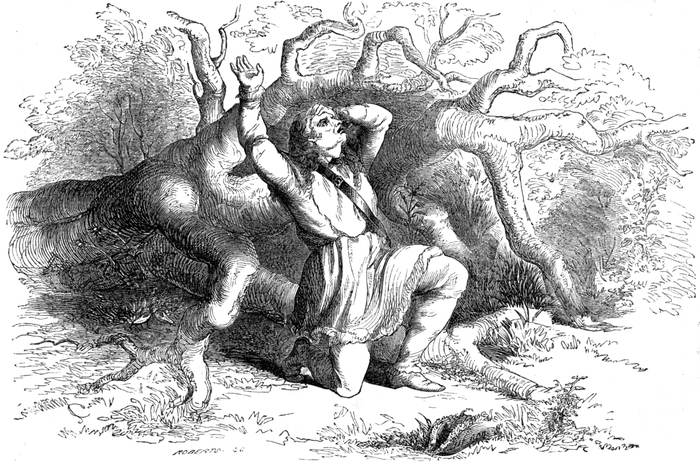
General Morgan Praying—Page 38.
107The spirit which endured such trials was the best surety of their
success. But reinforcements had been received in Quebec. The
garrison was prepared, and Arnold, after making some demonstrations,
retired to Point au Tremble, twenty miles distant, to await the
coming of Montgomery. When the two forces were joined, they
were yet inadequate to the attack of the strongest fortress in America;
but the hero who now commanded the Americans could not endure
the thought of retreat.
On the last day of the year 1775, in the midst of a furious snowstorm,
the memorable attack was made. On this occasion it was, as
Morgan confessed afterward, that he was "afraid"—but fear, to his
nature, was not a passion which weakened him, but which urged
him on. It was not for himself, personally, that he was afraid; no,
he dreaded the effect of a defeat upon his country; he could not see,
without shrinking, his brave friends and comrades rushing upon
what seemed like death in the land of the enemy. In his own
words we have his thoughts:
"The night we stormed Quebec, while I was waiting with my
men, in the cold, driving storm, for the word to advance, I felt
unhappy; I looked up at the frowning battlements above me, and
then around upon my armful of men, and felt that the enterprise was
more than perilous; I felt that nothing short of a miracle could prevent
our being destroyed in a contest where we fought at such an
immense disadvantage. With such feelings I stepped aside, and
kneeling down in the snow, alongside an old gun, with the storm
beating into my face, I poured out my soul in an humble petition to
God, beseeching him to be my shield and protection in the coming
struggle—for nothing but an Almighty arm could save us—and I
really and sincerely feel that I owed my safety to the interposition
of Providence, and I thought so at the time."
In the attack which followed, and which was unsuccessful, Morgan
did all that a brave man could do. He scaled the walls of the
fortress, and sprung down alone amid the surprised garrison, though
108speedily followed by numbers of his men. The enemy, appalled by
such heroism, fell back to the second barrier, and here, had he been
properly supported, Morgan might have been again successful; but
the men had rendered their guns useless; the riflemen who had
followed him were unsupported; to face a double row of bayonets
and climb a wall was beyond the power of the most desperately
brave. After an obstinate resistance Morgan and his corps were
forced to surrender.
So much did Morgan's bravery impress the English, that, when a
prisoner in their hands, he was offered the rank of Colonel in the
English service, and many persuasive reasons were given why he
should accept it. It need not be said that he rejected the temptation
with scorn.
General Daniel Morgan was born of Welch parentage, in New
Jersey, in the year 1736. Like so many of our most illustrious
heroes, he was a "self-made man." His family, which belonged to the
"middle class," had an interest in some Virginia lands, to attend to
which he visited that colony when about seventeen years old.
Glowing with health, and full of that love of adventure which always
characterized him, he determined to remain in Virginia, and begin
the business of life for himself. He had money enough for the purchase
of a wagon and pair of horses. With these he entered upon
the employment which gave him the name of the "wagoner" long
after he had risen to military fame. He remained near Winchester
for about two years. When General Braddock's army commenced
its march against Fort Duquesne it was accompanied by several
corps of provincial troops. Morgan, the "ruling passion" thus early
displaying itself, joined one of these corps. He drove his own team
in the baggage-train. On the way occurred one of those instances,
too frequent in military experience, where the power of an officer is
used with meanness and tyranny against the soldier in his power.
The ruggedness of the way causing much trouble with the train, and
Morgan's team becoming impeded, along with many others, a British
officer approached him, and, with much impatience demanded why
he did not move along. He replied that he would move as soon as
he was able. The officer, yielding to his irritable temper, with
unmerited harshness declared that if he did not move along he would
109run him through with his sword. The high spirit of the wagoner-boy
could not brook this insult; he gave a fierce reply, when the
officer at once made a pass at him with his weapon. Morgan held
in his hand a heavy wagon-whip; parrying the stroke with the
quickness of thought, he closed with his superior; the sword was
broken in the struggle; then, using his whip with the skill which
long practice had given him, he inflicted upon the Englishman a
severe castigation. Such a breach of military law of course was
not to be forgiven. Morgan was tried by a court-martial, which
sentenced him to receive five hundred lashes. The sentence was
carried into effect. The young victim bore this horrible punishment
with mute heroism, silently fainting from torture and exhaustion,
while fifty lashes were yet in reserve, which were of necessity
remitted. Three days afterward, the officer who had been the occasion
of this barbarity became convinced of his injustice, and, seeking
Morgan in the camp hospital, implored his forgiveness. Through
this miserable occurrence, the brave young volunteer was disabled
from duty, and escaped the danger and disgrace of Braddock's
defeat.
Not long after his return from this unhappy campaign, he was
appointed an ensign in the colonial service. His merit had become
apparent to the Government of the colony; already he had won the
friendship of Washington, which afterward availed him on many
trying occasions. His known courage and activity caused him to be
employed in the most dangerous services. On one occasion, accompanied
by two soldiers, he was carrying dispatches to one of the
frontiers of Virginia, infested by cunning and ferocious savages.
While in cautious progress through the forest, unaware that any eye
was upon them, or any stealthy step tracking them fatally and
silently, suddenly the discharge of rifles was heard; his two companions
fell dead by his side. Morgan himself received the only
severe wound he ever had during his military career; a rifle ball
entered the back of his neck, and, shattering his jaw, passed out
through his left cheek. Though he believed himself mortally
wounded, his presence of mind did not fail. Leaning forward on
his saddle, he grasped the mane of his horse, and pressing the spurs
into his sides, darted forward at full speed toward the fort. A single
110Indian followed him, eager for his scalp. Morgan, in after years,
often spoke of the appearance of this savage, who ran with his mouth
open, and his tomahawk raised to strike the fatal blow. Finding
his pursuit in vain, the Indian finally threw the tomahawk with all
his force, hoping it would hit the soldier; but it fell short; the
horse, with his bleeding rider, gained the fort. Morgan was perfectly
insensible when taken from the animal; but proper treatment,
and the vigor of his constitution, restored him to health in six
months.
From this time until the commencement of the Revolutionary
War, he remained in Frederick, employed in his old business as a
wagoner. At this time, he was wild and reckless, proud of his
immense strength, inclining to rough society, fond of the most
rollicking pastimes, and even, it is said, frequenting the gaming-table.
His nature was of that active and superabundant kind, that
he could not live without excitement; that which in times of idleness
became a fault, or almost a crime, leading him into wild
excesses, was the same energy which, as soon as there was a noble
object for its exercise, sprung to the labor of defending liberty.
It is said that pugilistic encounters were his daily pastime—such
from the fact that he was usually the victor. Few men of his time
encountered him without signal defeat. But though Morgan was
generally successful, we have an account of a reverse which he
experienced, too salutary in the lesson it inculcated to be lost.
General Carson, of Frederick county, Virginia, where the affair took
place, tells the anecdote as one entirely authentic:
"Passing along a road with his wagon, Morgan met a gentleman
of refined manners and appearance, who, as he approached the
wagoner, had his hat struck off by a bough overhead. This stopped
him for a moment, and Morgan, thinking that the stranger felt undue
pride in sustaining the character of a gentleman, determined to
humble him. Alighting from his horse—which he rode, teamster-fashion,
instead of driving—he addressed the traveler:
"'Well, sir, if you want a fight, I'm ready for you!'
"The stranger, in amazement, assured him that he wanted no fight,
and had made no signals to such a purpose. But Morgan was not
to be thus repulsed, and urged a contest upon him, until the stranger,
111becoming enraged, in short terms accepted the challenge. The
battle commenced. In brief space the well-dressed man planted
such a series of rapid and scientific blows upon Morgan's front, that
he knocked him down, and inflicted upon him a severe chastisement.
Morgan never forgot this reverse; he found that he was not the only
man in the world—that 'might did not make right.' He often spoke
of it afterward as having had a happy effect upon his character."
In after years, he gained more dignity of character, these youthful
ebullitions merging into deeds of valor of which his country is proud.
Immediately upon the breaking out of the Revolutionary War, he
stood ready to aid his country. Congress appointed him a Captain
of provincials, and so great was his reputation, that, in a short time
after his call for recruits, ninety-six riflemen were enrolled in his
company. This was the nucleus of that celebrated rifle corps which
rendered so much brilliant service during the war. It was composed
of men who had been trained in the forest, and who had each been
accustomed to the use of his own rifle with wonderful skill. They
were hardy in body and dauntless in heart. From this time on, his
career was one of glory, although the hardships which he suffered
finally undermined his splendid health, and forced him to retire, with
the rank of Major-General, to his estate near Winchester, called
"Saratoga," after one of the places where he had distinguished
himself.
It was here that he died in 1802, in the 67th year of his age. A
passer-by would hardly notice the humble slab, of little pretension,
which marks his grave in the Presbyterian church-yard, at Winchester;
yet on it is inscribed a name which Americans will ever
delight to honor: "The hero of Quebec, of Saratoga, and the Cowpens:
the bravest among the brave, and the Ney of the West."
In Irving's Life of Washington we have read an amusing account
of an impromptu fray, one party to which was a corps of Virginia
riflemen, very likely to be those commanded by Morgan, in which
it would appear as if the early habits of their leader had infected his
men, and in which the immortal Washington himself appears in a
new and picturesque attitude. "A large party of Virginia riflemen,"
says the author, "who had recently arrived in camp, were strolling
about Cambridge, and viewing the collegiate buildings, now turned
112into barracks. Their half-Indian equipments, and fringed and ruffled
hunting-garbs, provoked the merriment of some troops from Marblehead,
chiefly fishermen and sailors, who thought nothing equal to
the round-jacket and trowsers. A bantering ensued between them.
There was snow upon the ground, and snow-balls began to fly when
jokes were wanting. The parties waxed warm with the contest.
They closed and came to blows; both sides were reinforced, and in
a little while at least a thousand were at fisticuffs, and there was a
tumult in the camp worthy of the days of Homer. 'At this juncture,'
writes our informant, 'Washington made his appearance, whether
by accident or design, I never knew. I saw none of his aids with
him; his black servant just behind him, mounted. He threw the
bridle of his own horse into his servant's hands, sprung from his
saddle, rushed into the thickest of the melée, seized two tall, brawny
riflemen by the throat, keeping them at arm's length, talking to and
shaking them.' As they were from his own province, he may have
felt peculiarly responsible for their good conduct; they were engaged,
too, in one of those sectional brawls which were his especial abhorrence;
his reprimand must, therefore, have been a vehement one.
He was commanding in his serenest moments, but irresistible in his
bursts of indignation. On the present occasion, we are told, his
appearance and rebuke put an instant end to the tumult. The
veteran who records this exercise of military authority, seems at a
loss which most to admire, the simplicity of the process, or the vigor
with which it was administered. 'Here,' writes he, 'bloodshed,
imprisonments, trials by court-martial, revengeful feelings between
the different corps of the army, were happily prevented by the
physical and mental energies of a single person, and the only
damaging result from the fierce encounter was a few torn hunting-frocks
and round-jackets.'"
We may well believe that what was done by Washington was
well done, even to the stilling of this Homeric tumult.
Occasions of great danger and trial were so frequent that the
leaders of the Revolution had recourse to prayer more frequently, we
are led to believe, than history mentions. One anecdote is told of
Washington's having been overheard supplicating at the throne of
grace, but how can we conceive the Father of his Country as other
113than the devout leader who at all times felt and acknowledged
the hand of Providence over him? The anecdote specially referred
to was related by Potts, the Quaker. During the winter of 1777, the
Continental army was encamped at Valley Forge—a suffering, dispirited,
yet still patriotic little host. Clothing was scant, food was
scarce, numbers were too few for opposing the triumphant foe, and
all things seemed to betoken a most inauspicious future for the patriot
cause. Washington, outwardly firm, resolved, and apparently not
dissatisfied, was, as his correspondence shows, deeply concerned for
the result of the early spring campaign; and that, in his hour of
trial, he prayed for aid from on high we can well believe.
One day, Potts had occasion to go to a certain place, which led
him through a large grove, at no great distance from head-quarters.
As he was proceeding along, he thought he heard a noise. He
stopped and listened. He did hear the sound of a human voice at
some distance, but quite indistinctly. As it was in the direct course
he was pursuing, he went on, but with some caution. Occasionally
he paused and listened, and with increasing conviction that he heard
some one. At length he came within sight of a man, whose back
was turned toward him, on his knees, in the attitude of prayer. It
was a secluded spot—a kind of natural bower; but it was the house
of prayer. Potts now stopped, partly leaned forward, and watched
till whoever it might be was through his devotions. This was not
long. And whom should he now see but Washington himself, the
commander of the American armies, returning from bending prostrate
before the God of armies above.
Potts himself was a pious man. He knew the power of prayer;
and no sooner had he reached home, than in the fullness of his faith
he broke forth to his wife Sarah, in the language of a watchman:
"Wife—Sarah, my dear, all's well—all's well! Yes, George
Washington is sure to beat the British—sure!"
"What—what's the matter with thee, Isaac?" replied the startled
Sarah. "Thee seems to be much moved about something."
"Well, and what if I am moved? Who would not be moved at
such a sight as I have seen to-day?"
"And what has thee seen, Isaac?"
"Seen! I've seen a man at prayer, in the woods—George
114Washington himself! And now I say—just what I have said—'All's
well; George Washington is sure to beat the British—sure!'"
Whether Sarah's faith was as strong as Isaac's, we can not say;
but Potts' logic was sound—that in a good cause, a man of prayer is
sure to succeed—SURE!
That Washington was a constant attendant upon divine worship,
and a man of prayer, admits of no doubt. This was highly to his
credit; for it too often happens that men in important stations think
that their pressure of business will justly excuse them for neglecting
all religious duties.
It is related of Washington, that in the French and Indian war,
when he was a Colonel, he used himself, in the absence of the chaplain,
on the Sabbath, to read the Scriptures to the soldiers of his
regiment, and to pray with them; and that more than once he was
found on his knees in his marquee at secret prayer.
While at home at Mount Vernon, he was always punctual to go
to church. Sometimes he had distinguished men to visit him, and
who he knew had no great regard for religion. This made no difference
with his conduct. On such occasions he regularly attended
church, and invited them to accompany him.
During his residence in Philadelphia, as President of the United
States, he was a constant attendant at the house of God, on the
Sabbath; thus setting a becoming example to others in authority.
And it has often been remarked, that in all his public messages to
Congress, he was particular to allude in some appropriate manner to
God's overruling providence, and his sense of his own and the
nation's dependence upon divine favor, for individual and national
prosperity.
The greatness of Washington was conceded even more fully
by the great than by the "common herd" of mankind. Bonaparte
paid a tribute to the American's fame scarcely to be exceeded for
its terms of admiration.
"Ah, gentlemen," the French General exclaimed to some young
Americans happening at Toulon, and anxious to see the mighty
Corsican, had obtained the honor of an introduction to him, "how
fares your countryman, the great Washington?"
"He was very well," replied the youths, brightening at the thought
115that they were the countrymen of Washington, "he was very well,
General, when we left America."
"Ah, gentlemen," rejoined he, "Washington can never be otherwise
than well. The measure of his fame is full. Posterity will
talk of him with reverence as the founder of a great empire, when
my name shall be lost in the vortex of revolutions."
This recalls the celebrated "toast scene" wherein Dr. Franklin
"paid his respects" to the English and French. It is thus recited:
Long after Washington's victories over the French and English
had made his name familiar to all Europe, Dr. Franklin chanced to
dine with the English and French embassadors, when the following
toasts were drunk. By the British embassador: "England—the
sun, whose bright beams enlighten and fructify the remotest corners
of the earth." The French embassador, glowing with national
pride, but too polite to dispute the previous toast, drank: "France—the
moon, whose mild, steady and cheering rays are the delight of
all nations, consoling them in darkness, and making their dreariness
beautiful."
Dr. Franklin then rose, and with his usual dignified simplicity,
said: "George Washington—the Joshua, who commanded the sun and
moon to stand still, and they obeyed him."
We could fill many pages with anecdotes of Washington, illustrative
of his goodness, his real, heart piety, his reliance on an overruling
Providence; but will not, at this time, devote more space to
the theme, promising ourselves the pleasures of again recurring to
the truly august subject.
THE JOHNSON BOYS KILLING THEIR CAPTORS.
116
The father of the little heroes whose daring exploit is here illustrated,
removed from Pennsylvania in 1786, or thereabouts, and settled on
what was called Beech-bottom Flats, in the State of Ohio, some two
miles from the Ohio River, and three or four miles above the mouth
of Short Creek. In common with all the early settlers of that State,
Johnson was subject to the depredations of the Indians, who felt
that the white men were encroaching upon their hunting-grounds,
and did not hesitate to inflict upon them the fullest measure of vengeance.
Protected by the station, or fort, near which they resided,
the family enjoyed, however, a tolerable share of security.
One Sunday morning, in the fall of 1793, two of his sons—John,
aged thirteen, and Henry, eleven—started for the woods to look for
a hat which the younger had lost the previous evening, while out
after the cows. Having found the hat, they started for home, but
coming to the foot of a hickory tree, whose tempting fruit lay in
bounteous profusion on the ground before them, they, boylike, and
dreaming neither of Indians nor of any other danger, sat down on a
fallen log and amused themselves cracking and eating nuts. While
thus engaged, they observed two men approaching from the direction
of the station, who, from their dress and appearance, they took to be
neighbors, seeking for strayed horses, one of them having a bridle in
his hand. Satisfied of this fact, they continued their employment,
until the men had approached quite near to them, when, upon looking
up, they discovered, to their horror, that they were Indians,
dressed in the garb of white men. Their first impulse was to fly;
but upon rising to their feet, one of the intruders presented his rifle,
and told them to stop or he would shoot. Coming up to them, the
other presented his hand, and said: "How do, brodder?" The
oldest boy, John, immediately—instinctively, as it were—called into
requisition a tact perfectly astonishing in such a child. Accepting
the savage's hand, he shook it with a smile, asking with apparently
117pleased curiosity if they were Indians. Their captors replied that
they were, telling the boys that they must go with them. Concealing
their feelings of fear and distress, the little fellows submitted,
and took up their line of march for the wilderness, not without the
most poignant emotions at thus being rudely torn from their home
and parents. They had heard enough, young as they were, of
Indian captivity, to guess what was in store for them—that, even at
the very best, there would be years of wild, uncivilized life before
them, should they be spared to live at all. But hiding the sinking
of his heart, the oldest took the small buckskin bag which was given
him to carry, with outward cheerfulness, and entered with spirit into
the search of the Indians after the horses of the white men. The
bag, from its weight, he supposed to contain money, the product of
their depredations upon the white community.
The Indians and their captives spent the afternoon in pursuit of
horses, taking a circuitous route through the bottom and over the
Short Creek hill; but evening approaching without their meeting
with success, they drew off some distance into the woods, in search
of some place to camp.
Coming to a spring in a hollow, which answered their purpose,
they halted; and while one of them scouted around the camp, the
other proceeded to build a fire, by flashing his gun into some dry
"tinder" wood. While the latter was gone to procure the wood
from a decayed stump, John took up the gun he had left behind,
and cocked it, with the intention of shooting him as he came back;
but Henry stopped him, for fear the other might be near, and able
to overpower them, at the same time promising to aid his brother if
he would wait until the Indians were asleep.
After they had cooked their supper, and eaten it by the fire, the
savages began to converse apart in their own tongue. The result
of their council soon became painfully apparent to the boys. Drawing
their knives, they began to whet them, at the same time continuing
their discussion, with occasional sidelong glances at the boys.
Seeing this, with that remarkable discretion which had hitherto
marked his conduct, John entered into conversation with them, in
the course of which he remarked that he led a hard life with his
parents, who were cross to him, and made him work hard, giving
118him no chance for play. For his part, he liked to hunt and fish,
and when he got to their towns, he meant to be a warrior and live
with them. This pleased the Indians, and led to further converse,
during which one of them asked the boys which way home was.
John, who assumed to be spokesman, answered, always pointing the
wrong way, which led them to believe that their captives had lost
their reckoning. The business of sharpening the knives was suspended,
and John's bright eyes, smiling but anxious, were not sorry
to see them restored to the belts of the wearers.
The Indians, although pleased and conciliated, were careful not to
trust their little prisoners too far, but pinioned their arms, and when
they laid down to sleep for the night, placed the boys between them,
secured by a large strap, which passed under their own bodies. Late
in the night, one of the savages, becoming cold, stirred in his sleep,
caught hold of John in his arms, and turned him over to the outside,
soon relapsing into sound slumber with the renewed warmth thus
obtained. In this situation the boy, awake and alert, found means
to get his hands loose; he then nudged his brother, made him get
up, and untied his arms. This done, Henry thought of nothing but
of running off as fast as possible; but when about to start, his
brother caught hold of him, whispering: "We must kill these Indians
before we go." After some hesitation, Henry agreed to make the
attempt. John took one of the rifles of their captors, and placed it
on a log with the muzzle close to the head of one of them. He then
cocked the gun, and placed his little brother at the breech with his
finger on the trigger, with instructions to pull it as soon as he should
strike the other Indian. He then took one of the tomahawks, and
placed himself astride the second foe. All this time the savages
slumbered on in their fancied security. That moment he gave the
word to fire, while he brought the tomahawk down with all the
force of his young arm upon his sleeping enemy. The blow, however,
fell upon the back of the neck and to one side, so as not to be
fatal; the wounded savage attempted to spring up, but the little
fellow, urged to desperation, plied his blows with such force and
rapidity upon the Indian's skull, that, to use his own words in
describing it, "the Indian laid still and began to quiver."
At the moment of the first stroke given by the elder brother, the
119younger one pulled the trigger, as directed; but his shot was not
more fatal than the other's blow, for he only succeeded in blowing
off a large part of his antagonist's lower jaw. This Indian, an
instant after receiving the wound, began to flounce about and yell in
the most frightful manner. The boys were glad to abandon him to
his fate. They made the best of their way to the fort, reaching it
a little before daybreak. On getting near the station, they found
the people all up, and a great anxiety on their account. On hearing
a woman exclaim: "Poor little fellows, they are killed or taken
prisoners!" the eldest one answered: "No, mother, we are here
yet!"
Having brought away nothing from the Indian camp, their relation
was not credited, and a party was made up to go in search of its
truth. On arriving at the camp, they found the Indian whom John
had tomahawked, dead; the other had crawled away, leaving a
heavy, bloody trail, by which he was traced to the top of a fallen
tree, where he had ensconced himself, determined to sell his life
dearly. At the approach of the party he attempted to fire upon
them; but his gun flashed in the pan; and one of the men remarking
that he "didn't care about being killed by a dead Injin," they
left him to die of his wounds. His skeleton and gun were found,
some time afterward, near the spot. It was conjectured that the
bag of specie which the Indians had, was appropriated by one of the
settlers, who had slipped off in advance upon hearing the story of
the boys. For some time after this person seemed better supplied
with money than he had ever been before.
The story of the heroism of the little warriors got abroad, and
even the Indians themselves gave them credit for it. After the
treaty with General Wayne, an old Indian, who was a friend of the
two who were killed (and who, it seems, had been distinguished
warriors), inquired of a man from Short Creek what they had done
with the two young braves who had killed the Indians. Being
answered that they lived at the same place with their parents, he
replied: "Then you have not done right; you should have made
kings of those boys."
There are a good many stories told of those early days, far pleasanter
for the boys of this generation to read in safety, by the
120comfortable winter fire, than it was for the hardy and sagacious little
heroes to enact them.
In August, 1786, a lad by the name of Downing, who lived at a
fort near Slate Creek, in what is now Bath county, was requested by
an older companion to assist him in hunting for a horse which had
strayed away the preceding evening. Downing readily complied,
and the two friends searched in every direction, until at length they
found themselves in a wild valley, some six or seven miles from the
fort. Here Downing became alarmed, and repeatedly told his companion,
Yates, that he heard sticks cracking behind them, and was
certain that Indians were dogging them. Yates, an old backwoods-man,
laughed at the fears of the boy, and contemptuously asked him
at what price be rated his scalp, offering to insure it for sixpence.
Downing, however, was not so easily satisfied. He observed that in
whatever direction they turned, the same ominous sounds continued
to haunt them, and as Yates continued to treat the matter recklessly,
he resolved to take measures for his own safety. Gradually slackening
his pace, he permitted Yates to advance twenty or thirty steps
ahead, and immediately afterward, as they descended the slope of a
gentle hill, Downing slipped aside and hid himself in a thick cluster
of whortleberry bushes. Yates proceeded on, singing carelessly some
rude song, and was soon out of sight. Scarcely had he disappeared,
when Downing beheld two savages put aside the stalks of a cane-brake,
and cautiously look out in the direction Yates had taken.
Fearful that they had seen him step aside, he determined to fire
upon them, and trust to his heels for safety; but so unsteady was
his hand, that in raising his gun to his shoulder, it went off before
he had taken aim. He immediately ran, and after proceeding about
fifty yards, met Yates, who had hastily retraced his steps. The
enemy were then in full view, and the woodsman, who might have
outstripped the lad, graduated his steps to those of his companion.
The Indians, by taking a shorter path, gained rapidly upon the fugitives,
across whose way lay a deep gully. Yates easily cleared it,
but Downing dropped short, and fell at full length upon the bottom.
The savages, eager to capture Yates, continued the pursuit, without
appearing to notice Downing, who, quickly recovering his strength,
began to walk slowly up the ditch, fearing to leave it, lest the
enemy should see him. He had scarcely emerged into the open
ground before he saw one of the Indians returning, apparently in
quest of him. His gun being unloaded, Downing threw it away,
and again took to flight; but his pursuer gained on him so rapidly,
that he lost all hope of escape. Coming at length to a large poplar,
which had been blown up by the roots, he ran along the body of
the tree on one side, while the Indian ran along the other, expecting
to intercept his game at the root. But here fortune favored the
latter in the most singular manner. A she-bear which was suckling
her cubs in a bed at the root of the tree, suddenly sprung upon the
Indian, and while the latter was yelling and stabbing his hirsute
antagonist with his knife, Downing succeeded in reaching the fort,
where he found Yates reposing after a hot chase, in which he, also,
had distanced his pursuers.
121
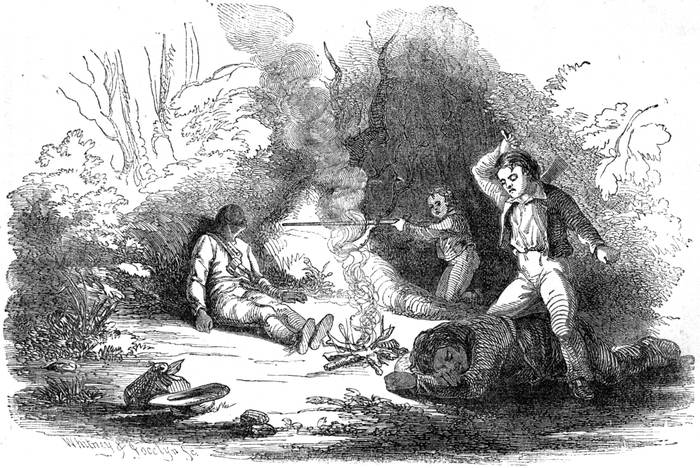
The Johnson Boys Killing their Captors.
123Whether the bear or the Indian came off victor in the impromptu
engagement so suddenly entered into, the historian sayeth
not.
In the following narrative, the incidents of which are included in
the History of the State of Kentucky, will be noticed the fortitude
of another little hero, who, in the midst of appalling circumstances,
received two severe wounds, one of which must have been extremely
painful, yet who made no sign—would not even allow it to be known
that he was injured, until the conflict was over.
In March, 1788, Captain William Hubbell, floating down the Ohio
River in his flat-boat, on his return from the east, after leaving Pittsburg,
saw traces of Indians along the banks of the stream, which
excited his suspicions and increased his watchfulness. On the boat,
besides Captain Hubbell, were Daniel Light, and William Plascut
and his family. Before reaching the mouth of the Great Kanawha,
their number was increased to twenty, among whom were Ray,
Tucker and Kilpatrick, also two daughters of the latter, a man by the
name of Stoner, an Irishman, and a German. Information at Gallipolis
confirmed their previous expectation of a conflict with a large
body of Indians; Captain Hubbell therefore made every preparation
to resist the anticipated attack. The men, divided into three
watches for the night, were alternately on the look-out for two hours
at a time. The arms on board unfortunately consisted mainly of old
124muskets much out of order. These were put in the best possible
condition for service.
On the 23d, Hubbell's party overtook a fleet of six boats descending
the river in company, and, for mutual protection, at first concluded
to join them. Finding them, however, a careless, noisy set
of people, more intent on dancing than watching for Indians, Hubbell
determined to push forward alone. One of the six boats, desirous
of keeping up with Hubbell, pushed forward for a short time; but
its crew at length dropped asleep, and it was soon left in the rear.
Early in the night, a canoe was seen flying down the river, in which
probably were Indians on the watch. Fires and other signs also
were observed, which indicated the presence of a formidable body
of the savages.
At daybreak, before the men were at their posts, a voice some
distance below repeatedly solicited them, in a plaintive tone, to come
on shore, representing that some white persons wished to take a
passage in their boat. This the Captain naturally concluded to be
an Indian artifice. He accordingly placed every man upon his
guard. The voice of entreaty soon was changed into insult, and the
sound of distant paddles announced the approach of the savage foe.
Three Indian canoes were seen through the mist rapidly advancing.
With the utmost coolness, the Captain and his companions prepared
to receive them. Every man was ordered not to fire until the
savages came nearly up to the boat; the men, also, were directed to
fire in succession, that there might be no intervals.
The canoes were found to contain from twenty-five to thirty
Indians each. When within musket-shot, they poured in a general
fire from one of the canoes, by which Tucker and Light were
wounded. The three canoes now placed themselves on the bow,
stern and side of the boat, opening a raking fire upon the whites;
but the steady firing from the boat had a powerful effect in checking
the confidence and the fury of the savages. Hubbell, after firing his
own gun, took up that of one of the wounded men, and was in the
act of discharging it when a ball tore away the lock. He deliberately
seized a brand of fire, and, applying it to the pan, discharged it with
effect. When in the act of raising his gun a third time, a ball passed
through his right arm, which for a moment disabled him. Seeing
125this, the savages rushed for the boat, to board it. Severely wounded
as he was, Hubbell rushed to the bow, and assisted in forcing the
enemy off, by the discharge of a pair of horse pistols, and by billets
of wood. Meeting with so desperate a resistance, the Indians at
length discontinued the contest, for the moment.
The boat which Hubbell had recently left behind now appearing
in sight, the canoes rushed toward it. They boarded it without
opposition, killed Captain Greathouse and a lad, placed the women
in the center of their canoes, and then manning them with a fresh
reinforcement from the shore, again pursued Hubbell and his party.
The melancholy alternative now presented itself to these brave but
desponding men, either of falling a prey to the savages, or to run the
risk of shooting the white women in the canoes, purposely placed
there by the Indians, in the hope of obtaining protection by their
presence. Hubbell, well knowing how little mercy was to be
expected if the savages were victorious, did not hesitate. He resolved
to war to the last.
There were now but four men left on board of the boat capable
of defending it. The Captain himself was severely wounded in two
places. Yet the second attack was resisted with incredible firmness.
Whenever the Indians would rise to fire, the whites would, commonly,
give them the first shot, which in almost every instance
would prove fatal. Notwithstanding the disparity of numbers and
the exhausted condition of Hubbell's party, the Indians, despairing
of success, retired to the shore. Just as the last canoe was departing,
Hubbell called to the Indian chief in the stern, and on his turning
round, discharged his piece at him. When the smoke was
dissipated, the savage was seen lying on his back, severely, perhaps
mortally, wounded.
Unfortunately, the boat had drifted near to shore, where the
Indians were collected, and a large concourse, probably between four
and five hundred, were seen rushing down on the bank. Ray and
Plascut, the only men remaining unhurt, took to the oars. As the
boat was not more than twenty yards from shore, it was deemed
prudent for them to lie down, and attempt to paddle out into the
river with the utmost practicable rapidity. While thus covered,
nine balls were shot into one oar, and ten into the other, without
126wounding the rowers, who were protected by the side of the boat
and the blankets in its stern. During this exposure to the fire,
which continued about twenty minutes, Kilpatrick observed a particular
Indian, whom he thought a favorable mark for his rifle, and,
despite the solemn warning of Captain Hubbell, rose to shoot the
savage. He immediately received a ball in his mouth, which passed
out at the back part of his head, and was, almost at the same
moment, shot through the heart. He fell among the horses that
about the same time were killed, presenting to his afflicted daughters
and fellow travelers, who were witnesses of the awful occurrence, a
spectacle of horror which it were impossible to describe.
The boat, providentially, was then suddenly carried out into the
stream, beyond reach of the enemy's balls. The little band, reduced
in numbers, wounded, afflicted, and almost exhausted by fatigue, still
were unsubdued in spirit, and being assembled in all their strength,
men, women and children, with an appearance of triumph gave three
hearty cheers, calling to the Indians to come on again if they were
fond of the sport.
Thus ended this stubborn conflict, in which only two out of nine
men escaped unhurt. Tucker and Kilpatrick were killed on the
spot, Stoner was mortally wounded, and died on his arrival at Limestone,
and all the rest, excepting Ray and Plascut, were severely
wounded. The women and children all were uninjured, excepting
a little son of Mr. Plascut, who, after the battle was over, came to
the Captain, and with great coolness requested him to take a ball
out of his head. On examination, it appeared that a bullet, which
had passed through the side of the boat, had penetrated the forehead
of this little hero, and still remained under the skin. The Captain
took it out, when the youth, observing, "That is not all," raised his
arm, and exhibited a piece of bone at the point of his elbow, which
had been shot off, and hung only by the skin. His mother
exclaimed:
"Why did you not tell me of this?"
"Because," he coolly replied, "the Captain directed us to be silent
during the action, and I thought you would be likely to make a noise
if I told you."
Here was true pluck.
127The boat made its way down the river as rapidly as possible, the
object being to reach Limestone that night. The Captain, tormented
by excruciating pain, and faint through loss of blood, was under the
necessity of steering the boat with his left arm, till about ten o'clock
that night, when he was relieved by William Brooks, who resided
on the bank of the river, and who was induced by the calls of the
suffering party to come out to their assistance. By his aid, and that
of some other persons, who were in the same manner brought to
their relief, the party was enabled to reach Limestone about twelve
o'clock that night. On the arrival of Brooks, Captain Hubbell,
relieved from labor and responsibility, sunk under the weight of pain
and fatigue, and became for a while totally insensible. When the
boat reached Limestone, he found himself unable to walk, and was
carried up to the tavern. Here he continued several days, until he
acquired sufficient strength to proceed homeward.
On the arrival of Hubbell's party at Limestone, they found a considerable
force of armed men ready to march against the Indians.
They now learned that, on the Sunday preceding, these very same
savages had cut off a detachment of men ascending the Ohio from
Fort Washington, at the mouth of Licking River, and had killed
with their tomahawks, without firing a gun, twenty-one out of
twenty-two men, of which the detachment consisted!
Crowds of people, as might be expected, came to examine the
boat which had been the scene of so much heroism and such horrid
carnage, and to visit the resolute little band by whom it had been so
gallantly defended. On examination, it was found that the sides of
the boat were literally filled with bullets and bullet-holes. There was
scarcely a space of two feet square in the part above water, which
had not either a ball remaining in it, or a hole through which a ball
had passed. Some persons who had the curiosity to count the
number of holes in the blankets which were hung up as curtains in
the stern of the boat, affirmed that in the space of five feet square
there were one hundred and twenty-two. Four horses out of five
were killed. The escape of the fifth, amidst such a shower of balls,
appears almost miraculous.
The day after the arrival of Captain Hubbell and his companions,
the five boats passed on the night preceding the battle reached
128Limestone. The Indians, it would appear, had met with too formidable
a resistance from a single boat to attack a fleet, and suffered
them to pass unmolested. From that time, it is believed that no
boat was assailed by Indians on the Ohio.
The force which marched out from Limestone to disperse this
formidable body of savages discovered several Indians dead on the
shore, near the scene of action. They also found the bodies of
Captain Greathouse and several others—men, women and children—who
had been on board of his boat. Most of them appeared to have
been whipped to death, as they were found stripped, tied to trees, and
marked with the appearance of lashes; and large rods, which
seemed to have been worn with use, were observed lying near them.
It is wonderful, when we consider the perils which beset the early
settlers, that Ohio, Kentucky and Indiana did not remain untenanted
by white men. We can not open the history of the years, from
1787 to 1814, that we do not find, upon almost every page, a story
of suffering, of miraculous escape, or of appalling death which everywhere
seemed to be in store for the daring pioneer. In the course
of this series of tales we shall have occasion to repeat many of those
stirring episodes, which will be perused with commingled feelings
of pain and admiration. Every youth, and particularly every one
dwelling west of the Alleghanies, should study these episodes, and
learn from them through what trials came their blessings.
130
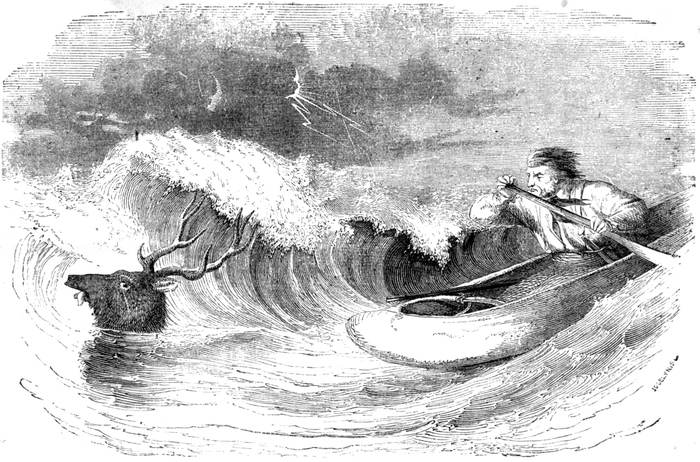
Sweatland's Thrilling Hunting Adventure—Page 6.
131TALES,
Traditions and Romance
OF
BORDER AND REVOLUTIONARY TIMES.
A GREAT HUNTING ADVENTURE.
COLONEL HORRY'S EXPLOITS.
ELERSON'S FAMOUS RACE.
MOLLY PITCHER AT MONMOUTH.
NEW YORK
BEADLE AND COMPANY, PUBLISHERS,
118 WILLIAM STREET.
132Entered according to Act of Congress, in the year 1863, by
BEADLE AND COMPANY,
In the Clerk's Office of the District Court of the United States for
the Southern District of New York.
A REMARKABLE HUNTING-EXCURSION.
133
On a September morning of the year 1817, Solomon Sweatland, of
Conneaut, on the Ohio shore of Lake Erie, had risen at earliest dawn
to enjoy his favorite amusement of hunting deer. Royal game was
this, and hunted in royal parks, which the dukes and princes of
haughty old England might envy, and, best of all, they were not
barred from the poorest settler. There was no punishment for
"poaching" on the magnificent prairies, and in the glorious forests
of the West. The men who there slung their rifles over their
shoulders, and set out, careless whether they met a fawn or a panther,
would have sneered at an English hunting-ground as a bit of a handkerchief
which one of their favorite "per-raries" could tuck away in
her pocket and never feel it. Men who can "drive the nail" and
"snuff a candle," three shots out of six, and who kill such dainty
game as squirrels by blowing the breath out of them with the wind
of their bullets instead of lacerating their little bodies with the ball;
who have hand-to-hand, or hand-to-paw, tussles with ferocious
grizzlies, and make nothing of two or three deer before breakfast,
may afford to smile at their fox-hunting, partridge-shooting English
cousins. Such were the men who first settled our now populous
Western States; and we may well believe that the healthy and
thrilling excitement of pursuits like these compensated for the want
of many luxuries, and that they became so attached to their free and
venturesome modes of life, as to feel stifled at the idea of the constraints
of society.
"Their gaunt hounds yelled, their rifles flashed—
The grim bear hushed his savage growl;
134In blood and foam the panther gnashed
His fangs, with dying howl;
The fleet deer ceased its flying bound,
Its snarling wolf-foe bit the ground,
And, with a moaning cry,
The beaver sunk beneath the wound,
Its pond-built Venice by."
Fascinating, even in contemplation, is a life like this. It makes
the blood tingle in the veins, the sinews stretch, and the lungs
expand, to read of the scenes which cluster around it, and to breathe,
in fancy, the pure air, and sweep, with our vision, the wide
horizon.
But we must go back to our hunter, who stood, in the gray light
of dawn, without coat or waistcoat, outside his cabin, listening to the
baying of the dogs, as they drove the deer. In this part of the
country, lying along the lake, it was the custom for one party, aided
by dogs, to drive the deer into the water, when another would pursue
them in boats, and when the game was a little tired, shoot it
without difficulty. Sweatland had a neighbor who hunted with him
in this manner, and he it was who had already started a noble buck,
which dashed into the lake, while Sweatland stood listening for the
direction of the dogs.
In the enthusiasm of the moment, he threw his hat on the beach,
jumped into his canoe, and pulled out after the animal, every
nerve thrilling with intense interest in the pursuit. The wind,
which had been blowing steadily from the south during the night,
had now increased to a gale, but he was too intent upon securing
the valuable prize which was breasting the waves in advance, to
heed the dictates of prudence. The race promised to be a long one,
for the buck was a powerful animal, and was not easily to be beaten
by a log canoe and a single paddle.
A considerable distance from the land had been obtained, and the
canoe had already shipped a heavy sea, before he overtook the deer,
which turned and made for the opposite shore. Upon tacking to
pursue him, Sweatland was at once apprised of his danger by the
fact that, with his utmost exertions, he not only made no progress
in the desired direction, but was actually drifting out to sea. He
had been observed, as he left the shore, by his neighbor, and also
135by his family, and as he disappeared from sight, great apprehension
was felt for his safety.
The alarm was soon given in the neighborhood, and it was decided
by those competent to judge, that his return would be impossible,
and unless aid was afforded him, that he was doomed to perish.
Actuated by those generous impulses which often induce men to
risk their own lives for the salvation of others, three neighbors took
a light boat and started in search of the wanderer. They met the
deer returning, but saw nothing of their friend. They made stretches
off shore in the probable range of the hunter, until they reached a
distance of five or six miles from land, when, meeting with a heavy
sea, in which they thought it impossible for a canoe to live, and
seeing no signs of it on the vast expanse of waters, they reluctantly,
and not without danger to themselves, returned to shore, giving
Sweatland up as lost.
Meantime, the object of their search was laboring at his paddle,
in the vain hope that the wind might abate, or that aid might reach
him from the shore.
"An antlered dweller of the wild
Had met his eager gaze,
And far his wandering steps beguiled
Within an unknown maze."
Willingly would he now have resigned every lordly buck of the
forest, to warm himself by his cabin fire, hear the laugh of his little
ones, and breathe the odor of the welcome breakfast—ay, even for
his coat and a biscuit he would have given much.
One or two schooners were in sight in the course of the day, but
although he made every effort to attract the notice of their crews,
he failed to do so. For a long time the shore continued in sight,
and as he traced its fast-receding outline, and recognized the spot
where stood his home, within whose precincts were the cherished
objects of his affection, now doubly dear from the prospect of losing
them forever, he felt that the last tie which united him in companionship
with his fellow-men was about to be dissolved—the world, with
all its busy interests, was floating far away.
Sweatland possessed a cool head and a stout heart; these, united
to considerable physical strength and power of endurance, fitted him
136for the emergency in which he found himself. He was a good
sailor, and his experience taught him that "while there was life
there was hope." Experience taught him also, as the outline of the
far-off shore receded from sight, that his only expedient was to
endeavor to reach the Canada shore, a distance of fifty miles.
It was now blowing a gale, so that it required the most incredible
exertions to trim his uncouth vessel to the waves. He was obliged
to stand erect, and move cautiously from one end to the other, well
aware that one lost stroke of the paddle, or a tottering movement,
would bring his voyage to a sudden termination. Much of his
attention was likewise required in bailing out the canoe, which he
managed to do with one of his shoes, which were a substantial pair
of stogas. Hitherto he had been blessed by the light of day, but
now, to add to his distress, night approached, and he could only
depend upon a kind Providence to guide him over the watery waste.
The sky, too, began to be overcast; an occasional star, glistening
through the scudding clouds, was all the light afforded him through
that long and fearful night.
Wet to the skin by the dashing spray; part of the time in water
half way to his knees; so cold that his blood chilled in his veins,
and almost famished, he felt that death was preferable to such long-continued
suffering; and nothing but the thought of his family gave
him courage to keep up his exertions.
When morning dawned, the outline of the Canada shore greeted
his sight; he soon made the land in the vicinity of Long Point.
Here he met additional difficulties in an adverse wind and heavy
breakers, but the same hand which had guided him thus far remained
with him still; he succeeded in safely landing. What his
emotions were upon again treading "the green and solid earth," we
may faintly imagine; but his trials were not ended. Faint with
hunger and exhausted by fatigue, he was forty miles from human
habitation, while the country which intervened was a desert, filled
with marshes and tangled thickets, from which nothing could be
drawn to supply his wants. These difficulties, together with his
reduced state, made his progress toward the settlements very slow.
On his way he found a quantity of goods which had been thrown
ashore from the wreck of some vessel, which, though they afforded
137no immediate relief, were afterward of service to him. After a long
and toilsome march through the wilderness, he arrived at a settlement,
where he was treated with great kindness by the people.
When his strength was sufficiently recruited, he procured a boat, and
went after the wrecked goods, which he found and brought off. He
then started overland for Buffalo, where he disposed of part of his
treasure, and with the proceeds furnished himself with a complete
outfit. Here, finding the Traveler, Captain Brown, from Conneaut,
in the harbor, he engaged passage on board of her. The Captain
and crew, having heard of his disappearance, looked upon him
almost as one risen from the dead. His story was so astonishing as
hardly to be credible; but as he was there, in person, to verify it,
they were obliged to believe the testimony.
Within a day or two, he was on his way to rejoin his family, who,
the Captain informed him, had given him up, and were in great
grief and distress. When the packet arrived opposite the house, the
crew gave three loud, long and hearty cheers, and fired guns from
the deck in token of joy, which led the family to anticipate his
return.
On landing, he found that his funeral sermon had been preached,
and had the rare privilege of seeing his own widow clothed in the
habiliments of mourning.
Deer hunting, even down to a recent period, was a chosen amusement
in Ohio. At this time the animal is only found in the great
forests of the north-west counties of Paulding, Van Wart, Williams,
etc., and in the heavy woods of Wyandot and Hardin counties.
Sandusky Bay, an estuary of Lake Erie, and one of the most beautiful
sheets of water in America, is yet a great sportsman's resort, though
now chiefly for wild water-fowl, whose spring and fall season calls
thither many a modern Nimrod. The writer of this has spent many
a season among the marshes and overflow-lands at the head of the
bay in pursuit of game which, with proper care, will continue for
years to afford good gunning. Only keep out the murderous blunderbusses
of certain Englishmen, which sweep away a whole flock of
green-heads and canvas-backs at a shot. We have often been tempted
to have arrested, as a common nuisance, these sneaking prowlers
after "a shot for twenty birds—not a whit less." But it was not of
138birds we are to write. Sandusky Bay, in days gone by, used to
afford rare sport in deer-hunting in the water. To illustrate:
The bay is bounded on the east by a narrow strip of sand and cedars,
which divides it from Lake Erie. On the north is the peninsula,
another strip of rich soil, once densely covered with forests, stretching
far to the west. The sport practiced in early times was to drive the
deer with dogs from Cedar Point and the peninsula into the water,
when they would make for the opposite shore, above the town of Sandusky.
The heads of the beautiful animals could be seen a great distance,
as they glided along the surface of the clear waters. Then boats
would put out, in each of which was a dog—no guns being allowed—the
men being armed only with a knife. The deer always would scent
the danger from afar, and, with extraordinary celerity, move off up the
bay, followed by the boats. When a comparatively near approach was
at length made, after hard pulling for two or three miles, the dogs
were let loose. Being fresh, and the deer somewhat exhausted from
their long swim, the dogs would gain on their prey rapidly, and soon
the struggle in the water would commence—the noble bucks always
receiving their enemy, while the ewes and fawns were kept out of
harm's reach. The bucks were, if not too much exhausted, quite a
match for the dogs. Not unfrequently their antlers would crimson
the water with the blood of their canine foe. The boats, meanwhile,
were but spectators of the contest, and only came up when
their dogs showed signs of defeat. A good dog, however, generally
succeeded in fastening to the throat of his prey, and there clung with
such tenacity as to sink and rise with the buck, avoiding the terrific
strokes of its hoofs by laying close to the deer's body. One blow
of a fore-hoof has been known to smash the skull of a mastiff. The
sport, to those in the boats, is exciting in the extreme; but strict
honor used to govern the combats. The fawns and most of the
ewes were permitted to escape, and the bucks were only slaughtered
with the knife when it became evident that the dogs would be overpowered,
or when some favorite mastiff brought his game to the boat
in a conquered condition.
A startling adventure once occurred in the waters of the bay. A
well-known hunter, named Dick Moxon, somewhat addicted to drink,
one day saw a fine drove of deer coming in to land from the opposite
139shore. He at once advanced, knife in hand, into the water to his
waist. The bucks, three of them, led the convoy, and made directly
for their enemy to cover the retreat of the females. The hunter
found himself in a position of imminent danger, and sought to retreat,
but this the deer did not permit, as one of them drove him down
into the water by a terrible butt with his ugly antlers. Moxon
grappled the deer, but the animal trampled the hunter and kept him
down. With great presence of mind, Moxon disappeared under
water and swam for the shore, coming up a rod nearer the land.
This dodge did not save him, however, for the infuriated bucks pursued,
and soon the combat became terrible. Moxon cut right and
left with his knife, making shocking wounds in the glistening bodies
of the noble beasts; but the fight was not stayed, and the hunter's
strength, so severely overtaxed in the first encounter in deep water,
began to give way entirely. A few minutes more must have seen
him down in the water under the hoofs of the frenzied animals. At
this moment a woman appeared on the shore. It was Moxon's wife,
whose cabin was not far distant in the woods. Sally Moxon was as
"coarse as a cow, but brave as a catamount," as her husband always
averred; and so she proved in this moment of Dick's peril. Seizing
his rifle, which lay on the bank, she advanced to the rescue. One
buck quickly fell from the well-aimed shot. Then she "clubbed"
her gun, and made at the nearest beast with great caution. The
buck made a furious dash at her, leaping at a bound out of the water,
almost upon her, but Sally was wide awake, and was not caught by
the ugly horns and hoofs. She struck the beast such a blow on its
neck as broke both the gunstock and the buck's spinal column.
With the rifle-barrel still in her hand, Sally then made for the last
buck, a very savage fellow, who still confronted Dick in a threatening
manner. The fight which followed was severe. Sally was
knocked down into the water, but Moxon's knife saved his spouse
from being "trampled into a pudding," as he afterward expressed it.
With all his remaining strength, he seized the deer by the horns,
while with his left hand he buried his knife to the hilt in the animal's
shoulder. The deer fell in the water, and Moxon went down
under him; but Sally was, by this time, on her feet again, and dragged
Dick's almost inanimate form to the shore. The victory was
140complete, though Dick was so terribly bruised that the meat of the
three bucks was long gone before the hunter could again go forth
to kill more. The moral of the story is that he learned not only
never to attack three bucks, single-handed, in four feet of water, but
to let the whisky bottle alone.
The adventure which we are now about to chronicle is quite as
marvelous as those above related, although of another character.
It is deeply interesting, as illustrating one of the many phases of
danger which constantly lurked on the steps of the pioneers. Startling
as were the romantic realities of those early days, needing not
the touch of fiction to heighten their interest, it will be confessed
that few incidents can equal this for a novel combination of perils.
The family of John Lewis were the first settlers of Augusta, in the
State of Virginia, and consisted of himself, his wife, and four sons,
Thomas, William, Andrew and Charles. Of these, the first three
were born in Ireland, from whence the family came, and the last
was a native of Virginia.
Lewis was a man of wealth and station in the old country, and
the cause of his present emigration to America was an attempt, on
the part of a man of whom he hired some property, to eject him
therefrom, which led to an affray, in which the noble landlord lost
his life. Fearing, from the high standing of his antagonist, the
desperate character of his surviving assailants, and the want of evidence
to substantiate his case, that his life would be in danger if he
stayed, Lewis fled the country, accompanied by a party of his tenantry,
and settled in the then western wilds of Virginia.
The father appears to have been a man of remarkable force and
energy, and all four of his sons rendered themselves conspicuous for
deeds of daring and determined bravery during the early history of
Western Virginia, and that of her infant sisters, Ohio and Kentucky,
which would require volumes to relate.
Charles Lewis, the hero of this sketch, was, even in early youth,
distinguished for those qualifications which have rendered the class
to which he belonged—the Indian fighters—so remarkable among
men. He was a young man when the Indians commenced their
attacks upon the settlement of Western Virginia, but entered the
contest with a zeal and courage which outstripped many of his
141older and more boastful compeers. His astonishing self-possession
and presence of mind carried him safely through many a gallant
exploit, which has rendered his name as familiar, and his fame as
dear to the memories of the descendants of the early settlers, as
household words. Cool, calm and collected in the face of danger,
and quick-witted where others would be excited and tremulous, he
was able to grasp on the instant the propitious moment for action,
and render subservient to his own advantage the most trifling
incident.
He was so unfortunate, on one occasion, as to be taken prisoner
by a party of Indians while on a hunting excursion. Separated from
his companions, he was surprised and surrounded before he was
aware of his danger, and when he did become aware of his critical
situation, he saw how futile it was to contend, and how reckless and
fatal it must be to himself, should he kill one of his antagonists.
He knew full well that the blood of his enemy would be washed
out in his own, and that, too, at the stake; whereas, if he surrendered
peaceably, he stood a chance of being adopted by the Indians
as one of themselves. Revolving these things in his mind, he
quietly delivered up his rifle to his captors, who rejoiced exceedingly
over their prisoner. Bareheaded, with his arms bound tightly behind
him, without a coat, and barefooted, he was driven forward
some two hundred miles toward the Indian towns, his inhuman captors
urging him on when he lagged, with their knives, and tauntingly
reminding him of the trials which awaited him at the end of his
journey. Nothing daunted, however, by their threats and menaces,
he marched on in the weary path which led him further and further
from his friends, perfectly tractable, so far as his body was concerned,
but constantly busy in his mind with schemes of escape. He bided
his time, and at length the wished-for moment came.
As the distance from the white settlements increased, the vigilance
of the Indians relaxed, and his hopes strengthened. As the party
passed along the edge of a precipice, some twenty feet high, at the
foot of which ran a mountain torrent, he, by a powerful effort, broke
the cords which bound his arms, and made the leap. The Indians,
whose aim was to take him alive, followed him, and then commenced
a race for life and liberty, which was rendered the more exciting by
142the fact that his pursuers were close upon him, and could at any
moment have dispatched him. But such was not their desire, and
on, on he sped, now buoyed up by hope as his recent captors were
lost to sight, and anon despairing of success as he crossed an open
space which showed them almost at his heels. At length, taking
advantage of a thicket, through which he passed, and which hid
him from their sight for a moment, he darted aside and essayed to
leap a fallen tree which lay across his path. The tangled underbrush
and leaves which grew thickly around and almost covered the
decaying trunk, tripped him as he leaped, and he fell with considerable
force on the opposite side. For an instant he was so stunned
by the fall as to lose his consciousness, but soon recovered it to find
that the Indians were searching every nook in his immediate vicinity,
and that he had fallen almost directly upon a large rattlesnake which
had thrown itself into the deadly coil so near his face that his fangs
were within a few inches of his nose. Is it possible for the most
vivid imagination to conceive of a more horrible and terrifying
situation?
The pursuit of his now highly exasperated and savage enemies,
who thirsted for his recapture that they might wreak upon him an
appalling revenge, which of itself was a danger calculated to thrill the
nerves of the stoutest system, had now become a secondary fear,
for death in one of its most terrifying and soul-sickening forms was
vibrating on the tongue, and darting from the eye of the reptile
before him, so near, too, that the vibratory motion of his rattle as
it waved to and fro, caused it to strike his ear. The slightest movement
of a muscle—a convulsive shudder—almost the winking of an
eyelid, would have been the signal for his death. Yet, in the midst
of this terrible danger, his presence of mind did not leave him, but
like a faithful friend did him good service in his hour of trial. Knowing
the awful nature of his impending fate, and conscious that the
slightest quivering of a nerve would precipitate it, he scarcely
breathed, and the blood flowed feebly through his veins as he lay
looking death in the eye. Surrounded thus by double peril, he was
conscious that three of the Indians had passed over the log behind
which he lay without observing him, and disappeared in the dark
recesses of the forest. Several minutes—which to him were as many
143hours—passed in this terrifying situation, until the snake, apparently
satisfied that he was dead, loosed his threatening coil, and passing
directly over his body, was lost to sight in the luxuriant growth of
weeds which grew up around the fallen tree. Oh! what a thrill—what
a revulsion of feeling shook his frame as he was relieved from
this awful suspense. Tears—tears of joyous gratitude coursed down
his cheeks as he poured out his heart to God in thankfulness for his
escape. "I had eaten nothing," said he to his companions, after his
return, "for many days; I had no fire-arms, and I ran the risk of
dying with hunger before I could reach the settlements; but rather
would I have died than have made a meal of that generous beast."[1]
He was still in imminent danger from the Indians, who knew that
he had hidden in some secluded spot, and were searching with the
utmost zeal every nook and corner to find him. He was fortunate
enough, however, to escape them, and after a weary march through
the wilderness, during which he suffered intensely from hunger, he
reached the settlements.
COLONEL HORRY, OF "MARION'S BRIGADE."
It is much to be regretted that the chronicles of the war of the Revolution
in the South are so meager in personal incidents. There can
be but one reason for this: the want of a local historian to gather
up and preserve in print the details of the contest, ere the actors of
those stirring scenes had passed from the stage—for the wild and
stirring adventures of "Marion's Men," and of others in North and
South Carolina, must have been as full of romance as the heart of
the historian could desire.
It is fortunate that one of Marion's officers did wield the pen a
little, as well as the sword. Colonel Horry served under General
Marion. His adventures were numerous and some of them amusing.
He left a manuscript memoir, giving the particulars of some of his
exploits, among others the one illustrated in our engraving.
144He was brave, and ambitious of distinction. This ambition led
him to desire a command of cavalry rather than of infantry. But
he was no rider—was several times unhorsed in combat, and was
indebted to the fidelity of his soldiers for his safety. On one occasion
his escape was more narrow from a different cause. Crossing
the swamp at Lynch's Creek, to join Marion, in the dark, and the
horse swimming, he encountered the bough of a tree, to which he
clung while his horse passed from under him. He was no swimmer,
and but for timely assistance from his followers would have been
drowned.
Another story is told of him which places him in a scarcely less
ludicrous attitude:
He was ordered by Marion to await, in ambush, the approach of
a British detachment. The duty was executed with skill: the enemy
was completely in his power. But he labored under an impediment
in his speech, which we may readily suppose was greatly increased
by anxiety and excitement. The word "Fire!" stuck in his throat,
as "amen" did in that of Macbeth. The emergency was pressing,
but this only increased the difficulty. In vain did he make the
attempt. He could say: "Fi—fi—fi!" but he could get no further;
the "er" was incorrigible. At length, irritated almost to madness,
he exclaimed:
"Shoot, d—n you, shoot! you know what I would say! Shoot,
and be d——d to you!"
He was present, and acted bravely, in almost every affair of consequence,
in the brigade of Marion. At Quimly, Captain Baxter, a
man distinguished by his great strength and courage, as well as size,
and by equally great simplicity of character, cried out:
"I am wounded, Colonel!"
"Think no more of it, Baxter," was the answer of Horry, "but
stand to your post."
"But I can't stand," says Baxter, "I am wounded a second time."
"Lie down then, Baxter, but quit not your post."
"They have shot me again, Colonel," said the wounded man, "and
if I stay any longer here, I shall be shot to pieces."
"Be it so, Baxter, but stir not," was the order, which the brave
fellow obeyed, receiving a fourth wound ere the engagement was over.
145
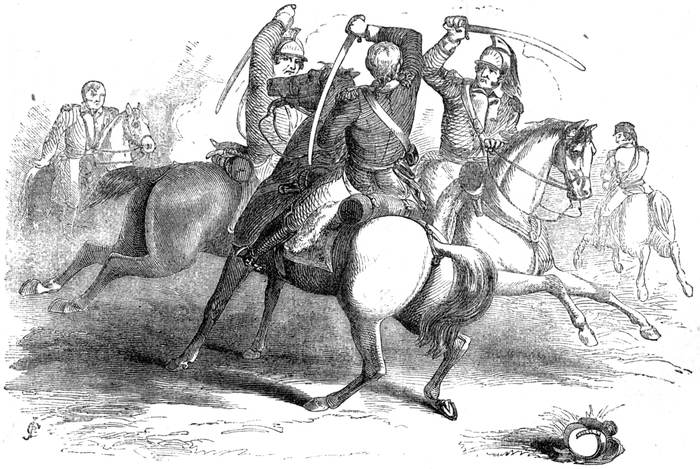
Colonel Horry and Captain Merritt's Conflict.—Page 15.
147Another adventure is thus related by Horry himself: "I was
sent," he writes, "by General Marion to reconnoiter Georgetown. I
proceeded with a guide through the woods all night. At the dawn
of day, I drew near the town. I laid an ambuscade, with thirty
men and three officers, near the road. About sunrise a chair appeared
with two ladies escorted by two British officers. I was ready
in advance with an officer to cut them off, but reflecting that they
might escape, and alarm the town, which would prevent my taking
greater numbers, I desisted. The officers and chair halted very near
me, but soon the chair went on, and the officers galloped in retrograde
into the town. Our party continued in ambush, until ten
o'clock, A. M. Nothing appearing, and men and horses having eaten
nothing for thirty-six hours, we were hungered, and retired to a plantation
of my quartermaster's, a Mr. White, not far distant. There
a curious scene took place. As soon as I entered the house, four
ladies appeared, two of whom were Mrs. White and her daughter.
I was asked what I wanted. I answered, food, refreshment. The
other two ladies were those whom I had seen escorted by the British
officers. They seemed greatly agitated, and begged most earnestly
that I would go away, for the family was very poor, had no provisions
of any sort—that I knew that they were Whigs, and surely
would not add to their distress. So pressing were they for my immediately
leaving the plantation, that I thought they had more in
view than they pretended. I kept my eyes on Mrs. White, and saw
she had a smiling countenance, but said nothing. Soon she left the
room, and I left it also and went into the piazza, laid my cap, sword
and pistols on the long bench, and walked the piazza;—when I
discovered Mrs. White behind the house chimney beckoning me. I
got to her, undiscovered by the young ladies, when she said: 'Colonel
Horry, be on your guard; these two ladies, Miss F— and M—,
are just from Georgetown; they are much frightened, and I believe
the British are leaving it and may soon attack you. As to provisions,
which they make such a rout about, I have plenty for your
men and horses in yonder barn, but you must affect to take them by
force. Hams, bacon, rice and fodder are there. You must insist
on the key of the barn, and threaten to split the door with an ax
if not immediately opened.' I begged her to say no more, for I was
148well acquainted with all such matters—to leave the ladies and every
thing else to my management. She said 'Yes; but do not ruin us:
be artful and cunning, or Mr. White may be hanged and all our
houses burned over our heads.' We both secretly returned, she to
the room where the young ladies were, and I to the piazza I had
just left."
This little narrative will give some idea of the straits to which
the good whig matrons of Carolina were sometimes reduced in those
days. But no time was allowed Horry to extort the provisions as
suggested. He had scarcely got to the piazza when his videttes gave
the alarm. Two shots warned him of the approach of the foe, and
forgetting that his cap, saber and pistols lay on the long bench on
the piazza, Horry mounted his horse, left the inclosure, and rushed
into the melée. The British were seventeen in number, well mounted
and commanded by a brave fellow named Merritt. The dragoons,
taken by surprise, turned in flight, and, smiting at every step, the
partisans pursued them with fatal earnestness. But two men are
reported to have escaped death or captivity, and they were their
Captain and a Sergeant. It was in approaching to encounter Merritt
that Horry discovered that he was weaponless. "My officers," says
he, "in succession, came up with Captain Merritt, who was in the
rear of his party, urging them forward. They engaged him. He
was a brave fellow. Baxter, with pistols, fired at his breast, and
missing him, retired; Postelle and Greene, with swords, engaged
him; both were beaten off. Greene nearly lost his head. His buckskin
breeches were cut through several inches. I almost blush to
say that this one British officer beat off three Americans." The
honor of the day was decidedly with Merritt, though he was beaten.
He was no doubt a far better swordsman than our self-taught cavalry,
with broadswords wrought out of mill-saws. Merritt abandoned
his horse, and escaped to a neighboring swamp, from whence, at
midnight, he got into Georgetown.
Colonel Horry, after the war, met Captain Merritt in New York,
when the latter recognized him, and in the interview which followed,
confessed, that although so desperate in his self-defense he was
never more frightened in his life.
"Believe me, sir," said he, "when I assure you that I went out
149that morning with my locks as bright an auburn as ever curled upon
the forehead of youth, but by the time I had crawled out of the
swamp into Georgetown that night, they were as gray as a badger!"
If this is true, he must indeed have been wofully frightened, for
the records of such an effect of terror are few and far between. One
of Byron's heroes says that
"His locks grew white,
In a single night."
But that was with grief, and not with fear.
Horry's award of praise to the British Captain for his courage in
beating off three of his own men, was both generous and ingenious,
when it is considered that the Englishman was a scientific swordsman,
possessing a superior weapon, while his antagonists were self-taught,
and their swords, if not beaten out of "plowshares," were
veritably made out of mill-saws.
In one of his numerous encounters, while his men were individually
engaged and scattered through the woods around him, he suddenly
found himself alone, and assailed by a Tory Captain, named
Lewis, at the head of a small party. Lewis was armed with a
musket, and in the act of firing, when an unexpected shot from the
woods tumbled him off his horse, in the very moment when his own
gun was discharged. The bullet of Lewis took effect on Horry's
horse. The shot which so seasonably slew the Tory was sent by the
hand of a boy named Given.
Colonel Horry gives, in his memoirs, a good illustration of the
mingled firmness and forbearance with which Marion enforced discipline
amidst men and circumstances not any too easily governed.
Marion had placed one of his detachments at the plantation of George
Crofts, on Tampit Creek. This person had proved invariably true
to the American cause; had supplied the partisans frequently, though
secretly, with munitions of war, cattle and provisions. He was an
invalid, however, suffering from a mortal infirmity, which compelled
his removal, for medical attendance, to Georgetown, then in possession
of the enemy. During the absence of the family, Marion
placed a Sergeant in the house for its protection. This guard was expelled
from the premises by two officers of the brigade, who stripped
the house of its contents. Colonel Horry disclosed these facts to
150General Marion—the Colonel having received them from Mrs. Crofts,
who had pointed to the sword of her husband hanging by the side of
the principal offender. The indignation of Marion was not apt to
expend itself in words. Redress was promised to the complainant,
and she was dismissed.
The offenders were men of some influence, and had a small faction
in the brigade, which had already proved troublesome, and
which might easily become dangerous. One of them was a Major,
the other a Captain. They were in command of a company of men
known as the Georgia Refugees. Upon the minds of these men the
offenders had already sought to act, in reference to the expected collision
with their General.
Marion dispatched Horry to the person who had possession of
the sword of Crofts, with a formal demand for the weapon. He
refused to give it up, alleging that it was his, and taken in war.
"If the General wants it," he added, "let him come for it himself."
When this reply was communicated to Marion, he instructed
Horry to renew the demand. His purpose seems to have been, discovering
the temper of the offender, to gain the necessary time. His
officers, meanwhile, were gathering around him. He was making
his preparations for a struggle which might be bloody—which might,
indeed, involve, not only the safety of the brigade, but his own
future usefulness. Horry, with proper spirit, entreated not to be
sent again to the refractory officer, giving as the reason for his reluctance,
that, in consequence of the previous rudeness of the other, he
was not in the mood to tolerate a repetition of the indignity, and
might, if irritated, be provoked to violence.
Marion then dispatched his orderly to the guilty Major, with a
civil request that he might see him at head-quarters. The Major
appeared, accompanied by the Captain who had joined him in the
outrage, and under whose influence he appeared to act. Marion
renewed his demand, in person, for the sword of Crofts. The Major
again refused to deliver it, asserting that Crofts was a Tory, even then
with the enemy in Georgetown.
"Will you deliver me the sword, Major?" repeated the General.
"I will not."
151"At these words," says Horry, in his memoirs, I could forbear
no longer, and said with great warmth, and a great oath: "Did I,
sir, command this brigade, as you do, I would hang them both in
half an hour!"
Marion sternly replied:
"This is none of your business, sir; they are before me! Sergeant
of the guard, bring me a file of men with loaded arms and
fixed bayonets."
"I was silent," added Horry. "All our field-officers in camp were
present, and they had put their hands to their swords in readiness
to draw. My own sword was already drawn."
In the regular service, with officers bred up to the severe sense of
authority considered necessary to proper discipline, the offender
would probably have been hewn down in the moment of disobedience.
The effect of such a measure, in this instance, might have been most
unhappy. The esprit du corps might have prompted the Major's
immediate followers to have resisted, and, though annihilated, as
Horry says they would have been, yet several valuable lives would
have been lost, which their country could ill spare. The mutiny
would have been put down, but at what a price!
The patience and prudence of Marion's character taught him
forbearance. His mildness, by putting the offender entirely in the
wrong, so justified his severity, as to disarm the followers of the
criminals, who were about sixty in number.
Horry continues: "The purpose of the officers was, to call upon
these men for support—we well knew they meant, if possible, to intimidate
Marion, so as to compel him to come into their measures of
plunder and Tory killing. The affair, fortunately, terminated without
any bloodshed. The prudence of the General had its effect.
The delay gave time to the offender for reflection. Perhaps, looking
around upon their followers, they saw no consenting spirit of
mutiny in their eyes; for, though many of the refugees were present,
none offered to back the mutinous officers—and when the guard
which was ordered appeared in sight, the companion of the offender
was seen to touch the arm of the other, who then proffered the
sword to Marion, saying:
"'General, you need not have sent for the guard.'"
152Marion, refusing to receive it, referred him to the Sergeant of the
guard, and thus, doubly degraded, the dishonored Major of the Continentals
disappeared from sight, followed by his associate.
Another one of Marion's bravest men was Sergeant Jasper, of
whom the readers of a former number have already heard in connection
with the melancholy and romantic story of the young Creole
girl, who followed him to camp, in the disguise of a soldier, and
sacrificed her life to preserve that of the man she loved, by rushing
in between him and the shot aimed at his breast.
Sergeant William Jasper, at the time of the affair which we are
about to relate, belonged to the Second regiment of the South Carolina
militia, having enlisted under Marion, who was then a Captain.
Jasper, from the day of his entering the camp, had been proverbial
for his bravery. His coolness and valor in times of emergency, and
more than all, his utter disregard of danger, had won for him the
golden opinions of his comrades, with the esteem and confidence of
his commander. Jasper possessed remarkable talents and capacity
for a scout. Bold, active and shrewd, with a frame capable of every
endurance—the result of a hardy, backwoods life—and retaining
those noble qualities of bravery and generosity which were the
shining points of his character, he was admirably adapted for that
dangerous but important branch of the service. Combining, in happy
harmony, so many virtues, it is not surprising that he won the affections
of his associates, and the entire confidence of his commander,
who was so assured of his fitness that he granted him a roving
commission, with full power to select from the brigade such men and
as many as he should think proper. But of these he never, or seldom,
selected more than six or eight, preferring, by this small band,
celerity and secrecy. He was almost universally successful, often
penetrating the enemy's camp, or cutting off his rear or advanced
guard, and then returning with his prisoners, or his information,
according to the circumstances of the case. So rapid were his movements,
that he has been known to disappear from the camp and
return again with his prisoners, ere his absence was noticed by the
commandant. He would often enter the enemy's camp as a deserter,
and complaining of the ill usage he had received from his countrymen,
so gain upon their confidence, that he would completely disarm
153them of his real intentions, and after satisfying himself of their
strength, position, intentions, and the like, would return and report
his knowledge to the commander. On one of these occasions, he
remained in the enemy's camp eight days, and then returned, after
first informing himself of every thing necessary that could be of any
use to his General. This game, however, could be played but once.
Never at a loss how to proceed, he, with his usual promptness,
devised other ways and means to gain his information.
It was while he was in the employment of one of these roving
expeditions, that he prepared to again enter the camp of the British
at Ebenezer. It so happened that he had a brother at this post, who
was in the employ of the enemy—a melancholy instance among many
other cases of a like nature, which occurred during the war—who
was a Tory, and who held the same rank in the British army that he
possessed in the American. The brothers were equally dear to each
other, though opposite in political sentiment.
William Jasper loved his brother in the natural warmth of his
generous heart, and wished to see him. He also wished to inform
himself of the enemy's movements. With this double object in his
mind, he therefore prepared for his departure, taking with him only
one companion, a brave young fellow, like himself, who had shared
with him many a "happy hunt," as he termed it, to the united honor
of both. This young officer's name was Newton, holding the same
rank in the service as Jasper, namely, a Sergeant.
It was about sunset when the two young officers left the camp for
their destination. Passing the American lines, they proceeded on
rapidly toward the British camp, which lay some few miles from
Abercorn. Taking the direct road to the latter place, they traveled
rapidly until they arrived in sight of the encamped British force, at
Abercorn.
"We must now make a detour," said Jasper, halting, "in order to
avoid the British at this place, and not be discovered. Our route
lies to the south-east a little, and to shorten the journey, we must
pass yonder forest, the southern side of which borders upon a small
lake or pond, a very convenient place for a respite after the toils and
fatigues of a whole day's travel. I have often met straggling parties
of Tories or British in this forest, or around the margin of the lake,
154and it is necessary, therefore, to proceed carefully while passing it.
Just beyond the lake is a small hill, from the summit of which the
town of Ebenezer can be seen some three or four miles distant.
After we pass this forest and hill, we must observe the utmost silence
and scrutiny, for we are then in the immediate vicinity of and
between the two British posts, which will necessarily place us in a
double danger from the meeting of scouts or Tories from either or
both camps."
With these directions the two now resumed their journey, taking
a small path leading to the left, and directly in line of the forest.
A few minutes of brisk walking brought them to the outskirts of
the forest, which was an extensive piece of woodland, stretching with
occasional intervals far to the south-east, interrupted by a few
broken and uneven ranges of hills, somewhat elevated, but scarcely
sufficiently so to be called mountains. On the left of our travelers,
the forest broke off abruptly, a short distance above them, while its
width was about a quarter of a mile. It was quite dark ere they
reached the woods, which seemed to them almost impenetrable,
having nothing but the faint glimmering of the stars to guide them.
The day had been very clear, however, which left the atmosphere
perfectly free, with nothing to interrupt the twinklings of the little
suns in the distant spheres.
As they entered the forest, they turned to the right, and struck
into the main road leading from Abercorn. They had proceeded
some fifty yards, when Jasper's accustomed ear caught the sound of
horses' hoofs upon the dry soil, moving somewhat rapidly toward
them. Motioning his comrade to halt, he remained an instant
listening to the sound, and then darted off into the thicket on his
left, quickly followed by Newton. Scarcely were they concealed
behind a thick cluster of small cedars, ere the horsemen, for such
they proved to be, came up. Jasper instantly recognized them as a
party of British horse, bound on some scouting expedition. Halting
directly opposite to our travelers, two of them, who appeared to be
the leaders of the squad, dismounted and withdrew a short distance.
The road, at this place, was considerably wider than the usual width,
which caused a small opening in the wood, and which seemed a very
convenient situation for a halt. As the officers retired, they fortunately
155came directly abreast of the cedars, behind which Jasper and
his comrade were ensconced, so that their conversation could easily
be distinguished by both of the latter.
"Our prisoners are no doubt safely within the lines of Ebenezer,
ere this," began the first, "unless rescued by some of their rebel
brethren, which I think can hardly be the case, as we were close to
the town when we left them."
"No fear of that, Lieutenant," replied the second, "for the rebel
dogs would not dare to be so audacious."
"I am not so sure of that," exclaimed the other, doubtingly;
"that Jasper has the audacity of Satan himself, and if he should be
in the neighborhood, I should almost fear for our prisoners. However,
if they are once within the lines, no power will save them, as
I am assured by the commandant that they will be sent to Savannah
for trial and execution, which will have the effect of intimidating,
at least, these rebel curs from further marauding expeditions;" and
he chuckled with an air of self-satisfaction at the thought of their
petty victory.
"Well, be that as it may, Lieutenant," replied his comrade, "it is
another letter in our catalogue of victories, which serves to make us
more popular with the commandant. In either case, we get our
thanks, you know, and that is something toward elevating us toward
our desired height."
"True," rejoined the Lieutenant. "But let us not waste more
time and words than is necessary. Let me see," he added, thoughtfully,
"we will pursue our course north to Abercorn, and deliver
our message to the commander, and then shape our proceedings as
shall seem most fit."
With these words, the two officers mounted their horses, and were
soon lost to view, with their party, on the road to the northern
station.
Jasper and his friend now emerged from their place of concealment,
and taking the road opposite to the direction of the royalists,
resumed their journey.
"So, so," exclaimed Jasper, as they hurried along, "they have
taken some 'rebel curs' prisoners, have they? And they will no
doubt give them the benefit of 'short shrift and sudden cord,' if they
156act in consonance with their general character. But we must
endeavor to rescue them, if their guard is not too strong for us,
which I hardly think will be the case, as they will have no fear of
such a thing in the immediate vicinity of their own lines."
"It is a hazardous undertaking, Jasper," replied Newton, "and
must be attended with a great deal of risk, as, you know, the enemy
occupy every point of note between this and Savannah; and besides,
there is scarcely an hour of the day that some of their scouting-parties
do not prowl between the posts."
"So much the more glory if we succeed," said the noble Jasper;
"and if we fail, why then we share their fate. And we could not
sacrifice ourselves in a nobler cause. There is another reason why
we should endeavor to rescue them, and that is, they are prisoners,
and will, no doubt, be driven to their execution within the walls of
Savannah without even the right of a trial; for the British are
notorious for their bloody propensities, and seek to vent their hate
upon poor captives in a cruel and shameful manner."
"I am certainly of your opinion," said Newton, "still we must
not be impetuous. Our country needs all the help she can command,
and she does not require us to sacrifice our lives in endeavoring to
accomplish impossibilities. However, we shall soon see."
The officers had now nearly reached the limits of the forest, and
taking the right of two roads which here joined, they were presently
in the open country. Nothing of importance occurred to them during
the rest of the journey, which was accomplished in safety to the
British lines. Arriving at the advanced guard, and having left Newton
concealed until his return, Jasper promptly gave the password, and
soon found himself within the enemy's camp. Passing on hastily,
he entered his brother's quarters, whom he found just about issuing
forth to detail a file of men for special duty to guard the prisoners
recently captured, having been sent into Ebenezer on their way to
Savannah for trial.
These prisoners had taken up arms against their countrymen at
the beginning of the contest; but as the British had been in a
measure overthrown, they again joined the ranks of the patriots, and
on being taken, were to be executed. This was only one instance
of hundreds of others who had acted similarly.
157The brothers Jasper were mutually rejoiced to see each other;
but the Tory shook his head doubtfully as he beheld his brother
again within the British camp, after having so shrewdly deceived
them on a former occasion. But William Jasper quickly reassured
his mind on this point, and bade him be under no uneasiness.
Having ascertained from his brother the number of men who
were to conduct the prisoners to Savannah, at what time they
intended to leave, and also making such other inquiries as he deemed
proper, Jasper bade him adieu, and soon sought his comrade, Newton,
whom he found anxiously waiting his return.
"I have received information from my brother," he said, "that
these prisoners leave to-morrow morning at sunrise for Savannah,
under a guard of eight men, and accompanied by a Sergeant and a
Corporal. The odds is not so very great after all; and I think by a
little stratagem and boldness we can succeed in rescuing them. At
all events, let us make the trial."
But Jasper's friend was not so sure of success. Ten to two, and
those two unarmed, seemed to him too great odds to contend with,
as having any chance of succeeding. But when Jasper related to
him that one of these prisoners was a woman who had a young
child, and that she was the wife of one of the captured men, his
heart was touched at the melancholy spectacle, and he instantly
coincided with his friend that they should attempt their rescue. This
being their conclusion, they conferred as to the best means of accomplishing
the desired object. This was soon decided upon. They
determined to linger around the fortifications until they should see
the prisoners, with their guard, set out for the place of destination,
and then follow their footsteps until a convenient opportunity offered
to put into force the execution of their design. Accordingly, selecting
a secure concealment near the lines to await the approach of
dawn, they threw themselves upon the ground, and being somewhat
fatigued, soon fell asleep. The day was just beginning to emerge
ere Jasper awoke, so sound had been his rest, and springing up, he
aroused his friend.
All was activity in the British camp. Men were hurrying to and
fro, preparing for the duties of the day. In fact, the whole camp
seemed to be astir to Jasper and his comrade, as they issued
158from their place of concealment to watch the movements of the
enemy.
They had not proceeded far before their attention was arrested by
a file of soldiers marching out into the inclosure and then coming
to a halt, as though waiting further orders. Presently a body of
men, with their arms pinioned, was marched directly to their front.
Dividing their force, the prisoners were placed in the center, with a
portion of their guard in front and rear. Every thing being now in
readiness, the whole party started off toward their destined point,
leaving the village at the southern extremity.
Jasper and his companion now made a circuit of the village, so
as not to be discovered, and in order to place themselves on the
track of the troop. Having secured a suitable distance from the
guard, they followed them silently, watching their opportunity when
to make the endeavor. In this way they continued to track their
friends and their guards for some time, without any prospect of
accomplishing their design, until they were within two miles of
Savannah. They had become nearly discouraged, when Jasper
suddenly recollected that just ahead of them there was a noted spring,
at which place they conjectured the guard would halt, with their
prisoners, to refresh themselves. The spring was known to travelers,
who, when journeying that way, seldom or never passed it without
tasting its crystalline waters. Jasper and Newton were right in
their conjectures. Arriving opposite the spring, the guard halted
their prisoners in the road under the shade of a large oak-tree,
which stood just on the margin of the road, and between that and
the spring. Our heroes, however, had reached the spring before the
British, having taken an obscure path with which they were well
acquainted, and placing themselves in ambush, awaited the arrival
of the enemy.
The day was warm, and as the guard halted, the prisoners, glad
to rest their wearied limbs after so long a march, threw themselves
upon the earth under the shade of the tree, little dreaming of the
succor so near at hand. Very soon after, they were conducted to
the spring by the Corporal with four men. The remainder of the
guard were under the charge of the Sergeant, who halted them on
the road a short distance from the spring, and having ordered them
159to stack their arms, brought up the rear. After having sufficiently
quenched their thirst, the whole party returned, leaving two men on
guard of the arms which were all stacked near the spring. These
two men kept guard but indifferently. They had nothing to fear
within so short a distance of the fortress at Savannah, conscious of
being surrounded by none of their foes, and inclosed within the very
stronghold of the British lines. It is not surprising that they should
not maintain a very strict watch under such circumstances.
The propitious moment for the daring and hazardous attempt was
drawing near, which was eagerly watched by Jasper and his comrade
in their adjoining ambush.
The localities of the place, the position of the guard, the nearness
of the ambush—in short, every thing seemed most appropriate and
advantageous.
The spring, as we have said, was situated on the left, within
a few feet of the road, between which and the water stood the
arms of the guard in charge of the two men, who were lazily employed
in watching the bubblings of the fountain, and then tracing
its clear waters as they flowed silently off in a small rivulet in a
winding direction, until lost in the thick foliage a few rods below.
Beyond, and in full view, were the walls and fortifications of Savannah,
almost within hailing distance of the spot which our heroes
have rendered immortal by their daring achievement.
The remaining guard stood in a group on the opposite side of
the road, conversing freely and gayly, and utterly unconscious of
the presence of an enemy, while the prisoners were reclining under
the stately oak, a little on the left of the British.
The two soldiers were conversing cheerfully, having seated themselves
by the side of the spring, little dreaming that this colloquy
was destined to be their last.
Presently, the two arose, and leaning their muskets against a
small tree, close to where Jasper and his comrade lay concealed,
they proceeded to fill their canteens with the refreshing draught of
the spring.
At this moment Jasper gave the signal. Springing out from their
ambush, he and his companion seized the loaded weapons, and
instantly leveling them, shot the two soldiers dead upon the ground.
160Then rushing upon the guard, they clubbed their muskets, and assailing
two of the remaining soldiers, who were in advance of the
rest, they felled them to the earth, and before the astonished guard
could recover from their surprise, they rushed to the stack of arms,
and with presented weapons, instantly demanded the surrender of
the whole troop. The British officers seeing their perilous situation,
and noticing the determined looks of Jasper and Newton, and being
withal deprived of their arms, complied with their demand, and
yielded themselves and their men as prisoners of war. To set free
the captives was but the work of an instant, and placing the muskets
of the captured British into their hands, Jasper ordered the irons to
be placed upon the new prisoners; and then hurrying away from
this spot, which they have immortalized with a name not soon to be
forgotten, they crossed the Savannah with both friends and foes, and
were soon rapidly marching toward the American camp.
Thus was this noble act achieved, of which history furnishes but
few parallels; and which strikingly illustrates the coolness, determination
and bravery, which ever characterized the noble-hearted
Jasper. But, unfortunately for his country, she was soon destined
to lose his valuable services, when, in the very hey-day of his youth,
he sealed his patriotism with his heart's blood before the walls of
Savannah.
ELERSON'S TWENTY-FIVE MILE RACE.
161
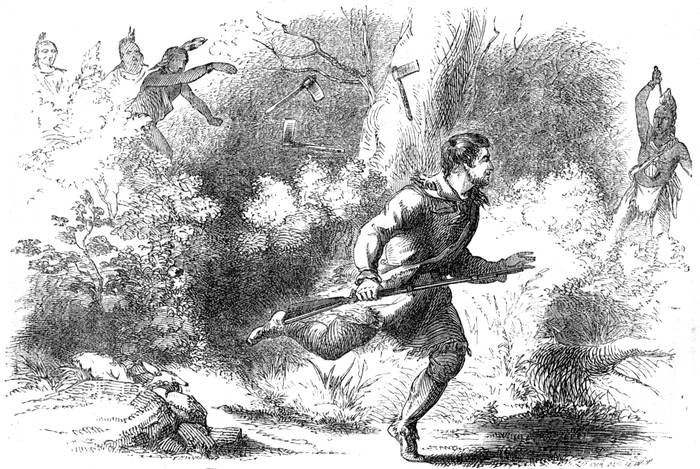
Elerson's Twenty-Five Mile Race—Page 32.
163Among the members of that celebrated rifle corps, commanded
by Daniel Morgan, to which we already have referred, was a man by
the name of Elerson, who, in deeds of daring and intrepidity, was
almost a match for Timothy Murphy, whose frequent companion he
was when on an expedition against their mutual enemies, the Tories,
red-coats, and Indians. Quick of perception, rapid in his conclusions
and his actions, light of foot, and brave as a lion, he was an
enemy whom the Indians feared, and a friend whom all reckoned as
second only to the renowned Murphy himself. The corps to which
these celebrated marksmen belonged was attached to the expedition
of Generals Clinton and Sullivan against the Six Nations in 1779.
Elerson was with Clinton when that officer halted at Otsego Lake,
to await the coming up of his superior, from the direction of Wyoming.
While the army lay at this place, Elerson rambled off from
the main body, in search of adventure, and pulse for the dinner of
the mess to which he belonged. Regardless of danger, he wandered
about until he had procured a quantity of the weed, when he prepared
to return to camp. It seems that he had been discovered and
tracked by a party of Indians, who determined upon his capture.
As he was adjusting his burden, he heard a rustling of the leaves
near him. Looking in the direction indicated, he discovered a band
of six or eight Indians, stationed between him and the camp, so as
to cut off his retreat in that direction, and who were in the act of
springing upon him. Conscious of their object—for he might have
been shot down with ease—he determined to foil them if in his
power, knowing full well the fate of a prisoner in their hands.
Seizing his rifle, he dropped his bundle, and fled through the only
avenue left open for his escape, followed by the whole pack, hooting
and yelling at his heels. As he started to run, half a dozen tomahawks
were hurled at him, and came whizzing and flying through
the air. Fortunately but one reached its object, and that nearly cut
the middle finger from his left hand. With the agility of the hunted
stag, Elerson bounded over an old brushwood fence which stood in
his path, and darted into the shades of the forest, followed by his
no less rapid pursuers. Aware that the course he had taken was
away from the camp—so also were his enemies—he prepared himself
for a mighty effort, trusting that an opportunity would offer to
"double" and find his way back. Vain hope! The Indians, aware
that such would naturally be his aim, took care to prevent it by
spreading themselves somewhat in the form of a crescent; but, in
so doing, they nearly lost sight of their prey. Fearful that he might
escape, they discharged their rifles—hoping to wound or kill him—but
with no effect. The brave fellow tried every nerve to outstrip,
and every stratagem and device to mislead his savage pursuers; but
they were too cunning to be deceived, and kept on his track with
the ardor of blood-hounds. Four long hours the chase continued
164thus, until overtasked nature threatened to give way, and yield him
to the tomahawk and scalping-knives of his enemies. Like some
powerful engine, his heart was forcing the blood through his distended
and throbbing veins, which were swollen to bursting with the
mighty efforts of the chase. His breath came short and rapid, betokening
a speedy termination of the race, unless a breathing spell
was afforded him. An opportunity at last was offered, when, having,
as he thought, outstripped his pursuers for a moment, he halted
in a little lonely dell to recover his waning strength. His hope was
destined to disappointment, however, for the circle closed in upon
him, and the bust of an Indian presented itself at a slight opening
in front. He raised his rifle to fire, but at that moment a shot from
his rear admonished him that danger was all around; another took
effect in his side, and warned him of the danger of delay. The Indian
in front had disappeared, and he hastened forward, with the love
of life still strong in his breast. The wound in his side bled freely,
although only a flesh-wound, and therefore not dangerous nor painful.
It served, however, to track him by, and, conscious of the fact, he
managed to tear a strip from his hunting-shirt and staunch the blood.
On, on went pursuer and pursued—over hill and dale, brook, stream-let
and running stream—through brier and bramble, through field
and wood—until the parched and burning tongue of the fugitive
protruded from his mouth swelled to such distention as almost to
stop his breathing. Exhausted nature could do no more; he threw
himself prostrate on the bank of a tiny brook, resolved to yield the
contest for the sake of a hearty draught of its clear, sparkling
waters. He bathed his brow in the cool element, and drank deeply
of its reviving virtues. Raising his head, he discovered the foremost
of the now scattered and equally exhausted enemy, crossing
the brow of a ridge over which he had just passed. The instinct
of preservation was awakened afresh in his bosom at the sight; he
started to his feet and raised his rifle, but failing strength would not
allow of a certain aim, and an empty weapon would insure his death.
Another moment, and he would be at the mercy of his enemy, without
hope or chance of life. Again he raised his trusty rifle, and,
steadying its barrel against a sapling, he secured his aim, fired, and
the Indian fell headlong in death. Before the echoes of the report
165had died away in the neighboring hills, he beheld the remainder of
the band of eager, hungry pursuers coming over the ridge; he then
felt that his minutes indeed were numbered. Hidden partially by
the tree behind which he stood, they did not discover him, however;
and while they paused over the body of their fallen comrade,
he made another attempt to fly. He staggered forward—fell—and,
exerting his failing powers to the utmost, he managed to reach
a thicket of young trees, overgrown with wild vines, into which he
threw himself with the energy of desperation. Fortune favored
him; he discovered the rotten trunk of a fallen tree, whose hollow
butt, hidden and screened by the deep shadow of the surrounding
foliage, offered an asylum from the impending death which seemed
so near. The approaching steps of the savages quickened his movements,
as he crawled head first into the recess, which was barely
large enough to admit his person. Here he lay within hearing of
the efforts made to discover his hiding-place, until they died away in
the distance. Conscious, however, that the Indians would search
long and anxiously for him, he lay in this situation for two days and
nights. When he ventured out he knew not which way to turn, but
striking off at random, he soon emerged upon a clearing near Cobbleskill—a
distance of twenty-five miles from his place of starting.
The brave fellow had earned his liberty; and the Indians never
ceased to recur to the race, with grunts of approbation at the white
man's power of endurance.
Another race for life, not so lengthy, but equally exciting while it
lasted, is related in the historical records of Kentucky—that State
whose infancy was "baptized in blood." William Kennan, a
brother spirit of Kenton, Hunt, and Boone, a ranger renowned for
strength and courage, had joined the expedition of St. Clair against
the Indians. In the course of the march from Fort Washington he
had repeated opportunities of testing his surprising powers, and was
admitted to be the swiftest runner of the light corps. This expedition
of St. Clair was organized after the disastrous defeat of Harmar
by the Indians, in 1779. Washington, who was at this time
President, determined to employ a force sufficient to crush out the
savages. This force was to have been two thousand regular troops,
composed of cavalry, infantry and artillery, and a large number of
166militia which were ordered to move from the several States in which
they had been enlisted, toward Fort Washington, now Cincinnati,
where the men rendezvoused in September. The object of the campaign
was to establish a line of posts, stretching from the Ohio to
the Maumee, to build a strong post on the latter river, and by leaving
in it a garrison of a thousand men, to enable the commander of
the fort to send out detachments to keep the Indians in awe. But
there was difficulty about organizing the army, St. Clair being very
unpopular in Kentucky; the season was far advanced before he took
the field, and when he did, he had only about two thousand men all
told, and from these, desertions were continually taking place. The
Kentucky levies were reckless and ungovernable, the conscripts from
the other States were dissatisfied, and to make matters worse, the
mountain leader, a Chickasaw chief, whose knowledge of Indian
tactics would have been invaluable, losing faith in the success of the
whites, abandoned the enterprise with his band of warriors.
St. Clair, however, continued his march; and on the evening of
the third of November, halted on one of the tributaries of the Wabash.
A few Indians were seen, who fled with precipitation. The
troops encamped; the regulars and levies in two lines, covered by
the stream; the militia on the opposite shore, and about a quarter
of a mile in advance. Still further in advance was posted Captain
Hough with a company of regulars. His orders were to intercept
small parties of the enemy, should they venture to approach the
camp, and to give intelligence of any occurrences which might
transpire.
Colonel Oldham, who commanded the Kentucky levies, such as
had not deserted, was cautioned to remain on the alert during the
night, and to send out patrols of twenty-five or thirty men each, in
different directions, before daylight, to scour the adjoining woods.
Kennan was with one of these patrols. Just as day was dawning
he perceived about thirty Indians within one hundred yards of
the guard fire, cautiously approaching the spot where he, with about
twenty other rangers, stood, the rest of his company being considerably
in the rear. Supposing it to be a mere scouting party, not
superior in numbers to the rangers, he sprung forward a few paces
to shelter himself in a spot of tall grass, where, after firing with
167quick aim upon the foremost savage, he fell flat upon his face, rapidly
reloading his gun, not doubting but what his companions would
maintain their position.
However, as the battle afterward proved, this, instead of being a
scouting-party of savages, was the front rank of their whole body,
who had chosen their favorite hour of daybreak for a fierce assault
upon the whites, and who now marched forward in such overwhelming
masses, that the rangers were compelled to fly, leaving Kennan
in total ignorance of his danger. Fortunately, the Captain of his
company, observing him throw himself in the grass, suddenly exclaimed:
"Run, Kennan! or you are a dead man!"
Instantly springing to his feet, he beheld the Indians within ten
feet of him, while his company was more than a hundred yards in
front. He had no time for thought; but the instinct of self-preservation
prompted him to dart away, while the yells of his pursuers
seemed absolutely close in his ears. He fancied he could feel their
hot breath. At first, he pressed straight toward the usual fording-place
in the creek, which was between the savages and the main
army. Ten feet behind him! ay, they were before, and all about
him! Several savages had passed him, as he lay in the grass, without
discovering him; and these now turned, heading him off from
the ford.
There was but one way possible for him to reach the camp, which
was to dart aside, between his pursuers, and make a long circuit.
He had not succeeded in reloading his rifle; with a pang of regret, he
threw it down, for it encumbered him, in the exertions he was making,
and putting every nerve to its utmost strain, he bounded aside
and onward. Running like a deer, he soon had the relief of outstripping
all his pursuers but one, a young chief, perhaps Messhawa,
who displayed a swiftness and perseverance equal to his own.
Here was a race worth seeing! With long, panther-like bounds,
the agile Indian chased the fugitive, who scarcely knew whether he
fled on air or earth. The distance between them on the start was
about eighteen feet; the herculean efforts of Kennan could not make
it one inch more, nor the equally powerful leaps of the savage make
it one inch less. Kennan was at a great disadvantage. He had to
168watch the pending blow of his adversary, whose tomahawk was
poised in the air, ready for the first favorable opportunity to be discharged
at him. This gave him small chance to pick his footsteps
with prudence.
Growing tired of this contest of skill, in which neither gained,
the ranger, seeing that no other Indian was near enough to interfere,
resolved to end the matter by a hand-to-hand conflict. Feeling in
his belt for his knife, he found that it was gone.
"I'm tellin' the straight out-and-out truth, my friends," Kennan
used to remark, when he related this adventure, "when I felt for
sartin that knife was lost, my ha'r just lifted my cap off my head—it
stood straight up—that's a fact!"
But if fear lifted his hair up, it lifted his body up, likewise. The
thought of his unarmed condition gave him wings, which, verily,
he needed, for he had slackened his pace as he felt for his knife, and
the tomahawk of his enemy was now almost at his shoulder.
For the first time he gained ground a trifle. He had watched the
motions of his pursuer so closely, however, as not to pay attention
to the nature of the ground, so that he suddenly found himself in
front of a large tree, which had been torn up by the winds, and
whose dry branches and trunk made an obstacle eight or nine feet
high. As he paused before this hindrance, the young chief gave a
whoop of triumph.
"Yell yer throat open, yer blasted red blood-hound!" thought the
invincible Kentucky ranger.
Putting his soul into the effort, he bounded into the air with a
power which astonished himself as much as his pursuers; trunk,
limbs, brush, were cleared—he alighted in perfect safety on the other
side. A loud yell of amazement burst from the band of savages
who witnessed the feat, which not even the young chief, Messhawa,
had the hardihood to repeat.
Kennan, however, had no leisure to enjoy his triumph. Dashing
into the creek, where its high banks protected him from the fire of
the Indians, he ran up the edge of the stream until he came to a
convenient crossing-place, when he rejoined the encampment, where
he threw himself on the ground, exhausted by his exertions.
He had little time for rest. The Indians had begun a furious
169attack, which raged for three hours, and which resulted in a defeat of
the whites still more disastrous than that of Harmar's.
In the retreat which followed, Kennan was attached to the battalion
which had the dangerous service of protecting the rear. This
corps quickly lost its commander, Major Clarke, and was completely
demoralized. Kennan was among the hindmost when the retreat
commenced; but the same powers which had saved him in the morning
enabled him to gain the front, passing several horsemen in his
flight. The retreat of the whole army was in the utmost disorder.
The camp, artillery, baggage and wounded were left in the hands
of the enemy. Most of the officers, who had fought bravely, were
already fallen.
St. Clair himself, who had been confined to his tent with the gout,
made his escape on a pack-horse, which he could neither mount nor
dismount without assistance. The flying troops made their way
back to Fort Jefferson. Under such circumstances, it may be imagined
that the line of flight was a scene of fearful disorder. The
Indians, making matters more appalling by their yells of triumph,
pursued the routed foe. Giving up all efforts to protect the rear, the
battalion to which Kennan belonged fled as it could, every man for
himself.
It was here, as he was making good his own retreat, that our
hero came across a private in his own company, an intimate friend,
lying upon the ground with his thigh broken, who, in tones of piercing
distress, implored each horseman to take him up. When he beheld
Kennan coming up on foot he stretched out his hands entreatingly.
Notwithstanding the imminent peril, his friend could not
withstand this passionate appeal; he lifted him upon his back, and
ran in that manner several hundred yards.
The enemy gained upon them so fast that Kennan saw the death
of both was certain unless he relinquished his burden. He told his
friend that he had done all he could for him, but that it was in vain.
He could not save him, and unless he wished both to perish, to let
go his clasp about his neck. The unhappy man only clung the
more tenaciously; Kennan staggered on under his burden, until the
foremost of the enemy were within twenty yards of him—then,
yielding to a cruel necessity, he drew his knife from its sheath and
170severed the fingers of the wounded man, who fell to the ground, and
was tomahawked three minutes after.
But if unsuccessful in the attempt to save this fated fellow-soldier,
he had the pleasure, before the race was over, of saving the life of
one who afterward became his warm and helpful friend.
Darting forward with renewed swiftness, after cutting his burden
from him, he was again out of immediate danger, when he came
across a young man, sitting upon a log, calmly awaiting the approach
of his enemies. He was deadly pale, but his refined and
handsome face wore not the least expression of fear.
"Don't you know the red-skins are upon us?" called out the
ranger.
"I know it; but I can not help it. I have never been strong,
and now I am wounded. I could not take another step to save
my life. Go on—don't stop to pity me."
Kennan was too brave himself not to admire the calm courage
of this young man. He looked about. A short distance off he saw
an exhausted horse, refreshing himself upon the luxuriant grass.
Running after the animal, he caught him without difficulty, brought
him up, assisted the wounded stranger to mount, and ran by his side
until they were out of danger. Fortunately the pursuit ceased about
that time, the spoils of the camp offering attractions to the savages
more irresistible even than the blood of the remaining whites. The
stranger thus saved by Kennan was Madison, afterward Governor
of Kentucky, who continued through life the friendship formed that
day.
Kennan never entirely recovered from the superhuman exertions
he was compelled to make on that disastrous day.
Of this melancholy campaign of St. Clair's, Hall, in his sketches
of the West, says: "The fault was not in the leader, but in the
plan of the expedition, and the kind of troops employed. All that
an old commander could effect with such a force, under the circumstances
by which he was surrounded and overruled, was accomplished
by General St. Clair. The brilliant talents of this brave soldier and
veteran patriot were exerted in vain in the wilderness. The wariness
and perseverance of Indian warfare created every day new
obstacles and unforeseen dangers; the skill of the experienced leader
171was baffled, and undisciplined force prevailed over military science.
The art of the tactician proved insufficient when opposed to a countless
multitude of wily savages, protected by the labyrinths of the
forest and aided by the terrors of the climate. At a moment of
fancied security his troops were assailed upon all sides by a numerous
and well-organized foe, who had long been hanging on his flanks,
and had become acquainted with his strength, his order of encampment,
and the distribution of his force—who knew when to attack
and where to strike."
The loss on this occasion was mournfully great; thirty-eight officers
and eight hundred men were slain.
Hall further says: "In reference to all these (Indian) wars, it has
never been sufficiently urged, that they were but a continuation, and
a protracted sequel to the War of Independence. For years after
the United States had been acknowledged as a nation, Great Britain
continued to hold a number of military posts within her Northwestern
limits, and to urge a destructive warfare through her savage
allies. It was against Britain that St. Clair, Harmar, Wayne and
Harrison fought; and they, with others, who bled in those Western
wilds, contributed as much to the purchase of our independence, as
those who fought for our birthright at an earlier period."
Oh, mother-country; how very like the worst personification of a
stepmother thou hast ever been, and still art, to this fairest of thy
children.
The Indians are remarkable for fleetness of foot and endurance.
Trained from childhood to the forest and chase, to run without tiring
is one of their most esteemed virtues. They have been known frequently
to run down the deer. We have seen them, on the western
plains, exhaust the horse in the contest for strength of "wind."
One savage of the Osages used to run from one village to another,
a distance of fifteen miles, in one hundred minutes, for a swallow of
"fire-water," and his squaw once performed the feat in the space of
two hours, for the price of three yards of red ribbon. The stories
now related of Ellerson and Kennan prove that, in speed and endurance,
the white man sometimes excels even the savages. We shall,
in the course of these pages, have occasion to mention other instances
of running for life.
MOLLY PITCHER AT MONMOUTH.
172
The battle of Monmouth was one of the most severely contested
engagements of the Revolution. From the rising to the setting sun,
on that sultry Sabbath in June, two armies strove for the mastery of
that ensanguined field, until heaps of dead and dying strewed the
plain, marking the path of the serried ranks as the ebb and flow of
battle changed their relative positions. Both armies fought with a
desperate determination to conquer, and instances of personal
bravery and daring were innumerable; yet, when night drew her
sable mantle over the earth, shrouding from sight the soul-sickening
scene, neither party could claim the meed of victory. Of the many
thrilling incidents of that eventful day, that which brought into
conspicuous notice the heroine of our story was not the least
interesting.
Molly Pitcher, or, as she was afterward more familiarly known,
Captain Molly, was a sturdy young Irish woman of some twenty-two
or twenty-three years of age, short, thick-set, with red hair, a freckled
face, and a keen, piercing eye, which gave token of a spirit of mischief
ever ready for a frolic or a fight. She was the wife of a
Sergeant in an artillery corps, which had seen service since the
commencement of the war, and was attached to him with all the
warmth of the Irish disposition. She had followed him through all
his campaigns, and was with him at Fort Clinton, in the Hudson
highlands, when that post was attacked and captured by Sir Henry
Clinton. Here, too, she gave a specimen of that reckless courage
which distinguished her at Monmouth some nine months after. Her
husband, who was in the act of touching off his piece, seeing the
British scaling the walls, and getting in his rear, dropped his match,
and calling to Molly to follow, fled as fast as his legs would carry
him. She, determined not to waste powder and ball, and knowing
that her "petticoats" would protect her retreat in a measure, picked
up the linstock, fired the piece, and then scampered off. She
173escaped scot-free, and when the scattered fugitives from the forts
were collected, and the artillery was attached to the main army, she
accompanied her husband as a sutler, and was with him through that
bitter winter at Valley Forge.
When Sir Henry Clinton evacuated Philadelphia, and took up his
march across the Jerseys, Washington left his winter camp and prepared
to follow, hoping to get an opportunity to strike a blow which
should animate his own troops and effectually cripple, perhaps capture,
the British army. On the plains of Monmouth the hostile
armies met in battle array. Of the details of the action it is not
our province to speak. It will suffice our purpose to say that Lee
had been ordered to attack the British on their first movement, and
engage them until the main army of the Americans could be brought
into action by Washington in person. The first part of his orders
he had obeyed; the latter, for reasons never fully explained, he did
not conform to, but retreated unexpectedly toward the main body,
which movement was timely checked by Washington, who ordered
the whole army into action. It became necessary, however, for a
portion to fall back a second time; and to check the pursuit, the artillery,
to which Molly's husband was attached, was stationed on an
eminence, in the rear of a hedge-row, for that purpose. Molly herself
was engaged in bringing water from a spring to assuage the
thirst of the men at the guns, when she saw her husband struck
down by a cannon-shot from the enemy, which cut him nearly in
two, killing him instantly; at the same time she heard the commandant
order the piece withdrawn, as he had no one to fill the place
now vacant. Molly heard the order, and maddened by her loss,
rushed forward, exclaiming as she did so: "No! you shan't remove
the gun, neither. Shure, can't I ram it as well as Tom, there?
Ah! it's kilt entirely he is, bad luck to the bloody vagabond that
p'inted the gun that shot him. Sorra a day was it when ye 'listed,
darlint, to leave me a lone widdy now, with nary a soul to care
whether I live or die. But I'll pay the dirty vagabonds for this
day's work, cuss 'em." And thus alternately apostrophizing her
husband and anathematizing the British, she continued to ram the
gun until it was withdrawn. The activity and courage which she
exhibited attracted the attention of all who witnessed it, and on the
174morning after the battle the circumstance was reported to General
Greene, who was so much pleased at her bravery and spirit that he
sent for her and determined to present her to the Commander-in-Chief.
This he did, covered with dirt and blood as she was, and
Washington, after questioning her, conferred on her a warrant as
Sergeant, and subsequently, by his influence, her name was placed
on the list of half-pay officers for life. She went ever after by the
name of "Captain Molly," and the French officers, particularly, took
a great deal of notice of her, and made her many presents. She
dressed in a mongrel suit, composed of a cocked hat, soldier's coat
with an epaulette on one shoulder, and petticoats. In this rig she
would pass along the French lines any day and get her hat filled
with crowns.
Molly Pitcher's bravery was not, perhaps, of the highest order,
being a part of the natural recklessness of her character; but there were
women, plenty of them, in the time of our country's peril, and during
the still more dreadful dangers of the new country, who proved
their heroism to be of the noblest sort. Not only the heroism of
endurance, in which women always excel—the endurance of fear,
privation, loneliness and grief—but the heroism of action. Of such
metal was the deed of prowess which has immortalized the name of
Elizabeth Zane. In 1777, Fort Henry, in Ohio county, Virginia,
was attacked by Indians. The defence was made with vigor, until
the ammunition became exhausted, when surrender seemed the only
alternative—a fearful alternative, in view of the treacherous character
of their enemies. There was a keg of powder in a house about
twelve rods distant, to obtain which would prolong the defense, and
perhaps preserve the lives of the whole garrison. It was resolved
that one person should venture out, and, if possible, secure and bear
into the fort the valued prize. The Indians having retired a little
distance, a favorable opportunity was afforded; but it became difficult
to decide who should undertake the service, as many soldiers
were emulous for the honor of executing the perilous enterprise.
Their contention was cut short by Miss Zane, who claimed to be
chosen for performing the duty, upon the ground that the life of a
soldier was more valuable to be employed in defending the fort, and
also that her sex might save her errand from suspicion and thus
175secure its success. It was the latter plea, which was somewhat
plausible, united to her resolution, which overcame the scruples of
the officer in command, far enough to permit her to make the
attempt.
Her sex might protect her! Ah! no one better than the girl herself
knew how very slender was that "might"—for an instant her
heart stood still in her bosom, as the gate of the fort opened a little
and closed behind her, shutting her out in the very shadow of the
valley of death! For one instant her eyes grew dark and her ears
rung, and in her bosom she felt, by apprehension, the piercing anguish
of a dozen bullets; but, as quickly, she rallied, and with a light,
fleet foot passed on to the house, not running, for fear of calling
down the suspicions of the murderous eyes which watched her every
movement. The Indians observed her leave the fort, but, as she had
hoped, did not at first comprehend her actions, allowing her to pass
on to the building, without molesting her, probably absorbed in a
momentary wonder at her sex and her audacity.
She reached the house, seized the powder, and hastened to return.
By this time the savages had recovered from the spell which the
first sight of the young heroine had thrown upon them; they saw
the keg of powder in her arms, and with yells of anger, fired a volley
after her as she ran rapidly toward the fort. Fortunately, not a
bullet touched her. As they rattled about her, singing past her ears,
they only gave activity to her movements. In another moment she
was safe within the gate, to the unbounded joy of the garrison.
Animated by so noble an example, the men fought with a vigor
which the enemy could not overcome, who were compelled to raise
the siege.
The following anecdote, which is too well authenticated to be disputed,
furnishes one instance, among thousands, of that heroic spirit
which animated the American women during the struggle for Independence.
In 1775, a good lady lived on the seaboard, about a day's march
from Boston, where the British then were. By some unaccountable
mistake, a rumor was spread, in town and country, in and about
her residence, that the regulars were on a march for that place, where
they would arrive in about three hours. This was after the battle
176of Lexington, and all, as might be supposed, was in sad confusion;
some were boiling with rage and full of fight; some in fear and
tribulation were hiding their treasures; others flying for life. In
this wild moment, when most people, in one way or another, were
frightened from propriety, our heroine, who had two sons, aged respectively
nineteen and sixteen, was seen preparing them to discharge
their duty in the emergency. The eldest she was enabled to
equip in fine style; she took her husband's fowling-piece, "made for
duck or plover," (the good man being absent on a coasting voyage
to Virginia,) and with it, the powder-horn and shot-bag. But the
lad, thinking the duck and geese-shot not quite the size to kill regulars,
his mother, with the chisel, cut up her pewter spoons, hammered
them into slugs, put them into his bag, and he set off in great
earnest, calling a moment, on the way, to see the parson, who said:
"Well done, my brave boy. God preserve you!"
The youngest was importunate for his equipments, but his
mother could find nothing to arm him with but an old rusty sword.
The boy seemed unwilling to risk himself with this alone, lingering
in the street until his mother thus upbraided him:
"You, John H——, what will your father say, if he hears that
a child of his is afraid to meet the British? Go along; beg or
borrow a gun, or you'll find one, child; some coward, I dare say,
will be running away; then take his gun and march forward! If
you come back, and I hear you have not behaved like a man, I shall
carry the blush of shame on my face to the grave."
She then shut the door, wiped the tear from her eye, and abided
the issue.
There were not wanting American ladies whose wit and courage
could bring the blush of shame or anger to the haughty faces of the
British officers. There is scarcely a more stinging retort on record
than that which was given to the insolent Tarleton by a lady at Washington,
before whom he was boasting his feats of gallantry. Said he:
"I have a very earnest desire to see your far-famed hero, Colonel
Washington."
"Your wish, Colonel, might have been fully gratified," she
promptly replied, "had you ventured to look behind you at the
battle of the Cowpens."
177
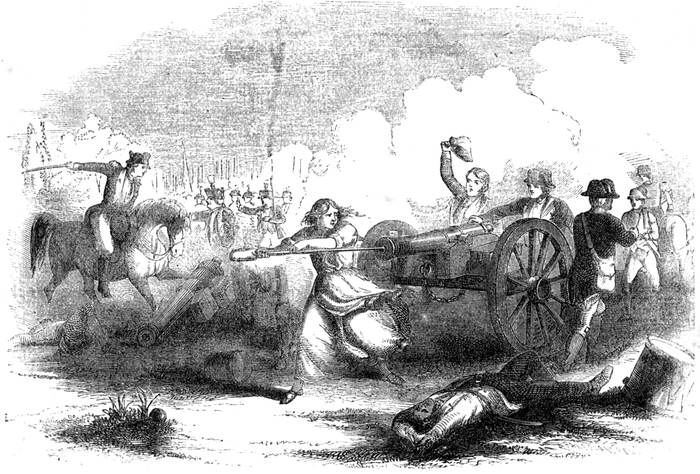
Molly Pitcher at Monmouth.—Page 44.
179It was in that battle that Washington had wounded Tarleton,
which gave rise to an equally pointed remark from Mrs. Wiley Jones,
to whom Tarleton had observed:
"You appear to think very highly of Colonel Washington; yet I
have been told that he is so ignorant a fellow that he can hardly
write his own name."
"It may be the case," she readily replied, "but no one knows
better than yourself that he knows how to make his mark."
We should think that he would have been ready to drop the subject
in the presence of ladies so well able to defend their country's
gallant officers.
Mrs. Thomas Heyward, in two instances, with the utmost firmness
refused to illuminate for British victories. An officer forced his way
into her presence, sternly demanding:
"How dare you disobey the order which has been issued? Why,
madam, is not your house illuminated?"
"Is it possible for me, sir," replied the lady, with perfect calmness,
"to feel a spark of joy? Can I celebrate the victory of your
army while my husband remains a prisoner at St. Augustine?"
"That is of little consequence," rejoined the officer; "the last
hopes of the rebellion are crushed by the defeat of Greene at Guilford.
You shall illuminate."
"Not a single light," replied the lady, "shall be placed on such
an occasion, with my consent, in any window of my house."
"Then, madam, I will return with a party, and before midnight,
level it with the ground."
"You have power to destroy, sir, and seem well disposed to use
it; but over my opinions you possess no control. I disregard your
menaces, and resolutely declare—I will not illuminate!"
Mrs. Rebecca Motte was another lady who proved, in a signal
manner, that her patriotism was equal to the severest test. After
the abandonment of Camden to the Americans, Lord Rawdon, anxious
to maintain his posts, directed his first efforts to relieve Fort
Mott, at the time invested by Marion and Lee. This fort, which
commanded the river, was the principal depot of the convoys from
Charleston to Camden, and the upper districts. It was occupied by a
garrison, under the command of Captain McPherson, of one hundred
180and sixty-five men, having been increased by a small detachment
of dragoons from Charleston, a few hours before the appearance of
the Americans.
The large new mansion-house belonging to Mrs. Motte, which had
been selected for the establishment of the post, was surrounded by
a deep trench, along the interior margin of which was raised a
strong and lofty parapet. Opposite, and northward, upon another
hill, was an old farm-house to which Mrs. Motte had removed when
dismissed from her mansion. On this height Lieutenant-Colonel
Lee took position with his force, while Marion occupied the eastern
declivity of the ridge on which the fort stood, the valley running
between the two hills permitting the Americans to approach within
four hundred yards.
McPherson was unprovided with artillery, but hoped to be relieved
by the arrival of Lord Rawdon to dislodge the assailants before they
could push their preparations to maturity. He therefore replied to
the summons to surrender—which came on May twentieth, about a
year after the victorious British had taken possession of Charleston—that
he should hold out to the last moment in his power.
The besiegers had carried on their approaches rapidly, by relays
of working-parties, and, aware of the advance of Rawdon with all
his force, had every motive for perseverance. In the night a courier
arrived from General Greene, to advise them of Rawdon's retreat
from Camden, and to urge redoubled activity; and Marion persevered
through the hours of darkness in pressing the completion of the
works. The following night Lord Rawdon encamped on the highest
ground in the country opposite Fort Motte, where the despairing garrison
saw with joy the illumination of his fires, while the Americans
were convinced that no time was to be lost.
The large house in the center of the encircling trench left but a
few yards of ground within the British works uncovered; burning
the mansion, therefore, must compel the surrender of the garrison.
This expedient was reluctantly resolved upon by Marion and Lee,
who, always unwilling to destroy private property, felt the duty to
be unusually painful in the present case. It was the summer residence
of the owner, whose deceased husband had been a firm friend
to his country, and whose daughter (Mrs. Pinckney) was the wife of
181a gallant officer then a prisoner in the hands of the British. Lee
had made Mrs. Motte's dwelling his quarters, at her pressing invitation,
and with his officers had shared her liberal hospitality. Not satisfied
with polite attentions to the officers while they were entertained
at her luxurious table, she had attended, with active benevolence, to
the sick and wounded, soothed the infirm with kind sympathy, and
animated the desponding to hope.
It was thus not without deep regret that the commanders determined
upon the sacrifice, and the Lieutenant-Colonel found himself
compelled to inform Mrs. Motte of the unavoidable necessity of destroying
her property. The smile with which the communication
was received gave instant relief to the embarrassed officer. Mrs.
Motte not only assented, but declared that she was "gratified with
the opportunity of contributing to the good of her country, and
should view the approaching scene with delight." Shortly after,
seeing by accident the bows and arrows which had been prepared
for to carry combustible matter, she sent for Lee, and, presenting
him with a bow and its apparatus, which had been imported from
India, requested his substitution of them, as better adapted for the
object than those provided.
An interesting incident, illustrative of female patriotism and activity,
is given by Mr. Headley as occurring in the church at Litchfield,
Connecticut. The pastor, Judah Champion, was an ardent patriot,
and on a certain Sabbath was earnestly preaching and praying for the
success of the American arms. During the service a messenger
arrived, announcing that St. John's—which had been besieged six
weeks, and was regarded as the key to Canada—was taken. "Thank
God for the victory!" exclaimed the patriot preacher, and the chorister,
clapping his hands vigorously, shouted: "Amen, and amen!"
The communication of the messenger announced that our army
was in a suffering condition, destitute of clothing, without stockings
or shoes. "Sorrows and pity took the place of exultation, and
generous sympathetic eyes filled with tears on every side. There
was scarcely a dry eye among the females of the congregation. As
soon as the audience was dismissed, they were soon gathered together
in excited groups, and it was evident that some scheme was
on foot that would not admit of delay. The result was, that when
182the congregation assembled in the afternoon, not a woman was to be
seen. The men had come to church, but their earnest, noble wives
and daughters had taken down their hand-cards, drawn forth their
spinning wheels, set in motion their looms, while the knitting and
sewing needles were plied as they never were before. It was a
strange spectacle to see that Puritan Sabbath turned into a day of
secular work. The pastor was at the meeting-house, performing
those duties belonging to the house of God, and the voice of prayer
and hymns of praise ascended as usual from devout and solemn
hearts; but all through the usually quiet streets of Litchfield the
humming of the spinning-wheel, the clash of the shuttle flying to
and fro, were heard, making strange harmony with the worship of
the sanctuary. But let it not be supposed that these noble women
had gone to work without the knowledge of their pastor. They had
consulted with him, and he had given them his sanction and blessing.
"Swimming eyes and heaving bosoms were over their work, and
lips moved in prayer for the destitute and suffering soldier. The
pastor's wife contributed eleven blankets from her own stores to the
collection."
The women of the Revolution were active in their service of
relief and comfort to the armies of the country. "The supply of
domestic cloth designed for families was in a short time, by the labor
of the females, converted into coats for the soldiers; sheets and
blankets were fashioned into shirts; and even the flannels already
made up were altered into men's habiliments. Such aid was rendered
by many whose deeds of disinterested generosity were never
known beyond their own immediate neighborhood."
Weights of clocks, pans, dishes, pewter services of plate, then common,
were melted by the women and given to the army to be used
in defense of freedom.
In 1776, Lafayette passed through Baltimore, and was honored
with a public reception. In the gayeties of the scene he was seen
to be sad. "Why so sad?" said a gay belle. "I can not enjoy
these festivities," said Lafayette, "while so many of the poor soldiers
are without shirts and other necessaries." "They shall be supplied,"
responded the fair ladies; and the scenes of the festive hall were exchanged
for the service of their needles. They immediately made
183up clothing for the suffering soldiers—one of the ladies cutting out
five hundred pairs of pantaloons with her own hands, and superintending
the making.
In 1780, a cold and dreary winter, when the soldiers greatly suffered,
the ladies of Philadelphia formed an Industrial Association
for the relief of the American army. They solicited money, sacrificed
their jewelry, and labored with their own hands. Mrs. Bache,
daughter of Dr. Franklin, was a leading spirit in these patriotic
efforts. "She conducted us," said a French nobleman, in describing
the scene, "into a room filled with work lately finished by
the ladies of Philadelphia. It was shirts for the soldiers of Pennsylvania.
The ladies bought the cloth from their own private purses,
and took a pleasure in cutting them out and sewing them together.
On each shirt was the name of the married or unmarried lady who
made it; and they amounted to twenty-two hundred. During
the cold winter that followed, thousands of poor soldiers in Washington's
camp had occasion to bless the women of Philadelphia for
these labors of love."
THE BARONESS DE REIDESEL.
One of the most interesting papers of personal reminiscences,
which has come down to us from Revolutionary times, is the narrative
by the Baroness de Reidesel, wife of the distinguished German,
the Baron de Reidesel, a Major-General in Burgoyne's army of invasion.
With all the truth of a high-minded lady, and the devotion
of a true wife and mother, she accompanied her husband to America,
and was present at the disastrous defeat of Burgoyne at Saratoga.
Her story gives us an inside view of the British camp, and reveals
the hardships to which she was exposed. After the battle of Saratoga
she witnessed the British retreat, and never after could refer to
184it without weeping—the terrible scene so affected her. In his rather
pretentious "memoirs," General Wilkinson has engrafted her entire
narrative. We give our readers so much of the interesting document
as our space permits. The "women of America" will peruse
it with intense interest. After detailing her experiences up to the
day of battle, (October 7th, 1779,) she proceeds:
"I was at breakfast with my husband and heard that something
was intended. On the same day I expected Generals Burgoyne,
Phillips and Frazer to dine with us. I saw a great movement
among the troops; my husband told me it was merely a reconnoissance,
which gave me no concern, as it often happened. I walked
out of the house and met several Indians in their war-dresses, with
guns in their hands. When I asked them where they were going,
they cried out: 'War! war!' meaning that they were going to
battle. This filled me with apprehension, and I had scarcely got
home before I heard reports of cannon and musketry, which grew
louder by degrees, till at last the noise became excessive.
"About four o'clock in the afternoon, instead of the guests whom I
expected, General Frazer was brought on a litter, mortally wounded.
The table, which was already set, was instantly removed, and a
bed placed in its stead for the wounded General. I sat trembling in
a corner; the noise grew louder, and the alarm increased; the
thought that my husband might be brought in, wounded in the same
manner, was terrible to me, and distressed me exceedingly. General
Frazer said to the surgeon, 'Tell me if my wound is mortal; do not
flatter me.' The ball had passed through, his body, and, unhappily
for the General, he had eaten a very hearty breakfast, by which his
stomach was distended, and the ball, as the surgeon said, had passed
through it. I heard him often exclaim, with a sigh, 'Oh fatal ambition!
Poor General Burgoyne! Oh! my poor wife!' He was
asked if he had any request to make, to which he replied, that, 'If
General Burgoyne would permit it, he would like to be buried, at six
o'clock in the evening, on the top of a mountain, in a redoubt which had
been built there.'
"I did not know which way to turn; all the other rooms were
full of sick. Toward evening I saw my husband coming; then I
forgot all my sorrows, and thanked God that he was spared to me.
185He ate in great haste, with me and his aid-de-camp, behind the
house. We had been told that we had the advantage over the enemy,
but the sorrowful faces I beheld told a different tale; and before my
husband went away he took me aside, and said every thing was going
very badly, and that I must keep myself in readiness to leave the
place, but not to mention it to any one. I made the pretense that
I would move the next morning into my new house, and had every
thing packed up ready.
"Lady Ackland had a tent not far from our house; in this she
slept, and the rest of the day she was in the camp. All of a sudden
a man came in to tell her that her husband was mortally wounded,
and taken prisoner. On hearing this she became very miserable.
We comforted her by telling her that the wound was very slight, and
advised her to go over to her husband, to do which she would certainly
obtain permission, and then she could attend him herself.
She was a charming woman, and very fond of him. I spent much
of the night in comforting her, and then went again to my children,
whom I had put to bed.
"I could not go to sleep, as I had General Frazer and all the
other wounded gentlemen in my room, and I was sadly afraid my
children would wake, and by their crying disturb the dying man in
his last moments, who often addressed me and apologized 'for the
trouble he gave me.' About three o'clock in the morning, I was told
that he could not hold out much longer; I had desired to be informed
of the near approach of this sad crisis, and I then wrapped
up my children in their clothes, and went with them into the room
below. About eight o'clock in the morning he died.
"After he was laid out, and his corpse wrapped up in a sheet,
we came again into the room, and had this sorrowful sight before us
the whole day; and, to add to the melancholy scene, almost every
moment some officer of my acquaintance was brought in wounded.
The cannonade commenced again; a retreat was spoken of, but not
the smallest motion was made toward it. About four o'clock in the
afternoon, I saw the house, which had just been built for me, in
flames, and the enemy was now not far off. We knew that General
Burgoyne would not refuse the last request of General Frazer,
though, by his acceding to it, an unnecessary delay was occasioned,
186by which the inconvenience of the army was much increased. At
six o'clock the corpse was brought out, and we saw all the Generals
attend it to the mountain. The Chaplain, Mr. Brudenell, performed
the funeral service, rendered unusually solemn and awful from its
being accompanied by constant peals of the enemy's artillery. Many
cannon-balls flew close by me, but I had my eyes directed toward
the mountain, where my husband was standing, amidst the fire of
the enemy; and, of course, I could not think of my own danger.
"General Gates afterward said, that, if he had known it had been
a funeral, he would not have permitted it to be fired on.
"As soon as the funeral service was finished, and the grave of
General Frazer closed, an order was issued that the army should retreat.
My calash was prepared, but I would not consent to go before
the troops. Major Harnage, though suffering from his wounds, crept
from his bed, as he did not wish to remain in the hospital, which
was left with a flag of truce. When General Reidesel saw me in
the midst of danger, he ordered my women and children to be
brought into the calash, and intimated to me to depart without delay.
I still prayed to remain, but my husband, knowing my weak side,
said, 'Well, then, your children must go, that at least they may be
safe from danger.' I then agreed to enter the calash with them, and
we set off at eight o'clock.
"The retreat was ordered to be conducted with the greatest silence,
many fires were lighted, and several tents left standing; we traveled
continually through the night. At six o'clock in the morning we
halted, which excited the surprise of all; this delay seemed to displease
everybody, for if we could only have made another good march
we should have been in safety. My husband, quite exhausted with
fatigue, came into my calash, and slept for three hours. During
that time, Captain Willoe brought me a bag full of bank notes, and
Captain Grismar his elegant gold watch, a ring, and a purse full of
money, which they requested me to take care of, and which I promised
to do, to the utmost of my power. We again marched, but
had scarcely proceeded an hour, before we halted, as the enemy was
in sight; it proved to be only a reconnoitering party of two hundred
men, who might easily have been made prisoners, if General Burgoyne
had given proper orders for the occasion.
187"The Indians had now lost their courage, and were departing for
their homes; these people appeared to droop much under adversity,
and especially when they had no prospect of plunder. One of my
waiting-women was in a state of despair, which approached to madness;
she cursed and tore her hair, and when I attempted to reason
with her, and to pacify her, she asked me if I was not grieved at
our situation, and on my saying I was, she tore her hat off her head
and let her hair fall over her face, saying to me, 'It is very easy for
you to be composed and talk; you have your husband with you; I
have none, and what remains to me but the prospect of perishing or
losing all I have?' I again bade her take comfort, and assured her
I would make good whatever she might happen to lose; and I made
the same promise to Ellen, my other waiting-woman, who, though
filled with apprehension, made no complaints.
"About evening we arrived at Saratoga; my dress was wet through
and through with rain, and in this state I had to remain the whole
night, having no place to change it; I however got close to a large
fire, and at last lay down on some straw. At this moment General
Phillips came up to me, and I asked him why he had not continued
our retreat, as my husband had promised to cover it, and bring the
army through? 'Poor, dear woman,' said he, 'I wonder how,
drenched as you are, you have the courage still to persevere, and
venture further in this kind of weather; I wish,' continued he,
'you was our commanding General; General Burgoyne is tired, and
means to halt here to-night and give us our supper.'
"On the morning of the 17th, at ten o'clock, General Burgoyne
ordered the retreat to be continued, and caused the handsome houses
and mills of General Schuyler to be burnt; we marched, however,
but a short distance, and then halted. The greatest misery at
this time prevailed in the army, and more than thirty officers came
to me, for whom tea and coffee was prepared, and with whom I
shared all my provisions, with which my calash was in general well
supplied, for I had a cook who was an excellent caterer, and who
often in the night crossed small rivers, and foraged on the inhabitants,
bringing in with him sheep, small pigs, and poultry, for which he
very often forgot to pay, though he received good pay from me so
long as I had any, and was ultimately handsomely rewarded. Our
188provisions now failed us, for want of proper conduct in the commissary's
department, and I began to despair.
"About two o'clock in the afternoon, we again heard a firing of
cannon and small-arms; instantly all was alarm, and every thing in
motion. My husband told me to go to a house not far off. I immediately
seated myself in my calash, with my children, and drove
off; but scarcely had we reached it before I discovered five or six
armed men on the other side of the Hudson. Instinctively I threw
my children down in the calash, and then concealed myself with
them. At this moment the fellows fired, and wounded an already
wounded English soldier, who was behind me. Poor fellow! I pitied
him exceedingly, but at this moment had no means or power to
relieve him.
"A terrible cannonade was commenced by the enemy, against the
house in which I sought to obtain shelter for myself and children,
under the mistaken idea that all the Generals were in it. Alas! it
contained none but wounded and women. We were at last obliged
to resort to the cellar for refuge, and in one corner of this I remained
the whole day, my children sleeping on the earth with their heads
in my lap; and in the same situation I passed a sleepless night.
Eleven cannon-balls passed through the house, and we could distinctly
hear them roll away. One poor soldier who was lying on a
table, for the purpose of having his leg amputated, was struck by a
shot, which carried away his other; his comrades had left him, and
when we went to his assistance, we found him in the corner of a
room, into which he had crept, more dead than alive, scarcely breathing.
My reflections on the danger to which my husband was exposed
now agonized me exceedingly, and thoughts of my children, and the
necessity of struggling for their preservation, alone sustained me.
"The ladies of the army who were with me, were Mrs. Harnage,
a Mrs. Kennels, the widow of a Lieutenant who was killed, and the
lady of the commissary. Major Harnage, his wife, and Mrs. Kennels,
made a little room in a corner with curtains to it, and wished
to do the same for me, but I preferred being near the door, in case
of fire. Not far off my women slept, and opposite to us three English
officers, who, though wounded, were determined not to be left
behind; one of them was Captain Green, an aid-de-camp to Major-General
189Phillips, a very valuable officer and most agreeable man.
They each made me a most sacred promise not to leave me behind,
and, in case of sudden retreat, that they would each of them take
one of my children on his horse; and for myself, one of my husband's
was in constant readiness.
"Our cook, whom I have before mentioned, procured us our meals,
but we were in want of water, and I was often obliged to drink
wine, and to give it to my children. It was the only thing my husband
took, which made our faithful hunter, Rockel, express one day
his apprehensions, that 'the General was weary of his life, or fearful
of being taken, as he drank so much wine.' The constant danger which
my husband was in, kept me in a state of wretchedness; and I
asked myself if it was possible I should be the only happy one,
and have my husband spared to me unhurt, exposed as he was to so
many perils. He never entered his tent, but lay down whole nights
by the watch-fires; this alone was enough to have killed him, the
cold was so intense.
"The want of water distressed us much; at length we found a
soldier's wife, who had courage enough to fetch us some from the
river, an office nobody else would undertake, as the Americans shot
at every person who approached it; but out of respect for her sex,
they never molested her.
"I now occupied myself through the day in attending to the
wounded; I made them tea and coffee, and often shared my dinner
with them, for which they offered me a thousand expressions of
gratitude. One day a Canadian officer came to our cellar, who had
scarcely the power to hold himself upright, and we concluded he
was dying for want of nourishment; I was happy in offering him my
dinner, which strengthened him, and procured me his friendship. I
now undertook the care of Major Bloomfield, another aid-de-camp
of General Phillips; he had received a musket-ball through both
cheeks, which in its course had knocked out several of his teeth, and
cut his tongue; he could hold nothing in his mouth, the matter
which ran from his wound almost choked him, and he was not able
to take any nourishment except a little soup, and something liquid.
We had some Rhenish wine, and in the hope that the acidity of it
would cleanse his wound, I gave him a bottle of it. He took a little
190now and then, and with such effect that his cure soon followed: thus
I added another to my stock of friends, and derived a satisfaction
which, in the midst of suffering, served to tranquilize me.
"One day, General Phillips accompanied my husband, at the risk
of their lives, on a visit to us. The General, after having witnessed
our situation, said to him, 'I would not for ten thousand guineas
come again to this place, my heart is almost broken.'
"In this horrid situation we remained six days; a cessation of hostilities
was now spoken of, and eventually took place. A convention
was afterward agreed on; but one day a message was sent to my
husband who had visited me, and was reposing in my bed, to attend
a council of war, where it was proposed to break the convention;
but, to my great joy, the majority were for adhering to it. On the
sixteenth, however, my husband had to repair to his post, and I to
my cellar. This day fresh beef was served out to the officers, who
till now had only had salt provisions, which was very bad for their
wounds. The good woman who brought us water made us an excellent
soup of the meat, but I had lost my appetite, and took nothing
but crusts of bread dipped in wine. The wounded officers, my
unfortunate companions, cut off the best bit, and presented it to me
on a plate. I declined eating any thing, but they contended that it
was necessary for me to take nourishment, and declared they would
not touch a morsel till I afforded them the pleasure of seeing me
partake. I could no longer withstand their pressing invitations, accompanied
as they were by assurances of the happiness they had in
offering me the first good thing they had in their power, and I partook
of a repast rendered palatable by the kindness and good-will
of my fellow-sufferers, forgetting for a moment the misery of our
apartment, and the absence of almost every comfort.
"On the 17th of October, the convention was completed. General
Burgoyne and the other Generals waited on the American General
Gates; the troops laid down their arms, and gave themselves up
prisoners of war! And now the good woman who had supplied us
with water at the hazard of her life received the reward of her services;
each of us threw a handful of money into her apron, and she
got altogether about twenty guineas. At such a moment as this
how susceptible is the heart of feelings of gratitude!
191"My husband sent a message to me, to come over to him with my
two children. I seated myself once more in my dear calash, and
then rode through the American camp. As I passed on, I observed,
and this was a great consolation to me, that no one eyed me with
looks of resentment, but that they all greeted us, and even showed
compassion in their countenances at the sight of a woman with small
children. I was, I confess, afraid to go over to the enemy, as it
was quite a new situation to me. When I drew near the tents, a
handsome man approached and met me, took my children from the
calash, and hugged and kissed them, which almost affected me to tears.
'You tremble,' said he, addressing himself to me; 'be not afraid.'
'No,' I answered, 'you seem so kind and tender to my children, it
inspires me with courage.' He now led me to the tent of General
Gates, where I found Generals Burgoyne and Phillips, who were on
a friendly footing with the former. Burgoyne said to me, 'Never
mind; your sorrows have an end.' I answered him, 'that I should
be reprehensible to have any cares, as he had none; and I was
pleased to see him on such friendly footing with General Gates.'
All the Generals remained to dine with General Gates.
"The same gentleman who received me so kindly, now came and
said to me, 'You will be very much embarrassed to eat with all these
gentlemen; come with your children to my tent, where I will prepare
for you a frugal dinner, and give it with a free will.' I said, 'You
are certainly a husband and a father, you have showed me so much
kindness.' I now found that he was General Schuyler. He
treated me with excellent smoked tongue, beefsteak, potatoes, and
good bread and butter! Never could I have wished to eat a better
dinner; I was content; I saw all around me were so likewise; and
what was better than all, my husband was out of danger.
"When we had dined, he told me his residence was at Albany,
and that General Burgoyne intended to honor him as his guest, and
invited myself and children to do so likewise. I asked my husband
how I should act; he told me to accept the invitation. As it
was two days' journey there, he advised me to go to a place which
was about three hours' ride distant. General Schuyler had the
politeness to send with me a French officer, a very agreeable man,
who commanded the reconnoitering party of which I have before
192spoken; and when he had escorted me to the house where I was to
remain, he turned back again.
"Some days after this we arrived at Albany, where we so often
wished ourselves; but we did not enter it as we expected we should—victors!
We were received by the good General Schuyler, his
wife and daughters, not as enemies, but as kind friends; and they
treated us with the most marked attention and politeness, as they did
General Burgoyne, who had caused General Schuyler's beautifully
finished house to be burnt. In fact, they behaved like persons of
exalted minds, who determined to bury all recollections of their own
injuries in the contemplation of our misfortunes. General Burgoyne
was struck with General Schuyler's generosity, and said to him,
'You show me great kindness, though I have done you much injury.'
'That was the fate of war,' replied the brave man, 'let us say no
more about it.'"
This presents a picture of those trying times upon which it is
both pleasurable and painful to dwell. It outlines General Schuyler
as a noble nature, which is true to history. He was a brave
among the brave—chivalrous as the Cid, gentle as a woman, wise as
Solomon. Next to Greene, he is regarded by those most conversant
with the men of the Revolution, as the column which most
sustained Washington in his gigantic labors; while, as one of those
who, after our independence was won, contributed most toward the
reorganization of government and society. It is agreeable to contemplate
such a character, for it heightens the worship which this
generation feels for those who won the priceless boon of a nation's
freedom!
194
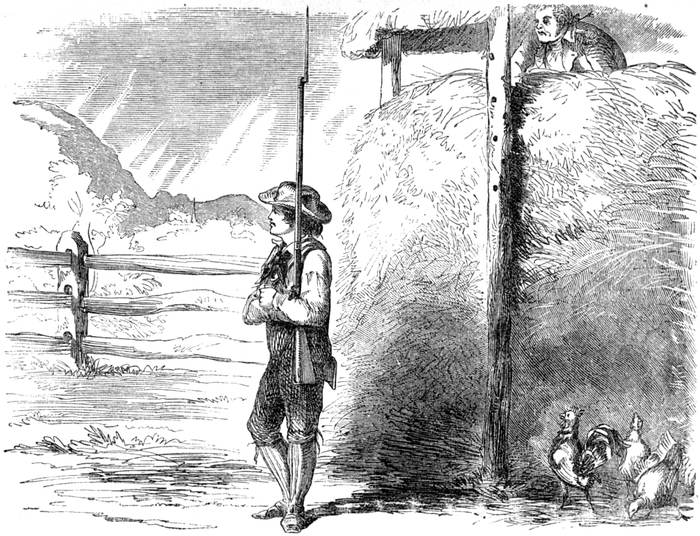
The Little Sentinel.—Page 7
195TALES,
Traditions and Romance
OF
BORDER AND REVOLUTIONARY TIMES.
THE LITTLE SENTINEL.
TECUMSEH AND THE PRISONERS.
HORSEWHIPPING A TYRANT.
THE MOTHER'S TRIAL.
NEW YORK:
BEADLE AND COMPANY, PUBLISHERS,
118 WILLIAM STREET.
196Entered according to Act of Congress, in the year 1863, by
BEADLE AND COMPANY,
In the Clerk's Office of the District Court of the United States for
the Southern District of New York.
THE LITTLE SENTINEL.
197
A tall, portly-looking man stood on a table in the midst of a crowd
of farmer-like individuals, haranguing them in an energetic manner
regarding the crisis in affairs of the country. He was dressed in
the scarlet and buff regimentals of a British officer, although, like
the most of his audience, he was a resident of the neighborhood.
The time was that important period in the history of our country
just succeeding the battles of Lexington and Bunker Hill, when
every man felt called upon to decide the part he should take in the
contest which all saw was impending. The place was the vicinity
of Scoharie Kill, a branch of the Mohawk river, in the State of
New York. The persons, George Mann, a loyalist of great wealth,
three of the king's Commissioners, and the yeomanry of the neighborhood,
from the gray-haired man of sixty winters, to the youth of
sixteen and eighteen summers: in fact, all the male population of
the Scoharie valley capable of bearing arms. The king had "honored"
Mann with a Captain's commission, and the Commissioners
had called the people together for the purpose of administering the
oath of allegiance and recruiting from their number a company, to
the command of which Mann was to be assigned. They had been
ordered to bring their arms with them, and a large majority had
done so. Their equipments were as varied as their opinions—and
these were of many shades—from the determined and bitter Tory,
through the various degrees of loyalty to the wavering and undecided;
and thence to the lukewarm, warm, devoted, and ardent Whig. Such
as had taken the oath were adorned with a piece of scarlet cloth
stuck in their hats; while some, more enthusiastic than others, wore
198scarlet caps. All these were enrolled and mustered under arms, preparatory
to receiving the drill from their new Captain. Many of
the lukewarm and undecided took the oath of allegiance from fear
of consequences. There were but a limited few bold and determined
enough to abjure the oath and all allegiance to the king. Of this
number were Nicholas Stemberg and William Dietz, who had been
so earnest in their denunciations of the tyranny and injustice of the
mother country, that, when they left for home on the evening of the
first day, they were assailed with denunciations of vengeance. They
were proclaimed as traitors, and threatened with a nocturnal visit
by the bitterest among those whom the occasion had shown to be
their enemies. Fearing these threats would be put into execution,
Stemberg spent the night in the woods, while his family were trembling
with fear at home. On his return to that home in the morning,
he was agreeably disappointed to find it undisturbed, and, with
his neighbor Dietz, again repaired to the parade, with an unaltered
determination, however, to take no obligation of allegiance. They
found, on arriving at Mann's house, that upward of one hundred
were enrolled and scattered about the grounds; while others, who
had not made up their minds upon which side they should range
themselves, were listening to an ardent harangue from the Captain.
Mounted on a table, and dressed in all the paraphernalia of war, he
was alternately coaxing, wheedling, and urging them to take part in
the raid against rebellion, commanding those who had already enrolled
themselves, and threatening dire vengeance, confiscation of
property, imprisonment and death, against those who dared to side
with the rebels. The hour seemed propitious, and the loyal Captain
was carrying every thing before his storm of eloquence and denunciations,
when, in the twinkling of an eye, a storm of a different kind
burst upon his head, which scattered to the winds the results of all
his efforts. News of the Captain's labors had been conveyed to Albany,
and while he was in the midst of one of his most earnest appeals,
two hundred horsemen, under command of Captain Woodbake,
made their appearance, tearing up the road, with sabers drawn and
determination flashing from their eyes. One glance was all-sufficient
for the doughty Captain, and the next moment—his coat-skirts flying
in the wind, his queue sticking straight out behind him—he was on
199his way to the shelter of the neighboring woods as fast as his legs
could carry him. His followers were immediately transformed into
firm and devoted patriots, except a certain few who had been such
enthusiastic Tories that they could not hope to escape merited punishment,
and these pursued their flying commander. The scarlet
badges disappeared in the most sudden and unaccountable manner,
and when Captain Woodbake and his party reached the spot where
the loyal Captain had stood, he found none but Whigs to receive
him. His object, therefore—the dispersion of the meeting without
bloodshed—was accomplished, and he proceeded to proclaim the
rule of Congress. Before doing so, however, he gave orders that
Mann should be taken, either dead or alive. There were plenty willing
to undertake this task, and patrols were soon stationed in every
direction, so that it was nearly impossible for him to escape.
Among others who volunteered for this duty, was Lambert, the
eldest son of Nicholas Stemberg, a lad of fifteen or sixteen years.
He was stationed by the side of one of those structures called barracks,
so often seen in a new country, consisting of a thatch supported
on four posts over a stack of wheat or hay. The youth was
proud of his trust, desiring nothing more earnestly than to meet with
the Captain and take him prisoner. During the afternoon, a violent
thunder-storm arose, and to shelter himself from its inclemencies,
the young sentry climbed to the top of the stack, where, to his astonishment,
he found the loyal fugitive snugly ensconced. Presenting
his musket to his breast, he informed him that his orders were to
take him, dead or alive—and he must surrender or be shot. The
Captain, whose courage and lofty bearing had left him simultaneously
with the appearance of Woodbake, begged hard for his life, and besought
the young patriot to allow him to escape; for, if taken prisoner,
he would be hung by the militia men to the first tree, without
shrift or absolution. Stemberg replied that his orders were imperative,
and he dared not disobey them. But Mann implored for mercy
in such piteous tones—reminding him that he was a neighbor, had
never done him harm, had ever been kind to him, &c., &c.—that
a violent struggle took place in the breast of the young
soldier between his duty and his sympathy. He could not
shoot him in cold blood, and he would not surrender; so,
200to compromise the matter with himself, he proposed to fire his
musket in token of alarm, that others might come and take his
prisoner. This was earnestly objected to by the Captain, who saw
the struggle going on in his captor's breast, and determined to take
advantage of it. Watching his opportunity, therefore, when his attention
was removed from him, and a violent clap of thunder covered
his movement, he slipped off the stack, and sliding down one of the
posts, made a rapid retreat for the mountains. Stemberg, as in duty
bound, fired his musket at him, but was not sorry that his shot was
fruitless. The report soon brought others to the spot, and after hearing
the story of the tender-hearted sentinel, they immediately started
in pursuit of the fugitive, who had many narrow escapes, but finally
eluded their vigilance and hid himself in the fastnesses of the hills,
where he remained for two weeks. He was induced, at the end of
that time, to surrender, upon the condition that he should not suffer
personal injury. He was taken to Albany, where he was kept a
close prisoner until the end of the war, when he again returned to
his estate, and, becoming a firm Republican, ended his days there.
Those who think young Stemberg's neighborly feelings made him
too lenient toward the humiliated loyalist, will be better pleased with
the following record of the resolute manner in which another lad
captured and controlled a couple of desperadoes.
On a fine May morning, 1780, as the family of Sheriff Firman, of
Freehold county, New Jersey, was at breakfast, a breathless soldier
burst into the room, stating that as he and another were conducting
to the court-house two men, taken up on suspicion at Colt's Neck,
they had knocked down his comrade, seized his musket, and escaped.
The Sheriff, on hearing this relation, mounted his horse and galloped
to the court-house to alarm the guard. His son, Tunis, a lad of
about seventeen, small of his age, seized a musket, loaded only with
small shot to kill blackbirds in the cornfields, and, putting on a cartridge-box,
sent his little brother up stairs for the bayonet, and then,
forgetting to wait for it, hurried off alone in pursuit.
After running in a westerly direction about a mile, he discovered
the men sitting on a fence, who, perceiving him, ran into a swamp.
As the morning was warm, he hastily pulled off his shoes and coat,
and darted in after them, keeping close after them for over a mile,
201when they got out of the swamp, and climbed into separate trees.
As he came up one of them discharged at him the musket taken
from the guard. The ball whistled over his head. Feeling for his
bayonet, he discovered that it was still with his little brother. He
then pointed his gun at the man with the musket, but deemed it imprudent
to fire, reflecting that, even if he killed him, his comrade
could easily match such a stripling as himself. He compelled the
man to throw down the musket by threatening him with instant
death if he did not comply. Then, loading the fusee from his cartridge-box,
he forced his prisoners down from the trees, and, armed
with his two loaded muskets, drove them toward the court-house,
careful, however, to keep them far apart, to prevent conversation.
Passing by a spring, they requested permission to drink.
"No!" replied the courageous boy, understanding their design,
"you can do without it as well as myself; you shall have some by-and-by."
Soon after, his father, at the head of a party of soldiers, galloped
past in the road within a short distance. Tunis hallooed, but the
clattering of their horses' hoofs drowned his voice. At length he
reached the village, and lodged his prisoners in the county prison.
It was subsequently discovered that these men were brothers, from
near Philadelphia; that they had robbed and murdered a Mr. Boyd,
a collector of taxes in Chester county, and, when taken, were on
their way to join the British. As they had been apprehended on
suspicion merely of being refugees, no definite charge could be
brought against them. A few days later, Sheriff Firman saw an advertisement
in a Philadelphia paper, describing them, with the facts
above mentioned, and a reward of twenty thousand dollars (Continental
money,) offered for their apprehension. He, accompanied by
his son, took them on there, where they were tried and executed.
On entering Philadelphia, young Tunis was carried through the
streets in triumph upon the shoulders of the military. In the latter
part of the war this young man became very active, and was the
special favorite of General David Firman.
Not solitary are the incidents of boyish heroism on record; and
yet how far the larger number must have passed unnoticed, in the
midst of the trials and excitements of those troublous Revolutionary
202times. Children catch the fire which burns in the parent heart;
and where the father rushes eagerly to the salvation of his country,
and the mother—concealing her sadness and fears, puts on a hopeful
countenance, speaking the ennobling sentiments of patriotism—it
may well be credited that the boys were not cowards. We have
some very interesting recollections of that period preserved in the
private Diary of the wife of a Revolutionary officer, who, while her
husband served his country on the battle-field, remained with her
father, who was a clergyman of the Church of England, at their little
parsonage on Long Island, and whose daily jottings down of
events and emotions, just as they were seen and felt, make her simple
pictures full of the power of reality. When we read them we
feel as if that time were before us, and those actors still lived. Long
Island, after the memorable retreat of Gen. Washington, on the
morning of the 30th of August, 1776, remained in the hands of the
enemy, and was the scene of many distressing outrages and calamities
of all kinds—pillage, insult, robbery, the destruction of farm
implements, the impressment of men and horses, with the horrors
of a prowling hired soldiery, and frequent murders, being among
the dark list. Speaking of the spirit of the boys of those days, leads
us to quote from the lady's Diary:
"Wednesday, Nov. 24th, 1776.—Yesterday my indignation was
aroused to a high degree. I was sitting in the end of the porch, my
father at my side, and little Mary, with your letter in her hands, pretending
to read it, when a loud cry startled us. It seemed to come
from Pattison's, our nearest neighbor. Charles went over, returned,
and gave us this account of the affair. It appears that Edmund Pattison
was enjoying his noon rest quietly in the barn (he is a noble-looking
lad of eighteen, tall, athletic, and of a high spirit,) when a
light-horseman rode up to the door.
"'Youngster,' said he, 'make haste and bestir yourself. Go and
assist that driver of the two yoke of oxen there to unload his cart
of timber into the road.'
"Now, Edmund had been hard at work with his own hired man,
loading the wagon, to take the timber to a farmer three miles off, to
whom it was sold by his father; the wagon and teams both belonged
to the Pattisons.
203"'Hurry, sir,' said the light-horseman.
"Edmund firmly replied: 'I shall not do it.'
"'What, sirrah! we shall see who will do it,' and drawing his
sword, he held it over Edmund's head, cursing, swearing, and threatening
to cut him down unless he instantly unloaded his team and
helped to carry in it provisions to the British army.
"With unblanched cheek, Edmund Pattison reiterated his denial,
telling him to do it for himself. Enraged beyond measure at such a
contempt of orders, it seemed as if the man must strike and kill the
stubborn boy, who, firm and undaunted, said not a word.
"At this time our Charles, who was on the spot, ran to the house
and told Mrs. Pattison that 'the Britisher was going to kill her Edmund.'
"Her cry it was that we heard from the porch. She ran to the
barn and begged the soldier to desist. He was more furious than
ever, supposing the fears of the mother would induce compliance.
She, too, expostulated with her son, imploring him to assist in unloading
the wagon, and save himself from death.
"'No fear of death, mother; he dare not touch a hair of my
head.'
"The boy grew more determined, the soldier more enraged—flourishing
his saber and swearing that he would be the death of him.
"'You dare not. I will report you to your master for this,' said
Edmund, boldly. Upon this the light-horseman mounted, telling the
boy once more that if he did not instantly begin the work he would
cut him into inch pieces. Edmund coolly walked across the barn
floor, armed himself with a pitchfork, and took his station in the
doorway.
"'You cowardly rascal,' said he, 'clear out, or I'll stab you with
my pitchfork!'
"His mother could endure the scene no longer; she ran to the
house, where she met her husband, and sent him to rescue Edmund.
Friend Pattison, a sensible, clear-headed man, rode up, and seeing matters
at this high pass, said to the Britisher: 'You know your duty;
you have no right to lay a finger on him, a non-combatant on neutral
ground.' Seeing no signs of relenting, farmer Pattison turned
his horse toward the road, saying he would soon see Colonel Wurms,
204and know who had the power to threaten and abuse the farmers of
the country in that style. The light-horseman was now alarmed.
Thinking it best to get there first, he put spurs to his horse, riding off
with awful imprecations.
"Thus Edmund escaped for this time; though I much fear his defying,
fearless spirit may yet cost him dear."
On another page she relates an anecdote of her own son.
"Tuesday.—A press for horses yesterday. I will relate how Charley
saved our young horse. He and James Pattison were idly sitting
on the fence, the other side of the pond, talking indignantly of
the insults of the British, to whom the former shows no mercy,
when they espied a light-horsemen at a farm-house door. They
knew the next place would be Isaac Willett's, which, though only
across the pond, is completely hid from our view by a stately row of
poplars, forming a leafy screen; and they knew his errand, too—that
he would be here in an instant, for when 'pressing' they galloped
from house to house with violent speed.
"'Fleetfoot shall not go,' said Charles, 'without an effort to save
him,' and, running with all his might to the barn, he jumped on his
back and rode for the woods.
"On the instant he was seen by the red-coat, who put spurs to his
horse, and came on a full run toward the woods, where Charles had
disappeared. My heart beat quick when the red-coat, too, was lost
to sight. My dear, brave child might fall from his horse, and be
dashed against the trees in the hot pursuit of the light-horseman.
"My father and I sat gazing intently toward the woods, awaiting
the result in breathless anxiety, astonished at the boy's daring, and
ready to reprove his rash spirit, in attempting to save the young horse
at the risk of his own neck. In about an hour's time we saw the
red-coat come out of the woods below. He stopped a man in the
road and made inquiries, but getting no satisfaction, rode off.
"At nightfall, peeping his way through the wood, Charles made
his appearance, still mounted on his favorite Fleetfoot. By signs we
made known to him that the danger was past, and he rode up to the
house.
"Overjoyed to see him, he told us his story, which Grace and
Marcia drank in with greedy ears. Indeed, the scene on the porch
205was worthy of Hogarth's pencil. On one side was his poor affrighted
mother, and the little girls, with eyes wide open, full of wonder;
near by, the venerable grandfather, with silver locks parted on a
peaceful brow; and Charley, standing close by his steed, as he recounted
his hair-breadth ''scape,' leaning his head occasionally
against his proud neck, so that my boy's curls of gold mingle with
the ebon mane of Fleetfoot.
"He said that he struck deeper and deeper into the woods, going
from one place to another, until the forest became very dense and
dark. He rode into a tangled, marshy place, where he stood five
hours without moving! At one time he heard his pursuer close by,
heard his fearful oaths, heard him lashing the sides of his own jaded
steed. Charley's heart beat violently. But the bog was wet and
gloomy, and the soldier's ardor was dampened—he durst not venture.
So Charley and Fleetfoot were left to themselves in the deep wood.
A brave feat for a boy of only fourteen."
One more extract from this lively diary we will give to show the
influence of the maidens on the hard hearts of the enemy—that the
girls as well as the boys had their parts to play in the drama.
"Wednesday.—Charles accompanied John Harris home from school,
with my permission, last night. He returned this morning, with a
story of the night, which he related to me in breathless excitement.
"A family living a mile from us were quietly sitting together in the
evening, when a noise was heard at the door like that of a sharp
instrument thrust into it. On opening the door there stood a red-coat
with his saber in his hand, which he had stuck into the wood
an inch or two. He was backed by a dozen men. They pushed
their way in, and were very unruly, rummaging and ransacking
every drawer and closet; but the family had long before taken the
precaution to place all their money and valuables in a small room,
which opened out of the common sitting-room, putting a large cupboard
before the door, which covered it entirely; so that the Hessians
quartered there last winter never discovered the device.
"The red-coats, highly incensed at finding nothing, began to threaten
terrible things if they did not divulge the hiding-place. Mr. M. told
them that if they dared do any violence, he would report them to the
206commanding officer. Whereupon, they actually went into the kitchen,
kindled some light wood, came out, and set a burning brand at each
corner of the house. The family were exceedingly alarmed. In
great terror, Sarah, the youngest daughter, rushed out. She is famed
through all the north-side for her comeliness. I can well imagine that
she must have appeared to them like a lovely apparition with her
glowing cheek and flashing eye. The ringleader, astonished, stood
with his torch in his hand, gazing at her. At length he said:
"'Angel!'
"'Stop, I entreat you!' said Sarah.
"His looks were riveted upon her with an ardent admiration which
embarrassed her.
"'I will, on one condition,' said he.
"'What is it?'
"'Will you give it?'
"'If I can,' replied Sarah.
"'It is, that you will allow me to kiss you.'
"'Oh, if that is all,' said her father, 'comply, my daughter.'
"So, as she made no resistance, the rough soldier planted a fervent
kiss on her lips, expressed himself satisfied, and departed. They
found, before her baby-house, that the soldiers had stuck the dolls on
their bayonets, and railed among themselves and laughed.
"It is seldom that a man's house is attacked more than once. Mr.
Harris had his turn some time ago; therefore, although he saw some
suspicious-looking persons lurking about, he feared nothing, and
arose at daylight, with the intention of going to the south of the
island for salt hay. Mrs. Harris, however, began to feel uneasy and
timid, from the reports she heard during the following day, and the
recollection of her never-to-be-forgotten injuries, and persuaded her
husband to stay at home. That night passed without disturbance.
About nine o'clock the next evening, a neighbor stopped at the gate
in his wagon, and he and Mr. Harris were talking over the exciting
times and scenes enacting around the country, when they saw a man
moving about the fields, and passing now and then in and out of the
edge of the woods. One of the serving-women, too, had seen some
one about dark standing close by the wood-pile, who had vanished
on her appearance at the door of the kitchen. In consequence of
207these signs Mr. Harris concluded to sit up, and keep lights and fires
burning about the house. Charles, and the older children, were sent
to bed, but not to sleep—that was impossible with their perturbed
and excited imaginations. About twelve o'clock, Mr. Harris being
on the look-out, saw a man at a short distance from the house, reconnoitering;
he now held a consultation with his wife and the two
hired men. They came to the conclusion that an attack was meditated,
and that it was time to act; they determined to leave the house
in a body, taking the two loaded guns, the money, silver, and small
valuables. Though the next house was full two miles off, there
seemed no other alternative. The poor little frightened children
were hurried up and dressed; their fears and cries were hushed, and
they were carried down stairs. As quietly as possible, all left the
house by the back door. It was a moment of intense anxiety; their
hearts beat with dread; with trembling limbs, which almost refused
to bear them, they moved on. 'Faint, though pursuing,' they endeavored
to stay their minds above. At length, arrived at Mr. S.'s,
another difficulty presented itself. The family would inevitably take
them for robbers, and be liable to fire upon them. In this dilemma
Mr. Harris thought it best to go close to the door and call out his
name, trusting that his voice would be recognized, which was the
case. The poor wanderers were kindly received, and after they had
talked over their fright, were provided with comfortable beds. The
house of Mr. S. has never been attacked, it is so well secured, the
doors and windows being lined and bound with iron, a fact well
known to the marauders."
Thus the little diary goes on. Sometimes the brutal bands murdered
those who opposed them in their own houses, upon their own
hearthstones. Reared in the midst of such excitement, it would be
but natural that the youth of the struggling country should become
quick-witted and self-reliant.
And since we have shown how brave the boys could be, let us repeat
an incident of the heroism of a little girl in these same days of
trial:
"Robert Gibbs, a gentleman earnestly devoted to the patriotic
cause, was the owner of a plantation on the Stono, a few miles from
Charleston, on which, on a certain occasion, a Hessian battalion encamped,
208compelling the family to surrender to their use the lower
part of the mansion, and to confine themselves in the upper story.
While here on one dark and stormy evening, two galleys appeared,
ascending the river, which forthwith began a most destructive fire
upon the Hessian encampment. The house appeared particularly
exposed, although the vessels had been commanded to avoid firing
upon it, and to confine their attack to the enemy's encampment. Of
this Mr. Gibbs was not aware, and with the permission of the English
commander, he set out, although suffering acutely from an infirmity,
and with his numerous family, hastened to the protection of
a neighboring plantation. The balls were falling thick and fast,
sometimes scattering dirt and sand over the party, while their loud
whizzing, mingled with the fury of the distant affray, rendered the
scene one of danger and terror. But scarcely had they proceeded
so far as to be out of danger from the balls, when to their unutterable
agony they discovered, that in the confusion and hurry of departure,
an infant had been left behind. To leave the child alone in his
danger was impossible, and to return for him was an attempt of imminent
peril. Mr. Gibbs was suffering under an infirmity that made
his movements exceedingly slow and painful, and therefore it was
impracticable for him to return. The frightened and chattering servants
stood trembling around, looking from one to the other in bewildering
despair. Of all the rest of the party, saving Mrs. Gibbs,
who was severely indisposed, none were above the age of childhood.
While thus undecided, Miss Mary Ann Gibbs, but thirteen years of
age, sprung forward and heroically offered to go for the lad, who was
a son of Mrs. Fenwick, Mrs. Gibbs' sister-in-law. The night was
dark and stormy, the distance considerable, and the whole space
swept by the cannon of the assailants. But without fear she retraced
her way, and reached the house without injury, where the scene was
one of unmingled terror. Undismayed by the thundering of the
cannon, the crashing of the balls, the shrieks, shouts and imprecations
of the combatants, she sprung to the door with the intention of entering,
when she was brutally refused by the sentinel. But tears,
entreaties, and the natural eloquence prompted by her heroism and
the high purpose on which she was bent, overcame his opposition,
and she was permitted to enter. With rapid steps she ascended to
209the third story, and finding the child there in safety, she clasped it
to her bosom, and hastened to overtake her retreating family, her
course, as before, full of danger, and often the plowing balls would
scatter clouds of dust over her person. Uninjured, her perilous
journey was performed, and when she reached her friends, she was
welcomed by shouts of enthusiasm and admiration. The intrepid
action, worthy of an adult, and all glorious in a child, borrows a
fair share of romance by the reflection that the child thus saved
afterward became Lieutenant-Colonel Fenwick, so highly distinguished
by his services in the last war with Great Britain."
TECUMSEH SAVING THE PRISONERS.
The siege of Fort Meigs during the war of 1812, by a combined
British and Indian force, under command of General Proctor, was
attended by one of those thrilling incidents which chill the blood
with horror, and which have stained the escutcheon of Great Britain
with indelible infamy. It is with no desire, however, to harrow up
the feelings of our readers at a tale of soul-sickening massacre, nor
yet with a wish to undertake the invidious task of reprobating the
course of the English Government in connection with the war, that
we have introduced the following narrative; but simply with a view
of presenting the character of that brave and patriotic chieftain, Tecumseh,
in its true light as regarding his magnanimity, and freedom
from those brutal propensities and inclinations which have conduced
so strongly to stigmatize the Indians as savages.
The fort was invested on the 26th of April, and from that period
up to the 5th of May, a constant fire had been kept up by the British
batteries on the opposite side of the river, without serious injury to
the works. General Clay, with a reinforcement of twelve hundred
Kentucky militia, arrived in the neighborhood on the 4th, and received
orders to detach eight hundred men to attack the British batteries
while the remainder was to aid a sortie against the Indians, who had
established themselves in the immediate vicinity of the fort, and who
210were a source of great annoyance to its garrison. Colonel Dudley
was placed in command of the larger party, and, agreeably to his instructions,
landed on the right bank, and completely succeeded in
driving the enemy from his works, and in spiking the cannon. His
orders were peremptory to return immediately to his boats on the accomplishment
of this object, and repair to the fort; but his men had
tasted the sweets of victory, and the rashness which follows success
on the part of militia, proved their ruin. They allowed themselves
to be amused by some faint attempt at resistance on the part of a
small body of Indians in the woods, until the main body of the
British, which was some distance in the rear, could be brought up,
and a severe and bloody action soon followed. It can hardly be
called an action, for the militia were in detached parties, pursuing
the scattering troops, when they suddenly found themselves confronted
and surrounded by a force double their number, and after a manly
effort to retain the victory they had won, they attempted to retreat
but found themselves cut off from the river by a force which had got
into their rear, to whom they were obliged to surrender themselves
prisoners of war. Out of the eight hundred who landed in the
morning, only one hundred and fifty escaped massacre or captivity.
Colonel Dudley was severely wounded, and afterward tomahawked
and scalped. A large portion of the prisoners were marched to the
British fort lower down the river, where they immediately became
the sport and prey of the Indians, who commenced an indiscriminate
slaughter of the unarmed men, until the entreaties of some of the
more humane British officers checked it for a time. Another party
were placed in charge of a Sergeant and fifty men for the purpose
of being embarked in the gunboats, where it was supposed they
would be safe from the attacks of the infuriated savages. Upon
reaching the encampment, which at that time happened to be deserted
by the troops, they were met by a band of Indians who had not been
engaged in the contest at all, but, actuated by a brutal thirst for blood,
and disappointed at not having a share of the plunder, to which they
thought themselves entitled, they determined to satisfy their desires
by murdering and stripping the prisoners before them. Perhaps they
were actuated by a spirit of revenge for the loss which had been
sustained by their friends in the action. Be this as it may, they
211each selected a victim from the ranks, and with fearful yells commenced
the work of slaughter. With a magnanimity scarcely to be
expected of men who had witnessed the cold-blooded murders at the
river Raisin, the British guard threw themselves between the savages
and their intended victims, and endeavored to dissuade, and then to
coerce them from their horrid butchery. But in vain. Excited to
the highest pitch of ferocity by the blood they had already shed,
they were not to be deterred from their purpose; and the soldiers—after
witnessing the death of one of their number, who was stabbed
to the heart by a savage from whom he had snatched a prisoner—finding
their interposition to be fruitless, withdrew and left the unfortunate
men to their fate. Surrounded upon all sides by the savages,
with no chance of escape, with none to interfere, the prisoners
were huddled together; those in front striving to screen themselves
behind their comrades; while those in the rear, with the love of life
urging them with an equal force, endeavored to keep them from doing
so, they surged to and fro, the tomahawk and scalping-knife
doing its work, until forty of their number lay stiff in the embrace
of death. The Sergeant in command of the guard, who had been
forced to leave their charge to the tender mercies of the savages,
sought for Tecumseh, and informed him of the horrid butchery
which was being enacted. The eyes of the chieftain lit up with a
consuming blaze, and his nostrils dilated and contracted as his breast
heaved with the mighty passion which the soldier's story had roused
within him. He stopped but a moment to hear the end, and then
dashing his heels against his horse's sides, he darted off in the direction
of the scene. Raising his voice as he approached, in thunder-tones
he commanded the Indians to desist from their brutal work.
A few, startled at the unexpected interference, drew back; but the
majority, regardless of his authority, and drunk with passion, refused
to obey. Precipitating himself between these and their prey, he
forced them back, and, drawing his tomahawk, he whirled it over
his head, while his face was wrought into an expression of the most
fearful and scorching rage, as he threatened to cleave to the earth the
first one who offered to disobey him. This was effectual with some,
but there were still a few who continued their bloody work, and one
after another the miserable prisoners were falling, like sheep in the
212shambles, before the unrelenting knives and hatchets of their executioners.
None but a man destitute of fear would have dared
to rush between these and their victims. It was tearing the carcass
of his prey from the jaws of the lion to interfere between these ferocious
fiends and their feast of blood. But, the chief knew no
fear: he was wrought to such a fearful state of excitement as not
to heed the dictates of prudence. Leaping from his horse and drawing
his knife, he threw himself upon them with all the fury of a
tigress divested of her young. Seizing one by the throat, and another
by the breast, he hurled them to the ground, and thus, one after
another, he beat them back with a strength which nothing could
withstand. Taking his station in front of the remnant of the band
which still remained alive, and raising his tomahawk high above his
head, while his whole figure dilated to a greater height by the passions
which raged within his bosom, he dared them, in tones which
thrilled through them like electricity, to strike another blow. None
were found so bold as to tempt his arm or disobey his command, and
the prisoners were saved. Looking around for Proctor, he espied
him as he approached, and demanded why he had not stopped the
massacre. "Sir," said he, "your Indians are not to be commanded."
"Begone!" replied Tecumseh, as a look of the greatest disdain and
contempt swept over his swarthy visage, "you are unfit to command;
go and put on petticoats!"
This Proctor, the British commander, had already branded himself
with indelible infamy at the battle of the River Raisin, in January
of the same year. In reference to this battle, we will briefly state
the object of General Harrison's campaign was to take Detroit, and
expel the British from the territory of the United States—and to
protect the extensive frontier; also to furnish such protection as was
possible to the settlers in Ohio, Indiana, etc., from the savages in the
pay of the British. The points to be defended were scattered over
a vast region of country; and though the care of it fell upon General
Harrison, officers in the different sections were frequently obliged
to act for themselves. It was thus that General Winchester, failing
to receive counter-orders sent after him by Harrison, and unaware
of the full force of the enemy, was induced to make an imprudent,
though brave, movement against a body of English and Indians who
213were coming from Malden and the Raisin to attack his camp at the
rapids.
He pressed forward and found the enemy prepared to meet him
at Frenchtown; they were posted among the houses, but were soon
dislodged and driven to the woods. Here a short, desperate engagement
took place, and the English were driven two miles before the
continual charge of the brave Kentuckians, though the latter had
made that day a forced march of over eighteen miles over ice. In
reporting the action, afterward, General Harrison said: "The troops
amply sustained the double character of Americans and Kentuckians."
Thus far our heroes were successful; instead of retiring after this
brilliant affair, they determined to maintain their position; they
remained in Frenchtown two or three days, part of their forces
being exposed in an open field, and a part sheltered by the garden
pickets of the town. During the night of the 21st of January, the
British came up, unobserved, and at daylight fired bombs, balls and
grape-shot from heavy pieces of artillery, at a distance of only three
hundred yards. The troops in the open field were sadly injured by
this fire, and soon fled across the river in the utmost confusion.
The Indians gained our flank and rear, butchering our soldiers
shockingly. General Winchester was taken prisoner and marched
to the British camp. Colonel Lewis still maintained his position in
the town, frequently repulsing the enemy, until the Indians gained
his flank, when a general and indiscriminate massacre ensued.
Colonel Lewis was made a prisoner, had his coat stripped off, and
was conducted to the enemy's camp. Colonel Allen, being badly
wounded, surrendered to an Indian. Another assailed him, whom
Allen struck dead at his feet, and was in turn shot down by a third
savage. Garrett, with fifteen or twenty men, surrendered, and all
but himself were butchered on the spot.
Two other officers, Graves and Madison, still maintained their
position within the picketing, and with their troops, behaved most
gallantly. The former being severely wounded, and as he sat down,
wiping the blood from his wounds, cried: "Never mind me, my
boys, fight on!" Proctor, with all his British regulars and savage
allies, could not subdue this band—they gave not an inch to the foe.
A flag was at last sent to Madison, with an order from Winchester
214to surrender. Proctor accompanied the flag, and made the demand,
but Major Madison replied that he would not surrender unless the
safety of his men could be guaranteed. Proctor demanded:
"Sir, do you mean to dictate to me?"
"No," returned the intrepid Major, "I intend to dictate for myself;
and we prefer selling our lives as dearly as possible, rather
than be massacred in cold blood."
The surrender was made on express conditions, that the officers
should retain their side arms, the sick and wounded to be carefully
removed, private property to be respected, and the prisoners protected
by a guard. Proctor disregarded all stipulations, and handed
over the prisoners to the Indians, who butchered them without
mercy. Some of their bodies were thrown into the flames of the
burning village, while others, shockingly mangled, were left exposed
in the streets. These awful deeds were continued for several days.
For the massacre of the River Raisin, in return for which any
other civilized government would have dismissed, if not gibbeted,
the commander, Colonel Proctor received the rank of Major-General
in the British army. This infamous officer it was who shortly after
commenced the siege of Fort Meigs, his mind filled with visions of
conquest, personal glory and official promotion. He was assisted
by Tecumseh, with fifteen hundred of his warriors; but even the
Indian nature revolted at the more savage deeds of the English
General. From this siege of Fort Meigs Proctor was obliged to
retreat toward Malden in disgrace and confusion.
In the May following, however, Proctor, thinking to surprise Fort
Meigs, made a second attack upon it with a large force of British
regulars and Canadians, and several thousand Indians under Tecumseh,
but was again obliged to retreat in disgrace.
On the first day of August, General Proctor appeared with five
hundred regulars, and about eight hundred Indians of the most
ferocious kind, before fort Stephenson, twenty miles above the mouth
of the river Sandusky. There were not more than one hundred
and thirty-three effective men in the garrison, and the works covered
one acre of ground; it was a mere outpost of little importance; and
General Harrison, acting with the unanimous advice of his council
of war, had sent orders to Major Croghan, who commanded the
215garrison, to evacuate the fort, and make good his retreat to head-quarters,
provided the enemy should approach the place with artillery,
and a retreat be practicable. But the first step taken by Proctor
was to isolate the fort by a cordon of Indians, thus leaving to Major
Croghan no choice but between resistance and submission. A messenger
was sent to demand the surrender of the fort. He was met
by Ensign Shipp, to whom the messenger observed that General
Proctor had a considerable body of regular troops, and a great many
Indians, whom it was impossible to control, and if the fort was taken
by force, he must expect that the mildest instruments made use of
would be the tomahawk and scalping-knife! Shipp replied, that it
was the commander's intention to defend the garrison or be buried
in it, and that they might do their worst. The messenger, startled
at the reply of Shipp, again addressed him: "You are a fine young
man. I pity your situation. For God's sake surrender, and prevent
the dreadful slaughter which must inevitably follow resistance."
The gallant Shipp turned from him with indignation, and was immediately
seized by a frightful-looking savage, who attempted to wrest
his sword from him, but the Ensign was fortunately too quick for
him, and buried the blade to the hilt in his body, and succeeded in
reaching the fort in safety. The attack now commenced. About
four P. M., all the enemy's guns were concentrated against the northwestern
angle of the fort, for the purpose of making a breach. To
counteract the effect of their fire, the commander caused that point
to be strengthened by means of bags of flour, sand and other materials,
in such a manner that the balls of the enemy did but little
injury. But the enemy, supposing that their fire had sufficiently
shattered the pickets, advanced, to the number of six hundred, to
storm the place, the Indians shouting in their usual manner. As
soon as the ditch was pretty well filled with the copper-colored
assailants, the commander of the fort ordered a six-pounder, which
had been masked in the block-house, to be discharged. It had been
loaded with a double charge of musket-balls and slugs. The piece
completely raked the ditch from end to end. The yell of the
savages was at this instant horrible. The first fire leveled the one
half in death; the second and third either killed or wounded all
except eleven, who were covered by the dead bodies. The Americans
216had but one killed, and seven slightly wounded. Early the
ensuing morning the few regulars and Indians that survived retreated
down the river, abandoning all their baggage.
The time was now at hand when General Harrison and his army
were to reach the full completion of all the contemplated objects of
the expedition.
Among the earliest recommendations of General Harrison to the
Government the year before, and immediately after he commenced
operations, had been that of constructing and equipping a naval
armament on the lakes. In one letter he says: "Admitting that
Malden and Detroit are both taken, Mackinaw and St. Joseph will
both remain in the hands of the enemy until we can create a force
capable of contending with the vessels which the British have in
Lake Michigan," etc. And again, in another letter: "Should any
offensive operation be suspended until spring, it is my decided
opinion that the cheapest and most effectual plan will be to obtain
command of Lake Erie. This being once effected, every difficulty
will be removed. An army of four thousand men, landed on the
north side of the lake, below Malden, will reduce that place, retake
Detroit, and, with the aid of the fleet, proceed down the lake to
coöperate with the army from Niagara." These sagacious instructions,
being repeatedly and strenuously urged by him, and reinforced
also from other quarters, were adopted and acted upon by the
Government. Commodore Perry was commissioned to build, equip
and command the contemplated fleet; and, on the 10th of September,
with an inferior force, he met the enemy, and gained the brilliant
victory of Lake Erie.
Meanwhile, Colonel Richard M. Johnson, then a member of Congress
from Kentucky, had devised the organization of two regiments of
mounted militia, which he was authorized by the Government to
raise, as well for service against the Indians, as to coöperate with
Harrison. Colonel Johnson crossed the country of Lower Sandusky,
where he received orders from the war department to proceed to
Kaskaskia, to operate in that quarter; but, by the interference of
Harrison, and at the urgent request of Colonel Johnson, who said,
for himself and his men, that the first object of their hearts was to
accompany Harrison to Detroit and Canada, and to partake in the
danger and honor of that expedition, under an officer in whom they
had confidence, and who had approved himself "to be wise, prudent,
and brave,"—the orders of the department were countermanded, and
Colonel Johnson attained his wish.
217
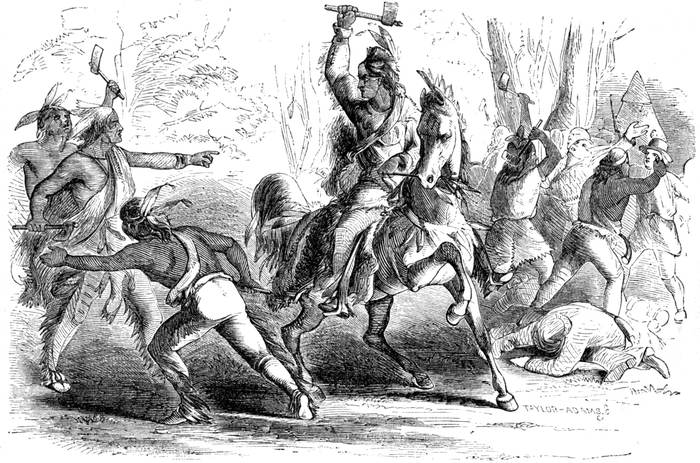
Tecumseh Saving the Prisoners.—Page 19.
219General Harrison now prepared to strike the great blow. Aided
by the energetic efforts of Governor Meigs, of Ohio, and Governor
Shelby, of Kentucky, he had ready on the southern shore of Lake
Erie, by the middle of September, a competent force, destined for
the immediate invasion of Canada. Between the 16th and the 24th
of September, the artillery, military stores, provisions, and troops,
were gradually embarked, and on the 27th the whole army proceeded
to the Canada shore. "Remember the river Raisin," said General
Harrison, in his address to the troops, "but remember it only while
victory is suspended. The revenge of a soldier can not be gratified
on a fallen enemy." The army landed in high spirits; but the enemy
had abandoned his stronghold, and retreated to Sandwich,
after dismantling Malden, burning the barracks and navy-yard, and
stripping the adjacent country of horses and cattle. General Harrison
encamped that night on the ruins of Malden.
On the 2d of October, arrangements were made for pursuing the
retreating enemy up the Thames. The army was put in motion on
the morning of the 4th. General Harrison accompanied Colonel
Johnson, and was followed by Governor Shelby with the infantry.
Having passed the ground where the enemy had encamped the night
before, the General directed the advance of Colonel Johnson's regiment
to accelerate their march, for the purpose of ascertaining the
distance of the enemy.
The troops had now advanced within three miles of the Moravian
town, and within one mile of the enemy. Across a narrow strip of
land, near an Indian village, the enemy were drawn up in line of
battle, to prevent the advance of the American troops. The British
troops amounted to six hundred, the Indians to more than twelve
hundred. About one hundred and fifty regulars, under Colonel
Ball, were ordered to advance and amuse the enemy, and, should a
favorable opportunity present, to seize his cannon. A small party
of friendly Indians were directed to move under the bank. The regiment
of Colonel Johnson was drawn up in close column, with its
220right a few yards distant from the road. General Desha's division
covered the left of Johnson's regiment. General Cass and Commodore
Perry volunteered as aids to General Harrison.
On the 5th, the enemy was discovered in a position skillfully
chosen, in relation as well to local circumstances as to the character
of his troops. A narrow strip of dry land, flanked by the river
Thames on the left and by a swamp on the right, was occupied by
his regular infantry and artillery, while on the right flank lay Tecumseh
and his followers, on the eastern margin of the swamp. But,
notwithstanding the judicious choice of the ground, Proctor had
committed the error of forming his infantry in open order. Availing
himself of this fact, and aware that troops so disposed could not resist
a charge of mounted men, he directed Colonel Johnson to dash
through the enemy's line in column. The movement was made with
brilliant success.
The mounted men charged with promptitude and vigor, broke
through the line of the enemy, formed in the rear, and assailed the
broken line with a success seldom equaled, for nearly the whole
of the British regular force was either killed, wounded, or taken prisoners.
On the left the contest was much more serious. Colonel Johnson's
regiment, being there stationed, received a galling fire from the
Indians, who seemed not disposed to give ground. The Colonel
gallantly led his men into the midst of them, and was personally attacked
by a chief, whom he dispatched with his cutlass the moment
the former was aiming a blow at him with his tomahawk. The savages,
finding the fire of the troops too warm for them, fled across the
hills and attempted to seek shelter in a piece of woods on the left,
where they were closely pursued by the cavalry. At the margin of
the wood Tecumseh stationed himself, armed with a spear, tomahawk,
&c., endeavoring to rally and persuade his men to return to the attack.
At this point a considerable body of Indians had collected;
but this brave savage saw that the fortune of the day was against
him, and the battle was lost. Proctor had cowardly fled from the
field, and left him and his warriors alone to sustain themselves
against a far superior force; and he knew that there was no chance
of contending with any hope of success. He therefore stood, like
221a true hero, disdaining to fly, and was, with many of his bravest
warriors around him, shot down by the Kentucky riflemen. It has
been published to the world, and by many believed, that this distinguished
warrior was killed by a pistol-shot from Colonel Johnson;
but this is undoubtedly a mistake, which probably originated from
the circumstance of the Colonel's having killed a chief by whom he
was attacked, as has before been related. That he fell by a rifle-shot,
there can be no doubt; but by whom fired, it was not certainly
known, or probably never can be satisfactorily proved. No less than
six of the riflemen and twenty-two Indians fell within twenty-five
yards of the spot where Tecumseh was killed.
The Indians continued a brisk fire from the margin of the wood
until a fresh regiment was called into action to oppose them. A
company of cavalry having crossed the hills and gained the rear of
the savages, the rout became general. They fought bravely, and
sustained a heavy loss in killed and wounded. The death of their
leader, Tecumseh, was an irreparable loss to them.
Tecumseh was the most extraordinary Indian that has ever appeared
in history. He was by birth a Shawanese, and would have
been a great man in any age or nation. Independent of the most
consummate courage and skill as a warrior, and all the characteristic
acuteness of his race, he was endowed by nature with the attributes
of mind necessary for great political combinations. His acute understanding,
very early in life, informed him that his countrymen
had lost their importance; that they were gradually yielding to the
whites, who were acquiring an imposing influence over them. Instigated
by these considerations, and, perhaps, by his natural ferocity
and attachment to war, he became a decided enemy to the whites,
and imbibed an invincible determination (he surrendered it with his
life) to regain for his country the proud independence which he supposed
she had lost. For a number of years he was foremost in every
act of hostility committed against those he conceived the oppressors
of his countrymen, and was equally remarkable for intrepidity as
skill, in many combats that took place under his banner. Aware, at
length, of the extent, number, and power of the United States, he
became fully convinced of the futility of any single nation of red-men
attempting to cope with them. He formed, therefore, the
222grand scheme of uniting all the tribes east of the Mississippi into
hostility against the United States. This was a field worthy of his
great and enterprising genius. He commenced in the year 1809;
and in the execution of his project he displayed an unequaled
adroitness, eloquence, and courage. He insinuated himself into every
tribe, from Michilimackinack to Georgia, and was invariably successful
in his attempts to bring them over to his views.
The following characteristic circumstance occurred at one of the
meetings at Vincennes. After Tecumseh had made a speech to
General Harrison, and was about to seat himself in a chair, he observed
that none had been placed for him. One was immediately
ordered by the Governor, and, as the interpreter handed it to him,
he said, "Your father requests you to take a chair." "My father!"
said Tecumseh, with an indignant expression; "the sun is my father,
and the earth is my mother, and on her bosom will I repose," and immediately
seated himself, in the Indian fashion, upon the ground.
Tecumseh was born about 1770, and was supposed to be in his
forty-fourth year at the time of his death. He received the commission
of Brigadier-General in the British army; but aversion to civilization
was a prominent trait in his character, and it is not supposed
that he received the red sash and other badges of office, because he
was fond of imitating the whites, but only as a means of inspiring
respect and veneration among his own people, which was so necessary
in the work he had undertaken. He was about five feet ten
inches in height, of a noble appearance, and a perfectly symmetrical
form. His carriage was erect and lofty, his motions quick, his eyes
penetrating, his visage stern, with an air of hauteur in his countenance,
which arose from an elevated pride of soul. It did not leave
him, even in death. Had he not possessed a certain austerity of
manners, he could never have controlled the passions of those whom
he had led to battle. The Indians are usually fond of gaudy decorations;
but Tecumseh was an exception. Clothes and other valuable
articles of spoil frequently fell into his possession; yet he invariably
wore a deer-skin coat and pantaloons. He had frequently levied
subsidies, to a comparatively large amount; yet he retained little or
nothing for himself. It was not wealth, but glory, that was his ruling
passion.
223Previously to General Brock's crossing over to Detroit, he asked
Tecumseh what sort of a country he should have to pass through in
case of his proceeding further. Tecumseh, taking a roll of elm-bark,
and extending it upon the ground, by means of four stones, drew
forth his scalping-knife and with the point sketched upon the bark a
plan of the country: its hills, woods, rivers, morasses and roads; a
plan, which, if not as neat, was for the purpose fully as intelligible
as if Arrowsmith himself had prepared it. Pleased with this unexpected
talent in Tecumseh, as also with his having induced the Indians
not of his immediate party to cross the Detroit, prior to the
departure of the regulars and militia, General Brock, as soon as business
was over, publicly took off his sash and placed it around the
body of the chief. Tecumseh received the honor with evident gratification,
but was, the next day, seen without his sash. General
Brock, fearing something had displeased the Indian, sent his interpreter
for an explanation; who soon returned with an account that
Tecumseh, not wishing to wear such a mark of distinction, when an
older, and, as he said, abler, warrior was present, had transferred the
sash to the Wyandot chief, Roundhead.
HORSEWHIPPING A TYRANT.
General Prescott, the commander of the British troops in Rhode
Island, was one of those mean-spirited, petty tyrants, who, when in
power, exercise their ingenuity in devising means of harassing all
who have the misfortune to be subject to their authority; but, when
circumstances place them in the power of others, are the most contemptible
sycophants and parasites. Narrow-minded in the extreme,
with a heart which had not one benevolent impulse, he was far from
being a fit officer to be placed in authority over the people of Rhode
Island, who could be more easily conquered by lenient measures than
by the use of unnecessary harshness. From the first day of his power
he pursued a system of pitiless tyranny. Writhing under a sense of
wrongs, maddened to desperation by the meanness and malignity of
224their oppressor, the people of the Island resolved to rid themselves
of the cause, no matter at what risk or sacrifice. Various plans were
suggested, and even assassination was hinted at. His harsh treatment
of Colonel Ethan Allen, a prisoner in his hands, combined with his
haughty and arrogant conduct toward all, increased the feeling against
him. To add to all this, General Lee was a prisoner in the British
jail, and confined in a cell under the pretense that he was a deserter,
having once been an officer in the British army; Washington had no
prisoner of equal rank to offer in exchange.
If the capture of Prescott could be effected, it would not only rid
the Rhode Islanders of his hated rule, but would afford an officer to
be exchanged for General Lee, whom Washington was most anxious
to rescue. Under these circumstances, many enterprises were projected;
but it was reserved for Lieutenant-Colonel Barton, of the
Rhode Island line, to successfully plan and accomplish the much-desired
object. He was stationed with a force of militia on the
main-land, when he received word that Prescott was quartered at a
country-house near the western shore of the Island, about four miles
from Newport, totally unconscious of danger, though in a very exposed
situation. Conceiving this to be the favorable opportunity,
Barton began to prepare for the execution of his bold design. The
enterprise proposed was bold and hazardous, and its failure would be
sure to bring upon him the charge of being rash and foolhardy; but
then, if successful, an honorable renown would be the reward of
those concerned.
He communicated his design to Colonel Horton, his superior officer,
who gave it his commendation, and permitted him to select from
his regiment such men and officers as he desired to assist him in the
plot. From an apprehension that his plans might become known to
the enemy, he did not make a selection of the necessary number of
men until the last moment, and then, with a desire that he might
be accompanied only by volunteers, he ordered his whole company
upon parade, and in a brief speech stated that he wished to obtain
forty volunteers for an expedition of great hazard, and all that wished
to accompany him, should signify it by stepping from the ranks.
Without one exception, the whole regiment advanced. He now
found it necessary to make the selection himself, and he did so,
225choosing those whose courage and fidelity were tested. Several officers
had personally volunteered, but not one of the party besides
Barton himself, knew of the object in view, but all trusted to the
honor and courage of their leader.
Some delay was experienced in procuring boats, but on the 4th
of July, 1777, they embarked from Tiverton for Bristol. In crossing
Mount Hope Bay, they suffered from a severe storm, but they arrived
at Bristol at midnight. On the morning of the 5th, the Major, with
his officers, went over to Hog Island for the purpose of reconnoitering
the position of the enemy. Here he revealed the object of the
expedition, and his plan for its accomplishment.
It was not until the evening of the 5th, that the party again embarked.
Crossing Narragansett Bay, they landed on Warwick Neck,
but were here detained by a severe storm which retarded their plans
considerably. On the 9th, however, it became clear, and they prepared
once more to sail, with the intention of proceeding directly to
Rhode Island. Some hours after the set of sun, all was still, and
the darkness affording them a protection from observation, the little
squadron shot out from the land, and proceeded noiselessly and cautiously
on its course. This was a very hazardous part of the enterprise,
as there was great danger of being discovered by some of the
ships of war that lay near the shore. Cautiously gliding along between
the islands of Prudence and Patience, by which means they
were secured from observation from the enemy's shipping that lay off
by Hope Island, they advanced rapidly to their destination. While
passing the north end of Prudence Island, they could distinctly hear
the sentinels from the ships, cry out, "All's well." The night was
one of excessive darkness, and this fortunate circumstance, no doubt,
contributed largely to the success of the plan.
The landing was effected without difficulty. In order to secure
a rapid retreat, one man was commanded to remain in each boat,
and instructed to be ready for departing at a moment's notice. When
all were on shore, the requisite instructions were given, and the party
advanced rapidly in the direction of General Prescott's head-quarters.
The difficulties of Major Barton's situation will be readily appreciated.
Even should he surprise General Prescott, a very few moments would
suffice for an alarm to be carried to the enemy, and if so, the whole
226British army would be upon them before they could get to their forts.
Or, even should they reach their boats, if an alarm was conveyed to
the enemy's shipping, their retreat would, with certainty, be cut off.
It was, therefore, necessary to proceed with the utmost caution and
care; and to act with equal daring, prudence, and celerity.
The distance to the residence of the English General was about
a mile. The party was divided into five divisions: one to approach
the door on the south side, another one on the east, and a third on
the west side, there being three doors to the house, while the fourth
division was to guard the road, and the fifth to be ready to act on
emergencies. They were obliged, in order to reach the house, to
pass the guard-house of the enemy, on the left, and on their right a
house occupied by a company of cavalry. On arriving at Prescott's
head-quarters, they were challenged by a sentinel who was stationed at
the gate of the front yard. The darkness of the night prevented
him from determining the nature of the party approaching, but, as
they continued to advance in silence, he again challenged them, demanding:
"Who goes there?"
"Friends," said Barton.
"Advance and give the countersign," was the rejoinder.
"Pho!" replied Barton, as he continued to advance close to the
person of the sentinel, "we have no countersign—have you seen any
rascals to-night?"
Almost simultaneous with this remark, Barton suddenly seized the
musket of the sentinel, and charged him to make no noise on the
penalty of instant death. So much had been accomplished in perfect
silence. The divisions rapidly advanced to their respective positions,
while Barton questioned the bewildered and terrified sentinel, as to
whether the General was in the house, who replied that he was.
The signal was now given, and in an instant the south door was
burst open, and the division there stationed rushed into the building,
followed by the Major.
The first person Barton met was Mr. Perwig, who denied that
General Prescott was in the house, and his son also obstinately denied
the presence of the English officer. Not being able to find him in
their rapid search through the apartments, Barton now had resort to
227stratagem. In a loud voice, he declared his intention of capturing
the General dead or alive, and ordered his soldiers immediately to
set fire to the house. At this juncture, a voice which Barton suspected
to belong to the General, inquired the cause of the disturbance.
Barton rushed to the apartment from which came the voice he heard,
and finding there an elderly gentleman, just rising from his bed, he
accosted him as General Prescott. To this the gentleman assented,
and declared he bore the name and title.
"Then you are my prisoner," replied Barton.
"I acknowledge I am," was the rejoinder.
He was only allowed time to partially dress himself, when he was
hurried off by his captors.
Meanwhile a singular circumstance had occurred. At the very
moment when Barton first gained admission into the house, one of
the British soldiers managed to escape, and flew to the quarters of
the main guard to give the alarm. This man, in the alarm of the
moment, rushed forth with no other clothing than his shirt; and
having hastily explained the matter to the sentinel on duty, he passed
on to the quarters of the cavalry, which was much more remote
from the head-quarters of the General. But when the sentinel came
to explain the matter to the officer of the guard, it seemed so incredible,
that he was laughed at, and was told that he had seen a ghost.
He admitted that the messenger was clothed in white, and after being
heartily laughed at for his credulity, was ordered back to his station,
and the guard went back to their quarters. This was a most
fortunate circumstance, for had the alarm of the soldier been believed,
nothing could have preserved the gallant Major and his band from
destruction.
The whole party, with the English General in their midst, marched
rapidly toward the shore. When they arrived at the boat, their prisoner,
who had been hurried away half-dressed, was permitted to
complete his toilet. They re-embarked with all possible haste, and
had not got far from the island, when the discharge of cannon and
three sky-rockets gave the signal of alarm. But, for some cause,
the signal was not understood by those on the ships, and, by this
fortunate circumstance, the gallant band was preserved, for it would
have been easy for their enemy to have cut off their retreat. Although
228full of anxiety and apprehension, they bent every nerve to reach
their port of destination, happily succeeding without meeting an
obstacle. When they landed, General Prescott said to Lieutenant-Colonel
Barton:
"Sir, you have made an amazing bold push to-night."
"We have been fortunate," was the modest reply.
Before morning the prisoner was in Providence, where he was delivered
into the custody of General Spencer, who treated him with consideration
far above his deserts. After a few days' stay in Providence, Prescott
was sent, under an escort, to the head-quarters of Washington on
the Hudson. On reaching Lebanon, the party stopped at the tavern
of a Captain Alden, who was an ardent Whig, and hated the very
name of Prescott. Nothing could have afforded him greater gratification
than an opportunity to inflict condign punishment upon the
tyrant, and the General unwittingly gave him that opportunity.
At the table Mrs. Alden waited upon the General; among the
dishes presented for his acceptance, was some "succotash," or corn-and-beans,
a favorite dish with the New England people, but which
seemed to excite the wrath and resentment of the little-great General,
whose temper was probably not improved by the events of the
last few days.
Taking the dish in his hand, and forgetting that his position was
that of prisoner not of master, he looked at it a moment, and exclaimed:
"What's this! what's this! are you going to treat me with the
food of hogs?"
Saying which, he dashed the tureen upon the floor, breaking it,
and strewing the contents in all directions. Mrs. Alden had too
much spirit to brook such an insult to her cookery and table, and
left the room to inform her husband of the occurrence. In a few
moments, Captain Alden, bearing a large cart-whip in his hand, entered
the room, demanding of the British General what he meant by such
conduct in his house. Seeing vengeance written in every lineament
of the Captain's face, the General appealed to the officers of his
escort for protection.
"Protection!" said the landlord; "I'll show you the protection
you deserve;" and seizing him by the collar, he dragged the whilom
229haughty dictator from his chair, when, with all the force of an arm
nerved by the memory of the wrongs of good Americans, he rained
down a shower of blows which made the victim writhe, and cry for
that mercy which he had so often denied to others.
"I'll teach you manners," panted Alden, between the blows, "I'll
teach you to insult those who are giving you better than you deserve,
you tyrannical minion of English oppression!" While at every word
the long lash of the whip descended upon the groveling shoulders of
his enemy, until, from mere exhaustion, Alden ceased, remarking:
"There, if ever you want another lesson in good manners, come
to me and I'll give it to you with pleasure."
The officers present made no serious attempt to relieve their prisoner
from his predicament. They felt that he richly merited the castigation;
while the crestfallen General was too well assured of their
feelings toward him to reproach them—but he took a terrible revenge,
when, after a time, being exchanged, he returned to his command at
Newport, where he burned the towns and villages, turning the inhabitants
houseless upon the world. He never forgot or forgave this
infliction of personal punishment; and when, upon a subsequent occasion,
three of the citizens of Newport waited upon him concerning
the business of the town, he stormed and raved at one of them in
such a manner that he was compelled to withdraw. After the others
had announced their business, and the General had become somewhat
calm, he inquired:
"Was not my treatment of Folger rather uncivil?"
Upon being assured that it certainly was, he explained it, by remarking:
"He looked so much like a —— Connecticut man, who horsewhipped
me once, that I could not bear the sight of him."
The accounts which are given of General Prescott's treatment of
Ethan Allen, are no more to the credit of his dignity than the story
of the succotash.
Shortly after Ethan Allen's celebrated conquest of Ticonderoga,
he joined the expedition into Canada, under Generals Schuyler and
Montgomery. He had no commission from Congress, but was induced
by the commanding officers to follow the army, under a promise
that he should command certain detachments in the army, when
230occasion required. He was dispatched into Canada with letters to
the Canadians, explaining the object of the expedition, which was
not aimed against the inhabitants of the country, their liberties or
religion, but against the British possessors. The Canadians were
invited to make common cause with the Continentals, and expel the
invader. His message was partially successful, and numbers of the
Canadians joined the Congressional banner.
On a second expedition of a similar nature, he was induced to
undertake the enterprise against Montreal. Matters promised him
success, but at a critical moment many of his Canadian allies abandoned
him. The result was a total defeat, which ended in the surrender
of himself and party.
When he was brought before General Prescott, the commanding
English officer, he was asked by him his name and title. The reply cast
the Briton into a towering passion. He could not forget the loss of Ticonderoga,
and time had not softened the bitterness of hatred he felt
against the hero of that glorious adventure. The Englishman so far forgot
his position as to threaten the person of Allen with his cane, and
applied to him every offensive epithet he could command. Finding
that Allen confronted him with an undaunted gaze, he looked around
for something else on which to wreak his hatred. He ordered the
Canadians who had been taken with Allen, to be brought forward,
and executed. As they were brought forward, wringing their hands
in consternation at the prospect of death, the heart of Allen was
touched, as he could but feel their present position was brought about
by his instrumentality. He therefore flung himself between the executioners
and the intended victims, opened his coat, and told General
Prescott to let his vengeance fall on him alone, as he was the
sole cause of the Canadians taking up arms.
The guard paused, and looked toward their General, and, indeed,
it was a moment of suspense and interest to all present. The General
stood quiet a moment or two in hesitation, and then said:
"I will not execute you now; but you shall grace a halter at Tyburn,"
accompanying his speech with a series of emphatic oaths.
Allen was now removed on board the Gaspee schooner of war,
loaded with irons of immense weight, and cast into the hold of the
vessel. Here his sufferings were of the most acute nature. His
231only accommodations were a chest, on which he sat during the day
and which served him as a couch at night. The irons upon his
ankles were so tight, that he could scarcely lie down, and then only
in one position. Here he was visited by many officers of the English
army, some of whom treated him civilly, but others were abusive
and insulting.
At the expiration of six weeks, he was removed to a vessel off
Quebec, where he received kind and courteous treatment. Here he
remained until his removal on board of the vessel which was to
carry him to England. Here all of the prisoners, thirty-four, were
thrust into a small apartment, each heavily ironed. They were compelled
during the whole voyage to remain in their confinement, and
were subjected to every indignity that cruelty could invent.
When first ordered to enter into their filthy apartment, Allen refused,
and endeavored to argue their brutal keeper out of his inhuman
purpose, but all in vain. The reply to his appeal was insults
of the grossest kind, and an officer of the vessel insulting him by
spitting in his face. Handcuffed as he was, the intrepid American
sprung upon the dastard, and knocked him at length upon the floor.
The fellow hastily scrambled out of the reach of Allen, and placed
himself under the protection of the guard. Allen challenged him
to fight, offering to meet him even with irons upon his wrists, but
the Briton, trembling with fear, contented himself with the protection
afforded him by British bayonets, and did not venture to oppose
the intrepid American. The prisoners were now forced into their
den at the point of the bayonet.
The sufferings of the captives during the voyage were intense.
Their privations soon brought on diarrhœa and fevers. But, notwithstanding
their sickness, they received no attention from their
jailers, and even those who were crazed with raging thirst, were denied
the simple boon of fresh water.
On arriving at Falmouth, the prisoners were all marched through
the town, to Pendennis Castle, about a mile distant. The fame of
Allen had preceded him, and multitudes of people were gathered
along the route to gaze upon him, and the other prisoners. The
throng was so great, that the guard were compelled to force a passage
through the crowd. Allen appeared conspicuous among his
232fellow prisoners, by his eccentric dress. When captured, he was
taken in a Canadian dress, consisting of a red shirt, a red worsted
cap, a short fawn-skin jacket, and breeches of sagathy; and in this
dress he was escorted through the wondering crowd at Falmouth.
Ticonderoga was a place of notoriety, in England, and the hero who
had so signally conquered it was an object of interest and wonder
to the people.
Allen was now visited by a great number of people, some of
whom were attracted from great distances, in order to see and converse
with the American celebrity. Discussion ran high as to his
eventual disposal. Some declared that he would be hung, and argued
the justice of the act. But others defended and supported the Americans.
Even in parliament the merits of the question were discussed.
From their prison in Pendennis Castle they were removed to the
Solebay Frigate, to be conveyed to America, stopping at Cork for
provisions and water. The commanding officer was harsh and cruel,
and, on the first day, ordered the prisoners from the deck, declaring
that it was a place for gentlemen only to walk. A few days after,
Allen shaved and dressed, and proceeded to the deck. The Captain
addressed him in great rage, and said:
"Did I not order you not to come on deck?"
Allen replied that he had said that it was a place for gentlemen
to walk, and that he was Colonel Allen, a gentleman and soldier,
who had been properly introduced to him.
His reply was characteristic of his brutal despotism: "Don't walk
on the same side of the deck that I do," with an oath.
The sufferings of the prisoners continued, but when at Cork, their
situation received the attention of several benevolent gentlemen, who
exerted themselves to relieve them. Ample stores and clothing
were sent on board, but the Captain refused privilege to the prisoners
to enjoy them.
The vessels proceeded to America, first casting anchor in the harbor
of Cape Fear, North Carolina. From this place Allen was removed
to Halifax. Here his treatment continued of the same kind,
that, from the first, had characterized his captivity. He received here
some kind attentions from Captain Smith, which he afterward had
occasion to return in a signal manner. After a confinement of two
months he was removed to a man-of-war, to be conveyed to New
York, for the purpose of effecting an exchange. When arrived on
board of the vessel, he was delighted to find that he was under the
command of Captain Smith, who had before served him.
233
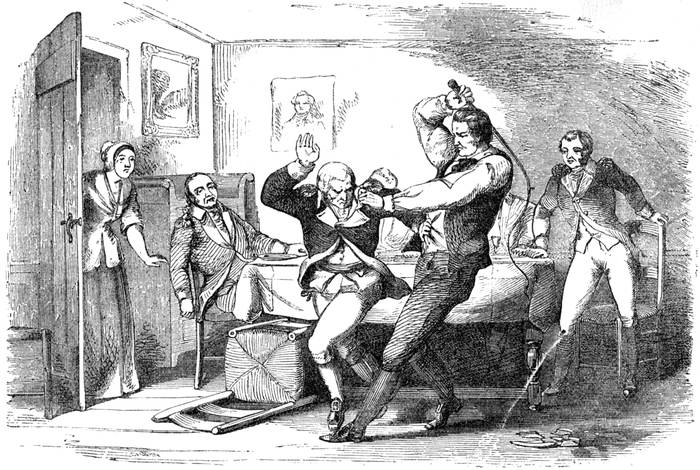
Horsewhipping a Tyrant.—Page 37.
235When Colonel Allen met Captain Smith on board the vessel, he
greeted him with thanks for his kindness. The noble Captain disclaimed
all merit, and said: "This is a mutable world, and one gentleman
never knows but that it may be in his power to help another."
This sentiment was strikingly verified in the course of the
voyage.
One night, as they were sailing along the coast of Rhode Island,
Captain Burke and a few other prisoners came to Allen with a plan
for destroying the British officers, seizing the vessel, and carrying
her into some friendly port. A large quantity of cash on board was
held up as an inducement for the enterprise. But Captain Smith had
generously distinguished the prisoners, and for this reason Allen
strongly condemned the plan. He declared that if the attempt was
made, he would assist in the defense of the Briton, with all his skill
and strength. Finding the conspiracy so strenuously opposed by the
most influential of the prisoners, it was abandoned, upon the assurance
that they should not be betrayed.
Upon arriving in New York, Colonel Allen was released on parole,
but restricted to the limits of New York. An attempt was made
soon after to induce him to join the British ranks. He was offered
a heavy sum of money, and large tracts of land, either in New
Hampshire or Connecticut, when the country was conquered. The
integrity of the man, however, was unassailable. His reply to the
proposition was characteristic. He said that the offer reminded him
of a certain incident in Scripture. The devil, he said, took Christ
to a high hill, and showing him the kingdoms of earth, offered him
their possession, if he would fall down and worship him, "when all
the while the damned soul had not one foot of land upon earth!"
It may be believed that those sent to negotiate with him did not
fail to understand the illustration.
Colonel Allen, in a narrative of his captivity, written by himself,
gives a fearful account of the condition of the American prisoners in
New York. Before he was exchanged he was arrested on the absurd
236charge of breaking his parole, and thrown into the Provost jail.
Here he remained from August to May, during which time he witnessed
instances of suffering of the most agonizing kind, and was
himself compelled again to feel the barbarous treatment of British
officials. At the expiration of the above period he was exchanged,
and once more tasted of the sweets of freedom.
It may not be out of place here, since we have given an account
of Barton's brilliant exploit in the capture of General Prescott, to
relate the story of General Wadsworth's abduction, who fell into the
hands of the British in a manner somewhat similar, though the affair
was characterized by no such daring on the part of the enemy as our
own young officer showed, in venturing into the lines of the English,
since General Wadsworth was known to be almost wholly unprotected
at the time it was resolved to take him.
In the spring of 1780 he was appointed to the command of a
party of State troops in Canada, in the district of Maine. At the
expiration of the time for which the troops were engaged, General
Wadsworth dismissed them, retaining six soldiers only as his guard,
as he was making preparations to depart from the place. A neighbor
communicated his situation to the British commander at Penobscot,
and a party of twenty-five soldiers, commanded by Lieutenant
Stockton, was sent to make him a prisoner. They embarked in a
small schooner, and, landing within four miles of the General's
quarters, they were concealed in the house of a Methodist preacher
by the name of Snow—professedly a friend to us, but really a traitor—until
eleven in the evening, when they made their arrangements
for the attack.
The party rushed suddenly on the sentinel, who gave the alarm,
and one of his comrades instantly opened the kitchen door, and
the enemy were so near as to enter with the sentinel. The lady of
the General, and her friend, Miss Fenno, of Boston, were in the
house at the time. Mrs. Wadsworth escaped from her husband's
room into that of Miss Fenno.
The assailants soon became masters of the whole house, except
the room where the General was, and which was strongly barred,
and they kept up a constant firing of musketry into the windows
and doors, except into those of the ladies' room. General Wadsworth
237was provided with a pair of pistols, a blunderbuss and a fusee,
which he employed with great dexterity, being determined to defend
himself to the last moment. With his pistols, which he discharged
several times, he defended the rooms of his window and a door
which opened into a kitchen. His blunderbuss he snapped several
times, but unfortunately it missed fire; he then secured his fusee,
which he discharged on some who were breaking through the windows,
and obliged them to flee. He next defended himself with his
bayonet, till he received a ball through his left arm, when he surrendered,
which terminated the contest. The firing, however, did not
cease from the kitchen until the General unbarred the door, when
the soldiers rushed into the room, and one of them, who had been
badly wounded, pointing a musket at his breast, exclaimed, with an
oath, "you have taken my life, and I will take yours." But Lieutenant
Stockton turned the musket aside, and saved his life. The
commanding officer now applauded the General for his admirable
defense, and assisted in putting on his clothes, saying, "you see we
are in a critical situation, and therefore you must excuse haste."
Mrs. Wadsworth threw a blanket over him, and Miss Fenno affixed
a handkerchief closely around his wounded arm.
In this condition, though much exhausted, he, with a wounded
American soldier, was directed to march on foot, while the British
wounded soldiers were mounted on a horse taken from the General's
barn. They departed in great haste. When they had proceeded about
a mile, they met, at a small house, a number of people collected, and
who inquired if they had taken General Wadsworth. They said
no, and added that they must leave a wounded man in their care,
and if they paid proper attention to him, they should be compensated;
but if not, they would burn down their house. The man
appeared to be dying. General Wadsworth was mounted on the
horse behind the other wounded soldier, and was warned that his
safety depended on his silence. Having passed over a frozen mill-pond
about a mile in length, they were met by some of their party
who had been left behind. At this place they found a British privateer,
which brought the party from the fort. The Captain, on
being told that he must return there with the prisoner and the party,
and seeing some of his men wounded, became outrageous, and
238cursing the General for a rebel, demanded how he dared to fire on
the king's troops, and commanded him to help launch the boat, or he
would put his hanger through his body. The General replied that
he was a prisoner, and badly wounded, and could not assist in launching
the boat. Lieutenant Stockton, on hearing of this abusive treatment,
in a manner honorable to himself, told the Captain that the
prisoner was a gentleman, had made a brave defense, and was to be
treated accordingly, and added, that his conduct should be represented
to General Campbell. After this the Captain treated the
prisoner with great civility, and afforded him every comfort in his
power.
General Wadsworth had left the ladies in the house, not a window
of which escaped destruction. The doors were broken down,
and two of the rooms were on fire; the floors were covered with
blood, and on one of them lay a brave old soldier dangerously
wounded, begging for death, that he might be released from misery.
The anxiety and distress of Mrs. Wadsworth were inexpressible, and
that of the General was greatly increased by the uncertainty in his
mind respecting the fate of his little son, only five years old, who
had been exposed to every danger by firing into the house; but he
had the happiness, afterward, of hearing of his safety.
Having arrived at the British fort, the capture of General Wadsworth
was soon announced, and the shore thronged with spectators,
to see the man who, through the preceding year, had disappointed
all the designs of the British in that quarter; and loud shouts were
heard from the rabble that covered the shore. But when he arrived
at the fort, and was conducted into the officer's guard-room, he was
treated with politeness. General Campbell, the commandant of the
British garrison, sent his compliments to him, and a surgeon to dress
his wound, assuring him that his situation should be made comfortable.
The next morning, General Campbell invited him to breakfast,
and at table paid him many compliments in the defense he had
made, observing, however, that he had exposed himself in a degree
not perfectly justifiable. General Wadsworth replied that from the
manner of the attack, he had no reason to suspect any design of
taking him alive, and that he intended, therefore, to sell his life as
dearly as possible. He was then informed that a room in the
239officers' barracks within the fort, was prepared for him, and that an
Orderly Sergeant should daily attend him to breakfast and dinner at
the commandant's table. Having retired to his solitary apartment,
and while his spirit was extremely depressed by a recollection of the
past, and by his present situation, he received from General Campbell
several books of amusement, and soon after a visit from him,
kindly endeavoring to cheer the spirits of his prisoner by conversation.
The principal officers of the garrison also called upon him, and
from them all, whom he daily met at the commandant's table, he
received particular attention and kindness.
"He now made application for a flag of truce, by which means
he could transmit a letter to the Governor of Massachusetts, and
another to Mrs. Wadsworth. This was granted on the condition that
the letter to the Governor should be inspected. The flag was intrusted
to Lieutenant Stockton, and on his return, the General was
relieved from all anxiety respecting his wife and family. At the end
of five weeks, he requested of General Campbell the customary
privilege of parole, and received in reply that his case had been reported
to the commanding officer at New York, and that no alteration
could be made, till orders were received from that quarter. In
about two months' time, Mrs. Wadsworth and Miss Fenno arrived,
and the officers of the garrison contributed to render their visit
agreeable to all concerned.
"About the same time, orders were received from the commanding
General at New York, which were concealed from General Wadsworth,
but he finally learned that he was not to be paroled nor exchanged,
but was to be sent to England as a rebel of too much consequence
to be at liberty. Not long afterward, Major Benjamin
Benton, a brave and worthy man, who had served under the General
the preceding summer, was taken and brought into the fort,
and lodged in the same room with him. He had been informed that
both himself and the General were to be sent immediately after the
return of a privateer now on a cruise, either to New York or Halifax,
and thence to England. The prisoners immediately resolved to
make a desperate effort to effect their escape. They were confined
in a grated room in the officers' barracks within the fort. The wells
of this fortress, exclusively of the depth of the ditch surrounding it,
240were twenty feet high, with fraising on top, and chevaux-de-frise at
the bottom.
"Two sentinels were always in the entry, and their door—the upper
part of which was glass—might be opened by their watchmen whenever
they thought proper, and was actually opened at seasons of
peculiar darkness and silence. At the exterior doors of the entries,
sentinels were also stationed, as were others in the body of the fort,
and at the quarters of General Campbell. At the guard-house a
strong guard was daily mounted. Several sentinels were stationed
on the walls of the fort, and a complete line occupied them by night.
Without the ditch, glacis and abattis, another complete set of soldiers
patroled through the night, and a picket guard was placed in
or near the isthmus leading from the fort to the main land. Notwithstanding
all these fearful obstacles to success, they resolved to
make the perilous attempt.
"The room in which they were confined was railed with boards.
One of these they determined to cut off so as to make a hole large
enough to pass through, and then to creep along till they should come
to the next or middle entry; and there lower themselves down into
this entry by a blanket. If they should not be discovered, the
passage to the walls of the fort was easy. In the evening,
after the sentinels had seen the prisoners retire to bed, General
Wadsworth got up, and standing in a chair attempted to cut with his
knife, the intended opening, but soon found it impracticable. The next
day, by giving a soldier a dollar they procured a gimlet. With this
instrument they proceeded cautiously and as silently as possible to separate
the board, and in order to conceal every appearance from their
servants and from the officers, their visitors, they carefully covered the
gimlet holes with chewed bread. At the end of three weeks, their
labors were so far completed, that it only remained to cut with a
knife, the parts which were left to hold the piece in its place. When
their preparations were finished, they learned that the privateer in
which they were to embark was daily expected.
"In the evening of the 18th of June, a very severe storm of rain,
with great darkness and almost incessant lightning, came on. This
the prisoners considered as the propitious moment. Having extinguished
their lights, they began to cut the corners of the board,
241and in less than an hour the intended opening was completed. The
noise which the operation occasioned was drowned by the rain falling
on the roof. Major Benton first ascended to the ceiling, and
pressed himself through the opening. General Wadsworth next,
having put the corner of his blanket through the hole and made it
fast by a strong wooden skewer, attempted to make his way through,
standing on a chair below, but it was with extreme difficulty that he
at length effected it, and reached the middle entry. From this he
passed through the door which he found open, and made his way to
the wall of the fort, and had to encounter the greatest difficulty before
he could ascend to the top. He had now to creep along the
top of the fort between the sentry boxes, at the very moment when
the relief was shifting sentinels, but the falling of the heavy rain
kept the sentinels within their boxes, and favored his escape. Having
now fastened his blanket round a picket at the top, he let himself
down through the chevaux-de-frise to the ground, and, in a
manner astonishing to himself, made his way into the open field.
Here he was obliged to grope his way among rocks, stumps and
brush in the darkness of night, till he reached the cove. Happily
the tide had ebbed, and he was enabled to cross the water, which
was about a mile in breadth, and not more than three feet deep.
"About two o'clock in the morning, General Wadsworth found
himself a mile and a half from the fort, and he proceeded through a
thick wood and brush to the Penobscot river, and, after passing some
distance along the shore, being seven miles from the fort, to his unspeakable
joy he saw his friend Benton advancing toward him. Major
Benton had been obliged to encounter in his course equal difficulties
with his companion, and such were the incredible perils,
dangers and obstructions which they surmounted, that their escape
may be considered almost miraculous.
"It was now necessary that they should cross the Penobscot
river, and very fortunately they discovered a canoe with oars on the
shore suited to their purpose. While on the river, they discovered
a barge with a party of the British from the fort, in pursuit of them,
but by taking an oblique course, and plying their oars to the utmost,
they happily eluded the eyes of their pursuers, and arrived
safe on the western shore. After having wandered in the wilderness
242for several days and nights, exposed to extreme fatigue and cold,
and with no other food than a little dry bread and meat, which
they brought in their pockets from the fort, they reached the settlements
on the river St. George, and no further difficulties attended
their return to their respective families."
THE MOTHER'S TRIAL.
Who has not heard of Logan, "the white man's friend"—that noble
specimen of the Indian race, who, by his forbearance, prudence, and
magnanimity, has done so much toward elevating the character of
the red-man to that high standard so forcibly depicted in the works
of America's great novelist—Cooper. That there may have been
thousands among the tribes who inhabited this continent at the
period of its settlement by the whites, who were actuated and controlled
by the savage impulses of their naturally brutal and cruel propensities,
there can be no doubt; but these pages give striking evidence
that there were many who were governed by the dictates of
higher instincts and loftier sentiments than those of passion and
prejudice.
In early life Logan lived at a place called Logan's Spring, in
Mifflin county, Pennsylvania. The first settler in his immediate
neighborhood was William Brown, who afterwards became an associate
Judge to Mifflin county, a post which he held until his death,
at the age of ninety. While engaged in looking for a convenient
spot on which to erect his cabin, he visited Logan at his camp, accompanied
by his brother, and while there, engaged in a friendly
contest of skill in the use of the rifle with the chieftain. A dollar
a shot was the wager for which they contended, and when they
ceased it was found that Logan was the loser of several shots. Going
to his cabin, he returned with as many deer-skins as he had lost
dollars, and handed them to the winner, who refused to take them,
243alleging that he was his guest, and did not come to rob him; that
the bet had been a mere nominal one, and he did not expect him to
pay it. The chief drew himself up to his full height, while a frown
of injured dignity darkened his brow, and exclaimed: "Me bet to
make you shoot your best; me gentleman, and me take your money
if me beat," and as there was no wish to insult him, the winner was
obliged to take the skins from their host, who would not accept
even a horn of powder in return. So much for the Indian's honesty
and integrity.
Mrs. Norris, a daughter of Judge Brown, gives some particulars
relating to Logan, which are highly interesting. She says: "Logan
supported himself by killing deer and dressing their skins, which he
sold to the whites. He had sold quite a quantity to one De Yong, a
tailor, who lived in Fuguson's valley, below the Gap. Tailors, in
those days, dealt extensively in buckskin breeches. Logan received
his pay, according to stipulation, in wheat. The wheat, on being
taken to the mill, was found so worthless that the miller refused to
grind it. Logan was much chagrined, and attempted in vain to obtain
redress from the tailor. He then took his case before his friend
Brown, then a magistrate; and on the Judge's questioning him as
to the character of the wheat, and what was in it, Logan sought for
words in vain to express the precise nature of the article with which
the wheat was adulterated, but said that it resembled in character
the wheat itself.
"It must have been cheat," said the Judge.
"Yoh!" said Logan, "that very good name for him."
A decision was given in Logan's favor, and a writ given to him to
hand to the constable, which, he was told, would bring the money
for the skins. But the untutored Indian—too uncivilized to be dishonest—could
not comprehend by what magic this little bit of paper
would force the tailor against his will to pay for the skins. The
Judge took down his own commission, with the arms of the king
upon it, and explained to him the first principles and operations of
civil law. "Law good," said Logan; "make rogues pay."
But how much more efficient the law which the Great Spirit had
impressed upon the Indian's heart—to do unto others as he would be
done by.
244When one of Judge Brown's children was just learning to walk,
its mother happened to express a regret that she could not get a pair
of shoes to support its first efforts. Logan, who stood by, overheard
the remark, but apparently paid no attention to it, although he had
determined in his own mind that the want of shoes should not hinder
the little girl in her first attempts. Two or three days passed,
and the remark had been forgotten by all save the chieftain, when,
happening into their house, he asked the mother if she would allow
the child to go with him, and spend the day at his cabin. Mrs. B.
could not divine the reason of such a request, and all her suspicions
were aroused at the idea of placing her little cherub in the hands
of one whose objects she could not understand. The proposition
alarmed her, and, without giving a decided negative, she hesitated to
comply. The matter was left to her husband, who urged her to
consent, representing the delicacy of Logan's feelings, his sensitiveness,
and his character for truth and plain dealing. With much reluctance,
but with apparent cheerfulness, the mother at length complied,
although her heart was filled with forebodings, as she saw her
little one disappear in the woods in the arms of the chieftain.
Slowly passed the sad hours away, and the poor mother could do
nothing but think of her absent one, in the hands of a savage warrior,
the natural enemy of the pale-face. As the day drew to a close,
she took her station at the window, and watched with the most intense
solicitude for the return of her child; but hour after hour
passed away without bringing any relief to her anxious heart. A
thousand vague fears and conjectures filled her mind with the many
tales of Indian barbarity and treachery which she had heard, and as
the shades of evening drew around the landscape, and her little one
had not returned, she felt that to hear of her death at the hands of
the chief would be a relief to her overwrought brain. Her husband
endeavored to calm her agitated feelings, and soothe her into confidence
in the integrity of Logan—but with little effect; and it is probable
that her apprehensions would have driven her to go to the cabin
of the Indian in search of her child. Just after the sun went down,
however, he made his appearance in the dim twilight, bearing the
little treasure in his arms, who seemed delighted with her conductor
for her arms were thrown about his neck as he bore her along with
245firm and rapid steps to her home. The mother's heart leaped with
joy as she recognized the persons of the chief and the child. She
sprung from her chair, where she had passed so many anxious moments,
and prepared to receive the little one, around whom had been
concentrated all her maternal feelings that tiresome, lonely, and
weary day. A few brief moments, which to her seemed hours,
brought the chief to the door, where he released the child from its
embrace, and sat it down upon the floor. The mother caught it in
her arms and hugged it to her bosom, while the father addressed his
thanks to the proud and gratified chief for a pair of beautiful little
moccasins, adorned with beads and all the fancy work of an Indian's
taste, which covered and supported the feet of the little girl. During
all that day, which had been so tedious and full of anxiety to the
mother, Logan had been engaged in constructing and ornamenting
the little gift, by which he intended to show his appreciation of the
many favors he had received at the parents' hands.
Logan was called a Mingo chief, or Mengwe, whose father was
chief of the Cayugas, whom he succeeded. His parent being attached,
in a remarkable degree, to the benevolent James Logan, after
whom he named his son. The name is still perpetuated among the
Indians. For magnanimity in war, and greatness of soul in peace,
few, in any nation, ever surpassed Logan. He was inclined to
friendship with the whites; nothing but aggravated wrongs succeeded
in making him their enemy. He took no part in the French wars,
ending in 1770, except that of peacemaker—was always acknowledged
to favor us, until the year 1774, when his brother, and several others
of the family, were murdered.
The particulars were these. In the spring of that year some Indians
were reported to have robbed the people upon the Ohio river,
who were in that country, exploring the lands, and preparing for
settlements. These land-jobbers, becoming alarmed at what they
considered the hostile character of the Indians, collected themselves
at a place called Whiting creek, the site of the present town of
Wheeling, and, learning that there were two Indians on the river
above, Captain Michael Cresap, belonging to the exploring party,
proposed to fall upon and kill them.
His advice was first opposed, then followed—the two Indians were
246slain. The same day, it being reported that there were Indians below
Wheeling, on the river, Cresap and his party immediately marched
to the place, and at first appeared to show themselves friendly, suffering
the Indians to pass by them unmolested, to encamp still lower
down, at the mouth of Grove Creek. Cresap now followed, attacked
and killed several, having one of his own men wounded by the fire
of the savages. Here some of the family of Logan were slain.
This affair was exceedingly aggravating, inasmuch as the whites pretended
no provocation.
Soon after this the whites committed another unprovoked outrage
upon the Indian encampment, about thirty miles above Wheeling, on
the opposite side of the river. A white man by the name of Greathouse
lived opposite the encampment. He collected a party of
thirty-two men, who secreted themselves, while he, under pretense
of a friendly visit, crossed the river to ascertain the number of the
Indians. On counting them, he found they were too numerous for
his own party. These Indians had heard of the late murder of their
friends, and had resolved to be revenged. Greathouse did not know
of the danger he was incurring, until a squaw advised him of it, in
friendly caution to "go home." He then invited the Indians to come
over the river and drink with him, this being a part of his plan for
separating them, that they might be more easily destroyed. The offer
was accepted by a good many, who, being collected at a tavern in
the white settlement, were treated freely to liquor, and all killed, except
a little girl. Among the murdered was a brother and sister of
Logan.
The remaining Indians, upon the other side of the river, upon
hearing the firing, sent off two canoes with armed warriors, who, as
they approached the shore, were fired upon by the whites, who lay
concealed awaiting them. Nothing prevented their taking deadly
aim, so that their fire was terribly destructive, and the canoes were
obliged to return. This affair took place in May, 1774. These were
the events which led to a horrid Indian war, in which many innocent
families were sacrificed to satisfy the vengeance of an injured,
incensed people. A calm followed the first outbreak; but it was the
calm which precedes the storm, and lasted only while the tocsin of
war was being sounded among the distant nations.
247In July of the same year, Logan, at the head of eight warriors,
struck a blow upon some inhabitants in Michigan, where no one expected
it. He left the settlement of the Ohio, which all supposed
would be first attacked in case of war, and hence the reason of his
great successes. His first attack was upon three men who were
pulling flax in a field. One was shot down, and the two others
taken. These were marched into the wilderness, and, as they approached
the Indian town, Logan gave the scalp halloo, and they
were met by the inhabitants, who conducted them in. Running the
gauntlet was next to be performed. Logan took no delight in torture,
and he instructed one of the prisoners how to proceed to escape the
severities of the gauntlet. This same captive, whose name was
Robison, was afterward sentenced to be burned, but Logan, though
not able to rescue him by his eloquence, with his own hand cut the
cords which bound him to the stake, and caused him to be adopted
into an Indian family. Robison afterward became Logan's scribe,
and wrote for him the letter, tied to a war-club, which was left, that
same season, at the house of a family cut off by the Indians, and
which served to alarm the inhabitants, and to call out the militia for
their protection. It ran thus:
"Captain Cresap: What did you kill my people on Yellow Creek
for? The white people killed my kin at Conestoga, a great while
ago, and I thought nothing of that. But you killed my kin again
on Yellow Creek, and took my cousin prisoner. Then I thought I
must kill, too; and I have been to war three times since. But the
Indians are not angry—only myself.
There was a chief among the Shawanese more renowned as a
warrior than even Logan at that time. Cornstalk was his name,
and to him seems to have fallen the principal direction of the war
which was now begun. We do not propose to give a detailed history
of the fierce struggle which followed; but some account of the
great battle at Point Pleasant cannot be uninteresting.
General Lewis, with eleven hundred men, gave battle to fifteen
hundred savage warriors, under Logan, Cornstalk, Ellinipsico (Cornstalk's
son,) Red Eagle, and other mighty chiefs of the tribes of the
Delawares, Shawanese, Cayugas, Wyandots, and Mingoes. The
248battle began a little after sunrise, on a narrow point of land, between
the Ohio and the Great Kanawha rivers. The breastworks of the
Indians, constructed of brushwood, extended from river to river;
their plan of attack was the best conceivable, for in the event of
victory on their part, not a Virginian would have escaped. They
had stationed men on both sides of the river, to prevent the escape
of such as might attempt it, by swimming from the apex of the triangle
made by the confluence of the two rivers. The Virginians,
like their opponents, covered themselves with trees, or whatever
shelter offered; but the Indians had every advantage. Hour after
hour the battle lasted, the Indians slowly retreating to their breastworks,
while the Virginians fought with desperate courage, for life
itself was at stake for all of them. Colonel Lewis, brother of the
commanding General, soon fell, under the fire to which his uniform
particularly exposed him. His division was broken, while another
division, under Colonel Fleming, was attacked at the same moment,
and the Colonel received two balls in his left wrist, but continued
to exercise his command with the greatest coolness. His voice was
continually heard: "Advance—outflank the enemy; get between
them and the river. Don't lose an inch of ground!" But his men
were about to be outflanked by the body which had just defeated
Lewis, when the arrival of Colonel Field's division turned the fortune
of the day, but not without severe loss. Colonel Fleming was
again wounded by a shot through the lungs, and Colonel Field was
killed while leading on his men.
The Indians fought with an equal bravery. The voice of Cornstalk
was often heard during the day, above the din of strife, calling
on his warriors in these words: "Be strong! be strong!" and when,
by the repeated charge of the whites, some of his men began to
waver, he is said to have sunk his hatchet in the brain of one who
was cowardly attempting to retreat.
General Lewis finally decided the contest by getting three companies
of men into the rear of the Indians; these companies got unobserved
to their destination upon Crooked Creek, a little stream
running into the Kanawha, whose high, wood-covered banks sheltered
them, while they made a furious attack upon the backs of the
Indians, who, thinking reinforcements had arrived, fled across the
Ohio, and immediately took up their march for their towns on the
Scioto. It was sunset when the battle ended.
249
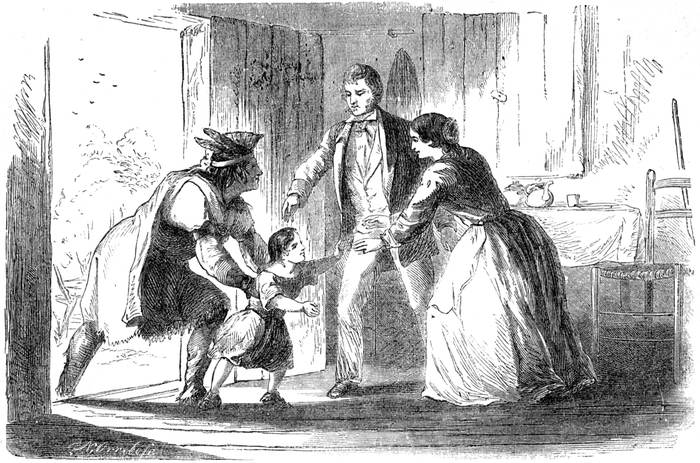
The Mother's Trial—Page 52.
251There was a kind of stratagem used in this contest, which was
more than once practiced by the experienced Virginia riflemen, during
their fight with the savages. The soldiers in Colonel Fleming's
corps would conceal themselves behind a tree, or some other shelter,
and then hold out their caps from behind, which the Indians, seeing,
would mistake as covering the heads of their opponents, and shoot
at them. The cap being dropped at the moment, the Indian would
dart out from his covert to scalp his victim, and thus meet a sure
death from the tomahawk of his adversary. This game was practiced
only by the "prime riflemen," accustomed to a backwoods
life.
After this signal defeat, the Indians were prepared to treat for
peace. General Lewis, after burying his dead, took up his perilous
and difficult march, his troops eager to exterminate the Indians;
but Governor Dunmore, having received numerous offers of peace,
finally ordered him to retreat. Lord Dunmore, with a force equal
to that of Lewis, was now at Chilicothe, where he began a treaty,
conducted on the part of the whites with great distrust, who never
admitted but a few Indians at a time into their encampment. The
business was commenced by Cornstalk, in a speech of great length,
in which he charged upon the whites the main cause of the war;
and mainly in consequence of the murder of Logan's family. A
treaty, however, was the result of this conference, and this conference
was the result of the Mingo chief's famous speech, since known
throughout both hemispheres. It was not delivered in Lord Dunmore's
camp, for, although desiring peace, Logan would not meet
the whites in council, but remained in his cabin in sullen silence,
until a messenger was sent to him with the treaty, to know if he
consented to its articles. To this messenger he pronounced that
memorable speech:
"I appeal to any white man to say if he ever entered Logan's
cabin hungry, and I gave him not meat; if he ever came cold and
naked, and I clothed him not.
"During the course of the last long, bloody war, Logan remained
idle in his cabin, an advocate for peace. Such was my love for the
252whites, that my countrymen pointed as they passed, and said: 'Logan
is the friend of the white man.'
"I had even thought to have lived with you, but for the injuries
of one man. Colonel Cresap, the last spring, in cold blood, and unprovoked,
murdered all the relations of Logan, not even sparing his
women and children.
"There was not a drop of my blood in the veins of any living
creature. This called on me for revenge; I have sought it. I have
killed many—I have fully glutted my vengeance. For my country
I rejoice at the beams of peace. But do not harbor a thought that
mine is the joy of fear. Logan never felt fear. He will not turn
on his heel to save his life. Who is there to mourn for Logan?
Not one!"
Cornstalk, a chief excelling even Logan in natural nobility of
character, and great bravery, who conducted the battle and the
treaty, lost his life within a year from that time, under circumstances
painful to all lovers of justice.
Upon the breaking out of the Revolution, the year following, the
British Government, through their agents, made the most strenuous
efforts to induce the Indians to take up the tomahawk in behalf of
the king, and were but too successful. Cornstalk, however, actuated
by a high-toned feeling of repugnance at the idea of breaking his
plighted faith, and foreseeing the inevitable issue of the struggle—being,
moreover, a firm and consistent friend of the Americans—refused
to take any part in the contest, and exerted the utmost of his
influence to prevent his tribe from joining the coalition. His efforts
proved futile, however, and the influence of British presents, and the
example of the neighboring tribes, had the effect which he most
dreaded. He did not live to see the result of the struggle, being
killed on the spot where he had but a year before fought so bravely
in defense of his home and the graves of his sires. After the truce
between the tribes and Governor Dunmore had been agreed upon, a
fort was erected at Point Pleasant to commemorate the battle and
keep the Indians in check, and to this fort Cornstalk, after finding
that his efforts to preserve that compact intact would be unavailing,
repaired to explain the position of affairs to its commanding officer,
Captain Arbuckle, and take his advice as to what course he should
253pursue. Red-hawk, the Delaware chief, who had also fought so
bravely at Point Pleasant, and who was likewise opposed to resuming
the hatchet, accompanied him in his visit. The chieftain explained
in the fullest manner the state of affairs among the Indians, and informed
Arbuckle that he should be unable to restrain his tribe, who
seemed determined to dig up the hatchet, and once more commence
an exterminating war against the settlers. Under these circumstances,
Arbuckle felt himself justified in detaining the chief and his companion
as hostages, supposing that the fact of their principal leader
being in the hands of the Americans would have the effect of deterring
his tribe from active hostilities. Thinking themselves that such
a result might follow, and earnestly desirous of not taking part in
the contest, which they knew must follow if they returned to their
people, they remained willing captives in the hands of Arbuckle, little
dreaming of the fate which awaited them, and giving all the information
which they possessed regarding the anticipated movements
of the various tribes, and of the British agents among them.
The young chief, Ellinipsico, becoming anxious at the protracted
absence of his father, set out in search of him, and, having traced
him to the fort, he made his appearance on the opposite side of the
river, and, being recognized by the chieftain, permission was given
him to enter the fort, where the meeting between them was of the
most affecting nature. They entertained for each other the warmest
feelings of affection, which the young man displayed on the present
occasion, by the enthusiastic manner in which he embraced his parent,
and sought to show his joy at meeting him.
The hostages had been quartered in one of the cabins within the
pickets of the fort, which, from its position, afforded safety and security—although
they were not confined thereto, but allowed the
range of the inclosure, and thither they bent their steps, and father
and son sat down to take counsel in the present state of affairs.
Ellinipsico, in common with the young men of his tribe, was in
favor of joining in the war, being anxious to distinguish himself,
and win his way by feats of arms to the proud position which would
be his own inheritance on the death of his father. From such a
course, Cornstalk endeavored to dissuade him with all the eloquence
for which he was distinguished—but with little effect. The young
254man felt the unconquerable enmity of his race toward the white
men, and burned to wash out in their blood the many wrongs and
injuries he had received at their hands. The afternoon and evening
having been spent in conversation upon this subject, without any result,
the chieftain and his son laid down to sleep on the floor of their
cabin—the last sleep they were destined to take this side of eternity.
On the morning after the arrival of Ellinipsico, two men of the
garrison, named Hamilton and Gillmore, started out to hunt on the
opposite side of the Kanawha river, not dreaming of any danger to
be apprehended from the Indians, hostilities not having as yet commenced.
On their return about noon, they were fired upon by two
Indians, who had come across the Ohio to reconnoiter the fort, and
hidden themselves in the weeds and brush, and Gillmore was killed.
Colonel Stewart and Captain Arbuckle were standing on the opposite
shore when the firing was heard, and expressed their surprise to one
another at the occurrence, as strict orders had been given against all
firing in the immediate vicinity of the fort. While anxiously awaiting
a solution to the mystery, they discovered Hamilton on the other
bank, who called to them, told them that Gillmore had been killed,
and entreated them to send a canoe across to his relief. Captain
Hall was dispatched with several men to the relief of the fugitive,
and in a few moments they stood by his side.
A careful search in the adjacent bushes discovered the body of
their comrade, shot through the head, and scalped. Placing the
bloody corpse in the canoe, they recrossed the river, and with feelings
of dire revenge demanded the lives of the hostages in the fort.
Pale with rage, and terribly excited at the murder of one of his companions,
Captain Hall placed himself at the head of his men, and
marched toward the fort, threatening death to the unarmed hostages.
Captain Arbuckle and several of the officers threw themselves in
their way, and endeavored to prevent the execution of their bloodthirsty
purpose; but this only excited the passions of the soldiers to
the most ungovernable pitch, and cocking their pieces, they threatened
death to all who interfered between them and their victims.
Arbuckle was forced to give way, and witness a scene he was unable
to prevent, and the exasperated men rushed into the fort. The
interpreter's wife, who had been a captive among the Indians, and
255felt an affection for them, rushed to the cabin to inform them that
Captain Hall's men were advancing to put them to death, because
they entertained the idea that the Indians who had killed their comrade
had come with Ellinipsico the day previous. This Ellinipsico
earnestly denied, averring that he had come alone, with the only
purpose of meeting his father, and without dreaming of hostility.
The clamor without announced the rapid approach of their executioners,
and Ellinipsico, being highly excited at the idea of being put
to death for a wrong he had not committed, showed considerable
agitation. The veteran chief, however, had faced death on too many
battle-fields to be alarmed at his approach now, and endeavored to
reassure his son, and induce him to die as became the child of such
a sire. "If the Great Spirit," said he, "has decided that I should
die, my son, and has sent you here to die with me, you should submit
to your fate as becomes a warrior and a chief." With courage
revived by the exhortation of his father, Ellinipsico prepared to meet
with composure the death which he saw was inevitable. Covering
his face with his hands that he might not see his executioners, he
calmly awaited the stroke which was to deprive him of life, and send
him to the "happy hunting grounds" of his race. As the door of
the cabin was burst open, Cornstalk rose with dignity, and presented
his breast to the rifles of the infuriated soldiers. Seven bullets
pierced his noble form, and he died without a struggle. His son was
killed at the same instant, and both fell to the ground together.
Red-hawk, who had endeavored to hide himself, was dragged from
his place of concealment and killed, as was another Indian who was
in the fort, and who was fearfully mangled in the struggle.
"Thus," says Withers, in his Indian chronicles, "perished the
mighty Cornstalk, sachem of the Shawnees, and king of the Northern
confederacy in 1774—a chief remarkable for many great and
good qualities. He was disposed to be, at all times, the friend of the
white men, as he was ever the advocate of honorable peace. But
when his country's wrongs summoned him to the battle, he was the
thunderbolt of war, and made his enemies feel the weight of his
arm. His noble bearing, his generous and disinterested attachment
to the colonies, his anxiety to preserve the frontiers of Virginia from
desolation and death, all conspired to win for him the esteem and
256respect of others; while the untimely and perfidious manner of his
death caused a deep and lasting feeling of regret to pervade the
bosoms, even of those who were enemies to his nation, and excited
the indignation of all toward his inhuman murderers."
We would not be thought the apologist for a deed like that which
has been narrated; but, at the same time, cannot join the cry which
is raised against it by those authors who stigmatize it is a "cruel,
bloodthirsty, inhuman, fiendlike murder." All the harshest terms
in our language have been hurled at the heads of those who were
engaged in it, and with great injustice. Cruel and bloodthirsty it
undoubtedly was, but it was the natural consequence of the war
which was waged between the white and red-men, in which revenge
for injuries inflicted was held to be a sacred duty. Stone, with great
want of candor, omits to mention the fact that Hall and his companions
entertained the idea that the Indians who had accompanied
Ellinipsico had killed their fellow soldier; but, in language of the severest
cast, would lead us to suppose their act a mean, cowardly, cold-blooded
massacre. He says: "A party of ruffians assembled, under command
of a Captain Hall—not to pursue or punish the perpetrators of the
murder, but to fall upon the friendly and peaceable Indians in the
fort." What would have been the conduct of the Indians under
similar circumstances? The pages of his own work exhibit many
instances of similar cruelty and revengeful practice on their part;
and even Brant himself is not free from it.
True, in the present case, the perpetrators were white men, civilized
and enlightened; but in the long and bloody wars of extermination
which they had waged with the savages, they had learned
their mode of warfare; in fact, they could not hope for success in
any other way, and the long account of murders, massacres, burnings
at the stake, and inhuman tortures, which, even at the present day,
thrill the blood with horror, had exasperated the feelings of those
men who were surrounded by the actual reality, and expected no
better fate themselves at the hands of Indians, should they be so unfortunate
as to be captured, and they lost sight of the dictates of
justice in the all-powerful and blinding spirit of revenge.
258
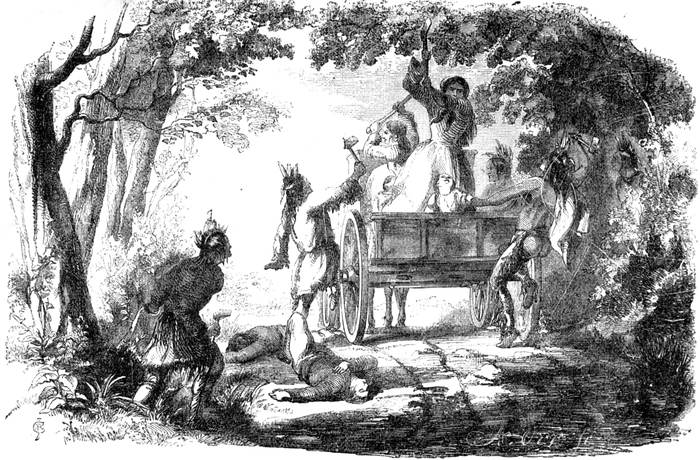
The Women Defending the Wagon.—Page 8.
259TALES,
Traditions and Romance
OF
BORDER AND REVOLUTIONARY TIMES.
WOMEN DEFENDING THE WAGON.
CAPTIVITY OF JONATHAN ALDER
MOODY THE REFUGEE.
THE LEAP FOR LIFE.
NEW YORK:
BEADLE AND COMPANY, PUBLISHERS,
118 WILLIAM STREET.
260Entered according to Act of Congress, in the year 1863, by
BEADLE AND COMPANY,
In the Clerk's Office of the District Court of the United States for
the Southern District of New York.
THE WOMEN DEFENDING THE WAGON.
261
Between the Blue Ridge and the western range of the Alleghany
Mountains, in the northern part of the State of Virginia, is located
Shenandoah County, which derives its name from the beautiful river,
one branch of which flows through its entire length, from south to
north. Its county seat is Woodstock, a thriving town, with a population
of between one and two thousand inhabitants. This place
was settled, previous to the French and Indian war, by hardy German
yeomanry from Pennsylvania, who were tempted to leave the
rugged hills of the Keystone State, by the glowing reports which had
reached their ears of the surprising fertility and beauty of the valley
of the Shenandoah. Gathering up their household goods, they
turned their backs upon the homes of their first choice, and took
their way through pathless forests to "the promised land." Arrived
at their new home, they selected the site of the present flourishing
town as the nucleus of the settlement, and commenced, with a will,
the laborious task of felling the forest and the erection of their homes.
A stockade fort was erected as a protection against the incursions
of predatory bands of Indians. A short time sufficed to place them
in circumstances which, if not actually flourishing, were comparatively
thrifty, and so far promising as to the future, that they were
led to look forward with hope to a long continued prosperity. They
were a plain, frugal and industrious people, unacquainted with the
luxuries and only desiring the substantial requisites of an humble life,
which were furnished in abundance by the fertile soil of the valley in
which they had taken up their abode. A traveler among them
during the French and Indian war thus speaks of their happy
condition:
262"I could not but reflect with pleasure upon the situation of these
people, and think, if there is such a thing as true happiness, in this
life, they enjoy it. Far from the bustle of the world, they live in the
most delightful climate and possess the richest soil imaginable. They
are everywhere surrounded by beautiful prospects and sylvan scenes.
Lofty mountains, transparent streams, falls of water, rich valleys and
majestic woods—the whole interspersed with an infinite variety of
flowering shrubs—constitute the landscape surrounding them. They
are subject to few diseases, are generally robust, and live in perfect
liberty. They are ignorant of want, and are acquainted with few
vices. Their inexperience of the elegancies of life precludes any
regret that they have not the means of enjoying them; but they possess
what many princes would give half their dominions for—health,
content and tranquility of mind."
Among others who had been attracted to this valley by the glowing
accounts of its fertility and comparative security, were two heads
of families by the names of Sheits and Taylor. The former was of
German parentage, the latter of English birth, but having both married
American women, and being drawn together by that bond of
sympathy which, in a new country, where danger is a common heritage,
unites with a stronger tie than that of blood—they were more
like one family than two separate households.
Being driven from their homes by the massacre of two of their
neighbors and their families, they hastily collected a few necessaries,
placed them, with their wives and children, in a wagon, to which
was attached their respective horses, and started in search of a new
home. Woodstock was the nearest town, or station, where there
was a fort, and toward that place they directed their steps.
The family of Taylor embraced himself, wife, and three children,
while that of Sheits numbered but three—himself, wife, and one child.
The few articles which the limited room in the wagon, and the hurried
nature of their departure allowed them to remove, were a chest
of drawers, which was a gift from the parents of Mrs. T., a feather
bed, also a parental gift to Mrs. S., a brass kettle or two, some few
culinary articles, and the axes and rifles of the men. These and their
horses, and a stout farm wagon, were all they had saved, yet they
were well content to come off with their lives, and trudged along,
263satisfied if they could but reach a haven of safety from the barbarities
which had been inflicted upon their less fortunate neighbors and
friends.
The greater portion of their way lay through the forest, where
every sound to their affrighted ears gave token of an enemy lurking
in their path, and the rustling of a leaf, or the sighing wind, awoke
their fears, and called up their latent courage. This had been passed,
however, in safety, and they had reached the brow of the hill from
whence they had a view of the beautiful valley below, where they
hoped to find a haven of rest. Pausing for a moment to admire the
scene which opened before them, they gave vent to their feelings in
eulogies upon the lovely landscape, and words of encouragement to
their wives and children. Alas, as they spoke, the deadly rifle of a
concealed foe was leveled full at their breasts, and the savage red-skin
was thirsting for their blood, within a few feet of them. Hidden
by the thick underbrush which grew up by the side of the road, five
tawny warriors, painted and bedecked with their war feathers, lay
crouching like wild beasts, ready to spring upon their prey. Just as
they started to resume their way, and descend the hill toward the
settlement, the crack of two rifles, the whizzing of two leaden messengers,
and the fall of their husbands, alarmed the women and
widowed them at the same instant. The aim had been sure, and
both the men fell without a groan, pierced through the heart with a
bullet from an unerring rifle. Quick as the flash from a summer
cloud were all their hopes of safety and future happiness blasted,
stricken to the earth with the fall of their husbands. No cry escaped
the now bereaved women. Their feelings were too deep for utterance,
nor was there any time for grief or repining. Left in an instant
self-dependent, they looked around for the foe and for means of
defense. Nothing was within reach but the axes of their husbands;
these they seized, awaiting the onset of the savages. They had not
long to wait. Pushing aside the foliage, the five warriors sprang,
with a grunt of satisfaction, from the thicket into the road, and made
for the wagon to secure their prisoners. The first who came up
seized the son of Mrs. Taylor, and endeavored to drag him from the
wagon, but the little fellow resisted manfully, looking, meanwhile, up
into his mother's face, as if to implore protection at her hands. The
264appeal was not lost upon her. Seizing, with both hands, the axe of
her husband, and swinging it around her head, she brought it down,
with all the vengeful force of her arm, upon the shoulder of the Indian,
inflicting a wound which sent him off howling with pain.
Turning to another, she served him in like manner, while Mrs.
Sheits had sent a third back to his lair with a severe blow across
the hand which severed all his fingers. The other two were wise
enough to keep without the reach of their blows, but endeavored to
intimidate them by terrific yells and brandished tomahawks. Nothing
daunted, however, the heroic women maintained their attitude
of defense, until wearied of their efforts, and, fearing the approach of
relief from the garrison of the fort, the two unwounded Indians
rushed into the thicket for their rifles, to end the conflict. Taking
advantage of this opportunity, the women started the horses, and
the red-skins, not daring to pursue them, they were permitted to
reach the fort in safety, from which a party set out to bring in the
dead and scalped bodies of their husbands.
Stories of such danger and fortitude as this can be but dimly realized
by the women of to-day. Yet the annals of our early history
are all too painfully darkened by such records; and it is well for the
heroes of the prosperous present to know through what hardships
this rich inheritance was secured to them. Emigration did not stop
in Virginia any more than it had rested in Pennsylvania:
"Westward to the star of empire takes its way;"
and the glorious Valley of the Mississippi won forward the daring
steps of the pioneers. It is known how long and terrible was the
contest by which Kentucky was wrested, inch by inch, from her ancient
owners, until her lovely soil, baptized in sorrow, received the
name of the "dark and bloody ground." Here, as always where
there is a chance for her development, and she is permitted to play
her free part by the side of man, woman did her share of the onerous
work, and had her share of the perils. One of the most terrible
of the family histories of that period is the following, of the household
of a widow, by the name of Shanks, full particulars of which
are given in the history of Kentucky.
On the night of the 10th of April, 1787, the house of Mrs. Shanks,
on Cooper's Run, in Bourbon County, was attacked by Indians. This
265house, which was a double cabin, consisting of two rooms, with an
open way between, contained, at the time the assault was made, besides
the widow herself, a widowed daughter, three other daughters,
a young girl, and two sons of adult age. Although the hour was
near midnight, one of the young men still remained up, and in the
opposite room a sister was busily engaged at the loom.
An hour before, while they were yet unconscious of the actual presence
of Indians, the suspicions of the son was aroused by the cry of
owls, hooting to each other in the adjoining wood, in a rather unusual
manner, and by the terror and excitement of the horses, who
were enclosed, as customary, in a pound near the house.
Several times the young man was on the point of awaking his
brother, but as often refrained, through fear of being ridiculed for his
timidity. At length hasty steps were heard without, and then came
several sharp knocks at the door, accompanied by the usual question
of the wayfarer, "Who keeps this house?" spoken in very good
English.
He hastily advanced to withdraw the bolt which secured the door,
supposing the new comer to be some benighted settler, when his
mother, whose greater experience had probably detected the Indian
accent, instantly sprang out of bed, and warned her son that the men
outside were savages.
The other son being by this time aroused, the two young men,
seizing their rifles, which were always charged, prepared to repel the
enemy. Conscious that their true character was discovered, the Indians
now strove to break in the door; but a single shot from the
loop-hole compelled them to shift their point of attack, when, unfortunately,
they discovered the door of the other cabin, which contained
the three daughters.
By some oversight in the construction of the cabin, none of the
loops enabled the brothers to cover the door of the room in which
their sisters were. The Indians soon forced it open by means of rails
taken from the yard fence. The girls being thus placed at the mercy
of the savages, one was instantly secured; but the eldest defended
herself desperately with a knife, and succeeded in mortally wounding
a savage before she was tomahawked. The youngest girl darted out
into the yard, and might have escaped in the darkness; but the poor
266creature ran around the house, and, wringing her hands in terror,
kept crying out that her sisters were killed.
The brothers, agonized almost to madness by her cries, were prepared
to sally out to her assistance, when their mother stayed them,
and calmly declared that the child must be abandoned to her fate.
The next instant, the child uttered a loud scream, followed by a few
faint moans, and then all was silent.
That portion of the house which had been occupied by the daughters
was now set on fire, and the flames soon communicating to the
opposite room, the brothers were compelled to fling open the door,
and attempt to seek safety by flight.
The old lady, supported by her eldest son, sought to cross the
fence at one point, while the widowed daughter, with her child in her
arms, and attended by the younger of the brothers, ran in a different
direction. The blazing roof shed a light over the yard but little inferior
to that of day, and the savages were distinctly seen awaiting
the approach of their victims. The old lady was permitted to reach
the stile unmolested, but, in the act of crossing, received several balls
in her breast, and fell dead. Her son providentially remained unhurt,
and, by extraordinary agility, effected his escape. The other brother,
being assailed by the Indians, defended his sister desperately for some
time, and drew the attention of the savages so closely to himself, that
she succeeded in eluding their vigilance. The brave and devoted
young man was less fortunate; he fell beneath repeated blows from
the tomahawks of his enemies, and was found at daylight, scalped
and mangled in a most shocking manner.
Of the whole family, consisting of eight persons when the attack
commenced, only three escaped. Four were killed on the spot, and
one, the second daughter, carried off prisoner.
The alarm was soon given, and by daylight thirty men were assembled
under Colonel Edwards, who pursued the Indian trail at a
gallop, tracking the footsteps of the savages in the snow. The trail
led directly into the mountainous country bordering upon Licking, and
afforded evidences of great precipitation on the part of the Indians.
Unfortunately, a hound had been permitted to accompany the whites,
and, as the trail became fresh, and the scent warm, she pursued it
with eagerness, baying loudly and giving alarm to the savages. The
267consequence of this imprudence was soon displayed. The enemy,
finding the pursuit keen, and perceiving the strength of their prisoner
beginning to fail, instantly sank their tomahawks in her head,
and left her, still warm and bleeding, upon the snow. As the whites
came up, she retained strength enough to wave her hand in token of
recognition, and appeared desirous of giving them some information
in regard to the enemy; but her strength was too far gone. Her
brother sprang from his horse, and endeavored to stop the effusion
of blood, but in vain. She gave him her hand, muttered some inarticulate
words, and expired within two minutes after the arrival of
the party.
The pursuit was renewed with additional ardor, and, in twenty
minutes, the enemy was within view. They had taken possession of
a narrow ridge, magnifying their numbers in the eyes of the whites,
by running rapidly from tree to tree, and maintaining a steady yell
in their most appalling tones.
The pursuers, however, were too experienced to be deceived by so
common an artifice. Being satisfied that the number of the enemy
must be inferior to their own, they dismounted, tied their horses, and
flanking out in such a manner as to enclose the savages, ascended
as rapidly as was consistent with a due regard to the shelter of their
persons.
The firing commenced, and now they discovered, for the first time,
that only two Indians were opposed to them. They had voluntarily
sacrificed themselves for the safety of the main body, and had succeeded
in delaying pursuit until their friends could reach the mountains.
One of them was shot dead, and the other was badly
wounded, as was evident from the blood upon his blanket, as well as
that which filled the snow for a considerable distance. The pursuit
was recommenced, and urged keenly until night, when the trail entered
a running stream, and was lost.
We know of nothing more powerfully illustrating the life led by
the women of those days, than the following statements, brief and
simple as they are, made in the record of General Samuel Dale:
"About this time Joe Horn and Dave Calhoun went to their clearings
to plant corn, very imprudently taking their wives and children
with them, who camped in the field. Being both off hunting one
268day, the prowling savages made a clean sweep of these two families.
The poor, heart-stricken husbands, almost crazy, returned to the fort,
and the whole night was passed by all of us in lamentations and vows
of vengeance.
"For several months after this, we were not troubled, and my brother
and myself were boarded about ten miles off, at Halbert McClure's,
to go to school. Returning, one morning, from a visit home,
we fell in with old Mr. Bush, of Castlewood Fort, who informed us
that he saw Shawnee 'signs' about, and that we must go back to
Glade Hollow, and give the alarm. Unfortunately, father had left,
the day before, for the salt works, on Holton river, and mother and
the children were alone. About nine at night, we saw two Indians
approaching. Mother immediately threw a bucket full of water on
the fire, to prevent their seeing us, made us lie on the floor, bolted
and barred the door, and posted herself there with an ax and a rifle.
We never knew why they desisted from an attack, or how father escaped,
who rode up three hours afterward.
"In two or three days all of us set out for Clinch Mountain, to
the wedding of Hoppy Kincaid, a clever young fellow from Holston,
and Sally McClure, a fine, bouncing girl of seventeen, modest and
pretty, yet fearless and free. We knew the Shawnees were about—that
our fort and household effects must be left unguarded, and might
probably be destroyed—that we incurred the risk of a fight, or an
ambuscade, capture, or even death, on the road; but in those days, in
that wild country, folks did not calculate consequences closely, and
the temptation to a frolic, a feast, a wedding, a dance till daylight,
and often for several days together, was not to be resisted, and off we
went.
"In half an hour we fell in with Captain Barnett, and twenty men
from Holston, who warned us that Indians were about, and that he
was scouting for them. Father, ever eager for a fight, joined this
company, and we trudged on to Clinch Mountain. Instead of the
bridal party, the well-spread table, the ringing laughter, and the sounding
feet of buxom dancers, we found a pile of ashes and six or seven
ghastly corpses, tomahawked and scalped! Poor Hardy McClure
was dead; several others lay around. One daughter was still breathing,
but soon expired. Mrs. McClure, her infant, and three other
269children, including Sally, the intended bride, had been carried off by
the savages. They soon tore the poor infant from its mother's arms,
and killed it, that she might travel faster.
"While they were scalping this child, Peggy McClure, a girl twelve
years old, perceived a sink-hole at her feet, and dropped silently into
it. It communicated with a ravine, down which she ran, and brought
the news into the settlement. The Indians were too apprehensive of
pursuit to search for her. The same night Sally, who had been tied
and forced to lie down between two warriors, contrived to loosen her
thongs and make her escape. She struck for the cane-brake, then
for the river, and, to conceal her trail, resolved to descend it. It was
deep wading, and the current was so rapid, she had to fill her petticoat
with gravel to steady herself. She soon, however, recovered
confidence, returned to shore, and finally reached the still-smoking
homestead about dark next evening. A few neighbors, well armed,
had just buried the dead. Kincaid was among them. The last
prayer had been said when the orphan girl stood among them, and
was soon in the arms of her lover. Resolved to leave no more to
chance, at his entreaty, and by the advice of all, the weeping girl
gave her consent, and, by the grave of the household, and near the
ruined dwelling, they were immediately married."
Can imagination add anything to this vivid picture?
CAPTIVITY OF JONATHAN ALDER.
270
The narrative of the captivity of Jonathan Alder is one of great
interest and value, being a source from whence can be derived much
important information regarding the customs, habits and manners of
the Indians, among whom he spent fifteen years of his early life.
We regret that it is impossible to give more than an outline sketch
of the incidents connected with his capture and adoption by the
savages.
He was born in New Jersey, but removed with his father to
Wythe County, Virginia, about 1780. In March, 1782, while he and
his brother David were in search of a mare and her foal, which had
strayed off into the woods, they were surprised by the appearance of
a small party of Indians, who darted upon them from behind the
trees, and, before Jonathan had time to make an effort at escape, he
found himself in the grasp of a stalwart warrior, who threatened him
with his tomahawk, and checked the effort, if the idea had risen in
his mind. David, however, started to run, and was pursued by one
of the Indians, who soon returned, leading him by one hand, and
with the other holding the handle of a spear, which he had thrown
at him, and which still remained in his body. On seeing this,
another savage stepped up and took hold of the boy, holding him
firmly in his grasp, while the first pulled the spear out of the wound
by main strength. The poor fellow uttered a shriek of pain at this
barbarous surgery, whereupon Jonathan moved toward him and
inquired if he was hurt. He replied that he was, and in a few moments
sank dying to the ground. Jonathan was hurried forward,
while one of the Indians remained with the other boy; but in a few
moments made his appearance with the scalp of David in his hand,
and, as he approached, with an exhibition of the most fiendish
delight, he shook the reeking trophy, from which the blood was still
dripping, in the face of the lad, who was so horror-stricken at the
fate of his brother as to be scarcely able to proceed. Finding it
271necessary, however, for the salvation of his own life, he urged himself
to his utmost, and they soon overtook the balance of the party,
with whom he found a Mrs. Martin, a neighbor, and a child, about
five years old, whom the Indians had taken captive after murdering
the husband of Mrs. Martin, and all the rest of her family. They
did not long leave her this solace to her misery, but finding the boy
somewhat troublesome, they killed and scalped it, and, to still the
agonizing cries of the broken-hearted mother, one of the inhuman
wretches drew the edge of his knife across her forehead, at the same
time crying "scalp! scalp!" to intimate the fate in store for her if
she did not stop her screams. Finding threats of no avail, they then
cut switches, with which they beat her until she became quiet. One
day, as the boy Alder was sitting on the ground, after eating his
dinner, and being completely worn out with the fatigue of their long
and rapid march, not having risen when ordered to do so, he observed
the shadow of some one standing behind him with a tomahawk in
his hand, in the attitude of striking. He turned suddenly around
and beheld a warrior just in the act of tomahawking him. Finding
himself discovered, perhaps, or struck with the good-natured look
which the boy's face wore, he withheld the blow, and commenced
feeling of his head. He afterward told the boy that the color of his
hair had saved his life; for, upon noticing that it was black and
thick, he had thought that he would make a good Indian, and therefore
had concluded to take him to his tribe.
The party by whom Alder had been taken belonged to the Mingo
tribe, whose village was on the north side of Mad River. After
many days of weary travel, and foot-sore and weary, they arrived in
its vicinity. The usual scalp-yell and whoop, announcing the presence
of prisoners in the party, having been given, the whole village
turned out to receive them, and Alder was obliged to undergo the
ordeal of running the gauntlet. Two rows of Indian boys and girls
were stationed in front of the council-house, armed with switches,
and, exhausted as he was, he was compelled to run between them,
and make his way within the door of the council-house for safety
from their blows. Fortunately he accomplished this with his life,
and was soon after adopted into an Indian family, after being purified
of his white blood. This was done by washing him in a decoction
272of herbs, with soap; and after being dressed in the Indian fashion,
with shirt, leggins, breech-clouts and moccasins, he was considered
as one of the tribe. It is not to be wondered at that it was long
before he could become in any way reconciled to his new way of
life, and that he should mourn for that home which he never again
expected to see. For all one year, the poor boy longed to return to
his mother, brothers and sisters. Every thing was new and strange
to him; he could not speak a word of their language; their food
and manner of life disagreed with him; and, as if to render his
misery more complete, he suffered dreadfully with the fever and
ague. His adopted father was chief of the tribe, and he, as well as his
squaw, endeavored to comfort him in every way possible, and render
his situation comfortable; but they could not quiet his longings for
home, and the poor little fellow spent many lonely, bitter hours, near
the foot of a walnut-tree in the adjacent forest, weeping over his hard
lot. The chief had three daughters, named Mary, Sally and Hannah.
Of these, Sally was harshest, making Jonathan do all the
work, and stigmatizing him as a "mean, lousy prisoner." Mary, the
eldest, married a distinguished Shawnee chief, called Colonel Lewis,
and Jonathan went to live with them for a time. Of this couple he
speaks in the warmest eulogy. He says: "The Indians would generally
collect at our camp evenings, to talk over their hunting expeditions.
I would sit up to listen to their stories, and frequently fell
asleep just where I was sitting. After they left, Mary would fix my
bed, and Colonel Lewis would carefully take me up and carry me to
it. On these occasions they would often say, supposing me to be
asleep: 'Poor fellow, we have set up too long for him, and he has
fallen asleep on the cold ground.' And then how softly would they
lay me down and cover me up. Oh, never have I, nor can I, express
the affection I had for these two persons."
273
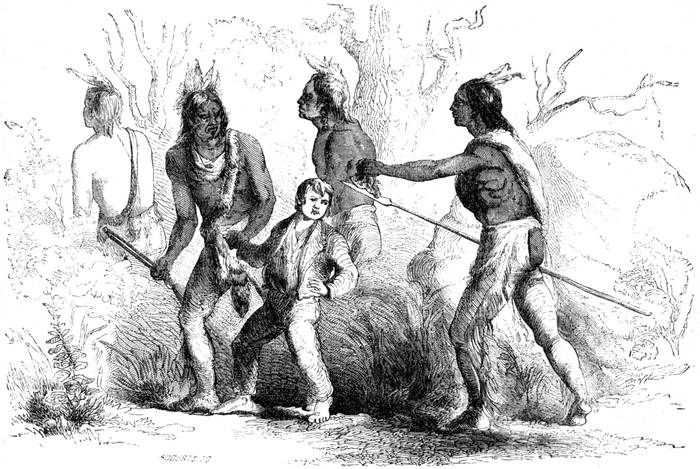
The Captivity of Jonathan Alder.—Page 15.
275At the end of a year, or little more, Jonathan acquired their language,
and became in a measure reconciled and contented; but their
food, which was principally hominy and meat, went against him for
a long time. As soon as he grew stout enough to carry a rifle, they
gave him an old musket to begin with, and told him he must learn
to hunt. Delighted with his new trust, and pleased with the idea
of becoming a hunter and a warrior, he devoted himself to learn the
use of the piece. His first essays were made upon mud-turtles,
which he would approach as they lay basking on a rock in the sunshine;
and when he had acquired skill enough to kill them by hitting
the rock just beneath them, and thus blowing them into the air—sometimes
to the height of six or seven feet—he tried his skill
upon larger game. Alder remained with the Indians until after the
treaty with Wayne, in 1795. He gives many particulars of great
interest concerning the movements of the Indians during the long
and bloody wars which preceded that propitious event. Peace being
established, and almost all the white prisoners having returned to
their former homes and friends, he began to feel a desire to see his
mother and his relatives again. His long residence among the
Indians, however, had deprived him of all knowledge of the English
language, and he had lost all recollection even of the State in which
he had lived. He had not, therefore, the least clew to aid him in
the search.
Watching his opportunity, however, and having long entertained
the idea of escaping, he at last succeeded in eluding the suspicions
of his red friends, and in beginning his enterprise. Choosing a season
of the year when game and berries were plenty, and stocking his
bag with dried venison, he set out, avowedly, on a hunting expedition;
and the true object of his journey was not suspected for some
days after the time of his expected return. He had nothing to guide
him toward the white settlements, except a knowledge that they lay
in a northerly direction. His skill in woodcraft being equal to that
of the Indians', he was enabled to bear the fatigues and discouragements
of his wanderings. A band of red men, whom he encountered,
treated him as one of themselves, they belonging to a friendly
tribe; and, after three weeks of solitary marches, sleeping at night as
the circumstances permitted, he emerged into a country once familiar
to him, but now considerably changed during the fifteen years of his
absence.
But his friends, nor their surroundings, were not so much changed
as himself. He was not only an Indian in his appearance, but in
many of his feelings. Glad as he was to get back, he soon became
very home-sick for the wild life he had abandoned. The clothes, the
warm beds, the chairs, the food and table, the restraints of civilization,
276were, for a time, almost insupportable. It was but very gradually
that the white blood of his ancestors begun to stir anew in his veins,
and the powerful ties and instincts of early associations to break up
the strong bonds of more recent habits. He was almost as many
years in becoming a white man as he had been in growing an Indian.
A writer upon the character of the Indians, in his defense of them,
says that if an Anglo-American were placed in the same circumstances
with a native, he would make a precisely similar person in every
trait and habit. "This averment is sustained by a reference to the
white people who had been taken prisoners in childhood and brought
up among the Indians. In every such case, the child of civilization
has become the ferocious adult of the forest, manifesting all the
peculiarities, tastes and preferences of the native Indian. His manners,
habits, propensities and pursuits have been the same; his fondness
for the chase and his aversion to labor the same; so that the
most astute philosophical observer has been unable to detect any
difference, except in the color of the skin; and, in some instances,
even this distinction has been removed by long exposure to the
weather, and the free use of oils and paints. There have been cases
in which the children of white parents, who have been raised among
the Indians from early infancy, have been taken home, in middle
life, to their relatives, but have refused to remain, and have returned
to the tribes in which they were brought up. One case of this kind
occurred within the knowledge of the writer. A female, captured in
infancy, and reared among the Indians, was brought in by them at
the treaty of Greenville, and sent to her parents in Kentucky. She
soon became so discontented and restless that, in spite of all their
efforts, she left them, returned to her former associates, and was again
happy." All of which is doubtless true, but does not disprove the
many barbarous instincts of the red-men.
In the fall of 1788, Matthias Van Bebber, aged eighteen, and Jacob,
aged twelve years, were out a short distance from Point Pleasant,
with a horse, when they were waylaid by four Indians. Jacob was
leading the horse, and Matthias was a short distance ahead, with a
rifle across his shoulder, when the Indians fired two guns at Matthias.
One of the balls struck him over the eyes, momentarily blinding him;
277he sprang one side, and fell into a gully. Jacob, on hearing the
report of the guns, fled, pursued by three of the savages. Matthias,
in the mean time, sprang up and took to a tree. The remaining
Indian did the same. The lad brought up his gun to an aim, the
Indian dodged, when the former improved the opportunity to fly,
and escaped to the fort. The other three, after a tight chase of half
a mile, caught Jacob, who, being very active, would have escaped,
had not his moccasins been too large. They then retreated across
the Ohio with their prisoner. He was a sprightly little fellow, small
of his age, and his captors, pleased with him, treated him kindly.
On the first night of their encampment, they took him on their knees
and sang to him. He turned away his head to conceal his tears.
On arriving at their town, while running the gauntlet between the
children of the place, an Indian boy, much larger than himself, threw
a bone, which struck him on the head. Enraged by the pain, Jacob
drew back, and running with all his force, butted him over, to the
great amusement of the gazing warriors. He was adopted into an
Indian family, where he was used with kindness. On one occasion
his adopted father whipped him, but not severely, which affected his
new mother and sister to tears. After remaining with the tribe
about a year, he escaped, traveling five days through the wilderness
to his home. When he arrived at maturity he was remarkable for
his fleetness. None of the Indians who visited the Point could
distance him in running.
One of the most interesting histories on record of the return of
white prisoners from among the red-men is connected with Boquet's
defense of Fort Pitt, and his expedition from that fort into the
wilderness, to overawe his adversaries by the display of his strength,
and to recover the vast number of men, women and children, held
by the savages, amounting, in all, to over three hundred. Fort Pitt
stood on the present site of Pittsburg, and, at the time of which we
write, 1772, was the only spot, excepting Fort Detroit, from the Falls
of Niagara to the Falls of St. Mary, over which the English flag
waved. Our splendid territories were being ravaged by the Indians;
families, who had effected a home and comforts, being driven back by
the tomahawk, with their scattered remnants, to the East, from which
they had emigrated, or into Fort Pitt, which alone opposed itself to
278the murderous waves which dashed against, and threatened to undermine
it. It withstood, like Fort Detroit, a long siege by the savages,
was reinforced, the reinforcements, before reaching the fort, having
given battle to, and defeated the Indians.
The Indians, disheartened by their overwhelming defeat, and despairing
of success against the fort, now that it was so heavily reinforced,
retired sullenly to their homes beyond the Ohio, leaving the
country between it and the settlement free from their ravages. Communication
being rendered safe, the fugitives were able to return to
their friends, or take possession of their abandoned cabins. By comparing
notes, they were soon able to make out an accurate list of
those who were missing—either killed or prisoners among various
tribes—when it was found to contain the names of more than two
hundred men, women and children. Fathers mourned their daughters,
slain or subject to a captivity worse than death; husbands, their
wives, left mangled in the forest, or forced to follow their savage captors—some
with babes at their breasts, and some, whose offspring
would first see the light in the red-man's wigwam—and loud were
the cries for vengeance which went up on every hand.
Boquet wished to follow up his success, and march at once into the
enemy's country, and wring from the hostile tribes, by force of arms,
a treaty of peace, which should forever put an end to those scenes
of rapine and murder. But his force was too small, and the season
too far advanced. He matured his plans during the winter, and in
the spring began his preparations. The Indians, in the meantime,
had procured powder from the French, and, as soon as the snow
melted, commenced their ravages along the frontier. The aroused
and desperate people of Pennsylvania furnished a thousand men, and
Virginia a corps of volunteers, which, added to Boquet's five hundred
regulars, made a force of nearly two thousand men, with which
he was instructed to advance into the enemy's territory, and, by one
grand movement, crush the offending tribes. His route was without any
water communication, and lay through the heart of an unbroken wilderness.
The expedition was to be carried out without boats, wagons,
or artillery, and without a post to fall back upon in case of disaster.
It was, indeed, an isolated and a novel affair. It was autumn before
all obstacles were overcome, and the army under way. It struck directly
279into the trackless forest, with no definite point in view, and no
fixed limit to its advance. It was intended to overawe by its magnitude—to
move, as an awful exhibition of power, into the heart of
the red-man's dominions. Expecting to be shut up in the forest at
least a month, receiving in that time no supplies from without, it had
to carry along an immense quantity of provisions. Meat, of course,
could not be preserved, and so the frontier settlements were exhausted
of sheep and oxen for its support. These necessarily caused the
march to be slow and methodical. The corps of Virginia volunteers
went in front, preceded by three scouting parties—one of which kept
the path—while the two others moved in a line abreast, on either
side, to explore the woods.
Under cover of these, the ax companies, guarded by two companies
of light infantry, cut two parallel paths, one each side of the main
path, for the troops, pack-horses, and cattle, which followed. First
marched the Highlanders, in column, two deep, in the centre path,
and in the side paths, in single file, abreast—the men six feet apart—and
behind them the corps of reserve, and the second battalion of
Pennsylvania militia. Then came the officers, and pack-horses, followed
by the droves of cattle, filling the forest with their loud complainings.
A company of light-horse walked slowly after these,
while the rear-guard closed the long array. No talking was allowed,
and no music cheered the way. In this order the unwieldy caravan
struggled along, neither extremity of which could be seen from the
centre, it being lost amid the thickly-clustering trunks and foliage in
the distance.
Some days they would make but two or three miles, and again,
when the way was less obstructed, would make ten, fifteen or eighteen
miles. On the fourth day of their march, near some deserted
Indian huts, they came upon the skull of a child, stuck upon a
pole.
There was a large number of men in the army who had wives,
children and friends prisoners among the Indians, and who had accompanied
the expedition for the purpose of recovering them. To
these the skull of this little child brought sad reflections. Some one
among them was, perhaps, its father, while the thought that it might
stand as an index, to tell the fate of all who were captured, made
280each one shudder. As they looked at it, bleached by the sun and
rain, the anxious heart asked questions it dared not answer.
Keeping on their course, they pursued their difficult march, day
after day, much of the time through a tangled wilderness, but occasionally,
from some high point, catching glimpses of marvellous
splendor of sky and scenery, the purpled sunlight of October wrapping
all objects in a kind of enchantment. At times the path was
so overgrown with bushes, that every step had to be cleared with
the ax; again, it would be over marshes, so wet that bridges had to
be constructed, to keep the cattle from sinking; and still again, the
men would be cheered by an easy and rapid day's journey, along the
banks of some pleasant stream. Ohio is even yet renowned for its
glorious forests, and these, now dressed in all the gorgeous coloring
of Indian summer, gave frequent pictures of beauty which impressed
the roughest of the sturdy soldiers.
At length they descended to a small river, which they followed
until it joined the main force of the Muskingum, where a scene of a
very different character awaited them. A little above and below the
forks, the shores had been cultivated, and lined with Indian houses.
The place was called Tuscarora, and, for beauty of situation, could
not well be surpassed. The high, luxuriant banks, the placid rivers,
meeting and flowing on together, the green fields, sprinkled with
huts, and bordered with rich, autumnal foliage, all basking in the
mellow October light, and so out of the way there in the wilderness,
combined to form a sweet picture, which was doubly lovely to them
after being so long shut up in the forest. They reached this beautiful
spot Saturday afternoon, and, the next day being Sunday, they remained
in camp, men and cattle being allowed a day of rest. The
latter, revived under the swell of green grass, and, roaming over the
fields, gave a still more civilized aspect to the quiet scene. The next
day, the army moved two miles further down the Muskingum, and
encamped on a high bank, where the stream was three hundred feet
wide.
The following day six chiefs came into camp, saying that all the
rest were eight miles off, waiting to make peace. Boquet told them
he would be ready to receive them next day. In the meantime he
ordered a large bower to be built, a short distance from camp, while
281sentinels were posted in every direction, to prevent surprise, in case
treachery was meditated.
The next day, the 17th, he paraded the Highlanders and Virginia
volunteers, and, escorted by the light-horse, led them to the bower,
where he disposed them in the most imposing manner, so as to impress
the chiefs, in the approaching interview. The latter, as they
emerged from the forest, were conducted, with great ceremony to the
bower, which they entered with their accustomed gravity, where,
without saying a word, they quietly seated themselves, and commenced
smoking. When they had finished they laid aside their pipes,
and drew from their pouches strings of wampum. The council,
being thus opened, they made a long address, in which they were
profuse in their professions of peace, laying the whole blame of the
war on the young men, whom, they said, they could not control.
Boquet, not wishing to appear eager to come to a settlement,
replied that he would give his answer the next day, and the council
broke up. A passing storm, however, prevented a meeting of the
council until the day following that first set. Boquet's answer was
long and conciliatory; but the gist of it was that he would make
peace on one condition, and no other—that the Indians should give
up all the prisoners in their possession within ten days.
Remaining quietly in camp until Monday, he again ordered the
tents to be struck, and recommenced his march, to show his determination
to enforce his commands. In three days he reached the
forks of the Muskingum; and, judging this to be as central a position
as he could find, he resolved to remain there until his mission was
accomplished. He ordered four redoubts to be built, erected several
store-houses, a mess-house, a large number of ovens, and various
other buildings for the reception of captives, which, with the white
tents scattered up and down the forks of the river, made a large settlement
in the wilderness, filling the Indians with alarm. A town
with nearly two thousand inhabitants, well supplied with horses, cattle
and sheep, and with ample means of defense, was well calculated
to awaken the gloomiest anticipations in the breasts of the ancient
inheritors. The steady sound of the ax, day after day, the lowing
of cattle, and all the bustle of civilization, echoing along the banks
of the Muskingum, within the very heart of their territory, was more
282alarming than the resistless march of a victorious army; and, anxious
to get rid of such unwelcome company, they made every effort to
collect the prisoners scattered amid the various tribes.
Boquet remained here two weeks, occupied with sending and receiving
messengers who were charged with business relating to the
restoration of the captives. At the end of this time, two hundred
and six, the majority of them women and children, had been received
into camp. An hundred more yet remained in the hands of the Indians.
These they solemnly promised to restore in the spring, and,
as the leafless forest, the biting blast, and occasional flurries of snow,
reminded Boquet of the coming on of winter, he determined to retrace
his steps to Fort Pitt.
These two weeks, during which the prisoners were being brought
in, were filled with scenes of the most intense, and often painful excitement.
Some of the captives had been for many years with the
Indians, recipients of their kindness and love; others had passed from
childhood to maturity among them, till they had forgotten their native
language, and the past was to them, if remembered at all, but a
half-forgotten dream. All of them—men, women and children—were
dressed in Indian costume, and their hair arranged in Indian
fashion. Their features, also, were bronzed by long exposure to the
weather, so that they appeared to have passed more than half way
to a purely savage state. As troop after troop came in, the eager
looks and inquiries of those who had accompanied the army to find
their long-lost families and kindred, made each arrival a most thrilling
scene. In some instances, where the separation had only been
for a short time, the recognition was simultaneous and mutual, and
the short, quick cry, and sudden rush into each other's arms, brought
tears to the eyes of the hardy soldiers. In others, doubt, agony,
fear and hope, would in turn take possession of the heart, chasing
each other like shadows over the face, as question after question was
put, to recall some event or scene familiar to both, till at last a common
chord would be touched, when the dormant memory would
awake as by an electric shock, a flood of fond recollections sweep
away all uncertainty, and the lost one be hurried away amid sobs and
cries of joy. Sometimes the disappointed father or brother would
turn sorrowfully away, and, with that hope deferred which maketh
283the heart sick, sadly await the arrival of another group. But the
most painful sight was when a mother recognized her own child,
which, however, in turn, persisted in looking on her as a stranger,
coldly turning from her embrace, and clinging to its savage protector;
or when a mutual recognition failed to awaken affection on one
side, so entirely had the heart become weaned from its early attachments.
In these cases, the joy of the captors knew no bounds; the
most endearing epithets and caresses would be lavished on the whilome
prisoner. But when they saw them taken away, torrents of
tears attested their sincere affection and grief. The attitude of intense
interest, and the exhibition of uncontrollable sorrow of these
wild children of the forest, on one side, and, on the other, the ecstatic
joy of the white mother as she folded her long-lost child in her
arms, and the deep emotion of the husband as he strained his recovered
wife to his bosom, combined to form one of the most moving,
novel spectacles ever witnessed in the American wilderness.
One of the captive women had an infant, three months old, at her
breast, born in the Indian's wigwam. A Virginia volunteer instantly
recognized her as his wife, stolen from his log-cabin six months previous,
and rushing forward he snatched her to his bosom, and flew
with her to his tent, where, tearing off the savage costumes of both,
he clothed them in their proper garments. After the first burst of
joy was over, he inquired after his little boy, two years old, who
was carried off at the same time she was made prisoner; but his
wife could give no tidings of him. A few days after, another party
of prisoners arrived, in which was a child whose appearance answered
to the description of this little fugitive. The woman was
sent for and the child placed before her. She looked at it a moment
and shook her head. But the next instant the powerful maternal
instinct triumphed, and, recognizing in the little savage before her
her lost darling, she dropped her babe, and snatching him to her
bosom, burst into a torrent of tears. The husband caught the babe
from the ground, and the couple hurried away to his tent. The
poor Indian mother watched their retreating forms, and then burying
her head in her blanket, sobbed aloud. A scene equally affecting
occurred between an aged mother and her daughter, who had
been carried off nine years before, and adopted in a distant tribe.
284Though the latter had passed from childhood to womanhood in the
forest, differing from other young squaws only in the tint of her
skin, which her wild life could not wholly bronze, the eyes of the
parent detected the features of her child in the handsome young
savage, and calling her by name, she rushed forward to embrace
her. The latter, having forgotten her name and language, and all
her childhood's life, looked on wondering, and turned, frightened, to
her Indian parent. The true mother tried in every way to recall
the memory of her child, and awaken recognition, but in vain. At
length, despairing of success, she gave way to the most passionate
grief. Boquet had been a silent witness of the painful interview.
Moved at the grief of the mother, he approached her, and asked if
she could not recall some song with which she used to sing her
child to sleep. Brightening at the suggestion, she looked up through
her tears, and struck a familiar strain, with which she used to quiet
her babe. The moment the ears of the maiden caught the sound,
her countenance changed, and as the strain proceeded, a strange
light stole over her features. All stood hushed as death, as that
simple melody floated out through the forest, watching with intense
interest the countenances of the two actors in this touching scene.
The eager, anxious look of the mother, as she sang, and the rapidly
changing expression of the captive's face as she listened, awoke the
profoundest sympathy of Boquet's generous heart, so that he could
hardly restrain his feelings. Slowly, almost painfully, the dormant
memory awoke from its long sleep; at length the dark cloud was
rent asunder, and the scenes of childhood came back in all the freshness
of their early springtime, and the half-wild young creature sank
in joy on her mother's bosom.
Some of the children had been so long with their captors that
they regarded them as their true parents, crying bitterly at being
separated from them. Stranger still, the young women had become
so attached to their savage but kind husbands, that, when told they
were to be given up to their white friends, they refused to go; and
many of them had to be bound and brought as prisoners to camp.
The promise that they should take their half-breed children with
them, could not change their wishes. On the other hand, the Indians
clung to them with a tenacity and fondness which made the
285spectators forget that they were gazing upon savages. It was pitiful
to see their habitual stoicism give way so completely at the prospect
of separation. They made no effort to conceal their grief; the
chieftain's eye, which gleamed like his tomahawk in battle, now wept
like a child's. His strong nature seemed wholly subdued; his
haughty bearing changed to one of humility, as he besought the
white men to treat his pale-face squaw tenderly. His wild life suddenly
lost all its charms, and he hung round the camp to get a sight
of her whom, though she was lost to him, he still loved. He
watched near the log-building in which she was left, leaving it only
to bring from the forests pheasants, wild pigeons, or some delicacy
to lay at her feet. Some of the young captive wives refused to be
comforted, and, using that sagacity they had acquired during their
sojourn with the red-men, managed to escape from their white friends,
and, joining their swarthy lovers, fled with them to the forest.
The American wilderness never before presented such a spectacle
as was exhibited on the banks of the Muskingum. It was no longer
a hostile camp, but a stage on which human nature was displaying
its most noble, attractive traits; or, rather, a sublime poem, enacted
in that lovely natural temple, whose burden was human affection,
and whose great argument, the common brotherhood of mankind.
Boquet and his officers were deeply impressed. They could hardly
believe their own eyes when they saw young warriors whose deeds
of daring ferocity had made their names a terror on the frontier,
weeping like children over their bereavement.
A treaty of peace having been concluded between the various
tribes, Boquet, taking hostages to secure their good behavior, and the
return of the remaining prisoners, broke up his camp on the 18th of
November, and began to retrace his steps towards Fort Pitt. The
leafless forest rocked and roared above the little army, as it once
more entered its gloomy recesses; and that lovely spot on the banks
of the Muskingum, which had witnessed such strange scenes, lapsed
again into its primeval quiet.
MOODY, THE REFUGEE.
286
In about the central part of Sussex county, New Jersey, two miles
south of the village of Newton, the county seat, are two ponds or
bodies of water, which go by the name of the "Big" and "Little
Muckshaw." The lower, or Little Muckshaw, loses itself, at its
western extremity, in a marsh or swamp, which is almost impassable,
except after a long drought. This vicinity possesses some considerable
interest, from having been the haunt of one of those fiends in
human shape, who preyed upon the substance of the patriotic citizens
of the neighborhood during that gloomy period in our Revolutionary
contest, when even the Father of his country was wrapped
in despondency at the prospect for the future.
Bonnel Moody was a ruffian of the deepest dye, and possessed of
all those qualities which constitute an accomplished freebooter and
highwayman. He was cunning as a fox; energetic and determined
in the pursuit of an object; void of all pity or remorse; avaricious
as a miser; and with a brute courage which made him formidable
in combat, he was a dangerous enemy in the midst of the inhabitants
of Sussex county, as they learned to their cost during the war.
His place of retreat, or rather, his lair—for it was more like the
haunt of some wild beast than the abode of human beings—was on
the west side of the swamp above mentioned, where nature seemed
to have provided him with a retreat more impregnable than art
could have furnished him. A point of land projects into the western
side of the marsh, affording only a very narrow and difficult
foothold for one man to pass between its base and an inlet of the
pond which washes the foot of the rocks. The ledge then recedes
in the shape of a crescent, forming a little cove, with water in front
and rocks behind and above. About forty-five yards from this point
is a huge rock, screened by overhanging trees and shrubs, in which
is a cavern, where Moody and his gang of marauders found shelter
when their deeds of rapine and murder had roused the inhabitants
287of the vicinity to rid themselves of the dangerous foe. This cavern
is eighteen feet high in front, gradually receding until it meets the
foundation at a distance of fifteen feet, and about fifty feet in length
from north to south. Beyond this cavern the ledge again approaches
the marsh, into which it projects, forming an elbow almost impossible
to pass around, and on the opposite side it again recedes, presenting
a bold and rugged aspect, heightened by the gloom of perpetual
shade, numerous cavern-like fissures, and masses of rock which have
fallen, from time to time, from the overhanging ledge. One of these
is a large, flat slab, about ten feet long, six high, and between three
and four feet thick, which has fallen in such a position as to leave a
passage behind it of about a yard in width. The rocks above project
over this slab, so as to shield it effectually from that quarter,
and a half-dozen men might defend themselves behind this natural
buckler against the attack of an army. Such was the haunt of
Moody, and his congenial band of Tory cut-throats and murderers;
and from here, like a flock of ravenous wolves would they issue,
when opportunity offered, and lay waste and destroy all within their
reach until danger threatened, when they would retreat to this natural
fastness with their ill-gotten plunder, here to divide and secrete
it. From the brow of the ledge, which rises nearly a hundred feet
from the water, they had a fair view of every avenue to their hiding-place,
and no one ever approached it alive except Moody and his
associates, or perhaps some friend of theirs, with provision or information.
There were those so lost to principle as to furnish this
crew of land-pirates with the necessaries of life, and with accurate
intelligence of every movement, on the part of the Americans, which
occurred in the vicinity. Several attempts to capture the wretch
were frustrated by these loyal friends. At one time, when a party,
having tracked him for some distance, were about to spring upon
him, he was alarmed by a negro in time to make his escape; and on
another occasion a young woman mounted a horse and rode some
twelve or fourteen miles, of a dark night, to warn him of a projected
attack by a party of Whigs, who had determined to capture him at
all hazards. One cold winter night he broke into the house of a Mr.
Ogden, and after robbing it of every thing of any value, he took the
old man out in the yard, and made him take an oath not to make
288known his visit until a sufficient time had elapsed for himself and
his party to make their escape. Two or three men who were working
for Mr. Ogden, and who slept in a loft up stairs, not feeling
bound by the old man's oath, alarmed the neighborhood and commenced
a pursuit. Their track was easily followed in the snow, and
in the morning they came upon a camp where the marauders had
slept over night, and where their fires were still burning. The chase
was kept up until they reached Goshen, in the State of New York,
where they recovered part of the plunder, but the rascals escaped.
These expeditions in pursuit of the Tory wretch were called
"Moody-hunting," and were followed up frequently with great
energy.
One night, about twelve o'clock, he made his appearance at
the bedside of the jailer, and demanded the key of the jail. The
poor frightened official readily gave it up, although he had often
declared that he would not surrender it to him, and with it Moody
opened the doors and set all the prisoners free. Two of them were
condemned to death; one, who was condemned to die for robbery,
being unacquainted with the neighborhood, wandered about all night
and next day in the woods, and was discovered in a hollow tree the
next evening by a party of "coon-hunters," who brought him back;
and he was hung in front of the jail, protesting his innocence to the
last. He was subsequently proved to be guiltless of the crime for
which he suffered; and the wretch who actually committed the deed
confessed on his death-bed that he it was who did the act for which
another had suffered. On this occasion, Moody was more just than
the law, and the prisoner's cause better than his fortune.
289
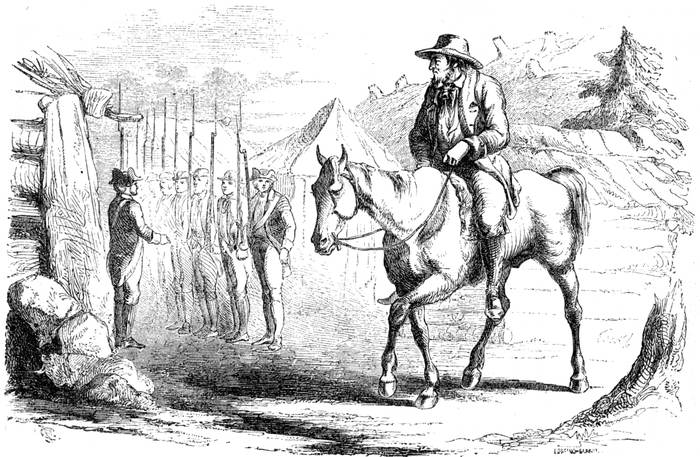
Moody, the Refugee.—Page 32.
291While the American army was encamped at Morristown, a man
very shabbily dressed, and mounted on a broken-down nag, all of
whose "points" were exhibited to the fullest extent, was seen one
day to enter the camp, and pass leisurely through it, scrutinizing
every thing as he went; and although he assumed a perfect nonchalance,
and was to all appearance a simple-hearted and rather soft-headed
country farmer, yet there was something in his manner which
attracted the attention of an officer, who was drilling a squad of
recruits in the open air. One of these thought there was something
about the face which he recognized, and told his officer so. One of
the squad was mounted and ordered to bring him back. Moody—for
he it was who had thus boldly entered the American lines and
reconnoitered their ranks—shot him dead as he came up, and secreted
the body by the side of the road. Another being sent to assist the
first, Moody secreted himself in the woods and escaped. Having
been driven from his former haunts by the untiring activity of the
Whigs, and being too well known to venture much abroad, he determined
to join the British army in New York. While attempting to
cross to the city with a companion in an open boat, they were captured,
brought back to Morristown, and hung as traitors and spies.
Moody was said to have come from Kingwood township, Hunterton
County, and was employed by the British to obtain recruits in New
Jersey among the Tory inhabitants, act as a spy upon the Americans,
and by his maraudings to keep the inhabitants so busy at home as to
prevent their joining or aiding the American army.
Another desperado of those days was Joseph, or "Joe Bettys," a
remarkable character, who figured in the border wars of the Revolution.
He was a renegade from the American army, and for a long
while was the scourge of the New York frontier. His deeds were
marked by an equal boldness and cruelty, that made him the terror
of all who had the misfortune to be ranked as his enemies. His
principal employment was the abduction of citizens to be conveyed
into Canada, for each of whom he received a bounty; and in his
expeditions for this purpose, he was always accompanied by small
bodies of Indians. His hour for executing his projects was at night,
and it frequently happened that his conduct was not confined to the
securing of prisoners, but he often reveled in the destruction of property
and the infliction of cruelty, and his victims were often tormented
by every means his savage ingenuity could devise. Cold-blooded
murder, and reckless barbarities of every kind, continually
stained his soul. The section of country which suffered from his
marauding expeditions, to this day is rife with stories of his daring
and ferocity.
In the year 1776, he entered as Sergeant in the New York forces,
in which capacity he served his country faithfully, until, being exasperated
at the treatment which he received from one of his superior
officers, and retorting with threats and menaces, he was reduced to
292the position of a common sentinel. This was more than he could
bear, and he would have deserted, had not Lieutenant Ball, who had
before befriended him, anticipating such a step, applied and procured
for him appointment as Sergeant on board one of the vessels on Lake
Champlain, commanded by Arnold, which he accepted. In an action
that ensued, Bettys displayed a wonderful daring and gallantry,
which receiving no other notice than the thanks of his General, he
conceived himself slighted, and determined to retaliate. In the
spring of 1777, he deserted and went over to the British forces, where
he was soon elevated to the position of a spy, in which character he
carried on the depredations we have spoken of.
Among the prisoners that he secretly seized and carried off in the
early part of his career, was Samuel Patchim, afterward a Captain in
the army. The account of his captivity and subsequent hardships,
as here given, is as it was related by himself:
"I was captured by Bettys, taken into Canada, and confined in
Chamblee prison, in irons. I was the only prisoner whom he had
on this occasion brought into Canada. There were six or seven
more of my neighbors when we started, to whom he gave the oath
of allegiance and sent them back. As for myself, he said I had
served Congress long enough, and that I should now serve the king.
He wished me to enlist in his company, but soon found that this was
not agreeable to my feelings. He then swore, that if I would not
serve the king, I should remain in irons. I was confined in Chamblee
prison four months; then I was removed to Montreal, and
thence to an island, forty-five miles up the St. Lawrence, opposite
Cadalake Fort. There I remained about one year. There were five
prisoners in all, and we were guarded by sixty soldiers, seven sentinels
at night. They had left no boats on the island by which we
might make our escape, yet we all crawled out of the barracks at
night, and went to the river side; there we made a raft by means of
two or three logs and our suspenders, on which we sailed down the
river five miles, when we landed on the Canada shore. There we
appropriated to our own use a boat belonging to the British, and
crossed over to the American shore. While going down the rapids,
we had lost our little stock of provisions, and for eight days out of
twelve which we spent in the woods, we had nothing to eat save
293frogs and rattlesnakes, and not half enough of them. We were
chased eight days by the Indians, and slept every night on the boughs
of some hemlock trees. At length we arrived at Northwest Bay,
on Lake Champlain, when my companions, unable longer to travel,
utterly gave out. I then constructed a raft on which to cross the
lake, and having stripped my companions of their clothing, in order
to make myself comfortable, left them to die of hunger and fatigue,
and committed myself to the wintry waves. When in about the
center of the lake, I was taken by the crew of a British ship, and
conveyed to St. John's, from thence to Quebec, and finally to Boston,
where I was exchanged and sent home."
Bettys seemed to have a particular delight in taking prisoners
among his own townsmen, and especially those against whom he
held any grudge. On one occasion, having taken one whom he supposed
to be the object he sought, and his prisoner managing to
escape, he deliberately shot him dead, and then discovered that he
had made a fatal mistake, and killed one of his best friends.
But his bloody career was destined to find a retributive end. One
day, in the winter of 1781-2, a suspicious-looking person was seen to
pass over the farm of one John Fulmer, situated near Ballston Lake,
in Albany County. A son of the farmer, Jacob, immediately obtained
the aid of three of his neighbors, James and John Cory, and
Francis Perkins, and started in pursuit of the suspicious stranger.
There was a light fall of snow on the ground, by which means his
course was easily tracked. But we will give an account of the enterprise
in the words of Jacob Fulmer, one of the party:
"The morning had been foggy, and it appeared by the track that
the man had made a circuitous route, as if lost or bewildered. After
making several turns, we came at length in sight of a log house,
where one Hawkins, a noted Tory, lived, toward which it appeared
he had laid a regular line. We followed the track, and found that
it went into the house. We approached undiscovered, for the snow
was soft, and our footsteps were not heard. We went up to the
door, and found it was unfastened, but heard people talking within.
John Cory, who was the strongest of the party, now went forward,
we following closely behind, and burst open the door. The man
who was the object of our suspicions and search sat at the table
294eating his breakfast, with the muzzle of his gun leaning upon his
shoulder, and the breech upon the floor between his knees. He
grasped his musket, and presented it to fire at us, but was hindered
for a moment to remove the deer-skin covering from the
lock, and that moment lost his life. We seized him, took possession
of his gun, and also two pistols, which he had in his coat
pockets, and a common jack-knife. We then bound his arms behind
him, with a pocket handkerchief, and conveyed him to my father's
house. As yet, we knew not the name of our prisoner, but having
asked him, he said: 'My name is Smith.' My mother knew him,
and said: 'It is Joe Bettys.' He hung his head, and said: 'No,
my name is Smith.' My sister Polly then came to the door, and
said: 'This is Joe Bettys, I know him well.' She had known him
before he went to Canada, as he had boarded at Lawrence Van Epps,
in Schenectady Patent, while she lived in the same house. We then
conveyed him to John Cory's house, about a quarter of a mile distant,
where we pinioned him more firmly. He sat down in a chair by the
fire, and asked permission to smoke, which was granted, and he then
took out his tobacco box, and seemed to be engaged in filling his
pipe, but as he stooped down, under pretence of lighting it, he threw
something toward the fire which bounded from the forestick and fell
upon the hearth. He then seized it, and threw it into the fire, before
any one could prevent. John Cory then snatched it from the fire,
with a handful of live coals. It was not injured. It was a piece of
lead about three inches long, and one and a quarter inch wide, pressed
together, and contained within it a small piece of paper, on which
were twenty-six figures, which none of our company could understand.
It also contained an order, drawn on the Mayor of New
York, for thirty pounds sterling, payable on the delivery of the sheet-lead
and paper inclosed. Bettys showed much uneasiness at the loss
of the lead, and offered one hundred guineas to allow him to burn
the paper. This we refused, for, though we did not understand the
figures, we well knew the character of Bettys, as I had heard that
he had killed two men at Shenesborough, near Whitehall, for fear of
being betrayed in regard to the burning and plundering of a house in
Chaughnawaga, and that he was generally known as a spy."
The narrative goes on to give the particulars of the journey to
295Albany, and the precautions taken to convey their prisoner safely
through a district abounding with Tories, who were affected to Bettys,
but no rescue was attempted.
Much rejoicing was expressed at the capture of the notorious Bettys,
and when he was marched through Albany, the people gathered
in masses to look upon him. In a short time he was brought to
trial, on the charge of being a spy, found guilty, condemned, and accordingly
executed in the month of April, 1782.
Among other similar excursions, Bettys once made an audacious
eruption into the city of Albany, for the purpose of abducting General
Schuyler, for whom he would have received a most liberal reward
from the authorities in Canada, who so long and so vainly endeavored
to get that chivalric officer into their possession. He was unsuccessful.
The attempt, referred to above, of Joe Bettys, to assassinate or
take prisoner General Schuyler, was not singular in the history of
that brave and beloved officer. He seemed fated to be ever surrounded
with perils, in the seclusion of his home quite as much as
on the field of battle. His noble private character, his fortune, and
his high, unequalled, unresting patriotism, made him a shining mark
for the malevolence of the British and Tories. His beautiful mansion,
on Fish Creek, with his mills and property, to the amount of
twenty thousand dollars, was wantonly burned by order of Burgoyne;
and his life was in constant jeopardy from the hatred of his
minions.
On one occasion a Tory, by the name of Wattenneyer, with a
gang of miscreants like himself, assaulted his house, burst in the
doors, took the guards—who were asleep in the basement—prisoners,
and sought the person of the General; but, by a well-managed ruse,
he frightened them into the belief that they were being surrounded,
and they decamped, taking with them a large amount of silver plate
and other valuables. At another period, an Indian had crept stealthily
into the house, and concealed himself behind the door, where he
awaited an opportunity to strike General Schuyler as he should pass
to his chamber. A female servant, coming in through the hall, seeing
the gleam of a blade in the dim light, which just enabled her to
recognize the outline of a dusky figure, with much presence of mind,
appeared not to have made the discovery, but passed into the room
296where the General sat, and, while pretending to arrange some articles
upon the mantel, in a low voice informed him of her discovery at
the same time adding, aloud:
"I will call the guard!"
This alarmed the secreted warrior, and, hearing the servant tread
upon a creaking board in another hall, and believing the household
aroused, he fled.
After the surrender of Burgoyne, the Tories, smarting under the
disappointment of that event, and more deeply incensed than ever at
General Schuyler, in whom they recognized one of the active causes
of the British defeat, resolved upon his destruction. To attain this
object, they selected two individuals, an Indian and a white man.
The former had been in the habit of hunting and fishing on the
General's place, and knew every part of the grounds, with the places
in which they would be most likely to meet him, in his daily perambulations.
He was a powerfully-built and active fellow, a dangerous
opponent under any circumstances. The other was a weak-minded
Irishman, who had received many favors from the General, and was,
even then, in his employ; notwithstanding which, he could not resist
the offered bribes, and consented to imbue his hands in his benefactor's
blood, for a price. On the afternoon of a certain day, the two
secreted themselves in a leafy copse, near which the General must
pass in his accustomed ride. It was not long before they saw him
approaching on horseback, and they proposed to shoot him as he
passed.
General Schuyler had been made fully aware, by the abduction of
so many of his friends and neighbors, who had been dragged from
their homes and carried off to Canada—there to be retained as prisoners
until exchanged—as well as by the many attempts to get possession
of his own person, that he was in constant danger of being
seized; but he did not imagine that his enemies would descend to
the use of the assassin's knife, and much less did he fear that such a
blow would come from those whom he had befriended—who had
eaten of his bread and been nourished by his bounty. His was one
of these generous natures which, being devoid of guilt, loved not to
suspect others. But civil war destroys all ties, severs all bonds,
arouses man's most vindictive passions, arraying friend against friend,
297sometimes brother against brother. Conscience will, at times, assert
herself, even under such influences. She reminded the Indian—savage
as he was, unlettered, untutored in the finer feelings—of the
many favors he had received at the hands of the man he was about
to destroy; even as his eye glanced along the barrel of the rifle aimed
at his benefactor, he repented his intention, and, with an impulse
which did credit to his heart, he struck up the weapon of his companion,
saying:
"I cannot kill him—I've eat his bread too often!"
The General rode by, unconscious that his life hung by the slender
thread of an Indian's conscience.
One of the saddest pages in the history of our struggle for Independence
is that which tells of hearths and homes desecrated, which
should have enjoyed immunity, even in times of warfare. Not only
did the British encourage the marauding of such desperadoes as
Moody and Bettys, but their more brutal Hessians seemed hired to
wreak the horrors of war upon the innocent dwellings of women
and children.
The Rev. James Caldwell, pastor of the First Presbyterian Church
in Elizabethtown, New Jersey, acted as Chaplain of the American
army while in New Jersey, and, by his zealous patriotism, and patriotic
appeals, often contributed to arouse the spirits of the soldiers,
and to inspire them with a greater energy in the performance of their
trying duties. He was very popular in the community, and received
the unlimited confidence of Washington.
But his lofty patriotism, and unflinching zeal in the American
cause, made him hated by the enemy, who sought every means to get
him into their power, and a price was set upon his head. When
preaching, he frequently was compelled to lay his loaded pistols by
his side in the pulpit. At one time he resided in Springfield, but
afterward removed to "Connecticut Farms," about four miles from
Elizabethtown. Here was enacted the first part of the tragedy we
are about to relate.
A company of British troops from New York, under command of
the Hessian General, Knyphausen, landed in Elizabethtown, in June
of 1780, and, marching directly into the interior, proceeded to wreak
their cruelty upon every living thing that fell in their way. Houses
298were fired, cattle destroyed, helpless people murdered, or left without
shelter, clothing or food. Mr. Caldwell heard of their approach, and
immediately prepared to escape. He put his elder children in a
wagon, and sent them on to some of his friends for protection. He
then desired his wife, with the younger children, to take means of
flight, but she announced her determination of remaining, as none
would have cause to offer injury to her. Finding she would not yield
to his persuasion, and believing it impossible that their resentment
could extend to an unprotected mother, with her babe clasped to her
heart, Mr. Caldwell resolved to leave them, and seek his own safety
alone. He was mounted, and receiving the last assurance of her resolve
to stay, when the gleam of arms announced the approach of
the enemy, and he rode rapidly off.
Mrs. Caldwell, having concealed what things were of value, took
her infant in her arms, and retired to her chamber, the window of
which commanded the road. Here, with her three little ones around,
she awaited the approach of the enemy, feeling conscious that her
unprotected state would secure respect and safety. One little girl
was standing by the window, watching the approach of the troops,
when one of the soldiers left the road, and came to the window,
which he had no sooner reached than he placed the muzzle of his
gun against it, and deliberately fired, when Mrs. Caldwell fell suddenly
back, and almost instantly expired.
Not content with depriving her of life, the inhuman monsters
wreaked their cruelty on her senseless body. Her clothes were
nearly torn off, and her body removed to the roadside, where it was
subjected to every indignity, while the torch was applied to the
dwelling, and then the work of destruction was done.
The effect of this terrible blow upon the husband can only be
imagined. He was, that morning, standing upon the heights of
Springfield, and, by the aid of a spy-glass, could see the smoke from
the burning houses.
"Thank God," he exclaimed, "the fire is not in the direction of
my house."
He was too soon to learn the sad mistake.
The royalists attempted to throw off the responsibility of this act,
by asserting that Mrs. Caldwell was killed by a chance shot. But
299all the evidence goes to show that it was deliberately planned, and
that the soldier by whose hand the bloody deed was committed, only
acted in accordance with his orders. The fact that her body was allowed
to be so rudely treated, while many of the officers felt their
abhorrence for the deed, proves that, although they felt respect for
her remains, they knew the will of their superiors, and therefore
dared not show it.
The following anecdote, connected with this invasion, shows pretty
clearly who were the murderers of Mrs. Caldwell. The flames from
the burning dwelling could be seen from "Liberty Hall," the residence
of Governor Livingston, who was, at that time, absent from
home. Parties of soldiers were continually passing the house, but,
for some reason, it was spared. But about midnight a party of soldiers,
partially intoxicated, rushed into the house. The maid-servant—all
the males in the establishment having taken refuge in the woods,
early in the day, to avoid being made prisoners—fastened herself in
the kitchen; and the ladies—Mrs. Livingston and her daughters—crowded
together like frightened deer, locked themselves in another
apartment. Their place of retreat was soon discovered by the ruffians;
and, afraid to exasperate them by refusing to come out, one of
Governor Livingston's daughter's opened the door. A drunken soldier
seized her by the arm; she grasped the villain's collar, and, at
the very moment, a flash of lightning illuminated the hall, and, falling
upon her white dress, he staggered back, exclaiming, with an
oath:
"It's Mrs. Caldwell, that we killed to-day."
One of the party was at length recognized, and, by his intervention,
the house was finally cleared of the assailants.[2]
But the vengeance of Mr. Caldwell's enemies was not yet satiated;
the tragedy so far was incomplete. It was on the 24th of November,
1781, that he himself fell beneath the ruthless murderer's hand, and
the blow this time came from a source where he thought himself
secure. On the day above mentioned, he went to Elizabethtown
Point, for a Miss Murray, who had come from New York, under a
flag of truce. After conducting her to his gig, he returned to the
boat, to obtain a bundle which had been left behind. As he came on
300shore, the American sentinel challenged him, and demanded what
"contraband goods" he had there. Mr. Caldwell stepped forward
to tender the bundle to the proper officer, not wishing to enter into a
dispute about it then, when the report of a musket was heard, and
he fell dead, pierced by two balls. He had been shot by a man
named Morgan, who had just been relieved from duty as a sentinel.
He was arrested, tried, condemned, and was executed. There can
be no doubt but that he was bribed to the deed by British gold, as
there was no shadow of a cause to suppose that enmity existed between
Mr. Caldwell and him.
Viewed from any point, these two murders were among the most
atrocious acts perpetrated by the invaders of our country, and, in a
history full of atrocities, they will always rank as bloody, fiendish
and treacherous.
THE LEAP FOR LIFE.
At the siege of Fort Henry, near Wheeling, by a band of Indians,
under the infamous Simon Girty, Major Samuel McCullough performed
an act of daring—nay, desperate horsemanship, which has
seldom, if ever, been equalled by man or beast, and before which the
effort of the Pomfret hero pales into insignificance. Let us turn to
the record.
Fort Henry was situated about a quarter of a mile above Wheeling
Creek, on the left bank of the Ohio river, and was erected to
protect the settlers of the little village of Wheeling, which, at the
time of its investment, consisted of about twenty-five cabins. In the
month of September, 1775, it was invested by about four hundred
warriors, on the approach of whom the settlers had fled into it, leaving
their cabins and their contents to the torch of the savages. The
whole force comprising the garrison consisted of forty-two fighting
men, all told; but there were among them men who knew the use of
the rifle, and who were celebrated throughout the borders as the implacable
enemies of the red-man, and as the best marksmen in the
world. Of these, however, more than one half perished in an ill-advised
301sortie, before the siege commenced, and, when the fort was
surrounded by the foe, but sixteen men remained to defend it against
their overwhelming numbers. But their mothers, wives and daughters
were there, and nerved the Spartan band to deeds of heroism to
which the records of the wars of ancient and modern history present
no parallel. Here it was that Elizabeth Zane passed through the
fire of the whole body of red-skins, in the effort to bring into the
fort the ammunition so necessary to its defense; here it was, also,
that the wives and daughters of its noble defenders marched to a
spring, in point blank range of the ambuscaded Indians, in going to
and fro, for the purpose of bringing water for the garrison.
Messengers had been dispatched at the earliest alarm to the neighboring
settlements for succor, and, in response to the call, Captain
Van Swearingen, with fourteen men, arrived from Cross Creek, and
fought his way into the fort without the loss of a man. Soon afterward,
a party of forty horsemen, led by the brave and intrepid McCulloch,
were seen approaching, and endeavoring to force their way
through the dense masses of Indians, which nearly surrounded the
station. Their friends within the fort made every preparation to receive
them, by opening the gates, and organizing a sortie to cover
their attempt. After a desperate hand-to-hand conflict, in which
they made several of the Indians bite the dust, they broke through
the lines, and entered the fort in triumph, without the loss of an individual.
All except their daring leader succeeded in the effort. He
was cut off, and forced to fly in an opposite direction. McCulloch
was as well known to the Indians as to the whites, for his deeds of
prowess, and his name was associated in their minds with some of
the most bloody fights in which the white and red-men had contended.
To secure him alive, therefore, that they might glut their vengeance
upon him, was the earnest desire of the Indians, and to this end
they put forth the most superhuman exertions. There were very
few among them who had not lost a relative by the unerring aim and
skill of the fearless woodsman, and they cherished toward him an
almost phrensied hatred, which could only be satisfied in his torture
at the stake.
With such feelings and incentives, they crowded around him as he
dashed forward in the rear of his men, and succeeded in cutting him
302off from the gate. Finding himself unable to accomplish his entrance,
and seeing the uselessness of a conflict with such a force opposed
to him, he suddenly wheeled his horse, and fled in the direction
of Wheeling hill, at his utmost speed. A cloud of warriors started
up at his approach, and cut off his retreat in this direction, driving
him back upon another party who blocked up the path behind;
while a third closed in upon him on one of the other sides of the
square. The fourth and open side was in the direction of the brow
of a precipitous ledge of rocks, nearly one hundred and fifty feet in
height, at the foot of which flowed the waters of Wheeling Creek.
As he momentarily halted and took a rapid survey of the dangers
which surrounded him on all sides, he felt that his chance was a desperate
one. The Indians had not fired a shot, and he well knew
what this portended, as they could easily have killed him had they
chosen to do so. He appreciated the feelings of hatred felt toward
him by the foe, and saw at a glance the intention to take him alive,
if possible, that his ashes might be offered up as a sacrifice to the
manes of their departed friends, slain by his hand. This was to die
a thousand deaths, in preference to which he determined to run the
risk of being dashed to pieces; and he struck his heels against the
sides of his steed, who sprang forward toward the precipice. The
encircling warriors had rapidly lessened the space between them and
their intended victim, and, as they saw him so completely within
their toils, raised a yell of triumph, little dreaming of the fearful energy
which was to baffle their expectations. As they saw him push
his horse in the direction of the precipice, which they had supposed
an insurmountable obstacle to his escape, they stood in amazement,
scarcely believing that it could be his intention to attempt the awful
leap, which was, to all appearance, certain death. McCulloch still
bore his rifle, which he had retained, in his right hand, and, carefully
gathering up the bridle in his left, he urged his noble animal forward,
encouraging him by his voice, until they reached the edge of the
bank, when, dashing his heels against his sides, they hung, shivering
on the brink of the abyss:
"For the horse, in stark despair,
With his front hoofs poised in air,
On the last verge rears amain.
303"Now he hangs, he rocks between,
And his nostrils curdle in;
Now he shivers, head and hoof,
And the flakes of foam fall off,
And his face grows fierce and thin!
"And a look of human wo,
From his staring eyes did go;
And a sharp cry uttered he
In a foretold agony
Of the headlong death below."
The next moment horse and rider were in the air. Down, down
they went with fearful velocity, without resistance or impediment,
until one-half of the space was passed over, when the horse's feet
struck the smooth, precipitous face of the rock, and the remainder of
the distance was slid and scrambled over until they reached the bottom,
alive and uninjured! With a shout which proclaimed his triumphant
success to his foes above him, McCulloch pushed his steed
into the stream, and in a few moments horse and rider were seen
surmounting the banks on the opposite side.
No pursuit was attempted, nor was a shot fired at the intrepid
rider. His enemies stood, in awe-struck silence, upon the brow of
the bank from whence he had leaped, and, as he disappeared from
their view, they returned to the investment of the fort. They did
not long continue their unavailing efforts, however, for its capture;
the numerous additions it had received to its garrison, the fearlessness
exhibited in its defense, together with the feat they had witnessed,
disheartened them, and they beat a hasty retreat on the morning after
the event I have attempted to describe—not, however, until they
had reduced to ashes the cabins without the stockade, and slaughtered
some three hundred head of cattle belonging to the settlers.
An adventure equally marvellous, and somewhat resembling this,
is related of Major Robert Rogers.
Among the most noted characters, whose exploits upon the frontier
a century since were the theme and admiration of every tongue,
the leader of the celebrated "Rogers' Rangers" stands pre-eminent.
He was a man tall, vigorous, and lithe as the panther of the forest,
with an eye that never quailed before the gaze of any human being.
A perfect master of the art of woodcraft, he was resolute and fearless,
304and yet so cautious at times as to incur a suspicion of cowardice;
but, although his name is tarnished by treachery to his own native
state and country, the impartial observer of his life and actions cannot
fail to award him the most unflinching courage and bravery.
Robert Roberts was born in New Hampshire, and, about the year
1760, was the leader of a body of provincial rangers, known by his
own name. Among his associates was Israel Putnam, whose most
daring exploits were performed while engaged with him in his forest
warfare.
The date which brought Rogers into notice was that in which the
great rival nations, France and England, were striving for the possession
of the American continent. The rivalry had been going on
for years, and, as might be expected, the Indians had been brought
into the contest. These, almost invariably, were upon the side of
the French; but it availed nothing in the end. The steady, indomitable,
persevering spirit of the English settler could be stayed by no
obstacle, and France saw that slowly and surely the red cross was
supplanting her own fleur de lis in the depths of the American
forest.
Rogers' principal theater of action was that wild, mountainous
region round Lake George, "the dark and bloody ground" intervening
between the hostile forts of Crown Point and Ticonderoga.
Here, in these gloomy solitudes, his resolute spirit encountered the
jealous French, with their wily Indian allies, and here some of the
most sanguinary conflicts and desperate encounters of the war occurred.
More than once did the lonely hunter encounter this band
threading their way through the woods as silent and as cautious as
the savage himself; in summer they glided across and around the
lake in their canoes, building their camp-fires in the wildest gorges of
that romantic country; and in winter they skirted it on snow-shoes,
or shot from one portion to another on skates. Their daring soon
made their name famous through every civilized portion of the country.
If a French messenger left Ticonderoga, he was almost certain
to fall into the hands of Rogers, and any scouting party that ventured
forth was sure to get a taste of the mettle of these fellows before
they returned. But for the subsequent course of Rogers, he
might be not unaptly termed the Marion of the frontier.
305
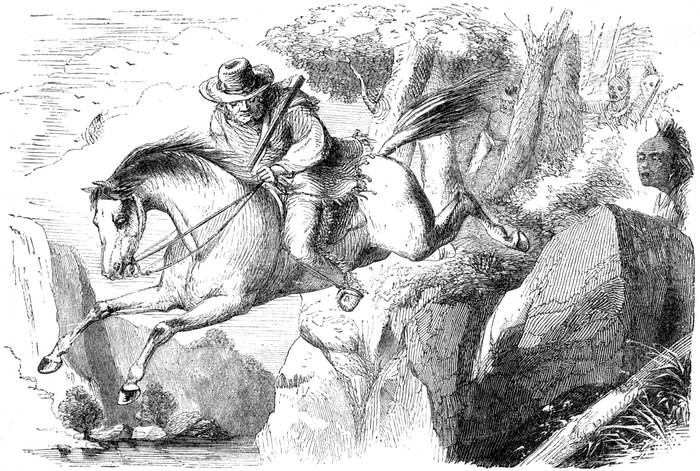
The Leap for Life.—Page 46.
307It was sometimes the custom of Rogers to leave his men in camp,
and venture into the forest unaccompanied by any one. At such
times he often wandered a dozen miles away, easily making his way
back through the trackless forest at night again. It was on one of
these occasions that he met with the following adventure.
It was in the dead of winter, and his men, as usual, were on snow-shoes.
They encamped at night in a deep hollow along the lake,
and the next morning Rogers left them, with instructions to remain
in their present quarters until his return.
He took a direction toward Ticonderoga, and, about the middle of
the day, reached a point near the northern end of the lake. During
this journey, it is hardly necessary to say that he was on the alert for
his enemies. He knew they lurked in every part of the forest, and
that the scalp of no white man would afford half the rejoicing that
his would. Up to this point, however, his experienced eye had failed
to detect the first signs of their presence.
He was contemplating the scene around, carefully taking in all its
parts, when he heard the breaking of the snow-crust behind him.
Turning his head, he discovered, in one instant, that he had walked
directly into a trap. On one side was the steep, precipitous side of
the mountain, descending down to the lake; while on the other, radiating
outward, so as to cut off all escape, he saw nearly thirty Indians
rapidly shuffling toward him on their snow-shoes, yelling with delight
and exultation at the prospect of his certain capture.
They had probably followed him for miles, in the hope of taking
him alive, and he had thus given them a better opportunity than even
they dared hope for.
Rogers comprehended his imminent danger, but he stood a moment
as quiet and self-possessed as if they were his own men approaching.
It took scarcely a second for him to understand his situation. He
saw it was impossible to elude the Indians by undertaking to dodge
through them—that is, by running toward them; they were too many,
and the space afforded was too small.
"Howsumever, here's my compliments," said Rogers, raising his
rifle and shooting the leader of the party, "and you haven't got my
top-knot yet."
With this, he threw his rifle from him, and started off at the top
308his speed, the pack pursuing with yells and shouts. Rogers was very
fleet of foot, and for a short distance he gained ground upon his pursuers.
It was not exactly running, as a man on snow-shoes can not
properly be said to do that. The motion is entirely different, the
feet not being lifted, but shoved forward with all rapidity possible.
As Rogers expressed it, he did some "tall sliding" on that occasion,
the truth of which will soon be apparent.
At the moment of starting he had no well-defined idea of what he
should do; but after going a few rods, he formed the determination
that, before falling into the hands of the Indians, he would go over the
mountain! Those who have seen the mountain, near the northern
end of Lake George, known as "Roger's slide" (the name of which
is derived from the circumstance here given), will understand the
appalling nature of such an exploit as Rogers contemplated. Any
sane man would consider it downright suicide. We know not the
exact distance of this descent, but are certain that it is more than one
thousand feet to the edge of the lake, and the entire distance a sheer
precipice.
But Rogers did not hesitate; there was no time for hesitation.
His mortal enemies were behind and approaching. He reached the
edge of the mountain. He saw the white, field-like surface of Lake
George far below him, and the long, glistening snowy descent stretching
down, down, down, till the brain grew dizzy with looking. He
appeared but a mere speck on the summit, viewed from below, so
great was his height. He gave one glance behind him, sprang high
in the air, so as to give his body a momentum at starting, and squatting
on his snow-shoes, down he went.
Oh, the ecstacy of that ride! Nothing on earth could equal it.
Rogers has said that the most thrilling moment of his life was the
one occupied in that fearful descent. As his body gathered motion,
a feeling similar to that produced by electricity passed through him,
and for the space of five minutes he was in reality insane. Downward
he shot like a meteor, his passage through the still air making
it seem like a hurricane, and the fine, sand-like particles of snow
making him appear as if shrouded in mist to the amazed Indians
above. Rogers scarcely breathed. He saw nothing, felt nothing but
a wild ecstacy, and knew nothing, until he awoke, as it were, and
309found himself gliding far out on the surface of the lake, carried forward
by the irresistible impulse he had gained in his descent.
Then he arose and looked about him. His snow-shoes were worn
out by the friction, and taking them off, he cast them from him.
The Indians still stood at the top of the mountain; but on beholding
his exploit, they believed him under the protection of the Great
Spirit, and did not attempt to continue the chase. Rogers made his
way back to his company, reaching them late at night, and none the
worse for his adventure, except in the loss of his snow-shoes and
his rifle.
There are many other incidents connected with Rogers' career, but
the one given will suffice to show the intrepid spirit that ever characterized
him.
As if to prove that, brave as the pioneers were, they had their peers
amid the "red-skins," we find the record of a leap, almost as marvelous
as that of McCullough, performed by Weatherford, the celebrated
half-breed, who gave Jackson trouble in his efforts to rid the
southern country of the Indians.
It was on the 29th of December, 1813, that the Mississippi volunteers
attacked the Indians, under circumstances of almost unparalleled
difficulty, after enduring incredible hardships. Without tents or
blankets, without proper clothing, more than half starved, some of
them without shoes, in inclement weather, this heroic band had
marched over one hundred miles through a pathless forest, to meet
and subdue the wary foe. And now, on this 29th of December, says
General Samuel Dale, who was one of the party, "the weather was
very wet and bitter cold; we had neither meat, coffee, nor spirits."
The savages were fortified in a strong defensive position, a town
which they called their holy city, and which their prophets declared
was invulnerable to the whites—that the ground would open and
swallow them up, should they venture to set foot on it. Nevertheless,
the gaunt volunteers, worn with their sufferings, gave such fierce
battle to the confident Indians, that they drove them out of their holy
city of refuge, and Weatherford, one of their most trusted leaders,
barely escaped destruction. He was mounted on a powerful charger,
and being hotly pursued by a band of whites, who knew him well,
and were eager to secure the prize, he urged his horse to its utmost
310speed. Soon a ravine, at least twenty feet wide, and of great depth,
yawned before him; the very barrier of nature which he had relied
on as a protection in case of assault from enemies, now rose before
him, to threaten his own life. But he only drew the rein a little
tighter, spoke a low word to his favorite steed, and over the horrible
ravine flew the obedient animal, as if love and fear had given it
wings—over the gaping ruin, and down the bluff into the Alabama.
The gallant courser swam the river scornfully, his chief holding his
rifle excitedly over his head, and shouting his war-whoop exultingly,
as he ascended the opposite bank.
This renowned leader was born at the Hickory Ground, in the
Creek nation; his father, Charles Weatherford, was a Georgian; his
mother, the beautiful Schoya, was half-sister of the famous Creek
chieftain, General McGilivray. William Weatherford had not the
education of his grandfather, but nature had endowed him with a
noble person, a brilliant intellect, and commanding eloquence. He
was, in every respect, the peer of Tecumseh.
And now that we have mentioned the name of General Dale, we
can not forbear giving, in his own words, an account of one of his
characteristic adventures. His life was full of such. He calls it his
canoe fight:
"After this rencounter, I put thirty of my men on the east bank,
where the path ran directly by the river side. With twenty men I
kept the western bank, and thus we proceeded to Randon's Landing.
A dozen fires were burning, and numerous scaffolds for drying meat
denoted a large body of Indians; but none were visible. About
half past ten, A. M., we discovered a large canoe coming down stream.
It contained eleven warriors. Observing that they were about to
land at a cane-brake just above us, I called to my men to follow, and
dashed for the brake with all my might. Only seven of my men
kept up with me. As the Indians were in the act of landing, we
fired. Two leaped into the water. Jim Smith shot one as he rose,
and I shot the other. In the meantime, they had backed into deep
water, and three Indians were swimming on the off side of the canoe,
which was thirty odd feet long, four feet deep, and three feet beam,
made of an immense cypress-tree, especially for the transportation of
corn. One of the warriors shouted to Weatherford (who was in the
311vicinity, as it afterward appeared, but invisible to us): 'Yos-ta-hah!
yos-ta-hah!' ('They are spoiling us.') This fellow was in the water,
his hands on the gunwale of the pirogue, and as often as he rose to
shout, we fired, but didn't make out to hit him. He suddenly showed
himself breast-high, whooping in derision, and said: 'Why don't you
shoot?' I drew my sight just between his hands, and as he rose
again I lodged a bullet in his brains. Their canoe then floated down
with the current. I ordered my men on the east bank to fetch the
boats. Six of them jumped into a canoe, and paddled to the Indians,
when one of them cried out: 'Live Injins! Back water, boys, back
water!' and the frightened fellows paddled back faster than they
came. I next ordered Cæsar, a free negro, to bring a boat. Seeing
him hesitate, I swore I would shoot him as soon as I got across. He
crossed a hundred yards below the Indians, and Jim Smith, Jerry
Anstill, and myself, got in. I made Cæsar paddle within forty
paces, when all three of us leveled our guns, and all three missed
fire! As the two boats approached, one of the red-skins hurled a
scalping-knife at me. It pierced the boat through and through, just
grazing my thigh as it passed. The next minute the canoes came in
contact. I leaped up, placing one of my feet in each boat. At the
same instant, the foremost warrior leveled his rifle at my breast. It
flashed in the pan. As quick as lightning, he clubbed it, and aimed
at me a furious blow, which I partially parried, and, before he could
repeat it, I shivered his skull with my gun. In the meantime an
Indian had struck down Jerry, and was about to dispatch him, when
I broke my rifle over his head. It parted in two pieces. The barrel
Jerry seized, and renewed the fight. The stock I hurled at one of
the savages. Being then disarmed, Cæsar handed me his musket
and bayonet. Finding myself unable to keep the two canoes in
juxtaposition, I resolved to bring matters to an issue, and leaped into
the Indian boat. My pirogue, with Jerry, Jim and Cæsar, floated
off. Jim fired, slightly wounding the savage nearest me. I now
stood in the center of their canoe, two dead at my feet, a wounded savage
in the stern, who had been snapping his piece at me, during the fight,
and four powerful warriors in front. The first one directed a furious
blow at me with a rifle; it glanced upon the barrel of my musket,
and I staved the bayonet through his body. As he fell, the next one
312repeated the attack. A shot from Jerry Anstill pierced his heart.
Striding over them, the next sprang at me with his tomahawk. I
killed him with my bayonet, and his corpse lay between me and the
last of the party. I knew him well—Tas-cha-chee, a noted wrestler,
and the most famous ball-player of his clan. He paused a moment,
in expectation of my attack, but, finding me motionless, he stepped
backward to the bow of the canoe, shook himself, gave the war-whoop
of his tribe, and cried out: 'Samtholocco, Iana dahmaska, ia-lanesthe,
lipso, lipso, lanestha!' ('Big Sam, I am a man! I am coming! come
on!') As he said this, with a terrific yell, he bounded over the dead
body of his comrade, and directed a blow at my head with his rifle
which dislocated my shoulder. I dashed the bayonet into him. It
glanced around his ribs, and hitching into his backbone, I pressed
him down. As I pulled the weapon out, he put his hands upon the
sides of the boat, and endeavored to rise, crying out: 'Tas-cha-chee is
a man. He is not afraid to die..' I drove my bayonet through his
heart. I then turned to the wounded villain in the stern, who
snapped his rifle at me, as I advanced, as he had been snapping it
during the whole conflict. He gave the war-whoop, and in tones of
hatred and defiance, exclaimed: 'I am a warrior—I am not afraid to
die!' As he uttered these words, I pinned him down with my
weapon, and he followed his eleven comrades to the land of spirits.
During this conflict, which was over in ten minutes, my brave companions,
Smith and Anstill, had been straggling with the current of
the Alabama, endeavoring to reach me. Their guns had become
useless, and their only paddle was broken. Two braver fellows never
lived. Anstill's first shot saved my life. By this time my men came
running down the bank, shouting that Weatherford was coming.
With our three canoes we crossed them all over, and reached the
fort in safety."
This fight occurred November 13, 1813, at Randon's Landing, Monroe
County, ten miles below Weatherford's Bluff.
If any one thinks this a Munchausen account, given by Dale, of
his rencounter, he can satisfy himself of its exact truth, by reference
to the records, all the circumstances of this memorable fight having
been verified before the Alabama Legislature.
One of the leading spirits in those stirring days was Mrs. Catherine
313Sevier, wife of one of the most distinguished pioneers. Her
maiden name was Sherrill, and her family, as well as that of her
future husband, emigrated from North Carolina and Virginia to what
is now East Tennessee, settling first upon Watauga river. Mr. Sherrill's
residence was finally upon the Nola Chucka. He was a tiller
of the soil, a hard-working man, and "well-to-do in the world;" but
he was also skilled in the use of the rifle, so that it was said, "Sherrill
can make as much out of the ground and out of the woods as
any other man. He has a hand and eye to his work—a hand, an
eye, and an ear, for the Indian and the game."
Buffalo, deer, and wild turkeys came around the cabins of those
first settlers. A providence was in this which some of them recognized
with thankfulness.
Jacob Brown, with his family and friends, arrived from North
Carolina about the same time with the Sherrills, and these two families
became connected by intermarriage with the Seviers, and ever remained
faithful to each other through all the hostile and civil commotions of
subsequent years. The Seviers were among the very earliest emigrants
from Virginia, aiding in the erection of the first fort on the Watauga.
With few exceptions, these emigrants had in view the acquisition
of rich lands for cultivation and inheritance. Some, indeed, were
there, or came, who were absconding debtors, or refugees from justice,
and from this class were the Tories of North Carolina mostly
enlisted.
The spirit of the hunter and pioneer cannot well content itself in
a permanent location, especially when the crack of a neighbor's rifle,
or the blast of his hunting-horn can be heard by his quick ear; therefore
did these advanced guards frequently change their homes when
others crowded them, at miles distance. It must be remembered that
their advance into the wilderness could only be made by degrees,
step by step, through years of tedious waiting and toilsome preparation.
And thus, though they had a lease of the land for eight years
from the Cherokees, a foothold in the soil, stations of defense, and
evidently had taken a bond of fate, assuring them in the prospect of
rich inheritances for their children, they could not all abide while the
great West and greater Future invited onward. Richer lands, larger
herds of buffaloes, more deer, and withal so many Indians were in the
314distance, upon the Cumberland and Kentucky rivers. The emigrants
advanced, and they took no steps backward. In a few years they
were found organizing "provisional governments" in Kentucky, and
at the Bluffs, the site of the beautiful capital of Tennessee. These
Watauga and Nola Chucka pioneers were leading spirits throughout.
In the first Cherokee war of 1776, the early settlements were in
great danger of being destroyed. The prowling savages plucked off
the settlers in detail, and, though somewhat successful in these aims,
they resolved to attack the settlements and stations at different points
on the same day—in June, 1776. But they were so defeated in the
battles of Long Island, and at the Island Flats, on the Holston, and
in their attack and siege of the Watauga Fort, that a happy chance
was wrought, and hopes of quiet were encouraged.
The attack on the latter station was conducted by an experienced
Indian chief, Old Abraham, of the Chilowee Mountain region. This
was a fierce attack, but the fort fortunately held within it two of the
most resolute men who ever touched the soil of Tennessee—James
Robertson and John Sevier—they having then no higher title than
Captains. Some thirty men were under their command or direction.
The approach of the Indians was stealthy, and the first alarm was
given by the flight and screams of some females, who were closely
pursued by the Indians in large force. One of the women was killed,
and one or two captured. In this party of females was Miss Catherine
Sherrill, daughter of Samuel Sherrill, who had moved into the
fort only on the previous day.
Miss Sherrill was already somewhat distinguished for nerve, fleetness
of foot, and decision of character. Although at other times she
proved herself to "know no fear," and could remain unmoved when
danger threatened, yet on this occasion she admits that she did run,
and "run her best." She was very tall and erect, her whole appearance
such as to attract the especial notice of the savages, who pursued
her with eagerness; and, as they intercepted the direct path to
the gate of the fort, she made a circuit to reach its inclosures on
another side, resolved, as she said, to "scale the palisades." In this
effort, some one within the defenses attempted to aid, but his foot
slipped, or the object on which he was standing gave way, and both
fell to the ground on opposite sides of the wall. The Indians were
315coming with all speed, firing and shooting arrows repeatedly. "Indeed,"
she said, "the bullets and arrows came like hail. It was now
leap the palisades or die, for I would not live a captive." She
recovered from the fall, and in a moment was over and within the
defenses, and "by the side of one in uniform."
This was none other than Captain John Sevier, and this the first
time she ever saw him—the beginning of an acquaintance destined
in a few years to ripen into a happy union which endured for nearly
forty years. "The manner in which she ran and jumped on that
occasion was often the subject of remark, commendation and
laughter."
In after life she looked upon this introduction, and the manner of
it, as a providential indication of their adaptation to each other—that
they were destined to be of mutual help in future dangers, and
to overcome obstacles requiring the peculiar strength of both. And
she always deemed herself safe when by his side. Many a time
she said:
"I could gladly undergo that peril and effort again, to fall into his
arms, and feel so out of danger. But then," she would add, "it was
all of God's good providence."
Captain Sevier was then a married man, his wife and younger
children not having yet arrived from Virginia.
In 1777, Captain Sevier received a commission from the State of
North Carolina, and was thus decidedly enlisted in the cause of
American Independence; not long after this he was honored with the
commission of Colonel, bearing the signature of George Washington.
Two years later, his wife died, leaving him ten children. The following
year he married Miss Sherrill, who devoted herself earnestly to
all the duties of her station, and to meet the exigencies of the times.
It may well be supposed that the women spun, wove and made
up the most of the clothing worn by these backwoods people. Girls
were as well skilled in these arts, as were the boys to those belonging
to their circle of duties. It was always a source of much gratification
to Mrs. Sevier, and one of which she fondly boasted, that,
"among the first work she did, after her marriage, was to make the
clothes which her husband and his three sons wore the day they
were in the memorable and important battle of King's Mountain."
316And she would remark: "Had his ten children been sons, and
large enough to serve in that expedition, I could have fitted them
out."
Mrs. Sevier was often left alone to manage domestic affairs, not
only within doors, but without. The life of Colonel Sevier was one
of incessant action, adventure and contest. The calls of his fellow-citizens,
and the necessities of the times, withdrew him frequently
from home. No commander was more frequently engaged in conflicts
with the Indians, with equal success and such small loss of men.
Yet it is a notable fact that he enjoyed, to a remarkable extent, the
respect of the tribes and chiefs with whom he contended. It is an
historical fact that he took to his own home, on the Chucka, a number
of Indian prisoners, where they were treated with so much
kindness by his wife and family, that several of them remained for
years, although they performed very little work, and this wholly
at their own option. The influence of Mrs. Sevier was intentionally
and happily exerted upon these captives, that it might tell, as it did,
upon their friends within the nation; and the family, no doubt, enjoyed
more immunities than otherwise they could have expected.
The Colonel acquired a sobriquet among the Indians, which was
some evidence of their familiarity with, and attachment to him. As
long as he lived they called him "Chucka Jack." They had one,
also, for Mrs. Sevier, but it has not been preserved. She usually remained
at the farm, and never would consent to be shut up in a
block-house, always saying:
"The wife of John Sevier
Knows no fear."
"Who would stay out if his family forted?"
This was the spirit of the heroine—this was the spirit of Catherine
Sevier. Neither she nor her husband seemed to think there could
be danger or loss when they could encourage or aid others to daring,
to duty and to usefulness. Colonel Sevier at one time advised her to
go into the fort, but yielded to her respectful remonstrance. At one
time the Tories, who were worse and more troublesome enemies than
the savages, came to her house, and demanded her husband's whereabouts,
finally avowing their intention was to hang him on the highest
tree in front of his house, but that if she would tell them where
317he was, she and her children should be safe. Of course she refused
to give the information. One man drew a pistol, threatening to blow
her brains out if she did not tell, or, at least, give up all the money
she had.
"Shoot, shoot!" was her answer; "I am not afraid to die! But
remember, while there is a Sevier on the face of the earth, my blood
will not be unavenged!"
He dared not—did not shoot. The leader of the gang told the
man to put up his pistol, for "such a woman was too brave to die."
Would it not be a good thing to make the study of the biography
of such heroines as Mrs. Sevier a part of the "course" in the accomplishment
of the fastidious young ladies of to-day?
A peculiar incident is connected with the formidable attack upon
Bryant's station, Kentucky, made by six hundred savage warriors,
headed by the infamous renegade, Simon Girty. Having been forewarned
of the contemplated attack, the garrison was already under
arms when Girty and his savage band appeared. Supposing, by the
preparations made to receive them, that their actual presence in the
vicinity was known, a considerable body of Indians were placed in
ambush near the spring, which was at some distance from the fort,
while another and smaller body was ordered to take position in full
view of the garrison, with the hope of tempting them to an engagement
outside the walls. Had this stratagem been successful, the remainder
of the forces was so posted as to be able, upon the withdrawal
of the garrison, to storm one of the gates, and cut off their
retreat to the fort. Unconscious of the snare which had been laid
for them, and unaware of the full strength of the enemy, the garrison
were about to sally out, having already opened one of the gates for
this purpose, when they became alarmed by a sudden firing from
an opposite direction, and hastily falling back, they closed and secured
the gates.
One difficulty they had, however, to encounter—the want of water.
It was an oppressive day in the middle of August, and the want
was soon aggravated to an intolerable degree by the heat and thirst
consequent upon their exertions. To perish by thirst was as cruel as
to die by the rifle and tomahawk. Under these circumstances, a plan
was proposed, calculated to try the heroism of the women within
318the fort. Acting on the belief that, although there might be an ambush
at the spring, yet the Indians, in desiring to effect the capture
of the fort by stratagem, would not unmask themselves to the women,
these were urged to go in a body to the spring, and each of them
bring up a bucket full of water.
They would hardly have been human had they not quailed a little
at this daring proposition; but, upon listening to the arguments of
the men, a few of the boldest declared their readiness to brave the
danger, and the younger and more timid, rallying in the rear of the
elderly matrons, they all marched down to the spring, a valiant company,
each dipping her bucket, within point blank shot of five
hundred Indian warriors. Not a shot was fired. They filled their
buckets with the precious water, and regained the shelter of the fort
in safety. How their blood must have turned cold, as they reached
the dangerous spring, and how it must have thrilled and tingled in
their veins, as they turned their backs to the concealed enemy, unarmed
and perfectly helpless as they were! How long the distance
to the gate! How sweet the relief when their buckets of crystal
comfort were set down within the enclosure!
Had this thing occurred in the days of the old Roman glory, it
would have won immortality for the maids and mothers who participated
in it.
When General Greene was retreating from the Catawaba, an incident
occurred which indicates the self-sacrificing spirit of the American
women. On the line of his retreat he stopped at a house for
repose and refreshment. He had ridden all day in a severe rain
storm; he was wet, fatigued, and he was oppressed by gloomy forebodings.
His landlady observed his despondency, and, upon asking
him about his condition, he replied that he was tired, hungry and
penniless. Refreshments were provided for him, and, after he had
partaken of them, the woman drew him into a private apartment,
where she placed in his hands two bags of specie, saying:
"Take these; I can do without them, and they are necessary to
you."
Let us imagine that this noble act cheered the saddened heart of
the General in the hour of his trouble.
In one district, during the war, the young women, at harvest-time,
319formed themselves into a company of reapers, going to all the farms
of the neighborhood, and, if the reply to the question "Is the owner
out with the fighting men?" was in the affirmative, they would set
to, and cut and garner all the grain. It was no small undertaking,
as five or six weeks of unceasing toil were necessary to complete
their rounds. Similar companies were formed in New York and Long
Island. A Whig paper of July 25th, 1776, says:
"The most respectable ladies set the example, and say they will
take the farming business on themselves, so long as the rights and
liberties of their country require the presence of their sons, husbands
and lovers, in the field."
Pride in such ancestors is an ennobling sentiment.
During the siege of Augusta, two ladies, Grace and Rachel Martin,
residing in the ninety-sixth district, South Carolina, learning, upon
one occasion, that a courier, under the protection of two British soldiers,
was to pass their residence, bearing important dispatches, resolved,
by a well-planned stratagem, to surprise the party, and deprive
the courier of the papers. Disguising themselves in male attire,
and provided with arms, they concealed themselves in a thicket on
the roadside, and patiently awaited the approach of the enemy. It
was twilight, and the darkness favored their plan. They had not remained
long in their concealment, when the courier and the escort
made their appearance. They were riding carelessly along, when
suddenly two figures sprang from a bushy covert, loudly demanding
the dispatches, and at the same time presenting their pistols. Bewildered
and alarmed, the surprised party yielded, without attempting
resistance.
The ladies then placed them on parole, and, hastening home
through a short route by the woods, had hardly arrived there, and
divested themselves of their male attire, when the same trio came
riding up to the door, requesting accommodations. The mother of
the heroines admitted them, asking why they had returned, after
passing her house but a short time before. They replied by exhibiting
their paroles, and stating that they had been taken prisoners by
"two rebels." The young ladies, unsuspected by their guests, rallied
them on their unfortunate adventure, asking "why they did not use
their arms?" to which they replied that they were fallen upon so
320sudden, they had not time. During their stay, they were as severely
overcome by the malicious wit and raillery of the ladies, as they had
before been by their superior bravery and cunning. The dispatches
obtained in the heroic manner described, were sent to General Greene,
and proved of importance.
These ladies should have had the rank of "Sergeant," at least,
conferred upon them, in acknowledgment of their bravery, wit, and
the good service rendered!
In the commencement of the American Revolution, when one of
the British king's thundering proclamations made its appearance, the
subject was mentioned in a company in Philadelphia; a member of
Congress, who was present, turning to Miss Livingstone, said:
"Well, Miss, are you greatly terrified at the roaring of the British
lion?"
"Not at all, sir, for I have learned from natural history that that
beast roars loudest when he is most frightened!" was her quiet reply.
322
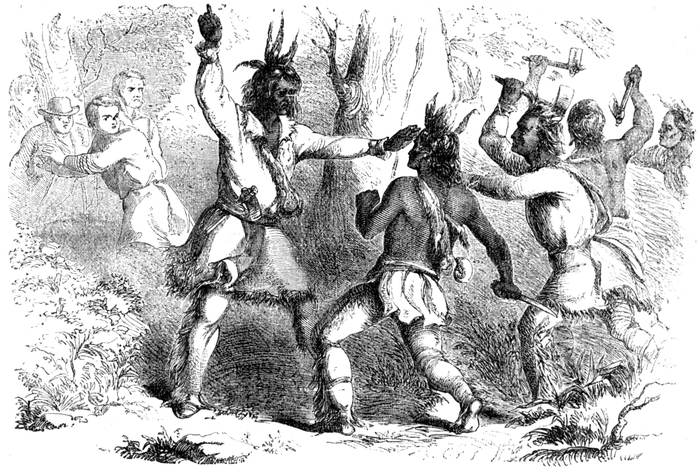
The Chieftain's Appeal.—Page 9.
323TALES,
Traditions and Romance
OF
BORDER AND REVOLUTIONARY TIMES.
THE CHIEFTAIN S APPEAL.
THE IMPLACABLE GOVERNOR.
Mrs. SLOCUMB AT MOORE'S CREEK.
BRADY'S LEAP.
NEW YORK:
BEADLE AND COMPANY, PUBLISHERS,
118 WILLIAM STREET.
324Entered according to Act of Congress, in the Year 1864,
by Beadle and Company, in the Clerk's Office of the District Court of the United
States for the Southern District of New York.
THE CHIEFTAIN'S APPEAL.
325
Sullivan's campaign into the Indian country, in the fall of 1779,
realized none of the anticipations regarding it; for, although the
severity of the ensuing winter, and the privations they suffered from
the destruction of their homes and their crops, kept the Indians from
making any predatory excursions upon the settlements, yet, on the
opening of spring, they swept over the country in clouds, burning
with revenge, and breathing vengeance against the pale-faces.
Early in April, a party of forty or fifty Indians and Tories, under
the command of Captain Brandt, the Mohawk chief, made an incursion
against Harpersfield, which they surprised and destroyed. Most
of the inhabitants, however, had, owing to their exposed situation,
left the place, and nineteen prisoners and a small amount of plunder
was all that graced their triumph. On his way from Niagara, Brandt
had detached a party of eleven Indians, under a young chief called
Cheyendowah, to attack the settlement at Minisink, and bring in
some prisoners. This was successfully accomplished, and five of its
male inhabitants were led captive into the wilderness, as far as Tioga
Point. Here, however, they rose upon their captors while asleep,
and in a few moments nine of them lay in the agonies of death, while
the other two fled, one being mortally wounded. At the time that
Harpersfield was destroyed, a party of fourteen militiamen, under
command of Captain Alexander Harper, were in the woods making
maple-sugar for the garrison at Old Schoharie. Not dreaming of the
proximity of an enemy, they were attacked by the party under
Brandt, and two of their number shot down before they could seize
their arms; and when they attempted to reach them, they found
themselves completely cut off and surrounded. Nothing remained,
326therefore, but to surrender. The Tories composing a part of Brandt's
party, were opposed to taking prisoners, and wished to kill them at
once, that they might not be an incumbrance at the attack of the
Schoharie Fort, which was one object of the expedition. A frightful
massacre would have ensued, without doubt, had not Brandt's forethought
prevented it. He had raised his tomahawk to strike Captain
Harper, which would have been the signal for the death of the others,
when, thinking he might get valuable information from him, he
lowered his weapon, and, looking the other sternly in the eye, he
asked: "How many regular troops are there in the fort?" Harper
saw the object of the chief, and, without any hesitation or prevarication,
told him that three hundred Continentals had arrived but a few
days before to garrison the forts. This was not true, but the manner
in which Harper told it imposed upon the chief, who, by the way,
had been a schoolmate of his, and, although the circumstance disconcerted
his plans, yet he was induced to believe him. One of Harper's
men, fearing that the Indians would put them all to death if they
should discover the fraud, informed the chief of the true state of the
case; but he, thinking it a ruse to lead him into danger, and thus
facilitate the escape of the prisoners, put no faith in his story, but, on
the contrary, was the more convinced of Harper's truthfulness. A
conference was held between Brandt and his subordinate chiefs in
regard to the disposal of the prisoners. The former was in favor of
taking them to Niagara, but the latter, disappointed at the failure of
the main part of their enterprise, and thirsting for blood, were for
massacring them at once. During the controversy, the prisoners,
bound hand and foot, were thrust into a pen of logs, where they were
kept under guard of the Tories and their leader, an infamous wretch
by the name of Becraft. The pen was near enough to the council to
hear what was going on, and Harper understood enough of the
Indian language to catch the import of their "talk." Becraft took
pains, too, to inform them of the wishes of the majority of the
Indians, and in abusive language told them that they would "all be
in hell before morning." The influence of Brandt—at all times
powerful—enabled him to prevent bloodshed, and the others were
induced to forego their bloodthirsty desires, for the present, at least.
In the morning, Harper was again brought before the chief and
327interrogated. With great presence of mind he reasserted his story,
and, although the other eyed him with the most searching gaze, he
betrayed no evidence of indecision; and at length the chief, convinced,
apparently, of the truth, gave the order to commence their
march for Niagara. The prisoners were not allowed to reach their
destination, without passing through fearful ordeals. One day they
stopped at a mill kept by a Tory, who, with both of his daughters,
counseled Brandt to destroy "the infernal Whigs." This coinciding
with the desires of the Tories and a majority of the Indians, the
chief found it difficult to restrain them, and prevent the sacrifice. On
another occasion they met a loyalist, who was well acquainted with
Brandt and Harper, who told the former that he had been deceived—that
there were no troops at Schoharie. This led to another searching
inquiry, but Harper persisted in his story with so much apparent
candor as again to elude detection. But when the party reached the
Chemung River, they had to pass a still more fearful trial. On
reaching this point, Brandt and his warriors raised a whoop, as is
customary with the Indians when they have prisoners—it was
answered by a single death yell! In a few moments a single Indian
made his appearance, who proved to be the young chief Cheyendowah.
His story was soon told. Of the eleven who started for the
Minisink settlement, he alone was left so tell the tale of their massacre
at the hands of their prisoners. The others had gathered about
him, excited listeners to the melancholy narrative, and the effect of
the recital upon these already implacable warriors was fearful in the
extreme. "Revenge!" seemed to leap from every tongue, and their
faces were wrought into an expression of the fiercest determination
to immolate the unhappy prisoners on the spot. Every hand sought
a weapon simultaneously, and the glittering tomahawk and keener
scalping-knife leaped into the air, while their eyes glared ferociously
upon Harper and his companions, who, conscious that their fate was
inevitable, awaited it with what composure they could command.
With one accord, the savages rushed in a tumultuous throng, with
uplifted weapons, upon their victims. Brandt had no power to
control the storm, and did not attempt it. As well might he attempt
to stay the whirlwind in its fury, or beat back the mountain torrent
in its course; the doom of the white men was apparently sealed,
328It was to the magnanimity of one from whom they could least
anticipate such forbearance, that they were indebted for their lives.
Rushing between the infuriated warriors and their anticipated prey,
the young chief Cheyendowah waved back the crowd with an imperious
gesture which commanded attention. When silence was
restored, he surprised his auditors by an urgent appeal in behalf of
the prisoners. "It was not they," he said, "who had killed their
brethren, and to take the lives of innocent men would not punish the
guilty. The Great Spirit would be angry with them if they should
do this wicked thing." Pointing upward, in words of majestic eloquence,
he told them that "Manitou was looking upon them, and
would send his thunders to destroy their families, their homes, and
themselves, if they sacrificed the white men in their vengeance."
He told them it was cowardly to kill men who could not defend
themselves, and none but squaws would take such an advantage.
Appealing thus alternately to their fears, their humanity, and their
superstition, he wrought upon their better nature, and was successful
in inducing them to forego their anticipated vengeance. One by one
their weapons were returned to their accustomed places, and with
subdued and less excited feelings, they recommenced their onward
march to Niagara, which they reached at length; not, however,
without the severest suffering by the way.
The eloquence of the red-man is proverbial. Many a time has
the captive trembled when it has been exercised against him; and
thrilled with joy, when it was exerted in his behalf. In the swift
future, when all traces of his existence, who was once the master of
this mighty continent, is swept away, and our children's children
read of him, as an ancient and perished myth, the records of his
eloquence shall be left alive. One of the best specimens of Indian
rhetoric, is the speech of Tecumseh, at the grand council of the
Creeks. One, who was present, and heard it as it fell from his
lips, General Dale, says:
"I have heard many great orators, but I never saw one with the
vocal powers of Tecumseh, or the same command of the muscles of
the face. Had I been deaf, the play of his countenance would have
told me what he said. Its effect on that wild, untutored, superstitious,
and warlike assemblage, may be conceived: not a word was
329said, but stern warriors, the 'stoics of the wood,' shook with emotion,
and a thousand tomahawks were brandished in the air. Even the
big warrior, who had been true to the whites, and remained faithful
during the war, was, for the moment, visibly affected, and more than
once I saw his huge hand clutch, spasmodically the handle of his
knife."
But, to the speech:
"In defiance of the white warriors of Ohio and Kentucky, I have
traveled through their settlements, once our favorite hunting-grounds.
No war-whoop was sounded, but there is blood upon our knives
The pale-faces felt the blow, but knew not whence it came.
"Accursed be the race that has seized on our country and made
women of our warriors. Our fathers, from their tombs, reproach us
as slaves and cowards. I hear them now in the wailing winds.
"The Muscogee was once a mighty people. The Georgians
trembled at your war-whoop, and the maidens of my tribe, on the
distant lakes, sung the prowess of your warriors, and sighed for their
embraces.
"Now, your very blood is white; your tomahawks have no edges;
your bows and arrows were buried with your fathers. Oh! Muscogees,
brethren of my mother, brush from your eyelids the sleep of
slavery; once more strike for vengeance—once more for your
country. The spirits of the mighty dead complain. Their tears
drop from the skies. Let the white man perish.
"They seize your land; they corrupt your women; they trample
on the ashes of your dead. Back, whence they came, upon a trail
of blood, must they be driven.
"Back! back, ay, into the great waters whose accursed waves
brought them to our shores.
"Burn their dwellings! destroy their stock! Slay their wives and
children! The red-man owns the country, and the pale-face must
never enjoy it.
"War! war! War forever! War upon the living! War upon
the dead! Dig their very corpses from the grave. Our country
must give no rest to a white man's bones.
"This is the will of the Great Spirit, revealed to my brother, his
familiar, the Prophet of the Lakes. He sends me to you.
330"All the tribes of the North are dancing the war-dance. Two
mighty warriors across the seas will send us arms.
"Tecumseh will soon return to his country. My prophets shall
tarry with you. They will stand between you and the bullets of
your enemies. When the white men approach you, the yawning
earth shall swallow them up.
"Soon shall you see my arm of fire stretched athwart the sky. I
will stamp my foot at Tippecanoe, and the very earth shall shake."
It appears that the wily orator had been informed by the British
that a comet was shortly to appear; and the earthquake, of 1811,
had commenced as he came through Kentucky; so that, when the
arm of fire was actually stretched forth, and the earth did shake
under old Tippecanoe, his auditors attributed it to Tecumseh's supernatural
powers, and immediately took up arms.
We think the speech of Weatherford, one of the Creek war-chiefs,
engaged against General Jackson, an equally fine example of their
oratory, while it illustrates the remarkable dignity of mind which
enabled him to support his humiliating position with such grandeur.
It was after our doughty General had nearly annihilated the tribes
in his department, the Indians, seeing all resistance at an end, came
forward and made their submission; Weatherford, however, and
many who were known to be desperate, still holding out.
General Jackson, determined to test the fidelity of those chiefs
who had already submitted, ordered them to deliver, without delay,
Weatherford, bound, into his hands, to be dealt with as he deserved.
When they made known to the sachem what was required of them,
his high spirit would not submit to such degradation; and, to hold
them harmless, he resolved to give himself up without compulsion.
Accordingly, he proceeded to the American camp, unknown, until
he appeared before the commanding General, to whose presence,
under some pretence, he gained admission. Jackson was greatly
surprised when the chief said:
"I am Weatherford, the chief who commanded at the capture of
Fort Mimms. I desire peace for my people, and have come to
ask it."
The General had doubtless resolved upon his execution, when he
should be brought, bound; but, his unexpected appearance in this
331manner, saved him; he said to the chief that he was astonished at
his venturing to appear in his presence, as he was not ignorant of
the warrior having been at Fort Mimms, nor of his inhuman conduct
there, for which he richly deserved to die.
"I ordered," continued the General, "that you should be brought
to me bound; had you been brought as I ordered, I should have
known how to treat you."
In answer to this, Weatherford replied:
"I am in your power; do with me as you please; I am a soldier.
I have done the whites all the harm I could. I have fought them,
and fought them bravely. Had I an army, I would yet fight—I
would contend to the last; but, I have none. My people are all
gone. I can only weep over the misfortunes of my nation."
Jackson was of too audacious a nature himself, not to be pleased
with this fellow, and told him that he would take no advantage of
his present situation; that he might yet join the war-party, and
contend against the Americans, if he chose, but to depend upon no
quarter, if taken; and that unconditional submission was his, and his
people's only safety. Weatherford rejoined, in a tone both dignified
and indignant:
"You can safely address me in such terms, now. There was a
time when I could have answered—there was a time when I had a
choice—I have none now. I have not even a hope. I could once
animate my warriors to the battle—but I can not animate the dead.
My warriors can no longer hear my voice. Their bones are at
Talladega, Tallashatches, Emucklaw, and Tohopeka. I have not
surrendered myself without thought. While there was a single
chance of success, I never left my post nor supplicated peace. But
my people are gone; and I now ask it, for my nation, not for
myself. I look back with deep sorrow, and wish to avert still
greater calamities. If I had been left to contend with the Georgian
army, I would have raised my corn on one bank of the river and
fought them on the other. But your people have destroyed my
nation. You are a brave man. I rely on your generosity. You
will exact no terms of a conquered people, but such as they should
accede to. Whatever they may be, it would now be madness and
folly to oppose them. If they are opposed, you will find me among
332the sternest enforcers of obedience. Those, who would still hold out,
can be influenced only by a mean spirit of revenge. To this, they
must not, and shall not, sacrifice the last remnant of their country.
You have told our nation where we might go and be safe. This, is
good talk, and they ought to listen to it. They shall listen to it."
Weatherford is described as having possessed a noble person and
a brilliant intellect. After peace was declared, he settled amid the
whites, and General Dale, who had fought against him often, had the
pleasure of standing as groomsman at his wedding.
THE IMPLACABLE GOVERNOR.
When the infamous Tryon succeeded Arthur Dobbs, as Colonial
Governor of North Carolina, in 1766, he found the inhabitants of the
upper part of the State in the highest state of excitement—almost in
open rebellion—on account of the passage of the Stamp Act, which,
to them, was like piling Pelion upon Ossa, for they had suffered for
years from the rapacity of public officers, the oppression of the courts,
and exorbitant taxes levied to support a venal government. They
had petitioned the Governor and Council for a redress of grievances,
until they found that each petition was followed by increased extortion—until
their situation became so oppressive, that they resolved
to take matters into their own hands. A solemn league was thereupon
formed, called the "Regulation," and the members of it
"Regulators." The leader of this movement was Herman Husband,
a quaker, a man of strong mind and great influence. These Regulators
resolved to pay no more taxes, unless satisfied of their legality;
to pay no more fees than the strict letter of the law allowed; to
select the proper men to represent them, and to petition for redress
until their object—a retrenchment of the exorbitant expenditure of
the Government, and the consequent high rate of taxes—was
obtained. The exasperated feelings of the people were somewhat
calmed by the repeal of the odious Stamp Act; but soon after
that event, which had quieted and put to rest the stormy, riotous
333assemblies of the "Sons of Liberty," as the Regulators were sometimes
called, Governor Tryon succeeded in obtaining, first, an appropriation
of twenty-five thousand dollars to erect a gubernatorial palace,
"suitable for the residence of a Colonial Governor," and a further
sum of fifty thousand dollars to complete the same. This, together
with the expense of running the boundary line between the State
and the Cherokee nation, which was incurred by the vanity of the
Governor in calling out the militia, and marching at their head into
the Cherokee country, with the ostensible object of protecting the
surveyors, and that, too, in time of peace, had the effect to excite the
indignation of the Regulators, and they determined to resist the
imposition of the tax for these objects. Tryon, observing the
threatening storm, sent a proclamation by his Secretary, David
Edwards, and a lawyer named Edmund Fanning, to be read and
enforced among the people. Fanning was a man who was detested
by the Regulators, for his extortions; but he managed to cajole them
into the belief that justice was about to be done them, and they
agreed to meet him, to heal all difficulties and settle the existing
differences. While waiting the time of meeting, however, they were
astonished and highly exasperated by the arrest of Husband and a
number of friends, who were thrown into jail by Fanning's orders.
A rising of the people followed, and a large body of Regulators
marched to Hillsborough to release the prisoners. They were
induced, however, by the solemn assurance of Edwards, that their
grievances should be redressed, to retire without committing any
overt act. From this time forward, the temporizing policy of the
Governor, and the rankling hatred of the Regulators, caused frequent
and serious outbreaks, until the former, determined to crush the
spirit of disaffection, collected the militia, and marched into the
disaffected district. He was met by a large body of the Regulators,
and a serious battle was fought, in which nine of the Regulators and
twenty-seven of the militia were killed, and a great number on both
sides wounded. The Regulators had no acknowledged leader, and
all was confusion after the first fire from the militia, every man
fighting on his own account, and in his own way. The result was
a victory for the Governor, who took a number of prisoners, upon
whom he vented the implacable revenge which was as a consuming
334fire within him. His conduct was more like that of a small-minded,
vain, and vindictive man, than that of a Royal Governor.
Among others whom fortune had thrown into his hands, was
Captain Messer, one of the most influential of the Regulators, and
the father of an interesting family. Tryon could not wait the tardy
course of trial for this man, but sentenced him to be hung the day
after the battle. He must sate his desire for revenge in the blood
of some of his victims, or his victory would be incomplete. Messer
begged to see his family before he died; but this boon was denied
him, and he was told to prepare for death. Information of his
captivity, however, was conveyed to his wife by the fugitives from
the field, and she repaired at once to the spot, with her eldest boy, a
lad ten years old, to comfort him in his confinement. She did not
know that he had been condemned to die, until she reached the
scene of the late encounter, where she was informed of it by seeing
the preparations made for his execution. In an agony of mind
which threatened to unseat her reason, she flew to Tryon, and
besought him on her knees to spare her husband's life. Every
argument and appeal which her affection could command, was used
in vain; the stony heart of the victorious Governor was not to be
touched, and he spurned her from him in disdain, telling her that
her husband should die, though the King should intercede in his
behalf. The poor woman fell weeping to the ground, while her little
son, with the spirit of his father beaming in his eyes, endeavored to
console her by assuring her that Tryon would yet relent. While this
was passing, the Captain was led forth to die. Mrs. Messer, on
seeing her husband in the hands of the executioner, uttered a shriek
of agony, which seemed to sever the cords of her heart, and swooned
away. The noble-hearted boy at her side, instead of giving way to grief,
determined to make another appeal to Tryon, who stood near viewing
the proceedings. Throwing himself at the Governor's feet, he said:
"Sir, hang me, and let my father live."
"Who told you to say that?" asked Tryon.
"Nobody," was the reply.
"And why do you ask it?"
"Because," replied the lad, "if you hang father, my mother will
die, and the children will perish."
335The Governor's heart was touched, and he replied:
"Your father shall not be hanged to-day."
The execution was stayed; while the noble boy went to his
mother, and restored her to consciousness by the news.
The unfeeling tyrant, however, annexed a condition to his reprieve,
which was, that Messer should be set at liberty only on condition
that he should arrest and bring before him the person of Husband,
who had fled before the battle commenced. Reflecting that success
might attend his efforts, and, at worst, he could but suffer if he failed,
he consented, while his wife and son were detained as hostages for
his fidelity. He pursued Husband to Virginia, where he overtook
him, but could not persuade him to return, and was obliged to surrender
himself again to the tender mercies of his captor. He was
bound in chains with the other prisoners, and in this condition was
marched through the various towns and villages on the route toward
Newbern. At Hillsborough, a court-martial was held, and twelve of
the captive Regulators were sentenced to be hung. Six of these
were reprieved, and the others suffered death on the scaffold. Among
the latter was Captain Messer, who met his fate with the resignation
of one who felt that he died in the cause of liberty. His broken-hearted
wife returned to her home, now rendered desolate by her
husband's death; while the tyrannical Governor marched in triumph
to Newbern, from whence he was soon after called to the head of
colonial affairs in New York.
The execution of Colonel Isaac Hayne, which took place later in
the history of the Carolinas, presents a still more touching picture of
the devotion of a child and the tyranny of a British minion. After
Charleston had fallen into the hands of the British, many of the
Whigs of South Carolina were induced to take the protections which
were offered by Lord Cornwallis. They were led to this step by the
belief that in the South the cause was hopeless, and were promised,
by virtue of these protections, to be allowed to remain quietly in their
homes and take no part in the contest. Their surprise was great,
when, soon after, they were called upon to take up arms under the
British commanders and against their countrymen. Conceiving that
faith had been broken with them, and their promises of neutrality no
longer binding, they tore up their protections, and at once ranked
336themselves under the Continental leaders. Among those was Colonel
Hayne, a man of unblemished reputation, fine talents and lofty
patriotism. Indignant at the course pursued by the British, he hastened
to the American army, and began to take active part in the
contest. Unfortunately, he fell into the enemy's hands, was conveyed
to Charleston, submitted, by order of Rawdon, to a mock trial, and,
to the horror of all, was condemned to death. He received his
sentence with calmness, but the whole country was horrified. Both
English and Americans interceded for his life, and the ladies of
Charleston immortalized themselves by the spirited address which
they framed and delivered to his captors in his behalf. All was of
no avail. The cruel heart of Rawdon could not be moved; not even
the captive's motherless children, with bended knees and tearful
prayers, could move his obdurate nature.
Hayne's eldest child was a boy of thirteen, who was permitted to
remain in prison with him up to the time of his execution. This
boy was actuated by an affection for his father of the most romantic
earnestness and fervor. Beholding him loaded with irons and condemned
to die, he was overwhelmed with consternation and sorrow;
nothing could alleviate his distress. In vain did his parent endeavor
to console him by reminding him that this unavailing grief only
heightened his own misery—that he was only to leave this world to
be admitted into a better—that it was glorious to die for liberty.
The boy would not be comforted.
"To-morrow," said the unhappy father, "I set out for immortality.
You will accompany me to the place of my execution, and when I
am dead, take my body and bury it beside your poor mother."
In an agony of grief the child fell weeping on his father's neck,
crying:
"Oh, my father, my father, I die with you!"
The chains which bound the prisoner prevented his returning the
embrace, but he said, in reply:
"Live, my son—live to honor God by a good life—live to take
care of your brothers and sisters."
The next morning the son walked beside his father to the place
of execution. The history of the war scarcely affords a more heart-rending
incident. There was not a citizen of Charleston whose
bosom did not swell with anguish and indignation. There was
sorrow in every countenance, and when men spoke with each other,
it was in accents of horror.
337
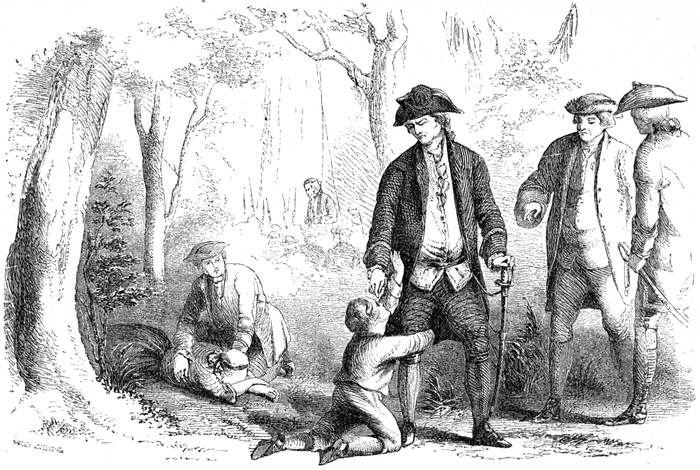
The Implacable Governor.—Page 14.
339When the two came within sight of the gallows, the parent
strengthened himself, and said to the weeping boy:
"Tom, my son, show yourself a man! That tree is the boundary
of my life and all my life's sorrow. Beyond that the wicked cease
from troubling, and the weary are at rest. Don't lay too much at
heart our separation—it will be short. 'Twas but lately your mother
died; to-day I die; and you, though young, must shortly follow."
"Yes, my father," replied the broken-hearted boy, "I shall soon
follow you; for, indeed, I feel that I can not live long."
And this melancholy anticipation was fulfilled in a manner far
more dreadful than is implied in the mere extinction of life. When
his father was tom from his side, his tears flowed incessantly, and
his bosom was convulsed with sobs; but when he saw that beloved
parent in the hands of the executioner, the halter adjusted to his
neck, and then his form convulsively struggling in the air, the fountain
of his tears was suddenly stanched, and he stood transfixed with
horror. He never wept again. When all was over he was led from
the scene, but there was a wildness in his look, a pallor in his cheek,
which alarmed his friends. The terrible truth was soon made known.
His reason had fled forever. It was not long before he followed his
parents to the grave, but his death was even sadder than his father's.
In his last moments he often called the beloved name in accents of
such anguish that the sternest hearted wept to hear him. But the
merciful all-Father took him home and restored him forever to the
side of that parent, the shock of whose rude death sundered the
tender strings of a child's heart.
Lord Rawdon should have been proud of this noble feat. He was
one of those who
"Stand, to move the world, on a child's heart."
The outrageous oppression of Governor Tryon and Lord Rawdon
were only a few among many instances of the spirit shown by
Government officials, until the people of the Colonies were driven
to that universal rebellion which resulted in the establishment of
our independence. And when that struggle was begun, British
340arrogance and cruelty asserted itself, in her officers and minions, in
those equivocal shapes which ought to make British history blush
with shame along the ensanguined record. It has been truly said
that a wrong begun is only maintained by a wrong continued.
The first contest of England with America sprang from tyranny;
she was the aggressor, the offending party: and it seems to have
been a moral consequence, that a war, thus unrighteous, should have
been characterized by a violation of every humane and honorable
purpose. The extent to which British cruelty was carried in the
memorable contest of the Revolution, is scarcely appreciated by us.
Nothing equals the vindictive, bloodthirsty fury which characterized
it in some quarters of the Union. It was almost a war of extermination
in the South. There, lads were often shot down, that they
might not live to be full-grown rebels, and mothers murdered, that
they might bring forth no more enemies to the king. Among the
people in villages, and in the open country, existed the greatest
suffering, and often was manifested the loftiest patriotism and the
grandest fortitude. With such ferocity were they pursued by the
British soldiery, that their only retreat became the army. At no
moment were they safe. Neither in their beds, nor by their firesides,
nor on the highways. Daily and nightly murders frightened
the time with their atrocities. Reckless marauders traversed the
country in all directions, sparing neither sex, age, nor infancy.
Nightly, the red flame glared on the horizon, and houseless children
hung over the desecrated, butchered forms of their parents.
But of all atrocities, those committed in the prisons and prison-ships
of New York were most execrable; there is nothing in history
to excel the barbarities there inflicted. It is stated that nearly twelve
thousand American prisoners "suffered death by their inhuman, cruel
and barbarous usage on board the filthy and malignant prison-ship,
called the Jersey, lying in New York."
The scenes enacted within the prisons almost exceed belief. There
were several prisons in the city; but the most terrible of them all
was the Provost (now the Hall of Records), which was under the
charge of Cunningham, that wretch, the like of whom the world has
not many times produced. He had a love for inflicting torture; it
was his passion, his besotted appetite; he seemed to live upon the
341agony of human beings; their groans were his music, their sufferings
his pastime. He took an eager delight in murder. He stopped the
rations of the prisoners and sold them, to add to the luxuries of his
own table, while his victims were starving to death. They were
crowded into rooms where there was not space to lie down, with no
blankets to protect them from the cold, to which the unglazed windows
exposed them, while they were suffering from fevers, thirst,
and hunger. In the summer, epidemics raged among them, while
they were denied medicine or attendance, and compelled to breathe
the damp and putrid air. But, hear what Cunningham himself says
of his acts, in his dying speech and confession, when brought to the
gallows, in London, for a forgery of which he was convicted:
"I shudder to think of the murders I have been accessory to, both
with and without orders from the Government, especially in New
York, during which time, there was more than two thousand prisoners
starved in the different prisons, by stopping their rations, which
I sold. There were also two hundred and seventy-five American
prisoners and obnoxious persons executed, out of all which number,
there was only about a dozen public executions, which consisted
chiefly of British and Hessian deserters. The mode for private executions,
was this: a guard was despatched from the Provost, about
half-past twelve, at night, to the barrack, and the neighborhood of
the upper barracks, to order the people to close their window-shutters
and put out their lights, forbidding them, at the same time, to look
out, on pain of death; after which, the unfortunate victims were conducted,
gagged, just behind the upper barracks, and hung without
ceremony, and there buried by the Black Pioneer of the Provost."
These murders were common, nightly pastime of this monster.
The saddest of the tragedies in which Cunningham bore his
ignominious part, was the execution of that glorious young martyr,
whose name shall glow brighter and brighter on the record of his
country's heroes, as the ages roll away.
The impartial reader will question the justice of history, which
has done so much for the memory of André, and left that of Hale in
comparative oblivion. And yet we can discover but little difference
in their cases. Both were possessors of genius and taste, both were
endowed with excellent qualities and attainments, and both were
342impelled by a desire to serve the cause they respectively espoused,
and both suffered a similar death, but under vastly different circumstances.
And yet a magnificently sculptured monument in Westminster
Abbey, perpetuates the name of the English officer, while
none know where sleep the ashes of Hale, and neither stone nor
epitaph tells us of the services rendered by him; while the first is
honored in every quarter where the English language is spoken, the
name of the latter is unknown to many of his countrymen. "There
is something more than natural in this, if philosophy could find it
out."[3]
Nathan Hale was not twenty years of age, when the first gun of
the revolution broke upon the ears of the colonists. The patriotic
cause at once aroused his enthusiastic love for liberty and justice,
and without pausing for a moment to consider the prudence of such
a step, his ardent nature prompted him at once, to throw himself
into the ranks of his country's defenders. Distinguished as a scholar,
and respected, by all who knew him, for his brilliant talents, he was
at once tendered a Captain's commission in the light infantry. He
served in the regiment commanded by Colonel Knowlton, and
was with the army in its retreat after the disastrous battle of Long
Island.
After the army had retreated from New York, and while it was
posted on the Hights of Harlem, the Commander-in-Chief earnestly
desired to be made acquainted with the force and contemplated
movements of the enemy, and for this purpose, applied to Colonel
Knowlton to select some individual capable of performing the
hazardous and delicate service. Knowlton applied to Hale, who, on
becoming acquainted with the wishes of Washington, immediately
volunteered his services. He stated that his object in joining the
army, was not merely for fame, but to serve the country; that as
yet, no opportunity had offered for him to render any signal aid to
her cause, and when a duty so imperative and so important as this
was demanded of him, he was ready to sacrifice not only life, but all
hope of glory, and to suffer the ignomy which its failure would cast
upon his name. His friends endeavored to dissuade him from the
343undertaking, but lofty considerations of duty impelled him to the
step.
Having disguised himself as a schoolmaster, he crossed the Sound
at Fairfield, to Huntingdon, and proceeded thence to Brooklyn. This
was in September, 1776. When he arrived at Brooklyn, the enemy
had already taken possession of New York. He crossed over to the
city, his disguise unsuspected, and pursued the objects of his mission.
He examined all their fortifications with care, and obtained every
information relative to the number of the enemy, their intentions, etc.
Having accomplished all that he could, he left the city, and retraced
his steps to Huntingdon. While here, waiting for a boat to convey
him across the Sound, his apprehension was effected. There are
great discrepancies in the various accounts which are given of his
arrest, but all agree that it was through the means of a refugee
cousin, who detected his disguise. According to one account, while
he was at Huntingdon, a boat came to the shore, which he at first
supposed to be one from Connecticut, but which proved to be from
an English vessel lying in the Sound. He incautiously approached
the boat, and was recognized by his Tory relative, who was in the
boat at the time. He was arrested, and sent to New York.
There can not be a more striking proof of the different value set
upon the services of André and Hale by their respective nations,
than the fact afforded by the different manner of their arrest. There
was not a single circumstance connected with the capture of André,
but what is known to every reader of history, but in the case of
Hale, who stands André's equal in every particular, it is not even
known with certainty how he was apprehended. We have a few
uncertain legends relative to it, but these are widely different, some
making him arrested on the Sound, some on the island, and others
on the outskirts of the city. But there was one circumstance connected
with Hale's capture, which should enhance our sympathy for
him. André fell into the American hands by means of the sagacity,
watchfulness, and fidelity of our own soldiers; but Hale was betrayed
by the base perfidy and treason of a renegade relative. And what
two opposite phases of human nature does the contrast between these
two incidents afford! In the first, we find three men, three poor
men, so fixed in principle and determined in right, that the most
344tempting offers—offers when an assent would have given them
wealth, ease, and luxury—were refused. Strong honesty overcame
temptation, and they were content to struggle on in poverty, oblivion,
and privation, with unsullied hearts, rather than feast and riot in
luxury. But in the latter incident, we find one of the most execrable
acts recorded in history. The betrayal of Hale by his relative, contrasted
with the stem integrity of André's captors, affords a most
striking picture.
We are all aware of what followed the capture of André. He was
tried before an honorable court, and while strict justice demanded
his life, the necessity was deplored by his judges, and his fate aroused
in every heart the keenest sympathy and the deepest sorrow. But
how widely different was the unhappy end of the noble Hale! He
was surrendered to the incarnate fiend, Cunningham, the Provost-Marshal,
and ordered to immediate execution, without even the
formality of a trial.
The twenty-first of September, 1776, was a day to be remembered
in New York. From Whitehall to Barclay Street, a conflagration
raged along both sides of Broadway, in which, four hundred and
ninety-three houses, or about one-third of the city, was laid in ashes.
The College Green, and a change of wind, only arrested the swift
destruction. On that day, the dignified, harsh, cold, and courtly
Howe, had his head-quarters at the Beekman House, (now standing
at the corner of Fifty-first Street and First Avenue) on the East
River, about three and a quarter miles from the Park. The conflagration,
checked, but not subdued, still clouded the air, when a
generous youth, of high intelligence, kindly manners, and noble
character, was brought into the presence of this stern dignitary.
That youth was charged with being a spy, and the allegation was
substantiated by some military sketches and notes found on his
person. In this court of last resort, Hale dropped all disguises, and
at once proclaimed himself an American officer and a spy. He
attempted no plea of extenuation; he besought no pardoning clemency;
he promised no transfer of allegiance. He waited calmly,
with no unmanly fears, the too evident sentence which was to snap
his brittle thread of life. Howe kept him not long waiting, but at
once wrote a brief order, giving to William Cunningham, Provost
345Marshal of the Royal army, the care and custody of the body of
Nathan Hale, Captain in the rebel army, this day convicted as a spy,
and directing him to be hung by the neck until dead, "to-morrow
morning at daybreak."
Dare we allow our sad and sympathizing fancies to follow the
young hero to the old Provost, where one night only remained to
him of earth? It is difficult to conceive a night of greater distress,
or more thronged with memories, endurances, and anticipations.
Never was prison presided over by a more insatiate monster than
this Cunningham. All the surroundings were of the most forbidding
character. The coming morning was to conduct the prisoner,
through unspeakable contumely, to the portals of eternity. He
calmly asked that his hands might be loosed, and that a light and
writing materials might be supplied, to enable him to write to his
parents and friends. Cunningham denied the request! Hale asked
for the use of a Bible, and even this was savagely refused.
Thank God, there was one there with enough of the heart and
feelings of a man, to be roused to energetic remonstrance by such
malignant inhumanity. The Lieutenant of Hale's guard earnestly
and successfully besought that these requests be granted. In the
silent hours, so swiftly bearing him on to the verge of his dear and
happy life, the strong soul of the martyr was permitted to write, for
loved eyes its parting messages. Doubtless, one of these was to the
sweet Alice Adams, the maiden to whom he was betrothed. On
came the swift and fatal morning, and with it the diabolical Cunningham,
eager to luxuriate in another's woe. Hale handed him the
letters he had written; Cunningham at once read them, and, growing
furious at their high spirit, tore them to pieces before the writer's eyes.
He afterward gave, as his reason, "that the rebels should never know
they had a man who could die with such firmness."
Confronted by this representative of His Majesty, cheered by no
voice of friendship, or even of sympathy, beset by the emblems and
ministers of ignominious death, Hale stood on the fatal spot. His
youthful face transfigured with the calm peace of a triumphant
martyr; a life, suffused with religious sensibilities, and blooming
with holy love, then and there culminated.
The ritual of disgrace had been performed, and a single refinement
346of malice, was all that even Cunningham's ingenuity could devise;
he demanded "a dying speech and confession." Humanity had
begun to assert itself in the crowd of curious gazers, for pity was
swelling up in many hearts, finding expression in stifled sobs. Firm
and calm, glowing with purification and self-sacrifice, Hale seemed to
gather up his soul out of his body, as, with solemn emphasis, he
gave answer to this last demand of malignity:
"I only regret that I have but one life to lose for my country."
Why have not we a sky-piercing monument, wherein is set a tablet
of solid silver, whereon those words are printed in letters of pure
gold?
Honest Tunis Bogart, a witness of Hale's execution, said:
"I have never been able to efface the scene of horror from my
mind—it rises up to my imagination always." Ashar Wright, who
was Hale's personal attendant, was so completely overwhelmed by
his fate, that his understanding reeled from its throne, never to be
fully reinstated.
There was such lamentation among relatives, friends, and brother
officers, when his death was learned, as betokened how he had
endeared himself to all. His memory has been quietly cherished in
many hearts. And ever, as the tide of time rolls on, his fame
increases—his star sails steadily up among the immortal crowd of
illustrious dead.
A certain share of infamy attaches to Howe, on account of the
barbarities of Hale's execution. He could and should have known
that Cunningham was a devil, unfit for any earthly trust. He should,
too, have observed the due formality of a court-martial, and he certainly
should have taken care to have had the sentence executed
with decency. Howe is deeply blameworthy for his lack of humanity,
and for his unrestrained indulgence of such monsters as the Provost-Marshal.
He stands convicted of a tolerance of demoniac cruelty,
not only in this case, but in the prison-ships, and his general administration.
There is something even more damning in being an
ungenerous enemy, than an ungenerous friend. Let the disgrace
which it fairly won, rest forever on the name of Howe.
As for that sweet Alice Adams, to whom Nathan Hale was
engaged, the events of a long life, the transformation of four score
347and eight years, passed over her head. In life's extremity, when
shadows came and went, and earth was receding dimly, the first
loved name was the last word on her lips. Truth and love came
back to her in old age and death; perhaps she saw him standing on
the eternal shores awaiting to help her over—love, life and youth are
immortal there—and calling to him, she passed away.
MRS. SLOCUMB AT MOORE'S CREEK.
Mary Slocumb was the noble-hearted wife of one of the bravest
soldiers of the Southern army, and was a fair specimen of the heroic
women whose influence was so sensibly felt in the Carolinas at the
period when the Revolutionary storm was deluging that section with
all the horrors of civil war. Lieutenant Slocumb, her husband, like
many others whose patriotism would not allow them to remain at
home in the enjoyment of ease and comfort, while their country
called for the exertion of her sons to free her from the thraldom of a
foreign tyrant, had attached himself to the regiment of Colonel Caswell,
who, at the period of which we write, had collected his friends
and the yeomen of the surrounding country, to give battle to Donald
McDonald, and his Highlanders and Tories, then on their way to
join Sir Henry Clinton on Cape Fear, after having escaped from
Colonel Moore at Cross Creeks. In the battle of Moore's Creek,
which followed, Lieutenant Slocumb and his detachment, by turning
the flank of the enemy, secured the victory to the patriots, and captured
a large portion of the loyal Highlanders, among whom was the
brave McDonald himself. It was a hard fought and bloody battle,
and Slocumb, in after years, delighted to relate the incidents of the
obstinately contested field, among which none was so interesting as
his meeting with his wife on his return from the pursuit of the
defeated Tories. It seems that on the night after the departure of
her husband and his detachment, Mrs. Slocumb had dreamed of
seeing her husband's body, wrapped in his military cloak, lying upon
the battle-field, surrounded with the dead and dying. So strong was
348the impression upon her mind, that she could sleep no more, and she
determined to go to him. Telling her woman to look after her child,
and merely saying that she could not sleep, and would ride down the
road, she went to the stable, saddled her mare—as fleet a nag as ever
traveled—and in a few moments was on her way after the little
army, sixty miles distant. By the time she had ridden some ten
miles, the night air had cooled her feverish excitement, and she was
tempted to turn back, but the thought that her husband might be
dead, or dying, urged her on, and when the first faint tints of morning
illumined the east, she was thirty miles from home. At sunrise,
she came upon a group of women and children, who had taken their
station in the road to catch any tidings that might pass from the
battle-field. Of these she inquired if the battle had been fought, but
they could give her no information, and she rode on, following the
well-marked trail of the troops.
About eight or nine o'clock she heard a sound like distant thunder.
She stopped to listen; again it boomed in the distance, and she knew
it must be cannon. The battle was then raging.
"What a fool!" thought she. "My husband could not be dead
last night, and the battle only fighting now. Still, as I am so near,
I will go on and see how they come out."
Every step now brought her nearer the field, and she soon heard
the sound of the musketry and shouting. In a few moments she
came out into the road below Moore's Creek bridge. A short distance
from the road, under a cluster of trees, were lying perhaps
twenty men. They were wounded.
"I knew the spot—the very trees; and the position of the men I
knew as if I had seen it a thousand times. I had seen it all night!
I saw all at once; but in an instant my whole soul was centered in
one spot; for there, wrapped in his bloody guard cloak, lay the body
of my husband. How I passed the few yards from my saddle to the
spot I never knew. I remember uncovering the head, and seeing a
face clothed with gore from a dreadful wound across the temple. I put
my hand on the bloody face; 'twas warm, and an unknown voice
begged for water."
What a revulsion! It was not her husband, then, after all! She
brought water, gave him some to drink, washed his face, and
349discovered that it was Frank Cogdell. He soon revived, and could
speak.
"I was washing the wound on his head. Said he: 'It is not that;
it is that hole in my leg that is killing me.' A puddle of blood was
standing on the ground about his feet; I took his knife, cut away his
trowsers and stocking, and found the blood came from a shot-hole,
through and through the fleshy part of his leg."
She sought for some healing leaves, bound up his wounds, and
then went to others, whose wounds she dressed, and while engaged
in this charitable work, Colonel Caswell came up. He was surprised,
of course, to see her, and was about to pay her some compliment,
when she abruptly asked for her husband.
"He is where he ought to be, madam, in pursuit of the enemy.
But, pray, how came you here?"
"Oh, I thought," said she, "you would need nurses as well as
soldiers. See! I have already dressed many of these good fellows;
and here is one," going to Frank, and lifting up his head so that he
could drink some more water, "would have died before any of you
men could have helped him."
Just then she looked up, and her husband, covered with blood and
dirt, stood before her.
"Why, Mary!" he exclaimed, "what are you doing there? Hugging
Frank Cogdell, the greatest reprobate in the army!"
"I don't care," she cried, "Frank is a brave fellow, a good soldier,
and a true friend to Congress."
"True, true! every word of it!" said Caswell; "you are right,
madam," with the lowest possible bow.
"I would not tell my husband," says she, "what brought me there.
I was so happy; and so were all! It was a glorious victory; I came
just at the hight of the enjoyment, I knew my husband was surprised,
but I could see he was not displeased with me. It was night
again before our excitement had all subsided. Many prisoners were
brought in, and among them some very obnoxious; but the worst
of the Tories were not taken prisoners. They were for the most
part left in the woods and swamps, whenever they were overtaken.
I begged for some of the poor prisoners, and Caswell readily told me
none should be hurt, but such as had been guilty of murder and
350house-burning. In the middle of the night, I again mounted my
mare and started for home. Caswell and my husband wanted me
to stay till next morning, and they would send a party with me;
but no; I wanted to see my child, and I told them they could send
no party who could keep up with me. What a happy ride I had
back! and with what joy did I embrace my child as he ran to meet
me."
Could the inventive genius of the most able writer of fiction suggest
a more thrilling narrative? Alas! how many such intensely
interesting incidents are buried in the graves of those noble men and
women who sacrificed everything but honor, that we, their children,
might live free and independent.
How many females of the present age could be found to ride a
hundred and twenty-five miles in less than forty hours, even on such
an errand?
This was not the only adventure of this spirited lady, living, as
she did, in the midst of contending armies, and entering with ardor,
into all the plans and hopes of her husband.
Another couple, living at the North, had some spirited adventures,
quite worth chronicling. In the town of North Castle, Westchester
County, New York, resided, during the War for Independence, a
young married couple, who were both, heart and soul, enlisted in
the patriotic cause, and whose best services were devoted to their
country. Mr. Fisher was an eminent and active member of a partisan
band, under Major Paulding, whose confidence and esteem he always
enjoyed to an eminent degree, and who by his unflinching patriotism,
and the energy and skill with which he thwarted the plans and
designs of the Tories, made himself particularly obnoxious to them.
His active duties as a scout, sometimes kept him for months from
his home, where his young wife had nothing but her heroism of
spirit to oppose to the marauding bands that traversed the "Neutral
Ground," and whose creed it was, to make war upon women and
children indiscriminately. While the high-minded Whig, therefore,
was serving his country, in the swamp and on the mountain, the wife
had to undergo scenes, requiring an equal courage and fortitude,
with those of his.
She was one of those women of the revolution, by whose indomitable
351spirit and active benevolence our armies were often held together,
and our soldiers encouraged to persevere in the glorious course they
had begun. She was without fear, and was always ready to serve
her country, or defend herself, upon any emergency. The American
soldier, too, often found relief from suffering, through her benevolence.
She was one of those, who attended upon the wounded of White
Plains, and administered comfort to the dying, and relief to the
wounded. After this battle, when Washington's army was encamped
near her residence, the Commander-in-Chief's table was often indebted
for many of its delicacies, to the prudent attention and care of Mrs.
Fisher. Washington often expressed his obligations to her in person.
Many anecdotes are related of her daring. On one occasion, a
favorite colt was stolen, when she mounted a horse and rode down
to Morrissania, where the loyalists were encamped, and demanded of
the English officer in command, the restoration of her property. The
Englishman courteously assented, and the colt being found, it was
restored to her. This was considered at the time, a most daring
expedition. Her route, which was a long one, was through a section
of country beset with marauders, who were never in the habit of
hesitating to make war on a woman.
We remarked that the danger from the marauding Tory bands,
prevented Mr. Fisher from visiting his home, but at long intervals.
There was one band of Tories notorious for its cruelty, headed by
one Blindberry, a most bloodthirsty wretch, whose memory to this
day, is only preserved to be execrated. This fellow was the terror
of the whole community. On one occasion, after having been absent
for six months, Mr. Fisher's anxiety to see his family, became so
great, that one evening he cautiously approached the house, and was
admitted unseen. Late that night, after he had retired, steps were
heard without, and presently there was a loud knocking at the door,
with a peremptory summons for it to be opened. This not being
heeded, it was repeated, with a threat to break open the door, if it
was not complied with. The house was a simple old-fashioned cottage,
the door opening directly into a room, which was used by Mr.
Fisher and his wife as a sleeping room. The party now discharged
their pistols three or four times through the window, but the balls
lodged harmlessly in the walls. This proceeding effecting nothing,
352they begun at once to demolish the door, and in a few moments they
burst roughly into the room. Mr. Fisher sprung from the bed, prepared
to defend his wife and himself to the last. But the only object
of this band was plunder. In those times, the country people were
compelled to convert their effects into money, as every thing moveable,
would be sure to be captured, and having no means of investing
their wealth, it was generally concealed in secure places. But these
concealments rarely availed them any thing, if their persons should
fall into the hands of the Tories, as every means of torture that ingenuity
could suggest, was availed of to force the hapless victims to
betray the hiding place of their wealth. Hanging, roasting over slow
fires, or a pistol at the head, were the usual modes adopted.
The Tory leader, who was no other than this same Blindberry,
demanded of Mr. Fisher his gold. The stern patriot, who was a
man of unconquerable will, calmly refused. The marauders became
enraged, and he was threatened with death if he persisted in his
denial. But neither the flashing swords that gleamed around him,
the musket at his breast, nor the furious aspects of the wretches,
could move him a jot from his determined purpose. The word was
given to try hanging. In an instant a rope was thrown over the
branch of a tree, that stood by the door, and their victim was drawn
beneath it, and the rope adjusted to his neck. Once more he was
asked to give up his money. Without the tremor of a muscle, he
refused. The next moment he was dangling high up in the air. He
was allowed to suspend for a few seconds, and lowered to the ground.
His reply to the same question was given, in an undaunted refusal.
Again did his tormentors run him up into the air; but when they
again lowered him, he had fainted. In a few moments, however,
he revived, and as the knowledge of the affair gradually broke upon
his mind, he thundered out, "No, not a farthing!" Once more did
the wretches swing him off, and this time he was kept suspended
until they thought he was dead, when they lowered him, and seeing
now no chance of obtaining the coveted gold, they departed.
353
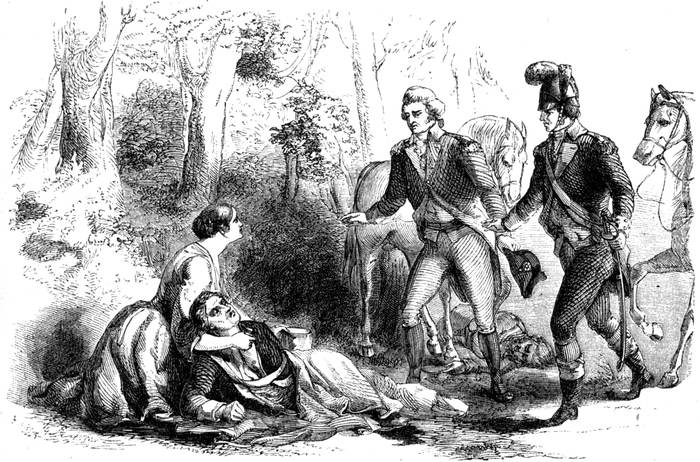
Mrs. Slocumb at Moore's Creek.—Page 27.
355The agony of the wife during this scene, can only be imagined.
A Tory was stationed by her side, and with a pistol at her head,
enjoined silence on the penalty of her life. In those few minutes
were crowded a life of torture and suffering. When they had gone,
she tremblingly stole out to the side of her husband, and with what
little strength she possessed, dragged his lifeless form into the house.
With the vague hope that he might not be dead, she applied restoratives,
and soon had the unspeakable joy of detecting signs of life.
Ere morning, he was entirely restored, and that very day joined his
scout.
Continuing their route, the Tories fell upon several of the neighbors,
all of whom suffered some cruelty at their hands. At one
house they placed its master in a chair, tied him down, and built a
fire under him, by which means he was at last compelled by his
unsupportable agony to reveal the hiding place of his gold. But a
terrible retribution was preparing for them. Major Paulding had
gathered a party of his men, and was in hot pursuit of them. As
the Major was following up their track, he stopped at the residence
of Mr. Wright, an old Quaker, who felt a strong sympathy for the
American cause, but whose principles prevented him from taking an
active part in the contest. To the inquiry, if such a party of Tories
as has been described, was seen, the Quaker replied in the affirmative,
pointing out the course they had taken.
"What do you say, my men," said the Major to his followers,
"shall we follow them up?"
A unanimous consent was given.
"Jonathan, if thee wishes to see those men," said Mr. Wright,
approaching Major Paulding, with a knowing look, "if thee wishes
to see them particular, would it not be better for thee to go to
'Brundage's Corner,' as they are most likely from the North, and
will return that way. There thee can'st see them without doubt."
The shrewd insinuation of the Quaker, was caught in an instant.
The place referred to, afforded a most admirable place for an ambuscade,
and by secreting themselves there, the enemy was certain to
fall into their hands.
The Whigs had not been concealed long, ere the party was heard
approaching. At the signal, the patriots sprung forward, and discharged
their weapons. At the very first fire, the bloodthirsty Tory
leader fell, some said from a bullet discharged by the hand of Major
Paulding himself.
The intense hatred felt by the people toward Blindberry, and the
356universal joy manifested at his fall, prompted some to make a public
rejoicing on the event, and in order to express their uncompromising
hostility to their foe, his body was hung before the assembled patriots
of the district, amid their jeers and expressions of pleasure. Among
the assembly was Mr. Fisher, who, but a few hours before had so
nearly fallen a victim to his cruelty.
Some little time after the preceding events, while Mr. Fisher was
on another visit to his family, sudden word was brought, that the
Tories were approaching. This, as before, was during the night.
Mr. Fisher had reason to suppose, that the object of this party, was
to secure his person, and it became necessary to obtain a place of
concealment. The most advantageous one that offered, was beneath
the flooring, which was loose, where was ample room for him, and
where it was hoped, the Tories would not think of looking for their
enemy. Scarcely had he secreted himself, when the Tories appeared.
They burst into the presence of Mrs. Fisher, in a boisterous manner,
and with brutal jests and extravagant threats, demanded to be
informed, where her husband was. To these inquiries, the undaunted
woman deigned no reply.
"Come, give us a light," said the leader, "that we may ferret out
your rebel husband's hiding place. I'll swear, that you've got him
stowed away somewhere here."
"I have no light," was the calm reply.
The difficulties of procuring stores, sometimes left Whig families
for weeks without the common necessities.
"Come, my woman, none of that!" broke in the Tory; "a light
we want, and a light we must have, so bring out your candles!"
"I have none," reiterated Mrs. Fisher.
The Tory, with an oath, drew a pistol, cocked it, and coming up
to her, placed the muzzle in her face.
"Look here, my lady," said he, "we know that you've got your
rebel of a husband somewhere about here, and if you don't at once
give us a candle, so that we may hunt out his hiding place, I'll blow
your brains out."
"I have told you," replied the lady, "that I have no candle; I
can not give you one, so you may blow my brains out the moment
you please."
357The heroic spirit that breathed in her words, and the firm look
from her undaunted eye, convinced the Tory that she was not to be
intimidated. They were compelled to make their search in the dark.
After rummaging into every nook and corner in vain, they gave up
their object. On several other occasions, Mr. Fisher had similar
narrow escapes.
We can not refrain from referring to one enterprise in which Mr.
Fisher was engaged, by which means fifteen Whigs put to flight, over
three hundred Hessians. The news of their approach was spread
abroad, and the utmost consternation prevailed. The Hessians
were always held in great terror by the country people. On this
occasion, they fled at their approach into the forests and other secure
fastnesses. Coney Hill, was the usual place of retreat on these
alarms. This was a hill somewhat off from the main roads, and
which was surrounded by narrow defiles, and reached only through
dense thickets, while its rocky and irregular surface, afforded a means
of defense impregnable. No fortress could have been more secure.
All the inhabitants, therefore, retreated to this fastness, Mrs. Fisher
alone of all neighbors, venturing to remain within her own house.
The usual road traveled by the armies, that led north from White
Plains, in one place described a wide circuit, but there was a narrow,
irregular road, sometimes used, that shortened the distance considerably.
But this road was very dangerous to any large body of men.
It led by the Coney Hill, which we have mentioned, and its whole
length was through a rocky region, overgrown with tangled thickets
of laurel, that would have afforded effectual protection and concealment
to a body of assailants, and have made a small force formidable
to a large one.
At a point on this road, therefore, Major Paulding and fifteen
followers stationed themselves, with a belief, that from the irregular
and incautious manner the Hessians were marching, they would be
induced to lessen their route, by taking the shorter cut. The belief
proved to be well founded. The spot where Major Paulding posted
his ambuscade, was one remarkably well adapted to that kind of
warfare. It was, where the road passing through a defile, made a
sudden turn around a large rock, and where it was so narrow, that
six men could not pass abreast, while the whole rising ground
358on either side was irregular, with rough, jagged rocks, and covered
with a dense growth of laurel.
Stationed at different points, and protected by rocky battlements,
the little band quietly awaited the coming of their enemy. At last
they appeared, approaching carelessly, and with an utter want of
military prudence. Not a sound, nor breath betrayed to them the
presence of a foe. The rocks, and laurel bushes, gave forth no sign
of the deadly messengers to be launched from their bosoms. Part
of the Hessians had already passed the turn of the road, when suddenly,
like a clap of thunder from an azure sky, an explosion burst
from the flinty rocks that surrounded them, and several of their
number, pitched headlong to the earth. Those in front, panic struck,
fell back upon those in the rear, while those in the rear pressed forward,
uncertain of the danger, and discharged their muskets into the
thickets, but the bullets rebounded harmlessly from the rocky walls,
that inclosed their enemy. Another volley completed their panic.
Terrified at the presence of an enemy, that seemed to fight from the
bowels of the earth, and unable to estimate the full extent of their
danger, which their imagination greatly magnified, they gave a wild
cry, and fled precipitately.
This event afforded the Whigs for a long time much merriment,
particularly as it was accompanied with no loss to the little party,
who had given the Hessians their terrible flight. Mrs. Fisher was
accustomed to give an amusing relation of the manner they appeared,
as they flew by her house, each running at his utmost speed, with
the tin cannisters and other numerous accouterments with which the
Hessian soldiers were always so plentifully provided—flying out in
a straight line behind them.
The following incident, admirably illustrates the presence of mind,
and the many resources of this courageous lady. One day, a Whig
neighbor burst hastily into her presence, saying, that he was pursued
by a body of Tories, and if not concealed immediately, he was lost.
It did not take a moment for Mrs. Fisher to decide upon her course.
There was a large ash heap just out of the back door, some four or
five feet in hight, and as many long. Seizing a shovel, in a moment
she made an excavation, into which the fugitive crept, and the lady
covered him with ashes, having first taken the precaution to procure
359some quills, which she placed one in another, and thus formed him
a breathing-hole, by which he sustained life, while the Tories sought
in vain for his hiding place.
A more humble family, but one which did good service in the
cause of liberty, was that of William Maybin. Maybin was taken
prisoner, it was supposed, at Sumter's surprise, on Fishing Creek,
August, 1780. He was carried to Charleston, and died in one of
those charnel-houses of freedom, a prison-ship. Here, just as he was
dying, he was discovered by his wife's brother, Benjamin Duncan, a
soldier in the British army, who obtained permission to bring his
corpse on shore for burial. Duncan then visited his bereaved sister,
and, after a short stay, returned to his duty, promising, as soon as
possible, to come back and provide for her and his other sister, a
married woman. As a pledge, he left with her his watch, and some
other articles. The news of this valuable deposit was soon spread
among the loyalists; it was rumored that the watch was of gold,
falsely, for it was a silver one. Spoil was ever first in the thoughts
of many of those guilty traitors; and two marauders soon came to
the house of the widow and orphans. They demanded the watch,
threatening to take the lives of the helpless women and children, if
it was not delivered. Mrs. Maybin, anxious only, like a true mother,
for the safety of her children, fled to the woods, leaving her sister to
contend alone with the ruffians. She succeeded in baffling their
cupidity. They did not find the watch, although it was hidden
under the head of the bed. It became the property of Maybin's son,
who valued it as a memento of the courage of his aunt.
This family had their full share of trial and privation. When
Rawdon's army pursued General Greene on his retreat from Ninety-six,
they encamped about a week at Colonel Glenn's Mills, on the
Enoree. They then marched through the Fork, and crossed at
Lisle's Ford. On this march, the soldiers plundered everything on
their way. The only piece of meat she had left for her family, and
which she had hidden on the wood-beams of the house, was found
and taken away. A small gray mare, called "Dice," her only beast,
was also stolen, but was afterward recovered. This disgraceful
foray, had, it is said, the sanction of Lord Rawdon.
On another occasion, a Tory visited Mrs. Maybin's cabin, and
360finding a piece of homespun in her loom, cut it out and bore it away
as a prize. The wretch who could look upon the almost naked
children of a poor widow, and take from her the means of a scanty
covering, did not, however, escape. Little Ephraim Lyle, afterward
met him, and, finding the cloth upon his legs in a pair of leggins,
inflicted upon him a severe drubbing, and forced him to relinquish
the spoil.
Horrible, truly, were these sufferings and privations, but far more
real than the trials of fortitude to which some "leading citizens"
were subjected.
John Clark, settled on the Enoree, near the place now called
Clarke's Ford. He was a staunch and zealous Whig during the
war. In a skirmish at the ford, under the command of Captain
Jones, he was shot through the leg, and with difficulty escaped to a
bluff a mile distant. To this place the enemy traced him, by his
blood, and took him prisoner. His mother furnished him with a bit
of salve, and a piece of cloth to draw and bind up his wound. His
captors compelled him to mount a very poor horse, and ride him,
with nothing to separate him from the animal's sharp backbone but
an old bed-quilt, which his mother had given him from her own
scanty covering. With his feet bound under the garron, he was
compelled to ride, in great and increasing agony, more than forty
miles, to Ninety-six. There he was cast into prison, in his wounded
condition, in the midst of poor fellows suffering under a virulent
type of small-pox. He was the tenth sufferer, and marvelously
recovered, was liberated, made his way home, and lived long after
the close of the revolutionary struggle. His descendants are still to
be found in Newberry district.
361
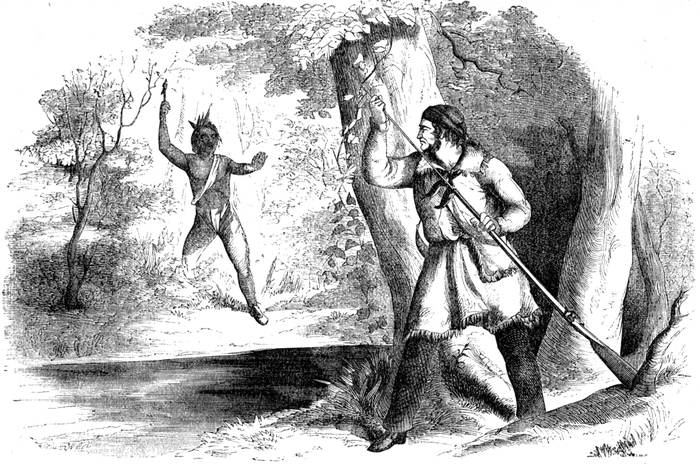
BRADY'S LEAP.
363
Captain Samuel Brady was the Daniel Boone of Ohio, and was as
efficient in the settlement of that State as his illustrious cotemporary
was in establishing the domain of the white man in the State of
Kentucky. He entered the army at the commencement of our Revolutionary
struggle, and was engaged at the siege of Boston, as well
as in many other important contests, during the war for independence.
He was a Lieutenant under Wayne at the massacre of Paoli,
when that officer was surprised, and the greater portion of his command
cut to pieces and destroyed in cold blood. Toward the close
of the war, he was Captain of a corps of rangers at Fort Pitt, under
General Brodhead, and rendered effectual service against the Indians,
who were in league with the British. He had lost a father and
brother at the hands of the red-skins, and swore to take a terrible
revenge.
To a mind fertile in expedient, and quick as a flash of light in its
deliberations, he added a frame well-knit, though slight, and a constitution
of iron mold. He was an Indian-fighter con amore, and the
greater portion of his time was spent in the war-path. Many are the
deeds of daring and thrilling adventure related of him. A volume
might be written embracing the adventures and hair-breadth escapes
of the gallant Captain; but, in common with an immense mass of
unwritten tradition equally valuable and interesting, they are fast
being forgotten and buried in the graves of the past generation.
On one occasion, while out with a small party of his rangers in
pursuit of the Indians, he had gone as far as Slippery Rock Creek, a
branch of Beaver River, in Western Pennsylvania, without seeing any
signs of his foe. Here, however, he struck upon a fresh trail, which
led up the creek, and he hastened in pursuit of the savages, who
were some distance in advance. He followed the trail until evening,
when he was obliged to wait the return of daylight before he could
pursue it further. At the earliest dawn he started afresh, and without
364stopping to break his fast, he hurried on, bent on coming up with
the enemy before they could reach their towns. His precipitancy
had nearly cost him his life, for although the party in front did not
dream of his proximity, yet a body of warriors, far outnumbering his
own small band, had discovered his trail, and were following it with
as much avidity as he was pursuing their comrades.
Brady discovered those in front, just as they were finishing their
morning meal and preparing to renew their journey. Placing his
men in such a manner as to intercept them, should any attempt to
escape, at a given signal they delivered a close and well-directed
volley, and started up to rush upon the enemy with their tomahawks,
when the band in their rear fired upon them in turn, taking them
completely by surprise, killing two of their number, and throwing
the remainder into confusion. Finding himself thus between two
fires, and vastly outnumbered, there was nothing left but flight; and
Brady, directing his men to look out for themselves, started off at his
topmost speed in the direction of the creek.
The Indians had a long and heavy account to settle with him,
however, and deemed this the opportunity to wipe it out with his
blood. For this purpose they desired to secure him alive, and fifty
red-skins, regardless of the others, who had scattered in every direction,
dropped their rifles and followed him. The Indians knew the
ground, Brady did not, and they felt secure of their victim when they
saw him run toward the creek, which was at this point a wide, deep,
and rapid stream. A yell of triumph broke from them as he arrived
at the bank and comprehended his desperate situation. There was
apparently no escape, and for a moment the Captain felt that his time
had come. It was but for an instant, however. He well knew the
fate which awaited him should he fall into the hands of his enemies,
and this reflection nerved him to a deed which, perhaps, in his
calmer moments, he would have found himself incapable of performing.
Gathering all his force into one mighty effort, as he approached
the brink of the stream, and clinging with a death-grip to his trusty
rifle, he sprung across the chasm through which the stream run, and
landed safely upon the other side, with his rifle in his hand. Quick
as thought, his piece was primed, and he commenced to reload. His
feet had barely made their imprint upon the soft, yielding soil of the
365western bank, before his place was filled by the brawny form of a
warrior, who, having been foremost in the pursuit, now stood amazed
as he contemplated the gap over which the Captain had passed.
With a frankness which seemed not to undervalue the achievement
of an enemy, the savage, in tolerable good English, exclaimed: "Blady
make good jump! Blady make very good jump!" His conflicting
emotions of regret at the escape of his intended victim, and admiration
of the deed by which that escape had been accomplished, did not
hinder the discovery that Brady was engaged in loading his piece;
and he did not feel assured but that his compliment would be
returned from the muzzle of the Captain's rifle. He incontinently
took to his heels as he discovered the latter ramming home the bullet,
which might the next moment be searching out a vital part in his
dusky form; and his erratic movements showed that he entertained
no mean idea of his enemy's skill at sharp-shooting. The outline of
the most intricate field fortification would convey but a slight idea
of the serpentine course he pursued, until satisfied that he was out of
rifle shot. Sometimes leaping in the air, at others squatting suddenly
on his haunches, and availing himself of every shelter, he evinced a
lively fear, which doubtless had its origin in a previous knowledge
of the fatal accuracy of the Captain's aim. Brady had other views,
however, and was not disposed to waste time and powder upon a
single enemy, when surrounded by hundreds, and when the next
moment an empty barrel might cost him his life; and while the
savage was still displaying his agility on the opposite bank, he darted
into the woods, and made his way to a rendezvous previously fixed
upon, where he met the remainder of his party, and they took their
way for home, not more than half defeated. It was not a great while
before they were again on the war-path, in search of further adventures.
Brady afterward visited the spot, and, out of curiosity, he measured
the stream at the place where he jumped, and found it to measure
twenty-three feet from shore to shore, and the water to be twenty
feet deep.
A similar incident is related of Brady in the "Historical Collections
of Ohio," as having occurred on the banks of the Cuyahoga, in
which it is stated that, as he was crawling up the opposite bank, the
Indians fired upon him, and wounded him in the hip, but he managed
366to stanch the wound and escape, by hiding himself in the hollow
trunk of a tree until the search for him was over, when he crawled
out, and, after incredible hardship and fatigue, arrived safe at his
quarters. The two stories may have had their origin in the same
occurrence, but the details are so dissimilar, except in the distance,
which is in both cases about twenty-three feet, that it is possible, nay,
more than probable, that the Captain was called upon to exert his
great powers on two separate occasions to save himself from the torture
or the stake.
At the time of this famous occurrence, Brady was under orders
from General Brodhead. The Indians did not return that season to
do any injury to the whites; and early that fall, moved off to their
friends, the British, who had to keep them all winter, their corn
having been destroyed by Brodhead.
When the General found the Indians were gone, at the suggestion
of Brady, three companies were ordered out, with a sufficient number
of pack-horses, to kill game for the supply of the garrison. These
companies were commanded by Captains Harrison, Springer and
Brady. Game was very plenty, for neither whites nor Indians ventured
to hunt, and great quantities were put up.
In putting up his tent, Captain Brady's tomahawk had slipped and
cut his knee, by which he was lamed for some time. This occasioned
him to remain at the tents until he got well, which afforded
him the opportunity of witnessing some of the peculiar superstitions
of his Indian allies, for he had his Indians and their families along
with him.
One of these Indians had assumed the name of Wilson. The
Captain was lying in his tent one afternoon, and observed his man,
Wilson, coming home in a great hurry, and that, as he met his squaw,
he gave her a kick, without saying a word, and begun to unbreech
his gun. The squaw went away, and returned soon after, with some
roots, which she had gathered; and, after washing them clean, she
put them into a kettle to boil. While boiling, Wilson corked up the
muzzle of his gun, and stuck the breech into the kettle, and continued
it there until the plug flew out of the muzzle. He then took it out
and put it into the stock. Brady, knowing the Indians were very
"superstitious," as we call it, did not speak to him until he saw him
367wiping his gun. He then called to him, and asked what was the
matter. Wilson came to the Captain, and said, in reply, that his gun
had been very sick—that she could not shoot; he had been just
giving her a vomit, and she was now well. Whether the vomit
helped the gun, or only strengthened Wilson's nerves, the Captain
could not tell, but he averred that Wilson killed ten deer the next day.
Beaver Valley was the scene of many of Captain Brady's stirring
adventures. We have heard from many of the older citizens their
accounts of his thrilling exploits. They speak in unbounded terms
of admiration of his daring and success; his many hair-breadth
escapes by "field and flood;" and always concluded by declaring that
he was a greater man than Daniel Boone or Lewis Wetzel, either of
whom, in the eyes of the old pioneers, were the very embodiment of
dare-devilism.
The following, illustrating one of Brady's adventures in the region
referred to, we give from a published source. In one of his trapping
and hunting excursions, he was surprised and taken prisoner by
Indians who had closely watched his movements.
"To have shot or tomahawked him would have been but a small
gratification to that of satiating their revenge by burning him at a
slow fire, in presence of all the Indians of their village. He was,
therefore, taken alive to their encampment, on the west bank of the
Beaver River, about a mile and a half from its mouth. After the
usual exultations and rejoicings at the capture of a noted enemy, and
causing him to run the gauntlet, a fire was prepared, near which
Brady was placed, after being stripped, and with his arms unbound.
Previous to tying him to the stake, a large circle was formed around
of Indian men, women and children, dancing and yelling, and uttering
all manner of threats and abuses that their small knowledge of
the English language could afford. The prisoner looked on these
preparations for death and on his savage foe with a firm countenance
and a steady eye, meeting all their threats with truly savage fortitude.
In the midst of their dancing and rejoicing, a squaw of one of their
chiefs came near him with a child in her arms. Quick as thought,
and with intuitive prescience, he snatched it from her, and threw it
into the midst of the flames. Horror-stricken at the sudden outrage,
the Indians simultaneously rushed to rescue the infant from the fire.
368In the midst of this confusion, Brady darted from the circle, overturning
all that came in his way, and rushed into the adjacent thicket,
with the Indians yelling at his heels. He ascended the steep side of
a hill amid a shower of bullets, and darting down the opposite
declivity, secreted himself in the deep ravines and laurel thickets that
abound for several miles in the West. His knowledge of the country
and wonderful activity enabled him to elude his enemies, and reach
the settlements in safety."
Shortly after he entered the service of General Broadhead, he was
sent, on a scout, as far west as Sandusky. Captain Brady was not
insensible to the danger, or ignorant of the difficulty of the enterprise.
But he saw the anxiety of the father of his country to procure information
that could only be obtained by this perilous mode, and
knew its importance. His own danger was an inferior consideration.
The appointment was accepted, and, selecting a few soldiers, and
four Chickasaw Indians as guides, he crossed the Allegany river,
and was at once in the enemy's country.
It was in May, 1780, that he commenced his march. The season
was uncommonly wet. Every considerable stream was swollen;
neither road, bridge nor house facilitated their march, or shielded
their repose. Part of their provision was picked up by the way, as
they crept, rather than marched through the wilderness by night, and
lay concealed in its branches by day. The slightest trace of his
movement, the print of a white man's foot on the sand of a river,
might have occasioned the extermination of the party. Brady was
versed in all the wiles of Indian "strategy," and, dressed in the full
war dress of an Indian warrior, and well acquainted with their languages,
he led his band in safety near to the Sandusky towns, without
seeing a hostile Indian.
The night before he reached Sandusky he saw a fire, approached
it, and found two squaws reposing beside it. He passed on without
molesting them. But his Chickasaws now deserted. This was
alarming, for it was probable they had gone over to the enemy.
However, he determined to proceed. With a full knowledge of the
horrible death that awaited him if taken prisoner, he passed on, until
he stood beside the town, and on the bank of the river.
His first care was to provide a place of concealment for his men.
369When this was effected, having selected one man as the companion
of his future adventures, he waded the river to an island partially
covered with driftwood, opposite the town, where he concealed himself
and comrade for the night.
In constancy of purpose, in cool, deliberate courage, the Captain
of the Rangers will compare with any hero of this age, or any other.
Neither banner nor pennon waved over him. He was hundreds of
miles in the heart of an enemy's country—an enemy who, had they
possessed it, would have given his weight in gold for the pleasure of
burning him to death with a slow fire—adding to his torments, both
mental and physical, every ingredient that savage ingenuity could
supply.
Who that has poetry of feeling, or feeling of poetry, but must
pause over such a scene, and, in imagination, contemplate its features!
The murmuring river; the sylvan landscape; as each was gazed upon
by that lonely, but dauntless warrior, in the still midnight hour.
The next morning a dense fog spread over hill and dale, town and
river. All was hid from Brady's eyes, save the logs and brush around
him. About eleven o'clock it cleared off, and afforded him a view
of about three thousand Indians, engaged in the amusements of the
race ground.
They had just returned from Virginia or Kentucky with some
very fine horses. One gray horse in particular attracted his notice.
He won every race until near evening, when, as if envious of his
speed, two riders were placed on him, and thus he was beaten. The
starting post was only a few rods above where Brady lay, and he had
a pretty fair chance of enjoying the amusement, without the risk of
losing any thing by betting on the race.
He made such observation through the day as was in his power,
waded out from the island at night, collected his men, went to the
Indian camp he had seen as he came out; the squaws were still
there; he took them prisoners, and continued his march homeward.
The map furnished by General Broadhead was found to be defective.
The distance was represented to be much less than it really
was. The provisions and ammunition of the men were exhausted
by the time they got to the Big Beaver, on their return. Brady shot
an otter, but could not eat it. The last load was in his rifle. They
370arrived at an old encampment, and found plenty of strawberries,
which they stopped to appease their hunger with. Having discovered
a deer track, Brady followed it, telling the men he would perhaps get
a shot at it. He had gone but a few rods when he saw the deer
standing broadside to him. He raised his rifle and attempted to fire,
but it flashed in the pan, and he had not a priming of powder. He
sat down, picked the touch-hole, and then started on. After going a
short distance the path made a bend, and he saw before him a large
Indian on horseback, with a white child before, and its captive mother
behind him on the horse, and a number of warriors marching in the
rear. His first impulse was to shoot the Indian on horseback, but,
as he raised his rifle, he observed the child's head to roll with the
motion of the horse. It was fast asleep, and tied to the Indian. He
stepped behind the root of a tree, and waited until he could shoot
the Indian, without danger to the child or its mother.
When he considered the chance certain, he shot the Indian, who
fell from his horse, and the child and its mother fell with him.
Brady called to his men with a voice that made the forest ring, to
surround the Indians and give them a general fire. He sprung to
the fallen Indian's powder-horn, but could not pull it off. Being
dressed like an Indian, the woman thought he was one, and said:
"Why did you shoot your brother?"
He caught up the child, saying:
"Jenny Stupes, I am Captain Brady; follow me, and I will secure
you and your child."
He caught her hand in his, carrying the child under the other arm,
and dashed into the brush. Many guns were fired at him by this
time, but no ball harmed him, and the Indians, dreading an ambuscade,
were glad to make off. The next day he arrived at Fort McIntosh
with the woman and her child. His men had got there
before him. They had heard his war-whoop, and knew it was Indians
he had encountered, but, having no ammunition, they had
taken to their heels, and ran off. The squaws he had taken at
Sandusky, availing themselves of the panic, had also made their
escape.
In those days Indian fashions prevailed, in some measure, with the
whites, at least with rangers. Brady was desirous of seeing the
371Indian he had shot, and the officer in command of Fort McIntosh gave
him some men in addition to his own, and he returned to search for
the body. The place where lie had fallen was discovered, but nothing
more. No pains were spared to search, but the body was not
found. They were about to leave the place, when the yell of a pet
Indian, that came with them from the fort, called them to a little
glade, where the grave was discovered. The Indians had interred
their dead brother there, carefully replacing the sod in the neatest
manner. They had also cut brushes and stuck them into the ground,
but the brushes had withered, and instead of concealing the grave,
they led to the discovery.
He was buried about two feet deep, with all his implements of war
about him.
All his savage jewelry, his arms and ammunition were taken from
him, and the scalp from his head, and then they left him, thus stripped,
alone in his grave. It is painful to think of such things being
done by American soldiers, but we cannot now know all the excusing
circumstances that may have existed at the time. Perhaps the husband
of this woman, the father of this child, was thus butchered before
his wife and children; and the younger members of the family,
unable to bear the fatigues of traveling, had their brains dashed out
on the threshold. Such things were common, and a spirit of revenge
was deeply seated in the breasts of the people of the frontiers.
Captain Brady's own family had heavily felt the merciless tomahawk.
His brave and honored father, and a beloved brother, had been
treacherously slain by the Indians, and he had vowed vengeance.
After refreshing himself and men, they went up to Pittsburg by
water, where they were received with military honors. Minute guns
were fired from the time Brady came in sight until he landed.
The Chickasaw Indians had returned to Pittsburg, and reported
that the Captain and his party had been cut off near Sandusky town
by the Indians. When General Broadhead heard this, he said
Brady was an aspiring young man, and had solicited the command.
But on Brady's arrival in Pittsburg, the General acknowledged that
the Captain had accepted the command with much diffidence.
A few days after Brady had left Sandusky with his squaw prisoners,
keeping a sharp look-out in expectation of being pursued, and
372taking every precaution to avoid pursuit, such as keeping on the
dryest ridges, and walking on logs whenever they suited his course,
he found he was followed by Indians. His practised eye would occasionally
discover in the distance, an Indian hopping to or from a
tree, or other screen, and advancing on his trail. After being satisfied
of the fact, he stated it to his men, and told them no Indian
could thus pursue him, after the precautions he had taken, without
a dog on his track.
"I will stop," said Brady, "and shoot the dog, and then we can
get along better."
He selected the root of a tall chestnut tree which had fallen westward,
for his place of ambush. He walked from the west end of
the tree or log to the east, and sat down in the pit made by
the raising of the root. He had not been long there when a small
slut mounted the log at the west end, and, with her nose to the
trunk, approached him. Close behind her followed a plumed warrior.
Brady had his choice. He preferred shooting the slut, which
he did; she rolled off the log, stone dead, and the warrior, with a
loud whoop, sprung into the woods and disappeared. He was followed
no further.
Many of Captain Brady's adventures occurred at periods of which
no certainty as to dates can now be had. The following is of that
class:
His success as a partisan had acquired for him its usual results—approbation
with some, and envy with others. Some of his brother
officers censured the Commandant for affording him such frequent
opportunities for honorable distinction. At length an open complaint
was made, accompanied by a request, in the nature of a demand, that
others should be permitted to share with Brady the perils and honors
of the service, abroad from the fort. The General apprised Brady of
what had passed, who readily acquiesced in the proposed arrangement;
and an opportunity was not long wanting for testing its
efficiency.
The Indians made an inroad into the Sewickly settlement, committing
the most barbarous murders of men, women, and children;
stealing such property as was portable, and destroying all else. The
alarm was brought to Pittsburg, and a party of soldiers under the
373command of the emulous officers dispatched for the protection of the
settlement, and chastisement of the foe. From this expedition
Brady was, of course, excluded; but the restraint was irksome to his
feelings.
The day after the detachment had marched, he solicited permission
from the commander to take a small party for the purpose of
"catching the Indians," but was refused. By dint of importunity,
however, he at length wrung from him a reluctant consent, and the
command of five men; to this he added his pet Indian, and made hasty
preparation.
Instead of moving toward Sewickly, as the first detachment had
done, he crossed the Alleghany at Pittsburg, and proceeded up the
river. Conjecturing that the Indians had descended the stream in
canoes, till near the settlement; he was careful to examine the
mouths of all creeks coming into it, particularly from the Southeast.
At the mouth of Big Mahoning, about six miles above Kittanning,
the canoes were seen drawn up to its western bank. He instantly
retreated down the river, and waited for night. As soon as it was
dark, he made a raft, and crossed to the Kittanning side. He then
proceeded up the creek, and found that the Indians had, in the meantime,
crossed the creek, as their canoes were drawn to its upper or
north-eastern bank.
The country on both sides of Mahoning, at its mouth, is rough and
mountainous, and the stream, which was then high, very rapid.
Several ineffectual attempts were made to wade it, which they at
length succeeded in doing, three or four miles above the canoes.
Next, a fire was made, their clothing dried, and arms inspected; and
the party moved toward the Indian camp, which was pitched on the
second bank of the river. Brady placed his men at some distance on
the lower or first bank.
The Indians had brought from Sewickly a stallion, which they had
fettered and turned to pasture on the lower bank. An Indian,
probably the owner, under the law of arms, came frequently down to
him, and occasioned the party no little trouble. The horse, too,
seemed willing to keep their company, and it required considerable
circumspection to avoid all intercourse with either. Brady became
so provoked that he had a strong inclination to tomahawk the Indian,
374but his calmer judgment repudiated the act, so likely to put to hazard
a more decisive and important achievement.
At length the Indians seemed quiet, and the Captain determined to
pay them a closer visit, which he succeeded in doing, then returned,
posted his men, and in the deepest silence all awaited the break of
day. When it appeared, the Indians arose and stood around their
fires, exulting doubtless in the scalps they had taken, the plunder
they had acquired, and the injuries they had inflicted on their
enemies. Precarious joy! short-lived triumph! the avenger of blood
was beside them. At a signal given, seven rifles cracked, and five
Indians were dead ere they fell. Brady's well-known war-cry was
heard, his party were among them, and their rifles (mostly empty)
were all secured. The remaining Indians instantly fled and disappeared.
One was pursued by the trace of his blood, which he seems
to have succeeded in staunching. The pet Indian then imitated the
cry of a young wolf, which was answered by the wounded man, and
the pursuit was again renewed. A second time the wolf cry was
given and answered, and the pursuit continued into a windfall. Here
he must have espied his pursuers, for he answered no more. Brady
found his remains three weeks afterwards, being led to the place by
ravens that were preying on the carcass.
The horse was unfettered, the plunder gathered, and the party commenced
their return to Pittsburg, most of them descending in the
Indian canoes.
Three days after their return, the first detachment came in. They
reported that they had followed the Indians closely, but that the
latter had got into their canoes and made their escape.
Captain Brady married a daughter of Captain Van Swearengen, of
Ohio County, who bore him two children, John and Van S., both of
whom are still living. He possessed all the elements of a brave and
successful soldier. Like Marion, "he consulted with all his men
respectfully, heard them patiently, weighed their suggestions, and
silently approached his own conclusions. They knew his determination
only by his actions." Brady had but few superiors as a
woodsman; he would strike out into the heart of the wilderness, and
with no guide, but the sun by day, and the stars by night, or in
their absence, then by such natural marks as the barks and tops of
375trees he would move on steadily, in a direct line toward the point of
his destination. He always avoided beaten paths and the borders of
streams; and never was known to leave his track behind him. In
this manner he eluded pursuit, and defied detection. He was often
vainly hunted by his own men, and was more likely to find them,
than they him.