Good evening, Uncle Thomas! we are come to hear about the Mutiny of the
Bounty.
Very well, boys, it is a long story, so I shall begin at once.
In the year 1787, it having been represented to the British Government,
that the introduction of the Bread-fruit tree into the West India
islands would be of great benefit to the inhabitants, a vessel was
fitted up, in the most commodious manner, for the reception of the
plants, and placed under the command of Lieutenant Bligh, who had
previously sailed with Captain Cook on his voyage round the world.
Her crew consisted of thirty-four persons, besides two intelligent
botanists, who were added to the expedition for the purpose of
managing the plants during the voyage, as well as undertaking their
transplantation on board the vessel, and on their arrival at the place
of destination.
On the 23d December, the Bounty sailed from Spithead, and on the 26th
encountered a severe storm from the eastward, which continued for three
days, during which the ship suffered considerably. They therefore found
it necessary to touch at Teneriffe, in order to refit. Having put
everything to rights, they again sailed, on the 10th January, 1788.
For nearly a month they struggled hard against the tempestuous weather
which they encountered on their attempts to reach the Society Islands,
where the plants were to be procured, by the route of Cape Horn, but at
length, finding all their efforts ineffectual, they bore away for the
Cape of Good Hope, where they once more found it necessary to replenish
their stock of provisions and water.
At length, on the 26th of October, they came to anchor in Matavai Bay,
in the island of Otaheite. The ship was soon crowded by natives, and
two messengers arrived from Otoo, the chief of Matavai, each bringing a
small pig and a young plantain-tree, as a token of friendship. Captain
Bligh now went on shore, accompanied by a chief named Poeenoo, and was
everywhere received in the most friendly manner, the women clothing
him in the Otaheitan fashion, and afterwards accompanying him to the
boat. In a few days the most friendly relations were established with
the natives, and presents of small articles were bestowed on the chief,
who was told that the king of England had sent him these on account of
the kindness of his people to Captain Cook, as well as from a desire
to serve him and his countrymen. At the same time he was asked if
there was nothing he would like to send to the king in return. "Yes,"
said he, "I will send him anything I have," and immediately began
enumerating such articles as the island afforded, and among others
mentioned the bread-fruit. He was immediately told that this was what
would please the king very much, and a number of young trees were
promised to be sent on board.
For upwards of five months the Bounty remained at Matavai, when,
having at length obtained upwards of one thousand plants, she set sail
on the 4th of April, after bidding a most affectionate farewell to
these kind and simple-hearted islanders.
On the 23d, they reached the island of Annamooka, where they remained
till the 26th, carrying on a brisk trade with the natives in yams,
plantains, hogs, fruits, &c. From thence the ship stood northward all
night, and at noon on the following day they were between the islands
of Tofoa and Kotoo.
So far the voyage had been one of uninterrupted prosperity. They
had hitherto succeeded in the object of their mission, and to all
appearance it was likely to result in the most complete success. These
fair prospects were, however, destined to be suddenly overclouded
by one of the most systematic, as well as cautious and deliberate
mutinies, upon record.
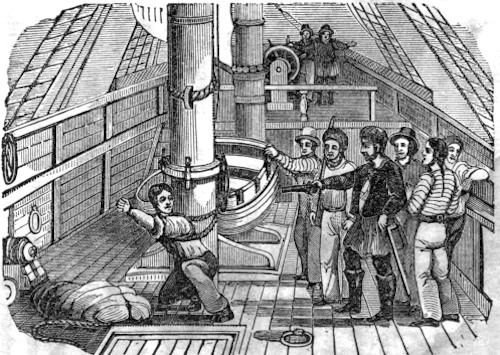
[Illustration: They pulled Captain Bligh out of bed, forced him upon
deck, and placed him under a guard.—P. 81.]
About sunrise of the morning of the 28th April, Captain Bligh was awoke
by Fletcher Christian, one of the mates, and three others, who tied
his hands behind his back, and threatened him with instant death if he
spoke or made the least resistance. They then pulled him out of bed,
forced him on deck in his shirt, and placed him under a guard with
Christian, who seemed to be the ringleader at their head. To all his
entreaties and enquiries as to the reason for this violence, their only
answer was a command to hold his tongue, with threats of having his
brains blown out if he did not instantly comply.
The mutineers then ordered the boatswain to hoist the launch out, and
several of the officers were ordered into it. As Captain Bligh now
saw the fate that awaited him and the obnoxious members of his crew,
he once more made an effort to reason with those around him, but was
immediately checked, and again threatened with instant death. When they
had succeeded in getting rid of such of the crew as they disliked, the
mutineers forced the captain over the ship's side into the boat, and
after subjecting their victims to much ridicule, and making sport of
their situation, they at length cast them adrift on the open sea! As
the vessel sailed away, they could hear the mutineers shouting "Huzza
for Otaheite!" It was therefore supposed that the enticements of a
delightful climate and the allurements of a continuance of the life of
unrestrained indulgence which they had recently led on that island,
had tempted them to the commission of the crime of which they had been
guilty.
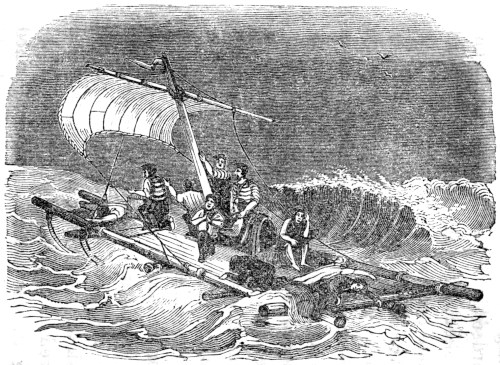
The launch (a boat twenty-three feet in length) contained nineteen
persons; and the quantity of provisions which they had been permitted
to secure, amounted to only one hundred and fifty pounds weight of
bread, about thirty pounds of pork, six quarts of rum, six bottles of
wine, and twenty-eight gallons of water.
Thus abandoned, Captain Bligh and his companions directed their course
to Tofoa, in the hope of there obtaining a supply of bread-fruit
and water. They had at first great difficulty in finding any of the
natives; at length, however, having fallen in with two of them, several
others soon collected, from whom they obtained a small supply of such
articles as they wanted. By degrees the number of natives increased,
and they began to show symptoms of some hostile design; but they were,
for the time, overawed by the undaunted behavior of Captain Bligh.
As the evening advanced, however, they continued to congregate, all
carrying stones in their hands, which they continued knocking together
in token of attack, and on the party proceeding to embark with the
provisions which they had accumulated, the attack commenced. They had
all got in safety to the boat, and one of the men jumped on shore
in order to untie the rope by which it was fastened, when he was
instantly knocked down and murdered in the most inhuman manner. Finding
that there was no hope of lending assistance to their unfortunate
companion, they hastily pushed off. Some of the natives got into their
canoes, and gave chase, throwing the stones with which they were
armed, with such power and effect as nearly to disable every person on
board. Fortunately, it occurred to Captain Bligh to drop some clothes
overboard, when the canoes stopping to pick them up, allowed them to
get a little ahead of their pursuers, and it being now almost dark,
they gave up the chase.
Seeing that there was now no hope of relief until they reached Timour,
a distance of full twelve hundred leagues, where there was a Dutch
settlement, Captain Bligh and his companions bent their course across
an ocean whose navigation was then little known, exposed as well to the
dangers of the deep as to famine, their little store only allowing them
to serve out one ounce of bread and a quarter of a pint of water per
day.
Captain Bligh has left a very interesting journal of their sufferings
during this long and hazardous voyage, from which I will read you a few
of the daily entries. It was about eight o'clock at night on the 2nd of
May, that they bore away from Tofoa, and having divided the people into
watches, and put the boat somewhat in order, they returned thanks to
God for their miraculous preservation.
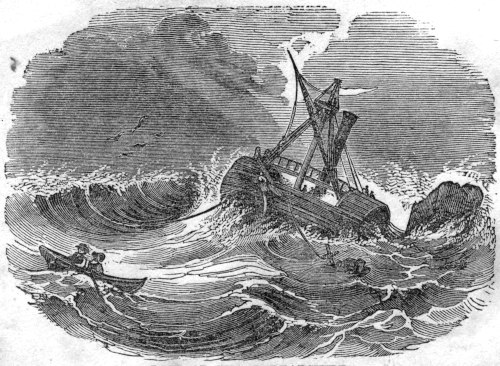
On the 3d, it blew a violent storm, and the sea ran so high, that they
were obliged to keep constantly bailing, and were in great apprehension
that the bread, which was in bags, would be spoiled; to prevent this
they threw overboard all superfluous clothes, with some spare sails
and ropes, in order to lighten the boat, and emptying the carpenter's
chest, stowed the tools at the bottom of the boat, and put the bread
into the chest.
On the morning of the 5th, the gale had abated, and the boat was
running among some islands; but after their reception at Tofoa, they
did not venture to land. Upon examining the state of their bread, they
found that a great part of it was damaged; but even this was carefully
preserved for use. The next day they still continued to see islands at
a distance; and for the first time, to their great joy, they hooked a
fish, but were miserably disappointed by losing it, as they were trying
to get it into the boat. They were dreadfully cramped from the want of
room, which they endeavored to remedy by putting themselves at watch
and watch; one half sitting up, while the others lay down in the bottom
of the boat, with nothing to cover them, and so constantly wet, that
after a few hours' sleep, they were scarcely able to move.
On the 7th, they passed close to some rocky isles, from which they
were pursued by two large sailing canoes, but in the afternoon they
gave over the chase. Soon after, it began to rain very heavily, when
every person on board did his utmost to catch some water, by which
they increased their stock to thirty-four gallons, besides quenching
their thirst for the first time since they had been in the boat. The
following day they had an allowance of an ounce and a half of pork, a
tea-spoonful of rum, half a pint of cocoa-nut milk, and an ounce of
bread. The afternoon was employed in cleaning out the boat, and getting
everything dry and in order. Hitherto Captain Bligh had issued the
allowance by guess, but he now made a pair of scales with two cocoa-nut
shells, and finding some pistol balls in the boat, which weighed
twenty-five to the pound, he adopted one of these as the weight of
bread to be served to each person at one time.
On the 9th they experienced a violent storm of thunder and lightning.
They collected about twenty gallons of water; but were so miserably wet
and cold, that a tea-spoonful of rum was served to each. The weather
continued extremely bad, and the wind so increased, that hardly one
of them got any sleep that night. The morning of the 10th brought no
relief except its light. The sea broke over the boat so much, that two
men were kept constantly bailing; and it was necessary to keep the boat
before the wind to prevent its filling. The allowance was now one
bullet-weight of bread and a quarter of a pint of water, at eight in
the morning, at noon, and at sunset, with the addition of half an ounce
of pork for dinner.
The weather had not at all improved on the following day, and their
situation was becoming extremely dangerous from the constant running of
the sea over the stern, which kept them baling with all their strength;
but at noon they were much enlivened by the appearance of the sun,
which gave them great pleasure.
On the 12th it rained towards the evening, and they again experienced a
dreadful night. When the day came, they were in no way refreshed by the
little sleep they had, as they were constantly drenched by the sea and
rain; and though the men were shivering with wet and cold, the captain
was under the disagreeable necessity of informing them, that he could
no longer afford them the scanty pittance of a tea-spoonful of rum.
The stormy weather and heavy seas continued unabated on the 13th and
14th, and on these days they saw distant land and passed several
islands, the sight of which increased, rather than alleviated the
misery of their situation; as an attempt to procure relief was
considered to be attended with so much danger, that it was thought
advisable to remain as they were, rather than encounter the risk.
The 15th, it was still rainy, both day and night; it was so dark that
not a star could be seen by which steerage could be directed, and the
sea was continually breaking over the boat: this continued on the 16th,
when they passed a truly horrible night, with storms of thunder,
lightning, and rain. The dawn of the 17th brought no relief; and the
suffering from wet and cold had been so severe, that they were obliged
to break their rule, and serve a tea-spoonful of rum to each. The night
was again dark and dismal, and nothing but the winds and waves to
direct their steering.
On the 18th the rain abated, when they stripped and wrung their
clothes, which greatly refreshed them; but every one of them complained
of violent pains in their bones. At night the rain re-commenced,
with thunder and lightning, which continued without intermission
till the 21st, when they were so drenched with rain and salt water
during the whole of the afternoon, that they could scarcely see; and
on the following day their situation was extremely calamitous. They
were obliged to run right before the storm and keep a strict watch,
as the slightest error in the helm would have instantly caused their
destruction. During the night the misery they endured was excessive,
so much so that they expected another such a night would put an end to
the sufferings of several of them; but on the 24th the wind moderated
towards the evening, and the night was fair. In the morning they
experienced relief, from the warmth of the sun, for the first time
during the last fifteen days.
As the sea now began to run fair, Captain Bligh took the opportunity to
examine their stock of bread, and found there was sufficient, according
to their present rate of allowance, to last twenty-nine days, which
was about the time they expected to be able to reach Timor: but as
this was uncertain, and it was possible they might be obliged to go
to Java, they determined to reduce their present scanty rate, so as to
make the stock hold out six weeks. This was effected by continuing the
same quantity for breakfast and dinner as usual, and discontinuing the
supper allowance.
At noon of the 25th, some noddies came so near to the boat, that
they caught one of them, about the size of a small pigeon. This was
divided, with its entrails, into eighteen portions, and distributed
by the following method:—one man stood with his back to the object,
while another, pointing separately to each portion, asked aloud, "Who
shall have this?" to which the first answered by naming somebody, until
the whole number had been served. By this impartial method, each man
stood the same chance of obtaining an equal share. They had also an
allowance of bread and water. In the evening several boobies came near
them, and they were fortunate enough to catch one about as large as a
duck. This they killed for supper, and, giving the blood to three of
the people who were most distressed, the body, with the entrails, feet,
and beak, were divided into eighteen shares, and distributed as before;
and having with it an allowance of bread, the whole made an excellent
supper.
On the 28th, at one o'clock in the morning, the man at the helm heard
the sound of breakers. It was the barrier reef which runs along the
eastern coast of New Holland, through which it now became their anxious
object to discover a passage. The sea broke furiously over the reef,
but within was so smooth and calm, that they already anticipated the
heartfelt satisfaction they should experience, as soon as they should
pass the barrier. At length they discovered a break in the reef, about
a quarter of a mile in width, through which they passed rapidly with a
strong stream running to the westward, and came almost immediately into
smooth water.
They offered up their thanks to the Almighty for his merciful
protection of them, and then, with more contentment than they had yet
been able to feel, took their miserable allowance of a bullet-weight
of bread and a quarter of a pint of water for dinner. They now began
to see the coast very distinctly, and in the evening they landed on
the sandy point of an island, where they soon discovered that there
were oysters: they also found plenty of fresh water. By the help of
a small magnifying glass, a fire was made; and they discovered among
the things that had been thrown into the boat a tinder-box and a piece
of brimstone, so that in future they had the ready means of making a
fire. One of the men had been provident enough to bring with him from
the ship a copper pot, in which they made a stew of oysters, bread and
pork, and each person received a full pint.
They now enjoyed a few luxurious meals of oysters and palm-tops stewed,
without consuming any of their bread. They also collected a quantity
of oysters, which they put on board the boat, and filled their vessels
with fresh water, to the amount of nearly sixty gallons. Upon examining
the bread, they found about thirty-eight days' allowance remaining.
Being now ready for sea, every person was ordered to attend prayers;
and just as they were on the point of embarking, about twenty naked
savages made their appearance, and beckoned them to come near; but as
they were armed with spears and lances, it was thought advisable to
decline the invitation, and proceed on their voyage.
At length, after a variety of adventures, and the endurance of
privations almost unexampled, on the 11th of June Captain Bligh
announced the pleasing intelligence to his companions, that an
observation of longitude appeared to indicate that they had passed the
meridian of the eastern part of Timor. This joyful news filled every
heart with exultation, and all eyes were intently directed to the
quarter in which land was expected to appear. Evening fell, however,
without their being able to discover any trace of it; but by day-break
on the following morning, a cultivated coast, finely diversified with
hill and dale, appeared, stretching in a wide extent before them.—This
was Timor!
It is almost impossible to describe the wild tumult of joy, the
intense and inexpressible delight, which filled their hearts at the
sight of land! Their thoughts rapidly reverted to the varied events
of their fearful passage, till it appeared scarcely credible, even
to themselves, that in an open boat, so poorly provided, and under
circumstances every way so calamitous, they should have been able to
reach the coast of Timor in forty-one days after leaving Tofoa, having
in that time run, by their log, a distance of three thousand six
hundred and eighteen nautical miles: and this, notwithstanding their
extreme distress, without the loss of a single individual.
The governor of the island received them with the greatest hospitality.
After remaining a short time at Timor, they proceeded to Batavia. Here
Captain Bligh was seized with a fever; and as his life was in danger
from the heat of the climate, he was obliged to leave the island
without loss of time. He accordingly sailed in a packet, and arrived
in England in March, 1790. The crew were accommodated with passages
home as opportunity offered, but though apparently all in good health
when Captain Bligh left, they did not all live to quit Batavia. The
hardships which they had undergone had so undermined the constitutions
of several, as rendered them unable to support the rigor of such an
unhealthy climate; but of the nineteen who were forced into the launch
by the mutineers, it pleased God that twelve should surmount the
difficulties and dangers of this unparalleled voyage, and live to visit
their native land.
But, Uncle Thomas, what became of the mutineers?
Another vessel, boys, was fitted out by the British Government to
proceed in search of them. Several of them were taken and brought to
England, where, after being tried, three of them were executed. Some
of the others who had been forced to join the mutiny were pardoned.
From the statements of these men, it appeared that quarrels soon
sprang up among them after Captain Bligh's departure, and several of
them suffered violent deaths—among the rest, Christian, who you will
recollect was the most active among them, was murdered by one of the
natives. The death of Christian was the signal for a general rising
among the natives, who, by this time, had become tired of the English;
some of them were killed, and others, among whom was a man named John
Adams, escaped, wounded, to the woods. They were joined by several
females, to whom they had formed attachments, with whom they escaped
and established themselves on what has since been called Pitcairn's
Island. For twenty years nothing was heard of them, till two British
vessels, happening to touch at the island, the crews were astonished to
find it inhabited, and more so when they were accosted in their native
tongue by the inhabitants.
Matters were soon explained. They found Adams, a fine-looking old man,
of nearly sixty years of age. He was revered as the father of the
colony, and ruled with a paternal sway over his little kingdom. He died
in 1829.
But I must stop. I fear I have already detained you too long to-night,
boys,—So good night!
Good night, Uncle Thomas.