BY
HAROLD FREDERIC
THE PATH OF MURTOGH
A curse is laid on one long narrow strip of the sea, down in front of Dunlogher.
No matter how lifeless the sunlit air may hang above; no matter how
silken-smooth the face of the waters nearest by, lifting themselves
without a ripple in the most indolent summer swell,—an angry churning
goes always forward here. Disordered currents will never tire of their
coiling and writhing somewhere underneath: the surface is streaked with
sinister markings like black shadows, which yet are no shadows at all;
and these glide without ceasing out and in among the twisted lines of
grey-white scum, and everything moves and nothing changes, till Judgment
Day. It has the name of the Slighe Mhuircheartaigh (spoken Shlee
Vurharthee), or the Path of Murtogh.
Though 'tis well known that the grandest ling and turbot and wonderful
other big fishes lie swaying themselves in the depths of this wicked
water, with giant crayfish and crabs to bear them company, the fishermen
of Dunmanus and Goleen and Crookhaven, and even the strangers from Cape
Clear, would not buy a soul from Purgatory at the price of drawing a net
through it. They have a great wish to please the buyers in the English
ships, and the Scotch and Manx, O yes,—but a creel of gold would not
tempt them to meddle in 'Murty's Path.' They steer their boats far to
one side, and bless themselves as they pass, in the manner of their
fathers and grandfathers before them.
These poor men, having not much of the Irish now, and not rightly
understanding what their elders may have heard the truth of, say that
this snake-like forbidding stretch wears its name from Murty Oge
O'Sullivan. Their thought is that the uncanny boiling began in the wake
of the English Speedwell, as the corpse of the vanquished privateer
spun and twirled at her keel through the foam, on its savage last
journey from Castletown to Cork. But it is enough to look down at this
evil place, to see that the malediction upon it must be older than Murty
Oge's time, which, in the sight of Dunlogher, was as yesterday. Why,
men are living this year who talked with men who saw his head spiked
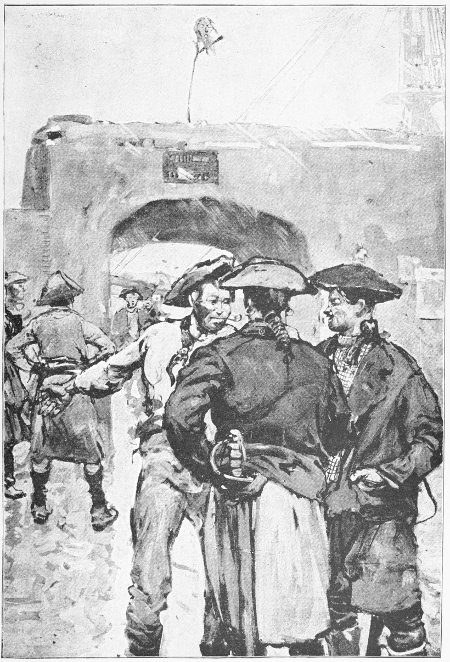
over South gate. There were no great curses left unused in Ireland at so
late a day as his. And again, would it be the waters of Dunlogher that
would tear themselves for an O'Sullivan?
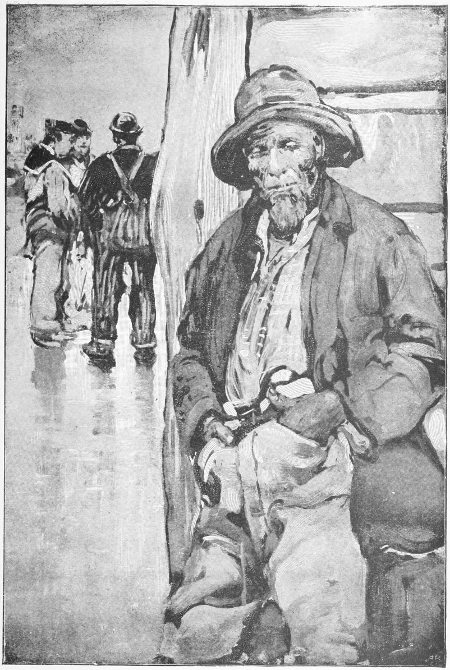
Saw his head spiked over South Gate.
No, the curse threads back a dozen lives behind poor Murty Oge. The
strange currents weave and twine, and the greasy foam spreads and
gathers, gathers and spreads, in the path of another, whose birthright
it was that they should baptise him. The true tale is of Murty the
Proud, or if you will have his style from the Book of Schull,—Murtogh
Mordha O'Mahony, chief in Dunlogher. And his time is not so distant,
in one way, as men take account of years. But in another it is too
remote for any clear vision, because the 'little people' of the old,
fearful kind had left every other part of Ireland, and they were just
halting together for a farewell pause in Dunlogher, by reason of its
being the last end of the land, and their enchantments fanned up a
vapour about Murty Mordha to his undoing. And it is as if that mist
still rose between us and his story.
When the sun began to sink out of sight, down behind the sea, two men
stood on the edge of the great cliff of Dunlogher, their faces turned to the west.
The yellow flame from the sky shone full in the eyes of Murtogh, and he
held his huge, bare head erect with boldness, and stared back at it
without blinking. His companion, a little, shrivelled old man, whom he
held by the arm, had the glowing light on his countenance as well, but
his eyelids were shut. He bent himself against his chief's thick
shoulder and trembled.
'Are we to the brink itself?' he asked; his aged voice shook when he spoke.
'Here, where I stand, when I would grip you, and hold you forth at the
length of my arm, and open my hand, you would fall a hundred fathoms in
the air.' Murtogh's free arm and hand made the terrible gesture to fit
his words, but he tightened his protecting clasp upon the other, and led
him back a few paces. The old man groaned his sigh of relief.
'It is you who are the brave nobleman, Murty,' he whispered, admiringly.
'There is none to equal your strength, or your grand courage, in all the
land. And the heart of pure gold along with it!'
Murtogh tossed his big head, to shake the twisted forelock of his hair
to one side. 'I looked straight into the sun at noon on St. John's Day,'
he said, quietly, with the pride of a child. 'If it were a hundred times
as bright, I would look at it, and never fear for my eyes. I would hold
my own son out here, stretched over the abyss, and he would be no safer
in his bed. Whatever I wished to do, I would do it.'
'You would—O, you would!' assented the old man, in tones of entire sincerity.
The chieftain kept his eyes on the skyline, beneath which, as the
radiance above deepened, the waters grew ashen and coldly dark. Musing,
he held his silence for a time. Then, with abruptness, he asked:—
'What age were you, Owny Hea, when the McSwineys put out your eyes? Were
you strong enough to remember the sun well?'
'I was of no strength at all,' the other whimpered, the tragedy of his
childhood affecting his speech on the instant. 'I was in my mother's
arms. There were the men breaking in through the wall, and the kine
bellowing outside, and my father cut down; and then it was like my
mother drew her cloak tight over my head,—and no one came ever to take
it off again. I forget the sun.'
Murtogh nodded his head. 'I will go to Muskerry some day,' he said, in a
kindly way. 'I cannot tell when, just now; but I will go, and I will
burn and desolate everything for six miles around, and you shall have a
bag for your harp made of eyelids of the McSwineys.'
Old Owny lifted his sightless face toward his master, and smiled with
wistful affection. 'Ah, Murty, dear,' he expostulated, mildly, 'it is
you who have the grand nature; but think, Murty,—I am a very old man,
and no kin of yours. It is fifty years since the last man who took my
eyes drew breath. If you went now, no living soul could tell what you
came for, or why the great suffering was put upon them. And, moreover,
the O'Mahonys Carbery have wives from the McSwineys these three
generations. No feud lies now.'
The lord of Dunlogher growled sharply between his teeth, and Owny shrank
further back.
'How long will you be learning,' Murtogh demanded, with an arrogant note
in his voice, 'that I have no concern in the O'Mahonys Carbery, or the
O'Mahonys Fonn-Iartarach, or any other? I do not take heed of Conogher
of Ardintenant, or Teige of Rosbrin, or Donogh of Dunmanus, or Donal of
Leamcon. I will give them all my bidding to do, and they will do it, or
I will kill them, and spoil their castles. You could not behold it, but
you have your song from the words of others: how last year I fell upon
Diarmaid Bhade, and crushed him and his house, and slew his son, and
brought away his herds. His father's father and mine were brothers. He
is nearer to me in blood than the rest, yet I would not spare him. I
made his Ballydevlin a nest for owls and bats. Let the others observe
what I did. I am in Dunlogher, and I am the O'Mahony here, and I look
the sun in the face like an eagle. Put that to your song!'
The sound came to them, from the walled bawn and gateways beyond the
Three Castles, a hundred yards behind, of voices in commotion. The old
bard lifted his head, and his brow scored itself in lines of listening
attention. If Murtogh heard, he gave no sign, but gazed again in
meditation out upon the vast waste of waters, blackening now as the
purple reflections of the twilight waned.
'Blind men have senses that others lack,' he remarked at last. 'Tell me,
you, does the earth we stand on seem ever to you to be turning round?'
Owny shuddered a little at the thought which came to him. 'When you led
me out beyond here, and I felt the big round sea-pinks under my feet,
and remembered they grew only on the very edge—' he began.
'Not that,' the chief broke in, ''tis not my meaning. But at Rosbrin
there was a book written by Fineen the son of Diarmaid, an uncle to my
father's father, and my father heard it read from this book that the
world turned round one way, like a duck on a spit, and the sun turned
round the other way, and that was why they were apart all night. And
often I come here, and I swear there is a movement under my feet. But
elsewhere there is none, not in the bawn, or in the towers, or anywhere
else but just here.'
The old man inclined his face, as if he could see the ground he stood
upon, but shook his head after a moment's waiting. 'It would not be
true, Murty,' he suggested. 'Old Fineen had a mighty scholarship, as I
have heard, and he made an end to edify the angels, but—but—'
Murtogh did not wait for the hesitating conclusion. 'I saw his tomb
when I was a lad, in the chapel at Rosbrin. He was laid at his own
desire under a weight of stone like my wall here. I saw even then how
foolish it was. These landsmen have no proper sense. How will they rise
at the blessed Resurrection, with all that burden of stone to hold them
down? I have a better understanding than that. I buried my father, as he
buried his father, out yonder in the sea. And I will be buried there,
too, and my son after me—and if I have other children—' he stole a
swift glance at the old man's withered face as he spoke—'if I have
others, I say, it will be my command that they shall follow me there,
when their time comes. I make you witness to that wish, Owny Hea.'
The bard hung his head. 'As if my time would not come first!' he said,
for the mere sake of saying something. Then, gathering courage, he
pulled upon the strong arm which was still locked in his, and raised
his head to speak softly in the O'Mahony's ear.
'If only the desire of your heart were given you, Murty,' he murmured;
'if only once I could hold a babe of yours to my breast, and put its
pretty little hands in my beard,—I'd be fit to pray for the men who
took my eyes from me. And Murty dear,'—his voice rose in tremulous
entreaty as he went on,—'tell me, Murty,—I'm of an age to be your
father's father, and I've no eyesight to shame you,—is she—is your
holy wife coming to see her duty differently? Have you hope
that—that—?'
Murtogh turned abruptly on his heel, swinging his companion round with
him. They walked a dozen paces towards the sea-gate of the castles,
before he spoke. 'You have never seen her, Owny!' he said, gravely. 'You
do not know at all how beautiful she is. It is not in the power of your
mind to imagine it. There is no one like her in all the world. She is
not just flesh and blood like you, Owny, or even like me. I am a great
lord among men, Owny, and I am not afraid of any man. I would put the
MacCarthy, or even the Earl of Desmond, over my cliff like a rat, if he
came to me here, and would not do me honour. But whenever I come where
she sits, I am like a little dirty boy, frightened before a great shrine
of our Blessed Lady, all with jewels and lights and incense. I take
shame to myself when she looks at me, that there are such things in my
heart for her to see.'
Owny sighed deeply. 'The grandest princess in the world might be proud
to be mated to you, Murty,' he urged.
'True enough,' responded Murtogh, with candour. 'But she is not a
princess,—or any mere woman at all. She is a saint. Perhaps she is more
still. Listen, Owny. Do you remember how I took her,—how I swam for her
through the breakers—and snapped the bone of my arm to keep the mast of
their wreck from crushing her when the wave flung it upon us, and still
made land with her head on my neck, and hung to the bare rock against
all the devils of the sea sucking to pull me down—?'
'Is it not all in my song?' said Owny, with gentle reproach.
'Owny, man, listen!' said Murtogh, halting and giving new impressiveness
to his tone. 'I took her from the water. Her companions were gone; their
vessel was gone. Did we ever see sign of them afterward? And her
family,—the Sigersons of that island beyond Tiobrad,—when men of mine
sailed thither, and asked for Hugh, son of Art, were they not told that
the O'Flaherty had passed over the island, and left nothing alive on it
the size of a mussel shell? Draw nearer to me, Owny. You will be
thinking the more without your eyes. Have you thought that it may be
she—whisper now!—that she may belong to the water?'
They stood motionless in the gathering twilight, and the bard turned the
problem over deliberately. At last he seemed to shake his head. 'They
would not be displaying such piety, as the old stories of them go,' he
suggested, 'or—I mean it well to you, Murty—or breaking husbands'
hearts with vows of celibacy.'
The O'Mahony pushed the old man from him. 'Then if she be a saint,' he
cried, 'why then it were better for me to make ten thousand more blind
men like you, and tear my own eyes out, and lead you all headlong over
the cliff there, than risk the littlest offence to her pure soul!'
The old bard held out a warning hand. 'People are coming!' he said. Then
gliding towards his chief, he seized the protecting arm again, and
patted it, and fawned against it. 'Where you go, Murty,' he said
eagerly, 'I follow. What you say, I say.'
Some dancing lights had suddenly revealed themselves at the corner of
the nearest castle wall. Murtogh had not realised before that it was
dusk. 'They will be looking for me,' he said, and moved forward,
guiding his companion's steps. The thought that with Owny it was always
dark rose in him, and drove other things away.
Three men with torches came up,—rough men with bare legs and a single
skirt-like tunic of yellow woollen cloth, and uncovered heads with
tangled and matted shocks of black hair. The lights they bore gleamed
again in the fierce eyes which looked out from under their forelocks.
'O'Mahony,' one of them said, 'the liathan priest is at the
gate,—young Donogh, son of Donogh Bhade who fled to Spain. He is
called Father Donatus now.'
'What will he want here?' growled Murtogh. 'I have beaten his father; if
I have the mind, his tonsure will not hold me from beating him also.'
'He has brought a foreign Spaniard, a young man with breeches and a
sword, who comes to you from the King of Spain.'
Murtogh straightened himself, and disengaged the arm of the blind man.
'Run forward, you two,' he ordered sharply, 'and call all the men from
the bawns and the cattle and the boats, and I will have them light
torches, and stand in a line from the second tower to the postern, and
show their spears well in front, and be silent. I will not have any man
talk but myself, or thrust himself into notice. We were Kings of
Rathlin, and we have our own matters to discuss with the Kings of Spain.'
Three score fighting men, some bearing lights, and all showing shields,
and spears, or javelins, or long hooked axes, crowded in the semblance
of a line along the narrow way to the large keep—and behind them packed
four times their number of women and children—watched Murtogh when he
brought his guests past from the gate.
He moved proudly up the boreen, with a slow step, and the gleam of a
high nature in his eyes. His own people saw afresh how great was his
right to be proud. The broad hard muscles of his legs, straining to
burst their twisted leather thongs as he walked; the vast weight and
thickness of the breast and shoulders, under the thin summer cloak of
cloth from the Low Countries which he held wrapped tight about them; the
corded sinews of his big bare neck; above all, the lion-like head, with
its dauntless regard and its splendid brown-black mane, and the sparkle
of gold in the bushing glibb on his brow,—where else in all Ireland
would their match be found? But for that strange injunction to silence,
the fighters of the sept would be splitting the air with yells for their
chieftain. They struck their weapons together, and made the gaze they
bent upon him burn with meaning, and he, without looking, read it, and
bore himself more nobly yet; and the mothers and wives and little ones,
huddled behind in the darkness, groaned aloud with the pain of their
joy in Murty mordha.
It swelled the greatness of Murtogh when they looked upon those who
followed him. 'It is the soggarth liathan,' they whispered, at view of
the young priest, with his pointed face and untimely whitened hair. He
would not turn his ferret glance to right or left, as he followed close
in his cousin's lordly footsteps, for the reason that these sea-wolves
of Dunlogher had ravaged and burnt his father's country within the year,
and slain his brother, and gnashed their teeth now, even as he passed,
for rage at the sight of him.
And the messenger who came to speak to Murty the words of the King of
Spain! They grinned as they stared upon him. An eel-fly, a lame
fledgeling gull, a young crab that has lost its shell,—thus they
murmured of him. His legs were scarce the bigness of a Cape woman's
arms, and were clad in red silken cloth stretched as close as skin. He
had foolish little feet, with boots of yellow leather rising to the
knee, and from the mid-thigh to the waist were unseemly bulging
breeches, blown out like a buoy, and gashed downwise with stripes of
glowing colours, repeated again in his flowing sleeves. His burnished
steel corslet and long reed-like sword would be toys for children in
Dunlogher. His face, under its wide plumed hat of drab felt, was that of
no soldier at all,—a thin smooth rounded face of a strange smoky
darkness of hue, with tiny upturned moustachios, and delicately bended
nose. And the eyes of him! They seemed to be the half of his countenance
in size, what with their great dusky-white balls, and sloe black
centres, and their thick raven fringes and brows that joined each other.
The armed kernes who stood nearest took not much heed of these eyes, but
the older women, peeping between their shoulders, saw little else, and
they made the sign of the cross at the sight.
When two hours had passed, the baser folk of Dunlogher knew roughly
what was in the wind. Two wayfaring men of humble station had come in
the train of the Spaniard, and though they had no Irish, their story
somehow made itself told. A ship from Spain, which indeed Dunlogher had
seen pass a week before, had put in at Dingle, on the Kerry coast, and
had landed James Fitzmaurice, the Papal legate Sanders, some other
clergy, and a score and more Spanish gentlemen or men at arms, with a
banner blessed by the Holy Father. A great army from Spain and Italy
would follow in their wake. But, meantime, the first comers were
building a fort at Smerwick, and the clan of Fitzgerald was up, and
messengers were flying through the length and breadth of Munster and
Connaught, passing the word to the Catholic chiefs that the hour of
driving the English into the sea was at hand.
The lower floors of the castle and the pleasant grassy bawns outside,
cool with the soft sea wind of the summer night, were stirred to a
common fervour by these tidings. The other O'Mahonys, the chiefs of
Dunmanus and Dunbeacon to the north, of Ballydevlin, Leamcon,
Ardintenant, and Rosbrin to the south, and elsewhere in Desmond the
O'Sullivans, MacCarthys, O'Driscolls and the rest, were clashing their
shields. Ah, when they should see Murty striding into the field!
In the big hall overhead, where—after three courses of stone stairs
were climbed, so narrow that a man in armour must needs walk
sideways—the abode of the chieftain and his own blood began, Murtogh
was ready to hear the message of the King of Spain.
The broad rough-hewn table, with its dishes of half-cleaned bones and
broken cheeses and bread, its drinking horns and flagons, and litter of
knives and spoons, had been given over to the master's greyhounds, who
stood with forepaws on the board and insinuated their long necks and
muzzles noiselessly here and there among the remains of the meal. A
clump of reeds, immersed in a brazier of fish oil, burned smokily among
the dishes for light.
When, at the finish of the eating, Murtogh had given the signal for
departure to the dozen strong men nearest akin to him, or in his best
favour, there were left only his son, a slow, good lad born of a first
wife long since dead, the blind Owny, the Spaniard and the liathan (or
prematurely grey) young priest.
Then Murtogh said to this last man: 'Donogh, son of Donogh Bhade, I
have not frowned on you nor struck you, for the reason that you are my
guest. But because my hand is open to you, it is no reason that I should
lie, and pretend that I am your friend or you mine. Your brother,
Diarmaid, the one I could not get to kill, calls himself my heir, and
twice has sought to take the life of my son here, my Donogh baoth.
Therefore, I will have you go now, and sit below with the others, or
read your prayers in your chamber where you are to sleep, because I will
hear now what the King of Spain says to me, and that is not meant for your ears.'
The priest stood on his feet. 'Your pride does not become you, Murty
Mordha' he said, 'when I am come to you for your soul's sake and the
glory of religion.' His voice was thin and high-pitched, but there was
no fear in it.
'I will not be taking trouble for my soul just now,' replied Murty;
'that will be for another time, when I am like to die. And then I will
have my own confessor, and not you, nor anyone like you. So you will go
now, as I bid you.'
Father Donatus, standing still, curled his lips in a hard smile. 'You
are a great man, Murty! You could dishonour my father, and slay my
brother like the headstrong bullock that you are; but there are things
you cannot do. You cannot lay your finger to me because I come on the
business of God.'
'It is the business of the King of Spain that I will be thinking of,'
said Murty, with curtness.
'They are the same,' rejoined the young priest. 'And you are wrong to
say what you will be thinking of, because you have not a mind to think
at all. If you could think, you would know that you cannot have the
words of the King of Spain except when I interpret them to you. This
noble gentleman who comes with me speaks more tongues than one, but he
has no Irish, and you,—it is well known that you have nothing else. Don
Tello has sat at your side for two hours, and you have not observed that
each word between him and you came and went through me. Oh, yes; you are
a great man, Murty, but your mind is not of a high order.'
The chieftain rose also. The blood came into his face, and he laid a
strong hand on the hilt of his broad sword. But the foot that he lifted
he set down again; and he looked at his kinsman, the liathan priest,
and did not move towards him. 'You are in the right to wear a gown,' he
said slowly, 'because you have the tongue and the evil temper of an ugly
girl. You speak foolish things in your heat, and they disgrace you. I
have the best mind that any man in my family ever had. I have more
thoughts in my mind than there are words in your Latin book. I would
speak whatever I chose to this gentleman, and I would understand his
speech when I troubled myself to do so. But I will not do that,—for
some time at least; I will have my wife come, and she will sit here, and
she will tell me his words, and I will be taking my ease.'
Murtogh Mordha called his son to his side, and gave him a message to
deliver.
The priest, smiling in his cold way, leant over and spoke for the space
of a minute in a tongue strange to Dunlogher into the Spaniard's ear.
Then he stood erect, and gazed at Murtogh with an ill-omened look, and
so turned and strode after the lad out of the door.
A young woman of the rarest beauty, tall and slender, and with the
carriage of a great lady, came into the chamber and moved across to the
high, carved chair which Murtogh made ready for her, and seated herself
upon it as upon a throne. She had a pale fair skin, and her hair, coiled
heavily in plaits upon her shoulders, was of the hue of a red harvest
sun. There were jewels in this hair and upon her throat and hands, and
her long robes were of rich shining stuffs. A chain of wooden beads,
with a cross of gold at the end, hung from her girdle, and she gathered
this in her fingers as she sat.
The boy, Donogh baoth, came with her, and crouched in humility on the
floor at her side. His thick form and dark hair, and his over-large
head, spoke a likeness now to his father which was not to be noted
before. When, as if under the spell of her attraction, he nestled nearer
the lady's chair, and touched her garment with his hand, she drew it away.
Murtogh Mordha, before he took his seat again, and leant back to half
lie upon the skins thrown over it, told her the Spaniard's name, and
explained to her his errand. The Spaniard, bowing himself low, sank upon
one knee, and reverently kissed her hand, as Murty had seen his father
kiss the ring of the Bishop of Ross. He was proud to observe this,
because his wife was holier and more saintly still than any bishop.
The lady smiled upon the Spaniard, and all that she said to him, and he
to her, was in his tongue. 'I cannot speak it well,' she said. Her voice
had the sweetness of a perfume in the air. 'I lived at Seville, in the
old convent there, for only two years. I have no joy of remembrance now,
save in the peace and charm of those years there; but I fear my memory
of the dear speech is dimmed. But I will listen with all my ears,—and
oh, so gladly!'
She fastened her regard upon his eyes,—the great, rolling, midnight
eyes,—and held it there, that she might the better follow his speech.
'Beautiful lady,' the Spaniard said, 'I learn only now the power our
language, spoken by such lips, may have to enthrall the hearing. Condone
my error, I pray you, but I caught from Father Donatus that you were
this strong chieftain's wife, and I see that you are his daughter; and
even that is strange, to look upon him and you!
'I am his wife, but only in name, naught else,' she answered. The wave
of comprehension sweeping over the surface of the Spaniard's eyes made
instant confidence between them. 'I am in captivity here. He is a
pirate, a Goth, a murderous barbarian. He and his savages here—but of
this more a little hence. I beg you now to speak something of your
mission,—your errand here. He is as helpless to follow our words as one
of those hounds; but no dog is keener to suspicion.'
The Spaniard, with eager swiftness of speech, piled one upon another the
curtailed topics of his business. The lady, moving her fingers along the
beads, gleaned the narrow pith of it, and dressed it forth in new
phrases for the lord of Dunlogher.
'The King of Spain will send this month,' she said in the Irish, 'a
mighty army to drive the heretic English to the last man from this
Island of Saints. They have wounded God too long! The last drop of
Heavens patience is dried up by their crimes. Their Queen was not born
in lawful wedlock, and the Blessed Sacraments are daily profaned by her
and her accursed people. Those who sustain and honour God now will be
sustained and honoured by Him through glorious Eternity.'
'These things are well known to me,' said Murtogh. 'I would not need the
King of Spain to tell them to me. How will he speak concerning myself?'
The lady was not afraid to smile into the eyes of the Spaniard. 'You are
to speak after a moment or two,' she told him, with a calm voice; 'but
hear me this little first. My heart is broken here. I do not know how I
have had the courage to live. These jewels I wear, the fabrics of my
raiment, the wines on the board yonder, are all the booty of
blood-stained waves down at the foot of this terrible cliff. He and his
savages burn false lights, and lure ships to the rocks, and rob and
murder their people. It was thus unhappily I came here, and in fear of
my life, while I was still half dead from the water, I suffered the
marriage words to be read over me,—but now you must speak.'
'I would show you tears rather than words, dear lady,' the Spaniard
said; 'and blows on your behalf more preferably than either. Father
Donatus whispered the tithe of this to me. The whole truth burns like
fire in my heart. As my fathers gave their life blood to drive the
infidel from Grenada,—so I lay my own poor life at your dear feet. If
aught but harm to you could come from it, I would slay him now where he
lolls there on the skins. He is looking at you now, waiting for you to speak.'
'The King of Spain has heard much of you,' she began in the Irish,
without turning her head. 'He is filled with admiration for your
strength and valour. He desires deeply to know what you will be doing.
When you will take arms, and join him with your great might in the
battles, then there cannot be any doubt of his victory.'
'That it is easy to see,' replied Murtogh. 'But the King of Spain's
battles are not my battles. There would be some reason to be given, to
call me out for his wars. The English will be doing me no hurt. They
cannot come here to me, by water or by land; and if they did I would not
let any of them depart alive. For what cause should I go to them? Let
the King of Spain tell me what it would be in his mind to do in my
behalf, when I did this thing for him.'
The lady spoke to the Spaniard. 'The last of my people are killed. They
would not have seemed different to you perhaps,—to you who were bred in
the gentle graces of Spain,—but they were not the ferocious barbarians
these O'Mahonys are. My father was learned in Latin and English, and it
was his dream that I should wed in Spain.'
'Oh, rapturous vision!' said Don Tello, with new flames kindling in his
eyes. 'And if it shall be proved prophetic as well, beautiful lady!
Something of this, too, the priest whispered; but the precious words
return to me as your dear lips breathed them forth,—"wife only in
name." I long to hear them once again.'
The lady repeated them, with tender deliberation, and a languorous gleam
in her blue eyes began to answer his burning gaze. 'I have held the
fierce beast at arm's length,' she said, 'because he is also a fool. I
would give a year of my life to be able to laugh in his face, and slap
these beads across it. I have told him—the blessed thought came to me
even while we knelt at the altar together—that I am bound by a vow. His
big empty head is open to all the fancies that fly. He believes that an
enchanted woman drives up her horses from the bottom of the lake, down
at the foot of the small tower here, every night for food; and he
spreads corn for them which the thieves about him fatten on. He believes
in witches rising from the sea, and leprechauns, and changelings, like
any ignorant herdsman out in the bog, but he is a frightened Churchman,
too. He believes that I am a saint!'
'As I swear by the grave of my mother, you are!' panted Don Tello. 'But
speak now to him.'
'The King of Spain will do very great things in your behalf,' she
recited, in Murtogh's tongue. 'He will make you of the rank of a
commander in his armies, and he will ennoble you.'
'I am noble now,' Murtogh made comment, 'as noble as the King of Spain
himself. I am not a MacCarthy or an O'Driscoll, that I would be craving
titles to my name.'
'Then he will send large rich ships here,' she began again, with
weariness in her tone, 'to bring you costly presents. And the Pope, he
will grant you ten years' indulgence,—or it may be twenty.'
'Ask him,' broke in Murtogh, sitting up with a brightened face, his hand
outstretched to secure silence for the thought that stirred within
him,—'ask if the Holy Father would be granting just the one spiritual
favour I would beg. Will this gentleman bind the King of Spain to that?'
'And may I wholly trust,' she asked the Spaniard, with half-closed eyes,
through which shone the invitation of her mood, 'may I trust in your
knightly proffer of help? Do not answer till I have finished. You are
the first who has come to me—here in this awful dungeon—and I have
opened my heart to you as perhaps I should not. But you have the blood
of youth in your veins, like me; you are gallant and of high lineage;
you are from the land where chivalry is the law of gentle life,—is it
true that you will be my champion?'
The Spaniard rose with solemn dignity, though his great eyes flashed
devouringly upon her, and his breast heaved under its cuirass. He half
lifted his sword from the sheath, and kissed the cross of its hilt. 'Oh,
my beloved, I swear!' he said, in sombre earnestness.
She translated the action and utterance to Murtogh. 'Whatever of a
spiritual nature you would crave of his Holiness he would grant.'
'But it would be a cruel time of waiting, to send all the long way to
Rome and back,' he objected, 'and this matter lies like lead upon my soul.'
She looked up into the Spaniard's eyes, and let her own lashes tremble,
and fed the ravening conflagration of his gaze with a little sigh. 'It
would be very sweet to believe,' she murmured, 'too sweet for sense, I
fear me. Nay, Don Tello, I need not such a world of
persuasion—only—only—lift your right hand, with thumb and two fingers
out, and swear again. And say, "Bera, I swear!"'
'It is your name?' he asked, and as she closed her eyes in assent, and
slowly opened them to behold his oath, he lifted the fingers and waved
them toward her, and passionately whispered, 'Bera, queen of my Heaven,
star of my soul, I swear!'
'That is the sign of the Pope himself,' she explained, with
indifference, to Murtogh. 'Whatever wish you offered up you have it
already granted. It is Don Tello who bears the holy authority from the Pope.'
The lord of Dunlogher hurled himself to his feet with a boisterous
energy before which the lady, wondering, drew herself away. He
stretched his bared arms towards her, then flung them upward as in
invocation to the skies. The beatitude of some vast triumph illumined his glance.
'Oh, then, indeed, I am Murty Mordha!' he cried. 'It is I who am
prouder than all the Kings on earth! It is I who have won my love! Oh,
glory to the Heavens that send me this joy! Glory and the praise of the
saints! Glory! Glory!'
The rhapsody was without meaning to the Spaniard. He stared in
astonishment at the big chieftain with the shining countenance who
shouted with such vehemence up at the oaken roof. Turning a glance of
inquiry at the lady, he saw that she had grown white-faced, and was
cowering backward in her chair.
'Our Lady save us!' she gasped at him in Spanish. 'He has asked the Pope
to absolve me from my vow.'
Don Tello, no wiser, put his hand to his sword. 'Tell me quickly, what
it is? What am I to do?' he demanded of her.
Murtogh, with a smile from the heart moistening his eyes and
transfiguring all his face, strode to the Spaniard, and grasped his
reluctant hand between his own broad palms, and gripped it with the
fervour of a giant.
'I would have you tell him,' he called out to the Lady Bera. 'Tell him
that he has no other friend in any land who will do for him what Murty
Mordha will be doing. I will ride with him into the battle, and take
all his blows on my own back. I will call him my son and my brother.
Whatever he will wish, I will give it to him. And all his enemies I will
slay and put down for him to walk upon. Oh, Bera, the jewel restored to
me, the beautiful gem I saved from the waters, tell him these things for
me! Why will your lips be so silent? Would they be waiting for my kisses
to waken them? And Donogh, son of mine, come hither and take my other
son's hand. I will hear you swear to keep my loyalty to him the same as
myself. And, Owny Hea,—hither, man! You cannot see my benefactor, the
man I will be giving my life for, but you have heard his voice. You will
not forget it.'
The absence of all other sound of a sudden caught Murtogh's ear, and
checked his flow of joyous words. He looked with bewilderment at the
figure of his wife in the chair, motionless with clenched hands on her
knees, and eyes fixed in a dazed stare upon vacancy. He turned again,
and noted that Owny Hea had come up to the Spaniard, and was standing
before him so close that their faces were near touching.
The old blind man had the smile of an infant on his withered face. He
lifted his left hand to the Spaniard's breast and passed it curiously
over the corselet and its throat-plate and arm-holes, muttering in Irish
to himself, 'I will not forget. I will not at all forget.'
A zigzag flash of light darted briefly somewhere across Murtogh's
vision. Looking with more intentness he saw that both the blind man's
hands were at the arm-pit of the Spaniard, and pulled upon something not
visible. Don Tello's big eyes seemed bursting from their black-fringed
sockets. His face was distorted, and he curled the fingers of his hand
like stiffened talons, and clawed once into the air with them. Then Owny
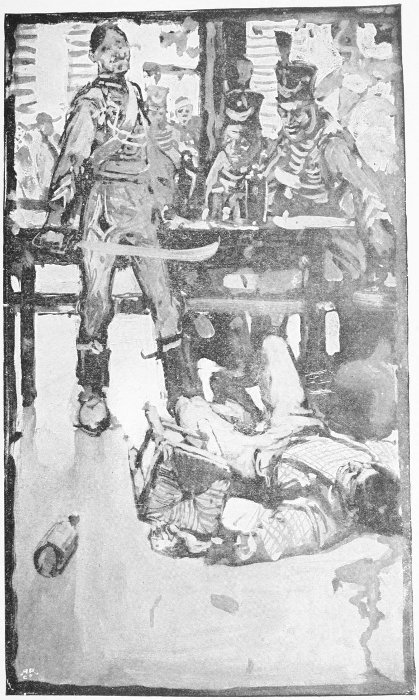
Hea pushed him, and he pitched sprawling against Murtogh's legs, and
rolled inert to the floor. His hot blood washed over Murtogh's sandalled feet.
A woman's shriek of horror burst into the air, and the hounds moaned and
glided forward. Murtogh did not know why he stood so still. He could not
rightly think upon what was happening, or put his mind to it. The bones
in his arms were chilled, and would not move for him. He gazed with
round eyes at Owny, and at the red dripping knife which the bard
stretched out to him. He felt the rough tongue of a dog on his ankle.
The dark corners of the chamber seemed to be moving from him a long
distance away. There was a spell upon him, and he could not tremble.
The voice of Owny Hea came to him, and though it was soundless, like the
speech of Dreamland, he heard all its words; 'Murtogh son of Teige, I
have slain your guest for the reason that I have the Spanish, and I knew
the meaning of his words to this woman, and he could not live any
longer. The liathan priest, when he would be going, told this stranger
that she you called your wife was your enemy, and made a mockery of you,
and would give ear gladly to any means of dishonouring you. And the
liathan priest spoke truly. While the woman repeated lies to you of
the King of Spain and the Pope, she whispered foul scandal of you, and
wicked love-words to that dog's-meat at your feet. It is I, Owen son of
Aodh, who tell you these things. And now you know what you have to do!'
Murtogh turned slowly to the lady. She lay, without motion, in her
chair, her head limp upon her shoulder, and the whiteness of sea foam on
her cheek. Thoughts came again into his brain.
'I have the wisest mind of all in my family,' he said; 'I know what it
is I will be doing.'
He drew the short sword from his girdle, and put his nail along its edge.
'Donogh baoth,' he said to his son, 'go below and seek out Conogher
tuathal and Shane buidhe, and bid them seize the liathan priest
between them, and bring him to me here where I am. And you will take
some sleep for yourself then, for it is a late hour.'
The lad looked at the pale lady with the closed eyes, and at the sword
in his father's hand. He set his teeth together, and lifted his head.
'I am of years enough to see it all,' he said. 'I have no sleep on my eyes.'
Murtogh bent over the corpse at his feet, and caressed the boy's head
with his hand. 'I will not call you baoth (simple) any more,' he said,
fondly. 'You are my true son, and here is my ring for your finger, and
you may return with them when they fetch me my liathan cousin.'
Next morning young Donogh gave his word to the men of Dunlogher, and
they obeyed him, for in the one night he had thrown aside his sluggish
boyhood, and they saw his father's ring on his finger, and heard a good
authority in his voice. They came out from the Western gate at his
command, three-score and more, and stood from the brink of the cliff
inward, with their weapons in their hands, and made a path between them.
But the women and children Donogh bade remain within the bawn, and he
shut the inner gate upon them. It was as if the smell of blood came to
them there, for the old women put up a lamentation of death, and the
others cried aloud, till the noise spread to the men on the cliff. These
looked one to another and held their silence.
They did not clash their spears together when, after a long waiting,
Murtogh came from the gate, and walked toward them. A fine rain was in
the air, and the skies and sea were grey, and the troubled man would
have no spirit for such greeting.
He bore upon his broad back a great shapeless bundle thrice his own
bulk. The weight of it bent his body, and swayed his footsteps as he
came. The cover of it was of skins of wild beasts, sewn rudely with
thongs, and through the gaps in this cover some of the men saw stained
foreign cloths and the plume of a hat, and some a shoe with a priest's
buckle, and some the marble hand of a fair woman. But no word was
spoken, and Murtogh, coming to the edge, heaved his huge shoulders
upward, and the bundle leaped out of sight.
Then Murtogh turned and looked all his fighting-men in their faces, and
smiled in gentleness upon them, and they saw that in that same night,
while the 'little people' had changed Donogh into a man, they had made
Murtogh a child again.
'She came up from the water,' he said to them, in a voice no man knew.
'It was I who brought her out of the water, and fought for her with the
demons under the rocks, and beat all of them off. But one of them I did
not make the sign of the Cross before, and that one is the King of
Spain; and so he has wrought me this mischief, and made all my labour as
nothing; and she is in the water again, and I must be going to fetch her
out rightly this time.'
Murtogh sprang like a deer into the air, with a mighty bound which bore
him far over the edge of the cliff. Some there were, in the throng that
sprang forward, agile enough to be looking down the abyss before his
descent was finished. These, to their amazement, beheld a miracle. For
the great fall did not kill Murtogh Mordha, but the waters boiled and
rose to meet him, and held him up on their tossing currents as he swam
forward, and marked with a pallid breadth of foam his path out to sea,
farther and farther out, till the mists hid him from human view.
The wailing song of Owny Hea rose through the wet air above the keening
of the women in the bawn. But louder still was the voice of the lad who
wore his father's ring, and drew now from beneath his mantle his father's sword.
'I am Donogh son of Murtogh Mordha!' he shouted, 'and I am Lord in
Dunlogher, and when I am of my full strength I will kill the King of
Spain, and give his castles and all his lands and herds and women to you
for your own!'
The three towers of Dunlogher are broken, and the witch has fled from
its grey lake, and no man knows where the bones of its forgotten sept
are buried. But the evil currents will never tire of writhing, and the
shadows which are no shadows are forever changing, in the Path of Murty the Proud.