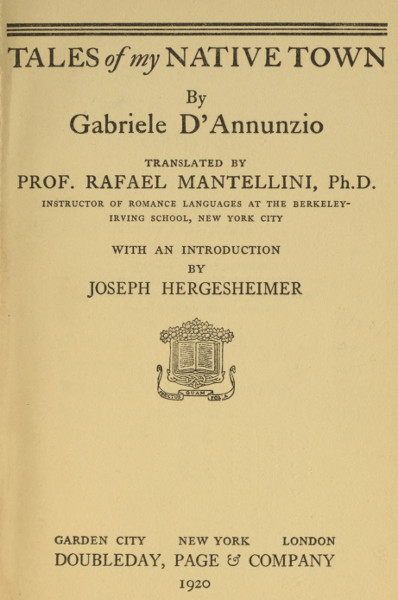
INTRODUCTION By Joseph Hergesheimer — I — II — III — IV
The attitude of mind necessary to a complete
enjoyment of the tales in this book
must first spring from the realisation that, as
stories, they are as different from our own short
imaginative fiction as the town of Pescara, on
the Adriatic Sea, is different from Marblehead in
Massachusetts. It is true that fundamentally the
motives of creative writing, at least in the Western
Hemisphere, are practically everywhere alike;
they are what might be called the primary
emotions, hatred and envy, love and cruelty, lust,
purity and courage. There are others, but these
are sufficient: and an analysis of The Downfall of
Candia together with any considerable story native
to the United States would disclose a similar
genesis.
But men are not so much united by the deeper
bonds of a common humanity as they are separated
by the superficial aspects and prejudices of
society. The New England town and Pescara, at
heart very much the same, are far apart in the
overwhelming trivialities of civilisation, and
Signor D’Annunzio’s tales, read in a local state of
being, might as well have remained untranslated.
But this difference, of course, lies in the writer,
not in his material; and Gabriele D’Annunzio is
the special and peculiar product of modern Italy.
No other country, no other history, would have
given birth to a genius made up of such contending
and utterly opposed qualities: it is exactly as
if all the small principalities that were Italy before
the Risorgemento, all the amazing contradictions
of stark heroics and depraved nepotism, the
fanaticism and black blood and superstition, with
the introspective and febrile weariness of a very
old land, were bound into D’Annunzio’s being.
Not only is this true of the country and of the
man, the difference noted, it particularly includes
the writing itself. And exactly here is the difficulty
which, above all others, must be overcome if
pleasure is to result from “Tales of My Native
Town.” These are not stories at all, in the sense
of an individual coherent action with the stirring
properties of a plot. The interest is not cunningly
seized upon and stimulated and baffled up to a
satisfactory finale. The formula that constitutes
the base of practically every applauded story here—a
determination opposed to hopeless odds but
invariably triumphant—is not only missing from
Tales of My Native Town, in the majority of
cases it is controverted. For the greater part man
is the victim of inimical powers, both within him
and about; and fate, or rather circumstance, is
too heavy for the defiance of any individual.
What, actually, has happened is that D’Annunzio
has not disentangled these coherent fragments
from the mass of life. He has not lifted
his tales into the crystallised isolation of a short
story: they merge from the beginning and beyond
the end into the general confusion of existence,
they are moments, significantly tragic or humorous,
selected from the whole incomprehensible
sweep of a vastly larger work, and presented as
naturally as possible. However, they are not
without form, in reality these tales are woven with
an infinite delicacy, an art, like all art, essentially
artificial. But a definite interest in them, the sense
of their beauty, must rise from an intrinsic interest
in the greater affair of being. It is useless
for anyone not impressed with the beauty of sheer
living as a spectacle to read “Tales of My Native
Town.”
The clear understanding of a divergence should
result in a common ground of departure, of sympathy,
and to make this plainer still it ought to
be added that in the question of taste, of the
latitude of allowable material and treatment, the
Italians are far more comprehensive than ourselves.
This, certainly, is particularly true in their
attitude toward the relation of the sexes; and here
is, perhaps, the greatest difference between what
might be loosely called a Latin literature and an
Anglo-Saxon. We are almost exclusively interested
in the results, the reactions, of sexual
contacts; but the former have their gaze fixed
keenly on the process itself. At the most we
indicate that consummations of passion have occurred,
and then turn, with a feeling of relief, to
what we are convinced is the greater importance
of its consequences.
But not only is Gabriele D’Annunzio perfectly
within his privilege in lingering over any important,
act of nature, he is equally at liberty to develop all
the smaller expressions of lust practically barred
from English or American pens. These, undeniably,
have as large an influence in one country,
one man, as in another; they are—as small things
are apt to be—more powerful in the end than
the greatest attributes. Yet while we have agreed
to ignore them, to discard them as ignoble and
obscene, in “Tales of My Native Town” erotic
gestures and thoughts, libidinous whispers, play
their inevitable devastating part.
Yet this is not a book devoted to such impulses;
one tale only, although in many ways that is the
best, has as its motive lust. It is rather in the
amazingly direct treatment of disease, of physical
abnormality, that it will be disturbing to the unprepared
reader from an entirely different and less
admirable, or, at any rate, less honest, convention.
Undoubtedly D’Annunzio’s unsparing revelation
of human deformity and ills will seem
morbid to the unaccustomed mind; but, conversely,
it can be urged that the dread of these details is
in itself morbid. Then, too, we have an exaggerated
horror of the unpleasant, a natural, but
saccharine, preference for happiness. As a nation
we are not conspicuously happier than Italy,
but we clamour with a deafening insistence for the
semblance of a material good fortune. Meeting
pain no better and no worse than other nations,
from our written stories we banish it absolutely;
but anyone who cares to realise the beauty that,
beyond question, pervades the following pages
will be obliged to harden himself to meet precisely
the deplorable accidents that he must face
wherever life has been contaminated by centuries
of brutal ignorance, oppression and want.
Again, it is not in the larger aspects, the nobler
phases, of suffering with which we are concerned,
but in the cold revelation of rasping details, brutal
sores and deformity, the dusty spiders of paralysis.
If this were all it would be hideous beyond support;
but, fortunately, the coldness is only in the
method, there is a saving spirit of pity, the valid
humanity born of understanding. Such horror as
exists here is the result of D’Annunzio’s sensitive
recognition of the weight of poverty and superstition
crushing men into unspeakable fatalities of
the flesh. A caustic humour, as well, illuminates
the darker pits of existence, ironic rather than
satirical, bitter rather than fatalistic; and then admirably
exposing the rough play of countrymen
like the rough wine of their Province. In addition
there is always, for reassurance, the inclusion of
the simple bravery that in itself leavens both life
and books with hope.
Yet, with the attention directed so exclusively
upon national differences, equally it must be said
that no individual has ever written into literature
a more minute examination of actuality than that
in “Tales of My Native Town.” Indeed, to find
its counterpart it would be necessary to turn to the
relentlessly veracious paintings of the early Dutchmen,
or the anatomical canvasses of El Greco.
D’Annunzio’s descriptions of countenances are
dermatological, the smallest pores are carefully
traced, the shape and hue and colour of every feature.
This is set down not only directly but by
means of remarkable similies: Binchi-Blanche has
a surly, yellow-lined face like a lemon without any
juice; Africana’s husband’s mouth resembles the
cut in a rotten pumpkin; Ciarole’s face was that of
a gilded wooden effigy from which the gilding had
partly worn off; while Biagio Quaglia reflected
the brilliancy and freshness of an almond tree in
springtime.
The direct descriptions are often appalling,
since, as has already been indicated, nothing is considered
unimportant; there are literally no reservations,
or rather, no, prejudices. The physical
disintegration that accompanies death is, as well,
recorded to the last black clot and bubble of red
froth. D’Annunzio is not afraid of death in the
context of his pages, he is never reluctant to meet
the great facts, the terrible penalties, of existence;
rather it is upon them that his writing is founded;
it has, in the main, in these tales, two sides, one
of violence, of murder and venom, and the other
an idyllic presentation of a setting, an environment,
saturated with classic and natural beauty.
The mind, now horrified by the dislocated
beggars gathered about the blind Mungia, is suddenly
swept into the release of evening fragrantly
cool like myrtles; or Turlendana returns from
his long voyages and, with his amazing animals,
makes his way home into Pescara: “The river of
his native place carried to him the peaceful air of
the sea.... The silence was profound. The
cobwebs shone tranquilly in the sun like mirrors
framed by the crystal of the sea.” He passes with
the Cyclopean camel, the monkey and the she-ass
across the boat bridge and: “Far behind the
mountain of Gran Sasso the setting sun irradiated
the spring sky ... and from the damp earth, the
water of the river, the seas, and the ponds, the
moisture had arisen. A rosy glow tinted the
houses, the sails, the masts, the plants, and the
whole landscape, and the figures of the people,
acquiring a sort of transparency, grew obscure,
the lines of their contour wavering in the fading
light.”
Nothing could surpass in peacefulness this
vision, a scene like a mirage of fabulous days
wrapped in tender colour. Throughout the tale of
The Virgin Anna, too, there are, in spite of the
vitriolic realism of its spirit, the crystal ecstasies
of white flocks of girls before the Eucharist of
their first communion. While it was Anna’s
father who came ashore from his voyages to the
island of Rota with his shirt all scented with
southern fruit. The Virgin Anna has many points
of resemblance to that other entranced peasant
in Une Vie Simple; but Anna had a turtle in place
of a parrot, and D’Annunzio is severer with his
subject than was Flaubert.
But such idylls are quickly swept away in the
fiery death of the Duke of Orfena, with the
pistols ringing in high stately chambers, and
Mazzagrogna, the major-domo, a dripping corpse,
hanging in the railing of a balcony. There is no
shrinking, no evasion, here; and none is permitted
the reader:—the flames that consume the Duke
are not romantic figments, their fierce energy
scorches the imagination.
These qualities belong to a high order of
creative writing, they can never be the property of
mere talent, they have no part in concessions to
popular and superficial demands. This does not
necessarily imply a criticism of the latter: it is not
a crime to prefer happiness to misery, and certainly
the tangible facts of happiness are success
and the omnipotence of love. Tales and stories
exist as a source of pleasure, but men take their
pleasures with a difference; and for any who are
moved by the heroic spectacle of humanity pinned
by fatality to earth but forever struggling for
release “Tales of My Native Town” must have a
deep significance.
No one has abhorred brutality and deception
more passionately than Gabriele D’Annunzio, and
no one has held himself more firmly to the exact
drawing of their insuperable evils. But this is not
all; it is not, perhaps, even the most important
aspect: that may well be his fascinating art. Here,
above all, the contending elements, of his being,
the brilliant genius of the Renaissance, predominate;
an age bright with blood and gold
and silk, an age of poetry as delicately cultivated
as its assassinations. It was a period logical and
cruel, lovely and corrupt; and, to an extraordinary
degree, it has its reflection in D’Annunzio’s writing.
Yet, in him, it is troubled by modern apprehensions,
a social conscience unavoidable now to
any fineness of perception. His tales are no
longer simply the blazing arbitrary pictures of the
Quatrocento; they possess our own vastly more
burdened spirit. In this, as well, they are as
American as they are Italian; the crimes and
beggars and misery of Pescara, the problems and
hopes of one, belong to the other; the bonds of
need and sympathy are complete.
The tales themselves are filled with energy and
movement, the emotions are in high keys. At
times a contest of will, of temptation playing with
fear, as in The Gold Pieces, they rise to pitched
battles between whole towns; the factions, more
often than not led by Holy reliques and statues, a
sacred arm in silver or the sparkling bust of a
Saint with a solar disc, massed with scythes and
bars and knives, meet in sanguinary struggle. Or
again the passions smoulder into individual bitterness
and scandal and mean hatred. The Duchess
of Amalfi is such a chronicle, the record of Don
Giovà’s devastating passion for Violetta Kutufa,
who came to Pescara with a company of singers
at Carnival.
Nothing is omitted that could add to the veracity,
the inevitable collapse, of this almost senile
Don Juan; while the psychology of the ending is
an accomplishment of arresting power and fitness.
There is in The Duchess of Amalfi a vivid
presentation of Pescara itself, the houses and
Violetta’s room scented with cyprus-powder, the
square with the cobblers working and eating figs,
a caged blackbird whistling the Hymn of Garibaldi,
the Casino, immersed in shadow, its tables
sprinkled with water.
Around Pescara is the level sea, the river and
mountains and the broad campagnia, the vines, the
wine vats and oil presses, the dwellings of mud
and reeds; the plain is flooded with magnificent
noon, and, at night, Turlendana, drunk, is mocked
by the barking of vagrant dogs; the men linger
under Violetta’s lighted windows, and the strains
of her song run through all the salons, all the
heads, of the town.... It is as far away as
possible, and yet, in its truth, implied in every
heart.
I THE HERO
TALES OF MY NATIVE
TOWN
Already the huge standards of Saint
Gonselvo had appeared on the square and
were swaying heavily in the breeze. Those who
bore them in their hands were men of herculean
stature, red in the face and with their necks swollen
from effort; and they were playing with them.
After the victory over the Radusani the people
of Mascalico celebrated the feast of September
with greater magnificence than ever. A marvellous
passion for religion held all souls. The entire
country sacrificed the recent richness of the corn
to the glory of the Patron Saint. Upon the streets
from one window to another the women had
stretched their nuptial coverlets. The men had
wreathed with vines the doorways and heaped up
the thresholds with flowers. As the wind blew
along the streets there was everywhere an immense
and dazzling undulation which intoxicated
the crowd.
From the church the procession proceeded to
wind in and out and to lengthen out as far as the
square. Before the altar, where Saint Pantaleone
had fallen, eight men, privileged souls, were awaiting
the moment for the lifting of the statue of
Saint Gonselvo; their names were: Giovanni Curo,
l’Ummalido, Mattala, Vencenzio Guanno, Rocco
di Cenzo, Benedetto Galante, Biagio di Clisci,
Giovanni Senzapaura. They stood in silence, conscious
of the dignity of their work, but with their
brains slightly confused. They seemed very
strong; had the burning eye of the fanatic, and
wore in their ears, like women, two circles of gold.
From time to time they tested their biceps and
wrists as if to calculate their vigour; or smiled
fugitively at one another.
The statue of the Patron Saint was enormous,
very heavy, made of hollow bronze, blackish, with
the head and hands of silver.
Mattala cried:
“Ready!”
The people, everywhere, struggled to see. The
windows of the church roared at every gust of the
wind. The nave was fumigated with incense and
resin. The sounds of instruments were heard now
and then. A kind of religious fever seized the
eight men, in the centre of that turbulence. They
extended their arms to be ready.
Mattala cried:
“One! Two! Three!”
Simultaneously the men made the effort to raise
the statue to the altar. But its weight was overpowering,
and the figure swayed to the left. The
men had not yet succeeded in getting a firm grip
around the base. They bent their backs in their
endeavour to resist. Biagio di Clisci and Giovanni
Curo, the least strong, lost their hold. The statue
swerved violently to one side. L’Ummalido gave
a cry.
“Take care! Take care!” vociferated the
spectators on seeing the Patron Saint so imperilled.
From the square came a resounding crash that
drowned all voices.
L’Ummalido had fallen on his knees with his
right arm beneath the bronze. Thus kneeling, he
held his two large eyes, full of terror and pain,
fixed on his hand which he could not free, while his
mouth twisted but no longer spoke. Drops of
blood sprinkled the altar.
His companions, all together, made a second
effort to raise the weight. The operation was difficult.
L’Ummalido, in a spasm of pain, twisted
his mouth. The women spectators shuddered.
At length the statue was lifted and L’Ummalido
withdrew his hand, crushed and bleeding and
formless. “Go home, now! Go home!” the people
cried, while pushing him toward the door of
the church.
A woman removed her apron and offered it to
him for a bandage. L’Ummalido refused it. He
did not speak, but watched a group of men who
were gesticulating and disputing around the
statue.
“It is my turn!”
“No!—no! It’s my turn!”
“No! let me!”
Cicco Ponno, Mattia Seafarolo and Tommaso
di Clisci were contending for the place left vacant
by L’Ummalido.
He approached the disputants. Holding his
bruised hand at his side, and with the other opening
a path, he said simply:
“The position is mine.”
And he placed his left shoulder as a prop for
the Patron Saint. He stifled down his pain, gritting
his teeth, with fierce will-power.
Mattala asked him:
“What are you trying to do?”
He answered:
“What Saint Gonselvo wishes me to do.”
And he began to walk with the others. Dumbfounded
the people watched him pass. From time
to time, someone, on seeing the wound which was
bleeding and growing black, asked him:
“L’Umma’, what is the matter?”
He did not answer. He moved forward gravely,
measuring his steps by the rhythm of the music,
with his mind a little hazy, beneath the vast coverlets
that flapped in the wind and amongst the
swelling crowd.
At a street corner he suddenly fell. The Saint
stopped an instant and swayed, in the centre of a
momentary confusion, then continued its progress.
Mattia Scafarola supplied the vacant place. Two
relations gathered up the swooning man and carried
him to a nearby house.
Anna di Cenzo, who was an old woman, expert
at healing wounds, looked at the formless and
bloody member, and then shaking her head, said:
“What can I do with it?”
Her little skill was able to do nothing.
L’Ummalido controlled his feelings and said nothing.
He sat down and tranquilly contemplated his
wound. The hand hung limp, forever useless, with
the bones ground to powder.
Two or three aged farmers came to look at it.
Each, with a gesture or a word, expressed the
same thought.
L’Ummalido asked:
“Who carried the Saint in my place?”
They answered:
“Mattia Scafarola.”
Again he asked:
“What are they doing now?”
They answered:
“They are singing the vespers.”
The farmers bid him good-bye and left for
vespers. A great chiming came from the mother
church.
One of the relations placed near the wound a
bucket of cold water, saying:
“Every little while put your hand in it. We
must go. Let us go and listen to the vespers.”
L’Ummalido remained alone. The chiming increased,
while changing its metre. The light of
day began to wane. An olive tree, blown by the
wind, beat its branches against the low window.
L’Ummalido began to bathe his hand little by
little. As the blood and concretions fell away, the
injury appeared even greater. L’Ummalido mused:
“It is entirely useless! It is lost. Saint Gonselvo,
I offer it up to you.”
He took a knife and went out. The streets
were deserted. All of the devotees were in the
church. Above the houses sped, like fugitive herds
of cattle, the violet clouds of a September sunset.
In the church the united multitude sang in
measured intervals as if in chorus to the music of
the instruments. An intense heat emanated from
the human bodies and the burning tapers. The
silver head of Saint Gonselvo scintillated from on
high like a light house. L’Ummalido entered. To
the stupefaction of all, he walked up to the altar
and said, in a clear voice, while holding the knife
in his left hand:
“Saint Gonselvo, I offer it up to you.”
And he began to cut around the right wrist,
gently, in full sight of the horrified people. The
shapeless hand became detached little by little
amidst the blood. It swung an instant suspended
by the last filaments. Then it fell into a basin of
copper which held the money offerings at the feet
of the Patron Saint.
L’Ummalido then raised the bloody stump and
repeated in a clear voice:
“Saint Gonselvo, I offer it up to you.”
II THE COUNTESS OF AMALFI — I — II — III — IV — V — VI
When, one day, toward two o’clock in the
afternoon, Don Giovanni Ussorio was
about to set his foot on the threshold of Violetta
Kutufas’ house, Rosa Catana appeared at the
head of the stairs and announced in a lowered
voice, while she bent her head:
“Don Giovà, the Signora has gone.”
Don Giovanni, at this unexpected news, stood
dumbfounded, and remained thus for a moment
with his eyes bulging and his mouth wide open
While gazing upward as if awaiting further explanations.
Since Rosa stood silently at the top
of the stairs, twisting an edge of her apron with
her hands and dilly-dallying somewhat, he asked
at length:
“But tell me why? But tell me why?” And he
mounted several steps while he kept repeating with
a slight stutter:
“But why? But why?”
“Don Giovà, what have I to tell you? Only
that she has gone.”
“But why?”
“Don Giovà, I do not know, so there!”
And Rosa took several steps on the landing-place
toward the door of the empty apartment.
She was rather a thin woman, with reddish hair,
and face liberally scattered with freckles. Her
large, ash-coloured eyes had nevertheless a singular
vitality. The excessive distance between her
nose and mouth gave to the lower part of her
face the appearance of a monkey.
Don Giovanni pushed open the partly closed
door and passed through the first room, and then
the third; he walked around the entire apartment
with excited steps; he stopped at the little room,
set aside for the bath. The silence almost terrified
him; a heavy anxiety weighted down his heart.
“It can’t be true! It can’t be true!” he murmured,
staring around confusedly.
The furniture of the room was in its accustomed
place, but there was missing from the table under
the round mirror, the crystal phials, the tortoise-shell
combs, the boxes, the brushes, all of those
small objects that assist at the preparation of
feminine beauty. In a corner stood a species of
large, zinc kettle shaped like a guitar; and within
it sparkled water tinted a delicate pink from some
essence. The water exhaled subtle perfume that
blended in the air with the perfume of cyprus-powder.
The exhalation held in it some inherent
quality of sensuousness.
“Rosa! Rosa!” Don Giovanni cried, in a
voice almost extinguished by the insurmountable
anxiety that he felt surging through him.
The woman appeared.
“Tell me how it happened! To what place has
she gone? And when did she go? And why?”
begged Don Giovanni, making with his mouth a
grimace both comic and childish, in order to restrain
his grief and force back the tears.
He seized Rosa by both wrists, and thus incited
her to speak, to reveal.
“I do not know, Signor,” she answered. “This
morning she put her clothes in her portmanteau,
sent for Leones’ carriage, and went away without
a word. What can you do about it? She will
return.”
“Return-n-n!” sobbed Don Giovanni, raising
his eyes in which already the tears had started to
overflow. “Has she told you when? Speak!”
And this last cry was almost threatening and
rabid.
“Eh?... to be sure she said to me, ‘Addio,
Rosa. We will never see each other again...!
But, after all ... who can tell! Everything is
possible.’”
Don Giovanni sank dejectedly upon a chair at
these words, and set himself to weeping with so
much force of grief that the woman was almost
touched by it.
“Now what are you doing, Don Giovà? Are
there not other women in this world? Don
Giovà, why do you worry about it...?”
Don Giovanni did not hear. He persisted in
weeping like a child and hiding his face in Rosa
Catana’s apron; his whole body was rent with the
upheavals of his grief.
“No, no, no.... I want Violetta! I want
Violetta!” he cried.
At that stupid childishness Rosa could not refrain
from smiling. She gave assistance by stroking
the bald head of Don Giovanni and murmuring
words of consolation.
“I will find Violetta for you; I will find her....
So! be quiet! Do not weep any more, Don
Giovannino. The people passing can hear. Don’t
worry about it, now.”
Don Giovanni, little by little, under the friendly
caress, curbed his tears and wiped his eyes on
her apron.
“Oh! oh! what a thing to happen!” he exclaimed,
after having remained for a moment with
his glance fixed on the zinc kettle, where the water
glittered now under a sunbeam. “Oh! oh! what
luck! Oh!”
He took his head between his hands and swung
it back and forth two or three times, as do imprisoned
monkeys.
“Now go, Don Giovanino, go!” Rosa Cantana
said, taking him gently by the arm and drawing
him along.
In the little room the perfume seemed to increase.
Innumerable flies buzzed around a cup
where remained the residue of some coffee. The
reflection of the water trembled on the walls like
a subtle net of gold.
“Leave everything just so!” pleaded Don
Giovanni of the woman, in a voice broken by badly
suppressed sobs. He descended the stairs, shaking
his head over his fate. His eyes were swollen
and red, bulging from their sockets like those of a
mongrel dog.
His round body and prominent stomach overweighted
his two slightly inverted legs. Around
his bald skull ran a crown of long curling hair that
seemed not to take root in the scalp but in the
shoulders, from which it climbed upward toward
the nape of the neck and the temples. He had
the habit of replacing from time to time with his
bejewelled hands, some disarranged tuft; the
jewels, precious and gaudy, sparkled even on his
thumb, and a cornelian button as large as a
strawberry fastened the bosom of his shirt over
the centre of his chest.
When he reached the broad daylight of the
square, he experienced anew that unconquerable
confusion. Several cobblers were working near
by and eating figs. A caged blackbird was whistling
the hymn of Garibaldi, continuously, always
recommencing at the beginning with painful persistency.
“At your service, Don Giovanni!” called Don
Domenico Oliva, as he passed, and he removed
his hat with an affable Neapolitan cordiality.
Stirred with curiosity by the strange expression
of the Signor, he repassed him in a short time and
resaluted him with greater liberality of gesture
and affability. He was a man of very long body
and very short legs; the habitual expression of
his mouth was involuntarily shaped for derision.
The people of Pescara called him “Culinterra.”
“At your service!” he repeated.
Don Giovanni, in whom a venomous wrath was
beginning to ferment which the laughter of the
fig-eaters and the trills of the blackbird irritated,
at his second salute turned his back fiercely and
moved away, fully persuaded that those salutes
were meant for taunts.
Don Domenico, astonished, followed him with
these words:
“But, Don Giovà! ... are you angry ...
but....”
Don Giovanni did not listen. He walked on
with quick steps toward his home. The fruit-sellers
and the blacksmiths along the road gazed
and could not understand the strange behaviour
of these two men, breathless and dripping with
perspiration under the noonday sun.
Having arrived at his door, Don Giovanni,
scarcely stopping to knock, turned like a serpent,
yellow and green with rage, and cried:
“Don Domè, oh Don Domè, I will hit you!”
With this threat, he entered his house and closed
the door violently behind him.
Don Domenico, dumbfounded, stood for a time
speechless. Then he retraced his steps, wondering
what could account for this behaviour, when Matteo
Verdura, one of the fig-eaters, called:
“Come here! Come here! I have a great bit
of news to tell you.”
“What news?” asked the man of the long spine,
as he approached.
“Don’t you know about it?”
“About what?”
“Ah! Ah! Then you haven’t heard yet?”
“Heard what?”
Verdura fell to laughing and the other cobblers
imitated him. Spontaneously all of them shook
with the same rasping and inharmonious mirth,
differing only with the personality of each man.
“Buy three cents’ worth of figs and I will tell
you.”
Don Domenico, who was niggardly, hesitated
slightly, but curiosity conquered him.
“Very well, here it is.”
Verdura called a woman and had her heap up
the fruit on a plate. Then he said:
“That signora who lived up there, Donna Violetta,
do you remember...? That one of the
theatre, do you remember...?”
“Well?”
“She has made off this morning. Crash!”
“Indeed?”
“Indeed, Don Domè.”
“Ah, now I understand!” exclaimed Don Domenico,
who was a subtle man and cruelly
malicious.
Then, as he wished to revenge himself for the
offence given him by Don Giovanni and also to
make up for the three cents expended for the
news, he went immediately to the casino in order
to divulge the secret and to enlarge upon it.
The “casino,” a kind of café, stood immersed
in shadow, and up from its tables sprinkled with
water, arose a singular odour of dust and musk.
There snored Doctor Punzoni, relaxed upon a
chair, with his arms dangling. The Baron Cappa,
an old soul, full of affection for lame dogs and
tender girls, nodded discreetly over a newspaper.
Don Ferdinando Giordano moved little flags over
a card representing the battlefields of the Franco-Prussian
war. Don Settimio de Marinis appraised
with Doctor Fiocca the works of Pietro
Mettastasio, not without many vocal explosions
and a certain flowery eloquency in the use of poetical
expressions. The notary Gaiulli, not knowing
with whom to play, shuffled the cards of his game
alone, and laid them out in a row on the table.
Don Paolo Seccia sauntered around the billiard
table with steps calculated to assist the digestion.
Don Domenico Oliva entered with so much
vehemence, that all turned toward him except Doctor
Panzoni, who still remained in the embrace
of slumber.
“Have you heard? Have you heard?”
Don Domenico was so anxious to tell the news,
and so breathless, that at first he stuttered without
making himself understood. All of these gentlemen
around him hung upon his words, anticipating
with delight any unusual occurrence that might
enliven their noonday chatter.
Don Paolo Seccia, who was slightly deaf in
one ear, said impatiently, “But have they tied your
tongue, Don Domè?”
Don Domenico recommenced his story at the
beginning, with more calmness and clearness. He
told everything; enlarged on the rage of Don Giovanni
Ussorio; added fantastic details; grew intoxicated
with his own words as he went on.
“Now do you see? Now do you see?”
Doctor Panzoni, at the noise, opened his eyelids,
rolling his huge pupils still dull with sleep
and still blowing through the monstrous hairs of
his nose, said or rather snorted nasally:
“What has happened? What has happened?”
And with much effort, bearing down on his
walking stick, he raised himself very slowly, and
joined the gathering in order to hear.
The Baron Cappa now narrated, with much
saliva in his mouth, a well-nourished story
apropos of Violetta Kutufa. From the pupils of
the eyes of his intent listeners gleams flashed in
turn. The greenish eyes of Don Palo Seccia
scintillated as if bathed in some exhilarating moisture.
At last the laughter burst out.
But Doctor Panzoni, though standing, had
taken refuge again in slumber; since for him
sleep, irresistible as a disease, always had its seat
within his own nostrils.
He remained with his snores, alone in the centre
of the room, his head upon his breast, while
the others scattered over the entire district to
carry the news from family to family.
And the news, thus divulged, caused an uproar
in Pescara. Toward evening, with a fresh breeze
from the sea and a crescent moon, everybody frequented
the streets and squares. The hum of
voices was infinite. The name of Violetta Kutufa
was at every tongue’s end. Don Giovanni Ussorio
was not to be seen.
Violetta Kutufa had come to Pescara in the
month of January, at the time of the Carnival,
with a company of singers. She spoke of being
a Greek from the Archipelago, of having sung
in a theatre at Corfu in the presence of the Greek
king, and of having made mad with love an
English admiral. She was a woman of plump
figure and very white skin. Her arms were unusually
round and full of small dimples that
became pink with every change of motion; and
these little dimples, together with her rings and
all of those other graces suitable for a youthful
person, helped to make her fleshiness singularly
pleasing, fresh and tantalising. The features of
her face were slightly vulgar, the eyes tan colour,
full of slothfulness; her lips large and flat as if
crushed. Her nose did not suggest Greek origin;
it was short, rather straight, and with large inflated
nostrils; her black hair was luxuriant. She
spoke with a soft accent, hesitating at each word,
smiling almost constantly. Her voice often became
unexpectedly harsh.
When her company arrived, the Pescaresi were
frantic with expectation. The foreign singers
were lauded everywhere, for their gestures, their
gravity of movement, their costumes, and for
every other accomplishment. But the person upon
whom all attention centred was Violetta Kutufa.
She wore a kind of dark bolero bordered with
fur and held together in front with gilt aiglettes;
on her head was a species of toque, all fur, and
worn a little to one side. She walked about alone,
stepping briskly, entered the shops, treated the
shop-keepers with a certain disdain, complained
of the mediocrity of their wares, left without making
a purchase, hummed with indifference.
Everywhere, in the squares, on all of the walls
large hand-bills announced the performance of
“The Countess of Amalfi.” The name of Violetta
Kutufa was resplendent in vermilion letters. The
souls of the Pescaresi kindled. At length the
long looked-for evening arrived.
The theatre was in a room of the old military
hospital, at the edge of the town near the sea.
The room was low, narrow, and as long as a
corridor; the stage, of wood with painted scenery,
arose a few hands’ breadths above the floor; along
the side walls was the gallery, consisting of boards
over saw-horses covered with tricoloured flags and
decorated with festoons. The curtain, a masterpiece
of Cucuzzitó, son of Cucuzzitó, depicted
tragedy, comedy and music, interwoven, like the
three Graces, and flitting over a bridge under
which passed the blue stream of Pescara. The
chairs for the theatre, taken from the churches,
occupied half of the pit. The benches, taken from
the schools, occupied the remaining space.
Toward seven in the evening, the village band
started its music on the square, played until it
had made the circuit of the town and at length
stopped in front of the theatre. The resounding
march inspired the souls of passers-by. The
women curbed their impatience within the folds
of their beautiful silk garments. The room filled
up rapidly.
The gallery was radiant with a sparkling
aureole of married and unmarried women. Teodolinda
Pomarici, a sentimental, lymphatic elocutionist,
sat near Fermina Memura, called “The
Masculine.” The Fusilli girls, arrived from Castellamare,
tall maidens with very black eyes, all
clothed in a uniform, pink material, with hair
braided down their backs, laughed loudly and
gesticulated. Emilia d’Annunzio used her beautiful
lion-like eyes, with an air of infinite fatigue.
Marianina Cortese made signs with her fan to
Donna Rachele Profeta who sat in front of her.
Donna Rachele Bucci argued with Donna Rachele
Carabba on the subjects of speaking tables and
spiritualism. The school-mistresses Del Gado,
both clothed in changeable silk with mantillas of
most antique fashion, and with diverse coiffures
glittering with brass spangles, remained silent,
compunctious, almost stunned by the novelty of
this experience, almost repentant for having come
to so profane a spectacle. Costanza Lesbu
coughed continuously, shivering under her red
shawl, very pale, very blond and very thin.
In the foremost chairs of the pit sat the wealthiest
citizens. Don Giovanni Ussorio was most
prominent because of his well-groomed appearance,
his splendid black and white checkered
trousers, his coat of shining wool, his quantity of
false jewelry on fingers and shirt-front. Don
Antonio Brattella, a member of the Areopagus of
Marseilles, a man exhaling importance from
every pore and especially from the lobe of his
left ear, which was as thick as a green apricot, recited
in a loud voice the lyric drama of Giovanni
Peruzzini, and his words as they fell from his
lips acquired a certain Ciceronian resonance.
The auditors, lolling in their chairs, stirred with
more or less impatience. Dr. Panzoni wrestled
all to no purpose with the wiles of sleep, and
from time to time made a noise that blended with
the “la” of the tuning instruments.
“Pss! psss! pssss!”
The silence in the theatre grew profound. At
the lifting of the curtain the stage was empty.
The sound of a Violoncello came from the wings.
Tilde appeared and sang. Afterwards Sertorio
came out and sang. After him, a crowd of supernumeraries
and friends, entered and intoned a
song. After them, Tilde drew toward a window
and sang:
“Oh how tedious the hours
To the desirous one...!”
In the audience a slight movement was perceptible,
since all felt a love duet to be imminent.
Tilde, in truth, was a first soprano, none too
young; she wore a blue costume, had a blond wig
that insufficiently covered her head, and her face,
whitened with powder, resembled a raw cutlet besprinkled
with flour and partially hidden behind
a hempen wig.
Egidio came on. He was the young tenor. As
he had a chest singularly hollow and legs slightly
curved, he resembled a double-handed spoon upon
which hung a calf’s head, scraped and polished
like those which one sees at times over the butcher-shops.
He began:
“Tilde! thy lips are mute,
Thy lowered glances dismay me,
Tell me, why you delay me?
Why do I see thy hand now
A-tremble? Why should that be?”
And Tilde, with great force of sentiment,
replied:
“At such a solemn moment, how
Can you ask why of me?”
The duet increased in tenderness. The melody
of the cavalier Petrella delighted the ears of the
audience. All of the women leaned intently over
the rails of the gallery and their faces, throbbing
in the green reflection of the flags, were pallid.
“Like a journey from paradise
Death will appear to us.”
Tilde appeared; and now entered, singing, the
Duke Carnioli, who was a man fat, fierce, and
long haired enough, to be suited to the part of
baritone. He sang with many flourishes, running
over the syllables, sometimes moreover boldly
suppressing.
“Dost thou not know the conjugal chain
Is like lead on the feet?”
But, when in the song, he mentioned at length
the Countess of Amalfi, a long applause broke
from the audience. The Countess was desired,
demanded.
Don Giovanni Ussorio asked of Don Antonio
Brattella:
“When is she coming?”
Don Antonio, in a lofty tone, replied:
“Oh! Dio mio, Don Giovà! Don’t you know?
In the second act! In the second act!”
The speech of Sertorio was listened to with
half-impatience. The curtain fell in the midst of
weak applause. Thus began the triumphs of
Violetta Kutufa. A prolonged murmur ran
through the pit, through the gallery, and increased
when the audience heard the blows of the scene-shifters’
hammers behind the curtain. That invisible
hustling increased their expectation.
When the curtain went up a kind of spell held
the audience in its grip. The scenic effect was
marvellous. Three illuminated arches stretched
themselves in perspective, and the middle one
bordered a fantastic garden.
Several pages were dispersed here and there,
and were bowing. The Countess of Amalfi,
clothed in red velvet, with her regal train, her
arms and shoulders bare, her face ruddy, entered
with agitated step and sang:
“It was an evening of ravishment, which still
Fills my soul....”
Her voice was uneven, sometimes twanging, but
always powerful and penetrating. It produced
on the audience a singular effect after the whine
of Tilde. Immediately the audience was divided
into two factions; the women were for Tilde, the
men for Leonora.
“He who resists my charms
Has not easy matter...!”
Leonora possessed in her personality, in her
gestures, her movements, a sauciness that intoxicated
and kindled those unmarried men who were
accustomed to the flabby Venuses of the lanes of
Sant’ Agostino, and to those husbands who were
wearied with conjugal monotony.
All gazed at the singer’s every motion, at her
large white shoulders, where, with the movements
of her round arms, two dimples tried to smile.
At the end of her solo, applause broke forth
with a crash. Later, the swooning of the Countess,
her dissimulation before the Duke Carnioli
(the leader of the duet), the whole scene aroused
applause. The heat in the room had become intense;
in the galleries fans fluttered confusedly,
and among the fans the women’s faces appeared
and disappeared.
When the Countess leaned against a column in
an attitude of sentimental contemplation, illuminated
by the calcium light, and Egidio sang his
gentle love song, Don Antonio Brattella called
loudly, “She is great!”
Don Giovanni Ussorio, with a sudden impulse,
fell to clapping his hands alone. The others
shouted at him to be silent, as they wished to hear.
Don Giovanni became confused.
“All is for love, everything speaks:
The moon, the zephyrs, the stars, the sea....”
The heads of the listeners swayed with the
rhythm of this melody of the Petrella style, even
though the voice of Egidio was indifferent; and
even though the light was glaring and yellowish
their eyes drank in the scene. But when, after
this last contrast of passion and seduction, the
Countess of Amalfi, walking toward the garden,
took up the melody alone, the melody that still
vibrated in the minds of all, the delight of the
audience had risen to such a height that many
raised their heads and inclined them slightly backward
as if to trill together with the siren, who
was now concealed among the flowers. She sang:
“The bark is now ready ... ah, come beloved!
Is not Love calling ... to live is to love?”
At this climax, Violetta Kutufa made a complete
conquest of Don Giovanni Ussorio, who beside
himself, seized with a species of passionate,
musical madness, clamoured continuously:
“Brava! Brava! Brava!”
Don Paolo Seccia called loudly:
“Oh, see here! see here! Ussorio has gone
mad for her!”
All the women gazed at Ussorio, amazed and
confused. The school-mistresses Del Gado shook
their rosaries under their mantillas. Teodolinda
Pomarici remained ecstatic. Only the Fasilli
girls, in their red paint, preserved their vivacity,
and chattered, shaking their serpentine braids with
every movement.
In the third act, neither the dying sighs of
Tilde, whom the women defended, nor the rebuffs
of Sertorio and Carnioli, nor the songs of the
chorus, nor the monologue of the melancholy Egidio,
nor the joyfulness of the dames and cavaliers,
held any power to distract the public from the
preceding voluptuousness.
“Leonora! Leonora! Leonora!” they cried.
Leonora reappeared on the arm of the Count
of Lara and descended from a pavilion. Thus
she reached the very culmination of her triumph.
She wore now a violet gown, trimmed with
silver ribbons and enormous clasps. She turned
to the pit, while with her foot she gave a quick,
backward stroke to her train, and exposed in the
act her instep.
Then, mingling with her words, a thousand
charms and a thousand affectations, she sang half-jestingly,
“I am the butterfly that sports within the flowers....”
The public grew almost delirious at this well-known
song.
The Countess of Amalfi, on feeling mount up
to her the ardent admiration of the men, became
intoxicated, multiplied her seductive gestures, and
raised her voice to the highest altitude of which
she was capable. Her fleshly throat, uncovered,
marked with the necklace of Venus, shook with
trills.
“I, the bee, who alone on the honey is nourished,
Am inebriate under the blue of the sky....”
Don Giovanni Ussorio stared with so much intensity,
that his eyes seemed to start from their
sockets. The Baron Cappa was equally enchanted.
Don Antonio Brattella, a member of
the Areopagus of Marseilles, swelled and
swelled, until at length burst fro-m him the exclamation:
“Colossal!”
Thus, Violetta Kutufa made a conquest of Pescara.
For more than a month performances of
the opera of the Cavalier Petrella, continued with
ever increasing popularity. The theatre was always
full, even packed. Applause for Leonora
broke out furiously at the end of every song. A
singular phenomenon occurred; the entire population
of Pescara seemed seized with a species of
musical mania; every Pescarenican soul became inclosed
in the magic circle of one single melody,
that of the butterfly that sports among the flowers.
In every corner, at every hour, in every way,
in every possible variation, on every instrument,
with an astounding persistency, that melody was
repeated; and the person of Violetta Kutufa became
the symbol of those musical strains, just as—God
pardon the comparison—the harmony of
the organ suggests the soul of paradise.
The musical and lyrical comprehension, which
in the southern people is instinctive, expanded at
this time without limit. The street gamins whistled
everywhere; all the amateur musicians put
forth their efforts, Donna Lisitta Menuma played
the tune on the harpsichord from dawn until dusk,
Don Antonio Brattella played it on the flute, Don
Domenico Quaquino, on the clarionette, Don Giacomo
Palusci, the priest, on an old rococo spinet,
Don Vincenzio Rapagneta on his violoncello, Don
Vincenzio Ranieri on the trumpet, Don Nicola
d’Annunzio, on his violin. From the towers of
Sant’ Agostino to the Arsenal, and from Pescheria
to Dogana the multifold sounds mingled together
and became a discord. In the early hours
of the afternoon the district had the appearance
of some large hospital for incurable madness.
Even the grinders sharpening knives on their
wheels tried to maintain a rhythm in the shriek of
the metal and the whetstone.
As it was the time of the carnival, a public
festival was given in the theatre. Shrove Thursday,
at ten in the evening, the room blazed with
wax-candles, smelt strongly of myrtle and glittered
with mirrors. The masked revellers entered
in crowds. Punchinellos predominated.
From a platform enveloped in green draperies,
marked with constellations of stars of silver
paper, the orchestra began to play and Don
Giovanni Ussorio entered.
He was dressed like a grandee of Spain, and
had the appearance of a very fat Count of Lara.
A blue cap with a long, white plume covered his
baldness, a short coat of red velvet garnished
with gold rippled over his shoulders. This costume
accentuated the prominence of his stomach
and the skinniness of his legs. His locks, shining
with cosmetic oils, resembled an artificial fringe
bound around his cap, and they were blacker than
usual.
An impertinent Punchinello, on passing him,
cried in a disguised voice:
“How funny!”
He made a gesture of horror, so clownish, at
this metamorphosis of “Don Giovanni,” that much
laughter burst forth from everyone in the vicinity.
La Cicarina, all red paint under the black hood
of her domino, like a beautiful flower of the flesh,
laughed sonorously, while she tripped with two
ragged harlequins.
Don Giovanni, filled with anger, lost himself in
the crowd and sought Violetta Kutufa. The sarcasms
of the other revellers pursued and wounded
him. Suddenly he encountered another grandee
of Spain, another count of Lara. He recognised
Don Antonio Brattella and, at this, received a
thrust in the heart. Already, between these two
men, rivalry had broken loose.
“How is the medlar?” Don Donato Brandimarte
screamed venomously, alluding to the fleshy
protuberance that the member of the Areopagus
of Marseilles had on his left ear. Don Giovanni
took a fierce pleasure in this insult.
The rivals met face to face, scanned each
other from head to foot, and kept their respective
stations, the one always slightly withdrawn
from the other, as they wandered through the
crowd.
At eleven, an agitated flutter passed over the
crowd. Violetta Kutufa entered. She was
dressed in Mephistophelian costume, in a black
domino with long scarlet hood, and with a
scarlet mask over her face. The round, swan-like
chin, the thick red mouth, shone through her
thin veil. The eyes, lengthened and rendered
slightly oblique because of the mask, seemed to
smile.
All instantaneously recognised her and almost
all made way for her; Don Antonio Brattella advanced
caressingly on one side. On the other
came Don Giovanni; Violetta Kutufa made a
hasty survey of the rings that adorned the fingers
of the latter, then took the arm of Brattella.
She laughed and walked with a certain sprightly
undulation of the hips. Brattella, while talking
to her in his customary, silly, vainglorious manner,
called her “Contessa,” and interspersed their
conversation with the lyrical verses of Giovanni
Peruzzini.
She laughed and leaned toward him, and
pressed his arm suggestively, since the weaknesses
of this ugly, vain man amused her. At a certain
point, Brattella, when repeating the words of the
Count of Lara in the melodrama of Petrella,
said or rather sang submissively:
“Shall I then hope?”
Violetta Kutufa answered in the words of
Leonora:
“Who forbids you...? Good-bye.”
Then, seeing Don Giovanni not far away, she
detached herself from this bewitching chevalier,
and fastened upon the other, who already for
some time had pursued with eyes full of envy and
dislike, the windings of this couple through the
crowd of dancers.
Don Giovanni trembled like a youth under the
glance of his first sweetheart. Then, seized with
a superabundant pride, he drew the opera singer
into the dance. He whirled breathlessly around,
with his nose against the woman’s chest, his cloak
floating out behind, his plume fluttering to the
breeze, streams of perspiration mixed with cosmetic
oils filtering down his temples.
Exhausted, he stopped at length. He reeled
with giddiness. Two hands supported him and
a sneering voice whispered in his ear, “Don Giovà,
stop and recover your breath for a minute!”
The voice was that of Brattella, who in turn
drew the fair lady into the dance. He danced,
holding his left arm arched over his hips, beating
time with his feet, endeavouring to appear
as light as a feather, with motions meant to be
gracious, but instead so idiotic, and with grimaces
so monkey-like, that everywhere the laughter and
mockery of the Punchinellos began to pelt down
upon him.
“Pay a cent to see it, gentlemen!”
“Here is the bear of Poland that dances like
a Christian! Gaze on him, gentlemen!”
“Have a medlar? Have a medlar?”
“Oh, see! See! An orangoutang!”
Don Antonio Brattella controlled himself with
much dignity, still continuing his dance. Other
couples wheeled around him.
The room was filled with all kinds of people,
and in the midst of the confusion the candles
burned on, with their reddish flames lighting up
the festoons of immortelles. All of this fluttering
reflected itself in the mirrors.
La Ciccarina, the daughter of Montagna, the
daughter of Suriano, the sisters Montarano, appeared
and disappeared, while enlivening the
crowd with the beams of their fresh country loveliness.
Donna Teodolinda Pomarici, tall and thin,
clothed in blue satin, like a madonna, permitted
herself to be borne about in a state of transport
as her hair, loosened from its bands, waved upon
her shoulders. Costanzella Coppe, the most agile
and indefatigable of the dancers, and the palest,
flew from one extremity of the room to the other
in a flash; Amalia Solofra, with hair almost aflame
in colour, clothed like a rustic, her audacity almost
unequalled, had her silk waist supported by a single
band that outlined the connecting point of her
arm; and during the dance, at intervals, one could
see dark stains under her armpits. Amalia Gagliano,
a beautiful, blue-eyed creature, in the costume
of a sorceress, resembled an empty coffin
walking vertically. A species of intoxication held
sway over all these girls. They were fermenting
in the warm, dense air, like adulterated wine.
The laurel and the immortelles gave out a singular
odour, almost ecclesiastical.
The music ceased, now all mounted the stairs
leading to the refreshment-room. Don Giovanni
Ussorio came to invite Violetta to the banquet.
Brattella, to show that he had reached a state
of close intimacy with the opera-singer, leaned
toward her and whispered something in her ear,
and then fell to laughing about it. Don Giovanni
no longer heeded his rival.
“Come, Contessa,” he said, with much ceremony,
as he offered his arm.
Violetta accepted. Both mounted the stairs
slowly with Don Antonio in the rear.
“I am in love with you!” Don Giovanni hazarded,
trying to instil into his voice that note of
passion, rendered familiar to him by the principal
lover of a dramatic company of Chieti.
Violetta Kutufa did not answer. She was amusing
herself by watching the concourse of people
near the booth of Andreuccio, who was distributing
refreshments, while shouting the prices in a
loud voice as if at a country-fair. Andreuccio
had an enormous head with polished top, a nose
that curved wondrously over the projection of
his lower lip; he resembled one of those large
paper lanterns in the shape of a human head.
The revellers ate and drank with a bestial greediness,
scattering on their clothes crumbs of sweet
pastry and drops of liquor. On seeing Don Giovanni,
Andreuccio cried, “Signor, at your service.”
Don Giovanni had much wealth, and was a
widower without blood relations; for which reasons
everybody was desirous to be of service to
him and to flatter him.
“A little supper,” he answered. “And take
care...!” He made an expressive sign to indicate
that the thing must be excellent and rare.
Violetta Kutufa sat down, and with a languid
effort removed her mask from her face and opened
her domino a little. Her face, surrounded by the
scarlet hood, and animated with warmth, seemed
even more saucy. Through the opening of the
domino one saw a species of pink tights that gave
a suggestion of living flesh.
“Your health!” exclaimed Don Pompeo Nervi,
lingering before the well-furnished table, and seating
himself at length, allured by a plate of juicy
lobsters.
Then Don Tito de Sieri arrived and took a
place without ceremony; also Don Giustino
Franco, together with Don Pasquale Virgilio and
Don Federico Sicoli appeared. The group of
guests at the table continued to swell. After much
tortuous tracing and retracing of his steps, even
Don Antonio Brattella came finally. These were,
for the most part, habitual guests of Don Giovanni;
they formed about him a kind of adulatory
court, gave their votes to him in the town
elections, laughed at every witticism of his, and
called him by way of nickname, “The Director.”
Don Giovanni introduced them all to Violetta
Kutufa. These parasites set themselves to eating
with their voracious mouths bent over their plates.
Every word, every sentence of Don Antonio
Brattella was listened to in hostile silence. Every
word, every sentence of Don Giovanni, was recognised
with complacent smiles and nods of the
head. Don Giovanni triumphed in the centre of
his court. Violetta Kutufa treated him with affability,
now that she felt the force of his gold; and
now, entirely free from her hood, with her locks
slightly dishevelled on forehead and neck, she indulged
in her usual playfulness, somewhat noisy
and childish. Around them the crowd moved
restlessly.
In the centre of it, three or four harlequins
walked on the pavement with their hands and feet,
and rolled like great beetles. Amalia Solofra,
standing upon a chair, with her long arms bare to
the elbows, shook a tambourine. Around her a
couple hopped in rustic fashion, giving out short
cries, while a group of youths stood looking on
with eager eyes. At intervals, from the lower
room ascended the voice of Don Ferdinando Giordano,
who was ordering the quadrille with great
bravado.
“Balance! Forward and back! Swing!”
Little by little Violetta Kutufa’s table became
full to overflowing. Don Nereo Pica, Don Sebastiano
Pica, Don Grisostomo Troilo and others of
this Ussorian court arrived; even to Don Cirillo
d’Amelio, Don Camillo d’Angelo and Don Rocco
Mattace.
Many strangers stood about with stupid expressions,
and watched them eat. Women were
envious. From time to time a burst of rough
laughter arose from the table, and from time to
time corks popped and the foam of wine overflowed.
Don Giovanni took pleasure in splashing his
guests, especially the bald ones, in order to make
Violetta laugh. The parasites raised their flushed
faces, and, still eating, smiled at their “Director”
from under the foamy rain. But Don Antonio
Brattella, having taken offence, made as if to go.
All of the feasters opposite him gave a low cry
like a bark.
Violetta called, “Stay.” Don Antonio remained.
After this he gave a toast rhyming in
quintains. Don Federico Sicoli, half intoxicated,
gave a toast likewise in honour of Violetta and of
Don Giovanni, in which he went so far as to speak
of “divine shape” and “jolly times.” He declaimed
in a loud voice. He was a man long, thin
and greenish in colour. He lived by composing
verses of Saints’ days and laudations for all
ecclesiastical festivals. Now, in the midst of his
drunkenness, the rhymes fell from his lips without
order, old rhymes and new ones. At a certain
point, no longer able to balance on his legs, he
bent like a candle softened by heat and was silent.
Violetta Kutufa was overcome with laughter.
The crowd jammed around the table as if at a
spectacle.
“Let us go,” Violetta said at this moment, putting
on her mask and hood.
Don Giovanni, at the culmination of his amorous
enthusiasm, all red and perspiring, took her
arm. The parasites drank the last drop and then
arose confusedly behind the couple.
A few days after, Violetta Kutufa was inhabiting
an apartment in one of Don Giovanni’s houses
on the town square, and much hearsay floated
through Pescara. The company of singers departed
from Brindisi without the Countess of
Amalfi. In the solemn, quiet Lenten days, the
Pescaresi took a modest delight in gossip and
calumny. Every day a new tale made the circuit
of the city, and every day a new creation arose
from the popular imagination.
Violetta Kutufa’s house was in the neighbourhood
of Sant’ Agostino, opposite the Brina palace
and adjoining the palace of Memma. Every evening
the windows were illuminated and the curious
assembled beneath them.
Violetta received visitors in a room tapestried
with French fabrics on which were depicted in
French style various mythological subjects. Two
round-bodied vases of the seventeenth century occupied
the two sides of the chimney-piece. A
yellow sofa extended along the opposite wall between
two curtains of similar material. On the
chimney-piece stood a plaster Venus and a small
Venus di Medici between two gilt candelabra.
On the shelves rested various porcelain vases, a
bunch of artificial flowers under a crystal globe,
a basket of wax fruit, a Swiss cottage, a block
of alum, several sea-shells and a cocoanut.
At first her guests had been reluctant, through
a sense of modesty, to mount the stairs of the
opera singer. Later, little by little, they had overcome
all hesitation. Even the most serious men
made from time to time their appearance in the
salon of Violetta Kutufa; even men of family;
and they went there almost with trepidation, with
furtive delight, as if they were about to commit a
slight crime against their wives, as if they were
about to enter a place of soothing perdition and
sin. They united in twos and threes, formed alliances
for greater security and justification,
laughed among themselves and nudged one another
in turn for encouragement. Then the
stream of light from the windows, the strains
from the piano, the song of the Countess of
Amalfi, the voices and applause of her guests excited
them. They were seized with a sudden enthusiasm,
threw out their chests, held up their
heads with youthful pride and mounted resolutely,
deciding that after all one had to taste of life and
cull opportunities for enjoyment.
But Violetta’s receptions had an air of great
propriety, were almost formal. She welcomed
the new arrivals with courtesy and offered them
syrups in water and cordials. The newcomers
remained slightly astonished, did not know quite
how to behave, where to sit, what to say. The
conversations turned upon the weather, on political
news, on the substance of the Lenten sermons,
on other matter-of-fact and tedious topics.
Don Giuseppe Postiglioni spoke of the pretensions
of the Prussian Prince Hohenzollern to
the throne of Spain; Don Antonio Brattella delighted
in discoursing on the immortality of the
soul and other inspiring matters. The doctrine
of Brattella was stupendous. He spoke slowly
and emphatically, from time to time, pronouncing
a difficult word rapidly and eating up the syllables.
To quote an authentic report, one evening,
on taking a wand and bending it, he said: “Oh,
how fleible!” for flexible; another evening, pointing
to his plate and making excuses for not being
able to play the flute, he vouchsafed: “My
entire p-l-ate is inflamed!” and still another
evening, on indicating the shape of a vase,
he said that in order to make children take medicine,
it was necessary to scatter with some sweet
substance the origin of the glass.
At intervals Don Paolo Seccia, incredulous soul,
on hearing singular matters recounted, jumped up
with: “But Don Antò, what do you mean to say?”
Don Antonio repeated his remark with a hand
on his heart and a challenging expression, “My
testimony is ocular! Entirely ocular.” One evening
he came, walking with great effort and carefully,
painstakingly prepared to sit down; he had
“a cold, the length of the spine!” Another evening
he arrived with the right cheek slightly
bruised; he had fallen “underhand”; in other
words, he had slipped and struck his face on the
ground. Thus were the conversations of these
gatherings made up. Don Giovanni Ussorio, always
present, had the airs of a proprietor; every
so often he approached Violetta with ostentation
and murmured something familiarly in her ear.
Long intervals of silence occurred, during which
Don Grisostomo Troilo blew his nose and Don
Federico Sicoli coughed like a consumptive, holding
both hands to his mouth and then shaking
them.
The opera-singer revived the conversation with
accounts of her triumphs at Corfu, Ancona and
Bari. Little by little she grew animated, abandoned
herself to her imagination; with discreet
reserve she spoke of princely “amours,” of royal
favours, of romantic adventures; she thus evoked
all of those confused recollections of novels read
at other times, and trusted liberally to the credulity
of her listeners. Don Giovanni at these times
turned his eyes upon her full of inquietude, almost
bewildered; moreover experiencing a singular
irritation that had an indistinct resemblance to
jealousy. Violetta at length ended with a stupid
smile and the conversation languished anew.
Then Violetta went to the piano and sang. All
listened with profound attention; at the end they
applauded. Then Don Brattella arose with the
flute. An immeasurable melancholy took hold of
his listeners at that sound, a kind of swooning of
body and soul. They rested with heads lowered
almost to their breasts in attitudes of sufferance.
At last all left, one after the other. As they took
the hand of Violetta a slight scent from the strong
perfume of musk remained on their fingers, and
this excited them further. Then, once more in
the street, they reunited in groups, holding loose
discourse. They grew inflamed, lowered their
voices and were silent if anyone drew near. Softly
they withdrew from beneath the Brina palace to
another part of the square. There they set themselves
to watching Violetta’s windows, still illuminated.
Across the panes passed indistinct
shadows; at a certain time the light disappeared,
traversed two or three rooms and stopped in the
last window. Shortly, a figure leaned out to close
the shutters. Those spying thought they recognised
in it the figure of Don Giovanni. They still
continued to discuss beneath the stars and from
time to time laughed, while giving one another little
nudges, and gesticulating. Don Antonio Brattella,
perhaps from the reflection of the city-lamps,
seemed a greenish colour. The parasites, little
by little in their discourse spit out a certain animosity
toward the opera-singer, who was plucking
so gracefully their lord of good times. They
feared lest those generous feasts might be in peril;
already Don Giovanni was more sparing of his
invitations.
“It will be necessary to open the eyes of the
poor fellow. An adventuress! Bah! She is
capable of making him marry her. Why not?
And then what a scandal!”
Don Pompeo Nervi, shaking his large calf’s
head, assented:
“You are right! You are right! We must bethink
ourselves.”
Don Nereo Pica, “The Cat,” proposed a way,
conjured up schemes; this pious man, accustomed
to the secret and laborious skirmishes of the
sacristy was crafty in the sowing of discord.
Thus these complainers treated together and
their fat speeches only returned again into their
bitter mouths. As it was spring the foliage of
the public gardens smelt and trembled before them
with white blossoms and through the neighbouring
paths they saw, about to disappear, the figures of
loosely-dressed prostitutes.
When, therefore, Don Giovanni Ussorio, after
having heard from Rosa Catana of the departure
of Violetta Kutufa, re-entered his widower’s house
and heard his parrot humming the air of the butterfly
and the bee, he was seized by a new and
more profound discouragement.
In the entrance a girdle of sunlight penetrated
boldly and through the iron grating one saw the
tranquil garden full of heliotropes. His servant
slept upon a bench with a straw hat pulled down
over his face.
Don Giovanni did not wake the servant. He
mounted the stairs with difficulty, his eyes fixed
upon the steps, pausing every now and then to
mutter: “Oh, what a thing to happen! Oh, oh,
what luck!”
Having reached his room he threw himself upon
the bed and with his mouth against the pillows,
began again to weep. Later he arose; the silence
was deep and the trees of the garden as tall as the
window waved slightly in the stillness. There
was nothing of the unusual in the things about him;
he almost wondered at this.
He fell to thinking and remained a long time
calling to mind the positions, the gestures, the
words, the slightest motions of the deserter. He
saw her form as clearly as if she were present.
At every recollection his grief increased until at
length a kind of dulness benumbed his mind. He
remained sitting on the bed, almost motionless,
his eyes red, his forehead blackened from the
colouring matter of his hair mixed with perspiration,
his face furrowed with wrinkles that had
suddenly become more evident; he had aged ten
years in an hour, a change both amusing and
pathetic.
Don Grisostomo Troilo, who had heard the
news, arrived. He was a man of advanced age,
of short stature and with a round, swollen face
from which spread out sharp, thin whiskers, well
waxed and resembling the two wings of a bird.
He said:
“Now, Giovà, what is the matter?”
Don Giovanni did not answer, but shook his
shoulders as if to repel all sympathy. Don
Grisostomo then began to reprove him benevolently,
never speaking of Violetta Kutufa.
In came Don Cirillo d’Amelio with Don Nereo
Pica. Both, on entering, showed almost an air of
triumph.
“Now you have seen for yourself, Don Giovà!
We told you so! We told you so!” they cried.
Both had nasal voices and a cadence acquired
from the habit of singing with the organ, because
they belonged to the choir of the Holy Sacrament.
They began to attack the character of Violetta
without mercy. She did this and that and the
other thing, they said.
Don Giovanni, outraged, made from time to
time a motion as if he would not hear such slanders,
but the two continued. Now, also, Don
Pasquale Virgilio arrived, with Don Pompeo
Nervi, Don Federico Sicoli, Don Tito de Sieri;
almost all of the parasites came in a group. Supporting
one another they became ferocious. Did
he not know that Violetta Kutufa had abandoned
herself to Tom, Dick and Harry...? Indeed
she had! Indeed! They laid bare the exact
particulars, the exact places.
Now Don Giovanni heard with eyes afire,
greedy to know, invaded by a terrible curiosity.
These revelations instead of disgusting him, fed
his desire. Violetta seemed to him more enticing,
even more beautiful; and he felt himself inwardly
bitten by a raging jealousy that blended with his
grief. Presently the woman appeared in his
mind’s eye associated with a certain soft relaxation.
That picture made him giddy.
“Oh Dio! Oh Dio! Oh! Oh!” He commenced
to weep again. Those present looked at one another
and restrained their laughter. In truth the
grief of that man; fleshy, bald, deformed, expressed
itself so ridiculously that it seemed unreal.
“Go away now!” Don Giovanni blubbered
through his tears.
Don Grisostomo Troilo set the example; the
others followed him and chattered as they passed
down the stairs.
Toward evening the prostrated man revived
little by little. A woman’s voice called at his
door: “May I come in, Don Giovanni?”
He recognised Rosa Catana’s voice and experienced
suddenly an instinctive joy. He ran to
let her in. Rosa Catana appeared in the dusk of
the room.
“Come in! Come in!” he cried. He made her
sit down beside him, had her talk to him, asked
her a thousand questions. He seemed to suffer
less on hearing that familiar voice in which, under
the spell of an illusion, he found some quality of
Violetta’s voice. He took her hands and cried:
“You helped her to dress! Did you not?”
He caressed those rugged hands, closing his
eyes and wandering slightly in his mind on the
subject of those abundant, unbound locks that so
many times he had touched with his hands. Rosa
at first did not understand. She believed this to
be some sudden passion of Don Giovanni, and
withdrew her hands gently, while she spoke in an
ambiguous way and laughed. But Don Giovanni
murmured:
“No, no!... Stay! You combed her, did
you not? You bathed her, did you not?”
He fell to kissing Rosa’s hands, those hands
that had combed, bathed and clothed Violetta. He
stammered, while kissing them, composed verses
so strange that Rosa could scarcely refrain from
laughter. But at last she understood and with
feminine perception forced herself to remain serious,
while she summed up the advantages that
might ensue from this foolish comedy. She grew
docile, let him caress her, let him call her Violetta,
made use of all that experience acquired from
peeping through key-holes many times at her mistress’s
door; she even sought to make her voice
more sweet.
In the room one could scarcely see them.
Through the open windows a red reflection entered
and the trees in the garden, almost black,
twisted and turned in the wind. From the sloughs
around the arsenal came the hoarse croak of the
frogs. The noises of the city street were indistinct.
Don Giovanni drew the woman to his knees,
and, completely confused as if he had swallowed
some very’ strong liquor, murmured a thousand
childish nothings and babbled on without end,
drawing her face close to his.
“Ah, darling little Violetta!” he whispered.
“Sweetheart! Don’t go away, dear...! If
you go away your Nini will die, Poor Nini...!
Ban-ban-ban-bannn!”
Thus he continued stupidly, as he had done before
with the opera-singer. Rosa Catana patiently
offered him slight caresses, as if he were a very
sick, perverted child; she took his head and
pressed it against her shoulder, kissed his swollen,
weeping eyes, stroked his bald crown, rearranged
his oiled locks.
Thus, Rosa Catana, little by little, earned her
inheritance from Don Giovanni Ussorio, who, in
the March of 1871, died of paralysis.
III THE RETURN OF TURLENDANA
The group was walking along the seashore.
Down the hills and over the country Spring
was coming again. The humble strip of land
bordering the sea was already green; the various
fields were quite distinctly marked by the springing
vegetation, and every mound was crowned with
budding trees. The north wind shook these trees,
and its breath caused many flowers to fall. At a
short distance the heights seemed to be covered
with a colour between pink and violet; for an instant
the view seemed to tremble and grow pale
like a ripple veiling the clear surface of a pool, or
like a faded painting.
The sea stretched out its broad expanse serenely
along the coast, bathed by the moonlight, and
toward the north taking on the hue of a turquois
of Persia, broken here and there by the darker tint
of the currents winding over its surface.
Turlendana, who had lost the recollection of
these places through a long absence, and who in
his long peregrinations had forgotten the sentiments
of his native land, was striding along with
the tired, regular step of haste, looking neither
backward nor around him.
When the camel would stop at a tuft of wild
grass, Turlendana would utter a brief, hoarse cry
of incitement. The huge reddish quadruped would
slowly raise his head, chewing the morsel heavily
between his jaws.
“Hu, Barbara!”
The she-ass, the little snowy white Susanna, protesting
against the tormenting of the monkey, from
time to time would bray lamentingly, asking to be
freed of her rider.
But the restless Zavali gave her no peace; as
though in a frenzy, with quick, short gestures of
wrath, she would run over the back of the beast,
jump playfully on her head, get hold of her large
ears; then would lift her tail and shake the hairs,
hold it up and look through the hairs, scratch poor
Susanna viciously with her nails, then lift her hands
to her mouth and move her jaws as though chewing,
grimacing frightfully as she did so. Then
suddenly, she would jump back to her seat, holding
in her hands her foot, twisted like the root of
a bush, and sit with her orange coloured eyes,
filled with wonder and stupor, fixed on the sea,
while wrinkles would appear on her head, and
her thin pinkish ears would tremble nervously.
Without warning she would make a malicious
gesture, and recommence her play.
“Hu, Barbara!”
The camel heard and started to walk again.
When the group reached the willow tree woods,
at the mouth of the River Pescara, figures could be
seen upon its right bank, above the masts of the
ships anchored in the docks of Bandiera. Turlendana
stopped to get a drink of water from the
river.
The river of his native place carried to him the
peaceful air of the sea. Its banks, covered with
fluvial plains, lay stretched out as though resting
from their recent work of fecundity. The silence
was profound. The cobwebs shone tranquilly in
the sun like mirrors framed by the crystal of the
sea. The seaweed bent in the wind, showing its
green or white sides.
“Pescara!” said Turlendana, with an accent of
curiosity and recognition, stopping still to look at
the view.
Then, going down to the shore where the gravel
was clean, he kneeled down to drink, carrying the
water to his mouth in his curled up palm. The
camel, bending his long neck, drank with slow,
regular draughts. The she-ass, too, drank from
the stream, while the monkey, imitating the man,
made a cup of her hands, which were violet
coloured like unripe India figs.
“Hu, Barbara!” The camel heard and ceased
to drink. The water dripped unheeded from his
mouth onto his chest; his white gums and yellowish
teeth showed between his open lips.
Through the path marked across the wood by
the people of the sea, the little group proceeded
on its way. The sun was setting when they reached
the Arsenale of Rampigna. Turlendana asked of
a sailor who was walking beside the brick parapet:
“Is that Pescara?”
The sailor, astonished at the sight of the strange
beasts, answered Turlendana’s question:
“It is that,” and left his work to follow the
stranger.
The sailor was soon joined by others. Soon a
crowd of curious people had gathered and were
following Turlendana, who went calmly on his
way, unmindful of the comments of the people.
When they reached the boat-bridge, the camel refused
to pass over.
“Hu, Barbara! Hu, hu!” Turlendana cried impatiently,
urging him on, and shaking the rope of
the halter by which he led the animal. But
Barbara obstinately lay down upon the ground,
and stretched his head out in the dust very comfortable,
showing no intention of moving.
The people jesting gathered about, having overcome
their first amazement, and cried in a chorus:
“Barbara! Barbara!”
As they were somewhat familiar with monkeys,
having seen some which the sailors had brought
home, together with parrots, from their long
cruises, they were teasing Zavali in a thousand
different ways, handing her large greenish almonds,
which the monkey would open, gluttonously
devouring the sweet fresh meat.
After much urging and persistent shouting,
Turlendana succeeded in conquering the stubbornness
of the camel, and that enormous architecture
of bones and skin rose staggering to his feet in
the midst of the instigating crowd.
From all directions soldiers and sailors flocked
over the boat bridge to witness the spectacle. Far
behind the mountain of Gran Sasso the setting sun
irradiated the spring sky with a vivid rosy light,
and from the damp earth, the water of the river,
the seas, and the ponds, the moisture had arisen.
A rosy glow tinted the houses, the sails, the masts,
the plants, and the whole landscape, and the figures
of the people, acquiring a sort of transparency,
grew obscure, the lines of their contour wavering
in the fading light.
Under the weight of the caravan the bridge
creaked on its tar-smeared boats like a very large
floating lighter. Turlendana, halting in the middle
of the bridge, brought the camel also to a stop;
stretching high above the heads of the crowd, it
stood breathing against the wind, slowly moving
its head like a fictitious serpent covered with hair.
The name of the beast had spread among the
curious people, and all of them, from an innate
love of sensation, and filled with the exuberance
of spirits inspired by the sweetness of the sunset
and the season of the year, cried out gleefully:
“Barbara! Barbara!” At the sound of this
applauding cry and the well-meant clamour of the
crowd, Turlendana, who was leaning against the
chest of his camel, felt a kindly emotion of satisfaction
spring up in his heart.
The she-ass suddenly began to bray with such
high and discordant variety of notes, and with
such sighing passion that a spontaneous burst of
merriment ran through the crowd.
The fresh, happy laughter spread from one end
of the bridge to the other like the roar of water
falling over the stones of a cataract.
Then Turlendana, unknown to any of the
crowd, began to make his way through the throng.
When he was outside the gates of the city, where
the women carrying reed baskets were selling fresh
fish, Binchi-Banche, a little man with a yellow face,
drawn up like a juiceless lemon, pushed to the
front, and as was his custom with all strangers
who happened to come to the place, offered his
services in finding a lodging.
Pointing to Barbara, he asked first:
“Is he ferocious?”
Turlendana, smiling, answered, “No.”
“Well,” Binchi-Banche went on, reassured,
“there is the house of Rosa Schiavona.” Both
turned towards the Pescaria, and then towards
Sant’ Agostino, followed by the crowd. From
windows and balconies women and children leaned
over, gazing in astonishment at the passing camel,
admiring the grace of the white ass, and laughing
at the comic performances of Zavali.
At one place, Barbara, seeing a bit of green
hanging from a low loggia, stretched out his neck
and, grasping it with his lips, tore it down. A cry
of terror broke forth from the women who were
leaning over the loggia, and the cry spread to
other loggias. The people from the river laughed
loudly, crying out, as though it were the carnival
season and they were behind masks:
“Hurrah! Hurrah!”
They were intoxicated by the novelty of the
spectacle, and by the invigourating spring air. In
front of the house of Rosa Schiavona, in the neighbourhood
of Portasale, Binchi-Banche made a
sign to stop.
“This is the place,” he said.
It was a very humble one-story house with one
row of windows, and the lower walls were covered
with inscriptions and ugly figures. A row of bats
pinned on the arch formed an ornament, and a
lantern covered with reddish paper hung under
the window.
This place was the abode of a sort of adventurous,
roving people. They slept mixed together,
the big and corpulent truckman, Letto
Manoppello, the gipsies of Sulmona, horse-traders,
boiler-menders, turners of Bucchianico,
women of the city of Sant’ Angelo, women of
wicked lives, the bag-pipers of Atina, mountaineers,
bear-tamers, charlatans, pretended mendicants,
thieves, and fortune-tellers. Binchi-Banche
acted as a go-between for all that rabble,
and was a great protégé of the house of Rosa
Schiavona.
When the latter heard the noise of the newcomers,
she came out upon the threshold. She
looked like a being generated by a dwarf and a
sow. Very diffidently she put the question:
“What is the matter?”
“There is a fellow here who wants lodging for
his beasts, Donna Rosa.”
“How many beasts?”
“Three, as you see, Donna Rosa—a monkey,
an ass, and a camel.”
The crowd was paying no attention to the
dialogue. Some of them were exciting Zavali,
others were feeling of Barbara’s legs, commenting
on the callous spots on his knees and chest. Two
guards of the salt store-houses, who had travelled
to the sea-ports of Asia Minor, were telling in a
loud voice of the wonderful properties of the
camel, talking confusedly of having seen some of
them dancing, while carrying upon their necks a lot
of half-naked musicians and women of the Orient.
The listeners, greedy to hear these marvellous
tales, cried:
“Tell us some more! Tell us some more!”
They stood around the story-tellers in attentive
silence, listening with dilated eyes.
Then one of the guards, an old man whose eyelids
were drawn up by the wind of the sea, began
to tell of the Asiatic countries, and as he went on,
his imagination became excited by the stories which
he told, and his tales grew more wonderful.
A sort of mysterious softness seemed to penetrate
the sunset. In the minds of the listeners, the
lands which were described to them rose vividly
before their imaginations in all their strange
splendour. Across the arch of the Porta, which
was already in shadow, could be seen boats loaded
with salt rocking upon the river, the salt seeming
to absorb all the light of the evening, giving the
boats the appearance of palaces of precious
crystals. Through the greenish tinted heavens
rose the crescent of the moon.
“Tell us some more! Tell us some more!” the
younger of those assembled were crying.
In the meanwhile Turlendana had put his beasts
under cover and supplied them with food. This
being done, he had again set forth with Binchi-Banche,
while the people remained gathered about
the door of the barn where the head of the camel
appeared and disappeared behind the rock gratings.
On the way Turlendana asked:
“Are there any drinking places here?”
Binchi-Banche answered promptly:
“Yes, sir, there are.” Then, lifting his big black
hands he counted off on his fingers:
“The Inn of Speranza, the Inn of Buono, the
Inn of Assau, the Inn of Zarricante, the Inn of the
Blind Woman of Turlendana....”
“Ah!” exclaimed the other calmly.
Binchi-Banche raised his big, sharp, greenish
eyes.
“You have been here before, sir?”
Then, with the native loquacity of the Pescarese
he went on without waiting for an answer:
“The Inn of the Blind Woman is large, and
they sell there the best wine. The so-called Blind
Woman is a woman who has had four husbands....”
He stopped to laugh, his yellowish face
wrinkling into little folds as he did so.
“The first husband was Turlendana, a sailor on
board the ships of the King of Naples, sailing
from India to France, to Spain, and even as far
as America. He was lost at sea, no one knows
where, for the ship disappeared and nothing has
ever been heard from it since. That was about
thirty years ago. Turlendana had the strength of
Samson; he could pull up an anchor with one
finger ... poor fellow! He who goes to sea is
apt to have such an end.”
Turlendana was listening quietly.
“The second husband, whom she married after
five years of widowhood, was from Ortona, a son
of Ferrante, a damned soul, who was in conspiracy
with smugglers in Napoleon’s time, during the war
with England. They smuggled goods from Francavilla
up to Silvi and Montesilvano—sugar and
coffee from the English boats. In the neighbourhood
of Silvi was a tower called ‘The Tower of
Saracini,’ from which the signals were given. As
the patrol passed, ‘Plon, plon, plon, plon!’ came
out from behind the trees....” Binchi-Banche’s
face lighted up at the recollection of those times,
and he quite lost himself in the pleasure of describing
minutely all those clandestine operations,
his expressive gestures and exclamations adding
interest to the tale.
His small body would draw up and stretch out
to its full height as he proceeded.
“At last the son of Ferrante was, while walking
along the coast one night, shot in the back by a
soldier of Murat, and killed.
“The third husband was Titino Passacantando,
who died in his bed of a pernicious disease.
“The fourth still lives, and is called Verdura,
a good fellow who does not adulterate the wine of
the inn. Now, you will have a chance to try
some.”
When they reached the much praised inn, they
separated.
“Good night, sir!”
“Good night!”
Turlendana entered unconcernedly, unmindful
of the curious attention of the drinkers sitting beside
the long tables. Having asked for something
to eat, he was conducted to an upper room where
the tables were set ready for supper.
None of the regular boarders of the place were
yet in the room. Turlendana sat down and began
to eat, taking great mouthfuls without pausing,
his head bent over his plate, like a famished
person. He was almost wholly bald, a deep red
scar furrowed his face from forehead to cheek,
his thick greyish beard extended to his protruding
cheek bones, his skin, dark, dried, rough, worn by
water and sun and wrinkled by pain, seemed not
to preserve any human semblance, his eyes stared
into the distance as if petrified by impassivity.
Verdura, inquisitive, sat opposite him, staring
at the stranger. He was somewhat flushed, his
face was of a reddish colour veined with vermilion
like the gall of oxen. At last he cried:
“Where do you come from?”
Turlendana, without raising his head, replied
simply:
“I come from far away.”
“And where do you go?” pursued Verdura.
“I remain here.”
Verdura, amazed, was silent.
Turlendana continued to lift the fishes from his
plate, one after another, taking off their heads and
tails, and devouring them, chewing them up, bones
and all. After every two or three fishes he drank
a draught of wine.
“Do you know anybody here?” Verdura asked
with eager curiosity.
“Perhaps,” replied the other laconically.
Baffled by the brevity of his interlocutor, the
wine man grew silent again. Above the uproar
of the drinkers below, Turlendana’s slow and
laboured mastication could be heard. Presently
Verdura again Ventured to open his mouth.
“In what countries is the camel found? Are
those two humps natural? Can such a great,
strong beast ever be tamed?”
Turlendana allowed him to go on without replying.
“Your name, Mister?”
The man to whom this question was put raised
his head from his plate, and answered simply, as
before:
“I am called Turlendana.”
“What?”
“Turlendana.”
“Ah!”
The amazement of the inn keeper was unbounded.
A sort of a vague terror shook his
innermost soul.
“What? Turlendana of this place?”
“Of this place.”
Verdura’s big azure eyes dilated as he stared
at the man.
“Then you are not dead?”
“No, I am not dead.”
“Then you are the husband of Rosalba Catena?”
“I am the husband of Rosalba Catena.”
“And now,” exclaimed Verdura, with a gesture
of perplexity, “we are two husbands!”
“We are two!”
They remained silent for an instant. Turlendana
was chewing the last bit of bread tranquilly,
and through the quiet room you could hear his
teeth crunching on it. Either from a natural
benignant simplicity or from a glorious fatuity,
Verdura was struck only by the singularity of the
case. A sudden impulse of merriment overtook
him, bubbling out spontaneously:
“Let us go to Rosalba! Let us go! Let us go!”
Taking the newcomer by the arm, he conducted
him through the group of drinkers, waving his
arms, and crying out:
“Here is Turlendana, Turlendana the sailor!
The husband of my wife! Turlendana, who is not
dead! Here is Turlendana! Here is Turlendana!”
IV TURLENDANA DRUNK
The last glass had been drunk, and two
o’clock in the morning was about to strike
from the tower clock of the City Hall.
Said Biagio Quaglia, his voice thick with wine,
as the strokes sounded through the silence of the
night filled with clear moonlight:
“Well! Isn’t it about time for us to go?”
Ciavola, stretched half under the bench, moved
his long runner’s legs from time to time, mumbling
about clandestine hunts-in the forbidden grounds
of the Marquis of Pescara, as the taste of wild
hare came up in his throat, and the wind brought
to his nostrils the resinous odour of the pines of
the sea grove.
Said Biagio Quaglia, giving the blond hunter a
kick, and making a motion to rise:
“Let us go.”
Ciavola with an effort rose, swaying uncertainly,
thin and slender like a hunting hound.
“Let us go, as they are pursuing us,” he answered,
raising his hand high in a motion of assent,
thinking perhaps of the passage of birds
through the air.
Turlendana also moved, and seeing behind him
the wine woman, Zarricante, with her flushed raw
cheeks and her protruding chest, he tried to embrace
her. But Zarricante fled from his embrace,
hurling at him words of abuse.
On the doorsill, Turlendana asked his friends
for their company and support through a part of
the road. But Biagio Quaglia and Ciavola, who
were indeed a fine pair, turned their backs on him
jestingly, and went away in the luminous moonlight.
Then Turlendana stopped to look at the moon,
which was round and red as the face of a friar.
Everything around was silent and the rows of
houses reflected the white light of the moon. A
cat was mewing this May night upon a door step.
The man, in his intoxicated state, feeling a peculiarly
tender inclination, put out his hand slowly
and uncertainly to caress the animal, but the beast,
being somewhat wild, took a jump and disappeared.
Seeing a stray dog approaching, he attempted
to pour out upon it the wealth of his loving impulses;
the dog, however, paid no attention to his
calls, and disappeared around the corner of a cross
street, gnawing a bone. The noise of his teeth
could be heard plainly through the silence of the
night.
Soon after, the door of the inn was closed and
Turlendana was left-standing alone under the full
moon, obscured by the shadows of rolling clouds.
His attention was struck by the rapid moving of
all surrounding objects. Everything fled away
from him. What had he done that they should
fly away?
With unsteady steps, he moved towards the
river. The thought of that universal flight as he
moved along, occupied profoundly his brain,
changed as it was by the fumes of the wine. He
met two other street dogs, and as an experiment,
approached them, but they too slunk away with
their tails between their legs, keeping close to the
wall and when they had gone some little distance,
they began to bark. Suddenly, from every direction,
from Bagno da Sant’ Agostino, from Arsenale,
from Pescheria, from all the lurid and
obscure places around, the roving dogs ran up, as
though in answer to a trumpet call to battle and
the aggressive chorus of the famishing tribe
ascended to the moon.
Turlendana was stupefied, while a sort of vague
uneasiness awoke in his soul and he went on his
way a little more quickly, stumbling over the rough
places in the ground. When he reached the corner
of the coopers, where the large barrels of Zazetta
were piled in whitish heaps like monuments, he
heard the heavy, regular breathing of a beast. As
the impression of the hostility of all beasts had
taken a hold on him, with the obstinacy of a
drunken man, he moved in the direction of the
sound, that he might make another experiment.
Within a low barn the three old horses of
Michelangelo were breathing with difficulty above
their manger. They were decrepit beasts who
had worn out their lives dragging through the road
of Chieti, twice every day, a huge stage-coach
filled with merchants and merchandise. Under
their brown hair, worn off in places by the rubbing
of the harness, their ribs protruded like so many
dried shingles through a ruined roof. Their front
legs were so bent that their knees were scarcely
perceptible, their backs were ragged like the teeth
of a saw, and their skinny necks, upon which
scarcely a vestige of mane was left, drooped
towards the ground.
A wooden railing inside barred the door.
Turlendana began encouragingly:
“Ush, ush, ush! Ush, ush, ush!”
The horses did not move, but breathed together
in a human way. The outlines of their bodies appeared
dim and confused through the bluish
shadow within the barn, and the exhalations of
their breath blent with that of the manure.
“Ush, ush, ush!” pursued Turlendana in a
lamenting tone, as when he used to urge Barbara
to drink. Again the horses did not stir, and again:
“Ush, ush, ush! Ush, ush, ush!” One of the
horses turned and placed his big deformed head
upon the railing, looking with eyes which seemed
in the moonlight as though filled with troubled
water. The lower skin of the jaw hung flaccid,
disclosing the gums. At every breath the nostrils
palpitated, emitting moist breath, the nostrils closing
at times, and opening again to give forth a
little cloud of air bubbles like yeast in a state of
fermentation.
At the sight of that senile head, the drunken
man came to his senses. Why had he filled himself
with wine, he, usually so sober? For a moment,
in the midst of his forgetful drowsiness, the
shape of his dying camel reappeared before his
eyes, lying on the ground with his long inert neck
stretched out on the straw, his whole body shaken
from time to time by coughing, while with every
moan the bloated stomach produced a sound such
as issues from a barrel half filled with water.
A wave of pity and compassion swept over the
man, as before him rose this vision of the agony
of the camel, shaken by strange, hoarse sobs which
brought forth a moan from the enormous dying
carcass, the painful movements of the neck, rising
for an instant to fall back again heavily upon the
straw with a deep, indistinct sound, the legs moving
as if trying to run, the tense tremor of the
ears, and the fixity of the eyeballs, from which
the sight seemed to have departed before the rest
of the faculties. All this suffering came back
clearly to his memory, vivid in its almost human
misery.
He leaned against the railing and opened his
mouth mechanically to again speak to Michelangelo’s
horse:
“Ush, ush, ush! Ush, ush, ush!” Then Michelangelo,
who from his bed had heard the disturbance,
jumped to the window above and began to
swear violently at the troublesome disturber of
his night’s rest.
“You damned rascal! Go and drown yourself
in the Pescara River! Go away from here. Go,
or I will get a gun! You rascal, to come and
wake up sleeping people! You drunkard, go on;
go away!”
Turlendana, staggering, started again towards
the river. When at the cross-roads by the fruit
market, he saw a group of dogs in a loving assembly.
As the man approached, the group of
canines dispersed, running towards Bagno. From
the alley of Gesidio came out another horde of
dogs, who set off in the direction of Bastioni.
All of the country of Pescara, bathed in the
sweet light of the full moon of the springtime,
was the scene of the fights of amorous canines.
The mastiff of Madrigale, chained to watch over
a slaughtered ox, occasionally made his deep voice
heard, and was answered by a chorus of other
voices. Occasionally a solitary dog would pass
on the run to the scene of a fight. From within
the houses, the howls of the imprisoned dogs could
be heard.
Now a still stranger trouble took hold upon the
brain of the drunken man. In front of him, behind
him, around him, the imaginary flight of
things began to take place again more rapidly
than before. He moved forward, and everything
moved away from him, the clouds, the trees, the
stones, the river banks, the poles of the boats, the
very houses,—all retreated at his approach. This
evident repulsion and universal reprobation filled
him with terror. He halted. His spirit grew depressed.
Through his disordered brain a sudden
thought ran. “The fox!” Even that fox of a
Ciavola did not wish to remain with him longer!
His terror increased. His limbs trembled violently.
However, impelled by this thought, he descended
among the tender willow trees and the
high grass of the shore.
The bright moon scattered over all things a
snowy serenity. The trees bent peacefully over
the bank, as though contemplating the running
water. Almost it seemed as though a soft, melancholy
breath emanated from the somnolence of the
river beneath the moon. The croaking of frogs
sounded clearly. Turlendana crouched among
the plants, almost hidden. His hands trembled on
his knees. Suddenly he felt something alive and
moving under him; a frog! He uttered a cry. He
rose and began to run, staggering, amongst the
willow trees impeding his way. In his uneasiness
of spirit, he felt terrified as though by some supernatural
occurrence.
Stumbling over a rough place in the ground, he
fell on his stomach, his face pressed into the grass.
He got up with much difficulty, and stood looking
around him at the trees. The silvery silhouette
of the poplars rose motionless through the silent
air, making their tops seem unusually tall. The
shores of the river would vanish endlessly, as if
they were something unreal, like shadows of things
seen in dreams. Upon the right side, the rocks
shone resplendently, like crystals of salt, shadowed
at times by the moving clouds passing softly overhead
like azure veils. Further on the wood broke
the horizon line. The scent of the wood and the
soft breath of the sea were blended.
“Oh, Turlendana! Ooooh!” a clear voice cried
out.
Turlendana turned in amazement.
“Oh, Turlendana, Turlendanaaaaa!”
It was Binchi-Banche, who came up, accompanied
by a customs officer, through the path used
by the sailors through the willow-tree thicket.
“Where are you going at this time of night?
To weep over your camel?” asked Binchi-Banche
as he approached.
Turlendana did not answer at once. He was
grasping his trousers with one hand; his knees
were bent forward and his face wore a strange expression
of stupidity, while he stammered so pitifully
that Binchi-Banche and the customs officer
broke out into boisterous laughter.
“Go on! Go on!” exclaimed the wrinkled little
man, grasping the drunken man by the shoulders
and pushing him towards the seashore. Turlendana
moved forward. Binchi-Banche and the
customs officer followed him at a little distance,
laughing and speaking in low voices.
He reached the place where the verdure terminated
and the sand began. The grumbling of the
sea at the mouth of the Pescara could be heard.
On a level stretch of sand, stretched out between
the dunes, Turlendana ran against the corpse of
Barbara, which had not yet been buried. The large
body was skinned and bleeding, the plump parts
of the back, which were uncovered, appeared of a
yellowish colour; upon his legs the skin was still
hanging with all the hair; there were two enormous
callous spots; within his mouth his angular teeth
were visible, curving over the upper jaw and the
white tongue; for some unknown reason the under
lip was cut, while the neck resembled the body of
a serpent.
At the appearance of this ghastly sight, Turlendana
burst into tears, shaking his head, and moaning
in a strange unhuman way:
“Oho! Oho! Oho!”
In the act of lying down upon the camel, he fell.
He attempted to rise, but the stupor caused by the
wine overcame him, and he lost consciousness.
Seeing Turlendana fall, Binchi-Banche and the
customs officer came over to him. Taking him,
one by the head and the other by the feet, they
lifted him up and laid him full length upon the
body of Barbara, in the position of a loving embrace.
Laughing at their deed, they departed.
And thus Turlendana lay upon the camel until
the sun rose.
V THE GOLD PIECES
Passacantando entered, rattling the
hanging glass doors violently, roughly shook
the rain-drops from his shoulders, took his pipe
from his mouth, and with disdainful unconcern
looked around the room.
In the tavern the smoke of the tobacco was like
a bluish cloud, through which one could discern
the faces of those who were drinking: women of
bad repute; Pachio, the invalided soldier, whose
right eye, affected with some repulsive disease, was
covered by a greasy greenish band; Binchi-Banche,
the domestic of the customs officers, a small, sturdy
man with a surly, yellow-hued face like a lemon
without juice, with a bent back and his thin
legs thrust into boots which reached to his knees;
Magnasangue, the go-between of the soldiers, the
friend of comedians, of jugglers, of mountebanks,
of fortune-tellers, of tamers of bears,—of all that
ravenous and rapacious rabble which passes
through the towns to snatch from the idle and
curious people a few pennies.
Then, too, there were the belles of the Fiorentino
Hall, three or four women faded from dissipation,
their cheeks painted brick colour, their
eyes voluptuous, their mouths flaccid and almost
bluish in colour like over-ripe figs.
Passacantando crossed the room, and seated
himself between the women Pica and Peppuccia on
a bench against the wall, which was covered with
indecent figures and writing. He was a slender
young fellow, rather effeminate, with a very pale
face from which protruded a nose thick, rapacious,
bent greatly to one side; his ears sprang from his
head like two inflated paper bags, one larger than
the other; his curved, protruding lips were very
red, and always had a small ball of whitish saliva
at the corners. Over his carefully combed hair
he wore a soft cap, flattened through long use. A
tuft of his hair, turned up like a hook, curled down
over his forehead to the roots of his nose, while
another curled over his temple. A certain licentiousness
was expressed in every gesture, every
move, and in the tones of his voice and his glances.
“Ohe,” he cried, “Woman Africana, a goblet of
wine!” beating the table with his clay pipe, which
broke from the force of the blow.
The woman Africana, the mistress of the inn,
left the bar and came forward towards the table,
waddling because of her extreme corpulence, and
placed in front of Passacantando a glass filled to
the brim with wine. She looked at him as she did
so with eyes full of loving entreaty.
Passacantando suddenly flung his arm around
the neck of Peppuccia, forced her to drink from
the goblet, and then thrust his lips against hers.
Peppuccia laughed, disentangling herself from the
arms of Passacantando, her laughter causing the
unswallowed wine to spurt from her mouth into
his face.
The woman Africana grew livid. She withdrew
behind the bar, where the sharp words of Peppuccia
and Pica reached her ears. The glass door
opened, and Fiorentino appeared on the threshold,
all bundled up in a cloak, like the villain of
a cheap novel.
“Well, girls,” he cried out in a hoarse voice, “it
is time for you to go.” Peppuccia, Pica, and the
others rose from their seats beside the men and
followed their master.
It was raining hard, and the Square of Bagno
was transformed into a muddy lake. Pachio,
Magnasangue, and the others left one after another
until only Binche-Banche, stretched under the
table in the stupor of intoxication, remained. The
smoke in the room gradually grew less, while a
half-plucked dove pecked from the floor the scattered
crumbs.
As Passacantando was about to rise, Africana
moved slowly towards him, her unshapely figure
undulating as she walked, her full-moon face
wrinkled into a grotesque and affectionate grimace.
Upon her face were several moles with small
bunches of hair growing out from them, a thick
shadow covered her upper lip and her cheeks.
Her short, coarse, and curling hair formed a sort
of helmet on her head; her thick eyebrows met at
the top of her flat nose, so that she looked like a
creature affected with dropsy and elephantiasis.
When she reached Passacantando, she grasped
his hands in order to detain him.
“Oh, Giuva! What do you want? What have
I done to you?”
“You? Nothing.”
“Why then do you cause me such suffering and
torment?”
“I? I am surprised!... Good night! I
have no time to lose just now,” and with a brutal
gesture, he started to go. But Africana threw
herself upon him, pressing his arms, and putting
her face against his, leaning upon him with her
full weight, with a passion so uncontrolled and
terrible that Passacantando was frightened.
“What do you want? What do you want?
Tell me! What do you want? Why do I do
this? I hold you! Stay here! Stay with me!
Don’t make me die of longing; don’t drive me
mad! What for? Come,—take everything you
find ...”
She drew him towards the bar, opened the
drawer, and with one gesture offered him everything
it contained. In the greasy till were scattered
some copper coins, and a few shining silver
ones, the whole amounting to perhaps five lire.
Passacantando, without saying a word, picked
up the coins and began to count them slowly upon
the bar, his mouth showing an expression of disgust.
Africana looked at the coins and then at
the face of the man, breathing hard, like a tired
beast. One heard the tinkling of the coins as they
fell upon the bar, the rough snoring of Binchi-Banche,
the soft pattering of the dove in the midst
of the continuous sound of the rain and the river
down below the Bagno and through the Bandiera.
“Those are not enough,” Passacantando said at
last. “I must have more than those; bring out
some more, or I will go.”
He had crushed his cap down over his head, and
from beneath his forehead with its curling tuft of
hair, his whitish eyes, greedy and impudent, looked
at Africana attentively, fascinating her.
“I have no more; you have seen all there is.
Take all that you find ...” stammered Africana
in a caressing and supplicating voice, her double
chin quivering and her lips trembling, while the
tears poured from her piggish eyes.
“Well,” said Passacantando softly, bending
over her, “well, do you think I don’t know that
your husband has some gold pieces?”
“Oh, Giovanni! ... how can I get them?”
“Go and take them, at once. I will wait for
you here. Your husband is asleep, now is the
time. Go, or you’ll not see me any more, in the
name of Saint Antony!”
“Oh, Giovanni!... I am afraid!”
“What? Fear or no fear, I am going; let us
go.”
Africana trembled; she pointed to Binchi-Banche
still stretched under the table in a heavy
sleep.
“Close the door first,” she said submissively.
Passacantando roused Binchi-Banche with a
kick, and dragged him, howling and shaking with
terror, out into the mud and slush. He came back
and closed the door. The red lantern that hung
on one of the shutters threw a rosy light into the
tavern, leaving the heavy arches in deep shadow,
and giving the stairway in the angle a mysterious
look.
“Come! Let us go!” said Passacantando again
to the still trembling Africana.
They slowly ascended the dark stairway in the
corner of the room, the woman going first, the
man following close behind. At the top of the
stairway they emerged into a low room, planked
with beams. In a small niche in the wall was a
blue Majolica Madonna, in front of which burned,
for a vow, a light in a glass filled with water and
oil. The other walls were covered with a number
of torn paper pictures, of as many colours as
leprosy. A distressing odour filled the room.
The two thieves advanced cautiously towards
the marital bed, upon which lay the old man,
buried in slumber, breathing with a sort of hoarse
hiss through his toothless gums and his dilated
nose, damp from the use of tobacco, his head
turned upon one cheek, resting on a striped cotton
pillow. Above his open mouth, which looked like
a cut made in a rotten pumpkin, rose his stiff
moustache; one of his eyes, half opened, resembled
the turned over ear of a dog, filled with hair, covered
with blisters; the veins stood out boldly upon
his bare emaciated arm which lay outside the coverlet;
his crooked fingers, habitually grasping,
clutched the counterpane.
Now, this old fellow had for a long time
possessed two twenty-franc pieces, which had
been left him by some miserly relative; these he
guarded jealously, keeping them in the tobacco in
his horn snuff-box, as some people do musk incense.
There lay the shining pieces of gold, and the old
man would take them out, look at them fondly,
feel of them lovingly between his fingers, as the
passion of avarice and the lust of possession grew
within him.
Africana approached slowly, with bated breath,
while Passacantando, with commanding gestures,
urged her to the theft. There was a noise
below; both stopped. The half-plucked dove,
limping, fluttered to its nest in an old slipper at
the foot of the bed, but in settling itself, it made
some noise. The man, with a quick, brutal motion,
snatched up the bird and choked it in his fist.
“Is it there?” he asked of Africana.
“Yes, it is there, under the pillow,” she answered,
sliding her hand carefully under the pillow
as she spoke. The old man moved in his sleep,
sighing involuntarily, while between his eyelids appeared
a little rim of the whites of his eyes. Then
he fell back in the heavy stupor of senile drowsiness.
Africana, in this crisis, suddenly became audacious,
pushed her hand quickly forward, grasped
the tobacco box and rushed towards the stairs,
descending with Passacantando just behind her.
“Lord! Lord! See what I have done for
you!” she exclaimed, throwing herself upon him.
With shaking hands, they started together to open
the snuff-box and look among the tobacco for the
gold pieces. The pungent odour of the tobacco
arose to their nostrils, and both, as they felt the
desire to sneeze, were seized with a strong impulse
to laugh. In endeavouring to repress their
sneezes, they staggered against one another, pushing
and wavering. But suddenly an indistinct
growling was heard, then hoarse shouts broke
forth from the room above, and the old man
appeared at the top of the stairs. His face was
livid in the red light of the lantern, his form thin
and emaciated, his legs bare, his shirt in rags.
He looked down at the thieving couple, and,
waving his arms like a damned soul, cried:
“The gold pieces! The gold pieces! The gold
pieces!”
VI SORCERY — I — II — III — IV
When seven consecutive sneezes of Mastro
Peppe De Sieri, called La Brevetta, resounded
loudly in the square of the City Hall, all
the inhabitants of Pescara would seat themselves
around their tables and begin their meal. Soon
after the bell would strike twelve, and simultaneously,
the people would become very hilarious.
For many years La Brevetta had given this joyful
signal to the people daily, and the fame of his
marvellous sneezing spread through all the country
around, and also through the adjoining countries.
His memory still lives in the minds of the
people, for he originated a proverb which will endure
for many years to come.
Mastro Peppe La Brevetta was a plebeian,
somewhat corpulent, thick-set, and clumsy; his
face shining with a prosperous stupidity, his
eyes reminded one of the eyes of a sucking calf,
while his hands and feet were of extraordinary
dimensions. His nose was long and fleshy, his
jaw-bones very strong and mobile, and when undergoing
a fit of sneezing, he looked like one of
those sea-lions whose fat bodies, as sailors relate,
tremble all over like a jelly-pudding.
Like the sea-lions, too, he was possessed of a
slow and lazy motion, their ridiculously awkward
attitudes, and their exceeding fondness for sleep.
He could not pass from the shade to the sun, nor
from the sun to the shade without an irrepressible
impulse of air rushing through his mouth and
nostrils. The noise produced, especially in quiet
spots, could be heard at a great distance, and as it
occurred at regular intervals, it came to be a sort
of time-piece for the citizens of the town.
In his youth Mastro Peppe had kept a macaroni
shop, and among the strings of dough, the
monotonous noise of the mills and wheels, in the
mildness of the flour-dusty air, he had grown to
a placid stupidity. Having reached maturity, he
had married a certain Donna Pelagia of the
Commune of Castelli, and abandoning his early
trade, he had since that time dealt in terra cotta
and Majolica ware,—vases, plates, pitchers, and
all the poor earthenware which the craftsmen of
Castelli manufactured for adorning the tables of
the land of Abruzzi. Among the simplicity and
religiousness of those shapes, unchanged for centuries,
he lived in a very simple way, sneezing all
the time, and as his wife was a miserly creature,
little by little her avaricious spirit had communicated
itself to him, until he had grown into her
penurious and miserly ways.
Now Mastro Peppe was the owner of a piece
of land and a small farm house, situated upon the
right bank of the river, just at the spot where the
current of the river, turning, forms a sort of greenish
amphitheatre. The soil being well irrigated,
produced very abundantly, not only grapes and
cereals, but especially large quantities of vegetables.
The harvests increased, and each year
Mastro Peppe’s pig grew fat, feasting under an
oak tree which dropped its wealth of acorns for
his delectation. Each year, in the month of
January, La Brevetta, with his wife, would go
over to his farm, and invoke the favour of San
Antonio to assist in the killing and salting of the
pig.
One year it happened that his wife was somewhat
ill, and La Brevetta went alone to the
slaughtering of the beast. The pig was placed
upon a large board and held there by three sturdy
farm-hands, while his throat was cut with a sharp
knife. The grunting and squealing of the hog
resounded through the solitude, usually broken
only by the murmuring of the stream, then suddenly
the sounds grew less, and were lost in the
gurgling of warm vermilion blood which was disgorged
from the gaping wound, and while the body
was giving its last convulsive jerks, the new sun
was absorbing from the river the moisture in the
form of a silvery mist. With a sort of joyous
ferocity La Brevetta watched Lepruccio burn with
a hot iron the deep eyes of the pig, and rejoiced
to hear the boards creak under the weight of the
animal, thinking of the plentiful supply of lard
and the prospective hams.
The murdered beast was lifted up and suspended
from a hook, shaped like a rustic pitchfork,
and left there, hanging head downward.
Burning bundles of reeds were used by the farm-hands
to singe off the bristles, and the flames rose
almost invisible in the greater light of the sun. At
length, La Brevetta began to scrape with a shining
blade the blackened surface of the animal’s body,
while one of the assistants poured boiling water
over it. Gradually the skin became clean, and
showed rosy-tinted as it hung steaming in the sun.
Lepruccio, whose face was the wrinkled and
unctuous face of an old man, and in whose ears
hung rings, stood biting his lips during the performance,
working his body up and down, and
bending upon his knees. The work being completed,
Mastro Peppe ordered the farm-hands to
put the pig under cover. Never in his life had
he seen so large a bulk of flesh from one pig, and
he regretted that his wife was not there to rejoice
with him because of it.
Since it was late in the afternoon, Matteo
Puriello and Biagio Quaglia, two friends, were
returning from the home of Don Bergamino
Camplone, a priest who had gone into business.
These two cronies were living a gay life, given
to dissipation, fond of any kind of fun, very free
in giving advice, and as they had heard of the
killing of the pig, and of the absence of Pelagia,
hoping to meet with some pleasing adventure,
they came over to tantalise La Brevetta. Matteo
Puriello, commonly called Ciavola, was a man of
about forty, a poacher, tall and slender, with
blond hair and a yellow tinted skin, with a stiff
and bristling moustache. His head was like that
of a gilded wooden effigy, from which the gilding
had partly worn off. His eyes round and restless,
like those of a race-horse, shone like two new
silver coins, and his whole person, usually clad
in a suit of earth colour, reminded one, in its attitudes
and movements and its swinging gait, of a
hunting dog catching hares as he ran across the
plain.
Biagio Quaglia, so-called Ristabilito, was under
medium height, a few years younger than his
friend, with a rubicund face, of the brilliancy and
freshness of an almond tree in springtime. He
possessed the singular faculty of moving his ears
and the skin of his forehead independently, and
with the skin of the cranium, as does a monkey.
By some unexplained contraction of muscles, he
was in this way enabled greatly to change his
aspect, and this, together with a happy vocal
power of imitation, and the gift of quickly catching
the ridiculous side of men and things, gave
him the power to imitate in gesture and in word
the, different groups of Pescara, so that he was
greatly in demand as an entertainer. In this
happy, parasitical mode of life, by playing the
guitar at festivals and baptismal ceremonies, he
was prospering. His eyes shone like those of a
ferret, his head was covered with a sort of woolly
hair like the down on the body of a fat, plucked
goose before it is broiled.
When La Brevetta saw the two friends, he
greeted them gently, saying:
“What wind brings you here?”
After exchanging pleasant greetings, La
Brevetta took the two friends into the room
where, upon the table, lay his wonderful pig,
and asked:
“What do you think of such a pig? Eh?
What do you think about it?”
The two friends were contemplating the pig
in wondering silence, and Ristabilito made a
curious noise by beating his palate with his
tongue.
Ciavola asked:
“And what do you expect to do with it?”
“I expect to salt it,” answered La Brevetta, his
voice full of gluttonous joy at the thought of the
future delights of the palate.
“You expect to salt it?” cried Ristabilito.
“You wish to salt it? Ciavola, have you ever
seen a more foolish man than this one? To allow
such an opportunity to escape!”
Stupefied, La Brevetta was looking with his
calf-like eyes first at one and then at the other
of his interlocutors.
“Donna Pelagia has always made you bow to
her will,” pursued Ristabilito. “Now, when she
is not here to see you, sell the pig and eat up
the money.”
“But Pelagia?—Pelagia?——” stammered La
Brevetta, in whose mind arose a vision of his
wrathful wife which brought terror to his heart.
“You can tell her that the pig was stolen,”
suggested the ever-ready Ciavola, with a quick
gesture of impatience.
La Brevetta was horrified.
“How could I take home such a story? Pelagia
would not believe me. She will throw me out of
doors! She will beat me! You don’t know
Pelagia.”
“Uh, Pelagia! Uh, uh, Donna Pelagia!” cried
the wily fellows derisively. Then Ristabilito,
mimicking the lamenting voice of Peppe and the
sharp, screeching voice of the woman, went
through a scene of a comedy in which Peppe was
bound to a bench, and soundly spanked by his
wife, like a child.
Ciavola witnessed this performance in great
glee, laughing and jumping about the pig, unable
to restrain himself. The man who was being
laughed at was just at this moment taken with a
sudden paroxysm of sneezing, and stood waving
his arms frantically toward Ristabilito, trying to
make him stop. The din was so great that the
window panes fairly rattled as the light of the
setting sun fell on the three faces.
When Ristabilito was silenced at last, Ciavola
said:
“Well, let’s go now!”
“If you wish to stay to supper with me ...”
Mastro Peppe ventured to say between his teeth.
“No, no, my beauty,” interrupted Ciavola,
turning toward the door. “Remember me to
Pelagia,—and do salt the pig.”
The two friends walked together along the
shore of the river. In the distance the boats of
Barletta, loaded with salt, scintillated like fairy
palaces of crystal; a gentle breeze was blowing
from Montecorno, ruffling the limpid surface of
the water.
“I say,” said Ristabilito to Ciavola, halting,
“are we going to steal that pig to-night?”
“And how can we do it?” asked Ciavola.
Said Ristabilito:
“I know how to do it if the pig is left where
we last saw it.”
Said Ciavola:
“Well, let us do it! But after?”
Ristabilito stopped again, his little eyes brilliant
as two carbuncles, his flushed face wrinkling
between the ears like a fawn’s, in a grimace of
joy.
“I know it ...” he said laconically.
In the distance, his form showing black through
the naked trees of the silver poplar grove, Don
Bergamino Camplone approached the two. As
soon as they saw him, they hastened toward him.
Noticing their joyful mien, the priest, smiling,
asked them:
“Well, what good news have you?”
Briefly, they communicated to him their purpose,
to which he delightedly assented. Ristabilito
concluded softly:
“We shall have to use great cunning. You
know that Peppe, since he married that ugly
woman, Donna Pelagia, has become a great miser,
but he likes wine pretty well. Now then let us
get him to accompany us to the Inn of Assau.
You, Don Bergamino, treat us to drinks and pay
for everything. Peppe will drink as much as he
can get without having to pay anything for it,
and will get intoxicated. We can then go about
our business with no fear of interruption.”
Ciavola favoured this plan, and the priest
agreed to his share in the bargain. Then all
together returned to the house of Peppe, which
was only about two gun-shots away, and as they
drew near, Ciavola raised his voice:
“Hello-o! La Brevetta! Do you wish to come
to the Inn of Assau? The priest is here, and he
is ready to pay for a bottle or two—Hello!” La
Brevetta did not delay in coming down the path,
and the four set out together, in the soft light of
the new moon. The quiet was occasionally
broken by the caterwauling of love-stricken cats.
Ristabilito turned to Peppe, asking in jest:
“Oh, Peppe, don’t you hear Pelagia calling
you?”
Upon the left side of the river shone the lights
of the Inn of Assau, mirrored by the water. As
the current of the river was not very strong here,
Assau kept a little boat to ferry over his customers.
In answer to their calls, the boat approached
over the luminous water to meet the new-comers.
When they were seated and engaged in friendly
chat, Ciavola with his long legs began to rock
the boat, and the creaking of the wood frightened
La Brevetta, who, affected by the dampness of
the river, broke forth in another paroxysm of
sneezing.
Arrived at the inn, seated around an oaken
table, the company became more jovial, laughing
and jesting loudly, and pouring the wine into their
victim, who found it easy to let the good red juice
of the vines, rich in taste and colour, run down
his throat.
“Another bottle,” ordered Don Bergamino,
beating his fist upon the table.
Assau, an essentially rustic, bow-legged man,
brought in the ruby coloured bottles. Ciavola
sang with much Bacchic freedom, striking the
rhythm upon the glasses. La Brevetta, his tongue
now thick and his eyes swimming from the effects
of the wine, was holding the priest by the sleeve
to make him listen to his stammering and incoherent
praises of his wonderful pig. Above their
heads lines of dried, greenish pumpkins hung from
the ceiling; the lamps, in which the oil was getting
low, were smoking.
It was late at night and the moon was high in
the sky when the friends again crossed the river.
In landing, Mastro Peppe came near falling in
the mud, for his legs were unsteady and his eyesight
blurred.
Ristabilito said:
“Let us do a kind act. Let us carry this fellow
home.”
Holding him up under the arms, they took him
home through the poplar grove, and the drunken
man, mistaking the white trunks of the trees in
the night, stammered thickly:
“Oh, how many Dominican monks I see!...”
Said Ciavola, “They are going to look for San
Antonio.”
The drunken man went on, after an interval:
“Oh, Lepruccio, Lepruccio, seven measures of
salt will be enough. What shall we do?”
The three conspirators, having conveyed
Mastro Peppe to the door of his house, left him
there. He ascended the steps with much difficulty,
mumbling about Lepruccio and the salt.
Then, not noticing that he had left the door open,
he threw himself into the arms of Morpheus.
Ciavola and Ristabilito, after having partaken
of the supper of Don Bergamino, provided with
certain crooked tools, set cautiously to work. The
moon had set, the sky was glittering with stars,
and through the solitude the north wind was
blowing sharply. The two men advanced silently,
listening for any sound, and halting now and then,
when the skill and agility of Matteo Puriello
would be called into use for the occasion.
When they reached the place, Ristabilito could
scarcely withhold an exclamation of joy on finding
the door open. Profound silence reigned
through the house, except for the deep snoring of
the sleeping man. Ciavola ascended the stairs
first, followed by Ristabilito. In the dim light
they perceived the vague outlines of the pig lying
upon the table. With the utmost caution, they
raised the heavy body and dragged it out by main
force. They stood listening for a moment. The
cocks could be heard crowing, one after another,
in the yards.
Then the two thieves, laughing at their prowess,
took the pig upon their shoulders and made their
way up the path; to Ciavola it seemed like stealing
through a wood with poached game. The pig
was heavy, and they reached the house of the
priest in a breathless state.
The next morning, having recovered from the
effects of the wine, Mastro Peppe awoke, stood
up in bed, and stretched himself, listening to the
bells saluting the eve of San Antonio. Already
in his mind, in the confusion of the first awakening,
he saw Lepruccio cut into pieces and cover
his beautiful fat pork-meat with salt, and his soul
was filled with happiness at this thought. Impatient
for the anticipated delight, he dressed
hastily and went out to the stair-case, wiping his
eyes to see more clearly. Upon the table where
he had left the pig, the morning sun was smiling
in, but nothing was there save a stain of blood!
“The pig? Where is the pig?” cried the
robbed man in a hoarse voice.
In a frenzy, he descended the stairs, and noticing
the open door, striking his forehead, he ran
out crying, and called the labourers around him,
asking every one if they had seen the pig, if they
had taken it. His queries came faster and faster
and his voice grew louder and louder, until the
sound of the uproar came up the river to Ciavola
and Ristabilito.
They came tranquilly upon the group to enjoy
the spectacle and keep up the joke. As they came
in sight, Mastro Peppe turned to them, weeping
in his grief, and exclaimed:
“Oh, dear me! They have stolen my pig!
Oh, dear me! What am I to do now? What
am I to do?”
Biagio Quaglia stood a moment considering
the appearance of the unhappy fellow, his eyes
half-closed in an expression which was half sneer,
half admiration, his head bent sideways, as
though judging of the effect of this acting. Then
approaching, he said:
“Yes indeed!... One cannot deny it ...
You play your part well!”
Peppe, not understanding, lifted his face,
streaked with tears.
“Yes, yes indeed! You are becoming very
cunning!” continued Ristabilito with an air of
confidential friendship.
Peppe, not yet understanding, stared stupidly at
Ristabilito, and his tears stopped flowing.
“But truly, I did not think you were so
malicious!” went on Ristabilito. “Good fellow!
My compliments!”
“What do you mean?” asked La Brevetta between
his sobs. “What do you mean?... Oh,
poor me! How can I now return home?”
“Good! Good! Very well done!” cried
Ristabilito. “Play your part! Play your part!
Weep louder! Pull your hair! Make every one
hear you! Yes, that way! Make everybody believe
you!”
Peppe, still weeping, “But I am telling you the
truth! My pig has been stolen from me! Oh,
Lord! Poor me!”
“Go on! Go on! Don’t stop! The more you
shout, the less I believe you. Go on! Go on!
Some more!”
Peppe, beside himself with anger and grief,
swore repeatedly.
“I tell you it is true! I hope to die on the
spot if the pig has not been stolen from me!”
“Oh, poor innocent fellow!” shrieked Ciavola,
jestingly. “Put your finger in your mouth! How
can we believe you, when last night we saw the
pig there? Has San Antonio given him wings
to fly?”
“San Antonio be blest! It is as I tell you!”
“But how can it be?”
“So it is!”
“It can’t be so!”
“It is so!”
“No!”
“Yes, yes! It is so! It is so, and I am a dead
man! I don’t know how I can ever go home
again! Pelagia will not believe me; and if she
believes me, she will never give me any peace
... I am a dead man!”
“Well, we’ll try to believe you,” said Ristabilito.
“But look here, Peppe. Ciavola suggested the
trick to you yesterday. Is it not so that you might
fool Pelagia, and others as well? You might be
capable of doing that.”
Then La Brevetta began to weep and cry and
despair in such a foolish burst of grief that Ristabilito
said:
“Very well, keep quiet! We believe you. But
if this is true, we must find a way to repair the
damage.”
“What way?” asked La Brevetta eagerly, a
ray of hope coming into his soul.
“I will tell you,” said Biagio Quaglia. “Certainly
someone living around here must have done
it, for no one has come over from India to take
your pig away. Is not that so, Peppe?”
“It is well, it is well!” assented the man, his
voice still filled with tears.
“Well, then, pay attention,” continued Ristabilito,
delighted at Peppe’s credulity. “Well,
then, if no one has come from India to rob you,
then certainly someone who lives around here
must have been the thief. Is not that so, Peppe?”
“It is well. It is well.”
“Well, what is to be done? We must summon
the farm-hands together and employ some sorcery
to discover the thief. When the thief is discovered,
the pig is found.”
Peppe’s eyes shone with greediness. He came
nearer at the hint of the sorcery, which awakened
in him all his native superstitions.
“You know there are three kinds of sorcerers,
white ones, pink ones, and black ones; and you
know there are in the town three women who
know the art of sorcery: Rosa Schiavona, Rusaria
Pajora, and La Ciniscia. It is for you to choose.”
Peppe stood for a moment in deep thought;
then he chose Rusaria Pajora, for she was renowned
as an enchantress and always accomplished
great things.
“Well then,” Ristabilito finished. “There is
no time to lose. For your sake, I am willing to
do you a favour; I will go to town and take what
is necessary; I will speak with Rusaria and ask
her to give me all needful articles and will return
this morning. Give me the money.”
Peppe took out of his waistcoat three francs
and handed them over hesitatingly.
“Three francs!” cried the other, refusing
them. “Three francs? More than ten are
needed.” The husband of Pelagia almost had a
fit upon hearing this.
“What? Ten francs for a sorcery?” he
stammered, feeling in his pocket with trembling
fingers. “Here, I give you eight of them, and
no more.”
Ristabilito took them, saying dryly:
“Very well! What I can do, I will do. Will
you come with me, Ciavola?”
The two companions set off toward Pescara
along the path through the trees, walking quickly
in single file; Ciavola showed his merriment by
pounding Ristabilito on the back with his fist as
they went along. Arriving at the town, they betook
themselves to the store of Don Daniele
Pacentro, a druggist, with whom they were on
very familiar terms, and here they purchased certain
aromatic drugs, having them put up in pills
as big as walnuts, well covered with sugar and
apple juice. Just as the druggist finished the
pills, Biagio Quaglia, who had been absent during
this time, came in, carrying a piece of paper
filled with dried excrements of dog, and asked
the druggist to make from these two beautiful
pills, similar in size and shape to the others, excepting
that they were to be dipped in aloe and
then lightly coated with sugar. The druggist
did as he asked, and in order that these might
be distinguished from the others, he placed upon
each a small mark as suggested by Ristabilito.
The two cheats then betook themselves back
to the house of Mastro Peppe, which they reached
in a short time, arriving there at about noon, and
found Mastro Peppe anxiously awaiting them.
As soon as he saw the form of Ciavola approaching
through the trees, he cried out:
“Well?”
“Everything is all right,” answered Ristabilito
triumphantly, showing the box containing the bewitched
confectionery. “Now, as today is the
eve of San Antonio and the labourers are feasting,
gather all the people together and offer them
drink. I know that you have a certain keg of
Montepulciano wine; bring that out today! And
when everybody is here, I will know what to say,
and what to do.”
Two hours later, during the warm, clear afternoon,
all the neighbouring harvesters and farm-hands,
who had been summoned by La Brevetta,
were assembled together in answer to the invitation.
A number of great straw stacks in the
yard gleamed brightly golden in the sun; a flock
of geese, snowy white, with orange-coloured
beaks, waddled slowly about, cackling, and hunting
for a place to swim while the smell of manure
was wafted at intervals from the barnyard. All
these rustic men, waiting to drink, were jesting
contentedly, sitting upon their curved legs, deformed
by their labours; some of them had round,
wrinkled faces like withered apples, some were
mild and patient in expression, some showed the
animation of malice, all possessed the incipient
beards of adolescence, and lounged about in the
easy attitudes of youth, wearing their new clothes
with the manifest care of love.
Ciavola and Ristabilito did not keep them waiting
long. Holding the box of candy in his hand,
Ristabilito ordered the men to form a circle, and
standing in the centre, he proceeded with grave
voice and gestures to give a brief harangue.
“Good men! None of you know Why Mastro
Peppe De Sierri has called you here....”
The men’s mouths opened in stupid wonder at
this unexpected preamble, and as they listened,
their joy in anticipation of the promised wine
changed to an uneasy expectation of something
else, they knew not what. The orator continued:
“But as something unpleasant might happen
for which you would reprove me, I will tell you
what is the matter before making any experiment.”
His listeners stared questioningly at each other
with a look of stupidity, then turned their gaze
upon the curious and mysterious box which the
speaker held in his hands. One of them, when
Ristabilito paused to notice the effect of his words,
exclaimed impatiently:
“Well, what is it?”
“I will tell you immediately, my good men.
Last night there was stolen from Mastro Peppe
a beautiful pig, which was all ready for salting.
Who the thief is we do not know, but certainly
he must be found among you people, for nobody
came from India to steal the pig from Mastro
Peppe!”
Whether it was the playful effect of the strong
argument about India, or whether it was the heat
of the bright sun cannot be determined, but at
any rate, La Brevetta began to sneeze. The
peasants moved back, the flock of geese ran in all
directions, terrified, and the seven consecutive
sneezes resounded loudly in the air, disturbing the
rural quiet. An uproar of merriment seized the
crowd at the great noise. After they had again
recovered their composure, Ristabilito went on
gravely, as before:
“In order to discover the thief, Mastro Peppe
has planned to give you certain good candies to
eat, and some of his old Montepulciano wine to
drink, which will be tapped for this purpose today.
But I must tell you something. The thief,
as soon as he bites the candy, will feel his mouth
so drawn up by the bitterness of the candy that
he will have to spit it out. Now, do you want to
try this experiment? Or, is the thief, in order
not to be found out in such a manner, ready to
confess now? Tell me, what do you want to do?”
“We wish to eat and drink!” answered the
crowd in a chorus, while an excited motion ran
through the throng, each man showing an expression
of curiosity and delight at the portentous
demonstration about to be made.
Ciavola said:
“You must stand in a row for this experiment.
Now, one of you is to be singled out.”
When they were all thus formed in a line, he
took up the flask of wine and one of the glasses,
ready to pour it. Ristabilito placed himself at
one end of the line, and began slowly to distribute
the candy, which cracked under the strong teeth
of the peasants and instantly disappeared. When
he reached Mastro Peppe, he took out one of
the canine candies, which had been marked, and
handed it to him, without in any way arousing
suspicion by his manner.
Mastro Peppe, who had been watching with
wide open eyes to detect the thief, thrust the candy
quickly in his mouth, with almost gluttonous
eagerness, and began to chew it up. Suddenly
his jaw bones rose through his cheeks towards his
eyes, the corners of his mouth twisted upwards,
and his temples wrinkled, the skin of his nose
drew up, his chin became contorted, and all his
features took on a comic and involuntary expression
of horror, a visible shiver passed down his
back, the bitterness of the aloes on his tongue was
beyond endurance, his stomach revolted so that
he was unable to swallow the dose, and the unhappy
man was forced to spit it from his mouth.
“Oho, Mastro Peppe! What in the dickens
are you doing?” cried out Tulespre dei Passeri,
a greenish, hairy old goat-shepherd,—green as a
swamp-turtle. Hearing his voice, Ristabilito
turned around from his work of distributing the
candies. Seeing La Brevetta’s contortions, he said
in a benevolent voice:
“Well! Perhaps the candy I gave you is too
sweet. Here is another one, try this, Peppe,” and
with his two fingers, he tossed into Peppe’s open
mouth the other canine pill.
The poor man took it, and feeling the sharp,
malignant eyes of the goat-herder fixed upon him,
he made a supreme effort to endure the bitterness.
He neither bit nor swallowed it, but let it
stay in his mouth, with his tongue pressed motionless
against his teeth. But in the heat and dampness
of his mouth, the aloes began to dissolve, and
he could not long endure the taste; his mouth began
to twist as before, his nose was filled with
tears, the big drops ran down his cheeks, springing
from his eyes like uncut pearls, and at last,
he had to spit out the mouthful.
“Well, well, Mastro Peppe! What the dickens
are you doing now?” again exclaimed the
goat-herder, showing his white and toothless
gums as he spoke. “Well, well! What does
this mean?”
The peasants broke the lines, and crowded
around La Brevetta, some jeering and laughing,
others with wrathful words. Their pride had
been hurt, and the ready brutality of the rustic
people was aroused and the implacable austerity
of their superstitious natures broke out in a sudden
tempest of contumely and reproach.
“Why did you get us to come here to try to
lay the blame of this thing on one of us? So
this is the kind of sorcery you have gotten up?
It was intended to fool us! And why? You calculated
wrongly, you fool! you liar! you ill-bred
fool! you rascal! You wanted to deceive us, you
fool! you thief! you liar! You deserve to have
every bone in your body broken, you scoundrel!
you deceiver!”
Having broken the wine flasks and all the
glasses, they dispersed, shouting back their last
insults through the poplar grove.
Ciavola, Ristabilito, the geese, and La Brevetta
were left alone in the yard. The latter, filled
with shame, rage, and confusion, his tongue still
biting from the acridness of the aloes, was unable
to speak a word. Ristabilito stood looking at him
pitilessly, tapping the ground with his toe as he
stood supported on his heels, and shaking his
head sarcastically, then he broke out with an
insinuating sneer:
“Ha! ha! ha! ha! Good, good, La Brevetta!
Now, tell us how much you got for the pig. Did
you get ten ducats?”
VII THE IDOLATERS — I — II — III — IV
The great sandy square scintillated as if
spread with powdered pumice stone. All
of the houses around it, whitened with plaster,
seemed red hot like the walls of an immense
furnace whose fire was about to die out. In the
distance, the pilasters of the church reflected the
radiation of the clouds and became red as granite,
the Windows flashed as if they might contain
an internal conflagration; the sacred images
possessed personalities alive with colour; the entire
structure, beneath the splendour of this
meteoric twilight, assumed a more lofty power of
dominion over the houses of Radusani.
There moved from the streets to the square
groups of men and women, vociferating and gesticulating.
In the souls of all, superstitious terror
was rapidly becoming intense; in all of those uncultivated
imaginations a thousand terrible images
of divine chastisement arose; comments, passionate
contentions, lamentable conjurations, disconnected
tales, prayers, cries mingled with the
ominous rumbling of an imminent hurricane.
Already for many days that bloody redness
had lingered in the sky after the sunset, had invaded
the tranquillity of the night, illuminated
tragically the slumber of the fields, aroused the
howls of the dogs.
“Giacobbe! Giacobbe!” cried several while
waving their arms who previous to this time had
spoken in low voices, before the church, crowded
around a pilaster of the vestibule. “Giacobbe!”
There issued from the main door and approached
the summoners a long and lean man,
who seemed ill with a hectic fever, was bald upon
the top of his head, and crowned at the temples
and neck with long reddish hair.
His small, hollow eyes, animated as if from
the ardour of a deep passion, converged slightly
toward his nose, and were of an uncertain colour.
The lack of the two front teeth of the upper
jaw gave to his mouth as he spoke, and to the
movements of his sharp chin scattered with hairs,
a singular appearance of satyr-like senility. The
rest of his body was a miserable architectural
structure of bones badly concealed by clothes,
while on his hands, on the under sides of his arms
and on his breast, his skin was full of azure
marks, incisions made with the point of a pin
and powder of indigo, in memory of visits to
sanctuaries, of grace received, of vows taken.
As the fanatic drew near to the group around
the pilaster, a medley of questions arose from
these anxious men.
“What then? What had Don Consolo said?
Had he made only the arm of silver appear?”
“And was not the entire bust a better omen?
When would Pallura return with the candles?”
“Were there a hundred pounds of wax? Only
a hundred pounds? And when would the bells
begin to sound? What then? What then?”
The clamours increased around Giacobbe; those
furthest away drew near to the church; from all
the streets the people overflowed on to the piazza
and filled it.
Giacobbe replied to the interrogators. He
spoke in a low voice, as if he were about to reveal
terrible secrets, as if he were the bearer of
prophecies from afar. He had witnessed on high,
in the centre of blood, a threatening hand and
then a black veil, and then a sword and a trumpet....
“Tell us! Tell us!” the others induced him,
while watching his face, seized with a strange
greediness to hear marvellous things, while, in
the meantime the fable sped from mouth to mouth
throughout the assembled multitude.
The great vermilion clouds mounted slowly
from the horizon to the zenith, until they finally
filled the entire cupola of the heavens. A vapour
as of melted metals seemed to undulate over the
roofs of the houses, and in the descending lustre
of the twilight sulphurous and violent rays blended
together with trembling iridescence.
A long streamer more luminous than the rest
escaped toward a street giving on the river
front, and there appeared in the distance the
flaming of the water between the long, slender
shafts of the poplars; then came a border of
ragged country, where the old Saracenic towers
rose confusedly like islands of stone in the midst
of obscurity; oppressive emanations from the
reaped hay filled the atmosphere, which was at
times like an odour of putrefied worms amongst
the foliage. Troops of swallows flew across the
sky with shrill-resounding notes, while going
from the banks of the river to the caves. The
murmuring of the multitude was interrupted by
the silence of expectation. The name of Pallura
was on all lips, while irate impatience burst out
here and there. Along the path of the river they
did not as yet see the cart appear; they lacked
candles and Don Consolo delayed because of this
to expose the relics and make the exorcisms; further,
an imminent peril was threatening. Panic
invaded all of this people, massed like a herd of
beasts, no longer daring to lift their eyes to
heaven. From the breasts of the women sobs began
to escape, while a supreme consternation oppressed
and stupefied all souls at these sounds of
grief.
At length the bells rang out. As these bronze
forms swung at a low height, the ominous sound
of their tolling blanched the faces of all, and a
species of continuous howling filled the air, between
strokes.
“Saint Pantaleone! Saint Pantaleone!”
There was an immense simultaneous cry for
help from these desperate souls. All upon their
knees, with extended hands, with white faces, implored,
“Saint Pantaleone!”
There appeared at the door of the church, in
the midst of the smoke from two censers, Don
Consolo in a shining violet cape embroidered with
gold. He held on high the sacred arm of silver,
and exorcised the air while pronouncing these
words in Latin, “Ut fidelibus tuis aeris serenitatem
concedere digneris. Te rogamus, audi nos.”
The appearance of the relic excited a delirium
of tenderness in the multitude. Tears flowed
from all eyes, and behind the clear veil of tears
their eyes saw a miraculous, celestial splendour
emanate from the three fingers held up to bless
the multitude. The arm seemed larger in the kindled
atmosphere, the twilight rays produced a
dazzling effect on the precious stones, the balsam
of the incense was wafted rapidly to the
devotees.
“Te rogamus audi nos!”
But when the arm re-entered and the bells
ceased to ring, in the momentary silence, they
heard nearby a tinkling of bells that came from
the road by the river. Then followed a sudden
movement of the crowd in that direction and
many said, “It is Pallura with the candles! It
is Pallura who has come! See Pallura!”
The cart arrived, rattling over the gravel,
dragged by a heavy grey mare, on whose back a
great brass horn shone like a beautiful half moon.
As Giacobbe and the others ran to meet the wagon
the gentle beast stopped, blowing heavily from
his nostrils. Giacobbe, who reached it first, saw,
stretched in the bottom of the cart, the body of
Pallura covered with blood, whereupon he began
to howl and waved his arms to the crowd, shouting,
“He is dead! He is dead!”
The sad news passed from mouth to mouth in
a flash. The people pressed around the cart,
stretched their necks to see the body, no longer
thought of threats from above, stricken by this
new, unexpected occurrence, invaded by that natural
fierce curiosity that men possess in the presence
of blood.
“Is he dead? How did he die?”
Pallura rested supine on the boards, with a
large wound in the centre of his forehead, with
an ear lacerated, with rents in his arms, in his
sides, in one thigh. A tepid stream dripped from
the hollow of his eyes down to his chin and neck,
while it spotted his shirt, formed black and shining
clots upon his breast, on his leather belt, and
even on his trousers.
Giacobbe remained leaning over the body; all
of those around him waited, a light as of the
morning illuminated their perplexed faces; and,
in that moment of silence, from the banks of the
river came the croak of the frogs, and the bats
passed and repassed grazing the heads of the
people.
Suddenly Giacobbe standing up, with a cheek
stained with blood, cried, “He is not dead. He
still breathes.”
A dull murmur ran through the crowd, and
those nearest stretched themselves to see; the restlessness
of those most distant made them break
into shouts. Two women brought a flask of
water, another some strips of linen, while a youth
offered a pumpkin full of wine. The face of the
wounded man was bathed, the flow of blood from
the forehead stanched and his head raised.
Then there arose loud voices, demanding the
cause of all this. The hundred pounds of wax
were missing; barely a few fragments of candles
remained among the interstices of the boards in
the bottom of the cart.
In the midst of the commotion the emotions of
the people were kindled more and more, and became
more irritable and belligerent. As an ancient
hereditary hatred for the country of Mascalico,
opposite upon the other bank of the river,
was always fermenting, Giacobbe cried venomously
in a hoarse voice, “Maybe the candles are
being used for Saint Gonselvo?”
This was like a spark of fire. The spirit of
the church awoke suddenly in that race, grown
brutish through so many years of blind and fierce
worship of its one idol. The words of the fanatic
sped from mouth to mouth. And beneath the
tragic glow of the twilight this tumultuous people
had the appearance of a tribe of negro
mutineers.
The name of the Saint burst from all throats
like a war cry. The most ardent hurled imprecations
against the farther side of the river, while
shaking their arms and clenching their fists.
Then, all of those countenances afire with wrath
and wrathful thoughts, round and resolute, whose
circles of gold in the ears and thick tufts of hair
on the forehead gave them a strange barbarian
aspect, all of those countenances turned toward
the reclining man, and softened with pity. There
was around the cart a pious solicitude shown by
the women, who wished to reanimate the suffering
man; many loving hands changed the strips of
linen on the wounds, sprinkled the face with
water, placed the pumpkin of wine to the white
lips and made a kind of a pillow beneath the head.
“Pallura, poor Pallura, why do you not
answer?”
He remained motionless, with closed hands,
with mouth half open, with a brown down on his
throat and chin, with a sort of beauty of youth
still apparent in his features even though they
were strained by the convulsions of pain. From
beneath the binding of his forehead a stream of
blood dropped down upon his temples, while at
the angles of his mouth appeared little bubbles
of red foam, and from his throat issued a species
of thick, interrupted hissing. Around him the assistance,
the questions, the feverish glances increased.
The mare every so often shook her head
and neighed in the direction of her stable. An
oppression as of an imminent hurricane weighed
upon the country.
Then one heard feminine cries in the direction
of the square, cries of the mother, that seemed
even louder in the midst of the sudden silence of
the others. An enormous woman, almost suffocated
by her flesh, passed through the crowd, and
arrived crying at the cart. As she was so heavy
as to be unable to climb into the cart, she grasped
the feet of her son, with words of love interspersed
among her tears, given in a broken voice,
so sharp, and with an expression of grief so terribly
beast like, that a shiver ran through all of
the bystanders and all turned their faces aside.
“Zaccheo! Zaccheo! my heart! my joy!”—the
widow cried, over and over again, while kissing
the feet of the wounded one, and drawing him to
her toward the ground. The wounded man
stirred, twisted his mouth in a spasm, opened his
eyes wide, but he really could not see, because
a kind of humid film covered his sight. Great
tears began to flow from the corners of his eyelids
and to run down upon his cheeks and neck,
his mouth remained twisted, and in the thick hissing
of his throat one perceived a vain effort to
speak. They crowded around him. “Speak, Pallura!
Who has wounded you? Who has
wounded you? Speak! Speak!”
And beneath the question their wrath raged;
their violent desires intensified, a dull craving
for vengeance shook them and that hereditary
hatred boiled up again in the souls of all.
“Speak! Who has wounded you? Tell us
about it! Tell us about it!”
The dying man opened his eyes a second time,
and as they clasped both of his hands, perhaps
through the warmth of that living contact the
spirit in him revived and his face lighted up. He
had upon his lips a vague murmur, betwixt the
foam that rose, suddenly more abundant and
bloody. They did not as yet understand his
words. One could hear in the silence the breathing
of the breathless multitude, and all eyes held
within their depths a single flame because all
minds awaited a single word.
“Ma—Ma—Ma—scalico.”
“Mascalico! Mascalico!” howled Giacobbe,
who was bending, with strained ear, to grasp the
weak syllables from that dying mouth. An immense
cry greeted this explanation. There was
at first a confused rising and falling as of a tempest
in the multitude. Then when one voice
raised above the tumult gave the signal, the multitude
disbanded in mad haste.
One single thought pursued those men, one
thought that seemed to have flashed instantaneously
into the minds of all: to arm themselves
with something in order to wound. A species of
sanguinary fatality settled upon all consciences beneath
the surly splendour of the twilight, in the
midst of the electrifying odours emanating from
the panting country.
Then the phalanxes, armed with scythes, with
sickles, with hatchets, with hoes and with muskets,
reunited on the square before the church.
And the idolaters shouted, “Saint Pantaleone!”
Don Consolo, terrified by the turmoil, had fled
to the depths of a stall behind the altar. A handful
of fanatics, conducted by Giacobbe, penetrated
the large chapel, forced its gratings of bronze, and
arrived at length in the underground passage
where the bust of the Saint was kept. Three
lamps fed with olive oil burned gently in the
sacristy behind a crystal; the Christian idol
sparkled with its white head surrounded by a
large solar disc, and the walls were covered over
with the rich gifts.
When the idol, borne upon the shoulders of
four Hercules, appeared presently between the
pilasters of the vestibule, and shed rays from its
aureole, a long, breathless passion passed over
the expectant crowd, a noise like a joyous wind
beat upon all foreheads. The column moved.
And the enormous head of the Saint oscillated on
high, gazing before it with two empty eyes.
In the heavens now passed at intervals meteors
which seemed alive, while groups of thin clouds
seemed to detach themselves from the heavens,
and, while dissolving, floated slowly away. The
entire country of Radusa appeared in the background
like a mountain of ashes that might be
concealing a fire, and in front of it the contour
of the country lost itself with an indistinct flash.
A great chorus of frogs disturbed the harmony
of the solitude.
On the road by the river Pallura’s cart obstructed
progress. It was empty now, but bore
traces of blood in many places. Irate imprecations
exploded suddenly in the silence.
Giacobbe cried, “Let us put the Saint in it!”
The bust was placed on the boards and dragged
by human strength to the ford. The procession,
ready for battle, thus crossed the boundary.
Along the files metal lamps were carried, the invaded
waters broke in luminous sprays, and everywhere
a red light flamed from the young poplars
in the distance, toward the quadrangular towers.
Mascalico appeared upon a little elevation, asleep
in the centre of an olive orchard.
The dogs barked here and there, with a furious
persistency. The column having issued from
the ford, on abandoning the common road, advanced
with rapid steps by a direct path that cut
through the fields. The bust of silver borne anew
on rugged shoulders, towered above the heads
of the men amongst the high grain, odorous and
starred with living fireflies.
Suddenly, a shepherd, who rested under a straw
shed to guard the grain, seized by a mad terror
at the sight of so many armed men, began to
flee up the coast, screaming as loud as he could,
“Help! Help!”
His cries echoed through the olive orchards.
Then it was that the Radusani increased their
speed. Among the trunks of trees, amid the
dried reeds, the Saint of silver tottered, gave back
sonorous tinklings at the blows of the trees, became
illuminated with vivid flashes at every hint
of a fall. Ten, twelve, twenty shots rained down
in a vibrating flash, one after another upon the
group of houses. One heard creaks, then cries
followed by a great clamorous commotion; several
doors opened while others closed, windows
fell in fragments and vases of basil fell shivered
on the road. A white smoke rose placidly in the
air, behind the path of the assailants, up to the
celestial incandescence. All blinded, in a belligerent
rage, shouted, “To death! To death!”
A group of idolaters maintained their positions
around Saint Pantaleone. Atrocious vituperations
against Saint Gonselvo burst out amongst
the brandished scythes and sickles.
“Thief! Thief! Loafer! The candles!...
The candles!”
Other groups besieged the doors of the houses
with blows of hatchets. And, as the doors unhinged
shattered and fell, the howling Pantaleonites
burst inside, ready to kill. Half nude
women fled to the corners, imploring pity and,
trying to defend themselves from the blows by
grasping the weapons and cutting their fingers,
they rolled extended on the pavement in the midst
of heaps of coverings and sheets from which
oozed their flaccid turnip-fed flesh.
Giacobbe, tall, slender, flushed, a bundle of
dried bones rendered formidable by passion, director
of the slaughter, stopped everywhere in
order to make a broad, commanding gesture
above all heads with his huge scythe. He walked
in the front ranks, fearless, without a hat, in
the name of Saint Pantaleone. More than thirty
men followed him. And all had the confused
and stupid sensation of walking in the midst of
fire, upon an oscillating earth, beneath a burning
vault that was about to shake down upon them.
But from all sides defenders began to assemble;
the Mascalicesi, strong and dark as mulattoes,
sanguinary, who struck with long unyielding
knives, and tore the stomach and throat, accompanying
each blow with guttural cries. The fray
drew little by little toward the church, from the
roofs of two or three houses burst flames, a horde
of women and children escaped precipitately
among the olives, seized with panic and no longer
with light in their eyes.
Then among the men, without the handicap
of the women’s tears and laments, the hand-to-hand
struggle grew more ferocious. Beneath the
rust-coloured sky the earth was covered with
corpses. Vituperations, choked within the teeth
of the slain, resounded, and ever above the clamour
continued the shout of the Radusani, “The
candles! The candles!”
But the entrance of the church was barred by
an enormous door of oak studded with nails.
The Mascalicesi defended it from the blows and
hatchets. The Saint of silver, impassive and
white, oscillated in the thick of the fray, still sustained
upon the shoulders of the four Hercules,
who, although bleeding from head to foot, refused
to give up. The supreme vow of the attackers
was to place the idol on the altar of the enemy.
Now while the Mascalicesi raged like prodigious
lions on the stone steps, Giacobbe disappeared
suddenly and skirted the rear of the edifice
for an undefended opening by which he could
penetrate the sacristy. Finally he discovered an
aperture at a slight distance from the ground,
clambered up, remained fixed there, held fast at
the hips by its narrowness, twisted and turned,
until at length he succeeded in forcing his long
body through the opening.
The welcome aroma of incense was vanishing
in the nocturnal frost of the house of God. Groping
in the dark, guided by the crashing of the
external blows, the man walked toward the door,
stumbling over the chain, and falling on his face
and hands.
Radusanian hatchets already resounded upon
the hardness of the oak doors, when he began to
force the lock with an iron, breathless, suffocated
by the violent palpitation of anxiety that sapped
his strength, with his eyes blurred by indistinct
flashes, with his wounds aching and emitting a
tepid stream which flowed down over his skin.
“Saint Pantaleone! Saint Pantaleone!”
shouted outside the hoarse voices of those who
felt the door yielding slowly, while they redoubled
their shouts and the blows of their hatchets. From
the other side of the wood resounded the heavy
thud of bodies of those that had been murdered
and the sharp blow of a knife that had pinioned
some one against the door, nailed through the
back. And it seemed to Giacobbe that the whole
nave throbbed with the beating of his wild heart.
After a final effort, the door swung open. The
Radusani rushed in headlong with an immense
shout of victory, passing over the bodies of the
dead, dragging the Saint of silver to the altar.
An animated oscillation of reflections suddenly
illuminated the obscurity of the nave and made
the gold of the candelabra glitter. And in that
glaring splendour, which now and again was intensified
by the burning of the adjacent houses, a
second struggle took place. The entangled bodies
rolled upon the bricks, remained in a death grip,
balanced together here and there in their wrathful
struggles, howled and rolled beneath the
benches, upon the steps of the chapels and against
the corners of the confessionals. In the symmetrical
concave of this house of God arose that
icy sound of the steel that penetrates the flesh or
that grinds through the bones, that single broken
groan of a man wounded in a vital part, that rattle
that the framework of the skull gives forth
when crushed with a blow, that roar of him who
dreads to die, that atrocious hilarity of him who
has reached the point of exulting in killing, all of
these sounds echoed through this house of God.
And the calm odour of incense arose above the
conflict.
The silver idol had not yet reached the glory
of the altar, because the hostile forces, encircling
the altar, had prevented it. Giacobbe, wounded
in many places, struck with his scythe, never yielding
a palm’s breadth of the steps which he had
been the first to conquer. There remained but
two to support the Saint. The enormous white
head rolled as if drunk over the wrathful pool of
blood. The Mascalicesi raged.
Then Saint Pantaleone fell to the pavement,
giving a sharp rattle that stabbed the heart of
Giacobbe deeper than any sword could have done.
As the ruddy mower darted over to lift it, a huge
demon of a man with a blow from a sickle
stretched the enemy on his spine.
Twice he arose, and two other blows hurled
him down again. The blood inundated his entire
face, breast and hands, while on his shoulders
and arms the bones, laid bare by deep wounds,
shone out, but still he persisted in recovering.
Maddened by his fierce tenacity of life, three,
four, five ploughmen together struck him furiously
in the stomach, thus disgorging his entrails.
The fanatic fell backwards, struck his neck on the
bust of the silver Saint, turned suddenly upon his
stomach with his face pressed against the metal
and with his arms extended before him and his
legs contracted under him.
Thus was Saint Pantaleone lost.
VIII MUNGIA
Through all the country of Pescara, San
Silvestro, Fontanella, San Rocco, even as
far as Spoltore, and through all the farms of
Vallelonga beyond Allento and particularly in the
little boroughs where sailors meet near the mouth
of the river,—through all this country, where
the houses are built of clay and of reeds, and
the fire material is supplied by drift wood from
the sea, for many years a Catholic rhapsodist
with a barbarian and piratical name, who is as
blind as the ancient Homer, has been famous.
Mungia begins his peregrinations at the beginning
of spring, and ends them with the first frosts
of October. He goes about the country, conducted
by a woman and a child. Into the peaceful
gardens and the serenity of the fields he brings
his lamenting religious songs, antiphonies, preludes
and responses of the offices of the dead.
His figure is so familiar to all, that even the
dogs in the backyards do not bark at his approach.
He announces his advent with a trill
from his clarionet, and at the well-known signal,
the old wives come out upon the thresholds to
welcome him, place his chair under the shade of
a tree in the yard, and make inquiries as to his
health. All the peasants come from their work,
and form a subdued and awed circle about him,
while with their hard hands they wipe the perspiration
of toil from their foreheads, and, still
holding their implements, assume a reverent attitude.
Their bare arms and legs are knotted and
misshapen from the severe toil of the fields; their
twisted bodies have taken on the hue of the
earth—working in the soil from the dawn of day,
they seem to have something in common with the
trees and the roots.
A sort of religious solemnity is thrown over
everything by this blind man. It is not the sun,
it is not the fulness of the earth, not the joy of
spring vegetation, not the sounds of the distant
choruses that gives to all the feeling of admiration,
of devotion, and more than all, the sadness
of religion. One of the old women gives the
name of a departed relative to whom she wishes
to offer songs and oblations. Mungia uncovers
his head.
His wide shining cranium appears encircled
with white hair; his whole face, which in its quiet
calm has the appearance of a mask, wrinkles up
when he takes the clarionet in his mouth. Upon
his temples, under his eyes, beside his ears, around
his nostrils and at the corners of his mouth, a
thousand lines become visible, some delicate, some
deep, changing with the rhythm of the music by
which he is inspired. His nerves are at a tension,
and over his jaw bones the purple veins
show, like those of the turning vine-leaves in the
autumn, the lower eyelid is turned outward, showing
a reddish line, over his whole face the tough
skin is tightly drawn, giving the appearance of a
wonderful carving in relief; the light plays over
the face with its short, stiff, and badly shaved
beard, and over the neck, with its deep hollows,
between the long still cords which stand out
prominently, flashing like dew upon a warty and
mouldy pumpkin; and, as he plays, a thousand
vibrating minor notes float out upon the air, and
the humble head takes on an appearance of mystery.
His fingers press the unsteady keys of the
box-wood clarionet, and the notes pour out. The
instrument itself seems almost human, and to
breathe with life, as inanimate objects which have
been long and intimately associated with men
often do; the wood has an unctuous glare; the
holes, which in the winter months become the
nests of little spiders, are still filled with cobwebs
and dust; the keys are stained with verdigris; in
places beeswax has been employed to cover up
breaks; the joints are held together with paper
and thread, while about the edge one can still see
the ornaments of its youth. The blind man’s
voice rises weak and uncertain, his fingers move
mechanically, searching for the notes of a prelude,
or an interlude of days long passed.
His long, deformed hands, with knots upon
the phalanges of the first three fingers, and with
the nails of his thumbs depressed and white in
colour, resemble somewhat the hands of a decrepit
monkey; the backs are of the unhealthy colour of
decayed fruit, a mixture of pink, yellow and blue
shades; the palms show a net-work of lines and
furrows, and between the fingers the skin is
blistered.
When he has finished the prelude, Mungia begins
to sing, “Libera Me Domine,” and “Ne Recorderis,”
slowly, and upon a modulation of five
notes. The Latin words of the song are interspersed
with his native idioms, and now and then,
to fill out the metrical rhythm, he inserts an adverb
ending in ente, which he follows with heavy
rhymes; he raises his voice in these parts, then
lowers it in the less fatiguing lines. The name
of Jesus runs often through the rhapsody; not
without a certain dramatic movement. The passion
of Jesus is narrated in verses of five lines.
The peasants listen with an air of devotion,
watching the blind man’s mouth as he sings. In
the season, the chorus of the vintagers comes from
the fields, vieing with the notes of the pious songs;
Mungia, whose hearing is weak, sings on of the
mysteries of death; his lips adhere to his toothless
gums, and the saliva runs down and drips
from his chin; placing the clarionet again to his
lips, he begins the intermezzo, then takes up the
rhymes again, and so continues to the end. His
recompense is a small measure of corn and a bottle
of wine or a bunch of onions, and sometimes a
hen.
He rises from his chair, a tall, emaciated figure,
with bent back and knees turning a little backward.
He wears upon his head a large green
cap, and no matter what the season, he is wrapped
in a peasant cloak falling from his throat below
his knees and fastened with two brass buckles.
He moves with difficulty, at times stopping to
cough.
When October comes, and the vineyards have
been vintaged and the yards are filled with mud
and gravel, he withdraws into a garret, which he
shares with a tailor who has a paralytic wife,
and a street pauper with nine children who are
variously afflicted with scrofula and the rickets.
On pleasant days he is taken to the arch of
Portanova, and sits upon a rock in the sun, while
he softly sings the “De Profundis” to keep his
throat in condition. On these occasions, mendicants
of all sorts gather around him, men with
dislocated limbs, hunchbacks, cripples, paralytics,
lepers, women covered with wounds and scabs,
toothless women, and those without eyebrows and
without hair; children, green as locusts, emaciated,
with sharp, savage eyes, like birds of prey;
taciturn, with mouths already withered; children
who bear in their blood diseases inherited from
the monster Poverty; all of that miserable, degenerate
rabble, the remnants of a decrepit race.
These ragged children of God come to gather
about the singer, and speak to him as one of themselves.
Then Mungia graciously begins to sing to the
waiting crowd. Chiachiu, a native of Silvi, approaches,
dragging himself with great difficulty,
helping himself with the palms of his hands, on
which he wears a covering of leather; when he
reaches the group about Mungia, he stops, holding
in his hands his right foot, which is twisted and
contorted like a root. Strigia, an uncertain, repugnant
figure, a senile hermaphrodite with bright
red carbuncles covering neck and grey locks on
the temples, of which the creature seems to be
proud, the top and back of the head covered with
wool like a vulture, next approaches. Then come
the Mammalucchi, three idiot brothers, who seem
to have been brought forth from the union of
man and goat, so manifest in their faces are the
ovine features. The oldest of the three has some
soft, degenerated bulbs protruding from the orbs
of his eyes, of a bluish colour, much like oval bags
of pulp about to rot. The peculiar affliction of
the youngest is in his ear, the lobe of which is
abnormally inflated, and of the violet hue of a
fig. The three come together, with bags of
strings upon their backs.
The Ossei comes also, a lean, serpent-like man
with an olive-coloured face, a flat nose with a singular
aspect of malice and deceit, which betrays
his gipsy origin, and eyelids which turn up like
those of a pilot who sails over stormy seas. Following
him is Catalana di Gissi, a woman of uncertain
age, her skin covered with long reddish
blisters, and on her forehead spots looking like
copper coins, hipless, like a bitch after confinement:
she is called the Venus of the Mendicants,—the
fountain of Love at which all the thirsty
ones are quenched.
Then comes Jacobbe of Campli, an old man
with greenish-coloured hair like some of the mechanics’
work in brass; then industrious Gargala
in a vehicle built of the remains of broken boats,
still smeared with tar; then Constantino di Corropoli,
the cynic, whose lower lip has a growth which
gives him the appearance of holding a piece of
raw meat between his teeth. And still they come,
inhabitants of the woods who have moved along
the course of the river from the hills to the sea;
all gather around the rhapsodist in the sun.
Mungia then sings with studied gestures and
strange postures. His soul is filled with exaltation,
an aureole of glory surrounds him, for now
he gives himself freely to his Muse, unrestrained
in his singing. He scarcely hears the clamour of
applause which arises from the swarming mendicants
as he closes.
At the end of the song, as the warm sun has
left the spot where the group is assembled and is
climbing the Corinthian columns of the arch of
the Capitol, the mendicants bid the blind man
farewell and disperse through the neighbouring
lands. Usually Chiachiu di Silvi, holding his deformed
foot, and the dwarfed brothers remain
after the others have gone, asking alms of passers-by,
while Mungia sits silent, thinking, perhaps, of
the triumphs of his youth when Lucicoppelle,
Golpo di Casoli, and Quattorece were alive.
Oh, the glorious band of Mungia! The small
orchestra had won through all the lower valley
of Pescara a lofty fame. Golpo di Casoli played
the viola. He was a greyish little man, like the
lizards on the rocks, with the skin of his face
and neck wrinkled and membranous like that of
a turtle boiled in water. He wore a sort of
Phrygian cap which covered his ears on the sides.
He played on his viola with quick gestures, pressing
the instrument with his sharp chin and with
his contracted fingers hammering the keys in an
ostentatious effort, as do the monkeys of wandering
mountebanks.
After him came Quattorece with his bass viol
slung over his stomach by a strap of ass-leather;
he was as tall and thin as a wax candle, and
throughout his person was a predominance of
orange tints; he looked like one of those monochromatic
painted figures in stiff attitudes which
ornament some of the poetry of Castelli; his eyes
shone with the yellow transparency of a shepherd
dog’s, the cartilage of his great ears opened like
those of a bat against which an orange light is
thrown, his clothes were of some tobacco-coloured
cloth, such as hunters usually wear; while his old
viol, ornamented with feathers, with silver adornments,
bows, images, and medals, looked like
some barbarian instrument from which one might
expect strange sounds to issue. But Lucicoppelle,
holding across his chest his rough, two-stringed
guitar, well tuned in diapason, came in last, with
the bold, dancing step of a rustic Figaro. He was
the joyful spirit of the orchestra, the greenest one
in age and strength, the liveliest and the brightest.
A heavy tuft of crisp hair fell over his forehead
under a scarlet cap, and in his ears shone womanlike,
two silver clasps. He loved wine as a musical
toast. To serenades in honour of beauty, to
open-air dances, to gorgeous, boisterous feasts, to
weddings, to christenings, to votive feasts and
funeral rites, the band of Mungia would hasten,
expected and acclaimed. The nuptial procession
would move through the streets strewn with bulrush
blossoms and sweet-scented herbs, greeted
with joyful shouts and salutes. Five mules, decorated
with wreaths, carried the wedding presents.
In a cart drawn by two oxen whose harness was
wound with ribbons, and whose backs were covered
with draperies, were seated the bridal couple;
from the cart dangled boilers, earthen vessels,
and copper pots, which shook and rattled with the
jolting of the vehicle; chairs, tables, sofas, all
sorts of antique shapes of household furniture
oscillated, creaking, about them; damask skirts,
richly figured with flowers, embroidered waist-coats,
silken aprons, and all sorts of articles of
women’s apparel shone in the sun in bright array,
while a distaff, the symbol of domestic virtue,
piled on top with the linen, was outlined against
the blue sky like a golden staff.
The women relatives, carrying upon their heads
baskets of grain, upon the top of which was a
loaf, and upon the loaf a flower, came next in
hierarchical order, singing as they walked. This
train of simple, graceful figures reminded one of
the canephoræ in the Greek bas-reliefs. Reaching
the house, the women took the baskets from
their heads, and threw a handful of wheat at the
bride, pronouncing a ritual augury, invoking fecundity
and abundance. The mother, also, observed
the ceremony of throwing grain, weeping
copiously as with a brush she touched her daughter
on the chest, shoulders and forehead, and
speaking doleful words of love as she did so.
Then in the courtyard, under a roof of
branches, the feast began. Mungia, who had not
yet lost his eyesight nor felt the burden of years
upon him, erect in all the magnificence of a green
coat, perspiring and beaming, blew with all the
power of his lungs upon his clarionet, beating time
with his foot. Golpo di Casoli struck his violin
energetically, Quattorece exerted himself in a wild
endeavour to keep up with the crescendo of the
Moorish dance, while Lucicoppelle, standing
straight with his head up, holding aloft in his left
hand the key of his guitar, and with the right
pricking on two strings the metric chords, looked
down at the women, laughing gaily among the
flowers.
Then the “Master of Ceremonies” brought in
the viands on large painted plates and the cloud
of vapour rising from the hot dishes faded away
among the foliage of the trees. The amphoras
of wine, with their well-worn handles, were passed
around from one to another, the men stretched
their arms out across the table between the loaves
of bread, scattered with anise seeds, and the
cheese cakes, round as full moons, and helped
themselves to olives, oranges and almonds. The
smell of spice mingled with the fresh, vaporous
odour of the vegetables; sometimes the guests offered
the bride goblets of wine in which were
small pieces of jewelry, or necklaces of great grape
stones like a string of golden fruit. After a while
the exhilarating effects of the liquor began to be
felt, and the crowd grew hilarious with Bacchic
joy and then Mungia, advancing with uncovered
head and holding in his hands a glass filled to
the rim, would sing the beautiful deistic ritual
which to feasters throughout the land of Abruzzi
gave a disposition for friendly toasts:
“To the health of all these friends of mine,
united, I drink this wine so pure and fine.”
IX THE DOWNFALL OF CANDIA — I — II — III
Three days after the customary Easter banquet,
which in the house Lamonica was
always sumptuous and crowded with feasters by
virtue of its traditions, Donna Cristina Lamonica
counted her table linen and silver while she placed
each article systematically in chest and safe, ready
for future similar occasions.
With her, as usual, at this task and aiding, were
the maid Maria Bisaccia and the laundress Candida
Marcanda, popularly known as “Candia.”
The large baskets heaped with fine linen rested
in a row on the pavement. The vases of silver
and the other table ornaments sparkled upon a
tray; they were solidly fashioned, if somewhat
rudely, by rustic silversmiths, in shape almost
liturgical, as are all of the vases that the rich
provincial families hand down from generation to
generation. The fresh fragrance of bleached
linen permeated the room.
Candia took from the baskets the doilies, the
table cloths and the napkins, had the “signora”
examine the linen intact, and handed one piece
after another to Maria, who filled up the drawers
while the “signora” scattered through the
spaces an aroma, and took notes in a book. Candia
was a tall woman, large-boned, parched, fifty
years of age; her back was slightly curved from
bending over in that position habitual to her profession;
she had very long arms and the head of
a bird of prey resting upon the neck of a tortoise.
Maria Bisaccia was an Ortonesian, a little fleshy,
of milk-white complexion, also possessing very
clear eyes; she had a soft manner of speaking and
made slow, delicate gestures like one who was accustomed
habitually to exercise her hands amongst
sweet pastry, syrups, preserves and confectionery.
Donna Cristina, also a native of Ortona,
educated in a Benedictine monastery, was small of
stature, dressed somewhat carelessly, with hair
of a reddish tendency, a face scattered with
freckles, a nose long and thick, bad teeth, and
most beautiful and chaste eyes which resembled
those of a priest disguised as a woman.
The three women attended to the work with
much assiduity, spending thus a large part of the
afternoon.
At length, just as Candia went out with the
empty baskets, Donna Cristina counted the pieces
of silver and found that a spoon was missing.
“Maria! Maria!” she cried, suddenly panic-stricken.
“One spoon is lacking.... Count
them! Quick!”
“But how? It cannot be, Signora,” Maria answered.
“Allow me a glance at them.” She began
to re-sort the pieces, calling their numbers
aloud. Donna Cristina looked on and shook her
head. The silver clinked musically.
“An actual fact!” Maria exclaimed at last with
a motion of despair. “And now what are we to
do?”
She was quite above suspicion. She had
given proof of fidelity and honesty for fifteen
years in that family. She had come from Ortona
with Donna Cristina at the time of her marriage,
almost constituting a part of the marriage portion,
and had always exercised a certain authority
in the household under the protection of the “signora.”
She was full of religious superstition, devoted
to her especial saint and her especial church,
and finally, she was very astute. With the “signora”
she had united in a kind of hostile alliance
to everything pertaining to Pescara, and especially
to the popular saint of these Pescaresian
people. On every occasion she quoted the country
of her birth, its beauties and riches, the splendours
of its basilica, the treasures of San Tomaso, the
magnificence of its ecclesiastical ceremonies in contrast
to the meagreness of San Cetteo, which possessed
but a solitary, small, holy arm of silver.
At length Donna Cristina said, “Look carefully
everywhere.”
Maria left the room to begin a search. She
penetrated all the angles of the kitchen and loggia,
but in vain, and returned at last with empty hands.
“There is no such thing about! Neither here
nor there!” she cried. Then the two set themselves
to thinking, to heaping up conjectures, to
searching their memories.
They went out on the loggia that bordered the
court, on the loggia belonging to the laundry, in
order to make a final examination. As their
speech grew louder, the occupants of the neighbouring
houses appeared at their windows.
“What has befallen you? Donna Cristina, tell
us! Tell us!” they cried. Donna Cristina and
Maria recounted their story with many words
and gestures.
“Jesu! Jesu! then there must be thieves
among us!” In less than no time the rumour of
this theft spread throughout the vicinity, in fact
through all of Pescara. Men and women fell to
arguing, to surmising, whom the thief might be.
The story on reaching the most remote house of
Sant’ Agostina, was huge in proportions; it no
longer told of a single spoon, but of all the silver
of the Lamonica house.
Now, as the weather was beautiful and the
roses in the loggia had commenced to bloom, and
two canaries were singing in their cages, the neighbours
detained one another at the windows for the
sheer pleasure of chattering about the season
with its soothing warmth. The heads of the
women appeared amongst the vases of basil, and
the hubbub they made seemed especially to please
the cats in the caves above.
Donna Cristina clasped her hands and cried,
“Who could it have been?”
Donna Isabella Sertale, nicknamed “The Cat,”
who had the stealthy, furtive movements of a
beast of prey, called in a twanging voice, “Who
has been with you this long time, Donna Cristina?
It seems to me that I have seen Candia
come and go.”
“A-a-a-h!” exclaimed Donna Felicetta Margasanta,
called “The Magpipe,” because of her
everlasting garrulity.
“Ah!” the other neighbours repeated in turn.
“And you had not thought of her?”
“And did you not observe her?”
“And don’t you know of what metal Candia is
made?”
“We would do well to tell you of her!”
“That we would!”
“We would do well to tell you!”
“She washes the clothes in goodly fashion,
there is none to dispute that. She is the best laundress
that dwells in Pescara, one cannot help saying
that. But she holds a defect in her five
fingers. Did you not know that, now?”
“Once two of my doilies disappeared.”
“And I missed a tablecloth.”
“And I a shift shirt.”
“And I three pairs of stockings.”
“And I two pillow-cases.”
“And I a new skirt.”
“And I failed to recover an article.”
“I have lost——”
“And I, too.”
“I have not driven her out, for who is there
to fill her place?”
“Silvestra?”
“No! No!”
“Angelantonia? Balascetta?”
“Each worse than the other!”
“One must have patience.”
“But a spoon, think of that!”
“It’s too much! it is!”
“Don’t remain silent about it, Donna Cristina,
don’t remain silent!”
“Whether silent or not silent!” burst out Maria
Bisaccia, who for all her placid and benign expression
never let a chance escape her to oppress
or put in a bad light the other servants of the
house, “we will think for ourselves!”
In this fashion the chatter from the windows on
the loggia continued, and accusation fled from
mouth to mouth throughout the entire district.
The following morning, when Candia Marcanda
had her hands in the soap-suds, there appeared
at her door-sill the town guard Biagio
Pesce, popularly known as “The Corporal.” He
said to her, “You are wanted by Signor Sindaco
at the town-hall this very moment.”
“What did you say?” asked Candia, knitting
her brows without discontinuing her task.
“You are wanted by Signor Sindaco at the
town-hall this very moment.”
“I am wanted? And why?” Candia asked in
a brusque manner. She did not know what was
responsible for this unexpected summons and
therefore reared at it like a stubborn animal before
a shadow.
“I cannot know the reason,” answered the Corporal.
“I have received but an order.”
“What order?”
The woman because of an obstinacy natural
to her could not refrain from questions. She was
unable to realise the truth.
“I am wanted by Signor Sindaco? And why?
And what have I done? I have no wish to go
there. I have done nothing unseemly.”
Then the Corporal cried impatiently, “Ah, you
do not wish to go there? You had better beware!”
And he went away muttering, with his hand on
the hilt of his shabby sword.
Meanwhile several who had heard the dialogue
came from their doorways into the street and began
to stare at the laundress, who was violently
attacking her wash. Since they knew of the silver
spoon they laughed at one another and made
remarks that the laundress did not understand.
Their ridicule and ambiguous expressions filled
the heart of the woman with much uneasiness,
which increased when the Corporal appeared accompanied
by another guard.
“Now move on!” he said resolutely.
Candia wiped her arms in silence and went.
Throughout the square everyone stopped to look.
Rosa Panara, an enemy, from the threshold of
her shop, called with a fierce laugh, “Drop the
bone thou hast picked up!”
The laundress, bewildered, unable to imagine
the cause of this persecution, could not answer.
Before the town-hall stood a group of curious
people who waited to see her pass. Candia, suddenly
seized with a wrathful spirit, mounted the
stairs quickly, came into the presence of Signor
Sindaco out of breath, and asked, “Now, what do
you want with me?”
Don Silla, a man of peaceable temperament, remained
for a moment somewhat taken aback by
the sharp voice of the laundress and turned a beseeching
look upon the faithful custodians of the
communal dignity. Then he took some tobacco
from a horn-box and said, “Be seated, my
daughter.”
Candia remained upon her feet. Her hooked
nose was inflated with choler, and her cheeks,
roughly seamed, trembled from the contraction of
her tightly compressed jaws.
“Speak quickly, Don Silla!” she cried.
“You were occupied yesterday in carrying back
the clean linen to Donna Cristina Lamonica?”
“Well, and what of it? Is she missing something?
Everything was counted piece by piece
... nothing was lacking. Now, what is it all
about?”
“One moment, my daughter! The room had
silver in it...!”
Candia, divining the truth, turned upon him like
a viper about to sting. At the same time her
thin lips trembled.
“The room had silver in it,” he continued, “and
now Donna Cristina finds herself lacking one
spoon. Do you understand, my daughter? Was
it taken by you ... through mistake?”
Candia jumped like a grasshopper at this undeserved
accusation. In truth she had stolen
nothing. “Ah, I? I?” she cried. “Who says I
took it? Who has seen me in such an act? You
fill me with amazement ... you fill me with
wonder! Don Silla! I a thief? I? I?...”
And her indignation had no limit. She was
even more wounded by this unjust accusation because
she felt herself capable of the deed which
they had attributed to her.
“Then you have not taken it?” Don Silla interrupted,
withdrawing prudently into the depths
of his large chair.
“You fill me with amazement!” Candia chided
afresh, while she shook her long hands as if they
were two whips.
“Very well, you may go. We will see in
time.” Without saying good-bye, Candia made her
exit, striking against the door-post as she did so.
She had become green in the face and was beside
herself with rage. On reaching the street and seeing
the crowd assembled there, she understood at
length that popular opinion was against her, that
no one believed in her innocence. Nevertheless
she began publicly to exculpate herself. The people
laughed and drifted away from her. In a
wrathful state of mind she returned home, sank
into a condition of despair and fell to weeping in
her doorway.
Don Donato Brandimarte, who lived next door,
said to her by way of a joke:
“Cry aloud, Candia. Cry to the full extent of
your strength, for the people are about to pass
now.”
As there were clothes lying in a heap waiting
to be boiled clean she finally grew quiet, bared
her arms and set herself to work. While working,
she brooded on how to clear her character,
constructed a method of defence, sought in her
cunning, feminine thoughts an artificial means for
proving her innocence; balancing her mind subtly
in mid-air, she had recourse to all of those expedients
which constitute an ignorant argument,
in order to present a defence that might persuade
the incredulous.
Later, when she had finished her task, she went
out and went first to Donna Cristina.
Donna Cristina would not see her. Maria
Bisaccia listened to Candia’s prolific words and
shook her head without reply and at length left
her in a dignified way.
Then Candia visited all of her customers. To
each one she told her story, to each one she laid
bare her defence, always adding to it a new argument,
ever increasing the size of the words, becoming
more heated and finally despairing in the
presence of incredulity and distrust as all was
useless. She felt at last that an explanation was
no longer possible. A kind of dark discouragement
fastened upon her mind. What more could
she do! What more could she say!
Donna Cristina Lamonica, meanwhile, sent for
La Cinigia, a woman of the ignorant masses, who
followed the profession of magic and unscientific
medicine. Previously, La Cinigia had several
times discovered stolen goods and some said that
she had underhand dealings with the thieves.
Donna Cristina said to her, “Recover the spoon
for me and I will give you a rich present.”
La Cinigia answered, “Very well. Twenty-four
hours will suffice me.” And after twenty-four
hours she brought the news, “The spoon is
to be found in the court in a hole adjacent to the
sewer.” Donna Cristina and Maria descended to
the court, searched, and to their great astonishment
found the missing piece.
The news spread rapidly throughout Pescara.
Then in triumph, Candia Marcanda immediately
began to frequent the streets. She seemed taller,
held her head more erect and smiled into the eyes
of everyone as if to say, “Now you have seen for
yourselves?”
The people in the shops, when she passed by,
murmured something and then broke into laughter.
Filippo Selvi, who was drinking a glass of
brandy in the Café d’Angeladea, called to Candia,
“Over here is a glass waiting for Candia.”
The woman, who loved ardent liquor, moved
her lips greedily.
Filippo Selvi added, “And you are deserving
of it, there is no doubt of that.”
A crowd of idlers had assembled before the
café. All wore a teasing expression upon their
countenances. Filippo La Selvi having turned to
his audience while the woman was drinking,
vouchsafed, “And she knew how to find it, did
she? The old fox....”
He struck familiarly the bony shoulder of the
laundress by way of prelude.
Everyone laughed.
Magnafave, a small hunchback, defective in
body and speech and halting on the syllables,
cried:
“Ca-ca-ca—Candia—a—and—Cinigia!” He
followed this with gesticulations and wary stutterings,
all of which implied that Candia and La
Cinigia were in league. At this the crowd became
convulsed with mirth.
Candia remained dazed for a moment with the
glass in her hand. Then of a sudden she understood.
They still did not believe in her innocence.
They were accusing her of having secretly carried
back the spoon, in agreement with the fortune-teller
as to the placing of it, in order to escape
disgrace.
At this thought, the blind grip of rage seized
her. She could not find words for speech. She
threw herself upon the weakest of her tormentors,
which was the small hunchback, and belaboured
him with blows and scratches. The crowd, taking
a cruel pleasure in witnessing the scuffle,
cheered itself into a circle as if watching the struggle
of two animals, and encouraged both combatants
with cries and gesticulations.
Magnafave, terrified by her unexpected madness,
sought to flee, dodging like a monkey; but,
detained by those terrible hands of the laundress,
he whirled with ever-increasing velocity, like a
stone from a sling, until at length he fell upon his
face with great violence.
Several ran forward to raise him. Candia
withdrew in the midst of hisses, shut herself up
in her house, threw herself across her bed, weeping
and biting her fingers. This latest accusation
burnt into her more than the former, particularly
because she realised that she was capable of such
a subterfuge. How to disentangle herself now?
How make the truth clear? She grew desperate
on thinking that she could not bring to the aid of
her argument any material difficulties that might
have hindered the execution of such a deceit. Access
to the court was very easy; a never closed
door was on the first landing-place of a large
staircase and in order to dispose of waste matter
and to attend to other diverse duties, a quantity
of people passed freely in and out of that doorway.
Therefore she could not close the mouths
of her accusers by saying, “How could I have
got in there?” The means for accomplishing such
an undertaking were many and simple, and on this
very lack of obstacles popular opinion chose to
establish itself.
Candia therefore sought different persuasive
arguments; she sharpened all her cunning, imagined
three, four, five separate circumstances
that might easily account for the finding of the
spoon in that hole; she took refuge in mental
turnings and twistings of every kind and subtilised
with singular ingenuity. Later she began to go
around from shop to shop, from house to house,
straining in every way to overcome the incredulity
of the people.
At first they listened to her enticing arguments
for a diversion. At last they said, “Oh, very well!
Very well!” But with a certain inflection of the
voice which left Candia crushed. All her efforts
then were useless. No one believed!
With an astonishing persistency, she returned
to the siege. She passed entire nights pondering
on new reasons, how to construct new explanations,
to overcome new obstacles. Little by little,
from the continuous absorption, her mind weakened,
could not entertain any thought save that
of the spoon, and had scarcely any longer any
realisation of the events of every day life. Later,
through the cruelty of the people, a veritable
mania arose in the mind of the poor woman.
She neglected her duties and was reduced almost
to penury. She washed the clothes badly,
lost and tore them. When she descended to the
bank of the river under the iron-bridge where the
other laundresses had collected, at times she let
escape from her hands garments which the current
snatched and they were gone forever. She
babbled continuously on the same subject. To
drown her out the young laundresses set themselves
to singing and to bantering one another
from their places with impromptu verses. She
shouted and gesticulated like a mad woman.
No one any longer gave her work. Out of compassion
for her, her former customers sent her
food. Little by little the habit of begging settled
upon her. She walked the streets, ragged, bent,
and dishevelled. Impertinent boys called after
her, “Now tell us the story of the spoon, that
we may know about it, do, Candia!”
She stopped sometimes unknown passersby to
recount her story and to wander into the mazes
of her defence. The scapegoats of the town
hailed her and for a cent made her deliver her
narration three, four times; they raised objections
to her arguments and were attentive to the end of
the tale for the sake of wounding her at last with
a single word. She shook her head, moved on
and clung to other feminine beggars and reasoned
with them, always, always indefatigable and unconquerable.
She took a fancy to a deaf woman
whose skin was afflicted with a kind of reddish
leprosy, and who was lame in one leg.
In the winter of 1874 a malignant fever seized
her. Donna Cristina Lamonica sent her a cordial
and a hand-warmer. The sick woman,
stretched on her straw pallet, still babbled about
the spoon. She raised on her elbows, tried to motion
with her hands in order to assist in the summing
up of her conclusions. The leprous woman
took her hands and gently soothed her.
In her last throes, when her enlarged eyes were
already being veiled behind some suffusing moisture
that had mounted to them from within, Candia
murmured, “I was not the one, Signor ...
you see ... because ... the spoon....”
X THE DEATH OF THE DUKE OF OFENA — I — II — III — IV — V — VI
When the first confused clamour of the rebellion
reached Don Filippo Cassaura, he
suddenly opened his eyelids, that weighed heavily
upon his eyes, inflamed around the upturned lids,
like those of pirates who sail through stormy seas.
“Did you hear?” he asked of Mazzagrogna,
who was standing nearby, while the trembling of
his voice betrayed his inward fear.
The majordomo answered, smiling, “Do not be
afraid, Your Excellency. Today is St. Peter’s
day. The mowers are singing.”
The old man remained listening, leaning on his
elbow and looking over the balcony. The hot
south wind was fluttering the curtains. The
swallows, in flocks, were darting back and forth
as rapidly as arrows through the burning air. All
the roofs of the houses below glared with reddish
and greyish tints. Beyond the roofs was extended
the vast, rich country, gold in colour, like ripened
wheat.
Again the old man asked, “But Giovanni,
have you heard?”
And indeed, clamours, which did not seem to
indicate joy, reached their ears. The wind, rendering
them louder at intervals, pushing them and
intermingling with its whistling noise, made them
appear still more strange.
“Do not mind that, Your Excellency,” answered
Mazzagrogna. “Your ears deceive you.”
“Keep quiet.” And he arose to go towards one
of the balconies.
He was a thick-set man, bow-legged, with enormous
hands, covered with hair on the backs like
a beast. His eyes were oblique and white, like
those of the Albinos. His face was covered with
freckles. A few red hairs straggled upon his
temples and the bald top of his head was flecked
with dark projections in the shape of chestnuts.
He remained standing for a while, between the
two curtains, inflated like sails, in order to watch
the plain beneath. Thick clouds of dust, rising
from the road of the Fara, as after the passing
of immense flocks of sheep, were swept by the
wind and grew into shapes of cyclones. From
time to time these whirling clouds caused whistling
sounds, as if they encompassed armed
people.
“Well?” asked Don Filippo, uneasily.
“Nothing,” repeated Mazzagrogna, but his
brows were contracted.
Again the impetuous rush of wind brought a
tumult of distant cries.
One of the curtains, blown by the wind, began
to flutter and wave in the air like an inflated flag.
A door was suddenly shut with violence and noise,
the glass panel trembled from the shock. The
papers, accumulated upon the table, were scattered
around the room.
“Do close it! Do close it!” cried the old man,
with emotional terror.
“Where is my son?”
He was lying upon the bed, suffocated by his
fleshiness, and unable to rise, as all the lower part
of his body was deadened by paralysis. A continuous
paralytic tremor agitated his muscles.
His hands, lying on the bed sheets, were contorted,
like the roots of old olive trees. A copious perspiration
dripped from his forehead and from his
bald head, and dropped from his large face,
which had a pinkish, faded colour, like the gall of
oxen.
“Heavens!” murmured Mazzagrogna, between
his teeth, as he closed the shutters vehemently.
“They are in earnest!”
One could now perceive upon this road of Fara,
near the first house, a multitude of men, excited
and wavering, like the overflow of rivulets, which
indicated a still greater multitude of people, invisible,
hidden by the rows of roofs and by the
oak trees of San Pio. The auxiliary legion of
the country had met the one of the rebellion.
Little by little the crowd would diminish, entering
the roads of the country and disappearing like
an army of ants through the labyrinth of the ant
hill.
The suffocated cries, echoing from house to
house, reached them now, like a continuous but
indistinct rumbling. At moments there was silence
and then you could hear the great fluttering of the
ash trees in front of the palace, which seemed as
if already abandoned.
“My son! Where is he?” again asked the old
man, in a quivering, squeaking voice. “Call him!
I wish to see him.”
He trembled upon his bed, not only because he
was a paralytic, but also because of fear.
At the time of the first seditious movement of
the day before, at the cries of about a hundred
youths, who had come under the balcony to shout
against the latest extortions of the Duke of Ofena,
he had been overcome by such a foolish fright,
that he had wept like a little girl, and had spent
the night invoking the Saints of Paradise. The
thought of death and of his danger gave rise to
an indescribable terror in that paralytic old man,
already half dead, in whom the last breaths of
life were so painful. He did not wish to die.
“Luigi! Luigi!” he began to cry in his anguish.
All the place was filled with the sharp rattling
of the window glasses, caused by the rush of the
wind. From time to time one could hear the
banging of a door, and the sound of precipitate
steps and sharp cries.
“Luigi!”
The Duke ran up. He was somewhat pale and
excited, although endeavouring to control himself.
He was tall and robust, his beard still black on his
heavy jaws. From his mouth, full and imperious,
came forth explosive outbursts; his voracious eyes
were troubled; his strong nose, covered with red
spots, quivered.
“Well, then?” asked Don Filippo, breathlessly,
with a rattling sound, as though suffocated.
“Do not fear, father, I am here,” answered the
Duke, approaching the bed and trying to smile.
Mazzagrogna was standing in front of one of
the balconies, looking out attentively. No cries
reached them now and no one was to be seen.
The sun, gradually descending in the clear sky,
was like a rosy circle of flames, enlarging and
glaring over the hill-tops. All the country around
seemed to burn and the southwest wind resembled
a breath from the fire. The first quarter of the
moon arose through the groves of Lisci. Poggio,
Revelli, Ricciano, Rocca of Forca, were seen
through the window panes, revealed by distant
flashes of lightning, and from time to time the
sound of bells could be heard. A few incendiary
fires began to glow here and there. The heat
was suffocating.
“This,” said the Duke of Ofena, in his hoarse,
harsh voice, “comes from Scioli, but——”
He made a menacing gesture, then he approached
Mazzagrogna.
He felt uneasy, because Carletto Grua could
not yet be seen. He paced up and down the hall
with a heavy step. He then detached from a
hook two long, old-fashioned pistols, examining
them carefully. The father followed his every
movement with dilated eyes, breathing heavily,
like a calf in agony, and now and then he shook
the bed cover with his deformed hands. He
asked two or three times of Mazzagrogna, “What
can you see?”
Suddenly Mazzagrogna exclaimed, “Here
comes Carletto, running with Gennaro.”
You could hear, in fact, the furious blows upon
the large gate. Soon after, Carletto and the servant
entered the room, pale, frightened, stained
with blood and covered with dust.
The Duke, on perceiving Carletto, uttered a
cry. He took him in his arms and began to feel
him all over his body, to find the wounds.
“What have they done to you? What have
they done to you? Tell me!”
The youth was weeping like a girl.
“There,” said he, between his sobs. He lowered
his head and pointed on the top, to some
bunches of hair, sticking together with congealed
blood.
The Duke passed his fingers softly through the
hair to discover the wounds. He loved Carletto
Grua, and had for him a lover’s solicitude.
“Does it hurt you?” he asked.
The youth sobbed more vehemently. He was
slender, like a girl, with an effeminate face, hardly
shaded by an incipient blond beard, his hair was
rather long, he had a beautiful mouth, and the
sharp voice of an eunuch. He was an orphan,
the son of a confectioner of Benevento. He acted
as valet to the Duke.
“Now they are coming,” he said, his whole
frame trembling, turning his eyes, filled with tears,
towards the balcony, from which came the clamours,
louder and more terrible.
The servant, who had a deep wound upon his
shoulder, and his arm up to the elbow all stained
with blood, was telling falteringly how they had
both been overtaken by the maddened mob, when
Mazzagrogna, who had remained watching, cried
out, “Here they are! They are coming to the
palace. They are armed!”
Don Luigi, leaving Carletto, ran to look out.
In truth, a multitude of people, rushing up the
wide incline with such united fury, shouting and
shaking their weapons and their tools, did not resemble
a gathering of individuals, but rather the
overflow of a blind mass of matter, urged on by
an irresistible force.
In a few moments, the mob was beneath the
palace, stretching around it like an octopus, with
many arms, and enclosing the whole edifice in a
surging circle.
Some among the rebels carried large bunches
of lighted sticks, like torches, casting over their
faces a mobile, reddish light and scattering sparks
and burning cinders, which caused noisy, crackling
sounds. Some, in a compact group, were carrying
a pole, from the top of which hung the corpse of
a man. They were threatening death, with gestures
and cries. With hatred they were shouting
the name, “Cassaura! Cassaura!”
The Duke of Ofena threw up his hands in despair
upon recognising on the top of the pole the
mutilated body of Vincenzio Murro, the messenger
he had sent during the night to ask for help
from the soldiers. He pointed out the hanging
body to Mazzagrogna, who said, in a low voice,
“It is the end!”
Don Filippo, however, heard him, and began to
give forth such a rattling sound that they all felt
their hearts oppressed and their courage failing
them.
The servants, with pale faces, ran to the
threshold, and were held there by cowardice.
Some were crying and invoking their Saints, while
others were contemplating treachery. “If we
should give up our master to the people, they
might, perhaps, spare our lives.”
“To the balcony! To the balcony!” cried the
people, breaking in. “To the balcony!”
At this moment, the Duke spoke aside, in a
subdued voice, to Mazzagrogna.
Turning to Don Filippo, he said, “Place yourself
in a chair, father; it will be better for you.”
A slight murmur arose among the servants.
Two of them came forward to help the paralytic
to get out of bed. Two others stood near the
chair, which ran on rollers. The work was
painful.
The corpulent old man was panting and lamenting
loudly, his arm clinging to the neck of
the servant who supported him. He was dripping
with perspiration, while the room, the shutters
being closed, was filled with an unbearable
stench. When he reached the chair, his feet began
to tap on the floor with a rhythmical motion.
His loose stomach hung on his knees, like a half
filled leather bag.
Then the Duke said to Mazzagrogna, “Giovanni,
it is your turn!”
And the latter, with a resolute gesture, opened
the shutters and went out onto the balcony.
A sonorous shouting greeted him. Five, ten,
twenty bundles of lighted sticks were simultaneously
thrust beneath the place where he was standing.
The glare illuminated the animated faces,
eager for carnage, the steel of the guns, the iron
axes. The faces of the torch-bearers were
sprinkled with flour, as a protection from the
sparks, and in the midst of their whitened faces
their reddish eyes shone singularly. The black
smoke arose in the air, fading away rapidly. The
flames whistled and, stretching up on one side,
were blown by the wind like infernal hair. The
thinnest and dryest reeds bent over quickly, reddening,
breaking down and cracking like sky-rockets.
It was a gay sight.
“Mazzagrogna! Mazzagrogna! To death
with the seducer! To death with the crooked
man!” they all cried, crowding together to throw
insults at him.
Mazzagrogna stretched out his hands, as
though to subdue the clamour; he gathered together
all his vocal force and began, in the name
of the king, as if promulgating a law to infuse
respect into the people.
“In the name of His Majesty, Ferdinando II,
and by the grace of God, King of both Sicilies, of
Jerusalem——”
“To death with the thief!”
Two or three shots resounded among the cries,
and the speaker, struck on his chest and on his
forehead, staggered, throwing his hands above
his head and falling downward. Upon falling, his
head stuck between two of the spikes of the iron
railing and hung over the edge like a pumpkin.
The blood began to drip down upon the soil
beneath.
This spectacle rejoiced the people. The uproar
arose to the stars. Then the bearer of the pole
holding the hanging corpse came under the balcony
and held the body of Vincenzio Murro near
to that of the majordomo. The pole was wavering
in the air and the people, dumbfounded,
watched as the two bodies jolted together. An
improvised poet, alluding to the Albino-like eyes
of Mazzagrogna and to the bleared ones of
the messenger, shouted these lines:
“Lean over the window, you fried eyes,
That you may look upon the open skies!”
A great outburst of laughter greeted the jest
of the poet and the laughter spread from mouth
to mouth like the sound of water falling down a
stony valley.
A rival poet shouted:
“Look, what a blind man can see!
If he closes his eyes and tries to flee.”
The laughter was renewed.
A third one cried out:
“Oh, face of a dead brute!
Your crazy hair stands resolute!”
Many more imprecations were cast at Mazzagrogna.
A ferocious joy had invaded the hearts
of the people. The sight and smell of blood intoxicated
those nearest. Tomaso of Beffi and
Rocco Fuici challenged each other to hit with a
stone the hanging head of the dead man, which
was still warm, and at every blow moved and shed
blood. A stone, thrown by Rocco Fuici, at last,
hit it in the centre, causing a hollow sound. The
spectators applauded, but they had had enough of
Mazzagrogna.
Again a cry arose, “Cassaura! Cassaura! To
death! To death!”
Fabrizio and Ferdinandino Scioli, pushing
their way through the crowd, were instigating the
most zealous ones. A terrible shower of stones,
like a dense hailstorm, mingled with gun-shots,
beat against the windows of the palace, the window
panes falling upon the assailing hoards and the
stones rebounding. A few of the bystanders were
hurt.
When they were through with the stones and
had used all their bullets, Ferdinandino Scioli
cried out, “Down with the doors!”
And the cry, repeated from mouth to mouth,
shook every hope of salvation out of the Duke of
Ofena.
No one had dared to close the balcony, where
Mazzagrogna had fallen. His corpse was lying
in a contorted position. Then the rebels, in order
to be freer, had left the pole, holding the bleeding
body of the messenger, leaning against the
balcony. Some of his limbs had been cut off with
a hatchet, and the body could be seen through the
curtains as they were inflated by the wind. The
evening was still. The stars scintillated endlessly.
A few stubble fields were burning in the distance.
Upon hearing the blows against the door the
Duke of Ofena wished to try another experiment.
Don Filippo, stupefied with terror, kept his eyes
closed and was speechless. Carletto Grua, his
head bandaged, doubled up in the corner, his teeth
chattering with fever and fear, watched with his
eyes sticking out of their orbits, every gesture,
every motion of his master. The servants had
found refuge in the garrets. A few of them still
remained in the adjoining rooms.
Don Luigi gathered them together, reanimated
their courage and rearmed them with pistols and
guns, and then assigned to each one his place under
the parapets of the windows, and between the
shutters of the balcony. Each one had to shoot
upon the rebels with the greatest possible celerity,
silently, without exposing himself.
“Forward!”
The firing began. Don Luigi was placing his
hopes in a panic. He was untiringly discharging
his long-range pistols with most marvellous
energy. As the multitude was dense, no shot went
astray. The cries arising after every discharge
excited the servants and increased their ardour.
Already disorder invaded the mutineers. A great
many were running away, leaving the wounded
on the ground.
Then a cry of victory arose from the group of
the domestics.
“Long live the Duke of Ofena!” These
cowardly men were growing brave, as they beheld
the backs of their enemy. They no longer remained
hidden, no longer shot at haphazard, but,
having risen to their feet, were aiming at the people.
And every time they saw a man fall, would
cry, “Long live the Duke!”
Within a short time the palace was freed from
the siege. All around the wounded ones lay,
groaning. The residue of the sticks, which were
still burning over the ground and crackling as they
died out, cast upon the bodies uncertain flashes of
light reflected in the pools of blood. The wind
had grown, striking the old oaks with a creeping
sound. The barking of dogs, answering one another,
resounded throughout the valley.
Intoxicated by their victory and broken down
with fatigue, the domestics went downstairs to
partake of some refreshments. They were all unhurt.
They drank freely and abundantly. Some
of them announced the names of those they had
struck, and described the way they had fallen.
The cook was boasting of having killed the terrible
Rocco Furci; and as they became excited by the
wine the boasting increased.
Now, while the Duke of Ofena feeling safe, for
at least that night, from any danger, was attending
the whining Carletto, a glare of light from
the south was reflected in the mirror, and new
clamours arose through the gusts of the south wind
beneath the palace. At the same time four or five
servants appeared, who, while sleeping, intoxicated,
in the rooms below, had been almost suffocated
by the smoke. They had not yet recovered
their senses, staggering, being unable to talk, as
their tongues were thick with drink. Others came
running up, shouting:
“Fire! Fire!”
They were trembling, leaning against one another
like a herd of sheep. Their native cowardice
had again overtaken them. All their senses were
dull as in a dream. They did not know what they
ought to do, nor did the consciousness of real
danger urge them to use a ruse as a means of
escape.
Taken very much by surprise the Duke was at
first perplexed. But Carletto Grua, noticing the
smoke coming in, and hearing that singular roar
which the flames make by feeding themselves, began
to cry so loudly, and to make such maddened
gestures, that Don Filippo awoke from the half
drowsiness into which he had fallen, on beholding
death.
Death was unavoidable. The fire, owing to the
strong wind, was spreading with stupendous speed
through the whole edifice, devouring everything in
flames. These flames ran up the walls, hugging
the tapestries, hesitating an instant over the edge
of the cloth, with clear and changeable yet vague
tints penetrating through the weave, with a thousand
thin, vibrating tongues, seeming to animate,
in an instant, the mural figures, with a certain
spirit, by lighting up for a second a smile never
before seen upon the mouths of the nymphs and
the Goddess, by changing in an instant their attitudes
and their motionless gestures.
Passing on, in their still increasing flight, they
would wrap themselves around the wooden carvings,
preserving to the last their shapes, as though
to make them appear to be manufactured of fiery
substance when they were suddenly consumed,
turning to Cinders, as if by magic. The voices of
the flames were forming a vast choir, a profound
harmony, like the rustling of millions of weeds.
At intervals, through the roaring openings, appeared
the pure sky with its galaxy of stars.
Now the entire palace was a prey of the fire.
“Save me! Save me!” cried the old man, attempting
in vain to get up, already feeling the
floor sinking beneath him, and almost blinded by
the implacable reddish glare.
“Save me! Save me!”
With a supreme effort he succeeded in rising
and began to run, the trunk of his body leaning
forward, moving with little hopping steps, as if
pushed by an irresistible progressive impulse,
waving his shapeless hands, until he fell overpowered—the
victim of the fire—collapsing and
curling up like an empty bladder.
By this time the cries of the people increased
and at intervals arose above the roar of the fire.
The servants, crazed with terror and pain, jumped
out of the windows, falling upon the ground dead,
where if not entirely dead they were instantly
killed. With every fall a greater clamour arose.
“The Duke! The Duke!” the unsatisfied barbarians
were crying as if they wanted to see the
little tyrant jump out with his cowardly protégé.
“Here he comes! Here he comes! Is it he?”
“Down! down! We want you!”
“Die, you dog! Die! Die! Die!”
In the large doorway, in the presence of the
people, Don Luigi appeared carrying on his shoulders
the motionless body of Carletto Grua. His
whole face was burned and almost unrecognisable.
He no longer had any hair nor beard left. He
was walking boldly through the fire, endeavouring
to keep his courage in spite of that atrocious pain.
At first the crowd was dumb. Then again broke
forth in shouts and gestures, waiting ferociously
for this great victim to expire before them.
“Here, here, you dog! We want to see you
die!”
Don Luigi heard through the flames these last
insults. He gathered together all of his will-power
and stood for an instant in an attitude of indescribable
scorn. Then turning abruptly he disappeared
forever where the fire was raging fiercest.
XI THE WAR OF THE BRIDGE
Fragments of the Pescarese Chronicle
Towards the middle of August—when in
the fields the wheat was bleaching dry in the
sun—Antonio Mengarino, an old peasant full of
probity and wisdom, standing before the Board
of the Council when they were discussing public
matters, heard some of the councillors, citizens of
the place, discoursing in low tones about the
cholera, which was spreading through the
province; and he listened with close attention to
the proposals for preserving the health and for
eliminating the fears of the people and he leaned
forward curiously and incredulously as he listened.
With him in the Council were two other
peasants, Giulio Citrullo of the Plain, and Achille
di Russo of the Hills, to whom the old man would
turn from time to time, winking and grimacing
insinuatingly, to warn them of the deception which
he believed was concealed in the words of the
Councillors and the Mayor.
At last, unable to restrain himself longer, he
spoke out with the assurance of a man who knows
and sees.
“Stop your idle talk! What if there is a little
cholera among us. Let us keep the secret to ourselves.”
At this unexpected outburst, the Councillors
were taken by surprise, then burst into laughter.
“Go on, Mengarino! What foolishness are
you talking!” exclaimed Don Aiace, the Assessor,
slapping the old man on the shoulder, while the
rest, with much shaking of heads and beating of
fists upon the table, talked of the pertinacious
ignorance of the country people.
“Well, well, but do you think we are deceived
by your talk?” asked Antonio Mengarino, with a
quick gesture, hurt by the laughter which his words
had created, and in the hearts of the three
peasants their instinctive hostility toward and
hatred of the upper classes were revived. Then
they were excluded from the secrets of the Council?
Then they were still considered ignoramuses?
Oh, those were two galling thoughts!
“Do as you please. We are going,” said the
old man bitterly, putting on his hat and the three
peasants left the hall in silent dignity.
When they were outside the town, in the upland
country filled with vineyards and cornfields, Giulio
Citrullo stopped to light his pipe, and said decisively:
“We will not mind them! We can be on our
guard, and know that we shall have to take precautions.
I would not like to be in their places!”
Meanwhile, throughout the farming country,
the fear of the disease had taken possession of all.
Over the fruit trees, the vineyards, the cisterns,
and the wells, the farmers, suspicious and threatening,
kept close and indefatigable watch.
Through the night frequent shots broke the silence,
and even the dogs barked till dawn. Imprecations
against the Government burst forth with greater
violence from day to day. All the peaceful labours
of the farm-hands were undertaken with a sort
of carelessness; from the fields expressions of rebellion
rose in songs and rhymes, improvised by
the hands.
Then, the old men recalled instances in the past
which confirmed the suspicions about poisoning.
In the year ’54, some vintagers had one day
caught a man hidden in the top of a fig-tree, and
when they forced him to descend, they noticed in
his hand a vial, which he had attempted to conceal.
With dire threats they compelled him to
swallow the yellowish ointment which it contained,
whereupon shortly he fell writhing in agony with
greenish foam issuing from his mouth and died
within a few minutes. In Spoltore, in the year ’57,
Zinicche, a blacksmith, killed the Chancellor, Don
Antonio Rapino, in the square, after which the
mysterious deaths ceased, and the country was
saved.
Then stories began to be circulated of recent
mysterious happenings. One woman said that
seven cases of poison had come to the City Hall,
sent by the Government to be distributed through
the country by mixing it with the salt. The cases
were green, fastened with iron bands and three
locks. The Mayor had been obliged to pay seven
thousand ducats to bury the cases and save the
country. Another story went about that the Government
paid the Mayor five ducats for every
dead person because the population was too large,
and it was the poor who must die. The Mayor
was now making out a list of those selected. Ha!
He would get rich, this great signore! And so
the excitement grew. The peasants would not
buy anything in the market of Pescara; the figs
were left to rot on the trees; the grapes were left
among the vine-leaves; even the nightly depredations
in the orchards and vineyards did not occur,
for the robbers feared to eat poisoned fruit.
The salt, which was the only provision obtained
from the city stores, was given to dogs and cats
before being used, to make sure that it was harmless.
One day the news came that in Naples the
people were dying in large numbers and hearing
the name of Naples, of that great, far-distant
kingdom where “Gianni Without Fear” made his
fortune, the imaginations of the people were inflamed.
The vintage time came, but the merchants
of Lombardy bought the home grapes, and
took them to the north to make artificial wines.
The luxury of new wine was scarce; the vintagers
who trampled out the juice of the grapes in the
vats to the songs of maidens, had little to do.
But when the work of the vineyards was ended,
and the fruit of the trees was gone, the fears and
suspicions of the people grew less, for now there
was little chance for the Government to scatter
the poison. Heavy, beneficent rains fell upon the
country, drenching the soil and preparing it for
the ploughing and the sowing, and together with
the favour of the soft autumnal sun and the moon
in its first quarter, had its beneficent influence upon
seeds. One morning through all the country the
report was spread that at Villareale, near the oak
groves of Don Settimio, over the shore of the
river, three women had died after having eaten
soup made from dough bought in the city.
The indignation of every person in the country
was aroused, and with greater vehemence after
the quiet of the transient security.
“Aha! That is well! The ‘great Signore’ does
not wish to renounce the ducats!... But they
cannot harm us now, for there is no more fruit to
eat, and we do not go to Pescara. The ‘great
Signore’ is playing his cards very badly. He
wishes to see us die! But he has mistaken the
time, poor Signore!
“Where can he put the poison? In the dough?
In the salt?... But we shall not eat any more
dough, and we have our salt first tried by the dogs
and cats. Ha, rascally Signore! What have you
done? Your day will come, too....”
Thus, everywhere the grumbling rose, mixed
with mocking and contumely against the men of
the Commune and the Government.
In Pescara, one after another, three, four, five
persons were taken with the disease. Evening
was approaching, and over the houses hung a
funereal dread, which seemed to be mingled with
the dampness arising from the river. Through
the streets the people ran frantically towards the
City Hall, where the Mayor, the Councillors, and
the gendarmes, overwhelmed with the miserable
confusion, ran up and down the stairs, all talking
loudly, giving contrary orders, not knowing
what action to take, where to go, nor what to do.
The strange occurrence and the excitement
which followed it, caused many of the people to
grow slightly ill. Feeling a strange sensation in
their stomachs, they would begin to tremble, and
with chattering teeth would look into one another’s
faces; then, with rapid strides, would
hasten to lock themselves in their homes, leaving
their evening meals untouched.
Then, late in the night, when the first tumult of
the panic had subsided, the police lighted fires of
sulphur and tar at the corners of the streets. The
red flames lighted up the walls and the windows,
and the unpleasant odour of manure pervaded the
air of the frightened city, and in the light of the
distant moon, it looked as though the tar men
were merrily smearing the keels of vessels. Thus
did the Asiatic Plague make an entrance into
Pescara.
The disease, creeping along the river, spread
through the little seashore hamlets,—through
those groups of small, low houses where the sailors
live, and where old men are engaged in small industries.
Most of those seized with the disease died, because
no amount of reasoning and assurance, or
experiments, could persuade them to take the
medicine. Anisafine, the hunchback who sold
water mixed with spirit of anise to the soldiers,
when he saw the glass of the physician, closed his
lips tightly and shook his head in refusal of the
potion. The doctor tried to coax him with
persuasive words and first drank half the liquid,
then the assistants each took a sip. Anisafine continued
to shake his head.
“But don’t you see,” exclaimed the doctor, “we
have been drinking? But you....”
Anisafine began to laugh sceptically, “Ha! ha!
ha! You took the counter-poison,” he said, and
soon after he was dead.
Cianchine, simple-minded butcher, did the same
thing. The doctor, as a last resort, poured the
medicine between the man’s teeth. Cianchine spit
it out wrathfully, overwhelmed with horror. Then
he began to abuse those present, and died raging,
held by two amazed gendarmes.
The public kitchens, instituted by charitably-disposed
people, were at first thought by the
peasants to be laboratories for the mixing of
poisons. The beggars would starve rather than
eat meat cooked in those boilers. Costantino di
Corropoli, the cynic, went about scattering his
doubts through his circle. He would wander
around the kitchens, saying aloud with an indescribable
gesture, “You can’t entrap me!”
The woman Catalana di Gissi was the first to
conquer her fears. Hesitating a little, she entered
and ate a small mouthful, waiting to notice the
effect of the food and then took a few sips of wine,
whereupon, feeling restored and fortified, she
smiled with astonishment and pleasure. All the
beggars were waiting for her to come out and
when they saw her unharmed, they rushed in to
eat and drink.
The kitchens are inside an old open theatre in
the neighbourhood of Portanova. The kettles in
which the food is prepared are placed where the
orchestra used to sit. The steam from them rises
and fills the old stage; through the smoke you see
the scenery behind on the stage, representing a
feudal castle in the light of the full moon. Here
at noon-time gathers around a rustic table the tribe
of the beggars. Before the hour strikes, there is
a swarming of multi-coloured rags in the pit, and
there arises the grumbling of hoarse voices. Some
new figures appear among the well-known ones;
noteworthy among whom is a certain woman called
Liberata Lotta di Montenerodomo, stupendous as
the mythological Minerva, with a regular and
austere brow and with her hair strained tightly
over her head and adhering to it like a helmet.
She holds in her hands a grass-green vase, and
stands aside, taciturn, waiting to be asked to partake.
However, the great epic account of this chronicle
of the cholera is the War of the Bridge.
An old feud exists between Pescara and Castellammare
Adriatico, which districts lie on either
side of the river.
The opposing factions were assiduously engaged
in pillage and reprisals, the one doing all
that lay in its power to hinder the prosperity of
the other, and as the important factor in the prosperity
of a country is its commerce, and as Pescara
possessed many industries and great wealth, the
people of Castellammare had long sought with
much astuteness and all manner of allurements to
draw the merchants away from the rival town.
An old wooden bridge, built on big tarred boats
chained together and fastened to the piers, spans
the river. The cables and the ropes, which stretch
from almost the height of the piers to the low
parapets, cross each other in the air, looking like
some barbaric instrument. The uneven boards
creak under the weight of the wagons, and when
the ranks of the soldiers pass over, the whole of
the great structure shakes and vibrates from one
end to the other, resounding like a drum. It was
from this bridge that the popular legends of Saint
Cetteo, the Liberator, originated, and the saint
yearly stops in the centre with great Catholic pomp
to receive the salutes which the sailors send him
from the anchored boats.
Thus, between the panorama of Montecorno
and the sea, the humble structure looms up like
a monument of the country, and possessing the
sacredness of all monuments, gives to strangers
the impression of a people who live in primeval
simplicity. As the hatred between the Pescarese
and the Castellammarese meets on this bridge, the
boards of which are worn under the daily heavy
traffic, and as the trade of the city spreads to the
province of Teramo, with what joy would the opposing
faction cut the cables and push out to sea
to be wrecked the seven supporting boats.
A good opportunity having presented itself, the
leader of the enemy, with a great display of his
rural forces, prevented the Pescarese from passing
over the wide road which stretches out from
the bridge far across the country, uniting numberless
villages. It was his intention to blockade the
rival city by a siege, in order to shut away from
it all internal and external traffic in order to draw
to the market of his own city the sailors and buyers
who were accustomed to trade on the right
shore of the river, and having thus stagnated the
business of Pescara, and having cut off from the
town all source of revenue, to rise up in triumph.
He offered to the owners of the Pescarese boats
twenty francs for every hundred pounds of fish,
on condition that all boats should land and load
their cargoes on his shore, and with the stipulation
that the price should last up to the day of the
Nativity of Christ. But as the price of fish usually
rose shortly before the Nativity to fifteen ducats
for every hundred pounds, the profit to himself
was evident, and the cunning of his scheme was
clearly revealed. The owners refused such an offer,
preferring to allow their nets to remain idle.
Then the wily fellow spread the report of a
great mortality in Pescara. Professing friendship
for the province of Teramo he succeeded in rousing
both that province and Chieti against the
peaceful city, from which the plague had really disappeared
entirely. He waylaid and kept prisoners
some honest passers-by who were exercising their
legitimate right to pass along this road on their
way to a more distant part of the country. He
stationed a group of loafers on the border line
who kept watch from dawn to sunset, shouting out
warnings to anyone who approached. All this
caused violent rebellion on the part of the
Pescarese against such unjust and arbitrary measures.
The great class of rough, ugly labourers
were lounging about in idleness, and merchants
sustained severe losses from the enforced dulness
of trade. The cholera had left the city and seemed
to have disappeared also from the seashore towns,
where only a few decrepit old men had died. All
the citizens, rugged and full of health and spirits,
would have rejoiced to take up their customary
labours.
Then the tribunes rose to action: Francesco
Pomarice, Antonio Sorrentino, Pietro D’Amico;
and in the streets the people, divided into groups,
listened to their words, applauding, proposing,
and uttering cries. A great tumult was brewing.
As an illustration, some recounted the heart-rending
tale of Moretto di Claudia, who had been
taken by force, by men paid to do the deed, and
being imprisoned in the Lazzaretto, was kept for
five consecutive days without other food than
bread, at the end of which time he succeeded in
escaping from a window, swam across the river,
and came to his people dripping with water, out
of breath, and overcome with exultation and joy
at his escape.
The Mayor, seeing the storm gathering, endeavoured
to arbitrate with the Great Enemy of
Castellammare. The Mayor is a little fellow, a
knighted Doctor of Law, carefully dressed, curly
haired, his shoulders covered with dandruff, his
small roving eyes accustomed to pleasant simulation.
The Great Enemy is a degenerate, a nephew
of the good Gargantuasso, a big fellow, puffing,
exploding, devouring. The meeting of the two
took place on neutral ground, with the Prefects of
Teramo and of Chieti as witnesses.
But towards sunset one of the guards went into
Pescara to bring a message to one of the councillors
of the Commune; he went in with another of
the loafers to drink, after which he strolled about
the streets. When the tribunes saw him, they immediately
gave chase. With cries and shouts, he
was driven towards the banks of the river as far
as Lazzaretto. The water glared in the light of
the setting sun, and the belligerent reddening of
the air intoxicated the people.
Then from the willow trees on the opposite
shore a crowd of Castellammarese poured out,
with vehement gestures and angry protests against
the outrage. With a fury equalling their own, the
Pescarese answered their gibes. The guard, who
had been imprisoned, was pounding the door of his
prison with fists and feet, crying out:
“Open to me! Open to me!”
“You go to sleep in there and don’t worry!”
the men called to him scornfully, while someone
cruelly added:
“Ah, if you knew how many have been killed
down there! Don’t you smell the blood? Doesn’t
it make you sick?”
“Hurrah! Hurrah!”
Towards Bandiera the gleam of gun-barrels
could be seen. The little Mayor, at the head of
a band of soldiers, was coming to liberate the
guard that the wrath of the Great Enemy might
not be incurred.
Suddenly the irritated rabble broke out in an
angry uproar. Loud cries rose against the
cowardly liberator of the Castellammarese. From
Lazzaretto to the city sounded the clamour of
hisses and contumely. To the delight of the people
the shouting lasted until their voices grew hoarse.
After the first outburst the revolt began to turn
in other directions. The shops were all closed,
the citizens gathered in the street, rich and poor
mingling together familiarly, all possessed of the
same wild desire to speak, to shout, to gesticulate,
to express in a thousand different ways the feelings
which burned within them.
Every few minutes another tribune would arrive
with fresh news. Groups dissolved to form
new groups, varying according to differences of
opinion.
The free spirit of the day affected everyone;
every breath of air seemed to intoxicate like a
draught of wine, the hilarity of the Pescarese revived,
and they continued their rebellion ironically
for pure enjoyment, for spite, and for the love of
novelty. The stratagems of the Great Enemy
were increased. Any agreement was broken to
further the skilful schemes which were suggested,
and the weakness of the little Mayor favoured
this method of procedure.
On the morning of All Souls’ Day at about
seven o’clock, when the first ceremonies were being
performed in the churches, the tribunes started
to make a tour of the city, followed by a crowd
which grew larger at every step, and became more
and more clamorous. When all the people had
gathered, Antonio Sorrentino addressed them in
a stirring harangue. Then the procession proceeded
in an orderly way towards the City Hall.
The streets in the shadows were still bluish from
smoke; the houses were bathed in sunlight.
At the sight of the City Hall an immense cry
broke out. From every mouth vituperations were
hurled; every fist rose threateningly. The shouts
vibrated at intervals as though produced by an
instrument, and above the confused mass of heads
the vermilion flags waved as if agitated by a
heavy popular breath. No one appeared upon the
balcony of the City Hall. The sun was gradually
descending from the roof to the meridian sand,
black with figures and lines, upon which vibrated
the indicating shadow. From the Torretta of the
D’Annunzio to the bell-tower of the Abbey, flocks
of doves were flying against the azure sky.
The shouts increased. A number of the more
zealous ones took by assault the stairs of the building.
The little Mayor, pallid and timid, yielded
to the wish of the people. He left his seat in the
City Hall, resigned his office, and passed down
the street between two gendarmes, followed by
the whole Board of Councillors. He then left the
city and withdrew to the hall of Spoltore.
The doors of the City Hall were closed and for
a time Anarchy ruled the city. In order to prevent
an open battle, which seemed imminent, between
the Castellammarese and the Pescarese, the
soldiers stationed themselves at the extreme left
end of the bridge. Having torn down the flags,
the crowd set out for the road to Chieti, where the
Prefect, who had been summoned by a Royal Commissary,
was expected. All their plans seemed to
be ferocious. However, in the soft warmth of the
sunlight, their ire was soon decreased.
Through the wide street poured forth from the
church the women of the place, dressed in various
coloured gowns, and covered with jewelry consisting
mostly of silver filigree and gold necklaces.
The appearance of these happy and joyful faces
quieted and soothed the turbulent spirits of the
mob. Jests and laughter broke forth spontaneously,
and the short period of waiting was almost gay.
Towards noon the carriage of the Prefect came in
sight. The people formed themselves in a semicircle
to stop its passage. Antonio Sorrentino
again gave a harangue, not without a certain
flowery eloquence. The crowd, in the pauses of
the speech, asked in various ways for justice and
relief from the abuses, and that no measure should
be taken which would involve killing.
The two large skeletons of horses, still animated,
however, shook their bells from time to
time, showing the rebels their white gums as if in
a grimace of derision. A delegate of the police,
looking like an old singer of some comic opera,
who still wore around his face a druid beard,
from the height of the back seat was emphasising
the words of the tribune’s speech with grave gestures
of his hand. As the speaker in his enthusiasm
went on with impetuous eloquence, he became too
audacious, and the Prefect, rising from his seat,
took advantage of the moment to interrupt. He
ventured several irrelevant and timid remarks,
which were drowned by the cries of the people.
“To Pescara! To Pescara!”
The carriage, pushed along by the press of the
crowd, entered the city and the City Hall being
closed, it stopped before the Delegation. Ten
men, named by the people, together with the Prefect,
formed a temporary parliament. The crowd
filled the street and every now and then an impatient
murmur arose.
The houses, heated by the sun, radiated a delightful
warmth, and an indescribable mildness
emanated from the sky and sea, from the floating
vegetation alongside the water-troughs, from the
roses, from the windows, from the white walls of
the houses, from the very air of the place itself.
This place is renowned as the home of the most
beautiful women of Pescara, from generation to
generation its fame for its beauties has been perpetuated.
The home of Don Ussorio is the abode of
flourishing children and pretty girls; the house is
all covered with little loggias, which are overflowing
with carnations growing in rough vases
ornamented with bas-reliefs.
Gradually the impatient crowd grew quiet.
From one end of the street to the other the speakers
were subsiding. Domenico di Matteo, a sort
of rustic Rodomonte, was making loud jests upon
the asininity and avidity of the doctors who cause
their patients to die in order to get a larger fee
from the Commune. He was telling of some
marvellous cures he had effected on himself. Once
he had a terrible pain on his chest, and was about
to die. The physician had forbidden him to drink
water, and he was burning with thirst. One night,
when everyone was asleep he got up quietly, felt
about for a water tank, and having found it, stuck
his head in it and drank like a pack horse until the
tank was empty. Next morning he had entirely recovered.
Another time, he and a companion, having
been ill for a long time with intermittent fever,
and having taken large quantities of quinine without
avail, decided to make an experiment. Across
the river from them was a vineyard filled with
grapes, hanging ripe and delicious in the sun. Going
to the shore, they undressed themselves,
plunged into the water, and swam through the current
to the other shore, and after having eaten as
many grapes as they could, swam back again. The
intermittent fever disappeared. Another time he
was ill with blood poisoning, and spent more than
fifteen ducats for doctors and medicine in vain.
As he watched his mother doing the washing, a
happy thought struck him. One after another he
swallowed five glasses of lime-water, and was
cured.
From the balconies, from the windows, from
the loggias, a number of beautiful women leaned
out, one after another. The men in the street
raised their eyes towards these fair apparitions,
walking along with heads bent backward. As the
dinner hour was passed, they felt a certain dizziness
in their heads and their stomachs, and an
awakening faintness. Brief talks between street
and windows took place, the young men making
gestures and little speeches to the belles, the belles
answering with motions of their hands or shakes
of their heads, or sometimes by laughing aloud.
Their fresh laughter poured out on the men below
like strings of crystals, increasing their admiration.
The heat given out by the walls of the
houses mingled with the heat of the bodies of the
crowd. The whitish reflection dazzled the eyes;
something enervating and stupefying seemed to
descend upon the restless mob. Suddenly upon the
loggia appeared the woman Ciccarina, the belle of
the belles, the rose of the roses, the adorable object
whom all desired. With a common impulse,
every look was turned towards her. She acknowledged
this homage with triumphant smiles, laughing,
radiant, like a Venetian Dogess before her
people. The sunlight fell on her full flushed face,
reminding one of the pulp of a succulent fruit.
Her loose hair, so bright that it seemed to dart
golden flames, encircled her forehead, temples and
neck. The fascination of a Venus emanated from
her whole person. She simply stood there, between
two cages of black birds, smiling in great
unconcern, not at all troubled by the longing and
admiration shown in the eyes of all the men watching
her.
The black birds, singing a sort of rustic madrigal,
fluttered their wings towards her. Ciccarina, smiling,
withdrew from the loggia. The crowd remained
in the street, dazzled by the vision, and a
little dizzy from hunger. Then one of the speakers,
leaning out from the window of the Delegation,
announced in a shrill voice:
“Citizens! The matter will be settled within
three hours!”
XII THE VIRGIN ANNA — I — II — III — IV — V — VI — VII — VIII — IX — X — XI — XII — XIII — XIV — XV
Luca Minella, born in the year 1789 at
Ortona in one of the houses of Porta Caldara,
was a seaman. In early youth he sailed for some
time on the brigantine Santa Liberata, from the
bay of Ortona to the ports of Dalmatia, loaded
with varieties of wood, fresh and dried fruit.
Later, because of a whim to change masters, he
entered the service of Don Rocco Panzavacante,
and upon a new skiff made many voyages for the
purpose of trading in lemons, to the promontory
of Roto, which is a large and agreeable elevation
on the Italian coast, wholly covered with orchards
of oranges and lemons.
In his twenty-seventh year he kindled with love
for Francesca Nobile, and after several months
they were married. Luca, a man of short and very
strong build, had a soft blond beard upon his
flushed visage, and, like a woman, wore two circles
of gold in his ears. He loved wine and tobacco;
professed an ardent devotion for the holy Apostle
Saint Thomas; and, in that he was of a superstitious
nature and given to trances, he recounted
singular and marvellous adventures of those foreign
countries and told stories of the Dalmatian
people and the islands of the Adriatic as if they
were tribes and countries in the proximity of the
poles. Francesca, a woman whose youth was on
the wane, had the florid complexion and mobile
features of the Ortonesian girl. She loved the
church, the religious functions, the sacred pomp,
the music of the organ; she lived in great simplicity;
and, since she was somewhat stunted in intelligence,
believed the most incredible things and
praised her Lord in His every deed.
Of this union Anna was born in the month of
June of the year 1817. Inasmuch as the confinement
was severe, and they feared some misfortune,
the sacrament of baptism was administered before
the birth of the child. After much travail the birth
took place. The little creature drank nourishment
from its mother and grew in health and
happiness. Toward evening Francesca went down
to the seacoast, with the nursing baby in her arms,
whenever she expected the skiff to return loaded
from Roto, and Luca on coming ashore wore a
shirt all scented with the southern fruits. When
mounting together to their home above, they always
stopped a moment at the church and knelt
in prayer. In the chapels the votive lamps were
burning, and in the background, behind the seven
bronzes, the statue of the Apostle sparkled like a
treasure. Their prayers asked for celestial benediction
to fall upon their daughter. On going out,
when the mother bathed Anna’s forehead in holy
water, her infantile screams echoed the length of
the naves.
The infancy of Anna passed smoothly, without
any noteworthy event. In May of 1823 she was
dressed as a cherub, with a crown of roses and a
white veil; and, in the midst of an angelical company,
confusedly followed a procession, holding in
her hand a thin taper. In the church her mother
wished to lift her in her arms and have her kiss
her protecting Saint. But, as other mothers lifting
other cherubs pushed through the crowd, the flame
of one of the tapers caught Anna’s veil and suddenly
a flame enveloped her tender body. A contagion
of fear spread among the people and each
one strove to be the first to escape. Francesca, for
all that her hands were almost rendered useless
by terror, succeeded in tearing off the burning garments,
strained the nude and unconscious child to
her heart, threw herself down behind the fugitives,
and invoked her Lord with loud cries.
From the burns Anna was ill and in peril for
a long time. She lay upon her bed with thin,
bloodless face and without speech as if she had
become mute, while her eyes, open and fixed, held
an expression of forgetful stupor rather than of
pain. In the autumn she recovered and went to
take her vow.
When the weather was mild the family descended
to the boat for their evening meal. Under
the awning Francesca lit the fire and placed the fish
upon it; the hospitable odour of the food spread
the length of the harbour, blending with the perfume
from the foliage of the Villa Onofria. The
sea lay so tranquilly that one scarcely heard between
the rocks the rustling of the water, and the
air was so limpid that one saw the steeple of San
Vito emerge in the distance amid the surrounding
houses. Luca and the other men fell to singing,
while Anna tried to help her mother. After the
meal, as the moon mounted in the sky, the sailors
prepared the skiff for weighing anchor. Meanwhile
Luca, under the stimulation of the wine and
food, seized with his habitual avidity for miraculous
stories, commenced to tell of distant shores.
“There was, further up than Roto, a mountain all
inhabited by monkeys and men from India; it was
very high, with plants that produced precious
stones.” His wife and daughter listened in silent
astonishment. Then, the sails unfolded along the
masts, sails all covered with black figures and
Catholic symbols, like the ancient flags of a country.
Thus Luca departed.
In February of 1826 Francesca gave birth to a
dead child. In the spring of 1830 Luca wished
to take Anna to the promontory. Anna was then
on the threshold of girlhood. The voyage was a
happy one. On the high seas they encountered a
merchant vessel, a large ship borne along by
means of its enormous white sails. The dolphins
swam in the foam; the water moved gently around,
scintillating, and seeming to carry upon its surface
a covering of peacock feathers. Anna gazed
from the ship into the distance with eyes never
satiated. Then a kind of blue cloud rose from
the line of horizon; it was the fruit covered mountain.
The coast of Puglia came into view little by
little under the sunlight. The perfume of the
lemons permeated the morning air. When Anna
descended to the shore, she was overcome by a
sense of gladness as she examined curiously the
plantations and the men native to the place. Her
father took her to the house of a woman no longer
young, who spoke with a slight stutter.
They remained with her two days. Once Anna
saw her father kiss this woman upon the mouth,
but she did not understand. On their return the
skiff was loaded with oranges, and the sea was still
gentle. Anna preserved the remembrance of that
voyage as if it were a dream; and, since she was
by nature taciturn, she did not recount many stories
of it to her comrades, who pursued her with questions.
In the following May, to the festival of the
Apostle, came the Archbishop of Orsogna. The
church was entirely decorated with red draperies
and leaves of gold, while before the bronze rails
burned eleven silver lamps fashioned by silversmiths
for religious purposes, and every evening
the orchestra sang a solemn oratorio with a splendid
chorus of childish voices. On Saturday the
statue of the Apostle was to be shown. Devotees
made pilgrimages from all the maritime and inland
countries; they came up the coast, singing and
bearing in their hands votive offerings, with the
sea in full sight.
Anna on Friday had her first communion. The
Archbishop was an old man, reverent and gentle,
and when he lifted his hand to bless her, the jewel
in his ring shone like a divine eye. Anna, when
she felt on her tongue the wafer of the Eucharist,
became blinded with a sudden wave of joy that
seemed to moisten her hair, like a soft and tepid
scented bath. Behind her a murmur ran through
the multitude; near by other virgins were taking
the Sacrament and bowing their faces upon the
rail in great contrition.
That evening Francesca wished to sleep, as was
the custom among the worshippers, upon the pavement
of the church, while awaiting the early morning
revelation of the saint. She was seven months
with child and the weight of it wearied her greatly.
On the pavement, the pilgrims lay crowded together,
while heat emanating from their bodies
filled the air. Diverse confused cries issued at
times from some of those unconscious with sleep;
the flames of the burning oil in the cups trembled
and were reflected as they hung suspended between
the arches, while through the openings of
the large doors the stars glittered in the early
spring night.
Francesca lay awake for two hours in pain, since
the exhalations from the sleepers gave her nausea.
But, having determined to resist and to endure for
the welfare of her soul, she was overcome at last
by weariness and bent her head in sleep. At dawn
she awoke. Expectation increased in the souls of
the watchers and more people arrived. In each
one burned the desire to be the first to see the
Apostle. At length the first grating was opened,
the noise of its hinges resounding clearly through
the silence, and echoing in all hearts. The second
grating was opened, then the third, the fourth, the
fifth, the sixth, and finally the last. It seemed now
as if a cyclone had struck the crowd. The mass
of men hurled themselves toward the tabernacle,
sharp cries rang in the air; ten, fifteen persons
were wounded and suffocated while a tumultuous
prayer arose. The dead were dragged to the open
air. The body of Francesca, all bruised and livid,
was carried to her family. Many curious ones
crowded around it, and her relatives lamented
piteously. Anna, when she saw her mother
stretched on the bed, purple in the face and stained
with blood, fell to the earth unconscious. Afterwards,
for many months she was tormented by
epilepsy.
In the summer of 1835 Luca set sail for a
Grecian port upon the skiff “Trinita” belonging
to Don Giovanni Camaccione. Moreover, as he
held a secret thought in his mind, before leaving,
he sold his furniture and asked some relatives to
keep Anna in their house until he should return.
Some time after that the skiff returned loaded with
dried figs and eggs from Corinth, after having
touched at the coast of Roto. Luca was not among
the crew, and it became known later that he had
remained in the “country of the oranges” with a
lady-love.
Anna remembered their former stuttering
hostess. A deep sadness settled down upon her
life at this recollection. The house of her relatives
was on the eastern road, in the vicinity of Molo.
The sailors came there to drink wine in a low
room, where almost all day their songs resounded
amid the smoke of their pipes. Anna passed in
and out among the drinkers, carrying full pitchers,
and her first instinct of modesty awoke from that
continuous contact, that continuous association with
bestial men. Every moment she had to endure
their impudent jokes, cruel laughter and suggestive
gestures, the wickedness of men worn out by the
fatigues of a sailor’s life. She dared not complain,
because she ate her bread in the house of another.
But that continuous ordeal weakened her and a
serious mental derangement arose little by little
from her weakened condition.
Naturally affectionate, she had a great love for
animals. An aged ass was housed under a shed of
straw and clay behind the house. The gentle beast
daily bore burdens of wine from Saint Apollinare
to the tavern; and for all that his teeth had commenced
to grow yellow, and his hoofs to decay,
for all that his skin was already parched and had
scarcely a hair upon it, still, at the sight of a
flowering thistle he put up his ears and began to
bray vivaciously in his former youthful way.
Anna filled his manger with fodder and his
trough with water. When the heat was severe,
she came to rest in the shadow of the shed. The
ass ground up wisps of straw laboriously between
his jaws and she with a leafy branch performed a
work of kindness by keeping his back free from
the molestation of insects. From time to time the
ass turned its long-eared head with a curling of
the flaccid lips which revealed the gums as if performing
a reddish animal smile of gratitude, and
with an oblique movement of his eye in its orbit
showed the yellowish ball veined with purple like
a gall bladder. The insects circled with a continuous
buzzing around the dung-heap; neither from
earth nor sea came a sound, and an infinite sense
of peace filled the soul of the woman.
In April of 1842 Pantaleo, the man who guided
the beast of burden on his daily journeys, died
from a knife-wound. From that time on the duty
fell to Anna. Either she left at dawn and returned
by noon, or she left at noon and returned by night.
The road wound over a sunny hill planted with
olives, descended through a moist country used
for pasture, and on rising again through vineyards,
arrived at the factories of Saint Apollinare. The
ass walked wearily in front with lowered ears, a
green fringe all worn and discoloured beat against
his ribs and haunches and in the pack-saddle glittered
several fragments of brass plate.
When the animal stopped to regain his breath,
Anna gave him a little caressing blow on the neck
and urged him with her voice, because she had pity
for his infirmities. Every so often she tore from
the hedges a handful of leaves and offered them to
him for refreshment; she was moved on feeling in
her palm the soft movement of his lips as they
nibbled her offering. The hedges were in bloom
and the blossoms of the white thorn had a flavour
of bitter almonds.
On the confines of the olive grove was a large
cistern, and near this cistern a long, stone canal
where the animals came to drink. Every day
Anna paused at this spot and here she and the ass
quenched their thirst before continuing the journey.
Once she encountered the keeper of a herd of cattle,
who was a native of Tollo and whose expression
was a little cross and who had a hare-lip. The
man returned her greeting and they began to converse
on the pasturage and the water, then on
sanctuaries and miracles. Anna listened graciously
and with frequent smiles. She was lean and
pale with very clear eyes and uncommonly large
mouth, and her auburn hair was smoothed back
without a part. On her neck one saw the red
scars of her burns and her veins stood out and
palpitated incessantly.
From that time on their conversations were repeated
at intervals. Through the grass the cattle
dispersed, either lying down and pondering or
standing and eating. Their peaceful moving forms
added to the tranquillity of the pastoral solitude.
Anna, seated on the edge of the cistern, talked
simply and the man with his split lip seemed overcome
with love. One day with a sudden, spontaneous
blossoming of her memory, she told of her sailing
to the mountain of Roto; and, since the remoteness
of the time had blurred her memory, she
told marvellous things with a strong appearance of
truth. The man, astonished, listened without winking
an eye. When Anna stopped speaking, to
both the surrounding silence and solitude seemed
deeper and both remained in thought. Then the
cattle, driven by habit, came to the trough and
between their legs dangled the bags of milk supplied
anew from the pasture. As they thrust their
noses into the stream, the water diminished with
their slow, regular gulps.
During the last days of June the ass fell sick.
It took neither food nor drink for almost a week.
The daily journeys were interrupted. One morning
Anna, descending to the shed, found the beast
all cramped upon the straw in a pitiable condition.
A kind of hoarse, tenacious cough shook from time
to time his huge frame thinly covered with skin,
while above the eyes two deep cavities had formed
like two hollow orbits, and the eyes themselves
resembled two great bladders filled with whey.
When the ass heard Anna’s voice he tried to get
up; his body reeled upon his legs, his neck sank
beneath the sharp shoulder-blades, and his ears
dangled, with involuntary and ungainly motions,
like those of a big toy broken at the hinges. A
mucous liquid dropped from his nose, sometimes
flowing in little sluggish rivulets down to his knees.
The raw spots in the skin turned the colour of
azure, and the sores here and there bled.
Anna, at this sight, was inwardly torn by a pitying
anguish; and, since by nature and by habit she
never experienced any physical repugnance on coming
in contact with things commonly regarded as
repellant, she drew near to touch the animal. With
one hand she held up his lower jaw and with the
other a shoulder and thus sought to help him walk,
hoping that exercise might do him good. At first
the animal hesitated, shaken by new outbreaks of
coughing, but at length he began to walk down the
gentle incline that led to the shore. The water
before them shone white in the birth of the morning
and the Calafatti near La Penna were smearing
a keel with pitch. As Anna sustained her burden
with her hands, and held the halter rope, the
ass through a misstep of a hind leg fell suddenly.
The great structure of bones gave a rattle within
as if ruptured, the skin over the stomach and
flanks resounded dully and palpitated. The legs
made a motion as if to run, while blood issued
from the gums and spread among the teeth.
The woman began to call and run toward the
house. But the Calafatti, having arrived, laughed
and joked at the reclining ass. One of them struck
the dying beast in the stomach with his foot. Another
grabbed his ears and raised his head, which
sank heavily again to earth. The eyes at length
closed, a chill ran over the white skin of the stomach,
parting the tufts of hair as a wind would do,
while one of his hind legs beat two or three times
in the air. Then all was still, except that in the
shoulder, where there was an ulcer, a slight quivering
took place, like that caused by some insect a
moment before in the living flesh. When Anna
returned to the spot she found the Calafatti dragging
the carcass by the tail, and singing a Requiem
with imitation brays.
Thus Anna was left alone. Still for a long
time she lived on in the house of her relatives and
gradually faded, while she fulfilled her humble
duties and endured with much Christian patience
her vexations. In 1845 her epilepsy returned to
her with violence, but disappeared again after
some months. Her religious faith became at the
same time more deep and living. She went up to
the church every morning and every evening, and
knelt habitually in an obscure corner protected
by a great pillar of marble where was pictured in
rough bas-relief the flight of the Holy Family into
Egypt. Did she not at first choose that corner
because she was attracted by the gentle ass bearing
the child Jesus and His mother from the land
of idolatry? A great peace as of love descended
upon her soul when she bent her knees in the
shadow, and prayers rose unpolluted from her
breast as from a natural spring, because she
prayed only through a blind passion to adore, and
not through any hope to obtain the grace of happiness
in her own life. She prayed with her head
lowered on a chair, and as Christians, in coming
and going, touched the holy water with their
fingers and crossed themselves, she from time to
time shivered on feeling on her hair some welcome
drops of the holy water.
When in the year 1851 Anna came for the first
time to the country of Pescara, the feast of
Rosario was approaching, which is celebrated on
the first Sunday of October.
The woman came from Ortona on foot, for the
purpose of fulfilling a vow; and bearing with her,
hidden in a handkerchief of silk, a little heart of
silver, she walked religiously along the seacoast;
since at that time the province road was not yet
constructed, and a wood of pines almost covered
the virgin soil. The day was calm, save that the
waves of the sea were ever increasing and at the
farthest point of the horizon the clouds continued
to rise in the shape of large funnels. Anna walked
on entirely absorbed in holy thoughts. Towards
evening, as she was approaching Salini, suddenly
the rain began to fall, at first gently, but later in a
great downpour; so much so that, not finding any
shelter, she was wet through and through.
Further on, the gorge of the Alento was flooded,
and she had to remove her shoes and ford the
river. In the vicinity of Vallelonga the rain
ceased, and the forest of pines serenely revived
gave forth an odour almost of incense. Anna,
rendering thanks in her soul to her Lord, followed
the shore path with steps more rapid, since she
felt the unwholesome dampness penetrate her
bones, and her teeth began to chatter from a chill.
At Pescara she was suddenly stricken with a
swamp-fever, and cared for through pity in the
house of Donna Cristina Basile. From her bed
on hearing the sacred chants, and seeing the tops
of the standards wave to the height of her window,
she set herself to praying and invoking her
recovery. When the Virgin passed she could see
only the jewelled crown, and she endeavoured to
kneel upon the pillows in order to worship.
After three weeks she recovered and Donna
Cristina having asked her to remain, she stayed
on in the capacity of a servant. She had a little
room looking out upon a court. The walls were
whitened with plaster, an old screen covered with
curious figures blocked a corner, and among the
beams of the roof many spiders stretched in peace
their intricate webs. Under the window projected
a short roof, and further down opened the court
full of tame birds. On the roof grew from a pile
of earth enclosed with five tiles a tobacco plant.
The sun lingered there from early in the morning
until the evening. Every summer the plant
bloomed. Anna, in this new life, in this new
house, little by little felt herself revive and her
natural inclination for order reasserted itself.
She attended tranquilly and without speaking
to all her duties. Meanwhile her belief in things
supernatural increased. Two or three legends had
in the distant past established themselves with
regard to certain spots in the Basile house, and
from generation to generation they had been
handed down. In the yellow room on the second
floor (now unoccupied) lived the soul of Donna
Isabella. In a dark room with a winding staircase
descending to a door that had not been opened
for a long time, lived the soul of Don Samuele.
Those two names exercised a singular power
over the present occupants, and diffused through
the entire ancient building a kind of conventional
solemnity. Further, as the inside court was surrounded
by many roofs, the cats on the loggia
gathered in counsel and mewed with a mysterious
sweetness, while begging Anna for bits from her
meals.
In March of the year 1853 the husband of
Donna Cristina after many weeks of convulsions
died of a urinary disease. He was a God fearing
man, domestic and charitable, at the head of a
congregation of landowners, read theological
works, and knew how to play on the piano several
simple airs of the ancient Neapolitan masters.
When the viaticum arrived, magnificent with its
quantity of servers and richness of equipage, Anna
knelt on the doorsill and prayed in a loud voice.
The room filled with the vapour of incense, in the
midst of which glittered the cyborium and the
censers flickering like burning lamps. One heard
weeping, and then arose the voices of the priests
recommending the soul to the Most High. Anna,
carried away by the solemnity of that sacrament,
lost all horror of death, and from that time on
the death of a Christian seemed to her a journey
sweet and joyful.
Donna Cristina kept the windows of her house
closed for an entire month. She mourned for her
husband at the hours of dinner and supper, gave
in his name alms to beggars; and many times a
day, with the tail of a fox swished the dust from
his piano, as if from a relic, while emitting sighs.
She was a woman of forty years, tending toward
fleshiness, although still youthful in her form
which sterility had preserved. And since she inherited
from the deceased a considerable sum, the
five oldest bachelors of the country began to lay
ambushes for her and to allure her with flattering
wiles to new nuptials. The competitors were:
Don Ignazio Cespa, an effeminate person, of
ambiguous sex, with the face of an old gossip
marked from the small-pox, and a head of hair
filled with cosmetics, with fingers heavy from rings
and ears pierced with two minute circles of gold;
Don Paolo Nervegna, doctor of law, a man talkative
and keen, who had his lips always curled
as if he were chewing on some bitter herb, and a
kind of red, unconcealable wart on his forehead;
Don Fileno d’Amelio, a new leader of the congregation,
slightly bald, with a forehead sloping
backward, and deep-set lamb-like eyes; Don
Pompeo Pepe, a jocular man and a lover of wine,
women and leisure, luxuriantly corpulent, especially
in his face and sonorous in laughter and speech;
Don Fiore Ussorio, a man of pugnacious disposition,
a great reader of political works, and a
triumphant quoter of historical examples in every
dispute, pallid with an unearthly pallor, with a
thin circle of beard around his cheeks and a mouth
peculiarly leaning toward an oblique line. To
these were added, as a help to Donna Cristina’s
power of resistance, the Abbot Egidio Cennamele
who, wishing to draw the heritage to the benefit
of the church, with well covered cleverness antagonised
the wooers by means of flattery. This
great contest, which some day should be narrated
in more detail, lasted a long time and held great
variety of incident.
The principal theatre of the first act was the
dining-room—a rectangular room where on the
French paper of the walls were graphically represented
the facts of Ulysses’ sail to the island of
Calypso. Almost every evening the combatants
assembled around the besieged’s window and
played the game of briscola and of love
alternately.
Anna was a constant witness. She introduced
the visitors, spread the cloth upon the table, and,
in the midst of the siege, brought in glasses full
of a greenish cordial mixed by the nuns with special
drugs. Once at the top of the stairs she heard
Don Fiore Ussorio, in the heat of a dispute, insult
the Abbot Cennamele who spoke submissively;
and since this irreverence seemed monstrous to
her, from that time on she judged Don Fiore to
be a diabolical man and at his appearance rapidly
made the sign of the cross and murmured a Pater.
One day in the spring of 1856 while on the
bank of the Pescara, she saw a fleet of boats pass
the mouth of the river and sail slowly up the current
of the stream. The sun was serene, the two
shores were mirrored in the depths facing one
another, some green branches and several baskets
of reeds floated in the midst of the current toward
the sea like placid symbols, and the barks, with
the mitre of Saint Thomas painted for an ensign
in a corner of their sails, proceeded thus on the
beautiful river sanctified by the legend of Saint
Cetteo Liberatore. Recollections of her birthplace
awoke in the soul of the woman with a sudden
start, at that sight; and on thinking of her
father, she was overcome with a deep tenderness.
The barks were Ortonesian skiffs and came
from the promontory of Roto with a cargo of
lemons. Anna, when the anchors were cast, approached
the sailors and gazed at them in silence
with a curiosity yearning and fearful. One of
them, struck by her expression, recognised her and
questioned her familiarly: “Whom was she seeking?
What did she want?” Then Anna drew
the man aside and asked him if by chance he had
seen in the “country of the oranges” Luca Minella,
her father. “He had not seen him? He no
longer lived with that woman?” The man answered
that Luca had been dead for some time.
“He was old, and could not live very long?” Then
Anna restrained her tears and wished to know
many things. “Luca had married that woman
and they had had two children. The elder of the
two sailed upon a skiff and came sometimes to
Pescara for trade.” Anna started.
A perplexing confusion, a kind of troubled dismay
seized her mind. She could not regain her
equilibrium in the face of these complicated facts.
She had two brothers then? She must love them?
She must endeavour to see them? Now what
ought she to do? Thus, wavering, she returned
home. Afterwards, for many evenings, when
the barks entered the river, she descended the long
dock to watch the sailors. One skiff brought from
Dalmatia a load of asses and ponies. The beasts
on reaching land stamped and the air rang with
their brays and neighs. Anna, in passing, stroked
the large heads of the asses.
At about that time she received as a gift from
a squire a turtle. This new pet, heavy and taciturn,
was her delight and care in her leisure hours.
It walked from one end of the room to the other,
lifting with difficulty from the ground the great
weight of its body. It had claws, like olive-coloured
stumps, and was young; the sections of
its dorsal shield, spotted yellow and black, glittered
often in the sunlight with a shade of amber.
The head covered with scales, tapering to the nose
and yellowish, projected and nodded with timorous
benignity, and it seemed sometimes like the
head of an old worn-out serpent that had issued
from the husk of its own skin. Anna was much
delighted with the traits of the animal; its silence,
its frugality, its modesty, its love of home. She
fed it with leaves, roots and worms, while watching
ecstatically the movement of its little horned
and ragged jaws. She experienced almost a feeling
of maternity as she gently called the animal
and chose for it the tenderest and sweetest herbs.
Then the turtle became the presager of an idyl.
The squire, on coming many times a day to the
house, lingered on the loggia to chat with Anna.
Since he was a man of humble spirit, devout, prudent,
and just, he enjoyed seeing the reflections of
his pious virtues in the soul of the woman. Hence,
from habit there arose between the two, little by
little, a friendly familiarity. Anna already had
several white hairs on her temples, and a placid
sincerity suffused her face. Zacchiele exceeded her
in age by several years; he had a large head with
bulging forehead and two gentle, round, rabbit-like
eyes. During their soliloquies they sat for
the most part on the loggia. Above them, between
the roofs, the sky seemed a transparent
cupola, while at intervals the pet doves in their
soarings traversed this patch of the heavens.
Their conversations turned upon the harvests, the
fruitfulness of the earth and simple rules for
cultivation, and they were both full of experience
and self-denial. Since Zacchiele loved at times,
because of a natural diffident vanity, to make show
of his knowledge before the ignorant and credulous
woman, she conceived for him an unlimited
esteem and admiration. She learned from him
that the earth was divided into five races of men:
the white, the yellow, the red, the black, and the
brown. She learned that in form the earth was
round, that Romulus and Remus were nourished
by a wolf, and that in autumn the swallows flew
over the sea to Egypt where the Pharaohs reigned
in ancient times. But did not men all have one
colour, in the image and semblance of God? How
could we walk upon a ball? Who were the
Pharaohs? She did not succeed in understanding
and thus remained completely confused.
However, after that she regarded the swallows
with reverence and judged them to be birds gifted
with human foresight.
One day Zacchiele showed her a copy of the
Old Testament, illustrated with drawings. Anna
examined it slowly, listening to his explanations.
She saw Adam and Eve among the hares and
fawns, Noah half nude kneeling before an altar,
the three angels of Abraham, Moses rescued from
the water; she saw with joy finally a Pharaoh, in
the presence of the rod of Moses, changed into
a serpent; the queen of Sheba, the feast of the
Tabernacle, and the martyrdom of the Maccabees.
The affair of Balaam’s ass filled her with wonder
and tenderness. The story of the cup of Joseph
in the sack of Benjamin caused her to burst into
tears. Now she imagined the Israelites walking
through a desert all covered with scales, under a
dew that was called manna and which was white
like snow and sweeter than bread. After the
Sacred History, seized with a strange ambition,
Zacchiele began to read to her of the enterprises
of the kings of France with the Emperor Constantine
up to the time of Orlando, Count of
Anglante. A great tumult then upset the woman’s
mind, the battles of the Philistines and Syrians she
confused with the battles of the Saracens, Holofernes
with Rizieri, King Saul with King Mambrino,
Eleazar with Balante, Naomi with Galeana.
Worn out she no longer followed the thread
of the narrative, but shivered only at intervals
when she heard fall from the lips of Zacchiele
the sound of some beloved name. And she had
a strong liking for Dusolina and the Duke of
Bovetto, who seized all of England while becoming
enamoured of the daughter of the Frisian
King.
The first day of September came. In the air,
tempered with recent rain, was a placid autumnal
clarity. Anna’s room became the spot for their
readings. One day Zacchiele, seated, read “how
Galeana, daughter of the King Galafro, became
enamoured of Mainetto and wished to make him
a garland of green.”
Anna, because the fable seemed simple and
rustic, and because the voice of the reader seemed
to sweeten with new inflections, listened with evident
eagerness. The turtle gently dragged itself
over several leaves of lettuce, the sun illumined a
great spider’s web upon the window, and one saw
the last red flowers of the tobacco plant through
the subtle threads of gold.
When the chapter was finished Zacchiele laid
aside the book, and, gazing at the woman, smiled
with one of those simple smiles of his, which had
a way of wrinkling his temples and the corners of
his mouth. Then he began to speak to her
vaguely, with the timidity of one who does not
quite know how to arrive at the desired point.
Finally he was filled with ardour. Had she never
thought of matrimony? Anna did not reply to
this question. Both remained silent and both felt
in their souls a confused sweetness, almost an
astonished reawakening of buried youth and a reclaiming
of love. They were excited by it as if
the fumes of a very strong wine had mounted to
their weakened brains.
But a tacit promise of marriage was given many
days later, in October, at the first birth of the
oil in the olive, and at the last migration of the
swallows. With Donna Cristina’s permission, one
Monday Zacchiele took Anna to the factory on
the hills where his mill was located. They left
by the Portasale, on foot, took the Salaria road,
turning their backs on the river. From the day
of the fable of Galeana and Mainetto, they had
experienced, the one toward the other, a kind of
trepidation, a mixture of bashful timidity and respect.
They had lost that beautiful familiarity
of previous times; now they spoke seldom together
and always with a hesitating reserve,
avoiding each other’s face, with uncertain smiles,
becoming confused at times through a sudden
blush, dallying thus with timid, childish acts of
innocence.
They walked in silence, at first, each following
the dry and narrow path which the footsteps of
travellers had marked on both sides of the road,
and between them ran the road, muddy and indented
with deep ruts from the wheels of vehicles.
The unrestrained joy of the vintage filled the
country; the songs at the crushing of the wine resounded
over the plain. Zacchiele kept slightly in
the rear, breaking the silence from time to time
with some remark on the weather, the vines, the
harvest of olives, while Anna examined curiously
all of the bushes flaming with berries, the tilled
fields, the water in the ditches; and, little by little,
a vague joy was born in her soul, like one who,
after a long period of fasting, is rejoiced by
pleasant sensations experienced long ago. As the
road took a turn up the declivity through the rich
olive orchards of Cardirusso, clearly arose to her
mind the remembrance of Saint Apollinare and
the ass and the keeper of the herds. She felt her
blood suddenly surge toward her heart. That
episode, buried with her youth, now revived in her
memory with a marvellous clearness; a picture of
the place formed itself before her mind’s eye and
she saw again the man with the hare-lip and again
heard his voice, while experiencing a new confusion
without knowing why.
As they approached the factory the wind among
the trees caused the mature olives to fall and a
patch of serene sea was revealed from the heights.
Zacchiele had moved to the side of the woman
and was looking at her from time to time with a
pious supplicating tenderness. “What was she
thinking of now?” Anna turned with an air almost
of fright, as if she had been caught in a sin.
“She was thinking of nothing.” They arrived at
the mill where the farmers were crushing the first
harvest of olives fallen prematurely from the
trees. The room for the crushing was low and
dimly lighted; from the ceiling sparkling with
saltpetre hung lanterns of brass which smoked; a
cart-horse, blindfolded, turned with even steps an
immense mill-stone; and the farmers, clothed in a
kind of long tunic similar to a sack, with legs and
arms bare, muscular and oily, were pouring the
liquid into jugs, jars and vats.
Anna watched the work attentively, and as
Zacchiele gave orders to the workers and wound
in and out among the machines, observing the
quality of the olives with great decision of judgment,
she felt her admiration for him increase.
Later, as Zacchiele standing before her took up a
great brimful pitcher and on pouring the oil, so
pure and luminous, into a vat, spoke of God’s
abundance, she made the sign of the cross, quite
overwhelmed with veneration for the richness of
the soil.
There came at length to the door two women
of the factory, and each held at her breast a nursing
child and dragged at her skirts a luxuriant
group of children. They fell to conversing placidly,
and, while Anna tried to caress the children,
each talked of her own fertility, and with an honest
frankness of speech told of her various deliverances.
The first had had seven children; the
second eleven. It was the will of Jesus Christ,
for working people were needed. Then the conversation
turned upon familiar matters. Albarosa,
one of the mothers, asked Anna many questions.
Had she never had any children? Anna, in answering
that she was not married, experienced
for the first time a kind of humiliation and grief,
before that chaste and powerful maternity. Then,
changing the subject of their discourse, she rested
her hand on the nearest child. The others looked
on with wide-open eyes that seemed to have acquired
a limpid, vegetable colour from the continuous
sight of green things. The odour of the
crushed olives floated in the air, penetrating the
throat and exciting the palate. The groups of
workers appeared and disappeared under the red
light of the lamps.
Zacchiele, who up to that moment had been
watching carefully the measuring of the oil, approached
the women. Albarosa welcomed him
with a merry expression. “How long were they
to wait for Don Zacchiele to take a wife?”
Zacchiele smiled, slightly confused by this question,
and gave a stealthy glance at Anna who was still
caressing the rustic child and feigning not to have
heard. Albarosa, through a kindly pleasantry,
characteristic of the peasant, embracing Anna and
Zacchiele significantly with a wink of her bovine
eyes, pursued her comment. They were a couple
blessed by God. Why were they delaying? The
farmers, having suspended their work to attend
to their meal, made a circle around them. The
couple, even more confused by these witnesses, remained
silent in an attitude bordering between
tremulous smiles and shame-faced modesty. One
of the youths among the onlookers, inspired by the
affectionate compunctions in the face of Don
Zacchiele, nudged his companions with his elbows.
The hungry horse neighed.
The meal was prepared. A strenuous activity
invaded the large rustic family. In the yard, in
the open air, among the peaceful olives and within
sight of the sea beneath, the men sat at their meal.
The plates of vegetables, seasoned with fresh oil,
smoked; the wine scintillated in the simple vases
of liturgical shape, while the frugal food disappeared
rapidly into the stomachs of the workers.
Anna now felt herself filled by a tumult of joy,
and she seemed suddenly almost united by a kind
of friendly domesticity with the two women. They
took her into their houses where the rooms were
large and light, although very old. On the walls
sacred images alternated with pasqual palms;
joints of pork hung from the rafters; the posts,
ample and very high, rose from the pavement
with cradles beside them; from all emanated the
serenity of family concord. Anna, beholding these
arrangements, smiled timidly at some inward
sweetness, and at a certain point was seized by a
strange emotion, almost as if all of her latent
virtues of the domestic mother and her instincts
to succour had escaped and suddenly risen up.
When the women descended again to the yard,
the men still remained around the table and
Zacchiele was talking to them. Albarosa took a
small loaf of corn-bread, divided it in the middle,
spread it with oil and salt, and offered it to Anna.
The fresh oil, just pressed from the fruit, diffused
in the mouth a savoury, sharp aroma, and Anna,
allured, ate all of the bread. She even drank the
wine. Then as the evening was falling, she and
Zacchiele began the descent of the hill on their return.
Behind them the farmers were singing.
Many other songs arose from the fields and pervaded
the evening air with the soft fullness of a
Gregorian chant. The wind blew moistly through
the olive trees, a dying splendour between rose and
violet suffused the sky. Anna walked in front
with swift steps, grazing the tree-trunks. Zacchiele
called the woman by name; she turned to
him humbly and palpitatingly. “What did he
wish?” Zacchiele said no more; he took two steps
and arrived at her side. Thus they continued
their walk, in silence, until the Salaria road no
longer divided them. As in going, each had taken
the marginal road, on the right and left. At
length they re-entered the Portasale.
Through a native irresolution Anna continually
deferred her matrimony. Religious doubts tormented
her. She had heard it said that only
virgins would be admitted to the circle around
the mother of God in Paradise. What then?
Must she renounce that celestial sweetness for an
earthly blessing? An ardour for devotion even
more compelling seized her. In all of her unoccupied
hours she went to the church of the
Rosario; knelt before the great confessional of
oak and remained motionless in the attitude of
prayer. The church was simple and poor; the
pavement was covered with mortuary stones and
a single shabby metal lamp burned before the
altar. The woman mourned inwardly for the
pomp of her basilica, the solemnity of the ceremonies,
the eleven lamps of silver, the three altars
of precious marbles.
But in Holy Week of the year 1857 a great
event happened. Between the Confraternity
commanded by Don Fileno d’Amelio and the
Abbot Cennamele, who was aided by the parochial
satellites, broke out a war; and the cause of it
was a dispute about the procession of the dead
Jesus. Don Fileno wished this ostentation, furnished
by the congregation, to issue from the
parochial church. The war attracted and
enveloped all of the citizens as well as the militia
of the King of Naples, residing in the fortress.
Popular tumult arose, the roads were occupied by
assemblies of fanatical people, armed platoons
went around to suppress disorders, the Archbishop
of Chieti was besieged by innumerable messages
from both parties; much money for corruption
was spent everywhere and a murmur of mysterious
plots spread throughout the city. The house
of Donna Cristina Basile was the hearth of all
the dissensions. Don Fiore Ussorio shone for
his wonderful stratagems and his boldness in these
days of struggle. Don Paolo Nervegna had a
great effusion of bile. Don Ignazio Cespa exercised,
to no purpose, all of his conciliative blandishments
and mellifluous smiles. The victory was
fought for with an implacable violence up to the
ritualistic hour for the funeral ostentation. The
people fermented with expectation; the captain of
the militia, a partisan of the abbey, threatened
punishment to the instigators of the Confraternity.
Revolt was on the point of breaking forth.
When, lo, there arrived at the square a mounted
soldier, bearer of an episcopal message, that gave
the victory to the congregation.
The ostentation then passed with rare magnificence
through the streets scattered with flowers.
A chorus of fifty child voices sang the hymn
of the Passion and ten censers filled the entire
city with the smell of incense. The canopies, the
standards, the tapers, which made up this new
display, filled the bystanders with wonder. The
Abbot, although discomfited, did not intervene,
and in his place Don Pasquale Carabba, the Great
Coadjutor, clothed in ample vestments, followed
with much solemnity the bier of Jesus.
Anna, during the contest, had made offerings
for the victory of the Abbot. But the sumptuousness
of this ceremony blinded her; a kind of rapture
overcame her at the spectacle, and she felt
gratitude even toward Don Fiore Ussorio, who
passed bearing in his hand an immense taper.
Then as the last band of celebrators arrived before
her, she mingled with the fanatical crowd of
men, women and children and thus moved along
as if scarcely touching the earth, while always
holding her eyes fixed on the surmounting wreath
of the Mater Dolorosa. On high, from one balcony
to another, were stretched, consecutively,
illustrious flags; from the houses of the stewards
hung rude figures of lambs fashioned from corn,
while at intervals, where three or four streets met,
lighted brasiers spread fumes of aromatics.
The procession did not pass under the windows
of the Abbot. From time to time a kind of irregular
fluctuation ran the length of the line, as if
the band of standard-bearers had encountered an
obstacle. The cause of it was a struggle between
the bearer of the Crucifix of the Confraternity and
the lieutenant of the militia, both having received
the command to follow a different route. Since
the lieutenant could not use violence without committing
sacrilege, the Crucifix conquered. The
Congregation exulted, the Commanding General
burned with wrath, and the people were filled
with curiosity. When the ostentation, in the vicinity
of the Arsenale, turned again to enter the
church of Saint John, Anna took an oblique path
and in a few steps reached the main door. She
kneeled. First there arrived before her a man
bearing the enormous cross, while the standard-bearers
followed him, balancing very tall banners
on their foreheads or chins, and gesticulating with
a clever play of muscles. Then, almost in the
centre of a cloud of incense, came the other bands,
the angelic choruses, men in cassocks, the virgins,
the gentlemen, the clerics, the militias. The sight
was grand. A kind of mystic terror seized the
soul of the woman.
There advanced in the vestibule, according to
custom, an acolyte carrying a large silver plate for
receiving tapers. Anna watched. Then it was
that the Commander, crunching between his teeth
bitter words for the Confraternity, threw his
taper violently upon the plate and turned his back
with a threatening shrug. All remained dumbfounded.
And in the sudden silence one heard
the clash of the sword of the officer as he left the
church. Don Fiore Ussorio only had the temerity
to smile.
For a long time these deeds aroused the vocal
activity of the citizens and were a cause for
quarrels. As Anna had been a witness of the last
scene, several came to her to get the facts. She
recounted her story with patience, and always in
the same way. Her life from now on was entirely
expended in religious practices, domestic
duties, and in loving ministrations for her turtle.
At the first signs of spring, it awoke from its condition
of lethargy. One day, unexpectedly, it unsheathed
from its shield the serpentine head and
swung it weakly, while its feet remained in torpor.
The little eyes were half covered with the eyelids.
The animal, perhaps no longer conscious of
being a captive, pushed by the need to find food,
as in the sand of its native wood, moved at length
with a lazy and uncertain effort, while feeling the
ground with its feet.
Anna, in the presence of this reawakening, was
filled with an ineffable tenderness, and looked on
with eyes wet with tears. Then she took the turtle,
laid it upon her bed, and offered it some green
leaves. The turtle hesitated to touch the leaves,
and in opening its jaws showed its fleshy tongue,
like that of a parrot. The covering of the neck
and claws seemed to be the flaccid and yellowish
membrane of a dead body. The woman, at this
sight, felt herself overcome with a great tenderness;
and to restore her beloved she caressed it
as would a mother a convalescent child. She
greased with sweet oil the bony shield, and as the
sun beat down upon it the polished sections shone
with beauty.
Among such cares passed the months of spring.
But Zacchiele, counselled by the spring season to
greater pursuit of love, beset the woman with
such tender supplications that he had at last from
her a solemn promise. The nuptials should be
celebrated the day preceding the nativity of Christ.
Then the idyl reblossomed. While Anna attended
to her needlework for her trousseau, Zacchiele
read in a loud voice the story of the New
Testament. The marriage at Cana, the miracles
of the Redeemer, the dead of Nain, the multiplication
of the loaves and fishes, the liberation of
the daughter of Cainan, the ten lepers, the blind-born,
the resurrection of the Nazarene, all of
those miraculous narrations ravished the soul of
the woman. And she pondered long on Jesus who
entered into Jerusalem riding on an ass, while the
people spread in His path their garments and
waved palms.
In the room, the herb of thyme shed odour
from an earthen vase. The turtle came sometimes
to the seamstress and caught in its mouth
the hem of the cloth, or chewed the leather of
her shoe. One day Zacchiele, while reading the
parable of the Prodigal Son, feeling suddenly
something soft under his feet, through an involuntary
motion of fright, gave a kick, and the turtle,
struck against the wall, fell back upside down.
Its dorsal shell burst in many places, while a little
blood appeared on one of its claws, which the animal
waved fruitlessly in an effort to regain its
correct position.
In spite of the fact that the unhappy lover
showed himself contrite and even inconsolable,
Anna, after that day, locked herself in a kind of
diffident severity, scarcely spoke, and no longer
wished to hear his reading. And thus the Prodigal
Son was left forever under the trees with the
acorns to watch his master’s pigs.
Zacchiele lost his life in the great flood of
October, 1857. The dairy farm where he
lived, in the neighbourhood of the Cappuccini
Convent, beyond the Porta-Giulia, was inundated
by the flood. The waters covered the entire country,
from the hill of Orlando to the hill of Castellammare;
and, since it had flown over vast deposits
of clay, it looked bloody as in the ancient fable.
The tops of the trees emerged here and there from
this blood, so miry and extensive. At intervals
passed enormous trunks of trees with all of their
roots, furniture, unrecognisable materials, groups
of beasts not yet dead who bellowed and disappeared
and then reappeared and were lost sight
of in the distance. The droves of oxen, especially,
presented a wonderful sight; their great white
bodies pursued one another, their heads reared
desperately from out the water, furious interlacings
of horns occurred in their rushes of terror.
As the sea was to the east, the waves at the mouth
of the river overflowed into it. The salt lake of
Palata and its estuaries also joined with the river.
The fort became a lost island. Inland the roads
were submerged, and in the house of Donna Cristina
the water-line reached almost half way up
the stairs. The tumult increased continuously,
while the bells sounded clamorously. The prisoners,
within their prisons, howled.
Anna, believing in some supreme chastisement
from the Most High, took recourse in prayers for
salvation. The second day, as she mounted to the
top of the pigeon-house, she saw nothing but
water, water everywhere under the clouds, and
later observed, terrified, horses galloping madly
on the ridge of San Vitale. She descended, dulled,
with her mind in a turmoil, and the persistency of
the noise and the mists of the air blurred in her
every sense of place and time.
When the flood began to subside, the country
people entered the city by means of scows. Men,
women and children carried in their faces and
eyes a grievous stupefaction. All narrated sad
stories. And a ploughman of the Cappuccini came
to the Basile house to announce that Don Zacchiele
had been washed out to sea. The ploughman
spoke simply in telling of the death. He
said that in the vicinity of the Cappuccini certain
women had bound their nursing children to the
top of an enormous tree to rescue them from the
waters and that the whirlpools had uprooted the
tree, dragging down the five little creatures. Don
Zacchiele was upon a roof with other Christians
in a compact group, and as the roof was about to
be submerged the corpses of animals and broken
branches beat against these desperate ones.
When at length the tree with the babies passed
over them, the impact was so terrible that after its
passage there was no longer a trace of roof or
Christians.
Anna listened without weeping, and in her
mind, shaken by the account of that death, by that
tree with its five infants, and those men all
crouched upon the roof while the corpses of beasts
beat against it, sprang up a kind of superstitious
wonder like the excitement she had felt in hearing
certain stories of the Old Testament. She
mounted slowly to her room, and tried to compose
herself. The sun shone upon her window,
and the turtle slept in a corner, covered with his
shield, while the chattering of swallows came
from the tiles. All of these natural things, this
customary tranquillity of her daily life, little by
little comforted her. From the depths of that
momentary calm at length her grief arose clearly,
and she bent her head upon her breast in deep
depression.
Her heart was stung with remorse for having
preserved against Zacchiele that strange, silent
rancour for so long a time; recollections one after
another came to mind, and the virtues of her lost
lover shone more brightly than ever in her memory.
As the scourgings of her grief increased, she
got up, went to her bed, and there stretched herself
out upon her face. Her weeping mingled
with the chattering of the birds.
Afterwards, when her tears were dried, the
peace of resignation began to descend upon her
soul, and she came to feel that everything of this
earth was frail and that we ought to bend ourselves
to the will of God. The unction of this
simple act of consecration spread in her heart a
fulness of sweetness. She felt herself freed from
all inquietude, and found repose in her humble but
firm faith. From now on in her law there was
but this one clause: The sovereign will of God,
always just, always adorable, established in all
things praised and exalted through all eternity.
Thus to the daughter of Luca was opened
the true road to Paradise. The passing of
time was not marked by her except in ecclesiastical
occurrences. When the river re-entered its
channel, there issued in consecutive order for
many days processions throughout the cities and
country. She followed all of them, together with
the people, singing the Te Deum. The vineyards
everywhere had been devastated; the earth
was soft and the air pregnant with white vapours,
singularly luminous, like those rising from the
swamps in spring.
Then came the feast of All Saints; then the
solemnity for the dead. A great number of
masses were celebrated for the assistance of the
victims of the flood. At Christmas Anna wished
to make a manger; she bought a Christ-child,
Mary, Saint Joseph, an ox and an ass, wise men,
and shepherds, all made of wax. Accompanied
by the daughter of the sacristan she went to the
ditches of the Salaria road to search for moss.
Under the glassy serenity of the fields, the lands
were covered with lime, the factory of Albarosa
appeared on the hill among the olives, and no
voice disturbed the silence. Anna, as she discovered
the moss, bent and with a knife cut the clod.
On contact with the cold verdure her hands became
violet coloured. From time to time, at the
sight of a clod greener than the others, there escaped
from her an exclamation of contentment.
When her basket was full, she sat down upon the
edge of the ditch with the girl. She raised her
eyes thoughtfully and slowly to the olive-orchard,
and they rested upon the white wall of the factory
that resembled a cloisteral edifice. Then she
bowed her head, tormented by her thoughts.
Later she turned suddenly to her companion—”Had
she never seen the olives crushed!” She
began to picture the work of the crushing with
voluble speech; and, as she spoke, little by little
arose in her mind other recollections than those
she was describing, and they showed themselves
in her voice by a slight trembling.
That was the last weakness. In April of 1858,
shortly after Ascension Day, she fell sick. She
remained in bed almost a month, tormented by a
pulmonary inflammation. Donna Cristina came
morning and evening to her room to visit her. An
aged maid servant who made public profession of
assisting the sick gave her medicines to her. Then
the turtle cheered the days of her convalescence.
And as the animal was emaciated from fasting,
and was nothing but skin, Anna, seeing him so
lean, and perceiving herself so debilitated, felt
that secret satisfaction that we experience when
we suffer the same pain as a beloved one. A mild
tepidity arose from the tiles covered with lichens,
in the court the cocks crew, and one morning two
swallows entered suddenly, flapped their wings
about the room, and fled away again.
When Anna returned for the first time to the
church, after her recovery, it was the festival of
roses. On entering she breathed in greedily the
perfume of incense. She walked softly along the
nave, in order to find the spot where she had been
accustomed to kneel, and she felt herself seized
with a sudden joy when finally she discovered between
the mortuary stories that one which bore in
its centre an almost effaced bas-relief. She
knelt upon it, and fell to praying. The people
multiplied. At a certain point in the ceremony
two acolytes descended from the choir with two
silver basins full of roses, and commenced to scatter
the flowers upon the heads of the prostrate
ones, while the organ played a joyful hymn.
Anna remained bent in a kind of ecstasy that gave
her the blessedness of the mystic celebration and
a vaguely voluptuous feeling of recovery. When
several roses happened to fall upon her, she gave
a long sigh. The poor woman had never before
in her life experienced anything more sweet than
that sigh of mystic delight and its subsequent
languor.
The Rose Easter remained therefore Anna’s
favourite festival and it returned periodically
without any noteworthy episode. In 1860 the city
was disturbed with serious agitations. One heard
often in the night the roll of drums, the alarms of
sentinels, the reports of muskets. In the house
of Donna Cristina a more lively fervour for action
manifested itself among the five suitors. Anna
was not frightened, but lived in profound meditation,
having neither a realisation of public events
nor of domestic wants, fulfilling her duties with
machine-like exactness.
In the month of September the fortress of
Pescara was evacuated, the Bourbon militia dispersed,
their arms and baggage thrown into the
water of the river, while bands of citizens flocked
through the streets with liberal acclamations of
joy. Anna, when she heard that the Abbot Cennamele
had fled precipitately, thought that the
enemies of the Church of God had triumphed,
and was greatly grieved at this.
After this her life unfolded in peace for a long
time. The shell of the turtle increased in breadth
and became more opaque; the tobacco plant
sprang up annually, blossomed and fell; the wise
swallows every autumn departed for the land of
the Pharaohs. In 1865 the great contest of the
suitors at length culminated in the victory of Don
Fileno D’Amelio. The nuptials were celebrated
in the month of March with banquets of solemn
gaiety. There came to prepare the valuable dishes
two Capuchin fathers, Fra Vittorio and Fra
Mansueto.
They were the two who after the suppression
of the order remained to guard the convent. Fra
Vittorio was a sexagenary, reddened, strengthened
and made happy by the juice of the grape. A
little green band covered an infirmity of his right
eye, while the left scintillated, full of a penetrating
liveliness. He had exercised from his youth the
art of drugs, and, as he had much skill in the
kitchen, gentlemen were accustomed to summon
him on occasions of festivity. At work he used
rough gestures that revealed in the ample sleeves
his hairy arms, his whole beard moved with every
motion of his mouth and his voice broke into shrill
cries. Fra Mansueto, on the contrary, was a lean
old man with a great head and on his chin a
goatee. He had two yellowish eyes full of submission.
He cultivated the soil and going from
door to door carried eatable herbs to the houses.
In serving a company he took a modest position,
limped on one foot, spoke in the soft idiomatic
patois of Ortona, and, perhaps in memory of the
legend of Saint Thomas, exclaimed, “For the
Turks!” every little while stroking his polished
head with his hand.
Anna attended to the placing of the plates, the
kitchen ware and the coppers. It seemed to her
now that the kitchen had assumed a kind of secret
solemnity through the presence of the brothers.
She remained to watch attentively all of the acts
of Fra Vittorio, seized with that trepidation that
all simple people feel in the presence of men
gifted with some superior virtue. She admired
especially the infallible gesture with which the
great Capuchin scattered upon the dishes certain
secret drugs of his, certain particular aromas
known only to him. But the humility, the mildness,
the modest jokes of Fra Mansueto little by
little made a conquest of her. And the bonds of a
common country and the still stronger ones of a
common dialect cemented their friendship.
As they conversed, recollections of the past
germinated in their speech. Fra Mansueto had
known Luca Minella and he was in the basilica
when the death of Francesca Nobile had happened
among the pilgrims. “For the Turks!”
He had even helped to carry the corpse up to the
house at the Porta-Caldara, and he remembered
that the dead woman wore a waist of yellow silk
and many chains of gold....
Anna grew sad. In her memory this matter
up to that moment had remained confused, vague,
almost uncertain, dimmed by the very long inert
stupor that had followed her first paroxysms of
epilepsy. But when Fra Mansueto said that her
mother was in Paradise because those who die in
the cause of religion dwell among the saints, Anna
experienced an unspeakable sweetness and felt
suddenly surge up in her soul an immense adoration
for the sanctity of her mother.
Then, remembering the places of her native
country, she began to discourse minutely on the
Church of the Apostle, mentioning the shapes of
the altars, the position of the Chapels, the number
of the ornaments, the shape of the cupola,
the positions of the images, the divisions of the
pavement and the colours of the windows. Fra
Mansueto followed her with benignity; and, since
he had been in Ortona several months before, recounted
the new things seen there. The Archbishop
of Orsogna had given the Church a precious
vase of gold with settings of precious stones.
The Confraternity of the Holy Sacrament had
renovated all the wood and leather of the stoles.
Donna Blandina Onofrii had furnished an entire
change of apparel, consisting in Dalmatian
chasubles, stoles, sacerdotal cloaks and surplices.
Anna listened greedily, and the desire to see
these new things and to see again the old ones
began to torment her. When the Capuchin was
silent she turned to him with an air half of pleasure,
half of timidity. The May feast was drawing
near. Should they go?
During the last days of May, Anna, having
had permission from Donna Cristina, made her
preparations. She felt anxious about the turtle.
Ought she to leave it or carry it with her? She
remained a long time in doubt but at length decided
to carry it for security. She put it in a
basket with her clothes and the boxes of confection
which Donna Cristina was sending to
Donna Veronica Monteferrante, Abbess of the
monastery of Santa Caterina. At dawn Anna and
Fra Mansueto set out. Anna had from the first
a nimble step and a gay aspect; her hair, already
almost entirely grey, lay in shining folds beneath
her handkerchief. The brother limped, supporting
himself with a stick, and an empty knapsack
swung from his shoulders. When they reached
the wood of pines, they made their first halt.
The trees in the May morning, immersed in
their native perfume, swayed voluptuously between
the serenity of the sky and that of the sea.
The trunks wept resin. The blackbirds whistled.
All the fountains of life seemed open for the
transfiguration of the earth.
Anna sat down upon the grass, offered the
monk bread and fruit, and began to talk about
the festivity, eating at intervals. The turtle tried
with its two foremost legs to reach the edge of the
basket, and its timid serpent-like head projected
and withdrew in its efforts. Then, when Anna
took it out, the beast began to advance on the moss
toward a bush of myrtle, with less slowness, perhaps
feeling the joy of its primitive liberty arise
confusedly in it. Its shell amongst the green
looked more beautiful. Fra Mansueto made
several moral reflections and praised Providence
that gives to the turtle a house, and sleep during
the winter season. Anna recounted several facts
which demonstrated great frankness and rectitude
in the turtle. Then she added, “What are the
animals thinking of?”
The brother did not answer. Both remained
perplexed. There descended from the bark of a
pine a file of ants and they extended themselves
across the ground, each ant dragged a fragment of
food and the entire innumerable family fulfilled
its work with diligent precision. Anna watched,
and there awoke in her mind the ingenuous beliefs
of her childhood. She spoke of wonderful dwellings
that the ants excavated beneath the earth.
The brother replied with an accent of intense
faith, “God be praised!” And both remained
pensive, beneath the greatness, while worshipping
God in their hearts.
In the early hours of the evening they arrived
in the country of Ortona. Anna knocked at the
door of the monastery and asked to see the abbess.
On entering they saw a little court paved with
black and white stone with a cistern in the centre.
The reception parlour was a low room, with a few
chairs around it; two walls were occupied by a
grating, the other two by a crucifix and images.
Anna was immediately seized by a feeling of veneration
for the solemn peace that reigned in this
spot. When the Mother Veronica appeared unexpectedly
behind the grating, tall and severe in
her monastic habit, Anna experienced an unspeakable
confusion as if in the presence of a supernatural
apparition. Then, reassured by the kind
smile of the abbess, she delivered her message
briefly, placed her boxes in the cavity of the turnstile
and waited. The Mother Veronica moved
about her benignly, watching her with her beautiful
lion-like eyes; she gave her an effigy of the
Virgin, and in taking leave she extended her illustrious
hand to be kissed through the grating, and
disappeared.
Anna went out full of trepidation. As she
passed the vestibule, there reached her ears a
chorus of litanies, a song, very regular and sweet,
which came perhaps from some subterranean
chapel. When she passed through the court she
saw on the left, at the top of the wall, a branch
loaded with oranges. And, as she set foot again
on the road, she seemed to have left behind her
a garden of blessedness.
Then she turned toward the eastern road in
order to search for her relations. At the door of
the old house an unknown woman stood leaning
against the door-post. Anna approached her
timidly and asked news of the family of Francesca
Nobile. The woman interrupted her: “Why?
Why? What did she want?”—with a voice and
an investigating expression. Then, when Anna
recalled herself, she permitted her to enter.
The relations had almost all died or emigrated.
There remained in the house an old, rich man,
Uncle Mingo, who had taken for his second wife
“the daughter of Sblendore” and lived with her
almost in misery. The old man at first did not
recognise Anna. He was seated upon an old
ecclesiastical chair, whose red material hung in
shreds; his hands rested on the arms, contorted
and rendered enormous through the monstrosity
of gout, his feet with rhythmic movements beat
the earth, while a continuous paralytic trembling
agitated the muscles of his neck, elbows and knees.
As he gazed at Anna he held open with difficulty
his inflamed eyelids. At length he remembered
her.
As Anna proceeded to explain her own experiences,
the daughter of Sblendore, sniffing money,
began to conceive in her mind hopes of usurpation,
and by virtue of these hopes became more benign
in her expression. Anna’s tale was scarcely told
when she offered her hospitality for the night,
took her basket of clothes and laid it down, promised
to take care of her turtle and then made several
complaints, not without tears, about the infirmity
of the old man and the misery of their
house. Anna went out with her soul full of pity;
she went up the coast toward the belfry of the
church, feeling anxious on approaching it.
Around the Farnese palace the people surged
like billows; and that great feudal relic ornamented
with figures, magnificent in the sunlight,
was most conspicuous. Anna passed through the
crowd, alongside of the benches of the silversmiths
who made sacred apparel and native objects.
At all of that scintillating display of
liturgical forms her heart dilated with joy and
she made the sign of the cross before each bench
as before an altar. When at night she reached
the door of the church and heard the canticle of
the ritual, she could no longer contain her joy
as she advanced as far as the pulpit, with steps
almost vacillating. Her knees bent beneath her
and the tears welled up in her eyes. She remained
there in contemplation of the candelabras, the
ostensories, of all those objects on the altar, her
mind dizzy from having eaten nothing since morning.
An immense weakness seized her nerves and
her soul shrank to the point of annihilation.
Above her, along the central nave, the glass lamps
formed a triple crown of fire. In the distance,
four solid trunks of wax flamed at the sides of
the tabernacle.
The five days of the festival Anna lived thus
within the church from early morning until the
hour at which the doors were closed—most faithfully
she breathed in that warm air which implanted
in her senses a blissful torpor, in her soul
a joy, full of humility. The orations, the genuflections,
the salutations, all of those formulas, all
of those ritualistic gestures incessantly repeated,
dulled her senses. The fumes of the incense hid
the earth from her.
Rosaria, the daughter of Sblendore, meanwhile
profited by moving her to pity with lying complaints
and by the miserable spectacle of the
paralytic old man. She was an unprincipled
woman, expert in fraud and dedicated to debauchery;
her entire face was covered with blisters,
red and serpentine, her hair grey, her stomach
obese. Bound to the paralytic by vices common
to both and by marriage, she and he had squandered
in a short time their substance in guzzling
and merry-making. Both in their misery,
venomous from privation, burning with thirst for
wine and liquor, harassed by the infirmities of
decrepitude, were now expiating their prolonged
sinning.
Anna, with a spontaneous impulse for charity,
gave to Rosaria all her money kept for alms-giving
and her superfluous clothes as well as her
earrings, two gold rings and her coral necklace
and she promised still further support. At length
she retraced the road to Pescara, in company with
Fra Mansueto, and bearing the turtle in her
basket.
During their walk, as the houses of Ortona
withdrew into the distance, a great sadness descended
upon the soul of the woman. Crowds of
singing pilgrims were passing in other directions,
and their songs, monotonous and slow, remained
a long while in the air. Anna listened to
them; an overwhelming desire drew her to join
them, to follow them, to live thus, making pilgrimages
from sanctuary to sanctuary, from country
to country, in order to exalt the miracles of
every saint, the virtues of every relic, the bounty
of every Mary.
“They go to Cucullo,” Fra Mansueto said,
pointing with his arm to some distant country.
And both began to talk of Saint Domenico, who
protected the men from the bite of serpents and
the seed from caterpillars; then they spoke of
the patron saints. At Bugnara, on the bridge of
Rivo, more than a hundred cart-houses, among
horses and mules, laden with fruit, were going in
a procession to the Madonna of the Snow. The
devotees rode on their chargers, with sprigs of
spikenard on their heads, with strings of dough
on their shoulders, and they laid at the feet of the
image their cereal gifts. At Bisenti, many youths,
with baskets of grain on their heads, were conducting
along the roads an ass that carried on its
back a larger basket, and they entered the Church
of the Madonna of the Angels, to offer them up,
while singing. At Torricella Peligna, men and
children, crowned with roses and garlands of
roses, went up on a pilgrimage to the Madonna
of the Roses, situated upon a cliff where was the
foot-prints of Samson. At Loreto Apentino a
white ox, fattened during the year with abundance
of pasturage, moved in pomp behind the statue
of Saint Zopito. A red drapery covered him and
a child rode upon him. As the sacred ox entered
the church, he gave forth the excrescence of his
food and the devotees from this smoking material
presaged future agriculture.
Of such religious usages Anna and Fra
Mansueto were speaking, when they reached the
mouth of the Alento. The Channel carried the
water of spring between the green foliage not
yet flowered. And the Capuchin spoke of the
Madonna of the Incoronati, where for the festival
of Saint John the devotees wreath their heads
with vines, and during the night go with great rejoicing
to the River Gizio to bathe.
Anna removed her shoes in order to ford the
river. She felt now in her soul an immense and
loving veneration for everything, for the trees,
the grass, the animals, for all that those Catholic
customs had sanctified. Thus from the depths of
her ignorance and simplicity arose the instinct of
idolatry.
Several months after her return, an epidemic
of cholera broke out in the country, and the
mortality was great. Anna lent her services to
the poor sick ones. Fra Mansueto died. Anna
felt much grief at this. In the year 1866, at the
recurrence of the festival, she wished to take leave
and return to her native place forever, because
she saw in her sleep every night Saint Thomas
who commanded her to depart. So she took the
turtle, her clothes and her savings, weeping she
kissed the hand of Donna Cristina, and departed
upon a cart, together with two begging nuns.
At Ortona she dwelt in the house of her
paralytic uncle. She slept upon a straw pallet and
ate nothing but bread and vegetables. She dedicated
every hour of the day to the practices of
the Church, with a marvellous fervour, and her
mind gradually lost all ability to do anything save
contemplate Christian mysteries, adore symbols
and imagine Paradise. She was completely absorbed
with divine charity, completely encompassed
with that divine passion which the sacerdotals
manifest always with the same signs and
the same words. She comprehended but that one
single language; had but that one single refuge,
sweet and solemn, where her whole heart dilated
in a pious security of peace and where her eyes
moistened with an ineffable sweetness of tears.
She suffered, for the love of Jesus, domestic
miseries, was gentle and submissive and never
proffered a lament, a reproof, or a threat.
Rosaria extracted from her little by little all of
her savings, and commenced then to let her go
hungry, to overtax her, to call her vicious names
and to persecute the turtle with fierce insistency.
The old paralytic gave forth continuously a
species of hoarse howls, opening his mouth where
the tongue trembled and from which dripped continually
quantities of saliva. One day, because
his greedy wife swallowed before him some liquor
and denied him a drink, escaping with the glass,
he arose from his chair with an effort and began
to walk toward her, his legs wavering, his feet
striking the ground with an involuntary rhythmic
stroke. Suddenly he moved faster, his trunk bent
forward, while hopping with short pursuing steps,
as if pushed by an irresistible impulse, until at
length he fell face downward upon the edge of the
stairs.
Then Anna, in distress, took the turtle and went
to ask succour of Donna Veronica Monteferrante.
As the poor woman had already done several
services for the monastery, the Abbess, pitying
her, gave her work as a serving-nun.
Anna, though she had not taken the orders,
dressed in the nun’s costume: the black tunic, the
throat-bands, the head-dress with its ample white
brims. She seemed to herself, in that habit, to
be sanctified. And at first, when the air flapped
the brims around her head with a noise as of
wings, she shuddered with a sudden confusion in
her veins. Also when the brims struck by the sun
reflected on her face the colour of snow, she suddenly
felt herself illuminated by a mystic ray.
With the passing of time, her ecstasies became
more frequent. The grey-haired virgin was
thrilled from time to time by angelic songs, by
distant echoes of organs, by rumours and voices
not perceptible to other ears. Luminous figures
presented themselves to her in the darkness,
odours of Paradise carried her out of herself.
Thus a kind of sacred horror began to spread
through the monastery as if through the presence
of some occult power, as if through the imminence
of some supernatural event. As a precaution the
new convert was released from every obligation
pertaining to servile work. All of her positions,
all of her words, all of her glances were observed
and commented upon with superstition. And the
legend of her sanctity began to flower.
On the first of February in the year of Our
Lord 1873, the voice of the virgin Anna became
singularly hoarse and deep. Later her
power of speech suddenly disappeared. This unexpected
dumbness terrified the minds of the nuns.
And all, standing around the convert, considered
with mystic terror her ecstatic postures, the vague
motions of her mute mouth and the immobility
of her eyes from which overflowed at intervals
inundations of tears. The lineaments of the sick
woman, extenuated by long fastings, had now assumed
a purity almost of ivory, while the entire
outlines of her arteries now seemed to be visible,
and projected in such strong relief and palpitated
so incessantly, that before that open palpitation
of blood a kind of dread seized the nuns, as if
they were viewing a body stripped of its skin.
When the month of Mary drew near, a loving
diligence prompted the Benedictines to the preparation
of an oratory. They scattered throughout
the cloisteral garden, all flowering with roses and
fruitful with oranges, while they gathered the
harvest of early May in order to lay it at the
foot of the altar. Anna having recovered her
usual state of calmness, descended likewise to
help at the pious work. She conveyed often with
gestures the thoughts which her obstinate muteness
forbade her to express. All of the brides of
Our Lord lingered in the sun, walking among the
fountains luxuriant with perfume. There was on
one side of the garden a door, and as in the souls
of the virgins the perfumes awoke suppressed
thought, so the sun in penetrating beneath the
two arches revived in the plaster the residue of
Byzantine gold.
The oratory was ready for the day of the first
prayer. The ceremony began after the Vespers.
A sister mounted to the organ. Presently from
the keys the cry of the Passion penetrated everywhere,
all foreheads bowed, the censers gave out
the fumes of jasmine and the flames of the tapers
palpitated among crowns of flowers. Then arose
the canticles, the litanies full of symbolic appellations
and supplicating tenderness. As the voices
mounted with increasing strength, Anna, impelled
by the immense force of her fervour, screamed.
Struck with wonder, she fell supine, agitating her
arms and trying to arise. The litanies stopped.
The sisters, several almost terrified, had remained
an instant immobile while others gave assistance
to the sick woman. The miracle seemed to them
most unexpected, brilliant and supreme.
Then, little by little, stupor, uncertain murmurs
and vacillation were succeeded by a rejoicing without
limit, a chorus of clamorous exaltations and a
mingled drowsiness as of inebriety. Anna, on her
knees, still absorbed in the rapture of the miracle,
was not conscious of what was happening around
her. But when the canticles with greater vehemence
were begun again, she sang too. Her notes
from the descending waves of the chorus, at intervals
emerged, since the devotees diminished the
force of their voices in order to hear that one
which by divine grace had been restored. And the
Virgin became from time to time the censer of
gold from which they exhaled sweet balsam, she
was the lamp that by day and night lighted the
sanctuary, the urn that enclosed the manna from
heaven, the flame that burned without consuming,
the stem of Jesse that bore the most beautiful of
all flowers.
Afterwards the fame of the miracle spread
from the monastery throughout the entire country
of Ortona and from the country to all adjoining
lands, growing as it travelled. And the
monastery rose to great respect. Donna Blandina
Onofrii, the magnificent, presented to the Madonna
of the Oratorio a vest of brocaded silver
and a rare necklace of turquoise came from the
island of Smyrna. The other Ortosian ladies
gave other minor gifts. The Archbishop of
Orsagna made with pomp a congratulatory visit,
in which he exchanged words of eloquence with
Anna, who “from the purity of her life had been
rendered worthy of celestial gifts.”
In August of the year 1876 new prodigies arrived.
The infirm woman, when she approached
vespers, fell in a state of cataleptic ecstasy; from
which she arose later almost with violence. On
her feet, while preserving always the same position,
she began to talk, at first slowly and then
gradually accelerating, as if beneath the urgency
of a mystic inspiration. Her eloquence was but a
tumultuous medley of words, of phrases, of entire
selections learned before, which now in her unconsciousness
reproduced themselves, growing
fragmentary or combining without sequence.
She repeated native dialectic expressions
mingled with courtly forms, and with the hyperboles
of Biblical language as well as extraordinary
conjunctions of syllables and scarcely audible harmonies
of songs. But the profound trembling of
her voice, the sudden changes of inflection, the
alternate ascending and descending of the tone,
the spirituality of the ecstatic figure, the mystery
of the hour, all helped to make a profound impression
upon the onlookers.
These effects repeated themselves daily, with a
periodic regularity. At vespers in the oratorio
they lit the lamps; the nuns made a kneeling circle,
and the sacred representation began. As the infirm
woman entered into the cataleptic ecstasies,
vague preludes on the organ lifted the souls of the
worshippers to a higher sphere. The light of the
lamps was diffused on high, giving forth an uncertain
flicker, and a fading sweetness to the appearance
of things. At a certain point the organ
was silent. The respiration of the infirm woman
became deeper, her arms were stretched so that in
the emaciated wrists the tendons vibrated like the
strings of an instrument. Then suddenly, the sick
woman bounded to her feet, crossed her arms on
her breast, while resting in the position of the
Caryatides of a Baptistery. Her voice resounded
in the silence, now sweetly, now lugubriously, now
placid, almost always incomprehensible.
At the beginning of the year 1877 these
paroxysms diminished in frequency, they occurred
two or three times a week and then totally disappeared,
leaving the body of the woman in a
miserable state of weakness. Then several years
passed, in which the poor idiot lived in atrocious
suffering, with her limbs rendered inert from
muscular spasms. She was no longer able to keep
herself clean, she ate only soft bread and a few
herbs and wore around her neck and on her breast
a large quantity of little crosses, relics and other
images. She spoke stutteringly through lack of
teeth and her hair fell out, her eyes were already
glazed like those of an old beast of burden about
to die.
One time, in May, while she was suffering, deposited
under the portal, and the sisters were
gathering the roses for Maria, there passed before
her the turtle which still dragged its pacific
and innocent life through the cloisteral garden.
The old woman saw it move and little by little
recede. It awakened no recollection in her mind.
The turtle lost itself among the bunches of thyme.
But the sisters regarded her imbecility and the
infirmity of the woman as one of those supreme
proofs of martyrdom to which the Lord calls the
elect in order to sanctify and glorify them later
in Paradise and they surrounded her with veneration
and care.
In the summer of the year 1881, there appeared
signs of approaching death. Consumed
and maimed, that miserable body no longer resembled
a human being. Slow deformations had
corrupted the joints of the arms; tumours, large
as apples, protruded from her sides, on her shoulder
and on the back of her head.
The morning of the 10th day of September,
about the eighth hour, a trembling of the earth
shook Ortona to its foundations. Many buildings
fell, the roofs and walls of others were injured,
and still others were bent and twisted. All
of the good people of Ortona, with weeping, with
cries, with invocations, with great invoking of
saints and madonnas, came out of their doors and
assembled on the plain of San Rocco, fearing
greater perils. The nuns, seized with panic, broke
from the cloister and ran into the streets,
struggling and seeking safety. Four of them bore
Anna upon a table. And all drew toward the
plain, in the direction of the uninjured people.
As they arrived in sight of the people, spontaneous
shouts arose, since the presence of these
religious souls seemed propitious. On all sides
lay the sick, the aged and infirm, children in
swaddling clothes, women stupid from fear. A
beautiful morning sun shed lustre upon the tumultuous
waves of the sea and upon the vineyards; and
along the lower coast the sailors ran, seeking their
wives, calling their children by name, out of
breath, and hoarse from climbing; and from Caldara
there began to arrive herds of sheep and
oxen with their keepers, flocks of turkey-cocks
with their feminine guardians, and cart-houses,
since all feared solitude and men and beasts in
the turmoil became comrades.
Anna, resting upon the ground, beneath an olive
tree, perceiving death to be near, was mourning
with a weak murmur, because she did not wish to
die without the Sacrament, and the nuns around
her administered comfort to her, and the bystanders
looked at her piously. Now, suddenly among
the people spread the news that from the Porta
Caldara had issued the image of the Apostle.
Hope revived and hymns of thanksgiving mounted
to the sky. As from afar vibrated an unexpected
flash, the women knelt and tearfully with
their hair dishevelled, began to walk upon their
knees, towards the flash, while intoning psalms.
Anna became agonised. Sustained by two sisters,
she heard the prayers, heard the announcement,
and perhaps under her last illusions, she saw
the Apostle approaching, for over her hollow face
there passed a smile of joy. Several bubbles of
saliva appeared upon her lips, a violent undulation
of her body occurred, extended visibly to the extremities
of her body, while upon her eyes the eyelids
fell, reddish as from thin blood, and her head
shrank into her shoulders. Thus the virgin Anna
finally expired.
When the flash appeared more closely to the
adoring women, there shone in the sun the form
of a beast of burden carrying balanced upon its
back, according to the custom, an ornament of
metal.
THE END
Transcriber's Notes
Original spelling and punctuation have been preserved as much as possible. Minor typographical errors have been corrected without note.
Cover created by Transcriber and placed into the Public Domain.