You all know about the Great Fire of London:
how it came after the Plague, and how it seemed
such a calamity at the time, but proved, after
all, a blessing in disguise, for it burned down
all the old plague-infested, unhealthy wooden
houses, which were so crowded together that the
streets were narrow and dark, and made room for
better buildings and wider streets, and brought in
a healthier mode of living altogether.
Just before the Fire broke out, a proposal had been
made to restore the old Cathedral, and a famous
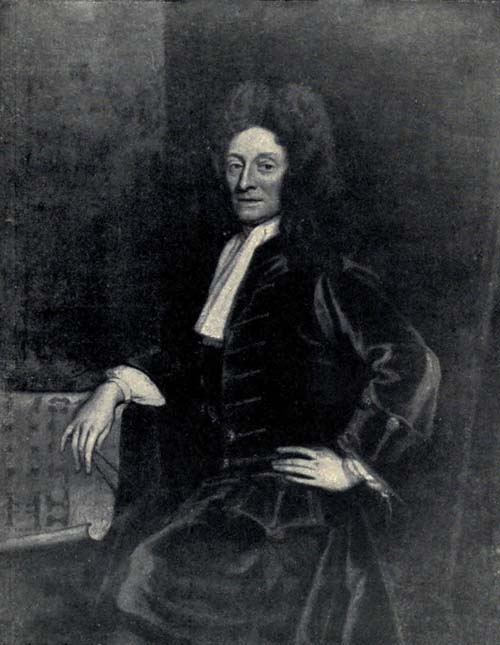
architect, Sir Christopher Wren, had been called
on to discuss the matter. He had agreed to undertake
the work, and was prepared to do so, when
the Great Fire took place, and when it was over,
there was nothing left of the church but the
blackened walls.
Then people shook their heads, and said that it
would be impossible to restore it. A new Cathedral
might be built somewhere else, but the St. Paul’s
that they had known on Ludgate Hill had gone
for ever.
But Sir Christopher Wren differed from them.
‘It would be impossible to restore the church,’ he
said, ‘or even to rebuild it on its old foundation, but
there was no reason why a new foundation should
not be laid, and a new church built upon it.’
‘That was all very well,’ answered the objectors
to the scheme; but how did Dr. Wren propose to
take down the walls and level the old foundations?
He suggested gunpowder; and with a little care
he could have blown down the walls quite safely,
but a stupid master-builder thought that he could
do the work himself, without the architect superintending,
and he set to work one morning, and
used such a big charge of the explosive that a great
many of the half-ruined houses in the neighbourhood
fell with the force of the explosion, and people got
such a fright that they objected to gunpowder
being used at all.
The famous architect was not dismayed, however,
at this opposition. He believed in the proverb that
says, ‘Where there’s a will, there’s a way.’ So he
procured a great beam of wood, forty feet long,
and had it covered at both ends with iron. Then
he slung this beam up in a wooden erection, something
like a triangle, and used it as a battering-ram
to break down the walls. At first it appeared as if
it would be in vain. The workmen battered at the
walls for a whole day, and not a stone fell. But
Wren persevered, and the next day he was rewarded,
for the great buttresses fell at last with a
crash, and he was able to proceed with his work.
And this he did most thoroughly. Someone
has said of him that he ‘built for eternity,’ and,
as far as any man can do so, the saying is true.
Everyone knows that the security of a building
depends greatly upon the kind of foundation it
rests upon. No matter how well built it is, no
matter how showy the walls may be, if the foundation
is not firm and solid, sooner or later it must
fall to pieces, unless something is done to repair it.
Christopher Wren knew of this danger, and the
first thing that he set his workmen to do was to
dig down forty feet into the earth to find out if the
ground on which he intended to build was quite
solid and secure. Doubtless many people laughed
at him, and said that he was too particular, but he
did not care, and they stopped laughing when it
was discovered that right down at the north-east
corner there was a pit, and if the new Cathedral
had been built over this, sooner or later the ground
would have sunk, and the wall of the building have
cracked, and in all probability fallen to pieces.
However, Dr. Wren made his workmen dig deeper,
till they got to the bottom of this pit; then he
filled it up with a pier of solid stone. It took him
a whole year to do this, but at the end of that time
he was ready to begin the church, knowing that
underneath it was a foundation that was absolutely
secure.
Then arose the great Cathedral that we see
to-day. It took some thirty years to build, and
when it was finished, the highest stone in the
lantern that rests on the dome was laid in its place
by Sir Christopher Wren’s son.
But now we learn something about Sir Christopher
that shows that he was a good as well as a clever
man. Do you remember what is said in the Bible
about people who can rule their own spirits, and
are slow to be angry? That they are really greater
than the men who conquer cities, and whom the
world admires. Tried by this standard, Sir
Christopher was a really great man. For he was
not only clever enough to build St. Paul’s Cathedral,
but he could rule his own spirit, and not vex himself
over the way in which his enemies treated him.
The story of Sir Christopher Wren’s life—for he
was knighted as a reward for his work—is as
interesting as any of the stories connected with
St. Paul’s Cathedral. He was the son of a Wiltshire
clergyman, and his love of architecture dated from
a time when the roof of his father’s church had
grown so old that it threatened to fall down.
And, as often happens in a country parish, there
were not very many rich men living there who
could give money to pay for the building of a new
one. So the Vicar determined that, instead of
paying for an architect, he would draw the
plans, and superintend the building of the roof
himself.
And we can imagine how little Christopher
would hear all about the new church roof, and how
he would look over his father’s shoulder and watch
him when he was drawing the plans, and how he
would spend all his play-time in the church, looking
at the joiners putting up the wooden beams, and
the other workmen working on the walls, while his
father went up and down, superintending everything,
and very likely lending a helping hand
himself. Perhaps it was in these early days that
the boy determined that he, too, would build
churches when he was grown up.
Then he had an ‘Uncle Matthew,’ who was
Bishop of Ely, and as he grew older he would go
and visit him, and would wander across from the
Palace into Queen Etheldreda’s beautiful Minster
Church, and stand and look up in wonder at the
Lantern Tower; and his uncle would tell him the
story of how it once fell, and how Alan de
Walsingham built it up again, and perhaps it was
that which gave him the idea, which he carried out
afterwards at St. Paul’s, of a great church with an
enormous dome in the centre of it, under which
thousands of people could assemble, as they do on
Sunday afternoons at St. Paul’s to-day, and listen
to the sermon of some great preacher.
He did something else first, however, for he was
very fond of watching the stars, and when he went
to Oxford he watched them so closely, and learned
so much about them, that he was made Professor
of Astronomy.
But although he was made Professor of
Astronomy, he seems to have gone on all the
time studying architecture, and drawing plans of
churches, and at last King Charles heard of him,
and asked him to draw some plans of churches for
him. In this way he became known as a clever
architect, and when the Great Fire took place, and a
large part of London had to be rebuilt, he not only
built a new Cathedral, but forty-two other churches
as well; besides which he built Marlborough
House, and a great part of Greenwich Hospital.
Photochrom Co., Ltd.
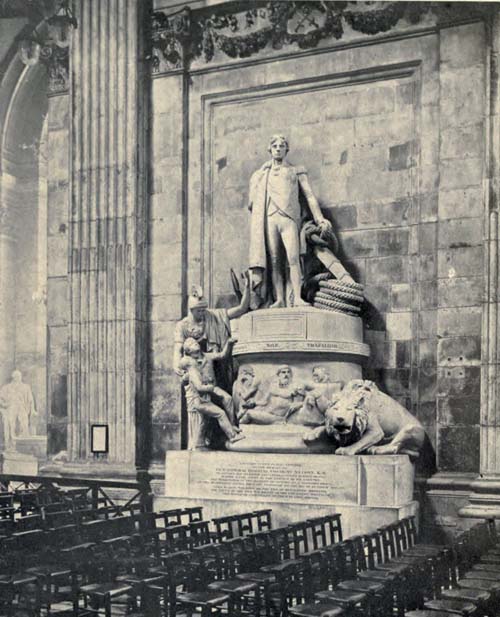
ST. PAUL’S CATHEDRAL: NELSON’S MONUMENT
(Page 59)
So you see that he had a useful, busy life, and
it was a very long one as well, for he lived till
he was an old man of ninety-one. He was not
very kindly treated towards the end of his life, and
this was because of what is called ‘political
jealousy.’ It had been the Stuart Kings who had
brought him into notice, and given him the post of
Surveyor-General; but when the House of Hanover
came into power, their followers said, ‘Oh, we
cannot have any of the friends of the Stuarts
holding good posts; we must take them from
them, and give them to those of our own party.’
And so Sir Christopher Wren’s office was taken
from him, and given to another man, and something
else was done that vexed him quite as much as
losing his post.
He had meant his great Cathedral to stand as it
stands to-day, with an open space all round it.
Someone suggested that it would look much better
if it were enclosed by a wall. And, in spite of Sir
Christopher’s remonstrances, a wall was built, which
quite spoilt the effect in his eyes.
He might have gone up and down the world
trying to prove to everyone that his idea was best,
and he might have made himself and his friends
very unhappy over the unkindness and injustice
that had been shown him, but, instead of this, he
only shrugged his shoulders when he looked at the
unsightly wall, and said, with a little laugh, that
‘ladies thought nothing looked well without an
edging.’ Then he retired quietly to Hampton
Court, where he had a house, and occupied himself
until he died with his old hobby of Astronomy, and
with reading Theology and Philosophy.
We read that occasionally the old man would
‘give himself a treat,’ and do you know what that
treat was? He would come to London, and walk
quietly up the Strand to St. Paul’s Churchyard,
and stand and look for a while at the great and
beautiful Cathedral that he had built, and then he
would go home feeling quite content and happy,
for he knew that it would stand for long centuries
after the ugly wall had been pulled down again,
and that future generations would forget all the
unkind and untrue things that people had said
about him, while they would always remember that
it was he, Christopher Wren, who was the builder
of St. Paul’s.
And there was something else, I think, which
must have made him very happy towards the
close of his life. In those days people were not
above taking bribes—that is, they would take
money, let us say, from a timber merchant, and
promise that they would use his timber, whether it
was good or bad; or from a stonemason, and use
his stones, no matter how badly they were hewn.
But Wren had never done this; his hands were
clean, and he left such a splendid name for uprightness
and honesty behind him that after his death
someone wrote of him, ‘In a corrupt age, all
testimonies leave him spotless.’
Now let us go inside the Cathedral, and walk
round it, although it is so full of monuments that
it is impossible to tell you the story of each.
As we look at them we realize that St. Paul’s
still keeps its character of the Citizens’ Church.
In Westminster Abbey, Kings, and poets, and
writers lie buried, or have monuments put up to
their memory, but here, in St. Paul’s, most of the
monuments are those of national heroes, of men
who have lived and died for the Empire.
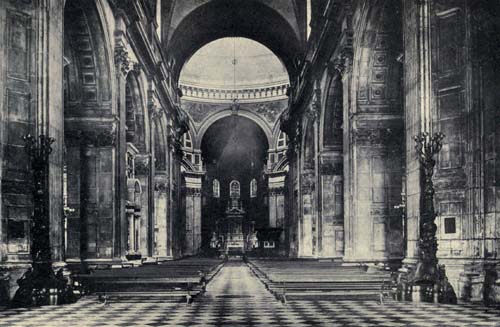
We will just look at one or two. If, as we walk
up the nave, we keep to our right hand, we come,
on the north side, to a recumbent statue of bronze,
and we are almost certain to find one or two people
standing looking at it, and perhaps someone has
laid a tiny bunch of flowers against the slab on
which the figure rests. For this is the monument
erected to General Gordon, and there is no man
who has died in recent years whose memory is held
more in honour by the people of England. For he
died in the attempt to save women and children
from deadly peril; and these poor people were not
English—they had not even white skins—but were
Soudanese, who lived in far-away Khartoum. I
expect that most of you have read the life of this
great man, but for the sake of those who have not,
I will tell you a little about him. To begin with,
he was what we call ‘unique’—that is, there is no
one else who is quite like him, and no one can read
the story of his life without thinking of two words,
‘Hero’ and ‘Saint.’
Somehow he reminds us of a strong climber, who
spends his days toiling up a great mountain, and
always getting higher and higher, and nearer and
nearer Heaven, while most of us are content to
remain down in the valley, where life is not so
hard, but where the air is less pure, and the roads
are dusty.
And just as we read in the old stories about
heroes having one possession that kept them
strong, such as a magic sword, or shield, or
helmet, so we can clearly see one thing in General
Gordon’s life that made him what he was—something
that enabled him to be brave, and
chivalrous, and modest; to care absolutely nothing
about praise, or blame, or reward, or even money
(the thing that so many people care so much about)—and
that one thing was absolute faith in God and
in God’s Providence.
Most of us live our lives as something that
belongs to ourselves; and we make our own plans,
and choose our own careers, and we think twice
before we do this or that, trying to see what the
consequences of our act will be.
To General Gordon life was simply a time that
was given to him to do God’s will—and he was
certain that whatever came to him was God’s will—so
it was all the same to him whether the days
brought joy or sorrow, praise or blame, riches or
poverty, life or death.
He was a good soldier of the Queen—for Queen
Victoria was living then—but he was also a good
soldier of Jesus Christ; perhaps one of the best
that has ever enlisted in that great army, for he
took his orders, and carried them out to the best
of his power, never questioning, never grumbling,
quite certain, whatever the consequences turned
out to be, that everything was right.
And it was this great faith that made him go,
promptly and fearlessly, into danger that other
men might have shrunk from, and with reason.
He is sometimes called ‘Chinese Gordon,’ because
once, when there was a rebellion in China, the
Emperor asked for a British officer to help to quell
it, and Gordon was sent. The rebels had entrenched
themselves in forts, and Gordon used to lead bands
of soldiers to storm these forts, carrying only a
little cane in his hand, with which he pointed out
to the men what he wanted them to do. And the
Chinese were so amazed that they thought that the
little cane was enchanted, and they called it his
‘magic wand,’ and believed that it protected him
from all harm.
After the rebellion was quelled he came home,
and was stationed at Gravesend, where he was
employed in constructing forts. He might have
been puffed up by the reputation that he had earned
in China, and have become proud and self-conscious;
but instead of that, he lived very quietly, visiting
infirmaries and ragged schools in his leisure time.
And he so interested himself in the poor boys whom
he found in the streets that he would take them
into his own house, and keep them there until he
found an opportunity to send them to sea, and thus
give them a fresh start in life.
Now comes the story of the Soudan. If you
look at a map of Africa, you will see, south of
Egypt, a tract of country bearing that name. I
have not time to tell you how it came to be under
British protection, but it did, and the natives, who
had been very badly treated before, settled down
to live quietly and peacefully under British rule.
Then a man arose, called the Mahdi, who gathered
together thousands of Arabs and raided the Soudan,
vanquishing the Egyptian troops who tried to fight
against them. The Mahdi became very powerful,
and it was felt that it would take too many of our
soldiers to hold the country against him, so the
British Government determined to give it up. But
we could not leave all the poor Soudanese people
to be massacred by the Arabs, so it was determined
to try to get them safely out of the country into
Egypt, and Gordon was sent out from England to
do this. He was accompanied by a friend of his,
Colonel Stewart, and they went to Khartoum,
which, if you look at the map, you will see is the
Capital of the Soudan, and stands on the banks of
the Nile, surrounded by deserts.
They succeeded in sending 2,500 people away in
safety; then the Mahdi and his followers hemmed
them in. Colonel Stewart tried to escape up the
Nile, and summon help from Egypt, but his boat
was wrecked, and he was murdered. And then
Gordon was left alone, the only Englishman in
Khartoum.
It is very sad, and yet it is grand, to read how
that lonely soldier defended the city, for almost a
year, with no one to help him except natives, and
with a howling mob of Arabs outside the walls.
He lived in what was called the ‘Palace,’ and day
after day he used to go up to the roof, and look in
vain down the river, and all over the desert, for the
help which he expected would be sent from
England, and which never came.
It did not come in time, at least, for it was too
late in being sent; and when, at last, after much
danger, a relieving force did reach the city, it was
only to find that it had fallen into the hands of the
Arabs two days before, and that its brave defender,
along with the rest of the inhabitants, had been
killed.
Valentine and Sons, Ltd.
ST. PAUL’S CATHEDRAL: THE NAVE
Can you imagine the thrill of horror and regret
that swept over England when the news came
home? It was felt to be such a terrible thing that
one of our countrymen should have been sent out
to attempt such a dangerous and difficult task, and
then left alone for months fighting against such
overpowering odds, and that, when at last help was
sent, we should have to confess that it was sent
‘too late.’
And yet, to General Gordon, facing death alone
in that far-off Soudanese town, it was not terrible;
it was simply a bit of God’s will. Listen to the
words that he wrote just ten days before the end
came, when he knew quite well that if succour did
not come speedily, it need not come at all.
After writing ‘Good-bye’ to all his friends, he
adds, ‘I am quite happy, thank God; and, like
Lawrence, I have tried to do my duty.’
These are not the words of a man who sees
death coming, and is afraid; they are the words of
one who was ‘quite happy,’ because he had done
his life-work as well as he could, and was content
to go home to God, no matter if the way thither
were very rough and very lonely.
His body was never found; probably it was
hacked in pieces by the Mahdi’s wild followers;
and yet he had a ‘funeral.’
For although Englishmen may be slow to act,
they act surely; and fourteen long years after
Gordon’s death, the Soudan was retaken, and after
the great Battle of Omdurman, Lord Kitchener,
with his victorious army, entered Khartoum one
peaceful Sunday morning, and what do you think
was the first thing that he did?
He took his troops, British and Egyptian, into
the open space in front of the ruined Palace where
Gordon had fallen, and formed them into three
sides of a square, while he and his generals stood in
the centre.
And then, after the British and Egyptian flags
had been run up to the roof of the Palace, and a
Royal Salute had been fired, a little group of
clergymen stepped forward. They represented all
parts of the Church, for soldiers of all creeds
wished to take part in Gordon’s ‘funeral.’ Then,
while solemn minute-guns were fired, a Presbyterian
minister read the seventeenth Psalm, which tells how
God’s people, whenever or however they die, will
behold His ‘Face in righteousness,’ and how they
will be ‘satisfied’ when they ‘awake in His
likeness.’
Then an English clergyman said the Lord’s
Prayer, and an old Roman Catholic Priest, with
snow-white hair, said a memorial prayer for Gordon
and those who had fallen with him. Then the
Scottish pipers wailed out a dirge, and the dark
Egyptian band played Gordon’s favourite hymn,
‘Abide with Me.’ After that the soldiers were
dismissed from their ranks, and were at liberty to
wander up and down, and everybody, down to the
youngest bugler, had a glad feeling in his heart,
that, although they did not know the exact spot
where General Gordon’s bones were resting, they
had done their best, after fourteen years, to give
him Christian burial.
There are many more memorials here of men
about whom we could tell the most interesting
stories, had we only the time. Here is a monument
to Sir John Moore, who was killed at
Corunna; and who, as doubtless you have learned
at school, was ‘buried darkly at dead of night,’
before the defeated English army took to their
boats.
And here is one to Sir John Howard, the great
prison reformer. See, he carries a key in his hand,
to show us how he unlocked the prison doors, and
brought help and comfort to the wretched inmates,
far more hopeless and neglected in his day than
they are in ours.
And here is a representation of a Bishop blessing
little black children. That is Bishop Heber, first
Bishop of Calcutta, who wrote a great many
hymns, some of which I am sure you know—‘Holy,
Holy, Holy, Lord God Almighty,’ ‘From
Greenland’s icy mountains,’ and ‘Brightest and
best of the sons of the morning.’
Here is a beautiful memorial—a bronze angel
stooping to lift the figure of a wounded yet
crowned warrior. Let us read the inscription
under it, for it tells of forty-three thousand men,
sons of the Empire, who flocked from our Colonies—from
Australia, India, Ceylon, New Zealand, and
South Africa—to help us to fight against the Boers,
and who ‘Gave their Lives for the Motherland.’
Near by is a great window, representing our
Lord healing the sick, which was placed there as a
thanksgiving for the recovery of our King from
a very dangerous illness when he was Prince of
Wales.
Look up to the Dome. Do you see the paintings
there? They are so far above us that we can
hardly see them properly; but if we were nearer
we should see that they are scenes from the life of
St. Paul. They were painted by an artist called
Sir John Thornhill, and he almost lost his life
when he was painting them. Indeed, he would
have done so had it not been for the promptitude
of a friend of his. A great scaffold had been
erected for him to stand on while he was painting,
and it makes us almost giddy to think of the height
that it must have been from the floor. One day
he was up there, working busily, and, luckily, a
friend was with him; for he stepped back to see
the effect of his work, and went so near the edge
of the scaffold that another step would have taken
him over, to be dashed to pieces on the floor
below.
His friend saw his danger, and, seizing a wet
paint-brush, flung it at the painting. The artist
rushed forward to intercept the brush, and so his
life was saved.
Now let us enter the choir, and look at this
wonderful carving on the stalls. This was done by
a famous wood-carver, named Grinling Gibbons,
whose story is as well worth knowing as that of Sir
Christopher Wren. He was partly English and
partly Dutch, and was born in Rotterdam. He
was very fond of carving, and he used to copy all
the things that he saw growing outside—fruits, and
flowers, and sprays of leaves, and berries—and he
became a very clever carver indeed.
He came to England, and made up his mind to
work hard at his art, and, in order to have time and
quietness to do so, he hired a tiny house at Deptford,
and went and lived there. After he had been
there some time, he determined to do a really great
piece of work.
He was very fond of a wonderful picture of the
Crucifixion, which had been painted by a Venetian
artist named Tintoretto, and he made up his mind
that he would copy this in wood, and frame it in a
wreath of carved fruits and flowers.
It was a very ambitious thing to do, but he
succeeded beautifully, although it took him a long
while, and cost him a great deal of time and work.
Now it chanced that near his little cottage there
was a great mansion called Sayes Court, in which
lived a very wise, rich, and cultured man named
John Evelyn. We know all about him, because
he did what perhaps some of you do:—he kept a
diary, which has been preserved, and which we can
read to-day.
And, luckily for Grinling Gibbons, John Evelyn
got to know him, and was a very good friend to
him. If we read Evelyn’s ‘Diary,’ we learn how it
came about.
He tells us how one day he was walking, ‘by
mere accident,’ in a field near Sayes Court, when
he noticed a ‘poore solitary thatched house.’ He
thought he would like to see who lived there, and
he went and knocked, but the door was shut, so he
looked in at the window.
And he saw the young artist working at his
beautiful piece of carving, which was almost
finished. Evelyn was so astonished at finding
such a skilful craftsman living so humbly that he
asked him if he might come in and speak to him.
Gibbons opened the door quite civilly, and
Evelyn tells us that when he saw the work close
at hand he was quite amazed at its beauty and
delicacy. He asked the young carver why he lived
in such a lonely spot, and Gibbons told him that
he wanted to have time ‘to work hard at his
profession without interruption.’
Then Evelyn, who was always ready to do a
kind action and to help people, volunteered to
introduce him to some ‘great man,’ who might,
perhaps, buy the piece of carving, and asked the
sum for which Gibbons would sell it.
The craftsman replied modestly that ‘he was
but a beginner, but he thought that the carving
was worth a hundred pounds.’
Mr. Evelyn thought that it was quite worth a
hundred pounds too, and so the very next time
that he went to Court he told King Charles about
it, and asked him if he might invite the young
artist to bring the piece of work to Whitehall when
it was finished, in order that the King might see it.
King Charles said ‘Yes,’ and kind-hearted John
Evelyn was delighted, for he felt certain that as
soon as the King saw it he would buy it. But,
alas! his expectations were dashed to the ground by
a French ‘peddling woman,’ who sold ‘petticoats
and fauns and baubles out of France’ to the
Queen and the ladies of her Court. And this was
how it happened.
When the piece of carving was brought to the
Palace, the King admired it very much, and would
have bought it, but he thought that he would ask
his wife first how she liked it. So he gave orders
that it was to be carried into the Queen’s apartments,
so that she could see it. She also admired
it, and was anxious that the King should buy it;
but an old Frenchwoman chanced to be in the
room—the ‘peddling woman,’ as Evelyn calls her—who
was in the habit of bringing over gloves, and
fans, and things of that sort, from France, and
selling them to the Court ladies. When she heard
the price that Charles proposed to give for the
carving, she was afraid that the Queen would run
short of money, and so would not be able to buy
so many things from her as she usually did.
So, when the King left the room, she began to
criticize the carving, and to find fault with it, and
the foolish Queen believed that what she said was
true, and when the King came back, she persuaded
him not to buy it. So poor Grinling had to carry
it back to his little cottage at Deptford, and he
afterwards sold it to a nobleman for eighty pounds.
But, although his first attempt at helping Grinling
Gibbons had not succeeded very well, kind
Mr. Evelyn did not give it up. He happened to
know Sir Christopher Wren, and as Sir Christopher
was busy at that time over the building of the new
Cathedral, he went and saw him, and told him
about his protégé, and asked him if he could not
give him something to do.
And Sir Christopher, who was looking about for
someone to carve the woodwork of the stalls, went
down and saw Gibbons’ work, and was so pleased
with it that he engaged him at once to come and
help him. And of course, when Gibbons did this,
he soon became famous, and had no more trouble
in obtaining orders.
Now perhaps you may feel inclined to ask if all
the monuments in St. Paul’s Cathedral are erected
to the memory of men who died far away in other
lands. It looks like it, does it not? for we have
seen Gordon’s monument, who died at Khartoum;
and Moore’s, who died in Spain; and Bishop
Heber’s, who died in India; and that of the
Colonial soldiers, who died in South Africa; and if
we go on looking, we shall find very many more, to
the memory of soldiers and sailors who fought our
battles, and guarded our shores, but whose bones
are resting in foreign lands, or, mayhap, under the
rolling waves of the sea.
But if we go down to the crypt, we shall find that
there are some graves there. Two of them I am
sure that you would like to look at for a moment,
because they are the graves of two men whose
memory will be kept green as long as the English
nation lasts. One of them was her greatest soldier,
and the other her greatest sailor. I need not tell
you their names, need I?—Arthur, Duke of
Wellington—‘The Iron Duke,’ as men called him—and
Horatio, Lord Nelson, who died at Trafalgar,
on board the Victory.
There are two monuments erected to them,
upstairs, in the great church. That to Wellington
is enormous, and stands just across the aisle from
General Gordon’s. Nelson’s monument is on the
other side of the Cathedral, just at the corner of
the south transept, and is more interesting to look
at than that of Wellington, for it represents the
famous Admiral standing with one sleeve empty—for,
as you remember, his right arm was shot away
at the Battle of Teneriffe—while underneath are
carved the names of his greatest sea-fights, Copenhagen,
Nile, and Trafalgar. Lower still is the
British Lion, emblem of the land he fought for,
and the figure of Britannia, pointing out the great
sailor to two little middies, and telling them to
follow in his steps.
But when, in 1805, Nelson died on board his
battleship, the English people felt that it was not
enough that a monument should be put up to his
memory in the Citizen Church of their Capital.
They wanted his body to rest amongst them;
so it was brought home, and, amid general lamentation,
was buried in this still and silent crypt.
Forty-seven years passed; and once more the
whole nation was mourning, for the Duke of
Wellington was dead. He had not died in action,
as did Nelson, but had fought his fights, and
won his victories, and conquered Napoleon, and
had lived to come home, and enter Parliament, and
serve his country as a politician as well as a soldier.
And when the question arose as to where he
should be buried, it was felt to be fitting that he—‘The
Greatest Soldier,’ as Tennyson calls him—should
be brought and laid beside ‘The Greatest
Sailor,’ and that the
‘Sound of those he wrought for,
And the feet of those he fought for,’
Should ‘Echo round his bones for evermore.’
Do you know how his body was brought
through the streets of London? Look at this
enormous funeral car standing under this dark arch,
and you will see. It looks so strange and fantastic
that at first sight you hardly know what it is meant
for; but you must remember that it was not made
out of ordinary wood, like carts and waggons. It
was made out of iron—out of old cannon which had
done their part in the great soldier’s victories.
Look at the names of these victories, twenty-four
of them, engraved upon the body of the car.
You can think what a solemn procession it must
have been, as the mighty soldier and prudent
statesman was borne upon it, through more than a
million silent onlookers, to his last long rest in
St. Paul’s.
Here is another grave that we must look at ere
we leave the Crypt. ‘It cannot be an important
one,’ you say, ‘for there is no monument over it,
only an inscription.’
Ah yes, but read the inscription—‘Lector, Si
Monumentum Requiris, Circumspice.’[A] That tells
us at once whose grave it is. It is Christopher
Wren’s. And, as we do his bidding, and look
around and above us, and as we ascend the stairs
once more, and enter the magnificent Cathedral
and walk down the nave to the great west door,
we feel that no smaller monument could have been
erected to the man whose marvellous skill planned
it all.
FOOTNOTE:
TRANSCRIBER’S NOTE:
Obvious typographical errors have been corrected.