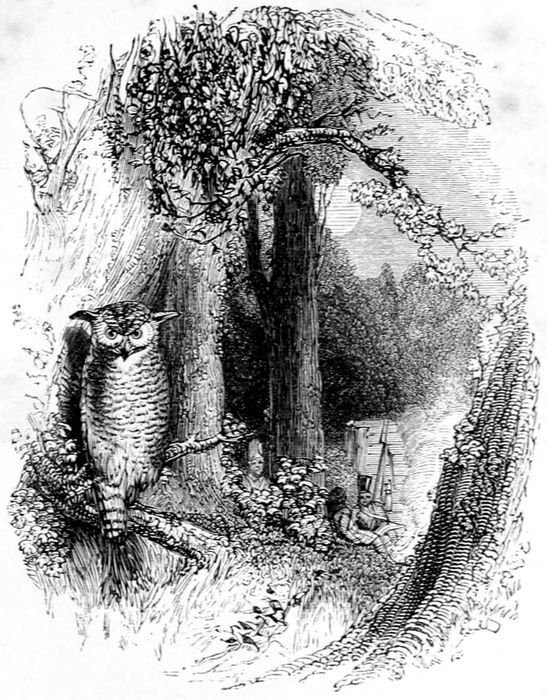
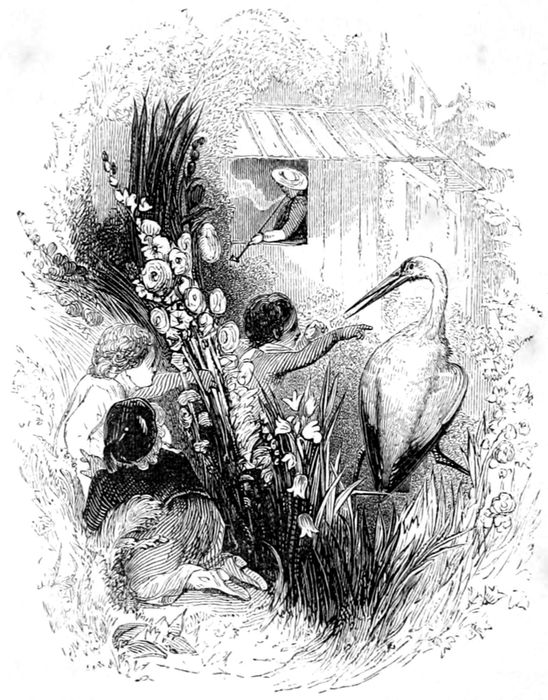
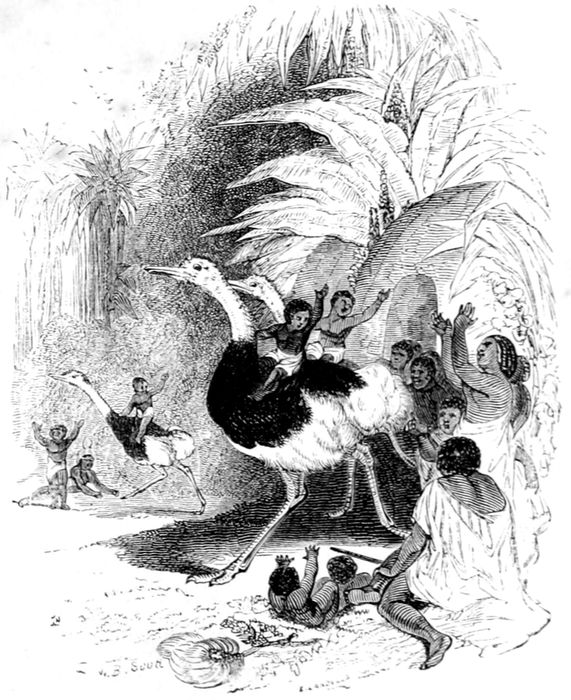
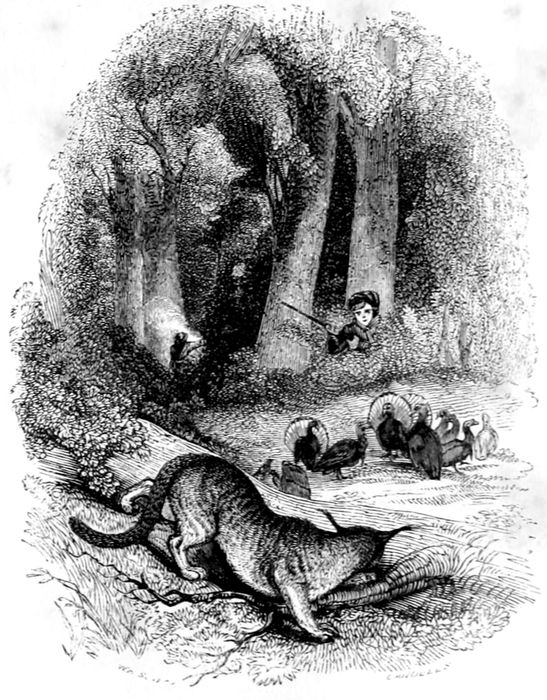
Birds are such universal favourites, and the Stories
connected with their Habits and Instincts so varied
and interesting, as to make me feel confident that
the Volume now offered to my young readers will
meet with a ready acceptance and approbation.
The Engravings, which have been executed by
Mr. Landells, from Drawings by Mr. W. B. Scott,
will, I hope, be found faithfully and spiritedly to
embody the incidents of the Stories which they
severally illustrate.
T. B.
CONTENTS. — CHAPTER I.
v
CHAPTER I.
UNCLE THOMAS TELLS ABOUT THE GOLDEN EAGLE, AND NARRATES VARIOUS STORIES ILLUSTRATIVE OF ITS FEROCITY AND POWER
UNCLE THOMAS TELLS SEVERAL INTERESTING TALES ABOUT THE FEROCITY AND TENACITY OF LIFE IN THE VULTURE, AND ABOUT THE GREEDINESS WITH WHICH IT DEVOURS ITS PREY
UNCLE THOMAS TELLS ABOUT OWLS, AND OF THE CURIOUS PECULIARITIES IN THEIR STRUCTURE, WHICH ENABLES THEM TO SEEK FOR AND SECURE THEIR PREY DURING THE NIGHT
UNCLE THOMAS TELLS ABOUT SOME INTERESTING PECULIARITIES IN THE HABITS OF THE OSTRICH AND THE EMU, AS WELL AS ABOUT THOSE OF THE TURKEY IN ITS NATIVE FORESTS
UNCLE THOMAS TELLS ABOUT THE GOLDEN EAGLE, AND NARRATES
VARIOUS STORIES ILLUSTRATIVE OF ITS FEROCITY AND POWER.
Uncle Thomas had scarcely finished his last
series of Tales, when he was gratified by a visit
from the Mama of his young auditors, to introduce
her two little Girls, who, having heard their
Brothers speak so much of the delightful Stories
which he told them, had prevailed on her to
come with them to request that Uncle Thomas
would be so good as to permit them to accompany
their Brothers when they came to visit
him.
“I am afraid, Uncle Thomas,” said Mama,
“that we already trespass too much on your
2kindness, in allowing the Boys to intrude upon
you so frequently; but they seem always to be
so much delighted with the Stories which you
tell them that, during the hours in which they
are not engaged in the school-room, I seldom
hear them talk of any thing else. ‘Don’t you
recollect the story which Uncle Thomas told
us?’ cries one, in enforcing some controverted
point. ‘Ah! but,’ exclaims another, ‘Uncle
Thomas said so and so.’ And I have come at
the request of their Sisters to beg that you will
allow them to form part of your little circle of
listeners.”
Uncle Thomas declared that he was delighted
to hear that the Boys were interested in the
Stories which he told them, and that he would
be still more gratified to be honoured with the
company of the young ladies.
Mary and Jane, who during Mama’s long
speech had been carefully noting the various
articles with which Uncle Thomas’s little room
was furnished, were almost overjoyed to hear
3that they were to be admitted. Mary intended
to have thanked Uncle Thomas for this kindness,
but while some other conversation, which it is
unnecessary to repeat, took place between Mama
and Uncle Thomas, her attention had been
directed by Frank to a glass-case which stood
on one side of the room, containing a variety
of fine specimens of Birds. So completely was
their attention engrossed by what they there saw,
that they did not observe that during a pause
in the conversation Uncle Thomas had advanced
to the table at which they stood, and was
listening to their remarks and to the questions
with which Mary plied her brother.
“Ah! I see,” said Uncle Thomas, “it is
about Birds I must tell you next. I can tell
you many interesting stories about Birds; but
Mama waits; we must not detain her at present.”
“When shall we come again then, Uncle
Thomas?” asked Frank.
“When you please, Frank,” said Uncle
Thomas. “Suppose we say to-morrow night;
4perhaps that will suit the convenience of the
young ladies.”
“Oh, quite, Uncle Thomas!” said Mary;
“it will be quite convenient for us whenever
it is so to you.” Mama having given her
assent to this arrangement, the little party, full
of smiles, bade Uncle Thomas good morning.
On the following evening, accordingly, they
again met, and when they had duly greeted
their kind old Uncle Thomas, and seated themselves
round his elbow-chair, he began:—
“Birds, my dear children, of which I promised
to tell you some stories, are perhaps the most
interesting class of animals in creation, whether
we consider them in regard to their habits or
to the curious structure of their bodies, by which
they have been fitted by Nature for the place
which God has assigned them, or to the Instincts
which have been implanted in them. In most
5minds their recollection is associated with all
that is most beautiful and romantic in natural
scenery. We meet with them in our walks,
chirping and frolicking among the village hedgerows,
or see them soaring, with almost untiring
wing, high above the mountain tops, or hear
their solitary voices as they make the wide-spreading
and desolate moor seem even more
lonely with their harsh and far-sounding notes.
Wherever we direct our steps we are sure to
find Birds enlivening and cheering the scene, or
adding fresh interest by their varied and characteristic
occupations. There are few indeed who
cannot say with Cowper:—
“Ten thousand warblers cheer the day, and one
The live-long night; nor those alone whose notes
Nice-fingered art must emulate in vain;
But cawing rooks, and kites, that swim sublime
In still repeated circles, screaming loud;
The jay, the pie, and e’en the boding owl,
That hails the rising moon, have charms for me.”
“Birds,” continued Uncle Thomas, “have
been divided by some naturalists into Land and
6Water Birds; but more recent and systematic
writers have introduced a more extended classification.
Cuvier, an eminent French author, divides
them into Birds of Prey—such as the Eagle and
Vulture; Sparrow-like, or hopping Birds—such
as Jays, Thrushes, &c.; Climbing Birds—such as
Parrots; Poultry Birds—such as Turkeys, Pheasants,
&c.; Running and Wading Birds, which
are easily distinguished by their long legs; and
Web-footed Birds—such as Ducks, Geese,
Swans, &c.”
To this long and rather uninteresting detail
Mary and Jane listened as patiently as possible.
But no sooner was it finished, than the latter
seized the opportunity to ask Uncle Thomas whether
the Eagle was not the largest Bird in the
world, and whether it was a native of Britain, as
she had heard a story lately of one having carried
off a child to its nest to feed its young?
“The largest of the Birds of Prey, undoubtedly,”
said Uncle Thomas, “is the Golden
Eagle. It inhabits all the wilder parts of
7Europe, and is also found in other parts of the
world. They are, however, only to be found
among wild and savage scenery, preferring for
their place of habitation the lonely and elevated
peaks of the highest mountains, where, from
their great power, they harbour secure from the
storm and the tempest.”
“Are they very large, Uncle Thomas?”
asked Jane—“Larger than this bird?” pointing
to a fine Falcon, which occupied a prominent
place in the little museum already referred
to.
“Yes, dear!” said Uncle Thomas; “they
are much larger, very much larger than that.
Like all other animals, they are of course subject
to variations in size; their development in
some measure depending on the plentifulness or
scarcity of their food during the time they are
in the nest, and indeed during the whole period
until they arrive at their full growth; but the
average size of the mature Bird is usually about
three feet in length, measuring from the point
8of the beak to the tip of the tail, while the
wings from point to point measure between six
and seven feet.”
“They must be very powerful animals, Uncle
Thomas,” remarked Mary.
“So strong, that they frequently carry off
lambs and other small animals to their nests,”
said Uncle Thomas; “and it is said that they
have even occasionally carried away children.
About a hundred years ago an incident of this
kind is said to have occurred in Norway. While
a boy about two years old was passing between
his father’s cottage and a field at no great
distance, in which his parents were at work, an
Eagle pounced upon him and flew off with him.
His parents, attracted by his shrieks, saw their
dear child carried off to an inaccessible rock,
and notwithstanding all their efforts, they were
unable to rescue him.”
“And was the poor dear child killed, Uncle
Thomas?” asked Jane.
“It appears from the story that he was,” said
9Uncle Thomas, “and unfortunately it is not the
only instance of a similar kind. In one of the
Feroe Islands, which lie between the north of
Scotland and Iceland, an Eagle stooped down
and carried away an infant which its mother
had laid on the ground, close by the place
where she was at work. It flew direct to its
nest, at the point of a high rock so steep and
precipitous that the boldest bird-catchers had
never ventured to scale it. But the strength of
a mother’s love overcame all obstacles; she
climbed to the nest, but alas! she reached it
too late. She found her poor child dead and
partly devoured—its little eyes torn out by the
cruel bird!
“I am happy to say, however,” continued
Uncle Thomas, “that all attacks of the kind do
not terminate so fatally. A child which was
carried off by an Eagle in the Isle of Skye, in
Scotland, was borne by the huge bird across a
lake on the banks of which it sat down, probably
for the purpose of feeding on its prey,
10which it perhaps found too heavy to carry farther.
Fortunately however, it happened that
the bird alighted at a short distance from some
people who were herding sheep, and hearing
the infant cry, they hurried to the spot, frightened
away the Eagle, and rescued it uninjured.”
“It was very fortunate they were so near,”
remarked Harry.
“It was so,” said Uncle Thomas, “and the
parents were in this respect more fortunate than
those of another child which was carried off by
an Eagle from the side of its mother, who was
at work in the fields. She saw the huge bird
pounce down on her little darling, but before
she could run to its assistance it was carried off,
and she heard its cries as it was borne out of
her sight, and she saw it no more. This took
place in Sweden.
“Though the Eagle has long had the character
of being a very bold and courageous
bird,” continued Uncle Thomas, “it really does
not deserve its good name. It is sometimes
11called the King of Birds, and if the term is
limited, so as to convey only an idea of its great
size and strength, it may be permitted; but we
must not allow ourselves to be misled by a mere
name. It is in truth almost the least courageous
among birds, and is frequently put to flight
by those of less than half its size.”
“Do they ever attack men?” asked Frank.
“Unless when they are forced to put forth their
strength in self-defence, which is an instinctive
operation which even the weakest animals display,”
replied Uncle Thomas, “they never attack
man; at least the only instance which I recollect
of their threatening to do so is related by
Captain Flinders, in his account of his voyage
to New South Wales. While he and some of his
officers were walking on shore, a large Eagle,
with fierce looks and out-spread wings, was seen
bounding towards them; when it arrived within
a few yards it suddenly stopped and flew up
into a tree. They had hardly got rid of this
one, when a second flew towards them as if to
12pounce upon them, but it also stopped short
when quite close upon them.”
“I suppose they were afraid, then,” said Mary.
“Captain Flinders imagined,” said Uncle Thomas,
“that the Eagles had at first mistaken him
and his officers for Kangaroos; and as the place
seemed then quite uninhabited, he conjectured
that the Eagles had never seen a man before;
and he observed that they fed on those animals,
as on the appearance of one, the Eagle stooped
down at once and tore it in pieces in an instant.
“That the Eagle can defend itself very vigorously,
however,” continued Uncle Thomas, “is
proved by an adventure which a young man had
with one in the Highlands of Scotland. He
had gone out very early one morning to shoot
Rock Pigeons, accompanied by a Dog of the terrier
breed. As he stood watching the Pigeons,
an Eagle came floating over the brow of the precipice.
He took aim and fired, and the bird
fell to the ground with a broken wing. He
attempted to master it with his hands, but it
13fought with great determination, and lacerated
his hands so that he was obliged to desist. He
then caused his Dog to attack it, but though
well accustomed to fight with Badgers and with
Otters, it soon found that they were weak foes
compared to the Eagle, and ran yelping away.
The sportsman was at last compelled to knock
it on the head with the end of his gun, nor was
it killed till it had received about a dozen heavy
blows. He described it as having legs as thick
as his wrist.”
“It must have been a very strong Bird,” remarked
Jane.
“It is perhaps only under the influence of
extreme hunger, or in defense of themselves or
their young,” continued Uncle Thomas, “that
the Eagle ever attacks human beings. Probably
to the former of these is to be attributed
the attack of one on a little boy of which I
will now tell you:—
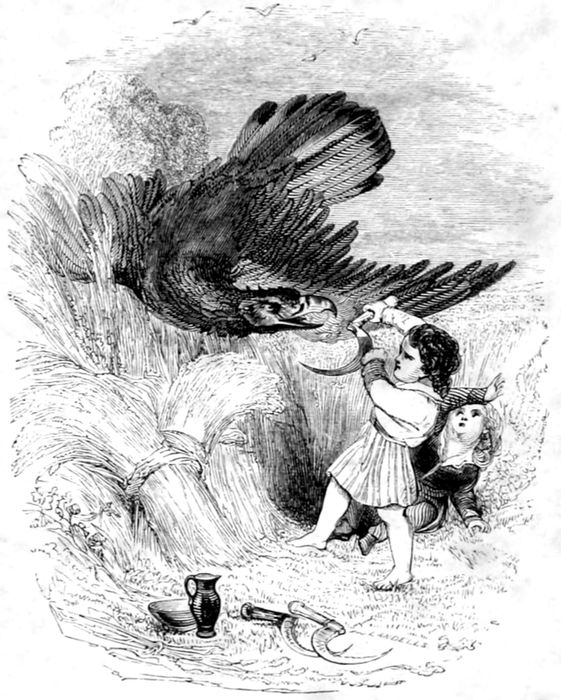
“A few years ago, as two boys, the one
about seven and the other five years old,
14were amusing themselves in trying to reap
during the time that their parents were at dinner,
in a field in the neighbourhood of New
York, a large Eagle came sailing over them,
and with a swoop attempted to seize the eldest,
but luckily missed him. Not at all dismayed,
the Bird alighted on the ground at a short distance,
and in a few moments repeated the attempt.
The bold little fellow defended himself
with the sickle in his hand, and when the bird
rushed upon him, he struck it. The sickle entered
under the left wing, went through the
ribs, and proved instantly fatal. On being measured,
it was found that from the tip of one
wing to that of the other, was upwards of six
feet! Its stomach was opened, and found to be
entirely empty. The little boy did not receive
a scratch.”
“He must have been a bold little fellow,”
said Jane.
“Do you think you should have fought as
determinedly, John?” asked Mary.
15John was, however, too modest to return an
answer directly in the affirmative. He merely
said mildly, “I don’t know, Mary; I hope I
should.”
Uncle Thomas, seeing that this story of the
valiant defence of the little boy excited so much
interest among his little auditors, produced a
portfolio, in which he kept a few choice prints,
one of which contained a representation of the
boy defending himself against the Eagle. When
they had done admiring it, Uncle Thomas continued:—
“Powerful as the Eagle is, it is frequently vanquished
by the animals on which it seizes. It
has been observed while soaring into the sky
with its prey suddenly to falter in its flight, and
then to fall to the earth as if pierced with a ball
by some skilful marksman. A gamekeeper to
a Scottish nobleman, who witnessed a scene of
this kind, hurried to the spot, and found the
Eagle quite dead, and a Stoat, an animal of the
Weasel kind, severely wounded, struggling by its
16side. The little animal on being seized by
the Eagle had with instinctive sagacity seized
upon and ruptured one of the principal arteries
in the Eagle’s neck, and thus brought his enemy
to the ground.
“I wonder such a large and powerful animal
as the Eagle did not kill the little Stoat
before it had time to seize its neck,” said
Harry.
“Recollect, Harry,” said Jane, “that Weasels
are very nimble creatures. As we were walking
through Langton Wood lately, we saw one
running about, but it soon got among some
loose stones and concealed itself.”
“Perhaps,” said Uncle Thomas, “the Eagle
had missed its aim when it pounced upon its
prey, and thus held it insecurely, for so powerful
is the force with which it darts upon its
object, that it usually kills its victim at one
blow. When it fails to do this, a contest generally
ensues; and powerful as the Eagle is, it
does not always come off successful. On one
17occasion, one was observed to pounce down
upon a Cat. The latter darted its sharp claws
into the Eagle and clung so that it could not
be shaken off. It mounted into the air, but
still puss held securely, and on descending to
the ground the struggle continued, until some
persons who witnessed the attack came up and
captured both of the combatants.
“A contest, somewhat of the same kind,”
continued Uncle Thomas, “was observed between
an Otter and an Eagle. It was witnessed by a
party of gentlemen who were enjoying the amusement
of fishing in one of the Scottish Lakes.
An Eagle, hovering over the lake, descried
an Otter sleeping on the sunny side of a bank
near the water’s edge, and pounced upon it.
Thus attacked, the Otter stood on the alert, and
prepared to give battle to its assailant, when
another Eagle appeared, and joined in the attack.
The unfortunate Otter, finding himself assaulted
on both sides, immediately retreated to his favourite
element. On reaching the water, it attempted
18to dive, but was powerfully withheld by
one of the Eagles, whose talons had been fixed
in his skin, which made him redouble his exertions
for life and liberty. In this way the
combat was long and amusing, till the Eagle,
finding his claws fairly disengaged, and little
used to combat on such an element, precipitately
beat a retreat, and retired with his companion
to his native mountains.”
“I have heard Mama say that there is a
tame Eagle at —— Castle; I wonder how such
a wild creature can be tamed!” remarked Jane.
“There have been frequent instances of the
Eagle being tamed,” said Uncle Thomas, “and
sometimes even when taken after having arrived
at maturity. One of this sort, which was
taken in Ireland, had its wings cut, and was put
into a large garden, where it soon became domesticated.
Its wings gradually grew again, and the
Eagle sometimes flew away for a fortnight at
a time, but always returned. The children of
the family frequently met it in their walks about
19the garden, but it never offered them any molestation.
It once, however, attacked its master;
it is supposed in consequence of his neglecting
to bring its accustomed supply of food. After
living ten or twelve years in this manner it one
day quarrelled with a large mastiff. The fight
must have been long and obstinate, but no one
witnessed it. The Eagle was killed, and so
severely was the Dog wounded that it died almost
immediately afterwards.
“In Norway,” continued Uncle Thomas, “the
people represent the Eagle as very sagacious, and
as using the most curious devices to secure its
prey. It is said, for instance, to attack and overcome
Oxen in the following manner. It plunges
into the sea, and after being completely
drenched, rolls itself on the shore till its wings
are quite covered with sand. It then rises into
the air, and hovers over its unfortunate victim,
and, when close to it, shakes its wings, and
throws stones and sand into the eyes of the Ox;
and, having thus blinded it, terrifies the animal
20by striking it with its powerful wings. The
poor Ox runs about quite desperate, and at
length falls down completely exhausted, or dashes
itself to death by falling over some cliff. The
Eagle then feasts undisturbed on his prey.”
“It is a very sagacious stratagem indeed,” said
Mary; “I really do not see how it could
proceed more efficiently if it was endowed with
reason.
“But is it true?” asked Harry.
“You are right Harry,” said Uncle Thomas;
“that ought always to be the first consideration.
So much fable has been mixed up with the accounts
of the habits of animals that it is sometimes
difficult to distinguish the true from the
false. In the present case, for instance, the fact
rests on the statement of a traveller named Von
Buch, who assures us that the circumstance was
related to him, in nearly the same terms, at places
distant from each other. But, on the other hand,
it is so contrary to the general habits of the
Eagle that it seems most unlikely to be true;
21besides, if the Eagle were to suffer its feathers
to be drenched in the way described, it would
be unable to fly, and would soon suffer for its
hardihood by being drowned.”
“Would it, indeed, Uncle Thomas?” asked
Jane; “Swans and Geese go into the water,
and are not drowned.”
“No, my dear, they are not,” said Uncle
Thomas; “because their habits rendering it
necessary for them to spend much of their time
in water, the Creator has furnished them with
an abundant supply of oily matter, with which
they cover their feathers, so as to prevent the
moisture from penetrating them; but Birds
which are not intended to inhabit the water are
not so provided, and would soon become unable
to fly, even if they remained exposed to a severe
shower of rain, without seeking shelter. The
Osprey, or Sea-Eagle, which feeds upon fish
which it catches in the sea, is provided in this
manner; but then it could not be true of the
Osprey either, because for this reason, the water
22does not saturate its feathers, and the sand
would not adhere to them.”
“Is it not true, then?” asked Mary.
“I do not say that it is absolutely untrue,”
said Uncle Thomas; “because the person who
relates it states that it was confirmed to him
by various witnesses, in different places; but
I think it is very unlikely, to say the least
of it.
“However much we may differ as to the sagacity
of the Eagle,” continued Uncle Thomas,
“there can be but one opinion as to its affection
for its young, and the valour with which it
defends them against all assailants. Ebel, in
his work on Switzerland, relates a story of a
chasseur, or hunter of that country, which illustrates
this fact very strikingly. Having discovered
a nest belonging to one of these terrible
birds, and having killed the male, the hunter,
by name Joseph Schoren, crept along the jut of
a rock, his feet bare, the better to keep himself
firm, in the hope of catching the young ones. He
23raised his arm, and had already his hand upon
the nest, when the female, pouncing on him
from above, struck her talons through his arm,
and her beak into his loins. The hunter, whom
the smallest movement would have precipitated
to the bottom, lost not his presence of mind,
but remained firm, rested his fowling piece,
which fortunately he held in his left hand,
against the rock, and with his foot directing it
full on the Bird, touched the trigger, and she
fell dead. He brought away the Eagles, but the
wounds which he had received confined him
for several months. M. Ebel adds, that these
hunters are men of whom the savages of
America might learn lessons of patience and
courage in the midst of danger and privation.
The greater part of them come to a tragical
end. They disappear, and their disfigured remains,
which are now and then found, alone
intimate their fate.”
Uncle Thomas went on to say that he had
not yet quite finished all his stories about the
24Eagle; but as the evening was now far advanced,
it would be necessary to delay them till
their next meeting.
CHAPTER II.
25
UNCLE THOMAS TELLS ABOUT THE OSPREY, OR SEA-EAGLE, AND ABOUT
THE WHITE-HEADED, OR BALD EAGLE OF AMERICA.
“The Osprey, or Sea-Eagle, which I mentioned
to you when I last had the pleasure of seeing
you,” said Uncle Thomas to his young hearers
on a subsequent evening, when they had once
more gathered round his chair, “though not
quite so large as the Golden Eagle, is yet a
very powerful Bird, being in general upwards
of two feet in length, its wings extending about
five feet and a half. It seeks its prey by water
only, and builds its nest in the crevices of rocks,
on the banks of lakes and rivers.”
“How does it catch the fish?” asked Frank.
“It has, like most of the other Birds of the
Eagle tribe,” said Uncle Thomas, “been endowed
26with remarkably keen power of vision, and as
it sails over the waters it can, even at a considerable
height in the air, see fish swimming near the
surface, and, dropping down upon them with
the swiftness of an arrow, it plunges into the
water, and seldom emerges without securing
them in its powerful talons.
“Though the species is a native of Britain,”
continued Uncle Thomas, “it is in America
where it is seen to most advantage, as its habits
can be more easily watched from the vast extent
of the broad waters by which some of the
majestic rivers are distinguished. It has accordingly
attracted the particular notice of
two of the most eminent American naturalists.
Here is Wilson’s account of its mode of fishing,
and the manner in which it seizes its prey.”
Uncle Thomas then took down from a shelf
a volume of Wilson’s “American Ornithology,”
and turning to the account of the Fish-Hawk,
which he explained was the name by which
the bird was known in America, “and though”
27said he, “as I have already told you, it is smaller
than the Golden Eagle, yet its general character
is the same; and its size and strength entitle
it to the more high-sounding name.” He then
pointed out the passage which he wished Harry
to read, which was as follows:—
“On leaving the nest, the Osprey usually flies
direct till he comes to the sea, then sails around,
in easy curving lines, turning sometimes in the
air as on a pivot, apparently without the least
exertion, rarely moving the wings, his legs extended
in a straight line behind, and his remarkable
length, and curvature or bend of wing,
distinguishing him from all other Hawks. The
height at which he thus elegantly glides is various,
from one hundred to one hundred and fifty
and two hundred feet, sometimes much higher,
all the while calmly reconnoitering the face of
the deep below. Suddenly he is seen to check
his course, as if struck by a particular object,
which he seems to survey for a few moments
with such steadiness that he appears fixed in
28air, flapping his wings. This object, however,
he abandons, or rather, the fish he had in his
eye has disappeared, and he is again seen sailing
around as before. Now, his attention is again
arrested, and he descends with great rapidity,
but, ere he reaches the surface, shoots off on
another course, as if ashamed that another victim
had escaped him. He now sails at a short
height above the surface, and, by a zig-zag
descent, and without seeming to dip his feet in
the water, seizes a fish, which, after carrying a
short distance, he probably drops, or yields up
to the Bald Eagle, and again ascends by easy
spiral circles to the higher regions of the air,
where he glides about in all the ease and majesty
of his species. At once, from this sublime
and aerial height, he descends like a perpendicular
torrent, plunging into the sea with a loud
rushing sound, and with the certainty of a rifle-shot.
In a few moments he emerges, bearing
in his claws his struggling prey, which he always
carries head foremost, and, having risen a
29few feet above the surface, shakes himself as a
Water-Spaniel would do, and directs his heavy
and laborious course directly for the land. If
the wind blows hard, and his nest lies in the
quarter from whence it comes, it is amusing to
observe with what judgment and exertion he
beats to windward, not in a direct line, that is,
in the wind’s eye, but making several successive
tacks to gain his purpose. This will appear
the more striking, when we consider the size of
the fish which he sometimes bears along. A
Shad was taken from a Fish-Hawk near Great
Egg Harbour, on which he had begun to regale
himself, and had already ate a considerable portion
of it; the remainder weighed six pounds.
Another Fish-Hawk was passing the same place,
with a large Flounder in his grasp, which struggled
and shook him so, that he dropped it on
the shore. The Flounder was picked up, and
served the whole family for dinner. It is a
singular fact, that the Hawk never descends to
pick up a fish which he happens to drop either
30on the land or in the water. There is a kind
of abstemious dignity in this habit of the Hawk
superior to the gluttonous voracity displayed by
most other birds of prey, particularly by the
Bald Eagle. The Hawk, however, in his fishing
pursuits, sometimes mistakes his mark, or
overrates his strength, by striking fish too large
and powerful for him to manage, by whom he
is suddenly dragged under water; and though
he sometime succeeds in extricating himself,
after being taken three or four times down, yet
oftener both parties perish. The bodies of Sturgeon,
and of several other large fish, with a Fish
Hawk fast grappled in them, have at various
times been found dead on the shore, cast up by
the waves.”
“That is very curious,” said John. “I
wonder the Eagle does not relax his hold of the
fish when it finds it is too strong for him.”
“The talons of the Eagle tribe, with which
they secure their prey,” said Uncle Thomas,
“are remarkably sharp and powerful instruments,
31nor is the power with which they wield them
less remarkable, but, like all other muscular
power, its greatest force can be exerted in
one direction only. Thus, for instance, John,
in the case of your own hand, the power with
which you could close your fingers on a cylinder
compared to that which, supposing it hollow,
you could exercise on it by opening them (or applying
that power backwards,) is at least ten to
one. This will explain to you how it is that
the Eagles are sometimes caught in the way
Mr. Wilson has stated. They seize their prey
so firmly that their talons get fixed in the animal’s
flesh, and they are unable to withdraw
them.
“In Britain,” continued Uncle Thomas,
“several instances of the same kind have been
observed. On a very sultry day in the month
of July a shepherd, while engaged in searching
for some missing Sheep, observed an Eagle
seated on the banks of a deep pool, apparently
watching its prey. Presently it darted into the
32water, and seized, with a powerful grasp, a large
Salmon. A desperate struggle now took
place, and the shepherd hurrying to the spot
found the Eagle unable to extricate itself, and
frequently pulled under water by his vigorous
antagonist. Seizing a large stone, the shepherd
threw it at the combatants with such force that
it broke the Eagle’s wing, and the Salmon exhausted
by its violent struggles, suffered itself
to be captured without difficulty.
“An adventure of the same kind,” said
Uncle Thomas, “in which, however, the Eagle
was victorious, is related by a Scotch clergyman.
A large Eagle in one of its hunting excursions
observing a Halibut—a large flat fish
somewhat resembling a Turbot—within its
reach, stooped down and struck his powerful
talons into its back; a struggle now took place,
but the fish not possessing the agility of the
salmon was at length overcome. It was too
large however, for the Eagle to carry off, so,
spreading its wings as a sailor would do the sail
33of a boat, it remained seated on the back of the
Halibut till the wind bore it to the shore. Unhappily
for the poor Eagle, however, its
troubles did not end here, for its motions
having been watched, some people rushed in and
took it alive before it could extricate itself.”
“Poor creature!” said Jane, “he deserved to
escape after displaying so much ingenuity.”
“Harry,” said Uncle Thomas, “will now
have the goodness to read to us Audubon’s very
charming account of what he calls the Great
American Eagle, but which is supposed to be
merely the Osprey in its young plumage. Here
it is:”—
“Never shall I forget the delight which the
first sight that I obtained of this noble bird
gave me. Not even Herschel, when he discovered
the planet which bears his name, could
have experienced more rapturous feelings. We
were on a trading voyage, ascending the Upper
Mississippi. The keen wintry blasts whistled
around us, and the cold from which I suffered
34had, in a great degree, extinguished the deep
interest which, at other seasons, this magnificent
river has been wont to awake in me. I
lay stretched beside our patroon. The safety of
our cargo was forgotten, and the only thing that
called my attention was the multitude of Ducks
of different species, accompanied by vast flocks
of Swans, which from time to time passed us.
My patroon, a Canadian, had been engaged many
years in the fur trade. He was a man of much
intelligence; and, perceiving that these birds
had engaged my curiosity, seemed anxious to
find some new object to divert me. An Eagle
flew over us. ‘How fortunate!’ he exclaimed;
‘this is what I could have wished. Look, Sir!
the Great Eagle, and the only one I have seen
since I left the lakes.’ I was instantly on my
feet, and, having observed it attentively, concluded,
as I lost it in the distance, that it was
a species quite new to me. My patroon assured
me that such birds were indeed rare; that they
sometimes followed the hunters, to feed on the
35entrails of animals which they had killed, when
the lakes were frozen over, but that, when the
lakes were open, they would dive in the daytime
after fish, and snatch them up in the
manner of the Fishing Hawk, and that they
roosted generally on the shelves of the rocks,
where they built their nests.
“Convinced that the bird was unknown to
naturalists, I felt particularly anxious to learn
its habits, and to discover in what particulars it
differed from the rest of its genus. My next
meeting with it was a few years afterwards,
whilst engaged in collecting Cray-Fish on one of
those flats which border and divide Green River,
in Kentucky, near its junction with the Ohio.
The river is there bordered by a range of high
cliffs, which, for some distance, follow its windings.
I observed on the rocks, which, at that
place, are nearly perpendicular, signs of a nest
which I fancied might belong to the Owls that
might have resorted thither. I mentioned the
circumstance to my companions, when one of
36them, who lived within a mile of the place, told
me it was the nest of the Brown Eagle, meaning
the White-Headed Eagle in its immature state.
I assured him that this could not be, and remarked
that neither the old nor the young birds
of that species ever build in such places, but
always in trees. Although he could not answer
my objection he stoutly maintained that a Brown
Eagle of some kind above the usual size had
built there, and added, that he had espied the nest
some days before, and had seen one of the old
birds dive and catch a fish. This he thought
strange, having till then always observed that
both Brown Eagles and Bald Eagles procured this
kind of food by robbing the Fish-Hawks. He
said that if I felt particularly anxious to know
what nest it was I might soon satisfy myself,
as the old birds would come and feed their
young with fish, for he had seen them do so
before.
“In high expectation, I seated myself at
about a hundred yards from the foot of the
37rock. Never did time pass more slowly. I
could not help betraying the most impatient
curiosity, for my hopes whispered it was a Sea-Eagle’s
nest. Two long hours had elapsed
before the old bird made his appearance, which
was announced to us by the loud hissings of the
two young ones, which crawled to the extremity
of the hole to receive a fine fish. I had a perfect
view of this noble bird as he held himself
to the edging rock, hanging like the Barn,
Bank, or Social Swallow; his tail spread,
and his wings partly so. I trembled lest a
word should escape from my companions.—The
slightest murmur had been treason from
them. They entered into my feelings, and,
although little interested, gazed with me. In a
few minutes the other parent joined its mate,
and, from the difference in size (the female of
rapacious birds being much larger), we knew
this to be the mother bird. She also had
brought a fish; but, more cautious than her
mate, she glanced her quick and piercing eye
38around, and instantly perceived that her abode
had been discovered. She dropped her prey,
with a loud shriek communicated the alarm to
the male, and, hovering with him over our
heads, kept up a growling cry to intimidate us
from our suspected design. This watchful solicitude
I have ever found peculiar to the female,—must
I be understood to speak only of birds?
“The young having concealed themselves,
we went and picked up the fish which the
mother had let fall. It was a white Perch,
weighing about five pounds and a half. The
upper part of the head was broken in, and the
back torn by the talons of the Eagle. We had
plainly seen her bearing it in the manner of the
Fish-Hawk.
“This day’s sport being at an end, as we
journeyed homewards we agreed to return the
next morning, with the view of obtaining both
the old and young birds; but rainy and tempestuous
weather setting in, it became necessary to
defer the expedition till the third day following,
39when, with guns and men all in readiness, we
reached the rock. Some posted themselves at
the foot, others upon it, but in vain. We passed
the entire day without either seeing or hearing
an Eagle, the sagacious birds, no doubt, having
anticipated an invasion, and removed their young
to new quarters.
“I come at last to the day which I had so
often and so ardently desired. Two years had
gone by since the discovery of the nest, in
fruitless excursions; but my wishes were no
longer to remain ungratified. In returning
from the little village of Henderson, I saw an
Eagle rise from a small enclosure not a hundred
yards before me, where a few days before some
Hogs had been slaughtered, and alight upon a
low tree branching over the road. I prepared
my double-barrelled piece which I constantly
carry, and went slowly and cautiously towards
him. Quite fearlessly he waited my approach,
looking upon me with undaunted eye. I
fired and he fell; before I reached him he was
40dead. With what delight did I survey the magnificent
bird! Had the finest Salmon ever pleased
him as he did me? Never. I ran and presented
him to my friend with a pride which they
alone can feel who, like me, have devoted themselves
from their earliest childhood to such
pursuits, and who have derived from them their
first pleasures. To others I must seem to
prattle out of fashion.”
“Mr. Audubon seems to have been a very
keen sportsman,” remarked Mary.
“He is a most enthusiastic naturalist,” said
Uncle Thomas, “and if we have time this evening
before you go I will tell you a little story of his
perseverance which I am sure will interest you,
but there is still another Eagle which I must
first introduce to you, the White-Headed or
Bald Eagle. It also is an American species,
and is thus described by our friend Wilson.”—
“Shall I read it, Uncle Thomas?” asked
Harry.
“Or I?” enquired John.
41“Thank you, Harry,” replied Uncle Thomas;
“I think we have already taxed you sufficiently
for one night; John will be so kind:”—
“This distinguished bird,” says this equally
distinguished naturalist, “as he is the most
beautiful of his tribe in this part of the world, is
entitled to particular notice. The celebrated
cataract of Niagara is a noted place of resort for
the Bald Eagle, as well on account of the fish
procured there, as for the numerous carcasses of
Squirrels, Deer, Bears, and various other animals
that, in their attempts to cross the river above
the Falls, have been dragged into the current
and precipitated down that tremendous gulf,
where, among the rocks that bound the Rapids
below, they furnish a rich repast for the Vulture,
the Raven, and the Bald Eagle, the subject of
the present account. Formed by nature for
braving the severest cold; feeding equally on
the produce of the sea, and of the land; possessing
powers of flight capable of outstripping
even the tempests themselves; unawed by any
42thing but man; and, from the ethereal heights
to which it soars, looking abroad at one glance,
on an immeasurable expanse of forests, fields,
lakes, and ocean, deep below him, he appears
indifferent to the little localities of change of
seasons; as in a few minutes he can pass from
summer to winter, from the lower to the higher
regions of the atmosphere, the abode of eternal
cold, and from thence descend, at will, to the
torrid or the arctic regions of the earth. He is,
therefore, found at all seasons in the countries
he inhabits; but prefers such places as have
been mentioned above, from the great partiality
he has for fish.
“In procuring these, he displays in a very
singular manner the genius and energy of his
character, which is fierce, contemplative, daring,
and tyrannical; attributes not exerted but on
particular occasions, but, when put forth, overpowering
all opposition. Elevated on the high
dead limb of some gigantic tree, that commands
a wide view of the neighbouring shore and
43ocean, he seems calmly to contemplate the motions
of the various feathered tribes that pursue
their busy avocations below; the snow-white
Gulls slowly winnowing the air; the busy
Tringæ coursing along the sands; trains of Ducks
streaming over the surface; silent and watchful
Cranes, intent and wading; clamorous Crows;
and all the winged multitudes that subsist by
the bounty of this vast liquid magazine of
nature. High over all these hovers one whose
action instantly arrests his whole attention.
By his wide curvature of wing, and sudden
suspension in air, he knows him to be the Fish-Hawk,
settling over some devoted victim of the
deep. His eye kindles at the sight, and, balancing
himself with half-opened wings on the
branch, he watches the result. Down, rapid as
an arrow from heaven, descends the distant object
of his attention, the roar of its wings reaching
the ear as it disappears in the deep, making
the surges foam around. At this moment the
eager looks of the Eagle are all ardour; and
44levelling his neck for flight, he sees the Fish-Hawk
once more emerge, struggling with his
prey, and mounting in the air with screams of
exultation. This is the signal for our hero,
who, launching in the air, instantly gives chase,
and soon gains on the Fish-Hawk. Each exerts
his utmost to mount above the other, displaying
in these rencounters the most elegant and sublime
aerial evolutions. The unencumbered Eagle
rapidly advances, and is just on the point of
reaching his opponent, when, with a sudden
scream, probably of despair and honest execration,
the latter drops his fish; the Eagle poising
himself for a moment, as if to take a more
certain aim, descends like a whirlwind, snatches
it in his grasp ere it reaches the water, and bears
his ill-gotten booty silently away to the woods.”
“How very naughty!” said Jane.
“I certainly cannot commend the Bald Eagle
for such conduct,” said Uncle Thomas; “but
he is not always thus dependent on the exertions
of the Osprey. It is only when he takes a fancy
45to a fish dinner that he is so unjust. At other
times he seeks his food in the field and the
forest, pouncing down upon the smaller animals,
and destroying Hares and Lambs, as well
as Ducks and Game Birds. One has been
known even to attack a Dog.
“The intrepidity of his character,” continued
Uncle Thomas, “may be farther illustrated by
an incident which occurred a few years ago
near New Jersey. A woman, who happened to
be weeding in a garden, had set her child
down near, to amuse itself, while she was at
work, when a sudden scream from the child
alarmed her, and, starting up, she beheld the
infant thrown down, and dragged along for a
short distance, and a large Bald Eagle bearing
off a fragment of its frock; which, being the
only part seized, and giving way, fortunately
saved the life of the infant.”
“That was indeed providential!” remarked
Jane.
“There is another trait in the character of
46the White-Headed Eagle,” said Uncle Thomas;
“namely, its affection for its young, of which
I must not omit to tell you, in order to counterbalance
the impression which his robbing the
Osprey has made upon you. It also is related
by Wilson. ‘As a proof of the attachment of
the Bald Eagle to its young,’ says he, ‘a
person near Norfolk informed me that in clearing
a piece of wood on his place, they met with
a large dead pine tree, on which was a Bald
Eagle’s nest and young. The tree being on fire
more than half way up, and the flames rapidly
ascending, the parent Eagle darted around and
among the flames, until her plumage was so
much injured, that it was with difficulty she
could make her escape, and even then, she
several times attempted to return to relieve her
offspring.’”
“I should not have expected to find so much
affection united with so many evil qualities,”
said Mary.
“It is only among rational creatures,” said
47Uncle Thomas; “and not even always among
them—perhaps it is only certainly to be found
in the character of God himself—that we find
justice and power going hand in hand; but
affection for their offspring is an instinct which
the Creator has implanted in the breasts of all
his creatures. I have however already detained
you too late this evening, so must bid you good
night.”
“But the story about Audubon, Uncle
Thomas?” said Harry.
“Oh, it is soon told,” said Uncle Thomas;
“but I hope the moral you will long remember.
From his earliest years, Mr. Audubon has been
an enthusiastic student of Nature. His whole
time has been devoted to it, and years spent in
traversing the woods and prairies of his native
country, studying the habits and manners of
Birds. His rambles, he tells us, speaking of
these wanderings, invariably commenced at
break of day; and to return wet with dew and
bearing a feathered prize was the highest enjoyment
48of his life. After a long time spent in
these enquiries, an accident which happened
to two hundred of the drawings which he had
made of the various Birds which he found,
nearly put a stop to his researches in ornithology.
‘I shall relate it,’ he says, ‘merely
to show how far enthusiasm—for by no other
name can I call the persevering zeal with which
I laboured—may enable the observer of Nature
to surmount the most disheartening obstacles.’
I left the village where I had resided for several
years, to proceed to Philadelphia on business.
I looked to all my drawings before my departure,
placed them carefully in a wooden box,
and gave them in charge to a relative, with
injunctions to see that no injury should happen
to them. My absence was for several months,
and when I returned, after having enjoyed the
pleasures of home for a few days, I inquired
after my box, and what I was pleased to call
my treasure. The box was produced and
opened; but, reader, feel for me: a pair of
49Norway Rats had taken possession of the whole,
and had reared a young family amongst the
gnawed bits of paper which, but a few months
before, represented nearly a thousand inhabitants
of the air! The burning heat which
instantly rushed through my brain was too
great to be endured, without affecting the whole
of my nervous system. I slept not for several
nights, and the days passed like days of oblivion,
until the animal powers being recalled
into action through the strength of my constitution,
I took up my gun, my note-book, and my
pencil, and went forth to the woods as gaily as
if nothing had happened. I felt pleased that I
might now make much better drawings than
before, and ere less than three years had
elapsed, I had my portfolio filled again.”
CHAPTER III.
50
UNCLE THOMAS TELLS SEVERAL INTERESTING TALES ABOUT THE FEROCITY
AND TENACITY OF LIFE IN THE VULTURE, AND ABOUT THE
GREEDINESS WITH WHICH IT DEVOURS ITS PREY.
So interested had Mary and Jane become in
Uncle Thomas’s Stories that long ere the time
for setting out on the following evening they
were in readiness. Mary, indeed, wished to set
off at once without waiting the arrival of the
usual hour, as she was, she said, quite sure
that Uncle Thomas would be glad to see
them, however soon, and that there was no
fear of exhausting his Stories, since he had
so many, and really she was so anxious to
hear him begin. All her efforts, however,
could not convince Mama of the propriety of
setting out so early, and she at length found
51some occupation on which she soon became so
intent that the time seemed to steal imperceptibly
away, and she had not quite finished the
task which she had appointed to herself, when
her Brothers gave notice that it was time to
set out.
Uncle Thomas received them in his usual
affectionate manner, and when they were once
more seated he began:—
“I am this evening going to tell you,” he
said, “about a Bird which, though in some
degree allied to the Eagles, yet differs from
them in many essential points—I mean the
Vulture. While the Eagle seeks its prey among
living animals only, the Vulture confines itself
to dead and decaying substances, seeming to prefer
such as is in the last stage of decomposition,
rather than fresh and recently killed animals.”
“A singular taste it must have, Uncle
Thomas,” remarked John.
“To our notions it does seem singular,”
said Uncle Thomas; “it yet requires but a
52moment’s consideration to show us how admirably
this ‘depraved’ taste, as it has been called,
fits the animal for the purposes for which the
Creator designed it. The Vulture is found in
the greatest numbers in hot climates, where, if
the bodies of dead animals were left to putrify
and taint the air, they would soon cause a pestilence,
and thus spread death and destruction
among the inhabitants. But against such
calamities Providence has guarded, by creating
the Vulture with an appetite for such substances
which are thus speedily consumed. It is thus
that we can readily account for a taste which
seems to us at first to be almost inexplicable.
“In most of the towns in Egypt,” continued
Uncle Thomas, “the Vulture is a privileged
citizen, and no one is allowed to molest it.
It there executes the office of scavenger, and
speedily removes such substances as would
soon become offensive.”
“Does the Vulture never kill its own prey?”
asked Harry.
53“I do not recollect an instance of its so
doing,” said Uncle Thomas, “and indeed its
sluggish inactive flight in some measure unfits
it for procuring its food in this way, though I
dare say they sometimes find it necessary to
exert themselves. But they have been gifted by
Nature with a power which supplies the place
of activity; their extraordinary strength of vision,
enabling them to perceive their prey at a distance
of many miles. On one occasion, a hunting
party in India killed a large Hog, and left it
on the ground near their tent. In about an
hour afterwards some of the party happening to
be walking near the spot where it lay, the sky
being perfectly clear, their attention was attracted
by a dark spot in the air at a great
distance. As they looked at it, it appeared
to increase in size, and to move directly towards
them. It proved to be a vulture flying
in a direct line towards the dead Hog. In
an hour seventy others came in all directions.”
54“How did they all get notice about the
dead Hog?” asked Mary.
“That is a question which I cannot answer,”
said Uncle Thomas. “It appears quite
inexplicable, except on the principle of the
watchful care of God over every living creature.
The particular means by which it is accomplished,
however, I cannot explain. It has frequently
been observed that in crossing the wide-spreading
deserts of Africa, where there is
neither food nor shelter to be obtained, and
consequently there is no temptation to the Vulture
frequently to survey it, should a camel or
other beast of burden belonging to the caravans
which cross these inhospitable deserts drop
down, a very short time elapses before numbers
of vultures are seen approaching in all directions,
and from such distances that when first observed
they seem but so many specks in the sky.
“Feeding, as the Vultures do,” continued
Uncle Thomas, “at uncertain intervals, when
they do happen to fall in with a prey, they gorge
55themselves to such a degree as to make themselves
quite unable to fly. The natives of
South America avail themselves of this voracity
to catch the Condor—the Vulture of that
country. They expose the carcass of a dead
Horse or Cow, which soon attracts plenty of
Condors. They allow them to feed heartily,
and when they have completely gorged themselves,
they approach and throw a noose over
their heads, and thus secure them.
“When, however, they are attacked before
they have finished their filthy meal, they fight
with great determination. ‘One day,’ says
a traveller, who proceeded up the Nile, ‘as
I was reading in my cabin, my attention was
directed by the trackers to three large Vultures
on the shore, not forty yards distant. Immediately
afterwards two of them retired leisurely
into the desert, and the other to a ridge of sand
upon the top of a bank. I was quickly landed,
and firing at the latter, he appeared to be hit,
though not so severely as to prevent his flying
56about a mile up the stream, where he again
settled. I now passed the ridge in search of
his two companions, which had joined a party
of four others, and were all sitting together on
a sandhill at no great distance. Their wings
were spread, their plumage ragged, and they
looked bare and hungry as the desert around
them. To approach unobserved was impossible.
There was not even a mat-rush for shelter.
They began to exchange looks, seeming to communicate
their suspicions that all was not right,
and then taking flight, one by one, the last
had gone before I could fire with any fair chance
of success. I had scarcely regained the bank
in quest of the one I had fired at, when I heard
a shot a little higher up, and at the same time
saw a Vulture fall into the river, and come paddling
down with open wings. But even the
old Nile could not befriend her. A bearded
and swarthy Arab appeared upon the bank and,
running down to the water’s edge, stopped as if
perplexed respecting his next step. The delay
57was momentary; with one and the same effort
he threw his clothes upon the mud and himself
into the stream, and reaching forward with
alternate arms quickly overtook the wounded
Bird. The latter was ready to receive him.
Stretching forth his neck and opening his beak,
he turned upon his pursuer, who by darting up
the stream, eluded his attack. After repeated
attempts, the Arab at length reached the end
of the wing under water, and swimming gently
forward on his side, pulled the bird, apparently
exhausted, towards the shore; but the Vulture
no sooner gained his feet than he furiously assailed
his naked enemy, who, retreating with a
loud yell, first in a straight line, then in a circle
round the bird, still held the extreme end of the
feathers, and warded off the strokes with its
own pinion. The Vulture’s beak was frequently
within a few inches of the Arabs ribs, and had
he succeeded, he would doubtless have made
short work of it. Yet the cry of the Arab was
not altogether that of fear. There was a mixture
58of bitter playfulness and triumph, as one
sometimes says, ‘You will—will you?’ It
was a Turk who had shot the bird, and he was
now watching the affair from the bank. I hastened
towards him, and, neither understanding
the other’s language, we commenced, after the
usual salaam, a sort of telegraphic conversation;
the bird and our guns being the chief topic.
The Turk had taken mine to examine, and appeared
much pleased with it, particularly with
the locks, when the Vulture renewed his attack
upon the man. Requesting permission to end
the business with my gun, he ordered his myrmidon
to stand aside, and the bird immediately
fell. His head was under him, and he bled
profusely, and seemed, after being convulsed for
a moment to be quite dead. It was shot from
less than four yards distance, and the gun contained
six small Turkish bullets; notwithstanding
this, after we had finished our communications,
which lasted some minutes, I saw him
struggling again. He stood higher than a full-sized
59Turkey-cock, measured about ten feet from
point to point of his wings, and his beak and
talons were terrific.’
“Another instance of the same kind,” continued
Uncle Thomas, occurred in South America
to an English Miner, who boldly attacked
a Condor, single handed. Seeing several
of these animals congregated together,
and guessing that they were attracted by some
dead animal, he rode up to them and found a
large flock gathered round the carcass of
a Horse. One of the largest was standing
with one foot on the ground and the other on
the Horse’s body, exhibiting great muscular
power as he tore off the flesh in large pieces;
sometimes pushing with his leg, and sometimes
shaking his head in his efforts to detach them.
As the Miner approached, one of the Vultures,
which seemed to be gorged, flew off to a distance,
of about twenty yards; he rode up to it, and jumping
from his horse seized the bird by the neck.
It struggled violently, and the man declared he
60never had such a trial of strength in his life.
He put his knee on its breast, and tried with all
his might to twist its neck, but the Condor,
objecting to this, fought valiantly; the man all
the while in the greatest terror lest several of
its companions, which were flying overhead,
should alight and take part with their comrade.
At length, however, he overcame it, and tearing
out the pinion quills of its wing he brought
them off in triumph leaving the bird as he
thought dead, but another horseman, who happened
to pass that way some time after, found
it still alive and struggling.
“The tenacity of life of the Vulture is also
shown by an adventure which occurred to a recent
traveller in Asia Minor. The bird referred to
was shot about nine o’clock in the morning, and
at the time was washing itself in a stream after
its hearty meal upon a dead Camel. ‘It was
wounded on the head and neck, and dropped immediately,
but, upon taking it up, its talons
closed on the hand of my servant, making him
61cry out with pain. He placed it on the ground,
and I stood with my whole weight upon its
back, pressing the breast bone against the rock,
when its eye gradually closed, its hold relaxed,
and to all appearance life became extinct. It
was then packed up in my leather hood, and
strapped behind the saddle. The day was
oppressively hot, for we trod upon our shadows
as we rode across the plain. Until the evening
at eleven o’clock the Vulture remained tightly
bound behind the saddle; my servant, on unpacking,
threw the bundle containing it into
the tent, while he prepared water for cleaning
and skinning it. Intending to examine this
noble bird more carefully, I untied the package,
and what was my surprise, to see it raise its
head and fix its keen eye upon me! I immediately
placed my feet upon its back, holding
by the top of the tent, and leaning all my weight
upon it, but with a desperate struggle it spread
out its wings, which reached across the tent, and
by beating them, attempted to throw me off.
62My shouts soon brought my servant, who at
length killed it by repeated blows upon the
head with the butt end of his gun.’”
“Is the Vulture like the Eagle?” asked
Jane.
“It bears some resemblance to it,” said
Uncle Thomas, “but it is far from possessing
the same bold undaunted bearing. From its
habits of feeding on carrion, its head if covered
with feathers would soon become coated over
with offensive matter, it, as well as the neck of
the animal, has been left by nature in some
species quite free from feathers, and in others
very sparingly furnished. From its habits
of foul feeding, it is at all times exceedingly
disagreeable to approach them, their smell
being extremely offensive. I have already
told you how the Condor of South America
feeds. A naturalist has recorded a dinner scene
of the Black Vulture of the United States;
they also were luxuriating on the carcass of a
dead horse:—
63“The ground, for a hundred yards beyond it,
was black with Carrion Crows; many sat on
the tops of sheds, fences, and houses within
sight; sixty or eighty in the opposite side of a
small run. I counted at one time two hundred
and thirty-seven, but I believe there were more,
besides several in the air over my head, and
at a distance. I ventured cautiously within
thirty yards of the carcass, where three or four
Dogs, and twenty or thirty Vultures, were busily
tearing and devouring. Seeing them take no
notice, I ventured nearer, till I was within ten
yards, and sat down on the bank. Still they
paid little attention to me. The Dogs being
sometimes accidentally flapped with the wings
of the Vultures, would growl and snap at them,
which would occasion them to spring up for
a moment, but they immediately gathered in
again. I remarked the Vultures frequently
attack each other, fighting with their claws or
heels, striking like a Cock, with open wings,
and fixing their claws in each other’s heads.
64The females, and I believe the males likewise,
made a hissing sound with open mouth, exactly
resembling that produced by thrusting a red
hot poker into water; and frequently a snuffing
like a dog clearing his nostrils, as I suppose
they were theirs. On observing that they did
not heed me, I stole so close that my feet were
within one yard of the Horse’s legs, and I again
sat down. They all slid aloof a few feet; but
seeing me quiet, they soon returned as before.
As they were often disturbed by the Dogs, I
ordered the latter home: my voice gave no
alarm to the Vultures. As soon as the Dogs
departed, the Vultures crowded in such numbers,
that I counted at one time thirty-seven on
and around the carcass, with several within;
so that scarcely an inch of it was visible.
Sometimes one would come out with a large
piece of entrails, which in a moment was
surrounded by several others, who tore it in
fragments, and it soon disappeared. They kept
up the hissing occasionally. Some of them
65having their whole legs and heads covered with
blood, presented a most savage aspect. Still,
as the dogs advanced, I would order them away,
which seemed to gratify the Vultures; and one
would pursue another, to within a foot or two
of the spot where I was sitting. Sometimes I
observed them stretching their necks along the
ground, as if to press the food downwards.”
“It seems to be a very filthy creature, Uncle
Thomas,” said Harry.
“Its habits are disgusting enough,” said
Uncle Thomas, “when regarded merely as habits;
but if we look upon them in the light of Providential
appointments, they in a great measure
cease to be so. That some of the species are
not without the lofty bearing which we admire
in the Eagle, is evident from the account which
Bruce gives of one which resolutely attacked his
retinue, and stole away their dinner from before
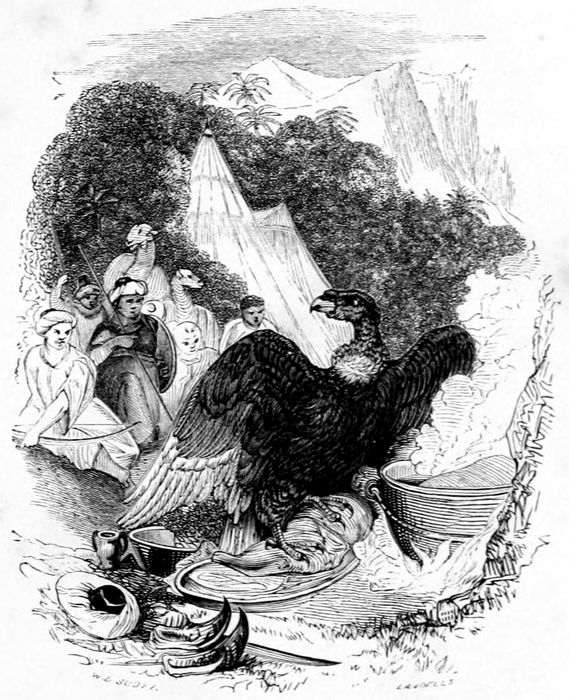
their eyes. ‘Upon the highest top of the mountain
Lamalmon, in Abyssinia, while my servants
were refreshing themselves from the toilsome,
66rugged ascent, and enjoying the pleasure of a
most delightful climate, eating their dinner in
the outer air, with several large dishes of boiled
goat’s flesh before them, this noble Bird
suddenly appeared; he did not stoop rapidly
from a height, but came flying slowly along
the ground, and sat down close to the meat,
within the ring the men had made round it.
A great shout, or rather cry of distress, called
me to the place. I saw the Vulture stand for
a minute, as if to recollect himself; while the
servants ran for their lances and shields. I
walked up as nearly to him as I had time to do.
His attention was fully fixed upon the flesh.
I saw him put his foot into the pan, where
was a large piece in water prepared for boiling;
but finding the smart, which he had not expected,
he withdrew it, and forsook the piece
that he held.’
“Into these the Vulture thrust both his claws, and carried them off.”
67“There were two large pieces, a leg and a
shoulder, lying upon a wooden platter; into
these he thrust both his claws, and carried
them off; but I thought he still looked wistfully
at the large piece which remained in the
warm water. Away he went slowly along the
ground, as he had come. The face of the cliff
over which criminals were thrown took him
from our sight. The Mahometans that drove
the Asses were much alarmed, and assured me
of his return. My servants, on the other hand,
very unwillingly expected him, and thought he
had already more than his share.
“As I had myself a desire of more intimate
acquaintance with him, I loaded a rifle-gun
with ball and sat down close to the platter,
by the meat. It was not many minutes before
he came, and a prodigious shout was raised by
my attendants, ‘He is coming! he is coming!’
enough to have dismayed a less courageous
animal. Whether he was not quite so hungry
as at his first visit, or suspected something
from my appearance, I know not, but he made
a short turn, and sat down about ten yards
from me, the pan with the meat being between
68me and him. As the field was clear before
me, and I did not know but his next move
might bring him opposite to some of my people,
so that he might actually get the rest of the
meat, and make off, I shot him with the ball
through the middle of the body, about two
inches below the wings, so that he lay down
upon the grass without a single flutter.”
This having exhausted Uncle Thomas’s
Stories about the Vulture, and it being too late
to enter upon another species, the little party
bade him good night.
CHAPTER IV.
69
UNCLE THOMAS TELLS ABOUT THE VARIOUS KINDS OF FALCONS, AND
DESCRIBES THE SPORT OF HAWKING AS ANCIENTLY PRACTISED IN
ENGLAND.
“What is the name of this Eagle?” said
Mary, on a subsequent evening, pointing to one
of the specimens in Uncle Thomas’s Museum.
“It seems to be much smaller than either of
those which you have told us about, Uncle
Thomas.”
“That,” said Uncle Thomas, “is not an
Eagle. It belongs to the Falcon family, and
is one of the most elegant of the tribe. It is
the Peregrine Falcon, the species principally
used when Hawking was practised as a field-sport.
It is a very fine specimen, and was
caught in the neighbourhood. It measured in
70length sixteen inches; and its wings, from tip
to tip, three feet.
“The Peregrine Falcon,” continued Uncle
Thomas, “is found in all the temperate and
colder countries of Europe, but it prefers places
where it can find rocky precipices, in which to
build its nest. As it has great power of wing,
however, it can soon transport itself from place
to place. Some one estimates its rate of flight
at about an hundred and twenty miles an hour;
but even that is not so rapid as the Gyr-Falcon,
which is said to fly at the rate of one hundred
and fifty!
“A Falcon which belonged to Henry IV.,
King of France, on one occasion escaped from
the Falconry at Fontainbleau, and was caught
twenty-four hours afterwards in the island of
Malta. The distance between the two places
has been reckoned at 1350 miles, so that if the
Falcon flew the whole time without stopping,
it must have proceeded at the rate of fifty miles
an hour. But as the Falcons never fly by
night, supposing that it rested during the darkness,
71and flew only during eighteen hours, its
flight was at the rate of seventy miles an
hour. Even this computation, however,” continued
Uncle Thomas, “is liable to considerable
objections. The exact moment of its
arrival at Malta cannot of course be told, as he
might be in the island some time before he was
discovered; and it is also probable that the day-light
would not serve him to travel so long
as eighteen hours.”
“I wonder how any bird escapes the Falcon
since he flies so fast,” said John.
“The Instincts of the birds on which it
preys,” said Uncle Thomas, “teach them many
little wiles to escape their enemy, and it is
seldom that the chase is one of mere power of
wing. It was to this skill on the part of the birds
that much of the interest of the sport was derived
when Hawking was practised in England.
I will tell you about the various modes of Hawking
by and by, but there is a little story of the
boldness and sagacity of the Peregrine, which I
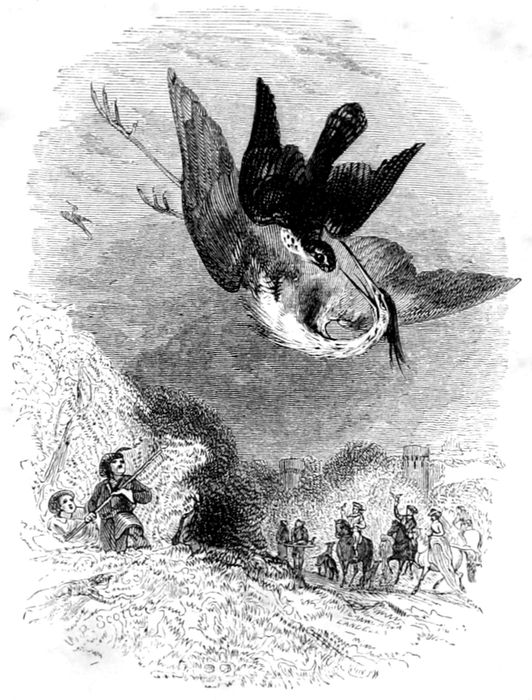
must first tell you;—A gentleman well known
72as an accomplished naturalist (Mr. Selby) relates
that on one occasion when he was exercising
his Dogs upon the moors, previous to the commencement
of the shooting season, he observed
a large bird of the Hawk tribe hovering at a
distance, which, upon approaching, he knew to
be the Peregrine Falcon. Its attention seemed
to be drawn towards the Dogs, and it accompanied
them whilst they beat the surrounding
ground. Upon their having found and sprung
a brood of Grouse, the Falcon immediately gave
chase, and struck a young bird before they had
proceeded far upon the wing, but the shouts of
the sportsman, and his rapid advance, prevented
it from securing its prey. The issue of the attempt,
however, did not deter the Falcon from
watching their subsequent movements, and
another opportunity soon offering, it again gave
chase, and struck down two birds by two rapidly
repeated blows, one of which it secured
and bore off in triumph.”
“The Falcon must have known that
73the Dogs were in search of game,” remarked
Harry.
“Yes,” said Uncle Thomas, “and it must
also have known that they would put up the
birds; and as its general habit is to strike its
prey on the wing, it no doubt reckoned that it
would be very convenient to have them to do
so, as its prey frequently escape by lying close
and undiscovered among the herbage when they
see their enemy approaching.
“The Gyr-Falcon, which I mentioned to you
as exhibiting extraordinary speed,” continued
Uncle Thomas, “is a larger bird than the
Peregrine; the male generally measuring about
twenty-two inches in length, and its wings
stretching about four feet. The female, as is
universally the case with birds of prey, is larger
than the male. It is a native of the most
northern countries of Europe; the rocky fastnesses
of Iceland being its head quarters. This
Falcon, from its great strength of wing, was held
in great repute when the amusement of Hawking
74was in fashion. In Denmark, to which
kingdom the island of Iceland belonged, there
was a law which inflicted the punishment of
death on any person destroying them, and the
King’s Falconer, with a couple of attendants
went annually thither in great state to receive
such animals as had been captured during the
year. The rewards paid to the captors were
very high, about three pounds for the best, and
from ten to forty shillings for others, according
to the estimation in which they were held.
“Though naturally one of the wildest of
birds, the Gyr-Falcon soon becomes familiar,
and, when properly trained, is one of the best
‘Hawkers.’ Even in a state of nature it has
been known to throw off its wild habits. An old
gentleman in the South of Scotland was in the
habit of resting during his morning walk on a
seat beneath a wooded precipice. For two or
three mornings a young Gyr-Falcon came and
sat upon a bough above his head, and at last
grew so familiar as to settle upon his shoulders.
75The gentleman was highly delighted with his
new acquaintance, and brought it such food as,
from a knowledge of these birds, he knew to be
suitable. At length it ceased to meet him,—probably
its wild nature, as it got older, subduing
the gentle confidence which had dictated
its first approaches. He often spoke with lively
regret of this interesting friendship; remarkable
in any point of view, but still more so
when it is considered that the Gyr-Falcon is almost
never seen in the place where the incident
happened.”
“Perhaps it was a half-trained bird,” suggested
Frank.
“Most likely it was,” said Uncle Thomas,
“I cannot on any other supposition account for
its familiarity. Besides the Peregrine and Gyr-Falcons,
there were several others which were
trained to Hawking; such as the Merlin, the
Kestrel, the Lanner, the Sparrow-Hawk, &c.
The former was held in high estimation as a
lady’s Hawk, its weight being only six ounces,
76and, besides, being one of the swiftest and
boldest of its tribe, it is most easily tamed and
trained.”
“How are Hawks trained?” asked Jane.
“I wonder they ever return when they once fly
off after their prey.”
“The training of Hawks,” said Uncle
Thomas, “was practised as an art; and in days
when the sport was in high estimation it was
one of considerable importance. The young birds
were taken out of the nest when ready to fly, or
caught in traps, and carefully secured in linen
bags, with openings at each end for the head
and tail, to preserve their feathers from injury.
On their arrival at the falconry a hood was
placed over their eyes, so as to blindfold them,
and, thus imprisoned, they were left in perfect
quiet for a day or two. The training of the
noviciate then began. It was placed upon the
wrist of the falconer, and carried about the whole
day, and occasionally stroked with a feather, so
as gradually to accustom it to being handled. Its
77hood was then taken off, and it was fed; the
falconer making a particular call, which was invariably
used when the bird was fed, and upon
no other occasion. When it was so far trained
as to alight on the hand when called, it was unhooded
and ‘put to the lure’—an artificial bird,
made of feathers, which was thrown up into the
air, and at which it was induced to fly by attaching
a live Pigeon, or part of a Chicken, which
the Hawk was permitted to eat. To prevent
its escape during this part of its education it
was secured by a string. When perfect in
this lesson it was advanced to the dignity of
flying at live game, usually by means of a Duck,
which was blindfolded to prevent its escape.
By the repetition of the call when it had struck
its quarry the Hawk was taught to return to
its perch upon its master’s wrist, and when this was
accomplished its lesson was complete. To
prevent its flying off, it was secured by straps
of leather or silk, called jesses, which were
fastened round its legs, which were also generally
78ornamented with little bells, so as not to encumber
it or interfere with its flight.”
“Is Hawking ever practised in England
now?” asked Jane.
“It is occasionally,” said Uncle Thomas;
“but so seldom that, as some one remarks,
when the old gamekeeper of some ancient family
crosses us with a Falcon on his wrist, he looks
as if he had stepped out of a picture-frame, and
the sight serves to remind us of a glory which
has departed. It is, however, sometimes to be
seen. Here is an account of a day’s Hawking,
in the county of Norfolk.
“In June, 1825,” says the writer, “happening
to be in Norfolk, I became an eye-witness
to that most ancient and now very rare sport of
Falconry; and I now relate what I actually
saw, and which was to me most novel and
entertaining. The place fixed upon for the
sport was in the intermediate country between
the Fens and the Heronry, and in the afternoon
of the day, with the wind blowing towards the
79Heronry. There were four couple of casts of
the female Peregrine Falcon, carried by a man
to the ground upon an oblong kind of frame,
padded with leather, on which the Falcons
perched, to which they were fastened by a
thong of leather. Each bird had a small bell
on one leg, and a leather hood, with an oblong
piece of scarlet cloth stitched into it, over each
eye, surmounted by a plume of various-coloured
feathers on the top of the hood. The man
walked in the centre of the frame, with a strap
from each side over his shoulder; and when
he arrived at the spot fixed upon for the sport,
he set down the frame upon its legs, and took
off all the Falcons, and tethered them to the
ground in a convenient shady place. There
were four men who had the immediate care of
the Falcons (seemingly Dutchmen or Germans),
each having a bag, somewhat like a woman’s
pocket, tied to his waist, containing a live
Pigeon, called a lure, to which was fastened
a long string; there were also some gentlemen
80attached to the sport who likewise carried their
bags and lures.
“At length the Falcon soared above the Heron, and struck it on the back.”
81“After waiting awhile, some Herons passed,
but at too great a distance; at length one
appeared to be coming within reach, and preparations
were made to attack him. Each falconer
was furnished with a brown leather glove on
the right hand, on which the Falcon perched;
and there was a small bit of leather attached to
the leg of the bird, and which was held by the
falconer between the thumb and finger. Each
of the men thus equipped, with a Falcon on
his wrist, and the bag with the lure tied to the
waist, and mounted on horseback, proceeded
slowly in a direction towards where the Heron
was seen approaching. As soon as the Heron
was nearly opposite, and at what I conceived a
great height in the air, the falconers slipped the
hoods from off the heads of the falcons, and
held each bird on the wrist by the bit of leather,
till the Falcons caught sight of the Heron, and
then a most gallant scene ensued. The instant
they were liberated, they made straight for their
prey, though at a considerable distance ahead.
As they were dashing away towards the Heron
a Crow happened to cross, and one of them
instantly darted at him, but he struck into a
plantation and saved himself: the Falcon dashed
in after him, but did not take him. The other
Falcon soon overtook the Heron, and after
flying round in circles for some time, at length
soared above him, and then struck him on the
back, and they both came tumbling down
together, from an exceeding great height, to
the ground. The other Falcon, having lost
some time with the Crow, was flying very
swiftly to assist his comrade, and had just
come up at the time the Falcon and Heron
were falling. At this instant, a Rook happened
to fly across; the disappointed Falcon struck
at him, and they both fell together within
twenty yards of the other Falcon and the
Heron. When on the ground, each Falcon
began to pull to pieces its victim; but, as soon
82as the falconers rode up, the lures were thrown
out, and the Falcons suffered to make a meal
(having previously been kept fasting) upon the
Pigeon, which was laid on the carcass of the
Heron; and, after they were satisfied, were
again hooded and put up for that day.
“The next cast consisted of two younger
birds; and when let loose at another Heron,
they flew up to it very well. But the Heron
was an old one, and supposed to have been
caught before; for the moment he was aware
of the presence of his enemies, he began to soar
into the air, and set up a loud croak; and
these, not so experienced as the first two Falcons,
would not attack him, but soared about
and left him. Upon this, one of the falconers
set up a peculiar call, to which, no doubt, the
birds were trained; when one of them, from a
very great elevation in the air, immediately
closed his wings, darted down to the man who
called him, and was taken in hand. This was
a very extraordinary manœuvre, and an instance
83of tractable sagacity. The other Falcon did
not come to the call, but sailed about in the
air. At length a Heron crossed, and the Falcon
attacked it, but again left it. A third Heron
also came in his way; this he also fell to work
with, and, after a short struggle, brought him
to the ground in the same style as the first.
This last Heron had his wing broken, and the
falconer killed him; but the first was taken
alive, and was afterwards turned out before a
single Falcon, which struck him down in a
minute. I understood that when a Heron had
once been taken by a Falcon he never made
any more sport. It was the case with this one;
for, the moment he saw his enemy coming
towards him, he lost all his powers, and made
a ridiculous awkward defence on the ground;
where the Falcon would soon have despatched
him, if the falconer and his lure had not been
near at hand.
“The Heron,” continued Uncle Thomas, “is
perhaps the most difficult prey with which the
84Falcon has to contend; and it was the skill and
perseverance with which it opposed the attack
of the Falcon, which gave Hawking this bird
its peculiar zest. As it flies very high, it is
extremely difficult for the Falcon to rise above
it, so as to stoop upon it, in which act birds of
this sort can most conveniently put forth all
their powers. Even when the Falcon manages
to attain the ascendancy its victory is by no
means certain. In case the Heron is foiled
in this, its most obvious means of escape, it
turns its neck back upon its shoulders, and projects
its bayonet-like bill upwards, behind its
wing, and thus, should its pursuer pounce upon
its head and neck, to which the attack of the
Falcon is usually directed, it runs the greatest
danger of being transfixed upon the long and
sharp bill of the Heron. This attitude, indeed,
serves another purpose; it protects these most
vulnerable parts from injury, and should the
Falcon, notwithstanding the danger to which
it is exposed, strike at the wing of its prey,
85and thus disable it, on reaching the ground,
the latter is still able to offer the fiercest
resistance.
“Colonel Montague, on one occasion, brought
the powers of the two animals to a direct test.
He took a Falcon, about a year old, which had
been taken from its nest before it could fly, and
had never had an opportunity of killing any
thing but a small bird occasionally, and having
kept it without food for twenty-four hours, he
introduced into the room where it was kept an
old male Heron. As the object was, however,
principally to see how the Instinct of the Falcon
would develop itself, part of the Heron’s bill
had been cruelly cut off. As soon as the
Heron was in motion, the Falcon, which was also
deprived of the means of flight, took post on a
stool which was at one end of the room, and as
the Heron, regardless of his enemy, traversed
the apartment, the Falcon, motionless, kept her
eyes fixed on her destined prey, till after several
turns round the room, she judged the Heron
86was sufficiently near to effect her purpose, when
she sprung at its head, intending to seize it
with her talons. In this, however, she failed,
the stool not having given her sufficient elevation
to reach the high erect head of the
Heron. This failure would probably have cost
the Falcon her life, had the bill of her antagonist
been perfect; for she received a blow on
her body that must otherwise have inflicted a
severe, if not a mortal wound from so pointed
an instrument, urged with such power. Baffled
in this attempt, and having received a severe
blow, it was conjectured that no farther attack
would be made till the calls of hunger became
more urgent. The Falcon, however, soon regained
her station, and it was not long before
the Heron, regardless of his foe, again passed
very near, when the Falcon, in a second attempt
to seize her prey, as before, was equally foiled,
and again received a severe check from the bill
of the Heron. Finding her efforts had failed
from want of the advantages Nature had assigned
87her, Instinct directed the Falcon to a box that
stood on the opposite side of the room, which
was somewhat higher. Here she again seemed
to meditate another attack, by watching every
motion of the Heron, who continued his rounds
with a view to make his escape; and it was not
long before an opportunity offered for the Falcon
to make an assault from her more elevated
station. Here she had found a humble substitute
for those powers with which Nature so
amply furnished her, but of which she had been
deprived, and at last succeeded in springing
from her perch, and seizing the unfortunate
Heron by the head and upper part of the neck
with her talons, which instantly brought him to
the ground. Now the unequal contest was soon
determined, for in vain did the superior weight
and strength of the Heron drag and flounder with
his enemy across the floor; in vain did he flap
his unwieldy pinions to shake off the tyrant of
the air, nor could even his gigantic legs force
her from the bloody grasp; her work was short
88and certain; no efforts could compel her now
to quit her deadly gripe, the powerful and
only dreaded weapon of her antagonist was secured
and thus disarmed, he became a sure and
easy prey. Scarcely was the gigantic bird
prostrate on the ground than death ensued; for
in this noble race of Falcons, destined for blood
and slaughter, torture makes no part of its
nature; but, like what we are told of the generous
Lion, exulting in death, but disdaining
cruelty, in less than half a minute did the
Falcon tear out the gullet and windpipe of the
Heron, and regale on the head and neck.”
“It was very cruel to cut off the Heron’s
bill, Uncle Thomas,” said Mary.
“I cannot in any view commend the experiment,”
said Uncle Thomas; “though it certainly
does in a very striking manner illustrate
the Instinct of the Falcon in securing its prey.
Here was a bird taken and domesticated before
it could have seen its parents attack the animals
on which they feed, yet we find that it exhibited
89all those peculiarities which distinguish its
assaults in its native state—at once fixing on
the most vulnerable part of its victim, and
availing itself of the advantages which it could
derive from pouncing down upon it from above,
and thus giving additional force to its blow.
“Some of the Falcons” continued Uncle
Thomas, “are very bold in pursuit of their
prey. A Sparrow-Hawk has been known to
enter a church while the congregation was retiring
and bear off a Swallow which had
taken refuge within the building. On another
occasion a Kestrel pursued a Sparrow in at the
window of a house, and so eager was it to secure
its prey that the window was closed, and both
were taken before it could escape. A person
once saw a Falcon, called in America the Duck-Hawk,
pursuing an aquatic bird, called the
Razor-Bill, which, instead of assaulting as usual
with the death-pounce from the beak, he seized
by the head with both claws, and made towards
the land; his prisoner croaking, screaming, and
90struggling lustily; but being a heavy bird he so
far overbalanced his aggressor that both descended
fast towards the sea, when just as they
touched the water, the Falcon let go his hold
and ascended; the Razor-Bill as instantaneously
diving below.
“Wilson mentions an instance in which the
Sparrow-Hawk was not deterred from pouncing
on its prey even by the presence of a sportsman,
with his gun ready to shoot it. ‘One day,’
says he ‘I observed a bird of this species perched
on the highest top of a large poplar, on the skirts
of a wood; I was in the act of raising the gun
to my eye, when he swept down with the rapidity
of an arrow into a thicket of briars about
thirty yards off, where I shot him dead, and on
coming up found a small Field-Sparrow quivering
in his grasp. Both our aims had been
taken at the same instant and unfortunately for
him both were fatal.’
“A gentleman, who brought up a young
Sparrow-Hawk, has published a very interesting
91account of its habits in a state of domestication.
The experiment of domesticating
such an animal was rather a hazardous one, as
he had at the same time a stock of fancy
Pigeons which he greatly prized. It seems,
however, that kindness and ease had softened
the nature of the Hawk, or the regularity
with which he was fed rendered the usual
habits of his family unnecessary to his happiness;
for, as he increased in age and size, his
familiarity increased also, leading him to form
an intimate acquaintance with a set of friends
who have been seldom seen in such society.
Whenever the Pigeons came to feed, which they
did oftentimes from the hand of their almoner,
the Hawk used also to accompany them. At
first the Pigeons were shy, of course; but, by
degrees, they got over their fears, and ate as
confidently as if the ancient enemies of their race
had sent no representative to their banquet.
It was curious to observe the playfulness of the
Hawk, and his perfect good nature during
92the entertainment; for he received his morsel
of meat without any of that ferocity with which
birds of prey usually take their food, and
merely uttered a cry of lamentation when the
carver disappeared. He would then attend the
Pigeons in their flight round and round the
house and gardens, and perch with them on the
chimney-top, or roof of the mansion; and this
voyage he never failed to make early in the
morning, when the Pigeons always took their
exercise. At night, he retired with them to the
dove-cot; and though for some days he was
the sole occupant of the place, the Pigeons not
having relished this intrusion at first, he was
afterwards merely a guest there; for he never
disturbed his hospitable friends, even when
their young ones, unfledged and helpless as
they were, offered a strong temptation to his
appetite. He seemed unhappy at any separation
from the Pigeons, and invariably returned
to the dove-house after a few days purposed
confinement in another abode, during which
93imprisonment he would utter most melancholy
cries for deliverance: but these were changed to
cries of joy on the arrival of any person with
whom he was familiar. All the household
were on terms of acquaintance with him; and
there never was a bird who seemed to have
won such general admiration. He was as
playful as a kitten, and literally as loving as a
dove.
“But that his nature was not altogether
altered, and that, notwithstanding his education,
he was still a Hawk of spirit, was proved on
an occasion of almost equal interest. A neighbour
had sent us a very fine specimen of the
smaller Horned Owl, which he had winged when
flying in the midst of a covey of Partridges;
and after having tended the wounded bird,
and endeavoured to make a cure, we thought
of soothing the prisoner’s captivity by a larger
degree of freedom than he had in the hen-coop,
which he inhabited. No sooner, however, had
our former acquaintance, the Hawk, got sight
94of him, than he fell upon the poor Owl most
unmercifully; and from that instant, whenever
they came in contact, a series of combats commenced,
which equalled in skill and courage
any of those which have so much distinguished
that hero, who to the boldness and
clearness of vision of the Hawk, unites the
wisdom of the bird of Athens. The defence of
the poor little Owl was admirably conducted;
he would throw himself upon his back, and
await the attack of his enemy with patience
and preparation; and, by dint of biting and
scratching, would frequently win a positive, as
he often did a negative victory. Acquaintanceship
did not seem in this case likely to
ripen into friendship; and when his wing had
gained strength, taking advantage of a favourable
opportunity, the Owl decamped, leaving
the Hawk in possession of his territory.
“The fate of the successful combatant was,
however, soon to be accomplished; for he was
shortly after found drowned in a butt of water,
95from which he had once or twice been extricated
before, having summoned a deliverer to
his assistance by cries that told he was in
distress. There was great lamentation, when he
died, throughout the family; and it was observed
by more than one person, that that portion of
the dove-cot in which he was wont to pass the
night was, for some time, unoccupied by the
Pigeons, with whom he had lived so peaceably
even during the wars of the unfortunate Owl.
“In the East,” continued Uncle Thomas,
“Hawking is still practised. In Persia, Sir
John Malcolm saw the mode in which it is
conducted in hunting Deer and smaller game.
The hunters proceed with Hawks and Greyhounds
to the places frequented by these animals.
When the Antelope is seen, they endeavour
to get as near it as possible, but the timid
animal, the moment it sees its enemies approach,
darts off at a rate swifter than the wind. The
horsemen, having slipped the Dogs, follow at
full speed. If it is a single Deer they at the
96same time fly the Hawk; but if a herd, they
wait till the Dogs have selected a particular
animal. Skimming along the ground, the
Hawk soon overtakes the Deer, and as it is
trained, pounces upon its head, and either
stops it altogether by pecking out its eyes, or
retards it so much that it is soon overtaken by
the dogs. When he was at Shiraz, Sir John
was presented with a very fine Royal Falcon.
‘Before going out,’ says he, ‘I had been
amused at seeing Nuttee Beg, our head Falconer,
a man of great experience in his department,
put upon his bird a pair of leathers,
which he fitted to its thighs, with as much
care as if he had been the tailor of a fashionable
horseman. I enquired the reason for so
unusual a proceeding. ‘You will learn that,’
said the consequential master of the Hawks,
‘when you see our sport,’ and I was convinced,
at the period he predicted, of the old fellow’s
knowledge of his business. The first Hare
seized by the Falcon was very strong, and the
ground rough. While the bird kept the claws
of one foot fastened in the back of its prey, the
other was dragged along the ground, till it had
an opportunity to lay hold of a tuft of grass, by
which it was enabled to stop the course of the
Hare, whose efforts to escape would, I do think,
have torn the Hawk asunder, if it had not been
so provided’.
“The Hawk soon overtakes the Deer, pounces upon its head, and pecks out its eyes.”
97“These,” said Uncle Thomas, “are nearly
all the stories which I recollect about Hawks
and Hawking, so I must stop for the night.
I must not, however, omit to mention, as a
curious fact in the natural history of these
animals, that though in confinement Hawks do
not retain their vigour more than a few years,
it is probably a very long-lived bird. One is
said to have been caught in Southern Africa,
in the year 1793, wearing a gold collar, dated
1610, and known at that time to have belonged
to James I. Though more than 180 years old,
it was still in complete vigour.”
His little auditors then bid him good bye.
CHAPTER V.
98
UNCLE THOMAS TELLS ABOUT OWLS, AND OF THE CURIOUS PECULIARITIES
IN THEIR STRUCTURE WHICH ENABLE THEM TO SEEK FOR AND SECURE
THEIR PREY DURING THE NIGHT.
“The Owls,” said Uncle Thomas, on their
next meeting, “are perhaps one of the most
interesting families of Birds of Prey. They are,
with one or two exceptions, night birds; that
is, they seek their prey during the night, or
in the dim twilight when scarcely any other
animal can see.”
“But how, then, can they perceive their
prey?” asked Jane.
“By a peculiar formation,” said Uncle Thomas,
“the eye of the Owl has been fitted for
use just when from the habits of the bird it
is most wanted. The pupil of its eye, which,
99when there is little light, expands to a great
extent, and enables it to see distinctly the
smallest objects, is of such extreme sensibility
that if light is admitted it contracts, and prevents
the bird from seeing at all. You will
understand this better if you examine carefully
the eye of a Cat, which to a certain extent has
the same property as that of the Owl. When
it is subjected to a moderate light, you will
perceive that the pupil is of a certain size, but
if a much stronger light is admitted it contracts
till you scarcely perceive it, and in this
state it is nearly as useless as if it was covered
by the eyelid.”
“But Cats can see to hunt in the sunshine,”
said Mary; “I saw Puss watching some birds
in the garden to-day.”
“Though I used the Cat’s eye as an illustration,”
said Uncle Thomas, “I did not mean you
to understand that those of the Owl and it are
exactly the same. From possessing less sensibility,
perhaps, that of the Cat can be used in
100broad day-light, when the Owl is nearly blind.
Accordingly, when one happens to be dislodged
by any accident during sunshine, it is immediately
attacked with impunity by whole
flocks of small birds, who never cease their
persecutions till it again finds refuge in some
dark and snug retreat.
“Besides this singular power of vision,
which it has in common with all animals which
seek their prey in the twilight,” continued
Uncle Thomas, “the Owl has other peculiarities
in its structure, which are in a great measure
confined to itself. Its skull is larger in proportion
to the size of the bird than that of
most other animals, and the bone is thin and
fine, so that no space is lost, nor is it troubled
with more weight than is absolutely necessary.
A considerable part of the interior of
the skull is occupied by two large cavities, in
which the nerve by which the impression of
sound is conveyed to the brain is expanded
to an unusual size, and thus the sense of
101hearing is much more acute than in most other
animals.”
“What can it want with this?” asked
Harry. “At night, when every thing is so still
there can be no difficulty in hearing, I should
think.”
“One minute, if you please, Harry,” said
Uncle Thomas; “there is another peculiarity
in the structure of the Owl, of which I wish to
tell you; and when I have pointed out their nice
adaptation to each other, and the beautiful
manner in which they all subserve the habits
of the animal, I think you will admit that
they are all made in wisdom. The other
peculiarity to which I refer is in the plumage
of the bird. The wings of some birds, as they
fly along, make a whistling noise, which arises
from the air acting on their hard and rigid
feathers. Not so those of the Owl. The feathers
of its wings are fringed with a sort of silky
down, so remarkably soft and elastic that they
seem scarcely to stir the air. It can thus noiselessly
102pounce down upon an unwary Mouse as
it stirs among the leaves in the waning twilight,
before it has the slightest suspicion of
the presence of its enemy, who has, perhaps,
been guided to the spot by the tiny stirring
of a decayed leaf. You will thus perceive
how the various peculiarities of which I have
told you act upon each other. The Owl hears
a squeak or a rustle among the leaves, and flies
noiselessly to the spot; were it not, however,
for the acuteness of its sight, its prey must still
escape; but thus, provided, it soon spies it
out and secures it.
“That the ear is greatly used by the Owl in
directing it to its prey,” said Uncle Thomas,
“is evident, from the fact that they are frequently
attracted to the spot where the rustic
sportsman has stationed himself for the purpose
of shooting them, by imitating the squeaking of
a Mouse.
“With us,” continued Uncle Thomas, “the
Owl generally inhabits hollow trees, old ruins,
103church steeples, or the dark recesses of some
uninhabited building, where it can roost undisturbed
during the day. Wilson, the delightful
writer from whose work I have
often read to you, thus describes the haunts
of the Great Tufted Owl:—‘His favourite residence
is in the dark solitudes of deep swamps
covered with a growth of gigantic timber; and
here, as soon as the evening draws on, and
mankind retire to rest; he sends forth such
sounds as seem scarcely to belong to this world,
startling the solitary pilgrim as he slumbers
by the forest fire:—
‘Making night hideous.’
Along the mountainous shores of the Ohio,
and among the deep forests of Indiana, alone,
and reposing in the woods, this ghostly watchman
has frequently warned me of the approach
of the morning, and amused me with its singular
exclamations;—sometimes sweeping down
and around my fire, uttering a loud and sudden
104waugh O! waugh O! sufficient to
have alarmed a whole garrison. He has
other nocturnal solos no less melodious, one
of which very much resembles the half-suppressed
screams of a person suffocating
or throttled, and which cannot fail of being
extremely entertaining to a lonely or benighted
traveller, in the midst of an Indian wilderness.’”
“Entertaining, does he say?” asked Jane.
“I should rather think terrifying, Uncle
Thomas.”
“He speaks ironically,” said Uncle Thomas,
“and thinks exactly as you do. The hooting
of the Owl, however, we must not regard
as a mere incident in nature, without any use
but that of frightening benighted travellers. It
is one of those wise provisions to assist it in
procuring its prey. As it sits in waiting on
some solitary eminence, or pursues its stealthy
flight over the places where it knows they
frequent, it utters its well known, and discordant
105note. Terrified at the unexpected
presence of their enemy, its prey shrink and endeavour
to escape, and it is ten chances to one
if the Owl is close at hand that he discovers
them either by the eye or the ear.
“Some of the larger Owls, such as the
Great Tufted one, of whose haunts I have just
read you Wilson’s description, feed on small
birds, Squirrels, Rabbits, and young Partridges,
and as they are very voracious eaters,
it is astonishing how many they will destroy.
On one occasion a sportsman fired at a very
large one, and broke its wing. He took it
home to a farm house, where, after remaining for
several days, it disappeared, no one could tell
how. Almost every day after its mysterious
departure Hens and Chickens also vanished,
one by one, in the same unacountable manner, till
in eight or ten days very few were left remaining.
The Fox and the Weasel were alternately
the reputed authors of the mischief,
until one morning the old lady of the house,
106herself, rising before day to bake, in passing
towards the oven surprised her late prisoner,
the Owl, regaling himself on the body of a
newly-killed Hen! The thief instantly made
for his hole under the house, from which the
enraged matron soon dislodged him with
the brush-handle, and dispatched him without
mercy. In this snug retreat were found
the greater part of the feathers and many
very large fragments of her whole family
of Chickens.
“It is only the large Owls, however,” continued
Uncle Thomas, “which prey upon poultry;
the lesser ones confine their depredations to the
smaller animals, such as Mice, Rats, &c., and
are thus very useful to mankind in destroying
such animals as would otherwise do much
mischief to the crops. Some of the species
also feed on fish, a fact as to which naturalists
were long incredulous, on account of the want
of adaptation in the structure of the Owl, as
they thought, to capture such a description of
107prey. Recent observation has, however, confirmed
the fact beyond a doubt. Not only
have they been seen to carry fish to feed their
young, but the bones have frequently been observed
close under the nest. Many years ago the
Duchess of Portland had a quantity of gold
and silver fish in a pond in the flower garden at
Bulstrode. As the fish were frequently missed,
and suspecting that they were stolen, a watch
was kept in order to detect the thief. He
was soon discovered in the shape of several
common brown Owls, which alighted on the
side of the pond, and, waiting the approach of
the fish, captured and devoured them. A naturalist,
speaking of this singular habit of the
Owl, relates that, on one occasion, a person
standing on a bridge in the twilight of a July
evening, watching an Owl carrying Mice to its
nest, was surprised to see it suddenly drop
perpendicularly into the water. Thinking that it
had been seized with a fit, or had met with some
unacountable accident, he ran to the end of the
108bridge to procure a boat to go to its rescue, but,
before he could do this, he saw the Owl rise
out of the water, bearing a fish in its claws, and
convey it to its nest.”
“The Owl must be very clear sighted, indeed,
to see a fish in the water at night,” said
Harry.
“The fact is so well established,” said Uncle
Thomas, “that it admits of no doubt. The
explanation which some naturalists give of the
manner in which the fish are decoyed towards
it is, I admit, a little more questionable. They
suppose that the luminous appearance of its
large bright eyes attract the fish, and that it
stares at them till they come within reach of
its beak or talons.”
“I have seen the Cat’s eyes glaring in a dark
room,” said Jane; “I suppose it is something
of the same kind, Uncle Thomas.”
“Quite so,” said Uncle Thomas; “and
though, from its very great singularity, the
supposition at first startles us, one of the
109American Bitterns possesses a power something
akin to it. The bird lives almost entirely on
fish, and, when in search of its prey, it is said
to decoy them within reach by a light from its
breast of considerable brilliancy, which is described,
by those who have seen it, as equal to
the light of a common torch.”
“But are fish attracted by light?” asked
Mary.
“Oh, yes,” said Uncle Thomas; “sportsmen
in every country use torches to take them,
spearing them as they come to the surface of
the water, to gaze on the singular and unusual
appearance.
“In America,” continued Uncle Thomas,
“some species of Owls are very numerous.
A rambler among the forests of the ‘Far
West’ says, that it is almost impossible to
travel eight or ten miles in any of the retired
woods there without seeing several of them,
even in broad day; and, at the approach of
night, their cries are heard proceeding from
110every part of the forest around the plantations.
Should the weather be lowering, and indicate
the approach of rain, their cries are so multiplied
during the day, and especially in the
evening, and they respond to each other in tones
so strange, that one might imagine some extraordinary
fête about to take place among them.
On approaching one of them, its gesticulations
are of a very extraordinary nature. The position
of the bird, which is generally erect, is
immediately changed. It lowers its head and
inclines its body, to watch the motions of the
person beneath; throws backward the lateral
feathers of the head, which thus has the appearance
of being surrounded by a broad ruff; looks
towards him as if half blind, and moves its
head to and fro in so extraordinary a manner
as almost to induce a person to fancy that part
dislocated from the body. It follows all the
motions of the intruder with its eyes; and
should it suspect any treacherous intentions,
flies off to a short distance, alighting with its
111back to the person, and immediately turning
about, with a single jump, to recommence its
scrutiny.”
“Another writer,” continued Uncle Thomas,
“relates a very amusing story of the terror of
a party of hunters, which shows how strongly
superstitious feelings sometimes affect the
mind:—‘The Virginian Horned Owl,’ says
Richardson, ‘is found in almost every quarter
of the United States, and occurs in all parts
of the fur countries, where the timber is of
a large size. Its loud and full nocturnal cry,
issuing from the gloomy recesses of the forest,
bears some resemblance to the human voice,
uttered in a hollow sepulchral tone, and has
been frequently productive of alarm to the
traveller, of which an instance occurred within
my own knowledge. A party of Scottish
Highlanders, in the service of the Hudson’s
Bay Company, happened in a winter journey
to encamp after night-fall in a dense clump of
trees, whose dark tops and lofty stems, the
112growth of centuries, gave a solemnity to the
scene that strongly tended to excite the superstitious
feelings of the Highlanders. The effect
was heightened by the discovery of a tomb
which, with a natural taste often exhibited by
the Indians, had been placed at this secluded
spot. Our travellers, having finished their
supper, were trimming their fire preparatory to
retiring to rest, when the slow and dismal notes
of the Horned Owl fell on the ear with a
startling nearness. None of them being acquainted
with the sound, they at once concluded
that so unearthly a voice must be the moaning
of the spirit of the departed, whose repose they
supposed they had disturbed, by inadvertently
making a fire of some of the wood of which
his tomb had been constructed. They passed
a tedious night of fear, and with the first
dawn of day hastily quitted the ill-omened
spot.’”
“Have not all Owls got horns?” asked Mary.
“This one,” pointing to one of the specimens
in Uncle Thomas’s collection, “seems to have
none.”
“The slow and dismal notes of the Horned Owl fell on the ear, with startling nearness.”
113“No!” said Uncle Thomas; “it is only
particular species which are so ornamented.
They are, however, improperly called ‘horns,’
and sometimes ‘ears,’ as the protuberance
consists merely of a little bunch of feathers,
without any corresponding configuration of
the skull; indeed, in some species the tuft
is imperceptible when the bird is in a
state of repose, but is elevated whenever its
attention is excited; so that in a dead bird it
requires a very careful examination to perceive
them.
“In ancient times,” continued Uncle Thomas,
“the Owl was regarded as the symbol of
wisdom; and in the present day a superstition
of the same kind lingers among the North
American Indians. We are told that among
the Creeks the younger priests constantly wear
a white mantle, and have a skin of the Great
White Northern Owl cased and stuffed very
114ingeniously, so well executed as almost to
appear like the living bird, having large sparkling
glass beads, or buttons, fixed in the head
for eyes. This insignia of wisdom and divination
they wear sometimes as a crest on the top
of the head, at other times the image sits on
the arm, or is borne in the hand. The bearers
are also distinguished from other people by
their taciturnity, grave and solemn countenance,
dignified step, and by their singing to themselves
songs or hymns, in a low sweet voice as
they stroll about the town.
“Owls,” continued Uncle Thomas, “have
been remarked as showing very great affection
for their young, frequently visiting them and
feeding them long after they have been taken
from the nest, and even when placed in a state
of confinement. It is thus that we get glimpses
of the surpassing wisdom and beauty of the
works of the Almighty. The whole of the
Owl tribe, as I have already told you, are
extremely voracious feeders; and in the earlier
115stages of their existence, from the time that
they leave the nest until their powers are
sufficiently matured to enable them to provide
entirely for themselves, they must be unable
to procure sufficient food to satisfy their almost
insatiable appetite. Here, then, is both the
necessity and the cause for this extraordinary
affection, of which I will by and by give you
one or two examples. If the parent Owls were
not endowed with this extraordinary affection,
the young would starve, and the race soon
become extinct. A young Owl having, on one
occasion, escaped from the nest before it was
fully fledged, was caught and placed in a
hen-coop. To the surprise of the captors, in
the morning a fine young Partridge was found
lying dead before the door of its place of confinement.
For fourteen days the same mark
of attention was repeated, the provision sometimes
consisting of one kind, and sometimes of
another. Though he well knew whence the
supply proceeded, the gentleman to whom the
116captured bird belonged kept watch for several
nights, accompanied by his servant, to observe
when and how the supply was brought, but
they watched in vain. So long as they remained
at the window nothing was brought, but whenever
it was left for a short time unoccupied,
the Owls deposited their provision and escaped
unobserved. This continued till the usual time
when the Owls leave their young to shift for
themselves.”
“I suppose if one was to attempt to rob
an Owl’s nest of its young, it would fight very
fiercely,” said Harry.
“Some of the species are occasionally very
bold in defence of their nestlings,” said Uncle
Thomas; “and, if their territory is invaded,
evince great alarm. A carpenter, some years
ago, passing through a field near Gloucester,
was suddenly attacked by an Owl that had a
nest in a tree near the pathway. It flew at his
head, and the man struck at it with his adze
that he had in his hand, but missed his blow.
117The enraged bird repeated the attack, and
fastening her talons in his face, lacerated him
very severely.
“Before I conclude my account of the Owl,”
continued Uncle Thomas, “I must tell you of a
very curious experiment made by a gentleman
named Waterton, who lives in Yorkshire. Some
years ago he resolved to establish a colony of
Owls, and accordingly had a dwelling made for
them on the ruins of an old gateway. The
place was about four feet square, a nice perch
was fixed for them to sit upon, and the ivy
which grew round the gateway was trained to
cover and conceal the whole. In about a
month after these preparations were made for
their reception, it was duly examined and fixed
upon as a desirable place of residence by a pair
of Barn Owls. Their example was soon followed,
and in time not only filled the ‘ivy mantled
tower,’ but extended into the trees in the
vicinity. Mr. Waterton had so constructed the
tower that he could see into the colony without
118disturbing the Owls, and as they were never
injured, they soon became familiar, showing no
symptoms of fear, even when strangers mounted
the ladder to look into their retreat.”
“How very curious!” said Mary.
“Singular it certainly is,” said Uncle Thomas,
“but it has other and better qualities to
recommend it. From diligently observing the
habits of the Owls, Mr. Waterton discovered
several curious facts connected with their natural
history, which, besides their interest merely
as pieces of information, are very useful, and
show the adaptation of the various parts of the
creation to each other. For instance, the Owl
is by many persons deemed a noxious creature,
and is hunted and killed whenever opportunity
offers. On the contrary, it is one of the greatest
friends of mankind. Mr. Waterton estimates
that when the Owls have their broods to provide
for, they bring to the nest from four to
five mice every hour, so that in the course of a
year the quantity of mice consumed must be
119immense: how much to the advantage of the
farmer’s crop it is impossible to say. Again,
whenever an Owl is discovered near a pigeon-house,
it is immediately attacked and killed,
from the idea that they destroy the young
pigeons. Mr. Waterton’s observations show
that, instead of doing damage, they are of great
use in freeing such places from Rats and other
vermin, by which they are generally frequented,
and his remarks are confirmed by other
observers. A person whose Pigeons were
frequently destroyed laid it to the charge
of a pair of Owls which visited the dove-cot.
He accordingly watched, and at last shot one
of the birds as it flew out. On picking it up,
however, he was astonished to find that, instead
of a young Pigeon, its prey consisted of a huge
Rat. Mr. Waterton’s experience amounted to
this: as soon as the Rats were excluded from
his pigeon-house, the Pigeons rapidly increased
in number, notwithstanding that it continued
to be frequented by the Owls, and they were
120encouraged all about the place. On one occasion,
when he was seeking to destroy some
Rats, he killed a large one as it emerged from
its hole. Expecting to get another shot, he
remained still, and allowed the Rat to lie where
it had fallen. In a short time a Barn Owl
pounced upon it and carried it off, though, had
it chosen, it might as readily have flown into
the Pigeon-house and feasted on the young
brood.
“These instances,” said Uncle Thomas, “are
sufficient to show how much mischief may be
done by ignorance of the habits of an animal,
and how useful it is to study the nature of the
creatures with which Providence has surrounded
us. We may at all times feel assured that they
have been so placed for our good, and that
this good can only be realized by availing ourselves
of, or at least by not counteracting the
instincts and habits with which He has endowed
them.”
Uncle Thomas then dismissed his little
121charges for the evening, informing them that
to-morrow night he would narrate some Tales
about Storks and Cranes, of both of which he
had some very interesting information to communicate.
CHAPTER VI.
122
UNCLE THOMAS TELLS ABOUT THE HERON, AND ITS PLACE OF RETREAT;
AS WELL AS ABOUT THE AFFECTION AND GENTLENESS OF THE STORK
AND THE CRANE.
“Good Evening, Uncle Thomas! Good
Evening!” said each of the little circle, as on
the following evening they drew their chairs
around him, to listen to the Stories which he
had promised to tell them about the Storks
and Cranes. They knew from what Uncle
Thomas had said, as he bid them good bye on
the previous evening, that he had something
curious to tell them, and although both Mary
and Jane had some questions to ask him, they
restrained their curiosity for the present, and
Uncle Thomas began:—
“The Herons, Storks, and Cranes,” said
123Uncle Thomas, “were formerly comprehended
by the naturalists in one family, but they vary
so much in their habits and structure that they
are now generally regarded as distinct. The
Heron stays with us all the year, while the
Storks and the Cranes are birds of passage, most
of them never appearing in England at all. The
Heron lives almost entirely on fish, which he
watches with great assiduity, sitting on some
solitary place, the very picture of patience,
waiting till an unwary fish comes within its
reach, when it darts its powerful bill at it, and
so quick and certain is it in its movements
that it seldom fails to secure its prey.”
“Are Herons found elsewhere than in England?”
asked Harry.
“Oh yes,” said Uncle Thomas, “there are a
great many varieties, some of which are to be
found in almost every part of the world. They
have been seen in all parts of America; and
when some adventurous traveller penetrates
into the wild deserts of Africa, he sees the solitary
124Heron sitting in the same watchful attitude
on the banks of those unfrequented
rivers and marshes, seeking his prey just as we
see them here. They like those countries most,
however, which are covered with tall forests, and
which abound in rivers and stagnant waters, as
in those places they can most readily obtain their
food, which they devour in immense quantities.
In the Backwoods of America, accordingly, they
are very abundant. Here is a description of
the haunts of the Great Heron, and of his
habits, which will convey more information to
you in a few lines than I could give you in as
many pages:—
“Their favourite places for building and
rearing their young are generally in the gloomy
solitudes of the tallest cedar swamps, where, if
unmolested, they continue annually to breed for
many years. These swamps are from half a
mile to a mile in breadth, and sometimes five or
six in length, and appear as if they occupied
the former channel of some choked-up river,
125stream, lake, or arm of the sea. The appearance
they present to a stranger is singular:
a front of tall and perfectly straight trunks,
rising to the height of fifty or sixty feet, without
a limb, and crowded in every direction,
their tops so closely woven together as to shut
out the day, spreading the gloom of a perpetual
twilight below. On a nearer approach they are
found to rise out of the water, which, from the
impregnation of the fallen leaves and roots
of the cedars, is of the colour of brandy.
Amidst this bottom of congregated springs, the
ruins of the former forest lie piled in every state
of confusion. The roots, prostrate logs, and in
many places the water, are covered with green
mantling moss; while an undergrowth of laurel,
fifteen or twenty feet high, intersects every
opening so completely as to render a passage
through laborious and harassing beyond description;
at every step you either sink to the
knees, clamber over fallen timber, squeeze yourself
through between the stubborn laurels, or
126plunge to the middle in ponds made by the
uprooting of large trees, and which the moss
concealed from observation. In calm weather
the silence of death reigns in these dreary
regions; a few interrupted rays of light shoot
across the gloom; and, unless for the occasional
hollow screams of the Herons, and the
melancholy chirping of one or two species
of small birds, all is silence, solitude, and desolation.
When a breeze rises, at first it
sighs mournfully through the tops; but,
as the gale increases, the tall, mast-like
cedars wave like fishing-poles, and, rubbing
against each other, produce a variety of singular
noises, that, with the help of a little imagination,
resemble shrieks, groans, or the growling of
bears, wolves, and such-like comfortable
music.
“On the tops of the tallest of these cedars
the Herons construct their nests; ten or fifteen
pairs sometimes occupying a particular part of
the swamp. The nests are large, formed of
127sticks, and lined with smaller twigs; each
occupies the top of a single tree. The eggs are
generally four in number, of an oblong pointed
form, larger than those of a Hen, and of a light
greenish blue, without any spots. The young
are hatched about the middle of May, and
remain on the trees till they are full as heavy
as the old ones, being extremely fat before they
are able to fly. They breed but once in the
season. If disturbed in their breeding place,
the old birds fly occasionally over the spot,
sometimes crying like a Goose, sometimes
uttering a coarse hollow grunting noise, like
that of a Hog, but much louder. The Great
Heron is said to be fat at the full moon, and
lean at its decrease; this may be accounted for
by the fact of their fishing regularly by moonlight,
through the greater part of the night, as
well as during the day. The principal food of the
Heron is fish, for which he watches with the
most unwearied patience, and seizes them with
surprising dexterity. At the edge of the river,
128pond, or sea-shore, he stands fixed and motionless,
sometimes for hours together. But his
stroke is as quick as thought, and as sure as
fate to the first luckless fish that approaches
within his reach; these he sometimes beats to
death, and always swallows head foremost. He
is also an excellent mouser, and is of great
service in our meadows in destroying the Short-tailed,
or Meadow Mouse, so injurious to the
banks. He also feeds eagerly upon Grasshoppers,
and various winged insects, particularly
Dragon-flies, which he is very expert at
striking.”
“But there are no such places in England
for Herons to frequent, are there?” asked
Harry.
“None exactly answering the description
which I have just read,” said Uncle Thomas;
“but there are nevertheless several Heronries
in England, and as they are both rare and
ornamental, they are very carefully preserved.
That the Herons still continue in England,
129and are not quite extirpated, like some other
species which have altogether passed away
before the progress of cultivation, is partly
owing to the care of the proprietors of the
heronries, and partly to their own extreme
vigilance, and the determination with which
they resist the attacks of their enemies. A
gentleman on one occasion managed to get
within shot of a Heron, which was watching
for its prey, wading in the stream a little
above a waterfall. He fired, and wounded the
bird, and sent his Dog into the river, to
bring it to land. As soon as the Dog came
within its reach the Heron drew back its head,
and struck the Dog with all its force with its
sharp and powerful bill. With such power
had this been done, that it transfixed the poor
little Dog; and on the sportsman again firing
and killing the Heron, both it and the Dog
floated down the foaming waterfall.
“They are, moreover,” continued Uncle
Thomas, “very kind and affectionate to their
130young. Mr. Jesse, a pleasing writer on Natural
History, relates that a young bird having
fallen out of a nest, at Walton-on-Thames,
where there is a fine heronry, it was taken
away in the evening by a gentleman, who
carried it to his house at some miles distance,
and turned it into a walled garden. The next
morning, one of the old birds was seen to feed
it, and continued to do so till the young one
made its escape. This bird must have gone
over a very considerable space of ground in
search of the young Heron.”
“What is the difference between a Stork
and a Heron?” asked Jane. “We were looking
at a picture of them to-day and did not observe
much difference.”
“In their appearance,” said Uncle Thomas,
“there is considerable similarity; but the Stork
is smaller than the Heron, and its habits are
very different. In every country in which the
Stork is found it is a bird of passage, and
does not remain stationary like the Heron.
131Which of you can tell me in what part of
the Bible the migration of the Stork is mentioned?”
This was rather a puzzling question to Uncle
Thomas’s young friends. They all had seen
it, or thought they had, but no one could tell
where it was to be found. Harry and John
were quite certain that it occurred in Genesis,
and Mary thought it was in the Psalms; but
on Uncle Thomas telling them that neither
was correct, Jane wisely declared her ignorance
of the matter, and Frank declined to offer an
opinion.
“Here it is, then,” said Uncle Thomas, “in
the Book of Jeremiah, chap. viii. v. 7, in which
the Prophet contrasts the wilful ignorance of
his countrymen with the instinctive knowledge
of the Stork. ‘Yea,’ he says, ‘the Stork in
the heaven knoweth her appointed times, and
the Turtle and the Crane and the Swallow
observe the time of their coming; but my people
know not the judgment of the Lord.’”
132“In the countries which the Storks inhabit,”
continued Uncle Thomas, “they are most
useful birds, performing, to a certain extent,
the office of the Vulture, by consuming such
small animals as are left after the periodical
subsidence of the rains with which those countries
are regularly visited, as well as for the
quantities of reptiles and other noxious creatures
which they destroy. In Holland, where,
from its flatness and humidity, such animals
are very numerous, the Stork is carefully
protected by the inhabitants; and in all the
Eastern cities they look upon it with a feeling
little short of veneration, considering it a
sacred bird, which they are forbidden to kill.
At Constantinople so secure are they from
molestation that they are said to build their
nests in the streets; but, in other countries,
they prefer a lofty situation, such as the roof
of a house, or the steeple of a minaret. A
recent writer describes the scenes of affection
which are exhibited during the breeding season
133as very interesting. ‘Nothing,’ says he,
‘can be more pleasing than to view an assemblage
of the nests of the Stork. Divided
as they always are into pairs, sometimes only
the long elastic neck of one of them is seen
peering from its cradle of nestlings, the male
standing by on one of his long slim legs
and watching with every sign of the closest
affection; while other couples on the adjacent
walls are fondly entwining their pliant necks
and mixing their long bills; the one sometimes
bending her neck over her back, and burying
her head in the soft plumage, while her
companion, clacking his long beak with a peculiar
sharp and monotonous sound, raises her
head and embraces it with a quivering delight;
while from the holes and crannies of the walls
below the storks’ nests, thousands of little blue
Turtle-doves flit in all directions, keeping up
an incessant cooing by day and night.’”
“Dear kind creatures!” exclaimed Jane, as
Uncle Thomas finished the sentence.
134“Kind they certainly are,” said Uncle Thomas,
“beyond any thing recorded of unreasoning
animals. The young Storks have often
been observed to lavish the most affectionate
and assiduous care on their aged and infirm
parents, when they were no longer able to seek
food for themselves; and so kind and attentive
are they to their young, that both parents never
leave the nest at the same time, one of them
always remaining to watch over it during the
other’s absence, and steadily keeping its eyes all
the while fixed on its little charge. A great
many years ago, a fire broke out in a house in
Holland, on which was built a Stork’s nest
containing a brood of young nestlings unable to
fly. On the mother’s returning laden with food,
she discovered the danger which threatened her
offspring, and made several attempts to save
them, but finding all her efforts ineffectual, she
at length spread her wings over the nest to
protect them, and in that attitude expired with
them in the flames!”
“He once saw a tame Stork, frolicking with some children, who were playing at ‘hide and seek.’”
135“Even when reduced to a state of domestication,”
continued Uncle Thomas, “and excluded
from the society of its species, the kindness of
the Stork shows itself towards human beings.
A gentleman relates that he once saw a tame
Stork frolicking with some children which were
playing at ‘hide and seek,’ running its turn
when touched, and distinguishing the child
whose turn it was to pursue the others so well
as to be on its guard as watchfully as any of its
young companions.”
“Wouldn’t you like to have a Stork in our
garden, Harry?” asked Jane.
“Yes,” said Harry, “if it would run about
like this one; but I want to hear about the
migration of the Stork. It must surely be
something singular, since it is spoken of in the
Bible.”
“I do not know that there is any thing
peculiar in the migration of the Stork,” said
Uncle Thomas, “or that it displays more instinctive
sagacity in the matter than the ‘Turtle
136and the Crane and the Swallow,’ with which it
is mentioned. Perhaps their abundance in the
Holy Land, and the reverence in which the
Stork was held, had some influence on the Prophet’s
language. A traveller in the East says,
‘Returning from Cana to Nazareth, I saw the
fields so filled with flocks of Storks that they
appeared quite white with them; and when they
arose, and hovered in the air, they seemed like
clouds.’
“They generally leave their more northerly
winter-quarters,” continued Uncle Thomas,
“about the month of July or August. Previous
to their departure, they assemble in large
flocks, and appear to hold a consultation as to
their future movements, and sometimes several
meetings take place before they take flight.
When they fairly set out, they mount high into
the air; so high as to be invisible to the eye,
unless when passing a ridge of mountains. A
traveller tells us of several flights which he saw
passing over Mount Carmel, each of which extended
137more than half a mile in breadth, and
was upwards of three hours in passing. Here
is a fine poetical description of a meeting of
Storks preparing to migrate:—
“Where the Rhine loses its majestic force
In Belgian plains,—won from the raging deep
By diligence amazing, and the strong
Unconquerable hand of Liberty,—
The Stork assembly meets; for many a day
Consulting deep and various, ere they take
Their arduous voyage through the liquid sky.
And now, their route design’d, their leaders chose,
Their tribes adjusted, clean’d their vigorous wing,
And many a circle, many a short essay,
Wheel’d round and round, in congregations full
The figured flight ascend, and, riding high
The aerial billows, mixes with the clouds.”
“Is not the Crane a bird of the same sort
as the Stork, Uncle Thomas?” asked Harry.
“It belongs to the same family, the long-legged
or stilt-birds,” said Uncle Thomas, “and
their manners and habits are very similar to
those of the Stork. They also are very affectionate
birds. A gentleman residing in England
138had for some years been possessed of two
brown Cranes; one of them at length died, and
the survivor became inconsolable. He was
apparently following his companion, when his
master introduced a large mirror into the aviary.
The bird no sooner beheld his reflected image,
than he fancied she for whom he mourned had
returned to him; he placed himself close to
the mirror, plumed his feathers, and showed
every sign of happiness. The scheme answered
completely, the Crane recovered his health and
spirits, passed almost all his time before the
looking-glass, and lived many years after, at
length dying from an accidental injury.
“There is another bird,” said Uncle Thomas,
“which some naturalists have classed
with the Cranes, whose long legs and scarlet
plumage cause them to look at a distance like
so many soldiers. Mr. Rennie, in his ‘Architecture
of Birds,’ mentions that during the
French Revolutionary war, when the English
were expected to make a descent upon St. Domingo,
139a negro having perceived, at the distance
of some miles, in the direction of the sea,
a long file of Flamingos, ranked up and preening
their wings, forthwith magnified them into an
army of English soldiers. Their long necks were
mistaken for shouldered muskets, and their
scarlet plumage had suggested the idea of a
military costume. The poor fellow accordingly
started off to Gonalves, running through the
streets, and vociferating that the English were
come. Upon this alarm the commandant of the
garrison instantly sounded the tocsin, doubled
the guards, and sent out a body of men to
reconnoitre the invaders; but he soon found, by
means of his glass, that it was only a troop of
red Flamingos, and the corps of observation
marched back to the garrison, rejoicing at their
bloodless expedition. During Captain Owen’s
voyage, the officers found them so numerous on
the coast of Africa, that every shoal was covered
with them ‘looking at a distance,’ as they describe
them, ‘like large variegated plains, and
140upon nearer approach resembling files of soldiers.
When the sun was shining upon them,
nothing could surpass the beauty of their dazzling
appearance.’”
“They should be called soldier-birds, I
think,” said Jane.
“They deserve the name,” said Uncle Thomas,
“as well from their smart scarlet uniform
as from their habits, which seem, from all
accounts, to be strictly military. They assemble
into large flocks, and while fishing or
reposing they form themselves into long lines
of regular rank and file, and post sentinels,
whose duty it is to give the alarm in case of
danger. If any thing suspicious attracts the
attention of these watchful guardians, they utter
a loud trumpet-like cry, and the whole body
marches off in regular order.
“There are two other peculiarities about the
Flamingo,” continued Uncle Thomas, “of which
I must not fail to tell you, they differ so much
from those of any other bird. The one is in the
141construction of the bill, which is crooked in such
an extraordinary manner as at first sight to
seem a deformity, and to excite wonder as to
the mode in which the animal feeds. The
wonder soon ceases, however, when we see it in
the act of scooping up its food, which consists
of the spawn of fishes and other soft substances.
It turns its head quite round, so as to have
the crown close to the ground, and thus converts
its upper mandible into a sort of spoon,
which its long and flexible neck easily enables
it to do. So serviceable, indeed, is its long neck
to it, that on one occasion, when a Flamingo
had its leg broken, it continued to walk about
by using its neck as a crutch!”
“Oh, indeed!” said Harry; “how very
odd! What a strange figure it would be!”
“The other peculiarity to which I alluded,”
said Uncle Thomas, “is in the construction of
its nest, which, instead of being built in a tree,
or some elevated place, like the Storks and
Herons, is generally constructed on the ground;
142but as the long legs of the bird would, if it
were quite close to the ground, be constantly in
the way, it heaps up a quantity of mud and
earth into a conical shape, and places its nest
on the top, so that, when sitting on the nest, its
legs hang on each side without inconvenience.”
“A most singular contrivance, indeed!” said
Harry.
“And a most wise one, too,” said Uncle
Thomas, “when we consider, that in the creature’s
haunts it would have the greatest difficulty,
if it did not find it altogether impossible,
to fall in with a tree or bush of sufficient height
to place its nest upon. But I must stop for the
evening. To-morrow I mean to tell you about
another long-legged bird, but one differing very
much from those which we have spoken of to-night,
both in its haunts and its habits; and we
shall see, too, how God has adapted it for the
station in which He has placed it. So, good
night.”
“Good night, Uncle Thomas!”
CHAPTER VII.
143
UNCLE THOMAS TELLS ABOUT SOME INTERESTING PECULIARITIES IN THE
HABITS OF THE OSTRICH AND THE EMU, AS WELL AS ABOUT THOSE OF
THE TURKEY IN ITS NATIVE FORESTS.
“Good evening, Uncle Thomas!” said half-a-dozen
little voices at once, as the party burst
into the room. They had been romping as they
came along the pleasant green lane leading to
Uncle Thomas’s cottage, and, fond as they were
of his Stories, it was some time before they
could settle down to listen to his account of the
Ostrich.
When, at length, order was sufficiently established,
Uncle Thomas began. “The Ostrich,”
he said, “is one of the most singular of birds,
whether we regard its structure or habits.
Though possessing wings, like other birds, it
144never flies, but, as it runs rapidly across the
plains, it uses them to assist its speed. It inhabits
the barren deserts of Africa, and the
adaptation of the animal to the mode of life for
which it is intended is one of the most striking
proofs of God’s superintending care, the comprehensiveness
of which is such, that we are
assured that not even a sparrow falls to the
ground without His knowledge and consent.
“Though, from the shyness of the animal,”
continued Uncle Thomas, “and the difficulty of
watching its habits in a state of nature, less is
known of them than could be wished, we still
know enough to cause us to wonder and admire.
It feeds on the stunted herbage of the desert,
and has sometimes to pass over long ranges of
sterile plains in search of food. It builds no
nest, but merely hollows out a place in the
sand and deposits its eggs; not, however, to
leave them entirely, as has been sometimes said,
to be hatched by the fostering heat of the sun.
During the day, when the heat is very powerful,
145and the sun beats directly into the nest, there is
no necessity for her remaining to cover them, as
they thus derive quite as much warmth as she
could impart, or is useful. Besides, from the
cause already explained, the Ostrich is often
under the necessity of absenting herself for
considerable periods in search of food; but no
sooner does the evening set in, than she hastens
to resume her place on the nest, and sits patiently
till the bright sunshine of another day
sets her again at liberty.
“A traveller in Africa, who had an opportunity
of observing the Ostrich, says that it runs
as rapidly as a good saddle-horse at full speed;
and a philosophical writer, speaking of the providential
arrangements of nature, says, ‘There
is not in the whole range of nature a more beautiful
instance of adaptation than that which subsists
between the Ostrich and the desert. The
desert is a singular locality in nature, and the
Ostrich is singularly formed and fitted for the
severe labour which it has there to encounter.
146In its walking structure this bird is not excelled
by any animal, even by those swift
Antelopes which are her near neighbours. We
find, too, that wherever one species of action
is required, in a very high degree, the organization
of the animal is in a great measure concentrated
upon that. Flight would have been of
comparatively little use to such a bird, in the
situation in which it has been placed by nature.
Wings for flight, to bear up so weighty
a bird as the Ostrich in swift motion through
the air, would have demanded a waste of muscular
exertion, for the supply of which sufficient
food could not have been found in the
Ostrich’s country. Besides, wings would have
been of no use in the desert, because there is
nothing there which a vegetable feeding bird
could catch upon the wing, and the height of
the Ostrich is quite sufficient to reach the top of
the tallest vegetable in her pastures. There is,
therefore, a very fine instance of economy in the
wings of the Ostrich being so little developed,
147as that they are useful for flight, because this
enables the whole power of the bird, in so far
as motion is concerned, to be concentrated upon
the legs, and the muscles by which these are
moved.’
“A very interesting story,” continued Uncle
Thomas, “is told of the affection of a pair of
Ostriches which were formerly in the Jardin du
Roi, at Paris. The sky-light in the roof of the
apartment in which they were kept having been
broken, the glaziers proceeded to repair it, and,
in the course of their work, let fall a triangular
piece of glass. Not long after this, the female
ostrich was taken ill, and died after an hour or
two of great agony. The body was opened,
and the throat and stomach were found to have
been dreadfully lacerated by the sharp corners
of the glass which she had swallowed. From
the moment his companion was taken from
him, the male bird had no rest; he appeared to
be incessantly searching for something, and
daily wasted away. He was removed from the
148spot, in the hope that he would forget his grief;
he was even allowed more liberty, but in vain,
and he literally pined himself to death.”
“Are Ostriches very strong birds?” asked
Jane.
“So strong,” said Uncle Thomas, “that
when caught and tamed by the natives of
Africa, they sometimes mount the children on
their backs, and the Ostriches run about
quite easily with their burdens. Here is a
print of a scene of this kind, in which the
little riders and their fond mamas seem highly
pleased with the amusement.”
“Oh, delightful!” cried Jane.
“It is said,” continued Uncle Thomas, “that
one of the ancient Egyptian monarchs had a
chariot drawn by Ostriches; and such is their
power of limb, that they can readily lay a Dog
prostrate by a single blow.”
“But they are very stupid birds, are they
not?” asked Harry. “When about to be taken
by their pursuers, they thrust their heads into
the bushes, expecting that, as they do not see
their enemy, he may not be able to see them.”
“Children mount on their backs, and the Ostriches run about quite easily with their burdens.”
149“I know that such an impression exists,”
said Uncle Thomas; “but it is an erroneous
one. Like many other fabulous tales, however,
this seems to retain its hold on the public
mind, even in spite of the great increase of our
knowledge within the last few years.”
“Oh!” cried Jane, who, during the conversation
which we have just recorded, had been
turning over the pages of the book from which
Uncle Thomas read the extract about the adaptation
of the Ostrich to the locality in which it
is found. “See here!” pointing to the figure
of an Emu; “here is a very singular bird;
I thought at first it was an Ostrich; it is very
like one!”
“No, my dear,” said Uncle Thomas, “that is
the Emu; a bird which in some measure resembles
the Ostrich, but it is only found in
New Holland. If you compare it with the
figure of an Ostrich, you will find that it differs
150considerably. Its legs are shorter, its body
not so handsome in its form, and its feet has
three toes, while that of the Ostrich has two
only. There are, besides, some other points of
dissimilarity.
“The Emu,” continued Uncle Thomas,
“inhabits the plains and ‘bushes’ of Australia,
but so numerous are the enemies by which
they are now surrounded,—settlers, bushmen,
Wolves, and Wild-Dogs, that the race seems
threatened with extirpation. Not only are
their eggs reckoned good food, but some parts
of their flesh, though not highly prized, is still
palatable. Besides their swiftness, in which
they resemble the Ostrich, they kick with
great vigour; and are thus able to defend
themselves against the Dingo or native Dog,
but the trained one, which is brought to attack
them on the side, is almost certain of victory.
“There is a curious provision of nature,”
continued Uncle Thomas, “in the construction
of this bird, consisting of an internal pouch, connected
151with the windpipe, the use of which
long puzzled naturalists. At length some one
more ingenious than his neighbours, or better
acquainted with the animal’s habits, solved the
difficulty by pointing out that it was intended
to enable it to escape from the inundations to
which the plains of New Holland are particularly
liable, and without which provision the
heaviness of the Emu would probably cause
it to sink and be drowned.”
“How can it prevent it from sinking?”
asked Mary.
“Pretty much in the same manner,” said
Uncle Thomas, “as fishes are enabled at pleasure
to rise to the surface of the water. Fishes,
you know, are furnished with what is called
an air-bladder, which they have the power of
filling and emptying at pleasure; when they
wish to sink they force out the air, and their
bodies being thus rendered specifically heavier
than water, descend; and on the contrary, when
they wish to rise, by inflating it they ascend.
152The ‘air-bladder,’ if I may so call it, of the
Emu acts much in the same way. As the
animal walks about it is, of course, of no use,
and is allowed to remain empty; but, whenever
it is threatened with drowning it is inflated, and
the Emu is thus enabled to float with its
head above the surface of the water.
“Mr. Jesse gives an account of a singular
peculiarity in the habits of the Emu,” continued
Uncle Thomas, “so contrary to the usual operations
of Nature, that I am inclined to suppose
it a mere accidental circumstance; it is this:—‘The
only instance,’ he says, ‘which I have
met with in which the hen bird has not the chief
care in hatching and bringing up the young is
in the case of the Emu at the farm belonging
to the Zoological Society, near Kingston. A
pair of these birds have now five young ones:
the female, at different times, dropped nine eggs
in various places in the pen in which she was
confined. These were collected in one place by
the male, who rolled them gently and carefully
153along with his beak. He then sat upon them
himself, and continued to do so with the utmost
assiduity for nine weeks, during which time the
female never took his place, nor was he ever
observed to leave the nest. When the young
were hatched, he alone took charge of them,
and has continued to do so ever since, the female
not appearing to notice them in any way.
On reading this anecdote, many persons would
suppose that the female Emu was not possessed
of that natural affection for its young
which other birds have. In order to rescue it
from this supposition I will mention that a female
Emu, belonging to the Duke of Devonshire,
at Chiswick, lately laid some eggs; and
as there was no male bird, she collected them
together herself and sat upon them.’”
“That is a very curious circumstance,” said
Frank, “do you think the birds do so in their
native haunts?”
“I should think not,” said Uncle Thomas.
“I once heard a similar instance of a Turkey-cock
154hatching a brood of young. On
one occasion, a female Turkey belonging
to a gentleman in Sweden was sitting upon
eggs, and as the cock in her absence began to
appear uneasy and dejected, he was shut up
with her. He immediately sat down by her
side; and it was soon found that he had taken
some eggs from under her, which he covered
very carefully. The eggs were put back under
the female, but he soon afterwards took them
again. This induced the owner, by way of
experiment, to have a nest made, and as many
eggs put in it as it was thought the Turkey-cock
could conveniently cover. The bird seemed
highly pleased with this mark of confidence; he
sat with great patience on the eggs, and was so
attentive to the care of hatching them, as
scarcely to afford himself time to take the food
necessary for his support. At the usual period,
twenty-eight young ones were produced; and
the cock, who was in some measure the parent
of this numerous offspring, appeared perplexed
155on seeing so many little creatures pecking
around him, and requiring his care.”
“Does the Turkey come from New Holland
as well as the Emu?” asked Mary.
“The Turkey,” said Uncle Thomas, “is a
native of North America, and was unknown to
Europeans before the discovery of that country.
In some parts of America, however, it is now
quite extinct as a wild bird, being only found
in a state of domestication; but in the more western
parts, where the native forests exist, it is
still plentiful. The best account of the Turkey
in its native haunts is that afforded by Prince
Lucien Buonaparte, which Harry will have the
goodness to read to us:—
“The wild Turkeys do not confine themselves
to any particular kind of food; they eat
maize, all sorts of berries, fruits, grasses, Beetles,
and even Tadpoles; young Frogs and Lizards are
occasionally found in their crops; but when the
pecan nut is plentiful, they prefer that fruit to
any other nourishment. Their more general predilection
156is, however, for the acorn, on which they
rapidly fatten. When an unusually profuse crop
of acorns is produced in a particular section of
country, great numbers of Turkeys are enticed
from their ordinary haunts in the surrounding
districts. About the beginning of October,
while the mast still remains on the trees, they
assemble in flocks, and direct their course to
the rich bottom lands. At this season they are
observed in great numbers in the Ohio and
Mississippi. The time of this irruption is
known to the Indians by the name of the Turkey
month.
“The male Turkeys, usually termed gobblers,
associate in parties, numbering from ten to a
hundred, and seek their food apart from the
females; whilst the latter either move about
singly with their young, then nearly two-thirds
grown, or, in company with other females and
their families, form troops, sometimes consisting
of seventy or eighty individuals, all of whom
are intent on avoiding the old males, who,
157whenever opportunity offers, attack and destroy
the young, by repeated blows on the skull. All
parties, however, travel in the same direction,
and on foot, unless they are compelled to seek
their individual safety by flying from the hunter’s-Dog,
or their march is impeded by a large
river. When about to cross a river, they select
the highest eminences, that their flight may be
the more certain; and here they sometimes remain
for a day or more, as if for the purpose
of consultation, or to be duly prepared for so
hazardous a voyage. During this time the
males gobble obstreperously, and strut with
extraordinary importance, as if they would animate
their companions, and inspire them with
the utmost degree of hardihood; the females
and young also assume much of the pompous
air of the males, the former spreading their
tails, and moving silently around. At length
the assembled multitude mount to the tops of
the highest trees, whence, at a signal note from
a leader, the whole together wing their way
158towards the opposite shore. All the old and fat
ones cross without difficulty, even when the
river exceeds a mile in width; but the young,
meagre, and weak, frequently fall short of the
desired landing, and are forced to swim for
their lives. This they do dexterously enough,
spreading their tails for a support, closing their
wings to the body, stretching the neck forwards,
and striking out quickly and forcibly with their
legs. If, in thus endeavouring to regain the
land, they approach an elevated or inaccessible
bank, their exertions are remitted, they resign
themselves to the stream for a short time, in
order to gain strength, and then with one
violent effort escape from the water. But in
this attempt all are not successful; some of the
weaker, as they cannot rise sufficiently high
in air to clear the bank, fall again and again
into the water, and thus miserably perish. Immediately
after the Turkeys have succeeded in
crossing a river, they for some time ramble
about without any apparent unanimity of purpose,
159and a great many are destroyed by the
hunters, although they are then least valuable.
“When the Turkeys have arrived in their
land of abundance, they disperse in small flocks,
composed of individuals of all sexes and ages
intermingled, who devour all the mast as they
advance: this occurs about the middle of November.
It has been observed that, after these
long journeys, the Turkeys become so familiar
as to venture on the plantations, and even
approach so near the farm-houses as to enter
the stables and corn cribs in search of food; in
this way they pass the autumn, and part of the
winter. During this season great numbers are
killed by the inhabitants, who preserve them in
a frozen state, in order to transport them to a
distant market.
“Early in March they begin to pair; and,
for a short time previous, the females separate
from, and shun their mates, though the latter
pertinaciously follow them, uttering their gobbling
note. The sexes roost apart, but at no
160great distance, so that, when the female utters a
call every male within hearing responds, rolling
note after note, in the most rapid succession;
not as when spreading the tail and strutting
near the hen, but in a voice resembling that of
the tame Turkey, when he hears any unusual or
frequently repeated noise. When the Turkeys
are numerous, the woods from one end to the
other, sometimes for hundreds of miles, resound
with this remarkable voice of their wooing,
uttered responsively from their roosting-places.
This is continued for about an hour; and, on
the rising of the sun, they instantly descend
from their perches, and the males begin to strut,
for the purpose of winning the admiration of
their mates.
“If the call be given from the ground, the
males in the vicinity fly towards the individual,
and, whether they perceive her or not, erect and
spread their tails, throw the head backwards,
distend the comb and wattles, strut pompously
and rustle their wings and body feathers, at the
161same moment ejecting a puff of air from the
lungs. Whilst thus occupied, they occasionally
halt to look out for the female, and then resume
their strutting and puffing, moving with as
much rapidity as the nature of their gait will
admit. During this ceremonious approach, the
males often encounter each other, and desperate
battles ensue, when the conflict is only terminated
by the flight or death of the vanquished.
“About the middle of April, when the weather
is dry, the female selects a proper place in
which to deposit her eggs, secure from the
encroachment of water, and, as far as possible,
concealed from the watchful eye of the Crow.
This crafty bird espies the hen going to her nest,
and, having discovered the precious deposit, waits
for the absence of the parent, and removes every
one of the eggs from the spot, that he may
devour them at leisure. The nest is placed on
the ground, either on a dry ridge, in the fallen
top of a dead leafy tree, under a thicket of
sumach or briars, or by the side of a log; it is
162of a very simple structure, being composed of a
few dried leaves. In this receptacle the eggs
are deposited, sometimes to the number of
twenty, but more usually from nine to sixteen;
they are whitish, spotted with reddish brown,
like that of the domestic bird. Their manner
of building, number of eggs, period of incubation,
&c., appear to correspond throughout the
Union, as I have received exactly similar accounts
from the northern limits of the Turkey
range to the most southern limits of Florida,
Louisiana, and the western wilds of Missouri.
“The female always approaches her nest
with great caution, varying her course so as
rarely to reach it twice by the same route; and
on leaving her charge, she is very careful to
cover the whole with dry leaves, with which
she conceals it so artfully as to make it extremely
difficult, even for one who has watched
her movements, to indicate the exact spot;
hence few nests are found, and these are generally
discovered by fortuitously starting the
163female from them, or by the appearance of
broken shells, scattered around by some cunning
Lynx, Fox, or Crow. When laying or sitting,
the Turkey hen is not easily driven from her
post by the approach of apparent danger; but
if an enemy appears, she crouches as low as
possible, and suffers it to pass. A circumstance
related by Mr. Audubon will show how much
intelligence they display on such occasions:
having discovered a sitting hen, he remarked
that, by assuming a careless air, whistling, or
talking to himself, he was permitted to pass
within five or six feet of her; but if he advanced
cautiously, she would not suffer him to come
within twenty paces, but ran off twenty or thirty
yards with her tail expanded, when, assuming
a stately gait, she paused on every step, occasionally
uttering a chuck. They seldom abandon
their nests on account of being discovered
by a man, but should a Snake, or any other
animal, suck one of the eggs, the parent leaves
them altogether. If the eggs be removed, or
164destroyed, she again commences laying, although
otherwise she lays but one nest of eggs during
the season. Several Turkey hens sometimes
associate, perhaps for mutual safety, deposit
their eggs in the same nest, and rear their
broods together.
“When the process of incubation is ended,
and the mother is about to retire from the
nest with her young brood, she shakes herself
violently, pecks and adjusts the feathers about
the belly, and assumes a different aspect; her
eyes are alternately inclined obliquely upwards
and sideways; she stretches forth her neck, in
every direction, to discover birds of prey or other
enemies; her wings are partially spread, and
she softly chucks to keep her tender offspring
close to her side. They proceed slowly, and, as
the hatching generally occurs in the afternoon,
they sometimes return to pass the first night in
the nest. While very young, the mother leads
them to elevated dry places, as if aware that
humidity during the first few days of their life
165would be very dangerous to them, they having
then no other protection than a delicate, soft,
hairy down. In very rainy seasons wild
Turkeys are scarce, because, when completely
wetted, the young rarely survive.
“At the expiration of about two weeks, the
young leave the ground on which they had previously
reposed at night under the female, and
follow her to some low branch of a tree, where
they nestle under the broadly curved wings of
their vigilant and fostering parent. The time
then approaches in which they seek the open
ground or prairie land, during the day, in search
of strawberries, and subsequently of dewberries,
blackberries, and Grasshoppers; thus securing
a plentiful food, and enjoying the influence of
the genial sun. They frequently dust themselves
in shallow cavities of the soil or on ant-hills, in
order to clean off the loose skin of their growing
feathers, and rid themselves of ticks and other
vermin. The young Turkeys now grow rapidly,
and in the month of August, when several
166broods flock together, and are led by their
mothers to the forest, they are stout and quite
able to secure themselves from the unexpected
attacks of Wolves, Foxes, Lynxes, and even
Cougars, by rising quickly from the ground,
aided by their strong legs, and reaching with
ease the upper limbs of the tallest tree. Amongst
the numerous enemies of the Wild Turkey, the
most dreaded are the large diurnal and nocturnal
birds of prey, and the Lynx, who sucks their
eggs, and is extremely expert at seizing both
parent and young: he follows them for some
distance in order to ascertain their course, and
then, making a rapid circular movement, places
himself in ambush before them, and waits until,
by a single bound, he can fasten on his victim.
“Turkeys are very watchful birds, and act
as guardians of each other; the first who
observes a Hawk, Eagle, or other enemy,
giving a note of alarm, on which all within
hearing lie close on the ground. As they
usually roost in flocks, perched on the naked
167branches of trees, they are easily discovered by
the large Owls, and when attacked by these
prowling birds, often escape by a somewhat
remarkable manœuvre. The Owl sails around
the spot to select his prey; but notwithstanding
the almost inaudible action of his pinions, the
quick ear of one of the slumberers perceives
the danger, which is immediately announced to
the whole party by a chuck; thus alarmed,
they rise on their legs and watch the motions
of the Owl, who, darting like an arrow, would
inevitably secure the individual at which he
aimed, did not the latter suddenly drop his
head, squat, and spread his tail over his back;
the Owl then glances over without inflicting
any injury, and at the very instant that the
Turkey suffers himself to fall headlong towards
the earth, when he is secure from his dreaded
enemy.”
“Thank you, Harry!” said Uncle Thomas.
“We shall now stop for the evening; but before
you go, I must tell you of a little adventure
168with a Lynx, which happened to a gentleman
who was enjoying the sport of Turkey-shooting:—‘Having
seen a large flock of
Turkeys at some distance,’ says he, ‘I approached
them with great caution, when singling
out a large cock, and being just on the point of
firing, I observed that several young cocks
were affrighted, and, in their language warned
the rest to be on their guard against an enemy,
who I plainly perceived was industriously
making his subtle approaches towards them,
behind the fallen trunk of a tree, about twenty
yards from me. This cunning fellow-hunter
was a large Wild-cat or Lynx; he saw me, and
at times seemed to watch my motions, as if
determined to seize the delicious prey before
me, upon which I changed my object, and
levelled my piece at him. At this instant my
companion, at a distance, also discharged his
gun, the report of which alarmed the flock of
Turkeys, and my fellow-hunter, the Lynx,
sprang over the log, and trotted off.’”
“He seemed to watch my motions, as if determined to seize the delicious prey.”
UNCLE THOMAS TELLS ABOUT PARROTS, THEIR SEEMING INTELLIGENCE,
AND RELATES SEVERAL CURIOUS STORIES OF THEIR POWER OF
IMITATING THE HUMAN VOICE.
“To-night,” said Uncle Thomas, on the following
evening, “I am going to tell you about a
family of Birds, which, from the splendour of
their plumage, and the ease with which they
can be taught to imitate the human voice, have
continued to be great favourites ever since their
introduction into Europe.”
“Oh! it is Parrots you mean, I suppose,
Uncle Thomas!” said Jane.
“It is so, Jane,” said Uncle Thomas; “and
I have many very curious stories to tell you
about them.”
“Where do Parrots come from?” asked Mary.
170“They are found in all the tropical countries,”
said Uncle Thomas; “in the West Indies, in
Africa, in the Islands of the Pacific and Indian
Oceans, and one species is a native of America.
There are a great many varieties which are
known by the names of Parrots, Macaws,
Cockatoos, Parrakeets, Lories, &c., but notwithstanding
the favour which is shown to them
when domesticated, very little is known of their
habits in a wild state. This arises in a great
measure from the nature of their places of
resort. They chiefly inhabit the luxuriant
forests of the tropics, feeding on the nuts and
berries, of which there exists an everlasting
succession; but so luxuriant is the growth of
the vegetable kingdom in these regions, that
the forests are in most cases quite impenetrable
by man. Many of the most luxuriant,
indeed, grow in marshes, so as to be quite
inaccessible, and in all of them the exhalations,
which are constantly given out by decaying
vegetable matter, renders the air pestilent to
171human beings; and should a traveller attempt
to explore them, he would never return to
publish the tale of his adventures.”
“Do they talk as they fly about in a wild
state?” asked Harry.
“No,” said Uncle Thomas, “they do not;
that is entirely the effect of education. Their
native cry is harsh and discordant, and has
been not inaptly called a scream. It is their
faculty of imitation which enables them to utter
words and phrases in tones so like the human
voice as to be readily mistaken for it. Many
curious stories are told of their powers in this
way, and some of them would almost lead us to
believe that the creature was endowed with human
intelligence. Mr. Jesse was so surprised
by what he saw and heard of one at Hampton
Court, that he requested the sister of its owner
to furnish him with some particulars respecting
it. Here they are in her own words:—
“As you wished me to write down whatever
I could collect about my sister’s wonderful Parrot,
172I proceed to do so, only premising that I
will tell you nothing but what I can vouch for
having myself heard. Her laugh is quite
extraordinary, and it is impossible to help
joining in it oneself, more especially, when in
the midst of it she cries out, ‘don’t make me
laugh so, I shall die, I shall die,’ and then
continues laughing more violently than before.
Her crying and sobbing are curious, and if you
say ‘Poor Poll, what is the matter?’ she says,
‘So bad, so bad, got such a cold,’ and after
crying for some time, will gradually cease, and
making a noise like drawing a long breath, say
‘better now,’ and begin to laugh.
“The first time I ever heard her speak was
one day when I was talking to the maid, at the
bottom of the stairs, and heard what I then
considered to be a child call out, ‘Payne (the
maid’s name), I am not well, I’m not well!’
And on my saying, ‘What is the matter with that
child?’ she replied, ‘It is only the Parrot, she
always does so when I leave her alone, to make
173me come back;’ and so it proved, for on her
going into the room, the Parrot stopped, and
then began laughing quite in a jeering way.
“It is singular, that whenever she is affronted
in any way she begins to cry, and when pleased,
to laugh. If any one happens to cough or
sneeze, she says, ‘What a bad cold.’ One day
when the children were playing with her, the
maid came into the room, and on their repeating
to her several things which the Parrot had
said, Poll looked up, and said quite plainly, ‘No
I didn’t.’ Sometimes when she is inclined to be
mischievous, the maid threatens to beat her,
and she often says, ‘No you won’t.’ She calls
the Cat very plainly, ‘Puss, Puss,’ and then
answers, ‘Mew;’ but the most amusing part is,
that whenever I want to make her call it, and
to that purpose say, ‘Puss, Puss,’ myself, she
always answers, ‘Mew,’ till I begin mewing,
and then she begins calling ‘Puss’ as quick as
possible. She imitates every kind of noise, and
barks so naturally, that I have known her to
174set all the Dogs on the parade at Hampton
Court barking, and I dare say, if the truth was
known, wondering what was barking at them!
and the consternation I have seen her cause in
a party of Cocks and Hens by her crowing and
chuckling has been the most ludicrous thing
possible. She sings just like a child, and I
have more than once thought it was a human
being; and it is most ridiculous to hear her
make what we should call a false note, and
then say, ‘Oh la!’ and burst out laughing at
herself, beginning again quite in another key.
She is very fond of singing, ‘Buy a Broom,’
which she says quite plainly; but, in the same
spirit as in calling the Cat, if we may say, with
a view to make her repeat it, ‘Buy a broom,’
she always says ‘Buy a brush,’ and then laughs
as a child might do when mischievous. She
often performs a kind of exercise which I do
not know how to describe, except by saying
that it is like the lance exercise. She puts her
claw behind her, first on one side and then on
175the other, then in front, and round over her
head, and whilst doing so, keeps saying, ‘Come
on, come on!’ and when finished, says ‘Bravo,
beautiful!’ and draws herself up. Before I was
as well acquainted with her as I am now, she
would stare in my face for some time, and then
say, ‘How d’ye do, Ma’am?’ this she invariably
does to strangers. One day, I went into the
room where she was, and said, to try her, ‘Poll,
where is Payne gone?’ and to my astonishment,
and almost dismay, she said, ‘Down stairs.’
“That looks very much as if it understood
what was said to it,” remarked Harry.
“It does so,” said Uncle Thomas; “and
can only be accounted for by supposing it to
be one of those curious coincidences which
sometimes surprise us. I can, however, tell
you a story in which, though the Parrots
could only utter a couple of phrases each, they
used them as naturally as if they had a whole
vocabulary at command:—
“A tradesman who had a shop in the Old
176Bailey, opposite the prison, kept two Parrots,
the one green, and the other grey. The green
Parrot was taught to speak when there was a
knock at the street door; the grey put in his
word whenever the bell was rung; but they
only knew two short phrases of English
a-piece, though they pronounced these very
distinctly. The house in which their owner
lived had a projecting old-fashioned front, so
that the first floor could not be seen from the
pavement on the same side of the way; and
one day when they were left at home by themselves, hanging out of a window, some one
knocked at the street door. “Who’s there?”
said the green Parrot, in the exercise of his
office. “The man with the leather!” was
the reply; to which the bird answered with
his farther store of language, “Oh, ho!”
The door not being opened immediately as he
expected, the stranger knocked a second time.
“Who’s there?” said the green Parrot again.—“Who’s
there!” said the man with the leather,
177flying into a passion, ‘Why don’t you come
down?’ to which the Parrot again made
answer, ‘Oh, ho!’ This response so enraged
the visitor that he dropped the knocker and
rang furiously at the house bell; but this proceeding
brought the grey Parrot, who called
out in a new voice, ‘Go to the gate.’—‘To
the gate?’ muttered the appellant, who saw
no such convenience, and imagined that the
servants were bantering him. ‘What gate?’
cried he, getting out into the kennel, that he
might have the advantage of seeing who it was
that spoke to him. ‘Newgate,’ responded
the grey Parrot, just at the moment when
his species was discovered.
“Capital!” said Frank, laughing.
“So you see, Frank,” said Uncle Thomas,
“that the appropriate answers given by Parrots
are not always the result of intelligence.
“Perhaps the most celebrated Parrot,” continued
Uncle Thomas, “whose sayings and
doings figure in history, is one—a blue Macaw—which
178belonged to the late Dr. Thornton, who
bought it for fifteen guineas, to grace his
museum. When in a confined exhibition-room
in Bond-street, where it was kept chained by
the leg, it made those screaming noises so offensive
in its tribe, and seemed sulky and unhappy;
but being brought to the doctor’s house (his
botanical exhibition having closed), from motives
of humanity, the chain was removed that
confined it to its perch. At first its feet were
so cramped, and the muscles so much weakened
from long disuse, that it could not walk. It
tottered at every step, and appeared, in a few
minutes only, greatly fatigued. Its liberated
feet, however, soon acquired uncommon agility,
its plumage grew more resplendent, and it became
completely happy. It no longer indulged
in screams of discontent, and all its gestures
denoted gratitude. Its food, was now changed,
it breakfasted with the family, having toast and
butter; and dined upon potatoes, hard dumplings,
with fruit occasionally after dinner. Like other
179Parrots, it never drank. Its sense of smell was
uncommonly quick. It soon learned to know
the time of meals, which it marked by a continued
agitation of the wings, and anxiously
running up and down its pole.
“When it received food it half opened its
wings, and contracted the pupils of its eyes, and
uttered a pleasing note of thankfulness. If it got
any food of which it was not very fond, it held it
in his left foot, and having eaten a little, threw
the rest down; but if the food was nice and
abundant, it carefully conveyed it to its tin reservoir,
and left for another repast that which it
could not immediately consume. It soon forgot
its barbarous sounds, and imitated words; and
for hours together amused itself by saying,
‘Poll,’—‘Macaw,’—‘Turn him out,’—‘Pretty
fellow,’—‘Saucy fellow,’—‘What’s o’clock,’
laughing, and calling out the names of the doctor’s
children. If any of them were hurt, it gave
the first alarm; nor did it desist until they
were attended to. The doctor’s son, observing
180the sagacity of this bird, undertook to instruct
it. He taught it at the word of command to
descend from its perch and stand upon his
finger; then, by another order, it turned itself
downwards, and hung upon the fore-finger
by one foot, although the body was swung
about with considerable violence. Being
asked how a bad person should be served? it
seized its master’s finger, suspended itself by
its bill, like one hanging. At the command of
its master it extended his wings to show their
beauty. It would then fan the spectators with
his wings; it was next put on the ground, and
walked as readily backwards as forwards, with
its two toes in front, and two behind. It would
then clamber like a sailor up the mizen-mast
and with its two open mandibles embraced its
perch, which was nearly two inches in thickness.
Placed there, it was asked—if a certain
gentleman were to come near him, how he
should be served? It shook its head several
times, raised its wings, erected its feathers and
181opening its mouth, laid hold of a finger, seemingly
in earnest, and kept biting it, as though
it would have taken it off, opposing every
resistance; and when it liberated the finger,
uttered a scream. It was then asked how it
would serve its master?—when it would silently
bite his finger, caress it with its beak and
tongue, and hold its head down, as expecting it
to be scratched. Nor is this all: a nut being
given to it, while on the lower part of his stand,
it mounted the upright stick, and the nut disappeared
without the spectator being able to
tell how. At the word of command it presented
the nut to the company, held it in its
paw, and then cracked it. It had been
taught to conceal the nut under its tongue,
in the hollow of the under mandible. When
a peach-stone was given to it, it found out
its natural division, and by repeated efforts
contrived to open it and eat the kernel. When
nuts were presented to it, it became agitated,
and had so much sagacity that, without
182cracking, when it took up a bad nut, it very
indignantly threw it on the ground. It was
remarkably fond of music; and with motions
of its feet along the perch, movements of its
wings, and its head moving backwards and forwards,
it danced to all lively tunes, and kept
exact time. If, however, any person sung or
played in wrong measure it quickly desisted.
“This interesting animal was very friendly to
strangers, but put on a terrific appearance towards
children, and was very jealous of infants.
In rainy weather the blue feathers looked
green; and also in clear weather when there
were vapours in the sky; hence it was an admirable
weather-gauge. What proved a peculiar
sagacity in its imitations was, that these
it effected sometimes without its voice: for example,
there was a scissors-grinder who came
into the street, where the bird was kept, every
Friday. All Parrots have a file in the inside of
the upper mandible, with which they grind
down the under bill, and in this they are
183employed for an hour every evening. This
sound people usually mistake for snoring. This
scraping was attempted, but its nice ear marked
the difference, and had recourse to his claws,
which it struck against the perch, armed with
tin, and, observing the time of the turning of the
wheel, it effected a most exact imitation, which
it repeated every Friday.”
When each of his little auditors had expressed
their admiration of the fine Macaw
about which he had told them, Uncle
Thomas proceeded to relate several other
interesting stories about Parrots.
“A gentleman who resided at Gosport in
Hampshire, and frequently had occasion to
cross the water to Portsmouth, was astonished
one day on going to the beach to look
for a boat, and finding none, to hear the
words distinctly repeated,—“Over, Master?
Going over?” Which is the manner that
watermen are in the habit of accosting people
when they are waiting for passengers. The
184cry still assailing his ears, he looked earnestly
around him, to discover from whence it came;
when, to his great surprise, he discovered that
it proceeded from a Parrot in a cage suspended
from a public-house window on the beach.
“Another very amusing incident,” continued
Uncle Thomas, “occurred some years since in
Boston. An American Parrot, that had been
taught to whistle in the manner of calling a
Dog, was sitting in his cage at the door of a
shop. As he was amusing himself in exercising
his talents in this way, a large Dog happened
to pass; the animal imagining that he heard
the call of his master, turned suddenly about
and ran towards the cage of the Parrot. At
this moment, the bird, somewhat alarmed,
exclaimed vehemently, ‘Get out, you brute!’
The astonished dog hastily retreated, leaving
those who were within hearing to enjoy the
joke.
“Though the power of speech is entirely
an imitative one in the Parrot,” said Uncle
185Thomas, “you must not consider it as deficient
in the qualities which recommend birds in
general to our regard. Parrots are very affectionate
creatures, though, as with us they are
generally kept solitary, we have seldom an
opportunity of observing their conduct towards
each other.
“A French writer records a very interesting
instance of affection in a pair of these birds.
A solitary gentleman, whose principal delight
had been in observing the manners and
habits of animals, gives the following account
of the affection of two Parrots. They were
of that kind of Parrokeet called Guinea Sparrows,
and kept in a square cage, such as is
usually appropriated to that species of bird.
The cup which contained their food was placed
in the bottom of the cage. The male was
almost continually seated on the same perch
with the female. They sat close together, and
viewed each other from time to time with evident
tenderness. If they separated, it was but for
186a few moments, for they hastened to return and
resume their situation. They commonly took
their food together, and then retired to the
highest perch of the cage. They often appeared
to engage in a kind of conversation, which they
continued for some time, and seemed to answer
each other, varying their sounds, and elevating
and lowering their voices. Sometimes they
seemed to quarrel, but those emotions were but
of a momentary duration, and succeeded by
additional tenderness. This happy pair thus
passed four years in a climate greatly different
from that in which they had before lived. At
the end of that period the female fell into a
state of languor, which had all the appearance
of old age. At length she was no longer able
to move about to take her food, but the male,
ever attentive and alert in whatever concerned
her, brought it in his bill, and emptied it into
hers. She was in this manner supplied by her
vigilant purveyor during the space of four
months. The infirmities of his dear companion
187increased daily. She became at last unable to
sit upon the perch; and remained, therefore,
crouched at the bottom of the cage, and from
time to time made a few ineffectual efforts to
regain the lowest perch. The male, who ever
remained attentive and close by her, seconded
these her feeble efforts with all his power.
Sometimes he seized with his beak the upper
part of her wing, by way of drawing her to
him; sometimes he took her by the bill and
endeavoured to raise her up, repeating these
efforts many times. His motions, his gestures,
his countenance, his continual solicitude, every
thing in this interesting bird, expressed an
ardent desire to aid the weakness of his mate,
and to alleviate her sufferings. But the scene
became still more interesting when the female
was on the point of expiring. The unhappy
male went round and round the dying female
without ceasing. He redoubled his assiduities
and tender cares. He tried to open her bill,
with a design to give her nourishment. His
188emotion increased every instant; he paced and
repaced the cage in the greatest agitation, and,
at intervals, uttered the most plaintive cries.
At other times he fixed his eyes upon the
female, and preserved the most sorrowful
silence. It was impossible to mistake these
expressions of his grief or despair; the most
insensible of mankind would have been moved.
His faithful consort at last expired. From that
moment he himself languished, and survived
her but a few months.”
“An instance of the same kind,” continued
Uncle Thomas, “is related by Mr. Audubon,
in an account which he gives of an experiment
to teach a Carolina Parrokeet to speak.—‘Anxious,’
says he, ‘to try the effects of
education on one which I had but slightly
wounded in the wing, I fixed up a place for it
in the stern of my boat, and presented it with
cockle-burs, the favourite food of the American
Parrot, which it freely fed on in less than an
hour after being on board. The intermediate
189time between eating and sleeping was occupied
in gnawing the sticks that formed its place of
confinement, in order to make a practicable
breach; which it repeatedly effected. When I
abandoned the river and travelled by land, I
wrapped it closely up in a silk handkerchief,
tying it tightly round, and carried it in my
pocket. When I stopped for refreshment, I
unbound my prisoner and gave it its allowance,
which it generally despatched with great
dexterity, unhusking the seeds from the bur
in a twinkling.’ In recommitting it to ‘durance
vile,’ we generally had a quarrel, during
which it frequently paid me in kind for the
wound I had inflicted, and for depriving it of
liberty, by cutting and almost disabling several
of my fingers with its sharp and powerful
bill. The path through the wilderness, between
Nashville and Natchez, is, in some
places, bad beyond description. There are dangerous
creeks to swim, miles of morass to struggle
through, rendered almost as gloomy as night
190by a prodigious growth of timber, and an
underwood of canes and other evergreens;
while the descent into these sluggish streams
is often ten or fifteen feet perpendicular into
a bed of deep clay. In some of the worst of
these places, where I had, as it were, to fight
my way through, the Parrokeet frequently escaped
from my pocket, obliging me to dismount
and pursue it through the worst of the morass
before I could regain it. On these occasions
I was several times tempted to abandon it,
but I persisted in bringing it along. When,
at night I encamped in the woods I placed
it on the baggage beside me, where it usually
sat with great composure, dozing and gazing
at the fire till morning. In this way I carried
it upwards of a thousand miles in my
pocket, when it was exposed all day to the
jolting of the horse, but regularly liberated
at meal-times and in the evening, at which
it always expressed great satisfaction. In
passing through the Chickasaw and Chocktaw
191nations, the Indians, wherever I stopped to
feed, collected around me—men, women, and
children—laughing and seeming wonderfully
amused with the novelty of my companion. The
Chickasaw called it in their language, Kelinky,
but when they heard me call it Poll they soon repeated
the name, and wherever I chanced to stop
among these people we soon became familiar
with each other through the medium of Poll.
On arriving at Mr. Dunbar’s, below Natchez, I
procured a cage and placed it under the piazza,
where by its call it soon attracted the passing
flocks; such is the attachment they have for
each other. Numerous parties frequently
alighted on the trees immediately above, keeping
up a constant conversation with the prisoner.
One of them I wounded slightly in the
wing, and the pleasure Poll experienced at
meeting with this new companion was really
amusing. She crept close up to it as it hung
on the side of the cage, chattering to it in a low
tone of voice, as if sympathizing in its misfortune,
192scratched about its head and neck with
her bill, and both at night nestled as close as
possible to each other, Poll’s head being
thrust among the plumage of the other. On
the death of this companion she appeared restless
and inconsolable for several days. On
reaching New Orleans I placed a looking-glass
beside the place where she usually sat,
and the instant she perceived her image all her
former fondness seemed to return, so that she
could scarcely absent herself from it for a moment.
It was evident that she was completely
deceived. Always when evening drew on, and
often during the day, she laid her head close to
that of the image in the glass, and began to
doze with great composure and satisfaction. In
this short space she learned to know her name,
to answer and come when called on; to climb
up my clothes, sit on my shoulder, and eat from
my mouth. I took her with me to sea, determined
to persevere in her education. But,
destined to another fate, poor Poll, having one
193morning about daybreak wrought her way
through the cage while I was asleep, instantly
flew overboard, and perished in the Gulf of
Mexico.”
“Poor Poll” said Mary.
“A very amusing story is told,” continued
Uncle Thomas, “of the lady of a worthy citizen,
who, by a laudable attention to business, had
accumulated a considerable fortune, and retired
to the enjoyment of a nice villa not a hundred
miles from Hampstead. It happened that the
lady had a daughter by a former marriage;
and, as her great desire was to see the girl well
settled in life, she spared neither pains nor expense
to effect her object. The old lady was
moreover extremely parsimonious in her family
arrangements; her ruling maxim being to save
all she could in secret in order to be better
able to spare no expense in public, so as to
pass off for richer than she really was. She
accordingly daily furnished her husband’s table
with the humblest fare—to which the goodnatured
194old gentleman submitted without a
murmur. One of the good lady’s grand economical
schemes was the establishment of a piggery;
and on one occasion having made a very
profitable sale to a butcher of some half-a-dozen
of the fatted inhabitants of her stye, that she
might make the most of every thing, she
supplied the table with little else than fried
pig’s liver as long as it lasted. As the worthy
citizen was generally pretty ready for his dinner
on his return from his forenoon’s walk, the
Parrot often heard and joined in the call which
the master’s arrival produced to ‘make haste
to bring the pig’s liver,’ which the lady vociferated
over the stair to Rebecca, her only domestic,
a great red-cheeked, raw-boned girl, fresh
from the country. In the midst of these daily
commons, the good lady was sparing no expense
in preparing for a grand dinner which she was
about to give. By some means or other she
and her daughter had become acquainted with
a young man of quality, who appeared to have
195fallen in love with the young lady. Speculations
and plots followed, and with the decision
of an able general, the fond mother
resolved to complete her daughter’s conquest
by a bold stroke. The young gentleman having
ridden out that way with two of his fashionable
companions, she lost not a moment in asking
them all to what she called a family dinner at
the villa, on an early day, which she named.
Her invitation having been accepted, the choicest
viands and the finest wines were provided, and
a French cook and a powdered waiter were
procured, and a quantity of plate was hired for
the occasion.
“The eventful day at length arrived. Dinner
was served. The lady so managed matters
that her daughter was seated next to her admirer.
Operas and balls were talked of;
every thing was in apple-pie order; the soup
and fish course had passed away, and a haunch
of venison was announced, ambiguously stated
to be from the park of a noble friend—the
196real fact being that it was purchased from
a butcher who had it from his lordship’s keeper.
During the interval that took place before
its appearance, John was despatched for the
Champagne. The company waited, but neither
venison, nor champagne, nor servant appeared.
A dead silence ensued—a silence that was
agony to the lady. Minutes were added to
minutes. The good old citizen rose from his
chair, and rang the bell; it tingled in the ears
of the company for a while, but its tingling
was fruitless. The suspense became fearful.
‘What a pretty Parrot you have got,’ said the
young gentleman at last, in despair. ‘He is
a very pretty bird indeed!’ said the lady of the
house, ‘and a very intelligent fellow too, I
assure you. What have you to say for yourself,
Poll?’ ‘Becky! Becky! the Pig’s
liver and a pot of beer! quick, quick, make
haste!’ cried the Parrot. ‘The horrid sailors
teach the creatures to be so vulgar,’
said the young lady, in a die-away tone.—‘Becky!
197Becky!’ cried the Parrot, ‘the
Pig’s liver! quick, quick! Becky, Becky!’
And having been once roused from his lethargy
he continued to bawl out the same
words at the top of his voice, till, to the inexpressible
horror of the good lady and her fair
daughter, and the no less irrepressible mirth of
the three youths, the great slip-shod country
wench entered the room, her left arm embracing
an ample dish of smoking-hot fried pigs liver,
and her right hand swinging a creaming pewter
pot full of beer! ‘Lucky indeed it was that I
had it ready, Ma’am,’ she said, as she set the
dish and pot down before her mistress with a
self-satisfied air that seemed to crave applause;
‘for Jowler, the big watch-dog, has runned
away wi’ the leg of carrion, an’ Mounseer wi’
the white night-cap, and t’other chap wi’ the
flour on his head, will ha’ enough ado to catch
un!’”
The whole of Uncle Thomas’s little audience
burst out in an uncontrollable fit of laughing
198as he concluded this story, and it was not without
a feeling of deep regret that they heard
from him that it was now necessary to bring
his Tales about Birds to a conclusion. He
told them, however, that at no distant period
he hoped once more to have the pleasure of
their company to listen to a new series of
Stories which he had in preparation, and they
then bade him good night.
THE END.
Clarke, Printers, Silver Street, Falcon Square.
199
BINGLEY’S
ILLUSTRATED BOOKS FOR CHILDREN,
Uniform with the present Volume.
1. STORIES ABOUT DOGS, illustrative of their Sagacity
and Fidelity. By Thomas Bingley. With Engravings
after Landseer. Price 4s., neatly bound.
2. STORIES ABOUT INSTINCT, illustrative of the Characters
and Habits of Animals. With Engravings after
Landseer. 4s., neatly bound.
3. STORIES ABOUT HORSES, illustrative of their Intelligence,
Sagacity, and Docility. Embellished with Twelve
Engravings on Steel. 4s., neatly bound.
4. TALES OF SHIPWRECKS, and other Disasters at Sea,
including the Wreck of the Forfarshire, and other recent
Losses. Embellished with Engravings by E. Landells.
4s., neatly bound.
“The Juvenile Works of Mr. Bingley are too well known to the
Public to need our commendation. * * * From the happy colloquial
character of the Tales they will, we doubt not, soon find their
way into the hands of every family, as well as into the general
elementary establishments for youth.”—Shipping Gazette.
200
JUVENILE WORKS JUST PUBLISHED.
I.
BIBLE QUADRUPEDS;
OR, THE NATURAL HISTORY OF THE ANIMALS MENTIONED
IN SCRIPTURE.
New Edition, embellished with Sixteen Engravings. Price 5s., neatly bound.
“This is an excellent little tome for young people, cherishing, at the same
time, a love for the Holy Volume and a taste for Natural History.”—Literary
Gazette.
“On the whole, we have been pleased with it; the design is good, the illustrations
good, and the work well written.”—Athenæum.
II.
PETER PARLEY AND THE CORONATION.
Price 4s., handsomely bound,
PETER PARLEY’S VISIT TO LONDON DURING THE CORONATION;
In which he describes that splendid ceremony, and tells his young friends many amusing anecdotes of the Queen, &c.
Illustrated with Six Coloured Plates of the Principal Scenes.
III.
TALES OF ENTERPRISE,
FOR THE AMUSEMENT OF YOUTH.
Embellished with Engravings on Steel, handsomely bound, 2s. 6d.
IV.
BOB, THE SPOTTED TERRIER,
OR, MEMOIR OF A DOG OF KNOWLEDGE.
New Edition, many Engravings, 1s. 6d., neatly bound.
V.
DICK, THE LITTLE PONY;
FOR THE AMUSEMENT OF LITTLE MASTERS AND MISSES.
New Edition, many Engravings, 1s. 6d., neatly bound.
TRANSCRIBER’S NOTES
Silently corrected typographical errors and variations in spelling.
Archaic, non-standard, and uncertain spellings retained as printed.