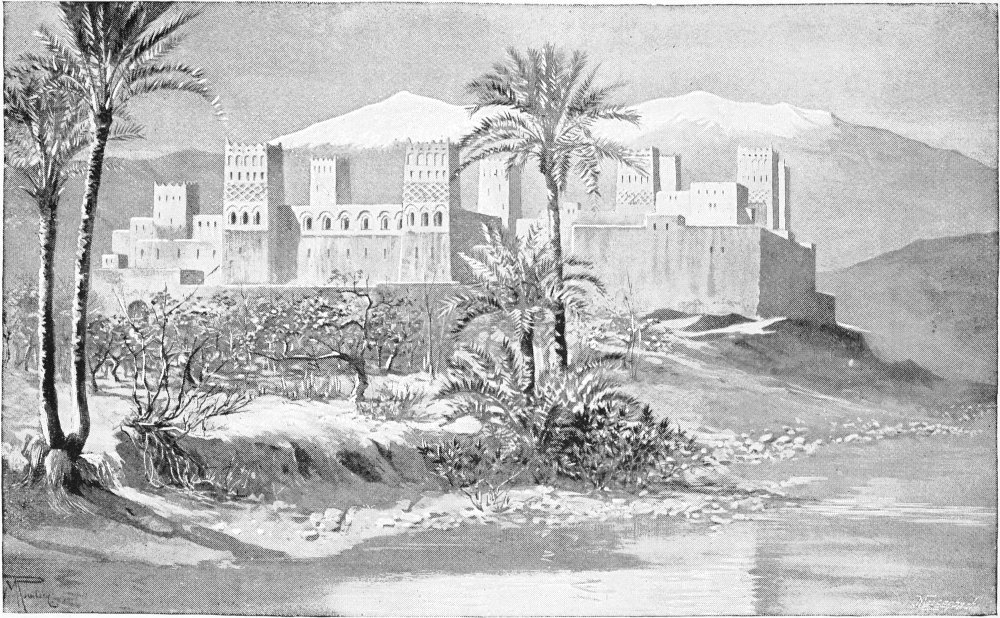
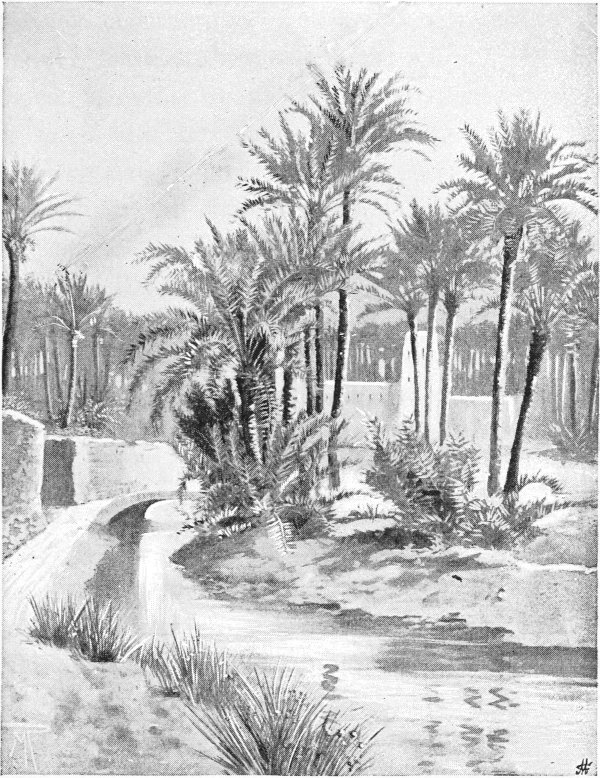
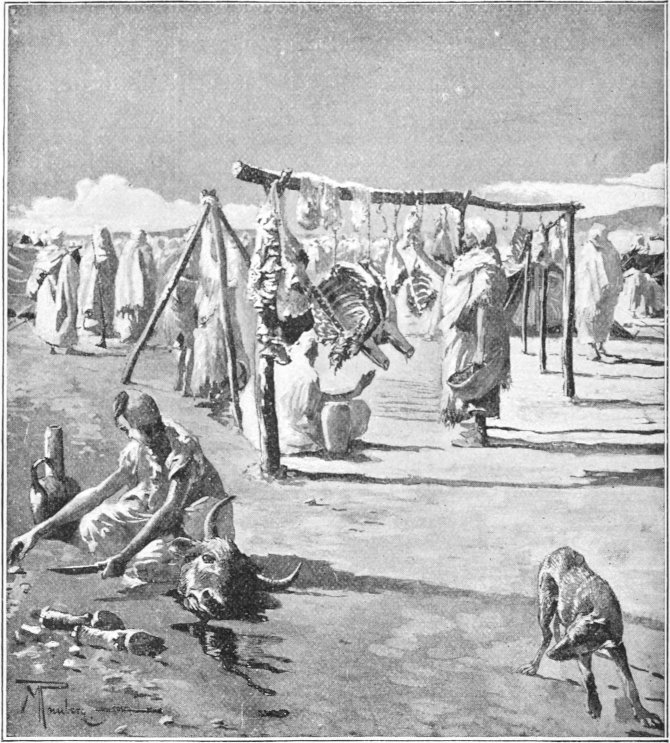
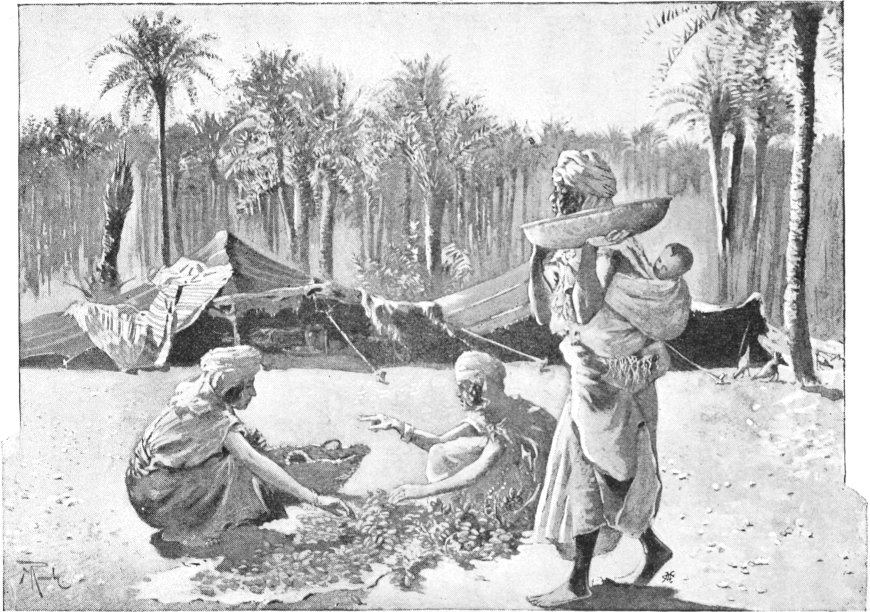
THE NARRATIVE OF A JOURNEY OF EXPLORATION IN
THE ATLAS MOUNTAINS AND THE OASES OF
THE NORTH-WEST SAHARA
BY WALTER B. HARRIS,
F.R.G.S. AUTHOR OF
‘A JOURNEY THROUGH THE YEMEN,’ ‘THE LAND OF AN AFRICAN SULTAN
TRAVELS IN MOROCCO,’ ‘DANOVITCH, AND OTHER
STORIES,’ ETC., ETC.
ILLUSTRATED BY MAURICE ROMBERG FROM SKETCHES AND PHOTOGRAPHS BY THE AUTHOR
WILLIAM BLACKWOOD AND
SONS EDINBURGH AND LONDON
MDCCCXCV
All Rights reserved
TO CLEMENTS R.
MARKHAM, Esq.,
C.B., F.R.S., F.S.A., PRESIDENT OF THE ROYAL
GEOGRAPHICAL SOCIETY,
This Book IS DEDICATED BY
THE AUTHOR.
PREFACE.
Very few words of preface
are necessary for this book.
To three friends I owe hearty thanks for assistance toward the
successful accomplishment of my journey—namely, to Alexander
Peckover, Esq., D.C.L., F.L.S., F.R.G.S., &c.; James Mason,
Esq.; and R. G. Haliburton, Esq.
To the Proprietors of the ‘Illustrated London News’ I am
gratefully indebted for the use of the drawings made from my
original sketches and photographs, which have been most generously
placed at the disposal of my publishers and myself.
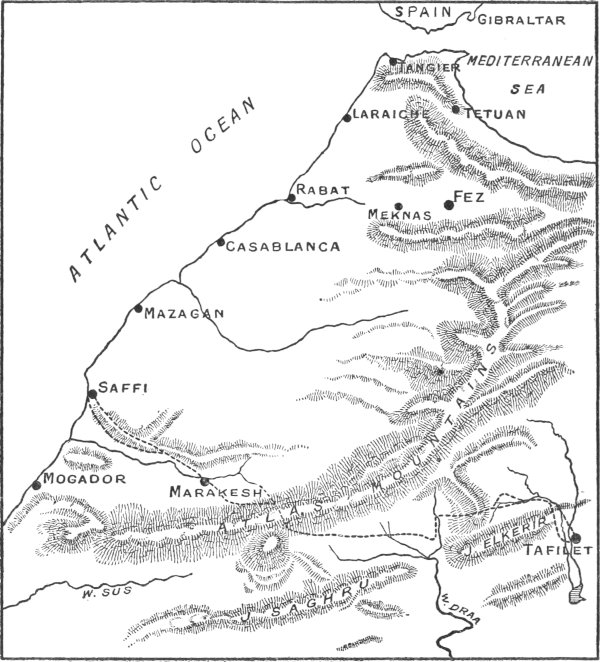
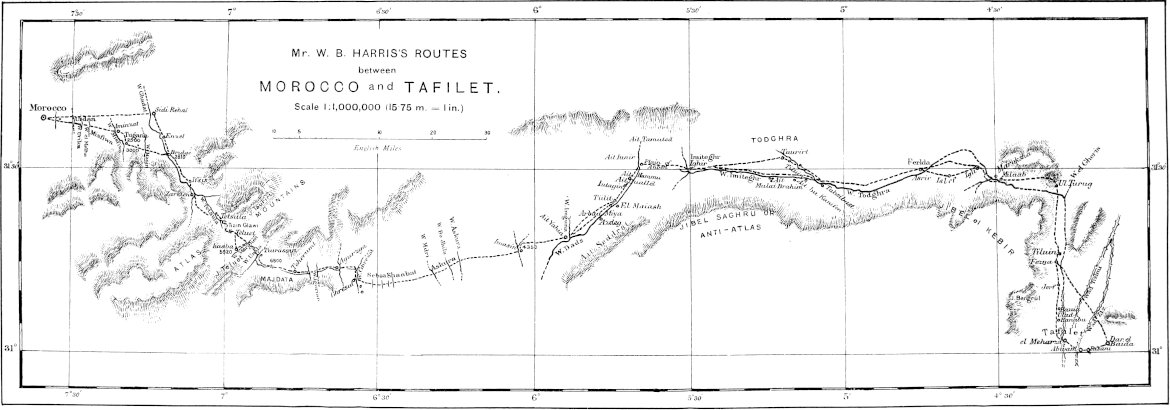
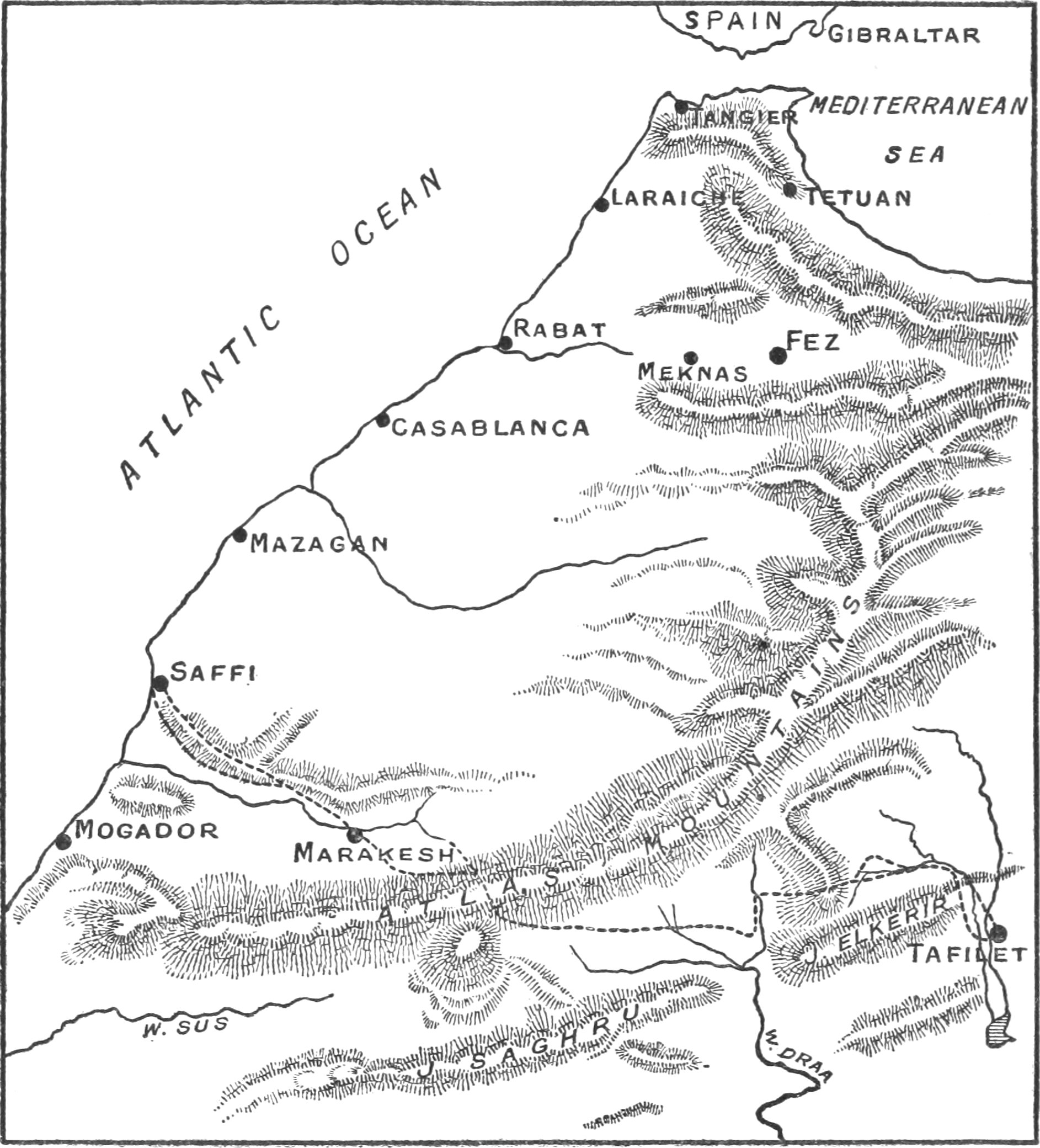
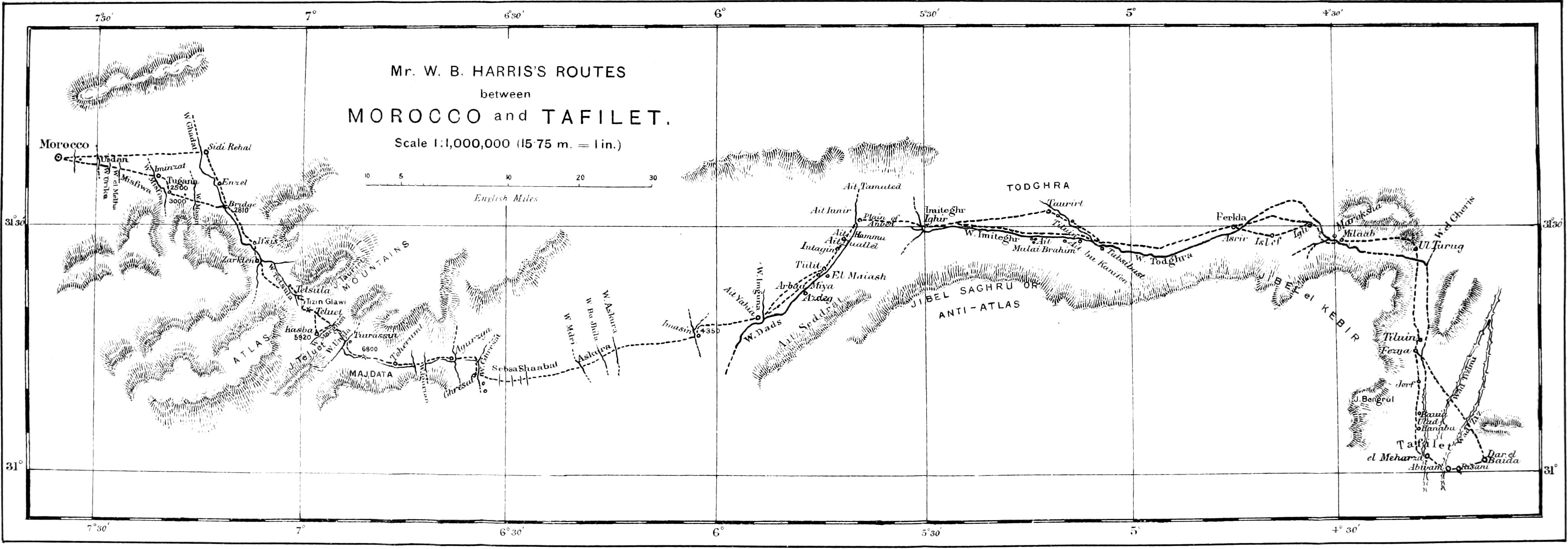
SKETCH MAP OF MOROCCO, Showing Mr W. B. Harris’s Routes to and from
Tafilet.
Author’s route
TAFILET.
CHAPTER I. PREPARATIONS AND START.
It had long been my
intention to make a journey of exploration into, and if possible
beyond, the Atlas Mountains; and though on several occasions my
plans had been already formulated, I had been obliged, almost at
the last moment, to abandon the idea.
However, the close of the year 1893 offered an opportunity which
could not be neglected; but before entering upon the description of
my journey, a few words must be said as to what not a little helped
it toward success.
Mulai el Hassen, the Sultan of Morocco, had been meditating for
some years an expedition into the southern regions of his
dominions, toward that indefinite frontier which divided his country from the
wastes of the Sahara desert. Until, however, the spring of the year
1893 he had been so occupied with summer expeditions, organised to
crush petty rebellions and intertribal strife, that he had found no
favourable opportunity of making any protracted absence from the
seat of his Government; for so miserable are the means of
communication in Morocco, that, once across the Atlas Mountains, he
was practically as distant from his capital—and still more from the
residence of the European Ministers accredited to his Court, who
reside at Tangier—as Kamskatka is from London.
However, during the summer of 1892 the tribes had been so
punished for their many rebellious offences, and so heavily taxed
in consequence, that his Majesty felt but little anxiety in
carrying out his projected visit to his trans-Atlas dominions.
But there were other questions almost as serious to be
considered—first, his relations with foreign Powers; and, secondly,
the reception that might await him in those far-off corners of his
realm.
With regard to the former, while avoiding all political
questions, one or two words must be said. First, it must be
understood that Mulai el Hassen, the late Sultan, was not only an
autocratic ruler, but his own Minister of Foreign Affairs; and a
great difficulty
therefore arose as to who, in the case of sudden foreign
complications, should be directed to fill his place. No one knew
the temperament of his Ministers and Viziers better than the
Sultan, and probably no one could trust them less; for although
their patriotism might be all that was desired, it was very
possible that this same over-zeal might lead them into
difficulties. For this reason the relations of his country with the
European Governments were temporarily put into the hands of a
council, in which the acting Minister of Foreign Affairs, Sid
Fadhul Gharnit, held but only an equal voice with the rest; while
the powers vested in Sid el Haj Mohammed Torres, the
Vizier-resident at Tangier, were more fully specified and
amplified, for alone of all the members of the Sultan’s Government
this man could be said to possess the confidence both of the
European Ministers and his master.
Having announced the manner in which all questions of foreign
affairs were to be regulated during his absence, there was to be
considered the second serious difficulty of the enterprise—the
reception he would receive. For the purpose of ensuring success in
this respect, long before his Majesty started from Fez for the
south, influential members of his family, already acquainted with
the tribes in question and their attitude toward the Sultan, were
sent out to bully and
bribe. Of the two, the latter did the most toward ensuring his
Majesty’s safe passage through the Berber tribes, and by March 1893
everything was prepared for a start to be made.
It is usual for the rulers of Morocco to change their residence
from year to year, spending the winters in one of the larger
cities, either Fez, Meknas, or Marakesh, and during the summer and
autumn to make the long marches from the north to the south of the
empire, or vice versa. The enormous retinue accompanying the
Sultan, the quantity of baggage to be transported, to say nothing
of the insufficiency of all commissariat arrangements and the
entire absence of roads, renders these royal progresses matters
often of several months’ duration.
None can have known better than the Sultan the difficulties—even
dangers—of the journey before him; for, although he possessed no
personal knowledge of the country to be traversed, he was well
informed as to the climatic changes that would have to be endured,
as to difficulty in finding food for his troops, and still greater
difficulty for his horses and mules, and as to the physical aspect
of the country, which presented, along the proposed routes, not
only the heat and cold of the desert, but the passage of
mountain-passes, one alone of which reaches an altitude of over
8000 feet above the sea-level,—and this amongst subjects who, by birth a different and
a semi-conquered nation, would provide nothing or little for his
welfare, and whose reception, if hearty enough in words, would lack
any real enthusiasm.
There can be no doubt that influence was used to prevent Mulai
el Hassen starting out upon this journey, the expenses of which,
even to a European Government, would be enormous, while the dangers
were scarcely less; but so persistent was his Majesty in carrying
out his idea, that he showed little favour to those who tendered
him advice, and let it be clearly understood that the matter rested
with him alone.
In April a start was made from Fez, the direction being due
south, and a halt of a few days was called at Sufru, a small town
some sixteen miles away from the capital. Here the European
officers attached to the Sultan’s suite were informed that it had
been decided that they were not to accompany his Majesty, and they
forthwith returned to Fez. The sole exception made was in the case
of the French doctor, M. Linares, who was commanded to remain with
the army, and to make the journey with the Sultan.
After weary months of hard travel and equally hard delays, Mulai
el Hassen reached his goal, Tafilet, the home of his ancestors, in
the first week of November.
There is no need
here to recount the march from Fez to that oasis; suffice it to say
that, in spite of the physical difficulties of the country, the
scarcity of provisions and fodder, and the half-hearted reception
of the Berber tribes, it was successfully accomplished.
It may be thought that I have already digressed too far from the
purpose of my book in making these introductory remarks; but as it
was owing to the Sultan’s presence in Tafilet that I was able to
undertake my journey at all, and happily bring it to a successful
end, I have felt constrained to briefly state the reasons that had
taken Mulai el Hassen to the far-away oasis in the desert from
which his dynasty originally sprung.
As to the motives of the Sultan, it is difficult to state
anything with certainty. No doubt religious zeal to pray at the
reverenced tomb of his ancestor, Mulai Ali Shereef, had much to do
with the desire to undertake so long and trying a journey, for it
could have been from no hope that by so doing any considerable sums
of money could be collected or extorted, as was generally believed
to be the case, for none could have been better aware than he of
the poverty of the country and its inhabitants. Probably it was
solely the religious point, touched with some anxious curiosity to
see the home of his ancestors, that led him to empty the treasury
upon an expedition from
which no real, and but little moral, benefit could accrue.
I had meanwhile been carefully watching such glimpses of
information as from time to time reached England as to the
whereabouts of the Sultan and his army, and scanty and
contradictory as they were, I was able by the beginning of
September 1893 to gather that his Majesty’s journey, in spite of a
general belief to the contrary, would be successful, and that
Tafilet would be reached.
I therefore left England in the middle of September, and
collecting the few necessaries for my journey at Tangier, reached
Saffi, some 400 miles down the Atlantic coast of Morocco, in the
second week of October.
The journey from Tangier to Saffi was one that presented but
little of interest. The coast-steamer in which I travelled visited
the various ports,—Laraiche, Rabat, Casablanca (Dar el baida), and
Mazagan, all of which I knew well. The weather was rough, and we
had some difficulty in communicating at more than one of the ports,
lying for some twenty hours off Rabat before the lighters were able
to issue from the mouth of the river—the Bu Regreg—that separates
that town from Sallee, the home of the old rovers, whose
depredations upon English sailing-ships were at one time so well
known and so much dreaded.
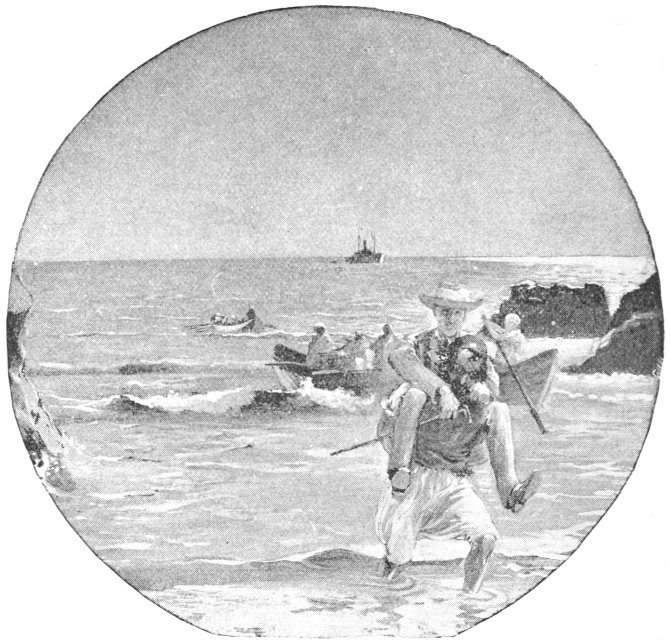
However, on the
fifth day after leaving, Saffi was reached, and fortunately the sea
was calm enough to allow of our landing in one of the strangely
built and decorated surf-boats in use at that port.
Landing in Saffi.
What a shouting and yelling there was of the boatmen, as my
Riffi servant Mohammed, of whom more anon, and I, perched on the
top of our little pile of baggage, were tossed to and fro by the
curling seas that one
after another broke along the beach! In silence the steersman
watched his opportunity, and with a smooth gliding motion we were
borne between rugged rocks, and our boat lay high and dry upon the
beach.
Saffi has been too often described to need more than the merest
mention here. It is a strange, flat-roofed, white town, reaching
from the sea-beach high up the semicircle of hills by which it is
enclosed, the summit capped by the windowless walls and peaked
towers of the great castle, once a palace of the Sultans, now
little more than a deserted ruin.
Within the town the streets are narrow and dirty. In rainy
seasons the mud is almost knee-deep, and a torrent flows through
the main street. The native inhabitants are poor, and accordingly
but little signs of luxury or trade are to be found, with the
exceptions of the large stores of the few European merchants who
reside there. The town is walled, in parts of Moorish workmanship,
in others the remains of the old Portuguese occupation; for Saffi,
like most of the other towns of the Atlantic coast of Morocco, once
formed a small colony of the “King of the Algarves.”
The few days I spent at Saffi passed pleasantly enough, for I
was entertained by Mr Hunot, her Majesty’s Vice-Consul, whose
knowledge of Arabic
and Morocco, gained from a residence of some forty years in the
country, is exceptional; and though I chafed at the delays that
always meet one in dealing with Moors, he did much to render my
time as agreeable as could be to a man who was intent upon nothing
but in making a start.
Small as my preparations were, they caused me several days’ more
delay than I liked; but before the week was out I found myself on
the eve of departure, with a couple of mules, an old man who was to
be my guide, philosopher, and friend, his son and his nephew, a
black slave-girl belonging to his establishment, a stray Sahara
pilgrim, and my Riffi servant.
Adopting the dress of the country on my departure, and mounting
a pack-mule on the top of the luggage, we set out one morning, not
at sunrise as I had hoped, for the old man forgot everything that
he could forget, and remembered an enormous quantity of things he
should have left behind, and it was near mid-day before we passed
out under the old gateway of the town and climbed the steep hill,
in the valley below which the only gardens that Saffi can boast are
situated.
The heat was intense and water scarce, and both we and our poor
animals suffered the entire road to Marakesh, or, as it is more
commonly called, Morocco City, a distance of about a hundred miles.
There had been no
rain for some five months, and even the metafir, as the
natives call their underground cisterns, were nearly dry, and many
quite so.
The road from Saffi to Marakesh presents no aspect of peculiar
interest. The tribes of Abda and Beled Ahmar are passed through,
the latter boasting the dreary circular salt lake of Zima, near
which is a cluster of white buildings, a mdarsa or sort of
college, where the late Sultan and many of his sons received their
education. The inhabitants are all Arabs, but their villages are
few and far between, or lie off the road. The country, at this time
of year a dreary stony waste, is in the spring one great field of
waving corn; and the horses of Beled Ahmar are famous. Owing to the
heat, we did not arrive at Morocco City until the fourth day, and
did not actually enter until the morning of the fifth, preferring
to spend the night just outside the walls.
There is one scene, however, that presents itself as one nears
the city that cannot be passed over without mention, though I
myself, amongst others, have described it before. Yet so strikingly
grand is it, and so unique, that it demands reference in any work
that deals with this portion of Morocco. I refer to the first view
of the wide valley of the Tensift, with its wonderful background of
the range of the Atlas Mountains.
We had been
climbing the steep slopes of Jibeelet, the name given to the range
of hills that form the north boundary of the wide valley of the
Tensift, for some little time before the plain beneath came into
view. The ascent had been a hot and tiring one,
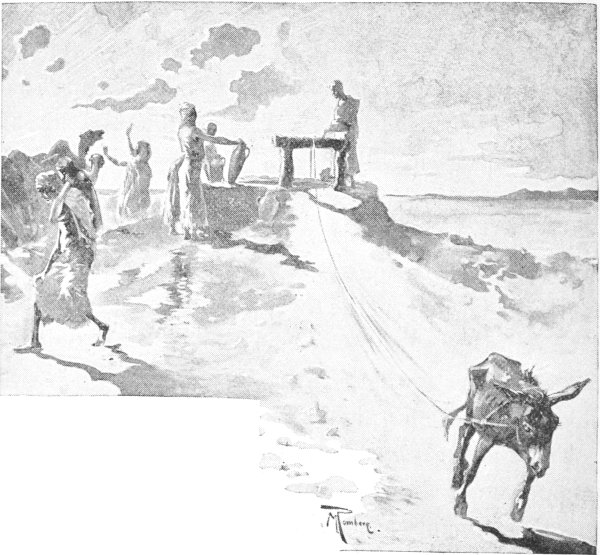
A Well at Sunset
and we and our mules were thirsty indeed. Nor were
there any means of obtaining water, for during some hours we only
passed one small village belonging to a few shepherds of the Arab
tribe of Ulad Dlim, and their waterjars were empty. The well was a
couple of miles away, and not till sunset were they going to
fill the jars again.
Dirty and poverty-stricken their little collection of thatched
hovels and grimy tents were, but picturesque all the same, with a
group of women in dark-blue cotton in the foreground, wearing
necklaces of large amber beads and coral, and with long plaits of
untidy hair, while dogs and naked children stood by and watched our
little caravan pass. Up we toiled until, passing through a narrow
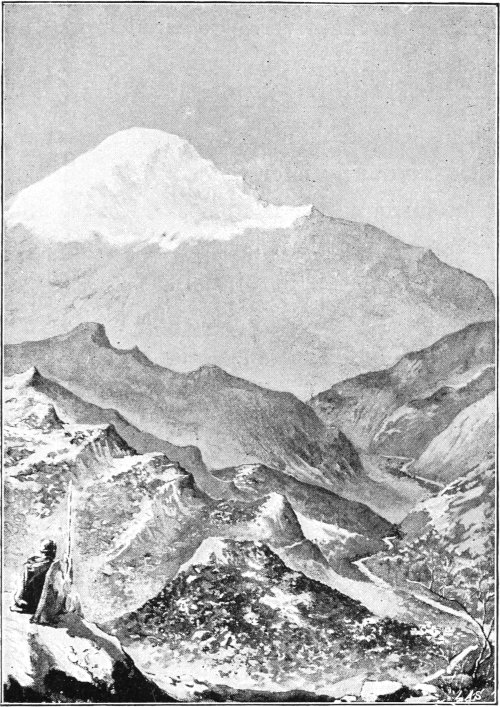
gorge, the scene opened out before us in indescribable beauty. At
our feet lay the valley of the Tensift, far below us, stretching
away some thirty miles or so to where the great range of the Atlas
rose majestically from the plain. Green was the valley, green with
crops and groves of date-palms, while here, there, and everywhere
sparkled and glittered the river Tensift and the many canals that
carry water from its stream to irrigate the surrounding country. A
haze hung over the valley, that sufficed, without in any way hiding
its beauties, to soften the effect of the fierce sunlight; so that
beyond the river the plain appeared to shimmer in semi-unreality
until there arose from the level ground the great barrier of
mountain beyond, its summit white with snow, its base blue with
distance.
Inexpressibly grand it was, yet not with the grandeur that
rugged cliffs and precipices can give, for beyond everything
appealed to one the richness of the scene. After the hot weary march
across waterless plains, the vegetation was surpassingly welcome;
and the dark forest of palm-trees, stretching for miles along the
valley, was as cheering to our eyes as are the lights of his
village to the storm-tossed mariner. There are few views in the
world that can equal the first sight one obtains of the Tensift
valley and the Atlas Mountains,—the strange mingling of tropical
vegetation, of fields green with crops, and of peaks 13,000 and
14,000 feet high, one and all capped with snow, forming a unique
scene. There, too, was the city, its minarets, like little needles,
peeping above the level of the feathery heads of the palms, but
still far away.
The glimpse of shade and water gave energy to our weary bodies,
and we pushed on as fast as was possible for the tired mules, who,
nevertheless, needed but little urging, for to them, too, the scene
must have appealed as much as, if not more than, to ourselves.
At a stream we drank; then entering the palm-groves, threaded
our way, here through a forest of tall straight stems, there
through fields of green maize, until within a mile or two of the
city we camped for the night at a small nzala, or
resting-place for caravans.
As often in these pages this word nzala will be found, it
may be as well to explain its purport here. Owing to the lawlessness of the tribes,
small villages have been planted by the native Government along all
the tracks which in Morocco answer the purposes of roads. Usually
the inhabitants of these wayside caravanserais are natives of some
other tribe, brought there and given a small grant of land. The
villages consist merely of thatch huts and the brown ghiem
or tents of the Arabs; but there is always a large zareba,
or open space enclosed with a high and thick thorn hedge, in which
travellers and their pack-animals spend the night. The village
community furnishes a guard at the only entrance to this
zareba, and in case of robbery the inhabitants are held
responsible by the Government. In return for this responsibility
they collect a small tax from any who make use of their protection.
The system is a good one, and theft is very uncommon, it being
greatly to the villagers’ benefit to carefully guard the
traveller’s property and exact the small fee, rather than by
stealing call down upon themselves the wrath of the native
Government and the rapacity of the local officials.
So at the last nzala on the road from Saffi to Marakesh
we spent the night, pitching our one little tent in the
zareba, and hiring an elderly female, who possessed only one
eye, to cook us some supper in her hut of thatch; and,
considering that her
fire consisted only of bunches of thistles, which had to be
replaced almost as soon as they were lit, she performed her task
with skill and success.
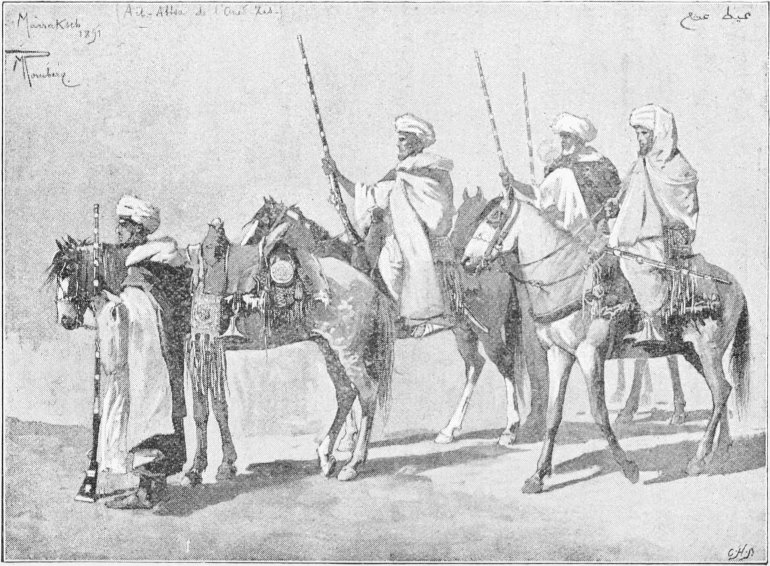
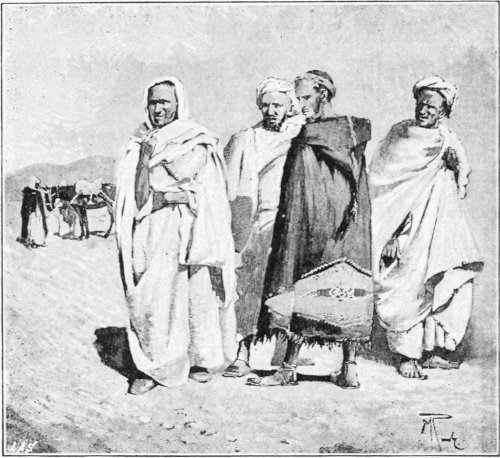
Berber Tribesmen.
The next morning, at the tail of our little caravan, I entered
Marakesh on foot, grimy and travel-stained, and reached my
destination, the house of Sid Abu Bekr el Ghanjaui, without attracting
any attention as a Christian in disguise.
Here comfort, even luxury, awaited me, and pleasant indeed were
the eight days I spent in the city before continuing my
journey—this time into unknown regions.
Sid Abu Bekr el Ghanjaui is almost the best-known man in
Morocco, and probably the most disliked, a fact in which he takes
particular pride. Protected by the British Government, to all
intents and purposes a British subject, he has by these means been
able to amass a large fortune without the native Government having
annexed it and imprisoned the possessor. Whether this fortune has
been altogether collected by creditable means, according to
European ideas of business, I am unable to say, nor is it a matter
of any importance. Suffice it that his fortune has made him many
enemies, whose jealousy at seeing him easily and safely amassing
wealth, while they have been under the constant dread of
confiscation by officials, and continual taxation, has reached such
a pitch that they have not hesitated to spread all kinds of
scandalous reports about his goings on. These reports reached the
ears, amongst others, of British philanthropists in England; and
while Sid Abu Bekr was engaged in building fresh houses and buying
new gardens in his native city, the House of Commons was being
harangued as to the perfidies of the so-called “Government Agent” in Morocco
City. It did not stop there; newspapers, even foreign European
Governments, took the question up, and his name became of common
mention in official despatches. As long, however, as his personal
liberty was not affected, he merely laughed at these hazardous
statements, until one day it was brought to his ears that things
looked serious, and that the only English newspaper in Morocco was
calling him a slave-dealer, a brothel-keeper, and, if I remember
right, a murderer.
Then Abu Bekr girt up his loins to fight, and for some ten days
his action for libel occupied the time of the High Court of
Gibraltar. I was present on the occasion, and shall never forget
the scene when, seated in the witness-box, Sid Abu Bekr, robed in
silks and fine linens, answered calmly and expressionlessly the
extremely unpleasant questions put to him by the
defendant—unpleasant in that they referred to that, to the Moor,
most private of questions, his wives and his daughters. Every
atrocity, every crime, was stated to have been committed by him;
but with no result more than the fact that Sid Abu Bekr won his
action with costs, and 500 dollars damages, and an injunction that
the libel should not be repeated.
Thereupon, his character legally cleared, he
returned once more to
Marakesh, where, surrounded by his little daughters, to whom he is
devotedly attached, he lives in luxury and wealth.
In the house of this man my days were spent, just as I lived
another three weeks with him on my return journey, and I received
from him then, just as I have always done, every mark of kindness
and hospitality. Even the interior of his house was open to me, and
many a pleasant hour I passed playing with his little daughters,
whose dresses of silks and brocades sparkled with jewels.
By this time I had found opportunity to take stock of my
travelling companions, who, as they played a by no means
unimportant part in the success of my journey, deserve some
notice.
The chief of our party, by position, age, and, he himself would
probably add, acquirements, was the elderly Shereef. In person he
was dark, of a sort of coffee-colour, with a grey beard and
moustache; a short figure inclined to stoutness, and a bad habit of
trying to sing. Himself a native of the Sahara, it was on him that
I principally relied for success in my undertaking, my personality
and disguise being concealed under the bushel of his reputation and
accomplishments. Principal amongst the latter was his knowledge of
medicine, a hereditary knowledge it must be understood, part of the
baraka, or blessing, of his august family, for he was a descendant
of the Prophet Mohammed. I unfortunately had no opportunity of
seeing the result of his skill, for when in his company I was never
in one place sufficiently long to obtain any information as to the
potency of the draughts he administered out of one of the three
empty soda-water-bottles he had with him. It was entirely my own
fault, though, that I did not see him perform the operation he was
most skilled in—namely, cataract—for before leaving Tangier I had
received a letter from him asking me to bring a large bottle of
chloroform and a knife suitable for the purpose. This I steadily
refused to do, and I think that the old man felt the slight I had
unintentionally offered him, and fancied that I doubted his skill.
At least he was always holding forth upon the subject, and
continually repeating the story that when in Algeria he had been
offered a fabulous salary—the sum varied each time the tale was
told—to remain in charge of the military hospital at Algiers, an
honour which he had declined. He never tired of narrating the facts
and details of his most successful operation. There is a sect in
Morocco called “Hamacha,” who are followers of a certain saint by
name Sidi Ali ben Hamduch, who lies buried near Meknas. These
devotees amuse their audience—and themselves too, let us hope—by
throwing into the air heavy cannon-balls, which they allow to fall upon their shaven
crowns. On the occasion in question a Hamdushi had unfortunately
evidently been wanting in religious power, for the cannon-ball
crushed his skull. My old Shereef friend had been called to the
rescue, and according to his account, which, let us hope, for the
sake of science as well as his own reputation, is a true one, he
removed the broken patch of skull, replacing it with the rind of a
green pumpkin, and closing the skin over it. In a month’s time the
patient was not only convalescent but was once more hard at work
practising his religio-acrobatic feats, with not only a remodelled
and renovated skull, but even a new crop of hair! Such, then, was
the skill of the leader of our caravan.
But there was another member who aspired to play the chief part
in our little camp—the black slave-girl. Of all the mischievous
impertinent hussies that ever saw the light of day she was the
worst. Alternately shrieking with laughter at her practical jokes,
and howling with rage because she couldn’t get what she wanted for
supper, she was equally annoying in either capacity. At the same
time, one could not help laughing at her strange antics. Why she
had come at all was at first a mystery to me, until it leaked out
that she had insisted upon doing so, and had pulled the old man’s
beard until, with tears in his eyes, he had promised to take her—anyhow,
come she did. Her mother was a slave of the Shereef’s wife—the wife
who lived at Saffi, for there were a couple more at Dads, where he
had formerly resided, and where his home really was—who had been
bought with her little daughter, our fellow-traveller, some ten
years before. The girl was fearfully ugly, as black as jet, with
all the typical features of the negro. However, one readily forgave
her this, and all her sins as well, for many a laugh her antics
caused us when hunger and cold made a laugh worth double its
ordinary value. When she was riding she wanted to walk; as soon as
she commenced to walk she wanted some one to mount her again on the
mule, from which, if she did not purposely alight, she would
invariably tumble off. Such was the lady of our party, and she
accompanied us as far as Dads, leaving there with the old Shereef
some four days before I arrived at Tafilet. She stood the cold and
fatigue of the journey well, and ought to be made a Fellow of the
Royal Geographical Society, for she had a wonderfully retentive
memory of the road and all the places we had stayed at, though as
often as not she managed to forget the sternly delivered command
that she was not to eat our complete store of dates while our backs
were turned. Enough of Embarka, for such was her name.
The next
individual in our caravan was of a very different kind and class,—a
long, tall, delicate, thin man of some four-and-twenty years of
age, with one of the most beautiful voices in speaking I ever
heard. He was himself a Shereef, a nephew of the old doctor’s; and
a man of absolute fearlessness in danger, and equal gentleness and
sweetness of manner in time of peace. He never complained of cold
or hunger, though we suffered much from both, but bore all the
hardships of the journey, and they were many indeed, not only with
every fortitude, but also without ever losing an opportunity to
attempt to add to my comfort. As we trudged along the weary desert
roads he would for hours together, with a voice that would be the
fortune of a Member of Parliament, and gestures that an actor might
spend years and never acquire, relate to me strange stories of the
past, page after page of Moorish history and tradition, in Arabic
as pure and as poetical as any that can exist.
The very opposite was the old Shereef’s son, a boy of some
twelve or thirteen years of age. Heavy in body and mind, he had
neither the intellect to be amusing nor the inclination to be
useful, and served no other purpose of advantage than to be the
object of the black girl’s practical jokes instead of any other of
us.
There was, too, in our party the returning pilgrim, a devotee of the sect of Mulai
Ali el Derkaui, as was apparent from his green turban and the
string of large wooden beads he wore suspended round his neck. A
strange quiet man he was, always ready to help us load our animals
or pitch our one little tent, but seldom speaking; never missing
the hour of prayer, and often himself bearing part of the load of
his little donkey, on which he was carrying to his native village a
few bars of rough iron to be forged into ploughshares. We saw but
little of him: he was always a hundred yards ahead or behind,
counting his beads as he came along; and often when we missed him
altogether we could see away back along the road his figure, or its
shadow, for his colour and that of his clothes corresponded too
truly with the yellow sand, as he rose and fell in prayer. I was
much struck by his quiet, patient, uncomplaining way. He didn’t
belong to us, but travelling in the same direction, he joined our
little caravan, and we made the journey together. I of all our
party had some conversation with him, for kind as were they all to
the solitary stranger, he was timid and retired. However, we often
talked together as I trudged beside him, and he seemed to be a man
of no little power of reasoning and thought. Often in discussing
theological questions, and he would talk of nothing else, it became
apparent that a battle was raging in his heart, a battle of common-sense against
prejudice and fanaticism. He had travelled to Mecca and back, and
his eyes had been opened, and he seemed to realise the
narrow-mindedness of the school in which he had been brought up. He
spoke openly to me, for to the day he left us at Dads to turn aside
to his home, he never knew I was a Christian and a European, and
often we prayed together by the roadside.
There remains but one more man to mention, my servant Mohammed
er-Rifi, who followed me faithfully throughout the long journey,
and returned with me to Tangier to commence again the humdrum
existence of waiting at table and sweeping floors. An excellent
youth he is, all good nature and smiles, strong and trustworthy,
but preferring the luxuries and warmth of my kitchen to sharing the
hardships of a desert tramp of several hundred miles. However, he
never complained until the end of the journey, and then, arrived
once more in Marakesh, he cursed the desert, and all that in it is,
with all the curses he could muster—a very tolerable lot, on the
whole. However, I cannot speak too highly of his fidelity and of
the patience with which he bore what must have been to him a most
terrible journey—nor forget to say that at times he hints that he
and I should set out afresh for pastures new.
I have entered somewhat at length into the
characters and
description of my men, but some word of praise is only due to them;
for had I not been surrounded by a faithful and uncomplaining band,
my success in reaching Tafilet would never have come about.
The usual delays occurred in Marakesh before we got started once
more, this time again the fault of the old Shereef, who wanted to
buy presents to take to his relations at Dads,—the existence of
whom, although he had two wives and quite a number of children
there, he had apparently forgotten for several years,—and could not
decide what to purchase.
So having found quarters for my men and my mules, I determined
to enjoy the last few days of rest and plenty that I was destined
to know for several months.
From Saffi, to Morocco City: a weekly Market.
CHAPTER II. MARAKESH.
I had already several times
visited Marakesh, or Morocco City, and had therefore no difficulty
in finding my way all over the town, through the streets of which,
ruinous as they are, it is always a pleasure to pass; for all kinds
and species of human beings congregate in this southern capital of
the empire, from the fair mountaineer to the swarthy negro from
Timbuctu and the Sudan, from the rich merchant of Fez to the lithe
shy Berber of the snow-clad peaks of Mount Atlas.
But before I speak of the inhabitants and the strange sights to
be seen within the city, some general description of the place must
be given.
Marakesh shares with Fez and Meknas, both lying far to the
north, the title of a capital, and it often forms the residence of
the Sultans of Morocco for considerable periods at a time, the
royal palace here being one of the largest in the country. The city lies in
a wide plain, formed by the valley of the Wad Tensift, some fifteen
miles to the north of the foot-hills of the great Atlas range, at
an altitude of some 1600 feet above the level of the sea, from
which it is distant about a hundred miles. A wall from 20 to 30
feet in height surrounds the city, which covers a very large extent
of ground, though no inconsiderable portion of the enclosed extent
is composed of gardens. This wall is defended at intervals of 120
yards by towers, some of which are formed of stone, but most of
native concrete or tabia, and without lime being employed.
Seven gates give entrance and exit to and from the town, but none
presents any remarkably handsome features, being more attractive
from their yellow colouring and general picturesqueness than from
any architectural beauties. On almost all sides the city is
surrounded by luxuriant groves of date-palms, stretching for some
miles to the north, but more scanty on the south. These are
irrigated and the water-supply brought from the Wad Tensift, which
flows to the north of the city, and in which there is, summer and
winter, a considerable volume of water.
Approaching Morocco from almost every direction except the
south, the place lies hid behind the forest of palms until one is
close upon it, and even then little is to be seen but the dull
yellow walls with
their square towers, above which rise the many minarets of the form
common to Morocco. These do not in the least resemble those of the
East, being of far more solid construction and form, and are almost
universally square, though now and again octagonal or sexagonal.
Often decorated in gorgeous green tiles, they add, wherever they
are met with, a glimpse of colour and form to a city that is
otherwise but gloomy,—its buildings and soil, its inhabitants and
their clothing, seeming to be all more or less tones of one colour,
a greyish yellow. Such is Marakesh as seen from without the
walls.
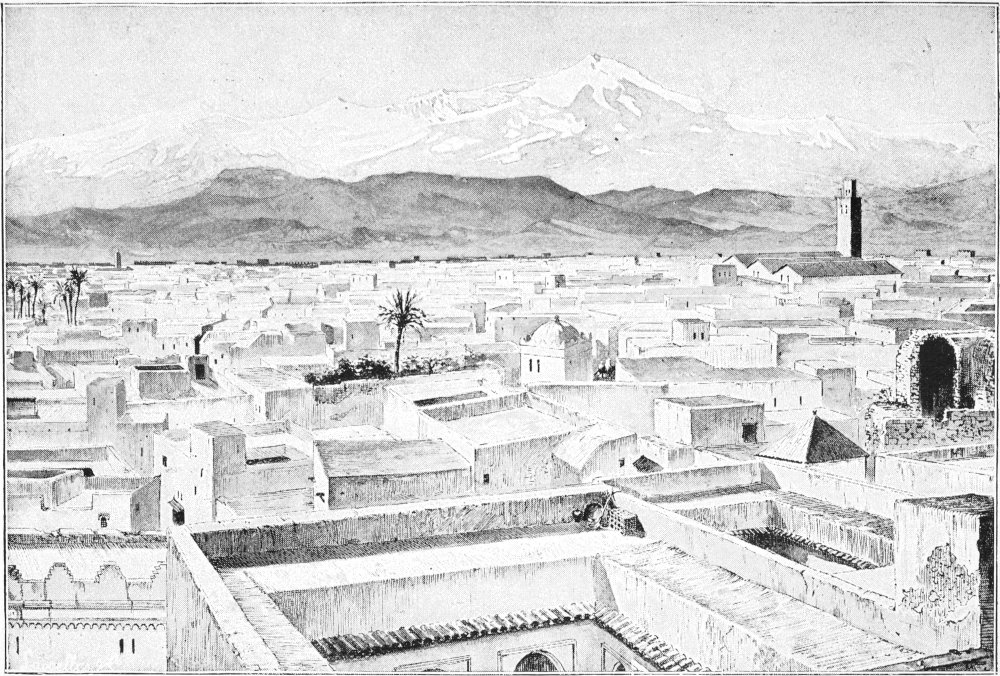
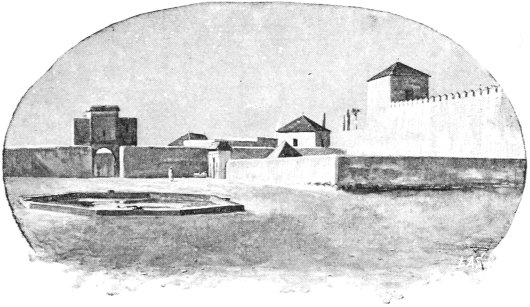
A GENERAL VIEW OF MOROCCO CITY.
As soon as one has entered its gates the state of dilapidation
in which the city now is becomes apparent. Surrounded by ruinous
houses and mosques are large open spaces of ground, as often as not
filled with the refuse of the city. From these the streets give
entrance into the more habitable quarters, where some pretensions
to comfort, though few to cleanliness, are to be found.
The streets are wider, as a rule, than in Fez, though many are
narrow enough; but the size of the houses bears no proportion to
those of the northern capital, being for the most part of one
storey in height, except in the thoroughfares and quiet
back-streets in which the richer portion of the population live.
The smaller one-storeyed buildings all more or less
adopt the same form
of construction, being built round an open court.
Tabia—concrete, or rather consolidated soil—is the material
in use, with here and there mud bricks. Only two stone buildings, I
believe, exist in the whole city.—the handsome gate leading into
the “Kasba” near the Government mosque, and the still more handsome
minaret of the “Kutubía.”
Some little signs of prosperity, however, are apparent in the
bazaars, which are large and well supplied. The new
“Kaiseríeh”—parallel arcades arched overhead and lit by open
skylights—are of by no means contemptible size or construction, and
in good repair. They present of an afternoon, when the goods are
for sale by auction in the arcades and by retail in the many
box-like shops that line them, a picturesque and lively scene. All
manner of goods can be purchased here—from the newest design in
Manchester cottons to old silver daggers and brass candelabra. As
in nearly all oriental cities, the different trades possess their
separate bazaars, one whole street being given up to the
attarin, or sellers of sugar, spices, glass, and china,
&c., who answer much to our grocers; another to the brass and
copper workers; a third to the saddlers; and the longest of all
perhaps to the shoe-workers, for Marakesh is celebrated for its
leather. The merchants and inhabitants generally of the city are
very different in type and character to those of Fez. Whereas the
latter are fair, and generally most fanatical, the native of
Marakesh is a good fellow, smiling and cheery, with far more of the
traits of the negro than of the Moor of the north. In colour, too,
he is much darker than the Fezzi, and many show more or less remote
signs of negro blood, owing, no doubt, to their proximity to the
darker tribes, and the fact that the slave-trade of entire Morocco
filters through this city.
The residential part of the town is divided into several
districts, separated from each other by open spaces, or by streets
of shops. Just as in Europe, there are the fashionable and
unfashionable quarters, the “Medina” or city being perhaps the most
sought after. So largely does fashion hold sway over the people,
that the rents of houses of equal size only a few hundred yards
away from one another vary often fifty per cent, a palace in the
district of “Bab Dukala” not bringing anything like so large a sum
as a minute house in the “Medina.” It was in the latter that I
resided during my stay, in the house of Sid Abu Bekr el Ghanjaui,
who owns very considerable property all over the city, and
particularly in this neighbourhood. The houses here are high, and,
like most Moorish residences, have but few windows looking towards
the street, one and all possessing central courts on to which the rooms open. But
even in respect of windows Morocco City is different to Fez, for
whereas
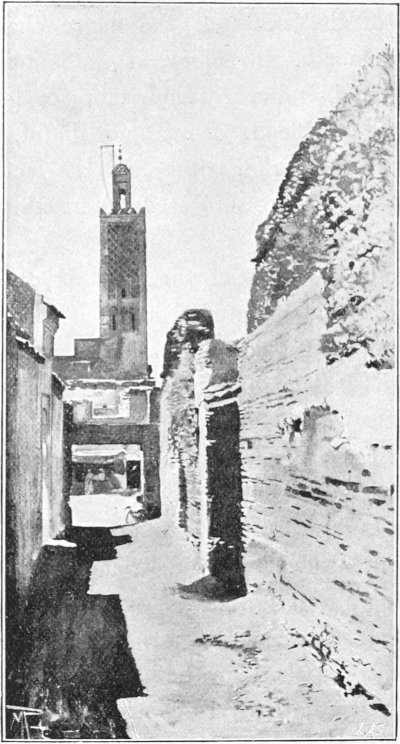
A Street in Marakesh.
in the latter from the streets one sees but few,
and those generally closely barred, in Marakesh they
are in considerably
larger numbers, though, as I stated above, by no means general.
After the “Medina”—the trading quarter—the “Kasba” is the most
important. This district, the residence of the Government, and
which contains the palace, is separated from the remainder of the
town by walls, much resembling those that encircle the city, but
higher and in better repair. Nor do the houses reach to this wall,
for between the city proper and the “Kasba” are large open spaces
and many gardens, adding a most picturesque effect to this quarter.
These gardens for the most part are walled, and as a rule only the
tree-tops, amongst them the handsome cypress and date-palm, are
visible, while the minarets beyond cap the scene.
One enters the “Kasba” through the handsome stone gate of which
I have already made mention, and of which tradition says the stones
were brought from Spain, and after passing a smaller and less
important gateway, one emerges opposite the large “Jumma el
Makhzen,” or Government mosque, with its handsome minaret of stone
and tiles, and its huge modern courtyard, opening on to the street
by large gates. With the exception of the tower, now fast falling
into decay, it presents no particular features of architectural
beauty, though its courts and green tiles and turreted walls are
by no means
despicable. A long straight road with one-storeyed houses on both
sides, for the most part quarters of soldiers and employés
in the Government service, leads on to another series of walls,
those of the Sultan’s palace.
As in all the Moorish cities, the great courtyards of the palace
are public thoroughfares, though they can be closed any moment by
the strong gates which are found in every direction, and one of the
principal entrances and exits of the city is through the royal
squares that lie between the palace and the great park, or “Agdal,”
of the Sultan. These squares, three in number, are surrounded by
high walls of modern construction and in good repair, and open into
one another by handsome gateways, decorated in colour-tiles and
painting,—the latter an art peculiar almost to this portion of
Morocco, and though met with here and there elsewhere, it is known
throughout the country as a Marakesh fashion. For the most part it
consists of red and black designs upon a ground of yellow ochre,
and has by no means a bad effect, especially when employed under
the overhanging roofs of green tiles in the palaces and
mosques.
Although it covers a very considerable amount of ground, the
palace at Marakesh, as seen from the outside, does not present any
very particular features of beauty, though the pointed roofs of
brilliant green and
highly glazed tiles, capped with globes of gold, are picturesque
enough. The interior it is impossible to see, and the one or two
courtyards which I had visited on a previous occasion were in bad
repair, noticeable only for their size and absence of decoration.
Probably, however, in the portion of the palace put aside for the
private use of the Sultan and his many women, there exists a great
deal that
Inner Court of Sultan’s Palace in Marakesh.
is beautiful in the way of architecture and
decoration, though the constant love of the Sultans for pulling
down and rebuilding has no doubt destroyed much of the older work,
which in all probability was the best. It must by no means,
however, be denied that even the modern architecture of the Moors,
as exemplified in the finer houses of Fez, is excellent. It is the
custom of writers on Morocco to detract in every way from the
present state of the country and its inhabitants, especially as regards
architecture; but this is no doubt owing to the fact that they have
no opportunity during their stay in the towns of entering the
houses of the official and richer classes, for the Moors are very
shy of strangers, and it requires a long acquaintance with the
language and the people before they will admit one, as a rule, into
the interior of their abodes, and then generally not unless the
native costume is adopted, for fear of falling into bad repute if
“Christians” are seen to enter. I have myself not only had many
opportunities of seeing the finest houses of Fez, but have resided
in them for several periods of no little time, and can vouch that
some of the dwellings of the richer men are little short of the
Alhambra in beauty. The one great drawback to their modern
architecture is the entire absence of marble pillars, in place of
which much heavier work is erected, usually richly decorated in
tiles. Beautiful as they often are, the airiness and lightness so
apparent in the Alhambra, for instance, is entirely wanting. The
mosaics of finely cut tiles to-day being worked in Fez surpass in
design and skilful application any I have seen in Spain. However, I
have wandered rather far from Morocco City, for there but little if
any great beauty is to be seen, the inhabitants being, as a rule,
much poorer than those of the northern capital, while the
materials used in the
construction of their houses are not nearly so good or so
lasting.
On the opposite side of the three squares to the palace are the
walls of the “Agdal,” the great enclosed park of the Sultan. On a
previous visit to Marakesh I had been allowed to wander at will in
these gardens for hours at a time, and though, according to our
ideas, they have fallen into a state of ruin, they are still very
beautiful. Water runs in every direction; and at one spot is a huge
tank, or reservoir, reached by a handsome flight of steps, and of
such dimensions that a steam-launch plies upon its waters. As for
the gardens, they are a forest of olive and palm and orange trees,
half smothered in many places in dense creepers, while the soil is
covered with a thick undergrowth of shrubs and flowers, that
shelter not only the partridge and the hare, but even foxes and
jackals. The Sultan, in spite of the dilapidated state of his
gardens, draws no small revenue from the sale of its fruits, which
are put up to auction annually, and sold when still on the trees,
the purchasers having to pluck and send them to the market, as well
as to guard them against theft.
There are several fine mosques in the Marakesh, one surpassing
all the others in its magnificent minaret, which may be said to be
almost the sole existing example in the whole country of the
remarkable existence.
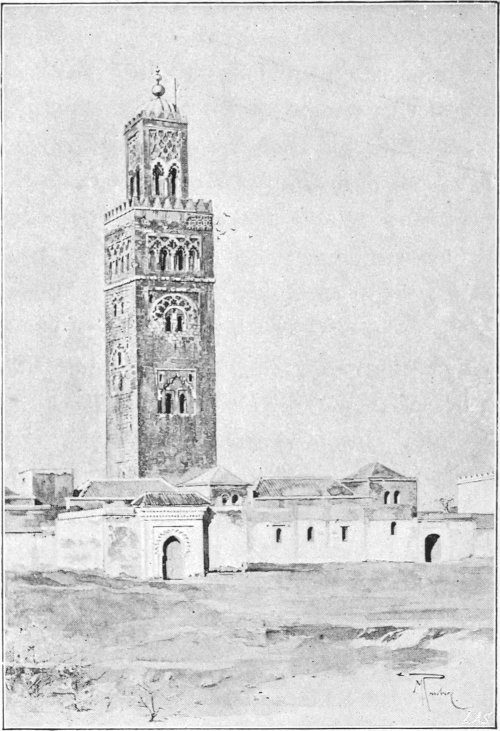
This
The Kutubía in Marakesh.
mosque and minaret are known as the “Kutubía,” or
“Mosque of the Library,” from its having contained at one period a
vast collection of manuscripts. The tower, built of squared stone, is 280
feet in height, and is surmounted by a smaller minaret, which again
is capped with a dome. On the summit of this dome are three gold
globes, one above the other and decreasing in size. On the summit
of the lower tower is a parapet of Moorish design. The whole
building is of a dull red colour, and the niches of the windows and
the centres of its faces are carved in a very pure style of Arabic
design. Originally tilework filled most of these niches, but a
great quantity of this has fallen away, though a broad band of
green and black encircles the whole immediately below the parapet.
Just as in the two sister towers,—the Ghiralda of Seville and the
Hassan tower at Rabat, the latter uncompleted,—a sloping incline
takes the place of steps within, on account of this forming an
easier ascent for the beasts of burden that carried the stones
during its construction. The architect of all three of these towers
is said to have been a certain Fabir, who worked in the employ of
the Sultan El Mansur, in whose reign the Kutubía was completed. The
mosque beneath, though covering an enormous extent of ground, is in
by no means just proportion to the great minaret, being built of
brick, and white-washed, while the roof is tiled. Below the
flooring is said to exist a great cistern excavated by the Sultan
El Mansur. The pillars supporting the roof of this mosque are all of
marble, and the courts are paved in the same stone and coloured
tiles.
From whatever point Marakesh is looked at, the great tower of
the Kutubía is the first object to catch the eye, and it forms an
excellent landmark in steering one’s way over the bewildering plain
that surrounds the city on all sides. I was told when crossing the
Glawi Pass, on the fourth day after leaving Marakesh for Tafilet,
that from a point near the road this great work, the sole reminder
of the genius of the old-day Moors, was visible.
Although the largest mosque, and possessing the handsomest
minaret, the Kutubía seems much deserted as a place of worship,
possibly from its being somewhat removed from the more inhabited
portions of the city. Two shrines have annexed all the veneration
of the townspeople and the surrounding tribes,—those of Sid bel
Abbas, the patron saint of the city, and Mulai Abdul Aziz. A pretty
story is told about the first, which, though common amongst the
Moors, I have never seen quoted. Sid bel Abbas arrived outside the
walls of the town, a beggar in rags; but although his poverty was
apparent, he had a great reputation for sanctity. Before entering
he sent to the Shereefs living within to ask their permission to be
allowed to reside in the city, a course that much perturbed the said saints; for up
to that moment they possessed the monopoly of the business—in
Morocco a most lucrative one—of demanding and receiving alms on
account of their descent from the Prophet. Wishing, however, to
avoid an abrupt refusal, they resorted to delay, during which Sid
bel Abbas took up his residence on the summit of a rocky barren
hill—Jibel Glissa—which rises amongst the palm-groves to the west
of the walls, and on which a little mosque to-day commemorates the
event. At length, seeing that some answer must be sent, the
Shereefs filled a bowl to the brim with water and sent it out to
him. The bowl represented the city and the water themselves, and
the bowl was full, which said pretty plainly, “Business already
overstocked—much rather you wouldn’t come.” However, they gave him
an opportunity of getting over their device, for the message they
sent was couched in more poetical language. “If you can add,” they
said, “to a bowl of water already full, enter.” Thereupon the saint
plucked a rose and held it in the sun until its stalk thirsted for
moisture, when he gently laid it in the bowl. The water displaced
was drunk up by the thirsty flower. In this manner he sent the bowl
back—but with no answer. When, however, the Shereefs saw that he
had succeeded, and also paid such a pretty compliment to himself as
to liken them to the
water and himself to the rose, they withdrew all opposition, and
the saint entered the city, and, judging from the reverence paid to
his bones, must have entirely monopolised the business.
The “Zauia” of Sid bel Abbas forms a sort of almshouses, and
food and money are distributed there to the poor. An entire quarter
of the city—the extreme north-west—belongs to the zauia, and
it owns enormous tracts of palm-groves and agricultural land in the
surrounding plain. These possessions have been offerings from the
faithful, or bequests at death, and in some cases purchases made
with the constant flow of money that pours into the coffers of the
mosque.
Another almost equally holy spot is the shrine of Mulai Abdul
Aziz, which lies either in or just on the borders of the “Medina”
quarter. A very handsome building covers the tomb, like that of the
rival saint, gorgeously decorated, and full of lamps and
candlesticks of precious metals. But of all the treasures stored in
these sanctuaries, clocks are the most numerous. When this
invention began to penetrate into Morocco—that is to say, in
comparatively late years—they were naturally looked upon as the
most valuable and wonderful things, and a fashion promptly set in
to bestow them upon the ashes of the dead saints. Every one who
could afford it gave a clock, and often in talking of local saints I have
heard Moors say, “Ah! he was a saint indeed, God’s mercy upon him;
and there are four clocks in his tomb!” It is said that the
burial-place of Mulai Idris at Fez presents a bewildering scene of
clocks, great and small, half going, and all wrong. I myself have
had opportunities of visiting one or two tombs in Morocco, and have
listened, bewildered, to the ticking of fifty or sixty of these
much-reverenced presents. Most seem to be tall “grandfather”
clocks, made in England, and dating from about the end of the last
century. Some are remarkably fine, with silver dials, showing the
quarters of the moon, &c. Even to-day the natives adore the
great, loud, ticking horrors manufactured for the native market in
Algeria—monstrosities of gaudy decoration and painted wood—and no
good house is considered complete without one or more. I have dined
in houses at Fez where there have been six or seven in one
room.
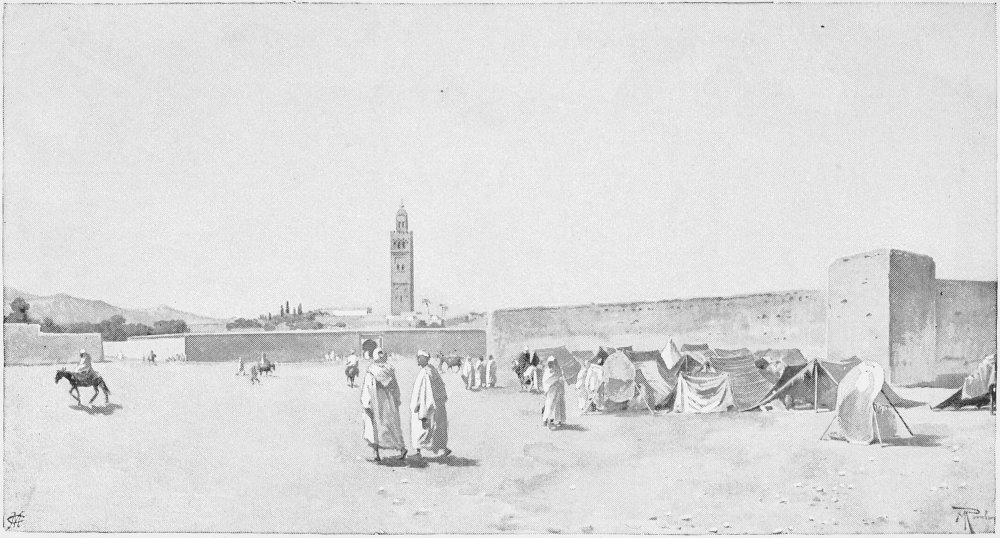
THE SÔK JUMMA-EL-FANAR, THE PRINCIPAL PLACE IN MOROCCO CITY.
None of the other mosques of Marakesh calls for much remark,
though those of Ibn Yusuf, El Mansur, and El Muiz are large, the
former possessing a very handsome, though more modern, minaret,
rich in green tiles. As is customary all through Morocco, no
Christians are allowed to enter the sanctuaries, and even whole
districts, zauias, are sacred. One or two streets near the
tomb of Mulai Abdul Aziz are crossed with chains, marking the boundary of town and
saintly property, and within these limits even the assassin is safe
from arrest, for they answer the purpose of marking the boundary of
the refuge. The result is that all the zauias are full of
refugees of all classes, from political prisoners to the pilferer
of the stalls in the markets.
Two large markets are held weekly, one outside the Bab (gate) el
Khamis—as its name implies, on Thursdays—and the other within the
city walls in the square of Jumma el fanar. Both collect large
crowds of the country-people, as well as the natives of the town,
and the trade is considerable in native produce. The more
picturesque of the two is without doubt that of the “Khamis,” for
the great open space that serves as the market-place is surrounded
on two sides by the palm-groves, and on the other two by the long
straight line of the city walls. A few cypress-trees and a
white-domed saint’s tomb add not a little to form a fit background
to the strange grouping of figures and animals that are crowded
together in the market. Here herds of oxen, cows, and calves are
for sale, tended by the long-robed Arabs from the plains; there
camels, goats, and sheep. Mules occupy a spot to themselves, and
one at a time is mounted by the auctioneer to show its paces; while
a professional rider gallops to and fro, shouting as he
goes, upon the
various horses, for which he yells for bids. All classes and kinds
of people congregate in the market—from rich Shereefs, accompanied
by slaves, and riding great fat mules with crimson saddles, to the
ragged hungry soldier; from the timid Berber of the Atlas peaks, in
his black cloak, to the gamin of the streets; from the
respectable grain-merchant to the most disreputable of Jew
money-lenders. Here, too, the shoesmith has his tents, and women
sell baskets and embroideries, pots and pans of earthenware, and
wooden dishes, embroidered kuftans and woollen girdles. All
the city seems to adjourn of a Thursday morning to the great level
space outside the Bab el Khamis to buy and sell or look on.
A Jewish Banker of Marakesh.
The Jews, as in nearly all Moorish cities, possess a quarter to
themselves—the “Mellah,” or salted place. In Marakesh it lies quite
close to the “Kasba,” and almost adjoins the Sultan’s palace. If
anything this division of the town is dirtier than any other, while
the ever-present smell of mahia—the strong spirit made in
the place—adds a nauseating aroma to the many already emitted by the offal and filth
thrown out into the street. There are many well-to-do Jews in
Marakesh, and one or two possess nice houses, scrupulously clean
within, but with manure-heaps, several feet in height, at the
door-step—the refuse of the place, which they merely throw there
and leave to rot.
Drunkenness seems very common in the streets of the
mellah, and it is this fact that gave rise to the recent
complaints as to the persecution of the Jews. As far as the Sultan
is concerned, they can get as drunk as they like in their own
quarter, for they are under a Sheikh of their own; but he naturally
objected to them selling mahia to the soldiery, for whose
crimes he was responsible. However, in spite of the fact that the
Jews are, or ought to be, almost all Moorish subjects, the Sultan
has not been able to prevent this nuisance, for the cry of
persecution at once arises. I was asked on the last two occasions
that I visited Marakesh to make inquiries as to the state of the
Jews there, and had opportunities of speaking with, and consulting,
the leading and most respectable of the Israelites. They one and
all made light of the complaint of general persecution, but
mentioned that individual cases did exist where Jews had been
hardly treated on insufficient evidence. However, such is far more
often the case with
Moors. I have met with much kindness on my travels from the Jews of
the interior, and also at times with no little show of fanatical
hatred; and I think that the most respectable of their tribe in all
the towns acknowledged that the cry of persecution was more an
attempt to become exempt from taxation than for justice for wrongs
done. There can be no doubt, however, that in former times the Jews
were cruelly used; but the late Sultan, Mulai el Hassen, was a
broad-minded man, and never refused to listen to their petitions.
No one mourned his death more sincerely than the peace-abiding
members of that tribe, whose wrongs he was ever ready to redress,
though only naturally he put opposition in the way of those who,
taking advantage of European protection or his own leniency,
practised nefarious usury with his subjects.
The population of Marakesh to-day does not probably number more
than some 40,000 souls, though it is said that within a hundred
years of its founding by Yusuf in 1062 A.D. it contained some 700,000 inhabitants. There is
no doubt, though this figure is probably an exaggeration, that it
was at one time a city of great importance and learning, for even
Europe sent its sons to be educated at the great colleges that
existed there at that time.
I have written but little as to Marakesh. It is a city that has so often been
described by other travellers, that it has been my purpose here
merely to sketch its peculiarities and to give a general
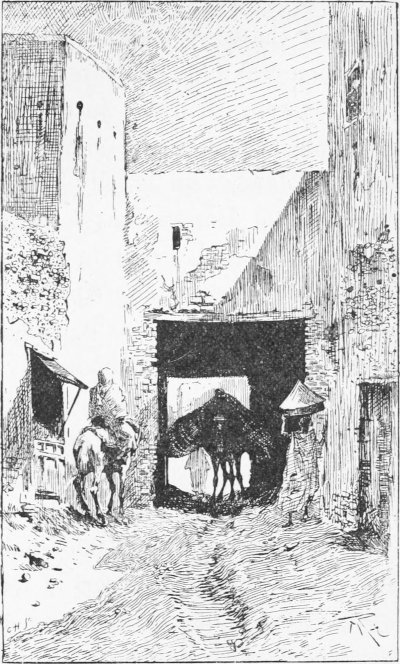
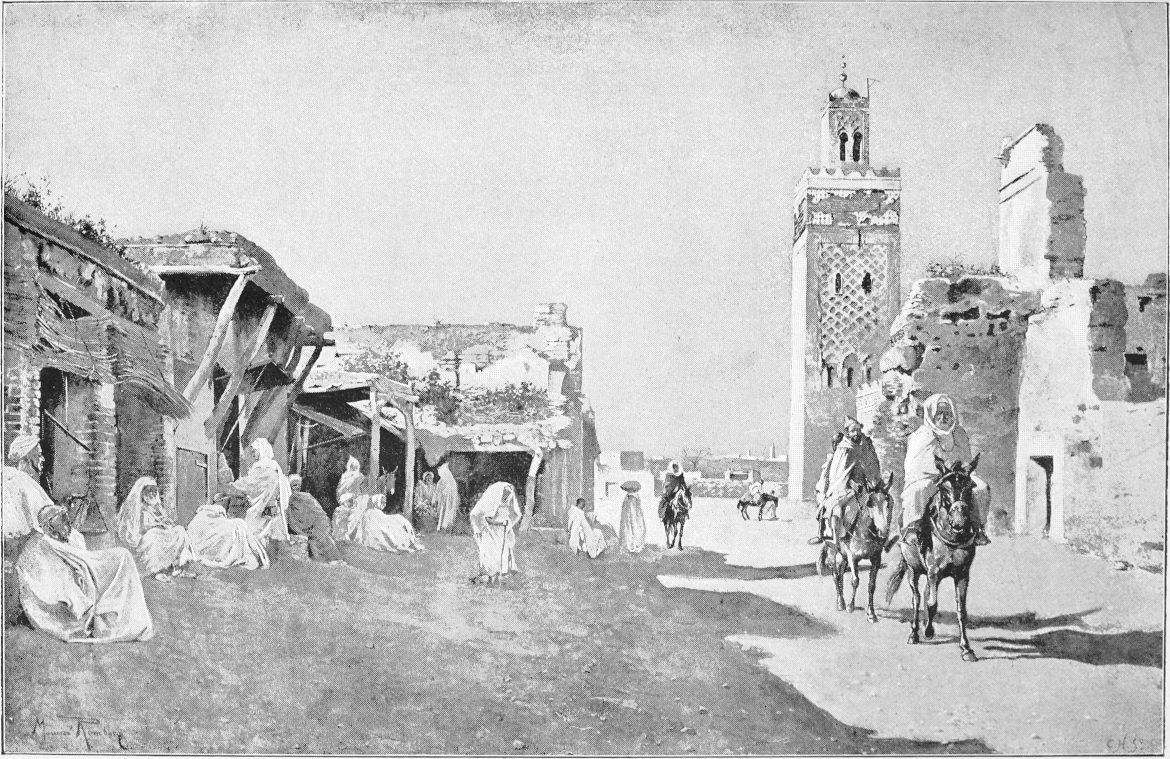
A Street Scene in Marakesh.
impression of the place. Briefly, it presents a
maze of yellow streets, leading, here, between the crumbling walls
of tottering houses; there, through narrow dimly lit bazaars with
their tiny boxlike shops; and here, again, amongst the high white walls of
the residences of the richer class. Then out into great open dusty
spaces, surrounded by half-ruined mosques with tiled minarets, or
gardens above the walls of which appear the tops of palms, olive,
and orange trees, and the straight stems of glowing cypresses. Then
perhaps one turns a corner and comes face to face with a
drinking-fountain of exquisite tilework and carved wood, to
stumble, as one gazes at it, into a manure-heap or a hole in the
road, broken in the roof of some aqueduct. And beyond the wonderful
range of white snow-peaks, rising some 12,000 feet above the level
of the city, the silent majesty of the great Atlas Mountains.
CHAPTER III. THE ASCENT OF THE ATLAS MOUNTAINS.
On the afternoon of
November 1 a start was eventually made for our journey of
exploration. My party consisted of the same men as had accompanied
me from Saffi, with the addition of a dull and lazy negro, whom I
had taken into my employ on the recommendation of a native of
Tafilet to whom I had confided my plan. He turned out to be worse
than useless, complained the entire route of the hardships of the
journey, and insisted upon riding the whole distance, while I had
to go most of the way on foot, gaining his point by constant veiled
threats of exposing my identity. I had to humour him as long as we
were upon the road, for fear of his making known the fact that I
was a European in disguise; but on my return to Marakesh he paid
the price of his impertinence and perfidy in a manner more in use
in Morocco than in England—for on my making a statement
to his master of his
conduct, which was amply corroborated by all my men, he received,
without my knowledge, though I do not think I should have objected,
the flogging he deserved. His presence was a constant cause of
anxiety and danger during the whole journey; and his coarse
impertinent manner, his threats, his treatment of my other men and
myself, so exasperated me, that on one or two occasions I felt that
I could have ordered him to be flogged myself, and enjoyed the
sight of it. While every one else was making light of the cold and
our hunger, he would be cursing at me for having brought him, and
stealing, if he could get it by no other means, the share of food
belonging to the rest of the men. The least remonstrance brought a
threat that he would inform the natives of my disguise, and thereby
ensure my death. On one occasion it was only by an effort that I
succeeded in restraining my men from murdering him, which was their
intention during some night. Fear of discovery there was none, and
their moral code certainly would allow of the taking the life of a
man whose presence caused danger to every other soul in camp, and
who used this power to obtain everything procurable that he set his
heart on, caring little whether the rest of us fell by the wayside
from fatigue so long as he could ride, or died of starvation so
long as he could obtain his fill of food. I have no pity even now when I think of the
salutary hiding he got when he returned to Marakesh, for a worse
villain never, I believe, existed.
We split up our little party and left Morocco City by different
gates, so that in case any information had reached the ears of the
native officials there would be less chance of their being able to
arrest our progress; but nothing occurred, and an hour after
bidding adieu to my host, Sid Abu Bekr, our united caravan of men,
three mules, and a couple of donkeys, had entered the palm-groves
and was threading its way toward the open plain.
Before us lay the Atlas, blue and white in the sunshine, and
seeming to bar all farther progress in that direction, of so equal
an altitude are the snow-peaks. The scene was a charming one—the
constant peep of the glistening snow seen through groves of palms.
But the forest, which to the west and north of Marakesh extends to
a great distance, does not to the east protrude far into the plain;
and in an hour or so we had left the last palm-tree behind and
entered the open level country, which stretched away to where the
unbroken line of mountains rises from the plain.
At a small nzala, the merest collection of thatch huts
with the usual zareba of thorn hedge, we spent the night,
crowding into the little tent, before which our animals were
hobbled; and soon our tin kettle was boiling, while the black slave-girl unpacked
the tiny glass tumblers that take the place of tea-cups, and the
old Shereef made a brew of the favourite beverage of Morocco, green
tea with piles of sugar and mint.
Every one was in the best of humours. At length all delays were
over, and we were started upon our adventurous journey, in the
success of which all, with the exception of the negro, felt a
common interest; and as we squatted round the tent we talked and
laughed together, as cheery a little band of men as could be found
anywhere.
Before dawn on November 2 a start was made. Impatient as I was
to reach country where I should be safe from the interference of
the Moorish Government, it was decided that our pace must be very
slow, for a long and weary road lay before our pack-animals, and
their strength must be husbanded for the climb over the mountains.
So it was that we pushed on quietly, seldom travelling over three
miles an hour at this part of the road, although the soil was good
and the country level.
Our course took us in an east-by-south direction across the
plain of Misfiwa, which forms one of the large bashaliks, or
governorships, of Southern Morocco. There were many signs of
cultivation on both sides of the road; but the dry summer had
turned the soil to a light yellow hue, which rendered it no
easy matter to see
how much was agricultural land and how much merely used for
grazing. That crops are largely raised in this part is a well-known
fact, yet judging from the appearance of the soil at this season of
the year it looks poor enough. The villages are few and far
between, and although mostly inhabited by the Berbers, the original
inhabitants of Morocco before the Arab invasion, their dwellings
had not as yet begun to show the neater and superior style of
building we were so soon to notice. However, as we proceeded and
forded the Wad Urika, placing a longer distance between us and the
city, the improvement in the habitations became visible, and
instead of the thatch nuail, or huts, of the villages that
we had been passing, we found houses built of tabia with
flat roofs, which, though possessing no particular appearance of
comfort or size, were greatly superior to the others.
Two rivers were passed before we left the plain to enter one of
the valleys of the Atlas Mountains, at Imin Zat. These were,
namely, the Wad Urika, which I have already mentioned, and the Wad
el Melha, or salt river, which owes its name to its brackish
waters. Both rise in the Atlas Mountains,—the Urika in the valley
above Akhliz, which I had visited some five years previously; and
the Wad el Melha farther to the east, issuing from the hills by a
narrow valley a few
miles to the east of that of the Urika. Although such of the last
winter’s snow as disappears in summer had already melted, and the
fresh fall had not as yet taken place, there was a considerable
body of water in both streams, a sure sign that while we had been
parching in the sun-dried plains heavy rains had fallen amongst the
mountains. The water of both is largely used for purposes of
irrigation, although that of the Wad el Melha is salt, and a
considerable amount of labour and time has been expended in banking
up the small canals which carry the precious liquid to the fields
far removed from the actual course. After flowing some ten miles
into the plain from the Atlas foot-hills, these two rivers unite in
the province of “Uidan”—“the rivers”—and finally empty themselves
into the Wad Tensift some six or seven miles to the north-east of
Morocco City, near the zauia and tomb of Sidi Abdullah ben
Sessi.
The plain at this point presents the appearance of an almost
dead level, though, in fact, it ascends to the east, until the
termination of the Tensift valley is reached, some thirty-five
miles higher up, where a concourse of smaller streams flowing from
the north-east and south unite to form the main river, which
supplies with water the entire country round Marakesh, and the city
itself, finally to reach the sea between Mogador and Saffi on the
Atlantic coast.
The district of
Misfiwa, through which we were passing, is bounded by three
powerful bashaliks: on the north Rahamna, the hills of
which, a continuation of the range of Jibeelet, which we had
crossed between Saffi and the capital, are clearly visible; on the
east Zemran, with its capital and seat of government at Sidi Rehal;
on the south Urika, including the country of Beled Ersdigi, famous
for its mulberry-trees and silkworms. All of these districts are
governed by powerful Bashas, who may be reckoned amongst the
richest and most important of Southern Morocco.
Nearly all the population of Misfiwa, although Berbers, speak
Arabic in addition to their own language, Shelha,—a fact that is
due, no doubt, to their constant communication with the city of
Morocco, which forms their market and source of supply. Yet, in
spite of the fact that Arabic is spoken amongst them almost as
freely as Shelha, they are true to their traditions in their
intense dislike to the Arabs. Aware previously of this trait in the
character of the Berbers, I had carefully chosen the men who
accompanied me, of whom one and all were by extraction Berbers, and
who all spoke Shelha with the exception of my Riffi servant, whose
native tongue, “Riffía,” is so much allied to it that he could
gather the gist of every conversation and make himself tolerably well understood in
turn. This fact, that the language of the natives was equally the
language of our party, helped us not a little in obtaining the
welcome everywhere extended to us by the Berber people.
A word or two must be said as to the system of cultivation and
raising crops extant in this portion of Morocco. The ground is
ploughed with the primitive native implement as soon as the first
rains of autumn fall, and the grain, especially the barley, sown
early. By May the harvest is in full swing, and the reaping and
gathering of the crops takes place. The ear is merely severed from
the stalk close to the top, so that long straw is left standing.
The ears are carried in nets upon the backs of mules, mares, and
donkeys to the nuadder, where the threshing takes place. A
clear hard space of ground, puddled with clay if necessary, is left
bare, and upon this the grain, still in the ear, is thrown, and
over the whole are driven round in circles the mares, horses,
mules, and often donkeys of the farmer, until the grain is
thoroughly separated. Pitchforks of wood are then made use of, and
by raising the straw and grain into the air the chaff is carried
off by the wind, the seed alone remaining. This is then stored in
subterranean granaries—metammer—sunk in the soil, the outlet
to which is a small hole at the top closed with stones and clay. The
whole is lined with a coating of stiff clay, which prevents the
ingress of water. Grain remains in a good state of preservation for
long periods when housed in this manner. On to the reaped fields
the cattle and sheep are now turned out to graze, finding means of
subsistence through the dry summer by cropping the standing straw,
and at the same time manuring the soil for the next season’s
crops.
It was still comparatively early morning when we reached the
termination of the level ground at a spot where the Wad Misfiwa
leaves the Atlas foot-hills. The Berber name for this spot is Imin
Zat, the mouth of the Zat, the latter being the local title of the
river. The word imin, “a mouth,” is of very common
occurrence in geographical names amongst the Berbers, and
corresponds exactly to the Arabic fûm, both in meaning and
the term implied. It does not, as our word “mouth” geographically
does, imply the estuary of a river, but any gorge or outlet by
which a river or a track enters a different district or a different
kind of country. In the following pages the word will be found more
than once in its latter meaning.
We found the ford of the Wad Misfiwa at Imin Zat by no means an
easy one. The river was not very deep, it is true, but so fast was
its current and so stone-strewn its bed that the footing was
insecure, and we were
fortunate in crossing without any mishap, more than a wetting to
two or three of our men, and a partial soaking of the pack of a
donkey, which fortunately contained nothing that could be damaged.
Not so, however, a party of mountain Jews who crossed at the same
time, one of whom was washed completely off his legs, and both he
and his donkey carried some little way down the stream before they
were able to regain their footing. The water was very cold, and the
sudden immersion, no doubt a rare occurrence, which the Jew
obtained caused him to become a pitiful object, and he shed liberal
tears of annoyance at getting wet.
Nothing prettier than the entrance to the valley of Imin Zat can
be imagined. The hills slope gently down to the river’s edge,
clothed in groves of olives, under which the stream flows crystal
clear, leaping and dancing over the rocks and stones, and adding to
the charm of the scene its sweet music. For a background rose the
snow-capped peaks of the Atlas, standing out clear and defined
against a sky of azure blue. The village of Imin Zat stands on the
west bank of the river some little way up the hillside, and a
delightful site it possesses, clinging to the slope and rising tier
above tier, its deep yellow houses contrasting well with the dull
green of the olive-trees and the cobalt of the mountains and
sky.
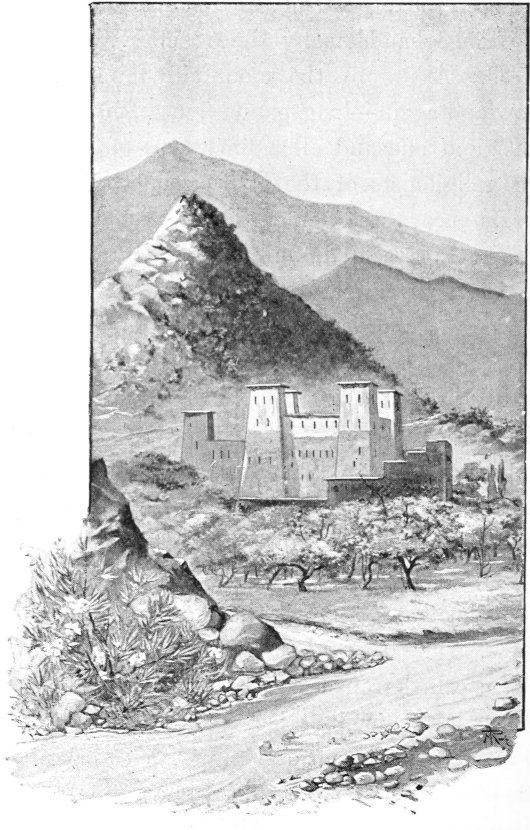
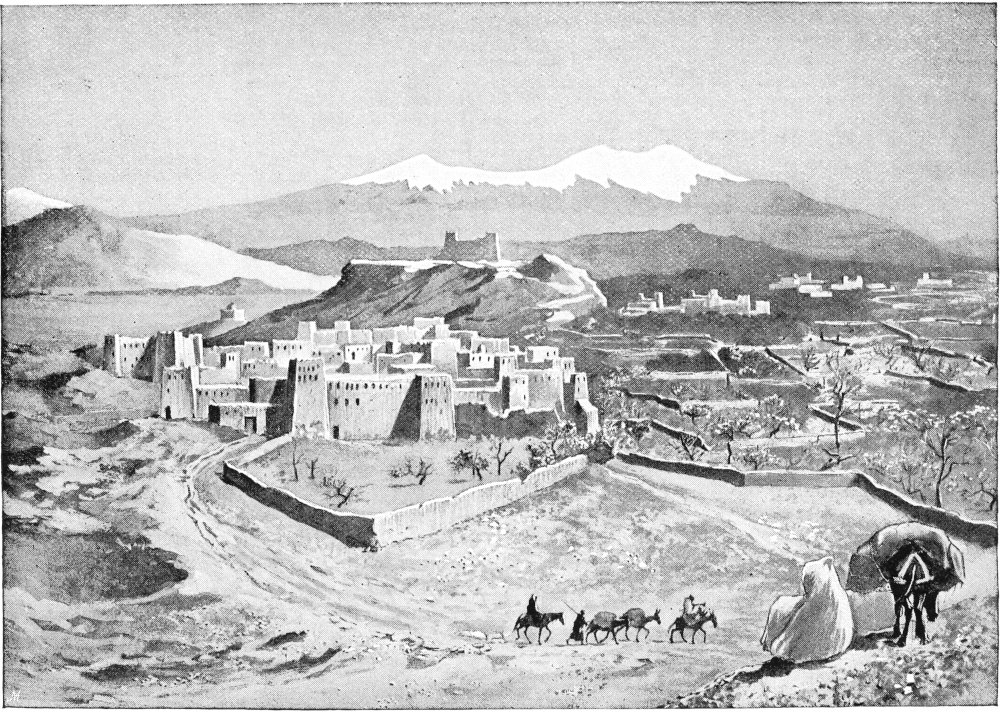
As from this point
of our journey to its very conclusion the buildings—whether the
great ksor, or walled fortresses, of Tafilet or the humble
cottage of the Berber of the northern slopes of the Atlas—are all
constructed of the same material, tabia, it may render more
clear the constant use of the word in the descriptions of scenery
and villages if I describe here the manner in which tabia is
used, and of what it consists. Roughly it may be said to be cement
without lime—in other words, the soil, of sand, gravel, and
pebbles, beaten into a consolidated mass. The manner in which it is
employed is the following. The foundations of a building are sunk
and the ditch filled in; then from the level of the ground to the
height of usually some 2 to 3 feet stakes are driven into the earth
at each side of the ditch, and on the inside planks are arranged
parallel with the soil. Quantities of loose gravel and pebbles are
now brought, and the space intervening between the planks is filled
up with the material, which, by means of being constantly beaten
down with heavy blocks of wood at the end of poles—mrakas,
the Moors call them—becomes a solid mass. Upon its drying the
planks are removed and replaced above the first stratum of wall,
the gravel being treated in the same manner. In this way a solid
and tolerably durable material is obtained, subject to but
one destroying
action, that of water. On the northern slopes of the Atlas, where
the rains are heavy, the walls of the houses are protected almost
always by overhanging roofs, constructed on beams which project 2
feet or more over the wall. Across the beams and at right angles to
them is laid a flooring of dried canes, which again is covered with
brushwood. Beaten into the brushwood is a flat roof of adhesive
clay, which is held firmly in its place by the twigs which
intersect it in every direction. On the southern side of the Atlas
range, however, the rainfall is exceptionally small, and there is
no necessity for the overlapping roofs, the material being of
sufficient durability and strength to withstand the rare showers
that fall there.
It is a curious fact that as one proceeds south from Marakesh,
while the dwellings of the natives improve, their welfare
decreases; for as soon as the fertile plains are left behind one
leaves the farmer class altogether and enters amongst a population
dependent for its livelihood upon the scanty stock of olives and
vegetables they can raise in their small gardens, and more
generally upon the firewood and charcoal that they carry, often two
or three days’ journey, to the capital. Many of the richest farmers
of the most fertile districts of Morocco have no roof to cover them
but their brown goat-hair tents or thatch huts, while almost the poorest peasant
amongst the Berbers possesses a cottage of tabia, which
nearly always presents an appearance of cleanliness and order.
While the rich Arab of the plains is content to spend his days
seated on the manure-heap in front of his hovel, the hardy and poor
Berber of the mountains builds himself a little verandah on the
roof of his house, where he can pass his time shaded from the sun
or rain in peace and quiet.
It is almost as soon as one enters amongst the Berber people
that one begins to find out how infinitely superior they are in
morals and character to the Arab. Their every word and look speak
of greater honesty and truth than one finds in a month amongst the
Arabs. But of the Berber character I shall have more to say
anon.
As soon as we had passed over the ford of the Wad Misfiwa, our
road took a turn to the south, following the course of the river, a
little way up the side of the hills on its east bank. Gradually
ascending as we proceeded, we camped early at a miserable
nzala on the summit of a steep incline, from which a fine
view was obtainable both up and down the river—up, to the
snow-peaks of the Atlas; down, to the plains we had now left behind
and the hills of Rahamna far away beyond. Very different was the
thatched nzala from the neat and trim villages that dotted
the valley below,
surrounded by their carefully terraced gardens of olives and vines,
walnuts and almonds; but the people where we camped were evidently
very poor, and eked a miserable pittance out of the small fees they
collected from passers-by—for the road over the Atlas is one not
often travelled, even by natives.
The change in the costume of the natives made it clear that we
had left the people of the plains and entered into the country of
mountaineers, for the length of their garments was much curtailed
about the legs, and instead of the draggling and mud-stained skirts
of the Arab there appeared the sinewy limbs of the children of the
mountains. But peculiar to the Atlas we noticed here for the first
time in general use the khanif or haidus, the strange
black-hooded cloak with its eye-shaped pattern in yellow or red in
the centre of the back, the object of which no tradition seems to
make mention, and no history to hint at. All that we know for
certain of this strange garment is, that while it is not found
throughout Algeria, it crops up again in the mountains near
Tripoli. Putting aside all speculation as to the origin of the
design, it must be added that the material of which these cloaks
are made is an excellent one, the closely woven black goat-hair
being impenetrable to cold and rain, and therefore
excellently suited to
the mountaineers of the bleak heights of the Atlas range.
A few words must be said as to the general difference of costume
between the Berbers and the Arabs. While the former wear the
jelab, a hooded garment closed down the front, it is never
found amongst the
Berbers.
Berbers, whose one desire as to clothing seems to
be absolute freedom of limb. The haik, or toga-like garment
of the Arabs, is used amongst the better-class Berbers, but merely
as a luxury. Their typical costume consists of the chamira,
or long loose shirt reaching from the neck to below the knees, and
the haidus
above, the open hooded cloak called by the Arabs s’lham.
This in the case of the mountaineers takes the form of the black
goat’s-hair article, and in that of the Berbers of the plains of a
thick but finely woven garment of white wool. The one
distinguishing mark in the costume of the two races, however, is
the following: while the Arab loves to gird his waist with a sash
or leather belt, the Berbers have the greatest objection to
anything of the sort, and seldom, if ever, wear either. Some
exception to these customs can always be found in the case of
Berbers who have left their native lands to work in the Moorish
cities, and here they can often be found in dress absolutely
resembling in every detail that of the poorer class of townspeople;
but this is owing far more to necessity than option, for the local
Berber materials cannot be found, except rarely, in the Moorish
towns.
In appearance, too, besides the difference of feature of which I
shall have opportunity to refer anon, there is considerable
variance of fashion and custom. While the Arabs leave unshaven
their beards and only trim their moustaches, the Berbers of the
Atlas and the country beyond shave the entire face with the
exception of a small pointed beard on the chin, which is connected
with the ears by a fine closely cropped line of hair. This shaving
of the head is general throughout both people, the only class who fail to do so
being devotees, the sects of “Ulad bu Sba,” who leave the entire
skull covered with hair; the followers of Sid ben Aissa, or
“Aissaua,” who leave crown alone unshaven; and the Riffis and
mountaineers of the north, who wear the gitaya and
kron respectively, the former a long lock on the centre of
the back of the head, the latter grown on one side above the ear.
It would be interesting to discover the origin of these various but
unvaried customs of locks of hair, for the common explanation that
they are to be pulled up to heaven by is not only absurd but
altogether an insult to the high system of theology possessed by
many who wear them. So systematically are these customs preserved
that there can be little doubt, especially in the case of the
Berbers, that they date from a period long anterior to the
introduction of Islam.
Leaving the valley of the Wad Misfiwa on the morning of November
3, we turned directly to the east and crossed the spur of the Atlas
that lies between the valley of the former river and the Wad
Ghadat. This slope of the lower Atlas takes the form of a plateau,
with an average altitude above the level of the sea of some 3000
feet, and is known as Tugana, a district under the jurisdiction of
the Kaid of Misfiwa.
But very few villages or habitations were to be seen, and the greater part of
the soil seemed capable of but little cultivation, being here torn
into deep water-courses, there covered with brushwood. One stream
alone is crossed, the Wad Masin, a small clear river of no size,
but which, from the appearance of its banks, floods in the rainy
season. Near the ford were a few gardens, and dense bushes of
oleanders lined its course. A very short distance beyond, one of
the customary weekly sôks or markets is held; but not being
market-day, the place was deserted and left to a mangy dog or two,
and a few ravens which sought for food amongst the offal and dirt.
There are no buildings at the market, for the native shopkeepers
bring their little tents—gaiaton—in which they expose their
wares for sale, packing up the same in the afternoon and pushing
on, probably to be in time to visit another sôk elsewhere
the following day. The usual custom is for the consecutive
sôks along the main roads to be held on following days, so
as to allow all the travelling vendors of goods to visit one after
the other in succession. I have sometimes travelled for a week and
found each day some market by the roadside in full swing, by having
hit off the right day at the first sôk and followed them up
in succession, though it is far more common to miss the entire
number, and never see a full market-place at all upon a long
journey. These sôks are always known by the name of the day on which
they are held, with the name of the place added as a distinctive
mark. Thus one finds “Had el Gharbiya,” “Sunday of the Gharbiya,”
and “Arbaa of Sid Aissa,” “the Wednesday of Sid Aissa,” so called
from its proximity to the tomb of that saint. Near this sôk
of Tugana is a small semi-deserted village of stone-built huts, a
dreary poverty-stricken-looking place. From this spot we had a
choice of roads to the summit of the Atlas—namely, either to pursue
the one we eventually followed, viâ the Wad Ghadat and
Zarkten, or to turn to the south, and skirting the side of the
steep mountains on our right, strike as straight a line across
country as the nature of the land would allow. The latter, a mere
track, often passing along the face of precipices and at all parts
difficult, leads viâ Gadaruz and Tizi Aït Imiger to Zarkten,
where the two unite. However, we chose the longer but more
practicable, and even that was bad enough. What the other must have
been like it is impossible even to guess; but the fact that it is
only pursued by the native mountaineers and sturdy mountain mules
would probably have meant that for us it would have been
impassable.
Ten miles after leaving the nzala in the valley of the
Wad Misfiwa, we descended by an execrable path to the level of the
Wad Ghadat, close to
Fording the Wad Ghadat.
where
a ruined or incompleted bridge raises its broken arches from the
stony river-bed. The ford was bad enough, even though the river was
not high, and it was only by piling the loads bit by bit on to the
top of the pack-saddle of the highest mule that we succeeded in
getting our baggage across at all, for the stream was strong and
wide and swift.
No history or tradition seems to contain any record of the
bridge, which, if ever completed, must have been a fine work with
its five high arches; but it is easily apparent that it is of
Moorish workmanship, and was no doubt erected by one of the early
Sultans of the present dynasty, probably in the seventeenth
century, for previous to that period the communication between
Morocco and Tafilet was almost nil, the two countries
forming as a rule separate kingdoms, though now and then falling
under the jurisdiction of one Sultan, as in the case of three
successive rulers of the Beni Merín dynasty. After the seizure of
the thrones of Morocco and Fez by the Filelis, who still govern
Morocco, it would be only more than probable that one of their
first acts would be to keep communication open with the desert,
whence their armies were drawn; and even to-day the river Ghadat at
the time of the melting snows prevents all farther progress up or
down the road over which we were travelling, which
would not be the case
were the bridge in repair, though the snows in the heights above
would as often as not effectually bar all farther progress
beyond.
The distance from the bridge over the Ghadat to Zarkten, the
principal village and residence of the deputy governor of the
district, cannot be more than about ten miles as the crow flies;
but the river was too full to allow us to follow its bed, the
shortest route, and we were obliged to climb by a precipitous path
high up the mountain-side on the east bank of the river. Keeping
parallel with the Wad Ghadat, except that we had necessarily to
follow the escarpment of the range, we toiled on over a stony and
rock-strewn track for some four hours. Tiring as the rough walking
was—and it required, too, all our energies to prevent our mules and
donkeys slipping on the smooth rock—the scenery amply repaid us for
the disadvantages we had to suffer.
Perhaps the valley of the Ghadat was not so wild as some of the
Atlas scenery we were yet to see; but it certainly possessed one
feature that all the others lacked—namely, vegetation; for here on
the cool north slopes of the range rain falls in plentiful supplies
in winter and spring.
Away above us the mountains towered—here clothed to their
summits with pine, arbutus, gum cistus, and evergreen oak; there
rearing precipice upon precipice of bare forbidding rock to where the eternal
snows formed a line of white against the sky. Below us, for our
road ascended high up the mountain-side, lay the valley, clothed in
verdure, through the centre of which, now in a wide stone-strewn
bed, now dashing between high walls of rock, flowed the river, the
roar of which was the only sound that broke the silence. Here and
there we looked down on to the flat roofs of the Berber villages,
where a small patch of land would be reclaimed, and walnut and
other trees planted, through the branches of which peeps of narrow
terraces, green with vegetables, appeared. Strange beautiful shapes
the mountains take, at places rolling in sweeping curves, at others
broken into rock projections and precipices, but everywhere
presenting some point of grandeur and beauty.
At length towards sunset Zarkten came into sight, ahead and far
below us, and we hurried on, hoping to reach the Sheikh’s house
before dark, and thus obtain provisions for the night and our next
day’s journey; but when, in fast falling twilight, we reached the
rocky bed of the river, we found all hope of fording it to be
impossible, and reluctantly retraced our steps to a few stone
hovels we had passed a quarter of a mile back, near which we found
space to pitch our tent. The cold was extreme, and it was only by
untiring efforts that we were able to persuade the inhabitants to sell us a fowl,
which, of its kind the very poorest, was no meal for eight people.
Bread
A View from above Zarkten.
and the native kuskus were neither to be
obtained, and a few dried figs was all that our stock consisted
of.
At daylight we
descended once more by a precipitous path, and, after a weary hour
and a half of labour, succeeded in getting our animals and our
baggage across the river. So tired were the poor mules and donkeys
with their struggle of perhaps 100 yards against the swift current,
that we were obliged to call an hour’s rest on the farther bank,
where we lay down under the shade of the grove of trees that
surround the residence of the Sheikh.
A picturesque castle it is that the deputy governor of the
district has built himself at Zarkten, though probably he gave more
thought to its defence than to its appearance in designing it. The
main body of the castle, for such it is, is a large square block,
with a high tower at each corner, the latter gradually tapering as
they ascend. The whole is built of tabia of dull yellow
colour, but the summits of the towers are decorated with a coating
of white-wash. Surrounding the whole building is a wall, parts of
which form outhouses and rooms for retainers and guests. Standing
in its groves of trees underneath a peaked mountain wooded with
pines, it presents not only an effect of great picturesqueness, but
also appears to possess the undoubted advantage in such a lawless
country of being impregnable.
We had passed but few caravans or travellers on the road
hither—merely a mountaineer or two singing cheerily as he came along driving his little
mule before him, probably laden with the dates of Tafilet, which
change hands many times before they reach Marakesh. A few of the
mountain Jews, too, we met now and again—long gaunt figures, many
carrying arms, and one and all a finer type of man than their
co-religionists of the plains; for they have a hard existence these
Israelites of the Atlas, and though not persecuted, find it
difficult enough to scrape a living from their trades, for, as a
rule, they are gunsmiths, workers in silver, or dealers in hides.
As soon as our animals were rested, we lifted our scanty baggage
once more on to their backs, and set out afresh upon our
journey.
At Zarkten the valley splits into two parts, one continuing the
general direction—north and south—that we had been following, while
the other turns away to the west. It is from the latter that the
Wad Ghadat flows, rising in the snows of Jibel Tidili, or Glawi,
while the other is drained by the Wad Tetula, so called from a
small settlement of Berbers, higher up its course, but locally
known as the Asif Adrar n’Iri, “the stream of Mount Iri.” Just
above the Sheikh’s house, and within 100 yards of it, the two
rivers unite.
Turning a little to the west, we ascended an incline amongst
gardens and fields and pine-trees, above the
The Sheikh’s House at Zarkten.
river
Ghadat, until we reached the main portion of the village of
Zarkten, a mile farther on. The place is poor enough, a few stone
and tabia houses of mean appearance lying on a dreary level
of bare soil at the foot of the great mountains beyond, and we did
not turn aside to examine it more closely, for the view we obtained
of the place from the distance of a few hundred yards was
depressing enough. There is a considerable settlement of Jews at
Zarkten, from whom we had hoped to obtain provisions; but it being
Saturday, they would not sell, and the man we sent to the
mellah, or Jews’ quarter, returned empty-handed.
Our road turned once more to the south, and we commenced a steep
ascent by a sandy track up the side of a well-wooded mountain, at
the summit of which I found that we had reached an altitude of 5600
feet above the sea-level, and nearly 2000 feet above the Sheikh’s
house at Zarkten, the elevation of which I made out to be 3710 feet
above the sea.
An adventure, which happily ended only in laughter, happened to
us at this part of the road. The track, never of any width, was
here extremely narrow, and our impatient donkey, desirous of being
the first to cross the Atlas, tried to push his way past the mules.
There being no room, however, to perform this manoeuvre, he nearly
put an end to his
existence by falling over the precipice. Happily he alighted some
40 feet down, legs up, in the branch of a pine-tree. The difficulty
was how to rescue him from this perilous position, for the poor
little fellow carried on his back all my personal belongings—small
though their quantity was. We were obliged, accordingly, to unpack
the mules, and by tying together the ropes which held the tent,
&c., in its place on their backs, I managed to descend, and,
cutting the pack-saddle loose, had the happiness of seeing my
luggage rescued. Then letting the rope down again, I made it fast
to the four legs of the donkey, which I bound together to prevent
its struggling, and the others hauled him up, I eventually reaching
the track by being pulled up in much the same manner. The donkey
was none the worse, and as soon as he had recovered his
equilibrium, and found, to his satisfaction, that he was unhurt,
issued a prolonged series of cries, and kicked violently at
everything his heels could reach.
Every step we took the scenery increased in grandeur, and from
one spot we could obtain views of the three valleys. To the west
lay that of the upper stream of the Ghadat, through which the river
twisted and turned, a thin thread of silver 2000 feet below us. The
lower slopes of the valley were mostly wooded, but towering far
above them on the west and south rose the central peaks of the Atlas
range, Jibel Glawi, or Tidili, a dome of pure white snow dominating
the whole, which presented a panorama of exquisite beauty. To the
north we could see the gorge of Zarkten, and far down the valley
formed by the united streams of the Ghadat and the Tetula; even the
plains beyond and the distant hills of Rahamna were visible in the
clear atmosphere. Less pleasing, but offering features quite
distinct, was the scene directly to the south of us, where the
smaller river, the Tetula, dashed between walls of rock that seemed
in places almost to meet over its stream. Here were no signs of
vegetation, except in the immediate foreground, and all was bare
limestone and snow above and shales below, a dreary but impressive
scene.
We were leaving all vegetation behind us, and already I missed
the azif—palmeto—so common all over Morocco, and in its
place there appeared the arar—calitris—and juniper and
pines, while scattered about rose the twisted trunks of evergreen
oaks.
Proceeding for a time along a level track over a mountain the
name of which is Telettin Nugelid, and at an average elevation of
about 5000 feet, we descended once more and forded the Tetula, or
Asif Adrar n’Iri, near the pretty village of Agurgar, the name of
which—walnuts—is due to the existence of a fine clump of these trees. Here the
district of Aït Robaa, which extends along the west bank of the
Tetula as far as this point, was left behind, and we entered the
small and bleak tribe-land of Aït Akherait. Agurgar, from its
sheltered position, is pleasant enough, and the village seemed
clean and well built. A few of the natives, wild mountaineers, met
us and brought us a welcome meal of boiled turnips. The bed of the
Tetula is very narrow at this spot, the river rushing between
enormous boulders, which bear every appearance of having been
heaped up in their present positions by the action of glaciers,
which have long since ceased to exist in the Atlas,—for throughout
the whole range, as far as it has been at present explored, and
that, it must be confessed, is very little of it, no extant glacier
has been discovered.
Ascending again, this time on the right (east) side of the
river, we quickly left all vegetation behind, except for an
occasional wind-bent stump of an evergreen oak, and entered a wild
dismal country, the soil of which consisted for the most part of
black and grey shales, and above peaks of limestone, and they again
capped with snow. Not a sign of life, either animal or vegetable,
was to be seen; yet every now and then the cliffs gave back the
echo of some strange Berber song which told us that
although no human
being was to be seen, even these dreary wastes of rock were
inhabited.
At a tumble-down hovel of loose stones, where the natives had
scratched an acre of soil, poor enough but sufficient to grow a few
turnips, we spent the night of November 4, finding protection from
the cold in a dirty stable—for, with the exception of the
cultivated patch, there was not an inch of soil into which one
could drive a tent-peg. However, the dozen or so inhabitants of
this dismal abode asked the old Shereef and myself into a grimy
room, windowless and without a chimney, and filled with dense
smoke, where we were able to sit for an hour or two in warm
discomfort over the fire of half-burned charcoal, the fumes of
which were stifling. Poverty seemed in possession of the little
place, for not a blanket did they appear to possess; but they were
cheery good people, and spoke a little Arabic, so that conversation
was possible. In winter, when the entire district is under snow,
they drive their one or two cows into the house and hibernate,—only
the men, and they very seldom, ever leaving the house at all during
the two or three months of bitter cold.
They told me the name of the place was Afuden Nugelid, and I
found the elevation to be 5800 feet above the sea-level.
A few miles above
this spot is a little oasis, the tiny district of Tetula, sheltered
from the bleak winds by a semicircle of mountains, amongst which
the few acres of gardens and trees nestle. The village is a large
one, compared with most that we had passed, and the natives seemed
better to do than our friends of the night before. It is from this
spot that the last steep ascent to the pass over the Atlas
commences, and after an hour and a half’s scramble up slippery
paths and amongst enormous boulders, we found ourselves by ten
o’clock A.M. on November 5 on the summit
of the Tizi n’Glawi, or Glawi Pass, at an elevation of 8150 feet
above the sea-level, where, weary with the steep ascent, we threw
ourselves down to rest in the warm sunlight, sheltered from biting
wind by a huge rock.
CHAPTER IV. THE ATLAS MOUNTAINS AND THE BERBERS.
Although the Atlas range is
said to extend from the Atlantic Ocean to the Gulf of Syrtis, it is
my intention to deal here with only such a portion of it as is
found in Morocco, and of that but briefly, for in my journey to
Tafilet I crossed the range at the same spot on my going and
return, and was therefore unable to gather much of its nature
beyond the portion I absolutely came in contact with. On two
previous occasions, however, I had visited this portion of the
Atlas, and on both followed it from due south of Marakesh to near
the Atlantic—to the point, in fact, where the mountains decrease in
altitude and spread out, forming the watershed between the rivers
Sus on the south and the Tensift on the north.
Although geographers claim for the many ranges that occur
between Morocco and Tripoli the name of Atlas, it must not be
thought that a continuous line of peaks extends from one point to the other;
for, speaking of the Moroccan portion, it ends more or less
abruptly where the plains of Beni Mgil occur, to the western side
of the Wad Muluya, the river which runs into the Mediterranean near
the frontier of Algeria and Morocco. In fact, it is not far to the
east of Fez that the peaks decrease in altitude, falling away to
the long plains which succeed. From this point, however, south and
westward they extend in unbroken line to near the ocean, taking a
general direction of south-west and then west. The entire portion
from Fez, from which the snow-peaks inhabited by the Beni Mgild and
Aït Yussi are visible, to but a little way beyond Demnat, some
fifty odd miles to the due east of Marakesh, is unexplored, the
nature of the succession of Berber tribes inhabiting its slopes
rendering it inaccessible to the traveller. From Demnat to the
Atlantic the tribes are less wild, and live in greater fear of
punishment from the Government in the case of molestation of
Europeans, with the result that not only the explorer but even the
most casual globe-trotter can travel in safety, and enjoy the grand
scenery which presents itself. Yet how few Europeans ever go!
I have already described the appearance of the Atlas Mountains
from the north, and farther on in the narrative of my journey more
than one allusion
The Atlas Mountains from the South.
will
be found to the barren scene they present from the south. It may be
here added, however, as a general remark on this portion of the
range, that while the northern slopes contain fine wooded valleys,
their lower parts rich in olive and fruit trees, the south
stretches away, a dreary waste of stone and shales, presenting no
feature of beauty beyond its gloomy grandeur. The reason is not far
to find, for the desert wind in summer blows in terrific gusts,
drying up what soil does exist, while little or no rain ever falls.
This very scorching wind it is that renders so fertile the northern
valleys and the plain beyond, in which Marakesh lies, for,
following the slope of the mountains to the altitude of their
highest peaks—and the range must hereabout average nearly 11,000
feet above the sea—the wind is transformed by the change of
temperature into cloud, and falls in heavy showers. The difference
as one ascends the luxuriant northern slopes, where fine vegetation
is found to the altitude of some 5000 to 7000 feet, to the scene
that meets the eye when the summit is crossed, is a most
extraordinary one, and from the Tizi n’Glawi, the pass over which I
crossed, one could obtain the two views at the same time—north,
down the deep valley of the Ghadat, with its woods and forests;
south, over range beyond range of bare limestone and shale
mountains.
The main range at
this part forms in reality but one of four parallel chains. To the
north of Marakesh the hills are known as Jibeelet, and extend from
near the Atlantic beyond the eastern end of the tribe-land of
Rahamna, terminating a few miles beyond Kalá. South of this some
twenty miles, and parallel with it, is the principal range, beyond
which, at an average distance of some twenty-five miles, is Jibel
Saghru, or the Anti-Atlas. However, although the first two
mentioned run directly east and west, Jibel Saghru forms a large
district of broken chains of mountains, the valleys of which lead
in every direction, for it empties such streams as flow in rainy
seasons east into the Wad Gheris, west to the Draa, north to the
Dads, and south to the desert. Yet in spite of this the system
takes an easterly and westerly direction, the same being more
apparent after the spot where the Wad Draa divides the range into
two portions. The natives call only the eastern portion Saghru, not
connecting it with the hills to the west of the Draa, which form
eventually the southern side of the Wad Sus. There is yet another
line of hills still farther to the south, Jibel Bani, which rise
near the Draa south of the zauia of Tamgrut and continue to
the west. It has always been a question as to where they terminate;
but I was pointed out at Tafilet, from above the hill at Dar el
baida, the end of a
chain of mountains to the south, which sink gradually to the valley
of the now united course of the Wad Gheris and Wad Ziz. Beyond
there appeared to be nothing but desert sand, and this, I was
informed, was the western extremity of Jibel Bani.
It is difficult to hazard an opinion as to where the highest
peak of the Moroccan Atlas will be found to exist, for at present
but very few observations of the high altitudes have been taken,
though both Sir Joseph Hooker and Mr Joseph Thomson reached to
about 12,000 feet. In the native opinion Jibel Ayashi, in which
most of the large rivers of Morocco rise, surpasses the other peaks
in altitude; but, as far as I know, no European has ever seen it,
much less been there. Some geographers are of the opinion that the
highest point will be found amongst the mountains almost due south
of Morocco City. So equal are the summits in this direction that it
will take many ascents before any definite result can be arrived
at, though, with the exception of the obstruction of the native
officials, no great difficulties ought to arise, as the snow in
summer and early autumn almost altogether disappears, and no
glaciers are found throughout the whole range; nor do the
mountain-tops rise in precipitous peaks, but, as a rule, are flat
and undulating.
But little game is to be found in this portion of the Atlas. The Barbary wild
sheep (muflon), it is true, exists, but is by no means easy
to obtain, as every native carries a gun, and should chance give
him the opportunity, fires at them whenever he may catch a glimpse.
The Berbers, too, are sportsmen; and the Kaid of Glawa, and other
governors, are in the habit of organising large hunts, that have
done much to kill off this fine beast and drive the remainder into
the most inaccessible parts. The lion is unknown, and the leopard
very rare, though farther to the north, in the forests of Beni
Mgild, both are said to be common, and I have often seen the skins
for sale, and captured lions in the Sultan’s palace at Fez. Hyenas
seem to be found throughout the entire range, and foxes and jackals
abound. Bird-life seems most noticeable for its absence, and I have
never seen, though I have spent several months at different times
in and near the Atlas, either a vulture or an eagle. Smaller hawks
and one or two varieties of kites are common. Amongst game-birds I
have seen only the red-legged Barbary partridge and the pintail
sand-grouse, and the latter only in the foot-hills. A guinea-fowl
is said to exist, and I have seen in the possession of the Shereefs
of Wazan specimens brought from Zimmour, to the west of Rabat on
the Atlantic coast. It is a small variety, dark in colour, with a
blue head and dark crest, and not half the size of the fine plump bird of which I have
shot so many in Somaliland and around Harrar. A pretty grey-striped
rock-squirrel is common in the mountains, and much prized by the
Berbers for his meat, which is said to possess medicinal
properties.
The commoner vegetation of the Atlas, which differs according to
altitude, are pine, arar or calitris, evergreen oak, cork,
white poplar, wild olive, arbutus, laurustinus, lentiscus, palmeto,
oleanders in the riverbeds, and juniper, while at places the gum
cistus is found in large quantities.
The principal rivers of Morocco all rise in the Atlas Mountains,
with the exception of the Wergha, the large tributary of the Sebu,
which has its source in the hills to the south of the Riff country.
The Draa, Sus, the Gheris, and the Ziz are the principal rivers to
the south of the range; while to the north the Tensift, Um er
Ribía, Bu Regreg, and Sebu are all fed by the Atlas snows; and on
the west the Muluya, which empties itself into the
Mediterranean.
Brief as these notes on the Atlas are, they will suffice for the
objects of this book. Those who desire to know more of their
geology and botany will find two works upon the subject, the
results of the explorations of Sir Joseph Hooker and Mr Joseph
Thomson.
With regard to the inhabitants of the Atlas, they
Approaching Marakesh from the North.
are
Berbers, and the following notes upon that race in general,
together with the constant mention of their customs and habits
which crop up in the succeeding chapters of my narrative, will, I
trust, not only bring before the reader a tolerably clear picture
of these people, but add possibly to the scanty information that
exists as to this trans-Atlas branch of the Hamitic people.
It would be out of place in a book which professes to be no more
than a narrative of exploration to enter at length into the subject
of the Berber race, and interesting though such would be, the
slight description of the people here appended must suffice. Nor
have I even collected into this chapter all the notes I was able
personally to make upon my travels, but have preferred in many
cases, such as in the descriptions of their dwellings, costumes,
&c., to make mention of these details when I come across them,
rather than drag them out of the context and place them all in one
chapter. This I have thought best to do for more than one reason,
but mainly because remarks àpropos of the Berbers of Dads
are not equally applicable to those of Aït Atta for instance,
though these two tribes are neighbours. So rather than cause
confusion by mentioning peculiarities noticed in only one spot in a
chapter which deals with the race as a whole, I have spread my
notes over the entire
journey, and included them at the points at which I find them
jotted down in my original diary—that is to say, at such portions
of my journey as I first noticed them.
Nor can mention at any length be made even of the race as a
whole, for though the country through which I passed was almost
entirely inhabited by this strange people, their territory is
vastly more extensive, and they may be said to inhabit districts
along the entire northern portion of Africa, from Egypt to the
Atlantic Ocean. Therefore it will be seen how impossible a task it
would be to enter at any length into the peculiarities of a race
which at different points presents such vastly different
characteristics, both in the physical aspect of the country they
inhabit and in their manners and customs. For this reason it is the
safest course to mention only what can refer to that portion of the
Berber tribes amongst which I found myself, with but a few general
remarks that apply equally to the entire race.
As to the derivation of the name considerable doubt exists, nor
was I able to trace any tradition amongst the people as to its
origin. Barth asserts that it sprang from the name of their
traditional ancestor Ber, but it seems more probable, at least a
safer surmise, to connect it with the Greek and Roman term Barbari,
for, I believe, without exception the name is not applied by the Berbers to
themselves, though in this respect the Arabs use it. The general
name by which they call themselves in Morocco is “Shloh,” a word
meaning “noble,” and thus the same as the more classical term
“Amazigh,” which, though well known all through tribes inhabiting
the districts south of the Atlas, I heard only once or twice used.
Amazigh is certainly the older name of the two, and was known to
both the Greeks and the Romans, and seems to-day, though rarely
used in Southern Morocco, to be the classical title of the
race.
Although to-day found all through North Africa, from beyond
Tripoli to the Atlantic Ocean, the Berbers seem to be entirely cut
off from one another, and to have no great intertribal feeling of
patriotism, or to be connected by any ties. Yet there can be no
doubt that, divided as the tribes are, they have a common origin,
being the Hamitic and original inhabitants of North Africa.
Yet even in so small a space of country as that through which I
travelled one finds the Berber tribes not only split up into minute
clans and factions, but so strangely differing from one another
that they might almost be the descendants of different races.
Nothing more unlike could be imagined than four typical Berbers,
for instance, of four portions of Morocco—the Riff, and the natives of Aït
Yussi, Dads, and the Sus—and yet there can be no doubt that they
are of the same family, and the language, though split up into
dialects, is practically the same. Yet in appearance the type is
absolutely different in these above-mentioned portions of Morocco,
and no feature in common, even to the dressing or shaving of the
head, or costume, is to be found amongst them, though one and all
are proud of their aboriginal origin.
But one tradition did I hear amongst the Berbers as to their
antiquity, and this tradition seems to be general amongst their
tribes, for we came across it on several occasions on our journey.
It is difficult to perceive how it could have sprung up, as it
seems to hint at an entirely different origin to that which
history, and even other traditions of their own, has set down to
them. It runs as follows. A certain maiden of the original Berber
people, at the time when the race lived in a far-away country swept
by strong east winds, once, in passing a strange king, had the
misfortune to expose more of her person than was decent, owing to
her attire having been raised by the gale. On the king laughing at
the girl’s misfortune, the tribe in very shame departed by night,
and wandered to the country that they now inhabit. So the story
runs, and I leave it to those more versed than myself in sifting
traditions and folk-lore to find the signification and value of the
tale, which, it may again be said, is not only common throughout
the Berbers of the trans-Atlas Sahara, but is known and repeated
amongst the Riffis, and between these two districts hundreds of
miles of country exist, while no communication takes place one with
the other.
No doubt the fact that the Berbers have been many times
conquered has done not a little to account for their difference of
type, for the Phœnicians, Romans, Vandals, and Arabs have each in
turn invaded their country. But from whatever reason it may be, the
fact remains that a more divided and subdivided race could not be
found, and marriage, or even cordiality, between the tribes is
unknown; while they exist, in Morocco at least, in a state of
perpetual warfare with any one they can get to fight with them. Not
only are their hostilities levelled against the Arabs, for whom
their hatred is most deep, but whose religion they have adopted
with extraordinary fervour, but also against every other tribe, and
failing these, village against village, and even household against
household. Mention will be found more than once in the ensuing
pages of cases of this, in which it was the custom for neighbours
to fire at one another from their windows and roofs whenever the
opportunity presented
itself. Yet in spite of this the stranger passes in safety through
them, for with him they bear no quarrel.
A few words must be said as to the manner in which native
travellers proceed in safety through districts in which bloodshed
and murder are of everyday occurrence. The system under which
immunity from murder and robbery is accorded to the stranger is
known by two names, mzareg or zitat. Mzareg
originally means a spear, and the term was thus applied from the
fact that in old days a spear was given by one of the tribe to the
traveller, which, being recognised as the property of one of their
number, accorded him safety in his journey. However, spears have
long ago disappeared from these districts, though the name
mzareg still remains. Nowadays the common custom is for a
member of the tribe, in consideration of a small fee, to conduct
the traveller in person, both being sacred from attack while
passing through the land over which the tribe in question holds
jurisdiction. As soon as the limits are reached, a new
mzareg or zitat has to be obtained. Sometimes,
especially in the case of the Jews living and trading in the
Sahara, some mark or token is given, such as a turban or
handkerchief, which is considered sufficient; but in cases of
caravans and total strangers a man invariably is employed,
who answers the
double purpose of guide and protector. From Dads to Tafilet I was
accompanied on my journey by a zitat, without whom I could
never have reached my destination, as amongst the many Berber
tribes we passed through his presence afforded me immunity from
inquisition and annoyance. Here again I was fortunate, for I was
not obliged to change my zitat, the fact being that members
of the tribe of Dads can travel in safety amongst nearly all the
other Berber tribes, by a reciprocal arrangement by which the
caravans of the others are allowed to pass through their district
without fear of plunder. Dads has gained this unique privilege from
its situation, blocking as it does the entire road from east and
west.
With regard to the Jews living amongst the Berbers a similar
practice exists to the mzareg, only in their case it is
known as debeha, or sacrifice. This name has been applied
from the fact that the system first arose from Jews seeking the
protection of the Berbers by sacrificing an ox or a sheep to them:
nowadays the native Jews no longer need to perform this, the
patronage of the Berbers being hereditary, the vassalage descending
in both families from father to son. Any injury suffered by the Jew
is revenged by the protecting Berber as though it had been
committed to a member of his own family. In this manner
the Israelites are
able to live in tolerable security from murder and theft; in fact,
they are the only people who do, as the Berber is never happy
unless he has some one to kill, or is running a risk of being shot
himself from behind some stone. As may be expected, the Berbers do
not allow their influence to be used for nothing; but so poor are
the Jews, and also the entire country in which this state of things
exists, that it is little or nothing that the “lord” can screw out
of his vassal.
In the same way the tribe of Aït Atta, one of the most powerful
of the Berber tribes of the Sahara, recently added a large district
to the south of Mesgita, on the Wad Draa, to their already
extensive territory. However, the inhabitants—Haratin—could not be
enrolled as are the Jews, as they are Moslems; and though exactly
the same principle is carried on, the term implied is
neïba—agents or representatives. They, as in the other case,
are protected by their conquerors from attack from elsewhere, in
return for which they pay an annual tribute.
With regard to the language of the Berbers. Generally speaking,
it is known in Southern Morocco as Shelha, but as a matter of fact
it consists of many different dialects. Although along most of the
road we travelled over the dialect was much the same, I was told
that in the heights of the Atlas, as again in the districts of the Draa, it was very
different, and that it was no easy matter for natives of each place
to render themselves comprehended by each other. The Berber
language as spoken in Morocco may be divided into four distinct
dialects, which are again much subdivided: (i.) Shelha proper, as
spoken generally throughout the Atlas, from the tribes of Ghiata,
Aït Yussi, and Beni Mgild, to the south-east of Fez, as far along
the Atlas as about due south of Marakesh; (ii.) Riffía, spoken by
the Riffis inhabiting the mountains of the north coast, from the
south-west of Tetuan to the French frontier of the province of
Oran; (iii.) Susía, spoken from along the Atlas and the Sus valley
to the south, from where Shelha proper terminates, about due south
of Marakesh, to the Atlantic coast; and (iv.) Drauía, the common
tongue all along the valley of the Wad Draa from Mesgita, where the
junction of the Dads and Idermi form that river to where it flows
into the Atlantic. So various are these dialects that, although my
Riffi servant could catch the gist of the remarks of the Shloh
amongst whom we travelled, and was with difficulty understood in
return, he found it impossible to comprehend the Haratin of the
Draa, who speak Drauía, though the Shloh of Dads and the
intermediate oases can do so.
I was able only to learn of one feast celebrated amongst the
Berbers which had not been adopted from the Arab calendar, so completely have
they embraced the religion of the latter. This feast appears to be
a kind of harvest-home, and is known as the Ayur Nûgûrûmûn,
the meaning of which not even the Berbers seem to know. Curiously
enough, it is held in the Shahr el Fukra, which points out that it
is annual only according to Arab ideas—that is to say, counted by
lunar months—whereas one would have expected, if it were a survival
of great antiquity, that it would have been at a fixed period in
the solar year. The programme of the feast is simple. Guns are
fired during the day, and great dishes of food are brought into the
streets and there partaken of, the poor being asked to join. One
other custom only differing from the Arabs was I able to hear
of—namely, that the bride remains three days in her husband’s house
before the marriage is consummated.
That some civilisation had reached the Berbers long before the
Arab invasion is certain, but, as far as we know, the Romans never
crossed the Atlas. Yet, curiously enough, all foreigners are known
to-day amongst them as Rumin (sing. Rumi), though
this may be owing not a little to the fact that it was not until
the Arab invasion that the Berbers were driven to the remote
districts they now inhabit, but were spread all over the country;
for it was principally through the prowess of these men, whose
desire for booty
the Arabs stirred up, that Spain was invaded and conquered.
Therefore it must be certain that the Berbers of Morocco knew the
Romans as well as the Romans knew them, and that they carried away
with them into the Atlas and the districts beyond the traditions of
the forefathers who had been in actual contact with the Roman
colonists. Yet there is no doubt that remains of even pre-Roman
date exist in the Atlas and the Sahara, and I think it is risking
but little to suppose that they were erected by Phœnician
colonists. That the Phœnicians were strong in Morocco at one time
is shown by the ruins of the great colony of Lixus, on the river
Kûs, near El Araish, and I can see no reason why they should not
have pushed much farther afield. And to them, I think, may be put
down the workings of former mines in the Atlas and Anti-Atlas, and
the building of the stone remains which are found in more than one
spot—and invariably without mortar—in those ranges. One may go even
further, and ask the question, whence the Berbers obtained their
existing architecture; for the great ksor, with their many
towers, have no resemblance to any Arab architecture that I have
ever seen, either in Arabia or Africa, while they do most strangely
resemble the elevations given in such works as those of Messieurs
Perrot and Chipiez of Phœnician castles.
The change on
passing from Arab Morocco into Berber trans-Atlas Morocco is in no
way more marked than in the architecture. One leaves behind one the
mud huts and tents to enter an immense district, every habitable
portion of which is thick with great castles, often over 50 feet in
height, and with richly decorated towers, unlike anything else I
have seen elsewhere in the world, either with my own eyes or in the
works of other travellers; and I see no reason why one should not
at least surmise that the style of building in vogue to-day amongst
the Berbers of trans-Atlas Morocco is not a remnant of their
conquest by the Phœnicians. Another instance, slight though it may
be, may help to form a link in the chain, that at Dads I saw
children modelling in clay little figures of men on horseback, the
very image of the Phœnician figures, which no Arab or Moor either
could or would do. Excellently modelled they were too. I asked a
native, and he laughingly replied, “We all did that when we were
small.” Yet in all my travels in Morocco, and in the inquiries I
subsequently made, I have never seen or heard of modelling of human
figures or animals amongst the Moors. An idea of the artistic
talent of the Arab youth, in comparison to that of these young
Berbers, can be gathered from the drawings they have learned to
make in Tangier on the walls of the houses, &c.; and this only
from seeing artists
at work. However, they confine themselves to ships, which are just
recognisable and nothing more, whereas my Dads friends’ models of
men and their steeds were excellent in every feature, even the bits
and reins and stirrups being represented. In short, it is my belief
that when the regions I passed through come to be diligently
explored and excavated, remains will be found of a large former
civilisation which will be proved to have been Phœnician. In the
case of the one ruin I was able to take any notes about at all, it
corresponds almost exactly, so far as the general idea, to some of
the plans of buildings given in books upon Phœnicia and its
colonies; but unfortunately, travelling in disguise as I was, it
was impossible for me to take measurements, or anything, in fact,
more than the most scanty notes of this curious ruin.
As to the general character of the Berbers, their manner of
living and their looks, I have retained my remarks upon these
subjects in the places in which they were originally jotted down,
for reasons already given in this chapter, that there is such great
divergence of appearance and costume in the different parts of the
question. It is for that reason that I have given at this spot only
such notes as can be safely applied to the tribes in general
amongst which I travelled during my journey.
CHAPTER V. THE DESCENT FROM THE ATLAS.
Having digressed for a
chapter from the account of my journey, I take up again the
narrative from where it was broken off—when on the morning of
November 5 we had reached the summit of the Tizi n’Glawi, and were
resting after our exertions.
The Glawi Pass scarcely deserves such a name, for there is in
reality no pass at all. One ascends to the very summit of the
mountains to descend as suddenly on the south side, the narrow
strip of footing at the top being only a few yards wide. It is true
that the surrounding mountains on either hand rise to a very
considerable elevation above that at which we found ourselves—8150
feet; but the road merely crosses a connecting line of quartzite,
overlying the shales, which runs from Jibel Glawi on the west to
Adrar n’Iri on the east, the flat-topped snow-capped mountain that
gives its name to the stream up the valley of which we had been ascending. The views
in either direction were fine, but totally different; for while to
the north our eyes wandered over the valley of the Tetula, and
lower down the Ghadat, with the steep mountains densely wooded on
their lower slopes, before us to the south lay range after range of
broken limestone mountains, bare and bleak, and without a single
sign of vegetation. But one exception there was, the circular
valley of Teluet lying 2000 feet below us; but at this dry period
of the year, for as yet only the very slightest rain had fallen, it
looked as bare and dried up as did the hills that surrounded
us.
The descent could be seen twisting in and out the escarpment of
the mountains, amongst boulders of rock from which here and there
unsightly wind-bent trunks of evergreen oaks appeared.
A few villages dotted the little plain below, whose flat roofs
upturned to our gaze had a strange appearance as we peered down on
them from so far above. For the most part they were perched upon
rocky eminences, raised slightly above the level of the small
valley. It is here that the great castle of the Kaid of Glawa is
situated, but from our vantage-point it was indistinguishable,
being hidden in the slight descent that leads from the valley to
the course of the Wad Marghen. This kasba of the Kaid
of Glawa, Sid el
Madani, was the last point at which, should I be discovered, my
return would be insisted upon, for beyond this the Moorish
Government holds little or no real jurisdiction, so it was not
unnaturally that we gave the place as wide a berth as possible. On
my return journey, when disguise was no longer necessary, I spent a
night at the kasba, and when the time comes shall describe
this mountain fortress, which even in Europe would be considered a
building of great size and strength.
Descending the 2000 feet that led to the valley of Teluet, we
met at the bottom almost the first large caravan we had as yet come
across. They were bound upon the same road as ourselves, though
their destination was Dads, while I hoped to push on as far as
Tafilet. The men forming the caravan were one and all Berbers, and
natives of Dads, added to which they were friends of the old
Shereef whom I was accompanying. Therefore I had nothing to fear
from them, and the little Arabic they spoke was so mixed up with
Shelha that there was no possibility of their detecting my foreign
accent. Some twelve men there were in all, with as many mules and
donkeys. The cheerfulness of this augmentation of our little
caravan was damped by the news they gave us, for from them we
learned that the road viâ Warzazat was blocked, owing to the
tribes being in
A Pass on the Road.
revolt, and that they had been obliged to
turn back only some six hours from where we met them. It had been
my particular desire to proceed viâ this route, as there are
rumours of ruins in the valley of the Warzazat; but I at once
perceived that we must follow the inevitable and pursue the road
viâ Askura, which possessed this attraction to the explorer,
that it had never before been traversed or described by any
traveller. It was good luck that brought us in contact with the
Dads’ caravan, for in these wild lawless regions there is safety in
numbers, and I noticed that the old Shereef especially cheered up
at the sight of the dozen antiquated flint-lock guns the men
bore.
We at once decided to join company and pursue the road together,
and for the five following days the Dads tribesmen and their little
mules formed part of our caravan. Good sturdy fellows they were,
always laughing and running races, in which the brisk cold often
tempted me to join them. At this they were much amused, for my
slender—not to say thin—form and limbs, as yet but slightly tanned
with the sun, led them to suppose that I could ill stand the
hardships of the road. That I was a European in disguise never once
crossed their simple trusting minds, and amongst this wild band I
obtained a reputation of very considerable sanctity, on account of the fact that I
said my prayers in orthodox style with the old Shereef, and that I
wore suspended round my neck, over my torn and ragged
jelaba, a string of wooden beads, the insignia of the sect
of the Derkaua, or followers of Sidi Ali el Derkaui, who may be
almost said to be the patron saint of the Sahara.
With one of these caravan men, Hammu by name, I made great
friends, and one of my pleasantest recollections of Dads was the
feast he gave me in his house, to which half the village was
invited, and which lasted from somewhere about mid-day to somewhere
about midnight. He was a simple gentle fellow this Hammu, but as
good as could be; and many a time when we lay huddled together of a
night for the sake of warmth he would cover me up with his thick
haidus of black goats’-hair as I slept, and swear in the
morning that he had not done so—that it was merely owing to the
fact that he had kicked it off in my direction that accounted for
his having slept in only a light cotton chamira while I was
warm and comfortable. Poor Hammu! he never learned, so far as I
know, that I was a European in disguise,—not that I believe he
would mind much, for the friendship that sprang up between us would
break through all such barriers as this. He eventually finished, on
the day I departed for Tafilet, by embracing me and asking me to return with him
to Dads, and share his home, with his sister as my wife. He even
promised her a dowry of a few yards of blue cotton, a pair of
bracelets, and a cow. My Riffi man nearly exploded with his
attempts to conceal his laughter, but I took the compliment as in
the manner meant, and clasped his good strong hand with a grip of
real friendship, for I could not but recognise that the wild
tribesman, with his handsome face and fine bearing, meant every
word he spoke.
But I digress from the narrative of my travel. It being out of
the question that we should pursue the route viâ Warzazat,
there was no option about the matter, and we turned to the east
across the plain of Teluet, fording the Wad Marghen, or Wad el
Melha, some two or three miles above the Kaid of Glawa’s
kasba. The stream is not a very large one, but clear, fresh,
cold water flows from the snows of the western slopes of Jibel
Unila throughout the entire year. Although slightly brackish the
water is drinkable to cattle, but the inhabitants rely for their
supply upon the many streams and springs that form its tributaries.
The river flows along the Teluet valley from east to west, and at
the south-west corner of the plain passes out through a gorge to
flow into the Idermi, which, eventually joining the Wad Dads, forms
the Wad Draa, the largest and most important river of trans-Atlas Morocco. The second
name of the river, Wad el Melha, or salt river, is the local title
of every stream the waters of which are brackish.
Ascending by the dry bed of a torrent on the south side of the
river, we skirted the eastern end of Jibel Teluet, which forms the
southern boundary of the valley, and descended some four miles
farther on to the larger stream of the Wad Unila. The ascent and
descent we had crossed forms a small watershed for the tributaries
of the two rivers, though apparently these mountain torrents only
flow in the wet season. At one spot, rather more than half-way, we
passed extensive salt-mines, where quite a number of natives were
engaged in working rock-salt. The scene was a wild one, the
half-nude men with their rough picks hewing away and singing the
while, as others piled the salt in native panniers on to the backs
of their sturdy little mules. The power of these mountain-mules in
overcoming difficulties in the roads is extraordinary, and at one
spot we saw a couple literally descending a precipice, followed by
a man who only kept his footing by the aid of a sort of alpenstock.
The manner in which both man and beasts succeeded in descending
seemed to us, as we stood and watched, incredible, yet we were told
that he made the journey every day to this spot in the face of the
precipice, to collect rock-salt from a small deposit that existed
there. At one place
where an unusually large supply of the precious mineral existed, a
roughly constructed fort had been built, for the mines had been the
cause of war for generations amongst the tribesmen living near,
their value being, for the arid bleak district, extraordinary. No
doubt to more or less reserving to himself the monopoly, as is the
case, is owing to a great extent the wealth to-day in the
possession of Sid Madani, the Kaid of Glawa. The soil at this part
consists principally of shales, strewn with boulders of limestone,
no doubt portions of the peaks above, which time, water, and
glacier have carried to their present position.
The Wad Unila, where our path struck its course, flows nearly
due north and south, issuing from a gorge 100 or 200 yards above,
and descending for half a mile through a narrow valley before
reaching the district of Tiurassín, in which we spent the night of
November 5.
This settlement of Berbers of the Imerghan tribe is a large
place, lying on the banks of the river where the valley is
sufficiently wide to form a small triangular plain, which is again
bisected by a torrent, at this period waterless, which flows from
the east. The ksor are many and large, and present a
remarkable appearance, each a castle, or sometimes several castles,
with high towers at the corners, the summits of which are roughly decorated in
sun-dried bricks and white-wash. The great size and solidity of the
buildings struck one as extraordinary, after the hovels the Arabs
erect as habitations, and a rough measurement of one of the towers
gave an altitude of at least 70 feet, no mean height when it is
taken into consideration that they are built without any of the
appliances we know in Europe, and altogether without mortar or
lime. The plain I alluded to as formed by the valley may be perhaps
half a mile across, and consists of gardens of walnut and almond
trees, with a few other varieties of fruits.
The Wad Unila, the river of the place, rises to the north-east
at the summit of Jibel Unila, from which the stream takes its name.
This mountain forms one of the finest of the Atlas peaks, and is
said never to lose its cap of snow. The summit, the natives told
me, consists of a circular lake of great depth, from which the
river takes its rise. So important to the land through which it
flows are the waters of the Unila, for the natives are entirely
dependent upon its supply for irrigating purposes, that this lake,
which is said never to vary its level, has become a place of
pilgrimage and veneration, and in the spring of each year sheep are
sacrificed to its patron saint. Before uniting with the Wad Marghen
(Wad el Melha) at Aït Zaineb, four districts are
watered—namely,
taking them from the river’s source, (1) Unila, (2) Assaka, (3)
Tisgi, and (4) Aït Zaineb; but the valley throughout is a narrow
one, shut in by high mountains, and only at its widest parts, such
as Tiurassín, is it inhabited. But very little wheat is grown,
maize and turnips taking its place as the articles of subsistence
amongst the natives. The walnuts and almonds, however, flourish to
such an extent that a large quantity are yearly exported to Morocco
City, being taken by the road we had followed across the Glawi
Pass.
AT THE BASE OF THE ATLAS MOUNTAINS.
The only traveller who had preceded me at Tiurassín was De
Foucauld, the French explorer, but from this point our ways
separated—he having continued his journey south along the river’s
course, while I turned off to the east, en route for Askura
and Dads. He followed the river as far as its junction with the
Idermi, which, joining the larger stream of the Dads at Kheneg el
Tauria, form together the Wad Draa.
A few of the inhabitants of Tiurassín belong to the tribe of
Unila, which geographically occupies the slopes of the mountain of
the same name; but the larger proportion is formed of members of
the powerful tribe of Imerghan, which is found split up into many
divisions scattered all over this portion of trans-Atlas Morocco.
The constant state of warfare existing amongst the Berber people has no
doubt caused this disintegration of the larger tribes, by the
changing, acquisition, and losing of territory. The people of Dads
were the sole exception, and their position, offensive and
defensive, has prevented their being so divided, a fact that adds
not a little to their strength and importance.
We spent the night of November 5 at the large ksar of Aït
Yahia u Ali, pitching our one little tent in a walled-in yard,
which answers the purpose of a caravanserai for passers-by. A great
number of natives crowded about, offering to sell us barley for our
animals, and chickens and eggs for ourselves; and though the last
we found to be unprocurable, in spite of all their protestations to
the contrary, our mules and donkeys fared better than usual. It was
not long before one of the reasons of these visits was discovered,
for the opportunity was not lost to the pilfering Berbers of
stealing a fine powder-horn belonging to one of my men, and formed
of the horn of a Barbary wild sheep (muflon), set in brass
and silver,—a tempting bait to these mountaineers, who set great
store upon such highly decorative articles of warfare. The cold was
extreme, and it was as much as we could do by crowding together in
the tent to keep warm. Although many natives visited us and paid
their respects to the old Shereef, not one for a moment eyed me with
suspicion, and Arabic seemed scarcely spoken at all amongst them. I
found the elevation of our camp to be 5480 feet above the
sea-level. The small caravan with which we had fallen in on the
plain of Teluet camped with us, and we were not sorry to have
increased our numbers, for the inhabitants of Tiurassín seem to be
a hungry lot of devils on the look out for loot.
Our companions were loudly regretting the fact that they had
been obliged to abandon the route viâ Warzazat, as that road
is considered much the safer, the Arab tribe of Askura, whose
district we were to pass, being much dreaded on account of their
lawless depredations. Nor do they deserve much else but discredit,
for this very little caravan was pillaged under our own eyes by the
robbing Arab tribe, whose reputation is the worst of all the
peoples of this portion of the country. No love is lost at any time
between the Berbers and Arabs, and this curious settlement of the
latter, in the very midst of the strongholds of the former, does
much to keep the hatred alive.
The next morning by sunrise, and in bitter cold, we were
threading our way up the dry torrent-bed that I mentioned as
bisecting the little plain formed by the junction of the rivers at
Tiurassín. As we proceeded the steepness of the climb increased,
and it was not for
some five or six miles that we found ourselves at the summit of the
spur of the Atlas that our road crossed. Reaching quite suddenly a
level piece of country some half a mile in extent, a magnificent
view met our eyes as we turned and looked back. Stretching away
before us, a panorama of a hundred miles of snow-capped peaks met
our view, and glorious they were in the early sunshine, one and all
glowing pink and gold. Beneath we could see far down into the
shadows of the gorge that we ascended, steep clay and shale slopes
crowned with pines and evergreen oaks. Certainly the Atlas range
presents as fine a view from the south as from the other side, but
the great plain of the Tensift was missing to add to the effect of
their great altitude. In return, however, for this, there is a
foreground of far wilder appearance, broken crags of limestone rock
rising range above range until the snow capped the whole. The
peaks, too, do not bear from this vantage-ground the same look of
equal altitude that forms so prominent a feature from the north,
but each rises singly and is easily recognisable could any definite
system of naming be discovered. Such, however, is not the case, and
often a mountain known here by one title is a few miles farther on
spoken of by an entirely different one, the nomenclature being
purely local. So it is with the rivers all over Morocco,
with but one or two
exceptions, and these only the largest, for the smaller streams
often take their names from the villages they pass through or near,
and I know one river in Northern Morocco, the length of which
cannot be more than some twelve to fifteen miles from its source to
its mouth, which boasts no less than six separate names. I could
identify, however, every peak to which some more or less recognised
title seems to pertain. On the extreme west, and to the south
somewhat of the others, was Jibel Sirua, a snow-clad peak, which
lies slightly away from the main chain, forming the base of the
valley of Wad Sus, between the districts of Tifinut and Ras el Wad.
It is the principal elevation of the chain that divides the basins
of the rivers Sus and Draa. Then, taking them from the west, Jibal
Miltsin, Tidili, Glawi, Taurirt or Adrar n’Iri, Adrar n’Deren, and
lastly Unila, of all the most beautiful in form, adding almost a
proof to what the account of the deep circular lake had forced one
to believe, that it forms the cone of an extinct volcano. Even from
here, and far more so from the north, one could not but be struck
by the equality of altitude presented by the view of the range, a
fact proved by the altitude of the Glawi Pass, the lowest at this
part of the chain, and yet 8150 feet above the sea. Supposing,
then, that the average height of the peaks reaches 12,000 feet, it will be seen that
only at one spot is the altitude below 8500, and probably in few
others reaches much below 9000, and where the exception is found,
probably only in cases of tortuous gorges entirely hidden in a
panorama such as presented itself from where we stood ourselves at
an altitude of 6800 feet above the sea-level. Jibel Sirua, it is
true, is connected with the main chain by a low ridge of peaks, and
Unila stands more alone than any of the rest; but neither of these
can reach the altitude of Miltsin and Tidili, which can be roughly
estimated at some 13,000 feet.
Although but very little snow was reported to have fallen as yet
this winter, all the peaks were well covered, and judging from the
altitude at which we were, and the fact that the
arar—calitris—and evergreen oak abounded, I should estimate
the snow-line at this particular period at 10,000 feet. However, as
a general rule, no true estimate can be formed as regards the snow
on the Atlas, for so much depends upon the severity of the winter
or the heat of the summer; and to the best of my belief, based upon
statements made to me on the spot, snow altogether disappears from
the Atlas in very dry seasons, with the exception of sheltered
spots and crevices. Probably the least snow is found about the end
of October, after a previous dry winter and a hot summer. In May and June, before it
has had time to melt, I have seen a far greater expanse of
snow-capped peaks than I did on my return from Tafilet in December.
Generally speaking, the deepest snow is found in March and the
least in October.
Descending from this elevation of 6800 feet by the bed of a now
dry torrent, we continued our journey in an east by south
direction, passing through one or two narrow gorges between rocks
that were remarkably fine. It is no difficult matter to see that in
winter and wet weather this road must be impassable, for the sole
track is in the bed of the stream, and there were signs on the
rocks of the water having risen to some six feet above the level of
its stony course.
Here one began to notice the first clear signs of the fact that
while the valleys of the northern slopes of the Atlas run almost
due north and south, those of the side on which we were take an
east and west direction, parallel, in fact, to the backbone of the
chain; the intermediate hills forming a small range along the foot
of the southern side, such as is found, only at a greater distance
away, on the north. I refer to the hills of Jibeelet and
Rahamna.
The system of the Atlas at this part of its chain may be said to
consist of five distinct ranges, all running east and west and
nearly parallel. To the extreme north are those I have just
mentioned, Jibeelet and the hills of Rahamna; then the main chain
of the Atlas itself; then the hills at its feet on the south, to
which no distinct name seems to pertain, and which are so close to
the range as to form part of itself; then again the Anti-Atlas, or,
as it is more properly called, Jibel Saghru; and farther south
still, the unexplored line of Jibel Bani, which leaves the Wad Draa
near where it turns to the north, and not far from the zauia
of the Shereefs of Tamgrut—Ulad Sid ben Nasr—and extends as far as
the southern limits of the oasis of Tafilet, near the hills known
as Jibel Belgrul.
Following the course of a valley, our road proceeding nearly due
east, we passed the ruins of a ksar, or more properly a
fortress, known as the Teherumt of Majdáta, the latter being the
name of this inhospitable and nearly uninhabited district. The fort
is in bad repair, half of it tumbling down, but in what remains a
few poor Berbers have taken up their residence, and managed to till
an acre or two of the soil in the immediate neighbourhood and plant
it with turnips. Although a tolerable amount of vegetation is
visible, we saw no herds or flocks, though it was stated that in
spring a few goats are grazed hereabouts. Almost immediately after
passing the Teherumt—“fort”—two small rivers are forded,
the easternmost of
which is known as the Wad Igurian, while I was unable to find the
name of the other, only an insignificant stream. Both appear to
unite after reaching the plain, from which only a low range of
hills now separated us. The valley we were following, though
scarcely deserving of being called a valley, for its watercourse
was dry, descended to the western of these two rivers, only a few
hundred yards of hill dividing the two streams, and after passing
the Igurian one commences to ascend again by the course of a dry
torrent, the hills on the south taking the form of high
perpendicular cliffs of remarkably fine appearance. But little
vegetation was to be found here, a few oleanders along the bed of
the stream being almost all there was. Again passing a small
watershed, we descended toward the river of Agurzga, parallel to
the two we had passed, both of which crossed the road, which
proceeded between the parallel ranges of mountains on the north and
hills on the south, at right angles. I could hear of but few
inhabitants in these districts, though our men said that a small
tribe of Aït Minzeru lived higher up in the mountains, near the
eastern slopes of Jibel Unila.
Where the road runs under the high cliffs the name of
“Kaiseríeh” has been given to the spot, the same implying the
narrow streets of the bazaars of a town.
At Agurzga, on
the banks of the river of the same name, we spent the night of
November 6.
Of all the picturesque and romantic spots we passed on the
entire journey, I think Agurzga deserves to be
Agurzga.
considered the first, for not only is its
situation, shut in with high precipices of bare stone, fine in the
extreme, but the hand of man has done much to add to the scene by
perching strange great castles, rich in decorated towers, on every
pinnacle of rock that juts up in the narrow valley, and by
terracing a sufficient quantity of land to allow of a strip of
gardens along the edge of the river. The stream enters this portion
of the valley by a narrow gorge, between precipices some thousands
of feet high, and taking a semicircular bend, still between high
walls of rock, opens out into a stony bed, one bank rising sheer in
broken boulders to some height, while on the other side are the
gardens of walnut, almond, and fig trees, terraced one above the
other. Rising again high above these gardens are rocky eminences on
which the great castles are perched, in one case the summit being
crowned by a huge block of building, in others by tier above tier
of strange yellow ksor and white square towers, the summits
of the latter richly decorated in brickwork and turreted. Just as
the Wad Agurzga enters the district to which it has given its name,
so does it leave it again, flowing out to the level country through
a gorge in the range of hills along the northern slopes of which we
had been travelling. Through this narrow gorge, guarded by a ruined
fort, we could catch a glimpse of the wide plain beyond, across
which the rivers flow before entering themselves into the Idermi or
the Dads, as the case may be. This plain, of which I shall have
more to say anon, forms the centre of the Draa basin, and extends
from the foot-hills of the southern slopes of the great Atlas range as far as
the northern extremity of Jibel Saghru, the so-called Anti-Atlas,
to the south. The river of Agurzga, flowing from the snow-level, is
always well supplied with excellent water, which whirls and eddies
along in crystal clearness over its stony bed, here in deep blue
pools, and there in tiny rippling rapids. In winter-time it is
liable to sudden floods, and often entirely unfordable.
We pitched our tiny tent at an elevation of 4850 feet above the
sea-level, just opposite a large ksar, near a few solitary
trees, and sent to the village for supplies, which we found
difficult to obtain. However, without my knowledge, my men made out
a tale that I was a poor Shereef on my way to make a pilgrimage to
the tomb of Mulai Ali Shereef at Tafilet, and accordingly we
obtained what money alone had failed to do, an excellent supper of
boiled turnips and almonds and walnuts—not very nourishing, it is
true, but hot and satisfying to those who had tasted nothing all
day, as had been our case. The poverty existing in this spot is
extreme, for the small quantity of land under cultivation is only
sufficient to sustain the life of the inhabitants without allowing
them to sell food, and all along the road we found the greatest
difficulty in purchasing provisions. The money we offered was to
them a large sum,
but its acceptance in return for what little they had of grain,
eggs, fowls, or turnips would have eventually placed them in the
position in which we found ourselves—namely, in possession of money
but unable to purchase food with it. It is extraordinary upon
occasions like this how one realises the worthlessness of money in
places where there is nothing to be procured with it; and our
little hoard of silver, small as it was, seemed but to mock our
hunger.
However, my supposed sanctity did more for us than coin could
do, and we supped after all. It was not until the following day
that I learned the ruse by which my men had been obliged to obtain
provisions. I felt but little remorse, however, as the villagers
had been paid for what they brought in small presents to the
children, and would no doubt find an opportunity of rechanging the
few pesetas we had given them into food in course of time.
Early on the morning of November 7 we left Agurzga, and
proceeding, still almost due east, crossed a line of hills and
descended some two hours later to the valley of the Ghresat. The
highest point of this five or six miles of road reaches an altitude
of 5800 feet, where a small watershed is crossed, from which the
streams flow east to the Ghresat and west to the Agurzga. For a
mile or two after striking the river the road follows
its course, almost
due south, and passing between some undulating hills, the large
settlement of Ghresat, with its picturesque ksor, lies
before one, and beyond it the wide plain that lies between the
Atlas and the Anti-Atlas.
We had finished with the mountains, and with a sigh of relief
emerged from the valley to the level country, feeling that at last
the weary work of continual ascent and descent was done with, for a
time at least.
CHAPTER VI. GHRESAT TO DADS.
A few words must here be
written regarding the country now about to be traversed—that is to
say, from Ghresat, the spot where we emerged from the valley of the
southern slopes of the Atlas Mountains, as far as Dads. Not only
does my sojourn in the latter place make it a fit opportunity for
my description of the road, but the physical features of the
country before us also render it expedient, for it is immediately
to the east of Dads that the watershed lies that separates the
rivers flowing south and west to the Draa, more especially the Wad
Dads itself, and those the course of which is east, and which form
the basin of the western tributaries of the Wad Gheris. This river,
after uniting with the Wad Ziz at Tafilet, is eventually absorbed
by the desert at the marsh of Dayet ed Daura, to the south of that
oasis. This long strip of country lying between the
great range of the
Atlas Mountains and Jibel Saghru, or the Anti-Atlas, consists of a
plain some sixty miles in length and averaging about thirty wide,
rather more at Ghresat and somewhat less at Dads. This plain, with
an elevation of roughly 4800 feet at Ghresat and 4700 at the
southern extremity of the tribe of Dads, near Aït Yahia, slopes
slightly from north to south and from east to west, the rivers
which leave the Atlas flowing mostly almost due south until they
meet either the Idermi or the Dads, where these two streams have an
easterly and westerly course respectively, before uniting near
Mesgita to form the more important Wad Draa.
The soil of this plain consists for the most part of sand strewn
with small stones of almost black colour, with here and there large
boulders, sometimes of limestone, at others of black igneous
formation. The peculiarity, however, of this strip of desert—for,
with the exception of the immediate river banks and oases, it
consists of little else—is the manner in which the river beds are
sunk below the level of the surrounding country. Usually on
approaching a river one first perceives a flat-topped range of low
hills crossing the plain from north to south. These hills passed,
one comes, generally from half a mile to a mile farther on, to a
steep descent, leading to the bed of the river in question, the
same formations being found on the opposite side. At Dads and in
other spots the cliffs that have to be descended before the bed of
the river is reached are of considerable altitude, and the number
of the population of all the districts hereabouts varies according
to the breadth of the valleys between the cliffs, for on this
depends the amount of land that can be put under irrigation and
cultivated, and accordingly the quantity of life the soil can
support by its products.
The effect is a curious one, for often when one is approaching a
settlement on the river-banks, the fact that the watercourse and
its cultivated surrounding land is far sunk below the level of the
plain renders it invisible until one reaches the very edge of the
decline. Up to that point one’s eye ranges from the level plain on
which one is to where it commences again beyond, its barren
appearance and uniform colouring presenting the effect that both
join, and it seems impossible that a large colony with gardens and
irrigated lands can exist in the neighbourhood. It is easy to see
that the whole formation of the country is due to the streams
poured down from the greater Atlas, which, flowing south as far as
the parallel range of Jibel Saghru, are there obliged to seek a
common outlet by following the direction of the mountains as far as
Mesgita, where the united force of the rivers has formed a passage
through the range.
All the
ksor of Ghresat are situated upon the east bank of the
river, and at some height above it, while the west bank is occupied
by a few gardens, where fig and almond trees seem to thrive well.
The stream is clear, and even in this dry season we found a couple
of feet of water in the ford, which was perhaps some sixty yards
across. The river-bed is stony, with larger boulders of limestone
strewn here and there, no doubt carried to this position from the
mountains above.
Several of the ksor are handsome buildings, one, just
above the ford, being particularly so, the decoration and turreted
towers giving it a most imposing effect. The inhabitants, like
those of Agurzga, are a subdivision of the Imerghan tribe of
Berbers, who are continually at war, not only with the surrounding
tribes but also amongst themselves. Sometimes a feud arises between
neighbouring ksor within easy range of one another, when a
strict watch is kept from the roof of each, and shots exchanged
whenever the opportunity presents itself. We were pointed out two
ksor where this unsatisfactory state of affairs was
progressing, both in a sad state of disrepair from constant attack,
and from the fact that no opportunity could be found to reconstruct
the damaged portions on account of the builders being fired upon by
their neighbouring enemy. The only parallel case we can well imagine would be a
blood-feud between two houses exactly opposite one another in a
street. While a bullet from the tiles would lay low the footman who
answered the door on the one side, the host returning from an
evening party would be struck in the back on the other, and so on
until possibly no male member remained in either family.
After following the course of the river for perhaps half a mile,
the road takes a more easterly direction, and one enters upon
fifteen miles of stony desert, which extends, without water at this
period, as far as the Wad Mdri, the easternmost of the rivers of
Askura. This strip of dreary country is known as the “Sebaa
shaabat,” or “seven undulations,” from the fact that such exist. No
vegetation was to be seen but bunches of wild thyme, a few thorny
bushes—the sidra of the Arabs—and a little dry rank grass,
and the latter only where there were signs of water collecting in
the rainy season.
The absence of animal life was most noticeable, and scarcely a
bird was seen. From the summit of the Atlas this had been so, and a
few red-legged Barbary partridge, a magpie or two, and a couple of
ravens, were all I had come across. Of four-legged beasts still
less, for though both gazelle and muflon are to be found, we
saw neither, and I can remember having perceived no other signs of animals
than a couple of jerboa.
Anything more dismal than the scene which presented itself could
not be imagined. The two parallel ranges of mountains that bounded
the plain on either hand were clearly visible, though here, I
daresay, some thirty miles apart. The Great Atlas presented an
appearance of grandeur certainly, but of little or no beauty,
merely an unbroken line of immense limestone peaks, here and there
capped in snow, while the Anti-Atlas, more broken and fantastic in
character, loomed up to the south, a forbidding series of black and
dark-red rocks. Nor did the country we were travelling through
provide any relief to the eye, for what little vegetation there was
to be seen was stunted and sun-dried.
A pleasure, indeed, it was to descend by a rocky path to the
valley of the Wad Mdri, the easternmost of the rivers that water
the large and important oasis of Askura, and enters the gardens
that line the bank of the stream. Here the palm-tree, which we had
not seen since leaving Morocco, again appeared, adding an
additional charm to the scene, which boasted, against a background
of blue sky and snow-peaks, a number of betowered and decorated
ksor of great size, the largest and most ornamental we had
as yet come across. The gardens, however, showed signs of being neglected, and the
rough walls of loose stone had in many places half tumbled down.
Again an ascent, and again another four miles or so of dreary
stone-strewn desert; but over the latter portion of this we were
cheered by the sight of the long line of palm-trees ahead, that
marked the commencement of the larger portion of the Askura oasis
and our night’s resting-place.
We pushed on quickly, tired though we and our poor animals were,
and an hour or so before sunset entered the groves of palm-trees,
which commence quite suddenly, so that in a minute or two one has
lost sight of the desert and is threading one’s way amongst a
forest of trees. For an hour we passed through the oasis before
arriving at the spot where we were to camp. Often our road led us
amongst gardens, above the top of the walls of which appeared
palms, pomegranate, apple, pear, peach, and other fruit-trees,
while clusters of roses and jasmine spoke of the love of the
natives for flowers. A tree we had not as yet come across, and
which I here noticed in large quantities, was the tamarix
(senegalensis), which attains a very considerable size and
has a handsome appearance. Large fields, skilfully irrigated, now
and then took the place of the gardens, in which the natives rear
crops of wheat, barley, and maize, the latter especially. Through
these openings one
could catch glimpses of the great ksor of the place, some of
which are not only of great size, but also possess a most imposing
appearance, with their decorated upper storeys and tapering towers.
Everything seemed in excellent repair, which spoke not only for the
agricultural character of the people, but also of their wealth—for,
comparatively speaking, Askura is one of the richest, if not quite
the richest, of the oases in Morocco south of the Atlas
Mountains.
We forded two more rivers, the Wad bu Jhila—“father of madness,”
so called on account of its floods and swift current after rains in
the mountains—and the large Wad Askura, from which the oasis takes
its name. Both these rivers contained, at the time of our passing
through, a plentiful supply of water, flowing in many channels over
wide stone-strewn beds. In the centre of the easternmost—the Wad
Askura—on what was at the dry period an island, a weekly market is
held, which in winter is removed to another and more sheltered
spot, for the island is often flooded. The object of its situation
is that the spot is the only one clear from the forest, and
therefore attack and fighting is less likely to occur than would be
the case amongst the palm-groves; for, ignoring their constant wars
with the Berbers of the surrounding country, the tribes
and even villages
of Askura are continually fighting amongst themselves.
A steep bank brings one to the eastern bank of the second river,
and a mile farther on, still amongst palm-trees and gardens, we
pitched our tent for the night in a square tabia enclosure,
used as a caravanserai. But though tolerable immunity from plunder
was secured by the walls around us, a number of the natives crowded
into the place, and it was only owing to our continual vigilance
that we did not lose articles of our baggage. I found the elevation
of our camping-ground to be 4200 feet above the sea-level.
De Foucauld, whose extensive travels south of the Atlas did not
bring him to Askura, merely mentions the place under the name of
Haskura; but, as in the case of all names, I obtained the word
written by native scholars in their own language, and I found none
who placed an aspirate before the word, in all cases the spelling
being identically as I write it here.
It is impossible to give any estimate, except the vaguest, as to
the population of the place or the extent of the oasis; for on both
points great divergence of opinion and universal exaggeration
appeared to exist. Probably, roughly speaking, the total population
is from 25,000 to 30,000 souls, and the extent of cultivated soil
some 20 miles long—i.e., north and south—with an average of 10 wide, giving
the result of some 200 square miles, the whole of which appears to
be irrigated and under palm-cultivation. The dates are not nearly
so fine as those of Tafilet, but are largely exported to Marakesh,
as are also almonds.
Four tribes of Arabs inhabit the district; respectively—(i.)
Kabyla el Ostia, (ii.) Kabyla Mzuru, (iii.) Ulad Yakub, and (iv.)
Ulad Magil. Each is governed locally by a sheikh, under the
jurisdiction of the Kaid of Glawa, Sid Madani, whose kasba
at Teluet we had so carefully avoided.
It is curious to find here, in a country almost entirely
populated by Berbers, so large and important an Arab tribe, and I
could discover no tradition extant as to how they came to have
remained at this spot, or whether it was conquered by them at any
comparatively recent date. The most probable solution of the
question seems to be that they are the descendants of the original
invaders of North Africa, amongst whom the name of Ulad Magil,
still a tribe of Askura, is found. Certain it is that the deadly
hatred still existing between the two races is keenly alive to-day,
and were the Arabs less strong, or their position more open to
attack, there is no doubt that they would have been ousted long ago
from so fertile and rich an oasis. However, being surrounded as
they are on all sides by desert has added much to their security; added to the
fact that every man of means—that is to say, every man who can
by
A Village Scene.
honest, or dishonest if necessary, labour scrape
together the money—possesses a horse and a gun, while almost
without exception the Berber tribes are mountaineers, and in this part of the
country own very few horses. An attack upon the place is thus
almost an impossibility, the Berbers on foot having no chance
against the mounted Arabs, who, by scouring the desert plains, can
easily cut off all retreat.
The inhabitants appear to be well-to-do, and many were
handsomely dressed in spotless haiks of wool. The men are,
as a rule, small of stature and wiry, with keen hungry eyes and
fine features, and form a strange contrast in their appearance of
cupidity and rascality to the honest open countenances of the
Berbers. The odds being so vastly unequal in open warfare, the
latter race have almost desisted from attacking the place—though
the innate hatred of the two peoples finds ample scope in
plundering one another’s caravans. Yet, rascals as are the Arabs of
Askura, one cannot help admiring the immense labour with which they
have dug the thousands of canals that irrigate the gardens, and the
excellent manner in which these are kept in repair. The love of
gardening is found all over Morocco; but the temperament of the
race for sudden fits of economy, or laziness, puts a stop on all
progress in this direction, and on many occasions I have known
Moors sink wells and build irrigating canals, plant fruit-trees and
hedges, only to allow the whole to fall into a state of ruin as soon as completed; and
where one year I have seen flourishing gardens, the next the
orange-trees are dried up from want of water and attention, and
cattle are feeding on the leaves of the young fruit-trees. But
there is also another reason for the constant ruined gardens one is
continually passing when travelling in Morocco—namely, the fact
that after the death of the owner the property is divided,
according to the sherá or native law, amongst his heirs, who
each singly wish to reap the entire benefit without sharing in the
expenses of keeping the place in repair. I knew one most beautiful
garden, not twenty miles from Tangier, which was once the pride of
the neighbourhood, and which from the above cause is to-day a
barren field, with here and there the dried trunks of what were
once orange-trees appearing from the soil. At Askura, however,
things are different, and the excellent state of the gardens, the
walls, and means of water-supply was astonishing, and none the less
creditable to the hardy desert-people.
THE VILLAGE OF DADS.
Our passage through the oasis, though I felt nervous lest
amongst Arabs my foreign accent should lead to my detection, was a
delightful relief after the weary days of barren mountain and still
more barren plain. Leaving the spot where we had camped before
daylight, we fell, just outside the caravanserai, into the hands of thieves; and
although the presence of the old Shereef saved our personal
property, the caravan of Dadsmen suffered considerably, and we left
them behind trying to regain possession of their stolen mules and
merchandise.
Just as some fifteen miles of desert separate Askura from
Ghresat on the west, so some twelve miles more intervene between
the oasis and the next spot where water is to be found—namely,
Imasin. Like the Wad Mdri, the Imasin, from which the district
takes its name, is sunk considerably below the level of the plain,
and bounded east and west by a low range of flat-topped hills. Here
again we were amongst Berbers, the inhabitants belonging to the
tribe of Imerghan, a division of the same tribe as are found at
Agurzga and Tiurassín. This same people own a large territory along
the lower portion of the Wad Dads, from the south-west corner of
Aït Yahia almost to Mesgita, near which the Dads, uniting with the
Idermi, becomes the Draa. Although entirely Shelha-speaking people,
the inhabitants of Imasin claim to be Shereefs—that is, descendants
of the Prophet Mohammed, and therefore of Arab origin. One is
constantly coming across these so-called Berber Shereefs, and a few
words are necessary to explain the incongruity. When first the
descendants of the Prophet reached Morocco, either at the same time
as the first
invasion, or later with Mulai Idris, the founder of the original
dynasty of Sultans, they spread themselves over the country,
settling down amongst the Berbers, who, with the exception of the
Arab invaders and their children, were the sole inhabitants. These
Shereefs, or “nobles,” as the word implies, soon became much
respected, the more so as Islam spread, though no doubt their
superior education and surroundings of civilisation had much to do
with it. However it may have been, they in time became the
arbitrators in cases of dispute, the propounders of the new faith,
and as such, with but little difficulty and objection, married into
the Berber families. The result of this is apparent. Separated from
Arab people and brought up solely amongst Berbers, their children
and descendants forgot the language of the forefather’s country,
and spoke solely that of the people amongst whom they lived. Every
circumstance led to their living the lives of Berbers, while still
professing the religion of Islam. Their wives were taken from the
tribes-people of their mothers, and to all practical purposes they
lapsed back into Shloh tribesmen. Still the blood of the Arab
ancestor had instilled into their veins the strain of the Prophet,
and the male descendants, according to the rights of Islamic law,
which recognises only paternity in this respect, still continued—as
they had
A Berber Family at Dads: Woman mealing Corn.
every possible authority to do—to call
themselves Shereefs; and many of these “noble” Berber families, to
whom Arabic is an unknown tongue, possess probably no more than the
original Arab blood of their first Shereefian ancestor. In the same
way many of the Berber tribes south of the Atlas are tainted with
Arab blood, and the most powerful of all, the Aït Atta, are proud
of claiming descent from the tribe of the Koreish, which gave to
the world the Prophet Mohammed.
The principal and best known Berber Shereefian families are
without doubt the descendants of Sid Ben Nasr of Tamgrut, on the
Wad Draa, and those of Mulai Brahim, and Mulai Abdullah Ben Hoseyn
of Tamslot, to the north of the Atlas, and some ten to fifteen
miles south of Marakesh. In each, too, are visible the traces of
the effect their surroundings has had upon them; for both in
appearance and dialect the Shereefs of Tamgrut resemble the Haratin
population of the Draa, amongst whom they reside, while those of
Tamslot bear a greater resemblance to the northern Atlas Berbers.
The zauias, or sanctuaries, of both attract a large number
of pilgrims, that of Tamslot being of course far more accessible,
and therefore much richer. Mulai Brahim, who lies buried on the
northern slopes of the Atlas, above Agorgoreh, shares with Sid bel
Abbas, the local
saint of Marakesh, the title of patron saint of southern Morocco;
and the present representative and head of the family, Mulai el Haj
ben Said, is one of the best known and richest men in that part of
the country. His palace at Tamslot is a large place, and though
sadly wanting in repair, is still a building of considerable
magnificence, while his stable of horses is certainly the finest in
the south.
Probably of far purer origin than the Berbers of the trans-Atlas
portion of Morocco are those of Aït Yussi, Ghiata, and Beni Mgild,
on the northern extremity of the same range, to the south and east
of Fez. They seem to have lost none of their pristine fierceness,
and to have adopted none of the manners and customs of their
conquerors beyond their religion; for the brown tent in which they
moved from place to place long before the Arab invasion is still
found amongst them, and their traditions, pre-Arab, are still
handed down from mouth to mouth. Inhabiting the immense forests of
that district, they live a wild gipsy life, at war with all men,
and paying no more than the most nominal obedience to the commands
and laws of the Sultan. In the south, however, it is different; and
when, after having reached Tafilet, I found myself in the Sultan’s
camp, surrounded by Berber and Arab tribesmen, not only I, but
natives of the country, often found it impossible to distinguish
between them, so greatly did they resemble one another in feature
and dress. In the other case, that of the northern Berbers, the
type is quite distinct, the high cheek-bones and narrow eyes and
reddish colouring distinguishing the Shleh from the Arab at once,
and showing clearly his Hamitic origin.
Imasin is a poor little place enough. The few scattered
ksor are all more or less in a state of ruin, and the
gardens seemed uncared for and empty. Fording the river, we did not
stop, but pushed on for another ten or twelve miles of desert,
until a steep descent led us to the bed of the Wad Dads, at the
point where the tribe of Aït Yahia is settled, and where the Imguna
empties its stream into the larger river.
The tribe of Aït Yahia are a division of the Berbers of Seddrat,
who, like all the other tribes, are much split up. The junction of
the Wad Imguna and Wad Dads forms a triangular plain about two and
a-half miles across, shut in on all sides, except on the actual
course of the rivers, by high cliffs, on the summit of which stand
numerous äudin or watch-towers. While the Wad Dads forms the
base of the triangle, the Imguna bisects the plain, on which are to
be found some four-and-twenty ksor, forming the district of
Aït Yahia. The spot where the waters of the Imguna flow into the Dads is known as
Tagnit bu Hammu. A few words must be said about the Wad Imguna.
Rising on the southern slopes of the Atlas, near the snow-capped
peak of Jibel Trekeddit, its upper valleys are inhabited by a small
tribe called Aït Sakri. A few miles lower down the stream leaves
the mountains, its banks at this spot being peopled by the Aït
Ahmed, who in turn give place, as the river descends, to the tribe
of Imguna, through whose territory for some twenty miles it flows,
and from which it takes its name, or vice versa.
Choosing the village of Idu Tizi for our halting-spot, for the
old Shereef had friends there, we pitched our little tent in a
walled enclosure adjoining the ksar in which our hosts
lived, for they had come out to meet us, and soon made us welcome.
Poor though they were, they brought us an excellent supper of
kuskusu and boiled turnips, the first hot food we had tasted
for some days—and very welcome it was. In return we were able to
entertain our host and his companions with sugar and tea, both
luxuries far beyond the reach of ordinary man in this far-away part
of Morocco—the carriage alone, with its physical difficulties of
road, not to mention the constant plundering of caravans, rendering
the price demanded for such luxuries exorbitant, even to our
extravagant European ideas. The people knew but little Arabic, so I ran no
fear of detection, and poured out the sweet green tea in true
native fashion with great success. Askura passed—the only Arab
settlement between the Atlas and Tafilet—I began to feel far more
certain of the success of my journey, and thought nothing or little
of my disguise. So accustomed was I becoming to my rôle that
I found it no exertion to keep the part up, and became most
orthodox and regular in saying my prayers, &c., with the rest
of our little band. It is only fair to state that I had lived for
considerable periods of time in the interior of Morocco previously,
and the various customs and habits of the people had gradually
become part and parcel of my life, so that I performed the
necessary duties without any anxiety or mental exertion.
The gardens of Aït Yahia have a poor appearance, and the
irrigating canals in many places were dry, a sure sign, as was the
case, that the people were constantly at war with outside enemies
and amongst themselves. The soil, too, is not suited for
cultivation, for it consists entirely of patches of a poor yellow
clay interspersed with rocks. Fig-trees seemed to thrive best, and
even these were small and wretched, while the date-palm was absent
altogether.
Although up to now the direction of our road had been almost due
east, we had gradually been leaving behind the main chain of the
Atlas and approaching Jibel Saghru,—the Anti-Atlas,—both of which
ranges, parallel to one another, take a slightly northerly
direction as they proceed east; and here at Aït Yahia we found
ourselves with only the river and a few miles of sloping plain
between ourselves and the southern range. It is at Aït Yahia, in
fact, that the Wad Dads, having flowed south from the Atlas across
the plain, meeting the lower northern slopes of Jibel Saghru,
alters its course to a westerly one.
Anything more unlike the Atlas than this parallel range could
scarcely be imagined, for in place of the long line of limestone
cliffs there presents itself a chain of peaks of no very great
altitude and of every colour and shape, the whole torn and twisted
by volcanic action, and of an alternately deep red, purple, and
black hue. Probably none of the peaks of the range that I saw are
above 2000 to 3000 feet above the level of the plain, which would
give an altitude of from 6000 to 7000 feet above the sea-level, for
I found that we at Aït Yahia were at an elevation of 4700 feet. In
one respect only was any resemblance noticeable between the two
ranges—namely, the utter absence of vegetation on each; and
anything more dismal than the intervening strip of desert, shut in
by grey limestone and snow-capped mountains on the north, and
dreary black hills on the south, it would be difficult to
imagine.
We crossed the
Wad Imguna before daylight on the morning of November 9, and
ascending the cliff to the level of the plain which we had left the
evening before, turned slightly to the north, and for two or three
hours travelled over the dreary barren plain. It was most curious
to note the suddenness with which one comes into sight of, and
loses again, the settlements in the wide valleys of this part of
the country; for no sooner had we reached the summit of the cliff
than Aït Yahia was entirely lost to view, the plain seeming to be
one with the gradual slope of Jibel Saghru, on the farther side of
the river. Ten minutes later not a habitation was to be seen, the
äudin, or watch-towers, along the line of the valley being
the only signs of any inhabitants in the dreary surroundings.
Except for these we might have been in the centre of the Sahara,
and even the half-ruined towers seemed the work of a long-departed
people.
The news of the coming of the old Shereef and members of his
family had travelled before us, and one forgot all the weariness of
the landscape in the pleasant reception that awaited us. An hour or
two before we arrived at Dads we caught sight of little bands of
people, black specks in the bright sunlight, and as they recognised
their relations they ran toward us. The old man dismounted from his
mule and proceeded
on foot, the better to embrace the ever-increasing flow of
welcomers. It formed one of those charming pictures which one now
and again comes across in travelling in Morocco,—the old man, the
centre of a little crowd of men, women, and children, all laughing
and singing, being escorted after years of absence back to the home
of his ancestors. I came in for my share of the welcome—for was not
I one of his party?—and I shook hands with, and was kissed by, a
score of men and women and children, before, just as suddenly as we
had lost sight of Aït Yahia, the wide valley of Dads burst into
view. Here at the summit of the cliffs more friends awaited us, and
as we descended, all happy that a stage at least of our journey was
over, our band formed quite a caravan, the children laughing and
tumbling over one another in their glee, the men alternately
singing and crying out words of welcome, and the women, with their
hands to their mouths, uttering the shrill cry of the
zakerit.
So our little procession turned and twisted down the steep path,
every moment being met by more people, one and all eager to welcome
us, until, surrounded by a rejoicing crowd, we entered the narrow
streets of the village of Zauia Aït bu Haddu, and reached the
dwelling of the old Shereef.
CHAPTER VII. DADS.
It seems so long since I
have found an opportunity of writing of my personal experiences,
and those of the good men who accompanied me upon my journey, that
it is quite a pleasure to abandon for a time things geographical,
and to enter for a chapter into the less important but interesting
details of my stay at Dads, where a sojourn of five days in the
Shereef’s house, with innumerable kind but indigestible feasts
elsewhere, allowed me to see much more of the Berber home-life than
would otherwise have been the case.
The first new experience was to look upon the interior of one of
these strange castles that the natives build themselves, the
outsides of which had so impressed me by their size and the manner
in which they are built. No sooner had we arrived at the Zauia Aït
bu Haddu than the opportunity I had all along been wishing to find occurred, and on
alighting from my donkey at the door of the Shereef’s house, he
bade me welcome with all the grace and rhetoric that the Arabs know
so well how to use.
A stable-yard, a large enclosed space, divided the house from
the street of the village, and, passing through this, a walnut-wood
door, of roughly-sawn planks, gave entrance to the house. Within
all was darkness, and it was only by striking a match that I could
perceive we had entered a wide and dusty passage which seemed to
lead nowhere. Groping along a gradual ascent, which took the place
of stairs, we reached the first floor, on which most of the living
apartments were situated, the remainder of the ground-floor serving
as stabling, and opening by another entrance into the yard we had
already passed through. Still ascending, we entered at length a
large unfurnished room some 30 feet square, the whole black with
smoke. Here we found a number of women, mostly accompanied by
babies in arms, attending to the household affairs. Some were
cooking the meal that was being prepared for our reception over
fires of inferior and smoke-giving charcoal, while others were
weaving on hand-looms a heavy woollen material, to serve eventually
for the haidus or cloaks of the Berbers. The walls of the
room were of rough tabia and the floor of plastered mud, while the ceiling
consisted of trunks of walnut-trees supported on pillars of
tabia, and covered with brushwood and clay above, the latter
forming the floor of the next storey. A few huge copper
cooking-pots and a rough unstained box or two formed all the
furniture visible, together with a heap of dishes of considerable
size, each a segment of the trunk of large walnut-trees skilfully
hollowed out. Some of these were already filled with the steaming
kuskusu and boiled turnips that were to form the staple
pièce de résistance of the coming feast. Again an ascent of
clay, supported on walnut beams fastened into the wall, led us to a
second chamber of much the same dimensions as the first, only in
place of the narrow loopholes which allowed a dim light to enter in
the lower storey there were here round holes in the roof, serving
at once for windows and chimneys, and decidedly unsuccessful at
either, for the heavy smoke of fig-wood charcoal hung like a cloud
in the air, obstructing what little light might otherwise have
entered. In other respects the rooms were in every way identically
the same, the walls black with smoke, and covered with cobwebs near
the ceiling, but with these exceptions tolerably clean. Again we
ascended, this time emerging on to the flat roof, in the centre of
which stood a highly decorated room built of mud bricks, with a door of the
usual walnut-wood and two or three small windows with shutters. We
were a great height up, probably some 50 to 55 feet from the
ground; but towers rose still higher, though their only purpose
seemed to be the defence of the ksar, for they contained no
rooms, but only galleries with narrow loopholes in the walls. The
door of the room was thrown open, and we entered the clean and
comfortable minzah and threw ourselves down on the rough
rugs and carpets, delighting in being able to rest at last, and in
a cool atmosphere, after the heat of our journey—and with every
promise, too, of escaping the rigorous cold at night.
The old Shereef remained below in a small room, which in his
younger days, when he resided at Dads, he had built himself, with
plaster walls and some rough Moorish painting on the ceiling, and a
horseshoe window opening on to the street, some 20 feet above the
roadway. Here, no doubt, he interviewed the members of his family
that he had abandoned for so long, and doubtless, too, listened to
the reproaches of the wives he had deserted for nine years or so.
However, all the male relations and a number of friends of the
house trooped up to our quarters, and as most of them knew Arabic
well, the conversation flowed cheerily enough over the excellent
hot dishes of food that they brought us. Then came
Moorish tea, with
quantities of sugar and mint, I presiding at the tray, in the seat
of honour, for I was the stranger of the party, and therefore the
most honoured. A splendid handsome group of men they formed, these
hosts of ours and their friends, and clean withal, which added very
considerably to the pleasure of their company.
What questions they asked!—not the rude personal questions the
Arab pesters one with, but as to what was going on in Morocco, and
how our little party had fared on the way; and even more general
than their interrogations were their protestations of welcome. Very
welcome they made us too, bringing from their various houses great
dishes of food—plain stuff enough, but none the less acceptable—and
keeping the day as a sort of holiday.
It may seem to the reader that almost every page of this book
contains references as to what we obtained to eat; but on a journey
in which one tasted meat only twice in a month, and when often we
walked forty miles with nothing more than dates or inferior dried
figs to dine and sup and breakfast on, it is wonderful how
important a souvenir de voyage is the remembrance of the
rare occasions on which we satisfied our hunger, or, as on our
arrival at Dads, we did more, and actually had enough to eat and to
spare.
I quickly made
friends with the natives of the place, and before our guests
departed, so as to give us an opportunity to sleep after our weary
journey,
Inside the Village of Aït bu Haddu, at Dads.
we had arranged to meet again later in the
afternoon, and walk about in the gardens which line the
river-banks.
Meanwhile, I think some description ought to be given as to the appearance of
the men I found myself among and their womenkind.
Certainly of all the tribes and peoples that I have come across
in Morocco, those of Dads far exceed the rest in good looks and
handsome build. As a rule, all the men are well above average
height, gracefully and strongly formed, withal possessing an
appearance of athletes. In colour they are fair, the eyes sometimes
blue, but generally dark, while the eyelashes and eyebrows are
black. The nose, contrary to the general Berber type, is aquiline,
and the mouth finely cut and well shaped. Although they follow the
rule of shaving the head, they do not, like the Arabs, allow the
beard and moustache to grow, but entirely shave off the latter, and
leave only a small pointed beard on the extremity of the chin,
which extends to the ears in a fine line of closely cut hair on
either side. Their hands and feet are small and well shaped, the
former showing no signs of manual labour, all of which is performed
by the women, the men being the warriors, as it were, and, unless
employed as caravan-drivers, spending their time in idleness or
bloodshed.
It is impossible in such a description as this to really
reproduce the type of the Berber of Dads, for his charm, and
undoubtedly he possesses much, is owing more perhaps to his manner
and innate politeness than to his outward form, though even in
the latter respect he is superb. Fierce as they are in war, the
people of Dads are when at peace the gentlest of creatures,
extremely devoted to their children, and living a home-life
absolutely unknown amongst the Arabs. Just as in appearance, so in
moral character, do they excel, and the vices so common amongst the
Moors are unknown in the homes of the Berbers. They seem to possess
none of that uncontrollable passion that is so large a feature in
the Arab character, and its place is taken by affection and
sincerity. Seldom marrying more than one wife, prostitution is
absolutely unknown, with the result that the health of the tribe is
excellent, and one never sees those horrid disfigurements of
feature so common in other portions of Morocco. No doubt to a great
extent the moral character of the Berbers is due to the fact that
their women are allowed entire liberty, do not veil their faces,
and mix on almost all occasions with the men. One of the first
things that struck me on my arrival at Dads was the good-humoured
and innocent chaff that passed between the men and the girls of the
tribe, even in the streets of the ksar, and still more when
they brought us our food to the minzah on the house-top. The
women are distinctly pretty, with very fair skins and clear
complexions; but they detract much from their appearance by the
strange manner in
which they adorn their features with henna and kohl,
the former a red dye, the latter antimony. Usually five red streaks
pass from the top of the forehead to the eyebrows, while each cheek
contains a triangular patch of the same hue. The eyebrows and
lashes are darkened with the kohl, a black patch is put upon
the tip of the nose, another at each point of the mouth, and still
another on the chin. The neck is often slightly tattooed in a
narrow design running from under the chin as far as the
breasts.
The costume of the women of Dads consists almost entirely of
khent—indigo-blue cotton—the dress being formed of two
pieces, which fasten over the shoulder and hang as if “cut square,”
back and front. Under the arms the two strips of khent are
sown together as far as below the knees. A girdle—usually a cord of
red wool wound several times round the body, and the ends hanging
down in long tassels—takes the place of the wide hazam of
the Arab women, and is infinitely more graceful. Often a second
strip of khent is worn as a shawl, being brought over one
shoulder and fastened below the other arm. Necklaces of silver
beads and pendants with coral and amber form the chief ornament;
and often the head-dress of khent is decorated in silver,
while bangles and a few anklets are worn. The women usually go
barefoot, a few of the richest only seeming to wear shoes; while with the men the
sandal—generally of raw hide—is almost universal.
The men’s dress is picturesque. Over the long wide-sleeved
shirt, or chamira, is worn a haidus of thick black
woollen material, or else the same hooded garment in white wool,
often varied with narrow stripes of cotton interwoven. On the head
a small white turban, leaving the crown bare, is the customary
covering; but many affect, too, the kheit, or soft wool
string, and still more go bareheaded. As is usual with all Berbers,
no belt or sash is worn, the long chamira hanging ungirdled
from the neck to the ankles.
All sorts and varieties of hairdressing are to be found amongst
the children. Some have the crown bare, and the hair on the sides
of the head long, just for all the world like the babies of Japan,
while others possess a regular patchwork design of hair and bald
spots all over the head. They seem a happy good-natured lot these
children of Dads, and spend nearly the entire day at play, seldom
fighting or quarrelling. The principal occupation of the boys seems
to be slinging, at which they are remarkably adept. The sling is
formed of a small net of close-woven string, with two long cords
attached, and even quite small urchins can send a stone to a great
distance. Another amusement, absolutely unknown to the
Arabs so far as I
am aware, is the modelling of little figures out of clay. Some that
I saw were excellent, principally men on horseback, and most
creditable performances for children who have nothing but their
fingers to work with. The horsemen were generally stood up a few
yards off and pelted with stones until broken, the excited urchins
meanwhile shouting, “The Arabs! the Arabs!”—the common war-cry of
their tribe when fighting with the latter race.
In spite of the great size of the ksor of Dads, with
their castellated towers and fortified walls, the place is an
extremely poor one, and little or no money circulates, except
amongst the men employed in caravan-work. Even in this case it is
very few indeed who possess more than a couple of mules, such being
considered a large capital, and the long and wearisome journey to
Morocco City and back usually brings only some five dollars or so
of profit per mule; that is to say, an absence of a fortnight, with
some 250 miles of desert and mountain, the latter often snow-clad,
may, if robbers be escaped and favourable luck be met with, bring
in some sixteen shillings of English money. But, as a rule, the
population of Dads subsist upon the dried figs and other scanty
produce of their gardens, which are poor enough little fields, well
irrigated certainly, but with inferior soil and scanty products.
The figs are plucked ripe and laid out on to the flat house-tops to dry
in the sun, and eventually stored for the winter. So hard do they
become that we were obliged to crush them between stones before we
were able to make any impression upon them with our teeth. Very few
cattle are to be found, such as there are being entirely stall-fed,
fsa—a kind of lucerne—being grown for the purpose. There
being absolutely no grazing land, the cows seldom leave the yards
of the house. They are invariably fed out of mangers, built of
tabia, and raised about 12 to 18 inches from the ground. The
women attend to the cattle as to everything else, it being their
duty to fetch and carry water and firewood, in fact to do almost
all the work with the exception of tilling the soil, and in a few
cases I saw them even so occupied. As a rule, the cultivation is
done by paid workmen, who take piecework, the digging of an acre of
soil preparatory to its being sown with turnips bringing the
labourer about two shillings English money. These labourers are not
of the Dads tribe, for they think it below their station to dig,
but usually come from the banks of the Wad Draa, and are known,
both amongst themselves and all over Morocco, as “Haratin”—that is
to say, “freemen,” and not slaves. In type they form much in common
with the negro, and seem too not unlike him in good humour and
docility. Their
language is a variety of Shelha, called “Drauia,” but is only
partially comprehensible to the tribes
A Woman of Dads.
speaking the pure dialect. Numbers of these
“Haratin” are to be found all over Morocco, where they usually
pursue the calling of water-carriers, and thus become members of the fraternity of
Mulai Yakub, to whose tomb, at the hot springs near Fez, they have
to make a pilgrimage before taking to the guerba or
“water-skin,” from which they peddle the liquid to the crowd. They
are usually an honest and trustworthy people and excellent
labourers, talking and laughing while they dig or ply whatever
trade they have taken to, but they seem incapable of skilled labour
of any sort.
Having now briefly sketched the character and manner of life of
the people of Dads, a few words must be written as to the country
their tribe inhabits.
The division of the Berbers which takes its name from the river
Dads possesses the entire banks of that river from the spot where
it leaves the valley of the main chain of the Atlas to where it
changes its course from north and south to east and west, a few
miles from the northern slopes of Jibel Saghru, the Anti-Atlas,
where the tribe of Aït Yahia, a division of the larger Seddrat,
commences. The distance thus in the hands of the Dads tribe is a
narrow strip of land on both banks of the river, some twenty-five
miles in length. The fact that their district extends from the
Atlas range to the Anti-Atlas gives them a power altogether beyond
their numerical strength amongst the Berbers of
trans-Atlas
Morocco, for by their position they hold entire command over the
caravan-roads from Marakesh to Tafilet and the intermediate places.
Whichever road be chosen—whether it be by the valleys of the
Warzazat and Idermi, by the Glawi Pass, or by Demnat and Aït bu
Gemmés—the traveller is obliged to pass through Dads, and in order
that caravans may do so with immunity, it is necessary that
alliances be made with the tribe by the surrounding people. This,
too, empowers the inhabitants of Dads to trade with far more
security than those of the other districts, for the fact that they
allow caravans to pass through without plundering them gives them
the same right elsewhere; and should another tribe rob or attack a
Dads caravan, woe betide the next band of men of the tribe in
question that passed through Dads. Thus it was that I heard on my
return from Tafilet that a small caravan from Askura, coming from
the east, met with a reception that amply repaid the loss of the
property of the mule-drivers who had accompanied us through Askura,
and whose plundering we had witnessed. Again, the strength of Dads
is owing, no doubt, not a little to the fact that the tribe is
undivided, and collected at one spot, whereas, I believe without
exception, all the other Berber tribes are scattered over various
parts of the country, none inhabiting one district, as is the case with Dads.
Although continual blood-feuds are springing up amongst the
inhabitants of the various ksor, the tribe unites in the
case of attack from without, all intervillage quarrels being left
until the enemy is driven off. But so firm a position have the
people managed to obtain for themselves, and so renowned are they
for their pluck and bravery, that nowadays attack from other tribes
is uncommon. However, a few years since the powerful Aït Atta
marched in force against the inhabitants of Dads, accompanied by a
large number of horsemen; but the superiority in numbers, and the
fact that the Dads people possessed no horses, did not suffice to
give them victory, and they were, after a long struggle, eventually
driven back to the east across the plain of Anbed. A few Aït Atta
ksor which had formerly stood at Dads, inhabited by friendly
tribesmen, were thereupon destroyed, and the Attauis driven out or
put to the sword.
In all those wars and blood-feuds no quarter is given, any one
old enough to carry a gun or dagger, the two weapons of the
country, being considered fair game. Prisoners taken alive are
stabbed to death with the curved dagger of the place, powder and
shot being too valuable. Contrary to this barbarous custom, the
women and children are spared, the former being permitted to go
free, and a strict code of honour prevents their being violated.
Immediately a ksor is besieged the women and children are
allowed to pass out untouched, and are even helped on their way to
safe quarters by the enemy. In many cases of this sort strange
incongruities are found amongst the Berber people. In the case of
the Arabs, prisoners of war might be spared, but the women would be
a prize too tempting to be allowed to escape, and would one and all
be outraged, and the children as likely as not sold.
The river flows through the centre of the valley, flat gardens
extending from its banks to where the parallel cliffs rise to the
level of the plain east and west. The ksor for the most part
lie immediately below these cliffs, though in the upper portion,
particularly in Aït Iunir, they are found scattered amongst the
gardens, rising most picturesquely above the tree-tops. These
gardens are usually walled, and contain little but figs, and these
of a poor quality, though they give large crops. The upper portion
of the valley seems to be far more fertile than near Aït bu Haddu,
for instance, for the fruit-trees reach a far larger size, and the
vegetation is richer altogether. Apples, pears, plums, and apricots
abound here, though below few are found, and pomegranates are not
uncommon. The date-palm is absent altogether.
As at Askura, one is struck by the labour that has been expended in ensuring a
continual supply of water for the gardens. This is done by means of
innumerable small canals. On account of the level of the gardens
being somewhat higher than that of the river-bed, the water has in
almost all cases to be drawn off from the main stream far above the
ksor and gardens it is to supply, and this fact is a
constant cause of warfare; for when a village is separated from the
river by a couple of miles perhaps of canal, on which it entirely
depends for its supply, the enemy soon take advantage of the fact
and cut off their water, which raises the siege at once, and a
sortie has to be made by the defenders. Nor is it only during war,
for, more often still, the original commencement of the strife is
the fact that some one has drawn off the contents of some one
else’s canal, and a feud commences. The water, however, serves a
purpose in warfare other than raising sieges by being cut off, for
the very opposite policy is often resorted to, and water brought to
play upon the soft tabia walls of the ksar, a channel
being dug right up to the building. Strong as it is to withstand
the effects of climate, tabia is like blotting-paper before
water, and almost as soon as the walls are reached the building
commences to crumble away from the foundations, imperiling the
lives of all within, and necessitating a sudden flight, and
probably the falling into the hands of the enemy waiting
without. In order to prevent their enemies from approaching the
ksor and cutting off or turning on the water, both equally
disastrous, watch-towers are built along the banks of the canals.
The äudin, as the natives call them, are usually square
towers some 30 to 40 feet in height, and full of loopholes. In case
of war they are garrisoned with a handful of men who are supplied
with sufficient quantities of water and provisions to stand a
siege, and from them a guard can be kept over the canal and its
banks, while their position—the summit, as a rule, of
mounds—prevents the water being turned on to their foundations. The
whole of the Dads valley is sprinkled with these towers, which add
a by no means unpicturesque feature to their scenery.
Looking down from the tops of the cliffs upon the valley of
Dads, the district presents an appearance the like of which I have
seen nowhere else in the world. It is not that it is beautiful
scenery, or that its fertility calls for admiration; rather it is
the fact that in its curious position and architecture it is
unique. The valley, with the river flowing through its midst, is
entirely shut in on both sides by high cliffs of yellow soil. From
amongst the gardens crop up everywhere the ksor with their
battlements and towers, each one of which would be considered a
large building in Europe. As a frame to this strange
scene there is the
barren desert, bounded on the north by the rocky snow-clad peaks of
the great chain of the Atlas, and on the south by the irregular
line of Jibel Saghru.
The district of Dads is divided into six portions, each of which
contains many ksor. These subdivisions of the tribe are
respectively, commencing from the south—
(i.)
Arbaa miya. “the four hundred”;
(ii.)
Iutagin;
(iii.)
Aït u Allel;
(iv.)
Aït Hammu;
(v.)
Aït Iunir;
(vi.)
Aït Tamuted.
Of these the first-named, Arbaa miya, is decidedly
the largest, strongest, and altogether most powerful. It contains
some forty ksor. It is at the north end of Aït Tamuted that
the Wad Dads leaves the valleys of the Atlas to enter the
plain.
I spent five days at Dads, and very pleasant ones they were,
while the rest after the weary tramp refreshed men and beasts
wonderfully. During the heat of the day we would wander down to the
banks of the river, and saunter through the gardens, or sit and
talk under the shade of the fig-trees. So accustomed had I become
to playing the part of a native that my life with the Berbers
caused me no anxiety lest my identity should be discovered, and I
even became lax in
my attentions at prayers, attending merely the noon and sunset
“services.” The mosque of Zauia Aït bu Haddu was a small enough
place, with a roof supported on heavy beams of rough walnut-wood,
and a minaret in bad repair. Water for the purpose of ablutions had
to be brought from the nearest canal, for the zauia stands
above the level of the gardens, almost immediately below the
cliffs. Being a sanctuary of Shereefs, it was not built on the same
plan of defence as the generality of the ksor, though its
entrances were mostly guarded with gates. No doubt the fact that
most of its inhabitants are descendants of the Prophet renders it
less liable to attack, and less likely to be embroiled in the
intertribal feuds which are of everyday occurrence.
Close to the village was a “Mellah,” or “Ghetto,” of Jews,
living by themselves in a separate quarter, which also was
undefended, from the fact that they do not in any way participate
in the wars. The Jews exist at Dads, as elsewhere among the
Berbers, under the system of debeha, or sacrifice, so called
from the fact that a sheep or ox is supposed originally to have
been offered to the Berbers in order to obtain protection. The
families of Jews here too live in a feudal state, each being
dependent upon some Shleh family for immunity from ill-treatment
and robbery: in return for this they pay a small yearly tribute
to their
protectors. As a rule they are the skilled workmen of the place,
being particularly renowned at Dads for their guns, which are often
gorgeously decorated in silver. The shops, too, are almost entirely
in the mellahs, though little can be purchased except
indigo-blue cotton—khent—candles, and sometimes tea and
sugar. Money is so scarce, however, that the trade is very small,
though large quantities of merchandise pass through Dads en route
to Tafilet, and dates on their way to Marakesh.
Young Jew of Dads.
The cliffs that bound the river east and west are in many places
fretted with caves, but all tradition as to their former use is
lost. I was told that some copper implements of agriculture were
found in one or two only a short time before my visit, but the
manner in which I was travelling prevented my making many inquiries
upon the subject. However, I was enabled to enter many of these
caves, and they appear to have been used as dwellings by their
inhabitants, a supposition much strengthened by the fact that
farther up the Wad Dads there are several settlements
of cave-dwellers
existing to-day, known as Aït Iferi, “the sons of the caves.” I did
not enter these inhabited caves, though I passed them, but from all
outward appearance they seemed to resemble those near the Zauia Aït
bu Haddu, several of which I explored. These varied somewhat in
size and shape, but three chambers seemed to be the average number.
These rooms were all small, the largest I measured being some 13
feet by 7 feet, while the smaller averaged some 7 feet by 6. The
walls are very rough, pieces of rock often projecting a foot or so,
and in all respects they did not show nearly so much skill in their
excavation as those I had previously seen at Imin Tanut, some two
days’ journey south-west of Marakesh, near the residence of the
Kaid of Mtuga. Nor are the caves of Dads situated in the face of
the precipices as are these others; for whereas at Imin Tanut it is
impossible to enter any but a very few, those at Dads are easily
accessible, being one and all placed at the bottom of the cliff.
One larger than the rest lies at the back of the mellah of
Jews near the zauia, and is used by them for a place in
which to wash their dead, and here their corpses lie for a night
before burial.
With the exception of these caves I found but little signs of
antiquities, the ruins I had been told of before leaving Marakesh
turning out to be merely the remains of “tabia” ksor,
the age of which it was impossible to determine. Once allowed to
fall out of repair, it takes a very short time for these buildings,
constructed with such a soft material, to crumble away, though when
properly attended to, and the rain kept off, they seem to last for
a great time. One curious ruin exists near Dads, which I was
enabled to visit, but I refrain from giving any attempt at a minute
description here, as I was unable to take satisfactory
measurements. Suffice it to say that it stands on a circular hill
of bare rock, and is built of large blocks of stone, without
mortar. I attach considerable importance to this ruin, and hope to
be able to return on some future occasion and more minutely explore
it. The hill is known as Jibel Korah, and is well known to every
native of Dads. The ruin has a bad reputation, and is said to be
inhabited by devils. A similar building exists near Todghrá, on a
rocky slope to the south-west of that oasis.
As the roads ahead of us were reported to be infested with
robbers, especially deserters from the Sultan’s army which was now
at Tafilet, we thought it best to leave behind at the zauia
my two mules, and proceeded on our way with only a couple of
donkeys, one belonging to the Shereef’s nephew, the other mine. Our
party, too, diminished in numbers. The old Shereef had reached his
destination, and was to go no farther; his son was a useless
creature, and I decided not to take him; while our pilgrim, the
devotee of the sect of the Derkauiya, turned aside to seek his
home. A good fellow he had been, and heartily sorry I was to lose
his company, though he seldom said much or intruded his presence
upon us. Yet he was by far and away the most interesting of our
little band, and exhibited the strange case of the fanatical
devotee, all whose ideas had been overthrown by his pilgrimage to
Mecca. His loathing for Christians had received a blow in the
kindness of the captain of the steamer he had travelled on, and, in
spite of his religious detestation of the “Nazarene,” he confessed
to a secret partiality for their character. Before leaving the
Sahara, in fact, he had formed his judgment of the whole world on
his surroundings and the traditions of his people; but now his eyes
were opened, and he was sorely bewildered. Had I dared, I would
like to have made a more careful study of this man’s mind and
opinions, but it must be remembered that I was passing as a Moslem,
and therefore had to be guarded in my conversation.
Our party from Dads to Tafilet consisted of five—the Shereef’s
nephew, to whom no words of praise could do justice; my Riffi
servant, Mohammed; the miserable cur of a negro whose conduct
caused us so much anxiety, but who paid for it on our return to
Marakesh; a Dads tribesman, who went as our zitat, or
guarantee against robbery and murder; and myself, still in my torn
chamira and jelab, barefooted, browned by the cold
and sun, and as hard as nails: and a merry little band we were,
as—our two donkeys packed with our scanty baggage, only a few
pounds in weight—we shook hands with all the friends who had been
so kind to us at Dads, and, receiving their blessing, set out. The
last to leave us was Hammu, my friendly caravan-man, and he
accompanied us some way up the valley, until, reaching a district
with which his ksar had a blood-feud, he bade us “adieu” and
turned back. For a quarter of an hour or so we could hear his voice
rising and falling in the strange cadence of the Berber songs until
it died away in silence.
CHAPTER VIII. DADS TO UL TURUG.
Although we left the Zauia
Aït bu Haddu on November 12, we spent that night in the province of
Dads, our road having merely taken us some twelve miles up the
river’s course, as far as a ksar in the district of Aït
Iunir, which I had promised to visit en route, as it was
from near this point that the main road to Tafilet leaves the
valley to cross the plain of Anbed. The path, for it is no more,
winds about amongst the gardens and ksor, every few minutes
crossing one of the small canals that irrigate the fields, &c.
These, where not too deep, are forded, but in many places are
crossed with little bridges—merely the trunks of trees laid across
from bank to bank, and covered with stones and soil. Only two
places of any note are passed on the way, the tomb and sacred
groves of Sid bu Yahia, and close to it the sôk, or market,
of the Khamis, or Thursday. The tomb of the saint is built of tabia, and
consists of two rooms, in one of which the remains of Sid bu Yahia
lie, while the other serves as a mosque. A pointed dome of green
tiles covers the former. Near by is the grove of trees, so common
an adjunct to sanctuaries in Morocco. They are silver poplars, and
of great size. The market-place is only an open space, and the day
not being Thursday, it was deserted. There is a second large
sôk at Dads—the Arbaa, or Wednesday—a little to the south of
Zauia Aït bu Haddu: we had passed through it when nearing Dads on
the day of our arrival.
Close to the Sôk el Khamis are the remains of seven villages of
Aït Atta, which were destroyed when that tribe made an unsuccessful
attempt to wrest the valuable strategical position along the river
from its present holders. Up to that date the Attauis had possessed
these seven villages; here they were allowed to live in peace, but
on the breaking out of open hostilities their ksor were
razed.
Sometimes our road led us close to the river’s banks, at others
almost under the cliffs that rise to the level of the plain. The
water in the river is clear, and of a brilliant blue colour. Fish
abound; but although the natives speak of three varieties, I was
able to see only one—the barbel. Nor do they keep to the main
stream; for the canals, even where only a few feet wide, often contain large
shoals of them.
At a large ksar, with frowning towers and battlements,
the very picture of the dwelling of a Berber chief, we stopped for
the night. Our host met us at the gate and welcomed us, taking our
donkeys to a stable, where barley was given them to eat, and then
leading us within. We ascended innumerable steps until a small
suite of rooms, opening on to a piece of flat roof, was reached;
here we were installed. It was a charming spot, for far more care
and art had been expended upon the building than in any other
ksar we had seen; and the walls were clean with whitewash,
while the ceiling consisted of a layer of canes, stained red and
black, in strange designs, the whole supported on neatly cut beams
of unpolished walnut wood. A few rough rugs lay strewn over the
floor, and a semblance of comfort was given to the place by some
shelves containing a teapot, some bright little cups and saucers,
and a brass tray and kettle. Food was soon brought us, the usual
kuskusu and boiled turnips, with the extra luxury of a
chicken—no small honour in these parts—then tea and dates.
The view from the flat roof on to which the window of the room
opened was a very charming one. The vegetation in Aït Iunir is far
better than that of the lower districts, and big trees, especially
cherry, pear, and walnut, abound. From the summits of the trees
rose the surrounding ksor, one and all crowned with towers,
and of very considerable size. The house in which we were must have
covered a couple of acres of land. Yet even here were apparent the
signs of the constant state of warfare in which the people of Dads
exist, for the walls of the minzah were perforated with
bullet-holes, shots from the next-door neighbour, whose castle
stood only a couple of hundred yards away. It was on this account,
that the feud was still proceeding, that our host made us sit down
under the parapet of the wall to eat our meal, lest our appearance
might bring down upon us a volley from the people over the way.
In this house I again noticed what I had already seen at the
Zauia Aït bu Haddu—namely, the manner in which bees are hived
amongst the Berbers. A hollow space is left in the wall of the
house, opening into a cupboard within, from which the honey can be
removed. A small hole, often only a hollow cane, on the outside of
the wall, allows a means of ingress and egress for the bees.
Altogether, the ksar in Aït Iunir where we spent the
night of November 12 showed far more signs of prosperity than any
we had as yet visited. Not only was it very extensive, but the
women wore far more
jewellery, their necks being hung with large silver necklaces and
coral and amber beads, while the clothes of the men were newer and
of better material than usual. Added to this, the presence of such
little luxuries as tea-trays and cups spoke of better living than
the usual hard fare of the people.
In spite of the long march before us we sat up late, our host
insisting on not leaving us until past midnight, and I was only
able to snatch a couple of hours of sleep before we were told that
it was time to be off.
Miserably cold it was when we girded up our loins and packed our
little donkeys for the start, and at such moments as these I almost
felt inclined to abandon my risky journey and turn back. The
thought that all these hardships would have to be gone through on
the return journey, and in far colder weather, was no pleasant one;
but I felt I could face them rather than fail to accomplish my
object, and so I persisted—until at length my efforts were crowned
with success.
In the cold grey dawn we forded the river and ascended the steep
slope on its eastern bank, reaching at the summit the commencement
of the plain of Anbed, which forms the watershed between the rivers
flowing east and west—that is to say, between the basin of the Wad
Todghrá, which joins the Gheris near Ul Turug, some ninety miles to the
east, and the Wad Dads, the chief tributary of the Wad Draa. Not a
vestige of vegetation was to be seen beyond the few dried-up tufts
of wild thyme, but a distant view of gazelle and a flock of
muflon show that there must be some pasture, probably a
little rank grass in the hollows where water lies in the wet
season.
The tramp across the dreary desert of Anbed is some fifteen
miles in length. The whole way one proceeds almost due east,
parallel with the range of Jibel Saghru, and distant from it some
eight or ten miles. The same dreary outlook presents itself as did
in crossing the strips of desert before arriving at
Dads—stone-strewn barren plain and verdureless mountain-ranges on
either hand. The peep we obtained of gazelle and
muflon—Barbary wild sheep—was the only time that, beyond
domestic animals, we saw any mammal, with the exception of a
striped jerboa, and of these only one or two, during the whole
journey from the foot of the Atlas to Tafilet. Hyena I heard of,
however, and several of the graveyards we passed were heaped with
large stones to prevent their scratching up the bodies.
About twelve miles east of Dads a valley opens up in the plain
of Anbed, descending by which one reaches the Wad Imiteghr, which
crosses the end of the valley at right angles. There were
appearances that the torrent in the gorge must be large in the rainy
season, or rather after heavy rainfall—for there is no regular wet
season, rain being very scarce, but at this period it was quite
dry. A few caves on the north side are used for housing sheep in,
at such times as moisture allows of a little grass to grow. The
road was very rough, and the bleaching bones of animals showed
clearly enough that the boulder-strewn path had proved fatal to
many a beast of burden. The descent from Anbed by this valley
brings one to a continuation of the plain at a lower level, which
extends, falling the while, as far as the valley of the Wad Gheris.
On the farther (east) bank of the Wad Imiteghr are a few
ksor, with an attempt here and there to raise a garden
amongst the boulders. The most prosperous of the castles, and that
a poor enough place, was pointed out to me as Ighir.
My road from this spot onwards diverged from that usually
pursued by caravans between Dads and Todghrá, for while the
principal track takes a slightly more northerly direction, we
turned a little to the south and followed the course of the Wad
Imiteghr, about half a mile from its north bank. The river was at
this period tolerably well supplied with water, though the rains
had been very scarce and not a drop had fallen since we had left
Marakesh three weeks before.
During a long
way we only passed two sets of habitations—the settlement of
Imiteghr already mentioned, and a few miles further on the still
poorer village of Timatruin. In this name, as in so many others
amongst the Berbers, the prefix T is only a contraction of
the Shelha word Aït—“sons of”—and therefore the literal
spelling of the name of the place should be Aït Imatruin. The same
fact exists in the word Tafilet, which, derived from the Arabic
Filàl, a district in Arabia, has received from the Berbers the
initial T—the contraction of Aït; while in this
case the final lt, or lat as it should be spelt,
is a feminine termination.
Ten miles after fording the Wad Imiteghr near Ighir, we reached
a group of ksor lying under a spur of Jibel Saghru, which
here juts out into the plain, although the river has worn a passage
through it by a narrow gorge which divides it from the main range
of the Anti-Atlas. The district is inhabited by Aït Mulai Brahim,
descendants of the famous Shereef Mulai Brahim, whose tomb is a
place of pilgrimage, and is situated above Agregoreh on the
northern slope of the Atlas. The same family has given another
great saint to Southern Morocco, Mulai Abdullah ben Hoseyn, who
lies buried at Tamslot, a few miles south of Marakesh. These tombs,
with their large offerings made by pious pilgrims, have
much enriched this
branch of the Shereefian family, and the present representative,
living at Tamslot, Mulai El Haj ben Said, is perhaps the wealthiest
man in Southern Morocco.
We were kindly received by the Shereefs, and shown into the
mosque, a large building for so small a collection of ksor,
with a tank for ablutions, and a domed mihrab or niche
toward the east.
A few of the Shereefs spoke Arabic, and what with half a dozen
other travellers who had sought the mosque of the zauia for
a night’s rest, we were a pleasant little party. Sunset prayers
over, we sat down on the clean matting and passed the evening in
conversation. The topic turned more than once on Christians—for
such the natives call all the European peoples, though amongst the
Berber the term Rumin, or Romans, is more common than
Nazarani. The ignorance of the Shereefs on all questions out
of their own particular sphere was astonishing. They seemed to lack
all the brightness and rapidity of thought that I had noticed at
Dads, and to have sunk into a sort of sleepy indifference to
everything beyond their own immediate surroundings. They asked if
Christians were like men and women, and I think doubted my men and
myself when we told them they were. I could not venture to point
myself out as an example, as not only would I have run
a risk of getting
my throat cut anywhere in the country, but here in the sacred
precincts of the mosque death would have been a certainty, so I
satisfied their curiosity by telling them that I had often seen
Christians, and that they much resembled “true believers” to look
at, but that their language was not the same, but sounded like the
gibberings of apes. The conversation took many directions, and I
was not greatly surprised to find these far-away Shereefs as
ignorant of their own religion as they were of the Christians. I
took the opportunity of giving a little discourse on Islam, a by no
means difficult task, filling in the gaps with romances as to the
doings of Moorish saints, whose histories, or rather, I should say,
the traditions relating to whom, are nearly all known to me. Such a
good reputation did I obtain for theological knowledge and
religious devotion that the Shereefs felt bound to bring me supper
from their ksar, and my men and I feasted merrily on boiled
turnips, while several “true believers” went to bed supperless,—and
the infidel and his wicked associates filled themselves with the
offerings of the pious. This was by no means the first time on the
journey that my knowledge—slight though it is—of Islam and its
traditions stood me in good stead, and I am proud to say that
wherever I spent a night I left behind me an impression of
extreme religious
fervour—which must have been sadly upset on my return journey,
when, protected by a strong guard against insult or attack, I made
my nationality and my disguise known. But of this I shall have more
to say anon.
Leaving the ksor of Aït Mulai Brahim before dawn on
November 14, we entered, close by, the gorge through which the Wad
Imiteghr flows. It is only a mile and a half in length, and ends
just as abruptly as it commences. No doubt its formation is owing
to the river having forced its way through the projecting spur of
Jibel Saghru, which is now separated by this valley from the main
chain. The gorge is known by the name of Imin Erkilim—imin
(Arabic fûm) meaning “a mouth,” while Erkilim may or may not
be Hercules, for on my inquiries as to who Erkilim was, I was told
that Erkili was a great man, a sort of god, who did something no
one quite knew when. From the name given me being Erkili, I presume
the final m to distinguish the genitive case; but this is
merely a surmise.
One emerges from the narrow valley, with its cliffs of rock on
either hand, close to the village of Aït bu Kanifen, the
inhabitants of which are celebrated robbers, often attacking any
caravan that may chance to use this route in the valley the end of
which their ksor commands. A few hundred yards of
desert beyond and
we entered the luxuriant palm-groves of Tiluin, or Aït Iluin, where
is a large and flourishing ksar. These were the first
palm-trees we had come across since Askura, for at Dads and the
other oasis we had passed through they were entirely absent.
Issuing from the pleasant shade of the groves, we crossed again a
couple of miles of desert, at the termination of which we entered
the southern extremity of the oasis of Todghrá, the immense
palm-groves of which were clearly visible winding for many miles up
the river of the same name. It is close to this spot that the Wad
Imiteghr empties itself into the Todghrá at an elevation of 4250
feet above the sea-level.
We only skirted the border of the palms of Todghrá, and in half
an hour were in the desert again, which extends from here to
Ferkla, our night’s resting-place, with the exception of the little
district of Tabsibast, near which are some fertile gardens. From
here on we trudged for sixteen miles along a weary road of stone
and sand, black stone on yellow soil, with not a speck of anything
green in sight. The road runs parallel to the Wad Todghrá, on the
southern slope of a low line of hills, distant from the north bank
of the river from one to three miles. Equidistant on the southern
side rises the dismal black line of Jibel Saghru. This barren
district is known as Seddat, and is said to be a favourite ground for
the horsemen of the neighbourhood to pillage caravans upon,—nor
could a more suitable spot be chosen, for not only was no
habitation visible, but we saw no sign of life, beyond a few
gazelle, the whole way.
The wad proceeds through the district of Seddat first directly
east, but when rather more than half its length has been
accomplished—say some ten miles—the track turns slightly more to
the north, continuing this direction until the large and important
oasis of Ferkla is reached.
Just at sunset, having been fourteen hours on the march, and on
foot the entire time, we entered Ferkla. I was too tired, and too
hungry, to admire the magnificent forest of palms, the walled
gardens over the top of which showed up fruit-trees of many
varieties, and jasmine and roses, and the multiplicity of canals
that, confused as a spider’s web, carried the clear sparkling water
in every direction. The presence of these canals, however, was a
relief, for from Tabsibast we had seen no water, and the heat had
been very great during the afternoon. Although we carried enough in
a stone jar on the back of one of our donkeys to assuage thirst,
there was not a sufficient quantity to allow us to bathe our weary
and blistered feet. The formation of the soil of this desert—in
fact, of all the country from Ghresat to Tafilet—is such as to render walking very
unpleasant, though the roads are nearly all level. Moorish slippers
are impossible, owing to the movement of the shoe on the foot at
every step that is taken, which, the shoe being full of sand,
quickly rubs the sharp grains into the sole of the foot, causing
most painful blisters at once. On this account the natives never
use the shoe, preferring a sandal, which, consisting only of a
leather sole tied over the ankle and between the toes with a narrow
band of raw hide, does not hang loosely on the foot, nor tend to
collect sand. But I found that this method was equally painful,
owing to the fact that the raw hide bands, unsoftened by tanning,
cut deeply into the skin. At length I was obliged to abandon both
and proceed barefoot, a plan which, though it caused me much pain
for a time, eventually hardened the skin so that it became
impervious to the roughness of the sandy or stony roads.
We wandered on for what seemed to me an interminable distance
amongst the palm-groves, passing many ksor, at each of which
I hoped in turn we were about to take up our quarters for the
night, and each of which we passed by without entering. I had
placed myself and my plans entirely in the hands of the
zitat—our guarantee—from Dads, and left everything to him.
He was an excellent fellow, and his opinion of myself seemed to increase
when he found I could trudge my forty miles or so a-day with an
appearance—though by no means a true one—of little inconvenience.
He was a typical Berber this latest addition to our party, some 6
feet in height, with a fair white skin and dark eyes and eyebrows.
His face was clean shaven except for the small pointed beard on the
end of his chin, and a remarkably handsome face it was. But his
heart was better even than his looks, and more than once, as we
tried to sleep of a night, our teeth chattering with the frost, he
would cover me with his warm cloak, sharing it with me until I
slept, when he would give up his half so that I might be warmer—and
in the morning tell a dozen lies, saying that he had been so hot he
had kicked it off, and it was only by accident that I had found
myself warm and comfortable, and him half frozen.
I think the only qualms of conscience I felt at being in
disguise were with this good fellow, for as yet he had not the
faintest idea of my identity. So much did this trouble me that I
took advantage of our lying huddled together under his warm cloak
that night to tell him the whole story of my journey, whispered,
lest we should be overheard. He said but little, but I knew full
well that I could trust him, and in the morning I was warm, wrapped
up in his
haidus, and he, only in his chamira, shivered with
the frost. If anything his attention to my comforts increased after
I had confided to him the fact of my disguise; and every now and
then he would burst out into the merriest of laughs as we trudged
along, thinking the whole affair a tremendous joke, and reiterating
his approval of my venturing where none had ever trod, and where my
life if discovered was worth probably about half-an-hour’s
purchase. Nor was his astonishment at my knowledge of
Arabic—imperfect though it is—a small one; for, himself a Berber,
he too spoke it as a foreign tongue, and if anything not so
fluently as myself.
At length after dark we reached the principal ksar of
Ferkla—Asrir by name—where we put up for the night. It was the
largest village we had as yet come across in the Sahara, enclosed
in high tabia walls, and boasting a number of well-built
houses, and even a few shops. It lacked, however, the picturesque
appearance of many ksor that we had seen upon our road; for
the tall towers with their decorations and battlements and turrets
were absent, the style of architecture resembling far more that
found in the towns of Morocco. In fact, Asrir may be more fitly
described as a town than a ksar, for within its walls it is
divided up into streets, many of them of the same tunnel-like
formation as one is so used to in Fez, for instance, the houses meeting
overhead. In a large square near the gateway—for there is only one
entrance to Asrir—were collected a number of soldiers on horseback
and mules and camels, almost the first signs we had as yet come
across of the proximity of the Sultan’s army, which had a few days
previously reached Tafilet. These soldiers consisted for the most
part of mounted messengers returning to Morocco, and it was piteous
to hear them asking questions as to the length of the road before
them, and the state of the pass over the Atlas; for after their
weary wandering of some eight months in the fastnesses of the
mountains and the desert beyond, both they and their poor horses
were well-nigh starved. I came across one little party of five or
six men, all of whom were well known to me, servants of one of the
Kaids, or governors, of a district in North Morocco. The
recognition gave me at first a start; but I quickly realised that
it was scarcely likely to be mutual, and that it was by no means
probable they would discover under the dirt and rags of a
donkey-driver the man whom they had known travelling with a large
camp in European costume. None the less I gave them a wide berth,
and was glad to hide myself away in the darkest corner of a
caravanserai, where we took up our quarters for the night. The
place consisted of an open yard surrounded on all sides by a
covered arcade, the roof of which was supported on pillars of
tabia. Quite a crowd was collected here for the night, for
not only were there a number of soldiers from the Sultan’s camp,
but also camp-followers returning homewards, and Jews bound for
Tafilet to see what they could pick up in the oasis, where Mulai el
Hassen, the Sultan, was, accompanied by some 40,000 people.
Several tribes hold districts of Ferkla, a state of affairs that
leads to constant warfare. The principal divisions are members of
the (i.) Aït Merghad, (ii.) Aït Isdeg, (iii.) Aït Yafalman, and
(iv.) the Arab tribe of Alh Ferkla. There are also several
mellahs of Jews.
The oasis, which is very extensive, is watered from the Wad
Todghrá, which flows through its midst, supplying innumerable
canals. Altogether it is said to contain upwards of forty large
ksor, one or two of which, I was informed, can put as many
as from 300 to 400 men into the field in time of war. I found the
elevation of Asrir to be 3260 feet above the sea-level.
Stowed away in the corner of the fondak, or caravanserai,
I ran no risk of detection, and was able to watch the scene around
me from a point of vantage offering not only safety from detection,
but also some
shelter from the frosty night-air. The crowd, illumined by the
lanterns that many of them bore, passed and repassed, struggling
for barley for their animals and food for themselves. Near us was a
rough extemporised oven of earth, at which a number of half-nude
Haratin, natives of the banks of the Wad Draa, were cooking
shua—boiled mutton—in tiny, and none too clean, wooden
bowls. We procured a couple of these for a small price, and enjoyed
the luxury of real meat.
One fact that I had been noticing all along the road here thrust
itself before me more than ever—namely, the entire absence of the
camel. One would naturally expect to find him in this portion of
trans-Atlas Morocco, but except for a few coming from the camp at
Tafilet, I saw absolutely none. The fact is, the Berbers have never
taken to the camel, and for some reason or other highly disapprove
of him—why, I was unable to discover. However, on more than one
occasion I have heard the Berber in chaff call an Arab a
camel-driver—no doubt a term of reproach in his eyes. For beasts of
burden the small mules of the district seem to have taken their
place, and no doubt they are more economical with food. The camel,
it is true, is easily fed where there is grazing to be found; but
in these dry districts where all its fodder would have to be grown for the
purpose, his keep would be far more heavy than that of the tiny
mules in use, which scarcely eat more than a donkey, and subsist
largely on dates.
We left Asrir at dawn on November 15, passing out of the
ksar as soon as the gate was open, for it is kept closed
during the night, a custom in practice all through these
districts.
Our road lay for an hour through the palm-groves, ever crossing
the little canals of clear water. We picked up a good supply of
dates from beneath the trees for one day’s provisions for the
march, and a handful or two were given us now and again by the
natives, many of whom were engaged in harvesting the fruit, and
who, evidently attracted by the string of big wooden beads round my
neck, mistook us for a party of wandering devotees of the sect of
the Derkauiya. Whatever may have been their object in bestowing
upon us charity, it was welcome enough, and for once we set out on
our day’s tramp with the certainty of a mid-day meal.
We forded the Wad Todghrá, first, at a spot where it flows over
its wide bed amongst the palm-groves, and then again near where it
issues from the oasis to pursue its course to the east. Then desert
again, only here a scrubby bush covered the arid waste, thorny
mimosas for the most part, called by the Arabs sidra, with spikes all over it
that tear one’s clothes as one proceeds. To the north-east the
horizon was bounded by a low line of yellow cliffs, close beneath
which we could distinguish the oasis of Gheris, to which De
Foucauld, after leaving Ferkla, pursued his journey of exploration.
Our roads had been parallel, and in some places identical, from
Dads to this spot, but from here on to Tafilet I had an untrodden
and unmapped way before me. To the east again of Gheris the
palm-trees of Tiluin—Aït Iluin—were to be descried. This oasis is
said to be the original home of the tribe, which we had already
come across near the southern end of Todghrá, and through another
territory of which we were to pass the following day.
A few miles outside the limit of the palm-groves of Ferkla the
road passes between two conical hills, of no great altitude, that
on the right (south) being, however, the larger of the two. On the
slope of the smaller one a ruined saint’s tomb stands; but I was
unable to find out the name of the man whose bones lie in this
desolate spot. On my return journey from Tafilet we followed
another road more to the south, which passes to the farther side of
the southernmost of these two hills, near the small settlement of
Islef, a division of the tribe of Aït Merghad.
Half a mile to the east of these two hills is a ruined kasba, or
residence of a governor, who is said to have shared the same fate
as his castle—to have been pulled to pieces.
Saint’s Tomb on the Road to Ul Turug.
Ten miles from Ferkla the road takes a turn to the south, and
enters a valley of Jibel Saghru, to which range, since leaving
Dads, we had been travelling parallel. Through this valley the Wad
Todghrá flows, dividing the range into two parts, that on the east
being known as Jibel el Kebir, “the great mountain,” though why it
is difficult to say, as both in extent and altitude it is
considerably smaller than the hills of Saghru on the west and
south. It was with no little pleasure that we entered the valley,
barren though it was in most parts, for any relief was acceptable
after the interminable arid desert we had been crossing for the
last six or seven days of our journey. Two villages lie near the
northern end, Igli and Maroksha, both inhabited by the Berber tribe
of Aït Khalifa, representatives of whom we had not as yet come
across. Igli is a most picturesque spot, crowning a knoll in the
very centre of the valley, the summit surmounted by a huge tower.
With this exception the village is not fortified, though its
position above the level of the surrounding land renders it easy of
defence. Maroksha lies on the level ground, half-hidden amongst
groves of palms, irrigated from the stream of the Wad Todghrá. From
Ferkla this river flows slightly to the north of east, the road
being some miles on its south side, until almost due north of Igli
the stream takes a directly southerly course to enter the valley
between Saghru and Jibel el Kebir, half a mile perhaps to the east
of the village.
A mile to the
south of Igli we crossed the dry bed of a tributary of the Todghrá,
flowing from Jibel Saghru, and, fording the main stream a few
hundred yards farther on, entered the groves of Milaab, which are
protected on the west by a tower perched on a rocky projection. The
road at the ford resumes its former easterly direction, the river
flowing a little more to the south. Although Milaab is but a small
place, I think I saw nowhere else such attention paid to the
cultivation of the soil and the date-palm. The road for the mile
and a half that it threaded the groves was delightful. On either
side of the straight level track ran little canals of fresh clear
water, beyond which stretched away a forest of feathery palm-trees.
The whole scene resembled more a botanical garden than a desert
oasis, so evenly were the trees planted and so well tilled the
soil, which, green with fsa—lucerne—resembled a level lawn.
The exact distance between each palm seems to have been carefully
measured, so that, look which way one would, one’s sight wandered
down long avenues of the straight stems and luxuriant leaves.
However, pleasant as was the half hour or so of cool and shade,
it was soon over, and once more we issued into the barren glare of
the stone-strewn valley, not without many regrets for the fertile
tract we were leaving behind us, and much admiration
for the people who
had raised so luxuriant a grove in so dreary a spot. The
inhabitants of Milaab belong to the Berber tribe of Aït Iazzer.
The valley of the Todghrá here takes an almost circular form,
being shut in on all sides by dreary black peaks, torn and scarped
apparently by volcanic action. Away a mile or two to the south-east
was visible the narrow gorge by which the river issues to the
valley of the Gheris. The road does not follow the course of the
Todghrá, but, maintaining its easterly direction, crosses by a
weary track over the brow of a range of black hills, descending
again into the wide open valley beyond near the immense fortified
ksar of Ul Turug, the principal stronghold of the Aït Atta
tribe of Berbers.
It had been a shorter march than usual, and though nearly some
thirty miles had been accomplished, we were able to rest under the
shade of some trees near a small stream before entering the
ksar, which we did not desire to do until dusk, so as to run
less risk of discovery; for we knew well that so near had we now
come to Tafilet that the place was likely to contain a large number
of Arab tribesmen from the Sultan’s camp, to some of whom I might
be known.
We feasted that afternoon, for we had dates in plenty, and our
Berber who accompanied us fetched us a few grains of green tea and a little
sugar from the ksar, with a kettle to brew it in and a tiny
glass to drink it out of, and we made merry in the shade of the
tree, enjoying our rest and the pleasant coolness
Ul Turug.
that precedes the bitter cold of the winter nights
in the Sahara. Our journey was nearly accomplished now: this one
night in Ul Turug, a long march on the morrow, and we would sleep
on the soil of Tafilet, if not actually in the Sultan’s camp—and
all our weary adventures would be over.
But there was yet another reason that made me desire to push on,
and rejoice that the termination of our journey was so near. The
bitter cold at night, want of food and clothing at all times, the
scorching rays of the sun by day, and the long marches made
barefoot over the hot sand, had sorely taxed my strength, and I
already felt in my throat the sure signs of a coming illness, with
which I had a couple of years previously lain long prostrate.
Already, to swallow had become an exertion attended with pain, and
I knew well what to expect. Yet I could not allow my spirits to
sink, ill and weary though I felt, for there was so little now
between me and success, and retreat was out of the question. So I
laughed and talked as gaily as I could with my men, sipping the
weak solution of hot green tea by turns, and promising ourselves no
end of luxuries when once the great camp of the Sultan should be
reached, and a day and a half of travelling at the most lay between
us and it.
Between the spot which we had fixed upon to rest at for a while
and the large ksar was the cemetery, a flat piece of ground
covered with the low mounds which the Berbers raise over their
graves, with here and there a high-domed building, or
kubba,
marking the last resting-place of some Shereef,—for Ul Turug is a
zauia, or sanctuary, and many of its inhabitants Shereefs.
The ksar itself is situated partly on the steep slopes of
Jibel el Kebir and partly on the plain, where the palm-groves
commence, the whole settlement being surrounded by a wall of
considerable defensive powers. Every 50 or 60 feet along the wall
is a large tower, of the same height as the wall itself, but
projecting slightly from it. One gate alone gives entrance to the
ksar, situated under a heavy buttress in the centre of the
east side of the stronghold. Seen from where we stayed for an hour
or two before entering, the place presents an appearance of great
solidity and strength, which is by no means belied by its
interior.
Shortly before sunset we passed in, being scrutinised closely by
a group of guards at the gate; but a word from our Dadsi sufficed,
and we entered unmolested.
The gate, like so many others in Morocco, takes a turn half-way,
this form being the easiest in case of defence being necessary.
From the outside, as well as from the interior, a dead wall meets
the eye when looking in or out as the case may be. Within we
entered a large square, surrounded on two sides by buildings, while
the two others were faced with the outside wall, along which a
covered arcade had
been built where animals and goods, as well as human beings, could
find shelter from rain—whenever that rare event happens—or sun.
From this square streets lead between the houses to the different
parts of the ksar. Many of the dwellings are extremely well
and solidly built, one and all of tabia, but with arched
windows of wood, and doors of the same material,—not the rough
planks we had seen at Dads, but showing considerable signs of
skilful carpentry. We found provisions obtainable, even eggs, a
fowl, and some bread, and in every respect Ul Turug resembles more
a little town than a desert ksar. We took up our position
under the high wall of a house, and, tying our donkeys to a couple
of tent-pegs, lit a small fire of wood we had collected outside and
supped.
Quite a number of people were passing the night at Ul Turug. Not
only were groups of Berbers to be seen hurrying to and fro, but
Arab soldiers from the Sultan’s camp, many of them with their
horses, and Jews and negroes, all either coming from or going to
Tafilet, a sudden impetus having been given to trade by the
presence of the Sultan and the vast multitude that follows him in
his marches. Camels and mules laden with grain from Marakesh there
were too, all horribly lean and sore-backed after the long march
over the Atlas and the desert. In the crowd our little band escaped
observation altogether, and very few took any notice of us: one or
two Berbers, more friendly than the rest, shared our little blaze
of sticks, bringing us in return thin strips of flabby native
bread, which when toasted became quite crisp and good.
A few words must be said as to the powerful Berber tribe of Aït
Atta, a stronghold of which Ul Turug is. Probably no division of
the Shloh people south of the Atlas is so well known as this tribe,
and deservedly so, for by their bravery and warfare, by their
constant extension of territory, and the fear in which their name
is held, they have become a byword for all that is fierce or
strong.
Professing an Arab origin—for they claim descent from the famous
tribe of the Koreish, that gave to the world the Prophet
Mohammed—they have lapsed by time into essentially a Berber people,
speaking the Shelha tongue, and adopting the Berber manners and
customs, and to a great extent dress and appearance. Almost the
sole reminder of their Arab origin to-day is the fact that they are
great horsemen, and still greater robbers and plunderers. As a
rule, the Berbers seem to be constantly at war without the idea of
plunder, their feuds being far more often matters of revenge. With
the Aït Atta, however, this is different, and they seem to retain
from the time of
their Eastern ancestors the love of going afield for conquest and
booty, with the result that there is little land of the eastern
portion of trans-Atlas Morocco which has not at one time or another
been overrun, or at least attacked, by their hordes. Not only
to-day do they hold sway over the immense wastes of Jibel Saghru,
but even a large portion of the Wad Draa has fallen into their
hands, the natives, Haratin, paying to their conquerors an annual
tribute, in return for which they are protected against attack from
other quarters. On the banks of the Wad Ziz, the principal river of
Tafilet, they hold the districts of Ertib (Reteb) and Medaghra, and
it is members of their tribe who plough the banks of the Dayet ed
Daura, far to the south of Tafilet, the great marsh formed by the
rivers Ziz and Gheris. To the north their influence extends as far
as the southern slopes of Jibel Ayashi, near where the caravan road
from Fez to Tafilet passes, and to the east they hold much
territory in the desert.
In appearance they differ much from the Berbers of Dads, for
instance, being, as a rule, men of short build, thin and very wiry,
with sunburnt complexions, and lacking the handsome features and
bearing of many of the other Berber tribes. Although, like the
other Berbers, they shave their moustaches off, and leave only the
pointed beard on the extremity of the chin, they resemble far more the Saharan
Arab tribes than the kinsmen with whom they claim relationship.
Their costume much resembles that of Dads, though generally far
dirtier, and modified to suit horsemen. In addition to the
chamira and haidus, they often wear the haik,
the toga-like garment found through-out Morocco. Curiously enough,
while the dress of the men has no particular points different from
the other tribes, that of the women is unique in this portion of
the desert, for they cover their shoulders with a shawl of red,
black, and white stripes, closely woven of native wool and imported
cotton. These shawls are longer than they are wide, and are held in
their place by two short strings near the centre of one of the
longer sides, the shorter ends being fringed in the same colours as
the material is made of. With this exception, the rule is to find
the rest of the costume of khent. The hair, too, is quite
differently worn to the usual mode in vogue in these regions, being
parted in the middle and drawn back under the ear in heavy plaits,
held in position by a head-dress of khent. A few I noticed
wearing silver ornaments on the front of their dark-blue
head-dresses. The women offer none of the attractive features of
those of Dads, being heavily built and clumsy, dirty and
slovenly.
I had more than once been interested upon the road at watching the various
games practised by the boys of the different oases. At Dads
kora, or football, was the general favourite, apparently
identical with the game so common amongst the tolba, or
“scholars,” of Morocco. At Ferkla it had been a kind of hockey, one
boy armed with a stick endeavouring to keep out of a hole in the
ground a hard small ball which some half-dozen others were trying
to hit in. For clubs they used the centre stem of the palm leaf,
from which the fronds had been cut. Held by the thin end with the
knob at the bottom, they formed an excellent weapon. Here, however,
at Ul Turug we saw neither kora nor hockey, the whole youth
of the place having taken to stilts, on which some were very
skilful in getting about. The stilts resembled exactly the kind in
use amongst boys in England, and one could not help feeling a sort
of brotherly love with these desert urchins when one found them
playing games identical with our own.
However, the tranquil state of affairs in Great Britain has not
yet necessitated one practice, common amongst the youths of the Aït
Atta tribe, which we saw going on outside the ksar. This
consisted in practising escape from an enemy by holding on to the
tail of a galloping horse, the rider urging his steed meanwhile to
its full pace. It is marvellous what speed can be made in this
manner, and it was
a sight well worth seeing to watch an old ruffian of the tribe
galloping about on his handsome desert horse, with a youth holding
on to each stirrup, and another to the tail, and scudding over the
ground beside and behind him respectively. This means of retreat is
in common practice amongst the tribe of Aït Atta, and soon puts
their foot-soldiers, no match against many of the Berber tribes in
running, out of distance of their pursuers.
We spent the night of November 15 at Ul Turug, and though I
found the elevation of the place to be only some 2850 feet above
the sea-level, we experienced a sharp frost, and suffered not a
little from the cold. In the grey dawn we rose, and, packing our
little donkeys with their light burdens, left the ksar as
soon as the gates were opened; nor was I sorry to get safely out of
a spot that has the reputation of being one of the most fanatical
in this portion of the Sahara.
CHAPTER IX. OUR ARRIVAL AT TAFILET.
With light hearts we set
out briskly upon the march, for although we had no hopes of
reaching the Sultan’s camp that night, we were determined, unless
some unforeseen mishap occurred, to sleep in the district of
Tafilet. Our Berber from Dads, whose heart and soul were centred in
my success, which I owe not a little to his good management and
fidelity, sang loudly as we pushed on through the palm-groves that
lie to the east and south of Ul Turug. Pleasant enough the walking
was in the cool of the morning with the shady forest of trees
around us, but experience had taught us that these oases are never
of any very great extent, and surely enough we had soon left
cultivation behind and set out upon a twelve-mile trudge over
barren desert. It was just at the commencement of this arid plain
of Maghrah that we forded the Wad Todghrá, and we could see
the spot where it
issued by a gorge from the mountains only a mile or two away on the
west. Our road lay almost due south now, the corner of Jibel Saghru
having been turned; for the track to Tafilet skirts its northern
and eastern slopes, where oases exist, in preference to crossing
the barren range where water is scarce and food unprocurable,—for
there are no settlements in the northern part of Saghru, the
valleys only being resorted to after the occasional rains by the
shepherds of the Aït Atta tribe. Otherwise the mountains are free
to the muflon—the Barbary wild sheep—which wander in large
flocks over the steeps, safe from molestation alike of sportsmen
and wild beasts—for, with the exception of a very occasional
leopard, there are none of the latter large enough to attack them.
The reason that the lion is not found here is no doubt the fact
that scarcely any covert exists. However, were the region one that
could be reached by sportsmen, unlimited bags of muflon,
antelope, and gazelle could be obtained, as the natives seldom if
ever hunt. Unfortunately, long before a European could obtain a
shot of his quarry, he would probably have fallen to the rifle of
some native sharpshooter; for so intense is their hatred of
Europeans, that a journey without disguise, or perhaps the company
of some great Shereef, would be absolutely impossible. I believe,
however, that there
are possibilities of much exploration being done amongst the
Berbers if one could only get to know them personally; but of doing
this they would scarcely give one time or opportunity, for they
would probably make an end of one before learning to appreciate the
fact that one’s intentions in entering their country were harmless.
So many traditions still remain of the Rumin and the
treasure they have left buried in these parts, that one’s actions
would always be looked upon with suspicion, which it would need
much skilful diplomacy to allay.
But to return to my journey. The plain of Maghrah is bounded on
the west by the steep black slopes of Jibel Saghru, while to the
east it extends across the Wad Gheris to the low line of cliffs and
hills that separate the valley of this river from that of the Wad
Ziz farther to the east. The plain is quite level except for one
low barren hill about five miles south of Ul Turug. In spite of the
absolute barrenness of the surrounding country, one was struck with
admiration at one feature that presented itself as we
proceeded—namely, the great subterranean aqueducts that carry water
from the Wad Todghrá to Tiluin, the next oasis to the south, a
distance of some eleven miles.
This vast labour deserves some minute description, in order that
the extent of the work may be realised. The aqueducts are formed by the sinking of
pits at intervals of about 25 yards apart, each some 30 feet deep
and 10 feet in diameter. Then from pit to pit a tunnel is
excavated, through which the water flows. These tunnels appear to
be sufficiently high in most parts to allow of a man walking
upright to pass through them. Had there been but one row of these
pits and connecting tunnels it would have been a work of vast
labour, but I counted no less than eleven, all running parallel
with one another, and no great distance apart. A very simple
calculation gives the result, that to bring water from the Wad
Todghrá to Tiluin no less than 9000 of these shafts have been sunk
and the intervening channels excavated—and this with the most
primitive of picks and spades. Their existence will remind the
reader of the value of water in the desert.
Leaving the plain of Maghrah one enters the oasis of Tiluin, a
branch of the tribe of Aït Merghad. Twice previously on the way
hither we had seen other settlements and oases belonging to these
people, once near the end of the gorge of Imin Erkilim, near
Todghrá, and again to the north-east of Ferkla, not many miles from
Gheris. Here, just on the northern extremity of the oasis, are the
ruins of a large kasba, or possibly ksar, the bare
high tabia walls of which wear to-day a melancholy
appearance.
Opposite, on the top of a rocky hill, once apparently stood a large
village; now nothing but crumbling heaps of stones and tabia
mark its site. A few hundred yards only beyond this spot, and
amongst the palm-trees, stood some saints’ tombs, the largest
whitewashed and in good repair. Nothing could have been prettier
than the picture they formed—the white domes against the rich green
of the trees. At a stream of running water, on the very banks of
which the tombs were situated, were a party of soldiers
bivouacking. They had lit a small fire and were cooking tea, the
sunlight falling in bright spots on their polished trays and brass
kettle, the crimson and scarlet saddles of their tethered horses,
and their bright clothing. The bit of colour was charming, for all
through the desert one longs for something brilliant. It is quite a
mistake to imagine that colour is to be found in such countries—in
fact, the whole of Morocco is almost devoid of it. In the desert
especially the absence of anything bright becomes almost oppressive
in time. The sky takes a heated white appearance, only a shade or
two different in colour from the white glowing sand. Any figures,
or life of any sort that may appear, but alters the tones of the
landscape; for so covered is everything with the white dust, and so
fierce is the glare of the sun, that at a distance the shadows only
appear, and they as
hard black patches. The natives, with the exception of the
indigo-blue cotton of the women, wear no coloured garments, and
even the women’s costume appears black against so light a
background. It may be imagined, then, how to our weary eyes the
little group of soldiers formed a pleasing picture; but, tempting
as it was, we did not dare accept their cordial invitation to join
them in their meal, lest my disguise should be discovered; for it
is a very different matter to deceive the Berber, who has never
seen a European, and generally imagines him to be some kind of a
wild beast in appearance, to attempting to do so in the case of
Arabs of Morocco proper, who know well the Christian type, and
would discover at once the presence of a foreign accent in one’s
speech. So with many regrets to be obliged to refuse the proffered
drink of tea and hard-boiled eggs and bread, we pushed on, driving
our little donkeys before us with sharp cries. Through the
palm-groves we passed, until issuing again, we crossed the narrow
strip of desert that separates the oasis of Tiluin from that of
Fezna, and entered the palm-groves of the latter.
Fezna showed far more signs of prosperity than Tiluin, for
whereas in the latter we passed only one ksar that was in
good repair, the former boasts many, while, too, the cultivation of
the palm is much more carefully attended to. Water flowed in tiny
canals on every side, while the soil was green with fsa, on
which the natives are entirely dependent for fodder for their few
horses and cattle, the soil in the oasis being entirely cultivated,
and without its limits all is sand, and sand capable not even in
the rainiest times of bearing grass. The inhabitants of Fezna
belong to the tribe of Aït Yafalman, members of which we had first
come across in Ferkla.
Again only a narrow strip of desert divides Fezna from Jerf—“the
cliff”—which owes its name to a low line of hills ending abruptly
in a precipice, that extends from Jibel Saghru into the valley of
the Wad Gheris. This point forms an excellent landmark from almost
all directions, and was visible from the hill above Dar el Baida,
where the Sultan’s camp was pitched, to the east side of the oasis
of Tafilet, in the district of Tanijiud. Jerf is a large and
flourishing oasis, and the two ksor near which we passed
were not only of considerable size but also strongly fortified.
Very different were these ksor of the valley of the Gheris
to those we had been accustomed to at Askura and Dads, for here
there were none of the ornamental towers, but only the level walls
of tabia, protected at intervals with flanking towers. In
fact, the style of architecture resembled much more the walls of a
Moorish city than
the picturesque Berber residences of the country directly south of
the Atlas Mountains.
We had now approached, and been travelling parallel to, the
course of the Wad Gheris; but until after we had left Jerf some
little distance behind we did not actually catch a glimpse of the
river. From here on, however, to our night’s resting-place, the Wad
Gheris was continually coming into sight, whenever almost an open
space presented itself in the long string of oases that line its
western bank.
The first of these cultivated districts is Bauia, but the soil
is poor, and though attempts at fields appear now and again, the
sand has in places almost obliterated them. After Bauia one passes
near the Kasba el Hati, where quantities of grain were being stored
against the Sultan’s arrival. Very little of this grain was the
produce of the soil, for the crops of barley and wheat are very
poor in this part, and far the larger quantity had been brought on
camel-caravans from Morocco.
Between Bauia and Kasba el Hati we passed the only unwalled and
unfortified village we had as yet seen—the only one I saw, in fact,
during the whole of my travels south of the Atlas Mountains. I was
told that it was only used in spring, and then only for herding
cattle in, for the soil round yields, if rain happens to have fallen, some scant
grazing for cows and goats.
A mile or two beyond Kasba el Hati one passes Ulad Hanabu,
which, like all this string of oases, is inhabited by Arabs of
Tafilet, though the name Hanabu is without doubt a Berber one, and
probably the same as Hannibal.
Here at last we began to see signs of fields and cultivated
land, and very attractive they were in our eyes, so weary were we
with the everlasting desert. The country was green with turnips,
maize, and lucerne, with intervals of long narrow strips of
sand-dunes, running east and west, carried, no doubt, to their
present position by the dominating east wind of summer, that,
blowing across the whole area of the Sahara, comes up like the
blast of a furnace, and laden with fine particles of sand. So far
the desert we had been crossing had been principally composed of
gravel and stones, but here we commenced to catch glimpses of the
great expanse of sand-hills that lies to the east and south of
Tafilet.
We were now following the immediate bank of the Wad Gheris, and
a few words as to this river must be written here.
Rising in the main chain of the Atlas Mountains, it waters on
its downward courses the following districts, commencing at the
north: (i.) Mtrus; (ii.) Aït Merghad, the main settlement of that
large Berber tribe; (iii.) Semgat; (iv.) Taderught; and (v.)
Gheris, whence it flows almost directly south, watering the string
of small oases we had passed through between Jerf and the
cultivated land on
Wad Gheris.
the north-west of Tafilet, known as Beled el Unja.
Thence it flows through the two districts of Tafilet proper, Sifa
and Wad el Melha, and uniting with the main stream of the oasis,
the Wad Ziz, eventually is absorbed by the sand at the great marsh
of Dayet ed Daura. The water of the Gheris is brackish,
but though very
unpalatable, our donkeys drank it, as do also the cattle of the
neighbouring district.
The river at this part flows some considerable distance below
the level of the surrounding country, in a bed varying from 300 to
350 yards in breadth, while the actual ford where we crossed it the
same evening at El Meharza was about 60 yards across. High banks of
clay, the soil deposited by the river, line its bed on each side,
the palm-trees above growing close up to the edge of these
cliffs.
Descending to the course of the river, we waded across, and
climbing the steep bank on the east side, found ourselves at the
great ksar of El Meharza, the capital of the district of
Es-Sifa, soon after sundown on November 16.
Tafilet was reached at last, and only a few hours’ journey lay
between me and the camp of the Sultan of Morocco, on the east side
of the oasis. The illness I had felt coming on for the last few
days was now well upon me, and not only did I find it impossible to
eat, but even to swallow liquid was a process of pain, so large had
the swelling in my throat become. However, this of all the nights
of our journey was the one on which I could afford least to give
way; for not only was my desire to reach Tafilet accomplished, but
there were still weightier reasons why I should keep all my wits
about me. We had left the Berber country now and had entered
amongst Arabs, and though most of them little knew the looks of a
European, for nearly thirty years had elapsed since the last
traveller had visited Tafilet, yet they would be sure to recognise
my foreign accent, and though it might not necessarily lead to my
identity, it would at least cause an unpleasant amount of
questioning as to whence I came. We had therefore invented a pretty
little story about my coming from Syria to pray at the tomb of
Mulai Ali Shereef, who lies buried at Tafilet; but, happily for the
sake of our consciences, we were not obliged to make use of it,
though I rather regretted not being able to address the little
crowd with the speech, every word of which I had prepared, and
which not only showed my great religious zeal, but was poetically
expressed, and I am sure it would have pleased my hearers equally
well. But, as I said, we were spared this, for no question was put
to me directly, and our men did all the talking that was necessary
in order to obtain admittance into the ksar—for so
constantly are the Berbers and Arabs at war, that no stranger is
allowed to enter unless he can give a satisfactory account of
himself to the gatekeepers, and this custom is general throughout
the oasis. However, it was dusk when we entered, for the sun was
already set, and a few words explaining that we had come from the
north—a vague term
generally used of all Morocco north of Fez—and were on our way to
the Sultan’s camp, sufficed to gain our admittance.
Nor was my presence the only difficulty that might have caused
us to come to grief, for the company of our Berber from Dads might
by no means have aided us, and he was really nervous of entering
into an Arab stronghold, lest some inhabitant of whom a relative
had been killed by a Berber—a by no means uncommon occurrence—might
think right to revenge himself upon an innocent passer-by merely
because he happened to be of the same race. Guiltless as our Dadsi
was on this occasion, I had gathered from his remarks on the road
that he had by no means neglected opportunities when they presented
themselves of putting Arabs out of the way.
However, all our fears were needless, and with but the shortest
of delay we found ourselves within the great double gateway that
protects the ksar—for so constant is warfare in the
district, that the natives have thought it necessary, or at least
expedient, to have two gates, one within the other, and separated
from one another by an open piece of ground, surrounded with high
walls, so that should their enemies force the outer gate, there
would be every chance of annihilating them from the ramparts as
they assailed the inner one.
Proceeding by a
wide street with high houses on either hand, we at length found a
large fondak, or caravanserai, where we took up our quarters
under an arcade that ran along two of its sides; and to commemorate
our safe arrival in Tafilet, we bought some tea and sugar and a
candle, hired a kettle, and enjoyed ourselves as far as was
possible in the cold.
Travel had left its mark on all of us. I felt ill and weak, and
my throat gave me much pain. Poor Mohammed had a most unbecoming
cold in his head, and no pocket-handkerchiefs. The negro—upon whom
many curses—worried us by his constant demands for more food, and
enraged us by insisting on riding our little donkey the whole way,
while Mohammed and I walked. The old Dadsi Shereef’s nephew, too,
was thin and tired, and one and all were begrimed with desert sand
and with our clothes torn by desert thorns, while our bare legs and
feet were fretted over with scratches. Yet we thought of none of
these things that night; we merely huddled together in the cold and
laughed and chatted, and congratulated each other that now, at long
last, after some seventeen days’ weary march, and often from thirty
to forty miles a-day, our goal was reached and success
attained.
I little thought then that the greatest hardships of my journey were yet to be
borne, for I imagined that the Sultan and his Viziers, though
doubtless not pleased at my coming, would extend to me some small
form of hospitality, and at least not refuse to me the only request
I had to make to them,—a few yards of canvas, the smallest of the
soldiers’ tents, as a place where I and my few faithful men could
rest in. But I was wrong.
Near us, spending the night in the fondak, were a few
Haratin of Wad Draa, short in stature, of deep copper colour, and
with faces showing much of their negro origin. Cheery fellows they
were, and we invited the three or four of them to our dinner-party;
and though they spoke but little Arabic, their laughter added to
our amusement. They, like myself, were travellers, wandering
apparently for no particular object, though the principal cause of
travel amongst these Draa natives is, that the cultivated banks of
the river produce only sufficient to support a certain number of
lives, and thus the excess population, for it is a largely
increasing one, seeks its livelihood elsewhere. This no doubt
accounts for the large number of Haratin, &c., found throughout
the entire country of Morocco.
We were up before dawn, and, loading our donkeys by the light of
the remains of the little candle we had bought overnight, set out
on the last stage
of our journey. Entering the thick palm-groves, we presently joined
a larger track than usual, and, taking a south-easterly course
through the district of Es Sifa, forded the Wad Ziz, the principal
river of Tafilet, some four miles from El Meharza. The water of the
Ziz, unlike that of the Wad Gheris, is fresh, and it is on it,
therefore, that the natives are principally dependent for their
supply for irrigating purposes. The actual course of the river, and
the flow of water, was by no means equal to that of the Gheris at
this period; but this may have been owing a good deal to the fact
that a large quantity is drained off from above, for so deep does
the river lie below its banks, that water for cultivation of the
land immediately adjoining any part of its course has to be brought
from many miles higher up.
The district of Es Sifa, through which we had been passing
between the Wads Gheris and Ziz, except in the immediate vicinity
of El Meharza, does not show any great fertility, though
palm-groves exist in comparatively large quantities. The soil is
sandy and the gardens ill-cared for and almost untended, most of
the tabia walls that we saw being more or less in a ruined
condition. From where we forded the Ziz, entering just to the north
of the ruins of Sijilmassa—or, as it is more generally
called now, Medinet
el Aamra—far more attention is given to the cultivation of the palm
and other trees; while the carefully walled gardens of Wad Ifli,
for so this district is called, show signs of much care and
attention on the part of their owners. Canals of water run in every
direction, the largest and deepest we had as yet seen, especially
the one which flows to the north of Sijilmassa, and which no doubt
supplied that once great city. Even to-day the channel is in good
order, with carefully banked walls of bricks, and crossed in many
places by arched bridges. Of Sijilmassa I shall have more to say
anon. Then on through the thickening palm-groves, by bewildering
tracks that turn first in one direction and then in another, over
innumerable fast-flowing streams of water; past the great
ksar of Rissani, the seat of whatever government can be said
to exist here, with its strongly fortified walls; then in sight of
the market of Mulai Ali Shereef, with its beehive-like domed stalls
in which the natives sell their goods; then again in sight of Abu
Aam, the trading centre and seat of learning of the oasis, where
the merchants of Fez reside, until at last the ending of the
palm-trees brought us into open desert again.
Issuing almost suddenly upon the great waste of sand, a strange
but welcome sight met our eyes. Stretching away for a couple of miles along
the edge of the desert, white against white hills, the whole
dancing and shimmering in the heated air, lay the great camp of
Mulai el Hassen, the late Sultan of Morocco. It was a welcome sight
indeed, for whatever reception I might meet with from the Sultan
and his officials, I knew this at least, that my life was safe.
We stood still in silence and gazed upon the imposing scene
before us. Amongst the white tents, many decorated in designs in
blue, passed the soldiery, mounted and on foot, and the crowds of
camp-followers and natives who accompanied his Majesty upon his
last fatal expedition into the desert. Horses galloped here and
there, many of the riders engaged in the picturesque sport of
lab el barud, or powder-play. The smoke of hundreds of
camp-fires curled almost imperceptibly into the air, and above all
was heard the dull hum of human life.
We had not breakfasted, and already we had been marching some
three or four hours, so we sat down in the shade of a few
palm-trees and cooked the last drops of our little packet of green
tea, and rested for a while. Then a little later I sent my Riffi
servant into the camp to announce my arrival to the Sultan’s
Minister of Foreign Affairs, Sid Mfdhul Gharnit.
CHAPTER X. WITH THE SULTAN AT TAFILET.
Mohammed the Riffi was a
long time before he gained an interview with Sid Gharnit, the
Minister of Foreign Affairs, and when he did so it brought no
promise of a pleasant reception for myself. In fact, my
unlooked-for arrival caused that elderly gentleman no little
concern, for though I was well known to him personally, and bore a
firman from the Sultan to travel in his dominions, he seemed much
upset. There was, however, one item of news that my man brought me
on his return that cheered me much. Kaid Maclean, the English
officer attached to the Sultan’s suite, was in the camp. Had he not
been there, it is difficult to say into what straits I might have
fallen, but, fortunately for me, he was; and with everything else
against me, his pleading, as will be seen, eventually much bettered
my condition.
A few words must
be said here to explain the presence in this remote corner of the
Sahara of the two European officers who were accompanying the
Sultan; and I am sure that Kaid Maclean will forgive my meddling in
his affairs and writing a few words about him.
Some seventeen years ago Mulai el Hassen asked the then British
Minister, the late Sir John Drummond Hay, to find him a young
English officer to drill his troops. Maclean, then a lieutenant in
a line regiment, had previous to this applied to Sir John for some
such post, and was speedily appointed. Entering upon his work with
much zest and spirit, he soon discovered what good stuff was in the
Moors as soldiers, and they in turn began to appreciate cleanliness
and smartness, so that in a year or so the men placed at the Kaid’s
disposal reached a stage of competence in drill, while he gained
their respect and admiration. But jealousy at Court put an end to
the disciplined army, and with little exception drill was
discontinued. Meanwhile, however, Maclean had become a trusty
servant of the Sultan, useful to him in a thousand ways; while his
British moral standard, so different to that of the Moors, had
forced his Majesty to perceive his probity in all matters, and he
bestowed confidence and affection upon the British officer. From
that time Kaid
Maclean has continued in the Sultan’s service, and is perhaps as
well known as, and certainly more popular than, any official at
Court. His position throughout has been a difficult one; but so
carefully has he avoided entering into any duties beyond his own,
so skilfully and openly has he shown no desire to encroach upon the
prerogatives of others, and so steadfast throughout has been his
wish to do nothing that did not further the interests of the Sultan
and the Government he has allied himself to, that he has been able
to keep himself free from the jealous quarrels that are of everyday
occurrence at the Moorish Court.
On the Sultan’s leaving Fez in April of the year in which I made
my journey, 1893, he took with him as far as Sufru, a small town
some few hours’ journey south of the capital, all his European
staff—that is to say, the military missions of France and Spain,
some three officers of each, attached to his Court. But from Sufru,
for reasons which are not quite apparent, he ordered the Europeans
to return to Fez, with the exception of the French officer, Dr
Linares, who was commanded to accompany him throughout his journey.
Kaid Maclean returned with the rest; but shortly before my leaving
Saffi, he, without my knowledge, had proceeded to Tafilet to join
the Sultan’s camp, as usual accompanied by his guard of troops. Yet in spite of the
fact that he was in his Majesty’s service, wore the Sultan’s
uniform, and was accompanied by troops and bore a special firman
from his master, he was several times roughly treated, and was more
than once in danger of his life upon the road. He had arrived some
ten or twelve days previous to myself at Tafilet, and I look back
to the fact that he was there to urge my cause with the Sultan and
the Viziers with no little feeling of thankfulness and pleasure. To
Dr Linares, too, I owe a word of thanks. Had not he been present to
perform an operation on my throat, in all probability this book
would never have been written, nor I have returned to tell the tale
of my journey. Fortune, which has never deserted me in any of my
long journeys, stood by me then, to ease my suffering and, I think
I may almost say, save my life. But I have progressed too far.
At length Mohammed returned with the welcome news of Kaid
Maclean’s presence, and a couple of soldiers to bring me into the
camp, where some shelter would be afforded to me until the Sultan’s
opinions and wishes as to myself should be known. Meanwhile I was
told to “lie low,” and that no communication must pass between
myself and either of the European officers, or even the native
officials. In a few hours’ time, when Mulai el Hassen should
leave the privacy
of his tents for his office, my fate would be known.
So I followed my guides into the great camp.
It was a sight well worth seeing—worth almost the long journey
to Tafilet; for, though not the first time I had intruded my
presence in the camp of the Sultan of Morocco, I had never
previously witnessed a following of so large a number of troops and
others, or so vast a quantity of tents.
Threading our way through the camp, we at length arrived at a
spot near which I recognised the European encampment of Kaid
Maclean. There, with a few words of welcome from my guides, I was
shown into a small and much-dilapidated bell-tent, of the fashion
in use in the Moorish army for the soldiers, of whom it was already
half full, and a place was made for me by its occupants—a rough set
of men, it is true, but none the less ready to make me as
comfortable as the circumstances would allow. In that little tent I
spent five days, of which I shall have more to say, and I learned
that the Moorish soldier, be he never so ill paid and ill clothed,
be he dirty and rough in his language, can when he likes show a
solicitude and kindness far greater than one would ever expect from
such; and my five days of illness and watchful care from the
handful of men who shared my little quarters—or rather, I shared
theirs—was an
experience gained in the strange character of the Arab people.
Scanty as were their rations, the best of everything was specially
cooked for me, notwithstanding the fact that I could not even
swallow water for the greater part of the time; and these great
rough fellows, brought up and trained to every crime and brutality,
became like nurses in a sick-room. With voices lowered lest they
should wake me when they thought me asleep, with no noise in
setting their tiny tea-tray or stirring the little fire of
charcoal, they spent their time in trying to amuse me and stir up
my wretched spirits. I met two of them this last summer in Fez,
whither I had proceeded to meet the young Sultan on his way
thither, a month after his accession, and we spent a riotous night
of revelry, laughing over the hardships we had shared in the camp
of the late Sultan at Tafilet, and amusing ourselves in a way than
which we ought to have known better; for so pleased was I to be
able to repay in a small degree their kindness to me, that we must
have kept the neighbourhood of my residence awake all night with
music and singing.
Soon after my arrival I received a message from Kaid Maclean
saying he could not see me until the Sultan’s wishes were known;
but that if I wanted anything I could send to him surreptitiously,
for he had received
strict orders to have nothing to do with me at present. Meanwhile I
made a written request to Sid Gharnit that a small tent might be
found for me and my men to lodge in, and that was all I asked.
Toward evening I received a reply. The Sultan had been informed of
my coming, and was very indignant, absolutely refusing to give me a
tent or anything else, and I was to remain where I was until
further orders.
There was nothing to be done, so each hour growing sicker and
sicker, I lay down in the dirty little tent, unable to eat or
sleep. Hearing that my health was bad, the French doctor was sent
to me, and prescribed a gargle, which, though it temporarily
relieved the pain, did not prevent the swelling increasing. Then
four days of great suffering, often struggling for breath, unable
to lie down for fear of choking, or to swallow even a drop of water
to quench my thirst. What clothing I had was insufficient, and the
cold at night was as intense as the heat of the sun, beating
through the thin and tattered canvas of the tent, was by day. Kaid
Maclean had received orders not to see me, and he knew better than
to disobey them, yet he did everything in his power to ease my
suffering, and constantly saw my servant, Mohammed Riffi, as to my
condition. At length things grew serious; at times I became
unconscious for short periods, and the indignation of my men and the
soldiers in the tent knew no bounds, for nothing was done to
relieve me.
Poor Mohammed at length broke through every law of Moorish
etiquette, and with a burst of expostulation—and I doubt not a
little abuse—forced his way into the Viziers’ tent, and let them
know not only what he thought of them, but what would be thought of
them at Tangier should I die.
This changed matters. The French doctor was hurriedly sent to
me, accompanied by Kaid Maclean, and at sunset on the fifth day the
quinsy in my throat and the enlarged uvula and other swellings were
lanced.
The relief was instantaneous; but even greater than the relief
was the change in the bearing of the Moorish officials toward me.
Accompanied by Kaid Maclean, Dr Linares had an interview with the
Viziers, and made my condition known, asserting that he would not
be responsible for my life if I was not at once moved to other
quarters, and that I was in a most precarious state of health.
Terrified at what might be the results to themselves should I
die, and my death be laid at their door, they gave permission for
me to be removed at once, and a few minutes later, with the doctor
supporting me on one side and Kaid Maclean on the other, all of us rejoicing at
the turn of events, I was half carried, half led, into the
comfortable tent of the Kaid. A wash and a change of clothes, a
little wine, and an egg and milk, and I turned over to sleep for
the first time for four days and four nights.
It may be thought that I have spoken at too great a length on my
own illness; but I have felt, uninteresting as my personal case may
be, that it might serve as a warning to any other traveller who,
like myself, might think that in reaching the Sultan’s camp the end
of his sufferings had come, and that he would find, if not
hospitality, at least no hostility. What would have happened had I
been in good health I do not know, nor do I like to repeat the
rumours which were given me on the best of authority; but there is
no doubt that I would have been quickly despatched to the coast,
and that in a manner neither pleasing nor flattering. However,
enough; I have long ago forgiven those to whom I owe that period of
suffering. The Sultan died from the effects of his journey; the
then Grand Vizier lies in chains in Tetuan prison, together with
his brother the Minister of War, who throughout, owing to Kaid
Maclean’s entreaties, had shown every possible desire that my
condition might be bettered. Sid Gharnit and I have talked the
matter over, and he protested, as I have no doubt was the case, that he was
unable to do anything for me against the Sultan’s order.
Personally, he remarked with a smile, he would have lent me a tent,
if for no other motive, that he thought I should probably have
brought him some little present from Europe next time I visited the
Court; and with this touch of humour we buried the hatchet and
supped together, talking over the great changes that had come to
pass since then, and ever and anon referring to the turns of
fortune that the Moors look upon as predestination. The great men
of that day were dead or in prison, while I had returned to
health,—and all in the short space of some six months.
Ay! “How are the mighty fallen!”
I recovered more quickly than I had fallen ill, and in a day or
two, under Kaid Maclean’s care, was able to leave my bed and sit in
one of his easy-chairs and watch the ever-changing scene that
presented itself to me in the heart of the Sultan’s camp.
No one who has not seen the great mahalla of Morocco on
the march and pitched can form any idea of the strange mixture of
boundless confusion and perfect order that succeed each other in
such quick succession. A few words as to how the Sultan travelled
and how he lived cannot but prove interesting, and my stay in his camp at
Tafilet allowed me to see much of both.
KASBAH OF SEKOURA.
First of all, in order that some idea of the size of the
expedition which Mulai el Hassen led to Tafilet may be obtained,
let me begin by stating that there were nearly 40,000 persons in
his camp at the time of my visit, including the members of the
surrounding tribes who were attending the sovereign on his march
through their country, and this entire crowd was living under
canvas. But in order that the manner in which the huge camp is
arranged may be realised, it will be easier to commence with its
pitching, which, as far as the ground allows, is regularly repeated
upon every occasion—and at Tafilet the absolute level of the edge
of the desert showed off the system to perfection. Allowed that all
the baggage-animals carrying the immense number of tents and
quantities of baggage have arrived at the spot chosen for the
night’s encampment, the site where the Sultan’s enclosure is to be
placed is chosen, and until his tent is erected none other can be.
At length the golden ball that crowns the great kubba is
raised into the air, and a moment later from all sides rise up a
multitude of tents great and small, each one of which has its
regular spot,—for from the time of choosing the situation of the
Sultan’s encampment
men have been employed in marking out the sites. This is done by a
soldier pacing the diameter of a circle, with the Sultan as its
centre, and from this diameter a complete circuit is made of the
camp. This outer line of tents is divided into various lengths, a
certain part of the circumference being allotted to the soldiers of
each tribe—that is to say, the conscripts of each district of
Morocco—for the regular army with the commander-in-chief form a
separate camp.
A large open square space is left to the east of the Sultan’s
tents, which is surrounded by the field-guns and other artillery,
and leading from this square to the outer line of tents is left an
open roadway. Between the circumference of the circle and the
Sultan’s tents spaces are allotted to the governors of districts,
the officials of the army and the Court, the Viziers, and the
Shereefs and relations of the Sultan.
His Majesty’s encampment is in itself a large camp. Surrounded
entirely by high walls of white canvas decorated in patterns of
dark blue, it is divided into two portions, in one of which the
women are kept, while the other contains his Majesty’s private
tents, which are many, and some of huge dimensions. At Tafilet I
counted from the hill above the camp no less than between fifty
and sixty tents
within the canvas walls. None but the most trusted servants and
slaves enter the enclosure at all, and then not the women’s portion
while they are present. The entrance into the Sultan’s quarters is
formed by the two ends of the walls overlapping for a considerable
extent and running parallel to one another, and curved as they
proceed, so that there is no possible chance of any one seeing
within, while the height of the canvas prevents anything but the
tops of the tents being apparent from without.
Immediately outside, and within the square formed by the cannon,
is pitched the office-tent in which his Majesty transacts his
business. It is a small square tent of red and green cloth,
supported on four poles with gold tops. One side is left completely
open. Within it boasts no furniture but carpets and matting and the
divan on which the Sultan sits to transact business. Close by is
another large tent, of dark canvas, and of the form of a
ghima, the common dwelling of the Arab. This serves the
purpose of a mosque, and there the Sultan, surrounded by the
Shereefs, Viziers, and tolba, leads the prayers at the
regular hours.
It was Mulai el Hassen’s custom to leave his private camp at
sunrise, and, walking to his office-tent, give audiences to the
Viziers, &c., and transact business until nine or ten, when he would retire to
the privacy of his own quarters, to reappear again during the cool
of the afternoon, generally from four to sunset; and often of a
night I could see him sitting there, with members of his Court
standing before him taking down his commands. Tiring, indeed, must
be the work of a Vizier, for he must always stand in his master’s
presence.
Mulai el Hassen may be said to have transacted the entire
business of his country himself; for although the different Viziers
are known by such titles as Ministers of War, and Foreign Affairs,
&c., &c., they were in reality little more than private
secretaries, and the actual organisation and welfare of his
country, as well as its relations with the foreign Powers, rested
with the Sultan alone.
The course usually pursued is as follows. Long strips of paper
are prepared with a précis of all the matters of importance
written upon them, in as few words as possible. On having an
audience the various Viziers hand these to the Sultan, who scans
them through, asks questions on any point on which he may wish to
learn further particulars, and pencils the answers on the margin. I
have on several occasions seen these slips after they had left the
Sultan’s hands, and they are masterpieces of précis writing,
often a few inches of narrow paper containing a list of pending affairs that would
necessitate many meetings of a Cabinet Council in London. Even more
precise were the Sultan’s answers—the pencilled “Yes” or “No,” or
the short questions affixed.
The camp once pitched, a matter of but a short time for so many
men, the regular routine of camp-life begins. Fires are lighted,
and the cooking, &c., commences. A large number of traders
accompany the camp, who set up their tents, where tea and
sugar—such necessaries to the travelling Moor—can be procured by
the rich, while kiff, the chopped hemp-leaf, appeals to the
soldiery, if they happen to have anything to buy it with. Bread,
too, is sold, the ovens being built upon the spot of stones and
clay, or mud-bricks, as the soil suits. Sheep are slaughtered, and
shua—boiled mutton—can be procured, each bringing his own
dish or basket to take the meat away in. Usually it is principally
the mounted tribesmen, serving only for a few months, and bringing
some money of their own, who indulge in these luxuries. The richer
classes, the Shereefs and Viziers, procure all their provisions
from the Government, which in turn procures them from the district
if in a rich portion of the country; but at Tafilet nearly all the
grain, &c., was brought from Marakesh and stored beforehand.
These provisions, supplied by the tribes through which the army is
passing, are called mona, and often amount to such a quantity as to
cripple that portion of the country for a year or more, so large a
drain is made upon their wheat and barley, their sheep, oxen, and
fowls, to say nothing of their pockets,—for the governor of the
district, as well as provisioning the Sultan and his troops for as
long a period as they stay in the country under his jurisdiction,
has also to make handsome presents. The mona, too, includes
quantities of tea and sugar, no light tax in far-away parts, where
long transport has added very considerably to the price. The
soldiery receive pay—irregularly—and with this have to purchase
their own rations, for which it is usually quite insufficient. At
Tafilet the pay a private was receiving would procure about a
quarter of a small loaf of bread per day; but with a few hundred
square miles of palm-groves, each tree richly laden with fruit,
they did not fare so badly, though on the journey back, where
nature did not offer them such assistance to the pittance the
Sultan paid them, their sufferings from cold and hunger were
extreme. Only the riding and baggage animals of the Sultan and his
immediate officials receive fodder from the Government, the various
Kaids and the auxiliary troops—a kind of yeomanry—that they bring
with them being dependent upon their own means; and as on a part of
the Sultan’s route from Fez to Tafilet barley cost no
less than 5s. a
feed for a horse per night, the poor brutes fared ill. The camp at
Tafilet, after three weeks’ stay in one spot, though grain here was
tolerably cheap, was literally surrounded with dead mules and
horses. The quantity of baggage-animals was enormous. I was told by
one who ought to be well informed that no less than 9600 horses and
mules were fed by the Government each night, and there must have
been 3000 or 4000 more belonging to the Kaids of districts and
their retinues. A rough calculation gave the result that the Sultan
must be paying some 3000 dollars—£500—per night for fodder, or
rather the cost of bringing it to Tafilet would have been as much
as that; for the merchants, who looked after their affairs far more
keenly than his Majesty could afford time to do, were able to sell
it, and make a small profit, at a price that gives this result, and
no doubt the Sultan was charged far more. Even if the transactions
necessary for purchasing it and bringing it this great distance
were absolutely honest, it could not have cost him less than the
sum mentioned. When one calculates the total amount spent on
barley, averaging rather less over the whole time, on an expedition
of nine months’ duration, and when one adds to this the pay of the
soldiery—for though often they do not get it the Government
invariably pays it out—and the food for the regular troops and the Sultan’s
immense retinue, not forgetting the presents that have to be given
on the road, and then to the total the vast amount of swindling
that takes place on every side, one will gather some idea of the
cost of such an expedition. As a rule in the more adjacent portions
of Morocco, so large are the levies of provisions, and so much of
the mona is supplied by the governors of the districts, that
the summer march of the Sultan affords a profit to the treasury,
besides offering many opportunities for private pilfering. So poor
are these districts of the Sahara, however, that few of the spots
at which the army rested, with the exception of Tafilet and Askura,
could have afforded to keep them supplied for more than one or two
nights—and at Tafilet alone the Sultan remained three weeks.
A word of praise must be said for the organisation of, and order
maintained amongst, so large a number of men as are collected in
these vast camps. It must be remembered that every tribe and every
district is represented by a certain number of members, conscribed
by the Sultan previous to his setting out. These are often at open
warfare with the surrounding tribes, members of all of which are
also in the camp. Yet in spite of the fact that the men who have
been at war with one another for generations perhaps become neighbours in the camp,
few or no broils occur, and the general behaviour, to the onlooker,
is excellent. At night the stillness and quiet were remarkable,
considering the class of men, and the camp seemed almost deserted,
few moving about, though no doubt this is owing as much to the fact
that any man not carrying a lantern is liable to be shot by a
sentry as to anything else—for the price of a lantern is beyond the
reach of the ordinary soldier. From gun-fire at sunset to that at
sunrise one can rest in absolute quiet, except for the band that
plays at nine o’clock outside the Sultan’s tent, first on the
native ghaita and then on European instruments—very badly it
must be acknowledged on the latter.
By day it is more lively: soldiers hurry hither and thither,
bright specks of colour in their gay, though often ragged,
clothing; horses and mules, kicking up the suffocating dust, gallop
to and fro; bugles sound; guns fire; and there is all the stir and
bustle of townlife. I never tired of sitting in front of Kaid
Maclean’s tent, under its awning, and watching the scene around me.
As far as the eye could reach in any direction extended the tents,
some the great circular kubbas with their gilt globes and
patterns in blue, some two-poled utok, and many resembling
the ordinary regulation tent of our own army. From my vantage-ground I could
watch the Sultan himself, a white figure seated under the tent of
red and green cloth, and even recognise the Viziers as they stood
before the open tent listening to his commands. I could see him,
too, as he left and entered the private enclosure, and it was an
interesting sight to watch how the whole life of the camp depended
upon that one figure; how, when the time arrived for him to appear,
the bodyguard ranged themselves into long line and bowed their
heads as he passed them, crying, “Allah ibarek amar
Sidna!”—“God grant blessings and his ‘fulness’ to our Lord!” It
was easy to perceive how one and all, from the greatest of the
Viziers to the least of the soldiery, lived in terror of, and with
it almost adoration for, their Sultan. For of all autocrats there
is none who holds power as does the Sultan of Morocco. Life and
death, imprisonment and confiscation, as well as advancement and
wealth, are all in his hands. A nod of his head, and a man rises
from poverty to riches; another nod, and he dies secretly in
prison. Yet in spite of the immense power wielded by Mulai el
Hassen, he was a man of justice far above the general order of his
people—a man who hated bloodshed, yet brave and cool in danger. Now
and again his acts were cruel, but his cruelty was often justified
by the crimes that had been committed by his victims. Tolerant to an astonishing
degree, no people mourned his death more than the Jews, who, when
he commenced his reign, were harshly persecuted in Morocco, and
to-day possess a liberty far above that enjoyed by his Moorish
subjects; and I doubt not that their mourning was far more sincere
than that of the Moors, though, to tell the truth, they did not
mourn to any very great extent, being either too busy getting in
their harvest, or else too glad to pay off old debts and settle old
blood-feuds without fear of immediate punishment, to make many
signs of grief. Yet those who held the country’s welfare at heart
must have sincerely felt the loss, for it will be long, no doubt,
before Morocco can boast as capable a ruler, taking everything into
consideration, as the late Sultan.
One curious custom in vogue in the law of Morocco came under my
notice while at Tafilet. This is the question of property left at
death by officials in the native Government—everything becoming the
property of the Crown. Unjust as this law may at first seem to be,
there is no doubt that there is at bottom a certain amount of
reason for it. A man, when appointed Kaid of a district or town, is
usually possessed of no wealth of any sort. The Sultan it is who
gives him his appointment, and any treasure or loot made out of his
office is all owing to the fact that the Sultan put the man into
the position to make it. It is, moreover, illegally made, for the
extortions of governors are supposed to go to the treasury, with an
allowance deducted for the maintenance of the Kaid and his family
and retinue. Of course it would be far more just if the residue
were handed back to the people from whom it had been extracted; but
in Morocco such a course would not be, to say the least, considered
at all a satisfactory method. During my stay in the Sultan’s camp
the Kaid of Shragna died, and before he had quitted this life more
than a few hours a cordon of soldiers was drawn round his
encampment and the entire concern brought into the Sultan’s
treasury—slaves, horses, mules, tents, furniture, and a large sum
of money. However, Mulai el Hassen behaved with his customary
leniency, and returned all the property with the exception of the
money, at the same time expressing his regret at the death of so
old and trusted a servant. There is no doubt the Kaid had been a
good governor—for Morocco—and the return of his valuable women and
slaves and horses and mules showed that his Majesty could
appreciate obedience to his word when combined with a general
system of justice and kindness to the tribe under him, and could
reward in the manner he did, as an example to others, the men who
practised it.
Very different
was the fate of Kaid Ben Bu Shaib, one of the governors of the
tribe of Dukála, who owned a great castle not far inland from
Mazagan, on the Atlantic coast. The goings on of this man’s sons
had become a byword throughout Morocco, and no young girl in the
district was safe from their molestation. The old man himself may
have been innocent enough of all crime; but the native Government
very justly remarked that a man who could not govern his own sons
could scarcely be trusted to look after a tribe of his fellow-men.
So troops were despatched secretly to Dukála for fear of his
treasure being carried away by members of his family, and the same
day as he was seized at Tafilet his house was surrounded and his
property carried off. One of his sons, I believe, escaped; the
other was taken prisoner. The old man in the camp was seized by a
guard in the presence of the Grand Vizier, Haj Amaati—who himself,
only some six months later, was to share a like fate—and received
some rough treatment before the irons were adjusted to his legs. It
is said that during the years he had been governor he had amassed a
large fortune, and that 120,000 dollars were discovered in his
house; but for this I cannot answer for certain. He was taken a
prisoner to Marakesh and there incarcerated, much to the joy of the
people he had governed, for his extortion and the worse crimes of his sons had drawn
the hatred of the whole tribe upon them. The law of responsibility
for one’s relations’ doings is by no means a bad law in Morocco,
though in cases it may come hard upon individuals. So largely do
the Arabs congregate in clans, and so easily can a single member of
a clan escape after crime, that if it were not that his relations
were held responsible, no punishment could ever be meted out. But
to take an imaginary case. A village contains one or more separate
families—that is to say, the village may be divided into two or
three small clans, as the case may be. A member of one commits a
murder, and steps over the boundary into the tribe governed by
another Kaid. He thus escapes the jurisdiction of his own governor,
who is incapable of seizing him, for fear of trespassing upon the
prerogatives of his neighbouring official. It is only the relations
in this case who can accomplish his capture, and wherever he goes
he will probably be in touch with them. Therefore when the Kaid
puts a couple of his brothers, for instance, in prison, it stirs up
the remainder of his clan to obtain their release by handing over
the culprit to justice. They set off and catch him and bring him a
prisoner to the Kaid, who probably lets the innocent men out of
prison with a fine. At this they are so much exasperated
that they take good
care to confiscate amongst themselves the real culprit’s property,
and when he is freed from prison drive him out of the village, lest
any more of his goings on should bring them into the same unhappy
circumstances on a second occasion. Though not a very direct way of
dealing out justice, this interfamily law of responsibility answers
its purpose extremely well.
I had not intended to enter at all into the ways and manners of
the natives of Morocco in this book; but the case of Kaid Ben Bu
Shaib suffering for his sons’ sins—as well, no doubt, as for his
own extortions—an example of the system in common practice, was
more or less forced upon me.
The sight of all others that I witnessed in the mahalla
at Tafilet was the Sultan’s procession, when he went to pray at,
and returned from, the tomb of Mulai Ali Shereef, his ancestor, who
lies buried near Abu Aam, and of whom I shall have more to say in
my chapter on the oasis of Tafilet.
I have often witnessed the great pageants of Morocco; and since
this very one, which took place at the end of November 1893, I have
seen two others—the last entry of Mulai el Hassen into Marakesh the
following month, and the first entry of Mulai Abdul Aziz, his
successor, into Fez in July 1894. But for picturesqueness neither
approached the
procession that accompanied the Sultan from the camp to the tomb of
his ancestor at Tafilet, for here there was every feature to add to
the oriental appearance of the scene. The background of palms and
desert, the thousands of tents, the gay uniforms—though the word is
ill applied to costumes of every hue and colour—of the
foot-soldiers, the long white robes of the cavalry, the gorgeous
velvet saddles and still more gorgeous banners of gold brocade and
embroideries,—all formed one of those strange scenes that one can
witness now and again at the Court of the Moorish sovereign, so
much in contrast to the usual dull colouring of the country and its
inhabitants.
Nothing more beautiful could be imagined than the long
procession of cavalry and infantry, of wild Berber and Arab
tribesmen. A gentle wind unfurled the banners to the breeze, and
raised the dust under the horses’ feet just thickly enough to cast
a white glamour over the whole scene, through which sparkled and
glistened the flags and the golden globes of their poles, the
bayonets and rifles of the infantry, and the heads of the spears of
the guard. Then, mounted on his great white horse, saddled and
trapped in green and gold, with the canopy of crimson velvet and
gold embroidery held over his head, rode the Sultan, while huge
black slaves on
either hand waved long scarfs to keep the flies from his sacred
person. In and out of the city of tents, for such the
mahalla is, wound the procession, the line of march guarded
by troops on either side.
Another example of the kindness and solicitude of the Sultan was
manifested that day, for, on account of the heat, he countermanded
personally the order that the infantry were to accompany him on his
ride of two hours or so, and sent them back from a couple of
hundred yards beyond the limits of his camp.
Quantities of slaves were on sale in the mahalla, and it
was a pleasure to witness their absolute indifference to what was
going on. They were free to run about round the slave-traders’
tents, and merry were the pranks they played upon one another and
on the Moors. Just opposite Kaid Maclean’s tent, where I was
installed, was a man who possessed seven, most of them young girls
and boys, and a happier band I never saw. They laughed and
gambolled from morning to night, and in their mischief often came
and had a peep at me, running away again half frightened at their
temerity. No doubt the freedom of the camp and the many strange
sights it presented formed a delightful contrast to the desert
journey they had so lately accomplished, for none of them had as
yet learned to speak Arabic. Poor little things! they had yet much to suffer in the
cold Atlas before they reached their various destinations in
Morocco.
At last, after nine days, my fate was decided upon. I was to
return to Marakesh in the company of Kaid Maclean, and nothing
could have met my wishes more completely than this did. It was by
the Kaid’s own entreaties that this had been decided upon, and now
that I was sufficiently recovered in health to travel, we were both
anxious to start. The cold weather was setting in, and already we
were experiencing sharp frosts of a night, and we dreaded that
every day’s delay would increase the probability of our being
snowed up in the high passes of the Atlas.
Dr Linares dined with us our last evening, and he envied much
the fact that we were leaving the desert behind so shortly, with
every chance of making a quick journey, while he was to remain with
the Sultan and travel back by the short stages by which the
mahalla proceeded.
We could no longer claim the glory of being the only three
Europeans in Tafilet, for the camp had received an addition, in the
persons of seven French deserters from the “Legion étrangère,” who
had tramped all the way across the desert from Algeria, a march
which had taken them some two months to accomplish. They arrived
robbed of everything but their ragged uniforms, and
half-starved, to find but poor consolation in the Sultan’s camp,
although, in hopes of gaining employment, they became Moslems.
Arabic names were given to each; but possessing no knowledge of the
language, they could not remember them, or who was who, much to the
amusement of the native soldiers, who, ill-fed though they were,
spared whenever they could some trifle of food. On their arrival at
Marakesh they were sent to Mogador, and handed over to the French
authorities to suffer the punishment they had merited for their
desertion. There was still another Frenchman in the camp, a Mons.
Delbel, who to all intents and purposes was a Moslem, and was
everywhere received as such. He has since published his notes upon
the journey in the journal of the Geographical Society of
Paris.
At length the day arrived, and long before dawn, by the light of
lanterns, we struck camp, and in the bitter cold turned our horses’
heads to the north and set out for Marakesh.
CHAPTER XI. TAFILET OR TAFILELT.
Tafilet, Tafilelt, or
Tafilalet, is said to derive its name, as already mentioned, from
Filàl, a district in Arabia, and to have obtained its present form
by the prefix Ta, a Berber word we know better in the form
Aït, corresponding to the Arabic Ulad—“sons of.” The
final t is again of Berber derivation, and is also found
under the form at or ta, which appears to be a
feminine termination. Thus the whole name may be said to signify
“The sons of the Filàl (district),” the feminine noun being used
instead of the word “district” or some such term. This addition of
the prefix T and the feminine termination I found to be in
common use amongst the Berbers.
The fact that the root of the name owes its derivation to Arabic
sources naturally tends to convince one that the oasis must
previous to this time have borne some other, and Berber, title—that
is to say, before
the invasion of this portion of the Sahara by the Arabs in 707
A.D. In seeking for an earlier name, one
is at once led to think of Sijilmassa, an undoubted Amazigh or
Shelha word, and which, even after the name Tafilet came into
general use, existed as the name of the capital of the district
until that town was destroyed toward the end of the last century.
It was this double nomenclature, no doubt, that originally gave
rise to discussions on the part of geographers from the middle ages
until the latter half of this century as to Sijilmassa and Tafilet;
for with that haphazard way in which natives use the name of a
district for a town, and vice versâ, the two became
hopelessly confused, until the visit of René Caillié to these parts
in 1828 set matters somewhat at rest, although over and over again
since that date the discussion has been revived. There is but
little need nowadays to say much on that point. Caillié’s and
Rohlfs notes, scanty though they are, yet valuable as being the
only records we have of the visits of Europeans to Tafilet, have
satisfactorily decided the question; and it is now well known that
Sijilmassa, though the name often implied the district, was in
reality the capital of the oasis of Tafilet, or, as it is more
properly spelt, Tafilelt. Such geographers as Marmol, who in his
‘Africa,’ published in 1575-1599, speaks of Tafilet as a great city of Numidia, must
have referred to Sijilmassa. Yet the question only last year was
revived in Tangier in connection with the late Sultan Mulai el
Hassen’s expedition to the Sahara.
Still, except from what we gather from medieval geographers, and
their evidence was mostly hearsay, there is not one atom of proof
which tends to show that such a town as Tafilet ever existed, nor
could I during my stay there gain any information to that effect,
my informants one and all stating that Sijilmassa, or, as it is now
called, Medinat el Aamra, was the sole and only large town that
ever existed in Tafilet. Although many of the ksor, as the
fortified villages are called, are of very considerable size, there
is none to which the term town can be aptly applied.
Before offering any description of Tafilet as I saw it, a few
words as to its history may not prove out of place.
Thanks to oriental historians, we are from time to time able to
obtain a glimpse of what was passing in this remote corner of the
dominions of Morocco, although Tafilet was until comparatively
lately a separate kingdom, and to-day figures as such amongst the
titles of the reigning Sultan of Morocco, who in summing up his
dominions styles himself “King of Tafilelt.” Originally a settlement
of the Amazigh or Shloh people—both terms signify “noble”—it was
not until the year 88 A.H. (707
A.D.) that the Arabs appeared upon the
scene, under the leadership of Musa ben Nasr, who, according to Ibn
Khaldun, founded the town of Sijilmassa, though there seems every
reason to believe that the name at least had been in existence from
a much earlier period. In all probability the Berbers were dwelling
there in thatch huts, and it was not until the Arab invasion that
buildings of tabia, or native concrete, were raised, the
sole material at hand at Tafilet, where stones are not to be found.
We find that the divisions of the Berber people at this time (88
A.H.) inhabiting that and the surrounding
district were the Beni Mgil, who to this day are a powerful tribe
on the plains of the Wad Muluya, and the Dhu Mansur, though the
second name is distinctly Arabic, and is probably a translation
into that language of the Berber name, now unfortunately lost.
Tafilelt itself was in the possession of an ahlaf, or
confederation, the principal families of which were the Monabat and
Amana. “At this time,” says Leo Africanus, “the oasis was a great
emporium of trade, a number of Moorish and European merchants being
settled there, while a king governed and took taxes at the
douane.” It would be interesting to learn more of the European
merchants, and one is inclined to think that foreign would have
been a more appropriate term, possibly meaning Turks, Algerians,
Tunisians, and Egyptians.
With varied local history, of which there is no need to make
particular mention here, Tafilet maintained its trade importance
throughout the middle ages, its rulers reigning under the title of
Sultans of Sijilmassa. It was no doubt owing to the caravan-routes
that so inhospitable a spot became so important a trading-place,
for the extremes of heat and cold are cruel.
In 1536 the then King of Fez captured Tafilet for the Beni
Merins, his own dynasty. In 1620, however, Ali Shereef arrived upon
the scene from Yembo, in Arabia, bringing no doubt with him such a
store of oriental knowledge and such a holy reputation from his
life in Mecca that in a very short time he became a great man at
Tafilet, and was appealed to as arbitrator in all questions. On his
death his son, Mulai esh Shereef, succeeded to the holy birthright,
styling himself King of Tafilet. Both lie buried near Rissani, in
the district of Wad Ifli in Tafilet, and their tombs to-day are
held in great reverence as founders of the present Fileli
dynasty.
The third of the line, Mulai Reshid, in 1668 seized the throne
of Morocco and became the first Fileli Sultan, Mulai Abdul Aziz, who commenced his
reign on the death of his father, Mulai el Hassen, in June last
(1894), being the fifteenth ruler of this same dynasty.
Affairs in Morocco necessitated the residence of the Sultans
being fixed there; but we hear of Mulai Ismail having made a
journey to Tafilet, founded the still important ksar of
Rissani, and rebuilt Sijilmassa; while in later times the Sultan
Sidi Mohammed ben Abdullah visited Tafilet (in 1783-84). Curiously
enough, the two Sultans who made this long journey, Sidi Mohammed
ben Abdullah and Mulai el Hassen, lie buried in the same tomb at
Rabat.
In local wars that occurred at the end of the last century
Sijilmassa was destroyed, and nothing remains to-day of the great
town but acres, almost miles, of shapeless ruins, with a mosque
still in tolerably good condition. These ruins extend for some five
miles along the east bank of the Wad Ziz.
Tafilet may be said to consist of a long strip of irrigated land
extending along the parallel beds of the Wad Ziz and the Wad
Gheris. Although the northern districts of Ertib (Reteb) and
Medaghra are often included under the name of Tafilet, they seem in
the eyes of the natives to be in reality separate districts, and as
such I shall treat them.
Before
discussing the actual oasis, some words ought to be written
describing the means by which this portion of the desert is
rendered capable of cultivation. I have elsewhere briefly described
the course of the Wad Gheris; it now remains to briefly trace that
of the Wad Ziz.
The Wad Ziz rises in the Atlas Mountains, near that portion of
the chain to which the natives apply the name Jibel Ayashi, near
the Zauia Sidi Hamza, situated close to the pass of Tizi’n Telremt,
where the trade-road from Fez to Tafilet crosses the main chain of
the Atlas. Thence the Wad Ziz takes a southerly course, which it
pursues with but the slightest deviation throughout. This upper
district, the slopes of the Atlas which form the basin of the
river, is known as the province of Wad Ziz. Some thirty miles from
its source (“one day’s journey”) it is joined by the Wad Guers,
flowing from the Atlas, and rising some twenty miles to the west,
on the western slopes of Jibel Ayashi. The Berber tribes of Aït bu
Hadidu, a division of the Aït Atta, and the Aït Ishak inhabit these
slopes. The united rivers, flowing south and passing through
Tialallil, drain the district of El Khanek, south of which the Wad
Ziz irrigated the oasis of Medaghra, then Ertib, and finally,
viâ Tizimi, Tafilet is reached, where by a wonderful system
of irrigation some 400 square miles of desert are put under cultivation. It is
only after rains that the Wad Ziz and Wad Gheris, which unite at
the southern end of the Tafilet oasis, ever reach the great lake,
or marsh, Dayet ed Daura, where the sand exhausts the water.
The Wad Ziz at Tafilet, although so large a quantity of its
waters is drained off to irrigate the oases of Medaghra and Ertib,
was at the time of my visit in November 1893—after a very hot and
dry season—still well supplied with water. The channel is deeply
sunk between high clay and sandy banks, the actual stream occupying
perhaps one-third of the river-bed, and averaging from 60 to 100
feet in breadth; the depth at the ford where I crossed it, at the
north end of the ruins of Sijilmassa, being some 2 feet. The water
is transparent, and very fast flowing, the river often splitting up
into a number of small streams in the course. That the fall in
altitude as the river proceeds must be large is easily perceived,
as otherwise the water, drained off no very great distance above,
could not be brought, except by artificial means, to the level of
the high river-banks, which must be from 30 to 40 feet above the
level of its course. With regard to the system of irrigation, I
shall have more to tell farther on.
If one asks a native where he is going, and he replies to
Tafilet, one may generally make certain that he is on his way to one of the seven
districts of the oasis which I am now about to enumerate, and not
to either Ertib or Medaghra, which both lie farther north, though
it seems that by Europeans they are included in the district of
Tafilet.
These seven provinces are—
(i.)
On the north, Tizimi.
(ii.)
On the west, Es Sifa.
(iii.)
On the south-west, Wad el Melha.
(iv.)
In the centre, Wad Ifli.
(v.)
On the south, Es Sefalat.
(vi.)
On the east, El Ghorfa.
(vii.)
And to the north-east, Tanijiud.
To attempt to correctly estimate the extent of ground under
cultivation would be too hazardous to be of any value, for the
oasis varies so much in width from place to place, according as the
irrigating canals are taken far afield or not, that nothing short
of a careful survey could give a satisfactory result. Again, it is
impossible to state with accuracy the southern limits of the oasis,
for much of the land situated south of the junction of the Wad Ziz
and the Wad Gheris is only capable of cultivation after exceedingly
heavy rains, when natives of the Aït Atta tribe till the banks as
far as the Dayet ed Daura. From the northern limit of the oasis of
Tizimi to the junction of the rivers Ziz and Gheris may be safely estimated at
from forty to fifty miles, the average width of this portion of the
oasis being about ten miles. All this district of, say, 450 square
miles, is under dense palm cultivation. By this, however, one must
not understand the whole oasis, for I have purposely ignored all
that lies south of the meeting of the two rivers, a district which
depends greatly upon floods and the melting of the Atlas snows for
its varied supply, and what might be true of one year might be a
gross exaggeration or underrating for any other season.
I have above enumerated the seven districts into which the oasis
of Tafilet is divided. It now remains to make a few notes about
each of these divisions. To take them in geographical order.
(i.) Tizimi, or Aït Izimi, is a large district
extending along the west bank of the Wad Tizimi, as the main
channel of the Wad Ziz is called at this part of its course, from
the name of the district it passes through. The inhabitants of
Tizimi are Arabs, though the name is essentially a Berber one,
leading one to think that the original Berbers must have been
displaced by Arab tribes. The present inhabitants are the Tizimi
branch of the Ahl Subah Arabs, though one or two ksor belong
to Shereefian families. Constant fighting is occurring in this
part, owing to the proximity of the Berbers at Medaghra and Ertib. Tizimi
contains a great number of palm-trees and several large
ksor, the principal being Kasbat el Barania, Kasbat ben Ali,
and Ksar bel Hassen. To the north-west of Tizimi, a mile or so
across the desert, is the oasis of Mulai Brahim, where is the tomb
of the saint so named, a place of pilgrimage. The oasis properly
belongs to Tizimi, and is in the hands of the Shereefs and the Ahl
Subah. I saw the tomb when passing through Tizimi. It is a large,
domed, square building, painted white, and surrounded by a few
smaller tombs of less important Shereefs.
Separating Tizimi from the two nearest districts, Es Sifa on the
south-west and Tanijiud on the south-east, is a strip of desert
varying in extent from two to five miles, through which the Wad Ziz
flows in a sandy bed, a few oleanders and coarse herbage being the
only signs of vegetation on its banks.
(ii.) Es Sifa is the next district, forming the west
side of the oasis. It lies between the Wad Gheris and the Wad Ziz,
which are here some four to five miles apart, their courses being
almost parallel. The district is, however, irrigated almost
entirely from the Wad Ziz, the Gheris being too salt for the
purpose. This part of Tafilet is poor enough. The palms do not
flourish well, the irrigation canals are in ill repair, the water-supply is very
poor, the garden walls are broken down, and the ksor are few
and far between. The immediate surroundings of El Meharza, in which
I spent a night, and of which I have already given a short
description, appear the best kept portion of this district of the
oasis. El Meharza lies high above the Wad Gheris on its east bank,
and is a place with pretensions to size and importance.
(iii.) Wad el Melha, or salt river, so called from the
Wad Gheris, which forms its western boundary, is the next district,
forming the south-western province of Tafilet. Like Es Sifa, it
lies between the Wad Ziz and the Gheris, and though a smaller
district than this last, it is more fertile and better irrigated.
Taghranjiut is its principal ksar, situated in a portion of
the district known as Beled el Riad, or “garden-land,” about
equidistant from the two rivers.
(iv.) Es Sefalat forms the southern boundary of the
oasis proper, and is a large and fertile district, bounded on the
west by the Gheris, while it extends to the east considerably
across the Wad Ziz, which almost bisects it. This district
possesses the largest ksar in the whole oasis—namely,
Tabuassamt, which lies on the west bank of the Wad Ziz. Although so
large, the ksar is of no great importance, though
it forms a
caravanserai for the caravans going to the Sudan and Draa valley.
However, little or none of the merchandise which passes through it
is exposed for sale there, the caravans usually arriving late at
night and leaving before dawn.
(v.) El Ghorfa, or Ghorfa, lies to the east and
north-east of Es Sefalat, and extends from that district to the
desert. Although its western portion is well watered and
cultivated, the east seems to have suffered from the drifting
sands, and boasts no great fertility. It contains many ksor,
but being subject to attacks on the part of the Berbers and Arabs
of the Sahara, no great trade is possible. The southern boundary of
El Ghorfa is the Sebkhat Aamar, a large salt lake, the monopoly for
working the deposits of which rests with the Shereefs, who send
most of the salt to the great market near the tomb of Mulai Ali
Shereef in the district of Wad Ifli, some fifteen miles
distant.
(vi.) Tanijiud is the north-east province of Tafilet,
and, like Ghorfa, is bounded on the east by the desert. Its
water-supply, like that of the last-mentioned district, is brought
by canal from the Wad Ziz, diverging from the main channel of that
river at Iniyerdi in Medaghra. The cutting off of this water-supply
by the Berbers higher up the valley is a constant cause of warfare.
Several other small channels from the Ziz reach Ghorfa and Tanijiud, all
eventually becoming exhausted in cultivation or in the desert. The
principal ksar of Tanijiud is that of Ulad Yusef, who are,
as their name implies (“sons of Joseph”), Arabs. This ksar
is situated on the extreme edge of the oasis, and almost in the
desert, amongst the bare stony hills found on this, the north-east
portion of Tafilet.
(vii.) Wad Ifli, the sole remaining district to be
mentioned, forms the centre of the oasis, and is surrounded by the
six others of which I have just given a brief description. All the
religion, trade, and interest of Tafilet centres in this district.
Its position, surrounded as it is by friendly people, ensures
safety against attack from without, and it is no doubt as much
owing to this cause as any other that Wad Ifli forms the most
prosperous part of Tafilet. No attack could be made upon it until
the outlying districts had been passed, and these, if not to
protect the centre state, at least for their own safety, would
offer a very stubborn resistance. It was no doubt largely on this
account, and also as its position allows of its being easily and
well irrigated, that the ancient Amazighs founded there the city of
Sijilmassa, on the banks of the Wad Ziz, which, to judge from its
ruins, must in its most flourishing days have extended some five
miles along the river-bank. It is in Ifli, too, that nowadays, when Sijilmassa
has ceased to exist, the life and soul of Tafilet are found. Here
is interred Mulai Ali Shereef, founder of the Fileli dynasty, while
near by is the domed tomb of Mulai Esh Shereef, his son, King of
Tafilet. In Abuaam, the richest of its many ksor, congregate
and live the merchants of Fez, in whose hands is practically not
only the entire local trade, but also that of the Sudan beyond. It
is the influence of these merchants that has brought about
improvements in the building of the houses, and luxuries within.
Close by is the large ksar of Rissani, the official
residence of the governors of Tafilet, where some fifty soldiers
are permanently quartered, though any attempt to interfere with
local affairs would cost them their lives. Here too in large
ksor live the Shereefs, existing in luxury compared to their
neighbours, for they receive a subsidy in money and kind from the
reigning Sultans. The great market, too, of Tafilet is there, the
Arbaa, or Wednesday market, of Mulai Ali Shereef, which I shall
describe anon. In fact it is in Ifli, with its well-kept canals and
limitless supply of water, with its bridges and walled gardens, its
large ksor and saints’ tombs, that all that is prosperous
and wealthy in Tafilet is to be found, and it is little wonder that
the inhabitants of this quarter of the oasis give themselves airs
above the rest of the population. Gurlan, which Caillié mentions as the
capital at the time of his visit to Tafilet in 1828, no longer
plays a part of any importance in the oasis, though it still exists
as a large ksar.
Having briefly described the different districts of the oasis,
mention must now be made of the system of irrigation employed in
the cultivation of so large an extent of soil. Fortunately the lie
of the land is such that water has not to be raised by artificial
means, the gradual slope of the valley allowing of the drawing of
inexhaustible water-supplies from the Wad Ziz. Innumerable canals
and conduits pierce the oasis in every direction, some of them as
much as 15 or 20 feet in width and of considerable depth, while the
water is pure and transparent, and flows very fast.
Near the ruins of Medinat el Aamra, or Sijilmassa, is the
largest and deepest canal I saw, the channel bricked and bridged
wherever the road or a track crosses it. This channel must be from
20 to 30 feet in breadth, and although my visit was made after a
long and exceptionally dry summer, the water was some 4 to 6 feet
in depth, flowing very swiftly. Although Sijilmassa stood on the
actual brink of the river, the banks are so high that no water
could be raised to the level of the town except on donkey-back, or
by women in jars, and this canal, which draws off so large a quantity of
water from much higher up the river, was no doubt built on this
account. So numerous and so connected one with another are the
canals and conduits of the oasis, that one crosses them almost at
every 50 yards or so. These watercourses are usually raised above
the surface of the surrounding ground by banks at each side, so
that by cutting away a foot or so of bank the stream can be turned
on to the level of the soil, and quickly floods the ground to be
irrigated. The land between the canals—that is to say, the plots of
cultivated soil—are usually divided into square beds, varying from
10 to 20 yards in length and breadth, and divided from one another
by low banks of earth, so that one portion can be flooded without
wasting water unnecessarily on the ground or crop that may not
require it. Often small channels are cut on the top of these low
earth-banks, so that the stream can be carried here and there in
every direction, and turned on just where it is needed. Except to
the western side of the Wad Gheris, the crops are all grown under
the palm-trees. In El Unja, however, as the land in question is
called, there are but few palm-groves.
It is seldom in the oasis of Tafilet that one’s view extends to
more than 100 yards or so in any direction. This is owing to the
extraordinary thick
growth of the date-palms, which rise on all sides a bewildering
forest of straight stems. In Ifli, too,
In Tafilet.
the high walls of the gardens obstruct one’s vision
in every direction. These walls are built of the native concrete, tabia,
and are often so high that only the tops of the fruit-trees within
appear above them. The water from the irrigating channels finds
ingress into these gardens by subterranean conduits, while small
bridges cross the roads, generally formed by palm-trunks laid from
side to side and covered with sand. One comes quite suddenly upon
the high-walled ksor, which, until one has approached them
nearly, are entirely hidden by the gardens and palms. The outer
portions of the oasis are less thickly grown over with palms, but
the line between the desert sand and the alluvial soil and
irrigated oasis is clearly defined. One walks out of a green field
of palm-trees ankle-deep into soft yellow sand, and one’s vision
stretches away over undulating white hills the very glare of which
is painful to the sight. Here and there throughout the oasis are
large open spaces, usually for the purpose of drying the dates in,
and now and again for local markets, or sôks. The walled
villages, too, often have a clear space surrounding them of 20
yards or so of open ground, to allow the sight of the attacking
force in their continual intertribal wars.
Nothing more bewildering can be imagined than the roads, or
tracks, that thread the oasis. Owing to the great value of land
they are as narrow as is practicable, and turn and twist in every
direction amongst
the gardens. In going from El Meharza in Sifa to Dar el baida on
the east side of the oasis on the borders of the desert, although
the general direction is south-east, one is often travelling due
north or due south, owing to the extraordinary turns the path takes
amongst the walled gardens of the district of Wad Ifli.
The ksor of Tafilet all follow much the same design of
building, and though I entered several and saw many, they were so
alike one to the other that a general description will be
sufficient, and answer equally well for all.
These villages are usually square or oblong, surrounded by high
tabia walls of great thickness, protected at intervals by
towers, sometimes the same height as the walls, and often
considerably taller. One gate alone gives entrance to the
ksar, and this is always closed from sunset to dawn. These
gates are often double, there being a turn half-way through, so
that from without one is not able to obtain a view of what lies
within. At times, surrounding the whole ksar, is a deep
ditch, often formed by the digging out of the soil for material for
the walls, but nevertheless of great use in time of war. A common
practice in warfare, as already mentioned, is to bring, by means of
a canal, water to the foundations of the walls of the ksar.
The action of the
stream upon the soft tabia is quick and sure, and in an hour
or two a breach is formed. These ditches, therefore, prevent the
immediate application of this plan, and are generally drained into
the surrounding fields, so that before the dangerous element
reaches the wall it is carried off elsewhere.
A guard is placed at the gate, and a stranger entering is
questioned as to his business and scrutinised. I myself went
through this process on entering Meharza at Sifa, when in disguise;
but my men were quick in answering the questions, and we hurried
on, so that I was not suspected for a moment. Few or no windows
look out from the outside walls of the ksar, but loopholes
are common in case of attack from without.
Within the walls a certain amount of regularity and good
building is to be found. One generally, after passing through the
gate, enters a large court, or square, from which the streets lead
into the more thickly inhabited portion of the ksar. These
squares are usually surrounded on three sides by houses, the fourth
side consisting of the outer wall, in which the gate is situated.
The houses are solid and very large, often several storeys in
height. Windows open out into the streets, which is seldom found in
the private houses of the large towns of Morocco. As a rule, the
windows and doors are small, wood being a valuable commodity, as it has to be
carried from a long distance, generally from the Atlas slopes of
Beni Mgild and Aït Yussi to the north of the basin of the Wad Ziz.
Palm-tree trunks are used as rafters and ceilings, though I was
informed that in some of the houses of the wealthier Shereefs
handsome ceilings in decorated plaster and painted wood are found,
the artists and workmen having been brought from Fez for the
purpose of decorating them. The use of lime is uncommon, and only
the better-class houses are whitewashed within, and very few indeed
on the outside, the ordinary population being content with a
plastering of light mud, which, when well applied, has by no means
a bad effect, much resembling our plaster walls in colour and
surface. The streets of the ksor are usually narrow, and in
many cases the houses are built above them, forming dark tunnels,
in piercing which, if one does not wish to fall into some hole or
bang one’s head against a low beam, one has to light a match or
candle. Fondaks, or caravanserais, are common, usually
consisting of large open squares, surrounded by a colonnade
supported on rough tabia pillars.
The local markets are not held within the ksor, but in
the open. There are several large weekly sôks in Tafilet,
but that which is by far the most important is the Arbaa, or
Wednesday market of
Mulai Ali Shereef. It lies close to the tomb of that saint, and
within a short distance of Abuaam and Rissani. Although, as a rule,
the natives
A Corner of a Sôk—Early Morning.
bring their small tents—gaitons—in which to
expose their goods, there are, as well, a number of small domed
huts built of clay and mud bricks, much resembling beehives in appearance, the
dome being rather more elongated. In this the native can sit
protected from the fierce rays of the sun and vend his wares.
Little rain falls at Tafilet, and these mud hovels are therefore of
a permanent nature: so often are the goods displayed for sale
perishable from heat, that they are of great benefit to both buyer
and seller. Such articles as vegetables, fruit, sugar, candles,
matches, &c., would be useless after an hour or so of exposure
to the sun in Tafilet in summer.
Some mention must here be made of Sijilmassa, or, as it is now
called, Medinat el Aamra, which for so many centuries formed the
capital of Tafilet. Mulai el Hassen during his visit to Tafilet,
and only the day before my arrival in that place, made an
expedition to the ruins of the old city and camped for the night
there, praying in the half-ruined mosque. Little can now be traced
of the place: immense blocks of tabia lie scattered in every
direction for some five miles along the east bank of the Wad Ziz,
but rank vegetation covers a considerable portion, while in other
places the land is cultivated in such spots as render cultivation
practicable. Several ksor of more or less modern
construction exist amongst the ruins. A great amount of reverence
is still paid to the spot; and the yearly prayers on the
Eid el Kebir and
Eid Soreir are held in the msala adjoining the mosque, the
minaret of which still remains.
I found the natives loath to talk of Sijilmassa, for after my
arrival in the Sultan’s camp I made no pretence of being a Moslem.
At the same time they were greatly surprised that I had ever heard
of, or knew anything about, the place, and not a little proud that
such was the case. Their reticence I put down to the fact that
there is a tradition of untold gold buried in the city—a tradition
that exists about every ancient site in Morocco. The inventive
genius of newspaper correspondents caused to be circulated in the
English newspapers a report that Mulai el Hassen, the late Sultan,
had recovered this treasure and built an immense fortress to
conceal it in; but I fear, as I was present during nearly the
entire visit of the Sultan to Tafilet, and saw his Shereefian
Majesty every day, that the story must be discredited. So far from
obtaining treasure, I estimate the expense to his Majesty of his
stay at Tafilet of twenty days at a sum of nearly a million of
dollars.
Of the foundation of Sijilmassa the natives seem to know but
little. They, as is nearly always the case, connect its origin with
the Rumin, or Romans, a term the Moslems use for any nation
not professing Islam, and which is far more likely in this case to
mean the Amazighs
or original Berbers than any one else; for, as already mentioned,
it is quite clear that the Romans never reached as far as this,
though I am inclined to believe the Carthaginians, if never
actually in Tafilet, approached it very closely.
No discoveries of any great importance in the way of buildings
are likely to be made in Sijilmassa, though bronze implements are
reported to be found there, for apparently all the buildings were
constructed of tabia or a poor form of brick. A bridge of
arches crosses the Wad Ziz at one portion of the ruins; but
unfortunately I was not able to see of what it was constructed, as
I only caught a distant view of it, and it appears to be coated
with yellow plaster. Probably it is built of brick and covered with
cement, or possibly stone was brought from Jibel Saghru for the
purpose.
The inhabitants of Tafilet consist of both Arabs and Berbers,
with a considerable number of Jews.
The Arab population, which is considerably the largest, is
divided into four tribes or divisions—
1. The Shereefian families;
2. Ahl Subah Arabs;
3. Beni Mohammed;
4. Tafilet Arabs;
while the Berbers consist almost entirely of
members of the large and powerful tribe of Aït Atta; and
there are as well
the Haratin, or free blacks, who may be classed as Berbers, their
language being Amazigh in character, though their blood is largely
tainted with negro strain. They come from the Wad Draa, and are
employed as labourers in the fields. I have spoken in the earlier
portion of my book of these Haratin, and little remains to be said
here. In colour they are very dark, but the features usually
incline more to Berber than to negro. Considered as a lower class,
the Arabs and Berbers never intermarry with them, though they
themselves are proud of the fact of their freedom, which their name
of Haratin implies.
The Shereefian families, inhabiting large ksor of their
own, are principally the descendants of Mulai Ali Shereef, who came
from Yembo in Arabia. They live and marry principally among their
own class, the first wife of a Shereef nearly always being a
Shereefa, though after that they will marry from the better native
or Fez people. The children, no matter who the mother may be, are
Shereefs, though the child of a Shereefa whose husband is not a
Shereef has no claim to the title. Even the sons of Shereefs by
purchased slave-girls are Shereefs. It is from these families that
the reigning Sultans choose a governor or arbitrator to be their
representative at Tafilet. At the time of my visit to the oasis this post was held
by Mulai Reshid, a brother of Mulai el Hassen, whom I saw upon
several occasions. He was slightly younger than the Sultan in
appearance, of vivacious and pleasant manner, and seemed justly
very popular.
The Ahl Subah are a powerful Arab tribe of desert propensities,
always fighting with their neighbours or amongst themselves, great
horsemen, and apparently, like their steeds, indefatigable. Their
warfare with the Berbers is unceasing, and at the time of my stay
in the Sultan’s camp a skirmish took place between the two in the
very presence of Mulai el Hassen, several on both sides being
killed, altogether some fifteen it is said. The Sultan promptly
imprisoned the ringleaders of each party; but such force was
brought to bear upon him by the prisoners’ fellow-tribesmen that he
was obliged to release them in the course of a few days.
The Beni Mohammed are an Arab tribe much resembling the Ahl
Subah in character and appearance. They live in ksor of
their own. The Tafilet Arabs consist probably of a mixture of
tribes, and have unmistakable signs of Berber blood. Gentle, of
kindly nature, but fierce when roused, they are an excellent
people, and have a certain charm of manner which is indescribable,
due not a little to their melodious voices and the beautiful Arabic
they talk. Their
colour is usually dark and their faces rather expressionless,
though lacking the coarseness often found in those of the other
Arab tribes.
Of the Aït Atta I have already spoken in the earlier portion of
this book. They are a fierce tribe of Berbers, intent upon the
annexation of everybody else’s country and property, and have
extended their conquests in every direction, from the Draa to the
Ziz basin. The oases of Medaghra and Ertib, often included in
Tafilet, are in their hands, the only Arabs being a sprinkling of
Shereefs. The Aït Atta are said to have captured these lands at the
beginning of this century.
The Jews exist in Tafilet under much the same conditions as in
Dads, of which a full description has already been given—that is to
say, each Jew family lives under the protection of some Moslem, be
he Arab or Berber.
The costumes worn by the Berbers and Arabs of Tafilet are almost
identical: in the former case the long linen chamira is
never belted at the waist, the Berbers, for some reason which I was
unable to discover, objecting to this. The jelab, or hooded
garment sewn up the front, is unknown, the haik and
haidus forming the costume of both peoples. The
khenif, or black cloak with its strange red mark on the
back, is seldom seen, except in cases of Shloh from the mountains who come with
caravans; while the embroidered short brown jelab of the
Riffi who accompanied me was considered as a marvellous curiosity
by the natives.
The women wear either indigo-blue dyed cotton or jute, called
khent, or else coarse woollen haiks of native
manufacture. Leo Africanus mentions in his notes upon this district
that large quantities of indigo were grown there, but nowadays all
the blue khent is imported from London or Bombay. Amber
beads, silver and coral necklaces, silver anklets and bracelets,
are worn, according to the wealth of the families. The women are
usually short and coarse in appearance, dirty and loud voiced. No
doubt the harems contain better specimens, but those we saw in the
open could be safely, one would think, permitted to go abroad with
uncovered faces. The children are sometimes pretty; but soap is an
expensive luxury in Tafilet, and washing seems to be an annual
affair, if practised as often. However, I saw men bathing in the
Wad Ziz as I forded that river on one occasion. The women are a
great deal tattooed, the nose, forehead, and chin being often
highly decorated by this process. They perform all the housework,
fetch water, mind the cattle, collect firewood, and take
vegetables, &c., to market—in fact every duty except that of
fighting seems to fall to their lot.
The men are
armed with guns and swords. Every youth, as soon as he reaches a
certain age, is obliged to purchase a gun, all his earnings being
saved for this purpose. Although the most common weapon is the
flintlock of the country, a quantity of cheap double-barrelled
guns, all muzzle-loading, are to be found. The native of Tafilet
has a hankering after bullets that fit a No. 12 bore, and a charge
of loose buckshot and nails he looks upon as a most estimable way
of attacking his enemy. Little quarter is given: in the case of
fighting between Arabs and Berbers, all males taken prisoner who
are able to carry arms are mercilessly killed, usually stabbed with
knives,—powder and shot, as already mentioned, being expensive.
The saddlery is of native design, but the bridles are usually
brought from Algeria, being of the style used by the Franco-Arab
cavalry of that country. This the Filelis find stronger than their
own.
The food of the common people consists principally of gruel and
kuskusu, the latter at times garnished with vegetables, and
on rare occasions with meat or fowl; but it may be safely said that
so great is the poverty in Tafilet that the poorer classes,
although never wanting for absolute food, do not taste meat two or
three times in the year, mutton on the Eid el Kebir being often the
sole occasion.
The coinage
to-day in use in Tafilet consists almost entirely of the Moorish
money struck in Paris, and although in Morocco City all kinds of
damaged Spanish silver is in use, at Tafilet it is not accepted.
The rates in use at Tafilet are quite different to elsewhere. All
sums of money are calculated in mitkals and okeas,
neither of which exist in coin, being only verbal terms. In Morocco
12½ mitkals go to the Spanish dollar, and 10 okeas to
the mitkal, which gives 125 okeas to the dollar; but
at Tafilet, although 10 okeas compose a mitkal, 5
mitkals complete the dollar, so that 50 okeas is the
value of a Spanish dollar there, instead of 125 okeas.
However, as the same coins are in use all over the country, and the
okea and mitkal are only expressions, the result is
the same, though at first confusing. This change in calculation
begins at Dads, and is found in the districts east of that
country.
With regard to the products of Tafilet, the most important
without doubt are the dates, and it is from this culture that the
inhabitants are enabled to exist at all. Not only are they sent by
caravan all over Morocco, but there are merchants of Fez who ship
large quantities to London, and we often eat here in the centre of
civilisation dates that are grown in this far-away and little-known
oasis, and which have been carried on mule or donkey back over the
hot arid desert and
the snowy passes of the Atlas Mountains. To realise the enormous
quantity of dates grown at Tafilet one must see the oasis. The
palms, planted so thickly and so closely together as to obstruct
one’s vision in every direction, form a gigantic forest, to pass
through which, by the narrow lanes, is bewildering. I have
explained elsewhere by what means the system of irrigation is
carried on, and the scanty crops of vegetables and lucerne grown
amongst them. The groves of the finest date-palms are in the
vicinity of Abuaam in the district of Wad Ifli, and here they are
nearly all enclosed in high walls. It is these dates, the Bu
Skri and Bu Kfus, that are most prized, and luscious
they are indeed, though they spoil by travelling. The commoner
varieties are eaten in the country, or given as fodder to the
cattle, goats, and horses. In the outer portions of the oasis the
palm-groves are not walled, and the expense of building walls would
not be repaid by the price realised for the commoner varieties of
dates. Between the Wad Gheris and the Wad Ziz, in the province of
Es Sifa, but few walls are found in repair, and the want of proper
irrigation has caused the date-palms to deteriorate; but near
Abuaam and Rissani the gardens are nearly all in the possession of
the Shereefs, and are kept in a state of excellent repair. The dates were ripe at
the time of my visit (November), and I was able to see not only the
plucking but also the drying process. The labourers, principally
the Haratin, are very skilful in climbing the palms. When the
summit is reached either the entire bunch is cut off or else
shaken, in either case the dates falling to the ground. Here they
are collected into panniers, which are placed upon the backs of
donkeys and taken to the drying-grounds. They are always plucked
slightly unripe, as otherwise they fall to the ground themselves,
and are rotted by the irrigation. At the drying-grounds—large open
spaces, sometimes surrounded with walls—the dates are laid in the
sun, a guard, often of women, being placed over them; for although
they never object to one’s picking up a handful for one’s own
consumption, the fruit would probably be stolen in far larger
quantities were they left absolutely without watchers. These guards
usually live in brown ghiem, as the hair tents of the Arabs
are called, but sometimes build themselves huts of palm-leaves. The
dates are poured in great heaps upon the ground, being turned over
by the women every now and again to allow of the sun reaching them.
The sight of acres of great heaps of dates is a most curious one.
There are various processes of treating the dates. Some kinds are
merely sun-dried and left single;
Young Women of Tafilet drying Dates.
others are crushed into solid masses, which
are sewn up in basket-work for transport; while others again, used
by the poor natives when travelling, are crushed into the shape and
size of turkeys’ eggs, and are easier to carry in this manner. On
one occasion, travelling in Morocco, I was given one of those
solidified date-balls by a native of Tafilet, who was journeying to
Tangier on his way to take ship to Mecca. Its appearance and feel
was that of a stone, its weight that of lead! I kept it for some
time in my house, and visitors used to take it for a fossil. What
became of it I do not know, but I never found any native of North
Morocco brave enough to attempt to eat it. Yet by the donor it was
considered a great luxury.
Besides the dates, crops of wheat and barley are grown at
Tafilet, especially in the land to the west of the Gheris, called
Beled el Unja. Millet and maize, however, are more common, and form
the principal food of the people. In the gardens cabbages, onions,
peas, beans, grapes, pomegranates, apples, pears, gourds, and
melons flourish, but are only cultivated by the richer classes,
turnips being the favourite vegetable of the poor. Large quantities
of lucerne are grown in the shade of the palm-trees, and stored
away for winter fodder for the horses and cattle.
The only export of manufactured goods from Tafilet are the prepared skins, famous
all over Morocco as jeld el Fileli, and fine haiks,
the fleece of the native sheep being very fine.
Gunsmiths and silversmiths, the latter principally Jews, are to
be found in numbers, but the weapons are of coarse manufacture;
while such trades as the making of sandals, universally worn by the
poorer Arabs and Berbers, flourish. All good shoes are brought from
Fez, those made in Tafilet, in spite of the fine leather, being
very inferior. Bags for kiff, the chopped hemp which the
natives smoke, are made in considerable quantities and sent to
Morocco. These bags are generally some 6 inches in length by 3 in
width. An outside cover or shell, open at one of the narrow ends,
allows the bag with its several pockets to be drawn out. The whole
is worn round the neck on a string, which, passing through the two
upper corners of the outside bag, is made fast to that inside, so
that to get at the kiff the outer cover is slid up the two
strings.
Antimony and lead are both found in the vicinity of Tafilet, and
the former, known as kohl el Fileli, was once famous, but it
can be imported into Morocco nowadays from Europe at a cheaper rate
than it can be worked and sent from Tafilet. The lead worked is
only used for bullets, and is obtained merely in small
quantities.
The aromatic
gums which reach Fez from Tafilet are not products of the oasis,
but are brought thither to the Fez merchants in small quantities
from the different tribes, a good deal from the Sudan.
The imports into Tafilet exceed very considerably in value the
exports. Most caravans travel from Fez, the road being better and
safer than that from Morocco City. Cotton goods, shoes,
khent, silk belts and handkerchiefs, iron bars, candles,
sugar, and green tea, form the principal imports, a good deal of
the whole being sold at Abuaam to other merchants and tribes, who
send it farther afield into the Sahara and Sudan. The return
caravans take away dates and Sudan produce.
The slave-trade flourishes at Tafilet, the slaves being brought
direct to that spot from the Sudan. At the time of my visit they
were being freely hawked about the Sultan’s camp. The girls of the
Hausa country fetched the best prices, being considered more
cheerful and neater than those from farther west. The prices
averaged from 30 to 40 dollars for boys, and up to 100 and 120
dollars for young girls.
The great veneration bestowed by the Moors and Arabs upon
deceased saints is as noticeable at Tafilet as elsewhere. Although
the founder of the present ruling dynasty of Morocco and his son
lie buried in the
oasis, their tombs are reverenced more by strangers than by the
inhabitants, though the name of Mulai Ali Shereef is continually
upon their lips. But Mulai Ali Shereef never founded a brotherhood,
and this has to some extent detracted from the esteem that would
have accrued to his memory, these societies of devotees doing more
to keep up the reputation of their founders than any number of
stray pilgrims could do. The love of belonging to some particular
brotherhood is extremely noticeable amongst the superstitious
people of the Sahara, who are far more religious than their
brethren in Morocco proper. Some follow the sect of the
Taiebiya, or followers of Mulai Taieb of Wazan; some are
Aissoua and practise the rites of Sidi ben Aissa of Meknas;
some again Hamacha, devotees of Sidi Ali ben Hamduch; some
of Mulai Abdul Kader el Jilani of Baghdad. But the most favoured of
all in this portion of the Sahara is the sect of the
Derkauiya, or followers of Mulai Ali and Mulai el Arbi el
Derkaui, whose patrons lie buried, one in the Sahara, the other in
the tribe-lands of the Beni Zerual to the north-east of Fez. The
Derkauis are distinguished by carrying a long stick, and by
wearing round their necks a string of large wooden beads, often of
preposterous size. Often, too, a green turban decorates the head, a
sign in the East of
the accomplishment of the pilgrimage to Mecca or of holy descent
from the Prophet, but here meaning neither, being merely a sign of
exceeding devotion to the sect. Mulai Suleiman, who reigned as
Sultan of Morocco from 1795 to 1822, was a devotee of this sect,
which no doubt then became fashionable. The brotherhood possesses
zauias, or holy houses, all over the country, where
offerings are taken and meetings of the sect held. These
zauias are in the hands of chosen Mokadmin, elected
for the purpose. One of the little party who accompanied me as far
as Dads was a Derkaui, and I took the opportunity of
questioning him about the sect. The original idea was
“revivalistic”—that is to say, it was the desire of the founder to
cause the world to return to the pristine purity of Islam, and to
do away with any worship except of the One God. However, so
impressionable are the minds of Arabs that, instead of turning them
from the reverence of earthly saints, he only added his own name to
the long list. So firmly convinced was Sid el Arbi el Derkaui of
the unity of God, and that to Him alone must be paid reverence,
that he ordered his followers in repeating the Shedda—There
is no god but God; Mohammed is the Prophet of God—to only mentally
mention the second half of the sentence, so that Mohammed, holy
though he was,
should not be spoken of in the same breath with the Almighty. A
constant repetition of prayers and attendance at the mosque was
also enjoined.
With regard to the animal life to be found at Tafilet a few
words must be said.
With the exception of domestic animals, little or no wild
varieties are to be found in the oasis. These domestic animals
consist of camels, cattle, horses, mules, donkeys, goats, sheep,
and dogs. Poultry and pigeons are also found in the villages. The
camel is the ordinary large heavy variety found throughout Morocco,
though the oasis is from time to time visited by desert tribesmen
riding the lighter and swifter camel of the south. Cows and oxen
are found in considerable quantities, but are all stall-fed, being
only turned out to graze in the spring, when scanty grass is to be
found on the outskirts of the oasis. Their fodder consists of dried
lucerne and the commoner varieties of dates. The fertile and
irrigated land is of too great a value to allow of its being used
for grazing purposes. However, there are large flocks and herds of
goats and sheep which find sufficient to eat amongst the more
deserted portions of Tafilet, and I noticed great numbers feeding
amongst the ruins of Sijilmassa and on the outskirts of the oasis
on the east side near Dar el baida. At times of drought they are
given lucerne and dates. The sheep are of a curious desert variety,
called by the natives dimaan. They are hornless and with
large loose ears. The wool on their backs is curled, but their
sides, stomachs, legs, necks, and heads are smooth. Usually they
are of two colours, either black and white or brown and white. The
wool, as much as there is of it, grows close to the skin, and is
very lightly curled and fine in texture. The goats, too, are
peculiar to the district. Goat and sheep milk is largely used for
butter.
Of the larger varieties of wild animals the oasis is said to be
void. Jackal are likely to be found, and a few hyena in the more
deserted parts, though probably the latter are visitors from the
mountains, and come in search of food. Large quantities of rats
exist, but I saw no voles. Gazelle are found in numbers in the
desert, but appear not to approach the oasis; while the
muflon seldom, if ever, leave the vicinity of the mountains.
In Jibel Saghru they are very plentiful. Ostriches are hunted only
a day or two’s journey to the south, and are said to haunt the
vicinity of the Dayet ed Daura, into which the surplus waters of
the oasis of Tafilet eventually run.
The horses of Tafilet are a small wiry breed, often very
handsome, and capable of standing a great amount of fatigue. Many
of the tribes ride entirely mares, on account of the fact that an ambush can
be formed with these, whereas entire horses would neigh on the
approach of a mounted enemy. They are also more docile, and can be
left standing with their bridles on their necks, without fear of
their running away or joining other horses. Their heads are small
and legs fine, while their tails are better set on than those of
the usual barb. Very large prices, comparatively to those in
Morocco, are paid for them; but it must be taken into account that
their rearing is much more expensive, as there is no
grazing-ground, and they are fed entirely on lucerne and dates.
Owls seemed to be the most plentiful of all the birds, but I saw
large flocks of doves, several varieties of birds of prey, and a
number of herons.
There remain now only a few words more to be said to complete
these notes upon Tafilet—namely, regarding the trade-routes which
lead to and from the oasis.
I have in the earlier part of my book given a detailed account
of the road from Morocco City to the oasis—the route by which I
travelled, which may be ranked as the second most important, a far
larger trade being carried on with Fez.
As I have not myself, nor has as far as is known any European,
travelled over this trade-road, I will only give briefly its principal features,
preferring to be on the safe side rather than put too much trust or
belief in native authorities who, though their general description
may be true enough, have no idea of time or distance beyond that
certain spots can be reached in one day.
The actual distance and time employed in the journey from Fez to
Tafilet is about a day shorter than from Morocco City—that is to
say, ten or eleven days, the r’halat, or stoppages, being,
when possible, made at stated points where security for man, beast,
and goods is be found.
The first stoppage after leaving Fez is Sufru, some six hours’
caravan-travelling from the capital, a short march necessitated by
the difficulties and delays in leaving the city and the security to
be found within the little walled town, one of the most picturesque
in all Morocco. Here the Berber tribes are entered, and the
following day’s march is the ascent of the northern slopes of this
portion of the Atlas, a halt being made for the night at Tagharzut
in the tribe-land of Beni Mgild. Here there is a large ksar
built tabia. From Tagharzut to Njil forms the third day’s
journey, where there is a Kaid, or tribal governor. Njil
lies on the borders of the Beni Mgild and Aït Yussi tribes.
The latter are said
to be one of the wildest Berber tribes, but are more trustworthy
and a simpler people than usual. From Njil to El Kasabi, the fourth
day’s journey, the road ascends the valley of the stream which
eventually, after receiving the drainage of the surrounding
valleys, forms the Muluya, which flows into the Mediterranean
between Melilla and Nemours. El Kasabi itself is on this upper
reach of the Muluya. At the pass over the Atlas, Tizin Telremt, on
the east of Jibel Ayashi or Ayashin, another watershed is crossed,
and the basin of the Wad Ziz and Wad Guir reached. A halt is made
for the night at a ksar, or nzala, as villages or
buildings erected for the purpose of resting-places for caravans
are called. From this nzala to the district of Gers, where
the river of that name joins the Wad Ziz, constitutes the sixth
day’s journey, from which, by following the valley of the Ziz,
Tafilet is reached in four days, the halts being made in any
villages which can be trusted as friendly toward the
caravan-men.
A few words must be said as to the trade-routes from Tafilet to
Algeria, though no very great quantity of produce is brought that
way, owing to the desert that has to be crossed and the wild tribes
inhabiting it.
From Tafilet a
number of tracks run almost parallel across the Hamada el Kebir to
Es Saheli, El Megren or El Barka on the Wad Guir (95 miles), thence
viâ Ain Shair to the north, or Kanadsa to the south, to
Figig (130-150 miles). At Ain Sefra, 58 miles from Figig, is the
termination of the French railway from Oran. The distance,
therefore, as the crow flies, from Abuaam in Tafilet to Ain Sefra
is about 260 miles.
Of the roads to the south of Tafilet but little need be said, as
proportionately only a very small amount of the Sudan trade comes
into Morocco by this route, the greater portion being taken
viâ Tenduf and the Sus to Mogador. From Tafilet, however, a
road across a corner of Jibel Saghru and viâ Tamgrut leads
to the Wad Draa, and thence, viâ El Feija, Tatta, and Akka,
communication exists with Timbuctu; but little water is found
between Tafilet and Tamgrut, and this portion of the Anti-Atlas is
only inhabited by a few shepherds of the Aït Atta. The distance to
Tamgrut is some 95 miles—three days’ good travelling for
caravans.
Two other roads are sometimes followed to Timbuctu—namely, (1)
viâ Wad Igidi or Igidin to the south-east of Tafilet, and
(2) viâ El Harib to the south-west; but in both cases large
sums of money have
to be paid to the tribes to secure a safe journey, and, especially
on the latter, water is very scarce.
A road leads to Tuat viâ the Hamada, El Kebir, Ghrlnema,
and Fum es Shink—fifteen days’ travelling.
I have not dwelt at any length upon these trade-routes, as no
very reliable information can be obtained from the natives.
CHAPTER XII. THE RETURN JOURNEY.
At dawn on Saturday,
November 23, Kaid Maclean and I had left the Sultan’s camp some way
behind, and were hurrying as fast as our sturdy mules allowed in
the direction of home. A long march lay before us, over some 300
miles of desert and mountain, and winter had now set in. I had
purchased a pony and native saddle at Tafilet; but riding was by no
means a pleasure, for I was yet weak and ill. The cold was intense,
and we longed for sunrise, even though we knew that in a few hours
we should probably be complaining of the heat.
We did not follow the same road as I had pursued in coming, but
struck more directly to the north from the Sultan’s camp at Dar el
baida, passing through the low range of barren hills near that
spot. Then a few miles of desert, and the main stream of the Wad
Ziz, here known as the Wad Tizimi, from the oasis it has just left at this spot.
The sun rose, and in the bright morning our spirits increased. The
scene was pretty enough; for although we were in sandy stony
desert, only a mile or so away to our right lay the palm-groves of
Tizimi, and here and there the yellow walls of a ksar were
visible.
Our party was a large one; for quite a number of soldiers
accompanied Kaid Maclean, some of whom were mounted, while others
rode the pack-mules on the top of the baggage, and it was evident
from their chatter and laughter that one and all were overjoyed at
escaping from the dust and dreariness of the mahalla, to say
nothing of the fact of the scarcity of food there. Kaid Maclean was
the bearer of special letters to the various Governors and Sheikhs
on the road, and we looked forward, if not to luxury, at least to
being able to obtain food enough.
From Tizimi we skirted the southern end of the small oasis of
Mulai Brahim, and caught a glimpse of the white-domed tomb of the
saint amongst the palm-trees. Then desert again until we struck my
old road near Fezna, having crossed the Wad Gheris shortly before.
The river here presents a very different appearance to what it does
near Tafilet, for there are none of the steep cliffs of clay or
wide channels at this portion of its course, as it hurries along
over stones and boulders in a shallow bed through the desert valley. A few reeds and
scraggy oleanders line its banks. The stream was strong, and we had
to get the mules across with care, lest they should be carried off
their legs by the current and soak our luggage.
Then on again, until, leaving Tiluin behind, the weary plain of
Maghrah opened out before us. We pushed on fast, for the afternoon
was well on, and at dark arrived at Ul Turug, weary with our twelve
hours’ ride.
We pitched the tent outside the ksar, and sent a soldier
with the Sultan’s firman to interview the young Kaid, who had
recently been appointed. He met with no happy reception, and came
back hurriedly and in considerable fear with the message that they
had no provisions to give us, and that a “Christian’s” portion was
powder and shot, and not food. However, later on the young Kaid
came in person, and was tolerably polite, though the aspect of his
retinue was by no means friendly, and we were glad of the
protection afforded us by an old hag of a Shereefa, very dirty and
in rags, who declared that a divine mission had been ordained her
to guard our persons. She seemed much venerated in the place, and
was altogether a good old soul, though quite mad; and so friendly
were her attentions that she raised a sheep from somewhere
and brought it to
the Kaid—much to the joy of our hungry men.
As soon as the natives had retired she announced that we were by
no means safe, and also that it was her intention to sleep in our
camp, as her presence would protect us from danger. This she did,
under the flap of the tent; and very glad we were of the old lady’s
presence, for the reports the men brought us were by no means
reassuring. Our guard, sufficient to protect us on the road and
well armed, would have been of no use in a general attack of the
natives, and we were grateful indeed to the old lady whose insanity
had taken so useful a direction.
In our conversation with the young Governor, when we hinted to
him the results that would ensue if he refused to take notice of
the Sultan’s commands that Kaid Maclean should rest in peace and
security, we discovered the reason of his altogether neglecting the
terms of the firman, or daira as it is called in Morocco.
He, it appears, had paid a visit to the mahalla, and been
presented by the Sultan with a suit of clothes, the customary gift
of the country—and the kaftan, or coloured garment of cloth,
had been missing. For this oversight in his Majesty’s gift he had
almost turned rebel, and although Mulai el Hassen himself only a
few nights later was to camp at this very spot, he absolutely
disregarded his
written orders. The fact of the kaftan is worth narrating,
as it gives an insight into the turbulent character of these wild
Berber people. Yet in carriage and manner, though by no means
friendly, they were gentlemen all over. We struck camp about 3
A.M., and the sun rose upon us after we
had crossed the bleak hills, and were proceeding west towards
Ferkla. Once more I admired the palm-groves of Milaab and the
picturesque situation of the village of Igli, dominating the mouth
of the valley where the Wad Todghrá enters Jibel Saghru from the
plain.
On issuing from the hills our road varied to that I had already
taken, and we passed to the south of the conical hills I mentioned
in describing my journey, near the settlement of Islef, a
picturesque little place of a few ksor, with some gardens
and running water in the vicinity. The natives all turned out to
see and talk with us, and the presence of the soldiers, and the
fact that we were ready to purchase a few of their red, black, and
white kanderas, or shawls—part of the costume of the women
of Aït Atta—kept them in a state of tolerable politeness, though
their curiosity was unlimited, Kaid Maclean’s mackintosh cloak
receiving enormous attentions, being stroked and pinched and
examined and ejaculated on by the whole crowd.
At Ferkla we
were well received, the Governor, who expected the Sultan in a few
days, knowing better than to disregard his lord and master’s
orders, for the oasis was already in bad odour at Court on account
of the murder of a couple of soldiers who had been sent there as
Imperial messengers only some few months before. More than this, it
was at Ferkla that the tent and property of the Sultan’s uncle,
Mulai Othman, had been found. This old Shereef, who had been sent
to settle some intertribal warfare, and collect taxes due, a year
or two before, from some of the Berber tribes nearer Fez, had been
treacherously murdered, and his guard annihilated by the tribe of
Aït Shokhman, whose chief, Ali ben Yahia, a sort of king amongst
the Berbers, had been equally treacherously captured by the Sultan
a month earlier and sent a prisoner to Marakesh. The very day that
I had left that city he had arrived in chains. It was no doubt for
these reasons that the Governor of Ferkla received us with a show
of welcome, and supplied us with ample provisions from the store
awaiting the arrival of the Sultan and his army. We camped on a
level piece of ground near one of the canals that, running from the
Wad Todghrá, supplied a portion of the large oasis with water. This
canal near here more resembled a swamp, and when, before
dawn, we were
obliged to ford it, was covered so thickly with ice that my donkeys
took several steps before the coating broke under their weight. Yet
it was running water, and well sheltered by palm-trees.
From Ferkla we crossed the weary plain of Seddat; but on
reaching the Wad Todghrá near the south of the oasis of that name,
forded it there, about a couple of miles north of Imin Erkilim, and
continued up its right (west) bank, camping for the night near the
large village of Taurirt. The latter part of the ride along the
river’s banks was a charming one, and presented as picturesque
scenes as could be imagined anywhere. Amongst the groves of palms
ran the river, and its fall being steep, it had in many spots been
banked up by the natives, in order to raise its waters to the level
of their irrigating canals. In these places it formed large deep
pools, out of which it tumbled in no mean waterfalls to the level
of the stream below; and the entire route was enlivened with its
splashing and the groaning of the millwheels it turned as it passed
on its way.
We reached our destination before sunset, having passed almost
immediately before a market-place, with the same beehive-like domed
stalls as I had seen at the great market of Mulai Ali Shereef at
Tafilet. We found the Kaid of Demnat, under whose jurisdiction this
portion of the Sahara nominally is, encamped quite close to us, and we had
no difficulty in obtaining provisions. Although there are nominal
Kaids and Governors over all this portion of trans-Atlas Morocco,
it must by no means be thought that they hold any jurisdiction, nor
would the above-mentioned Kaid have even been able to visit Todghrá
had not the Sultan been approaching. Even in his little town of
Demnat, on the other side of the Atlas, his position was never
secure, and on the death of the late Sultan last June (1894) his
house was razed and he himself murdered.
The cold of a night was intense, and our men suffered much. Even
in the excellent tent of Kaid Maclean, with every possible
invention to keep out sun and frost, we had the greatest difficulty
in keeping warm. The early mornings, too, were miserable, when,
while the camp was being struck and the mules laden, I would crouch
over the remnants of a small fire and try to warm myself. It was
always too cold to ride, and we used to give our horses to the men
to lead while we stepped out as fast as our legs would carry us
over the level plain. At sunrise matters mended, though even at
noon the heat was not severe, and on one if not two occasions we
saw ice in exposed positions unmelted at mid-day, though no doubt
the temperature then was above freezing. Yet the rays of the sun were sufficient to
warm our chilled bones, and the process of thawing as he rose
higher into the sky was indeed pleasant.
This was the longest march we made, for after going
continually—with but half an hour’s rest for lunch—for thirteen and
a half hours, we drew rein near the zauia of Aït bu Haddu at
Dads. I at once sent Mohammed to the zauia to announce my
return to the old Shereef, and collect the baggage and mules we had
left behind.
Here it was colder than ever. The fig-trees, which had all been
in leaf on my previous passing through, were now bare, and even
before we could get the tents up they were coated with white frost,
while every canal, no matter how fast it flowed, became ice.
I saw nothing of the old Shereef, for no doubt it would not have
suited his purpose to be seen visiting Europeans, especially when I
was one of them. Happily so dark was it when we arrived, and so
cold, that our camp attracted no attention, and as we left before
dawn my presence was never discovered, so that probably to-day at
Dads I am remembered as a pious Moslem. There were no signs of
Mohammed and my mules when we left the next morning, but we could
not delay, so leaving them to follow, we set off.
Soon after noon
we camped at Imasin, making only a short stage, as our animals and
men required rest, and to allow of my mules overtaking us, which
they did before the camp was fully pitched. Very glad I was to see
my scanty baggage again, and my two good mules, that we had passed
off on the roads as the property of the old Shereef; for my
strength was still sufficiently shaky to render riding, especially
on a Moorish saddle, no pleasure, and I could now look forward to a
comfortable seat on a good strong mule. My poor pony, too, was none
of the best. I had found but scant choice at Tafilet, and the poor
thin little fellow was all I could procure. In spite of every care
and attention, he died a few weeks after my arrival in Marakesh; as
did one of our poor little donkeys, on the very day we arrived at
Saffi, whence he had started some four months before. The end of
the latter was most pathetic. He was ill, and I hired a special man
to lead him quietly to Saffi; but within a few miles of the town,
just at the spot where he could obtain his first view of his native
city, he was taken with violent hæmorrhage and dropped dead. A good
little beast he was, and we mourned his loss, and had him buried
with every decency. My other donkey I left in good hands, for the
missionaries in Marakesh took him from me, and I knew no better
home could be found for him than in their care. It was with many regrets that I
parted from him, though at our last interview, so young and full of
corn was he, he did his best to put an end to my existence with his
heels. I forgive him, for he had accompanied us, sharing with us
the lack of food and the heat and the cold, for nearly 700 miles of
weary mountain and desert. The poor one who died at Saffi, having
started from that point, had almost completed 1000 miles when death
overtook him.
We found Imasin a poor enough place, and had no little
difficulty in purchasing our provisions, though here we found a
luxury in quantities of walnuts, which our men as well as ourselves
enjoyed. So poor were the people that when Kaid Maclean gave them
some of the very walnuts they had sold us to eat, they were most
grateful; and the fact that we did not bargain over the price, but
gave them what they asked—it was small enough—gained us their
friendship, and good fellows these wild Berbers seemed to be. They
came and guarded our camp at night, and sat there in the cold,
though even they, who seemed scarcely to feel either that or heat,
shivered.
It was here I said farewell to the Dadsi who had been my
zitat from Dads to Tafilet. No words that I could write
would do him justice. Honest, faithful, adventurous, and
sympathetic, he had been the cheerer of our spirits when we were weary
with marching, the diplomat who had guarded me from discovery as we
passed along, and had helped to nurse me when I was sick. Good,
trusty soul, may you meet with all the blessings you deserve!
From Imasin to Askura was again a shorter march than usual, but
there was no choice of where we were to stay, for beyond Askura lie
some fifteen miles of weary desert—the Sebaa Shaabat—before
reaching the next inhabited district, Ghresat. We camped near some
large tamarisk-trees, a few hundred yards from the palatial
residence of a Sheikh, who sent men to guard the camp at night.
Passing Ghresat at mid-day the following day, we reached Agurzga
before dark, and pitched below one of the great ksor that
crown the eminences of rock high above the river. Here, too, much
poverty exists; but the people were good, kindly souls, with
apparently no thoughts of murder or robbery, and intent only on
selling us almonds and walnuts, and examining our weapons, a few
shots from a revolver fired in quick succession causing almost a
panic.
Great was their amusement in recognising in me the poor ragged
Shereef who had passed through a month or so before, and heartily
we laughed together over the deception. I was of course still in
Arab dress, and they had not failed to remember my face. They showed no signs of
annoyance or anger, nothing in fact but intense amusement, and a
certain amount of admiration for my venturesomeness. Only one or
two spoke Arabic, the rest nothing but Shelha. One old man, the wit
of the party, could not get over the fact of my returning in a new
character, and remarked, “I have always heard Tafilet was a
terrible place. How bad it must be when it changes Shereefs into
Christians!” and then added, fearful that his joke might offend,
“After all, the Christians are the best; they buy our walnuts and
our almonds and pay for them, and Shereefs want everything for
nothing.” There is no doubt we created a good impression in
Agurzga, the few cups of tea the men drank with us being a luxury
some of them had never tasted before; and when I absolutely sought
out the poor people who, when they had believed me to be a Shereef,
had brought me supper, and paid them for it, their surprise and joy
knew no bounds. Their last words were, when we left the next
morning—spoken in broken Arabic—“Arja; Allah ijibna er
Rumin.” (“Come back some other time—God bring us
Romans”—i.e., Europeans.)
From Agurzga we followed the old road, obtaining the glorious
view of the Atlas peaks, which I have already described, as we
crossed the mountains above Tiurassín. But we did not stop there,
pushing on over the
ford of the Wad Marghen, to the great kasba of the Kaid of
Glawa at Teluet. It had long
The Kaid of Glawa’s Residence.
been my desire to see this celebrated stronghold of
the Atlas, which evokes such expressions of astonishment from the
natives who pass it; but even my ideas—formed on local
descriptions—underrated what I saw, for not only is the building of
enormous extent, but is constructed of large blocks of well-squared
stone, which give the place at once an appearance of great
strength, and render it unlike any other kasba or palace I
have seen in Morocco. The castle consists of a group of centre
buildings of great height, and not unlike the Tower of London in
form, while around it cluster a number of castles and dwellings of
every shape and size, but all big, the whole being surrounded by
high walls, guarded with towers. Unfortunately I obtained no
measurements of the building or its great courtyard within, for
though we camped outside I ventured to enter its precincts, for its
courts are common to all who care to do so.
Evening was fast approaching, and already the sun was hidden
behind the mountains that shut in the valley on the west, and a
bitter cold wind blew over the little plain of Teluet. Nothing more
dreary or majestic could be conceived than the great castle,
frowning with its towers and buttresses, seen against a background
of torn mountain-peaks and snow.
What an awful spot to live in! for the Kaid’s house and the
surrounding villages are snowed up in winter, and in summer the
heat in the little
valley, encircled as it is on all sides by high mountains, is said
to be intense.
The Kaid himself was absent, but we were entertained by his
khalifa, or deputy, who came to the tents with a little
retinue of men and drank tea with us. Hardy fellows they seemed,
these Berber mountaineers, with their tall thin figures and
handsome weather-beaten features, and good-natured enough too, one
and all ready to laugh when we abused their climate and their
mountains. They seemed to feel the cold but little, if at all, and
scarcely wore an atom more of clothing than in summer-time, and
even then it is scanty enough.
The kasba is said to contain some marvellously good
Moorish work, one chamber of the Kaid’s, we were told, being
particularly beautifully decorated, but owing to his absence we saw
none of this.
The night was a stormy one, the wind howled and roared down the
valley, and though we were a little sheltered by the kasba
walls, it found its way in bitter gusts into the tent. At sunset it
was freezing hard, and this low temperature, with almost a
hurricane as well, at an altitude of only a few feet under 7000
above the level of the sea, was no joke. But we kept our spirits
up. Only a slight descent to make, and a stiff climb of
2000 feet, and we
would reach the summit of the pass, to descend to civilisation and
warmth.
By daylight we were well on our way, and the sun had not risen
very high in the sky when Kaid Maclean and I had clambered to the
top of the mountains. Contrary to all expectation, it was quite
warm, for the wind had died away, and the bright sun and our
exercise had thawed our bones. Far below us we could see our
caravan toiling up, the men shouting to the mules to urge them on
the difficult path.
I lay down near the same rock as I had rested under on my
journey two months before; and as I looked upon the desolate scene
of range after range of barren mountain, that had stretched out
before me unknown and unexplored, and over and through which I had
now threaded my way, and returned safely, I confess I felt some
elation at my success, but no regret at leaving these inhospitable
regions. Yet I feasted my eyes on the grand surroundings, for it
was my last look of the wild country that lies south of the
Atlas.
Our mules caught us up, and in a minute—merely half-a-dozen
steps—we began to descend, and the view was hid. Far more cheering,
however, was that before us; for, although rugged and barren and
snow-scattered in our more immediate neighbourhood, beyond lay the richly wooded
valley of Zarkten, and far away in the distance—a peep between the
mountains—the open plains beyond.
We hurried on, stopping nowhere, and reached Zarkten at sunset,
after a long and weary march. So intense was the cold that in one
sheltered spot a waterfall had frozen, and hung from the edge of
the cliff above in a wonderful fantastic collection of immense
icicles.
At Zarkten we found the temperature higher, though it froze
during the night, and it was bitter enough when we rose by
candle-light and set off upon our way. There was much less water in
the Wad Ghadat than when we had ascended the valley, and we were
able to make our way for some considerable distance along its
course, thereby saving frequent tedious ascents and descents. We
lunched at the ruined bridge of Tugana, and instead of turning to
the left, continued to follow the course of the river. Signs of a
warmer climate were everywhere visible. Vines, pomegranates, and
olives peeped up from over hedges of aloes and prickly-pear and
canes, while the laurustinus, arbutus, lentiscus, and several kinds
of firs were welcome indeed after the bare peaks of rock. The river
flowed quickly on its course, here in rippling eddies, there in
deep green pools, and nothing could be imagined more charming than
our road. The
warmth revived us; our men sang and laughed as they strode along,
and every one was in the best of spirits. Nearing Sid Rehal, our
destination, we turned to the right from the valley, and pursued a
shorter road. With what pleasure it was that from the hill-tops we
looked down upon the little white Moorish town, with its mosque and
tomb, its gardens, and the white house of the Governor of the
district, can be imagined, for it meant so much—safety, warmth, and
food, all three of which had been absent over the entire road. We
finished up with a gallop, for I had mounted my pony to make a more
respectable entrance, and a few minutes later we were drinking tea
in our camp, which had preceded us while we lunched. How warm it
was, and how plentiful were chickens and eggs, and green tea and
sugar, and everything the heart of man could desire in Morocco, to
say nothing of the fat sheep the Kaid sent us!
RUINED BRIDGE ON THE ROAD TO TAFILET.
But one recollection that is not one of pleasure do I have—that
it was my last camp in the company of Kaid Maclean, for his way lay
north across the plains of Shauia, while mine diverged to the west
to Marakesh, and it was a sad moment when the next morning I said
good-bye—happily not for very long—to the man who had so befriended
me. With the cold we experienced I could never have tramped the
long road home from Tafilet alone and without shelter, ill as I was; but fortune had
favoured me, and in my hour of need I had found unexpectedly the
kindest and best of friends. I doubt if he, any more than myself,
will ever forget our meeting at Tafilet, and our long journey back
together.
Some nine hours’ travelling the following day brought me to
Marakesh, and that night I spent feasting and listening to music in
the house of my old friend Sid Abu Bekr el Ghanjaui; for he made my
safe return the excuse for a dinner-party, on such dimensions that
I was almost as likely to come to grief from excess of food as I
had been of dying of starvation. Seated in the pleasant warmth, on
great piles of cushions, with steaming dishes of every luxury that
the city can furnish or skilled cooks prepare, it was little wonder
that I enjoyed myself, or that we laughed heartily as I narrated to
my kind host and his genial guests my adventures on the road.
I remained some three weeks in Marakesh, for I was still weak
from my illness, and much needed the rest. A pleasant time it was,
spent in idleness, strolling in the bazaars, or picnicking in
gardens.
Meanwhile the Sultan was approaching, leading his great army by
the same route as we had followed, and in cold still more intense.
No pen could describe what must have been the suffering of man and
beast, nor can any
reliable account of the loss of life be obtained, except that it
was very large. Snow fell as they reached the Glawi Pass, and men
and mules and camels died in numbers, frozen to death, while the
Berbers stripped the bodies of clothes and rifles.
Shops at Bab Khemis, Marakesh.
I saw the Sultan’s entry into Marakesh—his last entry into any
Moorish city—and for days after half-starved men and beasts crawled
into the town, lame and sick, the remnants of the great camp I had
seen at Tafilet. I questioned many of those who came in, and their
tale of suffering and hunger brought tears to one’s own eyes as well as theirs. Yet in
justice be it said, the Sultan and the Moorish Government did all
in their power to alleviate their sufferings by doling out supplies
of food; but with a disorganised commissariat, of which probably a
third of the baggage-animals had been frozen to death, fallen over
precipices, or broken their legs on the bad mountain roads, it was
but little.
From Marakesh I returned to Saffi, where again I was most
hospitably entertained by Mr George Hunot, H.B.M. Vice-Consul, and
a few days later found a small steamer going direct to
Gibraltar.
Three days later I was back in Tangier again, after an absence
of four months, to be laid up there for weeks in bed, my health
temporarily completely giving way after the strain I had put upon
it. But kind care and skilful nursing brought me round, and I no
sooner recovered than the spirit of travel came upon me again, and
I spent March and April in a most pleasant journey to my old haunts
of Wazan, Fez, and Meknas. A couple of months later the news
arrived at Tangier of the Sultan’s death, and I left hurriedly for
Fez, travelling day and night, and in that city, with the exception
of a week or two at Meknas, I stayed until August. Of the events
that took place during that period a short description
must be given; for
although the account of my journey to Tafilet is now completed, the
death of Mulai el Hassen and the succeeding crisis owe their origin
to the Sultan’s expedition to that spot, for it was the effects of
his long and weary journey that caused his end.
CHAPTER XIII. THE ACCESSION OF THE NEW SULTAN OF MOROCCO.
A book dealing as this
does, not only with my own travels, but also with the presence of
the Sultan of Morocco at Tafilet, would not be complete, as already
stated, were it not carried on for the space of the few months
which succeeded that journey. For although the narration of my
adventures in the regions south of the Atlas Mountains is already
terminated, I was present during not a little of what I am now
going to describe, the affairs that took place in June or July,
when Mulai el Hassen was no more, and Mulai Abdul Aziz had
succeeded to the throne. In order to render clear what follows, a
few words in recapitulation must be said as to the Sultan’s journey
to the desert.
We have seen that in 1893 Mulai el Hassen led his summer
expedition from Fez to Tafilet, and thence returned to Marakesh,
crossing the Atlas Mountains in the middle of winter. The
journey in every
particular was a dangerous and trying one. Such wild tribes as the
Beni Mgild and Aït Yussi had to be passed through, and when safely
traversed the Sultan found himself in the desert surrounded by the
most ferocious of the Berber tribes, who had to be appeased with
presents of money and clothes. Although, as a matter of fact, no
opposition was put to his progress, he must necessarily have been
during the whole expedition in a state of great anxiety, for had
the Berbers amalgamated to destroy him and his vast army, they
could have done so with the greatest ease. Food was only procurable
in small quantities; barley in the camp reached a price that
rendered it unprocurable except by the richer classes; while added
to this the summer heat in the Sahara caused havoc among the
soldiers.
Tafilet was reached in October, and a halt of three weeks made
there. It is needless here to enter into any details, for I have
already described the camp; suffice it to say that Mulai el
Hassen’s camp was pitched on the desert sand near a spot called Dar
el baida, to the east of the oasis of Tafilet, and that he was
surrounded by an army and camp-followers numbering probably 40,000
men. I saw the Sultan several times during his residence in the
camp, and was struck with the remarkable change that had taken
place in his
appearance. His bearing was as dignified as ever, but his black
beard was streaked with grey, his complexion was sallow, and the
lines of age showed themselves under his eyes. For over two years
previously I had not seen him, and when last I had watched him he
was still a young-looking man: now old age had set its indelible
mark upon his countenance. The fire of his eye was gone; his head
drooped slightly upon his chest; he looked like a man tired and
weary. No doubt he was. Anxiety was always present. News had
reached him that fighting, and most serious fighting, was occurring
between the Spaniards and the Riff tribes at Melilla; there was a
constant fear of assassination, and a still more constant dread of
his whole camp being eaten up by the Berbers. Added to this his
health was ailing, and winter fast coming on. Affairs delayed him
at Tafilet, and before he left that spot at the end of November,
although during the day the sun still beat down with almost
tropical heat, rendering life in a tent insufferable, by night the
cold was extreme, and frosts of almost nightly occurrence. Before
the army lay a three weeks’ march to Marakesh, over desert and
mountain, through wild tribes where dangers were many and food
scarce. What wonder that Mulai el Hassen suffered! Yet the worst
trials were before him after he left Tafilet: as he approached the Glawi Pass
over the Atlas—the lowest there is, and that at an altitude of over
8000 feet above the sea-level—the cold increased, soldiers, mules,
horses, and camels died of exposure. Snow fell and covered the
camp, and only by forced marches were the remnants of the great
horde dragged out from the deathly grip of the rocks and snows of
the Atlas Mountains to the plains below.
I saw Mulai el Hassen and his army enter Marakesh, for I had
returned thither a few days before them. What was noticeable at
Tafilet was doubly apparent now. The Sultan had become an old man.
Travel-stained and weary, he rode his great white horse with its
mockery of green-and-gold trappings, while over a head that was the
picture of suffering waved the imperial umbrella of crimson velvet.
Following him straggled into the city a horde of half-starved men
and animals, trying to be happy that at last their terrible journey
was at an end, but too ill and too hungry to succeed.
Mulai el Hassen found no peace at Marakesh. Affairs at Melilla
had become strained, and no sooner had his Majesty reached the
capital than a Spanish Embassy under General Martinez Campos
proceeded thither. How it ended is well known. It added to the
enormous expenses of the Sultan’s summer expedition—which must have
cost him nearly a
million sterling—a debt to the Spanish Government of twenty million
pesetas, at the same time necessitating the Sultan to abandon his
idea of remaining in his southern capital, and forcing upon him a
long march to Rabat and Fez, and an intended expedition to the Riff
to punish the tribes who had caused the disturbance there. Fez was
never reached, the expedition never took place, and Mulai el
Hassen’s entry into Rabat was in a coffin at the dead of night.
Having thus briefly recapitulated the events preceding the
Sultan’s death, reference must now be made to those who played
important parts, for better or for worse, in the days that
followed.
With regard to the succession to the throne of Morocco, no
regular custom or law exists. While the new Sultan must be a
relation of the late one, he need not necessarily be a son, but is
appointed by his predecessor, and if approved of, acknowledged by
those in whose power the making of Sultans lies,—that is to say, by
the Viziers and powerful Shereefs. Should the Sultan name no
successor, it is these who choose the man they may think suitable
to fill the post.
Of the great Shereefian families of Morocco that of Mulai el
Hassen is not the most important, for the founder of his dynasty,
rising in Tafilet, seized the power from the more holy and reverend
family of the direct descendants of Mulai Idris, the founder of the
Moorish empire, who was the son of Abdullah el Kamil, himself a
grandson of Hassan, who with Huseyn was the son of Fatima,
Mohammed’s daughter. While the Fileli dynasty to-day holds the
throne, the reverence paid to the Fileli Shereefs is not to be
compared with that bestowed upon Mulai Idris I. and II., one of
whom lies buried in the town bearing his name in Zarahun near Fez,
while the second is patron saint of the northern capital itself,
where he lies interred in a gorgeous tomb.
Again, the family of the Shereefs of Wazan obtains far greater
respect than that of the Sultan, and the tombs of Mulai Abdullah
Shereef and Sid el Haj el Arbi are places of daily pilgrimages. In
order, therefore, to obtain the succession to the throne of a new
Sultan, the aid and influence of both the Shereefs of Mulai Idris
and Wazan have to be brought to bear upon the question, as should
either party refuse to acknowledge the candidate, so powerful are
their followings that it is quite possible, more than probable,
that a civil war would be the result. That a Shereef of Wazan could
come to the throne is practically impossible. The two heads of the
family, sons of the late Grand Shereef, are French
protected subjects;
while what affects still more the native population is the
existence of an ancient proverb which states that no Wazan Shereef
can rule as Sultan, but that no Sultan can rule without the support
of the Wazan Shereef. It is, in fact, a defensive alliance between
the two great families.
Not so, however, with the Shereefs of Mulai Idris, who reside
almost entirely in Fez, and whose influence there is very great.
That a Drisite Shereef would have been ready to ascend the throne
were it offered to him is only too probable, but fortunately it was
not offered. In spite of their immense sanctity, the old adage that
a prophet hath no honour in his own country holds good in Fez,
where amongst the city-people they are considered as little above
ordinary mortals. All their influence, and it is very extensive,
lies amongst strangers and in the country districts, where being
seldom seen or heard, all kinds of romance as to their marvellous
powers are rife.
Therefore it will be seen that, powerful as are the families of
Wazan and Mulai Idris, it was practically out of the question,
unless civil war broke out, that a member of either should be put
up as candidate for the throne. And had such an event happened,
want of funds would have no doubt crushed the rebellion before any
very serious results would have occurred. There remained, then, only the
members of the late Sultan’s family who could succeed. Of these,
four had always been considered as likely candidates. First, Mulai
Ismain, a brother of Mulai el Hassen, who for a long time was
Viceroy in Fez. He is a man past middle age, of a quiet gentle
manner, fanatical, and given to literary pursuits, and, while
possessing very considerable influence, and still more popularity,
is by no means a man to push himself forward—in fact, it was always
said, on the best authority, that he had no desire whatever of
succeeding to the throne. Certainly Mulai Ismain seemed the most
probable successor to his brother, though every year lessened the
likelihood of this by adding years to the age of the Sultan’s
favourite son, Mulai Abdul Aziz, the present Sultan. Although it
was known that this boy was being trained by Mulai el Hassen, so
that in the event of his own death he might come to the throne, his
extreme youth for a time rendered it exceedingly improbable that he
could succeed; and had Mulai el Hassen’s death taken place only a
year or two earlier, Mulai Abdul Aziz, instead of becoming Sultan,
would have been merely an obstacle to whoever had succeeded—an
obstacle that most likely would have been removed by assassination
or secret murder. Fortunately, Mulai el Hassen lived sufficiently
long to see his
favourite son reach the age of sixteen—for all reports as to his
being then only twelve are false. So great was his father’s desire
that he should succeed, that during his lifetime he endowed his son
with very considerable wealth and property, and towards the end of
his life, since his return from Tafilet, made it clearly apparent
what was his desire in the event of his death, by bestowing on him
nearly all the prerogatives of the Sultanate.
Mulai Abdul Aziz is the son of a Circassian wife of Mulai el
Hassen, a lady of great intelligence and remarkable ability, who,
though no longer in her first youth, was able to maintain to the
day of his death a most singular and no doubt beneficial influence
over Mulai el Hassen. Her European extraction and her education
abroad, her general knowledge of the world, and her opportunities
for watching the Court intrigues, rendered her of more service to
the late Sultan than any of his Viziers. She accompanied him always
upon his long and tedious marches, and there can be no doubt that
even in his dealings with the European Powers her advice was always
asked and generally taken by the Sultan. The affection Mulai el
Hassen bestowed upon her was also shared by her son, Mulai Abdul
Aziz, who, with the tender anxiety of both an affectionate father
and mother, was brought up in a far more satisfactory
manner than is
general with the sons of Moorish potentates. While his elder
brothers, of whom more anon, were left to run wild and to lead
lives of cruelty and vice, Abdul Aziz was the constant companion of
his parents, who, both intent that he should one day be Sultan of
Morocco, lost no opportunity of educating him, to the best of their
abilities, to fill the post.
The other candidates who may be said to have had a chance of
succeeding to the throne were Mulai Mohammed, the late Sultan’s
eldest son, by a slave wife, who has held the post of Viceroy in
Morocco City for a considerable time, and whose vicious life has
estranged him from the affections of the people. This is the
“one-eyed decapitator” of whom the papers were so fond of speaking
during the recent crisis. Really the Englishman who invented the
name deserves popularity to the same extent as he gave publicity to
his brilliant imagination, for the complimentary title is of purely
English invention. Unfortunately Mulai Mohammed never possessed the
power of decapitating any one, and had he ventured to have done so,
would have long ago been securely confined in prison. Vicious and
immoral he was to an extent that surpasses description, but beyond
this his sins were no greater than those of the ordinary Moorish
official. At times he was most lavish and generous—often with other people’s
money; and although his open immorality estranged him from any
affection on the part of the people, he still possessed a certain
amount of popularity from his exceedingly unprincely condescension.
On the whole, Mulai Mohammed is a very undesirable young man; but
even his lax morality scarcely merits the outpourings of hatred and
contempt that have been heaped upon him by the English press.
The remaining possible candidate to the throne was Mulai el
Amin, another brother of the late Sultan, a pleasant, middle-aged
man, who would scarcely have been capable of the amount of dignity
necessitated by the position, as he possessed a temperament too
affable and condescending.
It will be seen, therefore, that not only was Mulai Abdul Aziz
his father’s candidate, but that by his training and bringing up,
in spite of his youth, he was by far the most likely to perform
with any degree of success the arduous duties of the position.
Again, his father and mother’s care had kept him free from the
immoral life usually led by boys of his age, and he came to the
throne untainted by the vices of the country.
But one point more remains to be touched upon before referring
to the events that have absolutely been taking place since the late
Sultan’s death
early in June 1894—namely, a few words as to the Viziers and
officials by which his Shereefian Majesty was surrounded.
The only members of the Moorish Government who enjoyed access to
the person of their Sultan were some half-a-dozen Viziers, through
whom the entire business of the country was carried on. These were
respectively the Grand Vizier, the Minister of Foreign Affairs, the
Lord Chamberlain, another Vizier answering to our Home Secretary,
the Master of the Ceremonies, and the Minister of War. With these
exceptions, no one was able to gain the confidential ear of the
Sultan; and should by any chance his Majesty listen to others, woe
betide them, whoever they might be, did they attempt in any way to
injure the position of these courtiers, who would be able, without
the information ever reaching the Sultan, to revenge themselves as
they might desire upon the man who informed his Majesty of their
evil doings. Mention need be made only of those who have played
important parts in the history of the last year. These are
respectively Sid el Haj Amaati, the Grand Vizier, Sid Mohammed
Soreir, the Minister of War, and Sid Ahmed ben Musa, the
Hajib or Chamberlain. Between the two former—who are
brothers, and members of the powerful Jamai family, which had
already given
another Grand Vizier before Haj Amaati was appointed, namely, Sid
Mukhtar Jamai—and Sid Ahmed ben Musa, the Hajib, there had
always existed a rivalry and hatred only to be found amongst
oriental peoples. Sid Ahmed himself is the son of a Grand Vizier,
the late Sid Musa, who for many years was the able and trusted
adviser of the Sultans Sidi Mohammed and Mulai el Hassen.
While the Jamai brothers prided themselves on their great and
powerful family, they scoffed at Sid Musa and his family as
upstarts, for his father was a slave. But to such an extent did
Mulai el Hassen bestow his confidence on both the Grand Vizier and
the Hajib, that they were scarcely able to do one another
harm in his Majesty’s eyes. Haj Amaati had risen suddenly to his
post, and his success with the Sultan no doubt caused much envy and
hatred in the heart of Sid Ahmed. Two years ago Haj Amaati, on the
resignation of the F’ki Sinhaji, became Grand Vizier, though at
that time probably not more than thirty years of age. His elder
brother had for a long time held the powerful and lucrative post of
Minister of War, and with his support to back him, Haj Amaati
commenced a career of amassing wealth by every possible means.
The power and influence possessed by a Grand Vizier in Morocco is almost
incredible. Every official in the whole country is under him; no
one can communicate with the Sultan except through him. In his
hands lie the disposal of the various governorships—one should say
the sale of the various governorships—and the dismissal of all
officials. In the hands of an unscrupulous man there is every
opportunity of “black-mail,” and of this Haj Amaati took an
advantage unparalleled in Moorish history. He robbed the Sultan and
bought and sold appointments, and in the two years that he was
Grand Vizier he amassed, in addition to his already considerable
fortune, a sum of nearly £150,000! That is to say, he managed to
ensure for himself, and entirely by illicit means, an income of no
less than about £70,000 a-year, and this in an open and unblushing
manner. So certain was he of his position and influence that, soon
after the Sultan’s arrival at Morocco City on his return from
Tafilet, he attempted to oust from favour Sid Ahmed, the
Chamberlain, who, of all the Court, was on the most intimate terms
with, and the most trusted servant of, the Sultan. For a time he
was successful: Sid Ahmed lost favour, and it seemed that his
dismissal was certain. Shortly before Mulai el Hassen left Morocco
City he was, however, reinstated in his Majesty’s regard; and by
the manner in which Mulai el Hassen appeared to leave nearly everything in his hands,
there is little doubt that he repented of having distrusted him at
all. This incident increased the hatred between Haj Amaati and Sid
Ahmed, and even had the late Sultan lived, one or other would have
been obliged to go, as affairs at Court became too strained to
continue in that condition.
STREET LEADING TO THE SULTAN’S PALACE, MOROCCO CITY: A SECRETARY
OF THE FOREIGN OFFICE GOING TO COURT.
The late Sultan left Marakesh in May, accompanied by his whole
Court, his army, and the governors of southern Morocco and their
troops, in order to punish certain revolutionary tribes in the
district of Tedla, to the north-east of Marakesh: thence it was his
Majesty’s intention to proceed to Rabat, where the northern army
was to join him, and the entire forces were to pass on to Meknas
and Fez, punishing en route the tribes of Zimour and Beni
Hassen, whose depredations and fighting had caused his Majesty very
considerable anxiety ever since his departure from Fez, a year
previous.
Mulai el Hassen was ill when he left the southern capital. The
anxiety, the heat of the desert, and the intense cold on his
journey to and from Tafilet, had weakened a constitution already
impaired by an affection of the liver and kidneys. Those who
accompanied him on his departure from Morocco City tell how the
life and vigour had seemed to have left him. His parting with Mulai
Abdul Aziz, who had
left the capital previous to his father, proceeding to Rabat, was
said to have been a most touching one, and his favourite son rode
out of the capital with all the pomp and paraphernalia of a Sultan.
No doubt it was purposely done by Mulai el Hassen, who seems to
have felt his end approaching, and considered this the most subtle
means of exhibiting to his people his desire that Abdul Aziz should
succeed him.
By slow marches, necessitated by the immense number of men and
animals accompanying him, the Sultan reached the district of Tedla,
and there fell ill.
At daybreak it was the custom of Mulai el Hassen, as already
mentioned, to leave the enclosure of canvas in which his tents were
pitched and proceed on foot to his office-tent, where he would
transact business until generally about nine or ten o’clock, when
he would retire within, not appearing again until the cool of the
afternoon. For several days after the arrival of the camp in the
region of Tedla, at a spot called Dar bu Zeedu, a halt was called;
and although the Sultan from time to time visited his office-tent,
it was generally known that he was unwell. After the 2d of June the
Sultan did not leave his enclosure; and although the report was
general that he was seriously indisposed, reassuring messages were given by the
Hajib, Sid Ahmed, who had the entrée to the Sultan’s
tent, and his Majesty was pronounced to be getting on toward
recovery. During the afternoon of Wednesday, June 6, Mulai el
Hassen died, Sid Ahmed alone being present, the man who throughout
his life had been his most confidential and trusted follower.
Before his death he had spoken freely to Sid Ahmed, and had made
him swear a solemn oath to support the succession of Mulai Abdul
Aziz, and never to desert him as long as either of them lived. His
Shereefian Majesty also left papers stating his desire that his
favourite son should succeed him, and private letters to Abdul Aziz
himself.
But besides the question of the succession, there were others as
momentous, if not more so, to be considered. The camp was placed
within the district of the Tedla regions, against whom the Sultan
had intended to wage war; and the fact that he was dead, and that
the camp would be left without any leader, would bring down an
attack of the tribes and the sacking of the entire camp, if not the
murder also of the Viziers and officials. Nor was the army to be
trusted: Mulai Abdul Aziz was at Rabat, still some eight days’ fast
marching distant, and in those eight days who knew what course
events might take? A hurried meeting of the Viziers was called; an
oath of secrecy
taken; the drums were beaten for a start to be made; and, to every
one’s astonishment and surprise, orders were given for a move, the
reason affirmed being that the Sultan had sufficiently recovered to
travel. The palanquin which always accompanied his Majesty was
taken into the enclosure; the Sultan’s body was placed within, the
doors closed, and, amidst the obeisances and acclamations of the
camp, all that remained of Mulai el Hassen set out for Rabat.
Not a soul knew of the Sultan’s death except the Viziers and a
few of the slaves and tent-pitchers, whose mouths were sealed,
knowing that death would ensue if they told.
The river Um er-Ribia was crossed, and a halt called on its
right bank, near a spot known as the Brouj Beni Miskin. Meanwhile
messengers had been secretly sent to Rabat to announce the Sultan’s
death and the accession of Mulai Abdul Aziz, to support whom the
Viziers had all sworn.
The following day an early start was made, the dead Sultan still
being carried in the usual position, with the flags and insignia of
the Sultanate preceding him. As they passed along, the
tribes-people are said to have kissed the palanquin, and one or two
people of importance to have been allowed to see the Sultan within,
whose ill-health was given as an excuse for his not speaking.
At the middle of
the day a halt was called for his Majesty to take breakfast, a tent
pitched, the palanquin carried within, and food and green tea
cooked, taken into the tent, and brought out again as if it had
been tasted by the Sultan.
As yet no one knew besides the Viziers and the handful of slaves
that Mulai el Hassen was dead. The military band played outside his
tent, and all the usual customs which were carried out when he
lived were continued. But in a hot climate like that of Morocco in
June a secret of this sort cannot be long kept, and on their
arrival in camp, after a ten hours’ march, on Thursday, June 7, it
was announced that the Sultan was dead, and that messengers had
left the day before for the capitals, announcing the accession of
Mulai Abdul Aziz. The proclamation called upon the people and
soldiers to follow the desire of their deceased master, and to
support the Viziers in their intention of seeing Mulai Abdul Aziz
succeed.
The news fell like a thunderbolt upon the camp. It was true that
by the concealment of the Sultan’s death they had escaped from
Tedla; but there still remained dangers almost equally as great.
Would not the tribes of Shauia, through which they had yet to pass
en route to Rabat, pillage the camp, for there was plenty to
loot there? And even if they refrained from doing so, could the horde of ill-fed,
ill-clothed, and ill-paid soldiers be trusted?
The camp split up into a hundred parties, each distrustful of
the other, though all intent upon one object, a retreat to the
coast. Each tribe represented in the camp collected its forces, and
marched in a band together and camped together, not fearing so much
any general outbreak as an attack on the part of members of some
other tribe, between whom there may have been some long-standing
feud, only prevented by fear of the Sultan from bursting into
warfare.
By forced marches the camp and the army proceeded to Rabat,
constantly hampered by the surrounding tribes, who, too timid to
attack so large a force, contented themselves and satisfied their
love of plunder by cutting off and robbing every straggler who
happened to lag behind. The poor soldiers they killed for their
rifles, and, if they possessed none, out of pure devilry. Many of
the troops took advantage of the lack of order and government to
run away and return to their homes—whence they had been taken by a
systemless conscription to starve in the Sultan’s service, or gain
a precarious livelihood by theft.
Meanwhile Abdul Aziz had been proclaimed in Rabat, and letters
were sent in all directions announcing his accession to the throne.
In no period of
modern Moorish history had there been a week of such suspense as
then ensued. The Sultan was a boy, separated from his Ministers and
Viziers by a long distance, in traversing which they ran a great
danger of being plundered and murdered. Had such an event occurred,
and Mulai Abdul Aziz’s supporters been killed, his reign must have
terminated at once, for the treasury would have fallen into other
hands, and another Sultan been proclaimed.
With all possible speed the army marched towards the coast,
bearing their now loathsome burden of the Sultan’s body with them.
There was a terrible mockery in the whole thing,—the decomposing
corpse borne in royal state with the Shereefian banners waving
before it, with the spear-bearers on either side, and the troop of
mounted bodyguard and askars on foot.
On Thursday, June 14, Rabat was reached, and a halt called some
little distance outside the city. The state of the Sultan’s body
was such as to render a public funeral impossible, so in the
darkness of the night a little procession of foot-soldiers, with
only a single Shereef attending, one and all bearing lanterns, set
out. A hole was bored in the town walls,—for seldom, if ever, is a
corpse carried into the gate of a Moorish city; and surrounded by
this little band, Mulai el Hassen, Sultan of Morocco, was laid to
his last rest in
the mosque covering the tomb of his ancestor, Sidi Mohammed ben
Abdullah.
At dawn, as the people bestirred themselves to witness the
funeral, it became known that all was over; and amidst the
acclamations of the populace and the sounds of the Sultan’s band,
Mulai Abdul Aziz was led forth, the great crimson-and-gold umbrella
waving over him, surrounded by his father’s Viziers, and mounted on
his father’s white horse, and proclaimed Sultan.
Those who saw the spectacle described it to me. The boy’s eyes
were filled with tears, for his love for his father was intense,
and report says that it was only by force that he was persuaded to
mount the horse and be proclaimed. A touching story was recounted
to the writer by one who witnessed the episode. On his return to
the palace the mosque where his father had been buried the previous
night was passed. Leaving the procession, Mulai Abdul Aziz
proceeded alone to the door, and, weeping copiously, dismounted and
entered to do his last homage to his father and his Sultan.
The news of the Sultan’s death had reached Casablanca on the
coast on Saturday by a mounted express, and thence two mounted men
galloped to Rabat, a distance of fifty-nine miles, in six and a
half hours, over an abominable road. A steamer was on
the point of
leaving that port for Tangier, and her Britannic Majesty’s Minister
received the news shortly after 11 A.M. on
Sunday morning,—a worthy record of fast travelling. He was the
first to obtain the information, and he immediately told his
colleagues of what had taken place. A special meeting of the
European Ministers was called on Monday morning, after which the
British Minister, Mr Satow, reported the information to Sid el Haj
Mohammed Torres, the Sultan’s Vizier resident at Tangier. By
mid-day on Monday the news was general in Tangier, and anxiety was
depicted on every face as to what would be the results of so
serious an occurrence. Not a few predicted a general massacre of
the Europeans, which of everything that might occur was the least
probable. It is true that the tribes around Tangier disliked their
governor, and might make some sort of attempt to assassinate him;
but their common-sense gained the better of them, and, on
consideration, they realised that any such course would in the end
but mean misery and imprisonment and even death to themselves,
while by adopting an exemplary bearing they might so gain the
favour of the new Sultan that their grievances would be heard and
attended to. At the same time they virtually threw off the
jurisdiction of the Basha, each village electing a local sheikh,
who would be
responsible for the conduct of those under him. So successful was
this action that, so far from the country becoming in any way
disturbed, things improved in every manner, cattle robberies
ceased, and an unusual period of calm ensued, that spoke not a
little for the credit of those to whom it was due. The Moors have a
proverb, and it is a very true one, that safety and security can
only be found in the districts where there is no government—that is
to say, where the government is a tribal one.
In talking over the crisis on that eventful Monday on which we
received the news of the Sultan’s death, one could not help feeling
at what an exceedingly opportune moment it had occurred, as far as
the general peace of the country was concerned. For two or three
years the harvests had been very bad; but this summer had proved
sufficient to repay the tribes and country-people for a period
almost of starvation, and throughout the whole country the wheat
and barley crops were magnificent. Harvesting had already
commenced, and every one was engaged in getting in the crops. To
the Moor wheat is life. The country-people eat little or nothing
else, every one grinding in his own house, or tent, as the case may
be, his own flour. To lose the crops would mean famine, and the
Moor knows what famine means. At all costs, at all hazards, the
outstanding crops
must be got in—Sultan or no Sultan. So instead of taking up their
arms to pay off old scores and to commence new ones, the peasant
went forth on his errand of peace and gathered in his harvest. “The
Sultan was dead,” they said, “and his son had been proclaimed:
everything was ordained by God—but the harvest must be got in.” Had
Mulai el Hassen’s decease occurred at any other period than that at
which it did, months of bloodshed and plundering would have been
the result.
In spite of the opinion of most people, I was firmly convinced
that, for the present at least, no serious incidents would occur.
So strong was my conviction, that on Tuesday morning I left Tangier
for Fez, accompanied by a Moorish youth, myself in Moorish clothes.
We were both mounted on good horses, and hampered ourselves with
absolutely no baggage of any sort. Alcazar was reached the
following morning. The town was in a state of considerable alarm;
most of the Jews had already fled to Laraiche, and the officials
were half expecting an attack on the part of the mountaineers. The
following morning, that of the Eid el Kebir, the great feast
of the Moorish year, I reached Wazan, where, at all events, I
should learn from an authoritative source as to what was likely to
occur. I found there that the news of the Sultan’s death was
already known, while I was able to confirm that of Mulai Abdul
Aziz’s accession.
It must be remembered how important a part Wazan and its
Shereefs play in Moorish politics. That the Great Shereef of Wazan
should fail to acknowledge the accession of a Sultan would mean
that 100,000 of their followers would do the same, and that all the
mountaineers to the north-east of Morocco would rise in a body.
I was received as an old friend by the Shereef, in whose house I
once lived for eight months, and was present at the afternoon
court, at which, being the Eid el Kebir, or great feast, all
the Shereefs were present, together with the principal men of the
town. The scene was a most picturesque one: the gaily decorated
room, leading by an arcade of Moorish arches into a garden, one
mass of flowering-shrubs, amongst which a fountain played with soft
gurgling sound—the large group of Shereefs in holiday attire of
soft white wool and silk, the great silver trays and
incense-burners, and long-necked scent-bottles,—all formed an ideal
picture of oriental life. The one topic of conversation was what
had taken place, the Sultan’s death, and the accession of Mulai
Abdul Aziz. It was, in fact, a sort of council of war or
peace—happily the latter; and as we drank green tea, flavoured with
mint and verbena, out of delicate little cups, the Shereef made his public
declaration of adherence to Mulai Abdul Aziz,—a few words uttered
in the expressionless way that Moors of high degree affect, words
simple in themselves, but meaning perhaps his life and his throne
to Mulai Abdul Aziz.
Throughout the whole crisis the action of the Shereefs of Wazan
is highly to be commended. Their every endeavour was to ensure
peace and tranquillity, and in this the Moorish Government owes a
debt that it will be difficult ever to pay to Mulai el Arbi and his
brother Mulai Mohammed.
This is not the place to talk of the charms of Wazan, but as I
left the little city, nestled in groves of olives and oranges,
early the next morning, it was with a feeling of regret that I
could not stay longer; but I wanted to be in Fez. If anything
occurred, it would be there. So I pushed on with my journey, and
after a thirteen hours’ ride under a hot sun, put up for the night
at a village overlooking the river Sebu. Here bad news met us: the
neighbouring tribes of Mjat, who are Berbers, Hejawa, and Sherarda,
were up in arms, with the intention of taking advantage of the
opportunity to wipe out old scores. Already a small skirmish had
taken place, and the morrow threatened to dawn with further
fighting, which would entirely block the road to Fez, and
also the road I had
passed over the day before from Wazan.
At daybreak armed bands of horsemen could be seen scouring the
country, and it was not until the afternoon that we learned that
the three tribes in question had met and decided to postpone any
hostilities until after the harvest had been gathered in. I set out
at once, and the following day before noon reached Fez in safety.
So insecure were the roads reported to be, that we met not a single
caravan en route, with the exception of one, whose
camel-drivers appeared to be very much more afraid of us three
horsemen than we were of them. At eleven we entered Fez—myself, a
Shereef who had accompanied me, and my native servant.
Meanwhile the new Sultan still remained at Rabat, and a time of
immense activity was passing at the Court, couriers without number
leaving daily with letters for every part of the kingdom,
announcing the accession of Abdul Aziz to the throne; and though it
was exceedingly important that his Shereefian Majesty should
proceed as quickly as possible to Fez, it was found impossible for
him to make an immediate start, so great was the press of
business.
By this time Europe was being flooded with so-called information
as to what was taking place. The “one-eyed decapitator” was
reported by three daily papers of the same date to have raised a
rebellion in Morocco, to have organised an army of 20,000 men in
Fez, and to have been imprisoned at Rabat; while a most pathetic
and graphic account appeared in nearly all the London papers of the
funeral of Mulai el Hassen, at which every pomp was observed, and
at which all the members of the consular body at Rabat were
officially present! It was witnessed, the informant said, by the
entire population; whereas the funeral was secretly carried out in
the dead of night, only a few soldiers accompanying the body to its
grave.
The news of the late Sultan’s death had been received in Fez on
the evening of Tuesday, June 12, in a letter addressed to Mulai
Omar, his son, by the Viziers. The Viceroy at once imparted the
news secretly to the governor, and criers were sent throughout the
town calling the people together to hear a Shereefian letter read
in the mosque of Bu Jelud. Suspecting nothing of great
importance—for this is the ordinary custom of making known a
decree—the people sauntered in.
Meanwhile Mulai Omar had caused to be drawn up the paper
acknowledging the new Sultan, and headed the list with his own
signature, the second to sign being Mulai Ismain, who had been
considered by many to be the most likely candidate to the
throne. As soon as
the mosque was full, the doors were closed, and the announcement of
the Sultan’s death made known, together with the proclamation of
the accession of his son. As the letter was concluded, the Basha of
the town rose and said, “If any one has anything to say, let him
speak.” Not a word was uttered, and in perfect silence the lawyers
drew up a document to be forwarded to Mulai Abdul Aziz announcing
the readiness of Fez to accept him as their sovereign. Intense
indignation reigned amongst the audience in the mosque. They felt
that they had been tricked into giving their consent without the
opportunity of discussing the affair; but escape was impossible,
and a murmur of discontent would have meant their going straight to
prison, for the doors were closed and a strong guard in
readiness.
What was the real state of feeling in Fez it is very difficult
to say, but it is doubtful whether they would have at once accepted
Mulai Abdul Aziz had not the authorities obtained their signatures
in the manner they did. In all probability they would have
bargained with him, offering to receive him should they be free
from certain taxes—the octroi, for instance—for a certain
length of time, if not for ever. Of all the inhabitants of Morocco
there are none more grasping, more cowardly, and more given to
intrigue, than the people of Fez. Their meanness is
proverbial, and
while they give themselves airs over everyone else’s head, they are
despised and hated by the remainder of the population. Given up to
every vice, they go about the streets covering their hands for fear
of sunburn and muttering their prayers, talking of their importance
and bravery, yet frightened by a spider or a mouse. The women of
any of the other cities of Morocco could defeat the men of Fez.
However, whatever may have been the ideas of the inhabitants of Fez
as to the advisability of the succession of Mulai Abdul Aziz, their
allegiance had been given, and there was now no drawing back.
By this time the news had spread throughout the entire country,
and Hiyaina, a neighbouring Arab tribe to Fez, came in considerable
force, some 400 horses, and commenced petty robberies just outside
the town walls. The scare amongst the effeminate Fezzis was amusing
to witness. Trade became at a standstill, and they secured
themselves within their houses under lock and key, leaving the
authorities and the strangers in the city to settle with the wild
tribesmen. However, the affair came to nought in the end; for the
very Arabs who had come with a possible idea of looting Fez were
bribed into the Government service to keep the roads open for
caravans—a most important point, as scarcely any wheat or barley
existed in the capital, and any lengthened delay in the arrival of the grain-bearing
camels from the country would mean famine and revolution.
On Wednesday, June 20, a deputation left Fez for Rabat to bear
an address of welcome to the Sultan, a document magnificently
illuminated. On the 24th, the first letter written in the new
Sultan’s name, with all his titles and dignities, was received. It
announced his accession to the throne, and called upon the people
to be obedient. Its receipt was honoured by an almost endless
salute from the artillery in the palace square.
On Monday, June 25, the Sultan left Rabat for Meknas and Fez,
travelling through the tribe of Beni Hassen, which, together with
their neighbours the Berbers of Zimour, had already sworn
allegiance.
At Tangier things were proceeding quietly. The French Government
sent a man-of-war and an armed despatch-boat, while the English
were contented with the presence of the Bramble, a small gunboat
from Gibraltar. The Portuguese and Spaniards both sent vessels of
kinds. An act of gross stupidity on the part of the commander of
one of the latter nearly caused an unpleasant disturbance in the
country. The Isla de Luzon was sent by the Spanish Government to
the coast. Now the first town down the Atlantic coast of Morocco is
the almost deserted and entirely ruinous Arzeila, a place of
absolutely no importance, and where there is no harbour of any sort. For some
reason known only to the adventurous Spanish commander, he was
pleased to come to anchor and to fire a salute of twenty-one guns
in the roadstead, which Arzeila had no means of returning, for
neither cannon nor powder are to be found; and as never in the
memory of man had any vessel of any sort ever approached the place,
the few inhabitants were filled with consternation and terror,
which was only increased when a boat was noticed coming ashore.
There was no doubt about the question in the minds of the natives—a
European invasion was taking place! A few stayed to see what was
going to happen; the greater part fled, spreading here, there, and
everywhere the news of the invasion of Moorish territory by the
Christians. Meanwhile the water-kegs which had been sent on shore
in the boats were filled, and the officer in charge, having taken
coffee in the house of a certain Jew who calls himself Spanish
Consular Agent, returned to his ship, and the man-of-war departed,
steaming away just as volunteers began pouring in from every
direction to prevent the infidels landing their troops. Before
night some 2000 mountaineers and tribesmen had assembled in the
neighbourhood. For a time the wild reports that were circulated in
Tangier caused a little anxiety; but soon it became known that the
whole scare was due
to either the ignorance or wilful stupidity of the commander of the
Isla de Luzon in saluting and sending a boat ashore at Arzeila,
which is a closed port, not to say a picturesque ruin.
On July 1, Mulai Abdul Aziz reached Meknas from Rabat, having
en route prayed at the tomb of Mulai Idris I., in Zarahun,
who lies interred on the steep slope of the mountain above the
Roman ruins of Volubilis. Although his Majesty entered Meknas at an
extremely early hour, long before he was expected, he was accorded
an enthusiastic reception.
At Court affairs were fast proceeding to a stage which must end
tragically. Mulai Abdul Aziz, it is true, was firmly on the throne,
but the boy Sultan was only an item in the palace. The hatred and
jealousy of the Viziers amongst themselves was a public secret, and
all watched anxiously for the termination of the crisis which, in
spite of every outward and visible show of accord, it was well
known must soon arrive.
The fact that Sid Ahmed ben Musa had been chosen by Mulai Abdul
Aziz as almost his sole adviser had stirred the hearts of the rival
Jamai Viziers, the brothers Haj Amaati and Sid Mohammed Soreir, to
their very depths. Those who do not know the Moors are ill
acquainted with the strength of their passions; and there is no
saying to what extent their hatred and jealousy might not carry
them. No one could have been better aware of this than Sid Ahmed
himself, the most faithful and devoted follower the Sultan could
possess, whose mixed blood of Arab and negro strain gave him all
the force and cunning of the former and all the fidelity of a
slave.
On Tuesday, July 10, at the sitting of the morning Court, Haj
Amaati and Sid Mohammed Soreir, the Grand Vizier and Minister of
War, were dismissed, the return of their seals being demanded. Both
must have realised that their end was practically come; and as they
mounted their mules and rode away from the palace, they were ruined
men.
The dismissal of Ministers in Morocco is a very different affair
to what it is in Europe. It means disgrace, and more than that, the
almost certain confiscation of all their property—if not
imprisonment. The immense pride inherent in a Moorish official of
high degree renders all the more degrading his fall; while the
intense jealousy and hatred felt for the unscrupulous officials, to
whom all injustice and taxation is, often very rightly, accredited,
prevent any sympathy on the part of the public. The man to whom
every one had to bow and cringe had fallen; no longer was his wrath
to be feared; and the feelings of the populace, pent up for so
long, burst forth.
No name was too bad for the late Grand Vizier, no crime too fearful
not to have been committed by him.
A sort of stupor fell over the Court. No one knew what would
happen next. This dismissal of two of the most powerful men, if not
the two most powerful, in the entourage of the Sultan, was
so sudden and so far removed from the usual course adopted by a new
Sultan, that all held their breath, awaiting a future the details
of which they were not even able to guess at. Terror reigned
amongst the officials; wild reports were heard on every side as to
who was to be the next to fall; and expectation on the part of
those who had nothing to fear, and terror on that of those whose
position rendered them liable to a similar fate, was rife.
It was no secret whence the blow had been struck, for no sooner
were the posts of Grand Vizier and Minister of War vacated than
they were filled, the former by Sid Ahmed himself, the second by
his brother Sid Saïd; while to the Chamberlainship, which Sid Ahmed
had left to fill the still higher position, another brother was
nominated. Sid Ahmed thus obtained an overwhelming majority in the
surroundings of the Sultan, for the three most confidential
positions were annexed by himself and his two brothers.
The following
Friday, July 13,—unlucky combination of day and number,—Haj Amaati
and Sid Mohammed Soreir were seized in their houses and thrown into
prison. Although it had been thought possible that such a course
might be pursued, the actual event caused an unparalleled
excitement. The work of arrest was quickly but roughly done, but
such are the ways of the Moors. The Basha of Meknas, with a small
band of troops, proceeded to the Grand Vizier’s house first, and,
gaining admittance, announced his errand. The horror of the
situation must have been fully appreciated by the Vizier, for,
giving way to one of those violent fits of rage to which he was
prone, he attempted to resist, and a soldier in his employ drew his
sword upon the Basha. In a minute both were seized, but not before,
in the struggle, Haj Amaati’s rich clothes had been torn to shreds.
Four ropes were fastened to his neck, each held by a soldier; and,
dressed only in his shirt, he was dragged through the streets,
amidst the derisive laughter and the curses of the people, to the
prison. The very crowd that now rejoiced in his degradation had
bowed low to him only a day or two before, as he passed through the
streets to and from the palace. One incident is worthy of mention,
as showing the feelings of the Moors. As he was paraded along, a common askari,
one of the riff-raff of Morocco, passed. “God!” he cried, “why, the
infidel has a better fez than mine!” and with these words he lifted
the turban and cap off the Vizier’s head roughly, placing his own
filthy head-gear in its place.
And the crowd laughed and jeered!
As soon as Haj Amaati was confined in jail, Sid Mohammed Soreir
was arrested; but, with far more pluck and courage, he followed his
captor without resistance, and entered prison like a gentleman.
Wild rumours spread all over the town as to the reasons of the
imprisonment of the Viziers, and it was generally stated that a
plot had been discovered by which the Sultan and Sid Ahmed, the new
Vizier, were to have been assassinated that very day, en
route to mid-day prayers. But whatever may have been the truth
of this assertion, the fact remains that no attempt was made, and
Mulai Abdul Aziz was driven in his green-and-gold brougham to the
mosque, surrounded by his Court. Both his Majesty and Sid Ahmed
looked extremely nervous, and every possible precaution was taken
to prevent assassination. During the afternoon a lesser Vizier, who
acted as amin el askar, or paymaster of the troops, Sid el
Arbi Zebdi, was seized and imprisoned. This but added to the terror of the remaining
officials, who had escaped, but dreaded a like fate.
I had the opportunity the same evening of discussing the course
events had taken with two men, who hold in different ways almost
the highest positions in Morocco. One was himself a Vizier, the
other far above all fear of arrest. They both told me the same
tale; but, in spite of the high authority on which I heard it, I do
not think it is to be credited, and in my opinion it was the
officially agreed upon story, that was to give justice to the
arrest of such important members of the Sultan’s Court.
I was told that both the Viziers in question had addressed
letters to Mulai Ismain in Fez, and to Mulai Mohammed in Morocco
City, the young Sultan’s uncle and brother respectively, inviting
them to seize the opportunity of attempting the throne, and
offering all their large fortune and influence in the event of
their doing so. These letters, it was said, were intercepted and
the plot discovered.
Although both the Viziers in question were quite capable of such
a plot, I cannot believe that either pursued the course stated
above. To a Moor a document of any sort is a far more important
thing than to us, and any one who is acquainted with the
Moors knows how
extremely difficult it is to obtain any kind of matter in writing.
Had such an idea as that stated above entered the minds of Haj
Amaati and his brother, and had they formulated any conspiracy to
that effect, they would never have been so foolish as to commit
themselves to writing, and any communication with the two Shereefs
in question would have been made with the aid of a trusted envoy.
It was easy to see that one of my informants at least discredited
the story he was telling me, which he only knew from official
sources. My own opinion is this, that the whole affair was the
result of Sid Ahmed’s jealousy, and that he was actuated no doubt
also by a feeling that the course he pursued was the safest in the
Sultan’s interests—for by removing his own two most dangerous
enemies, he at the same time would find further scope for his
influence and policy. That the Viziers deserved their fate none can
deny. Haj Amaati had impoverished the whole country by his enormous
and insatiable greed and black-mail, and his brother had deprived
the soldiery of a very considerable portion of their pay.
Immediately the arrests were made the entire property of
both—together with that of Sid el Arbi Zebdi—was confiscated, and
their houses at Fez seized. Haj Amaati had just completed the
building in the capital of a palace second to none there in size and decoration,
a block of buildings rising high above the level of the other
houses, which will be an eternal landmark of the Vizier’s rise and
fall. It had been completed only during his absence in the south
with the Sultan, and so much pride did the Vizier take in this new
palace that he had ordered all the decorations in stucco and
mosaic, of which the Moors are perfect masters, to be draped with
linen, so that none should see the general effect before himself. A
rope attached to these curtains would allow the entire drapery to
fall, when the every beauty of the decoration would be exposed.
Within a week of realising this dream of oriental fancy, he was
cast into a dungeon, and his house and all his wealth confiscated
to the Sultan.
With the fall of the two Viziers it became more apparent than
ever that Sid Ahmed meant to be master of the whole situation; but
he was wise enough not to attempt alone what could be done equally
well, and very probably better, with the advice of trusted
counsellors. There were two people at the Court in whose hands
might lie the power of treating him as he had treated the others.
These two were respectively the Circassian mother of the Sultan,
and Sidi Mohammed el Marani, an influential Shereef, who had
married the sister of Mulai el Hassen, and into whose hands a
considerable part of the upbringing of Mulai Abdul Aziz had been
intrusted. Both must be conciliated, for over the Sultan both held
great influence—so great, in fact, that should Sid Ahmed’s conduct
in any way displease them, their united power might easily persuade
the Sultan to dismiss him. Not for this reason alone, however, did
Sid Ahmed, as it were, invite these two to join him in a sort of
council of regency, for he knew fully well the ability of both and
their devotion to his lord and master.
In the hands of these three persons the welfare of Morocco lies.
But before entering upon any conjectures as to the future, the
history of past events must be continued a little further.
On Thursday, July 19, a start was made from Meknas towards Fez,
the army and the governor of the tribes and their escorts having
camped the previous night a slight distance outside the town near
the Fez road.
Two events worthy of mention had meanwhile taken place at
Fez—first, the behaviour of Mulai Omar, the Sultan’s brother and
viceroy; and, secondly, the fact that the enkas, or local
taxation upon all goods sold, had been removed, together with the
octroi at the city gates.
With regard to the former a few words must be said. Mulai Omar, who had been
left as viceroy by Mulai el Hassen, whose son he was by a slave
wife, is a young man of extremely vicious and degenerate habits,
nearly black in colour, and with an expression as ugly as it is
revolting. While beyond his immorality no actual charge of crime
can be laid to his door, he may be said to be incapable of filling
the position he held, and to want discretion and common-sense.
It appears—and I knew of the event at the time—that on his
learning of the death of his father, he sent to the Jewish
silversmiths, by whom all Government work is done, and ordered one
of their number to make him a seal. Now in Morocco a seal is an
exceedingly important object, and no one uses a seal of office
unless it is actually presented to him by the Sultan. So far the
story is generally known, but here my version—the true
version—differs, for while the European press harped upon the fact
that Mulai Omar wished to make himself a seal with the inscription
of Sultan upon it, the fact was that the seal was to bear Mulai
Abdul Aziz’s name, and that the reason of Mulai Omar’s ordering it
to be made was not in order to stamp documents himself as Sultan,
but probably to have in his possession a means of forging letters
supposed to have come from Court. Whether his idea was by
this to make the
best of the short period that remained to him as viceroy to amass
money, or whether in case of any outbreak or disturbance on the
part of the population to be able to forge conciliatory or other
letters that would keep them quiet until his brother’s arrival, it
is impossible to say. But whatever may have been the desire, the
result in the suspicious eyes of his brother was this—that he had
attempted by some means to usurp the throne.
However, the seal was never made. The Jew artificer, knowing the
penalty that would meet him at the hands of the Sultan were he even
the innocent instrument in this, fled and sought the protection of
an influential member of the Government, and the affair was knocked
on the head at once.
A second charge was also laid at Mulai Omar’s door—that of
having ordered the music of the drums and pipes to cease on the
occasion of the announcement of Mulai Abdul Aziz’s succession to
the throne. On the players refusing, his Highness sent a slave, who
enforced silence by splitting up the drums with a dagger. For this
act of treason he was afterwards punished by having the flesh of
his hand sliced, the wound filled with salt, and the whole hand
sewn up in leather. It is a common belief that this punishment
causes mortification to set in, and that the hand decomposes; but
such is not the case, for by the time the leather wears off the wound is
healed, the result being that the hand is rendered useless, and
remains closed for ever. It is a punishment not often in use, but
is sometimes done in cases of murder or constant theft, as, without
in any way injuring the health of the man, it prevents his
committing the crime a second time, or for the hundredth time, as
the case may be. It is a punishment that cannot be applied except
by the Sultan’s orders.
It was no doubt on account of these offences that letters were
received by Mulai Omar from the Sultan, forbidding him to leave his
house, and placing him under surveillance—a course that was
supplemented on his brother’s arrival by chains upon his legs.
Meanwhile his Majesty had been pleased to treat his brother, Mulai
Mohammed, in Morocco City, in the same manner.
As to the remitting of the local taxes and octroi in Fez,
but little need be said. Certain unfriendly remarks had been
overheard regarding the new Sultan, and the general tone of the Fez
people was not satisfactory. Fearing that an outbreak might occur,
and knowing that the avaricious inhabitants were open to no
persuasion except money, the Amin Haj Abdesalam Makri, the
Chancellor of the Exchequer of Fez, on his own authority, remitted
this most unpopular tax, which is contrary to Moorish law. It turned the tide, and
the Fez citizen, finding himself a few dollars, or a few pence, the
richer, changed front, and was loud in his acclamations of the new
Sultan. The charm of the situation was, however, that as soon as
the Sultan had safely entered Fez, and was thus securely upon the
throne, he instituted once again the tax, and the population rose
on the morning of Tuesday, July 24, to find the tax-gatherers
returned to their accustomed haunts.
On Saturday, July 21, Mulai Abdul Aziz made his State entry into
Fez.
From an early hour all was stir and bustle in the capital, and
before the sun had risen the streets were full of long strings of
men, women, and children, mounted and on foot, pouring toward the
upper part of the city, New Fez, where the entry was to take place.
The crowd was large but orderly, and, like all Moorish crowds,
silent, though now and again a shout burst forth when some native,
gay in colour, galloped along on his richly trapped horse and fired
his gun.
Without the city the crowd ranged itself on each side of the
road, which was guarded by long lines of troops, the cavalry near
the city, and beyond in the plain the infantry.
The Sultan had spent the night at a distance of some six miles away, where the
great camp had been pitched, and early as it was when I arrived
upon the scene outside the gate of the city, stragglers and troops
from the mahalla were already arriving,—wild tribesmen,
mounted or on foot, Kaids of districts with their troops of
irregular cavalry, mules and camels laden with baggage, black
slaves and women. I was soon free of the crowd, and riding slowly
along behind the line of soldiers toward the camp.
A murmur passed through the people, and turning to the west, I
could see a great cloud of dust appearing above one of the low
elevations in the plain.
The morning was lovely; the sun, although scarcely risen, was
hot, while a not unpicturesque, though by no means pleasant,
addition to the scene was the fine cloud of dust that hung over
everything. Soon one was able to distinguish the tops of the gold
and coloured banners that preceded the Sultan’s procession, and
still nearer the white draped figures of the women, mounted upon
mules. Some eighty of these there were, and as their mules were
hurried along by the soldier guard, every one, soldier and
sightseer, turned away their heads, as etiquette demands. Two
women, covered, except for the eyes, in soft white draperies,
preceded the rest, and it was easy to guess who they were,—the
Circassian mother
of the young Sultan and his newly married wife.
Then came the artillery on the back of mules, followed by a
troop of bodyguards, handsomely dressed and mounted. After them the
band, mounted and discoursing music as they rode. Then again a
forest of banners, of every hue and colour, of cloth, velvet, and
silk, of gold embroidery and gold brocade,—the sacred flags of the
great saints and Shereefs of Morocco.
Behind these rode the Sultan Mulai Abdul Aziz, mounted upon a
dark roan horse with cream mane and tail, seated upon a saddle of
apple-green and gold embroidery, while over his head, borne by a
mounted soldier, waved the umbrella of crimson and gold. He was
dressed in white, a fine long bernus hanging lightly over
his haik of soft silk and wool. A cord of white silk bound
round his head held these two garments in place over his
turban.
Mulai Abdul Aziz appeared nervous but dignified. Immovable as a
statue, one could not help noticing that his eyes wandered here and
there amongst the crowd, as though fearing some attempt upon his
life; but even to a greater extent than this was his anxiety
apparent in his mouth, for his lips wore a pout, with him a sure
sign of excitement.
Close at the young Sultan’s elbow rode Bu Ahmed, the Grand Vizier,
while following him came a crowd of officials and soldiers.
All rode quickly, stopping every now and again to receive some
deputation, or when the crowd caused a block, and the spear-bearers
and foot-guard that surrounded the royal horse had often to run. At
the gate of the city a long delay occurred, and the crowd pressed
on every side, for the entrance is small, and the artillery-mules,
in their hurry to push through, had completely blocked the road. I
was mounted on an Arab horse and saddle, and dressed in native
costume, so that my appearance attracted no attention on the part
of the natives, and in the crowd I found myself within a very short
distance of the Sultan, whence I was able to obtain an excellent
view not only of his face, but of his every feature. Dust-strewn
and sunburnt with his summer journey, he looked darker than he
really is, for his colour is little more than that of a southern
European. The eyes, surrounded with heavy black lashes, are dark.
No signs of beard or moustache are traceable on his lip or chin,
and altogether he possesses the face of a nice-looking boy, wanting
only in vivacity and expression.
Once in the city, the procession broke up, and accompanied only by a trusty
band of guards, his Majesty rode to the tomb of his ancestor, Mulai
Idris II., the patron saint of Fez, where he took the oath of the
Sultanate; and a few minutes later the great gates of the white
palace closed upon Mulai Abdul Aziz, Sultan of Morocco.
Mr. W. B. HARRIS’S
ROUTES between MOROCCO and TAFILET.
B.V. Darbishire
From the Map published by the
Royal Geographical Society